
Analysis of Accidents by Older Drivers in Japan
|
|
|
- Tyler Davis
- 10 years ago
- Views:
Transcription
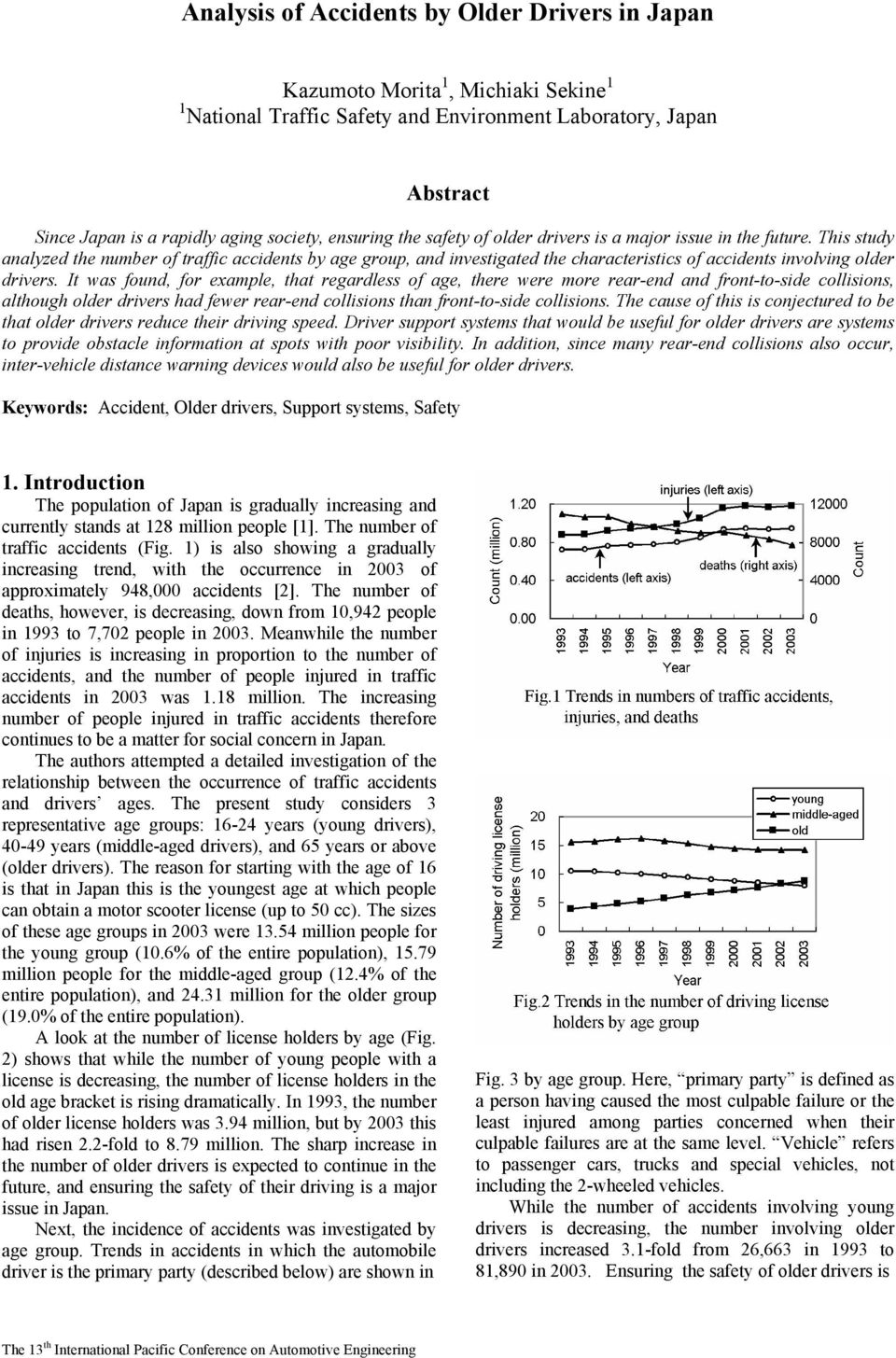
1 Analysis of Accidents by Older Drivers in Japan Kazumoto Morita 1, Michiaki Sekine 1 1 National Traffic Safety and Environment Laboratory, Japan Abstract Since Japan is a rapidly aging society, ensuring the safety of older is a major issue in the future. This study analyzed the number of traffic accidents by age group, and investigated the characteristics of accidents involving older. It was found, for example, that regardless of age, there were more rear-end and front-to-side collisions, although older had fewer rear-end collisions than front-to-side collisions. The cause of this is conjectured to be that older reduce their driving speed. Driver support systems that would be useful for older are systems to provide obstacle information at spots with poor visibility. In addition, since many rear-end collisions also occur, inter-vehicle distance warning devices would also be useful for older. Keywords: Accident, Older, Support systems, Safety 1. Introduction The population of Japan is gradually increasing and currently stands at 128 million people [1]. The number of traffic accidents (Fig. 1) is also showing a gradually increasing trend, with the occurrence in 2003 of approximately 948,000 accidents [2]. The number of deaths, however, is decreasing, down from 10,942 people in 1993 to 7,702 people in Meanwhile the number of injuries is increasing in proportion to the number of accidents, and the number of people injured in traffic accidents in 2003 was 1.18 million. The increasing number of people injured in traffic accidents therefore continues to be a matter for social concern in Japan. The authors attempted a detailed investigation of the relationship between the occurrence of traffic accidents and ages. The present study considers 3 representative age groups: years (young ), years (middle-aged ), and 65 years or above (older ). The reason for starting with the age of 16 is that in Japan this is the youngest age at which people can obtain a motor scooter license (up to 50 cc). The sizes of these age groups in 2003 were million people for the young group (10.6% of the entire population), million people for the middle-aged group (12.4% of the entire population), and million for the older group (19.0% of the entire population). A look at the number of license holders by age (Fig. 2) shows that while the number of young people with a license is decreasing, the number of license holders in the old age bracket is rising dramatically. In 1993, the number of older license holders was 3.94 million, but by 2003 this had risen 2.2-fold to 8.79 million. The sharp increase in the number of older is expected to continue in the future, and ensuring the safety of their driving is a major issue in Japan. Next, the incidence of accidents was investigated by age group. Trends in accidents in which the automobile driver is the primary party (described below) are shown in Fig. 3 by age group. Here, primary party is defined as a person having caused the most culpable failure or the least injured among parties concerned when their culpable failures are at the same level. Vehicle refers to passenger cars, trucks and special vehicles, not including the 2-wheeled vehicles. While the number of accidents involving young is decreasing, the number involving older increased 3.1-fold from 26,663 in 1993 to 81,890 in Ensuring the safety of older is
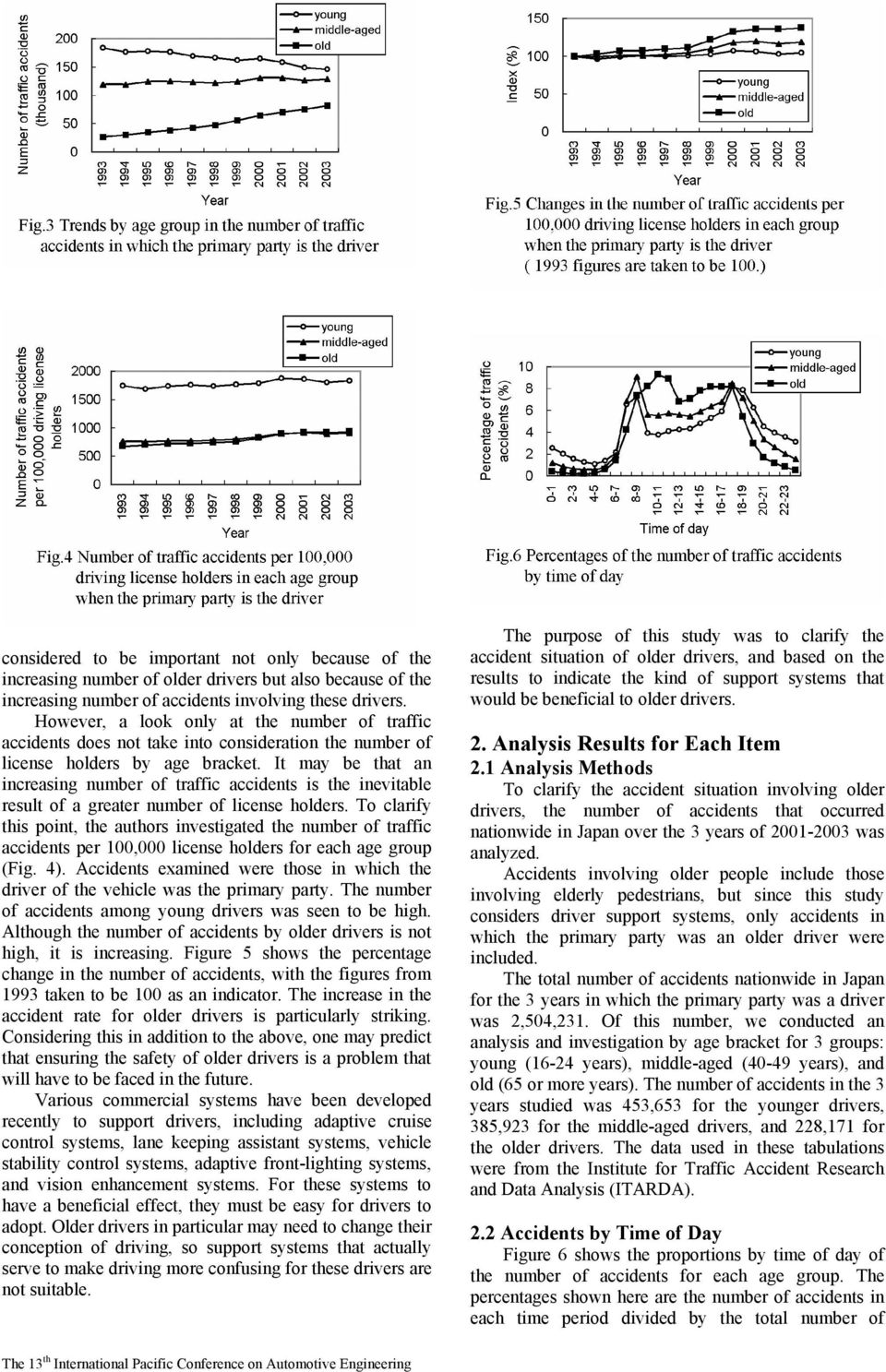
2 considered to be important not only because of the increasing number of older but also because of the increasing number of accidents involving these. However, a look only at the number of traffic accidents does not take into consideration the number of license holders by age bracket. It may be that an increasing number of traffic accidents is the inevitable result of a greater number of license holders. To clarify this point, the authors investigated the number of traffic accidents per 100,000 license holders for each age group (Fig. 4). Accidents examined were those in which the driver of the vehicle was the primary party. The number of accidents among young was seen to be high. Although the number of accidents by older is not high, it is increasing. Figure 5 shows the percentage change in the number of accidents, with the figures from 1993 taken to be 100 as an indicator. The increase in the accident rate for older is particularly striking. Considering this in addition to the above, one may predict that ensuring the safety of older is a problem that will have to be faced in the future. Various commercial systems have been developed recently to support, including adaptive cruise control systems, lane keeping assistant systems, vehicle stability control systems, adaptive front-lighting systems, and vision enhancement systems. For these systems to have a beneficial effect, they must be easy for to adopt. Older in particular may need to change their conception of driving, so support systems that actually serve to make driving more confusing for these are not suitable. The purpose of this study was to clarify the accident situation of older, and based on the results to indicate the kind of support systems that would be beneficial to older. 2. Analysis Results for Each Item 2.1 Analysis Methods To clarify the accident situation involving older, the number of accidents that occurred nationwide in Japan over the 3 years of was analyzed. Accidents involving older people include those involving elderly pedestrians, but since this study considers driver support systems, only accidents in which the primary party was an older driver were included. The total number of accidents nationwide in Japan for the 3 years in which the primary party was a driver was 2,504,231. Of this number, we conducted an analysis and investigation by age bracket for 3 groups: young (16-24 years), middle-aged (40-49 years), and old (65 or more years). The number of accidents in the 3 years studied was 453,653 for the younger, 385,923 for the middle-aged, and 228,171 for the older. The data used in these tabulations were from the Institute for Traffic Accident Research and Data Analysis (ITARDA). 2.2 Accidents by Time of Day Figure 6 shows the proportions by time of day of the number of accidents for each age group. The percentages shown here are the number of accidents in each time period divided by the total number of
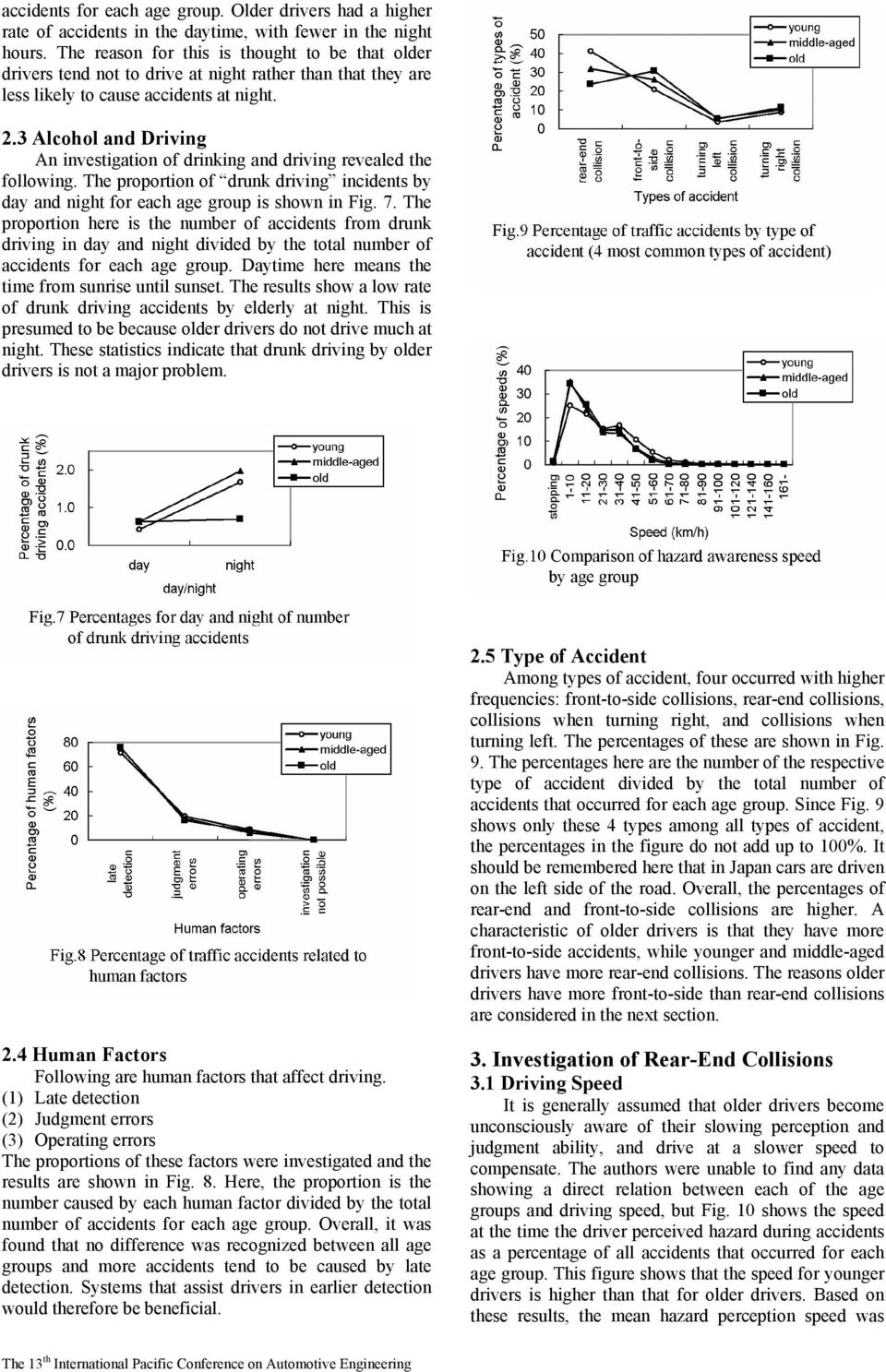
3 accidents for each age group. Older had a higher rate of accidents in the daytime, with fewer in the night hours. The reason for this is thought to be that older tend not to drive at night rather than that they are less likely to cause accidents at night. 2.3 Alcohol and Driving An investigation of drinking and driving revealed the following. The proportion of drunk driving incidents by day and night for each age group is shown in Fig. 7. The proportion here is the number of accidents from drunk driving in day and night divided by the total number of accidents for each age group. Daytime here means the time from sunrise until sunset. The results show a low rate of drunk driving accidents by elderly at night. This is presumed to be because older do not drive much at night. These statistics indicate that drunk driving by older is not a major problem. 2.5 Type of Accident Among types of accident, four occurred with higher frequencies: front-to-side collisions, rear-end collisions, collisions when turning right, and collisions when turning left. The percentages of these are shown in Fig. 9. The percentages here are the number of the respective type of accident divided by the total number of accidents that occurred for each age group. Since Fig. 9 shows only these 4 types among all types of accident, the percentages in the figure do not add up to 100%. It should be remembered here that in Japan cars are driven on the left side of the road. Overall, the percentages of rear-end and front-to-side collisions are higher. A characteristic of older is that they have more front-to-side accidents, while younger and middle-aged have more rear-end collisions. The reasons older have more front-to-side than rear-end collisions are considered in the next section. 2.4 Human Factors Following are human factors that affect driving. (1) Late detection (2) Judgment errors (3) Operating errors The proportions of these factors were investigated and the results are shown in Fig. 8. Here, the proportion is the number caused by each human factor divided by the total number of accidents for each age group. Overall, it was found that no difference was recognized between all age groups and more accidents tend to be caused by late detection. Systems that assist in earlier detection would therefore be beneficial. 3. Investigation of Rear-End Collisions 3.1 Driving Speed It is generally assumed that older become unconsciously aware of their slowing perception and judgment ability, and drive at a slower speed to compensate. The authors were unable to find any data showing a direct relation between each of the age groups and driving speed, but Fig. 10 shows the speed at the time the driver perceived hazard during accidents as a percentage of all accidents that occurred for each age group. This figure shows that the speed for younger is higher than that for older. Based on these results, the mean hazard perception speed was
4 estimated. If, for example, the scale on the horizontal axis is km/h, the intermediate value of 15 km/h is assumed to be the representative speed for that interval. If the mean hazard perception speed for each age group is obtained in this way, the older group is seen to have a lower value than the younger group (Table 1), at a speed of about 75% that of the younger group. This data confirms that older drive at slower speeds than younger. Table 1. Comparison of hazard perception speed between age groups Younger Middle-aged Older Estimated mean speed (km/h) Percentage compared with younger 100% 79% 75% Meanwhile, reference [3] gives the results of a comparison of the driving behaviors when older and nonolder were asked to drive following a leading car at their preferred following distance. The mean speed of older was 42.8 km/h, whereas that of non-older was 47.1 km/h. Thus, older drove at a speed that was about 4 km/h slower. This result also indicates that older drive at a slower speed than younger. 3.2 Numerical Analysis Numerical parameters The effect of slow driving speed in reducing the number of traffic accidents was investigated numerically. A situation was assumed in which both younger and older were following a leading vehicle, which suddenly applied its brakes. The numerical parameters used were as follows, assumed from situations that are likely to occur in actual driving. (1) Leading vehicle Speed: 30 km/h Deceleration during braking: 4 m/s 2 (2) Trailing vehicle with younger driver Speed: 30 km/h Distance between leading and trailing vehicle: 12.5 m (equivalent to inter-vehicle time of 1.5 sec) Deceleration of trailing vehicle while leading vehicle is braking: 7 m/s 2 Brake application delay of trailing vehicle driver when leading vehicle is braking: 0.7 sec. It will not always be the case that the driver of the trailing vehicle is looking forward with attention focused on the actions of the leading vehicle, and in fact inattentive driving is thought to lead to rear-end accidents. Therefore, Calculations were made with 3 settings for time that driver s eyes are off the road: 0, 1, and 3 sec. (3) Trailing vehicle with older driver Calculations were conducted with the same speed as the younger driver, plus a slower driving speed. The speed was 30 km/h when it was the same as for the younger driver. The deceleration of the trailing vehicle while the leading vehicle was braking was taken to be 6 m/s 2, on the assumption that older would not press on the brake pedal as strongly as younger. The brake application delay of the trailing vehicle driver when the leading vehicle was braking was taken to be 1.2 sec, assuming a greater delay than younger. In addition, assuming inattentive driving, Calculations were made with 3 settings for time with driver s eyes off the road: 0, 1, and 3 sec Calculation results The numerical results are shown in Fig. 11. The horizontal axis shows the time course, with the point at which the leading vehicle brakes are first applied as time 0. The vertical axis shows the driving distance from the time the leading vehicle starts to apply its brakes, with the position of the trailing vehicle at that time as 0. At time 0, the distance to the leading vehicle shown on the vertical axis is the initial inter-vehicle distance of 12.5 m. The numerical results indicate that the leading vehicle would stop in about 8.7 m (a position of 21.2 m from the initial position of the trailing vehicle). The trailing vehicle begins to decelerate with application of the brakes at a delay behind the application of the leading vehicle s brakes of 0.7 sec for younger, and 1.2 sec for older. If the time the trailing driver s eyes are off the road is 0 sec (Fig.11, upper), the trailing vehicle can stop without colliding with the leading vehicle. According to the calculations, the younger stop at 10.8 m
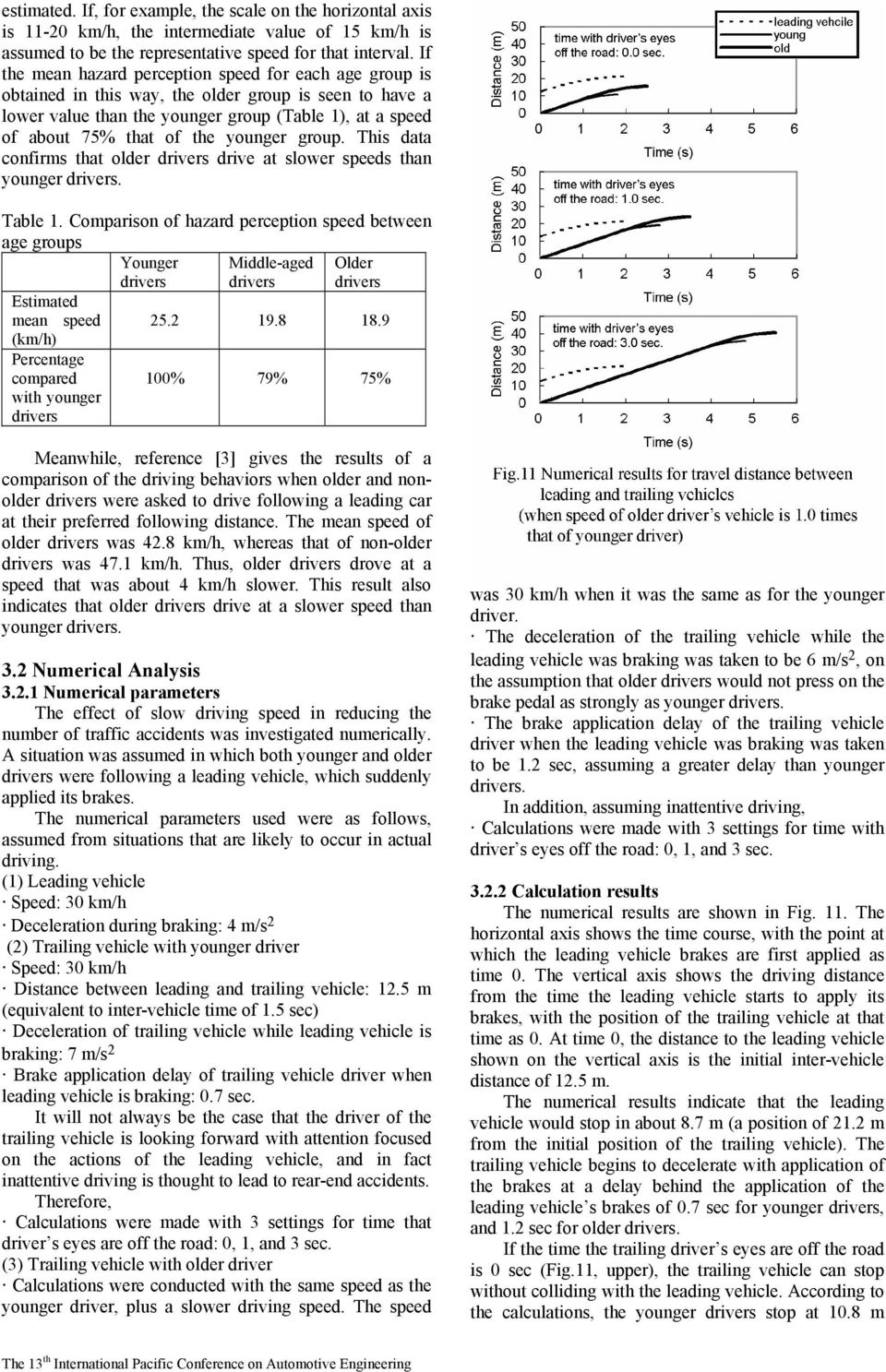
5 have slower response times than younger, they are unlikely to reduce this type of accident by driving at slower speeds. Systems that would somehow compensate for slower response times would therefore be useful for older. For example, a system that would warn older in advance of dangerous situations at intersections with poor visibility would be beneficial. 4. Characteristics of Communities with Large Elderly Populations Japan is divided into 47 prefectures. Some regions are highly developed urban areas, and others are rural. Looking at the distribution of elderly people it is seen that the percentage of elderly people differs according to prefecture. Figure 13 shows the proportion of elderly people against the entire population of each prefecture in The prefecture with the highest proportion of elderly people (elderly rate) has 26.0% elderly, while that with the lowest has 14.2%. Five prefectures with high elderly rates were selected for an investigation of whether the occurrence of accidents in those prefectures differed from the situation nationwide. whereas the older reach a distance of 15.8 m before stopping. However, as the time the trailing driver s eyes are off the road increases, the distance before the trailing vehicle stops grows longer. When eyes are off the road for 1 sec (middle in the figure), the younger do not collide (stopping distance of 19.1 m) but the older do collide (stopping distance of 24.1 m). When the time the trailing driver s eyes are off the road is 3 seconds (bottom in the figure), both the younger and older collide with the leading vehicle. Next let us consider the case when the older driver has a reduced driving speed. Calculations with the same parameters as those above were conducted for the case in which older drove at a speed 0.8 times (in this case 24 km/h) that of younger. The results are shown in Fig. 12. Since the parameters were the same, the results for the younger were the same as in Fig. 11. Since the speed of the older was slower, the stopping distance was shorter than when they were driving at 30 km/h. Furthermore, the final stopping distance of the older becomes shorter than that of the younger as the length of time the eyes are off the road becomes longer. In other words, although the driver is not applying the brakes when his eyes are off the road, the distance traveled during that time is shorter because of the slower speed. As a result, the final stopping distance is shorter, and it is assumed to be less likely that a rear-end collision will occur. Older are thought to unconsciously reduce rear-end collisions by lowering driving speed. To reduce collisions even further a support system to warn of abnormal inter-vehicle distances may be effective. Front-to-side collisions, on the other hand, are related not to traveling distance while the driver s eyes are off the road, but to reaction time in emergencies. Because older By time of day (Fig. 14), there were more accidents with older in those prefectures during the day, which was nearly the same as the trend nationwide (Fig. 6). Looking at human factors (Fig. 15), although the rate of errors in judgment was somewhat high, the trend did not differ significantly from the national trend (Fig. 8). The results for the top 4 types of accident (Fig. 16) showed greater numbers of rear-end and front-to-side

6 collisions, and on this point were no different than the national trend (Fig. 9). The same trend for older was seen in which there were more front-to-side collisions than rear-end collisions. With other factors as well the number of accidents in districts with high elderly populations did not differ greatly from the national trends. on obstacles in spots with poor visibility would be useful for older. However, since rear-end accidents also occur in high numbers, inter-vehicle distance warning devices would also be useful for older. The utility of lane keeping assistant systems and sleep warning systems could not be determined from this analysis of accidents. 6. Conclusion This study analyzed the number of traffic accidents by age group, and investigated the characteristics of accidents involving older. It was found that the number of accidents caused by older at night was small, and accordingly they had few drunk driving accidents. Regardless of age, there were more rear-end and front-to-side collisions, although older had fewer rear-end collisions than front-to-side collisions. The cause of this is conjectured to be that older reduce their driving speed. Driver support systems that would be useful for older are systems to provide obstacle information at spots with poor visibility. In addition, since many rear-end collisions also occur, inter-vehicle distance warning devices would also be useful for older. Acknowledgments This study was sponsored by the Special Coordination Funds for Promoting Science and Technology of the Ministry of Education, Culture, Sports, Science and Technology. The authors would like to express their sincere appreciation. 5. Support Systems for Older Drivers Some examples of support systems for are adaptive front-lighting systems (AFS), vision enhancement systems, systems to provide information on obstacles in places with poor visibility, drunk driving prevention technology, inter-vehicle distance warning devices, lane keeping assistant systems, and sleep warning devices. Since the number of nighttime accidents with older is low, at present the introduction of nighttime support systems such as AFS and vision enhancement system is not predicted to have a considerable effect. However, if the introduction of such systems would increase the opportunities for older to drive at night, these kinds of support systems would be useful. Similarly, drunk driving prevention technologies would not be particularly useful for older at present. These conclusions are made considering overall trends, but considering individual accidents nighttime support systems would obviously be useful in certain cases. Front-to-side collisions are thought to be caused by slow reaction speeds, and considering the high number of these collisions, support systems to provide information References [1] Statistics of Japan, Ministry of Internal Affairs and Communications, [2] Statistics of National Police Agency, /toukei/#koutsuu [3] T. Matsuura, I. Sugawara, Driving behaviours of aged in vehicle following, Report of National Research Institute of Police Science, Vol. 33, No. 1, pp.23-29,1992 (in Japanese)

ITARDAInstitute for Traffic Accident
 972 972 972 972 972 972 972 972 ITARDAInstitute for Traffic Accident Research and Data Analysis ( 財 ) 交 通 事 故 総 合 分 析 センター ITARDA INFORMATION No. 211 9SEPTEMBER 1, 2, 3, 4, 5, 1 1 1km/h or less 1,42 2
ITARDAInstitute for Traffic Accident
 ITARDAInstitute for Traffic Accident Research and Data Analysis ( 財 ) 交 通 事 故 総 合 分 析 センター ITARDA INFORMATION No. 2011 88APRIL Fatality rate (%) 0 2 4 6 Head-on 0.70% Rear-end 4.7% Rear-end 0.70% Crossing
Deaths/injuries in motor vehicle crashes per million hours spent travelling, July 2008 June 2012 (All ages) Mode of travel
 Cyclists CRASH STATISTICS FOR THE YEAR ENDED 31 DECEMBER 212 Prepared by the Ministry of Transport CRASH FACTSHEET November 213 Cyclists have a number of risk factors that do not affect car drivers. The
FMCSA Webinar Nov.18th to Examine Large Truck Crash Fatalities Involving Pedestrians & Bicyclists. New Technology for Better Fleet Management
 In This Issue: FMCSA Webinar Nov.18th to Examine Large Truck Crash Fatalities Involving Pedestrians & Bicyclists Help Prevent Roadway Accidents involving Pedestrians How to Steer Clear of Accidents with
ITARDAInstitute for Traffic Accident
 ITARDAInstitute for Traffic Accident Research and Data Analysis ( 財 ) 交 通 事 故 総 合 分 析 センター ITARDA INFORMATION No. 211 91NOVEMBER 1, 2, 3, 4, Crossing 3% 4,258 Number of casualties Collisions while turning
Four-wheel drive vehicle crash involvement patterns
 Four-wheel drive vehicle crash involvement patterns August 2006 Report Summary 06/05 Introduction This document is a summary of a larger research report prepared by the Monash University Accident Research
ACCIDENTS AND NEAR-MISSES ANALYSIS BY USING VIDEO DRIVE-RECORDERS IN A FLEET TEST
 ACCIDENTS AND NEAR-MISSES ANALYSIS BY USING VIDEO DRIVE-RECORDERS IN A FLEET TEST Yuji Arai Tetsuya Nishimoto apan Automobile Research Institute apan Yukihiro Ezaka Ministry of Land, Infrastructure and
the Ministry of Transport is attributed as the source of the material
 Disclaimer All reasonable endeavours are made to ensure the accuracy of the information in this report. However, the information is provided without warranties of any kind including accuracy, completeness,
Traffic accidents in Hanoi: data collection and analysis
 Traffic accidents in Hanoi: data collection and analysis Nguyen Hoang Hai Vietnam, Hanoi Department of Transport, [email protected] 1. Introduction Hanoi, the capital and administrative center of Vietnam,
Code of Conduct for Commercial Drivers
 Code of Conduct for Commercial Drivers RoadDriver 2011 Safe Use of Vehicles Watch your Speed Drive within the speed limit at all times. You should drive at speeds that are safe for the conditions, recognising
Ways to Reduce to Motorcycle Accidents
 4th. Asia Automobile Institute Summit 24-25 September 2015, Chongqing Ways to Reduce to Motorcycle Accidents Yuji Arai Safety Research Division Japan Automobile Research Institute 1 Contents 1. Historical
STATISTICS OF FATAL AND INJURY ROAD ACCIDENTS IN LITHUANIA,
 Vilnius 215 STATISTICS OF FATAL AND INJURY ROAD ACCIDENTS IN LITHUANIA, 211 214 TABLE OF CONTENTS INTRODUCTION... 9 GENERAL INFORMATION... 1 1. VEHICLE FLEET... 11 1.1. Number of vehicles, 1995 214...
Safety-conscious Drivers Prevent Crashes. Defensive Driving: Managing Visibility, Time and Space. Improve Your Defensive Driving Skills
 Defensive Driving: Managing Visibility, Time and Space Motor vehicle travel is the primary means of travel in the United States. With all the benefits that come along with mobility, there are thousands
Tips for Safer Driving
 Fleet Management Fleet Management Introduction Improvements in technology will continue to help bring auto accident numbers down, but the bottom line remains that most car accidents are the result of human
PDCA Cycle Based Traffic Accident Countermeasure Management
 PDCA Cycle Based Traffic Accident Countermeasure Management Shinsuke SETOSHITA, Hiroki HASHIMOTO National Institute for Land and Infrastructure Management ABSTRACT: In order to implement traffic accident
Analysis of intersection accidents - An accident causation and prevention perspective
 Analysis of intersection accidents - An accident causation and prevention perspective Julia Werneke 1 & Mark Vollrath 2 1 Chalmers University of Technology, Goteborg, Sweden 2 TU Braunschweig, Braunschweig,
CHAPTER 1 Land Transport
 Section 1 Road Transport - PART I - Summary of the Present Situation 1 Road Traffic Accident Trends 1-1 Long-term trends fell to below 6,000 for the first time in 54 years since 1953 Number of road traffic
Put the Brakes on Speeding
 Put the Brakes on Speeding The risks of driving too fast The costs and consequences Tips to maintain a safe speed Speed kills There s no doubt about it driving over the speed limit is dangerous. It puts
Automobile Insurance 1
 FCS7020 Automobile Insurance 1 Nayda I. Torres and Josephine Turner 2 An automobile is often the most expensive property that people own, next to a home. As a result, protection against loss of an automobile
Drinking, Drugs & Health
 Chapter 6 Drinking, Drugs & Health Drinking, Drugs & Health 103 104 104 106 106 107 107 108 Effects of Alcohol How Much is Too Much? Drinking and Driving Good Hosts and the Drinking Driver Designated Drivers
Speeding. Probability of death at different impact speeds
 Speeding CRASH FACTSHEET 2012 CRASH STATISTICS FOR THE YEAR ENDED 31 DECEMBER 2011 Prepared by the Ministry of Transport In this fact sheet speeding is defined as driving too fast for the conditions. The
DEADLY DRIVING DISTRACTIONS: Texting, Cell Phones, and Other Killers
 Instructor s Guide : Texting, Cell Phones, and Other Killers According to insurance statistics, distracted drivers are responsible for almost 80 percent of all car crashes and 65 percent of near-collisions
A statistical comparison between severe accidents and PDO accidents in Riyadh A.S. Al-Ghamdi College of Engineering, King Sand University,
 A statistical comparison between severe accidents and PDO accidents in Riyadh A.S. Al-Ghamdi College of Engineering, King Sand University, Email: [email protected]. sa Abstract Riyadh, capital of the Kingdom
Motor Vehicle Collisions in Eastern Ontario. Supplement to the Eastern Ontario Health Unit Injury Report
 Motor Vehicle Collisions in Eastern Ontario Supplement to the Eastern Ontario Health Unit Injury Report September 8, 2009 For more information: Eastern Ontario Health Unit www.eohu.ca Bureau de santé de
Wolfram Hell *, Matthias Graw. Ludwig Maximilians University, Forensic Medicine, Munich, Germany
 Elderly people in fatal traffic accidents. Analysis of the LMU Safety Accident Database with results from Accident reconstruction, autopsy and ideas of countermeasures from the technical and medical perspective.
The Older And Wiser Driver
 The Older And Wiser Driver AAA Foundation for Traffic Safety Sharpening Your Driving Skills Aging is inevitable, but growing older doesn t have to mean giving up an active life. While aging does impose
A Scientific Study "ETAC" European Truck Accident Causation
 A Scientific Study "ETAC" European Truck Accident Causation Executive Summary and Recommendations 1 Introduction 1.1 The project and its objectives Currently, only limited statistics are available regarding
Report to the Minister of Justice and Attorney General Public Fatality Inquiry
 CANADA Province of Alberta Report to the Minister of Justice and Attorney General Public Fatality Inquiry Fatality Inquiries Act WHEREAS a Public Inquiry was held at the Courthouse in the City of Wetaskiwin,
Pedestrian/Car Accident
 Pedestrian/Car Accident by Frank Owen, Alpha Omega Engineering, Inc. (www.aoengr.com), all rights reserved August 2012 This example is taken from the book Technische Analyse von Verkehrsunfällen anhand
Motorcycle and Scooter crashes Recorded by NSW Police from January to December 2011
 Motorcycle and Scooter crashes Recorded by NSW Police from January to December 2011 Data supplied by the Centre for Road Safety, Transport for NSW Analysis completed by the Survive The Ride Association
The risk of derailment and collision, and safety systems to prevent the risk
 The risk of derailment and collision, and safety systems to prevent the risk Tomohisa NAKAMURA Transport safety department East Japan Railway Company Introduction Since our establishment in 1987, we have
USING THE MOBILE PHONE WHILE DRIVING. Using a mobile phone while driving can significantly impair a driver s:
 USING THE MOBILE PHONE WHILE DRIVING Is it dangerous to use the phone while driving? Driving is a complex task, requiring drivers to use and coordinate a number of skills. Any lapse in concentration increases
Chapter 4 DEFENSIVE DRIVING
 Chapter 4 DEFENSIVE DRIVING Chapter 4 Table of Contents Chapter 4 DEFENSIVE DRIVING... 4-1 DEFENSIVE DRIVING... 4-3 Positioning The Bus... 4-3 When Making a Turn at an Intersection... 4-3 Making the perfect
Principles of Road and Traffic Engineering Designs for Mixed Traffic Flow with a Numerous Motorcycles
 Principles of Road and Traffic Engineering Designs for Mixed Traffic Flow with a Numerous Motorcycles Dr. Ming-Heng Wang Assistant Professor, Department of Transportation Technology and Management, Kainan
How To Know If A Motorcyclist Is Safe
 Motorcyclists CRASH FACTSHEET November 2013 CRASH STATISTICS FOR THE YEAR ENDED 31 DECEMBER 2012 Prepared by the Ministry of Transport In 2012, 50 motorcyclists 1 died and a further 1,138 were injured
Killed 2013 upper estimate Killed 2013 lower estimate Killed 2013 central estimate 700
 Statistical Release 12 February 2015 Estimates for reported road traffic accidents involving illegal alcohol levels: 2013 (second provisional) Self-reported drink and drug driving for 2013/14 Main findings
TO PREVENT SPEED VIOLATIONS AND TO PROVIDE TRAFFIC SAFETY WITH MICROPROCESSOR-BASED AUTOMATIC VEHICLE SPEED CONTROL SYSTEM
 TO PREVENT SPEED VIOLATIONS AND TO PROVIDE TRAFFIC SAFETY WITH MICROPROCESSOR-BASED AUTOMATIC VEHICLE SPEED CONTROL SYSTEM Hasbi APAYDIN Şükrü KİTİŞ Dumlupınar University Simav Vacational High School,
Technical Trends of Driver Assistance/ Automated Driving
 Technical Trends of Driver Assistance/ Automated Driving Presented by Tjark Kreuzinger Senior Manager, Safety research and Technical Affairs Toyota Motor Europe NV/SV TOYOTA MOTOR CORPORATION Topics 1.
A STUDY ON WARNING TIMING FOR LANE CHANGE DECISION AID SYSTEMS BASED ON DRIVER S LANE CHANGE MANEUVER
 A STUDY ON WARNING TIMING FOR LANE CHANGE DECISION AID SYSTEMS BASED ON DRIVER S LANE CHANGE MANEUVER Takashi Wakasugi Japan Automobile Research Institute Japan Paper Number 5-29 ABSTRACT The purpose of
MISSOURI TRAFFIC SAFETY COMPENDIUM
 2010 MISSOURI TRAFFIC SAFETY COMPENDIUM MISSOURI STATE HIGHWAY PATROL STATISTICAL ANALYSIS CENTER 1510 East Elm Jefferson City, Missouri 65101 (573) 751-9000 CONTENTS PAGE EXECUTIVE SUMMARY INTRODUCTION...1
FATAL ROAD ACCIDENTS OF HEAVY GOODS VEHICLES IN FINLAND
 TRANSBALTICA 2011 The 7 th International Conference May 5 6, 2011, Vilnius, Lithuania Selected papers ISSN 2029-2376 print / ISSN 2029-2384 online ISBN 978-9955-28-840-4 http://transbaltica.vgtu.ltt Vilnius
Reported road accidents involving young car drivers: Great Britain 2011
 Reported road accidents involving young car drivers: Great Britain 211 Road Accident Statistics Factsheet No. 1 August 212 Introduction This factsheet presents summary information relating to the casualties
Level 2 Award in Safe Driving at Work
 Level 2 Award in Safe Driving at Work Student notes (sample) www.britsafe.org Membership Training Qualifications Audit and Consultancy Audit and Policy Consultancy and Opinion Policy Awards and Opinion
Bicycle Safety Quiz Answers Parental Responsibilities
 Bicycle riding is a great way to get into shape and enjoy the outdoors. To remain safe on Illinois roads, it is important to follow the same traffic safety laws that govern vehicle drivers. No amount of
DOT HS 809 360 October 2001
 U.S. Department of Transportation National Highway Traffic Safety Administration DOT HS 809 360 October 2001 Technical Report This document is available to the public from the National Technical Information
INTERACTIONS BETWEEN ACCIDENT RATE AND TRAFFIC VOLUME
 INTERACTIONS BETWEEN ACCIDENT RATE AND TRAFFIC VOLUME Algis Pakalnis, Deputy Director, Mindaugas Dimaitis, Head of Road Division, Andrius Gužys, Road Division Group Leader, Transport and Road Research
The State Government recognises. areas, and regulates bicycle
 cycling & THE LAW rules introduction for roads The State Government recognises The cycling South Australian as a legitimate Road Traffic form of Act including transport the Australian and an increasingly
LANE SHARING: A GLOBAL SOLUTION FOR MOTORCYCLE SAFETY
 LANE SHARING: A GLOBAL SOLUTION FOR MOTORCYCLE SAFETY By Steve Guderian INTRODUCTION Motorcycle safety has proven to be a difficult traffic safety issue to address. Figure 1 1 provides an insight into
Contributory factors to road accidents
 Contributory factors to road accidents Jonathan Mosedale, Andrew Purdy and Eddie Clarkson, Transport Statistics: Road Safety, Department for Transport Introduction The STATS19 national system of collection
IN THE HIGH COURT OF AUSTRALIA -T-UL-L-Y-
 n IN THE HIGH COURT OF AUSTRALIA -T-UL-L-Y- V. b e a c h...a n d. o t h e r s REASONS FOR JUDGMENT t u l l y v. BEACH AND OTHERS - JUDGMENT (o r a l ). JUDGMENT OF THE COURT DELIVERED BY DIXON C.J. COMM:
 Think Before You Drive is a global road safety initiative of the FIA Foundation, Bridgestone Corporation and motoring clubs worldwide. FIA Foundation for the Automobile and Society www.fiafoundation.com
PREVENTABILITY OF MOTOR VEHICLE COLLISIONS
 PREVENTABILITY OF MOTOR VEHICLE COLLISIONS Management and fleet supervisors should establish standards for defensive driving in any type of fleet safety program. The overall performance of the drivers
Driving Safety Support Systems Utilizing ITS Radio System
 FEATURED TOPIC Driving Safety Support Systems Utilizing ITS Radio System Yuichi TANIGUCHI*, Toshifumi OOTA, Masafumi KOBAYASHI, Hirofumi URAYAMA and Yoshiteru KOREEDA We are striving to develop the Driving
Atlanta, Georgia Road Test
 1. When driving your car Into traffic from a parked position, you should: A. Sound your horn and pull Into the other lane. B. Signal and proceed when safe. C. Signal other traffic and pull directly into
A Review of Serious Casualty Motorcycle Crashes in Tasmania
 A Review of Serious Casualty Motorcycle Crashes in Tasmania D epart ment of Infrastructure, Energy and Resources A Review of Serious Casualty Motorcycle Crashes in Tasmania Traffic and Infrastructure Branch
the Ministry of Transport is attributed as the source of the material
 Disclaimer All reasonable endeavours are made to ensure the accuracy of the information in this report. However, the information is provided without warranties of any kind including accuracy, completeness,
Accidents with Pedestrians and Cyclists in Germany Findings and Measures
 Accidents with Pedestrians and Cyclists in Germany Findings and Measures Siegfried Brockmann Unfallforschung der Versicherer (UDV) May 7th, Geneva 2 Content 2 Accident situation in Germany based on National
SAFE CYCLING GUIDE. 7th Edition
 SAFE CYCLING GUIDE 7th Edition BEFORE SETTING OUT A Check tire pressure B Check that the chain does not slip C Check the brakes D Check lights and reflectors: 1 A WELL-MAINTAINED BICYCLE is key 3 4 5 Adjust
Operating Vehicle Control Devices
 Module 2 Topic 3 Operating Vehicle Control Devices 1. Identify the vehicle controls in the pictures below: 1. 2. 3. 4. 7. 7. 5. 6. 1. accelerator 2. parking brake 3. foot brake 4. gear shift lever_ 5.
INSTRUCTOR S GUIDE. Stay on the Right Track Highway-Railway Crossing Awareness Training for Newly Licensed Drivers
 INSTRUCTOR S GUIDE Stay on the Right Track Highway-Railway Crossing Awareness Training for Newly Licensed Drivers WHAT WE DO Operation Lifesaver is a nationwide, non-profit public information and education
Testimony of Ann Wilson House Energy & Commerce Committee Subcommittee on Commerce, Manufacturing and Trade, October 21, 2015
 House Energy & Commerce Committee Subcommittee on Commerce, Manufacturing and Trade, October 21, 2015 Introduction Chairman Burgess, Ranking Member Schakowsky, members of the subcommittee: Thank you for
To Foreign Nationals Who Drive Vehicles in Japan (English Language Version) Chapter 1 Basic Information
 7,1, 2011 License Division Translated by National Police Agency To Foreign Nationals Who Drive Vehicles in Japan (English Language Version) Introduction This booklet is designed to help you understand
A Consumer s Guide to: Auto Insurance. Choosing and using your auto insurance coverage. Washington State Office of the Insurance Commissioner
 A Consumer s Guide to: Auto Insurance Choosing and using your auto insurance coverage Washington State Office of the Insurance Commissioner Washington State www.insurance.wa.gov Office of the Insurance
SAMPLE VEHICLE FLEET SAFETY & USAGE POLICY
 SAMPLE VEHICLE FLEET SAFETY & USAGE POLICY Policy The purpose of this policy is to ensure the safety of those individuals who drive company vehicles and to provide guidance on the proper use of company
Road Traffic Accidents in Japan. October 25, 2012
 New Approaches to Reduce Road Traffic Accidents in Japan October 25, 2012 (1) Current Situation of Traffic Accidents in Japan (2) The Management Approach for Safer Roads (3) New Efforts to Combat
Advanced Forward-Looking Safety Systems Working Group. Advanced Forward-Looking Safety Systems Working Group
 Advanced Forward-Looking Safety Systems Working Group INFO STAND 1: Accident Analysis Advanced Forward-Looking Safety Systems Working Group Results of Accident Analysis vfss Workshop Walter Niewöhner (DEKRA)
Author: Hamid A.E. Al-Jameel (Research Institute: Engineering Research Centre)
 SPARC 2010 Evaluation of Car-following Models Using Field Data Author: Hamid A.E. Al-Jameel (Research Institute: Engineering Research Centre) Abstract Traffic congestion problems have been recognised as
Road Safety Authority Provisional Review of Road Crashes 2013
 A review of 2013 fatal collision statistics December 31 st 2013 The following report summarises the main trends that have emerged in 2013. This has been prepared by the Road Safety Authority following
ITARDA INFORMATION. No.102. Special feature
 ITARDA INFORMATION No.102 Special feature Introduction.................................. P2 Number of registered motorcycles............... P2 Characteristics of Class-1 moped accidents...... P3 Key points
How To Understand The Safety Of A Motorcycle
 Disclaimer All reasonable endeavours are made to ensure the accuracy of the information in this report. However, the information is provided without warranties of any kind including accuracy, completeness,
Traffic Accidents Trends and Characteristics in Jordan
 International Journal of Civil & Environmental Engineering IJCEE-IJENS Vol:13 No:5 9 Traffic Accidents Trends and Characteristics in Jordan Bashar AL-Omari 1, Khalid Ghuzlan 2*, Hala Hasan 3 1 Associate
Impaired Driver John Bartlett Fatal Crash Not Fully Explained
 Impaired Driver John Bartlett Fatal Crash Not Fully Explained Posting Date: 10 Mar 2011 On Friday night, March 4th, 2011, at approximately 11:30 P.M., a Ford Pick-up truck was eastbound on Jerseyville
Oxfordshire Local Transport Plan 2011-2030 Revised April 2012. Objective 3 Reduce casualties and the dangers associated with travel
 6. Road Safety Objective 3 Reduce casualties and the dangers associated with travel Road safety continues to be a core priority both nationally and locally reflecting the very high human and other costs
The momentum of a moving object has a magnitude, in kg m/s, and a... (1)
 Q. (a) Complete the following sentence. The momentum of a moving object has a magnitude, in kg m/s, and a.... () (b) A car being driven at 9.0 m/s collides with the back of a stationary lorry. The car
Characteristics of High Injury Severity Crashes on 80 110 km/h Rural Roads in South Australia
 Characteristics of High Injury Crashes on 80 110 km/h Rural Roads in South Australia, J. R. R. Centre for Automotive Safety Research, University of Adelaide, SOUTH AUSTRALIA, 5005 email: [email protected]
SAFE CYCLING GUIDE. 6th Edition
 SAFE CYCLING GUIDE 6th Edition BEFORE SETTING OUT A WELL-MAINTAINED BICYCLE is key A Check tire pressure B Check that the chain does not slip C Check the brakes D Check lights and reflectors: 3 4 1 5 2
DRINK DRIVING AND THE LAW
 This information is general and not a substitute for legal advice. The Legal Services Commission provides free advice for most legal problems. Contact the Legal Helpline 1300 366 424 (TTY 8463 3691) www.lsc.sa.gov.au
Accident configurations and injuries for bicyclists based on the German In-Depth Accident Study. Chiara Orsi
 Accident configurations and injuries for bicyclists based on the German In-Depth Accident Study Chiara Orsi Centre of Study and Research on Road Safety University of Pavia State of the art Vulnerable road
Talking Points. About Roadway Users
 General facts regarding the driver: Talking Points About Roadway Users Motor vehicle crashes are the leading cause of death in the U.S. for people ages 6-33. They annually account for more than 1 million
Regulatory Impact Statement
 Regulatory Impact Statement EXECUTIVE SUMMARY Several problems have been identified that contribute to the high crash risk of motorcyclists. With motorcycling increasing in popularity the following package
Bicycle riding is a great way to get into shape
 Bicycle riding is a great way to get into shape and have fun. To remain safe on Illinois roads, it is important to follow the same traffic safety laws that govern vehicle drivers. No amount of bicycle
Appendix 1: ICD 10 AM (6th Edition) Cause of Injury Code and Description
 ICD 10 AM Cause of Injury Codes and Descriptions Page 1 of 61 Appendix 1: ICD 10 AM (6th Edition) Cause of Injury Code and Description V00.00 Pedestrian injured in collision with pedestrian conveyance,
always in a rush Are you Rushing to work Rushing home Rushing off on vacation?
 Are you always in a rush? Rushing to work Rushing home Rushing off on vacation? Do you find yourself increasingly picking up the pace, racing against time? 75 100 50 125 25 150 HUILE 60 40 80 100 120 140
Car occupants intoxication and non-use of safety belts
 TØI report 499/2000 Authors: Fridulv Sagberg, Terje Assum Oslo 2000, 63 pages Norwegian language Summary: In-depth road accident investigations Aggregated results from 96 fatal accidents in Mälardalen,
Road fatalities in 2012. Road fatality: any person killed immediately or dying within 30 days as a result of a road crash.
 Korea, KoRoad Inhabitants Vehicles/1 000 inhabitants Road fatalities in 2012 Fatalities /100 000 inhabitants in 2012 48.9 million 438 5 392 10.8 1. Road safety data collection Definitions: Road fatality:
Regional Road Safety Strategy September 2004
 Regional Road Safety Strategy September 2004 Regional Road Safety Strategy September 2004 Cover photo courtesy of St Mark s Church School Executive Summary The vision of the Regional Road Safety Strategy
TEST ON Driving Safely Among Bicyclists and Pedestrians
 TEST ON Driving Safely Among Bicyclists and Pedestrians Next you will take a 16 question test about driving safely among bicyclists and pedestrians. Please take out a sheet of paper to mark down and score
THE MOBILITY AND SAFETY OF OLDER DRIVERS IN BRITAIN. Mitchell, Christopher (Kit)
 THE MOBILITY AND SAFETY OF OLDER DRIVERS IN BRITAIN Mitchell, Christopher (Kit) Retired: 17 Tavistock Road, Fleet, Hampshire GU51 4EH, UK Email: [email protected] Abstract Most journeys by older
Smart Cycling IN SANTA MONICA SANTA MONICA POLICE DEPARTMENT BE SMART. BE VISIBLE. BE ATTENTIVE. HAVE FUN!
 Smart Cycling IN SANTA MONICA BE SMART. BE VISIBLE. BE ATTENTIVE. HAVE FUN! Safety Tips and Rules of the Road for Cyclists SANTA MONICA POLICE DEPARTMENT Rules of the Road Drivers, bicyclists, and pedestrians
Florida Class E Knowledge Exam Road Rules Practice Questions www.gdlinstitute.org
 If you purchase the Value Package from GDL Institute, over 100 additional practice questions are included at no additional cost. Use discount code PQ10 and receive 10% off of the package price! 1. If you
The total number of traffic collisions in Saskatchewan is up 5% from 51,733 in 2008 to 54,229 in 2009.
 2009 Summary The total number of traffic collisions in Saskatchewan is up 5% from 51,733 in 2008 to 54,229 in 2009. The number of fatal collisions decreased 2% over the past year from 132 in 2008 to 129
New Zealand all-age mandatory bicycle helmet law
 New Zealand all-age mandatory bicycle helmet law A public health and safety disaster New Zealand is one of only three countries in the world with national all-age mandatory bicycle helmet laws, the others