
Firewall Security Toolbox User s Guide
|
|
|
- Madeline Copeland
- 10 years ago
- Views:
Transcription
1 Tivoli Management Framework Firewall Security Toolbox User s Guide Version 1.3 GC

2

3 Tivoli Management Framework Firewall Security Toolbox User s Guide Version 1.3 GC

4 Note Before using this information and the product it supports, read the information in Notices on page 61. ISO 9001 Certification This product was developed using an ISO 9001 certified quality system. Certification has been awarded by Bureau Veritas Quality International (BVQI) (Certification No. BVQI / A). BVQI is a world leader in quality certification and is currently recognized by more than 20 accreditation bodies. First Edition (September 2002) This edition applies to version 1, release 3, of Tivoli Management Framework Firewall Security Toolbox (product number 5698-FRA) and to all subsequent releases and modifications until otherwise indicated in new editions. Copyright International Business Machines Corporation 2001, All rights reserved. US Government Users Restricted Rights Use, duplication or disclosure restricted by GSA ADP Schedule Contract with IBM Corp.

5 Contents Tables v Preface vii Who Should Read This Guide vii Publications vii Tivoli Management Framework Library.... vii Related Publications viii Conventions Used in This Guide viii Accessing Publications Online ix Ordering Publications ix Providing Feedback about Publications.... ix Accessibility ix Contacting Customer Support x What This Guide Contains x Chapter 1. Introduction Tivoli Environments with a Firewall Tivoli Environments with Demilitarized Zones... 2 Firewall Limitations on Connectivity Sending Events Across Firewalls Identifying a Component as Parent or Child Chapter 2. Installing Tivoli Management Framework Firewall Security Toolbox.. 7 Prerequisite Software Planning Where to Install the Components Getting Started Components on Multihomed Hosts Decompressing the Installation Files Installing on UNIX Systems Installing the Endpoint Proxy on UNIX Systems 10 Installing the Gateway Proxy on UNIX Systems 11 Installing the Relay on UNIX Systems Installing the Event Sink on UNIX Systems Installing on Windows Systems Installing the Endpoint Proxy on Windows Systems Installing the Gateway Proxy on Windows Systems Installing the Relay on Windows Systems Installing the Event Sink on Windows Systems 22 Upgrading the Components Upgrading on Windows Systems Upgrading on UNIX Systems Uninstalling the Components Uninstalling from UNIX Systems Uninstalling All Components except the Relay from Windows Systems Uninstalling the Relay from Windows Systems 25 Chapter 3. Configuring the Components Configuring the Endpoint Proxy Endpoint-proxy Log Communication-layer Children-cm-info Configuring the Gateway Proxy Gateway-proxy Log Communication-layer Parent-cm-info Configuring the Relay Relay Log Communication-layer Children-cm-info Parent-cm-info Configuring the Event Sink SENDING RECEPTION EIF LOG Configuring Non-TME Adapters for the Event Sink Migrating Endpoints to Connect to a Gateway Proxy 39 Configuring Backup Gateway Proxies Configuring Endpoints for Backup Gateway Proxies 40 Setting the Endpoint Proxy Login Interval on All Platforms Chapter 4. Using Firewall Security Toolbox Starting and Stopping the Components Starting and Stopping the Components on Windows Systems Starting and Stopping the Components on UNIX Systems Working with Endpoints Logged in through the Proxy Listing the Endpoints in the Database Modifying the Attributes of an Endpoint Removing an Endpoint from the Database Backing Up and Restoring the Endpoint Manager Database Installing Endpoints in a DMZ Installing the Endpoints from Scratch Connecting Endpoints that Are Already Present in the Tivoli Region Processing Events from the Tivoli Enterprise Console Availability Intermediate Manager Console. 47 Viewing Endpoint Properties Appendix A. Using the Command Line Interface Command Line Syntax wproxy Appendix B. Troubleshooting Copyright IBM Corp. 2001, 2002 iii

6 Testing Proxy Configuration Debugging Application Errors Using the Log Files for Troubleshooting Providing More Detail in the Log Files Interpreting the Log Files Providing Details to Customer Support Tuning Timeout Values for Tivoli Management Framework Timeout Values for the Firewall Security Toolbox 57 Connecting Components from Different Versions.. 58 Rescuing Lost Endpoints from the Gateway Error on UNIX Systems When Installing as User Nobody NAT Not Supported Wake on LAN Not Supported Gateway Proxy Label Might Be Displayed Incorrectly Multicast Feature Not Supported Port Conflicts Gateway Times Out before Distribution Complete 59 Notices Trademarks Index iv Tivoli Management Framework: Firewall Security Toolbox User s Guide
7 Tables 1. Prerequisite software The endpoint-proxy section The log section The communication-layer section The children-cm-info section The gateway-proxy section The log section The communication-layer section The parent-cm-info section The relay section The log section The communication-layer section The children-cm-info section The parent-cm-info section The SENDING section The RECEPTION section The EIF section The log section Copyright IBM Corp. 2001, 2002 v

8 vi Tivoli Management Framework: Firewall Security Toolbox User s Guide

9 Preface Who Should Read This Guide Publications Tivoli Management Framework Firewall Security Toolbox, referred to as the Firewall Security Toolbox in the rest of this book, provides a solution for managing your Tivoli network across firewalls without compromising security. This guide explains how to install and configure this feature of Tivoli Management Framework. This guide is for administrators and system programmers who configure the firewalls in their networks. This guide is also useful for network planners who organize the security configuration of their networks. Readers should be familiar with the following: v The UNIX and Windows operating systems v Tivoli Management Framework This section lists publications in the Tivoli Management Framework library and any other related documents. It also describes how to access Tivoli publications online, how to order Tivoli publications, and how to make comments on Tivoli publications. Tivoli Management Framework Library The following documents are available in the Tivoli Management Framework library: v Tivoli Management Framework: Planning for Deployment Guide, GC Explains how to plan for deploying your Tivoli environment. It also describes Tivoli Management Framework and its services. v Tivoli Enterprise: Installation Guide, GC Explains how to install and upgrade Tivoli Enterprise software within your Tivoli management region (Tivoli region) using the available installation mechanisms provided by Tivoli Software Installation Service and Tivoli Management Framework. Tivoli Enterprise software includes the Tivoli management region server (Tivoli server), managed nodes, gateways, endpoints, and RDBMS Interface Module (RIM) objects. This guide also provides information about troubleshooting installation problems. v Tivoli Management Framework: User s Guide, GC Describes the concepts and procedures for using Tivoli Management Framework services. It provides instructions for performing tasks from the Tivoli desktop and from the command line. v Tivoli Management Framework: Maintenance and Troubleshooting Guide, GC Explains how to maintain the Tivoli environment and troubleshoot problems that can arise during normal operations. Copyright IBM Corp. 2001, 2002 vii

10 v v v Tivoli Management Framework: Release Notes, GI Provides late-breaking information about Tivoli Management Framework. Tivoli Management Framework: Task Library Language Developers Guide, SC Provides an overview of the task library language (TLL) Tivoli Management Framework: Reference Manual, SC Provides in-depth information about Tivoli Management Framework commands. This manual is helpful when writing scripts that are later run as Tivoli tasks. This manual also documents policy scripts provided with Tivoli Management Framework. Related Publications The following document also provides useful information related to Firewall Security Toolbox: v Tivoli Enterprise Console: Adapters Guide, GC Provides detailed descriptions for the currently available Tivoli Enterprise Console adapters. v IBM Tivoli Remote Control: User s Guide, GC Provides information about using the Tivoli Firewall Security Toolbox with Remote Control. The Tivoli Glossary includes definitions for many of the technical terms related to Tivoli software. The Tivoli Glossary is available, in English only, at the following Web site: Conventions Used in This Guide This guide uses several typeface conventions for special terms and actions. These conventions have the following meaning: Bold Italic Monospace Commands, keywords, file names, authorization roles, URLs, names of windows and dialogs, other controls, or other information that you must use literally are in bold. Variables and values that you must provide, new terms, and words and phrases that are emphasized are in italics. Code examples, output, and system messages are in a monospace font. This guide uses the UNIX convention for specifying environment variables and for directory notation: v v When using the Windows command line, replace $variable with %variable% for environment variables and replace each forward slash (/) with a backslash (\) in directory paths. When using the bash shell on Windows, use the UNIX conventions. viii Tivoli Management Framework: Firewall Security Toolbox User s Guide

11 Accessibility Accessing Publications Online When IBM publishes an updated version of one or more online or hardcopy publications, they are posted to the Tivoli Information Center. You can access updated publications in the Tivoli Information Center from the following IBM Customer Support Web site for Tivoli products: The Tivoli Information Center contains the most recent version of the books in the product library in PDF or HTML formats, or both. Translated documents are also available for some products. Note: If you print PDF documents on other than letter-sized paper, select the Fit to page check box in the Adobe Acrobat Print dialog (which is available when you click File > Print) to ensure that the full dimensions of a letter-sized page are printed on the paper that you are using. Ordering Publications You can order many Tivoli publications online at the following Web site: /cgibin/pbi.cgi You can also order by telephone by calling one of these numbers: v In the United States: v In Canada: In other countries, for a list of telephone numbers, see the following Web site: Providing Feedback about Publications We are very interested in hearing about your experience with Tivoli products and documentation, and we welcome your suggestions for improvements. If you have comments or suggestions about our products and documentation, contact us in one of the following ways: v v Send an to [email protected]. Complete our customer feedback survey at the following Web site: Accessibility features help users who have a physical disabilities, such as restricted mobility or limited vision, to use software products successfully. With this product, you can use assistive technologies to hear and navigate the interface. You can also use the keyboard instead of the mouse to operate all features of the graphical user interface. This guide provides descriptions of the graphics, which can be read by a screen reading program. Preface ix

12 Contacting Customer Support What This Guide Contains If you have a problem with any Tivoli product, you can contact Customer Support. See the Customer Support Handbook at the following Web site: The handbook provides information about how to contact Customer Support, depending on the severity of your problem, and the following information: v Registration and eligibility v Telephone numbers and addresses, depending on the country you are in v What information you should gather before contacting Customer Support This guide contains the following sections: v Chapter 1, Introduction on page 1 Provides an overview of the main concepts. v Chapter 2, Installing Tivoli Management Framework Firewall Security Toolbox on page 7 Provides instructions for installing the components. v Chapter 3, Configuring the Components on page 27 Explains how to configure the components. v Chapter 4, Using Firewall Security Toolbox on page 43 Explains how to perform various tasks, including starting and stopping the components. v Appendix A, Using the Command Line Interface on page 49 Provides usage information for the wproxy command. v Appendix B, Troubleshooting on page 53 Provides information to help identify and solve problems, including how to interpret the log files. x Tivoli Management Framework: Firewall Security Toolbox User s Guide
13 Chapter 1. Introduction A simple Tivoli environment consists of the Tivoli management region server (Tivoli server), a gateway, and endpoints. The endpoints communicate with the Tivoli server through the gateway and the gateway communicates with the Tivoli server. See Figure 1. Figure 1. A simple Tivoli environment Your Tivoli environment can be as simple or complex as your network demands. You can install multiple gateways in a Tivoli management region (Tivoli region) to manage large numbers of endpoints effectively. When one or more firewalls exist between an endpoint and a gateway, the communication channels permitted by the firewall are limited. The Firewall Security Toolbox enables the endpoint and gateway to communicate across firewalls while respecting firewall restrictions. Tivoli Environments with a Firewall On the secure side of the firewall, the Firewall Security Toolbox provides an endpoint proxy that connects to the gateway as if it were the endpoints. On the less secure side of the firewall, the endpoints are connected to a gateway proxy, as if it were the gateway. The gateway proxy and endpoint proxy communicate with each other through the firewall. Figure 2 on page 2 shows a simple configuration with one gateway proxy and one endpoint proxy. Copyright IBM Corp. 2001,

14 Gateway Endpoint Endpoint Proxy Gateway Proxy Endpoint Firewall Endpoint more secure less secure Just as multiple endpoints can connect to a single gateway and multiple gateways to a single Tivoli server, multiple endpoints can connect to a single gateway proxy and multiple gateway proxies can connect to a single endpoint proxy. The endpoint proxy emulates all the endpoints to the gateway that manages them. The communications between these Tivoli components is based on a Tivoli proprietary protocol over TCP/IP. Tivoli Environments with Demilitarized Zones bidirectional connection Figure 2. A Tivoli environment with an endpoint proxy and a gateway proxy connecting through a single firewall When a network includes several firewalls that separate demilitarized zones (DMZs) of progressively lower security as they approach the Internet, the configuration becomes more complex. Although the gateway proxy and endpoint proxy continue to communicate with the endpoint and the gateway, respectively, they no longer communicate directly across the multiple firewalls, because this would defeat the purpose of having multiple firewalls in place. Instead, the Firewall Security Toolbox provides relays, which are installed between the firewalls in DMZs. These relays pass on information to each other from one DMZ to another and, finally, to or from the endpoint proxy and gateway proxy. Figure 3 on page 3 shows an example of this configuration. 2 Tivoli Management Framework: Firewall Security Toolbox User s Guide

15 Gateway Firewall Firewall Demilitarized Zone (DMZ) Endpoint Proxy Relay Gateway Proxy Endpoint more secure less secure bidirectional connection Figure 3. A Tivoli environment with the relay connecting the endpoint and gateway proxies through a DMZ You can install a second instance of a relay on a single machine exclusively to work with the proxy components of Tivoli Remote Control Version 3.8. See the IBM Tivoli Remote Control: User s Guide for more details. For all other components of the toolbox, you can install only one instance per machine. Firewall Limitations on Connectivity The firewall can allow connections between machines that have been initiated by either machine. These are known as bidirectional connections. However, this can expose the Tivoli server to illicit connections by unauthorized machines posing as legitimate clients. To avoid such intrusions, each firewall can be configured to limit which machines can initiate a connection. This usually means that the machine on the more secure side initiates all connections with other machines on the less secure side. This machine is known as a client and becomes the initiator. The other machine is known as a server and become the listener. This type of connection is known as unidirectional. The Tivoli Management Framework Firewall Security Toolbox enables you to configure unidirectional connections among the endpoint proxy, gateway proxy, and relays in your Tivoli environment. In a configuration composed of multiple firewalls and DMZs, you can set up a network that allows a mix of unidirectional and bidirectional connections. For example, a bank branch office, which operates within a secure intranet, connects to its main administrative office through a series of relays (see Figure 4 on page 4). Chapter 1. Introduction 3
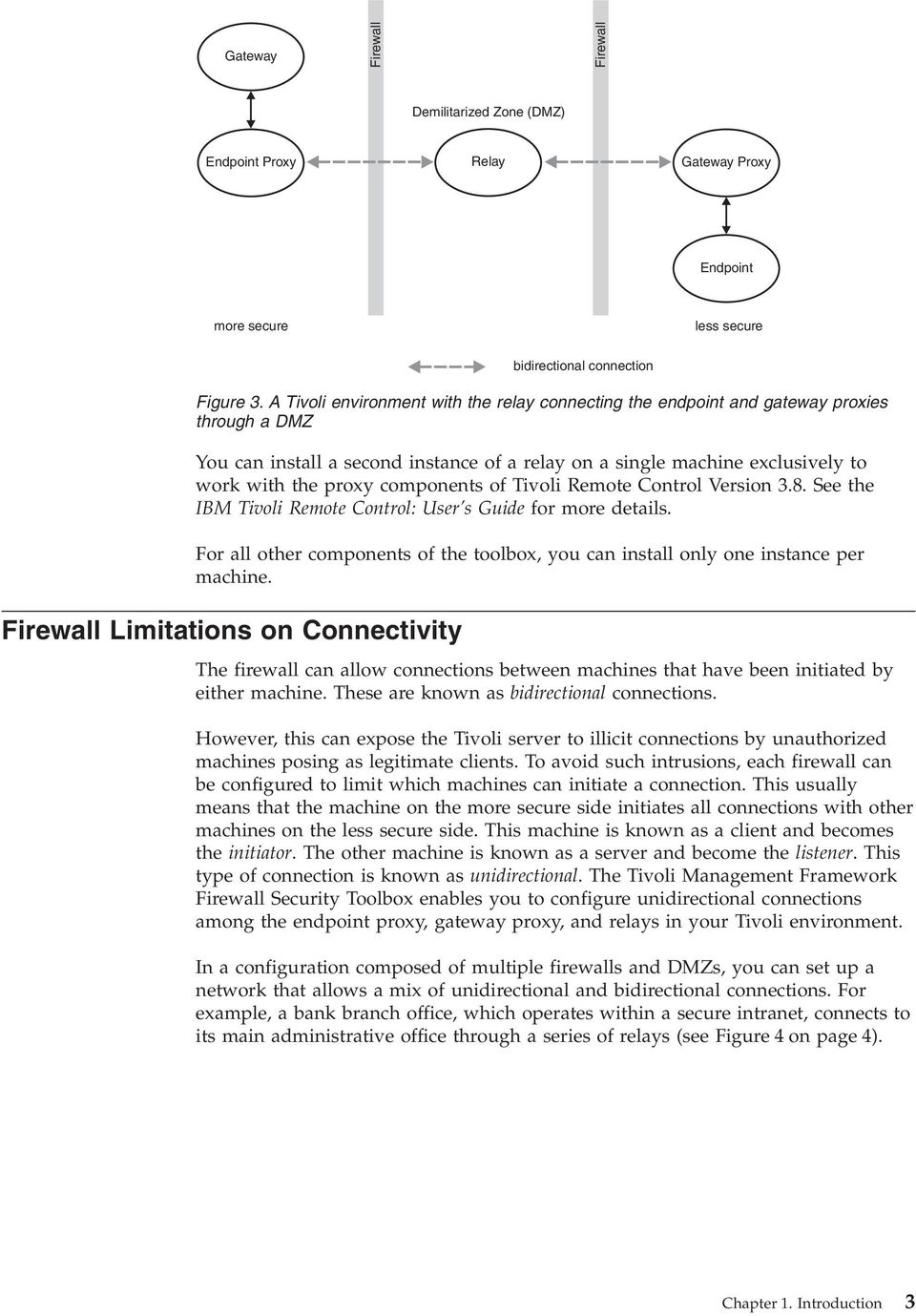
16 Gateway Administrative Office Intranet Firewall DMZ Firewall Endpoint Proxy Relay 1 more secure less secure DMZ Relay 3 Gateway Proxy Relay 2 less secure Branch Office Intranet Firewall DMZ Firewall Endpoint more secure less secure From the more secure sides, the offices use unidirectional connections to the relays 1 and 2. Relays 1 and 2 use bidirectional connections to relay 3 in the less secure areas. In the unidirectional connection between the gateway proxy and relay 2, the gateway proxy is the initiator and relay 2 is the listener. Sending Events Across Firewalls bidirectional connection unidirectional connection allowed not allowed Figure 4. Example of an environment with DMZs, relays, and bidirectional and unidirectional connections TME adapters use endpoints to send events to the Tivoli Enterprise Console server through Tivoli connections. When a firewall separates the endpoint from the Tivoli Enterprise Console server, the machines connect through the gateway and endpoint proxies. Machines that are not part of the Tivoli environment use non-tme adapters to send events to the Tivoli Enterprise Console server through non-tivoli connections. When a firewall separates the non-tme adapter machine from the gateway, the Tivoli Management Framework Firewall Security Toolbox provides the event sink, which sends the events to the Tivoli Enterprise Console server. The event sink, which is installed on an endpoint outside the firewall, collects events sent from non-tme adapters as if it were a Tivoli Enterprise Console server and sends them to the Tivoli Enterprise Console server as though they were TME events. The event sink can collect events from multiple non-tme adapters. See Figure 5 on page 5 4 Tivoli Management Framework: Firewall Security Toolbox User s Guide

17 Tivoli Enterprise Console Server more secure Tivoli Enterprise Console Gateway Firewall Firewall Proxies Firewall less secure Tivoli Endpoint Event Sink Non-TME Adapter Non-TME Adapter Figure 5. an event sink sends non-tme events to the Tivoli Enterprise Console server through the firewall proxies The event sink can also collect Tivoli events that are sent from Tivoli Distributed Monitoring or the Tivoli Enterprise Console Availability Intermediate Manager Console and forward them to Tivoli Enterprise Console servers across firewalls. In addition, you can configure the event sink to forward non-tme events to the Tivoli Enterprise Console server as if it were a Tivoli Enterprise Console adapter. Identifying a Component as Parent or Child The hierarchy of the components of the Tivoli Management Framework Firewall Security Toolbox is presented in terms of a parent and children. The endpoint proxy, the parent, can have one or more children, either relays or gateway proxies. It does not have a parent because it connects to the gateway. A relay can have a parent (an endpoint proxy or another relay) and children (relays or gateway proxies). A gateway proxy has a parent but no children because it connects to endpoints. For example, in Figure 3 on page 3, the endpoint proxy is the parent and the relay is its child. The relay is the parent of the gateway proxy and the gateway proxy is its child. The endpoint proxy and relays can have more than one child (relay or gateway proxy) but each component has only one parent. Because the gateway Chapter 1. Introduction 5

18 proxy is at the bottom of this hierarchy, it has no children. In another example (Figure 4 on page 4), Relay 1 is the child of the endpoint proxy and the parent of Relay 3. Relay 3 is the parent of Relay 2. Relay 2 is the parent of the gateway proxy. Understanding this hierarchy is important when you install and configure the components. 6 Tivoli Management Framework: Firewall Security Toolbox User s Guide

19 Chapter 2. Installing Tivoli Management Framework Firewall Security Toolbox Prerequisite Software This chapter explains how to install and configure the components of the Firewall Security Toolbox. Tivoli Management Framework Firewall Security Toolbox is a feature of the Tivoli Management Framework, Version or 4.1. The event sink must be have Tivoli Management Framework or 4.1 (endpoint) installed. It must also have Tivoli Enterprise Console or 3.7. All other components of the Tivoli Management Framework Firewall Security Toolbox do not require any Tivoli software. Table 1 lists the operating system software required to run the toolbox components: Table 1. Prerequisite software Component Supported Operating Systems Endpoint proxy v Windows NT, Version 4.0 v Windows XP Professional v Windows 2000 v AIX, Version or 5.1 v HP-UX Version 11.0 or 11i v Red Hat Linux for Intel, interpreter i386, Version 7.1 (Kernel ) or 7.2 (Kernel smp) v Sun Solaris Operating System, Version 2.7 or 2.8 Gateway proxy v Windows NT, Version 4.0 v Windows XP Professional v Windows 2000 v AIX, Version or 5.1 v HP-UX Version 11.0 or 11i v Red Hat Linux for Intel, interpreter i386, Version 7.1 (Kernel ) or 7.2 (Kernel smp) v Sun Solaris Operating System, Version 2.7 or 2.8 Relay v Windows NT, Version 4.0 v Windows XP Professional v Windows 2000 v AIX, Version or 5.1 v HP-UX Version 11.0 or 11i v Red Hat Linux for Intel, interpreter i386, Version 7.1 (Kernel ) or 7.2 (Kernel smp) v Sun Solaris Operating System, Version 2.7 or 2.8 Copyright IBM Corp. 2001,
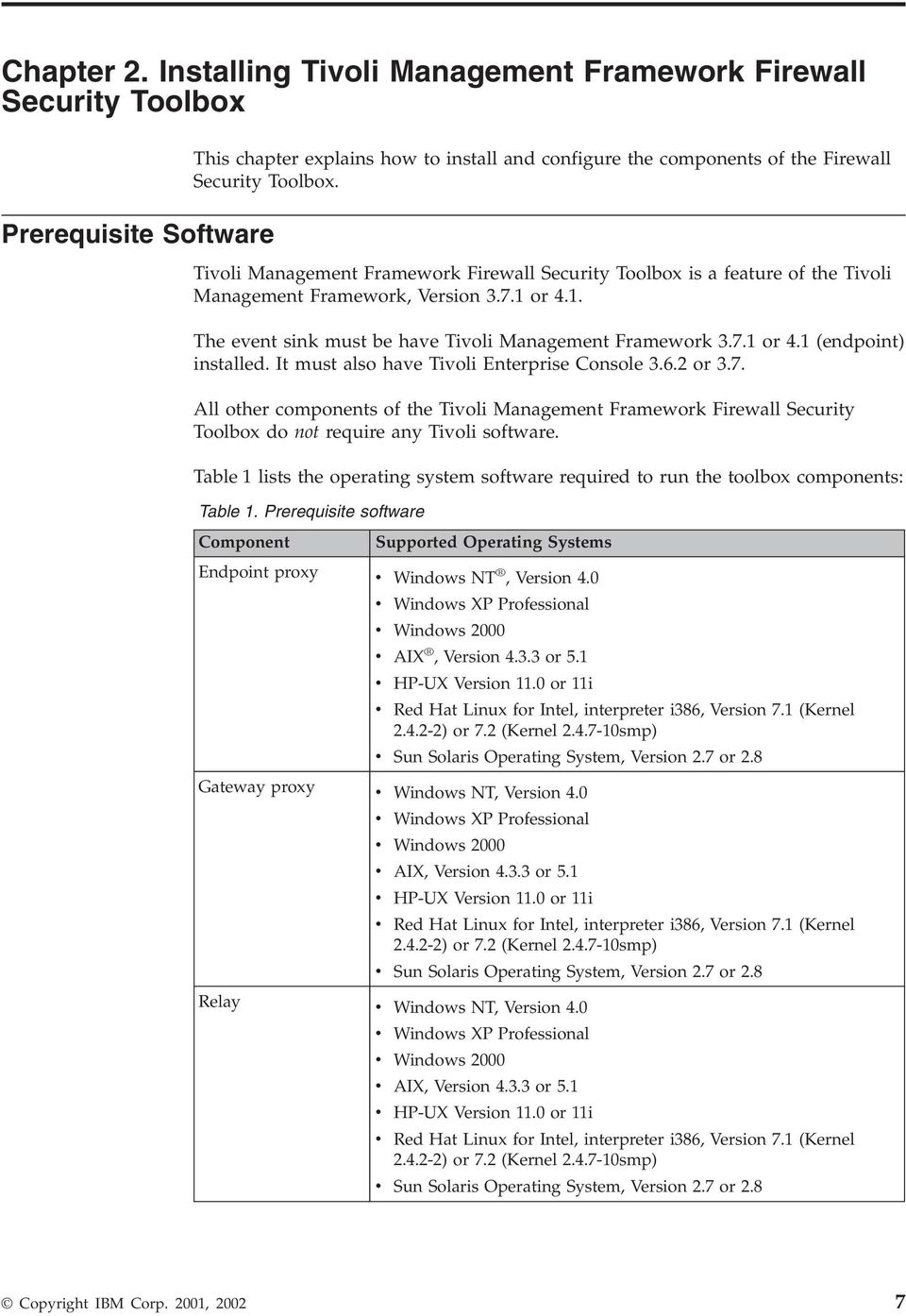
20 Table 1. Prerequisite software (continued) Component Supported Operating Systems Event sink v Windows NT, Version 4.0 v Windows XP Professional v Windows 2000 v AIX, Version or 5.1 v HP-UX Version 11.0 or 11i v Red Hat Linux for Intel, interpreter i386, Version 7.1 (Kernel ) or 7.2 (Kernel smp) v Sun Solaris Operating System, Version 2.7 or 2.8 Planning Where to Install the Components Getting Started You can install as many gateways and endpoint proxies as you need in the firewall region. A recommended ratio is one endpoint proxy for every 500 endpoints. Install multiple gateway proxies in a DMZ to provide backup gateway proxies when the main gateway proxy is unavailable. See Configuring Backup Gateway Proxies on page 39 for configuration details. You cannot run different components on the same machine and use them to connect to the same component on another machine. For example, you cannot have a relay and a gateway proxy on a machine and use them to connect to the same endpoint proxy. You can connect the gateway proxy to the relay on the same machine and the relay to an endpoint proxy on another machine. Install a few endpoints first to test connectivity from the Tivoli region to an endpoint through the proxy. Enter the following command from the management region server (Tivoli server) or managed node: wadminep endpoint view_config_info where endpoint is the label of the endpoint. If you cannot reach the endpoint, follow the instructions in Testing Proxy Configuration on page 53. Because the toolbox requires a particular configuration of the Tivoli region, keep machines that are in less secure zones in separate Tivoli regions. Set up a separate Tivoli region to manage resources that are in a DMZ. To manage your endpoints as if they were in a single Tivoli region, you can interconnect the firewall region to non-firewall regions. You need to do the following to get started: v Ensure that the components of the Tivoli Management Framework Firewall Security Toolbox that will communicate with each other directly have IP visibility of each other. Depending on your configuration, these components can be the endpoint proxy and gateway proxy, a proxy and a relay, or two relays. You can use DNS if you have DNS configured. However, there is no requirement to use DNS host names. The TCP/IP address works as well. TCP/IP connectivity is required. If you use the DNS name of the machine, ensure that the DNS name of the destination machine is resolved into its IP address. 8 Tivoli Management Framework: Firewall Security Toolbox User s Guide

21 v v Before installing the software, ensure that you have the following information: The port number of the gateway that the endpoint proxy will use to communicate The host name or IP address of all the components that you are installing Decide on some additional ports that the components will use to communicate with each other: The endpoint proxy requires a range of ports used to emulate the endpoints logged in through the Firewall Security Toolbox. Gateway proxies require one port to receive traffic from the endpoint proxy or relay and another port to listen for traffic from the endpoints. Relays require ports to receive traffic from the components with which they connect, one for the parent and one for the children. Use the following criteria to choose the port number: The port must not be used by other applications The user account that you specify must have the privileges to use the port Components on Multihomed Hosts When a machine has more than one network interface and address, it is known as a multihomed host. Multihomed hosts might need to connect to one component in one subnet and another component in another subnet. For example, an endpoint proxy machine might connect to a gateway in one subnet and relays or gateway proxies in another subnet (see Figure 6). Subnet x Gateway IP Endpoint Proxy IP Gateway Proxy Subnet x Figure 6. Example of a multihomed host Chapter 2. Installing the Tivoli Firewall Security Toolbox 9
22 The endpoint proxy can connect to the gateway using the DNS name or IP address of one network interface, for example, , and to the relays or gateway proxies using the DNS name or IP address of another network interface, for example, When configuring the components with multihomed hosts, you need to specify the correct DNS name or IP address. See Chapter 3, Configuring the Components on page 27 for more details. Decompressing the Installation Files To install Tivoli Management Framework Firewall Security Toolbox, decompress the 1.3-TFS-0001.tar file. Under the main Proxy directory, the file creates directories for each component and copies installation scripts to subdirectories for each platform. Installing on UNIX Systems The following sections describe how to install the components on UNIX systems. These operations need to be run as root user. Installing the Endpoint Proxy on UNIX Systems To install the endpoint proxy, follow these steps: 1. From the EndpointProxy directory, go to the directory for the platform on which the proxy will run. 2. Run the./install.sh script. 3. Provide the following information: a. To install the Tivoli Endpoint Proxy, you must accept the agreement written in the License file. If you accept the agreement, enter Y. [Y/N]: Enter Y to accept the license agreement and continue the installation. b. Installation directory [default=/usr/epp]: Specify the directory where you want to install the endpoint proxy. If the directory does not exist, you are prompted to create it. c. Run the endpoint proxy as the following user: Specify the account name to use to run the proxy process. This account must exist and it is recommended that you use an unprivileged account. d. Gateway address: Specify the host name or IP address of the gateway with which the endpoint proxy communicates. The endpoint proxy can communicate with only one gateway in a Tivoli region. e. Gateway port [default=9494]: Specify the TCP/IP port number of the gateway on which it will listen for communication from the endpoint proxy as if it were the endpoint. This is normally port Do not change this value unless the gateway is known to be using a different listening port with the endpoint. f. Endpoint Proxy Port: Specify the port number of the endpoint proxy machine from which it listens for connections with the relay or gateway proxy. g. Relay or gateway proxy hostname: Specify the host name of the relay or gateway proxy with which the endpoint connects. 10 Tivoli Management Framework: Firewall Security Toolbox User s Guide
23 h. Relay or gateway proxy port: Specify the port number from which the relay or gateway proxy listens for connections from the endpoint proxy. i. Enter more destinations? [Y/N] [default=n]: Enter Y to specify additional relays or gateway proxies with which the endpoint connects. You are asked to specify the host name and port number of the additional destination machines. When you are done adding destination machines and are ready to continue with installation, enter N. j. Specify how endpoint proxy connects to destinations [0=bidirectional, 1=unidirectional initiator, 2=unidirectional listener]: Enter 0 to permit connections that are initiated by either machine. Enter 1 to permit connections initiated by the endpoint proxy only. Enter 2 to permit connections initiated by the destination machine only. k. Start the endpoint proxy? [Y/N] [default=y]: Enter Y to start the endpoint proxy. Otherwise, enter N. To start the component at another time, see Starting and Stopping the Components on page 43. Installing the Gateway Proxy on UNIX Systems To install the gateway proxy, follow these steps: 1. From the GatewayProxy directory, go to the directory for the platform on which the proxy will run. 2. Run the./install.sh script. 3. Provide the following information: a. To install the Tivoli Gateway Proxy, you must accept the agreement written in the License file. If you accept the agreement, enter Y. [Y/N]: Enter Y to accept the license agreement and continue the installation. b. Installation directory [default=/usr/gwp]: Specify the directory where you want to install the gateway proxy. If the directory does not exist, you are prompted to create it. c. Run the gateway proxy as the following user: Specify the account name to use to run the proxy process. This account must exist and it is recommended that you use an unprivileged account. d. Name (label) for this proxy [default=localhost]: Optionally, enter a name to identify the gateway proxy. e. Port to listen on for TMA traffic [default=9494]: Enter the port number on the gateway proxy that represents the gateway to the endpoints. The default is f. Gateway proxy port: Specify the port number that the gateway proxy uses to listen for connections from the relay or endpoint proxy. g. Relay or endpoint proxy hostname: Specify the host name of the machine that the gateway proxy will connect up the chain toward the Tivoli gateway. Chapter 2. Installing the Tivoli Firewall Security Toolbox 11
24 h. Relay or endpoint proxy port: Enter the port number of the machine that the gateway proxy will connect up the chain toward the Tivoli gateway. i. Specify how gateway proxy connects to destination [0=bidirectional, 1=unidirectional initiator, 2=unidirectional listener]: Specify how the gateway proxy connects to the destination relay or endpoint proxy. Enter 0 to permit connections that are initiated by either machine. Enter 1 to permit connections initiated by the gateway proxy only. Enter 2 to permit connections initiated by the parent machine only. j. Start the gateway proxy? [Y/N] [default=y]: Enter Y to start the gateway proxy. Otherwise, enter N. To start the component at another time, see Starting and Stopping the Components on page 43. Installing the Relay on UNIX Systems To install the relay, follow these steps: 1. From the Relay directory, go to the directory for the platform on which the relay will run. 2. Run the./install.sh script. 3. Provide the following information: a. To install the Tivoli Relay, you must accept the agreement written in the License file. If you accept the agreement, enter Y. [Y/N]: Enter Y to accept the license agreement and continue the installation. b. Installation directory [default=/usr/relay-1]: Specify the directory where you want to install the relay. If the directory does not exist, you are prompted to create it. Note: The default directory ends with a directory named for the numbered instance of the relay. You must launch all operations (start, stop, and uninstall) on an instance of the relay from the directory in which you install the instance. If you change the default directory, ensure that it is different from the directory where you have installed any previous instances of the relay. c. Run the relay as the following user: Specify a user name to use to run the relay. This account must exist and it is recommended that you use an unprivileged account. d. Relay-Parent Connection Options Relay port: Enter the port number for the relay to communicate with the parent machine. e. Relay or endpoint proxy hostname: Enter the host name for the parent relay or endpoint proxy with which the relay will communicate. f. Parent Remote Port: Enter the port number for the parent relay or endpoint proxy with which the relay will communicate. 12 Tivoli Management Framework: Firewall Security Toolbox User s Guide
25 g. Specify how relay connects to parent relay or endpoint proxy [0=bidirectional, 1=unidirectional initiator, 2=unidirectional listener]: Specify how the relay connects to the destination relay or gateway proxy. Enter 0 to permit connections that are initiated by either machine. Enter 1 to permit connections initiated by the relay only. Enter 2 to permit connections initiated by the parent machine only. h. Relay-Children Connection Options Relay port: Enter the port number for the relay to communicate with the children machines. i. Relay or gateway proxy hostname: Specify the host name of the child machine, relay or gateway proxy, with which the relay connects. j. Relay or gateway proxy port: Enter the port number of the machine with which the relay connects. k. Enter more destinations? [Y/N] [default=n]: Enter Y to specify additional relays or gateway proxies with which the relay connects. You are asked to specify the host name and port number of the additional destination machines. When you are done adding destination machines and are ready to continue with installation, enter N. l. Specify how the relay connects to the child destination [0=bidirectional, 1=unidirectional initiator, 2=unidirectional listener]: Specify how the relay connects to the parent relay or endpoint proxy. Enter 0 to permit connections that are initiated by either machine. Enter 1 to permit connections initiated by the relay only. Enter 2 to permit connections initiated by the destination machine only. m. Start the relay? [Y/N] [default=y]: Enter Y to start the relay. Otherwise, enter N. To start the component at another time, see Starting and Stopping the Components on page 43. Installing the Event Sink on UNIX Systems To install the event sink, follow these steps: 1. From the EventSink directory, go to the directory for the platform on which the proxy will run. 2. Run the./install.sh script. 3. Provide the following information: a. To install the Tivoli Event Sink, you must accept the agreement written in the License file. If you accept the agreement, enter Y. [Y/N]: Enter Y to accept the license agreement and continue the installation. b. Installation directory [default=/usr/eventsink]: Specify the directory where you want to install the event sink. If the directory does not exist, you are prompted to create it. c. LCF_DATDIR directory: Specify the LCF_DATDIR directory of the endpoint on which you are installing the event sink. Chapter 2. Installing the Tivoli Firewall Security Toolbox 13
26 Installing on Windows Systems d. Run the event sink as the following user: Specify a user name to use to run the event sink. This account must exist and it is recommended that you use an unprivileged account. e. Listening Port [default=9444]: Enter the port number on the endpoint where the event sink will receive events. f. Maximum Number of Events in Package [default=50]: Enter the maximum number of events that the event sink will send to the Tivoli Enterprise Console server in a single package. g. Maximum Buffer Size [default=40000]: Enter the maximum buffer size, in bytes, of the package that the event sink will send to the Tivoli Enterprise Console server. h. Start the event sink? [Y/N] [default=y]: Enter Y to start the event sink. Otherwise, enter N. To start the component at another time, see Starting and Stopping the Components on page 43. The Firewall Security Toolbox provides a self-extracting EXE file to install each component on Windows systems. The installation files are unpacked into a default directory, which you can change. You need to specify this directory only the first time you run this file. You can use these files for any future installations. You can install in one of the following ways: v By running the self-extracting EXE file v By running setup.exe if you are using a disk image Installing the Endpoint Proxy on Windows Systems To install the endpoint proxy, do the following: 1. From the directory that contains the Tivoli Endpoint Proxy\w32-ix86\ subdirectory, double-click the Tivoli Endpoint Proxy.exe file. The Tivoli Endpoint Proxy InstallShield Wizard starts. 2. Click Next. 3. On the next dialog, click Yes to accept the license agreement. 14 Tivoli Management Framework: Firewall Security Toolbox User s Guide
27 4. On the next dialog, enter the installation directory and click Next. The dialog for Endpoint Proxy Options is displayed. 5. Complete the following fields: Gateway Hostname Enter the host name or IP address of the gateway with which the endpoint proxy communicates. The endpoint proxy can communicate with only one gateway in a Tivoli region. Gateway Port Enter the TCP/IP port number of the gateway on which it will listen for communication from the endpoint proxy as if it were the endpoint. The default is 9494 and should not be changed unless the gateway is known to be using a different listening port with the endpoint. Click Next. The dialog for Connection Options is displayed. 6. Complete the following fields: Endpoint Proxy Port Enter the port number of the endpoint proxy machine from which it listens for connections with the relay or gateway proxy. Relays and Gateway Proxies Lists the relays and gateway proxies with which the endpoint proxy connects. Chapter 2. Installing the Tivoli Firewall Security Toolbox 15
28 To add a relay or gateway proxy to the list of destination machines, click Add. The Add Relay or Gateway Proxy dialog is displayed. Complete the fields and click OK: Hostname Enter the host name of the relay or gateway proxy with which the endpoint connects. Port Enter the port number from which the relay or gateway proxy listens for connections from the endpoint proxy. To remove a machine, select it and click Remove. Click Next. The dialog for the type of endpoint proxy connection is displayed. 7. Specify how the endpoint proxy connects to the destination relay or gateway proxy: v Select Bidirectional to permit connections that are initiated by either machine. v Select Unidirectional to permit connections initiated by only one machine. If you select this option, the Endpoint Proxy Role box is enabled: Initiator Select to specify that the endpoint proxy machine can start the connection with the destination machines. Listener Select to specify that the destination machines can start the connection with the endpoint proxy machine. 8. Click Next. The next dialog shows a summary of your input. 9. To go back and make changes, click Back. Otherwise, click Next to continue. The program proceeds to install the endpoint proxy. 16 Tivoli Management Framework: Firewall Security Toolbox User s Guide
29 10. A message asks you whether or not you want to start the endpoint proxy. Click Yes to start it. Otherwise, click No. To start the component at another time, see Starting and Stopping the Components on page 43. Installing the Gateway Proxy on Windows Systems The gateway proxy needs to be installed on a host that is in the DMZ where the endpoints will be located. To install the gateway proxy, do the following: 1. From the directory that contains the gateway Proxy\w32-ix86\ subdirectory, double-click the Tivoli Gateway Proxy.exe file. The Tivoli Gateway Proxy InstallShield Wizard starts. Click Next. 2. On the next dialog, click Yes if you accept the license agreement. 3. On the next dialog, enter the installation directory and click Next. The dialog for Gateway Proxy Options is displayed. 4. Complete the following fields: Gateway Port Enter the port number on the gateway proxy that represents the gateway to the endpoints. The default is Gateway Proxy Label Optionally, enter a name to identify the gateway proxy. Chapter 2. Installing the Tivoli Firewall Security Toolbox 17
30 Click Next. The dialog for Gateway Proxy-Parent Connection Options is displayed. 5. Complete the following fields: Gateway Proxy Port Enter the port number that the gateway proxy uses to listen for connections from the relay or endpoint proxy. Relay or Endpoint Proxy Hostname Enter the host name of the machine that the gateway proxy will connect to up the chain toward the gateway. Relay or Endpoint Proxy Port Enter the port number of the machine that the gateway proxy will connect to up the chain toward the gateway. Click Next. The dialog for the type of gateway proxy connection is displayed. 6. Specify how the gateway proxy connects to the destination relay or endpoint proxy: v v Select Bidirectional to permit connections that are initiated by either machine. Select Unidirectional to permit connections initiated by only one machine. 18 Tivoli Management Framework: Firewall Security Toolbox User s Guide
31 If you select this option, the Gateway Proxy Role box is enabled: Initiator Select to specify that the gateway proxy machine can start the connection with the parent endpoint proxy or relay machine. Listener Select to specify that the parent machine can start the connection with the gateway proxy machine. Click Next. The next dialog shows a summary of your input. 7. To go back and make changes, click Back. Otherwise, click Next to continue. The program proceeds to install the gateway proxy. 8. A message asks you whether or not you want to start the gateway proxy. Click Yes to start it. Otherwise, click No. To start the component at another time, see Starting and Stopping the Components on page 43. Installing the Relay on Windows Systems You can install multiple instances of a relay on a single machine. To install the first relay, do the following: 1. From the directory that contains the Tivoli Relay installation images, double-click the setup.exe file. The Tivoli Relay InstallShield Wizard starts. Click Next. 2. On the next dialog, click Yes if you accept the license agreement. 3. On the next dialog, enter the installation directory and click Next. The dialog for Relay-Parent Connection Options is displayed. 4. Complete the following fields regarding the connection between the relay and a parent machine, which can be either another relay or the endpoint proxy: Relay Port Enter the port number for the relay to communicate with the parent machine. Relay or Endpoint Proxy Hostname Enter the host name for the parent relay or endpoint proxy with which the relay will communicate. Relay or Endpoint Proxy Port Enter the port number for the parent relay or endpoint proxy with which the relay will communicate. Chapter 2. Installing the Tivoli Firewall Security Toolbox 19
32 Click Next. The dialog for the type of relay-parent proxy connection is displayed. 5. Specify how the relay connects to the parent relay or endpoint proxy: v Select Bidirectional to permit connections that are initiated by either machine. v Select Unidirectional to permit connections initiated by only one machine. If you select this option, the Relay Role box is enabled: Initiator The relay machine can start the connection with the parent machine. Listener The parent machine can start the connection with the relay machine. Click Next. The dialog for relay-child connection options is displayed. 6. Complete the following fields: Relay Port Enter the port number for the relay to communicate with the children machines. Relays and Gateway Proxies Lists the relays and gateway proxies with which the relay connects. 20 Tivoli Management Framework: Firewall Security Toolbox User s Guide
33 To add a relay or gateway proxy to the list of destination machines, click Add. The Add Relay or Gateway Proxy dialog is displayed. Complete the fields and click OK: Hostname Enter the host name of the child machine relay or gateway proxy with which the relay connects. Port Enter the port number of the machine with which the relay connects. To remove a machine, select it and click Remove. Click Next. The dialog for the type of relay-child connection is displayed. 7. Specify how the relay connects to the child relay or gateway proxy: v Select Bidirectional to permit connections that are initiated by either machine. v Select Unidirectional to permit connections initiated by only one machine. If you select this option, the Relay Role box is enabled: Initiator The relay machine can start the connection with the child machines. Listener The child machines can start the connection with the relay machine. Click Next. The next dialog shows a summary of your input. 8. To go back and make changes, click Back. Otherwise, click Next to continue. The program proceeds to install the relay. 9. A message asks you whether or not you want to start the relay. Click Yes to start it. Otherwise, click No. To start the component at another time, see Starting and Stopping the Components on page 43. Chapter 2. Installing the Tivoli Firewall Security Toolbox 21
34 Installing Additional Relays on the Same Machine To install additional instances, do the following: 1. From the directory that contains the Tivoli Relay installation images, double-click the setup.exe file. InstallShield Wizard starts. Select Install and click Next. The Choose Destination Location dialog is displayed. 2. Enter the installation directory. Note that the default directory ends with a folder named for the numbered instance of the relay. This numbered name identifies this instance of the relay when you want to start, stop, and uninstall it. If you change the default directory, ensure that it is different from the directory where you have installed previous instances of the relay. Click Next. 3. Continue with step 4 on page 19 in the previous procedure. Installing the Event Sink on Windows Systems You must install the event sink on a endpoint. To install the event sink, do the following: 1. From the directory that contains the Event Sink\w32-ix86\ subdirectory, double-click the Tivoli EventSink.exe file. The Tivoli Event Sink InstallShield Wizard starts. 2. Click Next. 22 Tivoli Management Framework: Firewall Security Toolbox User s Guide
35 3. On the next dialog, click Yes if you accept the license agreement. The Destination Location dialog is displayed. 4. Specify the lcf_datdir directory of the endpoint on which you are installing the event sink. The event sink is installed in the lcf_datdir\..\..\bin\w32-ix86\mrt\ directory. Click Next. The dialog for Event Sink Options is displayed. 5. Complete the following fields: Port Enter the port number on the endpoint where the event sink will receive events. The default is Maximum Number of Events Enter the maximum number of events that the event sink will send to the Tivoli Enterprise Console server in a single package. The default is 50. Maximum Buffer Size Enter the maximum buffer size, in bytes, of the package that the event sink will send to the Tivoli Enterprise Console server. The default is Click Next. The next dialog shows a summary of your input. 6. To go back and make changes, click Back. Otherwise, click Next to continue. The program proceeds to install the event sink. Chapter 2. Installing the Tivoli Firewall Security Toolbox 23
36 Upgrading the Components The following sections describe how to upgrade the components from a previous version to the current version. There is no compatibility between versions 1.2 and 1.3 of the toolbox. When a component from version 1.3 detects a connecting component from version 1.2, it rejects the connection and logs the following error message: ERROR multiplex.parseframe: connecting peer is version Upgrading on Windows Systems To upgrade the component on a Windows machine, start the installation for the new version. The configuration and all the data of the previous version are saved and used by the new version. Upgrading on UNIX Systems To upgrade the component on a UNIX machine, run the script upgrade.sh from the directory that contains the installation images. You are asked to enter the directory in which the previous version is installed. The configuration and all the data of the previous version are backed up to the directory that you specify with a suffix of.1.2. For example, if you specify /usr/epp, the backup directory becomes: /usr/epp.1.2 Uninstalling the Components The following sections describe how to uninstall the components. Note: Under normal circumstances, you should not delete and reinstall an endpoint proxy. If the endpoint proxy is removed, all the dynamic configuration maintained in the epproxy.bdb file is also removed and lost. The reinstallation of the endpoint proxy cannot restore this information that is created during initial logins of endpoints. When you remove and reinstall the endpoint proxy, all endpoints that are connected to the endpoint proxy must do an initial login to the Endpoint Manager database as if they were new endpoints. Make a backup copy of the epproxy.bdb file before uninstalling the endpoint proxy. After you reinstall the endpoint proxy, you can replace the epproxy.bdb file with your backup copy of the file. If you reinstall from the beginning, then you do not need to make a backup copy of the file. For more information, see Backing Up and Restoring the Endpoint Manager Database on page 46. The installation files are not removed when you uninstall the components. If you want to remove them, delete the files by hand. Uninstalling from UNIX Systems To uninstall the component from a UNIX machine, run the script uninstall.sh from the directory in which the component is installed. 24 Tivoli Management Framework: Firewall Security Toolbox User s Guide
37 Uninstalling All Components except the Relay from Windows Systems You can uninstall all the components except the relay from a Windows NT or Windows 2000 system in one of the following ways: v v v If you are using the disk image, run setup.exe and then choose Remove. If you installed the component using InstallShield, double-click Add/Remove Programs from the Control Panel. Select the component to remove, for example, Tivoli Endpoint Proxy, from the list of currently installed programs, and click Add/Remove or Change/Remove. Start the InstallShield Wizard that you used to install. Select Remove and click Next. Note: If you are uninstalling one or more instances of a relay from the same machine, use this method. In addition, delete the CFG and LOG file from the directory in which the component is installed. The following table lists the name of each file for each component: Endpoint Proxy Event Sink Gateway Proxy Relay epproxy.cfg eventsink.cfg gwproxy.cfg relay.cfg epp.log eventsink.log gwp.log relay.log Uninstalling the Relay from Windows Systems To uninstall one or more instances of a relay from a Windows machine, perform the following steps: 1. Start the InstallShield Wizard that you used to install it. Select Remove and click Next. The Remove instances dialog is displayed. It lists the numbered relay instances that are installed on the machine. 2. From the Available instances list, select the instances that you want to remove and click Include, or click Include all to remove all the instances from the machine. Chapter 2. Installing the Tivoli Firewall Security Toolbox 25
38 3. Click Next and confirm the deletion. The selected instances are deleted. Note: The number of an instance that was uninstalled is recycled when you reinstall it. For example, if you uninstall relay-2, the next time you install an instance on the machine, the new instance is named relay Tivoli Management Framework: Firewall Security Toolbox User s Guide
39 Chapter 3. Configuring the Components This chapter explains how to configure the components of the Tivoli Management Framework Firewall Security Toolbox. Configuring the Endpoint Proxy After you install the endpoint proxy, the configuration file epproxy.cfg is created in the folder in which you installed the proxy. It contains the configuration input that you supplied during installation. In addition, to configure other options, edit the epproxy.cfg file with a text editor. Stop and start the component to make your changes effective. The following sections are divided by the sections in the configuration file. Each section provides a table of the keywords and comments. Enter the values in the format: keyword=value The section titles are case-sensitive. Endpoint-proxy The [endpoint-proxy] section lists the main options for the endpoint proxy. Table 2 lists the keywords and a description. Table 2. The endpoint-proxy section Keyword Description gateway-host The address and port number of the gateway on which it will listen for communication from the endpoint proxy as if it were the endpoint. The default port is 9494 and should not be changed unless the gateway is known to be using a different listening port with the endpoint. Use the format: address+port_number gateway-interface This option is used for multihomed endpoint proxies. It is the Domain Name System (DNS) name or IP address of the network interface of the endpoint proxies that is used to communicate with the gateway network interface. accept-timeout The timeout interval, in seconds, that the endpoint proxy waits for connections expected by the gateway. The default is 300. max-sessions The number of connections that the endpoint proxy can manage at the same time. The default is 75. tcpip-timeout The timeout interval, in seconds, for TCP/IP operations to succeed or fail. This controls outbound and inbound connection attempts between the proxy and children or parent. This timeout ensures that the proxy cannot be overloaded by denial-of-service attacks by clients who open connections, but never close them. The default is 240. Copyright IBM Corp. 2001,
40 Table 2. The endpoint-proxy section (continued) Keyword Description port-range The port ranges to use when allocating endpoint ports and when connecting with the gateway. For example, ports 6060, 7000 to 7070, 9050, and 8000 to 8080: 6060, ,9050, database-path disable-udp The default is The full path to a directory where the endpoint proxy database is installed. The endpoint proxy database records information about endpoints that it manages, and it must remain in existence even when the endpoint proxy is restarted. The default is the directory where the component is installed. Enables the endpoint proxy to forward login requests via TCP instead of datagram protocol (UDP). To enable TCP, specify 1. To enable UDP, specify 0. The default is 0. Log The [log] section lists log options. Table 3 lists the keywords and a description. Table 3. The log section Keyword Description debug-level The level of detail in the log. Levels 0 and 1 are recommended for normal operation. Levels higher than 3 should only be used when recommended by customer support for diagnosing problems. A level higher than 6 will noticeably impact the performance of the service and should be used with discretion. The range is The default is 3. log-file The full path of the log file where endpoint proxy messages are written. The installation default is epp.log. If no file specified, the default is standard error. max-size The maximum size, in megabytes, that the log file can reach. When the log file reaches the maximum size, it is renamed to filename.log.bak and a new log file is started. For no limit, specify 0. The default is 1. Communication-layer The [communication-layer] section lists options for how the endpoint proxy connects to its relays or gateway proxies. Table 4 lists the keywords and a description. Table 4. The communication-layer section Keyword Description children-local-host The network interface (DNS name or IP address) on the endpoint proxy to listen for communication from its relays or gateway proxies. children-local-port The port number of the endpoint proxy machine from which it listens for connections with relays or gateway proxies. 28 Tivoli Management Framework: Firewall Security Toolbox User s Guide
41 Table 4. The communication-layer section (continued) Keyword Description children-remote-list The list of children hosts (relays or gateway proxies) to which the endpoint proxy connects. Separate the entries with a semi-colon (;) but leave the end of the line without the delimiter. For example, a relay with address and port 7071 and a gateway proxy with address and port 7073: ; children-remote-file The name of the optional file containing a list of children hosts (relays or gateway proxies) to which the endpoint proxy connects. This keyword can be listed in addition to or instead of the children-remote-list keyword. children-cm-type The communication interface (TCP/IP) and the connectivity (unidirectional or bidirectional) that the endpoint proxy uses with its relays or gateway proxies. The values are cm-tcp-bidirectional, cm-tcp-unidirectional. Notes: 1. You must include at least one children host, specified either in the children-remote-list keyword or in the file listed for the children-remote-file keyword. 2. In the file specified for the children-remote-file keyword, list the children hosts on separate lines in the host_name+port_number format. Precede comments in the file with the number sign (#). You can leave blank lines as shown in the following example: #Add these children hosts luna sol Children-cm-info The [children-cm-info] section lists further options about connectivity between the endpoint proxy and its children (relays or gateway proxies). Table 5 lists the keywords and a description. Table 5. The children-cm-info section Keyword Description connection-mode The role of the endpoint proxy in unidirectional connections only. The values are initiator or listener. The default is listener. Note: The values from Version 1.2 client (initiator) and server (listener), are still valid values. local-port-range The range of local ports to be used when connecting to the other peer. For example, ports 6060, 7000 to 7070, 9050, and 8000 to 8080: 6060, ,9050, receive-buffer-size The size (in kilobytes) of the buffer that is used to receive communications from a TCP/IP socket. The minimum value is 1. The default is 17. connect-timeout The timeout interval, in seconds, after which a TPC/IP connect operation fails. To disable the timeout and use the default of the TCP/IP library, specify 0. Chapter 3. Configuring the Components 29
42 Table 5. The children-cm-info section (continued) Keyword Description send-timeout The timeout interval, in seconds, after which a TCP/IP send operation fails. To disable the timeout, specify 0. The default is 120. log-mode The buffer that is sent or received during peer connection. Specifying a value other than 0 can lower performance. Values: 0=none 1=sent data only 2=received data only 3=all transmitted data. The default is 0. drop-timeout For bidirectional connections only, the number of seconds after which an inactive connection is closed. To close the connection as soon as the usage counter drops to zero, specify 0. The default is 5. polling-interval In unidirectional connections for initiator components only, the initiator polls the listener periodically to check if it needs to establish a connection. This option is the interval, in seconds, after which an initiator automatically connects to the listener. The default is 2. drop-interval In unidirectional connections for listener components only, the interval, in seconds, after which the listener suspends an inactive connection. The default is 5. Configuring the Gateway Proxy After you install the gateway proxy, the configuration file gwproxy.cfg is created in the folder in which you installed the proxy. It contains the configuration input that you supplied during installation. In addition, to configure other options, edit the gwproxy.cfg file with a text editor. Stop and start the component to make your changes effective. The following sections are divided by the sections in the configuration file. Each section provides a table of the keywords and comments. Enter the values in the format: keyword=value The section titles are case-sensitive. Gateway-proxy The [gateway-proxy] section lists the main options for the gateway proxy. Table 6 lists the keywords and a description. Table 6. The gateway-proxy section Keyword Description gateway-port The port number on the gateway proxy that represents the gateway to the endpoints. The default is gateway-interface This option is used for multihomed gateway proxies. It is the DNS name or IP address of the gateway proxies network interface used to communicate with the Tivoli endpoints. 30 Tivoli Management Framework: Firewall Security Toolbox User s Guide
43 Table 6. The gateway-proxy section (continued) Keyword Description tcpip-timeout The timeout interval, in seconds, for TCP/IP operations to succeed or fail. This controls outbound and inbound connection attempts between the proxy and parent or endpoints. This timeout ensures that the proxy cannot be overloaded by denial-of-service attacks by clients who open connections, but never close them. The default is 240. proxy-label Optional name to identify the gateway proxy instance. The default is the host_name. max-sessions Number of connections that the gateway proxy can manage at the same time. The default is 75. port-range The port ranges to use when allocating ports to connect to endpoint ports. For example, ports 6060, 7000 to 7070, 9050, and 8000 to 8080: 6060, ,9050, The default is Log The [log] section lists log options. Table 7 lists the keywords and a description. Table 7. The log section Keyword debug-level log-file max-size Description The level of detail in the log. Levels 0 and 1 are recommended for normal operation. Levels higher than 3 should only be used when recommended by Tivoli Customer Support for diagnosing problems. A level higher than 6 will noticeably impact the performance of the service and should be used with discretion. The range is The default is 3. The full path of the log file where gateway proxy messages are written. The installation default is gwp.log. If no file specified, the default is standard error. The maximum size, in megabytes, that the log file can reach. When the log file reaches the maximum size, it is renamed to filename.log.bak and a new log file is started. For no limit, specify 0. The default is 1. Communication-layer The [communication-layer] section lists options for how the gateway proxy connects to its relay or endpoint proxy. Table 8 lists the keywords and a description. Table 8. The communication-layer section Keyword Description parent-local-host The DNS name or IP address of the gateway proxy from which it listens for connections from its relay or endpoint proxy. parent-local-port The port number of the gateway proxy machine from which it listens for connections with relay or endpoint proxy. parent-remote-host The DNS name or IP address of the relay or endpoint proxy. Chapter 3. Configuring the Components 31
44 Table 8. The communication-layer section (continued) Keyword Description parent-remote-port The port number of the parent relay or endpoint proxy from which it listens for connections with gateway proxy. parent-cm-type The communication interface and the connectivity that the gateway proxy uses with its relay or endpoint proxy. Values: cm-tcp-bidirectional, cm-tcp-unidirectional. Parent-cm-info The [parent-cm-info] section lists further options about connectivity between the gateway proxy and its parent (relay or endpoint proxy). Table 9 lists the keywords and a description. Table 9. The parent-cm-info section Keyword Description connection-mode The role of the gateway proxy in unidirectional connections only. The values are initiator or listener. The default is listener. Note: The values from Version 1.2 client (initiator) and server (listener) are still valid. local-port-range The range of the local ports to be used when connecting to the other peer. For example, ports 6060, 7000 to 7070, 9050, and 8000 to 8080: 6060, ,9050, receive-buffer-size The size (in kilobytes) of the buffer that is used to receive communications from a TCP/IP socket. Minimum value: 1. The default is 17. connect-timeout Timeout, in seconds, after which a TPC/IP connect operation fails. To disable the timeout and use the default of the TCP/IP library, specify 0. send-timeout Timeout, in seconds, after which a TCP/IP send operation fails. To disable the timeout, specify 0. The default is 120. log-mode The buffer that is sent or received during peer connection. Specifying a value other than 0 can lower performance. Values: 0=none 1=sent data only 2=received data only 3=all transmitted data. The default is 0. drop-timeout For bidirectional connections only, number of seconds after which an inactive connection is closed. To close the connection as soon as the usage counter drops to zero, specify 0. The default is 5. polling-interval In unidirectional connections for initiator components only, the initiator polls the listener periodically to check if it needs to establish a connection. Interval, in seconds, after which an initiator automatically connects to the listener. The default is 2. drop-interval In unidirectional connections for listener components only, interval, in seconds, after which the listener suspends an inactive connection. The default is Tivoli Management Framework: Firewall Security Toolbox User s Guide
45 Configuring the Relay After you install the relay, the configuration file relay.cfg is created in the folder in which you installed the component. It contains the configuration input that you supplied during installation. In addition, you can configure other options. To change these or configure other options, edit the relay.cfg file with a text editor. Stop and start the component to make your changes effective. The following sections are divided by the sections in the configuration file. Each section provides a table of the keywords and comments. Enter the values in the format: keyword=value The section titles are case-sensitive. Relay The [relay] section is required at the top of the file, even when you do not specify any keywords. Table 10 lists the keyword and a description. Table 10. The relay section Keyword Description tcpip-timeout The timeout interval, in seconds, for TCP/IP operations to succeed or fail. This controls outbound and inbound connection attempts between the relay and children or parent. This timeout ensures that the relay cannot be overloaded by denial-of-service attacks by clients who open connections, but never close them. The default is 240 Log The [log] section lists log options. Table 11 lists the keywords and a description. Table 11. The log section Keyword debug-level log-file max-size Description The level of detail in the log. Levels 0 and 1 are recommended for normal operation. Levels higher than 3 should only be used when recommended by Tivoli Customer Support for diagnosing problems. A level higher than 6 will noticeably impact the performance of the service and should be used with discretion. The range is The default is 3. The full path of the log file where relay messages are written. Installation The default is relay.log. If no file specified, the default is standard error. The maximum size, in megabytes, that the log file can reach. When the log file reaches the maximum size, it is renamed to filename.log.bak and a new log file is started. For no limit, specify 0. The default is 1. Communication-layer The [communication-layer] section lists options for how the relay connects to its parent and children, relays, endpoint proxy, or gateway proxy. Table 12 on page 34 lists the keywords and a description. Chapter 3. Configuring the Components 33
46 Table 12. The communication-layer section Keyword parent-local-host parent-local-port parent-remote-host parent-remote-port parent-cm-type children-local-host children-local-port children-remote-list children-cm-type children-remote-file Description The DNS name or IP address of relay from which it listens for connections from its parent relay or endpoint proxy. The port number of the relay machine from which it listens for connections with parent relay or endpoint proxy. The DNS name or IP address of the parent relay or endpoint proxy. The port number of the parent relay or endpoint proxy from which it listens for connections with relay. Communication interface and the connectivity that the relay uses with its parent relay or endpoint proxy. Values: cm-tcp-bidirectional, cm-tcp-unidirectional. DNS name or IP address of relay from which it listens for connections from children relays or gateway proxies. The port the relay listens on for traffic from children relays or gateway proxies. List of children hosts (relays or gateway proxies) to which the relay connects. Separate the entries with a semi-colon (;) but leave the end of the line without the delimiter. For example, a relay with address and port 7071 and a gateway proxy with address and port 7073: ; Communication interface and the connectivity that the relay uses with its relays or gateway proxies. Values: cm-tcp-bidirectional, cm-tcp-unidirectional. The name of the optional file containing a list of children hosts (relays or gateway proxies) to which the relay connects. This keyword can be listed in addition to or instead of the children-remote-list keyword. Notes: 1. You must include at least one children host, specified either in the children-remote-list keyword or in the file listed for the children-remote-file keyword. 2. In the file specified for the children-remote-file keyword, list the children hosts on separate lines in the host_name+port_number format. Precede comments in the file with the number sign (#). You can leave blank lines as shown in the following example: #Add these children hosts luna sol Children-cm-info The [children-cm-info] section lists further options about connectivity between the relay and its children (relays or gateway proxies). Table 13 on page 35 lists the keywords and a description. 34 Tivoli Management Framework: Firewall Security Toolbox User s Guide
47 Table 13. The children-cm-info section Keyword Description connection-mode The role of relay in unidirectional connections only. The values are initiator or listener. The default is listener. Note: The values from Version 1.2 client (initiator) and server (listener) are still valid. local-port-range The range of local ports to be used when connecting to the other peer. For example, ports 6060, 7000 to 7070, 9050, and 8000 to 8080: 6060, ,9050, receive-buffer-size The size (in kilobytes) of the buffer that is used to receive communications from a TCP/IP socket. The minimum value is 1. The default is 17. connect-timeout The timeout interval, in seconds, after which a TPC/IP connect operation fails. To disable the timeout and use the default of the TCP/IP library, specify 0. send-timeout The timeout interval, in seconds, after which a TCP/IP send operation fails. To disable the timeout, specify 0. The default is 120. log-mode The buffer that is sent or received during peer connection. Specifying a value other than 0 can lower performance. Values: 0=none 1=sent data only 2=received data only 3=all transmitted data. The default is 0. drop-timeout For bidirectional connections only, number of seconds after which an inactive connection is closed. To close the connection as soon as the usage counter drops to zero, specify 0. The default is 5. polling-interval In unidirectional connections for initiator components only, the initiator polls the listener periodically to check if it needs to establish a connection. Interval, in seconds, after which an initiator automatically connects to the listener. The default is 2. drop-interval In unidirectional connections for listener components only, interval, in seconds, after which the listener suspends an inactive connection. The default is 5. Parent-cm-info The [parent-cm-info] section lists further options about connectivity between the relay and its parent (relay or endpoint proxy). Table 14 lists the keywords and a description. Table 14. The parent-cm-info section Keyword Description connection-mode Role of relay in unidirectional connections only. Values: initiator or listener. The default is listener. Note: The values client (initiator) and server (listener), which were accepted values for Version 1.2, remain valid. local-port-range Range of local ports to be used when connecting to the other peer. For example, ports 6060, 7000 to 7070, 9050, and 8000 to 8080: 6060, ,9050, receive-buffer-size Size of buffer, in kilobytes, used to receive from a TCP/IP socket. Minimum value: 1. The default is 17. Chapter 3. Configuring the Components 35
48 Table 14. The parent-cm-info section (continued) Keyword Description connect-timeout Timeout, in seconds, after which a TPC/IP connect operation fails. To disable the timeout and use the default of the TCP/IP library, specify 0. send-timeout Timeout, in seconds, after which a TCP/IP send operation fails. To disable the timeout, specify 0. The default is 120. log-mode The buffer that is sent or received during peer connection. Specifying a value other than 0 can lower performance. Values: 0=none 1=sent data only 2=received data only 3=all transmitted data. The default is 0. drop-timeout For bidirectional connections only, number of seconds after which an inactive connection is closed. To close the connection as soon as the usage counter drops to zero, specify 0. The default is 5. polling-interval In unidirectional connections for initiator components only, the initiator polls the listener periodically to check if it needs to establish a connection. Interval, in seconds, after which an initiator automatically connects to the listener. The default is 2. drop-interval In unidirectional connections for listener components only, interval, in seconds, after which the listener suspends an inactive connection. The default is 5. Configuring the Event Sink After you install the event sink, the configuration file eventsink.cfg is created in the folder in which you installed the component. It contains the configuration input that you supply during installation. Note: You must also configure every generator of non-secure events in your environment to send events to the event sink and not to the Tivoli Enterprise Console server. To configure non-tme adapters, see Configuring Non-TME Adapters for the Event Sink on page 38. To configure Availability Intermediate Manager Console server see Processing Events from the Tivoli Enterprise Console Availability Intermediate Manager Console on page 47. To configure other options, edit the eventsink.cfg file with a text editor. Stop and start the component to make your changes effective. The following sections are divided by the sections in the configuration file. Each section provides a table of the keywords and comments. Enter the values in the format: keyword=value The section titles are case-sensitive. SENDING The [SENDING] section lists options for sending events to the Tivoli Enterprise Console server. Table 15 on page 37 lists the keywords and a description. 36 Tivoli Management Framework: Firewall Security Toolbox User s Guide
49 Table 15. The SENDING section Keyword Description lcf-datdir The dat directory of the endpoint. max-size-buffer The maximum buffer size, in bytes, of the package that the event sink sends to the Tivoli Enterprise Console server. The default is max-num-events-to-send The maximum number of events that the event sink sends to the Tivoli Enterprise Console server in a single package. The default is 50. delay-time The minimum interval, in seconds, between sending packages of events to the Tivoli Enterprise Console server. To send packages immediately, specify 0. The default is 1. caching-timeout The timeout interval, in seconds, by which the event sink sends events if neither the maximum buffer size nor the maximum number of events is reached. The default is 30. RECEPTION The [RECEPTION] section lists options for receiving events from non-tme adapters. Table 16 lists the keywords and a description. Table 16. The RECEPTION section Keyword Description port The port number on the endpoint where the event sink receives events. The default is max-sessions The maximum number of threads that the event sink can have with the non-tme adapters. Set this value at least to equal the number of non-tme adapters with which the event sink communicates. The default is 100. tcpip-timeout The timeout interval, in seconds, for TCP/IP operations to succeed or fail. This controls outbound and inbound connection attempts between the event sink and non-tme adapters. This timeout ensures that the event sink cannot be overloaded by denial-of-service attacks by clients who open connections, but never close them. The default is 240. max-ram-cache The amount of memory, RAM, in kilobytes, in which events get held on the event sink machine. The event sink stops receiving events when this value is reached, until it sends the events to the Tivoli Enterprise Console server. The default is caching-timeout The timeout value, in seconds, by which the event sink sends events if neither the maximum buffer size nor the maximum number of events is reached. The default is 30. EIF The [EIF] section lists options for the Tivoli Enterprise Integration Facility. You can optionally have the event sink forward non-tme events to the Tivoli Enterprise Console server as if it were a Tivoli Enterprise Console adapter. To do this, you configure the EIF parameters here in this section as you would for a normal adapter. See the Tivoli Event Integration Faciliy: User s Guide for the keywords, formats, and values that apply. Chapter 3. Configuring the Components 37
50 Table 17 lists only the keywords and a description for the parameters that are required for the Tivoli Management Framework Firewall Security Toolbox, except for the ServerLocation parameter, which you must specify only if you are configuring the event sink to be a Tivoli Enterprise Console adapter. Table 17. The EIF section Keyword Description BufEvtMaxSize The maximum size, in kilobytes, of the eventsink.cache file. The default is 64. BufEvtPath The file in which the event sink saves events that it temporarily cannot send. By default, this file is created in the installation directory on UNIX and in the dat directory on Windows machines. The default is eventsink.cache. ServerLocation Optional. Enables you to bypass the Firewall Security Toolbox proxies by specifying the name of the host on which an event server is installed. To configure the event sink to work as a Tivoli Enterprise Console adapter, enter the IP_address+port of the Tivoli Enterprise Console server. To forward events through the normal Tivoli channels, use the default value. The default LOG The [log] section lists log options. Table 18 lists the keywords and a description. Table 18. The log section Keyword debug-level log-file max-size Description The level of detail in the log. Levels 0 and 1 are recommended for normal operation. Levels higher than 3 should only be used when recommended by customer support for diagnosing problems. A level higher than 6 will noticeably impact the performance of the service and should be used with discretion. The range is The default is 3. The full path of the log file where event sink messages are written. The default for Windows systems is: /DAT_directory/eventsink.log. The default for UNIX systems is: /installation_directory/eventsink.log. If no file is specified, the default is standard error. The maximum size, in megabytes, that the log file can reach. For no limit, specify 0. The default is 1. Configuring Non-TME Adapters for the Event Sink To configure the non-tme adapter to send events to the event sink and not to the Tivoli Enterprise Console server, edit the configuration file on the non-tme adapter and change the following parameters: ServerLocation=host_name ServerPort=port Where: host_name The host name of the endpoint on which the event sink is installed port The port on which the event sink listens for events. 38 Tivoli Management Framework: Firewall Security Toolbox User s Guide
51 Migrating Endpoints to Connect to a Gateway Proxy To migrate an endpoint from a Tivoli gateway to a gateway proxy, change the login interfaces of the endpoint by specifying gateway proxies in the list of interfaces. Do one of the following: v Use the wep set interfaces command: 1. From the Tivoli management region server (Tivoli server) or managed node, enter the command: wep set interfaces -e ep_label host_name_gwp+port Where: ep_label Is the label of the endpoint host_name_gwp Is the host name of the gateway proxy v port Is the port number of the gateway proxy 2. Enter the command: wep sync_gateways 3. Stop the endpoint. 4. Put up the firewall between the endpoint and the gateway that managed it previously. 5. Restart the endpoint. Use the HTTP interface of the endpoint: 1. Update the login interfaces and gateway to point to one or more gateway proxies. 2. Use a Web browser to update each endpoint. 3. From the Network Address Configuration menu, use the lcfd g command to set the gateway. Additionally or alternatively, use the D lcs.login_interfaces argument. Note that you must know the HTTP user name and password for the endpoint. See the Planning for Deployment Guide for details. 4. Put up the firewall between the endpoint and the gateway that managed it previously. 5. Restart the endpoint. The following commands are not supported for endpoints and gateways that have the firewall proxies between them: v wep migrate v select_gateway_policy To migrate an endpoint from a gateway proxy to a Tivoli gateway, use the wep migrate command as you would normally. Configuring Backup Gateway Proxies You can set up the components to include more than one gateway proxy in a DMZ so that if a gateway proxy is down, the endpoint proxy can use an alternative gateway proxy to reach an endpoint. This process of looking for an alternative gateway proxy is called a gateway proxy failover. Chapter 3. Configuring the Components 39
52 To set up alternative gateway proxies, you create groups of gateway proxies that the endpoint proxy tries to use in the order that you specify. Do the following: 1. Create a file named proxy.grp in the directory where the endpoint proxy is installed. The account with which the endpoint proxy runs must have the permissions to read the file. 2. In the proxy.grp file, include a single line entry for each group of gateway proxies that you want to create. For example: group1: a b c group2: a d e f Where group1 and group2 are the names of groups of gateway proxies. The letters a through f are the labels of gateway proxies. Follow each group name with a colon (:). The group names can be whatever you like as long as each name is unique in the file. List each gateway proxy in the order in which the endpoint proxy should search for it. Use the gateway proxy label that is specified either at installation or in the configuration file of the gateway proxy. If gateway proxy a is down, the endpoint proxy tries b. If b is down, it tries c. You can specify the same gateway proxy in more than one group, for example, a in both group1 and group2. When gateway proxy a fails, the endpoint proxy will try all the gateway proxies in the groups that contain gateway proxy a. Configuring Endpoints for Backup Gateway Proxies In addition to specifying the list of backup gateway proxies for the endpoint proxy, you must configure the endpoint to connect to a specific list of gateway proxies when the main gateway proxy is unavailable. Edit the login_policy script to configure it to work with the toolbox. Refer to the Reference Manual for more information about the login_policy script. Add the following to the login_policy script: v List the gateway proxies for the endpoint in the following format: v gateway_proxy1+port1:gateway_proxy2+port2 gateway_proxy1+port1 Indicates the host name or IP address of the main gateway proxy and its port number. gateway_proxy2+port2 Indicates the host name or IP address of the alternative gateway proxy and its port number. The wep set interfaces command For example: wep set interfaces -e $1 gwp_list Where: $1 Is the endpoint label as defined in the login policy. 40 Tivoli Management Framework: Firewall Security Toolbox User s Guide
53 gwp_list Is the list of gateway proxies as you defined them in your logic in the login policy. For new endpoints: When you first install an endpoint, specify the gateway proxy and its ports. The login policy that you defined will be run and the login interfaces will be updated to add backup gateways. For existing endpoints: To start the login policy for the endpoints, enter the following command: wadminep endpoint_label reexec_lcfd Where endpoint_label is the label of the endpoint. Setting the Endpoint Proxy Login Interval on All Platforms The Tivoli endpoint manager prevents multiple logins from the same IP address within a specified interval. The gateways in the Tivoli management region (Tivoli region) share the interval. Using a single IP address and multiple ports, the endpoint proxy represents each endpoint to the gateway. To allow endpoints (and therefore the endpoint proxy) to login with the same IP address, set the login interval value to 0 seconds in the Tivoli endpoint manager configuration. You need to have authorization to run this command and you need to set up the environment by running the setup_env.sh script from a Bourne shell prompt ($BINDIR/tools/bash.exe on Windows NT). For Tivoli Management Framework Versions 3.7 and 4.1, do the following: 1. Type: wepmgr set login_interval=0 2. Restart the Tivoli region: odadmin reexec all Chapter 3. Configuring the Components 41
54 42 Tivoli Management Framework: Firewall Security Toolbox User s Guide
55 Chapter 4. Using Firewall Security Toolbox This chapter describes how to work with the Firewall Security Toolbox in your environment. Starting and Stopping the Components If you did not start the components when you installed them, you need to start them to use the Firewall Security Toolbox. Starting and Stopping the Components on Windows Systems On Windows systems, do the following: 1. Open Services from the Control Panel. 2. Select the component from the list of services: v Tivoli Endpoint Proxy v Tivoli Event Sink v Tivoli Gateway Proxy v Tivoli Relay. If you have more than one instance of the relay installed on the machine, select the numbered instance that you want to start. 3. Select Start from the pop-up menu. To stop the components on Windows, select Stop from the pop-up menu instead. Starting and Stopping the Components on UNIX Systems On UNIX systems, to start the components, do the following: 1. Go to the directory in which the component is installed. 2. Enter the command:./component.sh start Where component stands for: epproxy The endpoint proxy eventsink The event sink gwproxy The gateway proxy relay The relay. If you have more than one instance of the relay installed on the machine, specify the directory numbered for the instance of the relay to be started or stopped. To stop the components on UNIX, enter the command from the directory in which the component is installed:./component.sh stop Copyright IBM Corp. 2001,
56 Working with Endpoints Logged in through the Proxy Endpoints that log in with the Tivoli management region server (Tivoli server) through the endpoint proxy are recorded in the endpoint proxy database (epproxy.bdb). To work with these endpoints, use the command wproxy. Before using the wproxy command, ensure the following: v v That you have logged on with the account with which the endpoint proxy runs. You must use the same account that was specified to run the endpoint proxy. That you have set up the shell environment by running setup_env.sh from the directory in which the endpoint proxy is installed. Listing the Endpoints in the Database To list the endpoints in the endpoint proxy database, enter the following command: wproxy db [-d db_directory] ls [odnum...] Where db_directory indicates the directory in which the database is stored. The results appear in the following format: odnum=identifier address=ip_address proxy_port=port1 real_port=port2 \ gwp_label=gateway_proxy where: identifier Indicates the number assigned to the endpoint by the Tivoli Management Framework. IP_address Indicates the address of the endpoint. odnum Indicates the number assigned to the endpoint by Tivoli Management Framework. port1 Indicates the port that the endpoint proxy assigns to the endpoint after the endpoint logs in for the first time. It is a port that the endpoint proxy uses to pose as the endpoint to the gateway. port2 Indicates the endpoint port that the gateway proxy uses to communicate with the endpoint. gateway_proxy Indicates the label of the gateway proxy with which the endpoint connects. See wproxy on page 50 for more details. Modifying the Attributes of an Endpoint You can modify the attributes of an endpoint, for example, the gateway proxy with which it connects. To modify one or more attributes of an endpoint, enter the following command: wproxy db edit odnum attribute=value... Where: odnum Indicates the number assigned to the endpoint by Tivoli Management Framework. 44 Tivoli Management Framework: Firewall Security Toolbox User s Guide
57 attribute Indicates the attributes that you can modify: proxy_port Indicates the port that the endpoint proxy assigns to the endpoint after the endpoint logs in for the first time. It is a port that the endpoint proxy uses to pose as the endpoint to the gateway. real_port Indicates the endpoint port that the endpoint uses to listen for connections from the gateway proxy. It is the same port as the lfcd_port in the last.cfg file. gwp_label Indicates the label of the gateway proxy with which the endpoint connects. value Indicates the new value that you want to assign to the attribute. See wproxy on page 50 for more details. Reassigning an Endpoint to a New Gateway Proxy By modifying the gateway proxy label for an endpoint, you can reassign an endpoint to a new gateway proxy to balance the load on the gateway proxies in your configuration. Perform the following main steps: 1. Run the wep set interface command. 2. Run the wproxy db edit command (see Modifying the Attributes of an Endpoint on page 44 for the syntax) and specify the new gwp_label value. 3. To update the gateway settings in the lcf.dat file of the endpoint, run the wep ep_label status command. See wproxy on page 50 for more details. Changing the Port on the Endpoint If you change the port that is used by the endpoint to listen for connections from the gateway (for example, if you restarted the endpoint after editing the lcfd_port value in the last.cfg file) the real port value could get out of sync with the lcfd_port value. You can bring the ports back in sync by modifying the real port value. Run the wproxy db edit command and specify the new real_port value. See wproxy on page 50 for more details. Removing an Endpoint from the Database When endpoints are deleted from a Tivoli management region (Tivoli region), they are not automatically deleted from the endpoint proxy database. You must remove them manually. To remove one or more endpoints from the endpoint proxy database, enter the following command: wproxy db -d db_directory remove odnum Where: db_directory Indicates the directory in which the database is stored. odnum Indicates the number assigned to the endpoint by Tivoli Management Framework. Chapter 4. Using the Toolbox 45
58 See wproxy on page 50 for more details. Backing Up and Restoring the Endpoint Manager Database When you back up the Endpoint Manager database using the wbkupdb command, the endpoint proxy database is not backed up. To keep a version of the endpoint proxy database that reflects the state of the endpoints when you backed up the Endpoint Manager database, make a copy of the epproxy.bdb file and store it with the output file of the wbkupdb command. If you restore the Endpoint Manager database, stop the endpoint proxy, copy the backup epproxy.bdb file to the directory in which the endpoint proxy is installed, then restart the endpoint proxy. Installing Endpoints in a DMZ The following sections describe how to install or configure endpoints in a DMZ. Installing the Endpoints from Scratch Installing UNIX endpoints using the winstlcf command across a firewall is supported only if the firewall allows rexec traffic to pass. This is probably not enabled in a production environment. Recommendations for alternative methods follow: v v v Shut down the firewall for the time necessary to install and configure the endpoints using the winstlcf command, and then enable it again when the endpoints are ready to run. Open the firewall to permit the winstlcf command to be sent through the rexec port on UNIX endpoints. Create a separate Tivoli region in the DMZ for installing endpoints only. Shut down the Tivoli region after installation and leave it dormant unless you need to install other endpoints. Then, configure the endpoints to communicate with the gateway proxy. Connecting Endpoints that Are Already Present in the Tivoli Region To connect endpoints that were connected to a gateway to a gateway proxy instead, do the following: 1. Delete the endpoint from the Tivoli region to which it is connected using the wdelep command. 2. Stop the endpoint. 3. Reconfigure the endpoint: a. From the endpoint DAT directory, delete all except the following files: v last.cfg v lcf_env.csh v lcf_env.sh v lcfd.sh b. Edit the last.cfg file: v Change the gateway_port entry to the following: gateway_port=gateway_proxy_port Where gateway_proxy_port is the port number of the gateway proxy to which you are migrating the endpoint. 46 Tivoli Management Framework: Firewall Security Toolbox User s Guide
59 v Add the following entry: lcs.login_interfaces=gateway_proxy_host_name+port Where gateway_proxy_host_name+port is the host name and the port number of the gateway proxy. 4. Save and close the file, and restart the endpoint. Existing installation methods that are not based on remote access work as well. Processing Events from the Tivoli Enterprise Console Availability Intermediate Manager Console If you use the Tivoli Enterprise Console Availability Intermediate Manager Console, you need to configure it to work with the Firewall Security Toolbox. When there is a firewall between the machine with the Tivoli Enterprise Console Availability Intermediate Manager Console and the Tivoli Enterprise Console server, and you need to send events to Tivoli Enterprise Console, you must send events to the event sink instead of to the Tivoli Enterprise Console server directly. The event sink then forwards the events to the Tivoli Enterprise Console server across the firewalls. If the Tivoli Enterprise Console Availability Intermediate Manager Console is set up to send the events to the Tivoli Enterprise Console server to be processed, do the following: 1. Customize the action Send a TEC Event to a TEC Server. The Customize Action dialog is displayed. 2. In the IP Address or Hostname text box, enter the host name or address of the event sink. 3. In the Server Port text box, enter the port of the event sink. 4. Click Save Event Action. 5. Distribute the Event Action Plan to the Tivoli Enterprise Console Availability Intermediate Manager. If you have a rule base that processes the events on the Tivoli Enterprise Console Availability Intermediate Manager Console and forwards them to the Tivoli Enterprise Console server, do the following: 1. In the /dat/default_rb/tec_rules/ directory where the console is installed, edit the tec_forward.conf file: v For the ServerLocation entry, specify the host name of the event sink. v For the ServerPort entry, specify the port number of the event sink. v For the TestMode entry, specify No. Save and close the file. 2. Customize the action Send a Tivoli Enterprise Console Event to a Tivoli Enterprise Console Server. The Customize Action dialog is displayed. 3. In the IP Address or Hostname text box, enter the host name or address of the Tivoli Enterprise Console Availability Intermediate Manager. 4. In the Server Port text box, enter the port of the Tivoli Enterprise Console Availability Intermediate Manager. 5. Click Save Event Action. 6. Distribute the Event Action Plan to the Tivoli Enterprise Console Availability Intermediate Manager. Chapter 4. Using the Toolbox 47
60 Viewing Endpoint Properties You can view the properties of an endpoint using a Web browser by entering the host name and port number of the endpoint in the Location text box. When the endpoint is connected to the Tivoli environment through the Tivoli Firewall Security Toolbox proxies, enter the following URL in the Location text box: Where: host_name Indicates the host name of the endpoint proxy, not the endpoint. port_number Indicates the port number that the endpoint proxy uses to pose as the endpoint. To get the port number, you can, for example, view the list of endpoints for the gateway from the gateway list and select the endpoint. 48 Tivoli Management Framework: Firewall Security Toolbox User s Guide
61 Appendix A. Using the Command Line Interface Command Line Syntax This appendix describes the wproxy command. The commands described in this book use the following special characters to define the syntax of commands: [] Identifies optional attributes. Attributes not enclosed in brackets are required.... Indicates that you can specify multiple values for the previous attribute. Indicates mutually exclusive information. You can use the attribute to the left of the separator or the attribute to its right. You cannot use both attributes in a single use of the command. {} Delimits a set of mutually exclusive attributes when one of the attributes is required. If the attributes are optional, they are enclosed in square brackets ([ ]). \ Indicates that the syntax in an example wraps to the next line. The options for each command are listed alphabetically in the Options section, unless the options must be used in a specific order to implement the command. Copyright IBM Corp. 2001,
62 wproxy Works with endpoints in the endpoint proxy database and displays the version of the component installed. Syntax wproxy db [ d db_directory] edit odnum [attribute=value] wproxy db [ d db_directory] ls [odnum...] wproxy db [ d db_directory] remove [odnum...] wproxy v Description The wproxy command is run at the endpoint proxy. It lists endpoints, modifies attributes of an endpoint, and removes one or more endpoints from the endpoint proxy database. Before launching the wproxy command on UNIX operating systems, move to the directory where the endpoint proxy is installed and enter the following command:../setup_env.sh Options The options of the wproxy command follow: attribute Indicates the attributes that you can modify: proxy_port Indicates the port that the endpoint proxy assigns to the endpoint after the endpoint logs in for the first time. It is a port that the endpoint proxy uses to pose as the endpoint to the gateway. real_port Indicates the endpoint port that the endpoint uses to listen for connections from the gateway proxy. It is the same port as the lfcd_port in the last.cfg file. Set this attribute using wproxy db edit if the lcfd_port and the real_port get out of sync. gwp_label Indicates the label of the gateway proxy with which the endpoint connects. value Indicates the new value that you want to assign to the attribute. db Indicates that you are performing actions on an endpoint proxy database. d db_directory Indicates the directory in which the database is located. edit Edits an endpoint record in the endpoint proxy datebase. ls Lists one or more endpoints in the endpoint proxy database. odnum Indicates the number assigned to the endpoint by Tivoli Management Framework. 50 Tivoli Management Framework: Firewall Security Toolbox User s Guide
63 remove Removes one or more endpoints from the endpoint proxy database. v Displays the version of the component that is installed on the machine from which it is run. Authorization Since the machine that the wproxy command runs on is probably not a machine with Tivoli Management Framework installed on it, authorization roles do not apply. On UNIX machines, run the wproxy command as the user account that was specified during installation of the endpoint proxy. Examples To list the endpoints in the endpoint proxy database that is stored in the folder /usr/epp, enter the following command: wproxy db -d /usr/epp ls To reassign endpoint with odnum to a new gateway proxy x3gateway, enter the following command: wproxy db edit gwp_label=x3gateway Appendix A. Using the Command Line Interface 51
64 52 Tivoli Management Framework: Firewall Security Toolbox User s Guide
65 Appendix B. Troubleshooting Testing Proxy Configuration This appendix provides information about solving problems and gathering information to solve problems. When the components are started, they try to exchange signals, called a handshake. The parent component sends its children a who request. The children reply. Similarly, the children send their parents a tell message and the parents reply. These exchanges enable the components in a chain of communication to establish the labels of all the components in the chain. When one of the components is not running, the handshake fails. A message in the log file of each component lists the component with which the handshake failed. Because components do not take the same amount of time to start, the log file might record a failure. The order of startup does not matter, but the order in which components are started affects the messages in the log file. To test the components, set the log level to 3. The messages in the following example assume that you start the gateway proxy first. In the gateway proxy log file, look for lines of the type: 01/12/18 17:38: routingmanager: WHO command received [l=null] If the gateway proxy has problems connecting to its parent (relay or endpoint proxy), the log file records a message. For example, on Windows NT or Windows 2000, the entry is similar to the following: 01/12/18 17:43: ERROR multiplex.newsessopen: cannot open connection (-1) To verify that the gateway proxy handshake reached its parent, check the log file on the parent machine for an entry similar to the following: 01/12/18 17:53: routingmanager: WHO reply command received [l=ascotti_gwp1] Do a similar check with the parent (endpoint proxy or relay). Start the parent component first. When the components communicate, the log file show entries for each child similar to the following: 01/12/18 17:40: routingmanager: TELL reply command received If you do not see an entry similar to this, the components are not communicating, and the log file shows a message similar to the following: 01/12/18 17:43: ERROR multiplex.newsessopen: cannot open connection (-1) To verify that the endpoint proxy or relay handshake reached its child, check the log file on the child machine for an entry similar to the following: 01/12/18 17:51: routingmanager: TELL command received [l=ascotti_gwp1] Debug each component individually to ensure that each is operating correctly. Do the following for each component: 1. Stop the component. 2. Restart the component you are testing and check the log file. Copyright IBM Corp. 2001,
66 Debugging Application Errors If you have a problem accessing an endpoint or running a management operation, verify that all the links in your communication path from the Tivoli management region server (Tivoli server) to the endpoint work correctly. Use the following checklist to diagnose problems: Ensure that the Tivoli server is running. The Tivoli server and the Endpoint Manager must be available for any transaction with an endpoint. Ensure that the gateways that manage endpoints in the DMZ are running. Use the wgateway command to verify this or use the Endpoint Manager user interface on the Tivoli desktop to check the gateway status. Check the gateway log ($DBDIR/gatelog) on the gateway machine for messages indicating problems. Ensure that before starting your proxies, all machines that are involved in your deployment have DNS or IP visibility. Ensure that your firewall is correctly configured. Ensure that the endpoint proxy is configured to communicate with the correct gateway (address and port). When the endpoint proxy process starts, it logs a message stating the gateway IP and port with which it will communicate. See Testing Proxy Configuration on page 53 to ensure that the endpoint proxy is working correctly. Ensure that the gateway proxies and relays are configured to communicate with the correct endpoint proxy or relay. See Testing Proxy Configuration on page 53 to ensure proxy communication is working correctly. Ensure that the endpoints are running. Use the wep command to check the status of the endpoint. Check the lcfd.log file on the endpoint for warnings and errors. Using the Log Files for Troubleshooting When you install the component, a log file is created in the directory in which you installed it: epp.log Logs messages for the endpoint proxy. eventsink.log Logs messages for the event sink. gwp.log Logs messages for the gateway proxy. relay.log Logs messages for the relay. You can adjust the level of detail that you want reported in the logs. See Chapter 3, Configuring the Components on page 27 for instructions about setting the log level for each component. In a production environment, use the default proxy logging level of 3. The range is Values higher than 3 lower performance significantly. 54 Tivoli Management Framework: Firewall Security Toolbox User s Guide
67 Providing More Detail in the Log Files If you need to troubleshoot or to contact customer support, set the log levels of the components to a higher level of detail as follows: v Set the gateway level to 7 by entering the following commands: wgateway gateway_name set_debug_level 7 wgateway gateway_name restart v Set the gateway proxy level to 8. For UNIX: 1. Edit the gwp.cfg file and change the debug-level entry to Enter the command:./gwproxy.sh stop 3. Enter the command:./gwproxy.sh start For Windows: 1. Stop the gateway proxy. 2. Edit the gwproxy.cfg file and change the debug-level entry to Start the gateway proxy. v Set the endpoint proxy level to 8. For UNIX: - Edit the epp.cfg file and change the debug-level entry to 8. - Enter this command:./epproxy.sh stop - Enter this command:./epproxy.sh start For Windows: 1. Stop the endpoint proxy. 2. Edit the epproxy.cfg file and change the debug-level entry to Start the endpoint proxy. v Set the event sink level to 8. For UNIX: - Edit the eventsink.cfg file and change the debug-level entry to 8. - Enter this command:./eventsink.sh stop - Enter this command:./eventsink.sh start For Windows: 1. Stop the event sink. 2. Edit the eventsink.cfg file and change the debug-level entry to Start the event sink. v Set the relay level to 8. For UNIX: - Edit the relay.cfg file and change the debug-level entry to 8. - Enter this command:./relay.sh stop - Enter this command:./relay.sh start For Windows: 1. Stop the relay. 2. Edit the relay.cfg file and change the debug-level entry to Start the relay. v Set the endpoint level to 3 Using the Web interface edit Endpoint config to change log_threshold to 3. Appendix B. Troubleshooting 55
68 Alternatively, edit the last.cfg file on the endpoint machine and change log_threshold to 3. Stop and restart the endpoint. Interpreting the Log Files The log files present information in the following format: 01/11/22 16:03: ERROR tcpunidir.createserversocket: \ cannot bind socket (10049) The following table explains each column in the log file message: Column Description 1 Date 2 Time 3 Debug level of the message is logged 4 Thread ID 5 Message description The debug level determines which messages are logged. You should debug problems that are logged at levels 0-3. Do not try to analyze messages at levels 5-11, because they are intended for customer support personnel. The following list defines the severity of each debug level: 0 Fatal Error. During or after startup, an application cannot continue. 1 Error. A single operation has failed. 2 Warning 3 Informational 4 Verbose. A trace of all the information exchanged between the endpoint and the gateway. 5 Light Debug. Shows function entries and exits. 6 This severity is currently not in use. 7 Debug 8 Communication Library 9 Intensive Communication Library 10 All Communication Library 11 Intensive Debug Providing Details to Customer Support After you recreate the problem, provide the following information to Tivoli Customer Support: v v v v The error or exception message displayed and a description of the problem. The version of Tivoli Management Framework, applications, and patches installed. Use the wlsinst command. A description of the configuration of all the Tivoli components installed. Details about the firewall and its configuration. 56 Tivoli Management Framework: Firewall Security Toolbox User s Guide
69 v Log files that you have gathered, including the log file from the Endpoint Manager ($DBDIR/epmgrlog). See Providing More Detail in the Log Files on page 55. v The lcfd.log with debug level 3 v The startup and configuration files of the components of the Tivoli Management Framework Firewall Security Toolbox: epproxy.sh, epproxy.cfg Script and configuration files for the endpoint proxy. eventsink.sh, eventsink.cfg Script and configuration files for the event sink. gwproxy.sh, gwproxy.cfg Script and configuration files for the gateway proxy. relay.sh, relay.cfg Script and configuration files for the relay. v Optionally, if this indicates that there are errors: odstat output v Optionally, if this indicates that there are errors: wtrace output Tuning When complex configurations, numerous endpoints, or long response times cause your distributions to time out, you can change some of the timeout values to try to fix the problem. The following sections describe some timeout values that you can adjust to optimize the connections in your Tivoli environment. Timeout Values for Tivoli Management Framework You can adjust the timeout values for Tivoli Management Framework to optimize the communication between the gateway and endpoints. For requests from the gateway to the endpoint, use the wgateway command to set the session timeout. This setting determines the amount of time (in seconds) that a gateway waits for a response from an endpoint after sending a request. The default is 300 seconds (5 minutes). Because responses from the endpoint might take longer when there are proxies between it and the gateway, a higher value would enable the gateway to wait longer for a response. Timeout Values for the Firewall Security Toolbox You can adjust timeout values to optimize the communication between the proxies. The tcpip-timeout value is the interval, in seconds, within which each component tries to complete a single operation with another component. The tcpip-timeout affects how long the endpoint proxy and gateway proxy wait to connect with their Tivoli Management Framework counterparts. For example, when the endpoint proxy connects to the gateway, it times out after the tcp-timeout interval is finished. Tune this parameter to give it time to connect to the gateway. The connect-timeout value is the interval, in seconds, within which each component tries to connect to another component. Ensure that this value is not so low that the component does not have time to get a response from the other component. Tune this value to a value that is slightly longer than the longest a connection can take. For example, if it usually takes 10 seconds for the components to connect, set this value at 15 seconds. In unidirectional connections, the initiator sends the listeners a higher number of requests than in bidirectional connections, so the response time will be higher. However, if you make the value too high, the endpoint proxy takes longer to discover that the gateway proxy is down and to try Appendix B. Troubleshooting 57
70 a backup gateway proxy. For example, an endpoint proxy, which is an initiator in a unidirectional connection, has a gateway proxy a and 2 backup gateway proxies b and c and the connect-timeout is 30 seconds. If a and b are down, it will take 60 seconds (30 plus 30) for the endpoint proxy to try c. Connecting Components from Different Versions If you try to use different versions of the Tivoli Management Framework Firewall Security Toolbox together, you get an error. Ensure that all the components in your configuration are from version 1.3. Rescuing Lost Endpoints from the Gateway Rescuing lost endpoints from the gateway Web page is not supported because the Web page does not go through the proxies. Error on UNIX Systems When Installing as User Nobody NAT Not Supported Wake on LAN Not Supported Problem: The following message is logged when you install a component on UNIX as user nobody and allocate a reserved port: 01/12/13 15:55: ERROR tcpbidir.createserversocket: cannot bind socket (13) 01/12/13 15:55: FATAL tcpbidir.constructor: cannot create server socket 01/12/13 15:55: initroutedsessionsmanager: failure creating the connection manager for child 0 01/12/13 15:55: routed sessions manager initialization failed [cfg=epproxy.cfg;label=null] Solution: Allocate port numbers that have permissions for the account being used to run the component. The network address translation (NAT) feature does not work with the Tivoli Management Framework Firewall Security Toolbox. The Wake on LAN feature is not supported with the Tivoli Management Framework Firewall Security Toolbox. Gateway Proxy Label Might Be Displayed Incorrectly Problem: In the output of the wproxy command, the gateway proxy label is displayed incorrectly when the endpoint proxy and gateway proxy machines use different locales, in particular if the machines use a double-byte character set (DBCS). Solution: Avoid using DBCS characters in the gateway proxy label. Although this does not cause functional problems, it can cause the label to be displayed incorrectly in command line output. 58 Tivoli Management Framework: Firewall Security Toolbox User s Guide
71 Multicast Feature Not Supported The multicast feature of Tivoli Management Framework Version 4.1 and IBM Tivoli Configuration Manager Version 4.2 is not supported for the toolbox. Port Conflicts The port range is usually reserved for communication from endpoints. It is recommended that you use ports outside of that range for communication between proxy components. Gateway Times Out before Distribution Complete Problem: When you have a complex configuration with multiple DMZs, your network can slow down significantly and some applications might take longer to distribute profiles. Solution: To ensure that distribution takes place, increase the gateway timeout using the wgateway set_session_timeout command. See the Reference Manual for the command usage. Appendix B. Troubleshooting 59
72 60 Tivoli Management Framework: Firewall Security Toolbox User s Guide
73 Notices This information was developed for products and services offered in the U.S.A. IBM may not offer the products, services, or features discussed in this document in other countries. Consult your local IBM representative for information on the products and services currently available in your area. Any reference to an IBM product, program, or service is not intended to state or imply that only that IBM product, program, or service may be used. Any functionally equivalent product, program, or service that does not infringe any IBM intellectual property right may be used instead. However, it is the user s responsibility to evaluate and verify the operation of any non-ibm product, program, or service. IBM may have patents or pending patent applications covering subject matter described in this document. The furnishing of this document does not give you any license to these patents.you can send license inquiries, in writing, to: IBM Director of Licensing IBM Corporation North Castle Drive Armonk, NY U.S.A. For license inquiries regarding double-byte (DBCS) information, contact the IBM Intellectual Property Department in your country or send inquiries, in writing, to: IBM World Trade Asia Corporation Licensing 2-31 Roppongi 3-chome, Minato-ku Tokyo 106, Japan The following paragraph does not apply to the United Kingdom or any other country where such provisions are inconsistent with local law: INTERNATIONAL BUSINESS MACHINES CORPORATION PROVIDES THIS PUBLICATION AS IS WITHOUT WARRANTY OF ANY KIND, EITHER EXPRESS OR IMPLIED, INCLUDING, BUT NOT LIMITED TO, THE IMPLIED WARRANTIES OF NON-INFRINGEMENT, MERCHANTABILITY OR FITNESS FOR A PARTICULAR PURPOSE. Some states do not allow disclaimer of express or implied warranties in certain transactions, therefore, this statement might not apply to you. This information could include technical inaccuracies or typographical errors. Changes are periodically made to the information herein; these changes will be incorporated in new editions of the publication. IBM may make improvements and/or changes in the product(s) and/or the program(s) described in this publication at any time without notice. Any references in this information to non-ibm Web sites are provided for convenience only and do not in any manner serve as an endorsement of those Web sites. The materials at those Web sites are not part of the materials for this IBM product and use of those Web sites is at your own risk. Copyright IBM Corp. 2001,
74 IBM may use or distribute any of the information you supply in any way it believes appropriate without incurring any obligation to you. Licensees of this program who wish to have information about it for the purpose of enabling: (i) the exchange of information between independently created programs and other programs (including this one) and (ii) the mutual use of the information which has been exchanged, should contact: IBM Corporation 2Z4A/ Burnet Road Austin, TX U.S.A. Such information may be available, subject to appropriate terms and conditions, including in some cases payment of a fee. The licensed program described in this document and all licensed material available for it are provided by IBM under terms of the IBM Customer Agreement, IBM International Program License Agreement or any equivalent agreement between us. This information contains examples of data and reports used in daily business operations. To illustrate them as completely as possible, the examples include the names of individuals, companies, brands, and products. All of these names are fictitious and any similarity to the names and addresses used by an actual business enterprise is entirely coincidental. If you are viewing this information in softcopy form, the photographs and color illustrations might not appear. Trademarks IBM, Tivoli, Tivoli Enterprise, Tivoli Enterprise Console, Wake on LAN, and AIX are trademarks of International Business Machines Corporation in the United States, other countries, or both. Microsoft, Windows, Windows NT, and the Windows logo are registered trademarks of Microsoft Corporation in the United States, other countries, or both. UNIX is a registered trademark of The Open Group in the United States and other countries. Other company, product, and service names may be trademarks or service marks of others. 62 Tivoli Management Framework: Firewall Security Toolbox User s Guide
75 Index B bidirectional connections description 3 installing UNIX endpoint proxy 11 installing UNIX gateway proxy 12 installing UNIX relay 13 installing Windows endpoint proxy 16 installing Windows gateway proxy 18 installing Windows relay 20, 21 books feedback vii online vii ordering vii C children-cm-info section configuring endpoint proxy 29 configuring relay 34 command line syntax 49 commands winstlcf 46 wproxy 50 communication-layer section configuring endpoint proxy 28 configuring relay 33 compatibility between versions of proxies 24, 58 components child 5 hierarchy 5 multihomed hosts 9 multiple instances 3 parent 5 prerequisite software 7 uninstalling 24 uninstalling relay, Windows systems 25 uninstalling, UNIX systems 24 uninstalling, Windows systems 25 upgrading, UNIX systems 24 upgrading, Windows systems 24 where to install 8 configuration, proxy testing 53 configuring backup gateway proxy for endpoint proxy 39 children-cm-info section on endpoint proxy 29 children-cm-info section on relay 29, 34 communication-layer section on endpoint proxy 28 communication-layer section on gateway proxy 31 communication-layer section on relay 33 EIF section on event sink 37 configuring (continued) endpoint proxy 27 endpoint proxy for backup gateway proxies 40 endpoint-proxy section on endpoint proxy 27 event sink 36 event sink, for non-tme adapters 38 gateway proxy 30 gateway-proxy section on gateway proxy 30 log section on endpoint proxy 28 log section on event sink 38 log section on gateway proxy 31 log section on relay 33 parent-cm-info section on gateway proxy 32 parent-cm-info section on relay 35 reception section on event sink 37 relay 33 relay section on relay 33 sending section on event sink 36 Tivoli environment for proxies 41 Customer Support x, 56 D DBCS characters in gateway proxy label 58 debugging application errors 54 E contact ix EIF section, configuring event sink 37 endpoint in DMZ, connecting to gateway proxy 46 installing in DMZ 46 migrating to gateway proxy 39 viewing properties by Web browser 48 Web interface rescue 58 endpoint proxy backup gateway proxies, configuring 40 backup gateway proxy, configuring 39 children-cm-info section 29 communication-layer section 28 configuring 27 description 1 endpoint proxy port on UNIX systems 10 endpoint proxy port on Windows systems 15 endpoint-proxy section 27 gateway port on UNIX systems 10 gateway port on Windows systems 15 endpoint proxy (continued) gateway proxy host name on UNIX systems 10 gateway proxy host name on Windows systems 16 gateway proxy port on UNIX systems 11 gateway proxy port on Windows systems 16 installing on UNIX systems 10 installing on Windows systems 14 log section 28 relay host name on UNIX systems 10 relay host name on Windows systems 16 relay port on UNIX systems 11 relay port on Windows systems 16 setting login interval 41 endpoint proxy database aligning with endpoint manager database 46 listing endpoints 44 modifying endpoint attributes 44 removing endpoints 45 working with endpoints 44 endpoint proxy host name on gateway proxy, UNIX systems 11 on gateway proxy, Windows systems 18 on relay, UNIX systems 12 on relay, Windows systems 19 endpoint proxy port on endpoint proxy, UNIX systems 10 on endpoint proxy, Windows systems 15 on gateway proxy, UNIX systems 12 on gateway proxy, Windows systems 18 epp.log 25, 54 epproxy.bdb 44, 45, 46 epproxy.cfg 25 event sink configuring 36 configuring for non-tme adapters 38 description 4 installing on UNIX systems 13 installing on Windows systems 22 LCF_DATDIR directory on UNIX systems 13 LCF_DATDIR directory on Windows systems 23 listening port on UNIX systems 14 listening port on Windows systems 23 eventsink.cfg 25 eventsink.log 25, 54 F failover to backup gateway proxies 40 failover to backup gateway proxy 39 Copyright IBM Corp. 2001,
76 feedback about publications ix files epp.log 25 epproxy.cfg 25 eventsink.cfg 25 eventsink.log 25 gwp.log 25 gwproxy.cfg 25 relay.cfg 25 relay.log 25 uninstall.sh 24 firewalls bidirectional connections 3 in Tivoli environment 1 limited connections 3 relays in demilitarized zones 2 sending events 4 unidirectional connections 3 G gateway port on endpoint proxy, UNIX systems 10 on endpoint proxy, Windows systems 15 gateway proxy configuring 30 configuring backup for endpoint proxy 39 configuring endpoint proxy for backup 40 description 1 endpoint proxy host name on UNIX systems 11 endpoint proxy host name on Windows systems 18 endpoint proxy port on UNIX systems 12 endpoint proxy port on Windows systems 18 gateway proxy port on UNIX systems 11 gateway proxy port on Windows systems 18 installing on UNIX systems 11 installing on Windows systems 17 label displayed incorrectly 58 relay host name on UNIX systems 11 relay host name on Windows systems 18 relay port on UNIX systems 12 relay port on Windows systems 18 gateway proxy host name on endpoint proxy, UNIX systems 10 on endpoint proxy, Windows systems 16 on UNIX relay 13 Windows child relay 21 gateway proxy port child on relay, UNIX systems 13 child on relay, Windows systems 21 on endpoint proxy, UNIX systems 11 on endpoint proxy, Windows systems 16 on gateway proxy, UNIX systems 11 on gateway proxy, Windows systems 18 gateway timeout, troubleshooting 59 gateway-proxy section, configuring gateway proxy 30 gwp.log 25, 54 gwproxy.cfg 25 I initiator description 3 installing endpoint proxy on UNIX systems 11 installing endpoint proxy on Windows systems 16 installing gateway proxy on UNIX systems 12 installing gateway proxy on Windows systems 19 installing relay for child on UNIX systems 13 installing relay for child on Windows systems 21 installing relay for parent on UNIX systems 13 installing relay for parent on Windows systems 20 installing endpoint proxy, UNIX systems 10 endpoint proxy, Windows systems 14 event sink, UNIX systems 13 event sink, Windows systems 22 gateway proxy, UNIX systems 11 gateway proxy, Windows systems 17 on UNIX systems 10 on Windows systems 14 relay, UNIX systems 12 relay, Windows systems 19 TAR file 10 user account, endpoint proxy 10 user account, event sink 14 user account, gateway proxy 11 user account, relay 12 introduction simple Tivoli environment 1 Tivoli environment with demilitarized zones 2 Tivoli environment with firewall 1 L LCF_DATDIR directory installing event sink on UNIX systems 13 installing event sink on Windows systems 23 lcommunication-layer section configuring gateway proxy 31 listener description 3 installing endpoint proxy on UNIX systems 11 installing endpoint proxy on Windows systems 16 installing gateway proxy on UNIX systems 12 listener (continued) installing gateway proxy on Windows systems 19 installing relay for child on UNIX systems 13 installing relay for child on Windows systems 21 installing relay for parent on UNIX systems 13 installing relay for parent on Windows systems 20 listening port installing event sink on UNIX systems 14 installing event sink on Windows systems 23 listing endpoints in endpoint proxy database 50 log files debug levels 56 interpreting 56 level of detail 55 troubleshooting 54 log section configuring event sink 38 configuring gateway proxy 31 configuring relay 33 login interval, setting on endpoint proxy 41 M manuals feedback vii online vii ordering vii migrating endpoints in a DMZ to gateway proxy 46 endpoints to gateway proxy 39 to version modifying endpoints in endpoint proxy database 50 multicast support 59 multihomed hosts 9 N NAT support 58 O online publications ix overview simple Tivoli environment 1 Tivoli environment with demilitarized zones 2 Tivoli environment with firewall 1 P parent endpoint proxy port on relay, Windows systems 19 parent relay port on relay, Windows systems Tivoli Management Framework: Firewall Security Toolbox User s Guide
77 parent remote port on relay, UNIX systems 12 parent-cm-info section configuring event sink 36 configuring gateway proxy 32 configuring relay 35 port conflicts 59 port range, reserved 59 prequisite software endpoint proxy 7 event sink 8 gateway proxy 7 relay 7 Tivoli Management Framework 7 proxy configuration, testing 53 publications feedback vii online vii ordering vii R reception section, configuring event sink 37 relay configuring 33 description 2 endpoint proxy host name on UNIX systems 12 endpoint proxy host name on Windows systems 19 gateway proxy host name (child) on Windows systems 21 gateway proxy host name on UNIX systems 13 gateway proxy port (child) on UNIX systems 13 gateway proxy port (child) on Windows systems 21 installing on UNIX systems 12 installing on Windows systems 19 parent endpoint proxy port on Windows systems 19 parent relay port on Windows systems 19 parent remote port on UNIX systems 12 relay host name (child) on Windows systems 21 relay host name on UNIX systems 12, 13 relay host name on Windows systems 19 relay port (child) on UNIX systems 13 relay port (child) on Windows systems 21 relay port for children machines on UNIX systems 13 relay port for children machines on Windows systems 20 relay port for parent machine on UNIX systems 12 relay port for parent machine on Windows systems 19 relay host name child on relay, Windows systems 21 relay host name (continued) on endpoint proxy, UNIX systems 10 on endpoint proxy, Windows systems 16 on gateway proxy, UNIX systems 11 on gateway proxy, Windows systems 18 on relay, UNIX systems 12, 13 on Windows relay 19 relay port child on relay, UNIX systems 13 child on relay, Windows systems 21 for children machines on relay, UNIX systems 13 for children machines on relay, Windows systems 20 for parent machine on relay, UNIX systems 12 for parent machine on relay, Windows systems 19 on endpoint proxy, UNIX systems 11 on endpoint proxy, Windows systems 16 on gateway proxy, UNIX systems 12 on gateway proxy, Windows systems 18 relay section, configuring 33 relay.cfg 25 relay.log 25, 54 removing endpoints from endpoint proxy database 51 S sending events across firewalls 4 starting components UNIX systems 43 Windows systems 43 stopping components UNIX systems 43 Windows systems 43 syntax command line 49 T timeout values for proxies, troubleshooting 57 for Tivoli Management Framework, troubleshooting 57 Tivoli Customer Support x Tivoli Distributed Monitoring, using with firewalls 5 Tivoli Enterprise Console Availability Intermediate Manager Console 47 Tivoli Enterprise Console, using with firewalls 4 Tivoli environment, configuring for proxies 41 Tivoli Remote Control, using with firewalls 3 troubleshooting application errors 54 compatibility between versions 24, 58 details for Customer Support 56 troubleshooting (continued) gateway proxy label 58 gateway timeout before distribution 59 installing as user nobody 58 log files debug levels 56 interpreting 56 levels 55 list 54 multicast support 59 NAT support 58 port conflicts 59 timeout values for proxies 57 Tivoli Management Framework 57 tuning 57 Wake on LAN support 58 Web interface for endpoints 58 U unidirectional connections description 3 installing UNIX endpoint proxy 11 installing UNIX gateway proxy 12 installing UNIX relay 13 installing Windows endpoint proxy 16 installing Windows gateway proxy 18 installing Windows relay 20, 21 uninstall.sh file 24 uninstalling relay, Windows systems 25 uninstalling the components backing up epproxy.bdb 24 UNIX systems 24 Windows systems 25 UNIX systems installing endpoint proxy 10 installing event sink 13 installing gateway proxy 11 installing on 10 installing relay 12 upgrading the components compatibility between versions 24 UNIX systems 24 Windows systems 24 user account endpoint proxy 10 event sink 14 gateway proxy 11 nobody, installing error 58 relay 12 W Wake on LAN support 58 Web browser viewing endpoint properties 48 Web interface, lost endpoints 58 Windows systems installing endpoint proxy 14 installing event sink 22 installing gateway proxy 17 Index 65
78 Windows systems (continued) installing on 14 installing relay 19 winstlcf command 46 wproxy command 44, 45, Tivoli Management Framework: Firewall Security Toolbox User s Guide
79
80 Printed in Denmark by IBM Danmark A/S GC
Introducing IBM Tivoli Configuration Manager
 IBM Tivoli Configuration Manager Introducing IBM Tivoli Configuration Manager Version 4.2 GC23-4703-00 IBM Tivoli Configuration Manager Introducing IBM Tivoli Configuration Manager Version 4.2 GC23-4703-00
Tivoli Access Manager Agent for Windows Installation Guide
 IBM Tivoli Identity Manager Tivoli Access Manager Agent for Windows Installation Guide Version 4.5.0 SC32-1165-03 IBM Tivoli Identity Manager Tivoli Access Manager Agent for Windows Installation Guide
How To Use An Org.Org Adapter On An Org Powerbook (Orb) With An Org Idm.Org (Orber) Powerbook With An Adapter (Orbor) With A Powerbook 2 (Orbi) With The Power
 Tivoli Identity Manager Version 4.6 Oracle ERP Adapter Installation and Configuration Guide SC32-1189-02 Tivoli Identity Manager Version 4.6 Oracle ERP Adapter Installation and Configuration Guide SC32-1189-02
Tivoli Identity Manager
 Tivoli Identity Manager Version 4.6 Active Directory Adapter Installation and Configuration Guide SC32-1376-09 Tivoli Identity Manager Version 4.6 Active Directory Adapter Installation and Configuration
Scheduler Job Scheduling Console
 Tivoli IBM Tivoli Workload Scheduler Job Scheduling Console Feature Level 1.3 (Revised December 2004) User s Guide SC32-1257-02 Tivoli IBM Tivoli Workload Scheduler Job Scheduling Console Feature Level
User Manual. Onsight Management Suite Version 5.1. Another Innovation by Librestream
 User Manual Onsight Management Suite Version 5.1 Another Innovation by Librestream Doc #: 400075-06 May 2012 Information in this document is subject to change without notice. Reproduction in any manner
IBM WebSphere Application Server Version 7.0
 IBM WebSphere Application Server Version 7.0 Centralized Installation Manager for IBM WebSphere Application Server Network Deployment Version 7.0 Note: Before using this information, be sure to read the
Remote Control 5.1.2. Tivoli Endpoint Manager - TRC User's Guide
 Tivoli Remote Control 5.1.2 Tivoli Endpoint Manager - TRC User's Guide Tivoli Remote Control 5.1.2 Tivoli Endpoint Manager - TRC User's Guide Note Before using this information and the product it supports,
Security Correlation Server Quick Installation Guide
 orrelogtm Security Correlation Server Quick Installation Guide This guide provides brief information on how to install the CorreLog Server system on a Microsoft Windows platform. This information can also
Core Protection for Virtual Machines 1
 Core Protection for Virtual Machines 1 Comprehensive Threat Protection for Virtual Environments. Installation Guide e Endpoint Security Trend Micro Incorporated reserves the right to make changes to this
IBM Endpoint Manager Version 9.1. Patch Management for Red Hat Enterprise Linux User's Guide
 IBM Endpoint Manager Version 9.1 Patch Management for Red Hat Enterprise Linux User's Guide IBM Endpoint Manager Version 9.1 Patch Management for Red Hat Enterprise Linux User's Guide Note Before using
IBM Tivoli Security Administrator for RACF IBM. User s Guide. Version 1.1 SC18-9476-02
 IBM Tivoli Security Administrator for RACF IBM User s Guide Version 1.1 SC18-9476-02 12 1 2 IBM Tivoli Security Administrator for RACF IBM User s Guide Version 1.1 SC18-9476-02 12 1 Second Edition (March
IBM Endpoint Manager Version 9.2. Patch Management for SUSE Linux Enterprise User's Guide
 IBM Endpoint Manager Version 9.2 Patch Management for SUSE Linux Enterprise User's Guide IBM Endpoint Manager Version 9.2 Patch Management for SUSE Linux Enterprise User's Guide Note Before using this
Sophos for Microsoft SharePoint startup guide
 Sophos for Microsoft SharePoint startup guide Product version: 2.0 Document date: March 2011 Contents 1 About this guide...3 2 About Sophos for Microsoft SharePoint...3 3 System requirements...3 4 Planning
IBM Security SiteProtector System Configuration Guide
 IBM Security IBM Security SiteProtector System Configuration Guide Version 2.9 Note Before using this information and the product it supports, read the information in Notices on page 209. This edition
McAfee SMC Installation Guide 5.7. Security Management Center
 McAfee SMC Installation Guide 5.7 Security Management Center Legal Information The use of the products described in these materials is subject to the then current end-user license agreement, which can
Rational Rational ClearQuest
 Rational Rational ClearQuest Version 7.0 Windows Using Project Tracker GI11-6377-00 Rational Rational ClearQuest Version 7.0 Windows Using Project Tracker GI11-6377-00 Before using this information, be
Trend Micro Incorporated reserves the right to make changes to this document and to the products described herein without notice.
 Trend Micro Incorporated reserves the right to make changes to this document and to the products described herein without notice. Before installing and using the software, please review the readme files,
http://docs.trendmicro.com
 Trend Micro Incorporated reserves the right to make changes to this document and to the products described herein without notice. Before installing and using the product, please review the readme files,
Enterprise Vault Installing and Configuring
 Enterprise Vault Installing and Configuring Enterprise Vault 6.0 Legal Notice Copyright 2005 Symantec Corporation. All rights reserved. Symantec, the Symantec Logo, VERITAS, the VERITAS Logo, and Enterprise
Administrator s Guide
 Administrator s Guide Citrix Network Manager for MetaFrame XPe Version 1.0 Citrix Systems, Inc. Information in this document is subject to change without notice. Companies, names, and data used in examples
EMC NetWorker Module for Microsoft Exchange Server Release 5.1
 EMC NetWorker Module for Microsoft Exchange Server Release 5.1 Installation Guide P/N 300-004-750 REV A02 EMC Corporation Corporate Headquarters: Hopkinton, MA 01748-9103 1-508-435-1000 www.emc.com Copyright
Pearl Echo Installation Checklist
 Pearl Echo Installation Checklist Use this checklist to enter critical installation and setup information that will be required to install Pearl Echo in your network. For detailed deployment instructions
Installing Management Applications on VNX for File
 EMC VNX Series Release 8.1 Installing Management Applications on VNX for File P/N 300-015-111 Rev 01 EMC Corporation Corporate Headquarters: Hopkinton, MA 01748-9103 1-508-435-1000 www.emc.com Copyright
CTERA Agent for Linux
 User Guide CTERA Agent for Linux September 2013 Version 4.0 Copyright 2009-2013 CTERA Networks Ltd. All rights reserved. No part of this document may be reproduced in any form or by any means without written
Tivoli Storage Manager for Databases
 Tivoli Storage Manager for Databases Version 5 Release 4 Data Protection for Oracle for UNIX and Linux Installation and User s Guide SC32-9064-03 Tivoli Storage Manager for Databases Version 5 Release
Networking Best Practices Guide. Version 6.5
 Networking Best Practices Guide Version 6.5 Summer 2010 Copyright: 2010, CCH, a Wolters Kluwer business. All rights reserved. Material in this publication may not be reproduced or transmitted in any form
Sametime Gateway Version 9. Deploying DMZ Secure Proxy Server
 Sametime Gateway Version 9 Deploying DMZ Secure Proxy Server November 2013 Edition Notice Note: Before using this information and the product it supports, read the information in "Notices." This edition
IBM Security QRadar Vulnerability Manager Version 7.2.1. User Guide
 IBM Security QRadar Vulnerability Manager Version 7.2.1 User Guide Note Before using this information and the product that it supports, read the information in Notices on page 61. Copyright IBM Corporation
Installing and Configuring vcenter Multi-Hypervisor Manager
 Installing and Configuring vcenter Multi-Hypervisor Manager vcenter Server 5.1 vcenter Multi-Hypervisor Manager 1.1 This document supports the version of each product listed and supports all subsequent
http://docs.trendmicro.com
 Trend Micro Incorporated reserves the right to make changes to this document and to the products described herein without notice. Before installing and using the product, please review the readme files,
VRC 7900/8900 Avalanche Enabler User s Manual
 VRC 7900/8900 Avalanche Enabler User s Manual WLE-VRC-20030702-02 Revised 7/2/03 ii Copyright 2003 by Wavelink Corporation All rights reserved. Wavelink Corporation 6985 South Union Park Avenue, Suite
Installation Guide. Version 10.2
 Installation Guide Version 10.2 The software supplied with this document is the property of RadView Software and is furnished under a licensing agreement. Neither the software nor this document may be
UNICORN 6.4. Administration and Technical Manual
 UNICORN 6.4 Administration and Technical Manual Page intentionally left blank Table of Contents Table of Contents 1 Introduction... 1.1 Administrator functions overview... 1.2 Network terms and concepts...
Tivoli Endpoint Manager for Remote Control Version 8 Release 2. User s Guide
 Tivoli Endpoint Manager for Remote Control Version 8 Release 2 User s Guide Tivoli Endpoint Manager for Remote Control Version 8 Release 2 User s Guide Note Before using this information and the product
Remote Management Reference
 www.novell.com/documentation Remote Management Reference ZENworks 11 Support Pack 2 October 2013 Legal Notices Novell, Inc., makes no representations or warranties with respect to the contents or use of
Active Directory Adapter with 64-bit Support Installation and Configuration Guide
 IBM Security Identity Manager Version 6.0 Active Directory Adapter with 64-bit Support Installation and Configuration Guide SC27-4384-02 IBM Security Identity Manager Version 6.0 Active Directory Adapter
VERITAS NetBackup 6.0
 VERITAS NetBackup 6.0 Backup, Archive, and Restore Getting Started Guide for UNIX, Windows, and Linux N15278C September 2005 Disclaimer The information contained in this publication is subject to change
SWsoft, Inc. Plesk VPN. Administrator's Guide. Plesk 7.5 Reloaded
 SWsoft, Inc. Plesk VPN Administrator's Guide Plesk 7.5 Reloaded (c) 1999-2004 ISBN: N/A SWsoft Inc 13800 Coppermine Drive Suite 112 Herndon VA 20171 USA Tel: +1 (703) 815 5670 Fax: +1 (703) 815 5675 Copyright
Installation Guide Supplement
 Installation Guide Supplement for use with Microsoft ISA Server and Forefront TMG Websense Web Security Websense Web Filter v7.5 1996 2010, Websense Inc. All rights reserved. 10240 Sorrento Valley Rd.,
EMC Avamar. Backup Clients User Guide. Version 7.2 302-001-792 REV 02
 EMC Avamar Version 7.2 Backup Clients User Guide 302-001-792 REV 02 Copyright 2001-2015 EMC Corporation. All rights reserved. Published in USA. Published August, 2015 EMC believes the information in this
DS License Server V6R2013x
 DS License Server V6R2013x DS License Server V6R2013x Installation and Configuration Guide Contains JAVA SE RUNTIME ENVIRONMENT (JRE) VERSION 7 Contains IBM(R) 64-bit SDK for AIX(TM), Java(TM) Technology
Installation Guide. SyBooks 3.4. [ Windows, Linux ]
![Installation Guide. SyBooks 3.4. [ Windows, Linux ]](/thumbs/36/17551871.jpg "Installation Guide. SyBooks 3.4. [ Windows, Linux ]") Installation Guide SyBooks 3.4 [ Windows, Linux ] DOCUMENT ID: DC00123-01-0340-01 LAST REVISED: October 2008 Copyright 2008 by Sybase, Inc. All rights reserved. This publication pertains to Sybase software
Installation Guide SyBooks 3.4 [ Windows, Linux ] DOCUMENT ID: DC00123-01-0340-01 LAST REVISED: October 2008 Copyright 2008 by Sybase, Inc. All rights reserved. This publication pertains to Sybase software
SWsoft Plesk 8.3 for Linux/Unix Backup and Restore Utilities
 SWsoft Plesk 8.3 for Linux/Unix Backup and Restore Utilities Administrator's Guide Revision 1.0 Copyright Notice ISBN: N/A SWsoft. 13755 Sunrise Valley Drive Suite 600 Herndon VA 20171 USA Phone: +1 (703)
Sharp Remote Device Manager (SRDM) Server Software Setup Guide
 Sharp Remote Device Manager (SRDM) Server Software Setup Guide This Guide explains how to install the software which is required in order to use Sharp Remote Device Manager (SRDM). SRDM is a web-based
Business Intelligence Tutorial
 IBM DB2 Universal Database Business Intelligence Tutorial Version 7 IBM DB2 Universal Database Business Intelligence Tutorial Version 7 Before using this information and the product it supports, be sure
MAS 90. Installation and System Administrator's Guide 4WIN1010-02/04
 MAS 90 Installation and System Administrator's Guide 4WIN1010-02/04 Copyright 1998-2004 Best Software, Inc. All rights reserved. Rev 02 Contents Chapter 1 Introduction 1 How to Use This Manual 1 Graphic
Enterprise Reporting Server v3.5
 Enterprise Reporting Server v3.5 Administrator s Guide January 2001 Edition 2001 WebTrends Corporation Disclaimer WebTrends Corporation makes no representations or warranties with respect to the contents
Security Correlation Server Quick Installation Guide
 orrelog Security Correlation Server Quick Installation Guide This guide provides brief information on how to install the CorreLog Server system on a Microsoft Windows platform. This information can also
Getting Started with ESXi Embedded
 ESXi 4.1 Embedded vcenter Server 4.1 This document supports the version of each product listed and supports all subsequent versions until the document is replaced by a new edition. To check for more recent
Framework 8.1. External Authentication. Reference Manual
 Framework 8.1 External Authentication Reference Manual The information contained herein is proprietary and confidential and cannot be disclosed or duplicated without the prior written consent of Genesys
Business Intelligence Tutorial: Introduction to the Data Warehouse Center
 IBM DB2 Universal Database Business Intelligence Tutorial: Introduction to the Data Warehouse Center Version 8 IBM DB2 Universal Database Business Intelligence Tutorial: Introduction to the Data Warehouse
Galileo SSL Installation Guide Galileo SSL Client v01.00.0014
 Galileo SSL Installation Guide Galileo SSL Client v01.00.0014 SSL Install Guide 1 Copyright Copyright 1999-2010. All rights reserved. Trademarks All Travelport logos and marks as well as all other proprietary
User's Guide - Beta 1 Draft
 IBM Tivoli Composite Application Manager for Microsoft Applications: Microsoft Hyper-V Server Agent vnext User's Guide - Beta 1 Draft SC27-2319-05 IBM Tivoli Composite Application Manager for Microsoft
Pro-Watch Software Suite Installation Guide. 2013 Honeywell Release 4.1
 Pro-Watch Software Suite Release 4.1 Installation Guide Document 7-901073V2 Pro-Watch Software Suite Installation Guide 2013 Honeywell Release 4.1 Copyright 2013 Honeywell. All rights reserved. Pro-Watch
EMC Avamar 7.2 for IBM DB2
 EMC Avamar 7.2 for IBM DB2 User Guide 302-001-793 REV 01 Copyright 2001-2015 EMC Corporation. All rights reserved. Published in USA. Published June, 2015 EMC believes the information in this publication
Sage ERP MAS 90 Sage ERP MAS 200 Sage ERP MAS 200 SQL. Installation and System Administrator's Guide 4MASIN450-08
 Sage ERP MAS 90 Sage ERP MAS 200 Sage ERP MAS 200 SQL Installation and System Administrator's Guide 4MASIN450-08 2011 Sage Software, Inc. All rights reserved. Sage, the Sage logos and the Sage product
Citrix Access Gateway Plug-in for Windows User Guide
 Citrix Access Gateway Plug-in for Windows User Guide Access Gateway 9.2, Enterprise Edition Copyright and Trademark Notice Use of the product documented in this guide is subject to your prior acceptance
VERITAS Backup Exec TM 10.0 for Windows Servers
 VERITAS Backup Exec TM 10.0 for Windows Servers Quick Installation Guide N134418 July 2004 Disclaimer The information contained in this publication is subject to change without notice. VERITAS Software
Parallels Virtual Automation 6.1
 Parallels Virtual Automation 6.1 Installation Guide for Windows April 08, 2014 Copyright 1999-2014 Parallels IP Holdings GmbH and its affiliates. All rights reserved. Parallels IP Holdings GmbH. c/o Parallels
Application Manager. Installation and Upgrade Guide. Version 8 FR6
 Application Manager Installation and Upgrade Guide Version 8 FR6 APPLICATION MANAGER INSTALLATION AND UPGRADE GUIDE ii AppSense Limited, 2012 All rights reserved. No part of this document may be produced
UNICORN 7.0. Administration and Technical Manual
 UNICORN 7.0 Administration and Technical Manual Page intentionally left blank Table of Contents Table of Contents 1 Introduction... 1.1 Administrator functions overview... 1.2 Network terms and concepts...
Counter-Strike Game Server Management Module
 SWsoft, Inc. Counter-Strike Game Server Management Module Administrator's Guide ISBN: N/A SWsoft, Inc. 13755 Sunrise Valley Drive Suite 325 Herndon VA 20171 USA Phone: +1 (703) 815 5670 Fax: +1 (703) 815
WhatsUp Gold v16.3 Installation and Configuration Guide
 WhatsUp Gold v16.3 Installation and Configuration Guide Contents Installing and Configuring WhatsUp Gold using WhatsUp Setup Installation Overview... 1 Overview... 1 Security considerations... 2 Standard
Quick Start Guide for VMware and Windows 7
 PROPALMS VDI Version 2.1 Quick Start Guide for VMware and Windows 7 Rev. 1.1 Published: JULY-2011 1999-2011 Propalms Ltd. All rights reserved. The information contained in this document represents the
Installation Guide. Novell Storage Manager 3.1.1 for Active Directory. Novell Storage Manager 3.1.1 for Active Directory Installation Guide
 Novell Storage Manager 3.1.1 for Active Directory Installation Guide www.novell.com/documentation Installation Guide Novell Storage Manager 3.1.1 for Active Directory October 17, 2013 Legal Notices Condrey
WhatsUp Gold v16.1 Installation and Configuration Guide
 WhatsUp Gold v16.1 Installation and Configuration Guide Contents Installing and Configuring Ipswitch WhatsUp Gold v16.1 using WhatsUp Setup Installing WhatsUp Gold using WhatsUp Setup... 1 Security guidelines
BrightStor ARCserve Backup for Linux
 BrightStor ARCserve Backup for Linux Agent for MySQL Guide r11.5 D01213-2E This documentation and related computer software program (hereinafter referred to as the "Documentation") is for the end user's
GlobalSCAPE DMZ Gateway, v1. User Guide
 GlobalSCAPE DMZ Gateway, v1 User Guide GlobalSCAPE, Inc. (GSB) Address: 4500 Lockhill-Selma Road, Suite 150 San Antonio, TX (USA) 78249 Sales: (210) 308-8267 Sales (Toll Free): (800) 290-5054 Technical
Sage 100 ERP. Installation and System Administrator s Guide
 Sage 100 ERP Installation and System Administrator s Guide This is a publication of Sage Software, Inc. Version 2014 Copyright 2013 Sage Software, Inc. All rights reserved. Sage, the Sage logos, and the
Remote Management Reference
 www.novell.com/documentation Remote Management Reference ZENworks 11 Support Pack 3 2014 Legal Notices Novell, Inc., makes no representations or warranties with respect to the contents or use of this documentation,
Upgrading to Document Manager 2.7
 Upgrading to Document Manager 2.7 22 July 2013 Trademarks Document Manager and Document Manager Administration are trademarks of Document Logistix Ltd. TokOpen, TokAdmin, TokImport and TokExRef are registered
Installing GFI MailSecurity
 Installing GFI MailSecurity Introduction This chapter explains how to install and configure GFI MailSecurity. You can install GFI MailSecurity directly on your mail server or you can choose to install
SWsoft, Inc. Plesk Firewall. Administrator's Guide
 SWsoft, Inc. Plesk Firewall Administrator's Guide (c) 1999-2004 ISBN: N/A SWsoft Inc 13800 Coppermine Drive Suite 112 Herndon VA 20171 USA Tel: +1 (703) 815 5670 Fax: +1 (703) 815 5675 Copyright 1999-2004
VeriCentre 3.0 Upgrade Pre-Installation and Post Installation Guidelines
 VeriCentre 3.0 Upgrade Pre-Installation and Post Installation Guidelines * For actual installation steps, please refer to the VeriCentre 3.0 Installation guide that came with the VeriCentre 3.0 software.
Installing GFI MailSecurity
 Installing GFI MailSecurity Introduction This chapter explains how to install and configure GFI MailSecurity. You can install GFI MailSecurity directly on your mail server or you can choose to install
RSA Authentication Manager 7.1 to 8.1 Migration Guide: Upgrading RSA SecurID Appliance 3.0 On Existing Hardware
 RSA Authentication Manager 7.1 to 8.1 Migration Guide: Upgrading RSA SecurID Appliance 3.0 On Existing Hardware Contact Information Go to the RSA corporate website for regional Customer Support telephone
MGC WebCommander Web Server Manager
 MGC WebCommander Web Server Manager Installation and Configuration Guide Version 8.0 Copyright 2006 Polycom, Inc. All Rights Reserved Catalog No. DOC2138B Version 8.0 Proprietary and Confidential The information
Installing and Configuring vcloud Connector
 Installing and Configuring vcloud Connector vcloud Connector 2.7.0 This document supports the version of each product listed and supports all subsequent versions until the document is replaced by a new
Kaseya Server Instal ation User Guide June 6, 2008
 Kaseya Server Installation User Guide June 6, 2008 About Kaseya Kaseya is a global provider of IT automation software for IT Solution Providers and Public and Private Sector IT organizations. Kaseya's
INSTALL AND CONFIGURATION GUIDE. Atlas 5.1 for Microsoft Dynamics AX
 INSTALL AND CONFIGURATION GUIDE Atlas 5.1 for Microsoft Dynamics AX COPYRIGHT NOTICE Copyright 2012, Globe Software Pty Ltd, All rights reserved. Trademarks Dynamics AX, IntelliMorph, and X++ have been
CentreWare Internet Services Setup and User Guide. Version 2.0
 CentreWare Internet Services Setup and User Guide Version 2.0 Xerox Corporation Copyright 1999 by Xerox Corporation. All rights reserved. XEROX, The Document Company, the digital X logo, CentreWare, and
Telelogic DASHBOARD Installation Guide Release 3.6
 Telelogic DASHBOARD Installation Guide Release 3.6 1 This edition applies to 3.6.0, Telelogic Dashboard and to all subsequent releases and modifications until otherwise indicated in new editions. Copyright
Setting Up a Unisphere Management Station for the VNX Series P/N 300-011-796 Revision A01 January 5, 2010
 Setting Up a Unisphere Management Station for the VNX Series P/N 300-011-796 Revision A01 January 5, 2010 This document describes the different types of Unisphere management stations and tells how to install
Installing and Configuring vcenter Support Assistant
 Installing and Configuring vcenter Support Assistant vcenter Support Assistant 5.5 This document supports the version of each product listed and supports all subsequent versions until the document is replaced
DameWare Server. Administrator Guide
 DameWare Server Administrator Guide About DameWare Contact Information Team Contact Information Sales 1.866.270.1449 General Support Technical Support Customer Service User Forums http://www.dameware.com/customers.aspx
Tivoli Log File Agent Version 6.2.3 Fix Pack 2. User's Guide SC14-7484-03
 Tivoli Log File Agent Version 6.2.3 Fix Pack 2 User's Guide SC14-7484-03 Tivoli Log File Agent Version 6.2.3 Fix Pack 2 User's Guide SC14-7484-03 Note Before using this information and the product it
Tivoli IBM Tivoli Monitoring for Transaction Performance
 Tivoli IBM Tivoli Monitoring for Transaction Performance Version 5.3.0 Evaluation Guide GC32-9190-00 Tivoli IBM Tivoli Monitoring for Transaction Performance Version 5.3.0 Evaluation Guide GC32-9190-00
Version 3.8. Installation Guide
 Version 3.8 Installation Guide Copyright 2007 Jetro Platforms, Ltd. All rights reserved. This document is being furnished by Jetro Platforms for information purposes only to licensed users of the Jetro
Quick Start for Network Agent. 5-Step Quick Start. What is Network Agent?
 What is Network Agent? The Websense Network Agent software component uses sniffer technology to monitor all of the internet traffic on the network machines that you assign to it. Network Agent filters
HP Enterprise Integration module for SAP applications
 HP Enterprise Integration module for SAP applications Software Version: 2.50 User Guide Document Release Date: May 2009 Software Release Date: May 2009 Legal Notices Warranty The only warranties for HP
ez Agent Administrator s Guide
 ez Agent Administrator s Guide Copyright This document is protected by the United States copyright laws, and is proprietary to Zscaler Inc. Copying, reproducing, integrating, translating, modifying, enhancing,
TECHNICAL NOTE. Technical Note P/N 300-999-649 REV 03. EMC NetWorker Simplifying firewall port requirements with NSR tunnel Release 8.
 TECHNICAL NOTE EMC NetWorker Simplifying firewall port requirements with NSR tunnel Release 8.0 and later Technical Note P/N 300-999-649 REV 03 February 6, 2014 This technical note describes how to configure
IBM WebSphere Partner Gateway V6.2.1 Advanced and Enterprise Editions
 IBM WebSphere Partner Gateway V6.2.1 Advanced and Enterprise Editions Integrated SFTP server 2011 IBM Corporation The presentation gives an overview of integrated SFTP server feature IntegratedSFTPServer.ppt
WhatsUp Gold v16.2 Installation and Configuration Guide
 WhatsUp Gold v16.2 Installation and Configuration Guide Contents Installing and Configuring Ipswitch WhatsUp Gold v16.2 using WhatsUp Setup Installing WhatsUp Gold using WhatsUp Setup... 1 Security guidelines
Administrator Manual
 . Self-evaluation Platform (SEP) on Information Technology in Education (ITEd) for School Administrator Manual Mar 2006 [Version 3.0] Copyright 2005 Education and Manpower Bureau Page 1 Table of Contents
Archive Attender Version 3.5
 Archive Attender Version 3.5 Getting Started Guide Sherpa Software (800) 255-5155 www.sherpasoftware.com Page 1 Under the copyright laws, neither the documentation nor the software can be copied, photocopied,
Virtual CD v10. Network Management Server Manual. H+H Software GmbH
 Virtual CD v10 Network Management Server Manual H+H Software GmbH Table of Contents Table of Contents Introduction 1 Legal Notices... 2 What Virtual CD NMS can do for you... 3 New Features in Virtual