
South Africa: Investor s Handbook 2012/13
|
|
|
- Griselda Howard
- 10 years ago
- Views:
Transcription
1 : Investor s Hbook 2012/13
2 quick about : An n Addendums: Indicative costs other practical aspects of doing business living in Author s The Department of Trade Industry (the dti): Private Bag X84 Pretoria 0001 : International: [email protected] Deloitte: Private Bag X6, Gallo Manor, Johannesburg 2052 Tel: Fax: [email protected] / [email protected] It is with great pride that the Department of Trade Industry (the dti) Deloitte bring you this updated edition of : Investor s Hbook. has a number of characteristics that make it a compelling investment destination on the n continent. The Hbook provides investors with a broad of the social, regulatory environment in which they can expect to operate, highlighting the key features investment incentives which we believe make doing business in an attractive. It is hoped that this publication will serve as the single most comprehensive authoritative source of for investors, exporters businesses arriving at our shores. Please us for further advisory support (see on the left). The Department of Trade Industry (the dti) Deloitte

3 quick about : An n Addendums: Indicative costs other practical aspects of doing business living in...1 Why invest in?... 1 quick...2 Political... 2 Economic... 3 Tourism... 5 Sport... 6 Education... 7 Environmental... 8 Social infrastructure... 9 Miscellaneous about...13 Introduction Infrastructure Art, culture sport Food drink Education Law Industrial relations Immigration - Visas permits Immigration - Other practical aspects Choice of business entity Stock exchange Key data : An...43 Key drivers of the n economy Economic outlook for 2012/ Disclaimer Unless otherwise stated, the in this Hbook is based on conditions that existed in August The authors accept no responsibility for any errors this guide may contain, whether caused by negligence or otherwise, or for any loss, however caused, sustained by any person that relies on the herein. While all attempts have been made to provide up-to-date statistics other, this Hbook is not exhaustive readers are advised to consult with their advisors /or the relevant government agency s agreements Exchange controls Repatriation of funds Importing exporting Overview of the the dti Corporate regulations Retention of records Labour regulations Broad-Based Black Economic Empowerment (B-BBEE) Intellectual property Competition law Environmental law s response to climate change Information, communication technology law L regulations Banking

4 quick about : An n Addendums: Indicative costs other practical aspects of doing business living in n Corporate Transaction taxes Personal - Individuals Employment tax Overview Investment enterprise development incentives Competitive enhancement incentives Export incentives - Non-industry specific Export incentives - Industry specific Industrial Industrial participation Social responsibility Tax incentives Business services Banking Chambers of commerce industry Investment promotion agencies Government departments Deloitte Addendums: Indicative costs other practical aspects of doing business living in Addendum 1: Telecommunication costs Addendum 2: Fuel costs Addendum 3: Water tariffs Addendum 4: Cost of living comparison Addendum 5: Education costs Addendum 6: Cost of office space l Addendum 7: Other costs in Addendum 8: remuneration data Addendum 9: Transportation costs for goods Addendum 10: Cost of electricity in major centres Addendum 11: Immigration Permits visas Addendum 12: Customs excise regulations Practical guidelines for immigrants travellers Addendum 13: n business practices etiquette Addendum 14: How to apply for a police clearance certificate (PCC) Addendum 15: Site development procedures in Addendum 16: L acquisition processes in Addendum 17: Employee rights - Labour Relations Act Schedule 8: Code Of Good Practice: Dismissal Addendum 18: Dispute resolution procedures in Addendum 19: How to submit your personal income tax return Addendum 20: s top 20 listed companies for Why invest in? The of today is one of the most sophisticated, diverse promising emerging markets globally. Strategically located at the tip of the n continent, is a key investment location, both for the market opportunities that lie within its borders for the opportunity that exists as a gateway to the rest of the continent, a market of nearly 1 billion people. is the powerhouse of it was admitted to the BRIC group of countries of Brazil, Russia, India China (now called BRICS) in has a wealth of natural resources (including coal, platinum, coal, gold, iron ore, manganese nickel, uranium chromium). It has world-class infrastructure, exciting innovation, research development capabilities an established manufacturing base. has sophisticated financial, legal telecommunications sectors, a number of global business process outsourcing (BPO) operations are located in the country. It has political macro- stability, an abundant supply of semiskilled unskilled labour, it compares favourably to other emerging markets in terms of the overall cost of doing business. For professional jobs, labour costs are less than half of the cost of European countries. For manufacturing jobs, labour costs are around one-third cost of Europe. One of the main reasons for becoming one of the most popular investment destinations in the world is due to the country ensuring that it can meet specific investment requirements of prospective investors. The n Government has introduced wide-ranging legislation to promote training skills development fast-track the building of worldclass skills competences. s unrivalled scenic beauty reputation for delivering value-formoney make it an attractive leisure business travel destination. It has a favourable demographic profile its rapidly exping middle class has growing spending power. The special International Headquarter Company (IHQ) regime makes an attractive location for multinational companies wanting to invest into. has a host of investment incentives interventions that are aimed at encouraging commercial activity, its rules favour a further expansion in s burgeoning levels of international. 1

5 quick about : An n Addendums: Indicative costs other practical aspects of doing business living in quick 1 Political According to the Open Budget Index, has the most transparent budget in the world. (International Budget Partnership). is the only n country that is a member of the Group of Twenty (G20) countries. In the Economist Intelligence Unit (EIU) s Survey of Democratic Freedom, ranks 31 st out of 184 countries. According to the Global Competitiveness Report 2011/12, is the 34 th most transparent in terms of government policymaking out of the 139 countries ranked. WorldAudit.org ranks as the 40 th least corrupt nation out of 150 nations surveyed, ahead of Italy, Turkey, Brazil Mexico. Transparency International ranks at 52 out of 150 countries. WorldAudit.org ranks as the 43 rd most democratic country, ahead of India, Brazil, China Russia, out of the 150 countries surveyed. The Freedom Institute places 29 th. ranks as the 61 st strongest state out of 177 countries in the Fund for Pace s Failed State Index The index measures state vulnerability based on 12 social,, political military indicators. ranks 52 out of 150 countries on the Transparency International corruption list where 1 is the least corrupt. (Economist). In terms of the Global Competitiveness Report 2012, s biggest improvements over the past year have been: reliability of police services ( moved from 104 to 95); brain drain ( moved from 62 to 48); intensity of local competition ( moved from 63 to 49), availability of latest technologies ( moved from 51 to 39) Gross Savings as a % of Gross Domestic Product (GDP) ( moved from 98 to 72). Personal satisfaction with the country s democracy rose from 49% in 2008 to 60% in 2011, according to the continent-wide Afrobarometer Research Group. Economic In 2012, at 5.5%, n interest rates were at a 30-year low. n tax revenue has increased from R100 billion in 1994 to R742.7 billion in 2011/12. s debt to GDP ratio is 32% (USA 100%, Japan 200%, UK 90%). The World Bank recommends a ratio of 60%. exported 36.9% more vehicles in 2010 than is ranked 1 st out of 142 countries in respect of regulation of security exchanges, according to the World Economic Forum Global Competitiveness Report 2011/12. The n stock market rose 16.09% in 2010, ranking 8 th out of the G20 nations ahead of all of the G7 countries. (Bespoke Investment Group). is ranked 1 st out of 142 countries in respect of regulation of security exchanges, according to the World Economic Forum (WEF) Global Competitiveness Report 2012/13. s banks rank 2 nd in the world for soundness, according to the Global Competitiveness Report 2012/13. The n R was the second best performing currency against the US Dollar between , according to Bloomberg s Currency Scorecard. ranked 1 st in platinum output, 2 nd in palladium output, 3 rd in gold output, 6 th in coal output 9 th in wool output. (Economist). is ranked 2 nd out of 183 countries for good practice in protecting both borrowers lenders when obtaining credit for business (World Bank Doing Business Report 2011). is ranked 10 th out of 183 countries for good practice in protecting investors in business (World Bank Doing Business Report 2011). ranks 7 th out of 45 countries in the Big Mac Index The price of a Big Mac is 42% less in than in the USA. In Switzerl Norway, it is 62% more. is ranked 1 st in respect of reporting, according to the Global Competitiveness Report 2012/ The Good News. Retrieved August

6 quick about : An n Addendums: Indicative costs other practical aspects of doing business living in The Johannesburg Stock Exchange (JSE) ranks 16 th in terms of largest market capitalisation 19 th in terms of largest gains (Economist). ranks 28 th in terms of number of cars produced 18 th in terms of number of cars sold (Economist). is ranked 35 th out of 183 countries for ease of doing business, according to Doing Business 2012, a joint publication of the World Bank the International Finance Corporation. ranks 41 st out of 192 countries in the Economist s Biggest Exporters Index. ranked 52 nd out of 142 countries in the WEF s Global Competitiveness Report 2012/13. ranks in the top 20 countries for agricultural output. MTN has been ranked s most valuable br in the BrZ Top 100 Most Valuable Global Brs 2012 Survey. MTN becomes the first only n br to make the list, debuting at position 88 in the world. Tourism ranks 24 th in terms of tourist arrivals at 11.3 million (France 79 million, UK 28 million, Switzerl 8.5 million, India 5.2 million) (Economist). Cape Town was named the top tourist destination in the world in the 2011 Travellers Choice Destination awards. OR Tambo airport is the best airport in, according to the World Airport Awards 2010/11. It was also in the top three most improved airports in the world for the same period. is ranked 66 th out of 139 in the WEF s Travel Tourism Competitiveness Report 2012/13. According to CNNGo (CNN s travel website), Cape Town is the 9 th most loved city in the world in

7 quick about : An n Addendums: Indicative costs other practical aspects of doing business living in Sport was the first n country to host the FIFA Soccer World Cup in It is only the second country in the world to have hosted the Cricket, Rugby Union Soccer World Cups. In 2009, the Springboks became the first international team to be world champions in both 15-a-side Sevens rugby. is home to the world s largest individually timed cycle race (the Cape Argus Cycle Race), the world s largest open water swim (the Midmar Mile) the world s largest ultra-marathon (the Comrades Marathon). Five ns hold the world extreme swimming world record for swimming 2.5 kms around Cape Horn. Since the 1940s, n golfers have won more golf majors than any other nation, apart from the United States. According to the Cricketer magazine, Newls in Cape Town was second best Test match venue in the world in Lords was first. finished the 2012 London Olympic Games as s best performing country, placing 24th on the medals table. With three golds, two silvers one bronze medal, the London Olympics were s most successful Games since the country was readmitted to the Olympic fold at the 1992 Barcelona Olympics. n swimmer Cameron van der Burgh, 24, set a new world record for the men s 100-metre breaststroke at the 2012 London Olympic Games. His record time, seconds, shaved 0.12 seconds off the previous record of Australia s Brenton Rickard. As the first amputee to compete in the Olympics athletics competition, Oscar Pistorius rewrote the book on what is possible was one of the leading stories of the Games. Not only did he compete in the 400 metres, he also made it to the semi-finals. Education has schools (7 000 secondary, primary). In 1994 only had electricity. Now have access to electricity. The University of (UNISA) is a pioneer of tertiary distance education is the largest correspondence university in the world with approximately students. s learner to teacher ratio improved from 1:50 in 1994 to 1:31 in The University of Pretoria s Gordon Institute of Business Science (GIBS) is the highest ranked n business school is ranked 47 th overall in the world (Financial Times Executive Education rankings 2012). According to the Times Higher Education World University Rankings 2011/12, University of Cape Town (UCT) is ranked the 103 rd best university in the world. Stellenbosch is ranked 268 Wits 274. According to the Global Competitiveness Report 2011/12, is ranked 13 th out of 142 countries for its quality of management schools. 61% of n primary school children 30% of high school children receive free food as part of the school feeding scheme. The first Master of Business Administration (MBA) programme outside of the US was started by the University of Pretoria in Stellenbosch University was the first n university in the world to design launch a microsatellite. 297 new Early Childhood Development (ECD) centres have been set up registered in the first quarter of

8 quick about : An n Addendums: Indicative costs other practical aspects of doing business living in Environmental In 1991, became the first country in the world to provide full protection status for the Great White shark within its jurisdictional waters. Countries including the USA, Australia, Malta Namibia followed suit later. In 2011, Cape Town was considered to have the 5 th best Blue Sky in the world, according to the UK s Physical Laboratory. Johannesburg ranked 2 nd among countries from Asia- Pacific, Middle East in dealing with urbanisation environmental challenges in 2011, in the MasterCard Insights Report on Urbanisation Environmental Challenges. is the only country to house an entire floral kingdom (fynbos), one of only six on the planet. The Vredefort Dome (or Vredefort crater) in the Free State is the largest verified impact crater on Earth at between 250 km 300 km in diameter is estimated to be over 2 billion years old. has the highest level of international certification of its tree plantations in the world. Over 80% of n plantations are certified by the Forest Stewardship Council (FSC). (Paper Manufacturers Association of ). All paper in is produced from plantation grown trees, recycled paper or bagasse (sugar cane fibre). Fibre is not sourced from the wood of rainforests, indigenous or boreal trees. This is a myth, often wrongfully perpetuated by footnotes (Paper Manufacturers Association of ). The proportion of the n population using improved drinking water sources was 91% in 2010, up from 83% in 1990 (WHO/UNICEF, March 2012). Social infrastructure s population is the 27 th largest in the world (there are 230 countries, only 80 have a population in excess of 10 million). The current police to population ratio is approximately 1:308 (n Police Service (SAPS) - April 2011). This ranks as the 9 th best. There are in the employ of SAPS. There are in the employ of private security companies. Total Divide by Conclusion: for every 80 citizens there is someone looking after some or other aspect of safety security. Or put differently, security officials per citizens (Business Day). The percentage of the n population with access to clean drinking water increased from 62% in 1994 to 93% in Access to electricity increased from 34% in 1994 to 84% in In 2010, 13.5 million ns benefited from access to social grants, 8.5 million of which were children, 3.5 million pensioners 1.5 million with disabilities. In 1994, only 2.5 million people had access to social grants, the majority of which were pensioners. Since 1994, 435 houses have been built each day for the poor. Two n cities were voted among the world s Top 100 Most Liveable Cities in the 2010 study conducted by Mercer Human Resource Consulting. Cape Town was ranked 86 th Johannesburg 90 th. ranks 8 th out of 142 countries on the Legal Rights Index (Global Competitiveness Repor t 2011). ranks 30 th out of 142 countries on property rights (Global Competitiveness Report). Johannesburg is ranked as the 87 th largest city in the world. Tokyo is the largest with a population of 36 million (Economist). ranked 34 out of 192 countries in terms of infrastructure 12 th for our rail network. n media ranks 38 th out of 178 countries in the Worldwide Press Freedom Index 2010, higher than France, Italy, Spain, Portugal all of the other BRICS countries. 8 9

9 quick about : An n Addendums: Indicative costs other practical aspects of doing business living in Out of 230 cities surveyed around the world, Johannesburg ranks the 151 st Cape Town the 171 st most expensive city for expatriates to live in, according to the 2010 Cost of Living Stards Survey from Mercer Human Resource Consulting, ahead of Tokyo (2), Moscow (4), Hong Kong (8), London (17), Paris (17), Tel Aviv (19), Sao Paulo (21), Sydney (24), Rome (26), New York (27), Dubai (55) Auckl (149). is the 19 th largest producer of energy (Economist). has the 17 th longest road network in the world ranks 29 th in terms of most used, but does not feature in terms of most crowded (Economist). ranks 25 th in terms of most air travel (Economist). According to the Minister of Rural Development L Reform, Gugile Nkwinti, 90% of the l re-distributed to emerging farmers (approximately 930 farms) is lying fallow unproductive. s rail network was ranked 11 th in terms of longest networks 9 th in terms of millions of tons per km transported in 2012/13. (Economist). ranks 24 th in terms of lowest divorce rate per of population. (Economist). Miscellaneous has 11 official, statewide languages, more than any other country. The only street in the world to house two Nobel Peace Prize winners is in Soweto. Nelson Mela Archbishop Desmond Tutu both have houses in Vilakazi Street, Orlo West. ranks 7 th in terms of number of Nobel Peace prizes (Economist). Two of the world s most profoundly compassionate philosophies originated in : ubuntu (the belief in a universal bond of sharing that connects all humanity) Ghi s notion of passive resistance (Satyagraha), which he developed while living in. The Western Deep Level Mines are the world s deepest mines at approaching 4km. houses one of the three largest telescopes in the world at Sutherl in the Karoo. is the first ( to date only) country to build nuclear weapons then voluntarily dismantle its entire nuclear weapons programme. rank 12 th in terms of beer consumption (China 1, USA 2, Russia 3, Brazil 4 Germany 5). has 45 million active cell phones (population 49 million), ranking in the top five globally in terms of cell phone coverage. has 66 colour TVs per 100 households, nine telephone lines per 100 population 90 mobile telephone subscribers per 100 population (Economist). Two Cape Town restaurants are in the top 50 restaurants in the world according to the S.Pellegrino World s 50 Best Restaurants list La Colombe restaurant in Constantia, Cape Town, was voted the 12 th best Le Quartier Francais in Franschhoek came in at 31. has 8.5 computers per 100 population (UK 80, Spain 40, Korea 47 USA 80) (Economist). ranks 31 st in terms of internet users per 1000 population (Economist). ranks 16 th in terms of cinema visits per 1000 population (Economist). does not feature on the brain drain list of 20 countries (Economist)

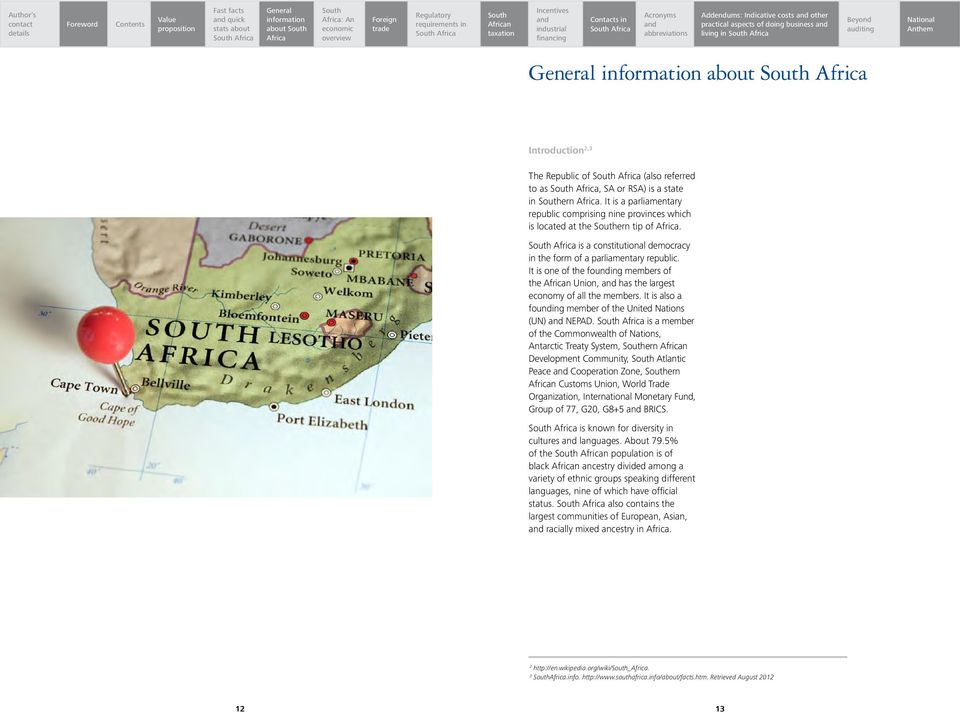
10 quick about : An n Addendums: Indicative costs other practical aspects of doing business living in about Introduction 2,3 The Republic of (also referred to as, SA or RSA) is a state in ern. It is a parliamentary republic comprising nine provinces which is located at the ern tip of. is a constitutional democracy in the form of a parliamentary republic. It is one of the founding members of the n Union, has the largest economy of all the members. It is also a founding member of the United Nations (UN) NEPAD. is a member of the Commonwealth of Nations, Antarctic Treaty System, ern n Development Community, Atlantic Peace Cooperation Zone, ern n Customs Union, World Trade Organization, International Monetary Fund, Group of 77, G20, G8+5 BRICS. is known for diversity in cultures languages. About 79.5% of the n population is of black n ancestry divided among a variety of ethnic groups speaking different languages, nine of which have official status. also contains the largest communities of European, Asian, racially mixed ancestry in info. Retrieved August
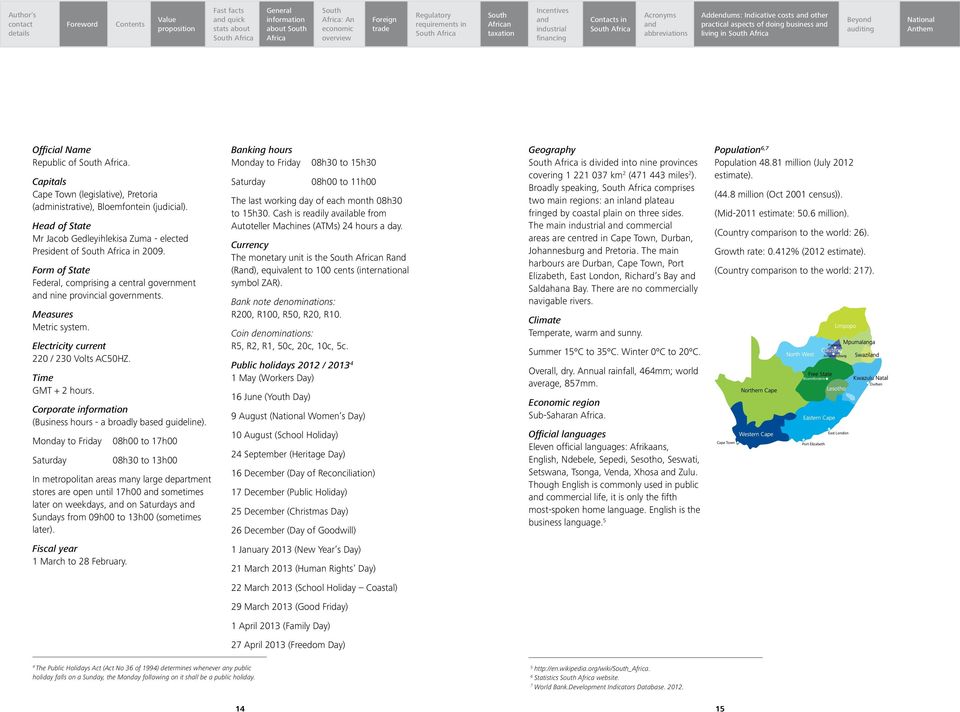
11 quick about : An n Addendums: Indicative costs other practical aspects of doing business living in Official Name Republic of. Capitals Cape Town (legislative), Pretoria (administrative), Bloemfontein (judicial). Head of State Mr Jacob Gedleyihlekisa Zuma - elected President of in Form of State Federal, comprising a central government nine provincial governments. Measures Metric system. Electricity current 220 / 230 Volts AC50HZ. Time GMT + 2 hours. Corporate (Business hours - a broadly based guideline). Monday to Friday Saturday 08h00 to 17h00 08h30 to 13h00 In metropolitan areas many large department stores are open until 17h00 sometimes later on weekdays, on Saturdays Sundays from 09h00 to 13h00 (sometimes later). Banking hours Monday to Friday Saturday 08h30 to 15h30 08h00 to 11h00 The last working day of each month 08h30 to 15h30. Cash is readily available from Autoteller Machines (ATMs) 24 hours a day. Currency The monetary unit is the n R (R), equivalent to 100 cents (international symbol ZAR). Bank note denominations: R200, R100, R50, R20, R10. Coin denominations: R5, R2, R1, 50c, 20c, 10c, 5c. Public holidays 2012 / May (Workers Day) 16 June (Youth Day) 9 August ( Women s Day) 10 August (School Holiday) 24 September (Heritage Day) 16 December (Day of Reconciliation) 17 December (Public Holiday) 25 December (Christmas Day) 26 December (Day of Goodwill) Geography is divided into nine provinces covering km 2 ( miles 2 ). Broadly speaking, comprises two main regions: an inl plateau fringed by coastal plain on three sides. The main commercial areas are centred in Cape Town, Durban, Johannesburg Pretoria. The main harbours are Durban, Cape Town, Port Elizabeth, East London, Richard s Bay Saldahana Bay. There are no commercially navigable rivers. Climate Temperate, warm sunny. Summer 15ºC to 35ºC. Winter 0ºC to 20ºC. Overall, dry. Annual rainfall, 464mm; world average, 857mm. Economic region Sub-Saharan. Official languages Eleven official languages: Afrikaans, English, Ndebele, Sepedi, Sesotho, Seswati, Setswana, Tsonga, Venda, Xhosa Zulu. Though English is commonly used in public commercial life, it is only the fifth most-spoken home language. English is the business language. 5 Population 6,7 Population million (July 2012 estimate). (44.8 million (Oct 2001 census)). (Mid-2011 estimate: 50.6 million). (Country comparison to the world: 26). Growth rate: 0.412% (2012 estimate). (Country comparison to the world: 217). Cape Town Bloemfontein Port Elizabeth Pretoria Johannesburg East London Durban Fiscal year 1 March to 28 February. 1 January 2013 (New Year s Day) 21 March 2013 (Human Rights Day) 22 March 2013 (School Holiday Coastal) 29 March 2013 (Good Friday) 1 April 2013 (Family Day) 27 April 2013 (Freedom Day) 4 The Public Holidays Act (Act No 36 of 1994) determines whenever any public holiday falls on a Sunday, the Monday following on it shall be a public holiday Statistics website. 7 World Bank.Development Indicators Database
12 quick about : An n Addendums: Indicative costs other practical aspects of doing business living in World Bank Indicators - Population Completeness of birth registration (%) in Death rate; crude (per 1;000 people) in Age dependency ratio; old (% of working-age population) in Age dependency ratio (% of working-age population) in Age dependency ratio; young (% of working-age population) in Birth rate; crude (per 1;000 people) in Population ages 0-14 (% of total) in Population ages (% of total) in Population ages 65 above (% of total) in Population female (% of total) in Population growth (annual %) in Economy 8 Mixed economy, upper middle-income, emerging market. (Ranked 76 th in the world in terms of GDP (PPP) in 2012/13 considered a newly ised country). Abundant supply of resources, well-developed financial, legal, communications, energy, transport sectors, a stock exchange that ranks among the top twenty in the world a modern infrastructure supporting an efficient distribution of goods to major urban centres throughout the entire region. Largest energy producer consumer on the continent. The n R has in recent years been the most actively d emerging market currency in the world. Principal international trading partners of (besides other n countries) include China, the USA, Germany, Japan, the UK. Main exports are metals minerals. Machinery transportation equipment make up more than one-third of the value of the country s imports. Other imports include automobiles, chemicals, manufactured goods petroleum. Infrastructure 9 has a modern welldeveloped transport infrastructure. The roads are world-class. The air rail networks are the largest on the continent the country s ports provide a natural stopover for shipping to from Europe, the Americas, Asia, Australasia both coasts of. The transport sector has been highlighted by the Government as a key contributor to s competitiveness in global markets. It is increasingly being seen a crucial engine for growth social development, the Government has unveiled plans to spend billions of Rs to improve the country s roads, railways ports. To help boost private investment in s transport industry, the Department of Transport the Treasury intends creating a single regulator within the next two years. The new regulator would provide certainty by overseeing the pricing of all transport infrastructure, including road, rail, maritime aviation infrastructure Sources:

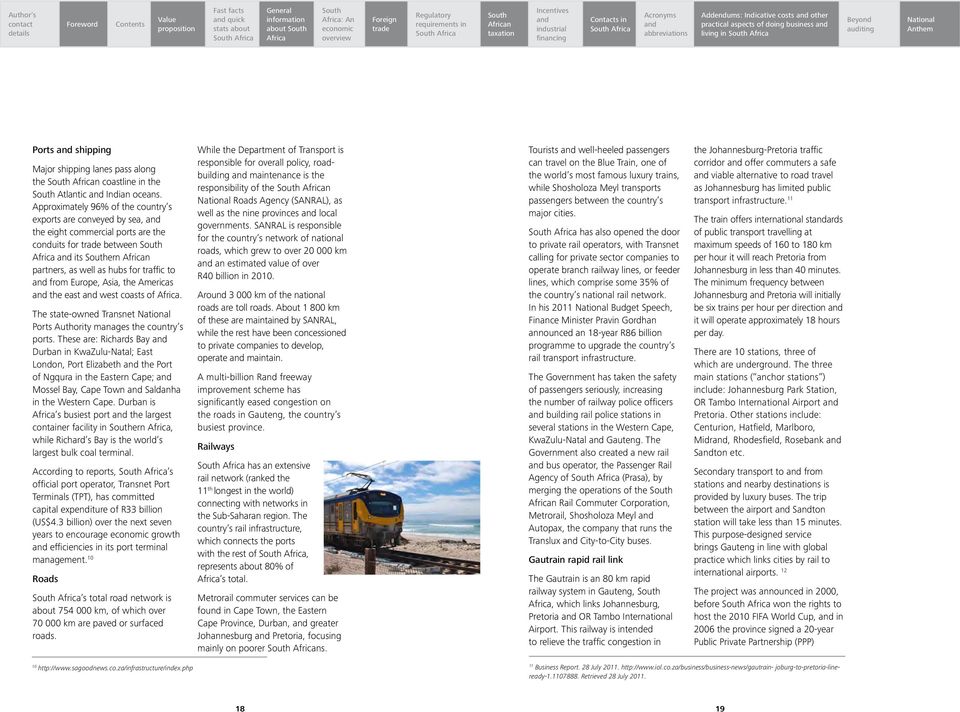
13 quick about : An n Addendums: Indicative costs other practical aspects of doing business living in Ports shipping Major shipping lanes pass along the n coastline in the Atlantic Indian oceans. Approximately 96% of the country s exports are conveyed by sea, the eight commercial ports are the conduits for between its ern n partners, as well as hubs for traffic to from Europe, Asia, the Americas the east west coasts of. The state-owned Transnet Ports Authority manages the country s ports. These are: Richards Bay Durban in KwaZulu-Natal; East London, Port Elizabeth the Port of Ngqura in the Eastern Cape; Mossel Bay, Cape Town Saldanha in the Western Cape. Durban is s busiest port the largest container facility in ern, while Richard s Bay is the world s largest bulk coal terminal. According to reports, s official port operator, Transnet Port Terminals (TPT), has committed capital expenditure of R33 billion (US$4.3 billion) over the next seven years to encourage growth efficiencies in its port terminal management. 10 Roads s total road network is about km, of which over km are paved or surfaced roads. While the Department of Transport is responsible for overall policy, roadbuilding maintenance is the responsibility of the n Roads Agency (SANRAL), as well as the nine provinces local governments. SANRAL is responsible for the country s network of national roads, which grew to over km an estimated value of over R40 billion in Around km of the national roads are toll roads. About km of these are maintained by SANRAL, while the rest have been concessioned to private companies to develop, operate maintain. A multi-billion R freeway improvement scheme has significantly eased congestion on the roads in Gauteng, the country s busiest province. Railways has an extensive rail network (ranked the 11 th longest in the world) connecting with networks in the Sub-Saharan region. The country s rail infrastructure, which connects the ports with the rest of, represents about 80% of s total. Metrorail commuter services can be found in Cape Town, the Eastern Cape Province, Durban, greater Johannesburg Pretoria, focusing mainly on poorer ns. Tourists well-heeled passengers can travel on the Blue Train, one of the world s most famous luxury trains, while Shosholoza Meyl transports passengers between the country s major cities. has also opened the door to private rail operators, with Transnet calling for private sector companies to operate branch railway lines, or feeder lines, which comprise some 35% of the country s national rail network. In his 2011 Budget Speech, Finance Minister Pravin Gordhan announced an 18-year R86 billion programme to upgrade the country s rail transport infrastructure. The Government has taken the safety of passengers seriously, increasing the number of railway police officers building rail police stations in several stations in the Western Cape, KwaZulu-Natal Gauteng. The Government also created a new rail bus operator, the Passenger Rail Agency of (Prasa), by merging the operations of the n Rail Commuter Corporation, Metrorail, Shosholoza Meyl Autopax, the company that runs the Translux City-to-City buses. Gautrain rapid rail link The Gautrain is an 80 km rapid railway system in Gauteng,, which links Johannesburg, Pretoria OR Tambo International Airport. This railway is intended to relieve the traffic congestion in the Johannesburg-Pretoria traffic corridor offer commuters a safe viable alternative to road travel as Johannesburg has limited public transport infrastructure. 11 The train offers international stards of public transport travelling at maximum speeds of 160 to 180 km per hour it will reach Pretoria from Johannesburg in less than 40 minutes. The minimum frequency between Johannesburg Pretoria will initially be six trains per hour per direction it will operate approximately 18 hours per day. There are 10 stations, three of which are underground. The three main stations ( anchor stations ) include: Johannesburg Park Station, OR Tambo International Airport Pretoria. Other stations include: Centurion, Hatfield, Marlboro, Midr, Rhodesfield, Rosebank Ston etc. Secondary transport to from stations nearby destinations is provided by luxury buses. The trip between the airport Ston station will take less than 15 minutes. This purpose-designed service brings Gauteng in line with global practice which links cities by rail to international airports. 12 The project was announced in 2000, before won the rights to host the 2010 FIFA World Cup, in 2006 the province signed a 20-year Public Private Partnership (PPP) Business Report. 28 July joburg-to-pretoria-lineready Retrieved 28 July
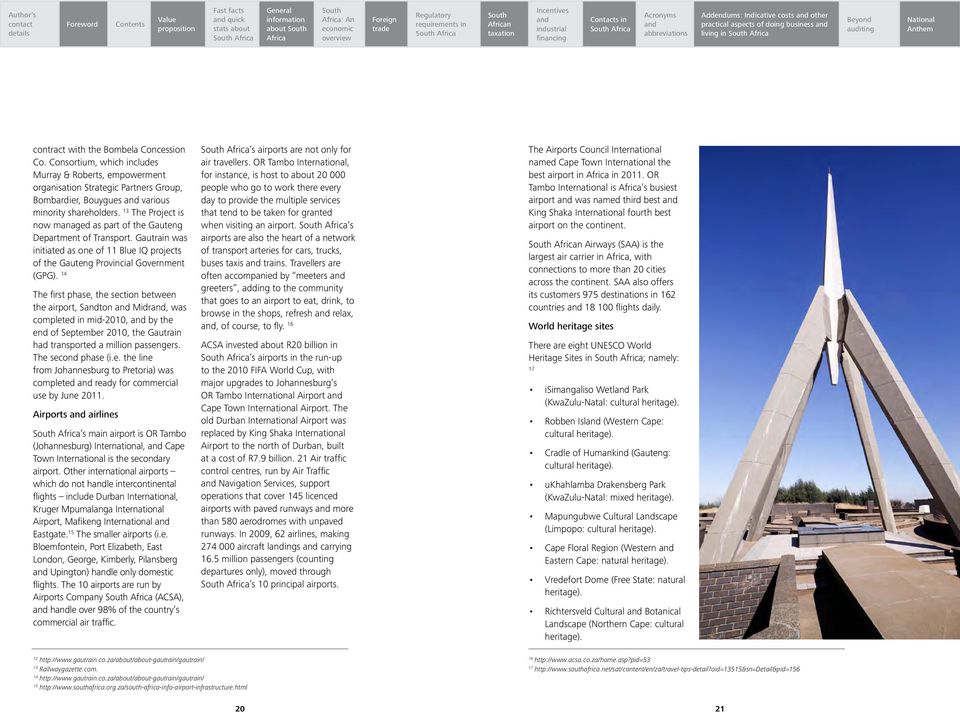
14 quick about : An n Addendums: Indicative costs other practical aspects of doing business living in contract with the Bombela Concession Co. Consortium, which includes Murray & Roberts, empowerment organisation Strategic Partners Group, Bombardier, Bouygues various minority shareholders. 13 The Project is now managed as part of the Gauteng Department of Transport. Gautrain was initiated as one of 11 Blue IQ projects of the Gauteng Provincial Government (GPG). 14 The first phase, the section between the airport, Ston Midr, was completed in mid-2010, by the end of September 2010, the Gautrain had transported a million passengers. The second phase (i.e. the line from Johannesburg to Pretoria) was completed ready for commercial use by June Airports airlines s main airport is OR Tambo (Johannesburg) International, Cape Town International is the secondary airport. Other international airports which do not hle intercontinental flights include Durban International, Kruger Mpumalanga International Airport, Mafikeng International Eastgate. 15 The smaller airports (i.e. Bloemfontein, Port Elizabeth, East London, George, Kimberly, Pilansberg Upington) hle only domestic flights. The 10 airports are run by Airports Company (ACSA), hle over 98% of the country s commercial air traffic. s airports are not only for air travellers. OR Tambo International, for instance, is host to about people who go to work there every day to provide the multiple services that tend to be taken for granted when visiting an airport. s airports are also the heart of a network of transport arteries for cars, trucks, buses taxis trains. Travellers are often accompanied by meeters greeters, adding to the community that goes to an airport to eat, drink, to browse in the shops, refresh relax,, of course, to fly. 16 ACSA invested about R20 billion in s airports in the run-up to the 2010 FIFA World Cup, with major upgrades to Johannesburg s OR Tambo International Airport Cape Town International Airport. The old Durban International Airport was replaced by King Shaka International Airport to the north of Durban, built at a cost of R7.9 billion. 21 Air traffic control centres, run by Air Traffic Navigation Services, support operations that cover 145 licenced airports with paved runways more than 580 aerodromes with unpaved runways. In 2009, 62 airlines, making aircraft lings carrying 16.5 million passengers (counting departures only), moved through s 10 principal airports. The Airports Council International named Cape Town International the best airport in in OR Tambo International is s busiest airport was named third best King Shaka International fourth best airport on the continent. n Airways (SAA) is the largest air carrier in, with connections to more than 20 cities across the continent. SAA also offers its customers 975 destinations in 162 countries flights daily. World heritage sites There are eight UNESCO World Heritage Sites in ; namely: 17 isimangaliso Wetl Park (KwaZulu-Natal: cultural heritage). Robben Isl (Western Cape: cultural heritage). Cradle of Humankind (Gauteng: cultural heritage). ukhahlamba Drakensberg Park (KwaZulu-Natal: mixed heritage). Mapungubwe Cultural Lscape (Limpopo: cultural heritage). Cape Floral Region (Western Eastern Cape: natural heritage). Vredefort Dome (Free State: natural heritage). Richtersveld Cultural Botanical Lscape (Northern Cape: cultural heritage) Railwaygazette.com
15 quick about : An n Addendums: Indicative costs other practical aspects of doing business living in Art, culture sport Art culture 19 The arts culture of is as rich diverse as the country itself. From music, dance, literature to n theatre, the country is more than a cultural hub. It is the abode of some of the most ancient finest art in the world. The Department of Arts Culture of endeavours to safeguard develop the country s cultural, artistic linguistic heritage. Interesting websites to visit are those of the Department of Arts Culture ( Science Technology ( za) the n Gallery ( sang). 20 n arts - Historically speaking, the art community makes up a very small percentage of the total population due to limited education. With the lifting of the cultural boycott towards the end of the century, the n artists got recognition in the international art world. Today is a storehouse of the oldest finest rock paintings in the world in addition to the contemporary masterpieces other works of arts crafts that the country can be proud of. During the apartheid era, there was a huge diversity in n art. n music - n music is characterised by a fusion of local ideas with influences from other countries. Right from the days of colonisation, the indigenous people of the country were influenced by the Westerners adopted their musical instruments ideas. Today several pop rock musicians have made their mark in the world of international music. Traditional music like Kwela of the forties fifties are being redefined even house music techno-raves have found their individual variations in the local music culture. n dance - possesses a long tradition of fine classical ballet with the oldest dance company being the Cape Town City Ballet. In the post-apartheid era in, dance has attained the status of the primary means of artistic expressions. n dance is characterised by its vitality has gained much international acclaim. An increasing number of dance companies choreographers are being invited overseas to perform at different festivals. Contemporary dance companies of include: Jazzart Dance Theatre (Cape Town), Free Flight Company (Johannesburg), Moving Into Dance (MID)- (Mophatong), the Soweto Dance Company, the Napac Pact Dance Companies. n theatre - offers an endless variety of theatrical experiences, ranging from the indigenous drama, dance, music cabaret to the classical opera, ballet, West End Broadway hits. n theatre has an international reputation for being unique top class. Major performing arts companies in include: State Theatre in Pretoria, Playhouse Company in Durban, ArtsCape in Cape Town, Market Theatre Windybrow Theatre in Johannesburg. n literature - has some great writers poets whose literary outputs have been acclaimed worldwide have also won several major awards. These authors poets have contributed greatly towards enriching the English literature. Renowned literary geniuses of include: Alan Paton, JM Coetzee, Allister Sparks, Nadine Gordimer Zakes Mda. Sport 21 Sports in have a passionate following, although remaining largely divided on ethnic lines. Football (or soccer as it is known in ) is the most popular sport in. It used to be the Cinderella sport in the days of apartheid reflects the country s history the struggle for democracy. 22 s soccer team is called Bafana Bafana. hosted the 2010 FIFA World Cup, the first one hosted in. Cricket is the second most popular sport in. The national cricket team is nicknamed the Proteas. Other popular sports include: rugby union, boxing, hockey, surfing, netball running. Rugby union is a popular sport among Afrikaners. The national rugby union team is nicknamed the Springboks. s sporting achievements goes wider than the big three sports, however. In a country of magnificent golf courses, for example, has bred some world-beating stars including Bobby Locke, Gary Player, Ernie Els, Retief Goosen, Trevor Immelman, Charl Schwartzel, Louis Oosthuizen others. has also bred world champions among our swimmers, athletes, surfers, boxers, tennis players more. 23 was absent from international sport for most of the apartheid era due to sanctions, but started competing globally after the country s white electorate voted in a referendum in favour of a negotiated settlement of the apartheid question. The n Government SASCOC have been striving to improve the participation of the previously excluded majority in competitive sports independenceday.com

16 quick about : An n Addendums: Indicative costs other practical aspects of doing business living in Food drink 24,25 has a fantastic culinary tradition its wines are famous throughout the world. The cuisine of is sometimes called rainbow cuisine, as it has had a variety of multicultural sources stages. The cuisine can be generalised as: Cookery practised by indigenous people of such as the Sotho Nguni-speaking people. Cookery that emerged from several waves of colonialisation immigration introduced during the colonial period by people of Dutch, German, French Indonesian descent (since 1652) Afrikaner, British descent (since Settlers) their slaves or servants. This includes the cuisine of the so-called Cape Malay people, which has many characteristics of Indonesia cooking styles from neighbouring colonial cultures such as Portuguese Mozambique. also has a significant eating out culture. While there are some restaurants that specialise in traditional n dishes or modern interpretations thereof, restaurants featuring other cuisines such as Moroccan, Chinese, West n, Congolese Japanese can be found in all of the major cities many of the larger towns. In addition, there are also a large number of home-grown chain restaurants, such as Spur Dulce Cafe. There is also a proliferation of fast food restaurants in. While there are some international players such as McDonald s Kentucky Fried Chicken active in the country, they face stiff competition from local chains such as No s Steers. Many of the restaurant chains originating from have also exped successfully outside the borders of the country. Typical n foods dishes include: Amasi, sour milk, mealie pap, biltong, biryani bobotie, chutney, frikkadelle (meatballs), koeksisters, milktart, pumpkin fritters, potjiekos, rusks, tomato bredie, vetkoek waterblommetjie bredie (water flower stew). Wine made from imported grape varieties such as chenin blanc, chardonnay, merlot shiraz has been made in the Western Cape for three centuries. Two local specialities are Muscat d alexrie (made from hanepoot), a sweet dessert wine, Pinotage, a uniquely n cultivar developed from pinot noir cinsaut (hermitage) grapes. ns are also prolific beer drinkers, especially when eating outdoors or watching sport. Maheu, a sorghum-based beer, is widely drunk in shebeens beer halls. Education 26 s Constitution guarantees equality non-discrimination, cultural freedom diversity, the right to basic education for all equal access to educational institutions. The majority of pupils in attend government-assisted schools, under a single national system which is organised managed on the basis of nine provincial sub-systems. However, private schools run by church denominations or private enterprises are an important feature of the educational system. Private school pupils generally follow the same syllabuses as their fellow pupils in government schools. The school year commences in January ends in December. During a child s school career, he/she will probably attend the following schools: Pre-primary: To become compulsory between six seven in the near future. Primary: It is compulsory for children to start in the year they turn seven. Primary education usually takes seven years to complete. Secondary: This usually takes five years most subjects can be taken on the higher or stard level (grade). Post-school tertiary training: Provided countrywide by numerous universities, technical colleges, numerous teacher training colleges a number of other institutions. UNISA offers correspondence courses world-wide

17 quick about : An n Addendums: Indicative costs other practical aspects of doing business living in Law n law is founded on the Roman-Dutch law, although aspects of our law (particularly the company laws the law of evidence) have been heavily influenced by English law. commercial legal practices relating to transactions the drafting of commercial agreements are generally globally applicable in line with developed countries. There is a world-class modern Constitution (including a Bill of Rights) in place which regulates human rights all legislation. Trade industry is undertaken within the framework of a free enterprise economy. The courts are open to foreigners on exactly the same terms conditions as n citizens, although many commercial disputes are resolved through arbitration by agreement between the parties. Industrial relations Any foreign employees working in for a n employer will be protected by n employment laws. The employment relationship will, therefore, be governed regulated by n employment law. Trade unions remain an important force in, active in most industries, representing about 25% of the work force. The Congress of n Trade Unions (COSATU) is the largest of three major union centres (COSATU, FEDUSA NACTU) in. 27 A list of registered unions can be accessed at: registeredunions.htm or www. labourguide.co.za/general/registered unions-in -. Collective bargaining is regulated by the Labour Relations Act. The Labour Relations Act 66 of 1995 (the Act) promotes collective bargaining, in particular, sectoral level collective bargaining, as the desired method of setting wages conditions of employment. The Act strongly promotes centralised bargaining at or sectoral level. Most collective bargaining occurs at employer level, but some industries are regulated by industry level bargaining councils where bargaining between employer employee organisations will take place. The Labour Relations Act also regulates deals with dismissals or termination of employment, which must be both substantively procedurally fair. Minimum terms conditions of employment on the other h is regulated by the Basic Conditions of Employment Act 75 of Immigration - Visas permits 28 s immigration system is regulated by the Immigration Act of This Act ensures that access to foreigners is granted in order to promote growth, while at the same time ensuring that security considerations are fully satisfied. An amendment Bill has been presented to amend the classes of work permits a number of other administrative measures. These amendments are expected to be in place in early It is important to consult the Department of Home Affairs website ( or offices for the latest regulations. Currently the Act sets out the categories of permits available. There are three basic components to the n system: visas, temporary residence permits permanent residence permits. In order to determine which would be the most suitable permit class to apply for, the applicant must approach a reputable immigration practitioner, the nearest n embassy or the Department of Home Affairs in Department of Home Affairs 26 27

18 quick about : An n Addendums: Indicative costs other practical aspects of doing business living in Visas Some countries are exempt from obtaining visas before coming to, others not. s from countries that are exempt from visas can enter obtain a visitor s temporary residence permit at the port of entry (up to the limit of their visa exemption for visits that justify this form of entry, such as business meetings holidays). s that are not exempt from visas are required to obtain a visa at the n embassy before they depart for. As the list for visa exemptions can change without notice, it is advised that the applicants confirm their visa exemption status on the official website of the Department of Home Affairs at: immigration services/non-exempt countries. Alternatively, the nearest n embassy. A list for embassies is available at: gov.za/consular. Temporary residence permits There are various categories of temporary residence permits, ranging from visitor s permits for tourism to work permits. These permits are valid for periods of between three months 24 to 36 months. ly, the principle is to apply for the permit that most closely applies to your circumstances before coming to, at the relevant n embassy or High Commission. Aligned to the Immigration Act, the following categories of temporary residence permits can be applied for: Visitors permit. Study permit. Treaty permit. Business permit (to establish an own business or to invest in an existing business venture). Medical treatment permit. Relatives permit. Work permits. o Quota work permit o work permit o Exceptional skills work permit o Intra-company transfer work permit. Retired persons permit. Corporate permit. Exchange permit. Each of these categories have their own set of requirements. In order to obtain the relevant permit, these requirements must be met exactly as stipulated. In cases where some of the requirements mentioned in the regulations cannot be met, there is a mechanism that can be used to ask that these requirements be waived. To ascertain the list of requirements, it can be viewed at: za/immigration services/temporary residence permits, or a reputable immigration practitioner can be approached. There is a fee chargeable by the Government for the process of these permits. The relevant fees are available at: immigration services/price list. Work permits For individuals who wish to apply for a work permit, four options are available. An employer can apply for an intracompany temporary residence work permit if the employee is only required to work in for less than 24 months is being transferred to a branch, subsidiary or affiliate abroad. It is important to note that this permit cannot be renewed. However, the Department of Home Affairs is currently looking at extending this two-year period to four years. Another option is the general temporary residence work permit if the employer has advertised the position in the format prescribed by law. Alternatively, the quota temporary residence work permit can be applied for if the post was not advertised but an individual falls within one of the categories of permits as determined by the critical skills list. The final permit for employment is the exceptional skills permit for those individuals whose qualifications or experience can be termed exceptional. Whether or not an individual is exceptionally skilled is determined on a case-by-case basis. For further refer to: www. services.gov.za. It is important to note that as the work permit applications can take time, the necessary planning must be done up front in order to avoid complications delays when mobilising staff to. Permanent residence permits The permanent residence permits are, as the name implies, permanent in nature. A worker can thus apply for a temporary residence permit or a permanent residence permit, if they qualify for the requirements set out in each class of application. The various classes are as follows: 1. er with five years continuous work permit status This category applies to a foreigner who has been a holder of a work permit, including one issued under a corporate permit, for a period of five years has proven to the satisfaction of the Director- of Home Affairs that he or she has received an offer for employment. 2. Spouse of a n citizen or permanent resident for a continuous period of five years This category applies to a person who has been the spouse of a n Citizen or permanent resident for a period of five years, provided that a good spousal relationship exists on condition that the permit shall lapse if, within two years after the date of issue of the permanent residence permit, the relationship no longer exists, except in the case of death
19 quick about : An n Addendums: Indicative costs other practical aspects of doing business living in 3. Child of a n citizen or permanent resident under 21 years of age This section applies to the child of a n Citizen or permanent resident under the age of 18 years. A permanent residence permit under this section is issued on condition that it shall lapse, unless an application for its confirmation is submitted within two years after the date on which the child turns 21 years of age. 4. Child of a n citizen This section applies to the child of a citizen no age restriction applies since the child of a n citizen by birth or descent qualifies for n citizenship on the basis of his/her parent s citizenship status. This category is applicable to n citizens by naturalisation. 5. Worker A permanent residence permit may be issued to a foreigner of good sound character that has received an offer for permanent employment. 6. Person possessing extraordinary skills or qualifications A foreigner who has demonstrated to the Director- s satisfaction that he or she possesses extraordinary skills/qualifications, to those members of such foreigner s immediate family determined by the Director- under the circumstances or as may be prescribed. 7. Person who wishes to establish or invest in an existing business This category is applicable to a foreigner who intends to establish a business in the Republic, or who already holds a temporary residence permit to conduct a business in the Republic, or who intends to invest in an existing business in the Republic. 8. A refugee as referred to in Section 27(c) of the Refugees Act This category is applicable to Refugees as referred to in Section 27(c) of the Refugees Act, 1998 (Act No. 130 of 1998), subject to any prescribed requirement. 9. A retired person This category is applicable to a foreigner who intends to retire in the Republic, provided that such foreigner proves to the satisfaction of the Director- that he or she has: The right to a pension, or an irrevocable annuity, or a retirement account which will give such a foreigner a minimum prescribed amount for the rest of his/her life; or That the person concerned has a minimum prescribed net worth. 10. Financially independent This category is applicable to a foreigner who has proven to the satisfaction of the Director- she or he has a prescribed minimum net worth, has paid a prescribed amount to the Director A relative of a n citizen or permanent resident within the first step of kinship This category applies to a foreigner who is a relative of a citizen or a permanent resident within the first step of kinship. A permanent residence application takes between one to two years to process. (An important point to note is that it is advisable to seek advice before applying for permanent residence as there could be tax Reserve Bank implications.) The categories of permanent residence applications can be divided into those for workers those who are not workers. It is important to ensure that the individual qualifies for a permanent residence permit before applying. The requirements for the different classes of permanent residence can be viewed at: za/immigration services/permanent residence permits. For additional on permits visas (published by the Department of Home Affairs) refer to: Addendum 11: Immigration - Permits visas Immigration - Other practical aspects Customs excise regulations As a rule, immigrants are allowed to bring household goods used equipment necessary for the practising of their professions into duty-free. (The required application forms can be obtained from any n embassy or Mission). The importation of a vehicle is subject to more conditions, taxes provisions. To import a foreign vehicle into, you will also need permission from the n Bureau of Stards. It is recommended that you make use of a customs clearing agent s services where necessary. For additional on customs excise regulations refer to: Addendum 12: Customs excise regulations Guidelines for immigrants travellers. Registering a business in 29 To successfully register a business in the following procedures would be required: Decide on the type of business entity that you wish to form. Decide on a name for the enterprise (with at least two other alternatives)

20 quick about : An n Addendums: Indicative costs other practical aspects of doing business living in Undertake a name search on the Companies Intellectual Property Registration Office (CIPRO) website ( to ensure that your preferred name has not been reserved by another enterprise. Reserve your proposed name, by completing the relevant forms available from CIPRO. Draw up a business plan. Await a registration number for your proposed enterprise from CIPRO. After receiving your enterprise number, apply for your VAT number, Income Tax number, Pay-As-You-Earn (PAYE), Skills Development Levy (SDL) Unemployment Insurance Fund (UIF) number from the n Receiver of Revenue (SARS). Register your logo as a mark with CIPRO. Ensure that all of the enterprise s intellectual property has copyright on them. If you have a unique product that you would like to patent, register this as a patent with CIPRO. For further on registering a business in CIPRO at: Website: [email protected] Customer centre: Tel no: Fax no: International tel: International fax: Alternatively, the Youth Development Agency (NYDA) s guide on Starting Your Own Business can be downloaded from their website at: Opening a bank account in 30 If you are a foreigner, opening a bank account in should not be a problem, as long as you are in possession of a valid work or residency permit. By law, n banks are required to ask for proof of identity (you must be at least 18 years of age) residential address. You will have to provide passport proof of address (a utility bill usually suffices). You may also have to make an opening deposit of a significant amount. The type of bank account that you will be able to open in depends on the type of permit that you have been issued with. Should you have a work permit, you will be able to open a normal resident account with no restrictions. Should your entry visa not permit you to earn an income in, a non-resident account will be opened. This account is subject to the restriction of not permitting n currency to be deposited i.e. can only be funded by foreign currency. In both instances you will require the following documentation: Valid passport with entry visa. Letter of introduction from your foreign bank. Three month s bank statements from your current bank. Proof of residential address. Some exceptions may nonetheless be made. A resident s account may only be opened by a person holding a valid residents permit. Opening an account for a business in should not be a problem if where your company has been registered in. The bank will most likely request providing the founding documents of the company, as well as proof of the company s operating address. However, these documents should be on h after obtaining a business permit. Note: In accordance with n law, a bank account may not be opened via the internet or over the phone. It would, therefore, be necessary to visit the bank in person provide the correct documentation. Credit charge cards commonly accepted in include: Diners, Mastercard, Stard Bank Card, Visa American Express. Cash can be drawn from most ATMs, with withdrawal fees varying from bank to bank. Traveller s cheques are also a fairly common form of accepted payment or exchange, also incurring variable commission fees. All major credit cards are accepted possesses both a nationwide network of ATMs a robust, rapidly growing online banking system. Daily withdrawal limits for ATM cards are usually capped at R2 000 ( 218) with each withdrawal incurring a fee. This fee varies widely, depending on size of withdrawal bank type. A locally issued card is not required in order to draw cash. As long as the bank card is supported by VISA, MasterCard, American Express, Diners, VISA-Electron or Maestro, withdrawals of cash from local ATMs or directly from a local bank can be made. A maximum withdrawal amount of R2 000 per day applies. Transaction fees will vary from bank to bank, fluctuate with the currency exchange rate
21 quick about : An n Addendums: Indicative costs other practical aspects of doing business living in Applying for a business permit/ licence 31 A business permit/licence may be required to establish a business or invest in. In fact, in certain instances trading without a valid licence may be illegal a punishable offence. ers may apply for a business permit at a n Office or at the Department of Home Affairs office. To establish a business in, a capital of at least R2.5million is required. To invest in an existing business, the capital contribution of the business must be R2.5 million be part of the intended book value of the business. (The amount may be only reduced if your business falls within the sectors of national interest.) Suggested procedures to follow in applying for a business permit/licence include the following: Go to any nearest Home Affairs office or n Office if applying from abroad. Complete forms BI-947 BI-29 if you have a representative. Submit the following: - A passport valid for no less than 30 days after expiry of the intended visit. - A medical report radiological reports, if applicable. - Police clearance certificates in respect of all countries resided in for one year or longer. - A business plan, outlining the feasibility of the business. - Proof or an undertaking that at least five ns or permanent residents will be permanently employed in the business. - A written partner agreement containing full of the partners/directors their residential status in the Republic, if the application is in respect of an investment in an existing business. - An undertaking to register with SARS. - A certification by a chartered accountant that at least R2.5 million in cash or a capital contribution of at least R2.5 million or a combination of cash a capital contribution amounting to R2.5 million is available.(you must intend to invest or already have invested the prescribed amount or capital contribution of the book value.) Note: The cost of a business permit/licence is approximately R Forms to be completed include the following: Application for permanent residence permit (BI-947). Power of attorney in respect of an application/extension of (an) immigration permit(s) or temporary residence (BI-29). Some useful tips include: 32 Depending on the location of the business, you will either be dealing with a metropolitan council, a local town municipality or an area district council. Either way, you will be dealing with the licensing office or licensing department in that municipality or council. It is advised you first call your local council to confirm whether or not you need a business or licence, where you can obtain the necessary application forms. Also find out whether or not your business will require any additional permits or certificates. Business or licence requirements are governed by the Business Act apply throughout the country, whereas permits certificates are generally issued in terms of local authority by-laws. These by-laws tend to differ from municipality to municipality. Make sure that the licensing department issues you with proof of application payment of fees before you leave their offices. Once an application has been submitted, the licensing department will send a report to the other municipal departments involved in the process. Each of these departments will then need to do a site inspection to ensure that the business complies with the following: Any law that relates to health safety. Any law /or town planning scheme which relates to l use rights. Any law applicable to building control in compliance with the national building regulations Building Stards Act, Any law applicable to noise air pollution. Any law applicable to public safety. Once all the departments have approved the application, the business or licence is issued. The licence remains valid until such time as ownership changes or the activity specified on the licence changes. For any further advice or regarding business permits/licences the Department of Home Affairs at: (within RSA) (abroad). Buying property 33 Essentially, there are no restrictions on non-residents/foreigners buying property in except for a prohibition on illegal aliens owning immovable property in Servicesfors/Permanentresidence/Applicationforabusinesspermit/ en_za?pid=10&tid=331#info
22 quick about : An n Addendums: Indicative costs other practical aspects of doing business living in Non-residents will naturally have to adhere to the same rules, regulations processes which residents are subject to, should the non-resident not wish to purchase property in his or her individual name alternatively purchase in the name of an entity (e.g. company or trust) then this entity would need to be locally registered meet the requirements associated with the chosen entity, such as those contained in the Companies Act. Should a non-resident not acquire property in an entity, then that money brought in will be represented as a loan to the local entity which would require exchange control approval. In most cases, however, property is registered in the name of the purchaser as an individual. Note: A non-resident is even permitted to purchase n property over the internet, without even entering the country. However, should they intend to live on the property, they would need to comply with the Immigration Act, have either a valid permit to temporarily remain in the country or be in possession of a permanent residency permit. With regards to bringing foreign funds into for a property acquisition, foreign funds may be deposited into any nominated bank account in (usually the estate agent or transferring attorney s trust account into which the deposit for the property the balance of the purchase price is paid). When the non-resident transfers funds into a n account from a foreign source, a record of such funds entering are kept (known as a deal receipt ). This is an important piece of documentation that must be kept for purposes of repatriation of the funds. As far as borrowing money in to purchase property, the n Reserve Bank will consider all foreigners not having their domicile in to be non-residents, barring foreigners with n work permits who will be considered residents for the duration of their work permit. Non-residents are thereby restricted in their borrowing ratio to 50% of the purchase price, while the remaining 50% must be brought into the country in cash from a foreign bank. In order to qualify for a n mortgage bond, the non-resident will need to provide proof of earnings comply with the Financial Intelligence Center Act, which pertains to the non-resident s identification for money laundering purposes involves production of certain documents such as passport proof of residential address. In order for a non-resident to service repayments on a mortgage bond, he/ she will need to open a non-resident account, which can be done from abroad or from within the country. Other than the purchase price, the purchaser is usually liable for other costs including, for example, transfer duty (this is not payable if the seller is VAT registered), transfer fees, deeds office levies, pro-rata rates taxes/sectional title levies, as well as the costs of obtaining a rates/levy clearance certificate. If the property is not bonded, it will be in the purchaser s best interests to obtain insurance. This is compulsory if the property is bonded normally arranged by that bank. Where non-residents decide to sell the property, they will be allowed to remit the proceeds offshore. Money from a foreign source may be repatriated in due course according to s Exchange Control Regulations, together with any profit, proportionate to that non-residents share-holding in the property. On transfer to the non-resident purchaser of the property, the title deed will be endorsed non-resident /or a deal receipt retained by the banking institution when the foreign funds were originally introduced into the country. (This facilitates the repatriation of the funds profit on sale of the property.) Note: If the purchase was financed with funds borrowed in, that portion of the purchase price cannot be repatriated out of the country unless the bond has been settled in full. Furthermore, if a foreigner takes up permanent residency in signs a Declaration Undertaking at a n bank they will be considered a resident for exchange control purposes only able to repatriate funds within five years of their immigration, following which they will be considered akin to a n subject to the same regulations limitations. The repatriation of funds will be also be subject to Capital Gains Tax (CGT). Health insurance 34,35 It is recommended that immigrants take out medical/life insurance upon arrival in the country. Practically, this means securing your own private medical aid scheme, which depending upon the level of cover you select, will provide you with various options in the private healthcare sector. (It is strongly advised that when deciding on the type extent of medical insurance, individuals should make sure that it covers all family present future health.) When buying private health insurance, n, as well as international companies, should be considered
23 quick about : An n Addendums: Indicative costs other practical aspects of doing business living in Note: If you aren t covered by n social security need comprehensive private health insurance to obtain a residence permit, you must ensure that your health policy will be accepted by the authorities. n companies - The largest medical insurer in is Discovery Health (www. discovery.co.za). One of the smaller recommended healthcare providers is Selfmed ( companies - There are a number of foreign health insurance companies with agents or offices in or offering cover for people living in, including AXA PPP Healthcare ( BUPA International ( com), the Exeter Friendly Society ( HealthCare International (www. healthcareinternational.com). Note: Most international insurance companies offer health policies for different areas, e.g., Europe, worldwide excluding the US, worldwide including the US. Most companies also offer different levels of cover, e.g. basic, stard, comprehensive prestige.. Each level has a different limit on the total annual medical costs, the minimum usually being R2 million/ 206,500 (although you re recommended to have much more cover, many companies provide cover of up to R7.5 million/ 774,385 some companies limit the charges for specific treatment or care such as specialists fees, operations hospital accommodation). If you already have private health insurance in country other than, you may be able to extend it to include rather than taking out a new policy. n business practices etiquette For a comprehensive of common business practices etiquette in refer to: Addendum13: n business practices etiquette. How to apply for a police clearance certificate (PCC) For practical guidelines on how to apply for a police clearance certificate in refer to: Addendum14: How to apply for a police clearance certificate (PCC). Choice of business entity The principal methods of doing business in are by using a: Company (public or private) incorporated under the Companies Act 71 of 2008). Personal liability company. Partnership. Business trust. Sole proprietorship. External company (branch of a foreign company). Note: 1. n law used to provide for a business entity type called Close Corporations (CCs) until the Companies Act 71 of 2008 came into force on 1 May CCs may no longer be created. However, existing CCs will continue to operate until they are converted into companies. 2. Companies operate on the basis of limited liability. As a general rule, members are not liable for the debts of a company. However, there are exceptions to this rule. Branches of foreign companies are accorded legal status in by virtue of registration as external companies but are not recognised as separate legal entities (except for exchange control purposes). Tax other considerations affect the choice of a particular form of business entity. The most commonly adopted forms of doing business by foreign investors are private companies branches. Stock exchange The JSE Ltd (JSE) is licenced as an exchange under the Securities Services Act, 2004, is s premier exchange. It has operated as a market place for the trading of financial products for nearly 120 years. In this time, the JSE has evolved from a traditional floor-based equities trading market to a modern securities exchange providing fully electronic trading, clearing settlement in equities, financial agricultural derivatives other associated instruments has extensive surveillance capabilities. The JSE is also a major provider of financial. In everything it does, the JSE strives to be a responsible corporate citizen. The JSE is a valuable commodity in s lscape. As s only full service securities exchange, it connects buyers sellers in five different markets: equities, which includes a primary secondary board; equity derivatives; agricultural derivatives; interest rate instruments. The JSE holds a treasured position as one of the top 20 exchanges in the world in terms of market capitalisation (JSE Brochure: JSE - s premier exchange)
24 quick about : An n Addendums: Indicative costs other practical aspects of doing business living in The JSE provides companies with the opportunity to raise capital in a highly regulated environment through its markets: the Main Board the Alternative Exchange (AltX). (The Main Board is for established larger companies, the AltX is the breeding ground for vigorous younger companies that are to become the powerhouses of the future.) Listing on the JSE can provide a company many benefits including: access to capital to grow your business; an enhanced public profile; an ability to attach a value to your company; Black Economic Empowerment (BEE) deals are facilitated; if you re an international company, a listing can be used as a springboard into the rest of. The JSE is regarded as a mature, efficient, secure market with worldclass regulation, trading, clearing, settlement assurance risk management. It has harmonised its listing requirements, disclosure continuing obligations with those of the London Stock Exchange (LSE) offers superb investor protection. JSE securities exchange SA market capitalisation (R billion at period end June 2012) , , , , , , , ,354.1 Future JSE developments envisaged may include: The creation of a market along the lines of the Alternative Investment Market on the London Stock Exchange or the Neuermarkt (in Frankfurt) for bracket venture capital development boards. The introduction of tougher listing rules. The education guiding of companies regarding the requirements of listing the duties of a listed company. The introduction of free-float indices under the FTSE/JSE R. The purchasing of the n Futures Exchange. The demutualisation of the JSE its listing. The creation of a financial reporting panel by the JSE Securities Exchange the SA Institute of Chartered Accountants (SAICA), as advised by the Myburgh Commission. The creation of a pan-n exchange by initially enabling investors to in shares from Ghana, Namibia, Zimbabwe Zambia. Later it intends to exp this across the rest of. Key data Interest rates Prime rate (August 2012): 8.50% Repo rate (August 2012): 5.00% R157 (August 2012): 5.62% R186 (August 2012): 7.40% Sabor (August 2012): 4.813% (Source: Reserve Bank) Currency US$ = R8.94 (November 2012) =R14.26 (November 2012) = R11.52 (November 2012) US$ = R7.562 (2011 average) (Source: Reserve Bank) Rate of inflation CPI (October 2012): 5.6% y/y PPI (September 2012): 4.2% y/y (2011 average): 5.03% (Source: Statistics ) Market capitalisation Market capitalisation (June 2012): R billion (Source: Johannesburg Stock Exchange) Other GDP (2nd Quarter 2012): (Ranking in terms of GDP size: 25th largest in the world) 3.2% q/q Unemployment (3rd Quarter 2012): 25.5% Doing business (2012 ranking): 35 (Source: Statistics ) 40 41
25 quick about : An n Addendums: Indicative costs other practical aspects of doing business living in : An Key drivers of the n economy 36,37,38 s economy has traditionally been rooted in the primary sectors - the result of a wealth of mineral resources favourable agricultural conditions. However, the economy has been characterised by a structural shift in output over the past four decades. Since the early 1990s, growth has been driven mainly by the tertiary sector - which includes wholesale retail, tourism communications. Now is moving towards becoming a knowledge-based economy, with a greater focus on technology, e-commerce financial other services. Among the key sectors that contribute to the GDP keep the engine running are manufacturing, retail, financial services, communications, mining, agriculture tourism. Increasingly the Green Economy is taking prominence as the country is moving away from traditional coal fired power stations to cleaner energy production. s strategy is to make cleaner, more efficient use of the country s abundant, low-cost coal reserves in the near term while at the same time exping the use of low-emission energy technologies renewables. Mining minerals is a world leader in mining. The country is famous for its abundance of mineral resources, accounting for a significant proportion of world production reserves, n mining companies are key players in the global industry. Apart from its prolific mineral reserves, s strengths include an extremely high level of technical production expertise, comprehensive research development activities. is also home to the world s deepest mine, Western Deep Gold Mine in Gauteng, which delves 3.6 km into the earth. The country has world-scale primary processing facilities covering carbon steel, stainless steel aluminium, in addition to gold platinum. It is also a world leader of new technologies, such as a groundbreaking process that converts low-grade superfine iron ore into high-quality iron units. 36 The Department of Trade Industry (the dti), Investors Hbook,
26 quick about : An n Addendums: Indicative costs other practical aspects of doing business living in With the growth of s secondary tertiary industries, the relative contribution of mining to s GDP has declined over the past 10 to 20 years. Nonetheless, the industry is continually adapting to changing local international world conditions, remains a cornerstone of the economy, making a significant contribution to activity, job creation foreign exchange earnings. In 2009, according to the Chamber of Mines of, the industry contributed: 8.8% directly, another 10% indirectly, to the country s GDP. Over 50% of merchise exports, if secondary beneficiated mineral exports are counted. About 1 million jobs ( directly). About 18% of gross investment (10% directly). Approximately 30% of capital inflows into the economy via the financial account of the balance of payments. 93% of the country s electricity generating capacity. About 30% of the country s liquid fuel supply. Furthermore, in 2009, s mining industry was the largest contributor by value to Broad-Based Black Economic Empowerment (B-BBEE) in the economy, in terms of the value of B-BBEE transactions completed. 39 is the world s biggest producer of gold platinum. Mining remains an important foreign-exchange earner, with gold accounting for over one-third of exports. is also a major producer of coal, manganese, chrome, platinum, diamonds, accounting for a significant proportion of both world production reserves. In 2009, the country s diamond industry was the fourth largest in the world, with only Botswana, Canada Russia producing more diamonds each year. While holding the world s largest reserves of gold, platinum group metals manganese ore, the country has considerable potential for the discovery of other worldclass deposits in areas yet to be exhaustively explored. Its prolific mineral reserves include precious metals minerals, energy minerals, non-ferrous metals minerals, ferrous minerals minerals. Only two strategic minerals (crude oil bauxite) are not available in the country. In addition, has a high level of technical production expertise, comprehensive research development (R&D) activities. The country also boasts world-class primary processing facilities for gold, platinum, carbon steel, stainless steel aluminium. Lucrative opportunities exist for downstream processing adding value locally to iron, carbon steel, stainless steel, aluminium, platinum group metals gold. A wide range of materials is available for jewellery, including gold, platinum, diamonds, tiger s eye, a wide variety of other semi-precious stones. For this purpose the Government has developed a minerals beneficiation strategy, which seeks to fundamentally transform the industry from being largely resourcebased to knowledge-based. It also complements programmes of Government, such as the New Growth Path, NIPF (IPAP 2), energy security, skills development others. s financial sector s financial services sector boasts dozens of domestic foreign institutions providing a full range of services including commercial, retail merchant banking, mortgage lending, insurance investment. The n banking system is well developed effectively regulated, comprising a Central Bank, a few large, financially strong banks investment institutions, a number of smaller banks. Investment merchant banking is competitive. The country s big four banks (Absa, First Bank, Stard Bank Nedbank) dominate the retail market. The country s banking sector compares favourably with those of ised countries. Many foreign banks investment institutions have set up operations in over the past decade. Electronic banking facilities are extensive, with a nationwide network of ATMs internet banking facilities available. Ongoing amendments to exchange controls, as well as financial market legislation, make an attractive investment prospect brings it in line with international best practice. Past notable amendments have included, for example, the Payment System Act of 1998 (which confers greater powers duties on the n Reserve Bank to provide clearing settlement facilities, bringing the n financial settlement system in line with international practice on settlement systems systematic risk management procedures) the introduction of payment clearing house agreements agreements pertaining to settlement, clearing netting agreements, rules to create certainty reduce systemic other risks in inter-bank settlement
27 quick about : An n Addendums: Indicative costs other practical aspects of doing business living in Recent developments in s exchange control environment include among others, the withdrawal of the application process to make new outward foreign direct investments where the total cost of such investment does not exceed R50 million per company per year. Under this new dispensation, the responsibility for ensuring that the foreign investment purposes has been placed on the authorised dealer (i.e. a commercial bank) facilitating the transaction. n companies who want to use this dispensation are still required to show anticipated benefits to as a result of the foreign direct investment. Additional reforms proposed in 2011 included, removing controls on emigrant blocked assets. n emigrants are currently allowed to take R8 million offshore upon emigration. The rest of the assets are blocked may only be released upon the payment of a 10% exit levy. Treasury proposed releasing these blocked assets without any exit levy. Furthermore, regarding individuals, the R4 million lifetime limit increased to R4 million per calendar year, subject to compliance with all tax financial integrity legislation. Investments above the proposed threshold would require the approval of the Financial Surveillance Department of the n Reserve Bank. Individuals (residentnatural persons) over the age of 18 years may avail of a single discretionary allowance of up to R1 million per calendar year (in the past, R per year). 40 Regarding developments trends within the financial sector, note that the global financial system is facing a multitude of risks, including spillover effects of the Euro-area debt crisis to other parts of the world; the risk of disorderly deleveraging by European other banks; changes in the direction of capital flows; a sharp increase in oil prices; concerns that the euro area will not survive in its current form. Prospects of higher global growth rates have also been dampened by the everpresent risk of negative feedback loops from the financial sector to the real economy. In addition, there are also risks specific to the n economy financial system. These risks include a possible slowdown in domestic growth as a result of slower global growth; a decline in house prices higher unemployment; the unintended impact of the Basel III framework on banks lending; the risk of a downgrade of s credit rating. 41 Tourism 42 Tourism is regarded as a modern-day engine of growth is one of the largest industries globally. In addition to being a labour intensive industry, tourism holds potential to drive increases in export earnings in a trading environment that is generally less volatile than that of commodity exports. In 2010, received approximately 8.1 million foreign tourists, of which 71% originated from followed by Europe the Americas. Total Direct Spend (excluding capital expenditure) by these tourists amounted to R72.6 billion in In the same year, it is estimated that 13.5 million n adults took a total 29.7 million overnight trips resulting in Total Direct Domestic Spend of approximately R21 billion. This excludes the impact of an estimated 12.2 million adults that took an average of 18.6 day trips during Over eight million tourists visited in 2011, a 3.3% increase over the 2010 World Cup year that would, if football-specific arrivals were not counted, have amounted to a 7.4% increase over 2010, well ahead of the global average of 4.4% annual growth. According to the World Travel Tourism Council (WTTC), tourism was expected to directly contribute approximately 5% of s total GDP in 2011, with the total contribution (direct, indirect induced) to GDP expected to be in the order of 11.4% in the same year. The WTTC further expected tourism to directly support jobs (4.5% of total employment) in 2011, with a total contribution of approximately 1.3 million jobs (10% of total employment). Tourism Minister Marthinus van Schalkwyk has said that his department aims to increase s foreign tourist arrivals from seven million in 2009 to 15 million by 2020, at the same time growing tourism s contribution to the economy from R189 billion to R499 billion creating new jobs. 43 ern s biggest tourism showcase, Indaba 2012, took place at Durban s International Convention Centre in May Despite a general flat to downward trend worldwide, s tourism industry has been performing strongly, a fact that is reflected in the more than delegates from around the world attended. Tourism continues to be earmarked as a priority growth area in s growth policies. s advanced infrastructure combined with magnificent scenic beauty, rich biodiversity, sunny climate, cultural diversity a reputation for delivering value for money experiences have made it one of the world s fastest growing tourism destinations. 40 Moneyweb, October International Congress Convention Association, Stats SA, World Travel Tourism Council the dti. 43 SAinfo reporter 46 47
28 quick about : An n Addendums: Indicative costs other practical aspects of doing business living in With such an extensive tourism resource base, offers a variety of tourism experiences including: Eco-tourism: boasts four UNESCO Natural World Heritage Sites has 21 Parks (including the world famous Kruger Park), many of which integrate with Transfrontier Conservation areas in the ern n region. Accommodation options in national parks private game reserves range from budget self-catering camps to luxury lodges. Cultural tourism: The rich mix of cultures, each with its own traditions, music art forms, combined with a unique sociopolitical history forms the basis of s diverse cultural tourism offering. has five UNESCO Cultural World Heritage Sites - three of which offer unique paleo-tourism experiences. Adventure tourism: offers world-class climbing, surfing, diving, hiking, horseback safaris, mountain biking, river rafting other extreme activities - all supported by dedicated operators. Business tourism: With over conference venues, a track record of successfully hosting major international meetings, conferences exhibitions, is a sought after business tourism destination. holds the 34th place in the world, 1st place in for the number of association meetings held in 2009, according to the International Congress Convention Association (ICCA). Sports tourism: The combination of state-of-the-art sporting venues facilities, successfully hosting the 2010 FIFA World Cup a number of other international sport events, n s passion for sport make the country a top draw card for sports teams spectators alike. Agriculture has a dual agricultural economy, with both well-developed commercial farming more subsistence-based production in the deep rural areas. Agriculture (even though it has contributed only about 3% to the GDP in the past) is an important provider of direct indirect employment. However, there are strong backward forward linkages into the economy, so that the agro- sector is estimated to contribute about 12% of the GDP. 43 is not only self-sufficient in virtually all major agricultural products, but is also a net food exporter. Farming remains vitally important to the economy development of the ern n region. Agricultural activities range from intensive crop production mixed farming in winter rainfall high summer rainfall areas to cattle ranching in the bushveld sheep farming in the arid regions. Maize is most widely grown, followed by wheat, oats, sugar cane sunflowers. While 13% of s l can be used for crop production, only 22% of this is high potential arable l. The most important limiting factor is water availability. Rainfall is distributed unevenly across the country, with some areas prone to drought. Almost 50% of s water is used for agriculture, with about 1.3 million hectares under irrigation. For the past five years, agricultural exports have contributed on average about 6.5% of total n exports. Exports increased from 5% (1988) to 46% (2009) of agricultural production. However, is losing on its net balance on processed goods, owing to the growth in imports of processed goods. The largest export groups are wine, citrus, maize, grapes, sugar, apples, pears quinces. Other important export products are undermatured ethyl alcohol, avocados, pineapples, dates, preserved fruit nuts, as well as hides skins. 44 Production of imported field crops horticultural products, 2010 ( 000 t) Maize Wheat Sugar cane Grain sorghum 226 Groundnuts 100 Sunflower seed 509 Deciduous other soft fruit Citrus fruit Subtropical fruit 655 Vegetables Potatoes Source: Directorate: Agricultural Statistics, Department of Agriculture, Forestry Fisheries n agriculture agribusiness have a number of competitive advantages, making the country both an important trading partner a viable investment destination. Competitive advantages include, among others: world-class infrastructure, counter-seasonality to Europe, biodiversity (which allows for a vast varied array of agricultural products), marine resources extensive coastline commercially used both for conventional harvesting for mariculture aquaculture, competitive input costs particularly labour costs, agreements ( s agriculture agribusiness sector are benefiting from increased 43 Yearbook 2010/
29 quick about : An n Addendums: Indicative costs other practical aspects of doing business living in market access to its key trading partners, the European Union (EU) the US, as well as to sub-saharan countries, through a number of agreements) deregulation market freedom, having since the end of apartheid evolved from a highly regulated protected industry to one free from all constraints, unsubsidised by Government. 45 Recent developments in s agricultural sector worth noting include, among others, the following: In June 2010, President Jacob Zuma launched the Masibuyele i Emasimini mechanisation scheme, a food-production intensification programme, at Marapyane Village in Mpumalanga. This project affords black farmers a realistic chance to improve production, increase yields gain access to domestic global markets. The project also ensures the utilisation of fallow l seeks to resuscitate collapsed l-reform projects. By March 2010, a further increase in the productive l as a result of Masibuyele Emasimini indicated a coverage of hectares of l. In all, households are benefiting from this intervention. A budget of R862,4 million for 2010/11, was allocated to the Comprehensive Agriculture Support Programme (CASP) to address support for food production for subsistence for the market. The Department of Agriculture, CASP outputs for the 2010/11 financial year included the establishment of food-security projects; creation of 760 jobs; training improvement of knowledge skills of beneficiaries to ensure that on-farm off-farm infrastructure targets were completed functioning. By mid-2010, the implementation of the Micro-Agricultural Financial Institutional Scheme of (Mafisa) was on course with eight accredited institutions operating as intermediaries retailing Mafisa loans. Funded projects include: cotton groundnut farmers in the Taung irrigation scheme in North West; vegetable projects in Nwanedi, Limpopo; sugar-cane farmers in KwaZulu-Natal livestock projects in the Northern Cape. Various job opportunities were created to fast-track service delivery, a Mafisa call centre was established to assist with dissemination. The Department of Agriculture, Forestry Fisheries is a major role player in climate-change activities within the agricultural sector. The department s climate-change programmes policies are aligned with s Climate- Change Response Policy. The Climate Change Sector Plan for Agriculture (Working Paper, April 2008) outlines measures of addressing agricultural sector challenges; namely, creating awareness of climate change the effects of climate change; improving knowledge on climate change; increasing capacity to respond to climate change impacts; research; funding research projects. 46 Economic outlook for 2012/13 Overview 47 The GDP of 2.7% in the first quarter of 2012 is slightly down from 3.2% in the fourth quarter of The world economy slowed in the first quarter of 2012 this has been evident in activities such as performance. n exports of goods services were improving in all quarters of There was, however, a decline in both imports exports in the first quarter of The n balance over the past five quarters shows a negative balance, concluding that is importing more goods services than what it is exporting. Both the coal mining other (non-coal) mining sectors were favourable in promoting n export growth, based on year-on-year change. s with the BRIC countries (Brazil, Russia, India China) over the past five quarters shows that more goods were imported than exported. Raw mining products comprise a large portion of exports to the BRIC countries. Diesel-powered trucks weighing less than five tonnes are a top commodity that exports to. In n regions, SADC continued to maintain its trading position as a top n trading partner in exports imports, with massive value exported to Zambia, Zimbabwe Mozambique. imported high volumes of crude oil from, particularly Nigeria Angola. The major Eastern Asia economies of China, Japan India remain entrusted as driving partners for import iron commodity Pocket Guide to 2010/11 47 : Quarterly Trade Statistics First Quarter 2012Prepared by the Statistical Analysis Modelling Unit (SAM) for the Economic Research Policy Co-ordination Unit (ERPC) The Department of Trade Industry 50 51
30 quick about : An n Addendums: Indicative costs other practical aspects of doing business living in Global developments 48 After substantial improvements during late 2011 early 2012, the outlook for the world economy has taken a turn for the worse during the second quarter of this year, with data releases relating to activity surprising prognosticators on the downside financial markets correcting once again. With the major advanced economies growth continuing to be lethargic unsteady, investors had pinned their hopes on emerging markets providing support for the global economy. Recent data, however, shows considerable weakness in emerging market economies. The three major risks facing the global economy - a Eurozone financial crisis, a spike in oil prices China hard lending - still preoccupy many businesses governments. Global growth in 2011 was estimated to reach 5.7%, is forecasted at 4.6% for This is a reduction suggests that world is shrinking as a result of the sovereign financial crisis the consequent austerity measures. The main short-term risks facing include lacklustre global dem for the country s exports, as global growth stays below trend for the next few years; pressure on Government financial sources, with increased dems on Government to deliver on its infrastructural drive. The main structural constraints on the economy include the balanceof-payments restraint, a lack of skilled labour, low labour absorption, infrastructural shortages poor publicservice delivery. The balanceof-payments constraint is highlighted by s low savings propensity. This increases the country s dependence on foreign capital inflows to help finance future investment. The persistent current-account deficit, following from a high import propensity, is financed primarily with highly volatile portfolio flows. Exports lag on the back of low international competitiveness capacity constraints. There is increasing concern about how well the domestic economy can support growth in the wake of weak global dem. Inflation 49 According to the n Reserve Bank (SARB), inflation is forecast to revert to within the target by the third quarter of this year. CPI1 (for April 2012) came in slightly below market consensus at 6.1% compared to 6.0% in March. Core inflation is expected to peak at an average of 5.5% in the second quarter of 2013, marginally higher than the previous forecast, before moderating, averaging 4.5% in the final quarter of Food inflation remained unchanged since March 2012, although this may be impacted in the months to come by an increase in global food prices as well as R weakness. 48 Dti - Same as preceding footnote
31 quick about : An n Addendums: Indicative costs other practical aspects of doing business living in Forecast summary monetary indicators 50 (% unless otherwise indicated) 2011 a 2012 b 2013 c 2014 c 2015 c 2016 c Real GDP growth Gross agricultural production growth Consumer price inflation (average) Consumer price inflation (end-period) Lending rate (average) Government balance (% of GDP)d -3.7 b Exports of goods fob (US$ billion) Imports of goods fob (US$ billion) Current-account balance (US$ billion) Current-account balance (% of GDP) External debt (end-period; US$ billion) 47.3b Exchange rate R:US$ (average) Exchange rate R:US$ (end-period) Exchange rate R: 100 (average) Exchange rate R: (end-period) a Actual. b Economist Intelligence Unit estimates. c Economist Intelligence Unit forecasts. d Fiscal years beginning April 1 st. Forecast summary - business environment rankings 51 of index a Global rank b Regional rank c a Out of 10. b Out of 82 countries. c Out of 17 countries: Algeria, Bahrain, Egypt, Iran, Israel, Jordan, Kuwait, Libya, Morocco, Qatar, Saudi Arabia, Tunisia, UAE, Angola, Kenya, Nigeria. Conclusion is highly integrated with the world economy, which plays a central role in shaping s long-term prospects. Since 2000, the world has experienced unusually strong cycles shocks, these have been reflected in domestic dem GDP growth. According to SARS, while fiscal monetary policy has remained supportive of growth, current growth rates are not fast enough to support the employment gains poverty reduction that the country requires. This will require structural reforms to set the economy on a different growth trajectory that increases labour absorption, raises competitiveness ensures that the benefits of growth are shared. In the near term, will continue to be affected by international investment trends, remain vulnerable to slowing global dem. 52 Trade summary - highlights 52.1 s top five trading partners in terms of exports (for the period first quarter 2011 to first quarter 2012) were China, the US, Japan, Germany the UK. The top five trading partners in terms of imports (for the same period) were China, Germany, the US, Japan Saudi Arabia. The services sector made the biggest contribution to exports over the period, with an average of R110 billion or 39% of the total exports. Exports of goods recorded successive increases from the first to the fourth quarters of 2011, followed in the first quarter of 2012 by a decline of more than 10% compared to the previous quarter. When excluding the services sector focusing on the merchise exports on detail sector level (i.e. removing all the sub-totals), the basic non-ferrous metal products are shown to have contributed 25% of all merchise exports, followed by other (non-coal) mining products at 16%. The sector with the largest quarter-to-quarter increase, from the fourth quarter of 2011 to the first quarter of 2012, was the coke petroleum sector, with an increase of 37.7%. Combining the relative sector importance with that of annual growth showed that both the mining sectors coal other (non-coal) mining contributed 4.2% of the total 5.3% growth in merchise exports. 50 Economist Intelligence Unit Economic Outlook July Economist Intelligence Unit Economic Outlook July : Quarterly Trade Statistics First Quarter 2012Prepared by the Statistical Analysis Modelling Unit (SAM) for the Economic Research Policy Co-ordination Unit (ERPC) The Department of Trade Industry
32 quick about : An n Addendums: Indicative costs other practical aspects of doing business living in In terms of region, exported the most to the Asian continent, with R61.4 billion or 36% of the total goods exported for the first quarter of Overall, imports of goods recorded a decline of 3.49%, from R205 billion in the fourth quarter of 2011 to R198 billion in the first quarter of Imports of services showed a fairly constant level of approximately R140 billion from the first quarter of 2011 to the first quarter of 2012, with a dip to R114 billion in the third quarter of s balances for goods services from first quarter 2011 to first quarter 2012 indicate a deficit. The deficit indicates that is importing more than what it is exporting, reaching a high negative record in the first quarter of The n balance for services had a larger deficit compared to goods, except for the third quarter of 2011, which shows a sharp increase in the deficit. However, when the third quarter is ignored, a slight decline in the deficit is seen. The goods side shows an increasing deficit, from a very low second quarter of 2011 of R10 billion to R55 billion in the first quarter of The n total balance depicts no clear trend, although it remains in negative territory. In terms of commodities, the top 10 commodities exported from amounted to R61 billion. The top exported commodity was bituminous coal, not agglomerated, in the first quarter of 2012 exports of this commodity amounted to R16.7 billion. This was followed by iron ore, concentrate, not iron pyrites, agglomerated, with a total of R9.9 billion. The top 10 commodities imported to amounts to R53.1 billion. The top imported commodity the period was petroleum oils, oils from bituminous minerals, crude, in the first quarter of 2012 imports of this commodity amounted to R26.4 billion, followed by the motoring original equipment components, with a total of R11.6 billion. Trade with the BRIC countries (Brazil, China, India China) represented an average of 10% of the total n exports, between 9% 13% of all imports into over the period first quarter 2011 to first quarter s with BRIC countries for this period was dominated by China India. China contributes between 65% 70% of both imports exports of the BRIC countries, while India contributes about 17% to 25% to the aggregate BRIC. The BRIC balance remained in negative territory over the period, showing an increase in the deficit from R2.4 billion in the first quarter of 2011 to R11.8 billion in the fourth quarter of 2011, followed by a slight decline to R9.5 billion in the first quarter of Both coal other (non-coal) mining made a large contribution to the n export to BRIC countries over the period under review, at roughly 70% of all BRIC exports. The basic iron steel sector was the third-largest contributor to the exports at an average of 10% or R3 billion. Next on the rankings were the basic chemicals basic non-ferrous metals sectors, at 5.3% 4.2% respectively. The sector breakdown of imports from BRIC countries shows the other manufacturing sector to be the biggest contributor to imports. This sector includes furniture, jewellery, metallic non-metallic waste scrap, all manufactured products not elsewhere classified. Machinery equipment was the second-largest contributor of n imports from BRIC countries, at roughly 20% or R7.5 billion per quarter over the period
33 quick about : An n Addendums: Indicative costs other practical aspects of doing business living in 53, 54 s agreements Overview Preferential market access agreements ern n Customs Union (SACU). ern n Development Community (SADC) FTA. European Union / Trade, Development Cooperation Agreement (EU/ SA TDCA). SACU-European Free Trade Association (EFTA) FTA. SACU-ern Common Market (Mercosur) PTA. Bilateral agreements with Mozambique Zimbabwe. Current negotiations World Trade Organisation s Doha Development Agenda. SACU-India PTA. SADC-EAC-COMESA Tripartite FTA. Non-reciprocal agreements Growth Opportunity Act (AGOA). n products qualify for preferential market access (i.e. no or substantially reduced customs duty) under the ised System of Preferences (GSP). 53 The Department of Trade Industry (the dti), Republic of. International Trade & Economic Development Division. - compiled September Economist Intelligence Unit : Country Forecast - Updater: 11 March
34 quick about : An n Addendums: Indicative costs other practical aspects of doing business living in n agreements The n Government s development strategy aims to accelerate growth development along a path that generates decent jobs. The Government, through the dti, seeks to support the objectives of development upgrading, employment growth increased value-added exports by negotiating agreements with other countries. The International Trade Economic Development Division (ITED) within the dti is the section responsible for such negotiations. These agreements take different forms. In the section below, we identify briefly introduce the various agreements that is party to: The ern n Customs Union (SACU) SACU was established in 1910 is the oldest functioning customs union in the world. It has been renegotiated twice: in the late 1960s when Botswana, Lesotho Swazil became independent after the inauguration of the democratic government in in The current members are Botswana, Lesotho, Namibia, Swazil. SACU seeks to maintain the free interchange of goods between member countries. It provides for a common external tariff for the common customs area. All customs duties collected in the common customs area are paid into s national Revenue Fund. The Revenue is shared among members according to an agreed revenue-sharing formula. The latest SACU Agreement came into force in July In terms of Article 31 of the new agreement, other members of SACU jointly negotiate preferential agreements with third parties. SACU members have also agreed to a targeted work programme in five areas, namely: regional ization; review of the revenue-sharing formula to ensure a sustainable revenuesharing mechanism that promotes development; development of a facilitation programme to improve border efficiency; unified engagement in negotiations; establishing common institutions such as a Tariff Board the Tribunal within an agreed policy framework. The ern n Development Community (SADC) The Trade Protocol of SADC, which established a free area among 12 SADC member states, was implemented on 1 September The aim of SADC is to create a community providing for regional peace security, an integrated regional economy. As a regional institution it has laid the basis on which regional planning development in ern could be pursued. It also provides the desired instrument by means of which member states should move along the path towards eventual integration. Furthermore, SADC forms one of the building blocks of the n Economic Community (AEC). Implementation of the SADC Protocol on Trade began in 2000, following its signing in The liberalisation of tariffs has taken place at different rates. In general, more developed SADC countries have reduced tariffs faster than other member states. SACU removed most tariffs in 2000, while middle-income countries have gradually reduced their tariffs each year between In relation to the least-developed countries, tariff reductions have generally been introduced during the latter part of the phase-down period. From January 2008 onwards, when SADC attained the status of a FTA, producers consumers do not pay import tariffs on more than 85% of all in community goods in the initial 12 countries implementing the SADC Trade Protocol. The 15% of, constituting the sensitive list, is expected to be liberalised from 2009 to 2012 when SADC attains the status of a fully-fledged FTA with almost all tariff lines d duty-free. Market integration in SADC is accompanied by cross-border infrastructural development (such as the spatial development initiatives) sectoral co-operation that aims to build diversify the region s production structures. SADC, together with COMESA the EAC, has established an on-line Non-Tariff Barrier reporting monitoring mechanism ( to facilitate eliminating non-tariff barriers. This mechanism has the potential to facilitate movement of goods will lead to increased. Its effectiveness is, however, dependent on the full active participation of the business community. To determine whether a product originates in the region, therefore qualifies for duty-free access to the SADC market, Rules of Origin have been agreed to by member states. To benefit from SADC preferences, exporters must obtain confirmation of origin through a Certification of Origin, obtainable from competent authorities in member states customs offices. The Common Monetary Area (CMA) The CMA links, Lesotho Swazil into a currency union, in which the R is the common currency. It is allied to SACU - see above. Namibia automatically became a member upon independence, but withdrew with the introduction of the Namibian dollar in However, Namibia has chosen not to pursue its own 60 61
35 quick about : An n Addendums: Indicative costs other practical aspects of doing business living in flexible exchange rate policy, the Namibian dollar is at par with the n R there is no immediate prospect of change. The same is true with the lilangeni of Swazil the loti of Lesotho. The R continues to circulate freely in these countries, although it is strictly speaking not legal tender. exchange regulations monetary policy throughout the CMA continue to reflect the influence of the n Reserve Bank. SADC-EAC-COMESA Tripartite FTA (T-FTA) In 2009, the Members States of SADC, the EAC COMESA initiated a wide-ranging initiative for integration that will be built on market integration, development infrastructure. In 2011, Members of the three groupings launched negotiations towards the Tripartite FTA (T-FTA). The FTA will, as a first phase, cover only in goods core areas necessary to support that (such as Rules of Origin). Services other -related areas will be covered in a second phase. Once concluded, the T-FTA will combine the markets of 26 countries with a population of nearly 600 million people a combined GDP of US$1 trillion, providing the market scale that could launch a sizeable part of the continent onto a new developmental trajectory. It is anticipated that these negotiations will be concluded by April 2014, with implementation of the T-FTA scheduled for The T-FTA will form the basis for an -wide FTA, which is expected to create a market of US$2.6 trillion. This will address the challenge of small fragmented economies in. A larger, more integrated growing market would enhance the interest of foreign investors in provide a basis for enhanced intra-n. This envisaged Continental FTA (C-FTA) will therefore widen build on the integration initiatives already under way. EU- Trade, Development Cooperation Agreement (TDCA) The TDCA between the European Union was signed on 11 October 1999 provisionally came into force on 1 January 2000, subject to ratification by the EU member states. The Agreement came into force on 1 May 2004 after it was ratified by all EU member states. In terms of the Agreement, by 2010, the EU is expected to liberalise 95% of its duties on n originating products. In turn, by 2012, undertook to liberalise 86% of its duties on EU originating products. It means that only a limited number of product lines are not as yet subject to any of the regimes of tariff phasedown under the Agreement. There is currently a review of the Agreement under way, which is aimed at broadening the scope of product coverage. This is taking place under the auspices of the Economic Partnership Agreement (EPA) negotiations between the SADC EPA configuration the EC. SACU-EFTA FTA The FTA between SACU the EFTA came into effect on 1 May It applies to relations between SACU individual EFTA states covering in goods (including fish other marine products) processed agricultural products. The Agreement also provides for future non-binding engagements on issues such as intellectual property, investment, in services government procurement. EFTA countries do not have a common agricultural policy basic agricultural products were negotiated separately. Three Bilateral Agricultural Agreements were concluded between SACU individual EFTA states, which form part of the main Agreement came into force at the same time as the FTA. On the EFTA side tariffs on goods were eliminated upon entry into force of the Agreement; i.e. all customs duties on imports of originating products from SACU have been abolished. SACU shall progressively reduce customs on imports of originating products from the EFTA states. The tariff reduction schedules are set out on the assumption that the Agreement came into force on 1 January 2006 are not affected by any delays in the actual date on which the FTA came into force. The United States Trade, Investment, Development Cooperation Agreement (TIDCA) The TIDCA between SACU the US is a co-operative framework agreement that makes provision for the two parties to negotiate sign agreements relating to sanitary phyto-sanitary measures (SPS), customs cooperation, technical barriers to measures (TBT). It also establishes a forum of engagement between the two parties on any matters of mutual interest, including capacity-building investment promotion. Trade Investment Framework Agreement (TIFA) TIFA is a bilateral agreement between the US that was signed in 1999, but was dormant until a decision to revive it was taken in The Agreement provides a bilateral forum for the two countries to address issues of interest including AGOA, TIDCA, investment promotion, non-tariff barriers, SPS, infrastructure others. It is the main forum for bilateral-engagement with the US on all --investmentrelated issues
36 quick about : An n Addendums: Indicative costs other practical aspects of doing business living in n Growth Opportunity Act (AGOA) AGOA is a unilateral assistance measure of the US government to increase investment between the US eligible sub-saharan n countries, including. AGOA was signed into law on 18 May 2000 as Title 1 of The Trade Development Act of 2000 in the US. AGOA extended the duty-free treatment under the US s ised System of Preference (GSP) programme. Importantly, AGOA eliminated most of the limitations of the GSP programme for sub-saharan n countries, exped the product coverage of the GSP programme exclusively for products in sub-saharan. It has also made way for duty-free quota-free access to the US market for apparel manufactured in sub-saharan countries, of which the fabric, yarn thread were of US origin. AGOA is set to expire in SACU-ern Common Market (Mercosur) PTA A preferential (or limited scope) agreement, covering about product lines on each side of the border, was concluded in 2008 signed in It is currently going through ratification procedures. It is not expected to enter into force before sometime in ised System of Preferences (GSPs) What are GSPs? The ised System of Preferences (GSP) is a formal, non-reciprocal system of exemption from the more general rules of the World Trade Organisation (WTO). Specifically, it is a system of exemption from the Most Favoured Nation principle (MFN) that obligates WTO member countries to treat the imports of all other WTO member countries no worse than they treat the imports of their most favoured trading partner. In essence, MFN requires WTO member countries to treat imports coming from all other WTO member countries equally, that is, by imposing equal tariffs on them, etc. GSP, however, exempts WTO member countries from MFN for the purpose of lowering tariffs for developing countries (without also doing so for rich countries). The idea of tariff preferences for developing countries was the subject of considerable discussion within UNCTAD in the 1960s. Among other concerns, developing countries claimed that MFN was creating a disincentive for richer countries to reduce eliminate tariffs other restrictions with enough speed to benefit developing countries. GSP applied to SA exports n products qualify for preferential market access (i.e. no or substantially reduced customs duty) to several countries under the GSP, including EU Member States, Japan, Canada Russia. Bilateral agreements Mozambique Preferential Access Agreement This Agreement is a wide-ranging preferential arrangement regulating mine labour, railway port matters. A limited number of Mozambican goods receive tariff preference from, subject to quotas. Zimbabwe/ Bilateral Trade Agreement An initial agreement between Zimbabwe in 1964 provided for preferential rates of duty, rebates quotas on certain goods d between the two countries. Consensus on a new Agreement was reached in August In terms of the new Agreement, tariff quota levels on textile imports into will be lowered. The Agreement also extends to a large number of other products, certain quotas for agricultural products. World Trade Organization s Doha Development Agenda is a strong proponent of the principles of multilateralism, transparency inclusiveness. We regard multilateralism as a necessary intergovernmental response to manage the challenges of globalisation deepening interdependence among economies societies around the world. The current playing field in world is still highly uneven biased against developing countries interests. In the WTO, therefore remains committed to concluding a Development Round based on the mate agreed to in Doha. has built alliances with other like-minded developing countries to resist an outcome that is unfair, un-mated anti-development. NEPAD, in collaboration with key n countries as one of the NEPAD five initiating countries, has been at the forefront in developing NEPAD as s premier development programme, in mobilising n international support for NEPAD in supporting NEPAD structures processes
37 quick about : An n Addendums: Indicative costs other practical aspects of doing business living in NEPAD, which was adopted in 2001, is aimed to promote sustain socio development foster the adoption of policies that are in line with global practices. The primary objective of NEPAD is to eradicate poverty, halt the marginalisation of in the globalisation process, to promote the empowerment integration of women to achieve the Millennium Development Goals (MDGs). The implementation of NEPAD, in conjunction with the SADC Regional Indicative Strategic Development Plan (RISDP) as the regional expression of NEPAD, forms a critical pillar that contributes to the overall objective of the consolidation of the n Agenda. At a practical level NEPAD seeks to unlock the blockages relating to hard soft infrastructure, stimulating activity through the various corridors, facilitation, Aid for capacity building through innovative partnerships. NEPAD provides unique opportunities for n countries to take full control of their development agenda, to work more closely together, to cooperate more effectively with international partners. In this regard, NEPAD manages a number of programmes projects in six theme areas, including: Agriculture Food Security. Climate Change Resource Management. Regional Integration Infrastructure. Human Development. Economic Corporate Governance. Cross-cutting Issues, including Gender, Capacity Building ICT. BRICS - Brazil, Russia, India, China 55 Overview BRICS refers to the alliance that includes Brazil, Russia, India, China. It is believed s ascendance to the BRICS group of major emerging economies (on 13 April 2011) is a boost to the country s br as a serious player puts on the centre stage of global change, rather than on the sideline. In addition, this partnership will not only benefit, but also the continent, as it will open up in. Experts have made the point that the S in BRICS should actually st for SADC, not, referring to the ern n Development Community of 15 n states, including Botswana, the DRC, Angola Tanzania. Membership would give a stronger voice, not only within BRICS, but also across all international platforms in which the BRICS countries are individually represented. The membership was the result of two years of in-depth planning joint efforts by the public private sector. The founding nations (Brazil, Russia, India China), now, are in a similar state of development, although ranks lower according to several significant indicators. While it is agreed does not have a major world population size in comparison to the other BRICS member states, including the highdigit growth rates enjoyed by its BRICS partners, has many other positive attributes not to be undermined including, among others, s role as a major player in, s mineral output, electricity generation capacity, road, rail, ports communication infrastructure, sophisticated financial markets service industries, s manufacturing capacity, membership in the G20, level of isation. History of s membership to BRICS 56 Political dialogue between the BRIC countries began in New York in September 2006, with a meeting of the BRIC foreign ministers. Four highlevel meetings followed, including a full-scale meeting in Yekaterinburg, Russia, in May The BRIC countries met for their first official summit in June 2009, in Yekaterinburg, Russia, with Luiz Inácio Lula da Silva, Dmitry Medvedev, Manmohan Singh, Hu Jintao, the respective leaders of Brazil, Russia, India China, all attending. The core focus of the summit was related to improving the current global situation discussing how the four countries can better work together in the future, as well as a more general push to reform financial institutions. There was also discussion surrounding how developing nations, such as those members of BRIC, could be better involved in global affairs in the future. In the aftermath of the summit the BRIC nations suggested that there was a need for a new global reserve currency that is diversified, stable predictable. sought membership during 2010 the process for formal admission began as early as August was officially admitted as a member nation on 24 December 2010 after being formally invited by China the other BRIC countries to join the group. The group was renamed BRICS to reflect the now-five-nation membership, with an S for appended to the acronym Nosimilo Ramela,13 May info - New era as joins BRICS. ^ Cooperation within BRIC Kremlin.ru. Retrieved on Archived
38 quick about : An n Addendums: Indicative costs other practical aspects of doing business living in President Jacob Zuma attended the 2011 BRICS summit in Sanya, Hainan province, China, as a full member. Following the 2012 Summit in India, will host the fifth BRICS Summit in the BRICS s membership of the BRICS has become a vital element of our global strategy. The engagement in BRICS is being built on three pillars. First, the BRICS countries have a shared interest in pursuing the reform of multilateral institutions for global governance to give greater voice to developing countries in these institutions, thereby, enhance the legitimacy of the institutions themselves. In particular, we have strengthened coordination in the WTO s Doha Round as well as in forums where investment issues arise. The second pillar involves building intra-brics cooperation. On matters relating to investment, we have highlighted the importance of working to build our base, enhance value-added exports, promote technology sharing, small business development investment promotion. Innovative proposals relating to the establishment of a BRICS-led Development Bank the possible settlement of in domestic currencies have also been advanced. This bank will establish a mechanism to leverage new sources of investment from the to address financial bottlenecks of infrastructure ization, while new sources of finance the settlement of in domestic currencies will reduce transaction costs support growth in intra-brics. Third, has a direct interest in extending BRICS cooperation to support s development agenda. The BRICS countries can contribute to s development by increasing financial aid to build infrastructure capacity, increasing imports of value-added manufactured products from the continent. The abundant natural resources of, the growing consumer power of s emerging middle class, high growth rates offer an opportunity to build a more sustainable mutually beneficial relationship with in the next decades. Member countries - Overview 57 The BRICS group is emerging as a world superpower in terms of international. The five countries are leading the world in growth, with each having its own unique core competency for making money, as follows: Brazil Brazil leads the world in improved utility efficiency, is one of the few countries with a real plan for creating its own energy in sufficient amounts to meet its needs. The sugar-cane fields power excellent ethanol infrastructure, the investment has proven to help improve the Brazilian economy with a comparative advantage in producing things cheaply. Russia Russia has an advantage in producing energy from its oil fields. Corruption creates a very dangerous risk that investors have priced into the market. Equities are cheap in Russia. India India is a very balanced portion of the BRICS group, with its power coming as a result of inexpensive labour in the services industries. Unfortunately, India currently has a negative dependency ratio, recent upticks in wealth haven t registered to the older, poorer citizens. China China is leading the world in growth, but concerns about a rampant real estate market are beginning to cool investors expectations in the shortrun. A net exporter, most analysts expect that China will soon turn consumptuous as its consumer economy emerges. Its power, however, can be leveraged with its undervalued currency, the Renminbi. One of the most interesting of all the countries is. Mostly a frontier economy, has an excellent opportunity for growth in bringing up its uneducated, rural population. is regarded as one of the better countries in the least developed continents (). In addition to s strong economy developed infrastructure, the country s position as the gateway to the rest of gives it a valuable role in BRICS
39 quick about : An n Addendums: Indicative costs other practical aspects of doing business living in Member countries - Vital statistics 58 Table 1: Key statistics of BRICS members Table 2: Global rankings of BRICS members - Various categories 59 Member Leader Finance Minister GDP current prices (US$ billions) GDP per capita (US$ units HDI Population(persons - millions) Brazil Russia India China Area 5 th 1 st 7 th 3 rd 25 th Population 5 th 9 th 2 nd 1 st 25 th Population growth rate 107 th 221 st 90 th 156 th 158 th Labour force 5 th 7 th 2 nd 1 st 34 th Brazil President Dilma Rousseff Guido Mantega GDP (nominal) 8 th 10 th 11 th 2 nd 28 th GDP (PPP) 7 th 6 th 4 th 2 nd 25 th Russia President Vladimir Putin Anton Siluanov GDP (nominal) per capita 55 th 54 th 137 th 95 th 71 st GDP (PPP) per capita 71 st 51 st 127 th 93 rd 77 th India China President Pranab Mukherjee President Hu Jintao P Chidambaram Xie Xuren GDP (real) growth rate 15 th 88 th 7 th 5 th 117 th Human Development Index 73 rd 65 th 119 th 89 th 110 th Exports 18 th 11 th 16 th 1 st 36 th Imports 20 th 17 th 11 th 2 nd 34 th President Jacob Zuma Pravin Gordhan Current account balance 47 th 5 th 169 th 1 st 179 th Received FDI 11 th 12 th 29 th 5 th 31 st Forex 7 th 3 rd 6 th 1 st 33 rd External debt 28 th 24 th 26 th 23 rd 45 th Public debt 47 th 122 nd 29 th 98 th 88 th Electricity consumption 9 th 4 th 5 th 1 st 14 th Number of mobile phones 5 th 4 th 2 nd 1 st 25 th Number of internet users 5 th 7 th 4 th 1 st 44 th Vehicle production 6 th 19 th 7 th 1 st 24 th Military expenditures 12 th 5 th 10 th 2 nd 43 rd Active troops 14 th 5 th 3 rd 1 st 59 th Rail network 10 th 2 nd 4 th 3 rd 12 th Road network 4 th 8 th 3 rd 2 nd 18 th 58 IMF. Retrieved August The Economist. How Solid are the BRICs? Global Economics. how-solid-doc.pdf. Retrieved
40 quick about : An n Addendums: Indicative costs other practical aspects of doing business living in Exchange controls Exchange control is administered by the n Reserve Bank (SARB) which has delegated powers to Authorised Dealers (banks licenced to deal in foreign exchange). does not impose exchange controls on non-residents, but exercises exchange controls over residents transactions entered into between residents non-residents. For exchange control purposes, a resident is a person (a natural person or legal entity) whether of n or any other nationality, who has taken up residence, is domiciled or registered in. There are, in principle, no restrictions on foreign investors acquiring companies or businesses in. The introduction of capital or the acquisition of shares does not require SARB approval, but the acceptance of foreign loans by n residents (including a n subsidiary or branch of a foreign company) is subject to prior approval being obtained. Approval is required for the repayment of foreign loans by n residents. There are no thin capitalisation rules imposed in terms of exchange controls but the rate of interest payable on foreign loans will be limited in terms of SARB policies, although after approval has been granted, interest is freely transferable from. The extent to which non-residents entities, in which non-residents have an interest of 75% or more, may avail of local financial assistance in for local working capital purposes, is unrestricted; however, local financial assistance for financial transactions the acquisition of residential property is restricted in terms of exchange controls. The sale, or redemption proceeds, of assets owned by non-residents may be freely transferred from. Dividends declared by n subsidiaries of foreign companies, profits distributed by a branch of a foreign company operating in, may be remitted abroad. Residents (including resident entities) may remit payment for services actually rendered by non-residents, provided that the fees payable are not calculated on the basis of a percentage of turnover, income, sales or purchases (i.e. based on a direct charge method). Payments to be made in respect of transfer pricing or cost sharing or cost allocation arrangements (i.e. based on an indirect charge method) require SARB approval. The remittance of licence fees / royalties is subject to approval being granted by the SARB / or the dti. Payment for imports may be made through an Authorised Dealer, against the submission of documentation evidencing the receipt of the merchise in. The receipt of export proceeds by residents is controlled. currency export proceeds must be repatriated offered for sale to an Authorised Dealer within 30 days of receipt. Exporters may grant credit of up to 180 days where it is the norm on application to the Authorised Dealer credit terms may be extended. Residents (natural persons) over the age of 18 years may avail of a single discretionary allowance of up to R per calendar year which may be utilised for any one or all of the following categories of allowances: travel (both holiday business travel), maintenance payments, gifts or loans to non-residents, study allowance, alimony child support payments, wedding expenses foreign capital allowance. Residents (natural persons) under the age of 18 years may avail of travel facilities within a limit of R per calendar year. Individuals resident in, who are taxpayers of good sting over the age of 18 years, are permitted to remit capital abroad to invest within a limit of R4 million per calendar year, or alternatively, hold foreign currency deposits with an Authorised Dealer. nationals temporarily resident in may, subject to completing formalities through an Authorised Dealer, conduct their affairs on a resident basis while resident in may expatriate accumulated earnings or capital introduced. Investment Listed securities Real estate Equity investment Loans Note: Comments *Local borrowing, including normal credit or financial assistance availed of for local working capital purposes, of a n company in which non-residents have at least 75% ownership or controls, is not limited. **Local financial assistance granted to emigrants companies in which non-residents have an interest of 75% or more is restricted in respect of the acquisition of residential properties by non-residents or affected persons, any other financial transaction, such as portfolio investments by non-residents, securities lending, hedging, repurchase agreements etc. In these cases, a ratio of 100% of invested, or shareholder funds, applies. No restrictions No restrictions No restrictions All foreign loans subject to approval 72 73
41 quick about : An n Addendums: Indicative costs other practical aspects of doing business living in Repatriation of funds Type Comments Dividends No restrictions Interest No restrictions ** Royalties 12% withholding tax* Equity No restriction** Investments Loans subject Readily granted** to approval *Assumes no double tax treaty relief exists. **Provided exchange control approval was obtained on initial investment Dividends Dividends are freely remittable (provided the dividend will not cause the business to be over borrowed ). The remitting bank may call for an auditor s report. Interest Provided exchange control approval has been obtained in advance, in respect of the loan the interest payable. In other words, approval is required for the receipt of the loan if prior approval for the loan has been obtained, interest may be paid without separate approval. Repayment of capital is subject to separate approval. Royalties Provided the royalty agreement has been approved by the SARB / or the dti provided the application for approval to remit the royalty is supported by the auditor s certificate. Management fees For exchange control purposes management fees are freely remittable, provided the fee is not based on a percentage of sales, turnover, purchases etc. A detailed invoice specifying the services the basis of the fee must be submitted to the entity s bankers when effecting payment. Importing exporting Overview 60 The n balance over the past year shows a negative balance, concluding that is importing more goods services than what it is exporting In 2011, s total exports to the rest of the world grew by 19.2% to R691.5 billion, with exports destined for China, Japan, the US other n markets making up the largest contributions to this growth performance. Imports into from the rest of the world grew by 23.9% to R726.2 billion in 2011, with this growth associated mainly with imports from China, the US, Germany Saudi Arabia. The top export categories included precious stones metals (mainly platinum, gold, to a much lesser extent, diamonds), ores slag ash (largely iron ore, to a much lesser extent, chrome manganese), mineral fuels (mostly coal refined petroleum), iron steel products, as well as motor vehicles, parts accessories. The top import categories included mineral fuels (largely crude oil refined petroleum), machinery equipment (mostly computers, printing equipment, heavy equipment steam turbines), electrical machinery electronic equipment, as well as motor vehicles, parts accessories. Total imports exports Year Imports Exports 2007 R bn R bn 2008 R bn R bn 2009 R bn R bn 2010 R bn R bn 2011 R bn R bn Source: SARS year-on-year balance Top 10 imported exported commodities (by R value) Major Imports 1 Petroleum oils oils obtained from bituminous minerals, crude Major Exports 1 Gold, Non-monetary: Other semimanufactured forms 2 Distillate fuel 2 Iron ores concentrates, agglomerated 3 Petrol 3 Bituminous coal 4 Other vehicles of a cylinder capacity exceeding cm³ but not exceeding cm³ 5 Cathodes sections of cathodes 6 Unrefined copper; copper anodes for electrolytic refining 7 Original equipment components: For motor cars of heading Aircraft exceeding kg 9 Tobacco, partly or wholly stemmed or stripped 10 Cobalt ores concentrates 4 Platinum, unwrought or in semimanufactured forms, other 5 Platinum, Unwrought or in powder form 6 Ferro-chromium: Containing by mass more than 4% of carbon 7 Chromium ores concentrates 8 Other vehicles of a cylinder capacity exceeding cm³ but not exceeding cm³ 9 Iron ores concentrates, non-agglomerated 10 Filtering or purifying machinery apparatus for gases: other
42 quick about : An n Addendums: Indicative costs other practical aspects of doing business living in Import export procedures 61 Customs procedures affect new business operations in many areas. Most firms rely on imports for initial capital equipment for needed production materials supplies. Exporting firms rely on timely clearances to expedite shipments for documentation to secure rebates. Import permits Most goods may be imported into without restriction. However, the importation of certain goods specified by government notice is only permitted subject to the issuance of an import permit. All second-h goods, including waste scrap of whatever nature, require an import permit. For goods subject to restriction, importers must be in possession of the required permit before the goods are shipped. The International Trade Administration Commission of (ITAC) controls the issuing of permits. Additional prior authorisation may be required from other departments with jurisdiction over the control of the goods in question. The permit can be acquired within three days, depending on the nature of the application. For a complete list of goods currently subject to import control, an importer should approach the ITAC. There is no fee applicable. Permits are valid for 12 months from date of issue. 61 the dti Investor s Hbook, Retrieved August Applications should be filed at least two weeks prior to the date of shipment in order to ensure approval in time for shipment. Export permits A number of products are subject to export control licensing. Exporters should apply directly to the government agency that controls the specific permit in question. Currently, restrictions exist on strategic goods (exhaustible resources); agricultural products metal waste scrap. Metal scrap must first be offered to downstream manufacturers at a discount to the price at which it can be exported (15% discount for non-ferrous; 7.5% for ferrous). If manufacturers turn down the offer, an export permit may be issued. Registration as importer/exporter All importers exporters in are required to register with the Commissioner of the n Revenue Service (SARS). Form DA 185 (plus the relevant annexures) for importers exporters, as well as clearing agents warehouse licencees, must be completed submitted to SARS. Forms are to be submitted to the SARS office closest to the area in which the applicant s head office is situated. Upon registration, applicants are issued with a unique customs code number. The registration process normally takes about two to three weeks. SARS has recently amended their rules around foreign entities (not registered in ) that wish to register for customs purposes. entities ( foreign principals ) can register with Customs (i.e. register as importer / or exporter), provided they simultaneously nominate a local representative ( registered agent ) located in the Republic of to act on their behalf in relation to any business activity which relates specifically to Customs. Customs clearance procedures Import process The clearance of imported goods generally takes a maximum of 24 hours for airfreight two to three days for sea freight, depending on the port of entry. All required documentation must be submitted to Customs Excise before goods can be cleared through customs. Most transactions are covered by a bill-of-entry (Form SAD500). Other required documentation includes: Commercial invoice. Prescribed certificate of origin when preferential duty rates are claimed. Negotiable copy of bill of lading or equivalent document. Import permit, if required. Rebate permit (if applicable) for raw materials to be processed re-exported. Payment, by a bank guaranteed cheque, for all applicable duties taxes (incl. VAT), if not qualified for a deferment. Import shipments may be cleared through customs prior to the goods arriving at a n port. In order to avoid unnecessary delays, an importer may wish to submit an application for a tariff determination for products where the tariff heading is unknown or under dispute. These can be acquired from the Commissioner in Pretoria (submitted through the relevant branch office). In the case of sea freight, once customs has been cleared, the importer must pay dues to Harbour Revenue, receive a wharfage order. The importer then pays the operator receives a release. At this point, the importer can go to the terminal collect his goods. Use of a freight forwarder is strongly recommended
43 quick about : An n Addendums: Indicative costs other practical aspects of doing business living in Freight forwarders commonly apply for all licences registration numbers. They can apply for tariff determinations provide assistance in properly classifying goods. Through the use of technology, they can clear goods quicker than an individual investor, provide inl transport for the goods to reach the investor. Importers need to be aware that, although the freight forwarder will assist them with the clearance process, the ultimate responsibility for the correct clearance of the goods remain theirs. Export process All required documentation must be submitted to Customs Excise before goods can be cleared through Customs. Most transactions are covered by a Bill of Entry, Form SAD500. Customs can process paperwork within 24 hours. All exports must reflect payment from the receiver of the goods. Other required documentation includes: Export invoice. Transport document. Export permit (if required). Electronic processing Most Customs offices accept electronic versions of required documentation to expedite the clearance process. SARS may request that the electronic version be supported by additional documentation. The importer /or the freight forwarder need to keep all customs-related documentation for a period of at least five years. To facilitate clearance, Customs Excise, in coordination with Transnet Port Terminals (previously Portnet) Transnet Freight Rail (previously Spoornet), has also introduced electronic processing for the clearance of containerised cargo through a select number of district offices. Customs electronically communicates its instructions directly to the depot or terminal operators. Deferment of payment scheme A deferment scheme is available to qualified importers that allow the deferment of applicable import duties, VAT. Payment is generally deferred for 30 days with seven days to settle the account. To apply for deferment, importers may apply to the local Customs Controller. Required documentation includes: Application for deferment. Statement of income. Balance sheet. The local controller will make its recommendation to the Commissioner. Following approval, the applicant will be required to submit additional documentation, including a signed agreement any required surety bond. Duty drawback scheme A duty drawback scheme provides refunds for import duties paid on materials used in the production of goods exported. Manufacturers may apply for refunds after the final product is exported. Manufacturers must provide proper documentation to reconcile imported materials with exports. Bonded warehouses Secure bonded warehouse facilities are available at all points of entry may be used to store imported goods without payment of duties until required for use, resale, or re-export. Goods withdrawn from a bonded warehouse are liable for the duty applicable only if cleared out of bond for home consumption. Manufacturing under rebate programme: SARS also administers a programme for manufacturing under rebate, whereby manufacturers may claim a rebate on imported materials used in the production of goods for export. Imported materials must be used within 12 months. This facility is exclusively export driven, to qualify manufacturers must have secure facilities on their premises for the storage of dutiable materials. The designated area is subject to inspection by Customs. It is recommended that building plans be submitted to Customs prior to construction to ensure that all requirements are met. Upon approval, manufacturers are also required to provide a surety bond. The bond amount is usually determined by SARS. The entire process can take from two weeks to two months, depending on the length of time required to obtain the bond. Manufacturers are required to submit reconciliation statements to Customs within 12 months of the date of importation of imported materials. Clearing agents Clearing agents/customs brokers are available throughout to attend to all formalities necessary for the clearance of goods through customs, including any required permits, documentation, payment of duties, port charges, forwarding transport costs. Customs duty planning Customs duty planning can provide significant savings for businesses locating to whether through immediate reduction in amounts of customs duty payable, improved cash flow, or by streamlining procedures reducing overhead costs. It is essential that businesses locating to consider specialist advice at an early stage to ensure that suitable planning opportunities are identified maximum savings are achieved; especially since certain provisions are dependent on pre-approval from the authorities concerned
44 quick about : An n Addendums: Indicative costs other practical aspects of doing business living in Listed below are brief outlines of the main areas in which businesses locating to may obtain savings through customs duty planning: Stage consignment procedures These can benefit businesses importing capital equipment in separate consignments. Instead of classifying all the components separately, completing full customs entries for each consignment, they may be classified as component parts of one functional unit. The customs duty applicable to the functional unit will therefore be applied, that could result in one, low customs duty, instead of many different customs duty rates, several of which might be quite high. Import documentation would also be reduced. Customs valuation The n Customs Excise Act provides for a range of additions to, deductions from, the transaction value of goods used to determine the value for customs duty purposes of imported goods. Careful planning will ensure that the lowest legal value can be used, thus reducing the overall duty bill. Where there is between related parties SARS Customs find that the transaction value is too low for customs duty purposes, SARS can increase the transaction value. It is therefore important to ensure that the correct customs value is agreed with SARS. Tariff classification Tariff classification of imported goods is the responsibility of the importer, even if entrusted to a clearing agent. Classification determines the rate of customs duty payable, permit licensing requirements entitlement to preferential customs duty rates or rebates of duty. Customs planning enables businesses to identify lower duty liabilities avoid import restrictions that should not apply to the product. Inward processing relief A full rebate of the customs duty VAT exemption is provided for goods for processing re-exportation. Processing includes from simple repacking of goods to the most complicated manufacturing process. Certain accounting requirements have to be followed but careful planning can reduce these requirements to a minimum. Industrial Development Zones (IDZs) Following the publication of the IDZ Regulations in December 2000, the Coega (near Port Elizabeth), East London, Richard s Bay Johannesburg International Airport IDZs have been designated. The intention of IDZs is to provide investors in the zone with direct links to an international port the facility to import inputs goods into the zone customs duty-free exempt from VAT. Each zone will have dedicated customs support for faster processing of customs documentation. IDZs are suitable for export-orientated production. Finished goods sold into could have import status i.e. it could be subject to the same customs duties taxes applicable to any other import. Investors will qualify for all incentives available to n companies (other than the Export Marketing Investment Assistance Programme). Customs excise warehouses These warehouses allow the deferment of the payment of customs duties import VAT on goods subject to customs duty. Payment is only due at the time the goods are removed from the warehouse. Certain manufacturing operations may also be undertaken in these warehouses subject to special prior approval being received from the Customs authorities. Special dispensations are applicable to exporters if the goods are not subject to customs duty. Anti-dumping, countervailing safeguard measures ITAC conducts anti-dumping, countervailing safeguard investigations in terms of the International Trade Administration Act. Anti-dumping, countervailing safeguard duties can be imposed in addition to the prevailing rate of customs duty applicable to the product being imported. Safeguard quotas can be imposed in the case of safeguard investigations. A product is considered dumped when it is exported to the ern n Customs Union (SACU) at a price that is less than its normal value. The normal value is defined as the domestic selling price of a product in the country of export or, in the absence of domestic sales, exports to another country or a constructed normal value. Countervailing duties are imposed in the case of subsidies by a foreign Government in an effort to make their exports more competitive. Safeguard measures are imposed when there is a surge in imports of a specific product. In all three instances it must be shown that it has caused injury to the relevant n industry before final measures can be introduced. The anti-dumping countervailing duties can be country / or company specific are imposed for a period of five years. Safeguard measures will apply to imports from all countries, although least developed countries can be excluded. Proper planning can ensure that the product is not subject to antidumping, countervailing or safeguard investigation. When being party to an anti-dumping, countervailing or safeguard investigation, it is essential that exporters, importers manufacturers (n foreign) cooperate with the investigating authority in order to get the best dispensation
45 quick about : An n Addendums: Indicative costs other practical aspects of doing business living in Interpretation of agreements rules of origin It is important to constantly monitor the changing trading environment to develop informed marketing strategies. Companies are advised on compliance with the Rules of Origin provisions of the various agreements assisted in mitigating risks in this area. is a beneficiary to various agreements such as the free agreements with the European Union (EU), European Free Trade Area (EFTA), the ern n Development Community (SADC) the Growth Opportunity Act (AGOA), which makes it an ideal location to target large developed markets. Customs accreditation The SARS accreditation initiative was introduced in February 2002, aimed to eradicate illegitimate simultaneously facilitate legitimate within. Accreditation allows SARS to grant accredited status to those businesses registered under the Customs Act which meet defined criteria. Benefits include: Simplified procedures such as electronic clearances support a paperless environment lead to quicker turnaround times. Consulting with business to improve customs processes. Less human intervention in customs transactions. The local trading industry did not embrace this concept due to the lack of real benefits. SARS in turn has not got around to conducting customs compliance inspections to verify compliance declarations made by applicants, as a result, the application process became somewhat of a paper-exercise. SARS subsequently amended the accreditation programme published two documents to aid applicants in understing assessing their compliance status with the accredited criteria namely: Request for selfassessment (document number SC-CF-06-A1). Quick reference guide to accreditation (document number SC-CF-07). The documents were released due to the fact that the actual application for accreditation (the DA186) was very vague did not provide any guidance as to what was required in order to qualify for accreditation. The application process has, hence, been updated applicants now need to complete the self-assessment prior to applying for accreditation on the DA186. If the self-assessment reveals that the applicant is not in a position to apply for accreditation, SARS will (together with the applicant) draw up a Compliance Improvement Plan to assist the applicant to improve their compliance levels, hence, meet the qualifying criteria for accreditation. If the self-assessment reveals that the applicant meets the criteria for accreditation, the completed self-assessment (together with the DA186) needs to be submitted to SARS. SARS will verify the confirm whether or not accredited status has been granted. In the event that it is not granted, the applicant can participate in the Compliance Improvement Programme. If SARS grant accredited status to the applicant, the applicant will be required to sign an accreditation agreement in order to complete the process receive the benefits available under accreditation. The applicant needs to be aware that ongoing compliance reviews by SARS will be conducted. Should the applicant s compliance levels fall, the accredited client status can be cancelled or suspended upon review. Lastly, industry should be aware that SARS is currently looking at revising the accreditation initiative to bring it in line with the Authorised Economic Operator (AEO) concept, which was introduced by the World Customs Organisation (WCO). This revised accreditation is known as the SARS Preferred Trader Initiative (PTI). Customs Modernisation has established a PTI that is currently undertaking a pilot with importers exporters from key sectors identified by Government. The aim is to improve facilitation protection of key industries, as well as raise voluntary compliance increase efficiency for SARS. The intent of the PTI is to create partnerships between Customs Business, linking specific demonstrated audited compliance levels. Preferred r forms part of the revised accreditation approach within SARS. This will award clients with a new status, which will also introduce an account manager approach to approved preferred rs. SARS believes that about 80% of volume is undertaken by clients who should be able to demonstrate their compliance, therefore be considered low risk potentially suitable for accreditation. The mutual benefit is that customs operations at the entry/exit points of should then be able to focus on high risk consignments allow greater facilitation to its accredited clients. The programme is dependent upon developing a solid Customs audit capability supported by its core legal, policy, people, process systems infrastructures. To achieve this, the PTI has developed draft audit account management policies, procedures stard operating procedures to guide the new programme. These are being tested by the pilot, will be formalised in legislative rules policy within the next year. A new accreditation policy is also being developed that will specify formal 82 83
46 quick about : An n Addendums: Indicative costs other practical aspects of doing business living in benefits for clients linked to their compliance levels. This is in line with the EU s AEO programme, which SARS is aligning with due to the fact that the EU countries are our largest trading partners. The assurance audits will perform tests that will score compliance against specific measures stards. This approach will also facilitate mutual recognition from international Customs Administrations for their local status. The new accreditation process requires the companies to complete a detailed self-assessment questionnaire that represents a due diligence report of their own compliance. SARS validates each company s declaration through an audit that performs a combination of internal systems tests sampling of compliance. SARS has undertaken initial discussions with neighbouring countries to help them adopt deploy the SARS Customs Draft Accreditation Policy into an aligned Regional Accreditation Audit Programme. Proposed benefits of the accreditation policy Proposed benefits of the accreditation policy include, among others: Reduced interventions. Upgraded service model for participants. Simplified procedures linked to accreditation (dependent on new systems legislative provisions). SARS is also busy with an AEO benchmarking programme, which will assist in the finalisation of the accreditation programme. The formal launch of the new accreditation programme, which includes the preferred r status, will coincide with legal policy announcements in the coming year. Re-write of the Customs Act After nearly 10 years of behind the scenes planning, SARS on 30 October 2009 published the: Tax Administration Bill (TAB). Customs Control Bill (CCB). Customs Duty Bill (CDB). The main aim of the re-write is to modernise customs systems in order to facilitate legitimate. The new Customs Bills are in line with international trends compliant with s commitments. The new Bills are largely based on the Revised Kyoto Convention, which provides a blueprint for a modern Customs organisation. Latest changes While a few new concepts have been introduced, many of the changes see familiar concepts being revised with a lot of new terminology added to ensure that the Acts ( their guidelines) are in line with international protocols. Some of the major changes to be introduced through the new Customs legislation include: SARS ability to assess a duty liability has been lengthened from two to three years, which will make potential exposures much bigger than in the past. Provision has been made for a self-assessment by importers exporters. Provision has been made for the fast-tracking simplified procedures for accredited rs. Provision is made for advanced rulings. within three, not seven, days. Given that clearing agents are already accredited with SARS communicate with them electronically, we don t see this causing any problems at our ports. Period for goods to be stored in a customs warehouse ( bond store ) has been reduced from 24 to 12 months. Accredited status holders now have to renew this status every three years. In addition the benefits of accreditation have been more clearly defined. Companies registered with SARS will need to renew their registration every three years. The administration procedures have been clarified, including which forms are necessary what the time frames are. SARS will have far greater powers in terms of recovering debt owed to the state, including powers to arrest, being able to use a certain level of force, being able to carry firearms. The provisions for the classification valuation of goods have been exped upon. Goods now have to be cleared 84 85
47 quick about : An n Addendums: Indicative costs other practical aspects of doing business living in Note: It is anticipated that the draft Excise Bill, as well as rules regulations to these new Bills, will be released for public comment during SARS is aiming to have all the new Bills enacted into law by the end of the 2012 calendar year. Overview of the the dti the dti Vision is of a that has a vibrant economy, characterised by growth, employment equity, built on the full potential of all citizens. To achieve this, the dti has become an outwardly focused, customer-centric organisation. Purpose the dti s Mission is to: Promote structural transformation, towards a dynamic globally competitive economy. Provide a predictable, competitive, equitable socially responsible environment, conducive to investment, enterprise development. Broaden participation in the economy to strengthen development. Continually improve the skills capabilities of the dti to effectively deliver on its mate respond to the needs of s citizens. Key strategic objectives The key strategic objectives of the dti are: To facilitate transformation of the economy to promote development, investment, competitiveness employment creation. Build mutually beneficial regional global relations to advance s, policy development objectives. Facilitate broad-based participation through targeted interventions to achieve more inclusive growth. Create a fair regulatory environment that enables investment, enterprise development in an equitable socially responsible manner. Promote a professional, ethical, dynamic, competitive customer-focused working environment that ensures effective efficient service delivery. These five strategic objectives will be achieved through the collective effort of the dti s divisions agencies, which are linked through a value chain to generate public value for citizens to deliver products services for their clients stakeholders. These products services include policy, legislation regulation, finance incentives, advice, partnerships. the dti will also achieve its objectives through the pursuit of a more targeted investment strategy, improved competitiveness of the economy, broadened participation of previously disadvantaged individuals to the mainstream economy policy coherence. Industrial Policy Framework (NIPF) In January 2007, Cabinet adopted the NIPF which sets out Government s broad approach to isation with the following core objectives: To facilitate diversification beyond our current reliance on traditional commodities non-tradable services. This requires the promotion of increased valueaddition characterised particularly by movement into non-traditional tradable goods services that compete in export markets, as well as against imports. The long-term intensification of s isation process movement towards a knowledge economy. The promotion of a more labourabsorbing isation path with a particular emphasis on tradable labour- absorbing goods services linkages that catalyse employment creation. The promotion of a broaderbased ization path characterised by the increased participation of historically disadvantaged people marginalised regions in the mainstream of the economy. Contributing to development on the n continent, with a strong emphasis on building its productive capacity. Guided by the NIPF, the implementation of policy is to be set out in an Industrial Policy Action Plan (IPAP)
48 quick about : An n Addendums: Indicative costs other practical aspects of doing business living in In August 2007, Cabinet approved the first: 2007/08 IPAP, which reflected chiefly easy-to-do actions. The 2007/08 IPAP has largely been implemented. However, there has been a growing recognition that policy needs to be scaled up from easy-to-do actions to interventions that we need-to-do to generate a structurally new path of sation. A process of intensive consultation analysis (led by the Minister of Trade Industry) has culminated in a revised IPAP for the 2010/11 to 2012/13 financial years. It was recognised that a one-year IPAP is too short a period that future IPAPs will be for a three-year rolling period, updated annually with a 10-year outlook on desired outcomes. The 2012/13 to 2014/15 IPAP represents a significant step forward in our policy efforts. As it is reviewed updated annually, it will be continuously strengthened up-scaled. Corporate regulations Introduction The Companies Act, 2008 (the Act), constitutes a completely new corporate law for, replaces the Companies Act, 1973 (as amended by the Corporate Laws Amendment Act) amends the Close Corporation Act, The Act is characterised by flexibility, simplicity, transparency, corporate efficiency regulatory certainty. It is drafted in plain language, is not as detailed prescriptive as the current Act. Companies are allowed flexibility to change certain requirements to suit their specific circumstances. The Act came into effect on 1 May Different forms of companies The Act provides for the classification of companies into either profit companies or non-profit companies. Non-profit companies, which are the successors to the current section 21 companies, have to comply with a set of principles that relate mainly to the purpose or objects policies of the company, matters related to directors members, fundamental transactions the winding up of non-profit companies. Also, the Act exempts non-profit companies from certain provisions of the Act
49 quick about : An n Addendums: Indicative costs other practical aspects of doing business living in With regard to profit companies, the Act distinguishes between four different types of companies, namely: Private company A company that is not a state-owned company, its Memorum of Incorporation prohibits it offering any of its securities to the public, restricts the transferability of its securities. State-owned company An enterprise, registered as a company, which falls within the meaning of state-owned enterprise in terms of the Public Finance Management Act, or is owned by a municipality. Personal liability company The company the directors are jointly severally liable for any debts liabilities of the company. Public company A company that is not a state-owned company, private company or personal liability company. Transparency accountability The Act requires companies to adhere to a number of measures to ensure transparency accountability. Among others, all companies are required to: Have at least one office in the Republic, to register the address of such office (or its principal office) with the Commission. Keep certain records in written or electronic form for a period of seven years. Keep accurate complete accounting record. Prepare annual financial statements. Submit an annual return, including a copy of its annual financial statements any other prescribed. The content of this report is prescribed in Regulations to the Act. The Act requires public companies state-owned companies to have audited financial statements. Certain categories of other companies may be required by the Minister in Regulations to have their annual financial statement audited. All companies that are not required (either in terms of the Act, or by Regulations) to have their financial statements audited may opt to either have their annual financial statements audited voluntarily or to have it independently reviewed. Regulations set out exactly what is meant by independent review, what stards should be used, what professional qualifications are required for reviewers, etc. Enhanced transparency accountability Although all companies are subject to transparency accountability requirements (as set out above), public companies state-owned companies are obliged to appoint a company secretary an audit committee (comprising at least three members). All companies that are obliged to have audited financial statements must appoint an independent auditor. All other private companies, personal liability companies non-profit companies may choose to include these enhanced transparency accountability their respective Memora of Incorporation
50 quick about : An n Addendums: Indicative costs other practical aspects of doing business living in Company finance The authorisation classification of shares, the numbers of authorised shares of each class, the preferences, rights, limitations other terms associated with each class of shares, must be set out in the company s Memorum of Incorporation, may only be changed by special resolution of the shareholders. However, directors are given special powers in that the board of the company may (except if the Memorum of Incorporation provides otherwise) change the number of authorised shares of any class of shares or to classify or reclassify any shares. The interests of minority shareholders are protected by requiring shareholder approval for shares options issued to directors other specified persons, or financial assistance for share purchases. Capital adequacy The Act introduces a new arrangement for capital adequacy. This arrangement abolishes the concept of par value shares nominal value shares, requires a solvency liquidity test. In terms of this test, when one considers all reasonably foreseeable financial circumstance of the company at a particular point in time, the company s total assets fairly valued should equal or exceed its total liabilities (including contingent liabilities) fairly valued it should be clear that the company will be able to pay its debts as they become due in the course of business for a period of 12 months thereafter. A new framework for debentures provides companies with significant freedom to create financial instruments. Governance A range of matters are dealt with, including a shareholder s right to be represented by proxy, notice for conduct at meetings, election of directors, disqualification of persons to be directors, removal of directors, board committees board meetings, director s personal financial interests, stards of directors conduct, liability of directors prescribed officers, the indemnification of directors. Stards of directors conduct Directors of all types of companies are required to meet the same stards of conduct behaviour as defined in the Act. A person, acting in the capacity of director, must exercise his powers perform his/her functions: In good faith for a proper purpose. In the best interest of the company. With the degree of care, skill diligence that may reasonably be expected of a person carrying out the same functions having the general knowledge, skill experience of that director. Director liability Directors of a company may be held jointly severally liable for any loss, damage or costs sustained by the company as a result of a breach of the director s fiduciary duty or the duty to act with care, skill diligence. In addition, a director may also be held liable where he or she: Acts in the name of the company without the necessary authority. Is part of an act or omission while knowing that the intention was to defraud shareholders, employees or creditors. Signs financial statements that are false or misleading in a material respect. Issues a prospectus that contains an untrue statement. The strict stards of directors conduct liability are somewhat tempered by the fact that companies are allowed to advance funds to cover the expense of litigation against directors, to indemnify directors in certain circumstances or to purchase insurance to protect either the director or the company. Directors may never be indemnified for liability resulting from willful misconduct or willful breach of trust. The stard of conduct, the provisions relating to personal liability, also applies to prescribed officers. A prescribed officer is any person that exercises general executive control over management of the whole, or a significant portion, of the business activities of the company. Takeovers fundamental transactions Fundamental transactions are transactions that would fundamentally alter a company, including the disposal of substantially all of its assets or undertaking, a scheme of arrangement, or a merger or amalgamation. The Takeover Regulation Panel is tasked with regulating affected transactions. The Minister published takeover regulations to regulate the detail requirements for fundamental transactions
51 quick about : An n Addendums: Indicative costs other practical aspects of doing business living in The Act provides detailed rules pertaining to notification the process for share purchases, includes provision for the compulsory acquisition of minority shareholding in a takeover. The current regime with regard to matory offers squeeze out have, for the most part, been retained (with some adjustments), while the rules pertaining to mergers amalgamations have been clarified amended significantly. The process for approval of transactions that would fundamentally alter a company is set out in the Act. Fundamental transactions require approval by special resolution adopted by shareholders. In any fundamental transaction, dissenting minority shareholders are given a remedy in that they may dem that they be paid fair value for their shares (appraisal rights). Business rescue The Act provides for a process to rescue companies that are financially distressed. A company is in financial distress when it is likely to be insolvent in the near future. Business rescue proceedings may be initiated either by ordinary company resolution, or failing that, a court order. Business rescue proceedings entail the appointment of a business rescue practitioner to supervise the company its management on a temporary basis. During this time a moratorium is placed on the rights of claimants against the company. The business rescue practitioner is tasked with the development implementation of a plan to rescue the company by restructuring its affairs, business, property, debt other liabilities, equity in a manner that maximises the likelihood of the company continuing to exist on a solvent basis. The Act recognises the interests of all affected persons (which might be either a shareholder, a creditor, union or the employees of the company), provides for their respective participation in the development eventual approval of a business rescue plan. The business rescue plan is either adopted or rejected by all parties with voting interests (which include creditors, employees shareholders, depending on the circumstances). A business rescue plan that has been adopted is binding on the company, the creditors every holder of the company s securities. Where the plan is rejected, the company will be liquidated. Enforcement A number of statutory bodies are established to enforce the provisions of the Act: Companies Intellectual Property Commission (CIPC) is responsible for: Monitoring proper compliance with this Act by companies directors. Receiving investigating complaints concerning alleged contraventions of this Act. Promoting the reliability of financial reports by investigating non-compliance with financial reporting stards. Registering de-registering companies, directors, business names intellectual property rights. Companies Tribunal is responsible for: Assisting in the resolution of disputes where any person applies to the Companies Tribunal for relief as an alternative to applying to a court. An arbitration decision by the Companies Tribunal is binding on the Commission or the Takeover Regulation Panel. Takeover regulation panel is responsible for: Regulating fundamental transactions. Financial reporting stards council is responsible for: Consulting with the Minister of Trade Industry on the making of regulations establishing financial reporting stards
52 quick about : An n Addendums: Indicative costs other practical aspects of doing business living in King III Introduction Boards of directors are confronted with many difficult decisions on a regular basis. The right choice is not always obvious. The King Report on Governance for 2009 (King III) provides a list of best practice principles to assist guide directors to make the right choice for their company. Although King III refers to companies directors, the principles apply to all institutions, including public sector institutions. The best practice principles have become an indispensable guide on corporate governance to directors, executives regulators alike. King III provides guidance to all corporate entities on various governance related aspects, including: Ethical leadership corporate citizenship. Boards directors. Audit committees. The governance of risk. The governance of technology (IT). Compliance with laws, rules, codes stards. Internal audit. Governing stakeholder relationships. Integrated reporting disclosure. King III the Companies Act The new Companies Act codifies the stard for directors conduct regulates the liability of directors where the stard is not met. Directors are obliged to act in good faith, in the best interest of the company with the required level of skill diligence. These stards will be enforced by the CIPC, shareholders other stakeholders of a company will hold the company its directors accountable. In contrast, there is no statutory obligation on companies to comply with King III. The underlying intention of King III is not to force companies to comply with recommended practice (King II required companies to comply or explain ), but rather for companies to apply or explain. Directors are accountable for the governance well-being of the company, to the body of shareholders. Where directors opt not to implement the recommended practices as set out in King III, they should be able to explain their reasoning motivation to the shareholders. As directors can be held personally liable for non-compliance with their statutory duties as set out in the Companies Act, they need to ensure that each every decision is taken with care. Indeed, every decision counts. Most, if not all of the recommended best practice principles set out in King III relate to the legislative duties of directors to exercise powers to perform their functions in good faith for a proper purpose in the best interest of the company. In addition, they should do it with the degree of care, skill diligence that may reasonably be expected of a director. As such, King III constitutes a valuable guide to directors other office bearers to ensure compliance with the provisions of the Companies Act. It is recommended that directors pay close attention to the enumerated principles, aim to apply all such principles. Of course, where they choose not to apply a particular principle, they should be able to explain that decision to shareholders. Focus of King III King II highlighted corporate citizenship integrated sustainability, the so-called triple bottom line, in terms of which companies needed to account not only for financial issues, but also for social environmental issues. King III builds on this principle by emphasising sustainability. Directors have accountability to shareholders an obligation to all stakeholders (including shareholders) to ensure that the company s resources are utilised so as to ensure the continuing viability of the company. This involves not only environmental sustainability (resource management with an eye on future needs), but also issues such as social responsibility (ensuring a positive impact on the community within which the company operates), respect for human rights, the effective management of stakeholder relationships (including the utilisation of alternative dispute resolution mechanisms to resolve potential disputes efficiently, expeditiously inexpensively). A focus on sustainability will not only positively impact a company s risk management, but also its strategic planning processes. Governance, strategy, risk, performance sustainability have become intrinsically linked, directors should ensure that the company s strategy accounts for sustainability issues. Directors also need to ensure adequate sustainability reporting to all stakeholders. King III also points out that the value of a company can no longer be based on the balance sheet only. Rather, the value will be impacted by a range of non-financial issues such as br reputation, stakeholder relations goodwill, an evolving forward looking strategy, environmental sustainability, social responsibility, quality of governance, etc
53 quick about : An n Addendums: Indicative costs other practical aspects of doing business living in What s new in King III Although the King III Report builds on the pertinent issues as raised in King I King II, the promulgation of the Companies Act, as well as the focus on sustainability necessitated the inclusion of or renewed emphasis on a number of issues. These include: Integration of strategy, sustainability governance. A number of matters concerning the board directors, such as the composition of the board, duties for the chairperson the Chief Executive Officer (CEO), the board appointment process, director development, remuneration, performance assessment of directors. Clearly defined role functions of the audit committee. While not a new concept, emphasis on the risk-based approach to internal audit the strategic positioning of the internal audit function within the company. Inter-relation between risk management the company s strategic business processes. The concept of combined assurance. Alternative dispute resolution stakeholder relationships. IT governance IT risk management. Compliance with laws regulations. Integrated reporting disclosure. A number of issues discussed in King II have subsequently been incorporated in the Companies Act, since these matters are now legislated, they are no longer expressly dealt with in King III. These matters include the business judgment rule, distinction between audit non-audit services, enforcement of financial reporting stards, the need for enforcement of the recommended principles. Boards directors King III confirms the role of the Board as the focal point for corporate governance. The board has collective responsibility to provide ensure good governance. As such, it is the responsibility of the directors to ensure, among others, that the company: Operates ethically with integrity, as a responsible corporate citizen. Considers the interests of the community within which it operates. Integrates governance, strategy, risk, performance sustainability. Complies with laws regulations. Identifies manages risks. Employs structures processes to ensure the integrity of its integrated reporting. Although the directors are ultimately accountable for adherence to appropriate best practice principles, the direct responsibility of the Board is focused on the design adoption of adequate policies, inculcating the required culture to adhere to such policies, the subsequent oversight of the implementation of such policies. Management bears responsibility for the implementation of policies, strategy, business plans the like. In order to ensure the effective functioning of the Board, King III proposes a unitary board structure comprising executive, non-executive independent non-executive members. The majority should be non-executives, of whom the majority should be independent. The Board should be chaired by an independent non-executive director. The CEO of the company should not also fulfil the role of the Chair of the Board. King III further proposes a formal election induction process for new Board members, ongoing director development, emphasises the importance of effective Board performance. It also provides guidance on remuneration of directors executives, the composition responsibility of Board committees. King III proposes that the Boards of all companies establish audit, risk, remuneration nominations committees, be assisted by a competent company secretary. Audit committee Although the Companies Act prescribes the composition functions of the audit committee for certain categories of companies, King III proposes that all companies should appoint an audit committee. The audit committee should comprise at least three members all members should be independent non-executive directors. The committee as a whole should have sufficient qualifications experience to fulfil its duties, should be permitted to consult with specialists or consultants after following an agreed process. The terms of reference of the audit committee should be approved by the Board. The functions of the audit committee in relation to the external auditor include: The nomination of the external auditor for appointment to verify the independence of the auditor. Determining the audit fee the scope of the appointment. Ensuring that the appointment complies with the requirements of the Companies Act. Determining the nature extent of non-audit services. Pre-approving any contract for non-audit services
54 quick about : An n Addendums: Indicative costs other practical aspects of doing business living in The board may delegate certain aspects of risk management sustainability to the audit committee. King III introduces the concept of integrated reporting (which combines financial sustainability reporting) allows for the board to delegate the review of integrated reporting to the audit committee. In this regard, the audit committee should recommend to the board the need to engage external assurance providers to provide assurance on the accuracy completeness of material elements of integrated reporting. King III adopts a wide approach to the audit committee s responsibility for financial risk reporting to include: Financial risks reporting. Review of internal financial controls. Fraud risks IT risks as it relates to financial reporting. King III further introduces the combined assurance model. In terms of this model, assurance should be done on three levels, i.e. management, internal assurance providers external assurance providers. The audit committee should ensure that a combined assurance model is applied to provide a coordinated approach to all assurance activities. Internal audit King III advocates a risk-based approach to internal audit. In order for internal audit to contribute to the attainment of strategic goals, the internal audit function should be positioned at a level within the company to underst the strategic direction goals of the company. It should develop a programme to test the internal controls vis-a-vis specific risks. The internal audit function should provide assurance with reference to the adequacy of controls to identify risks that may impair the realisation of specific goals, as well as opportunities that will promote the achievement of the company s strategic goals. As an internal assurance provider internal audit should form an integral part of the combined assurance model. It should provide a written assessment of internal controls risk management to the board, specifically on internal financial controls to the audit committee. Governance of risk King III emphasises the fact that risk management should be seen as an integral part of the company s strategic business processes. The board s responsibility for governance of risk should be set out in a risk management policy plan. The board should consider the risk policy plan, should monitor the whole risk management process. While the board remains responsible for the risk management policy the determination of the company s risk appetite risk tolerance, management is responsible for the design, implementation effectiveness of risk management. The board should receive combined assurance regarding the effectiveness of the risk management process. The board may assign its responsibility for risk management to the risk committee. Membership of this committee should include executive non-executive directors. Where the company decides to assign this function to the audit committee, careful consideration should be given to the resources available to the audit committee to adequately deal with governance of risk in addition to its audit responsibilities. Stakeholder management alternative dispute resolution King III proposes that companies institute measures to ensure that they are able to proactively manage the relationships with all their stakeholders, including shareholders. The company should encourage constructive stakeholder engagement. The board should strive to achieve the correct balance between the interests of all its various stakeholder groupings promote mutual respect between the company its stakeholders. Alternative dispute resolution has become a trend worldwide, not merely an alternative to the judicial system. Rather, alternative dispute resolution can be used as a management tool to manage preserve stakeholder relationships to resolve disputes expeditiously inexpensively. This approach is in line with the directors duty to act in the best interest of the company their duty of care. The inclusion of dispute resolution clauses in contracts, as well as the utilisation of formalised alternative dispute resolution channels, is recommended. IT governance As IT systems have become such an integral part of doing business, King III provides specific guidelines to ensure effective IT governance. It is necessary for directors to ensure proper IT governance, the proper alignment of IT with the performance sustainability objectives of the company, the proper management of operational IT risk, including security. The risk committee may be assigned responsibility to oversee the management of IT risk. In addition, the audit committee should consider IT as it relates to financial risk reporting
55 quick about : An n Addendums: Indicative costs other practical aspects of doing business living in Compliance with laws, rules, codes stards The board is responsible for overseeing the management of the company s compliance risk. The board should ensure awareness of compliance with laws, rules, codes stards throughout the business. In turn, management is responsible for the implementation of an effective compliance framework processes, for the effective management of the company s compliance risk. The board may mate management to establish a compliance function to implement measures procedures to ensure that the board s policy on compliance is implemented. Integrated reporting disclosure King III proposes integrated reporting to ensure that all stakeholders are able to assess the value of the company. This entails the integration of the company s financial reporting with sustainability reporting disclosure. The board should ensure that the positive negative impacts of the company s operations, as well as plans to improve the positives eradicate the negatives, are conveyed in the integrated report. King III suggests that the board may delegate oversight of the integrated report to an appropriate committee (either the audit committee or a sustainability committee). The audit committee should oversee the provision of independent assurance over sustainability issues should assist the board by reviewing the integrated reporting disclosure to ensure that it does not contradict financial reporting. Timeline for implementation King III is effective from 1 March Retention of records Record type Retention period (years) originals Accounting records Books of prime entry Cash books, creditors ledgers, fixed asset registers, general ledgers, journals, petty cash books, purchase journals, sales journals, subsidiary journals ledgers, 15 (Originals if microfilmed - 5 years) as well as supporting schedules to such books of account, etc. Vouchers, working papers, bank statements, costing 7 records, creditors invoices statements, debtors invoices statements, goods received notes, journal vouchers, payrolls, purchase orders invoices, railage documents, salary wage registers, sales tax records, tax returns assessments, etc. Employee records Expense accounts, payrolls, employee tax returns etc. 7 Statutory share registration records A copy of its Memorum of Incorporation. Indefinite A record of its directors, including all its current directors, as well as past directors ( on past directors should be kept for a period of seven years after the past director retired from the company). 7* * In terms of section 24(1) of the 2008 Companies Act
56 quick about : An n Addendums: Indicative costs other practical aspects of doing business living in Record type Statutory share registration records Copies of all reports presented at an annual general meeting of the company, for a period of seven years after the date of any such meeting. Annual financial statements accounting records, for seven years. Notices minutes of all shareholders meetings, including all resolutions adopted by them, any document that was made available by the company to the holders of securities in relation to each such resolution, for seven years. Copies of any written communications sent by the company to all holders of any class of the company s securities, for a period of seven years. Minutes of all meetings resolutions of directors, or directors committees, or the audit committee, for a period of seven years. A securities register or its equivalent in the case of a profit company, or a member s register in the case of a non-profit company that has members. A record of the company secretary auditor (if applicable). Other documents Retention period (years) originals Minimum 7 years from date of last meeting Minimum 7 Minimum 7 Minimum 7 years from date on which each communication was issued Minimum 7 years from date each resolution adopted Minimum 7 Always keep updated Customs Excise Act Import export documentation. 5 Compensation for Occupational Injuries Diseases Act Records of wages paid, time worked payment for piece work overtime, of any particulars prescribed for at least four years after the date of last entry in those records. 7** Record type Retention period (years) originals Insolvency Act The insolvent s record of his transactions. 3 Occupational Health Safety Act The following records must be kept in terms of 5 OHS Act: - A copy of the Act (if there are more than 19 employees). - An incident register. - Certificate of compliance. - First aid certificate (valid for three years). Added Tax Act Books of account, recording the supply of goods 5 to or by the vendor, invoices, tax invoices, credit debit notes, bank statements, deposit slips, stock lists paid cheques. - Information in book form - five years from last entry. - Computerised records must be kept in printout form, not just on disk or tape. Capital Gains Tax All records pertaining to capital transactions: - Where a taxpayer was never required to 5 register. - Where a taxpayer determined a taxable gain or assessed capital loss, the retention period starts from the date on which the Commissioner received the return. 4 ** In terms of section 24(1) of the 2008 Companies Act
57 quick about : An n Addendums: Indicative costs other practical aspects of doing business living in Labour regulations 62 Overview The n employment relationship between an employer an employee, as well as the terms conditions of employment that apply to such a relationship, is governed by the following sources: The common law. The employment contract or letter of appointment. Employment policies procedures. Collective agreements concluded with unions or organised labour. Sectoral determinations bargaining council agreements that regulate basic conditions of employment in a specific industry. Legislation. The employment relationship is fundamentally governed by the employment contract. Employment policies procedures generally supplement the employment contract by incorporating their provisions into the contract. The employment contract is, however, always subject to sectoral determinations, bargaining council agreements employment legislation that provide minimum stards, rights entitlements to the employment relationship. Some of the most important terms conditions of employment that must be adhered to in from an employment law perspective, include the following: An employee s ordinary hours of work should not exceed 40 hours in any one week or nine hours in a day. Any work over this will constitute overtime work. Any time worked by employees after the completion of their ordinary hours will constitute overtime, will have to be paid at one one half times the employee s ordinary rate. If an employee, however, earns in excess of a certain threshold per annum (which is currently R ) such an employee will not qualify for overtime pay. Every employee will be entitled under the Basic Conditions of Employment Act (BCEA) to three consecutive weeks paid annual leave. In terms of the BCEA, an employee will be entitled to 30 day s paid sick leave in a three year cycle. In the event that an employee is required to work on a public holiday which falls on a day which otherwise is an ordinary working day for such an employee, the employee will have to be paid at one one-third times the employee s ordinary rate. An employer must pay an employee who works on a Sunday at double the employee s wage for each hour worked, unless the employee ordinarily works on a Sunday, in which case the employer must pay the employee at 1.5 times the employee s wage for each hour worked. An employee will be granted three day s paid leave during an annual leave cycle which the employee is entitled to take for family reasons (family responsibility leave). The above constitute some of the most important terms conditions of employment regulated by the BCEA. Employment law - There are numerous Acts that impact on the employment relationship in, which are discussed briefly below. The Labour Relations Act (LRA) The LRA seeks to govern how the parties to an employment relationship interact with each other. It sets out how the terms conditions of employment will be negotiated, formulated applied. The primary objective of the LRA is to realise regulate the fundamental rights of workers as entrenched in the Constitution, the most important of those rights been the right to fair labour practices. In respect of the employment relationship, the LRA promotes fairness as the basis of all interaction between employers employees, regardless of the status of the employee. Any action taken by an employer against an employee is required to be both substantively procedurally fair. Substantive fairness alludes to the reason behind any action. In short there must be a justifiable acceptable reason for any action instituted against an employee. 62 n Labour Employment Guide. Retrieved 10 August
58 quick about : An n Addendums: Indicative costs other practical aspects of doing business living in Procedural fairness refers to the manner in which any action is taken or implemented. Procedural fairness can be regarded as the rights of the worker in respect of the actual procedure. An example of procedural fairness in a case of alleged misconduct would be that the employee should be allowed a reasonable period of time to be allowed to prepare a response to an allegation. In many instances, the LRA sets out the procedure to be followed by an employer in effecting an action, for example, a retrenchment or dismissal. In such circumstances, the employer is obliged to follow a prescribed procedure in order to ensure that it acts within the law. Failing this, the employer could be faced with a claim for unfair conduct the risk of financial compensation to the employee. The underlying principle of the LRA is fair play equity. The dispute resolution bodies created by the LRA (the CCMA Labour Court) are given wide powers in determining whether parties have acted fairly in regulating or terminating an employment relationship. Some of the major issues addressed by the LRA are for instance: - Freedom of association general protections. - Collective bargaining. - Strikes lockouts. - Workplace forums. - Trade unions employers organisations. - Dispute resolution. - Unfair dismissals unfair labour practice. The Basic Conditions of Employment Act (BCEA) The BCEA gives effect to the constitutional right of fair labour practices by establishing enforcing basic minimum conditions of employment, regulating the variation of such conditions. The BCEA prescribes minimum conditions of employment applicable to: - Working time: Ordinary hours, overtime, meal intervals, night work, work done on Sundays public holidays. - Leave: Annual leave, sick leave, family responsibility leave maternity leave. - Particulars of employment remuneration: written particulars, informing employees of rights, record keeping, payments, deductions calculation of remuneration. - Termination of employment: Notice of termination, payments on termination, severance pay certificates of service. It is obligatory for every employer to provide the minimum terms conditions as prescribed by the BCEA. Employers are, however, entitled to provide employees with conditions of service that are more favourable than those set out in the BCEA. It is important to note that many employers are required by law to register with industry specific bargaining councils which dictate the terms conditions applicable to employees in that industry. In certain instances, a main agreement regulating a particular industry will be applicable may provide for more favourable terms conditions of employment. The Employment Equity Act (EEA) The aim of this Act is to promote equal opportunity fair treatment in employment through the elimination of unfair discrimination. Affirmative action measures must be implemented to redress disadvantages in employment experienced by designated groups, in order to ensure their equitable representation in all occupational categories of employment. The Act is aimed at the elimination prohibition of unfair discrimination. Positive steps must be taken by an employer to eliminate unfair discrimination in any employment policy or practice. No one may unfairly discriminate, directly or indirectly, against an employee in any policy or practice on one or more grounds, including race, gender, sex, pregnancy, marital status, family responsibility, ethnic or social origin, colour, sexual orientation, age, disability, religion, conscience, belief, political opinion, culture, language, birth or HIV status. In terms of the EEA, job applicants are given the same protection as employees
59 quick about : An n Addendums: Indicative costs other practical aspects of doing business living in It is not unfair discrimination to: take affirmative action measures consistent with the purposes of the EEA /or distinguish, exclude or prefer any person on the basis of an inherent requirement of a job. Employers must implement affirmative action measures for people from designated groups. Designated groups mean: black people (n, Coloureds Indians), women people with disabilities. Occupational Health Safety Act No. 85 of 1993 The Occupational Health Safety Act requires an employer to bring about maintain, as far as reasonably practicable, a work environment that is safe without risk to the Health Safety of its workers. This means that the employer must ensure that the workplace is free of hazardous substances, such as benzene, chlorine microorganisms, articles, equipment processes that may cause occupational injury, damage, disease or ill health. Where this is not possible, the employer must inform workers of the hazards risks present in the workplace. The employer must also educate employees on how these may be prevented, how to work safely. Protective measures for a safe workplace must also be provided. The Occupational Health Safety Act does not expect of the employer to take sole responsibility for health safety. The Act is based on the principle that hazards risks in the workplace must be addressed by communication cooperation between the employer the employees. The employer employees must share the responsibility for health safety in the workplace, work together to mitigate all hazards risks. Both parties must pro-actively participate to identify dangers develop control measures to make the workplace safe. The employer the workers are required by the Occupational Health Safety Act to be involved in a system where health safety representatives may inspect the workplace regularly then report to a Health Safety committee. The Health Safety committee must in turn make recommendations to the employer about the improvement of health safety in the workplace. To ensure that this system works, every worker must know his or her rights duties as contained in the Act. Skills Development Act (SDA) The SDA has the objective of providing a framework to devise implement national, sectoral workplace strategies to develop improve the skills of the n workforce. The aim is to provide for recognised occupational qualifications. A levy for the funding of skills development of 1% is imposed on employers for this purpose (Skills Development Levies Act 1999). This means that 1% of a company s wage bill is spent on the education training of their employees, but 80% of this levy may be claimed back if the training is performed by suitably registered trainers. Employers who have paid the skills levy can claim skills grants from their industry Sector Education Training Authority (SETA). Employee rights - Dismissals 63 Every employee has the right not to be unfairly dismissed. The Labour Relations Act (No. 66 of 1995) recognizes three grounds on which a termination might be legitimate. These are the conduct of the employee, the capacity of the employee, the operational requirements of the employer s business. Requirements for fair dismissals: There must always be a fair reason for the dismissal. The dismissal must have been affected in accordance with a fair procedure. When an employer contemplates dismissing one or more employees for reasons based on operational requirements the employer must consult with the employee/ representative. During consultation the parties should reach consensus on the following: Appropriate measures to avoid the dismissals. Minimise the number of dismissals. Change the timing of the dismissals. To mitigate the adverse effects of the dismissals. The method for selecting the employees to be dismissed. The severance pay for dismissed employees
60 quick about : An n Addendums: Indicative costs other practical aspects of doing business living in The employer must disclose in writing to the other consulting party all relevant, but are not limited to: The reasons for the proposed dismissals. The alternatives that the employer considered before proposing the dismissals; the reasons for rejecting each of those alternatives. The number of employees likely to be affected the job categories in which they are employed. The proposed method for selecting which employees to dismiss. The time when, or the period during which, the dismissals are likely to take effect. The severance pay proposed. Any assistance that the employer proposes to offer to the employees. For further on employee rights dismissals, refer to: Addendum 17: Employee rights - Labour Relations Act Schedule 8: Code Of Good Practice: Dismissal. Dispute resolution 64 The Labour Relations Act (LRA) regulates individual collective employment relations. It created the institutions processes for dispute resolution. These institutions include the Commission for Conciliation, Mediation Arbitration (the CCMA) the Labour Courts. The CCMA has the power to licence private agencies bargaining councils to perform any or all of its functions. This allows parties in dispute the choice of which institutions to assist them although the bargaining council where it exists for parties is always the first institution of engagement if there is no bargaining council then the CCMA has jurisdiction. The figure below shows the structure of the dispute resolution system in. If there is a deadlock in a dispute at the firm level, the parties to a dispute must refer their dispute to conciliation. The procedure of processing disputes takes into account the different kinds of labour disputes. The process makes a specific distinction between disputes of interests disputes of rights. Classification of disputes is important because it determines which resolution technique to use in resolving the dispute. The use of action in relation to interest disputes is considered appropriate as a method of last resort. Figure 1: Structure of dispute resolution in Interest Disputes (New Rights) Industrial Action Intra-Firm Dispute Resolution Process If essential Deadlock Mediation/Conciliation Arbitration CCMA Bargaining Councils Private Agencies CCMA Bargaining Councils Private Agencies Rights Disputes (Existing Rights) Adjudication Labour Court Labour Appeal Court
61 quick about : An n Addendums: Indicative costs other practical aspects of doing business living in Conciliation 65 Conciliation is a process where a Commissioner meets with the parties in dispute, explores ways to settle the dispute by agreement. At conciliation a party may appear in person or only be represented by a director or employee of that party or any member, office bearer or official of that party s registered union or registered employer s organisation. The meeting is conducted in an informal way. The Commissioner may begin by meeting jointly with the parties asking them to share about the dispute. Separate meetings between the commissioner each party may also be held. Parties are encouraged to share to come forward with ideas on how their differences can be settled. A Commissioner is given wide functions in conciliation. The Commissioner may determine a process which may include mediation, facilitation or making recommendations in the form of an advisory arbitration award. A commissioner may cause persons documents to be subpoenaed, has the power to enter inspect premises seize any book, document or object that is relevant to the dispute. The Commissioner s role is to try to resolve the dispute within 30 days of it being referred to the CCMA. If the dispute is settled, an agreement will normally be drawn up that ends the matter. The Commissioner will issue a certificate recording that the dispute has been settled. Note: Parties should ensure that internal procedures processes have been exhausted prior to making a referral to the CCMA. The Labour Relations Act encourages parties who are in dispute to first attempt to try reach an amicable solution to the dispute by exploring internal mechanisms. Arbitration When conciliation fails, a party may request the CCMA to resolve the dispute by arbitration. At an arbitration hearing, a Commissioner gives both parties an opportunity to fully state their cases. The Commissioner then makes a decision on the issue in dispute. The decision, called the arbitration award, is legally binding on both parties. Attempts must generally be made to resolve the dispute through conciliation. If it cannot be resolved by conciliation, the parties can go to arbitration or the Labour Court, the Act specifies which dispute goes to which process. In an arbitration hearing the party in dispute may appear in person or be represented by a legal practitioner, a director or employee of the party or any member, office-bearer or official of the party s registered union or registered employers organisation. Lawyers are not normally allowed to represent parties in arbitrations over dismissal disputes. They can be used though if the Commissioner the parties consent, or if the Commissioner decides that it is unreasonable to expect a party to deal with the dispute without legal representation. The decision of the Commissioner is legally binding on the parties it ends the dispute. Arbitration awards are sent to the parties within 14 days of the arbitration. Note: Pre-arbitration conference: By agreement between the parties or when so directed by the Director or a Senior Commissioner, the parties to the proceedings must hold a pre-arbitration conference to: Determine facts in dispute, common cause facts, issues to be decided, relief claimed. Exchange documents that will be used in the arbitration. Draw up sign a minute of the pre-arbitration conference. For more on dispute resolution procedures in refer to: Addendum 18: Dispute resolution procedures in. Broad-Based Black Economic Empowerment (B-BBEE) What is B-BBEE? B-BBEE is the n Government s policy to drive encourage transformation. The policy is aimed at empowering black people redresses the inequalities of the past. Black people in include ns, Asians persons of mixed race. Women of all races are also seen to be previously disadvantaged B-BBEE encourages the empowerment of all women. Why should your business be B-BBEE compliant? At the outset it should be stated that Broad-Based Black Economic Empowerment Act, No. 53 of 2003 (B-BBEE Act) does not require private public companies to comply with its requirements. However, compliance with the B-BBEE Act would be highly beneficial. Some of the benefits are: Additional points will be awarded to companies that have a certain level of B-BBEE compliance when calculating scores for the awarding of tenders by government organisations in. This is in terms of the Preferential Procurement Policy Framework Act No.5 of
62 quick about : An n Addendums: Indicative costs other practical aspects of doing business living in Clients will leverage their suppliers B-BBEE rating in order to achieve a higher B-BBEE rating for their companies in the possibility of acquiring Government tenders. This means that your clients are more likely to want to contract with a supplier who is B-BBEE compliant. How does your business achieve a suitable B-BBEE rating? Fortunately for your business, new companies established in are deemed to have a level 4 B-BBEE status by default for their first year of trading. A level 4 status is suitable for doing business with the Government. This means that your business is between 65% 75% compliant with the B-BBEE Act. Your percentage will be calculated according to the criteria taken from the generic scorecard which can be found in the B-BBEE Act. Your B-BBEE rating will be determined according the following criteria taken from the generic scorecard: Ownership The ownership indicator is an indicator of the percentage share of benefits voting rights held by black persons. The B-BBEE Act provides that multinational companies may acquire ownership points through Equity Equivalent Contributions (EEC), which are measurable against the value of the operations in. An example of an EEC would be a programme that supports the Skills Development Strategy. Management control This indicator refers to the percentage of black persons in executive management on the board of Directors. This is intended to ensure that black people are represented at the levels of management where they will have influence in the strategic direction core management of the enterprise. Employment equity This indicator looks at black employees as a percentage of staff in a company. This is aimed at bringing about equitable representation of black people in all occupations at all levels of business organisation. Preferential procurement This is an indicator that looks at purchases from organisations with good B-BBEE ratings. Skills development This is an indicator that looks at the skills spend on black employees for education, learnership internships as a total percentage of the total payroll. Enterprise development This obliges government departments state-owned entities to procure services from suitably black empowered companies. Private entities are encouraged to procure services from black empowered entities as well. Corporate social investment (CSI) This criterion covers contributions made in uplifting benefiting beneficiaries in gaining access to the economy, as well as uplifting providing services to accessing the economy. It is calculated as a percentage of the net profit after tax. Your business points are then totalled based on your total points your B-BBEE status is determined. B-BBEE status Qualification on the generic scorecard B-BBEE recognition level Level 1 contributor 100 points on the generic scorecard 135% Level 2 contributor 85 but less than 100 points 125% Level 3 contributor 75 but less than 85 points 110% Level 4 contributor 65 but less than 75 points 100% Level 5 contributor 55 but less than 65 points 80% Level 6 contributor 45 but less than 55 points 60% Level 7 contributor 40 but less than 45 points 50% Level 8 contributor 30 but less than 40 points 10% Non-compliant contributor Less than 30 points 0%
63 quick about : An n Addendums: Indicative costs other practical aspects of doing business living in Fortunately for your business, new companies established in are deemed to have a level 4 B-BBEE status by default for their first year of trading. A level 4 status is suitable for doing business with the Government. It should be kept in mind, that if your businesses turnover is between R5 R35 million a year, the Qualifying Small Enterprise (QSE) scorecard will be utilised instead of the generic scorecard. The QSE Scorecard is less onerous only four criteria need to be fulfilled. Specific charters exist for certain sectors in will apply to your business if you are involved in these sectors. The sectors are: The financial sector. The construction sector. Property sector. Agricultural sector. Marketing, communications advertising sector. Aviation sector. Tourism sector. B-BBEE goals are best set over a number of years rather than as a shot-gun approach. Advice should be sought by businesses wanting to establish offices in regarding this often complex misunderstood piece of n legislation B-BBEE procurement 66 Section 217 of the Constitution of the Republic of, states that when an organ of state in the national, provincial or local sphere of government, or any other institution identified in national legislation, contracts for goods or services, it must do so in accordance with a system which is fair, equitable, transparent, competitive costeffective. Furthermore, it stipulates the need to implement a procurement policy that will provide for categories of preference in the allocation of contracts; the protection or advancement of persons, or categories of persons disadvantaged by unfair discrimination. The Preferential Procurement Policy Framework Act (PPPFA) was enacted as a result of the aforementioned section of the Constitution. The PPPFA stipulates that when Government assesses contracts, it must take into account a preference point system which prescribes functionality, price reconstruction development programme (RDP) goals. The preference point system determines that: For contracts below R , 80 points will be allocated for price functionality the remaining 20 points for RDP goals; for contracts above R , 90 points will be allocated for price functionality 20 points for RDP goals. In December 2006, when the B-BBEE Codes of Good Practice were approved for gazetting, Cabinet directed the dti Treasury to amend the PPPFA, so as to advance the objectives of the B-BBEE Act its related strategy, as these two pieces of legislation were not appropriately aligned. This process led to the amendment of the Preferential Procurement Regulations as interim measures to align themselves to the B-BBEE Codes of Good Practice. Although the B-BBEE Act does not place a legal onus on the private sector to comply with its provisions, it does, however, place a legal onus on organs of state to contribute to B-BBEE, including among other aspects, when developing implementing a preferential procurement policy. In addition to achieving the 20 points allocated to the preferential procurement element of the Codes of Good Practice, government entities must procure goods services from companies with a good B-BBEE status. This has a trickledown effect which applies pressure on all suppliers service providers to meet these stards. The impact that this cascading implementation has on procurement in general is the increase in market access for black companies. The (interim measures) draft regulations proposed the 80/20 preference point system for the procurement of goods services with a R value of R1 million, a 90/10 preference point system for the procurement of goods services with a R value of above R1 million, to strengthen the contribution of small, medium micro-sized enterprises (SMMEs). Furthermore, the draft proposed the allocation of point systems on the following basis: With regard to the 80/20 principle, 20 points are allocated to a bidder in respect of its B-BBEE status level, as contemplated in the draft. Further, with regard to the 90/10 principle, 10 points are allocated in respect of the bidder s B-BBEE status level. Note: The Minister of Trade Industry, Dr Rob Davies, has gazetted the B-BBEE Codes of Good Practice, signalling the start of a 60-day public commentary period in which business members of the public can submit their comments for consideration. The Gazette follows the unveiling of the Codes, which took place on 2 October 2012 in Midr. Key changes in the revised Codes include: adjusted B-BBEE scorecard in accordance with Government s key priorities; reduction of scorecard elements from seven to five; enhanced recognition status of blackowned Exempted Micro Enterprises (EMEs); introduction of threshold requirements for priority elements of ownership, skills development enterprise supplier development; the revision of thresholds for EMEs, Qualifying Small Enterprises Large Enterprises
64 quick about : An n Addendums: Indicative costs other practical aspects of doing business living in Empowerment Fund (NEF) Overview The NEF was established by the Empowerment Fund Act No. 105 of 1998 (NEF Act), to promote facilitate black equality transformation. Its mate mission is to be the catalyst of B-BBEE. Specific objectives of the NEF are as follows: To foster support business ventures pioneered run by black enterprises. To improve the universal understing of equity ownership among black people. To contribute to the creation of employment opportunities. To encourage the development of a competitive effective equities inclusive of all persons in. To encourage promote savings, investments, meaningful participation by black people. To provide black people with opportunity of, directly or indirectly, acquiring shares or interest in private business enterprises. State allocated investment (SAIs) that are being restructured or in private business enterprises. may be necessary to achieve the objectives of the NEF Act. The NEF s role is to support B-BBEE. As the debate concerning what constitutes meaningful sustainable B-BBEE evolves, the NEF anticipates future funding investment requirements to help black individuals, communities businesses achieve each element of the Codes of Good Practice. These include a focus on preferential procurement, broadening the reach of black equity ownership, transformation in management staff preventing the dilution of black shareholding. The NEF differentiates itself not only with a focused mate for B-BBEE, but by also assuming a predominantly equity- based risk to maximise the Empowerment Dividend. Reward should balance the risk with the application of sound commercial decisions to support national priorities Government policy such as the Accelerated Shared Growth Initiative for (AsgiSA) or targeted investments through the dti s Industrial Policy Framework. The work of the NEF therefore straddles complements other Development Finance Institutions (DFIs) by allowing the organisations to work in close collaboration. Products services The imbewu fund This fund is designed to promote the creation of new businesses the provision of expansion capital to early stage businesses. The imbewu Fund aims to cultivate a culture of entrepreneurship by offering debt, quasi-equity equity finance of up to R20 million comprising: Entrepreneurship finance. Procurement finance. Franchise finance. Rural community development projects. Rural community development The rural community development projects facilitate community involvement in projects promoting social upliftment. In accordance with the B-BBEE Act, it aims to increase the extent to which workers, cooperatives other collective enterprises own manage business enterprises. Also it supports the B-BBEE Act objectives of empowering local rural communities. The corporate fund This fund is designed to improve access to B-BBEE capital has three products - Acquisition Finance, Project finance Expansion Finance. These products provides capital to blackowned managed enterprise, black entrepreneurs who are buying equity shares in established whiteowned enterprises, project finance B-BBEE businesses that are or going to be listed on the JSE. Funding ranges from R5 million to R100 million of the three products are provided below: 67 Acquisition finance This product caters for BEE applicants seeking to buy equity in existing business provides funding from R5 million to R100 million. Project finance This product provides capital of R5 million to R25 million per project for BEE applicants seeking to participate in medium-sized green-fields projects with total funding requests of between R10 million R200 million. Expansion capital NEF will provide funding of R5 million to R100 million to entities that are already blackempowered, but seek expansion capital to grow the business. Capital markets This product invests in BEE enterprises, particularly those owned by black women that seek to list on the JSE or AltX market. To generally employ schemes businesses enterprises as 67 br Solutions/Products Services.aspx
65 quick about : An n Addendums: Indicative costs other practical aspects of doing business living in Liquidity warehousing This product assists BEE shareholders who need to sell a portion of all their shares (as minority stakes in utilised firms are hard to sell). Also acquires temporarily warehouses these shares before selling them to new BEE shareholders where existing structures are costly / or inefficient. Strategic projects finance The strategic project finance will facilitate the acquisition of the equity in large strategic projects where NEF assumes the role of BBE partner. The NEF will warehouse equity on behalf of the BEE participants with the aim of drawing transformation within large national projects of a strategic nature. Strategic projects fund It provides Venture Capital Finance to develop s new strategic capacity within sectors identified by Government as the key drivers to growth. Non-financial business support Pre-investment business support unit Applications for funding may be submitted by excellent entrepreneurs who, however, may struggle to navigate the necessary application procedures manage their businesses. The NEF therefore assists with funding advice, business planning general assistance to help ensure that applications are of sufficient quality to complete all steps in the application process. Post-investments business support unit Black businesses need to be robust self-sustaining for B-BBEE to succeed. Recognising this fact, the NEF established structures to monitor its clients for risk provide advice when needed. Although start-ups are inherently higher risk, the rewards for success are job creation increased capital for further start-ups. Legal Services Unit (LSU) The LSU provides legal services to the entire NEF drafts legal agreements, assists with due diligence reviews registers necessary documents. Intellectual property Introduction 68 Intellectual Property (IP) is anything created by the mind, which is capable of being protected against use by another person, whether in terms of n law or foreign Intellectual property law including any rights in such creation but excludes copyrighted work such as a thesis, dissertation, article, hbook or any other publication, which in the ordinary course of business is associated with academic work. is a signatory, member state of all of the major international intellectual property treaties conventions, including: The Paris Convention. The Paris Cooperation Treaty. The Berne Convention. International Convention for the Protection of New Varieties of Plants (UPOV). The WIPO Copyright Treaty. n IP law is governed by: The Intellectual Property Laws Amendment Act 38 of1997 the Intellectual Property Rights from Publicly Financed Research Development Act No. 51 of There are various forms of IP that may be protected: Patents (Patents Act No. 57 of 1978) A patent is a certificate issued by the state grants the patentee a monopoly in an invention for a limited period of time. An invention may include an article, apparatus, product, device, process, or method. A patent may be granted for an invention provided that the invention is: - New; - Involves an inventive step; - Is useful or applied in, industry or agriculture. Similar to a portion of l, a patent may be sold, licensed or rented. It is important to note that the novelty requirement is worldwide. An invention for which patent protection is wished to be claimed should have never been made available to the public anywhere else in the world. The Act excludes a number of things from being patentable inventions, including methods of treatment on humans or animals methods for doing business
66 quick about : An n Addendums: Indicative costs other practical aspects of doing business living in Trade marks (Trade Marks Act No. 194 of 1993) A mark is a mark used or proposed to be used by a person in relation to goods or services to distinguish these goods or services from the same kind of goods or services connected in the course of with any other person. A mark may consist of a number of signs, including a logo, name, signature, word, letter, numeral, shape, configuration, pattern, ornamentation, colour or container. However, it is essential for the mark to be represented graphically through writing, drawing, photography or any other visual depiction. A mark registration lasts for a period of 10 years is renewable every 10 years thereafter. Trade marks are territorial should be registered in the country in which exclusive rights are wished to be claimed, unless the proprietor can proof that it is a well-known mark. Protection of well-known marks (whether registered of unregistered) is incorporated in the Act under the Paris convention. Currently, the registration process in is about two years from the date of filing an application. Therefore, it is advisable that an availability search is conducted prior to filing an application to avoid wasting time costs. Designs (Designs Act No. 195 of 1993) Design protection may be obtained for either an aesthetic design which relates to the appearance of an article to which the design is applied, or a functional design which relates to the appearance of an article dictated by the function which the article is to perform, or both. In order to qualify for Design registration: - Aesthetic designs must be new original. - Functional designs must be new not common place in the art in question. It is important to note that the novelty requirement is worldwide. The design in question has to be absolute novel thus has never been made available to the public anywhere else in the world. Furthermore, an article to which the design is applied has to be intended to be multiplied by an process to be registerable under the Designs Act. Aesthetic design registrations last for a maximum period of 15 years functional design registrations for a maximum period of 10 years from the date of registration thereof or from release date, whichever date is earlier, subject to the payment of the prescribed renewal fee. Counterfeit goods (Counterfeit Goods Act No. 37 of 1997) This Act provides protection to the owners of marks, copyright others, against the in counterfeit goods further against the unlawful application, to goods, of the subject matter of their respective intellectual property rights against the release of goods of that nature (so-called counterfeit goods) into the channels of commerce. Protection measures for these owners include: - Prohibiting of certain acts in relation to counterfeit goods, as well as the possession of counterfeit goods in certain circumstances. - Penalties in relation to offences in that regard. - Authorisation to n Police Services to enter premises, search for, seize remove (suspected) counterfeit goods for detention, pending the finalisation of civil or criminal proceedings. - Authorisation to the Commissioner for Customs Excise to seize detain counterfeit goods, or suspected counterfeit goods, imported into or entering the Republic, to provide for incidental matters. Copyright (Copyright Act No. 98 of 1978) The owner of a copyrighted work is given the exclusive right to perform certain specified acts in respect of his work, or to authorise others to do so, therefore the right to prevent unauthorised persons from performing those acts. Only certain categories of works qualify for copyright protection are listed in the Act as the following: - Literary works. - Musical works. - Artistic works. - Cinematograph films. - Sound recordings. - Broadcasts. - Programme-carrying signals. - Computer programmes. - Published editions. The maximum duration of copyright protection is 50 years, but commencement of this period varies according to the type of work
67 quick about : An n Addendums: Indicative costs other practical aspects of doing business living in With the exception of cinematographic films, no registration of copyright is possible in. In order for copyright to subsist in a work, it must be original reduced to material format. Plant Breeders Rights (Plant Breeders Rights Act No. 15 of 1976) In terms of this Act, a Plant Breeders Right (PBR) may be granted for any variety of plant provided that the variety is new, distinct, uniform stable. The variety of the plant must also be one that is recognised by the Act. Plant breeder rights are a form of intellectual property rights that may be applied for by breeders only, included in the definition of a breeder is a successor in title. is a member of the International Convention for the protection of new varieties of plants. PBRs for vines trees are granted for a period of 25 years for all other varieties, 20 years from the date on which a certificate of registration of the PBR is issued. The effect of the protection by the grant of a PBR is that any person intending to undertake production/ reproduction, conditioning for the purpose of propagation, sale or any other form of marketing, exporting importing, stocking of propagating material of the relevant variety or harvested material (including plants, which was obtained through the unauthorised use of propagating material of the relevant variety); shall obtain prior authorisation by way of a licence. Trade secrets Trade secrets are protected by common law which also contains remedies for passing-off unlawful competition. Any that is sufficiently valuable secret, can afford an actual or potential advantage to other users which can be used in the operation of business or enterprise is a secret. Where is public knowledge or is generally known within the specific industry, it does not fall within the ambit of being a secret. The Companies Act No. 71 of 2008 provides for the registration of any name as a defensive company name for the renewal of that registration. If the application is granted, the name shall be registered for a period not exceeding two years or to renew the registration of the name in question for a period not exceeding two years, as the case may be. It is possible to enforce intellectual property rights by institution of legal proceedings. The type of remedies available include: interdicts (injunctive relief), orders of infringement, delivery-up of infringing goods, damages, other. It is also possible to license intellectual property rights. In case of payment of royalties to a non-resident licensor, exchange control approval may be required. Regulations were issued in 2006 to deal with.co.za domain name disputes through costeffective online arbitration. Consumer protection law Application of the Consumer Protection Act (CPA) The CPA, the ground-breaking legislation which came into effect on 24 October 2010, imposes varying levels of obligations on suppliers, importers, distributors manufacturers, all participants in the supply chain. Although the consumer rights under the CPA (the Act) only came into effect on 24 October 2010, organisations should be aware that certain of the provisions affect all goods supplied from 24 April The CPA covers any transaction regarding the supply of goods services in or the promotion (i.e. advertisement) of such goods services concluded after 1 April 2011 (the CPA was enacted into law on 1 April 2011) between a supplier a consumer. The Act replaces the provisions of five previous Acts in a new simplified manner. It is designed, in part, to address an historical power imbalance between consumers providers by strengthening consumers rights in their dealings with providers. 69 There are nine basic consumer rights, all of which have important implications not only for the consumer, but also the supplier. Note: The CPA will apply to transactions between a supplier a consumer regarding product liability from 24 April The CPA defines goods to include anything marketed for human consumption; a tangible object including any medium on which anything is or may be written or encoded; any literature; music; photograph; motion picture; game; ; data; software; code or other intangible product written or encoded on any medium; or a licence to use any such intangible product a legal interest in l or any other immovable property
68 quick about : An n Addendums: Indicative costs other practical aspects of doing business living in The definition of services includes any work or undertaking performed by one person for the direct or indirect benefit of another subject to certain exceptions, the provision of any education,, advice or consultation, any banking services; related or similar financial services, or the undertaking, underwriting or assumption of any risk by one person on behalf of another; the transportation of an individual or any goods the provision of any accommodation or sustenance other similar services. Establishing whether or not conduct is excluded is a complicated process since most exclusions are based on whether or not certain other legislation applies to goods or services. There are nine key consumer rights provided for in the CPA, namely the: Right to Equality in the Consumer Market Protection Against Discriminatory Marketing Practices; Right to Privacy; Right to Choose; Right to Disclosure of Information; Right to Fair Responsible Marketing; Right to Fair Honest Dealing; Right to Fair, Just Reasonable Terms Conditions; Right to Fair, Good Quality Safety; Right to Accountability by Suppliers. 70 Broadly, the Act seeks to protect consumers who are natural persons small businesses. The wide definitions of the terms goods transactions in the Act are clearly intended to provide significant protection to the man in the street small enterprises. The Act does have certain exclusions related to goods or services supplied to the State, under credit agreements in terms of the Credit Act (NCA), services under an employment contract, collective bargaining agreements most financial services governed by FAIS insurance services. Note: The CPA has introduced some far-reaching changes to lease agreements for immovable property. Specifically for ordinary people, the changes effect the maximum duration (24 months) grants the parties certain rights of cancellation. The lessee (consumer) may terminate the lease at any time after giving 20 business days notice, effectively one month. The lessor must give 20 business day s notices to cancel for a material failure to comply with the agreement must give 40 to 80 days notice that the agreement is coming to end. After expiry, the lease continues on a month-to-month basis unless the lessee agrees to a further fixed term. 71 Themes The Act has broad themes running through it, each dealing with specific issues consumers might face. What follows is a brief explanation of these themes: Limited exclusions Parts goods which may be supplied under an excluded transaction (such as a credit agreement) are still covered by the Act, it is merely the provision of the service during the entering into of the agreement (such as the actual credit agreement its entering into) which is excluded; not the good supplied/sold. Strict liability Probably the most dramatic aspect of the Act is the strict liability warranty provisions which the Act brings about in respect of goods sold to consumers which have far-reaching financial stockholding implications for all organisations involved in supply chain. The liability for damages caused by faulty goods is based on strict liability, meaning a consumer will not have to prove any element of negligence to succeed in its claim. In addition, the Act now provides that an affected consumer can claim loss in receipt of damage to them or their property. This can no longer be excluded by contract. Automatic warranty The Act introduces an automatic six-month warranty on all goods supplied an automatic warranty of three months on all services. Practically, this means that all goods supplied have a legally imposed warranty of at least six months three months respectively (irrespective of what any between the parties says where this period is shorter). The nature of the warranty is even more far-reaching, as it allows the consumer the choice of having the goods replaced, repaired or refunded. This warranty will have significant implications for business. Extension of obligations Certain provisions, such as the warranty liability provisions of the Act, are even more onerous on the business world in that these provisions are jointly severally applicable to each of the retailer, importer, distributor manufacturer. No party to the supply chain is free of liability when it comes to dealing with the consumer. Direct marketing When a supplier approaches a consumer in order to market his or her product, the timing or the manner in which the consumer buys is therefore controlled by the supplier. Direct marketing must be strictly managed, with a register of those consumers who do not want to receive such marketing the regulations to the Act will prescribe times during days on which marketing may not be sent to consumers
69 quick about : An n Addendums: Indicative costs other practical aspects of doing business living in All marketing must have a method by which the consumer can indicate that they no longer want to receive such direct marketing. Consumers may not be charged in any way for opting out of receiving direct marketing material. Also, agreements arising out of certain types of direct marketing have an automatic cooling off period of five days during which the consumer is entitled to cancel the transaction without any penalty. Fixed term contracts contractual content Between days before the expiry of a fixed-term agreement, a notice must be sent to the consumer advising them of this indicating the implications of renewal of the agreement. What is concerning is that despite any provision in any agreement to the contrary, the consumer may cancel a fixed-term agreement upon expiry of the agreement without paying any penalty or at any other time, by giving the supplier 20 business days notice in writing or in some other recorded manner. Customer loyalty programmes There are stringent requirements around what must be communicated to members of such customer loyalty programmes. Benefits claimed using the programme must now be equal to those products or services which can be purchased for cash, except for a total of 90 days during a calendar year on which differentiation is permitted. Franchise agreements Considerable protection is afforded to those entering into franchise arrangements as franchisees. Franchise agreements allow for the use of another firms successful business model. Significant must be provided to the franchisee at the time that the agreement is entered into, the franchisee is afforded a cooling off period during which the cancellation of the transaction is permitted the franchisee has greater protection when it comes to having to purchase supplies from those suppliers dictated by the franchisor. Return of goods The Act makes provision for four instances in which goods may be returned: Direct marketing cooling-off period. Where goods have not been seen before the purchase. Where the goods not do fulfil their particular purpose. Where there is an implied warranty of quality of the goods. Provision is made that any return of goods, for a reason other than a fault on the part of the consumer, must be paid for by the supplier of those goods. In addition, if goods are delivered to the incorrect address or an address other than agreed, at a time other than that agreed, ownership in those goods will pass to the person to whom they were delivered. What this means is that the missing of agreed delivery times dates will have to be strictly managed to avoid goods from becoming unsolicited goods, for which there are significant consequences. Unsolicited goods If a consumer does not expressly or implicitly request the performance of a service or the delivery of goods the goods are delivered, or the service performed, these are unsolicited goods. This includes demo goods which sales people may leave with a consumer. The management of such goods will have to be stringent since, if no clear periods for use of the goods are agreed with the consumer, clear steps are not taken by the supplier of the goods to reclaim such goods, ownership of these goods could pass to the consumer. Enforcement To enforce the Act, the Consumer Protection Tribunal (the CPT) has been formed. The CPT has been given aggressive investigative powers to ensure that it too can investigate practices which appear to be contrary to the spirit of the CPA, despite a consumer not reporting such practices. The offences listed in the CPA are numerous the penalties for non-compliance are substantial. The Act imposes fines are up to a R1 million (or 10% of turnover, whichever is the higher) for each offence. The wide reach of the provisions means that the possibility of frequent offences is high thus the amount of fines which an organisation could be liable for could be considerable. It will be imperative for organisations to take the first step to determine the extent to which the Act applies to them so that the new business risks which the Act creates can be determined mitigated. The solution will have to be organisationwide, working through each of the organisation s functional areas so as to stardise compliance while optimising business productivity the operational requirements of the organisation. Competition law The Government sought to redress the past imbalances that resulted from excessive concentrations of ownership control, inadequate restraints against anti-competitive practices unjust restrictions on participation by all ns in the country s economy. As a result, the Competition Act No. 89 of 1989 (the Act) was enacted replaced the previous Maintenance Promotion of Competition Act No. 96 of A number of the sections of the Act commenced on 30 November 1998, the remaining sections came into effect on 1 September
70 quick about : An n Addendums: Indicative costs other practical aspects of doing business living in The Act is applicable to all activity within or having an effect within the Republic of thus has far-reaching consequences for local foreign businesses operating within. It seeks to regulate prohibited practices i.e. restrictive horizontal vertical practices abuse of a dominant position in the market, to control mergers. The purposes of the Act (as stated in section 2 of the Act) are the promotion maintenance of competition in in order to: Promote the efficiency, adaptability development of the economy. Provide consumers with competitive prices product choices. Promote employment advance the social welfare of ns. Exp opportunities for n participation in world markets recognise the role of foreign competition in the republic of. Ensure that small- mediumsized enterprises have an equitable opportunity to participate in the economy. Promote a greater spread of ownership, in particular to increase the ownership stakes of historically disadvantaged persons. Note: In many respects, the principles of s competition law are similar to those of other major jurisdictions such as Canada, the European Union the US. However, n competition law differs from foreign models in that the focus is not purely on competition issues, but also on certain public interest social goals, such as the promotion of small businesses, the interests of employees B-BBEE. 72 The Act establishes the Competition Commission, the Competition Tribunal the Competition Appeal Court, which bodies aim to fulfil the purposes of the Act. The functions of the Competition Commission include: The investigation evaluation of alleged contraventions of Chapter 2 of the Act (i.e. restrictive practices or abuse of dominant position). The authorisation, prohibition or referral of mergers. The implementation of measures to increase market transparency the development of public awareness of the provisions of the Act. The Competition Tribunal adjudicates on any prohibited conduct, such as restrictive practices or abuse of dominant position. The Competition Tribunal also hears appeals from or reviews any matters that have been investigated, controlled evaluated by the Competition Commission. The Competition Appeal Court may review any decision of the Competition Tribunal adjudicates appeals from the Competition Tribunal. The Competition Commission s Corporate Leniency Policy, which was introduced in 2004, aims to eradicate prevent cartel activity. In addition, the Competition Amendment Act No.1 of 1999, which is still to come into effect, seeks to hold any director or manager of a firm personally accountable if they cause the firm to take part in cartel conduct. The Competition Tribunal may impose an administrative penalty of up to 10% of a firm s annual turnover in its exports from in the event that the firm engages in conduct specified in the Act, including any prohibited practices, failure to give notification of a merger or the implementation of a merger without the requisite approval or in contravention of a condition or decision of either the Competition Commission or the Competition Tribunal. Furthermore, in the event of the prior implementation of a merger, the Competition Tribunal may order the divestiture of any assets acquired as a result of the merger transaction. Competition law developments n countries are increasingly adopting competition law (including merger control which is on the rise). One of the main challenges faced by companies exping operations throughout the n continent is therefore monitoring different competition law legislation developments taking place to the regulatory regimes of a number of n countries. Continentwide competition law training compliance is therefore essential. 73 Environmental law Overview of n environmental law The right to an environment which is not harmful to one s health or wellbeing is entrenched in the Bill of Rights of the Constitution of the Republic of, 1996 (the Constitution). This provision places the burden on the Government of to take reasonable legislative other measures to ensure that this environmental right is attained protected. Thus, since the Constitution came into 72 - The Good News. Retrieved August Jason van Dijk is an associate at Norton Rose SA
71 quick about : An n Addendums: Indicative costs other practical aspects of doing business living in effect, the Government has enacted various pieces of legislation in order to comply with this Constitutional duty. Existing legislation has been updated, together with the new legislation, creates the environmental regulatory framework. The Environmental Management Act The Environmental Management Act, No. 107 of 1998 (NEMA), is the overarching environmental statute that lays the foundation for other environmental legislation in. The Act aims to place people their needs (physical, psychological, developmental, cultural social) at the forefront of its concerns. Section 2 of NEMA contains general principles that apply to the actions of all organs of state involved in decision-making or activities which may have a significant impact on the environment. The principles as set out in section 2 of NEMA, serve as general frameworks within which any implementation environmental management must take. These general principles include: The concept of co-operative decision-making. The best practice principles of sustainable development environmental management. Integrated environmental management. Community-based environmental decision-making. The precautionary principle. The polluter pays principle. In terms of NEMA, certain identified activities may not commence unless until an environmental authorisation has been obtained from the relevant environmental authority. These identified activities are listed in the Environmental Impact Assessment (EIA) Regulations. The answer as to whether any specific activity triggers the need for an environmental authorisation is always a question of fact will depend on various factors, including the size nature of the operation, whether any previous operations have been conducted on the site. It is an offence for anyone to commence a listed activity without being granted an environmental authorisation for the activity. A person convicted of an offence is liable to a fine not exceeding R5 million or to imprisonment for a period not exceeding 10 years, or to both such fine such imprisonment. If a listed activity has commenced or continues to be conducted without the requisite environmental authorisation, an application can be made for the rectification of such unlawful commencement or continuation. Such a rectification application is subject to the payment of an administrative fine not exceeding R1 million. NEMA includes the so-called duty of care provision, in terms of which any person who causes, has caused or may cause significant environmental pollution or degradation must take reasonable measures to prevent such pollution or degradation from occurring, continuing or recurring or, insofar as such harm to the environment is authorised by law or cannot reasonably be avoided or stopped, to minimise rectify such pollution or degradation of the environment. This duty of care applies, among others, to owners of l, persons in control of l or premises, or anyone who has the right to use the l or premises on which any listed activity may be performed or undertaken, which activity causes, has caused or is likely to cause significant pollution or degradation of the environment. This duty of care has also given rise to the use of administrative tools, called directives, by environmental authorities. A directive is essentially an order from the responsible environmental authority to a person to do or cease from doing a specific activity or process which is having, has had or may have a significant negative impact on the environment. Should the person fail to comply with the conditions contained in the directive, the environmental authority is empowered to take any necessary remediation measures then to claim the reasonable costs of such measures from the responsible person. Environmental management inspectors, referred to as the Green Scorpions, are tasked to carry out the policing of certain specific environmental legislation. The Green Scorpions have very wide powers of inspection, search seizure, arrest. The Environment Conservation Act The Environment Conservation Act No. 73 of 1989 (ECA) preceded has largely been repealed by NEMA. The provisions that have survived deal with, among other incidental issues, protected natural environments, limited development areas, regulations on noise, vibration shock, general regulatory powers various provisions relating to offences penalties. Other environmental legislation The legislation discussed below is not exhaustive of all environmental legislation currently enacted in. Instead it serves to illustrate the diversity extent of current legislation dealing with environmental-related matters
72 quick about : An n Addendums: Indicative costs other practical aspects of doing business living in The Water Act No. 36 of 1998 The Water Act introduced a shift away from s previous water regime, which was mainly regulated by riparian rights permits issued in certain instances under the Water Act, It aims to fundamentally reform the past laws relating to water resources as these laws were discriminatory not suitable to conditions in. The new Act enforces the idea that water is a natural resource that belongs to all ns. Under this Act, water is to be protected, used, developed, conserved, managed controlled as a whole. The Water Act placed all fresh water in under the custodianship of the Department of Water Affairs (DWA). As a result, most uses of water in, where water is taken from a water resource, require a permit issued in terms of section 21 of the Water Act in order to be legally compliant. A water resource includes a water course, surface water, an estuary or aquifer. Certain very small uses of water do not require a permit. These include the domestic use of water watering of gardens. In addition to regulating the use of water, the Water Act regulates the pollution of water resources. The Water Act also includes duty of care provisions, similar to those contained in NEMA. The Environmental Management: Air Quality Act No. 39 of 2004 (NEMAQA) The object of NEMAQA is to protect the environment by providing reasonable measures for: The protection enhancement of air quality throughout. The prevention of air pollution ecological degradation. Securing ecologically sustainable development. In addition, NEMAQA introduces more stringent air quality controls in comparison to the previous Atmospheric Pollution Prevention Act No. 60 of On 31 March 2001, the Department of Environmental Affairs (DEA) published a list of activities which result in atmospheric emissions that have or may have a significant detrimental effect on the environment, including health, social conditions, conditions, ecological conditions or cultural heritage, minimum emission stards for those listed activities. No person may conduct any of the listed activities without a provisional atmospheric emission licence or an atmospheric emission licence issued by a metropolitan or district municipality in terms of NEMAQA. The Environmental Management: Biodiversity Act No. 10 of 2004 (NEMBA) The aims of NEMBA include the management conservation of s biological diversity, ensuring that indigenous biological resources are used in a sustainable manner, promoting the fair equitable sharing of benefits arising from bio-prospecting involving indigenous biological resources. NEMBA also gives effect to ratified international agreements affecting biodiversity, such as the Convention on International Trade in Endangered Species (CITES). The Environmental Management: Integrated Coastal Management Act No. 24 of 2008 (Integrated Coastal Management Act) The Integrated Coastal Management Act was enacted to determine the coastal sum of, to provide for the coordinated integrated management of the coastal zone by all spheres of Government, to preserve, protect, extend enhance the status of coastal public property as being held in trust by the state for on behalf of all ns. The Environmental Management: Protected Areas Act No. 57 of 2003 (NEMPA) NEMPA provides for the declaration management of protected areas, to promote the sustainable use of protected areas for the benefit of all people. The system of protected areas in comprises: Special nature reserves, nature reserves (including wilderness areas) protected environments. World heritage sites. Specially protected forest areas, forest nature reserves forest wilderness areas. Mountain catchment areas
73 quick about : An n Addendums: Indicative costs other practical aspects of doing business living in The Environmental Management: Waste Act No. 59 of 2008 (NEMWA) NEMWA was enacted to reform the laws regulating waste management by providing reasonable measures for the prevention of pollution ecological degradation for securing ecologically sustainable development so as to protect health the environment. A person conducting a waste management activity, including (without limitation) the accumulation storage of waste, the collection hling of waste, the transportation of waste, the treatment of waste, requires a waste management licence to be issued in terms of NEMWA. The remediation of contaminated l is also provided for in NEMWA. The Hazardous Substances Act No. 15 of 1973 The Hazardous Substances Act provides for the regulation of substances which, by their nature or chemical composition, may cause injury or ill health to or death of a person. The Hazardous Substances Act aims to regulate all aspects of such hazardous substances, including the storage, transport, hling, dumping, labelling, manufacture, packaging sale of such substances. The Hazardous Substances Act groups the various substances into different categories according to their nature. Compliance with the Hazardous Substances Act is therefore matory for any person undertaking any activity in connection with such hazardous substances. The Hazardous Substances Act relies on the n Stards (SANS), which provides the necessary detailed description of the various substances according to their groupings. The SANS Codes the Hazardous Substances Act overlap with the EIA Regulations to determine what falls within the definition of hazardous substances for the purposes of determining whether when an environmental authorisation is necessary under the EIA Regulations. The Heritage Resources Act No. 25 of 1999 The Heritage Resources Act introduces an integrated interactive system for the management of s national heritage resources. The Act also establishes the n Heritage Resource Agency for the coordination promotion of the management of heritage resources at a national level. A heritage resource is any place or object of cultural significance. A heritage object may include any movable property of cultural significance, including archaeological, palaeontological, rare geological specimens or meteorites. Heritage places include any area, site, building, open space or park. Where a site is being developed in an urban area a building of more than 60 years old needs to be demolished or altered, the provisions of the Heritage Resources Act may be triggered. If this is the case then a heritage impact assessment will need to be undertaken permission may need to be obtained from the responsible heritage authority. In the event that a site is being permitted in a rural area, where a heritage object is discovered (for example a grave site), the Heritage Resources Act may similarly be triggered. Heritage resources include heritage places heritage objects. The Conservation of Agricultural Resources Act No. 43 of 1983 This Act would be considered by authorities when determining the purposes of l use l planning. The authorities would then need to consider whether it is more appropriate for such l to be developed as l or whether such l should be kept as agricultural l. This consideration often arises when l is being developed in a pre-urban area. The Marine Living Resources Act No. 18 of 1998 The objectives principles of the Marine Living Resources Act include the conservation of marine living resources the preservation of marine biodiversity, the minimisation of marine pollution, the need to restructure the fishing industry to address historical imbalances to achieve equity within all branches of the fishing industry. The Radioactive Waste Disposal Institute (established by act in Parliament, Act No. 53 of 2008) The Act applies to all radioactive waste in that is to be disposed of in an authorised waste disposal facility. The Act also provides for the establishment of the Radioactive Waste Disposal Institute, which shall be responsible for the management of radioactive waste on a national basis
74 quick about : An n Addendums: Indicative costs other practical aspects of doing business living in s response to climate change carbon reduction commitments At the United Nations (UN) Conference of the parties in Copenhagen (COP15) in December 2009, President Jacob Zuma announced the Government s commitment to combating global climate change. He announced s commitment to reduce national carbon emissions by 34% by % by 2025 against a business as usual growth trajectory based on forecasts contained within the Government s Long-term Mitigation Scenarios. This process of regular meetings to further the ratifying countries commitment to reduce carbon emissions continued in 2011 at the Conference of Parties in Durban,. In Durban, governments took a decision to work on a new global agreement to come into effect in Under the new global agreement, may be required to take on emission reduction targets. Durban also saw the extension of the Kyoto Protocol to This extension was not supported by all countries saw a number of countries withdraw from commitments under this international agreement. Climate change policy, regulation incentives In the 2012 Budget Review, Treasury again came out in support of placing a price on greenhouse gas emissions. Treasury believes a modest carbon tax will begin to price emissions so that the external costs resulting from such emissions start to be incorporated into production costs consumer prices. This will also create incentives for changes in behaviour encourages the uptake of cleaner-energy technologies, energy-efficiency measures, research development of low-carbon options. It is proposed in the 2012 Budget Documentation, that a carbon tax will be implemented in 2013/14 at a rate of R120 per ton of carbon dioxide equivalent (CO 2 e) on direct emissions in line with in the Climate Change Response White Paper approved by Cabinet in The rate will increased by 10% per annum. All companies will receive a tax-free threshold of at least 60% initially. Trade-exposed energy-intensive industries may receive a higher tax-free threshold. Companies need to ensure that they have calculated their carbon footprint that they have understood the potential carbon tax liability on their business. In, we have also seen the introduction of incentives to support the mitigation of greenhouse gas emissions the growth of the green economy. An example of this is the Independent Power Producers (IPP) Procurement Programme which is run by the Department of Energy. This programme is the reformed Renewable Energy Feed in Tariff is referred to as the REBID. The objective is to secure MW of renewable energy onto the national grid through five bidding rounds. This process effectively supports the creation of an industry designed to support the countries dem for electricity through Independent Power Producers (IPPs). has seen two successful bidding rounds under this programme with over 66% of the target being reached (2 459 MW secured). The projects selected in the first round are expected to achieve financial close in 2012 start construction thereafter. The Government has indicated that funding amounting to R800 million has been set aside over the next three years for green economy initiatives. Above this, an additional allocation for research into energy-efficiency technologies is proposed. In October 2011, the Government released the Climate Change Response White Paper. One of the challenges for business highlighted by the White Paper is the introduction of ambitious matory energy efficiency targets for industry sectors. Although it may take some time to set these targets, business needs to ensure that it starts to measure its current energy consumption investigate energy reduction opportunities now before it is mated non-compliance is costly. In advance of national climate change legislation, the Government has introduced incentives through the tax system which seek to promote energy efficiency exempt the sale of carbon credits from income tax. The clean development mechanism As a signatory to the UN Framework Convention on Climate Change (UNFCCC) the associated Kyoto Protocol, is eligible to host projects registered under the Clean Development Mechanism (CDM). CDM was developed with two objectives in mind. The first is to assist developing countries or non-ised countries to achieve sustainable development goals while reducing greenhouse gas emissions. The second objective is to assist developed countries in meeting their reduction commitments
75 quick about : An n Addendums: Indicative costs other practical aspects of doing business living in In order for developed countries to meet their commitments, the CDM allows for the trading of emission reductions between developed developing countries. Developed countries can register emission reduction projects under the CDM earn Certified Emission Reductions (CERs) or carbon credits. These credits can be sold to developed countries d on the European Emissions Trading System (EU-ETS). Purchasing carbon credits allows developed countries to meet their targets while at the same time emission reductions in developing countries. s attraction for foreign investment in CDM projects lies largely in its legacy of coal-fired power stations. More than 90% of s power generation comes from coal, the dirtiest of all fossil fuels, with carbon dioxide emissions of approximately one kilogram per kilo-watt-hour. As a result, s electricity emissions per kilo- Watt-hour are twice that of the UK where their mix of power generation includes natural gas, nuclear, renewables coal. Where a CDM project in displaces 1MW of grid electricity for every tonne of carbon dioxide abatement (earning 1 CER), it takes 2MW of UK grid electricity displacement to reduce carbon dioxide emissions by one tonne (earning 1 CER). This makes an attractive location for a CDM project. A further reason for locating a CDM project in our country is that has the highest emissions of greenhouse gases in, making up 40% of the continent s total emissions. As such, this unfavourable state of affairs means that the opportunity for large-scale greenhouse gas emission reductions is great. The CDM scheme was established under the Kyoto Protocol. At COP17 in Durban, it was decided that the Kyoto Protocol will be extended to This means that the CDM will continue to exist beyond However, the market (price dem) for the CERs post-2012 from projects in is not certain. The European Commission has placed limitations on the type of credits they will allow into their local emissions trading scheme post These limitations exclude certain types of projects that are not registered before the end of 2012 in developing countries. With these uncertainties surrounding the market for CERs, it is worth investigating opportunities outside the CDM. There are a number of countries that are investigating bilateral trading. A good example of this is the Japanese Government that will purchase carbon credits from projects in outside of the CDM. There is significant funding available for projects that reduce greenhouse gas emissions. New schemes are also emerging to fund emission reduction projects. It is important to ensure that these funding incentive opportunities are explored for any new capital project in. The carbon market is viewed by governments as essential to achieving the global target of limiting greenhouse gas emissions. Hence, it is likely that we will see significant growth developments within this market in the next few years. Environmental impact assessment 74 s new Environmental Impact Assessment (EIA) regulations aimed at improving the efficiency effectiveness of the process of reporting on environmental activities, announced the Department of Environmental Affairs (DEA), came into effect in August EIA is a pro-active systematic process where potential environmental impacts associated with certain activities, positive negative, are assessed, investigated reported. The process also contributes in achieving the objectives of an integrated environmental management. EIA serves to inform officials about planned activities, the conditions which authorisation of such activities should be subject to. The revised regulations are the result of a consultative process (published by Minister of Water Environmental Affairs in Government Gazette 33306, 18 June 2010) replace the Environmental Management Act EIA regulations of 2006, its associated listing notices. As mentioned, the revised regulations signal an important step towards a more efficient effective EIA system which seeks to streamline the EIA process. They also introduce an approach where impacts associated with a sensitive environment are treated with more care, according to the DEA, this is achieved through the introduction of a Listing Notice dedicated to activities planned for predefined sensitive areas. The lists of activities requiring environmental authorisation prior to commencement have also been revised. This was a major focus of the amendment process as the EIA system was burdened by large numbers of applications associated with insignificant activities. Information, communication technology law Introduction is fairly new to the world of Information, Communication Technology (ICT) law; however, we are advancing towards alignment with our international counterparts. Highlighted below is a hful of n ICT legislation. 74 Themba Makamo, New EIAs to improve efficiency of environmental reporting, August sagoodnews.co.za/environment/new_eias_to_improve_efficiency_of_ environmental_reporting.html
76 quick about : An n Addendums: Indicative costs other practical aspects of doing business living in The Electronic Communications Transactions Act 25 of 2002 (ECTA) ECTA gives effect to the validity of data messages in terms of n law, in the evidentiary context, as well as in terms of records retention legislation. In addition, ECTA contains provisions on facilitating electronic commerce in contains various consumer protection provisions in instances where other legislation (an example of which is the Consumer Protection Act) does not apply. In terms of the legal requirements that play a role when one deals with data messages, ECTA describes how to ensure admissibility evidential weight of data messages by prescribing the implementation of security measures in order to ensure that the integrity of the data message remains intact. Furthermore, ECTA gives effect to the retention of data messages in an electronic format. Thus, in terms of other n legislation that refers to the retention periods records to be retained, ECTA allows that these records may be retained in electronic format. Regulation of Interception of Communication Communication-Related Information Act (RICA) The main purpose of RICA is to regulate the interception of certain communications, monitor certain signals radio frequency spectrums to provide certain communication-related. In addition, RICA regulates making applications for, issuing directions, authorising the interception of communications the release of communicationrelated under certain circumstances. RICA provides a general prohibition on the interception of communications, but does provide various exceptions to its provisions. In addition, RICA regulates the provision of real-time or archived communication the process by which it should be hled. Electronic Communications Act (ECA) The ECA was enacted to promote convergence in the broadcasting, broadcasting signal distribution telecommunications sectors in order to provide a legal framework for the convergence of these sectors. Any service provider that wishes to engage in the broadcasting or telecommunications industry must comply with the ECA apply for the relevant licensing in terms of our law. The Independent Communications Authority of Act (ICASA Act) works in tem with the ECA, due to the fact that ICASA is the authority that will grant licences in terms of the broadcasting telecommunications industry. Protection of Personal Information Bill (PPIB) The PPIB will be the first privacy legislation of its kind in. The PPIB contains various principles that organisations in or engaging in the provision of services in will have to comply with. These principles relate to the processing of personal by an organisation in relation to the general life cycle of therein. The PPIB is applicable to personal processed from the time that such personal is created all the way until the deletion of the personal. The PPIB necessitates the creation of a regulator that will be in charge of compliance with the principles outlined in the PPIB. Subsequent to this, organisations need to appoint an officer to hle their compliance prerequisites in terms of the PPIB. In addition, PPIB will have an effect on direct marketing practices within. The PPIB requires an opt-in model for direct marketing, whereas the ECTA (mentioned above) merely required opt-out model with respect to direct marketing. Due to the PPIB being subject to approval by Parliament, the direct marketing provisions may change. In terms of personal that is be processed across borders, the PPIB describes the compliance requirements for the manner in which cross-border flow should be undertaken by an organisation. In terms of effecting ICT legal compliance initiatives in the n context, it is regarded as common practice to implement principles of the King III Report, as well as having due regard to the ISO stards governing security business continuity
77 quick about : An n Addendums: Indicative costs other practical aspects of doing business living in L regulations Right to property The Bill of Rights in the Constitution of the Republic of Act No. 108 of 1996 (the Constitution), contains a right to property clause. This right was included in the Constitution in order to protect a person s real rights in property, including ownership, lease, mortgage, lien servitude. In terms of this property clause, no one may be arbitrarily deprived of property. In addition, should the state expropriate property it is required to pay compensation to the lowner, any expropriation must either be for a public purpose or in the public interest. Ownership rights in l A person may not enter into a verbal agreement for the sale of property. Instead, the Alienation of L Act No. 68 of 1991 stipulates the requirements for the valid sale of property, including that the agreement must be in writing signed by the parties to the transaction or their authorised representatives. Furthermore, the Division of Agricultural L Act No. 95 of 1986 places restrictions on the subdivision of agricultural l. The Deeds Registries Act No. 47 of 1937, as amended (the Deeds Registries Act), governs the registration of rights in l any subdivision thereof, bonds, servitudes (right or use of or a right of way over l), leases, the registration of antenuptial contracts. A duly qualified admitted attorney conveyancer is required to prepare a deed of transfer, mortgage bond, or certificate of title in order for such document to be capable of being attested, executed registered by a registrar of deeds in a deeds registry office. Ownership in l may be transferred from one person to another only by means of a deed of transfer executed or attested by the registrar of deeds. Other real rights in l, such as a long-term lease, may be transferred from one person to another only by way of a deed of cession attested to by a duly qualified admitted attorney notary public registered by the registrar. The transfer of ownership in l is subject to certain taxes, duties fees. These include: Conveyancing fees payable to the conveyance. Transfer duty or VAT. A deeds registry fee. Transfer duty is governed by the Transfer Duty Act No.40 of Transfer duty is calculated based on the value of the property. If vacant l is transferred, transfer duty will be calculated on the value of the l. If an existing home is transferred (i.e. l buildings), transfer duty is calculated on the value of the l the buildings. From 23 February 2011, no transfer duty is payable on properties with a value below R (previously, R ). For property values above R , the rate of transfer duty will be reduced from 5% up to R1 million to 3% up to R1 million. For properties costing more than R1 million the rate is R plus 5% on the value between R1 million R1.5 million for properties over R1.5 million the duty will be R plus 8% above that figure. Transfer duty on acquisitions of properties by persons other than natural persons, was 8% of the value of the property but following this year s 2011 Budget amendments, the revised structure will now also apply to close corporations, companies trusts. If property is purchased from a developer that is registered for VAT, such a transaction is exempt from transfer duty the purchaser will instead pay VAT on the purchase price of the property. In terms of the Sectional Titles Act No. 95 of 1986, as amended (the Sectional Titles Act), buildings may be divided into sections common property. The Sectional Titles Act makes provision for the individual ownership of a section for joint ownership of the common property. Bodies corporate may also be established under the Sectional Titles Act to apply rules in order to ensure that the use of the common property is controlled. The transfer of ownership of sections the registration of sectional mortgage bonds over sections is recorded in the sectional title register at the relevant deeds registry office. n law also provides for a person to hold a share in a share block scheme operated by a share block company. In terms of a share block scheme, the holder of a share is given certain rights or interest in the use of immovable property, which includes l any building erected or to be erected on the l. The powers, rights restrictions on the operation of such companies schemes are regulated under the Share Blocks Control Act No. 59 of 1980, as amended, no registration takes place in the deeds registry. In terms of the Mineral Petroleum Resources Development Act No. 28 of 2002, as amended (MPRDA), s mineral petroleum resources are not capable of individual ownership. Instead, such resources belong to the nation the state is the custodian thereof. The objects of the MPRDA include the provision for security of tenure in respect of prospecting, exploration, mining production operations to ensure that the holders of mining production rights contribute to the socio- development
78 quick about : An n Addendums: Indicative costs other practical aspects of doing business living in of the communities in which they conduct their operations. The Mining Titles Registration Act No. 16 of 1967 regulates the registration of mineral petroleum titles in the Mineral Petroleum Titles Registration Office. Environmental issues relating to l are regulated under the Environmental Management Act No. 62 of 2008 (NEMA) regulations. In particular, the Environmental Impact Assessment Regulations (EIA Regulations) published under the NEMA list activities that may not commence before an environmental authorisation has been obtained from the Department of Environment or the relevant provincial authority, as the case may be. Such identified activities are deemed to have a potentially negative impact on the environment may result in pollution degradation of the environment. An environmental authorisation issued for these listed activities may stipulate conditions under which the authorisation has been issued any such conditions must be adhered to. Building regulations stards The purpose of the Building Regulations Building Stards Act No.103 of 1977, as amended (the Building Regulations Building Stards Act), is to promote consistency in the law applicable to the construction of buildings in each local authority s jurisdiction prescribes stards for building in this regard. The n Bureau of Stard s Code of Practice: The Application of the Building Regulations (SABS 0400) is important in the implementation of the Building Regulations Building Stards Act. The Building Regulations set out the specifications that must be met in respect of 21 requirements, including (without limitation) structural design, lighting ventilation, site operations, roofs fire protection. Site development 75 Although the procedures for developing a site are generally consistent throughout the country, the individual municipality or local authority defines the specific steps an investor must take. In most cases, the approval of plans, the assessment of environmental impact, the provision of utilities (including water, sewerage, electricity) is hled exclusively by the municipality concerned. In general, in areas where l is already serviced no upgrades are required, utility hook-ups are fairly simple swift. Where capacity upgrades or servicing is required, the wait for connections may be longer. For further an on site development procedures in, refer to: Addendum 15: Site development procedures in. Building permits 76 The municipal authority with jurisdiction over the particular site, will issue building permits. Each municipality has its own application process. Most applications must meet both the national building regulations stards as set out in the Building Regulations Building Stards Act regulations thereto, the building codes of the relevant municipality. Decisions to consult with exterior bodies (such as the Department of Health, local fire department, the Department of Environmental Affairs, the Department of Water Affairs) are made by the engineer in the local authority. The following areas are included in the approvals: Fire. Pollution control. Health impact. Frontage works. Elevation control. Drainage coastal engineering. Roads. Sanitation. Sewerage reticulation. Structures. Once plans are approved, the municipality conducts a minimum of five inspections of the building site. Some municipalities conduct more, especially in the case of a multistorey building. Other inspections may be carried out from time to time, depending on the specifics of the building. L acquisition 77 has a proactive l acquisition policy based on a quantified or non-quantified need or dem. In other words, the state can buy/secure suitable l that is available, on offer or have been targeted for l reform, before or after beneficiaries have been identified quantified which can be achieved either programmatically or at a project level. At a project level, the need or dem may or may not be quantified in terms of identified beneficiaries. In some cases, this may be quantified in terms of specific programmes there is an indication of what type of l is needed as the need is very specific e.g. a set number of labour tenant claims are registered. The state in this case may simply purchase the l based on the number of claims registered in the office then commence proper planning with the selected beneficiaries : Investor s Hbook : Investor s Hbook
79 quick about : An n Addendums: Indicative costs other practical aspects of doing business living in In terms of the programmatic approach, l needs of potential beneficiaries are to be identified in a specific area matched with suitable available l in that area. The programmatic approach is therefore based on area development planning; ultimately culminating in an area development plan that will clearly stipulate the l needs. The primary methods of acquisition employed by the n Government in terms of its policy include expropriation, auctions market transactions/negotiated transfers. For a detailed of l acquisition processes in refer to: Addendum 16: L acquisition processes in. Alternatively, SANRAL s L Acquisition Guideline Manual can be accessed on their website at: Acquisition_Guideline_Manual_for_ consulting_engineers.pdf. Note: The n Government has indicated it intends to acquire 30% of arable l from the hs of commercial white farmers by However, according to the Minister of Rural Development L Reform, Gugile Nkwinti, this is both overambitious impossible. Acquiring 30% of the 82 million hectares of arable l from white farmers would cost over R40 billion, which is currently not available. Environment assessments Depending on the nature of the activities, some applications for building permits may require an environmental impact assessment to be carried out in terms of the EIA Regulations under NEMA. An environmental consultant must carry out the assessment at the expense of the lowner. Some investors have recently carried out social impact assessments as well. It has been estimated that the environmental impact assessments cost up to 5% of the investment. Electricity connection 78 Eskom, a state-owned enterprise, generates most of the electricity in. Eskom sells to local authorities, who act as redistributors. The local redistributors, in turn, supply the majority of electricity to end-users. There are approximately 450 local redistributors. Eskom sells directly to the end-user: When the local redistributor is unable to meet the needs of heavy electricity users; or When no local redistributor has jurisdiction over a particular geographic area. Procedures 79 The application installation procedures are simple swift for a site with an existing structure an adequate electrical supply already in place (where no equipment upgrades or added infrastructure is required). An application for the supply of electricity should be submitted to the nearest Eskom sales office at least seven days prior to the requested connection date. Connection fees range from R2 000 to R4 000, depending on the category of service (stard users, off-peak users or peak users). A cash deposit or bank guarantee may also be required to cover costs in event of non-payment. Eskom is also able to meet the needs of investors who require capacity upgrades, such as for energy-intensive factories. For capacity upgrades, the waiting time depends on the availability of the size of transformer required. Costs are also dependent on the size of the upgrade. The utility is also able to supply Greenfield sites in serviced areas. However, investors should prepare their applications well in advance, as installation can take up to 24 months for large projects. Investors may submit either an application for the supply of electricity or a letter of requirements to the nearest Eskom office. Eskom will provide an estimated quote of installation costs within 14 days of the initial application. The quote is subject to negotiation. Water connection 80 Local municipalities generally provide water connections. Connection times are usually fast, with the exception of those sites not serviced. The time required for connection times to serviced sites ranges from one day to two weeks. Times required for connection to unserviced sites ranges from one month to one year more. Telephone connection currently has two telecommunications network operators, namely Telkom Neotel. Telkom was, until recently, the only fixed line telecommunications network operator in. Neotel is a new entrant to this market in at present offers coverage across 80% of. 78 : Investor s Hbook : Investor s Hbook : Investor s Hbook
80 quick about : An n Addendums: Indicative costs other practical aspects of doing business living in Both Telkom Neotel offer various solutions for individuals, as well as small, medium large businesses. The options available for businesses include voice, internet, data hosting value-added services. With effect from 1 August 2012, Telkom s business line installation fee increased to R (including VAT), with a monthly rental of R (including VAT). The other digital subscriber line (DSL) options available to business customers are set out in the following table: 81 DSL Fast (up to 1024 kbps) Faster (up to kbps) Fastest (up to 4/10 mbps) Banking Banking licences Installation Monthly fee (incl. rental VAT) R R165 R R299 R R425 A company wishing to conduct banking operations in has three alternatives. All of these require the approval of the Registrar of Banks, who heads up the Banking Supervision Department of the Reserve Bank. The three main banking establishment options are: A separate banking company. A branch of an international bank. A representative office of an international bank. To establish a separate banking company, the investor must begin by incorporating a public company with the Registrar of Companies. A bank of which the business consists solely of trading in financial instruments shall manage its affairs in such a way that the sum of its primary secondary capital, its primary secondary unimpaired reserve funds its tertiary capital in the Republic does not at any time amount to less than the greater of: R ; or An amount which represents a prescribed percentage of the sum of amounts relating to the different categories of assets other risk exposures calculated in such a manner as may be prescribed by the central bank from time to time. The investor must then supply the required by the Regulations to the Banks Act with the application form BA 002 for a banking licence. The following must be included: Details of the applicant the proposed bank, including notice of registered office postal address of company. Memorum Articles of Association. Certificate of incorporation. Business Plan (including predominant business activities planned, schematic representation of group structure, dividend policy, auditors, risk management policy names of directors executive directors). A number of Banks Act returns, referred to as BA Returns, to forecast the position for the ensuing year are required. The forecast BA Returns required are those dealing with the balance sheet, off-balance sheet activities, income statement, liquidity risk, capital adequacy, trading risk, restriction on investments, loans advances. Curriculum vitae of proposed directors executive officers completed BA returns relating to the fit proper requirements of the directors executive officers (BA020). Application for Approval of Appointment of Auditors (BA006). A report from a Public Accountant on funds received from anticipated shareholders held in trust. Planned Internal Audit activities. Application for Permission to Acquire Share in a Bank (BA007) which must be accompanied by a written statement containing: - The full particulars of the applicant s shareholding in any associate. - The full particulars of the applicants Shareholding in any bank or controlling company other than the bank or controlling company to which the application relates. - In the case of the applicant being a company, the names of the company s directors. - Particulars of all other corporate undertakings in which the applicant holds a shareholders interest of 25% or more. - The reasons for the applicants desire to acquire the shares in question in the bank or controlling company concerned
81 quick about : An n Addendums: Indicative costs other practical aspects of doing business living in Should a foreign bank seek to establish a subsidiary or a branch in, the procedures are similar to those for other investors set out above. However, foreign banks are also required to include the following with their application: Bank Holding Company Resolution approving proposed formation of a subsidiary bank. Letter of Comfort Understing from foreign bank holding company. Letter from the foreign bank s home regulatory authority to the effect that it has no objections to the application that it will comply with certain minimum stards of supervision. Board Minutes from the holding company empowering an official to sign all documents relating to the application. Approval time for a banking company, a foreign subsidiary or a branch depends on the quality of the application. Banking licences are not transferable. All requirements relating to a Bank establishing a branch in can be found in forms BA009 BA023 of the Regulations relating to the Bank s Act. The requirements for establishing a Representative Office are less onerous it takes considerably less time to obtain approval for a Representative Office. Representative Offices cannot take deposits, but can merely act as conduits to the parent company. Form BA010 of the Regulations relating to the Bank s Act sets out the requirements in greater detail. For more, please : The Registrar of Banks n Reserve Bank Telephone: Facsimile: Website: The main sources of short-, medium long-term for companies are commercial banks. Funding an investment by way of a loan is tax efficient (i.e. if the funds are used for the purposes of a in the production of income, the interest paid on the loan should be tax deductible subject to the transfer pricing the capitalisation provisions). Types of loans Mortgage loans Each commercial bank applies its own policy in the granting of a mortgage over a commercial property. The factors that it takes into account include the value of the buildings, based on a professional valuation undertaken by the bank, where they are situated; the affordability of the applicant; other credit lending obligations imposed on the bank by the regulators. Normally, n banks lend about 80% of the value of a commercial property, but this can vary from one bank to another depending on individual circumstance. Secured/unsecured loans The most common way for a business to finance its working capital is through a credit facility. A commercial bank might be prepared to grant this credit facility on an unsecured basis depending on the financial sting of the company, taking into account, for example, whether the business has sufficient assets cash generation ability to service the credit extension. Alternatively, the bank might require security for the credit provided, in the form of, for example, personal guarantees by the directors, physical security such as a bond over an unbounded property, or a cession of the book debts of the company. As far as discounting factoring is concerned, n banks will also, in some cases, be prepared to discount, for example, foreign bills, bills, bankers acceptances or promissory notes. There are also a number of institutions, many associated with the banks that undertake factoring, where the institution will advance money against the client s debtors book. Normally, factoring gives a better rate than a normal bank cession over a debtors book, but that also depends on the quality of the book. Factoring is also commonly known as securitisation. Corporate finance The commercial divisions of the major banks offer stard lending products to medium-sized companies. There are also corporate finance divisions in the major banks, or specialised corporate finance institutions, which offer tailor-made solutions for larger or more complex needs, such as the requirements of multinationals or listed companies. Export finance guarantees Commercial banks will assist with export credits, guarantees letters of credit. The Credit Guarantee Insurance Corporation of administers an export credit insurance scheme on behalf of the dti
82 quick about : An n Addendums: Indicative costs other practical aspects of doing business living in State assistance The state-owned Industrial Development Corporation (IDC) provides to the private sector to facilitate commercially sustainable development innovation to the benefit of ern. Finance is in the form of equity, quasi equity medium-term loan finance. Interest rates are competitive, risk-related are based on the prime bank overdraft rate. The IDC offers specific products: Bridging finance: For entrepreneurs who have secured firm contracts except for construction contracts - with Government /or the private sector which have short-term needs. Financing for empowerment: For emerging ists/ entrepreneurs who wish to acquire a stake in formal business by way of management buy-ins or buy-outs, leveraged buy-outs or strategic equity partnerships. Financing for small- mediumsized mining beneficiation: Is aimed at small- medium-sized mining beneficiation activities jewellery manufacturing activities. Financing for the development of the techno-industry: Is aimed at entrepreneurs in the IT, telecommunication, electronic electrical industries wanting to develop or exp their business. Financing for the development of agro industries: For entrepreneurs in the agricultural, food, beverage marine sectors wanting to exp develop their businesses. Financing for the development of the tourism industry: Is aimed at commercial projects in the medium to large sectors of the tourism industry. Financing for the expansion of the manufacturing sector: Is aimed at entrepreneurs wishing to develop or exp their manufacturing business create new or additional capacity. Wholesale finance: For intermediaries looking for wholesale funding to lend to individual entrepreneurs. Financing for the export of capital goods: To manufacturers providers of exported capital goods or services. The aim is to provide competitive US dollar R to prospective foreign buyers of equipment. Import credit facilities: For local importers of capital or services requiring medium- to long-term import credit facilities. Short-term finance facilities: For exporters looking for shortterm working capital facilities to help them facilitate export orders. Project finance: Aimed at large projects in the Metals, Petro Chemical Manufacturing, Agriculture, Minerals Mining, Energy market sectors. Restrictions on n borrowing by foreign companies A n company in respect of which 75% or more of its capital, assets or earnings may be paid to the benefit of a non-resident of, or of which 75% or more of its voting power, power of control, capital assets or earnings are vested in or controlled by or on amount that it may borrow from n lenders, is known as an affected company. Local borrowing for these purposes is widely defined includes virtually all forms of borrowing facilities, e.g. bank loans, overdrafts, facilities finance leases, but does not include normal credit extended by suppliers of goods or services. The borrowing limit is based on a pre-set formula. For companies that are 100% foreign-owned, the local borrowing limit is 100% of the effective capital of the n company. Effective capital includes share capital, share premium, retained earnings, shareholders loans to the extent that these are in proportion to shareholding, deferred tax the minimum credit granted to the local company by its overseas affiliates, to the extent it can be viewed as a permanent intra-group facility. For example, if a n subsidiary is 100% foreign-owned, it will be allowed to borrow up to 300% of its shareholder investment. If the share capital (including share premium) amounts to R2 million the shareholders loans amount to R4 million, The total shareholder investment would amount to R6 million. 82 The percentage of effective capital that may be borrowed is: (100% + [% local participation divided by % foreign participation x 100]). Affected companies applying for local finance must complete the MP79 form, which discloses the assets liabilities of the applicant company prior to the granting of the financial assistance. On application, the assets liabilities of a number of n companies under common control can be aggregated for the purposes of establishing the maximum level of local borrowings that may be granted to the group, such that an individual company may be over borrowed, provided that the group as a whole is in aggregate within the borrowing limit for the group. The n Reserve Bank will not permit the remittance of profits or repayment of loans where, as a result of such remittance, the local borrowing limit will be exceeded will require local borrowings to be reduced before remittance borrowings restrictions black empowerment companies
83 quick about : An n Addendums: Indicative costs other practical aspects of doing business living in n Corporate Income tax The principal source of direct tax revenue in is income tax. has a residence-based system of : n residents are therefore taxed on their worldwide income, subject to a number of exceptions. Non-residents are taxed on income earned from a n source. The question of residency needs to be addressed in the light of any double agreements. Any company, which is either incorporated in, or effectively managed from, is deemed to be a n resident for tax purposes. Domestic companies are taxed at a flat rate of 28%. From years of assessment commencing on or after 1 April 2012, branches of foreign companies which have their effective management outside will also be taxed at a rate of 28% (prior to this date they were subject to on n-sourced profits at a rate of 33%). Trusts (other than special trusts) are taxed at a rate of 40%. Capital gains tax Residents of are liable for Capital Gains Tax (CGT) on capital gains made on the disposal of their worldwide capital assets: The inclusion rate for capital gains is 33.3% (25% prior to 1 March 2012) in respect of individuals special trusts, 66.6% (50% prior to 1 March 2012) in respect of companies other trusts. The maximum effective tax rate is therefore 13.3% (previously, 10%) for individuals, 18.6% (previously, 14%) for companies 26.7% for trusts. Exposure to CGT for non-residents is largely limited to disposals of n real estate or assets of a branch business. Where a change of residence status is brought about, that person/company will need to establish the market value of their assets at the date they are deemed to become n residents for tax purposes. This market value becomes the base cost which is used to calculate the capital gains upon disposal of capital assets in future. The subsequent cessation as a n tax resident, may result in a deemed disposal for CGT
84 quick about : An n Addendums: Indicative costs other practical aspects of doing business living in Exempt entities Public Benefit Organisations (PBOs) Receipts accruals of PBOs are exempt from income tax to the extent that the receipts accruals are not from business or trading activities, or, are from central integral, occasional or approved business or trading activities: Certain trading activities are totally tax free. Certain trading activities are partially taxable. The PBO can deduct the greater of R % of its total receipts accruals for the year. PBOs may register as a vendor for VAT purposes in order to claim VAT inputs on supplies made to it. Donations to PBOs are exempt from donations tax bequests to PBOs are exempt from estate duty. Donations or bequests to PBOs are further not viewed as disposals for CGT purposes. Similar provisions exist for other exempt entities such as government departments, municipalities the like. Secondary tax on companies (STC) Prior to 1 April 2012, in addition to the normal corporate income tax at a rate of 28% (as from 1 April 2008, previously 29%) STC applied. However, STC was abolished on 1 April 2012 replaced with a shareholders dividend tax of 15%. This brings the of dividends in line with international practice. Historically, STC was calculated on the net amount of dividends declared at a rate of 10% (as from 1 October 2007). Dividend tax (DT) The new dividend withholding tax (which came into effect on 1 April 2012 replaced STC) will be levied at a rate of 15% (initially proposed at a rate of 10%) on dividends declared by domestic companies shares of non-resident companies that are listed on the JSE. The 15% rate may be reduced under an appropriate double tax agreement. Dividend payments to the Government, provincial administrators or municipalities, domestic retirement funds, a rehabilitation company or trust, PBOs, various exempt bodies domestic companies will be exempt, foreign persons will be eligible for tax treaty relief. Exempt shareholders will have to certify their exemption status. In respect of in-specie dividends, the distributing company (not the shareholder) will bear the liability, although it will be subject to similar exemptions treaty relief as cash dividends. The major implication is likely to be an administrative issue for companies whose dividends normally flow through regulated intermediaries (i.e. in the case of in-specie dividends) as the administrative burden will be upon the company itself. The proposed Extraction Tax (VET) which would have been a 15% charge on deemed dividends (or value extractions ), in lieu of dividends tax has been withdrawn. Instead, the dividend definition has been broadened, which essentially means that value-transfers (understood as deemed dividends ) may still be taxed. The big difference will be that value-transfers will be subject to the normal withholding rules (as opposed to creating a tax cost for the company). A dividend will be deemed to be paid on the earlier of the date on which the dividend is paid or becomes payable by the company that declared the dividend. dividends dividends are subject to income tax in the hs of n residents. A foreign dividend means any dividend received or accrued from any company which is a foreign company (a company which is not a resident of ). A resident means any company which is incorporated, established or formed, or has its place of effective management in, but excluding any company which is deemed to be exclusively a resident of another country for double tax treaty purposes. In certain cases, a foreign dividend is exempt from income tax in the hs of a n resident. The exemptions currently have included, inter alia: - Where the resident recipient (in the case of a company, together with any other company in the same group of companies) holds at least 20% of the total equity share capital voting rights of the foreign company; - dividends distributed out of profits which have been or will be taxed in (unless the profits are exempt or taxed at a reduced rate as a result of the application of a double tax treaty) or out of profits which
85 quick about : An n Addendums: Indicative costs other practical aspects of doing business living in arose directly or indirectly from any dividends declared by a resident company (local dividends, foreign dividends) paid out of income, which has been included in the income of the resident recipient as a result of the application of the controlled foreign company provisions; - A foreign dividend which accrues to a n equity unit trust (not being a property unit trust), is distributed to a unit holder as a foreign dividend. (Note that this exemption will change on 1 April 2012 to only exclude dividends on foreign shares that are listed on the JSE.) Several significant changes have been proposed this year, including that all foreign dividends will effectively become subject to the same 15% level of tax. In addition, the exemptions for foreign dividends are to be reformulated substantially. Two specific exemptions one general exemption have been proposed. The two specific exemptions are the existing participation exemption (although the participation threshold is to be reduced to 10%) the existing controlled foreign company exemption. A general blanket exemption of 25/40 for natural persons, 13/28 for companies trusts, is proposed, for all otherwise taxable foreign dividends. The result will be that the maximum effective tax rate is essentially limited to 15%. However, substantial restrictions prohibitions will apply to corporate shareholders in respect of shares not actually owned, or certain categories of trading stock, borrowed shares, etc. Furthermore, the foreign dividend will be exempt if that foreign dividend is received by or accrues to a person in respect of a listed share does not consist of a distribution of an asset in specie. Dividends retained by collective investment schemes (i.e. not distributed to unit holders within a period of 12 months) will be taxed as ordinary revenue, will thus not be subject to dividends tax. Section 10B dealing with the abovementioned exemptions in respect of foreign dividends applies from 1 March 2012, is applicable in respect of dividends received or accrued on or after that date in so far as it applies to any person that is a natural person, deceased estate, insolvent estate or special trust; with effect from 1 April 2012, applicable in respect of dividends received or accrued on or after that date in so far as it applies to any person that is a person other than a natural person, deceased estate, insolvent estate or special trust. Tax losses A tax loss incurred by a company in any business activity may generally be carried forward set off against future profits until exhausted, provided that the company continues to during each year of assessment. However, the losses earned by a foreign branch of a n resident company cannot be set off against income from a n source (ring-fencing applies). Withholding tax (WHT) Profits remitted by or branch of a foreign company are not subject to withholding tax. A new withholding tax on interest paid to non-residents has been introduced with effect from 1 January Currently, the Income Tax Act provides for a near blanket exemption where non-residents earn n interest. The new withholding tax will be levied at a rate of 15% will be payable by the last day of the month following the month during which the interest is paid. Certain exemptions will still apply, including government bonds, listed debt, debt owed by a local bank, local dealer brokerage accounts local collective investment schemes. Interest paid by headquarter companies will also be exempt. The withholding tax will not apply to non-residents who are currently not eligible for the interest exemption (i.e. individuals spending in excess of 183 days per year in non-residents carrying on business through a n Permanent Establishment (PE)). A 15% withholding tax applies in respect of gross payments made to non-resident entertainers sportspersons performing in. A withholding tax is imposed on the proceeds of the sale of fixed property by non-residents where the proceeds exceed R2 million. The amounts to be withheld by the purchaser from payments made to the non-resident seller are: - Where the seller is a natural person - 5% of the amount payable. - Where the seller is a company - 7.5% of the amount payable. - Where the seller is a trust - 10% of the amount payable
86 quick about : An n Addendums: Indicative costs other practical aspects of doing business living in A withholding tax of 12% applies to royalties. The withholding tax does not apply to amounts derived by non-resident companies from a branch or agency in, or to amounts relating to the use of certain copyrights in printed publications, or royalties paid to any controlled foreign company. This rate of 12% may be reduced in terms of the relevant double tax treaties as set out on the next page. (It is proposed that the rate of 12% will increase to 15% will apply to all royalties paid after 1 January 2013.) Reduced WHT rate once DTA is applied Recipient s country of residence Reduced rate Recipient s country of residence Reduced rate Algeria 10% Lesotho 10% Australia 10% Luxembourg 0% Austria 0% Malaysia 5% Belarus 5% 1 /10% Malta 10% Belgium 0% Mauritius 0% Botswana 10% Namibia 10% Brazil 10% 2 Netherls 0% Bulgaria 5% 8 /10% New Zeal 10% Canada 6%/10% 3 Nigeria 7.5% China 7%/10% 7 Norway 0% Croatia 5% Oman 8% Cyprus 0% Pakistan 10% Czech 10% Pol 10% Republic Denmark 0% Russian Federation 0% Finl 0% Seychelles 0% France 0% 4 Singapore 5% Germany 0% 4 Slovak Republic 10% Ghana 10% Spain 5% Greece 5%/7% 5 Swazil 10% Hungary 0% Sweden 0% 4 India 10% Switzerl 0% Indonesia 10% Taiwan 10% Iran 10% Tanzania 10% Irel 0% Tunisia 10% Israel 0% 4 /4.2% 6 Turkey 10% Italy 6% Uga 10% Japan 10% Ukraine 10% Korea 10% United Kingdom 0% Kuwait 10% United States of America 0%
87 quick about : An n Addendums: Indicative costs other practical aspects of doing business living in Notes: 1. The 5% rate applies to royalties paid for the use of, commercial or scientific equipment or transport vehicles. 2. The reduced 10% rate only applies in relation to royalties arising other than from the use of, or the right to use marks. 3. The rate is reduced to 6% in respect of copyright royalties other like payments in respect of any literary, dramatic, musical or other artistic work (but excluding royalties in respect of films or videos or other means of reproduction for use in television broadcasting), or royalties for the use of computer software, or for the use of any patent or any, commercial or scientific (excluding in connection with rental/franchise agreements). In any other case, the rate is reduced to 10%. 4. Reduced rate only applies if the royalty is taxed in the recipient s country of residence. 5. The maximum rate is 5% on copyright royalties, including films TV or radio media, 7% for any patent, mark, design, model, plan, secret formula or process,, commercial or scientific equipment or. 6. The rate is 4.2% (15% of the corporate tax rate) for royalties on cinematographic or television films. 7. The rate is reduced to 7% in respect of royalties for the use or right of use of any, commercial or scientific equipment. 8. The 5% rate applies to copyrights for cultural, dramatic, musical other artistic work (other than for use with television), commercial or scientific equipment. 9. ly, the above reduced rates do not apply where the recipient of the royalty s through a permanent establishment in with which the right or property giving rise to the royalties is effectively connected. Tax deductions allowances In addition to the general tax deduction that is permitted in terms of section 11(a) of the Income Tax Act, for business expenditure that is not of a capital nature that is incurred in the production of income, specific tax deductions allowances may be allowed. In the context of a business, these include: Expenditure losses incurred before commencement of Taxpayers are entitled to a deduction for pre- costs incurred before the commencement of. Pre costs are not defined but they would include costs such as advertising marketing promotion, insurance, accounting legal fees, rent, telephone, licences permits, market research feasibility studies, but exclude costs such as the purchase of buildings motor vehicles, pre- research development expenses. Pre- costs incurred before the commencement of can only be set off against income from that. Allowance in respect of future expenditure on contracts Section 24C of the Income Tax Act permits the matching of receipts with corresponding future expenditure where such receipts arise in advance of the expenditure concerned. This is found in the practice of construction contracts. The section 24C allowance is typically calculated by taking the gross profit percentage applied to the receipts to date on the contract, less the costs allowed on the contract to date. The allowance should not exceed the receipts, should not create an overall loss. The allowance deducted in the current year shall be deemed to have accrued or been received in the following year of assessment, as a result shall be included in taxable income in the following year. Plant machinery New or unused plant machinery acquired, used in a process of manufacture, can be depreciated for tax at the rate of 40% in the first year 20% in the following three years. With regard to other capital assets, a wear tear allowance may be claimed on fixed assets which are not structures or works of a permanent nature do not qualify for other capital allowances. Write-off periods acceptable to SARS are detailed in terms of published Interpretation Notes (INs). Transmission of electricity An allowance equal to 5% (20-year straight-line basis) is permitted on the cost incurred by a taxpayer in respect of any assets for the transmission of electricity. The assets must be owned by the taxpayer brought into use for the first time by the taxpayer used directly by the taxpayer for the transmission of electricity. Industrial buildings Wear tear is normally not allowed on buildings or other structures of a permanent nature. However, an allowance equal to 5% (20-year straight-line basis) of the cost to the taxpayer of buildings or of improvements to existing buildings used in a process of manufacture (other than mining or farming) is granted
88 quick about : An n Addendums: Indicative costs other practical aspects of doing business living in Commercial buildings An allowance equal to 5% (20-year straight-line basis) is permitted of the cost to the taxpayer of new unused buildings or improvements to buildings (other than the provision of residential accommodation). For the purposes of the 5% allowance, to the extent a taxpayer acquires part of a building without erecting or constructing that part, the following percentages below will be deemed to be the cost incurred: 55% of the acquisition price, in the case of part of a building being acquired. 30% of the acquisition price, in the case of an improvement being acquired. Deductibility of interest Interest may be incurred on loan funding provided by local foreign lenders. s thin capitalisation transfer pricing rules may restrict the deductibility of interest. Research development A deduction of research development (R&D) expenditure will be allowed at a rate of 150% of expenditure incurred on activities undertaken in directly for purposes of: The discovery of novel, practical non-obvious ; or The devising, developing or creation of any invention, design, computer programme or knowledge essential to the use of that invention, design or computer programme, which is of scientific or technological nature intended to be used by the taxpayer in the production of income. A deduction in respect of any new unused building, machinery, plant, implement, utensils or article or improvements thereto brought into use for the first time by the taxpayer for R&D purposes, will be allowed at the rate of: 50% of the cost of the asset in the first year of assessment it is brought into use. 30% of the cost in the first succeeding year. 20% of the cost in the second succeeding year of assessment. Note: Section 11D of the Income Tax Act (for R&D expenditure) has been rewritten with the major change being the requirement that R&D projects be pre-approved in order to qualify for the additional allowances. Learnership allowance An allowance of R per annum is available as a deduction by employers for each registered learnership agreement. A completion allowance of a further R is available on completion. Where the learnership is two years or longer, the completion allowance will be the number of years times R Learners with a disability qualify for an additional R allowance. The learnership tax incentive is scheduled to expire in September Transfer pricing thin capitalisation Transfer pricing issues in are regulated by section 31 of the Income tax Act supported by SARS Practice Note No. 7 (PN 7). follows the OECD (Organisation for Economic Cooperation Development) guidelines on transfer pricing uses the arm s length stard/ principle to test transactions between connected persons. In determining an arm s length price/ consideration, the five transfer pricing methods recommended by OECD are used. These include: Comparable uncontrolled price (CUP) method. Resale price (RP) method. Cost plus (CP) method. Profit split (PS) method. Transactional net margin method (TNMM). Although there is no legislative requirement for organisations to prepare transfer pricing policies documentation for, the risk of an adverse transfer pricing audit from SARS is increased in the absence of such documentation. In view of the above, it is critical that any transactions between a foreign entity any related SA entity be considered from a transfer pricing perspective. The rules on thin capitalisation, which apply to financial assistance granted by non-resident entities to SA tax resident related parties, are contained in section 31 of the Act, supported by SARS Practice Note No.2 (PN 2). In terms of PN 2, a debt-to-equity ratio of 3:1 is currently permitted. For inbound loans, the accepted/ safe-harbour interest rate is the SA prime lending rate plus 2% for R-denominated loans relevant interbank rate plus 2% for loans denominated in foreign currency. The entire transfer pricing provisions have been replaced. Although the revised provisions were to come into effect on 1 October 2011, the implementation has been delayed slightly revised provisions came into effect on 1 April 2012, effecting years of assessment commencing on or after 1 April
89 quick about : An n Addendums: Indicative costs other practical aspects of doing business living in The amendments have been made to align the provisions more closely with OECD guidelines. A revised Interpretation Note is to be issued to provide some guidance. Furthermore, the new section 31 no longer deals separately with the thin capitalisation rules. Instead thin capitalisation rules have been merged into the general transfer pricing rules. This means that the thin capitalisation rules will also apply to local branches of foreign companies. Annual disclosure adjustments for arm s length prices will shift from SARS to the taxpayer. Management fees Authorised Dealers may effect payments in terms of agreements where the parties to the agreement are unrelated i.e. none of the parties have any direct/indirect interest or shareholding in each other. Where payments for management services are to be effected in terms of an agreement the agreement is between two related parties, an application will have to be submitted to the Financial Surveillance Department of the Reserve Bank for approval. If the fee is calculated as a percentage of turnover, profits, sales, expenses etc. it requires exchange control approval while it will not normally be permitted, consideration will be given to it approval may be forthcoming provided the application is supported by documentation stating that the payments will be in compliance with n transfer pricing rules. In the case of minimum payments or upfront payments, it may be more difficult to obtain approval. Only in the case where an agreement relates to the local manufacture under licence, will it be necessary to refer such a matter to the dti, which will then consider it in terms of its policy. Corporate rules The corporate rules provide relief for transactions between group companies or between shareholders their company. In this regard a group of companies is defined as two or more companies in which one company (the controlling group company) directly or indirectly holds shares in at least one other company (the controlled group company) to the extent that: At least 70% of the equity shares of each controlled group company are directly held by the controlling group company or one or more controlled group companies or any combination thereof; The controlling group company holds at least 70% of the equity shares in at least one controlled group company. Note: For purposes of the corporate rules, the definition of group of companies excludes any company that does not have its place of effective management in. The rules cover the following transactions: Asset-for-share transactions. Amalgamation transactions. Intra-group transactions. Unbundling transactions. Liquidation, winding-up deregistration. Each of the rules has qualifying criteria anti-avoidance provisions. The rules provide for relief from income tax, CGT, transfer duty, securities transfer tax STC in certain circumstances. VAT relief may also be obtained if certain conditions apply. Because of concerns that the tax base is being eroded through the use of the corporate rules, provisions have been introduced that may deny the deduction of interest incurred on borrowings arising from a transaction in terms of the corporate rules in certain circumstances, unless a directive has been obtained from SARS that the provisions will not apply. A transferor transferee may enter into a written agreement that the relevant provisions do not apply in the case of asset-for-share transactions, intra-group transactions liquidation transactions. With regard to amalgamation unbundling transactions, the corporate rules will apply unless the parties form part of the same group of companies jointly elect for the rules not to apply. Full particulars of any transaction falling within these provisions must be disclosed in the taxpayer s tax return for the tax year in which the transaction takes place. Special rules apply for determining contributed tax capital where shares are issued in terms of the rules. Controlled foreign companies Also included in the income of a n resident is a proportional amount of the net income (including capital gains) earned by a controlled foreign company (CFC). A CFC is any foreign company where n residents directly or indirectly hold more than 50% of the total participation rights or more than 50% of the voting rights in that company. The proportionate income of the CFC to the participation rights held by the resident will be included in the income of the resident where the resident has participation or voting rights of 10% or more. The income is grossed up the tax paid in the foreign country may be offset against the n tax payable. The income of the CFC is to be determined as if the n Income Tax Act applied to such entity
90 quick about : An n Addendums: Indicative costs other practical aspects of doing business living in There are rules in respect of interest, royalties rental paid to other CFCs of the resident. These exclusions are as follows: Where the net income of the CFC is attributable to a business establishment in a foreign country provided that the business establishment effectively operates at arm s length (subject to certain restrictions). Where the net income of the CFC is included in its SA taxable income. dividends declared to a CFC by another CFC. Interest, royalties or rental income payable to a CFC by another CFC exchange differences between such parties, where the entities are part of the same group of companies. Capital gains to the extent that the asset disposed of (subject to exclusions) is attributable to any business establishment of a CFC that forms part of the same group of companies as the CFC. n shareholders in relation to CFCs may make the following elections: n shareholders who, together with any connected persons, hold an interest of at least 10% but not 20% or more in a CFC may elect (on a year-byyear basis) to have their pro rata share of the CFCs income taxed, even though this income may be otherwise excluded. tax credits for underlying taxes paid may be claimed against this income but no excess credits may be generated. n shareholders with an interest of at least 10% but not 20% or more in a foreign company which is not a CFC may elect (on a year-by-year basis) to treat their interest as a CFC interest. The n shareholder will be taxed on the foreign income will be entitled to claim foreign tax credits. Any subsequent distribution of profits will not be taxed. In 2011, there were substantial revisions to the taxable versus tax-free nature of the activities associated with a CFC. The revised rules eliminate the current transfer pricing penalty but more explicitly require an arm s length analysis when determining whether income is attributable to exempt active business activities. The anti-avoidance rules have also been revised to better target the tainted activities of concern eliminate the use of discretionary trusts ( other forms of de facto ownership) employed to undermine the CFC regime. In recent years, it was announced that cell companies would be the target of anti-avoidance legislation. The Act has been amended to achieve this result by treating each cell of an offshore cell company as a separate company for purposes of the CFC regime. The net result of this segregated treatment is to ensure that CFC status is measured on a cell-by-cell basis, thereby triggering a greater likelihood of CFC treatment. Hybrid equity instruments, hybrid debt instruments third party backed shares Public debate on section 45 of the Act, private equity acquisitions, has highlighted the need to improve the classification of corporate. The main problem is the erroneous classification of certain instruments as debt to generate interest deductions for the debtor, when such instruments more accurately represent equity. Similarly, in some private equity transactions, where creditors receive exempt interest income, the deductibility of interest payments deprives the fiscus of revenue. Excessive debt can also give rise to excessively risky transactions that may represent credit risk for the domestic market. To address these concerns, Government will enact a revised set of reclassification rules deeming certain debt to be equivalent to shares. The Draft Taxation Amendment Bill, 2012, sets out various proposals to the sections dealing with hybrid debt instruments, hybrid equity instruments third party backed shares. These sections are anti-avoidance sections are consistently being amended to ensure that the instruments are correctly classified as debt or equity, that n companies remain internationally competitive in terms of funding that these anti-avoidance sections do not impact negatively on commercial transactions. Debt used to fund share acquisitions Unlike most countries, does not allow for interest to be deductible when debt is used to acquire shares. Section 45 has been used as an indirect acquisition technique to facilitate the deduction of interest payments by allowing debt to be formally matched against underlying assets as opposed to shares. Given the acceptance of section 45 as an indirect share acquisition tool, it is now proposed that the use of debt to directly acquire controlling share interests of at least 70% be allowed. However, the interest associated with this form of debt acquisition of shares, will be subject to the same SARS approvals that do apply to section 45 acquisitions of assets other than shares
91 quick about : An n Addendums: Indicative costs other practical aspects of doing business living in Headquarter company regime The headquarter company regime is a significant development directed at establishing as a jurisdiction of choice for investments into. Essentially, the regime provides for a relaxation for headquarter companies of the controlled foreign company arm s length rules, for dividends declared by these companies to benefit from the same exemptions available to foreign dividends. For this purpose the following areas of tax relief will be granted to entities qualifying as headquarter companies (or their shareholders where applicable): subsidiaries of headquarter companies will not be treated as CFCs under the normal rules, therefore, no net income of any CFC can be imputed to a headquarter company. Dividends declared by the headquarter company will be exempt dividends tax i.e. dividends received from a headquarter company will be taxable or exempt in the same way as foreign dividends. Headquarter companies engaged in financial assistance, will enjoy relief from the transfer pricing provisions to a certain extent (however, note that a new section is introduced, dealing with the ring-fencing of interest incurred by headquarter companies for the purposes of claiming a tax deduction). Interest paid or owed by a headquarter company to a foreign person, to the extent that it relates to back-to-back lending arrangements, will be exempt from the withholding tax on interest. A headquarter company will be treated as a foreign company for the purposes of the capital gains tax participation exemption for the benefit of qualifying shareholders disposing of their interest in such headquarter company. A resident company will qualify as a headquarter company if the following criteria are met: - If, during the relevant year all prior years, each shareholder (together with related group companies) held 10% or more of the equity shares voting rights in that company; - If, at the end of the relevant year all prior years, 80% or more of the cost of the total assets of the company was attributable to equity shares in, loans to, or intellectual property licensed to any foreign company in which the company (together with related group companies) held at least 10%; provided that in determining the total assets of the company, there must not be taken into account any amount in cash or in the form of a bank deposit payable on dem; - Where the gross income of the company exceeds R5 million, if 50% or more of the gross income of the company consisted of dividends, interest, royalties or fees from any foreign company contemplated above or of proceeds from the disposal of shares in such foreign company or the above intellectual property. A headquarter company must submit to the Minister an annual report providing the Minister with the that the Minister may prescribe within such time containing such as the Minister may prescribe. Other Cross-border interest exemption A withholding tax on interest paid to a foreign person that is not a CFC, will be introduced with effect from 1 January 2013 at a rate of 15% (initially proposed at a rate of 10%). Certain exemptions will apply (e.g. to interest received or accrued from headquarter companies any interest received or accrued to a non-resident from another non-resident subject to certain requirements etc.). Regional gateway initiatives The Act removes the potential for double by n multinationals operating abroad through a variety of legislative measures, such as the use of a revised source system, through the addition of special tax credits in the case of foreign withholding taxes imposed on n-sourced management fees. Functional currency rules With effect from years of assessment commencing on or after 1 January 2011, certain entities, including branches, CFCs headquarter companies (where n R is not their functional currency), will be allowed to rely on their functional currency (i.e. the currency of the primary environment in which the business operations are conducted ) for tax purposes
92 quick about : An n Addendums: Indicative costs other practical aspects of doing business living in Partnerships Partnerships are not treated as separate taxable entities. Each partner is taxed only on his or her share of the partnership s taxable income. Mining, insurance farming Special rules apply to mining insurance companies to farming activities. Government Islamic bonds The 2011 Budget introduced a proposed tax framework to be enacted that will allow for Government to issue Islamic bonds (i.e. Sikuks). The regime will essentially allow for asset-based with the yield giving rise to tax that is equivalent to interest. These bonds will serve as the stard for risk-free Islamic within. Government has revised a number of pre-existing tax incentives. Firstly, the requirements associated with venture capital company incentive, will be greatly eased to encourage pooling of investments for junior mining small business. Secondly, the policy incentive will be enhanced for projects located within development zones (IDZs) to support the objectives of the Industrial Policy Action Plan (IPAP) the New Growth Path. Thirdly, the R&D incentive now requires a pre-approval system to curtail avoidance while providing enhanced certainty for legitimate projects. Lastly, the film allowance for film owners has been converted into an exemption so as to encourage film profit (as opposed to the current emphasis on costs). Calculating taxable income Gross income Receipts/accruals of a n resident. Receipts/accruals sourced or deemed to be sourced in accruing to a non-resident. Less: Exempt income E.g. Dividends**. Less: Allowable deductions Less: Other tax allowances All non-capital expenses incurred in in the production of income. Refer summary of tax incentives. Other capital allowances on: - Plant machinery. - Buildings improvements to buildings etc. Plus: Taxable capital gain* Equals: Taxable income * Capital gains are taxed with effect from 1 October ** dividends (those derived from profits generated from non-n sources) accruing or paid after 23 February 2000 are, subject to certain exceptions, no longer exempt from n tax. Local dividends will continue to be exempt from tax. Current rates of Current central taxes Government Rates Company tax (non-mining) 28% Dividend tax 15% Micro businesses rate for entities with an annual turnover of </= R1 million (elective provision conditions apply Small business corporation rate for entities with an annual turnover of </= R14 million R0 - R % R R R R R R R above R0 R % R R % 1% of each R1 above R R % of amount > R R % of amount > R R % of amount > R R R % Branch profit tax 28% As from 1 April 2012 previously 33% Maximum individual tax rate for taxable income of R : R % of the amount above R
93 quick about : An n Addendums: Indicative costs other practical aspects of doing business living in Current central taxes Government Rates VAT On goods services 14% (exemptions apply) Other taxes: Capital Gains Tax (from 1 October 2001) Customs excise Donations tax (20%) Estate duty/tax (20%) Transfer duty on real estate transactions not subject to VAT: - The transfer duty exemption threshold is to be increased from R to R For properties acquired under purchase agreements concluded on or after 23 February 2011, the transfer duty rates applicable will be as follows: O First R consideration 0% O R to R % O R to R % O Excess over R % These rates will be applicable to both natural legal persons (CCs, companies trusts). Fuel levies Motor vehicle licence Electricity levies Plastic bag levies Incescent light bulb levies Municipal taxes on owners of real estate Skills development levy Airport taxes Environmental levy Road accident fund levy Passive holding companies A new passive holding company tax regime was introduced to eliminate perceived tax arbitrage opportunities relating to passive income between companies set up by individuals the individual themselves. This regime came into effect from the commencement of years of assessment commencing on or after 1 January However, with the introduction of dividend WHT at 15%, the passive holding company regime will most likely be aboned. Provisional tax A first provisional tax payment is calculated using the basic amount, which is the taxable income per the last year of assessment in relation to which a notice of assessment was issued. With effect from the year of assessment ending on or after 1 March 2009, if the abovementioned assessment is in respect of a period that ends more than one year after the latest year of assessment in relation to such estimate, the basic amount determined shall be increased by an amount equal to 8% per annum of that amount, from the end of such year to the end of the year of assessment in respect of which the estimate is made. With effect from the years of assessment ending on or after 1 March 2009: In the event that a provisional taxpayer s taxable income is more than R1 million, a 20% penalty will be levied where a provisional taxpayer s second provisional tax payment is based on a taxable income that is less than 80% of the taxpayer s actual taxable income for that year. In the event that a provisional taxpayer s taxable income is equal to or less than R1 million, a 20% penalty will be levied where a provisional taxpayer s second provisional tax payment is based on a taxable income that is less than 90% of the taxpayer s actual taxable income for that year. Note: Where the amount of any estimate is not within the abovementioned 80% or 90% of the taxpayer s actual taxable income for that year, the Commissioner is satisfied that the amount of any estimate was seriously calculated with due regard to the factors having a bearing thereon, was not deliberately or negligently understated, or if the Commissioner is partly so satisfied, the Commissioner may in his or her discretion remit the additional tax or part thereof
94 quick about : An n Addendums: Indicative costs other practical aspects of doing business living in Tax administration Note: The Tax Administration Act 28 of 2011 was promulgated on 4 July Most sections came into effect on 1 October Tax registration 83 Any company or any CC which becomes liable for any normal tax or becomes liable to submit any return of income in terms of section 66 of the Income Tax Act No. 58 of 1962, is required to register as a taxpayer in terms of section 67 of the Act. Any such person must register as a taxpayer at SARS within 60 days after so becoming a taxpayer by completing an IT77(C) form. A registered taxpayer is required to complete submit the annual returns of income in a prescribed form within the stipulated period. The following entities are required to register as taxpayers for corporate income tax (CIT) purposes: Listed public companies. Unlisted public companies. Private company. Close corporations. Co-operatives. Other - Small business corporations (an entity with an annual turnover of less than R14 million). Companies, including CCs, co-operatives Body Corporates, are taxed at a rate as announced in the Budget Speech in February of each year are required to submit a Return of Income: Companies Close Corporations (IT14) within 12 months from the date on which their financial year ends. Small business corporations benefit from a staggered tax rate, can write-off the cost of certain manufacturing assets in the year in which it is brought into use for the first time, or alternatively can register for turnover tax for micro-businesses. For the current tax rates for companies, CCs small business corporations refer to the tax tables above. For guidelines on how to complete your company tax return (IT14) visit the SARS website at: asp?pid=4150&tid=658.s=pubs. Tax year The tax year is the same as the corporation s accounting year. Filing requirements Companies are required to file their income tax returns annually, within 12 months of the company s financial year-end. Advance payments of tax (provisional tax) must be made twice a year, based on estimates of the final tax amount, the first payment during the first six months of the company s financial year the second before the end of the year. Where the provisional tax payments are less than the final tax liability, a third provisional tax return may be submitted, accompanied by an additional payment of provisional tax, within six months after the end of the tax year. New corporate income tax return processes procedures 84 SARS is seeking to enhance tax compliance by companies CCs through the verification reconciliation of the various declarations made to SARS. An aspect of this includes the introduction of the Supplementary Declaration for Companies Close Corporations (IT14SD). The IT14SD is a structured Adobe form (in both PDF Flex formats) is intended to reconcile financial across tax types customs. The IT14SD consists of the PAYE, Income Tax, VAT customs reconciliation schedules that must be reconciled submitted by the taxpayer, where applicable. The IT14SD will be pre-populated with the following fields: income tax reference number, year of assessment case number. The IT14SD can be submitted through one of the following channels: efiling, SARS branches, drop boxes at SARS branches /or by post. SARS encourages corporate taxpayers to complete submit their IT14SD electronically via efiling (to register, go to SARS website at: www. sarsefiling.co.za). Penalties Penalties interest are imposed for failure to comply
95 quick about : An n Addendums: Indicative costs other practical aspects of doing business living in Voluntary disclosure An interim Voluntary Disclosure Programme (VDP) provided taxpayers with an opportunity to identify any existing tax exposures to regularise their tax affairs without fear of interest penalties. The interim VDP programme ran from 1 November 2010 to 31 October 2011, was aimed at all taxes administered by SARS. A permanent legislative framework for voluntary disclosure, that applies to all tax types, is included in the Tax Administration Act. The main purpose of such a framework is to enhance voluntary compliance in the interest of the good management of the tax system the best use of SARS resources. It seeks to encourage taxpayers to come forward avoid the future imposition of understatement penalties, other administrative penalties interest. Double agreements (DTAs) Existing comprehensive agreements Algeria Indonesia Pol Australia Iran Portugal Australia Protocol Irel Protocol Romania (2008) (February 2012) Austria Protocol Israel Russian Federation (March 2012) Belarus Italy Rwa Belgium Japan Saudi Arabia Botswana Korea Seychelles Brazil Kuwait Singapore Bulgaria Lesotho Slovak Republic Canada Luxembourg Spain China (People s Malawi Swazil Republic of) Croatia Malaysia Protocol Sweden Protocol (March 2012) (March 2012) Cyprus Malta Switzerl (New treaty - entry into force 27 January 2009) Czech Republic Mauritius Taiwan Denmark Mexico Tanzania Egypt Mozambique Thail Ethiopia Namibia Tunisia Finl Netherls Turkey France Netherls Uga Protocol (2008) Germany New Zeal Ukraine Ghana Nigeria United Kingdom* United Kingdom Protocol (October 2011) Greece Norway United States of America Hungary Oman Zambia India Pakistan Zimbabwe * The United Kingdom treaty was extended to Grenada Sierra Leone. * United Kingdom agreement includes Granada Sierra Leone at a rate of 12% withholding tax for royalties. For non-treaty countries the withholding tax rate in respect of royalties know-how payments is currently 12%. This will increase to 15% with effect from 1 January
96 quick about : An n Addendums: Indicative costs other practical aspects of doing business living in Ratified by but not by treaty partner Democratic Republic of Congo, Gabon, Germany (renegotiated) Kenya Sudan. Treaties signed but not ratified Oman (Protocol). Customs Agreements on Mutual Administrative Assistance in force Algeria, Canada, China (People s Republic of), France, India, Mozambique, Netherls, United Kingdom United States of America. VAT Agreements on Mutual Administrative Assistance in the process of negotiation or finalised but not yet signed Botswana, Lesotho, Malawi, Namibia, Swazil, Zambia, Zimbabwe. Tax Information Exchange Agreements in process of negotiation or finalised but not yet singed Argentina, Barbados, British Virgin Isl, Brunei Darussalam, Costa Rica, Dominica, Georgia, Gibraltar, Jamaica, Lichtenstein, Multilateral ern n Development Community Agreement on Assistance in Tax Matters, Liberia, Liechtenstein, Monaco, Netherls Antilles, Saint Kitts Nevis, Turks Caicos Isls. Note: In addition to the above agreements in force is the IBSA (India/Brazil/) Tax Cooperation Agreement (date of entry into force is October 2007). The rates provided are merely a guide some DTA s provide for alternative rates to be applied in specific circumstances. With effect from 1 January 2013, Government proposes to coordinate streamline the procedures, rates, times for all withholding taxes, including the adoption of a uniform rate of 15%. Treaties in the process of negotiation or finalised but not signed Angola Austria** Lithuania Senegal Bangladesh Luxembourg** Seychelles** Belgium** Malawi* Serbia Botswana** Malaysia** Singapore* Brazil** Madagascar Sri Lanka Cameroon Malawi* Swazil** Chile Malta** Switzerl** Cuba Mauritius* Syria Cyprus** Morocco Turkey** Czech Republic* Estonia Mozambique** United Arab Emirates Germany** Namibia* Vietnam India** Indonesia** Hong Kong Isle of Man Kuwait** Norway** Zambia* Latvia Oman** Zimbabwe* Lesotho* Qatar * Indicates that a Treaty is already in existence which is currently under negotiation to be renewed or updated. The existing agreements remain effective until the new agreements enter into force. ** Protocol still to be finalised
97 quick about : An n Addendums: Indicative costs other practical aspects of doing business living in Transaction taxes added tax (VAT) The principal source of indirect revenue in is VAT. The stard rate of VAT is 14%. Exports, certain foodstuffs other supplies are zero-rated, certain supplies are exempt (mainly certain financial services, residential accommodation public transport). Any person that carries on an enterprise in for VAT purposes that makes taxable supplies above a certain threshold is obliged to register as a VAT vendor. Investment in, both by a branch or through a subsidiary, will constitute an enterprise will therefore require VAT registration. VAT (output tax) is levied at 14% on the value of any supplies made by a vendor, unless such supplies qualify for a zero rating (for example, supplies physically rendered outside of are subject to VAT at the zero rate) or are exempt from VAT. Any VAT charged to the vendor by suppliers, as well as VAT levied on the importation of goods, will generally be deductible as an input tax credit by the vendor. VAT returns are generally submitted every two months but businesses with an annual turnover in excess of R30 million, must submit monthly returns. Returns must be submitted within 25 days after the end of the tax period. Payment in full must accompany the return. Transfer duty For properties acquired under purchase agreements concluded on or after 23 February 2011, the transfer duty rates applicable will be as follows: Rates of duty* Duty payable Acquisition of property by all persons: First R of consideration 0% R to R % R to R R % R over R % * These rates will be applicable to both natural legal persons (CCs, companies trusts). Note: Where the sale of fixed property attracts VAT, no transfer duty is payable. Where the transfer of fixed property is not subject to VAT (at either the stard or zero rate), transfer duty is payable. The indirect acquisition of residential property by way of the acquisition of shares, member s interest in a CC, or a contingent right in a discretionary trust is subject to transfer duty. Subject to amending legislation, companies ( trusts) will now be subject to the same progressive rate of transfer duty as natural persons. As part of this change, taxpayers engaged in asset-for-share rollovers (e.g. upon formation of a company) will now additionally obtain relief from transfer duty. Where a company, CC or trust owns residential property the shares, members interest or beneficiaries are changed or sold, it will be deemed that a sale of immovable property has occurred transfer duty will apply. Securities transfer tax (STT) STT is levied at a rate of 0.25% on every transfer of securities issued by a CC or company incorporated, established or formed in foreign incorporated companies listed on a licensed exchange. Transfers include the transfer, assignment or cession, or disposal in any other manner of a security, but exclude any event that does not result in the change in beneficial ownership; the issue of a security; cancellation, or redemption where the corporate existence is being terminated. Note: The broker-member exemption will be temporarily exped to provide relief for all broker-members acting in their capacity as principal. This amendment applies from 1 January 2011 until the close of 31 December The purpose of this temporary adjustment is to review current commercial practices on the JSE. Upon completion of this review, the broker-exemption will be explicitly revised so as to apply solely to situations where STT would otherwise inhibit JSE liquidity. Estate duty Estate duty is payable on the dutiable amount of a deceased estate. In general, the estate of a person who was ordinarily resident in at the date of his death includes all his assets irrespective of where they are situated. In addition, an asset which is located in may be subject to estate duty even though the owner was not ordinarily resident in at the date of his death
98 quick about : An n Addendums: Indicative costs other practical aspects of doing business living in An estate consists of all the property of a person at the date of his death, including limited rights in property (such as a usufruct) deemed property. Deemed property includes the following, whether or not the proceeds accrue for the benefit of the deceased s estate: Domestic policies of insurance on the life of the deceased. Lump sum payments received on death from pension, provident or retirement annuity funds (annuities payable from pension retirement annuity funds are not dutiable). Accruals under the Matrimonial Property Act. The deductions allowed in terms of section 4 of the Estate Duty Act in calculating the dutiable amount of an estate include: Liabilities of the estate, including funeral administration expenses. Certain foreign assets held by the deceased. Charitable certain other bequests. Property which is inherited by the surviving spouse (a spouse includes heterosexual or same sex life partners spouses married under any recognised system of religious law). Any CGT payable by the estate (death triggers a disposal for CGT purposes). A R3.5 million abatement is deducted from all estates, regardless of personal circumstances. Estate duty is payable on the resultant dutiable amount of the estate of a person at the rate of 20%. Donations tax Donations tax is payable where a donor donates property valued in excess of R per annum (R in the case of donors other than natural persons). The tax is levied at a rate of 20% on such excess is payable by the donor. Where spouses are married in community of property, a donation made by one spouse out of the joint estate will be deemed to be made in equal shares by each spouse. Donations tax is only payable where the donor is an individual resident in or is a private company (for tax purposes) which is either incorporated in, or managed controlled in. Public companies are exempt from donations tax. A donation includes any gratuitous disposal of property or waiver of a right. Certain donations are exempt from tax. They include: Donations between spouses. Donations cancelled within six months from the date they took effect. Donations made by public companies. Donations to approved public benefit organisations recreational clubs. Donations by, to or for any traditional council, traditional community or tribe. Donations between group companies where the recipient is a resident of. Donations of property situated outside the Republic provided certain conditions are present. A deemed donation is any disposal of property for a consideration which in the opinion of SARS is not an adequate consideration. In the case of a deemed donation, the value of the property for donations tax purposes is reduced by any consideration given by the donee. Other taxes Taxes on fuel* Fuel levy Petrol c per litre Diesel c per litre Excise duty 4c per litre 4c per litre * With effect from 4 April Total c per litre c per litre The Road Accident Fund Levy increased by 8c per litre from 80.0c to 88.0 c per litre on petrol diesel (effective 4 April 2012). A diesel refund system provides for a refund of fuel road accident fund levies paid on diesel used in certain qualifying industries. The qualifying industries are coastal shipping (conveyance of goods by ship between the coastal ports of or the common customs area), commercial fishing, farming, forestry, mining, the Sea Rescue Institute, offshore mining rail. The diesel refund system is also available to off-shore vessels conducting research in support of the marine industry, coastal patrol vessels vessels employed to service fibreoptic telecommunication cables along the coastline of ern. Bioethanol remains outside the fuel tax net, but is still subject to VAT at the stard rate
99 quick about : An n Addendums: Indicative costs other practical aspects of doing business living in Electricity levy An electricity levy has been increased to a rate of 3.5c/kWh on the sale of electricity generated from non-renewable sources. The levy is collected at source by the producers or generators of electricity. Carbon emissions tax (CET) The tax (effective 1 September 2010) is levied at a rate of R75 for each gram per kilometre of carbon dioxide produced over above a set amount of 120g/km. The tax is paid only once, on the date of acquisition of a vehicle, is also only payable in respect of new vehicles. From 1 March 2011 the tax was extended to cover new motor vehicles for the transport of goods with carbon emissions in excess of 175g/km. Following public consultation, Government has revised its concept design for CET a second draft policy paper on carbon tax is to be published. Proposed design features include: percentage-based rather than absolute emissions thresholds below which the tax will not be payable, a higher tax-free threshold for process emission, additional relief for exposed sectors, the use of offsets by companies to reduce their carbon tax liability phased implementation. Energy efficiency incentive The incentive allows taxpayers to claim an allowance for energy saving achieved in production of income. An energy savings certificate from SANEDI is required to claim the allowance calculated based on a basic formula, as follows: Savings in kwh x applied rate /2 (or a denominator determined by the Minister). The rules for savings are set by the Department of Energy Regulation the applied rate represents the lowest feed-in-tariff set by Energy Regulator guidelines. Savings is largely measured by comparing baselines from the start versus end of the year. The allowance will come into effect on a date announced by the Minister. Gambling taxes The 2011 Budget proposed a gambling tax (to be introduced with effect from 1April 2012), whereby gambling winnings which exceed R will be subject to a 15% final withholding tax. However, following broad consultation, this proposed withholding tax (now effective from 1 April 2013) based on gross gambling revenue will take the form of an additional 1% national levy on a uniform provincial gambling tax base. A similar tax base will be used to tax the Lottery. Personal - Individuals Income tax n residents are taxed on worldwide income. Non-residents are taxed on their n-source income on capital gains from the disposal of immovable property assets of a permanent establishment in. At present, interest from a n-source paid to a non-resident will not be taxable in if the person is outside for more than 183 days in the tax year does not conduct a business in. An individual is resident if he/she is ordinarily resident in, or is physically present in for more than 91 days during the current each of the preceding five tax years, is physically present in for a period exceeding 915 days in the aggregate in the preceding five tax years. Tax registration 85 Where individuals fall into any of the following categories (below), for the 2012 tax season submission of a personal income tax return (ITR12) will be required: If you are under 65 years of age received an income of more than R (this amount will increase to R during the year of assessment 1 March 2012 to 28 February 2013 i.e. for the 2013 tax season) from one or more sources or received more than R from a single source of employment, during the year of assessment 1 March 2011 to 29 February If you are between years of age received an income of more than R (R for the 2013 tax season) from one or more sources or received more than R from a single source of employment, during the year of assessment 1 March 2011 to 29 February If you are over 75 years of age received more than R (R for the 2013 tax season) from one or more sources or received more than R from a single source of employment, during the year of assessment 1 March 2011 to 29 February If you conducted any in. Received an allowance such as a travel, subsistence or Office Bearer Allowance (check section 8(1)(a) of the Income Tax Act if unsure)
100 quick about : An n Addendums: Indicative costs other practical aspects of doing business living in Hold any funds or assets outside that have a value of more than R Have a local capital gain/loss exceeding R Received any income or capital gain in a foreign currency. Held any rights in a CFC. Received an income tax return or you were requested to submit a return for the year in question. Note: The term includes every profession,, business, calling, occupation or venture, including the letting of any property, but excluding any employment income. There are various ways in which personal income tax taxpayers can complete submit their returns; namely: efiling which is the most convenient quickest way. Filing electronically at a branch where SARS staff will help. Completing the return(s) in writing posting it to us or dropping it off in a SARS drop box. For further regarding how to submit a personal income tax return, refer to Addendum 19: How to submit your personal income tax return. Alternatively, this document can be accessed on SARS website at: DocumentDownload.asp?FileID. A more comprehensive guide on how to complete submit an ITR12 return is available on the SARS website at: (under Tax Types>Income Tax>Tax Season 2012). The tax deadlines for individuals for the 2012 tax season (i.e. for years of assessment from 1 March 2011 to 29 February 2012) are as follows: The deadline for all taxpayers who submit their tax return manually, by posting it or dropping it off in a SARS drop box, is 28 September The deadline for all taxpayers who submit their returns electronically at a SARS branch is 23 November Non-provisional taxpayers who submit their returns via efiling have until 23 November Provisional taxpayers who submit their returns via efiling have until 31 January Note: The deadlines for the 2013 tax season (i.e. 1 March 2012 to 28 February 2013) have not yet been published. Tax rates rebates Tax rates rebates (2012/13) Individuals, estates, special trusts (years of assessment commencing 1 March 2012) Taxable income as exceeds But does not exceed Tax payable R R R % % % % % % Other trusts: 40% Tax rates rebates (2012/13) Rebates - Natural persons (years of assessment commencing 1 March 2012) Primary rebate - All individuals R Age rebate* Secondary rebate (65 years older) R6 390 Third rebate (75 years older) R2 130 * Additional to primary rebate
101 quick about : An n Addendums: Indicative costs other practical aspects of doing business living in Note: Rates are progressive to maximum rate of 40%. The tax year for individuals runs to the end of February. Tax returns must be filed by a date published annually by SARS. All taxpayers who earn income exceeding R per annum are required to be registered as taxpayers with SARS. This process does not happen automatically on entering the country. Individuals who earn in excess of R in investment income, are required to register as provisional taxpayers. In addition to these stipulated instances, SARS reserves the right to classify any taxpayer as a provisional taxpayer. The tax threshold is R for individuals below 65 years of age, R for individuals aged between 65 years, 75 years of age R for individuals aged 75 years older. Rebates are a credit against tax payable. Rebates are available only to natural persons not to companies, CCs trusts, must be apportioned where a taxpayer is assessed for a period of less than a year. Taxpayers may be entitled to a foreign tax credit (rebate) for foreign tax paid, where income from foreign sources was subject to tax in a foreign country in. Taxable income Taxable income is gross income less exempt income allowable deductions. Gross income from employment includes all remuneration in cash or in kind, including bonuses, allowances taxes reimbursed or paid on the employee s behalf. Deductions allowances Subject to certain restrictions, deductions are granted for medical expenses, contributions to pension retirement annuity funds, certain donations, travel motor vehicle expenses certain other qualifying expenses. Exemptions Interest foreign dividends Interest foreign dividends earned by individuals who are under 65 years of age, are exempt from income tax up to a maximum of R per annum. The exemption for individuals 65 years older is R per annum. However, the maximum exemption available in respect of foreign interest foreign dividends (included in the R22 800/ R limit) is R The R3 700 exemption applies first to foreign dividends then to foreign interest. Interest earned by non-residents from n investments is generally exempt from income tax in. In addition, there is no withholding tax in respect of interest paid to non-residents. Note: This exemption will not apply with regards to dividend tax as from 1 April Also, generally foreign dividends received by individuals from foreign companies (where the shareholding is less than 10% in the foreign company) are as from 1 April 2012, taxable at a maximum effective rate of 15%. No deductions are allowed for expenses incurred to produce the foreign dividends. Interest is exempt where earned by a non-resident who is physically absent from for 183 days or more per annum, that person is not carrying on business in. For years of assessment commencing on or after 1 January 2010, amounts received by or accrued to a portfolio of a collective investment scheme, or distributed from amounts received or accrued by a collective investment scheme, will be included will retain its character in the hs of the unit holder. Dividends Residents: Dividends other than foreign dividends are exempt from income tax in the hs of n residents. Non-residents: Dividends are exempt from income tax not subject to any withholding tax. Note: A dividend withholding tax replaced STC on1 April Under the new dividend tax regime resident individuals will be taxed at 15% on dividends declared by domestic companies. Dividend payments to domestic companies, retirement funds PBOs will be exempt. The tax has a mechanism under which the paying company (or intermediary) withholds the tax provides for transitional STC credits. Non-resident persons are eligible for tax treaty benefits. Retirement savings Certain retirement lump sum savings payments made to employees or holders of an office are taxed in terms of a special formula may qualify for a R exemption. The special dispensation applies mainly where such lump sum payments are made upon death or retirement. Given circumstances where lump sums are paid out after retirement (e.g. the conversion of a post-retirement annuity into a lump sum), such lump sum payouts are now subject to the same treatment. In addition, where retirement savings from a deceased are converted from an annuity to a lump sum after death for the benefit of another party, the special tax treatment will apply to such secondary succession of retirement lump sums
102 quick about : An n Addendums: Indicative costs other practical aspects of doing business living in Retrenchment packages The past R exemption was repealed from 1 March It is proposed that retrenchment lump sum payments be treated in the same manner as retirement payments, but the legislation giving effect to this proposal has not yet been passed. social security pension payments Social security payments received by n residents from another country are exempt from tax in. There is also currently an exemption for pensions received from a source outside in respect of past employment outside. Remuneration for services rendered outside n residents working abroad for more than 183 days over a 12-month period, for a continuous period of more than 60 days during that period, are exempt from income tax on remuneration for services rendered while abroad. Other exemptions Further exemptions include: Disability pensions, compensation for occupational injuries diseases, UIF payments, alimony, government grants scrapping payments etc. (subject to certain conditions being met). Deductions The Income tax Act permits the deduction of certain expenses incurred in the carrying on of an individual s. Trade includes a profession,, business, employment, calling, occupation or venture, including the letting of property. Certain activities may not be regarded as carrying on of (the most common being investments in dividend interest-bearing stocks income from pensions annuities). In order for an expense incurred in the carrying on of to be tax-deductible either: The expense must comply with the requirements of the general deduction formula (a general deduction ); or The expense must specifically be allowed as a deduction under a section of the Act (a specific deduction ). deductions deductions are permitted under what is called the general deduction formula. The general rule is that if an expense does not comply with the requirements of the formula, it will not be deductible, unless specifically allowed by another section of the Act. Where an expense qualifies for a deduction under both the general formula a specific section, it may only be deducted once. In terms of the general deduction formula, the following requirements must be fulfilled before an expense can be deducted: The amount must have been actually incurred or there must be an actual loss. The taxpayer must be legally liable to pay the amount. The expense, or loss, must have been incurred during the year of assessment in respect of which it is claimed. The expenditure must be incurred in the production of income. The expenditure must be of a revenue not a capital nature. The expense must be expended for the purposes of. Specific deductions Those expenses that qualify for a deduction under a specific section of the Act need only meet the requirements of the specific section do not have to meet the requirements of the general deduction formula. Specific deductions include the following: Medical expenses The Act converts expenditures associated with medical aid contributions into tax credits. The proposed credit is R230 per member R230 per the first dependant R154 for each additional dependant thereafter. For individuals aged over 65 years, or under 65 years of age where the taxpayer, spouse or child is physically or mentally hicapped: All expenses are deductible. Note: Previously, for individuals aged under 65 years, medical expenses (including medical aid contributions that exceed the capped amounts detailed below) were deductible to the extent that they exceed 7.5% of taxable income (before the medical deduction). In addition, a capped tax deduction for medical aid contributions was allowed on a monthly basis. Medical contributions: All employer contributions are treated as a fringe benefit with the employee being eligible for deductions to the extent of their medical scheme contributions up to the capped amounts. From 1 March 2014, additional medical deductions will be converted into tax credits at a rate of 25% for taxpayers aged below 65 years. Employer contributions to medical schemes on behalf of ex-employees will be deemed a taxable fringe benefit. Taxpayers 65 years older those with qualifying disabilities or disabled dependents will be able to convert all medical scheme contributions in excess of three times total allowable tax credits plus additional expenses into a tax credit of 33%. Health Insurance is to be phased in over a period of 14 years. Funding options to be considered include a payroll tax (payable by employers), an increase in the VAT rate a surcharge on individuals taxable income
103 quick about : An n Addendums: Indicative costs other practical aspects of doing business living in Donations to PBOs Donations to certain approved PBOs qualify for a tax deduction. These organisations include those involved in specified welfare, humanitarian, health care, education development, conservation, environment animal welfare, certain low income housing l reform activities. The tax deduction is limited to 10% of taxable income (before the deduction of donations medical expenses). Pension fund contributions Current: Maximum deduction is the greater of: - R1 750; or - 7.5% of remuneration from retirement-funding employment. Arrear: Maximum R1 800 (excluding former members of a non-statutory force or service). Note: Provident fund contributions made by an individual are not deductible for tax purposes. Retirement annuity fund contributions Current: Maximum deduction is the greatest of: - 15% of net income, excluding income from retirement-funding employment ; or - R3 500, less deductible current pension contributions; or - R Reinstatement: R Note: Proposed changes to the of retirement fund contributions (to take effect from 1 March 2014) include the following: A taxable fringe benefit will now arise in the hs of the employee in relation to an employer s contribution to a retirement fund. Currently, this contribution on behalf of an employee is made without tax consequences to the employee. Individuals will then be able to claim a deduction of up to 22.5% of their taxable income for contributions to pension, provident retirement annuity funds (currently more limited deductions are allowed, only in relation to the employee s contribution to a pension fund or retirement annuity fund). Two thresholds for the deduction will be established - a minimum annual deduction threshold of R a maximum annual deduction threshold of R If the taxpayer is over 45, maximum annual deduction threshold is limited to R Income continuation premiums Premiums on income protection insurance policies are deductible. A pro-rata deduction (in relation to the extent that the amounts payable constitute income) may be claimed for any portion of a single insurance premium that relates to income protection. Limitation of employee deductions Only the following expenses may be deducted by individuals, except where the employee s remuneration is wholly or mainly derived in the form of commissions based on sales or turnover: Business travel deduction against travel allowance. Certain medical expenses. Contributions to a pension /or retirement annuity fund. Donations to certain PBOs. Specific expenditure against allowances of holders of public office. Home office expenses under certain circumstances. Loss of income caused by illness, injury, disability or unemployment. Premium paid of an insurance policy. Wear--tear allowances on equipment
104 quick about : An n Addendums: Indicative costs other practical aspects of doing business living in Other tax features Retirement fund lump sum benefits The tax scale brackets applicable to retirement fund lump sum benefits derived on retirement, death or retrenchment ( now also to severance benefits from the employer) have been improved from 1 March 2011, with the maximum tax rate moving from R to R Note: On the commencement of years of assessment commencing on or after 1 January 2012, tax-free transfers of retrenchment benefits to preservation funds will be allowed. Retirement pre-retirement lump sums is taxed on a cumulative basis. Long-term insurance From 1 March 2012, employer-paid premiums in respect of employer group income protection policies, will be deemed to be a payment made by the employee to the extent that the premium is taxed as a fringe benefit in the hs of the employee. This will ensure that the employee can claim a monthly deduction for Pay-As-You- Earn (PAYE). Severance benefits Severance benefits (e.g. retrenchment benefits paid by an employer) must (with effect from 1 March 2011) be aggregated with lump sum benefits from retirement funds be taxed according to the appropriate scale. Ring-fencing of losses from certain s Losses from certain s conducted by individual taxpayers who are subject to the maximum marginal tax rate (i.e. annual taxable income exceeding R , excluding any loss from ) are ring-fenced in certain circumstances such losses may only be offset against income from that. A subject to the ring-fencing means: A that has generated losses for at least three tax years out of the previous five years (only losses incurred from 1 March 2004 onwards will be taken into account); or Any one of the specifically listed s; namely, sporting activities, dealing in collectibles, the rental of residential accommodation, vehicles, aircraft or boats (as defined in the Eighth Schedule of the Income Tax Act) unless at least 80% of the accommodation or asset is used for at least half of the tax year by persons who are not relatives of the taxpayer, farming or animalbreeding on a part-time basis, any form of performing or creative arts, gambling or betting, the showing of animals in competitions. Even if the above requirements are met, the ring-fencing will not apply if the taxpayer can show that the business has a reasonable prospect of generating taxable income (other than a taxable capital gain) within a reasonable period. This exemption will, however, not apply if the taxpayer has incurred an assessed loss from that (other than farming) during at least six out of the prior 10 years, including the current tax year (only losses incurred from 1 March 2004 onwards will be taken into account). Capital gains tax Tax residents are subject to CGT in on the disposal of their worldwide assets. Non-residents are subject to CGT in only on the disposal of fixed property, held directly or indirectly, located in. On breaking tax residence, CGT will be payable on the deemed disposal of a tax resident s worldwide assets (excluding n fixed property) i.e. the growth in value from the date of establishing tax residence to the date of breaking tax residence will be regarded as a capital gain CGT will be payable. 33.3% (25% prior to 1 March 2012) of the gain is included in the individual s taxable income taxed at the applicable marginal tax rate. The general annual capital gains exclusion for individuals special trusts is R (was R prior to 1 March 2012). The exclusion on death is R (was R prior to 1 March 2012) disposal of primary residence exclusion is R2 million of gain or loss on disposal (R1.5 million of gain; or R2 million of proceeds prior to 1 March 2012). The exclusion amount on disposal of small business (when person is over 55) is R1.5 million (R prior to 1 March 2012). Married persons Married individuals are generally taxed as separate taxpayer, except for: Where income is received by or accrued to a spouse in consequence of a donation, settlement, or disposition by the other spouse, which will be deemed to be income of the spouse who made the donation, settlement, or disposition where done for purpose of avoiding tax; Where income is derived by one spouse from the other spouse, a partnership, private company where the other spouse is a connected person, or derived from a that is connected to the carried on by the other spouse, will be taxed in the hs of the other spouse to the extent of the amount of income is excessive; Where the persons are married in community of property, the net rental income from property, or interest income by both persons is deemed to accrue in equal portions to each spouse. Any other income that does not fall within the joint estate is taxed in the hs of the spouse entitled thereto
105 quick about : An n Addendums: Indicative costs other practical aspects of doing business living in Employment tax n employment taxes comprise employees tax (PAYE), skills development levies (SDL) unemployment insurance fund (UIF) contributions. Employees tax is payable to SARS monthly at prescribed tax rates in respect of any remuneration payable by an employer to an employee. SDL are also payable to SARS monthly are calculated at 1% of the remuneration payable to the employee. SDL does not, however, apply to employers with an annual payroll of less than R UIF contributions are payable to SARS monthly are calculated at 2% of the remuneration payable to the employees, subject to a maximum limit. As a general rule, if an employer is required to withhold employees tax in respect of an amount paid to a person, that employer would, subject to certain limited exceptions, also be required to withhold SDL UIF in respect of that amount. The employment tax rules essentially provide that, unless the person to whom the payment is made qualifies for specific tax relief, an employer is obliged to withhold employees tax in respect of remuneration paid/ payable to an employee if that employer is: A resident of ; or A non-n resident, but has a representative employer in. Entities listed below would be regarded as an employer for n employment tax purposes: A foreign holding company / or any branch/pe it may establish in. Any n subsidiary company of the above foreign holding company /or any branch/pe it may establish in. Any n resident sub-contractor. Any non-n resident sub-contractor who has established a PE in. Any non-sa resident sub-contractor who has not established a PE in, but has an office or carries on a business in. The above parties/employers would therefore be obliged to withhold employees tax from the amounts paid to the persons who render services to them, unless the person to whom the payment is made qualifies for specific tax relief. Each employer should, on an individual basis, determine whether the person to whom the payment is made qualifies for tax relief. This assessment depends on a number of factors, including whether the person is a SA resident or non-sa resident an individual or a corporate entity. If the person qualifies for tax relief, no employees tax needs to be withheld from payments made to that specific person. If, however, no tax relief applies, the employer will be obliged to withhold employees tax from the amount paid to that person. Note: The employers listed above will be required to register for employees tax, SDL, UIF, submit monthly employment tax returns payments to SARS. All persons (individuals corporate entities, SA residents non-sa residents) who are liable for income tax in, would also be required register as taxpayers must, where required, submit annual income tax returns. As a general rule, all the individuals rendering services on projects in for more than 183 days, would be required to register for income tax. Various fringe benefits allowances may be provided to the employees as part of their remuneration packages on a tax efficient basis if certain conditions are met. Temporary employees ( non-stard employees ) are not taxed based on stard tax rates for employees tax purposes. Employers must deduct employees tax at a rate of 25% from the taxable remuneration paid to temporary employees. No tax is deducted if the temporary employee works at least five hours on a specific day the daily rate of pay is less than the equivalent of the annual tax threshold. Failure by an employer to comply with its employment tax obligations may result in significant penalties interest being imposed by SARS. Pay-As-You-Earn (PAYE) PAYE ensures that an employee s income tax liability is settled in a continuing fashion, at the same time that the income is earned. The advantage of this is that the tax liability for the year is settled over the course of the whole year of assessment
106 quick about : An n Addendums: Indicative costs other practical aspects of doing business living in Unemployment insurance fund (UIF) Every employer will be liable to pay a monthly contribution to UIF, which is based on a monthly gross remuneration paid to employees up to a limit of R The employer will contribute 1%, the employee will (by means of a deduction from salary) contribute 1% of remuneration up to the limit. Remuneration for purposes of calculating UIF excludes the following: Non-employment related payments (such as annuity or pension payments). Payments made to labour brokers that hold a valid exemption certificate. Retrenchment payments. Lump sums paid from pension, provident, or retirement annuities. Restraint of payments. Commission. Payments made to juristic persons (such as companies). Payments to independent contractors. Employees that are excluded from contributing toward UIF, but must still be reported in the return, are: employees that will be repatriated at the end of the service/employment contract term. Employees with no taxable income, or commission only. Learners under contract (in terms of Skills Development Act). Skills development levy (SDL) The employer is liable to monthly pay a 1% levy against the total amount of remuneration paid by that employee, where the employer s annual payroll exceeds R ly, the total value of remuneration paid is used to calculate the levy, but excludes the following: Amounts paid to independent contractors. Reimbursement payments to employees. Pensions paid. Remuneration of learners under contract. Overview 86 n government departments offer an array of incentive schemes to stimulate facilitate the development of sustainable, competitive enterprises. A variety of these incentive schemes seek to support the development or growth of commercially viable sustainable enterprises through the provision of either funding or tax relief. Most of the incentives are housed within the dti, with a few others in other government departments. The incentive schemes are broadly classified into three categories, as follows: Concept Research & Development (CRD): These are incentives available to private sector enterprises that invest in the creation, design improvement of new products processes. Such businesses conduct investigative activities with the intention of making a discovery that can either lead to the development of such new products processes or to the improvement of existing products. Capital Expenditure (CEI): These are incentives for companies that want to acquire or upgrade assets in order either to establish or exp the business productive capacity. Competitiveness Enhancement (ECA): These are investments that facilitate increased competitiveness, sustainable growth development in a specific sector. Note: The three categories generally mirror the stages involved in project development. Temporary workers (working less than 24 hours per month). Employees in the national or provincial sphere of government. 86 Source: Information provided by the dti, Industrial Development Corporation (IDC) Economic Development Department. Website: www. investmentincentives.co.za. Retrieved August
107 quick about : An n Addendums: Indicative costs other practical aspects of doing business living in Investment enterprise development incentives (ECA) Critical Infrastructure Programme (CIP) (Managed by the dti) Objective: Support the competitiveness of n industries by lowering business costs risks to provide targeted financial support for physical infrastructure that will leverage strategic investment with a positive impact on the economy. Applicability: New or exping enterprises investing in infrastructure such as roads, railways, electricity transmission distribution, water pipelines, telecommunication networks, sewage systems etc. Available to municipalities, public sector enterprises private enterprises. Benefit: Cash grant incentive that covers between 10% 30% of the infrastructure development costs. (ECA) electrification programme (municipal) (Managed by the Department of Energy) Objective: To provide capital subsidies to municipalities to address the electrification backlog of permanently occupied residential dwellings, the installation of bulk infrastructure rehabilitation of electrification infrastructure. Applicability: All metro, district local municipalities in. Benefit: Conditional grant allocations are made to municipalities each year are published in the Division of Revenue Act. (ECA) Municipal Infrastructure Grant (MIG) (Managed by the Department of Provincial Local Government) Objective: To supplement municipal capital budgets through the funding of basic municipal infrastructure backlogs for the provision of basic services to primarily service poor households. This infrastructure must be provided in such a way that employment is maximised opportunities are created to support enterprise development. Applicability: All metro, district local municipalities in. Benefit: Conditional grant allocations are made to municipalities each year are published in the Division of Revenue Act. (ECA) Neighbourhood Development Partnership Grant (NDPG) (Managed by Treasury) Objective: To create enabling infrastructure in dormitory townships across that will attract private sector investment. Applicability: All metro, district, local municipalities in. Benefit: Benefits are in the form of the technical assistance grant the capital assistance grant, to assist municipalities in implementing community facility projects that are not presently funded through the equitable share or other grants. (ECA) Local Economic Development (LED) programme (Managed by the Department of Provincial Local Government) Objective: Creating an enabling environment for investment into the area encouraging the development of the market to facilitate linkages between established emerging sectors. Applicability: Local government, private sector enterprises, enterprises forming partnerships with government agencies, donors other enterprises aiming to develop clusters to strengthen their sector. Benefit: Up to 70% grant-based funding available for certain identified areas
108 quick about : An n Addendums: Indicative costs other practical aspects of doing business living in (ECA) Business Process Services (BPS) incentive (Managed by the dti) Objective: To attract investment in the BPS sector that creates employment opportunities through off-shore activities. Applicability: Local foreign investors (new exping projects) that create jobs in to serve offshore clients. Benefit: A total grant of up to R per offshore job created claimable against operational expenditure. The grant will be payable over a period of three years. Additional bonus structures will be applicable for projects creating more than 400 or 800 offshore jobs respectively. (CEI) Manufacturing Investment Programme (MIP) (Managed by the dti) Objective: To encourage local foreign capital investment in productive qualifying assets (plant machinery, l buildings (owned or rented), commercial vehicles). Applicability: Enterprises investing capital in new projects. Benefit: A tax exempt cash grant of between 10% 30% of the qualifying investment cost up to a maximum grant of R30 million. (CEI) Investment Grant (FIG) (Managed by the dti) Objective: To encourage foreign businesses to invest in manufacturing companies by assisting in the cost of transporting productive qualifying assets to. Applicability: n incorporated companies with a foreign direct shareholding of at least 50%. Qualifying costs associated with transporting new plant machinery (excluding vehicles) from abroad. FIG is conditional on the approval of a project under the MIP. Benefit: The lower of the actual qualifying transportation costs or 15% of the cost of new plant machinery acquired abroad, limited to R10 million. (CEI) Tourism support programme (Managed by the Department of Tourism) Objective: To stimulate growth within the tourism industry. Applicability: The establishment of new or the expansion of existing tourism facilities. Benefits: A tax exempt cash grant of between 10% 30% of the qualifying investment cost up to a maximum grant of R30 million. Industrial policy projects (Managed by the Department of Trade Industry (the dti)) The tax incentive is intended to promote local foreign direct investment in policy projects in is legislated in terms of section 12I of the Income Tax Act (the Act). R20 billion has been allocated for additional tax deductions under this new incentive, with a focus on large projects. Manufacturing assets must be used in qualify for a deduction in terms of section 12C(1)(a), 13 or 13 quat which covers plant or machinery that will be brought into use for the first time by the taxpayer will be used in a process of manufacture the cost for the construction or refurbishment of buildings if certain conditions are met. A project will be allocated points based on the following criteria if it: 1. Upgrades an industry within the Republic by: i. Utilising innovative processes; or ii. Utilising new technology that result in improved environmental protection as a result of: a) Improved energy efficiency. b) Cleaner production technology. 2. Generates general business linkages by acquiring goods or services from small, medium micro enterprises. 3. Creates direct employment. 4. Provides skills development in the Republic; or 5. Is located in an IDZ
109 quick about : An n Addendums: Indicative costs other practical aspects of doing business living in Benefit: Minimum investment required to qualify for this incentive: Additional tax allowance of 55% of the cost of any manufacturing asset used in a qualifying policy project determined to have preferred status; or 35% of the cost of any manufacturing asset used in any other qualifying policy project limited to: R900 million in the case of any Greenfield project with preferred status. R550 million in the case of any other Greenfield project. R550 million in the case of any Brownfield project with preferred status. R350 million in the case of any other Brownfield project. Cost of training provided to employees in the furtherance of the Industrial Policy Project. The training allowance may not exceed R per employee R20 million in the case of projects with qualifying status or R30 million in the case of projects with preferred status. R200 million in the instance of a Greenfield project. The higher of R30 million or 25% of the value of the manufacturing assets in the case of Brownfield projects. (CEI) Automotive Investment Scheme (AIS) (Managed by the dti) Objective: To grow develop the automotive sector by increasing plant production volumes strengthening the automotive value chain. Applicability: Light motor vehicle automotive component manufacturers. Benefits: A taxable grant of between 20% 30% of the value of the qualifying investment in productive assets. (ECA) Location film television production incentive (Managed by the dti) Objective: To encourage attract large budget films television productions that will contribute towards s development international profile increase foreign direct investment. Applicability: -owned qualifying productions with Qualifying n Production Expenditure (QSAPE) of R12 million above. Benefit: Rebate of 15% of the QSAPE to qualifying productions the benefit is capped at R10 million. (ECA) n film television production co-production incentive (Managed by the dti) Objective: To support the local film industry to contribute towards employment opportunities in. Applicability: Local productions official treaty co-productions with a total production budget of R2.5 million above. Benefit: Rebate of 35% for the first R6 million, 25% for the remainder of the qualifying production expenditure capped at a maximum rebate of R10 million. (ECA) The Tourism Enterprise Support Programme (TEP) (Managed by the Department of Economic Development Tourism) Objective: To encourage facilitate the growth expansion of tourism enterprises. Applicability: Large operators, investors, SMMEs historically disadvantaged entrepreneurs enterprises (HDEs). Benefit: The programme assists in obtaining the requisite professional services such as ISO/SABS quality certification, debt equity finance, proper business planning, packaging, legal advice, technology needs marketing. The TEP also provides aftercare to SMMEs to be sure they have the planning, production management capacity to deliver as per the contract or market dem
110 quick about : An n Addendums: Indicative costs other practical aspects of doing business living in (ECA) PSOM business incentive: Dutch programme for cooperation with emerging markets (Funded by Ministry of Affairs, Development Cooperation) Objective: To provide opportunities for Dutch companies to exp investments relations with. Applicability: Dutch companies that wish to invest in in partnership with a local n company. The grant is also available for companies based in emerging markets (such as ) investing into Mozambique Uga. Benefit: Grants contributing up to 50% of total project costs up to a maximum of 1.5 million. (CEI) Isive Women s Fund (IWF) (Managed by the dti) Isive Women s Fund (IWF) is an exclusive women s fund established by the the dti Gender Women Empowerment Unit in partnership with Old Mutual Masisizane Fund. The fund aims at accelerating women s empowerment by providing affordable, usable responsive finance than is presently the case. IWF targets formally registered, 60% women-owned /or managed enterprises that have been existing operating for two or more years with a loan range of R R2 million. Objective: The fund improves exps access to finance to woman entrepreneurs by lending investing in woman enterprises generating income that will improve their living stards. Applicability: The IWF targets formally registered, 60% womenowned /or managed enterprises that have been in existence for at least two years. It also focuses on professional women with feasible business ideas, high potential survivalists, micro enterprises co-operatives on a case-by-case basis. The fund pursues deals involving start-up funding, business expansions, business rehabilitation turnaround franchises bridging finance. Benefit: Loan range from R R2 million the loan repayment period is maximum five years. (ECA) Black Business Supplier Development Programme (BBSDP) (Managed by the dti) Objective: To improve the sustainability of black-owned enterprises by providing funding to increase the competitiveness of the businesses. Applicability: Companies that are majority black-owned (51% or more), have an annual turnover of between R R35 million have a predominantly black management team. The entity must have a minimum trading history of one year. Benefit: The programme provides grants up to a maximum of R1 million in total which will be limited to a payment of R for tools, machinery equipment limited to a payment of R for business development training interventions. (ECA) The Co-operative Incentive Scheme (CIS) (Managed by the dti) Objective: To promote co-operatives by improving the viability competitiveness of the co-operative enterprises by lowering the cost of doing business. Applicability: Any entity incorporated registered in in terms of the Co-operatives Act. Benefits: Matching grant of 90% up to a maximum of R for costs relating to business development services, business profile development, feasibility studies/market research, start-up requirements etc. Competitive enhancement incentives
111 quick about : An n Addendums: Indicative costs other practical aspects of doing business living in (ECA) Clothing Textile Competitiveness Programme (CTCP) - Production Incentive (PI) (Managed by the Industrial Development Corporation (IDC)) Objective: To structurally change the clothing textile industry by providing funding assistance for enterprises to invest in competitiveness improvement interventions. Applicability: Clothing manufacturers, textiles manufacturers, Cut, Make Trim (CMT) operators, footwear manufacturers, leather goods manufacturers leather processors. Benefit: The incentive comprises two components, namely an Upgrade Grant Facility, which is meant to focus on competitiveness improvement an Interest Subsidy for Working Capital Facility, which is meant to support working capital requirements resulting from past future upgrading interventions. The grant is limited to a benefit ceiling, which is calculated as 7.5% of a company s manufacturing value addition. (ECA) The Clothing Textile Competitiveness Improvement Programme (CTCIP) (Managed by the IDC) Objective: To stimulate the competitiveness of the n clothing textile manufacturing sector by encouraging world-class manufacturing initiatives aimed at improving people, processes products. Applicability: Competitiveness improvement projects undertaken on an individual company level or on a cluster level. Benefit: Cost-sharing grant of 75% of project costs for cluster projects 65% of project costs for company-level projects. The cluster project grant will be limited to R25 million per approved cluster the companylevel grant will be limited to R2.5 million per approved company. (ECA) Jobs fund (Managed by the Development Bank of ern ) Objective: To co-finance public private sector projects that will significantly contribute to job creation. Applicability: The Fund will, on a competitive basis, consider co- proposals from private sector, non-governmental organisations, government departments municipalities that show development potential linked to sustainable job creation. Benefit: Matching grant funding determined as follows: Private sector enterprise development initiatives: Applicant to provide matching funding on a 1:1 ratio. The minimum grant size will be R5 million, implying a minimum overall project size of R10 million. Public sector enterprise development initiatives: Applicant to provide matching funding on a 0.2:1 ratio. The minimum grant size will be R5 million, implying a minimum overall project size of R6 million. Infrastructure Initiatives: Applicant to provide matching funding on a 1:1 ratio. The minimum grant size will be R10 million, implying a minimum overall project size of R20 million. Private sector support for work-seekers initiatives: Applicant to provide matching funding on a 1:1 ratio. The minimum grant size will be R3 million, implying a minimum overall project size of R6 million. Public sector support for work-seekers initiatives: Applicant to provide matching funding on a 0.2:1 ratio. The minimum grant size will be R3 million, implying a minimum overall project size of R3.6 million
112 quick about : An n Addendums: Indicative costs other practical aspects of doing business living in Export incentives - Non-industry specific (ECA) Export Marketing Investment Assistance (EMIA) scheme (Managed by the dti) Objective: To assist n exporters in establishing export markets for their products to attract foreign investment into through the following schemes: Pavilions, Individual Participation in exhibitions, Outward Investment selling missions, Inward buying investment missions, Individual inward missions, direct investment primary market research. Applicability: Available to all enterprises registered with the Commissioner of Customs Excise with special terms for SMMEs. Benefit: A portion of specified costs relating to: Travel (economy class). Daily subsistence. Transportation of samples for specific events. Development of marketing materials for specific events. Exhibition costs relating to st rental, st design set up costs. Costs of brochures. (ECA) Sector specific assistance scheme (Managed by the dti) Objective: Develop new export markets, broaden the specific industry export base, increase participation of B-BBEE SMME companies in the export process. Applicability: Approved export councils, registered industry associations joint actions groups. Benefit: A matching grant of between 50% 80% of the cost to support the development of the partnerships. (ECA) Capital projects feasibility programme (previously SA capital goods feasibility study fund) (Managed by the dti) Objective: To facilitate feasibility studies that are likely to lead to projects that will increase n exports stimulate growth for local capital goods services. Applicability: n-registered companies. Benefit: An advance up to a maximum of 50% of study costs for projects outside 55% for projects in. (ECA) Steel rebate (Funded by n Iron Steel Institute) Objective: To promote the development of the value-added steelprocessing industry in as an exping market for locally produced primary steel products, to enhance s foreign currency earnings increase employment opportunities. Applicability: Exporters (situated in SACU) of fabricated steel products where 20% value has been added. Benefit: Rebates based on the value of exports, currently at R135 per ton of net steel content (VAT exclusive) provided by steel suppliers. (ECA) Customs rebate drawback provisions (Managed by the International Trade Administration Commission of (the dti)) Objective: Promote manufacturing exporting of n goods. Applicability: Importers, exporters manufacturers. Benefit: Rebate or drawback of customs duties on imported goods, raw materials components used in manufacturing or processing of goods for export
113 quick about : An n Addendums: Indicative costs other practical aspects of doing business living in (ECA) Industrial Development Zones (IDZs) (Managed by the dti) Objective: To promote manufacturing increase the competitiveness of n exports. Applicability: All manufacturers exporters located in the Customs Controlled Area (CCA) designated zones of IDZs. Benefit: Rebate of customs duties, exemption of VAT on imported goods, raw materials components used in manufacturing processing goods for export exemption of VAT on services provided in CCAs. Developments: To support the objectives of the Industrial Policy Action Plan the New Growth Path, businesses making Greenfield Brownfield investments qualify for tax relief subject to approval being granted by the dti. Greenfield investments in IDZs qualify for additional relief. Government will be considering exping incentives for labour-intensive projects in IDZs. (ECA) Added Tax (VAT) - Export incentives (Managed by the n Revenue Service) Objective: To encourage exports from investment in. Applicability: Exporters, registered as VAT vendors in. Benefit: A vendor may supply movable goods at the zero rate, where the vendor consigns or delivers the goods to an address outside. Requirements as outlined in VAT Interpretation Notes 30 (Issue 2), 31 or the Export Incentive Scheme (1998) should be complied with. Alternatively the qualifying purchaser may claim a refund of the VAT from the VAT refund administrator upon the exit of the goods from. (ECA) Added Tax (VAT) - Industrial Development Zones (IDZs) (Managed by the dti) IDZs are purpose-built sites in which have been specifically designated to be developed operated by the private sector. Objective: To encourage development investment in to stimulate job creation. Benefit: The n VAT Act allows a vendor to charge VAT at the zero rate on various types of supplies of goods or services to a Customs Controlled Area (CCA) enterprise or an IDZ operator. VAT Interpretation Note 40, which was released by SARS, clarifies the VAT treatment of the supply of goods /or services to / from a CCA enterprise or IDZ operator in an IDZ. (ECA) Added Tax - Licensed customs excise storage warehouse (Managed by the n Revenue Service) The supply of goods by a non-resident of the Republic that have been entered for storage into a licensed Customs Excise storage warehouse but not yet cleared for home consumption is exempt from VAT, unless the non-resident applies in writing to SARS to be allowed to zero rate the supply. Objective: To limit the VAT registration administrative burden for non-residents in. Benefit: Non-residents do not have to register charge VAT on supplies within such storage warehouses. Non-residents applying to be registered zero rating their supplies will be able to claim back any VAT incurred in relation to such zero-rated supplies
114 quick about : An n Addendums: Indicative costs other practical aspects of doing business living in Export incentives - Industry specific (ECA) Clothing Textile Competitiveness Improvement Programme (CTCIP) (Managed by the IDC) Objective: To build capacity in manufactures in other areas of the apparel value chain in to effectively supply to the major retailers, as well as to grow n-based clothing textile manufacturers to be globally competitive. Applicability: Small large to medium-sized companies in clothing textile manufacturing or support, supplier /or customer organisations to these entities. The effective date for receipt of applications under this programme is 1 April 2009, for a period of five years, ending in Benefit: Investment support to both local- foreign-owned entities: A matching grant incentive of 75% of project cost on cluster projects 65% of project cost for company-level projects. Excludes costs in machinery, equipment, commercial vehicles, l buildings in an existing clothing textile production facility. The extent of the incentive for projects on company level will be 65% of eligible project cost up to a maximum of R2.5 million over five years. The cluster grant will support the development of such clusters through the provision of 75:25 matching grants: 75% from the CTCIP grant 25% from the cluster participants. Grant support for each approved partnership will be limited to a cumulative ceiling of R25 million. Grants made by the programme will be made exclusive of VAT. (ECA) Motor Industry Development Programme (MIDP) (Managed by the dti) Background: The MIDP is a voluntary incentive scheme designed to save motor vehicle industry participants money, in the form of a reduction on import duties payable to SARS Customs. In 2005, the dti started to review the programme s success identify gaps shortcomings arising from its implementation. After an appeal from the Australian automotive leather seat industry to the World Trade Organisation (WTO) stating that SA was non-compliant with the WTO s agreement on subsidies countervailing measures, the review incorporated a revision of the existing MIDP to amend the existing programme with SA s multilateral obligations. This gave rise to the proposed Automotive Production Development Programme (APDP) to be implemented on 1 January Objective: To increase local productivity by encouraging fewer model productions. Applicability: Benefits: To increase international competitiveness of the n motor industry by assisting in reducing the cost of goods in the form of import duty savings. Encouraging foreign currency earnings through increased exports promoting foreign investment with the aim of creating retaining jobs. Motor vehicle assemblers, component manufacturers associated exporters. There are three import duty reducing incentives currently available: Duty-free Allowance (DFA): Exclusive to motor vehicle assemblers on production of motor vehicles for the domestic market; Import Rebate Credit Certificates (IRCCs): Export performancebased incentive to be used against imported motor vehicles components; Productive Asset Allowance (PAA): Investment-based incentive linked to investments in buildings, machinery, equipment tooling to be used in manufacturing of motor vehicles related components (valid until June 2009)
115 quick about : An n Addendums: Indicative costs other practical aspects of doing business living in (ECA) Automotive Production Development Programme (APDP) (Managed by the dti) Background: On 1 January 2013, the APDP will replace the existing MIDP. The APDP objectives include the following: Benefits: Stimulate expansion of automotive vehicle production to 1.2 million vehicles per annum by 2020 with associated deepening of the components industry. Achieve better balance between domestic export sales to supply growing domestic dem. Exp value-added investment, employment net government revenue (directly via multiplier effect). Make a large positive contribution to the balance of payments. The following benefits will be available under APDP: AIS: Investment-based incentive linked to investments in buildings, machinery, equipment tooling to be used in manufacturing of motor vehicles related components to increase plant production volumes strengthening of the automotive value chain. Production Incentive (PI): Incentive available to final manufacturers based in the ern n Customs Union (SACU) will be based on value added in the production process of qualifying automotive components. Local Assembly Allowance (LAA): The LAA will be replacing the Duty-Free Allowance (DFA). This incentive will cover all vehicles assembled within irrespective of their market focus. (CEI) Automotive Investment Scheme (AIS): Valid from 1 July 2009 (Managed by the dti) Objective: To encourage investment in the motor industry sector by manufacturers of specified light motor vehicles automotive components with the aim of encouraging the localisation of components fitted to new or replacement motor vehicle models, encouraging manufactures to achieve economies of scale by increasing plant production volumes, encouraging upgrading in manufacturing processes strengthening the automotive value chain. Applicability: Motor vehicle assemblers automotive component manufacturers associated in motor vehicle assemblers supply chain. Benefit: 20% taxable cash grant of the value of the investment in productive assets, approved by the dti, spread equally over a three-year period. An additional taxable cash grant, 5% or 10 % over above the 20% taxable cash grant is available to projects found to be strategic by the dti
116 quick about : An n Addendums: Indicative costs other practical aspects of doing business living in Industrial (ECA) Production Incentive (PI) with effect from 1 January 2013 (Managed by the IDC) The PI is an incentive available to final manufacturers based in the ern n Customs Union (SACU) will be based on value added in the production process of qualifying automotive components. The PI will basically be calculated on the sales invoice of the final manufacturer less the value of imports local materials introduced by itself or by other manufacturers in the manufacturing chain. 25% of certain material will be deemed to have a local content. Applicability: Motor vehicle assemblers automotive component manufacturers associated in motor vehicle assemblers supply chain. Benefit: 55% 60% of the production incentive calculated to non-vulnerable vulnerable industries reducing by 1% annually. (ECA) Local Assembly Allowance (LAA) (Managed by the dti) The LAA will be replacing the Duty-free Allowance (DFA). This incentive will cover all vehicles assembled within irrespective of their market focus. Applicability: Exclusive to motor vehicle assemblers on production of motor vehicles for the domestic market. Benefit: The incentive will commence with 20% in 2013, reducing by 1% each year until 2015, at which it will remain at 18 % until (ECA) Food, beverage agro industries (Managed by the IDC) Objective: Promote the establishment of permanent infrastructure in the agricultural aquaculture sectors establish new or exp existing undertakings in the food beverages sector. Applicability: Focus areas are: Horticulture primary agricultural sector. Food processing sector. Agro- sector. Beverage sector. Fishing aquaculture sectors. Minimum finance More than R1 million in debt /or more than R5 million in equity. requirement: Benefit: Competitive, risk-related interest rates are based on the prime bank overdraft rate. (ECA) Chemicals, textiles allied industries (Managed by the dti IDC) Objective: To stimulate development sustainable global competitiveness. Applicability: Focus areas are: Minimum investment requirements: Benefit: Upstream basic chemicals. Ceramic, concrete stone products. Cosmetics detergents. Fine speciality chemicals. Glass products. Recycling. Rubber products. Plastic products. For chemicals allied industries a minimum loan size of R1 million at a prime linked interest rate; Minimum equity amount is R5 million at a minimum of 8% real after-tax IRR. Competitive, risk-related interest rates are based on the prime bank overdraft rate
117 quick about : An n Addendums: Indicative costs other practical aspects of doing business living in (ECA) Mining beneficiation (Managed by the IDC) Objective: Assistance for small medium-sized mining beneficiation activities jewellery manufacturing. Applicability: Focus areas are: Financial technical assistance for the development of mining, beneficiation metals projects in the rest of the continent. Financial assistance for junior emerging mining houses mining-related activities such as contract mining. Facilitating the acquisition of mining assets by historically disadvantaged persons (HDPs). Developing the n jewellery manufacturing industry optimising value-addition beneficiation opportunities. Benefit: Competitive risk-related interest rates based on the prime bank overdraft rate. (ECA)Wood paper industries (Managed by the IDC) Objective: To be the key player in the generation of a balanced, integrated internationally competitive forest products sector within the ern n region. Applicability: Focus areas are projects investments in the following industries: Benefit: Forestry. Pulp paper. Furniture. Sawmilling, board production, etc. Renewable energy. Competitive risk-related interest rates based on the prime bank overdraft rate. (ECA) Healthcare (Managed by the IDC) Objective: Applicability: Note: To support develop businesses in both the healthcare education sectors in the rest of the continent. These include the of Greenfield projects, expansions acquisitions combinations thereof. Focus areas are: Manufacturing of medical equipment. Medical schemes administration medical schemes management. Medical dental practice activities. Clinics related services. Hospital services. Human health services. Management services of the above businesses. Buy-ins or take-overs by B-BBEE partners of the above existing businesses. Preference is given to Greenfield projects, expansions rehabilitations; projects exhibiting merit in terms of profitability sustainability; projects which have a significant development impact (e.g. rural development, empowerment, job creation); of fixed assets the fixed portion of growth in working capital, buy-ins or take-overs by HDIs businesses led by competent management team members. Minimum requirements: Minimum loan amount is R1 million at a prime linked interest rate. Benefit: Minimum equity amount is R5 million at a minimum of 8% real after tax IRR 30% of upside portion. Compliance with international environmental stards. Shareholders/owners are expected to make a significant financial contribution. Competitive, risk-related interest rates based on the prime bank overdraft rate
118 quick about : An n Addendums: Indicative costs other practical aspects of doing business living in (ECA) Metal, transport machinery products (Managed by the IDC) Objective: To develop support viable downstream metal producers with a focus on the automotive, other transport, structural fabricated metal, as well as the machinery sectors. Applicability: Focus areas are: Note: Basic iron, steel non-ferrous fabricated metal products. Plant, machinery equipment. Motor vehicles, components accessories. Diverse transport products such as boats, planes trains. Preference is given to of fixed assets the fixed portion of growth in working capital requirements projects/ businesses which have a significant developmental impact (e.g. rural development, empowerment, job creation). Minimum investment requirements: Benefit: Minimum loan amount is R1 million at a prime linked interest rate. Minimum equity amount is R5 million at a minimum of 8% real after tax IRR 30% of upside portion. Shareholders/owners are expected to make a significant financial contribution. Competitive, risk-related interest rates based on the prime bank overdraft rate. (ECA) Technology industry (Managed by the IDC) Objective: Development expansion of technology intensive businesses in technology (IT), telecommunication, electronic electrical industries. Applicability: Entrepreneurs in the IT, telecommunication, electronic electrical industries wanting to develop or exp their businesses. New technology ventures with strong local or foreign technology partners proven technology. Minimum Minimum loan amount is R1 million at a prime linked interest rate. investment Minimum equity amount is R5 million at a minimum of 8% real after tax requirements: IRR 30% of upside portion. Shareholders/owners are expected to make a significant financial contribution. Benefit: Competitive risk-related interest rates based on the prime bank overdraft rate. (ECA) Tourism finance (Managed by the IDC) Objective: To contribute to Government s strategy for the tourism industry, participate in the establishment of good-quality hotels in the rest of diversify the portfolio into other subsectors such as cultural heritage products, arts crafts business tourism. Applicability: Focus on asset-based finance, with the bulk of the portfolio invested in the accommodation sector. Preference is Projects that show profitability sustainable commercial viability. given to: Financing of fixed assets capital expenditure. Minimum requirement: Benefit: A product or facility for which there is an identifiable dem from a quantifiable market. Projects which have a significant developmental impact (i.e. job creation, empowerment rural development). R1 million. Competitive risk-related interest rates based on the prime bank overdraft rate
119 quick about : An n Addendums: Indicative costs other practical aspects of doing business living in (ECA) Transportation (Managed by the IDC) Objective: Focuses on proactively identifying developing market opportunities that result in the promotion of entrepreneurship, facilitation of transport links access to financial services. Applicability: Focus areas are: Preference is given to: Transport services (road, freight, logistics, maritime, aviation bus sector). Financial services (retail banking, acquisitions commercial micro-finance). Other (security services, listed retail acquisitions catering services). Emerging or established entrepreneurs wishing to raise finance for: A minimum loan of R1 million. A minimum of R for bridging facilities for specific contracts. A minimum of R5 million for equity-related transactions. Benefit: Competitive risk-related interest rates based on the prime bank overdraft rate. (CRD) Venture capital (Managed by the IDC) Objective: To facilitate the development commercialisation of technology-rich n Intellectual Property (IP) that is unique from a global perspective. Applicability: IP owned by the company. Benefit: Development of IP done in-house. IP that is patentable (if not patentable, should provide some form of sustainable competitive advantage). Management teams must include people with all the required key competencies. Key founding shareholders should be involved in the business on a full-time basis. Business should display good prospects of being ally viable. Equity funding of between R1 million R30 million per project (maximum first round funding of R15 million with the right, but not obligation, to provide follow-on funding up to maximum of R30 million). Industrial participation Note: The Department of Public Enterprises (DPE) established a Competitive Supplier Development Programme (CSDP), which is responsible for finding innovative ways to leverage state-owned enterprises (SOE) procurement to build local world-class manufacturing capabilities, both to supply the SOE with capital goods in their build programmes to gain access to the global value chains of the SOEs first tier multi-national suppliers. This project also coordinates supplier industry support measures across Government, involving the dti, DST the IDC. Another key component of this project is creating world-class procurement practices in the SOE, through training certification. The ultimate goals of the CSDP are: To contribute to the AsgiSA aims of increasing growth, employment creation, skills development B-BBEE. To develop local industries to supply participating SOEs with high-quality, globally-competitive goods services. To improve the quality, efficiency cost-effectiveness of the services provided by the SOEs, as a result of their obtaining more-competitive goods services from local suppliers. To improve the competitiveness of the SOEs as a result of savings resulting from their sourcing from innovative, responsive more competitive suppliers. (ECA) Defence Industrial Participation Programme (DIP) (Managed by the dti) Objective: The process where purchases of the Department of Defence are used as a leverage to oblige a foreign seller of defence commodities/services to do defence-related business in on a reciprocal basis in order to advance military strategic defence-related imperatives. Applicability: Matory on all foreign defence purchases above US$2 million. Requirements (defence purchases): Exceeding US$2 million but less than US$10 million: Require a DIP obligation of up to 50%. Exceeding US$10 million: Require a DIP obligation of at least 50% a Industrial Participation obligation of at least 30%
120 quick about : An n Addendums: Indicative costs other practical aspects of doing business living in Social responsibility (ECA) DANIDA business-to-business programme (Managed by KHULA Enterprise Finance LTD) Objective: To develop strengthen business opportunities create jobs for eligible entrepreneurs from previously disadvantaged communities. Applicability: Development support is provided to commercially viable businesses, based on the formation of business partnerships between black-owned/controlled n companies Danish business enterprises. Benefit: Support for expenses relating to the transfer of management business skills, technology from Danish to n companies to provide access to for the n company. Khula may issue up to 100% guarantee to the financial institution that will issue a loan for the procurement of shares, purchase of machinery capital equipment for the business. (ECA) DEG Public Private Partnership (PPP) Objective: Provides co- for private sector activities in developing countries that positively affect sustainable development social upliftment. Applicability: Projects that lead up to or accompany investment, the transfer of technology entrepreneurial know-how, training of employees raising social environmental stards. Companies partnering with, or related to, companies of the European Union, Norway Switzerl. Benefit: Up to a maximum of 50% of the costs of an individual activity not exceeding per project. (ECA) Woman Economic Empowerment Financial Assistance () Bavumile (Bavumile) (Managed by the dti) n women are gifted talented in both designing crafting fashionable products for both the local the international markets, mainly promoting n Culture Heritage. However, one of their greatest challenges is to produce quality products that can easily occupy the shelves of many local international retail shops, boutiques thus catching the eye of the buyer. Responding to the above, further implementing the objectives of interventions proposed by two strategies (being the Engendering AsgiSA the draft Strategic Framework on Gender Women s Economic Empowerment), Bavumile is being introduced. Bavumile will ensure the quality production of cultural products that are commercially viable produced by women. By imparting relevant skills expertise, various products will be identified; prototypes developed, with the manufacturing processes placed in the most efficient order product developed, thus made ready to different retail shops for consumption. Objective: The primary objective is to upgrade the basic skills of woman with home-based enterprises to produce quality, commercially viable, crafts other culturally-based products. Applicability: Find recruit woman currently involved in creative, clothing textile industries, with skills in embroidery, weaving, netting, sewing beading. Benefit: Provide specialist skills training additional training in packaging, customer service, basic bookkeeping establishing an enterprise or co-operative
121 quick about : An n Addendums: Indicative costs other practical aspects of doing business living in Tax incentives Preferential corporate tax rate for small business (Managed by the n Revenue Service)(ECA) Objective: To encourage small/medium business development in. Applicability: Qualifying small/medium businesses with a turnover for the year of assessment that does not exceed R14 million are eligible (for years of assessment commencing on or after 1 April 2012). Benefit (taxable R0 R = 0%. income): R R = 7%. Over R = R % of amount greater than R (CRD) Research development (Managed by the n Revenue Service the Department of Science Technology) Objective: To stimulate scientific or technological research development. Applicability: Expenditure incurred in the discovery of novel, practical non-obvious or devising, developing or creating any invention, design or computer programme or any knowledge essential to the use of the invention, design or computer programme. Benefit: Deduction increased to 150% for expenditure incurred on or after 2 November Accelerated allowance on research development assets. (CEI) Depreciation (Managed by the n Revenue Service) Objective: To stimulate investment in capital assets. Applicability: Plant machinery. Manufacturing or similar process (new or unused). Hotel equipment. Farming. Buildings: - Industrial (manufacturing or similar process). - Hotels. - Hotel refurbishments. Benefit: New or unused (Plant Machinery): - 40% per annum - 1 st year. - 20% per annum - 2 nd to 4 th years. Used (Plant Machinery): - 20 % per annum. Hotel equipment: - 20% per annum. Farming production of renewable energy: - 50% - 1 st year. - 30% - 2 nd year. - 20% - 3 rd year. Hotel refurbishment: - 5% per annum for external refurbishments. - 20% per annum for internal refurbishments. Special depreciation allowances on manufacturing buildings vary between 2% per annum 10% per annum. Wear tear rates vary for assets not used as part of the manufacturing process
122 quick about : An n Addendums: Indicative costs other practical aspects of doing business living in (ECA)Urban development allowances (Managed by the n Revenue Service) Objective: To counter decay stimulate urban regeneration. Applicability: All taxpayers refurbishing a building within a designated urban development zone or taxpayers constructing a new commercial or residential building in such a zone. Benefit: The following allowances are available: In the case of the erection of new buildings or extensions or additions thereto, the allowance is equal to 20% of the cost incurred, which is deductible in the year of assessment the building is brought into use solely for the purposes of the taxpayer s ; 8% of that cost in each of the 16 succeeding years of assessment. The total cost can, therefore, be claimed over 11 years. In the case of improving an existing building, the allowance is equal to 20% of the cost incurred; deductible for the first time in the year of assessment the improved part is brought into use solely for the purposes of the taxpayer s, 20% for each succeeding year of assessment. The total cost can therefore be claimed over five years. (ECA)Infrastructural development (Managed by the n Revenue Service) Objective: To encourage investment in infrastructure. Applicability: Taxpayers involved in the erection of pipelines, transmission lines railway lines. Benefit: A tax deduction is granted in respect of any new or unused affected assets owned by the taxpayer. The allowances are as follows: Pipelines used to transport natural oil: 10% of the cost per annum. All other affected assets. (ECA)Public private partnerships (Managed by Treasury) Objective: Encouragement of the private sector to invest in infrastructure in partnership with the public sector. Applicability: Grants received by the Government utilised by the taxpayer to effect improvements to state-owned property, in pursuance of the terms of the relevant lease agreement with the state. Benefit: The receipt of qualifying Government grants is exempt from tax. In addition, a tax allowance is available in respect of such improvements actually effected by the taxpayer. The allowances are as follows: 25 years; or Spread over the period of the lease, whichever is shorter. (ECA)Rolling stock depreciation (Managed by the n Revenue Service) Objective: Encouragement of infrastructural development of rail transportation. Applicability: Rolling stock, this is understood to mean trains, carriages the like. Benefit: Deduction of 20% per annum of the cost incurred in respect of rolling stock brought into use on or after 1 January
123 quick about : An n Addendums: Indicative costs other practical aspects of doing business living in (ECA) Environmental expenditure deductions (Managed by the n Revenue Service) Objective: Provide relief for the depreciation of environmental expenditure. Applicability: Environmental treatment recycling assets environmental waste disposal assets ancillary to a manufacturing process. Benefit: Environmental treatment recycling assets: - 40% per annum 1 st year. - 20% per annum 2 nd to 4 th year. Environmental waste disposal assets: - 5% per annum. (ECA) Commercial buildings depreciation (Managed by the n Revenue Service) Objective: Provide relief in respect of commercial buildings. Applicability: Buildings ( improvements) used wholly or mainly in the production of income, where building is owned by the taxpayer. Benefit: 5% depreciation per annum on new or unused buildings ( improvements). Specifically excludes buildings used in the provision of residential accommodation. (ECA) Carbon-reducing charges (Managed by the n Revenue Service) Objective: To take advantage of the Clean Development Mechanism (CDM) opportunities of the Kyoto Protocol. Applicability: Companies that receive revenue from Certified Emission Reductions (CERs). Benefit: Revenue derived from primary CERs (from CDM projects) is tax exempt. This applies to all revenue received in respect of disposals on or after 11 February (ECA) Energy expenditure allowances (Managed by the Department of Energy) Objective: To provide relief for the depreciation of energy-efficient equipment. Applicability: Energy-efficient equipment. Benefit: Energy-efficient equipment to be given an additional allowance of up to 15%, subject to conditions. Effective date still not determined. (ECA) Oil gas income tax incentives (Managed by the n Revenue Service) Objective: To provide tax incentives to oil gas companies involved in incidental s in. Applicability: Oil gas companies. Benefit: Tax incentives to be provided to oil gas companies that are involved in incidental s inside. (ECA) Underwater telecommunication cable allowances (Managed by the n Revenue Service) Objective: To provide relief for the depreciation of underwater telecommunication cables. Applicability: Underwater telecommunication cables. Benefit: 5% depreciation allowance over 20 years. (ECA) Film rebate subsidies (Managed by the dti) Objective: To provide tax exemptions to investor-owner film producers. Applicability: Investor-owner film producers. Benefit: Tax exemptions to be granted to investor-owner film producers
124 quick about : An n Addendums: Indicative costs other practical aspects of doing business living in (CRD) Support Programme for Industrial Innovation (SPII) Objective: Promote technology development in through provision of financial assistance to all n registered enterprises in manufacturing or software development that engage in development of innovative, competitive products /or processes. (CRD) SPII matching scheme (Managed by the IDC) Applicability: The Matching Scheme is available to all n registered Small Medium Enterprises (SME): (employees < 200, turnover < R51 million, assets < R19 million) in the private sector that are engaged in a manufacturing or an technology related project. The Matching Scheme is also available to large companies. A large company is as defined in the Small Business Act of Benefit: For SMEs: A grant of between 50% to 75% of the qualifying cost incurred during the technical development stage up to a maximum of R3 million per project. For enterprises with <25% black shareholding - the grant amount is 50%, for enterprises with >25% 50% black shareholding or women/ physically challenged shareholding - the grant amount is 65%, for enterprises with black shareholding >50% - the grant amount is 75%. For large companies: A grant of 50% of the qualifying cost incurred during the technical development stage up to a maximum of R30 million per project. The incentives for B-BBEE women participation provided under both the Product Process Development (PPD) Matching Schemes do not apply to large companies. (CRD) SPII - Partnership scheme (Managed by the IDC) Applicability: All private sector enterprises engaged in a manufacturing or an IT-related project. Benefit: A conditional repayable grant of 50% of the qualifying cost incurred during development activity with a minimum grant amount of R3 million per project, repayable on successful commercialisation of the project. (CRD) SPII - Product process development scheme (Managed by the IDC) Applicability: All small micro private sector enterprises (employees less than 50, turnover less than R13 million, total gross assets less than R5 million) whose members are actively involved in the management of a business that is engaged in a manufacturing or an technology-related project. Benefit: A grant of between 50% 85% of the qualifying cost incurred during the technical development stage with a maximum grant amount of R1 million per project. For enterprises with <25% black shareholding - the grant amount is 50%. For enterprises with >25% 50% black shareholding or women/ physically challenged shareholding - the grant amount is 75%. For enterprises with black shareholding >50% - the grant amount is 85%
125 quick about : An n Addendums: Indicative costs other practical aspects of doing business living in (CRD) Technology Human Resources for Industry Programme (THRIP) (Managed by the Research Foundation the dti) Objective: To boost n industry by supporting research technology development, by enhancing the quality quantity of appropriately skilled people. Applicability: THRIP supports all companies undertaking science, engineering technology (SET) research in collaboration with educational institutions will consider the support of projects in which the primary aim is to promote facilitate scientific research, technology development, technology diffusion, or any combination of these. Benefit: THRIP will contribute between 30% 50% of the funds invested by a company in research projects. For all SMME all SMME B-BBEE partners the THRIP funding will contribute between 100% 200% of the funds invested. The maximum level of THRIP funding per grant holder will be set at R8 million across any number of projects per annum. (CRD) Innovation Fund (IF) (Funded by the Department of Science Technology) Advancement Programme (TAP): Invests in research development from proof-of-idea/science to proof-of-concept, is open to publicly funded institutions (including higher education institutions science councils), small medium-sized businesses, any consortia consisting of these. Missions in Technology Programme (MiTech): A public-private partnership programme for the development of technology platforms. Seed Fund: Invests in early commercialisation/start-up activities to take a technology that is at proof-of-concept / prototype to the market. Patent Support Fund for SMEs: To assist in absorbing the cost of protecting their intellectual property through patent registration. Patent Support Fund-Technopreneur: This fund supports the filing of at least a n provisional patent application in respect of technological inventions by individuals, so-called techno-entrepreneurs, where such inventions have commercial merit a prototype can be developed in under 12 months. Patent Support Fund for Research Institutions: Provides subsidy to publicly funded institutions (higher education institutions science councils) for costs incurred in filing prosecuting patent applications, maintaining patents. Patent Incentive Scheme: A scheme to encourage patent protection through cash incentives to inventors in publicly funded institutions (higher education institutions science councils) who obtain patents for their inventions. Benefit: The IF uses a flexible returns structure be it royalty, equity, convertible loans or combinations thereof, structured as appropriate for each investment
126 quick about : An n Addendums: Indicative costs other practical aspects of doing business living in (CEI) Manufacturing Competitive Enhancement Programme (MCEP) (Managed by the Department of Trade Industry (the dti)) Objective: To provide a credible support package to stabilise grow output, employment confidence in the manufacturing sector in the of face or uncertain local export market conditions arising from the global crisis. Applicability: Providing assistance for participants in the manufacturing engineering sector, including conformity assessment agencies. Please note that this incentive programme will not be available to start-ups or companies without at least one year s manufacturing track record. It is, however, important that all enterprises that are in the manufacturing value chain should take cognisance of MCEP as it may affect them, whether directly or indirectly. Benefit: Applicants will be assigned a benefit ceiling based on entity level manufacturing value add, which the applicant will have to claim through the seven sub-programmes of the MCEP within a two-year period. MCEP consists of two categories, a production incentive loan facilities. The two categories have seven components in terms of which an applicant can benefit from MCEP. These are: 1. Production Incentive: Capital Investment. Green Technology Resource Efficiency Improvement. Enterprise Level Competitiveness Improvement. Feasibility Studies. Cluster Competitiveness Improvement. 2. Industrial Financing Loan Facilities: Pre- Post-dispatch Working Capital Facility. Industrial Policy Niche Projects Fund. The cash benefit, based on the MVA, which is available through the above listed nine components will amount to the following percentages of the calculated MVA: Asset MVA Benefit 100% Black 15% Shareholding < R5 million 15% > R5 million but 12% < R30 million > R30 million but 10% < R200 million > R200 million 7% It is also important to note that an applicant can apply for a combination of the seven components of MCEP that the benefits can be substantial. As example, benefits for capital investment green technology resource efficiency improvements are capped at R50 million per component
127 quick about : An n Addendums: Indicative costs other practical aspects of doing business living in Business services The Department of Trade Industry (the dti) Private Bag X274, Pretoria, 0001 Tel: / International: Local: Fax: [email protected] The Empowerment Fund (NEF) P O Box 31, Melrose Arch, Melrose North, 2076 Tel: Fax: Development Bank of ern (DBSA) P O Box 1234, Halfway House, 1685 Tel: Fax: Khula Enterprise Finance Limited P O Box 28423, Sunnyside, 0132 Tel: / 5900 Fax: Sharecall: Small Enterprise Development Agency (Seda) Box 56714, Arcadia, 0007 Tel: Fax: Business Leadership P O Box 7006, Johannesburg, 2000 Tel: Fax: Industrial Development Corporation (IDC) P O Box , Ston, 2146 Tel: Fax:
128 quick about : An n Addendums: Indicative costs other practical aspects of doing business living in Banking 87 Registered banks - Locally controlled Institution Telephone 1. ABSA Bank Limited n Bank Limited Capitec Bank Limited FirstR Bank Limited Imperial Bank Limited Investec Bank Limited Marriott Merchant Bank Limited (acquired by Grindrod) 8. MEEG Bank Limited (deregistered) 9. Nedbank Limited Peoples Bank Limited Rennies Bank Limited Sasfin Bank Limited UBank Limited The Stard Bank of Limited Registered banks - controlled Institution Telephone 1. Albaraka Bank Limited Habib Overseas Bank Limited HBZ Bank Limited Mercantile Bank Limited The n Bank of of Athens Limited Registered branches Institution Telephone 1. ABILLION AMRO Bank N.V (sold to Sanlam) 2. Bank of Baroda Bank of China Johannesburg Branch Bank of Taiwan Branch Barclays Bank Plc, Branch Calyon (trading as Calyon Corporate Investment Bank) (now, Crédit Agricole) 7. China Construction Bank (Johannesburg Branch) 8. Citibank N.A Commerzbank Aktiengesellschaft Deutsche Bank AG HSBC Bank International Ltd (Johannesburg Branch) 12. JPMorgan Chase Bank (Johannesburg Branch) 13. Société Générale Stard Chartered Bank (Johannesburg Branch) 15. State Bank of India Registered mutual banks Institution Telephone 1. GBS Mutual Bank VBS Mutual Bank or
129 quick about : An n Addendums: Indicative costs other practical aspects of doing business living in banks - Representative offices Institution Telephone 1. American Express Limited Banca di Roma Banco BPI, SA /86 4. Banco Espirito Santo /9 e Comercial de Lisboa 5. Banco Privado Português, S.A Banco Totta & Açores SA /7 7. Bank Leumi Le-Israel BM Bank of America, Association Bank of Cyprus Group Barclays Private Bank Limited Bayerische Hypo-und Vereinsbank Aktiengesellschaft 12. Belgolaise Bank or BILLIONP Paribas Johannesburg /1 14. China Everbright Bank, n Representative Office 15. Commerzbank AG Crédit Industriel et Commercial / Credit Suisse First Boston (Europe) Limited sold to First securities (Pty) Ltd 18. Credit Suisse () (Pty) Ltd Dresdner Bank AG (sold to Commerzbank) Dresdner Kleinwort Wasserstein Limited (sold to Commerzbank) banks - Representative offices Institution First Bank of Nigeria Fortis Bank (Nederl) N.V.Deregistered Gerrard Private Bank (Isle of Man) Limited Deregisterd (Fairbairn Private Bank now owned by Nedbank) Gerrard Private Bank Deregistered (now Fairbairn Private Bank Limited owned by Nedbank(Jersey) Limited Telephone or or Hellenic Bank Limited Kredietbank SA Luxembourgeoise Millenium BCP or Banks in liquidation Institution Telephone 1. Islamic Bank Limited (in final liquidation) Regal Treasury Private Bank Limited (in liquidation) or
130 quick about : An n Addendums: Indicative costs other practical aspects of doing business living in Chambers of commerce industry Afrikaanse Helsinstituut (AHI) P O Box 35100, Menlo Park, 0102 Tel: Fax: Foundation for n Business Consumer Services (FABCOS) P O Box 8785, Johannesburg, 2000 Tel: Fax: n Federation of Chambers of Commerce (NAFCOC) P O Box , Ston, Tel: Fax: n Chamber of Commerce Industry (SACCI) P O Box 213, Saxonwold, 2132 Tel: Fax: Business Unity (BUSA) P O Box , Benmore, 2010 Tel: /1/2/3 Fax: / Investment promotion agencies Trade Investment (TISA) Private Bag X84, Pretoria, 0001 Tel: / for enquiries Fax: Durban Investment Promotion Agency (DIPA) P O Box 1203, Durban, 4000 Tel: /40 Fax: City of Johannesburg P O Box 1049, Johannesburg, 2000 Tel: Fax: [email protected] Free State Development Corporation (FDC) P O Box 989, Bloemfontein, 9301 Tel: Fax: Gauteng Economic Development Agency (GEDA) P O Box 2200, Saxonwold 2132 Johannesburg, 2107 Tel: Fax: Investment North West P O Box 6352, Rustenburg, 0300 Tel: Fax: /
131 quick about : An n Addendums: Indicative costs other practical aspects of doing business living in Mpumalanga Investment Initiative P O Box 3881, Nelspruit, 1200 Tel: Fax: or (site still being tested) Trade Investment KZN (TIK) P O Box 4245, Durban, 4000 Tel: Fax: Trade Investment Limpopo P O Box 3490, Polokwane, 0700 Tel: Fax: Wesgro P O Box 1678, Cape Town, 8000 Tel: Fax: /5 Eastern Cape Development Corporation (ECDC) P O Box 11197, ernwood, East London, Eastern Cape,, 5213 Tel: Fax: Northern Cape Department of Economic Affairs & Tourism Private Bag X5054, Kimberley, 8300 Tel: Fax: Government departments Department of Home Affairs Republic of Private Bag X114, Pretoria, 0001 Tel: (Hotline) (local) Department of International Relations Cooperation Private Bag X152, Pretoria, 0001 Tel: Fax: The Department of Trade Industry (the dti) Private Bag X274, Pretoria, 0001 Tel: / International: Local: Fax: [email protected] International Trade Administration Commission of (ITAC) Private Bag X753, Pretoria, 0001 Tel: / Fax: Customer Contact Centre: [email protected] Companies Intellectual Property Commission (CIPC) P.O.Box 429, Pretoria 0001 Companies Call Centre: Tel: Fax Number: International Fax: [email protected]
132 quick about : An n Addendums: Indicative costs other practical aspects of doing business living in The Commissioner of n Revenue Services (SARS) Private Bag X923, Pretoria, 0001 Tel: (+27 12) Fax: (+27 12) The n Reserve Bank (SARB) (Exchange Control Securities) P O Box 427, Pretoria, 0001 Tel: (+27 12) Fax: (+27 12) / Deloitte Johannesburg Deloitte Place, The Woodls, 20 Woodls Drive, Woodmead, Ston 2052, Private Bag X6, Gallo Manor, Johannesburg 2052 Tel: (+27 11) Fax: (+27 11) Cape Town 1st Floor, The Square, Cape Quarter, 27 Somerset Road Green Point, Cape Town 8005, Tel: (+27 21) Fax: (+27 21) Regional offices Pretoria: (+27 12) Durban: (+27 31) East London: (+27 43) Pietermaritzburg: (+27 33) Port Elizabeth: (+27 41) Richards Bay: (+27 35) ACSA AEC AEO AGOA AHI AIS AltX ANC APDP AsgiSA ATM AU AV/av B-BBEE BBSDP BCEA BEE BLNS BILLION/billion BOP BPO&O BRICS BUSA CC Airports Company n Economic Community Authorised Economic Operator Growth Opportunity Act Afrikaanse Helsinstituut Automotive Incentive Allowance Alternative Exchange n Congress Automotive Production Development Programme Accelerated Shared Growth - Autoteller Machine n Union Average Broad-Based Black Economic Empowerment Black Business Supplier Development Programme Basic Conditions of Employment Act Black Economic Empowerment Botswana, Lesotho, Namibia Swazil Member States Billion Balance of Payments Business Process Outsourcing Offshoring Brazil, Russia, India, China (Developing Country Grouping) Business Unity Close Corporation
133 quick about : An n Addendums: Indicative costs other practical aspects of doing business living in CCA Customs Controlled Area DANIDA Danish n Business to Business Programme CCMA Commission for Conciliation, Mediation Arbitration DBSA Development Bank of ern CDM Clean Development Mechanism DEA Department of Environmental Affairs CEO Chief Executive Officer DEG - Deutsche Investitions- und Entwicklungsgesellschaft mbh. CERs Certified Emission Reductions/carbon credits DEPP Developmental Electricity Pricing Programme CFA Commission for DFA Duty-free Allowance CFC Controlled Company DFIs Development Finance Institutions CGT Capital Gains Tax DIPP Defence Industrial Participation Programme CIP Critical Infrastructure Programme DPE Department of Public Enterprises CIPC Companies Intellectual Property Commission DRC Democratic Republic of Congo CIS Cooperation Incentive Scheme DSL Digital Subscriber Line CITES Convention on International Trade in Endangered Species DT Dividend Tax CMA Common Monetary Area the dti The Department of Trade Industry COP15 UN Conference of the Parties in Copenhagen DTT Deloitte Touche Tohmatsu COP17 Conference of the Parties ECD Early Childhood Development COSATU Congress of n Trade Unions ECDC Eastern Cape Development Corporation CP Cost Plus ED Estate Duty CPA Consumer Protection Act EEA Employment Equity Act CPT Consumer Protection Tribunal EEC Equity Equivalent Contributions Corp Corporation EFTA European Free Trade Area CPI Consumer Price Index e.g. For example CPIX Consumer Price Index Excluding Mortgage Interest Payments EIA Environmental Impact Assessment CTCIP Clothing Textile Competitiveness Improvement Programme EIU Economic Intelligence Unit CUP Comparable Uncontrolled Price EMIA Export Marketing Investment Assistance et al. et alii ( others) EU-ETS European Emissions Trading System EU / SA FTA European Union / n Free Trade Agreement
134 quick about : An n Addendums: Indicative costs other practical aspects of doing business living in FABCOS FAX/fax FEDUSA FDI FIFA FIG FMCG FTA FTSE GAAP GATT GDP GEAR GES GHG GNI GMT GSP G7 G8 Foundation for n Business Consumer Services Facsimile The Federation of Unions of Direct Investment International Federation of Football Association/ Fédération Internationale de Football Association Investment Grant Fast Moving Consumer Goods Free Trade Agreement Footsie Share Index ly Accepted Accounting Practice Agreement on Tariffs Trade Gross Domestic Product Growth Employment Redistribution Strategy Global Employment Services Greenhouse Gas Gross Income Greenwich Mean Time System of Preferences Group of Seven Industrialised Nations (France, Germany, Italy, Japan, United Kingdom, United States Canada) Group of Eight (formerly the G6 or Group of Six) G8+5 Group of Eight plus Five (Group of leaders consists of the heads of government from the G8 nations (Canada, France, Germany, Italy, Japan, Russia, the United Kingdom the United States), plus the heads of government of the five leading emerging economies (Brazil, China, India, Mexico ) G20 Group of Twenty Finance Ministers Central Bank Governors (Argentina, Australia Brazil, Canada, China, France, Germany, India, Indonesia, Italy, Japan, Mexico, Russia, Saudi Arabia,, Republic of Korea, Turkey, United Kingdom, United States European Central Bank) HDEs Historically Disadvantaged Entities / Entrepreneurs HDI Historically Disadvantaged Individuals HDPs Historically Disadvantaged Persons HR Human Resources hr hour(s) IAS International Accounting Stards ICT Information Communication Technology IDC Industrial Development Corporation of Limited IDZs Industrial Development Zones i.e. id est (that is) IF Innovation Fund IFRS International Financial Reporting Stards IIA Industrial Investment Allowance IOR-ARC Indian Ocean Rim Association for Regional Cooperation IMF International Monetary Fund IPAP Industrial Policy Action Plan
135 quick about : An n Addendums: Indicative costs other practical aspects of doing business living in IPCC IPPs ISO IRBA IRCCs IRR IT ITAC ITED IRCC IWF JI JHB JSE km LAA LED LRA LSE LSU MBA MDGs MEIBC Intergovernmental Panel on Climate Change Independent Power Producers International Organisation for Stardisation Independent Board of Auditors Import Rebate Credit Certificates Internal Rate of Return Information Technology International Trade Administration Commission International Trade Economic Development Division Import Rebate Credit Certificate Isive Women s Fund Joint Implementation Johannesburg/Joburg Johannesburg Securities Exchange SA Kilometres Local Assembly Allowance Local Economic Development Labour Relations Act London Stock Exchange Legal Services Unit Master of Business Administration Programme/Degree Millennium Development Goals Metal Engineering Industry Bargaining Council MFN MiTech MIDP MIG MIGA NAFCOC NAM NACTU NDPG NEF NEPAD NIP NIPF NIPP OECD PAA PAYE PBO PBRs PI PII PN 2 PN 7 Pop. Most Favoured Nation principle Missions in Technology Programme Motor Industry Development Programme Municipal Infrastructure Grant Multilateral Investment Guarantee Agency n Federation of Chambers of Commerce Non-Aligned Movement Council of Trade Unions Neighbourhood Development Partnership Grant Empowerment Fund New Partnership for s Development The Industrial Participation Industrial Policy Framework Industrial Participation Programme Organisation for Economic Cooperation Development Productive Asset Allowance Pay-As-You-Earn Public Benefit Organisation Plant Breeders Rights Production Incentive Partnership for Industrial Innovation Practice Note No.2 Practice Note No.7 Population
136 quick about : An n Addendums: Indicative costs other practical aspects of doing business living in PPP Purchasing Power Parity SAPS n Police Service Prasa Passenger Rail Agency of SARB n Reserve Bank PS Profit Split SARS n Revenue Service PSOM Programme for Cooperation with Emerging Markets SACP n Communist Party PTI Preferred Trader Initiative SDL Skills Development Levy PTIF Public Transport Infrastructure SDP Supplier Development Programme QSAPE Qualifying n Production Expenditure SET Science Engineering Technology RAND n R Currency SFFP Staple Food Fortification Incentive Scheme R&D Research Development SIP Strategic Investment Programme REFIT/REBID Department of Energy s Renewable Energy Feed in Tariff SITE Stard Income Tax on Employees RFI Retail Financial Intermediaries SMEDP Small Medium Enterprise Development Programme RISDP Regional Indicative Strategic Development Plan SMEs Small Medium Enterprises ROO Rules of Origin SMME Small, Medium Micro Enterprises RP Resale Price SOE State-owned Enterprises RSA Republic of SPII Support Programme for Industrial Innovation SA SPS Phyto-sanitary measures SAA n Airways SSAS Sector-Specific Assistance Scheme SABS n Bureau of Stards SSP Skills Support Programme SACOB n Chamber of Business STC Secondary Tax on Companies SACU ern n Customs Union STT Securities Transfer Tax SADC ern n Development Community TAP Advancement Programme SAICA n Institute of Chartered Accountants TAX/tax Taxation SANRAL n Roads Agency TBT Technical Barriers to Trade SAP Systems Application Protocol TCIDP Textile Clothing Industry Development Programme TD Transfer Duty TDCA EU- Trade, Development Cooperation Agreement
137 quick about : An n Addendums: Indicative costs other practical aspects of doing business living in Addendums: Indicative costs other practical aspects of doing business living in TEP TEL/tel T-FTA THRIP TIDCA TIFA TISA TNMM UIF UK UN UNCTAD UNFCCC UNISA UPOV US USA USAID USTR VAT VET WEF WCO WHC WTO ZAR Tourism Enterprise Support Programme Telephone SADC-EAC-COMESA Tripartite FTA Technology Human Resources for Industry Programme Trade, Investment Development Cooperation Agreement Trade Investment Framework Agreement Trade Investment Transactional Net Margin Method Unemployment Insurance Fund United Kingdom United Nations United Nations Conference on Trade Development United Nations Framework Convention on Climate Change University of International Convention for the Protection of New Varieties of Plants United States United States of America US Agency for International Development US Trade Representative Added Tax Extraction Tax World Economic Forum World Customs Organisation Widely Held Company World Trade Organisation n R Currency (International Notation) Addendum 1: Telecommunication costs Telkom call rate charges 88 The following tables provide an of the new Telkom rates for 2012 (effective 1 August 2012). Postpaid call charges (0-50km) Local: 2011 Rates 2012 Rates (with effect from 1 August 2012) Stard time Callmore time Stard time Callmore time Minimum charge 57.0 c 57.0 c unchanged Per minute rate * 42.0 c 20.7 c unchanged Talktime for minimum charge 81 seconds 166 seconds unchanged * Actual calls are charged per second with a minimum charge per call
138 quick about : An n Addendums: Indicative costs other practical aspects of doing business living in Postpaid call charges (>50km) Long distance: 2011 Rates 2012 Rates Stard time Callmore time Stard time Callmore time Minimum charge 57.0 c 57.0 c unchanged Per minute rate * 57.0 c 28.5 c unchanged Talktime for minimum charge 60 seconds 120 seconds unchanged * Actual calls are charged per second with a minimum charge per call. PrepaidFone call charges (>50km) Long distance: 2011 Rates 2012 Rates Stard time Callmore time Stard time Callmore time Minimum charge 87.5 c 87.5 c unchanged Per minute rate * R c unchanged Talktime for minimum charge 49 seconds 97 seconds unchanged * Actual calls are charged per second with a minimum charge per call. * The surcharge for PrepaidFone Waya-Waya increase from 63c to 66c per call. PrepaidFone call charges (0-50km) Local: 2011 Rates 2012 Rates Stard time Callmore time Stard time Callmore time Minimum charge 79.0 c 79.0 c 83.0 c 83.0 c Per minute rate * 57.3 c 27.3 c 60.2 c 28.7 c Talktime for minimum charge 83 seconds 174 seconds unchanged * Actual calls are charged per second with a minimum charge per call. * The surcharge for PrepaidFone Waya-Waya increase from 63c to 66c per call. International outgoing calls: Calls to some popular International fixed line destinations 2011 Rates 2012 Rates Peak Time Global Off-peak time Peak Time Global Off-peak time Minimum R0.57 R0.57 unchanged charge: 2011 Rates 2012 Rates Price per Peak Time Global Off-peak time Peak Time Global Off-peak time minute: UK R0.60 R0.60 unchanged unchanged USA R0.60 R0.60 unchanged unchanged Canada R0.70 R0.70 unchanged unchanged France R0.80 R0.80 R0.75 R0.75 Australia R0.80 R0.80 R0.75 R0.75 Portugal R1.04 R0.80 R0.97 R0.72 Germany R1.20 R0.90 R1.12 R0.81 Botswana R1.52 R1.30 R1.43 R1.17 India R1.37 R1.11 R1.16 R0.93 Namibia R1.31 R1.13 R1.17 R1.01 Zimbabwe R1.68 R1.55 R1.58 R1.46 * These charges are also applicable to PrepaidFone WorldCall; actual calls are charged per second with a minimum charge per call
139 quick about : An n Addendums: Indicative costs other practical aspects of doing business living in Other charges: 2011 Rates 2012 Rates Residential Business Residential Business Installation (new line) R R R R Monthly rental R R R R (analogue line) ISDN 2a (per month) R R R R Fast DSL (up to R R R R kbps per month) Faster DSL (up to R R R R kbps per month) Fastest DSL (up to 4/10 R R R R mbps per month) DSL Installation R R R R Do broadb bundles: Monthly rental Do Basic Fast DSL + 5GB R unchanged Do Advanced Faster DSL + 10GB R unchanged Do Premium Fastest DSL + 20GB R unchanged Product Bundle Name do Uncapped Stalone DSL Price Incl. VAT *Bundle Discount Incl. Bundle Price Incl. VAT Incl. VAT VAT do Uncapped Basic R R R35.00 R kbps do Uncapped Advanced R R R89.00 R kbps do Uncapped Premium R R R95.00 R1, Mbps do Uncapped Premium Plus 10Mbps R R R R Telkom Closer: Closer 1 (Weekender Plan) Line rental; Call Answer or IdentiCall; RingBack; Contact Me Std time: 49c per minute; 49c minimum local & LD; 1st 30 local minutes free Callmore time: R1.40 per call local & LD up to an hour on weekdays; Free weekend calls local & LD up to an hour; 60 free local Internet minutes A 10% fixed discount to the 30 most popular international fixedline destinations Closer 2 (Evening Weekend Plan) Line rental; Call Answer or IdentiCall; RingBack; Contact Me 49c per minute; 49c minimum local & LD; 1st 30 local minutes free Unlimited local & LD calls up to an hour; 60 free local Internet minutes A 10% fixed discount to the 30 most popular international fixed-line destinations Closer 3 (Anytime Plan) Line rental; Call Answer or IdentiCall; RingBack; Contact Me free minutes; per-second billing for fixedto-mobile calls Free up to 1 hour; per-second billing for fixed-to-mobile calls A 10% fixed discount to the 30 most popular international fixed-line destinations Current: R Current: R Current: R New: R New: R New: R PrepaidFone: 2011 Rates 2012 Rates Installation (new line) R R Installation (Waya-Waya) R R Monthly rental R72.07 R76.39 Weekly rental R16.63 R17.62 Annual rental (Waya-Waya) R R * do Bundle discounts apply only to associated ADSL line speeds in a bundle
140 quick about : An n Addendums: Indicative costs other practical aspects of doing business living in Outgoing calls to mobile/cellular services from postpaid PrepaidFone: To Vodacom, MTN, Cell C & 8.ta 2011 Rates 2012 Rates Peak time Off-peak time Peak time Off-peak time First minute R1.40 R1.12 R1.35 R1.08 Every 30 seconds thereafter R0.70 R0.56 R0.68 R0.54 Public payphone call charges: coin cardphones: 2011 Rates 2012 Rates Unit charge R0.50 unchanged Metering periods Stard time Callmore time Stard time Callmore time Local (0-50km) 46.7 seconds 82 seconds unchanged LD (>50km) Mobile/cellular 13.9 seconds 18.4 seconds 14.5 seconds 19.1 seconds Vodacom Business Call package 40 Business Call Contract package Subscription Fee (per month) R Connection Fee R97.00 SIM Fee R99.00 Domestic Calls Vodacom to Vodacom (peak) R1.76 Vodacom to Vodacom (off-peak) R0.95 Vodacom to Other (peak) R2.30 Vodacom to Other (off-peak) R1.15 Service Calls (peak) R1.76 Service Calls (off-peak) R0.95 Happy Hours R1.49 International Calls Telkom Rate (peak) R1.76 Telkom Rate (off-peak) R0.95 Added Services Added Services (peak) R2.15 Added Services (off-peak) R1.15 Inclusive Minutes None MORE Minutes Low SMS MMS SMS (peak) R0.80 SMS (off-peak) R0.35 MMS (all-day) R0.80 per 300KB Premium Rated SMS R R50.15 International SMS R1.74 International OPCO SMS R1.00 Video Calls Video calls to Vodacom (peak) R1.60 Video calls to Vodacom (off-peak) R Source:
141 quick about : An n Addendums: Indicative costs other practical aspects of doing business living in Cell C Business Chat Package 89 Business Chat stard Business Chat 400 Business Chat 700 Business Chat 1000 Contract length 1.12 or or or or 24 (months) Connection fee R114 R114 R114 R114 Monthly fee R185 R650 R1100 R1500 Included monthly none 400 anytime 700 anytime 1000 anytime airtime Peak call per month Cell C to Cell C R1.65 R1.43 R1.43 R1.43 Cell C to other R2.00 R1.79 R1.75 R1.70 mobiles Cell C to Telkom R1.15 R1.15 R1.15 R0.99 International calls* R Telkom peak - 20% R Telkom peak - 20% R Telkom peak - 20% R Telkom peak - 20% SMS per message R0.80 R0.80 R0.80 R0.80 Off-peak call per month Cell C to Cell C R0.95 R0.90 R0.90 R0.90 Cell C to other R1.10 R1.10 R1.10 R1.10 mobiles Cell C to Telkom R0.95 R0.90 R0.90 R0.90 International calls* R Telkom off-peak - 20% R Telkom off-peak - 20% R Telkom off-peak - 20% R Telkom off-peak - 20% SMS per message R0.36 R0.36 R0.36 R0.36 Addendum 2: Fuel costs Latest fuel prices: (RSA c/litre) n Fuel Price History 2012 Prices (RSA c/litre) Petrol 93 Unleaded Petrol 95 Unleaded Diesel 0.05% Sulphur Diesel 0.005% sulphur Illumium Paraffin Average Exchange Rate Rs/ US$ Dated Brent Crude 2012 Jan Feb Mar Apr May Jun July Aug Department of Energy. Retrieved August
142 quick about : An n Addendums: Indicative costs other practical aspects of doing business living in World-wide fuel price comparison 91 1 American gallon = litres 1 Imperial gallon = litres Currency converter = World- Wide Fuel List Country Leaded Petrol Unleaded Petrol Diesel LPG Currency Per Price Octane Price Rating Rating Argentina ARS litre Australia AUD litre Germany EUR litre India INR litre Japan JPY litre Kenya KES litre Mozambique MZM litre Russia RUB litre ZAR litre (Coastal) LRP ZAR litre (Gauteng) LRP United GBP litre Kingdom United States of America E USD Am. gal Addendum 3: Water tariffs The national regional water tariffs/charges for 2011/12 for the Western Cape, Eastern Cape, Free State Gauteng can be obtained directly from the Department of Water Affairs or alternatively accessed on their website at: /Projects/WARMS/Revenue/charges2011.aspx. Addendum 4: Cost of living comparison 92 The tables below provide a price comparison of groceries (food, drinks household items) fuel/gas in compared to the USA, UK Germany. Table 1 Groceries: Food, drinks household items Household product Lean beef mince Chicken breasts(1kg) Cherry tomatoes (400g) Swiss cheese/ emmental (100g) Plain flour White bread toast (700g) Large free range eggs (6) R59.95 R52.90 R16.99 R21.99 R9.69 R10.45 R12.95 R17.95 USA $6.50 $4.99 $4.99 $2.19 $2.69 $1.00 $2.79 $3.29 SA equiv. $8.69 $7.67 $2.46 $3.19 $1.40 $1.51 $1.88 $2.60 UK SA equiv D/A SA equiv Full cream milk (2l) 91 AIT/FIA Information Centre - OTA. 92 ExpatCapeTown.com. Cost of Living Comparison - updated 15 March
143 quick about : An n Addendums: Indicative costs other practical aspects of doing business living in Household product USA SA equiv. UK SA equiv. D/A SA equiv. Tuna chunks in brine R9.99 $1.90 $ Nutella hazelnut chocolate spread (400g) R35.99 $5.29 $ Table 2 Fuel gas/petrol Household product USA SA equiv. UK SA equiv. D/A SA equiv. Diesel (1l) R9.18 $0.59 $ Petrol unleaded/ R9.48 $0.61 $ normal (1l) Palmolive/l oreal shower gel (250ml) R24.29 $2.40 $ Dishwashing powder (2kg) R95.99 $4.99 $ Toilet paper (9 rolls) R53.99 $8.69 $ Pampers active fit 4, 62-66pc R $22.99 $ Local spring water (5l) R15.99 $1.50 $ Coca-cola cans (330ml) R26.79 $5.39 $ Nescafe gold blend (200g) R79.99 $6.99 $ Absolut vodka (70cl) R $21.95 $ Dog food (1.5kg) R60.99 $5.99 $
144 quick about : An n Addendums: Indicative costs other practical aspects of doing business living in Overall, it is difficult to calculate an average cost of living in, as it depends on an individual s circumstances lifestyle. Food costs in are similar to those in most other western European countries, although you may need to modify your diet. A budget of R2 000 to R3 000 ( 200 to 310) feeds two adults well for a month, excluding fillet steak, caviar alcohol (other than a moderate amount of inexpensive beer or wine). On the other h, it is possible to live frugally in if you are willing to forego luxuries live off the l. A list of the approximate minimum monthly major expenses for an average single person, couple family of four is shown in the table below. If you work in, you need to deduct the appropriate percentage of your salary for income tax social security contributions. The numbers in brackets refer to the notes following the table. Item Monthly Costs (R) Single Couple Family Of Four Housing (1) Food (2) Utilities (3) Leisure (4) Transport (5) Insurance (6) Clothing Totals Notes: (1) Rent or mortgage payments for a modern or modernised apartment or house in an average suburb, excluding major cities other high-cost areas. The properties envisaged are a studio or one-bedroom apartment for a single person, a two-bedroom property for a couple, a three-bedroom property for a family of four. (2) Doesn t include luxuries or expensive alcoholic drinks. (3) Includes electricity, gas, water, telephone, pay (e.g. satellite) TV heating costs. (4) Includes all entertainment, restaurant meals, sports holiday expenses, plus newspapers magazines. (5) Includes running costs for an average family car, plus third party insurance, annual taxes, petrol, servicing repairs, but excludes depreciation or credit purchase costs. (6) Includes voluntary insurance such as supplementary health insurance, household, third party liability, travel, car breakdown life insurance, equipment, electrical electronic goods, computers photographic equipment) abroad can also yield savings. Addendum 5: Education costs has a single national education system, organised managed by the Department of Education. also has numerous private schools. The table below provides an indicative cost of private schooling in. For further regarding schools (private, public boarding schools) schooling fees, : The Department of Education: Tel: or The n Schools Network:
145 quick about : An n Addendums: Indicative costs other practical aspects of doing business living in The American International School of Johannesburg 93 Tuition schedule (2012/13 school years) The Board of Directors has approved the following tuition fee rates for the 2012/13 academic year: Plan A Annual schedule 100% due before Aug 1, 2012 Pre-K $ Elementary K- 5 Middle school 6-8 High school $ $ R $ R Plan B Semester schedule 60% due before Aug 1, 2012 $ R $ R $ R $ R % due before Jan 1, 2013 $ R $ R $ R $ R Total semester schedule $ R $ R R $ Notes: 1. Advance deposit For each returning student, an advance deposit of $1 000 must be paid by 1 June. The deposit will be adjusted against the tuition invoice 2. Application fee - New students only All students applying to attend AISJ must pay a non-refundable fee of R2 500 (or the US Dollar equivalent on the day of payment). No application will be processed until this fee has been received. 3. Capital fee - New students students entering kindergarten This is a non-refundable, one-time fee of R60 000, which must be paid before new students attend school. Payment of this fee is necessary to secure a seat for the student at AISJ. This fee is applicable to all new students in Kindergarten through Grade Capital fee - Returning students only All returning students pay a non-refundable, non-proratable annual fee of R which must be paid in full before 1 August 2012, is applicable to students in Grade 1 through Grade 12. Students who are returning to AISJ after an extended absence have previously paid the one-time New Students Capital Fee are considered returning students for purposes of the Capital Fee. 5. Tertiary education 47 Higher education institutions are autonomous; the Government subsidises institutional funding on the basis of research output student population. The Department of Education provides a national framework for the implementation of the Government s educational policies. Four n universities, Cape Town, Witwatersr, KwaZulu-Natal, Tshwane rank among the top 500 in the world, with the University of Cape Town judged the best of the four. 93 Source:
146 quick about : An n Addendums: Indicative costs other practical aspects of doing business living in The University of (Unisa) offers distance learning. Their fees are depicted in the tables below: 94 Distance learning: Unisa Description Semester Total Minimum amount payable on registration Due by 15 March 2012 Due by 15 May 2012 Due by 15 August 2012 Subjects in Education, Law, Libraries, Museums, Psychology, Administration Social Services Half module Year R R R R Module S1 R R R S2 R R R Year R R R R Full-year course/ paper Year R R R R Full-year course/ paper 36 SAQA Year R R R R Description Semester Total Minimum amount payable on registration Due by 15 March 2012 Due by 15 May 2012 Due by 15 August 2012 Subjects in Business; Commerce Management Sciences; Computer Science Data Processing; Language, Linguistics Literature; Philosophy; Religion Theology; Social Sciences Studies Half module Year R R R R Half module S1 R R R S2 R R R Year R R R R Full-year course/ paper Year R R R R Full-year course/ paper 36 SAQA Year R R R R Description Semester Total Minimum amount payable on registration Due by 15 March 2012 Due by 15 May 2012 Due by 15 August 2012 Subjects in Architecture Environment Design; Engineering Engineering Technology; Home Economics; Industrial Arts, Trades Technology; Mathematical Sciences; Physical Education, Health Education Leisure Module Year R R R S1 R R R S2 R R R Year R R R R Full-year course/ paper Year R R R R Full-year course/ paper 36 SAQA Year R R R R Description Semester Total Minimum amount payable on registration Due by 15 March 2012 Due by 15 May 2012 Due by 15 August 2012 Subjects in Agriculture Renewable Natural Resources; Arts, Visual Performing Arts; Health Care Health Sciences Life Sciences Physical Sciences Half module Year R R R R S1 R R R S2 R R R Year R R R R Full-year course/ paper Year R R R R Full-year course/ paper 36 SAQA Year R R R R
147 quick about : An n Addendums: Indicative costs other practical aspects of doing business living in Addendum 6: Cost of office space l The Rode Report analyses most property transactions reports on most sectors of the property market in the major, some secondary cities in. It covers, inter alia, trends levels of rentals stard capitalisation rates by property type, grade, node/township, the listed real estate market, building construction costs building activity. The following excerpts from the 2012 Rode Report provide an indication of the cost of office space l in : Addendum 6.1: Market rental rates for office buildings 95 Market rental rates for office buildings Quarter 2011:4 Rs per rentable m 2, gross leases (excl. VAT) Location Grade A+ Grade A mean Grade B mean Grade C mean Johannesburg CBD Braamfontein Ston CBD Dunkeld West Wierda Valley Rburg Ferndale Rivonia Rosebank Ilovo Ilovo Boulevard Chiselhurston Parktown Richmond/Millpark Bedfordview Bruma Meadowbrook Woodmead Sunninghill Market rental rates for office buildings Quarter 2011:4 Rs per rentable m 2, gross leases (excl. VAT) Location Grade A+ Grade A mean Grade B mean Grade C mean Bryanston/ Epsom Fourways Houghton Melrose Arch Hydepark Eastgate Ormonde Midr Hendrik Potgieter Corridor Pretoria Lynnwood Glen Lynnwood Lynnwood Manor Lynnwood Ridge Faerie Glen Val de Grace Menlyn Menlo Park Brooklyn/ Waterkloof Nieuw Muckleneuk Hatfield Centurion Highveld Technopark Rode s Report 2012(pp.30 31)
148 quick about : An n Addendums: Indicative costs other practical aspects of doing business living in Market rental rates for office buildings Quarter 2011:4 Rs per rentable m 2, gross leases (excl. VAT) Location Grade A+ Grade A mean Grade B mean Grade C mean Sunnyside Arcadia Murrayfield Nelspruit Polokwane Bloemfontein CBD Westdene Durban CBD Durban Berea Essex Terrace Westway La Lucia Ridge Westville Pinetown Port Elizabeth East London East London dec Rs per rentable m 2, gross leases (excl. VAT) Location Grade A+ Grade A mean Grade B mean Grade C mean Cape Town CBD Sea Point V&A Portswood Ridge Granger Bay Salt River Woodstock Observatory Mowbray Kenilworth (Racecourse) Rondebosch/Newls Wynberg Westlake Tokai Claremont Lower Claremont Upper Hout Bay Noordhoek (Sun Valley) Pinels Athlone Milnerton Century City Maitl Goodwood (N1 City) Tygerberg Hills Bellville CBD Tyger Valley area Durbanville Airport Kuils River George
149 quick about : An n Addendums: Indicative costs other practical aspects of doing business living in Addendum 6.2: Mean market values for serviced level sts 96 Mean market values for serviced level sts Quarter 2011:4 (R/m 2 excl. VAT) Location Area: in m 2 Central Witwatersr Vacancy West R East R Pretoria Nelspruit Durban Cape Peninsula George Port Elizabeth Bloemfontein Addendum 6.3: Typical gross outgoings (costs) for prime office buildings 97 Typical gross outgoings for prime office buildings (As reported by brokers) Quarter 2011:4 R/rentable m 2 per month Location Mean SD n Johannesburg decentralised nodes: Ston Dunkeld West Wierda Valley Rburg Ferndale Rivonia Rosebank Illovo Illovo boulevard Chiselhurston Parktown Richmond/Milpark Rode s Report 2012 (pp ) Rode s Report Rode s Report 2012 (pp )
150 quick about : An n Addendums: Indicative costs other practical aspects of doing business living in Typical gross outgoings for prime office buildings (As reported by brokers) Quarter 2011:1 R/rentable m 2 per month Location Mean SD n Bedfordview Bruma Meadowbrook N/A N/A N/A Woodmead Sunninghill Bryanston/epsom Fourways Houghton Melrose Arch Hydpepark Eastgate/Kramerville Ormonde N/A N/A Midr Hendrik Potgieter Corridor Pretoria decentralised nodes: Lynnwood Glen Lynnwood Lynnwood Manor Lynnwood Ridge Faerie Glen Val de Grace N/A 1 Menlyn Menlo Park (Brooks St.) Brooklyn/Waterkloof Nieuw Muckleneuk Hatfield Centurion Highveld Technopark Typical gross outgoings for prime office buildings (As reported by brokers) Quarter 2011:4 R/rentable m 2 per month Location Mean SD n Arcadia Murrayfield 8.00 n/a 1 Neslpruit n/a 1 Polokwane n/a 1 Bloemfontein CBD Westdene Durban decentralised nodes: Durban Berea Essex Terrace Westway La Lucia Ridge Westville Pinetown Hillcrest-Kloof (Upper Highway) n/a n/a
151 quick about : An n Addendums: Indicative costs other practical aspects of doing business living in Typical gross outgoings for prime office buildings (As reported by brokers) Quarter 2011:4 R/rentable m 2 per month Location Mean SD n Port Elizabeth CBD n/a 1 East London CBD n/a n/a 0 East London decentralised n/a n/a 0 Cape Town CBD: Sea Point V&A Portswood Ridge Granger Bay Salt River Woodstock Observatory Mowbray Kenilworth (Racecourse) n/a 1 Westlake n/a 1 Tokia n/a 1 Claremont Lower Claremont Upper n/a n/a 2 Hout Bay Noordhoek (Sun Valley) n/a 1 Pinels Athlone n/a 1 Milnerton n/a 1 Panorama n/a 1 Rondebosch/ Newls 22,00 n/a 2 Wynberg n/a 1 Maitl Typical gross outgoings for prime office buildings (As reported by brokers) Quarter 2011:4 R/rentable m 2 per month Location Mean SD n Goodwood (N1 City) Tygerberg Hills n/a 1 Bellville CBD Tyger Valley area Durbanville n/a 1 Mitchell s Plain n/a n/a n/a Airport n/a n/a 0 Kuilsriver n/a n/a 0 George Addendum 6.4: Flat rentals for stard units 99 Flat Rentals: Stard Units Quarter 2011:4 Average Rs per month Location Bachelor 1-Bed 2-Bed 3-Bed Mean Mean Mean Mean Johannesburg average R2.584 R3.306 R4.222 R4.954 Germiston average R1.699 R2.115 R2.850 R2.811 Pretoria average R2.454 R2.807 R3.504 R4.066 Nelspruit average R1.600 R3.153 R3.894 R4.951 Durban average R2.830 R3.337 R4.148 R5.124 Cape Town average R2.568 R3.220 R4.105 R5.255 Port Elizabeth average R2.256 R2.582 R3.128 R3.791 East London average R2.347 R2.490 R2.996 R3.358 Bloemfontein average R1.779 R2.360 R3.008 R Rode s Report 2012 (pp )
152 quick about : An n Addendums: Indicative costs other practical aspects of doing business living in Addendum 6.5: Flat rentals for upmarket units 98 Flat Rentals: Upmarket Units Quarter 2011:4 Average Rs per month Location Bachelor 1-Bed 2-Bed 3-Bed Mean Mean Mean Mean Johannesburg average R3.001 R4.298 R5.326 R6.045 Germiston average R1.850 R2.392 R2.796 R3.250 Pretoria average Centurion average R3.588 R4.133 R4.986 R6.264 Nelspruit average R2.000 R3.472 R4.379 R5.735 Durban average R3.238 R4.152 R5.200 R7.049 Cape Town average R3.414 R4.223 R5.549 R7.380 Port Elizabeth average R2.610 R3.066 R3.563 R4.320 East London average R2.658 R2.906 R3.356 R3.813 Bloemfontein average Addendum 7: Other costs in 100 SA Rs Cape Town Accommodation 5-star hotel per person sharing R star hotel per person sharing R400 Stard Holiday Inn, 3-star hotel per person sharing R350 Guest house/b&b (5-star) per person sharing R550 Budget accommodation per person sharing R200 Backpacking/youth hostel per person R70 Drink Premium red wine Bottle: 750ml R130 Good quality everyday red wine Bottle: 750ml R30 Premium white wine Bottle: 750ml R85 Good quality everyday White wine Bottle: 750ml R25 Local beer Can: 375ml R5 Imported beer (Heineken) Can: 375ml R8 Scotch Whisky (Bells, J&B) Bottle: 750ml R130 Soft drinks (Coca-Cola) Bottle/can: 375ml R5 Hotel/restaurant wine Bottle add 100%+ Hotel/restaurant wine by the glass R12+ Hotel/restaurant beer 375ml local can/bottle R8 Hotel/restaurant beer 500ml local draft R10 Hotel/restaurant Scotch Whisky tot R15+ Hotel/restaurant Soft drinks Bottle/can: 375ml R7+ Food Top restaurant starter, main, dessert: p/p R200 A memorable meal main, starter/dessert: p/p R120 Steakhouse rump steak 500g R70 Family restaurant: fish R60 Family restaurant: Pasta/Pizza p/p R45 Coffee Shop breakfast English breakfast R30 Swich take-out a variety of fillings R12 98 Rode s Report 2012 (pp ) (Last updated 3 June 2012)
153 quick about : An n Addendums: Indicative costs other practical aspects of doing business living in Cape Town Main attractions Table Mountain Cableway Buy online Robben Isl Kirstenbosch Buy online Cape Point adult: child (under 18): child (under 4) adult: child (under 18): adult: child (6-17): adult: child (under 11): SA Rs R180 R90 Free R220 R110 R37 R10 R80 R20 Chapman s Peak Drive toll road: per car R30 Entertainment leisure Cinema tickets per person R35 Round of golf per person, from R100+ Transport Airport Shuttle one way, per person R130 Direct Transfer Wide range of al options Taxi per km R9 Car rental per day R250 Tours Full day peninsula tour per person R700 Full day winels tour per person R700 SA Rs Johannesburg Accommodation 5-star hotel per person sharing R star hotel per person sharing R400 Stard Holiday Inn, 3-star hotel per person sharing R350 Guest house/b&b (5-star) per person sharing R550 Budget accommodation per person sharing R200 Backpacking/youth hostel per person R70 Drink Premium red wine Bottle: 750ml R130 Good quality everyday red wine Bottle: 750ml R30 Premium white wine Bottle: 750ml R85 Good quality everyday white wine Bottle: 750ml R25 Local beer Can: 375ml R5 Imported beer (Heinecken) Can: 375ml R8 Scotch Whisky (Bells, J&B) Bottle: 750ml R130 Soft drinks (Coca-Cola) Bottle/can: 375ml R5 Hotel/restaurant wine Bottle add 100%+ Hotel/restaurant wine by the glass R12+ Hotel/restaurant beer 375ml local can/bottle R8 Hotel/restaurant beer 500ml local draft R10 Hotel/restaurant Scotch Whisky tot R15+ Hotel/restaurant Soft drinks Bottle/can: 375ml R7+ Food Top restaurant starter, main, dessert: p/p R200 A memorable meal main, starter/dessert: p/p R120 Steakhouse rump steak 500g R70 Family restaurant: fish R60 Family restaurant: Pasta/Pizza p/p R45 Coffee Shop breakfast English breakfast R30 Swich take-out a variety of fillings R
154 quick about : An n Addendums: Indicative costs other practical aspects of doing business living in Johannesburg Main attractions Apartheid Museum Gold Reef City Constitional Court Liliesleaf Cradle of Humankind adult: child (under 18): adults scholars: toddlers (under 1.3m): Maropeng Visitors Centre: Adults Children 4-14 Combination - Maropeng Sterkfontein Caves: Adults Children 4-14 SA Rs R40 R25 R150 R100 Free Free R115 R65 R190 R110 Entertainment leisure Cinema tickets per person R35 Round of golf per person, from R100+ Transport Gautrain OR Tambo - Ston, single R100 Direct Transfer Wide range of al options Taxi per km R9 Car rental per day R250 Note: Addendum 8: remuneration data 101 remuneration guide Job category salary range (per annum)* Cleaner R R Messenger/Driver R R Telephonist - Level 1 R R Telephonist - Level 3 R R Receptionist - Level 1 R R Receptionist - Level 2 R R Secretary - Level 1 R R Secretary - Level 3 R R Personal Assistant - Level 1 R R Personal Assistant - To CEO R R Human Resources (HR) Manager - Level 1 R R Human Resources (HR) Manager - Level 2 R R Graphic Artist / Designer - Junior R R Graphic Artist / Designer - Senior R R Clerk () - Level 1 R R Clerk () - Level 3 R R Chartered Accountant (Qualified) - Level 3 R R Chartered Accountant (Qualified) - Level 5 R R *The range of figures provided relate to guaranteed pay (viz. basic plus all benefits). The prices quoted are average prices throughout the year. Peak season (Christmas/ New Year) in coastal cities can be much higher, but Johannesburg doesn t have a peak season at all. And suburbs can be cheaper while rural areas are frequently much cheaper. In addition the costs chosen are middle-of-the-road costs within the different parameters. 101 Based on data provided by Deloitte Human Capital (February2012)
155 quick about : An n Addendums: Indicative costs other practical aspects of doing business living in Regional differences in remuneration Regional variances from the national norm* Region Midmanagerial/ high level specialist Specialised/ skilled senior supervisory staff/ clerical supervisory Lower skilled/ hourly rated Overall average Cape Town Environs Durban Environs East R Eastern Cape Free State Johannesburg Limpopo Province Midr Mpumalanga Northern Cape North West Province Other KwaZulu-Natal Pretoria Vaal Triangle West R Western Cape Regional differences in remuneration (comparative ratios)* Region (100) Cape Town Environs 101 Durban Environs 100 East R 106 Eastern Cape 93 Free State 90 Johannesburg 107 Limpopo Province 92 Midr 105 Mpumalanga 96 Northern Cape 91 North West Province 94 Other KwaZulu-Natal 97 Pretoria 103 Vaal Triangle 102 West R 99 Western Cape 98 *Regional variances from the national norm (indexed at 100). *Regional variances from the national norm (indexed at 100)
156 quick about : An n Addendums: Indicative costs other practical aspects of doing business living in Addendum 9: Transportation costs for goods Addendum 9.1: Rail 102 Transnet freight rail, rail charge levy Note: The Transnet freight rail, rail charge levy is made available here to enable Transnet freight rail customers to verify amounts on their statements. Transnet freight rail, rail charge levy % Levy Components Effective date Effective date Effective date Diesel Diesel fuel price adjustments 0.000% 0.000% 0.000% Electricity Exchange Steel Electrical Energy price adjustments Currency exchange rate adjustments Steel price adjustments Total levy applicable 2 nd Wednesday of month 0.000% 0.000% 0.000% 0.000% 0.000% 0.000% 0.000% 0.000% 0.000% 0.000% 0.000% 0.000% Detail for levy components Constants Diesel-price examples Effective date Effective date Effective date R Energy (Diesel) Component of Rail price (P1 to P3) 8.000% 8.000% 8.000% NP New Diesel price Diesel Levy R R R BPx Diesel Basis price adjusted yearly as on 1 April YYYY R R R Ix Diesel Levy Applicable 2nd % % % Wednesday of month Constants Electricity % examples Effective date Effective date Effective date RP Energy (Electricity) component of rail price % 7.800% 7.800% S Cumulative electricity increase/ decrease margin 0.000% 0.000% 0.000% Sbe Electricity price increase 0.000% 0.000% 0.000% Ax Ix Electricity levy Electricity basis adjusted yearly as on 1 April YYYY Electricity levy applicable 2nd Wednesday of month 0.000% 0.000% 0.000% 0.000% 0.000% 0.000% 102 Source:
157 quick about : An n Addendums: Indicative costs other practical aspects of doing business living in Constants R currency exchange rate adjustment examples Currency component of rail price (P1 to P3) Effective date Effective date Effective date % 1.500% 1.500% Addendum 9.2: Road 103 Toll tariffs N1 toll road tariffs (Effective 23 March 2012) S NR BRx C Cumulative currency increase/ decrease margin New USD RAND (USD ZAR) currency exchange Energy levy Base currency rate adjusted yearly as end March YYYY Monthly Effective currency adjustment Ix Currency levy applicable 2nd 0.000% 0.000% 0.000% Wednesday of month Constants Steel price examples Effective date Effective date Effective date N1: Johannesburg - Cape Town Grasmere Main line S ramp Armadale - Louisrus Grasmere - Louisrus Operator Class I Intertoll Intertoll R14.00 R7.00 Class II R41.00 R20.50 Class III R48.00 R24.00 Class IV R63.00 R31.50 R NP BSx lx Steel component of rail price (P1 to P3) Basic metals (Unit: Index: 2000=100; Source: P Table 8) Energy Levy Basis metals price index adjusted yearly as in Feb YYYY Steel Levy applicable 2 nd Wednesday of month % 3.500% 3.500% % 0.000% 0.000% Total levy applicable 2 nd Wednesday of month 0.000% 0.000% 0.000% Vaal Verkeerdevlei N ramp Main line Main line Grasmere - Armadale Louisrus - Kroonstad Kroonstad - Bloemfontein Intertoll Intertoll Intertoll R7.00 R45.00 R39.00 R20.50 R85.00 R78.00 R24.00 R R R31.50 R R Huguenot Main line Rawsonville - Paarl Tuncor R27.00 R75.00 R R
158 quick about : An n Addendums: Indicative costs other practical aspects of doing business living in N1: Pretoria - Beit Bridge (Great North Rd) Operator Class I Class II Class III Class IV N1: Pretoria - Beit Bridge (Great North Rd) Operator Class I Class II Class III Class IV Stormvoël Ramp Local destinations Bakwena R6.40 R16.00 R18.50 R22.00 Carousel Main line Pretoria (N4) - Warmbaths Bakwena R38.00 R R R Zambesi Ramp Local destinations Bakwena R7.60 R19.00 R22.00 R27.00 Maubane Ramp Local destinations Bakwena R16.50 R44.00 R49.00 R56.00 Pumulani Main line Pretoria - Hammanskraal Bakwena R8.00 R20.50 R24.00 R29.00 Kranskop Main line Warmbaths - Naboomsprt Intertoll R31.00 R78.00 R R Wallmannsthal Murrayhill Hammanskraal Ramp Ramp Ramp Local destinations Local destinations Local destinations Bakwena Bakwena Bakwena R17.50 R7.60 R3.80 R61.00 R19.00 R9.50 R66.00 R23.00 R11.50 R76.00 R26.00 R13.00 Nyl Ramp Main line Ramp Warmbaths - Nylstroom Naboomspruit - Pietersburg Naboomspruit - Potgietersrus Intertoll Intertoll Intertoll R12.00 R39.00 R8.50 R23.00 R74.00 R23.00 R27.00 R89.00 R27.00 R35.00 R R40.00 Sebetiela Ramp Potgietersrus - Pietersburg Intertoll R12.00 R23.00 R29.00 R
159 quick about : An n Addendums: Indicative costs other practical aspects of doing business living in N1: Pretoria - Beit Bridge (Great North Rd) Operator Class I Class II Class III Class IV N2: Durban - Empangeni (North Coast Rd) Operator Class I Class II Class III Class IV Capricorn Baobab Main line Main line Pietersburg - Louis Trichardt Louis Trichardt - Beit Bridge Intertoll Intertoll R32.00 R31.00 R87.00 R83.00 R R R R K Shaka Aport Tongaat Ramp Main line S ramp Umdloti - Ballito Tongaat - Umdloti Tolcon Tolcon Tolcon R4.00 R8.00 R4.00 R8.50 R16.00 R8.50 R13.00 R21.00 R11.00 R17.00 R31.00 R16.00 N2 toll road tariffs (Effective 23 March 2012) N2: Durban - Port Shepstone (Sth Coast Rd) Umtentweni Oribi Izotsha Ramp Main line S ramp N ramp S ramp Hibberdene - Umtentweni Hibberdene - broom Marburg - broom Marburg - Hibberdene lzotsha - broom Operator Class I Intertoll Intertoll Intertoll Intertoll Intertoll R8.50 R20.00 R9.50 R11.00 R6.50 Class II R15,00 R36.00 R17.00 R19.00 R11.00 Class III R21.00 R50.00 R23.00 R27.00 R16.00 Class IV R35.00 R81.00 R36.00 R50.00 R27.00 Mvoti Mini Dokodweni Mtunzini S ramp N ramp Main line S ramp S ramp Main line N Ramp Tongaat - Ballito Ballito - Stanger Mini - Stanger Gingindlovu - Stanger Stanger - Empangeni Mtunzini - Empangeni Mtunzini - Stanger Tolcon Tolcon Tolcon Tolcon Tolcon Tolcon Tolcon R25.00 R6.00 R32.00 R13.00 R5.00 R9.50 R4.00 R4.00 R12.00 R61.00 R27.00 R9.50 R26.00 R8.50 R59.00 R14.00 R72.00 R31.00 R12.00 R35.00 R11.00 R86.00 R22.00 R R42.00 R16.00 R52.00 R
160 quick about : An n Addendums: Indicative costs other practical aspects of doing business living in N2: Garden Route Main line Operator Class I Concor R36.00 Class II R91.00 Class III R Class IV R Tugela East Ramp Harrismith - Ladysmith Tolcon R31.00 R51.00 R76.00 R Tsitsikamma W Ramp Elansbos River - Salt River Concor R36.00 R91.00 R R Bergville E Ramp Elansbos River - Platbos Concor R36.00 R91.00 R R Ramp Ladysmith - Escourt Main line Frere - Cedara Tolcon R35.00 R86.00 R R Tolcon R15.00 R18.00 R33.00 R50.00 N3 toll road tariffs (Effective 14 March 2011 N3 Johannesburg - Durban Operator Class I Class II Class III Class IV Mooi N ramp Mooi River - Frere Tolcon R11.00 R26.00 R36.00 R49.00 De Hoek Main line Heidelberg - Villiers Tolcon R34.00 R53.00 R80.00 R S ramp Mooi River - Cedara Tolcon R25.00 R60.00 R84.00 R Wilge Main line Villiers - Warden Tolcon R47.00 R81.00 R R Treverton Tolcon R11.00 R26.00 R36.00 R49.00 Tugela Main line Warden - Frere Tolcon R50.00 R78.00 R R Mariannhill Mainline Key Ridge - Paradise Valley Intertoll R8.00 R15.00 R19.00 R
161 quick about : An n Addendums: Indicative costs other practical aspects of doing business living in N4 toll road tariffs (Effective 23 March 2012) N4 Pretoria - Lobatse (Botswana Border) Operator Class I Class II Class III Class IV N4 Pretoria - Maputo (Mocambique) Operator Class I Class II Class III Class IV Quagga Pelindaba Main line Main line Magalies Eastern section Magalies Western section Intertoll Intertoll R4.00 R3.00 R7.50 R5.50 R11.00 R8.00 R14.00 R11.00 Diamond Hill Donkerhoek W ramp Main line Pretoria - Mpumalanga border TrAC TrAC R8.50 R26.00 R12,00 R36.00 R18.00 R67.00 R34.00 R Doornpoort Main line Pretoria - Brits Bakwena R10.00 R25.00 R29.00 R33500 Cullinan W ramp TrAC R11.00 R18.00 R26.00 R43.00 K99 interchange Ramp Local destinations Bakwena R10.00 R25.00 R29.00 R35.00 Valtaki E ramp TrAC R20.00 R28.00 R41.00 R92.00 Brits Main line Brits - Mooinooi Bakwena R9.50 R33.00 R37.00 R43.00 Ekindustria E ramp TrAC R15.00 R23.00 R32.00 R64.00 Buffelspoort Ramp Local destinations Bakwena R10.00 R24.50 R27.00 R32.00 Middelburg Main line Western section Mpumalanga TrAC R43.00 R92.00 R R Marikana Main line Mooinooi - Rustenburg Bakwena R15.00 R36.00 R41.00 R49.00 Machado Main line Middle section Mpumalanga TrAC R64.00 R R R36600 Kroondal Ramp Local destinations Bakwena R10.00 R24.50 R27.00 R32.00 Nkomazi Main line Eastern section Mpumalanga TrAC R48.00 R97.00 R R Swartruggens Main line Rustenburg - Zeerust Bakwena R71.00 R R R
162 quick about : An n Addendums: Indicative costs other practical aspects of doing business living in N17 toll road tariffs (Effective 23 March 2012) N17: Krugersdorp - Oshoek (Swazil Border) Operator Class I Class II Class III Class IV Gosforth Main line E ramp Rosettenville Rd - Heidelberg Rd R Airport Rd - Heidelberg Rd Intertoll Intertoll R8.50 R4.00 R23.00 R14.00 R25.00 R16.00 R35.00 R21.00 Addendum 9.3: Sea For international domestic shipment costs refer to: Transnet - Port Authority Tariffs (effective 1 April 2012), W ramp R Airport Rd - Rosettenville Rd Intertoll R4.50 R9.50 R13.00 R17.00 Dalpark Main line Dalpark - Ancor Rd Intertoll R8.00 R16.00 R21.00 R29.00 Brakpan Main line Brakpan Interchange - Ancor Rd Intertoll R6.50 R13.00 R17.00 R23.00 Lera Ramp Intertoll Main line Intertoll R25.00 R63.00 R94.00 R R15.00 R38.00 R56.00 R75.00 Trichardt Main line Intertoll R14.00 R35.00 R53.00 R70.00 Ermelo Main line Intertoll R25.00 R63.00 R94.00 R
163 quick about : An n Addendums: Indicative costs other practical aspects of doing business living in Addendum 9.4: Air 104 Domestic International airfreight costs can be obtained directly from n Airways, SAA Cargo Services. Contact SAA Cargo Services at: Tel: Toll Free: Domestic Airfreight Tariffs* *Effective 1 April 2012 till 31 March 2013 Passenger flights SAA** freight: R min charge: common rated R5.30 (excl. JNB-DUR-JNB, R3.46 per kg). Express freight: R min charge: common rated R18.65 (excl JNB-DUR-JNB, R10.14 per kg). Valuable cargo: R min charge: 200% of Express Rate (express rates X 2). Motor vehicles: on request: DGR fees apply. Motorbikes: on request: DGR fees apply. **Minimum charges will not be included in the calculation of discounts. SA Express Minimum charges as per passenger flights: freight rate R7.48 (excl George* George R5.30*) Day express rate R Class commodities Human remains Livestock Day old poultry Dangerous goods Valuable cargo Vulnerable cargo 200% of express rates 100% of express rates 150% of express rates 200% of express rates 200% of express rates Express rate plus R hling fee Starlight Express rates BFN/GRJ road feeder available: R3.66 (PLZ-GRJ) R9.40 (JNB-BFN) CPT DUR ELS JNB PLZ CPT R26.35 R25.11 R21.93 R12.57 DUR R26.35 R12.57 R12.31 R26.84 ELS R25.11 R12.57 R25.11 R12.57 JNB R21.93 R12.31 R25.11 R22.96 PLZ R12.57 R26.84 R12.57 R html
164 quick about : An n Addendums: Indicative costs other practical aspects of doing business living in Addendum 10: Cost of electricity in major centres Cape Town 105 Additional charges AWB amendment fee (after acceptance): R Airline security charge per kg: R0.15 (all customers, all cargo, non-commissionable). Part 108 Screening: R0.16 per kg, min R11.00 (applicable to all non-regulated agents). AWB fee - all services: R40.31 (not applicable to customers spending more than R per month domestically). AWB fee Styraight express: R per AWB (not applicable to customers spending more than R per month domestically). Discount structure*** Proposed schedule of electricity tariffs for 2012/13 * * All tariffs below are exclusive of VAT based on a proposed increase of 11%. 1 Domestic tariffs 1.1 Domestic (>450 kwh received per month) Block 1 (<= 600kWh) Energy Charge (c/kwh) Block 2 (> 600kWh) Lifeline (<450 kwh average received) Energy Charge (c/kwh) (Any FBE received forms part of the Block 1 receipt) Block 1 (0-150 kwh) Block 2 ( kwh) Block 3 ( kwh) Block 4 (> 600 kwh) Commercial tariffs 2.1 Small Power Small Power 1 (>1000 kwh average per month) Service Charge (R per day) Energy Charge (c/kwh) Small Power 2 (<1000kWh average per month) Energy Charge (c/kwh) Large Power Low Voltage Service Charge (R per day) Energy Charge (c/kwh) Dem Charge (R/kVA) Medium Voltage Service Charge (R per day) Energy Charge (c/kwh) Dem Charge (R/kVA) Time of Use -MV Service Charge (R per day) Energy Charge - High Peak Dem (c/kwh) Stard Energy Charge - Low Dem (c/kwh) Off-Peak Peak Stard Off-Peak Dem Charge (R/kVA) Source: Department of Home Affairs. Retrieved August
165 quick about : An n Addendums: Indicative costs other practical aspects of doing business living in Johannesburg 106 The following charges shall be effective from 1 July 2012: Between R R per month 5%: Between R R per month 10%: Between R R per month 15% Between R250K R500K per month 20% Over R500K per month Negotiable ***Discounts are based on domestic spend only exclude minimum shipments surcharges per company per month (provided that the account is settle within term). International/regional rates International/regional rates can be made available on request. 2.4 Time of Use HV (new) Service Charge R per day Energy Charge - High Peak Dem (c/kwh) Stard Off-Peak Energy Charge Low Peak Dem (c/kwh) Stard Off-Peak Dem Charge (R/Kva) Lighting tariffs 3.1 Street Lighting Traffic R/100W/burning hour Signals 3.2 Private Lights R/100W/burning hour Other tariffs 4.1 Wheeling tariff (c/kwh) Firm Non-firm 8.64 All figures exclude VAT. Description 2011/ /13 Domestic Life-line 1 - Energy (c/kwh) 0 < 300 kwh Domestic Life-line 2 - Energy (c/kwh) 301 < 500 kwh Domestic Life-line 1 - Conventional(c/kWh) 0 < 300 kwh Domestic Life-line 2- Conventional (c/kwh) 301 < 500 kwh Domestic 2 - prepaid 500 < kwh Domestic 3 - prepaid 1001 < 2000 kwh Domestic 4 - prepaid 2001 < 3000 kwh Domestic 5 - prepaid > 3001 kwh Domestic single phase - Service Charge (R/m) 60 A Domestic single phase - Service Charge (R/m) 80 A Domestic single phase - Energy (c/kwh) 0 < 500 kwh < kwh < 2000 kwh < 3000 kwh > 3001 kwh Domestic three phase - Service Charge (R/m) 60 A Domestic three phase - Service Charge (R/m) 80 A Domestic three phase - Energy(c/kWh) 0 < 500 kwh < kwh < 2000 kwh < 3000 kwh > 3001 kwh Domestic single phase-(seasonal) - Service charge(r/m) 60 A Domestic single phase-(seasonal) - Service charge(r/m) Domestic single phase-(seasonal) - Energy(c/kWh) 80 A Summer 0 < 500 kwh < kwh < 2000 kwh
166 quick about : An n Addendums: Indicative costs other practical aspects of doing business living in Description 2011/ /13 Domestic three phase-(seasonal) - Service charge(r/m) Domestic three phase-(seasonal) - Service charge(r/m) 2001 < 3000 kwh > 3001 kwh Winter 0 < 500 kwh < kwh < 2000 kwh < 3000 kwh > 3001 kwh A A Domestic three phase-(seasonal) - Energy(c/kWh) Summer 0 < 500 kwh < kwh < 2000 kwh < 3000 kwh > 3001 kwh Winter 0 < 500 kwh < kwh < 2000 kwh < 3000 kwh > 3001 kwh Agricultural - Service Charge (R/m) <50 kva >50 kva Agricultural - Energy (c/kwh) Summer Winter Robot Intersections - Energy (c/kwh) Streetlight Billboard per luminaire Description 2011/ /13 Business - prepaid 1 (<50 kva) Flat Business - prepaid 2 (<100 KVA) Flat Business - Service Charge (R/m) <50 kva Business - Service Charge (R/m) <100 kva Business - Service Charge (R/m) <500 kva Business - Service Charge (R/m) >500 kva Business - Energy (c/kwh) Summer 0 < 500 kwh < kwh < 2000 kwh < 3000 kwh > 3001 kwh Winter 0 < 500 kwh < kwh < 2000 kwh < 3000 kwh > 3001 kwh Reactive energy for LPU (c/kvarh) LPU Low Voltage - Service Charge (R/m) kwh LPU Low Voltage - Energy (c/kwh) Summer Winter kva LPU Low Voltage - Dem Charge (R/kVA) Summer kva LPU Low Voltage - Dem Charge (R/kVA) Winter LPU Medium Voltage - Service Charge (R/m) kwh LPU Medium Voltage - Energy (c/kwh) Summer Winter kva LPU Medium Voltage - Dem Charge (R/kVA) Summer kva LPU Medium Voltage - Dem Charge (R/kVA Winter Time Of Use LPU Low Voltage - Service Charge(R/m)
167 quick about : An n Addendums: Indicative costs other practical aspects of doing business living in kwh LPU Low Voltage - Energy (c/kwh) Summer Peak Stard Off-peak Winter Peak Stard Off-peak kva LPU Low Voltage - Dem charge (R/m) Summer Winter LPU Medium Voltage - Service Charge (R/m) kwh LPU Medium Voltage - Energy (c/kwh) Summer Peak Stard Off-peak Winter Peak Stard Off-peak kva LPU Medium voltage - Dem charge Summer kva LPU Medium voltage - Dem charge Winter LPU High Voltage - Service Charge (R/m) kwh LPU High Voltage - Energy (c/kwh) Summer Peak Stard Off-peak Winter Stard Off-peak kva LPU High Voltage - Dem charge (R/m) Summer kva LPU High Voltage - Dem charge (R/m) Winter Durban 107 Business tariffs Commercial Time Of Use (CTOU)* *This tariff is designed for business customers with a notified maximum dem of 100 kva below. (Prices are effective 1 July 2012 exclude VAT). Commercial Time of Use (CTOU) For customers with notified max dem less than 100kVA only High season (c/kwh) Service charge Peak Std Off-peak (Rs) Low season (c/kwh) Service charge Peak Std Off-peak (Rs) Business general credit tariffs (Scale 1) Typical customer Commercial Industrial Service charge The service charge is fixed is payable per month to recover related costs Service charge Energy costs Service charge (R) Energy charge (c/kwh) VAT VAT Total Total Business general (Scale 005/006/007) now discontinued Typical customer Commercial Service charge The service charge is fixed Energy charge This energy charge is a flat rate charge Energy charge (R) Energy charge (c/kwh) VAT VAT Total Total
168 quick about : An n Addendums: Indicative costs other practical aspects of doing business living in Large power user tariffs Industrial Time Of Use (ITOU) This tariff is designed for customers with an notified maximum dem greater than 100kVA. Customers opting for this tariff benefit if they can shift their energy usage away from peak periods towards stard/off-peak periods. (Prices are effective 1 July 2012 exclude VAT). Industrial Tome of Use (ITOU) Amount Peak High dem season (c/kwh) Stard (June - August) (c/kwh) Off Peak 35.58(c/kWh) Peak Low dem season ((c/kwh) Stard (September - May) (c/kwh) Off Peak (c/kwh) Network dem charge (R/kVA) (based on actual dem) Network access charge (R/kVA) (based on notified max dem) Service charge R Voltage surcharge Voltage % Surcharge 275 kv kv kv kv kv V 22.5 Residential tariffs Residential Time Of Use (RTOU)* (Prices are effective 1 July 2012 exclude VAT) Residential Time of Use (RTOU) Non-seasonal (c/kwh) Service charge Peak Std Off-peak (Rs) *This tariff allows residential customers, typically with a consumption greater than kwh per month, to benefit from lower energy costs should they be able to shift their loads away from peak periods towards stard/off-peak periods. Free Basic Electricity (FBE)* Energy Costs Energy Charge (c/kwh) kwh free per month VAT Total * This tariff is currently available to indigent customers who consume less than 150 kwh per month. All customers on this tariff will be eligible to 65 kwh of free electricity on a monthly basis. An online monitoring system is currently in place that identifies customers who qualify for FBE based on their average electricity usage. Customers who consume more than an average of 150 kwh per month will not be eligible for FBE. FBE tokens must be collected on a monthly basis
169 quick about : An n Addendums: Indicative costs other practical aspects of doing business living in Addendum 11: Immigration Permits visas Where to apply for a residence permit Any foreigner who wants to enter must apply for the appropriate residence permit at: The n diplomatic representative in his/her country of normal residence, or At a n diplomatic representative in an adjoining or nearby foreign country if there is no n diplomatic representation in the applicant s country of normal residence. Applications for residence permits are processed finalised at the foreign offices of the Department of Home Affairs. Arrangements to travel to must only be made once the temporary residence permit has been issued. The Immigration Act makes provision for a foreigner to apply to the Director- in the prescribed manner on the prescribed form (DHA 1740) to change his or her status or the conditions attached to his or her temporary residence permit, or both such status conditions, as the case may be, while in the Republic. Applications for permanent residence may be lodged at n diplomatic representatives abroad or at regional offices of the department inside the country provided that such an applicant is in possession of a valid temporary residence permit. All applicants must: Have a valid passport. The passport must be valid for a minimum of 30 days after the intended stay. Ensure the temporary residence permit is valid at all times. 2. Price list Temporary residence permits Visitor s permit R425 Business permit R1 520 Work permits (quota, R1 520 general, exceptional skills, intra-company transfer) Corporate permits R1 520 Study permits R425 Exchange permits R425 Retired persons permits R425 Relatives permits R425 Medical treatment permits R Permanent residence permits Note: R1 520 Applications for Spouses of n Citizens, dependent children recognised Refugees do not require payment of the processing fee. 4. Forms Visas BI-84 Visa application Photo specifications Types of visas BI Visas for medical treatment BI Visas for working in the entertainment industry, Visas for compliance of Treaty conditions Visas for cultural / / social exchange programmes, Extending your visa BI-84 - Visas for attending a conference Visas for crew (maritime) Temporary residency BI-1738 Temporary residence application Types of temporary residence permits BI Work Permits, Study Permits, Exchange Permits, Retired Persons Permits, Relatives Permits, Medical Treatment Permits Permanent residence BI Direct Residency Permits, Residency-on-Other-Grounds Permits Refugee status & asylum BI Applying for refugee / asylumseeker status 108 Source: Department of Home Affairs. Retrieved August
170 quick about : An n Addendums: Indicative costs other practical aspects of doing business living in 5. Exempt persons (from visas for ) The citizen who is a holder of a national passport (diplomatic, official ordinary) of the foreign countries / territories / international organisations listed below, are not required to hold a visa when reporting to an immigration officer for an examination at a n port of entry, subject to the terms conditions set out in this list, including inter alia, the intended period of stay in the Republic. The holder of a national n passport, travel document document for travel purposes. The citizen who is a holder of a national passport (diplomatic, official or ordinary) of the following countries / territories / international organisations is not required to hold a visa in respect of purposes for which a visitor s permit may be issued or by virtue of being a person contemplated in section 31(3)(b) [accredited in SA] for an intended stay of 90 days or less when in transit: n Union Laissez Passer Andorra Argentina Australia Austria Belgium Botswana Brazil Canada Chile Czech Republic Denmark Ecuador Finl France Germany (except in diplomatic staff due to assume duty at the Embassy Consulates of Germany in SA) Greece Icel Irel Israel Italy Jamaica Japan Liechtenstein Luxemburg Malta Monaco Namibia (only ordinary passport holders) Netherls New Zeal Norway Paraguay Portugal San Marino Singapore Spain St Vincent & the Grenadines Sweden Switzerl Tanzania (90 days per year) Trinidad & Tobago (only ordinary passport holders) Zambia (90 days per annum) United Kingdom of Great Britain Northern Irel British Isls Bailiwick of Guernsey Jersey, Isle of Man. British Oversees Territories namely: Anguilla, Bermuda, British Antarctic Territory, British Indian Ocean Territory, British Virgin Isls, Cayman Isls, Falkl Isls, Gibraltar, Montserrat, St Helena Dependencies (Ascension Isl, Gough Isl Tristan da Cunha), Pitcairn, Henderson, Ducie Oeno Isls, the Sovereign Base Areas of Cyprus Georgia Swich Isls the Turks Caicos Isl. Uruguay Venezuela United States of America (except in diplomatic staff due to assume duty at the Embassy Consulates of the USA in SA) Zimbabwe The citizen who is a holder of a national passport (diplomatic, official ordinary) of the following countries / territories / international organisations is not required to hold a visa in respect of purposes for which a visitor s permit may be issued or by virtue of being a person contemplated in section 31(3)(b) [accredited in SA] for an intended stay of 30 days or less when in transit: Antigua Barbuda Bahamas (only ordinary passport holders) Barbados Belize Benin Bolivia Cape Verde Costa Rica Cyprus Gabon Guyana Hong Kong [only with regard to holders of Hong Kong British Overseas passports Hong Kong Special Administrative Region passports] Hungary Jordan Lesotho Macau [only with regard to holders of Macau Special Administrative Region passports (MSAR)] Malaysia Malawi Maldives Mauritius Mozambique Namibia Peru Pol Seychelles Slovak Republic Korea Swazil Thail Turkey Agreements have also been concluded with the following countries for holders of diplomatic official passport holders. Citizens who are holders of diplomatic, official service passports of the following countries do not require visas in respect of purposes for which a visitor s permit may be issued or by virtue of being a person contemplated in section 31(3)(b) [accredited in SA] for the period indicated transit: Albania (120 days) Algeria (30 days) Angola (90 days) Belarus (90 days) Bulgaria (90 days) China (PROC) (30 days) (only diplomatic passport holders) Cyprus (90 days) Comoros (90 days) Croatia (90 days) Cuba (90 days) (diplomatic, official & service) Egypt (30 days) Ghana (90 days) Guinea (90 days) Hungary (120 days) India (90 days) Ivory Coast (Cote d Ivoire) (30 days) Kenya (30 days) Mexico (90 days) Madagascar (30 days) Morocco (30 days) Mozambique (90 days) Namibia (30 days) Paraguay (120 days) Pol (90 days) Romania (90 days) Russian Federation (90 days) Rwa (30 days) Slovak (90 days) Slovenia (120 days) Thail (90 days) Tunisia (90 days) Vietnam (90 days)
171 quick about : An n Addendums: Indicative costs other practical aspects of doing business living in Notwithsting this Schedule, a foreigner whose visa exemption has been withdrawn shall comply with the visa requirements until notified by the department that his or her visa exemption has been re-instated by the department on petition or of its own accord. Visas are not required by passport holders of Lesotho, Swazil, Botswana, Namibia, Zambia Malawi who are entering the Republic as commercial heavy-duty vehicle drivers, provided their visits do not exceed 15 days on condition that they can produce a letter confirming their employment with a transport company on entry. The same principle applies to Zimbabwean commercial heavy-duty vehicle drivers, except that their sojourn may not exceed 30 days at a time. The aforementioned does not apply to commercial heavy-duty vehicle drivers who transport goods for a n transport company. Such drivers must be in possession of a valid work permit. Staff members of the ern n Development Community (SADC) who travel on SADC laissez-passers are exempt from visa requirements for bona fide official business visits up to 90 days transit. The following categories of the UN, as well as their spouses, dependent relatives other members of the households are exempt from visa requirements when visiting the Republic for periods not exceeding 90 days for purposes for which a visitor s permit may be issued, for official business purposes transits when accredited for placement at a UN mission in the Republic for the duration of their accreditation, provided they are in possession of the relevant letters or identification documents to identify themselves at ports of entry as personnel of an UN agency. o o o o Holders of UN Laissez-passers. Volunteers attached to the UN. Persons involved in any UN agency. Persons performing services on behalf of the UN. Members of military forces attending any military related matters with the n Defence Force are exempt from visa study permit requirements, irrespective of their duration of stay provided they are in possession of letters of invitation from the SANDF as well as letters of consent from the military force of which they are members. 6. Frequently Asked Questions (FAQs) Questions Can the capital requirements for a business permit be reduced or waived? What must I do if my qualifications are in a foreign language? What are the specifications for an advertisement? Answers The capital requirements above may be reduced or waived in respect of the following types of industries/businesses: Information Communication Technology. Clothing textile manufacturing. Chemicals bio-technology. Agro-processing. Metals minerals refinement. Automotive manufacturing. Tourism. Crafts. If the qualifications are in a foreign language, you must have the documents translated into one of the official languages by a sworn translator ( provide proof of registration of the translator). The original advertisement of the post/position as it appeared in the national printed media. The advertisement must comply with regulation 16(5): Reflect the full particulars of the relevant newspaper or magazine as well as date on which the advertisement was published. Stipulate the minimum qualifications experience required to fill the position. Clearly define the position the duties to be performed. Measure at least 60mm by 60mm. State the closing date for applications. Should not be older than three months at the time of application for a work permit. This period is calculated from the closing date of advert
172 quick about : An n Addendums: Indicative costs other practical aspects of doing business living in Addendum 12: Customs excise regulations Practical guidelines for immigrants travellers 109 Note: Whether arriving in by air, sea or l, all travellers (including immigrants) will have to pass through customs control. If found with undeclared, restricted or prohibited goods; you could be fined or even face prosecution. Below is a quick guide to bringing goods in out of the country. 1. Duty-free goods You can bring the following goods into without paying customs duty or VAT: Consumable goods in accompanied baggage Cigarettes - up to 200 per person. Cigars - up to 20 per person. Cigarette or pipe tobacco - up to 250g per person. Perfume - up to 50ml per person. Eau de toilette (scented liquid lighter than cologne) - up to 250ml per person. Wine - up to 2 litres per person. Spirits other alcoholic beverages - up to 1 litre in total per person. People under 18 can claim this duty-free allowance on consumable goods - with the exception of alcohol tobacco products - provided the goods are for their personal use. Medicines You are allowed to bring in one month s supply of pharmaceutical drugs or medicines for your personal use. Any other pharmaceutical drugs or medicines must be accompanied by a letter or certified prescription from a registered physician, have to be declared. Personal effects, sport recreational equipment You can bring in personal effects, sport recreational equipment, either as accompanied or unaccompanied baggage, for your own use during your visit. In the case of very expensive articles, you may be required to lodge a cash deposit to cover the potential duty/ tax on their re-export. The deposit will be refunded on departure after a customs officer has inspected the items verified that they are being re-exported. You should notify the customs office at which the deposit was lodged at least two days before departure to ensure that the refund is ready. If you are departing from a different port, the inspection report will be forwarded to the office where the deposit was lodged, a cheque will be posted to the address you provided Additional goods In addition to the personal effects consumables duty-free allowances, you are allowed to bring in new or used goods in accompanied baggage to the value of R (This is valid only once per person per 30-day period.) 2. Once over duty-free limit Once the above limits are exceeded, all goods brought into are subject to the payment of customs duty VAT including goods bought duty-free on aircraft or ships or in duty-free shops. For goods of up to R in value, you will have the option of paying customs duty at a flat rate of 20%. Flat-rated goods are also exempt from payment of VAT. This is valid only once per person per 30-day period. People under 18 can opt for the flat rate assessment, provided the goods are for their personal use. Once you re over the additional R limit - or if you waive the flat rate option - then duty will be assessed paid on each individual item you re carrying, an additional 14% VAT will be charged. Goods that do not qualify for the flat rate assessment include: - Firearms. - Goods for commercial purposes. - Consumable goods in excess of the quantities detailed above. - Goods or gifts carried on behalf of other people. Not only are these are subject to duties taxes, but they may also require an import permit. 3. Goods that have to be declared Certain goods are restricted, may only be brought into if you have the necessary authority or permit, these must be declared on arrival. They include any firearms, as well as: Currency - n bank notes in excess of R5 000, gold coins, coin stamp collections, unprocessed gold. Endangered plants animals - Species of plants or animals that are listed as endangered, whether they are alive or dead, as well as any parts of or articles made from them. Food, plants, animals biological goods - All plants plant products, such as seeds, flowers, fruit, honey, margarine vegetable oils. Also animals, birds, poultry products thereof, such as dairy products, butter eggs. Medicines - You are allowed to bring in one month s supply of pharmaceutical drugs or medicines for your personal
173 quick about : An n Addendums: Indicative costs other practical aspects of doing business living in use. Any other pharmaceutical drugs or medicines must be accompanied by a letter or certified prescription from a registered physician, have to be declared. 4. Goods prohibited It is illegal to bring the following goods into : Narcotics - Any narcotic or psychotropic substances, including drugs such as cannabis, heroin, cocaine, mrax or ecstasy; or any paraphernalia relating to their use. Any fully automatic, military or unnumbered weapons, as well as explosives, fireworks or weapons of mass destruction. Any poison other toxic substance. Cigarettes with a mass of more than 2kg per Any goods to which a description or mark is applied in contravention of any law (e.g. counterfeit goods). Unlawful reproductions of any works subject to copyright. Any prison- or penitentiary-made goods. 5. Which channel to choose through n customs control: Red or green? Green channel Choose the green channel if: You have nothing to declare. Your goods qualify for the duty-free allowances detailed above. You are not carrying goods or gifts on behalf of others. You are not carrying restricted or prohibited goods. You are not carrying commercial goods (goods brought in for purposes). Red channel If you can t tick all the above, then choose the red channel. If you are in any doubt, still choose the red channel ask the customs officer for assistance. Note: Where the red/green channel system is not in operation, report directly to a customs officer declare all the goods in your possession. 6. To be on the safe side Always declare all goods in your possession. Produce receipts for goods purchased abroad (including goods bought duty-free on aircraft or ships or in duty-free shops). If you are unsure of the value of goods which you should declare, ask for assistance from the customs officer on duty. Note: If in any doubt as to whether the goods you intend to bring into are restricted, your nearest n embassy or High Commission abroad. 7. Travellers in transit Travellers in transit to countries outside the ern n Customs Union (SACU) do not have to comply with customs formalities in. This applies only if you have been booked from an airport outside the SACU, you are not travelling to your final destination by road. These passengers may not leave the transit area of the airport between flights. Their baggage will automatically be transferred from their international flight. Note: Customs officials may still search travellers in transit their baggage for any illegal drugs or counterfeit goods. Anyone found with such goods will be detained hed over to the SAPS for prosecution. 8. VAT refunds for tourists VAT at a rate of 14% is levied on the purchase of most goods in. However, as a foreign visitor you may apply for a refund of the VAT you pay while in the country provided you apply before you depart. To apply, make sure you get tax invoices for your purchases which you can present to VAT Refund Administrators at your point of departure. If he/she is not available, present your goods to a customs officer, who will inspect the goods, stamp your invoices deliver them to the VAT Refund Administrator, who will correspond with you on the matter. For full on how where to apply for VAT refunds, visit:
174 quick about : An n Addendums: Indicative costs other practical aspects of doing business living in 9. How much money can be brought in/taken out? As a foreign visitor, you can bring in up to R5 000 in n currency (Rs), plus an unlimited amount in foreign currencies traveller s cheques, provided you declare this on arrival. On departure, you can also take out R5 000 in n currency (Rs), up to the amount in foreign currencies traveller s cheques that you declared when you arrived (provided you didn t stay more than 12 months). 10. Duty-free temporary imports acceded to the ATA Convention in visitors (companies individuals) can therefore approach their local chambers of commerce for advice regarding the issuing of an ATA Carnet for the temporary import of certain goods in a simplified method, for example, in the case of broadcasters or sponsors of international sporting events taking place. Addendum 13: n business practices etiquette 110 aspects On the whole, Western business rules etiquettes are generally adhered to in. Nevertheless, n business practices are important play an important role in shaping s business culture practices. ly speaking, money is looked upon differently in n culture. ns see it as something that is necessary for sustenance, but anything beyond what can suffice is seen as unnecessary, although with the continued integration of Western values norms this is changing. In the West, the business world encourages accumulation of possessions of wealth. Another important difference in the business cultures of the two areas is planning. Western cultures carefully chart examine moves months or even years ahead of schedule. Whereas, n culture prefers that a final decision be preceded by full consultation of all parties before being implemented. English-speakers, on the whole, are likely to be more formal polite, while black ns embrace informality more personal greetings. Working practices Schedule business appointments as far in advance as possible, always confirm the appointment by calling the day before. Formal meetings appointments usually begin end on time. Use titles surnames to address people. ns are transactional do not need to establish long-sting personal relationships before conducting business. Appointments should generally be made starting at 9am. Do not rush deals. ns are very casual in their business dealings. Business cards have no formal exchange protocol. Dress conservatively, particularly for initial meetings with new business associates. Working relationships For the most part, ns prefer to do business with those they have met previously. A vital part of n culture is respect for one s ancestors elders. It is deemed highly offensive to most ns if the proper respect for an elder is not shown, especially in more rural areas. If your company is not known in, a more formal introduction may help you gain access to decision-makers not be shunted off to gatekeepers. Networking relationship building are crucial for long-term business success. Most businessmen are looking for long-term business relationships. There are major differences in communication styles depending upon the individual s cultural heritage. Most ns, regardless of ethnicity, prefer face-to-face meetings to more impersonal communication mediums such as , letter or telephone. Greetings in vary from culture to culture. In most cases, a firm hshake will do the trick, but every culture has its own preference. Note, that
175 quick about : An n Addendums: Indicative costs other practical aspects of doing business living in Business practices On the whole, titles are not used in n business settings. However, some honorary doctorates may wish to be addressed in this way. Initial meetings for n companies are about establishing personal rapport developing mutual trust, two vital elements in n business culture. The overall aim during business negotiations in is to reach a general consensus. ns prefer to see a fair, win-win situation where all sides gain something from the deal. Don t be surprised if your n business colleagues ask what may seem to be personal questions about your way of life after a relatively brief period of time. Business meeting etiquette Appointments are necessary should be made as far in advance as possible. It may be difficult to arrange meetings with senior level managers on short notice, although you may be able to do so with lower-level managers. It is often difficult to schedule meetings from mid-december to mid-january or the two weeks surrounding Easter, as these are prime vacation times. After a meeting, send a letter summarising what was decided the next steps. Business negotiations It is imperative to develop mutual trust before negotiating. Do not interrupt a n while they are speaking. ns strive for consensus win-win situations. Include delivery dates in contracts. Deadlines are often viewed as fluid rather than firm commitments. Start negotiating with a realistic figure. ns do not like haggling over price. Decision-making may be concentrated at the top of the company decisions are often made after consultation with subordinates, so the process can be slow protracted. Dress etiquette Business attire is becoming more informal in many companies. However, for the first meeting, it is best to dress more conservatively. Men should wear dark-coloured, conservative business suits. Women should wear elegant business suits or dresses. ns of urban cultures generally wear Western dress. Dress well in public, it will be expected by your n host. Addendum 14: How to apply for a police clearance certificate (PCC) 111 Note: This service is available to people who require confirmation on their criminal status for emigration purposes or for working abroad. A certificate will be issued stating whether any criminal offences are recorded against the applicant. The taking of the fingerprints is performed at the nearest police station, prior to the analysis thereof the issuing of the certificate. The issuing of a clearance certificate is the sole responsibility of the SAPS Criminal Record Centre in Pretoria. Process The applicant must provide a full set of their fingerprints, preferably taken at their nearest police station. The applicant s full name, surname, date of birth, place of birth identity number (if available) must also be recorded on the fingerprint form. A copy of the applicant s ID document/passport must accompany the application. The applicant must present their ID at the police station as proof of identity will be required. n citizens living outside the Republic may apply at any police station in that country or at the n embassy. Fingerprints should be taken on the official fingerprint forms of the specific country. The fingerprint form must be signed by the person who took the fingerprints. The application must be accompanied by a completed set of fingerprints a copy of the applicants ID or passport. If the applicant provides his/her cell phone number (currently only n) on the application for a PCC he/she will be provided with an sms indicating that application was received the reference number that will be allocated to his/her certificate. The applicant can then determine, by making use of the reference number provided, when his/her PCC has been finalised at the Police Clearance office by making use of the facility on the SAPS website
176 quick about : An n Addendums: Indicative costs other practical aspects of doing business living in The police station where the applicant applied will forward the complete application to the Criminal Record Centre. Alternatively, the applicant may deliver the completed application in person or mail the application to: The Head of the n Criminal Record Centre (For attention: Police Clearance Certificates) Private Bag X308 Pretoria Gauteng 0001 The application may also be delivered by courier to: The Head of the n Criminal Record Centre (For attention: Police Clearance Certificates) Bothongo Plaza West CRC Client Service Centre 1st Floor, Room Schoeman Street Pretoria Office Hours 7:30-16:00 (Monday - Friday) Cost This service is rendered at R59 per application payable by bank guaranteed cheques bankers draft or electronic payment into the SAPS account (ABSA cheque account number ; Branch code ; Swift code ABSA ZAJJ) in the favour of the Commissioner of SAPS. In the case of an electronic payment, the initials surname of the applicant should be indicated as the reference. The letters PCC must be added as reference, which will indicate that the payment is for a PCC. An applicant who prefers to make an electronic payment abroad, can approach any bank who can make a telegraphic transfer request that the relevant fees be paid into above mentioned bank account. Proof of payment must be sent to this office before the processing of the application will take place. On completion, the certificate will be mailed to the applicant by post. Individuals abroad are responsible for their own postage. Applicants can arrange for the certificate to be collected via courier service at their own expense. A PCC can be reissued within six months of the original application yet an additional cost of R59 will be required. After six months of the date of the original application a new application must be submitted. Contact : Tel : Tel International: Fax number : Fax number International: addresses: [email protected] [email protected] [email protected] Note: The average time to render this service will take approximately 14 working days from the day that the complete application is received at the Criminal Record Centre until the Clearance Certificate is issued
177 quick about : An n Addendums: Indicative costs other practical aspects of doing business living in Addendum 15: Site development procedures in 112 Procedure Agency Time to Complete 1. Submit site development/ building plans to Municipality for approval. Three copies of all plans are circulated internally among several departments within the municipality (usually zoning, water, structural, l survey, drainage/sewage, fire, health departments). Site development plans may be approved first, which allows the company to start preliminary work on site. Building plans are usually approved by the time the site is ready for construction. The approved plans are returned to the company with all forms required in the future attached: notification of excavation, concrete work (if applicable), plumbing/sewage, electrical work. The cost is determined by the municipality based on a sliding scale. The company has the option to call beforeh request an estimate in about one to two days. By law, the time limit for plan approval is 30 days, but the municipality commonly extends the time, so the procedure can take up to three months to complete. Associated Costs Municipality 90 days R6 000 Procedure Agency Time to Complete 2. Submit copy of building plans to Telkom to apply for telephone connection. Telkom reviews the plans marks its requirements where the connection is to be made. The application states when the service is required. This procedure can be done simultaneously with the previous one. 3. Submit occupational health safety plan. 4. Pay road repair deposit*. BuildCo must pay a deposit in case any damage is done to public roads during construction. 5. Submit notification of completion of excavation/ foundation work. A notification form is attached to the approved plans. 6. Receive inspection of excavation foundations work. 7. Submit notification of completion of sewage/ plumbing work. 8. Receive inspection of sewage plumbing. This inspection takes place before closing up. Associated Costs Telkom SA Limited 20 days R600 Municipality 7 days No charge Municipal Building Inspectorate Municipal Building Inspectorate Municipal Building Inspectorate Municipal Building Inspectorate 30 days R day No charge 1 day No charge 1 day No charge 1 day No charge
178 quick about : An n Addendums: Indicative costs other practical aspects of doing business living in Procedure Agency Time to Complete 9. Submit certificate of compliance (plumbing, sewage). The company is required to submit an official certificate, issued by a registered plumber, confirming that the plumbing work has been completed according to the applicable legislation stards. Self-certification is done by a certified professional. 10. Apply for water sewerage connection. The service should not be provided until the certificate of compliance has been submitted. This procedure can be done simultaneously with the previous one. 11. Obtain telephone connection*. This procedure can be done simultaneously with previous ones. Associated Costs Municipality 1 day No charge Municipal Building Inspectorate 30 days R1 350 Telkom SA Limited 1 day R1 650 Procedure Agency Time to Complete 12. Receive final inspection by municipal authorities. The inspection is a prerequisite to obtaining the occupational certificate. Usually a preliminary inspection could have taken place shortly before construction is completed, in which case the final inspection is just a formality. Obtaining the occupational certificate would be issued after this process. 13. Obtain Occupational Certificate. This certificate is issued after the final inspection by the municipal authorities has been carried out certifies that the building complies with the national municipal building regulations. * This procedure can be done simultaneously with previous ones. Associated Costs Municipality 1 day No charge Municipality 1 day No charge
179 quick about : An n Addendums: Indicative costs other practical aspects of doing business living in Addendum 16: L acquisition processes in 113 Construction project registered on SANRAL S SAP register. Preparation for acquisition. Preparation of acquisition documents. Discussions with lowner determine whether lowner willing to sell. Design hed to survey service provider. Survey service provider provides l portfolio service provider (l ID) with cadastral key plan. r determines value, visits lowners, negotiates compensation with lowners. Post documents to lowner, bondholders, service holders, SANRAL etc. r to value affected properties. Property data sourcing. Lowner accepts. lowner rejects. L portfolio service provider updates l. Survey service provider requested to prepare draft l acquisition plans. Insufficient/incorrect design. Lowner signs purchase agreement on behalf of SANRAL. SANRAL approves instructs to proceed with acquisition payment. r tries to convince lowner informs that next step would be expropriation. Lowner still rejects. Design change. Survey service provider updates draft plans proceeds with approval of plans. Survey service provider provides l portfolio service provider with approved acquisition plans. Obtain approval for expropriation with compensation. 113 SANRAL L Acquisition Guidelines. Retrieved August
180 quick about : An n Addendums: Indicative costs other practical aspects of doing business living in Re-design plans. Prepare expropriation documents. Minister refuses expropriation does not want to sign. Minister approves/signs. Process expropriation. H&R to deal with administration of purchase agreement/expropriation arrange payment conveyancing if required. File hed to conveyancing section to hle transfer to SANRAL. Addendum 17: Employee rights - Labour Relations Act Schedule 8: Code Of Good Practice: Dismissal 114 Code Of Good Practice: Dismissal Labour Relations Act ( ACT 66 OF 1995 as amended) Schedule 8 This Code of Good Practice is neither published nor sold by the n Labour Guide. All Codes of Good Practice are available free of charge from the Commission for Conciliation, Mediation Arbitration at 20 Anderson Street, Johannesburg, or from any of their branch offices. 1. Introduction (1) This Code of Good Practice deals with some of the key aspects of dismissals for reasons related to conduct capacity. It is intentionally general. Each case is unique, departures from the norms established by this Code may be justified in proper circumstances. For example, the number of employees employed in an establishment may warrant a different approach. (2) This Act emphasises the primacy of collective agreements. This Code is not intended as a substitute for the employer s disciplinary codes procedures where these are the subject of collective agreements, or the outcome of joint decisionmaking by an employer a workplace forum. (3) The key principle in this Code is that employers employees should treat one another with mutual respect. A premium is placed on both employment justice the efficient operation of business. While employees should be protected from arbitrary action, employers are entitled to satisfactory conduct work performance from their employees. 2. Fair reasons for dismissal (1) A dismissal is unfair if it is not effected for a fair reason in accordance with a fair procedure, even if it complies with any notice period in a contract of employment or in legislation governing employment. Whether or not a dismissal is for a fair reason is determined by the facts of the case, the appropriateness of dismissal as a penalty. Whether or not the procedure is fair is determined by referring to the guidelines set out below. (2) This Act recognises three grounds on which a termination of employment might be legitimate. These are: the conduct of the employee, the capacity of the employee, the operational requirements of the employer s business
181 quick about : An n Addendums: Indicative costs other practical aspects of doing business living in (3) This Act provides that a dismissal is automatically unfair if the reason for the dismissal is one that amounts to an infringement of the fundamental rights of employees unions, or if the reason is one of those listed in section 187. The reasons include participation in a lawful strike, intended or actual pregnancy acts of discrimination. (4) In cases where the dismissal is not automatically unfair, the employer must show that the reason for dismissal is a reason related to the employee s conduct or capacity, or is based on the operational requirements of the business. If the employer fails to do that, or fails to prove that the dismissal was effected in accordance with a fair procedure, the dismissal is unfair. 3. Misconduct Disciplinary procedures prior to dismissal (1) All employers should adopt disciplinary rules that establish the stard of conduct required of their employees. The form content of disciplinary rules will obviously vary according to the size nature of the employer s business. In general, a larger business will require a more formal approach to discipline. An employer s rules must create certainty consistency in the application of discipline. This requires that the stards of conduct are clear made available to employees in a manner that is easily understood. Some rules or stards may be so well established known that it is not necessary to communicate them. (2) The courts have endorsed the concept of corrective or progressive discipline. This approach regards the purpose of discipline as a means for employees to know underst what stards are required of them. Efforts should be made to correct employee s behaviour through a system of graduated disciplinary measures such as counselling warnings. (3) Formal procedures do not have to be invoked every time a rule is broken or a stard is not met. Informal advice correction is the best most effective way for an employer to deal with minor violations of work discipline. Repeated misconduct will warrant warnings, which themselves may be graded according to degrees of severity. More serious infringements or repeated misconduct may call for a final warning, or other action short of dismissal. Dismissal should be reserved for cases of serious misconduct or repeated offences. Dismissals for misconduct (4) ly, it is not appropriate to dismiss an employee for a first offence, except if the misconduct is serious of such gravity that it makes a continued employment relationship intolerable. Examples of serious misconduct, subject to the rule that each case should be judged on its merits, are gross dishonesty or willful damage to the property of the employer, willfully endangering the safety of others, physical assault on the employer, a fellow employee, client or customer, gross insubordination. Whatever the merits of the case for dismissal might be, a dismissal will not be fair if it does not meet the requirements of section 188. (5) When deciding whether or not to impose the penalty of dismissal, the employer should, in addition to the gravity of the misconduct, consider factors such as the employee s circumstances, including length of service, previous disciplinary record personal circumstances, as well as the nature of the job the circumstances of the infringement itself. (6) The employer should apply the penalty of dismissal consistently with the way in which it has been applied to the same other employees in the past, consistently as between two or more employees who participate in the misconduct under consideration. 4. Fair procedure (1) Normally, the employer should conduct an investigation to determine whether there are grounds for dismissal. This does not need to be a formal inquiry. The employer should notify the employee of the allegations using a form language that the employee can reasonably underst. The employee should be allowed the opportunity to state a case in response to the allegations. The employee should be entitled to a reasonable time to prepare the response to the assistance of a union representative or fellow employee. After the inquiry, the employer should communicate the decision taken, preferably furnish the employee with written notification of the decision. (2) Discipline against a union representative or an employee who is an office bearer or official of a union should not be instituted without first informing consulting the union. (3) If the employee is dismissed, the employee should be given the reason for dismissal reminded of any rights to refer the matter to a council with jurisdiction or to the Commission or to any dispute resolution procedures established in terms of a collective agreement
182 quick about : An n Addendums: Indicative costs other practical aspects of doing business living in (4) In exceptional circumstances, if the employer cannot reasonably be expected to comply with these guidelines, the employer may dispense with the dismissal procedures. 5. Disciplinary records Employers should keep records for each employee specifying the nature of any disciplinary transgressions, the actions taken by the employer, the reasons for the actions. 6. Dismissals action (1) Participation in a strike that does not comply with the provisions of Chapter IV is misconduct. However, like any other act of misconduct, it does not always deserve dismissal. The substantive fairness of dismissal in these circumstances must be considered in the light of the facts of the case, including: (a) The seriousness of the contravention of this Act. (b) Attempts made to comply with this Act. (c) Whether or not the strike was in response to unjustified conduct by the employer. (2) Prior to dismissal the employer should, at the earliest opportunity, a union official to discuss the course of action it intends to adopt. The employer should issue an ultimatum in clear unambiguous terms that should state what is required of the employees what sanction will be imposed if they do not comply with the ultimatum. The employees should be allowed sufficient time to reflect on the ultimatum respond to it, either by complying with it or rejecting it. If the employer cannot reasonably be expected to extend these steps to the employees in question, the employer may dispense with them. 7. Guidelines in cases of dismissal for misconduct Any person who is determining whether a dismissal for misconduct is unfair should consider: (a) Whether or not the employee contravened a rule or stard regulating conduct in, or of relevance to, the workplace; (b) If a rule or stard was contravened, whether or not: (i) The rule was a valid or reasonable rule or stard. (ii) The employee was aware, or could reasonably be expected to have been aware, of the rule or stard. (iii) The rule or stard has been consistently applied by the employer. (iv) Dismissal was an appropriate sanction for the contravention of the rule or stard. 8. Incapacity: Poor work performance (1) A newly hired employee may be placed on probation for a period that is reasonable, given the circumstances of the job. The period should be determined by the nature of the job, the time it takes to determine the employee s suitability for continued employment. When appropriate, an employer should give an employee whatever evaluation, instruction, training, guidance or counselling the employee requires rendering satisfactory service. Dismissal during the probation period should be preceded by an opportunity for the employee to state a case in response to be assisted by a union representative or fellow employee. (2) After probation, an employee should not be dismissed for unsatisfactory performance unless the employer has: (a) Given the employee appropriate evaluation, instruction, training, guidance or counselling. (b) After a reasonable period of time for improvement, the employee continues to perform unsatisfactorily. (3) The procedure leading to dismissal should include an investigation to establish the reasons for the unsatisfactory performance the employer should consider other ways, short of dismissal, to remedy the matter. (4) In the process, the employee should have the right to be heard to be assisted by a union representative or a fellow employee. 9. Guidelines in cases of dismissal for poor work performance Any person determining whether a dismissal for poor work performance is unfair should consider: (a) Whether or not the employee failed to meet a performance stard. (b) And if the employee did not meet a required performance stard, whether or not: (i) The employee was aware, or could reasonably be expected to have been aware, of the required performance stard. (ii) The employee was given a fair opportunity to meet the required performance stard. (iii) Dismissal was an appropriate sanction for not meeting the required performance stard
183 quick about : An n Addendums: Indicative costs other practical aspects of doing business living in 10. Incapacity: Ill health or injury (1) Incapacity on the grounds of ill health or injury may be temporary or permanent. If an employee is temporarily unable to work in these circumstances, the employer should investigate the extent of the incapacity or the injury. If the employee is likely to be absent for a time that is unreasonably long in the circumstances, the employer should investigate all of the possible alternatives short of dismissal. When alternatives are considered, relevant factors might include the nature of the job, the period of absence, the seriousness of the illness or injury the possibility of securing a temporary replacement for the ill or injured employee. In cases of permanent incapacity, the employer should ascertain the possibility of securing alternative employment, or adapting the duties or work circumstances of the employee to accommodate the employee s disability. (2) In the process of the investigation referred to in subsection (1) the employee should be allowed to the opportunity to state a case in response to be assisted by a union representative or fellow employee. (3) The degree of incapacity is relevant to the fairness of any dismissal. The cause of the incapacity may also be relevant. In the case of certain kinds of incapacity, for example alcoholism or drug abuse, counselling rehabilitation may be appropriate steps for an employer to consider. (4) Particular consideration should be given to employees who are injured at work or who are incapacitated by work-related illness. The courts have indicated that the duty on the employer to accommodate the incapacity of the employee is more onerous in these circumstances. 11. Guidelines in cases of dismissal arising from ill health or injury Any person determining whether a dismissal arising from ill health or injury is unfair should consider: (a) Whether or not the employee is capable of performing the work; (b) If the employee is not capable: (i) The extent to which the employee is unable to perform the work. (ii) The extent to which the employee s work circumstances might be adapted to accommodate disability, or, where this is not possible, the extent to which the employee s duties might be adapted. (iii) The availability of any suitable alternative work. Addendum 18: Dispute resolution procedures in Steps that follow the referral of a labour dispute (a) In the event of an unfair dismissal, the dispute must be referred within 30 days of date of dismissal/final decision to dismiss. (b) In case of an unfair labour practice, the dispute must be referred within 90 days. Should a referral not be made within the stipulated time limits an application for condonation must be brought, indicating good reasons for the late referral. (c) The dispute must be referred to a bargaining council/statutory council with jurisdiction. Should no such council exist, the dispute must be referred to the Commission for Conciliation, Mediation Arbitration (CCMA). (d) The Council or CCMA will then attempt to resolve dispute through conciliation. (e) If the dispute remains unresolved or 30 days have passed, then a certificate is issued indicating the nature of the dispute that the dispute is unresolved. (f) The bargaining council/ccma must arbitrate the matter if it is related to misconduct, incompetence, incapacity, constructive dismissal, dismissal for an unknown reason, or an unfair labour practice. (g) The Labour Court may adjudicate the matter in case of automatically unfair dismissal (including discrimination sexual harassment), retrenchment, participation in an illegal strike or exercise of freedom of association. 2. Remedies in cases of unfair dismissal (a) Reinstatement; /or (b) Compensation: maximum 12 month s remuneration in case of unfair dismissal maximum 24 months remuneration should the dismissal be automatically unfair. (c) Urgent interim relief (e.g. an interdict). (d) In case of automatically unfair dismissal any order which is appropriate under the circumstances. 3. Consequences of termination of employment 3.1 Rights duties (a) Employees rights acquired before termination remain intact. e.g. salaries in arrears, accrued leave, medical benefits, retrenchment benefits etc. still remain payable
184 quick about : An n Addendums: Indicative costs other practical aspects of doing business living in 3.2 Wrongful/unfair termination (a) Should the employer be guilty of a breach of contract, contractual remedies will become available to employee. These include claims for specific performance in terms of the contract claims for damages. e.g. should an employee be appointed in terms of a fixed-term contract the employer decide to terminate the contract at any time prior to the termination date agreed upon, such an employee could claim that the contractual stipulations must be adhered to, or otherwise claim that the employer pay the salaries he or she would have been entitled to had the contract run its full course. (b) In case of an unfair dismissal (where there was no fair reason for the dismissal or the employer followed an unfair procedure) employees are entitled to the remedies provided in the Labour Relations Act, namely reinstatement /or monetary compensation. Addendum 19: How to submit your personal income tax return 116 How to submit your return (ITR12) There are various ways in which you can complete submit your return. This tax season you can be good at tax by choosing the option that suits you best: efiling: The most convenient quickest way to do it. Filing electronically at a branch. Completing your return in writing posting it or dropping it off in a SARS drop box. efiling 1. Register at sarsefiling.co.za if you haven t already done so. Join the over 2.3 million people who already enjoy the speed, convenience ease of SARS efiling. If you are already registered for efiling, simply login with your efiling username password. 2. Once you have successfully registered or logged on, you will find your Income Tax Return (ITR12) already populated with your personal if your employer has provided SARS your IRP5. If not, you can try again at a later date by clicking on the Refresh IRP5 Data button. 3. You can then complete a questionnaire on the first page of the ITR12, which will create all the fields you need to complete in your return. 4. The second page is for your personal you should check the pre-populated make changes where necessary. Make sure that you complete or verify all matory relevant fields. One of these is the field for banking. SARS cannot pay a refund (if applicable) if it has incorrect banking. 5. The third page has about your salary tax deductions. 6. Next, you have to declare your investment income. If you made any local or foreign taxable gains or losses, fill in the taxable capital gains you made. Declare any other income you earned. If you earned business or professional income or even rental income, you need to fill in the Local business, professional income section. 7. Record your annual medical expenses if you paid your own medical scheme contributions from your bank account /or any other medical expenses that you did not recover from a medical scheme. Declare your retirement annuity income protection payments. Claim your work-related travel expenses against your travel allowance. 8. Once you have completed your tax return, click Save online then use our online tax calculator to get an indication of your assessment. 9. When you re ready to submit the return to SARS, just click on the File button. If something is incorrect or incomplete, efiling will prompt you to correct it. An efiling step-by-step guide to your ITR12 is available on the SARS website to assist you with the completion submission of your tax return. 10. You will receive your ITA34 Notice of Assessment within 48 hours on your efiling profile assuming your return was completed correctly honestly. The notice will indicate what you owe SARS or what SARS owes you by way of a refund. (c) A claim in terms of the Labour Relations Act does not abrogate the employee s common law entitlement. Therefore, should the dismissal have been unfair also constitute a breach of contract, the employee would be entitled to claim on both grounds
185 quick about : An n Addendums: Indicative costs other practical aspects of doing business living in Filing electronically at a SARS branch Staff at SARS branches are ready to assist taxpayers who prefer to file their returns at their nearest SARS branch. The following supporting documents are required: Your original ID or passport, plus a certified copy or, in the absence of an ID/passport, an affidavit together with a temporary ID/passport. Original bank statement with bank stamp that is not older than three months. Original proof of residential address not older than three months with your name residential address (e.g. municipal account). Medical aid certificates receipts/retirement annuity certificates. Your IRP5/IT3(a) certificate(s), which you will receive from your employer. Travel logbook (if you receive a travel allowance). Tax certificates that you received in respect of investment income IT3(b). Completed confirmation of diagnosis of disability (ITR-DD) (if applicable). Information relating to capital gain transactions (if applicable). The approved Voluntary Disclosure Programme (VDP) Agreement between yourself SARS for years prior to 17 February 2010 (where applicable). Financial statements (if applicable, e.g. business income). Any other documentation relating to income you received or deductions you want to claim. Note: Any changes to banking will be verified before updating your banking profile. Any refunds due to you (if applicable) will be processed only after your banking are verified. Further on the process to provide banking is available on the SARS website sars.gov.za. Post or SARS branch drop box If you choose manual submission (completing your tax return in writing) then you need to call the SARS Contact Centre on: SARS [7277] or visit a SARS branch order your Income Tax Return (ITR12). It will then be posted to you
186 quick about : An n Addendums: Indicative costs other practical aspects of doing business living in Addendum 20: s top 20 listed companies for Company Description 1 Famous Brs In May 2012, Famous Brs unveiled its financial 2012 results. During the year the group went through the barrier in terms of number of outlets the total at year-end stood at Viewed against the backdrop of a consumer still feeling the pinch from higher fuel food prices, the group did well to increase its headline earnings per share by 15%. An interesting observation in the narrative was that, though the number of consumers increased across the food services category, the frequency of visits declined by 10% to their lowest level in 12 years in line with But Famous Brs management isn t capitulating to any of these background pressures. Instead it is centralising its procurement function, allowing it to become an even lower cost producer. It is going into new market segments, identifying new joint venture partnerships continuing to leverage the synergies from its supply chain. 2 Coronation In an investment market characterised by nervousness, concern generally pedestrian returns, Coronation fund managers st out as an outperformer. In the six months to march 2012, it grew its assets under management by 28% to R296 billion. Net inflows of funds for the period were strong at R19,1billion. At the regular beauty parades of fund managers, it once again received a collection of awards, including the Morningstar s best large fund house. 3 Kumba Iron Ore Though Kumba is a favourite holding among institutional fund managers, a few negatives continue to hang over this stock. The valuation (P:E ratio of just over 10 times) appears stretched at a time when the global iron ore price is falling. Also, it is exposed to a degree of legal risk in its ongoing dispute with government arcelormittal. Only once the court case has been decided will it be possible to make a reasoned assessment of its operational forecast Company Description 4 Mix Telematics Mix Telematics operates successfully in the niche market of vehicle tracking fleet management solutions. Its well-known br from a consumer perspective is matrix vehicle tracking. The group operates in 111 countries, helping customers to reduce risk. At the time of writing, it had released a trading statement for the year ended March 31, 2012, with headline earnings per share expected to rise by between 37% 42%. 5 EOH If ever there was a classic case of the old adage that success breeds success, it is shown in EOH. Between , headline earnings per share have grown from 15,5c to 126,9c, a compound annual growth rate of 25%. And this earnings growth pattern is reflected in the virtually exponential rise in its share price. No longer a small company in terms of market capitalisation, EOH is now coming up against some of the larger players in the IT industry. 6 Kagiso Media In the fiercely competitive world of the media, this black-owned operated company sts out as a lesson in how to do things right, first time every time. Though somewhat more subdued than last year s interim results, it still managed to increase revenue by 15% pretax profit by 13% for the six months to December Earlier this year, it made an offer to acquire Juta & Company, which was accepted, subject to regulatory approval. 7 Exxaro Exxaro remains a firm favourite among local investors. Strong earnings growth in recent years has resulted in the share being rated on a very undeming P:E ratio of around 10 times. Coal operations are being exped Exxaro s 20% stake in Sishen Iron Ore Company provides the group with stable funding for its expansion. It has exchanged its mineral ss businesses for a 38,5% stake in Tronox, a pigment producer based in the US
187 quick about : An n Addendums: Indicative costs other practical aspects of doing business living in Company Description 8 ARM Patrice Motsepe s company doesn t disappoint investors yet ARM doesn t appear to have the kind of institutional following it deserves. Interim results to December 2011 were ahead of expectations. The only real negative was at Nkomati, which produced a loss of R128 milion in the first six months of the financial year. ARM believes implicitly in the longevity of the commodity supercycle continues to exp its commitment to invest in the business. 9 WBHO WBHO is regarded by many institutional fund managers as the best firm in the construction sector. Until recently, it had an unbroken earnings track record spanning over 15 years. So for its earnings to decline, as they did in the year to June 2011, highlights the parlous state of the local construction industry. For the six months to December 2011, revenue rose by 16,5%, operating profit was down by 15,2% earnings per share declined by 8,6%. 10 Basil Read Like its peers in the construction sector, Basil Read has not escaped the problems currently afflicting the industry. For the 12 months to December 2011, revenue rose by 16% to R6.2 billion, but operating profit fell 24% to R281 million headline earnings per share slumped by 33% to 139,7c. But the order book was up 65% to R14 billion, with the group starting to see significantly more activity in power generation, mining infrastructure. Also, roads tenders appear to be increasing as provinces are tasked with urgently improving the condition of SA s road network. One of the more interesting contracts awarded to the group last year is a R3,1 billion contract to construct operate an airport on the isl of St Helena in the Atlantic. 11 Cipla Medpro Cipla Medpro is one of the fastest growing pharmaceutical companies in SA is a leading supplier of chronic medications to the public private sectors. Its genesis goes back to 1993 with the founding of Medpro Pharmaceutica. It arrived on the JSE after merging with JSE-listed Enaleni Pharmaceuticals in Though its much larger peers in the pharmaceutical sector (Aspen Adcock-Ingram) are sitting on p:e ratios of almost 22 times 13 times respectively, its PE is a comparatively lowly nine times. This is perhaps why it has attracted the attention of Cape Town investment house Allan Gray, whose clients now own 10% of Cipla Medpro. Company Description 12 Steinhoff Steinhoff controls JD Group in SA is the second largest integrated home furnishings retailer in Europe after Ikea. Group CEO Markus Jooste has achieved much since the group listed on the JSE in the late 1990s yet the local investor community still seems reluctant to confer a premium rating on this stock. Steinhoff intends listing its European business in London, Paris or Frankfurt soon, it is possible this may coincide with a capital raising exercise. 13 Litha Healthcare Litha has been around in various guises for the past 20 years, though only listed under the name Litha since Through a variety of acquisitions, it has bulked up enormously is now a serious player in the SA healthcare industry. It has interests in the biotechnology, medical devices consumables pharmaceutical industries. Its most recent acquisition of Paladin SA s Pharmaplan could have profoundly positive implications for Litha. 14 Capitec For the past three years, doomsayers have been predicting that Capitec s explosive growth would come to an end. It seems like a big ask to expect the company to keep on delivering, until one delves more deeply into the reasons for its success. By not proliferating its product base concentrating on a limited range of low-cost banking products, Capitec is growing its client base while reducing its already low cost-to-income range even further. 15 Illovo Illovo Sugar is arguably the leading n low-cost sugar downstream products producer. No longer confined to SA, it has 15 operations across six n countries. In the year to March , operating profit rose by 31% headline earnings per share by 18%, even though sales volumes were 5% lower. Notably, besides dampened sales volumes, sales to the European Union increased by 52%. Across the board, prices were firm
188 quick about : An n Addendums: Indicative costs other practical aspects of doing business living in Company Description 16 Woolworths After years of trying to put its clothing business on the same level as its food business, Woolies appears to have finally managed to achieve this goal. During the recession of 2009, Woolies Food cleverly managed to stem the tide of market share loss by selective price promotions when the economy picked up, so did Woolies Food s market share. Its financial services division has an exceptionally clean book is poised for significant growth. 17 Clicks After recording very strong earnings growth for the past few years, Clicks interim results to February 2012 were somewhat disappointing. Turnover grew by less than 7% headline earnings per share grew by only 7,5%. Supermarkets have made the health beauty segment very competitive. Surprisingly, the Musica division managed to hold its own, even though its traditional market is facing stiff competition from the Internet. 18 Oceana There are few fishing companies around these days, due to significant consolidation in this difficult volatile industry. There were at least half a dozen listed fishing firms 20 years ago, but today it s just Oceana. Interim results to end March 2012 were strong, with headline earnings up by 21%. All three operating divisions turned in good results. The group is in the process of acquiring the fishing cold storage businesses of the Lusitania group. 19 Spur Corp Spur operates mainly in what is referred to as the casual dining market. Apart from the long established Spur Steak Ranches, it also operates Panarotti s, John Dory the recently acquired DoRego s. It s been battling in the UK, Irel Australia, where conditions remain challenging. Expansion in the rest of, however, looks promising. For the six months to December 2011, headline earnings per share rose by 20,2%. 20 Spar Though Spar is more of a distribution company in comparison with its peers Shoprite Pick n Pay in the food & drug retailers sector, its performance gets compared by investors as if it operated in the same space. In its interim figures to end March 2012, sales grew by 136% but gross margin fell from 8% to 7,9%. Its liquor retailing operation, Tops, was the star performer, recording 19,7% sales growth. Build-It, the home improvement division, also performed well, with turnover growing by 19,2%. Recognising that location is everything in the world of retail, Spar recently took the decision to buy sites from franchisees who wanted to sell, rather than let these sites end up in the hs of their competition. Deloitte in is a name that is synonymous with a dedication to excellence in the fields of, consulting, financial advisory, risk management tax services. A household name across the public private sectors, the company brings to its diversified client base a reputation as a full-service company that delivers high levels of professional service through a national network that serves eight cities in 16 cities across the sub-continent. Bringing together the skills of nearly professionals across the country, Deloitte in is renowned for its dedication to developing its people. Through its policy of investing in its staff, Deloitte ensures that its people have the technical skills, business acumen industry experience that is geared to deliver client-driven, customised business solutions that meet the dems of an increasingly competitive marketplace. The investment by Deloitte in intellectual capital is primarily driven by its mission, that is focused on helping clients Deloitte excel. A simple statement perhaps, but one that brings together a dedication to solving business issues by adding value to client operations through Deloitte s shared values
189 quick about : An n Addendums: Indicative costs other practical aspects of doing business living in The unassuming Deloitte vision statement: Our vision is to be recognised as the best professional services firm in ern, recognises simultaneously the local global nature of the company, which ensures that clients across southern benefit from both the best international local expertise that is on offer. This is achieved by being a proud member firm of Deloitte Touche Tohmatsu Limited, a global affiliation that unites thouss of dedicated professionals in member companies across the world. Their common goal is to achieve excellence in the provision of professional services advice to clients whose activities cross every field of commercial endeavour. To the clients of Deloitte in, the advantages are widespread. They benefit not only through the local, professional advice of Deloitte, but also through the experience insights gained by a network of professionals operating sharing a global strategy in 150 countries across the world. In a business world focused on competitiveness, governance sustainability, this means access to the intellectual capital of people in the Deloitte Touche Tohmatsu network of member firms affiliates worldwide. Collectively serving more than 50% of the world s largest companies, national enterprises, public institutions, successful fast-growing global companies, they bring to fruition the business ideal of being able to think globally act locally. Nkosi sikelel iafrika, Maluphakanyisw uphondo lwayo, Yizwa imithazo yethu, Nkosi sikelela, thina lusapho lwayo. Morena boloka setjhaba sa heso, O fedise dintwa la matshwenyeho, O se boloke, O se boloke setjhaba sa heso, Setjhaba sa Afrika - Afrika. Uit die blou van onse hemel, Uit die diepte van ons see, Oor ons ewige gebergtes, Waar die kranse antwoord gee. Sounds the call to come together, And united we shall st, Let us live strive for freedom, In our l
190 quick about : An n Addendums: Indicative costs other practical aspects of doing business living in 2013 Deloitte & Touche. All rights reserved. Member of Deloitte Touche Tohmatsu Limited Designed produced by Creative Services at Deloitte, Johannesburg. (102760/mar) 373
Infrastructure Development Funding and Financing
 Infrastructure Development Funding and Financing 09 December 2013 2 Presentation outline 1. Role of infrastructure development 2. Public sector infrastructure investment 3. Funding options i. Recent airport
PUBLIC INSTITUTIONS LISTED IN PFMA SCHEDULE 1, 2, 3A, 3B, 3C AND 3D AS AT 15 MARCH 2013
 PUBLIC INSTITUTIONS LISTED IN PFMA SCHEDULE 1, 2, 3A, 3B, 3C AND 3D AS AT 15 MARCH 2013 SCHEDULE 1 CONSTITUTIONAL INSTITUTIONS 1. The Commission for the Promotion and Protection of the Rights of Cultural,
Pocket Guide to South Africa 2011/12 TRANSPORT
 95 Pocket Guide to South Africa 2011/12 Transport and its related services is a catalyst for economic growth, and direct and indirect job creation in South Africa. The provision of affordable, safe and
Fifty years of Australia s trade
 Fifty years of Australia s trade Introduction This edition of Australia s Composition of Trade marks the publication s 50th anniversary. In recognition of this milestone, this article analyses changes
Hong Kong: Gateway to China for Estonian Businesses
 Hong Kong: Gateway to China for Estonian Businesses Mrs Agnes ALLCOCK, Director-General Hong Kong Economic and Trade Office (London) 2 June 2011 1 Hong Kong: The Latest Economic Situation Real GDP Growth:
GHANA. www.dlapiper.com 01
 GHANA www.dlapiper.com 01 Introducing Reindorf Chambers and the Ghanaian legal environment Key information on Ghana Formerly known as the Gold Coast, Ghana is located in West Africa, and became independent
consulting Company Profile Immigration, Relocation and Expat Support Services
 consulting Company Profile Immigration, Relocation and Expat Support Services Who are we? Expats On The Globe (EOG) is servicing beyond borders with a particular focus on Africa. Based in South Africa,
DOING BUSINESS IN MALAYSIA
 DOING BUSINESS IN MALAYSIA COUNTRY INTRODUCTION Strategically located in Southeast Asia with an area of 329,750 km 2. Practices parliamentary democracy with a Constitutional Monarch. Population comprises
Opportunities for Growth in the UK Events Industry
 Opportunities for Growth in the UK Events Industry Roles & responsibilities A report to the All Party Parliamentary Group For Events Presented jointly by the October 2011 1 Contents 1.0 The UK events industry
TAKING DURBAN TO THE WORLD DURBAN TOURISM
 DURBAN TAKING TO THE WORLD DURBAN TOURISM Durban ICC (foreground) is close to the CBD and beaches. Typeset and designed by Artworks Communications Contents Message from the Mayor... 2 Introduction... 3
ADVANTAGES OF INCORPORATING A TRADING COMPANY IN HONG KONG AND STRUCTURING CHINA INVESTMENTS VIA HONG KONG
 ADVANTAGES OF INCORPORATING A TRADING COMPANY IN AND STRUCTURING INVESTMENTS VIA Map of Guangdong province, China, and Hong Kong, SAR INCORPORATING A TRADING COMPANY IN & AT A SNAPSHOT CATEGORY Incorporating
METLIFE EMPLOYEE BENEFITS PROVIDING CERTAINTY FOR EMPLOYEES
 METLIFE EMPLOYEE BENEFITS PROVIDING CERTAINTY FOR EMPLOYEES 3 IN AN UNCERTAIN ECONOMIC ENVIRONMENT, PROVIDING CERTAINTY FOR EMPLOYEES IS ESSENTIAL Employees are an organisation s most valuable asset.
Queen Elizabeth Olympic Park
 Queen Elizabeth Olympic Park London s New Horizon London s most exciting development opportunity in a generation 1 7 4 2 5 8 3 6 9 Image courtesy of Rail images 9 8 5 7 2 6 4 1. Canary Wharf 2. London
Speech by Mr Frank Poon, JP Solicitor General of the Hong Kong Special Administrative Region. Hong Kong to India Road Show February 2013
 Speech by Mr Frank Poon, JP Solicitor General of the Hong Kong Special Administrative Region Hong Kong to India Road Show February 2013 Distinguished guests, ladies and gentlemen, It is a great pleasure
The Eastern Cape The Free State Gauteng KwaZulu-Natal Limpopo Mpumalanga The Northern Cape North West The Western Cape
 Geography and climate The nine provinces of South Africa South Africa has nine provinces, each with its own legislature, premier and executive council - and distinctive landscape, population, economy and
International Education Export Sector: Cover Paper
 OFFICE OF THE MINSTER FOR TERTIARY EDUCATION, SKILLS AND EMPLOYMENT OFFICE OF THE MINSTER OF IMMIGRATION The Chair Cabinet Economic Growth and Infrastructure Committee International Education Export Sector:
NORTHLINK COLLEGE. Language School. Tygerberg Campus
 NORTHLINK COLLEGE Language School Tygerberg Campus Learn an international language in a cosmopolitan city Northlink College, Tygerberg Campus is situated 15 minutes from Cape Town s city centre in the
The UK world-class in financial services
 Tax contribution of UK financial services in 2011-12 The UK world-class in financial services Corporation tax: 5.4bn Bank levy: 1.6bn Employers national insurance: 6.3bn VAT, business rates and other taxes:
International Education in the Comox Valley: Current and Potential Economic Impacts
 International Education in the Comox Valley: Current and Potential Economic Impacts FINAL REPORT March 2012 Prepared by: Vann Struth Consulting Group Inc. Vancouver, BC www.vannstruth.com Prepared for:
Institute of Technology Tallaght www.ittdublin.ie
 Institute of Technology Tallaght www.ittdublin.ie International Prospectus RIGHT PLACE,, Welcome About Dublin Quick Facts Location - Launch Google Maps RIGHT TIME Open video gallery Institute of Technology
City Survey MONTREAL CANADA September 2014 Survey
 Quality of Living City Survey MONTREAL CANADA September 2014 Survey Prepared and published by Mercer LLC. Reproduction and transmission in any form without prior permission is prohibited. 2015 The information
Cayman Islands Companies: The Asia Connection
 BERMUDA BRITISH VIRGIN ISLANDS CAYMAN ISLANDS CYPRUS DUBAI HONG KONG LONDON MAURITIUS MOSCOW SÃO PAULO SINGAPORE conyersdill.com December 2010 Cayman Islands Companies: The Asia Connection The Cayman Islands
HONG KONG Corporate information:
 HONG KONG Corporate information: Hong Kong is the richest city in China, its economy is one of the most liberal in the world. It is a financial and commercial hub of global significance. Hong Kong is a
Hong Kong is the best place to do business.
 Hong Kong is the best place to do business. Source: www.bloomberg.com/news/2012-03-20/hong-kongbeats-netherlands-and-u-s-as-best-place for business.html 1 What? : Criteria of the Bloomberg index Bloomberg
Declaration on the 20th Anniversary of the Barents Euro-Arctic Cooperation. (Kirkenes, Norway, 3 4 June 2013)
 1 Declaration on the 20th Anniversary of the Barents Euro-Arctic Cooperation (Kirkenes, Norway, 3 4 June 2013) Prime Ministers and other high-level representatives of the members of the Barents Euro- Arctic
360 o View of. Global Immigration
 360 o View of Global Immigration In a fast moving global economy, remaining compliant with immigration laws, being informed and in control is more challenging than ever before. We are a globally linked
Tourism Australia Corporate Plan 2014 17 Delegates from Perfect China climb the Sydney Harbour Bridge, 13 July 2013
 Tourism Australia Corporate Plan 2014 17 Delegates from Perfect China climb the Sydney Harbour Bridge, 13 July 2013 MINISTER S MESSAGE Tourism is a major contributor to the Australian economy. It generates
hong kong offi ce Latitude N 22 16' 42" Longitude E 114 9 32"
 hong kong offi ce 22 Latitude N 22 16' 42" Longitude E 114 9 32" Hong Kong Luxembourg, your entry point to Europe Ideally situated at the cross-roads between France, Belgium and Germany, Luxembourg is
TOP TEN Reasons to Invest in Portugal
 TOP TEN Reasons to Invest in Portugal October 2012 Reasons to Invest in Portugal Qualified, Motivated, Flexible and innovation-oriented Human Resources High Quality of Logistics, road, airport and seaport
How To Understand The Economic Situation In Saint Lucy
 INVESTING IN SAINT LUCIA SPECIALIZED INVESTMENT OPPORTUNITIES FOR SMART BUSINESS PRESENTED BY: McHale Andrew CEO INVEST SAINT LUCIA SAINT LUCIA - Country Profile 2 Source: Central Statistics Office ECONOMIC
Information Guide. Initial Teacher Education
 Information Guide on Initial Teacher Education Make teaching your career of choice www.funzalushaka.doe.gov.za www.education.gov.za Make a difference... become a teacher Department of Education Sol Plaatje
Busiest ports. Asian Tiger. Business friendly. Highest Trade/GDP Ratio. 4 th biggest financial centre
 Busiest ports Business friendly Asian Tiger Highest Trade/GDP Ratio 4 th biggest financial centre Singapore economy at a glance: Singapore is a global trading power. Its strategic geographical location,
FREQUENTLY ASKED QUESTIONS
 FREQUENTLY ASKED QUESTIONS 1. Do I need a visa to live and work in Australia? If you do not hold Australian or New Zealand permanent residency or Citizenship you will require a relevant visa. All information
The. The Future of Expatriate Remuneration. SARA Johannesburg 2015-07-28. Kohl van Rensburg Nevan Naidoo
 The The Future of Expatriate Remuneration SARA Johannesburg 2015-07-28 Kohl van Rensburg Nevan Naidoo 1 Expat Reward : Context Africa A Great place to do business but with unique challenges Africa Overview:
Chicago s Business Climate
 Chicago s Business Climate Home to an unrivaled economy, workforce, and quality of life, Chicago is a thriving metropolis, yet a tight-knit community for business and residents. The city s dynamic character
TAZEEM PASHA MANAGER, BUSINESS RETENTION AND EXPANSION SELECTUSA U.S. DEPARTMENT OF COMMERCE
 TAZEEM PASHA MANAGER, BUSINESS RETENTION AND EXPANSION SELECTUSA U.S. DEPARTMENT OF COMMERCE Tazeem Pasha serves as Manager, Business Retention and Expansion at SelectUSA. Established by Executive Order
Festivals and Major Events Canada / Festival et Événements Majeurs Canada Response to the Finance Committee s Pre- Budget Questionnaire
 Festivals and Major Events Canada / Festival et Événements Majeurs Canada Response to the Finance Committee s Pre- Budget Questionnaire 1. Economic Recovery and Growth Given the current climate of federal
World Masters Orienteering Championships 2017 at World Masters Games 2017 Auckland, New Zealand
 World Masters Orienteering Championships 2017 at World Masters Games 2017 Auckland, New Zealand Organiser The World Masters Orienteering Championship 2017 (WMOC2017) organising committee, on behalf of
Economic Change in India
 Adam Cagliarini and Mark Baker* India has become an increasingly important part of the global economic landscape over the past decade. Its economy has become more open to international trade, its workforce
Hong Kong: The Gateway to China InvestHK; Strengthening Hong Kong s Leading Position in Asia Cambridge, Thursday May 3 rd 2012
 Welcome to Hong Kong Hong Kong: The Gateway to China InvestHK; Strengthening Hong Kong s Leading Position in Asia Cambridge, Thursday May 3 rd 2012 David Parker, Head of Investment Promotion About InvestHK
Employee Mobility Survey
 Employee Mobility Survey Employees in 24 Countries Assess Employee Mobility for a Total Global Perspective January 2013 Canadian Employee Relocation Council Executive Summary Executive Summary Thank you
China INSTITUTIONAL AND LEGAL FRAMEWORK
 China The Artist s Place in Society The artist s place in society depends on his/her personal situation. He/she may need to resort to other forms of gainful employment, such as teaching or advertising.
EVENTS CAN FOR BRITAIN WIN. A Manifesto. for Meetings and Events in Britain
 EVENTS CAN WIN FOR BRITAIN A Manifesto for Meetings and Events in Britain WINNING FOR BRITAIN The meetings and events industry contributes to exports, inward investment, infrastructure development, cultural
Business Travel Dashboard Quarter 3 2014
 Business Travel Dashboard Quarter 3 214 Insight Department VisitScotland March 215 1 Welcome In today s rapidly changing world, having an informed outlook is vital. The tourism and hospitality sectors
Further Developments of Hong Kong s Offshore RMB Market: Opportunities and Challenges
 Further Developments of Hong Kong s Offshore RMB Market: Opportunities and Challenges Zhang Ying, Senior Economist In recent years, as the internationalization of the RMB has been steadily carrying out,
Living in Alberta. Child Care Cost of Living Education Entertainment Food Items Gasoline Health Care
 Living in Alberta Child Care Cost of Living Education Entertainment Food Items Gasoline Health Care Housing Quality of Life Taxes Transportation Utilities Wages Weather Whitehorse Iqaluit Yellowknife Alberta
Presentation by Chief Executive officer Bangladesh Tourism Board MICE - A NEW PARADIGM FOR TOURISM
 Presentation by Chief Executive officer Bangladesh Tourism Board MICE - A NEW PARADIGM FOR TOURISM MICE - A New Paradigm for Tourism 8 th UNWTO Asia/Pacific Executive Training Program on Tourism Policy
Millionaire migration in 2015
 Publication date: March 2016 City migration Cities with biggest inflows of millionaires The following cities had the biggest net inflows of millionaires (HNWIs) in 2015. Cities ranked by millionaire inflows,
Strategic Roadmap Development for international education in the PTE sector
 Strategic Roadmap Development for international education in the PTE sector What are Strategic Roadmaps? Strategic Roadmaps are planning tools that identify strategic goals and pathways for growth in international
Major trends and challenges in an industry full of passion
 The Sports Market Major trends and challenges in an industry full of passion The sports industry today is a wide-reaching business that spans the field of play from the food and memorabilia stands at the
India's Booming Stock Market and Its Outlook Ahead
 VOL1. NO. February 2006 India's Booming Stock Market and Its Outlook Ahead India's stock market in 200 was driven by expanding inflows of foreign capital into the country on the back of expectations for
AUSTRALIA S EXPORTS OF EDUCATION SERVICES 1
 AUSTRALIA S EXPORTS OF EDUCATION SERVICES 1 Introduction Australia s education services exports have continued to grow in importance this decade. Since 1982, education services exports have grown at an
Doing Business in Russia
 Doing Business in Russia www.bakertillyinternational.com Contents 1 Fact Sheet 2 2 Business Entities and Accounting 4 2.1 Companies 4 2.2 Partnerships 5 2.3 Branches and Representative Offices 6 2.4 Individual
Competitive Advantage of Libyan Business Environment
 Economics World, ISSN 23287144 May 2014, Vol. 2, No. 5, 325332 D DAVID PUBLISHING Competitive Advantage of Libyan Business Environment Salem Abdulla Azzaytuna University, Tripoli, Libya The economic development
GRADUATE PROGRAMME BARCELONA 2015/2016
 GRADUATE PROGRAMME BARCELONA 2015/ GRADUATE PROGRAMME Barcelona 2015 / The University of Barcelona s Graduate Programme in Business has been developed for students who intend to pursue an international
Energy White Paper at a glance
 and Science Energy White Paper at a glance WWW. i Energy White Paper at a glance The Australian Government made an election commitment to deliver an Energy White Paper to give industry and consumers certainty
McKinsey Global Institute. June 2010. Growth and competitiveness in the United States: The role of its multinational companies
 June 2010 Growth and competitiveness in the United States: The role of its multinational companies US multinational companies as a percentage of all US companies
Laos Tax Profile. Produced in conjunction with the KPMG Asia Pacific Tax Centre. Updated: June 2015
 Laos Tax Profile Produced in conjunction with the KPMG Asia Pacific Tax Centre Updated: June 2015 Contents 1 Corporate Income Tax 1 2 Income Tax Treaties for the Avoidance of Double Taxation 5 3 Indirect
The credit card industry in China The rise of a national champion and challenges for the future
 Student Research Projects/Outputs No.040 The credit card industry in China The rise of a national champion and challenges for the future Javier L Santomá Vilaclara MBA 2009 China Europe International Business
International Education Index comparative perspective from 21 countries. Janet Ilieva, PhD EDUCATION INTELLIGENCE
 International Education Index comparative perspective from 21 countries Janet Ilieva, PhD Background Rapid growth in participation in tertiary education across the world, in the number of students pursuing
Hong Kong: the premier gateway for doing business in China and Asia
 Hong Kong: the premier gateway for doing business in China and Asia Miss Gloria Lo Director of Hong Kong Economic and Trade Office 23 May 2012 Hong Kong Economic and Trade Office (Toronto) 1 Hong Kong
CHINA TAX, ACCOUNTING, AND AUDIT IN 2014-2015. IV. Accounting, Audit and Tax Compliance V. International Taxation
 TAX, ACCOUNTING, AND AUDIT IN CHINA 2014-2015 I. China s Tax System II. China s Business Taxes III. Individual Income Tax IV. Accounting, Audit and Tax Compliance V. International Taxation Produced in
Audit Results by Transport Sector
 Regulatory Audit Results by Transport Sector As part of the Government s Red Tape Reduction Programme the Infrastructure and Regional Development portfolio (the portfolio) has undertaken an Audit of its
Plan for Growth: Promoting the UK s Legal Services Sector
 Plan for Growth: Promoting the UK s Legal Services Sector Foreword by the Lord Chancellor and Secretary of State for Justice, and the Minister for Trade & Investment As Britain s economy emerges from a
Where Business Goes to Grow
 Where Business Goes to Grow Investment Opportunities in Hong Kong for European Tourism Companies Jimmy Chiang Head of Tourism & Hospitality Presentation Outline I. Introduction of InvestHK II. Overview
CHAPTER 7: IMMIGRATION LAW FOR EMPLOYEES & INVESTORS
 CHAPTER 7: IMMIGRATION LAW FOR EMPLOYEES & INVESTORS 7.1: EMPLOYMENT-BASED IMMIGRATION The typical process under employment-based immigration is to either enter the United States to create a business,
Chapter 9 Exporting Services
 Chapter 9 Exporting Services In this chapter... Role of the service sector in the United States and in world economies Differences between service and product exporting Places where service exporters can
WEALTH MANAGEMENT SOLUTIONS
 WEALTH MANAGEMENT SOLUTIONS Contents Wealth management 1 Boutique approach, global solutions 3 Traditonal values, innovative thinking 4 Working in partnership 4 Protecting wealth 6 Enhancing wealth 8 Distributing
Business Process Outsourcing Location Index. A Cushman & Wakefield Publication
 Business Process Outsourcing Location Index A Cushman & Wakefield Publication 2013 OUR CLIENTS ARE OUR COMMITMENT Founded in 1917 in New York City, Cushman & Wakefield is the world s largest privately-held
INDIA DIGEST. A Newsletter from Embassy of India, Paramaribo
 Issue no. 11 February, 2015 INDIA DIGEST A Newsletter from Embassy of India, Paramaribo Must give importance to mobile governance: Modi To successfully implement e-governance, the country must think about
Consumer Credit Worldwide at year end 2012
 Consumer Credit Worldwide at year end 2012 Introduction For the fifth consecutive year, Crédit Agricole Consumer Finance has published the Consumer Credit Overview, its yearly report on the international
Maritime and Civil Aviation
 inserts in December 2010 and December 2011 respectively, the regulatory regime of Chinese medicines has been fully implemented. In recent years, Chinese medicine has been developing along the direction
Civitas: Online Report. The Costs and Benefits of the European Union
 Civitas: Online Report The Costs and Benefits of the European Union Would we be better off if we left? If the UK were to leave the EU, there would be no net loss of jobs or trade. In addition, we would
Chicago Business Overview
 Chicago Business Overview Home to an unrivaled economy, workforce, and quality of life, Chicago is a thriving metropolis, yet a tight-knit community for business and residents. The city s dynamic character
Personal Accident and Health Insurance in Malaysia, Key Trends and Opportunities to 2016
 Personal Accident and Health Insurance in Malaysia, Key Trends and Opportunities to 2016 Market Intelligence Report Reference code: IS0055MR Published: September 2012 www.timetric.com Timetric John Carpenter
The Economic Outlook of Hong Kong. in the Context of China s 12th Five-Year Plan
 The Economic Outlook of Hong Kong in the Context of China s 12th Five-Year Plan A Speech by Dr Victor Fung to the Students and Professionals at Savantas Liberal Arts Academy 匯 賢 智 庫 學 苑 on 21 May 2011
Contact Points on Government Procurement as of January 1, 2005
 Contact Points on Government Procurement as of January 1, 2005 A. Entities Covered by the Agreement on Government Procurement House of Representatives Accounts Div., General Affairs 03(3581)5111 2323 House
OHIO. The European Union. Why the EU Matters for the Buckeye State. Indiana University. European Union Center
 OHIO & The European Union Why the EU Matters for the Buckeye State Indiana University European Union Center Table of Contents Why does the EU Matter? 1 Ohio s Trade with the EU 2 The EU s Investments in
TURKISH CONTRACTING IN THE INTERNATIONAL MARKET
 Brief overview TURKISH CONTRACTING IN THE INTERNATIONAL MARKET Construction plays a crucial role in Turkey s economic development, accounting for 5.9% of GDP and employing some 1.8 million people. When
Hospitality and Tourism 2016 PROGRAMMES
 Hospitality and Tourism 2016 PROGRAMMES Taste life. Right here Passion, service and flavour. These are some of the key ingredients we bring together in our School of Hospitality. Cookery. Patisserie.
India s Services Exports
 Markus Hyvonen and Hao Wang* Exports of services are an important source of demand for the Indian economy and account for a larger share of output than in most major economies. The importance of India
Pilot Free Trade Zone Shanghai
 Pilot Free Trade Zone Shanghai Shanghai s first Free Trade zone was launched in September 2013, targeted to make Shanghai an international trade and finance hub. It was established on the strategic decision
Issue. September 2012
 September 2012 Issue In a future world of 8.5 billion people in 2035, the Energy Information Administration s (EIA) projected 50% increase in energy consumption will require true all of the above energy
Canadian Rail: Gearing Up in the West
 Canadian Rail: Gearing Up in the West WCWGA 42 nd Annual Convention January 6, 2012 Moose Jaw, Saskatchewan Bruce R. Burrows V.P., Public and Corporate Affairs Outline 1. Who we are 2. How Railways Do
COMPANY OVERVIEW. Feb 2012. Fast Company Brazil 2009-2012 All rights reserved
 COMPANY OVERVIEW Feb 2012 Fast Company Brazil 2009-2012 All rights reserved Summary What we do? Performance Areas Our services Differentiated approach Compensation Models Why Brazil? Brazil in Brief Information
Mexico Shipments Made Simple. Third-party logistics providers help streamline the U.S. Mexico cross-border process WHITE PAPER
 Mexico Shipments Made Simple Third-party logistics providers help streamline the U.S. Mexico cross-border process WHITE PAPER Introduction With the cost of manufacturing rising in Asia, many companies
The Bermuda Stock Exchange
 The Bermuda Stock Exchange Foreword This Memorandum has been prepared for the assistance of anyone who requires information about the Bermuda Stock Exchange. It deals in broad terms with the Bermuda Stock
Global infrastructure a growth story
 0 0 0 0 Chapter Global infrastructure a growth story David Rickards, Macquarie Bank Drivers of growth We need an investment of about US$0bn in the next seven to eight years to realise our ambition to provide
The Canadian Advantage in International Arbitration
 The Canadian Advantage in International Arbitration Sound laws, supportive courts, experienced lawyers, leading arbitrators and a range of suitable venues Why does International business choose arbitration?
THE HON JOSH FRYDENBERG MP Assistant Treasurer SPEECH FINANCIAL SERVICES COUNCIL BT FINANCIAL GROUP BREAKFAST SYDNEY 15 APRIL 2015
 THE HON JOSH FRYDENBERG MP Assistant Treasurer SPEECH FINANCIAL SERVICES COUNCIL BT FINANCIAL GROUP BREAKFAST SYDNEY 15 APRIL 2015 **CHECK AGAINST DELIVERY** Introductory remarks Good morning. Thank you
LONDON CHAMBER OF COMMERCE & INDUSTRY SUBMISSION TO THE GLA REVIEW OF LONDON S INTERNATIONAL OFFICES
 LONDON CHAMBER OF COMMERCE & INDUSTRY SUBMISSION TO THE GLA REVIEW OF LONDON S INTERNATIONAL OFFICES June 2008 The London Chamber of Commerce & Industry (LCCI) has been asked to contribute to the GLA s
What factors have contributed to globalisation in recent years? by Maziar Homayounnejad, Queen Elizabeth's School, Barnet.
 What factors have contributed to globalisation in recent years? by Maziar Homayounnejad, Queen Elizabeth's School, Barnet. Globalisation can be defined: as the growing interdependence of world economies.