
Dialogic Host Media Processing Software Release 3.0WIN
|
|
|
- Morgan Holmes
- 10 years ago
- Views:
Transcription
1 Dialogic Host Media Processing Software Release 3.0WIN Software Installation Guide February

2 Copyright and Legal Notice Copyright Dialogic Inc. All Rights Reserved. You may not reproduce this document in whole or in part without permission in writing from Dialogic Inc. at the address provided below. All contents of this document are furnished for informational use only and are subject to change without notice and do not represent a commitment on the part of Dialogic Inc. and its affiliates or subsidiaries ( Dialogic ). Reasonable effort is made to ensure the accuracy of the information contained in the document. However, Dialogic does not warrant the accuracy of this information and cannot accept responsibility for errors, inaccuracies or omissions that may be contained in this document. INFORMATION IN THIS DOCUMENT IS PROVIDED IN CONNECTION WITH DIALOGIC PRODUCTS. NO LICENSE, EXPRESS OR IMPLIED, BY ESTOPPEL OR OTHERWISE, TO ANY INTELLECTUAL PROPERTY RIGHTS IS GRANTED BY THIS DOCUMENT. EXCEPT AS PROVIDED IN A SIGNED AGREEMENT BETWEEN YOU AND DIALOGIC, DIALOGIC ASSUMES NO LIABILITY WHATSOEVER, AND DIALOGIC DISCLAIMS ANY EXPRESS OR IMPLIED WARRANTY, RELATING TO SALE AND/OR USE OF DIALOGIC PRODUCTS INCLUDING LIABILITY OR WARRANTIES RELATING TO FITNESS FOR A PARTICULAR PURPOSE, MERCHANTABILITY, OR INFRINGEMENT OF ANY INTELLECTUAL PROPERTY RIGHT OF A THIRD PARTY. Dialogic products are not intended for use in certain safety-affecting situations. Please see for more details. Due to differing national regulations and approval requirements, certain Dialogic products may be suitable for use only in specific countries, and thus may not function properly in other countries. You are responsible for ensuring that your use of such products occurs only in the countries where such use is suitable. For information on specific products, contact Dialogic Inc. at the address indicated below or on the web at It is possible that the use or implementation of any one of the concepts, applications, or ideas described in this document, in marketing collateral produced by or on web pages maintained by Dialogic may infringe one or more patents or other intellectual property rights owned by third parties. Dialogic does not provide any intellectual property licenses with the sale of Dialogic products other than a license to use such product in accordance with intellectual property owned or validly licensed by Dialogic and no such licenses are provided except pursuant to a signed agreement with Dialogic. More detailed information about such intellectual property is available from Dialogic s legal department at 6700 de la Cote-de-Liesse Road, Suite 100, Borough of Saint-Laurent, Montreal, Quebec, Canada H4T 2B5. Dialogic encourages all users of its products to procure all necessary intellectual property licenses required to implement any concepts or applications and does not condone or encourage any intellectual property infringement and disclaims any responsibility related thereto. These intellectual property licenses may differ from country to country and it is the responsibility of those who develop the concepts or applications to be aware of and comply with different national license requirements. Dialogic, Dialogic Pro, Dialogic Blue, Veraz, Brooktrout, Diva, BorderNet, PowerMedia, ControlSwitch, I-Gate, Mobile Experience Matters, Network Fuel, Video is the New Voice, Making Innovation Thrive, Diastar, Cantata, TruFax, SwitchKit, Eiconcard, NMS Communications, SIPcontrol, Exnet, EXS, Vision, incloud9, NaturalAccess and Shiva, among others as well as related logos, are either registered trademarks or trademarks of Dialogic Inc. and its affiliates or subsidiaries. Dialogic's trademarks may be used publicly only with permission from Dialogic. Such permission may only be granted by Dialogic s legal department at 6700 de la Cote-de-Liesse Road, Suite 100, Borough of Saint-Laurent, Montreal, Quebec, Canada H4T 2B5. Any authorized use of Dialogic's trademarks will be subject to full respect of the trademark guidelines published by Dialogic from time to time and any use of Dialogic s trademarks requires proper acknowledgement. The names of actual companies and products mentioned herein are the trademarks of their respective owners. This document discusses one or more open source products, systems and/or releases. Dialogic is not responsible for your decision to use open source in connection with Dialogic products (including without limitation those referred to herein), nor is Dialogic responsible for any present or future effects such usage might have, including without limitation effects on your products, your business, or your intellectual property rights. Publication Date: February 2014 Document Number: Dialogic Host Media Processing Software Release 3.0WIN Software Installation Guide

3 Contents Revision History About This Publication Installation Overview Choosing the Appropriate Installation Procedure Major Installation Steps Environment Variables for Windows 7 and Windows Server Resource Licenses for Dialogic HMP Software Installing the Dialogic HMP Software Prerequisites for Dialogic HMP Software Installation Order of Procedures Performing a Full Install of the Software Performing an Update Install Performing a Silent Install Verifying the Installation Using the Dialogic IP Media Server Demo Adding or Removing Installed Features Uninstalling the Software Troubleshooting General Guidelines Error Messages Installation Log Files High Precision Event Timer (HPET) APIC Timer Compatibility Disabling the Windows Driver Signing Check Board Detection Fails When a Board is Installed After the Dialogic HMP Software Repairing an Installation Uninstall Cleanup Utility Index Dialogic Host Media Processing Software Release 3.0WIN Software Installation Guide 3

4 Contents Figures 1 TCP/IP Filtering Driver Signing Options Window Dialogic Host Media Processing Software Release 3.0WIN Software Installation Guide

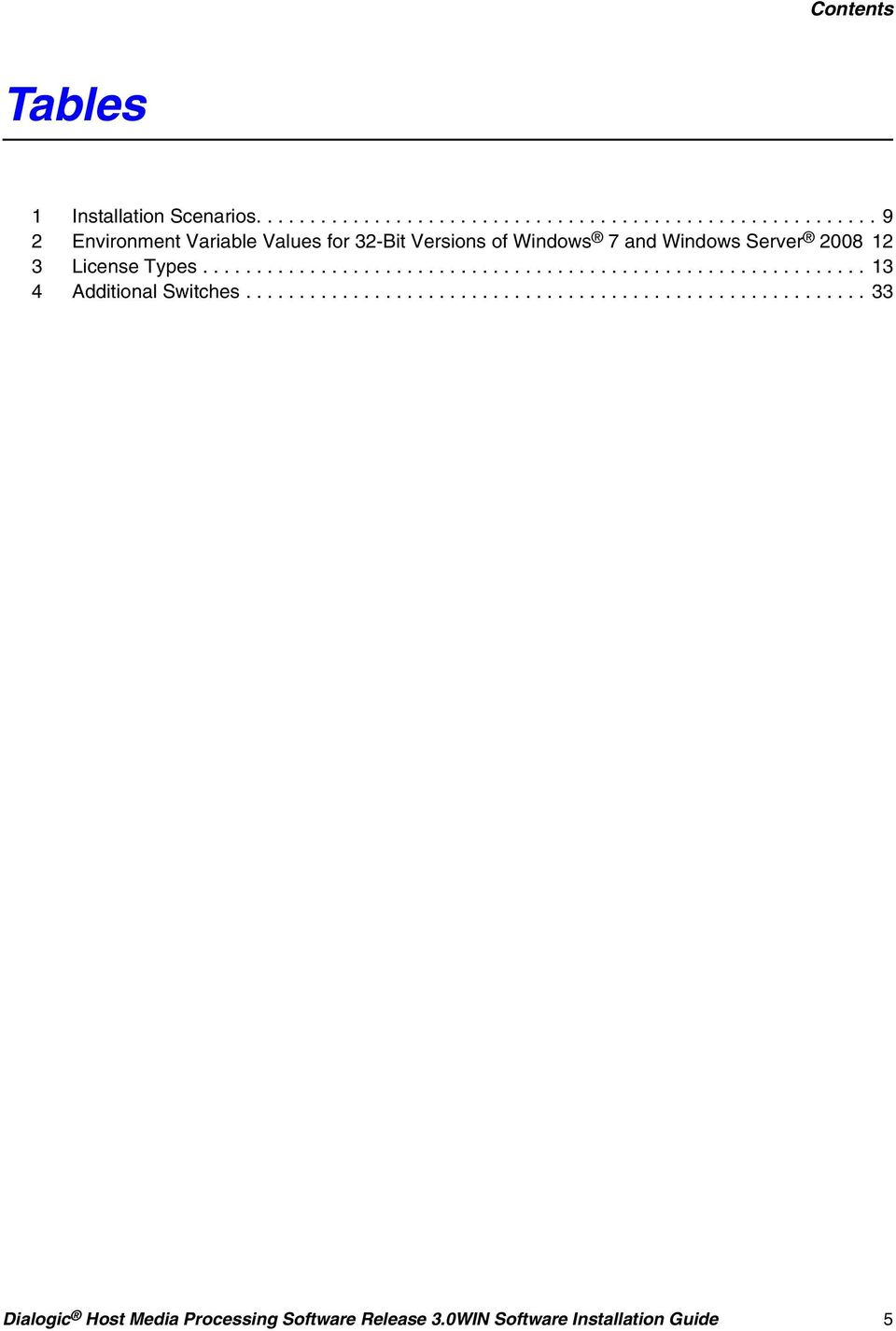
5 Contents Tables 1 Installation Scenarios Environment Variable Values for 32-Bit Versions of Windows 7 and Windows Server License Types Additional Switches Dialogic Host Media Processing Software Release 3.0WIN Software Installation Guide 5
6 Revision History This revision history summarizes the changes made in each published version of this document. Document No. Publication Date Description of Revisions February 2014 Installing the Dialogic HMP Software: Added note about default IP address in Verifying the Installation Using the Dialogic IP Media Server Demo March 2010 Added content to support the Windows 7 and Windows Server 2008 operating systems. Installation Overview: Updated Table 1, Installation Scenarios. Added a note regarding license compatibility and Windows 7 or Windows Server 2008 in Resource Licenses for Dialogic HMP Software. Added new section Environment Variables for Windows 7 and Windows Server Installing the Dialogic HMP Software: Under Performing a Full Install of the Software, added information about installing Dialogic HMP 3.0WIN software on Windows 7 or Windows Server 2008 operating systems. Troubleshooting: Updated APIC Timer description, added information about Physical Address Extension (PAE), and updated external links. Added a new section, High Precision Event Timer (HPET). Updated text in the APIC Timer Compatibility section. Added applicability note to Disabling the Windows Driver Signing Check. Updated external links. Removed IONA ORBacus; no longer supported December 2007 Made global changes to reflect Dialogic brand. Changed title to Dialogic Host Media Processing (HMP) Release 3.0WIN Software Installation Guide. Prerequisites for Dialogic HMP Software Installation: Added note about Dynamic Host Configuration Protocol (DHCP). Determining Which Features to Install: Added information about SS7 boards to Core Runtime Package bullet. Performing a Full Install of the Software: Added information about enabling DHCP service to the Check default IP address bullet. Performing an Update Install: Added information about enabling DHCP service to the Check default IP address bullet. Performing a Silent Install: Added information about enabling DHCP service to the Check default IP address bullet August 2006 About This Publication: In Purpose, added update install. In Related Information, added reference to the configuration guide. Installation Overview: Added update install. Changed Lock Code to MAC Address or Host ID. Installing the Dialogic HMP Software: Added update install. Removed mention of automatic CPU check. Performing an Update Install: New section. Performing a Silent Install: Revised the procedure in Creating an InstallShield Response File. Revised Usage Guidelines. Troubleshooting: In Error Messages, removed the CPU check error message. Added update install error message May 2006 Initial version of document. Dialogic Host Media Processing Software Release 3.0WIN Software Installation Guide 6

7 About This Publication The following topics provide information about this software installation guide: Purpose Applicability Intended Audience How to Use This Publication Related InformationSee the following for additional information: Purpose This guide explains how to perform the following: Install and uninstall Dialogic Host Media Processing (HMP) Software Release 3.0WIN Update an existing version of Dialogic HMP Software Release 3.0WIN Silently install the software Verify the installation by running a demo. Applicability This document version ( ) is published for Dialogic HMP Software Release 3.0WIN. Intended Audience This information is intended for: Distributors System Integrators Toolkit Developers Value Added Resellers (VARs) Original Equipment Manufacturers (OEMs) Dialogic Host Media Processing Software Release 3.0WIN Software Installation Guide 7

8 About This Publication How to Use This Publication This information is organized as follows: Chapter 1, Installation Overview describes the major installation steps in the order in which they are performed, giving an overview of the process. This chapter also provides information about licensing. Chapter 2, Installing the Dialogic HMP Software discusses the prerequisites for software installation and gives step by step procedures for performing interactive and silent installs of the Dialogic HMP Software. This chapter also describes how to verify proper installation by running a demo and how to add or remove installed features. Chapter 3, Uninstalling the Software describes how to uninstall the software. Chapter 4, Troubleshooting provides information about error messages and the log file for the installation, and describes how to repair an installation by re-installing it. Related Information Refer to the following for more information about the Dialogic HMP Software: For timely information that may affect installation and configuration, refer to the Release Guide and Release Update. For licensing and administration procedures, refer to the Administration Guide for this release. For additional information about FLEXnet licensing, refer to the FLEXnet Licensing End User Guide, which is available at: For detailed information about the verification demo included with the Dialogic HMP Software, refer to the Dialogic IP Media Server (Global Call) Demo Guide. For diagnostics information, refer to the Diagnostics Guide for this release. For information about using the SNMP agent software, refer to the Administration Guide for the SNMP agent software. For information about installing the Dialogic DNI and DSI boards supported by Dialogic HMP Software Release 3.0WIN, refer to the Quick Install Card provided with each Dialogic board. For detailed board configuration information, see the Dialogic Configuration Manager (DCM) online context-sensitive Help and the Dialogic Configuration Guide. See the following for additional information: (for Dialogic product documentation) (for Dialogic Service Center) (for Dialogic product information) 8 Dialogic Host Media Processing Software Release 3.0WIN Software Installation Guide

9 1.Installation Overview 1 This chapter provides the following information about installing Dialogic Host Media Processing (HMP) Software Release 3.0WIN: Choosing the Appropriate Installation Procedure Major Installation Steps Environment Variables for Windows 7 and Windows Server Resource Licenses for Dialogic HMP Software Choosing the Appropriate Installation Procedure You can perform either a full or update install of the Dialogic HMP Software Release 3.0WIN Software. The installation procedure you use depends on what is on your system. Table 1 shows the various installation scenarios. In all cases, you must meet the relevant prerequisites described in Section 2.1, Prerequisites for Dialogic HMP Software Installation, on page 15. The installation procedures listed in the table are links to the sections containing the procedures. Notes: 1. The update install gives you the latest software for the features that you selected when you did the full install of the Dialogic HMP Software Release 3.0WIN Software that is currently on your system. If you want an additional feature that wasn t previously installed (for example, Demos), first perform the update install and then perform the procedure in Section 2.7, Adding or Removing Installed Features, on page Windows 7 and Windows XP are desktop operating systems, and Windows Server 2008 and earlier are server operating systems. Table 1. Installation Scenarios If you have this on your system Windows 2003 or prior and are upgrading to Windows 7 or Windows Server 2008 Use this installation procedure Section 2.3, Performing a Full Install of the Software, on page 23 or Section 2.5, Performing a Silent Install, on page 29 Note: You must uninstall any version of Dialogic HMP Software Release and install Dialogic HMP Software 3.0WIN for Windows 7 or Windows Server A previous version of Dialogic HMP Section 2.4, Performing an Update Install, on page 27 Software 3.0 WIN for Windows or Section 2.5, Performing a Silent Install, on page 29 Note: An Update Install cannot be used when installing Windows 7 or Windows Server 2008 for the first time. No existing Dialogic HMP Software Section 2.3, Performing a Full Install of the Software, on page 23 or Section 2.5, Performing a Silent Install, on page 29 Dialogic Host Media Processing Software Release 3.0WIN Software Installation Guide 9

10 Installation Overview Table 1. Installation Scenarios If you have this on your system Dialogic HMP Software Release 2.0WIN or Dialogic HMP Software Release 1.3WIN Dialogic HMP Software Release 1.1WIN with a Feature Pack and/or Service Pack Use this installation procedure Section 2.3, Performing a Full Install of the Software, on page 23 or Section 2.5, Performing a Silent Install, on page 29 Note: You must uninstall Dialogic HMP Software Release 2.0WIN or Dialogic HMP Software Release 1.3WIN before installing Dialogic HMP Software Release 3.0WIN. Refer to Section 2.1.1, Uninstalling a Previous Release, on page 16. Section 2.3, Performing a Full Install of the Software, on page 23 or Section 2.5, Performing a Silent Install, on page 29 Note: You must uninstall Dialogic HMP Software Release 1.1WIN and the Feature Pack and/or Service Pack before installing Dialogic HMP Software Release 3.0WIN. Refer to Section 2.1.1, Uninstalling a Previous Release, on page Major Installation Steps Following are the major installation steps: 1. Before installing the Dialogic HMP Software, make sure that the system meets the hardware and software System Requirements as described in the Dialogic HMP Software Release Guide. 2. To install the software, you must have local administrative privileges. Contact your network administrator to set up administrative privileges as required. 3. If you have Dialogic HMP Software Release 2.0WIN or Dialogic HMP Software Release 1.3WIN (or earlier) on your system, or you are upgrading to Windows 7 or Windows Server 2008, you must uninstall the Dialogic HMP Software as described in Section 2.1.1, Uninstalling a Previous Release, on page Obtain a Dialogic HMP Software license. You can do this before or after you install the Dialogic HMP Software. A verification license supplied with the software will allow you to run the verification demo (IP Media Server Demo) to confirm that you have installed the Dialogic HMP Software properly. However, its features are limited and you will need to obtain another license. Refer to Section 1.4, Resource Licenses for Dialogic HMP Software, on page 12 for more information. Complete information and procedures for obtaining and working with licenses is provided in the Dialogic HMP Software Administration Guide. 5. Install the Dialogic HMP Software Release 3.0WIN software. Refer to one of the following procedures: Section 2.3, Performing a Full Install of the Software, on page 23 Section 2.4, Performing an Update Install, on page 27 Section 2.5, Performing a Silent Install, on page 29 If you are not sure about which installation procedure to use, refer to Section 1.1, Choosing the Appropriate Installation Procedure, on page Dialogic Host Media Processing Software Release 3.0WIN Software Installation Guide

11 Installation Overview 6. Optionally run the Dialogic IP Media Server demo to verify proper installation of the HMP Software. Refer to Section 2.6, Verifying the Installation Using the Dialogic IP Media Server Demo, on page 34. Separate Installation Media When you download the Dialogic HMP Software Release 3.0WIN software from the Dialogic Support web site, there will be two separate download links. One is for Windows 7 and Windows Server 2008, and the other is for Windows XP and Windows You must download and install the correct software for the operating system you are using. Installing the wrong software will be detected by the installation program and the program will exit. 1.3 Environment Variables for Windows 7 and Windows Server 2008 Environment variables are used to locate certain directories in the Dialogic HMP Software Release 3.0WIN software hierarchy. In order to meet User Account Control and File Virtualization security features of Windows 7 and Windows Server 2008, those files that may require user modification of some sort have been moved to a non-restricted target folder. It is strongly advised to keep them in this or other equivalent target location; otherwise, user modification of these files may be disallowed by the operating system. When installing Dialogic HMP Software Release 3.0WIN on Windows 7 or Windows Server 2008, you will be prompted to enter two directory locations (rather than one) for storing Dialogic HMP Software files: Choose Program File Destination Location This is the directory where non-user-modifiable files in the Dialogic HMP Software will be installed. The default location is: C:\Program Files\Dialogic for 32-bit versions of Windows 7 or Windows Server 2008 Choose User-Modifiable File Destination Location This is the directory where user-modifiable files in the Dialogic HMP Software will be installed. User-modifiable files include configuration files such as.prm and.cdp files, and demo programs, among others. The default location is C:\ProgramData\Dialogic. Note: C:\ProgramData is a hidden directory. Because the Dialogic HMP Software Release 3.0WIN files are installed under two directory locations with Windows 7 or Windows Server 2008, the associated environment variables are not the same as with other versions of the Windows operating system. Three additional variables are used to enable internal components to locate the non-modifiable cfg and data directories, and some of the other variables point to a different location for a Windows 7 or Windows Server 2008 installation (see Table 2). Dialogic Host Media Processing Software Release 3.0WIN Software Installation Guide 11
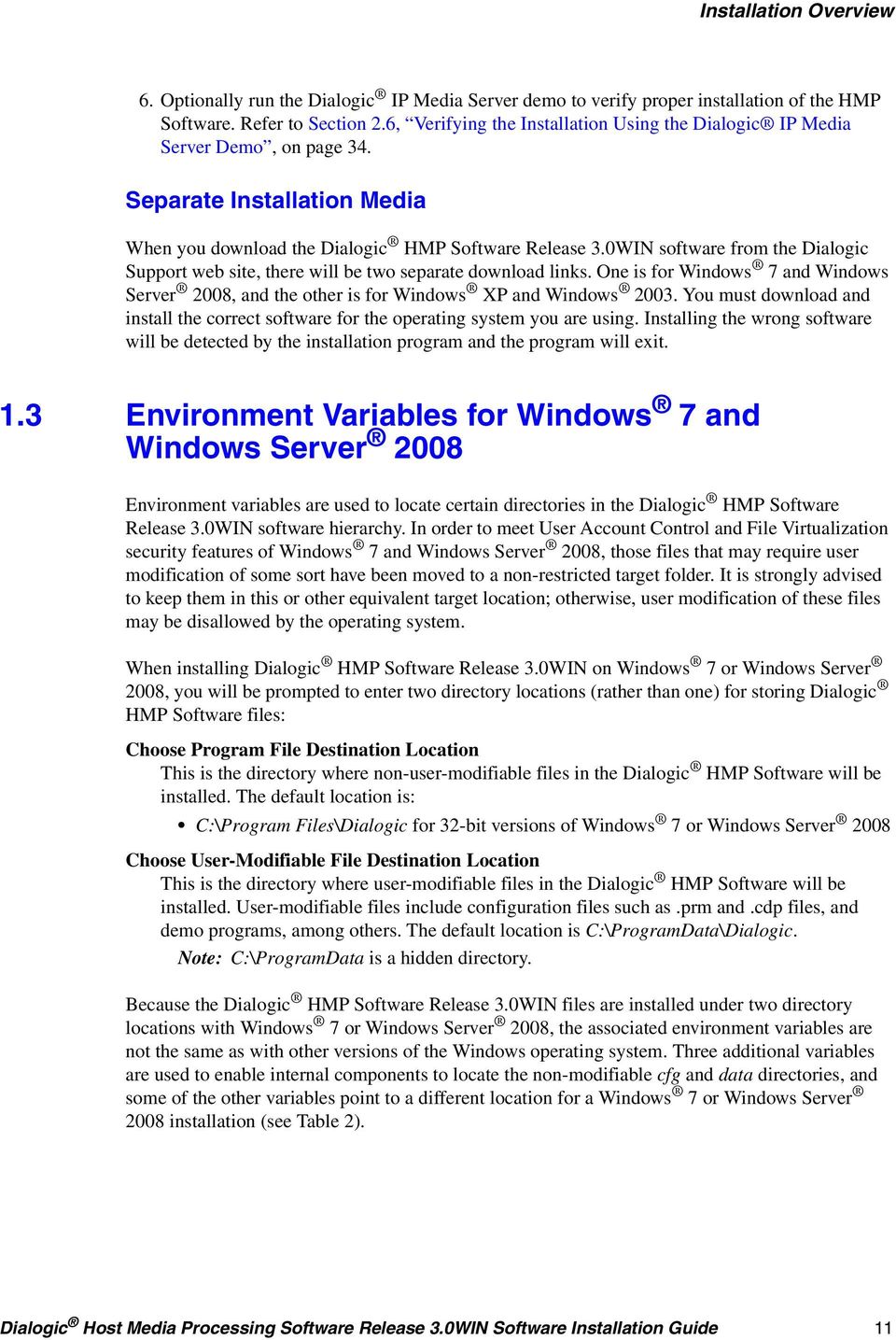
12 Installation Overview Table 2. Environment Variable Values for 32-Bit Versions of Windows 7 and Windows Server 2008 Environment Variable Old Default Value (for other versions of Windows OS) Windows 7 and Windows Server 2008 Default Value INTEL_DIALOGIC_DIR C:\Program Files\Dialogic Unchanged INTEL_DIALOGIC_BIN C:\Program Files\Dialogic\bin Unchanged INTEL_DIALOGIC_CFG C:\Program Files\Dialogic\cfg C:\ProgramData\Dialogic\cfg INTEL_DIALOGIC_FWL C:\Program Files\Dialogic\data C:\ProgramData\Dialogic\data INTEL_DIALOGIC_INC C:\Program Files\Dialogic\inc Unchanged INTEL_DIALOGIC_LIB C:\Program Files\Dialogic\lib Unchanged INTEL_DIALOGIC_QSCRIPT C:\Program Files\Dialogic\qscript Unchanged DIALOGIC_CFG_INTERNAL N/A C:\Program Files\Dialogic\cfg DIALOGIC_FWL_BIN N/A C:\Program Files\Dialogic\data DIALOGIC_USERDATA_DIR N/A C:\ProgramData\Dialogic 1.4 Resource Licenses for Dialogic HMP Software Before you use the Dialogic HMP Software and (optionally) the supported Dialogic Digital Network Interface (DNI) or Digital Station Interface (DSI) board types, you must obtain a license file 1 containing resource license data. A resource license is a file containing authorizations for a combination of call control and media processing features to be used with the Dialogic HMP Software. You can obtain a license file either before or after you install the Dialogic HMP Software and supported boards, but you need to obtain a license file before you can proceed with using the Dialogic HMP Software and supported boards. If you are using only the Dialogic HMP Software, the license will be associated with the host machine via its MAC address (or one of its MAC addresses, if more than one is available). The MAC address is referred to as the Host ID. If you are using one or more of the supported Dialogic DNI or DSI boards, the license will be associated with one of the boards. This is discussed in the Dialogic Host Media Processing Software Release 3.0WIN Administration Guide. Note: You cannot use old licenses from a previous Dialogic HMP Software release. You must obtain a new license for the current release. After you install the Dialogic HMP Software and (optionally) one or more of the supported Dialogic DNI or DSI boards, you must activate the license on the target system using a license management tool and the Dialogic Configuration Manager (DCM). The Dialogic Host Media 1. A verification license is installed with the Dialogic HMP Software, activated and ready to use, but this license is only intended to be used for verifying that the Dialogic HMP Software installation was successful (see Section 2.6, Verifying the Installation Using the Dialogic IP Media Server Demo, on page 34). 12 Dialogic Host Media Processing Software Release 3.0WIN Software Installation Guide

13 Installation Overview Processing Software Release 3.0WIN Administration Guide describes how to obtain and activate license files, as well as other administrative tasks. You can try out the Dialogic HMP Software and supported Dialogic boards with a verification, evaluation, or trial license before you purchase a permanent, production license from Dialogic. If a license file is lost or damaged, you can obtain a replacement for it. Table 3 shows the types of licenses available for use with Dialogic HMP Software. Table 3. License Types License Type Features Expires? Verification (free) 1 channel for RTP G.711 and Voice no Where to get license? included with Dialogic HMP Software 2 MAC Address (Host ID) or Board ID 1 Number Required? no Evaluation (free) 2 channels for all components expires in 45 days available from web site 3 no Trial (free) any supported channel component combination expires in 45 days Dialogic authorized distributor or account manager 4 yes - supply when ordering (refer to Dialogic HMP Software Administration Guide) Purchased any supported channel component combination no Dialogic authorized distributor or account manager yes - supply when ordering (refer to Dialogic HMP Software Administration Guide) Replacement replaces a Purchased license no Dialogic authorized distributor or account manager yes - supply when ordering (refer to Dialogic HMP Software Administration Guide) 1. For more information about the MAC Address (Host ID) or Board ID number, refer to the Dialogic HMP Software Administration Guide. 2. A license is supplied with the Dialogic HMP Software that allows you to run a verification demo (the IP Media Server demo). This demo verifies that you have set up HMP properly. For more information, refer to Section 2.6, Verifying the Installation Using the Dialogic IP Media Server Demo, on page An evaluation license is available from: 4. For a list of authorized distributors, go to: Note: For more information, refer to the Dialogic HMP Software Administration Guide. Licenses from Dialogic HMP Software 3.0WIN are compatible with Dialogic HMP Software Release 3.0WIN on Windows 7 or Windows Server Dialogic Host Media Processing Software Release 3.0WIN Software Installation Guide 13

14 Installation Overview 14 Dialogic Host Media Processing Software Release 3.0WIN Software Installation Guide

15 2.Installing the Dialogic HMP Software 2 This chapter gives detailed procedures for installing Dialogic Host Media Processing (HMP) Software Release 3.0WIN: Prerequisites for Dialogic HMP Software Installation Order of Procedures Performing a Full Install of the Software Performing an Update Install Performing a Silent Install Verifying the Installation Using the Dialogic IP Media Server Demo Adding or Removing Installed Features Prerequisites for Dialogic HMP Software Installation Before installing the software, make sure that the following prerequisites are met: Read the Release Guide and Release Update before starting the installation. The Release Guide can be found at The Release Guide contains information about hardware and software requirements for this release. The Release Update provides the latest information about any issues, restrictions, or limitations that may affect the installation. The Release Update also describes any significant changes to the release subsequent to the general availability date. For example, new features provided in Service Updates are described in the Release Update. The Release Update can be found at The Windows operating system must be installed. The supported operating systems include: Windows 7 Windows Server 2008 Service Pack 2 Windows XP Professional Windows Server 2003 (Standard and Enterprise Editions) Note: For information about the specific versions of the operating systems supported, refer to the Release Guide. Note: This software release is designed for U.S. English versions of the Windows operating system. System directory path names are often spelled using the native language. Therefore if you are using a language other than U.S. English, various manual file copy operations may be necessary to place files in directories with the expected path names. For assistance, please contact the support organization that services your country. Dialogic Host Media Processing Software Release 3.0WIN Software Installation Guide 15

16 Installing the Dialogic HMP Software A motherboard with a High Precision Event Timer (HPET) is required when using Dialogic HMP Software 3.0WIN with the Windows 7 or Windows Server 2008 operating systems. For the best compatibility, a motherboard with BIOS support for the HPET should be selected. On some older machines a BIOS update maybe required. Dialogic HMP Software provides support for some systems that do not have BIOS support in order to assist upgrading older installations. Run the HPET tool/utility to determine compatibility. For more information, refer to Section 4.4, High Precision Event Timer (HPET), on page 45. The Dynamic Host Configuration Protocol (DHCP) Windows Client Service, which is part of the Windows operating system, must be enabled in order to obtain the IP address before the Dialogic HMP Software starts. Also, the DHCP Client startup type should be set to Automatic. If it is set to the manual mode, the Dialogic HMP Software will not start until DHCP service is started manually. A supported CPU must be used. Refer to the Dialogic Host Media Processing Software Release 3.0WIN Release Guide for a list of supported CPUs. You should back up the drive on which you intend to install the Dialogic HMP Software. If you have a previous version of Dialogic HMP Software Release 3.0WIN on your system, you do not have to uninstall it. Install the new version of the software using the procedure in Section 2.4, Performing an Update Install, on page 27. However, if you are upgrading your operating system from a Windows release prior to Windows 7, then you must uninstall it as described in Section 2.1.1, Uninstalling a Previous Release, on page 16. If you have Dialogic HMP Software Release 2.0WIN or Dialogic HMP Software Release 1.3WIN on your system, you must uninstall it as described in Section 2.1.1, Uninstalling a Previous Release, on page 16. If you have Dialogic HMP Software Release 1.1WIN or earlier on your system (including a Feature Pack or Service Update, if applicable) on your system, you must uninstall it as described in Section 2.1.1, Uninstalling a Previous Release, on page 16. If you intend to use SNMP Agent Software for remote monitoring and administration of Dialogic HMP Software over an IP network, Windows SNMP service must be installed on the managed node(s). Refer to the Section 2.1.2, Installing and Configuring Windows SNMP Service, on page 17. TCP ports 1719, 1720, 5060, 12002, 12003, 12004, 20000, and must be available. Refer to Section 2.1.3, Checking TCP Port Availability, on page 19. For information about the options you can choose when installing the Dialogic HMP Software, refer to Section 2.1.4, Determining Which Features to Install, on page Uninstalling a Previous Release This section tells you how to uninstall a previous release of Dialogic HMP Software. If you need more information than what is given below, consult the uninstall procedure in the documentation provided with the previous release, Feature Pack, or Service Update. 16 Dialogic Host Media Processing Software Release 3.0WIN Software Installation Guide

17 Installing the Dialogic HMP Software Notes: 1. If you have a previous version of Dialogic HMP Software Release 3.0WIN on your system, you do not have to uninstall it. Install the new version of the software using the procedure in Section 2.4, Performing an Update Install, on page An Update Install can only be used pre-windows 7 operating systems. A Full Install must be used with the Windows 7 operating system. See Section 2.3, Performing a Full Install of the Software, on page 23. Dialogic HMP Software Release 2.0WIN or Dialogic HMP Software Release 1.3WIN If you have Dialogic HMP Software Release 2.0WIN or 1.3WIN on your system, you must uninstall it using the Add or Remove Programs utility found on the Windows Control Panel. Even if you installed a Service Update to either of these releases, the Dialogic HMP Software will show up as one item on the Add or Remove Programs utility and can be uninstalled as one item. Dialogic HMP Software Release 1.1WIN or Earlier If you have Dialogic HMP Software Release 1.1WIN or earlier on your system (including the Feature Pack and Service Update, if applicable), you must uninstall it using the Add or Remove Programs utility found on the Windows Control Panel. If you installed more than the base release of Dialogic HMP Software Release 1.1WIN, the Dialogic HMP Software will show up as more than one item on the Add or Remove Programs utility. You must uninstall the base release, Feature Pack, and Service Update in the reverse order of how they were installed. In other words, the last item installed should be the first item uninstalled. So you would remove the Service Update or Feature Pack first, and then remove the base release. You must reboot after each uninstall Installing and Configuring Windows SNMP Service Note: If you intend to use the SNMP agent software (for a description, see Section 2.1.4, Determining Which Features to Install, on page 20) and Windows SNMP Service has not already been installed, you must install and configure the Windows SNMP Service on both the managed node and the network management station before installing the Dialogic HMP Software release and SNMP agent software. If you uninstall and reinstall the Windows SNMP Service on the managed node, you will also have to uninstall and reinstall SNMP agent software. Installing SNMP Service The following steps describe how to install Windows SNMP service: 1. Invoke the Control Panel. 2. Select Add or Remove Programs. Dialogic Host Media Processing Software Release 3.0WIN Software Installation Guide 17

18 Installing the Dialogic HMP Software 3. Select Add/Remove Windows Components. The Windows Component Wizard is displayed. 4. Check the Management and Monitoring Tools box. 5. Click the Details button. 6. Check the Simple Network Management Protocol box and click OK. The Windows Component Wizard is redisplayed. 7. Click Next. You may be asked to insert the operating system CD. Proceed through the Windows Component Wizard until it has finished. Note: If your system has had a Windows service pack installed on it, you should reinstall the Windows service pack after installing SNMP service. Configuring SNMP Service Follow the steps below to configure Windows SNMP Service: 1. Invoke the Control Panel. 2. Select Administrative Tools. 3. Select Services. 4. Select SNMP Service. 5. Choose the Agent tab. 6. Enter Contact and Location. 7. Choose the Traps tab. 8. Enter Community Name: public. Note: In the interest of enhanced security, administrators may want to choose a less commonly used community string. 9. Click Add to List. 10. Under Trap Destinations, click Add and enter the IP address for each management node to receive trap notifications from this managed node. 11. Choose the Security tab. 12. Highlight the community name you set in Step 8 and click Edit. Change Community Rights to READ CREATE. 13. Stop SNMP Service (if started) and restart. 18 Dialogic Host Media Processing Software Release 3.0WIN Software Installation Guide

19 Installing the Dialogic HMP Software 14. Click OK. 15. Double click SNMP Trap Service. 16. Set Startup Type to Automatic. 17. Stop SNMP Trap Service (if started) and restart. 18. Click OK Checking TCP Port Availability Before you install the Dialogic HMP Software, you must make sure TCP ports 1719, 1720, 5060, 12002, 12003, 12004, 20000, and are available. These ports must be available for the Dialogic HMP Software to function properly. To check, follow this procedure: 1. On your desktop, right click the My Network Places icon and select Properties. The Network Connections window appears. 2. Right click Local Area Connection and select Properties. The Local Area Connection Properties window appears. 3. Select Internet Protocol (TCP/IP) and click the Properties button. The Internet Protocol (TCP/IP) Properties window appears. 4. Click the Advanced button on the bottom right of this window. The Advanced TCP/IP Settings window appears. 5. Select the Options tab, select TCP/IP filtering, and click the Properties button. 6. The TCP/IP Filtering window appears (see Figure 1). This window tells you which ports the system uses. Dialogic Host Media Processing Software Release 3.0WIN Software Installation Guide 19

20 Installing the Dialogic HMP Software Figure 1. TCP/IP Filtering 7. If the Enable TCP/IP Filtering checkbox is not checked, there is no filtering and all ports are valid. If the box is checked, make sure TCP ports 1719, 1720, 5060,12002, 12003, 12004, 20000, and are available Determining Which Features to Install When you install the Dialogic HMP Software, you will be asked to select features on the Select Features window. Before you install the software, you can read this section to familiarize yourself with the available options. The bold items in the following list are the features you can select. Text following each feature briefly describes it. Development Package (SDK) This option installs the programmatic APIs, libraries, and header files for Dialogic HMP Software, including call control, fax, and media. If you plan to write and compile applications without executing them using the runtime components, you can select this option alone. The Development Package option does not install the drivers, firmware, parameters, and other files needed for HMP at runtime. If you plan to develop applications and execute them you must also select this and the Core Runtime Package option. Core Runtime Package This option installs the device drivers, firmware, parameters, and other files needed to execute an application that uses Dialogic HMP Software Release 3.0WIN. Select this option if you plan to run pre-developed and pre-compiled applications on the system. You can select this option without selecting the Development Package (SDK) 20 Dialogic Host Media Processing Software Release 3.0WIN Software Installation Guide

21 Installing the Dialogic HMP Software option. If you plan to write and compile and execute applications you must also select the Development Package (SDK) option. Note: In most cases, if you select the Core Runtime Package, you should also select the License Package. The only exception is for advanced users who already have a FLEXnet licensing server and want to use it for licensing Dialogic HMP Software as well as other software applications. For more information, see the description of License Package. Note: The Core Runtime Package installs the SS7 functionality; however, you must install the SS7 software in order to have full SS7 functionality. The SS7 protocol stack and drivers for the SS7 boards are not included in the Dialogic software releases. They are part of a separate software package that must be installed and operational prior to starting board detection/initialization. This software package provides support for the Dialogic SS7HDP, SPCI4, and SPCI2S SS7 boards and can be downloaded from the following Dialogic Services Center web site. For more information about SS7 board support, refer to the Support for SS7 Functionality section in the Dialogic Host Media Processing Software Release 3.0WIN Release Update. For more information about SS7 configuration and initialization, see the Dialogic Global Call SS7 Technology Guide. Also, see the following Dialogic web site: m License Package This package combines a few components from the FLEXnet (third party) package with additional components (a vendor daemon) necessary to run a local standalone licensing server that can serve Dialogic HMP Software licenses. In most cases, you should select this option. It is possible to set up a single FLEXnet licensing server on a remote host to serve multiple hosts, some of which may be using FLEXnet licensing to protect packages other than Dialogic HMP Software. If you already have a FLEXnet licensing server that you want to use for licensing Dialogic HMP Software as well as other software applications, you do not need to select this option (and probably should not select it see the Note below). You will only need the vendor daemon and license files supplied separately during the Dialogic HMP Software Release 3.0WIN download. These files will only need to be used on your existing FLEXnet license server that will serve Dialogic HMP Software. Note: If you are using FLEXnet licensing for other products, you may not be able to use the License Package option and you must consult the FLEXnet Licensing End User Guide before installing Dialogic HMP Software Release 3.0WIN software and when setting up your system. The FLEXnet Licensing End User Guide is available at: Circuit Connectivity Runtime Package This option provides support for the following board groups: Dialogic DNI300TEPHMP, DNI601TEPHMP, and DNI1200TEPHMP boards Dialogic DSI162HMP, and DSI162LGNHMP boards You can also select either board group separately (Dialogic DNI boards or Dialogic DSI boards): Dialogic DNI Boards This option provides support for Dialogic DNI300TEPHMP, DNI601TEPHMP, and DNI1200TEPHMP boards. The Dialogic DNI boards are a plugin PCI card product based on Dialogic DM3 architecture and designed specifically to Dialogic Host Media Processing Software Release 3.0WIN Software Installation Guide 21
22 Installing the Dialogic HMP Software integrate up to four T1/E1 circuit network interfaces with the Dialogic HMP Software environment. This option includes the ISDN protocols and Global Call protocols. The Global Call Protocols provide analog and E1/T1 CAS/R2 protocols for a variety of countries and switches. If you select the Circuit Connectivity Runtime Package, both the Dialogic DNI and DSI board options are automatically selected, but if you are only using boards from one group, you can deselect the other. Dialogic DSI Boards This option provides support for the Dialogic DSI162HMP and DSI162LGNHMP boards. These are digital PBX interface boards designed to operate with either the Dialogic HMP Software via the CT bus in the HMP mode, or operate with traditional media processing boards in a CT Bus environment, independent of Dialogic HMP Software, in a stand alone mode. Used in combination with either the Dialogic HMP Software or traditional media processing boards, the Dialogic DSI162HMP and DSI162LGNHMP boards provide media server capability to the PBX for such applications as voice mail, auto-attendant, unified messaging, interactive voice response (IVR), speech recognition, and fax. If you select the Circuit Connectivity Runtime Package, both the Dialogic DNI and DSI board options are automatically selected, but if you are only using boards from one group, you can deselect the other. Demos Select this option to install all the Dialogic HMP demo applications. You must install the Core Runtime Package to be able to run the demos and the Development Package to be able to recompile them. However, it is not always necessary to recompile the demos. The following demos are included: Dialogic Audio Conferencing API (called Conference Demo on the Demos menu) Dialogic Conferencing using the cnf_api Dialogic Continuous Speech Processing (CSP) API (called CSP Demo on the Demos menu) Dialogic Global Call API (called GlobalCall Demo on the Demos menu) Dialogic IP Media Server Demo Dialogic IP Gateway (Global Call) (called Gateway Demo on the Demos menu) MSML Dialogic Multimedia Dialogic Voice (Ansrmt Demo, Voice Demo, Xaansr Demo) Demonstration programs are provided to demonstrate the functionality and features of HMP Software and serve as examples of application programming using the Dialogic HMP Software API libraries. All demo programs are supplied as source code you can modify to explore other capabilities of the products. All demo programs will be located in the \demos directory following installation of Dialogic HMP Software Release 3.0WIN. The demos can be accessed via Start > Programs > Dialogic HMP > Demos. Refer to the documentation provided for each demo. SNMP Component Manager Select this option to install the Management Information Bases (MIBs) required by an SNMP manager to remotely manage Dialogic HMP Software. This option is meant for a separate machine setup to be the remote SNMP manager of Dialogic HMP Software. This option is not required on the managed node (the Dialogic HMP Software being managed remotely via SNMP). The managed node will get what it needs 22 Dialogic Host Media Processing Software Release 3.0WIN Software Installation Guide
23 Installing the Dialogic HMP Software from the Core Runtime Package option. This option provides the following proprietary and standard MIBs: Hardware Information MIB Dialogic DM3 Extended Platform MIB DS-1 MIB - proprietary and standard (RFC 2495) ISDN MIB MIB-2 Module - standard (RFC 1213) R4 Device Information MIB Note: Because the Dialogic HMP Software user documentation is now available on the web, the documentation will no longer be available as an installable option (on the Select Features window) as it has been in the past. This is to ensure that only the most current documentation is accessed. When you install the Dialogic HMP Software, a shortcut to the web site containing the user documentation will be placed on the Start menu as follows: Start > Programs > Dialogic HMP > Documentation > User Documentation. Any user documentation that was installed with a previous release will be removed. 2.2 Order of Procedures The order of procedures for installing Dialogic HMP Software Release 3.0WIN is as follows: 1. Make sure all relevant prerequisites described in Section 2.1, Prerequisites for Dialogic HMP Software Installation, on page 15 are met. 2. Refer to Section 1.1, Choosing the Appropriate Installation Procedure, on page 9. Then install the software using one of the following procedures: Section 2.3, Performing a Full Install of the Software, on page 23. Section 2.4, Performing an Update Install, on page 27 Section 2.5, Performing a Silent Install, on page 29 For more information about the features you can install, refer to Section 2.1.4, Determining Which Features to Install, on page Performing a Full Install of the Software This section contains the procedure for performing a full install of Dialogic HMP Software Release 3.0WIN. If you have an older version of Dialogic HMP Software Release 3.0WIN on your system, use the procedure in Section 2.4, Performing an Update Install, on page 27. If you have an earlier version of Dialogic HMP Software on your system (Dialogic HMP Software Release 2.0WIN or Dialogic HMP Software Release 1.1WIN), you must uninstall it before installing Dialogic HMP Software Release 3.0WIN (refer to Section 2.1.1, Uninstalling a Previous Release, on page 16). Notes: 1. Make sure you ve satisfied all the prerequisites before installing the software. Prerequisites are described in Section 2.1, Prerequisites for Dialogic HMP Software Installation, on page 15. Dialogic Host Media Processing Software Release 3.0WIN Software Installation Guide 23
24 Installing the Dialogic HMP Software For more information about the features you can install, refer to Section 2.1.4, Determining Which Features to Install, on page If you had a previous Dialogic System Software release or Dialogic HMP Software release installed (and you uninstalled it), a cleanup utility will run automatically as the install runs. For more information about this utility, see Section 4.9, Uninstall Cleanup Utility, on page You may see a Security Alert - Driver Installation message during installation. This is just a warning message, and Dialogic HMP Software will install properly after you click Yes. For more information, refer to Security Alert - Driver Installation in Section 4.2, Error Messages, on page 41. If you want to prevent this message from appearing, refer to Section 4.6, Disabling the Windows Driver Signing Check, on page 46. The Dialogic HMP Software Release 3.0WIN software can be downloaded from the web site. When you select this link, you will be asked to either LOGIN or JOIN. Note: When you download Dialogic HMP Software Release 3.0WIN from the Dialogic Service Center web site, note that there is a separate link for downloading the software version for Windows 7. This media is also used for installation under Windows Server After downloading the software, use the following procedure to install Dialogic HMP Software. 1. Exit all other programs you may have running. You can double-click on autorun.exe to get the navigation window described in Step 2 or if you just want to start the installation, you can double-click the setup.exe file (in that case, skip to Step 3). 2. When you are ready to proceed with the installation, click on Install Software. If an earlier release of Dialogic HMP Software or any Dialogic System Software release is on your system, the install will detect it and a message will appear telling you to uninstall it. The install will abort so you can uninstall the older release. Then you must restart the install. 3. The Welcome window appears. It shows the version of the software you are installing. Click Next. Note: The build number of the software is provided in the buildinfo.ini file located in the \Dialogic\HMP\...\ini directory. 4. The Choose Destination Location window appears. To install to the folder already named on the window, click Next. To install to a different folder, click Browse and select another folder. Then click Next. Note: The \Dialogic\HMP path sequence will be appended to the destination folder you select. Note: For Windows 7 or Windows Server 2008, you are prompted to enter two directory locations (rather than one) for storing Dialogic HMP Software files. Refer to Step 7b. for more information. 24 Dialogic Host Media Processing Software Release 3.0WIN Software Installation Guide
25 Installing the Dialogic HMP Software 5. The Select Features window appears. When you click on an item in the list, a brief description of it appears on the right side of the window. Descriptions of these features are also provided in the install s online help (press F1 to access it) and in Section 2.1.4, Determining Which Features to Install, on page 20. Select the features you want by clicking boxes to put check marks in them. Then click Next. 6. If you select the Core Runtime Package, you ll see a question popup that tells you which third party software the setup will install: Tcl/TK Version Tcl (Tool Command Language) is a scripting language for a wide variety of integration application needs: build a GUI, embed Tcl in your application, create a multi-threaded application, or develop a cross-platform program. For more information, go to the Tcl Developer Xchange web site: Xerces XML Version 1.1 Xerces provides XML parsing and generation. For more information, go to ICU Support Libraries Version The International Components for Unicode (ICU) libraries provide robust and full-featured Unicode services on a wide variety of platforms. ICU supports the most current version of the Unicode standard, and they provide support for supplementary Unicode characters (needed for GB repertoire support). ICU is an open source development project sponsored, supported, and used by IBM. For more information, go to FLEXnet Publisher Licensing Toolkit Version A few components from this third party software are combined with additional components (a vendor daemon) necessary to run a local standalone licensing server that can serve Dialogic HMP Software licenses. For more information, refer to Section 2.1.4, Determining Which Features to Install, on page 20 and go to Red Hat Cygwin Version For more information, go to Microsoft MFC/Other Redistributables Version 6.2 For more information, go to Note: Version 8 is required for Windows 7 and Windows Server To continue with the install, click Yes. To exit the install, click No. 7. The Select Program Folder window shows the Program Folder where the installation will add program icons. You can accept the default folder name, type a new folder name, or select a folder from the existing folders list. Click Next to continue. 7a. For all supported versions of the Windows operating system except Windows 7 or Windows Server 2008, the Choose Destination Location window appears. To install to the folder already named on the window, click Next. To install to a different folder, click Browse and select another folder. Then click Next. Continue with Step 9. 7b. For Windows 7 or Windows Server 2008, you are prompted to enter two directory locations (rather than one) for storing Dialogic HMP Software files: Choose Program File Destination Location - This is the directory where non-usermodifiable files in the Dialogic HMP Software will be installed. Dialogic Host Media Processing Software Release 3.0WIN Software Installation Guide 25
26 Installing the Dialogic HMP Software Choose User-Modifiable File Destination Location - This is the directory where usermodifiable files in the Dialogic HMP Software will be installed. For further information about the use of these directory locations when using Windows 7 and Windows Server 2008, see Environment Variables for Windows 7 and Windows Server 2008 in Chapter 1, Installation Overview. To install to the folder already named on the window, click Next. To install to a different folder, click Browse and select another folder. Then click Next. Continue with Step The Start Copying Files window shows you a summary of the features you ve selected. If you re satisfied with them, click Next to start copying files. If you want to make changes, click Back to go to a previous window. 9. A Setup Status window will show the progress of the installation. This window also shows you what is being installed and where it is being installed. Note: The Setup Status window will indicate that all files are being installed. This is not actually the case. Files that have changed will be updated based on version/timestamp. The InstallShield engine processes each file that was previously installed and compares the version/timestamp on the system to that in the build. If the file in the build has a higher version number or later timestamp, then the file will be installed. Otherwise, the InstallShield engine skips to the next file. The Setup Status window incorrectly indicates that all files are being installed. This is a known issue with InstallShield Software. Note: Right before the file copying starts, the setup will run a cleanup utility where old content possibly left from a previous release will be detected and removed. For more information about the cleanup utility, refer to Section 4.9, Uninstall Cleanup Utility, on page The Setup Complete window displays after all the files are copied onto your hard drive. This window will indicate whether a reboot is required. If a reboot is required, you must choose whether you want to reboot now or later. (If you choose to reboot later you must manually reboot the system before the installation will be complete.) If you installed the software from a CD, remove it from the drive. Click Finish to complete the installation process. Note: A reboot will be required if the Core Runtime Package was installed. After you install the Dialogic HMP Software, you can do the following: Verify that you have set up the Dialogic HMP Software properly. Refer to Section 2.6, Verifying the Installation Using the Dialogic IP Media Server Demo, on page 34. This activity is optional, but recommended. Obtain, install, and activate a license. Refer to the Dialogic Host Media Processing Software Release 3.0WIN Administration Guide. This step is required. You must do this before you can use the Dialogic HMP Software. Check the default IP address to make sure it is suitable for your needs (refer to the Dialogic Host Media Processing Software Release 3.0WIN Administration Guide). On systems that have multiple NICs with multiple IPs, it is possible that the default IP address picked by the Dialogic HMP Software may not be the IP address best suited for your purposes. Therefore, after installation, reboot, and before starting Dialogic HMP Software, you should check the default IP address and change it, if necessary, to suit your specific needs. The system will 26 Dialogic Host Media Processing Software Release 3.0WIN Software Installation Guide
27 Installing the Dialogic HMP Software remember the selected default IP address and associated NIC controller so you do not need to check the address on subsequent reboots unless you want to assign a different default IP address. Also, the IP address used by the Dialogic HMP Software is obtained by the DHCP Windows Client Service before the Dialogic HMP Software starts. Be sure that DHCP is enabled on your system. Start the Dialogic Configuration Manager (DCM). The DCM will detect the Dialogic HMP Software and automatically find the licensed configuration settings. DCM also allows you to start the Dialogic HMP Software. This step is required. You must do this before you can use the Dialogic HMP Software. For more details, refer to the Dialogic Host Media Processing Software Release 3.0WIN Administration Guide. 2.4 Performing an Update Install If you have an existing version of Dialogic HMP Software Release 3.0WIN on your system and want to update it with a later version of Dialogic HMP Software Release 3.0WIN, follow the procedure in this section. However, you cannot upgrade from one major release to another. So if you have Dialogic HMP Software Release 2.0WIN or Release 1.1 on your system, you cannot upgrade to Dialogic HMP Software Release 3.0WIN. You must uninstall any earlier major release (see Section 2.1.1, Uninstalling a Previous Release, on page 16) and then use the procedure in Section 2.3, Performing a Full Install of the Software, on page 23. The update install gives you the latest software for the features that you selected when you did the full install of the Dialogic HMP Software Release 3.0WIN that is currently on your system. If you want an additional feature that wasn t previously installed (for example, Demos), first perform the update install and then perform the procedure in Section 2.7, Adding or Removing Installed Features, on page 35. Note: Make sure you ve satisfied all the relevant prerequisites before installing the software. Prerequisites are described in Section 2.1, Prerequisites for Dialogic HMP Software Installation, on page 15. For information about the various installation scenarios, refer to Section 1.1, Choosing the Appropriate Installation Procedure, on page 9. For more information about the features you can install, refer to Section 2.1.4, Determining Which Features to Install, on page Exit all other programs you may have running. If Dialogic HMP Software is currently running, close all telephony applications that are currently running in the system and stop the system. The Dialogic HMP Software is stopped using the DCM. From the DCM main window, click the Stop System option from the System pull-down menu or click the Stop All Enabled Devices icon. Then close DCM by clicking the close button at the upper right corner of the DCM window. Note: Make sure you also perform the above step and close the DCM from every remote connection (if applicable). If you do not stop the Dialogic HMP Software, setup will automatically stop the Dialogic HMP Software. However, if DCM is still open, setup will inform you with a popup message that it is open, and exit. At that point, you can close DCM and restart the installation procedure. Dialogic Host Media Processing Software Release 3.0WIN Software Installation Guide 27
28 Installing the Dialogic HMP Software 2. Download the Dialogic HMP Software Release 3.0WIN software from the Dialogic Service Center web site. Note: When you download Dialogic HMP Software Release 3.0WIN from the Dialogic Service Center web site, note that there is a separate link for downloading the software version for Windows 7. This media is also used for installation under Windows Server If you download the software from the web site, you can double-click on autorun.exe to get the navigation window described in Step 3 or if you just want to start the installation, you can double-click the setup.exe file (in that case, skip to Step 4). 3. A navigation window appears, giving you options such as viewing the user documentation on the web, installing the Dialogic HMP Software, or going to the Dialogic Service Center web site. When you are ready to proceed with the installation, click on Install Software. 4. The Welcome window appears. It shows the version number of the currently installed software and the version number of the software that you are about to install. Click Next. 5. The Start Copying Files window appears. This window shows you the components (features) that are currently installed. These components will be updated. If you want to add or remove any components, finish the update install first, then use the procedure in Section 2.7, Adding or Removing Installed Features, on page 35. To start updating the software, click Next. 6. A Setup Status window will show the progress of the installation. This window also shows you what is being installed and where it is being installed. Note: The Setup Status window will indicate that all files are being installed. This is not actually the case. Files that have changed will be updated based on version/timestamp. The InstallShield engine processes each file that was previously installed and compares the version/timestamp on the system to that in the build. If the file in the build has a higher version number or later timestamp, then the file will be installed. Otherwise, the InstallShield engine skips to the next file. The Setup Status window incorrectly indicates that all files are being installed. This is a known issue with InstallShield Software. 7. The Update Complete window displays after all the files are copied onto your hard drive. This window will indicate whether a reboot is required. If a reboot is required, you must choose whether you want to reboot now or later. (If you choose to reboot later you must manually reboot the system before the install will be complete.) If you installed the software from a CD, remove it from the drive.click Finish to complete the installation process. Note: A reboot will be required if the Core Runtime Package was installed. After you install the Dialogic HMP Software, you can do the following: Verify that you have set up the Dialogic HMP Software properly. Refer to Section 2.6, Verifying the Installation Using the Dialogic IP Media Server Demo, on page 34. This activity is optional, but recommended. 28 Dialogic Host Media Processing Software Release 3.0WIN Software Installation Guide
29 Installing the Dialogic HMP Software Obtain, install, and activate a license. Refer to the Dialogic Host Media Processing Software Release 3.0WIN Administration Guide. This step is required. You must do this before you can use the Dialogic HMP Software. Check the default IP address to make sure it is suitable for your needs (refer to the Dialogic Host Media Processing Software Release 3.0WIN Administration Guide). On systems that have multiple NICs with multiple IPs, it is possible that the default IP address picked by the Dialogic HMP Software may not be the IP address best suited for your purposes. Therefore, after installation, reboot, and before starting Dialogic HMP Software, you should check the default IP address and change it, if necessary, to suit your specific needs. The system will remember the selected default IP address and associated NIC controller so you do not need to check the address on subsequent reboots unless you want to assign a different default IP address. Also, the IP address used by the Dialogic HMP Software is obtained by the DHCP Windows Client Service before the Dialogic HMP Software starts. Be sure that DHCP is enabled on your system. Start the DCM. DCM will detect the Dialogic HMP Software and automatically find the licensed configuration settings. DCM also allows you to start the Dialogic HMP Software. This step is required. You must do this before you can use the Dialogic HMP Software. For more details, refer to the Dialogic Host Media Processing Software Release 3.0WIN Administration Guide. 2.5 Performing a Silent Install This section contains the following information: Introduction Creating an InstallShield Response File Using the InstallShield Response File Usage Guidelines Defining the Destination Directory Introduction Note: Response files provide canned responses, making it possible to perform a Dialogic HMP Software installation without human intervention. Response files can be used to run in any install mode (install, uninstall, upgrade, modify, repair, removal). Response files have not been provided with this release since installs can vary, so you must create your own response file. The procedures in this section describe how to create and use a response file that is specific to your particular needs. A Security Alert - Driver Installation message may appear during installation. Therefore, if you want to perform a silent install, you must disable the Windows Driver Signing check. Refer to Section 4.6, Disabling the Windows Driver Signing Check, on page 46. Dialogic Host Media Processing Software Release 3.0WIN Software Installation Guide 29
30 Installing the Dialogic HMP Software Creating an InstallShield Response File This procedure describes how to create an InstallShield response file, which is named setup.iss and is recorded to your Windows directory (environment variable %WINDIR%) by default. The response file captures all your responses during an interactive install. Once you create this file, you can use it on other machines to silently install the software the same way you installed the software when you created the response file. Note: You can give the response file a name other than setup.iss and have it recorded to another directory. To do this, specify the new name and path by using the /f1 option on the command line (See Step 3 below). If you just specify a name and not a path, the response file will be recorded to your Windows directory as the name you specified. You must then also use the /f1 option during the silent install as described in Section 2.5.3, Using the InstallShield Response File, on page Open a Windows command prompt. 2. Change into the root directory of the Dialogic HMP Software build media which is where setup.exe is located. 3. Depending on where you want response file recorded, run one of the following commands: setup /r This command records the response file to the default location and gives it the default name. setup /r /f1".\hmp.iss" This command names the response file hmp.iss and records it to the current directory. setup /r /f1"c:\hmp.iss" This command names the response file hmp.iss and records it to a specific directory. 4. Proceed through the interactive installation dialogs, making whatever selections you want captured in the response file, including rebooting the computer, if you want that action captured. Note: Do not choose to reboot if you do not want the setup to reboot the system after the silent installation of the Dialogic HMP Software is complete. For example, if you plan to invoke the installation of Dialogic HMP Software from within another setup program, you should not choose to reboot when you are creating the response file. 5. Once the installation has completed, the response file, setup.iss, will be present in your Windows directory (typically C:\Windows). The response file name and location will depend on the command line executed in Step If you chose to install the Core Runtime Package when generating the response file, then you must edit the response file to remove the following lines. Otherwise, the Core Runtime Package will not be installed. Runtime-type=string Runtime-count=1 Runtime-0=Runtime\MFC 6.2 Runtime This step is necessary due to a bug in InstallShield when generating a response file. 30 Dialogic Host Media Processing Software Release 3.0WIN Software Installation Guide
31 Installing the Dialogic HMP Software 7. You can optionally move the setup.iss response file into the root of the build media. If you do this, you won t have to specify the location of the response file when you enter the command that silently installs the Dialogic HMP Software (described in the next section). However, in this case you must not change the name of the response file. You must keep the default name: setup.iss. To use this response file to install the Dialogic HMP Software Release 3.0WIN software, follow the procedure in Section 2.5.3, Using the InstallShield Response File, on page Using the InstallShield Response File This section describes how to use the InstallShield response file you created with the procedure given in Section 2.5.2, Creating an InstallShield Response File, on page 30. Note: This procedure uses the default response filename setup.iss. If you have used a different name for the response file, make sure you use that name in any commands. 1. Open a Windows command prompt and change into the root directory of the Dialogic HMP Software build media, which is where setup.exe is located. 2. Depending on where the setup.iss file is located, you will run one of the following commands: If setup.iss is in the root directory of the build media, run setup /s /f2 <LOGDIR>\setup.log where <LOGDIR> is the directory in which the setup.log file will be created.the path to the log file must be to a pre-existing directory. It can be any directory that is writable to the user installing the software. Here is an example of this command: setup /s /f2 c:\temp\setup.log If setup.iss is NOT in the root directory of the build media, run setup /s /f1 <ISSDIR>\setup.iss /f2 <LOGDIR>\setup.log where <ISSDIR> is the directory in which setup.iss (the response file) is located and where <LOGDIR> is the directory in which the setup.log file will be created. It can be any directory that is writable to the user installing the software. Here is an example of this command: setup /s /f1 c:\winnt\hmp.iss /f2 c:\temp\setup.log The /f1 option lets you specify the location and name of the response file, which you must do if you change the name from the default (setup.iss). In the example above, hmp.iss is being used instead of setup.iss. Here is an example of how the command might look if you rename the response file, but still put it in the root of the build media (in the same directory as setup.exe): setup /s /f1.\hmp.iss /f2 c:\temp\setup.log For more information about setup.exe command line options, go to Dialogic Host Media Processing Software Release 3.0WIN Software Installation Guide 31
32 Installing the Dialogic HMP Software 3. Since this is a silent install, there will be no immediate, obvious way of telling whether the command you just entered is installing the software. However, you can look at one or both of the following to check the status: the InstallShield log file you created (named setup.log by default) in the previous step using the /f2 option the installation log file located in %TEMP%\DlgcInstall.log For more information, refer to Section 4.3, Installation Log Files, on page 44. To verify that the install is complete, look for a success/failure value under the following registry key: HKEY_LOCAL_MACHINE\SOFTWARE\DIALOGIC\SystemInformation The two possible values are DlgcInstallSuccess or DlgcInstallError. Note: To view the registry key, open a Windows DOS command window and enter the regedit command. 4. Your computer will be rebooted automatically after the software is installed if you chose that option when you created the response file. If you did not choose to reboot when creating the response file, and if you installed the Core Runtime Package, you will have to reboot the computer manually before using the DCM to start Dialogic HMP Software. After you install the Dialogic HMP Software, you can do the following: Verify that you have set up the Dialogic HMP Software properly. Refer to Section 2.6, Verifying the Installation Using the Dialogic IP Media Server Demo, on page 34. This activity is optional, but recommended. Obtain, install, and activate a license. Refer to the Dialogic Host Media Processing Software Release 3.0WIN Administration Guide. This step is required. You must do this before you can use the Dialogic HMP Software. Check the default IP address to make sure it is suitable for your needs (refer to the Dialogic Host Media Processing Software Release 3.0WIN Administration Guide). On systems that have multiple NICs with multiple IPs, it is possible that the default IP address picked by the Dialogic HMP Software may not be the IP address best suited for your purposes. Therefore, after installation, reboot, and before starting Dialogic HMP Software, you should check the default IP address and change it, if necessary, to suit your specific needs. The system will remember the selected default IP address and associated NIC controller so you do not need to check the address on subsequent reboots unless you want to assign a different default IP address. Also, the IP address used by the Dialogic HMP Software is obtained by the DHCP Windows Client Service before the Dialogic HMP Software starts. Be sure that DHCP is enabled on your system. Start the DCM. The DCM will detect the Dialogic HMP Software and automatically find the licensed configuration settings. DCM also allows you to start the Dialogic HMP Software. This step is required. You must do this before you can use the HMP Software. For more details, refer to the Dialogic Host Media Processing Software Release 3.0WIN Administration Guide. 32 Dialogic Host Media Processing Software Release 3.0WIN Software Installation Guide
33 Installing the Dialogic HMP Software Usage Guidelines The installation options are implemented by means of command-line parameters input to setup.exe, which is located in the root directory of the Dialogic HMP Software. Additional switches are as described in Table 4. Following are some usage guidelines: Do not leave a space between command line switches and options. Setup.exe command line tokens and switches are not case sensitive. Using the /s switch will cause the script to run without any screen output. When using the /s option, a log file is created in the same folder as the response file (setup.iss). The log file has the default name setup.log if the /f2 switch is not provided along with /f1. If the /f1 switch is not used when using the /s option, setup looks for the response file setup.iss in the same folder as setup.exe. A log file is created in the same folder. When using the /f1 or /f2 option, the <path> specified must exist before running the setup program. If the path does not exist, the setup program will fail. By default, the installation directory will be C:\Program Files\Dialogic\HMP. Refer to Section 2.5.5, Defining the Destination Directory, on page 34 for information on defining the destination directory. Table 4. Additional Switches Additional Switches Description /r Record mode In order to run a Standard-project installation program in silent mode, one must first run Setup.exe with the /r switch to generate a response file, which stores information about the data entered and options selected by the user at run time. Running a Standard installation program with the command Setup.exe /r displays all the runtime dialog boxes, and stores the data in a file called Setup.iss, generated inside the system's Windows folder. To specify an alternative response file name and location, use the /f1 argument, described below. /s Silent mode Install silently (i.e., without any screen output) The command Setup.exe /s runs the installation in silent mode, by default based on the responses contained in a response file called Setup.iss in the same directory (response files are generated by running Setup.exe with the /r option). To specify an alternative file name or location of the response file, use the /f1 option, described below. /f1<path\responsefile> Specifies an alternate location and name of the response file (.iss file). If this option is used with the /s option, the response file (e.g., setup.iss) is read from the folder/file specified by <path\responsefile>. Using the /f1 argument allows one to specify where the response file is (or where it should be generated) and what its name is, as in Setup.exe /s /f1"c:\temp\setup.iss". The /f1 switch is available both when creating a response file (with the /r option) and when using a response file (with the /s option). Dialogic Host Media Processing Software Release 3.0WIN Software Installation Guide 33
34 Installing the Dialogic HMP Software Table 4. Additional Switches (Continued) Additional Switches /f2<path\logfile> Description Specifies an alternate location and name of the log file created when used with the /s option. By default, the log file (setup.log) is created and stored in the same directory as that of setup.exe. This option must be used when the setup program is invoked from a read-only medium (e.g., CD-ROM). When running a Standard-project installation program in silent mode (using the /s argument), the log file Setup.log is generated by default in the same directory as the response file. The /f2 argument allows one to specify an alternative log file location and file name, as in Setup.exe /s /f2"c:\setup.log" Defining the Destination Directory The DIR keyword lets you specify a destination directory for the installation other than the default of C:\Program Files\Dialogic\HMP. The specified directory will be created if it doesn t exist. If it does exist, any existing files with the same names as the files being installed will be overwritten. The usage is as follows: SETUP DIR(<destination directory>)dir /s /f2<path\logfile> where <destination directory> identifies an absolute path to which the setup program will install. Destination Directory Example SETUP DIR(a:\somepath)DIR /s /f2 a:\somedir\somedir.log This example creates the directory a:\somepath and logs setup information to a:\somedir\somedir.log. 2.6 Verifying the Installation Using the Dialogic IP Media Server Demo If you would like to verify that you have set up the Dialogic HMP Software properly, you can run the Dialogic IP Media Server Demo. Note: This step is optional, but recommended. If you want to skip this step, the next thing to do is obtain, install, and activate a license. Refer to the Dialogic Host Media Processing Software Release 3.0WIN Administration Guide for details. 34 Dialogic Host Media Processing Software Release 3.0WIN Software Installation Guide
35 Installing the Dialogic HMP Software To run the verification demo (the Dialogic IP Media Server demo), perform the following: 1. Use the DCM to start the Dialogic HMP Software. DCM will detect the verification license that will allow you to use the demo. This verification license was automatically installed and activated when you installed the Dialogic HMP Software. The DCM can be accessed from the Windows Start menu (Start > Programs > Dialogic HMP > Configuration Manager - DCM). Once you see the main DCM window, click on the button with the green triangle. This will start the Dialogic HMP Software. If you need more information about starting DCM or using the DCM GUI, refer to the Dialogic Host Media Processing Software Release 3.0WIN Administration Guide. 2. Start the Dialogic IP Media Server Demo. The Dialogic IP Media Server Demo can be started from the Windows Start menu (Start > Programs > Dialogic HMP > Demos > IP Media Server Demo). 3. After you start the demo, a command prompt window will open and you will see the demo. The demo is short and simple and in this context is intended only to confirm that you have properly installed the Dialogic HMP Software. No input is required from you until you are prompted to quit the demo by entering q. If the demo does not run, check to make sure you have started the Dialogic HMP Software. The main DCM window should have a status message of Running at the bottom. If the demo still does not run in a manner similar to Figure 2, the Dialogic HMP Software may not be installed properly. Consult Section 4, Troubleshooting, on page 41or the Dialogic Service Center web site. For more details about this demo, refer to the Dialogic IP Media Server Demo Guide. However, you do not need to refer to the Demo Guide if you are only running this demo to verify the installation. Note: After you verify the installation by running the Dialogic IP Media Server Demo, you must obtain, install, and activate an evaluation, trial, or purchased license. Refer to the Dialogic Host Media Processing Software Release 3.0WIN Administration Guide. On systems that have multiple NICs with multiple IPs, it is possible that the default IP address picked by the Dialogic HMP Software system may not be the IP address best suited for your purposes. Therefore, after installation and before starting the Dialogic HMP Software, you should check the default IP address and change it, if necessary, to suit your specific needs. The system will remember the selected default IP address and associated NIC controller so you do not need to check the address on subsequent reboots unless you want to assign a different default IP address. Refer to Section 6.1 in the Dialogic Host Media Processing Software Release 3.0WIN Administration Guide for more information. 2.7 Adding or Removing Installed Features If you want to add or remove the features you chose when you installed Dialogic HMP Software Release 3.0WIN, use one of the following procedures: Using Add/Remove Programs Dialogic Host Media Processing Software Release 3.0WIN Software Installation Guide 35
36 Installing the Dialogic HMP Software Rerunning the Setup Program Notes: 1. It is recommended that you back up the drive on which the software is installed before you proceed. 2. A log file captures what happens during this process. For more information, refer to Section 4.3, Installation Log Files, on page Using Add/Remove Programs To add and/or remove programs using Add/Remove Programs, follow this procedure: 1. If Dialogic HMP Software is currently running, close all telephony applications that are currently running in the system and stop the system. The HMP system is stopped using the DCM. From the DCM main window, click the Stop System option from the System pulldown menu or click the Stop All Enabled Devices icon. Then close DCM by clicking the close button at the upper right corner of the DCM window. Note: Make sure you also perform the above step and close the DCM from every remote connection (if applicable). If you do not stop the Dialogic HMP Software, setup will automatically stop the Dialogic HMP Software. However, if DCM is still open, setup will inform you with a popup message that it is open, and exit. At that point, you can close DCM and restart the installation procedure (to add or remove features). 2. Invoke the Control Panel and select Add/Remove Programs. In the list of currently installed programs, select the name of the Dialogic HMP Software release. 3. Click Change. 4. The Select Features window will appear. The items that are already installed will be checked. Select additional items or de-select (un-check) items. Note that if you select new items, the original distribution medium used to install the Dialogic HMP Software Release 3.0WIN software must be available (CD or network share). If you de-select an item, it will be uninstalled. 5. When you are finished making your selections on the Select Features window, click Next. A Setup Status window will show the progress of the maintenance action. This window also shows you what is being installed and where it is being installed. 6. After the software has been modified, you will see the Maintenance Complete window. This window will indicate whether a reboot is required. If a reboot is required, choose to reboot now. (If you choose to reboot later you must manually reboot the system before the install will be complete.) Click Finish to proceed. 7. Start the system. The Dialogic HMP Software is started using the DCM. From the DCM main window, click the Start System option from the System pull-down menu or click the Start All Enabled Devices icon. 36 Dialogic Host Media Processing Software Release 3.0WIN Software Installation Guide
37 Installing the Dialogic HMP Software Rerunning the Setup Program To add and/or remove programs by rerunning the setup program, follow this procedure: 1. If Dialogic HMP Software is currently running, close all telephony applications that are currently running in the system and stop the system. The Dialogic HMP Software is stopped using the DCM. From the DCM main window, click the Stop System option from the System pull-down menu or click the Stop All Enabled Devices icon. Then close DCM by clicking the close button at the upper right corner of the DCM window. Note: Make sure you also perform the above step and close the DCM from every remote connection (if applicable). If you do not stop the Dialogic HMP Software, setup will automatically stop the Dialogic HMP Software. However, if DCM is still open, setup will inform you with a popup message that it is open, and exit. At that point, you can close DCM and restart the installation procedure (to add or remove features). 2. Rerun the setup program by doing the following: Insert the CD-ROM with the Dialogic HMP Software Release 3.0WIN software and select Install Software from the navigation screen. Locate and run the setup.exe file for Dialogic HMP Software Release 3.0WIN. 3. An InstallShield Wizard window appears. Select Modify and click Next. Note: A procedure for using the Repair option is given in Section 4.8, Repairing an Installation, on page 48. A procedure for removing the software is given in Chapter 3, Uninstalling the Software. 4. The Select Features window will appear. The items that are already installed will be checked. Select additional items or de-select (un-check) items. Note that if you select new items, the original distribution medium used to install the Dialogic HMP Software Release 3.0WIN software must be available (CD or network share). If you de-select an item, it will be uninstalled. 5. When you are finished making your selections on the Select Features window, click Next. You will see a progress bar which shows that the change(s) you requested are being made. 6. After the software has been modified, you will see a Maintenance Complete window. This window will indicate whether a reboot is required. If a reboot is required, choose to reboot now. (If you choose to reboot later you must manually reboot the system before the install will be complete.) If you inserted a CD to add features, remove it from the drive. Click Finish to proceed. 7. Start the system. The Dialogic HMP Software is started using the DCM. From the DCM main window, click the Start System option from the System pull-down menu or click the Start All Enabled Devices icon. Dialogic Host Media Processing Software Release 3.0WIN Software Installation Guide 37
38 Installing the Dialogic HMP Software 38 Dialogic Host Media Processing Software Release 3.0WIN Software Installation Guide
39 3.Uninstalling the Software 3 This chapter describes how to uninstall Dialogic Host Media Processing (HMP) Software Release 3.0WIN. You should consider backing up the drive on which the Dialogic HMP Software is installed before you proceed. Be sure to back up all configuration files, diagnostic data, and log files you wish to save from the Dialogic\HMP directory because this whole directory structure will be removed by the uninstall. A log file captures what happens during the uninstall. For more information, refer to Section 4.3, Installation Log Files, on page 44. Proceed as follows to uninstall the software: 1. If Dialogic HMP Software is currently running, close all telephony applications that are currently running in the system and stop the system. The Dialogic HMP Software is stopped using the Dialogic Configuration Manager (DCM), which can be accessed from the Windows Start menu (it is under the Dialogic HMP Software program group). From the DCM main window, click the Stop System option from the System pull-down menu or click the Stop All Enabled Devices icon. Then close the DCM utility by clicking the close button at the upper right corner of the DCM window. Note: Make sure you also perform the above step and close the DCM from every remote connection (if applicable). If you do not stop the Dialogic HMP Software, setup will automatically stop the Dialogic HMP Software. However, if DCM is still open, setup will inform you with a popup message that it is open, and exit. At that point, you can close DCM and proceed with the uninstall procedure. 2. Invoke the Control Panel and select Add/Remove Programs. In the list of currently installed programs, select the Dialogic HMP Software Release 3.0WIN release. 3. Click Remove. 4. A Confirm Uninstall popup will appear, explaining what will be removed and suggesting you back up anything you might want to preserve. Click OK to proceed with the uninstall or click Cancel to cancel the uninstall. If you click OK, you will see a progress bar which shows that the software is being uninstalled. 5. The Maintenance Complete window appears. This window will indicate whether a reboot is required. If a reboot is required, you must choose whether you want to reboot now or later. (If you choose to reboot later you must manually reboot the system before the uninstall will be complete.) Click Finish to proceed. 6. If the Maintenance Complete window did not say you had to reboot, you are finished with the uninstall. If you had to reboot, after you reboot the system, log in as a system administrator and a cleanup utility will run automatically. This cleanup utility is needed because the Dialogic Host Media Processing Software Release 3.0WIN Software Installation Guide 39
40 Uninstalling the Software Note: uninstall does not delete files or registry keys created after the install has completed. These remaining files result in the HMP directory structure not being deleted by the uninstall. For more information, refer to Section 4.9, Uninstall Cleanup Utility, on page 49. The cleanup utility is not a substitute for performing an uninstall. You must perform an uninstall before running the cleanup utility. If you want to clear all of the Dialogic HMP Software-related entries from the hidden devices in the device manager, you must reboot again. Because these remaining entries will not affect the computer, rebooting at this point is your choice. 40 Dialogic Host Media Processing Software Release 3.0WIN Software Installation Guide
41 4.Troubleshooting 4 This chapter provides the following troubleshooting information: General Guidelines Error Messages Installation Log Files High Precision Event Timer (HPET) APIC Timer Compatibility Disabling the Windows Driver Signing Check Board Detection Fails When a Board is Installed After the Dialogic HMP Software 47 Repairing an Installation Uninstall Cleanup Utility General Guidelines Refer to Section 2.1, Prerequisites for Dialogic HMP Software Installation, on page 15 and make sure that all of the necessary procedures were performed. You can also check the online Release Update for the latest information about any issues, restrictions, or limitations that may affect the installation. Solutions to many problems can be found in the technical notes on the Dialogic Service Center web site at Error Messages Following are error messages you may encounter while installing the software. The messages have been grouped into the following categories: Conditions Preventing Installation Update Install APIC Timer Silent Install Security Alert - Driver Installation Physical Address Extension (PAE) Open Application Detected Other Event Driven Errors Dialogic Host Media Processing Software Release 3.0WIN Software Installation Guide 41
42 Troubleshooting Conditions Preventing Installation The following error messages describe conditions you must change to allow installation to proceed. The error message is in bold type and an explanation follows it. You must have administrative rights to install this software. Setup will now exit. To install the system software, you must have local administrative privileges on your computer system. Contact your network administrator to set up administrative privileges as required. Dialogic System Release software is already installed on this system. You must uninstall this software before continuing. You may uninstall the software using Add/Remove Programs in the Control Panel. Click OK to cancel setup. If you have a previous version of Dialogic System Release Software or Dialogic HMP Software on your system, uninstall it using the Add or Remove Programs utility found on the Windows Control Panel. There is not enough space available, <quantity> MB, on the disk <TARGETDIR>. Please free up some space or change the target location to a different disk. This message can appear during the install or when you modify the install (add options). Refer to the Release Guide for system requirements. Also, the Select Features window of the install tells you how much space the selected items will require. Invalid Operating System If you are not using a supported version of the operating system, you will not be able to install the software. Refer to the Release Guide. The setup will install the following third party software: Tcl/TK Version Xerces XML Version 1.1 ICU Support Libraries Version FLEXnet Publisher Licensing Toolkit Version Red Hat Cygwin version Microsoft MFC/Other Redistributables Note: Version 8 is required for Windows 7 and Windows Server For more information about third party software, please refer to the Installation Guide. Would you like to continue with the setup? The above message informs you about which third party software will be installed along with the Dialogic HMP Software and allows you to exit the software installation program without installing anything. For more information about third party software, refer to Section 2.3, Performing a Full Install of the Software, on page 23. <os> is an unsupported operating system. The setup program will now exit. Installation of a non-windows 7 version of Dialogic HMP Software Release 3.0WIN on Windows 7 or Windows Server 2008 is not allowed. If you try to install a non-windows 7 version of the Dialogic HMP 3.0WIN Software Release on one of these operating systems, this message is displayed right after the install program initializes, before the Welcome window. See the Release Guide and Release Update for supported operating systems. 42 Dialogic Host Media Processing Software Release 3.0WIN Software Installation Guide
43 Troubleshooting Update Install If you have an existing version of Dialogic Host Media Processing (HMP) Software Release 3.0WIN on your system it is possible to update the release with a later version of Dialogic HMP Software Release 3.0WIN (see Section 2.4, Performing an Update Install, on page 27). However, you cannot upgrade from one major release to another. If you try to do so, you will get an error message. So if you have Dialogic HMP Software Release 2.0WIN or Dialogic HMP Software Release 1.1 on your system, you cannot upgrade to Dialogic HMP Software Release 3.0WIN. If you have Dialogic HMP Software Release 3.0WIN on your system, you cannot upgrade to the next major release. You must uninstall any earlier major release before uninstalling a new major release. APIC Timer For operating systems prior to Windows 7 or Windows Server 2008, the APIC Driver is not compatible with processor throttling. In the event of poor audio quality, verify that processor throttling is disabled. The state of processor throttling can be verified by running the command powercfg /query. The Processor Throttle fields should be set to NONE. Refer to Section 4.5, APIC Timer Compatibility, on page 46 for more information. Silent Install When a silent install fails due to a problem in InstallShield (i.e, the response file is incorrect), then the error is displayed in setup.log. Refer to the InstallShield documentation for more information: Security Alert - Driver Installation You may see a Security Alert - Driver Installation message during installation. This is just a warning message, and Dialogic HMP Software will install properly after you click Yes. If you want to prevent this message from appearing, refer to Section 4.6, Disabling the Windows Driver Signing Check, on page 46. If you plan to perform a silent installation, you must disable the Windows driver signing check. Physical Address Extension (PAE) Dialogic HMP software does not support Windows Physical Address Extension (PAE) on servers with over 4 GB of RAM, and has difficulty resolving memory addresses. To prevent any issues, PAE must be disabled if Dialogic DNI Boards are installed on the system. Run the following commands to disable PAE for Windows 7 or Windows Server 2008 operating systems: Dialogic Host Media Processing Software Release 3.0WIN Software Installation Guide 43
44 Troubleshooting Note: bcdedit /set pae ForceDisable bcdedit /set nx AlwaysOff Setting nx to AlwaysOff will disable Data Execution Prevention (DEP). When DEP is enabled, Windows also enables PAE on machines that are capable of supporting PAE. When PAE is enabled, Windows may use 64-bit pointers instead of 32-bit pointers, depending on the machine memory. Open Application Detected If you do not close the Dialogic Configuration Manager (DCM) before you perform a maintenance action (change or repair what is installed or uninstall the software), you will get an error message that tells you an application is open. When you click OK in the error message box, the setup program will exit. At this point, you can close DCM and proceed with performing the maintenance action. Other Event Driven Errors These error messages are in bold type with an explanation following the error message: The following error occurred on the file <File>. <Description>. Please specify the path that contains the file <szfilename>. You must specify the requested path before you can proceed with the software installation. The size of the environment variable (Path) on this system will exceed the maximum length allowed by the operating system and the setup cannot proceed. You must reduce the size of the environment variable (Path) by <svname> characters and run the setup again. The setup will now abort. You must either allow the installation program to reduce the size of the path statement or you must exit the setup and reduce it manually before you can continue with the installation. Note: <svname> is a variable that contains the number of characters that must be removed from the environment variable (Path). Failed to launch...program: <szprogram>...parameters: <szparameters> This error message will tell you what failed so that you can troubleshoot the problem or report the failure to customer support. 4.3 Installation Log Files A log file named DlgcInstall.log captures information about what happened during an install, maintenance, or uninstall of the Dialogic HMP Software (such as user input and each item the install program attempts to install or uninstall). It also captures information about the target system (such as CPU, CPU speed, disk space, OS) and information about the software you tried to install (such as edition, build, mode). This file can help you when you are troubleshooting a problem with the installation, or subsequent detection or download problems. The DlgcInstall.log file is not removed during an uninstall because you may want to use this file for troubleshooting the uninstall (it also captures what happened during an uninstall of the software). However, the cleanup utility does remove the DlgcInstall.log file (for more information about the cleanup utility, refer to Section 4.9, Uninstall Cleanup Utility, on page 49). 44 Dialogic Host Media Processing Software Release 3.0WIN Software Installation Guide
45 Troubleshooting The installation log (DlgcInstall.log) is created in the directory pointed to by the value of the environment variable %TEMP%. (To find out what the %TEMP% directory is, type echo %TEMP% on a command prompt and note down the path displayed.) The default value of this variable is C:\Documents and Settings\<userid>\Local Settings\temp, where <userid> is your Windows Login ID. Notes: 1. The location of %TEMP% can change for multiple remote logins (for example, Terminal Services Client). For the first session, the directory 1 will be appended to the path. For the second session, the directory 2 will be appended to the path, and so on. 2. Because the value of %TEMP% contains a login ID, if one user installs the software and a different user uninstalls the software, the uninstall information will not be appended to the install log since it is in a different directory. The result is two log files, one for install, one for uninstall. 4.4 High Precision Event Timer (HPET) The Dialogic HMP HPET Driver enables the Dialogic HMP software to use a High Precision Event Timer (HPET) in the system chipset. The enhanced precision of this timer allows more channels to be simultaneously active than would otherwise be possible. The driver is installed with the Dialogic HMP software. Note: The HPETTOOL utility is designed to test a system s compatibility with the Dialogic HMP HPET Driver. The HPETTOOL utility verifies that compatible HPET hardware is available on the system and enabled. If Dialogic hardware (such as a DNI board) is installed, the Dialogic HMP HPET Device Driver will be installed but clocking will be provided by the board, not by the system HPET hardware. Using HPETTOOL To determine if a system is compatible with the Dialogic HMP HPET Device Driver, install Dialogic HMP Software and then run the following command from C:\Program Files\Dialogic\HMP\bin: hpettool /t Notes: 1. HPETTOOL is only for use on Windows Server 2003 (32 bit), Windows 7, or Windows Server When using Windows Server 2003, Dialogic HMP Software must be uninstalled in order for the HPETTOOL to work. With Windows 7 or Windows Server 2008, the Dialogic HMP Software must be stopped (or not installed) in order for the HPETTOOL to work. 3. HPETTOOL may be used independently, outside of Dialogic HMP Software. Simply copy HPETTOOL.EXE to the target machine and execute it from the command line as described above. Interpreting Messages Returned by HPETTOOL HPET is Hardware & BIOS supported and is enabled on this system. HPET hardware is fully compatible with Dialogic HMP Software. Dialogic Host Media Processing Software Release 3.0WIN Software Installation Guide 45
46 Troubleshooting HPET is Hardware supported on this system. Verify that HPET is present and enabled in the system BIOS and Device Manager. The HPET hardware is present and supported in your system but it may not be enabled either in the BIOS or in Device Manager. Note: If an HPET device is visible in the BIOS, and/or in Device Manager, it should be enabled in both locations. If HPET is not visible in either location no action needs to be taken. The Dialogic HMP HPET Device Driver will use an alternate method to initialize and use the HPET hardware. Dialogic HPET is not supported on this system No HPET hardware present or HPET hardware is present in a chipset that is not supported by the Dialogic HMP HPET Device Driver. Note: If HPET is present in an unsupported chipset, the user should contact their Dialogic representative for updated information. 4.5 APIC Timer Compatibility The Dialogic HMP Software uses the timer built into the local host s Advanced Programmable Interrupt Controller (APIC). The APIC driver may encounter problems if the system allows processor throttling. To determine if a system allows processor throttling, run the command line utility powercfg /query. If the value for the Processor Throttle (AC) or (DC) is ADAPTIVE, backup the current power setting and disable processor throttling. Processor throttling is disabled by running the following commands. powercfg /change Portable/Laptop /processor-throttle-ac none powercfg /change Portable/Laptop /processor-throttle-ac none Note: Processor throttling can be left on under Windows 7 or Windows Server 2008 as these operating systems do not use the APIC Driver. 4.6 Disabling the Windows Driver Signing Check Note: This section applies to Windows 7 or Windows Server 2008 only. You may see a Security Alert - Driver Installation message during installation. This is just a warning message, and Dialogic HMP Software will install properly after you click Yes. However, if you want to prevent this message from appearing, you can disable the Windows driver signing check. If you want to perform a silent install, you must disable the Windows driver signing check. The procedure is as follows: 1. Go to the Control Panel. 2. Select System. The System Properties window opens. 3. On the System Properties window, select the Hardware tab. 46 Dialogic Host Media Processing Software Release 3.0WIN Software Installation Guide
47 Troubleshooting 4. On the Hardware tab, click the Driver Signing button. The Driver Signing Options window opens (see Figure 2). 5. On the Driver Signing Options window, note what the current setting is (Ignore, Warn, or Block). 6. If the setting is Warn or Block, change the setting to Ignore. Figure 2. Driver Signing Options Window 7. Click OK and close the Control Panel. 8. After you install the Dialogic HMP Software, go back to the Driver Signing Options window and change the setting back to the original setting you noted in Step Board Detection Fails When a Board is Installed After the Dialogic HMP Software Normally, if you install a board in a system that already has Dialogic HMP Software installed, the Found New Hardware Wizard will appear after you install the board and reboot the system. In this case, all you need do is set the Found New Hardware Wizard to search for and load the drivers automatically, and click Next and then Finish. Dialogic Host Media Processing Software Release 3.0WIN Software Installation Guide 47
48 Troubleshooting However, if the Found New Hardware Wizard does not appear and/or the board is not shown on the Dialogic Configuration Manager (DCM) main window, you must perform the following: 1. Right click on the My Computer icon on your desktop. 2. Select Properties from the menu that appears. 3. Select the Hardware tab. 4. Click the Device Manager button. 5. On the Device Manager window, the board that is not being detected will be shown with a (?) or (!). 6. Right click on this board and select Update Driver on the menu that appears. 7. The Hardware Update Wizard appears. Select Install the Software Automatically and click Next and then Finish. You should now be able to detect the board using DCM. 4.8 Repairing an Installation If your installation of Dialogic Host Media Processing (HMP) Software Release 3.0WIN becomes damaged and you want to re-install all the same features you had previously installed, follow this procedure: 1. If Dialogic HMP Software is currently running, close all telephony applications that are currently running in the system and use DCM to stop the Dialogic HMP Software. From the DCM main window, click the Stop System option from the System pull-down menu or click the Stop All Enabled Devices icon. Then close DCM by clicking the close button at the upper right corner of the DCM window. Note: Make sure you also perform the above step and close the DCM from every remote connection (if applicable). If you do not stop the Dialogic HMP Software, setup will automatically stop the Dialogic HMP Software. However, if DCM is still open, setup will inform you with a popup message that it is open, and exit. At that point, you can close DCM and restart the installation procedure (to repair the installation). 2. Locate and run the setup.exe file for Dialogic HMP Software Release 3.0WIN and rerun the setup program. 3. An InstallShield Wizard window appears. Select Repair and then click Next. Note: A procedure for using the Modify option is given in Section 2.7, Adding or Removing Installed Features, on page 35. A procedure for removing the software is given in Chapter 3, Uninstalling the Software. 48 Dialogic Host Media Processing Software Release 3.0WIN Software Installation Guide
49 Troubleshooting 4. You will see a progress bar showing the progress of the re-installation. After the software has been reinstalled, you will see the Maintenance Complete window. Choose whether to reboot now or later. Click Finish to proceed. 5. Start the system. The Dialogic HMP Software is started using the DCM. From the DCM main window, click the Start System option from the System pull-down menu or click the Start All Enabled Devices icon. 4.9 Uninstall Cleanup Utility This section describes the purpose and use of the uninstall cleanup utility, which is provided with the Dialogic HMP Software in the \cleanup directory. This cleanup utility is needed because the uninstall does not delete files or registry keys created after the install has completed. These remaining files result in the Dialogic HMP Software directory structure not being deleted by the uninstall. The cleanup utility deletes the entire Dialogic HMP Software directory hierarchy and known log files which may be located in other directories. In addition, registry keys created after completion of the install (for example, detection or runtime) are removed. When the cleanup utility is run automatically from the install, it will skip frustatus.log and rtferror.log, leaving them on your system. This is not harmful and most users need not be concerned about these files. The cleanup utility is not a substitute for performing an uninstall of a previous release of Dialogic HMP Software. You must perform an uninstall before running the cleanup utility. To find out more about what this utility does and how to use it manually, and to obtain updated versions of the utility (which will continue to be enhanced outside of this Dialogic HMP Software release), go to If you want to understand the role of the cleanup utility in the context of installing the Dialogic HMP Software, refer to the beginning of the install procedure in Section 2.3, Performing a Full Install of the Software, on page 23. If you want to understand the role of the cleanup utility in the context of uninstalling the Dialogic HMP Software, refer to the end of the procedure in Chapter 3, Uninstalling the Software. Dialogic Host Media Processing Software Release 3.0WIN Software Installation Guide 49
50 Troubleshooting 50 Dialogic Host Media Processing Software Release 3.0WIN Software Installation Guide
51 Index A adding or removing installed features 35 administrative privileges 10, 42 APIC Timer 43 B board detection 47 Board ID 13 C Circuit Connectivity Runtime Package 21 cleanup utility 49 components 20 Core Runtime Package 20 D Demos 22 Development Package 20 Dialogic DNI Boards 21 Dialogic DNI1200TEPHMP 21 Dialogic DNI300TEPHMP 21 Dialogic DNI601TEPHMP 21 Dialogic DSI Boards 22 Dialogic DSI162HMP 21 Dialogic DSI162LGNHMP 21 Dialogic SPCI2S 21 Dialogic SPCI4 21 Dialogic SS7 Boards 21 Dialogic SS7HDP 21 disabling the Windows Driver Signing check 46 DlgcInstall.log 44 driver signing check 46 E error messages 41 evaluation license 13 event driven errors 44 F full install 9 H High Precision Event Timer (HPET) 45 Host ID 12 HPETTOOL 45 I installation log file 44 installation prerequisites 15 InstallShield documentation 43 InstallShield problem - silent install 43 InstallShield response file 30, 31 L license file 12 License Package 21 log file 44 M MAC address 12 Modify software option 37 O open application detected 44 P Physical Address Extension (PAE) 43 previous release, uninstalling 16 purchased license 13 R re-install release 48 removing installed features 35 Repair software option 48 repairing an installation 48 Dialogic Host Media Processing Software Release 3.0WIN Software Installation Guide 51
52 replacement license 13 response file 30 S Security Alert - Driver Installation 43, 46 select components 20 silent installation 29 SNMP agent software 8 SNMP Component Manager 22 SNMP service configuring 18 installing 17 T TCP ports 19 third party software 25 trial license 13 U uninstall cleanup utility 49 uninstall the software 39 update install 9, 27 V verification license 13 W Windows SNMP Service Dialogic Host Media Processing Software Release 3.0WIN Software Installation Guide
Dialogic System Release 6.0 PCI for Windows
 Dialogic System Release 6.0 PCI for Windows Software Installation Guide March 2009 05-1957-004 Copyright and Legal Notice Copyright 2003-2009,. All Rights Reserved. You may not reproduce this document
Dialogic Brooktrout Fax Service Provider Software
 Dialogic Brooktrout Fax Service Provider Software Installation and Configuration Guide for the Microsoft Fax Server July 2015 931-121-04 www.dialogic.com Copyright and Legal Notice Copyright 1998-2015
How To Run Powermedia Xms On A Runspace Cloud Server On A Powermedia Media Server On An Ipad Or Ipad (For Free) On A Raspberry Powermedia (For A Powerpress) On An Ubuntu 2.5 (
 Dialogic PowerMedia XMS and the Rackspace Managed Cloud Running the PowerMedia XMS Verification Demo in Rackspace Introduction This tech note provides instructions on getting a Dialogic PowerMedia XMS
Dialogic BorderNet 4000 Session Border Controller (SBC) Quick Start Guide
 Dialogic BorderNet 4000 Session Border Controller (SBC) Release 3.4 Copyright and Legal Notice Copyright 2012-2016 Dialogic Corporation. All Rights Reserved. You may not reproduce this document in whole
IMPORTANT NOTE. Dialogic Brooktrout SR140 Fax Software with T38Fax.com SIP Trunking Service. Installation and Configuration Integration Note
 Dialogic Brooktrout SR140 Fax Software with T38Fax.com SIP Trunking Service IMPORTANT NOTE This document is not to be shared with or disseminated to other third parties, in whole or in part, without prior
Dialogic Brooktrout SR140 Fax Software with Broadvox GO! SIP Trunking Service
 Dialogic Brooktrout SR140 Fax Software with Broadvox GO! SIP Trunking Service December 2010 64-0600-23 www.dialogic.com Copyright and Legal Notice Copyright 2010 Dialogic Inc. All Rights Reserved. You
Dialogic Conferencing API
 Dialogic Conferencing API Programming Guide and Library Reference October 2012 05-2506-004 Copyright 2006-2012 Dialogic Inc. All Rights Reserved. You may not reproduce this document in whole or in part
Dialogic BorderNet Virtualized Session Border Controller (SBC)
 Dialogic BorderNet Virtualized Session Border Controller (SBC) Installation and Set-Up Guide December 2013 www.dialogic.com Copyright and Legal Notice Copyright 2013 Dialogic Inc. All Rights Reserved.
Dialogic System Release 6.0 PCI for Windows
 Dialogic System Release 6.0 PCI for Windows Release Update May 8, 2015 05-2221-105 Copyright and Legal Notice Copyright 2004-2015 Dialogic Corporation. All Rights Reserved. You may not reproduce this document
Intel NetStructure Host Media Processing Release 2.0 for Windows
 Intel NetStructure Host Media Processing Release 2.0 for Windows Administration Guide December 2005 05-2483-002 INFORMATION IN THIS DOCUMENT IS PROVIDED IN CONNECTION WITH INTEL PRODUCTS. NO LICENSE, EXPRESS
Dialogic 4000 Media Gateway Series as a Survivable Branch Appliance for Microsoft Lync Server 2010
 Dialogic 4000 Media Gateway Series as a Survivable Branch Appliance for Microsoft Lync Server 2010 Deployment Guide December 2011 64-1146-02 www.dialogic.com Copyright and Legal Notice Copyright 2011 Dialogic
High Availability and Load Balancing for Basic Dialogic PowerMedia Extended Media Server (XMS) Configurations Using the Linux Virtual Server
 High Availability and Load Balancing for Basic Dialogic PowerMedia Extended Media Server (XMS) Configurations Using the Linux Virtual Server Framework Introduction As more and more critical telecom applications
This document is intended to provide details on installation and configuration of the DNS.
 Dialogic Media Gateway Installation and Configuration Integration Note This document is intended to provide details on installation and configuration of the DNS. 1. Installing DNS on Windows Server 2003:
Dialogic Video Conferencing Demo Installation Guide
 Dialogic Video Conferencing Demo Installation Guide October 2011 05-2700-001 www.dialogic.com Copyright and Legal Notice Copyright 2011 Dialogic Inc. All Rights Reserved. You may not reproduce this document
IMPORTANT NOTE. Dialogic Brooktrout SR140 Fax Software with Alcatel OmniPCX Office. Installation and Configuration Integration Note
 Dialogic Brooktrout SR140 Fax Software with Alcatel OmniPCX Office IMPORTANT NOTE This document is not to be shared with or disseminated to other third parties, in whole or in part, without prior written
SNMP Agent Software for Dialogic Host Media Processing Software
 SNMP Agent Software for Dialogic Host Media Processing Software Administration Guide March 2008 05-2488-003 Copyright 2003-2008. All rights reserved. You may not reproduce this document in whole or in
Dell Statistica 13.0. Statistica Enterprise Installation Instructions
 Dell Statistica 13.0 2015 Dell Inc. ALL RIGHTS RESERVED. This guide contains proprietary information protected by copyright. The software described in this guide is furnished under a software license or
WhatsUp Gold v16.2 Installation and Configuration Guide
 WhatsUp Gold v16.2 Installation and Configuration Guide Contents Installing and Configuring Ipswitch WhatsUp Gold v16.2 using WhatsUp Setup Installing WhatsUp Gold using WhatsUp Setup... 1 Security guidelines
User Manual. Onsight Management Suite Version 5.1. Another Innovation by Librestream
 User Manual Onsight Management Suite Version 5.1 Another Innovation by Librestream Doc #: 400075-06 May 2012 Information in this document is subject to change without notice. Reproduction in any manner
Dialogic Global Call API
 Dialogic Global Call API Programming Guide December 2007 05-2409-004 Copyright 1996-2007,. All rights reserved. You may not reproduce this document in whole or in part without permission in writing from.
Intel Dialogic System Release 6.1 CompactPCI* for Windows
 Intel Dialogic System Release 6.1 CompactPCI* for Windows Software Installation Guide April 2006 05-2484-003 INFORMATION IN THIS DOCUMENT IS PROVIDED IN CONNECTION WITH INTEL PRODUCTS. NO LICENSE, EXPRESS
Installation & Upgrade Guide. Hand-Held Configuration Devices Mobility DHH820-DMS. Mobility DHH820-DMS Device Management System Software
 Installation & Upgrade Guide Hand-Held Configuration Devices Mobility DHH820-DMS Mobility DHH820-DMS Device Management System Software WARNING notices as used in this manual apply to hazards or unsafe
Intel Dialogic System Release 6.1 CompactPCI for Windows
 Intel Dialogic System Release 6.1 CompactPCI for Windows Administration Guide April 2006 05-1884-003 INFORMATION IN THIS DOCUMENT IS PROVIDED IN CONNECTION WITH INTEL PRODUCTS. NO LICENSE, EXPRESS OR IMPLIED,
LifeSize Control Installation Guide
 LifeSize Control Installation Guide April 2005 Part Number 132-00001-001, Version 1.0 Copyright Notice Copyright 2005 LifeSize Communications. All rights reserved. LifeSize Communications has made every
WhatsUp Gold v16.3 Installation and Configuration Guide
 WhatsUp Gold v16.3 Installation and Configuration Guide Contents Installing and Configuring WhatsUp Gold using WhatsUp Setup Installation Overview... 1 Overview... 1 Security considerations... 2 Standard
Diamond II v2.3 Service Pack 4 Installation Manual
 Diamond II v2.3 Service Pack 4 Installation Manual P/N 460987001B ISS 26APR11 Copyright Disclaimer Trademarks and patents Intended use Software license agreement FCC compliance Certification and compliance
Administrator s Guide for the Polycom Video Control Application (VCA)
 Administrator s Guide for the Polycom Video Control Application (VCA) Version 1.1 November 2007 Edition 3725-26448-004/A Trademark Information Polycom and the Polycom logo design are registered trademarks
Inmagic ODBC Driver 8.00 Installation and Upgrade Notes
 Inmagic ODBC Driver 8.00 Installation and Upgrade Notes Thank you for purchasing the Inmagic ODBC Driver for DB/Text. This document is for new and upgrade customers. Use the Inmagic ODBC Driver to develop
Virtual CD v10. Network Management Server Manual. H+H Software GmbH
 Virtual CD v10 Network Management Server Manual H+H Software GmbH Table of Contents Table of Contents Introduction 1 Legal Notices... 2 What Virtual CD NMS can do for you... 3 New Features in Virtual
Installing the Microsoft Network Driver Interface
 Installing the Microsoft Network Driver Interface Overview This guide explains how to install the PictureTel Live200 Microsoft Network Driver Interface (NDIS) software you have downloaded from PictureTel's
Installation Instruction STATISTICA Enterprise Small Business
 Installation Instruction STATISTICA Enterprise Small Business Notes: ❶ The installation of STATISTICA Enterprise Small Business entails two parts: a) a server installation, and b) workstation installations
Installation Guide Sybase ETL Small Business Edition 4.2 for Windows
 Installation Guide Sybase ETL Small Business Edition 4.2 for Windows Document ID: DC00738-01-0420-01 Last revised: April 2007 Topic Page 1. Overview 2 2. Before you begin 2 2.1 Review system requirements
TANDBERG MANAGEMENT SUITE 10.0
 TANDBERG MANAGEMENT SUITE 10.0 Installation Manual Getting Started D12786 Rev.16 This document is not to be reproduced in whole or in part without permission in writing from: Contents INTRODUCTION 3 REQUIREMENTS
INSTALLATION GUIDE. AXIS Camera Station
 INSTALLATION GUIDE AXIS Camera Station About this Guide This guide is intended for administrators and users of the AXIS Camera Station, and is applicable for software release 3.50 and later. It covers
WhatsUp Gold v16.1 Installation and Configuration Guide
 WhatsUp Gold v16.1 Installation and Configuration Guide Contents Installing and Configuring Ipswitch WhatsUp Gold v16.1 using WhatsUp Setup Installing WhatsUp Gold using WhatsUp Setup... 1 Security guidelines
Adobe Acrobat 9 Deployment on Microsoft Windows Group Policy and the Active Directory service
 Adobe Acrobat 9 Deployment on Microsoft Windows Group Policy and the Active Directory service white paper TABLE OF CONTENTS 1. Document overview......... 1 2. References............. 1 3. Product overview..........
Symantec AntiVirus Corporate Edition Patch Update
 Symantec AntiVirus Corporate Edition Patch Update Symantec AntiVirus Corporate Edition Update Documentation version 10.0.1.1007 Copyright 2005 Symantec Corporation. All rights reserved. Symantec, the Symantec
Portions of this product were created using LEADTOOLS 1991-2009 LEAD Technologies, Inc. ALL RIGHTS RESERVED.
 Installation Guide Lenel OnGuard 2009 Installation Guide, product version 6.3. This guide is item number DOC-110, revision 1.038, May 2009 Copyright 1992-2009 Lenel Systems International, Inc. Information
Application Note. Configuring Dialogic Host Media Processing Software Release 3.0 for Windows Software Licenses
 Configuring Dialogic Host Media Processing Software Release 3.0 for Windows Software Licenses Configuring Dialogic Host Media Processing Software Release 3.0 for Windows Software Licenses Executive Summary
Mobility Services Platform 3.1.1 Software Installation Guide
 Mobility Services Platform 3.1.1 Software Installation Guide Mobility Services Platform 3.1.1 Software Installation Guide 72E-100159-04 Revision D January 2008 2007 by Motorola, Inc. All rights reserved.
Intel Dialogic System Software for PCI Products on Windows
 Intel Dialogic System Software for PCI Products on Windows Administration Guide November 2003 05-1910-001 INFORMATION IN THIS DOCUMENT IS PROVIDED IN CONNECTION WITH INTEL PRODUCTS. NO LICENSE, EXPRESS
Setting Up a Unisphere Management Station for the VNX Series P/N 300-011-796 Revision A01 January 5, 2010
 Setting Up a Unisphere Management Station for the VNX Series P/N 300-011-796 Revision A01 January 5, 2010 This document describes the different types of Unisphere management stations and tells how to install
Version 3.8. Installation Guide
 Version 3.8 Installation Guide Copyright 2007 Jetro Platforms, Ltd. All rights reserved. This document is being furnished by Jetro Platforms for information purposes only to licensed users of the Jetro
STATISTICA VERSION 12 STATISTICA ENTERPRISE SMALL BUSINESS INSTALLATION INSTRUCTIONS
 STATISTICA VERSION 12 STATISTICA ENTERPRISE SMALL BUSINESS INSTALLATION INSTRUCTIONS Notes 1. The installation of STATISTICA Enterprise Small Business entails two parts: a) a server installation, and b)
AXIS Camera Station Quick Installation Guide
 AXIS Camera Station Quick Installation Guide Copyright Axis Communications AB April 2005 Rev. 3.5 Part Number 23997 1 Table of Contents Regulatory Information.................................. 3 AXIS Camera
User Document. Adobe Acrobat 7.0 for Microsoft Windows Group Policy Objects and Active Directory
 Adobe Acrobat 7.0 for Microsoft Windows Group Policy Objects and Active Directory Copyright 2005 Adobe Systems Incorporated. All rights reserved. NOTICE: All information contained herein is the property
ALTIRIS Software Delivery Solution for Windows 6.1 SP3 Product Guide
 ALTIRIS Software Delivery Solution for Windows 6.1 SP3 Product Guide Notice Altiris Software Delivery Solution for Windows 6.1 SP3 Product Guide 2007 Altiris, Inc. All rights reserved. Document Date: February
Networking Best Practices Guide. Version 6.5
 Networking Best Practices Guide Version 6.5 Summer 2010 Copyright: 2010, CCH, a Wolters Kluwer business. All rights reserved. Material in this publication may not be reproduced or transmitted in any form
VERITAS Backup Exec TM 10.0 for Windows Servers
 VERITAS Backup Exec TM 10.0 for Windows Servers Quick Installation Guide N134418 July 2004 Disclaimer The information contained in this publication is subject to change without notice. VERITAS Software
MetaMorph Microscopy Automation & Image Analysis Software Super-Resolution Module
 MetaMorph Microscopy Automation & Image Analysis Software Super-Resolution Module Version 7 Installation Instructions July 2013 This document is provided to customers who have purchased Molecular Devices
Installation Assistance... 3. Windows/Microsoft Updates... 3. Updating from Spectra 7.0.1 or 7.1... 4. Upgrading from Spectra 6.x...
 Spectra 7.1.1/Access 2010 Windows Upgrade Installation Instructions Installation Assistance... 3 Windows/Microsoft Updates... 3 Updating from Spectra 7.0.1 or 7.1... 4 Important Notices... 4 Downloading
Installation Instruction STATISTICA Enterprise Server
 Installation Instruction STATISTICA Enterprise Server Notes: ❶ The installation of STATISTICA Enterprise Server entails two parts: a) a server installation, and b) workstation installations on each of
Secure IIS Web Server with SSL
 Secure IIS Web Server with SSL EventTracker v7.x Publication Date: Sep 30, 2014 EventTracker 8815 Centre Park Drive Columbia MD 21045 www.eventtracker.com Abstract The purpose of this document is to help
SMART Vantage. Installation guide
 SMART Vantage Installation guide Product registration If you register your SMART product, we ll notify you of new features and software upgrades. Register online at smarttech.com/registration. Keep the
STATISTICA VERSION 9 STATISTICA ENTERPRISE INSTALLATION INSTRUCTIONS FOR USE WITH TERMINAL SERVER
 Notes: STATISTICA VERSION 9 STATISTICA ENTERPRISE INSTALLATION INSTRUCTIONS FOR USE WITH TERMINAL SERVER 1. These instructions focus on installation on Windows Terminal Server (WTS), but are applicable
VERITAS Backup Exec 9.1 for Windows Servers Quick Installation Guide
 VERITAS Backup Exec 9.1 for Windows Servers Quick Installation Guide N109548 Disclaimer The information contained in this publication is subject to change without notice. VERITAS Software Corporation makes
Iridium Extreme TM Satellite Phone. Data Services Manual
 Iridium Extreme TM Satellite Phone Data Services Manual Table of Contents 1 OVERVIEW... 1 2 HOW IT WORKS... 1 3 BEFORE INSTALLING... 2 4 USB DRIVER INSTALLATION... 3 5 MODEM INSTALLATION AND CONFIGURATION...
PREFACE http://www.okiprintingsolutions.com 07108001 iss.01 -
 Network Guide PREFACE Every effort has been made to ensure that the information in this document is complete, accurate, and up-to-date. The manufacturer assumes no responsibility for the results of errors
MGC WebCommander Web Server Manager
 MGC WebCommander Web Server Manager Installation and Configuration Guide Version 8.0 Copyright 2006 Polycom, Inc. All Rights Reserved Catalog No. DOC2138B Version 8.0 Proprietary and Confidential The information
Dell Statistica Document Management System (SDMS) Installation Instructions
 Dell Statistica Document Management System (SDMS) Installation Instructions 2015 Dell Inc. ALL RIGHTS RESERVED. This guide contains proprietary information protected by copyright. The software described
DameWare Server. Administrator Guide
 DameWare Server Administrator Guide About DameWare Contact Information Team Contact Information Sales 1.866.270.1449 General Support Technical Support Customer Service User Forums http://www.dameware.com/customers.aspx
Deploying Microsoft RemoteFX on a Single Remote Desktop Virtualization Host Server Step-by-Step Guide
 Deploying Microsoft RemoteFX on a Single Remote Desktop Virtualization Host Server Step-by-Step Guide Microsoft Corporation Published: October 2010 Abstract This step-by-step guide walks you through the
How To Set Up A Dialogic.Com On A Cell Phone With A Sim Sim Sims On A Sims 2 (For A Simplon) On A Pts 2 ( For A Pty Phone) On An Ipad Or
 Dialogic Brooktrout SR140 Fax Software with Cisco Unified Communications Manager 8.0 IMPORTANT NOTE This document is not to be shared with or disseminated to other third parties, in whole or in part, without
Installation Guide for Windows May 2016
 Installation Guide for Windows May 2016 1 Welcome to KITE Client Software for Windows Note: The KITE Client software is supported for both 32-bit and 64-bit Windows computers. The Kansas Interactive Testing
Installation and Program Essentials
 CS PROFESSIONAL SUITE ACCOUNTING PRODUCTS Installation and Program Essentials version 2015.x.x TL 28970 3/26/2015 Copyright Information Text copyright 1998 2015 by Thomson Reuters. All rights reserved.
TSM for Windows Installation Instructions: Download the latest TSM Client Using the following link:
 TSM for Windows Installation Instructions: Download the latest TSM Client Using the following link: ftp://ftp.software.ibm.com/storage/tivoli-storagemanagement/maintenance/client/v6r2/windows/x32/v623/
formerly Help Desk Authority 9.1.3 Upgrade Guide
 formerly Help Desk Authority 9.1.3 Upgrade Guide 2 Contacting Quest Software Email: Mail: Web site: [email protected] Quest Software, Inc. World Headquarters 5 Polaris Way Aliso Viejo, CA 92656 USA www.quest.com
Partner. Sage Pastel. Accounting. Installation Guide
 Sage Pastel Accounting Partner Installation Guide Sage Pastel: +27 11 304 3000 Sage Pastel Intl: +27 11 304 3400 www.pastel.co.za www.sagepastel.com [email protected] [email protected] Sage Pastel Accounting
Dialogic PowerMedia Extended Media Server (XMS) Quick Start Guide
 Dialogic PowerMedia Extended Media Server (XMS) Quick Start Guide August 2012 05-2701-003 www.dialogic.com Copyright and Legal Notice Copyright 2012 Dialogic Inc. All Rights Reserved. You may not reproduce
Installation and Program Essentials
 CS PROFESSIONAL SUITE ACCOUNTING PRODUCTS Installation and Program Essentials version 2010.x.x TL 22538 (5/25/10) Copyright Information Text copyright 1998 2010 by Thomson Reuters/Tax & Accounting. All
Magaya Software Installation Guide
 Magaya Software Installation Guide MAGAYA SOFTWARE INSTALLATION GUIDE INTRODUCTION Introduction This installation guide explains the system requirements for installing any Magaya software, the steps to
Interworks. Interworks Cloud Platform Installation Guide
 Interworks Interworks Cloud Platform Installation Guide Published: March, 2014 This document contains information proprietary to Interworks and its receipt or possession does not convey any rights to reproduce,
Test Center Enterprise. ios Device Onboarding Guide
 Test Center Enterprise ios Device Onboarding Guide Copyright Copyright 2012 Keynote DeviceAnywhere. All Rights Reserved. March 2012. Notice 2012 Keynote DeviceAnywhere. All rights reserved. THE INFORMATION
exchange Call Center Quick Installation Guide
 3Com exchange Call Center Quick Installation Guide Version 4.33 http://www.3com.com Part Number: 900-0150-01 Rev AA Published May 2004 3Com Corporation, 350 Campus Drive, Marlborough, MA 01752-3064 Copyright
Enhanced Diagnostics Improve Performance, Configurability, and Usability
 Application Note Enhanced Diagnostics Improve Performance, Configurability, and Usability Improved Capabilities Available for Dialogic System Release Software Application Note Enhanced Diagnostics Improve
How To Install The Safenet-Inc.Com Software On A Pc Or Mac Or Macintosh (For A Powerpoint) With A Powerline (For Windows) Or Ipad (For Mac) With The Safetime (For Pc
 End-User troubleshooting guide For Sentinel SuperPro/UltraPro and Sentinel Hardware Keys 1 Preface Welcome to Safenet End User Troubleshooting guide! This guide is intended to assist our Distributors,
Portions of this product were created using LEADTOOLS 1991-2010 LEAD Technologies, Inc. ALL RIGHTS RESERVED.
 Installation Guide Lenel OnGuard 2010 Installation Guide, product version 6.4. This guide is item number DOC-110, revision 1.045, May 2010 Copyright 1995-2010 Lenel Systems International, Inc. Information
CS SoftDent Practice Management Software Installation Guide for Client/Server Configurations
 DE1005-15 CS SoftDent Practice Management Software Installation Guide for Client/Server Configurations Notice Carestream Health, Inc., 2012. No part of this publication may be reproduced, stored in a retrieval
Abila MIP. Installation Guide
 This is a publication of Abila, Inc. Version 2015.x Copyright 2014 Abila, Inc. All rights reserved. Abila, the Abila logos, and the Abila product and service names mentioned herein are registered trademarks
Guide to Dialogic System Software, Operating Systems, and Dialogic Products
 Guide to Dialogic System Software, Operating Systems, and Dialogic Products Guide to Dialogic System Software, Operating Systems, and Dialogic Products Last Updated: July 2015 Table of Contents Part 1:
Archive Attender Version 3.5
 Archive Attender Version 3.5 Getting Started Guide Sherpa Software (800) 255-5155 www.sherpasoftware.com Page 1 Under the copyright laws, neither the documentation nor the software can be copied, photocopied,
Moxa Device Manager 2.3 User s Manual
 User s Manual Third Edition, March 2011 www.moxa.com/product 2011 Moxa Inc. All rights reserved. User s Manual The software described in this manual is furnished under a license agreement and may be used
Bosch ReadykeyPRO Unlimited Installation Guide, product version 6.5. This guide is item number DOC-110-2-029, revision 2.029, May 2012.
 Bosch ReadykeyPRO Unlimited Installation Guide, product version 6.5. This guide is item number DOC-110-2-029, revision 2.029, May 2012. Copyright 1995-2012 Lenel Systems International, Inc. Information
Dialogic PowerMedia XMS JSR 309 Connector Software Release 4.0
 Dialogic PowerMedia XMS JSR 309 Connector Software Release 4.0 Installation and Configuration Guide with Oracle Communications Converged Application Server April 2015 Rev 1.3 www.dialogic.com Copyright
Installing Microsoft Exchange Integration for LifeSize Control
 Installing Microsoft Exchange Integration for LifeSize Control September 2005 Part Number 132-00002-001, Version 1.1 Copyright Notice Copyright 2005 LifeSize Communications. All rights reserved. LifeSize
Dialogic IMG 1010/1004 Integrated Media Gateway Downgrade System Software
 Dialogic IMG 1010/1004 Integrated Media Gateway Downgrade System Software December 2009 www.dialogic.com Copyright and Legal Notice Copyright 2005-2010 Dialogic Corporation. All Rights Reserved. You may
End-User troubleshooting guide For Sentinel SuperPro/UltraPro and Sentinel Hardware Keys
 End-User troubleshooting guide For Sentinel SuperPro/UltraPro and Sentinel Hardware Keys Preface Welcome to Safenet End User Troubleshooting guide! This guide is intended to assist our Distributors, Customers
Microsoft SQL Server 2014. Installation Guide
 Microsoft SQL Server 2014 Installation Guide Notices 2015 XMPie Inc. All rights reserved. U.S. Patents 6948115, 7406194, 7548338, 7757169 and pending patents. JP Patent 4406364B and pending patents. Microsoft
Installation / Migration Guide for Windows 2000/2003 Servers
 PSQL v9 SP1 (9.1) & Installation / Migration Guide for Windows 2000/2003 Servers Ebix, Inc. Corporate Headquarters Concourse Parkway, Suite 3200 Atlanta, GA 30328 USA Phone: 678-281-2020 Fax: 678-281-2019
Microsoft Dynamics GP 2010. SQL Server Reporting Services Guide
 Microsoft Dynamics GP 2010 SQL Server Reporting Services Guide April 4, 2012 Copyright Copyright 2012 Microsoft. All rights reserved. Limitation of liability This document is provided as-is. Information
Nexio Connectus with Nexio G-Scribe
 Nexio Connectus with Nexio G-Scribe 2.1.2 3/20/2014 Edition: A 2.1.2 Publication Information 2014 Imagine Communications. Proprietary and Confidential. Imagine Communications considers this document and
Table of Contents. CHAPTER 1 About This Guide... 9. CHAPTER 2 Introduction... 11. CHAPTER 3 Database Backup and Restoration... 15
 Table of Contents CHAPTER 1 About This Guide......................... 9 The Installation Guides....................................... 10 CHAPTER 2 Introduction............................ 11 Required
InventoryControl for use with QuoteWerks Quick Start Guide
 InventoryControl for use with QuoteWerks Quick Start Guide Copyright 2013 Wasp Barcode Technologies 1400 10 th St. Plano, TX 75074 All Rights Reserved STATEMENTS IN THIS DOCUMENT REGARDING THIRD PARTY
SC-T35/SC-T45/SC-T46/SC-T47 ViewSonic Device Manager User Guide
 SC-T35/SC-T45/SC-T46/SC-T47 ViewSonic Device Manager User Guide Copyright and Trademark Statements 2014 ViewSonic Computer Corp. All rights reserved. This document contains proprietary information that
safend a w a v e s y s t e m s c o m p a n y
 safend a w a v e s y s t e m s c o m p a n y SAFEND Data Protection Suite Installation Guide Version 3.4.5 Important Notice This guide is delivered subject to the following conditions and restrictions:
Abila MIP. Installation User's Guide
 This is a publication of Abila, Inc. Version 2014.x Copyright 2013 Abila, Inc. All rights reserved. Abila, the Abila logos, and the Abila product and service names mentioned herein are registered trademarks
Embarcadero Performance Center 2.7 Installation Guide
 Embarcadero Performance Center 2.7 Installation Guide Copyright 1994-2009 Embarcadero Technologies, Inc. Embarcadero Technologies, Inc. 100 California Street, 12th Floor San Francisco, CA 94111 U.S.A.
Application Note. Running Applications Using Dialogic Global Call Software as Windows Services
 Application Note Running Applications Using Dialogic Global Call Software as Windows Services Application Note Running Applications Using Dialogic Global Call Software as Windows Services Executive Summary
DME-N Network Driver Installation Guide for M7CL/LS9/DSP5D
 DME-N Network Driver Installation Guide for M7CL/LS9/DSP5D ATTENTION SOFTWARE LICENSE AGREEMENT PLEASE READ THIS SOFTWARE LICENSE AGREEMENT ( AGREEMENT ) CAREFULLY BEFORE USING THIS SOFTWARE. YOU ARE ONLY