
REHABILITATION CONCEPTUAL FRAMEWORK. February 13 th, 2012 Interprofessional Practice Health Professions Strategy and Practice
|
|
|
- Beryl Pope
- 10 years ago
- Views:
Transcription
1 REHABILITATION CONCEPTUAL FRAMEWORK February 13 th, 2012 Interprofessional Practice Health Professions Strategy and Practice

2 Rehabilitation Conceptual Framework - I Executive Summary The Rehabilitation Conceptual Framework (the Framework) is a guidance document developed to assist Alberta Health Services clinicians, managers and planners improve access to quality, sustainable rehabilitation services. It identifies the unique contribution rehabilitation services make to Albertans health as Enhancing Function for Meaningful Living. The Framework promotes a shared understanding of rehabilitation within AHS, provides common language and definitions for concepts relevant to rehabilitation and serves as a guide for planning, managing and delivering consistent and preferred rehabilitation approaches to meet patient, client and community needs. The Framework contains the key elements foundational to rehabilitation services. The Goals of these services, articulated in the Framework highlight the importance of rehabilitation to individuals, families, communities and health care teams. The thirteen guiding principles for rehabilitation services, which will contribute to the client experiencing quality care, are grouped under the Health Quality Council of Alberta s (2005) quality dimensions: Acceptability, Accessibility, Appropriateness, Effectiveness, Efficiency and Safety. Definitions of concepts common to rehabilitation will assist with planning, communications, reporting and analysis. The descriptions of the Rehabilitation Sectors, that clarify the categories of publicly funded rehabilitation services, are important in planning and financial activities. Identifying the Disciplines, both core and ancillary, highlights who the primary providers of rehabilitation service are (audiology, occupational therapy, physiaty, physiotherapy, recreation therapy and speech language pathology) and which other disciplines sometimes contribute to the care of individuals undergoing rehabilitation but also serve other programs and populations. This provides guidance for who is most likely to benefit from using the Framework. The International Classification of Functioning, Disability and Health (ICF) Model produced by the World Health Organization (2001) is foundational to the Framework. The ICF is a client-centred, biopsychosocial approach to health that recognizes the many factors that influence health. The model encourages rehabilitation providers to look at how health conditions interact with contextual factors (both internal and external to the individual) to impact the individual s daily activities and their participation in society. Adopting this model will assist rehabilitation providers, researchers and administrators to shift practice to focus more on client function and will give guideposts for planning and evaluating rehabilitation services. The Framework contains key components which are distinctive, necessary functions or concepts to consider in the operation of rehabilitation services. The first of these is the health continuum. (Health Quality Council of Alberta, 2005). Rehabilitation service providers are encouraged to work across a health continuum defined by the needs of the client. The health continuum ranges from: Being Healthy, where goals are focused on achieving health and preventing occurrence of injuries, risk factors, illness, chronic conditions and resulting disabilities, Getting Better, where goals are related to receiving care for acute illness or injury, Living Well with Illness and Disability, where goals are related to receiving care and support for chronic or recurrent illness or disability, and

3 Rehabilitation Conceptual Framework - II End of Life, where goals are focused on care and support aimed at relieving suffering and improving quality of living with or dying from advanced illness, or bereavement. Rehabilitation service providers aim to meet client goals across this health continuum by providing services across a service continuum consisting of eight broad categories. Health Promotion, a process enabling people to increase control over and improve their health Primary & Secondary Prevention that starts early and encompasses preventing developmental delays, disease or injury and detecting disease in its early stages Acute Care includes acute treatment and pre-hospital care supporting rapid recognition, management and transport of individuals with acute health conditions Chronic Disease Management includes population health principles and places an emphasis on both chronic disease prevention and management Rehabilitation is a goal-oriented, time-limited process enabling individuals with impairments, activity limitation and participation restrictions to reach their optimal functioning level Community Reintegration includes such things as case coordination, community or home rehabilitation, day programs, home support and referrals to community resources Supportive Living provides care and support in home environment, supported living environments or facility-based care Palliative Care includes activities that promote dying with comfort and dignity Needs identification and service delivery parameters in the Framework cover the collaborative processes involved in linking client or community needs with the appropriate service delivery options. These are: Identifying where the client needs fit within the health continuum through Screening or Assessment, Choosing the required rehabilitation Service Delivery Parameters, specifically Intervention Types (Health Promotion, Prevention, Treatment, Care, Case Management) and Rehabilitation Service Levels (Universal Services, Targeted Services, Clinical Services), Choosing the appropriate Service Pathway, and Identifying Population Health Needs and System Linkages. The Framework provides a high level outline of: Why rehabilitation is important its unique contribution and the goals; Who provides it and for whom the disciplines, provider types and service recipients; What is provided the programs and services across the service continuum; How it is provided the principles guiding the providers and planners, the ICF and the key components; When it is provided over the health continuum and its transition points; Where it is provided as outlined in the rehabilitation sectors.
4 Rehabilitation Conceptual Framework - 1 Table of Contents Executive Summary... I Rehabilitation in Alberta Health Services... 2 Introduction to the Framework... 2 The Framework... 4 The Framework Architecture Unique Contribution of Rehabilitation Goals of Rehabilitation Services Guiding Principles Definitions Rehabilitation Sectors Disciplines ICF Conceptual Model Key Components Health Continuum Service Continuum Needs Identification and Service Delivery Parameters Screening and/or Assessment Rehabilitation Service Parameters Service Pathway Population Health Needs and System Linkages Appendix - Definitions References NOTE: Where a word is capitalized in the body of this document, a definition exists for it in the Appendix, either as an alphabetized defined term or as a sub-defined term included in an alphabetized defined term. The exceptions are: undefined words that are proper nouns and rehabilitation when it is used generally and not as part of a defined term - it is defined separately in several concepts. A few additional terms common to rehabilitation services are also defined in the Appendix, even if they are not used in the body of this document. In recognition of Alberta Health Services Writing Style Guide (Alberta Health Services, 2010), the defined words would not be capitalized when used in other documents. Alberta Health Services ( AHS ) provides this document (the Material ) on an as-is, where-is basis, and hereby expressly disclaims any other representation or warranty, express or implied, oral or written, statutory or otherwise, including without limitation, warranties of fitness for a particular purpose, implied warranties, and warranties of non-infringement or merchantability. AHS has made reasonable efforts to ensure the accuracy of the information included in the Material. However, AHS expressly disclaims all liability for the use of the Material and for any claims, actions, demands or suits arising from such use Alberta Health Services This material is protected by Canadian copyright law. Except as otherwise provided for under Canadian copyright law, this material may not be copied, published, or distributed without the prior written permission of the copyright owner.

5 Rehabilitation Conceptual Framework - 2 Rehabilitation in Alberta Health Services Rehabilitation is a goal-oriented and often time-limited process, which enables individuals with Impairments, Activity Limitations and Participation Restrictions to identify and reach their optimal physical, mental and social functional level through a client-focused partnership with family, providers and the community. Rehabilitation focuses on abilities and aims to facilitate independence and social integration, and includes prevention of injury/illness recurrence and/or secondary conditions. (Alberta Health Services, Rehabilitation Model Synthesis Working Group, 2009). For the purpose of the Rehabilitation Conceptual Framework (the Framework), rehabilitation includes Habilitation services which are for individuals who were born with an anomaly or who acquire an Impairment at such an early age as to have never had full functioning. (Charis Management Consulting Inc., 2008). Mental functioning is an important component of rehabilitation and a biopsychosocial model has been adopted in the Framework; however the foci of the Framework, as a clinical delivery and planning guide, are the Alberta Health Services (AHS) services primarily associated with physical medicine. Some providers in AHS Addictions and Mental Health may find alignment with the Framework for mental health rehabilitation. Rehabilitation Providers contribute to health services across the Service Continuum. Within AHS, Allied Health is used to name parts of the organizational structure as well as to refer to a variety of disciplines. The rehabilitation disciplines audiology, occupational therapy, physiotherapy, recreation therapy and speechlanguage pathology, are a subset of these disciplines. Introduction to the Framework The Framework is a guidance document developed to assist AHS clinicians, managers and planners improve access to quality, sustainable rehabilitation services. The Framework outlines the key elements AHS considers foundational to its rehabilitation services or programs and to any services provides by the Core Disciplines. It: promotes a shared understanding between AHS staff, physicians, and external partners in understanding the nature of rehabilitation services and the rationale for the services that facilitates working together; communicates rehabilitation s unique contribution to those who use, work in or collaborate with the health system; provides common language and definitions that are relevant to rehabilitation services for use within AHS; outlines the guiding principles that should underpin all rehabilitation services; identifies key components that enable more consistent work practices and decrease fragmentation of care; promotes optimized service outcomes and efficiencies; and is also a planning tool meant to guide improvements, service planning and service implementation related to rehabilitation, at both the provincial system level and local operational levels in the organization. Several legacy regional health authorities commenced rehabilitation service planning prior to the formation of AHS. A Synthesis of Rehabilitation Reviews, Planning, and Service Model Documents Completed in by Alberta Health Regions (Alberta Health Services, 2009) summarizes this past work which informs the Framework. Aspen Regional Health Authority, Capital Health Primary Care Division, East Central Health Speech-Language Services Review Phase II Final Report (Charis Management Consulting Inc., 2007), Capital Health Rehabilitation Service Model Final Phase II Report and its supporting Phase II Data Results Report Literature Review and Interview and Focus Group Results (Charis Management Consulting Inc., 2008) were the main resources to the

6 Rehabilitation Conceptual Framework - 3 synthesis above and contribute significantly to the development of this Framework. These latter three reports were the end products of significant efforts on the part of clinicians and management from legacy regions to redesign rehabilitation services and were also significantly influenced by the World Health Organization s International Classification of Functioning, Disability and Health (ICF) model. (World Health Organization, 2001). All components of the Framework should be evident in AHS services and programs across the Service Continuum that have Rehabilitation Providers, whether these services and programs are Single Discipline services or have rehabilitation that is integrated into care pathways or care models using interprofessional teams. AHS funding models should also reflect the elements of the Framework within available resources. The Framework includes the guideposts for AHS s rehabilitation services, providing a high level outline of: Why rehabilitation is important its unique contribution to health care and the goals of the three Rehabilitation Service Levels; Who provides it the Disciplines and provider types; and who the service recipients are - the populations served by the Rehabilitation Service Sectors across the Service Continuum; What is provided the programs or services across the Service Continuum; How it is provided the principles guiding the service providers and planners, using the International Classification of Functioning, Disability and Health model and considering the framework s key components; When it is provided over the Health Continuum and its transition points; Where it is provided as outlined in the Rehabilitation Sectors. As such, it can be used by those: delivering rehabilitation services to describe and develop their programs and care; reviewing current rehabilitation services for opportunities for improvement and standardization; guiding improvement initiatives involving rehabilitation to ensure the Framework s elements are considered; developing Service Pathways or care recommendations that include rehabilitation to check for alignment with the various components and concepts; or involved in strategic planning to guide any modeling or decisions related to rehabilitation. Although the Framework was designed to guide rehabilitation services, its components may also resonate with other Allied Health providers. Use of its concepts is encouraged where operational teams find such alignment.

7 The Framework Figure 1 Rehabilitation Conceptual Framework - 4

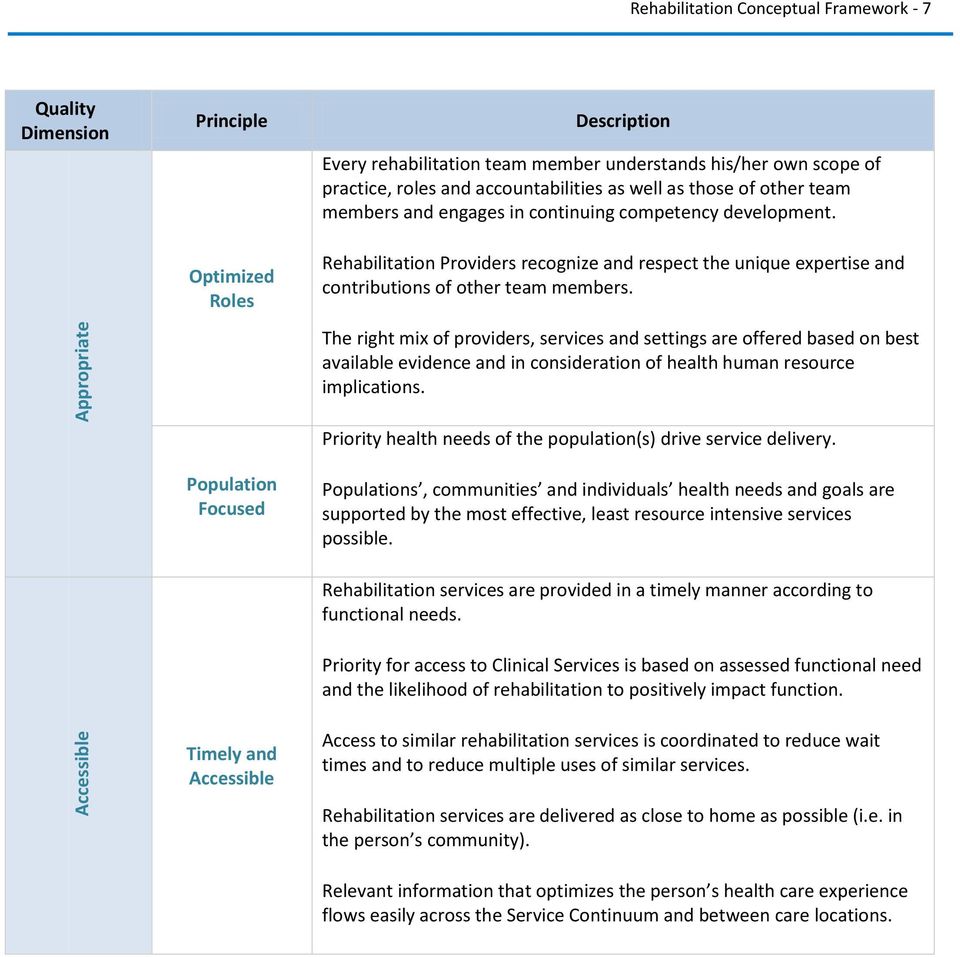
8 Rehabilitation Conceptual Framework - 5 The Framework Architecture 1. Unique Contribution of Rehabilitation The unique contribution of rehabilitation within the health system is: Enhancing function for meaningful living. (Alberta Health Services, Rehabilitation Model Synthesis Working Group, 2009). Assisting people to be functional in ways meaningful to them is how Rehabilitation Providers expertly contribute to a person s well-being and is what rehabilitation services are designed for. 2. Goals of Rehabilitation Services The goals of various rehabilitation services and programs depend on the population served and the type of service delivered. Across the Service Continuum the importance of rehabilitation services is highlighted by their leading contributions to: Primary and Secondary Prevention; influencing public awareness, acceptance and expectations about health and disability; influencing societal norms and policies that foster the ability to function in daily life and participate in societal roles; enhancing capacity of communities, individuals, families and systems to facilitate health in its narrow and broad senses; influencing social and physical environments that foster the ability to function in daily life and participate in societal roles; minimizing Impairment experienced by individuals; maximizing an individual s Activity in daily life; and maximizing an individual s Participation in societal roles. 3. Guiding Principles The guiding principles underpinning the Framework strive to create quality client experiences that are seen as acceptable, accessible, appropriate, effective, efficient and safe. Quality is a balance of these six dimensions. (Health Quality Council of Alberta, 2005). Acceptability - Services are respectful and responsive to user needs, preferences and expectations. Accessibility - Services are obtained in the most suitable setting in a reasonable time and distance. Appropriateness - Services are relevant to user needs and are based on accepted or evidence-based practice. Effectiveness - Services are provided based on scientific knowledge to achieve desired outcomes. Efficiency - Resources are optimally used in achieving desired outcomes. Safety - Risks are mitigated to avoid unintended or harmful results. All are inter-related and must be addressed, although in different circumstances one dimension may be emphasized over another. This results in creative tension among the dimensions which can act as a catalyst for health system innovation. For example, it could promote an examination of ways services can be organized and delivered so all dimensions of quality can be improved. Accreditation Canada Standards for Rehabilitation Services help AHS assess quality at the point of service delivery. The Framework s guiding principles align well with these standards, which can be found in the applicable version on AHS s accreditation intranet site (

9 Acceptable Rehabilitation Conceptual Framework - 6 The principles also capture most aspects of the six interprofessional collaborative domains of the Canadian Interprofessional Health Collaborative s National Interprofessional Competency Framework (2010): role clarification, interprofessional conflict resolution, collaborative leadership, team functioning, client centred care and interprofessional communication. Quality Dimension Principle Client-Centred Description People can expect and be fully supported by comprehensive rehabilitation services across the entire Health Continuum. Rehabilitation Providers practices reflect an approach that is welcoming, non-judgmental, hopeful, sensitive to literacy levels and cultural diversity, respectful and person-centred. Healthy aging and individual responsibility for health are promoted and supported by rehabilitation services and programs across the Service Continuum. Individuals and caregivers receive the information and support they need to play an active role in their rehabilitation service decision-making. AHS rehabilitation services and programs continually strive to meet or exceed the expectations of clients and families. Individuals are involved in Care Planning and Shared Decision-Making to maximize their opportunities to achieve their functional goals. Rehabilitation Providers support persons with complex rehabilitation needs across their lifespan. Rehabilitation Providers support quality of life as defined by the individual. Holistic Rehabilitation services reflect a bio-psychosocial model of care that considers the whole person, including his/her physical, psychological, social, spiritual and cultural needs. Rehabilitation services span all Rehabilitation Sectors as part of the full Service Continuum. Rehabilitation includes a wide range of services and Disciplines that, together, consider the needs of the whole person when assisting the person to achieve active Participation in his/her societal roles.

10 Accessible Appropriate Rehabilitation Conceptual Framework - 7 Quality Dimension Principle Optimized Roles Description Every rehabilitation team member understands his/her own scope of practice, roles and accountabilities as well as those of other team members and engages in continuing competency development. Rehabilitation Providers recognize and respect the unique expertise and contributions of other team members. The right mix of providers, services and settings are offered based on best available evidence and in consideration of health human resource implications. Population Focused Priority health needs of the population(s) drive service delivery. Populations, communities and individuals health needs and goals are supported by the most effective, least resource intensive services possible. Rehabilitation services are provided in a timely manner according to functional needs. Priority for access to Clinical Services is based on assessed functional need and the likelihood of rehabilitation to positively impact function. Timely and Accessible Access to similar rehabilitation services is coordinated to reduce wait times and to reduce multiple uses of similar services. Rehabilitation services are delivered as close to home as possible (i.e. in the person s community). Relevant information that optimizes the person s health care experience flows easily across the Service Continuum and between care locations.
11 Effective Rehabilitation Conceptual Framework - 8 Quality Dimension Principle Future Oriented Description Rehabilitation services are proactive, consider the short-term, mediumterm and long-term implications of any decision and emphasize Primary and Secondary Prevention of illness, injury and disease. Rehabilitation services and resources are regularly reviewed, adapted and prioritized to address changing needs of individuals, populations or organizations. Rehabilitation Providers maintain their skills and knowledge to deliver Evidence-Informed Practice. Rehabilitation Providers take responsibility for mentoring colleagues and precepting students to prepare for a future ready workforce. Using best practices, innovative practice and the newest available technology, Rehabilitation Providers strive to optimize client function and vitality. Collaborative Organization culture and interprofessional Collaborative Practice teams promote coordinated care across the Service Continuum. Rehabilitation Providers work in partnership with individuals, their families, caregivers and communities and with other service providers within and external to the health system. This principle implies joint goal setting, joint service planning, Shared Decision-Making and shared accountability for achieving goals. Strategic Partnerships are forged with other teams, other organizations, ministries, institutions, community groups, etc. to identify and cultivate optimized integrated services, both internal and external to AHS. Service interdependencies are recognized and supported, and service plans are collaboratively made and appropriately communicated within teams, across the organization and between organizations where appropriate to facilitate integration.

12 Rehabilitation Conceptual Framework - 9 Quality Dimension Principle Description Strength-Based Rehabilitation Providers identify ways to recognize and utilize client, family and community strengths in order to build on existing competencies and effectively address concerns. Strength-Based programs believe that clients, families and communities have the resources to prevent and solve problems and to learn new skills; and therefore involve them in the process of discovery, learning and coping with the challenges they may face. Integrated Rehabilitation services are integral to and integrated with other health services across the Service Continuum with flexibility to meet the client need. Rehabilitation services and programs align with AHS strategic priorities and contribute to health system strategic, business and program planning initiatives. Rehabilitation services are coordinated across the Service Continuum and among people, functions, activities and sites. Anticipatory rehabilitation service planning occurs for persons with complex or long-term, chronic needs and these individuals are supported through critical lifespan transitions. Rehabilitation services are coordinated in partnership with community agencies and programs, and other ministerial services such as Education; Children and Youth Services; and Seniors and Community Supports. Outcomes Driven Evidence- Informed Rehabilitation services are designed, implemented and evaluated with a focus on outcomes impacting health, Activity and Participation. There is an emphasis on systematic evaluation of outcomes at the individual, program and system level through comprehensive performance measurement, reporting and analysis. Evidence-Informed Practice and Shared Decision-Making is fostered and incorporated through research, learning opportunities and supports for application of best practice. The determination of quality includes the individual s perception (and where appropriate, the family s, caregiver s, population s or community s perception) of the effectiveness of the service.

13 Safe Efficient Rehabilitation Conceptual Framework - 10 Quality Dimension Principle Description Individual and population health needs are met in resourceful ways, maintaining sound management of finite human and financial resources. Rehabilitation Provider roles are optimized. Cost-Effective / Sustainability To generate capacity within the existing resources, cost-effectiveness is achieved through strategies such as prioritization, standardization and reengineering. Duplication of services is minimized and funds are distributed equitably to address population health needs. Rehabilitation Providers place an emphasis on building the capacity of individuals, their caregivers and communities to support persons with rehabilitation needs, recognizing that the person s time with a service provider represents only a fraction of the time the person spends with his/her personal and community support system. Safety is a priority and is continuously monitored in programs, services and processes. Safety Individuals, families, caregivers, communities and service partners are provided with user-friendly information and the support they need to achieve safe environments and practices. Rehabilitation Providers deliver services in a safe manner within a just culture that encourages disclosure and open, honest communication with patients and families. The safety of individuals is carefully balanced with respect for a person s autonomy and his/her right to accept the risks related to their choices. (Adapted from Alberta Health Services, Integrated Service Planning, 2010; Charis Management Consulting Inc., 2008). 4. Definitions Defining concepts that are common in rehabilitation services leads to clarity in communication, consistency in reporting and analysis, and improved understanding between providers and between various parts of the organization. The AHS accepted definitions relevant to rehabilitation, which are found in the Appendix, are therefore foundational in the Framework.

14 Rehabilitation Conceptual Framework Rehabilitation Sectors Rehabilitation Sectors describe how publicly funded rehabilitation services are categorized based on: legislative parameters; characteristics of the recipient; characteristics of the service; and where the service is provided. These categories are important for planning services, budgeting, setting up cost centres and reporting activity. The Framework outlines five sectors Acute Care Rehabilitation, Rehabilitation Facility/Unit Rehabilitation, Ambulatory Community Rehabilitation, Home Care Rehabilitation and Long-Term Care Facility Rehabilitation. Descriptions of these sectors are included in the Appendix. 6. Disciplines Rehabilitation Providers contribute to health services across the Service Continuum. The Core Rehabilitation Disciplines whose work is generally devoted to the various aspects of rehabilitation are audiology, occupational therapy, physiatry, physiotherapy, recreation therapy and speech language pathology. Examples of Ancillary Disciplines whose primary focus is not always the rehabilitation process but which may be involved in a person s rehabilitation journey are: early intervention, medicine, nursing, nutrition, orthotics, pharmacy, prosthetics, psychology, respiratory therapy, social work and spiritual care. This Framework is meant to guide all work of the Core Disciplines, as well as the work of Ancillary Disciplines when they are involved in rehabilitation services or programs. 7. ICF Conceptual Model The Framework accepts the International Classification of Functioning, Disability and Health (ICF) (World Health Organization, 2001) as the source of a standard language and description of human health and functioning. It is a biopsychosocial approach to health, meaning that biological, psychological and social factors are all recognized as influencers of health. The ICF also has a coding classification system, which AHS has not adopted at this time. Every human being will experience a decrement in health and thereby experience some degree of disability. Disability is therefore not something that only happens to a few individuals. (World Health Organization, 2002). In recognizing that the experience of disability is universal, identifying a client s level of function as described in the ICF model is a key expectation of adopting this model as part of the Framework. By shifting the focus from cause to impact it places all health conditions on an equal footing allowing them to be compared using a common metric the ruler of health and disability. (World Health Organization, 2002). The ICF takes into account the social aspects of disability and does not see disability only as a 'medical' or 'biological' dysfunction. By including contextual factors and the individual s unique characteristics, the ICF allows Rehabilitation Providers to record the impact of the environment on the person's functioning.

15 Rehabilitation Conceptual Framework - 12 Figure 2: Model of Disability (ICF) Health condition (Disorder or disease) Body functions & structure Activity Participation Environmental factors Personal factors Contextual factors Two components interact to influence functioning and disability: 1. Health Conditions (disease, disorder, injury) 2. Contextual Factors (barriers or facilitators to Activity and Participation) Personal Factors (internal) Environmental Factors (external) Personal Factors such as a person s assets and talents, caregiver, family or peer knowledge and support, culture or ethnicity, age, gender, coping styles, social background, education, profession, experiences, behaviour patterns, character, etc. affect the way the individual experiences disability. (World Health Organization, 2002; Charis Management Consulting Inc., 2008). Likewise Environmental Factors such as social attitudes; legal and social structures; environments; supports and relationships; products and technology; services, systems and policies; community capacity and opportunities, etc. influence an individual s functioning and disability. (World Health Organization, 2002; Charis Management Consulting Inc., 2008). Three levels to the disability spectrum experienced by all human beings: 1. Impairments at the individual s Body Function or Body Structure level 2. Activity Limitations at the person level as Activity focuses on the person s individual functioning 3. Participation Restrictions generally experienced by the person and others at a societal level as Participation focuses on the person s involvement in societal roles and so is likely to be performed with others. In addition to issues related to Body Structure and Body Function, Rehabilitation Providers consider a person s ability to undertake daily activities and their ability to participate as a whole member of their family or community, as a measure of their overall health. For example, a stroke survivor may be unable to drive,
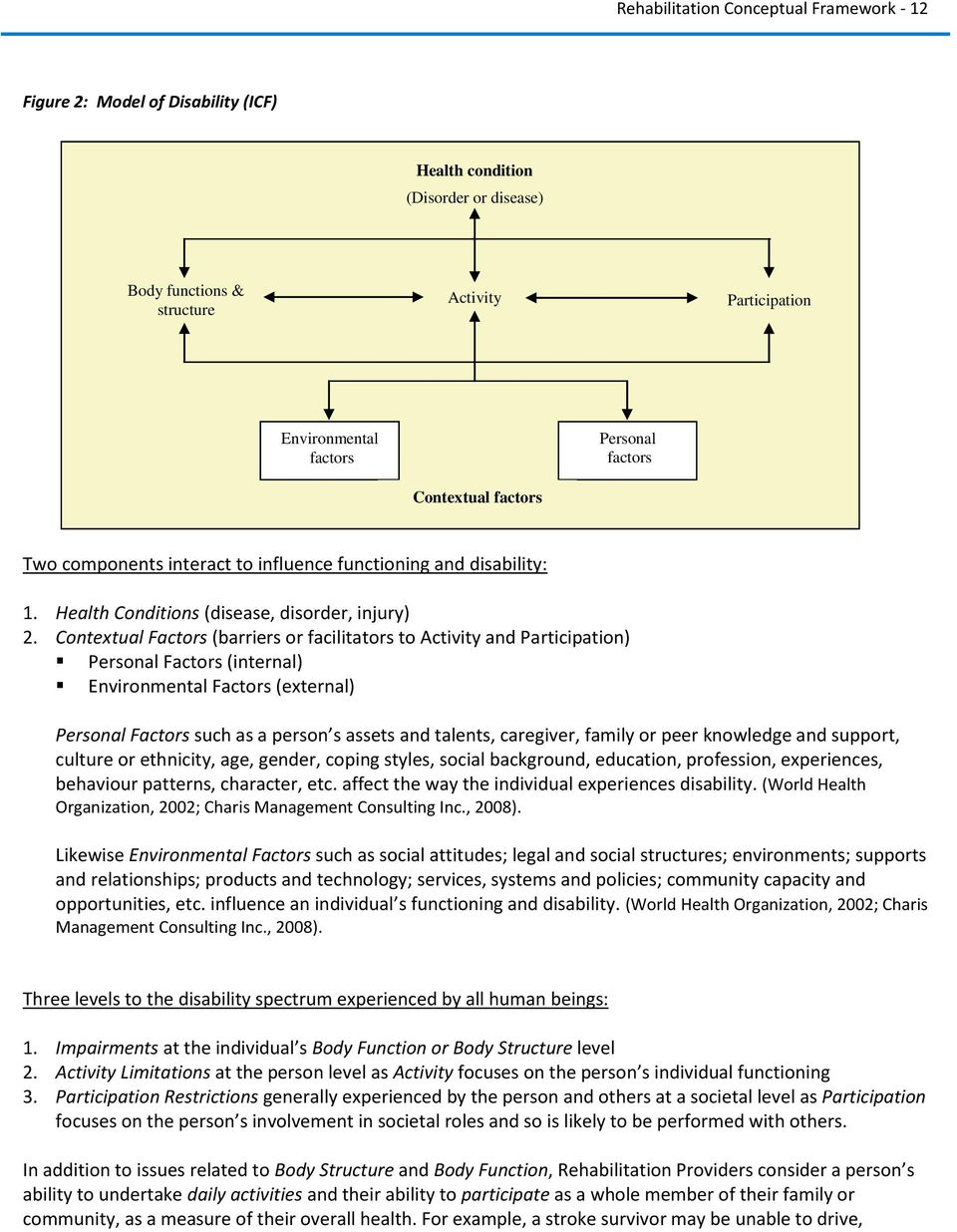
16 Rehabilitation Conceptual Framework - 13 restricting his ability to shop, socialize and attend church. This may result in isolation and depression if Care Planning does not consider or address these overall needs. The separation of Activity and Participation domains is not always clear, especially where activities can be undertaken alone and also can be evidence of societal participation. (Resnik, 2009). The ICF model may be used to measure health and disability at individual, community and population levels. In clinical settings the ICF is used for functional status assessment, goal setting, Treatment planning and monitoring, as well as outcome measurement. The language of the ICF is adopted as part the Framework s definitions. Using the ICF language will facilitate spread of the concepts amongst health care providers and social and community agencies. Table 1 (adapted from World Health Organization 2002) gives some examples of disabilities that are associated with the three levels of disability associated with a health condition. Table 1: Examples of Disabilities Categorized by Level of Disability Health Condition Impairment Activity Limitation Participation Restriction Spinal Cord Injury Paralysis Incapable of using public transportation Lack of accommodations in public transportation in some jurisdictions leads to limited community participation Panic Disorder Anxiety Not capable of going out alone People s reactions leads to no social relationships Repetitive Strain Inflammation Difficulty keyboarding Unable to work as administration Injury Unknown Developmental Coordination Disorder Pain Severe stuttering with secondary behaviors Impaired fine and gross motor skills Difficulty with verbal interactions Difficulty with academics, gym class and independence in activities of daily living assistant Withdrawal from classroom and social activities Avoidance of physical activity, playground interactions and community participation The Framework combines one of its principles - that of a Client-Centred approach, with the ICF conceptual model by considering the personal, family, community, environmental and societal context of an individual. A Client-Centred approach aligns with the emerging body of evidence on the determinants of health suggesting a need to consider the factors in the environment that contribute to a person s health and well-being, or conversely, to their illness and lack of well-being. Adoption of a biopsychosocial conceptual model highlights the importance of a Client-Centred approach as depicted in Figure 3. Services to address a person s condition or Impairment should recognize and leverage other aspects of the person, remove or minimize personal and environmental barriers and consider the person s ability to participate as members of a family, community and in society. (Charis Management Consulting Inc., 2008).

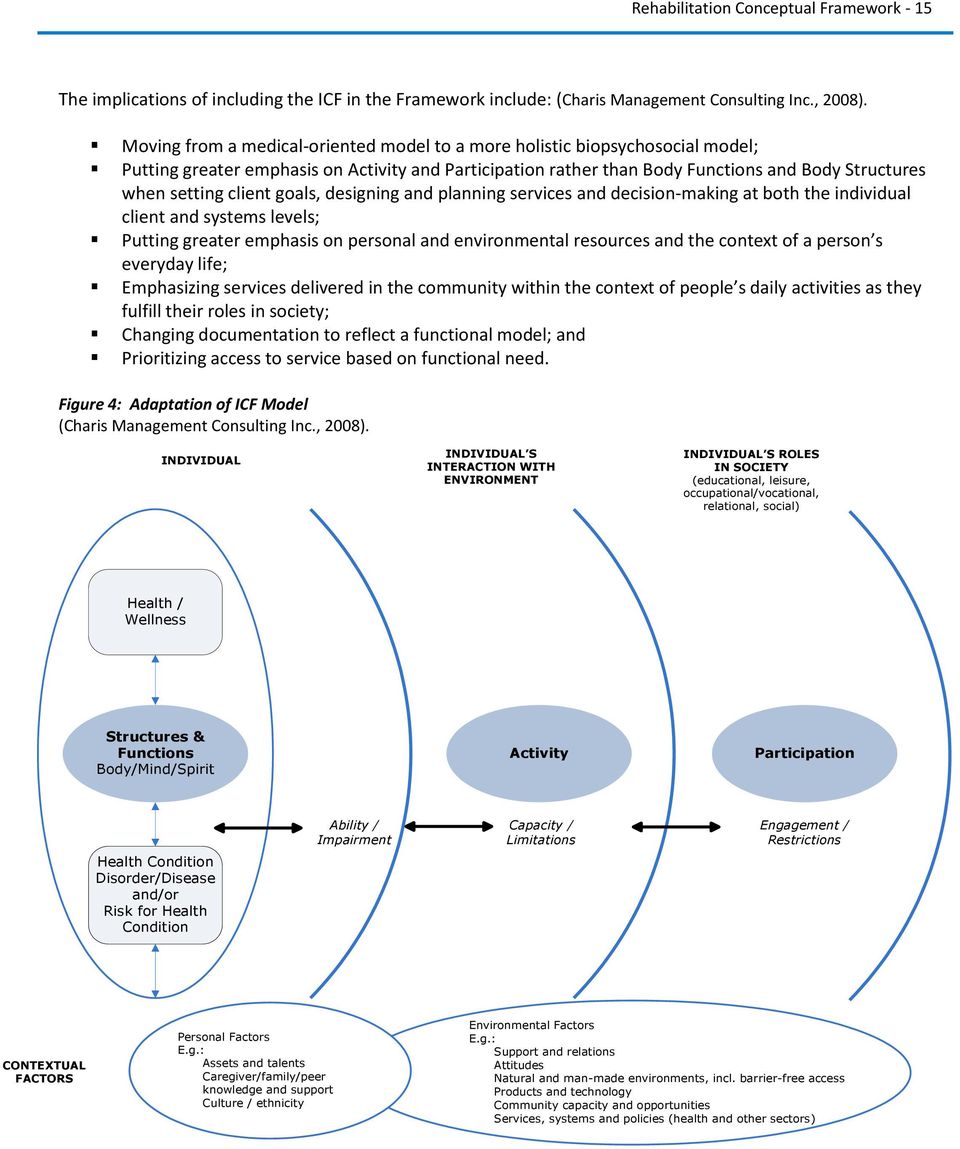
17 Rehabilitation Conceptual Framework - 14 The family, community and societal context is important when considering a person s rehabilitation goals to maximize Activity and Participation; thus the outer rings of this diagram are critical when considering a comprehensive view of a person with rehabilitation needs. Unlike the case in many medically-oriented health services, the arm of rehabilitation extends well into the community and linkage with external agencies is critical. The ICF model recognizes and suggests that these external supports are fundamental to optimizing the rehabilitation process in order to enhance function for meaningful living. Figure 3: The Person in Their Context (Charis Management Consulting Inc., 2008). SOCIETY COMMUNITY Awareness Transportation FAMILY/ CAREGIVER Community agencies & organizations Policies/ Legislation Housing Norms Health programs & services PERSON Socio- Age & development economic Biological / Behaviours Genetic endowment Beliefs Expectations Genetics \ Experience Spirituality Condition / impairment Assets & talents Knowledge Culture/ ethnicity Capacity/ challenges Education programs & services Physical environment Vocational environment Expectations Incorporating the ICF concepts into the Framework offers the possibility of a common language for Rehabilitation Providers, researchers, and administrators to use. This will prompt and support changes in clinical practice and communication that focus on client function and will help in planning and evaluating rehabilitation services. (Alberta Health Services, Rehabilitation Model Synthesis Working Group, 2009). Adaption of the ICF model shown in Figure 4 captures the relationships of the model s various concepts.

18 Rehabilitation Conceptual Framework - 15 The implications of including the ICF in the Framework include: (Charis Management Consulting Inc., 2008). Moving from a medical-oriented model to a more holistic biopsychosocial model; Putting greater emphasis on Activity and Participation rather than Body Functions and Body Structures when setting client goals, designing and planning services and decision-making at both the individual client and systems levels; Putting greater emphasis on personal and environmental resources and the context of a person s everyday life; Emphasizing services delivered in the community within the context of people s daily activities as they fulfill their roles in society; Changing documentation to reflect a functional model; and Prioritizing access to service based on functional need. Figure 4: Adaptation of ICF Model (Charis Management Consulting Inc., 2008). INDIVIDUAL INDIVIDUAL S INTERACTION WITH ENVIRONMENT INDIVIDUAL S ROLES IN SOCIETY (educational, leisure, occupational/vocational, relational, social) Health / Wellness Structures & Functions Body/Mind/Spirit Activity Participation Health Condition Disorder/Disease and/or Risk for Health Condition Ability / Impairment Capacity / Limitations Engagement / Restrictions CONTEXTUAL FACTORS Personal Factors E.g.: Assets and talents Caregiver/family/peer knowledge and support Culture / ethnicity Environmental Factors E.g.: Support and relations Attitudes Natural and man-made environments, incl. barrier-free access Products and technology Community capacity and opportunities Services, systems and policies (health and other sectors)
19 Rehabilitation Conceptual Framework Key Components The three key components underpinning the Framework the Health Continuum; the Service Continuum; and Needs Identification and Service Delivery Parameters, are uniquely identifiable elements that are distinctive and necessary functions in the operation of rehabilitation services. They are depicted in the Framework picture through their sub elements Health Continuum The Framework supports Rehabilitation Providers partnering with clients and families to identify and satisfy client needs, goals and preferences. Areas of need may be identified by considering the individual or group within the Health Quality Council of Alberta s Health Continuum: (Alberta Health Quality Council of Alberta, 2005). Being Healthy Achieving health and preventing occurrence of injuries, risk factors, illness, chronic conditions and resulting disabilities. Getting Better Care related to acute illness or injury. Living Well with Illness/Disability Care and support related to chronic or recurrent illness or disability. End of Life Care and support that aims to relieve suffering and improve quality of living with or dying from advanced illness or bereavement. These four distinct but inter-related areas are not defined by who provides the service, but by the need(s) of the client. A client may have a need within one or more of these areas concurrently or consecutively. Rehabilitation has important contributions to make to meet client and population health needs in all four areas of the Health Continuum Service Continuum The Service Continuum is a classification of the eight broad categories of health services available to meet client and population health needs: Health Promotion, Prevention, Acute Care, Chronic Disease Management, Rehabilitation, Community Re-integration, Supportive Living and Palliative Care. (Adapted from Alberta Health Services, Integrated Service Planning, 2010). Although rehabilitation is identified as a unique service within the Service Continuum, Rehabilitation Providers are not restricted to working only within the rehabilitation area of the Service Continuum. Rehabilitation has an active role across the Service Continuum and as such, should be included in programs and services in each part of this continuum. An individual may have health care needs met within one or more of these service areas concurrently or consecutively. Cooperation between health and social care organizations across the Service Continuum and multiple points of access helps facilitate people getting the services they need when they need them. Health Promotion is the process that enables people to increase control over and improve their health. It includes activities that encourage healthy development, healthy lifestyles, healthy aging, Self- Management or advanced Care Planning. Health goes beyond the absence of disease and considers the health of individuals, populations, organization and communities. Promoting health requires partnerships with other sectors beyond health. Primary and Secondary Prevention. Prevention starts early and encompasses preventing developmental delays or concerns, disease or injury and detecting disease in its early stages before major complications arise. Emphasis is placed on case finding, surveillance, periodic exams and control of risk factors. Primary

20 Rehabilitation Conceptual Framework - 17 Prevention is directed towards preventing the initial occurrence of a delay or concern, disease, injury or condition. Secondary Prevention is focused on those with chronic illness and a history of acute exacerbation in order to prevent or delay future disease, exacerbation or injury. Tertiary Prevention is equivalent to the Rehabilitation Service Continuum category defined below. Acute Care includes acute treatment and pre- hospital care. Pre-hospital care supports rapid recognition, management and transport of individuals with acute health conditions that occur outside of the hospital setting. Acute treatment is for illness that is of abrupt onset, relatively short duration, rapidly progressive and in need of urgent care. It also encompasses surgery and post operative management in hospital. Examples include emergency services, hospital in patient care, urgent care, physician office care, medication and short-term rehabilitation services. Chronic Disease Management includes population health principles and places an emphasis on both chronic disease Prevention and management. Much of Chronic Disease Management is delivered in primary care setting(s) and is based on patients actively managing their chronic conditions, supported by their primary care provider(s) working together with specialists within a supportive community. Adopting healthy behaviors such as healthy eating, physical activity, being tobacco free and minimizing alcohol use can prevent or control the effects of most chronic diseases. Home or community based services, environmental adaptation, rehabilitation and institutional services are examples. Rehabilitation is a goal-oriented and often time limited process, which enables individuals with Impairments, Activity Limitations and Participation Restrictions to identify and reach their optimal physical, mental and social functional level through a client-focused partnership with family, providers and the community. Rehabilitation focuses on abilities and aims to facilitate independence and social integration, and includes Habilitation and Prevention of injury and illness recurrence and secondary conditions. Community Reintegration includes addressing issues related to health management, life roles, social networks, environment, communications, mobility and caregiver support. It may include case coordination, community or home rehabilitation, day programs, home support and referrals to community based organization and resources. Supportive Living provides care and support in home environment, supported living environments (e.g. group care homes, assisted living) or facility-based care (Long Term Care Facilities). Palliative Care promotes dying with comfort and dignity. This care is provided through home-based services, hospice services and personal care services Needs Identification and Service Delivery Parameters In order to identify how rehabilitation or other services can assist, the needs of the individual or population must be understood. A dynamic balance is continually sought between screening, assessment and provision of interventional services. Certain levels of service (Universal and Targeted Rehabilitation Service Levels) may be provided effectively without the need for screening, assessment or specialized interventions. Identifying client goals and matching the individual to the right services is a collaborative process, is evidenceinformed and is guided by availability of services and an agreed to service plan. The individual is matched to the right frequency, intensity, specialization and location of service. System level service planning considers population health needs and the need to connect services and promote smooth transitions of care. Management of finite human and financial resources is considered when services are designed for the population or community and when they are selected for the individual client.

21 Rehabilitation Conceptual Framework - 18 Processes involved in identifying health needs and choosing appropriate services include: Identifying client needs across the Health Continuum (including those for Case Management and referral linkages) through screening and/or assessment, considering environmental and other supports (8.3.1); Choosing the required rehabilitation service delivery parameters the Rehabilitation Intervention Type ( ) and Rehabilitation Service Level ( ); Choosing the appropriate service pathway(s) (8.3.3); Identifying population health needs and system linkages (8.3.4) Screening and/or Assessment Screening is a high level needs identification process that gathers salient bits of information that are sufficient enough to guide the Rehabilitation Provider in making recommendations to the individual or for the population. A variety of screening options are available such as: developmental screening, healthy living screening, risk screening and dialogue, among others. Screening is offered through multiple approaches, including but not limited to, individual self-selection for Universal and Targeted Services, formal processes for Targeted community programs, health provider referral or self-referral for Clinical Services and dialogue. Developmental screening identifies children with possible developmental delays early, ensuring appropriate timely assessment and early intervention as required. Early identification ensures that children can access and benefit from a range of services early in life and be well supported through their development. (Alberta Health and Wellness, 2006). Healthy living and risk screening empowers individuals to consider the effects that diet, level of exercise, balance of activities and habits like smoking and drinking have on their health. Screening enables individuals to detect health risks, supporting early identification and Treatment. Screening dialogue between a health provider and an individual requesting help includes a discussion of the individual s concerns and goals and available resources or services that might assist. Coaching service partners to screen or otherwise identify individuals or groups who would benefit from rehabilitation assessment or programs is often appropriate. Assessment is the rehabilitation process for gathering in-depth information to identify the individual s strengths and needs related to Body Function, Body Structure, Activity and Participation, to understand the individual s goals and then to determine appropriate services and interventions based on these. Assessment is initiated when there are questions about a client s needs and how best to meet these needs. It includes both formal and informal measures ranging from administering standardized assessment tools to observing a client in a specific setting or listening to family concerns. Many factors can impact the health of an individual. Rehabilitation services and rehabilitation service delivery systems consider and respond to the physical, psychological, social, economic, spiritual and cultural needs of the individual (health determinants). The client needs identification processes also serve to determine whether the client will manage his/her own care or require more structured Case Management. Case Management involves determining with the client what referrals and linkages to services, both within and external to the health system, are needed. Screening and assessment are services that may be required at multiple points in the course of helping the client meet his/her goals. They are important in determining effectiveness of chosen interventions. In addition, rehabilitation assessment is often a valued contribution to the diagnostic process.
22 Rehabilitation Conceptual Framework Rehabilitation Service Parameters To optimize outcomes and promote efficiency, choosing the most appropriate Rehabilitation Intervention Type and Rehabilitation Service Level is a key step in needs identification and service matching Rehabilitation Intervention Types Promotion, Prevention, Treatment, Care and Case Management are Rehabilitation Intervention Types evident in rehabilitation practice. The intervention activities that Rehabilitation Providers undertake generally fall into these five categories. In most instances, more than one Rehabilitation Intervention Type will be used during a client encounter or episode of care. Care may not traditionally be identified as an intervention; however, it has purposely been included in the Framework to highlight its significant importance in developing the therapeutic relationship and the art of rehabilitation which facilitate positive outcomes. Health Promotion (sometimes referred to simply as Promotion) The process of enabling people to increase control over and to improve their health. (World Health Organization, 1986). Health Promotion is the science and art of helping people change their lifestyle to move toward a state of optimal health. Optimal health is defined as a balance of physical, emotional, social, spiritual and intellectual health. Lifestyle change can be facilitated through a combination of efforts to enhance awareness, change behavior and create environments that support good health practices. Of the three, supportive environments will probably have the greatest impact in producing lasting change. (O'Donnell, 1989). Prevention Measures that not only prevent the occurrence of disease, such as risk factor reduction, but also arrest its progress and reduce its consequences once established. Primary Prevention is directed towards preventing the initial occurrence of a disorder. Secondary and Tertiary Prevention seek to arrest or retard existing disease and its effects through early detection and appropriate treatment; or to reduce the occurrence of relapses and the establishment of chronic conditions through, for example, effective rehabilitation. (World Health Organization, 1998). Treatment The act of providing service to remediate a health concern related to a developmental delay or following an injury, illness or disability; and to provide advice, coaching, support and guidance to facilitate Self-Management. Care Assistive, supportive, facilitative acts directed towards another, in order to improve or to maintain a favorably healthy condition of life. (Armstrong, 1996). A caring approach is used to improve the quality of life for clients and their families. This approach may also positively influence the course of illness. Care may include listening to the client, building a therapeutic relationship, providing support and comfort in relation to activities of daily living and Treatment for the client and family, preservation of dignity and client advocacy. Interactional Knowledge is foundational to a Client Centred approach and to the therapeutic relationship needed to provide care. It is knowledge about ways of relating with an individual, group or community. It includes interactions that are verbal and nonverbal (i.e., gaze, posture, tone of voice and demeanor); that are purposeful and constructive; where there is a sincere desire to connect or engage with others; and whose intent is to enable others to be leaders of their journey. (Registered Nurses' Association of Ontario, 2006). Case Management A collaborative, person-centred strategy for the provision of quality health and supportive services through the effective and efficient coordination of available services and resources from a system-wide perspective in order to support the client s achievement of goals. The focus of case management is to facilitate optimal wellness and improved quality of life for people and their families, while balancing resource utilization and cost containment for the health care system. (Alberta Health Services, Integrated Case
23 Rehabilitation Conceptual Framework - 20 Management, 2011). There are three levels of Case Management to consider for those with rehabilitation needs: Self-Management Most individuals and families have simple health needs and can access and self-navigate their route through the health system with minimal guidance, information or other resources. Self-Management also includes the learning and practicing of skills required for an active and emotionally satisfying life in the face of a health condition. (Lorig. K, 1993). The AHS System-wide Definitions Working Group defines Self-Management as What people with a chronic disease do (their action and behavior) to cope with how their disease affects them. This includes working with their caregivers and other health providers so that they become more confident and skilled in managing their chronic disease. People skilled at managing their condition and treatments understand their condition and are actively involved in their total care. They help create their care plan and follow it. They protect and promote their health; they monitor and manage their condition. They also manage the affect their condition has on them physically, emotionally, and socially. (Alberta Health Services, Integrated Case Management, 2011) Program Case Management Individuals with illness or disability who may need assistance to find services within an identified clinical or program pathway may benefit from a case manager with advanced clinical knowledge of the specific disease, population or program. System wide Case Management Individuals who have developmental, health or social needs whose care is received in multiple service sectors or complex service environment and who cannot independently navigate the system may require a case manager to coordinate services at a system level - across sectors or boundaries. The AHS System-wide Definitions Working Group defines this type of Case Management as Consistent and standardized processes and communication to ensure optimal linkages and transfers between the formal health system and other community-based health, social and human services. (Alberta Health Services, Integrated Case Management, 2011) Part of the Case Management process is referral management and facilitation of smooth transitions for individuals navigating between services within and across the Service Continuum Rehabilitation Service Levels Three interlinked but distinct Rehabilitation Service Levels assist in tailoring services for clients. Identifying the appropriate Rehabilitation Service Level allows individuals to be directed to services with sufficient intensity and specialization to best meets their needs. Generally people are streamed from least intensive to more intensive service options, as appropriate. However, they may enter and exit at any of the three levels and may access and benefit from more than one level at the same time. The three Rehabilitation Service Levels are: (Adapted from Charis Management Consulting Inc., 2008). Universal Services target the general population or at risk population subgroups but are available or distributed to the population as a whole. They focus on Promotion and Prevention. Providing Universal Services also includes addressing system level policies and issues. Developing Universal Services usually requires collaborative partnerships. No unique client identifiers are gathered and no health record is kept. The main goals are: Primary and Secondary Prevention; Influencing public awareness, acceptance and expectations;
24 Rehabilitation Conceptual Framework - 21 Influencing norms and policies. They key differences between Universal and Targeted Services are the broader, less defined audience and the more generally available information or service in Universal Services. Targeted Services are aimed primarily at groups composed of individuals with common needs or issues (such as community senior s groups, parents of preschoolers, those with arthritis or service provider groups). In this level, the recipients may or may not be clients or caregivers, but if they are also Clinical Service clients of the Rehabilitation Provider, no separate individual documentation or registration is required for their participation in Targeted Services, unless required by the Rehabilitation Provider s regulatory college. Some regulatory colleges require that a record, but not necessarily a health record that is attached to a registered client, be kept of all consultative/coaching services. The focus of Targeted Services is on building capacity, often using partnership models, with the goal of strengthening informed, activated groups and on creating or improving supportive environments. The service is targeted to the needs of the group collectively rather than the individual needs of each group member. Service providers may also receive Targeted Services in the form of consultation or coaching these individuals then utilize the information or teaching in their own Clinical Services. For these consultation services, the beneficiary of the advice or coaching is served indirectly through the service provider receiving services from the consulting Rehabilitation Provider. Therefore the service recipient is the service provider receiving the consultation, the agency or the group, not the individual with needs (although these people would ultimately benefit). The main goals are: Enhancing capacity; Influencing social and physical environment; Primary and Secondary Prevention. The key difference between Targeted and Clinical Services are that for Targeted Services unique client identifiers are not collected, the individual client is not assessed by the Rehabilitation Provider (so the service is not designed specifically to meet an individual s needs) and a health record is not kept, unless required by a regulatory college. Clinical Services are directed to people with delays and disorders, injuries, illnesses and diseases (and where relevant to their families and caregivers) who are assessed by an appropriate Rehabilitation Provider. Clinical Services may be provided to clients individually or in groups. Assessment, interventions, education, coaching and Case Management are Clinical Service activities for individuals who are registered under their unique identifier. Collaborative service provision may involve a Rehabilitation Provider giving coaching support to caregivers or other health providers to help address client needs, after these needs have been assessed by the appropriate Rehabilitation Provider. (Charis Management Consulting Inc., 2007). A health record is kept. The main goals are: Minimizing Impairment; Maximizing Activity; Maximizing Participation; Primary and Secondary Prevention. Clinical Services are subdivided into four categories of service complexity Primary, Secondary, Tertiary and Quaternary Rehabilitation. For definitions of these categories, refer to the definition of Rehabilitation Service Levels Clinical Services in the Appendix.
25 Rehabilitation Conceptual Framework - 22 There is a progressive, inverse relationship between the number of people served and the staff time required, with Clinical Services requiring the most time per individual served and Universal Services requiring the least, as depicted in Figure 5. Figure 5: Relationship of Staff Time/Service Intensity to Number of Individuals Served for Rehabilitation Service Levels Staff time/ service intensity Universal Services E.g., Public messages Targeted Services E.g., inservices, workshops, consulting Clinical E.g., direct client care (1:1, group), collaborative service Number of individuals served Service Pathway While each person s or population s needs are different, and their service parameters (the Rehabilitation Intervention Types, Service Levels and Case Management needs) may also vary, a Service Pathway outlines the general steps people may expect to take for a given condition or need along the Health and Service Continuums. A pathway also outlines the service expectations from Rehabilitation Providers and other team members. Each pathway is an organized, evidence-informed service outline. There are clear entry and exit points within an organized system of service delivery. Access points and eligibility criteria for each rehabilitation service and program are clearly delineated. Exit processes from rehabilitation services and programs are clearly outlined with relevant discharge criteria which include the client s decision to end service. At a system level, a pathway includes clear descriptions of any supports or referrals needed; and when and how the linkages will occur. An individual s journey along a pathway is negotiated between the individual and his/her providers using a Client-Centred approach. This negotiation recognizes the pathway is a guideline, however individual circumstances may need to be accommodated. Through the process the client and family receive appropriate education and information on linkages and resources to support the transition Population Health Needs and System Linkages In system level service planning, part of the needs identification process involves: Understanding the population-based drivers for a service or program; Identifying required linkages for referrals across the Service Continuum; Identifying criteria for referral based on standards that are evidence-informed;
26 Rehabilitation Conceptual Framework - 23 Developing a clear referral process with accompanying infrastructure to support the process and get the right people to the right service at the right time; and Developing clear criteria for identifying priority access or urgency, service intensity, frequency and level of specialization required.
27 Rehabilitation Conceptual Framework - 24 Appendix - Definitions The following definitions are recommended when these terms are used in AHS documents referring to rehabilitation and by AHS staff in their communication. Further development and the contexts of some of the concepts are included in the body of the Rehabilitation Conceptual Framework document; however this appendix is meant to be a quick reference guide. In recognition of the Alberta Health Services Writing Style Guide (Alberta Health Services, 2010), these words would not be capitalized when used in other documents. Allied Health Allied Health Professions (B.L. Morrice, Vice President & Chief Health Professions Officer, AHS, personal communication, January 18, 2012) The draft December 2011 consensus statement from the International Chief Health Professions Officers defines Allied Health Professions as a distinct group of health professionals who apply their expertise to diagnose, treat and rehabilitate people. Together with a range of technical and support staff they may deliver direct patient care, rehabilitation treatment, diagnostics and health improvement interventions to restore and maintain optimal physical, sensory, psychological, cognitive and social functions. Allied Health in Alberta Health Services Within AHS, Allied Health is used to name parts of the organizational structure as well as to refer to a variety of disciplines. The rehabilitation disciplines audiology, occupational therapy, physiotherapy, recreation therapy and speech-language pathology, are a subset of these disciplines. Client-Centred (synonymous with client and familycentred, patientcentred and person-centred) Client (Patient and Family) Centred Care (J. Rees, Executive Director Patient Experience, AHS, personal communication, January 26, 2012) : is an approach to planning, delivering, and evaluating health care that is grounded in establishing partnerships using the principles of patient and family centred care. means working in partnership with patients and families by encouraging active participation of patients and families in all aspects of care, as integral members of their health care team, and as partners in planning and improving new facilities and existing services. This definition is based on the Institute for Patient- and Family Centered Care s (2010) principles of respect and dignity, information sharing, participation and collaboration.
28 Rehabilitation Conceptual Framework - 25 Collaborative Practice AHS s Health Professions Strategy and Practice will adopt the terminology of Collaborative Practice and Education Steering Committee (an Alberta inter-sectoral committee) which as of the writing of the Framework is: An interprofessional process of communication and decision making that enables the separate and shared knowledge and skills of health care providers to synergistically influence the patient care provided. (Way et al, 2000) The processes involved are :(Alberta Health Services, Health Systems and Workforce Research Unit, 2010) Care Planning means using structures (e.g. electronic care plan) and processes (e.g. joint patient rounds) to assess health needs, identify and mitigate risks, and develop, implement and evaluate care plans. Care Planning involves core team members, including the patient and family. Care Planning requires effective communication among team members and mechanisms to ensure that care is proactive, coordinated and considers the needs of patients and families across the continuum of care. Shared Decision-Making means that the expertise of appropriate providers is sought in developing plans of care and is recognized as contributing to better outcomes than would be achieved if providers worked in silos. It requires procedures to facilitate dialogue among providers across disciplines (e.g., joint staff meetings, patient rounds, agency protocols, performance measures that reward collaboration). Being Client - Centred requires involvement of the client or family in the decision making process. Evidence-Informed Practice means using evidence-based practices and protocols (e.g., clinical guidelines), challenging existing practices and protocols in light of new evidence and applying research to resolve clinical problems. Reflection on Team Effectiveness means team members reflect on their processes and effectiveness in achieving actual outcomes against desired outcomes and benchmark against the performance of similar units, programs or organizations. Disciplines This Framework is meant to guide Core Rehabilitation Disciplines (whose work is usually devoted to the various aspects of rehabilitation) as well as Ancillary Disciplines (whose primary focus is not always the rehabilitation process) when their work contributes to a person s rehabilitation journey. Core Rehabilitation Disciplines audiology occupational therapy physiatry physiotherapy recreation therapy speech language pathology Ancillary Disciplines (examples) early intervention medicine (excluding physiatry) nursing
29 Rehabilitation Conceptual Framework - 26 nutrition pharmacy prosthetics psychology orthotics respiratory therapy social work spiritual care Habilitation (adapted from Charis management Consulting Inc., 2008) Health Continuum (Alberta Health Quality Council of Alberta, 2005). Services provided for individuals who were born with an anomaly or who acquire an Impairment at such an early age as to have never had full functioning, that help such an individual keep, learn or improve skills and functioning. A continuum that highlights four distinct but interrelated areas of client or population need: Being Healthy Achieving health and preventing occurrence of injuries, risk factors, illness, chronic conditions and resulting disabilities. Getting Better Care related to acute illness or injury. Living Well with Illness/Disability Care and support related to chronic or recurrent illness or disability. End of Life Care and support that aims to relieve suffering and improve quality of living with or dying from advanced illness or bereavement. Interactional Knowledge (Registered Nurses' Association of Ontario, 2006) International Classification of Function (ICF) (World Health Organization, 2001) Knowledge about ways of relating with an individual, group, or community. It includes interactions that are verbal and nonverbal (i.e., gaze, posture, tone of voice and demeanor); that are purposeful and constructive; where there is a sincere desire to connect or engage with others; and whose intent is to enable others to be leaders of their journey. This knowledge is part of providing Care, a Rehabilitation Intervention Type. Body Functions are physiological functions of body systems, including psychological functions. Body Structures are anatomical parts of the body such as organs, limbs and their components. Impairments are problems in Body Function or Body Structure such as significant deviation or loss. Activity is the execution of a task or action by an individual. Activity Limitations are difficulties an individual may have executing activities. Participation is involvement in life situations.
30 Rehabilitation Conceptual Framework - 27 Participation Restrictions are problems an individual may experience in involvement in life situations. Personal Factors are attributes of an individual that influence how disability is experienced. Environmental Factors make up the physical, social and attitudinal environment in which people live and conduct their lives. Primary Health Care (Alberta Health Services, Primary Care Innovation & Integration, 2011) Rehabilitation (Alberta Health Services, Rehabilitation Model Synthesis Working Group, 2009) Rehabilitation Intervention Types Primary Health Care Refers to activities, provided in partnership with individuals, families, communities, and populations, that extend beyond primary care to include the determinants of health (for example: education, housing, income, and environment.) Primary Care Refers to the activities within primary health care that are provided in the community and that address the everyday health needs of individuals and their families through health promotion, and the prevention, diagnosis and treatment of illness and injury. A goal-oriented and often time limited process, which enables individuals with Impairments, Activity Limitations and Participation Restrictions to identify and reach their optimal physical, mental and social functional level through a client-focused partnership with family, providers and the community. Rehabilitation focuses on abilities and aims to facilitate independence and social integration, and includes Prevention of injury/illness recurrence and/or secondary conditions. For the purpose of the Framework, Rehabilitation includes Habilitation services. Health Promotion (sometimes referred to simply as Promotion) The process of enabling people to increase control over, and to improve their health. (World Health Organization, 1986). Health Promotion is the science and art of helping people change their lifestyle to move toward a state of optimal health which is a balance of physical, emotional, social, spiritual and intellectual health. Activities are those that encourage healthy development, healthy lifestyles, healthy aging, Self-Management or advanced Care Planning. (Alberta Health Services, Integrated Service Planning, 2010). Prevention Measures that not only prevent the occurrence of disease, such as risk factor reduction, but also arrest its progress and reduce its consequences once established. (World Health Organization, 1998). Primary Prevention Activities or strategies directed towards preventing the initial occurrence of a developmental delay, disorder, disease, injury or condition. Secondary Prevention Activities focused on those with chronic illness and a history of acute exacerbation in order to prevent or delay future disease, exacerbation or injury.
31 Rehabilitation Conceptual Framework - 28 Tertiary Prevention Strategies which limit or compensate for Impairments or disabilities in order to stabilize or reduce the amount of disability associated with the condition or disorder. (Charis Management Consulting Inc., 2008) Treatment The act of providing service to remediate a health concern related to a developmental delay or following an injury, illness or disability; and to provide advice, coaching, support, and guidance to facilitate Self-Management. Care Assistive, supportive, facilitative acts directed towards another, in order to improve or to maintain a favorably healthy condition of life. (Registered Nurses' Association of Ontario, 2006). A caring approach is used to improve the quality of life for clients and their families. This approach may also positively influence the course of illness. Care may include listening to the client, building a therapeutic relationship, providing support and comfort in relation to activities of daily living and Treatment for the client and family, preservation of dignity and client advocacy. Interactional Knowledge is foundational to a Client-Centered approach and to the therapeutic relationship needed to provide Care. (Registered Nurses' Association of Ontario, 2006). Case Management A collaborative, person-centred strategy for the provision of quality health and supportive services through the effective and efficient coordination of available services and resources from a system-wide perspective in order to support the client s achievement of goals. (Alberta Health Services, Integrated Case Management, 2011). There are three levels of Case Management to consider for those with rehabilitation needs: Self-Management What people with a chronic disease do (their action and behavior) to cope with how their disease affects them. This includes working with their caregivers and other health providers so that they become more confident and skilled in managing their chronic condition and are actively involved in their total care. They help create their care plan and follow it. They protect and promote their health; they monitor and manage their condition. They also manage the effect their condition has on them physically, emotionally and socially. (Alberta Health Services, Integrated Case Management, 2011) Program Case Management Assistance to individuals with illness or disability to find services within an identified clinical or program pathway performed by a program case manager with advance clinical knowledge of the specific disease, population or program. System wide Case Management Consistent and standardized processes and communication to ensure optimal linkages and transfers between the formal health system and other community-based health, social and human services. (Alberta Health Services, Integrated Case Management, 2011) Rehabilitation Practice Models The literature identifies practice models used in rehabilitation service delivery in a variety of ways. The following are adapted for use in AHS but are not based on a particular reference. Single Discipline A rehabilitation discipline working independently and communicating independently to
32 Rehabilitation Conceptual Framework - 29 referral sources and destinations. Multidiscipline A team approach in a part of the Service Continuum or between parts of this continuum characterized by each discipline independently making their own decisions and recommendations then sharing them with other team members and referral sources. Interdiscipline A team approach in a part of the Service Continuum or between parts of this continuum characterized by formal processes to assist in collaborative group decisions about an individual s rehabilitation. Face to face interaction occurs between team members and there is an interdependent relationship among service providers. Transdiscipline A team approach in a part of the Service Continuum where roles and responsibilities are shared, traditional discipline boundaries are less distinct, knowledge and skills are pooled and flexibility and cross training are team member characteristics. Efficiency and comprehensiveness in service are outcomes. Rehabilitation Providers Regulated audiologists occupational therapists physiatrists physiotherapists speech language pathologists Unregulated recreation therapists Paraprofessionals (unregulated) therapist assistants therapist aides Other (regulated and unregulated) Other health care workers and students if involved in the rehabilitation process Administrative Support Staff clerks secretaries administrative assistants Rehabilitation Sectors Categories of publicly funded rehabilitation services that are based on: legislative parameters; characteristics of the recipient; characteristics of the service; and where service is provided. Acute Care Rehabilitation AHS funded rehabilitation provided in Acute Care hospital emergency departments and in
33 Rehabilitation Conceptual Framework - 30 patient units not solely devoted to the rehabilitation portion of the Service Continuum. The services are provided under the Canada Health Act (1985) and the Hospitals Act (2000) except when provided in urgent care centres or advanced ambulatory care centres (as defined by Alberta Health and Wellness) where unscheduled clients require prompt attention, and services are considered extended health care services. (Alberta Health and Wellness, 2011). Acute Care Rehabilitation can be delivered in rural and community hospitals, regional hospitals, metropolitan hospitals, tertiary hospitals and urgent care/advanced ambulatory care centres. Rehabilitation Facility/Unit Rehabilitation AHS funded rehabilitation provided in a purpose built facility or dedicated hospital unit for individuals whose immediate health care need is intensive rehabilitation from a dedicated interdisciplinary rehabilitation team which is physician led. The services are provided under the Canada Health Act and the Hospitals Act. Ambulatory Community Rehabilitation (ACR) (for use pending further policy clarification from Alberta Health and Wellness) a) AHS funded Primary and Secondary Rehabilitation provided at AHS contracted private rehabilitation clinics, Acute Care hospital outpatient departments, urgent care centres, primary care networks, community health centres, schools, community or municipal venues, or other public buildings to individuals living in their own homes and attending these venues for services. ACR is: Single Discipline face to face rehabilitation; Single Discipline group rehabilitation; Interdisciplinary non-physician led team based rehabilitation provided face to face or in groups; Multidisciplinary non-physician led team based rehabilitation provided face to face or in groups; or A Health Promotion or Prevention program. The above services are provided under the Alberta Health and Wellness (AHW) Community Rehabilitation Policy Statement (Alberta Health & Wellness, 2003) when they don t meet the following definition for ACR Facility Outpatient Services. b) ACR Facility Outpatient Services AHS funded ACR rehabilitation provided in outpatient departments of Acute Care hospitals for people living in their own homes that is: Part of a physician led secondary, tertiary or quaternary clinic; For out of province or out of country residents. Ambulatory Community Rehabilitation Facility Outpatient services are provided in accordance to the Canada Health Act and the Hospital Act. Home Care Rehabilitation AHS funded rehabilitation provided to eligible clients as governed by the Alberta Home Care Program Regulations of the Public Health Act. These services are provided to individuals living with frailty, disability, acute or chronic illness living at home or in a Supportive Living setting as defined by AHW/AHS. (Alberta Health Services, Operational Policy Support Unit, 2010).
34 Rehabilitation Conceptual Framework - 31 Long Term Care Facility Rehabilitation AHS funded rehabilitation provided on site in a purpose-built congregate care option for individuals with complex, unpredictable medical needs who require 24 hour on-site Registered Nurse assessment and/or treatment. Long-term care facilities include nursing homes under the Nursing Homes Act and auxiliary hospitals under the Hospitals Act. (Alberta Health Services, Operational Policy Support Unit, 2010). Rehabilitation Service Levels (Adapted from Charis Management Consulting Inc.,2008; Charis Management Consulting Inc., 2007) Universal Services target the general population or at risk population subgroups but are available or distributed to the population as a whole. They focus on Promotion and Prevention. Providing Universal Services also includes addressing system level policies and issues. Developing Universal Services usually requires collaborative partnerships. No unique client identifiers are gathered and no health record is kept. The main goals are: Primary and Secondary Prevention; Influencing public awareness, acceptance and expectations; Influencing norms and policies. They key differences between Universal and Targeted Services are the broader, less defined audience and the more generally available information or service in Universal Services. Targeted Services are aimed primarily at groups composed of individuals with common needs or issues (such as community senior s groups, parents of preschoolers, those with arthritis or service provider groups). In this level, the recipients may or may not be clients or caregivers, but if they are also Clinical Service clients of the Rehabilitation Provider, no separate individual documentation or registration is required for their participation in Targeted Services, unless required by a Rehabilitation Provider s relevant regulatory college. Some regulatory colleges require that a record, but not necessarily a health record that is attached to a registered client, be kept of all consultative/coaching services. The focus of Targeted Services is on building capacity, often using partnership models, with the goal of strengthening informed, activated groups and on creating or improving supportive environments. The service is targeted to the needs of the group collectively rather than the individual needs of each group member. Service providers may also receive Targeted Services in the form of consultation or coaching these individuals then utilize the information or teaching in their own Clinical Services. For these consultation services, the beneficiary of the advice or coaching is served indirectly through the service provider receiving services from the consulting Rehabilitation Provider. Therefore the service recipient is the service provider receiving the consultation, the agency or the group, not the individual with needs (although these people would ultimately benefit). The main goals are: Enhancing capacity; Influencing social and physical environment; Primary and Secondary Prevention. The key difference between Targeted and Clinical Services are that for Targeted Services unique client identifiers are not collected, the individual client is not assessed by the Rehabilitation Provider (so the service is not designed specifically to meet an individual s needs) and a health record is not kept, unless required by a regulatory college.
35 Rehabilitation Conceptual Framework - 32 Clinical Services are directed to people with delays and disorders, injuries, illnesses and diseases (and where relevant to their families and caregivers) who are assessed by an appropriate Rehabilitation Provider. Clinical Services may be provided to clients individually or in groups. Assessment, interventions, education, coaching and Case Management are Clinical Service activities for individuals who are registered under their unique identifier. Collaborative service provision may involve the Rehabilitation Provider giving coaching support to caregivers or other health providers to help address client needs, after these needs have been assessed by the appropriate Rehabilitation Provider. (Charis Management Consulting Inc., 2007). A health record is kept. The main goals are: Minimizing Impairment; Maximizing Activity; Maximizing Participation; Primary and Secondary Prevention. Clinical Services are subdivided into four categories of service complexity Primary, Secondary, Tertiary and Quaternary Rehabilitation. Primary Rehabilitation Generally, clients have single or straightforward rehabilitation needs requiring no technology or low technology. Referrals are generally by self, family or community sources, primary care providers and third-party non-physicians. These Clinical Services are primarily provided by a rehabilitation staff or private provider within the individual s home, community, in Long Term Care Facilities or on an outpatient basis. They may be provided on a hospital inpatient basis for short periods of time when the primary reason for hospitalization is based on other factors than rehabilitation needs. Secondary Rehabilitation Clients have either specialized single needs or multiple issues requiring Multi or Interdisciplinary involvement. Referrals may be received from all of the sources listed above but are more likely to be received from health care, education or other specialist as individuals are more likely to have seen multiple service providers. These Clinical Services are generally Multi or Interdisciplinary and involve specialized knowledge and/or skills. They are generally provided in a hospital setting but may also be provided in the home, community, clinic, Supportive Living setting or Long Term Care Facility. They include the use of medium or specialized technology. Tertiary Rehabilitation These Clinical Services are directed to individuals with multiple rehabilitation needs or comprehensive management needs. Rehabilitation generally involves highly specialized skills, specialized and/or expensive technology and services which are exclusively provided within the hospital setting. Access to these services is through physician specialists, and rehabilitation services are generally only one component of a comprehensive service. Quaternary Rehabilitation Highly specialized or cutting edge Clinical Services that involve highly specialized and/or expensive technology and availability may be limited to very few sites within Alberta or Western Canada.
36 Rehabilitation Conceptual Framework - 33 Seniors Health Continuing Care System (Alberta Health Services, Operational Policy Support Unit, 2010) SERVICE DESCRIPTIONS Continuing Care An integrated range of services supporting the health and well-being of individuals living in their own home, a Supportive Living or long-term care setting. Continuing Care clients are not defined by age, diagnosis or the length of time they may require service, but by their need for care. Home Care Publicly-funded health care and support services provided to eligible clients as governed by the Alberta Home Care Program Regulations of the Public Health Act. These services are provided to individuals living with frailty, disability, acute or chronic illness living at home or in a Supportive Living setting as defined in the AHW/AHS Coordinated Access to Publicly Funded Continuing Care Health Services: Directional and Operational Policy. HOUSING OPTIONS & SUPPORTS Home Living The primary housing option for persons who are able to live independently with the minimal support services. Home Living is the housing option for persons who choose to and who are able to maintain active, health, independent living while remaining in their home as long as possible. The settings are independent living (home, apartment or condominium), residential (Supportive Living Level 1), or lodge living (Supportive Living Level 2). In order to support continued independent living, basic Home Care services may be provided and/or the individual can purchase services from another agency. Supportive Living (note this definition varies from that in the Framework s Service Continuum) A home like setting where people can maintain control over their lives while also receiving the support they need. The buildings are specifically designed with common areas and features to allow individuals to age in place. Building features include private space and a safe, secure and barrier-free environment. Supportive Living promotes residents independence and aging in place through the provision of services such as 24-hour monitoring, emergency response, security, meals, housekeeping and life-enrichment activities. Publicly-funded personal care and health services are provided to Supportive Living residents based on assessed unmet needs. Designated Supportive Living Level 3 Assisted living option where AHS controls access to a specific number of beds according to a contractual agreement between AHS and the operator. Twenty-four hour on-site scheduled and unscheduled personal care and support services are provided by health care aides. Professional health services including registered nurse services with 24-hour on-call availability, Case Management and other consultative services are provided through AHS. Designated Supportive Living Level 4 Assisted living option where AHS controls access to a specific number of beds according to a contractual agreement between AHS and the operator. Twenty-four hour on-site scheduled and unscheduled professional and personal care and support services are provided by licensed practical nurses and health care aides. Professional health services including registered nurse services with 24-hour on-call availability, Case Management and other consultative services are provided through AHS.
37 Rehabilitation Conceptual Framework - 34 Designated Supportive Living Level 4D Provides services for individuals with moderate dementia that will progress to later stages or other forms of cognitive Impairment who require a secure therapeutic environment. Long Term Care Facility A purpose built congregate care option for individuals with complex, unpredictable medical needs who require 24-hour on-site registered nurse assessment and/or Treatment. In addition, professional services may be provided by licensed practical nurses and 24-hour onsite unscheduled and scheduled personal care and support are provided by health care aides. Case Management, registered nursing, rehabilitation therapy and other consultative services are provided on-site. Long-term care facilities include nursing homes under the Nursing Homes Act and auxiliary hospitals under the Hospitals Act. Service Continuum (Adapted from Alberta Health Services, Integrated Service Planning, 2010) A continuum that reflects broad categories of services available to meet client and population health needs: Health Promotion The process that enables people to increase control over and improve their health. It includes activities that encourage healthy development, healthy lifestyles, healthy aging, Self- Management or advanced Care Planning. Primary and Secondary Prevention Primary Prevention is directed towards preventing the initial occurrence of developmental delays or concerns, a disease, injury or condition. Secondary Prevention is focused on those with chronic illness and a history of acute exacerbation in order to prevent or delay future disease, exacerbation or injury. Prevention starts early and encompasses preventing disease or injury and detecting disease in its early stages before major complications arise. Acute Care Acute Care includes acute treatment and pre- hospital care. Pre-hospital care supports rapid recognition, management and transport of individuals with acute health conditions that occur outside of the hospital setting. Acute treatment is for illness that is of abrupt onset, relatively short duration, rapidly progressive and in need of urgent care. Chronic Disease Management Chronic Disease Management includes activities, services or programs that use population health principles and places an emphasis on both chronic disease Prevention and management. Much of Chronic Disease Management is delivered in primary care setting(s) and is based on patients taking an active role in their care, supported by their primary care provider(s) working together with specialists within a supportive community. Rehabilitation Rehabilitation is a goal-oriented and often time limited process, which enables individuals with Impairments, Activity Limitations and Participation Restrictions to identify and reach their optimal physical, mental and social functional level through a client-focused partnership with family, providers and the community. Rehabilitation focuses on abilities and aims to facilitate independence and social integration, and includes Habilitation, Prevention of injury/illness recurrence and/or secondary conditions
38 Rehabilitation Conceptual Framework - 35 Community Reintegration Community Reintegration includes addressing issues related to health management, life roles, social networks, environment, communications, mobility and caregiver support. It may include case coordination, community or home rehabilitation, day programs, home support and referrals to community base organization and resources. Supportive Living Supportive Living provides care and support in home environment, supported living environments (e.g. group care homes, assisted living) or facility-based care (Long Term Care Facilities). Palliative Care Palliative Care promotes dying with comfort and dignity. This care is provided through homebased services, hospice services and personal care services. Service Pathway Strategic Partnership (World Health Organization, 2008) A pathway that outlines the steps people may expect to take for a given condition or need along the Health and Service Continuums. The pathway also outlines the service expectations from Rehabilitation Providers and other team members. Each pathway is an organized, evidence-informed service outline. There are clear entry and exit points within an organized system of service delivery. Strategic alliances and collaborative efforts to work with other teams, other organizations, ministries, institutions, community groups, etc. to identify and cultivate optimized integrated services, both internal and external to AHS. The aim of forming Strategic Partnerships is to provide services which are not disjointed for the user and which the user can easily navigate. Integration is best seen as a continuum rather than as two extremes of integrated/not integrated. It involves discussions about the organization of various tasks that need to be performed in order to provide a population with good quality health services. Integrated service can look different at different service levels. In reality there are many possible permutations. These partnerships strengthen systems and processes and facilitate greater integration and seamlessness, especially for those with long-term or life course rehabilitation needs. Strength-Based Approach (Alliance for Children & Youth of Waterloo Region, 2009) A Strength-Based Approach is a manner of doing things rooted in the belief: that people (and groups of people i.e. organizations, neighborhoods, communities) have existing competencies; that people have resources and are capable of learning new skills and solving problems; that people can use existing competencies to identify and address their own concerns; and that people can be involved in the process of discovery and learning. Using this approach recognizes and utilizes client, family and community strengths in order to build on existing competencies and effectively address concerns. Strength-Based programs believe that clients, families and communities have the resources to prevent and solve problems and learn new skills; and therefore involve them in the process of discovery, learning and coping with the challenges they may face.
39 Rehabilitation Conceptual Framework - 36 In the Framework, Strength-Based Approach may be considered an umbrella term for many approaches such as capacity building, appreciative inquiry, resiliency, community development, solution - focused therapy, etc. These approaches focus on personal relationships, acknowledge contribution, attend to the context and systems, invite meaningful Participation, provide opportunities for skill-building and learning, recognize interrelationships, and concentrate on solutions and potential.
40 Rehabilitation Conceptual Framework - 37 References Alberta Health and Wellness. (2011). Facility and Functional Centre Definitions and Facility Listing as of Jan. 1, Retrieved from Alberta Health and Wellness. (2003). Community rehabilitation policy statement. Circulated by Alberta Health and Wellness to Alberta regional health authorities. Alberta Health and Wellness. (2006). Preschool developmental screening & follow-up services, project submission guidelines. Retrieved from Alberta Health Services, Health Systems and Workforce Research Unit, Health Professions Strategy & Practice. (2010). Collaborative practice model. Unpublished manuscript. Alberta Health Services, Integrated Case Management, Coordinated Access/Transition Services, Seniors Health. (2011). System wide case management definitions glossary Dec 21, Unpublished manuscript. Alberta Health Services, Integrated Service Planning, Health System Planning & Performance. (2010). Draft Alberta service model framework. Unpublished manuscript. Alberta Health Services, Operational Policy Support Unit, Coordinated Access/Transition Services, Seniors Health. (2010). AHS seniors policy support unit continuing care system definitions quick reference sheet for AHS internal use September 20, Unpublished manuscript. Alberta Health Services, Primary Care Innovation and Integration, Primary Health Care & Community Services Development. ( 2011). Primary health care model- proposed key elements December 21, 2011 draft for discussion only. Unpublished manuscript. Alberta Health Services, Rehabilitation Model Synthesis Working Group, Rehabilitation Integration Initiative. (2009). A synthesis of rehabilitation reviews, planning, and service model documents completed in by Alberta health regions. Unpublished manuscript. Alberta Health Services, (2010). Writing style guide november 14, Unpublished manuscript.
41 Rehabilitation Conceptual Framework - 38 Alliance for Children & Youth of Waterloo Region. (2009). Strength-based approaches backgrounder. Retrieved from for children and youth.org/pdf/publications/sba_backgrounder_apr09.pdf Armstrong, P., & Armstrong, H. (1996). Wasting away. The undermining of Canadian health care. Oxford University Press, Don Mills, Toronto. Canada Health Act (R.S.C, 1985, c. C-6). Retrieved from Canadian Interprofessional Health Collaborative. (2010). A national interprofessional competency framework. Retrieved from Charis Management Consulting Inc. (2007). Aspen regional health authority, capital health primary care division, east central health speech-language services review phase II final report december 31, Prepared for Aspen Regional Health Authority, Capital Health and East Central Health Charis Management Consulting Inc. (2008). Capital health rehabilitation service model final phase II report. Prepared or Capital Health. Health Quality Council of Alberta. (2005). Alberta quality matrix for health. Retrieved from Hospitals Act Revised Statutes of Alberta 2000 Chapter H-12 Current as of November 1, Retrieved from Institute for Patient and Family-Centred Care. (2010). Frequently asked questions. Retrieved from Lorig, K. (1993). Self-management for chronic illness: A model for the future. Generations XVII (3), O Donnell, M.P. (1989). Definition of health promotion: part III: expanding the definition. American Journal of Health Promotion. 3(3), 5. Registered Nurses Association of Ontario. (2006). Nursing best practice guideline, client centred care supplement. Retrieved from
42 Rehabilitation Conceptual Framework - 39 Resnik, L., & Plow, M. (2009). Measuring participation as defined by the international classification of functioning, disability and health: an evaluation of existing measures. Arch Phys Med Rehabil 90, Way, D., Jones L., & Busing N. (2000). Implementation strategies: Collaboration in primary care: Family doctors & nurse practitioners delivering share care. Toronto: The Ontario college of Family Physicians. World Health Organization. (1986). First international conference on health promotion. Retrieved from World Health Organization. (1998). Health promotion glossary. Retrieved, from World Health Organization. (2001). International classification of functioning, disability and health. Geneva: WHO. World Health Organization. (2002). Towards a common language for functioning, disability and health, ICF. Geneva: WHO. Retrieved from World Health Organization. (2008). Integrated health services what and why? Technical brief no.1. Retrieved from
Scope of Practice in Speech Pathology
 Level 2 / 11-19 Bank Place T 61 3 9642 4899 [email protected] Melbourne Victoria 3000 F 61 3 9642 4922 www.speechpathologyaustralia.org.au Scope of Practice in Speech Pathology Revised
Strategic Direction. Defining Our Focus / Measuring Our Progress
 Strategic Direction 2012 2015 Defining Our Focus / Measuring Our Progress AHS Strategic Direction 2012 2015 March 15, 2012 2 INTRODUCTION Alberta Health Services is Canada s first province wide, fully
Alberta Health. Primary Health Care Evaluation Framework. Primary Health Care Branch. November 2013
 Primary Health Care Evaluation Framewo Alberta Health Primary Health Care Evaluation Framework Primary Health Care Branch November 2013 Primary Health Care Evaluation Framework, Primary Health Care Branch,
SALT LAKE COMMUNITY COLLEGE PHILOSOPHY OF THE NURSING PROGRAM
 SALT LAKE COMMUNITY COLLEGE PHILOSOPHY OF THE NURSING PROGRAM The philosophy of the nursing program is consistent with the mission statement and values of Salt Lake Community College. The mission of the
2016 MEDICAL REHABILITATION PROGRAM DESCRIPTIONS
 2016 MEDICAL REHABILITATION PROGRAM DESCRIPTIONS Contents Comprehensive Integrated Inpatient Rehabilitation Program... 2 Outpatient Medical Rehabilitation Program... 2 Home and Community Services... 3
Subdomain Weight (%)
 CLINICAL NURSE LEADER (CNL ) CERTIFICATION EXAM BLUEPRINT SUBDOMAIN WEIGHTS (Effective June 2014) Subdomain Weight (%) Nursing Leadership Horizontal Leadership 7 Interdisciplinary Communication and Collaboration
Standards for the School Nurse [23.120]
![Standards for the School Nurse [23.120]](/thumbs/25/4559478.jpg "Standards for the School Nurse [23.120]") Standards for the School Nurse [23.120] STANDARD 1 Content Knowledge The certificated school nurse understands and practices within a framework of professional nursing and education to provide a coordinated
Standards for the School Nurse [23.120] STANDARD 1 Content Knowledge The certificated school nurse understands and practices within a framework of professional nursing and education to provide a coordinated
Personal Assessment Form for RN(NP) Practice for the SRNA Continuing Competence Program (CCP)
 Personal Assessment Form for RN(NP) Practice for the SRNA Continuing Competence Program (CCP) Completing a personal assessment is a mandatory component of the SRNA CCP. It allows a RN and RN(NP) to strategically
Mental Health and Alcohol and Drug Misuse Services. Framework for Service Delivery
 Mental Health and Alcohol and Drug Misuse Services Framework for Service Delivery Acknowledgements The Ministry would like to acknowledge the Adult, and Child and Youth Provincial Standing Committees,
How To Become A Registered Psychiatric Nurse
 CODE of ETHICS & STANDARDS of PSYCHIATRIC NURSING PRACTICE APPROVED May 2010 by the Board of the College of Registered Psychiatric Nurses of BC for use by CRPNBC Registrants REGISTERED PSYCHIATRIC NURSES
Nurse practitioner standards for practice
 Orientating statements Nurse practitioners have the capability to provide high levels of clinically focused nursing care in a variety of contexts in Australia. Nurse practitioners care for people and communities
Westminster Campus Nursing Program Curriculum Organizing Framework
 Westminster Campus Nursing Program Curriculum Organizing Framework The curriculum organizing framework describes the concepts, beliefs and philosophy upon which the nursing curriculum is organized and
Rehabilitation. Care
 Rehabilitation Care Bruyère Continuing Care is the champion of well-being for aging Canadians and those requiring Continuing Care, helping them to become and remain as healthy and independent as possible
Learning Disabilities Nursing: Field Specific Competencies
 Learning Disabilities Nursing: Field Specific Competencies Page 7 Learning Disabilities Nursing: Field Specific Competencies Competency (Learning disabilities) and application Domain and ESC Suitable items
Rubric for Evaluating Colorado s Specialized Service Professionals: School Nurses
 Rubric for Evaluating Colorado s Specialized Service Professionals: School Nurses Definition of an Effective School Nurse Effective school nurses are vital members of the education team. They are properly
Second Year Fall. Spring
 Occupational Therapy Program Curriculum (3+3 Students = OTFY courses; first year only.) Please note, course descriptions are updated periodically. First Year Fall Credits GMOT 6110/OTFY 4110 Functional
Master of Arts, Counseling Psychology Course Descriptions
 Master of Arts, Counseling Psychology Course Descriptions Advanced Theories of Counseling & Intervention (3 credits) This course addresses the theoretical approaches used in counseling, therapy and intervention.
Registered School Nurses Scope of Practice
 Registered School Nurses Scope of Practice INTRODUCTION: This document identifies the fundamental competencies required in each of the three domains of nursing practice, namely: Care Provision and Management,
Scope of Practice for the Acute Care CNS. Introduction
 Scope of Practice for the Acute Care CNS Introduction The historical conceptualization of nursing delineates clinical practice dimensions according to the practitioner s role, the practice environment,
Medical College of Georgia Augusta, Georgia School of Medicine Competency based Objectives
 Medical College of Georgia Augusta, Georgia School of Medicine Competency based Objectives Medical Knowledge Goal Statement: Medical students are expected to master a foundation of clinical knowledge with
TORONTO STROKE FLOW INITIATIVE - Outpatient Rehabilitation Best Practice Recommendations Guide (updated July 26, 2013)
 Objective: To enhance system-wide performance and outcomes for persons with stroke in Toronto. Goals: Timely access to geographically located acute stroke unit care with a dedicated interprofessional team
CDC 502 Support policies, procedures and practice to safeguard children and ensure their inclusion and well-being
 Child Care Occupational Standard MQF Level 5 CDC 501 Establish and develop working relationships CDC 502 Support policies, procedures and practice to safeguard children and ensure their inclusion and well-being
MN-NP GRADUATE COURSES Course Descriptions & Objectives
 MN-NP GRADUATE COURSES Course Descriptions & Objectives NURS 504 RESEARCH AND EVIDENCE-INFORMED PRACTICE (3) The purpose of this course is to build foundational knowledge and skills in searching the literature,
ARN Competency Model For Professional Rehabilitation Nursing
 ARN Competency Model For Professional Rehabilitation Nursing Copyright @ 2014, Association of Rehabilitation Nurses 8735 W. Higgins Rd, Suite 300 Chicago, IL 60631 Introduction The specialty of rehabilitation
AANMC Core Competencies. of the Graduating Naturopathic Student
 Page 1 Introduction AANMC Core Competencies of the Graduating Naturopathic Student Page 2 Table of Contents Introduction... 3 Core Principles... 5 Medical Assessment and Diagnosis... 6 Patient Management...
ADMISSION CRITERIA AND ROLE DESCRIPTION OF HEALTH PROFESSIONALS
 CHILD LIFE POST GRADUATE DIPLOMA PROGRAM Regulatory Body: Protected Title: Canadian Association of Child Life Leaders www.cacll.org/ The Child Life Council www.childlife.org Certified Child Life Specialist
Dedicated Stroke Interprofessional Rehab Team. Mixed Rehab Unit. Dedicated Rehab Unit
 Outpatient & Community I n p a t I e n t Stroke Rehab Definition Framework Institutional Setting Inpatient Rehab in Acute Care or Rehab Hospitals* Acute Care Integrated Specialized Units Transitional Care
NURSE PRACTITIONER STANDARDS FOR PRACTICE
 NURSE PRACTITIONER STANDARDS FOR PRACTICE February 2012 Acknowledgement The Association of Registered Nurses of Prince Edward Island gratefully acknowledges permission granted by the Nurses Association
Stand Up for Standards. A companion resource to the CARNA Nursing Practice Standards
 1 2 Stand Up for Standards 3 4 A companion resource to the CARNA Nursing Practice Standards The purpose of this document is to increase awareness and understanding among registered nurses of the CARNA
How To Run An Acquired Brain Injury Program
 ` Acquired Brain Injury Program Regional Rehabilitation Centre at the Hamilton General Hospital Table of Contents Page Introduction... 3-4 Acquired Brain Injury Program Philosophy... 3 Vision... 3 Service
From the 2011 Accreditation Council for Occupational Therapy Education (ACOTE ) Standards and Interpretive Guide:
 From the 2011 Accreditation Council for Occupational Therapy Education (ACOTE ) Standards and Interpretive Guide: FOUNDATIONAL CONTENT REQUIREMENTS: Program content must be based on a broad foundation
BS, MS, DNP and PhD in Nursing Competencies
 BS, MS, DNP and PhD in Nursing Competencies The competencies arise from the understanding of nursing as a theory-guided, evidenced -based discipline. Graduates from the curriculum are expected to possess
College of Education. Rehabilitation Counseling
 * 515 MEDICAL AND PSYCHOSOCIAL ASPECTS OF DISABILITIES I. (3) This course is designed to prepare rehabilitation and mental health counselors, social works and students in related fields with a working
2016 AGING SERVICES PROGRAM DESCRIPTIONS
 2016 AGING SERVICES PROGRAM DESCRIPTIONS Contents Adult Day Services... 2 Assisted Living... 2 Person-Centered Long-Term Care Community... 3 Home and Community Services... 3 Case Management... 4 Independent
Illinois Licensure Testing System
 Illinois Licensure Testing System FIELD 182: SCHOOL NURSE February 2004 Subarea Range of Objectives I. Foundations of Knowledge 01 04 II. The Coordinated School Health Program 05 09 III. Professional Roles
UTAH STATE UNIVERSITY. Professional School Guidance Counselor Education Program Mapping
 UTAH STATE UNIVERSITY Professional School Guidance Counselor Education Program Mapping Course Key: PSY 6130 Evidence-Based Practice: School Intervention PSY 6240 Comprehensive School Counseling Programs
Expected Competencies of graduates of the nursing program at Philadelphia University
 Expected Competencies of graduates of the nursing program at Philadelphia University Background Educational programs are prepared within the context of the countries they serve. They are expected to respond
ONTARIO ASSOCIATION OF SOCIAL WORKERS (OASW) ROLE STATEMENT AND PROCEDURES FOR SOCIAL WORKERS TO GUIDE ASSESSMENTS AND TREATMENT
 ONTARIO ASSOCIATION OF SOCIAL WORKERS (OASW) ROLE STATEMENT AND PROCEDURES FOR SOCIAL WORKERS TO GUIDE ASSESSMENTS AND TREATMENT IN AUTOMOBILE INSURANCE SECTOR Final February 2012 OASW ROLE STATEMENT AND
2015-16 Rubric for Evaluating Colorado s Specialized Service Professionals: Physical Therapists
 2015-16 Rubric for Evaluating Colorado s Specialized Service Professionals: Physical Therapists Definition of an Effective Physical Therapist Effective school physical therapists are vital members of the
Standards of Practice for Primary Health Care Nurse Practitioners
 Standards of Practice for Primary Health Care Nurse Practitioners June 2010 (1/14) MANDATE The Nurses Association of New Brunswick is a professional organization that exists to protect the public and to
2015-16 Rubric for Evaluating Colorado s Specialized Service Professionals: School Nurses
 2015-16 Rubric for Evaluating Colorado s Specialized Service Professionals: School Nurses Definition of an Effective School Nurse Effective school nurses are vital members of the education team. They are
Policy Guideline Relating to the Delivery of Personal Support Services by Community Care Access Centres and Community Support Service Agencies, 2014
 Policy Guideline Relating to the Delivery of Personal Support Services by Community Care Access Centres and Community Support Service Agencies, 2014 April, 2014 1 of 14 Policy Guideline Relating to the
DEPARTMENT OF PHYSICAL THERAPY VISION International leadership in education and research in Physical Therapy and Rehabilitation Science.
 DEPARTMENT OF PHYSICAL THERAPY VISION International leadership in education and research in Physical Therapy and Rehabilitation Science. DEPARTMENT OF PHYSICAL THERAPY MISSION To educate future and current
ORGANIZATIONAL FRAMEWORK
 ORGANIZATIONAL FRAMEWORK The organizing framework of the associate degree in nursing program is derived from the Philosophy of the Division of Nursing. It supports the Values of the College, which include
Canadian Nurse Practitioner Core Competency Framework
 Canadian Nurse Practitioner Core Competency Framework January 2005 Table of Contents Preface... 1 Acknowledgments... 2 Introduction... 3 Assumptions... 4 Competencies... 5 I. Health Assessment and Diagnosis...
INTERPROFESSIONAL LEARNING OBJECTIVES FOR STROKE CARE INTRODUCTION
 INTERPROFESSIONAL LEARNING OBJECTIVES FOR STROKE CARE INTRODUCTION Supporting Interprofessional Education through Shared Learning Opportunities APRIL 2007 Interprofessional Learning Objectives for Stroke
SEARCH PROFILE. Executive Director Provider Compensation and Strategic Partnerships. Alberta Health. Executive Manager I
 SEARCH PROFILE Executive Director Provider Compensation and Strategic Partnerships Alberta Health Executive Manager I Salary Range: $125,318 $164,691 ($4,801.47 $6,310.03 bi-weekly) Open Competition Job
Priorities of Care for the Dying Person Duties and Responsibilities of Health and Care Staff with prompts for practice
 Priorities of Care for the Dying Person Duties and Responsibilities of Health and Care Staff with prompts for practice Published June 2014 by the Leadership Alliance for the Care of Dying People 1 About
Home Care Nursing in Ontario
 Home Care Nursing in Ontario March 2011 Home Care Nursing in Ontario Nurses play an integral role in the delivery of quality care in the home. Home nursing care is the promotion of health, assessment,
The Principles and Framework for Interdisciplinary Collaboration in Primary Health Care
 The Principles and Framework for Interdisciplinary Collaboration in Primary Health Care Introduction The work of the Enhancing Interdisciplinary Collaboration in Primary Health Care (EICP) Initiative
STANDARDS FOR SOCIAL WORK PRACTICE WITH GROUPS. Second Edition
 STANDARDS FOR SOCIAL WORK PRACTICE WITH GROUPS Second Edition ASSOCIATION FOR THE ADVANCEMENT OF SOCIAL WORK WITH GROUPS, INC. An International Professional Organization (AASWG, Inc.) First edition Adopted
1. PROFESSIONAL SCHOOL COUNSELOR IDENTITY:
 Utah State University Professional School Counselor Education Program Learning Objectives (Adapted from the Standards for Utah School Counselor Education Programs and the Council for Accreditation of Counseling
NEW YORK STATE TEACHER CERTIFICATION EXAMINATIONS
 NEW YORK STATE TEACHER CERTIFICATION EXAMINATIONS TEST DESIGN AND FRAMEWORK September 2014 Authorized for Distribution by the New York State Education Department This test design and framework document
ALBERTA PROVINCIAL STROKE STRATEGY (APSS)
 ALBERTA PROVINCIAL STROKE STRATEGY (APSS) Stroke Systems of Care Key Components APSS Pillar Recommendations March 28, 2007 1 The following is a summary of the key components and APSS Pillar recommendations
PRACTICE FRAMEWORK AND COMPETENCY STANDARDS FOR THE PROSTATE CANCER SPECIALIST NURSE
 PRACTICE FRAMEWORK AND COMPETENCY STANDARDS FOR THE PROSTATE CANCER SPECIALIST NURSE MARCH 2013 MONOGRAPHS IN PROSTATE CANCER OUR VISION, MISSION AND VALUES Prostate Cancer Foundation of Australia (PCFA)
Applied Psychology. Course Descriptions
 Applied Psychology s AP 6001 PRACTICUM SEMINAR I 1 CREDIT AP 6002 PRACTICUM SEMINAR II 3 CREDITS Prerequisites: AP 6001: Successful completion of core courses. Approval of practicum site by program coordinator.
Palliative Care Certification Requirements
 Palliative Care Certification Requirements Provision of Care, Treatment, and Services PCPC.1 1 Patients know how to access and use the program s care, treatment, and services. 2 3 Patients and families
Entry-to-Practice Competencies for Licensed Practical Nurses
 Entry-to-Practice Competencies for Licensed Practical Nurses Foreword The Canadian Council for Practical Nurse Regulators (CCPNR) is a federation of provincial and territorial members who are identified
Integrated Quality and Safety Framework
 Integrated Quality and Safety Framework Updated: Dec 2015 Developed by: Patient Experience and Quality Improvement Department Page 2 of 12 Contents Introduction 4 Background 4 Glossary of Key Terms 4 Purpose
Test Content Outline Effective Date: October 25, 2014. Psychiatric and Mental Health Nursing Board Certification Examination
 Board Certification Examination There are 175 questions on this examination. Of these, 150 are scored questions and 25 are pretest questions that are not scored. Pretest questions are used to determine
Standards of Practice and Code of Ethics for Licensed Practical Nurses in Canada
 Standards of Practice and Code of Ethics for Licensed Practical Nurses in Canada COLLEGE OF of Newfoundland & Labrador Foreword The Canadian Council for Practical Nurse Regulators (CCPNR) is a federation
Scope of Practice for Registered Nurses
 Scope of Practice for Registered Nurses May 2011 Approved by the College and Association of Registered Nurses of Alberta Provincial Council May 2011. Permission to reproduce this document is granted; please
Licensed Practical Nurse Acute Care Medical Surgical Environment
 Licensed Practical Nurse Acute Care Medical Surgical Environment Purpose of this Document: A key deliverable of the Model of Care Initiative in Nova Scotia is the establishment of province-wide standardized
Early Childhood Education- Distance Prior Learning Assessment Recognition (PLAR) - Comprehensive. Course Descriptions 2012 Program
 School of Academics, Applied Arts and Tourism Early Childhood Education- Distance Prior Learning Assessment Recognition (PLAR) - Comprehensive Course Descriptions 2012 Program EE1290 Positive Behaviour
Test Content Outline Effective Date: February 9, 2016. Family Nurse Practitioner Board Certification Examination
 February 9, 2016 Board Certification Examination There are 200 questions on this examination. Of these, 175 are scored questions and 25 are pretest questions that are not scored. Pretest questions are
THE EUROPEAN DEFINITION OF GENERAL PRACTICE / FAMILY MEDICINE
 Network organisation within WONCA Region Europe - ESGP/FM European Academy of Teachers in General Practice (Network within WONCA Europe) THE EUROPEAN DEFINITION OF GENERAL PRACTICE / FAMILY MEDICINE SHORT
2014 CPRP Knowledge, Skills & Abilities
 2014 CPRP Knowledge, Skills & Abilities The CPRP examination is designed for practitioners who work transition-aged youth and adults within the behavioral health system. The exam consists of 150 multiple-choice
Occupational Therapists Registration Board. Standards of Proficiency and Practice Placement Criteria
 Occupational Therapists Registration Board Standards of Proficiency and Practice Placement Criteria Occupational Therapist Registration Board Page 1 of 22 Contents Background 3 Standards of proficiency
HSE Transformation Programme. to enable people live healthier and more fulfilled lives. Easy Access-public confidence- staff pride
 HSE Transformation Programme. to enable people live healthier and more fulfilled lives Easy Access-public confidence- staff pride The Health Service Executive 4.1 Chronic Illness Framework July 2008 1
Hamilton Niagara Haldimand Brant LHIN Rehabilitation/Complex Continuing Care PAG. Service Delivery Model Review
 Hamilton Niagara Haldimand Brant LHIN Rehabilitation/Complex Continuing PAG Service Delivery Model Review April, 2009 Service Delivery Model Review Introduction This document presents a summary of peer
GUIDANCE. Rocky River City School District. Globally Competitive Exceptional Opportunites Caring Environment Successful Students
 GUIDANCE K 12 Rocky River City School District Globally Competitive Exceptional Opportunites Caring Environment Successful Students DISTRICT GUIDANCE PROGRAM PHILOSOPHY Our philosophy is to be pro-active,
TORONTO STROKE FLOW INITIATIVE - Inpatient Rehabilitation Best Practice Recommendations Guide (updated January 23, 2014)
 TORONTO STROKE FLOW INITIATIVE - Inpatient Rehabilitation Best Practice Guide (updated January 23, 2014) Objective: To enhance system-wide performance and outcomes for persons with stroke in Toronto. Goals:
Primary Health Care Dietitian. Authority Division/Region Location. GASHA Community Health Antigonish
 Position Number New 0.5 FTE Position Title Primary Health Care Dietitian Authority Division/Region Location GASHA Community Health Antigonish PURPOSE OF THE POSITION To provide health assessment, interventions
ADVANCED DIPLOMA IN COUNSELLING AND PSYCHOLOGY
 ACC School of Counselling & Psychology Pte Ltd www.acc.edu.sg Tel: (65) 6339-5411 9 Penang Road #13-22 Park Mall SC Singapore 238459 1) Introduction to the programme ADVANCED DIPLOMA IN COUNSELLING AND
Health Authority Abu Dhabi
 Health Authority Abu Dhabi Document Title: Policy Scope of Practice for Registered Nurses Document Ref. Number: PPR/HC/EX/P0004/07 - A Version 0.9 Approval Date: May 2007 Effective Date: May 2007 Last
NUR 110/Development of Unitary Man and 1 course unit Environment Across the Life Span NUR 200/Pharmacological Interventions 1 course unit
 Nursing Courses-1 NUR 110/Development of Unitary Man and Environment Across the Life Span Open to non-majors with permission of the chairperson Focuses on holistic human beings and includes the normal
Scope of Practice for Registered Nurses (RN)
 Scope of Practice for Registered Nurses (RN) Health Regulation Department Dubai Health Authority (DHA) [email protected] DHA hotline tel. no: 800 DHA (342) www.dha.gov.ae Introduction Health Regulation
BASIC CONCEPTS OF PATIENT EDUCATION
 Section I BASIC CONCEPTS OF PATIENT EDUCATION Section I of this book, Basic Concepts of Patient Education, describes the importance of teaching and learning in health care and physical and occupational
Integrated Delivery of Rehabilitation Services:
 Integrated Delivery of Rehabilitation Services: Guidelines SPECIAL for NEEDS Children s STRATEGY Community Agencies, Health Guidelines Service for Providers Local Implementation and District School of
ASSOCIATE OF SCIENCE IN NURSING PROGRAM
 A LEADING AMERICAN UNIVERSITY WITH INTERNATIONAL REACH ASSOCIATE OF SCIENCE IN NURSING PROGRAM Dear Preceptor, The faculty members of the Associate of Science in Nursing Program of Western Kentucky University
Common Outcomes/Competencies for the CCN Nursing Web Page
 Common Outcomes/Competencies for the CCN Nursing Web Page NURS 120: Foundations of Nursing This course introduces concepts related to the practical nurse s roles and responsibilities in today s society.
TUSKEGEE UNIVERSITY College of Veterinary Medicine, Nursing and Allied Health School of Nursing and Allied Health. Occupational Therapy Program
 TUSKEGEE UNIVERSITY College of Veterinary Medicine, Nursing and Allied Health School of Nursing and Allied Health Occupational Therapy Program Student Success for Health Science Majors Course Number: HLSC
AUSTRALASIAN REHABILITATION NURSES ASSOCIATION
 UNDERGRADUATE NURSING CURRICULA POSITION STATEMENT AUSTRALASIAN REHABILITATION NURSES ASSOCIATION 1. OUTLINE The purpose of this document is to set out the content of undergraduate nursing curricula that
Patient s Handbook. Provincial Rehabilitation Unit ONE ISLAND HEALTH SYSTEM ONE ISLAND FUTURE 11HPE41-30364
 Patient s Handbook Provincial Rehabilitation Unit ONE ISLAND FUTURE ONE ISLAND HEALTH SYSTEM 11HPE41-30364 REHABILITATION EQUIPMENT USED ON UNIT 7 During a patient s stay on Unit 7, various pieces of
Degree Level Expectations for Graduates Receiving the Doctor of Medicine, M.D. Faculty of Medicine University of Toronto
 Degree Level Expectations for Graduates Receiving the Doctor of Medicine, M.D. Faculty of Medicine University of Toronto 1 Introduction The University of Toronto, Undergraduate Medical Education Program
P O S I T I O N D E S C R I P T I O N POSITION # MANAGEMENT EXCLUDED BARGAINING UNIT
 P O S I T I O N D E S C R I P T I O N SECTION A: Position Identification POSITION TITLE: Social Worker (MSW) CLASSIFICATION DEPARTMENT DIVISION POSITION # MANAGEMENT EXCLUDED BARGAINING UNIT SECTION B:
International Academy of Life Care Planners Standards of Practice
 International Academy of Life Care Planners Standards of Practice 2009 by International Association of Rehabilitation Professionals All rights reserved No part may be reproduced in any form or by any means
Standards for Certification in Early Childhood Education [26.110-26.270]
![Standards for Certification in Early Childhood Education [26.110-26.270]](/thumbs/24/3436110.jpg "Standards for Certification in Early Childhood Education [26.110-26.270]") I.B. SPECIFIC TEACHING FIELDS Standards for Certification in Early Childhood Education [26.110-26.270] STANDARD 1 Curriculum The competent early childhood teacher understands and demonstrates the central
I.B. SPECIFIC TEACHING FIELDS Standards for Certification in Early Childhood Education [26.110-26.270] STANDARD 1 Curriculum The competent early childhood teacher understands and demonstrates the central
Health Consumers Queensland...your voice in health. Consumer and Community Engagement Framework
 Health Consumers Queensland...your voice in health Consumer and Community Engagement Framework February 2012 Definitions In this Framework, Health Consumers Queensland utilises the following definitions
Master of Counselling with nested Graduate Diploma of Counselling
 Master of Counselling with nested Graduate Diploma of Counselling Transforming lives through excellence in Christian higher education Master of Counselling with nested Graduate Diploma of Counselling The
To provide standardized Supervised Exercise Programs across the province.
 TITLE ALBERTA HEALTHY LIVING PROGRAM SUPERVISED EXERCISE PROGRAM DOCUMENT # HCS-67-01 APPROVAL LEVEL Executive Director Primary Health Care SPONSOR Senior Consultant Central Zone, Primary Health Care CATEGORY
Australian ssociation
 Australian ssociation Practice Standards for Social Workers: Achieving Outcomes of Social Workers Australian Association of Social Workers September 2003 Contents Page Introduction... 3 Format of the Standards...
School-based Support Personnel
 L. SUPPORT SERVICES School-based Support Personnel Yukon Education provides both professional and paraprofessional support to schools to address the diverse learning of students. Learning Assistance Program
NMC Standards of Competence required by all Nurses to work in the UK
 NMC Standards of Competence required by all Nurses to work in the UK NMC Standards of Competence Required by all Nurses to work in the UK The Nursing and Midwifery Council (NMC) is the nursing and midwifery
Scope and Standards of Practice for The Acute Care Nurse Practitioner. American Association of Critical-Care Nurses
 Scope and Standards of Practice for The Acute Care Nurse Practitioner American Association of Critical-Care Nurses Editor: Linda Bell, RN MSN Copy Editor: Anne Bernard Designer: Derek Bennett An AACN Critical
Dr Ina Diener Physiotherapy Clinician in Private Practice Lecturer in OMT Stellenbosch, South Africa
 Dr Ina Diener Physiotherapy Clinician in Private Practice Lecturer in OMT Stellenbosch, South Africa Invitation... 2 Invitation... To present evidence for the effectiveness of direct access and service
Illinois Professional Teaching Standards
 Illinois Professional Teaching Standards Preamble: We believe that all students have the potential to learn rigorous content and achieve high standards. A well-educated citizenry is essential for maintaining
American Society of Addiction Medicine
 American Society of Addiction Medicine Public Policy Statement on Treatment for Alcohol and Other Drug Addiction 1 I. General Definitions of Addiction Treatment Addiction Treatment is the use of any planned,