
Probability and Counting Rules
|
|
|
- Mitchell Allen
- 10 years ago
- Views:
Transcription
1 blu3496x_ch04.qxd 7/6/06 0:49 AM Page 77 B&W CONFIRMINGS C H A P T E R 4 Probability and Counting Rules Objectives Outline After completing this chapter, you should be able to 4 Determine sample spaces and find the probability of an event, using classical probability or empirical probability. 2 Find the probability of compound events, using the addition rules. 3 Find the probability of compound events, using the multiplication rules. 4 5 Find the conditional probability of an event. Find the total number of outcomes in a sequence of events, using the fundamental counting rule. 6 Find the number of ways that r objects can be selected from n objects, using the permutation rule. 7 Find the number of ways that r objects can be selected from n objects without regard to order, using the combination rule. 8 Find the probability of an event, using the counting rules. Introduction 4 2 Sample Spaces and Probability 4 3 The Addition Rules for Probability 4 4 The Multiplication Rules and Conditional Probability 4 5 Counting Rules 4 6 Probability and Counting Rules 4 7 Summary 4

2 78 Chapter 4 Probability and Counting Rules Statistics Today Would You Bet Your Life? Humans not only bet money when they gamble, but also bet their lives by engaging in unhealthy activities such as smoking, drinking, using drugs, and exceeding the speed limit when driving. Many people don t care about the risks involved in these activities since they do not understand the concepts of probability. On the other hand, people may fear activities that involve little risk to health or life because these activities have been sensationalized by the press and media. In his book Probabilities in Everyday Life (Ivy Books, p. 9), John D. McGervey states When people have been asked to estimate the frequency of death from various causes, the most overestimated categories are those involving pregnancy, tornadoes, floods, fire, and homicide. The most underestimated categories include deaths from diseases such as diabetes, strokes, tuberculosis, asthma, and stomach cancer (although cancer in general is overestimated). The question then is, Would you feel safer if you flew across the United States on a commercial airline or if you drove? How much greater is the risk of one way to travel over the other? See Statistics Today Revisited at the end of the chapter for the answer. In this chapter, you will learn about probability its meaning, how it is computed, and how to evaluate it in terms of the likelihood of an event actually happening. 4 Introduction A cynical person once said, The only two sure things are death and taxes. This philosophy no doubt arose because so much in people s lives is affected by chance. From the time a person awakes until he or she goes to bed, that person makes decisions regarding the possible events that are governed at least in part by chance. For example, should I carry an umbrella to work today? Will my car battery last until spring? Should I accept that new job? 4 2

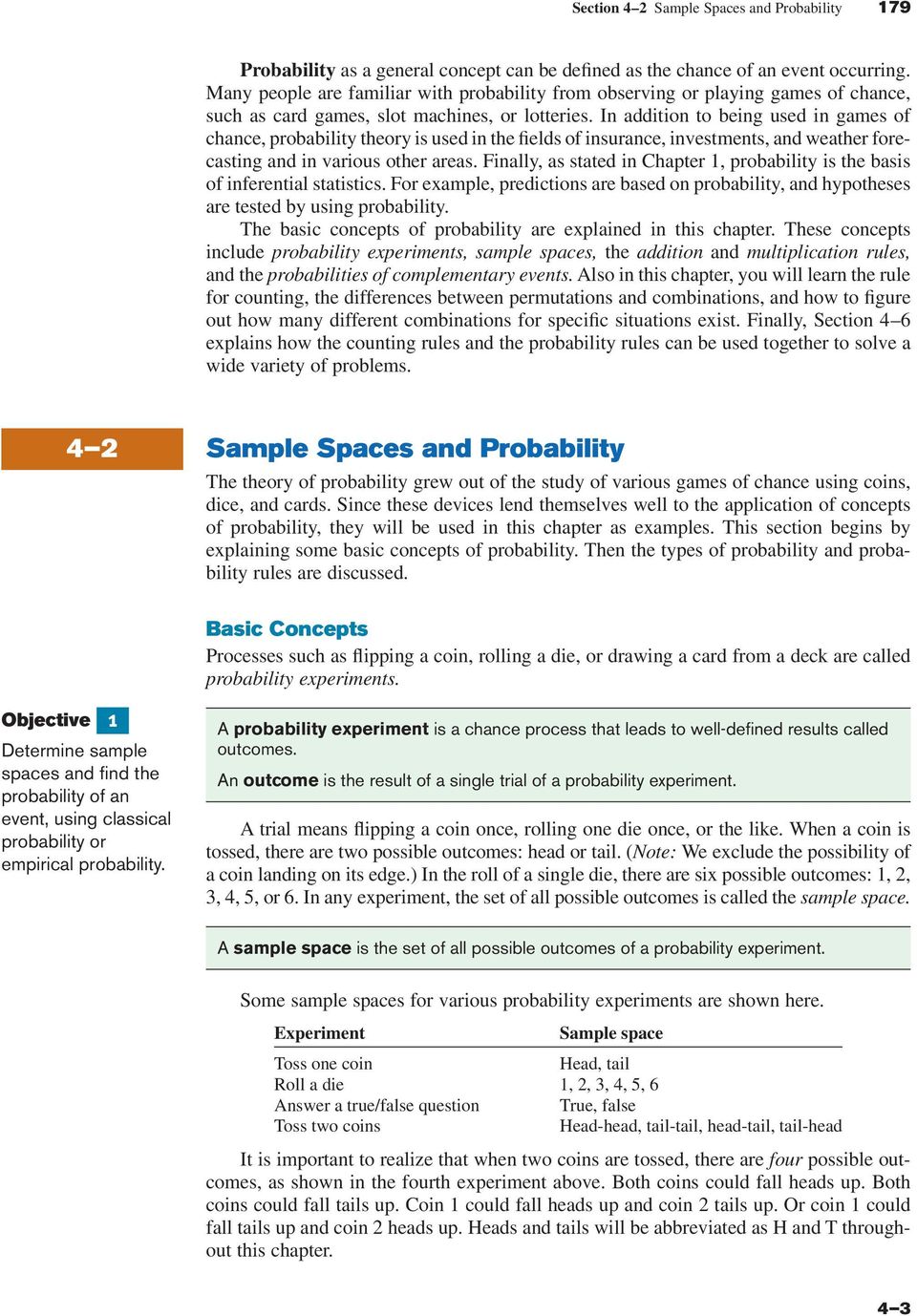
3 Section 4 2 Sample Spaces and Probability 79 Probability as a general concept can be defined as the chance of an event occurring. Many people are familiar with probability from observing or playing games of chance, such as card games, slot machines, or lotteries. In addition to being used in games of chance, probability theory is used in the fields of insurance, investments, and weather forecasting and in various other areas. Finally, as stated in Chapter, probability is the basis of inferential statistics. For example, predictions are based on probability, and hypotheses are tested by using probability. The basic concepts of probability are explained in this chapter. These concepts include probability experiments, sample spaces, the addition and multiplication rules, and the probabilities of complementary events. Also in this chapter, you will learn the rule for counting, the differences between permutations and combinations, and how to figure out how many different combinations for specific situations exist. Finally, Section 4 6 explains how the counting rules and the probability rules can be used together to solve a wide variety of problems. 4 2 Sample Spaces and Probability The theory of probability grew out of the study of various games of chance using coins, dice, and cards. Since these devices lend themselves well to the application of concepts of probability, they will be used in this chapter as examples. This section begins by explaining some basic concepts of probability. Then the types of probability and probability rules are discussed. Basic Concepts Processes such as flipping a coin, rolling a die, or drawing a card from a deck are called probability experiments. Objective Determine sample spaces and find the probability of an event, using classical probability or empirical probability. A probability experiment is a chance process that leads to well-defined results called outcomes. An outcome is the result of a single trial of a probability experiment. A trial means flipping a coin once, rolling one die once, or the like. When a coin is tossed, there are two possible outcomes: head or tail. (Note: We exclude the possibility of a coin landing on its edge.) In the roll of a single die, there are six possible outcomes:, 2, 3, 4, 5, or 6. In any experiment, the set of all possible outcomes is called the sample space. A sample space is the set of all possible outcomes of a probability experiment. Some sample spaces for various probability experiments are shown here. Experiment Sample space Toss one coin Head, tail Roll a die, 2, 3, 4, 5, 6 Answer a true/false question True, false Toss two coins Head-head, tail-tail, head-tail, tail-head It is important to realize that when two coins are tossed, there are four possible outcomes, as shown in the fourth experiment above. Both coins could fall heads up. Both coins could fall tails up. Coin could fall heads up and coin 2 tails up. Or coin could fall tails up and coin 2 heads up. Heads and tails will be abbreviated as H and T throughout this chapter. 4 3
4 80 Chapter 4 Probability and Counting Rules Example 4 Rolling Dice Find the sample space for rolling two dice. Since each die can land in six different ways, and two dice are rolled, the sample space can be presented by a rectangular array, as shown in Figure 4. The sample space is the list of pairs of numbers in the chart. Figure 4 Die 2 Sample Space for Rolling Two Dice (Example 4 ) Die (, ) (2, ) (3, ) (4, ) (5, ) (6, ) 2 (, 2) (2, 2) (3, 2) (4, 2) (5, 2) (6, 2) 3 (, 3) (2, 3) (3, 3) (4, 3) (5, 3) (6, 3) 4 (, 4) (2, 4) (3, 4) (4, 4) (5, 4) (6, 4) 5 (, 5) (2, 5) (3, 5) (4, 5) (5, 5) (6, 5) 6 (, 6) (2, 6) (3, 6) (4, 6) (5, 6) (6, 6) Example 4 2 Drawing Cards Find the sample space for drawing one card from an ordinary deck of cards. Since there are 4 suits (hearts, clubs, diamonds, and spades) and 3 cards for each suit (ace through king), there are 52 outcomes in the sample space. See Figure 4 2. Figure 4 2 Sample Space for Drawing a Card (Example 4 2) A J Q K A J Q K A J Q K A J Q K Example 4 3 Gender of Children Find the sample space for the gender of the children if a family has three children. Use B for boy and G for girl. There are two genders, male and female, and each child could be either gender. Hence, there are eight possibilities, as shown here. BBB BBG BGB GBB GGG GGB GBG BGG In Examples 4 through 4 3, the sample spaces were found by observation and reasoning; however, another way to find all possible outcomes of a probability experiment is to use a tree diagram. 4 4

5 Section 4 2 Sample Spaces and Probability 8 A tree diagram is a device consisting of line segments emanating from a starting point and also from the outcome point. It is used to determine all possible outcomes of a probability experiment. Example 4 4 Use a tree diagram to find the sample space for the gender of three children in a family, as in Example 4 3. Since there are two possibilities (boy or girl) for the first child, draw two branches from a starting point and label one B and the other G. Then if the first child is a boy, there are two possibilities for the second child (boy or girl), so draw two branches from B and label one B and the other G. Do the same if the first child is a girl. Follow the same procedure for the third child. The completed tree diagram is shown in Figure 4 3. To find the outcomes for the sample space, trace through all the possible branches, beginning at the starting point for each one. Figure 4 3 Tree Diagram for Example 4 4 Historical Note The famous Italian astronomer Galileo ( ) found that a sum of 0 occurs more often than any other sum when three dice are tossed. Previously, it was thought that a sum of 9 occurred more often than any other sum. First child B G Second child B G B Third child B G B G B G Outcomes BBB BBG BGB BGG GBB GBG Historical Note A mathematician named Jerome Cardan (50 576) used his talents in mathematics and probability theory to make his living as a gambler. He is thought to be the first person to formulate the definition of classical probability. An outcome was defined previously as the result of a single trial of a probability experiment. In many problems, one must find the probability of two or more outcomes. For this reason, it is necessary to distinguish between an outcome and an event. An event consists of a set of outcomes of a probability experiment. An event can be one outcome or more than one outcome. For example, if a die is rolled and a 6 shows, this result is called an outcome, since it is a result of a single trial. An event with one outcome is called a simple event. The event of getting an odd number G B G GGB GGG 4 5

6 82 Chapter 4 Probability and Counting Rules H istorical Note During the mid-600s, a professional gambler named Chevalier de Méré made a considerable amount of money on a gambling game. He would bet unsuspecting patrons that in four rolls of a die, he could get at least one 6. He was so successful at the game that some people refused to play. He decided that a new game was necessary to continue his winnings. By reasoning, he figured he could roll at least one double 6 in 24 rolls of two dice, but his reasoning was incorrect and he lost systematically. Unable to figure out why, he contacted a mathematician named Blaise Pascal ( ) to find out why. Pascal became interested and began studying probability theory. He corresponded with a French government official, Pierre de Fermat (60 665), whose hobby was mathematics. Together the two formulated the beginnings of probability theory. when a die is rolled is called a compound event, since it consists of three outcomes or three simple events. In general, a compound event consists of two or more outcomes or simple events. There are three basic interpretations of probability:. Classical probability 2. Empirical or relative frequency probability 3. Subjective probability Classical Probability Classical probability uses sample spaces to determine the numerical probability that an event will happen. One does not actually have to perform the experiment to determine that probability. Classical probability is so named because it was the first type of probability studied formally by mathematicians in the 7th and 8th centuries. Classical probability assumes that all outcomes in the sample space are equally likely to occur. For example, when a single die is rolled, each outcome has the same probability of occurring. Since there are six outcomes, each outcome has a probability of 6. When a card is selected from an ordinary deck of 52 cards, one assumes that the deck has been shuffled, and each card has the same probability of being selected. In this case, it is. 52 Equally likely events are events that have the same probability of occurring. Formula for Classical Probability The probability of any event E is Number of outcomes in E Total number of outcomes in the sample space This probability is denoted by P E n E n S This probability is called classical probability, and it uses the sample space S. Probabilities can be expressed as fractions, decimals, or where appropriate percentages. If one asks, What is the probability of getting a head when a coin is tossed? typical responses can be any of the following three. One-half. Point five. Fifty percent. These answers are all equivalent. In most cases, the answers to examples and exercises given in this chapter are expressed as fractions or decimals, but percentages are used where appropriate. Strictly speaking, a percent is not a probability. However, in everyday language, probabilities are often expressed as percents (i.e., there is a 60% chance of rain tomorrow). For this reason, some probabilities will be expressed as percents throughout this book. 4 6

7 Section 4 2 Sample Spaces and Probability 83 Rounding Rule for Probabilities Probabilities should be expressed as reduced fractions or rounded to two or three decimal places. When the probability of an event is an extremely small decimal, it is permissible to round the decimal to the first nonzero digit after the point. For example, would be When obtaining probabilities from one of the tables in Appendix C, use the number of decimal places given in the table. If decimals are converted to percentages to express probabilities, move the decimal point two places to the right and add a percent sign. Example 4 5 Drawing Cards For a card drawn from an ordinary deck, find the probability of getting a queen. 4 Since there are 52 cards in a deck and there are 4 queens, P(queen) Example 4 6 Gender of Children If a family has three children, find the probability that all the children are girls. The sample space for the gender of children for a family that has three children is BBB, BBG, BGB, GBB, GGG, GGB, GBG, and BGG (see Examples 4 3 and 4 4). Since there is one way in eight possibilities for all three children to be girls, Historical Note Ancient Greeks and Romans made crude dice from animal bones, various stones, minerals, and ivory. When the dice were tested mathematically, some were found to be quite accurate. Example 4 7 P GGG 8 In probability theory, it is important to understand the meaning of the words and and or. For example, if you were asked to find the probability of getting a queen and a heart when you are drawing a single card from a deck, you would be looking for the queen of hearts. Here the word and means at the same time. The word or has two meanings. For example, if you were asked to find the probability of selecting a queen or a heart when one card is selected from a deck, you would be looking for one of the 4 queens or one of the 3 hearts. In this case, the queen of hearts would be included in both cases and counted twice. So there would be possibilities. On the other hand, if you were asked to find the probability of getting a queen or a king, you would be looking for one of the 4 queens or one of the 4 kings. In this case, there would be possibilities. In the first case, both events can occur at the same time; we say that this is an example of the inclusive or. In the second case, both events cannot occur at the same time, and we say that this is an example of the exclusive or. Drawing Cards A card is drawn from an ordinary deck. Find these probabilities. a. Of getting a jack b. Of getting the 6 of clubs (i.e., a 6 and a club) c. Of getting a 3 or a diamond d. Of getting a 3 or a 6 a. Refer to the sample space in Figure 4 2. There are 4 jacks so there are 4 outcomes in event E and 52 possible outcomes in the sample space. Hence, 4 P(jack)

8 84 Chapter 4 Probability and Counting Rules b. Since there is only one 6 of clubs in event E, the probability of getting a 6 of clubs is P(6 of clubs) c. There are four 3s and 3 diamonds, but the 3 of diamonds is counted twice in this listing. Hence, there are 6 possibilities of drawing a 3 or a diamond, so P(3 or diamond) This is an example of the inclusive or. d. Since there are four 3s and four 6s, 8 52 P(3 or 6) This is an example of the exclusive or. There are four basic probability rules. These rules are helpful in solving probability problems, in understanding the nature of probability, and in deciding if your answers to the problems are correct. H istorical Note Paintings in tombs excavated in Egypt show that the Egyptians played games of chance. One game called Hounds and Jackals played in 800 B.C. is similar to the present-day game of Snakes and Ladders. Probability Rule The probability of any event E is a number (either a fraction or decimal) between and including 0 and. This is denoted by 0 P(E). Rule states that probabilities cannot be negative or greater than. Probability Rule 2 If an event E cannot occur (i.e., the event contains no members in the sample space), its probability is 0. Example 4 8 Rolling a Die When a single die is rolled, find the probability of getting a 9. Since the sample space is, 2, 3, 4, 5, and 6, it is impossible to get a 9. Hence, the 0 probability is P(9) 0. 6 Probability Rule 3 If an event E is certain, then the probability of E is. In other words, if P(E), then the event E is certain to occur. This rule is illustrated in Example

9 Section 4 2 Sample Spaces and Probability 85 Example 4 9 Drawing a Card When a single die is rolled, what is the probability of getting a number less than 7? Since all outcomes, 2, 3, 4, 5, and 6 are less than 7, the probability is 6 P(number less than 7) The event of getting a number less than 7 is certain. 6 In other words, probability values range from 0 to. When the probability of an event is close to 0, its occurrence is highly unlikely. When the probability of an event is near 0.5, there is about a chance that the event will occur; and when the probability of an event is close to, the event is highly likely to occur. Probability Rule 4 The sum of the probabilities of all the outcomes in the sample space is. For example, in the roll of a fair die, each outcome in the sample space has a probability of. Hence, the sum of the probabilities of the outcomes is as shown. 6 Outcome Probability Sum Complementary Events Another important concept in probability theory is that of complementary events. When a die is rolled, for instance, the sample space consists of the outcomes, 2, 3, 4, 5, and 6. The event E of getting odd numbers consists of the outcomes, 3, and 5. The event of not getting an odd number is called the complement of event E, and it consists of the outcomes 2, 4, and 6. The complement of an event E is the set of outcomes in the sample space that are not included in the outcomes of event E. The complement of E is denoted by E (read E bar ). Example 4 0 further illustrates the concept of complementary events. Example 4 0 Find the complement of each event. a. Rolling a die and getting a 4 b. Selecting a letter of the alphabet and getting a vowel c. Selecting a month and getting a month that begins with a J d. Selecting a day of the week and getting a weekday 4 9

10 86 Chapter 4 Probability and Counting Rules a. Getting a, 2, 3, 5, or 6 b. Getting a consonant (assume y is a consonant) c. Getting February, March, April, May, August, September, October, November, or December d. Getting Saturday or Sunday The outcomes of an event and the outcomes of the complement make up the entire sample space. For example, if two coins are tossed, the sample space is HH, HT, TH, and TT. The complement of getting all heads is not getting all tails, since the event all heads is HH, and the complement of HH is HT, TH, and TT. Hence, the complement of the event all heads is the event getting at least one tail. Since the event and its complement make up the entire sample space, it follows that the sum of the probability of the event and the probability of its complement will equal. That is, P(E) P( E). In Example 4 0, let E all heads, or HH, 3 and let E at least one tail, or HT, TH, TT. Then P(E) 4 and P( E) 4; hence, 3 P(E) P( E) 4 4. The rule for complementary events can be stated algebraically in three ways. Rule for Complementary Events P( E) P(E) or P(E) P( E) or P(E) P( E) Stated in words, the rule is: If the probability of an event or the probability of its complement is known, then the other can be found by subtracting the probability from. This rule is important in probability theory because at times the best solution to a problem is to find the probability of the complement of an event and then subtract from to get the probability of the event itself. Example 4 Residence of People If the probability that a person lives in an industrialized country of the world is, find the probability that a person does not live in an industrialized country. 5 Source: Harper s Index. P(not living in an industrialized country) P(living in an industrialized country) Probabilities can be represented pictorially by Venn diagrams. Figure 4 4(a) shows the probability of a simple event E. The area inside the circle represents the probability of event E, that is, P(E). The area inside the rectangle represents the probability of all the events in the sample space P(S). The Venn diagram that represents the probability of the complement of an event P( E) is shown in Figure 4 4(b). In this case, P( E) P(E), which is the area inside the rectangle but outside the circle representing P(E). Recall that P(S) and P(E) P( E). The reasoning is that P(E) is represented by the area of the circle and P( E) is the probability of the events that are outside the circle. 4 0

11 Section 4 2 Sample Spaces and Probability 87 Figure 4 4 Venn Diagram for the Probability and Complement P(E ) P(E ) P(S) = P(E ) (a) Simple probability (b) P(E ) = P(E ) Empirical Probability The difference between classical and empirical probability is that classical probability assumes that certain outcomes are equally likely (such as the outcomes when a die is rolled), while empirical probability relies on actual experience to determine the likelihood of outcomes. In empirical probability, one might actually roll a given die 6000 times, observe the various frequencies, and use these frequencies to determine the probability of an outcome. Suppose, for example, that a researcher asked 25 people if they liked the taste of a new soft drink. The responses were classified as yes, no, or undecided. The results were categorized in a frequency distribution, as shown. Response Frequency Yes 5 No 8 Undecided 2 Total 25 Probabilities now can be compared for various categories. For example, the probability 5 3 of selecting a person who liked the taste is 25, or 5, since 5 out of 25 people in the survey answered yes. Formula for Empirical Probability Given a frequency distribution, the probability of an event being in a given class is P E frequency for the class total frequencies in the distribution f n This probability is called empirical probability and is based on observation. Example 4 2 Soft Drink Survey In the soft drink survey just described, find the probability that a person responded no. P E f n 8 25 Note: This is the same relative frequency explained in Chapter 2. 4

12 88 Chapter 4 Probability and Counting Rules Example 4 3 Distribution of Blood Types In a sample of 50 people, 2 had type O blood, 22 had type A blood, 5 had type B blood, and 2 had type AB blood. Set up a frequency distribution and find the following probabilities. a. A person has type O blood. b. A person has type A or type B blood. c. A person has neither type A nor type O blood. d. A person does not have type AB blood. Source: The American Red Cross. Type Frequency a. b. c. d. A 22 B 5 AB 2 O 2 Total 50 P O f n 2 50 P A or B (Add the frequencies of the two classes.) P neither A nor O (Neither A nor O means that a person has either type B or type AB blood.) P not AB P AB (Find the probability of not AB by subtracting the probability of type AB from.) Example 4 4 Hospital Stays for Maternity Patients Hospital records indicated that maternity patients stayed in the hospital for the number of days shown in the distribution. Number of days stayed Frequency Find these probabilities a. A patient stayed exactly 5 days. c. A patient stayed at most 4 days. b. A patient stayed less than 6 days. d. A patient stayed at least 5 days. 4 2

13 Section 4 2 Sample Spaces and Probability 89 a. P b. P less than 6 days (Less than 6 days means 3, 4, or 5 days.) c. P at most 4 days (At most 4 days means 3 or 4 days.) d. P at least 5 days (At least 5 days means 5, 6, or 7 days.) Empirical probabilities can also be found by using a relative frequency distribution, as shown in Section 2 3. For example, the relative frequency distribution of the soft drink data shown before is Relative Response Frequency frequency Yes No Undecided Hence, the probability that a person responded no is 0.32, which is equal to. Law of Large Numbers When a coin is tossed one time, it is common knowledge that the probability of getting a head is 2. But what happens when the coin is tossed 50 times? Will it come up heads 25 times? Not all the time. One should expect about 25 heads if the coin is fair. But due to chance variation, 25 heads will not occur most of the time. If the empirical probability of getting a head is computed by using a small number of trials, it is usually not exactly 2. However, as the number of trials increases, the empirical probability of getting a head will approach the theoretical probability of 2, if in fact the coin is fair (i.e., balanced). This phenomenon is an example of the law of large numbers. One should be careful to not think that the number of heads and number of tails tend to even out. As the number of trials increases, the proportion of heads to the total number of trials will approach 2. This law holds for any type of gambling game tossing dice, playing roulette, and so on. It should be pointed out that the probabilities that the proportions steadily approach may or may not agree with those theorized in the classical model. If not, it can have important implications, such as the die is not fair. Pit bosses in Las Vegas watch for empirical trends that do not agree with classical theories, and they will sometimes take a set of dice out of play if observed frequencies are too far out of line with classical expected frequencies. Subjective Probability The third type of probability is called subjective probability. Subjective probability uses a probability value based on an educated guess or estimate, employing opinions and inexact information

14 90 Chapter 4 Probability and Counting Rules In subjective probability, a person or group makes an educated guess at the chance that an event will occur. This guess is based on the person s experience and evaluation of a solution. For example, a sportswriter may say that there is a 70% probability that the Pirates will win the pennant next year. A physician might say that, on the basis of her diagnosis, there is a 30% chance the patient will need an operation. A seismologist might say there is an 80% probability that an earthquake will occur in a certain area. These are only a few examples of how subjective probability is used in everyday life. All three types of probability (classical, empirical, and subjective) are used to solve a variety of problems in business, engineering, and other fields. Probability and Risk Taking An area in which people fail to understand probability is risk taking. Actually, people fear situations or events that have a relatively small probability of happening rather than those events that have a greater likelihood of occurring. For example, many people think that the crime rate is increasing every year. However, in his book entitled How Risk Affects Your Everyday Life, author James Walsh states: Despite widespread concern about the number of crimes committed in the United States, FBI and Justice Department statistics show that the national crime rate has remained fairly level for 20 years. It even dropped slightly in the early 990s. He further states, Today most media coverage of risk to health and well-being focuses on shock and outrage. Shock and outrage make good stories and can scare us about the wrong dangers. For example, the author states that if a person is 20% overweight, the loss of life expectancy is 900 days (about 3 years), but loss of life expectancy from exposure to radiation emitted by nuclear power plants is 0.02 day. As you can see, being overweight is much more of a threat than being exposed to radioactive emission. Many people gamble daily with their lives, for example, by using tobacco, drinking and driving, and riding motorcycles. When people are asked to estimate the probabilities or frequencies of death from various causes, they tend to overestimate causes such as accidents, fires, and floods and to underestimate the probabilities of death from diseases (other than cancer), strokes, etc. For example, most people think that their chances of dying of a heart attack are in 20, when in fact they are almost in 3; the chances of dying by pesticide poisoning are in 200,000 (True Odds by James Walsh). The reason people think this way is that the news media sensationalize deaths resulting from catastrophic events and rarely mention deaths from disease. When you are dealing with life-threatening catastrophes such as hurricanes, floods, automobile accidents, or smoking, it is important to get the facts. That is, get the actual numbers from accredited statistical agencies or reliable statistical studies, and then compute the probabilities and make decisions based on your knowledge of probability and statistics. In summary, then, when you make a decision or plan a course of action based on probability, make sure that you understand the true probability of the event occurring. Also, find out how the information was obtained (i.e., from a reliable source). Weigh the cost of the action and decide if it is worth it. Finally, look for other alternatives or courses of action with less risk involved. Applying the Concepts 4 2 Tossing a Coin Assume you are at a carnival and decide to play one of the games. You spot a table where a person is flipping a coin, and since you have an understanding of basic probability, you believe that the odds of winning are in your favor. When you get to the table, you find out that all you 4 4

15 Section 4 2 Sample Spaces and Probability 9 have to do is guess which side of the coin will be facing up after it is tossed. You are assured that the coin is fair, meaning that each of the two sides has an equally likely chance of occurring. You think back about what you learned in your statistics class about probability before you decide what to bet on. Answer the following questions about the coin-tossing game.. What is the sample space? 2. What are the possible outcomes? 3. What does the classical approach to probability say about computing probabilities for this type of problem? You decide to bet on heads, believing that it has a 50% chance of coming up. A friend of yours, who had been playing the game for awhile before you got there, tells you that heads has come up the last 9 times in a row. You remember the law of large numbers. 4. What is the law of large numbers, and does it change your thoughts about what will occur on the next toss? 5. What does the empirical approach to probability say about this problem, and could you use it to solve this problem? 6. Can subjective probabilities be used to help solve this problem? Explain. 7. Assume you could win $ million if you could guess what the results of the next toss will be. What would you bet on? Why? See page 24 for the answers. Exercises 4 2. What is a probability experiment? 2. Define sample space. 3. What is the difference between an outcome and an event? 4. What are equally likely events? 5. What is the range of the values of the probability of an event? 6. When an event is certain to occur, what is its probability? 7. If an event cannot happen, what value is assigned to its probability? 8. What is the sum of the probabilities of all the outcomes in a sample space? 9. If the probability that it will rain tomorrow is 0.20, what is the probability that it won t rain tomorrow? Would you recommend taking an umbrella? 0. A probability experiment is conducted. Which of these cannot be considered a probability of an outcome? a. 3 d g. b. 5 e. 0 h. 33% c f..45 i. 2%. Classify each statement as an example of classical probability, empirical probability, or subjective probability. a. The probability that a person will watch the 6 o clock evening news is 0.5. b. The probability of winning at a Chuck-a-Luck 5 game is 36. c. The probability that a bus will be in an accident on a specific run is about 6%. d. The probability of getting a royal flush when five cards are selected at random is 649,740. e. The probability that a student will get a C or better in a statistics course is about 70%. f. The probability that a new fast-food restaurant will be a success in Chicago is 35%. g. The probability that interest rates will rise in the next 6 months is

16 92 Chapter 4 Probability and Counting Rules 2. (ans) Rolling a Die If a die is rolled one time, find these probabilities. a. Of getting a 4 b. Of getting an even number c. Of getting a number greater than 4 d. Of getting a number less than 7 e. Of getting a number greater than 0 f. Of getting a number greater than 3 or an odd number g. Of getting a number greater than 3 and an odd number 3. Rolling Two Dice If two dice are rolled one time, find the probability of getting these results. a. A sum of 6 b. Doubles c. A sum of 7 or d. A sum greater than 9 e. A sum less than or equal to 4 4. (ans) Drawing a Card If one card is drawn from a deck, find the probability of getting these results. a. An ace b. A diamond c. An ace of diamonds d. A 4 or a 6 e. A 4 or a club f. A 6 or a spade g. A heart or a club h. A red queen i. A red card or a 7 j. A black card and a 0 5. Shopping Mall Promotion A shopping mall has set up a promotion as follows. With any mall purchase, the customer gets to spin the wheel shown here. If the number comes up, the customer wins $0. If the number 2 comes up, the customer wins $5, and if the number 3 or 4 comes up, the customer wins a discount coupon. Find the following probabilities a. The customer wins $0. b. The customer wins money. c. The customer wins a coupon. 6. Selecting a State Choose one of the 50 states at random. a. What is the probability that it begins with M? b. What is the probability that it doesn t begin with a vowel? 7. Postcollege Plans In a college class of 250 graduating seniors, 50 have jobs waiting, 0 are going to medical school, 20 are going to law school, and 80 are going to various other kinds of graduate schools. Select one graduate at random. a. What is the probability that the student is going to graduate school? b. What is the probability that the student is going to medical school? c. What is the probability that the student will have to start paying back her deferred student loans after 6 months (i.e., does not continue in school)? 8. Gun Licensing Sixty-nine percent of adults favor gun licensing in general. Choose one adult at random. What is the probability that the selected adult doesn t believe in gun licensing? Source: Time magazine. 9. Family Structures For a recent year, 5% of the families in the United States had no children under the age of 8; 20% had one child; 9% had two children; 7% had three children; and 3% had four or more children. If a family is selected at random, find the probability that the family has a. Two or three children b. More than one child c. Less than three children d. Based on the answers to parts a, b, and c, which is most likely to occur? Explain why. Source: U.S. Census Bureau. 20. College Degrees In a recent year, of the,84,000 bachelor s degrees conferred, 233,000 were in the field of business, 25,000 were in the social sciences, and 06,000 were in education. If one degree is selected at random, find the following probabilities. a. The degree was awarded in education. b. The degree was not awarded in business. Source: National Center for Education Statistics. 2. Gender of Children A couple has three children. Find each probability. a. All boys b. All girls or all boys c. Exactly two boys or two girls d. At least one child of each gender 4 6

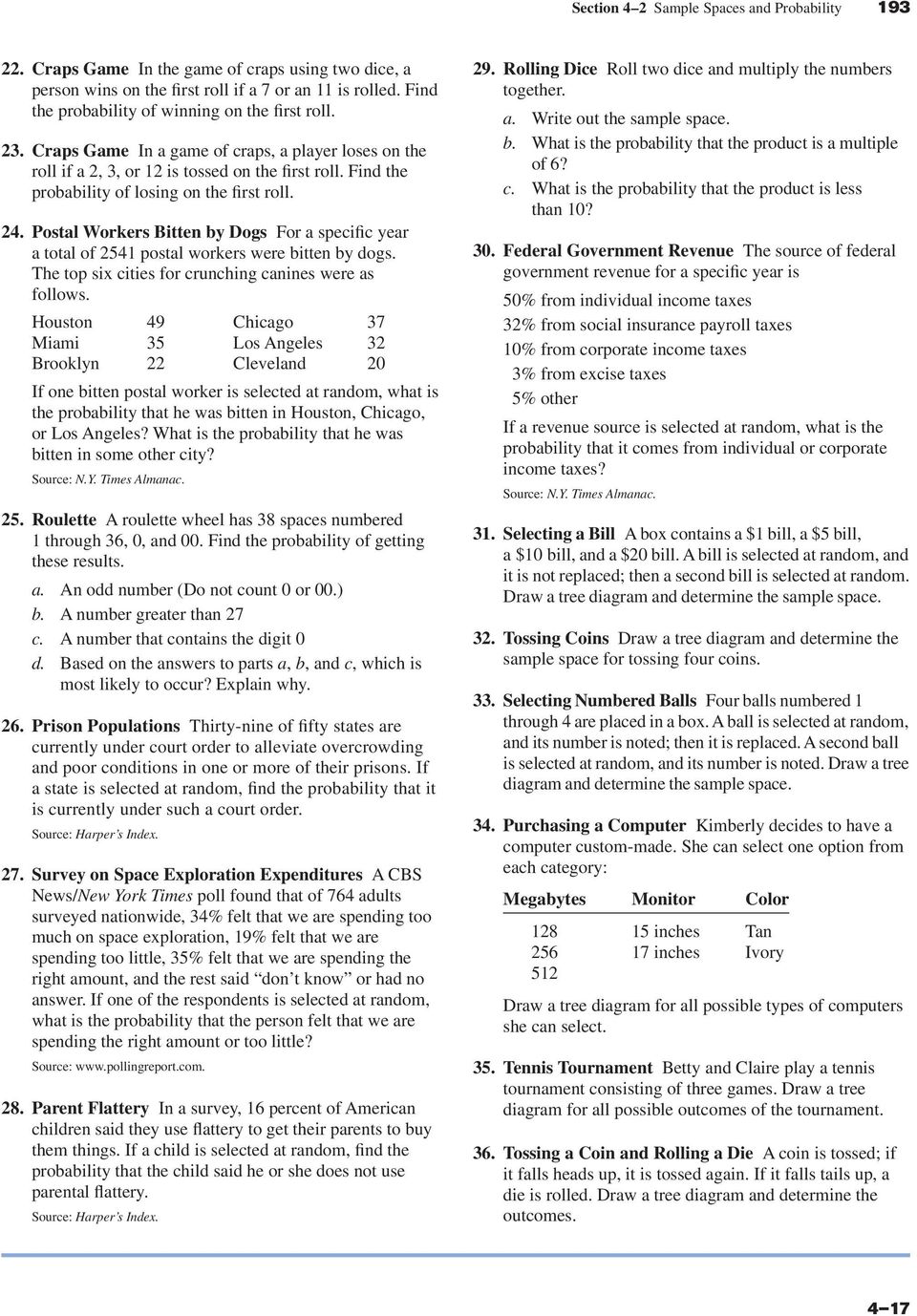
17 Section 4 2 Sample Spaces and Probability Craps Game In the game of craps using two dice, a person wins on the first roll if a 7 or an is rolled. Find the probability of winning on the first roll. 23. Craps Game In a game of craps, a player loses on the roll if a 2, 3, or 2 is tossed on the first roll. Find the probability of losing on the first roll. 24. Postal Workers Bitten by Dogs For a specific year a total of 254 postal workers were bitten by dogs. The top six cities for crunching canines were as follows. Houston 49 Chicago 37 Miami 35 Los Angeles 32 Brooklyn 22 Cleveland 20 If one bitten postal worker is selected at random, what is the probability that he was bitten in Houston, Chicago, or Los Angeles? What is the probability that he was bitten in some other city? Source: N.Y. Times Almanac. 25. Roulette A roulette wheel has 38 spaces numbered through 36, 0, and 00. Find the probability of getting these results. a. An odd number (Do not count 0 or 00.) b. A number greater than 27 c. A number that contains the digit 0 d. Based on the answers to parts a, b, and c, which is most likely to occur? Explain why. 26. Prison Populations Thirty-nine of fifty states are currently under court order to alleviate overcrowding and poor conditions in one or more of their prisons. If a state is selected at random, find the probability that it is currently under such a court order. Source: Harper s Index. 27. Survey on Space Exploration Expenditures A CBS News/New York Times poll found that of 764 adults surveyed nationwide, 34% felt that we are spending too much on space exploration, 9% felt that we are spending too little, 35% felt that we are spending the right amount, and the rest said don t know or had no answer. If one of the respondents is selected at random, what is the probability that the person felt that we are spending the right amount or too little? Source: Parent Flattery In a survey, 6 percent of American children said they use flattery to get their parents to buy them things. If a child is selected at random, find the probability that the child said he or she does not use parental flattery. Source: Harper s Index. 29. Rolling Dice Roll two dice and multiply the numbers together. a. Write out the sample space. b. What is the probability that the product is a multiple of 6? c. What is the probability that the product is less than 0? 30. Federal Government Revenue The source of federal government revenue for a specific year is 50% from individual income taxes 32% from social insurance payroll taxes 0% from corporate income taxes 3% from excise taxes 5% other If a revenue source is selected at random, what is the probability that it comes from individual or corporate income taxes? Source: N.Y. Times Almanac. 3. Selecting a Bill A box contains a $ bill, a $5 bill, a $0 bill, and a $20 bill. A bill is selected at random, and it is not replaced; then a second bill is selected at random. Draw a tree diagram and determine the sample space. 32. Tossing Coins Draw a tree diagram and determine the sample space for tossing four coins. 33. Selecting Numbered Balls Four balls numbered through 4 are placed in a box. A ball is selected at random, and its number is noted; then it is replaced. A second ball is selected at random, and its number is noted. Draw a tree diagram and determine the sample space. 34. Purchasing a Computer Kimberly decides to have a computer custom-made. She can select one option from each category: Megabytes Monitor Color 28 5 inches Tan inches Ivory 52 Draw a tree diagram for all possible types of computers she can select. 35. Tennis Tournament Betty and Claire play a tennis tournament consisting of three games. Draw a tree diagram for all possible outcomes of the tournament. 36. Tossing a Coin and Rolling a Die A coin is tossed; if it falls heads up, it is tossed again. If it falls tails up, a die is rolled. Draw a tree diagram and determine the outcomes. 4 7
18 94 Chapter 4 Probability and Counting Rules Extending the Concepts 37. Distribution of CEO Ages The distribution of ages of CEOs is as follows: Age Frequency up Source: Information based on USA TODAY Snapshot. If a CEO is selected at random, find the probability that his or her age is a. Between 3 and 40 b. Under 3 c. Over 30 and under 5 d. Under 3 or over Tossing a Coin A person flipped a coin 00 times and obtained 73 heads. Can the person conclude that the coin was unbalanced? 39. Medical Treatment A medical doctor stated that with a certain treatment, a patient has a 50% chance of recovering without surgery. That is, Either he will get well or he won t get well. Comment on this statement. 40. Wheel Spinner The wheel spinner shown here is spun twice. Find the sample space, and then determine the probability of the following events. 4 3 a. An odd number on the first spin and an even number on the second spin (Note: 0 is considered even.) b. A sum greater than 4 c. Even numbers on both spins d. A sum that is odd e. The same number on both spins Tossing Coins Toss three coins 28 times and record the number of heads (0,, 2, or 3); then record your results with the theoretical probabilities. Compute the empirical probabilities of each. 42. Tossing Coins Toss two coins 00 times and record the number of heads (0,, 2). Compute the probabilities of each outcome, and compare these probabilities with the theoretical results. 43. Odds Odds are used in gambling games to make them fair. For example, if a person rolled a die and won every time he or she rolled a 6, then the person would win on average once every 6 times. So that the game is fair, the odds of 5 to are given. This means that if the person bet $ and won, he or she could win $5. On average, the player would win $5 once in 6 rolls and lose $ on the other 5 rolls hence the term fair game. In most gambling games, the odds given are not fair. For example, if the odds of winning are really 20 to, the house might offer 5 to in order to make a profit. Odds can be expressed as a fraction or as a ratio, 5 such as, 5:, or 5 to. Odds are computed in favor of the event or against the event. The formulas for odds are Odds in favor Odds against In the die example, P E P E P E P E 6 Odds in favor of a 6 5 or : Odds against a 6 5 or 5: 6 Find the odds in favor of and against each event. a. Rolling a die and getting a 2 b. Rolling a die and getting an even number c. Drawing a card from a deck and getting a spade d. Drawing a card and getting a red card e. Drawing a card and getting a queen f. Tossing two coins and getting two tails g. Tossing two coins and getting one tail 4 8

19 Section 4 3 The Addition Rules for Probability The Addition Rules for Probability Objective 2 Find the probability of compound events, using the addition rules. H istorical Note The first book on probability, The Book of Chance and Games, was written by Jerome Cardan (50 576). Cardan was an astrologer, philosopher, physician, mathematician, and gambler. This book contained techniques on how to cheat and how to catch others at cheating. Many problems involve finding the probability of two or more events. For example, at a large political gathering, one might wish to know, for a person selected at random, the probability that the person is a female or is a Republican. In this case, there are three possibilities to consider:. The person is a female. 2. The person is a Republican. 3. The person is both a female and a Republican. Consider another example. At the same gathering there are Republicans, Democrats, and Independents. If a person is selected at random, what is the probability that the person is a Democrat or an Independent? In this case, there are only two possibilities:. The person is a Democrat. 2. The person is an Independent. The difference between the two examples is that in the first case, the person selected can be a female and a Republican at the same time. In the second case, the person selected cannot be both a Democrat and an Independent at the same time. In the second case, the two events are said to be mutually exclusive; in the first case, they are not mutually exclusive. Two events are mutually exclusive events if they cannot occur at the same time (i.e., they have no outcomes in common). In another situation, the events of getting a 4 and getting a 6 when a single card is drawn from a deck are mutually exclusive events, since a single card cannot be both a 4 and a 6. On the other hand, the events of getting a 4 and getting a heart on a single draw are not mutually exclusive, since one can select the 4 of hearts when drawing a single card from an ordinary deck. Example 4 5 Rolling a Die Determine which events are mutually exclusive and which are not, when a single die is rolled. a. Getting an odd number and getting an even number b. Getting a 3 and getting an odd number c. Getting an odd number and getting a number less than 4 d. Getting a number greater than 4 and getting a number less than 4 a. The events are mutually exclusive, since the first event can be, 3, or 5 and the second event can be 2, 4, or 6. b. The events are not mutually exclusive, since the first event is a 3 and the second can be, 3, or 5. Hence, 3 is contained in both events. c. The events are not mutually exclusive, since the first event can be, 3, or 5 and the second can be, 2, or 3. Hence, and 3 are contained in both events. d. The events are mutually exclusive, since the first event can be 5 or 6 and the second event can be, 2, or

20 96 Chapter 4 Probability and Counting Rules Example 4 6 Drawing a Card Determine which events are mutually exclusive and which are not, when a single card is drawn from a deck. a. Getting a 7 and getting a jack b. Getting a club and getting a king c. Getting a face card and getting an ace d. Getting a face card and getting a spade Only the events in parts a and c are mutually exclusive. The probability of two or more events can be determined by the addition rules. The first addition rule is used when the events are mutually exclusive. Addition Rule When two events A and B are mutually exclusive, the probability that A or B will occur is P(A or B) P(A) P(B) Example 4 7 Selecting a Doughnut A box contains 3 glazed doughnuts, 4 jelly doughnuts, and 5 chocolate doughnuts. If a person selects a doughnut at random, find the probability that it is either a glazed doughnut or a chocolate doughnut. Since the box contains 3 glazed doughnuts, 5 chocolate doughnuts, and a total of doughnuts, P(glazed or chocolate) P(glazed) P(chocolate) The events are mutually exclusive. Example 4 8 Political Affiliation at a Rally At a political rally, there are 20 Republicans, 3 Democrats, and 6 Independents. If a person is selected at random, find the probability that he or she is either a Democrat or an Independent. P(Democrat or Independent) P(Democrat) P(Independent) Example 4 9 Selecting a Day of the Week A day of the week is selected at random. Find the probability that it is a weekend day. P(Saturday or Sunday) P(Saturday) P(Sunday)

21 Section 4 3 The Addition Rules for Probability 97 When two events are not mutually exclusive, we must subtract one of the two probabilities of the outcomes that are common to both events, since they have been counted twice. This technique is illustrated in Example Example 4 20 Drawing a Card A single card is drawn from a deck. Find the probability that it is a king or a club. Since the king of clubs means a king and a club, it has been counted twice once as a king and once as a club; therefore, one of the outcomes must be subtracted, as shown. P(king or club) P(king) P(club) P(king of clubs) When events are not mutually exclusive, addition rule 2 can be used to find the probability of the events. Addition Rule 2 If A and B are not mutually exclusive, then P(A or B) P(A) P(B) P(A and B) Note: This rule can also be used when the events are mutually exclusive, since P(A and B) will always equal 0. However, it is important to make a distinction between the two situations. Example 4 2 Selecting a Medical Staff Person In a hospital unit there are 8 nurses and 5 physicians; 7 nurses and 3 physicians are females. If a staff person is selected, find the probability that the subject is a nurse or a male. The sample space is shown here. The probability is Staff Females Males Total Nurses 7 8 Physicians Total P(nurse or male) P(nurse) P(male) P(male nurse)
22 98 Chapter 4 Probability and Counting Rules Example 4 22 Drunk Driving On New Year s Eve, the probability of a person driving while intoxicated is 0.32, the probability of a person having a driving accident is 0.09, and the probability of a person having a driving accident while intoxicated is What is the probability of a person driving while intoxicated or having a driving accident? P(intoxicated or accident) P(intoxicated) P(accident) P(intoxicated and accident) In summary, then, when the two events are mutually exclusive, use addition rule. When the events are not mutually exclusive, use addition rule 2. The probability rules can be extended to three or more events. For three mutually exclusive events A, B, and C, P(A or B or C) P(A) P(B) P(C) For three events that are not mutually exclusive, P(A or B or C) P(A) P(B) P(C) P(A and B) P(A and C) P(B and C) P(A and B and C) See Exercises 23, 24, and 25 in this section. Figure 4 5(a) shows a Venn diagram that represents two mutually exclusive events A and B. In this case, P(A or B) P(A) P(B), since these events are mutually exclusive and do not overlap. In other words, the probability of occurrence of event A or event B is the sum of the areas of the two circles. Figure 4 5(b) represents the probability of two events that are not mutually exclusive. In this case, P(A or B) P(A) P(B) P(A and B). The area in the intersection or overlapping part of both circles corresponds to P(A and B); and when the area of circle A is added to the area of circle B, the overlapping part is counted twice. It must therefore be subtracted once to get the correct area or probability. Note: Venn diagrams were developed by mathematician John Venn ( ) and are used in set theory and symbolic logic. They have been adapted to probability theory also. In set theory, the symbol represents the union of two sets, and A B corresponds to A or B. The symbol represents the intersection of two sets, and A B corresponds to A and B. Venn diagrams show only a general picture of the probability rules and do not portray all situations, such as P(A) 0, accurately. Figure 4 5 Venn Diagrams for the Addition Rules P(A ) P(B ) P (A and B ) P(A ) P(B ) P(S ) = (a) Mutually exclusive events (a) P(A or B ) = P(A ) + P(B ) P(S ) = (b) Non-mutually exclusive events (b) P(A or B ) = P(A ) + P(B ) P(A and B ) 4 22
23 Section 4 3 The Addition Rules for Probability 99 Applying the Concepts 4 3 Which Pain Reliever Is Best? Assume that following an injury you received from playing your favorite sport, you obtain and read information on new pain medications. In that information you read of a study that was conducted to test the side effects of two new pain medications. Use the following table to answer the questions and decide which, if any, of the two new pain medications you will use. Number of side effects in 2-week clinical trial Placebo Drug A Drug B Side effect n 92 n 86 n 88 Upper respiratory congestion Sinus headache Stomach ache Neurological headache Cough Lower respiratory congestion 2 5. How many subjects were in the study? 2. How long was the study? 3. What were the variables under study? 4. What type of variables are they, and what level of measurement are they on? 5. Are the numbers in the table exact figures? 6. What is the probability that a randomly selected person was receiving a placebo? 7. What is the probability that a person was receiving a placebo or drug A? Are these mutually exclusive events? What is the complement to this event? 8. What is the probability that a randomly selected person was receiving a placebo or experienced a neurological headache? 9. What is the probability that a randomly selected person was not receiving a placebo or experienced a sinus headache? See page 24 for the answers. Exercises 4 3. Define mutually exclusive events, and give an example of two events that are mutually exclusive and two events that are not mutually exclusive. 2. Determine whether these events are mutually exclusive. a. Roll a die: Get an even number, and get a number less than 3. b. Roll a die: Get a prime number (2, 3, 5), and get an odd number. c. Roll a die: Get a number greater than 3, and get a number less than 3. d. Select a student in your class: The student has blond hair, and the student has blue eyes. e. Select a student in your college: The student is a sophomore, and the student is a business major. f. Select any course: It is a calculus course, and it is an English course. g. Select a registered voter: The voter is a Republican, and the voter is a Democrat. 3. Selecting a Month for a Sale An automobile dealer decides to select a month for its annual sale. Find the probability that it will be September or October. Assume all months have an equal probability of being selected. Compute the probability of selecting September or October, using days, and compare the answers. 4 23
24 200 Chapter 4 Probability and Counting Rules 4. Selecting a Staff Person At a community swimming pool there are 2 managers, 8 lifeguards, 3 concession stand clerks, and 2 maintenance people. If a person is selected at random, find the probability that the person is either a lifeguard or a manager. 5. Selecting an Instructor At a convention there are 7 mathematics instructors, 5 computer science instructors, 3 statistics instructors, and 4 science instructors. If an instructor is selected, find the probability of getting a science instructor or a math instructor. 6. Selecting a Movie A media rental store rented the following number of movie titles in each of these categories: 70 horror, 230 drama, 20 mystery, 30 romance, and 50 comedy. If a person selects a movie to rent, find the probability that it is a romance or a comedy. Is this event likely or unlikely to occur? Explain your answer. 7. Selecting a Nurse A recent study of 200 nurses found that of 25 female nurses, 56 had bachelor s degrees; and of 75 male nurses, 34 had bachelor s degrees. If a nurse is selected at random, find the probability that the nurse is a. A female nurse with a bachelor s degree b. A male nurse c. A male nurse with a bachelor s degree d. Based on your answers to parts a, b, and c, explain which is most likely to occur. Explain why. 8. Student Ownership The probability that a student owns a car is 0.65, and the probability that a student owns a computer is If the probability that a student owns both is 0.55, what is the probability that a given student owns neither a car nor a computer? 9. Sports Participation At a particular school with 200 male students, 58 play football, 40 play basketball, and 8 play both. What is the probability that a randomly selected male student plays neither sport? 0. Selecting a Card A single card is drawn from a deck. Find the probability of selecting the following. a. A 4 or a diamond b. A club or a diamond c. A jack or a black card. Selecting a Student In a statistics class there are 8 juniors and 0 seniors; 6 of the seniors are females, and 2 of the juniors are males. If a student is selected at random, find the probability of selecting the following. a. A junior or a female b. A senior or a female c. A junior or a senior 2. Selecting a Book At a used-book sale, 00 books are adult books and 60 are children s books. Of the adult books, 70 are nonfiction while 60 of the children s books are nonfiction. If a book is selected at random, find the probability that it is a. Fiction b. Not a children s nonfiction book c. An adult book or a children s nonfiction book 3. Selecting a Motor Vehicle The Bargain Auto Mall has these cars in stock. SUV Compact Mid-sized Foreign Domestic If a car is selected at random, find the probability that it is a. Domestic b. Foreign and mid-sized c. Domestic or an SUV 4. Endangered Species The numbers of endangered species for several groups are listed here. Mammals Birds Reptiles Amphibians United States Foreign If one endangered species is selected at random, find the probability that it is a. Found in the United States and is a bird b. Foreign or a mammal c. Warm-blooded Source: N.Y. Times Almanac. 5. Selecting an Employee A grocery store employs cashiers, stock clerks, and deli personnel. The distribution of employees according to marital status is shown here. Marital Stock Deli status Cashiers clerks personnel Married Not married If an employee is selected at random, find these probabilities. a. The employee is a stock clerk or married. b. The employee is not married. c. The employee is a cashier or is not married. 6. Selecting a Newspaper In a certain geographic region, newspapers are classified as being published daily morning, daily evening, and weekly. Some have a comics section and others do not. The distribution is shown here. Have comics section Morning Evening Weekly Yes 2 3 No
25 Section 4 3 The Addition Rules for Probability 20 If a newspaper is selected at random, find these probabilities. a. The newspaper is a weekly publication. b. The newspaper is a daily morning publication or has comics. c. The newspaper is published weekly or does not have comics. 7. Cable Channel Programming Three cable channels (6, 8, and 0) have quiz shows, comedies, and dramas. The number of each is shown here. Channel Channel Channel Type of show Quiz show 5 2 Comedy Drama If a show is selected at random, find these probabilities. a. The show is a quiz show, or it is shown on channel 8. b. The show is a drama or a comedy. c. The show is shown on channel 0, or it is a drama. 8. Mail Delivery A local postal carrier distributes firstclass letters, advertisements, and magazines. For a certain day, she distributed the following numbers of each type of item. First-class Delivered to letters Ads Magazines Home Business If an item of mail is selected at random, find these probabilities. a. The item went to a home. b. The item was an ad, or it went to a business. c. The item was a first-class letter, or it went to a home. 9. Medical Tests on Emergency Patients The frequency distribution shown here illustrates the number of medical tests conducted on 30 randomly selected emergency patients. Number of tests Number of performed patients or more 5 If a patient is selected at random, find these probabilities. a. The patient has had exactly 2 tests done. b. The patient has had at least 2 tests done. c. The patient has had at most 3 tests done. d. The patient has had 3 or fewer tests done. e. The patient has had or 2 tests done. 20. Length of Hospital Stays This distribution represents the length of time a patient spends in a hospital. Days Frequency If a patient is selected, find these probabilities. a. The patient spends 3 days or fewer in the hospital. b. The patient spends fewer than 8 days in the hospital. c. The patient spends 6 or more days in the hospital. d. The patient spends a maximum of days in the hospital. 2. Door-to-Door Sales A sales representative who visits customers at home finds she sells 0,, 2, 3, or 4 items according to the following frequency distribution. Items sold Frequency Find the probability that she sells the following. a. Exactly item b. More than 2 items c. At least item d. At most 3 items 22. Medical Patients A recent study of 300 patients found that of 00 alcoholic patients, 87 had elevated cholesterol levels, and of 200 nonalcoholic patients, 43 had elevated cholesterol levels. If a patient is selected at random, find the probability that the patient is the following. a. An alcoholic with elevated cholesterol level b. A nonalcoholic c. A nonalcoholic with nonelevated cholesterol level 23. Selecting a Card If one card is drawn from an ordinary deck of cards, find the probability of getting the following. a. A king or a queen or a jack b. A club or a heart or a spade c. A king or a queen or a diamond d. An ace or a diamond or a heart e. A 9 or a 0 or a spade or a club 4 25
26 202 Chapter 4 Probability and Counting Rules 24. Rolling a Die Two dice are rolled. Find the probability of getting a. A sum of 5, 6, or 7 b. Doubles or a sum of 6 or 8 c. A sum greater than 8 or less than 3 d. Based on the answers to parts a, b, and c, which is least likely to occur? Explain why. 25. Selecting a Colored Ball An urn contains 6 red balls, 2 green balls, blue ball, and white ball. If a ball is drawn, find the probability of getting a red or a white ball. 26. Rolling Dice Three dice are rolled. Find the probability of getting a. Triples b. A sum of 5 Extending the Concepts 27. Purchasing a Pizza The probability that a customer selects a pizza with mushrooms or pepperoni is 0.43, and the probability that the customer selects only mushrooms is If the probability that he or she selects only pepperoni is 0.7, find the probability of the customer selecting both items. 28. Building a New Home In building new homes, a contractor finds that the probability of a home buyer selecting a two-car garage is 0.70 and of selecting a one-car garage is Find the probability that the buyer will select no garage. The builder does not build houses with three-car or more garages. 29. In Exercise 28, find the probability that the buyer will not want a two-car garage. 30. Suppose that P(A) 0.42, P(B) 0.38, and P(A B) Are A and B mutually exclusive? Explain. LAFF-A-DAY I know you haven t had an accident in thirteen years. We re raising your rates because you re about due one. Source: King Features Syndicate. Technology Step by Step MINITAB Step by Step Calculate Relative Frequency Probabilities The random variable X represents the number of days patients stayed in the hospital from Example In C of a worksheet, type in the values of X. Name the column X. 2. In C2 enter the frequencies. Name the column f. 3. To calculate the relative frequencies and store them in a new column named Px: a) Select Calc>Calculator. b) Type Px in the box for Store result in variable:. c) Click in the Expression box, then double-click C2 f. d) Type or click the division operator. e) Scroll down the function list to Sum, then click [Select]. f ) Double-click C2 f to select it. g) Click [OK]. 4 26
27 Section 4 3 The Addition Rules for Probability 203 The dialog box and completed worksheet are shown. If the original data, rather than the table, are in a worksheet, use Stat>Tables>Tally to make the tables with percents (Section 2 2). MINITAB can also make a two-way classification table. Construct a Contingency Table. Select File>Open Worksheet to open the Databank.mtw file. 2. Select Stat>Tables>Crosstabulation... a) Double-click C4 SMOKING STATUS to select it For rows:. b) Select C GENDER for the For Columns: Field. c) Click on option for Counts and then [OK]. The session window and completed dialog box are shown. Tabulated statistics: SMOKING STATUS, GENDER Rows: SMOKING STATUS Columns: GENDER F M All All Cell Contents: Count In this sample of 00 there are 25 females who do not smoke compared to 22 men. Sixteen individuals smoke pack or more per day. TI-83 Plus or TI-84 Plus Step by Step To construct a relative frequency table:. Enter the data values in L and the frequencies in L Move the cursor to the top of the L 3 column so that L 3 is highlighted. 3. Type L 2 divided by the sample size, then press ENTER. 4 27
28 204 Chapter 4 Probability and Counting Rules Use the data from Example 4 4. Excel Step by Step Constructing a Relative Frequency Distribution Use the data from Example In a new worksheet, type the label DAYS in cell A. Beginning in cell A2, type in the data from this variable. 2. In cell B, type the label for the frequency, COUNT. Beginning in cell B2, type in the frequencies. 3. In the cell below the frequencies, compute the sum of the frequencies by selecting the sum icon (Σ) from the toolbar. Highlight the frequencies in column B and Enter. 4. In cell C, type a label for the relative frequencies, Rf. Select cell C2 and type (B2)/(B7) and Enter. Repeat for each frequency. Constructing a Contingency Table Although Excel was not specifically designed to construct a contingency table, you may do so with the use of the MegaStat Add-in available on your CD and Online Learning Center.. Select File>Open to open the Databank.xls file as directed in Example XL, on page Highlight the column labeled SMOKING STATUS and select Edit>Copy. 3. On the toolbar, select File>New to open a new worksheet. Paste the contents of the copied column in column A of the new worksheet by selecting cell A, then Edit>Paste. 4. Return to the previous file Databank.xls by selecting File>DataBank.xls. 5. Highlight the column labeled GENDER. Copy and paste these data in column B of the worksheet with the SMOKING STATUS data. 6. In an open cell on the new worksheet, type M for male and in the cell directly below in the same column, type F for female. In an open column, type in the categories for the SMOKING STATUS data 0,, and 2 in separate cells. 4 28
29 Section 4 4 The Multiplication Rules and Conditional Probability Select MegaStat from the toolbar. Select Chi-Square/Crosstab>Crosstabulation. 8. In the first Data range box, type A:A0. In the Specification range box, type in the range of cells containing the labels for the values of the SMOKING STATUS variable. 9. In the second Data range box, type B:B0. In the Specification range box, type in the range of cells containing the labels for the values of the GENDER variable. 0. Remove any checks from the Output options in the Crosstabulation dialog box. Then click [OK]. This table is obtained in a new sheet labeled Output. 4 4 The Multiplication Rules and Conditional Probability Section 4 3 showed that the addition rules are used to compute probabilities for mutually exclusive and non-mutually exclusive events. This section introduces the multiplication rules. Objective 3 Find the probability of compound events, using the multiplication rules. The Multiplication Rules The multiplication rules can be used to find the probability of two or more events that occur in sequence. For example, if a coin is tossed and then a die is rolled, one can find the probability of getting a head on the coin and a 4 on the die. These two events are said to be independent since the outcome of the first event (tossing a coin) does not affect the probability outcome of the second event (rolling a die). Two events A and B are independent events if the fact that A occurs does not affect the probability of B occurring. 4 29
30 206 Chapter 4 Probability and Counting Rules Here are other examples of independent events: Rolling a die and getting a 6, and then rolling a second die and getting a 3. Drawing a card from a deck and getting a queen, replacing it, and drawing a second card and getting a queen. To find the probability of two independent events that occur in sequence, one must find the probability of each event occurring separately and then multiply the answers. For example, if a coin is tossed twice, the probability of getting two heads is This result can be verified by looking at the sample space HH, HT, TH, TT. Then P(HH). 4 Multiplication Rule When two events are independent, the probability of both occurring is P(A and B) P(A) P(B) Example 4 23 Tossing a Coin A coin is flipped and a die is rolled. Find the probability of getting a head on the coin and a 4 on the die. P(head and 4) P(head) P(4) Note that the sample space for the coin is H, T; and for the die it is, 2, 3, 4, 5, The problem in Example 4 23 can also be solved by using the sample space H H2 H3 H4 H5 H6 T T2 T3 T4 T5 T6 The solution is 2, since there is only one way to get the head-4 outcome. Example 4 24 Drawing a Card A card is drawn from a deck and replaced; then a second card is drawn. Find the probability of getting a queen and then an ace. 4 The probability of getting a queen is 52, and since the card is replaced, the probability of 4 getting an ace is 52. Hence, the probability of getting a queen and an ace is P(queen and ace) P(queen) P(ace) Example 4 25 Selecting a Colored Ball An urn contains 3 red balls, 2 blue balls, and 5 white balls. A ball is selected and its color noted. Then it is replaced. A second ball is selected and its color noted. Find the probability of each of these. a. Selecting 2 blue balls b. Selecting blue ball and then white ball c. Selecting red ball and then blue ball 4 30
31 Section 4 4 The Multiplication Rules and Conditional Probability a. P(blue and blue) P(blue) P(blue) b. P(blue and white) P(blue) P(white) c. P(red and blue) P(red) P(blue) Multiplication rule can be extended to three or more independent events by using the formula P(A and B and C and... and K) P(A) P(B) P(C)... P(K) When a small sample is selected from a large population and the subjects are not replaced, the probability of the event occurring changes so slightly that for the most part, it is considered to remain the same. Examples 4 26 and 4 27 illustrate this concept. Example 4 26 Survey on Stress A Harris poll found that 46% of Americans say they suffer great stress at least once a week. If three people are selected at random, find the probability that all three will say that they suffer great stress at least once a week. Source: 00% American. Let S denote stress. Then P(S and S and S) P(S) P(S) P(S) (0.46)(0.46)(0.46) Example 4 27 Male Color Blindness Approximately 9% of men have a type of color blindness that prevents them from distinguishing between red and green. If 3 men are selected at random, find the probability that all of them will have this type of red-green color blindness. Source: USA TODAY. Let C denote red-green color blindness. Then P(C and C and C) P(C) P(C) P(C) (0.09)(0.09)(0.09) Hence, the rounded probability is In Examples 4 23 through 4 27, the events were independent of one another, since the occurrence of the first event in no way affected the outcome of the second event. On the other hand, when the occurrence of the first event changes the probability of the occurrence of the second event, the two events are said to be dependent. For example, suppose a card is drawn from a deck and not replaced, and then a second card is drawn. What is the probability of selecting an ace on the first card and a king on the second card? 4 3
32 208 Chapter 4 Probability and Counting Rules Before an answer to the question can be given, one must realize that the events are 4 dependent. The probability of selecting an ace on the first draw is 52. If that card is not 4 replaced, the probability of selecting a king on the second card is 5, since there are 4 kings and 5 cards remaining. The outcome of the first draw has affected the outcome of the second draw. Dependent events are formally defined now. When the outcome or occurrence of the first event affects the outcome or occurrence of the second event in such a way that the probability is changed, the events are said to be dependent events. Here are some examples of dependent events: Drawing a card from a deck, not replacing it, and then drawing a second card. Selecting a ball from an urn, not replacing it, and then selecting a second ball. Being a lifeguard and getting a suntan. Having high grades and getting a scholarship. Parking in a no-parking zone and getting a parking ticket. To find probabilities when events are dependent, use the multiplication rule with a modification in notation. For the problem just discussed, the probability of getting an ace 4 4 on the first draw is 52, and the probability of getting a king on the second draw is 5. By the multiplication rule, the probability of both events occurring is The event of getting a king on the second draw given that an ace was drawn the first time is called a conditional probability. The conditional probability of an event B in relationship to an event A is the probability that event B occurs after event A has already occurred. The notation for conditional probability is P(B A). This notation does not mean that B is divided by A; rather, it means the probability that event B occurs given that event A has already occurred. In the card example, P(B A) is the probability that the second card is a king given that the first card is an ace, and it is equal to 4 5 since the first card was not replaced. Multiplication Rule 2 When two events are dependent, the probability of both occurring is P(A and B) P(A) P(B A) Example 4 28 Selecting a CD A person owns a collection of 30 CDs, of which 5 are country music. If 2 CDs are selected at random, find the probability that both are country music. Since the events are dependent, P(C and C 2 ) P(C ) P(C 2 C )
33 Section 4 4 The Multiplication Rules and Conditional Probability 209 Example 4 29 Homeowner s and Automobile Insurance The World Wide Insurance Company found that 53% of the residents of a city had homeowner s insurance (H) with the company. Of these clients, 27% also had automobile insurance (A) with the company. If a resident is selected at random, find the probability that the resident has both homeowner s and automobile insurance with the World Wide Insurance Company. P(H and A) P(H) P(A H) (0.53)(0.27) 0.43 This multiplication rule can be extended to three or more events, as shown in Example Example 4 30 Drawing Cards Three cards are drawn from an ordinary deck and not replaced. Find the probability of these. a. Getting 3 jacks b. Getting an ace, a king, and a queen in order c. Getting a club, a spade, and a heart in order d. Getting 3 clubs a. P(3 jacks) b. P(ace and king and queen) c. P(club and spade and heart) d. P(3 clubs) , , , , , ,200 Tree diagrams can be used as an aid to finding the solution to probability problems when the events are sequential. Example 4 3 illustrates the use of tree diagrams. Example 4 3 Selecting Colored Balls Box contains 2 red balls and blue ball. Box 2 contains 3 blue balls and red ball. A coin is tossed. If it falls heads up, box is selected and a ball is drawn. If it falls tails up, box 2 is selected and a ball is drawn. Find the probability of selecting a red ball. With the use of a tree diagram, the sample space can be determined as shown in Figure 4 6. First, assign probabilities to each branch. Next, using the multiplication rule, multiply the probabilities for each branch. Finally, use the addition rule, since a red ball can be obtained from box or box 2. P red (Note: The sum of all final probabilities will always be equal to.) 4 33
34 20 Chapter 4 Probability and Counting Rules Figure 4 6 Tree Diagram for Example 4 3 Box P(R B ) 2 3 Ball Red 2 = P(B ) 2 Box P(B B ) 3 Blue = P(B 2 ) 2 P(R B ) 4 Red = Box 2 P(B B 2 ) 3 4 Blue 3 = Tree diagrams can be used when the events are independent or dependent, and they can also be used for sequences of three or more events. Objective 4 Find the conditional probability of an event. Conditional Probability The conditional probability of an event B in relationship to an event A was defined as the probability that event B occurs after event A has already occurred. The conditional probability of an event can be found by dividing both sides of the equation for multiplication rule 2 by P(A), as shown: P A and B P A P B A P A and B P A P B A P A P A P A and B P A P B A Formula for Conditional Probability The probability that the second event B occurs given that the first event A has occurred can be found by dividing the probability that both events occurred by the probability that the first event has occurred. The formula is P A and B P B A P A Examples 4 32, 4 33, and 4 34 illustrate the use of this rule. Example 4 32 Selecting Colored Chips A box contains black chips and white chips. A person selects two chips without replacement. If the probability of selecting a black chip and a white 5 3 chip is 56, and the probability of selecting a black chip on the first draw is 8, find the probability of selecting the white chip on the second draw, given that the first chip selected was a black chip. 4 34
35 Section 4 4 The Multiplication Rules and Conditional Probability 2 Let Then B selecting a black chip P W B P B and W P B W selecting a white chip Hence, the probability of selecting a white chip on the second draw given that the first 5 chip selected was black is Example 4 33 Parking Tickets The probability that Sam parks in a no-parking zone and gets a parking ticket is 0.06, and the probability that Sam cannot find a legal parking space and has to park in the no-parking zone is On Tuesday, Sam arrives at school and has to park in a no-parking zone. Find the probability that he will get a parking ticket. Let N parking in a no-parking zone T getting a ticket Then P T N P N and T P N Hence, Sam has a 0.30 probability of getting a parking ticket, given that he parked in a no-parking zone. The conditional probability of events occurring can also be computed when the data are given in table form, as shown in Example Example 4 34 Survey on Women in the Military A recent survey asked 00 people if they thought women in the armed forces should be permitted to participate in combat. The results of the survey are shown. Gender Yes No Total Male Female Total Find these probabilities. a. The respondent answered yes, given that the respondent was a female. b. The respondent was a male, given that the respondent answered no. 4 35
36 22 Chapter 4 Probability and Counting Rules Let M respondent was a male F respondent was a female a. The problem is to find P(Y F). The rule states P Y F Y respondent answered yes N respondent answered no The probability P(F and Y) is the number of females who responded yes, divided by the total number of respondents: The probability P(F) is the probability of selecting a female: P F Then P Y F b. The problem is to find P(M N). P M N P F and Y P F P F and Y 8 00 P F and Y P F P N and M P N The Venn diagram for conditional probability is shown in Figure 4 7. In this case, P B A P A and B P A Figure 4 7 Venn Diagram for Conditional Probability P(A ) P (A and B ) P(B ) P(S) P (A and B ) P(B A ) = P(A ) 4 36
37 Section 4 4 The Multiplication Rules and Conditional Probability 23 which is represented by the area in the intersection or overlapping part of the circles A and B, divided by the area of circle A. The reasoning here is that if one assumes A has occurred, then A becomes the sample space for the next calculation and is the P A and B denominator of the probability fraction. The numerator P(A and B) represents P A the probability of the part of B that is contained in A. Hence, P(A and B) becomes the P A and B numerator of the probability fraction. Imposing a condition reduces the P A sample space. Probabilities for At Least The multiplication rules can be used with the complementary event rule (Section 4 2) to simplify solving probability problems involving at least. Examples 4 35, 4 36, and 4 37 illustrate how this is done. Example 4 35 Drawing Cards A game is played by drawing four cards from an ordinary deck and replacing each card after it is drawn. Find the probability of winning if at least one ace is drawn. It is much easier to find the probability that no aces are drawn (i.e., losing) and then subtract that value from than to find the solution directly, because that would involve finding the probability of getting one ace, two aces, three aces, and four aces and then adding the results. Let E at least one ace is drawn and E no aces drawn. Then Hence, P E ,736 28,56 P E P E P winning P losing 20,736 28,56 7,825 28, or a hand with at least one ace will win about 27% of the time. Example 4 36 Tossing Coins A coin is tossed 5 times. Find the probability of getting at least one tail. It is easier to find the probability of the complement of the event, which is all heads, and then subtract the probability from to get the probability of at least one tail. Hence, P E P E P at least tail P all heads P all heads P at least tail
38 24 Chapter 4 Probability and Counting Rules Example 4 37 Tie Sales The Neckware Association of America reported that 3% of ties sold in the United States are bow ties. If 4 customers who purchased a tie are randomly selected, find the probability that at least one purchased a bow tie. Let E at least one bow tie is purchased and E no bow ties are purchased. Then P(E) 0.03 and P( E) P(no bow ties are purchased) (0.97)(0.97)(0.97)(0.97) 0.885; hence, P(at least one bow tie is purchased) Similar methods can be used for problems involving at most. Applying the Concepts 4 4 Guilty or Innocent? In July 964, an elderly woman was mugged in Costa Mesa, California. In the vicinity of the crime a tall, bearded man sat waiting in a yellow car. Shortly after the crime was committed, a young, tall woman, wearing her blond hair in a ponytail, was seen running from the scene of the crime and getting into the car, which sped off. The police broadcast a description of the suspected muggers. Soon afterward, a couple fitting the description was arrested and convicted of the crime. Although the evidence in the case was largely circumstantial, the two people arrested were nonetheless convicted of the crime. The prosecutor based his entire case on basic probability theory, showing the unlikeness of another couple being in that area while having all the same characteristics that the elderly woman described. The following probabilities were used. Characteristic Assumed probability Drives yellow car out of 2 Man over 6 feet tall out of 0 Man wearing tennis shoes out of 4 Man with beard out of Woman with blond hair out of 3 Woman with hair in a ponytail out of 3 Woman over 6 feet tall out of 00. Compute the probability of another couple being in that area with the same characteristics. 2. Would you use the addition or multiplication rule? Why? 3. Are the characteristics independent or dependent? 4. How are the computations affected by the assumption of independence or dependence? 5. Should any court case be based solely on probabilities? 6. Would you convict the couple who was arrested even if there were no eyewitnesses? 7. Comment on why in today s justice system no person can be convicted solely on the results of probabilities. 8. In actuality, aren t most court cases based on uncalculated probabilities? See page 24 for the answers. 4 38
39 Section 4 4 The Multiplication Rules and Conditional Probability 25 Exercises 4 4. State which events are independent and which are dependent. a. Tossing a coin and drawing a card from a deck b. Drawing a ball from an urn, not replacing it, and then drawing a second ball c. Getting a raise in salary and purchasing a new car d. Driving on ice and having an accident e. Having a large shoe size and having a high IQ f. A father being left-handed and a daughter being left-handed g. Smoking excessively and having lung cancer h. Eating an excessive amount of ice cream and smoking an excessive amount of cigarettes 2. Exercise If 37% of high school students said that they exercise regularly, find the probability that 5 randomly selected high school students will say that they exercise regularly. Would you consider this event likely or unlikely to occur? Explain your answer. 3. Aerobics If 84% of all people who do aerobics are women, find the probability that if 2 people who do aerobics are randomly selected, both are women. Would you consider this event likely or unlikely to occur? Explain your answer. 4. Seat Belt Use The Gallup Poll reported that 52% of Americans used a seat belt the last time they got into a car. If four people are selected at random, find the probability that they all used a seat belt the last time they got into a car. Source: 00% American. 5. Medical Degrees If 28% of U.S. medical degrees are conferred to women, find the probability that 3 randomly selected medical school graduates are men. Would you consider this event likely or unlikely to occur? Explain your answer. 6. Prison Populations If 25% of U.S. federal prison inmates are not U.S. citizens, find the probability that 2 randomly selected federal prison inmates will not be U.S. citizens. Source: Harper s Index. 7. Computer Ownership At a local university 54.3% of incoming first-year students have computers. If 3 students are selected at random, find the following probabilities. a. None have computers. b. At least one has a computer. c. All have computers. 8. Cards If 2 cards are selected from a standard deck of 52 cards without replacement, find these probabilities. a. Both are spades. b. Both are the same suit. c. Both are kings. 9. MLS Players Of the 26 players on major league soccer rosters, 80.% are U.S. citizens. If 3 players are selected at random for an exhibition, what is the probability that all are U.S. citizens? Source: USA TODAY. 0. Poverty and the Federal Government If one-half of Americans believe that the federal government should take primary responsibility for eliminating poverty, find the probability that 3 randomly selected Americans will agree that it is the federal government s responsibility to eliminate poverty. Source: Harper s Index.. Licensed Sports Apparel Of fans who own sports league-licensed apparel, 3% have NFL apparel. If 3 of these fans are selected at random, what is the probability that all have NFL apparel? Source: ESPN Chilton Sports Poll. 2. Flashlight Batteries A flashlight has 6 batteries, 2 of which are defective. If 2 are selected at random without replacement, find the probability that both are defective. 3. Health Insurance Coverage for Children Eightyeight percent of U.S. children are covered by some type of health insurance. If 4 children are selected at random, what is the probability that none are covered? Source: Federal Interagency Forum on Child and Family Statistics. 4. Murder Cases and Weapons The U.S. Department of Justice reported that 6% of all U.S. murders are committed without a weapon. If 3 murder cases are selected at random, find the probability that a weapon was not used in any one of them. Source: 00% American. 5. Customer Purchases In a department store there are 20 customers, 90 of whom will buy at least one item. If 5 customers are selected at random, one by one, find the probability that all will buy at least one item. 6. Drawing Cards Three cards are drawn from a deck without replacement. Find these probabilities. a. All are jacks. b. All are clubs. c. All are red cards. 4 39
40 26 Chapter 4 Probability and Counting Rules 7. Scientific Study In a scientific study there are 8 guinea pigs, 5 of which are pregnant. If 3 are selected at random without replacement, find the probability that all are pregnant. 8. In Exercise 7, find the probability that none are pregnant. 9. Membership in a Civic Organization In a civic organization, there are 38 members; 5 are men and 23 are women. If 3 members are selected to plan the July 4th parade, find the probability that all 3 are women. Would you consider this event likely or unlikely to occur? Explain your answer. 20. In Exercise 9, find the probability that all 3 members are men. 2. Sales A manufacturer makes two models of an item: model I, which accounts for 80% of unit sales, and model II, which accounts for 20% of unit sales. Because of defects, the manufacturer has to replace (or exchange) 0% of its model I and 8% of its model II. If a model is selected at random, find the probability that it will be defective. 22. Automobiles An automobile manufacturer has three factories, A, B, and C. They produce 50, 30, and 20%, respectively, of a specific model of car. Thirty percent of the cars produced in factory A are white, 40% of those produced in factory B are white, and 25% produced in factory C are white. If an automobile produced by the company is selected at random, find the probability that it is white. 23. Automobile Insurance An insurance company classifies drivers as low-risk, medium-risk, and highrisk. Of those insured, 60% are low-risk, 30% are medium-risk, and 0% are high-risk. After a study, the company finds that during a -year period, % of the low-risk drivers had an accident, 5% of the medium-risk drivers had an accident, and 9% of the high-risk drivers had an accident. If a driver is selected at random, find the probability that the driver will have had an accident during the year. 24. Education of Wage Earners In a certain geographic location, 25% of the wage earners have a college degree and 75% do not. Of those who have a college degree, 5% earn more than $00,000 a year. Of those who do not have a college degree, 2% earn more than $00,000 a year. If a wage earner is selected at random, find the probability that she or he earns more than $00,000 a year. 25. Selecting Colored Balls Urn contains 5 red balls and 3 black balls. Urn 2 contains 3 red balls and black ball. Urn 3 contains 4 red balls and 2 black balls. If an urn is selected at random and a ball is drawn, find the probability it will be red. 26. Prison Populations For a recent year, 0.99 of the incarcerated population is adults and 0.07 is female. If an incarcerated person is selected at random, find the probability that the person is a female given that she is an adult. Source: Bureau of Justice. 27. Automobile Thefts In a certain city, the probability that an automobile will be stolen and found within one week is The probability that an automobile will be stolen is Find the probability that a stolen automobile will be found within one week. 28. Model Railroad Circuit A circuit to run a model railroad has 8 switches. Two are defective. If a person selects 2 switches at random and tests them, find the probability that the second one is defective, given that the first one is defective. 29. Country Club Activities At the Avonlea Country Club, 73% of the members play bridge and swim, and 82% play bridge. If a member is selected at random, find the probability that the member swims, given that the member plays bridge. 30. College Courses At a large university, the probability that a student takes calculus and is on the dean s list is The probability that a student is on the dean s list is 0.2. Find the probability that the student is taking calculus, given that he or she is on the dean s list. 3. House Types In Rolling Acres Housing Plan, 42% of the houses have a deck and a garage; 60% have a deck. Find the probability that a home has a garage, given that it has a deck. 32. Pizza and Salads In a pizza restaurant, 95% of the customers order pizza. If 65% of the customers order pizza and a salad, find the probability that a customer who orders pizza will also order a salad. 33. Country Club Activities At an exclusive country club, 68% of the members play bridge and drink champagne, and 83% play bridge. If a member is selected at random, find the probability that the member drinks champagne, given that he or she plays bridge. 34. Smoking Survey Eighty students in a school cafeteria were asked if they favored a ban on smoking in the cafeteria. The results of the survey are shown in the table. Class Favor Oppose No opinion Freshman Sophomore If a student is selected at random, find these probabilities. a. Given that the student is a freshman, he or she opposes the ban. b. Given that the student favors the ban, the student is a sophomore. 4 40
41 Section 4 4 Multiplication Rules and Conditional Probability Utility Patents Consider this table concerning utility patents granted for a specific year. Corporation Government Individual United States 70, Foreign 63, Select one patent at random. a. What is the probability that it is a foreign patent, given that it was issued to a corporation? b. What is the probability that it was issued to an individual, given that it was a U.S. patent? Source: N.Y. Times Almanac. 36. Distribution of Medals at Summer Olympics The medal distribution from the 2000 Summer Olympic Games is shown in the table. Gold Silver Bronze United States Russia China Australia Others Choose one medal winner at random. a. Find the probability that the winner won the gold medal, given that the winner was from the United States. b. Find the probability that the winner was from the United States, given that she or he won a gold medal. c. Are the events medal winner is from United States and gold medal was won independent? Explain. Source: N.Y. Times Almanac. 37. Marital Status of Women According to the Statistical Abstract of the United States, 70.3% of females ages 20 to 24 have never been married. Choose 5 young women in this age category at random. Find the probability that a. None have ever been married. b. At least one has been married. Source: N.Y. Times Almanac. 38. Fatal Accidents The American Automobile Association (AAA) reports that of the fatal car and truck accidents, 54% are caused by car driver error. If 3 accidents are chosen at random, find the probability that a. All are caused by car driver error. b. None are caused by car driver error. c. At least is caused by car driver error. Source: AAA quoted on CNN. 39. Toddler Immunizations Seventy-six percent of toddlers get their recommended immunizations. Suppose that 6 toddlers are selected at random. What is the probability that at least one has not received the recommended immunizations? Source: Federal Interagency Forum on Child and Family Statistics. 40. Defective Radios A lot of portable radios contains 5 good radios and 3 defective ones. If 2 are selected and tested, find the probability that at least one will be defective. 4. Reading to Children Fifty-eight percent of American children (ages 3 to 5) are read to every day by someone at home. Suppose 5 children are randomly selected. What is the probability that at least one is read to every day by someone at home? Source: Federal Interagency Forum on Child and Family Statistics. 42. Doctoral Assistantships Of Ph.D. students, 60% have paid assistantships. If 3 students are selected at random, find the probabilities. a. All have assistantships. b. None have assistantships. c. At least one has an assistantship. Source: U.S. Department of Education/Chronicle of Higher Education. 43. Selecting Cards If 4 cards are drawn from a deck of 52 and not replaced, find the probability of getting at least one club. 44. Clinic Patients At a local clinic there are 8 men, 5 women, and 3 children in the waiting room. If 3 patients are randomly selected, find the probability that there is at least one child among them. 45. Defective Brakes It has been found that 6% of all automobiles on the road have defective brakes. If 5 automobiles are stopped and checked by the state police, find the probability that at least one will have defective brakes. 46. Medication Effectiveness A medication is 75% effective against a bacterial infection. Find the probability that if 2 people take the medication, at least one person s infection will not improve. 47. Tossing a Coin A coin is tossed 5 times; find the probability of getting at least one tail. Would you consider this event likely to happen? Explain your answer. 48. Selecting a Letter of the Alphabet If 3 letters of the alphabet are selected at random, find the probability of getting at least one letter x. Letters can be used more than once. Would you consider this event likely to happen? Explain your answer. 49. Rolling a Die A die is rolled 7 times. Find the probability of getting at least one 3. Would you consider this event likely to occur? Explain your answer. 50. Teachers Conference At a teachers conference, there were 4 English teachers, 3 mathematics teachers, and 4 4
42 28 Chapter 4 Probability and Counting Rules 5 science teachers. If 4 teachers are selected for a committee, find the probability that at least one is a science teacher. 5. Rolling a Die If a die is rolled 3 times, find the probability of getting at least one even number. 52. Selecting a Flower In a large vase, there are 8 roses, 5 daisies, 2 lilies, and 9 orchids. If 4 flowers are selected at random, find the probability that at least one of the flowers is a rose. Would you consider this event likely to occur? Explain your answer. Extending the Concepts 53. Let A and B be two mutually exclusive events. Are A and B independent events? Explain your answer. 54. Types of Vehicles The Bargain Auto Mall has the following cars in stock. SUV Compact Mid-sized Foreign Domestic Are the events compact and domestic independent? Explain. 55. College Enrollment An admissions director knows that the probability a student will enroll after a campus visit is 0.55, or P(E) While students are on campus visits, interviews with professors are arranged. The admissions director computes these conditional probabilities for students enrolling after visiting three professors, DW, LP, and MH. P(E DW) 0.95 P(E LP) 0.55 P(E MH) 0.5 Is there something wrong with the numbers? Explain. 56. Commercials Event A is the event that a person remembers a certain product commercial. Event B is the event that a person buys the product. If P(B) 0.35, comment on each of these conditional probabilities if you were vice president for sales. a. P(B A) 0.20 b. P(B A) 0.35 c. P(B A) Counting Rules Many times one wishes to know the number of all possible outcomes for a sequence of events. To determine this number, three rules can be used: the fundamental counting rule, the permutation rule, and the combination rule. These rules are explained here, and they will be used in Section 4 6 to find probabilities of events. The first rule is called the fundamental counting rule. Objective 5 Find the total number of outcomes in a sequence of events, using the fundamental counting rule. The Fundamental Counting Rule Fundamental Counting Rule In a sequence of n events in which the first one has k possibilities and the second event has k 2 and the third has k 3, and so forth, the total number of possibilities of the sequence will be k k 2 k 3 k n Note: In this case and means to multiply. Examples 4 38 through 4 4 illustrate the fundamental counting rule. Example 4 38 Tossing a Coin and Rolling a Die A coin is tossed and a die is rolled. Find the number of outcomes for the sequence of events. 4 42
43 Section 4 5 Counting Rules 29 Figure 4 8 Complete Tree Diagram for Example 4 38 Coin 2 3 Die H, H, 2 H, 3 Heads H, 4 H, 5 H, 6 T, Tails 2 T, 2 3 T, T, 4 T, 5 T, 6 Interesting Fact Possible games of chess: Since the coin can land either heads up or tails up and since the die can land with any one of six numbers showing face up, there are possibilities. A tree diagram can also be drawn for the sequence of events. See Figure 4 8. Example 4 39 Types of Paint A paint manufacturer wishes to manufacture several different paints. The categories include Color Type Texture Use Red, blue, white, black, green, brown, yellow Latex, oil Flat, semigloss, high gloss Outdoor, indoor How many different kinds of paint can be made if a person can select one color, one type, one texture, and one use? A person can choose one color and one type and one texture and one use. Since there are 7 color choices, 2 type choices, 3 texture choices, and 2 use choices, the total number of possible different paints is Color Type Texture Use Example 4 40 Distribution of Blood Types There are four blood types, A, B, AB, and O. Blood can also be Rh and Rh. Finally, a blood donor can be classified as either male or female. How many different ways can a donor have his or her blood labeled? 4 43
44 220 Chapter 4 Probability and Counting Rules Figure 4 9 Complete Tree Diagram for Example 4 40 Rh Rh M F M A, Rh, M A, Rh, F A, Rh, M F A, Rh, F A Rh M F B, Rh, M B, Rh, F B Rh M B, Rh, M F B, Rh, F AB M AB, Rh, M Rh F AB, Rh, F O Rh M AB, Rh, M F AB, Rh, F M O, Rh, M Rh F O, Rh, F Rh M O, Rh, M F O, Rh, F Since there are 4 possibilities for blood type, 2 possibilities for Rh factor, and 2 possibilities for the gender of the donor, there are 4 2 2, or 6, different classification categories, as shown. Blood type Rh Gender A tree diagram for the events is shown in Figure 4 9. When determining the number of different possibilities of a sequence of events, one must know whether repetitions are permissible. Example 4 4 ID Cards The digits 0,, 2, 3, and 4 are to be used in a four-digit ID card. How many different cards are possible if repetitions are permitted? Since there are 4 spaces to fill and 5 choices for each space, the solution is
45 Section 4 5 Counting Rules 22 Now, what if repetitions are not permitted? For Example 4 4, the first digit can be chosen in 5 ways. But the second digit can be chosen in only 4 ways, since there are only four digits left, etc. Thus, the solution is The same situation occurs when one is drawing balls from an urn or cards from a deck. If the ball or card is replaced before the next one is selected, then repetitions are permitted, since the same one can be selected again. But if the selected ball or card is not replaced, then repetitions are not permitted, since the same ball or card cannot be selected the second time. These examples illustrate the fundamental counting rule. In summary: If repetitions are permitted, then the numbers stay the same going from left to right. If repetitions are not permitted, then the numbers decrease by for each place left to right. Two other rules that can be used to determine the total number of possibilities of a sequence of events are the permutation rule and the combination rule. H istorical Note In 808 Christian Kramp first used the factorial notation. Factorial Notation These rules use factorial notation. The factorial notation uses the exclamation point. 5! ! To use the formulas in the permutation and combination rules, a special definition of 0! is needed. 0!. Factorial Formulas For any counting n n! n(n )(n 2) 0! Permutations A permutation is an arrangement of n objects in a specific order. Examples 4 42 and 4 43 illustrate permutations. Example 4 42 Business Location Suppose a business owner has a choice of five locations in which to establish her business. She decides to rank each location according to certain criteria, such as price of the store and parking facilities. How many different ways can she rank the five locations? There are 5! different possible rankings. The reason is that she has 5 choices for the first location, 4 choices for the second location, 3 choices for the third location, etc. 4 45
46 222 Chapter 4 Probability and Counting Rules In Example 4 42 all objects were used up. But what happens when not all objects are used up? The answer to this question is given in Example Example 4 43 Suppose the business owner in Example 4 42 wishes to rank only the top three of the five locations. How many different ways can she rank them? Using the fundamental counting rule, she can select any one of the five for first choice, then any one of the remaining four locations for her second choice, and finally, any one of the remaining locations for her third choice, as shown. First choice Second choice Third choice The solutions in Examples 4 42 and 4 43 are permutations. Objective 6 Find the number of ways that r objects can be selected from n objects, using the permutation rule. Permutation Rule The arrangement of n objects in a specific order using r objects at a time is called a permutation of n objects taking r objects at a time. It is written as n P r, and the formula is np r n! n r! The notation n P r is used for permutations. 6P 4 means 6! 6 4! or 6! 2! Although Examples 4 42 and 4 43 were solved by the multiplication rule, they can now be solved by the permutation rule. In Example 4 42, five locations were taken and then arranged in order; hence, 5P 5 5! 5 5! 5! 0! (Recall that 0!.) In Example 4 43, three locations were selected from five locations, so n 5 and r 3; hence 5P 3 5! 5 3! 5! 2! Examples 4 44 and 4 45 illustrate the permutation rule. Example 4 44 Television News Stories A television news director wishes to use three news stories on an evening show. One story will be the lead story, one will be the second story, and the last will be a closing story. If the director has a total of eight stories to choose from, how many possible ways can the program be set up? 4 46
47 Section 4 5 Counting Rules 223 Since order is important, the solution is 8P 3 8! 8 3! 8! 5! 336 Hence, there would be 336 ways to set up the program. Example 4 45 Chairperson Selection How many different ways can a chairperson and an assistant chairperson be selected for a research project if there are seven scientists available? 7P 2 7! 7 2! 7! 5! 42 Objective 7 Find the number of ways that r objects can be selected from n objects without regard to order, using the combination rule. Combinations Suppose a dress designer wishes to select two colors of material to design a new dress, and she has on hand four colors. How many different possibilities can there be in this situation? This type of problem differs from previous ones in that the order of selection is not important. That is, if the designer selects yellow and red, this selection is the same as the selection red and yellow. This type of selection is called a combination. The difference between a permutation and a combination is that in a combination, the order or arrangement of the objects is not important; by contrast, order is important in a permutation. Example 4 46 illustrates this difference. A selection of distinct objects without regard to order is called a combination. 4 47
48 224 Chapter 4 Probability and Counting Rules Example 4 46 Letters Given the letters A, B, C, and D, list the permutations and combinations for selecting two letters. The permutations are AB BA CA DA AC BC CB DB AD BD CD DC In permutations, AB is different from BA. But in combinations, AB is the same as BA since the order of the objects does not matter in combinations. Therefore, if duplicates are removed from a list of permutations, what is left is a list of combinations, as shown. AB BA CA AC BC CB AD BD CD DA DB DC Hence the combinations of A, B, C, and D are AB, AC, AD, BC, BD, and CD. (Alternatively, BA could be listed and AB crossed out, etc.) The combinations have been listed alphabetically for convenience, but this is not a requirement. Interesting Fact The total number of hours spent mowing lawns in the United States each year: 2,220,000,000. Combinations are used when the order or arrangement is not important, as in the selecting process. Suppose a committee of 5 students is to be selected from 25 students. The five selected students represent a combination, since it does not matter who is selected first, second, etc. Combination Rule The number of combinations of r objects selected from n objects is denoted by n C r and is given by the formula nc r n! n r!r! Example 4 47 How many combinations of 4 objects are there, taken 2 at a time? Since this is a combination problem, the answer is 4C 2 2 4! 4 2!2! 4! 2!2! 4 3 2! 2 2! 6 This is the same result shown in Example Notice that the expression for n C r is n! n r!r! 4 48
49 Section 4 5 Counting Rules 225 which is the formula for permutations with r! in the denominator. In other words, nc r n P r r! This r! divides out the duplicates from the number of permutations, as shown in Example For each two letters, there are two permutations but only one combination. Hence, dividing the number of permutations by r! eliminates the duplicates. This result can be verified for other values of n and r. Note: n C n. Example 4 48 Mountain Bicycles A bicycle shop owner has 2 mountain bicycles in the showroom. The owner wishes to select 5 of them to display at a bicycle show. How many different ways can a group of 5 be selected? 2C 5 2! 2 5!5! 2! 7!5! ! ! 792 Example 4 49 Committee Selection In a club there are 7 women and 5 men. A committee of 3 women and 2 men is to be chosen. How many different possibilities are there? Here, one must select 3 women from 7 women, which can be done in 7 C 3, or 35, ways. Next, 2 men must be selected from 5 men, which can be done in 5 C 2, or 0, ways. Finally, by the fundamental counting rule, the total number of different ways is , since one is choosing both men and women. Using the formula gives 7! 7C 3 5 C 2 7 3!3! 5! 5 2!2! 350 Table 4 summarizes the counting rules. Table 4 Summary of Counting Rules Rule Definition Formula Fundamental The number of ways a sequence of n events k k 2 k 3 k n counting rule can occur if the first event can occur in k ways, the second event can occur in k 2 ways, etc. Permutation rule The number of permutations of n objects taking r objects at a time (order is important) np r n! n r! Combination rule The number of combinations of r objects taken from n objects (order is not important) nc r n! n r!r! A list of permutations and combinations is found in Table C of Appendix C. 4 49
50 226 Chapter 4 Probability and Counting Rules Applying the Concepts 4 5 Garage Door Openers Garage door openers originally had a series of four on/off switches so that homeowners could personalize the frequencies that opened their garage doors. If all garage door openers were set at the same frequency, anyone with a garage door opener could open anyone else s garage door.. Use a tree diagram to show how many different positions four consecutive on/off switches could be in. After garage door openers became more popular, another set of four on/off switches was added to the systems. 2. Find a pattern of how many different positions are possible with the addition of each on/off switch. 3. How many different positions are possible with eight consecutive on/off switches? 4. Is it reasonable to assume, if you owned a garage door opener with eight switches, that someone could use his/her garage door opener to open your garage door by trying all the different possible positions? In 989 it was reported that the ignition keys for 988 Dodge Caravans were made from a single blank that had five cuts on it. Each cut was made at one out of five possible levels. In 988, assume there were 420,000 Dodge Caravans sold in the United States. 5. How many different possible keys can be made from the same key blank? 6. How many different 988 Dodge Caravans could any one key start? Look at the ignition key for your car and count the number of cuts on it. Assume that the cuts are made at one of any five possible levels. Most car companies use one key blank for all their makes and models of cars. 7. Conjecture how many cars your car company sold over recent years, and then figure out how many other cars your car key could start. What would you do to decrease the odds of someone being able to open another vehicle with his or her key? See page 242 for the answers. Exercises 4 5. Zip Codes How many 5-digit zip codes are possible if digits can be repeated? If there cannot be repetitions? 2. Batting Order How many ways can a baseball manager arrange a batting order of 9 players? 3. Video Games How many different ways can 7 different video game cartridges be arranged on a shelf? 4. Radio Commercials How many different ways can 6 radio commercials be played during a -hour radio program? 5. Shampoo Display A store manager wishes to display 8 different brands of shampoo in a row. How many ways can this be done? 6. Book Selection There are 8 different statistics books, 6 different geometry books, and 3 different trigonometry books. A student must select one book of each type. How many different ways can this be done? 7. Cheerleading Routines At a local cheerleaders camp, 5 routines must be practiced. A routine may not be repeated. In how many different orders can these 5 routines be presented? 8. Radio Station Call Letters The call letters of a radio station must have 4 letters. The first letter must be a K or a W. How many different station call letters can be made if repetitions are not allowed? If repetitions are allowed? 9. Identification Tags How many different 3-digit identification tags can be made if the digits can be used more than once? If the first digit must be a 5 and repetitions are not permitted? 4 50
51 Section 4 5 Counting Rules Trophies How many different ways can 9 trophies be arranged on a shelf?. Pitcher-Catcher Combinations If a baseball manager has 5 pitchers and 2 catchers, how many different possible pitcher-catcher combinations can he field? 2. Automobile Trips There are 2 major roads from city X to city Y and 4 major roads from city Y to city Z. How many different trips can be made from city X to city Z passing through city Y? 3. Evaluate each of these. a. 8! e. 7 P 5 i. 5 P 5 b. 0! f. 2 P 4 j. 6 P 2 c. 0! g. 5 P 3 d.! h. 6 P 0 4. County Assessments The County Assessment Bureau decides to reassess homes in 8 different areas. How many different ways can this be accomplished? 5. Sports Car Stripes How many different 4-color code stripes can be made on a sports car if each code consists of the colors green, red, blue, and white? All colors are used only once. 6. Manufacturing Tests An inspector must select 3 tests to perform in a certain order on a manufactured part. He has a choice of 7 tests. How many ways can he perform 3 different tests? 7. Test Market Research Anderson Research Co. decides to test-market a product in 6 areas. How many different ways can 3 areas be selected in a certain order for the first test? 8. Inspecting Restaurants How many different ways can a city health department inspector visit 5 restaurants in a city with 0 restaurants? 9. How many different 4-letter permutations can be formed from the letters in the word decagon? 20. Board of Directors In a board of directors composed of 8 people, how many ways can chief executive officer, director, and treasurer be selected? 2. ID Cards How many different ID cards can be made if there are 6 digits on a card and no digit can be used more than once? 22. Public Service Announcements How many different ways can 5 Public Service announcements be run during hour of time? 23. Ticket Selection How many different ways can 4 tickets be selected from 50 tickets if each ticket wins a different prize? 24. Research Selection How many different ways can a researcher select 5 rats from 20 rats and assign each to a different test? 25. Signals How many different signals can be made by using at least 3 distinct flags if there are 5 different flags from which to select? 26. Agency Cases An investigative agency has 7 cases and 5 agents. How many different ways can the cases be assigned if only case is assigned to each agent? 27. (ans) Evaluate each expression. a. 5 C 2 d. 6 C 2 g. 3 C 3 j. 4 C 3 b. 8 C 3 e. 6 C 4 h. 9 C 7 c. 7 C 4 f. 3 C 0 i. 2 C Selecting Cards How many ways can 3 cards be selected from a standard deck of 52 cards, disregarding the order of selection? 29. Selecting Bracelets How many ways are there to select 3 bracelets from a box of 0 bracelets, disregarding the order of selection? 30. Selecting Players How many ways can 4 baseball players and 3 basketball players be selected from 2 baseball players and 9 basketball players? 3. Selecting a Committee How many ways can a committee of 4 people be selected from a group of 0 people? 32. Selecting Christmas Presents If a person can select 3 presents from 0 presents under a Christmas tree, how many different combinations are there? 33. Questions for a Test How many different tests can be made from a test bank of 20 questions if the test consists of 5 questions? 34. Promotional Program The general manager of a fastfood restaurant chain must select 6 restaurants from for a promotional program. How many different possible ways can this selection be done? 35. Selecting Stage Plays How many different ways can a theatrical group select 2 musicals and 3 dramas from musicals and 8 dramas to be presented during the year? 36. Freight Train Cars In a train yard there are 4 tank cars, 2 boxcars, and 7 flatcars. How many ways can a train be made up consisting of 2 tank cars, 5 boxcars, and 3 flatcars? (In this case, order is not important.) 37. Selecting a Committee There are 7 women and 5 men in a department. How many ways can a committee of 4 people be selected? How many ways can this committee be selected if there must be 2 men and 2 women on the committee? How many ways can this committee be selected if there must be at least 2 women on the committee? 38. Selecting Cereal Boxes Wake Up cereal comes in 2 types, crispy and crunchy. If a researcher has 0 boxes of each, how many ways can she select 3 boxes of each for a quality control test? 4 5
52 228 Chapter 4 Probability and Counting Rules 39. Selecting Dinner Items How many ways can a dinner patron select 3 appetizers and 2 vegetables if there are 6 appetizers and 5 vegetables on the menu? 40. Selecting a Jury How many ways can a jury of 6 women and 6 men be selected from 0 women and 2 men? 4. Selecting a Golf Foursome How many ways can a foursome of 2 men and 2 women be selected from 0 men and 2 women in a golf club? 42. Investigative Team The state narcotics bureau must form a 5-member investigative team. If it has 25 agents from which to choose, how many different possible teams can be formed? 43. Textbook Selection How many different ways can an instructor select 2 textbooks from a possible 7? 44. Selecting Mills The Environmental Protection Agency must investigate 9 mills for complaints of air pollution. How many different ways can a representative select 5 of these to investigate this week? 45. Selecting Commercials a How many ways can a person select 7 television commercials from television commercials? 46. Selecting Videotapes How many ways can a person select 8 videotapes from 0 tapes? 47. Selecting Posters A buyer decides to stock 8 different posters. How many ways can she select these 8 if there are 20 from which to choose? 48. Selecting a Location An advertising manager decides to have an ad campaign in which 8 special calculators will be hidden at various locations in a shopping mall. If she has 7 locations from which to pick, how many different possible combinations can she choose? Extending the Concepts 49. Selecting Coins How many different ways can a person select one or more coins if she has 2 nickels, dime, and half-dollar? 50. Barnyard Animals In a barnyard there is an assortment of chickens and cows. Counting heads, one gets 5; counting legs, one gets 46. How many of each are there? 5. Seating in a Movie Theater How many different ways can five people A, B, C, D, and E sit in a row at a movie theater if (a) A and B must sit together; (b) C must sit to the right of, but not necessarily next to, B; (c) D and E will not sit next to each other? 52. Poker Hands Using combinations, calculate the number of each poker hand in a deck of cards. (A poker hand consists of 5 cards dealt in any order.) a. Royal flush c. Four of a kind b. Straight flush d. Full house Technology Step by Step TI-83 Plus or TI-84 Plus Step by Step Factorials, Permutations, and Combinations Factorials n!. Type the value of n. 2. Press MATH and move the cursor to PRB, then press 4 for!. 3. Press ENTER. Permutations n P r. Type the value of n. 2. Press MATH and move the cursor to PRB, then press 2 for n P r. 3. Type the value of r. 4. Press ENTER. Combinations n C r. Type the value of n. 2. Press MATH and move the cursor to PRB, then press 3 for n C r. 3. Type the value of r. 4. Press ENTER. Calculate 5!, 8 P 3, and 2 C 5 (Examples 4 42, 4 44, and 4 48 from the text). 4 52
53 Section 4 6 Probability and Counting Rules 229 Excel Step by Step Permutations, Combinations, and Factorials To find a value of a permutation, for example, 5 P 3 :. Select an open cell in an Excel workbook. 2. Select the paste function (f x ) icon from the toolbar. 3. Select Function category Statistical. Then select the PERMUT function. 4. Type 5 in the Number box. 5. Type 3 in the Number_chosen box and click [OK]. The selected cell will display the answer: 60. To find a value of a combination, for example, 5 C 3 :. Select an open cell in an Excel workbook. 2. Select the paste function icon from the toolbar. 3. Select Function category Math & Trig. Then select the COMBIN function. 4. Type 5 in the Number box. 5. Type 3 in the Number_chosen box and click [OK]. The selected cell will display the answer: 0. To find a factorial of a number, for example, 7!:. Select an open cell in an Excel workbook. 2. Select the paste function icon from the toolbar. 3. Select Function category Math & Trig. Then select the FACT function. 4. Type 7 in the Number box and click [OK]. The selected cell will display the answer: Probability and Counting Rules Objective 8 Find the probability of an event, using the counting rules. The counting rules can be combined with the probability rules in this chapter to solve many types of probability problems. By using the fundamental counting rule, the permutation rules, and the combination rule, one can compute the probability of outcomes of many experiments, such as getting a full house when 5 cards are dealt or selecting a committee of 3 women and 2 men from a club consisting of 0 women and 0 men. 4 53
54 230 Chapter 4 Probability and Counting Rules Example 4 50 Four Aces Find the probability of getting 4 aces when 5 cards are drawn from an ordinary deck of cards. There are 52 C 5 ways to draw 5 cards from a deck. There is only one way to get 4 aces (i.e., 4 C 4 ), but there are 48 possibilities to get the fifth card. Therefore, there are 48 ways to get 4 aces and other card. Hence, P 4 aces 4 C C ,598, ,598,960 54,45 Example 4 5 Defective Transistors A box contains 24 transistors, 4 of which are defective. If 4 are sold at random, find the following probabilities. a. Exactly 2 are defective. c. All are defective. b. None is defective. d. At least is defective. There are 24 C 4 ways to sell 4 transistors, so the denominator in each case will be 0,626. a. Two defective transistors can be selected as 4 C 2 and 2 nondefective ones as 20 C 2. Hence, P exactly 2 defectives 4 C 2 20 C 2 24C , b. The number of ways to choose no defectives is 20 C 4. Hence, P no defectives 20 C C 4 0, c. The number of ways to choose 4 defectives from 4 is 4 C 4, or. Hence, P all defective 24C 4 0,626 d. To find the probability of at least defective transistor, find the probability that there are no defective transistors, and then subtract that probability from. P at least defective P no defectives 20 C C Example 4 52 Magazines A store has 6 TV Graphic magazines and 8 Newstime magazines on the counter. If two customers purchased a magazine, find the probability that one of each magazine was purchased. P TV Graphic and Newstime 6 C 8 C 4C
55 Section 4 6 Probability and Counting Rules 23 Example 4 53 Combination Lock A combination lock consists of the 26 letters of the alphabet. If a 3-letter combination is needed, find the probability that the combination will consist of the letters ABC in that order. The same letter can be used more than once. (Note: A combination lock is really a permutation lock.) Since repetitions are permitted, there are ,576 different possible combinations. And since there is only one ABC combination, the probability is P(ABC) ,576. Example 4 54 Tennis Tournament There are 8 married couples in a tennis club. If man and woman are selected at random to plan the summer tournament, find the probability that they are married to each other. Since there are 8 ways to select the man and 8 ways to select the woman, there are 8 8, or 64, ways to select man and woman. Since there are 8 married couples, the 8 solution is As indicated at the beginning of this section, the counting rules and the probability rules can be used to solve a large variety of probability problems found in business, gambling, economics, biology, and other fields. Applying the Concepts 4 6 Counting Rules and Probability One of the biggest problems for students when doing probability problems is to decide which formula or formulas to use. Another problem is to decide whether two events are independent or dependent. Use the following problem to help develop a better understanding of these concepts. Assume you are given a 5-question multiple-choice quiz. Each question has 5 possible answers: A, B, C, D, and E.. How many events are there? 2. Are the events independent or dependent? 3. If you guess at each question, what is the probability that you get all of them correct? 4. What is the probability that a person would guess answer A for each question? Assume that you are given a test in which you are to match the correct answers in the right column with the questions in the left column. You can use each answer only once. 5. How many events are there? 6. Are the events independent or dependent? 7. What is the probability of getting them all correct if you are guessing? 8. What is the difference between the two problems? See page 242 for the answers. 4 55
56 232 Chapter 4 Probability and Counting Rules Speaking of Statistics The Mathematics of Gambling Gambling is big business. There are state lotteries, casinos, sports betting, and church bingos. It seems that today everybody is either watching or playing Texas Hold Em Poker. Using permutations, combinations, and the probability rules, mathematicians can find the probabilities of various gambling games. Here are the probabilities of the various 5-card poker hands. Number Hand of ways Probability Straight flush Four of a kind Full house 3, Flush 5, Straight 0, Three of a kind 54, Two pairs 23, One pair,098, Less than one pair,302, Total 2,598, The chance of winning at gambling games can be compared by using what is called the house advantage, house edge, or house percentage. For example, the house advantage for roulette is about 5.26%, which means in the long run, the house wins 5.26 cents on every $ bet; or you will lose, on average, 5.26 cents on every $ you bet. The lower the house advantage, the more favorable the game is to you. For the game of craps, the house advantage is anywhere between.4 and 5%, depending on what you bet on. For the game called keno, the house advantage is 29.5%. The house of advantage for Chuck-a-Luck is 7.87%, and for baccarat, it is either.36 or.7% depending on your bet. Slot machines have a house advantage anywhere from about 4 to 0% depending on the geographic location, such as Atlantic City, Las Vegas, and Mississippi, and the amount put in the machine, such as 5, 25, and $. Actually, gamblers found winning strategies for the game blackjack or 2 such as card counting. However, the casinos retaliated by using multiple decks and by banning card counters. Exercises 4 6. Selecting Cards Find the probability of getting 2 face cards (king, queen, or jack) when 2 cards are drawn from a deck without replacement. 2. Selecting a Committee A parent-teacher committee consisting of 4 people is to be formed from 20 parents and 5 teachers. Find the probability that the committee will consist of these people. (Assume that the selection will be random.) a. All teachers b. 2 teachers and 2 parents c. All parents d. teacher and 3 parents 3. Management Seminar In a company there are 7 executives: 4 women and 3 men. Three are selected to attend a management seminar. Find these probabilities. a. All 3 selected will be women. b. All 3 selected will be men. c. 2 men and woman will be selected. d. man and 2 women will be selected. 4 56
57 Section 4 7 Summary Senate Partisanship The composition of the Senate of the 07th Congress is 49 Republicans Independent 50 Democrats A new committee is being formed to study ways to benefit the arts in education. If 3 Senators are selected at random to head the committee, what is the probability that they will all be Republicans? What is the probability that they will all be Democrats? What is the probability that there will be from each party, including the Independent? Source: N.Y. Times Almanac. 5. Signers of the Declaration of Independence The signers of the Declaration of Independence came from the Thirteen Colonies as shown. Massachusetts 5 New York 4 New Hampshire 3 Georgia 3 Virginia 7 North Carolina 3 Maryland 4 South Carolina 4 New Jersey 5 Connecticut 4 Pennsylvania 9 Delaware 3 Rhode Island 2 Suppose that 4 are chosen at random to be the subject of a documentary. Find the probability that a. All 4 come from Pennsylvania b. 2 come from Pennsylvania and 2 from Virginia Source: N.Y. Times Almanac. 6. Defective Resistors A package contains 2 resistors, 3 of which are defective. If 4 are selected, find the probability of getting a. No defective resistors b. defective resistor c. 3 defective resistors 7. Winning Tickets If 50 tickets are sold and 2 prizes are to be awarded, find the probability that one person will win 2 prizes if that person buys 2 tickets. 8. Getting a Full House Find the probability of getting a full house (3 cards of one denomination and 2 of another) when 5 cards are dealt from an ordinary deck. 9. Committee Make Up A committee of 4 people is to be formed from 6 doctors and 8 dentists. Find the probability that the committee will consist of a. All dentists b. 2 dentists and 2 doctors c. All doctors d. 3 doctors and dentist e. doctor and 3 dentists 0. Insurance Policies An insurance sales representative selects 3 policies to review. The group of policies she can select from contains 8 life policies, 5 automobile policies, and 2 homeowner policies. Find the probability of selecting a. All life policies b. Both homeowner policies c. All automobile policies d. of each policy e. 2 life policies and automobile policy. Socks in a Drawer A drawer contains identical red socks and 8 identical black socks. Suppose that you choose 2 socks at random in the dark a. What is the probability that you get a pair of red socks? b. What is the probability that you get a pair of black socks? c. What is the probability that you get 2 unmatched socks? d. Where did the other red sock go? 2. Selecting Books Find the probability of selecting 3 science books and 4 math books from 8 science books and 9 math books. The books are selected at random. 3. Rolling Three Dice When 3 dice are rolled, find the probability of getting a sum of Selecting Books Find the probability of randomly selecting 2 mathematics books and 3 physics books from a box containing 4 mathematics books and 8 physics books. 5. Arrangement of Washers Find the probability that if 5 different-sized washers are arranged in a row, they will be arranged in order of size. 6. Using the information in Exercise 52 in Section 4 5, find the probability of each poker hand. a. Royal flush b. Straight flush c. 4 of a kind 4 7 Summary In this chapter, the basic concepts and rules of probability are explained. The three types of probability are classical, empirical, and subjective. Classical probability uses sample spaces. Empirical probability uses frequency distributions and is based on observation. In subjective probability, the researcher makes an educated guess about the chance of an event occurring. 4 57
58 234 Chapter 4 Probability and Counting Rules A probability event consists of one or more outcomes of a probability experiment. Two events are said to be mutually exclusive if they cannot occur at the same time. Events can also be classified as independent or dependent. If events are independent, whether or not the first event occurs does not affect the probability of the next event occurring. If the probability of the second event occurring is changed by the occurrence of the first event, then the events are dependent. The complement of an event is the set of outcomes in the sample space that are not included in the outcomes of the event itself. Complementary events are mutually exclusive. Probability problems can be solved by using the addition rules, the multiplication rules, and the complementary event rules. Finally, the fundamental counting rule, the permutation rule, and the combination rule can be used to determine the number of outcomes of events; then these numbers can be used to determine the probabilities of events. Important Terms classical probability 82 combination 223 complement of an event 85 compound event 82 conditional probability 208 dependent events 208 empirical probability 87 equally likely events 82 event 8 fundamental counting rule 28 independent events 205 law of large numbers 89 mutually exclusive events 95 outcome 79 permutation 22 probability 79 probability experiment 79 sample space 79 simple event 8 subjective probability 89 tree diagram 8 Venn diagrams 86 Important Formulas Formula for classical probability: P(E) Formula for empirical probability: P(E) number of outcomes in E total number of outcomes in sample space frequency for class f total frequencies n in distribution Addition rule, for two mutually exclusive events: P(A or B) P(A) P(B) Addition rule 2, for events that are not mutually exclusive: P(A or B) P(A) P(B) P(A and B) Multiplication rule, for independent events: P(A and B) P(A) P(B) Multiplication rule 2, for dependent events: P(A and B) P(A) P(B A) n(e) n(s) Formula for conditional probability: P(A and B) P(B A) P(A) Formula for complementary events: P(E) P(E) or P(E) P(E) or P(E) P(E) Fundamental counting rule: In a sequence of n events in which the first one has k possibilities, the second event has k 2 possibilities, the third has k 3 possibilities, etc., the total number possibilities of the sequence will be k k 2 k 3 k n Permutation rule: The number of permutations of n objects taking r objects at a time when order is important is np r n! (n r)! Combination rule: The number of combinations of r objects selected from n objects when order is not important is n! nc r (n r)!r! 4 58
59 Review Exercises 235 Review Exercises. Rolling a Die When a die is rolled, find the probability of getting a a. 5 b. 6 c. Number less than 5 2. Selecting a Card When a card is selected from a deck, find the probability of getting a. A club b. A face card or a heart c. A 6 and a spade d. A king e. A red card 3. Breakfast Item Preference In a survey conducted at a local restaurant during breakfast hours, 20 people preferred orange juice, 6 preferred grapefruit juice, and 9 preferred apple juice with breakfast. If a person is selected at random, find the probability that she or he prefers grapefruit juice. 4. Rolling a Die If a die is rolled one time, find these probabilities. a. Getting a 5 b. Getting an odd number c. Getting a number less than 3 5. Cordless Phone Survey A recent survey indicated that in a town of 500 households, 850 had cordless telephones. If a household is randomly selected, find the probability that it has a cordless telephone. 6. Purchasing Sweaters During a sale at a men s store, 6 white sweaters, 3 red sweaters, 9 blue sweaters, and 7 yellow sweaters were purchased. If a customer is selected at random, find the probability that he bought a. A blue sweater b. A yellow or a white sweater c. A red, a blue, or a yellow sweater d. A sweater that was not white 7. Swimwear At a swimwear store, the managers found that 6 women bought white bathing suits, 4 bought red suits, 3 bought blue suits, and 7 bought yellow suits. If a customer is selected at random, find the probability that she bought a. A blue suit b. A yellow or a red suit c. A white or a yellow or a blue suit d. A suit that was not red 8. Rolling Two Dice When two dice are rolled, find the probability of getting a. A sum of 5 or 6 b. A sum greater than 9 c. A sum less than 4 or greater than 9 d. A sum that is divisible by 4 e. A sum of 4 f. A sum less than 3 9. Car and Boat Ownership The probability that a person owns a car is 0.80, that a person owns a boat is 0.30, and that a person owns both a car and a boat is 0.2. Find the probability that a person owns either a boat or a car. 0. Car Purchases There is a 0.39 probability that John will purchase a new car, a 0.73 probability that Mary will purchase a new car, and a 0.36 probability that both will purchase a new car. Find the probability that neither will purchase a new car.. Gallup Poll Survey A Gallup Poll found that 78% of Americans worry about the quality and healthfulness of their diet. If 5 people are selected at random, find the probability that all 5 worry about the quality and healthfulness of their diet. Source: The Book of Odds. 2. Borrowing Books Of Americans using library services, 67% borrow books. If 5 patrons are chosen at random, what is the probability that all borrowed books? That none borrowed books? Source: American Library Association. 3. Drawing Cards Three cards are drawn from an ordinary deck without replacement. Find the probability of getting a. All black cards b. All spades c. All queens 4. Coin Toss and Card Drawn A coin is tossed and a card is drawn from a deck. Find the probability of getting a. A head and a 6 b. A tail and a red card c. A head and a club 5. Box of Candy A box of candy contains 6 chocolatecovered cherries, 3 peppermints, 2 caramels, and 2 strawberry creams. If a piece of candy is selected, find the probability of getting a caramel or a peppermint. 6. Factory Output A manufacturing company has three factories: X, Y, and Z. The daily output of each is shown here. Product Factory X Factory Y Factory Z TVs Stereos
60 236 Chapter 4 Probability and Counting Rules If one item is selected at random, find these probabilities. a. It was manufactured at factory X or is a stereo. b. It was manufactured at factory Y or factory Z. c. It is a TV or was manufactured at factory Z. 7. Effectiveness of Vaccine A vaccine has a 90% probability of being effective in preventing a certain disease. The probability of getting the disease if a person is not vaccinated is 50%. In a certain geographic region, 25% of the people get vaccinated. If a person is selected at random, find the probability that he or she will contract the disease. 8. Television Models A manufacturer makes three models of a television set, models A, B, and C. A store sells 40% of model A sets, 40% of model B sets, and 20% of model C sets. Of model A sets, 3% have stereo sound; of model B sets, 7% have stereo sound; and of model C sets, 9% have stereo sound. If a set is sold at random, find the probability that it has stereo sound. 9. Car Purchase The probability that Sue will live on campus and buy a new car is If the probability that she will live on campus is 0.73, find the probability that she will buy a new car, given that she lives on campus. 20. Television and Warranty The probability that a customer will buy a television set and buy an extended warranty is If the probability that a customer will purchase a television set is 0., find the probability that the customer will also purchase the extended warranty. 2. Health Club Memberships Of the members of the Blue River Health Club, 43% have a lifetime membership and exercise regularly (three or more times a week). If 75% of the club members exercise regularly, find the probability that a randomly selected member is a life member, given that he or she exercises regularly. 22. Bad Weather The probability that it snows and the bus arrives late is José hears the weather forecast, and there is a 40% chance of snow tomorrow. Find the probability that the bus will be late, given that it snows. 23. Education Level and Smoking At a large factory, the employees were surveyed and classified according to their level of education and whether they smoked. The data are shown in the table. Educational level Not high High school school College Smoking habit graduate graduate graduate Smoke Do not smoke If an employee is selected at random, find these probabilities. a. The employee smokes, given that he or she graduated from college. b. Given that the employee did not graduate from high school, he or she is a smoker. 24. Bicycle Helmets A survey found that 77% of bike riders sometimes ride without a helmet. If 4 bike riders are randomly selected, find the probability that at least one of the riders does not wear a helmet all the time. Source: USA TODAY. 25. Tossing a Coin A coin is tossed 5 times. Find the probability of getting at least one tail. 26. Chronic Sinusitis The U.S. Department of Health and Human Services reports that 5% of Americans have chronic sinusitis. If 5 people are selected at random, find the probability that at least one has chronic sinusitis. Source: 00% American. 27. Automobile License Plate An automobile license plate consists of 3 letters followed by 4 digits. How many different plates can be made if repetitions are allowed? If repetitions are not allowed? If repetitions are allowed in the letters but not in the digits? 28. How many different arrangements of the letters in the word bread can be made? 29. Baseball Players How many ways can 3 outfielders and 4 infielders be chosen from 5 outfielders and 7 infielders? 30. Computer Operators How many different ways can 8 computer operators be seated in a row? 3. Student Representatives How many ways can a student select 2 electives from a possible choice of 0 electives? 32. Committee Representation There are 6 Republican, 5 Democrat, and 4 Independent candidates. How many different ways can a committee of 3 Republicans, 2 Democrats, and Independent be selected? 33. Passwords How many different computer passwords are possible if each consists of 4 symbols and if the first one must be a letter and the other 3 must be digits? 34. Employee Health Care Plans A new employee has a choice of 5 health care plans, 3 retirement plans, and 2 different expense accounts. If a person selects one of each option, how many different options does he or she have? 35. Course Enrollment There are 2 students who wish to enroll in a particular course. There are only 4 60
61 Chapter Quiz seats left in the classroom. How many different ways can 4 students be selected to attend the class? 36. Candy Selection A candy store allows customers to select 3 different candies to be packaged and mailed. If there are 3 varieties available, how many possible selections can be made? 37. Book Selection If a student can select 5 novels from a reading list of 20 for a course in literature, how many different possible ways can this selection be done? 38. Course Selection If a student can select one of 3 language courses, one of 5 mathematics courses, and one of 4 history courses, how many different schedules can be made? 39. License Plates License plates are to be issued with 3 letters followed by 4 single digits. How many such license plates are possible? If the plates are issued at random, what is the probability that the license plate says USA followed by a number that is divisible by 5? 40. Leisure Activities A newspaper advertises 5 different movies, 3 plays, and 2 baseball games for the weekend. If a couple selects 3 activities, find the probability that they attend 2 plays and movie. 4. Committee Representation In an office there are 3 secretaries, 4 accountants, and 2 receptionists. If a committee of 3 is to be formed, find the probability that one of each will be selected. 42. Survey For a survey, a subject can be classified as follows: Gender: male or female Marital status: single, married, widowed, divorced Occupation: administration, faculty, staff Draw a tree diagram for the different ways a person can be classified. Statistics Today Would You Bet Your Life? Revisited In his book Probabilities in Everyday Life, John D. McGervey states that the chance of being killed on any given commercial airline flight is almost in million and that the chance of being killed during a transcontinental auto trip is about in The corresponding probabilities are,000, as compared to Since the second number is 25 times greater than the first number, you have a much higher risk driving than flying across the United States. Chapter Quiz Determine whether each statement is true or false. If the statement is false, explain why.. Subjective probability has little use in the real world. 2. Classical probability uses a frequency distribution to compute probabilities. 3. In classical probability, all outcomes in the sample space are equally likely. 4. When two events are not mutually exclusive, P(A or B) P(A) P(B). 5. If two events are dependent, they must have the same probability of occurring. 6. An event and its complement can occur at the same time. 7. The arrangement ABC is the same as BAC for combinations. 8. When objects are arranged in a specific order, the arrangement is called a combination. Select the best answer. 9. The probability that an event happens is What is the probability that the event won t happen? a c. 0 b d. 0. When a meteorologist says that there is a 30% chance of showers, what type of probability is the person using? a. Classical c. Relative b. Empirical d. Subjective. The sample space for tossing 3 coins consists of how many outcomes? a. 2 c. 6 b. 4 d
62 238 Chapter 4 Probability and Counting Rules 2. The complement of guessing 5 correct answers on a 5-question true/false exam is a. Guessing 5 incorrect answers b. Guessing at least incorrect answer c. Guessing at least correct answer d. Guessing no incorrect answers 3. When two dice are rolled, the sample space consists of how many events? a. 6 c. 36 b. 2 d What is n P 0? a. 0 c. n b. d. It cannot be determined. 5. What is the number of permutations of 6 different objects taken all together? a. 0 c. 36 b. d What is 0!? a. 0 c. Undefined b. d What is n C n? a. 0 c. n b. d. It cannot be determined. Complete the following statements with the best answer. 8. The set of all possible outcomes of a probability experiment is called the. 9. The probability of an event can be any number between and including and. 20. If an event cannot occur, its probability is. 2. The sum of the probabilities of the events in the sample space is. 22. When two events cannot occur at the same time, they are said to be. 23. When a card is drawn, find the probability of getting a. A jack b. A4 c. A card less than 6 (an ace is considered above 6) 24. Selecting a Card When a card is drawn from a deck, find the probability of getting a. A diamond b. A 5 or a heart c. A 5 and a heart d. A king e. A red card 25. Selecting a Sweater At a men s clothing store, 2 men purchased blue golf sweaters, 8 purchased green sweaters, 4 purchased gray sweaters, and 7 bought black sweaters. If a customer is selected at random, find the probability that he purchased a. A blue sweater b. A green or gray sweater c. A green or black or blue sweater d. A sweater that was not black 26. Rolling Dice When 2 dice are rolled, find the probability of getting a. A sum of 6 or 7 b. A sum greater than 8 c. A sum less than 3 or greater than 8 d. A sum that is divisible by 3 e. A sum of 6 f. A sum less than 27. Appliance Ownership The probability that a person owns a microwave oven is 0.75, that a person owns a compact disk player is 0.25, and that a person owns both a microwave and a CD player is 0.6. Find the probability that a person owns either a microwave or a CD player, but not both. 28. Starting Salaries Of the physics graduates of a university, 30% received a starting salary of $30,000 or more. If 5 of the graduates are selected at random, find the probability that all had a starting salary of $30,000 or more. 29. Selecting Cards Five cards are drawn from an ordinary deck without replacement. Find the probability of getting a. All red cards b. All diamonds c. All aces 30. Scholarships The probability that Samantha will be accepted by the college of her choice and obtain a scholarship is If the probability that she is accepted by the college is 0.65, find the probability that she will obtain a scholarship given that she is accepted by the college. 3. New Car Warranty The probability that a customer will buy a car and an extended warranty is 0.6. If the probability that a customer will purchase a car is 0.30, find the probability that the customer will also purchase the extended warranty. 32. Bowling and Club Membership Of the members of the Spring Lake Bowling Lanes, 57% have a lifetime membership and bowl regularly (three or more times a week). If 70% of the club members bowl regularly, find the probability that a randomly selected member 4 62
63 Critical Thinking Challenges 239 is a lifetime member, given that he or she bowls regularly. 33. Work and Weather The probability that Mike has to work overtime and it rains is Mike hears the weather forecast, and there is a 50% chance of rain. Find the probability that he will have to work overtime, given that it rains. 34. Education of Factory Employees At a large factory, the employees were surveyed and classified according to their level of education and whether they attend a sports event at least once a month. The data are shown in the table. Educational level High Two-year Four-year school college college Sports event graduate degree degree Attend Do not attend If an employee is selected at random, find the probability that a. The employee attends sports events regularly, given that he or she graduated from college (2- or 4-year degree) b. Given that the employee is a high school graduate, he or she does not attend sports events regularly 35. Heart Attacks In a certain high-risk group, the chances of a person having suffered a heart attack are 55%. If 6 people are chosen, find the probability that at least will have had a heart attack. 36. Rolling a Die A single die is rolled 4 times. Find the probability of getting at least one Eye Color If 85% of all people have brown eyes and 6 people are selected at random, find the probability that at least of them has brown eyes. 38. Singer Selection How many ways can 5 sopranos and 4 altos be selected from 7 sopranos and 9 altos? 39. Speaker Selection How many different ways can 8 speakers be seated on a stage? 40. Stocking Machines A soda machine servicer must restock and collect money from 5 machines, each one at a different location. How many ways can she select 4 machines to service in day? 4. ID Cards One company s ID cards consist of 5 letters followed by 2 digits. How many cards can be made if repetitions are allowed? If repetitions are not allowed? 42. How many different arrangements of the letters in the word number can be made? 43. Physics Test A physics test consists of 25 true/false questions. How many different possible answer keys can be made? 44. Cellular Telephones How many different ways can 5 cellular telephones be selected from 8 cellular phones? 45. Fruit Selection On a lunch counter, there are 3 oranges, 5 apples, and 2 bananas. If 3 pieces of fruit are selected, find the probability that orange, apple, and banana are selected. 46. Cruise Ship Activities A cruise director schedules 4 different movies, 2 bridge games, and 3 tennis games for a 2-day period. If a couple selects 3 activities, find the probability that they attend 2 movies and tennis game. 47. Committee Selection At a sorority meeting, there are 6 seniors, 4 juniors, and 2 sophomores. If a committee of 3 is to be formed, find the probability that of each will be selected. 48. Banquet Meal Choices For a banquet, a committee can select beef, pork, chicken, or veal; baked potatoes or mashed potatoes; and peas or green beans for a vegetable. Draw a tree diagram for all possible choices of a meat, a potato, and a vegetable. Critical Thinking Challenges. Con Man Game Consider this problem: A con man has 3 coins. One coin has been specially made and has a head on each side. A second coin has been specially made, and on each side it has a tail. Finally, a third coin has a head and a tail on it. All coins are of the same denomination. The con man places the 3 coins in his pocket, selects one, and shows you one side. It is heads. He is willing to bet you even money that it is the two-headed coin. His reasoning is that it can t be the two-tailed coin since a head is showing; therefore, there is a chance of it being the two-headed coin. Would you take the bet? (Hint: See Exercise in Data Projects.) 2. de Méré Dice Game Chevalier de Méré won money when he bet unsuspecting patrons that in 4 rolls of die, he could get at least one 6, but he lost money when he bet that in 24 rolls of 2 dice, he could get at least a double 6. Using the probability rules, find the probability of each event and explain why he won the majority of 4 63
64 240 Chapter 4 Probability and Counting Rules the time on the first game but lost the majority of the time when playing the second game. (Hint: Find the probabilities of losing each game and subtract from.) 3. Classical Birthday Problem How many people do you think need to be in a room so that 2 people will have the same birthday (month and day)? You might think it is 366. This would, of course, guarantee it (excluding leap year), but how many people would need to be in a room so that there would be a 90% probability that 2 people would be born on the same day? What about a 50% probability? Actually, the number is much smaller than you may think. For example, if you have 50 people in a room, the probability that 2 people will have the same birthday is 97%. If you have 23 people in a room, there is a 50% probability that 2 people were born on the same day! The problem can be solved by using the probability rules. It must be assumed that all birthdays are equally likely, but this assumption will have little effect on the answers. The way to find the answer is by using the complementary event rule as P (2 people having the same birthday) P (all have different birthdays). For example, suppose there were 3 people in the room. The probability that each had a different birthday would be P Hence, the probability that at least 2 of the 3 people will have the same birthday will be Hence, for k people, the formula is P(at least 2 people have the same birthday) 365 P k 365 k Using your calculator, complete the table and verify that for at least a 50% chance of 2 people having the same birthday, 23 or more people will be needed. Probability that at least Number of 2 have the people same birthday We know that if the probability of an event happening is 00%, then the event is a certainty. Can it be concluded that if there is a 50% chance of contracting a communicable disease through contact with an infected person, there would be a 00% chance of contracting the disease if 2 contacts were made with the infected person? Explain your answer. Data Projects. Make a set of 3 cards one with a red star on both sides, one with a black star on both sides, and one with a black star on one side and a red star on the other side. With a partner, play the game described in the first Critical Thinking challenge on page 233 one hundred times, and record the results of how many times you win and how many times your partner wins. (Note: Do not change options during the 00 trials.) a. Do you think the game is fair (i.e., does one person win approximately 50% of the time)? b. If you think the game is unfair, explain what the probabilities might be and why. 2. Take a coin and tape a small weight (e.g., part of a paper clip) to one side. Flip the coin 00 times and record the results. Do you think you have changed the probabilities of the results of flipping the coin? Explain. 3. This game is called Diet Fractions. Roll 2 dice and use the numbers to make a fraction less than or equal to. Player A wins if the fraction cannot be reduced; otherwise, player B wins. a. Play the game 00 times and record the results. b. Decide if the game is fair or not. Explain why or why not. c. Using the sample space for 2 dice, compute the probabilities of winning for player A and for player B. Do these agree with the results obtained in part a? Source: George W. Bright, John G. Harvey, and Margariete Montague Wheeler, Fair Games, Unfair Games. Chapter 8, Teaching Statistics and Probability. NCTM 98 Yearbook. Reston, Va.: The National Council of Teachers of Mathematics, Inc., 98, p. 49. Used with permission. 4. Often when playing gambling games or collecting items in cereal boxes, one wonders how long will it be 4 64
65 Answers to Applying the Concepts 24 before one achieves a success. For example, suppose there are 6 different types of toys with toy packaged at random in a cereal box. If a person wanted a certain toy, about how many boxes would that person have to buy on average before obtaining that particular toy? Of course, there is a possibility that the particular toy would be in the first box opened or that the person might never obtain the particular toy. These are the extremes. a. To find out, simulate the experiment using dice. Start rolling dice until a particular number, say, 3, is obtained, and keep track of how many rolls are necessary. Repeat 00 times. Then find the average. b. You may decide to use another number, such as 0 different items. In this case, use 0 playing cards (ace through 0 of diamonds), select a particular card (say, an ace), shuffle the deck each time, deal the cards, and count how many cards are turned over before the ace is obtained. Repeat 00 times, then find the average. c. Summarize the findings for both experiments. Answers to Applying the Concepts Section 4 2 Tossing a Coin. The sample space is the listing of all possible outcomes of the coin toss. 2. The possible outcomes are heads or tails. 3. Classical probability says that a fair coin has a chance of coming up heads or tails. 4. The law of large numbers says that as you increase the number of trials, the overall results will approach the theoretical probability. However, since the coin has no memory, it still has a chance of coming up heads or tails on the next toss. Knowing what has already happened should not change your opinion on what will happen on the next toss. 5. The empirical approach to probability is based on running an experiment and looking at the results. You cannot do that at this time. 6. Subjective probabilities could be used if you believe the coin is biased. 7. Answers will vary; however, they should address that a fair coin has a chance of coming up heads or tails on the next flip. Section 4 3 Which Pain Reliever Is Best?. There were subjects in the study. 2. The study lasted for 2 weeks. 3. The variables are the type of pain reliever and the side effects. 4. Both variables are qualitative and nominal. 5. The numbers in the table are exact figures. 6. The probability that a randomly selected person was receiving a placebo is (about 34%). 7. The probability that a randomly selected person was receiving a placebo or drug A is (92 86) (about 67%). These are mutually exclusive events. The complement is that a randomly selected person was receiving drug B. 8. The probability that a randomly selected person was receiving a placebo or experienced a neurological headache is ( ) (about 56%). 9. The probability that a randomly selected person was not receiving a placebo or experienced a sinus headache is (86 88) (about 68%). Section 4 4 Guilty or Innocent?. The probability of another couple with the same characteristics being in that area is ,592,000, assuming the characteristics are independent of one another. 2. You would use the multiplication rule, since we are looking for the probability of multiple events happening together. 3. We do not know if the characteristics are dependent or independent, but we assumed independence for the calculation in question. 4. The probabilities would change if there were dependence among two or more events. 5. Answers will vary. One possible answer is that probabilities can be used to explain how unlikely it is to have a set of events occur at the same time (in this case, how unlikely it is to have another couple with the same characteristics in that area). 6. Answers will vary. One possible answer is that if the only eyewitness was the woman who was mugged and 4 65
66 242 Chapter 4 Probability and Counting Rules the probabilities are accurate, it seems very unlikely that a couple matching these characteristics would be in that area at that time. This might cause you to convict the couple. 7. Answers will vary. One possible answer is that our probabilities are theoretical and serve a purpose when appropriate, but that court cases are based on much more than impersonal chance. 8. Answers will vary. One possible answer is that juries decide whether or not to convict a defendant if they find evidence beyond a reasonable doubt that the person is guilty. In probability terms, this means that if the defendant was actually innocent, then the chance of seeing the events that occurred are so unlikely as to have occurred by chance. Therefore, the jury concludes that the defendant is guilty. Section 4 5 Garage Door Openers. Four on/off switches lead to 6 different settings. 2. With 5 on/off switches, there are different settings. With 6 on/off switches, there are different settings. In general, if there are k on/off switches, there are 2 k different settings. 3. With 8 consecutive on/off switches, there are different settings. 4. It is less likely for someone to be able to open your garage door if you have 8 on/off settings (probability about 0.4%) than if you have 4 on/off switches (probability about 6.0%). Having 8 on/off switches in the opener seems pretty safe. 5. Each key blank could be made into possible keys. 6. If there were 420,000 Dodge Caravans sold in the United States, then any one key could start about 420, , or about 34, different Caravans. 7. Answers will vary. On Off Section 4 6 Counting Rules and Probability. There are five different events: each multiple-choice question is an event. 2. These events are independent. 3. If you guess on question, the probability of getting it correct is Thus, if you guess on all 5 questions, the probability of getting all of them correct is (0.20) The probability that a person would guess answer A for a question is 0.20, so the probability that a person would guess answer A for each question is (0.20) There are five different events: each matching question is an event. 6. These are dependent events. 7. The probability of getting them all correct if you are guessing is The difference between the two problems is that we are sampling without replacement in the second problem, so the denominator changes in the event probabilities. 4 66
Probability. Sample space: all the possible outcomes of a probability experiment, i.e., the population of outcomes
 Probability Basic Concepts: Probability experiment: process that leads to welldefined results, called outcomes Outcome: result of a single trial of a probability experiment (a datum) Sample space: all
Probability: The Study of Randomness Randomness and Probability Models. IPS Chapters 4 Sections 4.1 4.2
 Probability: The Study of Randomness Randomness and Probability Models IPS Chapters 4 Sections 4.1 4.2 Chapter 4 Overview Key Concepts Random Experiment/Process Sample Space Events Probability Models Probability
36 Odds, Expected Value, and Conditional Probability
 36 Odds, Expected Value, and Conditional Probability What s the difference between probabilities and odds? To answer this question, let s consider a game that involves rolling a die. If one gets the face
In the situations that we will encounter, we may generally calculate the probability of an event
 What does it mean for something to be random? An event is called random if the process which produces the outcome is sufficiently complicated that we are unable to predict the precise result and are instead
Basic Probability Theory II
 RECAP Basic Probability heory II Dr. om Ilvento FREC 408 We said the approach to establishing probabilities for events is to Define the experiment List the sample points Assign probabilities to the sample
Basic Probability. Probability: The part of Mathematics devoted to quantify uncertainty
 AMS 5 PROBABILITY Basic Probability Probability: The part of Mathematics devoted to quantify uncertainty Frequency Theory Bayesian Theory Game: Playing Backgammon. The chance of getting (6,6) is 1/36.
Unit 19: Probability Models
 Unit 19: Probability Models Summary of Video Probability is the language of uncertainty. Using statistics, we can better predict the outcomes of random phenomena over the long term from the very complex,
Session 8 Probability
 Key Terms for This Session Session 8 Probability Previously Introduced frequency New in This Session binomial experiment binomial probability model experimental probability mathematical probability outcome
Chapter 4: Probability and Counting Rules
 Chapter 4: Probability and Counting Rules Learning Objectives Upon successful completion of Chapter 4, you will be able to: Determine sample spaces and find the probability of an event using classical
Ch. 13.3: More about Probability
 Ch. 13.3: More about Probability Complementary Probabilities Given any event, E, of some sample space, U, of a random experiment, we can always talk about the complement, E, of that event: this is the
Lesson 1. Basics of Probability. Principles of Mathematics 12: Explained! www.math12.com 314
 Lesson 1 Basics of Probability www.math12.com 314 Sample Spaces: Probability Lesson 1 Part I: Basic Elements of Probability Consider the following situation: A six sided die is rolled The sample space
Fundamentals of Probability
 Fundamentals of Probability Introduction Probability is the likelihood that an event will occur under a set of given conditions. The probability of an event occurring has a value between 0 and 1. An impossible
MULTIPLE CHOICE. Choose the one alternative that best completes the statement or answers the question.
 Exam Name MULTIPLE CHOICE. Choose the one alternative that best completes the statement or answers the question. Provide an appropriate response. 1) A coin is tossed. Find the probability that the result
Chapter 4 & 5 practice set. The actual exam is not multiple choice nor does it contain like questions.
 Chapter 4 & 5 practice set. The actual exam is not multiple choice nor does it contain like questions. MULTIPLE CHOICE. Choose the one alternative that best completes the statement or answers the question.
A probability experiment is a chance process that leads to well-defined outcomes. 3) What is the difference between an outcome and an event?
 Ch 4.2 pg.191~(1-10 all), 12 (a, c, e, g), 13, 14, (a, b, c, d, e, h, i, j), 17, 21, 25, 31, 32. 1) What is a probability experiment? A probability experiment is a chance process that leads to well-defined
Chapter 5 A Survey of Probability Concepts
 Chapter 5 A Survey of Probability Concepts True/False 1. Based on a classical approach, the probability of an event is defined as the number of favorable outcomes divided by the total number of possible
Ch5: Discrete Probability Distributions Section 5-1: Probability Distribution
 Recall: Ch5: Discrete Probability Distributions Section 5-1: Probability Distribution A variable is a characteristic or attribute that can assume different values. o Various letters of the alphabet (e.g.
Chapter 5 Section 2 day 1 2014f.notebook. November 17, 2014. Honors Statistics
 Chapter 5 Section 2 day 1 2014f.notebook November 17, 2014 Honors Statistics Monday November 17, 2014 1 1. Welcome to class Daily Agenda 2. Please find folder and take your seat. 3. Review Homework C5#3
Section 7C: The Law of Large Numbers
 Section 7C: The Law of Large Numbers Example. You flip a coin 00 times. Suppose the coin is fair. How many times would you expect to get heads? tails? One would expect a fair coin to come up heads half
MA 1125 Lecture 14 - Expected Values. Friday, February 28, 2014. Objectives: Introduce expected values.
 MA 5 Lecture 4 - Expected Values Friday, February 2, 24. Objectives: Introduce expected values.. Means, Variances, and Standard Deviations of Probability Distributions Two classes ago, we computed the
Lecture 13. Understanding Probability and Long-Term Expectations
 Lecture 13 Understanding Probability and Long-Term Expectations Thinking Challenge What s the probability of getting a head on the toss of a single fair coin? Use a scale from 0 (no way) to 1 (sure thing).
Probability and Expected Value
 Probability and Expected Value This handout provides an introduction to probability and expected value. Some of you may already be familiar with some of these topics. Probability and expected value are
The overall size of these chance errors is measured by their RMS HALF THE NUMBER OF TOSSES NUMBER OF HEADS MINUS 0 400 800 1200 1600 NUMBER OF TOSSES
 INTRODUCTION TO CHANCE VARIABILITY WHAT DOES THE LAW OF AVERAGES SAY? 4 coins were tossed 1600 times each, and the chance error number of heads half the number of tosses was plotted against the number
Probability Review Solutions
 Probability Review Solutions. A family has three children. Using b to stand for and g to stand for, and using ordered triples such as bbg, find the following. a. draw a tree diagram to determine the sample
If, under a given assumption, the of a particular observed is extremely. , we conclude that the is probably not
 4.1 REVIEW AND PREVIEW RARE EVENT RULE FOR INFERENTIAL STATISTICS If, under a given assumption, the of a particular observed is extremely, we conclude that the is probably not. 4.2 BASIC CONCEPTS OF PROBABILITY
The study of probability has increased in popularity over the years because of its wide range of practical applications.
 6.7. Probability. The study of probability has increased in popularity over the years because of its wide range of practical applications. In probability, each repetition of an experiment is called a trial,
EXAM. Exam #3. Math 1430, Spring 2002. April 21, 2001 ANSWERS
 EXAM Exam #3 Math 1430, Spring 2002 April 21, 2001 ANSWERS i 60 pts. Problem 1. A city has two newspapers, the Gazette and the Journal. In a survey of 1, 200 residents, 500 read the Journal, 700 read the
V. RANDOM VARIABLES, PROBABILITY DISTRIBUTIONS, EXPECTED VALUE
 V. RANDOM VARIABLES, PROBABILITY DISTRIBUTIONS, EXPETED VALUE A game of chance featured at an amusement park is played as follows: You pay $ to play. A penny and a nickel are flipped. You win $ if either
Standard 12: The student will explain and evaluate the financial impact and consequences of gambling.
 STUDENT MODULE 12.1 GAMBLING PAGE 1 Standard 12: The student will explain and evaluate the financial impact and consequences of gambling. Risky Business Simone, Paula, and Randy meet in the library every
Probability and Venn diagrams UNCORRECTED PAGE PROOFS
 Probability and Venn diagrams 12 This chapter deals with further ideas in chance. At the end of this chapter you should be able to: identify complementary events and use the sum of probabilities to solve
AP Stats - Probability Review
 AP Stats - Probability Review Multiple Choice Identify the choice that best completes the statement or answers the question. 1. I toss a penny and observe whether it lands heads up or tails up. Suppose
TOPIC P2: SAMPLE SPACE AND ASSIGNING PROBABILITIES SPOTLIGHT: THE CASINO GAME OF ROULETTE. Topic P2: Sample Space and Assigning Probabilities
 TOPIC P2: SAMPLE SPACE AND ASSIGNING PROBABILITIES SPOTLIGHT: THE CASINO GAME OF ROULETTE Roulette is one of the most popular casino games. The name roulette is derived from the French word meaning small
Introduction to Discrete Probability. Terminology. Probability definition. 22c:19, section 6.x Hantao Zhang
 Introduction to Discrete Probability 22c:19, section 6.x Hantao Zhang 1 Terminology Experiment A repeatable procedure that yields one of a given set of outcomes Rolling a die, for example Sample space
Determine the empirical probability that a person selected at random from the 1000 surveyed uses Mastercard.
 Math 120 Practice Exam II Name You must show work for credit. 1) A pair of fair dice is rolled 50 times and the sum of the dots on the faces is noted. Outcome 2 4 5 6 7 8 9 10 11 12 Frequency 6 8 8 1 5
Statistics 100A Homework 2 Solutions
 Statistics Homework Solutions Ryan Rosario Chapter 9. retail establishment accepts either the merican Express or the VIS credit card. total of percent of its customers carry an merican Express card, 6
Exam. Name. How many distinguishable permutations of letters are possible in the word? 1) CRITICS
 Exam Name How many distinguishable permutations of letters are possible in the word? 1) CRITICS 2) GIGGLE An order of award presentations has been devised for seven people: Jeff, Karen, Lyle, Maria, Norm,
Formula for Theoretical Probability
 Notes Name: Date: Period: Probability I. Probability A. Vocabulary is the chance/ likelihood of some event occurring. Ex) The probability of rolling a for a six-faced die is 6. It is read as in 6 or out
Section 6-5 Sample Spaces and Probability
 492 6 SEQUENCES, SERIES, AND PROBABILITY 52. How many committees of 4 people are possible from a group of 9 people if (A) There are no restrictions? (B) Both Juan and Mary must be on the committee? (C)
Chapter 3. Probability
 Chapter 3 Probability Every Day, each us makes decisions based on uncertainty. Should you buy an extended warranty for your new DVD player? It depends on the likelihood that it will fail during the warranty.
Probability, statistics and football Franka Miriam Bru ckler Paris, 2015.
 Probability, statistics and football Franka Miriam Bru ckler Paris, 2015 Please read this before starting! Although each activity can be performed by one person only, it is suggested that you work in groups
Review for Test 2. Chapters 4, 5 and 6
 Review for Test 2 Chapters 4, 5 and 6 1. You roll a fair six-sided die. Find the probability of each event: a. Event A: rolling a 3 1/6 b. Event B: rolling a 7 0 c. Event C: rolling a number less than
Find the indicated probability. 1) If a single fair die is rolled, find the probability of a 4 given that the number rolled is odd.
 Math 0 Practice Test 3 Fall 2009 Covers 7.5, 8.-8.3 MULTIPLE CHOICE. Choose the one alternative that best completes the statement or answers the question. Find the indicated probability. ) If a single
STAT 35A HW2 Solutions
 STAT 35A HW2 Solutions http://www.stat.ucla.edu/~dinov/courses_students.dir/09/spring/stat35.dir 1. A computer consulting firm presently has bids out on three projects. Let A i = { awarded project i },
Contemporary Mathematics- MAT 130. Probability. a) What is the probability of obtaining a number less than 4?
 Contemporary Mathematics- MAT 30 Solve the following problems:. A fair die is tossed. What is the probability of obtaining a number less than 4? What is the probability of obtaining a number less than
6.042/18.062J Mathematics for Computer Science. Expected Value I
 6.42/8.62J Mathematics for Computer Science Srini Devadas and Eric Lehman May 3, 25 Lecture otes Expected Value I The expectation or expected value of a random variable is a single number that tells you
Elementary Statistics and Inference. Elementary Statistics and Inference. 16 The Law of Averages (cont.) 22S:025 or 7P:025.
 Elementary Statistics and Inference 22S:025 or 7P:025 Lecture 20 1 Elementary Statistics and Inference 22S:025 or 7P:025 Chapter 16 (cont.) 2 D. Making a Box Model Key Questions regarding box What numbers
Week 5: Expected value and Betting systems
 Week 5: Expected value and Betting systems Random variable A random variable represents a measurement in a random experiment. We usually denote random variable with capital letter X, Y,. If S is the sample
MULTIPLE CHOICE. Choose the one alternative that best completes the statement or answers the question.
 Ch. 4 Discrete Probability Distributions 4.1 Probability Distributions 1 Decide if a Random Variable is Discrete or Continuous 1) State whether the variable is discrete or continuous. The number of cups
It is remarkable that a science, which began with the consideration of games of chance, should be elevated to the rank of the most important
 PROBABILLITY 271 PROBABILITY CHAPTER 15 It is remarkable that a science, which began with the consideration of games of chance, should be elevated to the rank of the most important subject of human knowledge.
Chapter 13 & 14 - Probability PART
 Chapter 13 & 14 - Probability PART IV : PROBABILITY Dr. Joseph Brennan Math 148, BU Dr. Joseph Brennan (Math 148, BU) Chapter 13 & 14 - Probability 1 / 91 Why Should We Learn Probability Theory? Dr. Joseph
PROBABILITY. Chapter. 0009T_c04_133-192.qxd 06/03/03 19:53 Page 133
 0009T_c04_133-192.qxd 06/03/03 19:53 Page 133 Chapter 4 PROBABILITY Please stand up in front of the class and give your oral report on describing data using statistical methods. Does this request to speak
MAS113 Introduction to Probability and Statistics
 MAS113 Introduction to Probability and Statistics 1 Introduction 1.1 Studying probability theory There are (at least) two ways to think about the study of probability theory: 1. Probability theory is a
Expected Value. 24 February 2014. Expected Value 24 February 2014 1/19
 Expected Value 24 February 2014 Expected Value 24 February 2014 1/19 This week we discuss the notion of expected value and how it applies to probability situations, including the various New Mexico Lottery
Introductory Probability. MATH 107: Finite Mathematics University of Louisville. March 5, 2014
 Introductory Probability MATH 07: Finite Mathematics University of Louisville March 5, 204 What is probability? Counting and probability 2 / 3 Probability in our daily lives We see chances, odds, and probabilities
6.3 Conditional Probability and Independence
 222 CHAPTER 6. PROBABILITY 6.3 Conditional Probability and Independence Conditional Probability Two cubical dice each have a triangle painted on one side, a circle painted on two sides and a square painted
Responsible Gambling Education Unit: Mathematics A & B
 The Queensland Responsible Gambling Strategy Responsible Gambling Education Unit: Mathematics A & B Outline of the Unit This document is a guide for teachers to the Responsible Gambling Education Unit:
Chapter 4 Lecture Notes
 Chapter 4 Lecture Notes Random Variables October 27, 2015 1 Section 4.1 Random Variables A random variable is typically a real-valued function defined on the sample space of some experiment. For instance,
14.4. Expected Value Objectives. Expected Value
 . Expected Value Objectives. Understand the meaning of expected value. 2. Calculate the expected value of lotteries and games of chance.. Use expected value to solve applied problems. Life and Health Insurers
Probabilities of Poker Hands with Variations
 Probabilities of Poker Hands with Variations Jeff Duda Acknowledgements: Brian Alspach and Yiu Poon for providing a means to check my numbers Poker is one of the many games involving the use of a 52-card
STAT 319 Probability and Statistics For Engineers PROBABILITY. Engineering College, Hail University, Saudi Arabia
 STAT 319 robability and Statistics For Engineers LECTURE 03 ROAILITY Engineering College, Hail University, Saudi Arabia Overview robability is the study of random events. The probability, or chance, that
Statistics and Probability
 Statistics and Probability TABLE OF CONTENTS 1 Posing Questions and Gathering Data. 2 2 Representing Data. 7 3 Interpreting and Evaluating Data 13 4 Exploring Probability..17 5 Games of Chance 20 6 Ideas
(b) You draw two balls from an urn and track the colors. When you start, it contains three blue balls and one red ball.
 Examples for Chapter 3 Probability Math 1040-1 Section 3.1 1. Draw a tree diagram for each of the following situations. State the size of the sample space. (a) You flip a coin three times. (b) You draw
IAM 530 ELEMENTS OF PROBABILITY AND STATISTICS INTRODUCTION
 IAM 530 ELEMENTS OF PROBABILITY AND STATISTICS INTRODUCTION 1 WHAT IS STATISTICS? Statistics is a science of collecting data, organizing and describing it and drawing conclusions from it. That is, statistics
AP Statistics 7!3! 6!
 Lesson 6-4 Introduction to Binomial Distributions Factorials 3!= Definition: n! = n( n 1)( n 2)...(3)(2)(1), n 0 Note: 0! = 1 (by definition) Ex. #1 Evaluate: a) 5! b) 3!(4!) c) 7!3! 6! d) 22! 21! 20!
Section 6.2 Definition of Probability
 Section 6.2 Definition of Probability Probability is a measure of the likelihood that an event occurs. For example, if there is a 20% chance of rain tomorrow, that means that the probability that it will
Discrete Mathematics and Probability Theory Fall 2009 Satish Rao, David Tse Note 10
 CS 70 Discrete Mathematics and Probability Theory Fall 2009 Satish Rao, David Tse Note 10 Introduction to Discrete Probability Probability theory has its origins in gambling analyzing card games, dice,
Expected Value and the Game of Craps
 Expected Value and the Game of Craps Blake Thornton Craps is a gambling game found in most casinos based on rolling two six sided dice. Most players who walk into a casino and try to play craps for the
Chapter 7 Probability. Example of a random circumstance. Random Circumstance. What does probability mean?? Goals in this chapter
 Homework (due Wed, Oct 27) Chapter 7: #17, 27, 28 Announcements: Midterm exams keys on web. (For a few hours the answer to MC#1 was incorrect on Version A.) No grade disputes now. Will have a chance to
Probability. a number between 0 and 1 that indicates how likely it is that a specific event or set of events will occur.
 Probability Probability Simple experiment Sample space Sample point, or elementary event Event, or event class Mutually exclusive outcomes Independent events a number between 0 and 1 that indicates how
Chapter 6. 1. What is the probability that a card chosen from an ordinary deck of 52 cards is an ace? Ans: 4/52.
 Chapter 6 1. What is the probability that a card chosen from an ordinary deck of 52 cards is an ace? 4/52. 2. What is the probability that a randomly selected integer chosen from the first 100 positive
Lecture 14. Chapter 7: Probability. Rule 1: Rule 2: Rule 3: Nancy Pfenning Stats 1000
 Lecture 4 Nancy Pfenning Stats 000 Chapter 7: Probability Last time we established some basic definitions and rules of probability: Rule : P (A C ) = P (A). Rule 2: In general, the probability of one event
Standard 12: The student will explain and evaluate the financial impact and consequences of gambling.
 TEACHER GUIDE 12.1 GAMBLING PAGE 1 Standard 12: The student will explain and evaluate the financial impact and consequences of gambling. Risky Business Priority Academic Student Skills Personal Financial
MAT 155. Key Concept. February 03, 2011. 155S4.1 2_3 Review & Preview; Basic Concepts of Probability. Review. Chapter 4 Probability
 MAT 155 Dr. Claude Moore Cape Fear Community College Chapter 4 Probability 4 1 Review and Preview 4 2 Basic Concepts of Probability 4 3 Addition Rule 4 4 Multiplication Rule: Basics 4 7 Counting To find
Question: What is the probability that a five-card poker hand contains a flush, that is, five cards of the same suit?
 ECS20 Discrete Mathematics Quarter: Spring 2007 Instructor: John Steinberger Assistant: Sophie Engle (prepared by Sophie Engle) Homework 8 Hints Due Wednesday June 6 th 2007 Section 6.1 #16 What is the
How to Play. Player vs. Dealer
 How to Play You receive five cards to make your best four-card poker hand. A four-card Straight is a Straight, a four-card Flush is a Flush, etc. Player vs. Dealer Make equal bets on the Ante and Super
2. How many ways can the letters in PHOENIX be rearranged? 7! = 5,040 ways.
 Math 142 September 27, 2011 1. How many ways can 9 people be arranged in order? 9! = 362,880 ways 2. How many ways can the letters in PHOENIX be rearranged? 7! = 5,040 ways. 3. The letters in MATH are
MULTIPLE CHOICE. Choose the one alternative that best completes the statement or answers the question.
 Practice Test Chapter 9 Name MULTIPLE CHOICE. Choose the one alternative that best completes the statement or answers the question. Find the odds. ) Two dice are rolled. What are the odds against a sum
MrMajik s Money Management Strategy Copyright MrMajik.com 2003 All rights reserved.
 You are about to learn the very best method there is to beat an even-money bet ever devised. This works on almost any game that pays you an equal amount of your wager every time you win. Casino games are
Math 58. Rumbos Fall 2008 1. Solutions to Review Problems for Exam 2
 Math 58. Rumbos Fall 2008 1 Solutions to Review Problems for Exam 2 1. For each of the following scenarios, determine whether the binomial distribution is the appropriate distribution for the random variable
Probability --QUESTIONS-- Principles of Math 12 - Probability Practice Exam 1 www.math12.com
 Probability --QUESTIONS-- Principles of Math - Probability Practice Exam www.math.com Principles of Math : Probability Practice Exam Use this sheet to record your answers:... 4... 4... 4.. 6. 4.. 6. 7..
Chapter 16. Law of averages. Chance. Example 1: rolling two dice Sum of draws. Setting up a. Example 2: American roulette. Summary.
 Overview Box Part V Variability The Averages Box We will look at various chance : Tossing coins, rolling, playing Sampling voters We will use something called s to analyze these. Box s help to translate
Rules of core casino games in Great Britain
 Rules of core casino games in Great Britain June 2011 Contents 1 Introduction 3 2 American Roulette 4 3 Blackjack 5 4 Punto Banco 7 5 Three Card Poker 9 6 Dice/Craps 11 2 1 Introduction 1.1 This document
The Math. P (x) = 5! = 1 2 3 4 5 = 120.
 The Math Suppose there are n experiments, and the probability that someone gets the right answer on any given experiment is p. So in the first example above, n = 5 and p = 0.2. Let X be the number of correct
Grade 6 Math Circles Mar.21st, 2012 Probability of Games
 University of Waterloo Faculty of Mathematics Centre for Education in Mathematics and Computing Grade 6 Math Circles Mar.21st, 2012 Probability of Games Gambling is the wagering of money or something of
Chapter 16: law of averages
 Chapter 16: law of averages Context................................................................... 2 Law of averages 3 Coin tossing experiment......................................................
You can place bets on the Roulette table until the dealer announces, No more bets.
 Roulette Roulette is one of the oldest and most famous casino games. Every Roulette table has its own set of distinctive chips that can only be used at that particular table. These chips are purchased
3.2 Roulette and Markov Chains
 238 CHAPTER 3. DISCRETE DYNAMICAL SYSTEMS WITH MANY VARIABLES 3.2 Roulette and Markov Chains In this section we will be discussing an application of systems of recursion equations called Markov Chains.
We rst consider the game from the player's point of view: Suppose you have picked a number and placed your bet. The probability of winning is
 Roulette: On an American roulette wheel here are 38 compartments where the ball can land. They are numbered 1-36, and there are two compartments labeled 0 and 00. Half of the compartments numbered 1-36
Remarks on the Concept of Probability
 5. Probability A. Introduction B. Basic Concepts C. Permutations and Combinations D. Poisson Distribution E. Multinomial Distribution F. Hypergeometric Distribution G. Base Rates H. Exercises Probability
Week 2: Conditional Probability and Bayes formula
 Week 2: Conditional Probability and Bayes formula We ask the following question: suppose we know that a certain event B has occurred. How does this impact the probability of some other A. This question
Practical Probability:
 Practical Probability: Casino Odds and Sucker Bets Tom Davis [email protected] April 2, 2011 Abstract Gambling casinos are there to make money, so in almost every instance, the games you can bet
Solutions to Self-Help Exercises 1.3. b. E F = /0. d. G c = {(3,4),(4,3),(4,4)}
 1.4 Basics of Probability 37 Solutions to Self-Help Exercises 1.3 1. Consider the outcomes as ordered pairs, with the number on the bottom of the red one the first number and the number on the bottom of
Chapter 4 Probability: Overview; Basic Concepts of Probability; Addition Rule; Multiplication Rule: Basics; Multiplication Rule: Complements and
 Chapter 4 Probability: Overview; Basic Concepts of Probability; Addition Rule; Multiplication Rule: Basics; Multiplication Rule: Complements and Conditional Probability; Probabilities Through Simulation;
This document contains Chapter 2: Statistics, Data Analysis, and Probability strand from the 2008 California High School Exit Examination (CAHSEE):
 This document contains Chapter 2:, Data Analysis, and strand from the 28 California High School Exit Examination (CAHSEE): Mathematics Study Guide published by the California Department of Education. The
STATISTICS 230 COURSE NOTES. Chris Springer, revised by Jerry Lawless and Don McLeish
 STATISTICS 230 COURSE NOTES Chris Springer, revised by Jerry Lawless and Don McLeish JANUARY 2006 Contents 1. Introduction to Probability 1 2. Mathematical Probability Models 5 2.1 SampleSpacesandProbability...
Math 55: Discrete Mathematics
 Math 55: Discrete Mathematics UC Berkeley, Fall 2011 Homework # 7, due Wedneday, March 14 Happy Pi Day! (If any errors are spotted, please email them to morrison at math dot berkeley dot edu..5.10 A croissant
Betting systems: how not to lose your money gambling
 Betting systems: how not to lose your money gambling G. Berkolaiko Department of Mathematics Texas A&M University 28 April 2007 / Mini Fair, Math Awareness Month 2007 Gambling and Games of Chance Simple
Question of the Day. Key Concepts. Vocabulary. Mathematical Ideas. QuestionofDay
 QuestionofDay Question of the Day What is the probability that in a family with two children, both are boys? What is the probability that in a family with two children, both are boys, if we already know
Midterm Exam #1 Instructions:
 Public Affairs 818 Professor: Geoffrey L. Wallace October 9 th, 008 Midterm Exam #1 Instructions: You have 10 minutes to complete the examination and there are 6 questions worth a total of 10 points. The
calculating probabilities
 4 calculating probabilities Taking Chances What s the probability he s remembered I m allergic to non-precious metals? Life is full of uncertainty. Sometimes it can be impossible to say what will happen