
PHECC Register the Sixth Statutory Healthcare Register
|
|
|
- Penelope Barker
- 10 years ago
- Views:
Transcription
1

2 HECC Register the Sixth Statutory Healthcare Register The re-hospital Emergency Care Council (HECC) is an independent statutory body whose functions include establishing and maintaining the sixth statutory healthcare register in Ireland. This booklet has been compiled to inform clinical and administrative staff in Emergency Departments and other relevant Health Service facilities regarding the training and education as well as the roles and responsibilities of pre-hospital emergency care practitioners: Emergency Medical Technician () The Emergency Medical Technician can provide basic life support including automated external defibrillators, oropharyngeal airways, bag-valve-mask, glucometry and basic trauma care. The may administer Aspirin, GTN, Glucagon, Epi-pen and Entonox. aramedic () The aramedic can provide intermediate life support. This includes the skills listed for and the insertion of a laryngeal mask airway & nasopharyngeal airway, 12 lead ECG, peak flow meter, cease resuscitation, and cervical injury decision. The aramedic may administer the medications permitted for an as well as Epinephrine (1:1000), Naloxone, Salbutamol and aracetamol. The aramedic may maintain intravenous infusions once commenced. Advanced aramedic (A) The Advanced aramedic can provide advanced life support. This includes the skills listed for aramedic and the use of an endotrachael tube, intravenous cannulation, manual defibrillation, thrombolysis, needle thoracocentesis, needle cricothyrotomy and urinary catheterisation. The Advanced aramedic may administer the medications permitted for a aramedic and 23 additional medications for acute emergency medical and traumatic conditions from cardiac arrest to hypovolaemia. 1

3 HECC Register the Sixth Statutory Healthcare Register The titles Emergency Medical Technician (), aramedic (), and Advanced aramedic (A) identify healthcare professionals who are registered with HECC. re-hospital emergency care practitioners are eligible to join the HECC Register once they have completed HECC s Standard of Education & Training at the relevant level and have been awarded the National Qualification in Emergency Medical Technology (NQ). Register Division (January 2009) Count Emergency Medical Technician () 257 aramedic () 2167 Advanced aramedic (A) 157 Total Registered ractitioners 2581 Emergency Medical Technician () An Emergency Medical Technician () is a registered practitioner who has completed HECC s Standard of Education & Training at level. This is the minimum clinical level that is recommended to provide care and transport of an ill or injured patient. The duration of education and training is five weeks and is designed to provide the with the knowledge and skills for working primarily in patient transport services and in supporting the prehospital response to patients accessing the 999/112 emergency medical services. The can work for the HSE National Ambulance Service; Dublin Fire Brigade; fire, rescue and auxiliary services; and voluntary or private ambulance services. Successful completion of an course at a HECC-Recognised Training Institution entails four weeks theory and one week clinical practice and assessment. The National Qualification in Emergency Medical Technology (NQ) at level is awarded to successful candidates after a written paper comprised of multiple choice questions (MCQs) and a practical objective structured clinical examination (OSCE). aramedic () A aramedic () is a registered practitioner who has completed HECC s Standard of Education & Training at aramedic level. This is the minimum clinical level that is recommended to provide care & transport of an ill or injured patient following a 999/112 call. The aramedic is principally engaged in responding to patients who access the 999/112 service for emergency medical assistance. The aramedic can work for the HSE National Ambulance Service; Dublin Fire Brigade; fire, rescue and auxiliary services; and voluntary or private ambulance services. The education and training for aramedics consists of 28 weeks theory, supervised clinical practice on emergency ambulance vehicles and healthcare service placements as well as one year Internship. The aramedic assessment comprises of two written papers; one multiple choice question (MCQ) and one short written answer (SWA) exam plus two practical, objective structured clinical examinations (OSCE). In addition, successful completion of a structured competence assessment during the one-year Internship including case study submission, completion of professional development modules and competency assessment is required prior to full registration on the aramedic division of the HECC Register. The NQ at aramedic level is awarded to successful candidates. Advanced aramedic (A) An Advanced aramedic (A) is a registered practitioner who has at least 3 years experience as a aramedic. The A standard of education and training prepares graduates for their role as clinical leaders and expert practitioners in the field of pre-hospital emergency care. Their deployment in the HSE is a matter for the National Ambulance Service and varies from region to region; nonetheless their role has been designed to contribute to a reduction in the morbidity and mortality of patients experiencing life threatening events pre-hospital. One significant advance in this area is the expected roll-out of pre-hospital thrombolysis in There is no direct entry to this course of training and candidates are experienced aramedics principally employed by the HSE National Ambulance Service and Dublin Fire Brigade. The standard builds substantially on the aramedic standard and currently requires fourteen weeks theory and clinical practice; six weeks in-hospital and a further six weeks on emergency response vehicles with supervision. A assessment includes written papers; multiple choice question (MCQ) and short written answer (SWA) exams, a practical, objective structured clinical examination (OSCE), a component of continuous assessment by submitting case studies/reviews and finally a panel exam. The NQ at A level is awarded to successful candidates. The current A standard of education and training is under review, it is expected that one year of A Internship and competence assessment will be added prior to registration in It is expected that the A role will be expanded to include the treatment and discharge of patients who access the health service through the 999/112 system but who do not need hospital admission. This initiative will be supported by HECC s Clinical ractice Guidelines. 2 3

4 Clinical skills and medication administration Care management, including the administration of medications, as per level of training and division on the HECC Register: Key SA AO Authorised under HECC CGs after completion of a HECC-approved CD module or during training courses completed after 2nd April Authorised subject to special authorisation as per CG. Authorised under HECC CGs to assist practitioners only (when applied to, to assist aramedic or higher clinical levels). URMIO Authorised under HECC CGs under registered medical practitioner s instructions only. Medications A Aspirin O Epinephrine (1:1,000) auto injector Glucagon IM Glucose Gel Buccal GTN SL Nitrous oxide & Oxygen (Entonox ) Oxygen aracetamol O Salbutamol aerosol SA Morphine IM URMIO URMIO SA Epinephrine (1:1,000) IM Ibuprofen O Naloxone IM Salbutamol nebule Dextrose 10% IV SA Hartmann s Solution IV/IO SA Sodium Chloride 0.9% IV/IO SA Amiodarone IV/IO Atropine IV/IO Benzylpenicillin IM/IV/IO Clopidogrel O Cyclizine IV Diazepam IV/R Enoxaparin IV/SC Epinephrine (1:10,000) IV/IO Furosemide IV/IM Ipratropium bromide nebule Lidocaine IV SA Lorazepam O Magnesium Sulphate IV (Table continued on next page) Clinical skills and medication administration All skills apply to adults and children unless specified. Midazolam IV/IM/Buccal/IN Morphine IV/O Naloxone IV/IO Nifedipine O Ondansetron IV aracetamol R Sodium Bicarbonate IV Syntometrine IM Tenecteplase IV Skill/Clinical rocedure A Airway & Breathing Management BVM Cricoid pressure FBAO management Head tilt chin lift Jaw thrust n-rebreather mask OA Oxygen humidification ocket mask Recovery position SpO 2 monitoring Suctioning Venturi mask Flow restricted oxygen-powered ventilation device LMA/LT adult NA eak flow End Tidal CO 2 monitoring Endotracheal intubation Laryngoscopy and Magill forceps LMA/LT child Nasogastric tube Needle cricothyrotomy Needle thoracocentesis Cardiac Medications A 2-rescuer CR (Table continued on next page) 4 5

5 Clinical skills and medication administration AED adult AED child CR adult, child & infant CR newly born ECG monitoring (lead II) Emotional support Mechanical assist CR device Recognise death and resuscitation not indicated 12-lead ECG Active cooling Cease resuscitation Impedance Threshold Device Manual defibrillation Haemorrhage Control Direct pressure se bleed ressure points Tourniquet use Medication Administration Buccal route Intramuscular injection al er aerosol Sublingual er nebuliser Infusion maintenance SA Infusion calculations Intraosseous injection/infusion Intravenous injection/infusion er rectum Subcutaneous injection Trauma Active re-warming Cervical collar application Cervical spine manual stabilisation Helmet stabilisation/removal Log roll Move and secure patient into a vacuum mattress Move and secure patient to a long board Move patient with a canvas sheet Move patient with an orthopaedic stretcher Rapid extraction (Table continued on next page) Clinical skills and medication administration Splinting device application to lower limb Splinting device application to upper limb Repositioning # limbs AO Secure and move a patient with an extrication device AO Traction splint application AO Move and secure patient to a paediatric board Spinal injury decision Taser gun barb removal Other Assist in the normal delivery of a baby De-escalation and breakaway skills Glucometry Broselow tape Delivery complications External massage of uterus Intraosseous cannulisation Intravenous cannulisation Urinary catheterisation atient Assessment Assess pupils Assess responsiveness AVU Blood pressure Breathing & pulse rate Capacity evaluation Capillary refill Check breathing CSM assessment FAST assessment Medical Early Warning Score aediatric Assessment Triangle atient clinical status rimary survey ulse check (cardiac arrest) Rule of Nines SAMLE history Secondary survey Temperature o C Triage sieve Chest auscultation GCS Revised Trauma Score Triage sort 6 7

6 Cardiac Chest ain - Acute Coronary Syndrome ublished 22 nd May ublished 22nd May Cardiac 2008 Chest ain Acute Coronary Syndrome Cardiac Chest ain - Acute Coronary Syndrome 5/ ublished 22 nd May / ublished 22nd May Cardiac 2008Chest ain Acute Coronary Syndrome A A Cardiac chest pain Acute Coronary Syndrome Oxygen therapy Oxygen therapy Request Apply 3 lead ECG & SO2 monitor Aspirin, 300 mg O Chest ain Indication for Thrombolysis atient conscious, coherent and understands therapy atient consent obtained < 75 years MI Symptoms 20 minutes to 6 hours ST elevation > 1 mm in two or more contiguous leads GTN 0.4 mg SL Repeat prn to max of 1.2 mg SL Request Apply 3 lead ECG & SO2 monitor Aspirin 300 mg O Chest ain Contraindications for thrombolysis Contraindications Haemorrhagic stroke or stroke of unknown origin at any time Ischemic stroke in preceding 6 months Central nervous system damage or neoplasms Recent major trauma/ surgery/ head injury (within 3 weeks) Gastro-intestinal bleeding within the last month Active peptic ulcer Known bleeding disorder al anticoagulant therapy Aortic dissection Transient ischemic attack in preceding 6 months regnancy within 1 week post partum n-compressible punctures Traumatic resuscitation Refractory hypertension (sys B > 180 mmhg) Advanced liver disease Infective endocarditis GTN, 0.4 mg SL Repeat to max of 1.2 mg SL prn Time critical commence transport to definitive care ASA ain relief effective Morphine 2 mg IV Monitor vital signs Ondansetron 4 mg IV slowly Cycilizine 50 mg IV slowly Acquire & interpret 12 lead ECG Clopidogrel 300 mg O Repeat Morphine at not < 2 min intervals if indicated. Max 10 mg STEMI Symptoms 3 hours Tenecteplase < 60 kg 30 mg kg 35 mg kg 40 mg kg 45 mg > 90 kg 50 mg rimary CI available within 60 min from 999 call Tenecteplase IV Followed by Enoxaparin 40 mg IV Max 0.5 mg/kg tify & transport to rimary CI facility 8 9

7 Seizure / convulsion - Adult ublished 22 nd May ublished 22nd May 2008 Seizure / convulsion Adult Seizure / convulsion - Adult 5/ ublished 22 nd May / ublished 22nd May 2008Seizure / convulsion Adult A A other causes of seizures Meningitis Head injury Hypoglycaemia Eclampsia Fever Seizure / convulsion rotect from harm Oxygen therapy other causes of seizures Meningitis Head injury Hypoglycaemia Eclampsia Fever Seizure / convulsion rotect from harm Oxygen therapy Seizing currently Seizure status ost seizure Seizing currently Seizure status ost seizure Request Request Support head Alert Midazolam 2.5 mg IV Repeat by one prn Go to Glycaemic Emergency CG Check blood glucose Blood glucose < 4 mmol/l Recovery position Airway management Check blood glucose Diazepam, 10 mg R Repeat by one prn Midazolam 5 mg IM Midazolam 10 mg buccal Midazolam 5 mg IN Go to Glycaemic Emergency CG Diazepam 5 mg IV Repeat by one prn Check blood glucose Blood glucose < 4 or > 20 mmol/l Still seizing Transport to ED if requested by Ambulance Control Go to Glycaemic Emergency CG Blood glucose < 4 mmol/l 10 11

8 Glycaemic Emergency - Adult Glycaemic Emergency - Adult A ublished 22 nd 22nd May 2008May 2008 Glycaemic Emergency - Adult 5/ / ublished ublished 22 nd May nd May 2008 Glycaemic Emergency - Adult A Abnormal blood glucose level Abnormal blood glucose level < 4 mmol/l Blood Glucose 11 to 20 mmol/l < 4 mmol/l Blood Glucose 11 to 20 mmol/l A or V on AVU > 20 mmol/l Dextrose 10% 250 ml IV infusion > 20 mmol/l Glucose gel, 5-10 g buccal or Sweetened drink Glucagon 1 mg IM Glucagon 1 mg IM Glucose gel g buccal Sweetened drink Allow 5 minutes to elapse following administration of medication Allow 5 minutes to elapse following administration of medication Sodium Chloride 0.9% 1 L IV infusion Blood Glucose 4 mmol/l Blood Glucose 4 mmol/l Repeat if indicated Glucose gel g buccal Repeat if indicated Dextrose 10%, 250 ml IV infusion Glucose gel g buccal aramedics are authorised to continue the established infusion in the absence of an Advanced aramedic or Doctor during transportation 12 13

9 atient Care Report (CR) and electronic atient Care Report (ecr) Recording interventions and medications administered to patients pre-hospital is an essential clinical responsibility for all pre-hospital emergency care practitioners. This information is recorded on the national atient Care Report. Audit of this data by the ambulance service will continue to validate the effectiveness of patient care and prehospital emergency care education and training. The completed top copy of the CR is included as part of the patient handover from the pre-hospital emergency care practitioner to the Emergency Department staff and the second copy is stored by the ambulance service according to HECC Clinical Record Management Guidelines. In parallel, the ambulance service in the HSE rth East are using tablet Cs to record patient information on the HECC ecr system which integrates with the Computer Aided Dispatch System (CAD) in the Communication Centre located in Ambulance Headquarters in Navan and the Life ack 12 defibrillator located in the ambulance. At any time the practitioner deems appropriate, patient data can be transmitted to an etriage application which can be viewed in four Emergency Departments in the region. The departments are, Our Lady of Lourdes, Drogheda; Cavan General Hospital, Cavan; Our Lady s Hospital, Navan; and Louth County Hospital, Dundalk. The patient data, including assessment details, vital observation, clinical management and interventions and ECG tracing can be viewed by Emergency Department nurses and clinicians. The ambulance service in the HSE West counties of Mayo and Roscommon are implementing the stand-alone ecr system and currently Belmullet ambulance station are recording patient data on tablet Cs and printing the ecr report in the Emergency Department in Mayo General Hospital in Castlebar. Background work on etriage implementation has been completed and this will be soon installed Mayo General Hospital. In the future it is planned to roll out the integrated ecr system nationally. A copy of the CR content is included here. (Form continued on next page) 14 15

10 16

11

Emergency Medical Services Advanced Level Competency Checklist
 Emergency Services Advanced Level Competency Checklist EMS Service: Current License in State of Nebraska: # (Copy of license kept in file at station) Date of joining EMS Service: EMS Service Member Name:
Authorized Procedure List
 Agency Name: Authorized Procedure List Agency Director Signature: Medical Director Signature: Airway Airway Assessment Oxygen Therapy--Nasal Cannula Oxygen Therapy--Non Rebreather Mask Oxygen Therapy-Partial
EMS Course Requirements
 EMS Course Requirements The following outlines should be followed when creating your course syllabi. The minimum course hours must be met, but they can be exceeded depending on the needs of your class.
HEALTH CARE PROFESSIONAL (HCP) ADMISSIONS
 HEALTH CARE PROFESSIONAL (HCP) ADMISSIONS Information Booklet 0 Contents Page No Content 1 Index 2 Introduction What is a HCP Admission? 3 Booking Transport Who is authorised to book HCP Admissions? Who
GWAS Competency Mapping Levels of Medical Support Within GWAS
 GWAS Competency Mapping Levels of Medical Support Within GWAS Great Western Ambulance Service NHS Trust is pleased to be able to work with a range of doctors in delivering effective pre-hospital care.
Scope of Practice Approved by State Board of Emergency Medical, Fire and Transportation Services Division of EMS, Ohio Department of Public Safety
 Scope of Practice Approved by State Board of Emergency Medical, Fire and Transportation Services Division of EMS, Ohio Department of Public Safety This document offers an at-a-glance view of the Scope
Airway and Breathing Skills Levels Interpretive Guidelines
 Office of Emergency Medical Services and Trauma INDEX EFFECTIVE LAST REVIEW PAGES VERSION R-P11A 7/1/2011 7/1/2011 5 2011 Scope of Practice for EMS Personnel Emergency Medical Personnel are permitted to
GB Emergency Medical Services Ltd. Company Registered in England and Wales - Company No. 07334637 Care Quality Commission Provider ID: 1-153032759
 GB Emergency Medical Services Ltd Company Registered in England and Wales - Company No. 07334637 Care Quality Commission Provider ID: 1-153032759 Patient Transport Services For More Info go to our Website:
Scope of Practice Approved by the State Board of EMS (EMS Board), within the Division of EMS of the Ohio Department of Public Safety
 Scope of Practice Approved by the State Board of EMS (EMS Board), within the Division of EMS of the Ohio Department of Public Safety This document offers an at-a-glance view of the Scope of Practice for
EMERGENCY MEDICAL TECHNICIANS REGULATION
 Province of Alberta HEALTH DISCIPLINES ACT EMERGENCY MEDICAL TECHNICIANS REGULATION Alberta Regulation 48/1993 With amendments up to and including Alberta Regulation 75/2007 Office Consolidation Published
First Aid as a Life Skill. Training Requirements for Quality Provision of Unit Standard-based First Aid Training
 First Aid as a Life Skill Training Requirements for Quality Provision of Unit Standard-based First Aid Training New Zealand Qualifications Authority 2010 2 Index Introduction 3 Section One: Framework outline
First Responder (FR) and Emergency Medical Responder (EMR) Progress Log
 First Responder (FR) and Emergency Medical Responder (EMR) Progress Log Note: Those competencies that are for EMR only are denoted by boldface type. For further details on the National Occupational Competencies
How you can help save lives
 How you can help save lives Through Life Support Training Courses with THE INTERNATIONAL LIFE SUPPORT TRAINING CENTER (ILSTC) TABLE OF CONTENTS Introduction Page 3 Basic Life Support for Healthcare Provider
Community Ambulance Service of Minot ALS Standing Orders Legend
 Legend Indicates General Information and Guidelines Indicates Procedures Indicates Medication Administration Indicates Referral to Other Protocol Indicates Referral to Online Medical Direction Pediatric
First Responder: The National EMS Scope of Practice changes the name to Emergency Medical Responder.
 APPROVED SCOPE 2/8/08 BOARD MTG First Responder: The National EMS Scope of Practice changes the name to Emergency Medical Responder. Emergency Medical Responder (EMR) Description of the Profession The
ACLS PRE-TEST ANNOTATED ANSWER KEY
 ACLS PRE-TEST ANNOTATED ANSWER KEY June, 2011 Question 1: Question 2: There is no pulse with this rhythm. Question 3: Question 4: Question 5: Question 6: Question 7: Question 8: Question 9: Question 10:
HEALTH PROFESSIONS COUNCIL OF SOUTH AFRICA PROFESSIONAL BOARD FOR EMERGENCY CARE
 FORM 314 HEALTH PROFESSIONS COUNCIL OF SOUTH AFRICA PROFESSIONAL BOARD FOR EMERGENCY CARE EMERGENCY CARE TECHNICIAN SCOPE OF PRACTICE 2009 TABLE OF CONTENTS 1. Introduction Pg 3 2. Capabilities Pg 5 3.
RECERTIFICATION PROTOCOL FOR EMERGENCY MEDICAL SERVICES PERSONNEL MANUAL
 RECERTIFICATION PROTOCOL FOR EMERGENCY MEDICAL SERVICES PERSONNEL MANUAL UTAH DEPARTMENT OF HEALTH DIVISION OF FAMILY HEALTH AND PREPAREDNESS BUREAU OF EMERGENCY MEDICAL SERVICES AND PREPAREDNESS November
PROFESSIONAL BOARD FOR EMERGENCY CARE
 PROFESSIONAL BOARD FOR EMERGENCY CARE IMPORTANT NOTICE TO ALL EMERGENCY CARE PRACTITIONERS INTRODUCTION OF NEW SCOPE OF PRACTICE FOR REGISTERED EMERGENCY CARE PRACTITIONERS NOVEMBER 2009 Herewith the July
Cardiac Arrest Pediatric Ventricular Fibrillation / Pulseless Ventricular Tachycardia Protocol revised October 2008
 Cardiac Arrest Pediatric Ventricular Fibrillation / Pulseless Ventricular Tachycardia Protocol revised October 2008 Preamble In contrast to cardiac arrest in adults, cardiopulmonary arrest in pediatric
Summary of State Emergency Medical Control Committee (SEMCC) Approved Protocol Revisions September 1, 2015 NALOXONE
 October 22, 2015 Summary of State Emergency Medical Control Committee (SEMCC) Approved Protocol Revisions September 1, 2015 NALOXONE Summary: Expand Naloxone down to the Emergency Medical Technician (EMT)
The Emergency Department Cork University Hospital. Pre-hospital Care Standard Operating Procedure Medical Equipment Bag & Drug s Bag Contents
 The Emergency Department Cork University Hospital Pre-hospital Care Standard Operating Procedure Medical Equipment Bag & Drug s Bag Contents APPROVED: Dr. Stephen Cusack, Medical Director, Emergency Department,
The Phoenix Document An Evolution from National Standard Curriculum to the Virginia EMS Education Standards
 The Phoenix Document An Evolution from National Standard Curriculum to the Virginia EMS Education Standards Training Levels Included: Emergency Medical Responder (EMR) Last Revised: January 19, 2011 Page
Crash Cart Drugs Drugs used in CPR. Dr. Layla Borham Professor of Clinical Pharmacology Umm Al Qura University
 Crash Cart Drugs Drugs used in CPR Dr. Layla Borham Professor of Clinical Pharmacology Umm Al Qura University Introduction A list of the drugs kept in the crash carts. This list has been approved by the
SECTION OF EMERGENCY MEDICAL SERVICES MINIMUM REQUIRED EQUIPMENT LIST PARAMEDIC
 MINIMUM REQUIRED EQUIPMENT LIST PARAMEDIC Trauma Dressing (2) Isolation Kits (2) OB Kit (1) - must contain Bulb syringe Betadine Solution (1 Bottle) Hemostat Window Punch Scalpel Exam Gloves (1 Box) Sterile
beingaqualifiedparamedic
 qualifiedparamedic queensland s queenslandambulanceservice life support beingaqualifiedparamedic about department of community safety Queensland s Department of Community Safety (DCS) has an integral role
If you do not wish to print the entire pre-test you may print Page 2 only to write your answers, score your test, and turn in to your instructor.
 This is a SAMPLE of the pretest you can access with your AHA PALS Course Manual at Heart.org/Eccstudent using your personal code that comes with your PALS Course Manual The American Heart Association strongly
Official Online ACLS Exam
 \ Official Online ACLS Exam Please fill out this form before you take the exam. Name : Email : Phone : 1. Hypovolemia initially produces which arrhythmia? A. PEA B. Sinus tachycardia C. Symptomatic bradyarrhythmia
Ground Vehicle Supply Requirements for EMR Quick Response Units.
 Ground Vehicle Supply Requirements for EMR Quick Response Units. Ring cutters 2 Blood pressure cuffs, one adult, one pediatric 2 Stethoscopes, one adult and one pediatric or combination 2 Heavy duty shears
Ambulance Services 2006
 NATIONAL REFERENCE PRICE LIST FOR AMBULANCE SERVICES, EFFECTIVE FROM 1 JANUARY 2006 The following reference price list is not a set of tariffs that must be applied by medical schemes and/or providers.
It is recommended that the reader review each medical directive presented in this presentation along with the actual PCP Core medical directive.
 It is recommended that the reader review each medical directive presented in this presentation along with the actual PCP Core medical directive. This presentation will highlight the changes and any new
Cardiac Arrest - Ventricular Fibrillation / Pulseless Ventricular Tachycardia Protocol revised October 2008
 Cardiac Arrest - Ventricular Fibrillation / Pulseless Ventricular Tachycardia Protocol revised October 2008 Preamble Survival from cardiorespiratory arrest for patients who present with ventricular fibrillation
404 Section 5 Shock and Resuscitation. Scene Size-up. Primary Assessment. History Taking
 404 Section 5 and Resuscitation Scene Size-up Scene Safety Mechanism of Injury (MOI)/ Nature of Illness (NOI) Ensure scene safety and address hazards. Standard precautions should include a minimum of gloves
PARAMEDIC TRAINING CLINICAL OBJECTIVES
 Page 1 of 21 GENERAL PATIENT UNIT When assigned to the General Patient unit paramedic student should gain knowledge and experience in the following: 1. Appropriate communication with patients and members
table of contents drug reference
 table of contents drug reference ADULT DRUG REFERENCE...155 161 PEDIATRIC DRUG REFERENCE...162 164 PEDIATRIC WEIGHT-BASED DOSING CHARTS...165 180 Adenosine...165 Amiodarone...166 Atropine...167 Defibrillation...168
The Phoenix Document An Evolution from National Standard Curriculum to the Virginia EMS Education Standards
 An Evolution from National Standard Curriculum to the Virginia EMS Education Standards Training Levels Included: Emergency Medical Technician (EMT) Introduction: This document identifies the differences
Hypoglycemia (Technician-Paramedic) Protocol revised October 2008
 Hypoglycemia (Technician-Paramedic) Protocol revised October 2008 Preamble Prolonged hypoglycemia may result in serious neurologic complications and death. Glucose and glucagon can be administered to correct
Adult Drug Reference. Dopamine Drip Chart. Pediatric Drug Reference. Pediatric Drug Dosage Charts DRUG REFERENCES
 Adult Drug Reference Dopamine Drip Chart Pediatric Drug Reference Pediatric Drug Dosage Charts DRUG REFERENCES ADULT DRUG REFERENCE Drug Indication Adult Dosage Precautions / Comments ADENOSINE Paroxysmal
GENERAL INSTRUCTIONS. The regulations can be downloaded from the Section s web site at: http://www.chems.alaska.gov 2 AS 18.08.084
 GENERAL INSTRUCTIONS Attached is a copy of the application for use by out-of-hospital ground emergency medical services. This application can be used for either initial certification or recertification.
EMERGENCY MEDICAL ASSISTANTS REGULATION 562/2004
 PDF Version [Printer friendly ideal for printing entire document] EMERGENCY MEDICAL ASSISTANTS REGULATION 562/2004 Published by DISCLAIMER: These documents are provided for private study or research purposes
ALS Ambulance. Limited (L-ALS) Laryngoscope blades (Adult) straight 1 set 1 set N/A 1 set
 NAPA COUNTY EMS AGENCY Minimum Equipment Requirements ADMINISTRATIVE POLICY 4004 The following list is applicable to all EMS providers within Napa County. This list is not all inclusive and serves as a
EMS Branch / Office of the Medical Director. Active Seziures (d) Yes Yes Yes Yes. Yes Yes No No. Agitation (f) No Yes Yes No.
 M07 Medications 2015-07-15 All ages EMS Branch / Office of the Medical Director Benzodiazepines Primary Intermediate Advanced Critical INDICATIONS Diazepam (c) Lorazepam (c) Midazolam (c) Intranasal Midazolam
Provision of Intravenous EDTA Chelation as a Complementary and Alternative Medicine
 Provision of Intravenous EDTA Chelation as a Complementary and Alternative Medicine Guideline Updated: August 2010 Replaced: November 1998 To serve the public and guide the medical profession EDTA Chelation
Virginia Office of Emergency Medical Services Scope of Practice - Procedures for EMS Personnel
 Specific tasks in this document shall refer to the Virginia Education Standards. AIRWAY TECHNIQUES Airway Adjuncts Airway Maneuvers Alternate Airway Devices Cricothyrotomy Obstructed Airway Clearance Intubation
EMR Instructional Guidelines. Preparatory
 EMR Instructional Guidelines Preparatory EMS Systems Uses simple knowledge of the EMS system, safety/well being of the EMR, medical/legal issues at the scene of an emergency while awaiting a higher level
Emergency Medical Services Division. ALS Bike Medic Program Policies and Procedures August 15, 2014
 Emergency Medical Services Division ALS Bike Medic Program Policies and Procedures August 15, 2014 Edward Hill EMS Director Robert Barnes, M.D. Medical Director Table of Contents I. GENERAL PROVISIONS:...
Target groups: Paramedics, nurses, respiratory therapists, physicians, and others who manage respiratory emergencies.
 Overview Estimated scenario time: 10 15 minutes Estimated debriefing time: 10 minutes Target groups: Paramedics, nurses, respiratory therapists, physicians, and others who manage respiratory emergencies.
American Heart Association ACLS Pre-Course Self Assessment Dec., 2006. ECG Analysis. Name the following rhythms from the list below:
 American Heart Association ACLS Pre-Course Self Assessment Dec., 2006 ECG Analysis This pre-test is exactly the same as the pretest on the ACLS Provider manual CD. This paper version can be completed in
HEADING ADD DELETE. Usual Dosages Auto-injector EpiPen Jr HEADING ADD DELETE
 Amendments to the 2012 Edition The paediatric age range has been increased to reflect the HSE National Clinical Programme for Paediatrics and Neonatology age profile: A paediatric patient is defined as
ARTICLE 4.03 AMBULANCE SERVICE* Division 1. Generally
 ARTICLE 4.03 AMBULANCE SERVICE* Division 1. Generally Sec. 4.03.001 Penalty for violation Any person violating the provisions of this article shall be punished as provided in section 1.01.009. Sec. 4.03.002
Oxygen - update April 2009 OXG
 PRESENTATION Oxygen (O 2 ) is a gas provided in compressed form in a cylinder. It is also available in liquid form, in a system adapted for ambulance use. It is fed via a regulator and flow meter to the
Pediatric Airway Management
 Pediatric Airway Management Dec 2003 Dr. Shapiro I., PICU Adult Chain of Survival EMS CPR ALS Early Defibrillation Pediatric Chain of Survival Prevention CPR EMS ALS Out-of-Hospital Cardiac Arrest SIDS
ROC CONTINUOUS CHEST COMPRESSIONS STUDY (CCC): MEDICAL CARDIAC ARREST MEDICAL DIRECTIVE
 ROC CONTINUOUS CHEST COMPRESSIONS STUDY (CCC): MEDICAL CARDIAC ARREST MEDICAL DIRECTIVE An Advanced Care Paramedic will provide the treatment based on the randomization scheme and as prescribed in this
Obstetrical Emergencies
 Date: July 18, 2014 Page 1 of 5 Obstetrical Emergencies Purpose: To provide the process for the assessment and management of the patient with an obstetrical related emergency. Pre-Medical Control 1. Follow
Frontline First Aid EMR Scenario Examples
 Course Type: Start Date: Instructors initial scenarios as they are completed CPR-AED Scenarios CPR with Hypothermia Load and Go CPR with Obstructed Airway Continue CPR after airway clears with NO obvious
Emergency Medical Responder Program Information & Application Package LSBC
 Were do I start? To work as a Paramedic in British Columbia, you ll need to take the following steps: Complete the Emergency Medical Responder Program Complete the governments Paramedic licensing exams
King County EMS Stroke Quality Improvement Program
 King County EMS Stroke Quality Improvement Program A Report from the King County EMS Medical QI Section March 2012 Prepared by Sofia Husain, Jim Duren, and Norm Nedell OBJECTIVE The goal of the King County
County of Kern. Emergency Medical Services. ALS BOAT MEDIC PROGRAM May 13, 2013
 County of Kern Emergency Medical Services ALS BOAT MEDIC PROGRAM May 13, 2013 Ross Elliott Director Robert Barnes, M.D. Medical Director Table of Contents I. GENERAL PROVISIONS:... 1 II. ALS BOAT MEDIC
Patient Care Technician (Bridge Program)
 Patient Care Technician (Bridge Program) Introduction: At Prestige Medical Solutions we are fully vested in helping students succeed. Our vision is to be a great place to learn, where people are inspired
Paediatric Clinical Guidelines: Status Epilepticus
 Paediatric Clinical Guidelines: Status Epilepticus Consultant: Dr Alastair Sutcliffe, Dr Christina Petrololous, Dr Tom Bailey Pharmacist: Simon Keady/Neil Tickner To be reviewed: Autumn 2010 The following
DRAFT V5 09/14/2015. 246-976-320 Air ambulance services.
 246-976-320 Air ambulance services. The purpose of this rule is to ensure the consistent quality of medical care delivered by air ambulance services in the state of Washington. (1) All air ambulance services
AHA Instructor Renewal
 AHA Instructor Renewal Thank you for your continuing on as American Heart Association AHA Instructor! In this packet you will we have provided information on: A detailed outline of the process to renew
205 GROUND AMBULANCE TRANSPORTATION REIMBURSEMENT GUIDELINES FOR NON-CONTRACTED PROVIDERS
 205 GROUND AMBULANCE TRANSPORTATION REIMBURSEMENT GUIDELINES FOR NON-CONTRACTED PROVIDERS EFFECTIVE DATE: 05/01/2006, 04/01/2013 REVISION DATE: 04/04/2013 STAFF RESPONSIBLE FOR POLICY: DHCM ADMINISTRATION
Prehospital Care Interfacility Transportation
 Prehospital Care Interfacility Transportation A Guide for Skilled Nursing, Medical Care Facilities, & Physicians Revised March 2015 1 Table of Contents Use of Interfacility Ambulance Services... 3 System
Intraosseous Vascular Access and Lidocaine
 Intraosseous Vascular Access and Lidocaine Intraosseous (IO) needles provide access to the medullary cavity of a bone. It is a technique primarily used in emergency situations to administer fluid and medication
Field Guide 2011. Pre-Hospital Emergency Care Practitioners. for. Name: Pin:
 Field Guide 2011 for Pre-Hospital Emergency Care Practitioners Name: Pin: Contents assessment 9 Aid to patient decision-making capacity 10 Asthma decisions 11 AVPU 12 Burns - Adult 13 Glasgow Coma Scale
1st Responder to Emergency Medical Responder Transition Course
 1st Responder to Emergency Medical Responder Transition Course Mandatory Training July 5, 2011 Authored by: Eddie Manley, Education Coordinator OSDH - EMS 1 st Responder to EMR Recommended Transition Course
Alabama Medications. Christopher J. Colvin January 2010
 Alabama Medications Christopher J. Colvin p January 2010 Activated Charcoal Used to absorb toxins ingested before they can be absorbed in the GI system. Contraindicated in AMS patients who cannot control
Michigan Adult Cardiac Protocols CARDIAC ARREST GENERAL. Date: May 31, 2012 Page 1 of 5
 Date: May 31, 2012 Page 1 of 5 Cardiac Arrest General This protocol should be followed for all adult cardiac arrests. Medical cardiac arrest patients undergoing attempted resuscitation should not be transported
Allergy Emergency Treatment Protocol
 Allergy Emergency Treatment Protocol I. Initial evaluation of possible allergic reaction a. Cease administration of allergenic extracts b. Notify physician c. Record vital signs: blood pressure, pulse,
California Code of Regulations Title 22. Social Security Division 9. Prehospital Emergency Medical Services Chapter 2. Emergency Medical Technician
 California Code of Regulations Title 22. Social Security Division 9. Prehospital Emergency Medical Services Chapter 2. Emergency Medical Technician ARTICLE 1. DEFINITIONS 100056. Automated External Defibrillator
HELPING US TO HELP YOU
 HELPING US TO HELP YOU Page 1 of 8 The Royal Surrey County Hospital Patient Transport Services Does Your Patient Require Patient Transport? Hospital-Funded Patient Transport can only be provided to patients
TRANSPORT PROTOCOLS FOR PATIENTS ON AN INTRA-AORTIC BALLOON PUMP
 TRANSPORT PROTOCOLS FOR PATIENTS ON AN INTRA-AORTIC BALLOON PUMP Courtesy of Datascope Corp. Clinical Support Services Department TABLE OF CONTENTS Objectives of the Transport Team 2 Interfacility Transfer
EMERGENCY MEDICAL TECHNICIAN
 EMERGENCY MEDICAL TECHNICIAN Lisa Cookston ROP Career Specialist Orange County Emergency Medical Services EMT Externship Goal to understand and participate in supplementing current EMT curriculum with
Procedure -8. Intraosseous Infusion Adult and Pediatric EZIO. Page 1 of 7 APPROVED:
 Page 1 of 7 Intraosseous Infusion Adult and Pediatric APPROVED: EMS Medical Director EMS Administrator 1. Goals/Introduction: 1.1 Intraosseous (IO) infusion provides an effective alternative means of providing
EPINEPHRINE AUTO-INJECTOR TRAINING POLICY ALLERGIC REACTION / ANAPHYLAXIS
 Page 1 of 1 EPINEPHRINE AUTO-INJECTOR TRAINING POLICY ALLERGIC REACTION / ANAPHYLAXIS All members/employees of (service) affiliate number must complete DOH training module #004124 and be familiar with
THE REGIONAL EMERGENCY MEDICAL ADVISORY COMMITTEE NEW YORK CITY PREHOSPITAL TREATMENT PROTOCOLS ADVANCED LIFE SUPPORT (PARAMEDIC) PROTOCOLS
 THE REGIONAL EMERGENCY MEDICAL ADVISORY COMMITTEE NEW YORK CITY PREHOSPITAL TREATMENT PROTOCOLS ADVANCED LIFE SUPPORT (PARAMEDIC) PROTOCOLS July 2012 Version 07012012 The Regional Emergency Medical Services
CONTRA COSTA HEALTH SERVICES EMERGENCY MEDICAL SERVICES
 CONTRA COSTA HEALTH SERVICES EMERGENCY MEDICAL SERVICES AMBULANCE EQUIPMENT AND SUPPLY REQUIREMENTS. Vehicles a. Ambulance vehicles shall meet standards specified in Title 3, California Code of Regulations,
TRANSPORT OF CRITICALLY ILL PATIENTS
 TRANSPORT OF CRITICALLY ILL PATIENTS Introduction Inter-hospital and intra-hospital transport of critically ill patients places the patient at risk of adverse events and increased morbidity and mortality.
Cardiac Arrest VF/Pulseless VT Learning Station Checklist
 Cardiac Arrest VF/Pulseless VT Learning Station Checklist VF/VT 00 American Heart Association Adult Cardiac Arrest Shout for Help/Activate Emergency Response Epinephrine every - min Amiodarone Start CPR
Health Care Job Information Sheet #1. Medical Field
 Health Care Job Information Sheet #1 Medical Field A. Occupations 1) Paramedic/ Emergency Medical Attendant 2) Medical Office Assistant 3) Other positions in the medical field B. Labour Market Prospects
AMERICAN HEART ASSOCIATION 2010 ACLS GUIDELINES: WHAT EVERY CLINICIAN NEEDS TO KNOW
 AMERICAN HEART ASSOCIATION 2010 ACLS GUIDELINES: WHAT EVERY CLINICIAN NEEDS TO KNOW Joseph Heidenreich, MD Texas A&M Health Science Center Scott & White Memorial Hospital Scott & White Memorial Hospital
Neonatal Reference Guide
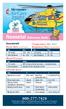 Operated by REACH Air Medical Services Assessment Heart Rate (beats/min.) Age Rate
ACLS PHARMACOLOGY 2011 Guidelines
 ACLS PHARMACOLOGY 2011 Guidelines ADENOSINE Narrow complex tachycardias or wide complex tachycardias that may be supraventricular in nature. It is effective in treating 90% of the reentry arrhythmias.
Oxygen Therapy. Oxygen therapy quick guide V3 July 2012.
 PRESENTATION Oxygen (O 2 ) is a gas provided in a compressed form in a cylinder. It is also available in a liquid form. It is fed via a regulator and flow meter to the patient by means of plastic tubing
Pennsylvania Trauma Nursing Core Curriculum. Posted to PTSF Website: 10/30/2014
 Pennsylvania Trauma Nursing Core Curriculum Posted to PTSF Website: 10/30/2014 PREFACE Care of the trauma patient has evolved since 1985, when the Pennsylvania Trauma Systems Foundation (PTSF) Board of
NOTICES. Approved and Required Medications Lists for Emergency Medical Services Agencies and Emergency Medical Services Providers
 NOTICES Approved and Required Medications Lists for Emergency Medical Services Agencies and Emergency Medical Services Providers [45 Pa.B. 5451] [Saturday, August 29, 2015] Under 28 Pa. Code 1027.3(c)
EQUIPMENT FOR GROUND AMBULANCES Summary of Changes 2009-2014
 EQUIPMENT FOR GROUND AMBULANCES Summary of Changes 2009-2014 American Academy of Pediatrics American College of Emergency Physicians American College of Surgeons Committee on Trauma Emergency Medical Services
INTERFACILITY TRANSFERS
 POLICY NO: 7013 PAGE 1 OF 8 EFFECTIVE DATE: 07-01-06 REVISED DATE: 03-15-12 APPROVED: Bryan Cleaver EMS Administrator Dr. Mark Luoto EMS Medical Director AUTHORITY: Health and Safety Code, Section 1798.172,
Levels of Critical Care for Adult Patients
 LEVELS OF CARE 1 Levels of Critical Care for Adult Patients STANDARDS AND GUIDELINES LEVELS OF CARE 2 Intensive Care Society 2009 All rights reserved. No reproduction, copy or transmission of this publication
Pediatric Equipment for Ground Ambulances
 Pediatric Equipment for Ground Ambulances All equipment recommendations in this document have been developed and collaborated with by the following groups: American Academy of Pediatrics American College
E C C. American Heart Association. Advanced Cardiovascular Life Support. Written Precourse Self-Assessment. May 2011. 2011 American Heart Association
 E C C American Heart Association Advanced Cardiovascular Life Support Written Precourse Self-Assessment May 2011 2011 American Heart Association 2011 ACLS Written Precourse Self-Assessment 1. Ten minutes
RGN JOY LAUDE WATFORD GENERAL HOSPITAL, ENGLAND
 RGN JOY LAUDE WATFORD GENERAL HOSPITAL, ENGLAND Monitor patient on the ward to detect trends in vital signs and to manage accordingly To recognise deteriorating trends and request relevant medical/out
The degree of liver inflammation or damage (grade) Presence and extent of fatty liver or other metabolic liver diseases
 ilearning about your health Liver Biopsy www.cpmc.org/learning What is a Liver Biopsy? A liver biopsy is a procedure where a specially trained doctor (typically a hepatologist, radiologist, or gastroenterologist)