
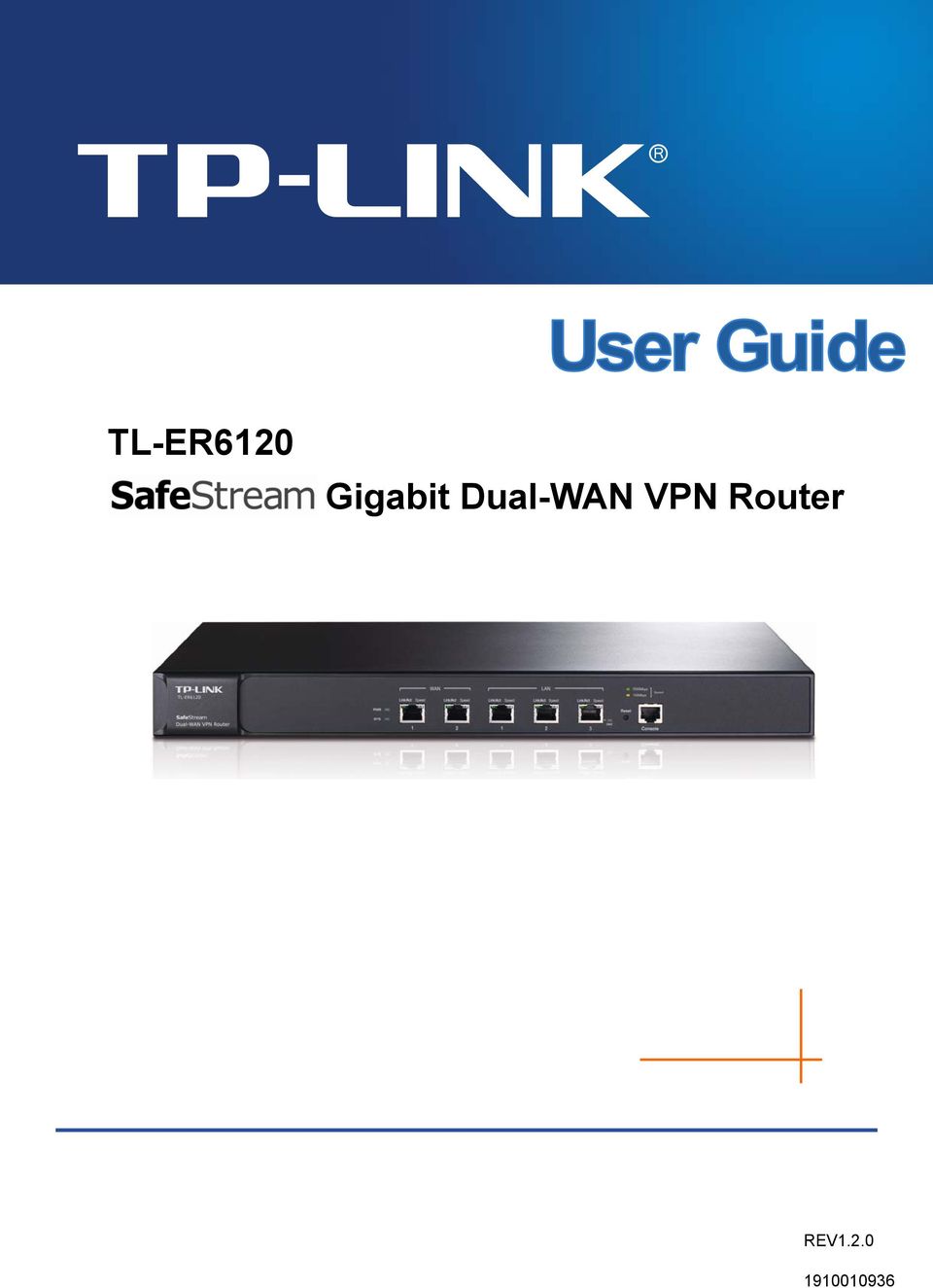
TL-ER6120 Gigabit Dual-WAN VPN Router
|
|
|
- Ashley Ellis
- 10 years ago
- Views:
Transcription
1 TL-ER6120 Gigabit Dual-WAN VPN Router REV
2 COPYRIGHT & TRADEMARKS Specifications are subject to change without notice. is a registered trademark of TP-LINK TECHNOLOGIES CO., LTD. Other brands and product names are trademarks of their respective holders. No part of the specifications may be reproduced in any form or by any means or used to make any derivative such as translation, transformation, or adaptation without permission from TP-LINK TECHNOLOGIES CO., LTD. Copyright 2014 TP-LINK TECHNOLOGIES CO., LTD. All rights reserved. FCC STATEMENT This equipment has been tested and found to comply with the limits for a Class A digital device, pursuant to part 15 of the FCC Rules. These limits are designed to provide reasonable protection against harmful interference when the equipment is operated in a commercial environment. This equipment generates, uses, and can radiate radio frequency energy and, if not installed and used in accordance with the instruction manual, may cause harmful interference to radio communications. Operation of this equipment in a residential area is likely to cause harmful interference in which case the user will be required to correct the interference at his own expense. This device complies with part 15 of the FCC Rules. Operation is subject to the following two conditions: 1) This device may not cause harmful interference. 2) This device must accept any interference received, including interference that may cause undesired operation. Any changes or modifications not expressly approved by the party responsible for compliance could void the user s authority to operate the equipment. CE Mark Warning This is a class A product. In a domestic environment, this product may cause radio interference, in which case the user may be required to take adequate measures. -I-
3 Продукт сертифіковано згідно с правилами системи УкрСЕПРО на відповідність вимогам нормативних документів та вимогам, що передбачені чинними законодавчими актами України. Safety Information When product has power button, the power button is one of the way to shut off the product; When there is no power button, the only way to completely shut off power is to disconnect the product or the power adapter from the power source. Don t disassemble the product, or make repairs yourself. You run the risk of electric shock and voiding the limited warranty. If you need service, please contact us. Avoid water and wet locations. 安 全 諮 詢 及 注 意 事 項 請 使 用 原 裝 電 源 供 應 器 或 只 能 按 照 本 產 品 注 明 的 電 源 類 型 使 用 本 產 品 清 潔 本 產 品 之 前 請 先 拔 掉 電 源 線 請 勿 使 用 液 體 噴 霧 清 潔 劑 或 濕 布 進 行 清 潔 注 意 防 潮, 請 勿 將 水 或 其 他 液 體 潑 灑 到 本 產 品 上 插 槽 與 開 口 供 通 風 使 用, 以 確 保 本 產 品 的 操 作 可 靠 並 防 止 過 熱, 請 勿 堵 塞 或 覆 蓋 開 口 請 勿 將 本 產 品 置 放 於 靠 近 熱 源 的 地 方 除 非 有 正 常 的 通 風, 否 則 不 可 放 在 密 閉 位 置 中 請 不 要 私 自 打 開 機 殼, 不 要 嘗 試 自 行 維 修 本 產 品, 請 由 授 權 的 專 業 人 士 進 行 此 項 工 作 此 為 甲 類 資 訊 技 術 設 備, 于 居 住 環 境 中 使 用 時, 可 能 會 造 成 射 頻 擾 動, 在 此 種 情 況 下, 使 用 者 會 被 要 求 採 取 某 些 適 當 的 對 策 This product can be used in the following countries: AT BG BY CA CZ DE DK EE ES FI FR GB GR HU IE IT LT LV MT NL NO PL PT RO RU SE SK TR UA -II-

4 CONTENTS Package Contents...1 Chapter 1 About this Guide Intended Readers Conventions Overview of this Guide...2 Chapter 2 Introduction Overview of the Router Features Appearance Front Panel Rear Panel...7 Chapter 3 Configuration Network Status System Mode WAN LAN DMZ MAC Address Switch User Group Group User View Advanced NAT Traffic Control III-

5 3.3.3 Session Limit Load Balance Routing Firewall Anti ARP Spoofing Attack Defense MAC Filtering Access Control App Control VPN IKE IPsec L2TP/PPTP Services PPPoE Server E-Bulletin Dynamic DNS UPnP Maintenance Admin Setup Management License Statistics Diagnostics Time Logs Chapter 4 Application Network Requirements IV-

6 4.2 Network Topology Configurations Internet Setting VPN Setting Network Management Network Security Chapter 5 CLI Configuration Interface Mode Online Help Command Introduction ip ip-mac sys user history exit Appendix A Hardware Specifications Appendix B FAQ Appendix C Glossary V-
7 Package Contents The following items should be found in your package: One TL-ER6120 Router One Power Cord One Console Cable One Ground Cable Two mounting brackets and other fittings Installation Guide Resource CD Note: Make sure that the package contains the above items. If any of the listed items is damaged or missing, please contact with your distributor. -1-

8 Chapter 1 About this Guide This User Guide contains information for setup and management of TL-ER6120 router. Please read this guide carefully before operation. 1.1 Intended Readers This Guide is intended for Network Engineer and Network Administrator. 1.2 Conventions In this Guide the following conventions are used: The router or TL-ER6120 mentioned in this Guide stands for TL-ER6120 SafeStream Gigabit Dual-WAN VPN Router without any explanation. Menu Name Submenu Name Tab page indicates the menu structure. Advanced NAT Basic NAT means the Basic NAT page under the NAT menu option that is located under the Advanced menu. Bold font indicates a toolbar icon, menu or menu item. <Font> indicate a button. Symbols in this Guide: Symbol Note: Tips: Description Ignoring this type of note might result in a malfunction or damage to the device. This format indicates important information that helps you make better use of your device. 1.3 Overview of this Guide Chapter 1 About This Guide Introduces the guide structure and conventions. Chapter 2 Introduction Introduces the features and appearance of TL-ER6120 router. Chapter 3 Configurations Introduces how to configure the router via Web management page. Chapter 4 Application Introduces the practical application of the router on the enterprise network. Chapter5 CLI Introduces how to log in and set up the router using CLI commands by console port. -2-

9 Appendix A Hardware Specifications Lists the hardware specifications of this router. Appendix B FAQ Provides the possible solutions to the problems that may occur during the installation and operation of the router. Appendix C Glossary Lists the glossary used in this guide. -3-

10 Chapter 2 Introduction Thanks for choosing the SafeStream Gigabit Dual-WAN VPN Router TL-ER Overview of the Router The SafeStream Gigabit Dual-WAN VPN Router TL-ER6120 from TP-LINK possesses excellent data processing capability and multiple powerful functions including IPsec/PPTP/L2TP VPN, Load Balance, Access Control, Bandwidth Control, Session Limit, IM/P2P Blocking, PPPoE Server and so on, which consumedly meet the needs of small and medium enterprise, hotels and communities with volumes of users demanding a efficient and easy-to-manage network with high security. Powerful Data Processing Capability + Built-in MIPS64 network processor and 128MB DDRII high-speed RAM allows the stability and reliability for operation. Virtual Private Network (VPN) + Providing comprehensive IPsec VPN with DES/3DES/AES encryptions, MD5/SHA1 identifications and automatically/manually IKE Pre-Share Key exchanges. + Supporting PPTP/L2TP VPN Server mode to allow the staff on business or remote branch office to access the headquarter network. Online Behavior Management + Complete Functions of Access Rules can allow managers to select the network service levels to block or allow applications of FTP downloading, , Web browsing and so on. + Deploying One-Click restricting of IM/P2P applications to save time & energy while reserving exceptional groups for certain users. + Supporting URL Filtering to prevent potential hazards from visiting the malicious Web sites. Powerful Firewall + Supporting One-Click IP-MAC Binding to avoid ARP spoofing and guarantee a network without stagnation. + Featured Attack Defense to protect the network from a variety of flood attack and packet anomaly attack. + Possessing MAC Filtering function to block the access of illegal hosts. Flexible Traffic Control + Featured Bandwidth Control with flexible bandwidth management to automatically control the bandwidth of the host in bi-direction to avoid bandwidth over occupation, as well as optimize bandwidth usage. + Supporting Session Limit to avoid the complaint of a few people to force whole sessions. -4-

11 Dual-WAN Ports + Providing two 10/100/1000M WAN ports for users to connect two Internet lines for bandwidth expansion. + Supporting multiple Load Balance modes, including Bandwidth Based Balance Routing, Application Optimized Routing, and Policy Routing to optimize bandwidth usage. + Featured Link Backup to switch all the new sessions from dropped line automatically to another for keeping an always on-line network. Easy-to-use + Providing easy-to-use GUI with clear configuration steps and detailed help information for the users to configure the router simply. + Helping administrators to monitor the whole network status and take actions to malfunctions according to the recorded log information. + Supporting remote management to manage the router from remote places. 2.2 Features Hardware 2 gigabit WAN ports, 2 gigabit LAN ports, 1 gigabit LAN/DMZ port and 1 Console port Built-in high-quality power supply with non-fun system design for quietness Possesses standard-sized, 19-inch outfit for standard rack Supports Professional 4kV common mode lightning protection Complies with IEEE 802.3, IEEE 802.3u, IEEE 802.3ab standards Supports AH, ESP, IKE, PPP protocols Supports TCP/IP, DHCP, ICMP, NAT, NAPT protocols Supports PPPoE, SNTP, HTTP, DDNS, UPnP, NTP protocols Basic Functions Supports Static IP, Dynamic IP, PPPoE/Russian PPPoE, L2TP/Russian L2TP, PPTP/Russian PPTP, Dual Access, BigPond Internet connections Supports Virtual Server, Port Triggering, ALG, Static Route and RIP v1/v2 Built-in Switch supporting Port Mirror, Port VLAN, Rate Control and so on Supports to change the MAC address of LAN, WAN, DMZ port Supports Logs, Statistics, Time setting Supports Remote and Web management -5-

12 Supports Diagnostic (Ping/Tracert) and Online Detection VPN Supports IPsec VPN and provides up to 100 IPsec VPN tunnels Supports IPSec VPN in LAN-to-LAN or Client-to-LAN Provides DES, 3DES, AES128, AES152, AES256 encryption, MD5, SHA1 authentication Supports IKE Pre-Share Key and DH1/DH2/DH5 Key Exchanges Supports PPTP/L2TP Server/Client Traffic Control Supports Bandwidth Control Supports Session Limit Security Built-in firewall supporting URL/MAC Filtering Supports Access Control Supports Attack Defense Supports IP-MAC Binding Supports GARP (Gratuitous ARP) Deploys One-Click restricting of IM/P2P applications 2.3 Appearance Front Panel The front panel of TL-ER6120 is shown as the following figure. LEDs LED Status Indication PWR On Off The router is powered on The router is powered off or power supply is abnormal -6-

13 LED Status Indication SYS Flashing On/Off The router works properly The router works improperly Link/Act On Off There is a device linked to the corresponding port There is no device linked to the corresponding port Flashing The corresponding port is transmitting or receiving data On (Green) The linked device is running at 1000Mbps Speed On (Yellow) The linked device is running at 100Mbps Off There is no device linked to the corresponding port or the linked device is running at 10Mbps DMZ On Off The port is working in DMZ mode The port is working in LAN mode Interface Description Interface Port Description WAN 1~2 LAN 1~3 The WAN port is for connecting the router to a DSL/Cable modem or Ethernet by the RJ45 cable The LAN port is for connecting the router to the local PCs or switches by the RJ45 cable DMZ 3 The DMZ port is for connecting the router to the servers Console N/A The Console port is for connecting with the serial port of a computer or terminal to monitor and configure the router Reset button Use the button to restore the router to the factory defaults. With the router powered on, use a pin to press and hold the Reset button (about 4~5 seconds). After the SYS LED goes out, release the Reset button. If the SYS LED is flashing with a high frequency about two or three seconds, it means the router is restored successfully Rear Panel The rear panel of TL-ER6120 is shown as the following figure. -7-

14 Power Socket Connect the female connector of the power cord to this power socket, and the male connector to the AC power outlet. Please make sure the voltage of the power supply meets the requirement of the input voltage ( V~ 50/60Hz). Grounding Terminal The router already comes with lightning protection mechanism. You can also ground the router through the PE (Protecting Earth) cable of AC cord or with Ground Cable. Note: Please use only the power cord provided with this router. -8-

15 Chapter 3 Configuration 3.1 Network Status The Status page shows the system information, the port connection status and other information related to this router. Choose the menu Network Status to load the following page System Mode Figure 3-1 Status The TL-ER6120 can work in three modes: NAT, Non-NAT and Classic. If your router is hosting your local network s connection to the Internet with a network topology as the Figure 3-2 shown, you can set it to NAT mode. -9-

16 Figure 3-2 Network Topology - NAT Mode If your router is connecting the two networks of different areas in a large network environment with a network topology as the Figure 3-3 shown, and forwards the packets between these two networks by the Routing rules, you can set it to Non-NAT mode. Figure 3-3 Network Topology Non-NAT Mode If your router is connected in a combined network topology as the Figure 3-4 shown, you can set it to Classic Mode. -10-

17 Figure 3-4 Network Topology Classic Mode Choose the menu Network System Mode to load the following page. Figure 3-5 System Mode You can select a System Mode for your router according to your network need. NAT Mode NAT (Network Address Translation) mode allows the router to translate private IP addresses within internal networks to public IP addresses for traffic transport over external networks, such as the Internet. Incoming traffic is translated back for delivery within the internal network. However, the router will drop all the packets whose source IP addresses are in different subnet of LAN port. For example: If the LAN port of the router is set to for IP address and for the Subnet Mask, then the subnet of LAN port is /24. The packet with as its source IP address can be transported by NAT, whereas the packet with as its source IP address will be dropped. Non-NAT Mode In this mode, the router functions as the traditional Gateway and forwards the packets via routing protocol. The Hosts in different subnets can communicate with one another via the routing rules whereas no NAT is employed. For example: If the DMZ port of the router is in WAN mode, the Hosts in the subnet of DMZ port can access the servers in Internet only when the Static router rules permit. -11-

18 Note: In Non-NAT mode, all the NAT forwarding rules will be disabled. Classic Mode It's the combined mode of NAT mode and Non-NAT mode. In Classic mode, the router will first transport the packets which are compliant with NAT forwarding rules and then match the other packets to the static routing rules. The matched packets will be transmitted based on the static routing rules and the unmatched ones will be dropped. In this way, the router can implement NAT for the packets without blocking the packets in the different subnet of the ports WAN TL-ER6120 provides the following six Internet connection types: Static IP, Dynamic IP, PPPoE/Russian PPPoE, L2TP/Russian L2TP, PPTP/Russian PPTP and BigPond. To configure the WAN, please first select the type of Internet connection provided by your ISP (Internet Service Provider). Tips: It s allowed to set the IP addresses of both the WAN ports within the same subnet. However, to guarantee a normal communication, make sure that the WAN ports can access the same network, such as Internet or a local area network. Choose the menu Network WAN to load the configuration page. 1) Static IP If a static IP address has been provided by your ISP, please choose the Static IP connection type to configure the parameters for WAN port manually. The following items are displayed on this screen: Figure 3-6 WAN Static IP -12-
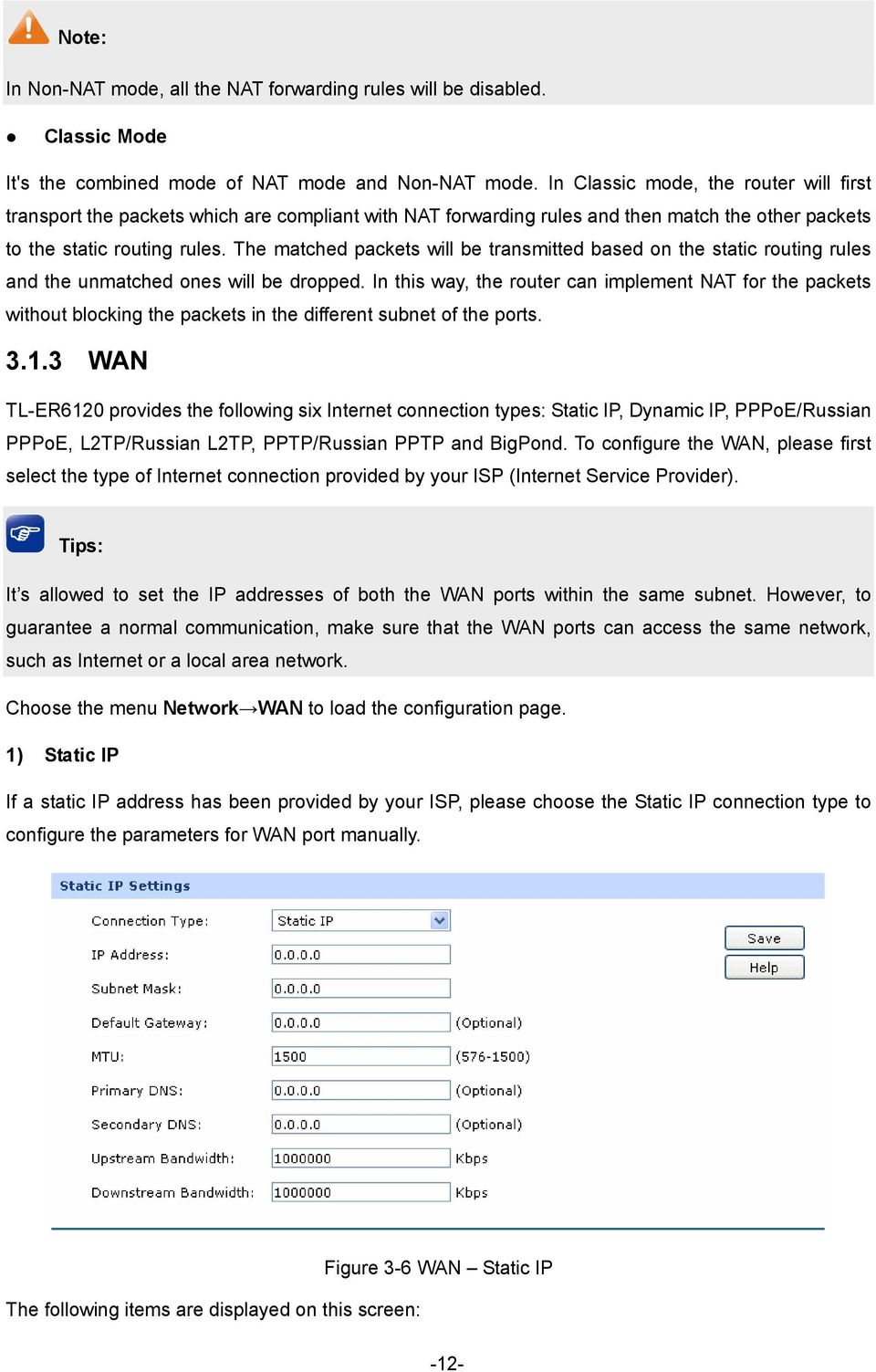
19 Static IP Connection Type: Select Static IP if your ISP has assigned a static IP address for your computer. IP Address: Enter the IP address assigned by your ISP. If you are not clear, please consult your ISP. Subnet Mask: Enter the Subnet Mask assigned by your ISP. Default Gateway: Optional. Enter the Gateway assigned by your ISP. MTU: MTU (Maximum Transmission Unit) is the maximum data unit transmitted by the physical network. It can be set in the range of The default MTU is It is recommended to keep the default value if no other MTU value is provided by your ISP. Primary DNS: Enter the IP address of your ISP s Primary DNS (Domain Name Server). If you are not clear, please consult your ISP. It s not allowed to access the Internet via domain name if the Primary DNS field is blank. Secondary DNS: Optional. If a Secondary DNS Server address is available, enter it. Upstream Bandwidth: Specify the bandwidth for transmitting packets on the port. Downstream Bandwidth: Specify the bandwidth for receiving packets on the port. 2) Dynamic IP If your ISP (Internet Service Provider) assigns the IP address automatically, please choose the Dynamic IP connection type to obtain the parameters for WAN port automatically. -13-

20 The following items are displayed on this screen: Figure 3-7 WAN Dynamic IP Dynamic IP Connection Type: Select Dynamic IP if your ISP assigns the IP address automatically. Click <Obtain> to get the IP address from your ISP s server. Click <Release> to release the current IP address of WAN port. Host Name: Optional. This field allows you to give a name for the router. It's blank by default. MTU: MTU (Maximum Transmission Unit) is the maximum data unit transmitted by the physical network. It can be set in the range of The default MTU is It is recommended to keep the default value if no other MTU value is provided by your ISP. Get IP Address by Unicast: The broadcast requirement may not be supported by a few ISPs. Select this option if you can not get the IP address from your ISP even if with a normal network connection. This option is not required generally. -14-
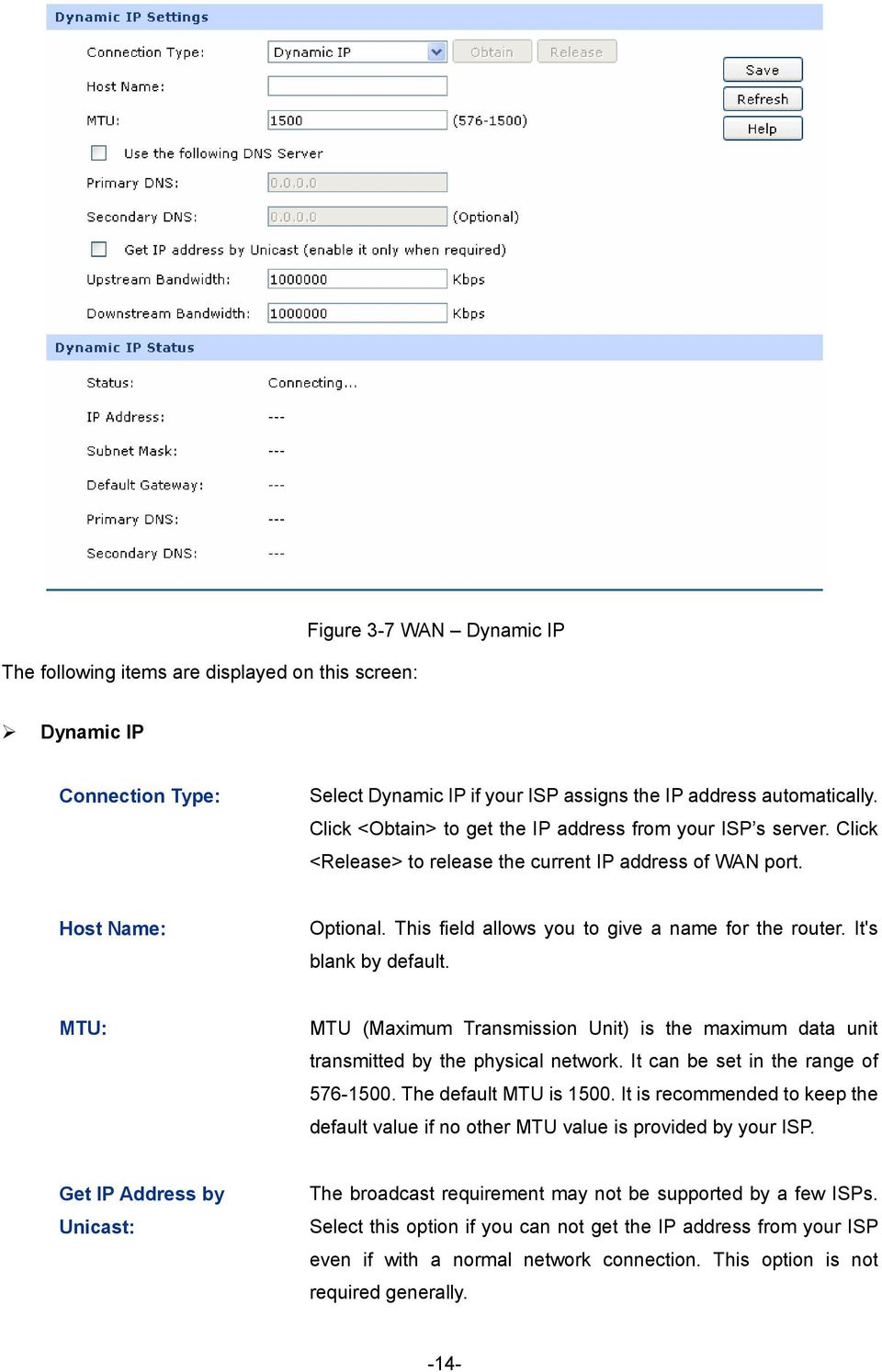
21 Use the following DNS Server: Select this option to enter the DNS (Domain Name Server) address manually. Primary DNS: Enter the IP address of your ISP s Primary DNS (Domain Name Server). If you are not clear, please consult your ISP. Secondary DNS: Optional. If a Secondary DNS Server address is available, enter it. Upstream Bandwidth: Specify the bandwidth for transmitting packets on the port. Downstream Specify the bandwidth for receiving packets on the port. Bandwidth: Dynamic IP Status Status: Displays the status of obtaining an IP address from your ISP. Disabled indicates that the Dynamic IP connection type is not applied. Connecting indicates that the router is obtaining the IP parameters from your ISP. Connected indicates that the router has successfully obtained the IP parameters from your ISP. Disconnected indicates that the IP address has been manually released or the request of the router gets no response from your ISP. Please check your network connection and consult your ISP if this problem remains. IP Address: Displays the IP address assigned by your ISP. Subnet Mask: Displays the Subnet Mask assigned by your ISP. Gateway Address: Displays the Gateway Address assigned by your ISP. Primary DNS: Displays the IP address of your ISP s Primary DNS. Secondary DNS: Displays the IP address of your ISP s Secondary DNS. -15-
22 3) PPPoE If your ISP (Internet Service Provider) has provided the account information for the PPPoE connection, please choose the PPPoE connection type (Used mainly for DSL Internet service). The following items are displayed on this screen: Figure 3-8 WAN - PPPoE -16-
23 PPPoE Settings Connection Type: Select PPPoE if your ISP provides xdsl Virtual Dial-up connection. Click <Connect> to dial-up to the Internet and obtain the IP address. Click <Disconnect> to disconnect the Internet connection and release the current IP address. Account Name: Enter the Account Name provided by your ISP. If you are not clear, please consult your ISP. Password: Enter the Password provided by your ISP. Active Mode: You can select the proper Active mode according to your need. Manual: Select this option to manually activate or terminate the Internet connection by the <Connect> or <Disconnect> button. It is optimum for the dial-up connection charged on time. Always-on: Select this option to keep the connection always on. The connection can be re-established automatically when it is down. Time-based: Select this option to keep the connection on during the Active time you set. PPPoE Advanced Settings: Check here to enable PPPoE advanced settings. Keep Alive: Once PPPoE is connected, the router will send keep-alive packets every "Keep Alive Interval" sec and "Keep Alive Retry Times" to make sure the connection is still alive. If the router does not get the response from ISP after sending keep-alive packets, then the router will terminate the connection. MTU: MTU (Maximum Transmission Unit) is the maximum data unit transmitted by the physical network. It can be set in the range of The default MTU is It is recommended to keep the default value if no other MTU value is provided by your ISP. ISP Address: Optional. Enter the ISP address provided by your ISP. It's null by default. -17-
24 Service Name: Optional. Enter the Service Name provided by your ISP. It's null by default. Primary DNS: Enter the IP address of your ISP s Primary DNS. Secondary DNS: Optional. Enter the IP address of your ISP s Secondary DNS. Secondary Connection: Here allows you to configure the secondary connection. Dynamic IP and Static IP connection types are provided. Connection Type: Select the secondary connection type. Options include Disable, Dynamic IP and Static IP. IP Address: If Static IP is selected, configure the IP address of WAN port. If Dynamic IP is selected, the obtained IP address of WAN port is displayed. Subnet Address: If Static IP is selected, configure the subnet address of WAN port. If Dynamic IP is selected, the obtained subnet address of WAN port is displayed. Status: Displays the status of secondary connection. Upstream Bandwidth: Specify the bandwidth for transmitting packets on the port. Downstream Bandwidth: Specify the bandwidth for receiving packets on the port. PPPoE Status Status: Displays the status of PPPoE connection. Disabled indicates that the PPPoE connection type is not applied. Connecting indicates that the router is obtaining the IP parameters from your ISP. Connected indicates that the router has successfully obtained the IP parameters from your ISP. Disconnected indicates that the connection has been manually terminated or the request of the router has no -18-
25 response from your ISP. Please ensure that your settings are correct and your network is connected well. Consult your ISP if this problem remains. IP Address: Displays the IP address assigned by your ISP. Gateway Address: Displays the Gateway Address assigned by your ISP. Primary DNS: Displays the IP address of your ISP s Primary DNS. Secondary DNS: Displays the IP address of your ISP s Secondary DNS. 4) L2TP If your ISP (Internet Service Provider) has provided the account information for the L2TP connection, please choose the L2TP connection type. -19-
26 The following items are displayed on this screen: Figure 3-9 WAN - L2TP L2TP Settings Connection Type: Select L2TP if your ISP provides a L2TP connection. Click <Connect> to dial-up to the Internet and obtain the IP address. Click <Disconnect> to disconnect the Internet connection and release the current IP address. Account Name: Enter the Account Name provided by your ISP. If you are not clear, please consult your ISP. Password: Enter the Password provided by your ISP. -20-
27 Server IP: Enter the Server IP provided by your ISP. MTU: MTU (Maximum Transmission Unit) is the maximum data unit transmitted by the physical network. It can be set in the range of The default MTU is It is recommended to keep the default value if no other MTU value is provided by your ISP. Active Mode: You can select the proper Active Mode according to your need. Manual: Select this option to manually activate or terminate the Internet connection by the <Connect> or <Disconnect> button. It is optimum for the dial-up connection charged on time. Always-on: Select this option to keep the connection always on. The connection can be re-established automatically when it is down. Secondary Connection: Here allows you to configure the secondary connection. Dynamic IP and Static IP connection types are provided. Connection Type: Select the secondary connection type. Options include Disable, Dynamic IP and Static IP. IP Address: If Static IP is selected, configure the IP address of WAN port. If Dynamic IP is selected, the IP address of WAN port obtained is displayed. Subnet Mask: If Static IP is selected, configure the subnet mask of WAN port. If Dynamic IP is select, the subnet mask of WAN port obtained is displayed. Default Gateway: If Static IP is selected, configure the default gateway. If Dynamic IP is selected, the obtained default gateway is displayed. Primary DNS/ Secondary DNS: If Static IP is selected, configure the DNS. If Dynamic IP is selected, the obtained DNS is displayed. Upstream Specify the bandwidth for transmitting packets on the port. Bandwidth: -21-
28 Downstream Bandwidth: Specify the bandwidth for receiving packets on the port. L2TP Status Status: Displays the status of PPPoE connection. Disabled indicates that the L2TP connection type is not applied. Connecting indicates that the router is obtaining the IP parameters from your ISP. Connected indicates that the router has successfully obtained the IP parameters from your ISP. Disconnected indicates that the connection has been manually terminated or the request of the router has no response from your ISP. Please ensure that your settings are correct and your network is connected well. Consult your ISP if this problem remains. IP Address: Displays the IP address assigned by your ISP. Primary DNS: Displays the IP address of your ISP s Primary DNS. Secondary DNS: Displays the IP address of your ISP s Secondary DNS. 5) PPTP If your ISP (Internet Service Provider) has provided the account information for the PPTP connection, please choose the PPTP connection type. -22-
29 The following items are displayed on this screen: Figure 3-10 WAN - PPTP PPTP Settings Connection Type: Select PPTP if your ISP provides a PPTP connection. Click <Connect> to dial-up to the Internet and obtain the IP address. Click <Disconnect> to disconnect the Internet connection and release the current IP address. Account Name: Enter the Account Name provided by your ISP. If you are not clear, please consult your ISP. Password: Enter the Password provided by your ISP. -23-
30 Server IP: Enter the Server IP provided by your ISP. MTU: MTU (Maximum Transmission Unit) is the maximum data unit transmitted by the physical network. It can be set in the range of The default MTU is It is recommended to keep the default value if no other MTU value is provided by your ISP. Active Mode: You can select the proper Active mode according to your need. Manual: Select this option to manually activate or terminate the Internet connection by the <Connect> or <Disconnect> button. It s optimum for the dial-up connection charged on time. Always-on: Select this option to keep the connection always on. The connection can be re-established automatically when it is down. Secondary Connection: Here allows you to configure the secondary connection. Dynamic IP and Static IP connection types are provided. Connection Type: Select the secondary connection type. Options include Disable, Dynamic IP and Static IP. IP Address: If Static IP is selected, configure the IP address of WAN port. If Dynamic IP is selected, the IP address of WAN port obtained is displayed. Subnet Mask: If Static IP is selected, configure the subnet mask of WAN port. If Dynamic IP is select, the subnet mask of WAN port obtained is displayed. Default Gateway: If Static IP is selected, configure the default gateway. If Dynamic IP is selected, the obtained default gateway is displayed. Primary DNS/ Secondary DNS: If Static IP is selected, configure the DNS. If Dynamic IP is selected, the obtained DNS is displayed. Upstream Bandwidth: Specify the bandwidth for transmitting packets on the port. Downstream Bandwidth: Specify the bandwidth for receiving packets on the port. -24-
31 PPTP Status Status: Displays the status of PPTP connection. Disabled indicates that the PPTP connection type is not applied. Connecting indicates that the router is obtaining the IP parameters from your ISP. Connected indicates that the router has successfully obtained the IP parameters from your ISP. Disconnected indicates that the connection has been manually terminated or the request of the router has no response from your ISP. Please ensure that your settings are correct and your network is connected well. Consult your ISP if this problem remains. IP Address: Displays the IP address assigned by your ISP. Primary DNS: Displays the IP address of your ISP s Primary DNS. Secondary DNS: Displays the IP address of your ISP s Secondary DNS. 6) BigPond If your ISP (Internet Service Provider) has provided the account information for the BigPond connection, please choose the BigPond connection type. -25-
32 The following items are displayed on this screen: Figure 3-11 WAN Bigpond BigPond Settings Connection Type: Select BigPond if your ISP provides a BigPond connection. Click <Connect> to dial-up to the Internet and obtain the IP address. Click <Disconnect> to disconnect the Internet connection and release the current IP address. Account Name: Enter the Account Name provided by your ISP. If you are not clear, please consult your ISP. Password: Enter the Password provided by your ISP. If you are not clear, please consult your ISP. Auth Server: Enter the address of authentication server. It can be IP address or server name. Auth Domain: Enter the domain name of authentication server. It's only required when the address of Auth Server is a server name. -26-
33 Auth Mode: You can select the proper Active mode according to your need. Manual: Select this option to manually activate or terminate the Internet connection by the <Connect> or <Disconnect> button. It s optimum for the dial-up connection charged on time. Always-on: Select this option to keep the connection always on. The connection can be re-established automatically when it is down. MTU: MTU (Maximum Transmission Unit) is the maximum data unit transmitted by the physical network. It can be set in the range of The default MTU is Upstream/Downstream Bandwidth: Specify the Upstream/Downstream Bandwidth for the port. To make "Load Balance" and "Bandwidth Control" take effect, please set these par ameters correctly. BigPond Status Status: Displays the status of BigPond connection. Disabled indicates that the BigPond connection type is not applied. Connecting indicates that the router is obtaining the IP parameters from your ISP. Connected indicates that the router has successfully obtained the IP parameters from your ISP. Disconnected indicates that the connection has been manually terminated or the request of the router has no response from your ISP. Please ensure that your settings are correct and your network is connected well. Consult your ISP if this problem remains. IP Address: Displays the IP address assigned by your ISP. Subnet Mask: Displays the Subnet Mask assigned by your ISP. Default Gateway: Displays the IP address of the default gateway assigned by your ISP. -27-
34 Note: To ensure the BigPond connection re-established normally, please restart the connection at least 5 seconds after the connection is off LAN LAN On this page, you can configure the parameters for LAN port of this router. Choose the menu Network LAN LAN to load the following page. The fo llowing items are displayed on this screen: Figure 3-12 LAN LAN IP Address: Enter the LAN IP address of the router is the default IP address. The Hosts in LAN can access the router via this IP address. It can be changed according to your network. Subnet Mask: Enter the Subnet Mask. The default subnet mask is Note: If the LAN IP address is changed, you must use the new IP address to log into the router. To guarantee a normal communication, be sure to set the Gateway address and the Subnet Mask of the Hosts on the LAN to th e new LAN IP address and the Subnet Mask of the router DHCP The router with its DHCP (Dynamic Host Configuration Protocol) server enabled can automatically assign an IP address to the computers in the local area network. Choose the menu Network LAN DHCP to load the following page. -28-
35 The following items are displayed on this screen: Figure 3-13 DHCP Settings DHCP Settings DHCP Server: Enable or disable the DHCP server on your router. To enable the router to assign the TCP/IP parameters to the computers in the LAN automatically, please select Enable. Start IP Address: Enter the Start IP address to define a range for the DHCP server to assign dynamic IP addresses. This address should be in the same IP address subnet with the router s LAN IP address. The default address is End IP Address: Enter the End IP address to define a range for the DHCP server to assign dynamic IP addresses. This address should be in the same IP address subnet with the router s LAN IP address. The default address is Lease Time: Specify the length of time the DHCP server will reserve the IP address for each computer. After the IP address expired, the client will be automatically assigned a new one. Default Gateway: Optional. Enter the Gateway address to be assigned. It is recommended to enter the IP address of the LAN port of the router. Default Domain: Optional. Enter the domain name of your network. -29-
36 Primary DNS: Optional. Enter the Primary DNS server address provided by your ISP. It is recommended to enter the IP address of the LAN port of the router. Secondary DNS: Optional. If a Secondary DNS Server address is available, enter it DHCP Client On this page, you can view the information about all the DHCP clients connected to the router. Choose the menu Network LAN DHCP Client to load the following page. Figure 3-14 DHCP Client You can view the information of the DHCP clients in this table. Click the Refresh button for the updated information DHCP Reservation DHCP Reservation feature allows you to reserve an IP address for the specified MAC address. The client with this MAC address will always get the same IP address every time when it accesses the DHCP server. Choose the menu Network LAN DHCP Reservation to load the following page. The following items are displayed on this screen: Figure 3-15 DHCP Reservation -30-
37 DHCP Reservation MAC Address: Enter the MAC address of the computer for which you want to reserve the IP address. IP Address: Enter the reserved IP address. Description: Optional. Enter a description for the entry. Up to 28 characters can be entered. Status: Activate or Inactivate the corresponding entry. List of Reserved Address In this table, you can view the information of the entries and edit them by the Action buttons. The first entry in Figure 3-15 indicates: The IP address is reserved for the computer with the MAC address CF, and this entry is activated. Note: It's recommended that users bind the IP address and the MAC address in IP-MAC Binding, then import the entries from the IP-MAC binding table to the List of Reserved Address in buck by clicking <Import> button in Figure 3-15 DHCP Reservation DMZ DMZ (Demilitarized Zone) is a network which has fewer default firewall restrictions than the LAN does. TL-ER6120 provides a DMZ port to allow all the local hosts connected to this port to be exposed to the Internet for some special-purpose services, such as such as Internet gaming and video-conferencing. The DMZ physical port can work in Public mode and Private mode. In Public mode, the DMZ port allows the Hosts in DMZ to directly communicate with Internet via routing mode using public IP address. However, the Hosts in DMZ cannot access LAN. -31-
38 Figure 3-16 DMZ Public Mode In Private mode, the DMZ port allows the Hosts in DMZ to access Internet via NAT mode which translates private IP addresses within DMZ to public IP addresses for transport over Internet. The Hosts in DMZ can directly communicate with LAN using the private IP addresses within the different subnet of LAN. Figure 3-17 DMZ Private Mode DMZ This page allows you to configure the DMZ port of TL-ER6120. Choose the menu Network DMZ DMZ to load the following page. Figure 3-18 DMZ -32-
39 The following items are displayed on this screen: DMZ Status: Activate or inactivate this entry. The DMZ port functions as a normal LAN port when it s disabled. Mode: Select the mode for DMZ port to control the connection way among DMZ, LAN and Internet. Options include: Public and Private. IP Address: Enter the IP address of DMZ port. Subnet Mask: Enter the Subnet Mask of DMZ port. Tips: The DHCP service, DHCP Client and DHCP Reservation functions are available when the DMZ port is enabled. For the configuratio n instructions, please refer to section to Note: When the D MZ port is enabled in Public Mode, please do not enable the DHCP service of DMZ port if your ISP provides a single public IP address. Otherwise, the Hosts in DMZ will be unable to access Internet nor mally. If an IP address range is provided by your ISP, please configure the DHCP pool based on the IP addr ess range MAC Address The MAC (Media Access Control) address, as the unique identifier of the router in network, does not need to be changed commonly. Set the MAC Address for LAN port: In a complex network topology with all the ARP bound devices, if you want to use TL-ER6120 instead of the current router in a network node, you can just set the MAC address of TL-ER6120 s LAN port the same to the MAC address of the previous router, which can avoid all the devices under this network node to update their ARP binding tables. Set the MAC Address for WAN port: In the condition that your ISP has bound the account and the MAC address of the dial-up device, if you want to change the dial-up device to be TL-ER6120, you can just set the MAC address of TL-ER6120 s WAN port the same to the MAC address of the previous dial-up device for a normal Internet connection. -33-
40 Set the MAC Address for DMZ port: The application of MAC address for DMZ port is similar to that for LAN port. Choose the menu Network MAC Address MAC Address to load the following page. The following items are displayed on this screen: Figure 3-19 MAC Address MAC Address Port: Displays the port type of the router. Current MAC Address: Displays the current MAC address of the port. MAC Clone: It s only available for WAN port. Click the <Restore Factory MAC> button to restore the MAC address to the factory default value or click the <Clone Current PC s MAC> button to clone the MAC address of the PC you are currently using to configure the router. Then click <Save> to apply. Note: To avo id a conflict of MAC address on the local area network, it s not allowed to set the MAC address of the router s LAN port to the MAC address of the current management PC Switch Some basic switch port management functions are provided by TL-ER6120, which facilitates you to monitor the traffic and manage the network effectively Statistics Statistics screen displays the detailed traffic information of each port, which allows you to monitor the traffic and locate faults promptly. -34-
41 Choose the menu Network Switch Statistics to load the following page. The following items are displayed on this screen: Statistics Figure 3-20 Statistics Unicast: Displays the number of normal unicast packets received or transmitted on the port. Broadcast: Displays the number of normal broadcast packets received or transmitted on the port. Pause: Displays the number of flow control frames received or transmitted on the port. Multicast: Displays the number of normal multicast packets received or transmitted on the port. Undersize: Displays the number of the received frames (including error frames) that are less than 64 bytes long. -35-
42 Normal: Displays the number of the received packets (including error frames) that are between 64 bytes and the maximum frame length. The maximum untagged frame this router can support is 1518 bytes long and the maximum tagged frame is 1522 bytes long. Oversize: Displays the number of the received packets (including error frames) that are longer than the maximum frame. Total (Bytes): Displays the total number of the received or transmitted packets (including error frames). Click the <Clear All> button to clear all the traffic statistics. Tips: The Port 1/2/3/4/5 mentioned in this User Guide refers to the WAN1/2 port and LAN1/2/3 port on the router Port Mirror Port Mirror, the packets obtaining technology, functions to forward copies of packets from one/multiple ports (mirrored port) to a specific port (mirroring port). Usually, the mirroring port is connected to a data diagn ose device, which is used to analyze the mirrored packets for monitoring and troubleshooting the network. Choose the menu Network Switch Port Mirror to load the following page. The following items are displayed on this screen: Figure 3-21 Port Mirror -36-
43 General Enable Port Mirror: Check the box to enable the Port Mirror function. If unchecked, it will be disabled. Mode: Select the mode for the port mirror function. Options include: Ingress: When this mode is selected, only the incoming packets sent by the mirrored port will be copied to the mirroring port. Egress: When this mode is selected, only the outgoing packets sent by the mirrored port will be copied to the mirroring port. Ingress&Egress: When this mode is selected, both the incoming and outgoing packets through the mirrored port will be copied to the mirroring port. Port Mirror Mirroring Port: Select the Mirroring Port to which the traffic is copied. Only one port can be selected as the mirroring port. Mirrored Port: Select the Mirrored Port from which the traffic is mirrored. One or multiple ports can be selected as the mirrored ports. The entry in Figure 3-21 indicates: The outgoing packets sent by port 1, port 2, port 3 and port 5 (mirrored ports) will be copied to port 4 (mirroring port). Tips: If both the mirrored port and the mirroring port are the LAN ports, these two LAN ports should be in the same Port VLAN. For example, if port 3 (the mirroring port) and port 4 (the mirrored port) are the LAN ports, the Port Mirror function can take effect only when port 3 and port 4 are in the same Port VLAN. Application Example: To monitor all the traffic and analyze the network abnormity for an enterprise s network, please set the Port Mirror function as below: -37-
44 1) Check the box before Enable Port Mirror to enable the Port Mirror function and select the Ingress & Egress mode. 2) Select Port 3 to be the Mirroring Port to monitor all the packets of the other ports. 3) Select all the other ports to be the Mirrored Ports. 4) Click the <Save> button to apply Rate Control On this page, you can control the traffic rate for the specific packets on each port so as to manage your network flow. Choose the menu Network Switch Rate Control to load the following page. The following items are displayed on this screen: Figure 3-22 Rate Control Rate Control Port: Displays the port number. Ingress Limit: Specify whether to enable the Ingress Limit feature. -38-
45 Ingress Mode: Select the Ingress Mode for each port. Options include: All Frames: Select this option to limit all the frames. Broadcast & Multicast: Select this option to limit broadcast frame and multicast frame. Broadcast: Select this option to limit the broadcast frame. Ingress Rate: Specify the limit rate for the ingress packets. Egress Limit: Specify whether to enable Egress Limit feature. Egress Rate: Specify the limit rate for the egress packets. The first entry in Figure 3-22 indicates: The Ingress and Egress Limits are enabled for port 1. The Ingress mode is Flood while the Ingress and Egress Rates are 1Mbps. That is, the receiving rate for the ingress packets of Flood mode will not exceed 1Mbps, and the transmitting rate for all the egress packets will not exceed 1Mbps Port Config On this page, you can configure the basic parameters for the ports. Choose the menu Network Switch Port Config to load the following page. The following items are displayed on this screen: Port Config Figure 3-23 Port Config Status: Specify whether to enable the port. The packets can be transported via this port after being enabled. -39-
46 Flow Control: Allows you to enable/disable the Flow Control function. Negotiation Mode: Select the Negotiation Mode for the port. All Ports: Allows you to configure the parameters for all the ports at one time Port Status On this page, you can view the current status of each port. Choose the menu Network Switch Port Status to load the following page. Figure 3-24 Port Status Port VLAN A VLAN (Virtual Local Area Network) is a network topology configured according to a logical scheme rather than the physical layout, which allows you to divide the physical LAN into multiple logical LANs so as to control the communication among the ports. The VLAN function can prevent the broadcast storm in LANs and enhance the network security. By creating VLANs in a physical LAN, you can divide the LAN into multiple logical LANs, each of which has a broadcast domain of its own. Hosts in the same VLAN communicate with one another as if they are in a LAN. However, hosts in different VLANs cannot communicate with one another directly. Therefore, broadcast p ackets are limited in a VLAN. TL-ER6120 provides the Port VLAN function, which allows you to create multiple logical VLANs for the LAN ports based on their port numbers. Choose the menu Network Switch Port VLAN to load the following page. -40-
47 The following items are displayed on this screen: Figure 3-25 Port VLAN Port VLAN Network: Displays the current logical network of the physical port. VLAN: Select the desired VLAN for the port. Tips: The Port VLAN can only be created among the LAN ports. The change of DMZ status will affect the configurations of Port VLAN. You're recommended to check or reconfigure the Port VLAN if the status of DMZ is changed. 3.2 User Group The User Group function is used to group different users for unified management, so that you can perform other applications such as Bandwidth Control, Session Limit, and Access Control etc. on per group Group On this page you can define the group for management. Choose the menu User Group Group to load the following page. Figure 3-26 Group Configuration -41-
48 The following items are displayed on this screen: Group Config Group Name: Description: Specify a unique name for the group. Give a description for the group. It's optional. List of Group In this table, you can view the information of the Groups and edit them by the Action buttons User On this page, you can configure the User for the group. Choose the menu User Group User to load the following page. Figure 3-27 User Configuration The following items are displayed on this screen: User Config User Name: Specify a unique name for the user. IP Address: Enter the IP Address of the user. It cannot be the network address or broadcast address of the port. Description: Give a description to the user for identification. It's optional. List of User In this table, you can view the information of the Users and edit them by the Action buttons View On this page, you can configure the User View or Group View. Choose the menu User Group View to load the following page. -42-
49 The following items are displayed on this screen: View Config Figure 3-28 View Configuration View: Select the desired view for configuration. User Name: Select the name of the desired User. Available Group: Displays the Groups that the User can join. Selected Group: Displays the Groups to which this User belongs. Group Name: Select the name of the desired Group. Group Structure: Click this button to view the tree structure of this group. All the members of this group will be displayed, including Users and sub-groups. The Group Names are displayed in bold. Available Member: Displays the Users and the Groups which can be added into this group. Selected Member: Displays the members of this group, including Users and Groups. -43-
50 3.3 Advanced NAT NAT (Network Address Translation) is the translation between private IP and public IP, which allows private network users to visit the public network using private IP addresses. With the explosion of the Internet, the number of available IP addresses is not enough. NAT provides a way to allow multiple private hosts to access the public network with one public IP at the same time, which alleviates the shortage of IP addresses. Furthermore, NAT strengthens the LAN (Local Area Network) security of the network since the address of LAN host never appears on the Internet NAT Setup On this page, you can set up the NAT function. Choose the menu Advanced NAT NAT Setup to load the following page. Figure 3-29 NAT Setup The following items are displayed on this screen: NAPT Source Port Range: Enter the source port range between 2049 and 65000, the span of which must be not less than 100. NAT-DMZ NAT-DMZ: Enable or disable NAT-DMZ. NAT DMZ is a special service of NAT application, which can be considered as a default forwarding rule. When NAT DMZ (Pseudo DMZ) is enabled, all the data initiated by external network falling short of the current connections or forwarding rules will be forwarded to the preset NAT DMZ host. Host IP Address: Enter the IP address of the host specified as NAT DMZ server One-to-One NAT On this page, you can configure the One-to-One NAT. -44-
51 Choose the menu Advanced NAT One-to-One NAT to load the following page. The following items are displayed on this screen: One-to-One NAT Figure 3-30 One to One NAT Mapping IP Address: Enter the Original IP Address in the first checkbox and Translated IP Address in the second checkbox. TL-ER6120 allows mapping from LAN port to WAN port and DMZ in LAN Mode. Interface: Select an interface for forwarding data packets. DMZ Forwarding: Enable or disable DMZ Forwarding. The packets transmitted to the Translated IP Address will be forwarded to the host of Original IP if DMZ Forwarding is enabled. Description: Give a description for the entry. Status: Activate or inactivate the entry. List of Rules In this table, you can view the information of the entries and edit them by the Action buttons. The first entry in Figure 3-30 indicates: The IP address of host1 in local network is and the WAN IP address after NAT mapping is specified to be The data packets are transmitted from WAN1 port. DMZ Forwarding and this entry are both activated. Note: One-to-One NAT entries take effect only when the Connection Type of WAN is Static IP. Changing the Connection type from Static IP to other ones will make the entries attached to the interface disabled. -45-
52 Multi-Nets NAT Multi-Nets NAT function allows the IP under LAN or DMZ port within multiple subnets to access the Internet via NAT. Choose the menu Advanced NAT Multi-Nets NAT to load the following page. The following items are displayed on this screen: Multi-Nets NAT Figure 3-31 Multi-Nets NAT Subnet/Mask: Enter the subnet/mask to make the address range for the entry. Interface: Select the interface for the entry. You can select LAN or DMZ port. Description: Give a description for the entry. Status: Activate or inactivate the entry. list of Rules You can view the information of the entries and edit them by the Action buttons. The first entry in Figure 3-31 indicates that: This is a Multi-Nets NAT entry named tplink1. The subnet under the LAN port of the router is /24 and this entry is activated. After the corresponding Static Route entry is set, the hosts within this subnet can access the Internet through the router via NAT. Note: Multi-Nets NAT entry takes effect only when cooperating with the corresponding Static Route entries. The DMZ port will display in the drop-down list only when the DMZ port is enabled. For detailed setting of subnet mask, please refer to the Appendix BFAQ -46-
53 Application Example: Network Requirements The LAN subnet of TL-ER6120 is /24, the subnet of VLAN2 under a three layer switch is /24, while the subnet of VLAN3 is /24. The IP of VLAN for cascading the switch to the router is Now the hosts within VLAN2 and VLAN3 desire to access the Internet. The network topology is shown as the following: Configuration procedure 1. Establish the Multi-Nets NAT entries with Subnet/Mask of VLAN2 and VLAN3. The configured entries are as follows: -47-
54 2. Then set the corresponding Static Route entry, enter the IP address of the interface connecting the router and the three layer switch into the Next Hop field. Choose the menu Advanced Routing Static Route to load the following page. The Static Route entry is as follows: Virtual Server Virtual server sets up public services in your private network, such as DNS, and FTP, and defines a service port. All the service requests to this port will be transmitted to the LAN server appointed by the router via IP address. Choose the menu Advanced NAT Virtual Server to load the following page. The following items are displayed on this screen: Figure 3-32 Virtual Server -48-
55 Virtual Server Name: Enter a name for Virtual Server entries. Up to 28 characters can be entered. External Port: Enter the service port or port range the router provided for accessing external network. All the requests from Internet to this service port or port range will be redirected to the specified server in local network. Internal Port: Specify the service port of the LAN host as virtual server. Protocol: Specify the protocol used for the entry. Internal Server IP: Enter the IP address of the specified internal server for the entry. All the requests from the Internet to the specified LAN port will be redirected to this host. Status: Activate or inactivate the entry. Note: The External port and Internal Port should be set in the range of The external ports of different entries should be different, whereas the internal ports can be the same. List of Rules In this table, you can view the information of the entries and edit them by the Action buttons. The first entry in Figure 3-32 indicates: This is a Virtual Server entry named host1, all the TCP data packets from Internet to port of the router will be redirected to the port of the LAN host with IP address of , and this entry is activated Port Triggering Some applications require multiple connections, such as Internet games, video conferencing, Internet calling, P2P download and so on. Port Triggering is used for those applications requiring multiple connections. When an application initiates a connection to the trigger port, all the ports corresponding to the incoming port will open for follow-up connections. Choose the menu Advanced NAT Port Triggering to load the following page. -49-
56 The following items are displayed on this screen: Figure 3-33 Port Triggering Port Triggering Name: Enter a name for Port Triggering entries. Up to 28 characters can be entered. Trigger Port: Enter the trigger port number or the range of port. Only when the trigger port initiates connection will all the corresponding incoming ports open and provide service for the applications, otherwise the incoming ports will not open. Trigger Protocol: Select the protocol used for trigger port. Incoming Port: Enter the incoming port number or range of port numbers. The incoming port will open for follow-up connection after the trigger port initiates connection. Incoming Protocol: Select the protocol used for incoming port. Status: Activate or inactivate the entry. -50-
57 Note: The Trigger Port and Incoming Port should be set in the range of The Incoming Port can be set in a continuous range such as The router supports up to 16 Port Triggering entries. Each entry supports at most 5 groups of trigger ports and overlapping between the ports is not allowed. Each entry supports at most 5 groups of incoming ports and the sum of incoming ports you set for each entry should not be more than 100. List of Rules In this table, you can view the information of the entries and edit them by the Action buttons. The first entry in Figure 3-33 indicates that: This is a Port Triggering entry named host1, When the LAN host initiates a TCP request via port of 5354, the incoming port 5355 will open for TCP and UDP protocol. This entry is activated ALG Some special protocols such as FTP, H.323, SIP, IPsec and PPTP will work properly only when ALG (Application Layer Gateway) service is enabled. Choose the menu Advanced NAT ALG to load the following page. The following items are displayed on this screen: Figure 3-34 ALG ALG FTP ALG: Enable or disable FTP ALG. The default setting is enabled. It is recommended to keep the default setting if no special requirement. H.323 ALG: Enable or disable H.323 ALG. The default setting is enabled. H.323 is used for various applications such as NetMeeting and VoIP. -51-
58 SIP ALG: Enable or disable SIP ALG. The default setting is enabled. It is recommended to keep the default setting if no special requirement. IPsec ALG: Enable or disable IPsec ALG. The default setting is enabled. It is recommended to keep default if no special requirement. PPTP ALG: Enable or disable PPTP ALG. The default setting is enabled. It is recommended to keep default if no special requirement Traffic Control Traffic Control functions to control the bandwidth by configuring rules for limiting various data flows. In this way, the network bandwidth can be reasonably distributed and utilized Setup Choose the menu Advanced Traffic Control Setup to load the following page. The following items are displayed on this screen: Figure 3-35 Configuration General Disable Bandwidth Control: Select this option to disable Bandwidth Control. -52-
59 Enable Bandwidth Control all the time: Select this option to enable Bandwidth Control all the time. Enable Bandwidth Control When: With this option selected, the Bandwidth Control will take effect when the bandwidth usage reaches the specified value. Default Limit Limited Bandwidth: Default Limit applies only for users that are not constrained by Bandwidth Control Rules. These users share certain bandwidth with upper limit configured here. Value 0 means all the remained bandwidth is available to use. Interface Bandwidth Interface: Displays the current enabled WAN port(s). The Total bandwidth is equal to the sum of bandwidth of the enabled WAN ports. Upstream Bandwidth: Displays the bandwidth of each WAN port for transmitting data. The Upstream Bandwidth of WAN port can be configured on WAN page. Downstream Bandwidth: Displays the bandwidth of each WAN port for receiving data. The Downstream Bandwidth of WAN port can be configured on WAN page. Note: The Upstream/Downstream Bandwidth of WAN port you set must not be more than the bandwidth provided by ISP. Otherwise the Traffic Control will be invalid. If there are data flowing into the router from interface A and out from interface B while the downstream bandwidth of A is different from the upstream bandwidth of B, then the smaller one should be considered as the effective bandwidth, and vice versa. Click the <View IP Traffic Statistics> button to jump to IP Traffic Statistics page Bandwidth Control On th is page, you can configure the Bandwidth Control function. Choose the menu Advanced Traffic Control Bandwidth Control to load the following page. -53-
60 The following items are displayed on this screen: Figure 3-36 Bandwidth Control Bandwidth Control Rule Direction: Select the data stream direction for the entry. The direction of arrowhead indicates the data stream direction The DMZ port displays in the drop-down list only when the DMZ port is enabled. WAN-ALL means all WAN ports through which the data flow might pass. Individual WAN port cannot be selected if WAN-ALL rules are added. Group: Select the group to define the controlled users. Mode: Individual: The bandwidth of each user equals to the current bandwidth of this entry. Shared: The total bandwidth of all controlled IP addresses equals to the current bandwidth of this entry. Guaranteed Bandwidth (Up): Specify the Guaranteed Upstream Bandwidth for this entry. Limited Bandwidth (Up): Specify the Limited Upstream Bandwidth for this entry. Guaranteed Bandwidth (Down): Specify the Guaranteed Downstream Bandwidth for this entry. Limited Bandwidth (Down): Specify the Limited Downstream Bandwidth for this entry. -54-
61 Effective Time: Specify the time for the entry to take effect. Description: Give a description for the entry. Status: Activate or inactivate the entry. List of Rules You can view the information of the entries and edit them by the Action buttons. The first entry in Figure 3-36 indicates: The users within group sales share the bandwidth and the Downstream/Upstream Guaranteed Bandwidth is 5000kbps, while the Downstream/Upstream Limited bandwidth is 10000kbps. This entry takes effect at 8 a.m. to 10 p.m. from Monday to Friday. Note: The premise for single rule taking effect is that the bandwidth of the interface for this rule is sufficient and not used up. It is impossible to satisfy all the guaranteed bandwidth if the total guaranteed bandwidth specified by all Bandwidth Control rules for certain interface exceeds the physical bandwidth of this interface. When DMZ port is disabled, it is only allowed deleting operation to the related rules Session Limit The a mount of TCP and UDP sessions supported by the router is finite. If some local hosts transmit too many TCP and UDP sessions to the public network, the communication quality of the other local hosts will be affected, thus it is necessary to limit the sessions of those hosts Se ssion Limit On this page, you can configure the session limit to specified PCs. Choose the menu Advanced Session Limit Session Limit to load the following page. -55-
62 The following items are displayed on this screen: Figure 3-37 Session Limit General Enable Session Limit: Check here to enable Session Limit, otherwise all the Session Limit entries will be disabled. Session Limit Group: Select a group to define the controlled users. Max. Sessions: Enter the max. Sessions for the users. Description: Give a description for the entry. Status: Activate or inactivate the entry. List of Session Limit You can view the information of the entries and edit them by the Action buttons. The first entry in Figure 3-37 indicates: The amount of maximum sessions for the hosts within group1 is 100 and this entry is enabled Session List On this page, you can view the Session Limit information of hosts configured with Session Limit. Choose the menu Advanced Session Limit Session List to load the following page. -56-
63 Figure 3-38 Session List In this table, you can view the session limit information of users configured with Session Limit. Click the <Refresh> button to get the latest information Load Balance In this part, you can configure the traffic sharing mode of the WAN ports to optimize the resource utilization Configuration Choose the menu Advanced Load Balance Configuration to load the following page. Figure 3-39 Configuration With the box befo re Enable Application Optimized Routing checked, the router will consider the source IP address and destination IP address of the packets as a whole and record the WAN port they pass through. And then the packets with the same source IP address and destination IP address or destination port will be forwarded to the recorded WAN port. This feature is to ensure the multi-connected applications to work properly. Check the box before Enable Bandwidth Based Balance Routing and select the WAN port below, Load Balance of the specified WAN port will be enabled automatically if no routing rules are set. Then click the <Save> bu tton to apply. Note: The WAN ports not connecting to the Internet don t support Intelligent Balance, please do not select them Policy Routing Policy Routing provides an netwo rk administrator. accurate way to control the routing based on the policy defined by the Choose the menu Advanced Load Balance Policy Routing to load the following page. -57-
64 The following items are displayed on this screen: Figure 3-40 Policy Routing General Protocol: Select the protocol for the entry in the drop-down list. If the protocol you want to set is not in the list, you can add it to the list on Protocol page. Source IP: Enter the source IP range for the entry means any IP is acceptable. Destination IP: Enter the destination IP range for the entry means any IP is acceptable. Source Port: Enter the source Port range for the entry, which is effective only when the protocol is TCP, UDP or TCP/UDP. The default value is , which means any port is acceptable. Destination Port: Enter the destination port range for the entry, which is effective only when the protocol is TCP, UDP or TCP/UDP. The default value is , which means any port is acceptable. WAN: Select the WAN port for transmitting packets. Effective Time: Specify the time for the entry to take effect. -58-
65 Status: Activate or inactivate the entry. List of Rules You can view the information of the entries and edit them by the Action buttons. The first entry in Figure 3-40 indicates: All the packets with Source IP between and and Destination IP between and will be forwarded from WAN1 port, regardless of the port and protocol. This entry is activated d and will take effect at 8 am to 10 pm from Monday to Friday Link Backup With Link Backup function, the router will switch all the new sessions from dropped line automatically to another to keep an always on-line network. On this page, you can configure the Link Backup function based on actual need to reduce the traffic burden of WAN port and improve the network efficiency. Choose the menu Advanced Load Balance Link Backup to load the following page. The following items are displayed on this screen: Figure 3-41 Link Backup -59-
66 General WAN Ports: Displays all the WAN ports in use. You can drag the light-blue WAN button to primary and backup WA N list. The color of WAN button changing to gray indicates that the WAN port is already in the primary and backup WAN list. WAN Config: The WAN port in the secondary WAN list will share the traffic for the WAN in the primary WAN list under the specified condition. Mode: You can select Timing or Failover Mode. Timing: Link Backup will be enabled if the specified effective time is reached. All the traffic on the primary WAN will switch to the backup WAN at the beginning of the effective time; the traffic on the backup WAN will switch to the primary WAN at the ending of the effective time. Failover: Specify the premise for Failover Mode. The backup WAN port will be enabled only when the premise is met. Backup Effective Time: Specify the backup effective time if Timing Mode has been selected. Then the backup WAN port will be enabled, while the primary WAN port is disabled in the specified time period. When the start time you enter is not earlier than the end time, the default effective time is from the start time of the day to the end time of the next day. Status: Activate or inactivate the entry. List of Rules You can view the information of the entries and edit them by the Action buttons. The first entry in Figure 3-41 indicates: WAN1 is the primary port and WAN2 is the backup port. WAN2 will be enabled while WAN1 is failed. This entry is enabled. Note: The same WAN port cannot be added to the primary and secondary WAN lists at the same time, and one WAN port should be added to only one list. -60-
67 Protocol On this page, you can specify the protocol for routing rules conveniently. A protocol constitutes of the name and number. The router predefines three commonly used protocols such as TCP, UDP and TCP/UDP. Moreover, you can also add new protocols as your wish. Choose the menu Advanced Load Balance Protocol to load the following page. The following items are displayed on this screen: Protocol Figure 3-42 Protocol Name: Enter a name to indicate a protocol. The name will display in the drop-down list of Protocol on Access Rule page. Number: Enter the Number of the protocol in the range of List of Protocol You can view the information of the entries and edit them by the Action buttons. Note: The system predefined protocols cannot be configured Routing Static Route Routing is the process of selecting optimized paths in a network along which to send network traffic. Static Route is a kind of special routing configured by the administrator, which is simple, efficient, and reliable. -61-
68 Commonly used in small-sized network with fixed topology, Static Route does not change along with the network topology automatically. The administrator should modify the static route information manually as long as the network topology or link status is changed. Choose the menu Advanced Routing Static Route to load the following page. The following items are displayed on this screen: Figure 3-43 Static Route Static Route Destination: Enter the destination host the route leads to. Subnet Mask: Enter the Subnet Mask of the destination network. Next Hop: Enter the gateway IP address to which the packet should be sent next. Interface: Select the physical network interface, through which this route is accessible. Metric: Defines the priority of the route. The smaller the value is, the higher the priority is. The default value is 0. It is recommended to keep the default value. Description: Give a description for the entry. Status: Activate or inactivate the entry. -62-
69 List of Rules You can view the information of the entries and edit them by the Action buttons. The first entry in Figure 3-43 indicates: If there are packets being sent to a device with IP address of and subnet mask of , the router will forward the packets from WAN1 port to the next hop of Application Example Network Requirements LAN1 is under the router and it uses network segment /24. LAN2 and LAN3 are under a layer 3 switch and they use network segments /24 and /24 respectively. The IP address of the cascading LAN port between the layer 3 switch and the router is Now the hosts within LAN1 desire to access the hosts within LAN2 and LAN3. The network topology is shown as the following: Configuration procedure 1. On the Static Route page, add a static routing rule for LAN2 with destination address (LAN2 s IP address) and next hop address (IP address of the cascading LAN port) as shown in the following figure. Then click the <Add> button. -63-
70 2. Add a static routing rule for LAN3 by referring to step 2. The static routing rules are shown in the following figure RIP RIP (Routing Information Protocol) is a dynamic route protocol using distance vector algorithm to select the optimal path. With features of easy configuration, management and implementation, it is widely used in small and medium-sized networks such as the campus network. The distance of RIP refers to the hop counts that a data packet passes through before reaching its destination, the value range of which is It means the destination cannot be reached if the value is more than 15. Optimal path indicates the path with the fewest hop counts. RIP exchanges the route information every 30 seconds by broadcasting UDP packets. If one router has not sent route information in 180 seconds, the RIP of the other routers would set the distance to this router into infinity and delete the corresponding information from route table. RIP develops from initial RIPv 1 to RIPv2 gradually. Compared with RIPv1, RIPv2 supports VLSM (Var iable Length Subnet Mask), simple plain text authentication, MD5 cryptograph authentication, CIDR (Classless Inter-Domain Routing) and multicast. TL-ER6120 supports both RIPv1 version and RIPv2 version, thus you can configure the RIP version based on the actual need to improve the network performance. Choose the menu Advanced Routing RIP to load the following page. The following items are displayed on this screen: Figure 3-44 RIP -64-
71 General Interface: Displays the interfaces which has been physically connected or assigned static IP. Status: Enable or disable RIP protocol. RIP Version: Select RIPv1 or RIPv2. RIPv2 supports multicast and broadcast. Password If RIPv2 is enabled, set the Password Authentication according to the actual Authentication: network situation, and the password should not be more than 15 characters. All Interfaces: Here you can operate all the interfaces in bulk. All the interfaces will not apply RIP if Enable option for All Interfaces is selected. L ist of RIP After RIP is enabled, the information of RIP forwarding the packets received by the router will be displayed in the list. The first entry in Figure 3-44 indicates: when receiving packets with destination IP is , the router will select WAN1 which is in the same network with the destination IP as next hop and forward data via this port. The IP address of next hop is and the hop count is 1. The effective time of this en try is 1 second. Note: RIP function cannot be set if the router is in NAT Mode. To set RIP function, please change the System Mode to Routing or Full Mode. The RIP function of WAN port takes effects only when the Connection Type of this WAN port is Static IP Route Table This page displays the information of the system route table. Choose the menu Advanced Routing Route Table to load the following page. -65-
72 The following items are displayed on this screen: Route Table Figure 3-45 RIP Destination: The Destination of route entry. Gateway: The Gateway of route entry. Flags: The Flags of route entry. The Flags describe certain characteristics of the route. Logical Interface: The logical interface of route entry. Physical Interface: The physical interface of route entry. Metric The Metric of route entry. 3.4 Firewall Anti ARP Spoofing ARP (Address Resolution Protocol) is used for analyzing and mapping IP addresses to the corresponding MAC addresses so that packets can be delivered to their destinations correctly. ARP functions to translate the IP address into the corresponding MAC address and maintain an ARP Table in which the latest used IP address-to-mac address mapping entries are stored. ARP protocol can facilitate the Hosts in the same network segment to communicate with one another or access to external network via Gateway. However, since ARP protocol is implemented with the premise that all the Hosts and Gateways are trusted, there are high security risks during ARP Implementation Procedure in the actual complex network. The attacker may send the ARP spoofing packets with false IP address-to-mac address mapping entries, and then the device will automatically update the ARP table after receiving wrong ARP -66-
73 packets, which results in a breakdown of the normal communication. Thus, ARP defense technology is generated to prevent the network from this kind of attack IP-MAC Binding IP-MAC Binding functions to bind the IP address, MAC address of the host together and only allows the Hosts matching the bound entries to access the network. Choose the menu Firewall Anti ARP Spoofing IP-MAC Binding to load the following page. The following items are displayed on this screen: General Figure 3-46 IP-MAC Binding It is recommended to check all the options. You should import the IP and MAC address of the host to IP-MAC Binding List and enable the corresponding entry before enabling Permit the packets matching the IP-MAC Binding entries only. When suffered ARP attack, the correct ARP information will be sent to the device suffering attack initiatively by GARP (Gratuitous ARP) packets, thus the error ARP information of the device will be replaced. You can set the packets sending rate in the Interval field. With the box before Enable ARP Logs checked, the router will send ARP logs to the specified server. The IP address of server is the Server IP set on Logs. IP-MAC Binding IP Address: Enter the IP Address to be bound. MAC Address: Enter the MAC Address corresponding to the IP Address. -67-
74 Des cription: Give a description for the entry. Status: Activate or inactivate the entry. List of Rules You can view the information of the entries and edit them by the Action buttons. The first entry in Figure 3-46 indicates: The IP address of and MAC address of CF have been bound and this entry is activated. Note: If all the entries in the binding list are disabled and Permit the packets of IP-MAC Binding entries only option is selected and saved, the WEB management page of the router cannot be login. At the moment, you should restore the router to factory default and login again ARP Scanning ARP Scanning feature enables the router to scan the IP address and corresponding MAC address and display them on the List of Scanning Result. Choose the menu Firewall Anti ARP Spoofing ARP Scanning to load the following page. Figure 3-47 ARP Scanning Enter the start and the end IP addresses into the Scanning IP Range field. Then click the <Scan> button, the router will scan all the active hosts within the scanning range and display the result in the list. The entries displayed on the List of Scanning Result do not mean the IP and MAC addresses are already bound. The current status for the entry will display in the Status field. -68-
75 --- Indicates that the IP and MAC address of this entry are not bound and may be replaced by error ARP information. Indicates that this entry is imported to the list on IP-MAC Binding page, but not effective yet. Indicates that the IP and MAC address of this entry are already bound. To bind the entries in the list, check these entries and click the <Import> button, then the settings will take effect if the entries do not conflict with the existed entries. Note: If the local hosts suffered from ARP attack, you cannot add IP-MAC Binding entries on this page. Please add entries manually on IP-MAC Binding ARP List On this page, the IP-MAC information of the hosts which communicated with the router recently will be saved in the ARP list. Choose the menu Firewall Anti ARP Spoofing ARP List to load the following page. Figure 3-48 ARP List The configurations for the entries is the same as the configuration of List of Scanning Result on ARP Scanning page. The unbound IP-MAC information will be replaced by new IP-MAC information or be automatically removed from the list if it has not been communicated with others for a long time. This period is regarded as the aging time of the ARP information Attack Defense With Attack Defense function enabled, the router can distinguish the malicious packets and prevent the port scanning from external network, so as to guarantee the network security. Choose the menu Firewall Attack Defense Attack Defense to load the following page. -69-
76 Figure 3-49 Attack Defense The fo llowing items are displayed on this screen: General Flood Defense: Flood attack is a commonly used DoS (Denial of Service) attack, including TCP SYN, UDP, ICMP and so on. It is recommended to select all the Flood Defense options and specify the corresponding thresholds. Keep the default settings if you are not sure. Packet Anomaly Defense: Packet Anomaly refers to the abnormal packets. It is recommended to select all the Packet Anomaly Defense options. Enable Attack Defense Logs: With this box checked, the router will record the defense logs. -70-
77 3.4.3 MAC Filtering On this page, you can control the Internet access of local hosts by specifying their MAC addresses. Choose the menu Firewall MAC Filtering MAC Filtering to load the following page. The following items are displayed on this screen: Figure 3-50 MAC Filtering General To control the access to Internet for hosts in you private network, it is recommended to check the box before Enable MAC Filtering and select a filtering mode according to actual situation. MAC Filtering MAC Address: Enter the MAC Address to be filtered. Description: Give a description for the entry. List of Rules You can view the information of the entries and edit them by the Action buttons Access Co ntrol URL Filtering URL (Uniform Resource Locator) specifies where an identified resource is available and the mechanism for retrieving it. URL Filter functions to filter the Internet URL address, so as to provide a convenient way for controlling the access to Internet from LAN hosts. -71-
78 Choose the menu Firewall Access Control URL Filtering to load the following page. Figure 3-51 URL Filtering The following items are displayed on this screen: General To control the access to Internet for hosts in your private network, you are recommended to check the box before Enable URL Filtering and select a filtering rule based on the actual situation. URL Filtering Rule Object: Select the range in which the URL Filtering takes effect: ANY: URL Filtering will take effect to all the users. Group: URL Filtering will take effect to all the users in group. Mode: Select the mode for URL Filtering. Keyword indicates that all the URL addresses including the specified keywords will be filtered. URL Path indicates that the URL address will be filtered only when it exactly matches the specified URL. Effective Time: Specify the time for the entry to take effect. Description: Give a description for the entry. -72-
79 List of Rules You can view the information of the entries and edit them by the Action buttons. Application Example: Network Requirements: Prevent the local hosts from accessing Internet website anytime and downloading the files with suffix of exe at 8:00-20:00 from Monday to Friday. Configuration Procedure: Select Keywords mode and type exe in the field, select URL mode and type as the following figure shows, then specify the effective time and click the <Add> button to make the setting take effect Web Filtering On this page, you can filter the desired web components. Choose the menu Firewall Access Control Web Filtering to load the following page. Figure 3-52 Web Filtering Check the box before Enable W eb Filtering and select the web components to be filtered. -73-
80 Access Rules Choose the menu Firewall Access Control Access Rules to load the following page. Figure 3-53 Access Rule The following items are displayed on this screen: Access Rules Policy: Select a policy for the entry: Block: When this option is selected, the packets obeyed the rule will not be permitted to pass through the router. Allow: When this option is selected, the packets obeyed the rule will be allowed to pass through the router. Service: Select the service for the entry. Only the service belonging to the specified service type is limited by the entry. For example, if you select Block for Policy and only FTP for Service, the packets of other service types can still pass through the router. You can add new service types on Service. Interface: Select interface for the entry. The entry will take effect when the interface to which the data is flowing is selected. WAN, LAN or DMZ refers to all the WAN, LAN or DMZ interfaces. -74-
81 Source: Select the Source IP Range for the entries, including the following three ways: IP/MASK: Enter an IP address or subnet mask. (" /32" means any IP). Group: Select a predefined group of users. You can set the group on3.2.1 Group. ANY: means for any users. Destination: Select the Destination IP Range for the entries, including the following two ways: IP/MASK: Enter an IP address or subnet mask. (" /32" means any IP is acceptable). ANY: means for any users. Effective Time: Specify the time for the entry to take effect. Description: Give a description for the entry. Priority: Select this option to specify the priority for the added entries. The latest enabled entry will be displayed at the end of the list by default. List of Rules You can view the information of the entries and edit them by the Action buttons. The smaller the value is, the higher the priority is. The first entry in Figure 3-53 indicates: The TELNET packets transmitted from the hosts within the network of /24 will be not allowed to pass through the router at 8:00-20:00 from Tuesday to Saturday. Note: For the users in the private network and not being set access rule, the default Policy is Allow. To specify all IP addresses, type / 32 in the Policy field. For detailed setting of subnet mask, please refer to Appendix B FAQ. -75-
82 Service The Service function allows you to specify the protocol and port number to be filtered for Firewall function conveniently. Protocol name and port range constitute a service type. The router predefines three commonly used services such as HTTP, FTP and TELNET and you can also add customized services if needed. Choose the menu Firewall Access Control Service to load the following page. The following items are displayed on this screen: Figure 3-54 Service Service Name: Ent er a name for the service. The name should not be more than 28 characters. The name will display in the drop-down list of Protocol on Access Rule page. Protocol: Select the protocol for the service. The system predefined protocols include TCP, UDP and TCP/UDP. Dest. Port: Enter the start and end ports to make a destination port range for the service. The start port number cannot be greater than the end port number. -76-
83 List of Service You can view the information of the entries and edit them by the Action buttons. Note: The service types predefined by the system cannot be modified App Control Contro l Rules On this page, you can enable the Application Rules function. Choose the menu Firewall App Control Control Rules to load the following page. Figure 3-55 Application Rules The following items are displayed on this screen: General Check the box before Enable Application Control to make the Application Control function take effect. The specified application used by the specified local users will be not allowed to access the Internet if the Application Control entry is enabled. -77-
84 Control Rules Object: Specify the object for the entry. You can select Group to limit the predefined group, or select ANY to limit all the users. Group: If select Group as object, you can select the group in the drop-down list. To establish new group, please refer to Group. Application: Click the <Application List> button to select applications from the popup checkbox. The applications include IM, Web IM, SNS, P2P, Media, Basic and Proxy. The default setting is to limit all the applications in the application list except for Basic and Proxy. Effective Time: Specify the time for the entry to take effect. Description: Give a description for the entry. Status: Activate or inactivate the entry. List of Rules You can view the information of the entries and edit them by the Action buttons. The first entry in Figure 3-55 indicates: The group1 is applied with Application Rules. You can click <View> to view the limited applications in the popup checkbox. The effective time of this entry is 7:00-9:00 on Monday, Tuesday, Friday, Saturday and Sunday. This entry is enabled. Note: To set the group and group members, please refer to Group Database On this page, you can upgrade the application database. Choose the menu Firewall App Control Database to load the following page. Figure 3-56 Database -78-
85 The database refers to all the applications in the application list on the Application Rules page, you can download the latest database from Click the <Browse> button and select the file, and then click the <Upgrade> button to upgrade the database. 3.5 VPN VPN (Virtual Private Network) is a private network established via the public network, generally via the Internet. However, the private network is a logical network without any physical network lines, so it is called Virtual Private Network. With the wide application of the Internet, more and more data are needed to be shared through the Internet. Connecting the local network to the Internet directly, though can allow the data exchange, will cause the private data to be exposed to all the users on the Internet. The VPN (Virtual Private Network) technology is developed and used to establish the private network through the public network, which can guarantee a secured data exchange. VPN adopts the tunneling technology to establish a private connection between two endpoints. It is a connection secured by encrypting the data and using point-to-point authentication. The following diagram is a typical VPN topology. Figure 3-57 VPN Network Topology As the packets are encapsulated and de-encapsulated in the router, the tunneling topology implemented by encapsulating packets is transparent to users. The tunneling protocols supported by TL-ER6120 contain Layer 3 IPsec and Layer 2 L2TP/PPTP IKE In the IPsec VPN, to ensure a secure communication, the two peers should encapsulate and de-encapsulate the packets using the information both known. Therefore the two peers need to negotiate a security key for communication with IKE (Internet Key Exchange) protocols. Actually IKE is a hybrid protocol based on three underlying security protocols, ISAKMP (Internet Security Association and Key Management Protocol), Oakley Key Determination Protocol, and SKEME Security Key Exchange Protocol. ISAKMP provides a framework for Key Exchange and SA (Security Association) negotiation. Oakley describes a series of key exchange modes. SKEME describes another key exchange mode different from those described by Oakley. IKE consists of two phases. Phase 1 is used to negotiate the parameters, key exchange algorithm and encryption to establish an ISAKMP SA for securely exchanging more information in Phase 2. During -79-
86 phase 2, the IKE peers use the ISAKMP SA established in Phase 1 to negotiate the parameters for security protocols in IPsec and create IPsec SA to secure the transmission data IKE Policy On this page you can configure the related parameters for IKE negotiation. Choose the menu VPN IKE IKE Policy to load the following page. Figure 3-58 IKE Policy The following items are displayed on this screen: IKE Policy Policy Name: Specify a unique name to the IKE policy for identification and management purposes. The IKE policy can be applied to IPsec policy. -80-
87 Exchange Mode: Select the IKE Exchange Mode in phase 1, and ensure the remote VPN peer uses the same mode. Main: Main mode provides identity protection and exchanges more information, which applies to the scenarios with higher requirement for identity protection. Aggressive: Aggressive Mode establishes a faster connection but with lower security, which applies to scenarios with lower requirement for identity protection. Local ID Type: Select the local ID type for IKE negotiation. IP Address: uses an IP address as the ID in IKE negotiation. FQDN: uses a name as the ID. Local ID: The local WAN IP will be inputted automatically if IP Address type is selected. If Name type is selected, enter a name for the local device as the ID in IKE negotiation Remote ID Type: Select the remote ID type for IKE negotiation. IP Address: uses an IP address as the ID in IKE negotiation. FQDN: uses a name as the ID. Remote ID: The remote gateway IP will be inputted automatically if IP Address type is selected. If Name type is selected, enter the name of the remote peer as the ID in IKE negotiation. IKE Proposal: Select the Proposal for IKE negotiation phase 1. Up to four proposals can be selected. Pre-shared Key: Enter the Pre-shared Key for IKE authentication, and ensure both the two peers use the same key. The key should consist of visible characters without blank space. SA Lifetime: Specify ISAKMP SA Lifetime in IKE negotiation. DPD: Enable or disable DPD ( Dead Peer Detect) function. If enabled, the IKE endpoint can send a DPD request to the peer to inspect whether the IKE peer is alive. DPD Interval: Enter the interval after which the DPD is triggered. List of IKE Policy In this table, you can view the information of IKE Policies and edit them by the action buttons. -81-
88 IKE Proposal On this page, you can define and edit the IKE Proposal. Choose the menu VPN IKE IKE Proposal to load the following page. The following items are displayed on this screen: IKE Proposal Figure 3-59 IKE Proposal Proposal Name: Specify a unique name to the IKE proposal for identification and management purposes. The IKE proposal can be applied to IPsec proposal. Authentication: Select the authentication algorithm for IKE negotiation. Options include: MD5: MD5 (Message Digest Algorithm) takes a message of arbitrary length and generates a 128-bit message digest. SHA1: SHA1 (Secure Hash Algorithm) takes a message less than 2^64 (the 64th power of 2) in bits and generates a 160-bit message digest. Encryption: Specify the encryption algorithm for IKE negotiation. Options include: DES: DES (Data Encryption Standard) encrypts a 64-bit block of plain text with a 56-bit key. 3DES: Triple DES, encrypts a plain text with 168-bit key. AES128: Uses the AES algorithm and 128-bit key for encryption. AES192: Uses the AES algorithm and 192-bit key for encryption. AES256: Uses the AES algorithm and 256-bit key for encryption. -82-
89 DH Group: Select the DH (Diffie-Hellman) group to be used in key negotiation phase 1. The DH Group sets the strength of the algorithm in bits. Options include DH1, DH2 and DH5. DH1: 768 bits DH2: 1024 bits DH3: 1536 bits List of IKE Proposal In this table, you can view the information of IKE Proposals and edit them by the action buttons IPsec IPsec (IP Security) is a set of services and protocols defined by IETF (Internet Engineering Task Force) to provide high security for IP packets and prevent attacks. To ensure a secured communication, the two IPsec peers use IPsec protocol to negotiate the data encryption algorithm and the security protocols for checking the integrity of the transmission data, and exchange the key to data de-encryption. IPsec has two important security protocols, AH (Authentication Header) and ESP (Encap sulating Security Payload). AH is used to guarantee the data integrity. If the packet has been tampered during transmission, the receiver will drop this packet when validating the data integrity. ESP is used to check the data integrity and encrypt the packets. Even if the encrypted packet is intercepted, the third party still cannot get the actual information IPsec Policy On this page, you can define and edit the IPsec policy. Choose the menu VPN IPsec IPsec Policy to load the following page. -83-
90 The following items are displayed on this screen: Figure 3-60 IPsec Policy General You can enable/disable IPsec function for the router here. IPsec Policy Policy Name: Specify a unique name to the IPsec policy. Up to 28 characters can be entered. Mode: Select the network mode for IPsec policy. Options include: LAN-to-LAN: Select this option when the client is a network. Client-to-LAN: Select this option when the client is a host. Local Subnet: Specify IP address range on your local LAN to identify which PCs on your LAN are covered by this policy. It's formed by IP address and subnet mask. -84-
91 Remote Subnet: Specify IP address range on your remote network to identify which PCs on the remote network are covered by this policy. It's formed by IP address and subnet mask. WAN: Specify the local WAN port for this Policy. The "Remote Gateway" of the remote peer should be set to the IP address of this WAN port. Remote Gateway: Enter the Remote Gateway. It can be IP address or Domain name. Policy Mode: Select the negotiation mode for the policy. IKE: The parameters for the VPN tunnel are generated automatically via IKE negotiations. Manual: All settings (including the keys) for the VPN tunnel are manually inputted and no key negotiation is needed. IKE Mode IKE Policy: It is available when IKE is selected as the negotiation mode. Specify the IKE policy. If there is no policy selection, add new policy on VPN IKE IKE Policy page. IPsec Proposal: Select IPsec Proposal on IKE mode. Up to four IPsec Proposals can be selected on IKE mode. PFS: Select the PFS (Perfect Forward Security) for IKE mode to enhance security. This setting should match the remote peer. With PFS feature, IKE negotiates to create a new key in Phase2. As it is independent of the key created in Phase1, this key can be secure even when the key in Phase1 is de-encrypted. Without PFS, the key in Phase2 is created based on the key in Phase1 and thus once the key in Phase1 is de-encrypted, the key in Phase2 is easy to be de-encrypted, in this case, the communication secrecy is threatened. SA Lifetime: Specify IPsec SA Lifetime for IKE mode. -85-
92 Status: Activate or inactivate the entry. Manual Mode IPsec Proposal: Select the IPsec Proposal. Only one proposal can be selected on Manual mode. You need to first create the IPsec Proposal. Incoming SPI: Specify the Incoming SPI (Security Parameter Index) manually. The Incoming SPI here must match the Outgoing SPI value at the other end of the tunnel, and vice versa. AH Authentication Key-In: Specify the inbound AH Authentication Key manually if AH protocol is used in the corresponding IPsec Proposal. The inbound key here must match the outbound AH authentication key at the other end of the tunnel, and vice versa. ESP Authentication Key-In: Specify the inbound ESP Authentication Key manually if ESP protocol is used in the corresponding IPsec Proposal. The inbound key here must match the outbound ESP authentication key at the other end of the tunnel, and vice versa. ESP Encryption: Key-In: Specify the inbound ESP Encryption Key manually if ESP protocol is used in the corresponding IPsec Proposal. The inbound key here must match the outbound ESP encryption key at the other end of the tunnel, and vice versa. Outgoing SPI: Specify the Outgoing SPI (Security Parameter Index) manually. The Outgoing SPI here must match the Incoming SPI value at the other end of the tunnel, and vice versa. AH Authentication Key-Out: Specify the outbound AH Authentication Key manually if AH protocol is used in the corresponding IPsec Proposal. The outbound key here must match the inbound AH authentication key at the other end of the tunnel, and vice versa. ESP Authentication Key-Out: Specify the outbound ESP Authentication Key manually if ESP protocol is used in the corresponding IPsec Proposal. The outbound key here must match the inbound ESP authentication key at the other end of the tunnel, and vice versa. -86-
93 ESP Encryption Key-Out: Specify the outbound ESP Encryption Key manually if ESP protocol is used in the corresponding IPsec Proposal. The outbound key here must match the inbound ESP encryption key at the other end of the tunnel, and vice versa. List of IPsec Policy IPsec In this table, you can view the information of IPsec policies and edit them by the action buttons. The first entry in Figure 3-60 indicates: this is an IPsec tunnel, the local subnet is /24, the remote subnet is /24 and this tunnel is using IKE automatic negotiation. It is enabled. Tips: /32 indicates all IP addresses. Refer to Appendix Troubleshooting 5 for the configuration of subnet IPsec Proposal On this page, you can define and edit the IPsec proposal. Choose the menu VPN IPsec IPsec Proposal to load the following page. The following items are displayed on this screen: Figure 3-61 IPsec Proposal -87-
94 IPsec Proposal Proposal Name: Specify a unique name to the IPsec Proposal for identification and management purposes. The IPsec proposal can be applied to IPsec policy. Security Protocol: Select the security protocol to be used. Options include: AH: AH (Authentication Header) provides data origin authentication, data integrity and anti-replay services. ESP: ESP (Encapsulating Security Payload) provides data encryption in addition to origin authentication, data integrity, and anti-replay services. AH Authentication: Select the algorithm used to verify the integrity of the data for AH authentication. Options include: MD5: MD5 (Message Digest Algorithm) takes a message of arbitrary length and generates a 128-bit message digest. SHA: SHA (Secure Hash Algorithm) takes a message less than the 64th power of 2 in bits and generates a 160-bit message digest. ESP Authentication: Select the algorithm used to verify the integrity of the data for ESP authentication. Options include: MD5: MD5 (Message Digest Algorithm) takes a message of arbitrary length and generates a 128-bit message digest. SHA: SHA (Secure Hash Algorithm) takes a message less than the 64th power of 2 in bits and generates a 160-bit message digest. -88-
95 ESP Encryption: Select the algorithm used to encrypt the data for ESP encryption. Options include: NONE: Performs no encryption. DES: DES (Data Encryption Standard) encrypts a 64-bit block of plain text with a 56-bit key. The key should be 8 characters. 3DES: Triple DES, encrypts a plain text with 168-bit key. The key should be 24 characters. AES128: Uses the AES algorithm and 128-bit key for encryption. The key should be 16 characters. List of IPsec Proposal In this table, you can view the information of IPsec Proposals and edit them by the action buttons IPsec SA This page displays the information of the IPsec SA (Security Association). Choose the menu VPN IPsec IPsec S A to load the followin g page. Figure 3-62 IPsec SA Figure 3-62 displays the connection status of the NO.1 entry in the List of IPsec policy in Figure As shown in the figure, the router is using WAN2 for tunnel connection, and the IP address of WAN2 and the default gateway of remote peer are and respectively. Security protocol and other parameters for IPsec tunnel and the remote router should be configured the same. As Security Association is unidirectional, an ingoing SA and an outgoing SA are created to protect data flows for each tunnel after IPsec tunnel is successfully established. The ingoing SPI value and outgoing SPI value are different. However, the Incoming SPI value must match the Outgoing SPI value at the other end of the tunnel, and vice versa. The connection status on the remote endpoint of this tunnel is as the following figure shows. The SPI value is obtained via auto-negotiation. -89-
96 3.5.3 L2TP/PPTP Layer 2 VPN tunneling protocol consists of L2TP (Layer 2 Tunneling Protocol) and PPTP (Point to Point Tunneling Protocol). Both L2TP and PPTP encapsulate packet and add extra header to the packet by using PPP (Point to Point Protocol). Table depicts the difference between L2TP and PPTP. Protocol Media Tunnel Length of Header Authentication PPTP IP network Single tunnel 6 bytes at least Not supported L2TP IP network of UDP, frame relay virtual circuit, X.25 virtual circuit Multiple tunnels 4 bytes at least Supported L2TP/PPTP Tunnel On this page, you can configure the L2TP/PPTP VPN. Choose the menu VPN L2TP/PPTP L2TP/PPTP Tunnel to load the following page. -90-
97 The following items are displayed on this screen: Figure 3-63 L2TP/PPTP Tunnel General Enable VPN-to-Internet: Specify whether to enable VPN-to-Internet function. If enabled, the VPN client is permitted to access the LAN of the server and Internet. Hello Interval: Specify the interval to send hello packets. Primary/Secondary DNS Enter the Primary/Secondary DNS server address. The default IP is " ", which means the LAN IP of the router is used as the DNS server address. L2TP/PPTP Tunn el Protocol: Select the protocol for VPN tunnel. Options include L2TP and PPTP. -91-
98 Mode: Specify the working mode for this router. Options include: Client: In this mode, the device sends a request to the remote L2TP/PPTP server initiatively for establishing a tunnel. Server: In this mode, the router responds the request from the remote client for establishing a tunnel. Account Name: Enter the account name of L2TP/PPTP tunnel. It should be configured identically on server and client. Password: Enter the password of L2TP/PPTP tunnel. It should be configured identically on server and client. Tunnel: Select the network mode for the tunnel. Options include: LAN-to-LAN: Select this option when the L2TP/PPTP client is a LAN. The tunneling request is always initiated by a router. Client-to-LAN: Select this option when the L2TP/PPTP client is a single PC. Max Connections: Specify the maximum connections that the tunnel can support. This item is available for Client-to-LAN tunnel type on Server mode. WAN: Specify the WAN port to transmit the packets. This item is available for Client mode. Server IP: Enter the IP address of L2TP/PPTP server. (It s always the WAN IP address of the remote peer of L2TP/PPTP tunnel.) This item is available for Client mode. Encryption: Specify whether to enable the encryption for the tunnel. If enabled, the L2TP tunnel will be encrypted by IPsec, and the PPTP tunnel will be encrypted by MPPE. Pre-shard Key: Enter the Pre-shared Key for IKE authentication. This item is available for L2TP tunnel. -92-
99 Client IP: Enter the IP address of the client which is allowed to connect to this L2TP/PPTP server. The default IP " " means any IP address is acceptable. IP Address Pool: Select the IP Pool Name to specify the address range for the server's IP assignment. This item is available for Server mode. Remote Subnet: Enter the IP address range of your remote network. (It's always the IP address range of LAN on the remote peer of VPN tunnel.) It s the combination of IP address and subnet mask. Status Activate or inactivate the entry. List of Configurations In this table, you can view your configurations of the tunnels and edit them by the action buttons. The No.1 entry in Figure 3-63 indicates: this tunnel is encapsulated by using L2TP. Its user name is test, the password can be configured, and the router is configured in Client mode. The remote server is and the remote subnet is /24. This entry is enabled IP Address Pool On this page, you can configure the IP Address Pool. Choose the menu VPN L2TP/PPTP IP Address Pool to load the following page. The following items are displayed on this screen: Figure 3-64 IP Address Pool -93-
100 IP Address Pool Pool Name: Specify a unique name to the IP Address Pool for identification and management purposes. IP Address Range: Specify the start and the end IP address for IP Pool. The start IP address should not exceed the end address and the IP ranges must not overlap. List of IP Pool In this table, you can view the information of IP Pools and edit them by the action buttons List of L2TP/PPTP Tunnel This page displays the information and status of the tunnels. Choose the menu VPN L2TP/PPTP List of L2TP/PPTP Tunnel to load the following page. Figure 3-65 List of L2TP/PPTP Tunnel Figure 3-65 displays the connection status of the NO.1 entry in the list of tunnel in Figure This tunnel has been successfully established. Each tunnel has a Tunnel ID and a Session ID. The ID value in client corresponds to that in server. The connection information of this tunnel in the server is shown as the figure below. Every time a tunnel connection is established, a tunnel ID and a session ID are created. In a router, the ID values of different tunnels are different. A tunnel can create different ID values when it is reconnected. 3.6 Services PPPoE Server The router can be configured as a PPPoE server to specify account and IP address to users in LAN and thus you can control the dial-up of users for a high efficiency in network management. -94-
101 The PPPoE configuration can be implemented on General, IP Address Pool, Account, Exceptional IP and List of Account pages General On this page, you can configure PPPoE function globally. Choose the menu Services PPPoE Server General to load the following page. Figure 3-66 General The following items are displayed on this screen: General PPPoE Server: Specify whether to enable the PPPoE Server function. Dial-up Access Only: Specify whether to enable the Dial-up Access Only function. If enabled, only the Dial-in Users and the user with Exceptional IP can access the Internet. PPPoE User Isolation: Specify whether to allow the Dial-in Users to another. communicate with one Primary/Secondary Enter the Primary/Secondary DNS server address. The default is DNS: Max Sessions: Specify the maximum number of the sessions for PPPoE server. The default is
102 Max Echo-Requests: Specify the maximum number of Echo-Requests sent by the server to wait for response. The default is 10. The link will be dropped when the number of the unacknowledged LCP echo requests reaches your specified Max Echo-Requests. Idle Timeout: Enter the maximum idle time. The session will be terminated after it has been inactive for this specified period. It can be minutes. If you want your Internet connection to remain on at all times, enter 0 in the Idle Timeout field. The default value is 30. Authentication: Select the Authentication type. It can be Local authentication and Remote authentication. Select Local authentication for authentication in PPPoE server and select Remote authentication for authentication in the remote server. Auth Protocol: Radius Server: Select at least one authentication protocol for Local Authentication. PAP, transferring username and password in plain text in the network, is used in a less secured network. CHAP is more secured for it adopts three handshakes and does not transfer password in plain text. MS-CHAP, put forward by Microsoft, adopts a different encryption algorithm of CHAP. MS-CHAP v2 with a higher security is an improved version of MS-CHAP. It is available when Remote Authentication is selected. RADIUS (Remote Authentication Dial In User Service) provides an authentication for dial-up users. Enter the Radius Server address for Remote authentication. Shared Key: Enter the Shared Key for Remote authentication. It should be the same to the shared key of the Radius Server IP Address Pool On this page, you can define or edit the IP Address Pool. Choose the menu Services PPPoE Server IP Address Pool to load the following page. -96-
103 The following items are displayed on this screen: IP Address Pool Figure 3-67 IP Address Pool Pool Name: Specify a unique name to the IP Address Pool for identification and management purposes. IP Address Range: Specify the start and the end IP address for IP Pool. The start IP address should not exceed the end address and the IP address ranges must not overlap. List of IP Pool In this table, you can view the information of IP Address Pools and edit them by the Action buttons Account On t his page, you can configure the PPPoE account. Choose the menu Services PPPoE Server Account to load the following page. -97-
104 The following items are displayed on this screen: Account Figure 3-68 Account Account Name: Enter the account name. This name should not be the same with one in L2TP/PPTP connection settings. the Password: Enter the password. IP Address Assigned Select the IP Address Assigned Mode for IP assignment. Mode: Static: Select this option to assign a static IP address to the client. Dynamic: Select this option to assign available IP addresses to the client automatically. Static IP Address: It's available on Static mode. Enter a static IP address for the client. IP Address Pool: It's available on Dynamic mode. Select an IP Address Pool to make a range to assign dynamic IPs. Max Sessions: Specify the maximum number of sessions for the client. The default value is 1. Expiration Date: Specify the Expiration Date of the account. The default is Description: Enter the description for management and search purposes. Up to 28 characters can be entered. -98-
105 Status: Activate or inactivate the entry. MAC Binding: MAC Address: Select a MAC Binding type from the pull-down list. Options include: Disable: Select this option to disable the MAC Binding function. Manual: Select this option to bind the account to a MAC address manually. Only from the Host with this MAC address can the account log on to the server. Automatical: Select this option to bind the account to the MAC address of its first login automatically. Only from the Host with this MAC address can the account log on to the server. It is available when Manually is selected. Enter the MAC address of the Host to bind with the account. Session Timeout: Enter a time after which the connection will be dropped. To keep the connection always on, enter 0 in the Session Timeout field. The default is 48. If Enable Advanced Account Features is not selected, the Session Timeout value is 0 by default. List of Account In this table, you can view the information of accounts and edit them by the Action buttons Exceptional IP When the Dial-up Access Only function is enabled, only the Dial-in Users and the user with Exceptional IP can access the Internet. On this page, you can specify the Exceptional IP. Choose the menu Services PPPoE Server Exceptional IP to load the following page. The following items are displayed on this screen: Figure 3-69 Exceptional IP -99-
106 Exceptional IP IP Address Range: Specify the start and the end IP address to make an exceptional IP address range. This range should be in the same IP range with LAN port or DMZ port of the router. The start IP address should not exceed the end address and the IP address ranges must not overlap. Description: Give a description to the exceptional IP address range for identification. Status: Activate or inactivate the entry. List of Exceptional IP In this table, you can view the information of Exceptional IPs and edit them by the Action buttons List of Account On this page, you can view the detailed information of all accounts you have established. Choose the menu Services PPPoE Server List of Account to load the following page. Figure 3-70 List of Account Figure 3-70 displays the connection information of PPPoE users. Click Click the <Disconnect All> button to disconnect all accounts. to disconnect the account E-Bulletin With E-Bulletin function, bulletin information can be released to the specified users. On this page you can edit the bulletin content and specify the receiving user group. Choose the menu Services E-Bulletin to load the following page
107 Figure 3-71 E-Bulletin The fo llowing items are displayed on this screen: General Enable E-Bulletin: Specify whether to enable electronic bulletin function. Interval: Specify the interval to release the bulletin. Enable Logs: Specify whether to log the E-Bulletin. E-Bulletin Title: Enter a title for the bulletin. Content: Enter the content of the bulletin
108 Object: Select the object of this bulletin. Options include: ANY: The bulletin will be released to all the users and the PCs on the LAN. Group: The bulletin will be released to the users in the selected group. You can click < > button to add a group to the selected group and click < > to remove a group from the selected group. Group is created on User Group Group page. Effective Time: Specify the effective time for the bulletin. Only one bulletin can be set for the object at the same time. Publisher: Enter the name of the bulletin's publisher. Description: Enter the description for the bulletin. Status: Activate or inactivate the entry. List of E-Bulletin In this table, you can view the existing bulletins and edit them by the Action button. The No.1 entry in Figure 3-71 indicates: this bulletin is released by the administrator, and it is released to the Group1 from 8am to 20pm on Thursday and Friday every a bulletin interval. (the interval in the figure is 30 min). This entry is enabled. Tips: For the configuration for groups and u sers, please refer to the User Group section Dynamic DNS DDNS (Dynamic DNS) service allows you to assign a fixed domain name to a dynamic WAN IP address, which enables the Internet hosts to access the router or the hosts in LAN using the domain names. As many ISPs use DHCP to assign public IP addresses in WAN, the public IP address assigned to the client is unfixed. In this way, it s very difficult for other clients to get the latest IP address of this client for access. DDN S (Dynamic DNS) server provides a fixed domain name for DDNS client and maps its latest IP address to this domain name. When DDNS server works, DDNS client informs the DDNS server of the latest IP address, the server will update the mappings between the domain name and IP address in DNS database. Therefore, th e users can use the same domain name to access the DDNS client even -102-
109 if the IP address of the DDNS cli ent has changed. DDNS is usually used for the Internet users to access the private website and FTP server, both of which are established based on Web server. The router, as a DDNS client, cannot provide DDNS service. Prior to using this function, be sure you have registered on the official websites of DDNS service providers for username, password and domain name. TL-ER6120 router offers PeanutHull DDNS client, Dyndns DDNS client, NO-IP DDNS client and Comexe DDNS client. The Dynamic DNS can be implemented on DynDNS DDNS, No-IP DDNS, Peanuthull DDNS and Comexe DDNS pages DynDNS On this page, you can configure DynDNS client. Choose the menu Services Dynamic DNS DynDNS to load the following page. The following items are displayed on this screen: Dyndns DDNS Figure 3-72 DynDNS DDNS Account Name: Enter the Account Name of your DDNS account. If you have not registered, click <Go to register> to go to the website of Dyndns for register. Password: Enter the password of your DDNS account. Domain Name: Enter the Domain Name that you registered with your DDNS service provider. DDNS Service: Activate or inactivate DDNS service here
110 WAN Port: Displays the WAN port for which Dyndns DDNS is selected. DDNS Status: Displays the current status of DDNS service Offline: DDNS service is disabled. Connecting: client is connecting to the server. Online: DDNS works normally. Authorization fails: The Account Name Please check and enter it again. or Password is incorrect. List of DynDNS Account In this table, you can view the existing DDNS entries or edit them by the Action button No-IP On this page you can configure NO-IP DDNS client. Choose the menu Services Dynamic DNS No-IP to load the following page. The following items are displayed on this screen: No-IP DDNS Figure 3-73 NO-IP DDNS Account Name: Enter the Account Name of your DDNS account. If you have not registered, click <Go to register> to go to the website of No-IP for register. Password: Enter the password of your DDNS account
111 Domain Name: Enter the Domain Name that you registered with your DDNS service provider. DDNS Service: Activate or inactivate DDNS service here. WAN Port: Displays the WAN port for which No-IP DDNS is selected. DDNS Status: Displays the current status of DDNS service Offline: DDNS service is disabled. Connecting: client is connecting to the server. Online: DDNS works normally. Authorization fails: The Account Name or Password is incorrect. Please check and enter it again. List of No-IP Account In this table, you can view the existing DDNS entries or edit them by the Action button PeanutHull On this page you can configure PeanutHull DDNS client. Choose the menu Services Dynamic DNS PeanutHull to load the following page. The following items are displayed on this screen: Figure 3-74 PeanutHull DDNS -105-
112 PeanutHull DDNS Account Name: Enter the Account Name of your DDNS account. If you have not registered, click <Go to register> to go to the website of PeanutHull for register. Password: Enter the password of your DDNS account. DDNS Service: Activate or inactivate DDNS service here. WAN Port: Displays the WAN port for which PeanutHull DDNS is selected. Service Type: Displays the DDNS service type, including Professional service and Standard service. DDNS Status: Displays the current status of DDNS service Offline: DDNS service is disabled. Connecting: client is connecting to the server. Online: DDNS works normally. Authorization fails: The Account Name or Password is incorrect. Please check and enter it again. Domain Name: Displays the domain names obtained from the DDNS server. Up to 16 domain names can be displayed here. List of PeanutHull Account In this table, you can view the existing DDNS entries or edit them by the Action button Comexe On this page you can configu re Comexe DDNS client. Choose the menu Services Dynamic DNS Comexe to load the following page
113 The following items are displayed on this screen: Comexe DDNS Figure 3-75 Comexe DDNS Account Name: Enter the Account Name of your DDNS account. If you have not registered, click <Go to register> to go to the website of Comexe for register. Password: Enter the password of your DDNS account. Domain Name 1: Enter the Domain Name that you registered with your DDNS service provider. Domain Name 2: Optional. Enter the Domain Name that you registered with your DDNS service provider. Domain Name 3: Optional. Enter the Domain Name that you registered with your DDNS service provider. Domain Name 4 Optional. Enter the Domain Name that you registered with your DDNS service provider. Domain Name 5: Optional. Enter the Domain Name that you registered with your DDNS service provider
114 DDNS Service: Activate or inactivate DDNS service here. WAN Port: Displays the WAN port for which Comexe DDNS is selected. DDNS Status: Displays the current status of DDNS service. Offline: DDNS service is disabled. Connecting: Client is connecting to the server. Online: DDNS works normally. Authorization fails: The Account Name or Password is incorrect. Please check and enter it again. List of Comexe Account In this table, you can view the existing DDNS entries or edit them by the Action button UPnP Devices based on UPnP (Universal Plug and Play) protocol from different manufacturer can automatically discover and communicate with one another. If UPnP groupware are installed in the host in LAN and UPnP function is enabled for the router, the host in LAN can automatically open the corresponding port to allow the UPnP application in WAN to access the resource of the host in LAN via this port, so that the functions limited to NAT can work normally. For example, MSN Messenger installed in Windows XP and Windows ME system is using UPnP protocol when audio and video communications are processing. On this page you can configure UPnP service. Choose the menu Services UPnP to load the following page. The following items are displayed on this screen: Figure 3-76 UPnP -108-
115 General UPnP Function: Enable or disable the UPnP function globally. List of UPnP Mapping After UPnP is enabled, all UPnP connection rules will be displayed in the list of UPnP Mapping. The NO.1 entry in Figure 3-76 indicates: TCP data received on port of the WAN port in the router will be forwarded to port in server in LAN. Note: When using UPnP function, make sure the UPnP is enabled for the router, and the operating system and applications in the host support UPnP service. As some Trojan and viruses can open the specific port using UPnP service resulting in hacker attack on the host, be careful of using UPnP service. 3.7 Maintenance Admin Setup Administrator On this page, you can modify the factory default user name and password of the router. Choose the menu Maintenance Admin Setup Administrator to load the following page. Figure 3-77 Administrator The following items are dis played on this screen: Administrator Current User Name: Enter the current user name of the router. Current Password: Enter the current password of the router. New User Name: Enter a new user name for the router
116 New Password: Enter a new password for the router. Confirm New Password: Re-enter the new password for confirmation. Note: The factory default password and user name are both admin. You should enter the new user name and password when next login if the current username and password has been changed. The new user name and password must not exceed 31 characters in length and must consist of numbers or letters. All the fields are case-sensitive Login Parameter On this page, you can configure and modify the Web and Telnet port. Choose the menu Maintenance Admin Setup Login Parameter to load the following page. The following items are displayed on this screen: General Figure 3-78 Login Parameter Web Management Port: Enter the Web Management Port for the router. Telnet Management Port: Enter the Telnet Management Port for the router. Web Idle Timeout: Enter a timeout period that the router will log you out of the Web-based Utility after a specified period (Web Idle Timeout) of inactivity. Telnet Idle Timeout: Enter a timeout period that the router will log the remote PCs out of the Web-based Utility after a specified period (Telnet Idle Timeout) of inactivity
117 Note: The default Web Management Port is 80. If the port is changed, you should type in the new address, such as ( XX is the new management port number). E.g: If the Web Management Port is changed to 88, type in the address filed to login the router. The new timeout period will take effect when next login. Application Example Network Requirements Allow the IP address within /24 segment to manage the router with IP address of remotely. Configuration Procedure Type /24 in the Subnet/Mask field on Remote Management page and enable the entry as the follow ing figure shows. Then type the corresponding port number in Web Management Port and Telnet Management Port fields as the following figure shows. Finally, start the web browser and type in the URL field to log in the Web management page of the router Remote Management On this page you can configure the Remote Management function. This feature allows managing your router from a remote location via the Internet. Choose t he menu Maintenance Setup Remote Management to load the following page
118 Figure 3-79 Remote Management The following items are displayed on this screen: Remote Management Subnet/Mask: Specify a single IP address or network address for the hosts desired to access the router from external network. Status: Activate or inactivate the entry. List of Subnet In this list, you can view the Remote Management entries and edit them by the Action buttons. The first entry in Figure 3-79 indicates that: The hosts with IP address in subnet of /24 are allowed to access the router and this entry is activated Management Factory Defaults Choose the menu Maintenance Management Factory Defaults to load the following page. Figure 3-80 Factory Defaults Click the <Restore to Factory Defaults> button to reset all configuration settings to their default values. The default IP address is ; the default login user name and password are both admin Export and Import Choose the menu Maintenance Management Export and Import to load the following page
119 Figure 3-81 Export and Import The following items are displayed on this screen: Configuration Version Displays the current Configuration version of the router. Export Click the <Export> button to save the current configuration as a file to your computer. You are suggested to take this measure before upgrading or modifying the configuration. Import Click the <Browse> button to locate the update file for the device, or enter the exact path to the saved file in the text box. Then click the <Import> button to restore the saved setting. Note: To avoid any damage, please don t power down the router while being restored. Configurations may be lost if the configuration file you imported varies greatly from current configurations Reboot Choose the menu Maintenance Management Reboot to load the following page. Click the <Reboot> button to reboot the router. Figure 3-82 Reboot -113-
120 The configuration will not be lost after rebooting. The Internet connection will be temporarily interrupted while rebooting. Note: To avoid damage, please don't turn off the device while rebooting Firmware Upgrade Choose the menu Maintenance Management Firmware Upgrade to load the following page. Figure 3-83 Firmware Upgrade To upgrade the router is to get more functions and better performance. Go to to download the updated firmware. Type the path and file name of the update file into the File field. Or click the <Browse> button to locate the update file. Then click the <Upgrade> button to complete. Note: After upgrading, the device will reboot automatically. To avoid damage, please don't turn off the device while upgrading. You are suggested to backup the configuration before upgrading License Choose the menu Maintenance License to load the following page. On this page, you can view the licensed features for the device
121 Figure 3-84 License Statistics Interface Traffic Statistics Interface Traffic Statistics screen displays the detailed traffic information of each port and extra information of WAN ports. Choose the menu Maintenance Statistics Interface Traffic Statistics to load the following page. The following items are displayed on this screen: Interface Traffic Statistics Figure 3-85 Interface Traffic Statistics Interface: Displays the interface
122 Rate Rx: Displays the rate for receiving data frames. Rate Tx: Displays the rate for transmitting data frames. Packets Rx: Displays the number of packets received on the interface. Packets Tx: Displays the number of packets transmitted on the interface. Bytes Rx: Displays the bytes of packets received on the interface. Bytes Tx: Displays the bytes of packets transmitted on the interface. Advanced WAN Information Interface: Displays the interface. IP Fragment Rx: Displays the amount of IP Fragments received by WAN port. Abnormal IP Packets Rx: Displays the rate for transmitting data frames IP Traffic Statistics IP Traffic Statistics screen displays the detailed traffic information of each PC on LAN or DMZ. Choose the menu Maintenance Statistics IP Traffic Statistics to load the following page. The following items are displayed on this screen: Figure 3-86 IP Traffic Statistics -116-
123 General Enable IP Traffic Statistics: Allows you to enable or disable IP Traffic Statistics. Enable Auto-refresh: Allows you to enable/disable refreshing the IP Traffic Statistics automatically. The default refresh interval is 10 seconds. Traffic Statistics Direction: Select the direction in the drop-down list to get the Flow Statistics of the specified direction. IP Traffic Statistics This table displays the detailed traffic information of corresponding PCs. Sorted by: Select the rule for displaying the traffic information Diagnostics Diagnostics This router provides Ping test and Tracert test functions for network diagnose. Choose the menu Maintenance Diagnostics Diagnostics to load the following page
124 Figure 3-87 Diagnostics The following items are displayed on this screen: Ping Destination IP/Domain: Enter destination IP address or Domain name here. Then select a port for testing, if you select Auto, the router will select the interface of destination automatically. After clicking <Start> button, the router will send Ping packets to test the network connectivity and reachability of the host and the results will be displayed in the box below. Tracert Dest ination IP/Domain: Enter destination IP address or Domain name here. Then select a port for testing, if Auto is selected, the router will select the interface of destination automatically. After clicking the <Start> button, the router will send Tracert packets to test the connectivity of the gateways during the journey from the source to destination of the test data and the results will be displayed in the box below
125 Online Detection On this page, you can detect the WAN port is online or not. Choose the menu Maintenance Diagnostics Online Detection to load the following page. Figure 3-88 Online Detection The following items are displayed on this screen: General Port: Detecting: Mode: Ping: DNS Lookup: Select the port to be detected. Activate or inactivate Online Detection function. When Online Detection is active, WAN status will depend on the result of both PING and DNS Loo kup. When Online Detection is inactive, WAN status will be detected according to physical connection status and dial-up status. Detect automatically or Manually. In Auto mode, gateway will be selected as destination for PING detection, DNS server of WAN port will be selected as destination for DNS Lookup. In Manual Mode, you can configure the destination for PING and DNS Lookup manually. Enter the destination IP for Ping in Manual mode means PING detection is disabled. Enter the IP address of DNS server in Manual mode means DNS Lookup is disabled. List of WAN status Port: Detection: Displays the detected WAN port. Displays whether the Online Detection is enabled. WAN Status: Display the detecting results Time Time System Time is the time displayed while the router is running. On this page you can configure the system time and the settings here will be used for other time-based functions like Access Rule, PPPoE and Logs
126 Choose the menu Maintenance Time Time to load the following page. Figure 3-89 Time The following items are displayed on this screen: Current Time System Time: Displays the current date and time of the router. Time Zone: Status: Displays the current time zone of the router. Displays the status of time capturing. Config Get UTC: When this option is selected, you can configure the time zone and the IP address for the NTP server. The router will get UTC automatically if it has connected to an NTP server. Time Zone: Select the time zone for the router. Primary/Secondary NTP Server: Enter the IP address or domain name of the NTP server. Manual: Synchronize with PC S Clock: With this option selected, you can set the date and time manually. With this option selected, the administrator PC s clock is utilized. Note: If Get UTC function cannot be used properly, please add an entry with UDP port of 123 to the firewall software of the PC. The time will be lost when the router is restarted. The router will obtain UTC time automatically from Internet
127 Daylight Saving Time On this page you can configure the Daylight Saving Time of the router. Choose the menu Maintenance Time Daylight Saving Time to load the following page. Figure 3-90 Daylight Saving Time The following items are displayed on this screen: Daylight Saving Time(DST) State Show the work state of DST. Daylight Saving Time(DST) Config DST Status: Predefined Mode: Recurring Mode: Enable or disable the DST. Select a predefined DST configuration. USA: Second Sunday in March, 02:00 ~ First Sunday in November, 02:00. European: Last Sunday in March, 01:00 ~ Last Sunday in October, 01:00. Australia: First Sunday in October, 02:00 ~ Fisrt Sunday in April, 03:00. New Zealand: Last Sunday in September, 02:00 ~ First Sunday in April, 03:00. Specify the DST configuration in recurring mode. This configuration is recurring in use. Time Offset: Specify the time adding in minutes when Daylight Saving Time comes. Start/End Time: Select the start time and end time of Daylight Saving Time. The start time is standard time, and the end time is Daylight Saving Time
128 Date Mode: Specify the DST configuration in Date mode. This configuration is one-o ff in use. Time Offset: Specify the time adding in minutes when Daylight Sa ving Time comes. Start/End Time: Select the start time and end time of Daylight Saving Time. The start time is standard time, and the end time is Daylight Saving Time. Note: When the DST is disabled, the predefined mode, recurring mode and date mode cannot be configured. When the DST is enabled, the default daylight saving time is of European in predefined mode Logs The Log system of router can record, classify and manage the system information effectively. Choose the menu Maintenance Logs Logs to load the following page. List of Logs Figure 3-91 Logs List of Logs displays the system log information in log buffer. Config Enable Auto-refresh: With this option selected, the page will refresh automatically every 5 seconds. Severity: Send System Logs: Displays the severity level of the log information. You can select a severity level to display the log information with the same level. Select Send System Logs and specify the server IP, then the new added logs will be sent to the specified server. The Logs of switch are classified into the following eight levels
129 Severity Level Description Emergency 0 The system is unusable. alerts 1 Action must be taken immediately. critical 2 Critical conditions errors 3 Error conditions warnings 4 Warnings conditions notifications 5 Normal but significant conditions informational 6 Informational messages debugging 7 Debug-level messages -123-
130 Chapter 4 Application 4.1 Network Requirements The company has established the server farms in the headquarters to provide the Web, Mail and FTP services for all the staff in the headquarters and the branch offices, and to transmit the commercial confidential data to its partners. The dedicated line access service was used by this company, which costs greatly in network maintain and cable layout. With the business development of the company, it s required to establish an effective, safe and stable network with low cost for this company. The detailed requirements are as follows: Internet Access This company has terminated the dedicated line access service but maintained one dedicated line as the backup line, and has applied a high-bandwidth Fiber Access as the main line. Remote Access It s required to build an effective and safe communication among the headquarters and the branch offices, allow the staff on business to access the Mail Server and FTP Server in LAN, and provide the remote access services for the cooperated partners. Network Management To avoid some of the staff using IM/P2P application at the working time to occupy a lot of network bandwidth, it s required to implement the online behavior management and to specify the network bandwidth limit for each staff member. Network Security This enterprise network should be able to defend the common attacks from the internal or the external network, such as ARP Attack and DoS Attack. Moreover, the real-time monitoring on the network traffic is required
131 4.2 Network Topology 4.3 Configurations You can configure the router via the PC connected to the LAN port of this router. To log in to the router, the IP address of your PC should be in the same subnet of the LAN port of this router. (The default subnet of LAN port is /24.). The IP address of your PC can be obtained automatically or configured manually. To access the configuration utility, open a web-browser and type in the default address in the address field of the browser, then press the Enter key. In the login window, enter admin for the User Name and Password, both in lower case letters. Then click the <Login> button to log into the router. Tips: If the LAN IP address is changed, you must use the new IP address to log into the router Internet Setting You can connect the Fiber Optic Modem and the dedicated line to the WAN1 port and the WAN2 port separately. Suppose both the two connections are the Static IP connections. The Line Backup function enables you to set the connection of WAN1 as the main line and the connection of WAN2 as the backup line, which allows the router to switch to the connection of WAN2 once the connection of WAN1 is broken down. The detailed configurations are as follows System Mode Set the system mode of the router to the NAT mode
132 Choose the menu Network System Mode to load the following page. Select the NAT mode and the <Save> button to apply. Figure 4-1 System Mode Internet Connection Configure the Static IP connection type for the WAN1 and WAN2 ports of the router. Choose the menu Network WAN WAN1 to load the following page. Select the Static IP connection type and enter the IP address, Subnet Mask and Default Gateway provided by your ISP. Set both the Upstream Bandwidth and the Downstream Bandwidth to Kbps.The Upstream/Downstream Bandwidth of WAN port you set must not be more than the bandwidth provided by ISP. Otherwise the Traffic Control will be invalid. Then click the <Save> button to apply. The configuration for the WAN2 port is the same as the WAN1. Figure 4-2 WAN Static IP Link Backup Set the connection of WAN1 as the primary link, the connection of WAN 2 as the secondary link. Choose the menu Advanced Load Balance Link Backup to load the configuration page. Select WAN1 as Primary WAN, WAN2 as Backup WAN, select the Failover mode as Figure 4-3 shown, and then click the <Add> button to apply
133 Figure 4-3 Link Backup VPN Setting To enable the hosts in the re mote branch office (WAN: , LAN: ) to access the servers in the headquarters, you can create the VPN tunnel via the TP-LINK VPN routers between the headquarters and the remote branch office to guarantee a secured communication. The following takes IPsec settings of the r outer in the headquarters for example. Moreover, you can configure the PPTP VPN Server to establish a remote mobile office, which enables the staff on business to access the FTP server and Mail server in the headquarters via PPTP dial-up connection IPsec VPN 1) IKE Setting To configure the IKE function, you should create an IKE Proposal firstly. IKE Proposal Choose the menu VPN IKE IKE Proposal to load the configuration page. Settings: Proposal Name: Authentication: Encryption: proposal_ike_1 MD5 3DES -127-
134 DH Group: DH2 Click the <Add> button to apply. Figure 4-4 IKE Proposal IKE Policy Choose the menu VPN IKE IKE Policy to load the configuration page. Settings: Policy Name: Exchange Mode: IKE Proposal: Pre-shared Key: IKE_1 Main proposal_ike_1 (you just created) aabbccddee SA Lifetime: 3600 DPD: DPD Interval: Enable 10 Click the <Add> button to apply
135 Figure 4-5 IKE Policy Tips: For the VPN router in the remote branch office, the IKE settings should be the same as the router in the headquarters. 2) IPsec Setting To configure the IPsec function, you should create an IPsec Proposal firstly. IPsec Proposal Choose the menu VPN IPsec IPsec Proposal to load the following page. Settings: Proposal Name: Security Protocol: ESP Authentication: ESP Encryption: proposal_ipsec_1 ESP MD5 3DES Click the <Save> button to apply
136 Figure 4-6 IPsec Proposal IPsec Policy Choose the menu VPN IPsec IPsec Policy to load the configuration page. Settings: IPsec: Policy Name: Status: Mode Enable IPsec_1 Activate LAN-to-LAN Local Subnet: /24 Remote Subnet: /24 WAN: WAN1 Remote Gateway: Exchange Mode IKE Policy: IPsec Proposal: PFS: IKE IKE_1 proposal_ipsec_1 (you just created) DH1 SA Lifetime: 3600 Click the <Add> button to add the new entry to the list and click the <Save> button to apply
137 Figure 4-7 IPsec Policy Tips: For the VPN router in the remote branch office, the IPsec settings should be consistent with the router in the headquarters. The Remote Gateway of the remote router should be set to the IP address of the router in the headquarters. After the IPsec VPN tunnel of the two peers is established successfully, you can view the connection information on the VPN IPsec IPsec SA page. Figure 4-8 List of IPsec SA PPTP VPN Setting IP Address Pool Choose the menu VPN L2TP/PPTP IP Address Pool to load the following page. Enter the Pool Name and the IP Address Range as the following figure shown. Click the <Add> button to apply
138 L2TP/PPTP Tunnel Choose the menu VPN L2TP/PPTP L2TP/PPTP Tunnel to load the following page. Check the box of Enable VPN-to-Internet to allow the PPTP clients to access the local enterprise network and the Internet. Then continue with the following settings for the PPTP Tunnel. Settings: L2TP/PPTP: Protocol: Mode: Account Name: Password: Tunnel: IP Pool: Enable PPTP Server PPTP abcdefg Client-to-LAN PPTP_Dialup_User (you just created) Click the <Add> button to add the new entry to the list and click the <Save> button to apply
139 4.3.3 Network Management To manage the enterprise network effectively and forbid the Hosts within the IP range of to use IM/P2P application, you can set up a User Group and specify the network bandwidth limit and session limit for this group. The detailed configurations are as follows User Group Create a User Group with all the Hosts in the IP range of as its group members. Group Choose the menu User Group Group to load the following page. Enter the Group Name and the Description to create a Group as the following figure shows. Figure 4-9 Group Config -133-
140 User Choose the menu User Group User to load the configuration page. Click the <Batch> button to enter the batch processing screen. Then continue with the following settings: Settings: Action: Add Start IP Address: End IP Address: Prefix Username: User Start No.: 1 Step: 1 Click the OK button to add the Users in bulk. Figure 4-10 User Config - Batch View Choose the menu User Group View to load the configuration page. Add all the Users you just created into the Group 1 and click the <Save> button to apply App Control Choose the menu Firewall App Control Control Rules to load the configuration page. Check the box before Enable Application Control and click <Save> to apply. Then continue with the following settings: Settings: Object: Group: Group group1-134-
141 Application: Click the <Application List> button and select the applications desired to be blocked on the popup window. Status: Activate Figure 4-11 App Rules Bandwidth Control To enable Bandwidth Control, you should configure the total bandwidth of interfaces and the detailed bandwidth control rule first. 1) Enable Bandwidth Control Choose the menu Advanced Traffic Control Setup to load the configuration page. Check the box before Enable Bandwidth Control and click the <Save> button to apply. Figure 4-12 Bandwidth Setup -135-
142 2) Interface Bandwidth Choose the menu Network WAN WAN1 to load the configuration page. Configure the Upstream Bandwidth and Downstream Bandwidth of the interface as Figure 4-13 shows. The entered bandwidth value should be consistent with the actual bandwidth value. 3) Bandwidth Control Rule Choose the menu Advanced Traffic Control Bandwidth Control to load the configuration page. Then continue with the following settings: Settings: Direction: Group: Mode: Guaranteed Bandwidth (Up/Down): LAN -> WAN1 group1 Individual 100 Limited Bandwidth (Up/Down): 800 Effective Time: Status: Keep the default value Activate Click the <Add> button to apply. Figure 4-14 Bandwidth Control Rule Session Limit Choose the menu Advanced Session Limit Session Limit to load the configuration page. Check the box before Enable Session Lim it and click the <Save> button to apply. Then continue with the following settings: Settings: Group: group1-136-
143 Max. Sessions: 250 Status: Activate Click the <Add> button to apply. Figure 4-15 Session Limit Network Security You can enable the IP-MAC Binding function to defend the ARP attack from local or public network and enable Sending GARP packets function to defend ARP attack. Moreover, you can enable DoS Defense function to implement flood defense and Packet Anomaly Defense. Moreover, you can enable Port Mirror function and Statistics function to monitor the real-time traffic of the local network LAN ARP Defense You can configure IP-MAC Binding manually or by ARP Scanning. For the first time configuration, please bind most of the ARP information by ARP Scanning. For some special items not bound, you can bind them manually. 1) Scan and import the entries to ARP List Specify ARP Scanning range. Choose the menu Firewall Anti ARP Spoofing ARP Scanning to load the configuration page. No ARP attack in the local network is the pr emise of ARP Scanning. Figure 4-16 ARP Scanning Turn on all the hosts that need to be bound. Then click the <Scan> button, the scanning result will display as below
144 Figure 4-17 Scanning Result Choose the menu Firewall Anti ARP Spoofing IP-MAC Binding to load the configuration page. Select the ARP entries needed to be bound or click the <Select All> button, and then click the <Import>button. The ARP List will display as the following figure shows. Figure 4-18 ARP List 2) Set IP-MAC Binding Entry Manually Configure the IP-MAC Binding entry manually and add it to ARP List. Choose the menu Firewall Anti ARP Spoofing IP-MAC Binding to load the configuration page. To add the host with IP address of and MAC address of aa to the list, you can follow the settings below: Settings: IP Address: MAC Address: Status: aa Activate Click the <Add> button to apply. The other entries can be added in the same way. 3) Set Attack Defense Choose the menu Firewall Anti ARP Spoofing IP-MAC Binding to load the configuration page. Select all the items for General and set the GARP packets sending interval to be 1ms as the following figure shows. Then click the <Save> button to apply
145 Figure 4-19 IP-MAC Binding WAN ARP Defense To prevent the WAN ARP attack, you can bind the default gateway and IP address of WAN port. Obtain the MAC address of WAN port by ARP Scanning first. Choose the menu Firewall Anti ARP Spoofing ARP Scanning to load the configuration page. Enter the default gateway of the WAN port such as in the Scanning Range field and click the <Scan> button, the MAC address of the WAN port will display in the Scanning Result table. After obtaining the MAC address of WAN port from Scanning Result table, select this entry, then click the <Import> button to finish the binding operation Attack Defense Choose the menu Firewall Attack Defense Attack Defense to load the configuration page. Select the options desired to be enabled as Figure 4-20 shows, and then click the <Save> button
146 Figure 4-20 Attack Defense Traffic Monitoring 1) Port Mirror Choose the menu Network Switch Port Mirror to load the configuration page. Check the box before Enable Port Mirror and select the Ingress&Egress mode. Select the Port 5 for the Mirroring Port and the Port 3 and the Port 4 for the Mirrored ports. Click the <Save> button to apply
147 Figure 4-21 Port Mirror 2) Statistics Choose the menu Maintenance Statistics to load the page. Load the Interface Traffic Statistics page to view the traffic statistics of each physical interface of the router as Figure 4-22 shows. Figure 4-22 Interface Traffic Statistics Load the IP Traffic Statistics page, and Check the box before Enable IP Traffic Statistics and Enable Auto-refresh, then click the <Save> button to apply. Select the data direction, the corresponding IP traffic statistics will display in the Statistics table as Figure 4-23 shows
148 Figure 4-23 IP Traffic Statistics After all the above steps, the enterprise network will be operated based on planning
149 Chapter 5 CLI TL-ER6120 provides a Console port for CLI (Command Line Interface) configuration, which enables you to configure the router by accessing the CLI from console (such as Hyper Terminal) or Telnet. The following part will introduce the steps to access CLI via Hyper Terminal and some common CLI commands. 5.1 Configuration To log on to the router by the console port on the router, please take the following steps: 1. Connect the PCs or Terminals to the console port on the router by the provided cable. 2. Click Start All Programs Accessories Communications Hyper Terminal to open the Hyper Terminal as the Figure 5-1 shown. Figure 5-1 Open Hyper Terminal 3. The Connection Description Window will prompt as Figure 5-2 shows. Enter a name into the Name field and click OK
150 Figure 5-2 Connection Description 4. Select the port (The default port is COM1) to connect in Figure 5-3, and click OK. Figure 5-3 Select the port to connect 5. Configure the port selected in the step above as the following Figure 5-4 shows. Configure Bits per second as , Data bits as 8, Parity as None, Stop bits as 1, Flow control as None, and then click OK
151 Figure 5-4 Port Settings 6. Choose File Properties Settings on the Hyper Terminal window as Figure 5-5 shows, then choose VT100 or Auto detect for Emulation and click OK. Figure 5-5 Connection Properties Settings -145-
152 7. Th e DOS prompting TP-LINK> will appear after pressing the Enter button in the Hyper Terminal window as Figure 5-6 shows. 5.2 Interface Mode Figure 5-6 Log in the Router The CLI of TL-ER6120 offers two command modes: User EXEC Mode and Privileged EXEC Mode. User EXEC Mode only allows users to do some simple operations such as view the system information, while Privileged EXEC Mode allows you to manage and configure the router. Thus different users have different privileges management. User EXEC Mode: users should type the user name and password of the router (the factory default value for both of them is admin) when logging in the router by Telnet. No password is needed when connecting the console port with the router. Then the users get the privilege to the User level and can do some simple operations but cannot modify the router s configurations. Privileged EXEC Mode: Users can enter Privileged EXEC mode from User EXEC mode by password authentication. Then the users get the privilege to the User level and can do any configurations to the router. The CLI users are in User EXEC Mode by default and free to switch between User EXEC Mode and Privileged EXEC Mode. The following table gives detailed information about the Accessing Path, Prompt of each mode and how to exit the current mode and access the next mode
153 Mode Accessing Path Prompt Logout or Access the next mode User EXEC Primary mode once it is TP-LINK > Use the exit command to disconnect Mode con nected with the router. the router ( except that the router is connected through the Console port). Use the enable command to access Privileged EXEC mode. Privileged Use the enable command to EXEC enter this mode from User EXEC Mode mode, the original password is admin. TP-LINK # Use the exit command to disconnect the switch (except that the switch is connected through the Console port). Enter the disable command to return to User EXEC mode. As Figure 5-7 shown: Figure 5-7 Interface Mode 5.3 Online Help TL-ER6120 possesses CLI Online Help: 1) Type a question mark to get all commands of this view and their brief description in either mode. TP-LINK > Type? -147-
154 disable - Exit the privileged mode enable - Enter the privileged mode exit - Exit the CLI (only for telnet) history - Show command history ip - Display or Set the IP configuration ip-mac - Display or Set the IP mac bind configuration sys - System manager user - User configuration 2) Type a command and a question mark separated by space. If there are keywords in this command, all the keywords and their brief descriptions will display. For example: TP-LINK > ip Press Space and? button get - Get the ip configuration 3) Type a character string and a question mark with no space, all the commands with prefix of this character string will be listed. For example: TP-LINK > dis Press? button disable 4) Type the first few letters of certain keywords for a command and press the Tab button, and the entire keyword will display if the keyword with the typed letters as beginning is unique. For example: TP-LINK > dis Press Tab button disable 5) Type a command and a question mark separated by space, then a carriage return will display, indicating that this command can be executed. TP-LINK # enable Press Space and? button <cr> -148-
155 5.4 Command Introduction TL-ER6120 provides a number of CLI commands for users to manage the router and user information. For better understanding, each command is followed by note which is the meaning of the command ip The ip command is used to view or configure the IP address and subnet mask of the interfaces. View command can be used in both User EXEC Mode and Privileged EXEC Mode while configuration function can be only used in Privileged EXEC Mode. TP-LINK > ip get lan Lan Ip: Get the configuration information of LAN port. Lan Mask: TP-LINK # ip set lan address Set the LAN IP address of the router as Displaying Operation succeeded! indicates the operation is successful. It will be prompted if an error occurs. TP-LINK # ip set lan mask Set the LAN subnet mask of the router as ip-mac The ip-mac command is used to view or configure the current IP-MAC Binding mode. View command can be used in both User EXEC Mode and Privileged EXEC Mode while configuration function can be only used in Privileged EXEC Mode. The IP-MAC Binding mode includes two types: normal mode and restrict mode. TP-LINK > ip-mac get mode Ip-mac Bind Mode: normal Get the current IP-MAC binding mode. TP-LINK # ip-mac set mode restrict Set the current IP-MAC binding mode to restrict mode
156 5.4.3 sys The sys command is used for system management, including Backup and Restore, Factory Default, Reboot, Firmware Upgrade and so on. TP-LINK # sys reboot This command will reboot system, Continue?[Y/N] Reboot the system. Y means YES, N means NO. TP-LINK # sys restore This command will restore system, Continue?[Y/N] Restore to factory default. Y means YES, N means NO. TP-LINK # sys export config Server address: [ ] Username: [admin]ftp Password: [admin]ftp File name: [config.bin] Export the configuration file. Example: There is a FTP server with IP address of and both the user name and password of which is ftp. To save the current configuration file with the default name as config.bin to this FTP server, follow the configuration on the left. Try to save the configuration file < config.bin >... Save configuration file < config bin > succeed, file size is 7104 bytes. Note: F TP service is required for importing or exporting configuration files and system upgrade. The parameter Server address is the IP address of the host to provide FTP service, Username/Password is the Username/Password to login the FTP service and File name is the name of the configuration file (change the file name if the configuration file with the same name is existed). The parameters in the brackets are default setting and you can enter the actual parameters behind them. Press Enter key directly if there are no changes. TL-ER6120 connects to the FTP server using port 21 by default
157 Pay special attention that the specified account must be with appropriate permissions since the functions such as export, import and firmware upgrade require read-write operation on FTP server. TP-LINK # sys import config Server address: [ ] Username: [admin] Import the configuration file. The steps are as the above item shown. Password: [admin] File name: [config.bin] Try to get the configuration file < config.bin >... Get configuration file < config bin > succeed, file size is 7104 bytes. TP-LINK > sys show CPU Used Rate: 1% View the system information. The current CPU usage of the system will display. TP-LINK # sys update Upgrade the firmware. Server address: [ ] Username: [admin] Password: [admin] File name: [update.bin] Try to get the update file < update.bin >... Get update file < update bin > succeed, file size is bytes user The user command is used to query or modify the user name and password of CLI. In User EXEC Mode, you can only modify the password of the User level users while the username cannot be modified since the User Level user and Admin Level user share the same username. In Privileged EXEC Mode, you can modify both the user name and password of Admin-Level user
158 TP-LINK > user get Username: admin Password: admin Query the user name and password of the current Guest. TP-LINK > user set password Enter old password: Modify the password of the Guest. Enter new password: Confirm new password: TP-LINK # user get Username: admin Password: admin Query the user name and password of the Administrator. TP-LINK # user set password Enter old password: Modify the password of the Administrator. Enter new password: Confirm new password: TP-LINK # user set username Enter new username: tplink Modify the user name of the Administrator. Note: The new user name and password must not exceed 31 characters in length and must consist of numbers or letters. All the fields are case-sensitive history The history command is used for you to view or clear the historical commands
159 TP-LINK > history View the history command. 1. history 2. sys show 3. history TP-LINK > history clear Clear the history command. 1. history 2. sys show 3. history 4. history clear exit The exit command is used to exit the system when logging in by Telnet. TP-LINK > exit Exit CLI
160 Appendix A Hardware Specifications Standards IEEE 802.3, IEEE 802.3u, IEEE 802.3ab, IEEE 802.3x, TCP/ IP, DHCP, ICMP, NAT PPPoE, SNTP, HTTP, DNS, L2TP, PPTP, IPsec Two 10/100/1000M Auto-Negotiation WAN RJ45 port (Auto MDI/MDIX) Ports Two 10/100/1000M Auto-Negotiation LAN RJ45 ports (Auto MDI/MDIX) One 10/100/1000M Auto-Negotiation LAN/DMZ RJ45 port (Auto MDI/MDIX) One Console Port 10Base-T: UTP/STP of Cat. 3 or above Transmission Medium 100Base-TX: UTP/STP of Cat. 5 or above 1000Base-T: UTP/STP of Cat.5, Cat.5e, Cat.6 LEDs PWR, SYS, Link/Act, Speed, DMZ Power V~ 50/60Hz 0.6A Operating Temperature: 0ºC ~ 40ºC Operating Environment Storage Temperature: -40ºC ~ 70ºC Operating Humidity: 10% ~ 90%RH Non-condensing Storage Humidity: 5% ~ 90%RH Non-condensing -154-
161 Appendix B FAQ Q1. What can I do if I cannot access the web-based configuration page? 1. For the first login, please try the following steps: 1) Make sure the cable is well connected to the LAN port of the router. The corresponding LED should flash or be solid light. 2) Make sure the IP address of your PC is set in the same subnet addresses of the router. It s recommended to set your PC to get the IP address automatically. Then the router with DHCP enabled can automatically assign the IP address to your PC. If you want to configure your PC manually, please set x ("x" is any number between 2 to 254) for the IP address and for the Subnet Mask. 3) Test the connection between your PC and TL-ER6120 via Ping command. 4) If you still cannot access the configuration page, please restore your router to its factory default settings and try to log in again. 2. If your management port has been changed, please log into the router with the new address, such as ( XX is the new management port number). 3. If you had successfully logged into the router before, but now you cannot access the router. It s quite possible that the configuration of your router has been changed by others, especially when the Remote Web Management function is enabled. You re recommended to restore your router and reconfigure the management port number and the username as well as the password for your network security. 4. If you cannot access the router even after restoring the router to its defaults, or your login is dropped down just after a while, it s quite possible that your router is attacked by ARP cheating. It s recommended to locate and quarantine the source of ARP cheating so as to prevent your network from the attacks. 5. Check to see if you have configured the proxy server for IE browser. If so, please disable the IE proxy server first. Q2: What can I do if I forgot the username and the password of the router? How to restore the router to its factory default settings? You can restore the router to its factory default settings by the Reset button. It must be noted that once the router is reset, all the current configuration settings will be lost. With the router powered on, use a pin to press and hold the Reset button for about 5~10 seconds. After the M1 LED is solid light for 2~5 seconds, release the Reset button. When the M1 and M2 LEDs flash simultaneously for about one second, the router is restored successfully. The default management address of the router is and the default username and the password are both admin
162 Q3: What can I do if the router with the remote management function enabled cannot be accessed by the remote computer? 1. Make sure that the IP address of the remote computer is in the subnet allowed to remotely access the router. 2. If the router s management port has been modified, please log into the router with the new address, such as 0.1:XX ( XX is the new management port number). 3. Check to see if the managemen t port has been mapped to the service port of the LAN host in the Virtual Server function. If so, you should change the router s management port or virtual server s service port. 4. Make sure that the NAT DMZ service is disabled. Q4: Some f unctions of the router need to define the IP address subnet with Subnet Mask. What are the common values of the Subnet Mask? Subnet Mask is a 32-bit binary address used for distinguishing the network address and the host address. When dividing the network, the different Subnet Mask defines different subnet, and the amount of hosts in each subnet is different. After converse d from 32-bit binary address to decimal address, the common Subnet Mask values can be 8 (which represents the default Subnet Mask value of class A: ), 16 (which represents the default Subnet Mask value of class B: ), 24 (which represents the default Subnet Mask value of class C: ) or 32 (which represents the default Subnet Mask value of class D: )
163 Appendix C Glossary Glossary Description ALG ( Application Layer Gateway) Application Level Gateway (ALG) is application specific translation agent that allows an application on a host in one address realm to connect to its counterpart running on a host in different realm transparently. A ARP ( Address Resolution Protocol) Internet protocol used to map an IP address to a MAC address. A security protocol that provides data authentication and AH(Authentication Header) optional anti-replay services. AH is embedded in the data to be protected (a full IP datagram). DDNS ( Dynamic Domain Name Server) The capability of assigning a fixed host and domain name to a dynamic Internet IP address. DHCP ( Dynamic Host Configuration Protocol) A protocol that automatically configure the TCP/IP parameters for the all the PCs that are connected to a DHCP server. D DMZ(Demilitarized Zone) A Demilitarized Zone allows one local host to be exposed to the Internet for a special-purpose service such as Internet gaming or videoconferencing. DNS(Domain Name Server) An Internet Server that translates the names of websites into IP addresses. DSL (Digital Subscriber Line) A technology that allows data to be sent or received over existing traditional phone lines. E ESP(Encapsulating Security Payload) Security protocol that provides data privacy services, optional data authentication, and anti-replay services. ESP encapsulates the data to be protected. F FTP(File Transfer Protocol) Application protocol, part of the TCP/IP protocol stack, used for transferring files between network nodes
164 Glossary Description H H.323 H.323 allows dissimilar communication devices to communicate with each other by using a standardized communication protocol. H.323 defines a common set of CODECs, call setup and negotiating procedures, and basic data transport methods. HTTP(Hypertext Transfer Protocol) The protocol used by Web browsers and Web servers to transfer files, such as text and graphic files. ICMP(Internet Control Messages Protocol) Network layer Internet protocol that reports errors and provides other information relevant to IP packet processing. Internet Largest global Internetwork, connecting tens of thousands of networks worldwide and having a culture that focuses on research and standardization based on real-life use. I IP(Internet Protocol) ISP(Internet Service Provider) Network layer protocol in the TCP/IP stack offering a connectionless Internetwork service. IP provides features for addressing, type-of-service specification, fragmentation and reassembly, and security. Company that provides Internet access to other companies and individuals. IKE (Internet Key Exchange) IKE establishes a shared security policy and authenticates keys for services (such as IPSec) that require keys. Before any IPSec traffic can be passed, each router/firewall/host must verify the identity of its peer. IPsec(IP Security) A framework of open standards that provides data confidentiality, data integrity, and data authentication between participating peers. L High-speed, low-error data network covering a relatively small geographic area (up to a few thousand meters). LANs connect LAN(Local Area Network) workstations, peripherals, terminals, and other devices in a single building or other geographically limited area
165 Glossary Description M MAC address(media Access Control address) Standardized data link layer address that is required for every port or device that connects to a LAN. Other devices in the network use these addresses to locate specific ports in the network and to create and update routing tables and data structures. MAC addresses are 6 bytes long and are controlled by the IEEE. MTU(Maximum Transmission Unit) The size in bytes of the largest packet that can be transmitted. N NAT(Network Address Translator) Mechanism for reducing the need for globally unique IP addresses. NAT allows an organization with addresses that are not globally unique to connect to the Internet by translating those addresses into globally routable address space. NTP Server NTP Server is used for synchronising the time across computer networks. P POP3(Post Office Protocol 3) PPPoE(Point-to-Point Protocol over Ethernet) POP3 is intended to permit a workstation to dynamically access a maildrop on a server host in a useful fashion. PPPoE is a network protocol for encapsulating Point-to-Point Protocol (PPP) frames inside Ethernet frames. SMTP(Simple Mail Transfer Protocol) SMTP is an Internet standard for electronic mail ( ) transmission S SSH(Secure Shell Protocol) SSH is a network protocol that allows data to be exchanged using a secure channel between two networked devices. SA (Security Association) SA is the establishment of shared security attributes between two network entities to support secure communication
166 Glossary Description TCP(Transfer Control Protocol) Connection-oriented transport layer protocol that provides reliable full-duplex data transmission. T TCP/IP(Transmission Control Protocol/ Internet Protocol) Common name for the suite of protocols to support the construction of worldwide Internet works. TCP and IP are the two best-known protocols in the suite. U Telnet(Telecommunication Network protocol) UDP(User Datagram Protocol) UPnP(Universal Plug and Play) Telnet is used for remote terminal connection, enabling users to log in to remote systems and use resources as if they were connected to a local system. UDP is a simple protocol that exchanges datagram without acknowledgments or guaranteed delivery, requiring that error processing and retransmission be handled by other protocols. UPnP is a set of networking protocols for primarily residential networks without enterprise class devices that permits networked devices. URL(Uniform Resource Locator) URL describes the access method and the location of an information resource object on the Internet V VLAN(Virtual Local Area Network) Group of devices on one or more LANs that are configured (using management software) so that they can communicate as if they were attached to the same wire, when in fact they are located on a number of different LAN segments. Because VLANs are based on logical instead of physical connections, they are extremely flexible. VPN (Virtual Private Network) Enables IP traffic to travel securely over a public TCP/IP network by encrypting all traffic from one network to another. W Data communications network that serves users across a broad WAN(Wide Area Network) geographic area and often uses transmission devices provided by common carriers
TL-ER5120 Gigabit Load Balance Broadband Router
 TL-ER5120 Gigabit Load Balance Broadband Router Rev: 1.0.0 1910010517 COPYRIGHT & TRADEMARKS Specifications are subject to change without notice. is a registered trademark of TP-LINK TECHNOLOGIES CO.,
TL-ER6020 Gigabit Dual-WAN VPN Router
 TL-ER6020 Gigabit Dual-WAN VPN Router REV1.0.1 1910010852 COPYRIGHT & TRADEMARKS Specifications are subject to change without notice. is a registered trademark of TP-LINK TECHNOLOGIES CO., LTD. Other brands
TL-R480T+ Load Balance Broadband Router
 TL-R480T+ Load Balance Broadband Router Rev: 5.0.0 1910010619 COPYRIGHT & TRADEMARKS Specifications are subject to change without notice. is a registered trademark of TP-LINK TECHNOLOGIES CO., LTD. Other
TL-R470T+ Load Balance Broadband Router
 TL-R470T+ Load Balance Broadband Router REV3.0.0 1910010934 COPYRIGHT & TRADEMARKS Specifications are subject to change without notice. is a registered trademark of TP-LINK TECHNOLOGIES CO., LTD. Other
TL-R470T+ Load Balance Broadband Router
 TL-R470T+ Load Balance Broadband Router REV3.0.1 1910010958 COPYRIGHT & TRADEMARKS Specifications are subject to change without notice. is a registered trademark of TP-LINK TECHNOLOGIES CO., LTD. Other
TL-R480T+ Load Balance Broadband Router
 TL-R480T+ Load Balance Broadband Router REV7.0.0 1910011057 COPYRIGHT & TRADEMARKS Specifications are subject to change without notice. is a registered trademark of TP-LINK TECHNOLOGIES CO., LTD. Other
TL-ER604W Wireless N Gigabit Broadband VPN Router
 TL-ER604W Wireless N Gigabit Broadband VPN Router Rev1.0.1 1910010844 COPYRIGHT & TRADEMARKS Specifications are subject to change without notice. is a registered trademark of TP-LINK TECHNOLOGIES CO.,
TL-PS310U Single USB 2.0 Port MFP and Storage Server
 Single USB 2.0 Port MFP and Storage Server REV3.0.0 1910010947 COPYRIGHT & TRADEMARKS Specifications are subject to change without notice. is a registered trademark of TP-LINK TECHNOLOGIES CO., LTD. Other
TL-R460 Cable/DSL Router
 Cable/DSL Router Rev: 2.0.0 1910010471 COPYRIGHT & TRADEMARKS Specifications are subject to change without notice. is a registered trademark of TP-LINK TECHNOLOGIES CO., LTD. Other brands and product names
TL-R600VPN. SafeStream TM Gigabit Broadband VPN Router. Rev: 1.0.0 1910010557
 SafeStream TM Gigabit Broadband VPN Router Rev: 1.0.0 1910010557 COPYRIGHT & TRADEMARKS Specifications are subject to change without notice. is a registered trademark of TP-LINK TECHNOLOGIES CO., LTD.
TL-R480T+ Load Balance Broadband Router
 Load Balance Broadband Router Rev: 4.1.0 1910010610 COPYRIGHT & TRADEMARKS Specifications are subject to change without notice. is a registered trademark of TP-LINK TECHNOLOGIES CO., LTD. Other brands
TL-R402M Cable/DSL Router
 Cable/DSL Router Rev: 3.0.2 1910010053 COPYRIGHT & TRADEMARKS Specifications are subject to change without notice. is a registered trademark of TP-LINK TECHNOLOGIES CO., LTD. Other brands and product names
TL-R470T+ Load Balance Broadband Router
 Load Balance Broadband Router Rev: 1.1.0 1910010609 COPYRIGHT & TRADEMARKS Specifications are subject to change without notice. is a registered trademark of TP-LINK TECHNOLOGIES CO., LTD. Other brands
your Gateway Windows network installationguide 802.11b wireless series Router model WBR-100 Configuring Installing
 your Gateway Windows network installationguide 802.11b wireless series Router model WBR-100 Installing Configuring Contents 1 Introduction...................................................... 1 Features...........................................................
TL-R480T SMB Broadband Router
 SMB Broadband Router Rev: 1.1.2 1910010056 COPYRIGHT & TRADEMARKS Specifications are subject to change without notice. is a registered trademark of TP-LINK TECHNOLOGIES CO., LTD. Other brands and product
TL-R860 Cable/DSL Router
 TL-R860 Cable/DSL Router Rev: 1.0.2 1910010010 COPYRIGHT & TRADEMARKS Specifications are subject to change without notice. is a registered trademark of TP-LINK TECHNOLOGIES CO., LTD. Other brands and product
TL-R488T Load Balance Broadband Router
 Load Balance Broadband Router Rev: 1.1.2 COPYRIGHT & TRADEMARKS Specifications are subject to change without notice. is a registered trademark of TP-LINK TECHNOLOGIES CO., LTD. Other brands and product
TG-3468 Gigabit PCI Express Network Adapter
 TG-3468 Rev:2.1.0 1910010908 COPYRIGHT & TRADEMARKS Specifications are subject to change without notice. is a registered trademark of TP-LINK TECHNOLOGIES CO., LTD. Other brands and product names are trademarks
TL-R860 Cable/DSL Router
 TL-R860 Cable/DSL Router Rev: 1.0.2 1910010010 COPYRIGHT & TRADEMARKS Specifications are subject to change without notice. is a registered trademark of TP-LINK TECHNOLOGIES CO., LTD. Other brands and product
Broadband Router ESG-103. User s Guide
 Broadband Router ESG-103 User s Guide FCC Warning This equipment has been tested and found to comply with the limits for Class A & Class B digital device, pursuant to Part 15 of the FCC rules. These limits
TD-8840T ADSL2+ Modem Router
 TD-8840T ADSL2+ Modem Router Rev: 4.0.0 1910010648 COPYRIGHT & TRADEMARKS Specifications are subject to change without notice. is a registered trademark of TP-LINK TECHNOLOGIES CO., LTD. Other brands and
ZyWALL 5. Internet Security Appliance. Quick Start Guide Version 3.62 (XD.0) May 2004
 ZyWALL 5 Internet Security Appliance Quick Start Guide Version 3.62 (XD.0) May 2004 Introducing the ZyWALL The ZyWALL 5 is the ideal secure gateway for all data passing between the Internet and the LAN.
COPYRIGHT & TRADEMARKS FCC STATEMENT EC DECLARATION OF CONFORMITY (EUROPE) SAFETY NOTICES
 COPYRIGHT & TRADEMARKS Specifications are subject to change without notice. is a registered trademark of TP-LINK Technologies Co., Ltd. Other brands and product names are trademarks or registered trademarks
Downloaded from www.manualslib.com manuals search engine
 Copyright and Trademarks Specifications are subject to change without notice. Linksys is a registered trademark or trademark of Cisco Systems, Inc. and/or its affiliates in the U.S. and certain other countries.
TW100-BRV204 VPN Firewall Router
 TW100-BRV204 VPN Firewall Router Cable/DSL Internet Access 4-Port Switching Hub User's Guide Table of Contents CHAPTER 1 INTRODUCTION... 1 TW100-BRV204 Features... 1 Package Contents... 3 Physical Details...
LevelOne. User Manual. FBR-1430 VPN Broadband Router, 1W 4L V1.0
 LevelOne FBR-1430 VPN Broadband Router, 1W 4L User Manual V1.0 Table of Contents CHAPTER 1 INTRODUCTION... 1 VPN BROADBAND ROUTER FEATURES... 1 Internet Access Features... 1 Advanced Internet Functions...
Broadband Router ALL1294B
 Broadband Router ALL1294B Broadband Internet Access 4-Port Switching Hub User's Guide Table of Contents CHAPTER 1 INTRODUCTION... 1 Broadband Router Features... 1 Package Contents... 3 Physical Details...
User Guide TL-POE150S PoE Injector
 User Guide TL-POE150S PoE Injector Rev:3.0.0 7106503937 COPYRIGHT & TRADEMARKS Specifications are subject to change without notice. is a registered trademark of TP-LINK TECHNOLOGIES CO., LTD. Other brands
USER GUIDE BUSINESS SERIES. 10/100 4-Port VPN Router. Model: RV042
 USER GUIDE BUSINESS SERIES 10/100 4-Port VPN Router Model: RV042 About This Guide About This Guide Icon Descriptions While reading through the User Guide you may see various icons that call attention to
Outdoor CPE CPE210 / CPE220 / CPE510 / CPE520
 Installation Guide Outdoor CPE CPE210 / CPE220 / CPE510 / CPE520 CONTENTS Overview Hardware Connection Site Consideration Connection and Installation Lightning & ESD Protection Software Configuration
TW100-BRF114 Firewall Router. User's Guide. Cable/DSL Internet Access. 4-Port Switching Hub
 TW100-BRF114 Firewall Router Cable/DSL Internet Access 4-Port Switching Hub User's Guide Table of Contents CHAPTER 1 INTRODUCTION...1 TW100-BRF114 Features...1 Package Contents...3 Physical Details...
A Division of Cisco Systems, Inc. Broadband Router. with 2 Phone Ports. Voice Installation and Troubleshooting Guide RTP300. Model No.
 A Division of Cisco Systems, Inc. Broadband Router with 2 Phone Ports Voice Installation and Troubleshooting Guide Model No. RTP300 Copyright and Trademarks Specifications are subject to change without
A Division of Cisco Systems, Inc. 10/100 4-Port. VPN Router. User Guide WIRED RV042. Model No.
 A Division of Cisco Systems, Inc. WIRED 10/100 4-Port VPN Router User Guide Model No. RV042 Copyright and Trademarks Linksys is a registered trademark or trademark of Cisco Systems, Inc. and/or its affiliates
Chapter 4 Customizing Your Network Settings
 Chapter 4 Customizing Your Network Settings This chapter describes how to configure advanced networking features of the RangeMax Dual Band Wireless-N Router WNDR3300, including LAN, WAN, and routing settings.
Multifunctional Broadband Router User Guide. Copyright Statement
 Copyright Statement is the registered trademark of Shenzhen Tenda Technology Co., Ltd. Other trademark or trade name mentioned herein are the trademark or registered trademark of above company. Copyright
USER GUIDE BUSINESS SERIES. 10/100 8-Port VPN Router. Model: RV082
 USER GUIDE BUSINESS SERIES 10/100 8-Port VPN Router Model: RV082 About This Guide About This Guide Icon Descriptions While reading through the User Guide you may see various icons that call attention to
TL-SG2216/TL-SG2424 Gigabit Smart Switch
 TL-SG2216/TL-SG2424 Gigabit Smart Switch REV1.0.2 1910010666 COPYRIGHT & TRADEMARKS Specifications are subject to change without notice. is a registered trademark of TP-LINK TECHNOLOGIES CO., LTD. Other
TL-PA2010 AV200 Nano Powerline Adapter
 Rev: 1.0.1 1910010708 COPYRIGHT & TRADEMARKS Specifications are subject to change without notice. is a registered trademark of TP-LINK TECHNOLOGIES CO., LTD. Other brands and product names are trademarks
A Division of Cisco Systems, Inc. 10/100 16-Port VPN Router. User Guide WIRED RV016. Model No.
 A Division of Cisco Systems, Inc. 10/100 16-Port VPN Router WIRED User Guide Model No. RV016 Copyright and Trademarks Linksys is a registered trademark or trademark of Cisco Systems, Inc. and/or its affiliates
Protecting the Home Network (Firewall)
 Protecting the Home Network (Firewall) Basic Tab Setup Tab DHCP Tab Advanced Tab Options Tab Port Forwarding Tab Port Triggers Tab DMZ Host Tab Firewall Tab Event Log Tab Status Tab Software Tab Connection
WL830RT4 Wireless G Broadband Router
 WL830RT4 Wireless G Broadband Router User Manual VERSION 1.0 Contents About the Manual... 6 About the Router... 7 Specifications...8 Requirements...9 Device Design...9 Front Panel...9 Rear Panel...10 Getting
Wireless Router Setup Manual
 Wireless Router Setup Manual NETGEAR, Inc. 4500 Great America Parkway Santa Clara, CA 95054 USA 208-10082-02 2006-04 2006 by NETGEAR, Inc. All rights reserved. Trademarks NETGEAR is a trademark of Netgear,
Wireless Broadband Router. Manual
 Wireless Broadband Router Manual 1 Introduction... 4 Features... 4 Minimum Requirements... 4 Package Content... 4 Note... 4 Get to know the Broadband Router... 5 Back Panel... 5 Front Panel... 6 Setup
A Division of Cisco Systems, Inc. 10/100 8-Port. VPN Router. User Guide WIRED RV082. Model No.
 A Division of Cisco Systems, Inc. WIRED 10/100 8-Port VPN Router User Guide Model No. RV082 Copyright and Trademarks Specifications are subject to change without notice. Linksys is a registered trademark
How To Configure A Kiwi Ip Address On A Gbk (Networking) To Be A Static Ip Address (Network) On A Ip Address From A Ipad (Netware) On An Ipad Or Ipad 2 (
 UAG715 Support Note Revision 1.00 August, 2012 Written by CSO Scenario 1 - Trunk Interface (Dual WAN) Application Scenario The Internet has become an integral part of our lives; therefore, a smooth Internet
High Speed. Internet BroadBand Router. User Guide
 High Speed Internet BroadBand Router User Guide FCC Warning This equipment has been tested and found to comply with the regulations for a Class B digital device, pursuant to Part 15 of the FCC Rules. These
High Speed. Internet BroadBand Router. User Guide
 High Speed Internet BroadBand Router User Guide FCC Warning This equipment has been tested and found to comply with the regulations for a Class B digital device, pursuant to Part 15 of the FCC Rules.
BR-6104K / BR-6104KP Fast Ethernet Broadband Router User s Manual
 BR-6104K / BR-6104KP Fast Ethernet Broadband Router User s Manual 1 Introduction... 4 Features... 4 Minimum Requirements... 4 Package Content... 4 Note... 4 Get to know the Broadband Router... 4 Back Panel...
Chapter 6 Using Network Monitoring Tools
 Chapter 6 Using Network Monitoring Tools This chapter describes how to use the maintenance features of your RangeMax Wireless-N Gigabit Router WNR3500. You can access these features by selecting the items
Broadband Router User s Manual
 Broadband Router User s Manual Table of Contents Chapter 1 Introduction...4 1.1 The Broadband Router......4 1.2 Physical Features of Broadband Router...4 1.3 Non-Physical Features of Broadband Router..
Chapter 4 Customizing Your Network Settings
 . Chapter 4 Customizing Your Network Settings This chapter describes how to configure advanced networking features of the Wireless-G Router Model WGR614v9, including LAN, WAN, and routing settings. It
Cable/DSL Gateway Router plus 4-port Switch
 Cable/DSL Gateway Router plus 4-port Switch User Guide Version 1.0 1 The information in this guide may change without notice. The manufacturer assumes no responsibility for any errors which may appear
Broadband Phone Gateway BPG510 Technical Users Guide
 Broadband Phone Gateway BPG510 Technical Users Guide (Firmware version 0.14.1 and later) Revision 1.0 2006, 8x8 Inc. Table of Contents About your Broadband Phone Gateway (BPG510)... 4 Opening the BPG510's
Chapter 2 Connecting the FVX538 to the Internet
 Chapter 2 Connecting the FVX538 to the Internet Typically, six steps are required to complete the basic connection of your firewall. Setting up VPN tunnels are covered in Chapter 5, Virtual Private Networking.
Chapter 7 Troubleshooting
 Chapter 7 Troubleshooting This chapter provides troubleshooting tips and information for your ProSafe VPN Firewall 200. After each problem description, instructions are provided to help you diagnose and
BROADBAND INTERNET ROUTER USER S MANUAL. Version 1.0. - Page 1 of 13 -
 Version 1.0 - Page 1 of 13 - 10/100M Broadband Router GETTING TO KNOW 2 3 4 1 5 7 6 - Page 2 of 13 - LED Indicator S/N Indicator Function 1 Power LED (Green) LED lights up steadily indicate that the power
XRT-401C XRT-402C XRT-204C
 XRT-401C XRT-402C XRT-204C Copyright Copyright (C) 2003 PLANET Technology Corp. All rights reserved. The products and programs described in this User s Manual are licensed products of PLANET Technology,
UIP1868P User Interface Guide
 UIP1868P User Interface Guide (Firmware version 0.13.4 and later) V1.1 Monday, July 8, 2005 Table of Contents Opening the UIP1868P's Configuration Utility... 3 Connecting to Your Broadband Modem... 4 Setting
Chapter 6 Using Network Monitoring Tools
 Chapter 6 Using Network Monitoring Tools This chapter describes how to use the maintenance features of your Wireless-G Router Model WGR614v9. You can access these features by selecting the items under
Wireless-N. User Guide. Broadband Router WRT300N WIRELESS. Model No.
 2.4 GHz WIRELESS Wireless-N Broadband Router User Guide Model No. WRT300N Copyright and Trademarks Specifications are subject to change without notice. Linksys is a registered trademark or trademark of
Wireless Cable Gateway CG3100Dv3
 Wireless Cable Gateway CG3100Dv3 User Manual 350 East Plumeria Drive San Jose, CA 95134 USA October 2011 202-10942-01 v1.0 2011 NETGEAR, Inc. All rights reserved No part of this publication may be reproduced,
Broadband Firewall Router with 4-Port Switch/VPN Endpoint
 USER GUIDE Broadband Firewall Router with 4-Port Switch/VPN Endpoint Model: BEFSX41 About This Guide About This Guide Icon Descriptions While reading through the User Guide you may see various icons that
Easy Smart Configuration Utility
 Easy Smart Configuration Utility REV1.1.0 1910010977 CONTENTS Chapter 1 About this Guide...1 1.1 Intended Readers... 1 1.2 Conventions... 1 1.3 Overview of This Guide... 1 Chapter 2 Getting Started...4
How To Check If Your Router Is Working Properly
 Chapter 6 Using Network Monitoring Tools This chapter describes how to use the maintenance features of your RangeMax Dual Band Wireless-N Router WNDR3300. You can access these features by selecting the
Load Balance Router R258V
 Load Balance Router R258V Specification Hardware Interface WAN - 5 * 10/100M bps Ethernet LAN - 8 * 10/100M bps Switch Reset Switch LED Indicator Power - Push to load factory default value or back to latest
TL-PA6010 AV600 Gigabit Powerline Adapter
 REV1.0.0 1910010845 COPYRIGHT & TRADEMARKS Specifications are subject to change without notice. is a registered trademark of TP-LINK TECHNOLOGIES CO., LTD. Other brands and product names are trademarks
WiFi Cable Modem Router C3700
 User Manual Note: This document is for certification purposes only. Images are for position only and might differ from the actual product. October 2013 350 East Plumeria Drive San Jose, CA 95134 USA Support
Cisco RV082 Dual WAN VPN Router Cisco Small Business Routers
 Cisco RV082 Dual WAN VPN Router Cisco Small Business Routers Secure Remote Access at the Heart of the Small Business Network Highlights Dual WAN connections for load balancing and connection redundancy
User Manual. PePWave Surf / Surf AP Indoor Series: Surf 200, E200, AP 200, AP 400. PePWave Mesh Connector Indoor Series: MC 200, E200, 400
 User Manual PePWave Surf / Surf AP Indoor Series: Surf 200, E200, AP 200, AP 400 PePWave Mesh Connector Indoor Series: MC 200, E200, 400 PePWave Surf AP Series: Surf AP 200-X, E200-X, 400-X PePWave Surf
Gigabit Multi-Homing VPN Security Router
 As Internet becomes essential for business, the crucial solution to prevent your Internet connection from failure is to have more than one connection. PLANET is a ideal to help the SMBs increase the broadband
1. Hardware Installation
 4 Port 10/100M Internet Broadband Router with USB Printer server Quick Installation Guide #4824904AXZZ0 1. Hardware Installation A. System Requirement Before you getting started, make sure that you meet
BiPAC 7404V series. VoIP/(802.11g) ADSL2+ (VPN) Firewall Router. Quick Start Guide
 BiPAC 7404V series VoIP/(802.11g) ADSL2+ (VPN) Firewall Router Quick Start Guide VoIP/(802.11g) ADSL2+ (VPN) Firewall Router For more detailed instructions on configuring and using the Billion VoIP/(802.11g)
TG-3269 Gigabit PCI Network Adapter
 TG-3269 REV: 1.2.0 1910011367 COPYRIGHT & TRADEMARKS Specifications are subject to change without notice. is a registered trademark of TP-LINK TECHNOLOGIES CO., LTD. Other brands and product names are
Barracuda Link Balancer
 Barracuda Networks Technical Documentation Barracuda Link Balancer Administrator s Guide Version 2.2 RECLAIM YOUR NETWORK Copyright Notice Copyright 2004-2011, Barracuda Networks www.barracuda.com v2.2-110503-01-0503
Wireless-N. User Guide. Broadband Router WRT300N (EU/LA) WIRELESS. Model No.
 2,4 GHz WIRELESS Wireless-N Broadband Router User Guide Model No. WRT300N (EU/LA) Copyright and Trademarks Specifications are subject to change without notice. Linksys is a registered trademark or trademark
NR50. Niveo Professional Multi WAN load balancing VPN router
 NR50 Niveo Professional Multi WAN load balancing VPN router NR50 Multi WAN load balancing VPN router The Niveo Professional NR50 Multi- WAN Load balancing router is developed for managing bandwidths and
Firewall Defaults and Some Basic Rules
 Firewall Defaults and Some Basic Rules ProSecure UTM Quick Start Guide This quick start guide provides the firewall defaults and explains how to configure some basic firewall rules for the ProSecure Unified
How to configure VPN function on TP-LINK Routers
 How to configure VPN function on TP-LINK Routers 1. VPN Overview... 2 2. How to configure LAN-to-LAN IPsec VPN on TP-LINK Router... 3 3. How to configure GreenBow IPsec VPN Client with a TP-LINK VPN Router...
Multi-Homing Security Gateway
 Multi-Homing Security Gateway MH-5000 Quick Installation Guide 1 Before You Begin It s best to use a computer with an Ethernet adapter for configuring the MH-5000. The default IP address for the MH-5000
MN-700 Base Station Configuration Guide
 MN-700 Base Station Configuration Guide Contents pen the Base Station Management Tool...3 Log ff the Base Station Management Tool...3 Navigate the Base Station Management Tool...4 Current Base Station
How To Set Up A Router With A Network Address Barring (Networking) On A Pc Or Ipad On A Network With A Router On A Macbook Or Ipa On A Computer Or Ip Address On A Router (Netware) On
 54M Wireless Router Rev:1.0.0 COPYRIGHT & TRADEMARKS Specifications are subject to change without notice. is a registered trademark of TP-LINK TECHNOLOGIES CO., LTD. Other brands and product names are
47611 GT4. Internet Gateway. Broadband Internet Access. 4-Port Switch. User's Manual
 47611 GT4 Internet Gateway Broadband Internet Access 4-Port Switch User's Manual Table of Contents CHAPTER 1 INTRODUCTION... 1 Internet GatewayFeatures... 1 Package Contents... 3 Physical Details... 4
BR-6624. Load Balancing Router. Manual
 BR-6624 Load Balancing Router Manual TABLE OF CONTENTS 1: INTRODUCTION...1 Internet Features...1 Other Features...3 Package Contents...4 Physical Details...4 2: BASIC SETUP...8 Overview...8 Procedure...8
Wireless Cable Gateway CG3300CMR
 Wireless Cable Gateway CG3300CMR User Manual 350 East Plumeria Drive San Jose, CA 95134 USA September 2012 202-11068-02 v1.0 2012 NETGEAR, Inc. All rights reserved. No part of this publication may be reproduced,
UTT Technologies offers an effective solution to protect the network against 80 percent of internal attacks:
 HiPER 840 4-WAN Broadband Gateway/Router Overview HiPER 840 4-WAN Broadband Gateway/Router is a purpose-built solution designed for small-sized Internet cafés, broadband communities and schools which require
Chapter 1 Configuring Internet Connectivity
 Chapter 1 Configuring Internet Connectivity This chapter describes the settings for your Internet connection and your wireless local area network (LAN) connection. When you perform the initial configuration
Load Balancer LB-2. User s Guide
 Load Balancer LB-2 User s Guide TABLE OF CONTENTS 1: INTRODUCTION...1 Internet Features...1 Other Features...3 Package Contents...4 Physical Details...4 2: BASIC SETUP...8 Overview...8 Procedure...8 3:
Chapter 10 Troubleshooting
 Chapter 10 Troubleshooting This chapter provides troubleshooting tips and information for your ProSafe Dual WAN Gigabit Firewall with SSL & IPsec VPN. After each problem description, instructions are provided
How To Check If Your Router Is Working Properly On A Nr854T Router (Wnr854) On A Pc Or Mac) On Your Computer Or Ipad (Netbook) On An Ipad Or Ipa (Networking
 Chapter 7 Using Network Monitoring Tools This chapter describes how to use the maintenance features of your RangeMax NEXT Wireless Router WNR854T. These features can be found by clicking on the Maintenance
Chapter 3 LAN Configuration
 Chapter 3 LAN Configuration This chapter describes how to configure the advanced LAN features of your ProSafe Dual WAN Gigabit Firewall with SSL & IPsec VPN. This chapter contains the following sections
Wireless-G. User Guide. GHz 2.4 802.11g. A Division of Cisco Systems, Inc. WIRELESS. Model No.WRT54GP2
 Your Internet Telephone Company offering you more - connecting you for less A Division of Cisco Systems, Inc. GHz 2.4 802.11g Wireless-G WIRELESS User Guide Model No.WRT54GP2 Copyright and Trademarks Specifications
TL-SG2216/TL-SG2424/TL-SG2424P/TL-SG2452. Gigabit Smart Switch REV1.2.0 1910010909
 TL-SG2216/TL-SG2424/TL-SG2424P/TL-SG2452 Gigabit Smart Switch REV1.2.0 1910010909 COPYRIGHT & TRADEMARKS Specifications are subject to change without notice. is a registered trademark of TP-LINK TECHNOLOGIES
Chapter 5 Customizing Your Network Settings
 Chapter 5 Customizing Your Network Settings This chapter describes how to configure advanced networking features of the RangeMax NEXT Wireless Router WNR834B, including LAN, WAN, and routing settings.
Barracuda Link Balancer Administrator s Guide
 Barracuda Link Balancer Administrator s Guide Version 1.0 Barracuda Networks Inc. 3175 S. Winchester Blvd. Campbell, CA 95008 http://www.barracuda.com Copyright Notice Copyright 2008, Barracuda Networks
Unified Threat Management
 Unified Threat Management QUICK START GUIDE CR35iNG Appliance Document Version: PL QSG 35iNG/96000-10.04.5.0.007/250121014 DEFAULTS Default IP addresses Ethernet Port IP Address Zone A 172.16.16.16/255.255.255.0
Load Balancing Router. User s Guide
 Load Balancing Router User s Guide TABLE OF CONTENTS 1: INTRODUCTION... 1 Internet Features... 1 Other Features... 3 Package Contents... 4 Physical Details... 4 2: BASIC SETUP... 8 Overview... 8 Procedure...
ENHWI-N3. 802.11n Wireless Router
 ENHWI-N3 802.11n Wireless Router Product Description Encore s ENHWI-N3 802.11n Wireless Router s 1T1R Wireless single chip can deliver up to 3x faster speed than of 802.11g devices. ENHWI-N3 supports home
Chapter 1 Configuring Basic Connectivity
 Chapter 1 Configuring Basic Connectivity This chapter describes the settings for your Internet connection and your wireless local area network (LAN) connection. When you perform the initial configuration
User Guide. XBR-2300 Luxul Xen Enterprise Dual-WAN Router. luxul.com. Simply Connected. Use the XBR-2300 to:
 Simply Connected User Guide XBR-2300 Luxul Xen Enterprise Dual-WAN Router Use the XBR-2300 to: Provide Core Functionality to Your Luxul Network Protect Your Network with Advanced Firewall and Security
Proscend 120. VDSL2 Router. User Manual. Version 0.01
 Proscend 120 VDSL2 Router User Manual Version 0.01 Tables of Contents 1 INTRODUCTION... 3 1.1 FEATURES... 3 1.2 SPECIFICATION... 4 1.3 DEVICE REQUIREMENTS... 5 2 GETTING TO KNOW THE DEVICE... 6 2.1 PARTS