
COURSE CATALOG. University Transfer. Career Programs. Online Degrees. Professional Development. Campus Life FOOTHILL COLLEGE
|
|
|
- Bruno Miller
- 10 years ago
- Views:
Transcription
1 COURSE CATALOG University Transfer Career Programs Online Degrees Professional Development Campus Life FOOTHILL COLLEGE

2 Academic Calendar Fall Quarter 2009 June 30 Sept. 21 Nov. 13 Nov Dec Dec. 14 Jan. 1 Winter Quarter 2010 Oct. 31 Jan. 4 Jan. 18 Feb. 12 Feb. 15 March March 29 April 2 Spring Quarter 2010 Jan. 31 April 5 May 31 June June 25 Summer Session 2010 June 28 Aug. 8 June 28 Aug. 22 Admission Deadline for Overseas International Student Applicant on F-1 Visa (Separate Application Required) Instruction Begins Veterans Day; Campus Closed Thanksgiving Recess; Campus Closed Final Examinations Winter Recess Admission Deadline for Overseas International Student Applicant on F-1 Visa (Separate Application Required) Instruction Begins Martin Luther King Jr. Birthday; Campus Closed Lincoln s Birthday; Campus Closed Washington s Birthday; Campus Closed Final Examinations Spring Recess Admission Deadline for Overseas International Student Applicant on F-1 Visa (Separate Application Required) Instruction Begins Memorial Day; Campus Closed Final Examinations Commencement Ceremony; 6 p.m.; Library Quad Six-Week Session Eight-Week Session Orientation is required for all new F-1 international students and takes place three to four weeks prior to the start of classes. For details, access The Summer Session 2010 calendar is tentative and subject to a final collective bargaining agreement. For additional important deadlines and dates, review the college calendar at

3 A public two-year college of the Foothill-De Anza Community College District Main Campus El Monte Road Los Altos Hills, CA (650) ; (650) , TDD Middlefield Campus 4000 Middlefield Road Palo Alto, CA (650) To request this publication in alternative media such as Braille or large print, call (650) This Catalog Is Your Key to Success All the information you need to succeed as a Foothill College student is in this catalog. The following pages contain a wealth of information about courses, campus resources, student services, program descriptions, degree requirements, and college policies and procedures. Use the catalog to: n Plan your educational program; n Review Foothill College policies and procedures; n Learn about course and degree requirements; and n Find important dates, phone numbers and locations. Rules & Policies May Change The Foothill-De Anza Community College District and Foothill College have made every reasonable effort to determine that information in this catalog is accurate. Changes may result from California legislature statutes or rules and policies adopted by the Foothill-De Anza Community College District Board of Trustees, chancellor or institutional designee. Courses and programs offered, together with other matters contained herein, are subject to change without notice by the administration of the Foothill-De Anza Community College District or Foothill College for reasons related to student enrollment, level of financial support, or for any other reason, at the discretion of the district and college. The district and college further reserve the right to add, amend or repeal any of its rules, regulations, policies and procedures. On the Cover To enhance the Foothill College experience, we ve created a state-of-the-art Campus Center that serves as a lively location for day and evening student activities, bookstore events, and indoor and alfresco dining. Visit the center for a meal or specialty coffee, take a break in the fireside lounge, play an arcade game, and enjoy the breathtaking vistas you ll see from the center s outdoor plaza. The Foothill College Campus Center also houses a variety of popular student services, including the Arcade & Recreation Room, Associated Students of Foothill College (ASFC) offices, ASFC Student Design Center, ASFC Smart Shop/OwlCard Photo Station, Bookstore, Dining Room, District Police, Health Services, Intramural Recreation Program, Middle College Program, Psychological Services, Service Learning Volunteer Center, Student Affairs Office and Student Activities Office. $4 1

4 elcome to the academic year at Foothill College! As we go to press for this catalog, funding for community colleges in the state budget remains uncertain for the upcoming year. What is certain, however, is the Foothill College commitment to excellence through inclusion, and to ensuring that our students receive outstanding service and access to educational opportunities. Foothill will navigate the current fiscal challenges under the strong leadership of its faculty, classified staff, administration, board of trustees and chancellor. These steps include, but are not limited to: Strategic use of limited resources; addition and expansion of external partnerships; and cultivation of a campus climate that engenders innovation and creativity. To extend our capacity of meeting the needs of our highly diverse students, Foothill collaborates with a broad range of educational institutions, community organizations, businesses, industries, foundations and public agencies. Articulation and university-transfer agreements pave the way for admission and success at highly competitive institutions. Advisory councils for career programs ensure currency of curriculum and pathways to employment. Foundation assistance, grant opportunities and individual donor support provide resources that are essential to the educational excellence for which Foothill College is noted. We are deeply grateful to our community for passing Measure C in 2006, which allows us to complete maintenance, renovation and construction projects that could not be funded by Measure E in Classrooms are being renovated, educational technology updated and dilapidated furnishings replaced. In saving the best for last, let me reveal that the secret of our creativity and innovation at Foothill College is our people! Students, community supporters and employees come together to create a vibrant, welcoming place of learning. Our community supporters contribute their time, money and good will, and they are an integral part of Foothill College s achievements. Our beautiful facilities and grounds are cared for by colleagues who take great pride in a job well done. Our programs and services are delivered by dedicated individuals who are often local heroes and heroines, or state and national leaders in their fields, or winners of prestigious awards. Our students excel in academics, creative and performing arts, athletics, student government and community service. They are our raison d être and they are our reason for joy! Judy C. Miner, Ed.D., President Foothill College 2 Foothill College

5 Important Campus Phone Numbers Area Code 650 unless otherwise noted Emergency 911 Adaptive Learning Admissions & Records Bookstore Career Center Counseling Appointments CTIS Computer Lab Disability Resource Center District Police (Non-emergency) English Writing Center ESL Writing Center Evening/Weekend Programs Extended Opportunity Program & Services (EOPS) Financial Aid Grades by Phone or (408) Health Services Honors Institute IDEA Lab Internship Program Office Language Arts Lab Library Lost & Found Marketing & Communications Placement Testing Prerequisites/ Matriculation Office Psychological Services Register by Phone or (408) Student Activities Theatre Box Office Transcript Information Transfer Center TDD for Hearing Impaired Tutorial Center Veterans Office Volunteer Center n n n Middlefield Campus Admissions Bookstore Computer Courses & Labs Counseling Student Services & Student Center Contents Contents Academic Calendar..... Inside Front Cover College Profile Accreditation, 8 Campus Highlights, 8 Committed to Our Community, 7 Foothill College Vision, Values, Purpose & Mission, 6 Foothill-De Anza Community College District Mission, 6 Measures C & E Campus Improvements, 8 Our History, 7 Public Events & Services, 8 The Most Beautiful Community College, 8 We Celebrate Diversity, 7 Student Life Athletics, 10 Campus Clubs, 11 Campus Radio, 11 Cheerleading & Dance Squad, 11 College Hour, 11 Community Service, 11 Cultural Enrichment, 11 Intramural Sports & Recreation Programs, 11 Leadership, 12 New Campus Center Opens, 10 Student Activities Program, 12 Student Services & Programs Admission & Placement Testing Services, 15 Campus Support Centers, 15 Personal Support Services, 16 Special Assistance Services, 16 Special Studies & Programs, 17 Student Development Services, 14 Financial Planning & College Costs Cost of Attendance, 23 Academic Divisions, 27 Estimated Annual Cost of Attending Foothill College, 23 Examples of Additional Costs, 23 Financial Aid, 23 Instructional Materials Fees, 22 Other Aid, 25 Refunds & Repayments, 23 State Aid, 24 Student Fees, 22 Textbooks & Supplies, 22 Programs of Study Apprenticeship Programs, 30 Build Your Foundation: General Education Coursework, 28 Certificate Programs, 28 Curriculum Advisory Committees, 29 Degrees & Certificates Offered at Foothill College, 30 Grade Requirements for Specified Career Program Courses, 29 Professional/Technical Programs Leading to a Career Upon Completion, 29 Select a Major, 28 Two-Year Career Programs, 29 Continued on page 4 3
6 Academic Policies Academic Disqualification, Course Substitutions & Graduation Requirements, 38 Admission & Enrollment Policies, 36 College & District Policies, 43 Revision of College Policies, 36 Requirements A.A./A.S. Degree & General Education Requirements, 59 Associate in Arts or Associate in Science Degree Graduation Requirements, 54 California State University General Education Breadth Requirements, 61 Certification of General Education for Transfer, 55 Course Numbering System, 55 Course Numbering System, 107 Four-Year Institution Requirements, 56 Intersegmental General Education Transfer Curriculum (IGETC), 60 Major & Certificate Requirements, 62 Preparation for Transfer to Four-Year Colleges & Universities, 56 Course Listings California Articulation Number (CAN) System, 108 Course Listings, 111 Faculty & Staff Board of Trustees, 272 Classified Staff, 281 Deans, Directors & Managers, 273 Emeritus Faculty, 278 Faculty & Administrators, 274 Foothill College Administration, 273 Foothill-De Anza Community College District, 272 Vice Presidents, 273 Index Campus Information Accessible Elevators, 294 Accessible Parking, 294 Area & Middlefield Campus Maps, 293 Directions to Foothill College Main Campus, 293 Directions to Foothill College Middlefield Campus, 293 Foothill College Campus Map, Key & Legend, 294 Parking, 294 Parking Regulations, 292 Shuttle Service, 294 TDD-Deaf Access, 294 Foothill College Bookstore OPEN o n l i n e 24/7 b o o k s. f h d a. e d u Your ASFC Student Body Card OwlCard GET IT NOW AT THE ASFC SMART SHOP Located in Room 2016 in the Campus Center Main Campus: Middlefield Campus: Mon Thurs, 8 a.m. 6 p.m.; Fri, 8 a.m. 2 p.m. Mon. Thurs., Noon 3 p.m., 4 9:30 p.m. 4 Foothill College

7 I received a great deal of encouragement and broadened my learning experiences by participating College Profile in the Foothill Honors Institute. In addition to classroom lessons, there were a lot of life lessons and transferable skills that I learned at Foothill. Ultimately, I think Foothill College offers its students education, inspiration and opportunities. Ann Tai Alumna, Foothill Honors Institute; earned the Foothill College Associate in Arts Degree in Sociology and transferred to the University of California, Berkeley, to pursue a bachelor s degree in sociology. Foothill-De Anza Community College District Mission Foothill College Vision, Values, Purpose & Mission Our History Foothill: An Outstanding Community College Committed to Our Community We Celebrate Diversity Accreditation The Most Beautiful Community College Measures C & E Campus Improvements Campus Highlights Public Events & Services Facility Rental 5
8 College Profile Foothill-De Anza Community College District Mission The mission of the Foothill-De Anza Community College District is student success. We accomplish this by providing access to a dynamic learning environment that fosters excellence, opportunity and innovation in meeting the diverse educational and career goals of our students and communities. Foothill College Vision, Values, Purpose & Mission Our Vision Foothill College envisions itself as a community of scholars where a diverse population of students, faculty and staff intersect and are engaged in the search for truth and meaning. We recognize that by necessity this search must be informed by a multiplicity of disciplinary modes of inquiry. In order to ensure that every student has the opportunity to share in this vision, Foothill College commits itself to providing students with the necessary student support services, outstanding instruction, and opportunities for leadership both within and outside the classroom. By enacting this vision, the college ensures that it remains the distinctive and innovative institution it has been since its inception. Our Values n Honesty n Integrity n Trust n Openness n Transparency n Forgiveness n Sustainability Our Purpose To provide access to educational opportunity for all with innovation and distinction. Our Mission A well-educated population being essential to sustaining and enhancing a democratic society, Foothill College commits itself to providing access to outstanding educational opportunities for all of our students. Whether through basic skills, career preparation, lifelong learning, or transfer, the members of the Foothill College community are dedicated to the achievement of learning and to the success of our students. We affirm that our unwavering dedication to this mission is critical to the prosperity of our community, our state, our nation, and the global community to which all people are members. Foothill College Offers: n Associate in Arts and Associate in Science degrees, and certificates n preparation for transfer to another college, university or postsecondary institution n career education, training and services n basic skills, English as a Second Language (ESL), leadership skills and student development n student support services to promote student success Foothill s success is measured by the following quality indicators: 1. Access: Educational Opportunity for All 2. Student Success: Completion of Student Goals 3. Pedagogy, Scholarship & Support of Learning 4. Climate for Learning 5. Fiscal & Enrollment Stability 6. Reputation: Innovation & Distinctiveness Our History The Foothill-De Anza Community College District was formed Jan. 15, 1957, following several months of study by citizens groups and the California Department of Education. The district covers an area of about 105 square miles and includes the Palo Alto Unified School, Mountain View-Los Altos Union High School and Fremont Union High School districts. On Sept. 15, 1958, we opened a temporary campus on El Camino Real in Mountain View. The Los Altos Hills Main Campus was completed and opened to students in September In 1967, the district opened its second campus, De Anza College, in Cupertino. The two colleges coordinate programs and services, thereby providing our students with the flexibility to enroll in courses at both campuses. 6 Foothill College
9 Our educational process should help you: n Develop and recognize human dignity. n Think for yourself, learn to learn, and practice creative arts and skills. n Become a contributing community member. Foothill: An Outstanding Community College Founded with the hallmark of educational opportunity for all, Foothill College is recognized internationally as one of the nation s most outstanding community colleges. Students of all ages enroll at Foothill for a single class, one- or twoyear degree programs, or to complete general education requirements for transfer to four-year universities. Our academic programs lead to Associate in Arts and Associate in Science degrees. They also meet freshman and sophomore requirements of University of California, California State University and private education systems. In addition, we offer many professional and technical programs for students seeking re-training or career advancement. Foothill serves northern Santa Clara County, educating more than 18,000 day and evening students at the Main Campus, Middlefield Campus in Palo Alto, online, and many community and industry sites each quarter. Committed to Our Community We are committed to community education. At Foothill College, we: n Offer low-cost, quality education. n Recognize that our students have different, changing educational needs. n Strive to create a college community of students, faculty and other educational workers. We meet our commitments by providing: n An academic program to help you transfer to a four-year college or university. n Professional and technical programs to help you develop skills for job entry, re-entry and career upgrading. n A general-education program to broaden educational and cultural experiences. n Remedial and developmental education to bring basic skills up to full potential. n Excellence in all academic programs, student services and community-outreach programs. n Convenient community classrooms. n Out-of-class activities so you can learn in less formal, more hands-on environments. n A counseling and matriculation program to help you recognize your capabilities, and educational and life goals. n Health services, psychological services, financial aid, job counseling and placement testing. n Partnerships with social and educational agencies, business and industry to determine and serve our community s educational needs. n Cultural programs, recreational activities, resources and facilities available to the general public. We Celebrate Diversity We value the diversity of students on our campus and continually work to meet the needs of this entire population. Our faculty, staff and administrators believe that teaching a multicultural perspective is just as important as teaching reading, writing and technology in today s world. Accreditation Foothill College is accredited by the Accrediting Commission for Community & Junior Colleges of the Western Association of Schools & Colleges. This organization is recognized by the Council on Higher Education Accreditation and the U.S. Department of Education. Foothill College is also accredited by the American Veterinary Medical Association, American Dental Association Commission on Dental Accreditation, American Medical Foothill College

10 Association Council on Medical Education, and Commission on Accreditation of Allied Health Education Programs. The Most Beautiful Community College The Foothill College campus is located on 122 acres in the rolling foothills of Los Altos Hills. The campus adjoins El Monte Road and Interstate 280, the scenic Junipero Serra Freeway. The American Institute of Architects has honored Foothill for its outstanding design, and a San Francisco Chronicle architecture critic called our campus the most beautiful community college ever built. The distinctive Pacific-style architecture harmonizes with the surrounding hillside community, creating a beautiful and informal atmosphere conducive to college study. Measures C & E Campus Improvements Measures C and E are plans to renovate existing college facilities as well as construct new facilities at Foothill College and De Anza College. Voters approved the passage of Measure E in 1999 and the passage of Measure C in Funding for Measure C and E projects is generated from general obligation bonds. These funds are not subject to state budget cuts and can only be used for facilities projects. To review Measures C and E projects at Foothill College, access Campus Highlights n All-Weather Track n Appreciation Hall n Bamboo Garden & Azumaya Meditation Pavilion n Campus Center n Chinese Heritage Room n Choral Building n Computer Centers n Dental Health Clinic n Football Stadium n Golf Instruction Complex n Hubert H. Semans Library & Instructional Support Center n Interdisciplinary Electronic Arts (IDEA) Center n Japanese Cultural Center n Krause Center for Innovation n Language Arts Lab n Lohman Theatre n Lower Campus Complex n Math, Physics & Chemistry Center n Middlefield Campus in Palo Alto n Multimedia Arts IDEA Computer Lab n Observatory n Olympic-Size Swimming Pool n Robert C. Smithwick Theatre n Softball/Soccer Field n Student-Operated KFJC-FM Radio Station n Tutorial Center n Veterinary Technology & Environmental Horticulture Complexes n Wellness Center Public Events & Services Performances: Foothill presents plays, concerts, gallery exhibits, films and lectures to enrich the cultural and educational experiences of community residents. Fine arts performances include music, dance, theater and special children s programs. For information about upcoming events or to purchase tickets, call the Foothill Box Office at (650) or access Celebrity Forum: The highly successful Foothill College Celebrity Forum series, created by Dr. Richard Henning, brings high-profile speakers to Flint Center at De Anza College in Cupertino. For more information, call (650) or access Facility Rental Foothill classroom, conference, physical education and theatre facilities are available to the public when they are not being used for campus activities. Rental fees include rental, set-up, cleaning, necessary staff coverage and equipment. If you are interested in renting a Foothill facility, contact the facilities coordinator to request an application. Visit the Physical Education Division, Room 2713, or call (650) To schedule an event in the Robert C. Smithwick Theatre or Appreciation Hall, call the Fine Arts & Communication Facilities Office at (650) To schedule an event at the Middlefield Campus facility, call (650) Foothill College

11 If I hadn t had a community college in my backyard, there is no way I would have gone Student Life to college. This isn t just my story; it s true for thousands of Silicon Valley residents. Community colleges like Foothill provided me and annually more than one million Californians with solid academics, and enabled us to round out our college experience by pursuing leadership activities, athletics, performing arts and many other programs. Richard L. Henning, Ed.D., Founder, Foothill Celebrity Forum Speakers Series Athletics Campus Center Campus Clubs Campus Radio Cheerleading & Dance Squad College Hour Community Service Cultural Enrichment Intramural Sports & Recreation Programs Leadership Student Activities Program 9

12 Student Life Athletics Foothill is a member of the Coast Conference of the California Community College Athletic Association and NorCal Football Conference. Our men s intercollegiate teams compete in basketball, football, golf, soccer, tennis, swimming and water polo. Our women s intercollegiate teams compete in basketball, water polo, soccer, tennis, volleyball, softball and swimming. For more information, call the Physical Education & Athletics Division at (650) Campus Center To enhance your college experience, Foothill has developed, designed and opened a state-of-the-art Campus Center. We invite you to use the new center for a meal or quick snack, take a break in the fireside lounge, play an arcade game, and enjoy the breathtaking vistas from the center s outdoor plaza. You ll also find the following services and programs in the Campus Center: n Arcade & Recreation Area (Room 2149) n ASFC Design Center (Room 2017) n ASFC Smart Shop/ OwlCard (Room 2016) n Associated Students of Foothill College (ASFC) Student Government (Room 2011) n Bookstore (Room 2301) n Dean of Student Affairs & Activities (Room 2002) n Dining Room (Room 2201) n District Police (Room 2103) n Health Services (Room 2126) n Intramural Recreation Program (Room 2149) n Middle College Program (Room 2152) n Psychological Services (Room 2120) n The Sentinel Newspaper (Room 2012) n Service Learning Volunteer Center (Room 2014) n Student Accounts (Room 2005) n Student Activities Office (Room 2009) 10 Foothill College

13 Campus Clubs Campus clubs and organizations cater to a variety of student interests, including academic, athletic, cultural, social, political, religious, special interest and service groups. We encourage student participation in extracurricular organizations and authorize clubs to develop from sufficient student interest. Each club must have a faculty or staff advisor. For more information, call the Student Activities Office at (650) Campus Radio Foothill owns and operates KFJC-FM 89.7, a 250-watt educational radio station. If you are interested in technical operation or administration, and programming of educational and entertainment features, call the Fine Arts & Communication Division Office at (650) Cheerleading & Dance Squad Foothill s Cheerleading & Dance Squad promotes college spirit throughout the year and allows participants to earn limited academic credit. Squad members serve as ambassadors of goodwill, school spirit, scholarship and leadership. For more information, call the Student Activities Office at (650) Cultural Enrichment The Student Activities Office works with the Associated Students of Foothill College (ASFC), faculty, staff, academic divisions and community organizations to present lectures, seminars and forums highlighting art, music, drama, politics, athletics, journalism and current issues. The staff also helps students, campus clubs and other organizations plan and coordinate events. Jewish Heritage Month, Black History Month, Women s History Month, Asian Pacific Islander Month, Latino Heritage Month and Gay & Lesbian Heritage Month are just a few of the popular events that have earned campus and community recognition. For more information, call the Student Activities Office at (650) Intramural Sports & Recreation Programs Foothill s Intramural Program includes a range of sports leagues and inter-division competitions, College Bowl, recreation tournaments, fun runs and video-arcade tournaments. For more information, call the Intramural Office at (650) College Hour College Hour spotlights student activities speakers, workshops, cultural programs, volunteer fairs, Club Day, Career Fair, Health Fair and University Transfer Day, entertainment, music and political forums Wednesdays from noon to 1 p.m. Most classes are not scheduled during this hour so you can participate. For more information, call the Student Activities Office at (650) Community Service The Community Service Learning Program links Foothill students with non-profit community organizations in San Mateo and Santa Clara counties. Attend the on-campus Volunteer Fair, held in fall and spring, to learn more about opportunities to benefit youth, seniors, the environment, the homeless and many other worthy causes. For more information, call the Volunteer Center at (650) Foothill College

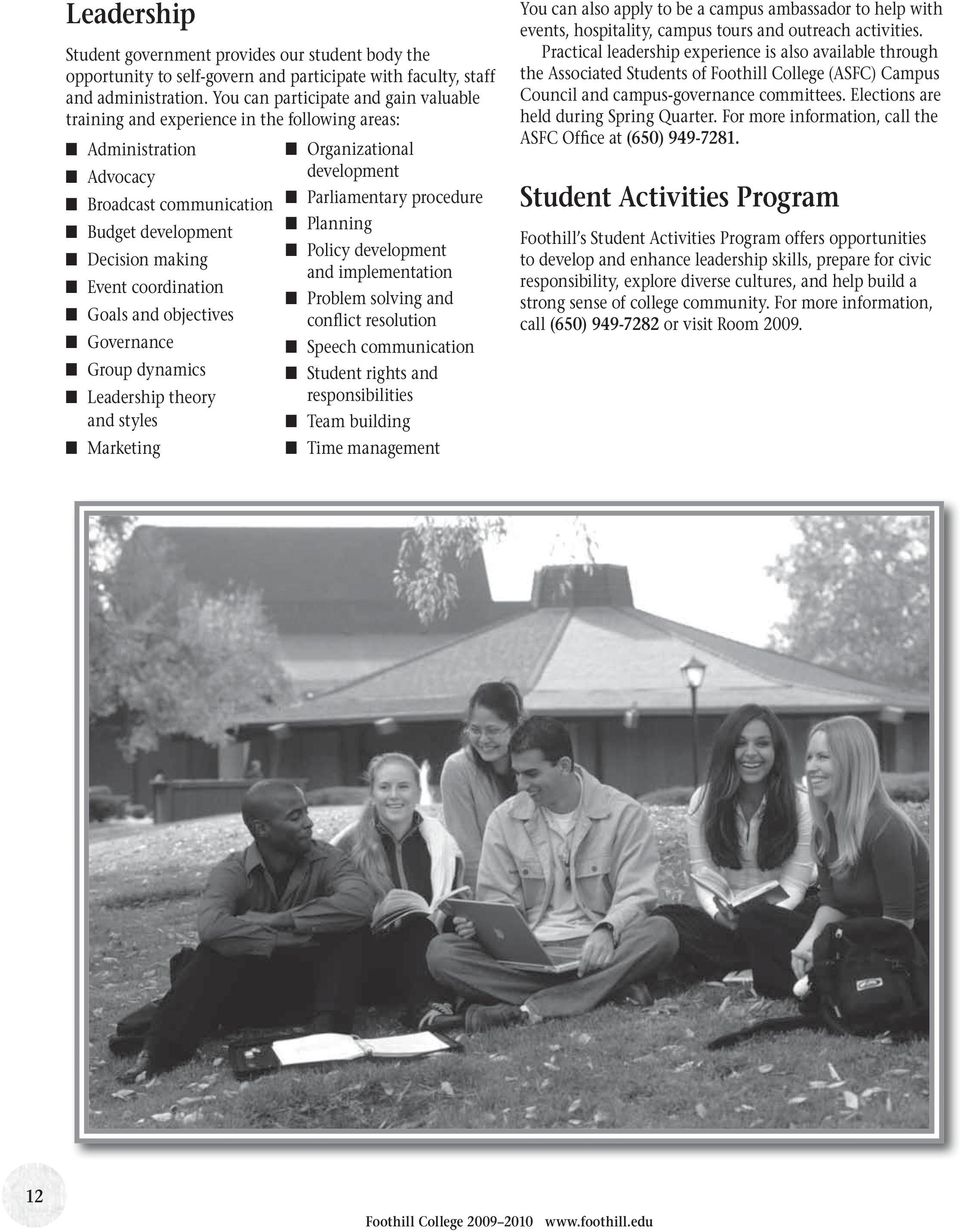
14 Leadership Student government provides our student body the opportunity to self-govern and participate with faculty, staff and administration. You can participate and gain valuable training and experience in the following areas: n Administration n Organizational n Advocacy development n Broadcast communication n Parliamentary procedure n Budget development n Planning n Policy development n Decision making and implementation n Event coordination n Problem solving and n Goals and objectives conflict resolution n Governance n Speech communication n Group dynamics n Leadership theory and styles n Marketing n Student rights and responsibilities n Team building n Time management You can also apply to be a campus ambassador to help with events, hospitality, campus tours and outreach activities. Practical leadership experience is also available through the Associated Students of Foothill College (ASFC) Campus Council and campus-governance committees. Elections are held during Spring Quarter. For more information, call the ASFC Office at (650) Student Activities Program Foothill s Student Activities Program offers opportunities to develop and enhance leadership skills, prepare for civic responsibility, explore diverse cultures, and help build a strong sense of college community. For more information, call (650) or visit Room Foothill College
15 You ll be surprised what exciting things you can find beyond the Foothill classroom! Student Services & Programs Joining the college s leadership and volunteer programs enabled me to meet many enthusiastic, diverse people, and grow as a professional and an individual. My involvement also enabled me to help many causes and gain confidence in my leadership skills, making me a stronger candidate for university transfer and jobs. The most valuable lesson I learned was to set my priorities high, and not be afraid to ask for assistance in achieving them. A native of Ukraine, Polina Krasnova joined Student Development Services Admission & Placement Testing Services Campus Support Centers Personal Support Services Special Assistance Services Special Studies & Programs Foothill College after completing a year at the National University of Culture & Arts in Kiev. After completing her studies at Foothill, she transferred to the University of California, Los Angeles, School of Theater, Film & Television. She intends to earn a bachelor s degree and pursue an acting career. 13
16 Student Services & Programs Student Development Services Matriculation Matriculation is a state-mandated agreement between you and Foothill College to help you reach your educational destination. Our responsibility is to provide: n An admission process. n Orientation to college programs, services and procedures. n Pre-enrollment placement testing and counseling. n Advice and counseling for course selection. n A suitable curriculum or program of courses. n Continuous follow up of your progress. n Referrals to support services. n A program of institutional research and evaluation. Your responsibility is to: n Express an educational intent at entrance. n Declare a specific educational objective within a reasonable period of enrollment. n Be diligent about class attendance and completing assigned coursework. n Strive to complete courses and progress toward an educational goal according to Foothill and California standards. Orientation The CNSL 50: Introduction to College Course If you are a new student, new transfer or former student, you must enroll in the CNSL 50: Introduction to College course. Counseling staff will provide basic information about Foothill services and programs, and requirements for associate and bachelor s degrees, general education and specific majors. Orientation topics may also include timemanagement techniques, study skills, selecting a major, college success factors, and general education and university transfer requirements. Placement test scores are used in the CNSL 50 course as an advisory tool and to help you develop an educational plan for your skill levels. The course is offered each quarter and during Summer Session. See the Schedule of Classes CNSL 50 listing. For more information, call (650) Counseling Foothill counselors help students with class selection, registration procedures and personal issues. They use skills, techniques, interventions, logic and intuition to help you make decisions and set goals leading to successful college and life experiences. Counselors can help you: n Make appropriate, successful educational decisions. n Set realistic career goals. n Adjust to changing roles in society. n Resolve personal concerns that may interfere with your ability to succeed. For a counseling appointment on the Main Campus, call (650) For an appointment on the Middlefield Campus, call (650) Or, schedule an appointment online at Career/Transfer Center The Career/Transfer Center offers career and transfer resources, workshops and advice. The career coordinator provides information on job-hunting, resume writing, interview techniques, and career exploration. If you are interested in transferring to a four-year college, the transfer coordinator can help with transfer information, completing applications and essays, and choosing the best college. The Career/Transfer Center offers many services, including a resource of library of books, publications and videos, current college catalogs, EUREKA (computerized career-guidance software), job binders, transfer newsletter, and Internet access for career/transfer-related research. Throughout the year, the center hosts representatives from the University of California and California State University campuses, and numerous private colleges and universities. These representatives meet one to one with students who plan to transfer. You must sign up in advance to meet with a representative. In Fall Quarter, college representatives visit the campus for Transfer Day to meet with students. In Spring Quarter, the center presents the Career & Job Fair at which more than 50 recruiters attend, ready to hire students for full- and part-time jobs and internships. Each quarter, the Career/Transfer Center compiles a comprehensive calendar of workshops, events and campus tours. Transfer workshops include transfer admission agreements, essay writing for college applications, 14 Foothill College

17 choosing a college, UC applications, and preparing to transfer to a private university. For more information, call (650) Career workshops include resume writing basics, resume writing critique, interviewing tips, choosing a college major, job search strategies, internships and salary negotiation. For more information, call (650) To pick up a copy of the calendar, visit the Career/Transfer Center in Room 8329 or access and Admission & Placement Testing Services Student Classifications To understand Foothill admission and placement testing procedures, you need to know your student classification: n Continuing Student: You were enrolled at Foothill last quarter. n Former Student: You ve attended Foothill, but were not enrolled during the previous quarter (Summer Session does not apply). n Freshman: You ve completed fewer than 45 units of college credit. n Full-Time Student: You re enrolled in 12 or more units this quarter. Or you re enrolled in 6 units during Summer Session. n International Student: You have applied and been accepted to the Foothill College International Students Program. n New Student: You ve never enrolled at any college. n New Transfer Student: You have attended a college other than Foothill. n Non-Resident Student: You have not met California residency requirements and must pay non-resident tuition. n Sophomore: You ve completed 45 or more units of college credit and haven t earned a degree. Placement Tests Testing is required for students enrolling in CHEM 1A, 25 and 30A; ENGL 1A or 110; all ESL (except 134, 136, 137); and all mathematics courses except MATH 230, 231 and 250. Placement testing is offered on a computer. Testing is conducted by appointment. To schedule an appointment at the Main Campus, access and follow the instructions or call (650) To schedule an appointment at the Middlefield Campus, call (650) If you have successfully completed college-level math, chemistry and English courses, you may be placed by a counselor. Bring your transcript to an appointment with a counselor. To schedule an appointment, call (650) If you have placement test scores from another college, you may fax them to the Testing Office at (650) You may enroll in the following courses without placement testing: ENGL 100, ESL 134, 136, 137 and MATH 230 and 231. If you have successfully completed an ESL course at another California community college, you can request that your transcript be evaluated by calling (650) We also offer ability-to-benefit placement testing for students lacking a high school diploma and requesting federal financial aid. For details, access reg/placement or call (650) If you have a physical disability, call the Disability Resource Center, (650) (voice) or (650) (TDD) to make accommodation arrangements. For more information on placement testing services, access Campus Support Centers CTIS Computer Centers CTIS computer labs are open for all students. If you are enrolled in CTIS courses, you receive priority access and printing capabilities. For more information, call (650) , Main Campus; or (650) , Middlefield Campus. Language Arts Laboratory Located in Room 6308, the Language Arts Lab offers a series of self-paced, individualized text-based and computerized courses on a credit/no-credit, non-transferable basis. The lab also has software to supplement ESL and foreign language instruction as well as a drop-in computer lab. For more information, call (650) Library Services The Hubert H. Semans Library has more than 90,000 books, periodicals, newspapers and a variety of multimedia resources. You can browse the best-seller reading collection or take a self-paced course to learn how to use a modern library. Our online catalog helps you locate books by subject, title or author. Various computer databases make it easy to find articles in periodicals. You can also access the Internet and search various databases and Web sites. For more information, call (650) , hours; (650) , reference desk; (650) , circulation. Foothill College
18 Math, Physics & Chemistry (PSME) Center If you need help with math, physics or chemistry, we encourage you to visit the Math, Physics & Chemistry (PSME) Center. The center is staffed by Foothill s physical sciences, mathematics and engineering faculty and graduate students who can spend time assisting you in a supportive environment. The center also has numerous computers with the latest math, chemistry and physics software applications. The PSME Center is located in Room 4215, and is open Monday through Friday. For information, call (650) Media Center Located in Building 3600, the Media Center provides access to a variety of multimedia resources, including non-print materials, audiovisual workstations, and an open computing lab with Macintosh and Windows workstations. Currently enrolled students can use the lab for online research, papers or other class assignments. For hours or more information, call (650) Foothill Observatory Operated by the Peninsula Astronomical Society, the Foothill Observatory offers weekly public programs. These programs allow Foothill students and the public to view the day and evening sky with the observatory s large astronomical telescope. The observatory is located in Building For hours of operation, call (650) Tutorial Center As a Foothill student, you have access to free tutoring in the Tutorial Center during day and evening hours. Visit the center in Room 3526 for assistance in a variety of subject areas. The Tutorial Center is home to drop-in tutoring, appointment tutoring and EOPS tutoring. Macintosh, PC, Internet and printer access is also available. For hours, directions, tutor schedules or more information, call (650) or access Writing Centers English Writing Center consultants are available to give you advice for writing assignments, job and college applications, and essay examinations. If you are enrolled in composition courses ENGL 110, 1A or 1B, you are strongly encouraged to use the center. The center accepts appointments and drop-ins. Visit Room 3612 or call (650) English as a Second Language ESL Writing Center consultants are available to give you advice for writing assignments and essay examinations. If you are enrolled in ESL 167, 25 and 26, you are encouraged to use the center. The center accepts appointments and drop-ins. Visit Room 6301 or call (650) Personal Support Services Health Services The Health Services Office provides confidential health care services to students. Direct services include vaccinations, blood-pressure checks, emergency first aid, basic primary care appointments, smoking cessation counseling and acupressure massage. The office also sponsors speakers, presentations and conferences on health topics throughout the year as well as the services of a nutritionist and consultations with a registered dietician. Services are available by appointment only. Planned Parenthood reproductive health-care services, pregnancy testing, birth control, and STD- and HIVtesting are available on a sliding-scale fee basis. For more information, visit Room 2126 or call (650) Psychological Services Licensed mental health professionals, counselors and graduate interns offer short-term, confidential, no-fee personal counseling to you and your dependents. Services include individual, couple, family and group counseling. Services are provided in the Psychological Services Office. For psychological services appointments or information, visit Room 2120 or call (650) Housing Foothill has no dormitory facilities, but the Student Activities Office maintains a rental-listing resource binder. Foothill College does not supervise, recommend or assume responsibility for any housing facility. To list available housing, call (650) To review the resource binder, visit Room Special Assistance Services Disabled Student Programs & Services Adaptive Learning Division The Adaptive Learning Division offers courses and services on the campus and in the community for physically, communicatively, learning, developmentally and psychologically disabled adults. Consult the Schedule of Classes for sites and courses under Adaptive Learning. The Disability Resource Center, located in Room 5801, provides disability access information, academic support, computer training, counseling, on-campus 16 Foothill College
19 shuttle and other services. Extended-time placement testing is available to qualifying students. For on-campus service and disability accommodation information, call (650) or , voice; or (650) , TDD for hearing-impaired. For deaf services Brenda Davis at For community-based program information, call (650) To request this publication in alternative media such as electronic text, Braille or large print, contact Alternative Media Specialist Steven Sum, (650) ; foothill.edu. Foothill offers an alternative path for the student with verified disability who requests academic modifications and does not want to participate in Disabled Student Program & Services. Contact Kim Chief Elk,, Foothill College ADA/504 coordinator and director of FHDA Human Resources at (650) EOPS/CARE for Disadvantaged Students Extended Opportunity Program & Services (EOPS) and Cooperative Agencies Resources for Education (CARE) assist disadvantaged and low-income students. In addition to offering financial aid (detailed in the financial aid section of this catalog), EOPS and CARE offer counseling/advising, private tutoring, workshops, peer advising and transfer assistance. Staff and peer advisors provide useful insights because they have varied backgrounds and have experienced similar challenges. The EOPS and CARE offices are located in the Student Development Center in Room For program-entry requirements, call (650) Veterans Assistance & Services The Admissions & Records Office and Counseling Division assist veterans in planning their educational goals while on the new Montgomery G.I. Bill, Veterans Educational Assistance Program or Selected Reserve Education Assistance Program. Foothill accepts credit from institutions accredited by one of the six regional accrediting associations or follow the recommendations of the American Council on Education. Assistance for dependents who qualify for educational benefits is also available. According to policies of the United States Veterans Administration, students receiving VA educational benefits (veterans, reservists, dependents) must maintain satisfactory progress. Students receiving VA benefits who fall below a 2.0 grade point average (GPA) will be placed on academic probation. If unsatisfactory progress continues for two consecutive quarters, students will have benefits suspended until GPA returns to satisfactory progress of 2.0 GPA or better. For more information, call the Foothill Veterans Office at (650) or [email protected]. Refunds & Grading Options for Students Called to Active Military Service If you are called to military duty before completing your term of study, you may choose from the following options. n Refund: Petition for an official withdrawal with a full refund of enrollment fees, student fees and non-resident tuition, if applicable. You ll receive a full refund for all books and materials purchased from the college bookstore. n Credit: Petition for an official withdrawal with credit for enrollment fees, student fees and nonresident tuition, if applicable, toward future enrollment. You may later opt to receive a refund. n Grade of Incomplete: Request a grade of I (Incomplete) from the instructor. Regulations require you to complete the course within one year, but you can request an extension in special circumstances. Forms for these services are available in the Admissions & Records Office in Room Special Studies & Programs Professional & Work Force Development Foothill College provides many services that directly benefit employees and employers in the Silicon Valley and greater Bay Area. Two of those services are customized on-site employee training for all employers from our contract education program, and specialized training and consulting for manufacturing businesses from the Center for Applied Competitive Technologies. For more than two decades, Foothill College has provided high-quality training and business services to area employers. Our services are affordable, convenient and flexible. Subject-matter experts in many fields serve as our instructors and consultants. They utilize a variety of teaching modalities to deliver high-quality training. We offer accelerated programs and distance learning as well as special services, including skills testing, counseling, career assessment, and consulting. Contract education provides training and consulting in such areas as business skills, workplace communication, professional development, English as a second language, computer software applications, health and safety, and basic skills. The Center for Applied Competitive Technologies provides training and consulting in such areas as root cause analysis, design for manufacturability, statistical process control, design of experiments, Six Sigma Deployment, ISO 9000: 2000, and technical skills. Foothill College

20 Professional & Work Force Development Center for Applied Competitive Technologies Location: De Anza College, Staff House I, Stevens Creek Blvd., Cupertino CA (408) , voice; (408) , fax Web Sites: SiliconValleyTraining.fhda.edu Campus Abroad Program Study in France, Ecuador, England, Italy, Spain, Costa Rica, Ireland, West Africa or Vietnam and earn Foothill course credit through our Campus Abroad Program. You ll enjoy a unique opportunity to immerse yourself in international culture. Field trips enhance coursework taught by Foothill- De Anza faculty at our campus sites abroad. Foreign language proficiency is not required, although we encourage you to investigate Foothill foreign-language courses. Program fees include cultural and social activities; housing; medical, baggage and fee-refund insurance; meal plans; and transportation at some sites. For more information, call the Campus Abroad Program Office at (650) Cooperative Work Experience Program Foothill offers credit for both general and occupational work experience education through our general Cooperative Work Experience (CWE) Program. The CWE Program is designed to help students enhance their academic and work-related skills. College credit may be earned by those students who work (full or part time) or for those who volunteer their services at approved agencies. Both Foothill and De Anza colleges have coordinated classroom instruction and work experience with a number of employers in business, industry, government and other professions. Most CWE students work up to 20 hours per week and full time during summer and school breaks. CWE Program participation information, employment opportunity and eligibility criteria are available at the CWE Office in Room For more information, call (650) Evening College If you work during the day or would prefer to take classes in the late afternoon, evening or weekend, Foothill s Evening College offers hundreds of classes each quarter. The Evening College Office, located in Room For more information, visit or call (650) Foothill Global Access (Distance Learning Program) Foothill Global Access (FGA) features online courses including lectures, discussion, assignments and tests delivered via the Internet with regular opportunities for electronic interaction with the instructor and other students. To enroll in online classes you must have access to a computer and an account. For more Foothill Global Access information, visit or or call (650) International Programs Establishing an international presence is a Foothill priority. Foothill College has a long history of educating international students since its opening in 1957, and its graduates hail from many diverse corners of the world, from Tonga and Ivory Coast to Kyrgyzstan, Nepal and Latvia. The International Programs Office caters specifically to international students on F-1 visas. We provide counseling and assistance to more than 800 F-1 students from more than 70 different countries. F-1 status is available to foreign citizens who commit to study full time in the United States in programs leading to an associate degree or bachelor s degree at a four-year university through Foothill s transfer pathways. Admission to Foothill is flexible, convenient and personalized: Applications are accepted three times a year for Fall, Winter and Spring quarters. For admissions requirements and application procedure, access the admissions section at Foothill also hosts international students on other visa types, such as J-1, H-1B, H-4, L-2 or F-2. The college has approximately 1,200 international students on all visa types, earning Foothill a #11 spot in the U.S. on the Institute of International Education s Open Doors Report ranking associate institutions with the largest and most diverse international student populations. Applicants who do not hold or intend to apply for an F-1 status are considered domestic students for application purposes and should apply as non-residents by completing the Domestic Student Application Form at Foothill s International Programs Office provides some informational support to overseas applicants who are permanent residents, dual citizens or hold a U.S. visa other than F-1. A special orientation session is offered once a quarter for non-f-1 visa holders with international backgrounds. For more information, call the Foothill Outreach Office at (650) or [email protected]. The International Programs Office features a team of caring multilingual professionals who ensure that students have an outstanding educational experience at Foothill and in the U.S. Our services include a new student orientation 18 Foothill College

21 program with comprehensive academic, immigration and cultural counseling; regular immigration advising and seminars by a dedicated advisor regarding regulations that affect F-1 student status from passports, visas, employment, travel and academic issues; CINTAX tax-filing assistance program; medical insurance program; and publication of the I-NEWS monthly newsletter. Additionally, the office creates programs and initiatives that support international students as they adjust to the campus and community, expand their horizons and share their unique heritage and cultural backgrounds. Special activities include monthly coffee hours, free tickets to Celebrity Forum, field trips to Bay Area attractions, Thanksgiving dinner, ice-skating trip and International Student Connection Club. The office also coordinates largescale programming initiatives aimed at internationalizing the Foothill campus, such as the annual International Film Festival, International Night and Lunar New Year celebrations. For information about admissions, call (650) or [email protected]. For information about international marketing and activities, call (650) or [email protected]. Internship Program The Foothill-De Anza Community College District Internship Program offers a unique opportunity to gain valuable experience under the mentorship of a professional at a major Silicon Valley corporation or public agency. Internships enhance your university transfer application as well as your future employment prospects. As an intern, you ll work 20 hours per week during the academic year and 40 hours per week during Summer Session. Foothill College offers one-year paid internships for students in most majors such as psychology, business, engineering, computer science, graphic arts, physical and biological sciences, office administration, multimedia and many other majors. Internships are sponsored by job sites such as NASA Ames Research Center, Apple Computer, LSI Logic, SETI, Computer History Museum, Foothill College Educational Technology Services and many other corporations and public agencies. U.S. citizenship is required at some internship job sites. To get started, attend the program s on-campus information sessions, access internships.fhda.edu, [email protected] or call (650) Foothill College
22 Occupational Training Institute Middle College: The High-School Alternative Foothill Middle College Program coordinators understand that not all students fit the mold of the traditional highschool student. This alternative program works with at-risk students to rekindle the enthusiasm for learning. This program offers a serious learning environment where you must take control of your own learning, explore individual interests through more diversified course offerings, and complete high school graduation requirements. Middle College is based at the Main Campus. For an application or more information, call (650) Middlefield Campus & Off-Campus Programs Foothill has offered classes at community sites for more than two decades. Today, approximately 4,000 of our students enroll in classes at Foothill s Middlefield Campus and more than 50 other convenient community locations. The Middlefield Campus, located at the Cubberley Community Center in Palo Alto, is a full-service campus. It offers computer labs, an art lab, student lounge, gyms, weight room and classrooms. The Middlefield Campus is also home to the Foothill Child Development, REACH Post- Stroke, Paramedic, EMT, Pharmacy Technician and Travel Careers programs. A variety of support services are available at the Middlefield Campus, including counseling, tutoring, financial-aid assistance, open PC and Mac computer labs, OwlCard distribution and photo station, and placement testing services. We can process all admissions and registration transactions at either the Middlefield Campus or Main Campus. For Middlefield Campus/Off-Campus programs information, call (650) For Middlefield Campus Student Services, call (650) The FHDA Occupational Training Institute (OTI) provides job training and employment services at no cost for eligible residents of Santa Clara County. You may qualify if you are unemployed due to a company layoff, line or division closure, or you are economically disadvantaged. A variety of short-term training programs are available. OTI pays for college fees, books and required class materials for qualified students. Job preparation classes, placement assistance, retention and customized followup services are offered at no cost to candidates and employers. Additional support services include referrals to child care providers, transportation, financial aid and tutorial services. OTI is located in Room For more information, call (650) OTI also serves as liaison for CalWORKs, offered to Santa Clara or San Mateo county residents who receive or have applied for Temporary Assistance for Needy Families (TANF). A variety of services are available to CalWORKs recipients enrolled in the program. For more information, call (650) Project Veterans Program Foothill College offers veterans and active duty personnel the unique opportunity to learn new skills, adapt their military skills to civilian life, and earn a college degree or career certificate. Project Veterans is dedicated to helping you identify and pursue comprehensive academic and career-training programs that meet your personal and professional goals. We help armed services personnel achieve their educational goals by addressing their specialized needs in a college setting. We encourage veterans interested in pursuing a vocational goal, college degree, apprenticeship program, or taking courses for personal enrichment to begin their educational experience through Foothill s Project Veterans Program. For more information, Project Veterans Coordinator Charlie McKellar at McKellarCharlie@ foothill.edu or call (650) Short Courses Foothill and De Anza colleges offer approximately 150 non-credit, fee-based short courses each quarter. Nearly 12,000 students enroll in these courses each year. The Short Courses Office is located at De Anza College in the Student and Community Services Building. In accordance with the Civic Center Act, the college is only designated as a place for community groups when there is no interference with the regular educational program. For more information, call (408) Foothill College
23 To get the most out of Foothill College you must be ready to take advantage of opportunity. This strategy paid off for me. With the few Financial Planning & College Costs hours that I spent applying for financial aid and scholarships I ve been able to completely pay my way through college. This is especially important for me because growing up with little money, higher education was never talked about in my family. I never thought it possible that I would be where I m today, and if it was not for financial aid resources, I know my story would have turned out very differently. Julie A. Berkovatz attended Foothill College for three years and completed the Associate in Arts Degree in Graphic & Interactive Design in She then transferred to San Jose State University to further pursue the study of graphic design. Student Fees Instructional Materials Fees Textbooks & Supplies Estimated Annual Cost of Attending Foothill College Cost of Attendance Examples of Additional Costs Refunds & Repayments Financial Aid State Aid Other Aid 21
24 Financial Planning & College Costs Student Fees If you re a California resident, you ll pay $13 per unit [1]. The non-resident tuition fee is $122 per unit, and the foreign student tuition fee is $130 per unit. Foothill charges additional fees for Campus Center use, on-campus parking, lab courses, studentbody activities (voluntary) and health services. International F-1 Visa students are required to purchase comprehensive health insurance for $390 each quarter. All fees, listed in the quarterly Schedule of Classes publication, are subject to change. Tuition and fees may be refunded under certain circumstances; the specific refund policy is listed in the Schedule of Classes. Please direct questions about tuition and fees to the Admissions & Records Office. 1 Fees are subject to change by California legislative action. Instructional Materials Fees In some courses, there will be an instructional materials fee. These fees, detailed in the Schedule of Classes, reflect the actual cost for materials, meaning the cost is usually lower than if you purchased the same items separately. Unless there s an issue of health or safety, you can either pay the fees to the college or provide your own materials of equal quality. Your instructor will provide a list of required materials. Textbooks & Supplies You are responsible for purchasing textbooks and supplies, including course syllabi, bibliographies and other printed materials in excess of five pages. Some courses require that you purchase additional supplies. The Foothill Bookstore sells all course texts and other items. 22 Foothill College
25 Estimated Annual Cost of Attending Foothill College It s important for you to financially plan your education. The following cost estimates are calculated for a student attending Foothill College full time (enrolled in 15 units) for nine months Cost of Attendance California Resident (9 months) Reside At Home No Dependents All Others Fees $ $ Books / Supplies $1,728 $1,728 Room / Board $4,338 $10,872 Transportation $1,170 $1,170 Misc. / Personal $2,826 $2,826 Total $10, $17, Based on institutional average 15 units x $13* per unit = $195 + $42.50 Basic Fee x 3 Quarters = $ * Fees are subject to change; excludes cost of textbooks. Additional Fees n Materials Fee: amount varies. n Non-Resident Tuition Fee: $122 per unit per quarter. Examples of Additional Costs For students enrolled in allied health programs (primary care associate, dental hygiene, etc.), special fees, lab fees, tooling, and other related costs may be added to the normal cost of attendance. Study Abroad Programs have additional costs that may be added to a student s normal budget. Student loan fees are added. Expenses for dependent care and disability-related costs may also be considered with documentation. Refunds & Repayments Refunds The college maintains a refund policy for tuition and fees at the Admissions Office, and book purchases at the bookstore. In most cases, a student can request a refund for classes dropped during the first two weeks of classes. The Admissions & Records Office and Bookstore can provide the most current policies for obtaining a refund. Repayment The student who withdraws from the college on or before 60 percent of the quarter is completed, may be required to repay Title IV funds. The funds are repaid to the Financial Aid Office and must be returned within 30 days after the college s determination that the student has withdrawn. Financial Aid Are You Eligible? Financial aid eligibility is based on need the difference between what you and your family can provide and actual college expenses. Your financial need is determined by the information you and your family provide through the Free Application for Federal Student Aid (FAFSA) and any Foothill College additional paperwork. If the application shows unmet need, we may be able to help. The total amount offered cannot exceed your documented financial need, and the monies must be used solely to meet cost of attendance at Foothill (refer to chart at left). If you are in default on a loan, or owe an overpayment on a grant or loan, you will not be eligible for financial aid until the situation is satisfactorily resolved. Eligibility requirements are generally established once you ve shown, through a completed application, that you: n Have applied for admission. n Have enrolled in an academic program that requires 24 units or more quarters to complete. n Maintain satisfactory academic progress. n Demonstrate verifiable financial need. Some exceptions may apply. Consult the Financial Aid Office for details. n Show academic major/goals and units of enrollment that can be applied to an educational plan. n Have a high-school diploma, GED, have passed an independently administered examination approved by the Department of Education, or have shown the ability to benefit through prior unit completion. Foothill College
26 n Are a U.S. citizen, permanent resident or other eligible non-citizen. n Have a valid Social Security Number. n Register with Selective Service if required. n Not owe a refund on any grant or be in default on any student loan. Academic Competitiveness Grant (ACG) The federal Academic Competitiveness Grant will provide up to $750 for the fist year of undergraduate study and up to $1,300 for the second year of undergraduate study to the half- and full-time student who is eligible for a Federal Pell Grant, and who has successfully completed a rigorous high-school program, as determined by the state or local education agency and recognized by the U.S. Secretary of Education. The second-year student must also have maintained a cumulative grade point average of at least 3.0. Federal Pell Grant Federal Pell Grants are awarded to undergraduates based on financial need. They range from $609 to $5,350. Federal Supplemental Educational Opportunity Grant (FSEOG) This federal program may be an option if you have exceptional financial need and would be unable to continue your education without a Pell Grant. The FSEOG Award is up to $600 per academic year at Foothill College. Bureau of Indian Affairs (BIA) BIA grants are available if a tribal agency can verify that you are at least one-fourth Native American, Eskimo or Aleut. To apply, contact the BIA area office at (916) Federal Work Study (FWS) If you have financial need and want to earn a part of your educational expenses through employment, Federal Work Study (FWS) may be an option. You can work up to 25 hours per week while classes are in session and 40 hours during school vacations, however you must be enrolled in a minimum of six units to be eligible for FWS. If you receive an FWS award, it is your responsibility to schedule an interview with the Financial Aid Office for work study placement assistance. Federal Perkins Loan Borrow up to $3,000 a year at a lower-division undergraduate level from this campus-based program with limited funding. You will begin repaying the loan nine months after you graduate or drop below half-time enrollment. During the repayment period (up to 10 years), you ll be charged 5 percent interest on the unpaid balance. Federal Subsidized & Unsubsidized Stafford Student Loan Federal Stafford Loans are made by banks, credit unions, and savings and loan associations. As a first-year undergraduate, you can borrow up to $3,500 subsidized per year. As a secondyear undergraduate, you can borrow up to $4,500 subsidized per year. Additional Unsubsidized Stafford may also be available annually. Federal Stafford Loan totals may not exceed $31,000 for dependent undergraduates and $57,500 for independent undergraduates (no more than $23,000 can be subsidized). You begin repayment six months after you graduate or drop below half-time enrollment. During the repayment period, and upon receipt of funds for unsubsidized loans, you will be charged a fixed interest rate that is capped at 8.5 percent on the unpaid balance and adjusted for new loans each July 1. Federal PLUS Loan for Parents Federal PLUS Loans are made by banks, savings and loan associations, and credit unions. Parents of dependent undergraduate students may borrow up to the maximum of the amount determined to be unmet educational expenses. A determination of need must be made, but federal PLUS eligibility is based on unmet educational expenses. Interest charges begin upon receipt of the loan. State Aid Extended Opportunity Program & Services (EOPS) This state-funded program has been designed to help colleges to recruit and retain those students affected by language, social and economic disadvantages who otherwise might not attend college. EOPS offers a staff of trained professionals eager to assist these students to achieve academic, career, and personal goals. Full-time enrollment (12 units) is required. CAL Grants To be eligible, in addition to federal aid requirements, a student must: n be a U.S. resident or eligible non-citizen, and n be a California resident, and n not have a bachelor s or professional degree (except extended Cal Grant A or B awards for a teaching program or other five-year program), and 24 Foothill College
27 n file a completed FAFSA and Cal Grant GPA Verification Form by the annual March 2 deadline. Cal Grant A: Covers fees at the UCs, CSUs, and private institutions in California. This award may not be used to pay for community college fees. Funding for students who are enrolled at community colleges may be held in reserve for up to three years. Cal Grant B: Is for high-potential students from disadvantaged or low-income families who otherwise would not be able to pursue a higher education. California community college awards are up to $1,551 per year. Entitlement Award: Every graduating high school senior who has a grade point average of at least 2.0, meets the Cal Grant financial and eligibility requirements and applies by March 2 within one year of graduation is guaranteed this award. Competitive Award: The student who will enroll at a California community college, although strongly encouraged to apply by March 2, has a second annual deadline of Sept. 2. Other students who meet the basic Cal Grant eligibility requirements and who have at least a 2.0 grade point average may compete for this award. Cal Grant C: Helps vocationally oriented students acquire marketable job skills within a short time. Fullor half-time training must be for at least four months and lead to a recognized occupational goal diploma, associate degree, license qualification or certificate. Funding is available for up to two years, depending on the length of the program, as long as academic progress is acceptable. Awards for California community college students are limited to up to $576 in training related costs. California Chafee Grant This federal program, administered by the California Student Aid Commission, offers college and vocational school financial aid to youth aging out of a foster care program. For up to $5,000, the student must demonstrate financial need, meet basic eligibility requirements, complete the FAFSA and the Chafee Grant Application available at Board of Governors Fee Waiver (BOGW) While state law requires that students attending California community colleges pay an enrollment fee, the California Community Colleges offer the BOGW. This grant program waives enrollment fees for the academic year and Summer Session. If you are a California resident, you qualify for a BOGW if any one of the following statements applies to your current status: n You have qualified for financial aid and your need hasn t been met; n You or your family are receiving TANF/CalWORKS, Supplemental Security Income (SSI) or General Assistance/General Relief; n You have received certification from the California Department of Veterans Affairs or the California National Guard Adjutant General that you are eligible for a dependent s fee waiver; or n You meet income standards; year specific n You have documentation that you are a recipient or the child of a recipient of the Congressional Medal of Honor. n You have documentation that you are a surviving dependent of any individual killed in the Sept. 11, 2001 terrorist attack. n You have documentation that you are a dependent of a deceased law enforcement/fire suppression personnel killed in the line of duty. Applying for BOGW n You are required to submit a completed BOGW Application Form each academic year. Complete the form online at or pick up the form in the Financial Aid Office. n You must submit a completed FAFSA each academic year at n Only one application is required per year (July 1 June 30). n Applications are accepted until the end of each quarter. It is not possible to process applications for prior quarters. n Because the BOGW is not tied to any other financial aid program, the BOGW form can be processed quickly and you can register immediately. n You do not have to be enrolled in a specific number of courses to apply for the BOGW. Other Aid Emergency Loans If you face an unexpected educational emergency, Foothill offers short-term loans up to $200. To qualify, you must be enrolled full time (12 units), purchase a Foothill College OwlCard and meet satisfactory academic progress requirements. These 30-day loans are interest-free. An overdue loan may be subject to additional late fees, registration holds, and assignment to collection services. Emergency loans are administered through the Financial Aid Office. For information, call (650) Foothill College
28 Employment If you re interested in working to help defray the cost of attending college, consider a part-time, on-campus position. Most of these jobs pay from minimum wage up to $14/hour. Jobs that are not based on financial need are called district employment, and you must be enrolled in a minimum of six units to be eligible for these jobs. For information, call (650) Scholarships Tens of thousands of dollars in campus and local scholarships are awarded annually to Foothill students. Scholarships, which vary in amount, are considered academic gifts and need not be repaid. They re generally based on academic standing, financial need, potential progress in major fields of study, and college or community activities. Scholarships are computed as resources for students receiving financial assistance. A listing of current scholarships is posted in the Financial Aid Office and at Textbook Assistance If you re eligible for Extended Opportunity Program & Services (EOPS), you may also qualify for the Textbook Assistance Program. For more information, call the EOPS Office at (650) Financial Aid Answers The goal of the Foothill Financial Aid Office is to make college accessible to all students. We feel no one should be denied an educational experience due to lack of funds. If you have questions or want more information about financial aid options, please contact: Financial Aid Office (in Room 8202 of Building 8200) Foothill College El Monte Road Los Altos Hills, CA (650) [email protected] 26 Foothill College
29 Academic Divisions Programs of Study Adaptive Learning & Disability Services (650) Biological & Health Sciences (650) Business & Social Sciences (650) Computers, Technology & Information Systems (650) Counseling & Student Services (650) Fine Arts & Communication (650) Instructional Services & Libraries (650) Language Arts (650) Physical Education/Human Performance (650) Physical Sciences, Mathematics & Engineering (650) Academic Divisions Build Your Foundation: General Education Coursework Select a Major Certificate Programs Two-Year Career Programs Curriculum Advisory Committees Grade Requirements for Specified Career Program Courses Professional/Technical Programs Leading to a Career Upon Completion Apprenticeship Programs Degrees & Certificates Offered at Foothill College 27
30 Programs of Study Build Your Foundation: General Education Coursework The primary objective of general education is to provide students with the depth and breadth required to interact successfully with others as knowledgeable members of our diverse society. A general education helps students clarify and present their personal views. It should also instill values and ideas that will enrich the personal lives of students and help them understand their own abilities, feelings and motives. At Foothill College, the general education curriculum is designed to help students understand relationships among various disciplines and appreciate and evaluate past experiences that form our cultural and physical heritage. This academic program is designed to help individuals reach their full potential as global citizens and lifelong learners. Foothill general education requirements are described under Associate Degrees/Graduation Requirements on page 59. The Intersegmental General Education Transfer Curriculum (IGETC) for transfer from a community college to either the California State University or University of California system is listed on page 60. CSU General Education requirements are listed on page 61. Select a Major Selecting a college major is an important step one that establishes your career goals and determines where you should direct your academic efforts. Majors within career and transfer programs are described within the following pages. The chart on pages summarizes degrees and certificates available as of Fall Quarter Consult curriculum sheets located on the Web site and available in the Counseling Center, Room 8301, for the most current degree and certificate information. You can also consult with a Foothill counselor to develop a strategy for selecting your college major. To schedule a consultation, call (650) Certificate Programs Foothill offers the following types of certificate programs: n Career Certificate n Certificate of Achievement n Certificate of Completion n Certificate of Proficiency n Certificate of Specialization n Skill Certificate n Other division certificates For information about certificates, contact the division office for unit requirements, course sequences and major requirements. Foothill awards these certificates when you satisfactorily complete certain specialized programs requiring fewer than two years of full-time study. Some certificate programs comprise (1) a complete curriculum pattern or (2) major and related courses selected from an Associate in Arts or Associate in Science degree curriculum at the recommendation of an advisory committee. The following state requirements apply to Certificate of Achievement programs: n A minimum of 27 units that follow a prescribed course pattern; n A minimum GPA of 2.0 for these units; n A maximum of 12 transfer quarter units from other institutions of higher education; and n Proficiency in mathematics and English as evidenced by examinations or completion of college courses. Certain Foothill College departments offer certificates of proficiency, specialization and skills. General requirements include the prescribed coursework and a GPA of at least 2.0 in these courses. More information on specific requirements is available in the division office offering the certificate or from a Foothill counselor. Two-Year Career Programs Associate in Arts & Associate in Science Degrees Most professional and technical programs require two academic years of full-time enrollment and a minimum of 90 units of credit. All two-year programs lead to an Associate in Arts or Associate in Science degree. Although these programs are intended primarily to develop personal and technical competencies for employment, many four-year colleges accept the units earned in the two-year curriculum for certain lower-division requirements. We strongly recommend that you consult with a Foothill counselor to discuss degree and transfer requirements. To schedule a consultation, call (650) Foothill College
31 Curriculum Advisory Committees At Foothill, we strive to ensure that our career education curriculum meets the needs of business, industry and government. This is why we invite a number of occupational leaders to advise us on: n new courses and course content; n facilities and equipment; n nature and extent of employment needs; n how to evaluate the appropriateness of contents of existing courses; and n how to evaluate student performance. We constantly implement the recommendations of more than 30 occupational advisory committees. A campus advisory committee for vocational education also meets periodically to review and make recommendations for career education. For information on specific courses, consult your counselor or review the program s curriculum sheet online at Grade Requirements for Specified Career Program Courses A grade of C or better in certain career courses is required before you can enroll in the next program course: n Biotechnology n Pharmacy Technician n CTIS Division Majors n Dental Assisting n Dental Hygiene n Diagnostic Medical Sonography n Paramedic n Primary Care Associate n Radiologic Technology n Respiratory Therapy n Veterinary Technology Professional & Technical Programs Leading to a Career Upon Completion n Accounting n Adaptive Fitness Therapy n Bioinformatics n Biotechnology n Business Technology n Child Development n Computer Software Development n Database Design & Management n Dental Assisting n Dental Hygiene n Diagnostic Medical Sonography n Enterprise Networking n Environmental Horticulture & Design n Geographic Information Systems n Graphics & Interactive Design n Help Desk/Tech Support n Informatics n Interactive & Multimedia Technologies n Internet Technology n Music Technology n Office Administration n Nanotechnology n Paramedic n Pharmacy Technician n Photography n Primary Care Associate n Radio Broadcasting n Radiologic Technology n Real Estate n Respiratory Therapy n Small Business Administration n Special Education n Theatre Technology n Travel Careers n Viticulture & Enology n Veterinary Technology n Video Arts Apprenticeship Programs Call the numbers listed for more information about apprenticeship programs. n Electrician/Residential Electrician: San Jose, (408) ; San Francisco, (415) n Elevator Construction: San Francisco, (415) n Ironworking: Fresno, (559) n Plumbing/Pipefitting: Monterey, (831) ; Sacramento, (916) ; San Jose, (408) n Refrigeration/Heating & Air Conditioning: San Jose, (408) ; Sacramento, (916) n Sheet Metal: Castroville, (831) ; Petaluma, (707) ; San Francisco, (415) ; San Jose, (408) ; San Leandro, (510) ; San Mateo, (650) n Sound & Communication: San Jose, (408) ; San Francisco, (415) Foothill College
32 Degrees & Certificates Offered at Foothill College Curriculum sheets describing general education and career training courses required for these programs are located in the Counseling Center in Room 8301 and online at The quarterly Schedule of Classes lists each program alphabetically, the courses offered each quarter and the current contact phone number. PROGRAM Accounting Financial Accounting Tax Accounting Enrolled Agent Preparation Bookkeeping Specialist Payroll Preparation Adaptive Aquatics Adaptive Fitness Therapy American Studies Anthropology Cultural Anthropology Medical Anthropology Physical Anthropology Archaeology Art- General Ceramics Two-Dimensional Art Painting Art History Art- Studio Athletic Injury Care Bioinformatics Biological Sciences Business Administration Business Management E-Commerce & Electronic Business Entrepreneurship Marketing Small Business Dispute Resolution Business International Studies International Business Strategy Business Tech: Help Desk/Tech Support Level I Level II COMPLETION AWARD AA, CA CCC CCC, CP CP CP CP CCC AA, CA AA AA CP CP CP CP AA, CA CS CS CS AA, CA, CS AA, CA AS AS, CA AS AA CCC CCC CCC CCC CCC CS AA, CA CCC AS, CA CCC CA LEGEND AA Complete this program in approximately two years and earn the Associate in Arts Degree. See a counselor and refer to page 59 for requirements. AS CA CC Complete this program in approximately two years and earn the Associate in Science Degree. See a counselor and refer to page 59 for requirements. Complete this program and earn the Certificate of Achievement. See division office for requirements. Complete this program and earn the Certificate of Completion. Non-transcriptable. See division office for requirements. CCC Complete this program and earn the Career Certificate. Non-transcriptable. See division office for requirements. CP CS SC Complete this program and earn the Certificate of Proficiency. Non-transcriptable. See division office for requirements. Complete this program and earn the Certificate of Specialization. Non-transcriptable. See division office for requirements. Complete this program and earn the Skill Certificate. Non-transcriptable. See division office for requirements. Review official curriculum sheets for career opportunities and course listings. Curriculum sheets are available in the division office, Counseling Center (Room 8301) and at 30 Foothill College
33 Degrees & Certificates Offered at Foothill College COMPLETION PROGRAM AWARD A+ Preparation SC Business Technology: Office Administration AS, CA Business Communication CS Database/SQL Accounting/ Spreadsheets Word Processing/ Desktop Publishing Chemistry Child Development Infant Toddler Development Early Childhood Education School-Age Child Care Inclusion & Children with Special Needs Child Development Teacher Program Supervision & Mentoring Chinese Chinese Conversation Communication Studies Computer Science Computer Software Development Linux/UNIX System Operation & Administration Object-Oriented Software Using C++ Object-Oriented Software Using Java Microsoft Certified Application Developer #C Linux/UNIX Creative Writing Genres Fiction Poetry Reading & Writing: Poetry Reading & Writing: Fiction Database Management Oracle Database Administration Oracle Database Developer Open Source Database Microsoft Certified IT Professional (MCITP) Database Administration Dental Assisting CA CA CA AS AA CS CA CS CS CA CA AA, CS, CCC CS AA, CP, CS, CCC AS AS, CA CA CA CS CS AA CS CS CS CS CS AS CA, CS CA, CS CS CS AS, CA LEGEND AA Complete this program in approximately two years and earn the Associate in Arts Degree. See a counselor and refer to page 59 for requirements. AS CA CC Complete this program in approximately two years and earn the Associate in Science Degree. See a counselor and refer to page 59 for requirements. Complete this program and earn the Certificate of Achievement. See division office for requirements. Complete this program and earn the Certificate of Completion. Non-transcriptable. See division office for requirements. CCC Complete this program and earn the Career Certificate. Non-transcriptable. See division office for requirements. CP CS SC Complete this program and earn the Certificate of Proficiency. Non-transcriptable. See division office for requirements. Complete this program and earn the Certificate of Specialization. Non-transcriptable. See division office for requirements. Complete this program and earn the Skill Certificate. Non-transcriptable. See division office for requirements. Review official curriculum sheets for career opportunities and course listings. Curriculum sheets are available in the division office, Counseling Center (Room 8301) and at Foothill College
34 Degrees & Certificates Offered at Foothill College PROGRAM Dental Hygiene Diagnostic Medical Sonography Economics Engineering English American Literature British Literature Literary Genres Multicultural Literature Written Communication Linguistics Enterprise Networking MCITP Server Administrator MCIPT Enterprise Administrator Network Security Cisco Academy CCNA Cisco Academy CCNP Wireless Networking Microsoft Certified Desktop Support Technician Environmental Horticulture & Design French French Conversation General Electrician Geography Geographic Information Systems Gerontology German Graphic & Interactive Graphic Design Motion Graphics Video Design Book Arts Printmaking Printmaking Studio Illustration Web Design Software COMPLETION AWARD AS CA AA AS AA CS CS CS CS CS CS AS CA CP CP CP CP CP CP AS, CA, SC CP AS, CCC AA CA, CCC CCC CS AA, CA SC SC SC SC SC SC SC SC SC LEGEND AA Complete this program in approximately two years and earn the Associate in Arts Degree. See a counselor and refer to page 59 for requirements. AS CA CC Complete this program in approximately two years and earn the Associate in Science Degree. See a counselor and refer to page 59 for requirements. Complete this program and earn the Certificate of Achievement. See division office for requirements. Complete this program and earn the Certificate of Completion. Non-transcriptable. See division office for requirements. CCC Complete this program and earn the Career Certificate. Non-transcriptable. See division office for requirements. CP CS SC Complete this program and earn the Certificate of Proficiency. Non-transcriptable. See division office for requirements. Complete this program and earn the Certificate of Specialization. Non-transcriptable. See division office for requirements. Complete this program and earn the Skill Certificate. Non-transcriptable. See division office for requirements. Review official curriculum sheets for career opportunities and course listings. Curriculum sheets are available in the division office, Counseling Center (Room 8301) and at 32 Foothill College
35 Degrees & Certificates Offered at Foothill College PROGRAM General Studies-Humanities General Studies-Science General Studies-Social Science History Informatics Interactive & Multimedia Web-Based Multimedia Internet Technology AJAX Web Publishing: Dreamweaver Web Development Electronic Business Japanese Japanese Conversation & Culture Japanese Tutoring Law & Society Leadership & Service Mathematics Music General Music Technology Pro Tools Nanoscience Nanobiotechnology Nanofabrication Characterization & Modeling Paramedic Pharmacy Technology Philosophy Photography Traditional Photography Digital Imaging Photographic Laboratory Technician Photo Criticism Physical Education Physics Political Science Popular Culture COMPLETION AWARD AA AS AA AA AS, CA, SC AS, CA, SC SC AS, CA CP CP CP, SC SC AA, CCC CS CCC AA CA AS AA AA,CA CA AS, CA CP CP CP AS, CA AS, CC AA AA, CA CP CP SC SC AA AS AA CP LEGEND AA Complete this program in approximately two years and earn the Associate in Arts Degree. See a counselor and refer to page 59 for requirements. AS CA CC Complete this program in approximately two years and earn the Associate in Science Degree. See a counselor and refer to page 59 for requirements. Complete this program and earn the Certificate of Achievement. See division office for requirements. Complete this program and earn the Certificate of Completion. Non-transcriptable. See division office for requirements. CCC Complete this program and earn the Career Certificate. Non-transcriptable. See division office for requirements. CP CS SC Complete this program and earn the Certificate of Proficiency. Non-transcriptable. See division office for requirements. Complete this program and earn the Certificate of Specialization. Non-transcriptable. See division office for requirements. Complete this program and earn the Skill Certificate. Non-transcriptable. See division office for requirements. Review official curriculum sheets for career opportunities and course listings. Curriculum sheets are available in the division office, Counseling Center (Room 8301) and at Foothill College
36 Degrees & Certificates Offered at Foothill College PROGRAM Primary Care Associate Psychology Radio Broadcasting Broadcast Business Sales Radiologic Technology Real Estate Real Estate Salesperson Respiratory Therapy Sociology Social Welfare Spanish Spanish Conversation Special Education Special Education Paraprofessional Theatre Arts Theatre Conservatory Theatre Technology Transfer Studies-CSU GE Transfer Studies-IGETC Travel Careers Leisure Travel International Corporate Travel Domestic Corporate Travel Travel Reservations Veterinary Technology Online Veterinary Assisting Video Arts-Media Video Arts-Production Digital Videography Digital Video Editing Audio for Video Motion Graphic Design Animation Viticulture & Enology Vineyard Management Winemaking Women's Studies COMPLETION AWARD AS, CA AA AA, CA, SC SC AS AA, CA CCC AS AA, CS CS AA, CS, CCC CP AA CA AA CA AA, CA, CCC CA CA AA, CA CA CCC CCC CCC AS CCC AA, CCC, SC AA, CCC SC SC SC SC SC AS, CA CA CA AA Legend AA Complete this program in approximately two years and earn the Associate in Arts Degree. See a counselor and refer to page 59 for requirements. AS CA CC Complete this program in approximately two years and earn the Associate in Science Degree. See a counselor and refer to page 59 for requirements. Complete this program and earn the Certificate of Achievement. See division office for requirements. Complete this program and earn the Certificate of Completion. See division office for requirements. CCC Complete this program and earn the Career Certificate. Non-transcriptable. See division office for requirements. CP CS SC Complete this program and earn the Certificate of Proficiency. Non-transcriptable. See division office for requirements. Complete this program and earn the Certificate of Specialization. Non-transcriptable. See division office for requirements. Complete this program and earn the Skill Certificate. Non-transcriptable. See division office for requirements. Review official curriculum sheets for career opportunities and course listings. Curriculum sheets are available in the division office, Counseling Center (Room 8301) and at 34 Foothill College
37 When I first came to the U.S., I felt that my chances of getting into an Ivy League school Academic Policies were small. Foothill College gave me the hope and strength to reach my dream, and earn a degree from Harvard University. A native of Indonesia, Adrian Rahardja attended Foothill College and participated in its popular International Students Program. He earned the Foothill associate degree and transferred to Harvard and completed a master s degree. Revision of College Policies Admission & Enrollment Policies Academic Disqualification, Course Substitutions & Graduation Requirements College & District Policies 35
38 Academic Policies Revision of College Policies Any policy adopted by the college administration shall supersede any ruling on the same subject that appears in this catalog or in other official publications once the revised regulation is posted on a campus bulletin board or printed in the Schedule of Classes. Admission & Enrollment Policies Academic Prerequisites, Credit & Placement Many courses require that you complete prerequisites in order to enroll. These prerequisites are listed under each course description in this catalog and the Schedule of Classes. All courses listed with a prerequisite have a registration block. If you have completed a course to fulfill the prerequisite requirement at another college, you must first provide a transcript and consult with a Foothill College counselor. To schedule a consultation, call (650) Before registering, you must call the Matriculation Office at (650) to verify you have satisfied necessary prerequisites for CHEM 1A, 1B, 25, 30A; ENGL 1A, 110, ESL 26, 25, 146, 147, 156, 157, 166, 167; MATH 1A, 10, 49, 51, 101, 102, 103, 105 and 200 courses. It is important that you call the Matriculation Office before you enroll. If you delay calling for prerequisite verification, there may not be sufficient time before registration to clear you for the class in which you want to enroll. The college has the authority to drop you from any course if you have not met the necessary prerequisites. For refund policies, contact the Admissions & Records Office in Room If you submit written or performance evidence showing you have sufficient competence in the area of study due to previous training or experience, you may be able to enroll in a course without completing the listed prerequisites. You can only do this, however, if your counselor, instructor or division dean provides authorization. Admission Guidelines Foothill has an open-door admission policy for all highschool graduates and non-graduates who are 18 years of age or older. Students enrolled in the junior and senior year of high school may attend Foothill College with written parental and school permission. Forms for parental and school permission are available in the Admissions & Records Office (Room 8101), Middlefield Campus and at Special admission procedures such as additional testing, application forms and personal interviews are required for admission to a number of career programs. Some of these programs begin only in the Fall Quarter. You must complete all special admission requirements in the preceding Spring Quarter. Programs in this category include dental assisting, dental hygiene, primary care associate, radiation science, diagnostic medical sonography (ultrasound), radiologic technology, respiratory therapy and veterinary technology. Challenging Prerequisites You may challenge prerequisites and corequisites if you can demonstrate that: n You have the knowledge or ability to succeed in the course without the prerequisite or corequisite. n You will be subject to undue delay in attaining your educational goal because the prerequisite or corequisite has not been made reasonably available. n The prerequisite or corequisite is unlawfully discriminatory or is being applied in an unlawfully discriminatory manner. n The prerequisite or corequisite has been established in an arbitrary manner. To challenge a prerequisite, see your counselor and complete a Prerequisite Challenge Petition prior to the first day of the quarter. Advisories, when made, are listed as recommendations following prerequisites and are published in this catalog, Schedule of Classes and at To schedule a counseling appointment, call (650) Open Course Policy It is the policy of the Foothill-De Anza Community College District that, unless specifically exempted by statute or regulation, every course, course section or class reported for state aid, wherever offered and maintained by the district, shall be fully open to enrollment and participation by any person who has been admitted to the college and who meets such prerequisites as may be established pursuant to regulations contained in California Administrative Code Title V commencing with Section Foothill College
39 Enrolled Student Classifications You are a matriculated student if you have filed an Application for Admission, enrolled at Foothill and have done one of the following: n Submitted high school and other transcripts; n Met with a Foothill College counselor, counseling associate or career advisor to examine educational opportunities; n Announced an intention to study for a degree or certificate; n Begun a series of introductory, general education or special courses; or n Begun a series of special courses leading to a certificate or degree. Exceptions to Admissions & Registration Policies To request an exception to a published policy, you must file an exception petition. These forms are available in the Admissions & Records Office in Room 8101, at the Middlefield Campus Administration Building and online at General Program Requirements All beginning freshmen must enroll in the CNSL 50: Introduction to College course, or demonstrate proof that they have completed an equivalent course. If you are eligible for ENGL 1A, you should complete this course by the end of the third quarter of enrollment; you may take a speech course first. If you are eligible for ENGL 110 or 100, you should complete these courses during the first or second quarter. You may receive up to 10 quarter units of credit for each score of 5, 4 or 3 on College Entrance Board Advanced Placement Tests. Your Foothill transcript will show units but will not indicate grades. The Evaluation Office, located in the Counseling Center, Room 8301, provides information on how the advanced placement scores are marked on transcripts and the equivalencies for the University of California and California State University. You may receive up to nine quarter units for each of five general CLEP tests completed with a score of at least 500. Your Foothill transcript will show elective unit credit for each successful test score. These units may also be used to fulfill certain general education requirements. If you want to transfer credit from an armed services school or other special institution, you may apply through a counselor. It s possible these credits will be accepted toward the Associate in Arts or Associate in Science degree once you have successfully completed a minimum of 15 units at Foothill. General Registration Information If you are a new or former student, you must submit the Application for Admission by the quarterly deadline published in the Schedule of Classes and at We encourage you to complete the application, complete the placement testing process and submit necessary transcripts as early as possible. Students planning to transfer to Foothill are advised to submit transcripts from high schools and colleges previously attended. If you plan to receive veterans benefits, apply for financial aid or earn a degree or certificate, you must submit transcripts. Request previous institutions to send your transcripts directly to the Foothill College Admissions & Records Office, El Monte Road, Los Altos Hills, CA, International students on F-1 visas must follow specific admissions requirements. For more information, review To register for Foothill College classes, follow the telephone or online registration instructions published in the Schedule of Classes and on the college Web site at The Schedule of Classes for the current academic year is posted online. Online information is subject to change. We encourage you to check the Web site frequently. For more information, call the Admissions & Records Office at (650) Residency Requirements Foothill College generally serves the communities of Palo Alto, Mountain View, Los Altos and Los Altos Hills, and our sister school, De Anza College, generally serves the cities of Cupertino and Sunnyvale. Both colleges, however, accept students from outside these cities. If you are an out-of-state student, you are considered a non-resident until you have satisfied current California residency requirements. This rule applies to visa-holding, non-citizens eligible to establish residency. Non-resident tuition is required of all students in this category. The student who has had a change in residency, and was initially charged out-of-state fees in error, may request a refund within the academic year (prior to June 30) of the documented residency change. If you are an international student with an F-1 visa, you are not eligible for California residency. Foothill College
40 Unit Limitation An average class load is 15 units per quarter. The maximum number of allowable units per quarter without a counselor s approval is 20 units. If you intend to enroll in more than 20 units, you must obtain a counselor s approval and submit a petition to the Academic Council. The maximum number of allowable units for Summer Session is 12 units. High school juniors and seniors are limited to enroll in no more than six units for Summer Session. To complete the petition process, schedule a consultation with a Foothill counselor by calling (650) Academic Disqualification, Course Substitutions & Graduation Requirements Make an appointment with your counselor to resolve problems such as disqualification and readmission, course substitutions, and exceptions to graduation requirements. To schedule an appointment, visit Counseling Appointments in the Counseling Center, Room 8301, or call (650) Disqualification You may be dismissed from Foothill College if you are on probation for three consecutive quarters. If you are disqualified, you will receive notice of dismissal by mail the following quarter. Dismissal will be reviewed by the Academic Council at your request. You may be readmitted after a one-quarter absence (excluding Summer Session). Consult with a Foothill counselor for readmission policies and procedures. Academic In-Class Issues If you have academic complaints, including treatment in a course or program, you should seek to resolve the problem by speaking with these people, in this order: 1. Course instructor; 2. Division dean (make an appointment through the division administrative assistant); 3. Division dean s supervisor; 4. Vice president, Student Development & Instruction; Room 1920, Administration Building; (650) Academic Regulations The Academic Council is responsible for academic regulation evaluation, enforcement, interpretation and exceptions. You can obtain petitions from the Evaluations Office in the Counseling Center, Room 8301, or call (650) Academic Renewal The academic renewal process permits students the opportunity to request the exclusion of entire quarters of coursework from the Foothill College grade point average up to a maximum of 45 units. Eligibility for academic renewal requires that you meet specific criteria. Consult your counselor for more information. Add/Drop Date You are responsible for initiating the drop process and for notifying both the instructor and Admissions & Records Office. The last day to add classes without petitioning is the end of the second week of instruction. The last day to drop a class without a W grade is the end of the fourth week of the quarter for Fall, Winter and Spring quarters. Between the fifth and eighth weeks, all drops will receive a W grade. You cannot drop after the eighth week. You may receive no more than four W marks in any one course. For Summer Session class drop dates, consult the current Schedule of Classes. Probation There are two types of probation: academic and progress probation. n Academic probation occurs when your grade point average is below 2.0. n Progress probation occurs when after attempting 12 units, at least half of the units received are W (withdrawal), I (incomplete) or NP (no pass). Correcting these situations will result in removal from probation. If you re placed on probation, you must consult a counselor for academic and procedural advice. You will be notified of probation by mail the following quarter. Assignments & Examinations Regulations As a Foothill student, you re expected to do your own work on examinations and course assignments. Each instructor will enforce certain regulations to ensure honesty. If you violate these regulations, you will be dropped from the class, and the circumstances may be entered in your permanent record. Further difficulty in this respect may result in disqualification from Foothill College. See page 43 of this catalog and/or obtain the Honor Code Booklet, available from the Student Affairs & Activities Office, Room Foothill College
41 Attendance Regular and punctual attendance is an integral part of the learning process. As a Foothill student, you are expected to attend all scheduled classes in which you are enrolled. An instructor has the authority to drop a student who violates written attendance policies. Instructors are not obligated to hold seats for students who are enrolled but do not attend the first class meeting. Audit Request Procedures A number of Foothill classes are available for audit. To be eligible, you must have already taken and completed the class at Foothill the number of times permitted, and received a grade of C or better. Audit requests must have the signature of the instructor before you submit the request to the Admissions & Records Office. Auditors are admitted on a space-available basis. The audit fee is $10 per unit. If you re currently enrolled in 10 or more units, fees for the first three audit units are waived. Approved audit requests will be accepted beginning the second week of class. Cancellation of Classes Classes may be canceled when enrollments are lower than planned. Foothill College has the authority to change or cancel courses and programs as circumstances require. Class Preparation/Progress After prior notification, an instructor may drop students who demonstrate insufficient preparation/prerequisites. In addition, any instructor may drop students who persistently neglect class assignments or demonstrate inadequate progress. Class Size & Frequency Minimum class-size guidelines apply to all lecture, lecture/ lab and laboratory classes at Foothill. While a minimum class size is generally required, special circumstances may necessitate continuing a class that does not meet these guidelines. Exceptions are based on program needs such as secondquarter, third-quarter or second-year sequential courses; courses required for an identified major or career; combined courses meeting at the same hour with the same instructor; and one-of-a-kind offerings needed for graduation or transfer. Exceptions may also be based on the following: n Limited classroom or laboratory facilities; or n Statutory and state regulations mandating class size, independent study, special projects and cooperative education. Other circumstances that warrant exception are made by the Educational Resources & Instruction Office. Course Repetition Unless exceptions are specifically indicated in course descriptions in this catalog, you cannot repeat a course that you completed with a grade of C or better. State law allows students to repeat a class only once to remove a substandard grade (D, F or NP). There is no limit on the number of times the student may enroll in courses designed to meet a legally mandated training requirement as a condition of continued paid or volunteer employment. You may receive no more than four W marks in any one course. Some Foothill College programs require that the student complete a sequential program of study without a break in attendance. When a student is enrolled in one of these programs and has a break in enrollment he/she will be required to re-take coursework that has previously been completed with a passing grade. Credit by Examination (Challenge) As an enrolled Foothill student, you may be able to obtain credit by examination in subject matters or fields for which you are especially qualified through training or experience, but for which you have not received credit or advanced placement. Unit credits for courses successfully challenged Foothill College
42 will not be awarded until you have successfully completed 15 units of additional work at Foothill. You can only challenge courses recommended by the division and approved by the dean. There are special limitations for challenging foreign language courses, courses that depend on laboratory or activity experiences, or courses in a sequence. You may not challenge a course at a lower level than one you have successfully completed in the same department. The examination may include written, oral or skill tests, or a combination of all three. It will determine whether you have essentially the same knowledge and skills as students who successfully complete the course. You are not permitted to obtain credit by examination unless you are enrolled in the course and the instructor has fully informed you about the requirements for successful completion. The grade you receive on the exam will be entered on your permanent record. No course may be challenged after the class has met for two weeks, or during Summer Session. If you have failed a course, you cannot receive credit by examination in that course. Units of credit received through this procedure may not apply toward the minimum of 24 resident units required at Foothill for the Associate in Arts or Associate in Science degrees. A maximum of 20 units of credit may be earned by examination. Although the University of California and California State University systems accept, within certain limitations, appropriate credits obtained by examination, Foothill College cannot guarantee that other institutions will do so. You can obtain petitions for credit from your counselor during the first week of classes. The examination will normally be completed by the end of the second week. Units earned under credit by examination will be identified on your transcript. Transfer Credit from Another Institution Foothill College accepts credit for lower-division coursework previously completed at a college accredited by one of the six regional accrediting associations. Students must have official transcripts sent to the Foothill College Admissions & Records Office. To be official, transcripts must be sent from college to college or hand-delivered in a sealed, unopened college envelope. Foreign Colleges: Students who want to use coursework completed at foreign institution must have their transcripts evaluated by a foreign evaluation service. Students should meet with their counselors to petition to use any of this coursework toward the associate degree. Coursework from a foreign institution cannot be used for certification to a four-year institution. Students should contact the school to which they want to transfer to determine if any credit will be awarded from the foreign institution. Non-Regionally Accredited Colleges: Students may petition for individual courses taken at a non-regionally accredited college to be accepted for major requirements. The credit is non-transferable toward a bachelor s degree. Students must have official transcripts sent to the Foothill College Admissions & Records Office. To be official, transcripts must be sent from college to college or handdelivered in a sealed, unopened college envelope. Final Examinations Foothill gives final examinations in all courses except physical education, CNSL 50, cooperative education and tutoring courses. We make special arrangements for selfpaced courses and classes that only meet once a week. Final examinations normally will not be given in advance of the scheduled time. You are responsible for taking all assigned final examinations. Failure to take the final examination results in an F grade. If you miss a final examination for a legitimate reason, communicate with your instructor immediately. At Foothill, we strive to minimize student activities during the week before final examinations. However, classes and instruction continue as usual. During this period, instructors may assign coursework or have students complete part of the final examination. Course Grading Categories Foothill offers course grades in these five categories: 1. Courses in which all students are graded on a 4.0 scale of A, B, C, D, F. 2. Courses in which all students are graded on a Pass/No Pass (P/NP) basis. 3. You who enroll in a class as a Pass/No Pass option instead of a letter grade must submit a Pass/No Pass Card signed by the student within the first four weeks of the quarter. The form must be submitted to the Admissions Office. a. You may choose to apply to the associate degree no more than 16 units of P-graded courses from this category. Students transferring to a four-year school should consult with a counselor. b. Courses in your major must be taken for a letter grade. 4. No grades are recorded for non-credit courses with course numbers ranging from In calculating the student s degree-applicable grade point average, grades earned in non-degree-applicable courses shall not be included. Courses that are non-degreeapplicable are noted in both the Schedule of Classes and Course Catalog. 40 Foothill College
43 Grading Scale Grade definitions are as follows: Evaluative Symbols A+* Excellent 4.0; see note below A Excellent 4.0 A- Excellent 3.7 B+ Good 3.3 B Good 3.0 B- Good 2.7 C+ Satisfactory 2.3 C Satisfactory 2.0 C-** See note below Grade Points D+ Passing, less than satisfactory 1.3 D Passing, less then satisfactory 1.0 D- Passing, less than satisfactory 0.7 F Failing 0.0 P NP Pass (at least satisfactory; units awarded not counted in GPA). No Pass (less than satisfactory, or failing; units not counted in GPA). Not attaining course objectives. P and NP are assigned to those courses in which student achievement is evaluated on a pass/no pass basis rather than a letter grade (A, B, C, etc.). Pass/No Pass courses are so designated in the announcement of courses section of the catalog. * In the plus/minus grading system, the A+ grade is calculated the same as the A grade. ** In the plus/minus grading system, the C- grade is not permitted under Title V law. Incomplete For a justifiable, approved reason (serious illness, emergency, etc.), you may ask your instructor for more time to complete coursework. After the end of the eighth week and before the end of the quarter, you must request that the instructor assign a grade of Incomplete (I). The instructor files an Incomplete Contract that explains the reason and precisely outlines the work due, procedure required, and due date for you to complete the work. You should sign and keep a copy of the contract. We do not assign an incomplete because a student is slow or negligent in submitting required work. If you meet the course requirements within one calendar year, the I grade may be changed; otherwise it may be listed as F. Withdraw from College To withdraw from college after the eighth week, you must consult with a counselor and petition the Academic Council to obtain an approved dismissal. This is for your protection, since you may receive an F in all classes after the eighth week if you do not follow these guidelines. The petition must have the instructor s approval signature for each class. Transcripts The Admissions & Records Office forwards transcripts at your request. Transcripts to educational institutions will be sent directly to those institutions. Transcripts given directly to you may be classified as unofficial. Transcript costs and procedures for requesting transcripts are published at and in the printed Schedule of Classes. Foothill reserves the right to withhold transcripts from students under certain circumstances, such as defaulting on a loan, outstanding balance due on an account or until all obligations to the college are cleared. Transcript/Grade Changes Section of the California State Education Code states, The determination of the student s grade by the instructor shall be final in the absence of mistake, fraud, bad faith or incompetency. By law, instructors are the only people who can change grades. If you believe corrections should be made within the above restriction, you should first talk to your instructor. Corrections must be initiated within two years after the grade was earned. If an error has been made, and a correction is necessary prior to the two-year period, you may request a review of the records at the Admissions & Records Office. Grades received prior to 1983 may not be changed. Exceptions to this policy include a bona fide error in grading; and a course in which an unsatisfactory grade was given is repeated for a satisfactory grade. High School Credits at Foothill Although Foothill College cannot grant a high school diploma, many local high schools recommend that students who are age 19 or older complete high school requirements by taking college courses. If you choose to earn a high school diploma this way, you should obtain a statement from your high school principal or counselor indicating: n The subjects necessary to complete graduation requirements, and the number of quarter credits in each; n Suggestions for Foothill courses to satisfy these requirements; n The total number of quarter credits required, including electives; and n Acceptance of credit for courses taken at Foothill. Foothill College
44 When you complete the college courses, request that the Foothill College registrar send a college transcript to your high school. The diploma will be issued in accordance with your school s procedures. All credit courses taken at Foothill count as college credit, whether or not they count toward high school requirements. Honors Institute If you have strong academic motivation and demonstrated potential, Foothill offers honors courses. To qualify, you must satisfy a combination of prerequisites that include grade point average and English writing skills. For details and the program application, access The Honors Institute features courses and co-curricular activities that challenge you and help prepare you for transfer to four-year colleges and universities; registration priority to assure better access to desired classes; discussions and projects to stimulate intellectual development; complimentary tickets to cultural events; small seminars; transcript notation of honors scholar; recognition at commencement; scholarship opportunities; and other benefits. The Foothill Honors Institute is one of a select few programs at Northern California community colleges that is approved for the UCLA Preferred Admission Transfer Alliance Program. For more information, access or call (650) Off-Campus Trips & Activities Some programs require off-campus field trips and activities. Transportation is usually the responsibility of the individual student or a travel agency. The district is not liable for occurrences when participants are not under a faculty or staff member s direct, scheduled supervision. Open-Entry/Open-Exit Classes Foothill offers several open-entry/open-exit courses, allowing you to work at your own pace. You may generally enroll in these courses at any time, through the end of the seventh week of the quarter. Many of these courses are offered in the off-campus centers, ISC, Fine Arts and Language Arts laboratories and PSME Center. Lists of courses with unusual start times are available in these facilities and in the Schedule of Classes. Independent/flexible study classes and cooperative work study classes are not open-entry/open-exit classes. You must enroll in these classes by the end of the second week of instruction. Scholastic Honors Foothill commends students who earn the associate degree, complete a minimum of 24 Foothill units and meet the following criteria by awarding: n Highest Honors: 4.0 GPA in all Foothill College coursework. n High Honors: at least 3.5 GPA in all Foothill College coursework. n Honors: at least 3.3 GPA in all Foothill College coursework. Additional scholastic honors are awarded to eligible students on the following basis: n Dean s List: Awarded on a quarterly basis to full-time students completing 12 or more Foothill units in one quarter with at least a 3.5 GPA; and part-time students completing a minimum of 12 cumulative units at Foothill College with an overall and quarter Foothill GPA of at least 3.5. n President s Medal: Awarded at the annual commencement ceremony to first-time degree recipients with a 4.0 GPA in all college coursework applicable toward the associate degree, including 60 resident units at Foothill College. To qualify for this award, the student must petition for graduation by May 1, and must attend the commencement ceremony in June. Student Access to Education Records The Family Education Rights & Privacy Act, also called FERPA (Section 438, Public Law 93380), requires educational institutions to provide student access to official education records directly related to the student. The act also says you have the right to challenge such records on the grounds that they are inaccurate, misleading or otherwise inappropriate. Your written consent is required before the college will release personal information from your records to other than a specified list of persons and agencies. These rights extend to present and former Foothill students. n Education records generally include documents related to admissions, enrollment in classes, grades and related academic information. These records are filed in the Admissions & Records Office. n The registrar is the college s designated records officer. n Personal education records will be made available for inspection and review during normal business hours to currently and formerly enrolled students, within 45 days following completion and filing of a written request with the records officer. 42 Foothill College
45 n The college may release certain types of directory information unless you notify the records officer that certain or all information cannot be released without personal consent. Directory information may include (1) student name and city of residence, (2) date and place of birth, (3) participation in recognized activities and sports, (4) dates of attendance, (5) degrees and awards received, and (6) the most recent previous educational agency or institution attended, and (7) height and weight of members of athletic teams, which may be released only by the appropriate athletic staff member or athletic director. Objection to the release of this information must be made in writing to the Admissions & Records Office prior to the first day of instruction of any quarter or Summer Session. College & District Policies Academic Honor Code As a student at Foothill College, you join a community of scholars who are committed to excellence in the teaching and learning process. We assume that students will pursue their studies with integrity and honesty; however, all students should know that incidents of academic dishonesty are taken very seriously. When students are caught cheating or plagiarizing, a process is begun that may result in severe consequences. It is vitally important to your academic success that you know what constitutes academic dishonesty at Foothill College. What Is Academic Dishonesty? The two most common kinds of academic dishonesty are cheating and plagiarism. n Cheating is the act of obtaining or attempting to obtain credit for academic work through the use of dishonest, deceptive or fraudulent means. n Plagiarism is representing the work of someone else as your own and submitting it for any purpose. It is your responsibility to know what constitutes academic dishonesty. Interpretations of academic dishonesty may differ among individuals and groups. However, as a student at Foothill, you are expected to refrain from the behavior outlined herein. If you are unclear about a specific situation, speak to your instructor. The following list exemplifies some of the activities defined as academic dishonesty: Cheating 1. Copying, in part or in whole, from someone else s test; 2. Submitting work presented previously in another course, if contrary to the rules of either course; 3. Altering or interfering with grading; 4. Using or consulting, during an examination, any sources, consulting others, use of electronic equipment, including cell phones and PDAs, or use of materials not authorized by the instructor; or 5. Committing other acts that defraud or misrepresent. Plagiarism 1. Incorporating the ideas, words, sentences, paragraphs or parts of another person s writings, without giving appropriate credit, and representing the product as your own; 2. Representing another s artistic or scholarly works such as musical compositions, computer programs, photographs, paintings, drawings or sculptures as your own; 3. Submitting a paper purchased from a research or term paper service, including the Internet; or 4. Undocumented Web source usage. Other Specific Examples of Academic Dishonesty 1. Purposely allowing another student to copy from your paper during a test; 2. Giving your homework, term paper or other academic work to another student to plagiarize; 3. Having another person submit any work in your name; 4. Lying to an instructor or college official to improve your grade; 5. Altering a graded work after it has been returned, then submitting the work for re-grading; 6. Stealing tests; 7. Forging signatures on drop/add cards or other college documents; or 8. Collaboration without permission of instructor. Consequences of Academic Dishonesty Academic and/or administrative sanctions may be applied in cases of academic dishonesty. Academic consequences may include: 1. Receive a failing grade on the test, paper or exam; 2. Have your course grade lowered; 3. Receive a grade of F in the course; Foothill College
46 Administrative consequences may include: 1. Be placed on disciplinary probation; 2. Be placed on disciplinary suspension; or 3. Be expelled. The Student Affairs & Activities Office maintains a record of students who have engaged in academic dishonesty. This information is used to identify and discipline students reported for academic dishonesty more than once. A copy of the Foothill College Student Conduct, Discipline & Due Process Procedure is printed in the handbook for each of these groups, and copies are available in the Student Affairs & Activities Office in Room We thank the San Jose State University Student Affairs Vice President s Office for many of the statements in this section. The Foothill College Academic Honor Code was developed and approved by the college s Academic Senate in Americans With Disabilities Act (ADA) The Foothill-De Anza Community College District Board of Trustees uphold that, for persons with disabilities, improving the access to educational and employment opportunities must be a priority. The board directs the Foothill College administration to take the necessary actions to implement the requirements of the Americans with Disabilities Act (ADA) and Section 504 of the Rehabilitation Act. The Foothill-De Anza Community College District shall not discriminate against a qualified individual with a disability because of the disability with regard to employment or with regard to the provision of district programs, services and activities. A person who is otherwise qualified may request accommodation related to his/her disability, provided that accommodation does not impose an undue hardship on the district. To receive a copy of Foothill College disability access information and procedures for requesting accommodations, call Margo Dobbins, Foothill College Disability Resource Center (DRC) coordinator at (650) , voice; (650) , TDD. Disability access information is also available in the DRC, located in Room 5801; or in the Foothill College President s Office in the Administration Building. To appeal a DRC accommodation decision, schedule a meeting with the FHDA director of human resources who is the institution s designated ADA/504 coordinator by calling (650) Non-Discrimination Policy Foothill does not discriminate against any person in the provision of any program or service based on race, color, national or ethnic origin, age, gender, religion, sexual orientation, marital status or physical/mental disability. Complaints of discrimination filed by an employee of the district against another employee or student, or a student against an employee of the district shall be referred and handled pursuant to the district Administrative Procedures: Investigation and Resolution of Complaints Regarding Harassment and Discrimination. Such complaints should be directed to Foothill s vice president of Student Development & Instruction, located in Room 1920; or call (650) Complaints of discrimination filed by a student against another student, or student against the criteria of a program, shall be referred and handled pursuant to the district Procedures to Resolve Student Complaints of Sexual Harassment and Discrimination. Such complaints should be directed to Foothill s vice president of Student Development & Instruction, located in Room 1920; or call (650) To report discrimination on the basis of disability, schedule a meeting with the FHDA director of human resources who is also the institution s ADA/504 coordinator by calling (650) Limited English Skills Policy Prospective students are advised that a lack of English language skills will not be a barrier to admission to, or participation in vocational education programs at Foothill College as long as other, if any, program admission standards are met. This notice is a requirement of the Guidelines for Eliminating Discrimination & Denial of Services on the Basis of Race, Color, National Origin, Sex & Handicap (Federal Register; Vol. 44, No 56). Reglamento sobre Limitaciones en el Idioma Inglés Se les aconseja a posibles estudiantes que la carencia del idioma Inglés no será una berrera para la admisión, o participación en programas de educación vocacional en Foothill College, siempre y cuando todos los otros, si existieran, criterios de admisión del programa sean completados. Esta nota es un requisito de la Guía para la Eliminación de la Descriminación y Rechazo de Servicios en Base a la Raza, Color, Nacionalidad de Origen, Sexo e Impedimento (Registro Federal; Vol. 44, No. 56). 44 Foothill College
47 Reglamento de la No-Descriminación Foothill College no descrimina en contra de ninguna persona en la prohibición de algun programa o servicio basado en la raza, color, nacionalidad u origen ético, edad, sexo, religión, orientación sexual, estado civil, o impedimento físico or mental. Sexual Harassment Protection Policy Members of a college community students, faculty, staff and visitors must be able to study and work in an atmosphere of mutual respect and trust. It is the policy of the Foothill-De Anza Community College District to provide an educational, employment and business environment free of unwelcome sexual advances, requests for sexual favors, and other verbal or physical conduct or communications constituting sexual harassment, as defined and otherwise prohibited by federal and state law. Sexual harassment may include, but is not limited to: n Conduct of a sexual nature that is explicitly or implicitly made a term or condition of an individual s employment or education; n A decision based on the submission to or rejection of a sexual advance; or n Verbal or physical conduct of a sexual nature that interferes with an individual s performance or creates an intimidating work or educational environment. Immediate action shall be taken against individuals determined to be in violation of this policy. Any individual who believes that he or she has been a victim of sexual harassment may file a complaint within one year of the date on which the complainant knew or should have known of the facts of the sexual harassment incident. Complaints of sexual harassment filed by an employee of the district against another employee or student, or a student against an employee of the district, shall be referred and handled pursuant to the district s Administrative Procedures: Investigation & Resolution of Complaints Regarding Harassment & Discrimination. Such complaints should be directed to Foothill s vice president of Student Development & Instruction, located in Room 1920; or call (650) Complaints of sexual harassment filed by a student against another student, or student against the criteria of a program, shall be referred and handled pursuant to the district s Procedures to Resolve Student Complaints of Sexual Harassment & Discrimination. Such complaints should be directed to Foothill s vice president of Student Development & Instruction, located in Room 1920; or call (650) Title IX Procedural Requirements Title IX is a comprehensive federal law that prohibits discrimination on the basis of sex in any federally funded education program or activity. In addition to traditional educational institutions, Title IX also applies to any education or training program operated by a recipient of federal financial assistance. Many of these education programs became subject to Title IX regulations in Foothill College has responsibilities to ensure that students and employees comply with the non-discrimination mandate of Title IX and its procedural requirements. Foothill College has established a method for receiving and resolving sex-based discrimination complaints. At Foothill College, the vice president of Instruction & Institutional Research is the institution s designated Title IX coordinator. For information, call (650) or visit Room Mutual Respect Policy Foothill College takes all steps necessary to provide a positive educational and employment environment that encourages equal educational opportunities. The college actively seeks to educate staff and students on the deleterious effects of expressions of hatred or contempt based on race, color, national or ethnic origin, age, gender, religion, sexual orientation, or physical or mental disability; and promotes equality and mutual respect among all groups and individuals. Standards of conduct for students and the applicable sanctions for violating the standards of student conduct are contained in the Academic Policies section in the Course Catalog, Schedule of Classes and Student Handbook. The handbook is available from the Student Activities Office, Room Decisions regarding discipline of employees will be made in accordance with applicable legal and contractual provisions and procedures, and may range from reprimand to dismissal. Complaints & Grievance Process Foothill College has an established procedure for grievances and complaints in order to provide a means for resolving alleged unfair or improper action by any member of the academic community. Procedures and forms are available on campus in the Student Affairs & Activities Office, located in Room A copy of the Foothill-De Anza Community College District (FHDA) Board Policy & Administrative Procedures is available for review from the FHDA District Human Resources Office as well as online at edu/about_us/board/policy. For more information, visit the Student Affairs & Activities Office or call (650) Foothill College
48 Drug-Free Campus Policy The unlawful possession, use or distribution of any illicit drug or alcohol by students on district property or at district activities or events is prohibited. The use of drugs and alcohol may pose significant health risks. Health Services at Foothill College and the Health Office at De Anza College offer additional information on the risks associated with the use of drugs and alcohol. You can also receive referral information for drug or alcohol counseling, treatment and rehabilitation programs from both health offices. For more information, call (650) Employees and students may be suspended or expelled for the unlawful possession, use or distribution of illicit drugs or alcohol. Appropriate disciplinary action may also include requiring the completion of a rehabilitation program. The standards of conduct for students and the applicable sanctions for violating the standards are published in the Foothill Student Handbook, De Anza Student Handbook and Board Policy #4500. No-Smoking Policy To provide a safe learning and working environment for students and employees, smoking is prohibited in all indoor and outdoor campus locations, with the exception of designated parking lots. Smoking is prohibited in district vehicles. No Smoking signs are conspicuously posted at building entrances and in employee lounges, restrooms, locker rooms, dressing areas, cafeterias, lunchrooms, and stadium and sports facilities. In addition, designated parking lot areas for smoking will be clearly marked. This policy relies on the consideration and cooperation of smokers and non-smokers. It is the responsibility of all members of the district to observe and follow the guidelines. This policy shall be communicated to all employees annually and published in the colleges Schedule of Classes, handbooks, Web sites, and other appropriate locations. (Santa Clara County Ordinance No ; City of Cupertino Ordinance No. 1647; Labor Code ; Approved 1/8/96; Amended 8/16/99, 12/2/02, 6/20/05) The Foothill College Health Services Office provides a variety of smoking cessation aids. To learn more about these services, visit the Health Center in Room 2126 or call (650) Parking Citations & Traffic Violations Parking tickets and traffic violations issued at Foothill College by district police are legal citations that cannot be canceled by the college administration. To make a payment or contest a parking citation, write to Parking Violations, P.O. Box 1113, San Jose, CA ; or call (800) To make a payment or contest a citation for a traffic violation, write to the Palo Alto Superior Court, 270 Grant Avenue, Palo Alto, CA ; or call (650) Police Conduct Direct concerns about an individual officer first to the officer and then to the chief of police, located in Room 2103; or call (650) Student Grievance Procedures So that you are fully aware of student rights and responsibilities, you should also review the Foothill College Student Conduct & Due Process Booklet. The administrative and board policies referred to in this section are also available online at Printed versions of both booklets are available in the Student Affairs & Activities Office in Room 2002 and the Foothill -De Anza Community College District Chancellor s Office located on the Foothill College campus. Purpose The purpose of this procedure is to provide a prompt and equitable means of resolving student grievances. This procedure is for student grievances only. Faculty and staff with complaints regarding students should refer to Administrative Procedure 5510: Student Code of Conduct and Administrative Procedure 5520: Student Due Process & Discipline. The student grievance procedures shall be available to any student who reasonably believes a college decision or action has adversely affected his or her status, rights or privileges as a student. The procedures shall include grievances regarding: n Course grades, to the extent permitted by Education Code Section 76224(a), which provides: When grades are given for any course of instruction taught in a community college district, the grade given to each student shall be the grade determined by the instructor of the course and the determination of the student s grade by the instructor, in the absence of mistake, fraud, bad faith, or incompetence, shall be final. n Act or threat of intimidation or harassment. These procedures do not apply to sexual harassment or illegal discrimination. Sexual harassment or complaints on the basis of race, color, national or ethnic origin, age, gender, sexual orientation, marital status, or physical or mental disability should be directed to the dean of Student Affairs & Activities at Foothill College, the dean of Student Development & EOPS at De Anza College or the Foothill-De Anza Community College District Human 46 Foothill College
49 Resources Office. n Act or threat of physical aggression. n Arbitrary action or imposition of sanctions without proper regard to academic due process specified in the college procedures, unrelated to disciplinary actions. n The exercise of rights of free expression protected by state and federal constitutions and Education Code Section This procedure does not apply to: n Student disciplinary actions, which are covered under separate board policies and administrative procedures. (See Administrative Procedure 5520: Student Due Process & Discipline.) n Police citations (i.e. tickets ). Complaints about citations must be directed to the Santa Clara County Superior Court Parking Violations Office in the same way as any traffic violation. n Sexual harassment. Complaints of sexual harassment should be directed to the dean of Student Affairs & Activities at Foothill College or the dean of Student Development & EOPS at De Anza College. n Illegal discrimination. Complaints of discrimination on the basis of race, color, national or ethnic origin, age, gender, sexual orientation, marital status, or physical or mental disability filed against an employee of the district should be directed to the dean of Student Affairs & Activities at Foothill College or the dean of Student Development & EOPS at De Anza College. n Residence determination. Student should contact the associate registrar at Foothill College or the director of Admissions & Records at De Anza College. n Dismissal from college for academic reasons. Student should consult a Foothill counselor. If there are extenuating circumstances, the student may appeal the dismissal to the Academic Council after consulting a Foothill counselor. Definitions Grievant A student alleging that a college decision or action has adversely affected his or her status, rights or privileges as a student, or alleges that another student has violated the student s rights. Party The student, or any persons claimed to have been responsible for the student s alleged grievance, together with their representatives. Party shall not include the grievance hearing committee or the college grievance officer. President The college president or a designated representative of the college president. Student A currently enrolled student, a person who has filed an application for admission to the college, or a former student. A grievance by an applicant shall be limited to a complaint regarding denial of admission. Respondent Any person claimed by a grievant to be responsible for the alleged grievance. Work Day A work day shall mean days during which the district is in session and regular classes are held, excluding Saturdays and Sundays. All time deadlines shall be measured by work day, unless otherwise specified as calendar days. Informal Resolution of Grievances Each student who has a grievance shall make a reasonable effort to resolve the matter on an informal basis prior to requesting a grievance hearing, and shall attempt to solve the problem with the person with whom the student has the grievance, that person s immediate supervisor, or the vice president who oversees that division. n The college president has appointed an employee who shall assist students in seeking resolution by informal means. This person shall be called the grievance officer. n Informal meetings and discussion between persons directly involved in a grievance are essential at the outset of a dispute and should be encouraged at all stages. An equitable solution should be sought before persons directly involved in the case have stated official or public positions that might tend to polarize the dispute and render a solution more difficult. At no time shall any of the persons directly or indirectly involved in the case use the fact of such informal discussion, the fact that a grievance has been filed, or the character of the informal discussion for the purpose of strengthening the case for or against persons directly involved in the dispute or for any purpose other than the settlement of the grievance. n Any student who believes he or she has a grievance shall file a Statement of Grievance Form with the grievance officer within 30 calendar days of the incident on which the grievance is based, or 30 calendar days after the student could have reasonably discovered the basis for the grievance, whichever is later. The Statement of Grievance Form must be filed whether or not the student has already initiated efforts at informal resolution, if the student wishes the grievance to become official. Within two work days following receipt of the Statement of Grievance Form, the grievance officer shall advise the student of his or her rights and responsibilities under these procedures, and assist the student, if necessary, in the final preparation of the Statement of Grievance Form. n If at the end of 10 work days following the student s first meeting with the grievance officer, there is no informal resolution of the complaint which is satisfactory to the student, the student shall have the right to request a grievance hearing. Foothill College
50 Steps in the Informal Process Involving College Employees 1. The student shall confer with the faculty member, administrator or classified staff person directly involved in the facts giving rise to the grievance. 2. If unresolved after Step 1, the student shall confer with the faculty member s division dean, or the supervisor of the administrator or classified staff person. 3. If unresolved after Step 2, the student shall confer with the vice president of that dean s or supervisor s division. 4. Within the 30-calendar-day time limit as previously outlined, if the student does not feel that the matter can be resolved after completing Steps 1, 2 and 3, an official Statement of Grievance Form may be filed with the grievance officer. The grievance officer will advise the student of his/her rights and assist the student, if necessary, in the final preparation of the Statement of Grievance Form. 5. If after 10 work days from the first meeting with the grievance officer there is no informal resolution, the student may request a grievance hearing. If the complaint involves a grievance against another student, grievant shall confer directly with the grievance officer, who will advise the grievant of his/her rights and assist the grievant in preparing the Statement of Grievance Form. Formal Grievance Process Grievance Hearing Committee n The college president or his/her designee shall at the beginning of each quarter, including any summer session, establish a standing panel of members of the college community, including faculty members and administrators, from which one or more grievance hearing committees may be appointed. The panel will be established with the advice and assistance of the Academic Senate, who shall submit names to the president or his/her designee for inclusion on the panel. A grievance hearing committee shall include three members from the panel described above. The administrator on the hearing panel shall serve as chair. n No person shall serve as a member of a grievance hearing committee if that person has been personally involved in any matter giving rise to the grievance, has made any statement on the matters at issue, or could otherwise not act in a neutral manner. n The grievance officer shall sit with the grievance hearing committee but shall not serve as a member nor vote. The grievance officer shall coordinate all scheduling of hearings, shall serve to assist all parties and the hearing committee to facilitate a full, fair and efficient resolution of the grievance, and shall avoid an adversary role. Request for Grievance Hearing Any request for a grievance hearing shall be filed on a Request for a Grievance Hearing Form in writing within 30 calendar days after discovery of the grievable action and after completing steps 1 3 of the informal process previously outlined. n Within 10 work days following receipt of the Request for Grievance Hearing Form, the grievance officer shall convene a grievance hearing committee as described above, and the grievance hearing committee shall meet in private and without the parties present to determine on the basis of the Statement of Grievance whether it presents sufficient grounds for a hearing. n The determination that the Statement of Grievance presents sufficient grounds for a hearing shall be made if the following are found to be true: 1. The statement contains facts, which, if true, would constitute a grievance under these procedures; 2. The grievant is a student as defined in these procedures, which include applicants and former students; 3. The grievant is personally and directly affected by the alleged grievance; 4. The grievance was filed in a timely manner; 5. The grievance is not clearly frivolous, clearly without foundation, or clearly filed for purposes of harassment. If the grievance does not meet each of the requirements, the hearing committee chair shall notify the student in writing of the rejection of the Request for a Grievance Hearing, together with the specific reasons for the rejection and the procedures for appeal. This notice will be provided within seven work days of the date the decision is made by the grievance hearing committee. n If the Request for Grievance Hearing satisfies each of the requirements, the college grievance officer shall schedule a grievance hearing. The hearing will begin within 30 calendar days following the decision to grant a grievance hearing. All parties to the grievance shall be given not less than 10 work days notice of the date, time and place of the hearing. Hearing Procedure The grievance hearing committee chair is responsible for making sure that administrative procedures are followed and for maintaining decorum at the hearing. n The members of the grievance hearing committee shall be provided with a copy of the grievance and any written response provided by the respondent before the hearing begins. n Each party to the grievance may call witnesses and introduce oral and written testimony relevant to the issues of the matter. 48 Foothill College
51 n Formal rules of evidence shall not apply. Any relevant evidence shall be admitted. n Unless the grievance hearing committee determines to proceed otherwise, each party to the grievance shall be permitted to make an opening statement. Thereafter, the grievant or grievants shall make the first presentation, followed by the respondent or respondents. The grievant(s) may present rebuttal evidence after the respondent(s) evidence. The burden shall be on the grievant or grievants to prove by substantial evidence that the facts alleged are true and that a grievance has been established as specified above. n Each party to the grievance may represent himself or herself, and may also have the right to be represented by a person of his or her choice; except that a party shall not be represented by an attorney unless, in the judgment of the grievance hearing committee, complex legal issues are involved. If a party wishes to be represented by an attorney, a request must be presented not less than 10 work days prior to the date of the hearing. If one party is permitted to be represented by an attorney, any other party shall have the right to be represented by an attorney. The hearing committee may also request legal assistance; any legal advisor provided to the hearing committee may sit with it in an advisory capacity to provide legal counsel but shall not be a member of the panel nor vote with it. n Hearings shall be closed and confidential unless all parties request that it be open to the public. Any such request must be made no less than five work days prior to the date of the hearing. In a closed hearing, witnesses shall not be present at the hearing when not testifying, unless all parties and the committee agree to the contrary. n The hearing shall be recorded by the grievance officer either by tape recording or stenographic recording, and shall be the only recording made. No witness who refuses to be recorded may be permitted to give testimony. In the event the recording is by tape recording, the grievance hearing committee chair shall, at the beginning of the hearing, ask each person present to identify themselves by name, and thereafter shall ask witnesses to identify themselves by name. The tape recording shall remain in the custody of the district, either at the college or the district office, at all times, unless released to a professional transcribing service. Any party may request a copy of the tape recording. n All testimony shall be taken under oath; the oath shall be administered by the grievance hearing committee chair. Written statements of witnesses under penalty of perjury shall not be used unless the witness is unavailable to testify. A witness who refuses to be tape-recorded shall be considered to be unavailable. n The grievance hearing committee shall prepare and send a decision to the grievance officer. The decision will be forwarded by the grievance officer to the grievant within 14 work days. The decision shall include specific factual findings regarding the grievance, and shall include specific conclusions regarding whether a grievance has been established as defined above. The decision shall also include a specific recommendation regarding the relief to be afforded the grievant, if any. The decision shall be based only on the record of the hearing, and not on matter outside of that record. The record consists of the original grievance, any written response, and the oral and written evidence produced at the hearing. Appeal & President s Decision A student prejudiced by a decision of the grievance hearing committee shall be entitled to appeal that decision to the college president. The appeal shall be made in writing to the college president within 30 calendar days of receipt of the grievance hearing committee s decision. The college president shall review the appeal and the grievance hearing committee s findings and conclusions, and will render a decision. Within seven work days following the receipt of the request for appeal, the college president shall prepare and send a decision to the grievant. The decision of the college president shall be final. Time Limits Any times specified in these procedures may be shortened or lengthened if there is mutual concurrence by all parties. Illegal Distribution of Copyrighted Materials Foothill College students are prohibited from using the Foothill-De Anza (FHDA) Community College District information network to illegally download or share music, video and all other copyrighted intellectual property. Foothill College supports the Higher Education Opportunity Act and Digital Millennium Copyright Act, including efforts to eliminate the illegal distribution of copyrighted material. Under the law, college administrators may be obligated to provide copyright holders with information about users of the FHDA information network who have violated the law. Be aware that illegal forms of downloading and file sharing as well as the unauthorized distribution of copyrighted materials are violations of the law and may subject you to academic sanctions from the college as well as criminal and civil penalties, including a lawsuit against you by the Recording Industry Association of America (RIAA). Learn more at Foothill College
52 In addition to being illegal, file sharing drains the FHDA network s bandwidth, which slows computer connections for students and employees who are using the network for legitimate academic purposes and ultimately costs the college money. The college has developed policies and consequences to ensure that students respect music and other forms of intellectual property as well as conduct responsible use of the Internet. Review these policies at edu/services/studentright.html#misuse. There are plenty of easy, affordable ways to get music online legally. To protect their intellectual property, companies have licensed hundreds of digital partners that offer a range of legal downloading options, including download and subscription services, legitimate peer-to-peer services, video-on-demand, podcasts and CD kiosks. For a list of sources that offer legal downloading sites, access Misuse of Computer Information & Resources Policy This administrative procedure implements FHDA Board Policy 3250: Procedures Regarding Misuse of Computer Information. Abuse of computing, networking or information resources contained in or part of the district network may result in the loss of computing privileges. Additionally, abuse can be prosecuted under applicable statues. Users may be held accountable for their conduct under any applicable district or college policies, procedures, or collective bargaining agreements. Complaints alleging abuse of the district network will be directed to those responsible for taking appropriate disciplinary action. Illegal reproduction of material protected by U.S. Copyright Law is subject to civil damages and criminal penalties, including fines and imprisonment. Examples of behaviors constituting abuse which violate District Board Policy 3250 include, but are not limited to, the following activities: System Abuse n Using a computer account that one is not authorized to use. n Obtaining a password for a computer account that one is not authorized to have. n Using the district network to gain unauthorized access to any computer systems. n Knowingly performing an act which will interfere with the normal operation of computers, terminals, peripherals or networks. n Knowingly running or installing on any computer system or network, or giving to another user, a program intended to damage or to place excessive load on a computer system or network. This includes but is not limited to programs known as computer viruses, Trojan horses and worms. n Knowingly or carelessly allowing someone else to use your account who engages in any misuse in violation of District Board Policy n Forging messages. n Attempting to circumvent data-protection schemes or uncover or exploit security loopholes. n Masking the identity of an account or machine. n Deliberately wasting computing resources. n Downloading, displaying uploading or transmitting obscenity or pornography, as legally defined. n Attempting without district authorization to monitor or tamper with another user s electronic communications, or changing, or deleting another user s files or software without the explicit agreement of the owner, or any activity which is illegal under California computer crime laws. n Personal use which is excessive or interferes with the user s or others performance of job duties, or otherwise burdens the intended use of the district network. Harassment n Using the telephone, or voice mail to harass or threaten others. n Knowingly downloading, displaying or transmitting by use of the district network, communications, pictures, drawings or depictions that contain ethnic slurs, racial epithets, or anything that may be construed as harassment or disparagement of others based on their race, national origin, gender, sexual orientation, age, disability, or religious or political belief. n Knowingly downloading, displaying or transmitting by use of the district network sexually explicit images, messages, pictures, or cartoons when done to harass or for the purposes of harassment. n Knowingly downloading, displaying or transmitting by use of the district network sexually harassing images or text in a public computer facility, or location that can potentially be in view of other individuals. n Posting on electronic bulletin boards material that violates existing laws or the colleges codes of conduct. n Using the district network to publish false or defamatory information about another person. Commercial Use n Using the district network for any commercial activity without written authorization from the district. Commercial activity means for financial remuneration or designed to lead to financial remuneration. 50 Foothill College
53 Copyright n Violating terms of applicable software licensing agreements or copyright laws. n Publishing copyrighted material without the consent of the owner on district Web sites in violation of copyright laws. Exceptions Activities by technical staff, as authorized by appropriate district or college officials, to take action for security, enforcement, technical support, troubleshooting or performance testing purposes will not be considered abuse of the network. Although personal use is not an intended use, the district recognizes that the network will be used for incidental personal activities and will take no disciplinary action provided that such use is within reason and provided that such usage is ordinarily on an employee s own time; is occasional; and does not interfere with or burden the district s operation. Likewise, the district will not purposefully monitor or punish reasonable use of the network for union business-related communication between employees and their unions Approved 11/17/97; Reviewed by FHDA Board 8/16/99, 7/7/03. Code of Conduct for etudes Internet-Based Courses As a student at Foothill College, your conduct in the classroom and online (Internet classes) will be expected to conform to those acceptable standards for all students as described in this publication. Unacceptable behavior includes, but is not limited to the following: n Use of threatening, harassing, sexually explicit language or discriminatory language or conduct that violates state and federal law and the Foothill-De Anza Community College District policy on sexual harassment or discrimination; n Unauthorized posting or transmitting sexually explicit images or other content that is deemed by etudes, the licensee, or any administrator, supervisor or instructor of a course published utilizing etudes or other online software to be offensive; n Conduct that constitutes fraudulent behavior as enumerated in state and federal statutes; n Disruptive behavior online or off-line; n Vandalism, or any other violation of FHDA Community College District Board Policy. Particular attention should be given to college policy on academic dishonesty, which includes plagiarism or otherwise representing others work as your own. All Foothill College students are subject to the same consequences for violations of college policy. They include sanctions and consequences for infractions that are outlined in the student handbook, Course Catalog and at under Student Rights & Responsibilities. All Foothill College students are hereby notified that these documents, available online and in print, serve to alert them to their rights and responsibilities, and the college s obligations. There are specific requirements of students using etude software, or other commercial software, and they are detailed in the Terms of Service Agreement. All students are advised to refer to this document and are informed that violations may result in suspension and/or expulsion from the class and/or college, other board sanctions and termination of your password, account or use of the software. The Terms of Service Agreement include the college s limitation of liability, indemnification, waivers, intellectual property rights, confidentiality and registration information. Referenced sources include Beyond the Classroom: Foothill College Student Handbook & Planner, Student Rights & Responsibilities; Foothill College Academic Honor Code; Foothill- De Anza Community College District Policies & Administrative Procedures on Sexual Harassment & Discrimination; and etudes systems Terms of Service-Agreement ( termsofservice.html). March 1, Students can obtain a copy of Student Conduct & Due Process from the Student Affairs & Activities Office, Room 2002; (650) Crime Awareness & Campus Security Summary Report In compliance with Section 201 Public Law as amended by Public Law , Foothill College provides the following Crime Awareness & Campus Security Act Summary Report for students, faculty and staff: Crime / Year Aggravated Assault Arson Burglary Homicide Vehicle Theft Rape Robbery Arrests / Year Alcohol Violations Drug Violations Warrants/Other Foothill College
54 Student Right-to-Know Summary Report In compliance with the federal government, Foothill College provides the following summary of first-time, full-time, degree-seeking students entering Foothill College in Fall Quarter 2005: 1 Students completing A.A./A.S./Certificate: percent Students who transferred out: percent Total completers/transfers: percent 1 The cohort is made up of students entering college for the first time in the fall term, who in the fall term declared a goal of transfer, associate degree or certificate and completed one or more college-level credit courses in the fall term. 2 The term transferred out is defined as the student who transferred to a University of California campus, or California State University campus, or another California community college campus. 3 Completers are students who within a degree-year period completed the requirements for an associate degree, certificate, or transferred out of the college, or were prepared to transfer which is defined as successfully completing 84 or more transferable units and achieving a grade point average equal to or greater than 2.0 (out of a possible 4.0). Use of Photography Foothill College, a non-profit California community college, reserves the right to use photographs, motion pictures and electronic images of students and visitors, age 18 and older, taken on college property and at college-sponsored events, for marketing and promotional purposes. Occasionally, the college will conduct media production activities for marketing purposes. The results of such photography and recording may be broadcast throughout the world. If you do not wish to be identified, photographed or recorded, please avoid areas where camera technicians and photographers are working. Objection to the use of an individual s photograph may be made in writing to the Marketing Office, Room Foothill College
55 After high school, I didn t know which four-year university I wanted to attend or Requirements what major I wanted to study. I enrolled at Foothill College, and little did I know that my decision was the turning point of my life. I worked hard, stayed focused and was rewarded with unimaginable opportunities. I met my future wife at Foothill, transferred to and graduated from Santa Clara University s prestigious business school, had a wonderful career in consulting, strategic planning, management and marketing. And, I retired at age 40! Foothill has a unique portfolio of caring and challenging teachers, great class sizes, and comprehensive financial aid and counseling resources. Reach out and take advantage of these incredible assets and you ll be greeted by options and opportunities that you too couldn t have imagined. William Yee, B.S., Associate in Arts & Associate in Science Degree Graduation Requirements Course Numbering System Certification of General Education for Transfer Four-Year Institution Requirements Preparation for Transfer to Four-Year Colleges & Universities A.A./A.S. Degree & General Education Requirements Intersegmental General Education Transfer Curriculum (IGETC) California State University General Education Breadth Requirements Major & Certificate Requirements transferred from Foothill College to Santa Clara University. His most recent and last job was at Yahoo! 53
56 Requirements Associate in Arts & Associate in Science Degree Graduation Requirements Requirements for the Associate in Arts and Associate in Science degrees are listed on page 59 and include completion of all the following: n A minimum of 90 units in prescribed courses; n A minimum of 24 units taken at Foothill College; n A GPA of 2.0 or better in all college courses including Foothill courses; n A major of at least 27 units in a curriculum approved by the Foothill College Curriculum Committee; n The general education requirements are listed in the charts on pages If you plan to transfer to a fouryear college or university, you should also review the specific requirements of those institutions; n English Proficiency: ENGL 1A or ESL 26; n Math Proficiency: MATH 105; and n The student may apply only one English or ESL course below transferable freshman composition toward the associate degree. One course is required from Area I through Area VI. Two courses (a minimum of four units from two disciplines) are required in Area VII. Courses may only be used in one area. General Education Reciprocity The Foothill-De Anza Community College District has entered into a mutual General Education (GE) Reciprocity Agreement with other community colleges to accept the general education courses of these colleges as completed. In addition to Foothill, participating institutions include De Anza, Evergreen Valley, Gavilan, Mission, Ohlone, San Jose City and West Valley colleges. Other community colleges do not participate in the agreement at this time. The reciprocity agreement allows students who obtain a certification of completion of associate degree GE requirements at one of the participating colleges to transfer both the GE coursework and graduation proficiencies to any of the other participating colleges. Additional GE coursework will not be required if the official certification is presented. Students will still be required to complete all courses or prerequisites needed for a major. The agreement also means that the other participating colleges will accept the Foothill GE pattern when presented with official certification. Students seeking an official general education certification for use by a reciprocity institution are encouraged to review their records with a counselor prior to submitting the General Education Certification Request. Students who have completed courses at other colleges and universities must have official transcripts on file prior to submitting the request. Requests for AA/AS general education certification may be submitted to the Evaluations Office in Room Transfer Studies Preparation Degree Foothill s associate degree for individual transfer preparation offers maximum flexibility for students who intend to transfer to a four-year college or university. Completion of this degree does not guarantee complete satisfaction of general education and lower-division major preparation for all majors. Review specific degree requirements on pages or For more information, consult a Foothill College counselor. To schedule a counseling appointment, call (650) Petition for Graduation Upon completion of required coursework, you may request to receive the Associate in Arts or Associate in Science degree from Foothill College. You must complete a petition for graduation. The petition should be filed no later than the beginning of the quarter during which you plan to complete graduation requirements. Foothill confers degrees every quarter, and the annual commencement ceremony is presented in June. For more information, schedule a consultation with a counselor at (650) Catalog Rights/Requirements for Graduation The Course Catalog serves as an agreement between the student and the college to identify courses that the student must complete in order to qualify for a degree or certificate. The student has the right to select the course requirements for a degree or certificate from any catalog as long as continuous enrollment has been maintained. Allied health programs reserve the right to change catalog rights by modifying program requirements based upon state and federal accreditation standards. 54 Foothill College
57 Continuous Enrollment Continuous enrollment is important in deciding which catalog a student may select to determine degree or certificate requirements. A continuously enrolled student is defined as one who attended Foothill or De Anza colleges at least two quarters each academic year, excluding Summer Session. A single W grade in a term qualifies as an attended term. Currency of Major/ Certificate Requirements In certain Foothill College programs, currency of course content is essential. The Foothill College Curriculum Committee reserves the right to determine an acceptable level of currency of any course in any major or certificate. This means that a course may only be used toward fulfilling a certificate or degree for a prescribed number of years. Students should check certificate and major requirements for courses that are noted as having currency levels. Online Degrees The Foothill Global Access (FGA) Program offers online educational opportunities and services comparable to those available to on-site students. FGA offers students a variety of distance learning courses that meet the same high academic standards as traditional classes. The program also offers several associate degree programs entirely online, including anthropology, database management, e-business, economics, general studies/social science, geography, history, informatics, music technology, psychology, sociology, Web programming and Web publishing as well as general education requirements. These degrees are fully transferable and can be completed online. A few courses, such as speech, English and math, may require occasional meetings or proctored exams. For more information, access Discontinued Degrees A discontinued degree is one that was once offered by Foothill College but which is no longer offered. To be considered for an associate degree in a discontinued program, the student who has maintained continuous enrollment may file to graduate from Foothill College within seven years of the time that a program is discontinued. Course Numbering System Most Foothill courses are baccalaureate in level and can be transferred to four-year institutions. In general, courses at Foothill College are numbered using the following guidelines: Number Institution 1 49 Transferable to the University of California Transferable to the California State University Foothill AA/AS degree-applicable Prerequisites for required courses that lead to the AA/ AS degree* and non-degree applicable credit courses Workshops, review and other courses offered to meet special collegiate needs of a community nature Non-credit, non-graded courses in consumer education, senior education, adaptive learning or other areas that do not apply to the AA/AS degree. All courses numbered 200 and above are non-degree applicable. Grades earned in these courses shall not be included in the student s degreeapplicable grade point average. There are exceptions to this numbering system. Consult the course listings in this catalog to determine which courses between are non-degree applicable. Students should consult a counselor to determine course transferability. A list of transferable courses may be viewed at * Basic Skills: Limitations & Waivers Enrollment in basic skills courses is limited to no more than 45 quarter units at Foothill College. ESL and learning disabled students are exempt from this limitation. Waivers may be available for other students who show significant progress, but these waivers are only for a specified period of time or number of units. Visit the Counseling Office for copies of the Foothill Associate Degree/Graduation Requirements; CSU GE/ Breadth Requirements; and IGETC listings; or access them online at For help deciding which general education plan to follow, consult a Foothill counselor. Certification of General Education for Transfer Foothill College will certify completion of up to 58 units of the 72-unit general education requirement for graduation from the CSU (See chart on page 61). IGETC Certification for CSU or UC requires full certification of Areas 1 through 5. (See chart on page 60). You may request certification by completing the official certification form or transcript request form available from the Admissions & Records Office in Room 8101 or Evaluations Office in Room You are encouraged to consult with a counselor for help in selecting courses. We encourage all students to check each quarter for new course requirements. Foothill College
58 Four-Year Institution Requirements Articulation Agreements Articulation is the process of negotiating and approving Foothill courses with other institutions. Foothill has courseto-course and major-preparation articulation agreements with nearly every UC and CSU campus, and many four-year colleges and universities. This information is available to you through your counselor or via the Internet. To review online information, access these Web sites: n n n Web site of the specific college of interest Transfer Admission Agreements If you complete a Transfer Admission Agreement (TAA), you ll be given first consideration for admission to selected colleges and universities. You must complete agreedupon general education courses, as well as major courses, with a specified minimum grade point average. Work with a counselor to develop a TAA. The TAA must be prepared before transfer. The TAA ensures acceptance and smooth transfer to the chosen college or university. The Transfer Center, Room 8329, has additional information regarding deadlines for TAAs. The following institutions offer Transfer Admission Agreements for Foothill students: n Cornell University* n CSU Monterey Bay n CSU East Bay n Golden Gate University n Menlo College n Mills College n National Hispanic University n Notre Dame de Namur University n San Jose State University (CSU) *Applies to School of Civil & Environmental Engineering. You must participate in the Foothill Honors Institute to qualify. n Santa Clara University n UC Davis n UC Irvine n UC Los Angeles n UC Merced n UC Riverside n UC San Diego n UC Santa Barbara n UC Santa Cruz n University of San Francisco n University of the Pacific This list increases each year. Verify current TAA availability in the Transfer Center, Room University of California Breadth General Education Requirements The University of California (UC) has campuses at Berkeley, Davis, Irvine, Los Angeles, Merced, Riverside, San Diego, San Francisco, Santa Barbara and Santa Cruz. UC campuses have uniform basic eligibility requirements. Each campus is distinctive, however, and not all majors are offered at every campus. Each school and college at a specific UC campus has outlined major requirements that prepare you for the academic discipline. Foothill s counselors and Career/Transfer Center staff can advise you regarding the courses acceptable for credit at UC campuses as well as those meeting the breadth requirements for specific UC colleges and schools. You can also review this information on the Internet at www. assist.org. The Foothill College Web page at edu includes the Transfer Course Agreement Listing for all Foothill courses transferable to all UC campuses. You should explore all undergraduate colleges, schools and majors to determine which campuses will best satisfy your educational needs. We encourage you to discuss the advantages of each major and campus with a counselor. Preparation for Transfer to Four Year Colleges & Universities Each year, hundreds of Foothill College students transfer to a four-year college or university after completing lowerdivision major preparatory and general education requirements. The secret of our students success is that they understand which transferable courses are required for: n Admission to the college/university of their choice; n Major preparation; and n Completion of general education requirements. Counselors are an excellent resource for transfer information. Understanding these requirements ensures that students can transfer in a timely manner in order to earn their bachelor s degree without delay. These requirements often change annually; therefore, students should meet with a counselor every year. Many of the courses offered at Foothill College are similar to courses offered in the lower division, or first two years, at four-year colleges and universities. Because requirements often vary significantly from campus to campus, it is recommended that you decide on your major and transfer institution as soon as possible. In addition to offering counselors to help you with this decision, Foothill College offers Counseling (CNSL) and Career Life Planning (CRLP) courses to help you explore and evaluate options. 56 Foothill College
59 Transfer to the California State University To be eligible for transfer, students must complete at least 90 transferable quarter units with a cumulative 2.0 grade point average in all transferable courses as well as satisfy minimum admission requirements. Lower-Division Transfer At some universities, students who were eligible for CSU admission when they graduated from high school may apply for transfer admission before completing 84 transferable units. Meeting with a counselor can help students decide on the best transfer plan. Occasionally, students elect to transfer at the lower-division level. Such students must have a minimum 2.0 grade point average, be in good standing at the last college or university attended, and meet the minimum admission requirements for first-time freshmen. For these students, high school deficiencies must be completed. SAT or ACT test scores are also required for these applicants. Upper-Division Transfer Students who have completed a minimum of 90 transferable units with a grade point average of 2.0 or better in all transferable courses may be eligible for transfer if they complete at least 45 quarter units with a grade of C or better in selected general education courses. These units must include: n At least 12 quarter units to include written communication, oral communication and critical thinking; and n At least one course from the approved list of mathematics courses. Major Requirements Students are encouraged to complete as many lower-division major preparatory requirements as possible prior to transfer. Many majors, especially in highly selective programs, have supplemental requirements that must be met prior to transfer. Consult with a counselor for additional information. These requirements may also be viewed at Some oversubscribed programs may require supplemental courses or information for admission. Transfer to the University of California With thoughtful planning, transferring to the University of California need not be complicated. Students should be aware that both the major and general education requirements vary from campus to campus; therefore, it is advisable to meet with a counselor as early as possible to develop an effective educational plan. To be eligible to transfer as a junior, students must complete a minimum of 90 transferable quarter units with a minimum 2.4 transferable grade point average. The University of California generally does not permit lower-division transfers. Admission to most UC campuses is competitive; therefore, a grade point average higher than the minimum is necessary to be a viable applicant. Selection is based largely upon completion of the prescribed list of lowerdivision major requirements and explanation of career goals as outlined in the application essay. These requirements may be obtained from a counselor or by viewing the articulation agreements posted at The Transfer Center in Room 8329 offers both application essay-writing workshops and transfer coaching. Oversubscribed Programs Impacted or oversubscribed programs vary from year to year; however, in recent years, the following majors have been highly selective: n UC Berkeley: Admission to most majors is selective; n UC Davis: Biological sciences, engineering, computer science, psychology; n UC Irvine: Biological sciences, computer science, engineering; n UCLA: Communication, economics, engineering, life sciences, motion picture; n UC Riverside: Business administration, engineering; n UC San Diego: Biological sciences, engineering; n UC Santa Barbara: Biological sciences, computer science, engineering; and n UC Santa Cruz: Art, environmental studies, psychology. Foothill College
60 Minimum Admission Requirements To qualify for admission to the University of California, students must meet one of the three sets of criteria that follow: 1. Students who were eligible for admission to the University of California when they graduated from high school are eligible to apply for transfer if they have maintained a cumulative grade point average of at least 2.0 in all UC-transferable courses. Consult a counselor for information regarding the specific subject, scholarship and examination requirements. 2. Students who met the scholarship requirement upon graduation from high school, but who did not satisfy the subject requirement must take transferable college courses in the missing subjects to be eligible for transfer. Students must earn a grade of C or better in each of these courses as well as maintain a cumulative grade point average of at least 2.0 in all UC-transferable work. Students who met the scholarship requirement but who did not meet the examination requirement must complete a minimum of 18 quarter units of transferable work with an overall grade point average of 2.0 in all transferable college work completed. 3. Students who were not eligible for admission to the University of California upon high school graduation must: A. Complete a minimum of 90 quarter units of UC-transferable college credit with a grade point average of at least 2.4. B. Complete the following course pattern, earning a C or better in each course: n Two UC-transferable college courses (minimum 4.5 quarter units each) in English composition; and n One UC-transferable college course (minimum 4.5 quarter units) in mathematical concepts and quantitative reasoning; and n Four UC-transferable college courses (minimum 4.5 quarter units each) chosen from at least two of the following subject areas: arts and humanities, social and behavioral sciences, and physical and biological sciences. Priority Application Filing Period Students are encouraged to apply during the following application periods: Application Accepted for CSU UC Fall Oct. 1 Nov. 30 Nov Winter June 1 30 July 1 31 Spring Aug Oct Summer Feb While all campuses accept students for fall admission, many do not accept for spring or winter. Consult a counselor for details about a specific campus. Eligibility for transfer does not guarantee admission. To present a competitive application, students are encouraged to exceed minimum requirements. 58 Foothill College
61 A.A./A.S. Degree & General Education Requirements The requirements for the Associate in Art or Associate in Science Degree include completion of (1) a minimum of 90 units in prescribed courses; (2) a minimum of 24 units completed at Foothill College; (3) a grade-point average of 2.0 or better in all college courses including Foothill courses; (4) a major of at least 27 units in a curriculum approved by the Foothill Curriculum Committee; and (5) the seven general education requirements listed below. The student who is planning to transfer to a four-year college or university should also consult with a counselor for the specific requirements of those institutions. The student must successfully complete a minimum of units from the courses listed below with at least one course in Humanities, English, Natural Sciences (with lab), Social and Behavioral Sciences, Communication and Analytical Thinking, American Cultures and Communities, and two courses in Lifelong Understanding from two different academic departments. Courses may only be used in one area. AREA 1 HUMANITIES Arts: ART 1, 2A, 2AH, 2B, 2BH, 2C, 2CH, 2D, 2E, 4A with 4AX, 5A with 5AX, 11, 14, 36, 45A with 45AX; F A 1; GID 1; MUS 1, 2A, 2B, 2C, 3A, 3B, 3C, 7, 7D, 7E, 8, 8H, 10, 64A, 64B, 85A, 85B; PHOT 1, 5, 8, 8H, 10, 11; THTR 1, 5, 5B, 20A, 20B, 20C, 20D, 24, 30; VART 2A, 2B, 2C, 36B; WMN 15. Letters: CHIN 1, 2, 3, 4, 5, 6, 13A, 13B, 14A, 14B, 25A, 25B; COMM 24; CRWR 6, 36B, 39A, 39B, 40, 41A, 41B, 60; ENGL 5, 8, 11, 12, 14, 17, 22, 23, 25, 25H, 26, 31, 32, 42A, 42B, 42C, 43, 45, 46A, 46B, 46C, 48A, 48B, 48C; FREN 1, 2, 3, 4, 5, 6, 13A, 13B, 14A, 14B, 25A, 25B, 39; GERM 1, 2, 3, 39; HIST 4A, 4B, 4C, 4CH; HUMN 1A, 1B; JAPN 1, 2, 3, 4, 5, 6, 13A, 13B, 25A, 25B, 33; LING 23, 25, 25H, 26; PHIL 2, 4, 8, 11, 20A, 22, 24, 25; SPAN 1, 2, 3, 4, 5, 6, 10A, 13A, 13B, 14A, 14B, 25A, 25B; THTR 2A, 2B, 2C, 8. AREA II ENGLISH ENGL 1A, 1AH or ESL 26. AREA III NATURAL SCIENCES (WITH LABORATORY) ASTR 10A with 10L, 10B with 10L, 10BH with 10L; BIOL 1A, 1B, 1C, 9 with 9L, 10, 13, 14, 15, 40A, 40B, 40C, 41; CHEM 1A, 10, 25, 30A; GEOG 1; HORT 10; PHYS 2A, 4A, 10. AREA IV SOCIAL & BEHAVIORAL SCIENCES ANTH 1, 2A, 2B, 3, 4, 5, 6, 8; BUSI 22, 53; CHLD 55; ECON 1A, 1B, 9, 12, 25; GEOG 1, 2, 5, 9, 10; GERM 8; HIST 4A, 4B, 4C, 4CH, 8, 9, 9H, 10, 15, 16, 16H, 17A, 17B, 17C, 18, 19, 20, 23A, 30; POLI 1, 2, 2H, 3, 3H, 5, 7, 8, 9, 15, 15H; PSYC 1, 4, 10, 14, 21, 22, 25, 30, 33, 40, 49, 55; SOC 1, 10, 11, 15, 19, 20, 21, 23, 30, 40; SOSC 20; WMN 5, 11, 21. AREA V COMMUNICATION & ANALYTICAL THINKING CIS 12A, 15A, 18, 25A; COMM 1A, 1B, 2, 3, 4, 12, 24, 30, 46, 55; ENGL 1B, 1BH, 4; MATH 1A, 1B, 1C, 2A, 2B, 10, 11, 12, 22, 44, 46, 49, 51; PHIL 1, 7, 8, 50. AREA VI UNITED STATES CULTURES & COMMUNITIES ANTH 4; ART 2D; BIOL 14; CHLD 11; COMM 10, 12; ENGL 5, 8, 12, 31, 41, 48A, 48B, 48C; HIST 9, 9H, 10; MUS 8, 8H; PHIL 22; PHOT 8, 8H; POLI 7; PSYC 22; SOC 8, 23; SOSC 20; SPED 61; THTR 8; WMN 5, 11. AREA VII LIFELONG UNDERSTANDING The student must successfully complete a total of four units or more in Lifelong Understanding from two different academic departments. For the purpose of this area, ALAP, DANC and PHED will be considered one academic department, and COIN and CIS will be considered one academic department. BIOL 8, 9, 45; BUSI 91L; CIS 2, 50A, 60; COIN 51; CNSL 1, 2, 72, 80, 90; COMM 2, 10, 12; CRLP 55, 70; DANC 1A, 1B, 2, 3A, 3B, 4, 5, 6, 7; HLTH 21; PHED 4; any physical activity course (PHED) or ALAP 60, 60X, 61, 61X, 62, 62X, 63, 63X, 64, 64X, 65, 65X, 66, 66X, 70, 70X, 71, 71X, 80, 80X; LIBR 1, 50, 71; SOC 19, 40; SOSC 20; SPED 52, 61, 72. PETITION FOR GRADUATION Upon completion of a majority of major and general education courses, consult with a counselor for information regarding Foothill College graduation procedures. The graduation petition must be filed in the quarter preceding the quarter in which you will complete the requirements for graduation. Minimum proficiency: ENGL 1A or ESL 26 and MATH 105*, completed with a letter grade of C or better. Note: If you intend to transfer to a four-year school, you must complete additional requirements for general education. You are strongly encouraged to meet frequently with a Foothill counselor. State regulations provide that only one English or ESL course below transferable freshman composition may apply toward the associate degree. At Foothill, those courses are ENGL 110 or ESL 25. * Intermediate Algebra or equivalent means MATH 105, or mathematics placement test score indicating eligibility for a mathematics course beyond the level of MATH 105, or completion of a higher level course with a grade of C or better, or completion of a bachelor s degree or higher from an accredited U.S. college or university. For the most current list of requirements, access Effective Summer 2009 Foothill College
62 Intersegmental General Education Transfer Curriculum (IGETC) IGETC is a pattern of Foothill College courses that fulfills lower-division general education requirements for transfer to California State University and University of California. IGETC is an alternative to the CSU and local UC General Education-Breadth Requirements. Many private universities also recognize IGETC for fulfillment of general education requirements. IGETC is a good option for the student who intends to transfer but is undecided about a major and/or unsure about attending CSU or UC. Some majors require extensive lower-division preparation, therefore, IGETC may not be the best choice for general education. Some universities do not accept IGETC. Always consult a counselor when developing an educational plan. Course requirements for all areas of IGETC must be completed with a grade of C or better and certified by Foothill College for university credit. Submit a request for IGETC certification at the Counseling Center or Admissions Office. For updated information, consult your counselor or access AREA 1 ENGLISH COMMUNICATION CSU: Three courses required, one from Group A, B and C. UC: Two courses required, one each Group A & B. Group A: English Composition, one course: 4 5 quarter units ENGL 1A, 1AH Group B: Critical Thinking-English Composition, one course: 4 5 quarter units ENGL 1B, 1BH, 1C, 1CH, PHIL 1 Group C: Oral Communication (CSU requirement only) one course: 4 5 quarter units COMM 1A, 1B, 2, 3, 4 AREA 2 MATHEMATICAL CONCEPTS & QUANTITATIVE REASONING One course: 4 5 quarter units CIS 18, MATH 1A, 1B, 1C, 1D, 2A, 2B, 10, 11, 12, 22, 44, 49. AREA 3 ARTS & HUMANITIES At least three courses, with at least one course from Arts and one course from Humanities 9 semester; quarter units. Arts: ART 1, 2A, 2AH, 2B, 2BH, 2C, 2CH, 2D, 2E, 3, 11, 12, 13, 14, 66; DANC 10; ENGL 42A, 42B, 42C; MUS 1, 2A, 2B, 2C, 2D, 3A, 3B, 3C, 7, 7D, 7E, 8, 8H, 10, 27, 64A, 64B, 64C, 85A, 85B; PHIL 11; PHOT 8, 8H, 10, 10H, 11; THTR 1, 2A, 2B, 2C, 8; VART 1, 2A, 2B, 2C, 3, 7; WMN 15 Humanities: CHIN 4, 5, 25A, 25B; ENGL 5, 7, 8, 11, 11H, 12, 14, 17, 22, 25, 25H, 26, 31, 40, 41, 42A, 42B, 42C, 46A, 46B, 46C, 48A, 48B, 48C; FA 1; FREN 4, 5, 39; HIST 4A, 4B, 4C, 4CH; HUMN 1A, 1B; JAPN 4, 5, 6, 25A, 25B, 33; KORE 4, 5, 6; LING 25, 25H, 26; PHIL 2, 4, 8, 20A, 20B, 20C, 22, 24, 25; SPAN 4, 5, 25A, 25B; THTR 2A, 2B, 2C. AREA 4 SOCIAL & BEHAVIORAL SCIENCES * (CSU transfers see note re: History and Institutions) At least three courses from at least two disciplines or an interdisciplinary sequence: quarter units. ANTH 2A, 2B, 3, 4, 5, 6, 8; ART 2E; CHLD 55; COMM 10, 12; ECON 1A, 1B, 9, 25; GEOG 2, 5, 9, 10; GERM 8; HIST 4A, 4B, 4C, 4CH, 8, 9, 9H, 10, 15, 16, 16H, 17A, 17B, 17C, 18, 19, 20, 23A, 24, 30; PHED 2; PHOT 8, 8H; POLI 1, 2, 2H, 3, 3H, 5, 7, 8, 9, 9H, 15, 15H, 24; PSYC 1, 4, 10, 14, 21, 22, 25, 30, 33, 40, 49; SOC 1, 8, 10, 11, 15, 20, 21, 23, 30, 40; SOSC 20; WMN 5, 11, 15, 21 AREA 5 PHYSICAL & BIOLOGICAL SCIENCES At least two courses, one Physical Science course and one Biological Science course; at least one must include a laboratory (underlined courses include lab): 9 12 quarter units Physical Sciences: ASTR 10A, 10L, 10B, 10BH; CHEM 1A, 1B, 1C, 12A, 12B, 12C, 25, 30A, 30B; GEOG 1; PHYS 2A, 2B, 2C, 4A, 4B, 4C, 4D, 6, 10, 12 Biological Sciences: ANTH 1, 1L; BIOL 1A, 1B, 1C, 1D, 9, 9L, 10, 12, 13, 14, 15, 17, 40A, 40B, 40C, 41, 45; HORT 10 AREA 6 LANGUAGE OTHER THAN ENGLISH (UC Requirement Only) Proficiency equivalent to two years of high school study in the same language. Transcripts must be on file with Foothill College. CHIN 2, 3, 4, 5, 6; FREN 2, 3, 4, 5, 6; GERM 2, 3; JAPN 2, 3, 4, 5, 6; KORE 2, 3, 4, 5, 6; SPAN 2, 3, 4, 5, 6, 10A *CSU Graduation Requirement in U.S. History, Constitution & American Ideals This CSU requirement is not a part of IGETC. CSU transfer students completing IGETC must complete this requirement prior to graduation from CSU. Courses used to fulfill IGETC may not be double-counted toward this requirement. In order to complete this requirement prior to transfer, students must complete one course from Group One and one course from Group Two: Group One: POLI 1 or 7 Group Two: HIST 17A, 17B or 17C Courses used to meet this requirement may not be used to satisfy requirements for IGETC. For updated information, access Effective Fall Foothill College
63 California State University General Education Breadth Requirements* Foothill College will certify completion of up to 58 quarter units of the 70-unit general education requirement for graduation from the CSU for the student who meets the following course patterns. A minimum of 45 units in GE, including all of Area A and B-4 (Math) must be completed prior to transfer. For updated information, consult your counselor or access AREA A ENGLISH LANGUAGE & CRITICAL THINKING quarter units are required for admission and must be completed with a grade of C or better. A-1 Oral Communication: (select one course) COMM 1A, 1B, 2, 3 or 4 A-2 Written Communication: ENGL 1A, 1AH, 1B, 1BH or ESL 26; A-3 Critical Thinking: (select one course) PHIL 1, 7, 50; ENGL 1B, 1BH, 1C, 1CH AREA B SCIENTIFIC INQUIRY & QUANTITATIVE REASONING quarter units. Choose one course from B-1 and one course from B-2. One course must include a laboratory. Laboratory courses are indicated with an asterisk (*). Complete one course from B-4. B-1 Physical Science: ASTR 10A, 10B, 10BH, 10L*; CHEM 1A*, 1B*, 1C*, 12A,* 12B*, 12C*, 25*, 30A*, 30B*; GEOG 1*; PHYS 2A*, 2B*, 2C*, 4A*, 4B*, 4C*, 4D*, 6, 10*, 12 B-2 Life Science (Biological): ANTH 1, 1L*; BIOL 1A*, 1B*, 1C*, 1D, 1DL*, 9, 9L*, 10*, 12, 13*, 14*, 15*, 17, 40A*, 40B*, 40C*, 41*, 45; HORT 10* B-4 Mathematics/Quantitative Reasoning: (Grade C or better) CIS 18; MATH 1A, 1B, 1C, 1D, 2A, 2B, 10, 11, 12, 22, 44, 49, 51 (required for admission to CSU) AREA C ARTS & HUMANITIES Complete quarter units, including a minimum of one course from Area C-1 and one course from Area C-2. Note: ENGL 1B is strongly recommended for students who completed PHIL 1 in Area A-3. C-1 Arts (Art, Dance, Music, Theatre): ART 1, 2A, 2AH, 2B, 2BH, 2C, 2CH, 2D, 2E, 3, 4A with 4AX, 4C with 4CX, 6, 11, 12, 13, 14, 45A with 45AX, 66, 80; COMM 24, 30, 46; DANC 10; ENGL 42A, 42B, 42C; MUS 1, 2A, 2B, 2C, 2D, 3A, 3B, 3C, 7, 7D, 7E, 8, 8H, 10, 27, 64A, 64B, 64C, 85A, 85B; PHIL 11; PHOT 1, 8, 8H, 10, 10H, 11; THTR 1, 2A, 2B, 2C, 8, 20A with 20AL, 24, 30, 46; VART 1, 2C, 3, 7; WMN 15 C-2 Humanities (Literature, Philosophy, Foreign Languages): CHIN 1, 2, 3, 4, 5, 6, 25A, 25B; COMM 12, 30; CRWR 6, 39A, 39B, 40, 41A, 41B, 60; ENGL 1B, 1BH, 5, 7, 8, 11, 11H, 12, 14, 17, 22, 25, 25H, 26, 30, 31, 40, 41, 42A, 42B, 42C, 46A, 46B, 46C, 48A, 48B, 48C, 97A, 97B, 97C, 97D, 97E, 97F, 97G, 97H; FA 1, 2; FREN 1, 2, 3, 4, 5, 6, 39; GERM 1, 2, 3; HIST 4A, 4B, 4C, 4CH; HUMN 1A, 1B; JAPN 1, 2, 3, 4, 5, 6, 25A, 25B, 33; KORE 1, 2, 3, 4, 5, 6; LING 25, 25H, 26; PHIL 2, 4, 8, 20A, 20B, 20C, 22, 24, 25; SPAN 1, 2, 3, 4, 5, 6, 10A, 25A, 25B, 39; THTR 2A, 2B, 2C, 30; VART 2A, 2B AREA D SOCIAL SCIENCES Complete quarter units from #1 and #2 below: 1. American Institutions Requirement for CSU graduation. Complete one course from each group: Group One: POLI 1 or 7 Group Two: HIST 17A, 17B or 17C. 2. Complete at least one course from D-1 through D-0: D-1 Anthropology & Archaeology: ANTH 2A, 2B, 3, 4, 5, 6, 8, 8L, 8LX, 8LY, 11, 50 D-2 Economics: ECON 1A, 1B, 9, 25; GEOG 5; POLI 9 D-3 Ethnic Studies: (Some CSU campuses have specific courses to meet this requirement.) ANTH 2B, 4, 6, ART 11; CHLD 11; COMM 12; ENGL 12, 31; HIST 10; MUS 8; PHIL 24, 25; PHOT 8, 8H; POLI 7; PSYC 21, 22; SOC 21, 23; SOSC 20; WMN 21 D-4 Gender Studies: ART 2E; COMM 10; ENGL 22; PSYC 21; SOC 21; WMN 5, 11, 15, 21 D-5 Geography: GEOG 2, 5, 9, 10 D-6 History: HIST 4A, 4B, 4C, 4CH, 8, 9, 9H, 10, 15, 16, 16H, 17A, 17B, 17C, 18, 19, 20, 23A, 24, 30; POLI 24 D-7 Interdisciplinary Social or Behavioral Science: CHLD 11, 55; ENGL 26; HIST 18, 19; LING 26; PHED 2; SOC 8; SOSC 20; SPED 62; VART 8 D-8 Political Science, Government & Legal Institutions: COMM 6; ECON 9; GERM 8; HIST 24, 30; POLI 1, 2, 2H, 3, 3H, 5, 7, 8, 9, 9H, 15, 15H, 24 D-9 Psychology: CHLD 50A, 55; PSYC 1, 4, 10, 14, 21, 22, 25, 30, 33, 40, 49, 55; SOC 10, 21, 30; WMN 21 D-0 Sociology & Criminology: PSYC 10, 21, 30; SOC 1, 8, 10, 11, 15, 20, 21, 23, 30, 40, 57; WMN 21 AREA E LIFELONG UNDERSTANDING & SELF-DEVELOPMENT A minimum of four quarter units from the following: 1. BIOL 8 2. CNSL 2, 72, CRLP HLTH PHED 4 6. SOC 19, SPED 52, 62, Physical Education/Human Performance activity courses (maximum allowed: 2 units) Effective Fall 2009 For updated information, access *A minimum of 90 units required for the A.A./A.S. Degree, to include required courses, required electives, and graduation requirements, and these minimum proficiencies: ENGL 1A or ESL 26, and MATH 105. Foothill College
64 Major & Certificate Requirements* ACCOUNTING Program Type(s): AA Degree, Certificate of Achievement, Certificate of Proficiency, Career Certificate Units required for major: 48, certificate: 9 38 Associate Degree Requirements* Core Courses: (38 units) ACTG 1A Financial Accounting I (5 units) ACTG 1B Financial Accounting II (5 units) ACTG 1C Managerial Accounting (5 units) ACTG 67 Tax Accounting (5 units) BUS 18 Business Law I (5 units) BUSI 22 Principles of Business (4 units) or BUSI 53 Survey of International Business (4 units) ACTG 64A Computerized Accounting Practice (2 units) ACTG 64B Computerized Accounting Programs (2 units) ECON 1A Principles of Macroeconomics (5 units) or ECON 1B Principles of Microeconomics (5 units) Elective Courses: (10 units) ACTG 51A Intermediate Accounting I (4 units) ACTG 51B Intermediate Accounting II (4 units) ACTG 51C Intermediate Accounting III (4 units) ACTG 65 Payroll & Business Tax Accounting (4 units) ACTG 66 Cost Accounting (5 units) ACTG 68A Advanced Tax Accounting I (4 units) ACTG 68B Advanced Tax Accounting II (4 units) ACTG 68C Advanced Tax Accounting III (3 units) BUS 19 Business Law II (4 units) BUSI 53 Survey of International Business (4 units) [1] BUSI 61 Investment Fundamentals (3 units) ECON 1A Principles of Macroeconomics (5 units) [2] ECON 1B Principles of Microeconomics (5 units) [3] ACTG 60 Accounting for Small Business (5 units) [4] BUSI 91L Introduction to Business Information Processing (4 units) Certificate information Request certificate forms at Accounting Certificate of Achievement (38 units) Awarded after completion of the core courses. General education courses are not required. Financial Accounting Career Certificate (22 units) Non-Transcriptable ACTG 1A Financial Accounting I (5 units) ACTG 1B Financial Accounting II (5 units) ACTG 51A Intermediate Accounting I (4 units) [1] May be taken only once for credit (either core or elective) [2] May be taken only once for credit (either core or elective) [3] May be taken only once for credit (either core or elective) [4] May be taken only once for credit (either core or elective) ACTG 51B Intermediate Accounting II (4 units) ACTG 51C Intermediate Accounting III (4 units) Career Certificate in Tax Accounting (23 units) Non-Transcriptable ACTG 1B Financial Accounting II (5 units) ACTG 64A Computerized Accounting Practice (2 units) ACTG 67 Tax Accounting (5 units) ACTG 68A Advanced Tax Accounting I (4 units) ACTG 68B Advanced Tax Accounting II (4 units) ACTG 68C Advanced Tax Accounting III (3 units) Enrolled Agent Preparation Certificate of Proficiency (16 units) Non-Transcriptable ACTG 67 Tax Accounting (5 units) ACTG 68A Advanced Tax Accounting I (4 units) ACTG 68B Advanced Tax Accounting II (4 units) ACTG 68C Advanced Tax Accounting III (3 units) Tax Specialist Certificate of Proficiency (13 units) Non-Transcriptable ACTG 65 Payroll & Business Tax Accounting (4 units) ACTG 67 Tax Accounting (5 units) ACTG 68A Advanced Tax Accounting I (4 units) Bookkeeping Specialist Certificate of Proficiency (13 units) Non-Transcriptable ACTG 60 Accounting for Small Business (5 units) or ACTG 1A Financial Accounting I (5 units) ACTG 64A Computerized Accounting Practice (2 units) ACTG 64B Computerized Accounting Programs (2 units) ACTG 65 Payroll & Business Tax Accounting (4 units) Payroll Preparation Certificate of Proficiency (9 units) Non-Transcriptable ACTG 60 Accounting for Small Business (5 units) or ACTG 1A Financial Accounting I (5 units) ACTG 65 Payroll & Business Tax Accounting (4 units) ADAPTIVE AQUATICS Program Type(s): Career Certificate Career Certificate: (26 units) Non-Transcriptable Core Courses: (18 units) SPED 50 Introduction to Adaptive Fitness Techniques (3 units) SPED 55 Geriatric Fitness Concepts (3 units) SPED 57 Working with Special Populations (3 units) SPED 73 Introduction to Aquatic Exercise (3 units) SPED 74 Principles of Adaptive Aqua Fitness (3 units) SPED 75 Internship in Adaptive Aquatics (3 units) Support Courses: (8 units) BIOL 14 Human Biology (5 units) BIOL 45 Introduction to Human Nutrition (4 units) 62 *A minimum of 90 units required for the A.A./A.S. Degree, to include required courses, required electives, and graduation requirements, and these minimum proficiencies: ENGL 1A or ESL 26, and MATH 105. Foothill College
65 PHED 12B Lifeguard Training (4 units) HLTH 5 Emergency Response (5 units) P T 55 Theory & Concepts of Exercise Physiology (4 units) GERN 50 Sociology of Aging (3 units) GERN 51 Psychology of Aging (3 units) GERN 52 Health & Aging (3 units) SPED 62 Psychological Aspects of Disability (4 units) SPED 72 Stress, Wellness & Coping (3 units) ADAPTIVE FITNESS THERAPY Program Type(s): AA Degree, Certificate of Achievement Units required for major: 38, certificate: 26 Associate Degree Requirements* Core Courses: (30 units) BIOL 14 Human Biology (5 units) or P T 55 Theory & Concepts of Exercise Physiology (4 units) SPED 50 Introduction to Adaptive Fitness Techniques (3 units) SPED 52 Intergenerational Adult Health & Development (3 units) SPED 54 Principles of Therapeutic Exercise (4 units) SPED 55 Geriatric Fitness Concepts (3 units) SPED 56 Functional Aspects of Adaptive Fitness (3 units) SPED 57 Working with Special Populations (3 units) SPED 62 Psychological Aspects of Disability (4 units) SPED 73 Introduction to Aquatic Exercise (3 units) Support Courses: (8 units) BIOL 14 Human Biology (5 units) BIOL 40B Human Anatomy & Physiology (5 units) or BIOL 40C Human Anatomy & Physiology (5 units) BIOL 45 Introduction to Human Nutrition (4 units) COMM 1A Public Speaking (4.5 units) or COMM 1AH Honors Public Speaking (4.5 units) COMM 2 Interpersonal Communication (4.5 units) GERN 50 Sociology of Aging (3 units) GERN 51 Psychology of Aging (3 units) GERN 52 Health & Aging (3 units) GERN 53 Practicum in Senior Services (3 units) GERN 70 Successful Aging (2 units) GERN 71 Culture Counts: Maintaining Positive Mental Health Within a Cultural Context (.5 unit) GERN 72 Cross-Cultural Issues in Death & Dying (.5 unit) GERN 73 Cultural Issues in Emergency Preparedness & Older Adults (.5 unit) GERN 74 Cultural Diversity in Long-Term Care (.5 unit) GERN 75 Mental Health Aspects of Diabetes Among Elders from Diverse Backgrounds (1 unit) PHED 12B Lifeguard Training (4 units) HLTH 5 Emergency Response (5 units) P T 55 Theory & Concepts of Exercise Physiology (4 units) PSYC 1 General Psychology (5 units) PSYC 25 Introduction to Abnormal Psychology (4 units) SPED 63 Learning Disabilities (4 units) SPED 64 Disability & the Law (4 units) SPED 65 Fundamentals of Attention Deficit Disorder (4 units) SPED 66 Disability & Technology Access (4 units) SPED 69 Special Education Strategies & Practicum (4 units) SPED 71 Special Topics in the Field of Fitness Therapy (3 units) SPED 72 Stress, Wellness & Coping (3 units) SPED 74 Principles of Adaptive Aqua Fitness (3 units) SPED 75 Internship in Adaptive Aquatics (3 units) Adaptive Fitness Specialist Certificate of Achievement (26 units) SPED 50 Introduction to Adaptive Fitness Techniques (3 units) SPED 52 Intergenerational Adult Health & Development (3 units) SPED 54 Principles of Therapeutic Exercise (4 units) SPED 55 Geriatric Fitness Concepts (3 units) SPED 56 Functional Aspects of Adaptive Fitness (3 units) SPED 57 Working with Special Populations (3 units) SPED 62 Psychological Aspects of Disability (4 units) SPED 73 Introduction to Aquatic Exercise (3 units) AMERICAN STUDIES Program Type(s): AA Degree Units required for major: 33.5 Associate Degree Requirements* Core Courses: (25.5 units) ART 14 American Art (4.5 units) ENGL 41 Literature of Multicultural America (4 units) HIST 17A History of the United States to 1816 (4 units) HIST 17B History of the United States from 1816 to 1914 (4 units) MUS 8 Music of Multicultural America (4 units) or MUS 8H Honors Music of Multicultural America (4 units) POLI 1 Political Science: Introduction to American Government & Politics (5 units) Support Courses: 8 units ANTH 4 First Peoples of North America (4 units) HIST 10 History of California: The Multicultural State (4 units) PSYC 22 Psychology of Prejudice (4 units) SOC 15 Law & Society (4 units) WMN 5 Introduction to Women s Studies (4 units) ANTHROPOLOGY Program Type(s): AA Degree Certificate of Proficiency Units required for major: 32, certificate: 2 16 Associate Degree Requirements* [5] Core Courses: (16 units) Select four of the following: [5] De Anza College Courses: All same or similar De Anza College courses may be substituted (by petition) for Foothill College Business & Social Science (BSS) courses and Social Science General Education requirements, regardless of units. The unit total for the AA degree remains the same. *A minimum of 90 units required for the A.A./A.S. Degree, to include required courses, required electives, and graduation requirements, and these minimum proficiencies: ENGL 1A or ESL 26, and MATH 105. Foothill College
66 ANTH 1 Introduction to Physical Anthropology (4 units) ANTH 2A Cultural Anthropology (4 units) ANTH 3 Prehistory: The Search for Lost Civilizations (4 units) ANTH 4 First Peoples of North America (4 units) ANTH 8 Introduction to Archaeology (4 units) Support Courses: (8 units) ANTH 2B Patterns of Culture (4 units) ANTH 5 Magic, Science & Religion (4 units) ANTH 6 Peoples of Africa (4 units) ANTH 8L Archaeology Laboratory (1 unit) ANTH 11 Archaeological Field Methods (4 units) ANTH 11B Archaeology Survey (2 units) ANTH 34H Honors Institute Seminar in Anthropology (1 unit) ANTH 35 Department Honors Projects in Anthropology (1 unit) ANTH 36,X, Y or Z Special Projects in Anthropology (1 4 units) ANTH 50 Medical Anthropology: Methods & Practice (4 units) GEOG 1 Physical Geography (5 units) or GEOG 2 Human Geography (4 units) Elective Courses: (8 units) [6] BIOL 1C Evolution, Systematics & Ecology (6 units) BIOL 10 General Biology: Basic Principles (5 units) HIST 4A History of Western Civilization I (4 units) HIST 8 History of Latin America (4 units) HIST 9 History of Contemporary Europe (4 units) or HIST 9H Honors History of Contemporary Europe (4 units) HIST 18 Introduction to Middle Eastern Civilization (4 units) HIST 19 History of Asia: China/Japan (4 units) HUMN 1A Humanities & the Modern Experience (4 units) ENGL 26 Language, Mind & Society (4 units) or LING 26 Language, Mind & Society (4 units) SOC 30 Social Psychology (4 units) SOC 40 Aspects of Marriage & Family (4 units) SOCS 20 Cross-Cultural Perspectives for a Multicultural Society (4 units) WMN 5 Introduction to Women s Studies (4 units) Certificate information Awarded to any student who takes three or more courses in a specific anthropology subfield with a cumulative GPA of 3.0 or higher. Request certificate forms at Medical Anthropology Certificate of Proficiency (16 units) Non-Transcriptable ANTH 50 Medical Anthropology: Methods & Practice (4 units) And one of the following: ANTH 1 Introduction to Physical Anthropology (4 units) ANTH 5 Magic, Science & Religion (4 units) And 8 units from the following: BIOL 14 Human Biology (5 units) BIOL 40A Human Anatomy & Physiology (5 units) or BIOL 40B Human Anatomy & Physiology (5 units) PSYC 4 Introduction to Psychobiology (4 units) PSYC 10 Introduction to Social Research (4 units) [6] Students may also use courses listed under support courses for electives. One course cannot count for both support and elective units. PSYC 40 Human Development (4 units) SOC 19 Alcohol & Drug Abuse (4 units) ANTH 34H Honors Institute Seminar in Anthropology (1 unit) ANTH 35 Department Honors Projects in Anthropology (1 unit) Physical Anthropology Certificate of Proficiency (13 units) Non-Transcriptable ANTH 1 Introduction to Physical Anthropology (4 units) ANTH 1L Physical Anthropology Laboratory (1 unit) And 8 units from the following: BIOL 1C Evolution, Systematics & Ecology (6 units) BIOL 10 General Biology: Basic Prinicples (5 units) BIOL 12 Human Genetics (4 units) ANTH 34H Honors Institute Seminar in Anthropology (1 unit) ANTH 35 Department Honors Projects in Anthropology (1 unit) Archaeology Certificate of Proficiency (12 units) Non-Transcriptable Select 8 units from the following: ANTH 3 Prehistory: The Search for Lost Civilizations (4 units) ANTH 4 First Peoples of North America (4 units) ANTH 8 Introduction to Archaeology (4 units) ANTH 8L Archaeology Laboratory (1 unit) ANTH 11 Archaeological Field Methods (4 units) ANTH 11B Archaeology Survey (2 units) And 4 units from the following: HIST 4A History of Western Civilization I (4 units) HIST 8 History of Latin America (4 units) HIST 15 History of Mexico (4 units) HIST 18 Introduction to Middle Eastern Civilization (4 units) HIST 19 History of Asia: China/Japan (4 units) GEOG 1 Physical Geography (5 units) GEOG 12 Introduction to Geographic Information Systems (GIS) (4 units) ANTH 34H Honors Institute Seminar in Anthropology (1 unit) ANTH 35 Department Honors Projects in Anthropology (1 unit) Cultural Anthropology Certificate of Proficiency (12 units) Non-Transcriptable Select 8 units from the following: ANTH 2A Cultural Anthropology (4 units) ANTH 2B Patterns of Culture (4 units) ANTH 5 Magic, Science & Religion (4 units) ANTH 6 Peoples of Africa (4 units) ANTH 4 First Peoples of North America (4 units) And 4 units from the following: COMM 12 Intercultural Communication (4.5 units) ENGL 25 Introduction to Descriptive & Historical Linguistics (4 units) or ENGL 25H Honors Introduction to Descriptive & Historical Linguistics (4 units) ENGL 26 Language, Mind & Society (4 units) GEOG 2 Human Geography (4 units) GEOG 12 Introduction to Geographic Information Systems (GIS) (4 units) HIST 4A History of Western Civilization I (4 units) HIST 9 History of Contemporary Europe (4 units) 64 *A minimum of 90 units required for the A.A./A.S. Degree, to include required courses, required electives, and graduation requirements, and these minimum proficiencies: ENGL 1A or ESL 26, and MATH 105. Foothill College
67 or HIST 9H Honors History of Contemporary Europe (4 units) HUMN 1A Humanities & the Modern Experience I (4 units) MUS 7D Contemporary Musical Styles: The Beatles in the Culture of Popular Music (4 units) MUS 8 Music of Multicultural America (4 units) or HIST 8H Honors Music of Multicultural America (4 units) SOCS 20 Cross-Cultural Perspectives for a Multicultural Society (4 units) SOC 30 Social Psychology (4 units) or PSYC 30 Social Psychology (4 units) SOC 40 Aspects of Marriage & Family (4 units) WMN 5 Introduction to Women s Studies (4 units) ANTH 34H Honors Institute Seminar in Anthropology (1 unit) ANTH 35 Department Honors Projects in Anthropology (1 unit) ANTH 36X, Y, or Z Special Projects in Anthropology (1 4 units) Applied Anthropology Certificate of Proficiency (2 units) Non-Transcriptable Select 2 units from the following: ANTH 36 Special Projects in Anthropology (1 unit) [7] ART GENERAL Program Type(s): AA Degree, Certificate of Specialization Units required for major: 46.5, certificate: Associate Degree Requirements* Core Courses: (28.5 units) ART 1 Introduction to Art (4.5 units) ART 4A Introduction to Drawing (3 units) [8] ART 4B Intermediate Drawing (3 units) ART 4C Advanced Drawing (3 units) or ART 4D Figure Drawing (3 units) ART 5A Basic Two-Dimensional Design (3 units) [9] ART 5B Three-Dimensional Design (3 units) ART 6 Collage & Composition (3 units) ART 20A Color (3 units) ART 45A Beginning Ceramics Handbuilding (3 units) [10] Support Courses: (Minimum 18 units) ART 2A Art History (4.5 units) or ART 2AH Honors Art History (4.5 units) ART 2B Art History (4.5 units) or ART 2BH Honors Art History (4.5 units) ART 2C Art History (4.5 units) or ART 2CH Honors Art History (4.5 units) ART 2D African, Oceanic & Native American Art (4.5 units) [7] Each 1-unit class is specifically tied to the Center for Applied Anthropology as a series of targeted internship opportunities in a professional field related to anthropology. These include, but are not limited to, health care, community development and planning, law enforcement (forensics), medical anthropology, NGOs, environmental consulting, public education, museums, and archaeology. Access com/site/centerforappliedanthropology/ [8] ART 4AX is required if transferring to CSU and using ART 4A to satisfy the Humanities requirement. [9] ART 5AX is required if transferring to CSU and using ART 5A to satisfy the Humanities requirement. [10] ART 45AX is required if transferring to CSU and using ART 45A to satisfy the Humanities requirement. ART 2E A History of Women in Art (4 units) ART 3 Modern Art & Contemporary Thought (4.5 units) ART 4C Advanced Drawing (3 units) ART 4D Figure Drawing (3 units) ART 4E Portrait Drawing (3 units) ART 8 Basic Perspective Drawing (3 units) ART 11 Introduction to Mexican Art & Architecture (4 units) ART 14 American Art (4.5 units) ART 19A Painting (3 units) ART 19B Painting (3 units) ART 19C Painting (3 units) ART 44 Ceramic Sculpture (3 units) ART 45B Beginning Ceramics Potter s Wheel (3 units) ART 45C Advanced Ceramics (3 units) ART 45D Advanced Ceramics Decorating Techniques (3 units) ART 45F Low-Temperature Ceramic Firing & Glazing Techniques (3 units) ART 47 Watercolor (3 units) ART 49 Monoprinting (3 units) or GID 48 Monoprinting (3 units) ART 69 Introduction to Printmaking (3 units) or GID 38 Printmaking I (4 units) GID 39 Printmaking II (4 units) ART 70 Kiln Design, Construction & Operation (3 units) ART 80 Mural Making: Community Art Project (3 units) ART 86 Painting with the Computer (3 units) GID 90 Book Arts I (4 units) VART 20 Digital Video Production I (4 units) or GID 20 Digital Video Production I (4 units) GID 50 Graphic Design Studio I (4 units) GID 60 Careers in the Visual Arts (2 units) GID 74 Digital Art & Graphics (4 units) PHOT 1 Black & White Photography I (4 units) Certificate of Achievement in Art/General (46.5 units) Awarded upon completion of the degree core and support courses. General education courses are not required. Certificate of Specialization in Ceramics (24 units) Non-Transcriptable Core Courses: (15 units) ART 45A Beginning Ceramics Handbuilding (3 units) ART 45B Beginning Ceramics Potter s Wheel (3 units) ART 45C Advanced Ceramics (3 units) ART 44 Ceramic Sculpture (3 units) ART 72 Studio Art Portfolio Preparation (3 units) Support Courses: (choose minimum 9 units) ART 45D Advanced Ceramics Decorating Techniques (3 units) ART 43 Mold Construction for Ceramic Art (3 units) ART 70 Kiln Design, Construction & Operation (3 units) ART 45F Low-Temperature Ceramic Firing & Glazing Techniques (3 units) Certificate of Specialization in Two-Dimensional Art (24 units) Non-Transcriptable Core Courses: (15 units) ART 4A Introduction to Drawing (3 units) *A minimum of 90 units required for the A.A./A.S. Degree, to include required courses, required electives, and graduation requirements, and these minimum proficiencies: ENGL 1A or ESL 26, and MATH 105. Foothill College
68 ART 4B Intermediate Drawing (3 units) or ART 4D Figure Drawing (3 units) ART 6 Collage & Composition (3 units) ART 5A Basic Two-Dimensional Design (3 units) ART 20A Color (3 units) Support Courses: (9 units) Select 9 units from the degree support courses listed above. Certificate of Specialization in Painting (24 units) Non-Transcriptable Core Courses: (18 units) ART 4A Introduction Drawing (3 units) ART 4B Intermediate Drawing (3 units) ART 19A Painting (3 units) ART 19B Painting (3 units) ART 19C Painting (3 units) or ART 47 Watercolor (3 units) ART 20A Color (3 units) Support Courses: (6 units) Select 6 units from the degree support courses listed above. ART HISTORY Program Type(s): AA Degree, Certificate of Achievement, Certificate of Specialization Units required for major: 48, certificate: Associate Degree Requirements* Core Courses: (36 units) ART 1 Introduction to Art (4.5 units) [11] ART 2A Art History (4.5 units) or ART 2AH Honors Art History (4.5 units) ART 2B Art History (4.5 units) or ART 2BH Honors Art History (4.5 units) ART 2C Art History (4.5 units) or ART 2CH Honors Art History (4.5 units) ART 2D African, Oceanic & Native American Art (4.5 units) and/or ART 12 Introduction to Asian Art (4.5 units) and/or ART 13 Introduction to Islamic Art (4.5 units) ART 14 American Art (4.5 units) ART 2E A History of Women in Art (4.5 units) ART 3 Modern Art & Contemporary Thought (4.5 units) Support Courses: (12 units) ANTH 2A Cultural Anthropology ( 4 units) PHIL 50 Introduction to Critical Thinking (4 units) HIST 4A History of Western Civilization I (4 units) HIST 4B History of Western Civilization II (4 units) HIST 4C History of Western Civilization III (4 units) or HIST 4CH Honors History of Western Civilization (4 units) PHOT 10 History of Photography (4 units) or PHOT 10H Honors History of Photography (4 units) ART 4A Introduction to Drawing (3 units) [12] [11] ART 1 recommended before taking art history courses if no previous experience in art. [12] Concurrent with ART 4AX Certificate of Achievement in Art History (48 units) Awarded upon completion of the core and support courses. General education courses are not required. Certificate of Specialization in Art History (18 units) Non-Transcriptable ART 1 Introduction to Art (4.5 units) [13] ART 2A Art History (4.5 units) or ART 2AH Honors Art History (4.5 units) ART 2B Art History (4.5 units) or ART 2BH Honors Art History (4.5 units) ART 2C Art History (4.5 units) or ART 2CH Honors Art History (4.5 units) or any combination of core courses to total 18 units ART STUDIO Program Type(s): AA Degree, Certificate of Achievement May be transferable to a four-year university. Units required for major: 53.5, certificate: 53.5 Associate Degree Requirements* Core Courses: (44.5 units) [14] ART 2A Art History (4.5 units) or ART 2AH Honors Art History (4.5 units) ART 2B Art History (4.5 units) or ART 2BH *Honors Art History (4.5 units) ART 2C Art History (4.5 units) or ART 2CH Honors Art History (4.5 units) ART 4A Introduction to Drawing (3 units) [15] ART 4B Intermediate Drawing (3 units) ART 4C Advanced Drawing (3 units) or ART 4D Figure Drawing (3 units) ART 6 Collage & Composition (3 units) ART 5A Basic Two-Dimensional Design (3 units) [16] ART 5B Three-Dimensional Design (3 units) or ART 45A Beginning Ceramics Handbuilding (3 units) [17] ART 20A Color (3 units) ART 20B Color (3 units) ART 72 Studio Art Portfolio Preparation (3 units) GID 74 Digital Art & Graphics (4 units) Support Courses: (9 units) Students may configure the 9 units of support courses in any manner depending upon the requirements of their transfer institution. Two-Dimensional Art ART 4C Advanced Drawing (3 units) ART 4D Figure Drawing (3 units) ART 4E Portrait Drawing (3 units) [13] ART 1 recommended before taking art history courses if no previous experience in art. [14] ART 1 recommended before taking art history courses if no previous experience in art. [15] ART 4AX is required if transferring to a CSU and using ART 4A to satisfy the Humanities requirement. [16] ART 5AX is required if transferring to a CSU and using ART 5A to satisfy the Humanities requirement. [17] ART 45AX is required if transferring to a CSU and using ART 45A to satisfy the Humanities requirement. 66 *A minimum of 90 units required for the A.A./A.S. Degree, to include required courses, required electives, and graduation requirements, and these minimum proficiencies: ENGL 1A or ESL 26, and MATH 105. Foothill College
69 ART 8 Basic Perspective Drawing (3 units) ART 19A Painting (3 units) ART 19B Painting (3 units) ART 19C Painting (3 units) ART 47 Watercolor (4 units) ART 69 Introduction to Printmaking (3 units) or GID 38 Printmaking I (4 units) ART 86 Painting with the Computer (3 units) GID 90 Book Arts I (4 units) VART 20 Digital Video Production I (4 units) or GID 20 Digital Video Production I (4 units) GID 40 Digital Printmaking (4 units) GID 50 Graphic Design Studio I (4 units) GID 60 Careers in the Visual Arts (2 units) GID 70 Graphic Design Drawing (4 units) GID 76 Illustration & Digital Imaging (4 units) PHOT 1 Black & White Photography I (4 units) or PHOT 5 Introduction to Photography (4 units) Three-Dimensional Art ART 5B Three-Dimensional Design (3 units) ART 43 Mold Construction for Ceramic Art (3 units) ART 44 Ceramic Sculpture (3 units) ART 45A Beginning Ceramics: Handbuilding (3 units) [18] ART 45B Beginning Ceramics: Potter s Wheel (3 units) ART 45C Advanced Ceramics (3 units) ART 45D Advanced Ceramics: Decorating Techniques (3 units) ART 45F Low-Temperature Ceramic Firing & Glazing Techniques (3 units) ART 70 Kiln Design, Construction & Operation (3 units) THTR 21 Introduction to Technical Theatre (1 unit) or THTR 21A Scenery & Properties Construction (3 units) Art History ART 2D African, Oceanic & Native American Art (4.5 units) ART 2E A History of Women in Art (4.5 units) ART 3 Modern Art & Contemporary Thought (4.5 units) ART 11 Introduction to Mexican Art & Architecture (4 units) ART 14 American Art (4.5 units) Certificate of Achievement in Art/Studio (53.5 units) Awarded upon completion of the degree core and support courses. General education courses are not required. ATHLETIC INJURY CARE: PHYSICAL EDUCATION Program Type(s): AS Degree Units required for major: 48 Associate Degree Requirements* Core Courses: (48 units) PHED 1 Introduction to Physical Education as a Profession (4 units) PHED 62A Clinical Experiences in Sports Medicine I (3 units) [18] ART 45AX is required if transferring to a CSU and using ART 45A to satisfy the Humanities requirement. PHED 62B Clinical Experiences in Sports Medicine II (3 units) PHED 62C Clinical Experiences in Sports Medicine III (3 units) PHED 62D Clinical Experiences in Sports Medicine IV (3 units) PHED 62E Clinical Experiences in Sports Medicine V (3 units) PHED 67A Prevention of Athletic Injuries (3 units) PHED 67B Emergency Athletic Injury Care (3 units) PHED 67C Treatment & Rehabilitation of Athletic Injuries (3 units) BIOL 40A Human Anatomy & Physiology (5 units) BIOL 40B Human Anatomy & Physiology (5 units) BIOL 40C Human Anatomy & Physiology (5 units) CHEM 25 Fundamentals of Chemistry (5 units) or CHEM 30A Survey of Inorganic & Organic Chemistry (5 units) Elective Courses: (optional) BIOL 45 Introduction to Human Nutrition (4 units) CHEM 1A General Chemistry (5 units) CHEM 1B General Chemistry (5 units) CHEM 1C General Chemistry & Qualitative Analysis (5 units) HLTH 21 Health Education (3 units) MATH 10 Elementary Statistics (5 units) PHED 4 Concepts of Physical Fitness & Wellness (4 units) PHED 65A PNF: Introduction to the Upper Extremity (3 units) PHED 65B PNF: Introduction to the Lower Extremity (3 units) PHED 66 First Aid & CPR/AED (2 units) PHYS 2A General Physics (5 units) PHYS 2B General Physics (5 units) PHYS 2C General Physics (5 units) PSYC 1 General Psychology (5 units) BIOINFORMATICS Program Type(s): AS Degree, Certificate of Achievement Units required for major: 49, certificate: 45 Associate Degree Requirements* BIOL 12 Human Genetics (4 units) or BIOL 1D Molecular Genetics (4 units) MATH 10 Elementary Statistics (5 units) Core Courses: (40 units) Biotechnology Core Courses: (15 units) BTEC 51A Cell Biology for Biotechnology (3 units) BTEC 52A Molecular Biology for Biotechnology (3 units) BTEC 65 Nucleic Acids Electrophoretic Systems: Basic Laboratory Technique (1 unit) BTEC 68 Polymerase Chain Reaction: Basic Laboratory Technique (1 unit) BTEC 71 DNA Sequencing & Bioinformatics: Basic Laboratory Techniques (2 units) BTEC 76 Introduction to Microarray Data Analysis (2 units) BTEC 64 Protein Electrophoretic Systems: Basic Laboratory Technique (1 unit) BTEC 66 HPLC: Basic Laboratory Technique (2 units) [19] [19] recommended, but not required *A minimum of 90 units required for the A.A./A.S. Degree, to include required courses, required electives, and graduation requirements, and these minimum proficiencies: ENGL 1A or ESL 26, and MATH 105. Foothill College
70 Computer Science Core Courses: (25 units) CIS 52A Introduction to Data Management Systems (5 units) CIS 52B Oracle SQL (5 units) CIS 68A Introduction to Linux & UNIX (5 units) CIS 68E Programming in PERL (5 units) COIN 81 Introduction to Bioinformatics Tools & Databases (5 units) Certificate of Achievement (45 units) MATH 10 Elementary Statistics (5 units) Biotechnology Core Courses (15 units) Computer Science Core Courses (25 units) BIOLOGICAL SCIENCES Program Type(s): AS Degree Units required for major: Associate Degree Requirements* Core Courses: (48 51 units) BIOL 1A Principles of Cell Biology (6 units) BIOL 1B Form & Function in Plants & Animals (6 units) BIOL 1C Evolution, Systematics & Ecology (6 units) CHEM 1A General Chemistry (5 units) CHEM 1B General Chemistry (5 units) CHEM 1C General Chemistry & Qualitative Analysis (5 units) Select one option: Organic Chemistry (Option #1 units) or Physics (Option #2 units). Option # 1 CHEM 12A Organic Chemistry (6 units) CHEM 12B Organic Chemistry (6 units) CHEM 12C Organic Chemistry (6 units) Option # 2 PHYS 2A General Physics (5 units) PHYS 2B General Physics (5 units) PHYS 2C General Physics (5 units) or PHYS 4A General Physics (Calculus) (6 units) PHYS 4B General Physics (Calculus) (6 units) PHYS 4C General Physics (Calculus) (6 units) BUSINESS ADMINISTRATION Program Type(s): AA Degree, Career Certificate Units required for major: 51, certificate: Associate Degree Requirements* Core Courses: (23 units) ACTG 1A Financial Accounting I (5 units) ACTG 1B Financial Accounting II (5 units) BUSI 18 Business Law I (5 units) BUSI 22 Principles of Business (4 units) BUSI 59 Principles of Marketing (4 units) Support Courses: (28 units) ACTG 1C Managerial Accounting (5 units) BUSI 19 Business Law II (4 units) or BUSI 53 Survey of International Business (4 units) BUSI 91L Introduction to Business Information Processing (4 units) or BUSI 57 Principles of Advertising (4 units) or ADVT 57 Principles of Advertising (4 units) or BUSI 90A Principles of Management(4 units) ECON 1A Principles of Macroeconomics (5 units) ECON 1B Principles of Microeconomics (5 units) MATH 10 Elementary Statistics (5 units) [20] CSU campuses require: MATH 11 Finite Mathematics (5 units) MATH 12 Calculus for Business & Economics (5 units) University of California campuses require: MATH 1A Calculus (5 units) MATH 1B Calculus (5 units) Certificate information [21] Request certificate information at bss.foothill.fhda.edu/certificates. Career Certificate Business Management: (26 units) Non-Transcriptable BUSI 18 Business Law I (5 units) BUSI 22 Principles of Business (4 units) or BUSI 53 Survey of International Business (4 units) BUSI 59 Principles of Marketing (4 units) BUSI 91L Introduction to Business Information Processing (4 units) BUSI 90A Principles of Management (4 units) ACTG 1A Financial Accounting I (5 units) Career Certificate in E-Commerce & Electronic Business (26 units) Non-Transcriptable BUSI 22 Principles of Business (4 units) or BUSI 53 Survey of International Business (4 units) BUSI 59 Principles of Marketing (4 units) BUSI 91L Introduction to Business Information Processing (4 units) or BUSI 95 Entrepreneurship: Small Business Management (4 units) or CIS 60 Introduction to Business Information Systems (5 units) COIN 56 E-Business (5 units) COIN 61 Publishing on the Web using HTML/XHTML (5 units) COIN 72 Web Marketing (4 units) Career Certificate in Entrepreneurship (26 units) Non-Transcriptable BUSI 95 Entrepreneurship: Small Business Management (4 units) BUSI 22 Principles of Business (4 units) BUSI 18 Business Law I (5 units) BUSI 59 Principles of Marketing (4 units) BUSI 90A Principles of Management (4 units) ACTG 1A Financial Accounting I (5 units) [20] Consult your counselor for details in meeting math requirements for AA Degree, CSU and UC requirements in business administration. [21] 55 percent of certificate coursework must be completed at Foothill College. Core coursework must be completed with a grade of C or better. 68 *A minimum of 90 units required for the A.A./A.S. Degree, to include required courses, required electives, and graduation requirements, and these minimum proficiencies: ENGL 1A or ESL 26, and MATH 105. Foothill College
71 Career Certificate in Marketing (24 units) Non-Transcriptable BUSI 18 Business Law I (5 units) BUSI 22 Principles of Business (4 units) BUSI 57 Principles of Advertising (4 units) BUSI 58 Survey of International Marketing (4 units) BUSI 59 Principles of Marketing (4 units) BUSI 62 Principles of Salesmanship (3 units) Career Certificate in Small Business (7 units) Non-Transcriptable BUSI 95 Entrepreneurship: Small Business Management (4 units) BUSI 97 Management Seminar (0.5 unit) BUSI 133A Starting a Small Business (1 unit) BUSI 131B How to Start a Home-Based Business ( 0.5 unit) BUSI 133E Small Business Marketing, Research & Planning (1 unit) Certificate of Specialization: Business-Dispute Resolution (3.5 units) Non-Transcriptable BUSI 120 Dispute Resolution & Mediation (3.5 units) [22] BUSINESS INTERNATIONAL STUDIES Program Type(s): AA Degree, Certificate of Achievement, Career Certificate Units required for major: 51, certificate: Associate Degree Requirements* Core Courses: (28 units) ACTG 1A Financial Accounting I (5 units) ACTG 1B Financial Accounting II (5 units) BUSI 18 Business Law I (5 units) BUSI 22 Principles of Business (4 units) BUSI 53 Survey of International Business (4 units) ECON 1A Principles of Macroeconomics (5 units) [23] Support Courses: (23 units) Choose 3 courses from the following: ACTG 1C Managerial Accounting (5 units) BUSI 95E Small Business Export & Import (3 units) BUSI 58 Survey of International Marketing (4 units) ECON 1B Principles of Microeconomics (5 units) ECON 25 Introduction to the Global Economy (4 units) And one course from each of the following subject categories: Geography (1 course) GEOG 1 Physical Geography (5 units) GEOG 2 Human Geography (4 units) GEOG 10 World Regional Geography (4 units) History (1 course) HIST 8 History of Latin America (4 units) HIST 9 History of Contemporary Europe (4 units) or HIST 9H Honors History of Contemporary Europe (4 units) [22] This course meets the qualification of 35 hours of continuing education credit for MFTs and LCSWs as required by the California Board of Behavioral Sciences Provider number [23] ECON 1A can only be used once to meet one business international studies requirement. HIST 15 History of Mexico (4 units) HIST 18 Introduction to Middle Eastern Civilization (4 units) HIST 19 History of Asia: China/Japan (4 units) HIST 20 History of Russia & the Soviet Union (4 units) Political Science/Language (1 Course or Language Proficiency) POLI 2 Comparative Government & Politics (4 units) or POLI 2H Honors Comparative Government & Politics (4 units) POLI 15 International Relations/World Politics (4 units) or POLI 15H Honors International Relations/World Politics (4 units) or advanced language proficiency in same language as in previous required courses (level 4/5, or tested proficiency; if student tests in this area, proficiency may count for only 4 units). Certificate information Request certificate information at bss.foothill.fhda.edu/certificates. Certificate of Achievement in International Business (51 units) Awarded after the completion of the core and supporting courses. Career Certificate in International Business Strategy (23 units) Non-Transcriptable BUSI 53 Survey of International Business (4 units) BUSI 58 Survey of International Marketing (4 units) BUSI 95E Small Business Export & Import (3 units) ECON 25 Introduction to the Global Economy (4 units) HIST 8 History of Latin America (4 units) or HIST 9 History of Contemporary Europe (4 units) or HIST 9H Honors History of Contemporary Europe (4 units) or HIST 15 History of Mexico (4 units) or HIST 18 Introduction to Middle Eastern Civilization (4 units) or HIST 19 History of Asia: China/Japan (4 units) or HIST 20 History of Russia & the Soviet Union (4 units) POLI 15 International Relations/World Politics (4 units) or POLI 15H Honors International Relations/World Politics (4 units) BUSINESS TECHNOLOGY: HELP DESK/TECHNICAL SUPPORT Program Type(s): AS Degree, Certificate of Achievement, Career Certificate, Skills Certificate Units required for major: 45, certificate: Associate Degree Requirements* Core Courses: (19 units) CNET 54A Networking Fundamentals & the TCP/IP Protocol Suite (CCNA I) (5 units) CNET 75A Microsoft Windows Vista (5 units) CNET 116A Introduction to PC Electronics & the Command Line (5 units) CNET 119 Customer Service for IT Professionals (4 units) Support Courses: (20 unit) CNET 116B Windows Installation Upgrading & Troubleshooting (5 units) CNET 75B Windows Server 2008 Network Infrastructure (5 units) CNET 75C Windows Server 2008 Active Directory (5 units) CNET 54B Routing Protocols & Concepts (CCNA II) (5 units) *A minimum of 90 units required for the A.A./A.S. Degree, to include required courses, required electives, and graduation requirements, and these minimum proficiencies: ENGL 1A or ESL 26, and MATH 105. Foothill College
72 Certificate of Achievement (39 units) Awarded upon completion of the core and support courses. General education courses are not required. Level I Career Certificate (19 units) Non-Transcriptable CNET 54A Networking Fundamentals & the TCP/IP Protocol Suite (CCNA I) (5 units) CNET 75A Microsoft Windows Vista (5 units) CNET 116A Introduction to PC Electronics & the Command Line (5 units) CNET 119 Customer Service for IT Professionals (4 units) Level II Certificate of Achievement (A+) (29 units) Provides the coursework necessary to support the acquisition of A+ certification. CNET 54A Networking Fundamentals & the TCP/IP Protocol Suite (CCNA I) (5 units) CNET 75A Microsoft Windows Vista (5 units) CNET 116A Introduction to PC Electronics & the Command Line (5 units) CNET 119 Customer Service for IT Professionals (4 units) CNET 116B Windows Installation Upgrading & Troubleshooting (5 units) CNET 75B Windows Server 2008 Network Infrastructure (5 units) A+ Preparation Skill Certificate (10 units) Non-Transcriptable Prepares the student to pass the A+ examination independent of other degree requirements. It is highly recommended that the student complete CNET 54A and 95A prior to beginning this sequence. CNET 116A Introduction to PC Construction Electronics & the Command Line (5 units) CNET 116B Windows Installation, Upgrading & Troubleshooting (5 units) BUSINESS TECHNOLOGY: OFFICE ADMINISTRATION Program Type(s): AS Degree, Certificate of Achievement Units required for major: 59 61, certificate: Associate Degree Requirements* Business Communication Skills Certificate (20 units) CIS 51A Preparation for Technology Careers I (3 units) CIS 60 Introduction to Business Information Systems (5 units) B T 59 Integrated Business Communication (5 units) MATH 220 Elementary Algebra (4 units) B T 51A Professional Keyboarding I (Beginning)(1 unit) B T 51B Professional Keyboarding II (Basic Formatting)(1 unit) B T 51C Proofreading I (1 unit) Office Manager: General Office Certificate of Achievement (61 units) Requires the Business Communication Skills Certificate and the following: ENGL 1A Composition & Reading (5 units) or ENGL 1AH Honors Composition & Reading (5 units) CIS 96Y Special Projects (3 units) BUS 22 Principles of Business (4 units) ACTG 1A Financial Accounting I (5 units) ACTG 1B Financial Accounting II (5 units) MATH 105 Intermediate Algebra (5 units) MATH 10 Elementary Statistics (5 units) BUSI 18 Business Law I (4 units) CIS 51C Workplace Principles & Practices (4 units) Office Manager: Office Computing Certificate of Achievement (59 units) Requires the Business Communication Certificate and the following: ENGL 1A Composition & Reading (5 units) or ENGL 1AH Honors Composition & Reading (5 units) CIS 96Y Special Projects (3 units) BUSI 22 Principles of Business (4 units) COIN 61 Publishing on the Web Using HTML/XHTML (5 units) COIN 56 E-Business (5 units) CIS 60 Introduction to Business Information Systems (5 units) CAST 86A Introduction to Adobe InDesign (4 units) CAST 93A PowerPoint: Effective Presentations (3 units) CIS 51C Workplace Principles & Practices (4 units) Internet/Electronic Commerce Certificate of Achievement (40 units) Requires the Business Communication Certificate and the following: COIN 51 Internet Technology & Applications: Introduction (5 units) COIN 56 E-Business (5 units) COIN 61 Publishing on the Web Using HTML/XHTML (5 units) CIS 51C Workplace Principles & Practices (4 units) Database/SQL Certificate of Achievement (38 units) Requires the Business Communication Certificate and the following: CAST 109F Using Access (3 units) CIS 52A Introduction to Data Management Systems (5 units) CIS 52B Oracle SQL (5 units) CIS 51C Workplace Principles & Practices (4 units) Accounting/Spreadsheets Certificate of Achievement (37 units) Requires the Business Communication Certificate and the following: CAST 107D Excel Basics (3 units) ACTG 1A Financial Accounting I (5 units) ACTG 64A Computerized Accounting Practice (2 units) ACTG 64B Computerized Accounting Programs (2 units) CIS 51C Workplace Principles & Practices (4 units) Word Processing/Desktop Publishing Certificate of Achievement (36 units) Requires the Business Communication Certificate and the following: CAST 104A Microsoft Word I (3 units) CAST 86A Introduction to Adobe InDesign (4 units) CAST 92A Introduction to Adobe Photoshop (4 units) CIS 51C Workplace Principles & Practices (4 units) 70 *A minimum of 90 units required for the A.A./A.S. Degree, to include required courses, required electives, and graduation requirements, and these minimum proficiencies: ENGL 1A or ESL 26, and MATH 105. Foothill College
73 CHEMISTRY Program Type(s): AS Degree Units required for major: 51 Associate Degree Requirements* Core Courses: (51 units) Chemistry: 26 units minimum: CHEM 1A General Chemistry (5 units) CHEM 1B General Chemistry (5 units) CHEM 1C General Chemistry & Qualitative Analysis (5 units) CHEM 12A Organic Chemistry (6 units) CHEM 12B Organic Chemistry (6 units) CHEM 12C Organic Chemistry (6 units) CHEM 30B Survey of Organic & Biochemistry (5 units) Mathematics: 10 units minimum: [24] MATH 1A Calculus (5 units) MATH 1B Calculus (5 units) MATH 1C Calculus (5 units) MATH 1D Calculus (5 units) MATH 2A Differential Equations (5 units) Physics: 10 units minimum: [25] PHYS 2A General Physics (5 units) PHYS 2B General Physics (5 units) PHYS 2C General Physics (5 units) PHYS 4A General Physics: Calculus (6 units) PHYS 4B General Physics: Calculus (6 units) PHYS 4C General Physics: Calculus (6 units) PHYS 4D General Physics: Calculus (6 units) CHILD DEVELOPMENT Program Type(s): AA Degree, Certificate of Achievement Units required for major: 40, certificate: Associate Degree Requirements* Core Courses: (15 units) CHLD 55 Child Growth & Development (5 units) CHLD 56N Introduction to Child Development (4 units) CHLD 88 Child, Family & Community (4 units) CHLD 88B Positive Behavior Management (2 units) Support Courses: (22 units) CHLD 11 Affirming Diversity in Education (4 units) CHLD 56 Observation Techniques (4 units) CHLD 72 Language Development (3 units) CHLD 86B Practicum Student Teaching in an Early Childhood Program (5 units) CHLD 95 Health, Safety & Nutrition in Children s Programs (3 units) And one of the following: CHLD 59 Working with School-Age Children: Principles & Practicum (3 units) CHLD 79 Caring for Infants & Toddlers in Groups (3 units) CHLD 89 Curriculum for the Preschool Classroom (3 units) Elective Courses: (3 units) ENGL 8 Children s Literature (4 units) CHLD 50 School-Age Child (5 12 units): Behavior & Development (3 units) CHLD 50A Infant/Toddler Development (3 units) CHLD 50B Preschool Years: Ages 3 to 6 (3 units) CHLD 53NC Supporting Children with Special Needs in Children s Programs (3 units) CHLD 53NP Atypical Development in the Early Years (3 units) CHLD 59 Working with School-Age Children: Principles & Practicum (3 units) [26] CHLD 63N Artistic & Creative Development (3 units) CHLD 64N Building Relationships Between Parents & Children (1 unit) CHLD 68, 68X, 68Y, 68Z Topics/Projects in Child Development (1 4 units) CHLD 71 Planning Creative Art Activities for Children (1 unit) CHLD 73 Music & Movement in the Early Years (3 units) CHLD 74 Science & Nature ( 1 unit) CHLD 79 Caring for Infants & Toddlers in Groups (3 units) [27] CHLD 82 Planning Creative Dramatics ( 1 unit) CHLD 85 Literacy & Literature in Preschool Education(3 units) CHLD 86A Mentoring & Professional Development of Early Childhood Professionals (4 units) CHLD 89 Curriculum for the Preschool Classroom (3 units) [28] CHLD 91 Administration & Supervision: Adult Supervision (4 units) PSYC 1 General Psychology (5 units) PSYC 14 Childhood & Adolescence (4 units) Certificate information Request certificate information at Infant Toddler Development Certificate of Specialization (24 units) Meets the requirements for the California Commission on Teacher Credentialing Child Development Associate Teacher Permit. Completion of the Core Courses and the following: CHLD 50A Infant/Toddler Development (3 units) CHLD 53NP Atypical Development in the Early Years (3 units) CHLD 79 Caring for Infants & Toddlers in Groups (3 units) Early Childhood Education Certificate of Specialization (25 units) Non-Transcriptable Meets the requirements for the California Commission on Teacher Credentialing Child Development Associate Teacher Permit. Completion of the Core Courses and the following: CHLD 11 Affirming Diversity in Education (4 units) CHLD 53NP Atypical Development in the Early Years (3 units) CHLD 89 Curriculum for the Preschool Classroom (3 units) [24] Must have a combined 25 units from math and physics. [25] Must have a combined 25 units from math and physics. [26] If not used as a support course. [27] If not used as a support course. [28] If not used as a support course. *A minimum of 90 units required for the A.A./A.S. Degree, to include required courses, required electives, and graduation requirements, and these minimum proficiencies: ENGL 1A or ESL 26, and MATH 105. Foothill College
74 School-Age Child Care Certificate of Specialization (25 units) Non-Transcriptable Meets the requirements for the California Commission on Teacher Credentialing Child Development Associate Teacher Permit. Completion of the Core Courses and the following: CHLD 50 School-Age Child (5 12 units): Behavior & Development (3 units) CHLD 59 Working with School-Age Children: Principles & Practices (3 units) ENGL 8 Children s Literature (4 units) Inclusion & Children with Special Needs Certificate of Specialization (25 units) Non-Transcriptable Meets the requirements for the California Commission on Teacher Credentialing Child Development Associate Teacher Permit. Completion of the Core Courses and the following: CHLD 11 Affirming Diversity in Education (4 units) CHLD 53NC Supporting Children with Special Needs in Children s Programs (3 units) CHLD 53NP Atypical Development in the Early Years (3 units) Child Development Teacher Certificate of Achievement (64 units) Meets the requirements for the California Commission on Teacher Credentialing Child Development Teacher Permit. Awarded after completion of the degree core, support and elective requirements (40 units) And 24 units of General Education courses (one course from each of the following categories): 1. English/Language Arts 3. Social Sciences 2. Math or Science 4. Humanities and/or Fine Arts Program Supervision & Mentoring Certificate of Achievement (80 units) Meets the requirements for the California Commission on Teacher Credentialing Child Development Site Supervisor Permit. Completion of the Child Development Teacher Certificate of Achievement and the following: CHLD 86A Mentoring & Professional Development of Early Childhood Professionals (4 units) CHLD 90B Administration & Supervision: Designing & Starting Child Care Facilities (4 units) CHLD 90C Administration & Supervision: Program Operation (4 units) CHLD 91 Administration & Supervision: Adult Supervision (4 units) CHINESE Program Type(s): AA Degree, Career Certificate Units required for major: 30, certificate: Associate Degree Requirements* Core Courses: (30 units): [29] CHIN 1 Elementary Chinese I (5 units) CHIN 2 Elementary Chinese II (5 units) CHIN 3 Elementary Chinese II (5 units) CHIN 4 Intermediate Chinese I (5 units) [29] Students who can demonstrate proficiency equivalent to 1 year of college Chinese, CHIN 1, 2 and 3 can be eliminated from the core courses. However, the intermediate and advanced courses must be taken in residence at Foothill College. CHIN 5 Intermediate Chinese II (5 units) CHIN 6 Intermediate Chinese III (5 units) CHIN 13A Intermediate Conversation I (4 units) CHIN 13B Intermediate Conversation II (4 units) CHIN 14A Advanced Conversation I (4 units) CHIN 14B Advanced Conversation II (4 units) CHIN 25A Advanced Composition & Reading I (4 units) CHIN 25B Advanced Composition & Reading II (4 units) Certificate of Specialization in Chinese Conversation (16 units) [30] Non-Transcriptable CHIN 13A Intermediate Conversation I (4 units) CHIN 13B Intermediate Conversation II (4 units) CHIN 14A Advanced Conversation I (4 units) CHIN 14B Advanced Conversation II (4 units) Certificate of Specialization in Chinese Language (15 units) [31] Non-Transcriptable CHIN 1 Elementary Chinese I (5 units) CHIN 2 Elementary Chinese II (5 units) CHIN 3 Elementary Chinese III (5 units) Career Certificate in Chinese Language (30 units) [32] Non-Transcriptable CHIN 1 Elementary Chinese I (5 units) CHIN 2 Elementary Chinese II (5 units) CHIN 3 Elementary Chinese III (5 units) CHIN 4 Intermediate Chinese I (5 units) CHIN 5 Intermediate Chinese II (5 units) CHIN 6 Intermediate Chinese III (5 units) CHIN 13A Intermediate Conversation I (4 units) CHIN 13B Intermediate Conversation II (4 units) CHIN 14A Advanced Conversation I (4 units) CHIN 14B Advanced Conversation II (4 units) CHIN 25A Advanced Composition & Reading I (4 units) CHIN 25B Advanced Composition & Reading II (4 units) COMMUNICATION STUDIES Program Type(s): AA Degree, Certificate of Proficiency, Career Certificate Units required for major: 27, certificate: Associate Degree Requirements* Core Courses: (27 units) General Concentration Core: (27 units) COMM 1A Public Speaking (4.5 units) or COMM 1AH Honors Public Speaking (4.5 units) And five courses from the following: COMM 1B Argumentation & Persuasion (4.5 units) or COMM 1BH Honors Argumentation & Persuasion (4.5 units) [30] At least 12 units must be completed in residence at Foothill College. [31] At least 10 units must be completed in residence at Foothill College. [32] Students who can demonstrate proficiency equivalent to 1 year of college Chinese, CHIN 1, 2 and 3 can be eliminated from the core courses. However, the intermediate and advanced courses must be taken in residence at Foothill College. 72 *A minimum of 90 units required for the A.A./A.S. Degree, to include required courses, required electives, and graduation requirements, and these minimum proficiencies: ENGL 1A or ESL 26, and MATH 105. Foothill College
75 COMM 2 Interpersonal Communication (4.5 units) COMM 3 Fundamentals of Oral Communication (4.5 units) COMM 4 Group Discussion (4.5 units) COMM 10 Gender, Communication & Culture (4.5 units) COMM 12 Intercultural Communication (4.5 units) COMM 53 Forensic Speech & Debate (4.5 units) COMM 54, X, Y, Z Intercollegiate Speech & Debate ( units) COMM 55 Professional & Career Communication (4.5 units) Intercultural Concentration Core: (27 units) COMM 12 Intercultural Communication (4.5 units) COMM 10 Gender, Communication & Culture (4.5 units) And 10 units from the following: COMM 1A Public Speaking (4.5 units) or COMM 1AH Honors Public Speaking (4.5 units) COMM 1B Argumentation & Persuasion (4.5 units) or COMM 1BH Honors Argumentation & Persuasion (4.5 units) COMM 3 Fundamentals of Oral Communication (4.5 units) COMM 4 Group Discussion (4.5 units) COMM 53 Forensic Speech & Debate (4.5 units) COMM 54, X, Y, Z Intercollegiate Speech & Debate ( units) COMM 55 Professional & Career Communication (4.5 units) And one of the following: THTR 8 Multicultural Mosaic of Performing Arts in America (4 units) HIST 10 History of California: The Multicultural State (4 units) MUS 8 Music of Multicultural America (4 units) or MUS 8H Honors Music of Multicultural America (4 units) PSYC 22 Psychology of Prejudice (4 units) SOC 20 Major Social Problems (4 units) SOSC 20 Cross-Cultural Perspectives for a Multicultural Society (4 units) WMN 11 Women in Global Perspective (4 units) And one of the following: COMM 2 Interpersonal Communication (4.5 units) ANTH 4 First Peoples of North America (4 units) ANTH 6 Peoples of Africa (4 units) ENGL 5 Gay & Lesbian Literature (4 units) ENGL 7 Native American Literature (4 units) ENGL 12 African American Literature (4 units) ENGL 31 Chicano Literature (4 units) ENGL 40 Asian American Literature (4 units) Rhetoric Concentration Core: (27 units) COMM 1A Public Speaking (4.5 units) or COMM 1AH Honors Public Speaking (4.5 units) COMM 1B Argumentation & Persuasion (4.5 units) or COMM 1BH Honors Argumentation & Persuasion (4.5 units) And two of the following: COMM 3 Fundamentals of Oral Communication (4.5 units) COMM 4 Group Discussion (4.5 units) COMM 10 Gender, Communication & Culture (4.5 units) COMM 12 Intercultural Communication (4.5 units) And 9 units of the following: COMM 2 Interpersonal Communication (4.5 units) COMM 53 Forensic Speech & Debate (4.5 units) COMM 54, X, Y, Z Intercollegiate Speech & Debate ( units) COMM 55 Professional & Career Communication (4.5 units) ENGL 4 Journalism (4 units) ENGL 26 Language, Mind & Society (4 units) or LING 26 Language, Mind & Society (4 units) VART 2B History of Film 1945 Current (4 units) PHIL 1 Critical Thinking & Writing (5 units) PHIL 7 Introduction to Symbolic Logic (5 units) Career Certificate (27 units) Non-Transcriptable Awarded upon the completion of the core courses from a single concentration. General Education courses are not required. Certificate of Specialization (17 units) Non-Transcriptable A minimum of any four communication courses. Certificate of Proficiency (12 units) Non-Transcriptable A minimum of any three communication courses. COMPUTER SCIENCE Program Type(s): AS Degree Units required for major: Associate Degree Requirements* Core Courses: (35 units) Select one language (C++ or JAVA) CIS 15A Computer Science I: C++ (5 units) CIS 15B Computer Science II: C++ (5 units) CIS 15C Computer Science III: Data Structures & Algorithms C++ (5 units) or CIS 27A Computer Science I: JAVA (5 units) CIS 27B Computer Science II: JAVA (5 units) CIS 27C Computer Science III: Data Structures & Algorithms in JAVA (5 units) and MATH 1A Calculus (5 units) MATH 1B Calculus (5 units) MATH 1C Calculus (5 units) MATH 22 Discrete Mathematics (5 units) Elective Courses: (19 20 units) CIS 12A Fundamentals of Visual Basic.NET Programming (5 units) CIS 19A Introduction to Programming with C# (5 units) CIS 27P JAVA for Programmers (5 units) CIS 27D JAVA Advanced Features (5 units) CIS 52A Introduction to Data Management Systems (5 units) CIS 52B Oracle SQL (5 units) CIS 68A Introduction to Linux & UNIX (5 units) CIS 68B Linux & UNIX Shell Programming (5 units) CIS 78 Software Engineering (5 units) CNET 54A Network Fundamentals & the TCP/IP Protocol Suite (CCNA I) (5 units) MATH 1D Calculus (5 units) MATH 2A Differential Equations (5 units) *A minimum of 90 units required for the A.A./A.S. Degree, to include required courses, required electives, and graduation requirements, and these minimum proficiencies: ENGL 1A or ESL 26, and MATH 105. Foothill College
76 MATH 2B Linear Algebra (5 units) PHYS 4A General Physics (Calculus) (6 units) COMPUTER SOFTWARE DEVELOPMENT Program Type(s): AS Degree, Certificate of Achievement, Career Certificate, Skills Certificate Units required for major: 45, certificate: Associate Degree Requirements* Core Courses: (25 units) CIS 15A Computer Science I: C++ (5 units) CIS 15B Computer Science II: C++ (5 units) CIS 15C Computer Science III: Data Structures & Algorithms C++ (5 units) or CIS 27A Computer Science I: JAVA (5 units) CIS 27B Computer Science II: JAVA (5 units) CIS 27C Computer Science III: Data Structures & Algorithms in JAVA (5 units) and CIS 52A Introduction to Data Management Systems (5 units) CIS 78 Software Engineering (5 units) Elective Courses: (20 units) CIS 12A Fundamentals of Visual Basic.NET Programming (5 units) MATH 22 Discrete Mathematics (5 units) CIS 68A Introduction to Linux & UNIX (5 units) CIS 68B Linux & UNIX Shell Programming (5 units) CIS 27P JAVA for Programmers (5 units) CIS 52B Oracle SQL (5 units) Linux/UNIX System Operation & Administration Certificate of Achievement (40 units) Core Courses (30 units): CIS 27A Computer Science I: JAVA (5 units) or CIS 15A Computer Science I: C++ (5 units) CIS 68A Introduction to Linux & UNIX (5 units) CIS 68B Linux & UNIX Shell Programming (5 units CIS 68C1 Linux & UNIX System Administration (5 units) CIS 68C2 Linux & UNIX Networking Administration (5 units) CNET 54A Network Fundamentals & the TCP/IP Protocol Suite (CCNA I) (5 units) Electives (10 units): CIS 27B Computer Science II: JAVA (5 units) or CIS 15B Computer Science II: C++ (5 units) CIS 68E Programming in PERL (5 units) CIS 68K Introduction to Python Programming (5 units) Object-Oriented Software Using C++ Certificate of Achievement (40 units) Core Courses (25 units): CIS 15A Computer Science I: C++ (5 units) CIS 15B Computer Science II: C++ (5 units) CIS 15C Computer Science III: Data Structures & Algorithms C++ (5 units) CIS 52A Introduction to Data Management Systems (5 units) CIS 78 Software Engineering (5 units) Electives (15 units): CIS 12A Fundamentals of Visual Basic.NET Programming (5 units) CIS 19A Introduction to Programming with C# (5 units) CIS 68A Introduction to Linux & UNIX (5 units) CIS 68B Linux & UNIX Shell Programming (5 units) CIS 68E Programming in PERL (5 units) CNET 54A Network Fundamentals & the TCP/IP Protocol Suite (CCNA 1) (5 units) CIS 27P JAVA for Programmers (5 units) Object-Oriented Software Using JAVA Career Certificate (40 units) Core Courses (25 units): Non-Transcriptable CIS 27A Computer Science I: JAVA (5 units) CIS 27B Computer Science II: JAVA (5 units) CIS 27C Computer Science III: Data Structures & Algorithms in JAVA (5 units) CIS 52A Introduction to Data Management Systems (5 units) CIS 78 Software Engineering (5 units) Electives (15 units): CIS 12A Fundamentals of Visual Basic.NET Programming (5 units) CIS 19A Introduction to Programming with C# (5 units) CIS 27D JAVA Advanced Features (5 units) CIS 68A Introduction to Linux & UNIX (5 units) CIS 68B Linux & UNIX Shell Programming (5 units) CIS 68E Programming in PERL (5 units) CNET 54A Network Fundamentals & the TCP/IP Protocol Suite (CCNA 1) (5 units) Microsoft Certified Application Developer C# Skills Certificate (20 units) Non-Transcriptable CIS 19A Introduction to Programming with C# (5 units) CIS 19D Developing Windows-Based Applications with C# (5 units) CIS 19W Developing Web Applications (5 units) CIS 54C Microsoft SQL Server Database Design (5 units) Linux/UNIX Skills Certificate (20 units) Non-Transcriptable CIS 68A Introduction to Linux & UNIX (5 units) CNET 54A Network Fundamentals & the TCP/IP Protocol Suite (CCNA 1) (5 units) CIS 68C1 Linux & UNIX System Administration (5 units) CIS 68C2 Linux & UNIX Networking Administration (5 units) CREATIVE WRITING Program Type(s): AA Degree, Certificate of Specialization Units required for major: 34, certificate: Associate Degree Requirements* Core Courses: (34 units) ENGL 1B Composition, Critical Reading & Thinking (5 units) or ENGL 1BH Honors Composition, Critical Reading & Thinking (5 units) CRWR 6 Introduction to Creative Writing (5 units) CRWR 39A Introduction to Short Fiction Writing (5 units) CRWR 41A Poetry Writing (5 units) 74 *A minimum of 90 units required for the A.A./A.S. Degree, to include required courses, required electives, and graduation requirements, and these minimum proficiencies: ENGL 1A or ESL 26, and MATH 105. Foothill College
77 And one of these: CRWR 39B Advanced Short Fiction Writing (5 units) CRWR 41B Advanced Poetry Writing (5 units) And one of these: CRWR 40 Introduction to Writing the Novel (5 units) CRWR 60 Memoir Writing (5 units) And one of these: ENGL 3 Technical Writing (5 units) ENGL 4 Journalism (4 units) ENGL 5 Gay & Lesbian Literature (4 units) ENGL 7 Native American Literature (4 units) or ENGL 7H Honors Native American Literature (4 units) ENGL 8 Children s Literature (4 units) ENGL 11 Introduction to Poetry (4 units) or ENGL 11H Honors Introduction to Poetry (4 units) ENGL 12 African American Literature (4 units) ENGL 14 Introduction to Contemporary Fiction (4 units) ENGL 17 Introduction to Shakespeare (4 units) ENGL 31 Chicano Literature (4 units) ENGL 40 Asian American Literature (4 units) ENGL 41 Literature of Multicultural America (4 units) ENGL 46A Survey of English Literature (4 units) ENGL 46B Survey of English Literature (4 units) ENGL 46C Survey of English Literature (4 units) ENGL 48A Survey of Early American Literature: (4 units) ENGL 48B American Literature in the Gilded Age: (4 units) ENGL 48C Modern American Literature: 1914 Present (4 units) Certificate information [33] Certificate of Specialization in Creative Writing: Genres (15 units) Non-Transcriptable CRWR 6 Introduction to Creative Writing (5 units) CRWR 39A Introduction to Short Fiction Writing (5 units) CRWR 41A Poetry Writing (5 units) Certificate of Specialization in Creative Writing: Fiction (15 units) Non-Transcriptable CRWR 6 Introduction to Creative Writing (5 units) CRWR 39A Introduction to Short Fiction Writing (5 units) CRWR 39B Advanced Short Fiction Writing (5 units) Certificate of Specialization in Creative Writing: Poetry (15 units) Non-Transcriptable CRWR 6 Introduction to Creative Writing (5 units) CRWR 41A Poetry Writing (5 units) CRWR 41B Advanced Poetry Writing (5 units) Certificate of Specialization in Reading & Writing: Poetry (14 units) Non-Transcriptable CRWR 6 Introduction to Creative Writing (5 units) CRWR 41A Poetry Writing (5 units) And one of these: ENGL 11 Introduction to Poetry (4 units) or ENGL 11H Honors Introduction to Poetry (4 units) [33] At least two of the three courses for each certificate must be completed at Foothill College. ENGL 46A Survey of English Literature (4 units) ENGL 46B Survey of English Literature (4 units) ENGL 46C Survey of English Literature (4 units) ENGL 48A Survey of Early American Literature: (4 units) ENGL 48B American Literature in the Gilded Age: (4 units) ENGL 48C Modern American Literature: 1914 Present (4 units) Certificate of Specialization in Reading & Writing: Fiction (14 units) Non-Transcriptable CRWR 6 Introduction to Creative Writing (5 units) CRWR 39A Introduction to Short Fiction Writing (5 units) And one of these: ENGL 14 Introduction to Contemporary Fiction (4 units) ENGL 46A Survey of English Literature (4 units) ENGL 46B Survey of English Literature (4 units) ENGL 46C Survey of English Literature (4 units) ENGL 48A Survey of Early American Literature: (4 units) ENGL 48B American Literature in the Guilded Age: (4 units) ENGL 48C Modern American Literature: 1914 Present (4 units) DATABASE MANAGEMENT Program Type(s): AS Degree, Certificate of Achievement, Skills Certificate Units required for major: 40, certificate: Associate Degree Requirements* Core Courses: 20 units CIS 52A Introduction to Data Management Systems (5 units) CIS 52B Oracle SQL (5 Units) CIS 52J Oracle: Programming with PL/SQL (5 units) CIS 68A Introduction to Linux & UNIX (5 units) Support Courses: 20 units Select 1 option: Database Administration Option: CIS 52C Database Modeling & Relational Database Design (5 units) CIS 52E Oracle Database Administration I (5 units) CIS 52F Oracle Database Administration II (5 units) CNET 50 Introduction to Computer Networking (5 units) Database Developer Option: CIS 52K Oracle Forms Developer: Build Internet Applications (5 units) and select three courses: CIS 52C Data Modeling & Relational Database Design (5 units) CIS 52M Oracle Reports (5 units) CIS 62A Data Warehousing & Data Mining (5 units) CIS 68E Programming in PERL (5 units) CIS 27A Computer Science I: JAVA (5 units) [34] Oracle Database Administration Certificate of Achievement (40 units) CIS 52A Introduction to Data Management Systems (5 units) CIS 52B Oracle SQL (5 units) CIS 52C Database Modeling & Relational Database Design (5 units) [34] CIS 27P can be taken in lieu of CIS 27A if the student has object-oriented programming knowledge. *A minimum of 90 units required for the A.A./A.S. Degree, to include required courses, required electives, and graduation requirements, and these minimum proficiencies: ENGL 1A or ESL 26, and MATH 105. Foothill College
78 CIS 52E Oracle Database Administration I (5 units) CIS 52F Oracle Database Administration II (5 units) CIS 52J Oracle: Programming with PL/SQL (5 units) CIS 68A Introduction to Linux & UNIX (5 units) CNET 50 Introduction to Computer Networking (5 units) Oracle Database Developer Certificate of Achievement (40 units) CIS 52A Introduction to Data Management Systems (5 units) CIS 52B Oracle SQL (5 units) CIS 52J Oracle: Programming with PL/SQL (5 units) CIS 52K Oracle Forms Developer: Build Internet Applications (5 units) CIS 68A Introduction to Linux & UNIX (5 units) Oracle Database Administration Skills Certificate (15 units) Non-Transcriptable CIS 52B Oracle: SQL (5 units) CIS 52E Oracle Database Administration I (5 units) CIS 52F Oracle Database Administration II (5 units) Oracle Database Developer Skills Certificate (15 units) [35] Non-Transcriptable CIS 52B Oracle: SQL (5 units) CIS 52J Oracle: Programming with PL/SQL (5 units) CIS 52K Oracle Forms Developer: Build Internet Applications (5 units) Select three: CIS 52C Data Modeling & Relational Database Design (5 units) CIS 62A Data Warehousing & Web Mining (5 units) CIS 68E Programming in PERL (5 units) CIS 27A Computer Science I: JAVA (5 units) [36] Open Source Databases Skills Certificate (15 units) [37] Non-Transcriptable CIS 52N PHP & MySQL (5 units) CIS 52Q MySQL: In Depth (5 units) CIS 52P PHP Programming (5 units) Microsoft Certified IT Professional (MCITP) Database Administration Skills Certificate (15 units) Non-Transcriptable CIS 54C Microsoft SQL Server Database Design (5 units) CIS 54D Microsoft SQL Server 2005 (5 units) CIS 54E Microsoft SQL Server Database Administration (5 units) DENTAL ASSISTING Program Type(s): AS Degree, Career Certificate Units required for major: 44.5, certificate: 44.5 Associate Degree Requirements* Core Courses: (44.5 units) Fall Quarter DA 50 Orientation to Dental Assisting (2.5 units) DA 51A Introduction to Chairside Dental Assisting (5.5 units) DA 62A Dental Sciences (2 units) [35] It is recommended that the student take CIS 52A and CIS 52C prior to beginning this sequence. [36] It is recommended that the student take CIS 52A and CIS 52C prior to beginning this sequence. [37] It is recommended that the student take CIS 52A and CIS 52C prior to beginning this sequence. DA 53A Introduction to Radiography (3 units) DA 58 Specialty Practice Procedures (1 unit) DA 71 Infection Control & Hazardous Waste Management (1.5 units) Winter Quarter DA 51B Intermediate Clinical Dental Assisting (2 units) DA 57 Office Emergency Procedures (2 units) DA 62B Dental Sciences (2 units) DA 53B Dental Radiography (2 units) DA 56 Dental Health Education (1 unit) DA 60A Dental Office Business Practices (2 units) DA 73 Dental Assisting Supervising Clinic (3 units) Spring Quarter DA 51C Advance Dental Assisting Skills (3 units) DA 53C Dental Radiography (1 unit) DA 62C Dental Sciences (2 units) DA 60B Dental Office Business Practices (3 units) DA 63 Special Patient Populations (1 unit) DA 74 Dental Assisting Clinical Practice (3 units) DA 85 RDA Review (1 unit) Summer Session DA 88 Pit & Fissure Sealants (1.5 units) Career Certificate in Dental Assisting (44.5 units) Non-Transcriptable Core Courses (44.5 units) Cardiopulmonary Resuscitation Certificate (Health Care Provider, American Heart Association) Eligibility for ENGL 110 (or equivalent) or ESL 25 (or equivalent) MATH 230 completion (or equivalent on the Foothill College math assessment test. DENTAL HYGIENE Program Type(s): AS Degree Units required for major: 124 Associate Degree Requirements* Core Courses: (124 units) First Year Summer Quarter DH 50 Orientation to Dental Hygiene (1 unit) Fall Quarter DH 52A Oral Biology (3 units) DH 53 Assessment Procedures in the Dental Hygiene Process (4 units) DH 54 Preclinical Dental Hygiene (4 units) DH 59 Survey of Dentistry (1 unit) DH 60A Introduction to Dental Radiography (2 units) BIOL 40A Human Anatomy & Physiology (5 units) BIOL 46 Fundamentals of Pharmacology (4 units) PSYC 1 General Psychology (5 units) Winter Quarter DH 52B Oral Biology (3 units) DH 60B Dental Radiography (1 unit) 76 *A minimum of 90 units required for the A.A./A.S. Degree, to include required courses, required electives, and graduation requirements, and these minimum proficiencies: ENGL 1A or ESL 26, and MATH 105. Foothill College
79 DH 61A Clinical Technique (5 units) DH 71 Office Emergency Procedures (2 units) DH 72 Dental Materials (3 units) DH 73 Dental Health Education (2 units) BIOL 40B Human Anatomy & Physiology (5 units) BIOL 41 Microbiology (6 units) Spring Quarter DH 55A Fundamentals of Pathology (2 units) DH 56 Applied Pharmacology in Dentistry (2 units) DH 57A Periodontics (2 units) DH 61B Introduction to Clinic (4 units) DH 68A Radiographic Interpretation A (2 unit) BIOL 40C Human Anatomy & Physiology (5 units) BIOL 45 Introduction to Human Nutrition (4 units) Summer Quarter DH 62A Clinical Dental Hygiene (3.5 units) DH 65 Clinical Local Anesthesia (2.5 units) Second Year Fall Quarter DH 55B Fundamentals of Pathology (2 units) DH 57B Periodontics (2 units) DH 60C Dental Radiography (.5 unit) DH 62B Clinical Dental Hygiene (5 units) DH 63C Community Dental Health (3 units) DH 66 Soft Tissue Curettage (1 unit) DH 75A Clinical Dental Hygiene Theory (1.5 units) HLTH 21 Health Education (3 units) Winter Quarter DH 60D Dental Radiography (.5 unit) DH 62C Clinical Dental Hygiene (5 units) DH 63D Community Dental Health (3 units) DH 67 Nitrous Oxide/Oxygen Analgesia (1 unit) DH 75B Clinical Dental Hygiene Theory (1.5 units) DH 85 Special Topics in Dental Hygiene (1 unit) Spring Quarter DH 57C Periodontics (2 units) DH 60E Dental Radiography (.5 unit) DH 62D Clinical Dental Hygiene (5 units) DH 64 Ethics, Law & Dental Office Practices (2 units) DH 75C Clinical Dental Hygiene Theory (1.5 units) DIAGNOSTIC MEDICAL SONOGRAPHY Program Type(s): Certificate of Achievement Units required for certificate: Core Courses: (103.5 units) Fall Quarter DMS 50A Diagnostic Medical Sonography Principles & Protocols (4 units) DMS 50B Sonography & Patient Care (2 units) DMS 60A Critique & Pathology (2 units) DMS 72A Diagnostic Medical Sonography Procedures & Applications (8 units) DMS 190X Directed Study (1 unit) Winter Quarter DMS 51A Sectional Anatomy (3 units) DMS 53A Diagnostic Medical Sonography (2 units) DMS 54A Gynecology (2 units) DMS 60B Critique & Pathology (1 unit) DMS 70A Clinical Preceptorship (8.5 units)(32 hrs/wk) DMS 190Y Directed Study (1.5 unit) Spring Quarter DMS 52A Physical Principles of Diagnostic Medical Sonography (2 units) DMS 53B Diagnostic Medical Sonography (2 units) DMS 54B Gynecology & Obstetrics (2 units) DMS 60C Critique & Pathology (1 unit) DMS 70B Clinical Preceptorship (8 units)(32 hrs/wk) DMS 190Y Directed Study (1.5 units) Summer Quarter DMS 52B Physical Principles of Diagnostic Medical Sonography (2 units) DMS 53C Diagnostic Medical Sonography (2 units) DMS 55A Obstetrics (2 units) DMS 60D Critique & Pathology (1 unit) DMS 70C Clinical Preceptorship (8.5 units)(32 hrs/wk) DMS 190Y Directed Study (1.5 units) Fall Quarter DMS 56A Vascular Sonography (2 units) DMS 55B Obstetrics (2 units) DMS 60E Critique & Pathology (1 unit) DMS 70D Clinical Preceptorship (8.5 units)(32 hrs/wk) DMS 72E Diagnostic Medical Sonography Procedures & Applications (2 units) DMS 190Y Directed Study (1.5 units) Winter Quarter DMS 52C Physical Principles of Diagnostic Medical Sonography (2 units) DMS 56B Advanced Applications of Vascular Technology (2 units) DMS 60F Critique & Pathology (1 unit) DMS 70E Clinical Preceptorship (8.5 units)(32 hrs/wk) DMS 80A Advanced Sonographic Principles (3 units) DMS 190Y Directed Study (1.5 unit) Certificate of Achievement (103.5 units) Awarded after completion of the core courses and a GPA of 2.5 or better in all core courses. ECONOMICS Program Type(s): AA Degree Units required for major: 30 Associate Degree Requirements* Core Courses: (18 units) ECON 1A Principles of Macroeconomics (5 units) *A minimum of 90 units required for the A.A./A.S. Degree, to include required courses, required electives, and graduation requirements, and these minimum proficiencies: ENGL 1A or ESL 26, and MATH 105. Foothill College
80 ECON 1B Principles of Microeconomics (5 units) ECON 9 Political Economy (4 units) ECON 25 Introduction to the Global Economy (4 units) Support Courses: (Minimum 8 units) BUSI 53 Survey of International Business (4 units) GEOG 5 Introduction to Economic Geography (4 units) or GEOG 10 World Regional Geography (4 units) MATH 10 Elementary Statistics (5 units) MATH 1A Calculus (5 units) Elective Courses: (Minimum 4 units) [38] HIST 4A History of Western Civilization I (4 units) HIST 4B History of Western Civilization II (4 units) HIST 4C History of Western Civilization III (4 units) or HIST 4CH Honors History of Western Civilization (4 units) HIST 8 History of Latin American (4 units) HIST 9 History of Contemporary Europe (4 units) or HIST 9H Honors History of Contemporary Europe (4 units) HIST 17A History of the United States to 1816 (4 units) HIST 18 Introduction to Middle Eastern Civilization (4 units) HIST 19 History of Asia: China/Japan (4 units) POLI 3 Introduction to Political Philosophy/Political Theory (5 units) or POLI 3H Honors Political Philosophy/Political Theory (5 units) POLI 15 International Relations/World Politics (4 units) or POLI 15H Honors International Relations/World Politics (4 units) ENGINEERING Program Type(s): AS Degree Units required for major: 68 Associate Degree Requirements* Core Courses: (48 units) CHEM 1A General Chemistry (5 units) CHEM 1B General Chemistry (5 units) CIS 15A Computer Science I : C++ (5 units) MATH 1B Calculus (5 units) MATH 1C Calculus (5 units) MATH 1D Calculus (5 units) PHYS 4A General Physics (Calculus) (6 units) PHYS 4B General Physics (Calculus) (6 units) PHYS 4C General Physics (Calculus) (6 units) Support Courses: (10 units) Recommended Courses: MATH 2A Differential Equations (5 units) MATH 2B Linear Algebra (5 units) Elective Courses: (10 units) ENGR 6 Engineering Graphics (6 units) ENGR 20 Introduction to Engineering (4 units) ENGR 35 Statics (5 units) ENGR 45 Properties of Materials (5 units) ENGR 37 Introduction to Circuit Analysis (5 units) [38] Students may also use courses listed under support courses for electives. PHYS 4D General Physics (Calculus) (6 units) NANO 76 Introduction to Nanotechnology (5 units) ENGLISH Program Type(s): AA Degree Units required for major: 33, certificate: 12 Associate Degree Requirements* Core Courses: (33 units) ENGL 1B Composition, Critical Reading & Thinking (5 units) or ENGL 1BH Honors Composition, Critical Reading & Thinking (5 units) and ENGL 46A Survey of English Literature (4 units) ENGL 46B Survey of English Literature (4 units) ENGL 46C Survey of English Literature (4 units) or ENGL 48A Survey of American Literature: (4 units) ENGL 48B American Literature in the Gilded Age: (4 units) ENGL 48C Modern American Literature: 1914 Present (4 units) And two of these: ENGL 8 Children s Literature (4 units) ENGL 11 Introduction to Poetry (4 units) or ENGL 11H Honors Introduction to Poetry (4 units) ENGL 14 Introduction to Contemporary Fiction (4 units) ENGL 17 Introduction to Shakespeare (4 units) And one of these: ENGL 23 Modern English: Function & Grammar (4 units) ENGL 25 Introduction to Descriptive & Historical Linguistics (4 units) or ENGL 25H Honors Introduction to Descriptive & Historical Linguistics (4 units) ENGL 26 Language, Mind & Society (4 units) And one of these: ENGL 5 Gay & Lesbian Literature (4 units) ENGL 7 Native American Literature (4 units) or ENGL 7H Honors Native American Literature (4 units) ENGL 12 African American Literature (4 units) ENGL 22 Women Writers (4 units) ENGL 31 Chicano Literature (4 units) ENGL 40 Asian American Literature (4 units) ENGL 41 Literature of Multicultural America (4 units) Optional/Recommended Courses ENGL 1C Advanced Composition (4 units) or ENGL 1CH Honors Advanced Composition (4 units) CRWR 6 Introduction to Creative Writing (5 units) CRWR 39A Introduction to Short Fiction Writing (5 units) CRWR 41A Poetry Writing (5 units) Certificate of Specialization in American Literature (12 units) ENGL 7 Native American Literature (4 units) or ENGL 7H Honors Native American Literature (4 units) ENGL 12 African American Literature (4 units) ENGL 31 Chicano Literature (4 units) ENGL 40 Asian American Literature (4 units) ENGL 41 Literature of Multicultural America (4 units) ENGL 48A Survey of American Literature: (4 units) 78 *A minimum of 90 units required for the A.A./A.S. Degree, to include required courses, required electives, and graduation requirements, and these minimum proficiencies: ENGL 1A or ESL 26, and MATH 105. Foothill College
81 ENGL 48B American Literature in the Gilded Age: (4 units) ENGL 48C Modern American Literature: 1914 Present (4 units) Certificate of Specialization in British Literature (12 units) ENGL 17 Introduction to Shakespeare (4 units) ENGL 46A Survey of English Literature (4 units) ENGL 46B Survey of English Literature (4 units) ENGL 46C Survey of English Literature (4 units) Certificate of Specialization in Literary Genres (12 units) ENGL 8 Children s Literature (4 units) ENGL 11 Introduction to Poetry (4 units) or ENGL 11H Honors Introduction to Poetry (4 units) ENGL 14 Introduction Contemporary Fiction (4 units) ENGL 17 Introduction to Shakespeare (4 units) Certificate of Specialization in Multicultural Literature (12 units) Non-Transcriptable ENGL 5 Gay & Lesbian Literature (4 units) ENGL 7 Native American Literature (4 units) or ENGL 7H Honors Native American Literature (4 units) ENGL 12 African American Literature (4 units) ENGL 22 Women Writers (4 units) ENGL 31 Chicano Literature (4 units) ENGL 40 Asian American Literature (4 units) ENGL 41 Literature of Multicultural America (4 units) Certificate of Specialization in Written Communication (12 units) Non-Transcriptable ENGL 1A Composition & Reading (5 units) or ENGL 1AH Honors Composition & Reading (5 units) ENGL 1B Composition, Critical Reading & Thinking (5 units) or ENGL 1BH Honors Composition, Critical Reading & Thinking (5 units) ENGL 1C Advanced Composition (4 units) or ENGL 1CH Honors Advanced Composition (4 units) ENGL 3 Technical Writing (5 units) ENGL 4 Journalism (4 units) ENGL 23 Modern English: Function & Grammar (4 units) ENGL 54 Professional Writing Skills (4 units) Certificate of Specialization in Linguistics (12 units) Non-Transcriptable ENGL 23 Modern English: Function & Grammar (4 units) ENGL 25 Introduction to Descriptive & Historical Linguistics (4 units) or ENGL 25H Honors Introduction to Descriptive & Historical Linguistics (4 units) ENGL 26 Language, Mind & Society (4 units) ENTERPRISE NETWORKING Program Type(s): AS Degree, Certificate of Achievement Units required for major: 55, certificate: Associate Degree Requirements* Core Courses: (45 units) CIS 68A Introduction to Linux & UNIX (5 units) CIS 68C1 Linux & UNIX Systems Administration (5 units) CNET 54A Networking Fundamentals & the TCP/IP Protocol Suite (CCNA I) (5 units) CNET 54B Routing Protocols & Concepts (CCNA II) (5 units) CNET 75A Microsoft Windows Vista (5 units) CNET 75B Windows Server 2008 Network Infrastructure (5 units) CNET 56A Introduction to Network Security (5 units) CNET 56B Intrusion Detection, Awareness Analysis & Prevention (5 units) CNET 65A Wireless Network Administration (5 units) or CNET 54N Fundamentals of Cisco Wireless LANs (5 units) Support Courses: 10 units Select one of the following emphasis: MCITP Emphasis (10 units) CNET 75B Windows Server 2008 Network Infrastructure (5 units) CNET 60F Microsoft Windows 2003 Exchange Server (5 units) CCNA Emphasis (10 units) CNET 54C LAN Switching & Wireless Networks (CCNA III) (5 units) CNET 54D WAN Technologies (CCNA IV) (5 units) UNIX Emphasis (10 units) CIS 68B Linux & UNIX Shell Programming (5 units) CIS 68C2 Linux & UNIX Network Administration (5 units) Wireless Emphasis (10 units) CNET 65B Wireless Network Security (5 units) CNET 65C Wireless Network Analysis (5 units) Security Emphasis (10 units) CNET 56E Windows XP/2000/2003 System Security (5 units) CNET 56F Linux & UNIX System Security (5 units) MCITP Server Administrator Certificate of Achievement (25 units) CNET 75A Microsoft Windows Vista (5 units) CNET 75B Windows Server 2008 Network Infrastructure (5 units) CNET 75C Windows Server 2008 Active Directory (5 units) CNET 75E Windows Server 2008 Server Administrator (5 units) CNET 60F Microsoft Windows 2003 Exchange Server (5 units) MCIPT Enterprise Administrator Proficiency Certificate (25 units) Non-Transcriptable CNET 75A Microsoft Windows Vista (5 units) CNET 75B Windows Server 2008 Network Infrastructure (5 units) CNET 75C Windows Server 2008 Active Directory (5 units) CNET 75D Windows Server 2008 Application Platforms (5 units) CNET 75F Windows Server 2008 Enterprise Administration (5 units) Network Security Proficiency Certificate (25 units) Non-Transcriptable CNET 54A Networking Fundamentals & The TCP/IP Protocol Suite (CCNA I) (5 units) CNET 56A Introduction to Network Security (5 units) CNET 56B Intrusion Detection, Awareness, Analysis & Prevention (5 units) and CNET 56E Windows XP/2000/2003 System Security (5 units) *A minimum of 90 units required for the A.A./A.S. Degree, to include required courses, required electives, and graduation requirements, and these minimum proficiencies: ENGL 1A or ESL 26, and MATH 105. Foothill College
82 CNET 56F Linux & UNIX System Security (5 units) or CNET 54L Network Security I: Firewalls, Access, Control & Identity Management (5 units) CNET 54M Cisco Network Security II: Virtual Private Networks, Intrusion Detection Systems & Intrusion Prevention Systems (5 units) Cisco Academy CCNA Proficiency Certificate (20 units) Non-Transcriptable CNET 54A Networking Fundamentals & the TCP/IP Protocol Suite (CCNA I) (5 units) CNET 54B Routing Protocols and Concepts CCNA Exploration II (5 units) CNET 54C LAN Switching & Wireless Networks (CCNA III) (5 units) CNET 54D WAN Technologies (CCNA IV) (5 units) Cisco Academy CCNP Proficiency Certificate (20 units) Non-Transcriptable CNET 54G Building Scalable Cisco Internetworks (CCNP I) (5 units) CNET 54H Implementing Secure Converged WANs (ISCW) (5 units) CNET 54I Building Cisco Multilayer Switched Networks (BCMSN) (CCNP III) (5 units) CNET 54J Optimizing Converged Cisco Networks (ONT) (CCNP IV) (5 units) Wireless Networking Proficiency Certificate (20 units) Non-Transcriptable CNET 54A Networking Fundamentals & the TCP/IP Protocol Suite (CCNA I) (5 units) CNET 65A Wireless Network Administration (5 units) or CNET 54N Fundamentals of Cisco Wireless LANs (5 units) CNET 65B Wireless Network Security (5 units) CNET 65C Wireless Network Analysis (5 units) MCDST Proficiency Certificate (14 units) Non-Transcriptable CNET 75A Microsoft Windows Vista (5 units) CNET 75G: Windows Vista Client Enterprise Support Technicians (5 units) CNET 119 Business Skills For Service/Support & Project Management (4 units) ENVIRONMENTAL HORTICULTURE & DESIGN Program Type(s): AS Degree, Certificate of Achievement, Skills Certificate Units required for major: 64, certificate: Associate Degree Requirements* Core Courses: (45 units) HORT 10 Environmental Horticulture & the Urban Landscape (5 units) HORT 50A Orientation to Environmental Horticulture (4 units) HORT 51A Plant Materials I (3 units) HORT 51B Plant Materials II (3 units) HORT 52A Horticultural Practices: Soils (3 units) HORT 52C Horticultural Practices: Plant Installation & Maintenance (3 units) HORT 54A Landscape Construction: General Practices (4 units) HORT 54B Landscape Construction: Technical Practices (3 units) HORT 54C Landscape Construction: Irrigation Practices (3 units) HORT 60A Landscape Design: Graphic Communication (4 units) HORT 60B Landscape Design: Theory (3 units) HORT 60C Landscape Design: Irrigation (3 units) HORT 80 Environmental Horticulture Skills (2 units) [39] Plant Material Specialization (2 units) HORT 51C Plant Materials: Annuals (2 units) HORT 51D Plant Materials: California Native Plants (2 units) HORT 51E Plant Materials: Ground Covers & Vines (2 units) HORT 51F Plant Materials: Bamboos & Palms (2 units) HORT 51H Plant Materials: Perennials & Annuals (2 units) Career Focus Specialization (11 units) HORT 52B Horticultural Practices: Plant Propagation (3 units) HORT 52E Horticultural Practices: Greenhouse & Nursery Management (3 units) HORT 52F Horticultural Practices: Interiorscaping (3 units) HORT 52G Horticultural Practices: Turfgrass Management (3 units) HORT 52H Horticultural Practices: Integrated Pest Management (3 units) HORT 54D Landscape Construction: Applied Practices (2 units) HORT 55A Green Industry Management: Business Practices (3 units) HORT 60D Landscape Design: Planting (3 units) HORT 60E Landscape Design: Computer Applications (3 units) HORT 60F Landscape Design: Process (3 units) Environmental Horticulture Skills (4 units) HORT 80 Environmental Horticulture Skills (2 units) [40] Short Course Specialization (2 units) HORT 90A Container Plantings in the Landscape (1 unit) HORT 90E Horticultural & Landscape Photography (1 unit) HORT 90F Landscape Design: Basic Principles (1 unit) HORT 90G Landscape Design Forum (1 unit) HORT 90H Landscape Lighting (1 unit) HORT 90I Landscape Sustainability Practices (1 unit) HORT 90K Landscaping with Edibles (1 unit) HORT 90L Plant Propagation: Basic Skills (1 unit) HORT 90M Plant Nutrition & Fertilization (1 unit) HORT 90N Plant Materials: Fall Color (1 unit) HORT 90P Pruning: Basic Skills (1 unit) HORT 90Q Residential Irrigation Systems (1 unit) HORT 90R Seasonal Floral Design (1 unit) HORT 90S Sustainable Integrated Pest Management (1 unit) HORT 90U Landscape Design: Perspective Sketching (1 unit) HORT 90X Xeriscaping: Creating Water Conserving Landscapes (1 unit) HORT 90Y Cacti & Succulents (1 unit) HORT 90Z Ornamental Grasses (1 unit) [39] This course must be repeated 2 times. [40] This course must be repeated 2 times. 80 *A minimum of 90 units required for the A.A./A.S. Degree, to include required courses, required electives, and graduation requirements, and these minimum proficiencies: ENGL 1A or ESL 26, and MATH 105. Foothill College
83 Certificate of Achievement (64 65 units) [41] Awarded upon completion of the degree core and support courses. General education courses are not required. Skills Certificate (45 units) [42] Non-Transcriptable Awarded upon completion of the core courses with a letter grade of C or better. General education courses are not required. FRENCH [43] Program Type(s): AA Degree, Certificate of Proficiency, Certificate of Specialization, Career Certificate Units required for major: 30, certificate: Associate Degree Requirements* Core Courses: (30 units) [44] FREN 1 Elementary French (5 units) FREN 2 Elementary French (5 units) FREN 3 Elementary French (5 units) FREN 4 Intermediate French (5 units) FREN 5 Intermediate French (5 units) FREN 6 Intermediate French (5 units) Support Courses: (optional) FREN 13A Intermediate Conversation I (4 units) FREN 13B Intermediate Conversation II (4 units) FREN 14A Advanced Conversation I (4 units) FREN 14B Advanced Conversation II (4 units) FREN 25A Advanced Composition & Reading (4 units) FREN 25B Advanced Composition & Reading (4 units) FREN 39 Contemporary Francophone Literature in Translation (4 units) ENGL 25 Introduction to Descriptive & Historical Linguistics (4 units) or ENGL 25H Honors Introduction to Descriptive & Historical Linguistics (4 units) or LING 25 Introduction to Descriptive & Historical Linguistics (4 units) or LING 25H Honors Introduction to Descriptive & Historical Linguistics (4 units) Certificate of Proficiency in French Conversation (12 units) [45] Non-Transcriptable FREN 13A Intermediate Conversation I (4 units) FREN 13B Intermediate Conversation II (4 units) FREN 14A Advanced Conversation I (4 units) FREN 14B Advanced Conversation II (4 units) [41] HORT 80 must be taken four times for a total of 8 units. [42] HORT 80 must be taken four times for a total of 8 units. [43] The French program at Foothill College will close June 25, Foothill College is committed to assisting students who are enrolled in French classes prior to Summer 2009 achieve their educational goals. The current plan is to have all core courses offered only one time beginning Fall Quarter 2009 to ensure that students may complete the program. Questions regarding the French program should be directed to the Division Dean of Language Arts. The division office is located in Room The phone is (650) [44] Students who can demonstrate proficiency equivalent to 1 year of college French, FREN 1, 2 and 3 can be eliminated from the core courses. 18 units must be completed in residence at Foothill College. [45] 8 units must be completed in residence at Foothill College. Certificate of Specialization in French Language (15 units) [46] Non-Transcriptable FREN 1 Elementary French (5 units) FREN 2 Elementary French (5 units) FREN 3 Elementary French (5 units) Career Certificate in French Language (30 units) [47] Non-Transcriptable FREN 1 Elementary French (5 units) FREN 2 Elementary French (5 units) FREN 3 Elementary French (5 units) FREN 4 Intermediate French (5 units) FREN 5 Intermediate French (5 units) FREN 6 Intermediate French (5 units) FREN 13A Intermediate Conversation I (4 units) FREN 13B Intermediate Conversation II (4 units) GENERAL ELECTRICIAN Program Type(s): AS Degree, Career Certificate Units required for major: 30, certificate: Associate Degree Requirements* Core Courses: (30 units) APEL 120 Orientation to the Electrical Trade (3 units) APEL 121 Electron Theory; Basic Blueprint Reading; DC Theory; National Electrical Code Introduction (3 units) APEL 122 Codeology; Test Equipment; Pipe Bending; Blueprints (3 units) APEL 123 AC Theory; Transformers; Intermediate National Electrical Code (3 units) APEL 124 DC/AC Theory Review; Electronics; Industrial Blueprints (3 units) APEL 125 NEC Grounding; Overcurrent Protection; Transformer Connections (3 units) APEL 126 Motors; Motor Control; Lighting Protection (3 units) APEL 127 Digital Electronics; Motor Speed Control; Advanced National Electrical Code (3 units) APEL 128 Programmable Logic Controllers; Low Voltage Systems & High Voltage Systems (3 units) APEL 129 National Electrical Code Review (3 units) Certificate information Certificates for state licensure are awarded by the Department of Apprenticeship Standards (DAS) upon passing the State of California Electrician Exam. Career Certificate: Inside Wireman (24 units) Non-Transcriptable APEL 120 Orientation to the Electrical Trade (3 units) APEL 121 Electron Theory; Basic Blueprint Reading; DC Theory; National Electrical Code Introductions (3 units) APEL 122 Codeology; Test Equipment; Pipe Bending; Blueprints (3 units) APEL 123 AC Theory; Transformers; Intermediate National Electrical Code (3 units) APEL 124 DC/AC Theory Review; Electronics; Industrial Blueprints (3 units) [46] 10 units must be completed in residence at Foothill College. [47] 10 units must be completed in residence at Foothill College. *A minimum of 90 units required for the A.A./A.S. Degree, to include required courses, required electives, and graduation requirements, and these minimum proficiencies: ENGL 1A or ESL 26, and MATH 105. Foothill College
84 APEL 125 NEC Grounding; Overcurrent Protection; Transformer Connections (3 units) APEL 126 Motors; Motor Control; Lighting Protection (3 units) APEL 127 Digital Electronics; Motor Speed Control; Advanced National Electrical Code (3 units) Career Certificate: Residential Electrician (18 units) Non-Transcriptable APEL 112 Residential Electrical Air Conditioning & Refrigeration; Telephone Systems (3 units) APEL 113 Residential Electrical Systems: Basic Security, Solar Power, Home Automation & Life Safety (3 units) APEL 135 Residential Electrical Orientation; Safety & Code Introduction (3 units)) APEL 136 Residential Electrical D/C Theory; Blueprint Reading (3 units) APEL 137 Residential Electrical A/C Theory & Circuitry (3 units) APEL 138 Residential Wiring Layout & Installation (3 units) GENERAL STUDIES: HUMANITIES Program Type(s): AA Degree Units required for major: 28 Associate Degree Requirements* Core Courses: (8 units) HUMN 1A Humanities & the Modern Experience I (4 units) HUMN 1B Humanities & the Modern Experience II (4 units) Support Courses: (20 units) [48] Select 4 categories from the list below. Complete at least 4 units in each selected category. 1. Art 4. Literature 2. Theatre Arts 5. Music 3. Language (may include ENGL 1B, 6. Philosophy COMM or foreign language) GENERAL STUDIES: SCIENCE Program Type(s): AS Degree Units required for major: 40 Associate Degree Requirements* Core Courses: (40 units) [49][50] Biology [51] Area A: BIOL 1C Evolution, Systematics & Ecology (6 units) BIOL 9 Environmental Biology (may be taken with 9L) (4 units) BIOL 10 General Biology: Basic Principles (5 units) BIOL 14 Human Biology (5 units) Area B: BIOL 1A Principles of Cell Biology (6 units) BIOL 1B Form & Function in Plants & Animals (6 units) [48] Courses used to meet major requirements in the above areas cannot be used to satisfy any general education requirements. Special problems, special projects, seminars and tutoring courses may not be used to satisfy these requirements. [49] To complete 40 units, courses must represent all 5 categories. [50] Courses used to meet major requirements in these areas can be used to satisfy any graduation general education requirement. [51] One class from Area A and one class from Area B required. At least one course in this area must include a laboratory. BIOL 8 Basic Nutrition (5 units) BIOL 12 Human Genetics (4 units) BIOL 13 Marine Biology (5 units) BIOL 17 Biotechnology & Society (4 units) BIOL 40A Human Anatomy & Physiology (5 units) BIOL 40B Human Anatomy & Physiology (5 units) BIOL 40C Human Anatomy & Physiology (5 units) BIOL 41 Microbiology (6 units) BIOL 45 Introduction to Human Nutrition (4 units) Chemistry (5 units minimum) CHEM 1A General Chemistry (5 units) CHEM 1B General Chemistry (5 units) CHEM 1C General Chemistry & Qualitative Analysis (5 units) CHEM 12A Organic Chemistry (6 units) CHEM 12B Organic Chemistry (6 units) CHEM 12C Organic Chemistry (6 units) CHEM 25 Fundamentals of Chemistry (5 units) CHEM 30A Survey of Inorganic & Organic Chemistry (5 units) CHEM 30B Survey of Organic & Biochemistry (5 units) CHEM 34H Honors Institute Seminar in Chemistry (1 unit) Physics (5 units minimum) PHYS 2A General Physics (5 units) PHYS 2B General Physics (5 units) PHYS 2C General Physics (5 units) PHYS 4A General Physics (Calculus) (6 units) PHYS 4B General Physics (Calculus) (6 units) PHYS 4C General Physics (Calculus) (6 units) PHYS 4D General Physics (Calculus) (6 units) PHYS 12 Introduction to Modern Physics (5 units) PHYS 32H Honors Institute Seminar (2 units) PHYS 33H Honors Institute Seminar (2 units) PHYS 34H Honors Institute Seminar in Physics (1 unit) Mathematics (5 units minimum) MATH 1A Calculus (5 units) MATH 1B Calculus (5 units) MATH 1C Calculus (5 units) MATH 1D Calculus (5 units) MATH 49 Precalculus (5 units) MATH 51 Trigonometry (5 units) MATH 10 Elementary Statistics (5 units) MATH 11 Finite Mathematics (5 units) MATH 22 Discrete Mathematics (5 units) MATH 44 Mathematics for the Liberal Arts (5 units) MATH 12 Calculus for Business & Economics (5 units) MATH 2A Differential Equations (5 units) MATH 2B Linear Algebra (5 units) MATH 34H Honors Institute Seminar in Mathematics (1 unit) Engineering/Computer Science/Astronomy (5 units minimum) ENGR 6 Engineering Graphics (6 units) ENGR 20 Introduction to Engineering (4 units) 82 *A minimum of 90 units required for the A.A./A.S. Degree, to include required courses, required electives, and graduation requirements, and these minimum proficiencies: ENGL 1A or ESL 26, and MATH 105. Foothill College
85 ENGR 35 Statics (5 units) ENGR 45 Properties of Materials (5 units) ENGR 37 Introduction to Circuit Analysis (5 units) ENGR 27 Engineering Descriptive Geometry (3 units) ENGR 38 Semiconductor Devices & Circuits (5 units) ENGR 49 Engineering Profession (1 unit) ENGR 34H Honors Institute Seminar in Engineering (1 unit) CIS 15A Computer Science I: C++ (5 units) CIS 15B Computer Science II: C++ (5 units) CIS 15C Computer Science III: Data Structures & Algorithms: C++ (5 units) CIS 15D Designing with C++ Classes (5 units) CIS 25A Programming in C (5 units) CIS 25B Advanced Programming in C (5 units) CIS 27A Computer Science I: JAVA (5 units) CIS 27B Computer Science II: JAVA (5 units) CIS 27C Computer Science III: Data Structures & Algorithms in JAVA (5 units) CIS 27D JAVA Advanced Features (5 units) CIS 27P JAVA for Programmers (5 units) ASTR 10A General Astronomy: Solar System (5 units) ASTR 10B General Astronomy: Star, Galaxies, Cosmology (5 units) or ASTR 10BH Honors General Astronomy: Stars, Galaxies, Cosmology (5 units) ASTR 10L Astronomy Laboratory (1 unit) ASTR 34H Honors Institute Seminar in Astronomy (1 unit) GENERAL STUDIES: SOCIAL SCIENCE Program Type(s): AA Degree Units required for major: 34 Associate Degree Requirements* Core Courses: (34 units) [52] Complete any combination of 34 units, from at least four departments. 1. Anthropology 5. Political Science 2. Economics 6. Psychology 3. Geography 7. Sociology 4. History 8. Women s Studies GEOGRAPHY Program Type(s): AA Degree, Certificate of Achievement, Career Certificate Units required for major: 33, certificate: Associate Degree Requirements* Core Courses: (17 units) GEOG 1 Physical Geography (5 units) GEOG 2 Human Geography (4 units) GEOG 5 Introduction to Economic Geography (4 units) GEOG 10 World Regional Geography (4 units) [52] Courses used to meet major requirements in the above areas may also be used to satisfy General Education requirements. Special problems courses, special projects courses, seminars and tutoring courses may not be used to satisfy the above requirements. Support Courses: (8 units) [53] ANTH 2A Cultural Anthropology (4 units) or ANTH 2B Patterns of Culture (4 units) ECON 25 Introduction to the Global Economy (4 units) GEOG 9 California Geography (4 units) GEOG 12 Introduction to Geographic Information Systems (4 units) HIST 4A History of Western Civilization I (4 units) or HIST 4B History of Western Civilization II (4 units) POLI 15 International Relations/World Politics (4 units) or POLI 15H Honors International Relations/World Politics (4 units) Elective Courses: (8 units) [54] ANTH 6 Peoples of Africa (4 units) HIST 8 History of Latin America (4 units) HIST 9 History of Contemporary Europe (4 units) or HIST 9H Honors History of Contemporary Europe (4 units) HIST 18 Introduction to Middle Eastern Civilization (4 units) HIST 19 History of Asia: China/Japan (4 units) HIST 20 History of Russia & the Soviet Union (4 units) POLI 2 Comparative Government & Politics (4 units) or POLI 2H Honors Comparative Government & Politics (4 units) Certificate information Request certificate information at bss.foothill.fhda.edu/certificates. Career Certificate in Geographic Information Systems (21 units) Non-Transcriptable Required Courses: (15 units) GEOG 12 Introduction to Geographic Information Systems (4 units) GEOG 52 Advanced Geographic Information Systems (4 units) GEOG 54A Seminar in Specialized Applications of Geographic Information Systems I (2 units) GEOG 58 Remote Sensing & Digital Image Processing (3 units) GEOG 59 Cartography, Map Presentation & Design (2 units) And Focus area courses (6 units): Courses in an approved academic area of the student s selection. Certificate of Achievement for Geographic Information Systems Analyst (36 units) Required Courses: (25 units) GEOG 12 Introduction to Geographic Information Systems (4 units) GEOG 36Y Special Projects in Geography (3 units) GEOG 52 Advanced Geographic Information Systems (4 units) GEOG 54A Seminar in Specialized Applications & Geographic Information Systems I (2 units) GEOG 54B Seminar in Specialized Applications of Geographic Information Systems II (2 units) GEOG 58 Remote Sensing & Digital Image Processing (3 units) GEOG 59 Cartography, Map Presentation & Design (2 units) CIS 52B Oracle SQL (5 units) And Focus area courses (6 units): Courses in an approved academic area of the student s selection [53] Students may also use courses listed under support courses for electives. May be taken only once for credit (either support or electives). [54] Students may also use courses listed under support courses for electives. May be taken only once for credit (either support or electives). *A minimum of 90 units required for the A.A./A.S. Degree, to include required courses, required electives, and graduation requirements, and these minimum proficiencies: ENGL 1A or ESL 26, and MATH 105. Foothill College
86 Support Courses: (5 units) Select one of the following: COIN 61 Publishing on the Web Using HTML/XHTML (5 units) CIS 27A Computer Science I: Java (5 units) CIS 12A Fundamentals of Visual Basic.NET Programming (5 units) GERMAN Program Type(s): Certificate of Specialization Certificate of Specialization in German (15 units) Non-Transcriptable GERM 1 Elementary German (5 units) GERM 2 Elementary German (5 units) GERM 3 Elementary German (5 units) GERONTOLOGY Program Type(s): Career Certificate Career Certificate in Gerontology (23 units) Non-Transcriptable Core Courses: (15 units) GERN 50 Sociology of Aging (3 units) GERN 51 Psychology of Aging (3 units) GERN 52 Health & Aging (3 units) GERN 53 Practicum in Senior Services (3 units) SPED 55 Geriatric Fitness Concepts (3 units) Support Courses: (8 units) GERN 54 Continuum of Care Options (3 units) GERN 75 Mental Health Aspects of Diabetes Among Elders from Diverse Backgrounds (1 unit) SPED 50 Introduction to Adaptive Fitness Techniques (3 units) SPED 52 Intergenerational Adult Health & Development (3 units) SPED 54 Principles of Therapeutic Exercise (4 units) SPED 56 Functional Aspects of Adaptive Fitness (3 units) SPED 57 Working with Special Populations (3 units) SPED 61 Introduction to Disabilities (4 units) SPED 62 Psychological Aspects of Disability (4 units) SPED 64 Disability & the Law (4 units) SPED 66 Disability & Technology Access (4 units) GRAPHIC & INTERACTIVE DESIGN Program Type(s): AA Degree, Certificate of Achievement, Skills Certificate Units required for major: 59, certificate: Associate Degree Requirements* Core Courses: (43 units) ART 4A Introduction to Drawing (3 units) ART 5A Basic Two-Dimensional Design (3 units) ART 20A Color (3 units) PHOT 1 Black & White Photography I (4 units) or PHOT 5 Introduction to Photography (4 units) GID 70 Graphic Design Drawing (4 units) GID 1 History of Graphic Design (4 units) or ART 36 History of Graphic Design (4 units) GID 60 Careers in the Visual Arts (2 units) or VART 50 Careers In the Visual Arts (2 units) GID 50 Graphic Design Studio I (4 units) GID 51 Graphic Design Studio II (4 units) GID 52 Graphic Design Studio III (4 units) GID 54 Typography (4 units) GID 61 Portfolio (4 units) Elective Courses: (16 units) GID 20 Digital Video Production I (4 units) or VART 20 Digital Video Production I (4 units) GID 32 T-Shirt Design & Garment Printing (4 units) GID 38 Printmaking I (4 units) GID 40 Digital Printmaking (4 units) GID 46 Beginning Screenprinting (3 units) or ART 39A Beginning Screenprinting (3 units) GID 56 Web Site Design (4 units) GID 62 Service Learning Projects (4 units) GID 71 Storyboarding (4 units) GID 72 Cartooning (4 units) GID 74 Digital Art & Graphics (4 units) GID 76 Illustration & Digital Imaging (4 units) GID 80 Digital Sound, Video & Animation (4 units) or MUS 86 Introduction to Digital Sound, Video & Animation (4 units) or VART 86 Introduction to Digital Sound, Video & Animation (4 units) GID 84 Motion Graphics (4 units) or VART 87 Motion Graphics (4 units) GID 90 Book Arts I (4 units) GID 92 Letterpress Printing (4 units) Certificate information [55] Certificate of Achievement (59 units) Awarded upon completion of the degree core and elective courses. General education courses are not required. Graphic Design Skill Certificate (12 units) Non-Transcriptable GID 50 Graphic Design Studio I (4 units) GID 51 Graphic Design Studio II (4 units) GID 52 Graphic Design Studio III (4 units) Motion Graphics Skill Certificate (12 units) Non-Transcriptable GID 71 Storyboarding (4 units) GID 80 Digital Sound, Video & Animation (4 units) or MUS 86 Introduction to Digital Sound, Video & Animation (4 units) or VART 86 Introduction to Digital Sound, Video & Animation (4 units) GID 84 Motion Graphics (4 units) or VART 87 Motion Graphics (4 units) [55] Students are encouraged to complete GID 51 in preparation for skills certificate courses. See prerequisite information specific to each class. 84 *A minimum of 90 units required for the A.A./A.S. Degree, to include required courses, required electives, and graduation requirements, and these minimum proficiencies: ENGL 1A or ESL 26, and MATH 105. Foothill College
87 Video Design Skill Certificate (12 units) Non-Transcriptable GID 20 Digital Video Production I (4 units) or VART 20 Video Production I (4 units) GID 71 Storyboarding (4 units) GID 80 Digital Sound, Video & Animation (4 units) or MUS 86 Introduction to Digital Sound, Video & Animation (4 units) or VART 86 Introduction to Digital Sound, Video & Animation (4 units) Book Arts Skill Certificate (12 units) Non-Transcriptable GID 90 Book Arts I (4 units) GID 91 Book Arts II (4 units) GID 92 Letterpress Printing (4 units) Printmaking Skill Certificate (12 units) Non-Transcriptable GID 38 Printmaking I (4 units) GID 39 Printmaking II (4 units) GID 40 Digital Printmaking (4 units) Printmaking Studio Skill Certificate (12 units) Non-Transcriptable GID 42 Beginning Etching (3 units) GID 44 Beginning Relief Printmaking (3 units) GID 46 Beginning Screenprinting (3 units) or ART 39A Beginning Screenprinting (3 units) GID 48 Monoprinting (3 units) or ART 49 Monoprinting (3 units) Illustration Skill Certificate (12 units) Non-Transcriptable GID 70 Graphic Design Drawing (4 units) GID 74 Digital Art & Graphics (4 units) GID 76 Illustration & Digital Imaging (4 units) Web Design Skill Certificate (12 units) Non-Transcriptable GID 71 Storyboarding (4 units) GID 54 Typography (4 units) GID 56 Web Site Design (4 units) Software Skill Certificate (17 units) Non-Transcriptable CAST 52A Introduction to Macromedia Flash (4 units) CAST 86A Introduction to Adobe InDesign (4 units) CAST 90A Introduction to Adobe Illustrator (4 units) CAST 92A Introduction to Adobe Photoshop (4 units) HISTORY Program Type(s): AA Degree Units required for major: 36 Associate Degree Requirements* [56] Core Courses: (24 units) HIST 4A History of Western Civilization I (4 units) [56] De Anza College Courses: All same or similar De Anza College courses may be substituted (by petition) for Foothill College Business & Social Science courses and Social Science General Education requirements, regardless of units. The unit total for HIST 4B History of Western Civilization II (4 units) HIST 4C History of Western Civilization III (4 units) or HIST 4CH Honors History of Western Civilization (4 units) HIST 17A History of the United States to 1816 (4 units) HIST 17B History of the United States from (4 units) HIST 17C History of the United States from 1900 Present (4 units) Support Courses: (12 units) HIST 8 History of Latin America (4 units) HIST 9 History of Contemporary Europe (4 units) or HIST 9H Honors History of Contemporary Europe (4 units) HIST 10 History of California: The Multicultural State (4 units) HIST 15 History of Mexico (4 units) HIST 16 Introduction to Ancient Rome (4 units) or HIST 16H Honors Introduction to Ancient Rome (4 units) HIST 18 Introduction to Middle Eastern Civilization (4 units) HIST 19 History of Asia: China/Japan (4 units) HIST 20 History of Russia & the Soviet Union (4 units) HIST 34H Honors Institute Seminar in History (1 unit) HIST 35 Department Honors Projects in History (1 unit) HIST 36 Special Projects in History (1 unit) INFORMATICS Program Type(s): AS Degree, Certificate of Achievement, Skills Certificate Units required for major: 66, certificate: Associate Degree Requirements* Program Prerequisites (9 units) CIS 61A Informatics (5 units) CIS 60 Introduction to Business Information Systems (5 units) or CIS 2 Computers & Society (5 units) or BUS 91L Introduction to Business Information Processing (4 units) Core Courses: (39 units) CIS 52C Database Modeling & Relational Database Design (5 units) CIS 52B Oracle SQL (5 units) CIS 62A Data Warehousing & Web Mining (5 units) CIS 63A1 Systems Analysis & Design (5 units) CIS 63B Design & Analysis for Informatics Research (5 units) COIN 78 XML (5 units) MATH 10 Elementary Statistics (5 units) or PSYC 10 Introduction to Social Research (4 units) or SOC 10 Introduction to Social Research (4 units) And one of the following: CIS 12A Fundamentals of Visual Basic.NET Programming (5 units) CIS 15A Computer Science I: C++ (5 units) CIS 19A Introduction to Programming with C# (5 units) CIS 27A Computer Science I: JAVA (5 units) CIS 68E Programming in PERL (5 units) the AA degree remains the same. *A minimum of 90 units required for the A.A./A.S. Degree, to include required courses, required electives, and graduation requirements, and these minimum proficiencies: ENGL 1A or ESL 26, and MATH 105. Foothill College
88 Support Courses: (3 units) Informatics Project: CIS 61Z Informatics Project (3.5 units) or CIS 93U Computer Information Systems Experiential Internship (~100 hours) (3 units) Certificate information English and math proficiencies are required for the certificates. Certificate of Achievement in Informatics (66 units) Awarded upon completion of the program prerequisites, subject matter preparation, core courses and the informatics project. Other general education courses are not required. Skill Certificate in Informatics (33 units) Non-Transcriptable Program Prerequisites (9 units) Subject Matter Preparation (15 units) [57] And the following: CIS 52C Database Modeling & Relational Database Design (5 units) CIS 62A Data Warehousing & Web Mining (5 units) CIS 63A1 Systems Analysis & Design (5 units) CIS 63B Design & Analysis for Informatics Research (5 units) MATH 10 Elementary Statistics (5 units) or PSYC 10 Introduction to Social Research (4 units) or SOC 10 Introduction to Social Research (4 units) INTERACTIVE & MULTIMEDIA TECHNOLOGIES Program Type(s): AS Degree, Certificate of Achievement, Skills Certificate Units required for major: 50, certificate: Associate Degree Requirements* Core Courses: (35 units) COIN 51 Internet Technology & Applications: Introduction (5 units) GID 74 Digital Art & Graphics (4 units) GID 71 Storyboarding (4 units) CAST 52A Introduction to Macromedia Flash (5 units) CAST 52B Advanced Macromedia Flash (5 units) GID 80 Digital Sound, Video & Animation (4 units) CAST 70D 3D Modeling & Animation for Multimedia (4 units) CAST 70C Interactive Multimedia Project (4 units) Support Courses: (5 units) CIS 1 Introduction to Computer Science (5 units) CIS 12A Introduction to Visual Basic.NET Programming (5 units) CIS 12C Intermediate Visual Basic Programming (5 units) CIS 15A Computer Science I: C++ (5 units) CIS 27A Computer Science I: JAVA (5 units) COIN 70A Introduction to Programming Using JavaScript (5 units) or COIN 70B Using JavaScript (5 units) Elective Courses: (10 units) CIS 2 Computers & Society (5 units) CAST 52B Advanced Macromedia Flash (5 units) [57] Evidence of subject matter preparation in area of emphasis either through coursework (15-20 units minimum) or applicable work experience (300 hours minimum). CAST 92A Introduction to Adobe Photoshop (4 units) CAST 93A PowerPoint: Effective Presentations (4 units) COIN 61 Publishing on the Web Using HTML/XHTML (5 units) GID 20 Digital Video Production I (4 units) GID 50 Graphic Design Studio I (4 units) GID 84 Motion Graphics (4 units) GID 56 Web Site Design (4 units) Interactive & Multimedia Technologies: Certificate of Achievement (50 units) Awarded upon completion of the core, support and elective courses. The English and math proficiencies are required but general education courses are not required. Interactive & Multimedia Technologies Skills Certificate (23 units) Non-Transcriptable GID 60 Careers in the Visual Arts (2 units) GID 74 Digital Art & Graphics (4 units) CAST 70B Multimedia Design & Authoring (4 units) GID 71 Storyboarding (4 units) CAST 52A Introduction to Macromedia Flash (5 units) GID 80 Digital Sound, Video & Animation (4 units) Web-Based Multimedia Skills Certificate (25 units) Non-Transcriptable COIN 61 Publishing on the Web Using HTML/XHTML (5 units) COIN 76 Web Publishing Tools: Multimedia (5 units) CAST 52A Introduction to Macromedia Flash (5 units) CAST 52B Advanced Macromedia Flash (5 units) COIN 84 Special Web Projects (5 units) INTERNET TECHNOLOGY Program Type(s): AS Degree, Certificate of Achievement, Certificate of Proficiency Units required for major: 40 41, certificate: Prerequisite: COIN 51 or equivalent. Associate Degree Requirements* Electronic Business Major Concentration: (41 units) COIN 56 E Business (5 units) COIN 58 Electronic Commerce Projects (5 units) COIN 61 Publishing on the Web Using HTML/XHTML (5 units) COIN 63 Advanced Topics in Web Publishing (5 units) COIN 72 Web Marketing (4 units) CNET 50 Introduction to Computer Networking (5 units) And three from the following: CIS 60 Introduction to Business Information Systems (5 units) BUSI 22 Principles of Business (4 units) BUSI 53 Survey of International Business (4 units) BUSI 95 Entrepreneurship: Small Business Management (4 units) Web Administration Major Concentration: (40 units) CIS 52A Introduction to Data Management Systems (5 units) CIS 52N PHP & MySQL (5 units) CIS 68A Introduction to Linux & UNIX (5 units) CIS 68C1 Linux & UNIX System Administration (5 units) 86 *A minimum of 90 units required for the A.A./A.S. Degree, to include required courses, required electives, and graduation requirements, and these minimum proficiencies: ENGL 1A or ESL 26, and MATH 105. Foothill College
89 CIS 68E Programming in PERL (5 units) COIN 61 Publishing on the Web Using HTML/XHTML (5 units) COIN 66 Apache Web Server Management (5 units) COIN 68 CGI Scripting Using PERL (5 units) Web Programming Major Concentration: (40 units) CIS 27A Computer Science I: JAVA (5 units) CIS 68A Introduction to Linux & UNIX (5 units) CIS 68E Programming in PERL (5 units) COIN 61 Publishing on the Web Using HTML/XHTML (5 units) COIN 63 Advanced Topics in Web Publishing (5 units) COIN 70B Using JavaScript (5 units) COIN 78 extensible Markup Language (XML) (5 units) And one from the following: CIS 52N PHP & MySQL (5 units) COIN 86 Server-Side Programming with Java Server Pages (5 units) All certificates require: English proficiency: ENGL 110, ESL 25, or equivalent; Mathematics proficiency: MATH 220 or equivalent. Certificate of Achievement (40-41 units) Awarded upon completion of the major concentrations of Electronic Business, Web Administration or Web Programming. General education courses are not required. AJAX Certificate of Proficiency (35 units) Non-Transcriptable COIN 61 Publishing on the Web Using HTML/XHTML (5 units) COIN 63 Advanced Topics in Web Publishing (5 units) COIN 65 Using Cascaded Style Sheets (CSS) for Design (5 units) COIN 70A Introduction to Programming Using JavaScript (5 units) COIN 71 Application Software Development with AJAX (5 units) COIN 78 Extensible Markup Language (XML) (5 units) or COIN 70B Using JavaScript (5 units) And one from the following: CIS 12A Fundamentals of Visual Basic.NET Programming (5 units) CIS 15A Computer Science I: C++ (5 units) CIS 27A Computer Science I: JAVA (5 units) CIS 78 Software Engineering (5 units) Web Publishing: Dreamweaver Certificate of Proficiency (29 units) Non-Transcriptable COIN 61 Publishing on the Web Using HTML/XHTML (5 units) COIN 74A Web Publishing Tools: Dreamweaver Basics (5 units) COIN 74B Web Publishing Tools: Dreamweaver Interactive (5 units) COIN 74C Web Publishing Tools: Dreamweaver Interactive II (5 units) COIN 84 Special Web Projects (5 units) And one from the following: COIN 63 Advanced Topics in Web Publishing (5 units) COIN 65 Using Cascading Style Sheets for Design (5 units) COIN 82 Images for the Web (4 units) Web Development Certificate of Proficiency (29 units) Non-Transcriptable COIN 70A Introduction to Programming Using JavaScript (5 units) COIN 70B Using JavaScript (5 units) COIN 84 Special Web Projects (5 units) And three from the following: COIN 76 Web Publishing Tools: Multimedia (5 units) COIN 74A Web Publishing Tools: Dreamweaver Basics (5 units) CAST 52A Introduction to Macromedia Flash (5 units) COIN 82 Images for the Web (4 units) Electronic Business Skill Certificate (27 units) Non-Transcriptable COIN 56 E Business (5 units) COIN 58 Electronic Commerce Projects (5 units) COIN 61 Publishing on the Web Using HTML/XHTML (5 units) COIN 72 Web Marketing (4 units) And two from the following: CIS 60 Introduction to Business Information Systems (5 units) BUSI 22 Principles of Business (4 units) BUSI 53 Survey of International Business (4 units) BUSI 95 Entrepreneurship - Small Business Management (4 units) Web Development Skill Certificate (25 units) Non-Transcriptable COIN 61 Publishing on the Web Using HTML/XHTML (5 units) COIN 63 Advanced Topics in Web Publishing (5 units) COIN 65 Using Cascaded Style Sheets for Design (5 units) COIN 70A Introduction to Programming Using JavaScript (5 units) COIN 84 Special Web Projects (5 units) Web-Based Multimedia Skill Certificate (25 units) Non-Transcriptable CAST 52A Introduction to Macromedia Flash (5 units) CAST 52B Advanced Macromedia Flash (5 units) COIN 61 Publishing on the Web Using HTML/XHTML (5 units) COIN 76 Web Publishing Tools: Multimedia (5 units) COIN 84 Special Web Projects (5 units) JAPANESE Program Type(s): AA Degree, Career Certificate Units required for major: 30, certificate: Associate Degree Requirements* [58] Core Courses: (30 units) [59] JAPN 1 Elementary Japanese I (5 units) JAPN 2 Elementary Japanese II (5 units) JAPN 3 Elementary Japanese III (5 units) JAPN 4 Intermediate Japanese I (5 units) JAPN 5 Intermediate Japanese II (5 units) JAPN 6 Intermediate Japanese III (5 units) JAPN 13A Intermediate Conversation I (4 units) JAPN 13B Intermediate Conversation II (4 units) [58] All courses must be completed at Foothill College. Two extra hours per week of teaching practicum is also required for six quarters. [59] Students who can demonstrate proficiency equivalent to 1 year of college Japanese, JAPN 1, 2 and 3 can be eliminated from the core courses. However, the intermediate and advanced courses must be taken in residence at Foothill College. *A minimum of 90 units required for the A.A./A.S. Degree, to include required courses, required electives, and graduation requirements, and these minimum proficiencies: ENGL 1A or ESL 26, and MATH 105. Foothill College
90 JAPN 14A Advanced Conversation I (4 units) JAPN 14B Advanced Conversation II (4 units) JAPN 25A Advanced Composition & Reading I (4 units) JAPN 25B Advanced Composition & Reading II (4 units) JAPN 33 Introduction to Japanese Culture (4 units) Support Courses: (optional) JAPN 36 Special Projects in Japanese (1 unit) or JAPN 36X Special Projects in Japanese (2 units) or JAPN 36Y Special Projects in Japanese (3 units) or JAPN 36Z Special Projects in Japanese (4 units) Certificate of Specialization in Japanese Conversation & Culture (20 units) [60] Non-Transcriptable JAPN 13A Intermediate Conversation I (4 units) JAPN 13B Intermediate Conversation II (4 units) JAPN 14A Advanced Conversation I (4 units) JAPN 14B Advanced Conversation II (4 units) JAPN 33 Introduction to Japanese Culture (4 units) Career Certificate in Japanese Language (30 units) [61] Non-Transcriptable JAPN 1 Elementary Japanese I (5 units) JAPN 2 Elementary Japanese II (5 units) JAPN 3 Elementary Japanese III (5 units) JAPN 4 Intermediate Japanese I (5 units) JAPN 5 Intermediate Japanese II (5 units) JAPN 6 Intermediate Japanese III (5 units) JAPN 13A Intermediate Conversation I (4 units) JAPN 13B Intermediate Conversation II (4 units) JAPN 14A Advanced Conversation I (4 units) JAPN 14B Advanced Conversation II (4 units) JAPN 25A Advanced Composition & Reading I (4 units) JAPN 25B Advanced Composition & Reading II (4 units) JAPN 33 Introduction to Japanese Culture (4 units) Career Certificate in Japanese Tutoring (52 units) Non-Transcriptable JAPN 1 Elementary Japanese I (5 units) JAPN 2 Elementary Japanese II (5 units) JAPN 3 Elementary Japanese III (5 units) JAPN 4 Intermediate Japanese I (5 units) JAPN 5 Intermediate Japanese II (5 units) JAPN 6 Intermediate Japanese III (5 units) JAPN 13A Intermediate Conversation I (4 units) JAPN 13B Intermediate Conversation II (4 units) JAPN 14A Advanced Conversation I (4 units) JAPN 33 Introduction to Japanese Culture (4 units) JAPN 192 Community Service Learning for Japanese (1 unit) [62] LAW & SOCIETY (PRE-LAW) Program Type(s): AA Degree Units required for major: 31 Associate Degree Requirements* Core Courses: (18 units) BUSI 18 Business Law I (5 units) PHIL 2 Introduction to Social & Political Philosophy (4 units) POLI 2 Comparative Government & Politics (4 units) or POLI 2H Honors Comparative Government & Politics (4 units) SOC 1 Introduction to Sociology (5 units) Support Courses: (9 units) PHIL 8 Ethics (5 units) POLI 1 Political Science: Introduction to American Government & Politics (5 units) POLI 15 International Relations/World Politics (4 units) or POLI 15H Honors International Relations/World Politics (4 units) SOC 40 Aspects of Marriage & Family (4 units) BUSI 19 Business Law II (4 units) Elective Courses: (4 units) [63] BUSI 53 Survey of International Business (4 units) ECON 1A Principles of Macroeconomics (5 units) or ECON 1B Principles of Microeconomics (5 units) ECON 25 Introduction to the Global Economy (4 units) HIST 4A History of Western Civilization I (4 units) LEADERSHIP & SERVICE PENDING STATE APPROVAL Program Type(s): Certificate of Achievement Certificate information [64] English proficiency: ENGL 1A, ESL 26 or equivalent. Mathematics proficiency: MATH 105 or equivalent (or the equivalent placement test scores). Certificate of Achievement in Leadership & Service (24.5 units) Core Courses(9 units): CNSL 86 Introduction to Leadership (1 unit) CNSL 87 Introduction to Leadership Theories & Practices (1 unit) CNSL 88 Leadership Theories & Realities (1 unit) CNSL 89 Advanced Leadership Theories & Realities (1 unit) SOSC 79 Introduction to Community Service (1 unit) And at least 4 units of laboratory; any combination of laboratories, totaling 4 units. CNSL 86LX Leadership Laboratory (1 unit) or CNSL 86LY Leadership Laboratory (2 units) or CNSL 86LZ Leadership Laboratory (3 units) [60] All courses must be completed at Foothill College. [61] Students who can demonstrate proficiency equivalent to 1 year of college Japanese, JAPN 1, 2 and 3 can be eliminated from the core courses. However, the intermediate and advanced courses must be taken in residence at Foothill College. [62] JAPN 192 may be taken six times for total of 6 units. [63] Students may also use courses listed under support courses for electives. [64] All courses pertaining to the certificate must be taken for a letter grade. In addition, a GPA of 2.0 or higher is required in all core and support courses for the certificate. Courses used to meet certificate requirements can also be used to satisfy general education requirements. Equivalent honors classes may also be used to satisfy these requirements. 88 *A minimum of 90 units required for the A.A./A.S. Degree, to include required courses, required electives, and graduation requirements, and these minimum proficiencies: ENGL 1A or ESL 26, and MATH 105. Foothill College
91 Support Courses (15.5 units): Select one course from each category; and one additional course from the category of your choice: Communication COMM 1A Public Speaking (4.5 units) or COMM 1AH Honors Public Speaking (4.5 units) COMM 2 Interpersonal Communication (4.5 units) COMM 4 Group Discussion (4.5 units) COMM 10 Gender, Communication & Culture (4.5 units) COMM 12 Intercultural Communication (4.5 units) Cultural Competency ANTH 2A Cultural Anthropology (4 units) HIST 10 History of California: The Multicultural State (4 units) MUS 8 Music of Multicultural America (4 units) or MUS 8H Honors Music of Multicultural America (4 units) PHOT 8 Photography of Multicultural America (4 units) or PHOT 8H Honors Photography of Multicultural America (4 units) PSYC 21 Psychology of Women: Sex & Gender Differences (4 units) or SOC 21 Psychology of Women: Sex & Gender Differences (4 units) or WMN 21 Psychology of Women: Sex & Gender Differences (4 units) PSYC 22 Psychology of Prejudice (4 units) SOSC 20 Cross-Cultural Perspectives for a Multicultural Society (4 units) SOC 23 Race & Ethnic Relations (4 units) THTR 8 Multicultural Mosaic of Performing Arts in America (4 units) WMN 5 Introduction to Women s Studies (4 units) WMN 11 Women in Global Perspective (4 units) ENGL 5 Gay & Lesbian Literature (4 units) ENGL 12 African American Literature (4 units) ENGL 31 Chicano Literature (4 units) ENGL 40 Asian American Literature (4 units) Political Science POLI 1 Political Science: Introduction to American Government & Politics (5 units) POLI 2 Comparative Government & Politics (4 units) or POLI 2H Honors Comparative Government & Politics (4 units) POLI 3 Introduction to Political Philosophy/Political Theory (5 units) or POLI 3H Honors Introduction to Political Philosophy/Political Theory (5 units) POLI 9 Political Economy (4 units) or POLI 9H Honors Political Economy (4 units) POLI 15 International Relations/World Politics (4 units) or POLI 15H Honors International Relations/World Politics (4 units) MATHEMATICS Program Type(s): AS Degree Units required for major: 45 Associate Degree Requirements* Core Courses: (45 units) MATH 1A Calculus (5 units) MATH 1B Calculus (5 units) MATH 1C Calculus (5 units) MATH 1D Calculus (5 units) MATH 22 Discrete Mathematics (5 units) MATH 2A Differential Equations (5 units) MATH 2B Linear Algebra (5 units) And two courses selected from: PHYS 2A General Physics (5 units) PHYS 2B General Physics (5 units) PHYS 2C General Physics (5 units) Or two courses selected from: PHYS 4A General Physics (Calculus) (6 units) PHYS 4B General Physics (Calculus) (6 units) PHYS 4C General Physics (Calculus) (6 units) Or any two courses selected from: CHEM 1A General Chemistry (5 units) CHEM 1B General Chemistry (5 units) CHEM 1C General Chemistry & Qualitative Analysis (5 units) Or any two courses selected from: CIS 15A Computer Science I: C++ (5 units) CIS 15B Computer Science II: C++ (5 units) CIS 15C Computer Science III: Data Structures & Algorithms C++ (5 units) CIS 27A Computer Science I: JAVA (5 units) CIS 27B Computer Science II: JAVA (5 units) CIS 27C Computer Science III: Data Structures & Algorithms JAVA (5 units) Optional Recommended Courses MATH 10 Elementary Statistics (5 units) MATH 11 Finite Mathematics (5 units) MUSIC Program Type(s): AA Degree Units required for major: 39 Associate Degree Requirements* Core Courses: (27 units) MUS 2A Great Composers & Music Masterpieces of Western Civilization (4 units) MUS 2B Great Composers & Music Masterpieces of Western Civilization (4 units) MUS 2C Great Composers & Music Masterpieces of Western Civilization (4 units) MUS 3A Beginning Music Theory, Literature & Composition (5 units) MUS 3B Intermediate Music Theory, Literature & Composition (5 units) MUS 3C Advanced Music Theory, Literature & Composition (5 units) Support Courses: (8 units) MUS 1 Introduction to Music (4 units) MUS 7 Contemporary Music Styles: Rock, Pop & Jazz (4 units) or MUS 7D Contemporary Music Styles: The Beatles in the Culture of Popular Music (4 units) or MUS 7E History of the Blues (4 units) MUS 8 Music of Multicultural America (4 units) or MUS 8H Honors Music of Multicultural America (4 units) MUS 10 Music Fundamentals (4 units) *A minimum of 90 units required for the A.A./A.S. Degree, to include required courses, required electives, and graduation requirements, and these minimum proficiencies: ENGL 1A or ESL 26, and MATH 105. Foothill College
92 MUS 10C Music Fundamentals through the Guitar (4 units) MUS 12A Beginning Class Piano (2 units) MUS 13A Class Voice I (1 unit) MUS 14A Beginning Classical Guitar (2 units) MUS 15A Beginning Folk Guitar (2 units) MUS 27 Symphony & Concerto (4 units) MUS 35 Special Projects in Music (2 units) Elective Courses: (4 units) MUS 1 Introduction to Music (4 units) MUS 7 Contemporary Music Styles: Rock, Pop & Jazz (4 units) or MUS 7D Contemporary Music Styles: The Beatles in the Culture of Popular Music (4 units) or MUS 7E History of the Blues (4 units) MUS 12A Beginning Class Piano (2 units) MUS 13A Class Voice I (1 unit) MUS 14A Beginning Classical Guitar (2 units) MUS 15A Beginning Folk Guitar (2 units) MUSP 19 Concert Choir (2 units) MUSP 21 College Chorale (2 units) MUSP 24 Gospel Chorus (2 units) MUSP 26 Advanced Women s Chorus (2 units) MUSP 27 Renaissance Vocal Ensemble (2 units) MUSP 30 College Band (2 units) MUSP 31 Concert Band (2 units) MUSP 32 Symphonic Wind Ensemble (2 units) MUSP 33 Evening Jazz Ensemble (2 units) MUSP 34 Repertory Jazz Ensemble (2 units) MUSP 35 Stage Band (2 units) MUSP 36 Jazz Laboratory Band (2 units) MUSP 37 String Orchestra (2 units) MUSP 38 Chamber Orchestra (2 units) MUSP 39 College Orchestra (2 units) MUSP 40 Symphony Orchestra (2 units) MUSP 41A Applied Music & Multimedia Training (4 units) MUSIC TECHNOLOGY Program Type(s): AA Degree, Certificate of Achievement May be transferable to a four-year university. Units required for major: 48, certificate: 36 Associate Degree Requirements* Core Courses: (36 units) MUS 50A Music Business (4 units) MUS 50B Entertainment Law & New Media (4 units) MUS 64A Jazz & Swing (4 units) or MUS 64B Funk, Fusion & Hip-Hop (4 units) MUS 85A Music & Media: Edison to Hendrix (4 units) or MUS 85B Music & Media: Hendrix to Hip-Hop (4 units) MUS 66A Introduction to Digital Audio: Pro Tools (4 units) or MUS 66B Introduction to Digital Audio: Reason & Pro Tools (4 units) MUS 80A Recording Studio Basics (4 units) or MUS 60A Producing in the Home Studio I (4 units) MUS 81A Audio Recording & Production (4 units) or MUS 60B Producing in the Home Studio II (4 units) MUS 81B Sound Design for Film & Video (4 units) MUS 81C Mixing & Mastering with Pro Tools (4 units) Support Courses: (12 units) MUS 64A Jazz & Swing (4 units) MUS 64B Funk, Fusion & Hip-Hop (4 units) MUS 64C Salsa & Latin Jazz (4 units) MUS 50B Entertainment Law & New Media (4 units) MUS 58A Songwriter s Workshop I (4 units) MUS 58B Songwriter s Workshop II (4 units) MUS 58C Songwriter s Workshop III (4 units) MUS 59 Music Publishing for Songwriters (4 units) MUS 60A Producing in the Home Studio I (4 units) MUS 60B Producing in the Home Studio II (4 units) MUS 62 Sound Reinforcement & Live Recording (4 units) MUS 64A Jazz & Swing (4 units) MUS 64B Funk, Fusion & Hip-Hop (4 units) MUS 64C Salsa & Latin Jazz (4 units) MUS 81B Sound Design for Film & Video (4 units) MUS 81D Pro Tools & Plug-Ins I (4 units) MUS 81E Pro Tools & Plug-Ins II MUS 82A Pro Tools 101: Introduction to Pro Tools (4 units) MUS 82B Pro Tools 110: Essentials of Pro Tools (4 units) MUS 82C Pro Tools 201: Pro Tools Production Essentials (4 units) MUS 85A Music & Media: Edison to Hendrix (4 units) MUS 85B Music & Media: Hendrix to Hip-Hop (4 units) MUS 86 Introduction to Digital Sound, Video & Animation (4 units) MUS 41 Live Music Performance Workshop (2 units) MUSP 33 Evening Jazz Ensemble (2 units) MUSP 34 Repertory Jazz Ensemble (2 units) MUSP 36 Jazz Laboratory Band (2 units) GID 54 Typography (4 units) GID 56 Web Site Design (4 units) GID 80 Digital Sound, Video & Animation (4 units) GID 84 Motion Graphics (4 units) PHOT 1 Black & White Photography I (4 units) or PHOT 5 Introduction to Photography (4 units) PHOT 2 Black & White Photography II (4 units) PHOT 10 History of Photography (4 units) or PHOT 10H Honors History of Photography (4 units) RAD 80 Fundamentals of Radio Operation & Station Operation (4 units) RAD 81 History of Radio 1920 Present (4 units) RAD 90A News & Information Production (3 units) or RAD 90B News & Information Production (3 units) or RAD 90C News & Information Production (3 units) or RAD 90D News & Information Production (3 units) RAD 92A Radio Programming & Production (3 units) or RAD 92B Radio Programming & Production (3 units) or RAD 92C Radio Programming & Production (3 units) or RAD 92D Radio Programming & Production (3 units) VART 1 Introduction to Film Studies (4 units) 90 *A minimum of 90 units required for the A.A./A.S. Degree, to include required courses, required electives, and graduation requirements, and these minimum proficiencies: ENGL 1A or ESL 26, and MATH 105. Foothill College
93 VART 3 American Cinema (4 units) VART 20 Digital Video Production I (4 units) VART 21 Digital Video Production II (4 units) Certificate information [65] Certificate of Achievement in Music Technology (36 units) Awarded after completion of the core courses. General education courses are not required. Certificate of Achievement in Pro Tools (36 units) Awarded after completion of the following: MUS 66A Introduction to Digital Audio: Pro Tools (4 units) MUS 66B Introduction to Digital Audio: Reason & Pro Tools (4 units) MUS 80A Recording Studio Basics (4 units) MUS 81A Audio Recording & Production (4 units) MUS 81C Mixing & Mastering with Pro Tools (4 units) MUS 81D Pro Tools & Plug-Ins I (4 units) MUS 81E Pro Tools & Plug-Ins II (4 units) MUS 82A Pro Tools 101: Introduction to Pro Tools (4 units) MUS 82B Pro Tools 110: Essentials of Pro Tools (4 units) NANOSCIENCE Program Type(s): AS Degree, Certificate of Achievement, Certificate of Proficiency Units required for major: 70, certificate: Optional Associate Degree Requirements* BIOL 40A Human Anatomy & Physiology (5 units) BIOL 40B Human Anatomy & Physiology (5 units) BIOL 40C Human Anatomy & Physiology (5 units) and completion of Certificate of Achievement: Nanoscience Core Courses: (47 65 units) Nanobiotechnology Core Courses: (47 units) BTEC 51A Cell Biology for Biotechnology (3 units) BTEC 51AL Cell Biology Laboratory for Biotechnology (5.5 units) BTEC 52A Molecular Biology for Biotechnology (3 units) BTEC 52AL Molecular Biology Laboratory for Biotechnology (5.5 units) CHEM 30A Survey of Inorganic & Organic Chemistry (5 units) CHEM 30B Survey of Organic & Biochemistry (5 units) NANO 51 Introduction to Nanotechnology (5 units) NANO 52 Introduction to Materials Science (5 units) NANO 59 Nanobiotechnology Sciences (5 units) NANO 61 Micro & Nano Fabrication Techniques Capstone (5 units) Nanoscience Transfer Core Courses: (65 units) CHEM 1A General Chemistry (5 units) CHEM 1B General Chemistry (5 units) CHEM 1C General Chemistry & Qualitative Analysis (5 units) NANO 51 Introduction to Nanotechnology (5 units) MATH 1A Calculus (5 units) MATH 1B Calculus (5 units) MATH 1C Calculus (5 units) [65] All courses pertaining to the certificate must be taken for a letter grade. A cumulative GPA of 2.8 or higher is required. PHYS 4A General Physics (Calculus) (5 units) PHYS 4B General Physics (Calculus) (5 units) PHYS 4C General Physics (Calculus) (5 units) And 15 units from the following: BIOL 1A Principles of Cell Biology (6 units) BIOL 1D Molecular Genetics (4 units) BIOL 1DL Molecular Biology Laboratory (2 units) ENGL 3 Technical Writing (5 units) ENGR 6 Engineering Graphics (6 units) ENGR 35 Statics (5 units) ENGR 45 Properties of Materials (5 units) NANO 52 Introduction to Materials Science (5 units) NANO 53 Materials Characterization (5 units) NANO 54 Surfaces & Thin Films (5 units) NANO 56 Principles of MEMS, NEMS & Sensors (5 units) NANO 57 Introduction to Micro & Nano Fabrication Techniques (5 units) NANO 58 Micro & Nano Fabrication Techniques Laboratory (5 units) NANO 59 Nanobiotechnology Sciences (5 units) NANO 60 Introduction to Clean Technology (5 units) Nanoscience Core Courses: (55 units) NANO 51 Introduction to Nanotechnology (5 units) NANO 52 Introduction to Materials Science (5 units) NANO 53 Materials Characterization (5 units) NANO 54 Surfaces & Thin Films (5 units) NANO 56 Principles of MEMS, NEMS & Sensors (5 units) NANO 57 Introduction to Micro & Nano Fabrication Techniques (5 units) NANO 58 Micro & Nano Fabrication Techniques Laboratory (5 units) NANO 61 Micro & Nano Fabrication Techniques Capstone (5 units) PHYS 2A General Physics (5 units) (or equivalent) PHYS 2B General Physics (5 units) (or equivalent) PHYS 2C General Physics (5 units) (or equivalent) Certificate of Achievement: Nanoscience (40 units) NANO 51 Introduction to Nanotechnology (5 units) NANO 52 Introduction to Materials Science (5 units) NANO 53 Materials Characterization (5 units) NANO 54 Surfaces & Thin Films (5 units) NANO 56 Principles of MEMS, NEMS & Sensors (5 units) NANO 57 Introduction to Micro & Nano Fabrication Techniques (5 units) NANO 58 Micro & Nano Fabrication Techniques Laboratory (5 units) NANO 61 Micro & Nano Fabrication Techniques Capstone (5 units) Certificate of Proficiency: Nanobiotechnology (37 units) Non-Transcriptable BTEC 51A Cell Biology for Biotechnology (3 units) BTEC 51AL Cell Biology Laboratory for Biotechnology (5.5 units) BTEC 52A Molecular Biology for Biotechnology (3 units) BTEC 52AL Molecular Biology Laboratory for Biotechnology (5.5 units) NANO 51 Introduction to Nanotechnology (5 units) NANO 52 Introduction to Materials Science (5 units) NANO 59 Nanobiotechnology Sciences (5 units) NANO 61 Micro & Nano Fabrication Techniques Capstone (5 units) *A minimum of 90 units required for the A.A./A.S. Degree, to include required courses, required electives, and graduation requirements, and these minimum proficiencies: ENGL 1A or ESL 26, and MATH 105. Foothill College
94 Certificate of Proficiency: Nanofabrication (15 units) Non-Transcriptable NANO 51 Introduction to Nanotechnology (5 units) NANO 57 Introduction to Micro & Nano Fabrication Techniques (5 units) NANO 58 Micro & Nano Fabrication Techniques Laboratory (5 units) Certificate of Proficiency: Characterization & Modeling (15 units) Non-Transcriptable NANO 51 Introduction to Nanotechnology (5 units) NANO 53 Materials Characterization (5 units) NANO 54 Surfaces & Thin Films (5 units) PARAMEDIC Program Type(s): AS Degree, Certificate of Achievement Units required for major: 100.5, certificate: 85.5 Optional Associate Degree Requirements* Certificate information All paramedic classes are held at the Foothill College Middlefield Campus, 4000 Middlefield Road, Palo Alto, CA Certificate of Achievement (85.5 units) Option A: Accelerated Fall Quarter EMTP 60A Mobile Intensive Care Paramedic Program: Cognitive & Affective IA (11 units) EMTP 60B Mobile Intensive Care Paramedic Program: Cognitive, Psychomotor & Affective IB (8.5 units) Winter Quarter EMTP 61A Mobile Intensive Care Paramedic Program: Cognitive & Affective IIA (11 units) EMTP 61B Mobile Intensive Care Paramedic Program: Cognitive, Affective & Psychomotor IIB (8.5 units) EMTP 63A Mobile Intensive Care Paramedic Program: Hospital Specialty Rotations (3 units) Spring Quarter EMTP 62A Mobile Intensive Care Paramedic Program: Cognitive & Affective IIIA (11 units) EMTP 62B Mobile Intensive Care Paramedic Program: Cognitive, Affective & Psychomotor IIIB (8.5 units) EMTP 63B Mobile Intensive Care Paramedic Program: Hospital Emergency Department Rotations (5 units) Summer Session EMTP 64A Mobile Intensive Care Paramedic Program: Ambulance Field Internship (9.5 units) EMTP 64B Mobile Intensive Care Paramedic Program: Ambulance Field Internship (9.5 units) Option B: Standard Fall Quarter EMTP 60A Mobile Intensive Care Paramedic Program: Cognitive & Affective IA (11 units) EMTP 60B Mobile Intensive Care Paramedic Program: Cognitive, Psychomotor & Affective IB (8.5 units) Winter Quarter EMTP 61A Mobile Intensive Care Paramedic Program: Cognitive & Affective IIA (11 units) EMTP 61B Mobile Intensive Care Paramedic Program: Cognitive, Affective & Psychomotor IIB (8.5 units) EMTP 63A Mobile Intensive Care Paramedic Program: Hospital Specialty Rotations (3 units) Spring Quarter EMTP 62A Mobile Intensive Care Paramedic Program: Cognitive & Affective IIIA (11 units) EMTP 62B Mobile Intensive Care Paramedic Program: Cognitive, Affective & Psychomotor IIIB (8.5 units) Summer Session EMTP 63B Mobile Intensive Care Paramedic Program: Hospital Emergency Department Rotations (5 units) Fall Quarter EMTP 64A Mobile Intensive Care Paramedic Program: Ambulance Field Internship (9.5 units) EMTP 64B Mobile Intensive Care Paramedic Program: Ambulance Field Internship (9.5 units) PHARMACY TECHNICIAN Program Type(s): AS Degree, Certificate of Completion Units required for major: 52, certificate: 52 Associate Degree Requirements* Core Courses: (52 units) Fall Quarter PHT 50 Orientation to Pharmacy Technology (3 units) PHT 51 Basic Pharmaceutics (4 units) PHT 52A Inpatient Dispensing (3 units) PHT 53 Ambulatory Pharmacy Practice (4 units) PHT 54A Dosage Calculations A (3 units) PHT 60A Retail Clinical (1.5 units) or PHT 62A Hospital Clinical (1.5 units) Winter Quarter PHT 52B Aseptic Technique & IV Preparation (4 units) PHT 54B Dosage Calculations B (3 units) PHT 55A Pharmacology A (6 units) PHT 56A Dispensing & Compounding A (4 units) And any one of the following clinical courses: PHT 60A Retail Clinical (1.5 units) PHT 60B Retail Clinical (1.5 units) PHT 62A Hospital Clinical (1.5 units) PHT 62B Hospital Clinical (1.5 units) Spring Quarter PHT 55B Pharmacology B (6 units) PHT 56B Dispensing & Compounding B (3 units) PHT 61 Home Healthcare Supplies (3 units) And any two of the following clinical courses: PHT 60A Retail Clinical (1.5 units) PHT 60B Retail Clinical (1.5 units) PHT 62A Hospital Clinical (1.5 units) PHT 62B Hospital Clinical (1.5 units) 92 *A minimum of 90 units required for the A.A./A.S. Degree, to include required courses, required electives, and graduation requirements, and these minimum proficiencies: ENGL 1A or ESL 26, and MATH 105. Foothill College
95 PHILOSOPHY Program Type(s): AA Degree Units required for major: 33 Associate Degree Requirements* Core Courses: (17 units) PHIL 2 Introduction to Social & Political Philosophy (4 units) PHIL 4 Introduction to Philosophy (4 units) PHIL 8 Ethics (5 units) And a minimum of 4 units from the following courses: PHIL 1 Critical Thinking & Writing (5 units) PHIL 7 Introduction to Symbolic Logic (5 units) PHIL 50 Introduction to Critical Thinking (4 units) Support Courses: (8 units) [66] PHIL 20A History of Western Philosophy from Socrates through St. Thomas (4 units) PHIL 20B History of Western Philosophy from the Renaissance through Kant (4 units) PHIL 20C Contemporary Philosophy: 19th & 20th Century Thought (4 units) PHIL 22 Introduction to World Religions: The Search for Spiritual Meaning (4 units) PHIL 24 Comparative World Religions: East (4 units) PHIL 25 Comparative World Religions: West (4 units) Elective Courses: (8 units) ANTH 2A Cultural Anthropology (4 units) ART 2A Art History (4.5 units) or ART 2AH Honors Art History (4.5 units) ART 2B Art History (4.5 units) or ART 2BH Honors Art History (4.5 units) ART 2C Art History (4.5 units) or ART 2CH Honors Art History (4.5 units) ART 12 Introduction to Asian Art (4.5 units) BUSI 70 Business & Professional Ethics (4 units) HIST 4A History of Western Civilization I (4 units) HIST 4B History of Western Civilization II (4 units) HIST 4C History of Western Civilization III (4 units) or HIST 4CH Honors History of Western Civilization (4 units) HIST 9 History of Contemporary Europe (4 units) or HIST 9H Honors History of Contemporary Europe (4 units) HIST 18 Introduction to Middle Eastern Civilization (4 units) HIST 19 History of Asia: China/Japan (4 units) HUMN 1A Humanities & the Modern Experience I (4 units) HUMN 1B Humanities & the Modern Experience II (4 units) ENGL 26 Language, Mind & Society (4 units) or LING 26 Language, Mind & Society (4 units) POLI 3 Introduction to Political Philosophy/Political Theory (5 units) or POLI 3H Honors Introduction to Political Philosophy/Political Theory (5 units) POLI 9 Political Economy (4 units) or POLI 9H Honors Political Economy (4 units) PSYC 1 General Psychology (5 units) [66] Students may also use courses listed under support courses for electives. PSYC 4 Introduction to Psychobiology (4 units) SOC 1 Introduction to Sociology (5 units) PHOTOGRAPHY Program Type(s): AA Degree, Certificate of Achievement, Certificate of Proficiency, Skills Certificate Units required for major: 40, certificate: Associate Degree Requirements* Core Courses: (23 units) PHOT 1 Black & White Photography I (4 units) or PHOT 5 Introduction to Photography (4 units) PHOT 10 History of Photography (4 units) or PHOT 10H Honors History of Photography (4 units) PHOT 65A Digital Photography I (4 units) ART 5A Basic Two-Dimensional Design (3 units) [67] PHOT 57A Photographic Portfolio Development (4 units) PHOT 57B Professional Practices in Photography (4 units) And Select Option #1 or Option #2 Option #1: Traditional Photography (12 units) PHOT 2 Black & White Photography II (4 units) PHOT 50 Black & White Photography III (4 units) PHOT 70 Introduction to Color Photography (4 units) And 5 units of elective courses listed below. Option #2: Digital Imaging (12 units) PHOT 65B Digital Photography II (4 units) PHOT 65C Digital Photography III (4 units) PHOT 71 The Photographic Book (4 units) And 5 units of elective courses listed below. Elective Courses: (5 units) ART 6 Collage & Composition (3 units) ART 20A Color (3 units) PHOT 1 Black & White Photography I (4 units) PHOT 2 Black & White Photography II (4 units) PHOT 5 Introduction to Photography (4 units) PHOT 8 Photography of a Multicultural America (4 units) or PHOT 8H Honors Photography of a Multicultural America (4 units) PHOT 10 History of Photography (4 units) or PHOT 10H Honors History of Photography (4 units) PHOT 11 Contemporary Issues in Photography (4 units) or PHOT 11H Honors Contemporary Issues in Photography (4 units) PHOT 13 Experimental Photography (4 units) PHOT 50 Black & White Photography III (4 units) PHOT 51 Zone System Photography (4 units) PHOT 55 Special Projects in Photography (2 units) PHOT 57A Photographic Portfolio Development (4 units) PHOT 57B Professional Practices in Photography (4 units) PHOT 63 Photojournalism (4 units) PHOT 65A Digital Photography I (4 units) [67] Take ART 5A concurrent with ART 5AX. *A minimum of 90 units required for the A.A./A.S. Degree, to include required courses, required electives, and graduation requirements, and these minimum proficiencies: ENGL 1A or ESL 26, and MATH 105. Foothill College
96 PHOT 65B Digital Photography II (4 units) PHOT 65C Digital Photography III (4 units) PHOT 68A Darkroom Topics in Photography (1 unit) PHOT 68B Digital Topics in Photography (1 unit) PHOT 68C Studio Lighting Topics in Photography (1 unit) PHOT 68D Experimental Topics in Photography (1 unit) PHOT 68E Lecture Topics in Photography (1 unit) PHOT 68F Exhibition Topics in Photography (1 unit) PHOT 70 Introduction to Color Photography (4 units) PHOT 71 The Photographic Book (4 units) PHOT 72 Digital Camera Technique (4 units) PHOT 74 Studio Photography Techniques (4 units) PHOT 78A Landscape Field Study in Photography (1 unit) PHOT 78B Social Concerns Field Study in Photography (1 unit) PHOT 78C Documentary Field Study in Photography (1 unit) PHOT 78D Museum/Gallery Field Study in Photography (1 unit) PHOT 78E Techniques Field Study in Photography (1 unit) PHOT 83 Service Learning Projects (4 units) PHOT 150, X, Y, Z Photography Production Laboratory (.5 3 units) [68] PHOT 180, X, Y, Z Photographic Practices (.5 3 units) [69] PHOT 190, X, Y, Z Directed Study (.5 3 units) [70] Certificate of Achievement I (40 units) Awarded upon completion of the degree core and elective courses (either option). General education courses are not required. Certificate of Proficiency: Traditional Photography (27 units) Non-Transcriptable PHOT 1 Black & White Photography I (4 units) PHOT 2 Black & White Photography II (4 units) PHOT 10 History of Photography (4 units) or PHOT 10H Honors History of Photography (4 units) PHOT 50 Black & White Photography III (4 units) PHOT 65A Digital Photography I (4 units) PHOT 70 Introduction to Color Photography (4 units) ART 5A Basic Two-Dimensional Design (3 units) [71] Certificate of Proficiency: Digital Imaging (27 units) Non-Transcriptable PHOT 1 Black & White Photography I (4 units) or PHOT 5 Introduction to Photography (4 units) PHOT 10 History of Photography (4 units) or PHOT 10H Honors History of Photography (4 units) PHOT 65A Digital Photography I (4 units) PHOT 65B Digital Photography II (4 units) PHOT 65C Digital Photography III (4 units) PHOT 71 The Photographic Book (4 units) ART 5A Basic Two-Dimensional Design (3 units) [72] Skills Certificate: Photographic Laboratory Technician (12.5 units) [73] Non-Transcriptable PHOT 1 Black & White Photography I (4 units) PHOT 2 Black & White Photography II (4 units) PHOT 70 Introduction to Color Photography (4 units) PHOT 150 Photography Production Laboratory (.5 unit) and/or PHOT 180 Photographic Practices or Equivalent (.5 unit) Skills Certificate: Photo Criticism (12 units) Non-Transcriptable PHOT 5 Introduction to Photography (4 units) PHOT 10 History of Photography (4 units) or PHOT 10H Honors History of Photography (4 units) and PHOT 8 Photography of a Multicultural America (4 units) or PHOT 8H Honors Photography of a Multicultural America (4 units) or PHOT 11 Contemporary Issues in Photography (4 units) or PHOT 11H Honors Contemporary Issues in Photography (4 units) PHYSICAL EDUCATION Program Type(s): AA Degree Units required for major: 36 Associate Degree Requirements* Core Courses: (36 units) PHED 1 Introduction to Physical Education as a Profession (4 units) PHED 3 Theories & Techniques of Coaching Sports (4 units) or DANC 10 Topics in Dance History (4 units) PHED 67B Emergency Athletic Injury Care (3 units) BIOL 10 General Biology: Basic Principles (5 units) or BIOL 14 Human Biology (5 units) PHED 2 Sport in Society (4 units) PHED 4 Concepts of Physical Fitness & Wellness (4 units) PHED 8 Theory & Concepts of Exercise Physiology (4 units) PHED 66 First Aid & CPR/AED (2 units) And 6 units of any physical education (PHED) activity courses or DANC courses. Recommended Electives PHED 67A Prevention of Athletic Injuries (3 units) PHED 67C Treatment & Rehabilitation of Athletic Injuries (3 units) BIOL 40A Human Anatomy & Physiology (5 units) BIOL 40B Human Anatomy & Physiology (5 units) BIOL 40C Human Anatomy & Physiology (5 units) CHEM 25 Fundamentals of Chemistry (5 units) or CHEM 30A Survey of Inorganic & Organic Chemistry (5 units) PHED 9 Basic Nutrition for Sports & Fitness (4 units) PSYC 1 General Psychology (5 units) DANC 10 Topics in Dance History (4 units) [68] Maximum of 3 units of laboratory may be used toward a degree or certificate. [69] Maximum of 3 units of laboratory may be used toward a degree or certificate. [70] Maximum of 3 units of laboratory may be used toward a degree or certificate. [71] ART 5A take concurrent with ART 5AX. [72] ART 5A take concurrent with ART 5AX. [73] Plus 50 hours of work experience verified by employer or volunteer supervisor. 94 *A minimum of 90 units required for the A.A./A.S. Degree, to include required courses, required electives, and graduation requirements, and these minimum proficiencies: ENGL 1A or ESL 26, and MATH 105. Foothill College
97 PHYSICS Program Type(s): AS Degree Units required for major: 59 Associate Degree Requirements* Core Courses: (59 units) CHEM 1A General Chemistry (5 units) CHEM 1B General Chemistry (5 units) MATH 1B Calculus (5 units) MATH 1C Calculus (5 units) MATH 1D Calculus (5 units) MATH 2A Differential Equations (5 units) MATH 2B Linear Algebra (5 units) PHYS 4A General Physics (Calculus) (6 units) PHYS 4B General Physics (Calculus) (6 units) PHYS 4C General Physics (Calculus) (6 units) PHYS 4D General Physics (Calculus) (6 units) POLITICAL SCIENCE Program Type(s): AA Degree Units required for major: 35 Associate Degree Requirements* Core Courses: (18 units) POLI 1 Political Science: Introduction to American Government & Politics (5 units) POLI 2 Comparative Government & Politics (4 units) or POLI 2H Honors Comparative Government & Politics (4 units) POLI 3 Introduction to Political Philosophy/Political Theory (5 units) or POLI 3H Honors Introduction to Political Philosophy/Political Theory (5 units) POLI 15 International Relations/World Politics (4 units) or POLI 15H Honors International Relations/World Politics (4 units) Support Courses: (9 units) [74] ECON 1A Principles of Macroeconomics (5 units) HIST 9 History of Contemporary Europe (4 units) or HIST 9H Honors History of Contemporary Europe (4 units) HIST 17A History of the United States to 1812 (4 units) or HIST 17B History of the United States from (4 units) or HIST 17C History of the United States 1900 Present (4 units) POLI 5 Russian & East European Politics (4 units) POLI 8 Post World War II Germany (4 units) POLI 9 Political Economy (4 units) or POLI 9H Honors Political Economy (4 units) Elective Courses: (8 units) ECON 25 Introduction to the Global Economy (4 units) HIST 8 History of Latin America (4 units) HIST 18 Introduction to Middle Eastern Civilization (4 units) HIST 19 History of Asia: China/Japan (4 units) HIST 20 History of Russia & The Soviet Union (4 units) PHIL 2 Introduction to Social & Political Philosophy (4 units) SOC 15 Law & Society (4 units) [74] Students may also use courses listed under support courses for electives. POPULAR CULTURE Program Type(s): Certificate of Proficiency Certificate of Proficiency in Popular Culture (16 units) Non-Transcriptable Core Courses: (12 units) FA 1 Introduction to Popular Culture (4 units) FA 2 Popular Culture & 20th & 21st Century American History (4 units) SOC 8 Popular Culture (4 units) Electives: (4 5 units) BUSI 57 Principles of Advertising (4 units) or ADVT 57 Principles of Advertising (4 units) CIS 2 Computers & Society (5 units) COMM 10 Gender, Communication & Culture (4 units) COMM 12 Intercultural Communication (4.5 units) ENGL 26 Language, Mind & Society (4 units) or LING 26 Language, Mind & Society (4 units) GID 1 History of Graphic Design (4 units) PHED 2 Sport in Society (4 units) MUS 7 Contemporary Musical Styles: Rock, Pop & Jazz (4 units) MUS 8 Music of Multicultural America (4 units) or MUS 8H Honors Music of Multicultural America (4 units) MUS 85A Music & Media: Edison to Hendrix (4 units) or MUS 85B Music & Media: Hendrix to Hip-Hop (4 units) VART 2C Current Trends in Film, TV & Internet (4 units) VART 3 American Cinema (4 units) PRIMARY CARE ASSOCIATE Program Type(s): AS Degree, Certificate of Achievement Units required for major: 86, certificate: 86 Associate Degree Requirements* [75] Core Courses: (86 units) Fall Quarter [76] PC 80 Family Medicine Didactic (14 units) PC 190Z Directed Studies in Primary Care Medicine (2 units) PC 80P Family Medicine Clinical (5 units) Winter Quarter [77] PC 81 Family Medicine Didactic (8 units) PC 81P Family Medicine Clinical (8 units) Spring Quarter [78] PC 82 Family Medicine Didactic (8 units) PC 82P Family Medicine Clinical (9 units) [75] This program is 16 months in length, presented in five quarters (with a possibility of extending into a sixth quarter) and leads to a certificate of achievement. All courses must be taken in sequence. [76] Students attend classes at Stanford Mondays Thursdays. Fridays are spent in preceptorships. Each week a different system is highlighted with lectures that focus on common clinical problems. [77] Students are in preceptorships for 12 days per month and attend classes one week/ month. Students learn the diagnosis and management of common problems covered in lectures. [78] Students continue to learn about management of acute and chronic primary health care problems. *A minimum of 90 units required for the A.A./A.S. Degree, to include required courses, required electives, and graduation requirements, and these minimum proficiencies: ENGL 1A or ESL 26, and MATH 105. Foothill College
98 Summer Session [79] PC 83 Family Medicine Didactic (6 units) PC 83P Family Medicine Clinical (9 units) Fall Quarter (5th Quarter) [80] PC 84 Family Medicine Didactic (8 units) PC 84P Family Medicine Clinical (9 units) Support Courses: [81] PC 85 Special Clinical Projects in Primary Care Medicine (4 units) PC 85X Special Clinical Projects in Primary Care Medicine (5 units) PC 85Y Special Clinical Projects in Primary Care Medicine (6 units) PC 86 Special Didactic Projects in Primary Care Medicine (4 units) PC 86X Special Didactic Projects in Primary Care Medicine (5 units) PC 86Y Special Didactic Projects in Primary Care Medicine (6 units) Certificate of Achievement (86 units) Awarded at the completion of all program prerequisites and core course requirements taken in sequence. General education courses are not required. PSYCHOLOGY Program Type(s): AA Degree Units required for major: 33 Associate Degree Requirements* Core Courses: (25 units) PSYC 1 General Psychology (5 units) And any combination of the following for an additional 20 units: MATH 10 Elementary Statistics (5 units) PSYC 4 Introduction to Psychobiology (4 units) PSYC 10 Introduction to Social Research (4 units) PSYC 14 Childhood & Adolescence (4 units) PSYC 21 Psychology of Women: Sex & Gender Differences (4 units) PSYC 22 Psychology of Prejudice (4 units) PSYC 25 Introduction to Abnormal Psychology (4 units) PSYC 30 Social Psychology (4 units) PSYC 33 Introduction to the Concepts of Personality (4 units) PSYC 40 Human Development (4 units) PSYC 49 Human Sexuality (4 units) PSYC 50 Psychology of Crisis (5 units) PSYC 55 Psychology of Sports (4 units) Support Courses: (8 units) [82] ANTH 2A Cultural Anthropology (4 units) BIOL 10 General Biology: Basic Principles (5 units) or BIOL 14 Human Biology (5 units) HIST 4C History of Western Civilization III (4 units) or HIST 4CH Honors History of Western Civilization (4 units) or HIST 9 History of Contemporary Europe (4 units) or HIST 9H Honors History of Contemporary Europe (4 units) [79] Students learn to recognize and initiate treatment for life threatening emergencies, and participate in the care of hospitalized and surgical patients. [80] This quarter is an integration of medical conditions presented in previous quarters with a continued emphasis on family medicine. [81] Courses offered only by special arrangement. [82] Students may also use courses listed as core courses for support courses. PHIL 4 Introduction to Philosophy (4 units) PSYC 34H Honors Institute Seminar in Psychology (1 unit) PSYC 35 Department Honors Projects in Psychology (1 unit) PSYC 36 Special Projects in Psychology (1 unit) SOC 40 Aspects of Marriage & Family (4 units) WMN 5 Introduction to Women s Studies (4 units) RADIO BROADCASTING Program Type(s): AA Degree, Certificate of Achievement, Skills Certificate Units required for major: 37, certificate: Associate Degree Requirements* Core Courses: (22 units) RAD 80 Fundamentals of Radio Production & Station Operations (3 units) RAD 81 History of Radio 1920 Present (4 units) RAD 90A News & Information Production (3 units) And any 4 course from the following: RAD 90B, C, D News & Information Production (3 units each) RAD 91A, B, C, D Radio Station Sales & Marketing (3 units each) RAD 92A, B, C, D Radio Programming & Production (3 units each) RAD 93A, B, C, D Music Industry Relations & Engineering (3 units each) Support Courses: (15 units) Select any 15 units from one emphasis. Broadcast Performance Emphasis MUS 1 Introduction to Music (4 units) MUS 7 Contemporary Musical Styles: Rock, Pop & Jazz (4 units) MUS 7D Contemporary Musical Styles: The Beatles in the Culture of Popular Music (4 units) MUS 7E History of the Blues (4 units) MUS 8 Music of Multicultural America (4 units) or MUS 8H Honors Music of Multicultural America (4 units) MUS 80A Recording Studio Basics (4 units) COMM 1A Public Speaking (4.5 units) or COMM 1AH Honors Public Speaking (4.5 units) COMM 24 Readers Theatre (4.5 units) COMM 30 Oral Interpretation of Literature (4.5 units) COMM 46 Voice & Diction (4.5 units) Broadcast Journalism Emphasis CIS (one 4-unit CIS course) (4 units) ENGL 4 Journalism (4 units) COMM 1A Public Speaking (4.5 units) or COMM 1AH Honors Public Speaking (4.5 units) COMM 46 Voice & Diction (4.5 units) COMM 55 Professional & Career Communication (4.5 units) Broadcast Business Management Emphasis ACTG 1A Financial Accounting I (5 units) ADVT 57 Principals of Advertising (4 units) or BUSI 57 Principals of Advertising (4 units) BUSI 22 Principals of Business (4 units) BUSI 97X, Y, Z Management Seminar (.5 3 units) CIS (one 4-unit CIS course) (4 units) 96 *A minimum of 90 units required for the A.A./A.S. Degree, to include required courses, required electives, and graduation requirements, and these minimum proficiencies: ENGL 1A or ESL 26, and MATH 105. Foothill College
99 MUS 50A Music Business (4 units) MUS 50B Entertainment Law & New Media (4 units) COMM 1A Public Speaking (4.5 units) or COMM 1AH Honors Public Speaking (4.5 units) COMM 55 Professional & Career Communication (4.5 units) Certificate of Achievement: (37 units) Awarded upon completion of the degree core and support courses. General education courses are not required. Skills Certificate: (27 units minimum) Non-Transcriptable RAD 80 Fundamentals of Radio Production & Station Operations (3 units) RAD 90A News & Information Production (3 units) And any 3 RAD courses from one emphasis above And any 12 additional units from courses listed in one area of emphasis. Broadcast Business Sales Skill Certificate (17.5 units) Non-Transcriptable ACTG 1A Financial Accounting I (5 units) ADVT 57 Principals of Advertising (4 units) or BUSI 57 Principals of Advertising (4 units) BUSI 59 Principles of Marketing (4 units) BUSI 97X, Y, Z Management Seminar (.5 3 units) CIS (one 4-unit CIS course) (4 units) R T 53CL Applied Radiologic Technology Laboratory (1 unit) R T 54C Principles of Radiologic Technology (3 units) PSYC 1 General Psychology (5 units) Summer Session (8 weeks) R T 72 Venipuncture (2 units) R T 64 Fluoroscopy (4.5 units) R T 53D Radiographic Clinical Practicum (8 Units ) Second Year Fall Quarter R T 62A Radiographic Positioning (3 units) R T 63A Radiographic Clinical Practicum (7.5 units) R T 52D Principles of Radiologic Technology (2 units) Winter Quarter R T 61B Radiology Research Project (1 unit) R T 62B Special Procedures & Equipment (3 units) R T 63B Radiographic Clinical Practicum (7.5 units) R T 65 Mammography (3 units) Spring Quarter R T 62C Advanced Radiographic Positioning (3 units) R T 63 Advanced Radiographic Principles (3 units) R T 63C Radiographic Clinical Practicum (7.5 units) RADIOLOGIC TECHNOLOGY Program Type(s): AS Degree Units required for major: 100 Associate Degree Requirements* [83] Core Courses: (100 units) First Year Summer Session R T 50 Orientation to Radiation Science Technologies (2 units) R T 53 Orientation to Radiologic Technology (1 unit) Fall Quarter R T 54A Basic Patient Care for Imaging Technology(2 units) R T 51A Fundamentals of Radiologic Technology (3 units) R T 52A Principles of Radiologic Technology (3 units) R T 53A Applied Radiographic Technology (3 units) R T 53AL Applied Radiographic Technology Laboratory (1 unit) Winter Quarter R T 54B Law & Ethics in Medical Imaging (2 units) R T 51B Fundamentals of Radiologic Technology (3 units) R T 52B Principles of Radiologic Technology (3 units) R T 53B Applied Radiologic Technology (3 units) R T 53BL Applied Radiologic Technology Laboratory (1 unit) Spring Quarter R T 51C Fundamentals of Radiologic Technology (3 units) R T 52C Principles of Radiologic Technology (3 units) R T 53C Applied Radiologic Technology (3 units) [83] All courses must be completed in sequence with a grade of C or better. REAL ESTATE Program Type(s): AA Degree, Certificate of Achievement, Career Certificate Units required for major: 33, certificate: Associate Degree Requirements* Core Courses: (33 units) BUSI 18 Business Law I (5 units) R E 50 Real Estate Principles (4 units) R E 51 Real Estate Practices (4 units) R E 52A Legal Aspects of Real Estate I (4 units) R E 53 Real Estate Finance (4 units) R E 54 Real Estate Economics (4 units) R E 56A Real Estate Appraisal I (4 units) R E 59 Survey of Real Estate Property Management (4 units) Real Estate Broker Certificate of Achievement (33 units) Awarded upon completion of the degree core courses. General education courses are not required. Meets the California Department of Real Estate course requirements for a broker license. Real Estate Salesperson Career Certificate (12 units) Non-Transcriptable Meets the California Department of Real Estate course requirements for a salesperson license. Core Courses: (8 units) R E 50 Real Estate Principles (4 units) R E 51 Real Estate Practices (4 units) Support Courses: (4 units) R E 52A Legal Aspects of Real Estate I (4 units) R E 53 Real Estate Finance (4 units) R E 54 Real Estate Economics (4 units) *A minimum of 90 units required for the A.A./A.S. Degree, to include required courses, required electives, and graduation requirements, and these minimum proficiencies: ENGL 1A or ESL 26, and MATH 105. Foothill College
100 R E 56A Real Estate Appraisal I (4 units) R E 59 Survey of Real Estate Property Management (4 units) BUSI 18 Business Law I (5 units) RESPIRATORY THERAPY Program Type(s): AS Degree Units required for major: 93 Associate Degree Requirements* Core Courses: (93 units) Required courses to be taken as schedule permits: BIOL 40A Human Anatomy & Physiology (5 units) BIOL 40B Human Anatomy & Physiology (5 units) BIOL 40C Human Anatomy & Physiology (5 units) First Year Fall Quarter RSPT 50A Respiratory Therapy Procedures (4.5 units) RSPT 51A Introduction to Respiratory Anatomy & Physiology (2 units) RSPT 52 Applied Science for Respiratory Therapy (3 units) RSPT 54 Orientation to Respiratory Care (1.5 units) RSPT 55A Directed Studies in Respiratory Therapy (.5 unit) Winter Quarter RSPT 50B Introduction to Procedures & Hospital Orientation (6 units) RSPT 53A Introduction to Respiratory Pharmacology (2 units) RSPT 55B Directed Studies in Respiratory Therapy (.5 unit) BIOL 41 Microbiology (6 units) Spring Quarter RSPT 50C Therapeutics & Introduction to Mechanical Ventilation (4.5 units) RSPT 51B Respiratory Physiology (3 units) RSPT 51C Patient Assessment & Pulmonary Disease (4.5 units) RSPT 55C Directed Studies in Respiratory Therapy (.5 unit) Summer Session (6 weeks) RSPT 61A Adult Mechanical Ventilation (4 units) RSPT 55D Directed Studies in Respiratory Therapy (.5 unit) RSPT 70A Clinical Rotation (2 units) Second Year Fall Quarter RSPT 60A Cardiology for Respiratory Therapists (2 units) RSPT 61B Neonatal & Pediatric Intensive Care (4 units) RSPT 53B Advanced Respiratory Therapy Pharmacology (2 units) RSPT 55E Directed Studies in Respiratory Therapy (.5 unit) RSPT 70B Clinical Rotation (6 units) PSYC 1 General Psychology (5 units) Winter Quarter RSPT 60B Advanced Cardiac Life Support (2 units) RSPT 63A Advanced Pathophysiology & Patient Management (3 units) RSPT 65 Computer Patient Simulations (.5 unit) RSPT 55F Directed Studies in Respiratory Therapy (.5 unit) RSPT 70C Clinical Rotation (6 units) RSPT 61C Home & Rehabilitative Respiratory Care (2 units) Spring Quarter RSPT 60C Pulmonary Diagnostics (3 units) RSPT 62 Management, Resume & National Board Examination (1 unit) RSPT 55G Directed Studies in Respiratory Therapy (.5 unit) RSPT 70D Clinical Rotation (6 units) Optional RSPT 71A G Extended Clinical Internship in Respiratory Therapy (1 unit each) RSPT 72A G Extended Clinical Internship in Respiratory Therapy (2 units each) RSPT 73A G Extended Clinical Internship in Respiratory Therapy (3 units each) RSPT 190, X, Y, Z Directed Study (.5 2 units) SOCIOLOGY Program Type(s): AA Degree Units required for major: 30, certificate: Associate Degree Requirements* Program Requirements: SOC 1 Introduction to Sociology (5 units) Core Courses: (12 units) SOC 8 Popular Culture (4 units) SOC 10 Introduction to Social Research (4 units) SOC 11 Introduction to Social Welfare (5 units) SOC 15 Law & Society (4 units) SOC 19 Alcohol & Drug Abuse (4 units) SOC 20 Major Social Problems (4 units) SOC 23 Race & Ethnic Relations (4 units) SOC 30 Social Psychology (4 units) SOC 40 Aspects of Marriage & Family (4 units) SOC 57 Child Advocacy (4 units) Support Courses: (13 units) ANTH 2A Cultural Anthropology (4 units) ECON 1A Principles of Macroeconomics (5 units) GEOG 10 World Regional Geography (4 units) HIST 4A History of Western Civilization I (4 units) or HIST 4B History of Western Civilization II (4 units) or HIST 4C History of Western Civilization III (4 units) or HIST 4CH Honors History of Western Civilization (4 units) MATH 10 Elementary Statistics (5 units) PHIL 1 Critical Thinking & Writing (5 units) PSYC 22 Psychology of Prejudice (4 units) SOC 34H Honors Institute Seminar in Sociology (1 unit) SOC 35 Department Honors Projects in Sociology (1 unit) SOC 36 Special Projects in Sociology (1 unit) WMN 5 Introduction to Women s Studies (4 units) WMN 21 Psychology of Women: Sex & Gender Differences (4 units) Certificate information Request certificate forms at 98 *A minimum of 90 units required for the A.A./A.S. Degree, to include required courses, required electives, and graduation requirements, and these minimum proficiencies: ENGL 1A or ESL 26, and MATH 105. Foothill College
101 Certificate of Specialization in General Sociology (13 units) Non-Transcriptable Required Course (5 units) SOC 1 Introduction to Sociology (5 units) Core Courses (4 units) SOC 8 Popular Culture (4 units) SOC 10 Introduction to Social Research (4 units) SOC 11 Introduction to Social Welfare (5 units) SOC 15 Law & Society (4 units) SOC 19 Alcohol & Drug Abuse (4 units) SOC 20 Major Social Problems (4 units) SOC 23 Race & Ethnic Relations (4 units) SOC 30 Social Psychology (4 units) SOC 40 Aspects of Marriage & Family (4 units) Support Courses (4 units) ANTH 2A Cultural Anthropology (4 units) ECON 1A Principles of Macroeconomics (5 units) GEOG 10 World Regional Geography (4 units) HIST 4A History of Western Civilization I (4 units) or HIST 4B History of Western Civilization II (4 units) or HIST 4C History of Western Civilization III (4 units) or HIST 4CH Honors History of Western Civilization (4 units) MATH 10 Elementary Statistics (5 units) PHIL 1 Critical Thinking (5 units) PSYC 22 Psychology of Prejudice (4 units) WMN 5 Introduction to Women s Studies (4 units) WMN 21 Psychology of Women: Sex & Gender Differences (4 units) Certificate of Specialization in Sociology: Social Welfare (26 units) Non-Transcriptable Required Courses (9 units) SOC 11 Introduction to Social Welfare (5 units) SOC 19 Alcohol & Drug Abuse (4 units) Core Courses (12 units) SOC 1 Introduction to Sociology (5 units) SOC 8 Popular Culture (4 units) SOC 15 Law & Society (4 units) SOC 20 Major Social Problems (4 units) SOC 23 Race & Ethnic Relations (4 units) SOC 40 Aspects of Marriage & Family (4 units) SOC 57 Child Advocacy (4 units) Support Courses (5 units) BUSI 18 Business Law I (4 units) HLTH 21 Health Education (3 units) PSYC 22 Psychology of Prejudice (4 units) SOC 30 Social Psychology (4 units) SOSC 36 Special Projects in Social Science (1 4 units) COMM 12 Intercultural Communication (4 units) WMN 5 Introduction to Women s Studies (4 units) SPANISH Program Type(s): AA Degree, Certificate of Proficiency, Career Certificate Units required for major: 30, certificate: Associate Degree Requirements* Core Courses: (30 units) [84] SPAN 1 Elementary Spanish I (5 units) SPAN 2 Elementary Spanish II (5 units) SPAN 3 Elementary Spanish III (5 units) SPAN 4 Intermediate Spanish I (5 units) SPAN 5 Intermediate Spanish II (5 units) SPAN 6 Intermediate Spanish III (5 units) Support Courses: (optional) SPAN 10A Spanish for Heritage Speakers (5 units) SPAN 13A Intermediate Conversation I (4 units) SPAN 13B Intermediate Conversation II (4 units) SPAN 14A Advanced Conversation I (4 units) SPAN 14B Advanced Conversation II (4 units) SPAN 25A Advanced Composition & Reading I (4 units) SPAN 25B Advanced Composition & Reading II (4 units) SPAN 39 Contemporary Hispanic Literature in Translation (4 units) Certificate of Proficiency in Spanish Conversation (12 units) [85] Non-Transcriptable SPAN 13A Intermediate Conversation I (4 units) SPAN 13B Intermediate Conversation II (4 units) SPAN 14A Advanced Conversation I (4 units) SPAN 14B Advanced Conversation II (4 units) Certificate of Specialization in Spanish Language (15 units) [86] Non-Transcriptable SPAN 1 Elementary Spanish I (5 units) SPAN 2 Elementary Spanish II (5 units) SPAN 3 Elementary Spanish III (5 units) Career Certificate in Spanish Language (30 units) [87] Non-Transcriptable SPAN 1 Elementary Spanish I (5 units) SPAN 2 Elementary Spanish II (5 units) SPAN 3 Elementary Spanish III (5 units) SPAN 4 Intermediate Spanish I (5 units) SPAN 5 Intermediate Spanish II (5 units) SPAN 6 Intermediate Spanish III (5 units) SPAN 13A Intermediate Conversation I (4 units) SPAN 13B Intermediate Conversation II (4 units) [84] Students who can demonstrate proficiency equivalent to 1 year of college Spanish, SPAN 1, 2 and 3 can be eliminated from the core courses. 18 units must be completed in residence at Foothill College. [85] 8 units must be completed in residence at Foothill College. [86] 10 units must be completed in residence at Foothill College. [87] Students who can demonstrate proficiency equivalent to 1 year of college Spanish, SPAN 1, 2 and 3 can be eliminated from the core courses. 18 units must be completed in residence at Foothill College. *A minimum of 90 units required for the A.A./A.S. Degree, to include required courses, required electives, and graduation requirements, and these minimum proficiencies: ENGL 1A or ESL 26, and MATH 105. Foothill College
102 SPECIAL EDUCATION Program Type(s): AA Degree, Certificate of Achievement Units required for major: 35, certificate: 27 Associate Degree Requirements* Core Courses: (27 units) SPED 57 Working with Special Populations (3 units) SPED 61 Introduction to Disabilities (4 units) SPED 62 Psychological Aspects of Disability (4 units) SPED 63 Learning Disabilities (4 units) SPED 64 Disability & the Law (4 units) SPED 66 Disability & Technology Access (4 units) SPED 69 Special Education Strategies & Practicum (4 units) Support Courses: (8 units) BIOL 14 Human Biology (5 units) BIOL 45 Introduction to Human Nutrition (4 units) COMM 3 Fundamentals of Oral Communication (4.5 units) EDUC 50 Principles of Education: The Teaching Challenge (4 units) GERN 50 Sociology of Aging (3 units) GERN 51 Psychology of Aging (3 units) GERN 52 Health & Aging (3 units) HLTH 5 Emergency Response (5 units) MATH 10 Elementary Statistics (5 units) PSYC 1 General Psychology (5 units) PSYC 25 Introduction to Abnormal Psychology (4 units) SPED 50 Introduction to Adaptive Fitness Techniques (3 units) SPED 52 Intergenerational Adult Health & Development (3 units) SPED 54 Principles of Therapeutic Exercise (4 units) SPED 55 Geriatric Fitness Concepts (3 units) SPED 56 Functional Aspects of Adaptive Fitness (3 units) SPED 59 Selected Topics in Special Education (2 units) SPED 65 Fundamentals of Attention Deficit Disorders (4 units) SPED 72 Stress, Wellness & Coping (3 units) SPED 73 Introduction to Aquatic Exercise (3 units) SPED 74 Principles of Adaptive Aqua Fitness (3 units) Special Education Paraprofessional Certificate of Achievement (27 units) Awarded upon completion of the core courses. General education courses are not required. THEATRE ARTS Program Type(s): AA Degree, Certificate of Achievement Units required for major: 59, certificate: 59 Associate Degree Requirements* Core Courses: (31 units) THTR 2A Introduction to Dramatic Literature I (4 units) THTR 2B Introduction to Dramatic Literature II (4 units) THTR 2C Introduction to Dramatic Literature III (4 units) THTR 7 Introduction to Directing (4 units) THTR 20A Acting I (3 units) THTR 20B Acting II(3 units) THTR 20C Acting III (3 units) THTR 20D Acting IV (3 units) THTR 20E Acting V (3 units) Master Courses (12 units minimum) [88] THTR 24 Readers Theatre (4 units) THTR 38 Movement Practicum for the Actor (2 units) THTR 40A Basic Theatrical Make-up (4 units) THTR 40B Theatrical Make-up for Production (4 units) THTR 46 Voice & Diction (4 units) THTR 48 Voice Practicum for the Actor (2 units) THTR 53 Auditioning for Theatre (2 units) THTR 54 Actor s Workshop (4 units) THTR 58 Movement for the Actor: Stage Combat (1 unit) THTR 62 Acting for Film & Television (2 units) THTR 71 Fundamentals of Stage Management (4 units) Support Courses: (12 units) THTR 47, X, Y Summer Music: Drama Workshop (3 10 units) THTR 49, X, Y, Z Rehearsal & Performance (2 8 units) THTR 95 & X Drama Summer Stock Workshop (3 5.5 units) Elective Courses: (4 units) [89] THTR 1 Theatre Arts Appreciation (4 units) THTR 5B Playwriting (4 units) or CRWR 36B Playwriting (4 units) or VART 5B Playwriting (4 units) THTR 6 Advanced Playwriting (4 units) THTR 8 Multicultural Mosaic of Performing Arts in America (4 units) THTR 21 Introduction to Technical Theatre (1 unit) THTR 21A Scenery & Property Construction (3 units) THTR 21B Intermediate Scenery & Property Construction (3 units) THTR 21C Advanced Scenery & Property Construction (3 units) THTR 34H Honors Institute Seminar in Theatre Arts (1 units) THTR 35 Department Honors Projects in Drama (2 units) THTR 50 Production Projects in Theatre (2 units) THTR 61 The Theatre Live-On Stage (3 units) THTR 75 Introduction to Fashion & Costume Construction (4 units) THTR 76 Introduction to Fashion & Costume Design (4 units) THTR 81 Contemporary Issues in Performance Seminar (1 unit) THTR 85, X, Y, Z Directed Field Study in Theatre (1 4 units) THTR 97, X, Y, Z Actor s Ensemble (1 4 units) DANC 9 Movement for Actors (2 units) MUS 13A Class Voice I (1 unit) Theatre Conservatory Certificate of Specialization (104 units) Non-Transcriptable Awarded upon successful completion of the Foothill Theatre Conservatory Program: [88] Master courses are of fered through the Foothill Theatre Conser vator y and taught on an approximate t wo-year cycle. They are designed to give a thorough and comprehensive investigation of a specif ic area of the actor s training. These courses may also be used as electives. [89] Master courses not used to fulfill the master courses requirement may be used as an elective. 100 *A minimum of 90 units required for the A.A./A.S. Degree, to include required courses, required electives, and graduation requirements, and these minimum proficiencies: ENGL 1A or ESL 26, and MATH 105. Foothill College
103 Core Courses (31 units) Master Courses (29 units) Support Courses (16 units) Electives (28 units) THEATRE TECHNOLOGY Program Type(s): AA Degree, Certificate of Achievement, Career Certificate Units required for major: 42, certificate: Associate Degree Requirements* Core Courses: (25 units) THTR 1 Theatre Arts Appreciation (4 units) THTR 20A Acting I (3 units) THTR 21 Introduction to Technical Theatre (1 unit) THTR 21A Scenery & Property Construction (3 units) THTR 49 Rehearsal & Performance (2 units) THTR 71 Fundamentals of Stage Management (4 units) THTR 75 Introduction to Fashion & Costume Construction (4 units) THTR 77 Introduction to Lighting Design & Technology (4 units) Support Courses: (17 units) THTR 21B Intermediate Scenery & Property Construction (3 units) THTR 21C Advanced Scenery & Property Construction (3 units) THTR 72B Beginning CAD Drafting for the Theatre, Film & Television (4 units) ART 4A Introduction to Drawing (3 units) GID 50 Graphic Design Studio I (4 units) Certificate of Achievement (42 units) Awarded upon completion of the core and support courses. General education courses are not required. Career Certificate in Theatre Technology (25 units) Non-Transcriptable THTR 1 Theatre Arts Appreciation (4 units) THTR 21 Introduction to Technical Theatre (1 unit) THTR 21A Scenery & Property Construction (3 units) THTR 49 Rehearsal & Performance (2 units) THTR 71 Fundamentals of Stage Management (4 units) THTR 75 Introduction to Fashion & Costume Construction (4 units) THTR 77 Introduction to Lighting Design & Technology (4 units) ART 4A Introduction to Drawing (3 units) TRANSFER STUDIES: CSU GE Program Type(s): Certificate of Achievement Certificate information [90] Minimum of 56 quarter units. Certificate Course Requirements Area A English Language & Critical Thinking quarter units are required for admission and must be completed with a grade of C or better. A-1 Oral Communication: (select one course) COMM 1A, 1B, 2, 3 or 4 A-2 Written Communication: ENGL 1A, 1AH, 1B, 1BH or ESL 26; A-3 Critical Thinking: (select one course) PHIL 1, 7, 50; ENGL 1B, 1BH, 1C, 1CH AREA B Scientific Inquiry & Quantitative Reasoning quarter units. Choose one course from B-1 and one course from B-2. One course must include a laboratory. Laboratory courses are indicated with an asterisk (*). Complete one course from B-4. B-1 Physical Science: ASTR 10A, 10B, 10BH, 10L*; CHEM 1A*, 1B*, 1C*, 12A,* 12B*, 12C*, 25*, 30A*, 30B*; GEOG 1*; PHYS 2A*, 2B*, 2C*, 4A*, 4B*, 4C*, 4D*, 6, 10*, 12 B-2 Life Science (Biological): ANTH 1, 1L*; BIOL 1A*, 1B*, 1C*, 1D, 1DL*, 9, 9L*, 10*, 12, 13*, 14*, 15*, 17, 40A*, 40B*, 40C*, 41*, 45; HORT 10* B-4 Mathematics/Quantitative Reasoning: (Grade C or better) CIS 18; MATH 1A, 1B, 1C, 1D, 2A, 2B, 10, 11, 12, 22, 44, 49, 51 (required for admission to CSU) AREA C Arts & Humanities Complete quarter units, including a minimum of one course from Area C-1 and one course from Area C-2. Note: ENGL 1B is strongly recommended for students who completed PHIL 1 in Area A-3. C-1 Arts (Art, Dance, Music, Theatre): ART 1, 2A, 2AH, 2B, 2BH, 2C, 2CH, 2D, 2E, 3, 4A with 4AX, 4C with 4CX, 6, 11, 12, 13, 14, 45A with 45AX, 66, 80; COMM 24, 30, 46; DANC 10; ENGL 42A, 42B, 42C; MUS 1, 2A, 2B, 2C, 2D, 3A, 3B, 3C, 7, 7D, 7E, 8, 8H, 10, 27, 64A, 64B, 64C, 85A, 85B; PHIL 11; PHOT 1, 8, 8H, 10, 10H, 11; THTR 1, 2A, 2B, 2C, 8, 20A with 20AL, 24, 30, 46; VART 1, 2C, 3, 7; WMN 15 C-2 Humanities (Literature, Philosophy, Foreign Languages): CHIN 1, 2, 3, 4, 5, 6, 25A, 25B; COMM 12, 30; CRWR 6, 39A, 39B, 40, 41A, 41B, 60; ENGL 1B, 1BH, 5, 7, 8, 11, 11H, 12, 14, 17, 22, 25, 25H, 26, 30, 31, 40, 41, 42A, 42B, 42C, 46A, 46B, 46C, 48A, 48B, 48C, 97A, 97B, 97C, 97D, 97E, 97F, 97G, 97H; FA 1, 2; FREN 1, 2, 3, 4, 5, 6, 39; GERM 1, 2, 3; HIST 4A, 4B, 4C, 4CH; HUMN 1A, 1B; JAPN 1, 2, 3, 4, 5, 6, 25A, 25B, 33; KORE 1, 2, 3, 4, 5, 6; LING 25, 25H, 26; PHIL 2, 4, 8, 20A, 20B, 20C, 22, 24, 25; SPAN 1, 2, 3, 4, 5, 6, 10A, 25A, 25B, 39; THTR 2A, 2B, 2C, 30; VART 2A, 2B AREA D Social Sciences Complete quarter units from #1 and #2 below: 1. American Institutions Requirement for CSU graduation. Complete one course from each group: Group One: POLI 1 or 7 Group Two: HIST 17A, 17B or 17C. 2. Complete at least one course from D-1 through D-0: D-1 Anthropology & Archaeology: ANTH 2A, 2B, 3, 4, 5, 6, 8, 8L, 8LX, 8LY, 11, 50 D-2 Economics: ECON 1A, 1B, 9, 25; GEOG 5; POLI 9 D-3 Ethnic Studies: (Some CSU campuses have specific courses to meet this requirement.) ANTH 2B, 4, 6, ART 11; CHLD 11; COMM 12; ENGL 12, 31; HIST 10; MUS 8; PHIL 24, 25; PHOT 8, 8H; POLI 7; PSYC 21, 22; SOC 21, 23; SOSC 20; WMN 21 D-4 Gender Studies: ART 2E; COMM 10; ENGL 22; PSYC 21; SOC 21; WMN 5, 11, 15, 21 D-5 Geography: GEOG 2, 5, 9, 10 D-6 History: HIST 4A, 4B, 4C, 4CH, 8, 9, 9H, 10, 15, 16, 16H, 17A, 17B, 17C, 18, 19, 20, 23A, 24, 30; POLI 24 [90] Courses on this list are approved for the catalog year. *A minimum of 90 units required for the A.A./A.S. Degree, to include required courses, required electives, and graduation requirements, and these minimum proficiencies: ENGL 1A or ESL 26, and MATH 105. Foothill College
104 D-7 Interdisciplinary Social or Behavioral Science: CHLD 11, 55; ENGL 26; HIST 18, 19; LING 26; PHED 2; SOC 8; SOSC 20; SPED 62; VART 8 D-8 Political Science, Government & Legal Institutions: COMM 6; ECON 9; GERM 8; HIST 24, 30; POLI 1, 2, 2H, 3, 3H, 5, 7, 8, 9, 9H, 15, 15H, 24 D-9 Psychology: CHLD 50A, 55; PSYC 1, 4, 10, 14, 21, 22, 25, 30, 33, 40, 49, 55; SOC 10, 21, 30; WMN 21 D-0 Sociology & Criminology: PSYC 10, 21, 30; SOC 1, 8, 10, 11, 15, 20, 21, 23, 30, 40, 57; WMN 21 AREA E Lifelong Understanding & Self-Development A minimum of four quarter units from the following: 1. BIOL 8 2. CNSL 2, 72, CRLP HLTH PHED 4 6. SOC 19, SPED 52, 62, Physical Education/Human Performance activity courses (maximum allowed: 2 units) TRANSFER STUDIES: IGETC Program Type(s): Certificate of Achievement Certificate information [91] Certificate of Achievement: IGETC CSU: The CSU does require one oral communication class (Area 1C). The CSU does not require Language Other Than English (Area 6 units). Please note the CSU American Institutions requirement outlined in Area 4. Certificate of Achievement: IGETC UC: The UC does require Language Other Than English proficiency (Area 6 units). The UC does not require Oral Communication (Area 1C) Certificate Course Requirements Completion of a minimum of 49 units. Area 1 English Communication CSU: Three courses required, one from Group A, B and C. UC: Two courses required, one each Group A & B. Group A: English Composition, one course: 4 5 quarter units ENGL 1A, 1AH Group B: Critical Thinking-English Composition, one course: 4 5 quarter units ENGL 1B, 1BH, 1C, 1CH, PHIL 1 Group C: Oral Communication (CSU requirement only) one course: 4 5 quarter units COMM 1A, 1B, 2, 3, 4 Area 2 Mathematical Concepts & Quantitative Reasoning One course: 4 5 quarter units CIS 18, MATH 1A, 1B, 1C, 1D, 2A, 2B, 10, 11, 12, 22, 44, 49. [91] Courses on this list are approved for the catalog year. Area 3 Arts & Humanities At least three courses, with at least one course from Arts and one course from Humanities 9 semester; quarter units. Arts: ART 1, 2A, 2AH, 2B, 2BH, 2C, 2CH, 2D, 2E, 3, 11, 12, 13, 14, 66; DANC 10; ENGL 42A, 42B, 42C; MUS 1, 2A, 2B, 2C, 2D, 3A, 3B, 3C, 7, 7D, 7E, 8, 8H, 10, 27, 64A, 64B, 64C, 85A, 85B; PHIL 11; PHOT 8, 8H, 10, 10H, 11; THTR 1, 2A, 2B, 2C, 8; VART 1, 2A, 2B, 2C, 3, 7; WMN 15 Humanities: CHIN 4, 5, 25A, 25B; ENGL 5, 7, 8, 11, 11H, 12, 14, 17, 22, 25, 25H, 26, 31, 40, 41, 42A, 42B, 42C, 46A, 46B, 46C, 48A, 48B, 48C; FA 1; FREN 4, 5, 39; HIST 4A, 4B, 4C, 4CH; HUMN 1A, 1B; JAPN 4, 5, 6, 25A, 25B, 33; KORE 4, 5, 6; LING 25, 25H, 26; PHIL 2, 4, 8, 20A, 20B, 20C, 22, 24, 25; SPAN 4, 5, 25A, 25B; THTR 2A, 2B, 2C. Area 4 Social & Behavioral Sciences [92] At least three courses from at least two disciplines or an interdisciplinary sequence: quarter units. ANTH 2A, 2B, 3, 4, 5, 6, 8; ART 2E; CHLD 55; COMM 10, 12; ECON 1A, 1B, 9, 25; GEOG 2, 5, 9, 10; GERM 8; HIST 4A, 4B, 4C, 4CH, 8, 9, 9H, 10, 15, 16, 16H, 17A, 17B, 17C, 18, 19, 20, 23A, 24, 30; PHED 2; PHOT 8, 8H; POLI 1, 2, 2H, 3, 3H, 5, 7, 8, 9, 9H, 15, 15H, 24; PSYC 1, 4, 10, 14, 21, 22, 25, 30, 33, 40, 49; SOC 1, 8, 10, 11, 15, 20, 21, 23, 30, 40; SOSC 20; WMN 5, 11, 15, 21 Area 5 Physical & Biological Sciences At least two courses, one Physical Science course and one Biological Science course; at least one must include a laboratory (underlined courses include lab): 9 12 quarter units Physical Sciences: ASTR 10A, 10L, 10B, 10BH; CHEM 1A, 1B, 1C, 12A, 12B, 12C, 25, 30A, 30B; GEOG 1; PHYS 2A, 2B, 2C, 4A, 4B, 4C, 4D, 6, 10, 12 Biological Sciences: ANTH 1, 1L; BIOL 1A, 1B, 1C, 1D, 9, 9L, 10, 12, 13, 14, 15, 17, 40A, 40B, 40C, 41, 45; HORT 10 Area 6 Language Other Than English [93] CHIN 2, 3, 4, 5, 6; FREN 2, 3, 4, 5, 6; GERM 2, 3; JAPN 2, 3, 4, 5, 6; KORE 2, 3, 4, 5, 6; SPAN 2, 3, 4, 5, 6, 10A CSU Graduation Requirement in U.S. History, Constitution & American Ideals [94] In order to complete this requirement prior to transfer, students must complete one course from Group One and one course from Group Two: Group One: POLI 1 or 7 Group Two: HIST 17A, 17B or 17C [92] CSU transfers see note re: History and Institutions. [93] UC Requirement Only: Proficiency equivalent to two years of high school study in the same language. Transcripts must be on file with Foothill College. [94] This CSU requirement is not a part of IGETC. CSU transfer students completing IGETC must complete this requirement prior to graduation from CSU. Courses used to fulfill IGETC may not be double-counted toward this requirement. 102 *A minimum of 90 units required for the A.A./A.S. Degree, to include required courses, required electives, and graduation requirements, and these minimum proficiencies: ENGL 1A or ESL 26, and MATH 105. Foothill College
105 TRAVEL CAREERS [95] Program Type(s): AA Degree, Certificate of Achievement, Career Certificate Units required for major: 45, certificate: 7 54 Associate Degree Requirements* Core Courses: (32 units) T C 50 Introduction to Travel Careers (2 units) T C 51 Tourism in North America (4 units) T C 52 Tourist Centers of Europe (4 units) T C 53 Global Tourism (4 units) T C 54 Selling Cruises (4 units) T C 55 Selling Domestic Travel (4 units) T C 62A Creating Travel Reservations: Basic (2 units) T C 62B Creating Travel Reservations: Advanced (2 units) T C 64 Air Ticketing: North America (3 units) T C 65 Air Ticketing: International (3 units) Elective Courses: (13 units) T C 56 Selling Foreign Independent Tours (4 units) T C 58 Selling Group Travel (4 units) T C 59 Travel Sales Techniques (3 units) T C 67 Business Travel Reservations (2 units) T C 68 Leisure Travel Reservations (2 units) T C 70 Special Worldwide Destinations (4 units) T C 74 Tour Directing (3 units) T C 75 Operating Wholesale Tours (3 units) T C 77 Product Knowledge: A Critical Sales Tool (3 units) T C 78 Managing a Travel Business (2 units) T C 79A E Tourism Seminar Series (.5 unit each,maximum 3 units) Any TC 81, 82, or 83 series: Destination Specialist Series (maximum 3 units) CWE 53 Occupational Work Experience (1 unit) Certificate of Achievement in Travel Careers (45 units) Awarded upon the completion of the core and elective courses. General education courses are not required. Certificate of Achievement in Leisure Travel (54 units) Awarded after completion of the required core courses and the following. T C 56 Selling Foreign Independent Tours (4 units) T C 58 Selling Group Travel (4 units) T C 59 Travel Sales Techniques (3 units) T C 68 Leisure Travel Reservations (2 units) T C 70 Special Worldwide Destinations (4 units) T C 77 Product Knowledge: A Critical Sales Tool (3 units) T C 78 Managing a Travel Business (2 units) Career Certificate in International Corporate Travel (17 units) Non-Transcriptable T C 52 Tourist Centers of Europe (4 units) [95] The Travel Careers Program will close June 25, Foothill College is committed to assisting students who are enrolled in Travel Careers classes prior to Summer 2009 achieve their educational goals. The current plan is to have all core courses offered only one time beginning Summer Session 2009 to ensure that students may complete the program. Various elective classes will be offered that ensure you can earn the certificate or degree you are working toward. Review the program Web site for more information. T C 53 Global Tourism (4 units) T C 62A Creating Travel Reservations: Basic (2 units) T C 62B Creating Travel Reservations: Advanced (2 units) T C 65 Air Ticketing: International (3 units) T C 67 Business Travel Reservations (2 units) Career Certificate in Domestic Corporate Travel (15 units) Non-Transcriptable T C 50 Introduction to Travel Careers (2 units) T C 51 Tourism in North America (4 units) T C 62A Creating Travel Reservations: Basic (2 units) T C 62B Creating Travel Reservations: Advanced (2 units) T C 64 Air Ticketing: North America (3 units) T C 67 Business Travel Reservations (2 units) Career Certificate in Travel Reservations (7 units) Non-Transcriptable T C 62A Creating Travel Reservations: Basic (2 units) T C 62B Creating Travel Reservations: Advanced (2 units) T C 64 Air Ticketing: North America (3 units) VETERINARY TECHNOLOGY Program Type(s): AS Degree, Career Certificate Units required for major: 98.5, certificate: 13 Associate Degree Requirements* Core Courses: (98.5 units) First Year [96] Fall Quarter (11.5 units) V T 50 Current Topics in Veterinary Technology (.5 unit) V T 53A Medical Terminology (1 unit) V T 54A Comparative Veterinary Anatomy: Physiology for the VT (5 units) V T 55 Animal Management & Clinical Skills I (4 units) V T 75A Animal Care Skills (1 unit) Winter Quarter (19.5 units) V T 50 Current Topics in Veterinary Technology (.5 unit) V T 53B Medical Calculations (1 unit) V T 60 Veterinary Office Practices (2 units) V T 56 Animal Management & Clinical Skills II (4 units) V T 75B Animal Care Skills (1 unit) CHEM 30A Survey of Inorganic & Organic Chemistry (5 units) BIOL 41 Microbiology (6 units) Spring Quarter (11.5 units) V T 50 Current Topics in Veterinary Technology (.5 unit) V T 53C Introduction to Large Animal Care (1 unit) V T 54B Comparative Veterinary Anatomy: Physiology for the VT (5 units) V T 75C Animal Care Skills (1 unit) V T 86 Laboratory Animal Technology (4 units) [96] All courses must be taken in sequence and completed with a grade of C or better. *A minimum of 90 units required for the A.A./A.S. Degree, to include required courses, required electives, and graduation requirements, and these minimum proficiencies: ENGL 1A or ESL 26, and MATH 105. Foothill College
106 Summer Session (9.5 units) BIOL 41 Microbiology (6 units) V T 75D Animal Care (.5 unit) V T 89 Clinical Internship (3 units) Second Year [97] Fall Quarter (17.5 units) V T 50 Current Topics in Veterinary Technology (.5 unit) V T 70 Fundamentals of Veterinary Diagnostic Imaging (4 units) V T 81 Clinical Pathology Methods (5 units) V T 83 Pharmacology for Technicians (4 units) V T 87A Advanced Animal Care Skills (1 unit) V T 91 Clinical Internship (3 units) Winter Qua rter (14.5 units) V T 50 Current Topics in Veterinary Technology (.5 unit) V T 61 Animal Diseases (5 units) V T 84 Anesthesiology for Technicians (5 units) V T 87B Advanced Animal Care Skills (1 unit) V T 92 Clinical Internship (3 units) Spring Quarter (14.5 units) V T 50 Current Topics in Veterinary Technology (0.5 unit) V T 72 Principles of Veterinary Dentistry (2 units) V T 85 Veterinary Emergency & Critical Care (4 units) V T 87B Advanced Animal Care Skills (1 unit) V T 93 Clinical Internship (4 units) V T 95 Veterinary Technician Proficiency (2 units) V T 95L Veterinary Technician Proficiency Laboratory (1 unit) Online Veterinary Assisting Career Certificate (13 units) Non-Transcriptable V T 52A Veterinary Assisting I (5 units) V T 52B Veterinary Assisting II (5 units) V T 88A Clinical Preceptorship I (1.5 units) V T 88B Clinical Preceptorship II (1.5 units) VIDEO ARTS: MEDIA STUDIES Pending State Approval Program Type(s): AA Degree, Certificate of Achievement, Career Certificate, Skills Certificate Units required for major: 48.5, certificate: Associate Degree Requirements* Core Courses: (36.5 units) VART 1 Introduction to Film Studies (4 units) VART 20 Digital Video Production I (4 units) VART 2A History of Film: (4 units) VART 2B History of Film: 1945 Current (4 units) VART 2C Current Trends of Film, TV & the Internet (4 units) MUS 50B Entertainment Law & New Media (4 units) VART 8 Global Media (4 units) VART 3 American Cinema (4 units) [97] All courses must be taken in sequence and completed with a grade of C or better. COMM 10 Gender, Communication & Culture (4.5 units) or COMM 12 Intercultural Communication (4.5 units) Support Courses: (12 units) F A 1 Introduction to Popular Culture (4 units) VART 7 History of Animation (4 units) MUS 50A Music Business (4 units) GID 1 History of Graphic Design (4 units) VART 15 Web Video (4 units) VART 4 Scriptwriting for Film & Video (4 units) VART 25 Lighting for Digital Video & Film (4 units) VART 84 Digital Video Editing I (4 units) VART 85 Digital Video Editing II (4 units) VART 86 Introduction to Digital Sound, Video & Animation (4 units) or GID 80 Digital Sound, Video & Animation (4 units) VART 81B Recording Arts II: Audio for Video (4 units) or MUS 81B Sound Design for Film & Video (4 units) VART 50 Careers in the Visual Arts (2 units) VART 60 Careers in the Video Arts (2 units) VART 80, 80X, 80Y Special Projects in Video (1 4 units) THTR 62 Acting for Film & Television (2 units) GID 71 Storyboarding (4 units) GID 72 Cartooning (4 units) VART 87 Motion Graphics (4 units) or GID 84 Motion Graphics (4 units) PHOT 8 Photography of Multicultural America (4 units) or PHOT 8H Honors Photography of Multicultural America (4 units) PHOT 10 History of Photography (4 units) or PHOT 10H Honors History of Photography (4 units) PHOT 65A Digital Photography I (4 units) Certificate of Achievement in Media Studies (48.5 units) Awarded upon completion of the degree core and support courses. General education courses are not required. Career Certificate in Media Studies (24 units) Non-Transcriptable VART 1 Introduction to Film Studies (4 units) MUS 50B Entertainment Law & New Media (4 units) VART 8 Global Media (4 units) And three of the following: COMM 10 Gender, Communication & Culture (4.5 units) or COMM 12 Intercultural Communication (4.5 units) VART 2A History of Film: (4 units) VART 2B History of Film: 1945 Current (4 units) VART 2C Current Trends in Film, TV & the Internet (4 units) VART 3 American Cinema (4 units) VART 7 History of Animation (4 units) PHOT 8 Photography of Multicultural America (4 units) or PHOT 8H Honors Photography of Multicultural America (4 units) Skills Certificate in Media Studies (12 units) Non-Transcriptable VART 1 Introduction to Film Studies (4 units) MUS 50B Entertainment Law & New Media (4 units) And one of the following: VART 2A History of Film: (4 units) 104 *A minimum of 90 units required for the A.A./A.S. Degree, to include required courses, required electives, and graduation requirements, and these minimum proficiencies: ENGL 1A or ESL 26, and MATH 105. Foothill College
107 VART 2B History of Film: 1945 Current (4 units) VART 2C Current Trends in Film, TV & the Internet (4 units) VART 3 American Cinema (4 units) VART 8 Global Media (4 units) VART 7 History of Animation (4 units) VIDEO ARTS: PRODUCTION Pending State Approval Program Type(s): AA Degree, Certificate of Achievement, Career Certificate, Skills Certificate Units required for major: 49, certificate: Associate Degree Requirements* Core Courses: (33 units) VART 1 Introduction to Film Studies (4 units) VART 15 Web Video (4 units) PHOT 1 Black & White Photography I (4 units) or PHOT 5 Introduction to Photography (4 units) VART 86 Introduction to Digital Sound, Video & Animation (4 units) or GID 80 Introduction to Digital Sound, Video & Animation (4 units) VART 20 Digital Video Production I (4 units) or GID 20 Digital Video Production I (4 units) VART 21 Digital Video Production II (4 units) VART 84 Digital Video Editing I (4 units) VART 85 Digital Video Editing II (4 units) And one of the following: VART 50 Careers in the Visual Arts (2 units) VART 60 Careers in the Video Arts (2 units) or GID 60 Careers in the Video Arts (2 units) VART 80, X, Y Special Projects in Video Arts (1 4 units) Support Courses: (16 units minimum) CAST 52A Introduction to Macromedia Flash (5 units) COMM 10 Gender Communication & Culture (4.5 units) COMM 12 Intercultural Communication (4.5 units) F A 1 Introduction to Popular Culture (4 units) GID 1 History of Graphic Design (4 units) GID 54 Typography (4 units) GID 56 Web Site Design (4 units) GID 71 Storyboarding (4 units) GID 72 Cartooning (4 units) MUS 50B Entertainment Law & New Media (4 units) MUS 80A Recording Arts I: Recording Studio Basics (4 units) MUS 81A Recording Arts II: Audio Editing & Production (4 units) MUS 82A Recording Arts III: Pro Tools 101 (4 units) MUS 82B Recording Arts III: Pro Tools 110 (4 units) PHOT 8 Photography of Multicultural America (4 units) or PHOT 8H Honors Photography of Multicultural America (4 units) PHOT 10 History of Photography (4 units) or PHOT 10H Honors History of Photography (4 units) PHOT 65A Introduction to Digital Photography (4 units) THTR 62 Acting for Film & Video (2 units) VART 2A History of Film: (4 units) VART 2B History of Film: 1945 Current (4 units) VART 2C Current Trends in Film, TV & the Internet (4 units) VART 3 American Cinema (4 units) VART 4 Scriptwriting for Film & Video (4 units) VART 7 History of Animation (4 units) VART 8 Global Media (4 units) VART 25 Lighting for Digital Video & Film (4 units) VART 80, X, Y Special Projects in Video Arts (1 4 units) VART 81B Recording Arts II: Audio for Video (4 units) or MUS 81B Recording Arts II: Audio for Video (4 units) VART 87 Motion Graphics (4 units) or GID 84 Motion Graphics (4 units) Certificate of Achievement Video Arts Production (49 units) Awarded upon completion of the core and support courses. General education courses are not required. Video Production Career Certificate (24 units) Non-Transcriptable VART 86 Introduction to Digital Sound, Video & Animation (4 units) or GID 80 Introduction to Digital Sound, Video & Animation (4 units) VART 15 Web Video (4 units) VART 20 Digital Video Production I (4 units) or GID 20 Digital Video Production I (4 units) VART 21 Digital Video Production II (4 units) VART 84 Digital Video Editing I (4 units) VART 85 Digital Video Editing II (4 units) Digital Videography Skills Certificate (12 units) Non-Transcriptable VART 20 Digital Video Production I (4 units) or GID 20 Digital Video Production I (4 units) VART 21 Digital Video Production II (4 units) VART 1 Introduction to Film Studies (4 units) Digital Video Editing Skills Certificate (12 units) Non-Transcriptable VART 84 Digital Video Editing I (4 units) VART 85 Digital Video Editing II (4 units) VART 86 Introduction to Digital Sound, Video & Animation (4 units) or GID 80 Introduction to Digital Sound, Video & Animation (4 units) Audio for Video Skills Certificate (12 units) Non-Transcriptable VART 84 Digital Video Editing I (4 units) MUS 81A Recording Arts II: Audio Editing & Production (4 units) VART 81B Recording Arts II: Audio for Video (4 units) or MUS 81B Recording Arts II: Audio for Video (4 units) Motion Graphic Design Skills Certificate (12 units) Non-Transcriptable GID 54 Typography (4 units) VART 87 Motion Graphics (4 units) or GID 84 Motion Graphics (4 units) VART 15 Web Video (4 units) or VART 84 Digital Video Editing I (4 units) *A minimum of 90 units required for the A.A./A.S. Degree, to include required courses, required electives, and graduation requirements, and these minimum proficiencies: ENGL 1A or ESL 26, and MATH 105. Foothill College
108 Animation Skills Certificate (12 units) Non-Transcriptable GID 71 Storyboarding (4 units) VART 87 Motion Graphics (4 units) or GID 84 Motion Graphics (4 units) GID 72 Cartooning (4 units) VITICULTURE & ENOLOGY Pending State Approval Program Type(s): AS Degree, Certificate of Achievement Units required for major: 48, certificate(s): Associate Degree Requirements* Core Courses: (46 units) VITI 51 Applied Plant Science (4 units) VITI 52 Fall Practices (4 units) VITI 53 Winter Practices (4 units) VITI 55 Spring Practices (4 units) HORT 52A Horticultural Practices: Soils (3 units) HORT 52H Horticulture Practices: Integrated Pest Management (3 units) VITI 61A Introduction to Winemaking (4 units) VITI 61B Intermediate Winemaking (4 units) VITI 61C Advanced Winemaking (4 units) VITI 63 Contemporary Issues in Winemaking (4 units) VITI 65 Wine & Culture (4 units) VITI 67 Retail Winery Management (4 units) Electives: (2 units) VITI 90A Wine Appreciation (1 unit) VITI 90B Vineyard Establishment (2 units) VITI 90C Vineyard Management (2 units) VITI 90D Vine Pruning (1 unit) VITI 90E Basic Winemaking (2 units) HORT 80 Environmental Horticulture Skills (2 units) Certificate information: Request certificate information at Certificate of Achievement in Viticulture & Enology (48 units) Awarded after completion of core courses (46 units) and elective courses (2 units). Certificate of Achievement in Vineyard Management (22 units) VITI 51 Applied Plant Science (4 units) VITI 52 Fall Practices (4 units) VITI 53 Winter Practices (4 units) VITI 55 Spring Practices (4 units) HORT 52A Horticultural Practices: Soils (3 units) HORT 52H Horticulture Practices: Integrated Pest Management (3 units) Certificate of Achievement in Winemaking (24 units) VITI 61A Introduction to Winemaking (4 units) VITI 61B Intermediate Winemaking (4 units) VITI 61C Advanced Winemaking (4 units) VITI 63 Contemporary Issues in Winemaking (4 units) VITI 65 Wine & Culture (4 units) VITI 67 Retail Winery Management (4 units) WOMEN S STUDIES Program Type(s): AA Degree Units required for major: 32.5 Associate Degree Requirements* Core Courses: (16.5 units) WMN 5 Introduction to Women s Studies (4 units) WMN 11 Women in Global Perspective (4 units) WMN 21 Psychology of Women: Sex & Gender Differences (4 units) COMM 10 Gender, Communication & Culture (4.5 units) Support Courses: (16 units) PSYC 14 Childhood & Adolescence (4 units) PSYC 22 Psychology of Prejudice (4 units) SOC 30 Social Psychology (4 units) or PSYC 30 Social Psychology (4 units) SOC 40 Aspects of Marriage & Family (4 units) SOSC 20 Cross-Cultural Perspectives for a Multicultural Society (4 units) ENGL 22 Women Writers (4 units) WMN 15 A History of Women in Art (4 units) WMN 34H Honors Institute Seminar in Women s Studies (1 unit) WMN 35 Department Honors Projects in Women s Studies (1 unit) WMN 36 Special Projects in Women s Studies (1 unit) WMN 36X Special Projects in Women s Studies (2 units) WMN 36Y Special Projects in Women s Studies (3 units) WMN 36Z Special Projects in Women s Studies (4 units) 106 *A minimum of 90 units required for the A.A./A.S. Degree, to include required courses, required electives, and graduation requirements, and these minimum proficiencies: ENGL 1A or ESL 26, and MATH 105. Foothill College
109 Course Numbering System The following course numbering system provides a detailed explanation regarding course number designations. When in doubt about the transferability of a course, always consult a counselor. You are responsible for reviewing prerequisites and repeatability as noted in course descriptions. Only courses with substandard grades may be repeated. Consult a Foothill counselor for more information. Where there is a conflict between the catalog statements and published curriculum sheets, the latter will take precedence. Consult a counselor for the most current information. n Courses approved for transfer to the University of California are usually numbered There are some exceptions to this rule; therefore, you should always consult with a counselor to verify course transferability. For more information, access or org. The term degree applicable signifies courses which apply to the associate degree and/or baccalaureate transfer degree. n Courses designated 1 99 are baccalaureate in nature and are generally transferable to the California State University. n Courses numbered 100 and above are not transferable. n Courses numbered are prerequisites for required courses that lead to the Associate in Arts and Associate in Science degree, and non-degree applicable credit courses. n Courses numbered are workshop, review and other courses offered to meet special collegiate needs of a community nature. n Courses numbered are non-credit, non-graded courses in senior education, special education or other areas that do not apply to the associate degree. n Courses listed with an S suffix signify the first half of the course; a T suffix indicates the second half. Courses must be taken in sequential order; and both halves must be completed for credit. n Community services courses are fee-based, and are scheduled and publicized separately from the state-supported courses identified in this catalog. Course Listings Course Numbering System California Articulation Number (CAN) System Course Listings Other Approved Courses 107
110 California Articulation Number (CAN) System California Articulation Number (CAN) System Foothill participates in the California Articulation Number (CAN) System. When a course appears on the CAN list, it means that this lower-division introductory course corresponds to a course taught in other two- and fouryear colleges in California. Credit for a course with a CAN number may be transferred to a participating college and used in lieu of a course with the same CAN number at that college. Participating colleges and universities display these numbers in their catalogs, along with their own course number, title and description. For the most up-to-date information, consult a counselor or access CAN COURSE FOOTHILL COURSE CAN COURSE FOOTHILL COURSE ANTH 2 ANTH 1 CHEM 1 CHEM 1A ANTH 4 ANTH 2A CHEM 2 CHEM 1A+1B ANTH 6 ANTH 8 CHEM 3 CHEM 1B ART 2 ART 2A+2B CHEM 4 CHEM 1B+1C ART 4 ART 2B+2C CHEM 5 CHEM 1C ART 6 ART 45A+45AX CHEM 6 CHEM 30A ART 8 ART 4A+4B CHEM 8 CHEM 30B ART 10 ART 69 CHEM SEQ A CHEM 1A+1B+1C ART 14 ART 5A CHEM SEQ B CHEM 30A & 30B ART 16 ART 5B CHIN SEQ A CHIN ART 18 PHOT 1 ART 20 ART 69 CHIN SEQ B CHIN CSCI 2 CIS 2 ART SEQ A ART 2A+2B+2C CSCI 6 CIS 12A BIOL 2 BIOL 1A CSCI 16 CIS 25A BIOL 14 BIOL 41 CSCI 22 CIS 15A or 27A BIOL SEQ A BIOL SEQ B BIOL 1A+1B+1C BIOL 40A+40B+40C CSCI 26 CIS 18 OR MATH 22 DRAM 6 THTR 46 BUS 2 ACTG 1A+1B DRAM 8 THTR 20A+20B BUS 4 ACTG 1C DRAM 10 THTR 77 BUS 6 CIS 60 DRAM 14 THTR 40A BUS 8 BUSI 18 DRAM 18 THTR 1 BUS SEQ A ACTG 1A+1B+1C DRAM 20 THTR 58 For the most up-to-date information, consult a counselor or access For the most up-to-date information, consult a counselor or access Foothill College
111 CAN COURSE FOOTHILL COURSE CAN COURSE FOOTHILL COURSE ECON 2 ECON 4 ENGL 2 ENGL 4 ECON 1A ECON 1B ENGL 1A ENGL 1B GERM 1 GERM 1 GERM 3 GERM 2 GERM 5 GERM 3 GERM 7 GERM 4 ENGL 6 CRWR 6 GERM 11 GERM 6 ENGL 8 ENGL 10 ENGL 46A+46B ENGL 46B+46C GERM SEQ A GERM GERM SEQ B GERM ENGL 20 ENGL 11 GOVT 2 POLI 1 ENGL SEQ A ENGL 1A+1B HIST 2 HIST 4A+4B ENGL SEQ B ENGL 46A+46B+46C HIST SEQ A HIST 4A+4B+4C ENGR 4 ENGR 45 ENGR 6 ENGR 37+37L ENGR 8 ENGR 35 ENGR 12 ENGR 37 FCS 2 BIOL 45 FCS 14 CHLD 55 FREN 2 FREN 1+2 FREN 3 FREN 2 JAPN 8 JAPN 4+5 JAPN SEQ A JAPN JAPN SEQ B JAPN JOUR 2 ENGL 4 MATH 2 MATH 44 MATH 8 MATH 51 MATH 10 MATH 49 MATH 12 MATH 11 FREN 5 FREN 3 FREN 7 FREN 4 FREN 9 FREN 5 FREN 11 FREN 6 FREN SEQ A FREN FREN SEQ B FREN GEOG 4 GEOG 2 GEOG 6 GEOG 1 GEOL 2 GEOL 10 MATH 17 MATH 18 MATH 19 MATH 20 MATH 21 MATH 22 MATH 23 MATH 24 MATH 26 MATH 1A MATH 1A+1B MATH 1B MATH 1B+1C MATH 1C MATH 1C+1D MATH 1D MATH 2A MATH 2B GEOL 4 GEOL 11 For the most up-to-date information, consult a counselor or access MATH 34 MATH 12 For the most up-to-date information, consult a counselor or access Foothill College
112 CAN COURSE FOOTHILL COURSE CAN COURSE FOOTHILL COURSE MATH SEQ B MATH SEQ C MATH 1A+1B+1C MATH 1A+1B+1C+1D SOC 4 SOC 20 SPAN 1 SPAN 1 PHIL 2 PHIL 4 PHIL 4 PHIL 8 PHIL 6 PHIL 1 SPAN 2 SPAN 1+2 SPAN 3 SPAN 2 SPAN 4 SPAN 2+3 PHYS 2 PHYS 4 PHYS 8 PHYS 12 PHYS 14 PHYS 16 PHYS 2A+2B PHYS 2B+2C PHYS 4A PHYS 4B PHYS 4C PHYS 4D SPAN 5 SPAN 3 SPAN 7 SPAN 4 SPAN 9 SPAN 5 SPAN 11 SPAN 6 SPAN SEQ A SPAN SPAN SEQ B SPAN PHYS SEQ A PHYS 2A+2B+2C SPCH 4 COMM 1A PHYS SEQ B PHYS 4A+4B+4C SPCH 6 COMM 1B PHYS SEQ C PHYS 4A+4B+4C+4D SPCH 10 COMM 4 PSY 2 PSYC 1 SOC 2 SOC 1 For the most up-to-date information, consult a counselor or access STAT 2 MATH 10 For the most up-to-date information, consult a counselor or access Foothill College
113 Course Listings Course Listings ACADEMIC SKILLS Language Arts (650) ACAD 102 PUNCTUATION IMPROVEMENT Advisory: Pass/No Pass. 3 hours laboratory. Computerized or text-based instruction in punctuation skills. Students begin at their own level, based on diagnostic assessment. Areas covered can include analysis and application of punctuation rules, usage and grammar. Materials available at beginning, intermediate and advanced levels. ACAD 104 SPELLING IMPROVEMENT Advisory: Pass/No Pass. 3 hours laboratory. Computerized or text-based course designed to improve spelling skills. Students begin at their own level, based on diagnostic assessment. Areas covered can include review of phonics, homonyms and analysis, and application of spelling rules. Emphasis on integrating these rules into writing. Materials available at beginning and intermediate levels. ACAD 105 WRITING BETTER SENTENCES Advisory: Pass/No Pass. 3 hours laboratory. Computerized or text-based instruction in improving sentence skills. Areas covered can include review of grammar and punctuation rules as relevant to the writing process and introduction to simple, compound, complex and embedded sentence structures. Emphasis on integrating subskills into the whole writing process. Materials available at beginning, intermediate and advanced levels. ACAD 108 RESEARCH PAPER ASSISTANCE Advisory: Pass/No Pass. 3 hours laboratory. Individualized course designed to teach basic techniques for the research paper. Skills include selection of topic, collection of data, requirements of form, MLA documentation, and production of a short research paper. One-on-one instruction, conferences, and on-going assessment are the methods used. ACAD 110 GRAMMAR IMPROVEMENT Advisory: Pass/No Pass. 3 hours laboratory. Computerized or text-based instruction in grammar. Students begin at their own level, based on diagnostic assessment. Areas covered can include analysis and application of structural elements, punctuation rules and sentence boundaries. Materials available at beginning, intermediate and advanced levels. ACAD 112 VOCABULARY IMPROVEMENT Advisory: Pass/No Pass. 3 hours laboratory. Computerized or text-based instruction in improving vocabulary skills. Students begin at their own level, based on diagnostic assessment. Areas covered can include understanding of word parts, analysis of context clues, and learning of new words. Materials available at beginning, intermediate and advanced levels. ACAD 122 LISTENING & PRONUNCIATION SKILLS FOR ESL Advisory: Pass/No Pass. 3 hours laboratory. Computerized or text-based instruction in improving listening comprehension and pronunciation skills for non-native speakers of English. Materials available at beginning, intermediate and advanced levels. ACAD 123 WORD PROCESSING & KEYBOARDING SKILLS Advisory: Pass/No Pass. 3 hours laboratory. Computerized course in basic to intermediate word processing skills and keyboarding. Focus on increasing speed and accuracy using touch typing, entering and editing text, saving files, blocking and manipulating text, using spell check, and inserting graphics. ACCOUNTING Business & Social Sciences (650) ACTG 1A FINANCIAL ACCOUNTING I 5 Units Advisory: Eligibility for MATH 220 and ESL hours lecture. Introduction to accounting information system for decision making. Original entry and posting, adjusting and closing entries, development of accounting system for computers, internal controls over assets, accounting for monetary assets and inventories, and the relationship among financial statements. [CAN BUS 2 = ACTG 1A+1B, CAN BUS SEQ A = ACTG 1A+1B+1C] ACTG 1B FINANCIAL ACCOUNTING II 5 Units Prerequisite: ACTG 1A 5 hours lecture. Continuing study of accounting information system for decision making. Fixed assets and intangible assets, current liabilities, corporations, bonds, investments, statement of cash flows and financial statement analysis. [CAN BUS 2 = ACTG 1A+1B, CAN BUS SEQ A = ACTG 1A+1B+1C] ACTG 1C MANAGERIAL ACCOUNTING 5 Units Prerequisite: ACTG 1B. Advisory: MATH 10 or high school algebra recommended. 5 hours lecture. Study of accounting information system for internal uses. Process costing, joborder costing, activity-based costing, cost behavior and cost-volume profit analysis, budgeting, performance evaluation, and capital investment analysis. [CAN BUS 4, CAN BUS SEQ A = ACTG 1A+1B+1C] ACTG 51A INTERMEDIATE ACCOUNTING I Prerequisite: ACTG 1B. Review of financial accounting standards, accounting information processing systems and the resulting financial statements. Selected topics related to present value applications, valuation techniques, and revenue recognition. Also covered, accounting for cash, receivables, and inventory. ACTG 51B INTERMEDIATE ACCOUNTING II Prerequisite: ACTG 51A. Accounting for PP&E, intangible assets, current liabilities, long-term liabilities, and equity. ACTG 51C INTERMEDIATE ACCOUNTING III Prerequisite: ACTG 51B Accounting for Investments, Income Taxes, Pensions and Post-retirement Benefits, Leases, and Accounting Changes and Error Analysis; also covered, the Cash Flows Statement, and Full Disclosure in Financial Reporting. ACTG 60 ACCOUNTING FOR SMALL BUSINESS 5 Units 5 hours lecture. Pre-professional accounting course introducing the theory of double-entry bookkeeping/ accounting. Emphasis on basic accounting cycle, elementary accounting principles and procedures, and financial records. 111
114 ACTG 64A COMPUTERIZED ACCOUNTING PRACTICE Prerequisite: ACTG 1A or equivalent experience. Advisory: Not open to students with credit in CIS 64A. 4 hours lecture-laboratory. Focus on using QuickBooks to record financial data. Reviewing the accounting cycle, processing business transactions and preparing financial statements. ACTG 64B COMPUTERIZED ACCOUNTING PROGRAMS Prerequisite: ACTG 1B or equivalent experience. 4 hours lecture-laboratory. Practice in using an electronic spreadsheet program to organize and process financial and managerial accounting data. Includes research on the Internet. ACTG 65 PAYROLL & BUSINESS TAX ACCOUNTING Prerequisite: ACTG 1B. Presentation of basic payroll procedures used in business today. Provides practice in recording procedures and preparation of tax returns. ACTG 66 COST ACCOUNTING 5 Units Prerequisite: ACTG 1C or equivalent experience. 5 hours lecture. Fundamentals of activity-based costing, job-order, process cost, and standard cost accounting systems. ACTG 67 TAX ACCOUNTING 5 Units Advisory: Eligibility for MATH 220 and ESL hours lecture. Study of current Federal and California Income Tax Law as it relates to individuals with emphasis on practical application, tax planning and tax form preparation. ACTG 68A ADVANCED TAX ACCOUNTING I Corequisite: Concurrent enrollment in ACTG 67 or equivalent experience. Current federal income tax law as it relates to sole proprietorships and partnerships. ACTG 68B ADVANCED TAX ACCOUNTING II Prerequisite: ACTG 68A. Current federal income tax law as it relates to corporations, estate, trust, and gift taxes. ACTG 68C ADVANCED TAX ACCOUNTING III Advisory: Eligibility for MATH 220 and ESL hours lecture. Current federal income tax administration and procedures and review of Enrolled Agent Exam. ADAPTIVE LEARNING: COMMUNITY BASED Adaptive Learning (650) ALCB 201 BEGINNING LIP READING.5 Unit ALCB 201X Prerequisite: Medically verified disability. Any combination of ALCB 201 & 201X may be taken a maximum of 6 times for credit. 1.5 hours lecture-laboratory for each.5 unit of credit. Designed for adults with acquired, congenital or progressive hearing impairment. Includes basic sounds of the English language and how production of basic speech sounds appears on the lips and face of the speaker. Mechanics of the ear and sound will be presented. Physiological problems related to hearing will be discussed as well as some technological solutions. Practical experience in lip reading will be provided. ALCB 202 INTERMEDIATE LIP READING &.5 Unit ALCB 202X MANAGING YOUR HEARING LOSS Prerequisite: Medically verified disability. Any combination of ALCB 202 & 202X may be taken a maximum of 6 times for credit. 1.5 hours lecture-laboratory for each.5 unit of credit. Designed to meet the needs of the hearing impaired adult with acquired hearing impairment. ALCB 203 ADVANCED LIP READING &.5 Unit ALCB 203X MANAGING YOUR HEARING LOSS Prerequisite: Medically verified disability; ALCB 201, 202 or equivalent skills. Any combination of ALCB 203 & 203X may be taken a maximum of 6 times for credit. 1.5 hours lecture-laboratory for each.5 unit of credit. Designed to meet the needs of the hearing impaired adult with acquired hearing impairment. ALCB 204 POST-ADVANCED LIP READING &.5 Unit ALCB 204X MANAGING YOUR HEARING LOSS Prerequisite: Medically verified disability; ALCB 201, 202 or equivalent skills. Any combination of ALCB 204 & 204X may be taken a maximum of 6 times for credit. 1.5 hours lecture-laboratory for each.5 unit of credit. Designed for hard of hearing adults who exhibit substantial lip-reading skills and wish to upgrade and maintain their abilities. ALCB 207 ALCB 207X ALCB 207Y MOBILITY SKILLS FOR THE VISUALLY IMPAIRED.5 Unit Prerequisite: Medically verified disability. Any combination of ALCB Y may be taken a maximum of 6 times for credit. 1.5 hours laboratory for each.5 unit of credit. Designed for low vision and blind adults to develop competence and confidence with independent orientation and mobility skills. Weekly field trips will enhance the understanding and appreciation for community resources while participating in skill building. ALCB 222 ALCB 222X ALCB 222Y ALCB 222Z JOB SEARCH SKILLS 2.5 Units Prerequisite: Medically verified disability. Any combination of ALCB Z may be taken a maximum of 6 times for credit. 2 hours lecture-laboratory,.5 hour laboratory for each unit of credit. Preparation and skills necessary for re-entry into the job market. Emphasis on technological changes impacting the job search. Includes use of the Internet for job search. ALCB 223 ALCB 223X ALCB 223Y ALCB 223Z CAREER RESOURCES.5 Unit Prerequisite: Medically verified disability. Any combination of ALCB Z may be taken a maximum of 6 times for credit. 3 hours laboratory for each unit of credit. Introduction and hands-on use of resources available to research and find employment in the Bay Area. Resources include daily job postings, fax, Internet, telephones, company leads, casual labor, videos and career library. Designed for the disabled student. ALCB 224 ALCB 224X ALCB 224Y ALCB 224Z EMPLOYMENT ISSUES.5 Unit Prerequisite: Medically verified disability. Any combination of ALCB Z may be taken a maximum of 6 times for credit. 2 hours lecture-laboratory for each unit of credit. 112
115 Exploration of work-related issues, situations and decision-making skills related to employment and job retention. Emphasis on problems facing the re-entry worker and the disabled. ALCB 229 ALCB 229X ALCB 229Y ALCB 229Z WORK ADJUSTMENT FOR THE DISABLED.5 Unit Prerequisite: Medically verified disability. Any combination of ALCB Z may be taken a maximum of 6 times for credit. 3 hours laboratory for each unit of credit. Designed to help the student develop realistic work behavior. Focus on group interaction, sharing of attitudes, fears, hopes and expectations as they relate to work. Student participation in vocational testing to assess interest and abilities. ALCB 230 INTRODUCTION TO THE COMPUTER FOR THE DISABLED Prerequisite: Medically verified disability. 4 hours lecture-laboratory, 2 hours terminal time. Introduction to the computer and its uses for the student with little or no computer experience with a word processor and file management techniques. Discussion of other software applications. This course is designed for the student with a medically verified disability. ALCB 231 ALCB 231X ALCB 231Y ALCB 231Z CAREER PLANNING & PERSONAL ASSESSMENT.5 Unit Prerequisite: Medically verified disability. Any combination of courses ALCB Z may be taken for a maximum of 9 units. 1.5 hours laboratory for each.5 unit of credit. Designed to help students develop a personal profile that identifies sociological, psychological and physiological perspectives for success in work, education and personal life. ALCB 240 HEALTHIER LIVING WITH ARTHRITIS Prerequisite: Medically verified disability. 1 hour lecture-laboratory, 1 hour terminal time. Online self-management workshop for people with arthritis. Didactic, interactive content posted weekly with at least 2 additional log-on during the week to engage in discussions with classmates and moderators and complete online assignments. ALCB 401,X,Y LIFE DEVELOPMENT: GOAL SETTING 0 Units Non-degree applicable non-credit course. Prerequisite: Medically verified disability. May be repeated 1 hour laboratory. Designed for the disabled student to improve knowledge of basic goal-setting skills and ability to apply goals to daily life. ALCB 402,X,Y LEISURE MANAGEMENT 0 Units Non-degree applicable non-credit course. Prerequisite: Medically verified disability. May be repeated 1 hour laboratory. Designed for the disabled student to acquire information about and develop strategies for managing accessible, affordable and pleasing leisure time. ALCB 403,X,Y CHANGING GENERATIONS 0 Units Non-degree applicable non-credit course. Prerequisite: Medically verified disability. May be repeated 1 hour laboratory. Designed to offer an opportunity for young and old to share a relationship. ALCB 404,X,Y CONSUMER TOPICS 0 Units Non-degree applicable non-credit course. Prerequisite: Medically verified disability. May be repeated 1 hour laboratory. Designed for the disabled to improve consumer decision-making by understanding personal values, formulating strategies, identifying consumer assistance sources, identifying the rights and responsibilities of parties involved in a transaction, creating a budget, and understanding credit. ALCB 405,X,Y INDEPENDENT LIVING SKILLS 0 Units Non-degree applicable non-credit course. Prerequisite: Medically verified disability. May be repeated 1 hour laboratory. Enhancement of self-esteem, communication, assertive skills, socialization, relaxation techniques and fundamental living skills to foster independence and self-reliance. Emphasis is on communication and social skills, leisure and relaxation techniques to manage daily living. ALCB 406,X,Y WORLD NEWS DISCUSSION 0 Units Non-degree applicable non-credit course. Prerequisite: Medically verified disability. May be repeated 1 hour laboratory. Designed for the disabled to study world news by examining turning points in history, comparing and contrasting them with current world events to enhance memory retention and self-esteem. ALCB 407,X,Y SOCIAL CHANGE 0 Units Non-degree applicable non-credit course. Prerequisite: Medically verified disability. 1 hour laboratory. Designed for the disabled to improve memory and understanding of changes in society to increase awareness of the impact of these changes and increase social interaction. ALCB 408,X,Y ART APPRECIATION 0 Units Non-degree applicable non-credit course. Prerequisite: Medically verified disability. May be repeated 1 hour laboratory. Designed for the disabled student to acquire an appreciation of artists and their work. Provides opportunity for social interaction and intellectual stimulation made possible through shared knowledge of artists and their work. ALCB 409,X,Y MUSIC APPRECIATION 0 Units Non-degree applicable non-credit course. Prerequisite: Medically verified disability. May be repeated 1 hour laboratory. Designed for the disabled student to acquire appreciation of composers and their work. Emphasis on identification and recall of auditory input. ALCB 411,X,Y HEALTH ISSUES 0 Units Non-degree applicable non-credit course. Prerequisite: Medically verified disability. May be repeated 1 hour laboratory. Designed for the disabled to acquire information and develop strategies for managing the physical, social and psychological effects of illness. ALCB 413,X,Y RELAXATION TECHNIQUES 0 Units Non-degree applicable non-credit course. Prerequisite: Medically verified disability. May be repeated 1 hour laboratory. Designed for the disabled student to acquire information about and develop techniques for achieving relaxation by releasing mental and physical tension. 113
116 114 ALCB 414,X,Y STRESS MANAGEMENT 0 Units Non-degree applicable non-credit course. Prerequisite: Medically verified disability. May be repeated 1 hour laboratory. Designed for the disabled student to recognize stress symptoms and become aware of signals which cause triggers in stress. Learn stress management skills from passive to active take-charge role. ALCB 415 HEALTHY AGING 0 Units Prerequisite: Medically verified disability. May be repeated 1 hour laboratory. Designed to provide disabled and/or non-disabled students with the necessary information to make informed decisions about successful aging. Students will learn techniques and gain knowledge to facilitate healthy aging. ALCB 421,X,Y AROUND THE WORLD IN TRAVEL STUDY 0 Units Non-degree applicable non-credit course. Prerequisite: Medically verified disability. May be repeated 1 hour laboratory. Designed for the disabled student to recall personal travel. Focuses on the discussion of geography, history, religions and arts of other cultures to increase knowledge and social interaction, and improve memory retention. ALCB 431,X Z ANALYSIS OF CURRENT EVENTS 0 Units Non-degree applicable non-credit course. Prerequisite: Medically verified disability. May be repeated 1 hour laboratory. Designed for the disabled student to acquire information about current events with an emphasis on comparing and contrasting current with past events to enhance memory retention and self-esteem. ALCB 432,X,Y USE OF COMMUNITY RESOURCES 0 Units Non-degree applicable non-credit course. Prerequisite: Medically verified disability. May be repeated 1 hour laboratory. Overview of community resources with emphasis on skills for living independently. ALCB 433,X Z SOCIAL COMMUNICATION 0 Units Non-degree applicable non-credit course. Prerequisite: Medically verified disability. May be repeated 1 hour laboratory. Designed for the disabled student to enhance self-esteem, communication and socialization skills in order to increase confidence in personal and social interactions. ALCB 451,X Z DRAWING & PAINTING 0 Units Non-degree applicable non-credit course. Prerequisite: Medically verified disability. May be repeated 1 hour laboratory. Designed for the disabled student to improve expressive capability, manipulatory skills and eye-hand coordination, increase self-esteem and increase social interaction through the use of painting, drawing and sketching materials, tools, and techniques to create two-dimensional art in a group setting. ALCB 453,X Z CLAY ART 0 Units Non-degree applicable non-credit course. Prerequisite: Medically verified disability. May be repeated 1 hour laboratory. Designed for the disabled student to improve expressive capability, manipulatory skills and eye-hand coordination, increase self-esteem and increase social interaction through the use of ceramic materials, tools and techniques to create clay projects in a group setting. ALCB 454,X,Y MUSIC & SONG 0 Units Non-degree applicable non-credit course. Prerequisite: Medically verified disability. May be repeated 1 hour laboratory. Designed for the disabled student to increase self-expression and social interaction, and improve self-esteem through singing and the discussion of songs. ALCB 455,X Z MUSIC & MOVEMENT 0 Units Non-degree applicable non-credit course. Prerequisite: Medically verified disability. May be repeated 1 hour laboratory. Designed for the disabled student to improve flexibility and mobility through exercise performed to music. ALCB 456,X Z CRAFTS 0 Units Non-degree applicable non-credit course. Prerequisite: Medically verified disability. May be repeated 1 hour laboratory. Designed for the disabled student to improve expressive capability, manipulatory skills and eye-hand coordination, increase self-esteem and increase social interaction through the use of seasonal, leather, wood, fabric, yarn and paper materials to create crafts projects in a group setting. ALCB 462,X Z VERBAL EXPRESSION 0 Units Non-degree applicable non-credit course. Prerequisite: Medically verified disability. May be repeated 1 hour laboratory. Designed for the disabled student to teach techniques in verbal communication specifically to improve family, social and work-related situations. ALCB 463,X,Y CREATIVE WRITING 0 Units Non-degree applicable non-credit course. Prerequisite: Medically verified disability. May be repeated 1 hour laboratory. Designed for the disabled student to present written autobiographical, fictional and non-fictional experiences which are shared orally for both appreciation and constructive input to enhance self-esteem, memory retention and writing ability. ALCB 464,X,Y POETRY & LITERATURE 0 Units Non-degree applicable non-credit course. Prerequisite: Medically verified disability. May be repeated 1 hour laboratory. Designed for the disabled student to acquire knowledge and appreciation in poetry and literature with emphasis of its various forms and recall of auditory input. ALCB 465,X Z CREATIVE SELF-EXPRESSION 0 Units Non-degree applicable non-credit course. Prerequisite: Medically verified disability. May be repeated 1 hour laboratory. Designed for the disabled student to provide directed experiences in self-expression. Emphasis on various activities designed to enhance physical and cognitive creative expression and enable the student to develop independent creative activities through adapted drama, music, art and writing. ALCB 481,X Z EXERCISE FOR THE OLDER 0 Units DISABLED ADULT Non-degree applicable non-credit course. Prerequisite: Medically verified disability. 1 hour laboratory. Designed for the disabled student to improve flexibility, range of movement, muscular strength and endurance.
117 ADAPTIVE LEARNING: COMPUTER ACCESS CENTER Adaptive Learning (650) ALCA 201 COMPUTER ACCESS EVALUATION Formerly: ALCA 101 Prerequisite: Medically verified disability or access limitation. Advisory: Pass/No Pass. 3 hours laboratory. Evaluation with emphasis on determining the efficacy and appropriateness of accommodations required for parity with peers in regular college curricula. ALCA 202 COMPUTER KEYBOARDING.5 Unit SKILLS FOR THE DISABLED Formerly: ALCA 102 Prerequisite: Medically verified disability or access limitation or permission of instructor. Advisory: Pass/No Pass. Not open to students with credit in CIS 102 or CAST hours laboratory. Introduction to the keyboard covering the operation of the keyboard using the touch system and the development of correct techniques to interact more efficiently with desktop computers, or electronic communication systems. Designed for independent skill learning. Use of the IBM PC (Windows) or Macintosh. GERN 53 PRACTICUM IN SENIOR SERVICES 2 hours lecture, 3 hours laboratory. Work experience as volunteers or employees in age-related services to be taken after the course work is completed, or with permission of the instructor. Students must either: a) complete 40 hours of volunteer time in an agency approved by the instructor; or b) if already employed in an aging related program, design and implement a special project approved by the instructor. GERN 54 CONTINUUM OF CARE OPTIONS 3 hours lecture. An overview of the types of care options available to serve independent and dependent elders; including senior centers, adult day care programs, assisted living and nursing homes. Regulations and management issues will be explored. Role of ombudsmen and advocacy organizations are discussed. GERN 70 SUCCESSFUL AGING 2 hours lecture. Focuses on important factors in maintaining optimal physical, mental, emotional, and spiritual health in one s later years. Intended audience: older adults and/or their family members. GERN 71 CULTURE COUNTS: MAINTAINING.5 Unit POSITIVE MENTAL HEALTH WITHIN A CULTURAL CONTEXT.5 hour lecture. This lecture and discussion class focuses on what is known about challenges to mental health and techniques of preserving positive mental health among older adults from diverse cultures. The two major challenges included are depression and stress. Differentiating normal responses to losses in late life from problems in need of treatments and options for prevention and treatment are discussed. ALCA 203 ALCA 203X ALCA 203Y COMPUTER ACCESS PROJECTS FOR THE DISABLED Formerly: ALCA 112 Prerequisite: Medically verified disability or access limitation. Advisory: Pass/No Pass Any combination of ALCA Y may be taken a maximum of 6 times for credit. 6 hours laboratory for 2 units of credit. Projects designed for the student who has completed the Computer Access Evaluation with emphasis on accommodations required for parity with peers in regular college curricula. ADAPTIVE LEARNING: GERONTOLOGY Adaptive Learning (650) GERN 50 SOCIOLOGY OF AGING 3 hours lecture. This course is an introduction to the field of gerontology, the study of aging. It includes an examination of the history of the field and major theories in social gerontology. It explores myths and stereotypes of aging, demography of elders in the United States, patterns of work and retirement, family structures and issues, financial resources, housing options, ethnic and cultural diversity among elders, and federal policies affecting older Americans. GERN 51 PSYCHOLOGY OF AGING 3 hours lecture. An introduction to normal emotional and psychological changes that typically occur in later life, including discussion of common mental health problems that elders can experience: how to recognize them, and what to do to assist the individual and the family. Throughout the class, ethnic and cultural differences in presentation, evaluation, and treatment of mental health problems in various culturally diverse groups will be highlighted. GERN 72 CROSS-CULTURAL ISSUES.5 Unit IN DEATH & DYING.5 hour lecture. The course is designed to review issues in providing appropriate cross-cultural health care, followed by specific information on palliative care at the end of life for diverse cultural populations. Religious issues are emphasized. It is appropriate for any interested students but especially appropriate for health professionals. Continued education credits will be provided for several disciplines. GERN 73 CULTURAL ISSUES IN EMERGENCY.5 Unit PREPAREDNESS & OLDER ADULTS.5 hour lecture. This course will focus on basic information on Geriatric Emergency Preparedness, Response, and Recovery (GEP-RR) specific to older adults and important cultural considerations for ethnic elders and their families. Special needs of ethnic elders with diabetes and sensory loss will be discussed with case vignettes and application exercises. The intended audiences are health care and social service providers, students, and family and community leaders who care for older adults including ethnic elders. GERN 74 CULTURAL DIVERSITY IN.5 Unit LONG-TERM CARE.5 hour lecture. Cultural dimensions and familial dimensions of long term care. This interactive day of learning will maximize the circle of inquiry into the challenges and the rich opportunities that cultural and spiritual diversity provide in long term care. Intended audience includes, but is not limited to: psychologists, nurses, social workers, activity directors, geriatric case managers, long term care providers, pastoral care providers, and older adult caregivers. GERN 75 MENTAL HEALTH ASPECTS OF DIABETES AMONG ELDERS FROM DIVERSE BACKGROUNDS 1 hour lecture. This course provides an in-depth review of the issues related to the increased risk of depression and cognitive loss or dementia among elders with diabetes from seven ethnic backgrounds in which the risk of diabetes is greater than that of older Americans. Specific modules include: an overview of mental health risks for all elders with diabetes; sections on risk, culturally appropriate assessment and management of diabetes, depression and cognitive loss among African American, American Indian, Chinese American, Filipino American, Hmong American, Japanese American, and Mexican American; and issues in emergency preparedness GERN 52 HEALTH & AGING 3 hours lecture. An introduction to normal physical changes in older adults without significant disability, common diseases and disabilities that occur in old age, health promotion/ disease prevention strategies, and health care policies and practices. Continued on page
118 for ethnically diverse elders with sensory limitation due to diabetes. Particular strengths of the curriculum are its in-depth information for each population on culturally appropriate nutrition for diabetes control among elders with traditional diets, and information on traditional cultural remedies. ADAPTIVE LEARNING: LEARNING DISABILITY Adaptive Learning (650) ALLD 201 DIAGNOSING LEARNING DISABILITIES ALLD 201X Advisory: Pass/No Pass. Medically verified disability. Any combination of ALLD 201 & 201X may be taken a maximum of 3 times for credit. 3 hours laboratory for each unit of credit. Evaluation to determine eligibility for college learning disabilities support services and accommodations. Analysis of learning strengths, weaknesses and identification of college resources. ALLD 202 SPECIAL PROJECTS FOR ALLD 202X LEARNING DISABLED Prerequisite: ALLD 201. Advisory: Pass/No Pass; medically verified disability. Any combination of ALLD 202 & 202X may be taken a maximum of 3 times for credit. 3 hours laboratory for each unit of credit. Designed to help students with disabilities understand the nature, causes, and types of learning differences; learn about the services available to assure success in academic, vocational and social setting; and advocate for themselves. ALLD 203 COMPENSATORY TECHNIQUES Advisory: Medically verified disability; Pass/No Pass. 3 hours laboratory. Fundamentals of learning differences with emphasis on skills development in compensatory techniques. ALLD 204 ALLD 204X TECHNOLOGY-BASED WRITING FOR STUDENTS WITH LEARNING DIFFERENCES Advisory: Computer skills including basic keyboarding or consent of instructor; Pass/No Pass; medically verified disability. Any combination of ALLD 204 & 204X may be taken a maximum of 2 times for credit. 2 hours lecture-laboratory, 1 hour terminal time for one unit of credit. Using technology and structured writing software to plan, organize, create and edit writing projects. ALLD 205 READING REMEDIATION ALLD 205X Advisory: Pass/No Pass. Medically verified disability. Any combination of ALLD 205 & 205X may be taken a maximum of 6 times for credit. 3 hours laboratory for each unit of credit. A systematic and progressive remedial reading class with an emphasis on reading comprehension. Designed for ALLD students. ALLD 206 PARAGRAPH REMEDIATION ALLD 206X Advisory: Pass/No Pass. Medically verified disability. Any combination of ALLD 206 & 206X may be taken a maximum of 6 times for credit. 3 hours laboratory for each unit of credit. A systematic and progressive paragraph development class with an emphasis on writing concisely with correct grammar. Designed for ALLD students. ALLD 207 BASIC MATH REMEDIATION ALLD 207X Advisory: Pass/No Pass. Medically verified disability. Any combination of ALLD 207 & 207X may be taken a maximum of 6 times for credit. 3 hours laboratory for each unit of credit. A systematic and remedial math class with an emphasis on basic math skills. Designed for ALLD students. ALLD 208 MAINSTREAMING FOR SUCCESS ALLD 208X Advisory: Pass/No Pass. Medically verified disability. Any combination of ALLD 208 & 208X may be taken a maximum of 6 times for credit. 3 hours laboratory for each unit of credit. Identification and resolution of problems that a disabled individual deals with when mainstreaming. Designed for ALLD students. ALLD 209 SKILL BUILDING FOR THE DISABLED ALLD 209X Advisory: Pass/No Pass. Medically verified disability. Any combination of ALLD 209 & 209X may be taken a maximum of 6 times for credit. 3 hours laboratory for each unit of credit. Designed for ALLD students with perceptual problems who need to learn compensation strategies to achieve academic success. ALLD 401,X Z STUDENT SUCCESS STRATEGIES 0 Units FOR THE DISABLED STUDENT Advisory: Medically verified disability. May be repeated 1 hour laboratory. Provides information and assistance to accommodate students needs and to increase student retention and success. Workshops and related follow-up activities designed to facilitate student success are provided. ADAPTIVE LEARNING: REACH: POST-STROKE Adaptive Learning (650) ALPS 200 ORIENTATION FOR THE DISABLED.5 Unit ALPS 200X Prerequisite: Medically verified disability. Advisory: Pass/No Pass. Any combination of ALPS 200 & 200X may be taken a maximum of 2 times for credit. 1 hour lecture-laboratory for each.5 unit of credit. Orientation of the student to the program. Discussion of disability and related issues, collection of student data, goal setting. ALPS 201 ASSESSMENT FOR THE AQUIRED.5 Unit ALPS 201X BRAIN INJURED STUDENT Prerequisite: Medically verified disability. Advisory: Pass/No Pass. Corequisite: Completion of, or concurrent enrollment in ALPS 200. Any combination of ALPS 201 & 201X may be taken a maximum of 6 times for credit. 1.5 hours laboratory for each.5 unit of credit. In-depth assessment of one or more of the following areas: communication, cognition, psychosocial and academic awareness skills; living skills relating to self-care and home management skills; psychomotor function. 116
119 ALPS 202 LANGUAGE ASSESSMENT.5 Unit FOR THE DISABLED Prerequisite: Medically verified disability. Advisory: Pass/No Pass..5 hour lecture. In-depth assessment of one or more of the following areas: cognitive, communication, psychosocial and academic awareness skills. An open-entry/open exit post stroke center course. ALPS 203 LIVING SKILLS ASSESSMENT.5 Unit FOR THE DISABLED Prerequisite: Medically verified disability. Advisory: Pass/No Pass. 1.5 hour laboratory. In-depth assessment of living skills to assist in placement and activities in other courses. ALPS 204 MOBILITY & FITNESS ASSESSMENT FOR THE DISABLED Prerequisite: Medically verified disability. Advisory: Pass/No Pass 1.5 hours laboratory. In depth assessment for psychomotor function. ALPS 205 ALPS 205X ALPS 205Y COMMUNICATION SKILLS FOR THE DISABLED.5 Unit.5 Unit Prerequisite: Medically verified disability. Completion of, or concurrent enrollment in ALPS 200. Advisory: Pass/No Pass. Any combination of ALPS Y may be taken a maximum of 6 times for credit. 1.5 hours laboratory for each.5 unit of credit. Designed to assist the student s enhancement of speech, language and/or hearing skills. Emphasis on post stroke and acquired brain injury. ALPS 206 ALPS 206X ALPS 206Y ADAPTION SKILLS FOR THE DISABLED.5 Unit Prerequisite: Medically verified disability. Completion of, or concurrent enrollment in ALPS 200. Advisory: Pass/No Pass. Any combination of ALPS Y may be taken a maximum of 6 times for credit. 1.5 hours laboratory for each.5 unit of credit. Designed to enhance adaptation skills for daily living particularly when dependence is a factor. Emphasis on post-stroke and acquired brain injury. ALPS 207 ALPS 207X ALPS 207Y MOBILITY & FITNESS SKILLS FOR THE DISABLED.5 Unit Prerequisite: Medically verified disability. Completion of, or concurrent enrollment in ALPS 200. Advisory: Pass/No Pass Any combination of ALPS Y may be taken a maximum of 6 times for credit. 1.5 hours laboratory for each.5 unit of credit. Designed to assist the handicapped student s enhancement of balance, mobility and lifetime fitness skills. Emphasis on post-stroke and acquired brain injury. ALPS 208 ALPS 208X ALPS 208Y COPING WITH DISABILITY.5 Unit Prerequisite: Medically verified disability. Advisory: Pass/No Pass. Any combination of ALPS Y may be taken a maximum of 6 times for credit. 1.5 hours laboratory for each.5 unit of credit. Designed to assist students to understand and deal with disabilities. ALPS 209 ALPS 209X ALPS 209Y FUNCTIONAL COMMUNICATION SKILLS FOR THE DISABLED.5 Unit Prerequisite: Medically verified disability. Completion of ALPS 205. Advisory: Pass/No Pass. Any combination of ALPS Y may be taken a maximum of 6 times for credit. 1.5 hours laboratory for each.5 unit of credit. Rules of language and their application in a social context. For individuals with acquired brain injury (ABI). ALPS 210 ALPS 210X ALPS 210Y FUNCTIONAL SKILLS OF DAILY LIVING FOR THE DISABLED.5 Unit Prerequisite: Medically verified disability. Completion of ALPS 206. Advisory: Pass/No Pass. Any combination of ALPS Y may be taken a maximum of 6 times for credit. 1.5 hours laboratory for each.5 unit of credit. Enhancement of functional skills to develop and provide quality and ease to daily living skills. An open entry, open exit course. ALPS 211 ALPS 211X ALPS 211Y FUNCTIONAL STRENGTH, BALANCE & CONDITIONING TRAINING FOR THE DISABLED.5 Unit Prerequisite: Medically verified disability. Completion of ALPS 207. Advisory: Pass/No Pass Any combination of ALPS Y may be taken a maximum of 6 times for credit. 1.5 hours laboratory for each.5 unit of credit. Designed to assist ambulatory students with acquired brain injury (ABI) with strength, balance and normal movement. Emphasis on normal patterns of movement. ALPS 212 ALPS 212X ALPS 212Y EMERGENCY HOUSEHOLD PROCEDURES FOR THE DISABLED.5 Unit 1.5 Units Prerequisite: Medically verified disability. Advisory: Pass/No Pass Any combination of ALPS Y may be taken a maximum of 6 times for credit. 1.5 hours laboratory for each.5 unit of credit. Designed to promote confidence and personal safety in dealing with emergency situations. ALPS 213 ALPS 213X ALPS 213Y COGNITIVE RETRAINING FOR THE DISABLED.5 Unit Prerequisite: Medically verified disability. Any combination of ALPS Y may be taken a maximum of 6 times for credit. 1.5 hours laboratory for each.5 unit of credit. Specialized computer-assisted instruction. Emphasis on processing skills, memory training and problem solving skills. 117
120 ALPS 214 ALPS 214X ALPS 214Y MANAGEMENT OF PHYSICAL ASPECTS OF DISABILITIES.5 Unit Prerequisite: Medically verified disability. Advisory: Pass/No Pass. Any combination of ALPS Y may be taken a maximum of 6 times for credit. 1.5 hours laboratory for each.5 unit of credit. 24 hour management for the physically disabled adult. Learning to overcome the physical difficulties following a stroke. An open-entry, open-exit stroke center course. ALPS 215 ALPS 215X ALPS 215Y MOBILITY IN SITTING & STANDING FOR THE DISABLED.5 Unit Prerequisite: Medically verified disability. Advisory: Pass/No Pass. Any combination of ALPS Y may be taken a maximum of 6 times for credit. 1.5 hours laboratory for each.5 unit of credit. Designed for students with minimal ambulatory skills and/or balance problems. Emphasis on developing symmetrical sitting balance, trunk control, and beginning standing activities leading to pre-gait and gait activities. ALPS 216 ALPS 216X ALPS 216Y INDEPENDENT ACCESS SKILLS FOR POST-STROKE.5 Unit Prerequisite: Medically verified disability. Advisory: Pass/No Pass. Any combination of ALPS Y may be taken a maximum of 6 times for credit. 1.5 hours laboratory for each.5 unit of credit. Designed to develop competence and confidence with independent orientation and mobility skills for post-stroke. Weekly field trips to allow accessibility to community resources, while participating in skill-building. ALPS 217 ALPS 217X ALPS 217Y SPECIAL PROJECTS IN THE POST-STROKE PROGRAM.5 Unit Prerequisite: Medically verified disability. Advisory: Pass/No Pass. Any combination of ALPS Y may be taken a maximum of 6 times for credit. 1.5 hours laboratory for each.5 unit of credit. Activity and discussion focused on a tailored, individualized project for students who require or need additional help in community reintegration. ALPS 218 TRANSITION CLASS FOR POST-.5 Unit STROKE PROGRAM Prerequisite: Medically verified disability. Advisory: Pass/No Pass. 1 hour lecture-laboratory. Designed to assist the handicapped student to transition from Reach Program to other community programs and activities. ALPS 220 ALPS 220X ALPS 220Y CAREGIVING: LEARNING POSITIVE COPING SKILLS.5 Unit Prerequisite: Medically verified disability. Advisory: Pass/No Pass. Any combination of ALPS Y may be taken a maximum of 6 times for credit. 1.5 hours laboratory for each.5 unit of credit. Designed to assist caregivers of persons with disabilities to understand the physical, emotional and familial aspects of disabilities with an emphasis on coping skills. ADAPTIVE LEARNING: SPECIAL EDUCATION Adaptive Learning (650) SPED 50 INTRODUCTION TO ADAPTIVE FITNESS TECHNIQUES 2 hours lecture, 3 hours laboratory. Designed to provide the fitness professional the knowledge necessary to allow the disabled and/or older adult person the opportunity to attain basic functional fitness skills. SPED 52 INTERGENERATIONAL ADULT HEALTH & DEVELOPMENT 2 hours lecture, 3 hours laboratory. An intergenerational approach to healthy aging with an emphasis in the physiological, psychological, and sociological aspects. Application of wellness activities, fitness modalities and health lectures. Hands-on experience with a diverse population, including older adults, veterans and the disabled. An interdisciplinary approach will be emphasized. SPED 54 PRINCIPLES OF THERAPEUTIC EXERCISE 3 hours lecture, 3 hours laboratory. Designed to provide the fitness professional the basic skills necessary to execute a therapeutic exercise program. SPED 55 GERIATRIC FITNESS CONCEPTS 2 hours lecture, 3 hours laboratory. Designed to provide the adaptive fitness professional the knowledge necessary to work with older adults and the disabled within the psycho-motor domain. SPED 56 FUNCTIONAL ASPECTS OF ADAPTIVE FITNESS 2 hours lecture, 3 hours laboratory. Designed to provide the student with the fundamentals and principles of adaptive fitness. Student will learn to measure and evaluate the current fitness level of physical fitness via various field-based assessment tools. Students will learn functional activities used to improve activities of daily living. Students will develop understanding and skills needed for proper implementation of adaptive fitness education such as range of motion, transfers, and wheelchair management SPED 57 WORKING WITH SPECIAL POPULATIONS 2 hours lecture, 3 hours laboratory. Designed to develop effective techniques to meet the learning style of the atypical learner. Focus will be to provide student with skills and strategies to work with special populations. Application of principles through hands-on experience and internships. SPED 59 SELECTED TOPICS IN SPECIAL EDUCATION May be taken 2 times for credit. 2 hours lecture. Exploring the field of rehabilitation and special education, including a survey of upper division course work and graduate level degrees. An introduction to the variety of careers working with special populations in a variety of settings, including education, industry and non-profit organizations. Course will include a forum of guest speakers, field practicum and research project. SPED 61 INTRODUCTION TO DISABILITIES Advisory: Eligibility for ENGL 1A. Overview of all major categories and characteristics of disabilities. Physical, Sensory, Developmental and Learning Disabilities discussed. Cultural/experiential aspects of disabilities from the perspectives of disabled individuals explored through readings and guest speakers. Contrasts disabled with non-disabled culture including cross-cultural perspectives of the disabled experience. Emphasis placed on recognition of strengths and abilities to provide strategies for instruction and accommodations. 118
121 SPED 62 PSYCHOLOGICAL ASPECTS OF DISABILITY Psychological aspects of disability, including psychosocial, cultural, and physical considerations of disability and illness. SPED 63 LEARNING DISABILITIES Focuses on the field of learning disabilities in terms of function of the information processing system for learning theories and practices that have influenced the field. Explores best practices for effective instruction for people with learning disabilities. SPED 64 DISABILITY & THE LAW Legal rights of the disabled, beginning with historical roots of the disability movement in the United States. Earliest to current legislation governing access to education, employment, public and private facilities. Legal definitions of disability. Brings student up to the present with federal, state and local legal mandates and explores in detail the Americans With Disabilities Act, Individuals with Disabilities Act and California Special Education Law using case studies and current actions in the court system. SPED 65 FUNDAMENTALS OF ATTENTION DEFICIT DISORDERS Prerequisite: Eligibility for ENGL 1A. An overview of attention deficit disorders, subtypes, presenting symptoms, interventions, teaching strategies and educational and legal ramifications. Intended for educators and parents. SPED 66 DISABILITY & TECHNOLOGY ACCESS Philosophy, legal requirements, design and use of accessible technology. SPED 67 SPED 67X SPED 67Y ADAPTIVE FITNESS DIRECTED STUDY Any combination of SPED 67 67Y may be taken a maximum of 6 times for credit. 3 hours laboratory for each unit of credit. Designed to provide the Adaptive Fitness Technician student an opportunity to augment skills, experience and knowledge base through additional practical work experience, directed readings, and/or by viewing instructional videos. The student will have the opportunity to work independently to increase their knowledge base and understanding of a variety of chronic medical conditions as related to fitness. SPED 69 SPECIAL EDUCATION STRATEGIES & PRACTICUM 3 hours lecture, 3 hours laboratory. An overview of the field of special education. Focuses on components of instruction for students with disabilities. Field work activity required. SPED 70 INTRODUCTION TO AQUA FITNESS PRINCIPLES 2 hours lecture, 3 hours laboratory. Designed to develop an understanding of the water training principles, water equipment, injury prevention, teaching techniques, deep and shallow water fitness routines, and business strategies. Also, included in this course are special populations, anatomy and biomechanics, and adapted fitness assessments. SPED 71 SPECIAL TOPICS IN THE FIELD OF FITNESS THERAPY 2 hours lecture, 3 hours laboratory. Designed to provide the Adaptive Fitness Technician student an opportunity to augment skills, experience and knowledge base through additional specialized short course. Practical work experience, directed readings, and/or the viewing of instructional videos will be used to compliment the learning experience. The student will have the opportunity to work to attend highly specialized classes to enhance their knowledge base in the expanding field of Adaptive Fitness. Topics will range from the theory of balance training, adapted aquatics, fitness evaluation, and living topics to any issue that is pertinent to fitness therapy. Special assignments will be offered to provide deeper learning into knowledge base and understanding of fitness therapy topics and medical conditions related to fitness. SPED 72 STRESS, WELLNESS & COPING 3 hours lecture. Explore and become familiar with symptoms of stress, depression, and anxiety. Examine the social and psychological factors that contribute to these problems and the patterns of behavior which result. Learn, utilize, and understand effective coping strategies to promote self awareness, personal wellness, and academic success and model these strategies for members of the community. Emphasis placed on mental health and application of self-help skills. SPED 73 INTRODUCTION TO AQUATIC EXERCISE 3 hours lecture. This course provides foundation information for water exercise instruction. The course includes essential anatomy, physiology, kinesiology and aquatic principles. Successful completion of this class will prepare the student to apply for the Aquatic Exercise Association Certification. SPED 74 PRINCIPLES OF ADAPTIVE AQUA FITNESS 2 hours lecture, 3 hours laboratory. This course provides the essential information needed to provide adaptive aquatics exercise instruction. the student will develop an understanding of how water training principles can be used with individuals with chronic conditions, adaptive teaching techniques will be addressed, and the application of deep and shallow water fitness routines for the disabled will be explored. Additionally, techniques of how to assist a disabled client to enter and exit a pool safely will be demonstrated. SPED 75 INTERNSHIP IN ADAPTIVE AQUATICS May be taken 2 times for credit. 2 hours lecture, 3 hours laboratory. The internship is designed to provide the adaptive aquatics trainee with hands-on skills and experience with clients. The internship will include performing client assessments and receiving feedback from lead teachers. SPED 80 INTRODUCTION TO COLLEGE & ACCOMMODATIONS 1 hour lecture. Orientation to college for the first time college student. Includes Foothill College academic policies, resources, campus, programs and services; transition concerns from high school to post-secondary for students with disabilities; California system of higher education; educational goals and program planning. This course satisfies the college orientation requirement for new students. SPED 140 SUICIDE TRIAGE INTERVENTION: QUESTION, PERSUADE, RESPOND (QPR) 1 hour lecture. This didactic and experiential course will equip first responders and organizations with skills necessary to help prevent suicide and violence in their campus communities using the QPR model. An overview of the suicide problem in America will be addressed as well as practical skills for first responder intervention. Participants will learn how to question a distressed person, persuade them to accept help and refer them to appropriate resources. Skills for assessing immediate risk for suicide and documentation will be presented. SPED 141 QUESTION, PERSUADE, REFER (QPR) GATEKEEPER INSTRUCTOR CERTIFICATION 1 hour lecture. This certification course trains Instructors to teach QPR for Suicide Prevention to their community. Participants first learn about the nature of suicidal communications, what forms these communications take and how they may be used as the stimulus for a QPR intervention. To gain perspective, participants are introduced to the history of suicide, suicide prevention and the spectrum of modern day public health suicide prevention education efforts. The history, background and research support for QPR are reviewed. Participants then learn to market QPR, target potential Gatekeepers, and how to teach the QPR curriculum. Participants also learn to deal with pent up audience demand to talk about suicide, survivor issues and how to make immediate interventions and referrals. Each participant has the opportunity for individual rehearsal and practice through role-plays. 119
122 SPED 142 COGNITIVE BEHAVIORAL THERAPY APPROACHES FOR COLLEGE MENTAL HEALTH Advisory: For professional counselors or with consent of instructor only. May be taken 2 times for credit. 1 hour lecture. This course discusses the application of evidence-based cognitive and behavioral treatment approaches to mental health problems in Community College settings. It will include an introduction to basic principles of cognitive behavioral therapy (CBT), demonstration of selected therapy techniques, a survey of relevant clinical research, and opportunities for supervised rehearsal of skills and role play. It is designed to help counselors and other clinical professionals integrate essential elements of CBT into clinical practice. ADAPTIVE LEARNING: TRANSITION TO WORK Adaptive Learning (650) ALTW 201 BASIC ENGLISH FOR THE DISABLED STUDENT Formerly: ALTW 105 Prerequisite: Medically verified disability. May be taken 2 times for credit. 2 hours lecture-laboratory. Basic English skills for the disabled. Emphasis on grammar, sentence and paragraph structure and practical applications. ALTW 202 BASIC MATH SKILLS FOR THE DISABLED STUDENT Formerly: ALTW 104 Prerequisite: Medically verified disability. May be taken 2 times for credit. 2 hours lecture-laboratory. Basic math skills for the disabled. Emphasis on basic math functions, moneyhandling and practical applications. ALTW 203 LEARNING STYLES & STRATEGIES FOR THE DISABLED STUDENT Formerly: ALTW 102 Prerequisite: Medically verified disability. May be taken 2 times for credit. 2 hours lecture-laboratory. Identification of learning styles and patterns, the development of a personal profile and compensatory strategies, study skills and test-taking will be explored. ALTW 204 COMMUNICATION SKILLS FOR THE DISABLED STUDENT Formerly: ALTW 108 Prerequisite: Medically verified disability. May be taken 2 times for credit. 2 hours lecture-laboratory. Enhancement of self-esteem and communication skills in order to increase confidence in interpersonal interactions. ALTW 205 OFFICE SKILLS FOR THE DISABLED STUDENT Formerly: ALTW 110 Prerequisite: Medically verified disability. May be taken 2 times for credit. 4 hours lecture-laboratory, 1 hour terminal time. Practical office skills needed for successful employment. Focuses on filing systems, records management and mail handling. Designed for the disabled student. ALTW 206 BEGINNING WORD PROCESSING FOR THE DISABLED STUDENT Formerly: ALTW 112 Prerequisite: Medically verified disability. May be taken 2 times for credit. 2 hours lecture, 2 hours lecture-laboratory, 2 hours terminal time. Introduction to the computer and its uses for the student with little or no computer experience. Emphasis on word processing. Designed for the disabled student. ALTW 207 RESOURCES IN THE COMMUNITY FOR THE DISABLED STUDENT Formerly: ALTW 115 Prerequisite: Medically verified disability. May be taken 2 times for credit. 2 hours lecture-laboratory. Overview of community resources for the disabled student. ALTW 208 JOB TRAINING/INTERNSHIP FOR 1.5 Units THE DISABLED STUDENT Prerequisite: Medically verified disability. 4.5 hours laboratory. Practical skills needed for successful employment. Emphasis on on-the-job training experiences; discussion and evaluation of one s performance. ALTW 209 SOCIAL SKILLS FOR THE DISABLED STUDENT Formerly: ALTW 117 Prerequisite: Medically verified disability. May be taken 2 times for credit. 2 hours lecture-laboratory. Enhancement of self-esteem and socialization skills in order to increase confidence in personal and social interactions. ALTW 210 OFFICE APPLICATIONS FOR THE DISABLED STUDENT Formerly: ALTW 120 Prerequisite: Medically verified disability. May be taken 2 times for credit. 4 hours lecture-laboratory, 1 hour internship. Practical office applications needed for successful employment. Focuses on business etiquette, office equipment and adaptations. ALTW 211 INTRODUCTION TO EXCEL FOR THE DISABLED STUDENT Prerequisite: Medically verified disability. May be taken 2 times for credit. 2 hours lecture, 2 hours lecture-laboratory, 2 hours terminal time. Introduction to Excel and its uses for the student with little computer experience. Emphasis on spreadsheets, charts and tables. Designed for the disabled student. ALTW 212 JOB SEARCH SKILLS: THE RESUME FOR THE DISABLED STUDENT Prerequisite: Medically verified disability. May be taken 2 times for credit. 2 hours lecture-laboratory. Focuses on resume writing techniques and filling out practice job applications. 120
123 ALTW 213 WORK ATTITUDES & BEHAVIOR FOR THE DISABLED STUDENT Prerequisite: Medically verified disability. May be taken 2 times for credit. 2 hours lecture-laboratory. Designed to help the students develop appropriate work behavior and attitudes. Focuses on attitudes, fears, and expectations as they relate to work. ALTW 214 JOB SEARCH SKILLS: THE INTERVIEW FOR THE DISABLED STUDENT Prerequisite: Medically verified disability. May be taken 2 times for credit. 2 hours lecture-laboratory. Focuses on interviewing techniques and the special problems faced by the disabled in seeking employment. The informational interview procedure will be explored through lectures and role-play. ALTW 215 TRANSITION TO WORK FOR THE DISABLED STUDENT Prerequisite: Medically verified disability. May be taken 2 times for credit. 2 hours lecture-laboratory. Prepare and evaluate personal, educational and vocational information for transition to work. ALTW 216 DISABILITY & THE LAW FOR THE DISABLED STUDENT Prerequisite: Medically verified disability. May be taken 2 times for credit. 2 hours lecture-laboratory. Understanding basic citizens rights and responsibilities. Emphasis on the Americans with Disabilities Act. ALTW 217 INTERMEDIATE COMPUTER APPLICATIONS FOR THE DISABLED STUDENT Prerequisite: Medically verified disability. May be taken 2 times for credit. 2 hours lecture, 2 hours lecture-laboratory, 2 hours terminal time. Intermediate word processing, spreadsheet and file management skills for the disabled student. Emphasis on office applications needed for employment. ALTW 218 CURRENT EVENTS FOR THE DISABLED STUDENT Prerequisite: Medically verified disability. May be taken 2 times for credit. 2 hours lecture-laboratory. Survey of current events for the disabled student. ALTW 219 USING THE INTERNET FOR THE DISABLED STUDENT Prerequisite: Medically verified disability. May be taken 2 times for credit. 2 hours lecture-laboratory. Hands-on introduction and use of the Internet for the disabled student. ALTW 220 BANKING FOR THE DISABLED STUDENT Prerequisite: Medically verified disability. May be taken 2 times for credit. 2 hours lecture-laboratory. Banking skills for the disabled student with emphasis on checking accounts. ALTW 227 SKILLS LABORATORY FOR.5 Unit THE DISABLED STUDENT Prerequisite: Medically verified disability. Corequisite: Concurrent enrollment in another Transition to Work Program class. 1.5 hours laboratory. Practical application of learning strategies, time management, organization and planning skills which are taught in Transition To Work classes. ALTW 228 SPECIAL PROJECTS FOR THE DISABLED STUDENT Prerequisite: Medically verified disability. May be taken 2 times for credit. 2 hours laboratory. Activity and discussion focused on a tailored, individualized project. Designed for the disabled student. ALTW 401 ELIGIBILITY ASSESSMENT FOR 0 Units THE DISABLED STUDENT Non-degree applicable non-credit course. Prerequisite: Medically verified disability. May be repeated 1 hour laboratory. Evaluation and assessment to determine eligibility for the Transition to Work (TTW) Program. ALTW 402 TRANSITION TO WORK ORIENTATION 0 Units Non-degree applicable non-credit course. Prerequisite: Medically verified disability. May be repeated 1.5 hours laboratory. Orientation to the Transition to Work Program and campus policies, resources and services. Formulation of the Student Educational Contract (SEC). ADAPTIVE PHYSICAL EDUCATION Adaptive Learning (650) ALAP 52 ALAP 52X ALAP 52Y INTRODUCTION TO CONCEPTS OF PHYSICAL FITNESS FOR THE DISABLED STUDENT.5 Unit 1.5 Units Prerequisite: Medically verified disability. Any combination of ALAP 52 52Y may be taken a maximum of 6 times for credit. 2 hours lecture-laboratory for each unit of credit. Designed to develop an understanding of the concept of physical fitness and its components. Learn to measure and evaluate present level of physical fitness. Develop understanding and skill involved in injury prevention and first aid. ALAP 60 GENERAL CONDITIONING FOR.5 Unit ALAP 60X THE PHYSICALLY LIMITED Prerequisite: Medically verified disability. Any combination of ALAP 60 & 60X may be taken a maximum of 6 times for credit. 2 hours laboratory for each.5 unit of credit. Personal instruction in exercise programs to develop a comprehensive exercise program based on physician s recommendations, physical abilities and individual goals. Cardiovascular endurance, flexibility, muscular strength and endurance, balance and/ or motor skills, as appropriate. Exercise program include circuit training. ALAP 61 RESISTIVE EXERCISE FOR THE.5 Unit ALAP 61X PHYSICALLY LIMITED Prerequisite: Medically verified disability. Any combination of ALAP 61 & 61X may be taken a maximum of 6 times for credit. 2 hours laboratory for each.5 unit of credit. Designed to instruct students in methodologies for increasing muscular strength. Uses free weights, weight machines, as appropriate. Teaches skills necessary to prepare students for mainstreamed physical education. 121
124 ALAP 62 INDIVIDUALIZED EXERCISE FOR.5 Unit ALAP 62X THE PHYSICALLY LIMITED Prerequisite: Medically verified disability. Any combination of ALAP 62 & 62X may be taken a maximum of 6 times for credit. 2 hours laboratory for each.5 unit of credit. Cardiovascular endurance, muscular endurance and strength, flexibility, balance and coordination activities, motor skills, as appropriate. Emphasis on adapting and developing an exercise program to meet individual needs and goals. ALAP 63 POSTURAL FITNESS FOR THE.5 Unit ALAP 63X PHYSICALLY LIMITED Prerequisite: Medically verified disability. Any combination of ALAP 63 & 63X may be taken a maximum of 6 times for credit. 2 hours laboratory for each.5 unit of credit. Exercises for improving body mechanics for those with musculo-skeletal impairments. Body mechanics and lumbar spine stabilization. ALAP 64 AEROBIC DANCE FOR THE.5 Unit ALAP 64X PHYSICALLY LIMITED Prerequisite: Medically verified disability. Any combination of ALAP 64 & 64X may be taken a maximum of 6 times for credit. 2 hours laboratory for each.5 unit of credit. Aerobic dance, individually modified for those with physical limitations, designed to increase cardiovascular and muscular endurance. Combination of exercise and low-impact dance movements. Emphasis on rhythm, balance, locomotor and coordination activities, as appropriate. ALAP 65 STRETCHING & FLEXIBILITY FOR.5 Unit ALAP 65X THE PHYSICALLY LIMITED Prerequisite: Medically verified disability. Any combination of ALAP 65 & 65X may be taken a maximum of 6 times for credit. 2 hours laboratory for each.5 unit of credit. Individualized stretching and flexibility for the physically limited student. Emphasis on increased range of motion and flexibility. ALAP 66 FUNCTIONAL FITNESS FOR.5 Unit ALAP 66X THE PHYSICALLY LIMITED Prerequisite: Medically verified disability. Any combination of ALAP 66 & 66X may be taken a maximum of 6 times for credit. 2 hours laboratory for each.5 unit of credit. Exercises for improving activities of daily living. Emphasis on proper body mechanics, postures and movement patterns. Development of joint mobility, muscular strength, muscular endurance, balance, coordination and locomotion as it relates to daily activities. ALAP 67 BALANCE & FUNCTIONAL MOVEMENT.5 Unit ALAP 67X FOR THE PHYSICALLY LIMITED Prerequisite: Medically verified disablility. Any combination of ALAP 67 & 67X may be taken a maximum of 6 times for credit. 2 hours laboratory for each.5 unit of credit. Balance training to enhance coordination, balance and neuromuscular function. Emphasis on enhancing functional movement, movement efficiency resulting in improved posture, and functional movement experiences. ALAP 70 ALAP 70X ADAPTIVE AQUATICS FOR THE PHYSICALLY LIMITED.5 Unit Prerequisite: Medically verified disability. Any combination of ALAP 70 & 70X may be taken a maximum of 6 times for credit. 2 hours laboratory for each.5 unit of credit. Individualized swimming instruction to improve cardiovascular endurance. ALAP 71 AQUACIZE FOR THE PHYSICALLY LIMITED.5 Unit ALAP 71X Prerequisite: Medically verified disability. Any combination of ALAP 71 & 71X may be taken a maximum of 6 times for credit. 2 hours laboratory for each.5 unit of credit. Individually prescribed aquatic exercises to increase muscular strength and endurance, flexibility, cardiovascular endurance, gross motor coordination, relaxation, as appropriate. ALAP 80 TEAM SPORTS FOR THE.5 Unit ALAP 80X PHYSICALLY LIMITED Prerequisite: Medically verified disability. Any combination of ALAP 80 & 80X may be taken a maximum of 6 times for credit. 2 hours laboratory for each.5 unit of credit. A variety of team sports, adapted for the physically limited adult. Team activity and rules of play for team sports, including, but not limited to, soccer, basketball, track and field, softball. ADVERTISING Business & Social Sciences (650) ADVT 57 PRINCIPLES OF ADVERTISING Advisory: Not open to students with credit in BUSI 57. Introduction to the relationship between advertising and society, the consumer and business. Analysis of markets and direction of advertising campaigns toward them. Selection of media. Evaluation and proper use of the creative aspects of advertising. Budgets. Actual creation of an advertising campaign. ALLIED HEALTH SCIENCES Biological & Health Sciences (650) AHS 200 ORIENTATION TO HEALTH CARE CAREERS 3 hours lecture. Orientation to Foothill College health care programs preparing students to differentiate among the health care professions and to enter the profession of their choice. Defining the American health care system. Discussion of professionalism, ethics, legal issues, death and dying, medical terminology, infection control, governmental regulations, cultural diversity, and academic skills, related to allied health careers. ANTHROPOLOGY Business & Social Sciences (650) ANTH 1 INTRODUCTION TO PHYSICAL ANTHROPOLOGY Survey of the basic processes of evolution and investigation and their application to the development of modern humans. Impact of natural selection and genetics on development of new species. Evolutionary processes behind the physical and behavioral development of primates. History of the human lineage by reconstructing the fossil record, using investigations by paleoanthropologists, geologists, biologists, and archaeologists. Relationship between contemporary biology and behavior, facilitating an understanding of the affect of them upon future humankind. [CAN ANTH 2] ANTH 1L PHYSICAL ANTHROPOLOGY LABORATORY Prerequisite: Completion of, or concurrent enrollment in ANTH 1. 1 hour lecture-laboratory, 2 hours laboratory. Introductory laboratory course focusing on scientific methodology to explore/ experiment with topics from Anthropology lecture sections. Topics include Mendelian genetics, population genetics, human variability, forensics, medical anthropology, epidemiology, hominid dietary patterns, non-human primates, primate dental and skeletal anatomy, fossil hominids, chronometric dating, environmental challenges to hominids, environmental impact of hominid behavior, general methodologies utilized in physical anthropological research, and the general study of hominids as bio-culturally adapting animals. 122
125 ANTH 2A CULTURAL ANTHROPOLOGY Introduction to the study of human culture and the concepts, theories, and methods used in the comparative study of sociocultural systems. Subjects include subsistence, political organization, language, kinship, religion, social inequality, ethnicity, gender, and culture change. Discussion of anthropological perspectives to contemporary issues. [CAN ANTH 4] ANTH 2B PATTERNS OF CULTURE Comparative study of patterns in culture. Introduction to ethnographic research and applications of different methods and theories for studying and interpreting societies. ANTH 3 PREHISTORY: THE SEARCH FOR LOST CIVILIZATIONS Origin and development of culture through various stages of the Paleolithic, Mesolithic and Neolithic. Development of culture in Africa, Asia and the New World correlated with human evolution. Techniques of tool-making, changes in tools styles, social organization, urbanization and the domestication of plants and animals. ANTH 4 FIRST PEOPLES OF NORTH AMERICA Survey of Indian societies and cultures, north of Mexico, from a cultural perspective. Includes social organization, economics, technology and belief systems. Historic and current relationship between the federal government and the Native Americans. Contemporary issues of Native American communities. ANTH 5 MAGIC, SCIENCE & RELIGION Explores the ways in which people have attempted to gain mastery over the natural and supernatural worlds beginning with prehistoric times and concluding with modern day society and the contemporary world. Cross-cultural study of the beliefs about the nature of reality, spirituality, death, magic, science and healing. ANTH 6 PEOPLES OF AFRICA Historical and contemporary cultural diversity of Africa emphasizing its social, political and economic organizational structures. Focus on the three religious influences by which African peoples and their resources have been exploited. Problems of acculturation and urbanization as they relate to modernization and expansion of international trade and development. ANTH 8 INTRODUCTION TO ARCHAEOLOGY Introduction to the historical development, theory and techniques of archaeological research and fieldwork. Development of comparative approach to the study of ancient cultures. Focus on cultural resource management, survey and selection of field sites, dating, excavation, artifact classification, interpretation of data and written analysis. [CAN ANTH 6] ANTH 8L ANTH 8LX ANTH 8LY ARCHAEOLOGY LABORATORY Prerequisite: ANTH 1 or 8. 3 hours laboratory for each unit of credit. Laboratory methods and techniques of archaeology, including cataloging, care and analysis of artifacts, bone recognition, and archaeological excavation. ANTH 11 ARCHAEOLOGICAL FIELD METHODS Advisory: Completion of, or concurrent enrollment in ANTH 8 recommended. 1 hour lecture, 9 hours laboratory. Introduction to archaeological field methods. Locating different types of archaeological sites with field survey. Methods of field excavation. Study of local artifact types and lab techniques for artifact cleaning and identification. Selection of archaeological site, mapping, excavation, and preparation of artifacts, written analysis. ANTH 11B ARCHAEOLOGY SURVEY Advisory: Completion of, or concurrent enrollment in ANTH 8 recommended. 6 hours laboratory. Introduction to field survey in archaeology. Emphasis on site identification, survey techniques and recording skills. All work is conducted at field sites. ANTH 34H HONORS INSTITUTE SEMINAR IN ANTHROPOLOGY Formerly: ANTH 34 Prerequisite: Honors Institute participant. 1 hour lecture. A seminar in directed readings, discussions and projects in anthropology. Specific topics to be determined by the instructor. ANTH 35 DEPARTMENT HONORS PROJECTS IN ANTHROPOLOGY 1 hour lecture. Seminar in readings, research, critical techniques and practice. Specific topics vary. ANTH 36 ANTH 36X ANTH 36Y ANTH 36Z SPECIAL PROJECTS IN ANTHROPOLOGY Any combination of ANTH 36 36Z may be taken for a maximum of six units. 1 hour lecture for each unit of credit. Advanced readings, research and/or projects in anthropology. Specific topics determined in consultation with instructor. ANTH 50 MEDICAL ANTHROPOLOGY: METHODS & PRACTICE Cultural aspects of life and death, sickness and health. Theories of illness causation from varied world cultures and American sub-cultures. Attention to theories and practices of traditional field methodology. APPRENTICESHIP PROGRAMS Foothill College offers apprenticeship training in the following trades: plumbing, pipefitting, refrigeration, heating and air-conditioning, sheet metal, electrician, residential electrician, sound and communication, ironworking, and elevator construction. Because of the unique relationship between on-the-job and classroom apprenticeship training, admission to apprenticeship classes is limited to apprentices registered with the California Division of Apprenticeship Standards. This limitation is authorized by Section of the State Labor Code. All classes meet at offcampus sites. For information, contact: Plumbing, Pipefitting, Refrigeration, Heating and Air Conditioning San Jose (408) ; Monterey (831) Sheet Metal San Jose (408) ; San Francisco (415) ; San Leandro (510) ; San Mateo (650) ; Castroville (831) Electrician, Residential & Inside Wireman San Jose (408) ; San Francisco (415) Elevator Construction San Francisco (415) Sound & Communication San Jose (408) ; San Francisco (415) Ironworking Fresno (559)
126 APPRENTICESHIP: ELECTRICIAN Computers, Technology & Information Systems (650) APEL 112 RESIDENTIAL ELECTRICAL AIR CONDITIONING & REFRIGERATION; TELEPHONE SYSTEMS Formerly: APRT 112 Prerequisite: Admission to the Electrical Apprenticeship Program;current employment in the electrical trades industry. Advisory: Not open to students with credit in APRT hours lecture-laboratory. An introduction to air conditioning and refrigeration systems used in residential applications; telephone systems. Students will study the wiring, circuitry and controls in these systems. Continued study of the National Electrical Code as it relates to current and load calculations. Review of A/C and D/C theory. APEL 113 RESIDENTIAL ELECTRICAL SYSTEMS: BASIC SECURITY, SOLAR POWER, HOME AUTOMATION & LIFE SAFETY Formerly: APRT 113 Prerequisite: Admission to the Electrical Apprenticeship Program; current employment in the electrical trades industry. Advisory: Not open to students with credit in APRT hours lecture-laboratory. A study of residential electrical systems and installation practices. Home automation including home theater. Fundamentals of solar power systems and recommended practices. Life safety systems. Expanded study of the National Electrical Code as it relates to communication circuits, and water applications such as pools and fountains. APEL 120 ORIENTATION TO THE ELECTRICAL TRADE Formerly: APRT 120 Prerequisite: Admission to the Electrical Apprenticeship Program; current employment in the electrical trades industry; MATH 105 or equivalent. Advisory: Not open to students with credit in APRT 120 or C E hours lecture-laboratory. Orientation to the commercial/industrial electrical industry with an introduction to electrical theory, tools, materials, wiring methods, and job skills. Review of mathematics as applied in the electrical construction trades. APEL 121 ELECTRON THEORY; BASIC BLUEPRINT READING; DC THEORY; NATIONAL ELECTRICAL CODE INTRODUCTION Formerly: APRT 121 Prerequisite: Completion of, or concurrent enrollment in APEL 120 or equivalent. Advisory: Not open to students with credit in APRT 121 or C E hours lecture-laboratory. Introduction to the National Electrical Code (NEC), DC theory, principles of magnetism and electromagnetism, basic blueprint reading. Discussion of job skills and wiring methods. APEL 122 CODEOLOGY; TEST EQUIPMENT; PIPE BENDING; BLUEPRINTS Formerly: APRT 122 Prerequisite: Completion of, or concurrent enrollement in APEL 120. Advisory: Not open to students with credit in APRT 122 or C E hours lecture-laboratory. Study of the National Electrical Code, DC and AC generators, and basic fundamentals of using blueprints. Instruction on usage of test equipment and pipe bending tools. Orientation to job responsibility and safety. Review of wiring methods on-the-job. APEL 123 AC THEORY; TRANSFORMERS; INTERMEDIATE NATIONAL ELECTRICAL CODE Formerly: APRT 123 Prerequisite: Completion of, or concurrent enrollment in APEL 122. Advisory: Not open to students with credit in APRT 123 or C E hours lecture-laboratory. Study of AC theory, transformer fundamental design and function. Expanded study of the National Electrical Code. APEL 124 DC/AC THEORY REVIEW; ELECTRONICS; INDUSTRIAL BLUEPRINTS Formerly: APRT 124 Prerequisite: Admission to the Electrical Apprenticeship Program; current employment in the electrical trades industry. Advisory: Not open to student with credit in APRT 124 or C E hours lecture-laboratory. Review of DC/AC theory. Study of electronics principles and applications, and industrial blueprint reading. APEL 125 NEC GROUNDING; OVERCURRENT PROTECTION; TRANSFORMER CONNECTIONS Formerly: APRT 125 Prerequisite: Admission to the Electrical Apprenticeship Program; current employment in the electrical trades industry. Advisory: Not open to students with credit in APRT 125 or C E hours lecture-laboratory. Lessons in grounding and bonding, overcurrent protection and load calculations. Identification of different transformer connections. APEL 126 MOTORS; MOTOR CONTROL; LIGHTING PROTECTION Formerly: APRT 126 Prerequisite: Admission to the Electrical Apprenticeship Program; current employment in the electrical trades industry. Advisory: Not open to students with credit in APRT 126 or C E hours lecture-laboratory. A study of different motor types and controls with emphasis on protecting the motors and the buildings they are in with lightning protection systems. Reading and interpretation of schematic drawings. APEL 127 DIGITAL ELECTRONICS; MOTOR SPEED CONTROL; ADVANCED NATIONAL ELECTRICAL CODE Formerly: APRT 127 Prerequisite: APRT 120 or equivalent. Advisory: Not open to students with credit in APRT 127 or C E hours lecture-laboratory. The use of Boolean algebra in the development of logic circuits and logic control. Introduction to the principles of motor speed control. Review of AC theory. Expanded coverage of the National Electrical Code. APEL 127A DIGITAL ELECTRONICS; 1.5 Units MOTOR SPEED CONTROL Prerequisite: APEL 120 or equivalent. 3 hours lecture-laboratory. Introduction to the principles of motor speed control and electric motor drives that are pertinent to apprentice electricians. Review of AC and DC theory. APEL 128 PROGRAMMABLE LOGIC CONTROLLERS; LOW VOLTAGE SYSTEMS & HIGH VOLTAGE SYSTEMS Formerly: APRT 128 Prerequisite: Admission to the Electrical Apprenticeship Program; current employment in the electrical trades industry. Advisory: Not open to students with credit in APRT 128 or C E hours lecture-laboratory. Introduction to programmable controllers, alarm systems, telephone wiring, instrumentation, and high voltage testing. APEL 129 NATIONAL ELECTRICAL CODE REVIEW Formerly: APRT 129 Prerequisite: Admission to the Electrical Apprenticeship Program; current employment in the electrical trades industry. Advisory: Not open to students with credit in APRT 129 or C E hours lecture-laboratory. Review of the National Electrical Code and preparation for the California State Certification Test. Jobsite management. System testing. Fiber Optics. Heating, air conditioning and refrigeration systems. 124
127 APEL 130 OSHA SAFETY & HEALTH Prerequisite: Admission to the Electrical Apprenticeship Program; current employment in the electrical trades industry. 2 hours lecture-laboratory. Covers thirty (30) hours of training, required by the Occupational Health and Safety Act (OSHA) that apply toward the 30-hour Construction Industry course completion card. The course is comprised of 25 sections, each either one or 2 hours in length, and covers topics pertaining to regulations covered by Standard 29 CFR The successful completion of this course will help meet the Construction Industry standards established by OSHA. APEL 135 RESIDENTIAL ELECTRICAL ORIENTATION; SAFETY & CODE INTRODUCTION Formerly: APRT 135 Prerequisite: Admission to the Electrical Apprenticeship Program; current employment in the electrical trades industry. Advisory: Not open to students with credit in APRT hours lecture-laboratory. Orientation to the electrical industry with a residential emphasis; on-the-job safety; identification of tools and materials; review of basic math. Introduction to the National Electrical Code. APEL 136 RESIDENTIAL ELECTRICAL D/C THEORY; BLUEPRINT READING Formerly: APRT 136 Prerequisite: Admission to the Electrical Apprenticeship Program; current employment in the electrical trades industry. Advisory: Not open to student with credit in APRT hours lecture-laboratory. Introduction to D/C electrical theory and circuitry as it relates to residential installations; conductors used in electrical wiring. Course also introduces blueprint reading including architectural and engineering symbols and scale. APEL 137 RESIDENTIAL ELECTRICAL A/C THEORY & CIRCUITRY Formerly: APRT 137 Prerequisite: Admission to the Electrical Apprenticeship Program; current employment in the electrical trades industry. Advisory: Not open to students with credit in APRT hours lecture-laboratory. Introduction to A/C electrical theory and circuitry as they relate to residential installations; job costing and industrial standards. Further study of the National Electrical Code focusing on ìcodeology. Expanded development of blueprint reading skills. APEL 138 RESIDENTIAL WIRING LAYOUT & INSTALLATION Formerly: APRT 138 Prerequisite: Admission to the Electrical Apprenticeship Program; current employment in the electrical trades industry. Advisory: Not open to students with credit in APRT hours lecture-laboratory. A study of electrical wiring methods, circuitry, and conduit installation in residential applications. Students will also practice wiring layout for residential housing. Continued study of the National Electrical Code as it relates to circuits, grounding and cable assemblies. APPRENTICESHIP: IRON WORKERS Computers, Technology & Information Systems (650) APIW 100 INTRODUCTION TO IRONWORKING 2.5 Units Formerly: APPR 170 Prerequisite: Admission to Ironworkers Apprenticeship Program; current employment in the ironworking industry. Advisory: Not open to students with credit in APPR hours lecture-laboratory. Overview of Ironworker s skill and knowledge areas needed to make the newly indentured apprentice a safe and productive worker from the earliest period of job dispatch. Includes a review of basic math principles. OSHA safety. APPRENTICESHIP: PIPE TRADES Computers, Technology & Information Systems (650) APPT 121 INTRODUCTION TO RESIDENTIAL PLUMBING, SAFETY & TOOLS Formerly: APRT 190 Prerequisite: Admission to the Plumbing/Steamfitting Apprenticeship Program; current employment in the pipe trades industry. Advisory: Not open to students with credit in APRT hours lecture-laboratory. An introduction to basic residential plumbing standards, employment information and procedures, history and heritage of plumbing, organization and construction safety. Necessary trade skills include cutting and threading, use and care of tools, and soldering and brazing are taught along with construction terminology and plumbing definitions. APPT 122 RESIDENTIAL DRAINAGE SYSTEMS Formerly: APRT 182 Prerequisite: Admission to the Residential Plumbing Apprenticeship Program; current employment in the pipe trades industry. Advisory: Not open to students with credit in APRT hours lecture-laboratory. Overview of the installation and design criteria of residential drainage, waste and vent systems, with emphasis and study of the applied theory, design and installation criteria. Includes application of local codes. APPT 123 RESIDENTIAL GAS & WATER INSTALLATIONS Formerly: APRT 181 Prerequisite: Admission to the Residential Plumbing Apprenticeship Program; current employment in the pipe trades industry. Advisory: Not open to students with credit in APRT hours lecture-laboratory. Overview of the installation and design criteria of residential hot and cold water, and fuel gas installations. Includes piping materials and hanger systems, material handling and environmental concerns. APPT 124 MATHEMATICS FOR RESIDENTIAL PLUMBING Formerly: APRT 195 Prerequisite: Admission to the Residential Plumbing Apprenticeship Program; current employment in the pipe trades industry. Advisory: Not open to students with credit in APRT hours lecture-laboratory. A review of basic math concepts and operation, followed by instruction in pipe measurements, formulas, and off-set calculations. Use of common electronic calculators will be included. APPT 125 RESIDENTIAL BLUEPRINT READING Formerly: APRT 196 Prerequisite: Admission to the Residential Plumbing Apprenticeship Program; current employment in the pipe trades industry. Advisory: Not open to students with credit in APRT hours lecture-laboratory. This course will familiarize the student with the various blueprints, drawings and sketches used in residential construction. Plan types, details and symbols will be covered, as well as common construction terms and methods. Working from a set of building plans, students will create isometric drawings of plumbing systems. APPT 126 RESIDENTIAL PIPING LAYOUT & INSTALLATION; RESIDENTIAL FIXTURES Formerly: APRT 197 Prerequisite: Admission to the Residential Plumbing Apprenticeship Program; current employment in the pipe trades industry. Advisory: Not open to students with credit in APRT hours lecture-laboratory. This course will introduce the student to the various methods of inserting and sleeving in residential construction. Students will practice the layout and installation of residential copper pipe and tube systems. Hands-on practice of plumbing fixture installation, service and repair will be provided. 125
128 APPT 127 RESIDENTIAL PLUMBING CODE Formerly: APRT 192 Prerequisite: Admission to the Residential Plumbing Apprenticeship Program; current employment in the pipe trades industry. Advisory: Not open to students with credit in APRT hours lecture-laboratory. A comprehensive overview of the Plumbing Code. Students will examine each chapter of the code book and practice proper application through worksheets, system design, and sizing exercises. APPT 128 RESIDENTIAL GAS INSTALLATIONS; SERVICE WORK Formerly: APRT 183 Prerequisite: Admission to the Residential Plumbing Apprenticeship Program; current employment in the pipe trades industry. Advisory: Not open to students with credit in APRT hours lecture-laboratory. This course instructs the student in safe practices for working in excavations and confined spaces. Instructions and hands-on practice will be provided in underground polyethylene gas installations and residential service work. APPT 131 BASIC PLUMBING SKILLS Formerly: APPR 110 Prerequisite: Admission to the Plumbing Apprenticeship Program; current employment in the pipe trades industry. Advisory: Not open to students with credit in APRT hours lecture-laboratory. This course starts with orientation to the apprenticeship program, JATC policies and procedures, and familiarizes the apprentice with the Training Center facility and staff. UA history and heritage will also be covered at this time. Safety training is introduced next, with instruction in general construction safety, and hazardous materials awareness. Necessary trade skills including cutting and threading, joining of plastics, knots and rigging, and soldering and brazing are taught. APPT 132 APPLIED & RELATED THEORY Formerly: APPR 102 Prerequisite: Admission to the Plumbing Apprenticeship Program; current employment in the pipe trades industry. Advisory: Not open to students with credit in APRT hours lecture-laboratory. An overview of the installation and design criteria of basic plumbing installations. Covers, plumbing terminology, definitions and application of local codes. Learn the theory and design criteria applied to waste and vent systems. APPT 133 BEGINNING DRAWING & DESIGN Formerly: APPR 112 Prerequisite: Admission to the Plumbing Apprenticeship Program; current employment in the pipe trades industry. Advisory: Not open to students with credit in APRT hours lecture-laboratory. This course starts with drawing fundamentals before moving to instruction in isometric drawing. Students learn the proper design and sizing of simple waste, water and gas systems. An in-depth study of water supply systems will also be included. Students will also learn to read and interpret simple residential building plans, designing and coordinating plumbing systems within the structure. APPT 134A RIGGING; LAY-OUT Formerly: APPR 113 Prerequisite: Admission to the Plumbing Apprenticeship Program; current employment in the pipe trades industry. Advisory: Not open to students with credit in APRT hours lecture-laboratory. Instruction in the use of a transit, builder s level, pipe laser and other measuring instruments in the layout and installation of piping systems. Establish the invert elevations and coordination of piping systems by means of profile drawings to ensure utility systems are installed as designed. APPT 134B INDUSTRIAL SAFETY Prerequisite: Admission to the Plumbing Apprenticeship Program; current employment in the pipe trades industry. 3 hours lecture-laboratory. Study of the requirements for emergency response to and handling of hazardous materials incidents. Covers laws of chemical hazards, electrical hazards, personal protective equipment, confined space rescue, monitoring equipment, and Federal and Cal-OSHA Standards for the construction industry. APPT 135A PLUMBING FIXTURES Formerly: APPR 116 Prerequisite: Admission to the Plumbing Apprenticeship Program; current employment in the pipe trades industry. Advisory: Not open to students with credit in APRT hours lecture-laboratory. Instruction in plumbing fixtures and appliances. Experience with various types of structures and wide variety of materials used in fixture manufacture. Guidelines for safe handling of fixtures to prevent injury and/or damage. Proper installation of fixtures and appliances. APPT 135B PLUMBING CODES Formerly: APPR 119 Prerequisite: Admission to the Plumbing Apprenticeship Program; current employment in the pipe trades industry. Advisory: Not open to students with credit in APRT hours lecture-laboratory. Apprentices will learn and demonstrate the procedures for coordinating the testing and inspection of plumbing systems and applicable codes that a plumbing systems test must meet. Knowledge of general regulations, including accessibility and ADA requirements will also be discussed. APPT 136 ADVANCED TRADE MATH FOR PLUMBERS Formerly: APPR 118 Prerequisite: Admission to the Plumbing Apprenticeship Program; current employment in the pipe trades industry. Advisory: Not open to students with credit in APRT hours lecture-laboratory. Instruction in taking pipe and pipe fitting measurements and in the practical application of measuring devices. Relate math skills to piping installations through the use of formulas and tables. Compute pipe measurements for making offsets and change of direction in piping installations. Review of basic math and the metric system. Use of instruments in piping systems layout. APPT 137B APPLIED WELDING Formerly: APPR 117 Prerequisite: Admission to the Plumbing Apprenticeship Program; current employment in the pipe trades industry. Advisory: Not open to students with credit in APRT hours lecture-laboratory. This module introduces the fundamentals of using oxygen and fuel gases to cut, heat, and bend as well as the identification, function, and set up of oxy-fuel equipment. The essentials of pipe and joining pipe through the use of threaded and flanged connections will be discussed, along with the importance of welding safety. Techniques will be discussed for laying out pipe, manipulating the torch, and beveling plate and pipe ends to prepare for welding butt joints. Apprentices will be introduced to the plasma arc cutting torch as a means of cutting stainless steel and aluminum, the theoretical principles of shielded metal arc welding (SMAW), and the fundamentals of welding with stainless steel electrodes. APPT 139 INDUSTRIAL INSTALLATIONS Prerequisite: Admission to the Plumbing Apprenticeship Program; current employment in the pipe trades industry. 6 hours lecture-laboratory. This module focuses on high purity water piping systems (HPW) and cover topics such as basic principles and requirements of HPW production and information, procedures, regulations and requirements for safely working with hazardous materials associated with these installations. Risks of working with common process gases found in HPW installations are identified as well as procedures for safely working with and monitoring of these gases. Apprentices will learn about the use of HPW in the manufacture of semiconductor devices. Water treatment and clean steam parameters for the pharmaceutical and biotech manufacturing industries will also be presented. 126
129 APPT 139B MEDICAL GAS INSTALLATIONS Prerequisite: Admission to the Plumbing Apprenticeship Program; current employment in the pipe trades industry. 3 hours lecture-laboratory. Instruction in this module will include piped gas and vacuum systems (levels 1, 2 & 3), medical-surgical sources and WAGD sources and warning systems (levels 1, 2 & 3). Apprentices will learn about station outlets/inlets, manufactured assemblies and pressure/vacuum indicators. Brazing requirements will be described and proper techniques will be demonstrated. Apprentices will practice brazing techniques in order to prepare for the brazing qualification exam. APPRENTICESHIP: PIPE TRADES, SHEET METAL & IRON WORKS Computers, Technology & Information Systems (650) APPR 111 BASIC MATH, SCIENCE, ELECTRICITY Prerequisistes: Admission to the Plumbing/Steamfitting Apprenticeship Program; current employment in the pipe trades industry. 6.5 hours lecture-laboratory. Review of basic math principles. Introduction of pipe measuring concepts and calculation of simple off-sets. Study of science and mechanics with emphasis on fundamental principles and uses of water, steam and all matter. Examines the laws. Course concludes with governing liquids and gases as they apply to piping systems, the study of basic electricity and fundamentals of electrical control devices. APPR 117A CUTTING & WELDING FOR PLUMBERS Prerequisite: Admission to the Plumbing/Steamfitting Apprenticeship Program; current employment in the Pipe Trades industry. 4.5 hours lecture-laboratory. Introduction to flame cutting and welding technologies. Students will demonstrate safe work practices and the set-up and use of oxy-acetylene, arc welding and cutting equipment. Extensive hands-on practice will lead toward proficiency in cutting and welding processes. APPR 121 ADVANCED TRADE MATH Prerequisistes: Admission to the Plumbing/Steamfitting Apprenticeship Program; current employment in the pipe trades industry. 6.5 hours lecture-laboratory. Extensive use of piping formulas to solve typical piping lay-out calculations. Students must calculate compound offsets and accurately determine center to center and end to end piping measurements. APPR 122 STEAMFITTER WELDING, CUTTING & PIPEFITTING SKILLS Prerequisistes: Admission to the Plumbing/Steamfitting Apprenticeship Program; current employment in the pipe trades industry. 6.5 hours lecture-laboratory. Introduction to welding and specific welding processes. Instruction and practice in oxy-fuel cutting, gas welding and arc welding of plate and pipe. Accuracy in measuring, lay-out and torch handling is emphasized. APPR 123 ORIENTATION: BASIC STEAMFITTING Prerequisistes: Admission to the Plumbing/Steamfitting Apprenticeship Program; current employment in the pipe trades industry. 6.5 hours lecture-laboratory. Orientation to the steamfitting trade with review of policies, procedures and UA history. Occupational safety training in general construction and hazardous materials awareness. Acquire skills in cutting and threading, joining and plastics, knots and rigging, and soldering and brazing as they relate to the steamfitting trade. APPR 124 BASIC MATH; BEGINNING DRAWING Prerequisistes: Admission to the Plumbing/Steamfitting Apprenticeship Program; current employment in the pipe trades industry. 6.5 hours lecture-laboratory. Instruction in trade-related mathematics. Includes basic math review before introducing new concepts including pipe measuring and calculation of simple off-sets. Introduction to basic drawing and measuring tools, and lettering skills. Includes three-view drawings and the study of isometric drawing. APPR 125 HYDRONIC SYSTEMS Prerequisistes: Admission to the Plumbing/Steamfitting Apprenticeship Program; current employment in the pipe trades industry hours lecture-laboratory. Study of machines, their prime movers and their performance; metals, alloys and synthetics used in piping systems. Methods and practices used to control and prevent corrosion of underground piping systems. Introduction of hydronic heating and cooling. Fundamentals and technical aspects of design, calculation and installation of hydronic systems. APPR 126 SCIENCE, ELECTRICITY & AIR CONDITIONING Prerequisistes: Admission to the Plumbing/Steamfitting Apprenticeship Program; current employment in the pipe trades industry. 6.5 hours lecture-laboratory. A study of the fundamentals of science, electrical theory and circuitry. Examines hydraulics and pneumatics, mechanics, metals, alloys and corrosion as they apply to piping systems. Learn to read electrical diagrams and how to troubleshoot electrical circuits. Study the principles of refrigeration and air conditioning. APPR 127 STEAM TECHNOLOGY Prerequisite: Admission to the Plumbing/Steamfitting Apprenticeship Program; current employment in the pipe trades industry. 6.5 hours lecture-laboratory. A study of steam systems. Covers steam systems theory, one-pipe steam systems, low-and high-pressure boilers, peripherals, arrowhead symbols and accessories. APPR 130 REVIEW & TURNOUT Prerequisite: Admission to the Plumbing/Steamfitting Apprenticeship Program; current employment in the pipe trades industry 5.25 hours lecture-laboratory. Comprehensive overview of the entire plumbing, steamfitting and refrigeration courses of instruction. Preparation for completion examinations. Presentation of the latest current code and safety information. Planning and organizing piping projects. APPR 131 ORIENTATION: BASIC REFRIGERATION SERVICE SKILLS Prerequisite: Admission to the Plumbing/Steamfitting Apprenticeship Program; current employment in the pipe trades industry. 6 hours lecture-laboratory. Orientation to the refrigeration trade. Introduction of construction safety, refrigerant handling, and hazardous materials awareness. Develop skills in cutting and threading, soldering and brazing, and how to establish and maintain effective applications. Review basic math principles, and trade related applications introduced. Develop customer relations skills. APPR 132 BASIC ELECTRICITY & REFRIGERATION Prerequisite: Admission to the Plumbing/Steamfitting Apprenticeship Program; current employment in the pipe trades industry. 6 hours lecture-laboratory. Study of the laws and fundamentals of basic electricity and their application to mechanical equipment service. Covers refrigeration theory and application of the vapor compression cycle. APPR 132C MECHANICAL SYSTEMS Prerequisite: Admission to the Plumbing/Steamfitting Apprenticeship Program; current employment in the pipe trades industry. 6 hours lecture-laboratory. Basic and advanced refrigeration concepts, followed by extensive study of the design, assembly and operation of compression systems. Includes liquid and vapor control, metering devices, system components and piping design. APPR 139A REMEDIAL CONSTRUCTION TRADE MATH Prerequisite: Admission to Construction Trade Apprenticeship Program; current employment in the construction industry. 6 hours lecture-laboratory. Reinforce and increase math skills necessary to meet the current level of mathematics occurring in construction trades. Course consists of basic arithmetic, geometry, algebra and trigonometry principles as applied in the construction trades. 127
130 APPR 150 BASIC THEORY, USE OF TOOLS, JOB SAFETY & HEALTH Prerequisite: Admission to Apprenticeship Program; satisfactory completion of qualifying examinations. 6 hours lecture-laboratory. Designed to provide the apprentice with basic theory and the use of tools, materials, basic code, first aid, basic math, and job safety and health. APPR 151 THEORY & PRACTICE OF GAS WELDING, COPPER, CAST IRON, BRAZING, PLASTIC HOT AIR WELDING, VICTALIC, FLANGE & FLAME CUTTING Prerequisite: Admission to Apprenticeship Program; completion of APPR hours lecture-laboratory. Designed to provide the apprentice with skills in basic oxy-acetylene and hot air welding, soldering, brazing, and flame cutting. Use of copper and cast iron will be included. APPR 171 MIXED BASE Prerequisite: Admission to Ironworkers Apprenticeship Program; current employment in the ironworking industry. 4 hours lecture-laboratory. Introduction to blueprint reading and continuation of basic trade mathematics. OSHA safety. Includes scaffold user certification course. APPR 172 REINFORCING IRON I Prerequisite: Admission to Ironworkers Apprenticeship Program; current employment in the ironworking industry. 4 hours lecture-laboratory. Instruction in reinforced concrete principles, applications, and processes. Study of the forces at work when iron and concrete are combined as a building material. APPR 173 RIGGING I Prerequisite: Admission to Ironworkers Apprenticeship Program; current employment in the ironworking industry. 4 hours lecture-laboratory. Introduction to rigging operations such as wire rope, chains, slings, cranes, helicopters, ladders and scaffolds used in the ironworkers trade. Rigging safety, knot recognition and strength identification, and knot application to rigging are included. APPR 174 IRONWORKER HISTORY & FOREMAN TRAINING Prerequisite: Admission to Ironworkers Apprenticeship Program; current employment in the ironworking industry. 4 hours lecture-laboratory. Acquaints the student with the history of the ironworking trade. Study of the state and federal laws giving the apprenticeship program in California its legal authority, the manner in which each law affects the workers, and the privileges and obligations of the workers in the trade. Procedures for dispatch of workers and the effect of wages and benefits on workers compensation insurance will also be covered. APPR 175 WELDING I Prerequisite: Admission to Ironworkers Apprenticeship Program; current employment in the ironworking industry. 4 hours lecture-laboratory. Introduction to welding and welding concepts for construction job sites. Basic welding safety and basic welding terms, definitions, positions, and cutting operations are included. APPR 176 STRUCTURAL I Prerequisite: Admission to Ironworkers Apprenticeship Program; current employment in the ironworking industry. 4 hours lecture-laboratory. Introduction to high steel construction. Emphasis will be on erection of beams and skeletons, fastening structural steel, manufacture of iron and steel, safety positions, finishing operations. APPR 177 WELDING II Prerequisite: Admission to Ironworkers Apprenticeship Program; current employment in the ironworking industry. 4 hours lecture-laboratory. Intermediate welding. A further study of welding safety and welding concepts for construction job sites. Welding processes, shielded metal-arc, gas shielded-arc, and oxy-acetylene welding, symbols, and certification qualifications are included. APPR 178 STRUCTURAL II Prerequisite: Admission to Ironworkers Apprenticeship Program; current employment in the ironworking industry. 4 hours lecture-laboratory. Advanced safety, principles, and applications of scaffolding, mobile cranes and tower cranes. Scaffold Erector/Dismantler certification. APPR 179 POST-TENSIONING I Prerequisite: Admission to Ironworkers Apprenticeship Program; current employment in the ironworking industry. 4 hours lecture-laboratory. History of post-tensioning, modern efforts and safety advantages. Special materials, preparation and stressing of post-tensioning systems. Special applications of posttensioning systems. Discussion of threadbar post-tensioning systems. APPR 182A ARCHITECTURAL I Prerequisite: Admission to Ironworkers Apprenticeship Program; current employment in the ironworking industry. 4 hours lecture-laboratory. A study of the procedures and practices employed by the ironworker in architectural and ornamental ironworking with emphasis on the principles, theory, and application of ornamental hand tools, power-actuated tools, anchors, and fasteners. Application of window walls, curtain walls, sealants, glazing, and window and curtain wall systems. APPR 182B ARCHITECTURAL II Prerequisite: Admission to Ironworkers Apprenticeship Program; current employment in the ironworking industry. 4 hours lecture-laboratory. A continued study of the procedures and practices employed by the ironworker in architectural and ornamental ironworking with emphasis on those elements of construction that do not make a load-bearing contribution to the skeletal structure; such as stairs, fire escapes, ladders, conveyor systems, doors, elevators, windows, railings and other metal features of modern construction. Study of the erection of flagpoles, playground equipment, rail and chain link fences. Care and use of the tools and accessories used in all installations. APPR 183A BASIC ELECTRICITY FOR SHEET METAL & AIR CONDITIONING SERVICE Prerequisite: Admission to Sheet Metal Apprenticeship Program; currently employed in the sheet metal industry. 6 hours lecture-laboratory. Development of basic skills necessary for sheet metal workers to service air conditioning equipment with special emphasis on the basics of electricity and refrigeration principles. APPR 183B ADVANCED ELECTRICITY FOR SHEET METAL & AIR CONDITIONING SERVICE Prerequisite: Admission to Sheet Metal Apprenticeship Program; currently employed in the sheet metal industry. 6 hours lecture-laboratory. Continued development of skills necessary for sheet metal workers to service air conditioning equipment with special emphasis on the use of basic electrical testing instruments, principles, transformers, relays, contactors and safety around electrical equipment. APPR 184A AIR CONDITIONING; COMMERCIAL SYSTEMS; HEATING (FOURTH- YEAR SERVICE) Prerequisite: Admission to Sheet Metal Apprenticeship Program; currently employed in the sheet metal industry. 6 hours lecture-laboratory. Development of skills necessary for sheet metal workers to service air conditioning equipment with emphasis on air-cooled commercial systems, refrigerant line components, installation and commercial applications. 128
131 APPR 184B COMMERCIAL SYSTEMS, HEAT LOADS, PIPING (FOURTH-YEAR SERVICE) Prerequisite: Admission to Sheet Metal Apprenticeship Program; currently employed in the sheet metal industry. 6 hours lecture-laboratory. Continued development of skills necessary for sheet metal workers to service air conditioning equipment with emphasis on commercial systems, servicing, heat loads and piping. APPR 185A BASIC REFRIGERATION FOR SHEET METAL & AIR CONDITIONING SERVICE Prerequisite: Admission to Sheet Metal Apprenticeship Program; currently employed in the sheet metal industry. 6 hours lecture-laboratory. Introduction to the use of refrigeration evacuation service equipment, charging refrigeration systems, and to the use of oxy-acetylene brazing equipment. APPR 185B ADVANCED REFRIGERATION FOR SHEET METAL & AIR CONDITIONING SERVICE Prerequisite: Admission to Sheet Metal Apprenticeship Program; currently employed in the sheet metal industry; APPR 185A. 6 hours lecture-laboratory. Continued development of refrigeration skills with emphasis on the function of compressors, multiphase electric motors and piping systems. APPR 186A PROPERTIES OF AIR DISTRIBUTION FOR SHEET METAL & AIR CONDITIONING SERVICE Prerequisite:Admission to Sheet Metal Apprenticeship Program; currently employed in the sheet metal industry; APPR 185A. 6 hours lecture-laboratory. Introduction to the different properties of air distribution with air volumes, pressures, humidity and temperature; basic air balance procedures. APPR 186B REFRIGERATION THEORY FOR SHEET METAL & AIR CONDITIONING SERVICE Prerequisite: Admission to Sheet Metal Apprenticeship Program; currently employed in the sheet metal industry; APPR 186A. 6 hours lecture-laboratory. Continuing refrigeration theory with emphasis on all the major parts of refrigeration systems. The explanation of the principles and function of the heat pump in a residential application. APPR 187 INDUSTRIAL FIRST AID & CPR TRAINING.5 Unit 10 hours lecture-laboratory. A standard first aid and CPR course designed to provide fundamental principles, knowledge of, and skills in, first aid, accident prevention, and CPR. Prepares persons to care for most injuries and to meet most emergencies when medical assistance is not excessively delayed. APPR 188A ORIENTATION: SAFETY & BEGINNING 1.5 Units RESIDENTIAL SHEET METAL INSTALLATION (SPECIALIST 1A) Prerequisite: Admission to the Sheet Metal Specialist Apprenticeship Program; current employment in the sheet metal industry. 3 hours lecture-laboratory. An introduction to residential and light commercial sheet metal installation, safety, tools, materials, equipment and related industry practices. Emphasis will be on safety and soldering techniques. APPR 188B RESIDENTIAL COMPONENTS 1.5 Units IDENTIFICATION & INSTALLATION (SPECIALIST 1B) Prerequisite: Admission to the Sheet Metal Specialist Apprenticeship Program; current employment in the sheet metal industry. 3 hours lecture-laboratory. A continued development of concepts and practices already introduced and used in residential and light commercial installations of sheet metal ductwork. Emphasis will be on materials information and skills development. APPR 189A RESIDENTIAL SYSTEMS: DUCT & 1.5 Units HVAC SYSTEMS (SPECIALIST 2A) Prerequisite: Admission to the Sheet Metal Specialist Apprenticeship Program; current employment in the sheet metal industry. 3 hours lecture-laboratory. A study of typical residential duct systems including ventilation and exhaust systems, and HVAC systems. Development of installation techniques. APPR 189B PLANS & ARCHITECTURAL 1.5 Units APPLICATIONS FOR RESIDENTIAL SHEET METAL (SPECIALIST 2B) Prerequisite: Admission to the Sheet Metal Specialist Apprenticeship Program; current employment in the sheet metal industry. 3 hours lecture-laboratory. An advanced study of industry standards, values and requirements in residential sheet metal work including architectural applications of metal roofing, complex flashing, gutter and downspouts. Use of plans for coordinating installations. Mathematics review and further development of soldering skills. APPR 191 APPR 191X APPR 191Y APPR 191Z INTRODUCTION TO SHEET METAL FABRICATION 2.5 Units 3.5 Units Prerequisite: Admission to Sheet Metal Apprenticeship Program; current employment in the sheet metal industry. 4.5 hours lecture-laboratory for 2 units of credit. An introduction to sheet metal trades and the history of apprenticeship programs. Elementary principles of sheet metal drafting. Utilization of elementary geometric principles as a basis for sheet metal layout. APPR 192 APPR 192X APPR 192Y APPR 192Z ADVANCED SHEET METAL FABRICATION 2.5 Units 3.5 Units Prerequisite: Admission to Sheet Metal Apprenticeship Program; current employment in the sheet metal industry. 4.5 hours lecture-laboratory for 2 units of credit. A continuation of the principles and practices presented in APPR 191 with particular emphasis on advanced practical geometric topics related to sheet metal fabrication. Use and maintenance of tools. Introduction to soldering techniques. APPR 193 APPR 193X APPR 193Y APPR 193Z SHEET METAL LAYOUT & PATTERN DEVELOPMENT 2.5 Units 3.5 Units Prerequisite: Admission to Sheet Metal Apprenticeship Program; current employment in the sheet metal industry. 4.5 hours lecture-laboratory. Elements of sheet metal layout and pattern development. Study of materials used in sheet metal fabrication. Introduction to arithmetic operations including formula manipulation, decimal-fraction interconversions, square roots, areas, and use of the steel square. APPR 194 APPR 194X APPR 194Y APPR 194Z SHEET METAL RESIDENTIAL HEATING & AIR CONDITIONING 2.5 Units 3.5 Units Prerequisite: Admission to Sheet Metal Apprenticeship Program; current employment in the sheet metal industry. 4.5 hours lecture-laboratory for 2 units of credit. Maintenance and application of field installation, service work, safety, architectural sheet metal, blueprint reading and sketching. Residential heating and air conditioning. APPR 195 APPR 195X APPR 195Y APPR 195Z ADVANCED SHEET METAL PATTERN DEVELOPMENT: TOOLS & EQUIPMENT 2.5 Units 3.5 Units Prerequisite: Admission to Sheet Metal Apprenticeship Program; current employment in the sheet metal industry. 4.5 hours lecture-laboratory for 2 units of credit. Advanced sheet metal pattern development. Use of arithmetic and algebraic principles relating to sheet metal layout, fabrication and shop procedures. The maintenance and safe use of sheet metal industry tools. 129
132 APPR 196 APPR 196X APPR 196Y APPR 196Z SHEET METAL MATERIALS, WELDING & RIGGING 2.5 Units 3.5 Units Prerequisite: Admission to Sheet Metal Apprenticeship Program; current employment in the sheet metal industry. 4.5 hours lecture-laboratory for 2 units of credit. Study of the various types of sheet metal and fasteners. Introduction to welding and shop techniques. Application of atomic energy in the construction industry. APPR 197 APPR 197X APPR 197Y APPR 197Z BLUEPRINT READING & PATTERN DRAFTING 2.5 Units 3.5 Units Prerequisite: Admission to Sheet Metal Apprenticeship Program; current employment in the sheet metal industry. 4.5 hours lecture-laboratory for 2 units of credit. Continued development in reading and interpretation of blueprints related to pattern drafting. Associated practice in mathematical applications. APPR 198 APPR 198X APPR 198Y APPR 198Z ADVANCED SHEET METAL DRAFTING & SKETCHING 2.5 Units 3.5 Units Prerequisite: Admission to Sheet Metal Apprenticeship Program; current employment in the sheet metal industry. 4.5 hours lecture-laboratory for 2 units of credit. Advanced development of sketching, drafting and blueprint reading skills. Introduction to thermoplastic materials. Safe use of tools and industry equipment. APPR 199A INTRODUCTION TO SHEET METAL WELDING Prerequisite: Admission to Sheet Metal Apprenticeship Program; current employment in the sheet metal industry. 6 hours lecture-laboratory. Development of basic skills necessary for sheet metal workers to apply in oxyacetylene and shielded metal arc welding with special emphasis on welding safety. APPR 199B ADVANCED SHEET METAL WELDING Prerequisite: Admission to Sheet Metal Apprenticeship Program; current employment in the sheet metal industry. 6 hours lecture-laboratory. Advanced development of skills necessary for sheet metal workers to become proficient with metal inert gas welding and gas tungsten arc welding. APPRENTICESHIP: SHEET METAL Computers, Technology & Information Systems (650) APSM 101 SMQ-1 TRADE INTRODUCTION 1.5 Units Prerequisite: Admission to Sheet Metal Apprenticeship Program. 3 hours lecture-laboratory. Introduction to Sheet Metal as a skilled construction trade including: general overview, trade history and related issues, material handling and safety, sheet metal materials, hardware, and HVAC careers. APSM 102 SMQ-2 CERTIFIED SAFETY & 1.5 Units BEGINNING TRADE MATH Prerequisite: Admission to Sheet Metal Apprenticeship Program. 3 hours lecture-laboratory. Introduction to OSHA and related safety issues including job site safety, first aid and CPR certification. Reinforce and increase math skills necessary to meet the current level of mathematics occurring in construction trades. Course consists of basic arithmetic, geometry, algebra and trigonometry principles as applied in the construction trades. APSM 103 SMQ-3 SHEET METAL TOOLS & SHOP 1.5 Units Prerequisite: Admission to Sheet Metal Apprenticeship Program; current employment in the sheet metal industry. 3 hours lecture-laboratory. Using sheet metal tools including hand tools and snips, shear, roll, and hand brake. Use of arithmetic and algebraic principles relating to sheet metal layout, fabrication of duct, pan, 45 degree tap-in, and plenum. Demonstration of other shop equipment used in the sheet metal industry. APSM 104 SMQ-4 SOLDERING & COMMON SEAMS 1.5 Units Prerequisite: Admission to Sheet Metal Apprenticeship Program. 3 hours lecture-laboratory. Basic soldering and seam fabrication techniques. Includes soldering lap and vertical seams, soldering with various materials and flux, alternate seam fabrication, and fabrication of non-soldered seams. APSM 105 SMQ-5 DRAFTING 1.5 Units INTRODUCTION & VIEWS Prerequisite: Admission to Sheet Metal Apprenticeship Program. 3 hours lecture-laboratory. Introduction to communicating construction details through drafting of plans. Topics include drafting equipment and materials, use of an architects scale, drawing format, geometric construction, basic views, square and radius elbows, and drawing duct runs. APSM 106 SMQ-6 BEGINNING DUCT FITTINGS 1.5 Units Prerequisite: Admission to Sheet Metal Apprenticeship Program. 3 hours lecture-laboratory. Focus is on the variety of duct connections, sealing, elbows and transitions common to the sheet metal industry. APSM 107 SMQ-7 PARALLEL LINE FITTINGS 1.5 Units Prerequisite: Admission to Sheet Metal Apprenticeship Program; APSM 103, 106, or equivalent. 3 hours lecture-laboratory. Introduction to communicating construction details through drafting of plans. Topics include drafting equipment and materials, use of an architects scale, drawing format, geometric construction, basic views, square and radius elbows, and drawing duct runs. APSM 108 SMQ-8 TRIANGULATION FITTINGS 1.5 Units Prerequisite: Admission to Sheet Metal Apprenticeship Program; 103, 106, or equivalent. 3 hours lecture-laboratory. Triangulation Fittings introduces another of three traditional sheet metal pattern development methods. Triangulation is a versatile method, often applied when other methods won t work. Between the method, practice drawings and fabricated projects, there is much to cover in this course. This course includes lecture, drawing and shop (lab) work APSM 109 SMQ-9 RADIAL LINE LAYOUT 1.5 Units & OGEE OFFSETS Prerequisite: Admission to Sheet Metal Apprenticeship Program; APSM 103, 106, or equivalent. 3 hours lecture-laboratory. Radial Line Layout introduces a third of three traditional sheet metal pattern development methods. Concepts are applied to conical sheet metal projects. In addition, the ogee offset fitting, sometimes important in maintaining efficient air flow is developed in flat and compound forms. This course includes lecture, drawing and shop (lab) work. APSM 110 SMQ-10 BASICS OF ARCHITECTURAL 1.5 Units SHEET METAL Prerequisite: Admission to Sheet Metal Apprenticeship Program; APSM 104, 105, or equivalent. 3 hours lecture-laboratory. This course focuses on essential skills used in architectural sheet metal work, particularly with gutter and downspout systems. This includes joint design for water flow, caulking and soldering applications, miters, and expansion joints. Architectural Sheet Metal is used to protect building from moisture and mold damage. Roof and scaffold safety is discussed. 130
133 APSM 111 SMQ-11 ARCHITECTURAL SHEET METAL 1.5 Units Prerequisite: Admission to Sheet Metal Apprenticeship Program; APSM 110, or equivalent. 3 hours lecture-laboratory. This architectural sheet metal course seeks to develop an understanding of the common applications and general skills used in architectural sheet metal construction. Chimney saddles, flashings and counter flashings, coping, gravel stop, fascia, soffit, and scuppers are all covered in detail. Students fabricate many of these items. APSM 112 SMQ-12 FIELD INSTALLATION 1.5 Units Prerequisite: Admission to Sheet Metal Apprenticeship Program; APSM 102, or equivalent. 3 hours lecture-laboratory. This course addresses some needs specific to field work in the sheet metal industry. Students receive training and safety certifications for powder actuated tools, asbestos awareness, forklift, and scissor lift or articulating booms. Proper techniques for rigging and hoisting loads are presented. Safety harnesses and other field safety equipment are discussed. In addition, fire damper types are presented and the need to follow manufacturer s specifications for applications related to life safety in buildings is stressed. APSM 113 SMQ-13 WELDING 1: PROCESS 1.5 Units & SAFETY OVERVIEW Prerequisite: Admission to Sheet Metal Apprenticeship Program; APSM 101, 102, or equivalent. 3 hours lecture-laboratory. This course begins with an overview of common welding safety hazards and personal protective equipment for welding. The Gas Metal Arc Welding process is introduced and practiced by students as commonly used in the sheet metal industry. Machine set-up and basic skills are stressed. APSM 114 SMQ-14 WELDING 2: GMAW 1.5 Units Prerequisite: Admission to Sheet Metal Apprenticeship Program; APSM 101, 102, or equivalent. 3 hours lecture-laboratory. This course continues with development of Gas Metal Arc Welding skills. In addition, Welding symbols, portable grinder safety, hot work permits, Oxy-Fuel cutting, Plasma Arc cutting and Flux Core Arc Welding are introduced. Progress in student welding skill development is essential. APSM 115 SMQ-15 WELDING 3: GMAW 1.5 Units Prerequisite: Admission to Sheet Metal Apprenticeship Program; APSM 101, 102, or equivalent. 3 hours lecture-laboratory. This course introduces the Shielded Metal Arc Welding process. Students learn basic skills and proper set up of equipment. Work in vertical and overhead positions is presented as well as flat. Weld safety is stressed. As time allows, Gas Tungsten Arc Welding is also introduced. APSM 116 SMQ-16 PLANS & SPECIFICATIONS 1.5 Units Prerequisite: Admission to Sheet Metal Apprenticeship Program; APSM 105, or equivalent. 3 hours lecture-laboratory. Introduction to plans and specifications and their applications in the sheet metal construction industry. This includes reading and interpreting title blocks, lines, abbreviations, symbols, sections, details and schedules for residential and commercial projects. Architectural, Structural, Mechanical, Electrical, Control, and specialty drawings are covered in detail. APSM 117 SMQ-17 SUBMITTALS & SHOP DRAWINGS 1.5 Units Prerequisite: Admission to Sheet Metal Apprenticeship Program; APSM 116, or equivalent. 3 hours lecture-laboratory. This course continues to build on job specification and blueprint reading instructions and adds the shop drawing and use of submittals as done in the sheet metal industry. This includes reading typical drawings and submittals, identifying specific information on the submittal, applying a numbering system to the shop drawing, creating material lists form the shop drawing or submittal, and field use of drawings and submittals. APSM 118 SMQ-18 INDUSTRIAL & STAINLESS 1.5 Units STEEL INTRODUCTION Prerequisite: Admission to Sheet Metal Apprenticeship Program; APSM 102, 103, or equivalent. 3 hours lecture-laboratory. This course introduces heavy gage industrial sheet metal techniques and stainless steel applications used in the industry. Topics include calculations of bend allowances for heavy gauge metal, layout and forming heavy gauge metal, using a blowpipe, material handling equipment, marking, forming and surface finishing stainless steel products. Safety and material handling practices are reviewed. APSM 119 SMQ-19 HVAC AIR SYSTEMS 1.5 Units & DUCT DESIGN Prerequisite: Admission to Sheet Metal Apprenticeship Program; APSM 106, or equivalent. 3 hours lecture-laboratory. Basics of air conditioning system design, operation, and installation will be covered in detail. Students will learn how cooling systems can be designed with human comfort and efficient operation in mind. Students learn basic components, and to identify loss factors of typical HVAC systems. Load calculations and air flow calculations are performed. Duct leak testing is introduced. The importance of efficiency with today s environmental concerns is stressed. APSM 120 SMQ-20 MEASURING & SKETCHING 1.5 Units Prerequisite: Admission to Sheet Metal Apprenticeship Program; APSM 105, or equivalent. 3 hours lecture-laboratory. Field measuring and sketching techniques are discussed in detail as it relates to sheet metal work. Topics covered include measuring techniques and safety, reference points, calculations, and industry accepted symbols, views and representations. Students measure and produce sketches. APSM 121 SMQ-21 FABRICATION & SHORTCUTS 1.5 Units Prerequisite: Admission to Sheet Metal Apprenticeship Program; APSM 107, 108, 109, or equivalent. 3 hours lecture-laboratory. Theory and application of sheet metal fabrication and shortcuts used in residential and commercial construction are reviewed in this course. Students will gain a working knowledge of floor and hand tools used in the trade and relevant safety issues. Advanced techniques are applied. Geometry and math associated with fabrication are an integral part of this course. APSM 122 SMQ-22 CODES & STANDARDS 1.5 Units Prerequisite: Admission to Sheet Metal Apprenticeship Program; APSM 101, 102, 116, or equivalent. 3 hours lecture-laboratory. Codes & Standards Introduction to the organization and interpretation of building codes and standards in the sheet metal industry, Restrictions and limitations these codes place on the construction industry are covered in detail. Student work with codes common to the industry and SMACNA standards to research information. APSM 123 SMQ-23 RESIDENTIAL SHEET METAL 1.5 Units Prerequisite: Admission to Sheet Metal Apprenticeship Program; APSM 101, 106, or equivalent. 3 hours lecture-laboratory. Introduction to sheet metal work specific to residential construction including: the various types of residential heating, ventilation and air conditioning systems, combustion theory, basic air distribution, furnace construction, filters, humidifiers, installation techniques, and maintenance procedures. APSM 124 SMQ-24 METAL ROOFING 1.5 Units Prerequisite: Admission to Sheet Metal Apprenticeship Program; APSM 110, or equivalent. 3 hours lecture-laboratory. This is an overview of the different types of metal roofs used in the sheet metal industry, installation skills and safety concerns. Common roof seams are fabricated. Use of manufactured and shop-fabricated materials for roof layout and installation is practiced, including roof penetrations and related flashings. 131
134 APSM 125 SMQ-25 DETAILING 1.5 Units Prerequisite: Admission to Sheet Metal Apprenticeship Program; APSM 116, 117, or equivalent. 3 hours lecture-laboratory. Detailing in the sheet metal industry is a specialized skill that requires attention to detail when working with drawings and specifications. In this course, students will compile detail information from plans, specs, submittals, standards, field measurements, and codes. APSM 126 SMQ-26 FOREMAN TRAINING 1.5 Units Prerequisite: Admission to Sheet Metal Apprenticeship Program; APSM 112, 117, 119, 120, or equivalent. 3 hours lecture-laboratory. This course is for journeyman-level sheet metal workers who want to become supervisors, site managers, leads and foreman. In this course, students will be able to identify the roles of the foreman, responsibilities of a foreman, and reasons to become a foreman. Students will practice self-evaluation, successful foreman attributes, managing and leading others, and project management. APSM 127 SMQ-27 BASIC AUTOCAD 1.5 Units Prerequisite: Admission to Sheet Metal Apprenticeship Program; APSM 105, 116, 117, or equivalent. 3 hours lecture-laboratory. In the Basic AutoCAD class students learn how to follow the proper protocols for computer lab use and perform essential computer file management operations. The students will navigate through the basic AutoCAD screen and command menus. The students will demonstrate the basic use of the AutoCAD program by creating and plotting a drawing assignment within parameters and given template. The students will be able to demonstrate how AutoCAD is used in the Sheet Metal Industry. APSM 130 SMQ-30 ADVANCED WELDING 1.5 Units Prerequisite: Admission to Sheet Metal Apprenticeship Program; APSM 101 and 102, or equivalent; APSM 114; 115 or equivalent. 3 hours lecture-laboratory. Advanced techniques used in Oxy-Fuel/ Plasma cutting, GMAW, and GTAW on various types and thicknesses of base material. APSM 131 SMQ-31 CAD DETAILING 1.5 Units (BEGINNING CAD DUCT) Prerequisite: Admission to Sheet Metal Apprenticeship Program; APSM 105; 116 & 117; 127 or equivalent. 3 hours lecture-laboratory. Basic computer-aided design (CAD) drawing skills. Use of CAD DUCT tool to set up drawings. 3D duct detailing program with emphasis on electronic coordination. Focuses on file management and drawing protocol. Utilize structural and architectural backgrounds. Design ducting within the CAD drawing. Use CAD DUCT for location and elevation. APSM 132 SMQ-32 INTERMEDIATE CAD DETAILING 1.5 Units Prerequisite: Admission to Sheet Metal Apprenticeship Program; APSM 105, 116, 127 and 131 or equivalent. 3 hours lecture-laboratory. Continuation of 3D duct detailing program for electronic coordination. Emphasis is on accessing, editing and recovering files with the CAD DUCT system. Students will use format standards, tag files and program utilities. Using contract documents, students will work through the steps necessary to create a job file. APSM 133 SMQ-33 ADVANCED ARCHITECTURAL 1.5 Units Prerequisite: Admission to Sheet Metal Apprenticeship Program; APSM 110 or equivalent. 3 hours lecture-laboratory. Develop advanced skills to layout architectural custom flashing and cornices. Work with the newest metal roofing material. Work with copper and other materials to layout and fabricate ornamental projects. APSM 134 SMQ-34 ADVANCED LAYOUT FABRICATION 1.5 Units Prerequisite: Admission to Sheet Metal Apprenticeship Program; APSM 107, 108, 109 or equivalent. 3 hours lecture-laboratory. Advance methods of pattern development using a calculator. Use the Pythagorean Theorem, and other math formulas relating to sheet metal layout, fabrication and shop procedures. APSM 135 SMQ-35 PROJECT MANAGEMENT, 1.5 Units TAKEOFFS & ESTIMATES Prerequisite: Admission to Sheet Metal Apprenticeship Program; APSM 112, 117, 119, 120 or equivalent. 3 hours lecture-laboratory. Development of skills in supervision, management of various types of project, performing take off s directly from contract drawings and creating an detailed estimate of a specific project. APSM 136 SMQ-36 SERVICE BASICS 1.5 Units Prerequisite: Admission to Sheet Metal Apprenticeship Program; APSM 112, 117, 119, 120 or equivalent. 3 hours lecture-laboratory. Development of the basic skills necessary for a sheet metal worker to service a basic HVAC building system. APSM 137 SMQ-37 FINAL HVAC PROJECT 1.5 Units Prerequisite: Admission to Sheet Metal Apprenticeship Program; APSM 112, 117, 119, 120, or equivalent. 3 hours lecture-laboratory. Design, fabricate, and install a typical HVA C system from concept design drawing to the finished installed project. APSM 138 SMQ-38 FINAL ARCHITECTURAL, 1.5 Units INDUSTRIAL, ORNAMENTAL PROJECT Prerequisite: Admission to Sheet Metal Apprenticeship Program; APSM 112, 117, 119 or equivalent. 3 hours lecture-laboratory. Design, fabricate, and install a typical Architectural, Industrial or an Ornamental project from concept design drawing to the finished installed project. APPRENTICESHIP: SOUND & COMMUNICATION Computers, Technology & Information Systems (650) APSC 111 JOB INFORMATION, SAFETY, TEST INSTRUMENTS, STRUCTURED CABLING, FIBER OPTICS & BLUEPRINT READING Formerly: APRT 130 Prerequisite: Indentured to the Northern California Sound and Communication Joint Apprenticeship and Training Committee as an Apprentice Installer/Technician. 6 hours lecture-laboratory. Week One: Introduction to the sound and communication industry. Students will learn about basic tools of the trade, test instruments, proper care and safety of tools. Students will be exposed to the installation and use of fastening devices and how to tie basic knots. This first week also includes an introduction to TIA/EIA standards, need for structured cabling systems, unshielded twisted pair cables and connecting hardware. Week Two: Fiber optic overview of different optical cables, connectors and connection joints. This class will teach the student how to how to properly install, test and certify fiber optical cables. Also, included in this week is safety on the job site, properly hoisting loads, hand signals, metric system and working around energized circuits. The second week concludes with the fundamentals of blueprints, scales, mechanical and electrical symbols, using elevations and schedules properly. APSC 112 DC THEORY, CODES & PRACTICES, BOXES, CONNECTORS & RACEWAYS Formerly: APRT 131 Prerequisite: Indentured to the Northern California Sound and Communication Joint Apprenticeship and Training Committee as an Apprentice Installer/Technician. 6 hours lecture-laboratory. Week One: Introduction to the National Electrical Code. Including how to interpret and apply the language and articles within the NEC. Week one also introduces the student to the international building code, boxes, connectors and raceways. Week Two: Study of DC theory. In this week the student will learn how electricity works and how to calculate and measure voltage, current, resistance and power in both a series and parallel DC circuit. 132
135 APSC 121 AC THEORY, POWER QUALITY, FIRE ALARM SYSTEMS & GROUNDING Formerly: APRT 132 Prerequisite: Indentured to the Northern California Sound and Communication Joint Apprenticeship and Training Committee as an Apprentice Installer/Technician. 6 hours lecture-laboratory. Week One: Study of AC theory. The week starts off reviewing direct current theory and introduces the student to alternating current theory. The student will learn about sine waves, inductance, inductive reactance, capacitive reactance, frequency and AC impedance. The student will calculate voltage, current, impedance and power in both a series and parallel AC circuit. Also included in this week is an introduction to power quality. This introduction concentrates on how power quality relates to communication systems. Week Two: Study of fire alarm systems and grounding. The student will study the fundamentals of fire alarm systems including: initiating and notification devices, testing and maintenance. Students will build a small scale fire alarm system using Norcal s fire alarm trainers. The students are also introduced to the theory and practices of grounding and how proper grounding relates to safety and system performance. APSC 122 SECURITY, ACCESS CONTROL, TELEPHONY & PAGING SYSTEMS Formerly: APRT 133 Prerequisite: Indentured to the Northern California Sound and Communication Joint Apprenticeship and Training Committee as an Apprentice Installer/Technician. 6 hours lecture-laboratory. Week One: Study of the different components of security systems, including magnetic contacts, motion sensors and control panels. Students will study the different components of access control systems, including card, code and biometric readers. Students will learn to design and layout security systems and electronic access control systems. Week Two: Develop an understanding of telephone systems and how they are wired. Students will learn the different systems such as electronic key systems and PBX systems and study troubleshooting practices in telephone systems. Students will learn the different components involved when installing a paging system and learn how to install a speaker properly. At the completion of this course the student will demonstrate their understanding of these systems by applying their knowledge in hands on laboratory assignments. APSC 131 SEMICONDUCTORS, NURSE CALL, AUDIO VISUAL SYSTEMS Formerly: APRT 160 Prerequisite: Indentured to the Northern California Sound and Communication Joint Apprenticeship and Training Committee as an Apprentice Installer/Technician. 6 hours lecture-laboratory. Week One: Study of audio visual technology that includes planning and installing cabling, coax and fiber optics, networking and rough-in. This week also includes audio and video fundamentals, properties of sound, distributed audio and video, planning and testing of audio visual systems. Students will perform hands on design and work with an entertainment and applications platform. Week Two: Develop an understanding of semiconductors and how they work. Students will be introduced to diodes and transistors, learn how to determine transistor types, how semiconductors work in power supplies and how they are used in amplifiers. Students will be introduced to the characteristics of silicon controlled rectifiers and how to test them. This week also includes an introduction to nurse call systems. The student will be given an introduction to nurse call fundamentals, which includes system components, ancillary systems, system design, installation and troubleshooting techniques. Students will work hands on building a small scale nurse call system. APSC 132 CCTV SYSTEMS, FIRE/LIFE SAFETY & VOICE DATA VIDEO (VDV) STATE CERTIFICATION PREP Formerly: APRT 161 Prerequisite: Indentured to the Northern California Sound and Communication Joint Apprenticeship and Training Committee as an Apprentice Installer/ Technician. 6 hours lecture-laboratory. Week One: Advanced study of closed circuit television systems. Students will learn about video camera types, lenses, optics, and lighting characteristics; study signal transmission methods. Students will learn about Plasma, LCD and OLED displays, construct a small scale CCTV system that includes different cameras and switchers reporting to a digital video recorder. Week Two: Prepare the student for the Fire/ Life Safety and Voice Data Video state certification exam. This session includes review of navigating the NEC and NFPA 72 Codes, overview of the certification application process and a lecture on most aspects of the Voice Data Video industry. The course concludes with sample exam tests using Sound & Communication s Classroom Performance System. APPRENTICESHIP: SHEET METAL, HVAC, ELEVATOR, PIPE TRADES Computers, Technology & Information Systems (650) APRT 106A SHEET METAL CONTROL SYSTEMS (FIFTH-YEAR SERVICE) Prerequisite: Admission to Sheet Metal Apprenticeship Program; current employment in the sheet metal industry. 6 hours lecture-laboratory. Development of skills necessary for sheet metal workers to service air conditioning equipment with emphasis on control methods and systems, computerized building management, zone control and variable air volume systems. APRT 106B ENERGY MANAGEMENT & CUSTOMER SERVICE (FIFTH-YEAR SERVICE) Prerequisite: Admission to Sheet Metal Apprenticeship Program; current employment in the sheet metal industry. 6 hours lecture-laboratory. Development of skills necessary for sheet metal workers to service air conditioning equipment with emphasis on digital control systems, energy management, business and shop operations and OSHA regulations. APRT 107A ADVANCED SHEET METAL SERVICE I Prerequisite: Admission to Sheet Metal Apprenticeship Program; current employment in the sheet metal industry. 4 hours lecture-laboratory. In-depth study of HVAC systems, electricity, measurements; testing, adjusting and balancing for sheet metal service persons. Fluid flow, heat transfer, motors, starters and equations commonly used for testing will be covered. APRT 107B ADVANCED SHEET METAL SERVICE II Prerequisite: Admission to Sheet Metal Apprenticeship Program; current employment in the sheet metal industry. 4 hours lecture-laboratory. Continued in-depth study of HVAC systems. Air balancing, hydronic systems, pumps, U.S. and metric equivalents and conversions, heat and refrigeration will be covered. APRT 111 APRT 111X APRT 111Y APRT 111Z COMPUTER LITERACY FOR TRADE APPRENTICES 1.5 Units 4.5 Units Prerequisite: Enrolled in an apprenticeship program; current employment in a construction trade. 2 hours lecture-laboratory. Introduction to general computer principles and basic computer operations. Topics will include hardware familiarity, basic system analysis and design, beginning database and word processing and BASIC language as it relates to the trades. APRT 143A AIR BALANCE TEST EQUIPMENT & INSTRUMENTS (FIRST-YEAR) Prerequisite: Admission to Sheet Metal Apprenticeship Program; current employment in the sheet metal industry. 6 hours lecture-laboratory. Development of skills necessary to use test and balance instruments and equipment for HVAC systems and automatic control systems. Use of practical mathematics and mathematical equations to measure air velocity and duct outlet, and to solve air and hydronic balancing problems. APRT 143B TEMPERATURE MEASUREMENT INSTRUMENTS & DUCT SYSTEMS (FIRST-YEAR) Prerequisite: Admission to Sheet Metal Apprenticeship Program; current employment in the sheet metal industry. 6 hours lecture-laboratory. Continued on page
136 Continuing study of skills necessary to test and balance instruments and equipment for HVAC systems and automatic control systems. Use of practical mathematics and mathematical equations to measure air velocity and duct outlet, and to solve air and hydronic balancing problems. APRT 144A INTRODUCTION TO MARINE SHEET 2.5 Units METAL TRAINING FOR APPRENTICES I Prerequisite: Admission to Sheet Metal Apprenticeship Program; current employment in the sheet metal industry. 4.5 hours lecture-laboratory. Working of metals in sheet form. Structural shapes, such as angle bar, channels, flat bar, rod and wire are also extensively used. Metals of varying thicknesses, from a few thousandths of an inch to 3/16ths of an inch, are used. Proper techniques and procedures are demonstrated for the different characteristics of each metal studied. Some of the metals used are copper, brass, bronze, lead, zinc, aluminum, black and galvanized iron, monel and stainless steel. APRT 144B INTRODUCTION TO MARINE SHEET 2.5 Units METAL TRAINING FOR APPRENTICES II Prerequisite: Admission to Sheet Metal Apprenticeship Program; current employment in the sheet metal industry. 4.5 hours lecture-laboratory. Continuation of working with metals in sheet form. Structural shapes, such as angle bar, channels, flat bar, rod and wire are also extensively used. Metals of varying thicknesses, from a few thousandths of an inch to 3/16ths of an inch, are used. Proper techniques and procedures are demonstrated for the different characteristics of each metal studied. Some of the metals used are copper, brass, bronze, lead, zinc, aluminum, black and galvanized iron, monel and stainless steel. APRT 145 UNIFORM MECHANICAL CODE Prerequisite: Admission to Sheet Metal Apprenticeship Program; current employment in the sheet metal industry. 4 hours lecture-laboratory. Study of the mechanical code as it relates to the sheet metal trade. Topics include terminology, definitions, heating, ventilating, cooling, combustion air, venting of appliances, duct work, fire dampers, control systems, various life safety systems, skylights and various architectural sheet metal. APRT 146 BASIC SERVICE SUPERVISION & JOB MANAGEMENT: ENVIRONMENTAL SAFETY FOR SHEET METAL APPRENTICES Prerequisite: Admission to Sheet Metal Apprenticeship Program; current employment in the sheet metal industry. 6 hours lecture-laboratory. Development of skills in basic service, supervision, and job management; training in working safely around hazardous materials related to the sheet metal industry. APRT 147A INTRODUCTION TO ARCHITECTURAL BLUEPRINT READING & INTERPRETATION Prerequisite: Admission to Sheet Metal Apprenticeship Program; current employment in the sheet metal industry. 6 hours lecture-laboratory. Introduction to reading architectural and structural plans and specifications. Skill development in blueprint interpretation. APRT 147B ADVANCED ARCHITECTURAL BLUEPRINT READING & INTERPRETATION Prerequisite: Admission to Sheet Metal Apprenticeship Program; current employment in the sheet metal industry. 6 hours lecture-laboratory. Advanced reading of mechanical, electrical and specialty plans and specifications. Continued skill development in blueprint interpretation. APRT 148A SHEET METAL DETAILING I Prerequisite: Admission to Sheet Metal Apprenticeship Program; current employment in the sheet metal industry. 6 hours lecture-laboratory. Reading and interpretation of design drawings and air conditioning duct systems; detailing of plans and specifications required to construct a building. APRT 148B SHEET METAL DETAILING II Prerequisite: Admission to Sheet Metal Apprenticeship Program; current employment in the sheet metal industry. 6 hours lecture-laboratory. Continuation of reading and interpretation of design drawings; construction of duct systems; detailing of plans and specifications required to construct a building. Operation of HVAC equipment. Techniques for organizing the job and preparing for installation. APRT 148C ADVANCED SHEET METAL DETAILING Prerequisite: Admission to Sheet Metal Apprenticeship Program; current employment in the sheet metal industry. 4 hours lecture-laboratory. Design and engineer a building for air conditioning duct systems and specifications. APRT 149A ELECTRICAL SYSTEMS OPERATION, CONTROLS & DEVICES (TAB-2) Prerequisite: Admission to Sheet Metal Apprenticeship Program; current employment in the sheet metal industry. 6 hours lecture-laboratory. Study of individual electrical components and devices of control systems, and understanding their operation and relationship to each other. Identify and use instruments in measuring air movement. Learn how to interpret, use and understand drawings relating to the construction of a building. APRT 149B HVAC TESTING & BALANCING PROCEDURES (TAB-2) Prerequisite: Admission to Sheet Metal Apprenticeship Program; current employment in the sheet metal industry. 6 hours lecture-laboratory. Utilize skills and knowledge previously learned to apply methods of balancing HVAC systems. Balancing of systems will include both air and hydronic. Information gathered during the balancing will be used in completing reports required by the building engineer and owner. APRT 150A AIR DISTRIBUTION & MANUFACTURING SYSTEMS (TAB-3) Prerequisite: Admission to Sheet Metal Apprenticeship Program; current employment in the sheet metal industry. 6 hours lecture-laboratory. The difference, advantages and disadvantages of pneumatic and direct digital control systems will be compared to electrical systems. Students will use laptop computers to access a control system from a remote location; take readings and make minor adjustments to the system. Clean room operation and protocol will be examined. APRT 150B SYSTEMS INSTALLATION & TROUBLESHOOTING (TAB-3) Prerequisite: Admission to Sheet Metal Apprenticeship Program; current employment in the sheet metal industry. 6 hours lecture-laboratory. Proper layout and installation procedures on various control systems. This will include system programming, adjustment, testing, maintenance and repair of he installed system. APRT 151A INTERMEDIATE MARINE SHEET METAL 2.5 Units TRAINING FOR APPRENTICES I Prerequisite: Admission to Sheet Metal Apprenticeship Program; current employment in the sheet metal industry. 4.5 hours lecture-laboratory. In-depth study of metals in sheet form up to 3/16 inch thickness. Further development and practice of pattern layout and fabrication, drawng, sketching and blueprint reading skills. Develop awareness of safety procedures and welding processes. APRT 153A CONTROL SYSTEMS & CUSTOMER SERVICE I (TAB-4) Prerequisite: Admission to Sheet Metal Apprenticeship Program; current employment in the sheet metal industry. 6 hours lecture-laboratory. Develop skills and knowledge of various control systems in use today in the HVAC test and air balance industry. Develop customer relations in order to effectively deal with the consumer. 134
137 APRT 153B CONTROL SYSTEMS & CUSTOMER SERVICE II (TAB-4) Prerequisite: Admission to Sheet Metal Apprenticeship Program; current employment in the sheet metal industry. 6 hours lecture-laboratory. Continuation of APRT 153A. Develop skills and knowledge of various control systems in use today in the HVAC test and air balance industry. Further development customer relations in order to effectively deal with the consumer. APRT 154A PROJECT MANAGEMENT FOR THE TEST & AIR BALANCE INDUSTRY (TAB-5) Prerequisite: Admission to Sheet Metal Apprenticeship Program; current employment in the sheet metal industry. 6 hours lecture-laboratory. Develop skills and knowledge of project management in use today in the HVAC test and air balance industry. Develop customer relations to effectively deal with the customer, project foreperson, and project engineers. APRT 154B HAZARDOUS MATERIAL RECOGNITION FOR THE TEST & AIR BALANCE INDUSTRY (TAB-5) Prerequisite: Admission to Sheet Metal Apprenticeship Program; current employment in the sheet metal industry. 6 hours lecture-laboratory. Develop skills and knowledge to recognize hazardous materials in the HVAC test and air balance industry. Use personal protective equipment and tools properly as they relate to hazardous materials. Review current laws governing hazardous material recognition and response. APRT 162 IBEW/NECA HISTORY FOR SOUND & COMMUNICATION Prerequisite: Admission to the Northern California Sound and Communications industry; employment in the sound and communications trade. 6 hours lecture-laboratory. IBEW/NECA history and orientation to the Sound and Communication industry. Discussion of the hazards of drug abuse and sexual harassment. Responsibilities of apprenticeship. History of American labor. Basic tools of the trade-their use and care; workplace safety, health, first aid and OSHA. Marketing and communications. Introduction to the National Electrical Code. General building wire properties and NEC requirements; conductor insulation and NEC specifications. Reading blueprints and drawing sketches. Architectural views; common scales; understanding specifications, elevations, schedules, structured wiring, electrical and mechanical symbols. APRT 171 PIT STRUCTURES; GUIDE RAILS; OVERHEAD INSTALLATION; ROPING & RE-ROPING Prerequisite: Admission to Elevator Constructor s Apprenticeship Program; current employment in the elevator industry. 6 hours lecture-laboratory. Purpose of pit components. Installation of buffers, compensating sheaves, ropes or chains and when they are used. Steps in rail installation, machine and sheave installation. Study of car and counterweight assembly and roping. Basic math review. APRT 172 BASIC ELECTRICITY; ELECTRICAL CIRCUITS; ELECTROMAGNETISM Prerequisite: Admission to Elevator Constructor s Apprenticeship Program; current employment in the elevator industry. 6 hours lecture-laboratory. Study of basic electricity and electrical safety. Relationships between voltage, current and resistance. Basic electrical circuit components, series and parallel resistive circuits, magnetism and electromagnetism, and single-phase and threephase theory. Discussion of DC generators and motors. Applying and verifying Ohm s Law. Review of arithmetic. APRT 173 ADVANCED ELECTRICITY; VOLTAGE, CURRENT & RESISTANCE; DC GENERATORS & MOTORS Prerequisite: Admission to Elevator Constructor s Apprenticeship Program; current employment in the elevator industry. 6 hours lecture-laboratory. Continued study of electricity. Alternating current theory and AC motor theory. Measuring voltage, current and resistance. Types and components of DC generators and motors. DC machine maintenance and service. APRT 174 INDUSTRY ELEVATOR CONSTRUCTION TRAINING; CONSTRUCTION WIRING; DOORS & OPERATORS Prerequisite: Admission to Elevator Constructor s Apprenticeship Program; current employment in the elevator industry. 6 hours lecture-laboratory. Comprehensive industry elevator construction training. Process of planning, piping and wiring for the hoistway, machine room and car. Introduction to passenger and freight entrances and installations. Different types of passenger, freight and dumbwaiter doors and gates. Assembling and installing door motors. APRT 163 TRADE MATH & COMMUNICATION ELECTRONICS FOR SOUND & COMMUNICATION Prerequisite: Admission to the Northern California Sound and Communications industry; employment in the sound and communications trade. 6 hours per week lecture-laboratory. Review of trade mathematics and electronic theory. Installation and use of fastening devices. Study of Ohm s Law. Instruction on resistance, current, voltage and power in series and parallel circuits. Practice of basic knot tying. APRT 164 INSTALLING, TERMINATING, TESTING DATA & TELEPHONE SYSTEMS FOR SOUND & COMMUNICATION Prerequisite: Admission to the Northern California Sound and Communications industry; continued employment in the sound and communications trade. 6 hours lecture-laboratory. Study of Structured Premise Cabling System characteristics. In-depth study of standards and codes, plans, specifications and media used for cabling. Examination of connectors, grounding and bonding, retrofitting, firestopping and cable pulling. Instruction on understanding plans and specifications, transmission fundamentals, safety and professionalism. APRT 170 INTRODUCTION TO THE ELEVATOR CONSTRUCTOR PROGRAM Prerequisite: Admission to Elevator Constructor s Apprenticeship Program; current employment in the elevator industry. 6 hours lecture-laboratory. Purpose, structure, rules and regulations of the Elevator Constructor s apprentice program. Study of safety awareness, first aid, tools, customer relations and fundamentals of blueprint reading. APRT 175 HYDRAULICS FOR ELEVATOR CONSTRUCTORS; ESCALATORS & MOVING WALKS Prerequisite: Admission to Elevator Constructor s Apprenticeship Program; current employment in the elevator industry. 6 hours lecture-laboratory. Basic hydraulic theory. Different types of hole drilling. Installing the casing and power unit, and connecting pipe lines. Welding procedures for the cylinder and plumbing the jack. Assembly of the car sling and cab. Hydraulic troubleshooting. Rigging safety for escalators and moving walks. Escalator and moving walk mechanical and electrical components and installation procedures. APRT 176 CIRCUIT TRACING; BASIC ELEVATOR SOLID STATE ELECTRONICS Prerequisite: Admission to Elevator Constructor s Apprenticeship Program; current employment in the elevator industry. 6 hours lecture-laboratory. Basic hydraulic theory. Different types of hole drilling. Installing the casing and power unit, and connecting pipe lines. Welding procedures for the cylinder and plumbing the jack. Assembly of the car sling and cab. Hydraulic troubleshooting. Rigging safety for escalators and moving walks. Escalator and moving walk mechanical and electrical components and installation procedures. APRT 177 BASIC ELEVATOR SOLID STATE ELECTRONICS II Prerequisite: Admission to Elevator Constructor s Apprenticeship Program; current employment in the elevator industry. 6 hours lecture-laboratory. Continued on page
138 Continued study of basic elevator solid state electronics. Theory of inductors, diodes, zener diodes, light emitting diodes (LEDs) and photodiodes. Transistor and SCR theory. Study of analog integrated circuit development, integrated power supplies and OpAmp integrated circuits. Logic gate theory of AND, OR, NOR, NOT, XOR and XNOR gates. Preparation for NEIEP Mechanics Exam. APRT 180 MECHANICAL PIPING & RIGGING Prerequisite: Admission to Pipe Trades Residential Specialist Apprenticeship Program; current employment in the pipe trades industry. 3.5 hours lecture-laboratory. Study and hands-on practice of safe rigging, handling and installation of mechanical equipment and piping. APRT 185 LEAD HAZARD TRAINING Prerequisite: Admission to Ironworkers Apprenticeship Program;current employment in the ironworking industry. 4 hours lecture-laboratory. A study of the history of lead and the health hazards of lead exposure in the Ironworking trade. Teaches those elements of knowledge, coordination and skill needed for safety, stressing the use of proper protective equipment and work methods. OSHA regulations, sampling methods and legal rights of workers. First Aid/CPR training for certification APRT 188 SMALL STRUCTURE ERECTION Prerequisite: Admission to Ironworkers Apprenticeship Program; current employment in the ironworking industry. 4 hours lecture-laboratory. An introduction to small structure erection of prefab and precast concrete buildings. Study of charts, tables, blueprints, anchors, framing and fasteners. Particular emphasis given to the rigging, handling and installing of precast concrete members. APRT 189 PRECAST CONCRETE BUILDINGS Prerequisite: Admission to Ironworkers Apprenticeship Program; current employment in the ironworking industry. 4 hours lecture-laboratory. Overview of those elements of knowledge, coordination and skill needed in the safe and economical erection of a precast concrete building, placing particular emphasis on the rigging, handling and installation of the precast concrete members themselves. APRT 193 TYPES & USES OF PIPE JOINTS Prerequisite: Admission to Pipe Trades Residential Specialist Apprenticeship Program; current employment in the pipe trades industry. 4 hours lecture-laboratory. An introduction to uses of copper, plastic, and cast iron joints. Identification and uses of special tools and equipment for joints and types of joint compounds will be presented. APRT 194 BUILDING PLUMBING TREES Prerequisite: Admission to Pipe Trades Residential Specialist Apprenticeship Program. 4 hours lecture-laboratory. An introduction to the construction of plumbing trees. Course will include definitions and materials used for plumbing trees, ABS, water and gas piping, testing for tightness, and backing and strapping. APRT 195A INTERMEDIATE TRADE MATHEMATICS FOR PLUMBING RESIDENTIAL SPECIALISTS Prerequisite: Admission to Pipe Trades Residential Specialist Apprenticeship Program; APRT hours lecture-laboratory. A continuation of trade mathematics for residential specialist plumbers. Course includes advanced piping measurements and offsets. APRT 196A INTERMEDIATE BLUEPRINT READING & ISOMETRIC DRAWING FOR PLUMBING RESIDENTIAL SPECIALISTS Prerequisite: Admission to Pipe Trades Residential Specialist Apprenticeship Program; current employment in the pipe trades industry. 6 hours lecture-laboratory. A continuation of blueprint reading and isometric drawing for residential specialist plumbers. Course includes isometric piping drawings, piping codes, waste and vent piping drawings, hot and cold water and storm drainage drawings, and gas piping drawings. APRT 197A INTERMEDIATE PLUMBING FIXTURES & APPLIANCES Prerequisite: APRT 126; Admission to Pipe Trades Residential Specialist Apprenticeship Program. 4 hours lecture-laboratory. A continuation of plumbing fixtures and appliances which includes installation of plumbing fixtures, code requirements, finish tools and anchors, plumbing trim material, accessories, and special purpose installations. APRT 198 RESIDENTIAL PLUMBING SERVICE & REPAIR Prerequisite: Admission to Pipe Trades Residential Specialist Apprenticeship Program. 4 hours lecture-laboratory. Introduction to the tools, parts, equipment, techniques and practices of maintaining and repairing residential plumbing systems, past and contemporary, which would generally be encountered by those working exclusively in the housing industry. APRT 199 RESIDENTIAL MECHANICAL.5 Unit SERVICE & REPAIR Prerequisite: Admission to Pipe Trades Residential Specialist Apprenticeship Program. 3 hours lecture-laboratory. Introduction to residential mechanical equipment service and repair. Focus is on system operation, periodic maintencance and minor repair of heating and cooling equipment encountered by those working exclusively in the housing industry. ARABIC Program offered by Foothill-De Anza Community Education IMPACT Program. (408) ; ART Fine Arts & Communication (650) ART 1 INTRODUCTION TO ART 4.5 Units 4 hours lecture, 1.5 hours laboratory. An overview of painting sculpture and architecture from prehistory to the present emphasizing visual elements, design, artistic media and concepts. ART 2A ART HISTORY 4.5 Units Advisory: Not open to students with credit in ART 2AH. 4 hours lecture, 1.5 hours laboratory. History of Western art from Prehistory to ca.600; History of Ancient Art of Islam, India, China, Japan, the Americas, and Africa. Illustrated lectures and readings. [CAN ART 2 = ART 2A+2B, CAN ART SEQ A = ART 2A+2B+2C] ART 2AH HONORS ART HISTORY 4.5 Units Prerequisite: Honors Institute participant. Advisory: Not open to students with credit in ART 2A. 4 hours lecture, 1.5 hours laboratory. History of Western art from Prehistory to ca.600; History of Ancient Art of Islam, India, China, Japan, the Americas, and Africa. Illustrated lectures and readings. The honors sections expand the primary sources for the student. in addition to the textbook, students have a reading list of sources (on reserve in the library). Lectures are more interactive and the student is expected to participate in group discussions. Exams are more exacting with an emphasis on the student being able to comfortably assimilate political, social, and economic factors into their analysis. [CAN ART 2 = ART 2A+2B, CAN ART SEQ A = ART 2A+2B+2C] ART 2B ART HISTORY 4.5 Units Advisory: Not open to students with credit in ART 2BH. 4 hours lecture, 1.5 hours laboratory. History of Western art from ca.600 through ca.1600; History of Early American Art, Art of India after 1100; Chinese Art after 1280; Japanese Art after 1392; Art of the Americas after Illustrated lectures and readings. [CAN ART 2 = ART 2A+2B, CAN ART 4 = ART 2B+2C, CAN ART SEQ A = ART 2A+2B+2C] 136
139 ART 2BH HONORS ART HISTORY 4.5 Units Prerequisite: Honors Institute participant. Advisory: Not open to students with credit in ART 2B. 4 hours lecture, 1.5 hours laboratory. History of Western art from ca.600 through ca.1600; History of Early American Art, Art of India after 1100; Chinese Art after 1280; Japanese Art after 1392; Art of the Americas after Illustrated lectures and readings. The honors sections expand the primary sources for the student. in addition to the textbook, students have a reading list of sources (on reserve in the library). Lectures are more interactive and the student is expected to participate in group discussions. Exams are more exacting with an emphasis on the student being able to comfortably assimilate political, social, and economic factors into their analysis. [CAN ART 2 = ART 2A+2B, CAN ART 4 = ART 2B+2C, CAN ART SEQ A = ART 2A+2B+2C] ART 2C ART HISTORY 4.5 Units Advisory: Not open to students with credit in ART 2CH. 4 hours lecture, 1.5 hours laboratory. History of Western Art from ca. l600 to the 20th century; Art of the Americas after 1300; Art of Pacific Cultures; Art of Africa in the Modern Era. [CAN ART 4 = ART 2B+2C, CAN ART SEQ A = ART 2A+2B+2C] ART 2CH HONORS ART HISTORY 4.5 Units Prerequisite: Honors Institute participant. Advisory: Not open to students with credit in ART 2C. 4 hours lecture, 1.5 hours laboratory. History of Western Art from ca. l600 to the present; Art of the Americas after 1300; Art of Pacific Cultures; Art of Africa in the Modern Era. The honors sections expand the primary sources for the student. in addition to the textbook, students have a reading list of sources (on reserve in the library). Lectures are more interactive and the student is expected to participate in group discussions. Exams are more exacting with an emphasis on the student being able to comfortably assimilate political, social, and economic factors into their analysis. [CAN ART 4 = ART 2B+2C, CAN ART SEQ A = ART 2A+2B+2C] ART 2D AFRICAN, OCEANIC & NATIVE 4.5 Units AMERICAN ART 4 hours lecture, 1.5 hours laboratory. Survey of traditional arts of selected cultures from Africa, the Oceanic and Native America. ART 2E A HISTORY OF WOMEN IN ART 4.5 Units Advisory: Not open to students with credit in WMN hours lecture, 1.5 hour laboratory. A cross-cultural examination of art works and gender issues concerning women artists from the early Middle-Ages to the 21st century. ART 3 MODERN ART & CONTEMPORARY 4.5 Units THOUGHT 4 hours lecture, 1.5 hours laboratory. A study of art and architecture from Impressionism to the present day emphasizing the conceptual approach. Designed to relate contemporary artistic expression to modern thought. ART 4A INTRODUCTION TO DRAWING Advisory: Students taking this course to satisfy the AA/AS General Education requirement or CSU GE in Humanities must complete ART 4AX. 6 hours lecture-laboratory. An introductory course in drawing to develop the ability to perceive and define shape, volume, space, and light both representationally and expressively using black and white media. [CAN ART 8 = ART 4A+4B] ART 4AX STUDIO ART SEMINAR: DRAWING 1 hour lecture. Examination and critique of visual arts subjects. ART 4B INTERMEDIATE DRAWING Advisory: ART 4A. 6 hours lecture-laboratory. Continuation of ART 4A with the use of color, and increased emphasis on developing composition and content. [CAN ART 8 = ART 4A+4B] ART 4C ADVANCED DRAWING Advisory: ART 4B; students taking this course to satisfy the CSU General Education requirement in Humanities must complete ART 4CX. May be taken 2 times for credit. 6 hours lecture-laboratory. Continuation of ART 4B, with increased emphasis on textures spatial complexity, and development of individual expression. ART 4CX STUDIO ART SEMINAR: DRAWING 1 hour lecture. Examination and critique of visual arts subjects. ART 4D FIGURE DRAWING Advisory: ART 4A, 4B recommended. 6 hours lecture-laboratory. Continuation of principles introduced in ART 4A & 4B with special emphasis on the fundamentals of drawing the human figure. [CAN ART 24] ART 4E PORTRAIT DRAWING Advisory: ART 4A & 4B recommended. 6 hours lecture-laboratory. Fundamentals of drawing the human head. Emphasis on use of charcoal to render the head in light and shadow. ART 4F LANDSCAPE DRAWING 6 hours lecture-laboratory. Introductory course in drawing representational landscape and natural forms. Practice in rendering plants and landscape elements in their environment. Class may focus on pencil, pen, ink wash and colored pencil techniques. ART 4L DRAWING LABORATORY Advisory: Pass/No Pass. Corequisite: Concurrent enrollment in ART 4A, 4B, or 4C. May be taken 4 times for credit. 3 hours laboratory. Supervised studio practice in drawing projects. ART 5A BASIC TWO-DIMENSIONAL DESIGN Advisory: Students taking this course to satisfy the AA/AS General Education requirement or CSU GE in Humanities must complete ART 5AX. 6 hours lecture-laboratory. Introduction to two dimensional design elements, principles of composition, and design components that include content development, visual perception, and material exploration. And emphasis on problem solving techniques and personal discovery. [CAN ART 14] ART 5AX STUDIO ART SEMINAR: DRAWING 1 hour lecture. Examination and critique of visual arts subjects. ART 5B THREE-DIMENSIONAL DESIGN Advisory: ART 4A & 5A recommended. 6 hours lecture-laboratory. Introduction to three-dimensional design elements and principals with an emphasis on sculptural and structural concepts applied in projects using various materials. [CAN ART 16] ART 5L DESIGN LABORATORY Corequisite: Concurrent enrollment in ART 5A or 5B. 3 hours laboratory. Supervised studio practice in design projects. ART 6 COLLAGE & COMPOSITION Advisory: Recommended ART 4A or 5A. 6 hours lecture-laboratory. Studio experience in structuring the elements of visual form using, but not limited to, the exploratory medium of collage. Development of a personal sensitivity to visual organization and the vocabulary of art as it relates to expressiveness and content. 137
140 ART 8 BASIC PERSPECTIVE DRAWING 6 hours lecture-laboratory. Sketching objects realistically in linear representation. Exploring ways to depict three-dimensional space on a flat drawing surface. ART 9 MATERIALS & MEDIA 6 hours lecture-laboratory. An introduction to basic materials and techniques of the artist with practical experience in their simple applications. No required background or experience required. ART 11 INTRODUCTION TO MEXICAN ART & ARCHITECTURE A study of the influence of Spanish colonization and the impact on indigenous art and architecture. Emphasis on both the transformation of identity in art as a result of the cross cultural experience and the changing perceptions of culture on a local and global level. Emphasis on the similarities and differences of various cultural perspectives in art making beginning with Mexico and the United States. ART 12 INTRODUCTION TO ASIAN ART 4.5 Units 4 hours lecture, 1.5 hours laboratory. An introduction to the art of India, China and Japan from the Neolithic Age to the present, covering painting, sculpture, architecture and ceramics. ART 13 INTRODUCTION TO ISLAMIC ART 4.5 Units 4 hours lecture, 1.5 hours laboratory. The arts and architecture of the Islamic peoples from the seventh through the 20th Century. ART 14 AMERICAN ART 4.5 Units 4 hours lecture, 1.5 hour laboratory. A history of the culturally diverse arts produced in North America (specifically the United States) from prehistory to the present. American art is considered thematically and chronologically, focusing on the important influences on art of nature, landscape, urbanization, gender, race, religion, ethnicity, socio-economic and political reforms, and civil and international wars. ART 19A PAINTING Advisory: ART 4A or 5A; ART 4B or 20A. 6 hours lecture-laboratory. Studio experiences in basic techniques of painting and composition using oil and/ or acrylic paints. [CAN ART 10 = ART 19A+19B] ART 19B PAINTING Prerequisite: ART 19A. 6 hours lecture-laboratory. Continuation of ART 19A. Further studies in studio techniques. [CAN ART 10 = ART 19A+19B] ART 19C PAINTING Advisory: ART 19B. May be taken 2 times for credit. 6 hours lecture-laboratory. Advanced studio experiences in techniques of painting and composition using oil and/or acrylic paints. ART 19L PAINTING LABORATORY Advisory: Pass/No Pass. Corequisite: Concurrent enrollment in ART 19A, 19B, or 19C. May be taken 4 times for credit. 3 hours laboratory. Supervised studio practice in painting projects. ART 20A COLOR 6 hours lecture-laboratory. A fundamental course in color and its creative application. ART 20B COLOR Prerequisite: ART 20A. 6 hours lecture-laboratory. Continued practice in creative application of color theory with emphasis on the study of perception, simultaneous contrast and Munsell theory. ART 35X HONORS SPECIAL PROJECTS IN ART 1.5 Units 4.5 hours laboratory. Individual advanced projects in painting, drawing, sculpture, ceramics and photography. ART 36 HISTORY OF GRAPHIC DESIGN Advisory: Not open to students with credit in GID 1 or GRDS hours lecture, 1 hour laboratory. A study of the development of visual communication in art, graphic design, illustration and popular culture. Emphasis on the role, impact and interpretation of images, symbols, and typography used in informative and persuasive media. ART 37A BEGINNING ETCHING Advisory: Not open to students with credit in GID 42 or GRDS 37A. 6 hours lecture-laboratory. Beginning techniques in printmaking, including embossing, monoprinting, chine collee, drypoint, softground, line etching, handcoloring, printing and the editioning of plates. ART 37B INTERMEDIATE ETCHING Prerequisite: ART 37A. 6 hours lecture-laboratory. Continuation of ART 37A with introduction of further techniques including aquatint, sugarlift, photographic processes, and contemporary developments in the discipline. ART 37C ADVANCED ETCHING Prerequisite: ART 37B. May be taken 2 times for credit. 6 hours lecture-laboratory. The application and exploration of techniques introduced in ART 37A and ART 37B toward the development of personal and expressive imagery and style. ART 39A BEGINNING SCREEN PRINTING Advisory: ART 4A or 5A; not open to students with credit in GID 46 or GRDS 39A. 6 hours lecture-laboratory. An introduction to screen printing processes, exploring the basic techniques for making cut stencil designs and drawn stencil images. ART 39B PHOTOGRAPHIC SCREEN PRINTING Prerequisite: ART 39A or GID 46. Advisory: PHOT 1 or GID 74 recommended. 6 hours lecture-laboratory. Introduction to photographic techniques in screen printing, working with computer generated or darkroom produced transparencies in stencil making. ART 39C SCREEN PRINTING PRACTICES Prerequisite: ART 39B. 6 hours lecture-laboratory. A course for experienced students to explore combining the various techniques of screen printing in the development of images with strong formal and conceptual qualities. The printing of uniform editions and the presentation of final artwork will be discussed. ART 39L SCREEN PRINTING LABORATORY.5 Unit Corequisite: Concurrent enrollment in ART 39A, 39B, or 39C. 2 hours supervised laboratory practices. Supervised studio practice in screen printing projects. 138
141 ART 43 MOLD CONSTRUCTION FOR CERAMIC ART Prerequisite: ART 45A or 45B. Advisory: Concurrent enrollment in ART 45L or 45LX recommended. May be taken 2 times for credit. 6 hours lecture-laboratory. Studio practice in designing and constructing plaster molds for use in producing ceramic art works, making ceramic works from these molds and instruction in glazing. ART 43L CERAMICS LABORATORY.5 Unit Advisory: ART 45A and 45B recommended. Corequisite: Concurrent enrollment in ART 43. May be taken 2 times for credit. 2 hours laboratory. Supervised studio practice in ceramics processes, related to skills and materials being presented in ART 43. ART 44 CERAMIC SCULPTURE Prerequisite: ART 45A. Advisory: Concurrent enrollment in ART 45L or 45LX recommended. May be taken 4 times for credit. 6 hours lecture-laboratory. Studio practice in designing and creating original ceramic sculpture. ART 44L CERAMICS LABORATORY.5 Unit Advisory: Pass/No Pass. Corequisite: Concurrent enrollment in ART 44. May be taken 2 times for credit. 2 hours laboratory. Supervised studio practice in ceramics processes, related to skills and materials being presented in ART 44. ART 45A BEGINNING CERAMICS HANDBUILDING Advisory: Students taking this course to satisfy the AA/AS General Education requirement or CSU GE in Humanities must complete ART 45AX. Corequisite: Concurrent enrollment in ART 45AL. May be taken 4 times for credit. 6 hours lecture-laboratory. An introduction to techniques of handbuilding and basic glazing. [CAN ART 6 = ART 45A+45AX] ART 45AL CERAMICS LABORATORY.5 Unit Advisory: Pass/No Pass. Corequisite: Concurrent enrollment in ART 45A. May be taken 4 times for credit. 2 hours laboratory. Supervised studio practice in ceramics processes, related to skills and materials being presented in ART 45A. ART 45AX STUDIO ART SEMINAR: CERAMICS 1 hour lecture. Examination and critique of visual arts subjects. [CAN ART 6 = ART 45A+45AX] ART 45B BEGINNING CERAMICS POTTER S WHEEL Advisory: Concurrent enrollment in ART 45BL recommended. Students taking this course to satisfy the CSU General Education requirement in Humanities must complete ART 45BX. May be taken 4 times for credit. 6 hours lecture-laboratory. An introduction to techniques of throwing on the potter s wheel and basic glazing. ART 45BL CERAMICS LABORATORY.5 Unit Advisory: Pass/No Pass. Corequisite: Concurrent enrollment in ART 45B. May be taken 4 times for credit. 2 hours laboratory. Supervised studio practice in ceramics processes, related to skills and materials being presented in ART 45B. ART 45BX STUDIO ART SEMINAR: CERAMICS WHEEL 1 hour lecture. Examination and critique of visual arts subjects. ART 45C ADVANCED CERAMICS Prerequisite: ART 45A and 45B. Advisory: Concurrent enrollment in ART 45CL or 45LX recommended. 6 hours lecture-laboratory. Laboratory practice in throwing advanced forms on the potter s wheel, combining hand-built and wheel-thrown forms, glazing these forms, and understanding kiln loading and firing procedures. ART 45CL CERAMICS LABORATORY.5 Unit Advisory: Pass/No Pass. Corequisite: Concurrent enrollment in ART 45C. 2 hours laboratory. Supervised studio practice in ceramics processes, related to skills and materials being presented in ART 45C. ART 45D ADVANCED CERAMICS DECORATING TECHNIQUES Prerequisite: ART 45A or 45B. Advisory: Concurrent enrollment in ART 45DL. May be taken 2 times for credit. 6 hours lecture-laboratory. Studio practice in a variety of decorating and glazing methods for greenware and bisqueware. ART 45DL CERAMICS LABORATORY.5 Unit Advisory: Pass/No Pass. Corequisite: Concurrent enrollment in ART 45D. May be taken 2 times for credit. 2 hours laboratory. Supervised studio practice in ceramics processes, related to skills and materials being presented in ART 45D. ART 45F LOW-TEMPERATURE CERAMIC FIRING & GLAZING TECHNIQUES Prerequisite: ART 45A or 45B. Advisory: Concurrent enrollment in ART 45FL recommended. May be taken 2 times for credit. 6 hours lecture-laboratory. Studio practice in the glazing and firing of ceramic pieces using four low-temperature methods: electric kiln oxidation firing, luster firing, raku firing and pit firing. ART 45FL CERAMICS LABORATORY.5 Unit Advisory: Pass/No Pass. Corequisite: Concurrent enrollment in ART 45F. May be taken 2 times for credit. 2 hours laboratory. Supervised studio practice in ceramics processes, related to skills and materials being presented in ART 45F. ART 45L CERAMICS LABORATORY.5 Unit ART 45LX Advisory: Pass/No Pass. Corequisite: Concurrent enrollment in a 2 or 3 unit ceramics course. Any combination of ART 45L & 45LX may be taken a maximum of 6 times for credit. 2 hours laboratory for each.5 unit of credit. Supervised studio practice in ceramics processes, related to skills and materials of other ceramics courses in which the student is currently enrolled. ART 47 WATERCOLOR Advisory: ART 4A or 5A; ART 4B, 20A recommended. 6 hours lecture-laboratory. Study of transparent and opaque watercolor techniques. Emphasis on basic techniques of painting and composition. ART 49 MONOPRINTING Advisory: Not open to students with credit in GID hours lecture-laboratory. Continued on page
142 Studio experiences in printmaking methods that create one-of-a-kind fine art prints. Emphasis on artistic growth of imagery while developing technical skills with tools, media and techniques. ART 56 INTRODUCTION TO COMPUTER GRAPHICS Advisory: Familiarity with computer operating systems; ART 4A or GID 70; ART 5A; PHOT 1 recommended. Not open to students with credit in GID 74 or PHOT hours lecture-laboratory, 3 hours laboratory. Basic instruction using a computer for painting, drawing, image processing, photo composites and typography. Emphasis on image making and creative problem solving. ART 66 THE ART OF SPAIN 4.5 Units Advisory: ART 1. 4 hours lecture, 1.5 hours laboratory. Historical survey of painting, sculpture and architecture from Roman times to the 21st Century. ART 69 INTRODUCTION TO PRINTMAKING 6 hours lecture-laboratory. Introduction to the basic processes of blockcut, intaglio, screen, mono- and mixedmedia original prints. [CAN ART 10] ART 70 KILN DESIGN, CONSTRUCTION & OPERATION Prerequisite: ART 45A or 45B. Advisory: Concurrent enrollment in ART 45L or 45LX recommended. 6 hours lecture-laboratory. Studio practice in designing and building ceramic kilns. ART 72 STUDIO ART PORTFOLIO PREPARATION 1 hour lecture, 5 hours lecture-laboratory Preparation, organization, and assembly of previous and current artwork to create a cohesive studio art portfolio. This course enables students and practicing artists the preparation in creating a professional portfolio for transfer into higher institutions, career opportunities, art exhibitions, art competitions, funding, or professional practice. Documenting work, writing artist statements, practice interviews, and assembling portable portfolios are included in this course. ART 80 MURAL MAKING: COMMUNITY ART PROJECT Advisory: ART 4A or 15A; ART 19A, 20A. 6 hours lecture-laboratory. Design and production of public mural projects. Exploration of history, cultural empowerment, identity and communication through sight specific public art. Studio experience in basic painting techniques and composition. ART 83 SERVICE LEARNING PROJECTS Advisory: Completion of entry level design and software courses recommended. 6 hours lecture-laboratory, 3 hours laboratory. Fulfillment of work-related assignments for on-campus and off-campus not-forprofit organizations. Faculty coordinator helps the student apply skills learned in graphic arts courses to community-based projects. Disciplines include graphic design, photography and studio art. ART 86 PAINTING WITH THE COMPUTER Advisory: Familiarity with computer operations recommended. 2 hours lecture, 3 hours laboratory. Basic instruction using computers and computer software to produce images for artistic expression and graphic design. ART 87 ART OF THE ELECTRONIC AGE 2 hours lecture. Study of electronic art emphasizing the use of technological equipment, lasers, video, computers, photography, digital media, multimedia and communication technology for exhibition, installation, demonstration, research and performance art. ART 190 ART 190X ART 190Y ART 190Z DIRECTED STUDY.5 Unit 1.5 Units Advisory: Pass/No Pass. Any combination of ART Z may be taken for a total of 18 units for credit. 1.5 hours laboratory for each.5 unit of credit. For students who desire or require additional help in attaining comprehension and competency in learning skills. ASTRONOMY Physical Sciences, Mathematics & Engineering (650) ASTR 10A GENERAL ASTRONOMY: SOLAR SYSTEM 5 Units Advisory: Concurrent enrollment in ASTR 10L recommended. 5 hours lecture. Non-technical introduction to astronomy, with emphasis on the planets, moons, and smaller bodies which make up our solar system, as well as the scientific search for life elsewhere in the universe. Topics include the nature of light, the atom, and telescopes, an examination of the planets and their moons and rings, the origin of the solar system, comets, asteroids, and meteors, catastrophic events (including the impact that may have killed the dinosaurs), the search for planets and life around other stars, the challenges of space travel, and modern views on extraterrestrial contact. No background in science or math is assumed. ASTR 10B GENERAL ASTRONOMY: STARS, 5 Units GALAXIES, COSMOLOGY Advisory: Concurrent enrollment in ASTR 10L is recommended. Not open to students with credit in ASTR 10BH. 5 hours lecture. Non-technical introduction to astronomy, with emphasis on stars, galaxies, and the origin and evolution of the universe. Topics covered include the nature of light, atoms, and telescopes; the birth, evolution, and death of stars (including an introduction to black holes); the Milky Way Galaxy and its development over time; normal galaxies, active galaxies, and cannibal galaxies; and the Big Bang model (of the origin and ultimate fate of the cosmos). No background in science or math is assumed. ASTR 10BH HONORS GENERAL ASTRONOMY: 5 Units STARS, GALAXIES, COSMOLOGY Prerequisite: Honors Institute participant. Corequisite: Concurrent enrollment in ASTR 34H. Advisory: Not open to students with credit in ASTR 10B. 5 hours lecture. A non-technical introduction to astronomy, with an emphasis on stars, galaxies, and the origin and evolution of the universe, with additional material for honors students. Topics covered include the nature of light, atoms, and telescopes; the birth, evolution, and death of stars (including an introduction to black holes); the Milky Way Galaxy and its development over time; normal galaxies, active galaxies, and cannibal galaxies; and the Big Bang model (of the origin and ultimate fate of the cosmos.) ASTR 10L ASTRONOMY LABORATORY Corequisite: ASTR 10A, 10B or 10BH. 2 hours lecture-laboratory, 1 hour laboratory. A hands-on approach to the scientific method, using astronomical data and equipment. Divided into small lab groups, students will do experiments and observing projects about a range of astronomical topics, including star and constellation finding, the phases of the Moon, the reasons for the seasons, the rotation, revolution, and sphericity of the Earth, the H-R Diagram and the classification of stars, Hubbleís Law and the expansion of the universe, the questionable validity of astrology, the moons of Jupiter, etc. Each session will also include guided discussion of the meaning and importance of the data and how the particular activity fits into the larger scheme of understanding the universe and applying the scientific method. 140
143 ASTR 34H HONORS INSTITUTE SEMINAR IN ASTRONOMY Formerly: ASTR 34 Prerequisite: Honors Institute participant. Advisory: Not open to students with credit in ASTR 34. Corequisite: Completion of, or concurrent enrollment in ASTR 10A or 10B. 1 hour lecture. A seminar in directed readings, discussions and projects in astronomy. Specific topics to be determined by the instructor. BIOL 1DL MOLECULAR BIOLOGY LABORATORY Prerequisite: BIOL 1A. Advisory: Completion of, or concurrent enrollment in BIOL 1D. 4 hours lecture-laboratory. Introduction to the biological laboratory techniques and methods used in molecular biology laboratories. Topics to include agarose gel electrophoresis, restriction enzyme digestion, transformation of cells, purification and analysis of DNA, PCR, and Southern blotting. Laboratory exercises will also reinforce scientific method, lab safety, applied problem solving, and fundamentals of instrumentation. ASTR 36 SPECIAL PROJECTS IN ASTRONOMY ASTR 36X ASTR 36Y Any combination of ASTR 36 36Y may be taken for a maximum 18 units of credit. 3 hours laboratory for each unit of credit. A seminar in directed reading and discussion in astronomy. An opportunity to do astronomical research and observing at Foothill College Observatory. ASTR 105 SEMINAR IN HANDS-ON ASTRONOMY Corequisite: Completion of, or concurrent enrollment in ASTR 10A, 10B or 10BH. 1 hour lecture. A seminar of discussions and projects in astronomy for those with an interest in pursuing it as an avocation, hobby, or special interest. Older adults are especially welcome in the course. Topics will include: constellation lore and constellation finding; Family Astronomy: doing astronomy with kids and grandkids; eclipses and eclipse chasing, astronomy s influence on fiction, poetry, music, and films; astronomy and the big questions, such as black holes and time machines, what happened before the Big Bang, and the course of Cosmic Evolution. BIOLOGY Biological & Health Sciences (650) BIOL 1A PRINCIPLES OF CELL BIOLOGY 6 Units Prerequisite: CHEM 1A. Advisory: Students taking the biology majors sequence (BIOL 1A, 1B, 1C, 1D) are strongly advised to take the sequence in order and in its entirety. 4 hours lecture, 2 hours lecture-laboratory, 4 hours laboratory. An introduction to biological molecules, cellular structure and function, bioenergetics, the genetics of both prokaryotic and eukaryotic organisms, cell communication and signaling, the cell cycle, and elements of molecular biology. Intended for biology majors. [CAN BIOL 2, CAN BIOL SEQ A = BIOL 1A+1B+1C] BIOL 1B FORM & FUNCTION IN PLANTS & ANIMALS 6 Units Prerequisite: BIOL 1A. Advisory: Students taking the biology majors sequence (BIOL 1A, 1B, 1C, 1D) are strongly advised to take the sequence in order and in its entirety. 4 hours lecture, 2 hours lecture-laboratory, 4 hours laboratory. An introduction to the structure and physiological processes of plants and animals. Transport systems, reproduction, digestion, gas exchange, regulation of the internal environment, responses to external stimuli, nervous systems, hormones, and locomotion. [CAN BIOL SEQ A = BIOL 1A+1B+1C] BIOL 1C EVOLUTION, SYSTEMATICS & ECOLOGY 6 Units Prerequisite: BIOL 1A. Advisory: Students taking the biology majors sequence (BIOL 1A, 1B, 1C, 1D) are strongly advised to take the sequence in order and in its entirety. 4 hours lecture, 2 hours lecture-laboratory, 4 hours laboratory. Principles of evolutionary theory, classification of organisms, and basic ecology. Phylogenetic survey of the major groups of organisms (bacteria, protistans, plants, animals and fungi) and their evolutionary history. [CAN BIOL SEQ A = BIOL 1A+1B+1C] BIOL 1D MOLECULAR GENETICS Prerequisite: BIOL 1A. Advisory: Students taking the biology majors sequence (BIOL 1A, 1B, 1C, 1D) are strongly advised to take the sequence in order and in its entirety. Students may choose to take BIOL 1DL to obtain laboratory experience in this subject. An introduction to molecular biology with an emphasis in molecular genetics, cell communication, and developmental biology. BIOL 8 BASIC NUTRITION 5 Units Advisory: Eligibility for ENGL 1A. 5 hours lecture. Basic principles of nutrition science. Biological function of nutrients. Nutritional needs throughout the life span. Relationship between nutrition and disease. Current scientific, social, and psychological issues and controversies in nutrition. BIOL 9 ENVIRONMENTAL BIOLOGY An introduction to environmental biology and a survey of the biological and ecological principles needed to understand environmental issues. Global, national and local perspectives on current issues such as resource use, pollution, biodiversity and impacts of human population growth. BIOL 9L ENVIRONMENTAL BIOLOGY LABORATORY Corequisite: BIOL 9. 1 hour lecture-laboratory, 2 hours laboratory, In-class field trips. An introduction to environmental biology through laboratory and field experiments, examination of local examples illustrating ecological concepts, use of sampling techniques to assess environmental quality, and student research of environmental topics. BIOL 10 GENERAL BIOLOGY: BASIC PRINCIPLES 5 Units 4 hours lecture, 1 hour lecture-laboratory, 2 hours laboratory. Methods of science and basic principles of biology. Special emphasis on genetics, ecology, overpopulation, nutrition and disease prevention. BIOL 12 HUMAN GENETICS An introduction to the nature of human inheritance. The molecular basis of inheritance, Mendelian genetics, and population genetics; factors affecting human diversity and the social and moral implications of recent advances in genetics. BIOL 13 MARINE BIOLOGY 5 Units 4 hours lecture, 1 hour lecture-laboratory, 2 hours laboratory, 3 all-day field trips. An introduction to biology using marine animals, plants and ecosystems. Major emphasis given to the ecology and conservation issues with examples drawn from California marine life. Conceptual development of seashore, estuaries, coral reefs, kelp forests, and pelagic life as interrelated ecosystems. BIOL 14 HUMAN BIOLOGY 5 Units 4 hours lecture, 1 hour lecture-laboratory, 2 hours laboratory. An introduction to biology using human beings as the exemplary organism. The evolution and biological unity of the human species and of all life forms; American and global patterns of human biological diversity; reproduction and heredity; how human organ systems function; humans and their environment; the uses and misuses of the scientific method; the scientific and biological bases for human equality. BIOL 15 CALIFORNIA ECOLOGY/ 5 Units NATURAL HISTORY 4 hours lecture, 1 hour lecture-laboratory, 2 hours laboratory, all-day field trips. An introduction to ecology, natural history and field biology through the study, largely in an outdoor setting, of the plants and animals of the San Francisco Bay area. BIOL 17 BIOTECHNOLOGY & SOCIETY Scientific principles and techniques used in biotechnology. Use of molecular biology, cell biology, microbiology and immunology to solve problems of mankind and the environment. Current technical, ethical, social, and safety concerns presented by applications of biotechnology. 141
144 BIOL 34H HONORS INSTITUTE SEMINAR IN BIOLOGY Formerly: BIOL 34 Prerequisite: Honors Institute participant. Advisory: Not open to students with credit in BIOL hour lecture. A seminar in directed readings, discussions and projects in biology. Specific topics to be determined by the instructor. BIOL 35 DEPARTMENT HONORS PROJECTS IN BIOLOGY Any combination of BIOL 35 & 35X may be taken a maximum of 6 times for credit. 3 hours laboratory. Advanced readings, research and/or laboratory projects in Biology. Specific topics must be determined in consultation with instructor. Laboratory projects must be designed during one quarter and performed during a second quarter. BIOL 35H HONORS DEPARTMENT BIOL 35HX PROJECTS IN BIOLOGY Formerly: BIOL 35 Advisory: Not open to students with credit in BIOL 35. Any combination of BIOL 35H & 35HX may be taken a maximum of 6 times for credit. 3 hours laboratory. Advanced readings, research and/or laboratory projects in Biology. Specific topics must be determined in consultation with instructor. Laboratory projects must be designed during one quarter and performed during a second quarter. BIOL 40A HUMAN ANATOMY & PHYSIOLOGY 5 Units Prerequisite: High school biology or BIOL 10 or equivalent with grade of C or better; high school chemistry or CHEM 30A or equivalent with grade of C or better. Advisory: BIOL 40A, 40B and 40C be taken in sequence; ENGL 1A, ESL 26 or equivalent recommended. 4 hours lecture, 1 hour lecture-laboratory, 2 hours laboratory. Basic human anatomy and physiology. Emphasis on integration of systems and homeostatic mechanisms. Physical and chemical basis of life, histology and integumentary, skeletal and muscular systems. Designed for majors that require fundamental background in human anatomy and physiology. [CAN BIOL SEQ B = BIOL 40A+40B+40C] BIOL 40B HUMAN ANATOMY & PHYSIOLOGY 5 Units Prerequisite: BIOL 40A or equivalent with grade of C or better. Advisory: BIOL 40A, 40B and 40C be taken in sequence. 4 hours lecture, 1 hour lecture-laboratory, 2 hours laboratory. Anatomy and physiology of the nervous system, cardiovascular system and respiratory system. [CAN BIOL SEQ B = BIOL 40A+40B+40C] BIOL 40C HUMAN ANATOMY & PHYSIOLOGY 5 Units Prerequisite: BIOL 40A or equivalent with grade of C or better. Advisory: BIOL 40A, 40B and 40C be taken in sequence. 4 hours lecture, 1 hour lecture-laboratory, 2 hours laboratory. Anatomy and physiology of the digestive system; metabolism; urinary system; fluid, electrolyte and acid/base balance; lymphatic system; endocrine system; and reproductive system. [CAN BIOL SEQ B = BIOL 40A+40B+40C] BIOL 41 MICROBIOLOGY 6 Units Prerequisite: High school chemistry or CHEM 30A. Advisory: ESL 25 and 165 recommended. Critical reading skills and knowledge of English sentence structure, and ability to comprehend spoken English in academic context. 4 hours lecture, 2 hours lecture-laboratory, 4 hours laboratory. Morphology and physiology of bacteria, fungi and viruses. Mechanisms of pathogenicity, host-parasite relationships, the immune response and principles of disease transmission. Techniques of microbial control including sterilization, aseptic procedures, use of disinfectants, antiseptics and chemotherapy. [CAN BIOL 14] BIOL 45 INTRODUCTION TO HUMAN NUTRITION Prerequisite: CHEM 30A, or 1 year of high school chemistry; BIOL 40A, 40B, and 40C. Advisory: ENGL 1A or ESL 26; BIOL 40C may be taken concurrently. Introduction to the medical aspects of nutrition. Biological function and chemical classification of nutrients. Nutritional needs throughout the lifespan. Effects of nutritional deficiencies and excesses. Recommended nutrient intakes and the role of diet in the development of chronic disease. [CAN FCS 2] BIOL 46 FUNDAMENTALS OF PHARMACOLOGY Prerequisite: CHEM 30B; BIOL 40A, 40B, 40C. Advisory: ENGL 1A or ESL 26 recommended; BIOL 40C may be taken concurrently. General principles of pharmacology with emphasis on drug-receptor interactions, second messenger systems, determinants of drug response, pharmacokinetics, bio transformation and excretion, pharmacogenetics, drug development and legal aspects of drug distribution. Pharmacology of the autonomic nervous system. Application of pharmacological principles and concepts with emphasis on the various pharmacological classes of drugs in diverse patient populations. BIOL 64 PROTEIN ELECTROPHORETIC SYSTEMS: BASIC LABORATORY TECHNIQUE Prerequisite: Laboratory experience (high school and/or professional experience). Advisory: High school biology, chemistry, algebra recommended; BIOL 64 and BTEC 64 are interchangeable. May be taken 2 times for credit. 2 hours lecture-laboratory. Understanding, using, and performing electrophoretic separations and transfers in a research or industrial setting. This is to include the molecular and physical basis of specific techniques, and their practical applications. Techniques covered will include gel electrophoresis, capillary electrophoresis, isoelectric focusing, 2D gels and electrotransfers. The applications of these techniques for proteins, carbohydrates and small molecules, within research and industry will be presented. The instrumentation used for electrophoresis, isoelectric focusing, and capillary electrophoresis and practical experience with reagents and instrumentation will be emphasized. Students will follow established protocols, and demonstrate an understanding of supporting routine operations and standard protocols. BIOL 65 NUCLEIC ACIDS ELECTROPHORETIC SYSTEMS: BASIC LABORATORY TECHNIQUE Prerequisite: Laboratory experience (high school and/or professional experience). Advisory: High school biology, chemistry, algebra recommended; BIOL 65 and BTEC 65 are interchangeable. May be taken 2 times for credit. 2 hours lecture-laboratory. Understanding, using, and performing electrophoretic separations and transfers in a research or industrial setting. This is to include the molecular and physical basis of specific techniques, and their practical applications. Techniques covered will include gel electrophoresis, capillary electrophoresis and electrotransfers. The applications of these techniques for proteins, and small molecules, within research and industry will be presented. The instrumentation used for electrophoresis, capillary electrophoresis, and pulsed gel electrophoresis and practical experience with reagents and instrumentation will be emphasized. Students will follow established protocols, and demonstrate an understanding of supporting routine operations and standard protocols. BIOL 66 HPLC: BASIC LABORATORY TECHNIQUE Prerequisite: High school biology, chemistry and algebra; laboratory experience. Advisory: BIOL 66 and BTEC 66 are interchangeable. May be taken 2 times for credit. 4 hours lecture-laboratory. Understanding, using and performing HPLC in a research or industrial setting. Includes the theory and mechanisms of molecules and chemistry, the wide range of research, analytical and preparative uses, instrumentation used for HPLC, practical experience with reagents and instrumentation, following established protocols, calibrating and maintaining the instrumentation. BIOL 67 IMMUNOLOGICAL ASSAYS Prerequisite: Laboratory experience (high school, college and/or professional); high school chemistry, biology, algebra. Advisory: BIOL 67 and BTEC 67 are interchangeable. May be taken 2 times for credit. 2 hours lecture-laboratory. Understanding and performing immunological assays. Includes the theory, molecular basis, and research/diagnostic applications of several techniques. Techniques covered will include, direct, indirect, sandwich, and quantitative ELISAs, and Western blotting. Practical experience with reagents (selection of conjugated antibodies, detection systems) and instrumentation (microtiter plate reader, polyacrylamide gel electrophoresis apparatus, transfer apparatus) will be emphasized. 142
145 BIOL 69 BASIC MAMMALIAN CELL CULTURE TECHNIQUES Prerequisite: Laboratory experience (high school, college and/or professional). Advisory: BIOL 69 and BTEC 69 are interchangeable; high school chemistry, biology, algebra. May be taken 2 times for credit. 6 hours lecture-laboratory. Introduction to general mammalian cell culture techniques, including media preparation, sterile technique, freezing, thawing, and maintaining primary cells and cell lines. Theoretical considerations will include purpose and selection of media components, setting up and maintaining a sterile cell culture environment, and controlling contamination. Students will gain practical experience working in the laminar flow hood, counting cells, isolating cells from a primary source, and maintaining healthy adherent and suspension cells in culture. Emphasis will also be given to proper care and use of equipment used in a cell culture facility: laminar flow hoods, CO2 incubators, water baths, and the inverted microscope. BIOL 71 DNA SEQUENCING & BIOINFORMATICS: BASIC LABORATORY TECHNIQUES Prerequisite: Laboratory experience (high school and/or professional experience). Advisory: BIOL 71 and BTEC 71 are interchangeable; high school biology, chemistry, algebra recommended. May be taken 2 times for credit. 4 hours lecture-laboratory. Understanding, using and performing DNA sequencing and cloning techniques in a research and production setting. Includes applications of cdna and PCR product sequencing, historical and theoretical basis of conventional and automated DNA sequencing, experimental design of sequencing methods, oligonucleotide synthesis, construction of sequencing and expressions plasmids, and vectorology. Laboratory exercises will involve DNA and RNA manipulation using established protocols and computer assisted methods (bioinformatics). BIOL 72 HPLC: BASIC LABORATORY TECHNIQUE II Prerequisite: High school biology, chemistry and algebra; laboratory experience; successful completion of BTEC 66 or equivalent experience. Advisory: BIOL 72 and BTEC 72 are interchangeable. 4 hours lecture-laboratory. Understanding, using and performing HPLC in a research or industrial setting. Includes the theory and mechanisms of molecules and chemistry, the wide range of research, analytical and preparative uses, instrumentation used for HPLC, practical experience with reagents and instrumentation, following established protocols, calibrating and maintaining the instrumentation. BIOL 73 HISTOTECHNOLOGY IN RESEARCH Prerequisite: Laboratory experience (high school and/or professional experience). Advisory: BIOL 73 and BTEC 73 interchangeable; high school biology, chemistry, algebra recommended. May be taken 2 times for credit. 2 hours lecture-laboratory. Introduction to basic histotechnology techniques, including solution preparation, fixation, processing, embedding, thin and thick sectioning, and staining. Learn how histology aids in disease detection and explore how it is used as a tool in research. BIOL 74 OVERVIEW OF REGULATORY AFFAIRS Advisory: BIOL 74 and BTEC 74 are interchangeable. May be taken 2 times for credit. 2 hours lecture-laboratory. The scope and basic understanding of the regulations and skills needed in the Regulatory Affairs Profession. Overview of Food and Drug Administration (FDA) history, structure and operations; the regulatory domestic process and global perspectives. Focus will be on drugs, devices and biologics including clinical study requirements. BIOL 78 POLYMERASE CHAIN REACTION: BASIC LABORATORY TECHNIQUE Prerequisite: Laboratory experience (high school, college and/or professional); high school chemistry, biology, and algebra. Advisory: BIOL 78 and BTEC 68 are interchangeable. May be taken 2 times for credit. 2 hours lecture-laboratory. Understanding, using and performing PCR in a research or industrial setting. Includes the molecular and physical basis of the technique, mechanisms and practical (research and analytical) applications, RT-PCR, product separation and detection, thermocyclers, primers, practical experience with reagents and instrumentation for PCR, following established protocols. BIOL 80 MONOCLONAL ANTIBODY PRODUCTION - HYBRIDOMA TECHNOLOGY Prerequisite: Laboratory experience (high school, college and/or professional). Advisory: BIOL 80 and BTEC 70 are interchangeable; BTEC 69, BTEC 53A, animal cell culture experience; high school chemistry, biology, algebra. May be taken 2 times for credit. 2 hours lecture-laboratory. Production of monoclonal antibodies by hybridoma technology. Course will include theoretical discussion of therapeutic and diagnostic uses of antibodies, sterile technique, hybridoma production, selection, and cell cloning. Students will gain practical experience of hybridoma technology by performing a cell fusion, screening and selecting positive hybridomas, and cloning cells to isolate monoclonal antibodies. A brief discussion of the ELISA (enzyme-linked immunosorbent assay) will be included. BIOL 85 IMMUNOBIOTECHNOLOGY BASIC LABORATORY THEORY Prerequisite: Laboratory experience. Advisory: BIOL 85 and BTEC 75 are interchangeable; high school biology, chemistry, and algebra recommended. May be taken 2 times for credit. 2 hours lecture. Understanding immunobiology in relation to biotechnology. Introduction to molecular pathways associated with the human immune system. Inflammation, apoptosis, hematopoiesis, cellular activation, cellular genetics, signal transduction, and molecular classification in relation to current research in immunology. Discussion of current research trends in biotechnology with respect to the biology of the immune system. BIOL 86 INTRODUCTION TO MICROARRAY DATA ANALYSIS Advisory: BTEC 51A and MATH 10 or their equivalents strongly recommended; BIOL 86 and BTEC 76 are interchangeable. May be taken 2 times for credit. 2 hours lecture, 2 hours computer laboratory. This course is an introduction to the analysis of gene expression data using DNA microarrays (GeneChip technology). Topics covered include: an overview of DNA microarrays, setting up microarray experiments, the essential algorithms, industry portals (The NetAffx Analysis Center) and hands on experience on the GeneSpring software. This course is organized in modules, each of which deals with a specific topic in gene expression analysis. BIOL 90A BIOLOGY EXPERIENTIAL INTERNSHIP Prerequisite: Acceptance into the FHDA Internship program. 12 hours laboratory. Off-campus supervised experiential education of Biology students in laboratory or technology support environment. Opportunity for practical application of knowledge, skills and abilities acquired in Biology and related course work. Opportunity for additional hands-on training in all aspects of biologically laboratory related and/ or technology support skills. Exposure to varied protocols, methodologies and practices in a professional research environment. BIOL 90B BIOLOGY EXTENDED 6 Units EXPERIENTIAL INTERNSHIP Prerequisite: Acceptance into the FHDA Internship program. May be taken 2 times for credit. 18 hours laboratory. Off-campus supervised experiential education of Biology students in laboratory or technology support environment. Opportunity for practical application of knowledge, skills and abilities acquired in Biology and related course work. Opportunity for additional hands-on training in all aspects of biologically laboratory related and/ or technology support skills. Exposure to varied protocols, methodologies and practices in a professional research environment. 143
146 BIOL 190 BIOL 190X BIOL 190Y BIOL 190Z DIRECTED STUDY.5 Unit 1.5 Units Advisory: Pass/No Pass. Any combination of BIOL Z may be taken for a maximum of 12 units..5 hour lecture, 1.5 hours laboratory for each unit of credit. Instructor permission required. For students who desire or require additional help in attaining comprehension and competency in learning skills. BIOTECHNOLOGY Biological & Health Sciences (650) BTEC 10 BIOTECHNOLOGY: GENERAL PRINCIPLES 5 Units Advisory: Recent high school algebra or MATH 220; high school biology; eligibility for ENGL 1A or ESL hours lecture, 1 hour lecture-laboratory, 2 hours laboratory. Introduction to the field of biotechnology. Topics covered include history, applications of biotechnology (in health care, agriculture, forensics, and the study of evolution), bioethics, the scientific method, lab safety and record-keeping, and instrumentation. Instruction in cell and molecular biology. May include field trips and/or presentations by industry speakers. Will allow for career exploration. BTEC 51A CELL BIOLOGY FOR BIOTECHNOLOGY 3 hours lecture. Introduction to cell biology. Topics to include cellular and subcellular structure, cellular metabolism, DNA replication, transcription and translation. BTEC 51AL CELL BIOLOGY LABORATORY 5.5 Units FOR BIOTECHNOLOGY Prerequisite: High school algebra or MATH 220; eligibility for ENGL 110 or ESL 25; high school biology or BIOL 10; CHEM 30A and 30B or equivalent; or instructor permission. Corequisites: Completion of, or concurrent enrollment in, BTEC 51A or equivalent. 2 hours lecture, 10 hours laboratory. Introduction to the biological laboratory techniques and methods used in cell biology. Topics to include solution preparation, use of ph meters, cellular fractionation by centrifugation, enzymology, spectrophotometry, chromatography, microscopy, and electrophoresis. Laboratory exercises will also reinforce scientific method, lab safety, importance of laboratory notebooks, applied problem solving, and fundamentals of instrumentation. BTEC 52A MOLECULAR BIOLOGY FOR BIOTECHNOLOGY 3 hours lecture. Introduction to molecular biology. Topics to include organization of the genome, control of gene expression, oncogenes, molecular events of the cell cycle, theory and applications of recombinant DNA technology. BTEC 52AL MOLECULAR BIOLOGY LABORATORY 5.5 Units FOR BIOTECHNOLOGY Prerequisite: BTEC 51AL or instructor permission. Corequisites: Completion of, or concurrent enrollment in, BTEC 52A. 2 hours lecture, 10 hours laboratory. Introduction to the biological laboratory techniques and methods used in molecular biology. Topics to include media preparation, agarose gel electrophoresis, restriction enzyme digestion, transformation of cells, purification and analysis of DNA, PCR, and Southern blotting. Laboratory exercises will also reinforce scientific method, lab safety, importance of laboratory notebooks, applied problem solving, and fundamentals of instrumentation. BTEC 53A IMMUNOLOGY & VIROLOGY FOR BIOTECHNOLOGY Prerequisite: BTEC 52A. 3 hours lecture. Introduction to immunology and virology. Topics to include the structure, function, and development of the immune system, regulation of the immune response, diseases of the immune system, vaccines, cancer, immunological techniques used in industry, viral structure, viral diseases, and the uses of viruses in biotechnology. BTEC 53AL IMMUNOLOGY LABORATORY 5.5 Units FOR BIOTECHNOLOGY Prerequisite: BTEC 52AL or instructor permission. Corequisite: Completion of, or concurrent enrollment in, BTEC 53A or equivalent). 2 hours lecture, 10 hours laboratory. Introduction to the biological laboratory techniques and methods used in immunology. Topics to include the use of antibodies (ELISA, Western blot, immunofluorescence) in the lab, mammalian cell culture, and antibody production using hybridoma technology. Laboratory exercises will also reinforce scientific method, lab safety, importance of laboratory notebooks, applied problem solving, and fundamentals of instrumentation. BTEC 54 BIOTECHNOLOGY EXTERNSHIP Prerequisite: BTEC 52A & 52AL. Corequisite: Concurrent enrollment in BTEC53A & 53AL. 24 hours clinic. Externship for Spring Quarter Biotechnology Technician Training Program students, arranged at biotechnology, pharmaceutical, instrumentation companies and research facilities. Provides applied learning experience in several diverse employment situations including, but not limited to, the areas of production, research and development, manufacturing and quality control. BTEC 57A VIROLOGY FOR BIOTECHNOLOGY Prerequisite: BTEC 52A. Corequisite: Concurrent enrollment in BTEC 53A 3 hours lecture. Introduction to virology. Topics to include the structure and function of viruses, viral diseases, vaccines, cancer, and the use of viruses in the biotechnology industry. BTEC 58 PRINCIPLES OF BIOTECHNOLOGY/ BIOMANUFACTURING Prerequisite: BTEC 51A. This course covers topics important in the development, production, recovery, and analysis of products produced by biotechnology. The course traces the path of a drug or biologic from the cell through the production facility, the final processing, and into the human body. It discusses the growth characteristics of the organisms used to produce pharmaceutical proteins, the techniques used in product recovery, and the techniques used in product analysis. BTEC 59 BUSINESS & REGULATORY PRACTICES IN BIOTECHNOLOGY/BIOMANUFACTURING This course examines how basic business principles and sound manufacturing procedures assure the quality and safety of a product as the manufacturing team moves a product down the biotechnology production pipeline. It explores the role of governmental oversight and regulation during the discovery, development, and manufacturing of new products produced by biotechnology. BTEC 60 PLANT BIOTECHNOLOGY & MICRO-PROPAGATION Advisory: BIOL 10 or HORT 50A strongly recommended. 2 hours lecture, 3 hours laboratory. Introduction to current topics in plant propagation using modern biotechnology and micro-propagation. Topics include: 1) history of micro-propagation, 2) current trends in plant biotechnology including policy issues regarding unintended gene flow between plants, 3) principles of micro-propagation, 4) culture media and facilities, 5) preparation of culture media, and 6) techniques for micro-propagation (from seed to greenhouse). 144
147 BTEC 61 MICROBIAL BIOTECHNOLOGY 4.5 Units Prerequisite: BTEC 51A & 51AL. 2 hours lecture, 2 hours lecture-laboratory, 4 hours laboratory. Introduction to microbiology with an emphasis on a practical approach to the utilization of microorganisms in biotechnology. Topics to include the current status of microbial biotechnology and potential contributions within a variety of fields, the genetic and biochemical diversity of microorganisms, their classification and metabolism, methods used to create engineered microorganisms, and the most widely exploited attributes of engineered microorganisms. BTEC 62 CELL CULTURE & PROTEIN 5 Units RECOVERY/BIOMANUFACTURING Prerequisite: BTEC 51A. 2 hours lecture, 9 hours laboratory This course teaches the skills needed to serve as a technician in biotechnology production. Students grow and monitor bacterial, yeast, and mammalian cells on a laboratory scale that emulates the large-scale production used in industry. Students will become familiar with the cleaning, sterilization, aseptic inoculation, operation, and monitoring of fermenters and bioreactors. Students then recover and purify proteins produced by those cell cultures. They recover and purify proteins using centrifugation, ultrafiltration, and chromatography techniques. The course emphasizes the use of current Good Manufacturing Practices (cgmp), and students gain experience following Standard Operating Procedures (SOP). BTEC 66 HPLC: BASIC LABORATORY TECHNIQUE Prerequisite: High school biology, chemistry and algebra; laboratory experience. Advisory: BTEC 66 and BIOL 66 are interchangeable. May be taken 2 times for credit. 4 hours lecture-laboratory. Understanding, using and performing HPLC in a research or industrial setting. Includes the theory and mechanisms of molecules and chemistry, the wide range of research, analytical and preparative uses, instrumentation used for HPLC, practical experience with reagents and instrumentation, following established protocols, calibrating and maintaining the instrumentation. BTEC 67 IMMUNOLOGICAL ASSAYS Prerequisite: Laboratory experience (high school, college and/or professional); high school chemistry, biology, algebra. Advisory: BTEC 67 and BIOL 67 are interchangeable. May be taken 2 times for credit. 2 hours lecture-laboratory. Understanding and performing immunological assays. Includes the theory, molecular basis, and research/diagnostic applications of several techniques. Techniques covered will include, direct, indirect, sandwich, and quantitative ELISAs, and Western blotting. Practical experience with reagents (selection of conjugated antibodies, detection systems) and instrumentation (microtiter plate reader, polyacrylamide gel electrophoresis apparatus, transfer apparatus) will be emphasized. BTEC 63 BIOTECHNOLOGY INSTRUMENTATION: 5 Units QUALITY CONTROL ENGINEERING Prerequisite: BTEC 51A. 2 hours lecture, 9 hours laboratory. This course familiarizes students with small scale laboratory practices, both those used in a research laboratory and those used by a quality control department in industry, to analyze the quality of a cell culture process and the purity of protein products produced by cells in culture. The course emphasizes the use of Good Laboratory Practices (GLP) in these analyses. Students will gain experience in techniques used to analyze nucleic acids and in the genetic engineering of cells. They will also gain experience with the common assays used in Quality Control including electrophoresis, High Performance Liquid Chromatography (HPLC), Enzyme Linked Immunosorbant Assay (ELISA), and Polymerase Chain Reaction (PCR) to test products generated using cell culture. BTEC 64 PROTEIN ELECTROPHORETIC SYSTEMS: BASIC LABORATORY TECHNIQUE Prerequisite: Laboratory experience (high school and/or professional experience). Advisory: BTEC 64 and BIOL 64 are interchangeable; high school biology, chemistry, and algebra recommended. May be taken 2 times for credit. 2 hours lecture-laboratory. Understanding, using, and performing electrophoretic separations and transfers in a research or industrial setting. This is to include the molecular and physical basis of specific techniques, and their practical applications. Techniques covered will include gel electrophoresis, capillary electrophoresis, isoelectric focusing, 2D gels and electrotransfers. The applications of these techniques for proteins, carbohydrates and small molecules, within research and industry will be presented. The instrumentation used for electrophoresis, isoelectric focusing, and capillary electrophoresis and practical experience with reagents and instrumentation will be emphasized. Students will follow established protocols, and demonstrate an understanding of supporting routine operations and standard protocols. BTEC 65 NUCLEIC ACIDS ELECTROPHORETIC SYSTEMS: BASIC LABORATORY TECHNIQUE Prerequisite: Laboratory experience (high school and/or professional experience). Advisory: BTEC 65 and BIOL 65 are interchangeable; high school biology, chemistry, and algebra recommended. May be taken 2 times for credit. 2 hours lecture-laboratory. Understanding, using, and performing electrophoretic separations and transfers in a research or industrial setting. This is to include the molecular and physical basis of specific techniques, and their practical applications. Techniques covered will include gel electrophoresis, capillary electrophoresis and electrotransfers. The applications of these techniques for proteins, and small molecules, within research and industry will be presented. The instrumentation used for electrophoresis, capillary electrophoresis, and pulsed gel electrophoresis and practical experience with reagents and instrumentation will be emphasized. Students will follow established protocols, and demonstrate an understanding of supporting routine operations and standard protocols. BTEC 68 POLYMERASE CHAIN REACTION: BASIC LABORATORY TECHNIQUE Prerequisite: Laboratory experience (high school, college and/or professional); high school chemistry, biology, algebra. Advisory: BTEC 68 and BIOL 78 are interchangeable. May be taken 2 times for credit. 2 hours lecture-laboratory. Understanding, using and performing PCR in a research or industrial setting. Includes the molecular and physical basis of the technique, mechanisms and practical (research and analytical) applications, RT-PCR, product separation and detection, thermocyclers, primers, practical experience with reagents and instrumentation for PCR, following established protocols. BTEC 69 BASIC MAMMALIAN CELL CULTURE TECHNIQUES Prerequisite: Laboratory experience (high school, college and/or professional). Advisory: High school chemistry, biology, algebra recommended. May be taken 2 times for credit. 6 hours lecture-laboratory. Introduction to general mammalian cell culture techniques, including media preparation, sterile technique, freezing, thawing, and maintaining primary cell and cell lines. Theoretical considerations will include purpose and selection of media components, setting up and maintaining a sterile cell culture environment, and controlling contamination. Students will gain practical experience working in the laminar flow hood, counting cells, isolating cells from a primary source, and maintaining healthy adherent and suspension cells in culture. Emphasis will also be given to proper care and use of equipment used in a cell culture facility: laminar flow hoods, CO2 incubators, water baths, and the inverted microscope. BTEC 70 MONOCLONAL ANTIBODY PRODUCTION: HYBRIDOMA TECHNOLOGY Prerequisite: Laboratory experience (high school, college and/or professional). Advisory: BTEC 70 and BIOL 80 are interchangeable; BTEC 53A, BTEC 69 and animal cell culture experience; high school chemistry, biology, algebra. May be taken 2 times for credit. 2 hours lecture-laboratory. Production of monoclonal antibodies by hybridoma technology. Course will include theoretical discussion of therapeutic and diagnostic uses of antibodies, sterile technique, hybridoma production, selection, and cell cloning. Students will gain practical experience of hybridoma technology by performing a cell fusion, screening and selecting positive hybridomas, and cloning cells to isolate monoclonal antibodies. A brief discussion of the ELISA (enzyme-linked immunosorbent assay) will be included. BTEC 71 DNA SEQUENCING & BIOINFORMATICS BASIC LABORATORY TECHNIQUES Prerequisite: Laboratory experience (high school and/or professional experience). Advisory: BTEC 71 and BIOL 71 are interchangeable; high school biology, chemistry, and algebra recommended. May be taken 2 times for credit. 4 hours lecture-laboratory. Continued on page
148 Understanding, using and performing DNA sequencing and cloning techniques in a research and production setting. Includes applications of cdna and PCR product sequencing, historical and theoretical basis of conventional and automated DNA sequencing, experimental design of sequencing methods, oligonucleotide synthesis, construction of sequencing and expressions plasmids, and vectorology. Laboratory exercises will involve DNA and RNA manipulation using established protocols and computer assisted methods (bioinformatics). BTEC 72 HPLC: BASIC LABORATORY TECHNIQUE II Prerequisite: High School biology, chemistry and algebra; laboratory experience; successful completion of BTEC 66 or equivalent experience. Advisory: BTEC 72 and BIOL 72 are interchangeable. 4 hours lecture-laboratory. Understanding, using and performing HPLC in a research or industrial setting. Includes the theory and mechanisms of molecules and chemistry, the wide range of research, analytical and preparative uses, instrumentation used for HPLC, practical experience with reagents and instrumentation, following established protocols, calibrating and maintaining the instrumentation. BTEC 73 HISTOTECHNOLOGY IN RESEARCH Prerequisite: Laboratory experience (high school and/or professional experience). Advisory: BTEC 73 and BIOL 73 are interchangeable; high school biology, chemistry, algebra recommended. May be taken 2 times for credit. 2 hours lecture-laboratory. Introduction to basic histotechnology techniques, including fixation, processing, embedding, sectioning, and staining. The course will stress hands-on work cutting thick and thin sections and individual staining techniques, including mixing all necessary solutions. The impact of histology as an aid in disease detection and how it is used as a tool in research will be explored. The course also addresses safety in the laboratory and ergonomic considerations along with an understanding of equipment maintenance. BTEC 74 OVERVIEW OF REGULATORY AFFAIRS Advisory: BTEC 74 and BIOL 74 are interchangeable. May be taken 2 times for credit. 2 hours lecture-laboratory. The scope and basic understanding of the regulations and skills needed in the Regulatory Affairs Profession. Overview of Food and Drug Administration (FDA) history, structure and operations; the regulatory domestic process and global perspectives. Focus will be on drugs, devices and biologics including clinical study requirements. BTEC 75 IMMUNOBIOTECHNOLOGY: BASIC LABORATORY THEORY Prerequisite: Laboratory experience. Advisory: BTEC 75 and BIOL 75 are interchangeable; high school biology, chemistry, and algebra recommended. May be taken 2 times for credit. 2 hours lecture. Understanding immunobiology in relation to biotechnology. Introduction to molecular pathways associated with the human immune system. Inflammation, apoptosis, hematopoiesis, cellular activation, cellular genetics, signal transduction, and molecular classification in relation to current research in immunology. Discussion of current research trends in biotechnology with respect to the biology of the immune system. BTEC 76 INTRODUCTION TO MICROARRAY 2.5 Units DATA ANALYSIS Advisory: BTEC 51A and MATH 10 or their equivalents strongly recommended; BTEC 76 and BIOL 86 are interchangeable. May be taken 2 times for credit. 2 hours lecture, 2 hours computer laboratory. This course is an introduction to the analysis of gene expression data using DNA microarrays (GeneChip technology). Topics covered include: an overview of DNA microarrays, setting up microarray experiments, the essential algorithms, industry portals (The NetAffx Analysis Center) and hands on experience on the GeneSpring software. This course is organized in modules, each of which deals with a specific topic in gene expression analysis. BTEC 190 BTEC 190X BTEC 190Y BTEC 190Z DIRECTED STUDY.5 Unit 1.5 Units Advisory: Pass/No Pass Any combination of BTEC Z may be taken for a maximum of 12 units..5 hour lecture, 1.5 hours laboratory for each unit of credit. For students who desire or require additional help in attaining comprehension and competency in learning skills. BUSINESS Business & Social Sciences (650) BUSI 18 BUSINESS LAW I 5 Units 5 hours lecture. Introduction to law applicable to business. Social forces and the law; source of law; agencies for enforcement; and court systems and procedures. California law applicable to contracts, tort negligence, agency, and the Uniform Commercial Code. Contemporary Legal Issues. [CAN BUS 8] BUSI 19 BUSINESS LAW II Law of sales, warranty and product liability, partnerships, corporations, personal property, and bailments. The Uniform Commercial Code as related to negotiable instruments and secured transactions, and creditor-debtor rights. BUSI 22 PRINCIPLES OF BUSINESS Examination of the principles and functions of business and the objectives and operations of the corporate and small business managerial decision-making process; its relations to consumers and stakeholders and its global orientation. Includes focus on the economic, political, legal, social environments of business and corporate ethics and social responsibility. BUSI 34H HONORS INSTITUTE SEMINAR IN BUSINESS Formerly: BUSI 34 Prerequisite: Honors Institute participant. Advisory: Not open to students with credit in BUSI hour lecture. A seminar in directed readings, discussions, and projects in business. Specific topics to be determined by the instructor. BUSI 53 SURVEY OF INTERNATIONAL BUSINESS Advisory: Not open to students with credit in BIS 53. Introduction to the global commercial community, theory and practice. Exploration of trade and development with the Pacific Rim, Eastern/Western Europe, Third World and developing nations. Major economic, social, political, cultural forces directing the competitive business environment. Examination of the full range of international commercial activities, marketing, logistics, research, risk analysis, and global corporate ethics and social responsibility. BUSI 57 PRINCIPLES OF ADVERTISING Advisory: Not open to students with credit in ADVT 57. Introduction to the relationship between advertising and society, and consumer and business. Analysis of markets and direction of advertising campaigns toward them. Selection of media. Evaluation and proper use of the creative aspects of advertising. Budgets. Actual creation of an advertising campaign. BUSI 58 SURVEY OF INTERNATIONAL MARKETING Advisory: Not open to students with credit in BIS 58. Contemporary developments of international marketing functions, concepts and business activities that determine global customer demand for products and services. 146
149 BUSI 59 PRINCIPLES OF MARKETING Contemporary marketing developments and applications relative to business activities that determine customer demand for products and services. Focus on market planning strategy, determining the right product, price, distribution and promotion elements and evaluating the results of effective marketing decisionmaking from both a marketer s and a consumer s perspective. BUSI 95E SMALL BUSINESS EXPORT & IMPORT Advisory: Not open to students with credit in BIS 95E. 3 hours lecture. Challenges and opportunities of world trade through small business exporting and importing. The basic mechanics, market analysis, pricing, financing, marketing, insurance, transportation and distribution of exports/imports. Expert assistance and resources. BUSI 61 INVESTMENT FUNDAMENTALS 3 hours lecture. Introduction to securities investment characteristics and rights. Portfolio building. Stock exchanges and over-the-counter markets. Investment banking and investment trusts. Financial statements, stock choice and selection, investment methods, technical market and stock analysis, financial planning, bond portfolios. BUSI 62 PRINCIPLES OF SALESMANSHIP 3 hours lecture. The principles and techniques of selling ideas, products, services. Focus on persuasive activities, buying behavior, communication, ethics. Combines an emphasis on the art of selling with providing effective customer service. BUSI 64 BUSI 64X BUSI 64Y BUSI 64Z SPECIAL PROJECTS IN BUSINESS Any combination of BUSI 64 64Z may be taken for a maximum of six units. 1 hour lecture for each unit of credit. Advanced readings, research, and/or project in business. Specific topics determined in consultation with instructor. BUSI 70 BUSINESS & PROFESSIONAL ETHICS Advisory: Eligibility for ENGL 1A or ESL 26 recommended. Social and moral dilemmas encountered in business and professional lives. Exploration and analysis of the ongoing conflicts between personal value systems, expected codes of behavior, and standard operating procedure in the work place. Special attention given to an examination of the major philosophical schools of ethics and how their specific theories may be applied to the concrete business cases and contemporary management issues. BUSI 90A PRINCIPLES OF MANAGEMENT Advisory: Eligibility for ENGL 1A or ESL 26 recommended. Introduction to the study of the principles and functions of business management as an important part of the social, political and economic environment. The following functional areas of management include: Planning and Organizing, Control and Monitoring, Strategy and Leadership, Legal and Ethical issues affecting business today. BUSI 91L INTRODUCTION TO BUSINESS INFORMATION PROCESSING Formerly: BUSI 10 Advisory: Not open to students with credit in BUSI hours lecture, 2 hours laboratory. Knowledge and understanding of business uses of computer and information processing. Introduction to computer hardware and software and popular operating systems. Hands-on experience in the use of word processing software, spreadsheet software, presentation graphics software, database software and communications software. BUSI 92 FINANCIAL PLANNING PRACTICES Examination of financial and retirement planning, mutual funds, real estate, bonds, cash equivalents, gold, stock, tax-free income, sources of investment help, advisory services. BUSI 95 ENTREPRENEURSHIP - SMALL BUSINESS MANAGEMENT Creating, managing and profiting from a small business. For potential or present entrepreneurs. Emphasis on organization and operation of a small business including problems of raising capital, establishing an effective marketing plan, and directing and motivating employees. BUSI 97 BUSI 97X BUSI 97Y BUSI 97Z MANAGEMENT SEMINAR.5 Unit 1.5 Units Advisory: Pass/No Pass. Any combination of BUSI 97 97Z, may be taken for a maximum of 6 units. 1 hour lecture for each unit of credit. In-depth exposure to specific management theories and processes and the various leaders in the field. BUSI 99A BUSI 99B BUSI 99C SUPERVISED BUSINESS INTERNSHIPS Corequisite: Concurrent enrollment in at least 12 units; student must be working in a job related to their declared major. 3 hours laboratory for each unit of credit. The Internship Program is an educational experience that gives students the opportunity to apply classroom learning to the business world. Working parttime/full-time, students receive hands-on experience where they improve their knowledge and skills in a workplace environment. Legal right to work in the United States is required. BUSI 102 PRACTICAL PERSONAL FINANCE 2 hours lecture-laboratory. How to structure portfolios of stocks, bonds, mutual funds, real estate, cash equivalents. Discussions of tax-free income, gold, collectibles, and other investment instruments. Examination of financial, estate and retirement planning, sources of investment help, advisory services, asset allocation and tax and investment strategies. Expert guest speakers employed throughout the course. BUSI 120 DISPUTE RESOLUTION & MEDIATION 3.5 Units 3.5 hours lecture. Principles and process of mediation with role-play practice in community, business and workplace cases. Evolution and comparison of alternative dispute resolution processes. Skill development for effective communication, relationship building, interest-based negotiation and problem-solving. BUSI 131B HOW TO START A HOME-BASED BUSINESS.5 Unit Advisory: Pass/No Pass..5 hour lecture. Exploration of unique needs for small businesses started and operated from the home. Topics covered include information about licenses, taxes, resolution of lifestyle and image. BUSI 133A STARTING A SMALL BUSINESS Advisory: Pass/No Pass. 1 hour lecture. Introductory class providing basics necessary for start-up of a small business including local, state, and federal regulatory requirements; pros and cons of various options for structuring business; selecting a business location; simple structuring of marketing and business plans; developing and understanding a feasibility study; and basics of managing and operating a small business. BUSI 133E SMALL BUSINESS MARKETING, RESEARCH & PLANNING Advisory: Pass/No Pass. 1 hour lecture. Explore the basics necessary to develop a successful marketing strategy and business plan. Includes analysis of customer, competition, pricing, marketing strategies, promotional and business plans. 147
150 BUSINESS OFFICE TECHNOLOGY Computers, Technology & Information Systems (650) B T 51A PROFESSIONAL KEYBOARDING I (BEGINNING) Advisory: Students who have had previous training in typewriting or keyboarding and can keyboard at least 30 words a minute should enroll in B T 51B. 2 hours lecture-laboratory. Develop and master correct keyboarding skills and techniques on the microcomputer using the touch system. B T 51B PROFESSIONAL KEYBOARDING II (BASIC FORMATTING) Prerequisite: B T 51A or ability to typewrite/keyboard straight copy at a minimum rate of 30 wpm for two minutes with two or fewer errors. 2 hours lecture-laboratory. Continued development of keyboarding competencies; emphasis on increasing speed, improving accuracy, learning word processing functions, developing formatting skills, applying communication skills, and learning document production skills. B T 51C PROOFREADING I 2 hours lecture-laboratory. Development of proofreading and editing skills in preparation for office occupations. Hands-on experience with proofreading software. B T 59 INTEGRATED BUSINESS COMMUNICATION 5 Units Formerly: B T 59A & B T 59B Advisory: Satisfactory completion of ENGL 110 or ESL 25, or English Placement Test level of ENGL 1A or ESL 26. Not open to students with credit in B T 59A and B T 59B. 4 hours lecture, 4 hours terminal time. Integrates the review and refinement of basic English communication in the business setting. Includes business focused content, practice in grammar, punctuation, word usage skills and communication techniques as well as research and techniques for larger written documents and presentations. Skills developed will be practiced using business computer applications in Word, PowerPoint and Excel. B T 93U B T 93V B T 93W B T EXPERIENTIAL INTERNSHIP 6 Units 3 hours laboratory for each unit of credit. Off-campus supervised experiential education of BT students in office administration or technology support. Opportunity for practical application of knowledge, skills and abilities acquired in B T and related course work. Opportunity for additional hands-on training in all aspects of office administration and/or technology support. Exposure to varied protocols, methodologies and practices in a professional working environment. CAREER LIFE PLANNING Counseling & Student Services (650) CRLP 55 LIFELONG LEARNING STRATEGIES 3 hours lecture. Interactive, applied course to teach learning strategies and skills necessary to successfully reach educational, career and personal objectives. Topics include time management, memory techniques, study reading, note taking, test preparation, other learning strategies and the techniques to apply them in college and throughout life. CRLP 70 SELF-ASSESSMENT Advisory: Not open to students with credit in CRLP 76 or 76A; may not be concurrently enrolled in CRLP hours lecture. Exploration of individual skills, interests, values, and personality style as they relate to career choice. Includes testing, values clarification, skills identification, lifestyle assessment, decision making and goal-setting techniques. CRLP 71 EXPLORING CAREER FIELDS Advisory: Pass/No Pass. May not be concurrently enrolled in CRLP hour lecture. Explore career options compatible with student s strengths and interests. Using resources on the campus as well as on the Internet and in communities to investigate specific career choices, researching job descriptions, desired employee characteristics, training/education requirements, salary ranges and employment trends. CRLP 72 INTERVIEWING FOR CAREER INFORMATION IN THE COMMUNITY Advisory: Pass/No Pass. 1 hour lecture. Acquisition of career information through interviews with people active in their career fields. Includes making initial contacts, preparing questions for the interview, work site visitation, job-shadowing and networking. CRLP 73 EFFECTIVE RESUME WRITING Advisory: Pass/No Pass. 1 hour lecture. Development of successful resume writing skills including understanding of the hidden job market, types of resumes and tips that will create resumes that result in interviews. CRLP 74 SUCCESSFUL INTERVIEWING TECHNIQUES Advisory: Pass/No Pass. 1 hour lecture. Development of successful interviewing skills includes techniques for pre-interview preparation, dynamics of an interview, salary negotiations and follow-up. CRLP 78 JOB SEARCH STRATEGIES Advisory: CRLP 73 and hour lecture. Designed to familiarize students with the job search process: the barriers, the techniques, strategies and skills necessary to develop, plan, implement and conduct a comprehensive and successful job search. CRLP 81 PREPARATION FOR SOCIAL SCIENCE CAREERS 1 hour lecture, 1 hour computer time. Preparation course for students considering a career in the social sciences. Using guided self-reflection of interests and aptitudes, career research and critical analysis the student will learn what is needed to enter a a social science career of their choice. The course covers career opportunities, professional and academic preparation, skill requirements and how to obtain them, certifications, licensure, workplace expectations and resources available. To match careers to the correct course visit this link on the Internet - cellilo/crlp/occupations.htm. CRLP 82 PREPARATION FOR CAREERS IN THE HUMANITIES 1 hour lecture, 1 hour computer time. Preparation course for students considering a career in one of the humanities. Using guided self-reflection of interests and aptitudes, career research and critical analysis the student will learn what is needed to enter a humanities career of their choice. The course covers career opportunities, professional and academic preparation, skill requirements and how to obtain them, certifications and licensure if applicable, workplace expectations and resources available. To match careers to the correct course visit this link on the Internet - cellilo/crlp/occupations.htm. CRLP 83 PREPARATION FOR CAREERS IN THE ARTS 1 hour lecture, 1 hour computer time. Preparation course for students considering a career in the arts, including but not limited to art, music, drama, and film. Using guided self-reflection of interests and aptitudes, career research and critical the student will learn what is needed to enter a career in the arts of their choice. The course covers career opportunities, 148
151 professional and academic preparation, skill requirements and how to obtain them, certifications, licensure if applicable, workplace expectations and resources available. To match careers to the correct course visit this link on the Internet - CRLP 84 PREPARATION FOR CAREERS IN THE SCIENCES 1 hour lecture, 1 hour computer time. Preparation course for students considering a career in one of the physical or biological sciences, including but not limited to medical, health and research areas. Using guided self-reflection of interests and aptitudes, career research and critical analysis the student will learn what is needed to enter a science career of their choice. The course covers career opportunities, professional and academic preparation, skill requirements and how to obtain them, certifications, licensure, workplace expectations and resources available. To match careers to the correct course visit this link on the Internet - CRLP 85 PREPARATION FOR ENGINEERING & TECHNOLOGY CAREERS 1 hour lecture, 1 hour computer time. Preparation course for students considering a career in engineering & technology. Using guided self-reflection of interests and aptitudes, career research and critical analysis the student will learn what is needed to enter a career in the engineering or technology field of their choice. The course covers career opportunities, professional and academic preparation, skill requirements and how to obtain them, certifications, licensure, workplace expectations and resources available. To match careers to the correct course visit this link on the Internet - fgamedia.org/faculty/cellilo/crlp/occupations.htm. CRLP 86 PREPARTION FOR BUSINESS CAREERS 1 hour lecture, 1 hour computer time. Preparation course for students considering a career in business. Using guided self-reflection of interests and aptitudes, career research and critical analysis the student will learn what is needed to enter a business career of their choice. The course covers career opportunities, professional and academic preparation, skill requirements and how to obtain them, certifications, licensure, workplace expectations and resources available. To match careers to the correct course visit this link on the Internet - CRLP 87 PREPARATION FOR CAREERS IN SECURITY & SAFETY 1 hour lecture, 1 hour computer time. Preparation course for students considering a career in security, to include but not limited to law enforcement, military, EMT/paramedic, forensics, computer security and security sales. Using guided self-reflection of interests and aptitudes, career research and critical the student will learn what is needed to enter a security career of their choice. The course covers career opportunities, professional and academic preparation, skill requirements and how to obtain them, certifications, licensure, workplace expectations and resources available. To match careers to the correct course visit this link on the Internet - cellilo/crlp/occupations.htm. CRLP 90 HIGH-TECH CAREER EXPLORATION ON THE INTERNET Advisory: Familiarity with computing and the Internet. Not open to students with credit in CAST hours lecture-laboratory, 1 hour terminal time. Exploration of careers using the resources of the Internet. The student will explore interests, aptitudes, career clarification and use the internet as a resource in developing a career plan. CRLP 220A PREPARATION FOR RADIOLOGIC TECHNOLOGY Advisory: Pass/No Pass. 1 hour lecture. Designed to prepare students to apply to the Radiologic Technology Program. CRLP 220C PREPARING FOR RESPIRATORY THERAPY 1 hour lecture. Designed to prepare students for the Respiratory Therapy Program. CRLP 220D PREPARATION FOR RADIATION THERAPY PROGRAM 1 hour lecture. Designed to prepare student to apply to the Radiation Therapy Program. CERTIFIED ELECTRICIAN Computers, Technology & Information Systems (650) C E 101A ELECTRICIAN TRAINING CERTIFICATION REVIEW: NEC Prerequisite: Completion of C E 129 or equivalent; eligibility for State of California Electrician Certification as an Electrician in one of the following categories: General, Residential, Fire/Life Safety Technician, Voice Data Video Technician, or Nonresidential Lighting Technician. 3 hours lecture. A content review course designed to prepare for NEC component of the State Electrician Certification Exam. Study of the National Electrical Code (NEC), its purpose, and application of information to the job. Advice and practice on how to prepare for and take examinations. C E 101B ELECTRICIAN TRAINING CERTIFICATION 1.5 Units REVIEW: TEST INSTRUMENTS Prerequisite: Eligibility and registration as an Electrician Trainee for purpose of attaining a State of California Electrician Certification in one of the following categories: General, Residential, Fire/Life Safety Technician, Voice Data Video Technician, or Nonresidential Lighting Technician. 1 hour lecture, 1 hour laboratory. A content review course designed to prepare for the test instrument portion of the State Electrician Certification Exam. Instruction on usage of test equipment. Advice and practice on how to prepare for and take examinations. C E 101C ELECTRICIAN TRAINING CERTIFICATION 1.5 Units REVIEW: AC/DC GENERATORS Prerequisite: Completion of C E 129 or equivalent; eligibility for State of California Electrician Certification as an Electrician in one of the following categories: General, Residential, Fire/Life Safety Technician, Voice Data Video Technician, or Nonresidential Lighting Technician. 1 hour lecture, 1 hour laboratory. A content review course designed to prepare for DC/AC generator elements of the State Electrician Certification Exam. Theory, function, and design of DC and AC generators and basic fundamentals of using blueprints. Advice and practice on how to prepare for and take examinations. C E 101D ELECTRICIAN TRAINING CERTIFICATION 1.5 Units REVIEW: PIPE BENDING Prerequisite: Completion of C E 129 or equivalent; eligibility for State of California Electrician Certification as an Electrician in one of the following categories: General, Residential, Fire/Life Safety Technician, Voice Data Video Technician, or Nonresidential Lighting Technician. 1 hour lecture, 1 hour laboratory. A content review course designed to prepare for Pipe Bending elements of the State Electrician Certification Exam. Instruction on usage of pipe bending tools. Advice and practice on how to prepare for and take examinations. CRLP 220B PREPARATION FOR DENTAL HYGIENE 1 hour lecture. Designed to prepare students to apply to the Dental Hygiene Program. 149
152 150 C E 101E ELECTRICIAN TRAINING CERTIFICATION 1.5 Units REVIEW: GROUNDING & BONDING Prerequisite: Completion of C E 129 or equivalent; eligibility for State of California Electrician Certification as an Electrician in one of the following categories: General, Residential, Fire/Life Safety Technician, Voice Data Video Technician, or Nonresidential Lighting Technician. 1 hour lecture, 1 hour laboratory. A content review course designed to prepare for grounding and bonding elements of the State Electrician Certification Exam. Provides the what, where, and why effective grounding is needed, and how grounding can be effective in the overall electrical installation. Advice and practice on how to prepare for and take examinations. C E 101F ELECTRICIAN TRAINING CERTIFICATION 2.5 Units REVIEW: BLUEPRRINT READING Prerequisite: Eligibility and registration as an Electrician Trainee for purpose of attaining a State of California Electrician Certification in one of the following categories: General, Residential, Fire/Life Safety Technician, Voice Data Video Technician, or Nonresidential Lighting Technician 2.5 hour lecture. A content review course designed to prepare for all elements of the State Electrician Certification Exam. Theory, function, and basic fundamentals of using blueprints. Advice and practice on how to prepare for and take examinations. C E 101G ELECTRICIAN TRAINING CERTIFICATION REVIEW: PROFESSIONAL RELATIONS Prerequisite: Completion of C E 129 or equivalent; eligibility for State of California Electrician Certification as an Electrician in one of the following categories: General, Residential, Fire/Life Safety Technician, Voice Data Video Technician, or Nonresidential Lighting Technician. 1 hour lecture. A content review course designed to prepare for Professional Job Relations elements of the State Electrician Certification Exam. Advice and practice on how to prepare for and take examinations. C E 101H ELECTRICIAN TRAINING CERTIFICATION REVIEW: SPECIALTY SYSTEMS Prerequisite: Completion of C E 129 or equivalent; eligibility for State of California Electrician Certification as an Electrician in one of the following categories: General, Residential, Fire/Life Safety Technician, Voice Data Video Technician, or Nonresidential Lighting Technician. 1 hour lecture. A content review course designed to prepare for the specialty systems portion of the State Electrician Certification Exam. Study of the National Electrical Code (NEC), its purpose, and application of information to the job. Theory, function, and design of DC and AC generators and basic fundamentals of using blueprints. Instruction on usage of test equipment and pipe bending tools. Orientation to job responsibility and safety procedures. Provides the what, where, and why effective grounding is needed, and how grounding can be effective in the overall electrical installation. Advice and practice on how to prepare for and take examinations. C E 101I ELECTRICIAN TRAINING CERTIFICATION 1.5 Units REVIEW: NEC UPDATE Prerequisite: Completion of C E 129 or equivalent; eligibility for State of California Electrician Certification as an Electrician in one of the following categories: General, Residential, Fire/Life Safety Technician, Voice Data Video Technician, or Nonresidential Lighting Technician. 1.5 hours lecture. A content review course designed to prepare for NEC component of the State Electrician Certification Exam. Study of the National Electrical Code (NEC), its purpose, and application of information to the job. This course will specifically address the most recent updates and changes to the NEC. Advice and practice on how to prepare for and take examinations. CHEMISTRY Physical Sciences, Mathematics & Engineering (650) CHEM 1A GENERAL CHEMISTRY 5 Units Prerequisite: Satisfactory score (22) on the chemistry placement test or CHEM 25; satisfactory score on the mathematics placement test or MATH 105. Advisory: ENGL 100 or ESL hours lecture, 2 hours lecture-laboratory, 4 hours laboratory. Fundamental chemical principles with emphasis on physical and chemical properties, stoichiometry, chemical reaction types, kinetic molecular theory, thermochemistry, modern atomic theory and atomic structure, chemical bonding and bonding theory, and molecular shapes. Laboratory parallels lecture topics and also includes chemical nomenclature, basic chemical equations, stoichiometry, unknown analysis, and fundamentals of oxidation and reduction. [CAN CHEM 1, CAN CHEM 2 = CHEM 1A+1B, CAN CHEM SEQ A = CHEM 1A+1B+1C] CHEM 1B GENERAL CHEMISTRY 5 Units Prerequisite: CHEM 1A. 3 hours lecture, 2 hours lecture-laboratory, 4 hours laboratory. Kinetic molecular theory and gas laws, intermolecular forces, chemical kinetics, equilibria, behavior of acids and bases, acid/base equilibrium, and classical thermodynamics, Laboratory parallels lecture topics and includes computer graphing techniques, chemical kinetics, equilibrium measurements, heat transfer experiments, thermodynamics of an equilibrium system, vapor pressure of liquids. [CAN CHEM 2 = CHEM 1A+1B, CAN CHEM 3, CAN CHEM SEQ A = CHEM 1A+1B+1C, CAN CHEM 4 = CHEM 1B+1C] CHEM 1C GENERAL CHEMISTRY & 5 Units QUALITATIVE ANALYSIS Prerequisite: CHEM 1B. 3 hours lecture, 2 hours lecture-laboratory, 4 hours laboratory. Aqueous ionic equilibria of buffers, solubility product constants and formation constants; properties of solutions including factors affecting solubility, energy changes in the solution process and colligative properties; electrochemistry including the thermodynamics of voltaic cells; introduction to coordination chemistry and bonding theory; nuclear chemistry with emphasis on applications; and, time permitting, an introduction to modern materials. Laboratory parallels lecture topics with an introduction to qualitative inorganic analysis. [CAN CHEM 4 = CHEM 1B+1C, CAN CHEM 5, CAN CHEM SEQ A = CHEM 1A+1B+1C] CHEM 12A ORGANIC CHEMISTRY 6 Units Prerequisite: CHEM 1C. 4 hours lecture, 2 hours lecture-laboratory, 4 hours laboratory. A sophomore level course describing the chemistry of organic (carbon containing) compounds. Emphasis on structure-reactivity relationships mechanisms of functional group transformations, and preparation, and purification of organic compounds. For biological science, chemistry, chemical engineering, pre-professional students in dentistry, medicine, pharmacy, veterinary medicine and other interested students who have mastered the prerequisites. CHEM 12B ORGANIC CHEMISTRY 6 Units Prerequisite: CHEM 12A. 4 hours lecture, 2 hours lecture-laboratory, 4 hours laboratory. A continuation of a sophomore-level course describing the reactivity of organic (carbon containing) compounds. Emphasis on structure-reactivity relationships, mechanisms of functional group transformations, and methods of synthesis, purification, isolation and characterization of organic target molecules. For biological science, chemistry, chemical engineering, pre-professional students in dentistry, medicine, pharmacy, veterinary medicine and other interested students who have mastered the prerequisites. CHEM 12C ORGANIC CHEMISTRY 6 Units Prerequisite: CHEM 12B. 4 hours lecture, 2 hours lecture-laboratory, 4 hours laboratory. A continuation of a cumulative sophomore-level course describing the reactivity of organic (carbon containing) compounds including biomolecules such as proteins and carbohydrates. Continued emphasis on structure-reactivity relationships, mechanisms of functional group transformations, and methods of synthesis, purification, isolation and characterization of target organic molecules. For biological science, chemistry, chemical engineering, pre-professional students in dentistry, medicine, pharmacy, veterinary medicine and other interested students who have mastered the prerequisites.
153 CHEM 25 FUNDAMENTALS OF CHEMISTRY 5 Units Prerequisite: Satisfactory score on the mathematics placement test or MATH 105. Advisory: Concurrent enrollment in ESL 25 or ENGL 100 is recommended. 4 hours lecture, 1 hour lecture-laboratory, 2 hours laboratory. Intended for students who wish to meet general education requirements in physical science or need background preparation for CHEM 1A. The course includes basic chemical laboratory techniques and methods, a survey of important chemical principles with emphasis on problem solving, and a description of the elements and their compounds. CHEM 30A SURVEY OF INORGANIC & 5 Units ORGANIC CHEMISTRY Prerequisite: Satisfactory score on the mathematics placement test or MATH hours lecture, 1 hour lecture-laboratory, 2 hours laboratory. This is an introductory course covering basic principles of chemistry more descriptive than quantitative in emphasis. Topics include atomic structure, trends in the periodic table, the three states of matter (gas, liquid and solid), energy, chemical bonding in ionic and molecular compounds, nomenclature, measurement and the metric system, chemical reactions and equations, solutions, acids, bases, salts and electrolyte systems. This chemistry course is primarily for students entering the Allied Health field including: nursing, veterinary technology, dental assistant, dental hygiene, biotechnology, primary care associate, radiation therapy technology, radiological technology, respiratory therapy, and pharmaceutical technology. [CAN CHEM 6, CAN CHEM SEQ B = CHEM 30A+30B] CHEM 30B SURVEY OF ORGANIC & BIOCHEMISTRY 5 Units Prerequisite: CHEM 30A. 4 hours lecture, 1 hour lecture-laboratory, 2 hours laboratory. This is an introductory course covering basic principles of organic chemistry and biological chemistry. Topics include organic chemistry nomenclature, functional groups, and an introduction to structure and properties of carbohydrates, lipids, nucleic acids, proteins and enzymes. An overview of metabolism will also be given. This chemistry course is primarily for students entering the allied health field including: nursing, dental hygiene, and biotechnology. [CAN CHEM 8, CAN CHEM SEQ B = CHEM 30A+30B] CHEM 34H HONORS INSTITUTE SEMINAR IN CHEMISTRY Prerequisite: Honors Institute participant. Advisory: Not open to students with credit in CHEM hour lecture. A seminar in directed readings, discussions and projects in chemistry. Specific topics to be determined by the instructor. CHEM 36 CHEM 36X CHEM 36Y SPECIAL PROJECTS IN CHEMISTRY Prerequisite: Four quarters of college-level chemistry. Any combination of CHEM 36 36Y may be taken for a maximum of six units. 3 hours laboratory for each unit of credit. Advanced laboratory procedures and practices; the use of instrumentation and analytical chemistry; inorganic and organic analyses and syntheses; physical measurements. Projects are assigned on consultation with instructor, outside reading required. CHEM 100 CHEM 100X CHEM 100Y CHEMISTRY STUDENT ASSISTANCE.5 Unit Advisory: Pass/No Pass Corequisites: Concurrent enrollment in any Chemistry course. Any combination of CHEM Y may be taken a maximum of 6 times for credit. 1.5 hours laboratory for each.5 unit of credit. Individual study and/or guidance provided for students who desire or require additional assistance in any of the chemistry courses. CHILD DEVELOPMENT Business & Social Sciences (650) CHLD 11 AFFIRMING DIVERSITY IN EDUCATION Advisory: Eligibility for ENGL 1A or ESL 26 recommended. Analysis of gender, race, culture, abilities/disabilities and social class from the child development perspective with emphasis on theory and research. Provides a conceptual framework for children s cognitive, social and emotional responses to diversity. Serves as a basis to develop a rationale for a culturally responsive/anti-bias education. CHLD 50 SCHOOL-AGE CHILD (5-12): BEHAVIOR & DEVELOPMENT 3 hours lecture. Introduction to human growth and development from ages fives to twelve, covering physical, cognitive, social and emotional development of the child. Analysis of current issues facing school-age children in contemporary society. Designed for those who work or desire to work with school age children in after school programs, elementary schools (teachers and aides) and home setting (parents and caregivers). CHLD 50A INFANT/TODDLER DEVELOPMENT 3 hours lecture. Human growth and development from birth to age 3 years; discussion of concepts, characteristics, stages, and timing of physical, social, emotional, intellectual, and language development. Investigation of developmental norms, recognition of individual differences, child theory in action, and guides for working and living with children. CHLD 50B PRESCHOOL YEARS: AGES 3 TO 6 3 hours lecture. Human growth and development from 3 years to six years. A discussion of the developmental stages including: physical, social, emotional, and intellectual. Peer relationships, pro-social behavior and knowing and living with the preschool child. CHLD 53NC SUPPORTING CHILDREN WITH SPECIAL NEEDS IN CHILDREN S PROGRAMS 3 hours leture. Introduction to the concepts and best practices for early childhood education and early childhood special education. Includes early intervention for practical application in a variety of children s programs. Discussion of characteristics of infants, toddlers, preschoolers and school age children with disabilities, developmental delay or special health care needs. Study of appropriate modifications and accommodations to environments, materials and teaching strategies for individual children in group settings. Develop knowledge to collaborate with additional support professionals, community resource agencies, IFSP/IEP teams and family members. CHLD 53NP ATYPICAL DEVELOPMENT IN THE EARLY YEARS 3 hour lecture. Introduction to a range of diagnosed disabilities and other special needs conditions that cause children, birth through age 8, to show atypical development. Discussion of laws and service provisions, social and educational implications, culture and family dynamics in the context of the larger community. CHLD 55 CHILD GROWTH & DEVELOPMENT 5 Units 4 hours lecture, 3 hours laboratory. Development of the child from prenatal life through adolescence. In-depth study of the physical, cognitive, language and social-emotional development of children from infancy through adolescence. Observation of children required. [CAN FCS 14] CHLD 56 OBSERVATION TECHNIQUES Advisory: CHLD 56N, 55 or PSYC hours lecture, 3 hours laboratory. Provides training in observational techniques in natural settings using a range of tools. Students will learn to make formal observations that will guide their development of curriculum, create a child s portfolio and prepare for teacherparent conferences. 151
154 CHLD 56N INTRODUCTION TO CHILD DEVELOPMENT Introduction to the field of child development. Curriculum planning and supervisory activities for children in early childhood programs. Focus on developmental issues in the teaching-learning environment, including guidelines for interaction and teaching techniques. CHLD 59 WORKING WITH SCHOOL-AGE CHILDREN: PRINCIPLES & PRACTICUM 3 hours lecture. Review of developmental characteristics of children ages five to twelve years. Role of adult in high quality child care and behavior management. Planning and implementing developmentally appropriate curriculum. Creating environmentprogram standards and criteria for evaluation. Specifically designed for those who work or desire to work with school-age children in a variety of after-school, recreation and summer day camps. CHLD 63N ARTISTIC & CREATIVE DEVELOPMENT 2.5 hours lecture, 1 hour laboratory. Artistic awareness and creativity in young children. Using a variety of media to promote children s sensitivity to, and use of, various tactile arts, visual arts and performing arts. Role of the parent and teacher in encouraging children s explorations. CHLD 64N BUILDING RELATIONSHIPS BETWEEN PARENTS & CHILDREN Advisory: Pass/No Pass. 1 hour lecture. Focus on helping parents build a loving and responsible relationship with their children, and develop skills to handle conflicts creatively. Topics include helping children deal with their feelings, expressing anger without being hurtful, engaging children s cooperation without nagging, setting firm limits, and negotiating win-win solutions. CHLD 68 CHLD 68X CHLD 68Y CHLD 68Z TOPICS/PROJECTS IN CHILD DEVELOPMENT Any combination of CHLD 68 68Z may be taken a maximum of 6 times for credit. 1 hour lecture for each unit of credit. Topical introductory projects in any Early Child Development academic discipline of program segment area. Specific course and/or special projects vary from quarter to quarter depending upon selected student, population, methodology and faculty member. CHLD 71 PLANNING CREATIVE ART ACTIVITIES FOR CHILDREN 2 hours lecture-laboratory. Introduction to a variety of creative art activities for the preschool child. Tactile arts including paint, clay, chalk, playdough, collage and crayons. CHLD 72 LANGUAGE DEVELOPMENT 3 hours lecture. Introduction to early language development focusing on cognition, language development and language within the social context. Theoretical information and practical applications with children including music, movement, storytelling, books, chants, songs and fingerplays. CHLD 73 MUSIC & MOVEMENT IN THE EARLY YEARS 2 hours lecture, 3 hours laboratory. Music and movement activities and experiences that facilitate non-muscian teachers to express ideas and implement expanded curriculum ideas for infants/ toddlers, preschoolers and school aged children. Elements of presentation and basic concepts of teaching music and movement to promote the growth and development of the young children. CHLD 74 SCIENCE & NATURE 1 hour lecture. Science for children; suggestions for activities involving plants, animals, and the physical properties of the environment; emphasis on making science part of the everyday experience. CHLD 79 CARING FOR INFANTS & TODDLERS IN GROUPS 3 hours lecture. Overview of infant and toddler development. The role adults play in responsive infant and toddler caregiving and the essential elements of a quality infant/ toddler environment. Individualized routines as appropriate curriculum. Forming partnerships with parents. CHLD 82 PLANNING CREATIVE DRAMATICS 1 hour lecture. An introduction to creative dramatics for the child; dramatic play, puppetry, role playing, acting out stories; how to implement creative dramatics. The emergence of creativity, imagining, and empathizing with others. Techniques for promoting children s sensitivity to, and use of, various dramatic art forms. The role of the parent and teacher in facilitating children s explorations. CHLD 85 LITERACY & LITERATURE IN PRESCHOOL EDUCATION 3 hours lecture. Introduction to literature for children from birth through age 5. Emphasis on selection, evaluation and classroom use of literature to support literacy in children. CHLD 86A MENTORING & PROFESSIONAL DEVELOPMENT OF EARLY CHILDHOOD PROFESSIONALS Advisory: CHLD 55, 88 and a minimum of 3 quarter units in Child Development courses. 4 hours lecture Focus on preparing teachers for the role of mentoring student teachers, assistant teachers, parents, and volunteers in early childhood settings. Emphasis is on the role of teachers supervising other adults while simultaneously addressing the classroom needs of the children and parents in the program. Development will focus on the professional self, portfolio development, documentation of the teacher s work with children. CHLD 86B PRACTICUM STUDENT TEACHING IN 5 Units AN EARLY CHILDHOOD PROGRAM Advisory: CHLD 55, 88 and a minimum of 3 quarter units in Child Development courses. 2 hours lecture, 10 hours laboratory. Focus on students preparing to work in an early childhood program. Integrating and applying knowledge and understanding of the process of child growth and development to group settings with young children. Incorporates the role of the teacher as it relates to observing, interacting, with children and families, planning and implementing developmentally appropriate curriculum, and participating in staff meetings. CHLD 88 CHILD, FAMILY & COMMUNITY Child s relationship to the family and community. Interaction of family members and the community as they cope with problems that affect the child. How family life practices and attitudes differ among cultures. Major child development theories and how they relate to cross-cultural perspectives of the child in society. CHLD 88B POSITIVE BEHAVIOR MANAGEMENT 2 hour lecture. Introduction to a range of positive guidance techniques that can be used with infants, toddlers, pre-school, and school-aged children. Emphasis on selection of appropriate strategies to meet the needs of each individual child. CHLD 89 CURRICULUM FOR THE PRESCHOOL CLASSROOM Advisory: CHLD 50B recommended. 3 hours lecture. Developmentally appropriate curriculum practices. Essential elements of the quality preschool environment (physical, temporal, interpersonal, cultural). Areas, activities, and materials which combine to enhance the development of skills and self esteem in preschoolers. 152
155 CHLD 90B ADMINISTRATION & SUPERVISION: DESIGNING & STARTING CHILD CARE FACILITIES Advisory: Completion of 9 units of child development courses. Components of a quality child care center including types of programs, facility design and set up, licensing regulations, budgeting processes, personnel and policy procedures, food, health and safety issues, and working with advisory boards. CHLD 90C ADMINISTRATION & SUPERVISION: PROGRAM OPERATION Advisory: Completion of 9 units of child development courses. Administrative responsibilities including budgeting processes, program philosophy, program assessment, marketing and enrollment management, parent and community involvement, ADA facility requirements, and equipment selection. CHLD 91 ADMINISTRATION & SUPERVISION: ADULT SUPERVISION Advisory: Completion of 9 units of child development courses. Methods and principles of supervising adults in early childhood classrooms. Emphasis on the role of experienced classroom teachers who function as support and mentors to new teachers. Fulfills requirement of Child Development Permit Matrix and Mentor Teacher course. CHLD 95 HEALTH, SAFETY & NUTRITION IN CHILDREN S PROGRAMS 3 hours lecture. For child care providers engaged in-home or classroom care of young children. Studies will include how to improve health and safety procedures, signs and symptoms of infectious diseases, knowledge of sanitary food handling, child nutrition and physical fitness, signs and symptoms of child abuse, and emergency preparedness and evacuation. Student earns a first aid with CPR training certificate. Course meets Title 22, Section California State Licensing requirement. CHINESE - MANDARIN Language Arts (650) CHIN 1 ELEMENTARY CHINESE I 5 Units 5 hours lecture, 2 hours laboratory. Intensive oral practice of basic, everyday language functions. Written practice to further understanding of the underlying grammatical and syntactical structures. Introduction to the four tone system of Chinese pronunciation and characters. Language laboratory practice. [CAN CHIN SEQ A = CHIN 1+2+3] CHIN 2 ELEMENTARY CHINESE II 5 Units Prerequisite: CHIN 1 or 1 year of high school Chinese. 5 hours lecture, 2 hours laboratory. Intensive oral and written practices broadening the functions presented in CHIN 1. Further development of the use of the four tone system of Chinese pronunciation, as well as basic grammatical construct and sentence structures. Language laboratory practice. [CAN CHIN SEQ A = CHIN 1+2+3] CHIN 3 ELEMENTARY CHINESE III 5 Units Prerequisite: CHIN 2 or two years of high school Chinese. 5 hours lecture, 2 hours laboratory. Continuation of CHIN 2. Further development of listening, speaking, reading and writing skills. Intensive oral practice of the four tone system pronunciation in everyday language situations. Oral and written practice of Chinese grammatical constructions and sentence structures. Language laboratory practice. [CAN CHIN SEQ A = CHIN 1+2+3] CHIN 4 INTERMEDIATE CHINESE I 5 Units Prerequisite: CHIN 3 or 3 years of high school Chinese. 5 hours lecture, 2 hours laboratory. Continuation of CHIN 3. Review of grammar and grammatical structures presented at the elementary level. Intensive oral and written drills in the use of the four-tone system of Chinese pronunciation and idiomatic constructions. Composition of short essays and stories. Presentation and discussion of Chinese culture. Conversation and language laboratory practice. [CAN CHIN SEQ B = CHIN 4+5+6] CHIN 5 INTERMEDIATE CHINESE II 5 Units Prerequisite: CHIN 4 or four years of high school Chinese. 5 hours lecture, 2 hours laboratory. Continuation of CHIN 4. Introduction to reading Chinese literature. Continued intensive drill of the four-tone system. Further development of grammatical structures. Continuation of communicative competency and vocabulary building. Limited amount of composition of short essays and stories. Presentation and discussion of Chinese culture. Language laboratory practice. [CAN CHIN SEQ B = CHIN 4+5+6] CHIN 6 INTERMEDIATE CHINESE III 5 Units Prerequisite: CHIN 5. 5 hours lecture, 2 hours laboratory. Continuation of CHIN 5. Further development of conversation, reading, and writing skills. Continued practice of four-tone system. Emphasis on communicative competency and vocabulary building. Limited amount of composition of short essays and stories. Study of idiomatic expressions in Chinese. Classical Chinese literature. Language laboratory practice. [CAN CHIN SEQ B = CHIN 4+5+6] CHIN 13A INTERMEDIATE CONVERSATION I Prerequisite: CHIN 3. 4 hours lecture, 2 hours laboratory. Speaking and listening experience in culturally appropriate ways. Special emphasis on correct perception and speaking, and familiarity with oral idioms and grammar as they differ from more formal written and literary uses. Development of critical thinking skills by comparing different viewpoints and different values of diverse cultures. Development of listening and speaking skills by exploring various forms of authentic materials, such as current news media, formal and informal conversations. Understanding ambiguities, vagaries, and value inherent in the target language. CHIN 13B INTERMEDIATE CONVERSATION II Prerequisite: CHIN 13A. 4 hours lecture, 2 hours laboratory. Continuation of CHIN 13A. Speaking and listening experience in an environment of increasingly challenging language situation in culturally appropriate ways. Special emphasis on rapidity of correct perception and speaking, acquaintance with a variety of native dialects, and familiarity with oral idioms and grammar as they differ from more formal written and literary uses. Development of critical thinking skills by comparing different viewpoints and different values of diverse cultures. Development of listening and speaking skills by exploring various forms of authentic materials, such as current news media, political speech, and debates. Stating and supporting opinions on various topics. Understanding ambiguities, vagaries, and value inherent in the target language. CHIN 14A ADVANCED CONVERSATION I Prerequisite: CHIN 13B. 4 hours lecture, 2 hours laboratory. Development of fluency in the oral/aural language, and cultural skills required in socio-linguistic functions, i.e., honorifics, in-group/out-group, male/female, and formal/informal expressions. Development of critical thinking skills by comparing different viewpoints and different values of diverse cultures. Development of listening and speaking skills by exploring various forms of authentic materials, such as current news media, political speech, debates, and drama. Stating and supporting opinions on various topics, including abstract concepts. Understanding and appreciating ambiguities, vagaries, and value inherent in the target language. CHIN 14B ADVANCED CONVERSATION II Prerequisite: CHIN 14A. 4 hours lecture, 2 hours laboratory. Continuation of CHIN 14A. Development of advanced level of oral/aural fluency in the language, and cultural skills required in socio-linguistic functions. Stating and supporting opinions on complex, abstract topics. Analyzing and hypothesizing. Understanding cultural differences, persuading, negotiating, and giving speech Continued on page
156 in formal settings. Development of critical thinking skills by comparing different viewpoints and different values of diverse cultures. Development of listening and speaking skills by exploring various forms of authentic materials, such as current news media, debates on various issues, and drama. CHIN 25A ADVANCED COMPOSITION & READING I Prerequisite: CHIN 6. Introduction to authentic Chinese written materials intended for native Chinese readers, such as magazine articles, editorials, statistics, and literature. Reading and analysis of texts as exponents of the culture and history. Compositions and advanced grammar. Development of critical thinking skills by comparing different viewpoints and different values of diverse cultures. Development of reading and writing skills by exploring various forms of literary and other forms of creative thoughts. Understanding ambiguities, vagaries, and value inherent in the target language. CHIN 25B ADVANCED COMPOSITION & READING II Prerequisite: CHIN 25A. Continuation of CHIN 25A. Reading and analysis of authentic Chinese written materials intended for native Chinese readers, as exponents of the culture and history. Development of further skills in reading authentic materials, including magazines, newspaper articles, editorials, literature, and abstract theories. Practice in writing expository essays. Development of critical thinking skills by comparing different viewpoints and different values of diverse cultures. Development of reading and writing skills by exploring various forms of literary and other forms of creative thoughts. Understanding and appreciating the ambiguities, vagaries, and value inherent in the target language. CHIN 34H HONORS INSTITUTE SEMINAR IN CHINESE Formerly: CHIN 34 Prerequisite: Honors Institute participant. Advisory: Not open to students with credit in CHIN hour lecture. A seminar in directed readings, discussions, and projects in Chinese. Specific topics to be determined by the instructor. CHIN 36 CHIN 36X CHIN 36Y CHIN 36Z SPECIAL PROJECTS IN CHINESE Prerequisite: CHIN 6. Any combination of CHIN 36 36Z may be taken for a maximum of 24 units. 1 hour lecture for each unit of credit. A study oriented toward spoken or written practice or both in Chinese. This may entail research and critical techniques adapted to individual writing and/or oral presentation projects under instructor supervision. Specific topics vary from quarter to quarter. This course cannot be substituted for departmental requirements. CHIN 103 CHINESE BUSINESS CULTURE & ETIQUETTE 1 hour lecture. Introduction to basic Chinese business etiquette and culture. Basic business greetings and interactions. Culturally appropriate behavior and body language. The role of gift giving and socializing in a business setting. The decision-making process in Chinese corporate culture. CHIN 110 CHINESE LANGUAGE & CULTURE 2.5 Units 2.5 hours lecture, 1 hour laboratory. Introduction to the Chinese language with emphasis on the active use of practical Chinese in simple everyday situations. Basic grammar, vocabulary and pronunciation, with frequent small group conversations. Introduction to Chinese culture with emphasis on cultural diversity within China and among other Chinesespeaking regions. CHIN 112 CHINESE LANGUAGE & CULTURE 2.5 Units Prerequisite: CHIN hours lecture, 1 hour laboratory. Continued practice of spoken and written Chinese with an emphasis on increasing fluency and refining communication. Further development of grammatical foundation to provide basis for continued advanced level study. Presentation of increasingly complex language situations through readings and material on Chinese culture and society. CHIN 120 INTRODUCTION TO READING & WRITING CHINESE Prerequisite: Basic social conversational competence in Mandarin Chinese. 3 hours lecture. Development of reading and writing skills, including the pin yin pronunciation system, for students with basic conversational skills in Mandarin Chinese. Recognition and production of the 300 commonly used Chinese characters. Reading of simple authentic texts and writing short narratives. CHIN 190 CHIN 190X CHIN 190Y CHIN 190Z DIRECTED STUDY LECTURE.5 Unit 1.5 Units Advisory: Pass/No Pass. Any combination of CHIN Z may be taken a maximum of 6 times for credit..5 hour lecture for each.5 unit of credit. For students who desire or require additional help in attaining comprehension and competency in learning skills. COMMUNICATION STUDIES Fine Arts & Communication (650) COMM 1A PUBLIC SPEAKING 4.5 Units Formerly: SPCH 1A Advisory: Eligibility for ENGL 1A or ESL 26, or equivalent; not open to students with credit in COMM 1AH or SPCH 1A. 4 hours lecture, 1.5 hours laboratory. Introduction to the analysis of the history of rhetoric and public address; application of principles of public address to the preparation and delivery of public speeches. [CAN SPCH 4] COMM 1AH HONORS PUBLIC SPEAKING 4.5 Units Prerequisite: Foothill Honors Institute participant. Advisory: Eligibility for ENGL 1A or ESL 26, or equivalent; not open to students with credit in SPCH 1A or COMM 1A. 4 hours lecture, 1.5 hours laboratory. Introduction to the analysis of the history of rhetoric and public address; application of principles of public address to the preparation and delivery of public speeches. The honors section provides accelerated students with additional academic challenge in the areas of research, discussion, and intellectual exploration of ideas. Expanded opportunities include, but are not limited to, in-depth examination of speech text within historical context, self-reflection speeches and papers, creative individual and group projects, historical oral interpretation, and enrichment activities. COMM 1B ARGUMENTATION & PERSUASION 4.5 Units Formerly: SPCH 1B Advisory: Eligibility for ENGL 1A or ESL 26, or equivalent; not open to students with credit in COMM 1BH or SPCH 1B. 4 hours lecture, 1.5 hours laboratory. The study and practice of argumentation and persuasion. Analysis of rhetorical theory and application of methods of effective persuasion. Knowledge of the structure and format of various types of disputation and participation in in-class speech activities. [CAN SPCH 6] COMM 1BH HONORS ARGUMENTATION 4.5 Units & PERSUASION Prerequisite: Foothill Honors Institute participant. Advisory: Eligibility for ENGL 1A or ESL 26, or equivalent; not open to students with credit in SPCH 1B or COMM 1B. 4 hours lecture, 1.5 hours laboratory. The study and practice of argumentation and persuasion. Analysis of rhetorical theory and application of methods of effective persuasion. Knowledge of the structure and format of various types of disputation and participation in in-class speech activities. The honors section provides accelerated students with academic 154
157 enrichment emphasizing rhetorical analysis and critical thinking. Expanded opportunities include, but are not limited to, examination of political speech in historical context, student-initiated and student-led discussion, self-reflection paper, and creative group project. COMM 2 INTERPERSONAL COMMUNICATION 4.5 Units Formerly: SPCH 2 Advisory: Eligibility for ENGL 1A or ESL 26, or equivalent; not open to students with credit in SPCH 2. 4 hours lecture, 1.5 hours laboratory. Experience in interpersonal communication, including discussion, the perception process, critical thinking and reasoning, verbal and nonverbal modes of communication, intercultural communication, and the effect of communication on individuals and society. Faculty and peer feedback on critically evaluated exercises. COMM 3 FUNDAMENTALS OF ORAL 4.5 Units COMMUNICATION Formerly: SPCH 3 Advisory: Eligibility for ENGL 1A or ESL 26, or equivalent; not open to students with credit in SPCH 3. 4 hours lecture, 1.5 hours laboratory. Introduction to the nature of communication in interpersonal and intercultural contexts, group interactions and public speaking. Application of basic theories through critically evaluated exercises. COMM 4 GROUP DISCUSSION 4.5 Units Formerly: SPCH 4 Advisory: Eligibility for ENGL 1A or ESL 26, or equivalent; not open to students with credit in SPCH 4. 4 hours lecture, 1.5 hours laboratory. Analysis of the principles of group interaction and decision making. Participation in discussion groups designed to share information, solve problems and reach consensus. [CAN SPCH 10] COMM 10 GENDER, COMMUNICATION & CULTURE 4.5 Units Formerly: SPCH 10 Advisory: Eligibility for ENGL 1A or ESL 26, or equivalent; not open to students with credit in SPCH hours lecture, 1.5 hours laboratory. A comparative and integrative study of the interactive relationship between communication, gender, and culture in American society. Emphasis on the multiple ways communication in interpersonal relationships, educational institutions, organizations, media, and society in general creates and perpetuates gender roles. Analysis of gendered histories, traditions, and practices which normalize certain expectations, values, meanings, and patterns of behavior across cultural/racial lines (Native Americans, Latino Americans, European Americans, African Americans, Asian Americans, Gays, Lesbians, Bi-sexual, and Transgendered peoples). COMM 12 INTERCULTURAL COMMUNICATION 4.5 Units Formerly: SPCH 12 Advisory: Eligibility for ENGL 1A or ESL 26, or equivalent; not open to students with credit in SPCH hours lecture, 1.5 hours laboratory. A comparative and integrative study of intercultural communication in American Society. Analysis of cultural histories, cultural concepts, language, ethnic perspectives, perceptions, symbols and roles as they facilitate or hinder effective verbal and nonverbal interaction across cultural lines. Examination of cultural identities which influence thinking and behavior, such as race, class, gender, ethnicity, sexual orientation, nationality, age, appearance, and physical ability. COMM 34H HONORS INSTITUTE SEMINAR IN SPEECH Formerly: SPCH 34 Prerequisite: Honors Institute participant. Advisory: Not open to students with credit in SPCH 34 or SPCH 34H. 1 hour lecture. A seminar in directed readings, discussions, and projects in speech. Specific topics to be determined by the instructor. COMM 35 COMM 35X COMM 35Y COMM 35Z DEPARTMENT HONORS PROJECTS IN SPEECH Formerly: SPCH 35 Advisory: COMM 1A or 4; not open to students with credit in SPCH 35. Any combination of COMM 35 35Z may be taken for a maximum of eight units. 1 hour lecture for each unit of credit. A seminar of advanced research in the critical elements of speech communication. Discussions and individual writing projects under instructor supervision. Specific topics will vary from quarter to quarter. This course can be substituted for departmental requirements. Enrollment in this course is available in the Fine Arts Division Office. COMM 36 COMM 36X COMM 36Y COMM 36Z SPECIAL PROJECTS IN SPEECH Formerly: SPCH 36 Advisory: COMM 1A or 4; not open to students with credit in SPCH 36. Any combination of COMM 36 36Z may be taken for a maximum of eight units. 1 hour lecture for each unit of credit. A seminar of advanced research in the critical elements of speech communication. Discussions and individual writing projects under instructor supervision. Specific topics will vary from quarter to quarter. This course can be substituted for departmental requirements. Enrollment in this course is available in the Fine Arts Division Office. COMM 53 FORENSIC SPEECH/DEBATE 4.5 Units Formerly SPCH 53 Advisory: COMM 1A and/or 1B. Not open to students with credit in SPCH hours lecture, 1.5 hours laboratory. Study of public oratory, adjudicated debate and forensic speech; application of principles the preparation and delivery of speeches; structure and format of various forms of debate and participation in debate activities. Students encouraged to attend intercollegiate forensic tournaments. COMM 54 COMM 54X COMM 54Y COMM 54Z INTERCOLLEGIATE SPEECH/DEBATE 1.5 Units 2.5 Units 3.5 Units 4.5 Units Formerly: SPCH 54 Advisory: Eligibility for ENGL 1A or ESL 26 or equivalent. Any combination of COMM 54 54Z may be taken for a maximum of 6 times for credit. 1 hour lecture, 1.5 hours laboratory for each 1.5 unit of credit. Training in principles of debate and forensic speech; preparation for participation in competitive debate, extemporaneous speaking and oratory. Students required to attend and participate in intercollegiate forensic tournaments. COMM 55 PROFESSIONAL & CAREER 4.5 Units COMMUNICATION Formerly: SPCH 55 Advisory: Eligibility for ENGL 1A or ESL 26 or equivalent; not open to students with credit in SPCH hours lecture, 1.5 hours laboratory. Introduction to communication in organizational and career contexts. Interviewing, interpersonal and intercultural communication, group interactions, and professional presentations. Application of theories and skills through critically evaluated exercises. COMM 190 COMM 190X COMM 190Y COMM 190Z DIRECTED STUDY.5 Unit 1.5 Units Formerly: SPCH 190 Advisory: Pass/No Pass. Any combination of COMM Z may be taken for a maximum of 12 units..5 hour lecture, one and one-half laboratory for each.5 unit of credit. For students who desire or require additional help in attaining comprehension and competency in learning skills. 155
158 COMPUTER INFORMATION SYSTEMS Computers, Technology & Information Systems (650) CIS 1 INTRODUCTION TO COMPUTER SCIENCE 5 Units 4 hours lecture, 4 hours laboratory. Provides a broad overview of the field of computer science and an introduction to software engineering. Introduces hardware, software, information systems, software development and networking. Uses a subset of a programming language to study programming and problem solving. CIS 2 COMPUTERS & SOCIETY 5 Units Advisory: MATH 220; ENGL 1A or ESL hours lecture, 4 hours laboratory. A critical examination of the capabilities and uses of modern computers and how they affect society. Hands-on introduction to selected applications such as document creation, manipulation of numeric data, accessing information, decision support and expert systems, graphics and multimedia. [CAN CSCI 2] CIS 12A FUNDAMENTALS OF VISUAL 5 Units BASIC.NET PROGRAMMING Advisory: MATH hours lecture, 4 hours laboratory. Introduction to computer programming using the Visual Basic.NET Language; provides an overview of computer organization and an introduction to software engineering. Topics include methodologies for program design, development, style, testing and documentation; algorithms, control structures, objects, classes, file I/O, and elementary data structures. [CAN CSCI 6] CIS 12C INTERMEDIATE VISUAL 5 Units BASIC.NET PROGRAMMING Advisory: CIS 12A or equivalent. 4 hours lecture, 4 hours laboratory. Intermediate/advanced level course for programming and human computer interaction (HCI) using VB.NET. Includes but not limited to overview of OOP, designing classes, advanced objects, and advanced validation techniques; design and usability features using VB.NET forms and controls; database integration using SQL-Server and ADO.NET; Web development using Visual Web Developer; in addition to.net security and deployment features. CIS 12D ADVANCED VISUAL BASIC.NET FOR 5 Units WINDOWS-BASED APPLICATIONS Advisory: CIS 12A or equivalent. 4 hours lecture, 4 hours laboratory. Windows based program development using Microsoft s Visual Basic.NET programming language. Includes use of the Visual Studio.NET IDE and the.net Framework, database programming with ADO.NET, programming handheld devices, MDI, drawing and the GDI, security, deployment. Preparation course for the Microsoft MCSD/MCAD Exam # CIS 12W DEVELOPING WEB APPLICATIONS 5 Units WITH VISUAL BASIC.NET Advisory: CIS 12A. 4 hours lecture, 4 hours laboratory. Developing Web Applications using the VB.NET language. Visual Basic.NET is one of the latest programming languages from Microsoft designed to support the Internet solutions. Using the Internet related classes in the.net Framework, VB.NET provides a powerful set of tools both for constructing Web Forms applications using ASP.NET as well as XML Web Services. This Course, which assumes a basic understanding of VB or C# programming, covers all of the key elements of building Web Applications and is targeted at preparing students for the Microsoft Web Applications Certification Exam. CIS 15A COMPUTER SCIENCE I: C++ 5 Units Advisory: MATH hours lecture, 4 hours laboratory. Introduces the discipline of computer science using the C++ language; provides an overview of computer organization and an introduction to software engineering. Topics include methodologies for program design, development, style, testing and documentation, and object oriented design; algorithms, control structures, subprograms, elementary data structures. [CAN CSCI 22 = CIS 15A or 27A] CIS 15B COMPUTER SCIENCE II: C++ 5 Units Advisory: CIS 15A. 4 hours lecture, 4 hours laboratory. A systematic approach to the design, construction, and management of computer programs, emphasizing object-oriented design and programming, documentation, testing and debugging techniques. Focuses on classes, strings, arrays, pointers, and dynamic allocation, and disk files in the C++ programming language. Introduction to basic data structures. Builds on the concepts presented in CIS 15A. CIS 15C COMPUTER SCIENCE III: DATA 5 Units STRUCTURES & ALGORITHMS C++ Advisory: CIS 15B or equivalent. 4 hours lecture, 4 hours laboratory. A systematic approach to the design and construction of data structures and algorithms. Focuses on defining abstract data types, including arrays, stacks, queues, trees, and graphs as well as searching and sorting techniques and recursive algorithms. Analysis of algorithms and their performance will be evaluated. CIS 15D DESIGNING WITH C++ CLASSES 5 Units Advisory: CIS 15B or CIS 15P. 4 hours lecture, 4 hours laboratory. Survey of the practice, theory and advanced techniques of object-oriented computer programming using the C++ programming languages in a practical and realistic software environment. CIS 15P C++ FOR PROGRAMMERS 5 Units Advisory: CIS 25A, CIS 27B or equivalent C or JAVA programming class. 4 hours lecture, 4 hours laboratory. Introduction to the theory and techniques of object-oriented computer programming using the C++ programming language. Encapsulation, polymorphism, and inheritance including both single and multiple inheritance. The syntax of C++ will be introduced in a context that stresses both the theoretical and practical advantages of object-oriented design methodology. CIS 18 DISCRETE MATHEMATICS 5 Units Prerequisite: MATH 49. Advisory: Not open to students with credit in MATH hours lecture, 1 hour laboratory. Discrete mathematics: set theory, logic, Boolean algebra, methods of proof, mathematical induction, number theory, discrete probability, combinatorics, functions, relations, recursion, algorithm efficiencies, graphs, trees. [CAN CSCI 26 = CIS 18 OR MATH 22] CIS 19A INTRODUCTION TO 5 Units PROGRAMMING WITH C# Advisory: CIS 12A or 15A or 27A. 4 hours lecture, 4 hours laboratory. Introduction to programming using the C# language. C# is a new programming language which was developed expressly for the.net platform. C# has now become the exclusive language used by Microsoft for all of its internal development. This course provides an introduction to basic object oriented programming constructs from the point of view of C#. Students will learn how to build both console and Windows forms based applications. CIS 19D DEVELOPING WINDOWS-BASED 5 Units APPLICATIONS WITH C# Advisory: CIS 19A. 4 hours lecture, 4 hours laboratory. Developing Windows Based Applications using C#.. Internally, Microsoft has shifted the development of all new projects to the use of C#, relegating C and C++ to purely maintenance tasks for existing products. Evidencing Microsoft s commitment to C#, the next version of the Windows Operating System (codename Longhorn) will largely replace the Win32 API with the.net Framework. C# is a powerful new programming language which grafts the rapid application development capabilities of Visual Basic onto the strongest features of C++. This Course, which assumes a basic understanding of C# programming, covers all of the key elements of building classic WinForms Applications and is targeted at preparing students for the Microsoft Windows-Based Applications Certification Exam. 156
159 CIS 19K USER INTERFACE DESIGN WITH 5 Units EXPRESSIONS BLEND Advisory: CIS 19M, COIN hours lecture, 4 hours laboratory. Expression Blend is a new tool from Microsoft for designing both Windows and Web user interfaces using XAML, an XML derivative. Blend seamlessly permits the incorporation of audio, video, 2D and 3D vector art, bitmap images and animations into stunning user interfaces. Through data binding and other markup extensions, XAML permits the implementation of a considerable degree of functionality without requiring a full fledged programming language such as C#. At the same time, Blend is able to totally coordinate with Visual Studio so that the same project can be worked on simultaneously by a designer using Blend and by a C# developer using Visual Studio. Blend will ultimately be used both by professional user interface designers and by developers for most WPF (Windows Presentation Foundation) UIs since its feature set for design purposes is considerably richer than the equivalent designer in Visual Studio. CIS 19L WINDOWS COMMUNICATION 5 Units FOUNDATION (WCF) INTRODUCTION Advisory: CIS 12D, 12W, 19D, 19W. 4 hours lecture, 4 hours laboratory. This course provides students with an understanding of the Windows Communications Foundation and the skills required to use this Framework to develop service-oriented applications (SOA) on Windows. This course will explain how to take advantage of built-in features of Version 3.0 (and following) of the.net Framework such as service hosting, instance management, asynchronous calls, synchronization, reliability, transaction management, disconnected queued calls and security to build distributed applications. CIS 19M WINDOWS PRESENTATION 5 Units FOUNDATION INTRODUCTION Advisory: CIS 12C, 19D, COIN hours lecture, 4 hours laboratory. This course provides students with an understanding of the Windows Presentation Foundation and the skills required to use this Framework to create both dynamic C# Windows Forms and browser hosted applications. WPF is a new programming paradigm introduced in Version 3.0 of the.net Framework as an alternative to traditional Windows Forms programming. WPF effectively permits the separation of user interface design (to be principally implemented by designers) from the underlying functionality (to be implemented by developers). WPF also permits almost any control to host any other control, thereby allowing dramatic user interface such as buttons hosting videos or 3D drawings. CIS 19N DEPLOYING.NET APPLICATIONS 5 Units Advisory: CIS 12C, CIS 19D. 4 hours lecture, 4 hours laboratory. This course provides students with an understanding of how to deploy.net applications using Microsoft Installer, MSBuild and ClickOnce technologies. The course will address the installation of both Windows Forms applications and Web Applications. It also covers both initial installations and service packs as well as patches and other updates. CIS 19P ADVANCED PROGRAMMING WITH C# 5 Units Advisory: CIS 12A or 15A or 19A or 27A. 4 hours lecture, 4 hours laboratory. Advanced programming using the C# language. C# is a new programming language introduced by Microsoft as an intended replacement for C++ and as an attempt to leap-frog Java. C# incorporates the power and speed of C++ with the rapid design features of Visual Basic. C# extends its heritage as a fully object oriented language and broadens its scope from suitability for forms based applications to web based applications as well. This course explores how to create forms based applications with this powerful, yet simple, new programming language. It explains how to leverage the hundreds of built in classes provided by the.net Framework to quickly and efficiently build robust applications. CIS 19V USING VISUAL STUDIO 5 Units TOOLS FOR OFFICE Advisory: CIS 12A or 19A. 4 hours of lecture, 4 hours laboratory. Visual Studio Tools for Office (VSTO) is an add-in to Visual Studio 2005 which allows developers to build Microsoft Office related applications. VSTO applications can take three forms: (1) Office automation, (2) Office add-ins and (3) Code behind Office documents. Office automation refers to a C# or VB.NET application which uses some capability of one or more Office applications to perform a given task. For example, an application could use either Word or Excel to print a document pursuant to some pre-designed format. Office add-ins are applications which run at the same time as the Office application with which they are associated and which appear to be an integral part of the application s user interface. Code behind Office documents correspond to classic Visual Basic for Applications (VBA) projects which customize a particular Office document. This course will teach students how to use VSTO to build all three types of Office related applications. CIS 19W DEVELOPING WEB APPLICATIONS 5 Units Advisory: CIS 19A. 4 hours lecture, 4 hours laboratory. Developing Web Applications using C# language. C# is the first programming language from Microsoft designed from the ground up to support the Internet. Using the Internet related classes in the.net Framework, C# provides a powerful set of tools both for constructing Web Forms applications using ASP.NET as well as XML Web Services. This course assumes a basic understanding of C# programming, covers all of the key elements of building Web Applications and is targeted at preparing students for the Microsoft Web Applications Certification Exam. CIS 25A PROGRAMMING IN C 5 Units Advisory: Knowledge of a high-level programming language. 4 hours lecture, 4 hours laboratory. Introduction to the C programming language and its applications. Emphasis on C syntax and structured programming. Designed for individuals who have a good grasp of computer fundamentals and some programming experience. [CAN CSCI 16] CIS 25B ADVANCED PROGRAMMING IN C 5 Units Advisory: CIS 25A, CIS 15A or equivalent. 4 hours lecture, 4 hours laboratory. Advanced professional programming in C. The C compiler, code generation, subroutine linkage, structured programming, complex declarations, memory allocation, use of the heap and stack, multidimensional arrays, advanced pointers, recursion, I/O, debugging and portability. CIS 27A COMPUTER SCIENCE I: JAVA 5 Units Advisory: MATH hours lecture, 4 hours laboratory. Introduces the discipline of computer science using the Java language; provides an overview of computer organization and an introduction to software engineering. Topics include methodologies for program design, development, style, testing and documentation; algorithms, control structures, sub-programs, objects, and elementary data structures. [CAN CSCI 22 = CIS 15A or 27A] CIS 27B COMPUTER SCIENCE II: JAVA 5 Units Advisory: CIS 27A or equivalent. 4 hours lecture, 4 hours laboratory. A systematic approach to the design, construction, and management of computer programs, emphasizing object oriented design and programming, documentation, testing and debugging techniques. Focuses on classes, inheritance, graphical user interfaces, event-driven programs, Web applets, and disk files. Introduction to basic data structures. Builds on the concepts presented in CIS 27A. CIS 27C COMPUTER SCIENCE III: DATA 5 Units STRUCTURES & ALGORITHMS IN JAVA Advisory: CIS 27B. 4 hours lecture, 4 hours laboratory. A systematic approach to the design and construction of programs using common data structures and their associated algorithms. Focuses on defining abstract data types including arrays, stacks, queues, and trees, as well as searching and sorting techniques, disk files, and recursive programming techniques. Builds on the concepts presented in CIS 27B. 157
160 CIS 27D JAVA ADVANCED FEATURES 5 Units Advisory: CIS 27B or 27P. 4 hours lecture, 4 hours laboratory. Covers several of the more important advanced features of Java not normally covered in CIS 27A or 27B. Topics will include, but will not be limited to, input and output streams, multithreading networking, Remote Method Invocation (RMI), Java Beans, 2D graphics, advanced multimedia and other topics at the discretion of the instructor. CIS 27P JAVA FOR PROGRAMMERS 5 Units Advisory: Prior C/C++ programming experience. 4 hours lecture, 4 hours laboratory. A comprehensive course in the Java programming language intended for students with previous experience programming in C or C++ and a basic understanding of computer science concepts. Provides instruction in object-oriented programming in Java and the use of classes, data abstraction, arrays, strings, graphics, GUI, files, exception handling and applets. Note: Students with no programming experience who wish to learn Java should opt for CIS 27A. CIS 30 SELECTED TOPICS IN 5 Units PROGRAMMING TECHNOLOGY Advisory: CIS 12A, 15A, 25A, 27A or equivalent. 4 hours lecture, 4 hours laboratory. Introduction to various programming languages and software development tools. CIS 50A USING THE COMPUTER: PC (WINDOWS) 5 Units Advisory: Not open to students with credit in CIS 50B. 4 hours lecture, 4 hours laboratory. Introduction to the computer and its uses for the student with little or no computer experience. Use of the IBM PC (Windows) for hands-on experience with a word processor, a spreadsheet, a database manager, graphics, file management techniques, simple software configuration, an Internet browser, and the use of a programming language. Discussion of other software applications and of the role of computers and the information superhighway in our society. CIS 51A PREPARATION FOR TECHNOLOGY CAREERS 1.5 hours lecture, 1.5 hours lecture-laboratory, 2 hours laboratory. Introduction to Foothill College technology programs. CIS 51A prepares students to differentiate among the technology careers and enter the career path of their choice. The local opportunities in technology careers to be discussed. In addition, professional and academic preparations, basic skills needed and resources available at Foothill College and aligned schools and industry will be thoroughly reviewed. CIS 51C WORKPLACE PRINCIPLES & PRACTICES Advisory: Grade of C or better in ENGL 110 or ESL 25, or eligibility for ENGL 1A or ESL hours lecture, 1.5 hours lecture-laboratory, 3 hours laboratory. Concepts, principles and practices in the information technology workplace. Emphasis on how the issues of currency, certification, ethical decision-making, globalization, diversity, organizational roles and responsibilities, collaboration and work-teams, customer service and total quality management apply to the information technology workplace. CIS 52A INTRODUCTION TO DATA 5 Units MANAGEMENT SYSTEMS Advisory: CIS 50A, 50B, or hours lecture, 4 hours laboratory. Introduction to database systems and data management. Topics include database definitions and concepts, relational database, client/server database, Internet database, distributed database, object-oriented database, data warehousing, transaction management, database administration, database performance, and hands-on experience with a database management system. CIS 52B ORACLE SQL 5 Units 4 hours lecture, 4 hours laboratory. Introduction to Oracle 11g Structured Query Language used in querying single and multiple tables, manipulating data in tables, and creating database objects in a relational database. Students will gain essential SQL skills through handson exercises that reinforce SQL fundamental concepts. This course prepares students to take the Oracle Certified Associate exam and the Oracle Certified Professional exam. CIS 52C DATABASE MODELING & 5 Units RELATIONAL DATABASE DESIGN 4 hours lecture, 4 hours laboratory. Introduction to data modeling and the process of database design. This course covers the database development process, entity-relationship model, logical and physical database design. CIS 52E ORACLE DATABASE ADMINISTRATION I 5 Units Advisory: CIS 52B or equivalent. 4 hours lecture, 4 hours laboratory. The fundamentals of Oracle 11g database administration. Students will acquire an understanding of the Oracle database architecture and how each component work and interact with each other. Students will create, manage, and maintain the operation of a database and gain essential skills in user management, backup and recovery, performance monitoring, database security, Oracle Net Services, Oracle shared servers, lock monitoring, and data movement. Hands-on exercises reinforce basic concepts in the course. This course prepares students to take the Oracle Certified Associate exam and the Oracle Certified Professional exam. CIS 52F ORACLE DATABASE ADMINISTRATION II 5 Units Advisory: CIS 52E or equivalent. 4 hours lecture, 4 hours laboratory. Introduction to Oracle 11g database backup and recovery using RMAN, recovery catalog and user-managed techniques. Students will learn how to diagnose the database, manage Oracle memory structures, use database performance monitoring tools, use flashback technology and flashback database, manage resources, automate tasks, use Segment Advisor, work with automatic storage management (ASM), and use globalization support. Hands-on exercises reinforce topics covered in this course. This course prepares students to take the Database Administration Oracle Certified Professional exam. CIS 52J ORACLE: PROGRAM WITH PL/SQL 5 Units Advisory: CIS 52B or equivalent. 4 hours lecture, 4 hours terminal time. Introduction to Oracle 11g PL/SQL, Programming Language for the Structured Query Language. This course covers the benefits, concepts, application, and management of PL/SQL program units. Students will learn how to create PL/ SQL blocks, stored procedures, functions, packages, and database triggers; handle run-time errors; write dynamic SQL; use Oracle-supplied packages; and manage dependencies and PL/SQL codes. Hands-on exercises reinforce the concepts in this course. CIS 52K ORACLE FORMS DEVELOPER: 5 Units BUILD INTERNET APPLICATIONS Advisory: CIS 52J. 4 hours lecture, 4 hours laboratory. Introduction to developing, testing, and deploying of Internet applications using Oracle s Developer Suite10g. Students will learn how to build and customize forms, control data access through event-related triggers, display Form elements in multiple windows, test and debug Web applications. This course helps students prepare for one of the exams in the Oracle Forms Developer Certified Professional Program. CIS 52L ORACLE NEW FEATURES FOR 5 Units DATABASE ADMINISTRATORS Advisory: CIS 52F. 4 hours lecture, 4 hours laboratory. Introduces the new features in Oracle Database 10g to simplify database management and performance tuning and monitoring. The course covers general and automatic storage management, backup and recovery enhancements, security, Oracle Database 10g Advisors, and other miscellaneous new features, Helps students prepare for the upgrade exam from Oracle9i to Oracle 10g Database Administration Oracle Certified Professional. CIS 52N PHP & MYSQL 5 Units 4 hours lecture, 4 hours laboratory. Students learn how to code PHP and MySQL, languages used to generate powerful, database-driven, dynamic Web sites. This course covers the rudiments of PHP programming, including the anatomy of a PHP script, operators, strings, conditionals, loops, arrays, and functions; and MySQL capabilities, including MySQL commandline options, connecting to the database, and phpmyadmin tool. 158
161 CIS 52P PHP PROGRAMMING 5 Units Advisory: CIS 52N. 4 hours lecture, 4 hours laboratory. Students learn the intermediate and advanced features of PHP to develop powerful web applications. Topics include object-oriented programming, error handling and debugging, regular expressions and pattern matching, files and directories, PHP forms, PHP and , cookies and sessions, secure coding with PHP, and PHP and MySQL integration. CIS 52Q MYSQL: IN-DEPTH 5 Units 4 hours lecture, 4 hours laboratory. In-depth study of MySQL 5.0. Overview of MySQL architecture and configuration; MySQL Administrator features; MySQL storage engines; table and user maintenance; backup and recovery; optimizing queries, databases, server, and the environment; and securing the MYSQL installation. This course also covers data manipulation and data definition language; triggers, stored procedures, and functions; and database metadata. Prepares students to take the MySQL 5.0 Database Administrator and MySQL 5.0 Developer Certification exams. CIS 54C MICROSOFT SQL SERVER 5 Units DATABASE DESIGN Advisory: CIS 54D. 4 hours lecture, 4 hours laboratory. Plan and design database systems using the latest version of Microsoft SQL-Server. The course includes training in the designing database server infrastructure, security for a database server solution, physical database, database solution for high availability, data recovery solution for a database, and strategy for data archiving. The second course in the Microsoft MCITP certification series designed to prepare students for Microsoft MCITP Exam CIS 54D MICROSOFT SQL SERVER Units 4 hours lecture, 4 hours laboratory. This course provides students with the knowledge and skills in implementing and maintaining a database using Microsoft SQL Serverô The first course in the Microsoft MCITP certification series designed to prepare students for the Microsoft Certified IT Professional (MCITP): Database Administrator Exam TS: Microsoft SQL Server 2005óImplementation and Maintenance. This course will also help in preparing for the Microsoft Certified Technology Specialist (MCTS) certification exam. CIS 54E MICROSOFT SQL SERVER 5 Units DATABASE ADMINISTRATION Advisory: CIS 54D. 4 hours lecture, 4 hours terminal time. This course provides students with the knowledge and skills in optimizing and maintaining a database administration solution using Microsoft SQL Serverô The third course in the Microsoft MCITP certification series designed to prepare students for the Microsoft Certified IT Professional (MCITP): Database Administrator Exam PRO: Optimizing and Maintaining a Database Administration Solution by Using Microsoft SQL Server CIS 55A INTRODUCTION TO GAMES 5 Units 4 hours lecture, 4 hours laboratory. An overview of the game development industry including the positions and job responsibilities that each member of a game development team has along with the industry requirements for documentation. Introduces the student to the software development process. Students will create individual games using a game development environment. This class does not require any programming. CIS 55B INTRODUCTION TO GAME DESIGN 5 Units 4 hours lecture, 4 hours laboratory. A systematic approach to the design and construction of computer games and real time simulations. Covers topics such as design theory and programming techniques. Students will create small scale games and game components. CIS 55C PRACTICAL GAME DESIGN 5 Units Advisory: CIS 55B. 4 hours lecture, 4 hours laboratory. A project based approach to the practice and art of computer game design and realtime simulations. Emphasizes the practical techniques and procedures necessary to create a game. Working in teams, students will design and create a realtime interactive game. The C++ programming language will be used to implement projects. CIS 60 INTRODUCTION TO BUSINESS 5 Units INFORMATION SYSTEMS Advisory: MATH 220 or equivalent; eligibility for ENGL 1A or ESL hours lecture, 4 hours terminal time. Introduction to the concepts of business information systems especially as used in business and similar organizations. Covers the need for information, how computers are used in business to provide information, elements of computer hardware and software, software development, data storage and communication, and the social impact of computers. Hands-on introduction to programming concepts, word processing, spreadsheet and database applications. [CAN BUS 6] CIS 61A INFORMATICS 5 Units Advisory: CIS 60 or equivalent. Corequisite: Concurrent enrollment in CIS 61B. 4 hours lecture, 4 hours laboratory. Introduction to the concepts, practice and tools underlying the study of Informatics. Topics include, but not limited to, Information representation and infrastructure, Meta data, the Semantic web, knowledge management, data wharehousing, data mining, user interface, analytical tools, careers, industry trends, social, global and organizational impacts, and applications in business, industry and education. CIS 61B PREPARATION FOR CAREERS IN INFORMATICS Advisory: Not open to students with credit in CIS 51A. 2 hours lecture, 1 hour laboratory. Orientation to the Foothill College Informatics program. The course has two goals for participating students - to help the student in differentiating among the potential careers paths in the field of informatics, and to prepare the student in the career path chosen. Opportunities in informatics and related careers to be discussed. Interest, aptitude and readiness for a career in informatics will be analyzed by the student. Professional and academic preparation, basic skills needed and resources available at Foothill College and aligned schools and industry will be covered through discussion and classroom laboratory applications. CIS 61C INFORMATICS TOOLS & METHODS 5 Units Advisory: CIS 61A or equivalent; MATH 10; familiarity with SQL. 4 hours lecture, 4 hours terminal time. Introduces students to the methods of using Excel, Access, Informatica, and SAS in solving informatics problems. Hands on use of each tool in combined directed data analysis, integration, and migration activities. Hands on exercises with business intelligence tools, creating reports, customizing dashboards, and use of Meta directories. Use of SQL queries on data cubes for creating custom and automated reports. CIS 61X CIS 61Y CIS 61Z INFORMATICS PROJECTS 3.5 Units Advisory: CIS 61A, CIS 63B or equivalent..5 hour lecture, 2 hours terminal time for each unit of credit. Projects course for demonstrating working knowledge of Informatics process and architecture. Students will create an Informatics project incorporating data storage, analysis, and reporting. Typical projects will include, but not be limited to, data mining, visualization, Web-database integration, and XML report formats. Goal of the project is to demonstrate working knowledge, skills, and abilities in Informatics. Concurrent work experience and projects may be submitted with consent of instructor. CIS 62A DATA WAREHOUSING & WEB MINING 5 Units Advisory: CIS 52C or equivalent. 4 hours lecture, 4 hours laboratory. Students will learn the key aspects of data warehousing and data mining with emphasis on mining data from Internet Web sites using a project building approach. Through hands on activities students will work with data models that detect patterns in business data sets and develop mining techniques for web intelligence. Topics include data warehouse design and implementation, data migration strategies, automation techniques, knowledge discovery and mining techniques, web usage mining, Web content mining and web structure mining, tools integration and metadata for end user reporting and utilization. 159
162 CIS 63A SYSTEMS ANALYSIS, DESIGN 5 Units & HUMAN INTERFACE Advisory: CIS 60 or equivalent; familiarity with object-oriented computer applications; PowerPoint, Flash or equivalent presentation software. 4 hours lecture, 4 hours laboratory. Introduction to systems development, techniques and tools. Special emphasis is placed on analysis, design and evaluation techniques particularly relevant to HCI. Graphic interface tools are used as a design and implementation prototyping environment. CIS 63A1 SYSTEMS ANALYSIS & DESIGN 5 Units Prerequisite: CIS 60 or equivalent. Advisory: Database or application programming; PowerPoint or Visio or equivalent presentation/diagramming software. 4 hours lecture, 4 hours laboratory. Introduction to systems development, techniques and tools. Emphasis is placed on analysis, design and evaluation techniques using traditional and object oriented models. Tools used for the elements of system development will include current popular project management and diagramming applications. The focus of the course is on systems analysis and design in relation business information systems development with the use of CASE tools. CIS 63B DESIGN & ANALYSIS FOR 5 Units INFORMATICS RESEARCH Advisory: MATH 10 and CIS 63A or equivalent. 4 hours lecture, 4 hours laboratory. Examines the concepts, techniques, tools and methods used typically in informatics research. Topics presented are directed toward analysis of experimental, quasiexperimental and survey data. Hands-on experience with such packages as EXCEL and SAS or SPSS to collect, organize and process data. Emphasis on data integrity, data visualization descriptive statistics, ANOVA, and REGRESSION analyses. CIS 64A COMPUTERIZED ACCOUNTING PRACTICE Prerequisite: ACTG 1A or equivalent experience. Advisory: MATH 10 or high school algebra recommended; not open to students with credit in ACTG 64A. 2 hours lecture-laboratory. Practice in accounting procedures and review of accounting principles. Recording business transactions in accounting records and completing the accounting cycle using the computer. CIS 64B COMPUTERIZED ACCOUNTING: SPREADSHEET Prerequisite: ACTG 1B or equivalent experience. Advisory: MATH 10 or high school algebra recommended; not open to students with credit in ACTG 64B. 2 hours lecture-laboratory. Practice in using an electronic spreadsheet program to organize and process financial and managerial accounting data. Includes analysis of spreadsheet reports. CIS 68A INTRODUCTION TO LINUX & UNIX 5 Units Advisory: CIS 50A or 50B or equivalent. 4 hours lecture, 4 hours laboratory. An introduction to the Linux and UNIX operating systems, primarily focused on command line usage. Covers the kernel, file systems, shells and user utilities. Also introduces students to the fundamentals of shell programming, processes, communications, and basic security. CIS 68B LINUX & UNIX SHELL PROGRAMMING 5 Units Advisory: CIS 68A or equivalent. 4 hours lecture, 4 hours terminal time. Linux shell script programming using the Bourne Again shell programming language (bash) and UNIX utilities to create practical shell scripts. CIS 68C1 LINUX & UNIX SYSTEM ADMINISTRATION 5 Units Advisory: CIS 68A or equivalent. 4 hours lecture, 4 hours laboratory. Introduction to basic system administration of Linux and UNIX systems. Overview of basic PC hardware, system boot process, administration utilities, and management of user accounts, file systems, basic networking, printing, security, accounting and logging. Software install and removal using source code and package managers. Kernel updating and boot managers. CIS 68C2 LINUX & UNIX NETWORKING 5 Units ADMINISTRATION Advisory: CIS 68A, 68B and 68C1 or equivalent experience. 4 hours lecture, 4 hours laboratory. Advanced networking administration of the UNIX operating system. Hands on experience with network setup, configuration and maintenance. CIS 68C3 UNIX NAME SERVICE ADMINISTRATION Prerequisite: CIS 68C2 or equivalent experience. 2 hours lecture, 2 hours lecture-laboratory, 2 hours terminal time. Administration of a UNIX system operating in remote mode using a name service. Hands-on experience with configuration and maintenance. CIS 68E PROGRAMMING IN PERL 5 Units Advisory: CIS 68A and one or more of CIS 15A or 25A or 27A or equivalent experience. 4 hours lecture, 4 hours laboratory. Perl, the Practical Extraction and Report Language, was conceived, created, and continuously developed as a text processing language for UNIX-like (Linux and Unix) operating systems. Most of its semantics and syntax is tied directly to other Linux/Unix based languages such as C, awk, sh and Unix power utilities like grep and sed. Some of its power also derives from native Linux and Unix process control and file system operations. This course covers the core Perl language in a Linux and Unix based instruction environment to prepare the student for significant Perl programming challenges in the real world, as well as further study in intermediate and advanced Perl programming courses. CIS 68H BIOPERL PROGRAMMING 5 Units FOR BIOINFORMATICS Advisory: CIS 68E or COIN 68 or equivalent. 4 hours lecture, 4 hours laboratory. This course will introduce BioPerl modules in the analysis of bioinformatics data, including downloading, installing and configuring BioPerl in a Windows environment. Using BioPerl modules, this course will show the student how to retrieve, analyze and manipulate genomic/proteomics sequences from databases such as GenBank and GenPept, RefSeq, SWISSPROT, EMBL, etc. It will show how to use BioPerl modules to convert between and from various file formats including FASTA, SWISSPROT, and EMBL. It includes extracting annotations/ features from sequence files, performing similar sequence searches and using sequence alignments. BioPerl modules exercises include running applications such as BLAST, Smith-Waterman, Clustalw, HMMER etc. This course is intended for bioinformatics students with a strong foundation in Perl, which is provided by the course CIS 68J. CIS 68J PERL PROGRAMMING FOR 5 Units BIOINFORMATICS Advisory: CIS 50A or equivalent. 4 hours lecture, 4 hours laboratory. Provides a strong foundation in Perl programming for Bioinformatics, which has become a required lab skill for biologists. It shows the student how to use Perl in a Windows environment to solve programming problems such as creating, modifying, comparing and deleting biological data files, searching for motifs in these data files, manipulating sequences found in these data files etc. Elucidates basic programming concepts such as operators, conditional and looping constructs, file operations and regular expressions. Class exercises emphasize use of biological sequence data for bioinformatics problem solving. This course provides the requisite skills to successfully complete the CIS 68H course. CIS 68K INTRODUCTION TO PYTHON 5 Units PROGRAMMING Advisory: CIS 15A or 27A, and CIS 68A. 4 hours lecture, 4 hours laboratory. This course will introduce students to the Python language and environment. Python is a portable, interpreted, object-oriented programming language that is often compared to Perl, Java, Scheme and Tcl. The language has an elegant syntax, dynamic typing, and a small number of powerful, high-level data types. It also has modules, classes, and exceptions. The modules provide interfaces to many system calls and libraries, as well as to various windowing systems(x11, Motif, Tk, Mac, MFC). New built-in modules are easily written in C or C++. Such extension modules can define new functions and variables as well as new object types. 160
163 CIS 68L INTERMEDIATE PYTHON PROGRAMMING 5 Units Advisory: CIS 68K. 4 hours lecture, 4 hours laboratory. Extends the students understanding of how to write effective applications in the Python programming language. Covers topics that allow a Python program to interface to users, networked applications and databases. Includes advanced topics like multithreading and regular expressions. Enforces object oriented design, thorough documentation, testing and conventional programming style. CIS 68M INTERMEDIATE PERL PROGRAMMING 5 Units Advisory: CIS 68E or some Perl programming experience; CIS 68B. 4 hours lecture, 4 hours laboratory. This course presents core Perl language features used to manage the development and complexity of Perl programs requiring hundreds if not thousands of lines of code. An in depth presentation of references and arbitrarily complex data structures provide a basis for object-oriented Perl. Perl and Linux/Unix based mechanisms for release cycle control, unit testing, and code packaging (i.e. a distribution) are also presented. This course is intended to leverage the environment of the Linux/ UNIX operating systems and it s various subsystems (i.e. filesystems, process management, memory management, etc.) and therefore requires a working knowledge on the part of the student and a substantial background on the part of the instructor. CIS 78 SOFTWARE ENGINEERING 5 Units Advisory: Any structured programming class. 4 hours lecture, 4 hours laboratory. A language-independent study of current software development methodologies. The stages of systems analysis, product design, implementation and testing are practiced. Collaborative, interactive design and technical writing are problem solving techniques learned. CIS 93U CIS 93V CIS 93W CIS EXPERIENTIAL INTERNSHIP 6 Units May be taken for a maximum of 18 units of credit. 3 hours laboratory for each unit of credit. Off-campus supervised experiential education of CIS students in database administration, computer software development or Informatics. Opportunity for practical application of knowledge, skills and abilities acquired in CIS and related course work. Exposure to varied protocols, methodologies and practices in a professional working environment. CIS 96 SPECIAL PROJECTS CIS 96X CIS 96Y Any combination of CIS 96 96Y may be taken for a maximum of 9 units. 3 hours laboratory for each unit of credit. Individual research and/or projects in computer information systems, computer science or data communication. CIS 102 COMPUTER KEYBOARDING SKILLS.5 Unit Advisory: Not open to students with credit in CAST 102; Pass/No Pass. 1 hour lecture-laboratory. Beginning keyboarding course covering the operation of the keyboard using the touch system and the development of correct techniques to interact more efficiently with desktop computers, computer terminals, or electronic communication systems. Designed for independent skill learning. CIS 111 LEARNING-COLLABORATIVE TRAINING Prerequisite: An earned A or B grade with instructor recommendation in the computer, electronics or networking course in which learning assistance will be provided to students. Advisory: Pass/No Pass. 1 hour lecture, 3 hours laboratory. Training in strategies and skills necessary for assisting students in a collaborative learning environment; including techniques of group learning, study skills and subject-specific instructional support. CIS 190 CIS 190X CIS 190Y CIS 190Z DIRECTED STUDY.5 Unit 1.5 Units Advisory: Pass/No Pass. Corequisite: Concurrent enrollment in a computer science class or enrollment in any class requiring computer usage. Any combination of CIS Z may be taken for a maximum of 12 units..5 hour lecture, 1.5 hours laboratory for each.5 unit of credit. Computer projects for students who desire or require additional help in attaining comprehension and competency in computer skills. CIS 191 CIS 191X CIS 191Y CIS 191Z WRITING/COMMUNICATION ACROSS THE CURRICULUM FOR COMPUTERS, TECHNOLOGY & INFORMATION SYSTEMS.5 Unit 1.5 Units Advisory: Pass/No Pass. Any combination of CIS Z may be taken for a maximum of 12 units..5 hour lecture, 1.5 hour laboratory for each.5 unit of credit. For students who desire additional help in attaining improved writing and speaking abilities in specific computer, technology and information systems disciplines. COMPUTER NETWORKING & ELECTRONICS Computers, Technology & Information Systems (650) CNET 50 INTRODUCTION TO COMPUTER 5 Units NETWORKING 4 hours of lecture, 2 hours terminal time. This is a survey course designed to provide interested students with an overview of current networking technologies. For students who are pursuing a career in networking, CNET 50 is a requirement for all CNET certificates and degrees. Course content includes data representation, protocols, transmission media, analog and digital transmission, Local, Wide, Wireless, Cellular, and Satellite networks, network connecting devices, TCP/IP, and the Internet. CNET 53A INTRODUCTION TO NETWORK 5 Units MANAGEMENT Advisory: CNET 50 or equivalent. 4 hours lecture, 2 hours laboratory. The course covers industry-wide network and systems management topics, including SNMP data communication and data collection, infrastructure device discovery, topological mapping of the devices, capability to receive and respond to SNMP traps, architecture topics on managing network devices, servers, workstations, applications and databases using industry standard SNMP based tools such as OpenView. This course is designed to prepare the student for the General OpenView Certification Exam. CNET 53M DESIGNING CISCO 5 Units INTERNETWORKING SOLUTIONS 4 hours lecture, 4 hours laboratory. This teaches the student how to design enterprise networks. The student will learn about network design using the Enterprise Composite Network Model. Network complexity and methods to simplify your design are important aspects of this course. Specific topics include local-area network (LAN) and wide-area network (WAN) designs, Internet Protocol (IP) addressing, routing protocol selection, designing voice networks, including security in your designs and network management design. This course is prepare the student for the Cisco Certified Design Associate (CCDA) certification examination. CNET 53N FUNDAMENTALS OF ENTERPRISE NETWORK DESIGN 4 hours lecture, 4 hours laboratory. 5 Units Continued on page
164 162 The course provides the student with an understanding of latest developments in network design and technologies. The course covers topics on network infrastructure, intelligent network services, and converged network solutions. The course is designed to prepare the student for the Certified Cisco Design Professional (CCDP) certification examination. CNET 54A NETWORKING FUNDAMENTALS & THE 5 Units TCP/IP PROTOCOL SUITE (CCNA I) Advisory: CNET hours lecture, 4 hours laboratory, 3 hours terminal time. This course is designed to provide students with classroom and laboratory experience in current and emerging networking technologies. Instruction includes networking, network terminology, cabling, cabling tools, network protocols, network standards, the OSI model, LANs, WANs, routers, network topology, IP addressing, TCP, and network standards. This is the first course in the Cisco Networking Academy Program. This program will prepare students for the Cisco Certified Networking Associate (CCNA) exam. CNET 54B ROUTING PROTOCOLS & 5 Units CONCEPTS (CCNA II) Advisory: CNET 54A or equivalent. 4 hours lecture, 4 hours laboratory, 3 hours terminal time. This course is an introduction to router and routing concepts and terminology including distance vector and link state routing, RIPv1 and RIPv2, IGRP and IGRP metric calculations, routing loop issues, routing theory, router IOS, and basic router configuration, scenario analysis and troubleshooting, and additional topics such as classless routing, discontiguous subnets, and Access Control Lists. The course also reviews TCP/IP basics, and IP addressing. This is the second course in the Cisco Networking Academy Program; it is designed to provide students with classroom and laboratory experience in current and emerging networking technology that will prepare them for the Cisco Certified Networking Associate (CCNA) exam. CNET 54C LAN SWITCHING & WIRELESS 5 Units NETWORKS (CCNA III) Advisory: CNET 54B or equivalent. 4 hours lecture, 4 hours laboratory, 3 hours terminal time. The course is designed to provide students with classroom and laboratory experience advanced features of routers and routing concepts including the OSPF and EIGRP routing protocols, network congestion issues, LAN segmentation using bridges and switches, cut-through and store-and-forward switches, and the operation of the Spanning Tree protocol. This class includes hands-on experience using Cisco routers. This is the third course in the Cisco Networking Academy CCNA curriculum. CNET 54D WAN TECHNOLOGIES (CCNA IV) 5 Units Advisory: CNET 54C or equivalent. 4 hours lecture, 4 hours laboratory, 3 hours terminal time. Instruction includes increasingly sophisticated router configuration (WAN services: LAPB, Frame Relay, ISDN/LAPD, HDLC, PPP, and DDR.); WAN switch configuration; Network Address Translation; network troubleshooting. This is the fourth of four courses designed to introduce students to current and emerging networking technology, it is preparation for the Cisco Certified Networking Associate (CCNA) certification. CNET 54G BUILDING SCALABLE CISCO 5 Units INTERNETWORKS (CCNP I) Advisory: CNET 54C or CCNA Certification or equivalent. 4 hours lecture, 4 hours laboratory, 3 hours terminal time. This course is designed to provide students with classroom and laboratory experience in current and emerging networking technology that will prepare them for the Cisco Certified Networking Professional (CCNP) exam: Building Scalable Cisco Internetworks (BSCI). Instruction includes advanced IP addressing, advanced routing protocols including OSPF, EIGRP, IS-IS, and BGP, advanced access lists, multicast routing, and IPv6 CNET 54H IMPLEMENTING SECURE 5 Units CONVERGED WANS (ISCW) Advisory: CNET 54D or CCNA Certification or equivalent. 4 hours lecture, 4 hours laboratory, 3 hours terminal time. This course is designed to provide students with classroom and laboratory experience in current and emerging networking technology that will prepare them for the Cisco Certified Networking Professional (CCNP) exam: Implementing Secure Converged WANs (ISCW) exam. This course will teach advanced skills required to secure and enhance services in enterprise networks for teleworkers and remote sites. It will focus on securing remote access and VPN client configuration. CNET 54I BUILDING CISCO MULTILAYER SWITCHED 5 Units NETWORKS (BCMSN) (CCNP III) Advisory: CNET 54C or CCNA Certification or equivalent. 4 hours lecture, 4 hours laboratory, 3 hours terminal time. This course is designed to provide students with classroom and laboratory experience in current and emerging networking technology that will prepare them for the Cisco Certified Networking Professional (CCNP) exam: Building Cisco Multilayer Switching Networks. This course teaches advanced skills required for building enterprise-class switched networks with integrated VoIP and wireless applications. The course includes wireless LANs, basic QoS to support voice, high-availability features, and enhanced security for switches. CNET 54J OPTIMIZING CONVERGED CISCO 5 Units NETWORKS (ONT) (CCNP IV) Advisory: CNET 54G, 54H and 54I or equivalent. 4 hours lecture, 4 hours laboratory, 2 hours terminal time. This course is designed to provide students with classroom and laboratory experience in current and emerging networking technology that will prepare them for the Cisco Certified Networking Professional (CCNP) exam: Optimizing Converged Cisco Networks (ONT). This course will teach the advanced skills required to optimize QoS in converged networks supporting voice, wireless, and security applications. CNET 54L NETWORK SECURITY I FIREWALLS, ACCESS, 5 Units CONTROL & IDENTITY MANAGEMENT Advisory: CNET 54D or the Cisco CCNA Certification 4 hours lecture, 4 hours laboratory, 3 hours terminal time. This course provides students with the knowledge and skills necessary to select appropriate security hardware, software, policies, and configurations based on an organization s assessment of its security vulnerabilities in order to provide protection against known security threats. The course includes coverage of the Firewalls and the AAA Service. The concepts presented apply to all network security scenarios, the labs will feature Cisco hardware. CNET 54M CISCO NETWORK SECURITY II - 5 Units VIRTUAL PRIVATE NETWORKS, INTRUSION DETECTION SYSTEMS & INTRUSION PREVENTION SYSTEMS Advisory: CNET 54D or the Cisco CCNA Certification. 4 hours lecture, 4 hours laboratory, 2 hours of terminal time. This course provides students with the knowledge and skills necessary to select appropriate security hardware, software, policies, and configurations based on an organization s assessment of its security vulnerabilities in order to provide protection against known security threats. The course includes coverage of the Firewalls, Intrusion Detection, the AAA Service, and VPNs. The concepts presented apply to all network security scenarios, the labs will feature Cisco hardware. CNET 54N FUNDAMENTALS OF CISCO 5 Units WIRELESS LANS Advisory: CNET 54B or a basic knowledge of networking and Cisco Router configuration. 4 hours lecture, 4 hours laboratory, 3 hours terminal time. This course teaches students to plan, design, develop, implement, operate and troubleshoot wireless networks. It provides a comprehensive overview of technologies, security, and design best practices required for the successful implementation of wireless local area networks. The concepts presented apply to all wireless LAN designs, the labs will feature Cisco hardware.
165 CNET 54Q INTRODUCTION TO VOICE OVER 5 Units IP (VOIP) TECHNOLOGIES Advisory: CNET 54D or the Cisco CCNA Certification or equivalent experience. 4 hours lecture, 4 hours laboratory, 3 hours terminal time. This introductory course focuses on the basics of IP Telephony and Voice over IP technology. Participants will learn basic concepts and vocabulary of IPT as well as basic setup and configuration of an IP telephone system. Emphasis will be given to hands-on skills in the areas of basic setup, automated phone setup voice interfaces, dial-peers, call park, transfer and forward, customized phone display, telephony addressing schemes and voice quality. This course is intended for individuals with CCNA training or certification or equivalent experience. Students will be expected to actively participate in all class activities, course content discussions, hands-on labs, assessments and skills-based assessments. CNET 56A INTRODUCTION TO NETWORK SECURITY 5 Units Advisory: CNET 54A or equivalent. 4 hours lecture, 4 hours laboratory. The course covers industry-wide security topics, including data communication security, infrastructure security, cryptography, access control, authentication, external attack and operational and organization security, security policies, VPNs, and IDS/IPS, and Firewalls. This course is designed to prepare the student for the CompTIA 2008 Security+ Certification Exam. CNET 56B INTRUSION DETECTION, AWARENESS, 5 Units ANALYSIS & PREVENTION Advisory: CNET 54A, 56A or equivalent. 4 hours lecture, 4 hours laboratory. Students will apply network security concepts to the management of enterprise network threats, outages and incident response. Student work in teams to assess risk, identify abnormal occurrences, and propose countermeasures. They will get practice in reporting conclusions and recommendations, creating appropriate security procedures and taking steps to raise security awareness. CNET 56C NETWORK SECURITY PENETRATION 5 Units TESTING & ETHICAL HACKING Advisory: CNET56A or equivalent. 4 hours lecture, 4 hours laboratory, 3 hours terminal time. This course covers penetration-testing tools and techniques that ethical hackers and security testers use to protect computer networks. This course provides a structured knowledge base for preparing security professionals to discover vulnerabilities and recommend solutions for tightening network security and protecting data from potential attackers. CNET 56E WINDOWS XP/2000/ Units SYSTEM SECURITY Advisory: CNET 54A, 56A, 60A, 60B, 60C, and 60D or equivalent experience. 2 hours lecture, 4 hours lecture-laboratory. Installing, configuring and maintaining Windows systems from a security standpoint. Understanding systems attacks. Implementing and evaluating Windows security tools in the network. CNET 56F LINUX & UNIX SYSTEM SECURITY 5 Units Advisory: CNET 56A, CIS 68A, 68B1, 68C1 and 68C2, or equivalent experience. 4 hours lecture, 4 hours laboratory. Installing, configuring and maintaining Linux systems from a security standpoint. Understanding systems attacks. Implementing and evaluating Linux security tools in the network. CNET 56G THE CERTIFIED INFORMATION 5 Units SYSTEMS PROFESSIONAL Advisory: CNET 56A or equivalent. 4 hours lecture, 3 hours laboratory. The course covers industry-wide security topics, including data communication security, infrastructure security, cryptography, access control, authentication, external attack and operational and organization security. This course is designed to prepare the student for the CISSP Certification Exam. CNET 56J FUNDAMENTALS OF 5 Units COMPUTER FORENSICS Advisory: CNET 116A and 116B 4 hours lecture, 4 hours laboratory Course serves as a foundation class in the study of computer forensics. Topics include: disk concepts, analysis of digital media, data retrieval, data reconstruction, collection of evidence and documentation of a computer crime scene. Hands-on experience with digital forensics tools. CNET 60E MICROSOFT WINDOWS Units NETWORK DESIGN Advisory: CNET 60D. 4 hours lecture, 2 hours laboratory. This course provides students with the knowledge and skills necessary to design and implement a Microsoft Windows Server 2003 network infrastructure and Active Directory service in domain, tree, and forest network environments. The course provides the information necessary to pass the Microsoft Certification Exam , Designing a Microsoft Windows Server 2003 Active Directory and Network Infrastructure. CNET 60J WINDOWS SCRIPTING FOR 5 Units SYSTEM ADMINISTRATORS Advisory: CNET 60A and 60D. 4 hours lecture, 4 hours terminal time. This course provides students with the knowledge and skills necessary to write and maintain scripts to automate all aspects of system administration for computers running the Microsoft Windows operating system. It covers scripting languages (the syntax necessary to write a script), scripting hosts (the service which will execute the script), scripting libraries (collections of pre-existing functions which scripts can take advantage of to perform complex tasks) and the interfaces built into the Windows operating system (eg. Windows Management Instrumentation - WMI and Active Directory Services Interfaces - ADSI) which scripts must call in order to manipulate the operating system. This course has been designed for system administrators and does not require an extensive background in programming. CNET 60K POWERSHELL SCRIPTING 5 Units Advisory: CNET 60A, 60C, 60J. 4 hours lecture, 4 hours laboratory. This course provides students with the knowledge and skills necessary to write and maintain Powershell scripts to automate all aspects of system administration for computers running the Microsoft Windows operating system. In addition to basic Powershell concepts such as Cmdlets, Scripts and Pipelining, this course covers the interfaces built into the Windows operating system (eg. Windows Management Instrumentation - WMI and Active Directory Services Interfaces - ADSI) which scripts must call in order to manipulate the operating system. This course has been designed for system administrators and does not require an extensive background in programming. CNET 65A WIRELESS NETWORK ADMINISTRATION 5 Units Advisory: CNET hours lecture, 2 hours laboratory. This course provides students with knowledge & skills necessary to install, manage, and support wireless networks. Content includes wireless technology standards, governing bodies, hardware, radio frequency spectrum, antennas, security, site survey, & troubleshooting. CNET 65B WIRELESS NETWORK SECURITY 5 Units Advisory: CNET 50 and 65A. 4 hours lecture, 2 hours laboratory. This course provides students with the knowledge and skills necessary to detect intrusion within a wireless network, provide a security policy template to prevent future attacks, and be able to implement a variety of hardware and software security solutions. CNET 65C WIRELESS NETWORK ANALYSIS 5 Units Advisory: CNET 50 and 65A. 4 hours lecture, 2 hours laboratory. This course provides students with the knowledge and skills necessary to analyze and troubleshoot wireless LAN systems. Course content includes installation and configuration of a Cisco System Wireless LAN, IEEE frame formats, system architecture, protocol analyzers, and performance variables. 163
166 CNET 75A MICROSOFT WINDOWS VISTA 5 Units Advisory: CNET 50 4 hours lecture, 2 hours laboratory. This course provides students with the knowledge and skills necessary to install, configure, administer, and support Microsoft VISTA client operating system in workgroup, domain, and multiple domain network environments. The course provides the information necessary to pass the Microsoft Certification Exam, Configuring Microsoft VISTA Client. CNET 75B WINDOWS SERVER Units NETWORK INFRASTRUCTURE Advisory: CNET 50 and 75A. 4 hours lecture, 2 hours laboratory. This course provides the knowledge and skills to install, configure, monitor, and maintain Microsoft Server 2008 network services including DHCP, DNS, WINS, NAP, Print, and Communication servers. Course content includes TCP/IP versions 4 and 6, file systems, security, data backup, and restoration. CNET 75B maps to Microsoft Exam , Windows Server 2008 Network Infrastructure Configuration. CNET 75C WINDOWS SERVER Units ACTIVE DIRECTORY Advisory: CNET 75A and 75B. 4 hours lecture, 2 hours laboratory. This course provides the knowledge and skills to install, configure, manage and monitor Windows Server 2008 Active Directory services. Course content includes Domain, Certificate, Federation, Rights Management and Lightweight Directory Services. CNET 75C maps to Microsoft Exam , Windows Server 2008 Active Directory Configuration. CNET 75D WINDOWS SERVER Units APPLICATION PLATFORMS Advisory: CNET 75A and 75B. 4 hours lecture, 2 hours laboratory. This course covers Windows Server 2008 application platform technologies including IIS 7.0 Web Server, FTP, SMTP, RPC over HTTPS, Terminal Services and Streaming. Course content includes installations, configuration, monitoring, and troubleshooting. CNET 75D maps to Microsoft exam , Windows Server 2008 Application Platform Configuration. CNET 75E WINDOWS SERVER Units SERVER ADMINISTRATOR Advisory: CNET 75B and 75C. 4 hours lecture, 2 hours laboratory. This course covers the administration, hands-on deployment, and day-to-day operations of a subset of servers in an Enterprise network. Course content includes management of the network infrastructure, Active Directory, application platform servers, remote administration using Terminal Server, scripts, and batch files. CNET 75E maps to Microsoft exam , Windows Server 2008 Server Administrator. CNET 75F WINDOWS SERVER Units ENTERPRISE ADMINISTRATION Advisory: CNET 75C and 75B; CNET 75D recommended. 4 hours lecture, 2 hours laboratory. This course covers the design, engineering, support, and operations of an Enterprise network. Course content includes network topolgy, TCP/IP, Active Directory and infrastructure design. Service and policy designs include DNS, NAP, IIS, Terminal Server, Network Load Balancing and Clustering, Certificates, and Group Policy. CNET 75F maps to Microsoft exam , Windows Server 2008 Enterprise Administrator. CNET 75G WINDOWS VISTA CLIENT ENTERPRISE 5 Units SUPPORT TECHNICIANS Advisory: CNET 50, CNET 75A 4 hours lecture, 2 hours laboratory. This course provides students with the knowledge and skills necessary to deploy, configure, troubleshoot, and maintain Windows Vista clients and applications in a Enterprise network environment. Course content includes desktop operating systems, applications, hardware devices, drivers, network connectivity, and imaging. CNET 75G maps to Microsoft exam, , Supporting and Troubleshooting Applications on a Windows Vista Client for Enterprise Support Technicians. CNET 76 ELECTRONICS FOR PC & 5 Units NETWORKING TECHNOLOGY Advisory: Completion of, or concurrent enrollment in electronic mathematics recommended. 3 hours lecture, 2 hours lecture-laboratory. Introduces a wide spectrum of electronics technology with exposure to equipment commonly used in the electronic facility. Covers the fundamentals of DC and AC, solid-state discrete devices, linear and digital integrated circuits, and an introduction to microprocessors. Designed to complement a computer networking program. Practical examples of common PC electronics. CNET 80A SELECTED TOPICS IN NETWORK TECHNOLOGY Advisory: CNET 54A, 56A, 54M, 54N, 60A or equivalent depending on the topics covered. May be taken 4 times for credit. 3 hours lecture, 4 hours laboratory. Introduction to various network operating systems and network technologies as they emerge. CNET 80B,C SELECTED TOPICS IN 5 Units NETWORK TECHNOLOGY May be taken 4 times for credit. 4 hours lecture, 4 hours laboratory. Introduction to various network operating systems and network technologies as they emerge. CNET 93V CNET EXPERIENTIAL INTERNSHIP CNET 93W 6 Units 12 hours laboratory for four units of credit. Off-campus supervised experiential education of CNET students in network administration, network security or IT maintenance. Opportunity for practical application of knowledge, skills and abilities acquired in CNET and related course work. Exposure to varied protocols, methodologies and practices in a professional working environment. CNET 95A CABLE INSTALLATION & TERMINATION Advisory: CNET 50 recommended. 1 hour lecture, 3 hours laboratory. Methods and materials used in the installation and termination of network wiring topologies. CNET 95G NETWORK TESTING & TROUBLESHOOTING Advisory: CNET 95A or equivalent. 1 hour lecture, 1 hour lecture-laboratory, 3 hours terminal time. Methods and procedures required to test and troubleshoot systems in local- and wide-area networks. CNET 97A A PRACTICUM IN ENTERPRISE SECURITY 7 Units Advisory: CNET 56A, 54A. 4 hours lecture, 9 hours laboratory. This course is designed to provide students with classroom and laboratory experience in current and emerging enterprise security technology and issues. Students work in teams to resolve authentic enterprise security tasks, reflect on outcomes, and create security policies and procedures. CNET 99 COMPUTER NETWORKING & ELECTRONICS PROJECT 1 hour lecture, 3 hours laboratory. Electronic project construct, test, documentation and reporting contracted with an instructor. CNET 112 LEARN TO BUILD YOUR OWN PC 5 Units Advisory: Familiarity with basic PC operation and Windows XP. 4 hours lecture, 4 hours laboratory. A survey course designed to prepare students to assemble their own working PC. Step-by-step instructions and guidance will be provided. 164
167 CNET 113 HOME TECHNOLOGY INTEGRATOR 5 Units & COMPTIA/CEDIA INSTALLER I Advisory: Should have some background in home construction, networking, PCs, audio/visual equipment or electronics. 4 hours lecture, 4 hours laboratory. A survey course designed to prepare students to pass the CompTIA HTI+ and CEDIA Installer Level I certification exams. CNET 116A INTRODUCTION TO PC ELECTRONICS 5 Units & THE COMMAND LINE (A+ PREP) Advisory: MATH hours lecture, 4 hours laboratory. A comprehensive overview of electronics and of equipment commonly used to test PCs. Presents the fundamentals of DC and AC, solid-state diodes, linear and digital integrated circuits, and microprocessors. Includes hands-on lab circuit building and measuring using a digital multimeter (DMM). CNET 116B WINDOWS INSTALLATION, UPGRADING 5 Units & TROUBLESHOOTING (A+ PREP) Advisory: CNET 116A. 4 hours lecture, 4 hours laboratory. Review of PC hardware and hardware troubleshooting. Detailed study of installing, upgrading and troubleshooting Windows O/S, in order to pass the A+ certification examinations. Troubleshooting techniques leading to the identification and solution of hardware or software problems. Replacement of system components or peripheral devices. CNET 118 OTI: WORK SKILLS IN A TECHNICAL SUPPORT ROLE Advisory: Familiarity with microcomputers, Windows 2000 Professional and Windows 2000 server set up; CIS 51A; ENGL 110 and ENGL 100, or ESL 25 or equivalent. Basic theory and application of technical support including customer interaction, tools, root cause analysis and problem solving. CNET 119 BUSINESS SKILLS FOR SERVICE/ SUPPORT & PROJECT MANAGEMENT Prerequisite: Basic computer skills (Word and Excel and, if possible, PowerPoint). Advisory: MATH 220; ENGL 110 or ESL 25; CIS 50A, CNET 51A or equivalent. Corequisite: Learn CCCConfer, Etudes NG, Project software, CRM Software. 1.5 hours lecture, 1.5 hours lecture-laboratory, 3 hours team laboratory. Project Management and Service/Support Skills are in high demand in the career marketplace. These include teamwork, decision-making, leadership, innovation, scoping, planning, budgeting, work breakdown, scheduling, interpersonal/intercultural communication, influence management, and problem solving. Initial exam preparation and training hours for Certified Associate Project Manager (CAPM), various service/ support certifications, and Project Management Professional (PMP). CNET 190 CNET 190X CNET 190Y CNET 190Z DIRECTED STUDY.5 Unit 1.5 Units Advisory: Pass/No Pass. Any combination of CNET Z may be taken for a maximum of 12 units..5 hour lecture, 1.5 hour laboratory for each.5 unit of credit. Computer projects for students who desire or require additional help in attaining comprehension and competency in learning skills. COMPUTERS & SOFTWARE TRAINING Computers, Technology & Information Systems (650) CAST 50 CAREER EXPLORATION USING THE INTERNET Advisory: Familiarity with general computing and recommended. Not open to students with credit in CRLP 90; Pass/No Pass. 2 hours lecture-laboratory, 3 hours laboratory. Exploration of high-tech careers using the resources of the Internet. CAST 52A INTRODUCTION TO MACROMEDIA FLASH 5 Units Advisory: CIS 50A or equivalent; COIN 61 and current Internet technologies (Web browsers, common graphics formats, FTP). May be taken 2 times for credit. 2 hours lecture, 2 hours lecture-laboratory, 6 hours laboratory. Introduction to the Macromedia Flash multimedia authoring environment. Hands-on experience developing streaming Web-based multimedia presentations incorporating animation, sound, graphics and interactivity. CAST 52B ADVANCED MACROMEDIA FLASH 5 Units Advisory: CIS 50A or equivalent; COIN 61 and current Internet technologies (Web browsers, common graphics formats, FTP). 2 hours lecture, 2 hours lecture-laboratory, 6 hours laboratory. Advanced concepts and techniques of Macromedia Flash. Hands-on experience developing interactive Web-based multimedia presentations incorporating ActionScript, sound and graphics. This course is based on knowledge and principles of Macromedia Flash. CAST 52P INTERMEDIATE FLASH: PROJECTS 5 Units Advisory: CAST 52A, CIS 50A or equivalent. 2 hours lecture, 2 hours lecture-laboratory, 6 hours laboratory. This is a projects-based Flash course teaching intermediate concepts and techniques of Macromedia Flash from a designer perspective. Basic programming skills will be acquired by those students who have no programming background but want to continue to develop Web technologies using Flash. Hands-on experience developing interactive Web-based multimedia presentations incorporating ActionScript, sound, and graphics will be taught. This course is based on knowledge and principles of Macromedia Flash5 or FlashMX and will prepare students to continue with Advanced Flash programming concepts and projects. CAST 54A MICROSOFT VISIO Advisory: CIS 50A or equivalent is strongly recommended. 1.5 hours lecture, 1.5 hours lecture-laboratory, 4.5 hours laboratory. This course will provide an introduction to Microsoft Visio, enabling students to produce flow charts, drawings, schematics, and documents used in a variety of technical disciplines. This course is specifically intended to teach the critical concepts and skills of using Visio to produce schematics and drawings for documenting networks, and to process flow charts for designing and documenting software applications for IT and business-related uses. This course is intended for IT technical staff and business professionals. CAST 55A INTRODUCTION TO ADOBE GOLIVE Advisory: CIS 50A or equivalent; an understanding of basic HTML concepts and practice is expected. 1.5 hours lecture, 1.5 hours lecture-laboratory, 4.5 hours terminal time. Introductory concepts and methods of Web page and Web site design using Adobe GoLive. Work with text, graphics, tables and hyperlinks. Smooth integration with other Adobe products including Photoshop and Illustrator. CAST 56A INTRODUCTION TO FILEMAKER PRO May be taken 2 times for credit. 1.5 hours lecture, 1.5 hours lecture-laboratory, 4.5 hours terminal time. Introduction to using and designing databases on this popular relational, crossplatform database program. Hands-on experience creating databases structures and interfaces. CAST 56B INTERMEDIATE FILEMAKER PRO Advisory: Completion of CAST 56A or equivalent. 1.5 hours lecture, 1.5 hours lecture-laboratory, 4.5 hours laboratory. Conceptualizing and designing databases on this popular relational, cross-platform database program. Hands-on experience creating databases structures and interfaces, with special attention given to design objectives, relational theory, scripting methods and complex calculations. This course will provide real-world techniques and best practices for developers, and demonstrate how to take advantage of new Continued on page
168 features in FileMaker. Students will gain a comprehensive understanding of topics through reading course materials, in-depth discussion, example exercises, and hands-on practice via a self-directed project. CAST 58 USING XML SPY 2.5 Units Prerequisite: COIN 78. Advisory: Familiarity with XML DTDs, schema, XPath, XSL, and XSLT. 1.5 hours lecture-laboratory, 3 hours laboratory. Originally designed to solve the World Wide Web s compatibility problems, XML (extensible Markup Language) promotes the separation of data, presentation, and programming logic, and allows you to define your own elements, and it is platform neutral. XML Spy, a software program by Altova, is an Integrated Development Environment (IDE) for the extensible Markup Language. It is the most widely used development tool for XML, including all aspects of XML in one powerful and easyto-use product. This class is designed to be taught as a workshop in three 6 hour sessions. This hands-on workshop teaches students how to use XML Spy to create, edit, and debug XML documents including schema files and XSL transformations. Starting with a review of XML fundamentals and mark-up, the course moves quickly from validation of XML documents using DTDs and schemas to presentation and transformation of XML documents using style-sheets (XSL and XSLT using the XSLT Designer in XML Spy). Validation (DTDs and Schemas) includes demonstration and hands-on exercises using XML Spy Schema Editor and IE plug-in. Workshop participants will learn how use Altova s xmlspy 5 to support modeling, editing, debugging and validating any XML technology, including XML Schema, XSL/XSLT, and SOAP, and WSDL as used in Web services, as well as server-side XML and SOAP. CAST 63A INTRODUCTION TO COMPUTER-AIDED DRAFTING USING AUTODESK AUTOCAD Advisory: Knowledge of drafting fundamentals. 3 hours lecture, 2 hours lecture-laboratory. For students preparing for careers in General Design and Drafting; Architectural Building Design and Engineering; Mechanical Design and Engineering; Civil Design and Engineering; GIS and Mapping; and Visualization and Animation. An introduction to computer graphic systems, equipment and applications using Autodesk software. Special emphasis will be placed on the practical foundation/ background to use this software, system and equipment. This course helps to prepare students for Autodesk certification exams. CAST 63B ADVANCED COMPUTER-AIDED DRAFTING USING AUTOCAD SOFTWARE Advisory: CAST 63A or equivalent experience; working knowledge of parametric solid modeling concepts. 3 hours lecture, 2 hours lecture-laboratory. For students preparing for careers in General Design and Drafting; Architectural Building Design; Mechanical Design and Engineering; Civil Design and Engineering; GIS and Mapping; and Visualization and Animation. This course provides the foundation for a hands-on course that covers basic and advanced AutoCAD software used to create, edit, document, and print parts, assemblies. Special emphasis will be placed on the practical foundation/background to use this software, system and equipment. This course helps to prepare students for Autodesk certification exams. CAST 64A INTRODUCTION TO AUTODESK MECHANICAL DESKTOP 2007 SOFTWARE (AUTODESK INVENTOR PROFESSIONAL 11) Advisory: CAST 63A; knowledge of drafting fundamentals. 3 hours lecture, 2 hours lecture-laboratory. For students preparing for careers in General Design and Drafting; Mechanical Design and Engineering. An introduction to computer graphic systems, equipment and applications using Autodesk software. This course includes 3D design used in parametric solid part modeling, assembly modeling, surface modeling and engineering modeling and output of 2D engineering drawings. Special emphasis will be placed on the practical foundation/background to use this software, system and equipment. This course helps to prepare students for Autodesk certification exams. CAST 65A INTRODUCTION TO AUTODESK ARCHITECTURAL DESKTOP SOFTWARE Advisory: CAST 63A; knowledge of drafting fundamentals. 3 hours lecture, 2 hours lecture-laboratory. For students preparing for careers in General Design and Drafting; Architectural Building Design and Engineering. An introduction to computer graphic systems, equipment and applications using Autodesk software. Special emphasis will be placed on the practical foundation/background to use this software, system and equipment. This course helps to prepare students for Autodesk certification exams. CAST 66A INTRODUCTION TO AUTODESK CIVIL 3D SOFTWARE Advisory: CAST 63A; knowledge of drafting fundamentals. 3 hours lecture, 2 hours lecture-laboratory. For students preparing for careers in General Design and Drafting; Architectural Building Design and Engineering; and Civil Design and Engineering. An introduction to computer graphic systems, equipment and applications using Autodesk software. Special emphasis will be placed on the practical foundation/background to use this software, system and equipment. This course helps to prepare students for Autodesk certifiction exams. CAST 70A INTRODUCTION TO ADOBE PREMIERE Advisory: CIS 50A or equivalent; GID 74 or equivalent. 1.5 hours lecture, 1.5 hours lecture-laboratory, 3 hours laboratory. Introduction to digital video and the production of multimedia using various software tools and hardware configurations. Hands-on experience with creating and editing digital video and integrating video, sound, animation and graphics into multimedia presentations. CAST 70B MULTIMEDIA DESIGN & AUTHORING Advisory: CIS 50A or 50B, or equivalent. 1.5 hours lecture, 1.5 hours lecture-laboratory, 3 hours laboratory. Introduction to the principles of interface design, conceptualization, and prototyping of multimedia projects with software tools. CAST 70C INTERACTIVE MULTIMEDIA PROJECT Advisory: CAST 52A, 70B or equivalent. 1.5 hours lecture, 1.5 hours lecture-laboratory, 3 hours laboratory. Completion of interactive multimedia projects, including production, testing, and delivery of an original CD-ROM title, kiosk presentation, or interactive multimedia Web site. CAST 70D 3D MODELING & ANIMATION FOR MULTIMEDIA Advisory: CIS 50A or 50B or equivalent. 1.5 hours lecture, 1.5 hours lecture-laboratory, 3 hours laboratory. Fundamentals of 3D modeling and animation for multimedia. Hands-on experience with modeling, rendering, and animation; and conversion techniques utilizing QuickTime and other technologies. CAST 70E INTRODUCTION TO DVD AUTHORING Advisory: CIS 50A or 50B or equivalent; familiarity with digital video, digital audio, common graphics formats. May be taken 2 times for credit. 1.5 hours lecture, 1.5 hours lecture-laboratory, 3 hours laboratory. Introduction to DVD authoring environment. Hands-on experience developing DVD-based multimedia presentations incorporating video, animation, sound, graphics and interactivity. CAST 70G INTRODUCTION TO 5 Units MACROMEDIA DIRECTOR Formerly: CAST 70B1 Advisory: Not open to students with credit in CAST 70B1. 2 hours lecture, 2 hours lecture-laboratory, 4 hours laboratory. Introduction to the Macromedia Director multimedia authoring environment. Hands-on experience developing interactive multimedia presentations incorporating simple animation, sound, graphics and digital video movies. This course is based on knowledge and principles of multimedia design and authoring. CAST 70H ADVANCED MACROMEDIA DIRECTOR 5 Units Formerly: CAST 70B2 Advisory: Not open to students with credit in CAST 70B2. 2 hours lecture, 2 hours lecture-laboratory, 4 hours laboratory. 166
169 Advanced concepts and techniques of Macromedia Director and its use in developing interactive multimedia projects. Software capabilities and limitations; hands-on experience. This course is based on knowledge and principles of multimedia authoring utilizing Macromedia Director. CAST 70J INTRODUCTION TO ADOBE PREMIERE ELEMENTS 1.5 hours lecture, 1.5 hours lecture-laboratory, 3 hours terminal time. Introduction to digital video and the production of multimedia using software that combines ease of use with a powerful editing tool. Hands-on experience includes creating and editing digital video and integrating video, sound, animation, and graphics into multimedia presentations. Ideal for professionals and business users as well as hobbyists and home users. CAST 74G WEB PUBLISHING TOOLS: DREAMWEAVER Advisory: COIN 60; Familiarity with current Internet technologies ( , Web browsers, common graphics formats, FTP) recommended; not open to students with credit in COIN 74. May be taken 2 times for credit. 1.5 hours lecture, 1.5 hours lecture-laboratory, 3 hours terminal time. Principles and methods of creating dynamic, fourth generation Web sites using the latest Web technologies: JavaScript, Cascading Style Sheets, Java, audio, video and animation plug-ins. Techniques of authoring Web pages for different browsers and different end use platforms. Principles of designing and maintaining efficient and successful Web sites. CAST 80 SELECTED TOPICS IN SOFTWARE APPLICATIONS 1.5 hours lecture, 1.5 hours lecture-laboratory, 3 hours laboratory. Introduction to various software application technologies as they emerge. CAST 86A INTRODUCTION TO ADOBE INDESIGN Advisory: CIS 50A or equivalent. 1.5 hours lecture, 1.5 hours lecture-laboratory, 3 hours laboratory. Introduction to Adobe InDesign and its use in electronic layout and print media problem solving. Hands-on experience with the basic elements and tools of InDesign. CAST 86B ADVANCED ADOBE INDESIGN Advisory: CAST 86A. 1.5 hours lecture, 1.5 hours lecture-laboratory, 3 hours laboratory. Advanced Adobe InDesign is an exploration of the advanced concepts of InDesign in document management, page layout, online and printing applications. Hands-on experience of these concepts. CAST 89A INTRODUCTION TO QUARKXPRESS Advisory: CIS 50A or equivalent. 1.5 hours lecture, 1.5 hours lecture-laboratory, 3 hours laboratory. Introduction to QuarkXPress and its use in electronic layout and print media problem solving. Hands-on experience with the basic elements and tools of QuarkXPress. CAST 89B ADVANCED QUARKXPRESS Advisory: CAST 89A or equivalent. 1.5 hours lecture, 1.5 hours lecture-laboratory, 3 hours laboratory. Advanced concepts and methods of QuarkXPress and its use in electronic layout, print media, and problem solving. Software capabilities and limitations; hands-on experience. CAST 90A INTRODUCTION TO ADOBE ILLUSTRATOR 1.5 hours lecture, 1.5 hours lecture-laboratory, 3 hours laboratory. Introduction to Adobe Illustrator, a software drawing tool. Hands-on experience with the basic elements and tools of Adobe Illustrator to produce one-page illustrations. CAST 90B ADVANCED ADOBE ILLUSTRATOR Advisory: CAST 90A or equivalent. 1.5 hours lecture, 1.5 hours lecture-laboratory, 3 hours laboratory. Advanced concepts and methods of Adobe Illustrator and its use in graphic illustrations and problem solving. Software capabilities and limitations. CAST 91A INTRODUCTION TO PAINTER Advisory: CIS 50A or equivalent. 1.5 hours lecture, 1.5 hours lecture-laboratory, 3 hours laboratory. An introduction to Painter software and its use in image-making and imageediting problem solving; hands-on software experience with the basic elements and tools of Painter. CAST 91B ADVANCED PAINTER Advisory: CAST 91A or equivalent. 1.5 hours lecture, 1.5 hours lecture-laboratory, 3 hours laboratory. Advanced concepts and methods of Painter and its use in image-making, image-editing, and problem solving. Software capabilities and limitations; hands-on experience. CAST 92A INTRODUCTION TO ADOBE PHOTOSHOP 1.5 hours lecture, 1.5 hours lecture-laboratory, 3 hours laboratory. Introduction to Adobe Photoshop, an image processing software tool. Hands-on experience with the basic elements and tools to set up files, manage documents, and perform basic image processing. CAST 92B ADVANCED ADOBE PHOTOSHOP 1.5 hours lecture, 1.5 hours lecture-laboratory, 3 hours laboratory. Advanced concepts and methods of Adobe Photoshop and its use in developing images and creating special effects and problem solving. Software capabilities and limitations; hands-on experience. CAST 92E INTRODUCTION TO ADOBE PHOTOSHOP ELEMENTS 1.5 hours lecture, 1.5 hours lecture-laboratory, 3 hours laboratory. Introduction to Adobe Photoshop Elements, an image management (organizing) and editing software tool. Hands-on experience with the basic features and tools to set up files, manage documents, and perform basic image processing. CAST 93A POWERPOINT: EFFECTIVE PRESENTATIONS Advisory: CIS 50A. May be taken 2 times for credit. 1.5 hours lecture, 1.5 hours lecture-laboratory, 3 hours laboratory. Provides the student with a step-by-step approach to developing efficient and effective presentations using an assortment of presentation media. The dual focus is on the development and delivery of presentation content and the use of sophisticated computer applications for effective presentations. Topics include organizing the presentation, developing content, use of presentation applications such as Powerpoint and Astound, putting a presentation on the Web and other presentation delivery techniques. CAST 102 COMPUTER KEYBOARDING SKILLS.5 Unit Advisory: Not open to students with credit in CIS 102; Pass/No Pass. 1 hour lecture-laboratory. Beginning keyboarding course covering the operation of the keyboard using the touch system and the development of correct techniques to interact more efficiently with desktop computers, computer terminals or electronic communication systems. Designed for independent skill learning. CAST 102B MICROSOFT WINDOWS: BASICS May be taken 2 times for credit. 1.5 hours lecture, 1.5 hours lecture-laboratory, 3 hours laboratory. An overview of computer hardware, software and operating systems concepts. Shows the use of help, launching applications, managing files and folders with Explorer and My Computer as well as handling disk maintenance. 167
170 CAST 102C WINDOWS: HARD DISK MANAGEMENT & UTILITIES 1.5 hours lecture, 1.5 hours lecture-laboratory, 1.5 hours laboratory. Hands-on introduction to hard disk management, memory management, and the use of utility software; virus software, software installation and peripherals. CAST 102E PC: VIRUS PROTECTION 1.5 hours lecture, 1.5 hours lecture-laboratory, 1.5 hours laboratory. Introduction to virus protection, detection, and repair for DOS and Windows microcomputer systems. Hands-on experience with installation and maintenance of selected virus software packages. CAST 104A MICROSOFT WORD I May be taken 4 times for credit. 1.5 hours lecture, 1.5 hours lecture-laboratory, 1.5 hours terminal time. Hands-on experience, including formatting, editing, saving, and printing letters, memos and other short documents, with an introduction to the spelling checker and use of the thesaurus. CAST 104B MICROSOFT WORD II Advisory: CAST 104A or equivalent. May be taken 4 times for credit. 1.5 hours lecture, 1.5 hours lecture-laboratory, 1.5 hours laboratory. Continuation of MS Word. Hands-on experience with Word and its use in file management, the creation of tables, forms, brochures, and newspaper columns; as well as exporting files into Desktop Publishing Packages. CAST 107D EXCEL: BASICS May be taken 4 times for credit. 1.5 hours lecture, 1.5 hours lecture-laboratory, 1.5 hours laboratory. Hands-on introduction to Excel and its use in creating worksheets, graphs, databases and macros across various microcomputer platforms. CAST 109F USING ACCESS Advisory: CIS 50A or equivalent..5 hours lecture, 1.5 hours lecture-laboratory, 1.5 hours laboratory. Introduction to Microsoft Access, a relational database management software tool. CAST 190 CAST 190X CAST 190Y CAST 190Z DIRECTED STUDY.5 Unit 1.5 Units Advisory: Pass/No Pass. Corequisite: Concurrent enrollment in a computer science class or enrollment in any class requiring computer usage. Any combination of CAST Z may be taken for a maximum of 12 units..5 hour lecture, 1.5 hour laboratory for each.5 unit of credit. Computer projects for students who desire or require additional help in attaining comprehension and competency in computer skills. CAST 200A INTRODUCTION TO MICROSOFT OFFICE 1 hour lecture. Introduction to MS Office and its use in problem solving. Office capabilities and limitations; hands-on experience with the Office interface, Word, Excel and Power Point. CAST 203A MICROSOFT WINDOWS BASICS 1 hour lecture. Introduction to MS Windows and its use in problem solving. Windows graphical user interface capabilities and limitations; hands-on experience. CAST 204A MICROSOFT WORD BASICS 1 hour lecture. Hands-on experience, including formatting, editing, saving, and printing letters, memos, and other short documents, with an introduction to MS Word tools. CAST 206A PC CONSTRUCTION & OPERATION Advisory: Not open to students with credit in PCS hour lecture. Learn how to assemble and maintain your own PC-compatible computer; hands-on experience. Intended for continuing education. CAST 207A PC HARD DISK MANAGEMENT Advisory: Not open to students with credit in CAST 102C. 1 hour lecture. Learn how to manage your hard drive effectively; hands-on experience. Intended for continuing education. CAST 221 OVERVIEW OF ADOBE PHOTOSHOP Advisory: Not open to students with credit in CAST 92A. 1 hour lecture. Hands-on experience with the basic elements and tools of Photoshop to set up files, manage documents, and perform basic image processing. Intended for continuing education. CAST 222A INTRODUCTION TO PRESENTATION SOFTWARE: POWERPOINT 1 hour lecture. Introduction to presentation software using Microsoft PowerPoint hands-on experience to produce text, graphic, chart and graph images for professional presentations. CAST 230L OVERVIEW OF MULTIMEDIA.5 Unit.5 hour lecture. Introduction to the various components of multimedia and the production process, and various software tools and hardware systems. Hands-on experience various software to integrate text, graphics, animation, sound and movies. CAST 232A MACROMEDIA DIRECTOR I Advisory: CAST 200A or equivalent recommended. 1 hour lecture. Macromedia Director is a 2D animation and authoring tool for interactive multimedia applications. Create, combine and synchronize animation, graphics and text with audio and video. Add interactivity to your presentations using buttons and scripts. Intended for continuing education. CAST 240A MICROSOFT ACCESS BASICS Advisory: Not open to students with credit in CAST 109F. 1 hour lecture. Introduction to Access, a relational database tool; hands-on experience. Intended for continuing education. CAST 241A MICROSOFT EXCEL: WORKSHEETS Advisory: Not open to students with credit in CAST 107A. 1 hour lecture. Introduction to basic worksheet concepts and commands of Excel, including creation and modification of worksheets, use of simple formulas and development of basic charts. Intended for continuing education. CAST 242A MICROSOFT EXCEL: DATABASES Advisory: CAST 241A or equivalent recommended; not open to students with credit in CAST 107B. 1 hour lecture. Introduction to basic database concepts and commands of Excel, including the creation, sorting, and searching of databases. Intended for continuing education. 168
171 CAST 243A MICROSOFT EXCEL: CHARTS & MACROS Advisory: CAST 242A or equivalent recommended; not open to students with credit in CAST 107C. 1 hour lecture. Introduction to graph and macro concepts and commands of Excel, including the creation and customizing of various charts and macros. Intended for continuing education. CAST 250 FUNDAMENTALS OF PC NETWORKING 1 hour lecture. Introduction to the concepts underlying networking IBM PCs, DOS, and Windowsbased computers. Intended for continuing education. COMPUTERS ON THE INTERNET Computers, Technology & Information Systems (650) COIN 51 INTERNET TECHNOLOGY & 5 Units APPLICATIONS: INTRODUCTION Advisory: CIS 50A or equivalent, or familiarity with UNIX. May be taken 2 times for credit. 4 hours lecture, 4 hours laboratory. Using the Internet to connect and communicate over the World Wide Web and , retrieve current useful information using searching tools, prepare a simple HTML Web page, locate Internet resources to find software and answers to troubleshooting problems and use evolving internet technologies and resources. COIN 53 LEARNING WITH ETUDES Advisory: Familiarity with an Internet Browser and . 1 hour lecture, 2 hours laboratory. This course covers what it takes to be successful in an online course; how to use the tools of an ETUDES-NG online course; aspects on online communication; online discussions; submitting online assignments; posting attachments; taking online tests, quizzes and surveys; monitoring your progress; understanding the challenges of an online environment; and figuring out if online learning is for you. COIN 53A INTRODUCTION TO ETUDES 2 hours lecture. This online course offers an overview of the core tools and basic functionality of ETUDES, a collaboration, teaching, and learning environment. ETUDES offer a complete set of tools to help instructors develop, deliver, supplement, and manage courses over the Internet. A hands-on learning experience, this course takes participants through a step-by-step process to learn best uses of the core tools of the system to support teaching and learning. Participants read tutorials, participate in discussions, and apply the skills taught in a practice site. Additionally, they share best practices and reflect on good uses of the tools. COIN 56 E-BUSINESS 5 Units Advisory: CIS 50A or equivalent; COIN 61 or equivalent; familiarity with Internet commerce and E-business; Internet connectivity. 4 hours lecture, 3 hours laboratory. Foundations and principles of electronic commerce and doing business on the Internet. Topics include business models, value and supply chains, business strategy, electronic data interchange (EDI), electronic payments & digital currency, integrating channels of business (walk-in, mail, phone, Internet), e-marketing, intranets and extranets, security risks and legal issues in e-commerce, and Electronic Document Management Systems (EDMS). Current topics about latest e-business trends will be discussed, including peer-to-peer commerce, public and private exchanges, e-hubs and e-marketplaces, technology trends in enterprise computing including Web services and knowledge management, and global e-commerce and development considerations. COIN 58 ELECTRONIC COMMERCE PROJECTS 5 Units Advisory: COIN 51 and 56 or equivalent; familiarity with Internet commerce and business models strongly recommended. 3 hours lecture, 6 hours laboratory. Principles and methods of setting up a functional electronic commerce site on the World Wide Web. Upon completion of a class project estimated to take 40 to 60 hours to complete, students will be able to select software and commerce service providers for creating a Web site with searchable inventory and capable of processing orders and accepting payment, and will create a functional Web store business plan for designing, building, launching, and marketing a WWW commerce site. COIN 61 PUBLISHING ON THE WEB 5 Units USING HTML/XHTML Advisory: CIS 50A or equivalent; COIN hours lecture, 4 hours laboratory. Introduction to electronic publishing on the Web using HTML and XTHML. Students will produce a multi-page Web site with image, text, and links; tables, frames, forms and simple multimedia. Uploading and modifying documents to a web server, interacting with a client, and planning, designing, testing and maintaining a Web site will also be emphasized. This course is based on knowledge of navigating the Internet and browsing the Web. COIN 63 ADVANCED TOPICS IN WEB PUBLISHING 5 Units Advisory: CIS 50A, COIN 51 or equivalent; COIN hours lecture, 4 hours laboratory. Exploration of advanced technologies in Web publishing which work with Hypertext Mark-up Language (HTML) and electronic publishing on the Web. Hands-on experience in producing a multi-page Web site using technologies such as Cascading Style Sheets, Multimedia, Dynamic HTML, XML, CGI, JavaScript and other relevant technologies; uploading and modifying Web documents to a Web server; interacting with a client; planning, designing, testing and maintaining a web site. This course is based on knowledge of navigating the Internet and browsing the Web, and prior experience coding in basic HTML. COIN 65 USING CASCADING STYLE 5 Units SHEETS FOR DESIGN Advisory: COIN 61 and 63 strongly advised. May be taken 2 times for credit. 4 hours lecture, 4 hours laboratory. Cascading Style Sheets (CSS) have changed the focus of web development from presentation to structure. This class will discuss separating web content from formatting so that the resulting markup will render more quickly and, through the use of CSS, be presented in a variety of user agents. The class is designed for students who intend to pursue a web development career or for those who want a more advanced understanding of web site creation to enhance their own work or career path. Basic concepts include XHTML markup, methods of styling a document, CSS syntax, fonts and text, positioning elements, basic and advanced page layout and interface components. COIN 66 APACHE WEB SERVER MANAGEMENT 5 Units Advisory: COIN 70A and CIS 68A or equivalent strongly recommended; familiarity with the concept of web servers, HTTP, browsers, protocols, scripting, basic and other Internet-related subjects. May be taken 2 times for credit. 4 hours lecture, 3 hours laboratory. Practices and procedures in the installation, operation, maintenance, and security of a World Wide Web server. COIN 67 RUBY ON RAILS - WEB 5 Units APPLICATION DEVELOPMENT Advisory: Prior programming experience; CIS 52A or database experience. 4 hours lecture, 4 hours laboratory. Introduction to web application development with Ruby on Rails. Students learn how to create database-driven web applications using the Ruby language and the Rails framework. 169
172 COIN 68 CGI SCRIPTING USING PERL 5 Units Advisory: CIS 68A, 68E, COIN 61; CIS 15A or 25A or equivalent. 4 hours lecture, 3 hours laboratory. Introduction to CGI scripting using the PERL programming language. A brief review of PERL followed by an introduction to CGI, web server concepts, and various techniques to create professional web sites with database interactivity. Prior programming experience in PERL is assumed. COIN 70A INTRODUCTION TO PROGRAMMING 5 Units USING JAVASCRIPT Advisory: COIN hours lecture, 4 hours laboratory. An introduction to computer programming using the JavaScript language. Students will receive a strong foundation of understanding and practice with basic programming concepts including problem solving strategies and syntax including data types, variables, functions, events, control structures, arrays, strings, dates and math and basic form validation. The class is designed for students who intend to pursue careers in web programming or web administration or those who want a basic understanding of programming to enhance other web-related career paths. No prior programming experience is required or expected. COIN 70B USING JAVASCRIPT 5 Units Advisory: COIN 63 and 70A or prior experience with an object oriented programming language (C/C++/JAVA). 4 hours lecture, 4 hours laboratory. Using JavaScript to create interactive web sites by taking advantage of the Document Object Model (DOM), dynamic creation of content, advanced forms processing, window/frame manipulation, cookies, shopping carts, browser detection and other related elements. This class is designed for students who have intermediate-level knowledge of an object-oriented programming language. COIN 71 APPLICATION SOFTWARE 5 Units DEVELOPMENT WITH AJAX Advisory: COIN 61, COIN 70A or COIN 70B and COIN 78. May be taken 2 times for credit. 4 hours lecture, 4 hours laboratory. JavaScript and XML are used to create highly interactive websites that function like desktop applications. You will learn to write advanced JavaScript programs that request XML data from the server on the fly, and you will learn to use an existing framework to implement a complex design. Software engineering principles will be stressed, including separating the content from the presentation, programming style and documentation. COIN 72 WEB MARKETING Advisory: CIS 50A or equivalent; COIN 51, 56, and 61 or equivalent. 1.5 hours lecture, 1.5 hours lecture-laboratory, 3 hours laboratory time. Marketing concepts and theories on how to market and advertise your web site effectively on the Internet. Classroom critiques of your site, fine tuning to compete with successful online business models. COIN 74 WEB PUBLISHING TOOLS: 5 Units DREAMWEAVER Advisory: COIN 61 or equivalent; familiarity with current Internet technologies ( , Web browsers, common graphics formats, FTP); not open to students with credit in CAST 74G. May be taken 2 times for credit. 4 hours lecture, 3 hours laboratory. Principles and methods of creating dynamic, fourth-generation Web sites using the latest Web technologies: JavaScript, Cascading Style Sheets, Java, audio, video and animation plug-ins. Techniques of authoring Web pages for different browsers and different end user platforms. Principles of designing and maintaining efficient and successful Web sites. COIN 74A WEB PUBLISHING TOOLS: DREAMWEAVER BASICS Advisory: CIS 50A, COIN 51 and 61 strongly advised. May be taken 2 times for credit. 2 hours lecture, 2 hours lecture-laboratory, 3 hours laboratory. 5 Units An introduction to the Dreamweaver environment including principals and methods of planning, designing and creating successful web sites. The class is designed for students who intend to pursue a Web development career or for those who want a basic understanding of web site creation to enhance their own work or career path. Basic concepts include creating a basic web site, remote site access (FTP), text formatting and manipulation, linking, cascading style sheets, graphics (including image maps, rollovers and navigation bars), tables and layout, layers, frames and site marketing using metadata. Techniques of authoring, maintaining and testing for different users, browsers and platforms will be discussed. COIN 74B WEB PUBLISHING TOOLS: 5 Units DREAMWEAVER INTERACTIVE Advisory: CIS 50A, COIN 51, 61 and 74A strongly advised; COIN 70B or an understanding of a programming language. May be taken 2 times for credit. 2 hours lecture, 2 hours lecture-laboratory, 3 hours laboratory. A more in-depth look at the Dreamweaver environment including principals and methods of planning and creating successful interactive web sites. The class is designed for students who intend to pursue a Web development career or for those who want a more in-depth understanding of the more advanced features of Dreamweaver to enhance their own work or career path. Advanced interactive concepts include client interactions, thorough understanding of the use and issues involved with cascading style sheets, collaborative development, table layout, interactive forms, layers, Dreamweaver behaviors, rich media additions, reusable assets and site marketing. Advanced XHTML and XML practice including RSS feeds, Google XML site maps, and creating and editing XML documents is also reviewed. Techniques of authoring, maintaining and testing for different users, browsers and platforms will be emphasized. A good working knowledge of Dreamweaver 8 and or Studio 8 is expected. COIN 74C WEB PUBLISHING TOOLS: 5 Units DREAMWEAVER INTERACTIVE II Advisory: COIN 61, COIN 74A and COIN 74B strongly advised. May be taken 2 times for credit. 2 hours lecture, 2 hours lecture-laboratory, 3 hours laboratory. An advanced exploration of the Dreamweaver environment, and database integration. The class is designed for students who intend to pursue a Web development career and for those who want an in-depth understanding of web site creation to enhance their work or career path. Concepts investigated include adding interactivity through the use of media objects, database functionality and dynamic pages techniques of authoring, maintaining and testing for different users, accessibility and browsers and platforms will be discussed. COIN 76 WEB PUBLISHING TOOLS: MULTIMEDIA 5 Units Advisory: CIS 50A, COIN 51 and hours lecture, 4 hours laboratory. Fundamentals of a variety of multimedia publishing tools which may include Flash, Photoshop/Elements, Adobe Acrobat, sound and/or video digitizing software and video editing and processing software. Hands-on experience in producing Web pages which utilize these technologies. This course is based on knowledge of the Internet, HTML, and Web publishing. COIN 78 EXTENSIBLE MARKUP LANGUAGE (XML) 5 Units Advisory: COIN 61 or equivalent; ability to program in Java or JavaScript. 4 hours lecture, 4 hours laboratory. Introduction to extensible Markup Language (XML) and document structuring. Hands-on experience with XML documents, Document Type Definition (DTD), data parsing with Document Object Model (DOM) and data presentation with extensible Style Language (XSL) and Cascading Style Sheets (CSS). Survey of recommended XML documents including XHTML, and a brief introduction to RSS, RDF, and XML sitemaps. COIN 78B INTERNET PROGRAMMING WITH XML 5 Units Advisory: COIN 78; familiarity with HTML, JavaScript and JAVA or C# programming language, SQL and XML. 4 hours lecture, 4 hours laboratory. Advanced topics in Internet programming focusing on the use and integration of XML, DHTML, AJAX, Java/.NET and database technologies for Web 2.0 application development. This course is intended for students in the Internet programming 170
173 discipline and professionals who need to develop hands-on programming skills specifically for integrating XML with other technologies and development of Web Services, including the use of REST, SOAP, WSDL, and UDDI. COIN 78C XML FOR INFORMATICS 5 Units Advisory: COIN hours lecture, 1 hour lecture-laboratory, 4 hours laboratory. The World Wide Web is transitioning from a content Web, to a process Web, to a knowledge Web. This course introduces the Semantic Web and Semantic Web technologies to students with a firm command of XML and an interest in knowledge engineering. Topics include RSS, RDF, RDDL, Ontologies and Taxonomies, Concept Maps, and XML topic maps. Students will integrate an RSS feed into a blog, build a machine readable XML meta data document, and create a small XML topic map from an ontology, taxonomy, and concept map. This course provides a firm understanding of the Semantic Web initiative, including current activities in RKF (Rapid Knowledge Formation), DAML, and Web based inference and ontology engines. COIN 78D USER INTERFACE DESIGN 5 Units WITH EXPRESSION BLEND Advisory: CIS 19M, COIN hours lecture, 4 hours laboratory. Expression Blend is a new tool from Microsoft for designing both Windows and Web user interfaces using XAML, an XML derivative. Blend seamlessly permits the incorporation of audio, video, 2D and 3D vector art, bitmap images and animations into stunning user interfaces. Through data binding and other markup extensions, XAML permits the implementation of a considerable degree of functionality without requiring a full fledged programming language such as C#. At the same time, Blend is able to totally coordinate with Visual Studio so that the same project can be worked on simultaneously by a designer using Blend and by a C# developer using Visual Studio. Blend will ultimately be used both by professional user interface designers and by developers for most WPF (Windows Presentation Foundation) UIs since its feature set for design purposes is considerably richer than the equivalent designer in Visual Studio. COIN 79 XML FOR BIOINFORMATICS 5 Units Advisory: COIN 51 or equivalent; BTEC 51A and 52A. 4 hours lecture, 4 hours laboratory. Introduction to mark-up languages, including HTML and XML, as a method of gaining practical experience and learning the fundamentals of BIOML (BIOploymer Markup Language). This course is intended for students in the bioinformatics discipline who need to understand mark-up languages for encapsulating, transmitting, and presenting biological data on the World Wide Web, with special emphasis placed on interaction and collaboration with bioinformatics databases, and rendering bioploymer data with BIOML. COIN 80 SELECTED TOPICS IN INTERNET TECHNOLOGY Advisory: COIN hours lecture, 1.5 hours lecture-laboratory, 3 hours laboratory. Introduction to various Internet technologies and Web development tools. COIN 81 INTRODUCTION TO BIOINFORMATICS 5 Units TOOLS & DATABASES Prerequisite: COIN 51 or equivalent. BTEC 51A; 52A. 4 hours lecture, 3 hours laboratory. This practical course provides an introduction to Internet databases, tools and methods used in bioinformatics, emphasizing genomic and protein databases including NCBI, GenBank, SWISS-PROT, SWISS-MODEL, PBD, PIR, and Pfam. Course focus on the practical use of bioinformatics tools and databases to explore the genome, proteome, and transcriptome in applied problem spaces. The use BioPerl modules is introduced a method to interrogate bioinformatics data. XML data formats including BSML and MAGE-ML are demonstrated. Lab exercises focus on software tools including BLAST and Smith-Waterman for methods of aligning and comparing sequences, and SWISS-MODEL and The Protein Data Bank for protein structure modeling. Statistical analysis of bioinformatics includes hypothesis testing and problem posing. Current topics including microarray technology for measuring gene expression are also introduced. A working knowledge of both key concepts and vocabulary used in molecular biology is strongly encouraged. Experience with markup languages and programming is useful but not required. COIN 82 IMAGES FOR THE WEB Advisory: CAST 92A or equivalent. 1.5 hours lecture, 1.5 hours lecture-laboratory, 3 hours laboratory. Image preparation and design for the Web using Photoshop and other tools. Image acquisition and correction, conversion and optimizing images for the Web with application to various browsers. Software capabilities and limitations; hands-on experience. COIN 84 SPECIAL WEB PROJECTS 5 Units Advisory: CIS 50A, COIN 51, 61, hours lecture, 4 hours laboratory. Students will create a fully functioning Web site, based on techniques learned in previously taken CAST/COIN classes. Technologies used may include XHTML, CSS, JavaScript, graphics or multimedia development, DHTML, CGI or other relevant technologies. COIN 86 SERVER-SIDE PROGRAMMING 5 Units WITH JAVASERVER PAGES (JSP) Advisory: CIS 27A and COIN 61 or equivalent; COIN 78; ability to write simple SQL statements highly recommended. 4 hours lecture, 4 hours laboratory. Concepts and techniques used for creating dynamic Web sites with JSP as the primary programming language. Topics include Server-side Web site programming for creating dynamic and distributed Web sites; Java Servelets and its relation to JSP; customized tag creation for improved code design; XML integration for content management and business-to-business (B2B) content and data exchange over the Internet; Java Beans utilization and database connectivity with JDBC; and a survey of various required JSP environments like Jserve and Jrun, and overview of their installation and configuration. COIN 88 USING UML FOR WEB APPLICATION DEVELOPMENT Advisory: Object oriented programming course (Java recommended); hands-on use of Microsoft Visio; CIS 60 or equivalent. 1.5 hours lecture, 1.5 hours lecture-laboratory, 3 hours laboratory. This course will provide a basic understanding of visual modeling tools and methods for software application development, focusing on the Unified Modeling Language (UML). Microsoft Visio, Visual Studio, and/or specific industry applications (Rational Rose) will be used to model Web-deployed software applications. Special emphasis will be placed on understanding business process requirements gathering and effective modeling techniques using the UML. COIN 93U COIN 93V COIN 93W COIN EXPERIENTIAL INTERNSHIP 6 Units 3 hours laboratory for each unit of credit. Off-campus supervised experiential education of COIN students in Web site creation, e-business, or Web site maintenance. Opportunity for practical application of knowledge, skills and abilities acquired in COIN and related course work. Exposure to varied protocols, methodologies and practices in a professional working environment. COIN 96 CONSTRUCTING DATA-DRIVEN 5 Units WEB SITES WITH ASP.NET Prerequisite: CIS 12A, COIN 66 and 94. Advisory: Familiarity with the JavaScript programming language; must have a very good understanding of HTML as well as IIS web server technology. 4 hours lecture, 4 hours laboratory. A comprehensive introduction to.net web database integration tools which presents a systematic approach to the design the construction and deployment of dynamic web sites using Microsoft s powerful ASP.NET environment. Emphasis is on the practical considerations and skills required to develop fully functional database enabled web sites in a Windows.NET environment. Students will gain hands on skills for Web database programming using Visual Studio.Net, VB.NET, IIS, ASP.NET, and MSAccess, SQL Server 2000, or MySQL. Lecture and lab topics will focus on key aspects of dynamically publishing catalog information from a database for electronic commerce ˆ including catalog browsing and querying, shopping carts, session management, customer management, and security. 171
174 COIN 109 SELECTED BUSINESS TOPICS FOR 6 Units THE WEB ADMINISTRATOR Advisory: COIN 56, 66 or equivalent. May be taken 2 times for credit. 6 hours lecture. Introduction to business and legal issues tailored for the Web administrator. Series of lectures by experts on topics, including Internet Security, Web-related legal issues, people skills, management and finance. Provides wide-ranging understanding of the various non-technical aspects of Internet administration. COIN 209 NAVIGATING THE INTERNET Advisory: Not open to students with credit in COIN 50; familiarity with PC or Mac recommended. 1 hour lecture. How to use the Internet from home or office. Hands-on experience with , Gopher, Mosaic, File Transfer Protocol (FTP), and news groups. Intended for continuing education. COIN 210L WORLD WIDE WEB PAGE DESIGN.5 Unit.5 hour lecture. Elementary design and creation of World Wide Web pages. Hands-on experience creating Web pages. COIN 211A USING DIGITAL IMAGES Advisory: Not open to students with credit for LINC hour lecture. Use your digital images for fun and profit! Learn how to create hard or soft cover books, calendars, note cards and more to make great gifts or remembrances. Create collateral materials for use in projects or presentations. Easy quick and fun! COIN 212 BLOGGING, SYNDICATION & PODCASTING Advisory: Not open to student with credit in LINC hour lecture. Blogs, RSS, and podcasting have all received a lot of publicity in the popular press recently. Like many emerging technologies, the expectations are that everyone is just supposed to know all about them, even without training or learning opportunities. This class will explain, demonstrate and provide hands-on experience with each of these technologies. At the end of the class, participants will have their own Web log and first-hand knowledge and understanding of the power of syndication when used to gather and disseminate knowledge and information. Using soundediting software, students will also create their own podcast and upload it to the web (ipod not necessary). COOPERATIVE WORK EXPERIENCE EDUCATION Computers, Technology & Information Systems (650) CWE 55 CWE 55X CWE 55Y OCCUPATIONAL WORK EXPERIENCE Formerly: CWE 70,X,Y Prerequisite: Student must be working in a job related to a declared occupational, vocational or educational goal. 50 hours of paid employment per quarter for each unit of credit is required. Any combination of CWE 55 and 75 series may be taken for a maximum of 24 units 5 hours laboratory. The CWE program promotes on-the-job learning experiences for a student employed in a job related vocational, occupational, or educational major. The program reinforces students to apply academic knowledge and theory gained from college course work to the workplace. The work experience will increase the student s awareness of cultural, global, and generational diversity in the work environment in addition to building communication, problem-solving, interpersonal and transferable skills. A proactive approach toward a students career decision making process will be implemented by the development of concrete and measurable learning objectives. CWE 55A CWE 55B CWE 55C OCCUPATIONAL WORK EXPERIENCE Formerly: CWE 51X, Y, Z Prerequisite: Student must be working in a job related to a declared occupational, vocational, or educational goal. 50 hours of paid employment per quarter unit of credit is required. Any combination of CWE 55 and 75 series, may be taken for a maximum of 24 units 5 hours laboratory for each unit of credit. The CWE Program promotes on-the-job learning experiences for a student employed in a job related a vocational, occupational or educational major. The program reinforces students to apply academic knowledge and theory gained from college course work to the workplace. The work experience will increase the student s awareness of cultural, global, and generational diversity in the work environment in addition to building communication, problem solving, interpersonal and transferable skills. A proactive approach toward a students career decision making process will be implemented by the development of concrete and measurable learning objectives. CWE 55D CWE 55E CWE 55G OCCUPATIONAL WORK EXPERIENCE 5 Units 6 Units 8 Units Prerequisite: Students must be working in a job related to a declared occupational, vocational or educational goal. 50 hours of paid employment per quarter for each unit of credit is required. Any combination of 55 and 75 series may be taken for a maximum of 24 units.. 5 hours laboratory for each unit of credit. The CWE program promotes on-the-job learning experiences for a student employed in a job related to a vocational, occupational, or educational major. The course reinforces students to apply academic knowledge and theory gained from college course work to the workplace. The work experience will increase student s awareness of cultural, global, and generational diversity in the work environment in addition to building communication, problem solving,interpersonal and transferable skills. A proactive approach toward a student s career decision making process will be implemented by the development of concrete and measurable learning objectives. CWE 56 OCCUPATIONAL WORK EXPERIENCE: COMMUNITY SERVICE Prerequisite: Student must be volunteering in a non-profit organization. 40 hours of volunteer work per quarter for each unit of credit. Any combination of CWE 55 and 56 series courses may be taken for a maximum of 24 units. 4 hours laboratory. The CWE program promotes service learning in the community in a supervised setting that meets community needs. The community service agency must be approved by the instructor. The community service experience will increase students awareness of cultural, global, and generational diversity and build communication, problem solving, interpersonal and transferable skills. Workplace and community competencies will be developed through measurable learning objectives and with an emphasis on transition to a career path in a social services setting. CWE 56A CWE 56B CWE 56C CWE 56D CWE 56E CWE 56G OCCUPATIONAL WORK EXPERIENCE: COMMUNITY SERVICE 5 Units 6 Units 8 Units Prerequisite: Student must be volunteering in a non-profit organization. 40 hours of volunteer work per quarter for each unit of credit. Any combination of CWE 55 and 56 series courses may be taken for a maximum of 24 units. 4 hours laboratory for each unit of credit The CWE program promotes service learning in the community in a supervised setting that meets community needs. The community service agency must be approved by the instructor. The community service experience will increase students awareness of cultural, global, and generational diversity and build communication, problem solving, interpersonal and transferable skills. Workplace and community competencies will be developed through measurable learning objectives and with an emphasis on transition to a career path in a social services setting. 172
175 CWE 75 GENERAL WORK EXPERIENCE Prerequisite: Student must be employed. 50 hours of paid employment per quarter for each unit of credit. Any combination of CWE 75 and may be taken for a total of 9 units. 5 hours laboratory. The CWE Program promotes on-the job learning experiences for students who are employed. The program reinforces workplace effectiveness and the attainment of transferable skills gained at the worksite. The work experience will increase a student s awareness of cultural, global, and generational diversity in the work environment in addition to building communication, problem solving, interpersonal and transferable skills. Workplace competencies will be developed through measurable learning objectives and with an emphasis on exploring career options in the workplace. CWE 75A CWE 75B CWE 75C CWE 75D CWE 75E GENERAL WORK EXPERIENCE 5 Units 6 Units Prerequisite: Student must be employed. 50 hours of paid employment per quarter for each unit of credit. Any combination of CWE 75 may be taken for a total of 9 units. 5 hours laboratory for each unit of credit. The CWE Program promotes on-the-job learning experiences for students who are employed. The program reinforces workplace effectiveness and the attainment of transferable skills gained at the worksite. The work experience will increase a student s awareness of cultural, global, and generational diversity in the work environment in addition to building communication, problem solving, interpersonal and transferable skills. Workplace competencies will be developed through measurable learning objectives and with an emphasis on exploring career options in the workplace. CWE 76 CWE 76A CWE 76B CWE 76C CWE 76D CWE 76E GENERAL WORK EXPERIENCE: COMMUNITY SERVICE 5 Units 6 Units Prerequisite: Student must be volunteering at a community service organization. 40 hours of volunteer community service per quarter for each unit of credit. Any combination of CWE 56 and 76 series may be taken for a maximum of 6 units. 4 hours laboratory for each unit of credit. The CWE Program promotes on-the job learning experiences for students who are volunteering at a community service organization. The course reinforces workplace effectiveness and the attainment of transferable skills gained at the worksite. The work experience will increase a student s awareness of cultural, global, and generational diversity in the work environment in career options in the nonprofit arena. COUNSELING Counseling & Student Services (650) CNSL 1 COLLEGE SUCCESS 3 hours lecture. Examination of factors that contribute to college success, including responsibility/ control; competition; task-precision; expectations; wellness; time management; college involvement; family/support systems involvement. Activities include: testing and individualized evaluations; group processing and practicum. CNSL 2 COLLEGE & LIFE MANAGEMENT 3 hours lecture, 3 hours laboratory. Examination of psycho-social and wellness issues related to personal and academic success. Explores theories and practice for effective goal-setting, communication, health and wellness, learning and social growth. CNSL 50 INTRODUCTION TO COLLEGE 1 hour lecture. Orientation to Foothill College academic policies, resources, programs and services; introduction to California systems of higher education; formulation of educational plan. CNSL 51 PASS THE TORCH TRAINING: LEARNING STRATEGIES FOR STUDENTS PAIRED IN ONE-ON-ONE STUDY TEAMS 1 hour lecture. Pass the Torch is a one-on-one study team program that pairs two students in English Composition, English as Second Language Composition and Mathematics classes. One student has earned an A in the class or a higher level of the subject and as Team Leader provides academic support to the other student who is currently enrolled in the class and as Team Member is the recipient of the academic support. Exploration of learning concepts and strategies essential to succeeding in Pass the Torch as a team member in mathematics, English/ESL composition classes. CNSL 53 EFFECTIVE STUDY 3 hours lecture. Approaches to college learning, including diagnosis of difficulties and a development of new skills. CNSL 60A COLLEGE SUCCESS: WELLNESS 1 hour lecture. A thorough examination of issues surrounding how wellness contributes to college success. Application of strategies to improve wellness will be administered with an individualistic and group approach. CNSL 60B COLLEGE SUCCESS: COMPETITION 1 hour lecture. How competition with the self and within the college structure contribute to college success. CNSL 60C COLLEGE SUCCESS: TIME MANAGEMENT 1 hour lecture. The components of time management and how they contribute to college success. A comprehensive time management plan will be initiated and applied. CNSL 72 STRESS, WELLNESS & COPING 3 hours lecture. Explore and become familiar with symptoms of stress, depression, and anxiety. Examine the social and psychological factors that contribute to these problems and the patterns of behavior which result. Learn, utilize, and understand effective coping strategies to promote self awareness, personal wellness, and academic success and model these strategies for members of the community. Emphasis placed on mental health and application of self-help skills. CNSL 80 WOMEN S ISSUES 3 hours lecture. Examination of issues, through personal analysis and group process, concerning a woman s self-development and interpersonal relationships. CNSL 85G ASSERTIVE COMMUNICATION 1.5 Units 1.5 hours lecture. Understanding assertive, non-assertive and aggressive patterns of communication. Development of basic assertive communication skills to achieve effective communication using fair play, mutual respect, honesty and reasonable compromise. CNSL 85GA ADVANCED ASSERTIVE COMMUNICATION 1.5 Units Advisory: CNSL 85G or equivalent course recommended. 1.5 hours lecture. Review of basic assertive communication; advanced concepts in assertive thinking, feeling and behaving. Examination of irrational thinking, criticism and anger of assertive communication. CNSL 85H TRANSFER READINESS 1 hour lecture. Learn to choose a college or university; prepare academically; apply and use counselors and transfer programs to enhance transfer eligibility. CNSL 85P TRANSFER READINESS FOR ACADEMICALLY ASSISTED STUDENTS Advisory: CRLP 70 recommended; Pass/No Pass. 1 hour lecture. Designed to improve student understanding of the requirements for and transition process to the four-year college and university system, and to facilitate this transition. 173
176 CNSL 86 INTRODUCTION TO LEADERSHIP Advisory: Eligibility for ENGL 110 or ESL 25 recommended. 1 hour lecture. Introduction to the dynamics of working groups and the impact of leadership on the effectiveness of groups; examination of the linkage between concepts and theories of leadership to the everyday functioning of student organizations; understand the role played by structure and governance models in organizational effectiveness. CNSL 86LX CNSL 86LY CNSL 86LZ LEADERSHIP LABORATORY Any combination of CNSL 86LX 86LZ may be taken for a maximum of 18 units. 3 hours laboratory for each unit of credit. Practical field experience for students in campus leadership positions, related to material being presented in CNSL 86. CNSL 87 LEADERSHIP: THEORIES & PRACTICES Advisory: Eligibility for ENGL 110 or ESL 25 recommended. 1 hour lecture. Exploration into the dynamics of working groups and the impact of leadership on the effectiveness of groups; examination of the linkage between concepts and theories of leadership to the everyday functioning of student organizations; understand the role played by structure and governance models in organizational effectiveness. CNSL 88 LEADERSHIP: THEORIES, STYLES & REALITIES Advisory: Eligibility for ENGL 110 or ESL 25 recommended. 1 hour lecture. Continued development and further study into the dynamics of working groups and the impact of leadership on the effectiveness of groups; examination of the linkage between concepts and theories of leadership to the everyday functioning of student organizations; understand the role played by structure and governance models in organizational effectiveness. CNSL 89 ADVANCED LEADERSHIP: THEORIES, STYLES & REALITIES Advisory: Eligibility for ENGL 110 or ESL 25 recommended. 1 hour lecture. Advanced study in the dynamics of working groups and the impact of leadership on the effectiveness of groups; examination of the linkage between concepts and theories of leadership to the everyday functioning of student organizations; understand the role played by structure and governance models in organizational effectiveness. CNSL 90 INTRODUCTION TO ONLINE LEARNING Advisory: Familiarity with an Internet Browser and recommended. 1 hour lecture, 1.5 hours computer time. This course covers concepts, tools and techniques for success in on-line learning. Through self-assessment, On-line interaction, and use of the various tools and resources of the Internet the student will develop an understanding of the skills needed to be successful when engaging in on-line instruction. CNSL 100 INTRODUCTION TO COLLEGE FOR HEALTH SCIENCE STUDENT Advisory: Not open to students with credit in CNSL hour lecture. Introduction to Foothill College health science programs, academic policies and resources; formulation of student educational plan. CNSL 101 COLLEGE BASICS 2 hours lecture. Designed to assist bilingual/bicultural students in effectively exploring personal and academic decisions. Students will identify personal strengths and weaknesses as they pertain to college. Come and learn in a fun and interactive environment the following topics: systems of higher education in the U.S., self-esteem, goals, values, time management, cultural issues, student services and study skills. CNSL 175 EOPS: THE ROAD TO COLLEGE SUCCESS - MORE THAN JUST BOOKS 1 hour lecture. Course will introduce EOPS/CARE students to various EOPS services, policies and requirements governing programs. Course encourages collaborative learning, educational attainment, promotes student retention, persistence, success. Topics included: financial aid/scholarship applications, identifying campus resources, budgeting and managing money, cultural identity and experiences, goal-setting, self-esteem, career options, managing time. CNSL 200L INTRODUCTION TO COLLEGE.5 Unit LABORATORY Advisory: Pass/No Pass. 1 hour laboratory. Web based activities to expand understanding of Foothill College resources and services. This course will enhance understanding of concepts and skills used in CNSL 50. CREATIVE WRITING Language Arts (650) CRWR 6 INTRODUCTION TO CREATIVE WRITING 5 Units Advisory: Eligibility for ENGL 1A. 5 hours lecture, 1 hour laboratory. Explicit instruction and practice in writing poetry and short fiction. Assignments include reading, analyzing and responding to published and student work and writing original work. Analysis of public readings and/or interviews with writers. Lecture and workshop. [CAN ENGL 6] CRWR 34H HONORS INSTITUTE SEMINAR IN CREATIVE WRITING Formerly: CRWR 34 Prerequisite: Honors Institute participant. Eligibility for ENGL 1A. Not open to students with credit in CRWR hour lecture. A seminar in directed readings, discussions and projects in creative writing. Specific topics to be determined by the instructor. CRWR 36B PLAYWRITING Prerequisite: Eligibility for ENGL 1A. Advisory: Not open to students with credit in CRWR 36B, DRAM 5B, 55B, THTR 5B or VART 5B. 4 hours lecture, 1 hour laboratory. Introduction to writing for the stage. Examination and practice of story structure, character development, dialogue crafting, with an emphasis on understanding the unique visual and imaginative nature of writing for the theatre. CRWR 36C SCREENPLAY WRITING Advisory: Not open to students with credit in DRAM 5C, F TV 5C or VART 5B. Intermediate writing for television and film. Examination and practice of story structure, character development, dialogue crafting, with an emphasis on understanding the visual nature and unique requirements of writing for television and film. CRWR 39A INTRODUCTION TO SHORT 5 Units FICTION WRITING Advisory: Eligibility for ENGL 1A. May be taken 2 times for credit. 5 hours lecture. Explicit instruction and practice in writing a variety of short fiction forms, including short narratives, flash fiction, and traditional short stories. Assignments include reading, analyzing and responding to published works and student work, as well as writing original work. Lecture and workshop. Analysis of public readings and/ or interviews with writers. 174
177 CRWR 39B ADVANCED SHORT FICTION WRITING 5 Units Prerequisite: CRWR 39A. May be taken 2 times for credit. 5 hours lecture. Explicit instruction and practice in writing a variety of short fiction forms, including short narratives, flash fiction, and traditional short stories. Assignments include reading, analyzing and responding to published works and student work, as well as writing original work. Class presentations and workshop leadership. Lecture and workshop. Analysis of public readings and/or interviews with writers. CRWR 40 INTRODUCTION TO WRITING THE NOVEL 5 Units Advisory: Eligibility for ENGL 1A. May be taken 4 times for credit. 5 hours lecture, 1 hour laboratory. Explicit instruction and practice in writing sequenced chapters for a novella or a novel. Assignments include reading, analyzing and responding to published works and student work, as well as writing original work. Lecture and workshop. Analysis of public readings and/or interviews with writers. CRWR 41A POETRY WRITING 5 Units Advisory: Eligibility for ENGL 1A. May be taken 2 times for credit. 5 hours lecture, 1 hour laboratory. Explicit instruction and practice in writing poetry. Assignments include reading, analyzing and responding to published and student work and writing original work. Lecture and workshop. CRWR 41B ADVANCED POETRY WRITING 5 Units Prerequisite: CRWR 41A. May be taken 2 times for credit. 5 hours lecture, 1 hour laboratory. Explicit instruction and practice in writing poetry. Assignments include reading, analyzing and responding to published and student work and writing original work. Class presentations and workshop leadership. Lecture and workshop. CRWR 60 MEMOIR WRITING 5 Units Advisory: Eligibility for ENGL 1A. May be taken 4 times for credit. 5 hours lecture. Explicit instruction and practice in writing memoir and autobiography. Assignments include reading, analyzing and responding to published and student work and writing original work. Analysis of public readings and/or interviews with writers. Lecture and workshop. CRWR 120A,B CREATIVE WRITERS CONFERENCE Advisory: Pass/No Pass 3 hours laboratory. An intensive writing workshop covering: critical assessment of student writing; marketing literary work; lectures by guest faculty; group and individual manuscript sessions. Emphasis and topics change each year. DANCE Physical Education (650) DANC 1A FUNDAMENTALS OF BALLET I 3 hours laboratory. Introduction to the elementary fundamentals of ballet technique and training. Includes the basic vocabulary and practice of barre and center floor exercises. DANC 1B FUNDAMENTALS OF BALLET II 3 hours laboratory. Continuation into the intermediate/advanced fundamentals of ballet technique and training. Includes the intermediate/advanced vocabulary and practice of barre and center floor exercises. DANC 2 BEGINNING MODERN DANCE Formerly: H P 32 3 hours laboratory. This course is designed to develop the student s ability to integrate expressive body movement in a creative dance form. Fundamental modern dance locomotor and axial movement are presented and practiced in class. DANC 3A BEGINNING JAZZ DANCE Formerly: H P 33 3 hours laboratory. Introduction to the fundamental technique of jazz dance. Emphasis is placed on class participation so that students may develop their knowledge and understanding of the basic principles of jazz dancing, including warm-up, stretch, isolations and choreography. DANC 3B INTERMEDIATE JAZZ DANCE Formerly: H P 33A 3 hours laboratory. Designed to give students an opportunity to practice and perfect intermediate jazz techniques. Emphasis on techniques presented as well as information on historical and stylistic perspectives of this dance form. DANC 4 BALLROOM & SOCIAL DANCE 3 hours laboratory. Introduction to ballroom and social dance techniques. Instruction and practice in Swing, Cha-Cha, Waltz, Fox Trot, Rhumba and Tango dances. DANC 5 WORLD DANCE Formerly: H P 47D 3 hours laboratory. Introduction to the history and origins of multicultural dance forms. Students will learn the basic steps, combinations, and finished dances of many traditional world dance forms. DANC 6 BEGINNING COUNTRY-WESTERN LINE DANCING Formerly: H P 47 3 hours laboratory. Introduction to the fundamental skills for Country and Western Line Dancing. Students will participate in a variety of dance steps designed to develop the coordination, skill, choreography and timing necessary for social line dancing. DANC 7 CHOREOGRAPHY Formerly: H P 34 3 hours laboratory. Exploration of the basic principles and theories of choreography and composition and the tools for defining the creative process. DANC 8 DANCE PRODUCTION: REHEARSAL & PERFORMANCE Formerly: H P 52 6 hours laboratory. Foothill repertory and touring dance company. Students gain professional- and advance-level technique training in various dance disciplines and work with master guest artists. DANC 9 MOVEMENT FOR ACTORS Formerly: H P 72 4 hours lecture-laboratory. Principles and practice of body awareness and movement for actors focusing on movement derived from jazz, musical theater, contemporary dance. Emphasis on alignment and centering, concentration and relaxation, development of the kinesthetic sense and exploration of the body/mind connection. 175
178 DANC 10 TOPICS IN DANCE HISTORY Formerly: H P 70 Examines topics in dance as an art form, including history, traditions, trends; outstanding artists and works; specific technique, vocabulary, theory (Musical Theatre, Tap, Jazz, Ballet, Modern, Ethnic, World, Hip Hop); practice in observing and understanding dance in a historical context. DANC 11 FOOTHILL REPERTORY DANCE COMPANY Formerly: H P 40P Advisory: Not open to students with credit in PHED 34G. 15 hours lecture-laboratory. Supervised participation in scheduled productions of the dance department, in cast or crew. A laboratory course for the resident and touring company of the college, including instruction on the how to of a full-scale theatrical production for public performance. DENTAL ASSISTING Biological & Health Sciences (650) D A 50 ORIENTATION TO DENTAL ASSISTING 2.5 Units 2.5 hours lecture, 1 hour collaborative learning. Preview of dental practice, including specialties, history, professional and legal responsibilities and the role of the dental auxiliary; dental forms, record keeping, patient communication and office personnel relations. D A 51A INTRODUCTION TO CHAIRSIDE 5.5 Units DENTAL ASSISTING 2.5 hours lecture, 1 hour seminar, 9 hours laboratory, 8 hours field experience Introduction to chairside assisting; use and care of dental equipment, patient management, instrument identification; overview of common dental procedures such as composite, amalgam, partials, dentures, root canals, crown and bridge appointments; manipulation of dental materials commonly prepared or used by the dental assistant including temporary dressings, Impression materials, cement bases and liners, topical agents, composites, resins and amalgams. D A 51B INTERMEDIATE CLINICAL DENTAL ASSISTING 1.5 hours lecture, 2 hours laboratory. Continuation of techniques introduced in D A 51A; periodontal and oral surgery procedures. Registered Dental Assistant orthodontic functions, fabrication of bleaching splints, dental sealants. D A 51C ADVANCED DENTAL ASSISTING SKILLS 2.5 hours lecture, 4 hours laboratory. Continuation of techniques introduced in D A 51A and 51B to include pulp vitality testing, fluoride administration, intraoral/extraoral exam, polishing removable partial and full dentures, dental implants, and pedodontic procedures. Theory and practice of coronal polishing. D A 53C DENTAL RADIOGRAPHY Prerequisite: D A 53A and 53B. 3 hours laboratory. Intraoral techniques and film evaluation continued; film interpretation for dental charting; introduction to short cone and bisecting angle radiographic techniques. D A 56 DENTAL HEALTH EDUCATION 1 hour lecture, 1 hour field study. Principles of patient motivation and education; etiology, process and prevention of dental decay and periodontal disease; design and management of a plaque control program, brushing, flossing, adjunctive aids; dietary counseling. D A 57 OFFICE EMERGENCY PROCEDURES Advisory: Not open to students with credit in D H hours lecture. Overview of psychological or common medical problems which could lead to an emergency situation in a dental office. Emphasis placed on prevention, management, and legal issues of an emergency response. D A 58 SPECIALITY PRACTICE PROCEDURES Advisory: Admission to the Dental Assisting Program. 1 hour lecture. Familiarization with the scope of practice in both general and specialty dental office settings. The emphasis of this survey class will be on the role of the auxiliary personnel in each of the different types of dental practices. D A 60A DENTAL OFFICE BUSINESS PRACTICES 2 hours lecture, 1 hour laboratory. Introduction to appointment management, telephone techniques, dental and office records; correspondence, billing procedures, treatment plan and case presentation; bookkeeping and accounting procedures, and the use of computers in the dental office. D A 60B DENTAL OFFICE BUSINESS PRACTICES 3 hours lecture, 1 hour laboratory. Introduction to purchasing, inventory and cost control; banking, payroll and tax procedures; resume writing and interviewing techniques. Includes billing and insurance procedures, collection of accounts, treatment plans and case presentations, bookkeeping and accounting procedures. Instruction in both manual and computer applications. D A 61 ULTRASONIC SCALING FOR THE RDA 1.5 Units Prerequisite: D A 51A, 51B, or equivalent. 1 hour lecture, 1.5 hours laboratory. Theory and practice of the Ultrasonic Scaler in removing excess supragingival cement from the coronal surfaces of the teeth undergoing orthodontic treatment. D A 62A DENTAL SCIENCES 2 hours lecture, 1 hour laboratory. Discussion of anatomy and morphology of the teeth, the eruption sequence and process; normal occlusion, development and class of malocclusions; anatomy of the skull, arteries and veins, musculature and nervous structures of the head and neck. 176 D A 53A INTRODUCTION TO RADIOGRAPHY Prerequisite: Admission to Dental Assisting Program. 2 hours lecture, 3 hours laboratory. Production, characteristics, and biologic effects of radiation; function, components, and operation of the X-ray unit; radiation protection and monitoring; chemistry and techniques associated with X-ray film and developing solutions. Review of anatomic landmarks, introduction to intraoral long-cone radiographic techniques in the bitewing, periapical and occlusal surveys. D A 53B DENTAL RADIOGRAPHY Prerequisite: D A 53A. 1 hour lecture, 3 hours laboratory. Intraoral techniques continued; evaluation of film quality, recognition of anomalies and variations in tissue density, specialized procedures for the pedodontic, endodontic, and edentulous patient, forensic and legal considerations, and principles of panoramic and cephalometric film. D A 62B DENTAL SCIENCES 2 hours lecture. An overview of the embryologic development of the structures and tissues of the head, neck, teeth and oral cavity, histology of the hard and soft tissues of the oral cavity. Developmental and structural defects involving the oral cavity and the teeth. Periodontal diseases, caries process and oral pathology. D A 62C DENTAL SCIENCES 2 hours lecture. Microbiologic and nutritional conditions related to dentistry; etiology, symptoms, transmission and control of infective and contagious diseases, nutritional physiology, and counseling, effect of nutrition on general dental health. Pharmacology of local anesthetic solutions, analgesic gases, and psychosedatives, and antibiotic agents. Use of nitrous oxide equipment. D A 63 SPECIAL PATIENT POPULATIONS 1 hour lecture Discussion and development of techniques and/or equipment needed to meet the needs of special patient populations, including the physically and/or emotionally limited.
179 D A 71 INFECTION CONTROL & HAZARDOUS 1.5 Units WASTE MANAGEMENT 1.5 hour lecture, 1 hour field study. Introduction to infectious diseases important to dentistry. Instruction on disinfection, instrument decontamination, sterilization procedures and tray set-up preparation. Regulatory compliance agencies such as OSHA, CDC and ADA recommendations. Hazardous materials management and waste management. Protocols and emergency procedures for hazardous and biohazardous waste or materials. D A 73 DENTAL ASSISTING SUPERVISED CLINIC Prerequisite: D A 51A. 16 hours clinic, 2 hours field study. Continuation of techniques introduced in D A 51A; supervised clinical experience in externship environment, chairside dental assisting in general practice and specialty clinics at the UCSF School of Dentistry. D A 74 DENTAL ASSISTING CLINICAL PRACTICE 17 hours clinic, 2 hours field study. Continuation of techniques introduced in D A 51A, 51B and 73; supervised clinical experience in externship environment; advanced and specialty chair side procedures. D A 85 RDA REVIEW Prerequisite: D A 51A and 51B. 1 hour lecture, 3 hours laboratory, 2 hours field study. Information necessary for completion of requirements for national certification and Registered Dental Assisting (RDA) licensure in the State of California. Review of chairside dental assisting procedures to prepare for written and practical examinations. Sizing of stainless steel crowns. Fabrication of temporary crowns and Class II temporary restorations. D A 88 PIT & FISSURE SEALANTS 1.5 Units 1 hour lecture, 2 hours laboratory. Theory and practice for placement of sealants by the Registered Dental Assistant to prevent decay in the pit and fissure areas of the dentition. D A 190 D A 190X D A 190Y D A 190Z DIRECTED STUDY.5 Unit 1.5 Units Advisory: Pass/No Pass. Any combination of D A Z may be taken for a maximum of six units..5 hour lecture, 1.5 hours laboratory for each.5 unit of credit. For students who desire or require additional help in attaining comprehension and competency in learning skills. DENTAL HYGIENE Biological & Health Sciences (650) D H 50 ORIENTATION TO DENTAL HYGIENE Prerequisite: Admission to Dental Hygiene Program. 1.5 hours lecture-laboratory. Overview of dental hygiene as a career. Dental terminology, introduction to instrumentation skills, including: modified pen grasp, fulcrums, adaptation, insertion and activation of the explorer. The course will involve some online work, observation in clinic, and instrumentation on typodonts. Strategies & skills for student success in the dental hygiene program. D H 52A ORAL BIOLOGY Prerequisite: Admission to Dental Hygiene Program. 2 hours lecture, 2 hours laboratory. Discussion of the anatomy and identification of the teeth, the eruption sequence, normal occlusion, and classification of occlusion. Anatomy of the skull, arteries, veins, and lymphatics, musculature and nervous structures of the head and neck. D H 52B ORAL BIOLOGY Prerequisite: D H 52A. 2 hours lecture, 2 hours laboratory. The embryologic development of the structures and tissues of the head, neck, teeth and oral cavity; histology of the hard and soft tissues of the oral cavity. Anatomy of the tooth crown, root and pulp; development and structural defects involving the oral cavity and the teeth. The normal periodontal tissues, oral mucous membranes, and salivary glands. D H 53 ASSESSMENT PROCEDURES IN THE DENTAL HYGIENE PROCESS Prerequisite: Admission to Dental Hygiene Program. First in a 3 course series in dental hygiene theory and practice. This course will focus on the principles of assessment techniques as the first phase of the dental hygiene process of assessment, planning, implementation, and evaluation. The rationale for collection of assessment data, and associated clinical procedures will be discussed. Introduces infectious diseases important to dentistry, hazardous materials management, and waste management, and rules of regulatory agencies (OSHA, CDC and ADA). D H 54 PRE-CLINICAL DENTAL HYGIENE Prerequisite: Admission to Dental Hygiene Program. 1 hour lecture, 9 hours laboratory, 3 hours field experience. First in a seven-course series in dental hygiene clinical practices. Integration of the scientific and clinical principles underlying the practice of dental hygiene. Clinical procedures and techniques for patient assessment, including prevention of disease transmission, health history, extra-intraoral examination, gingival evaluation and periodontal examination. Operation of the dental unit, and basic instrumentation techniques for removal of plaque and calculus will also be discussed. Field experiences reinforce and amplify the knowledge and skills needed to perform dental hygiene procedures in the clinical setting. D H 55A FUNDAMENTALS OF PATHOLOGY Prerequisite: D H 52B. 2 hours lecture. Introduction to general pathology and specific pathologic processes, repair, healing, and regressive changes. Social significance of pathology. D H 55B FUNDAMENTALS OF PATHOLOGY Corequisite: D H 55A. 2 hours lecture. Pathology of the head, neck, and oral structures. Developmental conditions caries, diseases of bacterial and viral origin, neoplasms of the oral cavity. D H 56 APPLIED PHARMACOLOGY IN DENTISTRY Prerequisite: BIOL 46, D H 61A or licensed dental hygienist or dentist. 2 hours lecture. A study of drugs by groups with special emphasis on those used in dentistry, including their physical and chemical properties, dosage and therapeutic effects. D H 57A PERIODONTICS Prerequisite: D H 52B. 2 hours lecture. Examination of anatomy and physiology of periodontium. Correlation of basic sciences with the clinical aspects of periodontal diseases. Etiology and pathogenesis of periodontal diseases. D H 57B PERIODONTICS Corequisite: D H 57A. 2 hours lecture. Fundamental principles of periodontology, including normal periodontium, etiology and classification of periodontal disease; relationship of dental deposits to periodontal diseases. Development of periodontal pocket and abscess. Process of bone loss. D H 57C PERIODONTICS Prerequisite: D H 57B. 2 hours lecture. Emphasis on periodontal surgeries and treatment. Role of the hygienist in nonsurgical therapy, periodontal surgical therapy, and periodontal maintenance therapy. 177
180 178 D H 59 SURVEY OF DENTISTRY Prerequisite: Admission to the Dental Hygiene Program. 1 hour lecture, 1 hour field experience. Dental Procedures in the specialty office with emphasis on dental auxillary duties and collaboration with dental specialties for comprehensive patient/client care. D H 60A INTRODUCTION TO DENTAL RADIOGRAPHY Prerequisite: Admission to Dental Hygiene Program. 2 hour lecture. Production characteristics and biologic effects of radiation, function, components, and operation of the X-ray unit. Radiation protection and monitoring of personnel. Chemistry and techniques associated with X-ray film and developing solutions. Review of anatomic landmarks and principles of shadow casting. D H 60B DENTAL RADIOGRAPHY Prerequisite: D H 60A. 3 hours laboratory. Introduction to intra-oral techniques in dental radiography, including film exposure, processing, and mounting. Group and individual evaluation and interpretation of films exposed on mannequin and lab partner. Continuation of exposure of dental radiographs on clinical patients. D H 60C DENTAL RADIOGRAPHY.5 Unit Corequisite: D H 60B. 1 hour lecture-laboratory. Practice of dental radiographic techniques on clinic patients, including the exposure, processing, and mounting of films. Continuation of group and individual evaluation and interpretation of films exposed in clinic. D H 60D DENTAL RADIOGRAPHY.5 Unit Prerequisite: Admission to Dental Hygiene Program. 1 hour lecture. Production characteristics and biologic effects of radiation, function, components, and operation of the X-ray unit. Radiation protection and monitoring of personnel. Chemistry and techniques associated with X-ray film and developing solutions. Review of anatomic landmarks and principles of shadow casting. D H 60E DENTAL RADIOGRAPHY.5 Unit Prerequisite: D H 60D. 1 hour lecture-laboratory. Continuation of film exposure, processing and mounting; group-individual evaluation and interpretations of film. D H 61A CLINICAL TECHNIQUE 5 Units Prerequisite: D H 52A and 54 or completion of a dental hygiene program with equivalent courses. 3 hours lecture, 9 hours laboratory, 3 hours field experience. Continuation of dental hygiene clinical practice and instrumentation techniques. Comprehensive periodontal examination, scaling and root planing, sharpening. Adjunctive dental hygiene procedures: fluorides, selective coronal polishing. Clinical activities utilize typodonts and student partners. Supportive labs and observation to reinforce and amplify the knowledge and skills needed to perform dental hygiene procedures in the clinical setting for D H 61A. D H 61B INTRODUCTION TO CLINIC Prerequisite: Completion of D H 61A and 52B with grade of C or higher; possession of a current CPR certificate. 3 hours lecture, 6 hours clinic, 3 hours field experience. Continuation of clinical dental hygiene practice. Assessing, planning, and implementing dental hygiene care on patients in a clinical setting. Dental hygiene care for patients with special needs. Development of progress in clinical performance with each successive academic period. D H 62A CLINICAL DENTAL HYGIENE 3.5 Units Prerequisite: D H 61B. 1 hour lecture, 9 hours clinic, 1 hour field experience. Continuation of dental hygiene clinical practice. Assessing, planning, implementing, and evaluating dental hygiene care on patients in a clinical setting. Development of progress in clinical performance with each successive academic period. D H 62B CLINICAL DENTAL HYGIENE 5 Units Prerequisite: D H 57A and 61A. 1 hour lecture, 15 hours clinic, 3 hours field experience. Continuation of clinical dental hygiene practice. Assessing, planning, implementing and evaluation dental hygiene care on patients in a clinical setting. Adjunctive clinical procedures to be performed include: dental charting, desensitization of hypersensitive teeth, ultrasonic scaling, amalgam finishing and administration of local anesthetics. D H 62C CLINICAL DENTAL HYGIENE 5 Units Prerequisite: D H 62B. 1 hour lecture, 15 hours clinic, 3 hours field experience. Continuation of dental hygiene clinical practice. Assessing, planning, implementing and evaluating dental hygiene care on patients in a clinical setting. Adjunctive clinical procedures to be performed include: dental charting, desensitization of hypersensitive teeth, ultrasonic scaling, soft tissue curettage, and administration of local anesthetic. D H 62D CLINICAL DENTAL HYGIENE 5 Units Prerequisite: D H 62C. 1 hour lecture, 15 hours clinic, 3 hours field experience. Continuation of clinical dental hygiene practice. Continuation of on- and off-campus clinical experiences. Assessing, planning, implementing and evaluating dental hygiene care on patients in a clinical setting. Designed to complete the development of competencies demanded of the hygienist entering the field. D H 63C COMMUNITY DENTAL HEALTH Prerequisite: D H hours lecture, 8 hours field experience. Introduction into community dental health problems and school dental health programs; development and implementation of a community dental health program. D H 63D COMMUNITY DENTAL HEALTH Prerequisite: D H 63C. 2 hours lecture, 8 hours field experience. Continuation of developing a community dental health program, evaluation of local, state, and federal departments of public health service, research and statistics in public health, and meeting the demand for dental health care. D H 64 ETHICS, LAW & DENTAL OFFICE PRACTICES Advisory: D H 63D recommended. 2 hours lecture. Ethics, jurisprudence and practice aspects of private practice. D H 65 CLINICAL LOCAL ANESTHESIA 2.5 Units Prerequisite: Completion of D H 55A, 61B, or completion of dental hygiene program with equivalent courses; possession of current CPR certificate. 2 hours lecture, 1.5 hours laboratory. Review of pharmacology, anatomy, physiology, and emergency procedures associated with local anesthetic procedures. Preparation for and administration of conduction and infiltration anesthesia in dental procedures. Laboratory and clinical experience in administration. D H 66 SOFT TISSUE CURETTAGE Prerequisite: D H hour lecture. Training for the dental hygiene student or dental hygienist in performing soft tissue curettage. D H 67 NITROUS OXIDE/OXYGEN ANALGESIA 2 hours lecture-laboratory. Training for the dental hygiene student or dental hygienist in performing nitrous oxide/oxygen analgesia. D H 68A RADIOGRAPHIC INTERPRETATION A Prerequisite: D H 60A. 2 hours lecture. Continued experiences in the interpretation of intraoral and panoramic radiographs, including identification of normal and non-normal structures, radiographic considerations of bone and teeth and signs of pathology. Identification and interpretation of radiographic caries, periodontal disease, trauma, and dental anomalies. Introduction to digital radiography.
181 D H 68B RADIOGRAPHIC INTERPRETATION B Prerequisite: D H 60A. 1 hour lecture. Advanced radiographic interpretation utilizing intraoral panoramic, cephalometric, and other extraoral radiographs. Discussion of future trends in radiographic imaging. D H 71 OFFICE EMERGENCY PROCEDURES Prerequisite: Admission to Dental Hygiene Program. Advisory: Not open to students with credit in D A hours lecture. This course is a study of common medical emergencies that may occur during delivery of dental care. Emphasis is placed on methods to prevent emergencies from occurring and procedures to manage emergency situations. Ethical and legal aspects in assisting during emergencies are also discussed. D H 72 DENTAL MATERIALS Prerequisite: Admission to Dental Hygiene Program. 2 hours lecture, 3 hours laboratory. Properties of dental materials, characteristics and manipulation of impression materials, gypsum products, investment, cements, resins, metallic and non-metallic restorative materials. D H 73 DENTAL HEALTH EDUCATION Advisory: D H 53 and PSYC 1 recommended. 2 hours lecture. Fundamentals of patient education to include communication theory, development of client/clinician relationships, mechanical plaque removal techniques, antimicrobial therapies, patient motivation with particular attention to psychological, social, and economic factors, Introduction to nutritional counseling, tobacco cessation, critique of dental literature, and evaluation of dental health products. D H 75A CLINICAL DENTAL HYGIENE THEORY 1.5 Units Corequisite: Concurrent enrollment in the Dental Hygiene Program. 1 hour lecture, 3 hours laboratory. Discussion and demonstration of supplemental dental hygiene functions: digital intraoral photography, dental hygiene instrumentation, ultrasonic and microultrasonic scaling techniques. Supportive course to reinforce and amplify the knowledge and skills needed to perform dental hygiene procedures in the clinical setting for D H 62B. D H 75B CLINICAL DENTAL HYGIENE THEORY 1.5 Units Corequisite: Concurrent enrollment in Dental Hygiene Program. 1 hour lecture, 3 hours laboratory. Discussion and demonstration of supplemental dental hygiene functions, amalgam overhang removal, orthodontic therapy and dental hygiene, advanced instrumentation technique, air polishing, advanced local anesthesia delivery techniques, implants in dentistry and new technology in dental hygiene. Supportive course to reinforce and amplify the knowledge and skills needed to perform dental hygiene procedures in the clinical setting for D H 62C. D H 75C CLINICAL DENTAL HYGIENE THEORY 1.5 Units Corequisite: Concurrent enrollment in the Dental Hygiene program. 1 hour lecture, 3 hours laboratory. This course is designed to aid the student in identifying an appropriate patient for the California State Board Exam for Dental Hygienists and in identifying and anticipating methods which will influence a successful state board experience. Supportive course to reinforce and amplify the knowledge and skills needed to perform dental hygiene procedures. D H 85 SPECIAL TOPICS IN DENTAL HYGIENE Prerequisite: D H 55B and 62B. 1 hour lecture. New developments in dentistry which affect the practice of dental hygiene; information necessary for completion of requirements for national certification and licensure in the State of California. D H 86 CALIFORNIA STATE BOARD PREPARATION.5 Unit Prerequisite: D H 62D or equivalent. Advisory: Pass/No Pass. May be taken 2 times for credit. 1.5 hours lecture-laboratory. This course is designed to aid the student in identifying an appropriate patient for the California State Board Exam for Dental Hygienists and in identifying and anticipating methods which will influence a successful state board experience. D H 190 D H 190X D H 190Y D H 190Z DIRECTED STUDY.5 Unit 1.5 Units Advisory: Pass/No Pass. Any combination of D H Z may be taken for a maximum of six units..5 hour lecture, 1.5 hours laboratory for each.5 unit of credit. For students who desire or require additional help in attaining comprehension and competency in learning skills. May include off-campus clinical rotations. D H 200L INTRODUCTION TO DENTAL HYGIENE 1.5 Units 3 hours lecture-laboratory. Introduction to the profession of dental hygiene. Emphasis on dental terminology, communication skills, licensure requirements and clinical and lab techniques related to dental hygiene clinical practice. DIAGNOSTIC MEDICAL SONOGRAPHY Biological & Health Sciences (650) DMS 50A DIAGNOSTIC MEDICAL SONOGRAPHY PRINCIPLES & PROTOCOLS Prerequisite: Admission to Diagnostic Medical Sonography Program. An intensive course about fundamentals of ultrasound principles, protocols, and scanning involving the major abdominal organ structures, gynecology, obstetrics, and vessels. Sonographic terminology, orientation and descriptions of normal and abnormal structures. It is assumed the student has a thorough knowledge of gross and sectional anatomy. DMS 50B SONOGRAPHY & PATIENT CARE Prerequisite: Admission to Diagnostic Medical Sonography Program. 2 hours lecture. This course is designed to define the student sonographer s role on the medical team. It prepares the student to enter the clinical environment including instruction in sonographer safety and ergonomics. Legal, ethical, legislative and regulatory issues including scope of practice and standards. Patient care techniques, clinical assessment, diagnosis and treatment. Interacting with cultural, age, and the special needs populations. Professionalism, competency-based education and leadership. DMS 51A SECTIONAL ANATOMY Prerequisite: BIOL 40A, B, C or equivalent; some background with Medical Terminology or equivalent; Health Care Professional or student of Allied Health occupation. 3 hours lecture, 1 hour case study. Sectional human anatomy for health care professionals, students of Allied Health and nursing professions. Emphasis on transverse, coronal and sagital planes and correlation to other imaging modalities. Discussions include pathology-related alterations to sectional anatomy images. DMS 52A PHYSICAL PRINCIPLES OF DIAGNOSTIC MEDICAL SONOGRAPHY Prerequisite: Admission to the Diagnostic Medical Sonography Program. 2 hours lecture. Principles of diagnostic ultrasound, wave characteristics, artifacts, propagation, acoustic variables, and review of mathematical skills. 179
182 DMS 52B PHYSICAL PRINCIPLES OF DIAGNOSTIC MEDICAL SONOGRAPHY Prerequisite: DMS 52A. 2 hours lecture. A continuation of Physical Principles A with an emphasis on transducers, pulsed waves, real-time imaging and image display. DMS 52C PHYSICAL PRINCIPLES OF DIAGNOSTIC MEDICAL SONOGRAPHY Prerequisite: DMS 52B. 2 hours lecture. A continuation of Physical Principles B with an emphasis on advanced principles in medical ultrasound instrumentation, harmonic imaging, volumne rendering, hemodynamics, use of doppler imaging and sonographic quality control procedures. Preparation for national examinations. DMS 53A DIAGNOSTIC MEDICAL SONOGRAPHY Prerequisite: Admission to the Diagnostic Medical Sonography Program. 2 hours lecture, 1.5 hour internet skills. Anatomy and physiology related to the major abdominal organs and major abdominal vessels. Assessment including physical, clinical symptoms, and laboratory findings. Related pathology and its sonographic appearance involving these structures. Scanning protocols, technical factors and image quality. DMS 53B DIAGNOSTIC MEDICAL SONOGRAPHY Prerequisite: Admission to the Diagnostic Medical Sonography Program. 2 hours lecture, 1.5 hours internet skills. Anatomy and physiology related to major and superficial structures and organs including sonography of abdominal organs and superficial structures. Assessment including physical, clinical symptoms, laboratory findings, and pathology including the sonographic appearances. Scanning protocols, technical factors and image quality. DMS 53C DIAGNOSTIC MEDICAL SONOGRAPHY Prerequisite: Admission to the Diagnostic Medical Sonography Program. 2 hours lecture, 1.5 hours internet skills. Anatomy, physiology and pathology of abdominal organs not yet covered, neurosonography, superficial structures, transplant, and the pediatric patient. Use of ultrasound in the operating room with a review of aseptic technique. Discussion of related medical ethics and legal issues. DMS 54A GYNECOLOGY Prerequisite: Admission to the Diagnostic Medical Sonography Program. 2 hours lecture, 1 hour internet skills. Anatomy and physiology of the nongravid pelvis. Pathology, sonographic appearance, and clinical symptoms of the female patient. Sonographic protocols and measurements with correlations to accepted standards. DMS 54B GYNECOLOGY & OBSTETRICS Prerequisite: Admission to the Diagnostic Medical Sonography Program 2 hours lecture, 1 hour internet skills. Anatomy and physiology of the nongravid pelvis and first trimester pregnancy. Pathology, sonographic appearance, and clinical symptoms of the female patient. Sonographic protocols and measurements with correlations to accepted standards. DMS 55A OBSTETRICS Prerequisite: Admission to the Diagnostic Medical Sonography Program. 2 hours lecture, 1 hour internet skills. Normal fetal growth and sonographic measurements with correlation to accepted standards. Development of the placenta, amniotic fluid and cord. Abnormalities, pathology and maternal complications. DMS 55B OBSTETRICS Prerequisite: Admission to the Diagnostic Medical Sonography Program. 2 hours lecture, 1 hour internet skills. Advanced obstetrical sonography. Abnormal 2nd and 3rd trimester fetal growth and sonographic measurements with correlations to accepted standards. Abnormalities, pathology and maternal complications. DMS 56A VASCULAR SONOGRAPHY Prerequisite: Admission to Diagnostic Medical Sonography Program. 2 hours lecture. Vascular terminology, principles and interpretation of frequency spectral analysis. Arterial, venous, cerebrovascular and abdominal applications related to vascular technology. Normal, abnormal and pathologic states of the human vascular system. DMS 56B ADVANCED APPLICATIONS OF VASCULAR TECHNOLOGY Prerequisite: DMS 56A. 2 hours lecture. Advanced principles & theory of noninvasive vascular technology. Comprehensive study of arterial, venous and cerebrovascular evaluations. Designed to help prepare individuals for the National Board for credentialing as a Registered Vascular Technologist. DMS 60A CRITIQUE & PATHOLOGY Prerequisite: Admission to the Diagnostic Medical Sonography Program. 2 hours lecture, 2 hours internet research. Interpretation and critique of normal and abnormal anatomy with correlation of didactic, clinical and image information. Emphasis on communication skills via written and oral case presentations and critiques. DMS 60B CRITIQUE & PATHOLOGY Prerequisite: Admission to Diagnostic Medical Sonography Program. 1 hour lecture, 1 hour internet research. Interpretation and critique of normal and abnormal anatomy with correlation of didactic, clinical and image information. Written and oral case presentations with emphasis on abdominal subjects. DMS 60C CRITIQUE & PATHOLOGY Prerequisite: Admission to the Diagnostic Medical Sonography Program. 1 hour lecture, 1 hour internet research. Interpretation and critique of normal and abnormal anatomy with correlation of didactic, clinical and image information. Written and oral case presentations with emphasis on gynecological subjects. DMS 60D CRITIQUE & PATHOLOGY Prerequisite: Admission to the Diagnostic Medical Sonography Program. 1 hour lecture, 1 hour internet research. Interpretation and critique of normal and abnormal anatomy with correlation of didactic, clinical and image information. Written and oral case presentations with emphasis on obstetrical subjects. DMS 60E CRITIQUE & PATHOLOGY Prerequisite: Admission to the Diagnostic Medial Sonography Program. 1 hour lecture, 1 hour internet research. Interpretation and critique of normal and abnormal anatomy with correlation of didactic, clinical and image information. Written and oral case presentations with emphasis on superficial parts, pediatric, neonatal and vascular subjects. DMS 60F CRITIQUE & PATHOLOGY Prerequisite: Admission to the Diagnostic Medical Sonography Program. 1 hour lecture, 1 hour internet research. Interpretation and critique of normal and abnormal anatomy with correlation of didactic, clinical and image information. Written and oral case presentations with emphasis on superficial parts, pediatric, neonatal and vascular subjects. DMS 70A CLINICAL PRECEPTORSHIP 8.5 Units Prerequisite: DMS 72A. 35 hours laboratory, 3 hours collaborative learning. A continuation of DMS 72A. This preceptorship is to obtain the technical expertise with emphasis on mastery of knowledge, skills, and abilities required performing sonographic studies and procedures. The major emphasis is on abdominal and gynecological examinations as to delineate complete anatomic and functional information for interpretation. 180
183 DMS 70B CLINICAL PRECEPTORSHIP 8 Units Prerequisite: DMS 70A. 35 hours laboratory, 1 hour internet skills, 1 hour multimedia, 1 hour collaborative learning. Designed as a preceptorship in a medical setting to obtain the technical expertise with emphasis on mastery of knowledge, skills, and abilities required performing sonographic studies and procedures. The student is exposed to varied methodologies and practice philosophies in a variety of clinical settings. The major emphasis is on obstetrics, gynecology, and higher level of abdominal examinations. DMS 70C CLINICAL PRECEPTORSHIP 8.5 Units Prerequisite: DMS 70B. 32 hours laboratory, 1 hour internet skills, 1 hour multimedia, 1 hour collaborative learning. Designed as a preceptorship in a medical setting to obtain the technical expertise with emphasis on mastery of knowledge, skills, and abilities required performing sonographic studies and procedures. The major emphasis is on advanced abdominal, obstetrics, and vascular sonography. DMS 70D CLINICAL PRECEPTORSHIP 8.5 Units Prerequisite: DMS 70C. 32 hours laboratory, 1 hour internet skills, 1 hour multimedia, 1 hour collaborative learning. Designed as a preceptorship in a medical setting to obtain the technical expertise with emphasis on the advanced mastery of knowledge, skills, and abilities required performing all types of sonographic studies and procedures. DMS 70E CLINICAL PRECEPTORSHIP 8.5 Units Prerequisite: DMS 70D. 32 hours laboratory, 1 hour internet skills, 1 hour multimedia, 1 hour collaborative learning. Designed as a preceptorship in a medical setting to obtain the technical expertise with emphasis on the advanced mastery of knowledge, skills, and abilities required performing all types of sonographic studies and procedures. DMS 72A DIAGNOSTIC MEDICAL SONOGRAPHY 8 Units PROCEDURES & APPLICATIONS Prerequisite: Admission to Diagnostic Medical Sonography Program. 1 hour lecture, 32 hours laboratory. Instruction to develop the fundamental skills, procedures and applications for sonographic image acquisition. Includes instruction in establishing technical quality, interpretation, analysis, and case presentation. Includes hands-on participation in a structured lab setting with emphasis on simulation and live scanning exercises plus clinical preceptorship. ECONOMICS Business & Social Sciences (650) ECON 1A PRINCIPLES OF MACROECONOMICS 5 Units Advisory: Eligibility for ENGL 1A or ESL hours lecture. Fundamental economic concepts; determination of national income and employment; income fluctuation; money and the banking system; government monetary and fiscal policies; current economic problems; economic development; international trade. ECON 1A or ECON 1B may be taken in either order. [CAN ECON 2] ECON 1B PRINCIPLES OF MICROECONOMICS 5 Units Advisory: Eligibility for ENGL 1A or ESL hours lecture. Micro analysis of economic life. Allocation of resources. Consumer behavior. Pricing and output decisions. Distribution of wealth and income. Nature and characteristics of business enterprises. International trade. Comparative economic systems. ECON 1A and ECON 1B may be taken in either order. [CAN ECON 4] ECON 9 POLITICAL ECONOMY Advisory: Not open to students with credit in POLI 9. Overview of political economy emphasizing the interplay between economics and politics in the formulation of public policy. Policy issues of current significance emphasized. ECON 25 INTRODUCTION TO THE GLOBAL ECONOMY Advisory: ECON 1A recommended. Analysis of increasing economic integration in the post-ww II era with a focus on international trade and investment. Introduction to international economic organizations such as the WTO and IMF. ECON 34H HONORS INSTITUTE SEMINAR IN ECONOMICS Formerly: ECON 34 Prerequisite: Honors Institute participant. Advisory: Not open to students with credit in ECON hour lecture. A seminar in directed readings, discussions and projects in economics. Specific topics to be determined by the instructor. DMS 72E DIAGNOSTIC MEDICAL SONOGRAPHY PROCEDURES & APPLICATIONS Prerequisite: Admission to Diagnostic Medical Sonography Program. 1 hour lecture, 3 hours laboratory. Advanced proficiency levels toward image acquisition, implementing technical quality, interpretation and case analysis with an emphasis on the advanced practice sonographer. Will demonstrate skills through hands-on participation in a controlled lab setting with both simulation and live scanning exercises and demonstration of instructional techniques. DMS 80A ADVANCED SONOGRAPHIC PRINCIPLES Prerequisite: Admission to the Diagnostic Medical Sonography Program. Completion of all prior didactic and clinical practicum courses required in the Diagnostic Medical Sonography Program. 3 hours lecture, 3 hours research. Continuation of all courses as well as new developments with advanced analysis of current sonographic practice. Student presentation and critique of neoplastic cases. Information necessary for completion and participation of national registry examination. DMS 190 DMS 190X DMS 190Y DMS 190Z DIRECTED STUDY.5 Unit 1.5 Units Advisory: Pass/No Pass Any combination of DMS Z may be taken a maximum of 6 times for credit..5 hour lecture, 1.5 hours laboratory for each.5 unit of credit. For students who desire or require additional help in attaining comprehension and competency in learning skills. ECON 35 DEPARTMENT HONORS PROJECTS IN ECONOMICS 1 hour lecture. Seminar in readings, research, critical techniques and practice. Specific topics vary. ECON 36 ECON 36X ECON 36Y ECON 36Z SPECIAL PROJECTS IN ECONOMICS Any combination of ECON 36 36Z may be taken a maximum of 6 times for credit. 1 hour lecture for each unit of credit. Advanced readings research, and/or project in economics. Specific topics determined in consultation with instructor. EDUCATION Business & Social Sciences (650) EDUC 50 PRINCIPLES OF EDUCATION: THE TEACHING CHALLENGE Exploration of the professional field of education for those interested in the educational system of the United States. Particular emphasis placed upon learning to understand the educational system in California. 181
184 EDUC 301 EDUC 301X EDUC 301Y EDUC 301Z INSTRUCTIONAL METHODS & MEDIA Advisory: Pass/No Pass. Any combination of EDUC Z may be taken a maximum of 6 times for credit. 1 hour lecture for each unit of credit. Analysis, selection and application of the methods, media and materials which facilitate learning in subjects commonly taught in the community college with emphasis on culturally diverse student populations; including psychology of skills and learning; motivation; professional/community resources; content preparation, presentation, evaluation. EMERGENCY MEDICAL TECHNICIAN Biological & Health Sciences (650) EMT 303 EMERGENCY MEDICAL TECHNICIAN: 1.5 Units BASIC CONTINUING EDUCATION Prerequisite: Students must either possess a current EMT-1 certificate or a certification which has been expired for no more than 24 months (must complete before the end of that month); current certification in American Red Cross CPR-BLS. 3 hours lecture-laboratory. This is a 36 hour course which meets the education requirements as specified by the California Emergency Medical Services Authority and the Emergency Medical Authority of Santa Clara County. It is designed for both pre-employed personnel and those persons currently employed by a fire department within the County of Santa Clara. It will be a review and update the knowledge and skills required for basic certification. EMT 304 EMERGENCY MEDICAL TECHNICIAN: BASIC PART A Prerequisite: HLTH 5 or First Responder Course or equivalent work experience as determined by the instructor. 7 hours lecture-laboratory. This course is designed to instruct a student to the level of Emergency Medical Technician-Basic who serves as a vital link in the chain of the health care team. It is recognized that the majority of prehospital emergency medical care will be provided by the EMT-Basic. This course includes all skills necessary for the individual to provide emergency medical care at a basic life support level with a fire department, or other specialized service. This course is the first of two courses required to be eligible to take the California written and practical exam for certification as an Emergency Medical Technician I. EMT 305 EMERGENCY MEDICAL TECHNICIAN: BASIC PART B Prerequisite: Successful completion of EMT 304 in the last six months. Advisory: EMT 305 is part two of two courses required to be eligible to take the California State written and practical exam for certification as an Emergency Medical Technician-I. 7 hours lecture-laboratory, 1.5 hours clinic. This course is the second of two courses required to be eligible to take the California State written and practical exam for certification as an Emergency Medical Technician - I. Designed to instruct a student to the level of Emergency Medical Technician-Basic who serves as a vital link in the chain of the health care team. This course includes all skills necessary for the individual to provide emergency medical care at a basic life support level with a fire department, ambulance, or other specialized service. EMERGENCY MEDICAL TECHNICIAN - PARAMEDIC Biological & Health Sciences (650) EMTP 60A MOBILE INTENSIVE CARE PARAMEDIC 1 PROGRAM: COGNITIVE & AFFECTIVE IA Formerly: EMTP 100A Prerequisite: Acceptance into the Paramedic Program. Advisory: Not open to students with credit in EMTP 100A. Corequisite: EMTP 60B. 11 hours lecture. The cognitive and affective basis for EMT students wishing to become EMT paramedics. The paramedic: anatomy and physiology; EMS systems/roles and responsibilities; patient assessment; venous access and medication administration; airway; pharmacology; general principles of pathophysiology; cardiology; the wellbeing of the paramedic; illness and injury prevention; medical/legal issues; ethics; life span development/human development; therapeutic communications/patient communication; patient history taking; techniques of physical examination; clinical decision making/critical thinking; communications; and documentation. EMTP 60B MOBILE INTENSIVE CARE 8.5 Units PARAMEDIC PROGRAM: COGNITIVE, PSYCHOMOTOR & AFFECTIVE IB Formerly: EMTP 100A Prerequisite: Acceptance into the Paramedic Program. Advisory: Not open to students with credit in EMTP 100A. Corequisite: EMTP 60A. 5.5 hours lecture, 4 hours lecture-laboratory, 3 hours laboratory. The cognitive, psychomotor, and affective basis for EMT students wishing to become EMT paramedics. The paramedic: anatomy and physiology; proper hand washing; personal protective equipment; patient assessment; intravenous access; intraosseous infusion; pharmacology; medication administration; airway management: endotracheal intubation, oropharygeal airway, nasopharyngeal airway, suctioning, dual lumen airways; advanced cardiac life support ambulance 911 call simulations and case studies; synchronized cardioversion; transcutaneous pacing; defibrillation; cardiovascular/chest pain emergency 911 call simulations; end tidal carbon dioxide monitoring; capnography; 12 lead ECG interpretation. EMTP 61A MOBILE INTENSIVE CARE PARAMEDIC 1 PROGRAM: COGNITIVE & AFFECTIVE IIA Formerly: EMTP 100B Prerequisite: Successful completion of EMTP 60A and 60B. Advisory: Not open to students with credit in EMTP 100B. Corequisite: EMTP 61B. 11 hours lecture. The cognitive and affective basis for EMT students wishing to become EMT paramedics. The paramedic: anatomy and physiology; pharmacoloy; ambulance 911 call simulations and case studies in the following areas:respiratory, neurologic, endocrine, gastrointestinal, renal & urologic, hematologic, environmental,behavioral emergencies, toxicology: substance abuse and poisoning,allergies and anaphylaxis, infectious and communicable diseases, and pediatric advanced life support. EMTP 61B MOBILE INTENSIVE CARE 8.5 Units PARAMEDIC PROGRAM: COGNITIVE, AFFECTIVE & PSYCHOMOTOR IIB Formerly: EMTP 100B Prerequisite: EMTP 60A and 60B. Advisory: Not open to students with credit in EMTP 100B. Corequisite: EMTP 61A. 5.5 hours lecture, 4 hours lecture-laboratory, 3 hours laboratory. The cognitive, psychomotor, and affective basis for EMT students wishing to become EMT paramedics. The paramedic: anatomy and physiology; patient assessment; respiratory ambulance 911 call simulations and case studies; nebulizer/bvm set-up; pleural decompression; digital intubation; foreign body airway obstruction; neurological ambulance 911 call simulations and case studies; 12 lead ECG interpretation; diabetic ambulance 911 call simulations and case studies; blood glucose analysis; medication administration; pharmacology; pediatric advanced life support ambulance 911 call simulations and case studies; non-traumatic abdominal ambulance 911 call simulations and case studies; bleeding control & shock management; pressure infusers; intubation with spinal immobilization; intravenous access; overdose and poisoning ambulance 911 call simulations and case studies. 182
185 EMTP 62A MOBILE INTENSIVE CARE PARAMEDIC 1 PROGRAM: COGNITIVE & AFFECTIVE IIIA Formerly: EMTP 100C Prerequisite: EMTP 60A, 60B, 61A, and 61B. Advisory: Not open to students with credit in EMTP 100C. Corequisite: EMTP 62B. 11 hours lecture. The cognitive and affective basis for EMT students wishing to become EMT paramedics. The paramedic: anatomy and physiology; pharmacology; ambulance operations; medical incident command; terrorism and weapons of mass destruction; rescue awareness and operations hazardous material incidents; crime scene awareness; ambulance 911 call simulations and case studies for the following topics: prehospital trauma life support; neonatology; pediatrics; geriatrics; abuse, neglect, and assault; gynecology; obstetrics; patients with special challenges; chronic care patients. EMTP 62B MOBILE INTENSIVE CARE PARAMEDIC 8.5 Units PROGRAM: COGNITIVE, AFFECTIVE & PSYCHOMOTOR IIIB Prerequisite: EMTP 60A, 60B, 61A, and 61B. Corequisite: EMTP 62A. 5.5 hours lecture, 4 hours lecture-laboratory, 3 hours laboratory. The cognitive and affective basis for EMT students wishing to become EMT paramedics. The paramedic: anatomy and physiology; pharmacology; ambulance operations; medical incident command; terrorism and weapons of mass destruction; rescue awareness and operations hazardous material incidents; crime scene awareness; ambulance 911 call simulations and case studies for the following topics: prehospital trauma life support; neonatology; pediatrics; geriatrics; abuse, neglect, and assault; gynecology; obstetrics; patients with special challenges; chronic care patients. EMTP 63A MOBILE INTENSIVE CARE PARAMEDIC PROGRAM: HOSPITAL SPECIALTY ROTATIONS Formerly: EMTP 102 Prerequisite: EMTP 60A and 60B. Advisory: Not open to students with credit in EMTP 102. Corequisites: EMTP 61A and 61B. May be taken 4 times for credit. 1.5 hour lecture, 6.5 hours clinic. Specialty hospital rotations in the following departments: pediatrics, pediatric intensive care unit, labor and delivery, surgery (airway management), respiratory therapy, and other selected hospital areas. EMTP 63B MOBILE INTENSIVE CARE PARAMEDIC 5 Units PROGRAM: HOSPITAL EMERGENCY DEPARTMENT ROTATIONS Formerly: EMTP 102 Prerequisite: Successful completion of: EMTP 60A, 60B, 61A, 61B, 62A, and 62B; completion of, or concurrent enrollment in EMTP 63A. Advisory: Not open to students with credit in EMTP 102. Corequisite: Completion of, or concurrent enrollment in EMTP 63A. May be taken 4 times for credit. 2.5 hours lecture, 12 hours clinic. The hospital emergency department rotations give the paramedic student an opportunity to take the paramedic theoretical knowledge, laboratory skills and 911 ambulance call simulations, and appropriate attitudes learned in the classroom and apply them to live patients in a controlled setting with the assistance of the hospital preceptor/s and faculty in preparation for the for the chaotic, uncontrolled environment of the ambulance field internship. EMTP 63C MOBILE INTENSIVE CARE PARAMEDIC PROGRAM: EXTENSION HOSPITAL ROTATION Prerequisite: EMTP 60A, 60B, 61A and 61B; completion of, or concurrent enrollment in EMTP 62A, 62B, 63A and 63B. May be taken 4 times for credit. 16 hours of clinic. Extended hospital rotations. Offers additional period of clinical exposure for students needing further clinical time to develop requisite skills. The hospital emergency department and specialty rotations give the paramedic student an opportunity to take the paramedic theoretical knowledge, laboratory skills and 911 ambulance call simulations, and appropriate attitudes learned in the classroom and apply them to live patients in a controlled setting with the assistance of the hospital preceptor/s and faculty in preparation for the for the chaotic, uncontrolled environment of the EMTP 64A MOBILE INTENSIVE CARE 9.5 Units PARAMEDIC PROGRAM: AMBULANCE FIELD INTERNSHIP Formerly: EMTP 103A Prerequisite: EMTP 60A, 60B, 61A, 62B, 63A and 63B. Advisory: Not open to students with credit in EMTP 103A. Corequisite: EMTP 64B. May be taken 4 times for credit. 1.5 hours of lecture, 40 hours clinic. Students are required to take the theoretical knowledge from the classroom, the laboratory simulations on manikins, and appropriate attitudes learned in the classroom, the hospital-clinical experience on live patients and combine these components to function as an intern responding on a 911 ambulance to ill and injured patients while being instructed and evaluated by a field preceptor. The student has the daunting task of initiating, providing, and directing entire emergency patient care while in a sometimes chaotic, uncontrolled environment. EMTP 64B MOBILE INTENSIVE CARE 9.5 Units PARAMEDIC PROGRAM: AMBULANCE FIELD INTERNSHIP Formerly: EMTP 103B Prerequisite: EMTP 60A, 60B, 61A, 62A, 62B, 63A and 63B. Advisory: Not open to students with credit in EMTP 103B. Corequisite: EMTP 64A. May be taken 4 times for credit. 1.5 hours of lecture, 40 hours clinic. Students are required to take the theoretical knowledge from the classroom, the laboratory simulations on manikins, and appropriate attitudes learned in the classroom, the hospital-clinical experience on live patients and combine these components to function as an intern responding on a 911 ambulance to ill and injured patients while being instructed and evaluated by a field preceptor. The student has the daunting task of initiating, providing, and directing entire emergency patient care while in a sometimes chaotic, uncontrolled environment. EMTP 64C MOBILE INTENSIVE CARE 9.5 Units PARAMEDIC PROGRAM: EXTENSION AMBULANCE FIELD INTERNSHIP Prerequisite: EMTP 60A, 60B, 61A, 62B, 63A and 63B. Corequisite: EMTP 64D. May be taken 4 times for credit. 1.5 hour lecture, 40 hours clinic. Extended ambulance internship. Offers additional period of clinical exposure for students needing further clinical time to develop requisite skills. Students are required to take the theoretical knowledge from the classroom, the laboratory simulations on manikins, and appropriate attitudes learned in the classroom, the hospital-clinical experience on live patients and combine these components to function as an intern responding on a 911 ambulance to ill and injured patients while being instructed and evaluated by a field preceptor. The student has the daunting task of initiating, providing, and directing entire emergency patient care while in a sometimes chaotic, uncontrolled environment. EMTP 64D MOBILE INTENSIVE CARE 9.5 Units PARAMEDIC PROGRAM: EXTENSION AMBULANCE FIELD INTERNSHIP Prerequisite: EMTP 60A, 60B, 61A, 62B, 63A, 63B, 64A and 64B. Corequisites: EMTP 64C. May be taken 4 times for credit. 1.5 hour lecture, 40 hours clinic. Extended ambulance internship. Offers additional period of clinical exposure for students needing further clinical time to develop requisite skills. Students are required to take the theoretical knowledge from the classroom, the laboratory simulations on manikins, and appropriate attitudes learned in the classroom, the hospital-clinical experience on live patients and combine these components to function as an intern responding on a 911 ambulance to ill and injured patients while being instructed and evaluated by a field preceptor. The student has the daunting task of initiating, providing, and directing entire emergency patient care while in a sometimes chaotic, uncontrolled environment. ambulance field internship. Continued on page
186 184 EMTP 65A MOBILE INTENSIVE CARE PARAMEDIC.5 Unit PROGRAM: CONTINUING EDUCATION- REFRESHER AMBULANCE FIELD EXPERIENCE Prerequisite: Paramedic licensure or certification and/or paramedic national registry status. May be taken 4 times for credit. 2 hours clinic. Continuing education and refresher of the ambulance field experience for students who are licensed and/or nationally registered as paramedics. Offers additional period of clinical exposure for students needing further clinical time to develop and enhance paramedic knowledge, psychomotor skills, and attitudes. Students are required to take the theoretical knowledge from the classroom, the laboratory simulations on manikins, and appropriate attitudes learned in the classroom, the hospital-clinical experience on live patients and combine these components to function as an intern responding on a 911 ambulance to ill and injured patients while being instructed and evaluated by a field preceptor. The student has the daunting task of initiating, providing, and directing entire emergency patient care while in a sometimes chaotic, uncontrolled environment. EMTP 65B MOBILE INTENSIVE CARE PARAMEDIC PROGRAM: CONTINUING EDUCATION- REFRESHER AMBULANCE FIELD EXPERIENCE Prerequisite: Paramedic licensure, certification, and/or national registry status. 4 clinic hours. Continuing education and refresher of the ambulance field experience for students who are licensed and/or nationally registered as paramedics. Offers additional period of clinical exposure for students needing further clinical time to develop and enhance paramedic knowledge, psychomotor skills, and attitudes. Students are required to take the theoretical knowledge from the classroom, the laboratory simulations on manikins, and appropriate attitudes learned in the classroom, the hospital-clinical experience on live patients and combine these components to function as an intern responding on a 911 ambulance to ill and injured patients while being instructed and evaluated by a field preceptor. The student has the daunting task of initiating, providing, and directing entire emergency patient care while in a sometimes chaotic, uncontrolled environment. EMTP 65C MOBILE INTENSIVE CARE 1.5 Units PARAMEDIC PROGRAM: CONTINUING EDUCATION-REFRESHER AMBULANCE FIELD EXPERIENCE Prerequisite: Paramedic licensure or certification and/or national registry status. May be taken 4 times for credit. 6 hours clinic. Continuing education and refresher of the ambulance field experience for students who are licensed and/or nationally registered as paramedics. Offers additional period of clinical exposure for students needing further clinical time to develop and enhance paramedic knowledge, psychomotor skills, and attitudes. Students are required to take the theoretical knowledge from the classroom, the laboratory simulations on manikins, and appropriate attitudes learned in the classroom, the hospital-clinical experience on live patients and combine these components to function as an intern responding on a 911 ambulance to ill and injured patients while being instructed and evaluated by a field preceptor. The student has the daunting task of initiating, providing, and directing entire emergency patient care while in a sometimes chaotic, uncontrolled environment. EMTP 65D MOBILE INTENSIVE CARE PARAMEDIC PROGRAM: CONTINUING EDUCATION-REFRESHER AMBULANCE FIELD EXPERIENCE Prerequisite: Paramedic licensure or certification and/or national registry status. May be taken 4 times for credit. 8 hours clinic. Continuing education and refresher of the ambulance field experience for students who are licensed and/or nationally registered as paramedics. Offers additional period of clinical exposure for students needing further clinical time to develop and enhance paramedic knowledge, psychomotor skills, and attitudes. Students are required to take the theoretical knowledge from the classroom, the laboratory simulations on manikins, and appropriate attitudes learned in the classroom, the hospital-clinical experience on live patients and combine these components to function as an intern responding on a 911 ambulance to ill and injured patients while being instructed and evaluated by a field preceptor. The student has the daunting task of initiating, providing, and directing entire emergency patient care while in a sometimes chaotic, uncontrolled environment. EMTP 65E MOBILE INTENSIVE CARE 2.5 Units PARAMEDIC PROGRAM: CONTINUING EDUCATION-REFRESHER AMBULANCE FIELD EXPERIENCE Prerequisite: Paramedic licensure or certification and/or national registry status. May be taken 4 times for credit. 10 hours clinic. Continuing education and refresher of the ambulance field experience for students who are licensed and/or nationally registered as paramedics. Offers additional period of clinical exposure for students needing further clinical time to develop and enhance paramedic knowledge, psychomotor skills, and attitudes. Students are required to take the theoretical knowledge from the classroom, the laboratory simulations on manikins, and appropriate attitudes learned in the classroom, the hospital-clinical experience on live patients and combine these components to function as an intern responding on a 911 ambulance to ill and injured patients while being instructed and evaluated by a field preceptor. The student has the daunting task of initiating, providing, and directing entire emergency patient care while in a sometimes chaotic, uncontrolled environment. EMTP 65F MOBILE INTENSIVE CARE PARAMEDIC PROGRAM: CONTINUING EDUCATION-REFRESHER AMBULANCE FIELD EXPERIENCE Prerequisite: Paramedic licensure or certification and/or national registry status. May be taken 4 times for credit. 12 hours clinic. Continuing education and refresher of the ambulance field experience for students who are licensed and/or nationally registered as paramedics. Offers additional period of clinical exposure for students needing further clinical time to develop and enhance paramedic knowledge, psychomotor skills, and attitudes. Students are required to take the theoretical knowledge from the classroom, the laboratory simulations on manikins, and appropriate attitudes learned in the classroom, the hospital-clinical experience on live patients and combine these components to function as an intern responding on a 911 ambulance to ill and injured patients while being instructed and evaluated by a field preceptor. The student has the daunting task of initiating, providing, and directing entire emergency patient care while in a sometimes chaotic, uncontrolled environment. EMTP 65G MOBILE INTENSIVE CARE 3.5 Units PARAMEDIC PROGRAM: CONTINUING EDUCATION-REFRESHER AMBULANCE FIELD EXPERIENCE Prerequisitie: Paramedic licensure or certification and/or national registry status. May be taken 4 times for credit. 14 hours clinic. Continuing education and refresher of the ambulance field experience for students who are licensed and/or nationally registered as paramedics. Offers additional period of clinical exposure for students needing further clinical time to develop and enhance paramedic knowledge, psychomotor skills, and attitudes. Students are required to take the theoretical knowledge from the classroom, the laboratory simulations on manikins, and appropriate attitudes learned in the classroom, the hospital-clinical experience on live patients and combine these components to function as an intern responding on a 911 ambulance to ill and injured patients while being instructed and evaluated by a field preceptor. The student has the daunting task of initiating, providing, and directing entire emergency patient care while in a sometimes chaotic, uncontrolled environment. EMTP 65H MOBILE INTENSIVE CARE PARAMEDIC PROGRAM: CONTINUING EDUCATION-REFRESHER AMBULANCE FIELD EXPERIENCE Prerequisite: Paramedic licensure or certification and/or national registry status. May be taken 4 times for credit. 16 hours of clinic. Continuing education and refresher of the ambulance field experience for students who are licensed and/or nationally registered as paramedics. Offers additional period of clinical exposure for students needing further clinical time to develop and enhance paramedic knowledge, psychomotor skills, and attitudes. Students are required to take the theoretical knowledge from the classroom, the laboratory simulations on manikins, and appropriate attitudes learned in the classroom, the
187 hospital-clinical experience on live patients and combine these components to function as an intern responding on a 911 ambulance to ill and injured patients while being instructed and evaluated by a field preceptor. The student has the daunting task of initiating, providing, and directing entire emergency patient care while in a sometimes chaotic, uncontrolled environment. EMTP 190 EMTP 190X EMTP 190Y EMTP 190Z DIRECTED STUDY.5 Unit 1.5 Units Advisory: Pass/No Pass. Any combination of EMTP Z may be taken a maximum of 6 times for credit. 3.5 hours laboratory,.5 hour lecture for each unit of credit. For students who desire or require additional help in attaining comprehension and competency in learning skills. ENGINEERING Physical Sciences, Mathematics & Engineering (650) ENGR 6 ENGINEERING GRAPHICS 6 Units 4 hours lecture, 4 hours lecture-laboratory. The application of orthographic projection to detail and assembly drawings, with examples from various engineering fields. Geometric construction, sketching, dimensioning for interchangeable assembly and specification of materials. Graphical analysis, documentation and presentation of engineering information. Theory of orthographic projection and its application to graphical solution of the more advanced three-dimensional space problems. Investigation of relationships between points, lines, planes and solids. Use of graphics terminal in carrying out the above course components. ENGR 20 INTRODUCTION TO ENGINEERING Prerequisite: MATH 220. Advisory: ENGL 110 or ESL hours lecture, 3 hours laboratory. An introduction to engineering and the engineering professions to include exposure to engineering project development, the use of computer tools, experimentation, data analysis, and presentation. ENGR 36 ENGR 36X ENGR 36Y SPECIAL PROJECTS IN ENGINEERING & TECHNOLOGY Advisory: Previous experience in engineering recommended. Any combination of ENGR 36 36Y may be taken a maximum of 6 times for credit. 3 hours laboratory for each unit of credit. For the exceptional student. The student designs, assembles, and evaluates a project appropriate to his major and writes a report covering the theory or background for the project, its design and construction, and its application. The student is encouraged to work with a minimum of direct supervision. ENGR 37 INTRODUCTION TO CIRCUIT ANALYSIS 5 Units Prerequisite: MATH 1B and PHYS 4B. 5 hours lecture. The analysis of lumped, linear circuits, natural and forced circuit response. [CAN ENGR 12, CAN ENGR 6 = ENGR 37+37L] ENGR 37L CIRCUIT ANALYSIS LABORATORY Corequisite: ENGR hour lecture, 3 hours laboratory. Practical verification of theorems and concepts learned in ENGR 37 (Circuit Analysis) through experimentation. Included will be experiments in DC and AC circuits involving the utilization of a variety of instruments such as DC/AC meters, regulated power supplies, signal generators, oscilloscopes and frequency counters. [CAN ENGR 6 = ENGR 37+37L] ENGR 38 SEMICONDUCTOR DEVICES & CIRCUITS 5 Units Prerequisite: ENGR hours lecture, 1.5 hour lecture-laboratory, 2.5 hours laboratory. Fundamental semiconductor theory, devices, materials and design. Introduction to the operation of several semiconductor devices, analysis of analog and digital circuits using solid-state devices, including circuits with diodes, transistors, operational amplifiers, small signal equivalent circuits, CMOS logic gates, and introduction of logic circuits. ENGR 45 PROPERTIES OF MATERIALS 5 Units Prerequisite: CHEM 1B; MATH 1C; completion of, or concurrent enrollment in PHYS 4B. 4 hours lecture, 1 hour lecture-laboratory, 2 hours laboratory. Properties of engineering materials related to basic structure; applications to the selection and use of engineering materials. [CAN ENGR 4] ENGR 27 ENGINEERING DESCRIPTIVE GEOMETRY Prerequisite: ENGR 6 or 1 year of high school drafting. Advisory: Designed for engineering transfer majors. 2 hours lecture, 3 hours laboratory. Theory of orthographic projection and its application to graphical solution of the more advanced three-dimensional space problems. Investigation of relationships between points, lines, planes and solids. Application to engineering practice. ENGR 34H HONORS INSTITUTE SEMINAR IN ENGINEERING Prerequisite: Honors Institute participant. 1 hour lecture. A seminar in directed readings, discussions and projects in engineering. Specific topics to be determined by the instructor. ENGR 35 STATICS 5 Units Prerequisite: MATH 1B and PHYS 4A. Advisory: ENGR 27 recommended. 5 hours lecture. Principles of statics as applied to particles and rigid bodies in two and three dimensions under concentrated and distributed force systems. Equilibrium conditions in structures, machines, beams and cables. Determination of centroids and moments of inertia. Dry friction and methods of virtual work. [CAN ENGR 8] ENGR 49 ENGINEERING PROFESSION 1 hour lecture. A study of the engineering profession, its requirements, opportunities and responsibilities. A preview of the applications of basic science to engineering problems. Review of engineering case studies. ENGR 101 BASIC SKILLS IN THE WORKPLACE 1 hour lecture, 2 hours lecture-laboratory. Designed for students to acquire basic workplace skills, including interpersonal communication, understanding the roles of various professions in the workplace, problem solving and computer usage. Students will apply their skills by completing a project. ENGLISH Language Arts (650) ENGL 1A COMPOSITION & READING 5 Units Prerequisite: Eligibility based on appropriate assessment information or successful completion of assigned courses in basic reading and writing skills. Advisory: Not open to students with credit in ENGL 1AH. 5 hours lecture. The techniques and practice of expository and argumentative writing based on critical reading and thinking about texts. Reading focused primarily on works of non-fiction prose, chosen to represent a broad spectrum of opinions and ideas, writing styles, and cultural experiences. Fulfills the Foothill College reading and composition requirement for the AA/AS degree and the university-transfer general education requirement in English reading and written composition. Open laboratory can be access to Academic Skills courses, English Writing Center, Continued on page
188 186 on-line resources, or, if assigned by instructor, individual/collaborative activities related to course. [CAN ENGL 2] ENGL 1AH HONORS COMPOSITION & READING 5 Units Prerequisite: Eligibility based on appropriate assessment information; Honors Institute participant. Advisory: Not open to students with credit in ENGL 1A. 5 hours lecture. The techniques and practice of expository and argumentative writing based on critical reading and thinking about texts. Reading focused primarily on works of non-fiction prose, chosen to represent a broad spectrum of opinions and ideas, writing styles, and cultural experiences. Fulfills the Foothill College reading and composition requirement for the AA/AS degree and the university-transfer general education requirement in English reading and written composition. Open laboratory can be access to Academic Skills courses, English Writing Center, on-line resources, or, if assigned by instructor, individual/collaborative activities related to course.honors section offers rigorous preparation in analytic reading and writing skills for students intending to transfer to a four-year college or university. Course provides opportunity to engage contemporary social and ethical issues through small group discussion, a structured sequence of papers requiring higher-level thinking tasks, and collaborative projects. Emphasis is placed on multiple drafts and substantive revision to produce articulate writing appropriate to academic disciplines. Research paper is required. ENGL 1B COMPOSITION, CRITICAL 5 Units READING & THINKING Prerequisite: ENGL 1A or ESL 26. Advisory: Not open to students with credit in ENGL 1BH. 5 hours lecture. Further development in the technique and practice of expository and argumentative writing, critical reading and thinking. Readings chosen to represent a broad spectrum of opinions and ideas, writing styles, and cultural experiences. Formal instruction in composition and critical thinking. Open laboratory can be access to Academic Skills courses, English Writing Center, on-line resources, or, if assigned by instructor, individual/collaborative activities related to course. [CAN ENGL 4] ENGL 1BH HONORS COMPOSITION, CRITICAL 5 Units READING, & THINKING Prerequisite: ENGL 1A; Honors Institute participant. Advisory: Not open to students with credit in ENGL 1B. 5 hours lecture. Further development in the technique and practice of expository and argumentative writing, critical reading and thinking. Readings chosen to represent a broad spectrum of opinions and ideas, writing styles, and cultural experiences. Formal instruction in composition and critical thinking. Open laboratory can be access to Academic Skills courses, English Writing Center, on-line resources, or, if assigned by instructor, individual/collaborative activities related to course. Honors section offers a challenging intellectual environment for students intending to transfer to a four-year college or university. Class discussion and assignments focus on literature as a reflection of multiple perspectives, social constructs, and cultural values. Course fosters an understanding and appreciation of various literary genres and includes logic and literary theory. Emphasis on rhetorical strategies and stylistic refinements for effective persuasive writing across the disciplines. Enrichment activities include attendance at plays, author readings, public lectures, and independent or collaborative study on a contemporary author. ENGL 1C ADVANCED COMPOSITION Formerly: ENGL 2 Prerequisite: ENGL 1A or ESL 26. Advisory: Not open to students with credit in ENGL 1CH or 2. 4 hours lecture, 1 hour laboratory. Advanced study and practice of expository and argumentative writing. Focus is on reading and writing assignments from across the disciplines to further improve and refine reading, grammar, composition, and critical thinking skills. Offered Spring Quarters. Open laboratory can be access to Academic Skills courses, English Writing Center, on-line resources, or, if assigned by instructor, individual/ collaborative activities related to course. ENGL 1CH HONORS ADVANCED COMPOSITION Prerequisite: ENGL 1A; Honors Institute participant. Advisory: Not open to students with credit in ENGL 1C or 2. 4 hours lecture, 1 hour laboratory. Advanced study and practice of expository and argumentative writing. Focus on reading and writing assignments from across the disciplines to refine critical reading, rhetoric, writing style, and critical thinking skills. Offered Spring Quarters. Open laboratory can be access to Academic Skills courses, English Writing Center, on-line resources, or, if assigned by instructor, individual/collaborative activities related to course. Honors section is intensive in content, involving both writing and meta-analysis of complex texts. Includes collaborative evaluations of the content, evidence, organizing principles and style of a variety of texts. Course encourages students to examine assumptions, implications and unintended consequences of rhetorical and content choices. Includes focus on primary sources and the interpretations of these documents in contemporaneous writing. Course expands and enhances the student s ability to write with fluency, effectiveness, and intellectual rigor. ENGL 3 TECHNICAL WRITING 5 Units Advisory: Eligibility for ENGL 1A recommended. 5 hours lecture. Preparation of written texts for proposals, presentations, reports, user manuals, handbooks, newsletters, grants and applications, memos, brochures, , and Internet Web sites. Emphasis on clear, concise language and visual document design. Logical organization and awareness of audience, purpose and process. Effective integration of text, graphics, charts, photos and illustrations. ENGL 4 JOURNALISM Prerequisite: ENGL 1A or ESL 26. Introduction to fundamental techniques of contemporary journalism in the information age. Emphasis on clear, accurate, concise writing. Awareness of purpose, process and audience expectations. Journalistic ethics. Practice in drafting, organizing, editing and revising for publication. [CAN JOUR 2] ENGL 5 GAY & LESBIAN LITERATURE Advisory: Eligibility for ENGL 1A recommended. Introduction to the history and development of gay and lesbian literature as a continuous theme in the development of mainstream literary traditions and, more recently, as a separate and distinct literary genre. Readings selected to represent a variety of historical periods and contrasting societal attitudes toward same-sex relationships, ranging from ancient Greek and Roman texts to contemporary American poetry, fiction, drama, and non-fiction prose. Emphasis on the emergence of contemporary gay/lesbian literatures and identities in the United States in the twentieth century within the broader context of on-going class, race, gender, religious, political, and aesthetic debates. Offered Fall Quarters. ENGL 7 NATIVE AMERICAN LITERATURE Advisory: Eligibility for ENGL 1A recommended; not open to students with credit in ENGL 7H. Introduction to the history, development, and diversity of Native American literatures from pre-contact civilizations to present-day tribal cultures. Readings in traditional creation myths, songs, and stories from a variety of tribal cultures; nineteenth and twentieth century autobiographical narratives; and significant works of fiction, poetry, and non-fiction prose by contemporary Native American authors. Emphasis on the specific religious, linguistic, historical, political and cultural context of Native American literary achievements. Offered Winter Quarters (rotated with ENGL 40) ENGL 7H HONORS NATIVE AMERICAN LITERATURE Prerequisite: Honors Institute participant. Advisory: Eligibility for ENGL 1A recommended; not open to students with credit in ENGL 7. Introduction to the history, development, and diversity of Native American literatures from pre-contact civilizations to present-day tribal cultures. Readings in traditional creation myths, songs, and stories from a variety of tribal cultures; nineteenth and twentieth century autobiographical narratives; and significant works of fiction, poetry, and non-fiction prose by contemporary Native American authors. Emphasis on the specific religious, linguistic, historical, political and cultural context of Native American literary achievements. Honors work challenges students to be more analytical through expanded assignments including, but not limited to, researchdriven literature reviews, research essays, and outside enrichment opportunities. The honors course offers motivated students an enriching and rigorous environment by means of a learner-centered pedagogy, student-generated discussions, selfdirected yet supervised projects, and the emphasis and application of analysis, synthesis, and evaluation. Offered Winter Quarters (rotated with ENGL 40)
189 ENGL 8 CHILDREN S LITERATURE Advisory: Eligibility for ENGL 1A recommended. A survey of children s literature from many periods and cultures, including classics, picture books, folktales, fairy tales, biography, poetry, fantasy and fiction. Emphasis on the ideas, didactic and sociological, reflecting relationships among cultures in America included in books usually read by children. Special emphasis on books that explore the cross-cultural influences of our shared oral tradition and folklore as well as the issues arising from a diverse mix of cultures in the U.S. Offered Fall and Spring Quarters. ENGL 11 INTRODUCTION TO POETRY Prerequisite: Eligibility for ENGL 1A. Advisory: Not open to students with credit in ENGL 11H. Analysis and discussion of forms, techniques and meanings of poetry, with emphasis on modern examples in English or translation to develop the student s ability to read, understand, and evaluate a poem. Offered Winter Quarters. [CAN ENGL 20] ENGL 11H HONORS INTRODUCTION TO POETRY Prerequisite: Eligibility for ENGL 1A; Honors Institute participant. Advisory: Not open to students with credit in ENGL 11. Analysis and discussion of forms, techniques and meanings of poetry, with emphasis on modern examples in English or translation to develop the student s ability to read, understand, and evaluate a poem. Honors work challenges students to be more analytical through expanded assignments including, but not limited to, research-driven literature reviews, reflection papers, and outside enrichment opportunities. The honors course offers accelerated students an enriching and demanding environment by means of a learner-centered pedagogy, studentgenerated and student led discussions, self-directed, yet supervised, creative projects, and the emphasis and application of higher-level thinking skills: analysis, synthesis and evaluation. ENGL 12 AFRICAN AMERICAN LITERATURE Advisory: Eligibility for ENGL 1A recommended. Literature by African Americans beginning in slavery and continuing on into the 20th and 21st centuries. Discovery of many of the current stereotypes in American cultural mythology about African Americans. Study of the complex and varying forms of resistance and creation African Americans have developed. Definition of issues and strategies in writings from the 19th, 20th and 21st centuries, including audience, identity (self), gender, family, culture, politics, spirituality and language. Offered Winter Quarters. ENGL 14 INTRODUCTION TO CONTEMPORARY FICTION Advisory: Eligibility for ENGL 1A recommended. Selected fiction written between l950 and the present, with emphasis on English, Canadian, and international works in translation. Students are introduced to various thematic and stylistic trends in contemporary fiction; use of current scientific discoveries, historical theories, religious and cultural developments. Offered Fall Quarters. ENGL 17 INTRODUCTION TO SHAKESPEARE Prerequisite: Eligibility for ENGL 1A. Detailed analysis of representative sonnets, and history, tragedy, comedy, and romance dramas through lecture and discussion. Consideration of the Elizabethan world. Offered Spring Quarters. ENGL 22 WOMEN WRITERS Advisory: Eligibility for ENGL 1A recommended. An examination of the works of 19th and 20th Century multicultural women poets, novelists, dramatists, and essayists and their contribution to English and American literature. Includes independent research and the creation of a major project on author, genre, work or theme. Offered Spring Quarters. ENGL 23 MODERN ENGLISH: FUNCTION & GRAMMAR Prerequisite: Eligibility for ENGL 1A. Advisory: Not open to students with credit in LING 23. Introduction to basic linguistic concepts in describing the functions and grammar of present-day English. Focus on grammatical features of standard American English, Black English, and other English varieties as they function in the diverse types of communication between Americans, as well as in global interaction. Analysis of modern English relevant for those interested in refining their English, students of ESL and foreign languages, and prospective writers and language teachers. Offered Winter Quarters. ENGL 25 INTRODUCTION TO DESCRIPTIVE & HISTORICAL LINGUISTICS Prerequisite: Eligibility for ENGL 1A. Advisory: Not open to students with credit in ENGL 25H, LING 25 or 25H. Introduction to linguistic concepts in the study of structure, pattern, meaning, and change in language, with emphasis on British and American English. Introduction to historical linguistic theory and methods as applied to investigation of origin and development of spoken and written language, with focus on British, Standard American, and Black American English. Offered Fall Quarters. ENGL 25H HONORS INTRODUCTION TO DESCRIPTIVE & HISTORICAL LINGUISTICS Prerequisite: Eligibility for ENGL 1A; Honors Institute participant. Advisory: Not open to students with credit in ENGL 25, LING 25, or 25H. Introduction to linguistic concepts in the study of structure, pattern, meaning, and change in language, with emphasis on British and American English. Introduction to historical linguistic theory and methods as applied to investigation of origin and development of spoken and written language. Honors section offers rigorous preparation in linguistic studies for students intending to transfer to a four-year college or university. Two research or fieldwork projects are required. ENGL 26 LANGUAGE, MIND & SOCIETY Prerequisite: Eligibility for ENGL 1A. Advisory: Not open to students with credit in LING 26. Introduction to methods of linguistic analysis and basic concepts in psycholinguistics and sociolinguistics. Topics include function of the brain in language acquisition and language loss by mono/bilingual children and adults; role of language in society; language variability in diverse ethnic groups of speakers and diverse social uses; education and language planning. Offered Spring Quarters. ENGL 30 SPECIAL TOPICS IN ENGLISH Advisory: Eligibility for ENGL 1A recommended. May be taken 2 times for credit. Intensive study of selected special topics in language and literature. Subjects vary from quarter to quarter. Consult current schedule for exact title. ENGL 31 CHICANO LITERATURE Advisory: Eligibility for ENGL 1A recommended. Reading and discussion of Chicano literature and its relationship to social issues and conflicts of Chicanos. Critical examination of fiction, poetry, essays, and drama by and about Mexican Americans. Offered Spring Quarters (rotated with ENGL 41). ENGL 34H HONORS INSTITUTE SEMINAR IN ENGLISH Formerly: ENGL 34 Prerequisite: Honors Institute participant. Advisory: Not open to students with credit in ENGL hour lecture. A seminar in directed readings, discussions, and projects in English. Specific topics to be determined by the instructor. 187
190 ENGL 35 ENGL 35X ENGL 35Y ENGL 35Z SEMINARS IN ENGLISH Prerequisite: ENGL 1A or ESL 26. Any combination of ENGL 35 35Z may be taken a maximum of six units for credit. 1 hour lecture for each unit of credit. A small group seminar of advanced literary research and critical techniques. Discussions and individual writing projects under instructor supervision. Specific topics will vary. Cannot be substituted for any department requirements. ENGL 36 ENGL 36X ENGL 36Y ENGL 36Z INDIVIDUAL PROJECTS IN ENGLISH Advisory: Eligibility for ENGL 1A. Any combination of ENGL 36 36Z may be taken a maximum of 6 times for credit. 1 hour lecture for each unit of credit. Individual research on advanced subject area in English. Conferences and individual readings, writing assignments, and/or projects under instructor supervision. Specific topics will vary. Cannot be substituted for any department requirements. ENGL 40 ASIAN AMERICAN LITERATURE Advisory: Eligibility for ENGL 1A recommended. Introduction to Asian American literature. Readings in 20th Century works, with an emphasis on three relevant themes: problems of identity as they relate to class, gender, mixed heritages, and sexuality; politics and the history of Asian American activism and resistance; and diversity of cultures within the Asian American community. Offered Winter Quarters (rotated with ENGL 7). ENGL 41 LITERATURE OF MULTICULTURAL AMERICA Prerequisite: Eligibility for ENGL 1A. An exploration of American identity, focusing on ethnic, cultural, and national affiliations. Analysis of literary works by Native American, European American, African American, Chicano/Latino, and Asian American writers. Readings selected represent a variety of historical periods and literary genres. Emphasis on issues of assimilation, acculturation, and cultural pluralism as expressed through diverse voices. Offered Spring Quarters (rotated with ENGL 31). ENGL 42A INTRODUCTION TO DRAMATIC LITERATURE Prerequisite: Eligibility for ENGL 1A. Advisory: Not open to students with credit in DRAM 2A or THTR 2A. Analysis of representative masterpieces of dramatic literature from Aeschylus through the Renaissance Period and including Asian Theatre. ENGL 42B INTRODUCTION TO DRAMATIC LITERATURE Prerequisite: Eligibility for ENGL 1A. Advisory: Not open to students with credit in DRAM 2B or THTR 2B. Analysis of representative masterpieces of dramatic literature from the Elizabethan Period to the end of the 19th Century. ENGL 42C INTRODUCTION TO DRAMATIC LITERATURE Prerequisite: Eligibility for ENGL 1A. Advisory: Not open to students with credit in DRAM 2C or THTR 2C. Analysis of representative masterpieces of dramatic literature from the beginning of the 20th Century to the present. ENGL 46A SURVEY OF ENGLISH LITERATURE Prerequisite: ENGL 1A or ESL 26. Reading and critical analysis of representative works, emphasizing social and cultural backgrounds from Beowulf through Shakespeare, the Metaphysical Poets, and Milton. Offered Fall Quarters. [CAN ENGL 8 = ENGL 46A+46B, CAN ENGL SEQ B = ENGL 46A+46B+46C] ENGL 46B SURVEY OF ENGLISH LITERATURE Prerequisite: ENGL 1A or ESL 26. Reading and critical analysis of representative works, emphasizing social and cultural backgrounds, from the Restoration through the 18th Century and Romantic Period. Offered Winter Quarters. [CAN ENGL 8 = ENGL 46A+46B, CAN ENGL SEQ B = ENGL 46A+46B+46C, CAN ENGL 10 = ENGL 46B+46C] ENGL 46C SURVEY OF ENGLISH LITERATURE Prerequisite: ENGL 1A or ESL 26. Reading and critical analysis of representative works, emphasizing social and cultural backgrounds, from the Victorian to the Modern Period. Offered Spring Quarters. [CAN ENGL 10 = ENGL 46B+46C, CAN ENGL SEQ B = ENGL 46A+46B+46C] ENGL 48A SURVEY OF EARLY AMERICAN LITERATURE: Prerequisite: ENGL 1A or ESL 26. Representative works of American literature from Columbus s first voyage in 1492 through the Civil War, focusing on the development of entirely new literary forms, voices, and perspectives which make American literature unique. Selections from Native American myths, legends, and autobiographies; reports of early Spanish explorers; English colonial histories and Puritan poetry; African American slave narratives and poems; Revolutionary War political texts; frontier tall tales; transcendentalist philosophy; gothic short stories; and romantic fiction. Special emphasis on the contributions of diverse cultures in forging American literature and identity. Offered Fall Quarters. ENGL 48B AMERICAN LITERATURE IN THE GILDED AGE: Prerequisite: ENGL 1A or ESL 26. Introduction to representative works of multicultural American Literature in the wake of the Civil War ( ) including satirical works by Mark Twain; the experimental poetry of Walt Whitman and Emily Dickinson; autobiographical and political texts by African American leaders Booker T. Washington and W.E.B. Dubois; Mexican vaquero fiction; early Asian American texts; and Native American autobiographies. Emphasis on the radical innovations in literary forms, themes, language, and philosophy which shaped America s new identity as an emerging world power within a period of fierce conflicts within American society over race, class, and gender roles. Offered Winter Quarters. ENGL 48C MODERN AMERICAN LITERATURE: 1914 PRESENT Prerequisite: ENGL 1A or ESL 26. Introduction to multicultural American Literature in the Modern Age (1914-present) with emphasis on the courageous contributions and literary innovations of diverse authors of Asian American, African American, Anglo American, Latino American, and Native American heritage, including Harlem Renaissance authors such as Hughes and Hurston; the radically experimental fiction of Hemingway, Fitzgerald, and Faulkner; the rise of modernist poets such as Eliot, Stevens, and Williams; Beat Generation authors such as Kerouac and Ginsberg; Native American authors such as Momaday and Erdrich; feminist poets such as Plath and Rich; and Asian American writers such as Bulosan and Hong Kingston. Special emphasis on the role of these diverse writers in continuously redefining the nature of American literature in the 20th Century, and thereby reshaping American national identity as the United States becomes a global superpower. Offered Spring Quarters. ENGL 54 PROFESSIONAL WRITING SKILLS Prerequisite: Eligibility for ENGL 1A. Instruction in professional writing skills, small group and/or individualized internet course; covers eight complex sentence patterns, along with grammatical background and punctuation rules; conciseness in writing; and style and voice for professional writers. Skills applied to writing projects for both college courses and the workplace. Offered Winter Quarters. 188
191 ENGL 56 WRITING COLLEGE TRANSFER ESSAYS Formerly: ENGL 156 Advisory: Eligibility for ENGL 1A recommended. 1 hour lecture. A course designed for college-level writers to help them complete a satisfactory college transfer essay. Emphasis on projecting a personal voice and writing for a specific audience. ENGL 80 INTRODUCTION TO TRAVEL WRITING Advisory: Eligibility for ENGL 1A recommended. Techniques and practice of advanced expository writing techniques with a focus on travel writing including narrative structures, reportage and ethnography. Formal instruction in critical thinking and focused reflection on travel experiences. Includes discussion on a broad spectrum of ideas and cultural experiences including publication markets. ENGL 85A D LITERATURE ON LOCATION Formerly: ENGL 180A D Advisory: Eligibility for ENGL 1A recommended. 1 hour lecture. Lecture and discussion of selected short stories, novellas, novels, plays, poems, or memoirs. Course may focus on particular theme(s), contemporary social issues, cultural communities, authors, time periods, literary genres, forms, aesthetics. ENGL 97A H SHAKESPEARE FIELD TRIP Advisory: Eligibility for ENGL 1A recommended. 2 hours lecture, 2 hours lecture-laboratory. Lectures and discussions of selected plays and field trips to rehearsals and performances of the plays (e.g., annual Oregon Shakespearean Festival). All costs are borne by the student. ENGL 100 INTRODUCTION TO COLLEGE READING 5 Units Advisory: Not open to students with credit in ENGL hours lecture. Techniques of critical analysis for reading-college level prose, focusing primarily on expository/argumentative essays and textbook materials. Students learn to comprehend text holistically, identifying and expressing critical elements of comprehension. Practice and testing to be done on authentic text of one or more page length and with written responses. Lecture, discussion, group work, and individualized instruction. Students who do not meet all of the expected outcomes of this course may be assigned a grade and units of credit in ENGL 205 and should repeat ENGL 100. Open laboratory can be access to Academic Skills courses, English Writing Center, on-line resources, or, if assigned by instructor, individual/ collaborative activities related to course. ENGL 104A NARRATIVE READING & 5 Units WRITING: PUENTE Advisory: Not open to students with credit in ENGL 108 or hours lecture. Introduction to short narrative forms of college-level reading and writing: (auto) biography, narrative reporting, story-telling, interviews, summary, testimonials. Materials used to be theme-based from Latino/Mexican American authors. Narrative structure used to teach the fundamentals of analytical reading and writing. Lecture, discussion, group work, and individualized instruction. Students who do not meet all of the expected outcomes of this course may be assigned a grade and units of credit in ENGL 205 and should repeat ENGL 104A or ENGL 100/110 sequence. ENGL 104B ANALYTICAL READING & 5 Units WRITING: PUENTE Prerequisite: ENGL 104A. Advisory: Not open to students with credit in ENGL 108 or hours lecture. Introduction to short analytical forms of college-level reading and writing: essays, critiques, editorials, reports, summary, commentary. Materials used to be themebased from Latino/Mexican American authors. Lecture, discussion, group work, and individualized instruction. Students who do not meet all of the expected outcomes of this course may be assigned a grade and units of credit in ENGL 215 and should repeat ENGL 104B or ENGL 100/110 sequence. ENGL 108 READING & WRITING ON SPECIAL TOPICS 10 Units Prerequisite: Must be eligible for both ENGL 100 and 110 based on assessment information. Advisory: Not open to students who have completed ENGL 100 and/or hours lecture. Course offers a team-taught collaborative approach to introduce students to college-level reading and writing skills. Class time is equally divided between critical reading applied to a themed collection of prose, e.g. textbook material, fiction, and expository/persuasive articles; and the creation of college-level essays and papers which use the themed readings as source material. Vocabulary and grammar skills are covered within the context of the readings and writing projects. Class format can include lecture, discussion, group projects, and individualized instruction. Students not meeting expected outcomes may be assigned an alternate credit grade. ENGL 110 INTRODUCTION TO COLLEGE WRITING 5 Units Prerequisite: Eligibility based on assessment or successful completion of ENGL 100. Advisory: Not open to students with credit in ENGL hours lecture. Explicit instruction and practice in writing expository essays, emphasizing clear sentence structure and logical development. Assignments include summary and synthesis of texts, critical analysis, as well as personal writing. Instruction includes rules of and practice on punctuation skills. Lecture, discussion, collaborative, and individualized instruction. Students not meeting all expected outcomes may be assigned a grade and units of credit in ENGL 215 and should repeat ENGL 110. Open laboratory can be access to Academic Skills courses, English Writing Center, on-line resources, or, if assigned by instructor, individual/collaborative activities related to course. ENGL 114 PRODUCING A STUDENT NEWSPAPER Prerequisite: Eligibility for ENGL 1A. 2 hours lecture, 1 hour laboratory. Conception, writing, editing, and publication of articles for a college student newspaper; learning of key concepts regarding journalism procedures, laws, and ethics; performance of auxiliary duties such as advertising, sales, and distribution. ENGL 190 DIRECTED STUDY.5 Unit ENGL 190X Advisory: Pass/No Pass. Any combination of ENGL 190&190X may be taken a maximum of 6 times for credit. 1 hour lecture-laboratory for each half-unit of credit. For students who desire or require additional help in attaining comprehension and competency in learning skills; non-transferable course. ENGL 205 ALTERNATE CREDIT READING SKILLS 5 Units Corequisite: Concurrent enrollment in ENGL 100 or 108. May be taken 2 times for credit. 5 hours lecture. Designed to allow students enrolled in ENGL 100 or 108 to receive credit for mastery of some but not all of the outcomes of ENGL 100 (or the reading portion of 108). Students are required to attend the ENGL 100 or 108 course, turn in all work, and participate in the other tasks of the class. Does not meet the Foothill College reading requirement. ENGL 215 ALTERNATE CREDIT WRITING SKILLS 5 Units Corequisite: Concurrent enrollment in ENGL 110 or 108. May be taken 2 times for credit. 5 hours lecture. Designed to allow students enrolled in ENGL 110 or 108 to receive credit for mastery of some but not all of the outcomes of ENGL 110 (or the writing portion of ENGL 108). Students are required to attend the ENGL 110 or 108 course, turn in all work, and participate in the other tasks of the class. Does not meet the Foothill College writing requirement. 189
192 ENGLISH AS A SECOND LANGUAGE Language Arts (650) ESL 25 COMPOSITION & READING 5 Units Prerequisite: Appropriate placement test score or a grade of C or better in ESL 166 and 167; designed for students whose native language is not English. Advisory: Completion of, or concurrent enrollment in ESL 165; concurrent enrollment in ESL 176 and/or 177 strongly recommended. 5 hours lecture. Development of critical reading skills using selected readings which present a range of cultural experiences and perspectives. Practice in writing expository essays based on personal experience, observations, and class readings with a review of acceptable English sentence structure. Open laboratory for feedback on essays and individualized assistance with specific writing problems. Does not fulfill the composition requirements for the A.A. degree. ESL 26 ADVANCED COMPOSITION & READING 5 Units Prerequisite: Appropriate placement test score or a grade of C or better in ESL 25; designed for students whose native language is not English. Advisory: Completion of, or concurrent enrollment in ESL 165; concurrent enrollment in ESL 176 and/or 177 strongly recommended. 5 hours lecture. The techniques and practice of expository and argumentative writing based on critical reading and thinking. Reading focused on essays and articles, chosen to represent a broad spectrum of opinions and ideas, writing styles, and cultural experiences and perspectives. Research paper synthesizing information from a range of current sources to form a persuasive argument. Open laboratory for feedback on essays and individualized assistance with specific writing problems. Fulfills the composition requirement for the A.A. degree. ESL 134 FUNDAMENTALS OF ENGLISH 10 Units Advisory: Concurrent enrollment in ESL 137 strongly recommended; designed for students whose native language is not English. 10 hours lecture. A basic English course for non-native speakers focusing on basic grammatical structures, vocabulary development, listening, speaking, and writing. Computer lab work to reinforce structures. Emphasis on practical understanding and everyday communication in spoken and written contexts. ESL 136 BASIC GRAMMAR FOR COMMUNICATION 5 Units Advisory: Concurrent enrollment in ESL 137 strongly recommended; designed for students whose native language is not English. 5 hours lecture. A basic English course for non-native speakers focusing on comprehension, communication and grammatical accuracy. Emphasis on practical understanding and everyday communication in spoken and written contexts. Computer or workbook activities to reinforce knowledge of structures. ESL 137 BASIC READING & WRITING SKILLS 5 Units Advisory: Designed for students whose native language is not English. Corequisite: Completion of, or concurrent enrollment in ESL 134 or hours lecture. A basic English course for non-native speakers focusing on reading, emphasizing student use of prior knowledge and experience. Introduction to the use of logical conjecture. Focus on overall meaning and holistic reading. Computer and/or workbook activities to reinforce knowledge of material and skills. ESL 145 ORAL COMMUNICATION SKILLS I 5 Units Advisory: Appropriate placement test score or successful completion of ESL 136 and 137; designed for students whose native language is not English. 5 hours lecture. Basic practice in listening to everyday English and participating in everyday conversations. Pronunciation work to develop clear speech and comprehension of naturally spoken English. Reading and writing tasks related to listening and speaking. ESL 146 INTERMEDIATE GRAMMAR 5 Units FOR COMMUNICATION Prerequisite: Appropriate placement test score or a grade of C or better in ESL 134 or 136; successful completion of ESL 137. Advisory: Concurrent enrollment in ESL 147 recommended; designed for students whose native language is not English. 5 hours lecture Continuation of ESL 134/136. An intermediate English course for non-native speakers focusing on comprehension, communication, and grammatical accuracy. Emphasis on understanding and communication of familiar and recently learned information in spoken and written contexts. Computer and workbook activities to reinforce knowledge of structures. ESL 147 INTERMEDIATE READING SKILLS 5 Units Prerequisite: Appropriate placement test score or successful completion of ESL 136 and 137. Advisory: Concurrent enrollment in ESL 146 recommended; designed for students whose native language is not English. 5 hours lecture. Continuation of ESL 137. An intermediate course for non-native speakers focusing on reading, including work on making inferences and understanding figurative language. Computer and/or workbook activities to reinforce knowledge of material and skills. ESL 154 HIGH-INTERMEDIATE GRAMMAR/READING 10 Units Prerequisite: Appropriate placement test score; successful completion of ESL 146 and 147 or completion of the Palo Alto Adult School ESL course sequence. 10 hours lecture. A high intermediate grammar and reading course for non-native speakers of English focusing on spoken and written communication, grammatical accuracy and comprehension of pre-college level reading. Computer and/or workbook activities to reinforce knowledge of material and skills. ESL 155 DEVELOPING LISTENING/ 5 Units SPEAKING SKILLS Prerequisite: Appropriate placement score in, or successful completion of ESL 145. Advisory: Successful completion of ESL 146 and 147 strongly recommended; designed for students whose native language is not English. 5 hours lecture. Development of ability to listen to everyday English and to participate in everyday conversations. Introduction to academic listening and classroom interactional skills, discussion skills and the language of group work dynamics. Pronunciation work to develop clear speech and comprehension of naturally spoken English. Reading and writing tasks related to listening and speaking. ESL 156 HIGH-INTERMEDIATE GRAMMAR 5 Units Prerequisite: Appropriate placement test score or successful completion of ESL 146 and ESL 147. Advisory: Concurrent enrollment in ESL 157 recommended. 5 hours lecture. Continuation of ESL 146. A high-intermediate English course for non-native speakers focusing on comprehension, communication, and grammatical accuracy. Emphasis on understanding and communication of new information, conjectures, and logical relationships in spoken and written contexts. Computer or workbook activities to reinforce knowledge of structures. ESL 157 HIGH-INTERMEDIATE READING SKILLS 5 Units Prerequisite: Appropriate placement test score in or successful completion of ESL 146 and 147. Advisory: Concurrent enrollment in ESL 156 recommended; designed for students whose native language is not English. 5 hours lecture. Continuation of ESL 147. An upper intermediate-level reading course focusing on higher level comprehension skills and strategies for dealing with pre-collegelevel reading. Computer and/or workbook activities to reinforce knowledge of material and skills. 190
193 ESL 158 DEVELOPING LANGUAGE SKILLS 10 Units FOR INTERNATIONAL STUDENTS Non-degree applicable basic skills course. Prerequisite: TOEFL score of 475 to 499; restricted to international students whose native language is not English. 10 hours lecture. A high intermediate/low-advanced course in Grammar, Writing, Reading, and Speaking for international students who are about to enter a college academic program. Designed to improve students language skills. ESL 186 ADVANCED GRAMMAR REVIEW Prerequisite: Successful completion of ESL 166 or an appropriate score on the ESL Placement Test. May be taken 2 times for credit. 3 hours lecture. A review of essential grammar and greater in-depth examination of grammatical and lexical structures used in academic and professional writing designed for nonnative speakers of English. This course is delivered entirely online. ESL 165 LISTENING/SPEAKING FOR 5 Units ACADEMIC PURPOSES Prerequisite: Appropriate placement test score or successful completion of ESL 155. Advisory: Successful completion of ESL 156 and 157 strongly recommended; designed for students whose native language is not English. 5 hours lecture. A listening/speaking course focusing on preparing students for listening to authentic lectures and classroom discussions. Practice with classroom interactional, discussion and presentation skills. Pronunciation work to develop intelligible speech and ability to comprehend naturally spoken English in academic contexts. Level appropriate reading and writing tasks in connection with these activities. ESL 166 ADVANCED GRAMMAR 5 Units Prerequisite: Appropriate placement test score or successful completion of ESL 156 and 157, or ESL 154. Advisory: Concurrent enrollment in ESL 167 recommended; designed for students whose native language is not English. 5 hours lecture. Continuation of ESL 156. An advanced English course for non-native speakers focusing on comprehension, communication and grammatical accuracy. Emphasis on understanding and communication of abstract ideas as well as concrete new information in spoken and written contexts. Computer or workbook activities to reinforce knowledge of structures. ESL 167 BASIC COMPOSITION SKILLS 5 Units Prerequisite: Appropriate placement test score or a grade of C or better in ESL 156 and 157 or ESL 154; concurrent enrollment in or a grade of C or better or ESL 166. Advisory: Designed for students whose native language is not English. 5 hours lecture. A basic course for non-native speakers focusing on techniques of college writing, emphasizing clear prose. Lecture, discussion, and individualized instruction. Emphasis on the production of short compositions containing well-developed paragraphs and a variety of standard English sentences. Open laboratory for feedback on essays and individualized assistance with specific writing problems. Does not meet the graduation requirement in composition. ESL 176 APPLIED GRAMMAR & EDITING SKILLS Prerequisite: Completion of ESL 166 or an appropriate score on the ESL placement test. Corequisites: Concurrent enrollment in ESL 25, 26, ENGL 110, 1A or 1B. May be taken 2 times for credit. 3 hours lecture. Identify and edit for patterns of grammatical errors in original writing Develop individual error profile. Address pertinent grammar issues through review of grammatical rules, various grammar exercises, and editing of sample papers and original work. ESL 225 ALTERNATE CREDIT: 5 Units COMPOSITION & READING Advisory: Pass/No Pass May be taken 2 times for credit. 5 hours lecture. Course is designed to allow students enrolled in ESL 25 to receive credit for mastery of some but not all of the outcomes of ESL 25. Students are required to attend the ESL 25 course, turn in all work, and participate in the other tasks of the class. Open laboratory for feedback on essays and individualized assistance with specific writing problems. Does not meet the Foothill College composition requirements for the A.A. degree. ESL 226 ALTERNATE CREDIT: ADVANCED 5 Units READING & COMPOSITION Advisory: Pass/No Pass May be taken 2 times for credit. 5 hours lecture. Course is designed to allow students enrolled in ESL 26 to receive credit for mastery of some but not all of the outcomes of ESL 26. Students are required to attend the ESL 26 course, turn in all work, and participate in the other tasks of the class. Open laboratory for feedback on essays and individualized assistance with specific writing problems. ESL 234 ALTERNATE CREDIT: 10 Units FUNDAMENTALS OF ENGLISH Advisory: Pass/No Pass. May be taken 2 times for credit. 10 hours lecture. Course is designed to allow students enrolled in ESL 134 to receive credit for mastery of some but not all of the outcomes of ESL 134. Students are required to attend the ESL 134 course, turn in all work, and participate in the other tasks of the class. Computer lab work to reinforce structures. ESL 236 ALTERNATIVE CREDIT: BASIC 5 Units GRAMMAR FOR COMMUNICATION Advisory: Pass/No Pass. May be taken 2 times for credit. 5 hours lecture. Course is designed to allow students enrolled in ESL 136 to receive credit for mastery of some but not all of the outcomes of ESL 136. Students are required to attend the ESL 136 course, turn in all work, and participate in the other tasks of the class. Computer lab to reinforce structures. ESL 237 ALTERNATIVE CREDIT: BASIC 5 Units READING & WRITING SKILLS Advisory: Pass/No Pass. May be taken 2 times for credit. 5 hours lecture. Course is designed to allow students enrolled in ESL 137 to receive credit for mastery of some but not all of the outcomes of ESL 137. Students are required to attend the ESL 137 course, turn in all work, and participate in the other tasks of the class. Library and lab work for extensive reading and vocabulary development. ESL 177 ADVANCED VOCABULARY DEVELOPMENT FOR READING & WRITING Prerequisite: Appropriate placement test score or successful completion of ESL 166 and 167. Advisory: Designed for students whose native language is not English. ESL 245 ALTERNATE CREDIT: ORAL 5 Units May be taken 2 times for credit. COMMUNICATION SKILLS I 3 hours lecture. Expansion of academic vocabulary to meet the specific vocabulary needs for Advisory: Pass/No Pass. students in an academic setting. Multiple exposures to target words in meaningful May be taken 2 times for credit. contexts and rich information about each word. May be repeated one time as 5 hours lecture. course content changes. Continued on page
194 Course is designed to allow students enrolled in ESL 145 to receive credit for mastery of some but not all of the outcomes of ESL 145. Students are required to attend the ESL 145 course, turn in all work, and participate in the other tasks of the class. ESL 246 ALTERNATE CREDIT: INTERMEDIATE 5 Units GRAMMAR FOR COMMUNICATION Advisory: Pass/No Pass. May be taken 2 times for credit. 5 hours lecture. Course is designed to allow students enrolled in ESL 146 to receive credit for mastery of some but not all of the outcomes of ESL 146. Students are required to attend the ESL 146 course, turn in all work, and participate in the other tasks of the class. Computer and workbook activities to reinforce knowledge of structures. ESL 247 ALTERNATIVE CREDIT: 5 Units INTERMEDIATE READING SKILLS Advisory: Pass/No Pass. May be taken 2 times for credit. 5 hours lecture. Course is designed to allow students enrolled in ESL 147 to receive credit for mastery of some but not all of the outcomes of ESL 147. Students are required to attend the ESL 147 course, turn in all work, and participate in the other tasks of the class. Library and lab work for extensive reading and vocabulary development. ESL 255 ALTERNATIVE CREDIT: DEVELOPING 5 Units LISTENING/SPEAKING SKILLS Advisory: Pass/No Pass. May be taken 2 times for credit. 5 hours lecture. Course is designed to allow students enrolled in ESL 155 to receive credit for mastery of some but not all of the outcomes of ESL 155. Students are required to attend the ESL 155 course, turn in all work, and participate in the other tasks of the class. ESL 256 ALTERNATE CREDIT: HIGH- 5 Units INTERMEDIATE GRAMMAR Advisory: Pass/No Pass. May be taken 2 times for credit. 5 hours lecture. Course is designed to allow students enrolled in ESL 156 to receive credit for mastery of some but not all of the outcomes of ESL 156. Students are required to attend the ESL 156 course, turn in all work, and participate in the other tasks of the class. ESL 257 ALTERNATE CREDIT: HIGH- 5 Units INTERMEDIATE READING SKILLS Advisory: Pass/No Pass. May be taken 2 times for credit. 5 hours lecture. Course is designed to allow students enrolled in ESL 157 to receive credit for mastery of some but not all of the outcomes of ESL 157. Students are required to attend the ESL 157 course, turn in all work, and participate in the other tasks of the class. Library and lab work for extensive reading and vocabulary development. ESL 265 ALTERNATIVE CREDIT: LISTENING/ 5 Units SPEAKING FOR ACADEMIC PURPOSES Advisory: Pass/No Pass. May be taken 2 times for credit. 5 hours lecture. Course is designed to allow students enrolled in ESL 165 to receive credit for mastery of some but not all of the outcomes of ESL 165. Students are required to attend the ESL 165 course, turn in all work, and participate in the other tasks of the class. ESL 266 ALTERNATIVE CREDIT: 5 Units ADVANCED GRAMMAR Advisory: Pass/No Pass. May be taken 2 times for credit. 5 hours lecture. Course is designed to allow students enrolled in ESL 166 to receive credit for mastery of some but not all of the outcomes of ESL 166. Students are required to attend the ESL 166 course, turn in all work, and participate in the other tasks of the class. ESL 267 ALTERNATIVE CREDIT: BASIC 5 Units COMPOSITION SKILLS Advisory: Pass/No Pass. May be taken 2 times for credit. 5 hours lecture. Course is designed to allow students enrolled in ESL 167 to receive credit for mastery of some but not all of the outcomes of ESL 167. Students are required to attend the ESL 167 course, turn in all work, and participate in the other tasks of the class. Open laboratory for feedback on essays and individualized assistance with specific writing problems. ESL 276 ALTERNATIVE CREDIT: APPLIED GRAMMAR & EDITING SKILLS Advisory: Pass/No Pass. May be taken 2 times for credit. 3 hours lecture. Course is designed to allow students enrolled in ESL 176 to receive credit for mastery of some but not all of the outcomes of ESL 176. Students are required to attend the ESL 176 course, turn in all work, and participate in the other tasks of the class. ESL 277 ALTERNATE CREDIT: ADVANCED VOCABULARY DEVELOPMENT FOR READING/WRITING Advisory: Pass/No Pass. May be taken 2 times for credit. 3 hours lecture. Expansion of academic vocabulary to meet the specific vocabulary needs for students in an academic setting. Multiple exposures to target words in meaningful contexts and rich information about each word. May be repeated one time as course content changes. ESL 286 ALTERNATE CREDIT: ADVANCED GRAMMAR REVIEW Prerequisite: Successful completion of ESL 166 or an appropriate score on the ESL Placement Test. May be taken 2 times for credit 3 hours lecture. Course is designed to allow students enrolled in ESL 186 to receive credit for mastery of some but not all of the outcomes of ESL 186. Students are required to attend the ESL 186 course, turn in all work, and participate in the other tasks of the class. ENVIRONMENTAL HORTICULTURE & DESIGN Biological & Health Sciences (650) HORT 10 ENVIRONMENTAL HORTICULTURE 5 Units & THE URBAN LANDSCAPE 4 hours lecture, 3 hours laboratory. Environmental horticulture encompasses the planning, design, construction, and management of the urban landscape. Relevant topics include ecosystem restoration and management, landscape ecology, sustainable landscape management, sustainable use of natural resources, urban horticulture, and urban landscape design. 192
195 HORT 50A ORIENTATION TO ENVIRONMENTAL HORTICULTURE 3.5 hours lecture, 1.5 hours laboratory. Survey of the many facets and component sciences of environmental horticulture. Exploration of the multitude of career options available in the green industry. An introduction to the vocabulary of the environmental sciences including the terminology used in the identification of plants. Foundations of plant science such as plant structure, plant growth, and the environmental needs of plants. HORT 51A PLANT MATERIALS I Advisory: Completion of, or concurrent enrollment in HORT 50A strongly recommended. 2 hours lecture, 3 hours laboratory. Identification, taxonomy, habits of growth, cultural and environmental requirements of woody plants grown in California. Emphasis on the use and maintenance of evergreen broadleaf trees in the landscape. Plants are observed in lab, on campus, and at off-site locations. HORT 51B PLANT MATERIALS II Advisory: Completion of, or concurrent enrollment in HORT 50A strongly recommended. 2 hours lecture, 3 hours laboratory. Identification, taxonomy, habits of growth, cultural and environmental requirements of woody plants grown in California. Emphasis on the use and maintenance of evergreen and deciduous shrubs in the landscape. Plants are observed in lab, on campus, and at off-site locations. HORT 51C PLANT MATERIALS: ANNUALS Advisory: Completion of, or concurrent enrollment in HORT 50A strongly recommended. 1 hour lecture, 3 hours laboratory. Identification, taxonomy, habits of growth, cultural and environmental requirements of herbaceous plants grown in California. Emphasis on the use and maintenance of herbaceous annual plants with significant features such as flower and foliage displays. Plants are observed in lab, on campus, and at off-site locations. HORT 51D PLANT MATERIALS: CALIFORNIA NATIVE PLANTS Advisory: Completion of, or concurrent enrollment in HORT 50A strongly recommended. 1 hour lecture, 3 hours laboratory. Identification, taxonomy, habits of growth, cultural and environmental requirements of plants native to California landscapes. Emphasis on a wide variety of native species including trees, shrubs, ground covers, and herbaceous plants. Plants are observed in lab, on campus, and at off-site locations. HORT 51E PLANT MATERIALS: GROUND COVERS & VINES Advisory: Completion of, or concurrent enrollment in HORT 50A strongly recommended. 1 hour lecture, 3 hours laboratory. Identification, taxonomy, habits of growth, cultural and environmental requirements of woody and herbaceous ground covers and vines grown in California. Emphasis on the use and maintenance of evergreen and deciduous plants used as ground covers, vines, or espaliers in ornamental landscapes. Plants are observed in lab, on campus, and at off-site locations. HORT 51F PLANT MATERIALS: BAMBOOS & PALMS Advisory: Completion of, or concurrent enrollment in HORT 50A strongly recommended. 1 hour lecture, 3 hours laboratory. Identification, taxonomy, habits of growth, cultural and environmental requirements of bamboos and palms grown in California. Emphasis on the use and maintenance of these two categories of monocots, each with markedly different forms. Plants are observed in lab, on campus, and at off-site locations. HORT 51G PLANT MATERIALS: INTERIOR & TROPICAL PLANTS Advisory: Completion of, or concurrent enrollment in HORT 50A strongly recommended. 1 hour lecture, 3 hours laboratory. Identification, taxonomy, habits of growth, cultural and environmental requirements of interior and tropical plants. Emphasis on the use and maintenance of interior and tropical plants grown in greenhouses or used in indoor residential or commercial settings. Plants are observed in lab, on campus, and at off-site locations. HORT 51H PLANT MATERIALS: PERENNIALS & ANNUALS Advisory: Completion of, or concurrent enrollment in HORT 50A strongly recommended. 1 hour lecture, 3 hours laboratory. Identification, taxonomy, habits of growth, cultural and environmental requirements of herbaceous plants grown in California. Emphasis on the use and maintenance of significant perennial and annual species with significant features such as flower and foliage displays. Plants are observed in lab, on campus, and at offsite locations. HORT 51J PLANT MATERIALS: CACTI & SUCCULENTS Advisory: Completion of, or concurrent enrollment in HORT 50A strongly recommended. 1 hour lecture, 3 hours laboratory. Identification, taxonomy, habits of growth, cultural and environmental requirements of plants grown in California. Emphasis on the use and maintenance of cacti and succulents with significant design features and landscape uses. Plants are observed in lab, on campus, and at off-site locations. HORT 52A HORTICULTURAL PRACTICES: SOILS Advisory: Completion of, or concurrent enrollment in HORT 50A recommended. 2 hours lecture, 3 hours laboratory. Fundamentals of soil science including examination of soil formation, physical and chemical properties of soil, relationships between soil, water and plants, and biological factors of soil. Examination of soil samples and interpretation of soil reports and surveys. Basics of plant fertility requirements and soil related topics such as composting, environmental issues, and soils in construction. HORT 52B HORTICULTURAL PRACTICES: PLANT PROPAGATION Advisory: Completion of, or concurrent enrollment in HORT 50A strongly recommended. 2 hours lecture, 3 hours laboratory. Principles of plant propagation with an emphasis on techniques that are used in the nursery and greenhouse industries. Seeds, cuttings, grafting techniques, and the separation and division of specialized structures. HORT 52C HORTICULTURE PRACTICES: PLANT INSTALLATION & MAINTENANCE Advisory: HORT 50A strongly recommended. 2 hours lecture, 3 hours laboratory. Horticultural principles and practices for management of plants and gardens. Proper selection and maintenance of trees, shrubs, and ground covers. Fine gardening techniques used by landscape gardeners. Transplanting and planting containerized and boxed plant material. Preparation of planting areas and postplanting care of landscape plants. Techniques for pruning of various species. Operation of equipment and tools used in gardening. HORT 52D HORTICULTURAL PRACTICES: BIOTECHNOLOGY & MICRO-PROPAGATION Advisory: HORT 50A or BIOL 10 strongly recommended. 2 hours lecture, 3 hours laboratory. Introduction to current topics in plant propagation using modern biotechnology and micro-propagation. Topics include: 1) history of micro-propagation, 2) current trends in plant biotechnology including policy issues regarding unintended gene flow between plants, 3) principles of micro-propagation, 4) culture media and facilities, 5) preparation of culture media, and 6) techniques for micro-propagation (from seed to greenhouse). 193
196 HORT 52E HORTICULTURAL PRACTICES: GREENHOUSE & NURSERY MANAGEMENT Advisory: Completion of, or concurrent enrollment in HORT 50A strongly recommended. 2 hours lecture, 3 hours laboratory. Commercial greenhouse and nursery management practices as related to the production and sale of plants in California. Emphasis on greenhouse and container nursery operations. Class will focus on organization, management, and production practices used in large and small-scale commercial plant production. Design of facilities and use of technology will be emphasized through use of on-campus facilities and observation of off-site operations. HORT 52F HORTICULTURAL PRACTICES: INTERIORSCAPING Advisory: Completion of, or concurrent enrollment in HORT 50A strongly recommended. 2 hours lecture, 3 hours laboratory. Design, installation, and maintenance practices utilized in interior landscapes. Includes the identification, selection, culture, and care of plants suitable for interior use and special events. Identification of approximately 50 tropical plants. Analysis of environmental factors which affect plant health, appearance, and longevity. Container and growing media selection. HORT 52G HORTICULTURAL PRACTICES: TURFGRASS MANAGEMENT 2 hours lecture, 3 hours laboratory. Turf identification and planting techniques. Turf maintenance and management practices for golf courses, athletic fields, parks, and areas surrounding commercial buildings and private residences. Examination of soils, irrigation, weeds, diseases and pests as they pertain to turfgrass. HORT 52H HORTICULTURE PRACTICES: INTEGRATED PEST MANAGEMENT Advisory: Completion of, or concurrent enrollment in HORT 50A strongly recommended. 2 hours lecture, 3 hours laboratory. Problems of and control solutions for diseases, insects, and weeds in landscapes and gardens. Ecologically based Integrated Pest Management (IPM) practices for handling plant pathogens, insect infestations, and unwanted vegetation. Emphasis on identification, life cycles, and symptoms of diseases, insects, and weeds. HORT 54A LANDSCAPE CONSTRUCTION: GENERAL PRACTICES 3 hours lecture, 3 hours laboratory. General practices of construction as applied to landscape projects. Basic tools and equipment, building materials and hardware, and installation techniques utilized in landscape construction. Focus is on hardscape applications including paving, walls, decks, and fences. Review of safety practices, careers in landscape construction, and contractor licensing. HORT 54B LANDSCAPE CONSTRUCTION: TECHNICAL PRACTICES 2.5 hours lecture, 1.5 hours laboratory. Technical aspects of landscape construction projects. Landscape surveying and grading techniques, surface and subsurface hydraulics, landscape drainage systems, erosion control and soil conservation, low voltage lighting, and building codes. Estimating landscape materials, construction costs, and preparation of project bids and contracts. HORT 54C LANDSCAPE CONSTRUCTION: IRRIGATION PRACTICES 2.5 hours lecture, 1.5 hours laboratory. Methods and materials used in the irrigation of ornamental landscapes. Selection of materials and operational theory of irrigation equipment. Installation techniques for sprinkler and drip irrigation systems. Water conservation features and maintenance of irrigation systems. HORT 54D LANDSCAPE CONSTRUCTION: APPLIED PRACTICES Advisory: HORT 54A strongly recommended. 1 hour lecture, 3 hours laboratory. The practical application of landscape construction practices to actual projects. Emphasis on field work which may include the design and construction of screens, fences, gates, benches, planter boxes, overheads, gazebos, decks, ponds or other specialized projects. Training on motorized equipment, such as tractors and backhoes used in landscape construction. HORT 55A GREEN INDUSTRY MANAGEMENT: BUSINESS PRACTICES 3 hours lecture. Introductory survey of green industry management and business practices. Geared to people in such fields as landscape construction, nursery management, and landscape design, this course focuses on helping individuals successfully organize, manage, and/or market their agency or small business. The class utilizes both a theoretical and hands-on approach to the application of common business principles. HORT 55B GREEN INDUSTRY MANAGEMENT: EMPLOYEE PRACTICES 3 hours lecture. Employee management practices including the recruitment, motivation, and development of new employees. Also covered are effective customer service techniques, workplace diversity, the use of employee manuals, identifying and training new and potential managers, development of leadership skills, scheduling, and the role of the supervisor. HORT 60A LANDSCAPE DESIGN: GRAPHIC COMMUNICATION 3 hours lecture, 3 hours laboratory. An introductory survey of the basic principles of design communication, landscape graphics, and design process. Graphic mediums and tools, graphic vocabulary, graphic skills, reprographic techniques, plan reading, and presentation skill development. The application of lines, symbols, and lettering to create typical landscape drawings. HORT 60B LANDSCAPE DESIGN: THEORY Advisory: HORT 60A and/or drafting skills strongly recommended. 2 hours lecture, 3 hours laboratory. Principles of landscape design theory. Intermediate studies in and applications of graphic communication, creative problem solving, design theory, and presentation skills. Residential site analysis and landscape design case studies. HORT 60C LANDSCAPE DESIGN: IRRIGATION Advisory: HORT 54C strongly recommended. 2.5 hours lecture, 1.5 hours laboratory. Principles of irrigation design for ornamental landscapes. Includes history of irrigation, advanced site analysis, irrigation design theory, equipment selection and layout, controller scheduling, long-term maintenance, and water conservation issues. Process of producing irrigation plans, details, and specifications. HORT 60D LANDSCAPE DESIGN: PLANTING Advisory: HORT 60A & 60B, or equivalent strongly recommended; HORT 51A, 51B, & 51H strongly advised. 2 hours lecture, 3 hours laboratory. The use of ornamental and native plant materials to express basic design principles in the landscape. Planting design theory as it applies to the aesthetic, cultural, ecological, and functional use of plant materials in the landscape. Graphics used for presenting planting designs. Special focus on the use of plants in garden designs. HORT 60E LANDSCAPE DESIGN: COMPUTER APPLICATIONS Advisory: HORT 60A and a basic understanding of the operation of computers is strongly recommended. 2 hours lecture, 3 hours laboratory. Introduction to the use of computer applications in landscape design. Overview of software for computer aided design and drafting (CADD), landscape visualization, plant selection, irrigation design, estimating, and green industry management. Focus on development of basic command skills utilized in landscape design software applications. Vectorworks software is utilized in this course. 194
197 HORT 60F LANDSCAPE DESIGN: PROCESS Advisory: HORT 60A & 60B. 2 hours lecture, 3 hours laboratory. Principles of landscape design process. Application of residential site analysis, program development, and landscape design theory to one or more residential scale projects. Project planning and budgeting. Landscape designer, client, and green industry professional interactions. HORT 60G LANDSCAPE DESIGN: INTERMEDIATE COMPUTER APPLICATIONS Advisory: HORT 60A and 60E strongly advised; knowledge of computer operation strongly advised. 2 hours lecture, 3 hours laboratory. Advanced use of Vectorworks as a landscape design and drafting tool. Topics covered include structuring of drawings using layers, improving drawing skills using tool commands such as walls, doors, stippling, and review of shortcuts used to improve drawing efficiency. Also covered will be customizing tool bars, expanding plant database, and importing/exporting/printing drawings. Introduction to threedimensional drawing using Vectorworks and related programs. HORT 80 ENVIRONMENTAL HORTICULTURE SKILLS May be taken 4 times for credit. 6 hours laboratory. An extension of classroom instruction offering students the opportunity through a combination of practical field experience, independent research, student internship, and industry related educational opportunities to explore problems and required skills in the green industry. Introduction to the extensive number of career options available. HORT 90A CONTAINER PLANTINGS IN THE LANDSCAPE May be taken 5 times for credit..75 hour lecture,.5 hour laboratory. Utilization of container plantings in both interior environments and exterior landscapes. Design theory, selection of containers, plant selection, and planting methods. Soil preparation and irrigation techniques. HORT 90B ENVIRONMENTAL HORTICULTURE CAREERS May be taken 5 times for credit..75 hour lecture,.5 hour laboratory. Exploration of career options in the green industry. Focus on how to make contacts in industry, methods for approaching job search, and development of resumes and portfolios. HORT 90C GARDEN PONDS & WATER FEATURES May be taken 5 times for credit..75 hour lecture,.5 hour laboratory. Introduction to the aesthetics of garden water features and the techniques used in their design, construction, and maintenance. Use of fish, plants, and other natural systems in garden ponds and pools. HORT 90D HERBS: IDENTIFICATION, USE & FOLKLORE May be taken 5 times for credit..75 hour lecture,.5 hour laboratory. An introductory look at the use and folklore of herbs grown for specific cultural purposes. Herbs noted for their culinary, aromatic, or medicinal properties. HORT 90E HORTICULTURAL & LANDSCAPE PHOTOGRAPHY May be taken 5 times for credit..75 hour lecture,.5 hour laboratory. Introduction to basic photographic equipment and techniques utilized in photographing landscapes and horticulturally related elements. Emphasis on assisting green industry professionals in photographing ornamental plants, landscape construction or business-related projects, and landscape designs. HORT 90F LANDSCAPE DESIGN: BASIC PRINCIPLES May be taken 5 times for credit..75 hour lecture,.5 hour laboratory. An overview of the basic principles of landscape design. Presents basic graphic communication concepts. Also explores the concept of master planning residential landscapes, and designing with plant material and related landscape elements. HORT 90G LANDSCAPE DESIGN FORUM May be taken 5 times for credit..75 hour lecture,.5 hour laboratory. Design topics for residential landscapes. Covers current concepts and trends in the landscape design industry through topical presentations, guest speakers, and discussion groups. Explores methods for evaluating successful landscape designs and their implementation. HORT 90H LANDSCAPE LIGHTING May be taken 5 times for credit..75 hour lecture,.5 hour laboratory. Basic theory, design, and installation techniques for lighting residential landscapes. The effective use of conventional and low-voltage lighting for improving landscape aesthetics and the functional use of outdoor spaces. HORT 90I LANDSCAPE SUSTAINABILITY PRACTICES May be taken 5 times for credit..75 hour lecture,.5 hour laboratory. Principles and practices utilized in the design, implementation, and maintenance of sustainable landscapes and gardens. Reviews ecological principles of sustainability for efficient energy use in the environment. HORT 90J LANDSCAPE TOOLS & EQUIPMENT May be taken 5 times for credit..75 hour lecture,.5 hour laboratory. Introduction to landscape tools and equipment, and their safe usage. Selection, operation, and maintenance of hand and power tools. Troubleshooting of gas and electrically powered landscape tools and equipment. HORT 90K LANDSCAPING WITH EDIBLES May be taken 5 times for credit..75 hour lecture,.5 hour laboratory. The use of edible plants in residential landscapes. Practice and feasibility of integrating edible plants into landscape designs. Identification of ornamental plant materials which produce edible fruit, foliage, flowers or other edible parts. HORT 90L PLANT PROPAGATION: BASIC SKILLS May be taken 5 times for credit..75 hour lecture,.5 hour laboratory. Introduction to propagation of plants by sexual and asexual methods. Seeding, cutting, grafting, division of specialized structures, and micro-propagation discussed and demonstrated. Discussions include growing media, fertilizers, hormones, and other plant supplements. HORT 90M PLANT NUTRITION & FERTILIZATION May be taken 5 times for credit..75 hour lecture,.5 hour laboratory. Introduction to plant nutrient requirements and methods for providing proper plant nutrition. Topics include review of basic nutrient requirements, forms of nutrients used by plants, nutrient deficiency identification, methods for delivering nutrients to plants, manufacture of fertilizers, fertilizer formulations, fertilizer delivery methods, and organic nutrient sources. HORT 90N PLANT MATERIALS: FALL COLOR May be taken 5 times for credit..75 hour lecture,.5 hour laboratory. Identification, taxonomy, habits of growth, cultural and environmental requirements of plants which exhibit noticeable fall color. Color characteristics includes stems, foliage, flowers, and fruit. Plants are observed in lab, on campus, and at off-site locations. HORT 90P PRUNING: BASIC SKILLS May be taken 5 times for credit..75 hour lecture,.5 hour laboratory. Methods of pruning deciduous and evergreen plant materials. Emphasis on pruning common landscape plants, fruit trees, and roses. Selection of suitable pruning tools, techniques for pruning safely, and use and maintenance of tools and equipment. 195
198 HORT 90Q RESIDENTIAL IRRIGATION SYSTEMS May be taken 5 times for credit..75 hour lecture,.5 hour laboratory. Basic design and installation techniques for residential landscapes. Course takes a hands-on approach to understanding the materials and techniques used in installing both drip and spray irrigation systems. Examines methods for evaluating performance of existing irrigation systems. HORT 90R SEASONAL FLORAL DESIGN May be taken 5 times for credit..75 hour lecture,.5 hour laboratory. Floral design geared to the preparation of seasonal and holiday floral arrangements using commercially grown fresh and dried materials and other ornamentation. Concentrates on seasonal-specific floral designs and emphasizes the techniques and mechanics used in retail florist shop design. HORT 90S SUSTAINABLE INTEGRATED PEST MANAGEMENT (IMP) May be taken 5 times for credit..75 hour lecture,.5 hour laboratory. Advanced topics in sustainability build on core IPM practices. Class provides additional techniques for managing specific insects, diseases, and weeds using a multi-faceted approach to pest management. Theoretical and practical aspects of sustainability are presented within the framework of specific landscape situtations. HORT 90T GARDENS OF THE RENAISSANCE May be taken 5 times for credit..75 hour lecture,.5 hour laboratory. Course examines the design and cultural legacies of Renaissance gardens. Specifically explores the development of Renaissance gardens in Italy, France, Germany, Austria, and England. Overview of hard and soft-scape theory as applied to Renaissance gardens. HORT 90U LANDSCAPE DESIGN: PERSPECTIVE SKETCHING May be taken 5 times for credit..75 hour lecture,.5 hour laboratory. Basic perspective sketching for landscape design presentations. Setup and rendering of one-point and two-point perspectives, including location of horizon lines and vanishing points, height determination, positioning of objects, and rendering techniques for plants, people, structures, and hardscape. HORT 90W WATER FEATURES IN EUROPEAN GARDENS May be taken 5 times for credit..75 hour lecture,.5 hour laboratory. Explores the historic use and aesthetic affects of water in European Gardens. Examines the innovative techniques and mechanisms utilized in garden water feature hydraulics. Presents examples of European garden water features including fountains, waterfalls, water tricks and water organs. HORT 90X XERISCAPING: CREATING WATER- CONSERVING LANDSCAPES May be taken 5 times for credit..75 hour lecture,.5 hour laboratory. Xeriscaping is the process of creating water-conserving landscapes. Landscape designs which incorporate xeriscape principles strive to limit the need for water and strike a balance between softscape and hardscape elements. HORT 90Y CACTI & SUCCULENTS May be taken 5 times for credit.75 hour lecture,.5 hour laboratory. Identification, taxonomy, habits of growth, cultural and environmental requirements of plants grown in California. Emphasis on the use and maintenance of cacti and succulents with significant design features and landscape uses. Plants are observed in lab, on campus, and at off-site locations. HORT 90Z ORNAMENTAL GRASSES May be taken 5 times for credit..75 hour lecture,.5 hour laboratory. Identification, taxonomy, habits of growth, cultural and environmental requirements of ornamental grasses grown in California. Emphasis on the use and maintenance of these monocots. Plants are observed in lab, on campus, and at off-site locations. FASHION MERCHANDISING Business & Social Sciences (650) FASH 50 INTRODUCTION TO FASHION MERCHANDISING Introduction to world of fashion with emphasis on history of fashion, including contemporary trends of fashion, basic concepts of design and fashion merchandising. Distribution and promotion of fashion merchandise, dynamics of fashion merchandising, fashion shows and modeling. FINE ARTS Fine Arts & Communication (650) F A 1 INTRODUCTION TO POPULAR CULTURE 4 hours lecture, 2 hours laboratory. Overview history and critical analysis of popular culture as a window for understanding American society. Theories and methods of analyzing artifacts of popular culture. Overarching themes: 1) history/social theories of popular culture; 2) popular culture as a product of American multiculturalism; 3) the relationship between a commodity culture and intellect/artistry; 4) philosophical/ethical issues surrounding popular culture. F A 2 POPULAR CULTURE & 20TH & 21ST CENTURY AMERICAN HISTORY Interdisciplinary overview of popular culture as a window for understanding American history and society. Theories and methods of analyzing the artifacts of popular culture. Overarching themes: 1) interaction between American historical events and trends, and popular culture; 2) the interpretation of American history via popular culture media F A 30 F A 30X F A 30Y F A 30Z FINE ARTS TOPICS Any combination of F A 30 30Z may be taken a maximum of 6 times for credit. 1 hour lecture for each unit of credit. A topical introductory course in any fine arts academic discipline or related field. Specific courses and subject matter vary from quarter to quarter. Supervised and assigned by the division dean. F A 34H HONORS INSTITUTE SEMINAR IN FINE ARTS Formerly: F A 34 Prerequisite: Honors Institute participant. Advisory: Not open to students with credit in F A hour lecture. A seminar in directed readings, discussions and projects in fine arts. F A 92 COMMUNITY SERVICE LEARNING ACROSS THE CURRICULUM FOR FINE ARTS Advisory: Pass/No Pass. 3 hours laboratory. For students who desire training and technical support in experiential learning as a community volunteer in specific fine arts disciplines. 196
199 F A 150 F A 150X F A 150Y F A 150Z FINE ARTS LABORATORY.5 Unit 1.5 Units Any combination of F A Z may be taken for a maximum of 12 units. 1.5 hours laboratory for each.5 unit of credit. Supervised activities in fine arts, for students who desire or require additional help in attaining comprehension and competency in learning skills in a fine arts subject. Supervised by the division dean or designee. FRENCH Language Arts (650) The French program at Foothill College will close June 25, Foothill College is committed to assisting students who are enrolled in French classes prior to Summer 2009 achieve their educational goals. The current plan is to have all core courses offered only one time beginning Fall Quarter 2009 to ensure that students may complete the program. Questions regarding the French program should be directed to the Division Dean of Language Arts. The division office is located in Room The phone is (650) FREN 1 ELEMENTARY FRENCH 5 Units 5 hours lecture, 2 hours laboratory. Intensive oral practice of basic, everyday language functions. Written practice to further understanding of the underlying grammatical and syntactical structures. Language laboratory practice to reinforce pronunciation grammar and syntax. [CAN FREN 2 = FREN 1+2, CAN FREN SEQ A = FREN 1+2+3] FREN 2 ELEMENTARY FRENCH 5 Units Prerequisite: FREN 1 or 1 year of high school French. 5 hours lecture, 2 hours laboratory. Intensive oral practice broadening the functions presented in French 1 and adding new ones. Greater emphasis on student generated discussion. Written practice to further understanding of the underlying grammatical and syntactical structures. Language laboratory practice to reinforce pronunciation, grammar and syntax. [CAN FREN 2 = FREN 1+2, CAN FREN SEQ A = FREN 1+2+3] FREN 3 ELEMENTARY FRENCH 5 Units Prerequisite: FREN 2 or two years of high school French. 5 hours lecture, 2 hours laboratory. Intensive oral practice of basic everyday language functions to broaden the focus of FREN 2. Written practice to further understanding of the underlying grammatical and syntactical structures. Language laboratory practice to reinforce pronunciation, grammar and syntax. [CAN FREN 5, CAN FREN SEQ A = FREN 1+2+3] FREN 4 INTERMEDIATE FRENCH 5 Units Prerequisite: FREN 3 or 3 years of high school French. 5 hours lecture, 2 hours laboratory. Introduction to reading French literature. Further development of grammatical structures presented in first-year French. Emphasis on increased communicative competency and vocabulary building. Limited amount of essay writing based on material discussed in class. Study of idiomatic expressions in French. [CAN FREN 7, CAN FREN SEQ B = FREN 4+5+6] FREN 5 INTERMEDIATE FRENCH 5 Units Prerequisite: FREN 4 or four years of high school French. 5 hours lecture, 2 hours laboratory. Continuation of FREN 4. Reading French literature and other materials intended for native speakers of French. Further development of grammatical structures presented in first year French. Emphasis on increased communicative competency, vocabulary building, and the distinction between informal and formal styles. Limited amount of essay writing based on material discussed in class. Study of idiomatic expressions in French. [CAN FREN 9, CAN FREN SEQ B = FREN 4+5+6] FREN 6 INTERMEDIATE FRENCH 5 Units Prerequisite: FREN 5. 5 hours lecture, 2 hours laboratory. Continuation of FREN 5. Reading French literature. Further development of grammatical structures presented in first-year French. Emphasis on comprehension and communication of doubts, emotions and hypotheses. Limited amount of essay writing based on material discussed in class. Study of idiomatic expressions in French. [CAN FREN 11, CAN FREN SEQ B = FREN 4+5+6] FREN 13A INTERMEDIATE CONVERSATION I Prerequisite: FREN 3. Advisory: May be taken concurrently with FREN 4. 4 hours lecture, 1 hour laboratory. Review and development of oral and listening communication skills in the targeted functions studied in first-year French with attention to fluency, vocabulary, idiom, and pronunciation. Emphasis on the difference between spoken and literary French as well as the variation in language depending upon the topic, the setting, and the country. Discussion and analysis of cultural and historical issues based on authentic texts, current news broadcasts, and/or films. FREN 13B INTERMEDIATE CONVERSATION II Prerequisite: FREN 13A Advisory: May be taken concurrently with FREN 4. 4 hours lecture, 1 hour laboratory. Continuation of FREN 13 A. Review and development of oral and listening communication skills in the targeted functions studied in first-year French with attention to fluency, vocabulary, idiom, and pronunciation. Emphasis on the difference between spoken and literary French as well as the variation in language depending upon the topic, the setting, and the country. Discussion and analysis of historical, political and cultural issues based on authentic texts, current news broadcasts, and/or films. Develop critical thinking skills by comparing different viewpoints and different values of diverse cultures. FREN 14A ADVANCED CONVERSATION I Prerequisite: FREN 13B or high school equivalent. Advisory: May be taken concurrently with FREN 5. 4 hours lecture, 1 hour laboratory. Designed to give students practice in oral/ aural communication skills in an environment of increasingly challenging language situations. Practice on idioms and vocabulary as different from the usage of formal, written and literary language. Work on differentiating and choosing the culturally appropriate register for a given situation. Discussion of the cultural manifestations and history of the French-speaking world. Special emphasis on idioms, vocabulary used in making complaints, apologizing, elaborating, and comprehension beyond the immediate situation. FREN 14B ADVANCED CONVERSATION II Prerequisite: FREN 14A. Advisory: May be taken concurrently with FREN 6. 4 hours lecture, 1 hour laboratory. Continuation of FREN 14A. Conversation course designed to allow students to interact in an environment of increasingly challenging language situations using complex communication skills. Emphasis on idioms, vocabulary and logical reasoning to express agreement, disagreement, doubt and skepticism on abstract topics. Comprehension of speech that is heavily reliant on cultural knowledge. FREN 25A ADVANCED COMPOSITION & READING Prerequisite: FREN 6. Reading and analysis of original French literary texts. Term paper, compositions, advanced grammar. Instruction in French. FREN 25B ADVANCED COMPOSITION & READING Prerequisite: FREN 25A. Reading and analysis of original French literary texts. Term paper, compositions. FREN 34H HONORS INSTITUTE SEMINAR IN FRENCH Formerly: FREN 34 Prerequisite: Honors Institute participant. Advisory: Not open to students with credit in FREN hour lecture. A seminar in directed readings, discussions, and projects in French. Specific topics to be determined by the instructor. 197
200 FREN 36 FREN 36X FREN 36Y FREN 36Z SPECIAL PROJECTS IN FRENCH Prerequisite: FREN 5. Advisory: Enrollment for this course is available in the Language Arts Division Office. Any combination of FREN 36 36Z may be taken a maximum of 6 times for credit. 1 hour lecture for each unit of credit. A study oriented toward spoken or written practice or both in French. Development of research and critical techniques adapted to individual writing and/or oral presentation projects under instructor supervision. Not to be substituted for departmental requirements. FREN 39 CONTEMPORARY FRANCOPHONE LITERATURE IN TRANSLATION Advisory: Eligibility for ENGL 1A or equivalent recommended. Reading and study of selected literature from French speaking countries, which represent a broad spectrum of opinions and ideas, writing styles, and cultural experiences. Discussion focuses on specific cultural, social, historical and political aspects as expressed through different literary genres. FREN 190 FREN 190X FREN 190Y FREN 190Z DIRECTED STUDY.5 Unit 1.5 Units Advisory: Pass/No Pass. Any combination of FREN Z may be taken a maximum of 6 times for credit..5 hour lecture for each.5 unit of credit. For students who desire or require additional help in attaining comprehension and competency in learning skills. GEOGRAPHY Business & Social Sciences (650) GEOG 1 PHYSICAL GEOGRAPHY 5 Units Advisory: Eligibility for ENGL 1A or ESL 26 recommended; MATH 220 recommended. 4 hours lecture, 1 hour lecture-laboratory, 2 hours laboratory. Study of the Earth s surface, including the earth s dimensions and systems; atmospheric processes; patterns of climate, vegetation and soils; and features, processes and interactions of land, water and various energy sources. Use of maps for interpretation. [CAN GEOG 6] GEOG 2 HUMAN GEOGRAPHY Advisory: Eligibility for ENGL 1A or ESL 26 recommended. The cultural geographic landscape. Study of the human population from origins to the present with an emphasis on the future. Examination of population densities, migrations and settlements; races, languages and religions; patterns of land use and major environmental perceptions and problems. Analysis of energy, mineral, and food resources and how cultures utilize them. [CAN GEOG 4] GEOG 5 INTRODUCTION TO ECONOMIC GEOGRAPHY Introduction to the geography of economic activity; the world wide distribution and characteristics of agriculture, forestry, fishing, mining, manufacturing, transportation, high technology and international trade. GEOG 9 CALIFORNIA GEOGRAPHY Study of extreme regional variations within California. Factors contributing to landscape change. Examination of exploration, settlement, economic development, and urban-industrial-transportation patterns. Extensive use of maps, GIS, Internet and current events. GEOG 10 WORLD REGIONAL GEOGRAPHY Survey of the world s major culture regions and major nations. Physical, cultural, economic features. Emphasis on historical influences on population growth, transportation networks, natural environment, potential and problems. Location, importance and impact of the foremost features of countries, states, major cities, rivers and landform regions. GEOG 12 INTRODUCTION TO GEOGRAPHIC INFORMATION SYSTEMS (GIS) 3 hours lecture, 3 hours laboratory. Study of Geographic Information Systems (GIS) science and its applications to spatial data management. Assessment of vector and raster systems, scale, resolution, map projection, coordinate systems, Georeferencing and Global Positioning Systems (GPS). Discussion and analysis of uncertainty propagation with a GIS. Modeling with GIS. GEOG 34H HONORS INSTITUTE SEMINAR IN GEOGRAPHY Formerly: GEOG 34 Prerequisite: Honors Institute participant. Advisory: Not open to students with credit in GEOG hour lecture. A seminar in directed readings, discussions and projects in geography. Specific topics to be determined by the instructor. GEOG 35 DEPARTMENT HONORS PROJECTS IN GEOGRAPHY 1 hour lecture. Seminar in readings, research, critical techniques and practice. Specific topics vary. GEOG 36 GEOG 36X GEOG 36Y GEOG 36Z SPECIAL PROJECTS IN GEOGRAPHY Any combination of GEOG 36 36Z may be taken a maximum of 6 times for credit. 1 hour lecture for each unit of credit. Advanced readings, research, and/or project in geography. Specific topics determined in consultation with instructor. GEOG 52 ADVANCED GEOGRAPHIC INFORMATION SYSTEMS (GIS) 3 hours lecture, 3 hours laboratory. Study of Geographic Information Systems (GIS) science and its applications to spatial data management. Data acquisition using GPS, digitizing and scanning techniques. Data management. Editing and verifying. Raster data manipulation and importing. Database management. Advanced queries and database manipulation. GEOG 54A SEMINAR IN SPECIALIZED APPLICATIONS OF GEOGRAPHIC INFORMATION SYSTEMS I May be taken 2 times for credit. 2 hours lecture. Seminar on the diverse applications of Geographic Information Systems (GIS). Weekly presentations by guest speakers. GEOG 54B SEMINAR IN SPECIALIZED APPLICATIONS OF GEOGRAPHIC INFORMATION SYSTEMS II Formerly: GEOG 54 Corequisite: GEOG 54A. Advisory: Not open to students with credit in GEOG hours laboratory. Students undertake an original GIS project of their choosing under guidance of the instructor. GEOG 58 REMOTE SENSING & DIGITAL IMAGE PROCESSING 2 hours lecture, 3 hours laboratory. Physical basis of remote sensing. Aerial photography and high resolution multiband imaging. Satellite multi-band optical remote sensing. Other forms of remote sensing (RADAR, SAR, LIDAR). Applications of remote sensing. 198
201 GEOG 59 CARTOGRAPHY, MAP PRESENTATION & DESIGN 1 hour lecture, 3 hours laboratory. Map projections, geodes, coordinate systems. Map composition. Selection of colors and symbols. GEOG 73 DYNAMIC & INTERACTIVE MAPPING 4.5 Units Prerequisite: GEOG 12 and 52 or equivalent. 2.5 hours lecture, 6 hours laboratory. Design and implementation of dynamic presentations for visualizing geographic information. Lab projects creating animated and multimedia presentations, and designing user-interfaces for interactive mapping systems. GEOG 78 GEOGRAPHIC INFORMATION 4.5 Units SCIENCE PROJECTS Prerequisite: GEOG hours lecture, 6 hours laboratory. Implementation of geographic information science projects in a group environment for targeted applications. Design and application of interactive mapping systems and dynamic animation in a GIS environment. Example project areas include (but are not limited to) Web mapping and Web GIS; advanced spatial databases; integrating remote sensing and geographic information systems; and geographic Web services. Projects may involve client organizations. GEOG 90A INTRODUCTION TO GIS FOR K-12 TEACHERS I: FUNDAMENTALS OF GEOGRAPHIC INFORMATION SYSTEMS SCIENCE 1 hour lecture. Study of Geographic Information Systems (GIS) science and its applications to spatial data management. Assessment of vector and raster systems, scale, resolution, map projection and coordinate systems. Applications and uses of GIS and data visualization in the classroom and in and out of the classroom. Integration of technology intensive curriculum with the traditional classroom model. GEOG 90B INTRODUCTION TO GIS FOR K-12 TEACHERS II: UTILIZING SPATIAL DATA & DATA ANALYSIS IN THE CLASSROOM 1 hour lecture. Study of Geographic Information Systems (GIS) science and its applications to spatial data management. Georeferencing and Global Positioning Systems (GPS). Discussion and analysis of uncertainty propagation within a GIS. Applications of quantitative and statistical spatial analytical methods; modeling with GIS in the classroom. Helping students formulate geo-spatial questions. GEOG 90C INTRODUCTION TO GIS FOR K-12 TEACHERS III: DESIGNING & IMPLEMENTING A GIS 1 hour lecture. Study of Geographic Information Systems (GIS) science and its applications to spatial data management. Designing and creating an original GIS. Database design, fundamentals of data storage, scanning and heads-up digitizing. Finding and accessing free data sources on the Internet. GEOG 100A INTRODUCTION TO ARC VIEW GIS.5 Unit.5 hour lecture. Introduction to ESRI s ArcView GIS software. Fundamental GIS concepts. Handson experience with basic elements of project file set-up, managing projects and conducting basic queries. GEOG 100B INTRODUCTION TO GEO MEDIA.5 Unit & GEO MEDIA PRO.5 hour lecture Introduction to Intergraph s GeoMedia and GeoMedia Pro GIS software. Fundamental GIS concepts. Hands-on experience working with GeoWorkpspaces, Data Warehouses, and conducting basic queries. GEOG 101 A PREFACE TO GIS: AN INTRODUCTION TO COMPUTER-BASED MAPPING & GIS May be taken 2 times for credit. 1 hour lecture. Non-technical introduction to Geographic Information Systems (GIS) with an emphasis on applications and career opportunities. Includes the application of GIS in a range of disciplines, GIS software and data available, how Global Positioning Systems (GPS) integrate with GIS, and career opportunities with GIS. Students will be introduced to a variety of free and low cost software and provided with practical exercises. GEOLOGY Program offered by De Anza College. (408) ; GERMAN Language Arts (650) GERM 1 ELEMENTARY GERMAN 5 Units 5 hours lecture, 2 hours laboratory. Intensive oral practice of basic, every-day language functions. Written practice to further understanding of the underlying grammatical and syntactical structures. Language laboratory practice to reinforce pronunciation, grammar and syntax. [CAN GERM 1, CAN GERM SEQ A = GERM 1+2+3] GERM 2 ELEMENTARY GERMAN 5 Units Prerequisite: GERM 1 or 1 year of high school German. 5 hours lecture, 2 hours laboratory. Further development of material presented in GERM 1. Intensive oral practice broadening the functions presented in GERM 1 and adding new ones. Greater emphasis on student generated discussion. Written practice to further understanding of the underlying grammatical and syntactical structures. Language laboratory practice to reinforce pronunciation grammar and syntax. [CAN GERM 3, CAN GERM SEQ A = GERM 1+2+3] GERM 3 ELEMENTARY GERMAN 5 Units Prerequisite: GERM 2 or two years of high school German. 5 hours lecture, 2 hours laboratory. Further development of material presented in GERM 1 and 2. Intensive oral practice of basic, every-day language functions. Written practice to further understanding of the underlying grammatical and syntactical structures. Language laboratory practice to reinforce pronunciation, grammar and syntax. [CAN GERM 5, CAN GERM SEQ A = GERM 1+2+3] GERM 8 POST WORLD WAR II GERMANY Advisory: Eligibility for ENGL 1A recommended. Not open to students with credit in POLI 8. Exploration of historical, political and cultural developments in Germany 1945 to the present. Perspectives on the construction of a German national identity/ identities and historical memory through literature and film. Interdisciplinary approach to analyze the existence of the two German states and the development of German unification. GERM 36 GERM 36X GERM 36Y GERM 36Z SPECIAL PROJECTS IN GERMAN Any combination of GERM 36 36Z may be taken a maximum of 6 times for credit. 1 hour lecture for each unit of credit. A study oriented toward spoken and/or written practice in German. Development of research techniques and critical thinking skills for individual writing and/or oral presentation projects. Specific topics vary from quarter to quarter. This course cannot be substituted for departmental requirements. 199
202 GERM 39 GERMAN LITERATURE IN TRANSLATION Advisory: Eligibility for ENGL 1A recommended. Reading and study of selected literature from German-speaking countries. Discussion focus on specific cultural, social and historical aspects as expressed through different literary periods. GID 42 BEGINNING ETCHING Advisory: Not open to students with credit in ART 37A or GRDS 37A. 6 hours lecture-laboratory. Beginning techniques in printmaking, including embossing, monoprinting, chine collee, drypoint, softground, line etching, handcoloring, printing and the editioning of plates. 200 GRAPHICS & INTERACTIVE DESIGN Fine Arts & Communication (650) GID 1 HISTORY OF GRAPHIC DESIGN Advisory: Not open to students with credit in ART 36 or GRDS hours lecture, 1 hour laboratory. A study of the development of visual communication in art, graphic design, illustration and popular culture. Emphasis on the role, impact and interpretation of images, symbols, and typography used in informative and persuasive media. GID 20 DIGITAL VIDEO PRODUCTION I Advisory: Not open to students with credit in VART 20 or GRDS hours lecture, 2.5 hours lecture-laboratory. Basic instruction in concepts, techniques, and strategies of DV video production. Basic camera, lighting and sound recording will be covered through technical workshops. Emphasis on video story telling and creative problem solving. GID 30 PAPER ARTS I 2 hours lecture, 2 hours lecture-laboratory, 3 hours laboratory. Introduction to the skills and techniques of the paper arts. Mold and cast handmade paper from various cultures. Embedded and surface structural and decorative techniques. Construction of basic paper making tools. Exploration of paper as applied to print arts, book arts and graphic design projects. History of papermaking. Emphasis on materials, processes and techniques while exploring form and content. GID 32 T-SHIRT DESIGN & GARMENT PRINTING 2 hours lecture, 2 hours lecture-laboratory, 3 hours laboratory. Basic instruction in design and printing for wearable art. Students learn hand-drawn and digital skills for image creation and preparation of multi-color artwork for screenprinting and relief printing on t-shirts, fabrics and wearable substrates. Development of personal visual style while learning business practices of garment printing. GID 38 PRINTMAKING I Advisory: ART 4A and 5A recommended. Not open to students with credit in GRDS hours lecture, 2 hours lecture-laboratory, 3 hours laboratory. Introduction to the printmaking processes of relief, intaglio, screenprinting and monoprinting. Theory and practice making limited-edition and one-of-a-kind fine art prints. GID 39 PRINTMAKING II Prerequisite: GID hours lecture, 2 hours lecture-laboratory, 3 hours laboratory. Continuation of Printmaking I. Multi-color printing and photographic processes for relief, intaglio, screenprinting and paper plate lithography. Theory and practice making limited-edition and one-of-a-kind fine art prints. GID 40 DIGITAL PRINTMAKING Advisory: ART 56 or GID 74 recommended; not open to students with credit in GRDS hours lecture, 2 hours lecture-laboratory, 3 hours laboratory. Introduction to the creative, expressive and experimental possibilities of using digital media to produce fine art prints. Emphasis on image creation, printing technologies and printing techniques. GID 44 BEGINNING RELIEF PRINTMAKING Advisory: ART 4A and 5A recommended. 6 hours lecture-laboratory. An introduction to relief printing processes, exploring the basic techniques of embossing, linoleum block, wood block and collagraph printing. GID 46 BEGINNING SCREENPRINTING Advisory: ART 4A or 5A; not open to students with credit in ART 39A or GRDS 39A. 6 hours lecture-laboratory. An introduction to screen printing processes, exploring the basic techniques for making cut stencil designs and drawn stencil images. GID 48 MONOPRINTING Advisory: Not open to students with credit in ART hours lecture-laboratory. Studio experiences in printmaking methods that create one-of-a-kind fine art prints. Emphasis on artistic growth of imagery while developing technical skills with tools, media and techniques. GID 50 GRAPHIC DESIGN STUDIO I Advisory: Not open to students with credit in GRDS hours lecture, 2 hours lecture-laboratory, 3 hours laboratory. Introduction to graphic design and visual communication. Projects include composition, typography, image creation and logo design. Creative ideas are explored in sketches and rough layouts. Students learn fundamental software skills using Adobe Illustrator and Photoshop to complete the graphic design activities in this course. GID 51 GRAPHIC DESIGN STUDIO II Prerequisite: GID hours lecture, 2 hours lecture-laboratory, 3 hours laboratory. Continuation of GID 50. Students engage in problem solving with real-world graphic design projects. Focus on creative solutions that effectively use type, image, and layout. Projects include brochure, advertisement, interface, and package design. Creative ideas are explored in sketches, rough layouts, and finished comps. Students learn software skills using Adobe InDesign, Illustrator, and Photoshop to complete the graphic design activities in this course. GID 52 GRAPHIC DESIGN STUDIO III Prerequisite: GID hours lecture, 2 hours lecture-laboratory, 3 hours laboratory. Continuation of GID 51. Students design and produce a real-world graphic design campaign. Focus on creative solutions that effectively use type, image, and layout. Projects include branding, identity, newsletter, web site, and package design. Creative ideas are explored in sketches, rough layouts, comps, and final presentations. Students learn software skills using Adobe Acrobat, InDesign, Illustrator, Photoshop, and Macromedia Dreamweaver to complete the graphic design activities in this course. GID 54 TYPOGRAPHY Advisory: GID 50 and 74 or proficiency using InDesign/Quark software recommended; not open to students with credit in GRDS hours lecture, 2 hours lecture-laboratory, 3 hours laboratory. Exploration and experimentation with letter forms and page layout for expressive communication. Fundamental typographic principles, font recognition, and analysis of both historical and post modern design theory. Emphasis on content, form, and technique for effective use of typography in ads, posters, newsletters and other visual communications. GID 56 WEB SITE DESIGN Advisory: GID 50; proficiency using Dreamweaver, Illustrator and Photoshop software recommended; not open to students with credit in GRDS hours lecture, 2 hours lecture-laboratory, 3 hours laboratory.
203 Basic instruction using the computer for web site and interface design. Emphasis on interactive media and creative problem solving. GID 60 CAREERS IN THE VISUAL ARTS Advisory: Not open to students with credit in GRDS 50 or VART hours lecture. Exploring the field of visual arts including fine arts, design, graphic design, photography, video arts, new media, and theatre arts. Survey of transfer schools, art studios, company art departments, advertising agencies and job opportunities for creative services professionals. GID 61 PORTFOLIO Formerly: GRDS 77 May be taken 2 times for credit. 2 hours lecture, 2 hours lecture-laboratory, 3 hours laboratory. Preparation for displaying work samples when seeking employment. Planning ahead for the individual student professional book with emphasis on selection, size, arrangement, color coordination, effectiveness and appropriateness. GID 62 SERVICE LEARNING PROJECTS Formerly: GRDS 83 Advisory: Completion of entry level design and software courses recommended. 2 hours lecture, 2 hours lecture-laboratory, 3 hours laboratory. Fulfillment of work-related assignments for on-campus and off-campus not-forprofit organizations. Faculty coordinator helps the student apply skills learned in graphic arts courses to community-based projects. Disciplines include graphic design, photography and studio art. GID 64A GRAPHIC & INTERACTIVE DESIGN EXPERIENTIAL INTERNSHIP 12 hours laboratory. Off-campus supervised experiential education of graphic and interactive design students. Opportunity for practical application of knowledge, skills and abilities acquired in graphic and design as well as other related course work. Opportunity for additional hands-on training in all aspects graphic design. Exposure to varied protocols, methodologies and practices in a professional working environment. GID 64B GID EXPANDED EXPERIENCIAL 6 Units INTERNSHIP May be taken 2 times for credit. 18 hours laboratory. Off-campus supervised experiential education of graphic and interactive design students. Opportunity for practical application of knowledge, skills and abilities acquired in graphic and design as well as other related course work. Opportunity for additional hands-on training in all aspects graphic design. Exposure to varied protocols, methodologies and practices in a professional studio/work environment. GID 70 GRAPHIC DESIGN DRAWING Formerly: GRDS 60 May be taken 2 times for credit. 2 hours lecture, 2 hours lecture-laboratory, 3 hours laboratory. Developing drawing skills for communicating ideas. Learning to simplify complex realistic images to express design concepts rapidly and effectively. GID 71 STORYBOARDING Advisory: GID 70 recommended; not open to students with credit in GRDS hours lecture, 2 hours lecture-laboratory, 3 hours laboratory. Fundamentals of creating storyboards and flowcharts for media projects. Emphasis on technique, concept development and design of storyboards. Exploration of storyboard applications for new media content. GID 72 CARTOONING Advisory: Not open to students with credit in GRDS 73A. 2 hours lecture, 2 hours lecture-laboratory, 3 hours laboratory. Fundamentals of drawing cartoons for mass communication with a variety of styles and techniques. Emphasis on skills, concepts, humor, and design. Exploration of career opportunities. GID 74 DIGITAL ART & GRAPHICS Advisory: Familiarity with computer operating systems, ART 4A or GID 70; ART 5A; PHOT 1 recommended; not open to students with credit in ART 56, PHOT 75 or GRDS hours lecture, 2 hours lecture-laboratory, 3 hours laboratory. Basic instruction using the computer for painting, drawing, image processing, photo composites and typography. Emphasis on image making and creative problem solving. GID 76 ILLUSTRATION & DIGITAL IMAGING Advisory: ART 4A or GID 70 recommended; GID 74 or familiarity with painting and drawing software recommended; not open to students with credit in GRDS hours lecture, 2 hours lecture-laboratory, 3 hours laboratory. Creation of images to communicate ideas. Traditional and digital media. Emphasis on concept development and communication effectiveness. Development of personal visual vocabulary while learning art making techniques and media, reproduction processes and illustration business practice. GID 80 DIGITAL SOUND, VIDEO & ANIMATION Advisory: Not open to students with credit in ART 88, DRAM 86, VART 86, MUS 86 or GRDS hours lecture, 2 hours lecture-laboratory, 3 hours laboratory. Basic instruction using the computer for emerging media technologies; digital sound, video editing, and animation. Emphasis on time based media and creative problem solving. GID 84 MOTION GRAPHICS Advisory: One of the following: GID 80, ART 88, MUS 86, DRAM 86, VART 86; not open to students with credit in VART 87 or GRDS hours lecture, 2 hours lecture-laboratory, 3 hours laboratory. Basic instruction using the computer for motion graphic design and composite digital video production. Emphasis on time based media and its application to creative problem solving and communication solutions. GID 90 BOOK ARTS I Advisory: Not open to students with credit in GRDS hours lecture, 2 hours lecture-laboratory, 3 hours laboratory. Introduction to the skills and techniques of the book arts. Students will learn construction and mounting skills for books, boxes and portfolios. Traditional and non-traditional binding formats include stab, accordion, concertina and signature sewing. Emphasis on form building while exploring content and narrative. GID 91 BOOK ARTS II Prerequisite: GID hours lecture, 2 hours lecture-laboratory, 3 hours laboratory. Continuation of Book Arts I. Studio experiences in making art that takes book form. Students will learn strategies for content development; design, layout and typography; and narrative structures, pacing and sequencing. Reproduction techniques include traditional and digital media including relief printing, stencil printing, transfer printing and commercial printing. Emphasis on content and narrative while advancing book construction skills. GID 92 LETTERPRESS PRINTING Advisory: GID 50 and 74 recommended; not open to students with credit in GRDS hours lecture, 2 hours lecture-laboratory, 3 hours laboratory. Studio practice in letterpress printing to create limited-edition prints and books. Introduction to handset type, hand-carved relief plates and photopolymer plates. Emphasis on technical skills with tools and media, visual communication, and aesthetics of print media. 201
204 GID 93 LETTERPRESS PROJECTS Advisory: Completion of GID 92 or equivalent skill levels. 2 hours lecture, 2 hours lecture-laboratory, 3 hours laboratory. Application of principles and theories introduced in previously taken letterpress courses to student-motivated projects. Projects address information gathering, idea generation, concept development, production and distribution. GID 94 BOOK ARTS PROFESSIONAL PRACTICES 6 hours lecture-laboratory. Introduction to the professional practices of the book artist and book arts organizations. Application of strategies to create, critique, exhibit and distribute artist s books. Participation in community based learning through the organization and implementation of book art events and activities. GID 95 GRAPHIC ARTS STUDIO PROJECTS Prerequisite: Enrollment subject to instructor s approval. 2 hours lecture, 2 hours lecture-laboratory, 3 hours laboratory. Application of principles and theories introduced in previously taken graphic arts courses to student-motivated projects. Projects address information gathering, idea generation, concept development, production and distribution. GID 150 GID 150X GID 150Y GID 150Z BOOK ARTS ACTIVITIES.5 Unit Any combination of GID Z may be taken for a maximum of 24 units. 1 hour lecture-laboratory for each half-unit of credit. Activities in the book arts. Specific topics to be determined by the instructor. GID 151 GID 151X GID 151Y GID 151Z PRINTMAKING STUDIO.5 Unit Any combination of GID Z may be taken for a maximum of 20 units. 1 hour lecture-laboratory for each.5 unit of credit. Supervised studio practice in printmaking projects. Application of skills learned in previously taken graphic arts courses. HEALTH Biological & Health Sciences (650) HLTH 5 EMERGENCY RESPONSE 5 Units 4 hours lecture, 3 hours laboratory. Provides the student with the knowledge and skills necessary in an emergency to help sustain life, reduce pain, and minimize the consequences of injury or sudden illness until more advanced medical help can arrive. Upon successful completion of the course students will receive American Red Cross certificates in Emergency Response and CPRPR/AED update This course fulfills the 1998 Department of Transportation criteria as a first responder course. HLTH 21 HEALTH EDUCATION 3 hours lecture. Development of understanding and attitudes relative to personal, family, and community health needs. Emphasis placed upon epidemiology of disease, nutritional behavior, communicable disease, disease prevention, mental health and substance abuse. HEBREW Program offered by Foothill-De Anza Community Education IMPACT Program. (408) ; HISTORY Business & Social Sciences (650) HIST 4A HISTORY OF WESTERN CIVILIZATION I Advisory: Eligibility for ENGL 1A or ESL 26 recommended. Survey of the development of Western culture and civilization in the ancient world. From the Neolithic period to the early Middle Ages. [CAN HIST 2 = HIST 4A+4B, CAN HIST SEQ A = HIST 4A+4B+4C] HIST 4B HISTORY OF WESTERN CIVILIZATION II Advisory: Eligibility for ENGL 1A or ESL 26 recommended. Survey of the development of Western society and culture from the early Middle Ages through the Age of Enlightenment. Emphasis upon the cultural, social, intellectual, and institutional changes that led to the birth of the modern Western culture and its interchange with the peoples of the world s continents. [CAN HIST 2 = HIST 4A+4B, CAN HIST SEQ A = HIST 4A+4B+4C] HIST 4C HISTORY OF WESTERN CIVILIZATION III Advisory: Eligibility for ENGL 1A or ESL 26 recommended; not open to students with credit in HIST 4CH. Survey of the development of Western society and culture during the nineteenth and twentieth centuries. Emphasis upon the social, intellectual, and institutional changes that have led to the contemporary Western world and its interchange with the peoples and institutions of the world s continents. [CAN HIST SEQ A =HIST 4A+4B+4C] HIST 4CH HONORS HISTORY OF WESTERN CIVILIZATION Prerequisite: Honors Institute participant. Advisory: Not open to students with credit in HIST 4C; eligibility for ENGL 1A or ESL 26 recommended. Survey of the development of Western society and culture during the nineteenth and twentieth centuries. Emphasis upon the social, intellectual, and institutional changes that have led to the contemporary Western world and its interchange with the peoples and institutions of the world s continents. As an honors course, it is a full thematic seminar with advanced teaching methods focusing on major writing, reading, and research assignments, student class lectures, group discussions and interactions. HIST 8 HISTORY OF LATIN AMERICA Advisory: Eligibility for ENGL 1A or ESL 26. History of Latin America from Pre-Columbian times to the present. Emphasis upon Native and European contributions to present Latin American culture. Special emphasis on governmental systems and social and economic progress. Includes revolutionary movements and their present status. HIST 9 HISTORY OF CONTEMPORARY EUROPE Advisory: Eligibility for ENGL 1A or ESL 26 recommended; not open to students with credit in HIST 9H. Twentieth Century Europe. Political social, and cultural developments in recent European history. World War I and the consequences of Versailles, Bolshevik Revolution and rise of Communism, Italian Fascism and German Nazism. The diplomacy of World War II, Cold War, and current developments in Western and Eastern Europe. Global impacts. HIST 9H HONORS HISTORY OF CONTEMPORARY EUROPE Prerequisite: Honors Institute participant. Advisory: Eligibility for ENGL 1A or ESL 26 recommended; not open to students with credit in HIST 9. Twentieth Century Europe. Political social, and cultural developments in recent European history. World War I and the consequences of Versailles, Bolshevik Revolution and rise of Communism, Italian Fascism and German Nazism. The diplomacy of World War II, Cold War, and current developments in Western and 202
205 Eastern Europe. Global impacts. As an honors course, it is a full thematic seminar with advanced teaching methods focusing on major writing, reading, and research assignments, student class lectures, group discussions and interactions. HIST 10 HISTORY OF CALIFORNIA: THE MULTICULTURAL STATE Advisory: Eligibility for ENGL 1A or ESL 26 recommended. Economic, social, intellectual and political development of multicultural California. Survey of Indian, Spanish and Mexican periods. Analysis of role and issues of ethnic/racial minorities during six major historical periods: gold rush, railroad era, Great Depression, World War II, turbulent 60s and present era. HIST 15 HISTORY OF MEXICO Pre-Columbian civilizations, the Spanish conquest, and development of Mexico since independence; evolution of political, economic and social institutions; relationship with the United States. HIST 16 INTRODUCTION TO ANCIENT ROME Advisory: HIST 4A or equivalent recommended; eligibility for ENGL 1A or ESL 26 recommended; not open to students with credit in HIST 16H. Chronological and topical survey of Roman history from the founding of Rome to the reign of Constantine. Emphasis upon the political, social, economic development in the Late Republic and Empire. Consideration of literature, art, architecture, texts in translation. HIST 16H HONORS INTRODUCTION TO ANCIENT ROME Prerequisite: Honors Institute participant. Advisory: HIST 4A or equivalent recommended; eligibility for ENGL 1A or ESL 26 recommended; not open to students with credit in HIST 16. Enhanced comprehensive study of Roman history from the founding of Rome to the reign of Constantine. Emphasis upon the political, social, economic development in the Late Republic and Empire. Consideration of literature, art, architecture, texts in translation. As an honors course, it is a full seminar with advanced teaching methods focusing on major writing, reading, and research assignments, student class lectures, group discussions and interactions. HIST 17A HISTORY OF THE UNITED STATES TO 1816 Advisory: Eligibility for ENGL 1A or ESL 26 recommended. American civilization through Survey of United States history. Political, economic and social development. [CAN HIST 8, CAN HIST SEQ B = HIST 17A+17B] HIST 17B HISTORY OF THE UNITED STATES FROM 1812 TO 1914 Advisory: Eligibility for ENGL 1A or ESL 26 recommended. American civilization from 1816 to Survey of United States history and its political, economic and social development. HIST 17C HISTORY OF THE UNITED STATES FROM 1900 TO THE PRESENT Advisory: Eligibility for ENGL 1A or ESL 26. American civilization from 1900 to the present. Survey of United States history and its political, economic and social development. HIST 18 INTRODUCTION TO MIDDLE EASTERN CIVILIZATION Advisory: Eligibility for ENGL 1A or ESL 26. Civilization of the Middle East. History of the region, concentrating on the 19th and 20th and 21st centuries. European colonization, culture, institutions and religion. Political, economic, and social development of the area. HIST 19 HISTORY OF ASIA: CHINA/JAPAN Advisory: Eligibility for ENGL 1A or ESL 26. Political, social and economic development of China and Japan. Emphasis on impact of Western culture and problems of political and economic modernization. HIST 20 HISTORY OF RUSSIA & THE SOVIET UNION Advisory: Eligibility for ENGL 1A or ESL 26. Russian political and social development from the 10th Century to present. Emphasis on post-revolutionary Russia and problems of authoritarian modernization, independence, political and economic integration and industrialization. HIST 34H HONORS INSTITUTE SEMINAR IN HISTORY Formerly: HIST 34 Prerequisite: Honors Institute participant. Advisory: Not open to students with credit in HIST hour lecture. A seminar in directed readings, discussions and projects in history. Specific topics to be determined by the instructor. HIST 35 HIST 35X HIST 35Y HIST 35Z DEPARTMENT HONORS PROJECTS IN HISTORY Any combination of HIST 35 35Z may be taken a maximum of 6 times for credit. 1 hour lecture for each unit of credit. Seminar in historical readings, research, critical techniques and practice. Specific topics vary. HIST 36 HIST 36X HIST 36Y HIST 36Z SPECIAL PROJECTS IN HISTORY Any combination of HIST 36 36Z may be taken a maximum of 6 times for credit. 1 hour lecture for each unit of credit. Advanced readings, research and/or project in history. Specific topics determined in consultation with instructor. HUMANITIES Language Arts (650) HUMN 1A HUMANITIES & THE MODERN EXPERIENCE I 4 hours lecture, 1 hour laboratory. An interdisciplinary survey of some of the cultural aspects of major civilizations from the Mesopotamians to the Italian Renaissance, and their influence on modern experiences. Illustrations of the cultural diversity which makes up modern life. Attendance at instructor approved lectures, performing arts events, and/or cultural exhibitions. HUMN 1B HUMANITIES & THE MODERN EXPERIENCE II 4 hours lecture, 1 hour laboratory. An interdisciplinary survey of the some of the cultural aspects of major civilizations from the Italian Renaissance to the present day, and their influence upon modern experiences. Illustrations of the cultural diversity which makes up modern life. Attendance at instructor approved lectures, performing arts events, and/or cultural exhibitions. HUMN 34H HONORS INSTITUTE SEMINAR IN HUMANITIES Formerly: HUMN 34 Prerequisite: Honors Institute participant. Advisory: Not open to students with credit in HUMN hour lecture. A seminar in directed readings, discussions, and projects in humanities. Specific topics to be determined by the instructor. 203
206 HUMN 36 HUMN 36X HUMN 36Y SPECIAL PROJECTS IN HUMANITIES Any combination of HUMN 36 36Y may be taken for a maximum of eight units. 1 hour lecture for each unit of credit. Intensive study of selected topics in humanities or interdisciplinary courses in humanities. Subjects may vary from quarter to quarter. ITALIAN Program offered by Foothill-De Anza Community Education IMPACT Program. (408) ; JAPANESE Language Arts (650) JAPN 1 ELEMENTARY JAPANESE I 5 Units 5 hours lecture, 2 hours laboratory. Oral and written practice in the minimum competencies in language functions: vocabulary essential to basic communicative situations, grammar necessary for carrying out functions, signals for carrying out communicative tasks, and cultural skills in specific situations. Introduction to Hiragana, Katakana and about 80 Kanji. Language laboratory practice. [CAN JAPN SEQ A = JAPN 1+2+3] JAPN 2 ELEMENTARY JAPANESE II 5 Units Prerequisite: JAPN 1 or 1 year of high school Japanese. 5 hours lecture, 2 hours laboratory. Further development of material presented in JAPN 1. Oral and written practice in competencies in language functions: vocabulary essential to daily communicative situations, grammar necessary for carrying out functions, signals for carrying out communicative tasks, and cultural skills in specific situations. Distinguishing formal and informal styles. Additional 120 Kanji pronunciation and recognition. Language laboratory practice. [CAN JAPN SEQ A = JAPN 1+2+3] JAPN 3 ELEMENTARY JAPANESE III 5 Units Prerequisite: JAPN 2 or two years of high school Japanese. 5 hours lecture, 2 hours laboratory. Further development of material presented in JAPN 1 and 2. Oral and written practice in competencies in language functions: vocabulary essential to daily communicative situations, grammar necessary for carrying out various functions, signals for carrying out communicative tasks, and cultural skills in specific situations. Distinguishing formal and informal styles, and using honorifics. Making suppositions. Additional 120 Kanji pronunciation and recognition. Language laboratory practice. [CAN JAPN SEQ A = JAPN 1+2+3] JAPN 4 INTERMEDIATE JAPANESE I 5 Units Prerequisite: JAPN 3 or 3 years of high school Japanese. 5 hours lecture, 2 hours laboratory. Continuation of JAPN 3. Review of grammar and discussion of grammatical features beyond the elementary level. Introduction to intermediate-level grammar and communicative tasks. Intensive oral and written drills, including additional 110 Kanji, in idiomatic constructions. Composition, conversation and selected readings. Language laboratory practice. [CAN JAPN SEQ B = JAPN 4+5+6] JAPN 5 INTERMEDIATE JAPANESE II 5 Units Prerequisite: JAPN 4 or four years of high school Japanese. 5 hours lecture, 2 hours laboratory. Continuation of Japanese 4. Development of intermediate-level grammatical structures and communicative tasks. Further practice in intensive oral and written drills, including additional 150 Kanji, in idiomatic constructions. Composition, conversation and selected readings. Differentiating socio-linguistic features, such as honorifics, feminine and masculine styles. Cultural skills to carry out tasks. Language laboratory practice. [CAN JAPN SEQ B = JAPN 4+5+6] JAPN 6 INTERMEDIATE JAPANESE III 5 Units Prerequisite: JAPN 5. 5 hours lecture, 2 hours laboratory. Continuation of JAPN 5. Further development of intermediate-level grammatical structures and communicative tasks. Intensive and extensive oral and written drills, including 230 more Kanji, in idiomatic constructions. Composition, conversation and selected readings. Further competency in correct language usage in different socio-linguistic features of speech. Stating and supporting opinions on both concrete and abstract topics. Cultural skills to carry out tasks. Language laboratory practice. [CAN JAPN SEQ B = JAPN 4+5+6] JAPN 13A INTERMEDIATE CONVERSATION I Prerequisite: JAPN 3. Advisory: May be taken concurrently with JAPN 4. 4 hours lecture, 2 hours laboratory. Speaking and listening experience in culturally appropriate ways. Special emphasis on correct perception and speaking, and familiarity with oral idioms and grammar as they differ from more formal written and literary uses. Development of critical thinking skills by comparing different viewpoints and different values of diverse cultures. Development of listening and speaking skills by exploring various forms of authentic materials, such as current news media, formal and informal conversations. Understanding ambiguities, vagaries, and value inherent in the target language. JAPN 13B INTERMEDIATE CONVERSATION II Prerequisite: JAPN 13A. Advisory: May be taken concurrently with JAPN 5. 4 hours lecture, 2 hours laboratory. Continuation of JAPN 13A. Speaking and listening experience in an environment of increasingly challenging language situation in culturally appropriate ways. Special emphasis on rapidity of correct perception and speaking, acquaintance with a variety of native dialects, and familiarity with oral idioms and grammar as they differ from more formal written and literary uses. Development of critical thinking skills by comparing different viewpoints and different values of diverse cultures. Development of listening and speaking skills by exploring various forms of authentic materials, such as current news media, political speech, and debates. Stating and supporting opinions on various topics. Understanding ambiguities, vagaries, and value inherent in the target language. JAPN 14A ADVANCED CONVERSATION I Prerequisite: JAPN 13B. 4 hours lecture, 2 hours laboratory. Development of fluency in the oral/aural language, and cultural skills required in socio-linguistic functions, i.e., honorifics, in-group/out-group, male/female, and formal/informal expressions. Development of critical thinking skills by comparing different viewpoints and different values of diverse cultures. Development of listening and speaking skills by exploring various forms of authentic materials, such as current news media, political speech, debates, and drama. Stating and supporting opinions on various topics, including abstract concepts. Understanding and appreciating ambiguities, vagaries, and value inherent in the target language. JAPN 14B ADVANCED CONVERSATION II Prerequisite: JAPN 14A. Advisory: May be taken concurrently with JAPN 6. 4 hours lecture, 2 hours laboratory. Continuation of JAPN 14A. Development of advanced level of oral/aural fluency in the language, and cultural skills required in socio-linguistic functions. Stating and supporting opinions on complex, abstract topics. Analyzing and hypothesizing. Understanding cultural differences, persuading, negotiating, and giving speech in formal settings. Development of critical thinking skills by comparing different viewpoints and different values of diverse cultures. Development of listening and speaking skills by exploring various forms of authentic materials, such as current news media, debates on various issues, and drama. JAPN 23 MODERN JAPANESE SOCIETY, CULTURE & BUSINESS CUSTOMS Prerequisite: JAPN 3 or equivalent. 3 hours lecture, 2 hours laboratory. Introduction to basic Japanese business conversation, etiquette, and culture. Development of fluency in the oral/aural language and ability to use appropriate language in business social settings, e.g., words related to respect, humbleness, status, gender, formality. Development of critical thinking skills by comparing viewpoints and values of diverse cultures. Understanding of ambiguities and appreciation of their role in business communication. Awareness of culturally 204
207 appropriate behavior and body language, the practice of gift-giving, and socializing within a business setting. Understanding of decision-making processes in Japanese corporate culture. JAPN 25A ADVANCED COMPOSITION & READING Prerequisite: JAPN 6. Introduction to authentic Japanese written materials intended for native Japanese readers, such as magazine articles, editorials, statistics, and literature. Reading and analysis of texts as exponents of the culture and history. Compositions and advanced grammar. Recognizing about 1,300 kanji. Development of critical thinking skills by comparing different viewpoints and different values of diverse cultures. Development of reading and writing skills by exploring various forms of literary and other forms of creative thoughts. Understanding ambiguities, vagaries, and value inherent in the target language. JAPN 25B ADVANCED COMPOSITION & READING Prerequisite: JAPN 25A. Continuation of JAPN 25A. Reading and analysis of authentic Japanese written materials intended for native Japanese readers, as exponents of the culture and history. Development of further skills in reading authentic materials, including magazines, newspaper articles, editorials, literature, and abstract theories. Recognizing more than 1,800 kanji. Practice in writing expository essays. Development of critical thinking skills by comparing different viewpoints and different values of diverse cultures. Development of reading and writing skills by exploring various forms of literary and other forms of creative thoughts. Understanding and appreciating the ambiguities, vagaries, and value inherent in the target language. JAPN 33 INTRODUCTION TO JAPANESE CULTURE Advisory: Concurrent enrollment in JAPN 1, 2, or 3 recommended. Introduction to Japanese culture, Zen and Confucian influences on social ethics, behavior and attitudes. Emphasis on practical application of discipline and expression through development of skill in brush writing, and analysis and interpretation of haiku. JAPN 34H HONORS INSTITUTE SEMINAR IN JAPANESE Formerly: JAPN 34 Prerequisite: Honors Institute participant. Advisory: Not open to students with credit in JAPN hour lecture. A seminar in directed readings, discussions and projects in Japanese. Specific topics to be determined by the instructor. JAPN 36 JAPN 36X JAPN 36Y JAPN 36Z SPECIAL PROJECTS IN JAPANESE Prerequisite: JAPN 5. Any combination of JAPN 36 36Z may be taken a maximum of 6 times for credit. 1 hour lecture for each unit of credit. A study oriented toward spoken or written practice or both in Japanese. This may entail research and critical techniques adapted to individual writing and/or oral presentation projects under instructor supervision. Specific topics vary from quarter to quarter. This course cannot be substituted for departmental requirements. JAPN 103 JAPANESE BUSINESS CULTURE & ETIQUETTE 1 hour lecture. Introduction to basic Japanese business etiquette and culture. Basic business greetings and interactions. Culturally appropriate behavior and body language. The role of gift giving and socializing in a business setting. The decision-making process in Japanese corporate culture. JAPN 190 JAPN 190X JAPN 190Y JAPN 190Z DIRECTED STUDY.5 Unit 1.5 Units Advisory: Pass/No Pass..5 hour lecture for each.5 unit of credit. For students who desire or require additional help in attaining comprehension and competency in learning skills. JAPN 192 COMMUNITY SERVICE LEARNING FOR JAPANESE 1 hour lecture, 3 hours laboratory. For students who desire training and technical support in experiential learning as a community volunteer in Japanese language and culture. JOURNEYMAN Cooperative Education (650) JRYM 100 BUILDING TRADES TEACHER 5 Units DEVELOPMENT Prerequisite: Completion of an Apprenticeship Program and a minimum of two years of experience as a journeyman/woman. 5 hours lecture. Study and application of how students learn, performance objectives, lesson plans, instruction methods, training aids, and a performance evaluations. JRYM 101A BASIC ELECTRICITY FOR SHEET METAL AIR CONDITIONING SERVICE Prerequisite: Admission to Sheet Metal Apprenticeship Program; current employment in the sheet metal industry. 4 hours lecture-laboratory. Skill development for sheet metal workers to service air conditioning equipment. Special emphasis on the basics of electricity and refrigeration principles. JRYM 101B ADVANCED ELECTRICUTY FOR SHEET METAL AIR CONDTIONING SERVICE Prerequisite: Admission to Sheet Metal Apprenticeship Program; current employment in the sheet metal industry. 4 hours lecture-laboratory. Continued development of skills necessary for sheet metal workers to service air conditioning equipment. Special emphasis on the use of basic electrical testing instruments, principles, transformers, relays, contactors and safety around electrical equipment. JRYM 102A BASIC REFRIDGERATION FOR SHEET METAL AIR CONDITIONING SERVICE Prerequisite: Admission to Sheet Metal Apprenticeship Program; current employment in the sheet metal industry. 4 hours lecture-laboratory. Introduction to the use of refrigeration evacuation service equipment, charging refrigeration systems, and to the use of oxy-acetylene brazing equipment. JRYM 102B ADVANCED REFRIDGERATION FOR SHEET METAL AIR CONDITIONING SERVICE Prerequisite: Admission to Sheet Metal Apprenticeship Program; current employment in the sheet metal industry. 4 hours lecture-laboratory. Continued development of refrigeration skills with emphasis on the function of compressors, multiphase electric motors and piping systems. JRYM 103A PROPERTIES OF AIR DISTRIBUTION FOR SHEET METAL AIR CONDITIONING SERVICE Prerequisite: Admission to Sheet Metal Apprenticeship Program; current employment in the sheet metal industry. 4 hours lecture-laboratory. Introduction to the different properties of air distribution with air volumes, pressures, humidity and temperature; basic air balance procedures. 205
208 JRYM 103B REFRIDGERATION THEORY FOR SHEET METAL AIR CONDITIONING SERVICE Prerequisite: Admission to Sheet Metal Apprenticeship Program; current employment in the sheet metal industry. 4 hours lecture-laboratory. Continuing refrigeration theory with emphasis on all the major parts of refrigeration systems. The explanation of the principles and function of the heat pump in a residential application. JRYM 104 SHEET METAL JOURNEY LEVEL UPGRADE Prerequisite: Admission to Sheet Metal Apprenticeship Program; current employment in the sheet metal industry. 3 hours lecture-laboratory. Introduction to the latest methods and technology required in the sheet metal industry. Topics will include plastics, layout, plasma (fitting input), fiberglass duct and architectural sheet metal. JRYM 119 UNIFORM MECHANICAL CODE FOR JOURNEYPERSONS Prerequisite: Admission to Pipe Trades Residential Specialist Apprenticeship Program; current employment in the pipe trades industry. 6 hours lecture-laboratory. Comprehensive review of the latest editions of both the Uniform and California Mechanical codes. Emphasis will be placed on the practical application of each chapter to daily installation practices. JRYM 120 UNIFORM PLUMBING CODE FOR JOURNEYPERSONS Prerequisite: Completion of the Plumbing/Pipefitting Apprenticeship Program; current employment in the pipe trades industry. 6 hours lecture-laboratory. A comprehensive study of the Uniform and California plumbing codes with emphasis on the practical application to daily installation practices. JRYM 125 JRYM 125X JRYM 125Y JRYM 125Z COMPUTER LITERACY FOR TRADE JOURNEYPERSONS 1.5 Units 4.5 Units Prerequisite: Current employment in a construction trade. 2 hours lecture-laboratory. Introduction to general computer principles and basic computer operations. Topics will include hardware familiarity, basic system analysis and design, beginning database and word processing and BASIC language as it relates to the trades. JRYM 147A BASIC AIR CONDITIONING SERVICE FOR JOURNEYMEN I Prerequisite: Current employment in a construction trade. 6 hours lecture-laboratory. Development of basic skills used in air conditioning service work that will include beginning concepts of air conditioning systems, controls and troubleshooting in the sheet metal industry. JRYM 147B BASIC AIR CONDITIONING SERVICE FOR JOURNEYMEN II Prerequisite: Completion of Sheet Metal Apprenticeship Program; currentemployment in the sheet metal industry; JRYM 147A 6 hours lecture-laboratory. Continuing development and practice of basic skills used in sheet metal service work for air conditioning systems. Additional troubleshooting practice. JRYM 148A BEGINNING WELDING FOR SHEET 1.5 Units METAL JOURNEYMEN I Prerequisite: Completion of Sheet Metal Apprenticeship Program; current employment in the sheet metal industry. 3 hours lecture-laboratory. Development of basic skills used in oxy-acetylene welding, arc welding, MIG welding and TIG welding on light gauge sheet metal. JRYM 148B BEGINNING WELDING FOR SHEET 1.5 Units METAL JOURNEYMEN II Prerequisite: Completion of Sheet Metal Apprenticeship Program; current employment in the sheet metal industry. 3 hours lecture-laboratory. Continuing development of basic skills used in oxy-acetylene welding, arc welding, MIG welding and TIG welding on light gauge sheet metal. JRYM 149A ADVANCED WELDING FOR SHEET 1.5 Units METAL JOURNEYMEN I Prerequisite: Completion of Sheet Metal Apprenticeship Program; current employment in the sheet metal industry. 3 hours lecture-laboratory. Advanced techniques used in oxy-acetylene welding, arc welding, MIG welding and TIG welding on light gauge sheet metal. JRYM 149B ADVANCED WELDING FOR SHEET 1.5 Units METAL JOURNEYMEN I Prerequisite: Completion of Sheet Metal Apprenticeship Program; current employment in the sheet metal industry. 3 hours lecture-laboratory. Continuing development of advanced techniques used in oxy-acetylene welding, arc welding, MIG welding and TIG welding on light gauge sheet metal and structural steel. JRYM 150 DRAWING & SHEET METAL DETAILING I 1.5 Units Prerequisite: Completion of Sheet Metal Apprenticeship Program; current employment in the sheet metal industry; ability to read plans and specifications. 3 hours lecture-laboratory. Advanced reading, interpretation and detailing of plans and specifications associated with the sheet metal and air conditioning industry. JRYM 151 DRAWING & SHEET METAL DETAILING II 1.5 Units Prerequisite: Completion of Sheet Metal Apprenticeship Program; current employment in the sheet metal industry; ability to read plans and specifications. 3 hours lecture-laboratory. Continued study of reading, interpretation and detailing of plans and specifications associated with the sheet metal and air conditioning industry. JRYM 152A HVAC BASIC SYSTEMS FOR SHEET METAL JOURNEYPERSONS Prerequisite: Completion of Sheet Metal Apprenticeship Program; current employment in the sheet metal industry. 6 hours lecture-laboratory. Development of basic skills necessary for sheet metal workers to service HVAC building systems with special emphasis on pneumatic, electronic, and electric controls. JRYM 153A AIR BALANCE TEST EQUIPMENT 1.5 Units & INSTRUMENTS FOR JOURNEYPERSONS (FIRST YEAR) Prerequisite: Completion of Sheet Metal Apprenticeship Program; current employment in the sheet metal industry. 3 hours lecture-laboratory. Development of skills necessary to use test and balance instruments and equipment for HVAC systems and automatic control systems. Use of practical mathematics and mathematical equations to measure air velocity and duct outlet, and to solve air and hydronic balancing problems. JRYM 153B TEMPERATURE MEASUREMENT 1.5 Units INSTRUMENTS & DUCT SYSTEMS FOR JOURNEYPERSONS (FIRST YEAR) Prerequisite: Completion of Sheet Metal Apprenticeship Program; current employment in the sheet metal industry. 3 hours lecture-laboratory. Continuing study of skills necessary to test and balance instruments and equipment for HVAC systems and automatic control systems. Use of practical mathematics and mathematical equations to measure air velocity and duct outlet, and to solve air and hydronic balancing problems. 206
209 JRYM 154 RECIPROCATING REFRIGERATION Prerequisite: Completion of Sheet Metal Apprenticeship Program; current employment in the sheet metal industry. 6 hours lecture-laboratory. Fundamentals of reciprocating refrigeration systems including refrigeration system control equipment. Development of basic skills necessary for sheet metal workers to service reciprocating refrigeration systems. JRYM 155A BASIC ELECTRICITY FOR SHEET METAL A/C SERVICE Prerequisite: Completion of HVAC basic systems; current employment in the sheet metal industry. 6 hours lecture-laboratory. Development of basic skills in electricity necessary for air conditioning service. Includes basic electrical theory, electrical components and symbols, wiring diagrams, voltage systems, refrigeration systems, and electric motors. JRYM 155B BASIC ELECTRICITY FOR SHEET METAL A/C SERVICE JOURNEYPERSONS II Prerequisite: Completion of HVAC basic systems; JRYM 155A; current employment in the sheet metal industry. 6 hours lecture-laboratory Continuation of JRYM 155A. Further development of basic skills in electricity necessary for air conditioning service. Introduction of different types of contactors, overloads and relays; mechanical operation of thermostats, time clocks and pressure switches. Troubleshooting electrical control device malfunctions. JRYM 156 WELDING CERTIFICATION PREPARATION FOR SHEET METAL JOURNEYMEN Prerequisite: 2 years welding experience verified by employer. 6 hours lecture-laboratory. A short course for the experienced welder. The focus will be certification by the Sheet Metal National Training Fund. All electrical welding processes will be taught. JRYM 157 HAZARDOUS MATERIALS 1.5 Units TRAINING FOR THE TRADES Prerequisite: Two years welding experience verified by employer. 8 hours lecture-laboratory. A short course for the experienced welder. The focus will be certification by the Sheet Metal National Training Fund. All electrical welding processes will be taught. JRYM 158 HAZARDOUS MATERIALS.5 Unit RECERTIFICATION FOR THE TRADES Prerequisite: Current employment in a construction trade; completion of JRYM hours lecture-laboratory. Updated information on the emergency response to hazardous materials incidents. Course will follow the requirements set forth in Publication 29 CFR Covers current changes in law and a brief overview of chemical hazards, gas hazards, electrical hazards, personal protective equipment, confined space rescue, monitoring equipment, and laws governing hazardous materials response. JRYM 159A QUICKPEN 3-D COMPUTER-AIDED DESIGN 1.5 Units FOR SHEET METAL JOURNEYPERSONS I Prerequisite: Completion of JRYM 150, 151 or currently employed as a detailer in the Sheet Metal industry. 3 hours lecture-laboratory. Basic computer-aided design (CAD) utilizing a Windows computer system and trade-specific design specifications. Use of Quickpen icons to set up CAD drawing. Develop and execute skills in creating and saving drawings to the hard disk. Creation of geometric shapes. JRYM 159B QUICKPEN 3-D COMPUTER-AIDED DESIGN 1.5 Units FOR SHEET METAL JOURNEYPERSONS II Prerequisite: Completion of JRYM 159A or currently employed as a detailer in the Sheet Metal industry. 3 hours lecture-laboratory. Advanced computer-aided design (CAD) drawing skills utilizing structural and architectural backgrounds. Design ducting within the CAD drawing. Use collision check while assigning duct location and elevation. Operation of printer and plotter to complete CAD drawings and reports. JRYM 159C QUICKPEN 3-D COMPUTER-AIDED DESIGN 1.5 Units FOR SHEET METAL JOURNEYPERSONS III Prerequisite: Completion of JRYM 159B or currently employed as a detailer in the Sheet Metal industry. 3 hours lecture-laboratory. Using contract documents, students will work through the steps necessary to create a job file. Creation of drawing templates, catalogs, symbol sets, index. Manage.dxf files. JRYM 159D QUICKPEN 3-D COMPUTER-AIDED DESIGN 1.5 Units FOR SHEET METAL JOURNEYPERSONS IV Prerequisite: Completion of JRYM 159C or currently employed as a detailer in the Sheet Metal industry. 3 hours lecture-laboratory. Continuation of the steps necessary to create a job file. Students will create shop duct standards and connector allowances. Use of the 3D layout tool, number fittings and pickoff duct for fabrication. JRYM 160 ADVANCED WELDING LABORATORY Prerequisite: Completion of the Plumbing/Pipefitting Apprenticeship Program; current employment in the pipe trades industry. 3 hours lecture-laboratory. A comprehensive study of the Uniform and California plumbing codes with emphasis on the practical application to daily installation practices. JRYM 165 PRE-APPRENTICE INTRODUCTION 2.5 Units TO SHEET METAL 3 hours lecture-laboratory. Pre-entry level instruction to the Sheet Metal Apprenticeship Program. Basic instruction on the sheet metal industry, equipment, trade math, drafting, materials and equipment safety. JRYM 166A MARINE SHEET METAL TRAINING 2.5 Units I FOR NON-APPRENTICES Prerequisite: Current employment in the sheet metal industry. 3 hours lecture-laboratory. Working of metals in sheet form. Structural shapes, such as angle bar, channels, flat bar, rod and wire are also extensively used. Metals of varying thicknesses, from a few thousandths of an inch to 3/16ths of an inch, are used. Proper techniques and procedures are demonstrated for the different characteristics of each metal studied. Some of the metals used are copper, brass, bronze, lead, zinc, aluminum, black and galvanized iron, monel and stainless steel. JRYM 166B MARINE SHEET METAL TRAINING 2.5 Units FOR NON-APPRENTICES II Prerequisite: Current employment in the sheet metal industry. 3 hours lecture-laboratory. Continuation of working with metals in sheet form. Structural shapes, such as angle bar, channels, flat bar, rod and wire are also extensively used. Metals of varying thicknesses, from a few thousandths of an inch to 3/16ths of an inch, are used. Proper techniques and procedures are demonstrated for the different characteristics of each metal studied. Some of the metals used are copper, brass, bronze, lead, zinc, aluminum, black and galvanized iron, monel and stainless steel. JRYM 167 REVIEW OF THE UNIFORM MECHANICAL CODE Prerequisite: Current employment in the sheet metal industry. 3 hours lecture-laboratory. Review of the mechanical code as it relates to the sheet metal trade. Topics include terminology, definitions, heating, ventilating, cooling, combustion air, venting of appliances, duct work, fire dampers, control systems, various life safety systems, skylights and various architectural sheet metal. JRYM 168A JOURNEYLEVEL DIGITAL SYSTEMS I Prerequisite: Current employment in the sheet metal industry. 3 hours lecture-laboratory. Provide training in the following domains-fundamentals of measurement; operation of pressure, flow, level and temperature instruments; safety practices; calibration; process control fundamentals; loop checking, troubleshooting, startup, documentation; maintenance and repair; and using micro-processor-based instruments and controllers. 207
210 JRYM 168B JOURNEYLEVEL DIGITAL SYSTEMS II Prerequisite: Current employment in the sheet metal industry. 3 hours lecture-laboratory. Continued training in the following domains-calibration; process control fundamentals; loop checking, troubleshooting, start-up, documentation; maintenance and repair; and using micro-processor-based instruments and controllers. JRYM 169A FIELD MEASUREMENT & LAYOUT FOR SHEET METAL JOURNEYMEN I Prerequisite: Current employment in the sheet metal industry. 3 hours lecture-laboratory. Advanced methods of pattern development using the hand-held calculator. Will use the pythagorean theorem, parallel layout and radial line layout with applications, and triangulation. Intended for experienced sheet metal journeypersons who wish to further their knowledge in the latest methods of layout. JRYM 169B FIELD MEASUREMENT & LAYOUT FOR SHEET METAL JOURNEYMEN II Prerequisite: JRYM 169A; current employment in the sheet metal industry. 3 hours lecture-laboratory. Continued training in the following domains-calibration; process control fundamentals; loop checking, troubleshooting, start-up, documentation; maintenance and repair; and using micro-processor-based instruments and controllers. JRYM 170A ADVANCED SHEET METAL SERVICE I Prerequisite: Current employment in the sheet metal industry. 4 hours lecture-laboratory. In-depth study of HVAC systems, electricity, measurements; testing, adjusting and balancing for sheet metal service persons. Fluid flow, heat transfer, motors, starters and equations commonly used for testing will be covered. JRYM 170B ADVANCED SHEET METAL SERVICE II Prerequisite: Current employment in the sheet metal industry. 4 hours lecture-laboratory. Continued in-depth study of HVAC systems. Air balancing, hydronic systems, pumps, U.S. and metric equivalents and conversions, heat and refrigeration will be covered. JRYM 171A INTELICAD ELECTRONIC COORDINATION 1.5 Units FOR SHEET METAL JOURNEYPERSONS I Prerequisite: Completion of JRYM 150 and 151 or current employment as a detailer in the sheet metal industry. 3 hours lecture-laboratory. 3D duct detailing program with emphasis on electronic coordination. Focuses on file management and drawing protocol with the InteliCad system. JRYM 171B INTELICAD ELECTRONIC COORDINATION 1.5 Units FOR SHEET METAL JOURNEYPERSONS II Prerequisite: Completion of JRYM 171A or current employment as a detailer in the sheet metal industry. 3 hours lecture-laboratory. Continuation of 3D duct detailing program for electronic coordination. Emphasis is on accessing, editing and recovering files with the InteliCad system. Students will use format standards, tag files and program utilities. JRYM 171C INTELICAD ELECTRONIC COORDINATION 1.5 Units FOR SHEET METAL JOURNEYPERSONS III Prerequisite: Completion of JRYM 171A, 171B or current employment as a detailer in the sheet metal industry. 3 hours lecture-laboratory. 3D duct detailing program with emphasis on electronic coordination. Includes file management and drawing protocol with the InteliCad system. Students will set up and manage design and coordination drawings. JRYM 171D INTELICAD ELECTRONIC COORDINATION 1.5 Units FOR SHEET METAL JOURNEYPERSONS IV Prerequisite: Completion of JRYM 171A, 171B, 17C or current employment as a detailer in the sheet metal industry. 3 hours lecture-laboratory. 3D duct detailing program with emphasis on electronic coordination. Includes file management and drawing protocol with the InteliCad system. Students will set up schedules, change orders and bulletins; develop protocol between detailer and design engineer. JRYM 172A ELECTRICAL SYSTEM OPERATION, 1.5 Units CONTROLS & DEVICES FOR JOURNEYPERSONS (SECOND YEAR) Prerequisite: Completion of JRYM 171A, 171B, 17C or current employment as a detailer in the sheet metal industry. 3 hours lecture-laboratory. Study of individual electrical components and devices of control systems, and understanding their operation and relationship to each other. Identify and use instruments in measuring air movement. Learn how to interpret, use and understand drawings relating to the construction of a building. JRYM 172B HVAC TESTING & BALANCING 1.5 Units PROCEDURES FOR JOURNEYPERSONS (SECOND YEAR) Prerequisite: Completion of Sheet Metal Apprenticeship Program; current employment in the sheet metal industry. 3 hours lecture-laboratory. Utilize skills and knowledge previously learned to apply methods of balancing HVAC systems. Balancing of systems will include both air and hydronic. Information gathered during the balancing will be used in completing reports required by the building engineer and owner. JRYM 173A AIR DISTRIBUTION & 1.5 Units MANUFACTURING SYSTEMS FOR JOURNEYPERSONS (THIRD YEAR) Prerequisite: Completion of Sheet Metal Apprenticeship Program; current employment in the sheet metal industry. 3 hours lecture-laboratory. The difference, advantages and disadvantages of pneumatic and direct digital control systems will be compared to electrical systems. Students will use laptop computers to access a control system from a remote location; take readings and make minor adjustments to the system. Clean room operation and protocol will be examined. JRYM 173B SYSTEMS INSTALLATION & 1.5 Units TROUBLESHOOTING FOR JOURNEYPERSONS (THIRD YEAR) Prerequisite: Completion of Sheet Metal Apprenticeship Program; current employment in the sheet metal industry. 3 hours lecture-laboratory. Proper layout and installation procedures on various control systems. This will include system programming, adjustment, testing, maintenance and repair of the installed system. JRYM 190A INTRODUCTION TO AIR CONDITIONING SPECIALISTS I Prerequisite: Current employment in the sheet metal industry. 3 hours lecture-laboratory. Introduction to residential sheet metal work, job safety, tools, materials and equipment. Emphasis will be on basic layout, layout on metal and duct layout. JRYM 190B INTRODUCTION TO AIR CONDITIONING SPECIALISTS II Prerequisite: Current employment in the sheet metal industry. 3 hours lecture-laboratory. Continuing study of residential sheet metal work including mathematics, shop work and equipment; layout, buildings and plans. JRYM 191A ADVANCED AIR CONDITIONING SPECIALISTS I Prerequisite: Current employment in the sheet metal industry. 3 hours lecture-laboratory. Development of sheet metal craftsmanship, emergency and electrical safety procedures. Installation of HVAC equipment and systems, refrigeration lines and condensate drains.continued study of layout. Basics of refrigerated air conditioning. JRYM 191B ADVANCED AIR CONDITIONING SPECIALISTS II Prerequisite: Current employment in the sheet metal industry. 3 hours lecture-laboratory. Focus is on evaporative coolers and exhaust systems; installation of ducting, flues and vents. Continue to develop layout skills. Introduction to service procedures and HVAC troubleshooting. Basics of solar systems. 208
211 LANGUAGE ARTS Language Arts (650) hour lecture, 3 hours laboratory. For students who desire training and technical support in experiential learning as a community volunteer in specific language arts disciplines. L A 36 L A 36X L A 36Y L A 36Z SPECIAL PROJECTS IN LANGUAGE ARTS Any combination of L A 36 36Z may be taken a maximum of 6 times for credit. 1 hour lecture for each unit of credit. A seminar emphasizing research, criticism, individual study, and field work. Discussions in individual projects under instructor s supervision. Specific topics will vary from quarter to quarter. This course cannot be substituted for departmental requirements. Enrollment for this course is available in the Language Arts Division Office. L A 80 INTRODUCTION TO TUTOR TRAINING Advisory: Eligibility for ENGL 1A recommended. 2 hours lecture-laboratory. Introduction to theories and methods of effective tutoring, including role of a tutor, relationship of tutor to learner, assessment of learner, and creating a lesson plan, utilizing different methods. L A 111 PASS THE TORCH TEAM LEADER TRAINING Prerequisite: An earned A or B+ grade with instructor recommendation in one of the following courses: ESL 25, 26; ENGL 100, 110, 1A, 1B; student must currently be a team leader for a Pass the Torch study team. 1 hour lecture. Training in team leading skills necessary for assisting a member in the Pass the Torch Program, including study skills, college policies, professionalism, ethics and role modeling of successful student behavior. Techniques of subject-specific tutoring skills, with attention given to diverse learning styles. Practice of these skills through sample student works and, when applicable, content-specific suggestions from the member s instructor. L A 180X SPECIAL STUDIES IN EFFECTIVE INSTRUCTIONAL PRACTICES 1 hour lecture. Lecture on and discussion of effective instructional practices. Exploration of best practices in instructional design and assessment theory and research. Practice in developing curriculum in a variety of disciplines. Collaborative design of pedagogies that deepen learning of skills. L A 189 L A 189X L A 189Y L A 189Z SPECIAL STUDIES LABORATORY.5 Unit 1.5 Units Advisory: Pass/No Pass. Any combination of L A Z may be taken a maximum of 6 times for credit. 1.5 hours laboratory for each.5 unit. For students who desire or require additional help in attaining comprehension and competency in learning skills. L A 190 L A 190X L A 190Y L A 190Z DIRECTED STUDY.5 Unit 1.5 Units Advisory: Pass/No Pass. Any combination of L A Z may be taken a maximum of 6 times for credit..5 hour lecture for each.5 unit of credit. For students who desire or require additional help in attaining comprehension and competency in learning skills. L A 192 COMMUNITY SERVICE LEARNING ACROSS THE CURRICULUM FOR LANGUAGE ARTS Advisory: Pass/No Pass. LEARNING IN NEW MEDIA CLASSROOMS Computers, Technology & Information Systems (650) LINC 50 TECHNOLOGY IN THE K 12 CLASSROOM I Formerly: LINC 255 Advisory: Familiarity with PC or Mac recommended. 1 hour lecture. Using a variety of software applications, the student moves beyond the world of traditional multimedia authoring to construct computer based simulation to express his/her understanding of virtually any academic topic. LINC 50A TECHNOLOGY IN THE K 12 CLASSROOM II.5 Unit Formerly: LINC 255S Advisory: Familiarity with PC or Mac recommended..5 hour lecture. Using a variety of software applications, the student moves beyond the world of traditional multimedia authoring to construct computer based simulation to express his/her understanding of virtually any academic topic. LINC 50B TECHNOLOGY IN THE K 12 CLASSROOM III.5 Unit Formerly: LINC 255T Advisory: Familiarity with PC or Mac recommended..5 hour lecture. Using a variety of software applications, the student moves beyond the world of traditional multimedia authoring to construct computer based simulation to express his/her understanding of virtually any academic topic. LINC 50F INTEGRATING TECHNOLOGY INTO A STANDARDS-BASED CURRICULUM I Formerly: LINC 225 Advisory: Familiarity with PC or Mac recommended; basic Internet skills. 2 hours lecture. How to integrate a student-centered technology project based on the California Content Standards, ISTE Technology Standards, and new California Technology Standards for teacher certification into classroom curriculum. Techniques in creating a student project as well as assessment and integration of technology into projects will be taught. LINC 50G INTEGRATING TECHNOLOGY INTO A STANDARDS-BASED CURRICULUM I (BTSA) Formerly: LINC 225S Advisory: Familiarity with PC or Mac recommended; basic Internet skills. 1 hour lecture, 1 hour terminal time. How to integrate a student-centered technology project based on the California Content Standards, ISTE Technology Standards, and new California Technology Standards for teacher certification into classroom curriculum. Techniques in creating a student project as well as assessment and integration of technology into projects will be taught. LINC 51 INTEGRATING TECHNOLOGY INTO LANGUAGE ARTS Formerly: LINC 261 Advisory: Familiarity with PC or Mac recommended; familiarity with basic Internet skills. 1 hour lecture, 1 hour terminal time. How to integrate a student-centered technology project based on the California Language Arts Content Standards, State approved language arts text books, ISTE Technology Standards, and new California Technology Continued Standards on for page teacher
212 certification into classroom curriculum. Techniques in creating technology rich student assignments project that support the content standards and No Child Left Behind Act as well as assessment and integration of technology into projects will be taught. LINC 51A INTEGRATING TECHNOLOGY.5 Unit INTO LANGUAGE ARTS K-5 Formerly: LINC 261S Advisory: Familiarity with PC or Mac recommended; familiarity with basic Internet skills..5 hour lecture,.5 hour terminal time. How to integrate a student-centered technology project based on the California Language Arts Content Standards, State approved language arts text books, ISTE Technology Standards, and new California Technology Standards for teacher certification into classroom curriculum. Techniques in creating technology rich student assignments project that support the content standards and No Child Left Behind Act as well as assessment and integration of technology into projects will be taught. LINC 51B INTEGRATING TECHNOLOGY.5 Unit INTO LANGUAGE ARTS 6-8 Formerly: LINC 261T Advisory: Familiarity with PC or Mac recommended; familiarity with basic Internet skills..5 hour lecture,.5 hour terminal time. How to integrate a student-centered technology project based on the California Language Arts Content Standards, State approved language arts text books, ISTE Technology Standards, and new California Technology Standards for teacher certification into classroom curriculum. Techniques in creating technology rich student assignments project that support the content standards and No Child Left Behind Act as well as assessment and integration of technology into projects will be taught. LINC 52 INTEGRATING TECHNOLOGY INTO SCIENCE Formerly: LINC 262 Advisory: Familiarity with PC or Mac recommended; familiarity with basic Internet skills. 1 hour lecture, 1 hour terminal time. How to integrate a student-centered technology project based on the California Language Arts Content Standards, State approved language arts text books, ISTE Technology Standards, and new California Technology Standards for teacher certification into classroom curriculum. Techniques in creating technology rich student assignments project that support the content standards and No Child Left Behind Act as well as assessment and integration of technology into projects will be taught. LINC 52A INTEGRATING TECHNOLOGY.5 Unit INTO SCIENCE K 5 Formerly: LINC 262S Advisory: Familiarity with PC or Mac recommended; familiarity with basic Internet skills..5 hour lecture,.5 hour terminal time. How to integrate a student-centered technology project based on the California Language Arts Content Standards, State approved language arts text books, ISTE Technology Standards, and new California Technology Standards for teacher certification into classroom curriculum. Techniques in creating technology rich student assignments project that support the content standards and No Child Left Behind Act as well as assessment and integration of technology into projects will be taught. LINC 52B INTEGRATING TECHNOLOGY.5 Unit INTO SCIENCE 6 8 Formerly: LINC 262T Advisory: Familiarity with PC or Mac recommended; familiarity with basic Internet skills..5 hour lecture,.5 hour terminal time. How to integrate a student-centered technology project based on the California Language Arts Content Standards, State approved language arts text books, ISTE Technology Standards, and new California Technology Standards for teacher certification into classroom curriculum. Techniques in creating technology rich student assignments project that support the content standards and No Child Left Behind Act as well as assessment and integration of technology into projects will be taught. LINC 52D TEACHING SCIENCE USING BAY AREA MUSEUMS Formerly: LINC hours lecture. This course addresses the growing need for K-8 teachers to change the way they teach science and improve student science literacy/ achievement. This course helps teachers to develop their own science content best practice knowledge while learning to use online resources for curriculum alignment with the CA science standards and many different Bay Area science, technology, and children s museums, zoos, aquariums, nature centers, observatories/planetariums, and other informal science institutions. LINC 53 INTEGRATING TECHNOLOGY INTO MATHEMATICS Formerly: LINC 263 Advisory: Familiarity with PC or Mac recommended; familiarity with basic Internet skills. 1 hour lecture, 1 hour terminal time. How to integrate a student-centered technology project based on the California Mathematics Content Standards, State approved Mathematics text books, ISTE Technology Standards, and new California Technology Standards for teacher certification into classroom curriculum. Techniques in creating technology rich student assignments project that support the content standards and No Child Left Behind Act as well as assessment and integration of technology into projects will be taught. LINC 53A INTEGRATING TECHNOLOGY.5 Unit INTO MATHEMATICS K 5 Formerly: LINC 263S Advisory: Familiarity with PC or Mac recommended; familiarity with basic Internet skills..5 hour lecture,.5 hour terminal time. How to integrate a student-centered technology project based on the California Mathematics Content Standards, State approved Mathematics text books, ISTE Technology Standards, and new California Technology Standards for teacher certification into classroom curriculum. Techniques in creating technology rich student assignments project that support the content standards and No Child Left Behind Act as well as assessment and integration of technology into projects will be taught. LINC 53B INTEGRATING TECHNOLOGY.5 Unit INTO MATHEMATICS 6 8 Formerly: LINC 263T Advisory: Familiarity with PC or Mac recommended; familiarity with basic Internet skills..5 hour lecture,.5 hour terminal time. How to integrate a student-centered technology project based on the California Mathematics Content Standards, State approved Mathematics text books, ISTE Technology Standards, and new California Technology Standards for teacher certification into classroom curriculum. Techniques in creating technology rich student assignments project that support the content standards and No Child Left Behind Act as well as assessment and integration of technology into projects will be taught. LINC 54 INTEGRATING TECHNLOGY INTO SOCIAL STUDIES Formerly: LINC 264 Advisory: Familiarity with PC or Mac recommended; familiarity with basic Internet skills. 1 hour lecture, 1 hour terminal time. How to integrate a student-centered technology project based on the California Social Studies Content Standards, State approved Social Studies text books, ISTE Technology Standards, and new California Technology Standards for teacher certification into classroom curriculum. Techniques in creating technology rich student assignments project that support the content standards and No Child Left Behind Act as well as assessment and integration of technology into projects will be taught. 210
213 LINC 54A INTEGRATING TECHNLOGY.5 Unit INTO SOCIAL STUDIES K 2 Formerly: LINC 264S Advisory: Familiarity with PC or Mac recommended; familiarity with basic Internet skills..5 hour lecture,.5 hour terminal time. How to integrate a student-centered technology project based on the California Social Studies Content Standards, State approved Social Studies text books, ISTE Technology Standards, and new California Technology Standards for teacher certification into classroom curriculum. Techniques in creating technology rich student assignments project that support the content standards and No Child Left Behind Act as well as assessment and integration of technology into projects will be taught. LINC 54B INTEGRATING TECHNOLOGY.5 Unit INTO SOCIAL STUDIES 6 8 Formerly: LINC 264T Advisory: Familiarity with PC or Mac recommended; familiarity with basic Internet skills..5 hour lecture,.5 hour terminal time. How to integrate a student-centered technology project based on the California Social Studies Content Standards, State approved Social Studies text books, ISTE Technology Standards, and new California Technology Standards for teacher certification into classroom curriculum. Techniques in creating technology rich student assignments project that support the content standards and No Child Left Behind Act as well as assessment and integration of technology into projects will be taught. LINC 55 LEARNING A FOREIGN LANGUAGE USING TECHNOLOGY I Formerly: LINC hours lecture, 1 hour terminal time. Introduction to various methods of foreign language acquisition. Hands-on experience using the target foreign language search engines and developing multimedia projects and presentations. LINC 55A LEARNING A FOREIGN LANGUAGE USING TECHNOLOGY II Formerly: LINC hours lecture, 1 hour terminal time. This course introduces Flash to the students in the context of them using it in a classroom setting. There will be a collaborative project wherein each student will display their results to other members of the class. LINC 55B TEACHING MATH & SCIENCE WITH TECHNOLOGY Formerly: LINC hour lecture, 3 hours lecture-laboratory. This course is intended for math and science teachers who wish to use technology more effectively to enhance teaching and learning. A major part of this class will be examining the processes of mathematical and scientific investigation and problem solving such as observing, predicting, inferring, hypothesizing, evaluating and model building. This will be a hands-on class where participants will create presentations, concept maps, WebQuests and lessons using technology. LINC 58 GLOBAL PROJECT-BASED LEARNING Formerly: LINC 224 Advisory: Familiarity with PC or Mac recommended; basic Internet skills. 2 hours lecture, 2 hours terminal time. How to create project-based standards and curriculum that maximizes the power of the Internet to connect students to pen pals, virtual fieldtrips, webquests, and other resources. Teachers will be able to connect with others all over the world in order to plan and implement projects. During the class participants will create a project that will engage students in learning curricular content. LINC 58A E-PORTFOLIOS Formerly: LINC hour lecture, 1 hour terminal time. This course is a how-to on e-portfolios as authentic assessment. Electronic portfolios can be used for student work as well as for teacher professional development. Reflective practice that deepens learning will be presented. Student e-portfolios will be examined and analyzed. Computer tools that enable students to create powerful e-portfolios will be examined. LINC 58B CHOOSING THE BEST MEDIA FOR PROJECTS Formerly: LINC hours lecture, 2 hours terminal time. This course is an overview of the pros and cons of several software applications that are used as tools for student projects. An analysis of the tools that deepen student learning of academic content will be discussed. Participants will try creating mini projects using various software and analyzing their own learning. Applications such as Inspiration, Photoshop MovieWorks, HyperStudio, PowerPoint, Creator, and MicroWorlds Pro will be explored. LINC 60 INTRODUCTION TO COMPUTER BASICS Formerly: LINC hour lecture, 1 hour terminal time. Hands-on introduction to the computer: Hardware Components; Basic Interface, File Organization; Operating System; Introduction to Word Processing, Spreadsheets, & Graphics. LINC 60A INTRODUCTION TO THE MACINTOSH Formerly: LINC 295 Advisory: Familiarity with Macintosh recommended. 1 hour lecture, 1 hour terminal time. Provides hands on experience with a Macintosh computer. Hardware components and capabilities will be explored, along with basic troubleshooting skills. LINC 60B INTRODUCTION TO THE PC Formerly: LINC 296 Advisory: Familiarity with PC recommended. 1 hour lecture, 1 hour terminal time. Provides hands on experience with a Windows environment on a PC. Hardware components and capabilities will be explored, along with basic troubleshooting skills. LINC 60J PROGRAMMING Formerly: LINC hour lecture. Programming with Alice will teach you to program a computer, but uses a completely different and more enjoyable approach which allows students to drag-and-drop words in a direct manipulation interface rather than having to correctly type commands according to obscure rules of syntax. In addition, Alice defines object-based programming by providing animated, on-screen 3D virtual objects. LINC 60K GAME-BASED LEARNING Formerly: LINC 243 Advisory: Familiarity with PC or Mac. 1 hour lecture. Using the software application, STAGECAST CREATOR, the student moves beyond the world of traditional multimedia authoring to construct computer based simulation to express his/her understanding of virtually any academic topic. LINC 61A MICROSOFT OFFICE Formerly: LINC 272 Advisory: Familiarity with PC or Mac recommended; basic Internet skills. 1 hour lecture, 1 hour terminal time. Provides students with an overview of Microsoft Office. Hands on experience of Word, Power Point and Excel will give students a basic knowledge of the classroom uses of the Office Suite. 211
214 LINC 61B IWORK: PAGES, KEYNOTE & NUMBERS Formerly: LINC 250 Advisory: Basic understanding how to use a Macintosh Computer. 1 hour lecture, 1 hour terminal time. AppleWorks allows you to create word processed documents, draw, paint, create spreadsheets with charts and graphs and create a basic data base. In this course you will get an overview of how to use the various components of AppleWorks. LINC 61C IWORK I.5 Unit Formerly: LINC 250S Advisory: Basic understanding how to use a Macintosh Computer..5 hour lecture,.5 hour terminal time. AppleWorks allows you to create word processed documents, draw, paint, create spreadsheets with charts and graphs and create a basic data base. In this course you will get an overview of how to use the various components of Appleworks. LINC 63B MICROSOFT EXCEL III.5 Unit Formerly: LINC 271S Advisory: Familiarity with PC or Mac recommended..5 hour lecture. Provides ways to use the Excel software application, including the use of formulas for student and teacher projects. Creating and modifying Excel spreadsheets, databases, charts and graphs will be included. LINC 64 MICROSOFT POWERPOINT Formerly: LINC 246 Advisory: Familiarity with PC or Mac recommended; basic Internet skills. 1 hour lecture, 1 hour terminal time. Provides students with skills necessary to create projects using Microsoft PowerPoint. Projects are standards based and appropriate for classroom use. Students will learn to include text, sound, and animation in their PowerPoint presentation. 212 LINC 61D IWORK II.5 Unit Formerly: LINC 250T Advisory: Basic understanding how to use a Macintosh Computer..5 hour lecture,.5 hour terminal time. AppleWorks allows you to create word processed documents, draw, paint, create spreadsheets with charts and graphs and create a basic data base. In this course you will get an overview of how to use the various components of AppleWorks. LINC 62 MICROSOFT WORD I Formerly: LINC 270 Advisory: Familiarity with PC or Mac recommended. 1 hour lecture, 1 hour terminal time. Provides Hands-on experience including formatting, editing, saving, and printing letters, memos, and other short documents, inserting text boxes and graphics, composing tables, headers and footers, and editing and merging documents. LINC 62A MICROSOFT WORD II.5 Unit Formerly: LINC 270S Advisory: Familiarity with PC or Mac recommended..5 hour lecture,.5 hour terminal time. Provides Hands-on experience including formatting, editing, saving, and printing letters, memos, and other short documents, inserting text boxes and graphics, composing tables, headers and footers, and editing and merging documents. LINC 62B MICROSOFT WORD III.5 Unit Formerly: LINC 270T Advisory: Familiarity with PC or Mac recommended..5 hour lecture,.5 hour terminal time. Provides Hands-on experience including formatting, editing, saving, and printing letters, memos, and other short documents, inserting text boxes and graphics, composing tables, headers and footers, and editing and merging documents. LINC 63 MICROSOFT EXCEL I Formerly: LINC hour lecture, 1 hour lecture-laboratory. Microsoft Excel is a powerful spreadsheet application that can support school administrators in a myriad of tasks that include analyzing student performance data, tracking expenditures, budget development, meeting planning, and parent communication, to name a few. Yet most Excel users barely scratch the surface of its potential. In this course, students will become familiar with many of the features of Excel used in the context of school leadership and management. LINC 63A MICROSOFT EXCEL II Formerly: LINC 271 Advisory: Familiarity with PC or Mac recommended. 1 hour lecture, 1 hour terminal time. Provides ways to use the Excel software application, including the use of formulas for student and teacher projects. Creating and modifying Excel spreadsheets, databases, charts and graphs will be included. LINC 65A MICROSOFT ACCESS Formerly: LINC 273 Advisory: Familiarity with PC or Mac. May be taken 2 times for credit. 1 hour lecture, 2 hours terminal time. Introduction to Access, a relational database tool; hands-on experience. Intended for Continuing Education. LINC 65B FILEMAKER PRO Formerly: LINC 275 Advisory: Basic computer skills; use of a keyboard and mouse; a basic understanding of how to use menus is advisable. 1 hour lecture, 1 hour terminal time. Introduction to Filemaker Pro, a relational database tool; hands-on experience. Intended for Continuing Education. LINC 66 INTRODUCTION TO THE INTERNET Formerly: LINC 206 Advisory: Familiarity with PC or Mac recommended; basic Internet skills. 1 hour lecture, 1 hour terminal time. This is a comprehensive course to learn to use and the Internet. Participants will learn how to understand the vocabulary and anatomy of and web addresses, distinguish between the different types of accounts, and learn appropriate netiquette, and ethical and legal issues related using the Internet in the classroom. An array of online educational resources to enhance the curriculum will be given. Participants will explore online projects, lesson plans, and resources from around the world. Netscape Communicator an d Microsoft Internet Explorer will be the tools used. The course includes: How to use the Internet from home or school, hands-on experience with , File Transfer Protocol (FTP), and Listservs, Basics of the Browser, Bookmarks, Search Engines, and Basic Searching Strategies. It is intended for continuing education. LINC 66A INTRODUCTION TO THE INTERNET I.5 Unit Formerly: LINC 206S Advisory: Familiarity with PC or Mac recommended; basic Internet skills..5 hour lecture,.5 hour terminal time. This is a comprehensive course to learn to use and the Internet. Participants will learn how to understand the vocabulary and anatomy of and web addresses, distinguish between the different types of accounts, and learn appropriate netiquette, and ethical and legal issues related using the Internet in the classroom. An array of online educational resources to enhance the curriculum will be given. Participants will explore online projects, lesson plans, and resources from around the world. Netscape Communicator an d Microsoft Internet Explorer will be the tools used. The course includes: How to use the Internet from home or school, hands-on experience with , File Transfer Protocol (FTP), and Listservs, Basics of the Browser, Bookmarks, Search Engines, and Basic Searching Strategies. It is intended for continuing education.
215 LINC 66B INTRODUCTION TO THE INTERNET II.5 Unit Formerly: LINC 206T Advisory: Familiarity with PC or Mac recommended; basic Internet skills..5 hour lecture,.5 hour terminal time. This is a comprehensive course to learn to use and the Internet. Participants will learn how to understand the vocabulary and anatomy of and web addresses, distinguish between the different types of accounts, and learn appropriate netiquette, and ethical and legal issues related using the Internet in the classroom. An array of online educational resources to enhance the curriculum will be given. Participants will explore online projects, lesson plans, and resources from around the world. Netscape Communicator an d Microsoft Internet Explorer will be the tools used. The course includes: How to use the Internet from home or school, hands-on experience with , File Transfer Protocol (FTP), and Listservs, Basics of the Browser, Bookmarks, Search Engines, and Basic Searching Strategies. It is intended for continuing education. LINC 66C SEARCHING & RESEARCHING THE INTERNET FOR EDUCATORS Formerly: LINC 208 Advisory: Familiarity with PC or Mac recommended; basic Internet and skills. 2 hours lecture. This is an intermediate to advanced course for teachers and administrators who currently use the Internet for personal research and in their classrooms. Methods to better integrate the Internet into the curriculum will be addressed. The course emphasizes using advanced search techniques that incorporate critical thinking, essential questions, and inquiry-based learning to narrow searches, explore search engines, evaluate web sites, and understand copyright and citation documentation. Participants will create an Internet treasure hunt or WebQuest to use with students. LINC 66D BLOGGING, SYNDICATION & PODCASTING Formerly: LINC 283 Advisory: Not open to students with credit in COIN hour lecture. Blogs, RSS, and podcasting have all received a lot of publicity in the popular press recently. Like many emerging technologies, the expectations are that everyone is just supposed to know all about them, even without training or learning opportunities. This class will explain, demonstrate and provide hands-on experience with each of these technologies. At the end of the class, participants will have their own weblog and first-hand knowledge and understanding of the power of syndication when used to gather and disseminate knowledge and information. Using soundediting software, students will also create their own podcast and upload it to the Web (ipod not necessary). LINC 66E BLOGGING, SYNDICATION.5 Unit & PODCASTING I Formerly: LINC 283S Advisory: Not open to students with credit in COIN hour lecture. Blogs, RSS, and podcasting have all received a lot of publicity in the popular press recently. Like many emerging technologies, the expectations are that everyone is just supposed to know all about them, even without training or learning opportunities. This class will explain, demonstrate and provide hands-on experience with each of these technologies. At the end of the class, participants will have their own weblog and first-hand knowledge and understanding of the power of syndication when used to gather and disseminate knowledge and information. Using soundediting software, students will also create their own podcast and upload it to the Web (ipod not necessary). LINC 70 WEB PAGE DESIGN OVERVIEW Formerly: LINC 200 Advisory: Familiarity with PC or Mac recommended; familiarity with basic Internet skills. 1 hour lecture. Design and creation of World Wide Web pages using Adobe GoLive. Hands-on experience creating Web pages. Intended for Continuing Education. LINC 70A WEB PAGE DESIGN I.5 Unit Formerly: LINC 200S Advisory: Familiarity with PC or Mac recommended. Familiarity with basic Internet skills..5 hour lecture, 1 hour terminal time. Design and creation of World Wide Web pages using Adobe GoLive. Hands-on experience creating Web pages. Intended for Continuing Education. LINC 70B WEB PAGE DESIGN II Formerly: LINC 211 Advisory: Familiarity with PC or Mac recommended; basic Internet and skills. May be taken 2 times for credit. 1 hour lecture. Design and creation of World Wide Web pages. Hands-on experience creating Web pages. Intended for Continuing Education. LINC 72A ADOBE ACROBAT I Formerly: LINC 232 Advisory: Familiarity with PC or Mac. 1 hour lecture, 1 hour terminal time. Provides hands on experience using Adobe Acrobat. The student will learn how to publish teacher and student on the Internet, retaining their original format. LINC 72B INDESIGN OVERVIEW Formerly: LINC 234 Advisory: Familiarity with PC or Mac; any word processing software. 1 hour lecture, 1 hour terminal time. InDesign is an application for the creation flyers, newsletters, yearbooks, trifolds and other desktop published items. InDesign features page layout tools that fully integrate with Photoshop, Illustrator, Acrobat, and other Adobe products. Its features are intuitive, allowing the user to be creative. This course provides the basics of page layout using Adobe InDesign. Students will create a publication by placing text and graphics. LINC 72C ADOBE INDESIGN I.5 Unit Formerly: LINC 234S Advisory: Familiarity with PC or Mac; any word processing software..5 hour lecture,.5 hour terminal time. InDesign is an application for the creation flyers, newsletters, yearbooks, trifolds and other desktop published items. InDesign features page layout tools that fully integrate with Photoshop, Illustrator, Acrobat, and other Adobe products. Its features are intuitive, allowing the user to be creative. This course provides the basics of page layout using Adobe InDesign. Students will create a publication by placing text and graphics. LINC 72D ADOBE INDESIGN II.5 Unit Formerly: LINC 234T Advisory: Familiarity with PC or Mac; any word processing software..5 hour lecture,.5 hour terminal time. InDesign is an application for the creation flyers, newsletters, yearbooks, trifolds and other desktop published items. InDesign features page layout tools that fully integrate with Photoshop, Illustrator, Acrobat, and other Adobe products. Its features are intuitive, allowing the user to be creative. This course provides the basics of page layout using Adobe InDesign. Students will create a publication by placing text and graphics. LINC 73 PHOTOSHOP OVERVIEW Formerly: LINC 230 Advisory: Familiarity with PC or Mac recommended; basic Internet skills. 1 hour lecture, 1 hour terminal time. Provides hands-on experience with the basic elements and tools of Photoshop to set up files, manage documents, and perform basic image processing. Includes advanced concepts and methods of developing images and creating special effects and problem solving. Continued on page
216 LINC 73A ADOBE PHOTOSHOP I.5 Unit Formerly: LINC 230S Advisory: Familiarity with PC or Mac recommended; basic Internet skills..5 hour lecture,.5 hour terminal time. Provides hands-on experience with the basic elements and tools of Photoshop to set up files, manage documents, and perform basic image processing. Includes advanced concepts and methods of developing images and creating special effects and problem solving. LINC 73B ADOBE PHOTOSHOP II.5 Unit Formerly: LINC 230T Advisory: Familiarity with PC or Mac recommended; basic Internet skills..5 hour lecture,.5 hour terminal time. Provides hands-on experience with the basic elements and tools of Photoshop to set up files, manage documents, and perform basic image processing. Includes advanced concepts and methods of developing images and creating special effects and problem solving. LINC 73D PHOTOSHOP ELEMENTS OVERVIEW Formerly: LINC 231 Advisory: Familiarity with PC or Mac; basic Internet skills. 1 hour lecture, 1 hour terminal time. Provides hands-on experience with the basic elements and tools of Photoshop to set up files, manage documents, and perform basic image processing. Includes advanced concepts and methods of developing images and creating special effects and problem solving. LINC 73E ADOBE PHOTOSHOP ELEMENTS I.5 Unit Formerly: LINC 231S Advisory: Familiarity with PC or Mac; basic Internet skills..5 hour lecture,.5 hour terminal time. Provides hands-on experience with the basic elements and tools of Photoshop to set up files, manage documents, and perform basic image processing. Includes advanced concepts and methods of developing images and creating special effects and problem solving. LINC 73F ADOBE PHOTOSHOP ELEMENTS II.5 Unit Formerly: LINC 231T Advisory: Familiarity with PC or Mac; basic Internet skills..5 hour lecture,.5 hour terminal time. Provides hands-on experience with the basic elements and tools of Photoshop to set up files, manage documents, and perform basic image processing. Includes advanced concepts and methods of developing images and creating special effects and problem solving. LINC 73H ILLUSTRATOR OVERVIEW Formerly: LINC 233 Advisory: Familiarity with PC or Mac. 1 hour lecture, 1 hour terminal time. Adobe Illustrator is a software drawing tool. This class will provide hands-on experience with the basic elements and tools of Adobe Illustrator to produce one-page illustrations. LINC 73I ADOBE ILLUSTRATOR I.5 Unit Formerly: LINC 233S Advisory: Familiarity with PC or Mac..5 hour lecture,.5 hour terminal time. Adobe Illustrator is a software drawing tool. This class will provide hands-on experience with the basic elements and tools of Adobe Illustrator to produce one-page illustrations. LINC 73J ADOBE ILLUSTRATOR II.5 Unit Formerly: LINC 233T Advisory: Familiarity with PC or Mac..5 hour lecture,.5 hour terminal time. Adobe Illustrator is a software drawing tool. This class will provide hands-on experience with the basic elements and tools of Adobe Illustrator to produce one-page illustrations. LINC 74 ADOBE DREAMWEAVER Formerly: LINC 209 Advisory: Familiarity with PC or Mac recommended; basic Internet and skills. 1 hour lecture, 2 hours terminal time. Design and creation of World Wide Web pages using Macromedia Dreamweaver. Hands-on experience creating Web pages. Intended for Continuing Education. LINC 74A ADOBE DREAMWEAVER I.5 Unit Formerly: LINC 209S Advisory: Familiarity with PC or Mac recommended; basic Internet and skills..5 hour lecture, 1 hour terminal time. Design and creation of World Wide Web pages using Macromedia Dreamweaver. Hands-on experience creating Web pages. Intended for Continuing Education. LINC 74B ADOBE DREAMWEAVER II.5 Unit Formerly: LINC 209T Advisory: Familiarity with PC or Mac recommended; basic Internet and skills..5 hour lecture, 1 hour terminal time. Design and creation of World Wide Web pages using Macromedia Dreamweaver. Hands-on experience creating Web pages. Intended for Continuing Education. LINC 76 CREATING EDUCATIONAL WEB SITES Formerly: LINC hours lecture, 2 hours terminal time. This course explores the tools that make a web site stand out and hold the viewer s attention. Participants will be instructed on how to add graphics, QuickTime movies, and sound to web sites. Elements of design and ideas for effective web sites will be discussed. LINC 76A CREATING EDUCATIONAL WEB SITES I Formerly: LINC 210S 1 hour lecture, 1 hour terminal time. This course explores the tools that make a web site stand out and hold the viewer s attention. Participants will be instructed on how to add graphics, QuickTime movies, and sound to web sites. Elements of design and ideas for effective web sites will be discussed. LINC 76B CREATING EDUCATIONAL WEB SITES II Formerly: LINC 210T 1 hour lecture, 1 hour terminal time. This course explores the tools that make a web site stand out and hold the viewer s attention. Participants will be instructed on how to add graphics, QuickTime movies, and sound to web sites. Elements of design and ideas for effective web sites will be discussed. LINC 76C CREATING WEB QUESTS Formerly: LINC 202 Advisory: Familiarity with PC or Mac recommended; basic Internet skills. 2 hours lecture, 2 hours terminal time. Provides a goal and focus for web searching which requires students to transform information into a new form. WebQuests are web-based, curriculum-based challenges with student resources and activities. Existing WebQuests will be explored as well as a step-by-step approach to creating one s own. 214
217 LINC 80 MULTIMEDIA OVERVIEW Formerly: LINC hour lecture, 1 hour terminal time. Introduction to various multimedia software and tools and the multimedia production process. Hands-on experience various software to integrate text, graphics, animation, sound, and digital movies into multimedia projects and presentations. LINC 80A MULTIMEDIA IN THE CLASSROOM Formerly: LINC hour lecture, 1 hour terminal time. Introduction to how to integrate various multimedia software and tools along with the production process, into the classroom. Hands-on experience various software to integrate text, graphics, animation, sound, and movies. LINC 80B MULTIMEDIA IN THE CLASSROOM I.5 Unit Formerly: LINC 252S.5 hour lecture,.5 hour terminal time. Introduction to how to integrate various multimedia software and tools along with the production process, into the classroom. Hands-on experience various software to integrate text, graphics, animation, sound, and movies. LINC 81 USING DIGITAL IMAGES Formerly: LINC 257 Advisory: Not open to students with credit in COIN 211A. 1 hour lecture. Use your digital images for fun and profit! Learn how to create hard or soft cover books, calendars, note cards and more to make great gifts or remembrances. Create collateral materials for use in projects or presentations. Easy quick and fun! LINC 81A USING DIGITAL IMAGES I.5 Unit Formerly: LINC 257S Advisory: Not open to students with credit in COIN 211A..5 hour lecture. Use your digital images for fun and profit! Learn how to create hard or soft cover books, calendars, note cards and more to make great gifts or remembrances. Create collateral materials for use in projects or presentations. Easy quick and fun! LINC 81B MACROMEDIA FIREWORKS I Formerly: LINC 237 Advisory: Familiarity with PC or Mac. 1 hour lecture, 1 hour terminal time. Provides hands-on experience with the basic elements and tools of Macromedia Fireworks, a digital photo editing software, to set up files, manage documents, and perform basic image processing. Includes basic concepts and methods of developing images and creating special effects and problem solving. LINC 81C MACROMEDIA FIREWORKS II Formerly: LINC 286 Advisory: Familiarity with Fireworks and DreamWeaver recommended. 1 hour lecture, 1 hour terminal time. Provides hands-on experience with the some of the more advanced elements and tools of Macromedia Fireworks, a digital photo editing software, to set up files, manage documents, and perform basic image processing. Includes intermediate and advanced concepts and methods of developing images and creating special effects and problem solving. LINC 83A ADOBE PREMIER Formerly: LINC 236 Advisory: Familiarity with PC or Mac; scanning photos; using a digital still and digital video camera. 1 hour lecture, 1 hour terminal time. Adobe Premiere provides students with skills necessary to create digital movies. Projects are standards based and appropriate for classroom use. Students will learn to include text, sound, and the Ken Burns Effect as well as other special effects in their movies. LINC 83C IMOVIE Formerly: LINC 241 Advisory: Familiarity with Mac. 1 hour lecture, 1 hour terminal time. Using the software application, imovie, to produce movies on the computer with video clips captured from a video format camcorder with background audio, voiceover narrations, sound effects, transitions and titles. LINC 83D IMOVIE I.5 Unit Formerly: LINC 241S Advisory: Familiarity with Mac..5 hour lecture,.5 hour terminal time. Using the software application, imovie, to produce movies on the computer with video clips captured from a video format camcorder with background audio, voiceover narrations, sound effects, transitions and titles. LINC 83E IMOVIE II.5 Unit Formerly: LINC 241T Advisory: Familiarity with Mac..5 hour lecture,.5 hour terminal time. Using the software application, imovie, to produce movies on the computer with video clips captured from a video format camcorder with background audio, voiceover narrations, sound effects, transitions and titles. LINC 83F MOVIEWORKS Formerly: LINC 244 Advisory: Familiarity with PC or Mac recommended; basic Internet skills. 1 hour lecture, 1 hour terminal time. Provides students with skills necessary to create digital movies using MovieWorks. Projects are standards based and appropriate for classroom use. Students will learn to include text, sound, and animation in their movies. LINC 85A MACROMEDIA FLASH I.5 Unit Formerly: LINC 238S Advisory: Familiarity with Fireworks or similar photo editing software; DreamWeaver or similar Web page authoring software..5 hour lecture,.5 hour terminal time. Macromedia Flash is an animation and authoring tool for interactive multimedia applications. Create, combine, and synchronize animation, graphics, and text, with audio and video. Intended for Continuing Education. LINC 85B MACROMEDIA FLASH II.5 Unit Formerly: LINC 238T Advisory: Familiarity with Fireworks or similar photo editing software; DreamWeaver or similar Web page authoring software..5 hour lecture,.5 hour terminal time. Macromedia Flash is an animation and authoring tool for interactive multimedia applications. Create, combine, and synchronize animation, graphics, and text, with audio and video. Intended for Continuing Education. LINC 85C MACROMEDIA FLASH III Formerly: LINC 287 Advisory: Familiarity with Flash, Fireworks and DreamWeaver is recommended. 1 hour lecture, 1 hour terminal time. Macromedia Flash is an animation and authoring tool for interactive multimedia applications. Create, combine, and synchronize animation, graphics, and text, with audio and video for your Web site with navigation controls animated features and long-form animations with synchronized sound. Export Flash to HTML Intended for Continuing Education. LINC 90 INTERNET TECHNOLOGY 5 Units Formerly: LINC 203 Advisory: Familiarity with PC or Mac; basic Internet skills. 4 hours lecture, 4 hours terminal time. Continued on page
218 Use the Internet to connect and communicate over the World Wide Web and , retrieve current useful information using searching tools, prepare a simple HTML Web pages, and locate Internet resources to find educational resources and information appropriate for use in the classroom. LINC 90A WEBINARS Formerly: LINC hour lecture, 1 hour terminal time. Webinars allow for synchronous and asynchronous instruction. This course will use CCC Confer and other online tools including digital video, PowerPoint and Internet resources to demonstrate relevant, short, and to the point practical classroom and learning applications of Webinars LINC 90B OPEN EDUCATION RESOURCES Formerly: LINC hour lecture. Introduction to Open Educational Resources (OER) and the use of public domain learning materials for teaching. Build educators knowledge and skills necessary to find, adapt, repurpose and create accessible OER for use in their classes. Specific topics covered include OER terminology, OER best practices and case studies, copyright and fair use issues as they pertain to OER, sources andrepositories of public domain learning materials in various disciplines,technical issues regarding accessibility of public domain learning materials,and uses of Creative Commons licenses, tools and standards available to develop, organize and disseminate public domain learning materials, searching techniques for identifying public domain learning materials, professional collaboration strategies, criteria for assessing the suitability of public domain learning materials for use various disciplines, lesson plan development than incorporates use of the identified public domain learning materials. LINC 90C ONLINE COLLABORATION TOOLS Formerly: LINC 214 Advisory: Familiarity with PC or Mac recommended; basic Internet skills. 2 hours lecture, 2 hours terminal time. Collaboration is a fundamental basic skill of learning and work in the 21st century. This course will explore some different kinds of collaborative technologies using the Internet and how these can be integrated with curriculum and student projects to help provide students with experience n both effective communication and learning using new media, as well as providing teachers tools for planning and assessing collaborative student projects. LINC 93A CREATING MORE EFFECTIVE VISUAL AIDS Formerly: LINC hours lecture, 3 hours terminal time. Educational research has shown that students demonstrate greater recall and understanding of materials presented in the classroom when pictorial representations of ideas and concepts accompany verbal information. In the class you will learn to create more effective PowerPoint presentations and overhead slides, and gain first-hand experience developing concept maps and visual organizers. In addition, you will learn about research on cognitive and multimedia learning and explore how to apply these ideas in classroom instruction. LINC 93B ASSISTIVE TECHNOLOGY & UNIVERSAL ACCESS Formerly: LINC 221 Advisory: Familiarity with PC or Mac; basic Internet skills. 1 hour lecture, 1 hour terminal time. This course is will review current issues and legislation in assistive technology and universal access. Issues of efficacy and appropriateness of accommodations required for parity with peers in an education setting will be review and discussed. Tools and issues of design, and compliance will be demonstrated. Internet resources will be explored. LINC 95A CHILD SAFETY, INTERNET ETHICS & CYBER LAW Formerly: LINC hours lecture, 2 hours lecture-laboratory. Computer and Internet Ethics and Cyberlaw will review the current issues and legislation in computer ethics and cyberlaw. Copyright, fair use, legal implications and Acceptable Use Plans will be explored. The course will also cover Internet Safety and Child Safety on the Internet including the ability to evaluate the validity of Internet Resources. Through-out the course, you will be working towards developing strategies to protect your students while using the Internet. LINC 95B TECHNOLOGY ETHICS & CYBER LAW Formerly: LINC 220 Advisory: Familiarity with PC or Mac; basic Internet skills. May be taken 2 times for credit. 1 hour lecture, 1 hour terminal time. This course is will review current issues and legislation in computer ethics and cyber law. Copyright, fair use, legal implications, Acceptable Use Plans will be discussed and implications for the classroom will be explored. Internet resources will be explored. This course will also cover validity of Internet resources. LINC 95C ASSESSMENT STRATEGIES FOR TECHNOLOGY INTEGRATION Formerly: LINC 260 Advisory: Familiarity with PC or Mac recommended; familiarity with technology integration in the classroom and the Internet. 1 hour lecture, 1 hour terminal time. Provides techniques for assessing what technology can do to improve students higher order thinking skills. Students will learn how to use assessment to drive learning. They will learn assessment strategies for students multimedia projects LINC 96B HANDHELD DIGITAL MEDIA DEVICES I.5 Unit Formerly: LINC 292A Advisory: Familiarity with basic computer skills..5 hour lecture,.5 hour terminal time. Provides hands on experience with handheld devices (PDAs) such as Palms, Handsprings, etc. Students will learn how to operate PDAs including date books, calendars, address books, graffiti, beaming, downloading and using available software, and other tools and functions. LINC 96C HANDHELD DIGITAL MEDIA DEVICES II.5 Unit Formerly: LINC 292B Advisory: Familiarity with basic computer skills..5 hour lecture,.5 hour terminal time. Provides hands on experience with handheld devices (PDAs) such as Palms, Handsprings, etc. Students will learn how to operate PDAs including date books, calendars, address books, graffiti, beaming, downloading and using available software, and other tools and functions. Emphasis on educational applications available. LINC 98M INTRODUCTION TO BIOINFORMATICS Formerly: LINC hour lecture, 1 hour terminal time. Introduction to bioinformatics and NCBI. Hands-on tour of key bioinformatics web sites, focusing on NCBI (National Center for Biotechnology Information) and the use of bioinformatics databases, tools, and methods. Use of BLAST, multiple sequence alignment, genome databases, simple protein modeling tools, and online scientific journals. The course is built around problem centered learning, with exercises built on current real-world medical and biological problems. LIBRARY SCIENCE Library Learning Resources (650) LIBR 1 PRINCIPLES OF LIBRARY RESEARCH Advisory: Not open to students with credit in LIBR hours laboratory. An in-depth analysis of the resources of an academic library s print and non-print collections, including computer searching. This is an independent studies course. 216
219 LIBR 36 LIBR 36X LIBR 36Y LIBR 36Z SPECIAL PROJECTS IN LIBRARY SCIENCE Advisory: Pass/No Pass. Any combination of LIBR 36 36Z may be taken a maximum of 6 times for credit. 1 hour lecture for each unit of credit. Individual projects in creative, technical, and applied works in library science. Specific projects will vary from quarter to quarter depending on the student s individual skills and knowledge of library science and operations. LIBR 50 INTRODUCTION TO LIBRARY SKILLS Advisory: Not open to students with credit in LIBR 1. 3 hours laboratory. An introduction to the use of print and non-print resources in an academic library. This is an independent studies course for inexperienced library users and/or students for whom English is a second language. LIBR 71 RESEARCH PAPER SEARCH STRATEGIES Advisory: Familiarity with Macs or PCs. 1 hour lecture. Strategies and methods to identify a research topic and then find and evaluate information in various formats to meet the identified information needed. Consideration of the ethical and legal uses of information. Interdisciplinary application of concepts, often covering multicultural topics. LIBR 90A LIBRARY INFORMATION SEMINARS.5 Unit Advisory: Pass/No Pass..5 hour lecture. In-depth analysis and study of specific topics concerning operations, procedures, new developments and trends in information technology and library sciences. LIBR 90B LIBRARY INFORMATION SEMINARS.5 Unit Advisory: Pass/No Pass..5 hour lecture. In-depth analysis and study of specific topics concerning operations, procedures, new developments and trends in information technology and library sciences. LIBR 90C LIBRARY INFORMATION SEMINARS.5 Unit Advisory: Pass/No Pass..5 hour lecture. In-depth analysis and study of specific topics concerning operations, procedures, new developments and trends in information technology and library sciences. LIBR 90D LIBRARY INFORMATION SEMINARS.5 Unit Advisory: Pass/No Pass..5 hour lecture. In-depth analysis and study of specific topics concerning operations, procedures, new developments and trends in information technology and library sciences. LIBR 190 LIBR 190X LIBR 190Y LIBR 190Z DIRECTED STUDY.5 Unit 1.5 Units Advisory: Pass/No Pass. Any combination of LIBR Z may be taken a maximum of 6 times for credit..5 hour lecture, 1.5 hours lecture-laboratory for each.5 unit of credit. For students who desire or require additional help in attaining comprehension and competency in library and research skills. LINGUISTICS Language Arts (650) LING 23 MODERN ENGLISH: FUNCTION & GRAMMAR Prerequisite: Eligibility for ENGL 1A. Advisory: Not open to students with credit in ENGL 23. Introduction to basic linguistic concepts in describing the functions and grammar of present-day English. Focus on grammatical features of standard American English, Black English, and other English varieties as they function in the diverse types of communication between Americans, as well as in global interaction. Analysis of modern English relevant for those interested in refining their English, students of ESL and foreign languages, and prospective writers and language teachers. Offered Winter quarters. LING 25 INTRODUCTION TO DESCRIPTIVE & HISTORICAL LINGUISTICS Prerequisite: Eligibility for ENGL 1A. Advisory: Not open to students with credit in ENGL 25, 25H, or LING 25H. Introduction to linguistic concepts in the study of structure, pattern, meaning, and change in language, with emphasis on British and American English. Introduction to historical linguistic theory and methods as applied to investigation of origin and development of spoken and written language. Offered Fall quarters. LING 25H HONORS INTRODUCTION TO DESCRIPTIVE & HISTORICAL LINGUISTICS Prerequisite: Eligibility for ENGL 1A; Honors Institute participant. Advisory: Not open to students with credit in ENGL 25, 25H, or LING 25. Introduction to linguistic concepts in the study of structure, pattern, meaning, and change in language, with emphasis on British and American English. Introduction to historical linguistic theory and methods as applied to investigation of origin and development of spoken and written language. Honors section offers rigorous preparation in linguistic studies for students intending to transfer to a four-year college or university. Two research or fieldwork projects are required. Offered Fall quarters. LING 26 LANGUAGE, MIND & SOCIETY Prerequisite: Eligibility for ENGL 1A. Advisory: Not open to students with credit in ENGL 26. Introduction to methods of linguistic analysis and basic concepts in psycholinguistics and sociolinguistics. Topics include function of the brain in language acquisition and language loss by mono/bilingual children and adults; role of language in society; language variability in diverse ethnic groups of speakers and diverse social uses; education and language planning. Offered Spring quarters. LING 34H HONORS INSTITUTE SEMINAR IN LINGUISTICS Formerly: LING 34 Prerequisite: Honors Institute participant. Advisory: Not open to students with credit in LING hour lecture. A seminar in directed readings, discussions and projects in linguistics. Specific topics to be determined by the instructor. MATHEMATICS Physical Sciences, Mathematics & Engineering (650) MATH 1A CALCULUS 5 Units Prerequisite: Satisfactory score on the mathematics placement test or MATH 49. Advisory: Eligibility for ENGL 1A or ESL 26 5 hours lecture, 1 hour laboratory. Introduction to differential calculus, including limits, derivatives and their applications to curve-sketching, families of functions, and optimization. [CAN MATH 17, CAN MATH SEQ B = MATH 1A+1B+1C] 217
220 MATH 1B CALCULUS 5 Units Prerequisite: MATH 1A. Advisory: Eligibility for ENGL 1A or ESL hours lecture, 1 hour laboratory. Introduction to integral calculus including definite and indefinite integrals, the first and second Fundamental Theorems and their applications to geometry, physics, and the solution of elementary differential equations. [CAN MATH 19, CAN MATH SEQ B = MATH 1A+1B+1C] MATH 1C CALCULUS 5 Units Prerequisite: MATH 1B. Advisory: Eligibility for ENGL 1A or ESL hours lecture, 1 hour laboratory. Introduction to functions of more than one variable, including vectors, partial differentiation, the gradient, contour diagrams and optimization. Additional topics include infinite series, convergence, Taylor and Fourier series. [CAN MATH 21, CAN MATH SEQ B = MATH 1A+1B+1C, CAN MATH 22 = MATH 1C+1D] MATH 1D CALCULUS 5 Units Prerequisite: MATH 1C. Advisory: Eligibility for ENGL 1A or ESL hours lecture, 1 hour laboratory. Introduction to integration of functions of more than one variable, including double, triple, flux and line integrals. Additional topics include polar, cylindrical and spherical coordinates, parameterization, vector fields, path-independence, divergence and curl. [CAN MATH 22 = MATH 1C+1D] MATH 2A DIFFERENTIAL EQUATIONS 5 Units Prerequisite: MATH 1C. Advisory: Eligibility for ENGL 1A or ESL hours lecture, 1 hour laboratory. Differential equations and selected topics of mathematical analysis. [CAN MATH 24] MATH 2B LINEAR ALGEBRA 5 Units Prerequisite: MATH 1C. Advisory: Eligibility for ENGL 1A or ESL hours lecture, 1 hour laboratory. A first course in Linear Algebra, including systems of linear equations, matrices, linear transformations, determinants, abstract vector spaces, eigenvalues and eigenvectors, inner product spaces and orthogonality, and selected applications of these topics. [CAN MATH 26] MATH 10 ELEMENTARY STATISTICS 5 Units Prerequisite: Satisfactory score on the mathematics placement test or MATH 105. Advisory: Eligibility for ENGL 1A or ESL hours lecture, 1 hour laboratory. An introduction to modern methods of descriptive statistics, including collection and presentation of data; measures of central tendency and dispersion; probability; sampling distributions; hypothesis testing and statistical inference; linear regression and correlation; use of microcomputers for statistical calculations. Illustrations taken from the fields of business, economics, medicine, engineering, education, psychology, sociology and from culturally diverse situations. [CAN STAT 2] MATH 11 FINITE MATHEMATICS 5 Units Prerequisite: Satisfactory score on the mathematics placement test or MATH 105. Advisory: Eligibility for ENGL 1A or ESL hours lecture, 1 hour laboratory. Set theory, basic combinatorial analysis, introduction to probability, linear equations and inequalities, introduction to linear programming and the simplex method, introduction to matrix algebra with applications, Markov chains, game theory and mathematics of finance. [CAN MATH 12] MATH 12 CALCULUS FOR BUSINESS & ECONOMICS 5 Units Prerequisite: MATH 11. Advisory: Eligibility for ENGL 1A or ESL hours lecture, 1 hour laboratory. Elementary ideas of differential and integral calculus. Differentiation of multivariate functions with their applications. Applications to business and economics. [CAN MATH 34] MATH 22 DISCRETE MATHEMATICS 5 Units Prerequisite: MATH 49. Advisory: Not open to students with credit in CIS 18; Eligibility for ENGL 1A or ESL hours lecture, 1 hour laboratory. Discrete mathematics: set theory, logic, Boolean algebra, methods of proof, mathematical induction, number theory, discrete probability, combinatorics, functions, relations, recursion, algorithm efficiencies, graphs, trees. [CAN CSCI 26 = CIS 18 OR MATH 22] MATH 34H MATH 34HX MATH 34HY HONORS INSTITUTE SEMINAR IN MATHEMATICS Formerly: MATH 34 Prerequisite: Honors Institute participant. Advisory: Not open to students with credit in MATH 34; Eligibility for ENGL 1A or ESL hour lecture for each unit of credit. A seminar in directed readings, discussions and projects in mathematics. Specific topics to be determined by the instructor. MATH 36 MATH 36X MATH 36Y SPECIAL PROJECTS IN MATHEMATICS Advisory: High interest in the pursuit of mathematical knowledge; previous experience in mathematics recommended; Eligibility for ENGL 1A or ESL 26. Any combination of MATH 36 36Y may be taken for a maximum of six units 3 hours laboratory for each unit of credit. Advanced readings and projects in mathematics. Specific projects determined on consultation with instructor. Written reports required. Enrollment generally limited to those students enrolled in the calculus sequence. MATH 44 MATH FOR THE LIBERAL ARTS 5 Units Prerequisite: Satisfactory score on the mathematics placement test or MATH 105. Advisory: Eligibility for ENGL 1A or ESL hours lecture, 1 hour laboratory. A survey of mathematical models and other tools to introduce the nonspecialist to the methods of quantitative reasoning. Problem solving by Polya s method with analytic, numeric, graphical, and verbal investigation. Selecting, constructing, and using mathematical models. Interpreting quantitative results in qualitative context. Emphasis on deductive reasoning and formal logic; algebraic, exponential, logarithmic, and trigonometric models; probability and the normal distribution; data analysis; and selected topics from discrete math, finite math, and statistics. [CAN MATH 2] MATH 46 NUMBER SYSTEMS 5 Units Prerequisite: Satisfactory score on the mathematics placement test or MATH 105. Advisory: Eligibility for ENGL 1A or ESL hours lecture, 1 hour laboratory. Investigation and integration of mathematical topics, emphasizing critical-thinking skills and problem-solving strategies. Topics include number systems, set theory, number theory, algebraic reasoning, modeling, whole numbers, integers, rational and irrational numbers, functions, numeration, application to real-world problems, use of technology. Course provides collegiate-level quantitative reasoning appropriate for liberal arts and teacher preparation majors. MATH 49 PRECALCULUS 5 Units Prerequisite: Satisfactory score on the mathematics placement test or MATH 51. Advisory: Eligibility for ENGL 1A or ESL hours lecture, 1 hour laboratory. An intensive study of linear, quadratic, polynomial, rational, logarithmic, exponential, and other functions and their related applications. Additional topics include functional notation, transformation of functions, families of functions, and inverse functions. [CAN MATH 10] MATH 51 TRIGONOMETRY 5 Units Prerequisite: Satisfactory score on the mathematics placement test or MATH 105. Advisory: Eligibility for ENGL 1A or ESL hours lecture, 1 hour laboratory. The theory of trigonometric functions and the applications of trigonometry. Topics include: radian measure and circular functions, graphs, identities, inverse trigonometric functions, trigonometric equations, vectors, and complex numbers. [CAN MATH 8] 218
221 MATH 100 MATH 100X MATH 100Y OPEN COMPUTER LABORATORY.5 Unit Advisory: Pass/No Pass. Any combination of MATH Y may be taken a maximum of 6 times for credit. 1.5 hours laboratory for each.5 unit of credit. Individual study and/or guidance provided for students who desire or require additional assistance in any of the mathematics courses. MATH 105 INTERMEDIATE ALGEBRA 5 Units Prerequisite: Satisfactory score on the mathematics placement test or MATH 220 and hours lecture, 1 hour laboratory. Linear, quadratic, polynomial, rational, radical, exponential and logarithmic functions and expressions with an emphasis on graphing and applications. MATH 220 ELEMENTARY ALGEBRA 5 Units Formerly: MATH 101 Non-degree applicable basic skills course. Prerequisite: Satisfactory score on the mathematics placement test, MATH 200, 230, 230J, 234 or 238. Advisory: Not open to students with credit in MATH 101. Corequisite: Concurrent enrollment in MATH hours lecture, 1 hour laboratory. Linear equations, linear inequalities, graphs, linear systems, operations on quadratics, factoring, and proportional reasoning. MATH 221 ACTIVITIES FOR MASTERY OF BEGINNING ALGEBRA CONCEPTS Non-degree applicable basic skills course. Corequiste: Concurrent enrollment in MATH hours lecture. Activities to support mastery of beginning Algebra concepts. Course is designed to allow students concurrently enrolled in Math 220 to discover, explore and practice algebraic rules and concepts in order to achieve mastery. MATH 230 PREPARING FOR ALGEBRA 5 Units Non-degree applicable basic skills course. Advisory: Pass/No Pass. Not open to students with credit in MATH 200, 230J, 234, or 238. Corequisite: Concurrent enrollment in MATH hours lecture, 1 hour laboratory. Addition, subtraction, multiplication and division of whole numbers, fractions, decimals and signed numbers. Introduction to algebraic concepts including solving first-degree equations and evaluating and simplifying expressions. Development and applications of ratios, proportions, percents, geometric concepts and basic algebra. MATH 230J PREPARING FOR ALGEBRA Non-degree applicable basic skills course. Prerequisite: Completion of 7 or more modules from MATH hours lecture, 1 hour laboratory. Development and applications of percents and geometric concepts. Review of addition, subtraction, multiplication and division of whole numbers, fractions, decimals and signed numbers. Review of algebraic concepts including solving first-degree equations and evaluating and simplifying expressions, and applications of ratios and proportions. MATH 230X ARITHMETIC PREPARATION Non-degree applicable basic skills course. 1 hour lecture. Introduction to addition, subtraction, multiplication and division of whole numbers in preparation for basic skills mathematics course. MATH 231 MATH-SPECIFIC STUDY SKILLS Non-degree applicable basic skills course. Advisory: Pass/No Pass. Corequisite: Concurrent enrollment in MATH 230 or hours lecture. Individualized study and guidance to support students enrolled in MATH 230. Development of math specific study skills and problem solving techniques. MATH 234 PREPARING FOR ALGEBRA: 5 Units SUMMER EDITION Non-degree applicable basic skills course. Prerequisite: Students must have been enrolled in MATH 230 during the preceeding Fall, Winter or Spring quarter and received credit in MATH 235. Advisory: Pass/No Pass. Not open to students with credit in MATH hours lecture, 1 hour laboratory. Addition, subtraction, multiplication and division of whole numbers, fractions, decimals and signed numbers. Introduction to algebraic concepts including solving first-degree equations and evaluating and simplifying expressions. Development and applications of ratios, proportions, percents, geometric concepts and basic algebra. This course is a continuation of MATH 230. MATH 235 ALTERNATE CREDIT ARITHMETIC & 5 Units MATHEMATICAL DEVELOPMENT Non-degree applicable basic skills course. Corequisite: MATH 231. Course may be taken 4 times for credit. 8 hours lecture, 1 hour laboratory. Course is designed to allow students enrolled in Math 230 and Math 238 to receive credit for mastery of some but not all of the outcomes of Math 230 and Math 238. Students are required to attend the Math 230 course, turn in all work, and participate in the other tasks of the class. MATH 236 ALTERNATE CREDIT ARITHMETIC 5 Units & MATHEMATICAL DEVELOPMENT: SUMMER EDITION Non-degree applicable basic skills course. May be taken 4 times for credit. 5 hours lecture, 1 hour laboratory. Course is designed to allow students enrolled in MATH 234 to receive credit for mastery of some but not all of the outcomes of MATH 234. Students are required to attend the MATH 234 course, turn in all work, and participate in the other tasks of the class. MATH 238 PREPARING FOR ALGEBRA 5 Units Non-degree applicable basic skills course. Advisory: Pass/No Pass.; not open to students with credit in MATH 200. May be taken one time for credit 8 hours lecture. Addition, subtraction, multiplication and division of whole numbers, fractions, decimals and signed numbers. Introduction to algebraic concepts including solving first-degree equations and evaluating and simplifying expressions. Development and applications of ratios, proportions, percents, geometric concepts and basic algebra. METEOROLOGY Program offered by De Anza College. (408) ; MUSIC Fine Arts & Communication (650) MUS 1 INTRODUCTION TO MUSIC 4 hours lecture, 2 hours laboratory. A study of Western music and its place in civilization. Selected listening and readings from the masterpieces of music of Europe and the Western Hemisphere with an emphasis on methods of comprehension, listening techniques, the elements of music, primary musical forms, and a wide range of concert repertoire. A variety of media consisting of slides, videos, recordings, and lecture will be used. Live performance used when possible. MUS 2A GREAT COMPOSERS & MUSIC MASTERPIECES OF WESTERN CIVILIZATION 4 hours lecture, 2 hours laboratory. Introduction to the great composers and music masterpieces of Western culture. Includes composer biographies with emphasis on how composers synthesize or transform the aesthetic ideals of their time. Examines how composers music reflects their own lives as well as mirrors contemporary social, political, and Continued on page
222 religious events. Historical periods include the Ancient World and the Medieval, Renaissance, and Baroque eras. Composers include Josquin, Lassus, Palestrina, Monteverdi, Purcell, Vivaldi, Handel and Bach. MUS 2B GREAT COMPOSERS & MUSIC MASTERPIECES OF WESTERN CIVILIZATION 4 hours lecture, 2 hours laboratory. Introduction to the great composers and music masterpieces of Western culture. Includes composer biographies with emphasis on how composers synthesize or transform the aesthetic ideals of their time. Examines how composers music reflects their own lives as well as mirrors contemporary social, political, and religious events. Historical periods include the Classical period up through early Romanticism. Composers include Gluck, Haydn, Mozart, Beethoven, Schubert and Weber. MUS 2C GREAT COMPOSERS & MUSIC MASTERPIECES OF WESTERN CIVILIZATION 4 hours lecture, 2 hours laboratory. Introduction to the great composers and music masterpieces of Western culture. Includes composer biographies with emphasis on how composers synthesize or transform the aesthetic ideals of their time. Examines how their music reflects their own lives as well as mirrors contemporary social, political, and religious events. Historical period is mid-19th Century Romanticism through the present. Composers include Schumann, Chopin, Mendelssohn, Brahms, Berlioz, Liszt, Tchaikovsky, Mussorgsky, Strauss, Verdi, Wagner, Bizet, Debussy, Ravel, Ives, Cowell, Bartok, Berg, Webern, Stravinsky, Copland, Varese, Babbitt, Cage, Crumb, Ligeti, Penderecki, Reich, Glass and Adams. MUS 2D WORLD MUSIC 4 hours lecture, 1 hour laboratory. World Music online will develop a listening perception and appreciation through a survey of the music and artistic media of East Asia (Japan and China), Asia (Indochina and Indonesia), Africa, Middle East, North and South India, Central and South (Latin) America, Central and South-Eastern Europe, Polynesian, Caribbean, and other areas of the world. In addition to the non-western European music, the online course will explore the culture and socioeconomic background of each nonwestern group and its impact and importance in the worldís music of yesterday and today. Another primary objective of World Music online is to experience and study the musical practices and perspectives from several music cultures with an emphasis on understanding and appreciation from non-ethnocentric viewpoints. MUS 3A BEGINNING MUSIC THEORY, 5 Units LITERATURE & COMPOSITION Advisory: MUS 12A strongly recommended. 4 hours lecture, 3 hours laboratory. Introduction to the fundamentals of music and their application to composition and music literature. Notation, scales, intervals, triads, and their use in basic composition. MUS 3B INTERMEDIATE MUSIC THEORY, 5 Units LITERATURE & COMPOSITION Advisory: MUS 3A proficiency or equivalent. 4 hours lecture, 3 hours laboratory. Continuation of common practice procedures in music and their application to composition and music literature. Seventh chords, cadential chordal structures, secondary dominants and leading tone chords, modulation, binary and ternary form, sonata-allegro form, and variation technique. MUS 3C ADVANCED MUSIC THEORY, 5 Units LITERATURE & COMPOSITION Advisory: MUS 3B proficiency or equivalent recommended. 4 hours lecture, 4 hours laboratory. Continuation of late chromatic harmony and 20th Century compositional practice and theory. Application to composition and music literature. Impressionism, atonality, set theory, twelve-tone technique, graphic notation, and minimalism. MUS 7 CONTEMPORARY MUSICAL STYLES: ROCK, POP & JAZZ 4 hours lecture, 2 hours laboratory. Contemporary Musical Styles is a research and listening based survey course that begins with the blues and continues with an introduction to contemporary jazz, popular songs, and rock music. It is a social history of rock and roll. It includes prominent performers, composers, compositions, and styles associated with the evolution and stature of current musical idioms. MUS 7D CONTEMPORARY MUSICAL STYLES: THE BEATLES IN THE CULTURE OF POPULAR MUSIC 4 hours lecture, 2 hours laboratory. Continuation of jazz, popular, and rock music with a focus on the Beatles. Includes prominent albums and songs associated with the band s evolution and stature, and their synthesis of a wide variety of popular and non popular musical styles. Examines the influences of pop music on the Beatles early style as well as the group s own influence on music and pop culture in general. A variety of media consisting of videos, recordings, lecture, and live performance will be used. MUS 7E HISTORY OF THE BLUES 4 hours lecture, 2 hours laboratory. The History of the Blues is a research based course that examines the geographical regions, social influences, technological innovations, and musical styles within the blues form. It is about the dissemination and popularization of the blues, the basic song form of African American origin that is marked by flatted blue notes. The course will cover the development of the blues in the United States throughout the 20th century. Emphasis will be on the creation of the 12 bar blues, its evolution into jazz, rhythm and blues, rock and roll, and its impact on social issues. MUS 8 MUSIC OF MULTICULTURAL AMERICA Advisory: Not open to students with credit in MUS 8H. 4 hours lecture, 2 hours laboratory. A comparative and integrative study of the multicultural musical styles of the United States. Includes the musics of Native Americans, European Americans, African Americans, Chicano/Latino Americans, and Asian Americans, from their historical roots to the present. Includes a wide variety of musical styles such as Folk, Spirituals, Gospel, Soul, Blues, Jazz, Rap, Cajun, Zydeco, Salsa and Tejano. Analysis of musical traditions from a technical and a cultural perspective; and sequential development of listening and descriptive skills through different media such as films, recordings and computer-assisted instruction. MUS 8H HONORS MUSIC OF MULTICULTURAL AMERICA Prerequisite: Honors Institute participant. Advisory: Not open to students with credit in MUS 8. 4 hours lecture, 2 hours laboratory. A comparative and integrative study of the multicultural musical styles of the United States. Includes the musics of Native Americans, European Americans, African Americans, Chicano/Latino Americans, and Asian Americans, from their historical roots to the present. Includes a wide variety of musical styles such as Folk, Spirituals, Gospel, Soul, Blues, Jazz, Rap, Cajun, Zydeco, Salsa, and Tejano. Analysis of musical traditions from a technical and a cultural perspective; and sequential development of listening and descriptive skills through a variety of media including films, recordings, and computer-assisted instruction. The honors course offers an enriched and challenging experience for the more talented student, including deeper content, more rigorous grading, and more demanding and creative assignments requiring application of higher-level thinking, writing, and communication skills. MUS 10 MUSIC FUNDAMENTALS 4 hours lecture, 1 hour laboratory. Music Fundamentals is a beginning theory course where the basic elements of musicianship and harmony are explored through lecture, listening, and written assignments. Rudiments of music like pitch, rhythm, harmony, style, and form will be examined as rock and roll is analyzed through classical music theory. MUS 10C MUSIC FUNDAMENTALS THROUGH THE GUITAR Prerequisite: Elementary guitar skills. Advisory: MUS 14A. 4 hours lecture, 2 hours laboratory. Introduction to music theory using the guitar as an instrument instead of the piano. Introduction to notation, notes on the guitar, intervals, major and minor scales, chords, and basic principles of chord voicing as applied to the guitar. Not designed as a performance class but intended for music students whose primary instrument is the guitar. 220
223 MUS 12A BEGINNING CLASS PIANO Advisory: Concurrent enrollment in MUS 10 and 12AL recommended. 2 hours lecture, 1 hour laboratory. Group instruction in piano for those with no previous training. Emphasis is on finger technique, note reading, elementary chording, and performance of simple piano literature. For music majors as well as the general student. MUS 12AL CLASS PIANO LABORATORY I Advisory: Pass/No Pass. 3 hours laboratory. Supervised practice of piano repertoire and technical material assigned in MUS 12A. MUS 12B INTERMEDIATE CLASS PIANO Advisory: MUS 12A or equivalent skills; concurrent enrollment in MUS 12BL recommended. 2 hours lecture, 1 hour laboratory. Continuation of MUS 12A with increased emphasis on good tone production, independence of hands, development of eye-hand coordination, simple harmonization and transposition, and building repertoire. MUS 12BL CLASS PIANO LABORATORY II Advisory: Pass/No Pass. 3 hours laboratory. Supervised practice of piano repertoire and technical material assigned in MUS 12B. MUS 12C ADVANCED CLASS PIANO Advisory: MUS 12B or equivalent skills; concurrent enrollment in MUS 12CL recommended. 2 hours lecture, 1 hour laboratory. Continuation of MUS 12B with greater emphasis on building a repertoire, varied styles of performance, and ensemble playing. MUS 12CL CLASS PIANO LABORATORY III Advisory: Pass/No Pass. 3 hours laboratory. Supervised practice of piano repertoire and technical material assigned in MUS 12C. MUS 12D PIANO REPERTOIRE Prerequisite: MUS 12C or equivalent. Advisory: Concurrent enrollment in MUS 12DL is recommended. 2 hours lecture, 1 hour laboratory. The study and performance of selected piano literature from the 18th to 20th centuries. Emphasis will be on interpretation, practice techniques, and expansion of repertoire. MUS 12DL PIANO REPERTOIRE LABORATORY Advisory: Pass/No Pass. 3 hours laboratory. Supervised practice of piano repertoire and technical material assigned in MUS 12D. MUS 13AL CLASS VOICE LABORATORY Advisory: Pass/No Pass. 3 hours laboratory. Supervised practice of vocal repertoire and technical material assigned in MUS 13A. MUS 13B CLASS VOICE II Prerequisite: MUS 13A. Corequisite: Concurrent enrollment in MUS 13BL. May be taken 4 times for credit. 2 hours lecture-laboratory, 1 hour laboratory. Continuation of MUS 13A with additional emphasis on the development of the voice as a solo instrument. MUS 13BL CLASS VOICE LABORATORY Advisory: Pass/No Pass. 3 hours laboratory. Supervised practice of vocal repertoire and technical material assigned in MUS 13B. MUS 13C CLASS VOICE III Prerequisite: MUS 13A and 13B. Corequisite: Concurrent enrollment in MUS 13CL. May be taken 4 times for credit. 2 hours lecture-laboratory, 1 hour laboratory. Continuation of MUS 13A and 13B, with additional emphasis on musical phrasing, artistic interpretation, and foreign language usage. MUS 13CL CLASS VOICE LABORATORY Advisory: Pass/No Pass. 3 hours laboratory. Supervised practice of vocal repertoire and technical material assigned in MUS 13C. MUS 14A BEGINNING CLASSICAL GUITAR Advisory: Concurrent enrollment in MUS 14AL recommended. 2 hours lecture, 1 hour laboratory. A guitar fundamentals course that places emphasis on reading standard notation in the first position. Techniques such as rest stroke, free stroke, and correct left hand position are covered. Fundamental exercises and pieces will be played by the student in class as the instructor provides accompaniment. Includes an overview of the literature and the major performers of the classical guitar. No public performances are required. MUS 14AL CLASSICAL GUITAR LABORATORY Corequisite: Concurrent enrollment in MUS 14A. 2 hours laboratory, 1 hour supervised practice. Supervised practice in performance methods and techniques in the manner of playing classical guitar. MUS 14B INTERMEDIATE CLASSICAL GUITAR Advisory: MUS 14A; concurrent enrollment in MUS 14BL recommended. 2 hours lecture, 1 hour laboratory. Continuation of MUS 14A. Covers more advanced techniques for the right and left hands. Includes reading standard notation up to the 5th position. Increased emphasis is placed on solo guitar literature in addition to ensemble literature. No public performances are required. MUS 12E PIANO MASTER CLASS Advisory: MUS 12C or equivalent skills recommended. 2 hours lecture, 1 hour laboratory. The study and performance of selected piano literature from the 18th and 20th centuries. Emphasis will be on performance, interpretation, practice techniques, and expansion of repertoire. MUS 13A CLASS VOICE I Advisory: MUS 12A and 13AL taken concurrently is recommended. May be taken 4 times for credit. 2 hours lecture-laboratory, 1 hour laboratory. Group instruction in fundamental techniques of singing. Opportunity to develop positive concepts of tone production, diction, stage presence, and music reading needed by the singer. MUS 14BL CLASSICAL GUITAR LABORATORY Corequisite: Concurrent enrollment in MUS 14B. 2 hours laboratory, 1 hour supervised practice. Supervised practice in performance methods and techniques in the manner of playing classical guitar. MUS 14C ADVANCED CLASSICAL GUITAR Advisory: MUS 14B; concurrent enrollment in MUS 14CL recommended. 2 hours lecture, 1 hour laboratory. Continuation of MUS 14B. Covers more advanced techniques for the right and left hands. Includes reading standard notation up to the 9th position. Includes more complex solo ensemble literature. Additional class time is spent with lectures, demonstrations and performances. No public performances are required. 221
224 MUS 14CL CLASSICAL GUITAR LABORATORY Corequisite: Concurrent enrollment in MUS 14C. 2 hours laboratory, 1 hour supervised practice. Supervised practice in performance methods and techniques in the manner of playing classical guitar. MUS 15A BEGINNING FOLK GUITAR 2 hours lecture, 1 hour laboratory. A performance based course in beginning guitar with a concentration on folk music. Traditional and popular songs will be used to demonstrate the development of right and left hand techniques. Standard music notation, tablature, and chord symbols will be presented and students can choose instrumental or popular vocal selections to play. MUS 15AL FOLK GUITAR LABORATORY Corequisite: Concurrent enrollment in MUS 15A. 2 hours laboratory, 1 hour supervised practice. Supervised practice in performance methods and techniques in the manner of playing folk guitar. MUS 15B INTERMEDIATE FOLK GUITAR Prerequisite: MUS 15A or equivalent. 2 hours lecture, 1 hour laboratory. Development of traditional finger-picking style playing and pick techniques. Solo and ensemble performance on an intermediate level. Emphasis on reading traditional notation, chord symbols and tablature. MUS 15BL FOLK GUITAR LABORATORY Corequisite: Concurrent enrollment in MUS 15B. 2 hours laboratory, 1 hour supervised practice. Supervised practice in performance methods and techniques in the manner of playing folk guitar. MUS 15C ADVANCED FOLK GUITAR Prerequisite: MUS 15A and 15B or equivalent. 2 hours lecture, 1 hour laboratory. Further instruction in the playing of folk guitar with an emphasis on fingerpicking, barre chords, and altered tunings. Sight reading in tablature, chord symbols, and standard notation. Instrumental Blues and blues scales. MUS 15CL FOLK GUITAR LABORATORY Corequisite: Concurrent enrollment in MUS 15C. 2 hours laboratory, 1 hour supervised practice. Supervised practice in performance methods and techniques in the manner of playing folk guitar. MUS 27 SYMPHONY & CONCERTO Advisory: MUS 1 recommended. Development of the symphony and concerto from the late 16th Century to the present. Emphasis on musical elements (compositional technique, performance practice and musical style) and on the forms reflection of the social, religious, political and aesthetic values of each time period. Special focus on works currently being performed by local orchestras. MUS 34H HONORS INSTITUTE SEMINAR IN MUSIC Formerly: MUS 34 Prerequisite: Honors Institute participant. Advisory: Not open to students with credit in MUS hour lecture. A seminar in directed readings, discussions and projects in music. MUS 35 SPECIAL PROJECTS IN MUSIC 6 hours laboratory. A laboratory course involving an approved student project in music such as theory, history and literature, and applied music. Performances or music productions for community musical events may be planned and executed in this class. MUS 41 LIVE MUSIC PERFORMANCE WORKSHOP 1 hour lecture, 3 hours laboratory. Seminar-style course provides a forum for performing and presenting music and multimedia work, receiving constructive feedback, and encountering a broad diversity of styles in the work of others. All music performance practices are welcome, including electronic and visual media that integrate music. A wide range of musical styles will be explored including Folk, Reggae, Jazz, Blues, Electronic, and Classical. Students may use traditional acoustic, electric, and software based virtual instruments. In addition to standard repertoire, the course provides an opportunity for performance of original compositions. Students will gain music performing experience and also learn the technical side of sound reinforcements systems, concert promotion and stage management. The culmination of the student s work for the quarter will be participation in a live music concert. MUS 50A MUSIC BUSINESS 4 hours lecture, 2 hours laboratory. Study of legal and business aspects of the music industry. Emphasis on publishing, licensing, and promotion. Copyright law, interaction between songwriters and music publishers, record companies, distributors and the rules that govern them. How music is licensed, service marks, trademarks and patents. The role of lawyers, agents, personal managers, producers and promoters. Licensing and copyright of intellectual properties in the growing multimedia industry and the internet. Synchronization of music in film, video and television. Career development and how major/independent labels market and distribute media. MUS 50B ENTERTAINMENT LAW & NEW MEDIA 4 hours lecture, 2 hours laboratory. In-depth study and discussion of entertainment law as it applies to the emerging new media market and the music industry. Internet sales and distribution for new media, file sharing, licensing for the web, and digital copyright considerations. Promotional packages, web site development, delivery systems, career promotion strategies, contracts and touring. In-depth analysis of contracts and regulations/ potential of starting an independent media production company, record label, or online retail site. Sampling licenses/international copyright law and publishing. MUS 50C CAREERS IN MUSIC Formerly: MUS 65 2 hours lecture, 2 hours lecture-laboratory, 3 hours laboratory. An overview of the music industry and its career opportunities. Areas of study include studio management and engineering, music merchandising on the local and national levels, artist promotion, concert promotion, concert management, music contracting, graphic support in music recording, the role of the agent/ personal manager, technical support in electronic music, technical support in traditional music, video and film production and editing, instrument maintenance and repair, and music retailing. Guest lectures from local industry professionals, field trips to studios, production facilities and retail facilities. MUS 56 COMPOSING & ARRANGING WITH SIBELIUS 2 hours lecture, 2 hours lecture-laboratory, 3 hours laboratory. Beginning composing and arranging with Sibelius notation software. Integrate Sibelius with Pro Tools and Reason. Learn to write basic lead sheets with lyrics using either notation or guitar tab, and small group arrangements all the way to large orchestral scores in any musical style. This course can be taken concurrently with MUS 3, 10, 58 or 59 and is highly recommended for anyone considering a career in music, or the songwriter who wants to publish his/her music. Prior musical training is not required, and there are no stylistic restrictions. 222
225 MUS 58A SONGWRITER S WORKSHOP I 2 hours lecture, 2 hours lecture-laboratory, 3 hours laboratory. Workshop course for songwriters that focuses on contemporary songwriters such as Dave Matthews, Kurt Cobain, Sarah McGlachlan, Joni Mitchell, Stevie Wonder, John Mayer, James Taylor, etc. Each week a different songwriting technique is presented, along with student performances and songwriting assignments. In class listening and discussion of various songwriting styles along with guest speakers, songwriters and industry representatives. MUS 58B SONGWRITER S WORKSHOP II 2 hours lecture, 2 hours lecture-laboratory, 3 hours laboratory. Continuation of MUS 58A. Workshop course for songwriters that focuses on contemporary songwriters such as Dave Matthews, Kurt Cobain, Sarah McGlachlan, Joni Mitchell, Stevie Wonder, John Mayer, James Taylor, etc. Each week a different songwriting technique is presented, along with student performances and songwriting assignments. In class listening and discussion of various songwriting styles along with guest speakers, songwriters and industry representatives. MUS 58C SONGWRITER S WORKSHOP III Prerequisite: MUS 58A, MUS 58B or the equivalent. 2 hours lecture, 2 hours lecture-laboratory, 3 hours laboratory. Continuation of MUS 58A and 58B. Workshop course for songwriters that focuses on contemporary songwriters such asdave Matthews, Kurt Cobain, Sarah McGlachlan, Joni Mitchell, Stevie Wonder, John Mayer, James Taylor, etc. Each week a different songwriting technique is presented, along with student performances and songwriting assignments. In class listening and discussion of various songwriting styles along with guest speakers, songwriters and industry representatives. MUS 59 MUSIC PUBLISHING FOR SONGWRITERS 2 hours lecture, 2 hours lecture-laboratory, 3 hours laboratory. This course prepares the student to navigate the music publishing business by eliminating the legalese and explaining the business in everyday language. Writing original songs for review by industry A&R reps and publishers. Active listening and constructive critiquing of original student compositions. MUS 60A PRODUCING IN THE HOME STUDIO I 4 hours lecture, 2 hours laboratory. Design, set up and operation of an audio/video recording studio in a small environment. Space considerations, electrical requirements and acoustic treatment options. Computer requirements including processor speed, memory requirements, data storage devices and monitor selection/placement. MIDI keyboard types and compatibility, mixer selection and setup, cable selection and care, microphone design, and USB/firewire interface options. Software programs and compatibility issues. How to produce recordings from start to finish in a home studio. MUS 60B PRODUCING IN THE HOME STUDIO II 4 hours lecture, 2 hours laboratory. In-depth operation of an audio/video recording studio in a small environment. Microphone selection and placement, creative sound treatments in non-traditional environments, and application of plug-in effects. Use of auxilliary tracks and busses. Mixing and mastering in various digital formats. MUS 62 SOUND REINFORCEMENT & LIVE RECORDING 2 hours lecture, 2 hours lecture-laboratory, 3 hours laboratory. Setup and operation of live sound reinforcement systems. Basic design and operation of analog mixing boards. Microphone type, design, construction and selection. Monitor systems and their application with musical groups and performers. Practice with live musicians in practice and performance settings. MUS 64A JAZZ & SWING 4 hours lecture, 2 hours laboratory. History and analysis of jazz styles and trends from the development of Ragtime to An introduction to the instruments, performers, composers, compositions and recordings that defined jazz before the introduction of rock as the primary commercial music style in the US. Presentation of jazz and swing recordings, videos and print resources. Major artists include Louis Armstrong, Duke Ellington, Benny Goodman, Glenn Miller, Lionel Hampton, Count Basie, Charlie Parker, Dizzy Gillespie, Miles Davis, Sonny Rollins, Charles Mingus and John Coltrane. Style periods include Early ( Dixieland ), Big Band, Jump, Swing, Bebop, Hard Bop, Cool, Modal, and Avant-Garde Jazz. MUS 64B FUNK, FUSION & HIP-HOP 4 hours lecture, 2 hours laboratory. History and analysis of funk, fusion and Hip Hop styles from 1969 to the present. An introduction to the instruments, performers, composers, compositions and recordings that defined/define funk, fusion & Hip Hop from the collapse of traditional jazz and the introduction of funk and jazz fusion to the present. Presentation of recordings, videos and print resources. Major artists include Miles Davis, Herbie Hancock, James Brown, Sly Stone, Weather Report, Wayne Shorter, George Clinton and P-Funk, Jaco Pastorius, Pat Metheny, Grandmaster Flash, Africa Bambaataa, Chuck D. and Dr. Dre. Style periods include Early Jazz Fusion, Early Funk, East Bay Funk, Groove and Smooth Jazz, Modern Fusion, Early Hip Hop and Commercial Rap. MUS 64C SALSA & LATIN JAZZ 4 hours lecture, 2 hours laboratory. History and analysis of Afro-Caribbean musical styles that have developed into modern Salsa and Latin Jazz. An introduction to the instruments, performers, composers, compositions and recordings that defined/define Salsa and Latin Jazz. Presentation of recordings, videos and print resources. Major artists include Tito Puente, Machito, Perez Prado, Eddie Palmieri, Giovanni Hidalgo, Israel Cachao Lopez, Mario Bauza, Frankie Ruiz, Celia Cruz, Luis Enrique, Paquito D Rivera, Poncho Sanchez, Chucho Valdez, and others. Styles include Danzon, Son, Mambo, Rhumba, Guaguanco, Guaracha, Son Montuno, Cha Cha, Guajira, Cumbia, Plena, Bomba, Merengue and others. MUS 66A INTRODUCTION TO DIGITAL AUDIO: PRO TOOLS 2 hours lecture, 2 hours lecture-laboratory, 3 hours laboratory. Introduction to creating music with computers, keyboards and audio samples (beats) using Pro Tools. Basic principles and use of MIDI sequencing/audio software. Songwriting, musical composition, and the basic elements of music (pitch, rhythm, harmony, style and form) as they relate to contemporary music. Basic music production using Pro Tools. All styles are included, and prior musical training is not required. MUS 66B INTRODUCTION TO DIGITAL AUDIO: REASON & PRO TOOLS 2 hours lecture, 2 hours lecture-laboratory, 3 hours laboratory. Creating and editing digital audio with Pro Tools and Reason. Songwriting, musical composition, and the basic elements of music (pitch, rhythm, harmony, style and form) as they relate to contemporary music. Introduction to using Reason both as a stand-alone digital audio workstation as a ReWire application within the Pro Tools production environment. MUS 66C INTRODUCTION TO DIGITAL AUDIO: LIVE, REASON & PRO TOOLS 2 hours lecture, 2 hours lecture-laboratory, 3 hours laboratory. Creating and editing digital audio with Pro Tools, Reason, and Ableton Live. Using Live as a stand-alone digital audio workstation and performance instrument. Pro Tools RTAS and Audio Suite plug-in effects and how they are used in the production of complete musical arrangements in digital music. Songwriting, musical composition, and the basic elements of music (pitch, rhythm, harmony, style and form) as they relate to contemporary music. MUS 68 CAREERS IN NEW MEDIA Advisory: Not open to students with credit in ART 71, VART 53, GRDS 51, or PHOT hours lecture-laboratory. Exploring the field of New Media. Survey of transfer schools, new media art studios, company art departments, media agencies and job opportunities. Overview of careers and functions. 223
226 MUS 80A RECORDING STUDIO BASICS 2 hours lecture, 2 hours lecture-laboratory, 3 hours laboratory. Introduction to fundamental concepts and techniques of mixing boards, amplifiers, microphones, signal processors and their application to both live and studio sound reinforcement. Basic introduction to computer based recording with Digidesign Pro Tools. Microphone placement, physics of sound as it relates to recording, sound reinforcement and studio setup techniques. MUS 81A AUDIO RECORDING & PRODUCTION 2 hours lecture, 2 hours lecture-laboratory, 3 hours laboratory. Introduction to multitrack recording and production using Digidesign s Pro Tools. Contemporary production techniques such as beat (loop) construction and editing, timestretching, pitchshifting and quantizing. Basic introduction to digital plug-in effects. Microphone selection, design, placement, and multitrack recording. Introduction of digital recording techniques using smaller, 2 to 8 track Pro Tools LE systems and larger, 24 track TDM systems. This course gives the student access to our recording studio. MUS 81B SOUND DESIGN FOR FILM & VIDEO May be taken 4 times for credit. 2 hours lecture, 2 hours lecture-laboratory, 3 hours laboratory. Creating and editing soundtracks and audio for digital video, music video and film. Recording live sound, and integrating sound effects from a digital library. Dialogue editing and re-recording (looping), and musical soundtrack creation. Synchronization of audio to video using timecode, aesthetic quality of sound and music as it relates to video content, and the production of video/audio projects using Final Cut Pro and Pro Tools. MUS 81C MIXING & MASTERING WITH PRO TOOLS 2 hours lecture, 2 hours lecture-laboratory, 3 hours laboratory. Mixing and mastering multitrack recordings using Pro Tools. EQ, compression, reverb, delays, tempo maps, Lo-Fi techniques, multi-band compression. Comparison and contrast of various styles of mixing including jazz, classical, country, rock, hip hop and electronica. Example exercises featuring professional recordings and mixes. Understanding and applying mixing concepts such as balance, dimension, and monitoring. Deliver final mixes that translate accurately to various speaker systems and listening environments. MUS 81D PRO TOOLS & PLUG-INS I 2 hours lecture, 2 hours lecture-laboratory, 3 hours laboratory. Creative applications of plug-ins used in contemporary music production and sound design. Signal processing, equalization, compression, Beat Detective, distortion, reverb, delay, pitch correction, advanced plug-in automation techniques. Compare plug-ins and processors from different companies. Includes Waves Certification Program textbook providing high-quality, standardized means of mastering Waves plug-ins. Upon successful completion of this course, student is awarded Waves Certification Level A. MUS 81E PRO TOOLS & PLUG-INS II 2 hours lecture, 2 hours lecture-laboratory, 3 hours laboratory. Creative editing and and mixing techniques using Pro Tools plug-ins. Study and compare plug-ins from different manufactures. Drum replacement and triggering, audio quantizing techniques. Apply Melodyne and Autotune pitch correction, EQ and compression, Elastic Audio editing. Sound restoration plug-ins, forensic audio enhancement, convolution reverbs, virtual instruments, advanced plug-in automation and signal processing techniques. Example exercises include sound design plug-ins for music, film, and video games. MUS 82A PRO TOOLS 101: INTRODUCTION TO PRO TOOLS Formerly: MUS 82B May be taken 4 times for credit. 2 hours lecture, 2 hours lecture-laboratory, 3 hours laboratory. Digidesign Certified course focuses on foundation skills needed to operate Pro Tools at a basic level. Build sessions that include multitrack recordings of live instruments, MIDI sequences, software synthesizers and samplers, audio looping with REX or ACID files. Develop essential techniques for recording, editing, and mixing. This is a required class for the Digidesign Pro Tools Operator Certification. MUS 82B PRO TOOLS 110: ESSENTIALS OF PRO TOOLS May be taken 4 times for credit. 2 hours lecture, 2 hours lecture-laboratory, 3 hours laboratory. Essential Pro Tools concepts and techniques. Recording, editing and routing audio and MIDI data. Managing sessions and tracks, using virtual instruments, plug-ins, editing techniques, loop recording, Elastic Audio and music notation. Introduction to automation modes and workflows. This is a required class for the Digidesign Pro Tools Operator Certification. MUS 82C PRO TOOLS 201: PRO TOOLS PRODUCTION ESSENTIALS May be taken 4 times for credit. 2 hours lecture, 2 hours lecture-laboratory, 3 hours laboratory. Digidesign Certified course covers the core concepts and skills needed to operate a Pro Tools system in a professional studio environment. Introduction to Pro Tools HD systems and control surfaces. Concepts such as automation, editing, mixing, hardware setup and session management. Experience will be gained through a series of class exercise and project files. This is a required class for the Digidesign Pro Tools Operator Certification, and will prepare students for enrollment in Pro Tools 300 Expert Level Certification Courses. MUS 82D PRO TOOLS 210M: MUSIC PRODUCTION TECHNIQUES May be taken 4 times for credit. 2 hours lecture, 2 hours lecture-laboratory, 3 hours laboratory. Digidesign Certified course completes skills needed to operate a sophisticated Pro Tools system in a professional music production environment. Music production techniques, composing with MIDI, loop editing, sampling in Pro Tools, Beat Detective, Sound Replacer, final mixing and mastering. Upon successful completion of this course, student will be awarded Pro Tools Operator Certification in Music. MUS 85A MUSIC & MEDIA: EDISON TO HENDRIX 4 hours lecture, 2 hours laboratory. Introductory study of the history and development of popular music from the inception of recording through the first televised performances of the Beatles in the U.S. Development of media delivery including recording, radio, television, and how those delivery systems changed both the content of music, and its use by the public. The class will investigate the influence of media on the development of styles such as jazz, swing, country, rockabilly and rock and roll, including societal changes brought about by media delivery of music and how it became associated with graphic imagery such as television and cinema. MUS 85B MUSIC & MEDIA: HENDRIX TO HIP-HOP 4 hours lecture, 2 hours laboratory. Introductory study of the history and development of popular music from 1964 through the present in the U.S. The class will examine the development of media delivery systems after The Beatles first appearances on television through the growth of rock and alternative styles. Styles and artist to be studied are such as punk, ska, the rebirth of country music and the rise of hip hop culture, examining artists such as Jimi Hendrix, Pink Floyd, David Bowie, Frank Zappa, Prince, The Police, Chuck D. and others. The class will study the development and growth of music videos as an art form and the delivery/promotional systems developed for them such as MTV. MUS 86 INTRODUCTION TO DIGITAL SOUND, VIDEO & ANIMATION Advisory: Not open to students with credit in ART 88, DRAM 86, VART 86 or GID hours lecture, 2 hours lecture-laboratory, 3 hours laboratory. Basic instruction using the computer for emerging media technologies; digital sound, video editing and animation. Emphasis on time-based media and creative problem solving. MUS 90 MUSIC FOR MINORS TRAINING Advisory: Instructor approval based on demonstrated ability to maintain rhythm and pitch, and some recent child-related leadership experience. May be taken 2 times for credit. 6 hours lecture-laboratory. Training of volunteers (docents) to teach a comprehensive music program for elementary age classes. 224
227 MUS 150 MUS 150X MUS 150Y MUS 150Z MUSIC LABORATORY.5 Unit 1.5 Units Any combination of MUS Z may be taken a maximum of 6 times for credit. 1.5 hours laboratory for each.5 unit of credit. Supervised activities in musical skills and materials related to music courses in which students are currently enrolled. MUS 190 MUS 190X MUS 190Y MUS 190Z DIRECTED STUDY.5 Unit 1.5 Units Advisory: Pass/No Pass. Any combination of MUS Z may be taken for a maximum of 12 units. 1.5 hours laboratory for each.5 unit of credit. Supervised activities in Music and/or Music Performance for students who desire or require additional help in attaining comprehension and competency in learning skills in a music subject area. Supervised by a music faculty member. MUSIC PERFORMANCE Fine Arts & Communication (650) MUSP 19 CONCERT CHOIR Prerequisite: Enrollment subject to standardized audition. 3 hours lecture-laboratory, 2 hours laboratory. In-depth study of choral techniques and performance through the rehearsal of a broad range of choral music. Concerts on and off campus will emphasize a high level of performance. Attendance at all performances is required. MUSP 20 REPERTORY CHORUS Prerequisite: Enrollment subject to standardized audition. 3 hours lecture-laboratory, 2 hours laboratory. Study, rehearsal and performance of choral repertoire drawn from a broad historical and stylistic range. Includes sacred and secular material, with focus on developing a varied concert program. Performances both on and off campus. Attendance at all performances required. MUSP 21 COLLEGE CHORALE 3 hours lecture-laboratory, 2 hours laboratory. Sing in harmony a variety of choral music, including spirituals, folk songs, pop hits, standard octavos and Broadway medleys. This course is open without regard for previous musical background. Attendance at all scheduled performances is required. MUSP 22 JAZZ SINGERS: INTRODUCTION TO VOCAL JAZZ ENSEMBLE Prerequisite: Enrollment subject to standardized audition. 3 hours lecture-laboratory, 2 hours laboratory. Study, rehearsal and performance of contemporary vocal ensemble repertoire drawn from the popular and jazz idiom. For students with little or no experience in vocal jazz. Attendance at all performances required. MUSP 23 FANFAIRS: ADVANCED VOCAL JAZZ ENSEMBLE Prerequisite: Enrollment subject to standardized audition. 3 hours lecture-laboratory, 2 hours laboratory. Study, rehearsal and performance of contemporary vocal ensemble repertoire drawn from the popular and jazz idiom. For students with previous experience in vocal jazz. Attendance at all performances required. MUSP 24 MUSP 24X MUSP 24Y MUSP 24Z GOSPEL CHORUS 6 Units 8 Units Any combination of MUSP 24 24Z may be taken for a maximum of 48 units. 3 hours lecture-laboratory, 2 hours laboratory. The study, rehearsal, and performance of choral repertoire drawn from African- American music of the church. Concert performances both on and off campus. Attendance at all performances required. MUSP 25 AEOLIAN CHORALE Prerequisite: Enrollment subject to standardized audition. 3 hours lecture-laboratory, 2 hours laboratory. The intermediate study, rehearsal and performance of choral literature for women s voices. Concerts are given both on and off campus. Attendance at all concerts is required. MUSP 26 MUSP 26X MUSP 26Y MUSP 26Z ADVANCED WOMEN S CHORUS 6 Units 8 Units Prerequisite: Enrollment subject to standardized audition. Any combination of MUSP 26 26Z may be taken for a maximum of 48 units. 3 hours lecture-laboratory, 2 hours laboratory for 2 units of credit. Study, rehearsal, and performance of choral repertoire specifically written for women s voices. Includes musical styles from the Medieval Period to Contemporary Classical music. Concert performances both on and off campus. Attendance at all performances required. MUSP 27 MUSP 27X MUSP 27Y MUSP 27Z RENAISSANCE VOCAL ENSEMBLE 6 Units 8 Units Prerequisite: Enrollment subject to standardized audition. Any combination of MUSP 27 27Z may be taken for a maximum of 48 units. 3 hours lecture-laboratory, 2 hours laboratory for 2 units of credit. Training for the performance of choral music primarily from the Renaissance and Baroque periods. Emphasis will be on developing the basic choral skills of rhythmic and melodic accuracy, good blend, correct phrasing and clear articulation. Attendance at all scheduled performances is required. MUSP 28 CHAMBER SINGERS Prerequisite: Enrollment subject to standardized audition. 3 hours lecture-laboratory, 2 hours laboratory. Study and performance of chamber choral music repertoire from the 15th to 20th centuries. Unaccompanied works and music with instrumental accompaniment will be included. Emphasis on the cultivation of skills needed to sing music from a variety of choral styles and historical periods. Attendance at all scheduled performances is required. MUSP 29 MADRIGAL SINGERS Prerequisite: Enrollment subject to standardized audition. 3 hours lecture-laboratory, 2 hours laboratory. Study and performance of secular music in the madrigal style from all periods. Emphasis will be on musical performance as theatre. Performances will be in costume with narration. Participation by players of early instruments is encouraged. Attendance at all scheduled performances is required. MUSP 30 MUSP 30X MUSP 30Y MUSP 30Z COLLEGE BAND 6 Units 8 Units Prerequisite: Enrollment subject to standardized audition. Any combination of MUSP 30 30Z may be taken for a maximum of 48 units. 3 hours lecture-laboratory, 2 hours laboratory. Study and performance of early wind band repertoire. Emphasis will be on the literature of the Renaissance and Baroque eras of music history. The learning of correct playing techniques, particularly ornamentation; in large ensemble performance will be stressed. Attendance at all scheduled performances is mandatory. 225
228 MUSP 31 CONCERT BAND Prerequisite: Enrollment subject to standardized audition. 3 hours lecture-laboratory, 2 hours laboratory. Study and performance of classic band repertoire. Emphasis will be on the literature of the Classic and Romantic eras of music history. The learning of correct playing techniques, particularly the stylistic demands of these two periods of ensemble performance, will be stressed. Attendance at all scheduled performances is mandatory. MUSP 32 MUSP 32X MUSP 32Y MUSP 32Z SYMPHONIC WIND ENSEMBLE 6 Units 8 Units Prerequisite: Enrollment subject to standardized audition. Any combination of MUSP 32 32Z may be taken for a maximum of 48 units. 3 hours lecture-laboratory, 2 hours laboratory for 2 units of credit. Study and performance of 20th Century band repertoire. The learning of correct playing techniques, particularly the stylistic demands of 20th Century performance, will be stressed. Attendance at all scheduled performances is mandatory. MUSP 33 MUSP 33X MUSP 33Y MUSP 33Z EVENING JAZZ ENSEMBLE 6 Units 8 Units Prerequisite: Enrollment subject to standardized audition. Any combination of MUSP 33 33Z may be taken for a maximum of 48 units. 3 hours lecture-laboratory, 2 hours laboratory for 2 units of credit. Study and preparation of advanced level materials suitable for the large jazz ensemble. Selected published music of the l980 s to current will be studied and performed. Attendance at all scheduled performances is mandatory. MUSP 34 MUSP 34X MUSP 34Y MUSP 34Z REPERTORY JAZZ ENSEMBLE 6 Units 8 Units Prerequisite: MUSP 33 or equivalent. Any combination of MUSP 34 34Z may be taken for a maximum of 48 units. 3 hours lecture-laboratory, 2 hours laboratory for 2 units of credit. Study and preparation of professional level materials suitable for the large jazz ensemble. Attendance at all scheduled performances is mandatory. MUSP 35 MUSP 35X MUSP 35Y MUSP 35Z STAGE BAND 6 Units 8 Units Prerequisite: Enrollment subject to standardized audition. Any combination of MUSP 35 35Z may be taken for a maximum of 48 units. 3 hours lecture-laboratory, 2 hours laboratory for 2 units of credit. Study and preparation of beginning-level materials suitable for the large jazz ensemble. This course is intended for the less experienced player in this idiom. The basic jazz techniques related to big band performance will be stressed. Attendance at all scheduled performances is mandatory. MUSP 36 MUSP 36X MUSP 36Y MUSP 36Z JAZZ LABORATORY BAND 6 Units 8 Units Prerequisite: Enrollment subject to standardized audition. Advisory: MUS 10 or equivalent experience recommended. Any combination of MUSP 36 36Z may be taken for a maximum of 48 units. 3 hours lecture-laboratory, 2 hours laboratory for 2 units of credit. Study and preparation of intermediate level materials suitable for the large jazz ensemble. Attendance at all scheduled performances is mandatory. MUSP 37 MUSP 37X MUSP 37Y MUSP 37Z STRING ORCHESTRA 6 Units 8 Units Prerequisite: Enrollment subject to standardized audition. Any combination of MUSP 37 37Z may be taken for a maximum of 48 units. 3 hours lecture-laboratory, 2 hours laboratory for 2 units of credit. Reading, study and performance of Chamber and orchestral literature for strings. Attendance at all scheduled performance is required. MUSP 38 MUSP 38X MUSP 38Y MUSP 38Z CHAMBER ORCHESTRA 6 Units 8 Units Prerequisite: Enrollment subject to standardized audition. Any combination of MUSP 38 38Z may be taken for a maximum of 48 units. 3 hours lecture-laboratory, 2 hours laboratory for 2 units of credit. Study and performance of Chamber orchestral literature from the Renaissance to the present. Attendance at all scheduled performances is required. MUSP 39 MUSP 39X MUSP 39Y MUSP 39Z COLLEGE ORCHESTRA 6 Units 8 Units Prerequisite: Enrollment subject to standardized audition. Any combination of MUSP 39 39Z may be taken for a maximum of 48 units. 3 hours lecture-laboratory, 2 hours laboratory for 2 units of credit. Reading, study and performance of the orchestral literature of various styles and periods best suited for the college level instrumentalist. Attendance at all scheduled performances is required. MUSP 40 MUSP 40X MUSP 40Y MUSP 40Z SYMPHONY ORCHESTRA 6 Units 8 Units Prerequisite: Enrollment subject to standardized audition. Any combination of MUSP 40 40Z may be taken for a maximum of 48 units. 3 hours lecture-laboratory, 2 hours laboratory for 2 units of credit. Study, rehearsal and performance of the great masterworks for symphony orchestra with emphasis on works from the Classical through the Modern era of symphonic composition. Attendance at all scheduled rehearsals and performances are required. MUSP 41A APPLIED MUSIC & MULTIMEDIA TRAINING 2 hours lecture, 3 hours lecture-laboratory, 3 hours laboratory. Seminar-style course provides a forum for performing and presenting music and multimedia work, receiving constructive feedback, and encountering a broad diversity of styles in the work of others. All music performance practices are welcome, including electronic and visual media that integrate music. Learn to self-evaluate and critique presented work both in individual performances and in voluntary collaborations. MUSP 41B APPLIED MUSIC TRAINING 2 hours lecture, 3 hours lecture-laboratory, 3 hours laboratory. Seminar-style course provides a forum for performing and presenting music and multimedia work, receiving constructive feedback, and encountering a broad diversity of styles in the work of others. All music performance practices are welcome, including electronic and visual media that integrate music. Learn to self-evaluate and critique presented work both in individual performances and in voluntary collaborations. MUSP 41C APPLIED MUSIC TRAINING 2 hours lecture, 3 hours lecture-laboratory, 3 hours laboratory. Seminar-style course provides a forum for performing and presenting music and multimedia work, receiving constructive feedback, and encountering a broad diversity of styles in the work of others. All music performance practices are welcome, including electronic and visual media that integrate music. Learn to self-evaluate and critique presented work both in individual performances and in voluntary collaborations. MUSP 41D APPLIED MUSIC TRAINING 2 hours lecture, 3 hours lecture-laboratory, 3 hours laboratory. Seminar-style course provides a forum for performing and presenting music and multimedia work, receiving constructive feedback, and encountering a broad diversity of styles in the work of others. All music performance practices are welcome, including electronic and visual media that integrate music. Learn to self-evaluate and critique presented work both in individual performances and in voluntary collaborations. MUSP 41E APPLIED MUSIC TRAINING 2 hours lecture, 3 hours lecture-laboratory, 3 hours laboratory. Seminar-style course provides a forum for performing and presenting music and multimedia work, receiving constructive feedback, and encountering a broad diversity of styles in the work of others. All music performance practices are 226
229 welcome, including electronic and visual media that integrate music. Learn to self-evaluate and critique presented work both in individual performances and in voluntary collaborations. MUSP 41F APPLIED MUSIC TRAINING 2 hours lecture, 3 hours lecture-laboratory, 3 hours laboratory. Seminar-style course provides a forum for performing and presenting music and multimedia work, receiving constructive feedback, and encountering a broad diversity of styles in the work of others. All music performance practices are welcome, including electronic and visual media that integrate music. Learn to self-evaluate and critique presented work both in individual performances and in voluntary collaborations. MUSP 42 JAZZ COMBO 2 hours lecture-laboratory, 1 hour laboratory. Reading preparation and optional performance of jazz music for small combo. Attendance at all scheduled performances is required. MUSP 43 CONTEMPORARY JAZZ ENSEMBLE Prerequisite: Enrollment subject to audition. 3 hours lecture-laboratory, 2 hours rehearsal and performance. Study and preparation of advanced-level materials suitable for the large jazz ensemble. Selected music written in progressive or modern styles from the 60s- 90s will be studied and performed. Attendance at all scheduled performances is mandatory. MUSP 44 RHYTHM & BLUES ENSEMBLE Advisory: MUS 10 or equivalent recommended. 3 hours laboratory. A performance ensemble specializing in the repertoire of the blues, rock, and popular music of the 1950s to the present day. Open to singers and instrumentalists of intermediate-level or above. Minimum of one public performance per quarter. MUSP 45 CHAMBER MUSIC 3 hours lecture-laboratory, 2 hours supervised practice. Reading, preparation and performance of chamber music literature for various instrumental combinations. Attendance at all performances is required. MUSP 45V CHAMBER ENSEMBLE: STRINGS Prerequisite: Enrollment subject to audition. 3 hours laboratory, 1 hour supervised practice. Reading, preparation, and performance of chamber music literature for various percussion instrumental combinations. Attendance at all performances is required. MUSP 45W CHAMBER ENSEMBLE: WINDS Prerequisite: Enrollment subject to audition. 3 hours laboratory, 1 hour supervised practice. Reading, preparation, and performance of chamber music literature for various instrumental combinations. Attendance at all scheduled performances is required. MUSP 49 MUSP 49X MUSP 49Y MUSP 49Z MUSIC REHEARSAL & PERFORMANCE 6 Units 8 Units Advisory: Pass/No Pass. Any combination of MUSP 49 49Z may be taken for a maximum of 48 units. 3 hours lecture-laboratory, 2 hours laboratory for 2 units of credit. Supervised participation in public performance in a music department ensemble. Enrollment is for the duration of one particular performance or concert tour. MUSP 95X PERFORMANCE PRACTICES IN MUSIC 1.5 Units MUSP 95Y Prerequisite: Standardized audition. Any combination of MUSP 95 95Y may be taken a maximum of 6 times for credit. 6 hours laboratory. A study of historical performance practices of vocal and instrumental music through group rehearsal and public performance of selected works. Attendance at all scheduled performances is required. MUSP 96 CONCERT PREPARATION & PRESENTATION Prerequisite: Standardized audition. May be taken a maximum of 6 times for credit. 4 hours laboratory. A laboratory course using techniques and procedures for developing quality musical performances. Attendance at all scheduled performances is required. MUSP 191 MUSP 191X MUSP 191Y MUSP 191Z CHORAL REPERTOIRE PRACTICUM 5.5 Units Prerequisite: Enrollment subject to audition. Advisory: Pass/No Pass. Any combination of MUSP Z may be taken for a maximum of 33 units. 3 hours lecture-laboratory, 1.5 hours laboratory for 2 units of credit. Study, rehearsal, and performance of choral repertoire. Designed as an advanced performance course for ensemble singers wishing to explore the vast choral repertoire more fully, including music from medieval to contemporary, and non- Western music. Concert performances both on and off campus. Attendance at all performances required. MUSP 193 MUSP 193X MUSP 193Y MUSP 193Z INSTRUMENTAL REPERTOIRE PRACTICUM 5.5 Units Prerequisite: Enrollment subject to audition. Advisory: Pass/No Pass. Any combination of MUSP Z may be taken for a maximum of 33 units. 3 hours lecture-laboratory, 1.5 hours laboratory for 2 units of credit. Study, rehearsal, and performance of instrumental repertoire. Designed as an advanced performance course for players of string, wind, and percussion instruments wishing to explore the vast instrumental repertoire more fully, including music from renaissance to contemporary, and non-western music. Concert performances both on and off campus. Attendance at all performances required. NANOTECHNOLOGY Physical Sciences, Mathematics & Engineering (650) NANO 51 INTRODUCTION TO NANOTECHNOLOGY 5 Units Formerly: ENGR 76 Advisory: Not open to students with credit in ENGR 76; CHEM 30A or equivalent; PHYS 10 or equivalent; BIOL 10 or equivalent. 5 hours lecture. Introduction to the underlying principles and applications of the emerging field of nanotechnology. Intended for a multidisciplinary audience with a variety of backgrounds. Introduces scientific principles and theory relevant at the nanoscale dimension. Discusses current and future nanotechnology applications in engineering and materials, physics, chemistry, biology, electronics and computing, and medicine. NANO 52 INTRODUCTION TO MATERIALS SCIENCE 5 Units Advisory: Knowledge of atomic and molecular structure, chemical reactions including kinetics and thermodynamics; basic physical properties of materials, knowledge of elecromagnetic and electrostatic behavior; thermal and elect;ical conductivity of materials. 5 hours lecture. Introduction to the fundamental science and technology of modern materials, including semiconductors, electronics, MEMS, magnetic recording, carbon nanostructures, polymers and composite materials, and high performance metals and alloys. Topics include a review of the periodic table, atomic and electronic structure, MUSP 61A F APPLIED JAZZ TRAINING Prerequisite: Standardized placement performance examination by the college music staff..5 hour lecture, 1.5 hours lecture-laboratory, 5 hours laboratory..5 hour per week lecture-recital instruction by the college staff, and one lesson per week with a private instructor by the student. A minimum of 10.5 hour lessons per quarter must be verified. Continued on page
230 chemical bonding and molecular geometry, crystal structure and crystallization, phase diagrams and phase transitions, and semiconduction. A review of modern materials and material structures includes colloids and particles, metals and alloys, ceramics and glasses, and polymers and thermoplastics. Particular emphasis placed on understanding the basic physics and chemistry of important material processes, such as the physics of solids and importance of defects and impurities in material structures. Depending on student interests, advanced topics can include surface chemistry, quantum structures, and fabrication of nanostructures such as carbon nanotubes and organic thin films. NANO 53 MATERIALS CHARACTERIZATION 5 Units Advisory: NANO 52 or equivalent; students should have a basic knowledge of materials science, physics, and inorganic/organic chemistry; experience with some type of analyical instrumentation is beneficial. 5 hours lecture. Focuses on techniques for micro and nano characterization of materials, including surface imaging and analysis techniques. Surveys the physics of instrumentation involved in characterizing materials, the typical approach to analyzing a wide variety of materials, including Micro Electro Mechanical Systems, carbon nanotubes, thin films, polymers, glasses, and other common nanomaterials. Materials analysis approaches to quality assurance and quality control, failure analysis, and problem solving. Hands-on exercises and experiential learning will include use of the Scanning Electron Microscope, Atomic Force Microscope-SPM, Auger Electron Spectroscopy, and analysis of X-Ray Photoelectron spectroscopy, Fourier Transform Infrared Spectroscopy, and Raman spectroscopy techniques. NANO 54 SURFACES & THIN FILMS 5 Units Advisory: NANO 52 and 53 or equivalent; students should have a basic knowledge of materials science, physics, and inorganic/organic chemistry. 5 hours lecture. Introduction to the physical chemistry and material properties of surface structures and states, and their importance in building devices at the nanoscale dimension, especially in thin films. The study of surfaces includes review of basic properties and roles of surface mechanisms, forces that lead to surface tension, physisorption and chemisorption, electronic and structural responses to surface termination, surface modification techniques, and modern methods for spectroscopic investigation in the context of industrial applications. The study of thin film fundamentals includes the theory, design, deposition, characterization, and applications in industry. Special topics may include Langmuir-Blodgett films, Self-Assembled Monolayers (SAMs), plasma surface modification, plasma polymerized organic films, and photovoltaics. NANO 55 INTRODUCTION TO MICRO & 5 Units NANO ELECTRONICS Advisory: NANO 51, 52, 53, ENGR 35, 37, PHYS 4D, MATH 2A or hours lecture. Introduces and explains terminology, underlying principles, fundamental operational models, properties, and concepts associated with modern electronic circuits and their applications. Fundamentals of carrier generation, transport, recombination, and biasing in semiconductors. Provides insight into the internal workings of the buildingblock device structures such as the PN-junction diode, metal semiconductor contacts, bipolar junction transistors, MOS capacitors, and field effect devices, solar cells, and LEDs. First order device models that reflect physical principles and are useful for integrated circuit analysis and design. Introduction to quantum effects. NANO 56 PRINCIPLES OF MEMS, NEMS & SENSORS 5 Units Advisory: NANO 51, 52, and 54; A knowledge of semiconductor devices and processing is very beneficial. 5 hours lecture. Introduction to the underlying principles and applications of micro and nano machined sensors and actuators, focusing on the use of fabrication technology for their realization. Basic mechanisms of transduction and the relative merits of different technologies. The basic principles for sensing displacement, force, pressure, acceleration, temperature, gases, and other physical parameters. Industry applications, design challenges, and manufacturing issues. Emerging micro and nano machining techniques and directions for future research. NANO 57 INTRODUCTION TO MICRO & NANO 5 Units FABRICATION TECHNIQUES Advisory: ENGR 76 or NANO 51; NANO 52 or equivalent; NANO 54, 55 and hours lecture. Introduction to the underlying principles, techniques, and applications of fabrication technology from the top down and bottom up perspective. For students interested in the physical bases and practical methods of micro and nanoscale fabrication technology or the impact of technology on device design. Topics: the fundamental principles and methods of semiconductor/ IC fabrication processes, crystal growth, oxidation, doping, etching, deposition, current lithography techniques, next generation lithography techniques, molecular manufacturing, DNA templating, protein assembly, packaging, back-end processing, quality control and yield analysis. NANO 58 MICRO & NANO FABRICATION 5 Units TECHNIQUES LABORATORY Advisory: NANO 51, 52, 53, 54, 55, 56 and hours lecture. This course involves hands on practical laboratory fabrication experience, process simulation using SUPREM or ATHENA, and testing of a simple fabricated device. Emphasis is on the practical aspects of fabrication, such as safety, silicon wafer cleaning, lithography, etching, oxidation, diffusion, ion implantation, deposition, and wafer testing. Process simulators (SUPREM or ATHENA) are used to illustrate concepts, provide insight to the lab experience, and compare actual results to expected results. Class size will be limited and divided into groups. In addition to class lectures, each group will meet once a week for a minimum of a 4-hour guided lab session. Each group will be guided by an instructor or teaching assistant. The laboratory guide will give a demonstration of the fabrication equipment and the process, and then individuals will be able to participate in processing under his or her supervision. NANO 59 NANOBIOTECHNOLOGY SCIENCES 5 Units Advisory: NANO 51; NANO 52; BTEC 52A; knowledge of molecular biology is essential; organic chemistry strongly recommended. 5 hours lecture. Examines the convergence of nanotechnology and biotechnology. Investigates biology as a small nanotechnology system, structural and functional principles in bionanotechnology and biomolecular design. Emphasis on self-assembly of organic and inorganic nanostructures using proteins as molecular bionanomachines and DNA templating. Explores the use of artificial genomes and synthetic proteins in novel cellular systems. Basic knowledge of design and use of biosensors and BioMEMS, microarray technology (GeneChipô), nanopore DNA sequencing, and microfluidic devices. Special topics may include digital cells and insilico biology, biomaterials, and biomedical devices designed and engineered using micro and nanotechnology. NANO 60 INTRODUCTION TO CLEAN TECHNOLOGY 5 Units Advisory: NANO 51; Knowledge of materials science, energy systems, and electricity is recommended. 5 hours lecture. Introduction to the field of clean technology, known as ìcleantech,î intended for a multidisciplinary audience with a variety of backgrounds and interests. Emphasizes technologies and applications in engineering and materials, physics, chemistry, and related fields in nanoscience especially related to environmental remediation, and new engineering approaches to fuel cells, motors, batteries, and insulation, among other aspects of energy conservation. Introduces principles and theory relevant to solar energy using silicon and other thin film and nanoscale approaches. Discusses current and future trends in global energy demand and production, emphasizing the urgent need for both increased capacity and zero emission technology. NANO 61 MICRO & NANO FABRICATION 5 Units TECHNIQUES CAPSTONE Prerequisite: Satisfactory completion of the core curriculum in the nanotechnology certificate, to include at least three courses from NANO 53 through 60, and NANO 51; consent of supervisory faculty. 5 hours lecture. Capstone course requiring research to be undertaken by students during their tenure in the Nanoscience program, or a properly documented experiential learning outcome. Research can be conducted through any college or university, but must include a course number and evaluation by properly credentialed faculty. A range of interdisciplinary projects will be accepted by contributing schools, including departments of Chemistry, Biochemistry, Biology, Biotechnology, Physics, Engineering, and Materials Science, enabling students to carry out experimental investigations in any applied area of nanotechnology. Work will be accompanied by a 15 to 25-page research document, formatted consistently with scholarly publications, including necessary citations. Internships should include a description of research goals and objectives, learning outcomes, and wherever possible, include entry into an electronic portfolio. Internships from NASA, SRI, and other universities are applicable for students to pursue. 228
231 NON-CREDIT: BASIC SKILLS Non-Credit (650) NCBS 400 LANGUAGE & LIFE SKILLS LITERACY 0 Units Non-degree applicable non-credit course. 6 hours lecture-laboratory. This course provides elementary and secondary level instruction and a self-paced lab experience for students working to improve communication, reading and writing. Students will work with the instructor to learn to use computer based Rosetta Stone software so that they will be able to utilize the program to increase their basic knowledge and skills in preparation for work or continued studies. NON-CREDIT: OLDER ADULT STUDIES Adaptive Learning (650) NCOA 402X Z HEALTHY LIVING 0 Units Non-degree applicable non-credit course. May be repeated. 1.5 hours laboratory. This course offers older adults an overview of information to develop an understanding of attitudes relative to personal, family, and community health needs. NCOA 403,X Z CREATING WELLNESS 0 Units Non-degree applicable non-credit course. May be repeated. 1 hour laboratory. The course discusses the inter-dependence of physical, mental and emotional health. Discussions focus on developing a balanced approach to successful aging. Designed for older adults. NCOA 404,X Z GROW STRONG NOT OLD 0 Units Non-degree applicable non-credit course. May be repeated. 1 hour laboratory. This course will focus on the critical aspect of strength training to foster independence, increase metabolism and fall prevention. While cardiovascular health is important, too many older adults are allowing the muscles to waste away and become frail. NCOA 407,X Z STAYING MENTALLY HEALTHY AS WE AGE 0 Units Non-degree applicable non-credit course. 1 hour laboratory This course provides an overview of cognitive and behavioral factors that are implicated in developing and maintaining healthy mental and emotional functioning. Empirical evidence supporting current mental health psychological treatments will be reviewed briefly. Mental health models underlying these practices will also be examined. A number of these techniques and practices have been modified to fit within a self-help prevention framework to help mentally healthy older adults adapt to the increased life stresses that occur during the late adult years. Class members will learn to apply some of these techniques in order to minimize the negative effect of increased stress associated with aging. NCOA 410,X Z EASY ENTREPRENEURSHIP 0 Units Non-degree applicable non-credit course. May be repeated. 1 hour laboratory. Designed for older adults, this course covers everything you will need to know to successfully start and run your business, including choosing the correct forms, obtaining licenses and permits, avoiding liability, complying with state and federal tax requirements, copywriting materials and protecting trademarks, dealing with employee issues, and learning how to locate public records and legal resources. NCOA 412,X Z FAST FOOD EPIDEMIC 0 Units Non-degree applicable non-credit course. May be repeated. 1 hour laboratory. Current events surrounding the health crisis in America. The course provides older adults information on basic nutritional concepts and the food industry. NCOA 413,X Z WRITING TO A HEALTHIER YOU! 0 Units Non-degree applicable non-credit course. May be repeated. 1 hour laboratory. Designed for older adults the course will invite you to explore your memories as they relate to the body. Focuses on how to generate, integrate, and perhaps transform memories into entirely new and different forms. NCOA 414,X Z CLASSIC FILMS ON THE BIG SCREEN 0 Units Non-degree applicable non-credit course. May be repeated. 1 hour laboratory. The course offers older adults a collection of classic and best films ever made on a big screen. The course will cover some of the stories and legends behind the filmmakers of classic films, the film making process, and the impact film has on our society at large. NCOA 415,X Z LANGUAGE & CULTURE FOR TRAVELERS 0 Units Non-degree applicable non-credit course. May be repeated. 1 hour laboratory. Designed for older adults the course provides knowledge of a foreign language for travelers. Review of the basic fundamentals of grammar. Emphasis on oral, aural, and visual participation. Topics of special interest for tourists/travelers. Languages offered may include French, German, Italian, Spanish, Japanese, Korean, Mandarin. NCOA 416,X Z MUSIC & HUMOR 0 Units Non-degree applicable non-credit course. May be repeated. 1 hour laboratory. The course offers older adults to explore connections between music and humor, focusing on forms and traditions such as satire, broadway comedy, parody, spoofs, drollery, and novelty songs. NCOA 417,X Z THE SILK ROAD: 4000 YEARS OF 0 Units HISTORY FROM XIAN TO ROME Non-degree applicable non-credit course. May be repeated. 1 hour laboratory. The course provides older adults an overview on the Silk Road, its meaning and significance. Central Asia is the region at the heart of the Silk Road, the home of Genghis Khan and Tamerlane, and it is the location of the Great Game between Britain and Russia in the 19th century. Today the region, with the glorious city of Samarkand at its heart, is the locus of great power maneuvering over oil and natural gas, pipelines and water. The arts, including music and dance, which developed along the Silk Road, are preserved in The Caves of a Thousand Buddhas, highlighting the richness of a significant part of the history of the world. NCOA 418,X Z PROTECTING YOUR HEALTH: HOW 0 Units SAFE IS YOUR ENVIRONMENT? Non-degree applicable non-credit course. May be repeated. 1 hour laboratory. The course offers older adults an overview of information to develop an understanding of issues relating to the environment and personal, family, and community health. NCOA 420,X Z WHAT S IN A MOVIE: FILM & AGING 0 Units Non-degree applicable non-credit course. May be repeated. 1 hour laboratory. The course will comprise discussions and screenings of films depicting how the media communicates stereotypes regarding aging. Participants will also view films from other cultures to be able to compare how aging topics are portrayed. Issues regarding roles in the family and how race, ethnicity, gender, religion and sexual orientation might impact these roles. 229
232 NCOA 421,X Z CREATING NEW POSSIBILITIES 0 Units Non-degree applicable non-credit course. May be repeated. 1 hour laboratory. Designed for older adults who are interested in finding out how to live their dreams and achieve their goals. NON-CREDIT: PARENTING EDUCATION Non-Credit (650) NCP 400 STRONG START FOR CHILDREN 0 Units Non-degree applicable non-credit course. 1 hour lecture-laboratory. The purpose of this class is to provide education to underserved families and caregivers in the community through introducing the best practices in parenting, child development and pre-natal care. Emphasis will be placed on school readiness, child development and effective discipline. NCP 401 NURTURING HEALTHY CHOICES 0 Units Non-degree applicable non-credit course. 1 hour lecture-laboratory. The purpose of this class is to provide education to underserved families and caregivers in the community through introducing the best practices in parenting, child development and pre-natal care. Emphasis will be placed on children s safety, nutrition, wellness and affordable food choices. NCP 402 CHILDREN & FAMILY RESOURCES 0 Units Non-degree applicable non-credit course. May be repeated. 1 hour lecture-laboratory. The purpose of this class is to provide education to underserved families and caregivers in the community through introducing the best practices in parenting, child development and pre-natal care. Emphasis will be placed on identifying and managing family, community and educational resources, providing for safety, security and nutrition. NCP 403 BUILDING BRIDGES, OPENING DOORS, RAISING EMOTIONALLY HEALTHY CHILDREN 0 Units Non-degree applicable non-credit course. 3 hours lecture-laboratory. A Parents as Partners Series targeted to underserved families in the community and the caregivers, providers and educators serving these families. Provides an understanding of the importance of meeting emotional needs in raising healthy children through parenting and child development, pre-natal through adolescence. OCEANOGRAPHY Program offered by De Anza College. (408) ; PERFORMING ARTS Fine Arts & Communication (650) P A 11 P A 11X P A 11Y P A 11Z THEATRICAL REHEARSAL & PERFORMANCE 6 Units 8 Units Advisory: Not open to students with credit in DRAM 49 or THTR 49. Any combination of P A 11 11Z may be taken for a maximum of 48 units. 3 hours lecture-laboratory, 2 hours laboratory for 2 units of credit. Supervised participation in scheduled theatrical productions, as cast or crew. Enrollment in each course is for the duration of the production. P A 21 P A 21X P A 21Y P A 21Z MUSIC REHEARSAL & PERFORMANCE 6 Units 8 Units Advisory: Pass/No Pass Any combination of P A 21 21Z may be taken for a maximum of 48 units. 3 hours lecture-laboratory, 2 hours laboratory for 2 units of credit. Supervised participation in public performance in a music department ensemble. Enrollment is for the duration of one particular performance or concert tour. P A 111 P A 111X P A 111Y P A 111Z PERFORMANCE PRACTICES IN THEATRE 8 Units 16 Units Prerequisite: Enrollment subject to standardized audition. Advisory: Pass/No Pass. Any combination of P A Z may be taken for a maximum of 96 units. 8 hours laboratory for 2 units of credit. Study, rehearsal, and performance of theatre performance pieces. Designed as a performance course for actors and theatre technicians wishing to explore the vast theatre repertoire more fully and with other performance artists. Repertoire may include works from Greek to contemporary, non-musical and musical theatre, and non-western theatre. Performances both on and off campus. Attendance at all performances required. P A 121 P A 121X P A 121Y P A 121Z PERFORMANCE PRACTICES IN VOCAL MUSIC 8 Units 16 Units Prerequisite: Enrollment subject to standardized audition. Advisory: Pass/No Pass. Any combination of P A Z may be taken for a maximum of 96 units. 8 hours laboratory for 2 units of credit. Study, rehearsal, and performance of vocal/choral repertoire. Designed as an advanced performance course for ensemble singers wishing to explore the vast choral repertoire more fully with other performance artists. Repertoire includes music from medieval to contemporary, and non-western music. Concert performances both on and off campus. Attendance at all performances required. P A 131 P A 131X P A 131Y P A 131Z PERFORMANCE PRACTICES IN INSTRUMENTAL MUSIC 8 Units 16 Units Prerequisite: Enrollment subject to standardized audition. Advisory: Pass/No Pass. Any combination of P A Z may be taken for a maximum of 96 units. 8 hours laboratory for 2 units of credit. Study, rehearsal, and performance of instrumental performance pieces for varied ensembles. Designed as a performance course for players of string, wind, and percussion instruments wishing to explore the vast instrumental repertoire more fully with other performance artists, including music from renaissance to contemporary, and non-western music. Concert performances both on and off campus. Attendance at all performances required. P A 141 P A 141X P A 141Y P A 141Z PERFORMING ARTS COLLEGIUM 8 Units 16 Units Prerequisite: Enrollment subject to standardized audition. Advisory: Pass/No Pass. Any combination of P A Z may be taken for a maximum of 96 units. 8 hours laboratory for 2 units of credit. An advanced laboratory course involving approved student performance, or performance support in music, theatre, or dance, including theatre technicians, and sound and video recording arts. Performances or productions for community musical, theatre or dance events may be planned and executed in this class. Includes required public performances. 230
233 P A 150 P A 150X P A 150Y P A 150Z PERFORMING ARTS LABORATORY.5 Unit Prerequisite: Enrollment subject to standardized audition. Advisory: Pass/No Pass. Any combination of P A Z may be taken a maximum of 6 times for credit. 1.5 hours laboratory for each.5 unit of credit. Supervised activities in performing arts, related to skills and materials of other performing arts courses in which students are currently enrolled. P A 161 P A 161X P A 161Y P A 161Z DIRECTED STUDIES IN THE PERFORMING ARTS.5 Unit Prerequisite: Enrollment subject to standardized audition. Advisory: Pass/No Pass. Any combination of P A Z may be taken a maximum of 6 times for credit. 1.5 hours laboratory for each.5 unit of credit. A directed study laboratory course involving approved student performance, or performance support in music, theatre, or dance, including theatre technicians, and sound and video recording arts. Performances or productions for community musical, theatre or dance events may be planned and executed in this class. Includes required public performances. PERSONAL TRAINER Physical Education (650) P T 51 BASIC NUTRITION FOR SPORTS & FITNESS 3 hours lecture Practical applications of basic nutrition concepts and how food choices affect health and fitness. Includes computer utilization of personal dietary analysis and evaluation. Standard food guides and guidelines to select foods that would maximize individual health are utilized in this course. P T 52 STRENGTH FITNESS 2 hours lecture, 3 hours laboratory. Principles and techniques of strength training including physiology, performance principles, exercise techniques, and program design and management. P T 53 PERSONAL FITNESS TRAINER INTERNSHIP 2 hours lecture, 3 hours laboratory. Internship program designed to provide personal fitness trainers with the practical hands-on skills and to gain valuable experience with the students at the Lifetime Fitness Center, a campus facility. Includes conducting assessments of fitness, prescribing appropriate physical exercises, and safely instructing students in the step-by-step procedures of how to execute strength, cardiovascular, and flexibility exercises. In addition, the development of business administration and management aspects for personal trainers. P T 54 TECHNIQUES OF FITNESS ASSESSMENT 2 hours lecture, 3 hours laboratory. Techniques in conducting exercise assessment tests. Includes calculating and interpreting assessment test results and the design of exercise programs. P T 55 THEORY & CONCEPTS OF EXERCISE PHYSIOLOGY Basic concepts and principles of exercise science and how the human body responds to the demands of physical activity. Emphasis on anatomy, physiology, and biomechanics. Includes factors related to maintaining optimal body weight, nutrition, and increasing one s flexibility. P T 56 P T 56X P T 56Y PRINCIPLES & ANALYSIS OF FLEXIBILITY 3 hours lecture, 3 hours laboratory for 4 units of credit. Techniques and principles of stretching and flexibility. Includes anatomy and physiology of flexibility and the practical application of flexibility training in everyday life, fitness, and athletic competition. PHARMACY TECHNOLOGY Biological & Health Sciences (650) PHT 50 ORIENTATION TO PHARMACY TECHNOLOGY Prerequisite: Admission to Pharmacy Technology Program. 3 hours lecture. An orientation to the role and working environment of the pharmacy technician, in both inpatient and outpatient settings. An introduction to the legal responsibilities and technical activities of the pharmacy technician. PHT 51 BASIC PHARMACEUTICS Prerequisite: Admission to the Pharmacy Technology Program. An introduction to the pharmacological principles as they are related to and support an understanding of rational drug usage. An understanding of the profound influence of drug laws, standards and regulations. PHT 52A INPATIENT DISPENSING Prerequisite: Admission to Pharmacy Technology Program. 2 hours lecture, 4 hours laboratory. A general study of the usual technician functions associated with an institutional drug distribution system. Practical experience in the manipulative and record-keeping functions of extemporaneous preparations in an inpatient pharmacy. PHT 52B ASEPTIC TECHNIQUE & IV PREPARATION Prerequisite: PHT 52A. 3 hours lecture, 5 hours laboratory. The compounding of sterile products according to the appropriate technique. An introduction to the concepts of sterility and incompatibility. The use of applicable quality assurance processes and performance of work in accordance with the laws, regulations, and standards which govern the preparation of sterile products, with special emphasis on the preparation of parenteral chemotherapy with strict adherence to all precautionary standards. PHT 53 AMBULATORY PHARMACY PRACTICE Prerequisite: Admission to the Pharmacy Technology Program. 3 hours lecture, 3 hours laboratory, 1.5 hours research. A review of the skills needed to operate effectively in an ambulatory setting, with emphasis on receiving and controlling inventory, processing prescriptions using computerized prescription processing, and medical insurance billing. Customer relations. PHT 54A DOSAGE CALCULATIONS A Prerequisite: Admission to Pharmacy Technology Program. 3 hours lecture. An introduction to the use of pharmaceutical measuring systems with emphasis on the metric system and intersystem conversions. PHT 54B DOSAGE CALCULATIONS B Prerequisite: PHT 54A. 3 hours lecture. Calculation of the correct oral and parenteral dosages of drugs using information from prescriptions or medications orders. Accurate determination of the correct amount of ingredients for the compounding of pharmaceutical products from a prescription or medications order. PHT 55A PHARMACOLOGY A 6 Units Prerequisite: PHT hours lecture. A study of the basic anatomy, physiology, and pharmacology of the nervous system, the senses, the endocrine system, the digestive system, the urinary system, and the reproductive system. 231
234 PHT 55B PHARMACOLOGY B 6 Units Prerequisite: PHT 55A. 6 hours lecture. A study of the basic anatomy, physiology, and pharmacology of body tissues and membranes, the integumentary system, the skeletal system, the muscular system, the cardiovascular system, the blood, the lymphatic system and immunization, the respiratory system. A review of body temperature. A discussion on metabolism with emphasis on nutrition. PHT 56A DISPENSING & COMPOUNDING A Prerequisite: PHT hours lecture, 6 hours laboratory. General preparation of nonsterile solid and liquid pharmaceutical dosage forms for oral and topical use. Practical experience in the manipulative and record-keeping functions associated with the compounding and dispensing of prescriptions for ambulatory patients. Study of dosage forms, advantages and disadvantages, uses, storage and packaging of pharmaceutical products. PHT 56B DISPENSING & COMPOUNDING B Prerequisite: PHT 56A. 2 hours lecture, 3 hours laboratory. General preparation of topical, transdermal, rectal, ophthalmic, and otic pharmaceutical dosage forms. Practical experience in the manipulative and record keeping functions associated with the compounding and dispensing of prescriptions. Study of dosage forms, advantages and disadvantages, uses, storage and packaging of pharmaceutical products. PHT 60A RETAIL CLINICAL 1.5 Units Prerequisite: Admission to the Pharmacy Technology Program. 8 hours clinical experience, 1 hour case studies. The practice, in an outpatient environment, of skills developed in didactic and laboratory training. Activities will be performed by the student and evaluated by a preceptor. PHT 60B RETAIL CLINICAL 1.5 Units Prerequisite: PHT 60A. 8 hours clinical experience, 1 hour case studies. The practice, in the outpatient environment, of skills developed in didactic and laboratory training. Activities will be performed by the student and evaluated by a preceptor. PHT 61 HOME HEALTHCARE SUPPLIES Prerequisite: PHT hours lecture, 3 hours laboratory. Study of diseases and conditions that require ongoing health maintenance by the patient, and the tests and devices used for the control of these diseases and conditions. Single-use test kits for routine health screening. An evaluation of alternative forms of health care. A study of the vitamins and minerals commonly used in pharmaceutical preparations. PHT 62A HOSPITAL CLINICAL 1.5 Units Prerequisite: Admission to Pharmacy Technology Program. 8 hours clinical experience, 1 hour case studies. The practice, in both inpatient and outpatient environments, of skills developed in didactic and laboratory training. Activities will be performed by the student and evaluated by a preceptor. PHT 62B HOSPITAL CLINICAL 1.5 Units Prerequisite: PHT 62A 8 hours clinical experience, 1 hour case studies. The practice, in an inpatient environment, of skills developed in didactic and laboratory training of preparation of sterile products. Activities will be performed by the student and evaluated by a preceptor. PHT 200L PHARMACY TECHNICIANS AS A CAREER 1.5 hours lecture-laboratory. Introduction to the pharmaceutical sciences and the functions of a pharmacy technician in health care. Role of the pharmacy technician, areas of specialization in the field, technical standards, state registration requirements and employment opportunities. PHILOSOPHY Business & Social Sciences (650) PHIL 1 CRITICAL THINKING & WRITING 5 Units Prerequisite: ENGL 1A. 5 hours lecture. Develops understanding of informal logic and practical reasoning skills necessary for academic success, including tools needed to analyze information from a variety of sources such as academic essays, philosophic literature, news media and advertising. Focus on skills of argumentation including, but not limited to, elements of an argument, deductive and inductive forms of argumentation, the evaluation of arguments and the recognition of a variety of fallacies. Skills developed through a series of written assignments of increasing scope and difficulty culminating in a sophisticated argumentative essay. [CAN PHIL 6] PHIL 2 INTRODUCTION TO SOCIAL & POLITICAL PHILOSOPHY Social and political philosophies of classical, modern and contemporary thinkers. PHIL 4 INTRODUCTION TO PHILOSOPHY Introductory survey of basic principles and concerns of philosophy and of philosophical questions. Examines selected concepts concerned with the meaning and nature of reality, knowledge, morals, religion, aesthetics and issues of social and political concern. [CAN PHIL 2] PHIL 7 INTRODUCTION TO SYMBOLIC LOGIC 5 Units 5 hours lecture. Use of logic as a tool for analyzing arguments. Development of formal proof techniques including quantification theory. PHIL 8 ETHICS 5 Units 5 hours lecture. Standards of right and wrong. Concepts of good, duty, egoism, altruism, freedom, personal and social responsibility. Responsible decision making. Situational ethics. [CAN PHIL 4] PHIL 11 INTRODUCTION TO THE PHILOSOPHY OF ART Analysis of central problems and challenges in aesthetics. Art and beauty, possibility of objectivity in criticism, modern and traditional definitions of a work of art. Considers truth and meaning in fine arts and literature, natural beauty and its relationship to excellence in music and architecture. PHIL 20A HISTORY OF WESTERN PHILOSOPHY FROM SOCRATES THROUGH ST. THOMAS Examination of Western philosophy with an emphasis on Greek philosophy from Thales through Aristotle and selected medieval philosophers from Augustine to St. Thomas Aquinas. PHIL 20B HISTORY OF WESTERN PHILOSOPHY FROM THE RENAISSANCE THROUGH KANT Examination of Western philosophy in the early modern period with an emphasis on major philosophers such as Descartes, Hume and Kant. PHIL 20C CONTEMPORARY PHILOSOPHY: 19TH & 20TH CENTURY THOUGHT Advisory: Eligibility for ENGL 1A or ESL hours lecture Survey of the history of western philosophy during the 19th and 20th centuries. Examination of major philosophic developments, theories and movements. Special attention to the influence of 19th and 20th century thought on our contemporary world view. 232
235 PHIL 22 INTRODUCTION TO WORLD RELIGIONS: THE SEARCH FOR SPIRITUAL MEANING Examines the ability of religion to satisfy the spiritual needs of its followers. Focus on individual confrontation of dynamic social forces at work globally in the 1990 s. Multicultural views as applied to world religions. PHIL 24 COMPARATIVE WORLD RELIGIONS: EAST Origin, history and significant ideas of the world s major Eastern religions. Primitive religion, Hinduism, Buddhism, Confucianism, Taoism, and Shintoism as seen through the perspective of contemporary American expressions and practice. PHIL 25 COMPARATIVE WORLD RELIGIONS: WEST Origin, history and significant ideas of the world s major Western religions as seen through the practice and expression of contemporary American diversity. Comparisons of fundamental insights, ideals and contributions towards human moral heritage of primitive religion, Zoroastrianism, Judaism, Christianity, and Islam. PHIL 34H HONORS INSTITUTE SEMINAR IN PHILOSOPHY Formerly: PHIL 34 Prerequisite: Honors Institute participant. Advisory: Not open to students with credit in PHIL hour lecture. A seminar in directed readings, discussions and projects in philosophy. Specific topics to be determined by the instructor. PHIL 35 DEPARTMENT HONORS PROJECTS IN PHILOSOPHY 1 hour lecture. Seminar in readings, research, critical techniques and practice. Specific topics vary. PHIL 36 PHIL 36X PHIL 36Y PHIL 36Z SPECIAL PROJECTS IN PHILOSOPHY Any combination of PHIL 36 36Z may be taken for a maximum of six units. 1 hour lecture for each unit of credit. Advanced readings research, and/or project in philosophy. Specific topics determined in consultation with instructor. PHIL 50 INTRODUCTION TO CRITICAL THINKING Advisory: Eligibility for ENGL 1A or ESL 26. Develops understanding of informal logic and practical reasoning skills necessary for academic success, including tools needed to analyze information from a variety of sources such as academic essays, philosophic literature, news media and advertising. Focus on skills of argumentation including, but not limited to, elements of an argument, deductive and inductive forms of argumentation, the evaluation of arguments and the recognition of a variety of fallacies. Skills developed through written analysis of a variety of sources including but not limited to academic articles, news media, televised debates and advertisements. PHOTOGRAPHY Fine Arts & Communication (650) PHOT 1 BLACK & WHITE PHOTOGRAPHY I 2 hours lecture, 3 hours lecture-laboratory, 2 hours laboratory. Fundamentals of black and white still photography. Historical development of the medium. The role of photography in contemporary visual expression, including contributions from diverse cultures. Emphasis on photographic seeing, camera operation, use of aperture and shutter settings for aesthetic and sensitometric control, film processing, printing, and use of natural light for personal expression and communication. Introduction to electronic imaging processes. [CAN ART 18] PHOT 1LX GENERAL PHOTO PRODUCTION LABORATORY I Corequisite: Concurrent enrollment in PHOT 1. 3 hours laboratory. Supervised use of photographic darkroom equipment and procedures for the beginning photography student. Hours to be arranged. PHOT 2 BLACK & WHITE PHOTOGRAPHY II Prerequisite: PHOT 1 or equivalent. May be taken 2 times for credit. 2 hours lecture, 3 hours lecture-laboratory, 1.5 hours laboratory. Emphasis on control of available light through use of tripods and push-processing; use of electronic flash and studio lights; attributes of various films and appropriate chemistry for each; graded papers; larger format cameras, introduction to sensitometry; specialized developing and printing techniques, enhancing personal photographic expression; digital manipulation of the photographic image. PHOT 2LX GENERAL PHOTO PRODUCTION LABORATORY II Corequisite: PHOT 2. 3 hours laboratory. Supervised use of photographic darkroom equipment and procedures for the intermediate photography student. Hours to be arranged. PHOT 5 INTRODUCTION TO PHOTOGRAPHY 3 hours lecture, 2 hours lecture-laboratory. A survey of the historical and practical aspects of photography as an art form. Students will be introduced to the use of light, composition and communication through images. Significant photographers from a diversity of backgrounds will inspire students in the practice of photography and developing an appreciation of the varied uses of the photographic image in our culture. PHOT 8 PHOTOGRAPHY OF MULTICULTURAL AMERICA Advisory: Not open to students with credit in PHOT 8H. 4 hours lecture, 2 hours laboratory. Examination of photography s role in shaping ideas about race, class, gender, sexuality and national identity in America. Critical analysis of images from a wide range of genres including: commercial photography, portraiture, social documentary, photojournalism, ethnographic and scientific photography, erotica, and fine-art photography are discussed within their historical and social context. PHOT 8H HONORS PHOTOGRAPHY OF MULTICULTURAL AMERICA Prerequisite: Honors Institute participant. Advisory: Not open to students with credit in PHOT 8. 4 hours lecture, 2 hours laboratory. Examination of photography s role in shaping ideas about race, class, gender, sexuality and national identity in America. Critical analysis of images from a wide range of genres including: commercial photography, portraiture, social documentary, photojournalism, ethnographic and scientific photography, erotica, and fine-art photography are discussed within their historical and social context. The honors course offers an enriched and challenging experience for the more talented student, including deeper content, more rigorous grading, and more demanding and creative assignments requiring application of higher-level thinking, writing, and communication skills. PHOT 10 HISTORY OF PHOTOGRAPHY Advisory: PHOT 1 or equivalent; not open to students with credit in PHOT 10H. 3 hours lecture, 3 hours laboratory. The history of still photography from the earliest investigations of the camera obscura to late 20th Century electronic imaging. Emphasis on the role of photographs as a social and cultural force and on our artistic heritage of camera work. PHOT 10H HONORS HISTORY OF PHOTOGRAPHY Prerequisite: Honors Institute participant. Advisory: PHOT 1 or equivalent; not open to students with credit in PHOT hours lecture, 3 hours laboratory. The history of still photography from the earliest investigations of the camera obscura to late 20th Century electronic imaging. Emphasis on the role of photographs as a social and cultural force and on our artistic heritage of camera work. The honors course offers an enriched and challenging experience for the more talented 233
236 student, including deeper content, more rigorous grading, and more demanding and creative assignments requiring application of higher-level thinking, writing, and communication skills. PHOT 11 CONTEMPORARY ISSUES IN PHOTOGRAPHY Formerly: PHOT 59 Advisory: Not open to students with credit in PHOT 11H or PHOT hours lecture, 3 hours laboratory. Survey of contemporary issues in photography. Critical theory and other issues surrounding contemporary photographic practices are explored through the style and content of work by selected contemporary photographers. Censorship, copyright, appropriation, and other current issues affecting the contemporary photographer are discussed. The interplay of traditional and digital photography and how it affects our concepts of truth, reality, society, and culture. PHOT 11H HONORS CONTEMPORARY ISSUES IN PHOTOGRAPHY Prerequisite: Honors Institute participant. Advisory: Not open to students with credit in PHOT 11 or PHOT hours lecture, 3 hours laboratory. Survey of contemporary issues in photography. Critical theory and other issues surrounding contemporary photographic practices are explored through the style and content of work by selected contemporary photographers. Censorship, copyright, appropriation, and other current issues affecting the contemporary photographer are discussed. The interplay of traditional and digital photography and how it affects our concepts of truth, reality, society, and culture. The honors course offers an enriched and challenging experience for the more talented student, including deeper content, more rigorous grading, and more demanding and creative assignments requiring application of higher-level thinking, writing, and communication skills. PHOT 13 EXPERIMENTAL PHOTOGRAPHY Advisory: PHOT 2. 2 hours lecture, 3 hours lecture-laboratory, 1.5 hour laboratory. Exploration of experimental approaches to creative photography, using silver and nonsilver processes. Introduction to digital manipulation of images. PHOT 50 BLACK & WHITE PHOTOGRAPHY III Prerequisite: PHOT 2. 2 hours lecture, 3 hours lecture-laboratory, 1.5 hour laboratory. Exploration of photographic seeing through the use of advanced processing and printing techniques; introduction to the Zone System and film calibration; creating special effects; high contrast and infrared films; integration of aesthetics and technique, emphasis on development of a personal style. PHOT 51 ZONE SYSTEM PHOTOGRAPHY Prerequisite: PHOT 2. 2 hours lecture, 3 hours lecture-laboratory, 1.5 hours laboratory. An exploration of the Zone System through use of special processing and fine printing techniques. A study of the integration of aesthetics, film calibration, development of film, printing, and techniques associated with the Zone System. Acquisition of fine printing and archival processing techniques suitable for producing exhibit quality presentations. Application of understanding of Zone System to both digital and color materials. Appreciation of contributions by photographers of diverse backgrounds. PHOT 53 INTRODUCTION TO COLOR SLIDES Prerequisite: PHOT 2. 2 hours lecture, 3 hours lecture-laboratory, 1.5 hours laboratory. Introduction to color transparencies, including exposure and development of color slides, types of films; contrast control and color balance; projection of color slides as a series and as multi-image presentations; making color enlargements from transparencies; aesthetic and technical evolution of the color image from autochromes to the present, including digital and computer-altered imagery. PHOT 55 SPECIAL PROJECTS IN PHOTOGRAPHY Prerequisite: PHOT 2 or 65B. 1 hour lecture, 3 hours laboratory. Specific topics in creative, technical or applied photography must be determined in consultation with instructor. A limited area is explored in depth. PHOT 57A PHOTOGRAPHIC PORTFOLIO DEVELOPMENT Prerequisite: PHOT 1, 2, 50 or PHOT 5, 65A, 65B or instructor s permission. Advisory: PHOT 10 or hours lecture, 3 hours lecture-laboratory, 1.5 hours laboratory. Organization and assembly of a photographic portfolio from concept to final presentation. Intensive advanced class requiring the student to build a group of photographic works that function both individually and as a group. Concerns will include how to make images that communicate clearly, how to blend technical execution with meaning and how to give and receive feedback to further a photographic project and that of fellow photographers. PHOT 57B PROFESSIONAL PRACTICES IN PHOTOGRAPHY Prerequisite: PHOT 1, 2, 50 or PHOT 5, 65A, 65B and 57A, or instructor s permission. Advisory: PHOT 10 or hours lecture, 3 hours lecture-laboratory, 1.5 hours laboratory. Organization of photographic work from prior classes and projects to meet individual goals including transfer, exhibition and employment. Development of professional materials such as resume, website and business cards as well as finalization of a photographic portfolio to meet the qualifications for an A.A. Degree in Photography. Develop support materials for applications and exhibitions. Student must share work with photography community through exhibition or other methods of display. PHOT 60 PHOTOGRAPHY & THE NEW TECHNOLOGIES Advisory: PHOT 1 or equivalent experience. May be taken 2 times for credit. 2 hours lecture, 3 hours lecture-laboratory, 1.5 hours laboratory. Basic instruction in use of the new photographic technologies of computer-enhanced imagery, digital image-making and digital printing. Overview of the contemporary use of images and computers in commerce, media and fine art expression. Web pages, virtual reality and the latest in digital photo equipment are explored. PHOT 63 PHOTOJOURNALISM Prerequisite: PHOT 2. May be taken 4 times for credit. 2 hours lecture, 3 hours lecture-laboratory, 1.5 hours laboratory. Instruction in basic skills needed for effective online and print photography for use in newspapers, magazines, web journals and blogs with emphasis on developing appropriate behavior and craft needed in meeting deadlines for photojournalistic publication. Assignments include news photographs, human interest and feature pictures, and the picture story. Special emphasis on print quality, picture editing, layout design, image content and captioning. Introduction to digital capture, preparation of files and transmittal of photographs, and video and sound recording techniques. PHOT 65A DIGITAL PHOTOGRAPHY I Advisory: PHOT 1, 5 or equivalent. 2 hours lecture, 3 hours lecture-laboratory, 1.5 hours laboratory. Introduction to the tools for expressive communication for the photographer using Adobe Photoshop including scanning, image enhancement, printing and web publishing. Development of skills for a variety of outputs for both fine art and commercial applications. The student will explore the digital darkroom using both traditional photographic materials and digital input. Digital Camera not required. PHOT 65B DIGITAL PHOTOGRAPHY II Advisory: PHOT 65A or equivalent experience. 2 hours lecture, 3 hours lecture-laboratory, 1.5 hours laboratory. 234
237 Continuing instruction in the tools for expressive communication for the photographer using Adobe Photoshop including scanning, image enhancement, printing and web publishing. Development of skills for a variety of outputs for both fine art and commercial applications. The student will explore the digital darkroom using both traditional photographic materials and digital input. Digital Camera not required. PHOT 65C DIGITAL PHOTOGRAPHY III Advisory: PHOT 65B or equivalent. 2 hours lecture, 3 hours lecture-laboratory, 1.5 hours laboratory. Continuing instruction in the tools for expressive communication for the photographer using Adobe Photoshop including scanning, image enhancement, printing and web publishing. Development of skills for a variety of outputs for both fine art and commercial applications. The student will explore the digital darkroom using both traditional photographic materials and digital input. Digital Camera not required. PHOT 68 SPECIAL TOPICS IN PHOTOGRAPHY Advisory: PHOT 1 or 65A. 1 hour lecture. Investigation of a specific aspect or topic of photography through discussion and demonstration by the instructor(s). PHOT 68A DARKROOM TOPICS IN PHOTOGRAPHY Advisory: PHOT 1 or 65A. 1 hour lecture. Investigation of a specific aspect or topic of photography through discussion and demonstration by the instructor(s). PHOT 68B DIGITAL TOPICS IN PHOTOGRAPHY Advisory: PHOT 1 or 65A. 1 hour lecture. Investigation of a specific aspect or topic of photography through discussion and demonstration by the instructor(s). PHOT 68C STUDIO LIGHTING TOPICS IN PHOTOGRAPHY Advisory: PHOT 1 or 65A. 1 hour lecture. Investigation of a specific aspect or topic of photography through discussion and demonstration by the instructor(s). PHOT 68D EXPERIMENTAL TOPICS IN PHOTOGRAPHY Advisory: PHOT 1 or 65A. 1 hour lecture. Investigation of a specific aspect or topic of photography through discussion and demonstration by the instructor(s). PHOT 68E LECTURE TOPICS IN PHOTOGRAPHY Advisory: PHOT 1 or 65A. 1 hour lecture. Investigation of a specific aspect or topic of photography through discussion and demonstration by the instructor(s). PHOT 68F EXHIBITION TOPICS IN PHOTOGRAPHY Advisory: PHOT 1 or 65A. 1 hour lecture. Investigation of a specific aspect or topic of photography through discussion and demonstration by the instructor(s). PHOT 70 INTRODUCTION TO COLOR PHOTOGRAPHY Prerequisite: PHOT 2. 2 hours lecture, 3 hours lecture-laboratory, 1.5 hours laboratory. Introduction to color transparencies, types of transparency films; contrast control and color balance; projection of color slides as a series and as multi-image presentations; making color enlargements from transparencies. Introduction to printing color negatives, including various controls on exposure, developing and printing. Theory and principles of three-color photography, including densitometry as related to evaluation of negatives and selection of proper filtration. PHOT 71 THE PHOTOGRAPHIC BOOK Prerequisite: PHOT 1, 5, 65A, or equivalent experience. 2 hours lecture, 3 hours lecture-laboratory, 1.5 hours laboratory. Application of the technology of electronic (digital) photography to desktop publishing. Instruction in digital image processing and use of the electronic darkroom. Introduction to principles and applications of computer graphic design, typography and illustration. PHOT 72 DIGITAL CAMERA TECHNIQUE Prerequisite: PHOT 5, 65A or equivalent experience. 2 hours lecture, 3 hours lecture-laboratory, 1.5 hours laboratory. Exploration of the digital camera in multiple formats. Understanding the current tools and develop skill in imagemaking in the digital realm. Issues unique to the digital process including workflow, archiving, image resolution as well as basic photographic concerns such as composition and visual communication will be explored. PHOT 74 STUDIO PHOTOGRAPHY TECHNIQUES Prerequisite: PHOT 2. 2 hours lecture, 3 hours lecture-laboratory, 1.5 hours laboratory. Introduction and overview to large format (view camera), digital medium format cameras, and studio lighting; exploration of photographic practices in a studio environment; emphasis on developing effective skills and techniques necessary to begin a career in studio photography. PHOT 75 INTRODUCTION TO COMPUTER GRAPHICS Advisory: Familiarity with computer operating systems; ART 4A or GRDS 60; ART 5A; PHOT 1 or 5; not open to students with credit in ART 56 or GRDS hours lecture-laboratory, 3 hours laboratory. Basic instruction using the computer for painting, drawing, image processing, photo composites and typography. Emphasis on image making and creative problem solving. PHOT 78 FIELD STUDY IN PHOTOGRAPHY Advisory: PHOT 1 or 65A recommended. 1 hour lecture. Investigation of a specific aspect or topic of photography through discussion and demonstration by the instructor(s) in the field. PHOT 78A LANDSCAPE FIELD STUDY IN PHOTOGRAPHY Advisory: PHOT 1 or 65A recommended. 1 hour lecture. Investigation of a specific aspect or topic of photography through discussion and demonstration by the instructor(s) in the field. PHOT 78B SOCIAL CONCERNS FIELD STUDY IN PHOTOGRAPHY Advisory: PHOT 1 or 65A recommended. 1 hour lecture. Investigation of a specific aspect or topic of photography through discussion and demonstration by the instructor(s) in the field. 235
238 PHOT 78C DOCUMENTARY FIELD STUDY IN PHOTOGRAPHY Formerly: PHOT 78 Advisory: PHOT 1 or 65A recommended. 1 hour lecture. Investigation of a specific aspect or topic of photography through discussion and demonstration by the instructor(s) in the field. PHOT 78D MUSEUM/GALLERY FIELD STUDY IN PHOTOGRAPHY Formerly: PHOT 78 Advisory: PHOT 1 or 65A recommended. 1 hour lecture. Investigation of a specific aspect or topic of photography through discussion and demonstration by the instructor(s) in the field. PHOT 78E TECHNIQUES FIELD STUDY IN PHOTOGRAPHY Formerly: PHOT 78 Advisory: PHOT 1 or 65A recommended. 1 hour lecture. Investigation of a specific aspect or topic of photography through discussion and demonstration by the instructor(s) in the field. PHOT 83 SERVICE LEARNING PROJECTS Advisory: Completion of entry-level photography courses. 6 hours lecture-laboratory, 3 hours laboratory. Fulfillment of work-related assignments for on-campus and off-campus not-forprofit organizations. Faculty coordinator helps the student apply skills learned in graphic arts courses to community-based projects. Disciplines include graphic design, photography and studio art. PHOT 125 PHOTOGRAPHIC LABORATORY MANAGEMENT Advisory: Completion of beginning photography course recommended. 3 hours lecture. A self-paced class introducing the darkroom lab technician or home darkroom user to the techniques of proper photographic lab management. Topics include black and white chemistry, color chemistry, enlarger and camera types, studio equipment and design, simple repairs, darkroom safety, chemistry handling and documentation. PHOT 130 PRESENTING, PRESERVING & RESTORING PHOTOGRAPHS Advisory: PHOT 1 or 65A. 2 hours lecture, 3 hours lecture-laboratory, 1.5 hours laboratory. This class will introduce you to skills that are useful to the artist, the family archivist and the independent photography business operator. Topics will include: Archiving and protecting family photographs using both traditional and digital technique; Documenting and storage of personal artwork for preservation and exhibition as well as preparation of professional slides for application to schools or exhibitions; Development of skills and techniques useful in a photographic business like framing and matting using both double matts and multiple matts in a variety of materials. Creation of artwork using handcoloring and innovative matting and framing techniques. PHOT 150 PHOT 150X PHOT 150Y PHOT 150Z PHOTOGRAPHY PRODUCTION LABORATORY.5 Unit Corequisite: Concurrent enrollment in a photography course requiring laboratory access. Any combination of PHOT Z may be taken for a maximum of 18 units. 2 hours laboratory for each.5 unit of credit. Supervised use of photographic studio and darkroom equipment for projects assigned in still photography courses, including basic, intermediate, advanced, color, and special project courses. Hours to be arranged within scheduled availability of photography department open facilities. PHOT 180 PHOT 180X PHOT 180Y PHOT 180Z PHOTOGRAPHIC PRACTICES.5 Unit Corequisite: Concurrent enrollment in a photography course requiring laboratory access or by instructor referral. Any combination of PHOT Z may be taken for a maximum of 18 units. 2 hours laboratory for each.5 unit of credit. Supervised use of photographic studio and darkroom equipment for projects assigned in still photography courses, including basic, intermediate, advanced, color, digital, and special project courses. Hours to be arranged within scheduled availability of photography department open facilities. PHOT 190 PHOT 190X PHOT 190Y PHOT 190Z DIRECTED STUDY.5 Unit Prerequisite: PHOT 1 or 5 or equivalent. Advisory: Pass/No Pass. Any combination of PHOT Z may be taken for a maximum of 18 units..5 hour lecture for each.5 unit of credit. Directed study for students who desire or require additional help in attaining comprehension and competency in learning skills in a photographic area. PHYSICAL EDUCATION Physical Education (650) PHED 1 INTRODUCTION TO PHYSICAL EDUCATION AS A PROFESSION Formerly: H P 1 Advisory: Not open to students with credit in H P 1. Introduction to the general nature of the physical education profession and its related fields of health, recreation and athletics. PHED 2 SPORT IN SOCIETY Formerly: H P 1B Advisory: Not open to students with credit in H P 1B. This course looks at current and past sports related cultural and historical issues and practices to study the role of sport in society. PHED 3 THEORIES & TECHNIQUES OF COACHING SPORTS Formerly: H P 37 Advisory: Not open to students with credit in H P 37. Instruction in the theories and techniques of coaching sport and its variables which contribute to team performance and success. This course addresses developing a coaching philosophy, sport psychology, sport pedagogy, sport physiology and sport management. PHED 4 CONCEPTS OF PHYSICAL FITNESS & WELLNESS Formerly: H P 48 Advisory: Not open to students with credit in H P 48. Study of physical fitness, training principles, appropriate exercise and health practices with application to lifelong health and exercise habits. PHED 5 FUNDAMENTALS OF HATHA YOGA Formerly: H P 44H Advisory: Not open to students with credit in H P 44H. Fundamentals of Hatha Yoga is an in depth survey and scientific analysis of the techniques and principles of various styles of Hatha Yoga. Ideal for instructors preparing for certification, and students wishing to deepen their personal practice. 236
239 PHED 6 AEROBIC INSTRUCTOR TRAINING CERTIFICATION Formerly: H P 38 Advisory: Not open to students with credit in H P hours lecture-laboratory. Designed to help students develop practical skills necessary to teach an aerobic dance-exercise class. Emphasis on sound teaching strategies and new trends within the industry. PHED 7 ATHLETIC OFFICIATING Formerly: H P 4 Advisory: Not open to students with credit in H P 4. 2 hours lecture, 3 hours laboratory. Rules and mechanics of officiating interscholastic, intercollegiate and professional athletics. PHED 8 THEORY & CONCEPTS OF EXERCISE PHYSIOLOGY Basic concepts and principles of exercise science and how the human body responds to the demands of physical activity. Emphasis on anatomy, physiology, and biomechanics. Includes factors related to maintaining optimal body weight, nutrition, and increasing one s flexibility. PHED 10A AQUATICS: LEVEL I, BEGINNING SWIMMING 3 hours laboratory. Introduction to swimming and safety skills. Includes physical and mental adjustment to water, buoyancy and body position, survival skills, and basic swim strokes. PHED 10B AQUATICS: LEVEL II, INTERMEDIATE SWIMMING 3 hours laboratory. A continuation of development of swim and safety skills beyond the beginning phase. Includes physical and mental adjustment to water, buoyancy and body position, survival skills, and the basic swim strokes. PHED 10C AQUATICS LEVEL III, MASTERS SWIMMING/ADVANCED SWIM TRAINING 3 hours laboratory. Advanced program of swim strokes, competitive turns, and endurance training. PHED 11A WATER EXERCISE 3 hours laboratory. A unique non-impact form of aquatic exercise designed to improve cardiovascular endurance, muscular strength, endurance, and flexibility while wearing a flotation belt to maintain an upright position in deep water. PHED 11B AQUATIC FITNESS 3 hours laboratory. An aerobic water fitness program applying the basic principles of exercise and dynamics of water movement. PHED 12A WATER SAFETY INSTRUCTOR 3 hours lecture, 3 hours laboratory. An American Red Cross course to prepare students to teach swimming and safety in and around the water. Emphasis on development of skills, safety practices, and guidance in teaching, organizing and supervising a water safety program for all levels of swimming and water exercise programs from the age of six months. The American Red Cross Water Safety Instructor certificate is awarded upon successful completion of the course. PHED 12B LIFEGUARD TRAINING Formerly: H P 12 Advisory: Not open to students with credit in H P hours lecture, 3 hours laboratory. A Red Cross certificate or approved course to prepare the student to carry out all the duties and responsibilities of a non-surf lifeguard. Emphasis on skills and concepts designed to prevent accidents and to rescue others in the water. PHED 13A INTERMEDIATE/ADVANCED WATER POLO Formerly: H P 8A 3 hours laboratory. Intermediate/advanced water polo for competitive play. Includes offensive and defensive drills, strategies, and techniques. PHED 17A BEGINNING KARATE Formerly: H P 84X 3 hours laboratory. Introduction to beginning skills and techniques of karate. Includes punching, blocking, striking and kicking techniques. PHED 17B INTERMEDIATE KARATE Formerly: H P 84A Prerequisite: PHED 17A or equivalent. 3 hours laboratory. Intermediate karate skills and techniques. Analysis and application of biomechanics, individual and group interaction, and uses of Karate. PHED 18A SELF-DEFENSE Formerly: H P 31 3 hours laboratory. Class designed to develop the skill, knowledge, stamina and attitude to defend oneself properly in a variety of situations. PHED 18B SELF-DEFENSE FOR WOMEN Formerly: H P 31A 3 hours laboratory. Introduction to women s self-defense. Includes skills, psychology, strategy, tactics and conditions for self-protection and rape defense. PHED 19A FUNDAMENTALS OF TAI CHI Formerly: H P 83 3 hours laboratory. Introduction to the internal martial art of Tai Chi. Includes practice and discussion of fundamental Tai Chi exercises and its relationship to mind-body awareness. PHED 19B KICKBOXING FOR FITNESS 3 hours laboratory. Introduction to the basic skills and mechanics of kickboxing for fitness. Total cardiovascular workout emphasizing footwork, body mechanics, punching and kicking combinations and basic offensive and defensive techniques. PHED 20A BEGINNING MAT PILATES 3 hours laboratory. Traditional Mat Pilates exercises and principles are combined to achieve body control, core strength and joint mobility. Students must provide their own fitness mat. PHED 20B INTERMEDIATE MAT PILATES 3 hours laboratory. An intermediate level mat Pilates class focusing on fluid transitions between stretching and strengthening exercises to improve coordination, endurance, posture, flexibility and balance for a more streamlined shape. Students provide their own fitness mat. 237
240 PHED 20C STANDING PILATES/YOGA FOR FITNESS 3 hours laboratory. A fitness class designed to improve full body strength, stamina, balance and fluid movement utilizing standing Pilates and Yoga exercises. Students must provide their own fitness mat. PHED 21A BEGINNING HATHA YOGA 3 hours laboratory. Introduction to the discipline of yoga. Emphasis on the practice and demonstration of the beginning postures and the usage of yoga for stress management and exercise. PHED 21B INTERMEDIATE HATHA YOGA Advisory: Some beginning Hatha yoga is recommended. 3 hours laboratory. Intermediate training in Hatha yoga, skills and techniques; independent, group, and personalized training; emphasis on asana practice and pranayama. PHED 21C POWER YOGA Formerly: H P 44P 3 hours laboratory. Power Yoga is a combination of the traditional forms of yoga woven into one powerful all-inclusive practice. Postures are combined into a vigorous, flowing series, linking one movement to the next, building strength, flexibility, and endurance. PHED 21D VINYASA FLOW YOGA Formerly: H P 44V 3 hours laboratory. Vinyasa yoga is a form of traditional hatha yoga that focuses on integrating breath and movement, awareness and alignment, strength, and flexibility. Vinyasa uses six discrete series of sequences of advancing difficulty with repeated closing sections between each sequence. Each variation is linked to the next one by a succession of specific transitional movements. Likened to a dynamic dance, postures or asanas are connected through the breath for a transformative and balancing effect. The Vinyasa practice ranges from slow flowing to fast aerobic, developing strength and endurance. PHED 23A TRAIL HIKING 3 hours laboratory. This course will provide students the opportunity to exercise in the great outdoors to gain and improve cardiovascular fitness, muscular strength and endurance through hiking at a fitness pace on the trail. PHED 23B DAY HIKING 3 hours laboratory. A hiking class designed to prepare healthy, fit individuals for a final 8-12 mile hike on established trails over moderate to steep terrain. PHED 23C MULTI-DAY HIKING 6 hours laboratory. Emphasis on preparing fit individuals for a final two-day hike of up to 10-miles each day over moderate to steep terrain. Basic outdoor skills such as fitness development, risk management, trip planning and minimum impact will be identified. (Transportation, equipment and any park fees are provided by the student.) PHED 24 INTRODUCTION TO GOLF 3 hours laboratory. This course teaches the fundamentals of the golf swing, knowledge of equipment, terminology and course etiquette. PHED 24A SKILL DEVELOPMENT FOR THE EXPERIENCED GOLFER 3 hours laboratory. Development of golf skills for the intermediate player including grip, posture and swing fundamentals, selection of equipment, rule interpretations, etiquette and course management. PHED 24B SKILLS OF GOLF COURSE PLAY Formerly: H P 25DX 6 hours laboratory. Students will play an 18 hole golf course and utilize the knowledge and skills developed in beginning and intermediate golf classes. 238 PHED 22 FULL BODY FLEXIBILITY 3 hours laboratory. Increased flexibility enhances physical performance, helps maintain muscle fitness and assists in injury rehabilitation. This course is designed for individuals with a variety of fitness experience levels. Students must provide their own fitness mat. PHED 22A STRETCHING & PILATES FOR FLEXIBILITY 3 hours laboratory. A stretching program emphasizing seated flexibility exercises for the hips, hamstrings and spine. Complimentary abdominal exercises and standing postures will be introduced to develop balance, tone and endurance. Students must provide their own fitness mat. PHED 22B PILATES & YOGA 3 hours laboratory. This class combines basic Pilates mat exercises to strengthen abdominals with full body yoga based stretches for development of improved posture, flexibility, and relaxation. Students must provide their own fitness mat. PHED 22C CORE FLOW STRENGTH Formerly: H P 32F 3 hours laboratory. A combination Pilates and Yoga class designed to improve strength, body control, and coordination. Resistance and stability equipment will be incorporated with abdominal, low back, and full body exercises. Students must provide their own fitness mat. PHED 25A SWING ANALYSIS 3 hours laboratory. Using the Swing Solutions video technology, the student will identify and correct individual golf swing flaws and design drills to develop skills to improve golf strokes. PHED 26 BEGINNING TENNIS SKILLS 3 hours laboratory. Introduction to beginning tennis play including basic strokes, drills, rules and etiquette. PHED 26A INTERMEDIATE/ADVANCED TENNIS 3 hours laboratory. Intermediate/advanced tennis for competitive play includes covering drills, advanced strategies, techniques and rules. PHED 26B DOUBLES TENNIS 3 hours laboratory. Introduction to doubles tennis play. Includes basic court positions, skill drills, and offensive and defensive strategies. PHED 27 WALK FOR HEALTH Formerly: H P 16 3 hours laboratory. Introduction to fitness walking. Includes basic principles of exercise and how they relate to fitness walking.
241 PHED 27A RUN FOR FITNESS Formerly: H P 61 3 hours laboratory. The student will gain an appreciation for all phases of running, improve cardiovascular fitness, increase flexibility, develop endurance, and gain an understanding of the physiologic responses of the body to running. PHED 34E INTERCOLLEGIATE SOFTBALL (WOMEN) Formerly: H P 35F Advisory: Previous high school, club or collegiate softball playing experience is preferred. 15 hours lecture-laboratory. Competitive intercollegiate softball for experienced female athletes. PHED 28 SLOW PITCH SOFTBALL Formerly: H P 28 3 hours laboratory. Coeducational softball games with instruction in throwing, fielding and hitting. PHED 29 FUTSAL-INDOOR SOCCER 3 hours laboratory. Indoor soccer class developing basic skills including passing, shooting, dribbling and heading. Includes game strategy, tactics, and laws of the game. PHED 29A TOURNAMENT SOCCER Formerly: H P 129 Advisory: Previous intercollegiate or club soccer play. 3 hours laboratory. Participation in tournament soccer competition at an intermediate and advanced level of play. PHED 30 WINTER SPORTS CONDITIONING 4 hours laboratory. Course designed to develop physical conditioning level for safe and pleasurable winter sports activity. Exercise will be geared toward developing flexibility, strength and aerobic endurance. PHED 31 MOUNTAIN BIKING Formerly: H P 46 3 hours laboratory. This course is designed to improve mountain biking techniques, training methods and bike maintenance skills. Includes emphasis on cross country, dual slalom, and downhill events. PHED 34A INTERCOLLEGIATE SOCCER (WOMEN) Formerly: H P 35B 15 hours lecture-laboratory. Competitive intercollegiate soccer working toward personal development, athletic scholarship, and career opportunities. PHED 34B INTERCOLLEGIATE VOLLEYBALL (WOMEN) Formerly: H P 35C 15 hours lecture-laboratory. Competitive intercollegiate volleyball working toward personal development, athletic scholarship, and career opportunities. PHED 34C INTERCOLLEGIATE BASKETBALL (WOMEN) Formerly: H P 35D 15 hours lecture-laboratory. Competitive intercollegiate women s basketball working toward personal development, athletic scholarship, and career opportunities. PHED 34D INTERCOLLEGIATE TENNIS (WOMEN) Formerly: H P 35E 15 hour lecture-laboratory. Competitive intercollegiate tennis working toward personal development, athletic scholarship, and career opportunities. PHED 34F INTERCOLLEGIATE GOLF (WOMEN) Formerly: H P 35G 15 hours lecture-laboratory. Intercollegiate development of athletic skills, physical and mental conditioning for competitive play in golf. PHED 34G INTERCOLLEGIATE DANCE PERFORMANCE Formerly: H P 40P Advisory: Not open to students with credit in DANC hours laboratory. Supervised participation in scheduled productions of the dance department, in cast or crew. A laboratory course for the resident and touring company of the college, including instruction on the how to of a full-scale theatrical production for public performance. PHED 34H PRE-SEASON CONDITIONING Formerly: H P 35K 6 hours lecture-laboratory. A continuation in the development of athletic skills, physical and mental conditioning which is required to be successful in intercollegiate athletics. PHED 35A INTERCOLLEGIATE SOCCER (MEN) Formerly: H P 40B 15 hours lecture-laboratory. Competitive intercollegiate soccer working toward personal development, athletic scholarship and career opportunities. PHED 35B INTERCOLLEGIATE FOOTBALL (MEN) Formerly: H P 40C 15 hours lecture-laboratory. Competitive intercollegiate football working toward personal development, athletic scholarship and career opportunities. PHED 35C INTERCOLLEGIATE BASKETBALL (MEN) Formerly: H P 40D 15 hours lecture-laboratory. Competitive intercollegiate basketball working toward personal development, athletic scholarship and career opportunities. PHED 35D INTERCOLLEGIATE TENNIS (MEN) Formerly: H P 40E 15 hours lecture-laboratory. Competitive intercollegiate tennis working toward personal development,athletic scholarship, and career opportunities. PHED 35E INTERCOLLEGIATE GOLF (MEN) Formerly: H P 40G May be taken 4 times for credit. 15 hours lecture-laboratory. Competitive intercollegiate golf working toward skill development, athletic scholarship and career opportunities. 239
242 PHED 35F INTERCOLLEGIATE SWIMMING (MEN & WOMEN) Formerly: H P 40H 15 hours lecture-laboratory. Competitive intercollegiate swimming program for student athletes working on skill development, athletic scholarship and career opportunities. PHED 35G INTERCOLLEGIATE WATER POLO Formerly: H P 40K 15 hours lecture-laboratory. Competitive intercollegiate water polo working toward personal development, athletic scholarship and career opportunities. PHED 36 INDOOR ARCHERY Formerly: H P 23A 3 hours laboratory. Introduction to the sport of archery. Emphasis will be placed on instinctive shooting, scoring, terminology, safety and etiquette. PHED 37 BADMINTON: SINGLES & DOUBLES 3 hours laboratory. Strategy and competition for both singles and doubles in badminton play. PHED 38A BASKETBALL FUNDAMENTALS 3 hours laboratory. An introduction to the fundamental skills and strategies of the team sport of basketball. Skill work drills and full-court tournament play. PHED 38B BASKETBALL GAME SKILLS 3 hours laboratory. Tournament play plus an individual emphasis on intermediate skill development and the techniques of team play. PHED 39 INDOOR SOCCER Formerly: H P 29A 3 hours laboratory. Introduction in the fundamental skills and strategies for indoor soccer. Includes rules and an opportunity for active participation in game situations. PHED 40 BEGINNING VOLLEYBALL Formerly: H P 30 3 hours laboratory. Introduction to the game of volleyball. Includes basic skills, strategy, and team play. PHED 41 INDOOR CYCLING-SPIN Formerly: H P 46B 3 hours laboratory. An indoor cycling program to enhance cardiovascular fitness and improve cycling techniques. Emphasis will be on improving endurance through non-impact activity. PHED 42 BOWLING FOR FITNESS 3 hours laboratory. A comprehensive study of the physical skills and practice for lifetime enjoyment of bowling. PHED 45 PHED 45X FITNESS FOR LIFE 3 hours laboratory for each unit of credit. The course is designed to increase muscle strength, endurance and cardiovascular fitness through self paced program of use on cardio, strength and fitness machines. PHED 46 WEIGHT LIFTING FOR HEALTH & FITNESS 3 hours laboratory. This course will provide training and instruction on the use of weights for lifetime fitness and health. PHED 46A CORE FLOW STRENGTH TRAINING 3 hours laboratory. A total body conditioning class that emphasizes intense free weight exercises set to music and incorporates core conditioning. Featured equipment includes dumbbells, body bar, resistance bands, body weight and balls. Students must provide their own fitness mat. PHED 47A STEP AEROBICS Formerly: H P 14B 3 hours laboratory. An introduction to step aerobics. Emphasis is placed on developing, maintaining and/or improving flexibility, strength and cardiovascular endurance. PHED 47B THIGHS, ABS & GLUTEUS (TAG) Formerly: H P 32G 3 hours laboratory. This course is designed to strengthen thigh, abdominal and gluteus muscles in an intensive, fun and highly energized workout. PHED 47C CARDIO STRENGTH & SCULPT Formerly: H P 14F 3 hours laboratory. Resistance exercises combined with an aerobic activity. Students must provide their own fitness mat. PHED 49A SURVIVOR TRAINING Formerly: H P 16D 3 hours laboratory. Designed for average group exercise participant, the class uses sports fitness drills and functional training to develop footwork, anaerobic and aerobic conditioning, muscular strength and power. PHED 49B BOOT CAMP TRAINING Formerly: H P 3C 3 hours laboratory. This course is designed for students who want an annual program in which group training uses functional fitness activities to develop core strength, cardiovascular conditioning and muscle strength and power. PHED 50A SPECIAL PROJECTS IN PHYSICAL EDUCATION Formerly: H P 60 6 hours laboratory. Individual development of special projects, materials and activities related to physical education and athletics. PHED 50B FITNESS ASSESSMENT 3 hours laboratory. Physical fitness assessment techniques employing an exercise testing lab. Individual physical profiles will be developed along with nutritional and training recomendations. PHED 50C NUTRITIONAL ASSESSMENT & FITNESS 3 hours laboratory. A study of nutritional concepts, body fat assessment and work-out programs for lifetime fitness 240
243 PHED 51 MASTER S SWIMMING/ ADVANCED SWIM TRAINING Formerly: H P 13 6 hours laboratory. Advanced program of swim strokes, competitive turns and endurance training. PHED 52 YEARLONG GOLF May be taken a maximum of 6 times for credit. 3 hours laboratory. Development of golf skills and play for both the beginning and intermediate golfer. This class is continued for three academic quarters, fall, winter and spring. PHED 53 HEALTH & FITNESS ACTIVITIES 9 hours laboratory. Year long course designed to develop and increase health and fitness using cardio, strength and flexibility training. PHED 60 SPECIAL PROJECTS IN PHYSICAL EDUCATION Formerly: H P 60 6 hours lecture-laboratory. Individual development of special projects, materials and activities related to physical education and athletics. PHED 62A CLINICAL EXPERIENCES IN SPORTS MEDICINE I Formerly: H P 52A Prerequisite: Completion of, or concurrent enrollment in PHED 67 series or equivalent or instructor authorization. 9 hours laboratory Hands-on experience in athletic emergency care, athletic injury prevention, therapeutic treatment, and rehabilitation of athletic injuries in the on-campus Athletic Treatment Center. Observation of orthopedic surgical procedures with the permission of the team physician is available. PHED 62B CLINICAL EXPERIENCES IN SPORTS MEDICINE II Formerly: H P 52A Prerequisite: Completion of, or concurrent enrollment in PHED 67 series or equivalent or instructor authorization. 9 hours laboratory. Hands-on experience in athletic emergency care, athletic injury prevention, therapeutic treatment, and rehabilitation of athletic injuries in the on-campus Athletic Treatment Center. Observation of orthopedic surgical procedures with the permission of the team physician is available. PHED 62C CLINICAL EXPERIENCES IN SPORTS MEDICINE III Formerly: H P 52B Prerequisite: PHED 62A and 62B; completion of, or concurrent enrollment in PHED 67 series or equivalent or instructor authorization. 9 hours laboratory. Hands-on experience in emergency care, injury prevention, treatment and rehabilitation of athletic injuries in the on-campus Athletic Treatment Center. Off-campus athletic training facilities and outpatient physical therapy clinics may also be utilized for the internship. Observation of orthopedic surgical procedures with the permission of the team physician is available. PHED 62D CLINICAL EXPERIENCES IN SPORTS MEDICINE IV Formerly: H P 52B Prerequisite: PHED 62A, 62B and 62C; completion of, or concurrent enrollment in PHED 67 series or equivalent or instructor authorization. 9 hours laboratory. Hands-on experience in emergency care, injury prevention, treatment and rehabilitation of athletic injuries in the on-campus Athletic Treatment Center. Offcampus athletic training facilities and outpatient physical therapy clinics may be utilized for the internship. Observation of orthopedic surgical procedures with the permission of the team physician is available. PHED 62E CLINICAL EXPERIENCES IN SPORTS MEDICINE V Formerly: H P 52C Prerequisite: PHED 62A, 62B, 62C and 62D; completion of, or concurrent enrollment in PHED 67 series or equivalent or instructor authorization. 9 hours laboratory. Advanced experience in athletic emergency care, athletic injury prevention, therapeutic treatment, and rehabilitation of athletic injuries. Observation of orthopedic surgeries, assisting in physical therapy clinics or other related allied health settings compliment the on-campus Athletic Treatment Center. PHED 65A PNF: INTRODUCTION TO THE UPPER EXTREMITY Formerly: H P 52F Advisory: Not open to students with credit in H P 52F. 2 hours lecture, 1 hour laboratory, 1 hour online. Theory and hands on practice emphasizing the upper extremity: stretching, strengthening, stabilization and active/passive range of motion including goniometric measurements. Students must have reliable and ongoing Internet access to complete Quizzes, Discussions and Assignments. PHED 65B PNF: INTRODUCTION TO THE LOWER EXTREMITY Formerly: H P 52G Advisory: Not open to students with credit in H P 52G. 2 hours lecture, 1 hour laboratory, 1 hour online. Theory and hands on practice emphasizing lower extremity stretching, strengthening, stabilization and active range of motion including goniometric measurement. Students must have reliable and ongoing Internet access to complete Quizzes, Discussions and Assignments. PHED 66 FIRST AID & CPR/AED Formerly: H P 51C 1 hour lecture, 3 hours laboratory. This course is designed to provide the layperson with the knowledge and skills to respond to an emergency. The course will provide certification opportunity in First Aid and CPR/AED as well as Professional Rescuer. PHED 67A PREVENTION OF ATHLETIC INJURIES Formerly: H P 67A Advisory: Not open to students with credit in H P 67A. 2 hours lecture, 1 hour laboratory, 1 hour online. Athletic injury prevention is emphasized through pre-participation physical exams, exercise programs, preventative taping, proper fitting of equipment, and protective braces. Students must have reliable and ongoing Internet Access to complete Quizzes, Discussions and Assignments. PHED 67B EMERGENCY ATHLETIC INJURY CARE Formerly: H P 67B Advisory: Not open to students with credit in H P 67B. 2 hours lecture, 1 hour laboratory, 1 hour online. American Red Cross Standard First Aid/CPR certificates are available upon completion of the course. Lecture and laboratory are devoted to basic injury recognition and emergency response of acute trauma. Practical hands-on skills are emphasized in laboratories. Students must have reliable and ongoing Internet access to complete Quizzes, Discussions and Assignments. PHED 67C TREATMENT & REHABILITATION OF ATHLETIC INJURIES Formerly: H P 67C Advisory: Not open to students with credit in H P 67C. 2 hours lecture, 1 hour laboratory, 1 hour online. Follow-up injury treatment, phases of tissue healing, and stages of rehabilitation including therapeutic modalities. Students must have reliable and ongoing Internet Access to complete Quizzes, Discussions and Assignments. 241
244 PHED 101 TOURNAMENT GOLF TRAVEL CLASS 3 hours laboratory. Travel class for experienced golfers who wish to explore their golf skills in different countries and states. PHYSICAL SCIENCES & ENGINEERING Physical Sciences, Mathematics & Engineering (650) PSE 41 CLASS PRACTICES: MIDDLE SCHOOL SCIENCE Formerly: CHEM 41 Prerequisite: Satisfactory score on the mathematics placement test or MATH 105; satisfactory completion of a college level chemistry or physics course; recommendation from a math, physics, or chemistry faculty and approval by the instructor; will require a current TB test, finger printing, and background investigation. Advisory: ENGL 100 or ESL 25; Pass/No Pass; not open to students with credit in CHEM hours lecture, 2 hours laboratory. Introduce prospective science, technology, engineering, and mathematics (STEM) teachers to the field of Middle School education and the teaching and learning of science in Middle School classrooms. Pairs of students are placed in local Middle School classrooms to observe, participate, and assist a Mentor Teacher in instruction. Students also participate in the weekly seminar and discussion of learning in Middle School culture, cognitive development of students, and best means to teach appropriate science concepts at this level. Foothill students are expected to work a minimum of 20 hours (2 hrs/week x 10 weeks; will be adjusted for Middle School calendar as required) in the Middle School classroom during the quarter. Introduced to the concepts that as classroom assistants or teachers, they are role models to the elementary students and there is a large responsibility inherent in assuming this role. Support creating a respectful and inclusive classroom atmosphere where children learn most effectively. PSE 42 CLASS PRACTICES; ELEMENTARY SCHOOL SCIENCE Formerly: CHEM 42 Prerequisite: Satisfactory score on the mathematics placement test or MATH 105; satisfactory completion of a college level chemistry or physics course; recommendation from a math, physics, or chemistry faculty and approval by the instructor; will require a current TB test, finger printing, and background investigation. Advisory: ENGL 100 or ESL 25 recommended; Pass/No Pass; not open to students with credit in CHEM hours lecture, 2 hours laboratory. Introduce prospective science, technology, engineering, and mathematics (STEM) teachers to the field of Elementary School education and the teaching and learning of science in Elementary School classrooms. Pairs of students are placed in local Elementary School classrooms to observe, participate, and assist a Mentor Teacher in instruction. Students also participate in the weekly seminar and are introduced to inquiry-based learning practices, National and California standards, reading and learning differences in children and the cognitive ability of elementary-age children as it relates to the introduction of concepts, curricular planning, classroom management, and learning assessment. Foothill students are expected to work a minimum of 20 hours (2 hrs/week x 10 weeks; will be adjusted for Elementary School calendar as required) in the Elementary School classroom during the quarter. Introduced to the concepts that as classroom assistants or teachers, they are role models to the elementary students and there is a large responsibility inherent in assuming this role. Contribute to creating a respectful and inclusive classroom atmosphere where children learn most effectively. PSE 43 CLASS PRACTICES: HIGH SCHOOL SCIENCE Prerequisite: Satisfactory score on the mathematics placement test or MATH 105; satisfactory completion of a college level chemistry or physics course; recommendation from a math, physics, or chemistry faculty and approval by the instructor; will require a current TB test, finger printing, and background investigation. Advisory: ENGL 100 or ESL 25; Pass/No Pass. 1.5 hours lecture, 2 hours laboratory. Introduce prospective science, technology, engineering, and mathematics (STEM) teachers to the field of high school education and the teaching and learning of science in high school classrooms. Students are placed in local high school classrooms to observe, participate, and assist a mentor teacher in instruction. Students also participate in the weekly seminar and discussion of learning in K-12 culture, cognitive development of students, and best means to teach appropriate science concepts at this level. Foothill students are expected to work a minimum of 20 hours (2 hrs/week x 10 weeks; will be adjusted for K-12 calendar as required) in the high school classroom during the quarter. Introduced to the concepts that as classroom assistants or teachers, they are role models to the K-12 students and there is a large responsibility inherent in assuming this role. Support creating a respectful and inclusive classroom atmosphere where children learn most effectively. PSE 111 PASS THE TORCH TEAM LEADER TRAINING Prerequisite: An earned A or B+ grade with instructor recommendation in one of the following courses: MATH 220, 105, 10, 49, 51, 1A, 1B, 1C, 1D, 2A, 2B; student must currently be a team leader for a Pass the Torch study team. 1 hour lecture. Training in team leading skills necessary for assisting a member in the Pass the Torch Program, including study skills, college policies, professionalism, ethics and role modeling of successful student behavior. Techniques of subject specific tutoring skills, with attention given to diverse learning styles. Practice of these skills through sample student works and instructor assignments and, when applicable, content-specific suggestions from the member s instructor. PSE 300 PEDAGOGY IN PHYSICAL SCIENCE, MATHEMATICS & ENGINEERING 1 hour lecture. Faculty seminar used to discuss the best practices in teaching Physical Science, Mathematics and Engineering courses. PSE 301 PSE 301X PSE 301Y PSE 301Z FACULTY DEVELOPMENT THROUGH CLASSROOM OBSERVATIONS.5 Unit 1.5 Units Any combination of PSE Z may be taken a maximum of 6 times for credit. 6 hours of classroom observation for each.5 unit of credit. Faculty will refresh and develop their outlook on teaching and learning by observing exemplary faculty in a classroom setting. The faculty member will also review the syllabus of any observed class for further insights. The faculty to be observed must first give their permission prior to the observation. PHYSICS Physical Sciences, Mathematics & Engineering (650) PHYS 2A GENERAL PHYSICS 5 Units Prerequisite: Completion of MATH 51 or placement higher than MATH 51 on the Foothill College Placement Test. 4 hours lecture, 1 hour lecture-laboratory, 2 hours laboratory. Lectures, demonstrations, and problems in mechanics; properties of matter. [CAN PHYS 2 = PHYS 2A+2B, CAN PHYS SEQ A = PHYS 2A+2B+2C] PHYS 2B GENERAL PHYSICS 5 Units Prerequisite: PHYS 2A. 4 hours lecture, 1 hour lecture-laboratory, 2 hours laboratory. Lectures, demonstrations, and problems in thermal physics; electricity and magnetism. [CAN PHYS 2 = PHYS 2A+2B, CAN PHYS SEQ A = PHYS 2A+2B+2C, CAN PHYS 4 = PHYS 2B+2C] PHYS 2C GENERAL PHYSICS 5 Units Prerequisite: PHYS 2B. 4 hours lecture, 1 hour lecture-laboratory, 2 hours laboratory. Lectures, demonstrations, and problems in waves; optics; introductory quantum mechanics; atomic physics; and nuclear physics. [CAN PHYS 4 = PHYS 2B+2C, CAN PHYS SEQ A = PHYS 2A+2B+2C] 242
245 PHYS 4A GENERAL PHYSICS (CALCULUS) 6 Units Prerequisite: High school physics or PHYS 6 (highly recommended), or PHYS 2A; Completion of, or concurrent enrollment in MATH 1B. 5 hours lecture, 1 hour lecture-laboratory, 2 hours laboratory. Mathematics-physics interrelationships, classical Newtonian mechanics. [CAN PHYS 8] PHYS 4B GENERAL PHYSICS (CALCULUS) 6 Units Prerequisite: PHYS 4A; Completion of, or concurrent enrollment in MATH 1C. 5 hours lecture, 1 hour lecture-laboratory, 2 hours laboratory. Classical electricity and magnetism. [CAN PHYS 12] PHYS 4C GENERAL PHYSICS (CALCULUS) 6 Units Prerequisite: PHYS 4A; Completion of, or concurrent enrollment in MATH 1C. 5 hours lecture, 1 hour lecture-laboratory, 2 hours laboratory. Thermodynamics; mechanical, acoustical, and electromagnetic waves; optics. [CAN PHYS 14] PHYS 4D GENERAL PHYSICS (CALCULUS) 6 Units Prerequisite: PHYS 4B and 4C; Completion of, or concurrent enrollment in MATH 2A. 5 hours lecture, 1 hour lecture-laboratory, 2 hours laboratory. Special relativity, statistical mechanics, quantum mechanics, atomic physics, nuclear physics, particle physics. [CAN PHYS 16] PHYS 6 INTRODUCTORY PHYSICS 5 Units Prerequisite: MATH 49; Completion of or concurrent enrollment in MATH 1A. 5 hours lecture. Lectures, demonstrations, and problems in mechanics, electricity and magnetism. PHYS 10 CONCEPTS OF PHYSICS 6 Units Prerequisite: High school algebra or MATH hours lecture, 1 hour lecture-laboratory, 2 hours laboratory. Fundamental concepts of classical physics as applied to daily life from a nonmathematical perspective. Emphasis on verbal logic, critical analysis, and rational thought. Focus on comprehension, conceptual understanding of physics rules rather than computation. Includes mechanics, electromagnetism, thermal, optics, and atomic physics. Demonstrations and examples. 3 hours hands-on laboratory each week. PHYS 12 INTRODUCTION TO MODERN PHYSICS 5 Units 5 hours lecture. Non-mathematical introduction to the ideas of modern physics designed for those not majoring in the physical sciences. After a brief introduction to the history and ideas of physics in general, the course focuses on three areas of modern physics which have revolutionized our understanding of nature: thermodynamics and the concept of entropy, Einstein s special and general theories of relativity, and quantum mechanics. The key ideas in these areas are explained using demonstrations, analogies, and examples drawn, whenever possible, from the student s own experience. We also examine (briefly) the impact these physics ideas have had on other fields, such as poetry, literature and music. No background in science or math is assumed. PHYS 32H HONORS INSTITUTE SEMINAR 1 hour lecture, one lecture-laboratory, 2 hours laboratory. A seminar in directed readings, discussions and projects in physics with a focus on labwork. Specific topics to be determined by the instructor. PHYS 33H HONORS INSTITUTE SEMINAR 2 hours lecture. A seminar in directed readings, discussions and projects in physics. Specific topics to be determined by the instructor. PHYS 34H HONORS INSTITUTE SEMINAR IN PHYSICS Formerly: PHYS 34 Prerequisite: Honors Institute participant. Advisory: PHYS 34 is included in the repeatability for PHYS 34H. 1 hour lecture. A seminar in directed readings, discussions and projects in physics. Specific topics to be determined by the instructor. PHYS 36 PHYS 36X PHYS 36Y SPECIAL PROJECTS IN PHYSICS Advisory: High interest in the pursuit of physics knowledge; previous experience in physics recommended. Any combination of PHYS 36 36Y may be taken for a maximum of six units. 3 hours laboratory for each unit of credit. Advanced readings and projects in physics. Specific projects determined on consultation with instructor. Written reports required. Enrollment generally limited to those students enrolled in the PHYS 4 sequence. PHYS 100 PHYS 100X PHYS 100Y PHYSICS STUDENT ASSISTANCE.5 Unit Advisory: Pass/No Pass. Corequisites: Concurrent enrollment in any physics course. Any combination of PHYS Y may be taken a maximum of 6 times for credit. 1.5 hours laboratory for each.5 unit of credit. Individual study and/or guidance provided for students who desire or require additional assistance in any of the Physics courses. POLITICAL SCIENCE Business & Social Sciences (650) POLI 1 POLITICAL SCIENCE: INTRODUCTION TO 5 Units AMERICAN GOVERNMENT & POLITICS Advisory: Eligibility for ENGL 1A or ESL 26 recommended. 5 hours lecture. Contemporary analysis of the structure and function of American Government, its constitutional and political systems at the federal, state and local levels. Focus on the following topics: paradigms in the social sciences, models of justice and models of democracy, evolution of American elites and American constitutionalism, role of media in American political culture, political parties and political socialization, concept of the separation of powers: legislative, executive and judiciary branches, protest and protest movements, Civil Rights Acts of 1964 and [CAN GOVT 2] POLI 2 COMPARATIVE GOVERNMENT & POLITICS Advisory: Eligibility for ENGL 1A or ESL 26; not open to students with credit in POLI 2H. Introductory analysis of comparative governmental systems and politics emphasizing a variety of political forms, theory of political differentiation and development, and patterns, processes and regularities among political systems in developing and developed world. POLI 2H HONORS COMPARATIVE GOVERNMENT & POLITICS Prerequisite: Eligibility for ENGL 1A or ESL 26; Honors Institute participant. Advisory: Not open to students with credit in POLI 2. Introductory analysis of comparative governmental systems and politics emphasizing a variety of political forms, theory of political differentiation and development, and patterns, processes and regularities among political sysems in developing and developed world. As an honors course, it is a full seminar with advanced teaching methods focusing on major writing, reading, and research assignments, student class presentations, group discussions and interactions. POLI 3 INTRODUCTION TO POLITICAL 5 Units PHILOSOPHY/POLITICAL THEORY Advisory: Eligibility for ENGL 1A or ESL 26 recommended; not open to students with credit in POLI 3H. 5 hours lecture. Analysis of the history of political thought, the development of forms of political ideologies and their manifestation in forms of the state. Philosophical formulations of concepts of state of nature, natural law, natural rights, civil and political society explored as integral parts of philosophies of: Plato and Aristotle, Augustine and Aquinas, Machiavelii and Hobbes, Locke and Rousseau, Bentham and Mill, Hegel, Marx, and Antonio Gramsci. 243
246 POLI 3H HONORS INTRODUCTION TO POLITICAL 5 Units PHILOSOPHY/POLITICAL THEORY Prerequisite: Eligibility for ENGL 1A or ESL 26; Honors Institute participant. Advisory: Not open to students with credit in POLI 3. 5 hours lecture. Analysis of the history of political thought, the development of various forms of political ideologies and their manifestation in forms of the state. Philosophical formulations of concepts of state of nature, natural law, natural rights, civil and political society explored as integral parts of political philosophies of: Plato and Aristotle, Augustine and Aquinas, Machiavelli and Hobbes, Locke and Rosseau, Bentham and Mill, Hegel, Marx and Gramsci. As an Honors Course, it is a full seminar with advanced teaching methods focusing on major writing, reading, and research assignments, student class presentations, group discussions and interactions. POLI 5 RUSSIAN & EAST EUROPEAN POLITICS Historical and contemporary analysis of Russian and East European (Hungarian, Polish and Czecho-Slovak) political institutions, political economy, and political cultures. Focus on transitology an examination of the factors related to each country s contemporary political transition. Also includes an institutional approach, which focuses on the positive and negative impact of EU and NATO membership. POLI 8 POST WORLD WAR II GERMANY Prerequisite: Eligibility for ENGL 1A, ESL 26 or equivalent. Advisory: Not open to students with credit in GERM 8. Exploration of historical, political and cultural developments in Germany 1945 to the present. Perspectives on the construction of a German national identity/ identities and historical memory through literature and film. Interdisciplinary approach to analyze the existence of the two German states and the development of German unification. POLI 9 POLITICAL ECONOMY Advisory: Not open to students with credit in ECON 9 or POLI 9H. Overview of political economy emphasizing the interplay between economics and politics in the formulation of public policy. Policy issues of current significance emphasized. POLI 9H HONORS POLITICAL ECONOMY Prerequisite: Honors Institute participant. Advisory: Not open to students with credit in ECON 9, 9H or POLI 9; eligibility for ENGL 1A or ESL 26 recommended. Overview of political economy emphasizing the interplay between Economics and politics in the formulation of public policy. Policy issues of current significance emphasized. As an honors course, it is a full thematic seminar with advanced teaching methods focusing on extensive writing, reading, and research assignments, student lectures, group discussions and interactions. Distinguishing features include: heightened focus on and evaluation of global objectives and components of developed and developing nations, increased depth of analysis and breadth of examination, higher level of student critical thinking. Expanded learning outcomes and fuller description of these focused elements. POLI 15 INTERNATIONAL RELATIONS/ WORLD POLITICS Advisory: Eligibility for ENGL 1A or ESL 26 recommended; not open to students with credit in POLI 15H. Analysis of the basic elements of international relations, including the factors of sovereignty, nationalism, and national policies. The international struggle for hegemony and the impact of terrorism on world politics are systematically examined in the context of an increasingly unipolar world. POLI 15H HONORS INTERNATIONAL RELATIONS/WORLD POLITICS Prerequisite: Eligibility for ENGL 1A or ESL 26; Honors Institute participant. Advisory: Not open to students with credit in POLI 15. Analysis of the theoretical formulations of international relations including factors of sovereignty and nationalism. Systematic evaluation of the contending perspectives of the international political economy, international relations theory, and the struggle for global hegemony in world politics within a unipolar world. As an Honors Course, it is a full seminar with advanced teaching methods focusing on major writing, reading, and research assignments, student class presentations, group discussions and interactions. POLI 24 20TH CENTURY AMERICAN FOREIGN POLICY Advisory: Not open to students with credit in HIST 24. Analysis of American foreign policy from 1898 to the present, emphasizing the relationship between policy-making, American national interest, and the American people. POLI 34H HONORS INSTITUTE SEMINAR IN POLITICAL SCIENCE Formerly: POLI 34 Prerequisite: Honors Institute participant. Advisory: Not open to students with credit in POLI hour lecture. A seminar in directed readings, discussions and projects in political science. Specific topics to be determined by the instructor. POLI 35 DEPARTMENT HONORS PROJECTS IN POLITICAL SCIENCE 1 hour lecture. Seminar in readings, research, critical techniques and practice. Specific topics vary. POLI 36 POLI 36X POLI 36Y POLI 36Z SPECIAL PROJECTS IN POLITICAL SCIENCE Any combination of POLI 36 36Z may be taken for a maximum of six units. 1 hour lecture for each unit of credit. Advanced readings, research and/or project in political science. Specific topics determined in consultation with instructor. PRIMARY CARE ASSOCIATE Biological & Health Sciences (650) P C 80 FAMILY MEDICINE DIDACTIC 1 Prerequisite: Admission to the Primary Care Associate Program. 9 hours lecture, 10 hours lecture-laboratory, 2 hours collaborative learning. Introduction to concepts of family medicine, including the recognition of signs, symptoms, and the management of common medical problems. P C 80P FAMILY MEDICINE CLINICAL 5 Units Prerequisite: Admission to the Primary Care Associate Program. 10 hours laboratory, 12 hours clinic. Clinical experience in taking a comprehensive patient history, performing a complete physical examination, ordering and interpreting the significance of pertinent laboratory studies and appropriately recording the information in the patient s medical record. P C 81 FAMILY MEDICINE DIDACTIC 8 Units Prerequisite: P C 80; Successful completion of previous didactic course in the Primary Care Associate Program. 8 hours lecture, 2 hours collaborative learning. Expansion of medical concepts presented in PC 80 with a particular focus on the impact of disease on family functions, women s health care, and diseases related to cardiovascular and neurological systems. P C 81P FAMILY MEDICINE CLINICAL 8 Units Prerequisite: P C 80P; Successful completion of previous clinical courses in the Primary Care Associate Program. 27 hours clinic, 12 hours laboratory, 2 hours field study. Clinical experience through which the student develops clinical skills of a PA or NP: Taking medical histories, performing physical examinations, ordering and performing laboratory studies, interpreting findings, recording patient information, and reporting findings to the physician preceptor. 244
247 P C 82 FAMILY MEDICINE DIDACTIC 8 Units Prerequisite: P C 81; Successful completion of previous didactic courses in the Primary Care Associate Program. 8 hours lecture, 2 hours collaborative learning. Expansion of medical concepts presented in PC 81 with a particular focus on common problems related to geriatrics, chronic disease management, outpatient care, occupational health, oncology, human immunodeficiency virus, musculoskeletal problems, and approaches to these conditions. P C 82P FAMILY MEDICINE CLINICAL 9 Units Prerequisite: P C 81P; Successful completion of previous clinical courses in the Primary Care Associate Program. 32 hours preceptor-clinic, 12 hours laboratory, 2 hours field study. This is a continuation of PC 81P. P C 83 FAMILY MEDICINE DIDACTIC 6 Units Prerequisite: P C hours lecture, 2 hours collaborative learning. Integration of medical concepts presented in previous didactic courses and the skills needed to develop a differential diagnosis, assessment, and plan for diseases or problems related to emergency medicine/surgery, psychiatry, musculoskeletal problems, genitourinary, human sexuality, pediatrics. P C 83P FAMILY MEDICINE CLINICAL 9 Units Prerequisite: P C 82P; Successful completion of previous clinical courses in Primary Care Associate Program. 32 hours preceptor-clinic, 12 hours laboratory, 2 hours field study. Continuation of PC 82P. P C 84 FAMILY MEDICINE DIDACTIC 8 Units Prerequisite: P C hours lecture, 2 hours collaborative learning. Integration of medical concepts presented in previous didactic courses and clinical instruction. Emphasis will be placed on synthesis and application of medical knowledge in the management of common clinical conditions encountered in primary care and family practice settings. P C 84P FAMILY MEDICINE CLINICAL 9 Units Prerequisite: P C 83P; Successful completion of previous clinical courses in the Primary Care Associate Program. 32 hours preceptor-clinic, 12 hours laboratory, 2 hours field study. This is a continuation of P C 83P. P C 85 P C 85X P C 85Y SPECIAL CLINICAL PROJECTS IN PRIMARY CARE MEDICINE 5 Units 6 Units 5 hours clinical practicum for each unit of credit. A clinical preceptorship designed to provide experience in selected medical settings. P C 86 P C 86X P C 86Y SPECIAL DIDACTIC PROJECTS IN PRIMARY CARE MEDICINE 5 Units 6 Units Prerequisite: Successful completion of previous didactic courses in the Primary Care Associate Program. 5 hours didactic for each unit of credit. Projects in selected medical topics in primary care medicine. P C 87 EXTENDED CLINICAL INTERNSHIP 5 hours laboratory. Extended clinical internship. Offers additional period of clinical exposure for students needing further clinical time to develop requisite skills. P C 88 EXTENDED CLINICAL INTERNSHIP 10 hours laboratory. Extended clinical internship. Offers additional period of clinical exposure for students needing further clinical time to develop requisite skills. Offered each quarter. P C 89 EXTENDED CLINICAL INTERNSHIP 15 hours laboratory. Extended clinical internship. Offers additional period of clinical exposure for students needing further clinical time to develop requisite skills. P C 190 P C 190X P C 190Y P C 190Z DIRECTED STUDY IN PRIMARY CARE MEDICINE.5 Unit 1.5 Units Advisory: Pass / No Pass Any combination of P C Z may be taken a maximum of 6 times for credit..5 hour lecture, 1.5 hour laboratory for each unit of credit. For students who desire or require additional help in attaining comprehension and competency in learning skills. PSYCHOLOGY Business & Social Sciences (650) PSYC 1 GENERAL PSYCHOLOGY 5 Units 5 hours lecture. Exploration of primary areas, problems and concepts of psychology. Factors influencing human behavior and experience. Methodology, physiological basis, learning cognitive processes, perception, motivation and emotion, personality, pathology, treatment, and social processes. Area overview and emphasis on experimental, personality, developmental and humanistic psychology. [CAN PSY 2] PSYC 4 INTRODUCTION TO PSYCHOBIOLOGY Central and peripheral nervous system processes underlying the behavior of humans and animals. Examines anatomical and physiological components of behavior and consciousness, basic methods of biopsychology, and neural mechanism and sensory processes associated with learning, perception, motivation, emotion and speech. PSYC 10 INTRODUCTION TO SOCIAL RESEARCH Advisory: Not open to students with credit in SOC 10. Introduction to the most common types of research on human behavior: experimentation, survey research, and field research. Examination of the logic of each technique, applications of techniques using actual research studies; limitations of studying human behavior. PSYC 14 CHILDHOOD & ADOLESCENCE Intellectual, social, and personality development during childhood and adolescence. PSYC 21 PSYCHOLOGY OF WOMEN: SEX & GENDER DIFFERENCES Advisory: Not open to students with credit in SOC 21 or WMN 21. Survey of gender issues based upon psychological and sociological theories and research. Examination of sex role stereotyping and differences. Developmental considerations. PSYC 22 PSYCHOLOGY OF PREJUDICE Psychological aspects of group interaction. The complex psychological patterns that develop among different majority and non-majority ethnic and racial groups resulting from the effects of overt and covert discrimination. PSYC 25 INTRODUCTION TO ABNORMAL PSYCHOLOGY Principles of general psychology applied to the field of psychopathology. Survey of neurotic and psychotic behavior disorders and their major causes and treatment. 245
248 PSYC 30 SOCIAL PSYCHOLOGY Advisory: Not open to students with credit in SOC 30. Survey of sociological and psychological theories and research studies examining the influence of society and social groups on the individual and the influence of the individual on society and social groups. Examination of overlapping and differing contents, level of analysis and methodologies. Focus on human interaction and the shaping of diverse and commonly-shared attitudes, beliefs and world views by society, culture and social groups. Assessment of classic and current social psychological studies. PSYC 33 INTRODUCTION TO THE CONCEPTS OF PERSONALITY Introduction to the determinants of personality and the dynamics of personality as manifested in personal and social behavior. PSYC 34H HONORS INSTITUTE SEMINAR IN PSYCHOLOGY Formerly: PSYC 34 Prerequisite: Honors Institute participant. Advisory: Not open to students with credit in PSYC hour lecture. A seminar in directed readings, discussions and projects in psychology. Specific topics to be determined by the instructor. PSYC 35 DEPARTMENT HONORS PROJECTS IN PSYCHOLOGY 1 hour lecture. Seminar in readings, research, critical techniques and practice. Specific topics vary. PSYC 36 PSYC 36X PSYC 36Y PSYC 36Z SPECIAL PROJECTS IN PSYCHOLOGY Any combination of PSYC 36 36Z may be taken for a maximum of six units. 1 hour lecture for each unit of credit. Advanced readings, research and/or project in psychology. Specific topics determined in consultation with instructor. PSYC 40 HUMAN DEVELOPMENT Intellectual, social and personality development through the life span. PSYC 49 HUMAN SEXUALITY Current factual analysis of and information on sexual functioning and sexuality. Basic questions regarding sexual behavior, sexual roles, anatomy and physiology of sexual response, social patterns of sexual behavior, sexual adjustment and maladjustment. Includes treatment of sexual dysfunction, sex variance, the reproductive span of contraception-pregnancy-birth, sexual disease. Legal, political and cultural aspects of sexual behavior. PSYC 50 PSYCHOLOGY OF CRISIS 5 Units Advisory: PSYC 1 recommended. 4 hours lecture, 3 hours laboratory. An Introduction to theory and strategies of crisis intervention, including exploration of ethical and multicultural issues. Models of disaster response and crisis intervention examined. Guidelines and role play of how crisis workers may react to victims of trauma, safety issues, as well as coping with provider burnout. Discussion and demonstration of critical incident debriefing. Observation and role play of appropriate crisis intervention techniques for different field conditions. Students participate in training or working with local crisis management agencies, as part of required field experience. PSYC 55 PSYCHOLOGY OF SPORTS Basis and catalyst for peak sports performance. Body/mind relationship, particularly the area of peak performance in sports. Focus on relaxation, visualization, hypnosis, neuropsychology, physiology, left vs. right brain hemisphere specialization, concentration techniques, motivation, emotion and attitude improvement. RADIO Fine Arts & Communication (650) & RAD 70 RAD 70X RAD 70Y RAD 70Z SPECIAL PROJECTS IN RADIO Any combination of RAD 70 70Z may be taken for a maximum of 48 units. 3 hours of laboratory for each unit of credit. Individual projects in creative, technical or applied work in radio at KFJC or in commercial broadcasting and related industries. Enrollment is available in the Fine Arts & Communications Division office. RAD 80 FUNDAMENTALS OF RADIO PRODUCTION & STATION OPERATION 2 hours lecture, 3.5 hours laboratory. Fundamentals of radio directing and production, and the related fields of news, public affairs, sales, promotions, and management. Practical equipment use, basic studio operations and FCC regulations; entry-level terminology and industry standards. RAD 81 HISTORY OF RADIO 1920 PRESENT A comprehensive study of the radio broadcasting industry, its origin, development, operation, regulation, and influences. RAD 90A NEWS & INFORMATION PRODUCTION Advisory: Concurrent enrollment in RAD 80 recommended. 1 hour lecture, 6 hours laboratory. Elementary scripting, voicing, and recording of information programming. Introduction to news, public affairs, sports, and public service announcement production and department operations at the Foothill College FM station. RAD 90B NEWS & INFORMATION PRODUCTION Prerequisite: RAD 90A. 1 hour lecture, 6 hours laboratory. Intermediate scripting, voicing, and recording of informational programming. Advancement in news, public affairs, sports, public service announcement production and department operations at the Foothill College FM station. RAD 90C,D NEWS & INFORMATION PRODUCTION Prerequisite: RAD 90A. 1 hour lecture, 6 hours laboratory. Advanced scripting, voicing, and recording of informational programming. Advancement in news, public affairs, sports, and public service announcement production and department operations at the Foothill College FM station. RAD 91A RADIO STATION SALES & MARKETING Advisory: RAD 90A. 1 hour lecture, 6 hours laboratory. Fundamentals of radio sales training, marketing, promotions and publicity, and departmental operations at the Foothill College FM station. RAD 91B RADIO STATION SALES & MARKETING Advisory: RAD hour lecture, 6 hours laboratory. Intermediate radio sales training, marketing, publicity and promotions, and departmental operations at the Foothill College FM station. RAD 91C,D RADIO STATION SALES & MARKETING Advisory: RAD 90A. 1 hour lecture, 6 hours laboratory. Advanced radio sales training, marketing, promotions and publicity, and departmental operations at the Foothill College FM station. RAD 92A RADIO PROGRAMMING & PRODUCTION Advisory: RAD 90A. 1 hour lecture, 6 hours laboratory. Basic production studio and master control room operation. Practical experience in planning, announcing, and engineering of live on-air shifts and pre-recorded announcements and programs. 246
249 RAD 92B RADIO PROGRAMMING & PRODUCTION Advisory: RAD 90A. 1 hour lecture, 6 hours laboratory. Intermediate production studio and control room operation. Practical experience in the planning, announcing, and engineering of live on-air shifts and pre-recorded announcements and programs and departmental operations at the Foothill College FM station. RAD 92C,D RADIO PROGRAMMING & PRODUCTION Advisory: RAD 90A. 1 hour lecture, 6 hours laboratory. Advanced production studio and control room operation. Practical experience in the planning, announcing, and engineering of live on-air shifts and pre-recorded announcements and programs, and departmental operations in the Foothill College FM station. RAD 93A MUSIC INDUSTRY RELATIONS & ENGINEERING Advisory: RAD 90A. 1 hour lecture, 6 hours laboratory. Beginning music industry relations and engineering. Solicitation of product service, reporting to industry trade journals, producing live music performance broadcast mixes and mobile DJ appearances, and departmental operations at the Foothill College FM station. RAD 93B MUSIC INDUSTRY RELATIONS & ENGINEERING Advisory: RAD 90A. 1 hour lecture, 6 hours laboratory. Intermediate music industry relations and engineering. Soliciting product service, reporting to industry trade journals, producing live music performance broadcast mixes and mobile DJ appearances, and departmental operations at the Foothill College FM station. RAD 93C MUSIC INDUSTRY RELATIONS & ENGINEERING Advisory: RAD 90A. 1 hour lecture, 6 hours laboratory. Advanced music industry relations and engineering. Soliciting product service, reporting to industry trade journals, producing live music performance broadcast mixes and mobile DJ appearances, and departmental operations at the Foothill College FM station. RAD 93D MUSIC INDUSTRY RELATIONS & ENGINEERING Advisory: RAD 90A. 1 hour lecture, 6 hours laboratory. Beginning to advanced music industry relations and engineering. Soliciting product service, reporting to industry trade journals, producing live music performance broadcast mixes and mobile DJ appearances, and departmental operations at the Foothill College FM station. RAD 190 RAD 190X RAD 190Y RAD 190Z DIRECTED STUDY.5 Unit 1.5 Units Advisory: Pass/No Pass. Any combination of RAD Z may be taken for a maximum of 24 units..5 hour lecture, 1.5 hours laboratory for each.5 unit of credit. For students who desire or require additional help in attaining comprehension and competency in learning skills. RADIOLOGIC TECHNOLOGY Biological & Health Sciences (650) R T 50 ORIENTATION TO RADIATION SCIENCE TECHNOLOGIES Prerequisite: BIOL 40A, 40B and 40C or equivalency; admission to Radiologic Technology Program. 2 hours lecture. Overview of Radiologic Technology as a career. Radiographic terminology, positioning for abdomen, vital sign assessment, introduction to x-ray protection and production, radiographic image formation, patient care, basic computer operation and Internet application. Overview of program structure and student services. R T 51A FUNDAMENTALS OF RADIOLOGIC TECHNOLOGY Prerequisite: Admission to Radiologic Technology Program. 3 hours lecture. Medical and Radiographic terms. Basic positioning and anatomy related to chest, abdomen, upper extremities, lower extremities, pelvis and hips. R T 51B FUNDAMENTALS OF RADIOLOGIC TECHNOLOGY Prerequisite: R T 51A. 3 hours lecture. Continuation of R T 51A; radiographic anatomy, positioning and procedures related to the gastrointestinal tract, urinary system and biliary system. R T 51C FUNDAMENTALS OF RADIOLOGIC TECHNOLOGY Prerequisite: R T 51B. 3 hours lecture. Continuation of R T 51B; radiographic anatomy, positioning and terminology, related to the skull, vertebral column, bony thorax, myelography and arthrography. R T 52A PRINCIPLES OF RADIOLOGIC TECHNOLOGY Prerequisite: Admission to Radiologic Technology program. 3 hours lecture. Elementary principles of X-ray physics, technique and radiation protection. R T 52B PRINCIPLES OF RADIOLOGIC TECHNOLOGY Prerequisite: R T 52A. 3 hours lecture. Continuation of R T 52A, including physics, technique, processing and protection. R T 52C PRINCIPLES OF RADIOLOGIC TECHNOLOGY Prerequisite: R T 52B. 3 hours lecture. Continuation of R T 52B. Expansion of principles of X-ray physics, technique and protection. R T 52D PRINCIPLES OF RADIOLOGIC TECHNOLOGY Prerequisite: R T 52C. 2 hours lecture. Review image production and radiographic technical factors. Introduction to digital radiography and Picture Archiving Computer Systems (PACS). R T 53 ORIENTATION TO RADIOLOGIC TECHNOLOGY Prerequisite: Admission to Radiologic Technology Program. 4 hours clinical laboratory. Orientation to radiation sciences, with emphasis on clinical participation. R T 53A APPLIED RADIOGRAPHIC TECHNOLOGY Prerequisite: Admission to Radiologic Technology Program. 16 hours clinical laboratory, 2 hours case study research. Applied radiography; includes clinical observation and application of film analyses, basic positioning, patient care, equipment, manipulation and radiation protection. R T 53AL APPLIED RADIOGRAPHIC TECHNOLOGY LABORATORY Prerequisite: Admission to Radiologic Technology Program. 3 hours laboratory. Applied radiography; includes structured lab activities in processing, film analysis, basic positioning, patient care, equipment and radiographic experiment. R T 53B APPLIED RADIOGRAPHIC TECHNOLOGY Prerequisite: R T 53A. 16 hours clinical laboratory, 2 hours case study research. Continuation of applied radiography with emphasis on clinical skill development for positioning, processing, principles of exposure, film analyses, hospital observation. 247
250 R T 53BL APPLIED RADIOGRAPHIC TECHNOLOGY LABORATORY Prerequisite: R T 53A. 3 hours laboratory. Continuation of structured laboratory activities in applied radiography with emphasis on clinical skill development for positioning, processing, principles of exposure, film analysis, and radiographic experiments. R T 53C APPLIED RADIOGRAPHIC TECHNOLOGY Prerequisite: R T 53B. 16 hours clinical laboratory, 2 hours case study research. Continuation of clinical skill development in positioning, technique selection, protection, clinical observation, and practicum. R T 53CL APPLIED RADIOGRAPHIC TECHNOLOGY LABORATORY Prerequisite: R T 53B. 3 hours laboratory. Continuation of structured lab skill development in positioning, technique selection, protection, clinical observation and practicum. R T 53D RADIOGRAPHIC CLINICAL PRACTICUM 8 Units Prerequisite: R T 51C, 52C and 53C. 27 hours clinical laboratory, 2 hours case study research. Radiographic positioning, anatomy, pathology, terminology and nursing procedures. Includes pediatric radiography and non-routine gastrointestinal tract, biliary tract examinations. Clinical experience and film and analysis (eight-week summer intersession). R T 54A BASIC PATIENT CARE FOR IMAGING TECHNOLOGY Formerly: R T 50B Prerequisite: R T 50. Advisory: Not open to students with credit in R T 50B. 2 hours lecture. Basic concepts of patient care, including consideration for the physical and psychological needs of the patient and family. Routine and emergency patient care procedures and techniques as well as infection control protocols. R T 54B LAW & ETHICS IN MEDICAL IMAGING Formerly: R T 50A Prerequisite: R T 54A. Advisory: Not open to students with credit in R T 50A. 2 hours lecture. A fundamental background in ethics. The historical and philosophical basis of ethics, as well as the elements of ethical behavior in regards to clinical practice. Misconduct, malpractice, legal and professional standards and the ASRT scope of practice. R T 54C PRINCIPLES OF RADIOLOGIC TECHNOLOGY Formerly: R T 51D Prerequisite: R T 54B. Advisory: Not open to students with credit in R T 51D. 3 hours lecture. Radiographic Pathology of the respiratory, osseous, urinary, gastrointestinal, central nervous, and hemopoietic system. R T 61B RADIOLOGY RESEARCH PROJECT Prerequisite: R T 62A and 63A. 1 hour lecture, 2 hours case study research. Research project on a highly specialized area of radiography or other imaging modality. Individual display/research paper required. Specific topics to be determined by the instructor. R T 62A RADIOGRAPHIC POSITIONING Prerequisite: R T 52C and 53D. 3 hours lecture. Specialized radiographic procedures related to Magnetic Resonance Imaging and Computerized Tomography. Computer applications related to image capture, display, storage, and distribution. Sectional anatomy of the head, neck, thorax, abdomen, pelvis, vertebral column, and extremities. R T 62B SPECIAL PROCEDURES & EQUIPMENT Prerequisite: R T 62A and 63A. 3 hours lecture. Continuation of R T 62A with emphasis on radiography of the skull, facial bones, mandible, and sinuses. Advanced radiographic procedures with emphasis on angiographic, cerebral, heart and interventional procedures, angiographic equipment, radiographic anatomy and pathology. R T 62C ADVANCED RADIOGRAPHIC POSITIONING Prerequisite: R T 62B and 63B. 3 hours lecture. Continuation of R T 62B with emphasis in professional development, continuing education, quality control and quality assurance, non-routine positioning of the osseous system, sonography, cardiopulmonary resuscitation, and pediatric radiology. R T 62D APPLIED RADIOLOGIC TECHNOLOGY Prerequisite: R T 62C. 6 hours clinical laboratory. Clinical experience in advanced positioning of the skull, facial bones, mastoids and sinuses with emphasis on computed tomography. R T 63 ADVANCED RADIOGRAPHIC PRINCIPLES Prerequisite: R T 62B. 3 hours lecture. Special emphasis on advanced radiographic physics, technique, protection and positioning for registry examination preparation. Continued clinical experience and film analysis. R T 63A RADIOGRAPHIC CLINICAL PRACTICUM 7.5 Units Prerequisite: R T 52C and 53D. 32 hours clinical laboratory, 2 hours case study research. Advanced radiographic positioning with emphasis on radiography of skull, facial bones, mandible, sinuses, mastoids. Special radiographic procedures related to the cranium. Pathology related to the cranium. Related clinical experience. R T 63B RADIOGRAPHIC CLINICAL PRACTICUM 7.5 Units Prerequisite: R T 62A and 63A. 32 hours clinicala laboratory, 2 hours case study research. Special radiographic equipment, imaging modalities, and special radiographic procedures. Radiographic anatomy and pathology. Related clinical experience. R T 63C RADIOGRAPHIC CLINICAL PRACTICUM 7.5 Units Prerequisite: R T 62B and 63B. 32 hours clinical laboratory. Continuation of R T 62B with emphasis on pediatric skull radiography, facial bone radiography, non-routine positioning of the osseous system. Quality control practices. Advanced clinical experience. R T 63D RADIOGRAPHIC CLINICAL PRACTICUM 7.5 Units Prerequisite: R T 62C and 63C. 32 hours laboratory. Special emphasis on advanced radiographic physics, technique, protection and positioning for registry examination preparation. Continued clinical experience and film analysis. R T 64 FLUOROSCOPY 4.5 Units Prerequisite: R T 52C or current certification in Radiologic Technology or Radiation Therapy Technology. 4 hours lecture, 1.5 hours laboratory for a 10 week session. The fluoroscopy course includes the principles of radiation protection and fluoroscopic equipment, application of special equipment, illumination and photometry, anatomy and physiology of the eye and relationship of internal organs. R T 65 MAMMOGRAPHY Prerequisite: R T 63 or current certification in Radiologic Technology. 2.5 hours lecture, 1.5 hours laboratory. Technical and procedural aspects of mammography including radiation protection and quality assurance aspects, breast anatomy, pathology, positioning and mass localization. Successful completion of this course entitles the student to a Certificate of Completion of a 40 hour course in mammography education. 248
251 R T 70A ADVANCED CLINICAL EXPERIENCE: 8 Units SPECIAL PROCEDURES Prerequisite: 1 year post ARRT and CRT; a minimum of 5 hours of continuing education in the area of special procedures; successful completion of DMS 51A and current CPR certification. 40 hours clinical laboratory. Designed as a practicum in a special procedures department. Practical experience is implemented to expose the student to the principles of angiography with emphasis on mastery of the knowledge, insight, and skills required to perform angiographic procedures. REAL ESTATE Business & Social Sciences (650) R E 50 REAL ESTATE PRINCIPLES Fundamental principles, economics, law, working concepts, forms, and terminology. California real estate law as preparation for the salesman and broker examinations. R T 70B ADVANCED CLINICAL EXPERIENCE: 8 Units SPECIAL PROCEDURES Prerequisite: R T 70A. 40 hours clinical laboratory. Continuation of R T 70A, with emphasis on special radiographic equipment, imaging modalities, and special radiographic procedures. R T 71 ADVANCED CLINICAL EXPERIENCE: 8 Units MAGNETIC RESONANCE IMAGING Prerequisite: ARRT and CRT Certification; successful completion of Foothill sectional anatomy course; current CPR certification. 40 hours laboratory. Designed as a practicum in a magnetic resonance department. Practical experience is implemented to expose the student to the principles of MRI with emphasis on mastery of the knowledge, insight, and skills required to perform MRI procedures. R T 72 VENIPUNCTURE Prerequisite: R T 51C or current Certification in Radiologic Technology; current Health Care Provider CPR card. 1.5 hour lecture, 1.5 hours laboratory. Principles and practices of intravenous injection. Includes theory, demonstration and application of venipuncture equipment and solutions, puncture techniques, complications, and post-puncture care. Meets state of California qualifications for didactic certification in venipuncture for radiologic technologists. R T 73 ADVANCED CLINICAL EXPERIENCE: 8 Units MAMMOGRAPHY Prerequisite: ARRT/CRT Certification or eligible; successful completion of R T 65; current CPR Certification. 40 hours laboratory. Designed as a practicum in a radiographic mammography department. Practical experience is implemented to expose the student to the principles of mammography with emphasis on mastery of the knowledge, insight and skills required to perform mammographic procedures. R T 74 ADVANCED CLINICAL EXPERIENCE: 8 Units COMPUTED TOMOGRAPHY 40 hours clinical laboratory. Designed as a practicum in a computed tomography department. Practical experience is implemented to expose the post-graduate radiologic technology student to the principles of CT with emphasis on mastery of the knowledge, insight and skills required to perform CT procedures. R T 190 R T 190X R T 190Y R T 190Z DIRECTED STUDY.5 Unit 1.5 Units Advisory: Pass/No Pass. Any combination of R T Z may be taken a maximum of 6 times for credit..5 hour lecture, 1.5 hours laboratory for each.5 unit of credit. For students who desire or require additional help in attaining comprehension and competency in learning skills. R T 200L RADIOLOGIC TECHNOLOGY AS A CAREER 2 hours lecture-laboratory. Introduction to the radiological sciences and their role in health care. Focus on the use of ionizing radiation in the diagnosis and treatment of disease and on the health professionals responsible for providing this medical specialty. Discussion of requirements for the Radiologic Technology Program. (6 hours hospital observation included). R E 51 REAL ESTATE PRACTICES Advisory: Completion of, or concurrent enrollment in R E 50 or a current California Real Estate sales or broker s license. Emphasizes day-to-day practical knowledge needed by persons engaged in the real estate business; procedures, forms, contracts; licensing laws; State of California Code of Professional Responsibility; and NAR Code of Ethics. R E 52A LEGAL ASPECTS OF REAL ESTATE I Advisory: Completion of, or concurrent enrollment in R E 50. California real property laws with emphasis on practical application. Illustrative California court cases and examples used for class discussions. Subjects covered include sources of real estate law; classes of property; fixtures; easements; estates or interests in real property; contracts of sale; covenants; conditions and restrictions. Mandatory for all real estate broker applicants. R E 53 REAL ESTATE FINANCE Regulations and procedures for financing real estate; types of lenders; methods of qualifying for loans; uses of mortgages, trust deeds, leases, common stock, bonds; financial analysis of real properties. R E 54 REAL ESTATE ECONOMICS Economic factors affecting real estate; urban development, renewal and regulation of land uses; business fluctuations and real estate cycles; mortgage market; commercial, industrial and residential income properties and trends; rural and special purposes properties and trends. R E 56A REAL ESTATE APPRAISAL I Advisory: Completion of, or concurrent enrollment in R E 50. Introduction to principles of real estate valuation. Appraisal profession and process: data collection, methods, statistical analysis, the appraisal report, ethics. Emphasis on residential construction. Qualifies for California Appraiser Certification licensing requirements and broker s licenses. R E 56B REAL ESTATE APPRAISAL II Prerequisite: R E 56A. Advanced principles and practices of real estate valuation. Emphasis on appraising income property. Data collection, analysis, and reporting for commercial, apartment house, industrial, and vacant land. Qualifies for California Appraisal Certification licensing requirements and for broker s license requirements. R E 59 SURVEY OF REAL ESTATE PROPERTY MANAGEMENT Advisory: Completion of, or concurrent enrollment in R E 50. Successful techniques and practices in the management of income property from acquisition to disposal; neighborhood analyses, rent schedules, renting, credit, collections, evictions, maintenance and rehabilitation; insurance, tax considerations, depreciation schedules, pitfalls in purchase of income property. R E 61 INTRODUCTION TO REAL ESTATE INVESTMENTS Basic concepts and ideas concerning real estate investment for the beginning investor. How to evaluate an investment in terms of personal goals, return of investment, return on investment, tax advantages, and long-range trends. Methods of financing and managing real estate investments. 249
252 R E 73 COMMERCIAL REAL ESTATE FINANCE & INVESTMENT Fundamental principles of finance and investment in local and regional commercial real estate, emphasizing banking, loans, underwriting, appraisal, lease preparation and renting. RESPIRATORY THERAPY Biological & Health Sciences (650) RSPT 50A RESPIRATORY THERAPY PROCEDURES 4.5 Units Prerequisite: Acceptance into Respiratory Therapy Program. Advisory: Eligibility for ESL 26 or ENGL 1A. Corequisite: RSPT hours lecture, 3 hours laboratory, 2 hours skill development, 1 hour field experience. Basic hospital and respiratory therapy procedures. Vital signs, compressed gas equipment, oxygen therapy, medical asepsis, bedside pulmonary function testing, disaster and emergency procedures, back safety. RSPT 50B INTRODUCTION TO PROCEDURES 6 Units & HOSPITAL ORIENTATION Prerequisite: RSPT 50A; CPR certification (Health Provider C); RSPT 54. Advisory: RSPT 51A. 3 hours lecture, 4.5 hours laboratory, 5 hours clinic, 2.5 hours skill development. Introduction to hospital and patient care, administration of hyperinflation therapy, humidity and aerosol therapy, chest physiotherapy techniques, use of bag/mask unit, infection control procedures. RSPT 50C THERAPEUTICS & INTRODUCTION 4.5 Units TO MECHANICAL VENTILATION Prerequisite: RSPT 50B and 53A. 2 hours lecture, 2 hours laboratory, 10 hours clinic, 1.5 hours lecture-laboratory. Practice of skills in the clinic setting. Topics to be covered include IPPB, IPV, as well as introduction to invasive and non-invasive mechanical ventilation. RSPT 50X RESPIRATORY THERAPEUTICS Prerequisite: Acceptance into the Upgrade Respiratory Therapy Program. 4 hours lecture, 1 hour skills development. A physiological and scientific basis of the modes of respiratory therapy used to treat pulmonary disorders. Develops the concepts and skills necessary to perform commonly prescribed respiratory therapy treatments. RSPT 51A INTRODUCTION TO RESPIRATORY ANATOMY & PHYSIOLOGY Prerequisite: Acceptance into the Respiratory Therapy Program. 2 hours lecture. Anatomy of the respiratory system, ventilation, diffusion of pulmonary gases, circulatory system, and oxygen transport. RSPT 51B RESPIRATORY PHYSIOLOGY Prerequisite: RSPT 51A or equivalent. 3 hours lecture. Respiratory physiology; normal and altered lung physiology; ventilation-perfusion relationships; control of ventilation; renal, aging, exercise, altitude, high pressure effects on physiology; and arterial blood gas interpretation and acid-base physiology. RSPT 51C PATIENT ASSESSMENT & 4.5 Units PULMONARY DISEASE Prerequisite: BIOL 41. Corequisite: RSPT 51B. 4 hours lecture, 1 hour laboratory,.5 hour lecture-laboratory. Physiological approach to the etiology, management, and prognosis of the various respiratory diseases. Utilization of physical examination, chest X-ray and basic clinical laboratory tests in the diagnosis and treatment of pulmonary disease. RSPT 51X CARDIOPULMONARY ANATOMY, PHYSIOLOGY & PATHOLOGY Prerequisite: Acceptance into the Upgrade Respiratory Therapy Program. Cardiopulmonary anatomy; respiratory physiology; respiratory lung mechanics; normal and altered lung physiology; ventilation-perfusion relationships; arterial blood gas interpretation and acid base balance; clinical laboratory tests; and cardiopulmonary disease. RSPT 52 APPLIED SCIENCE FOR RESPIRATORY THERAPY Prerequisite: CHEM 25 or 30A; MATH 220, or high school chemistry or equivalent. 3 hours lecture. Basic mathematics and science principles applicable to Respiratory Therapy. Includes algebra review, metric system, behavior of matter, forces, acids and bases, and electrical safety. RSPT 53A INTRODUCTION TO RESPIRATORY THERAPY PHARMACOLOGY Prerequisite: MATH 220. Advisory: Concurrent enrollment in RSPT 50B recommended. 2 hours lecture. An in-depth study of drug groups commonly used in the treatment of airway obstruction. RSPT 53B ADVANCED RESPIRATORY THERAPY PHARMACOLOGY Prerequisite: RSPT 53A. Corequisite: RSPT 60A. 2 hours lecture. An in-depth study of drug groups commonly encountered in intensive respiratory care. RSPT 54 ORIENTATION TO RESPIRATORY CARE 1.5 Units Prerequisite: Acceptance into Respiratory Therapy Program. 1 hour lecture, 2 hours laboratory, 1 hour field experience. Orientation to health care with specific emphasis on respiratory care. Orientation to Respiratory Therapy Program. Current issues in American medical care. Professionalism; ethics; legal issues; death, dying and loss; communication skills; medical terminology; cultural diversity. RSPT 55A G DIRECTED STUDIES IN.5 Unit RESPIRATORY THERAPY 2 hours laboratory. Media instruction and evaluation in topics paralleling content taught in courses in the Respiratory Therapy Program. Offered each quarter. RSPT 60A CARDIOLOGY FOR RESPIRATORY THERAPISTS Prerequisite: RSPT 61A. 2 hours lecture, 1 hour skills development. Electrocardiogram and rhythm recognition. Invasive and non-invasive hemodynamic monitoring. Cardiac diagnostic and therapeutic procedures. Fluid balance. RSPT 60B ADVANCED CARDIAC LIFE SUPPORT Prerequisite: RSPT 53B and 60A. 2 hours lecture, 1 hour skills development. Preparation for Advanced Cardiac Life Support Certification. Case studies. RSPT 60C PULMONARY DIAGNOSTICS Prerequisite: RSPT 51C. 2.5 hours lecture, 1.5 hours laboratory, 1 hour skills development. Course covers selection, performance, and interpretation of tests used to diagnose cardiopulmonary abnormalities. RSPT 60X CARDIOPULMONARY DIAGNOSTICS Prerequisite: RSPT 50X and 51X. A survey of diagnostic tools and techniques used clinically to diagnose and assess the patient with cardiopulmonary dysfunction. 250
253 RSPT 61A ADULT MECHANICAL VENTILATION Prerequisite: RSPT 50C and 51C. 3 hours lecture, 3 hours lecture-laboratory, 1 hour skills development. Develops the concepts and skills essential to meeting the needs of patients placed on artificial ventilation. Includes laboratory exercises of commonly used ventilators and patient-ventilator simulations. For continuing education purposes, new ventilators and state-of-the-art theories on ventilation will be presented based upon current research, RSPT 61B NEONATAL & PEDIATRIC INTENSIVE CARE Prerequisite: RSPT 61A. 3 hours lecture, 3 hours laboratory, 2 hours field experience. Neonatal and pediatric respiratory intensive care. RSPT 61C HOME & REHABILITATIVE RESPIRATORY CARE Prerequisite: RSPT 61B. 2 hours lecture, 1 hour field study. Introduction to rehabilitative respiratory care. Discussion of respiratory therapy procedures and equipment used in the treatment of home care patients. RSPT 62 MANAGEMENT, RESUME & RSPT 62X NATIONAL BOARD EXAMINATION Prerequisite: RSPT 61B. 1 hour lecture, 1 hour skills development, 1 hour field experience. A review of the concepts of management theory and good communication skills. Developing a multicultural organization, current health care economics and resume preparation are covered. Students take the National Board for Respiratory Care Mock Entry-Level Examination. RSPT 63A ADVANCED PATHOPHYSIOLOGY & PATIENT MANAGEMENT Prerequisite: Completion of RSPT 61A or Respiratory Care Practitioner status. 3 hours lecture, 1 hour skills development. The assessment and treatment of patients with Respiratory Disease through the use of case studies that illustrate key concepts. Emphasis on information gathering and decision making for respiratory care patients. Helpful for NBRC Clinical Simulation Examination preparation RSPT 63X NEONATAL & PEDIATRIC INTENSIVE CARE, HOME CARE & MANAGEMENT Prerequisite: RSPT 61A or 62X. 4 hours lecture, 1 hour skills development. Neonatal and pediatric respiratory intensive care along with pulmonary rehabilitation and management of respiratory care services. RSPT 64X ADVANCED PATHOPHYSIOLOGY & PATIENT MANAGEMENT & NBRC EXAMINATIONS Prerequisite: RSPT 60X and 62X or their equivalent. The assessment and treatment of patients with respiratory disease through the use of case studies that illustrate key concepts. Emphasis on information gathering and decision making for respiratory care patients. Helpful for NBRC Clinical Simulation Examination preparation. RSPT 65 COMPUTER PATIENT SIMULATIONS.5 Unit Prerequisite: RSPT 61A. 2 hours laboratory. Information gathering and decision making in the management of patients with acute and chronic respiratory conditions. RSPT 66A CONTINUING EDUCATION FOR RESPIRATORY.5 Unit CARE: ADVANCED PATIENT MANAGEMENT 2 hours laboratory. This course will develop and strengthen the respiratory care practitioner s ability to apply advanced patient management concepts in the field of respiratory care. Media materials will provide an alternative learning resource for non-traditional students. RSPT 70A CLINICAL ROTATION Prerequisite: RSPT 50C and 51C. 10 hours laboratory. Exposure to hospital departments. Clinical application of respiratory therapy procedures. Interpretation of basic diagnostic data and correlation to applied therapies. RSPT 70B CLINICAL ROTATION 6 Units Prerequisite: RSPT 61A and 70A. 30 hours laboratory. Continuation of RSPT 70A with performance of more advanced respiratory therapy techniques. Interpretation of increasing amounts of clinical data and a correlation to applied therapies. Participation in cardiopulmonary resuscitations. RSPT 70C CLINICAL ROTATION 6 Units Prerequisite: RSPT 61B and 70B. 30 hours laboratory. Continuation of RSPT 70B. Clinical application of theory relating to monitoring and management of neonate, pediatric, and adult intensive care unit patient. RSPT 70D CLINICAL ROTATION 6 Units Prerequisite: RSPT 70C. 30 hours laboratory. Continuation of RSPT 70C. Further clinical experience with ventilation and special procedures of surgical, medical, neonatal, and pediatric intensive care, offered as options for remediation. Assignment dependent upon demonstrated student needs. Mini-rotations offered to qualified students, depending on interest. RSPT 71A G RSPT 72A G RSPT 73A G EXTENDED CLINICAL INTERNSHIP IN RESPIRATORY THERAPY Prerequisite: Admission to the Respiratory Therapy program. Advisory: Pass/No Pass. 8 hours laboratory. Extended clinical Internship. Offers additional period of clinical exposure for students needing further clinical time to develop requisite skills. Offered each quarter. RSPT 80A RESPIRATORY THERAPY NATIONAL BOARD EXAM REVIEW 2 hours lecture. This course will help the student prepare for the National Board for Respiratory Care Examinations. Designed to help guide the student s course of study to enable successful passage of the National Board Examinations. RSPT 80B ECG INTERPRETATION Prerequisite: Licensed Health Care Professionals 1 hour lecture. Electrocardiogram and rhythm recognition. Identification of abnormal conduction defects and basic understanding of 12 ˆlead ECG interpretation. RSPT 190 RSPT 190X RSPT 190Y RSPT 190Z DIRECTED STUDY.5 Unit 1.5 Units Any combination of RSPT Z may be taken a maximum of 6 times for credit..5 hour lecture, 1.5 hours laboratory for each.5 unit of credit. For students who desire or require additional help in attaining comprehension and competency in learning skills. RSPT 200L INTRODUCTION TO RESPIRATORY THERAPY 2 hours lecture-laboratory. Introduction to the career of respiratory therapy. Role of the respiratory therapist, areas of specialization in the field, educational requirements and future outlook. Clinical tasks will also be introduced. ROTC Foothill College participates in the Reserve Officer Training Corps (ROTC) programs at area universities so that students who want to earn ROTC credit while attending Foothill College may do so. Foothill College students can enroll in lower-division 251
254 ROTC coursework which can ultimately result in a commission as an officer. Students who enroll in these programs should contact a Foothill counselor for credit and certification. For more information, call one of the following representatives: Air Force: San Jose State University, (408) Army: Santa Clara University, (408) Navy: UC Berkeley, (510) SCIENCE Biological & Health Sciences (650) SCI 34H HONORS INSTITUTE SEMINAR IN SCIENCE Formerly: SCI 34 Prerequisite: Honors Institute participant. Advisory: Not open to students with credit in SCI hour lecture. A seminar in directed readings, discussions and projects in science. Specific topics to be determined by the instructor. SOCIOLOGY Business & Social Sciences (650) SOC 1 INTRODUCTION TO SOCIOLOGY 5 Units 5 hours lecture. Introduction to the principal concepts, methods, and insights of the scientific study of human society. The individual in his interaction with society; group life in its structural and functional aspects. Major social institutions and selected social processes. [CAN SOC 2] SOC 8 POPULAR CULTURE Theoretical and methodological overview of American popular culture. A critical examination of the socio-historical development and contemporary forms of popular culture in America. The relationship of popular culture to individual, group and mass identity formation. Analysis of popular culture and its racial and class dimensions. SOC 10 INTRODUCTION TO SOCIAL RESEARCH Advisory: Not open to students with credit in PSYC 10. Introduction to the most common types of research on human behavior: experimentation, survey research and field research. Examination of the logic of each technique, applicability of techniques using actual research studies; limitations of studying human behavior emphasized. SOC 11 INTRODUCTION TO SOCIAL WELFARE 5 Units 5 hours lecture. Sociological perspective of social welfare and the social services system as a field of study and profession. Historical overview of social problems and development of the professional fields. Focus on range of sociological theory to explain development of social services systems, their core concepts, value systems and methods. SOC 15 LAW & SOCIETY Introduction to the relationship of law, society and the individual. Institutional analysis of factors underlying the creation, maintenance, and change of legal systems. Theories of jurisprudence and practical problems of law enforcement and the administration of justice. SOC 19 ALCOHOL & DRUG ABUSE Introduction to problems of substance abuse. History and classification of alcohol and drug abuse. Equips human service workers and general public with knowledge about issues involved in alcohol and drug abuse. Intervention and rehabilitation programs as well as public policy paradigms are examined. SOC 20 MAJOR SOCIAL PROBLEMS Nature and origins of the principal social problems of our time. Consequences of industrialization, rapid technological change, and resultant tensions of changing roles and status in groups and individuals. Types of remedial social action applicable in each situation. Institutional or deviance approaches acceptable. Research methodology and techniques reviewed. [CAN SOC 4] SOC 21 PSYCHOLOGY OF WOMEN: SEX & GENDER DIFFERENCES Advisory: Not open to students with credit in PSYC 21 or WMN 21. Survey of gender issues based upon psychological and sociological theories and research. Examination of sex roles stereotyping and differences. Developmental considerations. SOC 23 RACE & ETHNIC RELATIONS Focus on the meaning of race and ethnicity as it relates to intergroup relations in the USA. Inclusive analysis of concepts, theories, socio-legal effects of the Civil Rights Movement, public policy and its impact on diverse racial and ethnic populations in the USA. Historical and sociological assessment of majority-minority relations with emphasis on the perspectives of African-Americans, Hispanic/ Latino-Americans, Asian-Americans and the indigenous Native American tribes. Demographic implications of race and ethnic relations on USA s economic, political and educational institutions. Relationship among race, ethnicity and poverty. SOC 30 SOCIAL PSYCHOLOGY Advisory: Not open to students with credit in PSYC 30. Survey of sociological and psychological theories and research studies examining the influence of society and social groups on the individual and the influence of the individual on society and social groups. Examination of overlapping and differing contents, level of analysis and methodologies. Focus on human interaction and the shaping of diverse and commonly-shared attitudes, beliefs and world views by society, culture and social groups. Assessment of classic and current social psychological studies. SOC 34H HONORS INSTITUTE SEMINAR IN SOCIOLOGY Formerly: SOC 34 Prerequisite: Honors Institute participant. Advisory: Not open to students with credit in SOC hour lecture. A seminar in directed readings, discussions and projects in Sociology. Specific topics to be determined by the instructor. SOC 35 SOC 35X SOC 35Y SOC 35Z DEPARTMENT HONORS PROJECTS IN SOCIOLOGY Any combination of SOC 35 35Z may be taken for a maximum of six units. 1 hour lecture for each unit of credit. Seminar in readings, research, critical techniques and practice. Specific topics vary. SOC 36 SOC 36X SOC 36Y SOC 36Z SPECIAL PROJECTS IN SOCIOLOGY Any combination of SOC 36 36Z may be taken for a maximum of six units. 1 hour lecture for each unit of credit. Advanced readings, research and/or project in sociology. Specific topics determined in consultation with instructor. SOC 40 ASPECTS OF MARRIAGE & FAMILY Survey of empirical studies conducted by family sociologists from varied theoretical orientations. Focus on social influences affecting the American expressions of intimate life styles related to relationships, marriage and family systems. Exposure to the methods of social research. 252
255 SOC 57 CHILD ADVOCACY Explores the socio-historical context of child welfare systems. Uses a variety of different theoretical explanations for the existence of child abuse and/or neglect. Examines child welfare and advocacy in its race, class and gender perspectives. Explains relationships between the child, the child welfare system and the larger society. Analyzes the impact of child advocacy policy and various issues in child welfare on children. Explores the influence of child advocacy on children in contemporary society and its impact on their life outcomes. SOCIAL SCIENCE Business & Social Sciences (650) SOSC 20 CROSS-CULTURAL PERSPECTIVES FOR A MULTICULTURAL SOCIETY Analysis of the multiethnic forms of cultural domination and its diverse manifestation in society, emphasizing European and Third World cultures. Examination of the values and practices of democratic participation in social institutions in those cultures. Review theories, concepts and research applicable to majority-minority issues. SOSC 34H HONORS INSTITUTE SEMINAR IN SOCIAL SCIENCE Formerly: SOSC 34 Prerequisite: Honors Institute participant. Advisory: Not open to students with credit in SOSC hour lecture. A seminar in directed readings, discussions and projects in social science. Specific topics to be determined by the instructor. SOSC 35 SOSC 35X SOSC 35Y SOSC 35Z DEPARTMENT HONORS PROJECT IN SOCIAL SCIENCE Any combination of SOSC 35 35Z may be taken a maximum of 6 times for credit. 1 hour lecture for each unit of credit. Seminar in social science readings, research, critical techniques and analysis. Specific topics vary. SOSC 36 SOSC 36W SOSC 36X SOSC 36Y SOSC 36Z SPECIAL PROJECTS IN SOCIAL SCIENCE.5 Unit 4 Uinits Any combination of SOSC 36 36Z may be taken for a maximum of six units. 1 hour lecture for each unit of credit. Advanced readings, research, and/or project in social science. Specific topics determined in consultation with instructor. SOSC 75 TUTOR TRAINING METHODS.5 Unit Prerequisite: Employment as a tutor; grade of A in courses in which the student will be tutoring; letter of recommendation from Foothill instructor in corresponding course..5 hour lecture. Introduction to theories and methods of effective tutoring, including role of a tutor, relationship of tutor to students and faculty. SOSC 79 INTRODUCTION TO COMMUNITY SERVICE 3 hours laboratory. Introduction to theories and methods of effective volunteer participation in community service, including assessing community needs, role of the volunteer, relationship with public agencies. SOSC 155 STANDARDIZED TEST PREPARATION.5 Unit SOSC 155Z Advisory: Pass/No Pass. Any combination of SOSC 155 & 155Z may be taken a maximum of 6 times for credit..5 hour lecture for each.5 unit of credit. Test-taking strategies for standardized college entrance tests. Analysis of test structure and content. Identification of areas of weakness; practice with those areas. SPANISH Language Arts (650) SPAN 1 ELEMENTARY SPANISH I 5 Units 5 hours lecture, 2 hours laboratory. Development and practice of elementary speaking, listening, reading and writing skills in everyday language functions, with Spanish as the primary language of instruction. Language laboratory practice to reinforce pronunciation, grammar and syntax. Study of basic geographical, historical and cultural aspects of Spanishspeaking world areas. [CAN SPAN 1, CAN SPAN SEQ A = SPAN 1+2+3] SPAN 2 ELEMENTARY SPANISH II 5 Units Prerequisite: SPAN 1 or 1 year of high school Spanish. 5 hours lecture, 2 hours laboratory. Further development and practice of elementary speaking, listening, reading and writing skills in everyday language function, with Spanish as the primary language of instruction. Language laboratory practice to reinforce pronunciation, grammar and syntax. Study of basic geographical, historical and cultural aspects of Spanishspeaking world areas. [CAN SPAN 3, CAN SPAN SEQ A = SPAN 1+2+3] SPAN 3 ELEMENTARY SPANISH III 5 Units Prerequisite: SPAN 2 or two years of high school Spanish. 5 hours lecture, 2 hours laboratory. Further development and practice of elementary speaking, listening, reading and writing skills in everyday language functions, with focus on greater structural accuracy and communicative competence, and with Spanish as the language of instruction. Language laboratory practice to reinforce pronunciation, grammar and syntax. Study of basic geographical, historical and cultural aspects of Spanish-speaking world areas. [CAN SPAN 5, CAN SPAN SEQ A = SPAN 1+2+3] SPAN 4 INTERMEDIATE SPANISH I 5 Units Prerequisite: SPAN 3 or 3 years of high school Spanish. 5 hours lecture, 2 hours laboratory. Reading and discussion of texts dealing with the literature, arts, geography, history and culture of the Spanish-speaking world. Review and further development of the grammatical structures of first-year Spanish with emphasis on building communicative competence and expanding vocabulary about familiar topics and idiomatic usage. Writing and reading assignments based upon topics discussed in class. [CAN SPAN 7, CAN SPAN SEQ B = SPAN 4+5+6] SPAN 5 INTERMEDIATE SPANISH II 5 Units Prerequisite: SPAN 4 or four years of high school Spanish. 5 hours lecture, 2 hours laboratory. Reading and discussion of texts dealing with the literature, arts, geography, history and culture of the Spanish-speaking world. Review and further development of the grammatical structures of first-year Spanish with emphasis on building communicative competence and expanding concrete vocabulary about new topics, and idiomatic usage. Writing and reading assignments based upon topics discussed in class. [CAN SPAN 9, CAN SPAN SEQ B = SPAN 4+5+6] SPAN 6 INTERMEDIATE SPANISH III 5 Units Prerequisite: SPAN 5. 5 hours lecture, 2 hours laboratory. Reading and discussion of texts dealing with the literature, arts, geography, history and culture of the Spanish-speaking world. Review and further development of the grammatical structures of first-year Spanish with emphasis on building communicative competence and expanding abstract vocabulary, and idiomatic usage. Writing and reading assignments based upon topics discussed in class. [CAN SPAN 11, CAN SPAN SEQ B = SPAN 4+5+6] 253
256 254 SPAN 10A SPANISH FOR HERITAGE SPEAKERS 5 Units 5 hours lecture. Reading and writing in Spanish, targeted to Spanish speakers. Readings pertinent to the life and culture of Hispanics in the U.S., compositions, exploring both personal and political issues, exams, advanced grammar. Instruction in Spanish. SPAN 13A INTERMEDIATE CONVERSATION I Prerequisite: SPAN 3. Advisory: May be taken concurrently with SPAN 4. 4 hours lecture, 1 hour laboratory. Review and development of oral and listening communication skills in the targeted functions studied in first-year Spanish with attention to fluency, vocabulary, idiom, and pronunciation. Emphasis on the difference between spoken and literary Spanish as well as the variation in language depending upon the topic, the setting, and the country. Discussion and analysis of cultural and historical issues based on authentic texts, current news broadcasts, and/or films. SPAN 13B INTERMEDIATE CONVERSATION II Prerequisite: SPAN 13A. Advisory: May be taken concurrently with SPAN 5. 4 hours lecture, 1 hour laboratory. Continuation of SPAN 13 A. Review and development of oral and listening communication skills in the targeted functions studied in first-year Spanish with attention to fluency, vocabulary, idiom, and pronunciation. Emphasis on the difference between spoken and literary Spanish as well as the variation in language depending upon the topic, the setting, and the country. Discussion and analysis of cultural historical and political issues based on authentic texts, current news broadcasts, and/or films. Develop critical thinking skills by comparing different viewpoints and different values of diverse cultures. SPAN 14A ADVANCED CONVERSATION I Prerequisite: SPAN 13B. Advisory: May be taken concurrently with SPAN 5. 4 hours lecture, 1 hour laboratory. Continuation of SPAN 13B. Designed to give students practice in oral/ aural communication skills in an environment of increasingly challenging language situations. Practice on idioms and vocabulary as different from the usage of formal, written and literary language. Work on differentiating and choosing the culturally appropriate register for a given situation. Discussion of the cultural manifestations and history of the Spanish-speaking world, including that of the Latino population of the U.S. SPAN 14B ADVANCED CONVERSATION II Prerequisite: SPAN 14A. Advisory: May be taken concurrently with SPAN 6. 4 hours lecture, 1 hour laboratory. Continuation of SPAN 14A. Designed to give students practice in aural/ oral communication skills in an environment of increasingly challenging language situations. Evaluation and response to real, current material: politics, literature, art, music, film. Critical analysis of the cultural manifestations and history of the Spanish-speaking world, including the Latino population of the U.S. Evaluation of the cultural values inherent in conversation. Integration of cultural competency into conversation skills: what s appropriate in a given culture (in terms of register, vocabulary and values) and in a given setting within that culture. SPAN 25A ADVANCED COMPOSITION & READING I Prerequisite: SPAN 6. Extensive reading and analysis of original Spanish literary and non-literary sources from Spanish speaking countries and the Hispanic communities in the US, such as newspapers, reports, films and music. Intensive discussion and writing based on these readings to promote a critical appreciation of Hispanic culture, society and history. Understanding of the use of advanced grammar in writing communication. Instruction in Spanish. SPAN 25B ADVANCED COMPOSITION & READING II Prerequisite: SPAN 25A. Continuation of SPAN 25A. Extensive reading and analysis of texts with emphasis on literary works such as short stories, essays and poems. Critical analysis of the major political, historical and social issues exposed in these texts. Writing of extended term papers and compositions using advanced grammar. Understanding and appreciating the ambiguities, vagaries and value inherent in the target language. Instruction in Spanish. SPAN 34H HONORS INSTITUTE SEMINAR IN SPANISH Formerly: SPAN 34 Prerequisite: Honors Institute participant. Advisory: Not open to students with credit in SPAN hour lecture. A seminar in directed readings, discussions, and projects in Spanish. Specific topics to be determined by the instructor. SPAN 36 SPAN 36X SPAN 36Y SPAN 36Z SPECIAL PROJECTS IN SPANISH Prerequisite: SPAN 5. Advisory: Enrollment for this course is available in the Language Arts Division Office. 1 hour lecture for each unit of credit. A study oriented toward spoken and/or written practice in Spanish. Development of research and critical techniques adapted to individual writing and/or oral presentation projects under instructor supervision. Not to be substituted for departmental requirements. SPAN 39 CONTEMPORARY HISPANIC LITERATURE IN TRANSLATION Advisory: Eligibility for ENGL 1A or ESL 26. Reading and study of selected literature from Spanish-speaking countries, which represent a broad spectrum of opinions and ideas, writing styles, and cultural experiences. Discussion focuses on specific cultural, social, historical and political aspects as expressed through different literary genres. SPAN 110 SPANISH LANGUAGE & CULTURE 2.5 Units 2.5 hours lecture, 1 hour laboratory. Introduction to the Spanish language with emphasis on the active use of practical Spanish in simple everyday situations. Basic grammar, vocabulary and pronunciation, with frequent small group conversations. Introduction to Spanish culture with emphasis on cultural diversity within the Spanish-speaking world SPAN 111 PRACTICAL SPANISH 2.5 Units Advisory: SPAN hours lecture, 1 hour laboratory. Continued practice of spoken and written Spanish with an emphasis on increasing fluency and refining communication. Further development of grammatical foundation to provide basis for continued advanced level study. Presentation of increasingly complex language situations through readings and material on Spanish culture and society. SPAN 190 SPAN 190X SPAN 190Y SPAN 190Z DIRECTED STUDY.5 Unit 1.5 Units Advisory: Pass/No Pass. Any combination of SPAN Z may be taken a maximum of 6 times for credit..5 hour lecture for each.5 unit of credit. For students who desire or require additional help in attaining comprehension and competency in learning skills. THEATRE ARTS Fine Arts & Communication (650) THTR 1 THEATRE ARTS APPRECIATION Formerly: DRAM 1 Advisory: Not open to students with credit in DRAM 1. 4 hours lecture, 1 hour laboratory. Study the status of live theatre and its historical, cultural and spiritual roots and while also applying the relationship between theatre and the electronic media. [CAN DRAM 18]
257 THTR 2A INTRODUCTION TO DRAMATIC LITERATURE I Formerly: DRAM 2A Prerequisite: Eligibility for ENGL 1A. Advisory: Not open to students with credit in ENGL 42A or DRAM 2A. Analysis of representative masterpieces of dramatic literature from Aeschylus to the English Renaissance Period and including Asian Theatre. THTR 2B INTRODUCTION TO DRAMATIC LITERATURE II Formerly: DRAM 2B Prerequisite: Eligibility for ENGL 1A. Advisory: Not open to students with credit in ENGL 42B or DRAM 2B. Analysis of representative masterpieces of dramatic literature from the Elizabethan Period to the end of the 19th Century. THTR 2C INTRODUCTION TO DRAMATIC LITERATURE III Formerly: DRAM 2C Prerequisite: Eligibility for ENGL 1A. Advisory: Not open to students with credit in ENGL 42C or DRAM 2C. Analysis of representative masterpieces of dramatic literature from the beginning of the 20th Century to the present. THTR 5B PLAYWRITING Formerly: DRAM 5B, DRAM 55B Prerequisite: ENGL 1A eligible. Advisory: Not open to students with credit in VART 5B, CRWR 36B, DRAM 5B or 55B. 4 hours lecture, 1 hour laboratory. Introduction to writing for the stage. Examination and practice of story structure, character development, dialogue crafting, with an emphasis on understanding the unique visual and imaginative nature of writing for the theatre. THTR 6 ADVANCED PLAYWRITING Formerly: DRAM 6 Prerequisite: THTR 5B. 4 hours lecture, 1 hour laboratory. Writing for the stage. Advanced examination and practice of story structure, character development, dialogue crafting, with an emphasis on understanding the unique visual and imaginative nature of writing for the theatre. THTR 7 INTRODUCTION TO DIRECTING Formerly: DRAM 7 3 hours lecture, 3 hours laboratory. The qualifications of the director; the choice of plays for production; auditions and methods of casting; preparation of the play script; building the rehearsal schedule; fundamentals of composition, movement, state business and characterization as applied to the directing of plays. THTR 8 MULTICULTURAL MOSAIC OF PERFORMING ARTS IN AMERICA Formerly: DRAM 8 Advisory: Not open to students with credit in DRAM 8. 4 hours lecture, 1 hour laboratory. A comparative study examining the important post-modern American performance movements from the 1950 s to the present day examining the specific cultural traditions of these unique performances. Focus will concentrate on the performance artists and major influences of African Americans, Asian Americans, Native Americans, European Americans, and Chicano/Latino Americans. THTR 20A ACTING I Formerly: DRAM 20A Advisory: Concurrent enrollment in THTR 20AL recommended; students taking this course to satisfy A.A. degree and the transfer General Education requirement in humanities must concurrently enroll in THTR 20AL; not open to students with credit in DRAM 20A. 6 hours lecture-laboratory. Introduction to the craft of acting, including theory and technique emphasizing body movement, voice production, articulation, characterization principles of motivation, scene analysis, through standard theatre games, exercises, monologues, and scenes. [CAN DRAM 8 = THTR 20A & 20B] THTR 20AL ACTING LABORATORY I Formerly: DRAM 20AL Advisory: Not open to students with credit in DRAM 20AL. Corequisite: Concurrent enrollment in THTR 20A. 3 hours laboratory. Supervised study and rehearsal in acting projects. 3 hours supervised practice. THTR 20B ACTING II Formerly: DRAM 20B Prerequisite: THTR 20A. Advisory: Students taking this course to satisfy A.A. degree and the transfer General Education requirement in humanities must concurrently enroll in THTR 20BL; not open to students with credit in DRAM 20B.; concurrent enrollment in THTR 20BL recommended. 6 hours lecture-laboratory. Further development of concepts introduced in THTR 20A, emphasizing improvisation and theatre games. [CAN DRAM 8 = THTR 20A & 20B] THTR 20BL ACTING LABORATORY II Formerly: DRAM 20BL Advisory: Not open to students with credit in DRAM 20BL. Corequisite: THTR 20B. 3 hours laboratory. Supervised study and rehearsal in acting projects. 3 hours supervised practice. THTR 20C ACTING III Formerly: DRAM 20C Prerequisite: THTR 20A and 20B. Advisory: Concurrent enrollment in THTR 20CL recommended. Students taking this course to satisfy A.A. degree and the transfer General Education requirement in humanities must concurrently enroll in THTR 20CL; not open to students with credit in DRAM 20CL. 6 hours lecture-laboratory. Further development of concepts introduced in Drama 20A and 20B with focus on the performance of selected scenes from plays of various classical periods to acquaint students with the breadth of theatre performance literature. THTR 20CL ACTING LABORATORY III Formerly: DRAM 20CL Advisory: Not open to students with credit in DRAM 20CL. Corequisite: THTR 20C. 3 hours laboratory. Supervised study and rehearsal in acting projects. 3 hours supervised practice. THTR 20D ACTING IV Formerly: DRAM 20D Prerequisite: THTR 20A, 20B and 20C. Advisory: Concurrent enrollment in THTR 20DL recommended. Students taking this course to satisfy A.A. degree and the transfer General Education requirement in humanities must concurrently enroll in THTR 20DL; not open to students with credit in DRAM 20D. 6 hours lecture-laboratory. Further development of the concepts introduced in THTR 20A, 20B and 20C with focused exploration and examination of a selected specific area, genre or period style. THTR 20DL ACTING LABORATORY IV Formerly: DRAM 20DL Advisory: Not open to students with credit in DRAM 20DL. Corequisite: THTR 20D. 3 hours laboratory. Supervised study and rehearsal in acting projects. 3 hours supervised practice. THTR 20E ACTING V Formerly: DRAM 20E Prerequisite: THTR 20A or 20B. 6 hours lecture-laboratory. Continued on page
258 Further development of concepts introduced in THTR 20A with performance of specific scenes designed to introduce students to a range of dramatic challenges, coupled with ongoing work in improvisation. THTR 20EL ACTING LABORATORY V Formerly: DRAM 20EL Corequisite: Concurrent enrollment in THTR 20E. 3 hours laboratory. Supervised study and rehearsal in acting projects. 3 hours supervised practice. THTR 21 INTRODUCTION TO TECHNICAL THEATRE Formerly: DRAM 21 Advisory: Concurrent enrollment in THTR 21A recommended; not open to students with credit in DRAM hour lecture. An introduction to the theory and techniques used in the production of scenery, properties, lighting, costumes and sound for stage, film and television. THTR 21A SCENERY & PROPERTY CONSTRUCTION Formerly: DRAM 21A Advisory: Not open to students with credit in DRAM 21A. Corequisites: THTR hours lecture-laboratory. Practical experience in creating and using scenery and properties for department dramatic presentations. Safe use of basic hand and power tools used in the construction of scenery and properties for the stage. THTR 21B INTERMEDIATE SCENERY & PROPERTY CONSTRUCTION Formerly: DRAM 21B Prerequisite: THTR 21A. Advisory: Not open to students with credit in DRAM 21B. 6 hours lecture-laboratory. Continuation of THTR 21A. Practical experience in creating and using scenery and properties for department dramatic presentations. Safe use of basic hand and power tools used in the construction of scenery and properties for the stage. THTR 21C ADVANCED SCENERY & PROPERTIES CONSTRUCTION Formerly: DRAM 21C Prerequisite: THTR 21B. Advisory: Not open to students with credit in DRAM 21C. May be taken 4 times for credit. 6 hours lecture-laboratory. Continuation of THTR 21B. Practical experience in creating and using scenery and properties for department dramatic presentations. Safe use of tools, materials, rigging and construction techniques used in the construction of scenery and properties for the stage. THTR 21D CONSERVATORY THEATRE PRODUCTION Formerly: DRAM 21D Maybe taken 6 times for credit. 2 hours lecture-laboratory. Introduction to the theory and practice of play production: planning, design, execution, rehearsal and management. Practical experience in staging dramatic presentations, including the use of theatre equipment, set construction, painting, properties, costumes, lighting, theatre management and publicity. THTR 24 READERS THEATRE Formerly: DRAM 24 Advisory: Not open to students with credit in COMM hours lecture, 3 hours laboratory. Selection and practice of individual and group readings from various types of literature, employing a range of vocal skills, and presented in a dramatic context. THTR 34H HONORS INSTITUTE SEMINAR IN THEATRE ARTS Formerly: DRAM 34 Prerequisite: Honors Institute participant. Advisory: Not open to students with credit in DRAM hour lecture. A seminar in directed readings, discussions and projects in theatre arts. THTR 35 DEPARTMENT HONORS PROJECTS IN DRAMA Formerly: DRAM 35 Prerequisite: Audition/interview with instructor. 7 hours laboratory. Individual advanced projects in acting, theatre production, stage craft, design or theatre research. THTR 38 MOVEMENT PRACTICUM FOR THE ACTOR Formerly: DRAM 38 Prerequisite: Completion of, or concurrent enrollment in the Foothill Theatre Conservatory. 1.5 hours lecture, 1.5 hours laboratory. A one quarter, intensive investigation of one or more of the following areas of stage movement for the actor: Body awareness, flexibility, alignment, balance, muscle isolation and coordination; stress reduction and relaxation on stage; breath control; recognized theories of movement; stage combat; historical styles of movement; characterization through movement; mask technique; dance for the actor; physical safety. The application of these skills to the performance of dramatic literature from a wide range of ethnic, social and historical sources. THTR 40A BASIC THEATRICAL MAKE-UP Formerly: DRAM 40A Advisory: Not open to students with credit in DRAM 40A. 3 hours lecture, 3 hours laboratory. A practical introduction to the techniques of applying theatrical make-up for the stage. [CAN DRAM 14] THTR 40AL THEATRICAL MAKE-UP LABORATORY Formerly: DRAM 40AL Advisory: Not open to students with credit in DRAM 40AL. Corequisite: THTR 40A. 3 hours laboratory. Supervised study and practice in stage make-up and application techniques. THTR 40B THEATRICAL MAKE-UP FOR PRODUCTION Formerly: DRAM 40B Prerequisite: THTR 40A. May be taken 2 times for credit. 3 hours lecture, 3 hours laboratory. Continuation of work in THTR 40A with emphasis in practical experience for the stage. THTR 40BL THEATRICAL MAKE-UP LABORATORY Formerly: DRAM 40BL Advisory: Not open to students with credit in DRAM 40B. Corequisite: THTR 40B. 3 hours laboratory. Supervised study and practice in stage make-up and application techniques. THTR 42A INTRODUCTION TO SCENE DESIGN Formerly: DRAM 42A Prerequisite: THTR 72 or equivalent. Advisory: Not open to students with credit in DRAM 42A. 3 hours lecture, 3 hours laboratory. Theory and practice of three dimensional scene design and scenic painting using traditional and digital tools. Includes research and analysis; two-dimensional and three-dimensional set design; theatrical sketching, drafting, rendering and model making and the use of computer graphics software and equipment to create three-dimensional design for Performing Arts, Film, TV and Multimedia CD ROM and WWW. 256
259 THTR 42B INTERMEDIATE SCENE DESIGN Formerly: DRAM 42B Prerequisite: THTR 42A. Advisory: Not open to students with credit in DRAM 42B. 3 hours lecture, 3 hours laboratory. Intermediate level of scene design and scenic painting for theatre, opera, and ballet. Complex script research and analysis; complex set design; theatrical sketching, drafting, rendering and model making and the use of computer graphics software and equipment to design scenery. THTR 42C ADVANCED SCENE DESIGN Formerly: DRAM 42C Advisory: Not open to students with credit in DRAM 42C. 3 hours lecture, 3 hours laboratory. The theory and practice of complex scene design and scenic painting for theatre, opera, and ballet. Includes advanced script research and analysis for complex set design; theatrical sketching, drafting, rendering and model making and the use of computer graphics software and equipment to design multiple set scenery. THTR 44 PRODUCTION PROJECTS 5 Units Formerly: DRAM 44 Prerequisite: THTR 20A. 4 hours lecture, 4 hours laboratory. An intensive training experience in all areas of theatre, culminating in a practical theatre production. Areas of study and investigation include acting techniques, voice and diction, oral interpretation, movement and dance, theatre literature and history, stage management and other technologies related to the actor. Culminates in a full-scale production, and students take charge of all areas of production. THTR 46 VOICE & DICTION Formerly: DRAM 46 Advisory: Not open to students with credit in COMM 46 or DRAM hours lecture, 3 hours laboratory. An introductory study of the anatomy and physiology of the vocal mechanism. Development of voice and articulation with an emphasis on standard American speech for the stage. [CAN DRAM 6] THTR 47 THTR 47X THTR 47Y SUMMER MUSIC: DRAMA WORKSHOP 5.5 Units 10 Units Formerly: DRAM 47 Any combination of THTR 47 47Y may be taken a maximum of 6 times for credit. 3 hours laboratory for each unit of credit. A laboratory course in musical theatre stage production. Acting, singing, dance, lighting, costuming, scene design, properties, set-construction, make-up, publicity and promotion will be studied in the production of a full-scale major musical play for public performance. THTR 48 VOICE PRACTICUM FOR THE ACTOR Formerly: DRAM 48 Prerequisite: Completion of, or concurrent enrollment in the Foothill Theatre Conservatory. 1.5 hours lecture, 1.5 hours laboratory. A one quarter, intensive investigation of one or more of the following areas of voice study for the actor: principles of vocal production; breathing techniques; vocal work adapted to a variety of performance settings; employment of International Phonetic Alphabet; dialects; voice-over, on-camera and other voice-amplified experiences; singing techniques for the actor. The application of these skills to the performance of dramatic literature from a wide range of ethnic, social and historical sources. THTR 49 THTR 49X THTR 49Y THTR 49Z REHEARSAL & PERFORMANCE 6 Units 8 Units Formerly: DRAM 49 Any combination of THTR 49 49Y may be taken for a maximum of 48 units. 3 hours lecture-laboratory, 2 hours laboratory for 2 units of credit. Supervised participation in scheduled productions of the Drama Department, in cast or crew. Enrollment in each course is for the duration of the production. THTR 50 PRODUCTION PROJECTS IN THEATRE Formerly: DRAM 50 1 hour lecture-laboratory, 5 hours laboratory. This course teaches the full development of an organic, original production from inception to performance. Under the guidance and supervision of the instructor who initiates the process, students will be entirely charged to produce a fulllength production consisting of several student-generated short plays. Student responsibilities will extend to the areas of writing, acting, directing, lighting design, costume design, scenery and properties design, sound design, make-up design and publicity. The quarter culminates with several public performances. THTR 53 AUDITIONING FOR THEATRE Formerly: DRAM 53 Prerequisite: Completion of, or concurrent enrollment in THTR 20A. 1.5 hours lecture, 1.5 hours laboratory. The actor s process in preparation for audition, selection of appropriate audition materials, and presentation of self in various audition settings. Experienced professional actors and directors will be employed to help students explore the psychology and techniques of the audition process. THTR 54 ACTOR S WORKSHOP Formerly: DRAM 54 Prerequisite: THTR 20C. 3 hours lecture, 3 hours laboratory. Further development of concepts introduced in THTR 20A, 20B and 20C through incorporating extensive participation in the performance of selected scenes from plays of various types and periods or advanced improvisational techniques. THTR 58 MOVEMENT FOR THE ACTOR: STAGE COMBAT Formerly: DRAM 58 May be taken 2 times for credit..75 hour lecture,.75 hour laboratory. Introduction to the concepts and practice of choreographed combat for stage and camera. Emphasis on safety concepts required for all stage combat circumstances. Techniques introduced include hand to hand maneuvers and small weapons. [CAN DRAM 20] THTR 61 THE THEATRE LIVE ON-STAGE Formerly: DRAM 61 2 hours lecture, 4 hours laboratory. A directed, systematic examination of selected works of dramatic literature presented on the living stage, with particular emphasis on the contributing production values that make up their presentation. Attendance at outstanding Bay Area theatre companies, discussion and analysis of works seen, presentations by contributing artists. Costs of theatre admission and responsibility for transportation are borne by the student. THTR 62 ACTING FOR FILM & TELEVISION THTR 62X Formerly: DRAM 62 Prerequisite: THTR 20A. 1.5 hours lecture, 1.5 hours laboratory. Application of concepts introduced in THTR 20A with the necessary adaptations required for film and television performance. Work with the commercial, dramatic, documentary and industrial styles currently used in film and television. THTR 71 FUNDAMENTALS OF STAGE THTR 71X MANAGEMENT Formerly: DRAM 71 Advisory: THTR 20A or concurrent enrollment in THTR 21A, 21B, or 21C; not open to students with credit in DRAM hours lecture for each unit of credit. An introduction to stage management techniques in form and function for the theatre. Fundamentals of stage management procedures related to the rehearsal process. Practices in production administration through the use of stage management forms. 257
260 THTR 72 DRAFTING FOR THE THEATRE, FILM & TELEVISION Formerly: DRAM 72 3 hours lecture, 3 hours laboratory Survey of drafting techniques for the theatre, film and television. Introduction to the basic elements of graphic expression and techniques used in presenting stage designs for designers and technicians working in the performing arts. Use of instruments, lettering, geometric construction, orthographic projection and technical sketching to present ground plans, elevations and working drawings. Use of computers to draft theatre designs. THTR 72A DRAFTING FOR THE THEATRE, FILM & TELEVISION Formerly: DRAM 72 Prerequisite: Completion of, or concurrent enrollment in THTR 21A, B or C. Advisory: Not open to students with credit in DRAM hours lecture, 3 hours laboratory Survey of drafting techniques for the theatre, film and television. Introduction to the basic elements of graphic expression and techniques used in presenting stage designs for designers and technicians working in the performing arts. Use of instruments, lettering, geometric construction, orthographic projection and technical sketching to present ground plans, elevations and working drawings. Introduction of computer technology to draft designs. THTR 72B BEGINNING CAD DRAFTING FOR THE THEATRE, FILM & TELEVISION Formerly: DRAM 72 Advisory: Not open to students with credit in DRAM hours lecture, 3 hours laboratory. Survey of computer drafting techniques for the theatre, film and television. Introduction to the basic elements of graphic expression and techniques used in presenting stage designs for designers and technicians working in the performing arts. Use of computer technology to present ground plans, elevations and working drawings for theatre designs. THTR 72C 3D COMPUTER DRAFTING FOR THE THEATRE, FILM & TELEVISION Formerly: DRAM 72 Prerequisite: THTR 72B or experience with computer drafting programs. Advisory: Not open to students with credit in DRAM hours lecture, 3 hours laboratory. An advanced course in three dimensional computer drawing techniques used in theatre, film and television. The basic elements of three dimensional computer techniques used in presenting stage designs for designers and technicians working in the performing arts. Use of Vectorworks and Sketch Up to present three-dimensional virtual models of theatre designs for design development and presentation. THTR 73 SCENERY PROJECTS IN FABRIC & WOOD Formerly: DRAM 73 Prerequisite: Completion of, or concurrent enrollment in THTR 21A, B, or C. Advisory: Not open to students with credit in DRAM hours lecture, 3 hours laboratory. Principals of scenic studio fabrication in wood, fabric and related materials. Use of power tools, hand tools, pneumatic fastening tools in the cut out, layout and assembly of unframed two-dimensional and framed two- and three-dimensional scenery for theatre, film, video and related arts. THTR 74 THEATRE SOUND DESIGN Formerly: DRAM 74 Prerequisite: Completion of, or concurrent enrollment in THTR 21A, B, or C. Advisory: Not open to students with credit in DRAM hours lecture, 3 hours laboratory. A survey of sound design and technology for the theatre. Use of recording and playback equipment. Exploration of sound design as an artistic element in stage productions. Research in sound control, amplification, acoustics, preparation of sound tracks, use of reinforcement systems, and intercommunication systems. THTR 75 INTRODUCTION TO FASHION & COSTUME CONSTRUCTION Formerly: DRAM 75 Advisory: Completion of, or concurrent enrollment in THTR 21A, 21B or 21C. 3 hours lecture, 2 hours lecture-laboratory. An introduction to sewing techniques, pattern cutting, costume room equipment and the design and fabrication of clothing and also for costumes for the theatre and stage. THTR 76 INTRODUCTION TO FASHION & COSTUME DESIGN Formerly: DRAM 76 Advisory: Not open to students with credit in DRAM 76. A survey of western historic fashion and costume for women and men from ancient times to the present., including the cultural and political events that shaped each era and it s clothing. An introduction to the design elements: color, line, form texture and silhouette and a brief introduction to the use of graphic techniques in the presentation of fashion and costume designs. Analysis of the artistic styles of each era as they relate to understanding costume detail and stylization. THTR 77 INTRODUCTION TO LIGHTING DESIGN & TECHNOLOGY Formerly: DRAM 77 Prerequisite: Completion of, or concurrent enrollment in THTR 21A, B, or C. 3 hours lecture, 3 hours laboratory. A survey of lighting design for the theatre, film and television. An introduction to the basic elements of electrical wiring, lighting instruments, lighting control devices, and lighting special effects. Use of computer to design stage lighting. [CAN DRAM 10] THTR 78 THEATRE TECHNOLOGY IN METAL Formerly: DRAM 78 Prerequisite: Completion of, or concurrent enrollment in THTR 21A, B, or C. Advisory: Not open to students with credit in DRAM hours lecture, 3 hours laboratory. The use of steel and other related materials in the fabrication and construction of scenery for the theatre. Students use welding, cutting and brazing techniques as applied to theatrical scenery. Practical experience in the use of all types of metals and metal working tools in the construction and fabrication of stage sets for theatre film and video production. THTR 79 MODEL BUILDING FOR THEATRE, FILM & TELEVISION Formerly: DRAM 79 Advisory: Not open to students with credit in DRAM hours lecture, 3 hours laboratory. A survey of model building techniques for the theatre, film and television. Introduction to the basic tools and materials used to construct and present preliminary and finished design models. THTR 80 RECORDING ARTS I: SOUND REINFORCEMENT Formerly: DRAM 80 Advisory: Not open to students with credit in MUS 80, 80A or DRAM hours lecture, 2 hours lecture-laboratory, 3 hours laboratory. Introduction to fundamental concepts and techniques of mixing boards, amplifiers, microphones, signal processors and their application to both live and studio sound reinforcement. Basic introduction to computer based recording with Digidesign s Pro Tools. Microphone placement, physics of sound as it relates to recording, sound reinforcement and studio setup techniques. THTR 81 CONTEMPORARY ISSUES IN PERFORMANCE SEMINAR Formerly: DRAM 81 Corequisites: Enrollment in the Foothill Theatre Conservatory. 1 hour lecture,.5 hour laboratory. A seminar in directed readings, discussions, performance analysis and projects encompassing contemporary performance trends and the business of the entertainment industry. Specific topics to be determined by the instructor. 258
261 THTR 85 THTR 85X THTR 85Y THTR 85Z DIRECTED FIELD STUDY IN THEATRE Formerly: DRAM 85 Advisory: Pass/No Pass. Any combination of THTR 85 85Z may be taken for up to 24 units of credit.5 hour lecture, 1 hour lecture-laboratory for each unit of credit. In-depth, intensive field study experience in a selected major center of theatrical production, such as London or New York. Attendance at professional theatre productions; meeting with playwrights, directors, designers, choreographers, actors and critics; touring backstage facilities, costume and scenic studios, and theatrical history museums and exhibits. All costs are borne by the student. THTR 95 DRAMA SUMMER STOCK WORKSHOP THTR 95X 5.5 Units Formerly: DRAM 95 Any combination of THTR 95 & 95X may be taken a maximum of 6 times for credit. 12 hours laboratory for each three units of credit. A laboratory course in Summer Stock stage production. Acting, lighting, costuming, scene design, set construction, properties, make-up will be investigated in a practical setting. Students will experience the public performance of several plays presented within a demanding schedule. THTR 97 THTR 97X THTR 97Y THTR 97Z ACTORS ENSEMBLE Formerly: DRAM 97 Advisory: Pass/No Pass. Any combination of THTR 97 97Z may be taken for a maximum of 24 units 4 hours laboratory for each unit of credit. A course in performance and/or rehearsal of varied drama forms designed for places away from the campus theatre. All aspects of theatre may be covered, including acting, lighting, costuming, scene design, set construction and make-up for the theatre. Students will prepare for staged productions for public performance in differing spaces. THTR 99 THTR 99X THTR 99Y THEATRE WORKSHOP 5 Units 10 Units Formerly: DRAM 99 Advisory: Pass/No Pass. Any combination of THTR 99 99Y may be taken a for a maximum of 33 units 10 hours laboratory for each three units of credit. A laboratory course in stage production, culminating in a practical theatre production. Areas of study and investigation include acting voice and diction, movement, dance, theatre styles, stage management and stage crafts. Culminates in a full-scale production performed for a public audience. THTR 190 THTR 190X THTR 190Y THTR 190Z DIRECTED STUDY.5 Unit 1.5 Units Formerly: DRAM 190 Any combination of DRAM Z may be taken a maximum of 6 times for credit..5 hour lecture, 3.5 hours laboratory for each unit of credit. Directed study for students who desire or require additional help in attaining comprehension and competency in learning skills. THTR 191 THTR 191X THTR 191Y THTR191Z THEATRE REPERTOIRE PRACTICUM 6 Units Formerly: DRAM 191 Advisory: Pass/No Pass. Any combination of THTR Z may be taken a maximum of 6 times for credit. 7 hours laboratory for 2 units of credit. Study, rehearsal and performance of theatre repertoire. Designed as an advanced performance course for actors and theatre technicians wishing to explore the vast theatre repertoire more fully, including works from Greek to contemporary, non-musical and musical theatre, and non-western theatre. Performances both on and off campus. Attendance at all performances required. TRAVEL CAREERS Business & Social Sciences (650) The Travel Careers Program will close June 25, Foothill College is committed to assisting students who are enrolled in Travel Careers classes prior to Summer 2009 achieve their educational goals. The current plan is to have all core courses offered only one time beginning Summer Session 2009 to ensure that students may complete the program. Various elective classes will be offered that ensure you can earn the certificate of degree you are working toward. Review the program Web site for more information. T C 50 INTRODUCTION TO TRAVEL CAREERS 2 hours lecture. Explores the many career choices offered by one of the world s largest industries. Introduction to the special language and dynamics of the travel business. T C 51 TOURISM IN NORTH AMERICA Overview of geography and major tourist centers of North America. Focus on contemporary political and social developments affecting tourism. Professional applications of travel industry resources in designing itineraries. Introduction to selling techniques. T C 52 TOURIST CENTERS OF EUROPE Explores various cultures, geographical features, major art centers, and architectural highlights within Western and Eastern Europe. Emphasizes contemporary political, social, and economic developments affecting tourism. Practical applications of selling and itinerary planning: routings, modes of travel, allocation of time. T C 53 GLOBAL TOURISM Examines the impact of tourism within the global community. Surveys the geography, history, political and economic systems, religions, art, and cultures of key world tourist destinations. Sales methods, routings and itineraries, using current travel industry resources. T C 54 SELLING CRUISES Cruise product orientation for travel career majors. Focus on increasing profits through cruiseship sales. Exploring cruise itineraries and ports using current brochures and Internet. T C 55 SELLING DOMESTIC TRAVEL Student participation within a simulated travel agency. Using industry reference materials to plan domestic itineraries. T C 56 SELLING FOREIGN INDEPENDENT TOURS Advanced office procedures. Emphasis upon complex travel problems and the preparation of worldwide itineraries. T C 58 SELLING GROUP TRAVEL The tour operator at work. Creating, operating and marketing of travel for groups in both retail and wholesale companies. T C 59 TRAVEL SALES TECHNIQUES 3 hours lecture. Dynamics of selling the travel product from qualifying the client to closing the sale. T C 62A CREATING TRAVEL RESERVATIONS: BASIC 4 hours lecture-laboratory. Selling travel by booking passengers using the Internet and SABRE systems. Reading flight schedules, making airline reservations, quoting costs of bookings. Instruction offered in the Travel Careers Computer Training Center. 259
262 T C 62B CREATING TRAVEL RESERVATIONS: ADVANCED Advisory: T C 62A recommended. 4 hours lecture-laboratory. Continuation of T C 62A. Extensive practice in selling travel on the SABRE system and through the Internet. Booking hotels, cars, and other components of an itinerary. Instruction offered in the Travel Careers Computer Training Center. T C 64 AIR TICKETING: NORTH AMERICA 2 hours lecture, 2 hours lecture-laboratory. Introduction to the various domestic airline fares and rules. Instruction offered in the Travel Careers Computer Training Center. T C 65 AIR TICKETING: INTERNATIONAL 2 hours lecture, 2 hours lecture-laboratory. Employing international airline rules, the mileage principle, Neutral Units of Construction, and consolidator fares in planning worldwide air itineraries. Instruction offered in the Travel Careers Computer Training Center. T C 67 BUSINESS TRAVEL RESERVATIONS Advisory: T C 62B recommended. 4 hours lecture-laboratory. Intensive use of the SABRE system and Internet. Developing speed and accuracy in creating business travel reservations for both domestic and international destinations. Instruction offered in the Travel Careers Computer Training Center. T C 68 LEISURE TRAVEL RESERVATIONS Advisory: T C 54 and 62B. 4 hours lecture-laboratory. Using the Internet and SABRE formats to create leisure itineraries. Practice with sales techniques. Instruction offered in the Travel Careers Computer Training Center. T C 70 SPECIAL WORLDWIDE DESTINATIONS Searches for extraordinary places that are less visited. Probes into their unique geographical, historical, political, ecological, and cultural features. Sales techniques and industry resources useful in designing itineraries for fresh touristic journeys. Emphasis upon travelers with special interests. T C 74 TOUR DIRECTING 3 hours lecture. Preparation for leading and managing both domestic and international tour groups. Opportunity to participate in a local motorcoach tour. T C 75 OPERATING WHOLESALE TOURS Advisory: T C 58 recommended. 3 hours lecture. Advanced study of the tour operator at work. Planning and pricing a tour, negotiating with suppliers, and producing a brochure that sells. Procedures for starting a tour company. T C 77 PRODUCT KNOWLEDGE: A CRITICAL SALES TOOL 3 hours lecture. Introduction to a variety of travel products and providers including tour operators, wholesale packagers, niche cruise lines, and travel insurance options. T C 78 MANAGING A TRAVEL BUSINESS 2 hours lecture. Organizing and managing your own travel business, either home-based or in an agency. Survey of industry regulations and resources, employee recruitment and training, accounting and automation, financial planning, marketing and other management techniques. T C 79A TOURISM SEMINAR SERIES:.5 Unit SALES & SERVICE One 6 hour lecture. Successful strategies to enhance the travel professional s expertise in selling the world. Emphasis will be given to increasing sales through exceptional customer service. T C 79B TOURISM SEMINAR SERIES:.5 Unit HIGH-TECH TRAVEL One 6 hour lecture. Using cutting-edge technology to enhance the travel professional s expertise in selling the world. T C 79C TOURISM SEMINAR SERIES:.5 Unit PROFESSIONAL DEVELOPMENT One 6 hour lecture. Exploring current topics and trends within the travel industry to enhance the professional s expertise and ability to compete in today s global village. T C 79D TOURISM SEMINAR SERIES:.5 Unit DESTINATIONS IN DEPTH One 6 hour lecture. Exploring one area of the world to enhance the travel professional s expertise in selling the product. T C 79E TOURISM SEMINAR SERIES:.5 Unit MARKETING THE TRAVEL PRODUCT One 6 hour lecture. Relevant topics to enhance the travel professional s expertise. Exploring unique opportunities to increase profits and build market share. T C 81A DESTINATION SPECIALIST SERIES: CHINA 1 hour lecture. Destination Specialist course from the Travel Institute. Provides in-depth knowledge of geographical, historical, and cultural features of China. Emphasis on professional sales techniques, qualifying the client and useful industry resources. T C 81B DESTINATION SPECIALIST SERIES: HAWAII 1 hour lecture. Destination Specialist course from The Travel Institute. Provides in-depth knowledge of geographical, historical, and cultural features of Hawaii. Emphasis on professional sales techniques, qualifying the client and useful industry resources. T C 81C DESTINATION SPECIALIST SERIES: ALASKA 1 hour lecture. Destination Specialist course from the Travel Institute. Provides in-depth knowledge of geography and cultural features of Alaska, highlighting major tourism areas. Emphasis on professional sales strategies, suggested land and cruise itineraries, and useful industry resources. T C 81E DESTINATION SPECIALIST SERIES: SPAIN 1 hour lecture. Destination Specialist course from the Travel Institute. In-depth study of geographical, historical, political, and cultural features of Spain, highlighting major tourism areas. Emphasis on professional sales strategies and techniques, suggested itineraries, and useful industry resources. T C 81F DESTINATION SPECIALIST SERIES: FRANCE 1 hour lecture. Destination Specialist course from the Travel Institute. In-depth study of geographical, historical, political, and cultural features of France, highlighting major tourism areas. Emphasis on professional sales strategies and techniques, suggested itineraries, and useful industry resources. T C 81M DESTINATION SPECIALIST SERIES: MEXICO 1 hour lecture. Destination Specialist course from The Travel Institute. In-depth study of geographical, historical, political, and cultural features of Mexico, highlighting major tourism areas. Emphasis on professional sales strategies and techniques, suggested itineraries, and useful industry resources. 260
263 T C 82A DESTINATION SPECIALIST SERIES: CARIBBEAN 2 hours lecture. Destination Specialist course from the Travel Institute. Provides in-depth knowledge of geographical, historical, and cultural features of the Caribbean, highlighting major tourism areas. Emphasis on professional sales techniques. T C 82B DESTINATION SPECIALIST SERIES: EAST ASIA 2 hours lecture. Destination Specialist course from the Travel Institute. Provides in-depth knowledge of geographical, historical, and cultural features of East Asia, highlighting major tourism areas. Emphasis on professional sales techniques. T C 82C DESTINATION SPECIALIST SERIES: EASTERN EUROPE 2 hours lecture. Destination Specialist course from the Travel Institute. Provides in-depth knowledge of geographical, historical, political, and cultural features of various countries of Eastern Europe, highlighting major tourism areas. Emphasis on professional sales techniques. T C 82D DESTINATION SPECIALIST SERIES: SOUTH PACIFIC 2 hours lecture. Destination Specialist course from the Travel Institute. Provides in-depth knowledge of geographical, historical, political, and cultural features of Australia, New Zealand, and various islands in Micronesia, Melanesia, and Polynesia, highlighting major tourism areas. Emphasis on professional sales techniques. T C 82E DESTINATION SPECIALIST SERIES: SOUTHERN EUROPE 2 hours lecture. Destination Specialist course from The Travel Institute. In-depth study of geographical, historical, political, and cultural features of various countries in Southern Europe, highlighting major tourism areas. Emphasis on professional sales techniques, suggested itineraries, and useful industry resources. T C 83A DESTINATION SPECIALIST SERIES: AFRICA 3 hours lecture. Destination Specialist course from the Travel Institute. Provides in-depth knowledge of geographical, historical, and cultural features of southern, eastern and northern Africa highlighting major tourism areas. Emphasis on professional sales techniques, qualifying the client and useful industry resources. T C 83B DESTINATION SPECIALIST SERIES: LATIN AMERICA 3 hours lecture. Destination Specialist Program from the Travel Institute. Provides in-depth knowledge of geographical, historical, and cultural features of Latin America, highlighting major tourism areas. Emphasis on professional sales techniques, qualifying the client and useful industry resources. T C 83C DESTINATION SPECIALIST SERIES: NORTH AMERICA 3 hours lecture. Destination Specialist course from the Travel Institute. Provides in-depth knowledge of geographical, historical, and cultural features of the United States and Canada, highlighting major tourism areas. Emphasis on professional sales techniques, qualifying the client and useful industry resources. T C 83D DESTINATION SPECIALIST SERIES: WESTERN EUROPE 3 hours lecture. Destination Specialist course from the Institute of Certified Travel Agents. Provides in-depth knowledge of geographical, historical, political, and cultural features of various countries in Western Europe, highlighting major tourism areas. Emphasis on professional sales techniques. T C 83E DESTINATION SPECIALIST SERIES: NORTHERN & CENTRAL EUROPE 3 hours lecture. Destination Specialist course from The Travel Institute. In-depth study of geographical, historical, political and cultural features of various countries in Northern and Central Europe, highlighting major tourism areas. Emphasis on professional sales techniques, suggested itineraries and useful industry resources. T C 92 T C 92X T C 92Y TRAVEL CAREERS TUTOR TRAINING Prerequisite: Permission of Program Coordinator. Advisory: Pass/No Pass. Any combination of T C 92 92Y may be taken for a maximum of six units. 3 hours laboratory for each unit of credit. Practice in individual tutoring under instructional supervision. T C 100 T C 100X T C 100Y T C 100Z OPEN COMPUTER LABORATORY.5 Unit 1.5 Units Prerequisite: Prior enrollment in any travel careers course requiring computer usage. Advisory: Pass/No Pass. Any combination of T C Z may be taken a maximum of 6 times for credit. 1.5 hours laboratory for each.5 unit of credit. Practice sessions in the Travel Careers Computer Training Center and the BSS Social Sciences Lab to help students gain expertise on the SABRE system and gain exposure to travel-related software, the Internet, and travel industry videotapes. T C 190 T C 190X T C 190Y T C 190Z DIRECTED STUDY.5 Unit 1.5 Units Advisory: Pass/No Pass. Any combination of T C Z may be taken a maximum of 6 times for credit..5 hour lecture, 1.5 hours laboratory. For students who desire or require additional help in attaining comprehension and competency in learning skills. VETERINARY TECHNOLOGY Biological & Health Sciences (650) V T 50 CURRENT TOPICS IN.5 Unit VETERINARY TECHNOLOGY Advisory: Pass/No Pass 1 hour lecture-laboratory. A series of three-hour lectures, lecture-demonstrations, multimedia presentations, live demonstrations or hands-on workshops presented once monthly (3 times per quarter) by the instructor, professionals in veterinary medicine or the animal healthrelated fields. A variety of content is presented in order to provide current topical and practical information in the animal care field. Guest presenters will include veterinarians, specialists, veterinary technicians, animal handlers, administrative professionals and educators. All veterinary technology students are required to enroll each quarter, but the seminar may be taken by any student for personal interest. Unregistered veterinary assistants, and other members of the veterinary paraprofessional staff may also enroll. V T 51 INTRODUCTION TO VETERINARY 1.5 Units TECHNOLOGY 1 hour lecture, 2 hours lecture-laboratory. A prerequisite for admission to the Veterinary Technology Program. Orientation to the program, and a survey of the role of the veterinary technician in the workplace. Survey of employment opportunities and areas of specialization. Ethics and professionalism. Laws and regulations governing veterinary technicians. Introduction to basic animal care skills and clinical procedures. 261
264 V T 52A VETERINARY ASSISTING I 5 Units 5 hours lecture. First in a two-course series in the theory and practice of Veterinary Assisting focusing on the knowledge, skills, and attitudes required for competent paraprofessional support to the Veterinarian (DVM) and to the Registered Veterinary Technician (RVT.) You will prepare for an exciting new career as a veterinary assistant by learning the essential knowledge and hands-on skills of the Veterinary Assistant. Emphasis is on the practical aspects of front office management, working as part of the veterinary health care team, basic animal care, and basic aspects of patient management under direct supervision. The course is entirely on-line and may be taken as a stand-alone class or may be combined with VT52B and a Clinical Preceptorship (VT87A & B) to earn a Veterinary Assisting Program Certificate of Completion. V T 52B VETERINARY ASSISTING II 5 Units 5 hours lecture. Second in a two-course series in the theory and practice of Veterinary Assisting focusing on the knowledge, skills, and attitudes required for competent paraprofessional support to the Veterinarian (DVM) and to the Registered Veterinary Technician (RVT). You will prepare for an exciting new career as a veterinary assistant by learning the essential knowledge and hands-on skills of the Veterinary Assistant. Emphasis is on basic clinical skills and common procedures. Assisting with routine exam room, treatment room; clinical laboratory and radiologic procedures; administration of medication, animal grooming, instrument cleaning and care; surgical preparation and operating room assisting; patient record keeping and client communication. The course is entirely on-line and may be taken as a stand-alone class or may be combined with V T 52A and a Clinical Preceptorship (V T 87A & B) to earn a Veterinary Assisting Program Certificate of Completion. V T 53A MEDICAL TERMINOLOGY 2 hours lecture-laboratory. A guided self-study of medical terminology as a fundamental communication skill. Basic word parts and rules of word construction. A review of common medical terms pertaining to the different body systems, with emphasis on those terms peculiar to veterinary medicine. V T 53B MEDICAL CALCULATIONS 2 hours lecture-laboratory. Applied mathematics as a fundamental communication and technical skill. Review of calculations involving fractions, decimals, ratios and proportions, unit conversions, and algebraic equations. Clinical medical calculations utilized in preparation and administration of drugs, dosage determinations, intravenous fluid infusion, and prescription dispensing. V T 53C INTRODUCTION TO LARGE ANIMAL CARE 2 hours lecture-laboratory, 1 hour case study. Introduction to principles of husbandry and medical care of common domestic large animal species. Breed identification; housing and restraint; nutrition and feeding; common infectious diseases and vaccinations; equine physical exam and common lameness; equine colic; common large animal clinical procedures. V T 53D INTRODUCTION TO DAIRY CATTLE HEALTH MANAGEMENT Advisory: Must be in good standing in the Veterinary Technology Program or a current Hidden Villa Farm Intern. 1 hour lecture, 2 hours lecture-laboratory. A series of 1 hour lectures, live demonstrations, and hands-on practical experiences. All instruction will take place on the farm at Hidden Villa. Introduction to the principles of the husbandry and health management of sheep and dairy goats. Breed identification; housing and restraint; nutrition and feeding; common infectious disease; and vaccinations; common internal and external parasite management; common veterinary treatments and food animal drug restrictions; breeding, gestation, and parturition. V T 53E INTRODUCTION TO SMALL RUMINANT HEALTH MANAGEMENT Advisory: Must be in good standing in the Veterinary Technology Program or a current Hidden Villa Farm Intern. 1 hour lecture, 2 hours lecture-laboratory. A series of lectures, live demonstrations, and hands-on sessions. All instruction will take place on the farm at Hidden Villa. Introduction to the principles of husbandry and health management of sheep and dairy goats. Breed identification; housing and restraint; nutrition and feeding; common infectious disease and vaccinations; common internal and external parasite management; common veterinary medicines and food animal restrictions; breeding, gestation, and parturition. V T 53F INTRODUCTION TO SWINE HEALTH MANAGEMENT Advisory: Must be in good standing in the Veterinary Technology Program or a current Hidden Villa Farm Intern. 1 hour lecture, 2 hour lecture-laboratory. A series of lectures, live demonstrations, and hands-on experiences All instruction will take place on the farm at Hidden Villa. Introduction to the principles of husbandry and health management of swine. Breed identification; housing and restraint; nutrition and feeding; common infectious disease and vaccinations; common internal and external parasite management; common veterinary medicines and food animal restrictions; breeding, gestation, and parturition. V T 54A COMPARATIVE VETERINARY 5 Units ANATOMY & PHYSIOLOGY FOR THE VETERINARY TECHNICIAN Prerequisites: Admission to the Veterinary Technology Program; successful completion of V T 51 or equivalent; non-v T students will be allowed to enroll with the permission of the V T director. Advisory: V T 54A and 54B must be taken in sequence; ENGL 1A, ESL 26 or equivalent recommended; CHEM 30A or equivalent recommended. 4 hours lecture, 1 hour lecture-laboratory, 2 hours laboratory. Comparative veterinary anatomy and physiology for veterinary technicians. This course covers the clinically relevant veterinary anatomy and physiology including a discussion of the similarities and differences among the major domestic species. Emphasis is placed on the normal structure and function of the major organ systems as the foundation for understanding pathology and the pathophysiology of disease. V T 54B COMPARATIVE VETERINARY 5 Units ANATOMY & PHYSIOLOGY FOR THE VETERINARY TECHNICIAN Prerequisites: Admission to the Veterinary Technology Program; successful completion of V T 51 or equivalent; successful completion of V T 54A; non-v T students permitted to enroll with the permission of the V T director. Advisory: V T 54A and 54B must be taken in sequence; ENGL 1A, ESL 26 or equivalent recommended; CHEM 30A or equivalent recommended. 4 hours lecture, 1 hour lecture-laboratory, 2 hours laboratory. Comparative anatomy and physiology for veterinary technicians. This course covers the clinically relevant anatomy and physiology of the major domestic animals and includes a discussion of the similarities and differences among the species. Emphasis is placed on the normal structure and function of the major organ systems as the foundation for understanding pathology and pathophysiology of disease. V T 55 ANIMAL MANAGEMENT & CLINICAL SKILLS I 3 hours lecture, 3 hours laboratory, 1 hour internet research, 1 hour open skills laboratory. Intended for the pre-clinical training of veterinary technology students and unregistered veterinary assistants. Orientation to the Veterinary Technology Program. Occupational health and safety. Animal handling and restraint. Administration of medication. Assessing dehydration and basic fluid administration. Introduction to anesthetic equipment, procedures and recovery. Principles of aseptic technique, sanitation, disinfection and sterilization. Principles of surgical nursing and instrumentation. Euthanasia, grief and pet loss support. Principles of animal behavior, socialization, basic obedience and common behavior problems. Wound healing and suture material. V T 56 ANIMAL MANAGEMENT & CLINICAL SKILLS II 3 hours lecture, 3 hours laboratory, 1 hour internet research, 1 hour open skills laboratory. Intended for the pre-clinical training of veterinary technology students and unregistered veterinary assistants. Survey of basic responsibilities and technical duties of veterinary technicians. Clinical nutrition and feeding of the dog and cat. Reproductive anatomy and physiology of the dog and cat including common reproductive disorders. Companion animal grooming. First aid. Instruction and practical experience in the basic principles and techniques of radiography, electrocardiography; venipuncture and blood collection technique; insertion and troubleshooting of intravenous catheters. Patient examination and assessment. Bandaging, casting, and splinting. Hands-on experience performing and assisting with routine clinical diagnostic and therapeutic procedures, including dermatologic and ophthalmologic procedures, blood and urine collection and other routine veterinary clinical procedures. 262
265 V T 60 VETERINARY OFFICE PRACTICE 2 hours lecture, 1 hour case study. Principles and practice of veterinary office management for veterinary technology students. Client relations, receptionist skills, telephone techniques and personnel management. Generation and maintenance of correspondence, medical records, legal forms and hospital logs. Basic bookkeeping, accounting and financial management principles. Marketing and public relations. Professional ethics and professionalism. Use of computers for data entry, patient record management and inventory control. Use of practice management software. State and federal laws as they apply to the veterinary practice. V T 61 ANIMAL DISEASES 5 Units 4 hours lecture, 2 hours lecture-laboratory, 1 hour internet research. Advanced study of the common diseases of domestic animals with emphasis on the dog and cat for the veterinary technician student. Practical medical microbiology, clinical immunology. Mechanisms of disease; the host-parasite relationship and adaptive and maladaptive responses of the host. Etiology, pathogenesis, clinical signs and clinical management of selected immunological, viral, bacterial, fungal, and parasitic diseases. Principles of vaccination, disease prevention, and zoonosis. Diagnostic techniques, including gross and microscopic identification of common veterinary pathogens. V T 66 EXOTIC ANIMAL CARE Prerequisites: Admission to the Veterinary Technology Program; successful completion of V T 51 or equivalent; successful completion of required sciences and first-year V T curriculum; non-v T students allowed to enroll with permission of instructor. Advisory: ENGL 1A, ESL 26 or equivalent recommended. 2 hours lecture-laboratory. Basic understanding of the care, husbandry, clinical procedures, and medical concerns of rabbits, ferrets, guinea pigs, chinchillas, small rodents, birds, snakes, lizards, turtles. Emphasis on clinically relevant materials and activities. Designed for senior students in the Veterinary Technology Program. V T 70 FUNDAMENTALS OF VETERINARY DIAGNOSTIC IMAGING 3 hours lecture, 3 hours laboratory, 1 hour internet research. Introduction to the principles of veterinary radiography for veterinary technician students, including radiographic terminology, physics of X-ray production and interaction with matter, occupational safety and radiation protection, radiographic exposure factors and patient positioning required for production of diagnostic films, processing of radiographic film. Discussion of equipment materials and special radiographic studies common in veterinary practice. Introduction to state-of-the-art radiographic imaging, ultrasound and nuclear medicine. V T 72 PRINCIPLES OF VETERINARY DENTISTRY 1 hour lecture, 2 hours lecture-laboratory. Basic principles of veterinary dentistry for the veterinary technology student. Includes dental anatomy, physiology, pathophysiology, charting and instrumentation. Techniques of routine prophylaxis, discussion of periodontal disease, modes of therapy and prevention. Introduction to common dental disorders, endodontic technique, simple extractions and dental radiography. Course includes hands-on laboratory sessions using veterinary dental equipment and models, and includes the care and use of common instruments and equipment, the routine prophylaxis and dental assisting. V T 75A ANIMAL CARE SKILLS 3 hours laboratory. Practical application of animal care skills and principles of animal care and management using techniques and knowledge learned in the veterinary technology program. Opportunity to participate in the health care team involved in the care, management and husbandry of program livestock, companion animals and laboratory animals. Emphasis will be on the basic principles and application of clinical facility management, care of resident teaching animals, and routine maintenance duties. V T 75B ANIMAL CARE SKILLS 3 hours laboratory. Continuation of VT 75A. Practical application of animal care skills and principles of animal care and management using techniques and knowledge learned in the veterinary technology classroom. Opportunity to participate in the health care team involved in the care, management and husbandry of livestock, companion animals and laboratory animals. Emphasis will be on the basic principles and application of clinical facility management, care of resident teaching animals, and routine maintenance duties. Responsibilities will expand to include medical record keeping. V T 75C ANIMAL CARE SKILLS 3 hours laboratory. Continuation of VT 75B. Practical application of animal care skills and principles of animal care and management using techniques and knowledge learned in the veterinary technology classroom. Opportunity to participate in the health care team involved in the care, management and husbandry of livestock, companion animals and laboratory animals. Responsibilities include medical record keeping, inventory control, and care of clinical equipment. Emphasis will be on the basic principles and application of clinical facility management, care of resident teaching animals, and routine maintenance duties Level of responsibility increases as the student prepares to enter the second year of the program and take over lead nurse responsibilities. V T 75D ANIMAL CARE SKILLS.5 Unit 1.5 hours lecture. Continuation of VT 75C. Practical application of animal care skills and principles of animal care and management using techniques and knowledge learned in the veterinary technology classroom. Opportunity to participate in the health care team involved in the care, management and husbandry of livestock, companion animals and laboratory animals. Responsibilities include medical record keeping, inventory control, and care of clinical equipment. Emphasis will be on the basic principles and application of clinical facility management, care of resident teaching animals, and routine maintenance duties Level of responsibility increases as the student prepares to enter the second year of the program and take over lead nurse responsibilities. V T 81 CLINICAL PATHOLOGY METHODS 5 Units 4 hours lecture, 3 hours laboratory, 1 hour case study. Fundamental studies of laboratory techniques and procedures involved in evaluating veterinary clinical samples. Areas of study include hematology, urinalysis, hemostasis, blood biochemistry and enzymology, serology, and cytology. The veterinary technician s role in sample collection, sample storage and handling, and performance of analytic procedures will be emphasized. Skills are developed in the use of laboratory equipment, laboratory safety and management, and quality control. V T 83 PHARMACOLOGY FOR TECHNICIANS 4 hours lecture, 1 hour case study. Introduction to the basic principles of veterinary pharmacology. Preparation and dispensing of medications. Overview of the actions and interactions of the major classes of drugs, with emphasis on common veterinary uses of specific drugs. V T 84 ANESTHESIOLOGY FOR TECHNICIANS 5 Units Prerequisite: V T hours lecture, 6 hours laboratory, 1 hour case study. Principles and practice of veterinary anesthesia. The physiology of the respiratory, cardiovascular, and nervous systems relevant to anesthesia. The pharmacology and uses of common pre-anesthetic and anesthetic agents. The veterinary technician s role in patient preparation, induction and maintenance of anesthesia, surgical assistance, and post-anesthetic nursing will be practiced in the laboratory. V T 85 VETERINARY EMERGENCY & CRITICAL CARE 3 hours lecture, 3 hours laboratory, 1 hour case study. Theoretical and practical aspects of assisting the veterinarian in the management of medical and traumatic emergencies. Recognition and assessment of cardiovascular shock, respiratory crisis, gastrointestinal emergency, and musculoskeletal trauma. Principles and techniques of fluid therapy and administration of emergency drugs. Application of treatment protocols for shock, cardiopulmonary arrest, gastrointestinal crisis, wounds and fractures, toxicoses, and dystocia. Nutrition of critical care patients. Maintenance of emergency medical equipment and supplies. V T 86 LABORATORY ANIMAL TECHNOLOGY 4 hours lecture, 1 hour case study. An orientation to the use of animals in research and to the role of the veterinary technician and the biotechnologist in a biomedical research animal facility. Regulations affecting the use of animals in research will be discussed. Proper methods of restraint, daily care, feeding and nutrition, nursing techniques, and housing needs for the common species of laboratory animals (i.e. rodents, rabbits, nonhuman primates, reptiles and amphibians, etc.). Introduction to diagnostic and therapeutic techniques and common diseases of laboratory animals. Appropriate anesthesia, analgesia and euthanasia methods will be discussed. 263
266 264 V T 86L LABORATORY ANIMAL METHODS 1 hour lecture-laboratory, 2 hours laboratory. An orientation to basic laboratory animal procedures used in a research animal facility for the veterinary technology student, biotechnology student or those already employed in the biomedical field. Animal identification. Appropriate and humane protocols, methods and procedures commonly encountered in biomedical facilities will be discussed, demonstrated and performed. Animal handling and restraint for commonly encountered laboratory animals (mice, rats, rabbits, guinea pigs). Introduction to basic husbandry practices and breeding procedures used to maintain rodent colonies. Diagnostic sampling techniques and methods of administration of medication. Routine hematology, clinical chemistry, and immunoassay techniques. Students will be required to participate in several mandatory field trips to local biotechnology institutions during regular school hours. V T 87A ADVANCED ANIMAL CARE SKILLS 3 hours laboratory. Practical application of animal care skills and principles of animal care and management, integrating advanced techniques and knowledge gained through classroom instruction. Opportunity to participate in the health care team in a supervisory role with increased organizational responsibility. Emphasis on instruction of first-year students in basic principles of facilities management and maintenance care of resident animals. V T 87B ADVANCED ANIMAL CARE SKILLS 3 hours laboratory. Continuation of VT 87A. Continuing instruction of first-year students in basic principles of facilities management and maintenance care of resident animals. Supervisory responsibilities will expand to include the formulation of work schedules, performing diagnostic and therapeutic procedures on resident animals, and performance evaluations of first-year students. The student will be involved in open lab sessions training first-year students in technical procedures. V T 87C ADVANCED ANIMAL CARE SKILLS 3 hours laboratory. Continuation of VT 87B. Continuing instruction of first-year students in basic principles of facilities management and maintenance care of resident animals. Supervisory responsibilities include the formulation of work schedules, performing diagnostic and therapeutic procedures on resident animals, performance evaluations of first-year students, and staffing open lab sessions. Facilitate transition of primary animal care responsibility to first-year students. V T 88A CLINICAL PRECEPTORSHIP I 1.5 Units Corequisite: V T 52A. 7.5 hours clinic. Formal, structured off-campus clinical experience in licensed veterinary facilities, which serve as a means of instructing the student in practical, hands-on, clinical skills in all aspects of veterinary assisting. The student is under the direct supervision of one or more licensed veterinarians and/or credentialed veterinary technicians. The site of the preceptorship is approved by the veterinary technology program in consultation with the student and the veterinary professionals Opportunity for learning and practical application of the knowledge, skills and attitudes required of a veterinary assistant. Exposure to varied methodologies and practice philosophies in a variety of clinical settings. Emphasis is on the role of the veterinary assistant in the veterinary health care team. V T 88B CLINICAL PRECEPTORSHIP II 1.5 Units Corequisite: V T 52B. 7.5 hours clinic. Formal, structured off-campus clinical experience in licensed veterinary facilities, which serve as a means of instructing the student in practical, hands-on, clinical skills in all aspects of veterinary assisting. The student is under the direct supervision of one or more licensed veterinarians and/or credentialed veterinary technicians. The site of the preceptorship is approved by the veterinary technology program in consultation with the student and the veterinary professionals Opportunity for learning and practical application of the knowledge, skills and attitudes required of a veterinary assistant. Exposure to varied methodologies and practice philosophies in a variety of clinical settings. Emphasis is on the role of the veterinary assistant in the veterinary health care team. V T 89 CLINICAL INTERNSHIP 15 hours laboratory. Off-campus clinical experience for Veterinary Technology Program students in veterinary facilities. Opportunity for practical application of knowledge, skills and abilities acquired in program course work. Opportunity for additional hands-on training in all aspects of veterinary technology. Exposure to varied methodologies and practice philosophies in a variety of clinical settings. V T 91 CLINICAL INTERNSHIP 15 hours laboratory. Off-campus clinical experience for Veterinary Technology Program students in veterinary facilities. Opportunity for practical application of knowledge, skills and abilities acquired in program course work. Opportunity for additional hands-on training in all aspects of veterinary technology. Exposure to varied methodologies and practice philosophies in a variety of clinical settings. V T 92 CLINICAL INTERNSHIP 15 hours laboratory. Off-campus clinical experience for Veterinary Technology Program students in veterinary facilities. Opportunity for practical application of knowledge, skills and abilities acquired in program course work. Opportunity for additional hands-on training in all aspects of veterinary technology. Exposure to varied methodologies and practice philosophies in a variety of clinical settings. V T 93 CLINICAL INTERNSHIP 20 hours laboratory. Off-campus clinical experience for Veterinary Technology Program students in veterinary facilities. Opportunity for practical application of knowledge, skills and abilities acquired in program course work. Opportunity for additional hands-on training in all aspects of veterinary technology. Exposure to varied methodologies and practice philosophies in a variety of clinical settings. V T 95 VETERINARY TECHNICIAN PROFICIENCY 2 hours lecture, 1 hour group study. Review of pertinent subject matter in preparation for the California State Veterinary Technician Examination. V T 95L VETERINARY TECHNICIAN PROFICIENCY LABORATORY 3 hours laboratory. Review of pertinent subject matter in preparation for the California State Registered Veterinary Technician Examination. Provides opportunity for developing proficiency in practical clinical skills required of the graduate veterinary technician. V T 190 V T 190X V T 190Y V T 190Z DIRECTED STUDY.5 Unit 1.5 Units 1.5 Units Advisory: Pass/No Pass. Any combination of V T Z may be taken a maximum of 6 times for credit..5 hour lecture, 1.5 hour laboratory for each.5 unit of credit. For students in the Veterinary Technology Program who desire or require additional help in attaining comprehension and proficiency in learning skills and/or additional practical training to achieve technical skills competency. VIDEO ARTS Fine Arts & Communication (650) VART 1 INTRODUCTION TO FILM STUDIES Advisory: Not open to students with credit in F TV 1. 4 hours lecture, 1 hour laboratory. A survey of the language, technology, and aesthetics of the moving image as an art form. The course emphasizes an introduction to the critical analysis of film and video. Includes weekly readings, film viewing, and discussion. VART 2A HISTORY OF FILM Advisory: Not open to students with credit in F TV 2A. 4 hours lecture, 1 hour laboratory. Survey of the development of motion pictures from beginning to the l940s. Emphasis on understanding evolution of international film-making.
267 VART 2B HISTORY OF FILM 1945-CURRENT Advisory: Not open to students with credit in F TV 2B. 4 hours lecture, 1 hour laboratory. Critical analysis of film as an art form with emphasis on film evolution from the l940s to the present. VART 2C CURRENT TRENDS IN FILM, TV & THE INTERNET Advisory: Not open to students with credit in F TV 2C. 4 hour lecture, 1 hour laboratory. Current trends of film, video, television, and internet media. Critical analysis of time based linear and non-linear visual media. Emphasis on the visual experience of communicating ideas, stories, and events. VART 3 AMERICAN CINEMA Advisory: Not open to students with credit in F TV 3. 4 hours lecture, 1 hour laboratory. Introduction to American Film as a component of art, history, culture and business. How Hollywood has shaped an industry that has come to reflect many aspects of the American experience. American cinematic history, terminology, economic structure and cultural importance. Skills and insight into watching films critically. Development of analysis and writing skills. VART 4 SCRIPTWRITING FOR FILM & VIDEO 3 hours lecture, 2 hours lecture-laboratory. An introductory course in scriptwriting for film and video which covers the basic skills needed in scripting for the media. Emphasis will be on the development of visual sensitivity, the examination of sample scripts and experience in progressing from concept to finished script. The role of the script in media production and the appropriate formats for fiction and non-fiction scripts will also be examined. VART 5B PLAYWRITING Prerequisite: ENGL 1A eligible. Advisory: Not open to students with credit in VART 5B or CRWR 36B or DRAM 5B or DRAM 55B or THTR 5B. 4 hours lecture, 1 hour laboratory. Introduction to writing for the stage. Examination and practice of story structure, character development, dialogue crafting, with an emphasis on understanding the unique visual and imaginative nature of writing for the theatre. VART 6 ADVANCED PLAYWRITING Prerequisite: THTR 5B, CRWR 36A, VART 5B. Advisory: Not open to students with credit in DRAM 6 or THTR 6. 4 hours lecture, 1 hour laboratory. Writing for the stage. Advanced examination and practice of story structure, character development, dialogue crafting, with an emphasis on understanding the unique visual and imaginative nature of writing for the theatre. VART 7 HISTORY OF ANIMATION 4 hours lecture, 1 hour laboratory. A critical and historical international survey of the development of the animated film, from its pre-cinema origins to its present status as a contemporary art form. VART 8 GLOBAL MEDIA 4 hours lecture, 1 hour laboratory. A critical examination of the economic, political and cultural dynamics that shape the international media environment, it s central actors and institutions. VART 15 WEB VIDEO 3 hours lecture, 2.5 hours lecture-laboratory. An introduction to new developments in the use of video on the internet. The course covers a variety of internet media concepts such as compression, streaming, podcasting, and RSS feeds. Students study both technical and aesthetic considerations for web video. VART 20 DIGITAL VIDEO PRODUCTION I Advisory: Not open to students with credit in GID 20 or F TV 20. Corequisite: VART 150X. 3 hours lecture, 2.5 hours lecture-laboratory. Basic instruction in concepts, techniques, and strategies of DV video production. Basic camera, lighting and sound recording will be covered through technical workshops. Emphasis on video story telling and creative problem solving. VART 21 DIGITAL VIDEO PRODUCTION II Prerequisite: VART 20 or GID 20. Advisory: Not open to students with credit in F TV 21. Corequisite: VART 150X. 3 hours lecture, 2.5 hours lecture-laboratory. Continuation of VART 20. Further exploration of video production with an emphasis advanced topics in videography, lighting, and sound. Emphasis on pre-production and scripting methods. VART 25 LIGHTING FOR DIGITAL VIDEO & FILM Advisory: VART 20 or PHOT 5. 3 hours lecture, 2.5 hours lecture-laboratory. An introduction to the technical and aesthetic principles of lighting for digital video and film. Students will explore basic lighting instruments and their characteristics and use in the art of lighting. Topics include color, composition, exposure, light and shadow, three-point lighting, basic electricity, and grip equipment. VART 50 CAREERS IN THE VISUAL ARTS Advisory: Not open to students with credit in GID hours lecture. Exploring the field of visual arts including fine arts, design, graphic design, photography, video arts, new media, and theatre arts. Survey of transfer schools, art studios, company art departments, advertising agencies and job opportunities for creative services professionals. VART 60 CAREERS IN THE VIDEO ARTS 2 hours lecture. Exploring the field of visual arts including fine arts, design, graphic design, photography, video arts, new media, and theatre arts. Survey of transfer schools, art studios, company art departments, advertising agencies and job opportunities for creative services professionals. VART 80 VART 80X VART 80Y SPECIAL PROJECTS IN VIDEO Advisory: Not open to students with credit in F TV 80. Any combination of VART 80 80Y may be taken for a maximum of 24 units. 3 hours laboratory for each unit of credit. Individual projects in creative, technical or applied work in television or film by arrangement with the instructor. A limited area is explored at length. VART 81B RECORDING ARTS II: AUDIO FOR VIDEO Advisory: Not open to students in MUS 81B or F TV 81B. 2 hours lecture, 3 hours lecture-laboratory, 3 hours laboratory. Creating and editing soundtracks and audio for digital video, music video and film. Recording live sound, and integrating sound effects from a digital library. Dialogue editing and re-recording (looping), and musical sountrack creation. Synchronization of audio to video using timecode, aesthetic quality of sound and music as it relates to video content, and the production of video/audio projects using Final Cut Pro and Pro Tools. VART 84 DIGITAL VIDEO EDITING I Formerly: F TV 84 Prerequisite: Must demonstrate basic computer proficiency. Corequisite: VART 150X. 3 hours lecture, 2.5 hours lecture-laboratory. Basic instruction on the use of the computer for video and film editing using Final Cut Pro software. The theory and practice of cinematic editing which is explored through projects, screenings, class exercises, and demonstration. Topics include montage, pace and rhythm, openings, cutting dialogue, use of sound. 265
268 VART 85 DIGITAL VIDEO EDITING II Formerly: F TV 85 Prerequisite: VART 84 or 86. Advisory: Not open to students with credit in F TV 85. Corequisite: VART 150X. 3 hours lecture, 2.5 hours lecture-laboratory. Continuation of VART 84. Further exploration of technical and aesthetic considerations in film and video editing. The course will address advanced topics in digital post-production using Final Cut Pro software. Software topics include sync, audio mixing, color correction, and compositing. VART 86 INTRODUCTION TO DIGITAL SOUND, VIDEO & ANIMATION Advisory: Not open to students with credit in ART 88, DRAM 86, F TV 86, GID 80, MUS 86 or THTR hours lecture, 2 hours lecture-laboratory, 3 hours laboratory. Basic instruction using the computer for emerging media technologies; digital sound, video editing, and animation. Emphasis on time based media and creative problem solving. VART 87 MOTION GRAPHICS Advisory: ART 88, DRAM 86, GID 80, MUS 86, VART 86; not open to students with credit in GID hours lecture, 2 hours lecture-laboratory, 3 hours laboratory. Basic instruction using the computer for motion graphic design and composite digital video production. Emphasis on time based media and its application to creative problem solving and communication solutions. VART 89 INTRODUCTION TO THE MAYA 3D SYSTEM Prerequisite: Must demonstrate computer proficiency. 3 hours lecture, 2.5 hours lecture-laboratory. An introduction to the Maya 3D authoring program and the concepts of 3D digital art production. An overview of each aspect of 3D production including modeling, texturing, lighting, animation, and rendering. VART 150 VART 150X VART 150Y VART 150Z VIDEO ARTS LABORATORY.5 Unit 1.5 Units Non-degree applicable non-credit course. Any combination of VART Z may be taken for a maximum of 12 units. 1.5 hours laboratory for each.5 unit of credit. Supervised activities in Video Arts, related to skills and materials of film and video production and study in Video Arts courses in which students are currently enrolled. VITICULTURE Biological & Health Sciences (650) VITI 51 APPLIED PLANT SCIENCE 3 hours lecture, 3 hours laboratory. Applied plant sciences including grape plant anatomy, physiology, and environmental responses such as frost free days, degree-day calculations for sugar build up, water utilization, plant nutrition, and leaf area indexing related to canopy management. Environmental factors such as climate and soil conditions effecting varietals and rootstocks best adapted to an area. European varitals are emphasized and American varietals are covered. Introduction to the major wine grape diseases and pests common to this region. VITI 52 FALL PRACTICES 3 hours lecture, 3 hours laboratory. Fall practices for wine grape production in the Santa Clara County region, including grape maturity monitoring, harvesting, post harvest vineyard management, and plant winterization, shoot management, late season irrigation and fertilization strategies. VITI 53 WINTER PRACTICES Advisory: Strongly advise completion of VITI 51 and 52 prior to enrollment. 3 hours lecture, 3 hours laboratory. Winter practices typical of Santa Clara County including pruning, of established plants, cold protection, and dormant season disease and pest control. Establishing a vineyard including a review of varietals selection, planting, training, budding/ grafting, pruning of young plants, and trellising options. VITI 55 SPRING PRACTICES 3 hours lecture, 3 hours laboratory. Viticulture practices for springtime including continued steps for vineyard establishment. Mature plant canopy management, cane training, disease & pest control, soils and fertilizers, late season frost protection, irrigation practices, quality control measures and vineyard equipment use. Alternative or organic vineyard management strategies will be discussed. VITI 61A INTRODUCTION TO WINEMAKING Advisory: Must be 21 years of age to participate in wine tasting. 3 hours lecture, 3 hour laboratory. Fall activities in basics of winemaking from grape harvest through wine bottling. Field sugar/acid level measurement, when to harvest, what to harvest or not, and picking, and grape handling from field to winery. Steps in wine making including: primary fermentation, stemmer/crusher, fermentation tanks, sanitation requirements, sulfide treatment, yeast inoculation, temperature level, punching, sugar level monitoring, and pressing. VITI 61B INTERMEDIATE WINEMAKING Prerequisite: VITI 61A; must be 21 years of age to participate in wine tasting. Advisory: CHEM 31A, 31B or equivalent. 3 hours lecture, 3 hour laboratory. Winter wine production procedures. Extension of 61A topics with an emphasis on wine chemistry and the analytical process. Secondary fermentation aspects including alcohol to acid balance, malolactic acid conversion, sanitation requirements, racking, barrel aging, topping, juice monitoring, and adjusting balance based on lab analysis. Trouble sugar to acid imbalances including stuck fermentation, dealing with contaminations, inducing malolactic acid conversion, filtration/fining, and blending during the aging process. VITI 61C ADVANCED WINEMAKING Prerequisite: VITI 61B. Advisory: BIOL 41 or equivalent; must 21 years of age to participate in wine tasting. 3 hours lecture, 3 hour laboratory. Spring wine production procedures. Extension of 61B topics including racking, barrel tasting, blending, and influence of cooperage. Emphasis will be placed on the microbiology, cooperage selection and alternative approaches and techniques used in winemaking. Identification, physiology, and biochemistry of bacteria, fungi, and yeast involved in winemaking and spoilage of wines.. Examination of sensory based descriptions commonly found in wine tasting. Lab analysis data analysis will be utilized but students will experiment with a variety of responses to reach desired outcomes prior to bottling. VITI 63 CONTEMPORARY ISSUES IN WINE MAKING Prerequisite: VITI 61C or Equivalent field experience Advisory: Must be 21 years of age to participate in wine tasting. Review of the latest trends and methods for California wine production. Examination of alternative approaches to similar circumstances employed by various winemakers will be explored. Topics include degree Brix vs. grape maturity for desired wine type. Feeding the Juice, malolactic induction and the time of crush, delayed fermentation, color extraction, advanced clarification/filtration, blending and fresh juice introduction. Variation of methods for specialty wine production. Students will be responsible for researching a contemporary issue in enology and present their research findings before the class and invited guests. VITI 65 WINE & CULTURE The historic interrelationship of wine and various cultures of the world. Wine production regions of the world are reviewed and the wines of note are covered. History of California wine regions and emerging trends. 266
269 VITI 67 RETAIL WINERY MANAGEMENT Establishing a small commercial winery. Topics covered include legal regulations, marketing and sale, tasting room management, health and safety issues, and marketing and sales. Retail sales in the wine a food culture. VITI 90A WINE APPRECIATION Advisory: Must be 21 years of age to participate in wine tasting. May be taken 5 times for credit. 1 hour lecture. Trace the lineage of wines as they developed around the world, how certain cultures are defined by particular grape varietals or wine types. The development of each region and the wine types associated will be culminated at the end of each session with a sampling of wines. Reading wine labels will be demystified, reducing the confusion and minimizing risk when selecting a bottle of wine. Grape growing and wine making techniques throughout history and around the world are examined. Guest speakers, including sommelier, chef, vendor, and critic guide the wine tastings as they impart their specialized skills. VITI 90B VINEYARD ESTABLISHMENT May be taken 5 times for credit. 2 hours lecture. Buying grapevines at a nursery and planting them is but one step in the integrated process of establishing a vineyard. Regional differences, vine growing theories, and historical development are presented, along with variety selection and a discussion of how grapevines grow. The establishment process begins with site evaluation, soil preparation and physical layout. Trellis systems, drip irrigation, cover crops, and deer fences are illustrated. Various types of controls for potential pests and diseases are revealed. And, of course, the vines themselves are described from planting, through training, and into harvest. VITI 90C VINEYARD MANAGEMENT May be taken 5 times for credit. 2 hours lecture. Fertilization needs, irrigation practices, frost protection systems, ground cover requirements, and grape harvest are detailed. Pests, diseases, and other disorders are illustrated to facilitate troubleshooting problematic vineyards. Integrated pest management, organic, and biodynamic practices are forms of control presented. Cultural operations designed to reduce potential problems and the use of pesticides are discussed. License and certificate holders may receive continuing education hours from the California Department of Agriculture. VITI 90D VINE PRUNING May be taken 5 times for credit. 1 hour lecture. The annual growth cycle and growth habits of grapevines are detailed and applied to vineyard practices specific to the vines themselves. Follow the 3 year process from planting and through the training process until the vines are mature. Students will travel to a local vineyard to prune actual grapevines under supervision. Bring a pair of pruning shears. Work clothes and boots are recommended. VITI 90E BASIC WINEMAKING Advisory: Must be 21 years of age to participate in wine tasting. May be taken 5 times for credit. 2 hours lecture. The ancient art of winemaking is revealed beginning with grape harvest and through the factors that influence wine quality and potential. The steps of red and white winemaking are presented on both small and large scales, with emphasis on types of equipment and sanitation requirements. Crushing, fermentation, cap management, and pressing take students through the initial processing phase. Methods of wine aging and storage considerations are discussed. Manipulations such as chemical adjustments, stabilization, blending, filtration, fining, and lab tests expose the winemaker s secrets. Bottling, whether by hand or mechanized, is the final step in this one-day experience from grapes on the vine to finished wine in the glass. WOMEN S STUDIES Business & Social Sciences (650) WMN 5 INTRODUCTION TO WOMEN S STUDIES Examination and development of the goals, major documents, history, achievements, and evolution of the current women s movement in light of the impact and contributions of women, in comparison to those of men, of various cultural and ethnic heritage. Includes appraisal of the effects of multiculturalism and the women s movement on politics, jobs, education, science, family structure, and the arts. WMN 11 WOMEN IN GLOBAL PERSPECTIVE Examination and analysis of the historical roles of women globally and the impact and influence of these historical developments on modern society internationally and domestically. WMN 15 A HISTORY OF WOMEN IN ART Advisory: Not open to students with credit in ART 2E. An examination of the works and lives of women artists from the early Middle Ages to the 20th Century. WMN 21 PSYCHOLOGY OF WOMEN: SEX & GENDER DIFFERENCES Advisory: Not open to students with credit in PSYC 21 or SOC 21. Survey of gender issues based upon psychological and sociological theories and research. Examination of sex role stereotyping and differences. Developmental considerations. WMN 34H HONORS INSTITUTE SEMINAR IN WOMEN S STUDIES Formerly: WMN 34 Prerequisite: Honors Institute participant. Advisory: Not open to students with credit in WMN hour lecture. A seminar in directed reading and discussion in women s studies. Specific topics to be determined by instructor. WMN 35 DEPARTMENT HONORS PROJECTS IN WOMEN S STUDIES 1 hour lecture. Seminar in directed reading and discussion in women s studies. Specific topics are determined in consultation with instructor. WMN 36 WMN 36X WMN 36Y WMN 36Z SPECIAL PROJECTS IN WOMEN S STUDIES Any combination of WMN 36 36Z may be taken for a maximum of six units. 1 hour lecture for each unit of credit. Advanced readings, research and/or project in women s studies. Specific topics determined in consultation with instructor. 267
270 OTHER APPROVED COURSES (Courses that are infrequently offered) ACAD 101 ACAD 107 ACAD 109 ACAD 111 ACAD 150 ACAD 151 ACAD 167Y,Z ALAP 104 ALAP 105,X ALCA 101 ALCA 102 ALCA 50A C ALLD 211 ALLD 212 ALPS 104,X,Y ALPS 163,X ALPS 164,X ALPS 167,X,Y ALPS 174,X ALPS 176,X ALPS 184,X ALPS 187,X ALPS 219,X ALPS 221,X ALPS 222,X ALPS 223,X,Y ALPS 224,X ALPS 225,X ALPS 226,X ALPS 227,X ALTW 221 ALTW 222 ALTW 223 Reading Improvement/Speed Reading Writing for Public Service Agencies Notetaking Skills Summary Writing Vocabulary Development Sentence & Punctuation Skills Standardized Test Preparation for Youth: English Adaptive Fitness Internship Adaptive Fitness Directed Study Computer Access Evaluation Computer Keyboarding Skills for the Disabled Introduction to the Computer Enhancing College Success Strategic Learning for College Success Post Traumatic Disability Training Facial Exercises for the Acquired Brain Injury Student Speech/Language Skills for the Nonfluent ABI Student Cognitive Reorganization Skills for ABI Students Upper Extremity Exercises for the Acquired Brain Injury Student Functional Skills of Daily Living for the Acquired Brain Injury Student Basic Ambulation Skills for the ABI Student Functional Mobility Skills Post Traumatic Disability Training Facial Exercises for the Acquired Brain Injury Student Speech/Language Skills for the Nonfluent ABI Student Cognitive Reorganization Skills for ABI Students Upper Extremity Exercises for the Acquired Brain Injury Student Functional Skills of Daily Living for the Acquired Brain Injury Student Basic Ambulation Skills for the ABI Student Functional Mobility Skills Human Relationships for the Disabled Student Independent Living Skills for the Disabled Student Consumer Purchasing Skills for the Disabled Student ALTW 224 ALTW 225 ALTW 226 ANTH 34 ART 15L ART 34 ART 38A ART 38B ART 38C ART 38L ART 54 ART 57 ART 65L ART 67 ART 96 ASTR 96 ASTR 34 ASTR 190,X Z BIOL 16 BIOL 20 BIOL 22 BIOL 33A BIOL 33B BIOL 33C BIOL 33D BIOL 35X BIOL 170 BIOL 191,X Z BIOL 192 BIS 53 BIS 58 BIS 95E BUSI 35 BUSI 55 BUSI 97D BUSI 97E BUSI 97F BUSI 97G BUSI 97H BUSI 97I BUSI 97J Human Reproduction for the Disabled Student Nutrition & Health Practices for the Disabled Student Home Management for the Disabled Student Honors Institute Seminar in Anthropology Design Laboratory Honors Institute Seminar in Art Beginning Lithography Intermediate Lithography Advanced Lithography Lithography Laboratory Anatomy for Artists Computer Graphics Applications History of Women in Art Laboratory Italian Art Books as Art Eclipses Honors Institute Seminar in Astronomy Directed Study Ornithology Environmental Science Biology of Human Reproduction Cell Biology Seminar Anatomy & Physiology Seminar Population Biology Seminar Molecular Genetics Seminar Department Honors Projects in Biology Marine Mammals for Youth Writing/Communication Across the Curriculum for Biology & Health Community Service Learning Across the Curriculum for Biological & Health Sciences Survey of International Business Survey of International Marketing Small Business Export & Import Department Honors Projects in Business Department Honors Projects in Business Basic Management & Supervision Transition to Supervisor Employee Motivation Employee Communication Employee Training & Discipline Productive Interviews Time Management BUSI 97K BUSI 97L BUSI 97M BUSI 97P BUSI 97Q BUSI 97R BUSI 97S BUSI 97T BUSI 97U BUSI 97V BUSI 97W BUSI 150,X Z CHEM 8A CHEM 8B CHEM 10 CHEM 41 CHEM 42 Performance Appraisal The Art of Leadership Effective Management Planning Dynamics of Marketing Effective Marketing Planning Successful Product Strategy Pricing for Profit Dynamics of Distribution Successful Product Promotion Stress Management Practicing Management Skills: Ethics & Change Business Computer Laboratory Introduction to Organic Chemistry Introduction to Organic Chemistry Introductory Chemistry Class Practices; Middle School Science Class Practices; Elementary School Science CHEM 190,X Z Directed Study CHEM 380Z Chemistry Student Assistance CHIN 34 Honors Institute Seminar in Chinese CHIN 101,102, Chinese for International 104,105 Business CIS 52B2 Introduction to Oracle SQL CIS 52M Oracle Reports CIS 52R Essentials of Postgresql Administration CIS 62B Modeling & Simulation CIS 68B1 Linux & UNIX Shell Programming CIS 68B2 Advanced UNIX Scripting CIS 185 C++ Programming for ATYP CIS 186 Java Programming for ATYP CNET 51A Microsoft Windows 2000 Professional CNET 51H Microsoft Windows 2000 XP Professional CNET 53 Principles of Data Communication Protocols CNET 54 Systems Network Architecture CNET 59 Transmission Control Protocol/ Internet Protocol (TCP/IP) CNET 60A Microsoft Windows 2003 Server CNET 60B Microsoft Windows 2003 Network Services CNET 60C Microsoft Windows 2003 Network Infrastructure CNET 60D Microsoft Windows 2003 Active Directory CNET 60F Microsoft Windows 2003 Exchange Server 268
271 CNET 60G CNET 60H CNET 61 CNET 68 CNET 93U CNET 95B CNET 95C CNET 95D CNET 95E CNET 95F CNET 111 CNET 114 CNET 115 CNSL 390 COIN 60 COIN 62 COIN 64 COIN 70 COIN 91 COIN 92 COIN 94 COIN 181 COMM 65 CRWR 34 CRWR 36A CRWR 65 CRWR 137 CRWR 160A CWE 51,X Z CWE 60U CWE 192 D H 68B ECON 12 ENGL 9 ENGL 10 ENGL 16 ENGL 18 Supporting Users & Troubleshooting a Microsoft Windows XP Operating System Supporting Users & Troubleshooting Desktop Applications on an MS Windows XP Operating System Wide Area Networking Principles of Network Analysis & Design CNET Experiential Internship Frame Support & Hardware Fundamentals of Fiber Optics Codes, Specifications & Safety Cable Plant Engineering & Design Fiber Optics Installation, Testing & Troubleshooting Introduction to Personal Computer Construction & Operation Advanced PC Construction & Troubleshooting A+ Computer Exam Prep for PC Leadership Service Directed Study HTML Web Publishing I HTML Web Publishing II HTML Web Publishing III (Dynamic) Javascript (Ecmascript) Introduction to Database- Driven Web Sites Database-Driven Web Sites: Step By Step Constructing Data-Driven Web Sites with PHP & MYSQL Web Site Design for ATYP Survey of Oral Communication Honors Institute Seminar in Creative Writing Writing for the Performing Arts: An Internet Course Magazine Staff Introduction to Creative Writing -- Film Introduction to Creative Writing for Youth Program Occupational Work Experience: Parallel Occupational Work Experience: Apprentice Community Service Learning Across the Curriculum for Cooperative Work Experience Radiographic Interpretation B Economic History of Western Civilization Short Story Introduction to the Novel Introduction to Literary Study Introduction to Myth in Literature ENGL 19 Introduction to the Bible As Literature ENGL 20 American Nature Writing ENGL 24 Literature of AIDS ENGL 27A F Shakespeare Plays ENGL 28 Survey of the Literature of Jane Austen ENGL 29 Mystery & Detective Fiction ENGL 32 Irish Literature ENGL 43 Major American Writers ENGL 45 Major European Writers ENGL 47 Major British Writers ENGL 49 California Literature ENGL 51A Student Success in the English Classroom ENGL 51B Student Success in the English Classroom ENGL 52 Analytical Reading ENGL 156 Writing College Transfer Essays ENGR 5 Engineering Applications Programming ENGR 76 Introduction to Nanotechnology ESL 175 Oral Communication Skills III F A 192 Community Service Learning Across the Curriculum for Fine Arts FREN 30 French Pronunciation FREN 50A Practical French FREN 50B Practical French FREN French for International Business FREN 110 Everyday French 1: A Communicative Approach FREN 111 Everyday French 2: A Communicative Approach GEOG 34 Honors Institute Seminar in Geography GEOG 56 Introduction to Spatial Analysis GEOG 91 California s Whitewater Geography GEOG 92 California s Whitewater Geography Field Study GERM 4 6 Intermediate German GERM 13A,B Intermediate Conversation GERM 14A,B Advanced Conversation GERM 25A,B Advanced Composition & Reading GERM 30 German Pronunciation GERM 34H Honors Institute Seminar in German GERM German for International Business GRDS 20 Video Production I GRDS 35,X Z Honors Projects in Graphic Design GRDS 37A Beginning Etching GRDS 37L Etching Laboratory GRDS 38L Lithography Laboratory GRDS 57 Figure Drawing for Graphic Designers GRDS 58 Fashion Illustration GRDS 64A Communication Design GRDS 65A Computer Graphics I GRDS 66A,B Commercial Illustration GRDS 70 Business Practices of the Graphic Artist GRDS 72 Film Animation GRDS 73B Advanced Cartooning GRDS 74 Anatomy for Artists GRDS 78 Portfolio Presentation GRDS 80 Art Studio Skills GRDS 82A,B Introduction to the History of Interior Design GRDS 85 Advertising Design GRDS 88 Graphic Arts Production GRDS 88A Graphic Arts Production Theory GRDS 88C Digital Color Prepress GRDS 92 Graphic Design & Layout GRDS 95 Design with Macromedia Flash GRDS 98 Graphic Arts Studio Projects GRDS 141 Multimedia for Artists GRDS 190,X Z Directed Study HIST 12 Economic History of Western Civilization HIST 14 Chicano History HLTH 75 Cardiopulmonary Resuscitation HLTH 120 Health Education & Living Skills for Youth HLTH 190,X Z Directed Study JAPN 50A F Japanese Cultural Seminar JAPN 80 Introduction to Japanese Tutor Training JAPN 100 Elementary Japanese for ATYP JAPN Japanese for International Business JAPN 150 Japanese Cultural Seminar for ATYP L A 150,X,Y Language Arts Laboratory L A 191,Y,Z Writing/Communication Across the Curriculum for Language Arts LATN 1 3 Elementary Latin LATN 34 Honors Institute Seminar in Latin LIBR 55 Internet Research Strategies & Critical Thinking Skills LIBR 57 Internet Research Strategies, Critical Thinking Skills & Information Literacy LIBR 60 Information Competency: Social Sciences LIBR 61 Information Competency LINC 56A B Workshop for New Physics Teachers LINC 60D Itools: Ilife & Mac Bundled Software LINC 67A Hyperstudio LINC 67B Drawing K-5 LINC 67C Drawing 6-8 LINC 71B Free Web Authoring Tools LINC 72F Macromedia Freehand LINC 72G Adobe Pagemaker 269
272 LINC 80C Easy & Foolproof Design for Multimedia LINC 82 Adobe Livemotion LINC 83B Macromedia Director LINC 96A Alphasmarts LINC 98,A,B Directed Study in Digital Learning MATH 34X,Y Honors Institute Seminar in Mathematics MATH 101A Elementary Algebra: Real Numbers MATH 101B Elementary Algebra: Equations MATH 101C Elementary Algebra: Polynomials MATH 101D Elementary Algebra: Linear Equations MATH 101E Elementary Algebra: Systems of Equations MATH 102 Elementary Plane Geometry MATH 103 Essentials of Intermediate Algebra I MATH 104 Essentials of Intermediate Algebra II MATH 127 Introduction to Mathematica MATH 135,X,Y Problem Solving for Mathematics Contests MATH 156 Essential Decision Skills MATH 167,X Z Standardized Test Preparation: Mathematics MATH 190,W Z Directed Study MATH 195 Advanced Problem Solving for High School Mathematics Contests MATH 200 Prealgebra MATH 200A E Structure of Arithmetic MATH 250 Arithmetic MATH 250L Basic College Mathematics MATH 380Z Math Student Assistance MUS 2AL Music History Laboratory MUS 2E Women in Music History MUS 3AL CL Theory Laboratory in Ear Training & Sight Singing MUS 34 Honors Institute Seminar in Music MUS 4A Intermediate Music Theory, Literature & Composition MUS 4B Intermediate Music Theory, Literature & Composition MUS 4C Advanced Music Theory, Literature & Composition MUS 5 Counterpoint MUS 12F Keyboard Musicianship MUS 28 Opera Survey MUS 43A,B Keyboard Musicianship MUS 46A String Instruments MUS 46B Woodwind Instruments MUS 46C Brass Instruments MUS 46D Percussion Instruments MUS 47 Intermediate Strings MUS 51A Beginning Jazz Improvisation MUS 51B Intermediate Jazz Improvisation MUS 51C Advanced Jazz Improvisation MUS 56A Composing & Arranging With Digital Notation MUS 56B Songwriting & Production with Digital Notation II MUS 60 Audio Recording Techniques MUS 62A Jazz & Popular Solo Voice I MUS 62AL Jazz & Pop Solo Voice Laboratory MUS 62B Jazz & Popular Solo Voice II MUS 62BL Jazz & Pop Solo Voice Laboratory MUS 62C Jazz & Pop Solo Voice III: Technology & the Singer MUS 62CL Jazz & Pop Solo Voice Laboratory MUS 64 History of Jazz Styles & Trends MUS 65 Careers in Music MUS 80 Recording Arts I: Sound Reinforcement MUS 81 Recording Arts II: Multitrack Recording MUS 82 Recording Arts III: Mixing & Mastering MUS 308 Music & Amusic Performance Assistance MUSP 95 Performance Practices in Music MUSP 96X,Y, Concert Preparation & 196 Presentation PHIL 34 Honors Institute Seminar in Philosophy PHOT 57 Photographic Portfolio PHOT 67 Careers in the Visual Arts PHOT 82 Large-Format Photography PHYS 34 Honors Institute Seminar in Physics PHYS 190,X Z Directed Study POLI 6 Black Political Economy POLI 7 American Government & Politics from a Black Perspective POLI 30 War & Peace in the 20th & 21st Centuries PSYC 34 Honors Institute Seminar in Psychology PSYC 48 Introduction to Psychology of the Unconscious PSYC 56 Psychology of Self R E 51B Advanced Real Estate Practices R E 52B Legal Aspects of Real Estate II R E 57,X Z Special Appraisal Seminar R E 80 Real Estate Exam Seminar R T 50A Law & Ethics in Medical Imaging R T 50B Basic Patient Care for Imaging Technology R T 51D Fundamentals of Radiologic Technology R T 66 Computed Tomography Review R T 67 Advanced Topics in Mammography R T 68 Magnetic Resonance Imaging Review SCI 190,X Z Directed Study SOC 34 SOC 58 SOSC 155X,Y SOSC 460 SOSC 462 SOSC 490 SPAN 31A,B SPAN 34 SPAN 35,X Z SPAN SPAN 112,113 SPED 68 T C 57 T C 60 T C 90 V T 151 Honors Institute Seminar in Sociology Sociology of Violence Standardized Test Preparation Supervised Tutoring Supervised Business & Social Sciences Technology Tutoring Supervised Tutoring Spanish for Medical Personnel Honors Institute Seminar in Spanish Department Honors Projects in Spanish Introduction to Business Spanish Spanish Language & Culture ADD Causes & Effects Travel Career Seminar Travel Online Contemporary Technology Across the Disciplines in Travel Careers Introduction to Veterinary Science & Animal Care for Youth 270
273 When I enrolled at Foothill as a re-entry student in the mid-1970s, I was scared afraid Faculty & Staff that I wouldn t fit in, afraid that I wouldn t be able to do the work. What I found was a family of teachers who created an environment of personal attention and support for each student. Foothill gives students the opportunity to develop direction. It s an especially valuable community resource for students who may be returning to school after raising a family, seeking skills for job advancement or enjoying retirement and the opportunity for personal enrichment. Ann Cribbs, President & CEO, 2009 Summer Senior Games; Chairwoman, Bay Area Sports Organizing Committee; Gold Medalist, 1960 Olympic Games Foothill-De Anza Community College District Board of Trustees Foothill College Administration Vice Presidents Deans, Directors & Managers Faculty & Administrators Emeritus Faculty Classified Staff 271
274 Faculty & Staff Foothill-De Anza Community College District Foothill College in Los Altos Hills, and De Anza College in Cupertino, are part of the Foothill-De Anza Community College District. The district is governed by a five-member board of trustees elected to staggered fouryear terms by voters within the district. A student trustee from each college serves as representative to the board. Student trustees are appointed annually by the associated students group of each college. Board of Trustees Interim Chancellor & Secretary to the FHDA Board of Trustees Mike Brandy, M.B.A. Vice Chancellor, Business Services W. Andrew Dunn Vice Chancellor, Human Resources & Equal Opportunity Dorene Novotny Vice Chancellor, Technology Fred Sherman Executive Director, Facilities, Operations & Construction Management Charles Allen Executive Director, Institutional Research & Planning Open Director, Bond Program Management De Anza Thomas Armstrong Director, Bond Program Management Foothill Art Heinrich Director, Budget Operations Bernata Slater Director, District Safety & Security Ron Levine Director, Environmental Health & Safety Mona Voss Director, Facilities & Operations Frank Nuñez Director, Foothill-De Anza Foundation Marie Fox Director, Human Resources Kim Chief Elk Director, Information Systems & Operations Chien Shih Director, FHDA Internship Program Vicky Criddle Director, Purchasing Services Carmen Redmond Director, Risk Management Marsha Kelly Director, Systems & Networks Sharon Luciw Controller Hector Quinonez Associate Director, Foothill-De Anza Foundation Laura Woodworth, Jennifer Dirking Associate Director, Facilities & Operations Management Lester Lyons Manager, Benefits Christine Vo Manager, Custodial Services Marilyn Williams Betsy Bechtel Pearl Cheng Laura Casas Frier Bruce Swenson Erica Anderson Student Trustee Foothill College (elected annually) Isabelle Barrientos Vargas Student Trustee De Anza College (elected annually) 272 Foothill College
275 Foothill College Administration President Judy C. Miner, Ed.D. Vice Presidents Educational Resources & Instruction Shirley Treanor Barker, Ed.D Instruction & Institutional Research Katherine Townsend-Merino, M.A. Student Development & Instruction Roseann Myers, M.A. Workforce Development & Instruction Richard G. E. Galope, M.B.A. Associate Vice Presidents, Deans & Directors Division Dean, Adaptive Learning & Disability Services Gertrude Gregorio, M.A. Division Dean, Biological & Health Sciences Eloise Orrell, M.S. Division Dean, Business & Social Sciences John B. Mummert, M.A. Division Dean, Computers, Technology & Information Systems; Career Technical Education Timothy Woods, Ph.D. Division Dean, Counseling & Matriculation Laureen Balducci, M.A. Interim Division Dean, Fine Arts & Communication Mark Anderson, M.A. Division Dean, Language Arts Paul Starer, M.A. Division Dean, Physical Education Susan Gatlin, M.S. Division Dean, Physical Sciences, Mathematics & Engineering Peter Murray, M.S. Dean, Foothill Global Access Judith Baker, Ph.D. Dean, International Education George Beers, M.S. Associate Vice President, Middlefield Campus & Community Programs Denise Swett, Ed.D. Dean, Student Affairs & Activities Patricia Hyland, M.A. Dean, Student Support Programs & Services Herlisa Hamp, M.A. Director, College Bookstore Romeo Paule, B.S. Director, Extended Opportunity Program & Services (EOPS) Matais Pouncil, Ed.D. Director, Facilities & Special Projects Brenda Visas, B.S. Director, Financial Aid Kevin Harral, M.A. Associate Vice President, External Relations Kurt Hueg, M.B.A. Director, Professional & Workforce Development Fredrick Kuhn Jr., B.A. Registrar Shawna Aced, A.A. Foothill College
276 Faculty & Administrators Aced, Shawna (2000) Registrar A.A., Foothill College Adams, Lily (1987) Counseling B.A., University of the East; M.Ed., Ph.D., Loyola University Alfsen, Karen (1985) English as a Second Language B.A., M.A., California State, Hayward; M.A., San Francisco State University Anderson, Mark K. (1989) Interim Division Dean, Fine Arts & Communication B.S., South Oregon State University; M.A., University of Denver Beers, George (1981) Dean, International Programs B.S., M.S., Indiana University Bergmann, Janis (1998) Theatre Arts B.A., University of California, Los Angeles; M.A., San Jose State University Berry, John (1985) Computer Information Systems B.A., University of California, Santa Cruz; M.A., Colorado State University Bertani, Laurie (2001) Counseling B.A., Sonoma State University; M.A., San Jose State University Ciment, Hilary (2001) Art B.F.A., Cooper Union; M.F.A., University of Iowa Coffin, Elvira (1994) Spanish B.A, M.A., Monterey Institute of International Studies Cohen, Vivian (1987) Counseling B.A., M.Ed., Boston University Connell, Samuel (2006) Anthropology B.A., University of Pennsylvania; M.S., Ph.D., University of California, Los Angeles Day, Bernadette (Bernie) (2001) Articulation Officer B.A., University of California, Berkeley; M.S., San Diego State University DeNault, Charles (2008) Mathematics B.S., M.S., Stanford University Delgado, Leticia (2001) Counseling B.S., M.A., San Jose State University Delos Santos, Sarah (2008) Mathematics B.S., University of California, Davis; M.S., California State University, East Bay Arca, Rosemary (1991) Reading, Composition, Academic Skills B.A., M.A., Santa Clara University; M.A., San Francisco State University Arenas, José (2000) Art B.F.A., San Francisco Art Institute; M.F.A., University of California, Davis Armstrong, Kathleen (2002) Chemistry B.S., San Diego State University; M.S., Ph.D., University of California, San Diego Arreola, Anabel (2006) Counseling B.A., M.A., San Jose State University Austin, Kathleen Ramos (1990) Director, Diagnostic Medical Sonography Program ARDMS, AART, CRT, San Jose Hospital, San Jose; B.S., University of Phoenix Baker, Judith (2007) Dean, Foothill Global Access B.A., College of William & Mary; M.S.W., Virginia Commonwealth University; Ph.D., University of Texas at Austin Balducci, Laureen (2006) Division Dean, Counseling & Matriculation B.A., Alfred University; M.A., State University of New York Barker, Shirley Treanor (1988) Vice President, Educational Resources & Instruction A.A., Prince George s College; B.S., Maryland University, College Park; Advanced Respiratory Therapy Certificate, University of Chicago; M.S., San Francisco State University; Ed.D., University of San Francisco Barkley, Elizabeth (1984) Music A.A., Riverside Community College; B.A., M.A., University of California, Riverside; Ph.D., University of California, Berkeley Bissell, Jeffrey (2006) Physical Education/Aquatics Coach B.A., M.A., California State University, Chico Boyett, Douglas (1990) Physical Education, Football Coach A.A., Foothill College; B.A., California State University, Chico; M.A., St. Mary s College Brown, Carolyn (1996) Graphic & Interactive Design B.S., University of Pennsylvania; M.A., San Francisco State University Cammin, Falk Renate (1989) Humanities, English as a Second Language M.A., The School for International Training; M.A., San Francisco State University; Ph.D., Stanford University Carlson, Martha (2006) Coordinator, Cooperative Work Experience Program B.A., University of Iowa; M.A., California State University, East Bay Carter, Celeste V. (1996) Biology B.S., University of California, Berkeley; M.S., Harvard; Ph.D., Pennsylvania State School of Medicine Cascarano, Frank (2004) Physics B.S., University of California, Davis; M.S., University of California, San Diego Cashmore, Beatrix (1993) Counselor, Adaptive Learning A.B., University of California, Santa Cruz; M.S., San Francisco State University Cellilo, Gerard (1989) Computer Information Systems, Counseling A.A.S., Borough of Manhattan Community College; B.S., M.A., Bradley University; Ed.D., University of San Francisco Cormia, Robert (2001) Computer Information Systems B.S., California State University, Hayward Craig, Jody (1999) Physical Education, Women s Basketball Coach B.S., California Polytechnic State University, San Luis Obispo; M.A., Saint Mary s College Crespo-Martin, Patricia (2001) Spanish B.A., Universidad de Salamanca; M.A., Florida State University Crevier, Joy (2005) Chemistry B.S., M.S., University of Washington Criddle, (Vicky) Maria (1991) Director, FHDA Internship Programs B.S., University of the Philippines; M.A., Ateneo D Manilla University; M.A., University of San Francisco Daley, Richard (1993) Chemistry B.S., California State University, Hayward; Ph.D., University of California, Los Angeles Dauer, Lesley (2000) English B.A., Middlebury College; M.F.A., University of Massachusetts, Amherst; Ed.M., Harvard University Davidson, Sid H. (1963) Accounting, Business, Law A.A., Chaffey College; B.A., M.B.A., San Jose State University; Ed.D., University of California, Berkeley Davies, Paul (1992) Music B.A., San Diego State University; M.A., Ph.D., University of California, San Diego Davison, Dolores (2000) History, Women s Studies B.A., University of California, Davis; M.A., University of Oregon Denver, Cathleen (2000) Counseling B.A., California State University, Chico; M.A., California Polytechnic State University, San Luis Obispo Di Nucci, Linda (1991) Reach Program A.A., West Valley College; B.A., M.A., M.S., San Jose State University; R.N., Western Pennsylvania Hospital School of Nursing Duncan, Kathleen (1993) Biology B.S., M.S., San Jose State University Edwards, Kelly (2007) Physical Education, Assistant Football Coach B.S., San Jose State University; M.A., National University Erickson, Karen (2000) Biology B.S., San Francisco State University; M.S., University of California, Davis Escoto, Isaac A. (2008) Counseling B.A., University of California, Davis; M.A., San Jose State University Evans, Brian (2002) Economics B.A., University of California, San Diego; M.A., University of Hawaii Farber, John (1981) Electronics, Personal Computer Service, Computer Software Training A.A., West Valley College; B.A., San Jose State University Feig, Konnilyn (1989) Business, History, Political Science B.S., B.A., M.A., University of Montana; Ph.D., University of Washington; M.B.A., Golden Gate University Finnegan, Jordana (2005) English B.A., M.A., Ph.D., University of Oregon 274 Foothill College
277 Flannery, Owen (2007) Physical Education, Women s Soccer Coach B.S., San Jose State University; M.A., John F. Kennedy University Flowers, April (1988) English, English as a Second Language B.A., Auburn University; M.A., San Francisco State University Fong, Valerie (2005) English B.A., University of California, Santa Cruz; M.A. California State University, Hayward Fraknoi, Andrew (1992) Astronomy B.A., Harvard University; M.A., University of California, Berkeley Francisco, Marnie (1991) Mathematics B.S., M.S., University of Oregon Galope, Richard G. E. (2008) Vice President, Work Force Development & Instruction A.S., Community College of the Air Force; B.S., Embry-Riddle Aeronautical University; M.B.A., Golden Gate University Gatlin, Susan (1996) Division Dean, Physical Education B.A., Humbolt State University; M.S., South Oregon State College George, Carol (1987) Counseling B.S., Ohio State University; M.A., Austin Peay State University Georgiou, Ion (2004) Mathematics B.S., Eastern Illinois University; M.S., University of Illinois, Champaign- Urbana; Ph.D., University of California, Santa Cruz Giannetto, Kara (2001) Physical Education, Women s Golf Coach B.A., California State University, Chico; M.A., San Jose State University Gibbs, Patricia (1999) Sociology B.A., University of British Columbia, Canada; M.A., University of Alberta, Canada; M.A., Ph.D., University of Hawaii at Manoa Gong, III, Sing (Bubba) (1989) Physical Education B.A., M.A., Stanford University Gough, Thomas (2004) Theatre Arts B.A., Santa Clara University; M.F.A., University of California, Davis Gravenhorst, Kurt (1985) English B.S., M.A., University of Nevada, Reno; M.A., California State University, Dominguez Hills Gray, Nicole (1996) Mathematics A.B., Dartmouth College; M.S., University of Illinois Green, Mary Jane (2002) Director, Emergency Medical Technician, Paramedic Program B.A., San Francisco State University Gregorio, Gertrude (1980) Division Dean, Adaptive Learning & Disability Services B.A., University of the Philippines; M.A., University of San Francisco Hack, Sharon (1989) Travel Careers B.A., Brigham Young University Haight, Elaine E. (1990) Computer Information Systems B.A., University of California, Berkeley; M.S., Stanford University Hale, Melanie (1990) Director, Psychological Services & Personal Counseling B.A., City College of New York; M.S., Columbia University Hamp, Herlisa (2008) Dean, Student Support Programs & Services B.A., University of California, Davis; M.A., San Jose State University Hanning, Brenda (2009) Director, Respiratory Therapy Program A.A., Foothill College; B.S., California State University, Fresno Hansen, Theresa (Tess) (1991) English, Composition, Literature B.A., Santa Clara University; M.A., Stanford University; M.A., University of Iowa Harral, Kevin (2007) Director, Financial Aid B.S., University of California, Davis; M.A., San Francisco State University Hartwell, Robert (2004) Music B.A., Sonoma State University; M.A., San Francisco State University; Ed.D., Columbia University Hawkins, Mary K. (2000) Transition to Work B.A. University of the Pacific; M.S., San Francisco State University Hayes, Diane (1987) Health B.S., M.S., San Jose State University Heiser, Meredith (1991) Political Science B.A., Stanford University; Diploma, Freie Univesitaet of Berlin, Germany; M.A., Boston University; Ph.D., Johns Hopkins University Herman, Ronald (1997) Photography B.F.A., University of Cincinnati; M.F.A., University of Notre Dame Holcroft, Carolyn (2002) Biology B.S.N., Ph.D., University of Kansas Horowitz, Kenneth L. (1977) Dental Programs D.M.D., Tufts University Hueg, Kurt (1995) Associate Vice President, External Relations B.A., University of California, Los Angeles; M.B.A., Santa Clara University Huerta, Susana (2005) English B.A., University of California, Berkeley; M.A., University of California, Santa Cruz Hyland, Patricia (2007) Dean, Students, Faculty & Staff B.S., M.A., San Jose State University Jardali, Najwa (1991) English as a Second Language B.A., University of California, Santa Barbara; M.A., San Francisco State University Jinnah, Fatima (2007) Counseling B.A., University of California, Berkeley; M.S., San Francisco State University Johnson, Brenda (1991) Counseling B.A., California State University, Sacramento; M.A., San Jose State University Johnson, Charles (1998) Computer Information Systems B.A., M.A., California State University, Fullerton Jones, Kay (2006) Librarian B.A., University of California, Davis; M.S., San Jose State University Jordahl, Kate (1997) Photography B.A., University of Delaware; M.F.A., Ohio University Josselyn, Carol (1987) Communication Studies, English B.A., Occidental College; M.A., Southern Illinois University; Ph.D., University of Washington Key, S. Jenene (1994) Radiologic Technology B.S., M.S., University of Alabama Khejjou, Ali (1993) English as a Second Language B.A., English University Mohammed V; M.A., San Francisco State University Kitajima, Lorraine N. (1985) Director, Health Services B.S., San Jose State University; M.S., University of California, San Francisco Knobel, Marc (2000) Mathematics A.A., De Anza College; B.A., M.S., San Jose State University Knopf, Karl (1977) Adapted Physical Education B.A., San Diego State University; M.A., San Jose State University; Ed.D., Nova University Kornegay, Catherine (1977) Dental Hygiene A.S., Foothill College; B.A., San Francisco State University; M.A., San Jose State University Kuhn Jr., Frederick (2002) Director, Professional & Workforce Development B.A., Sonoma State University Lam, Phuong My (2000) Mathematics B.S., Santa Clara University; M.S., California State University, Hayward Lane, Kimberly (2002) Counseling B.A., Kent State University; M.S.S.A., Case Western Reserve University Lane, Linda (1985) English, Reading B.A., M.S., California State University, Hayward Lang, Gary (1988) Physical Education B.S., California State University, Sacramento; M.S., University of Arizona Lankford, Scott (1989) English B.A., Williams College; M.A., Ph.D., Stanford University Larson, Londa (1995) Chemistry B.S., California State University, Hayward; Ph.D., University of California, Los Angeles Lee, Andrew (2005) Counseling, Middlefield Campus B.A., University of California, Berkeley; M.A., San Jose State University Lee, Davida C. Vance (1975) Counseling B.S., M.A., O.T.C., San Jose State University Lee, Debbie (2007) Mathematics B.A., M.A., San Francisco State University Lee, Keith (1996) Photography B.A., University of California, Los Angeles; M.F.A., School of the Art Institute of Chicago Lenkeit Meezan, Karen Allison (2000) Geographic Information Systems, Geography B.S., Stanford University; M.Phil., University of Cambridge Levine, Ronald (2003) Police Chief District Police Lew, Debra (2001) Counseling B.A., University of California, Los Angeles; M.S., California State University, Los Angeles Foothill College
278 Lewis, Brian (2001) English B.A., University of California, Santa Barbara; M.A., San Francisco State University Melia, Martin (2001) Biology B.A., University of California, Berkeley; M.A., San Francisco State University Nava, José (1998) Accounting, Business B.A., University of California, Los Angeles; M.A., University of California, Berkeley Perino, Kathryn (1994) Mathematics B.S., California Polytechnic State University, San Luis Obispo; M.S., Eastern Washington University Lin, Eta (2007) Psychology B.A., M.A., Ph.D., University of California, Santa Barbara Loceff, Michael (1984) Computer Information Systems B.S., University of Michigan; M.S., Stanford University Lopez, Joanne (1996) Biology B.A., Ph.D., University of California, Santa Cruz Lum, Linda (1977) Art B.A., Marycrest College; M.A., University of Iowa Mac Neil, Donald (2008) Adaptive Physical Education B.A., M.A., San Francisco State University MacDougall, Maureen (1999) Veterinary Technology B.S., Manhattan College; M.S., Pennsylvania State University; D.V.M., Purdue University Macias, Dixie (1990) Physical Education, Men s Tennis Coach B.S., San Jose State University; M.A., Stanford University Manske, Kent (1990) Art, Graphic & Interactive Design B.F.A., University of Wisconsin, Eau Claire; M.F.A., School of the Art Institute of Chicago Marasco, David (2004) Physics B.A., B.S., University of California, San Diego; M.S., Ph.D., Northwestern University Martinez, Ricardo A. (1994) Mathematics B.S., California State University, Chico; M.S., California State University, Hayward Masegian, Kelly (2007) Coordinator, NASA Ames Internship & Training Programs B.A., Trinity University; M.A., Our Lady of the Lake University, San Antonio McGriff, Steven (2008) Teacher-in-Residence, Krause Center for Innovation B.A., Stanford University; M.A., San Jose State University; Ph.D., Pennsylvania State University McLeod, Bruce (2006) Theatre Arts B.A., Western Washington University Meade, LaDawn (2001) Computer Information Systems B.A., University of Utah; M.S., California State University, Sacramento Menager-Beeley, Rosemarie (1991) Psychology B.A., University of California,, Berkeley; M.S., California State University, Los Angeles; Ed.D., University of Southern California Menendez, Natalia A. (1991) English, Composition, Literature B.A., M.A., University of California, Berkeley Miller, Ellen (2006) Program Developer, Professional & Workforce Development B.A., University of Maryland; M.A., College of Notre Dame Miller, Lawrence S. (1979) Respiratory Therapy A.A., Santa Monica College; B.A., M.A., California State University, Long Beach; R.R.T., University of California, Los Angeles Medical Center Miner, Judy C. (1988) President B.A., M.A., Lone Mountain College; Ed.D., University of San Francisco Miyasaki, Cara (1991) Director, Dental Assisting Program A.S., Foothill College; B.S., M.S., University of California, San Francisco Morasci, Richard (1996) English as a Second Language B.A., University of California, Berkeley; M.A., San Francisco State University Morriss, Patrick (2001) Mathematics B.A., North Dakota State University; M.S., San Jose State University Mudge, Rachel (2004) Mathematics B.A., Scripps College; M.S., Santa Clara University Mummert, John (2001) Division Dean, Business & Social Sciences B.A., Pennsylvania State University; M.A., University of New Mexico Murphy, William (2002) Computer Networking B.S., M.S., University of California, Berkeley; J.D., Santa Clara University Murray, Peter (2005) Division Dean, Physical Sciences, Mathematics & Engineering B.S., M.S., Clarkson University Myers, Roseann (1996) Vice President, Student Development & Instruction B.A., Hampton University; M.A., Rowan University, Glassboro Nava, Tobias (2005) Counseling B.A., M.A., San Jose State University Ni, Preston (1991) Communication Studies B.S., M.S.B.A., San Francisco State University Norick, Amanda (2005) Chemistry B.S., Western Oregon University; M.S., Vanderbilt University Oburn, Ronald K. (1975) Physical Education B.S., M.A., California State Polytechnic University Ong, Teresa (2007) Learning Disability Specialist B.A., National University of Singapore; M.A., New York University; M.A., University of San Francisco Onugha, Erica (2008) English B.A., University of California, Berkeley; M.A., University of California, Los Angeles Orrell, Eloise J. (1984) Division Dean, Biological & Health Sciences B.S., University of San Francisco; M.S., Midwestern State University Osterdock, Leonis (2002) Director, Pharmacy Technology Program B.S., University of the Pacific O Loughlin, Rita A. (1989) Adapted Physical Education A.A., Orange Coast College; B.A., California State University, Chico; M.S., California State University, Hayward O Neal, Verley A. (1989) Computers & Information Systems B.S., Princeton University Park Lee, Young Hee (2008) Mathematics B.S., Kyungnam University, Korea; M.S., Ph.D., Korea Advanced Institute of Science & Technology Patyk, Jay (2000) Economics B.A., M.A., San Jose State University Paye, Anne M. (1989) English B.A., San Jose State University; M.A., Stanford University Pelzel, Robert E. (1980) Broadcasting, Radio B.A., University of California, Berkeley Pennington, Simon (2006) Art History B.A., San Jose State University; M.A., University of East Anglia, Norwich, England Peter, Karl M. (1992) Director, Veterinary Technology Program B.A., Fresno Pacific University; D.V.M., University of California, Davis Pierce, Robert C. (1971) History B.A., M.A., San Jose State University; Ph.D., University of Wisconsin, Madison Piparo, Elaine (2001) Counseling B.A., University of California, Berkeley; M.S., San Francisco State University Ploke, Irving (1990) Physical Education A.A., De Anza College; B.A., M.A., San Jose State University Pouncil, Matais D. (2007) Director, Extended Opportunity Program & Services B.S., Southern University, Baton Rouge; M.A., California State University, Long Beach; Ed.D., University of California, Irvine Pratt, Keith (1998) English as a Second Language B.A., California State University, Hayward; M.A., San Jose State University; M.A., San Francisco State University Ragey, Joseph (1988) Art, Graphic & Interactive Design, Theatre Arts, B.F.A., Memphis State University; M.F.A., San Francisco State University; M.A., San Jose State University Reid, Roberta Anne (1990) Art History B.A., California State University, Humboldt; M.A., University of California, Santa Barbara; Ph.D., Stanford University Ripp, Kathryn (2004) Physical Education, Women s Volleyball Coach B.A., University of Pacific; M.A., Saint Mary s College Rivera-Montanez, Julio (2001) Spanish B.A., University of Puerto Rico; M.A., Brown University Robbins, Doren (2001) English, Creative Writing B.A., The Union Institute, Cincinnati; M.F.A., University of Iowa Rosenberg, Shanan (2002) Physical Education, Men s Basketball Coach B.A., University of California, Davis; M.A., California State University, Chico 276 Foothill College
279 Ruble, Andrew (2008) Art, Ceramics B.F.A., Kansas City Art Institute; M.F.A., Louisiana State University Sauter, David (2000) Environmental Horticulture & Design B.S.L.A., Iowa State University; M.A., University of Iowa Sawka, John (1988) Mathematics B.S., Harvey Mudd College; M.S., M.Phil., Ph.D., Yale University Scattini, Gene (1985) Physical Education, Men s Golf Coach B.A., San Jose State University; M.A., University of Nevada, Reno Schmidt, Ernest (2005) Psychological Services B.A., University of the Pacific; M.S.W., University of California, Berkeley Schultheis, Lisa (2002) Biology B.S., University of Arizona; Ph.D., University of California, Berkeley Schultz, Gillian (2007) Biology B.A., University of Rochester; M.S., Ph.D., University of California, Riverside Scott, Walter (1998) Library Coordinator B.A., California State University, Fresno; M.L.S., Queens College, City University of New York Serna, Leticia (2001) Counseling B.S., San Jose State University; M.S., California State University, Hayward Seyedin, Sara (1998) Accounting B.A., National University of Iran; M.P.A., University of Colorado; M.B.A., San Jose State University; Ph.D., University of Northern Colorado Shewfelt, Barbara (1989) Physical Education M.F.A., New York University; M.S., Stanford University Silverman, Loretta (2000) Mathematics B.A., University of California, San Diego; M.S., San Jose State University Small, Daphne (2001) Director, Student Activities B.A., University of California, Santa Barbara; M.A., San Jose State University Spragge, Phyllis (1998) Director, Dental Hygiene Program A.S., College of the Redwoods; A.S., Foothill College; A.S., Cañada College; B.A., St. Mary s College; M.A., San Jose State University Stanley, Brian H. (1980) Mathematics, Engineering B.Sc., University of Birmingham, England; M.S., University of Kansas; M.S., Santa Clara University Starer, Paul (1999) Division Dean, Language Arts B.A., University of California, Santa Cruz; M.A., San Francisco State University Stevenson, Janis (1975) Music B.A., M.A., San Jose State University Svenson, Daniel K. (1995) Director, Environmental Horticulture & Design Program B.S., Oregon State University; M.L.A., California Polytechnic University, Pomona; M.B.A., Sonoma State University Svetich, Kella (2005) English B.A., M.A., University of Nevada, Reno; Ph.D., University of California, Davis Swett, Denise (2007) Associate Vice President, Middlefield Campus & Community Programs B.A., M.P.A, San Jose State University; Ed.D., University of San Francisco Taketa, Victoria (1988) Counseling B.A., M.A., San Jose State University Tam, Victor (2007) Chemistry B.S., University of California, Berkeley; M.S., Ph.D., University of California, San Diego Tambling, Bruce (2007) Music Technology B.A., Charter Oak State College Tapia, Brian (2006) Philosophy B.A., M.A., San Diego State University Thomas, Jeanne (2007) Child Development B.A., San Jose State University; M.A., Pacific Oaks College Thomas, Mary (2001) Librarian B.A., University of California, Davis; M.L.S., University of California, Los Angeles Thunen, Charlotte (1986) Librarian B.S., University of California, Davis; M.L.S., University of Hawaii Tomita, Ikuko (2001) Japanese B.A., M.A., Tokyo University of Foreign Studies; Ph.D., University of California, Santa Barbara Townes, Shawn (2000) Communication Studies B.A., M.A., San Francisco State University; Ph.D., Ohio University Townsend-Merino, Katherine (2009) Vice President, Instruction & Institutional Research A.B., San Diego State University; M.A., University of California, Berkeley Tripp Caldwell, Kristin (2001) Video Arts B.F.A, University of North Texas; M.F.A., School of Visual Arts, New York Urrutia-Lopez, Rebecca (2000) Coordinator, Cooperative Work Experience Education B.S., San Jose State University; M.A., University of San Francisco Uyeda, Diane (2004) English as a Second Language B.A., Occidental College, Los Angeles; M.A., University of Washington Velasco, Lauren Popell (2000) Communication Studies, Forensics B.A., Bates College; M.A., Stanford University Villanueva, Voltaire (2007) Counseling B.A., M.A., San Francisco State University; M.A., University of San Francisco Violett, Glenn (2006) Business B.S., M.B.A., Golden Gate University Visas, Brenda (2008) Director, Facilities & Special Projects B.S., San Jose State University Voyce, Warren (2007) Athletic Trainer, Physical Education & Athletics B.S., M.S., California State University, East Bay Wang, Xiujuan (1991) Physics, Engineering B.S., Zhejiang University, Peoples Republic of China; M.S., University of Toledo Watkins, Sandra (1998) Computer Science B.A., Western Illinois University; M.S., Iona College Wheeler, Bonny (2000) Director, Radiologic Technology Program B.A., M.A., San Jose State University Whitehill, Anita (1999) Computer Information Systems B.A., University of California, San Diego; M.B.A., San Francisco State University Wilkes, Pamela (2005) Librarian B.A., University of California, Santa Cruz; M.L.I.S. University of California, Berkeley Will, Marguerite (Mimi) (1976) Computer Information Systems B.A., M.A., San Francisco State University; M.A., San Jose State University Wolterbeek, Kim S. (1989) English, Creative Writing Conference B.A., M.A., University of the Pacific, Stockton Wong, Rita (1991) English as a Second Language B.A., San Francisco State University; M.A., University of Michigan Wong, Russell (2006) Learning Disability Specialist B.A., University of San Francisco State University; M.A., Santa Clara University Woods, Timothy J. (2007) Division Dean, Computers, Technology & Information Systems; Career Technical Education B.A., University of California, Riverside; M.A., California State University, Fresno; Ph.D., Walden University Woolcock, Joseph (1987) Political Science B.A., Boston College; M.A., Ph.D., Stanford University Wu, Tilly Liu (2000) Counseling B.S., M.A., San Jose State University Yamamoto, Judy (2008) Dental Radiology B.A., M.S., San Francisco State University; B.S., University of California, San Francisco Ziegenhorn, William (2004) History B.A., University of California, Davis; M.A., San Jose State University Foothill College
280 Emeritus Faculty Abbey, William L. (1958) Physical Education & Athletics B.S., University of Oregon; M.A., San Jose State University Adams, Katherine (1988) Counseling A.A., Foothill College; B.S., College of Notre Dame; M.A., Santa Clara University; Ed.D., University of San Francisco Adler, Richard R. (1962) Biology B.S., Michigan State University; M.Ed., Wayne State University; M.S., University of Michigan Anderson, Dorothy A. (1961) Business B.S., University of Nebraska; M. A., Stanford University Atchison, James A. (1964) Psychology B.A., Saint Mary s College; M.A., New Mexico Highlands University; C.G. Institute, Zurich, Switzerland Barnett, Elyse (1992) Anthropology B.A., Brandeis; Ph.D., Stanford University Becchine, Virginia E. (1976) Director, Respiratory Therapy A.S., Foothill College; B.A., Montclair State University; M.A., Santa Clara University Bell, Mary D. (1992) French B.A., University of California, Los Angeles; M.A., Tulane University Berthiaume, R. Dennis (Denny) (1970) English B.A., M.A., San Diego State University Bonneau, B. Leon (1968) Astronomy B.A., San Jose State University; M.A., California State University, Northridge; M.Ed., San Francisco State University Bray, D. Jene (1964) Counseling B.A., M.A., Arizona State University Broadwin, John (1990) Librarian B.A., Stanford University; M.L.S., University of California, Los Angeles Broussard, Charles C. (1967) Counseling B.A., Louisiana State University; M.A., San Francisco State University Bruguera, Jorge (1972) Reference Librarian B.A., University of Pittsburgh; M.L.S. Carnegie Institute of Technology Bryan, William J. (1965) Music B.S., St. Louis Institute of Music; M.S.Ed., University of Southern California Campbell, Bob C. (1963) Physical Education: Recreation Coordinator B.S., M.S., State University of Iowa Carr, Janice (1989) Mathematics A.B., Colby College; A.M.T., Harvard University Chavez, Robert A. (1970) Counseling, Middlefield Campus B.A., M.A., University of New Mexico Chivington, Thomas H. (1966) Physical Education, Tennis A.A., Ventura College; B.S., Wyoming University; M.A., Washington State University Chung, Lilia (1974) English as a Second Language A.A., Holy Ghost College; B.Ph., M.A., University of Santo Tomas; Ph.D., Syracuse University Clark, Nancy Howe (1977) Director, Children s Programs B.A., M.A., Stanford University Cole, Jerry R. (1967) Men s Basketball, Physical Education B.A., M.A., University of Denver; Ed.D., Colorado State College Connor, Ann Wilkinson (1965) Associate Dean, Instruction; Off Campus Programs, Interchange B.A., M.A., San Francisco State University Conom, Tom (1982) Manager, College Police & Safety Services Cotter, Stanley (1964) Mathematics B.A., University of California, Berkeley; M.A., University of Illinois Critchfield, Frederick (1960) Director, Economic Development, Grants, Apprenticeship Programs B.S., Utah State University; M.A., Stanford University Cross, Truman B. (1970) History B.A., Portland State College; M.A., George Washington University; Ph.D., Indiana University Day, Diane D. (1964) English B.A., U.C. Berkeley; M.A., Sacramento State University De Luna, Yaya (1971) History, Sociology B.A., M.A., San Jose State University; Ph.D., University of Southern California De Palma, Barton (1962) Art, Film B.F.A., M.F.A., University of Pennsylvania DiLeonardo, Christopher (1990) Geology B.A., M.S., San Jose State University; Ph.D. University of California, Santa Cruz Dillon, William M. (1992) Director, Aviation Program B.S., Cheney State University; M.S., California State University, Hayward; A.T.P. C.S.I.I. Dominguez, Arno (1990) Physical Education B.A., San Jose State University; M.A., St. Mary s College Dong, Raymond P. (1976) Electronics B.S., Tri-State University; M.A., Michigan State University Dorsey, Donald (1973) Dean, Student Affairs & Activities B.A., Prairie View A & M College; M.A., San Jose State University Dowling, W. Lescher (1967) Photography B.A., University of California, Santa Barbara; M.A., San Diego State University Dumitru, John (1966) Anthropology, Philosophy, Sociology B.S., M.A., Michigan State University Ehly, William L. (1961) Spanish B.A., M.A., University of Denver Ellsworth, Orval T. (1974) Electronics Museum B.A., Ph.D., University of California, Los Angeles Ettinger, Stanley L. (1966) Graphic Design B.F.A., Pratt Institute; M.A., New York University Fairchild, James R. (1966) Football, Physical Education B.A., M.A., College of the Pacific Feeter, J. William (1975) Animal Health Technology B.S., D.V.M., Kansas State University Felix, Raul (1973) Work Experience Coordinator, Cooperative Education B.A., M.A., San Jose State University Fetler, James M. (1964) English B.A., San Francisco State University; M.A., University of California, Berkeley Fish, Ruth Anne (1959) Mathematics B.S., M.S., University of Arizona Fisher, Carl J. (1964) Accounting, Business B.A., M.B.A., Stanford University Fong, Bernadine Chuck (1970) President Emerita B.A., M.A., Ph.D., Stanford University Ford, John Rene (1967) Drama, Speech A.A., Santa Ana College; B.A., U.C. Santa Barbara; M.A., San Jose State University Gallo, Joseph D. (1963) English A.A., Fullerton Junior College; B.A., M.A., San Jose State University; D.Arts., University of Pacific Gause, Mary Jane Powell (1977) Computer Applications B.A., University of Washington; M.A., University of California, Berkeley Gause, Richard A. (1964) Art B.A., M.A., University of California, Berkeley Gonzales, Richard R. (1972) Counseling B.A., San Jose State University; M.A., California Polytechnic State University, San Luis Obispo Gonzalez, Ismael (1987) Director, EOPS-CARE A.A., West Valley College; B.A., California State University Hayward; M.A., University of San Francisco Grenbeaux, Jean M. (1965) English, Education B.A., San Jose State University; M.A., Stanford University Gutter, Malcolm D. (1962) Economics B.A., City College of New York; M.A., University of California, Berkeley Handa, Judith H. (1973) Dean, Instruction & Student Affairs B.A., M.S., University of Hawaii Harkin, Arthur P. (1963) Biology A.A., Compton College; B.A., University of California, Berkeley; M.S., University of Utah Hasling, John (1966) Speech, Broadcasting B.A., M.A., Sacramento State University Hawkins, Mark F. (1965) English, Humanities B.A., Ph.D., University of California, Berkeley, M.A., San Francisco State University 278 Foothill College
281 Hawley, Gene M. (1967) Physical Education A.A., Everett Junior College; B.A., M.A., San Francisco State University Heinz, Duane (1970) Chemistry A.A., Hartnell College; A.B., Sacramento State University; Ph.D., University of California, Davis Hendrickson, Maribeth (1974) Philosophy B.A., M.A., San Jose State University; Ph.D., Stanford University; J.D., University of California, Hastings College of the Law Henning, Richard L. (1967) Dean, Community Services, Development & Public Relations A.A., Taft College, B.A., M.A., San Jose State University; Ed.D., University of Southern California Heslet, Marylou M. (1990) Counseling B.A., M.S., California State University, Hayward; M.L.A., Stanford University Hicks, Elizabeth M. (1972) Aviation B.A., San Jose State University Holler, Gordon W. (1968) Art B.A., University of Nebraska; M.A., University of California, Berkeley Hurd, Warren (1998) Dean, Faculty & Staff B.S., Wayne State University; M.S., De Paul University; Ed.D., Northern Illinois University Hutchinson, Clarence G. (1966) Counseling B.A., M.S., University of Southern California Jaschob, Charles (1967) Art, Computer Graphics B.F.A., Pratt Institute; M.A., Teachers College, Columbia University Kane, David H. (1968) Business, Office Technology, Computer Information Systems B.B.A., Woodbury University; B.A., California State University, Los Angeles; M.A., Teachers College, Columbia University Keiffer Gillette, Karen (1990) Librarian B.A., University of Oregon, Eugene; M.L.S., San Jose State University Ketels, Henry E. (1967) Physical Education, Track B.S., M.S., University of Southern California Kingson, Robert C. (1965) English B.A., M.A., University of California, Los Angeles; Ph.D., University of California, Berkeley Klee, John B. (1961) French, Spanish B.A., M.A., University of Southern California Kohs, Gerald D. (1965) English B.A., Eastern Michigan University; M.A., University of Michigan Konigsberg, Charles W. (1973) Ornamental Horticulture B.S., M.A., California Polytechnic State University, San Luis Obispo Lawlor, Steven C. (1972) Business, Computer Information Systems, Data Processing, Database Management B.S., San Jose State University; M.B.A., Santa Clara University Lindauer, Charles (1997) Mathematics B.S.E.E., City College of New York; M.S.E.E., City University of New York; Ph.D., Virginia Polytechnic Institute Liner, Thomas (2000) Physical Education, Women s Soccer Coach B.A., California State University, Chico Long, Bernard F. (1965) Physics A.A., Memorial University College, St., John s Newfoundland; B.S., M.S., Dalhousie University, Halifax, Nova Scotia; M.S., Fordham University Long, William E. (1959) Electronics B.A., University of Illinois; M.A., Stanford University Lowe, Irel D. (1967) Associate Dean, Administrative Services B.S., M.Ed., University of Idaho; Ed.D., Brigham Young University Lynn, Sandy (1989) Mathematics B.A., M.A., University of Oregon Macadangdang, Fortunato (1973) Counseling, EOPS B.A., Brigham Young University; M.S.W., San Jose State University Maltzman, Charlene (1986) Adaptive Learning, STEP Program Coordinator B.A., San Francisco State University; M.A., Santa Clara University; Ed.D., University of San Francisco Mankin, Linda R. (1964) Music B.S., New York University; M.A., Stanford University Manley, John L. (Jay) (1980) Drama, Theater Conservatory B.A., M.A., San Francisco State University; Ph.D., University of California, Berkeley Manoogian, Norman V. (1965) Physical Education B.A., M.A., Stanford University Manville, Wallace C., Jr. (1977) Special Education B.S., University of Illinois; M.S., San Francisco State University Marvin, Denos P. (1965) Speech B.A., Mexico City College; M.A., Teachers College, Columbia University Mauch, James T. (1964) Division Dean, Language Arts B.A., University of the Americas, Mexico; M.A., University of California, Berkeley Maus, Walter S. (1958) Business B.A., San Jose State University; M.A., Stanford University McCarty, Lois (1967) Sociology, Psychology B.A., M.S., San Jose State University McCulla, Ernest (Joe) (1978) Philosophy B.A., M.A., Loyola University McDonald, Marilyn M. (1984) Librarian, Archivist B.A., M.A., Stanford University; M.L.S., San Jose State University; M.B.A., Golden Gate University McHargue, Mike (1977) Counseling, Honors Institute, Staff Development B.A., Occidental College; M.A., California State University, Northridge; Ph.D., Stanford University McLanathan, Mary C. (1959) Division Dean, Biological & Health Sciences McNeill, Nayan (1961) English A.A., Santa Ana College; B.A., M.A., Ph.D., U.C. Berkeley Mendrinos, Roxanne (1991) Librarian, Library Technology B.A., Dickinson University; M.L.S., Simmons Graduate School, Boston; Ph.D., Boston College Michalski, Ann T. (1986) Computer Technology & Information Systems B.A., Hunter College; M.A., San Jose State University Miller, Charles J. (1969) Mathematics B.S., Iowa State University; M.A., University of South Dakota Mishel, Joyce (1975) Travel Careers B.A., Cornell University; M.A., New York University Moffat, Glenn P. (1964) Biology B.A., Science Education, B.S., Biology, Western Washington University; M.S., University of Utah; M.A., San Jose State University Morris, Victor (1967) Music B.M., M.M., Manhattan School of Music Mortarotti, John L. (1963) Division Dean, Fine Arts B.M., University of the Pacific; M.A., University of Washington Moss, Lloyd K. (1966) Chemistry B.S., University of California, Los Angeles; Ph.D., Stanford University Mraz, Doyne J. (1967) Drama A.A., Sacramento City College; B.A., M.A., University of the Pacific; Ph.D., University of Southern California and Stanford University Norton, Nile (1981) Music B.A., Coe College; M.A., D.M.A., Stanford University; Dipl., Hochschule für Musik, Vienna Olsen, Marky (1968) Counseling A.A., Colorado Women s College; B.A., Colorado State College; M.A., San Jose State University; M.A., Santa Clara University O Donnell, Clarence R. (1967) Counseling B.S., M.A., California State Polytechnic University Park, King T. (1965) Chemistry, Computer Information Systems B.A., M.A., Rice University Parks, Jack D. (1968) Football, Physical Education, Track A.A., Riverside College; B.A., M.A., University of California, Los Angeles Patterson, Marion (1986) Photography B.A., Stanford University; M.A., San Francisco State University Patterson, William R. (1971) Vice President, Institutional Research & Instruction B.S., California State Polytechnic University; M.A., Santa Clara University; Ed.D., University of Southern California Patz, Penny (1989) Interim President B.S., Ball State University; M.S., Utah State University; Ed.D., University of La Verne Pauling, Kay (1987) Biology B.A., Ph.D., University of California, Riverside Pavic, Mary Ann (1975) Division Dean, Biological & Health Sciences A.A., Sacramento City College; B.A., M.A., San Jose State University Perren, Marjorie F. (1966) Business, Office Technology, Computer Information Systems B.S., University of Nebraska; M.A., San Jose State University Foothill College
282 Pon, Donald (1971) Chemistry, Computer Information Systems B.S., M.S., Stanford University Prosser, Herbert (1982) Semiconductor Processing B.A., Columbia College; M.A., Columbia University; Ph.D., Stanford University Quinn, James J. (1970) English B.A., M.A., San Jose State University Roe, Stuart J. (1964) Broadcasting, Film, Television B.A., M.A., University of California, Los Angeles; M.S., Indiana University Rosenthal, Miriam P. (1970) Dental Assisting A.A., Foothill College; B.S., University of San Francisco Roth, Irvin M. (1959) History B.A., Occidental College; M.A., Stanford University Rotty, Elaine (1981) Physical Education, Intercollegiate Women s Golf B.S., Winona State; M.S., Arizona State University Rouse, Lawrence D. (1975) Psychology B.A., M.A., San Jose State University; Ph.D., Pacific Graduate School of Psychology Rude, D. Allen (1966) Health B.S., M.S., Southern Illinois University Ruelas, Enrique (1978) Accounting, Business B.A., San Francisco State University; M.A., San Jose State University Ryan, Lucia Ann (1990) Counseling, International Students B.A., St. Lawrence University; M.A., Santa Clara University Saterfield, Harry (1975) Psychology B.A., University of California, Berkeley; M.A., San Francisco State University; Ph.D., Stanford University Scheiding, Herman G. (1967) Journalism B.A., M.A., University of Denver Schobert-Jones, G. Judith (1966) German B.A., M.A., University of Utah Schrier, Nancy G. (1969) English B.A., Smith College; M.A., Stanford University Schumacher, Barbara A. (1965) Physical Education B.S., Douglass College, Rutgers University; M.A., University of California, Berkeley; M.A., Santa Clara University Seelbach, Eugene (1975) Mathematics B.A., Blackburn College; M.A., Ph.D., University of Wyoming Seger, Carolyn B. (1975) Counseling B.S., M.S., San Jose State University; L.V.N. Shaner, Bryan (1978) Counseling B.A., Raymond College; M.S., San Jose State University Sherrill, Richard R. (1959) Mathematics, Physics B.S., University of California, Berkeley; M.A., San Jose State University Shipnuck, Murray E. (1958) Curriculum and College Articulation B.A., U.C., Berkeley; M.A., Ed.D., Stanford University Sierra, Angel M. (1972) Chemistry, Counseling, Mathematics, Physics B.S., California State University, Hayward; M.A., M.S., San Jose State University Silveria, William (1986) Computer Information Systems B.S., University of California, Berkeley; M.S., Ph.D., University of Hawaii Sommerfield, Richard R. (1968) Physics B.S., M.S., University of Arizona Spicer, Mona (1979) Dental Hygiene B.A., M.A., San Francisco State University Stietzel, Eric R. (1970) Computer Information Systems, Mathematics, Philosophy B.A., M.A.T., Yale University Strand, Tomas F. (1969) Mathematics, Engineering B.S.E.E., Massachusetts Institute of Technology; M.S.E.E., Stanford University Summa, Terry (1973) Music B.A., San Francisco State University; M.A., Holy Names Sutherland, Richard (1967) Librarian B.A., Michigan State University; M.S., University of Michigan; M.L.S., University of California, Berkeley Sutter, E. Eugene (1962) History, Political Science B.Ed., Illinois State University; M.A., University of Michigan Swenson, Bruce P. (1967) Dean, Instruction & Educational Resources B.S., Stanford University; M.S., University of Wisconsin; Ph.D., University of California, Berkeley Taffae, Eleanor (1979) Psychological Services B.A., Hunter College; M.A., Ph.D., University of Connecticut Talboy, Alan R. (1967) Baseball, Physical Education B.A., M.A., Stanford University Telfer, Richard W. (1966) Mathematics B.A., San Jose State University Thompson, Robert J. (1959) Business, Data Processing B.A., California State University, Chico; M.A., Ed.D., Stanford University Thompson, William (1974) Business, Marketing A.A., University of Minnesota; B.S., San Diego State University; M.B.A., Golden Gate University Tinsley, William E. (1964) Philosophy A.A., Chaffey College; B.A., San Jose State University; M.S., University of Oregon Torres, Rudy (1969) Psychology A.A., Foothill College; B.A., M.A., San Jose State University; Graduate Intern, University of California, Berkeley Tuell, James (1981) CTIS, Data Communication B.A., San Jose State University; M.S., Golden Gate University Urabe, Sandra (1980) Counseling B.A., University of California, Santa Cruz; M.S. California State University, Hayward Urband, Richard (1974) Respiratory Therapy A.A., Foothill College; B.A., University of California, Berkeley Verbarg, Lydia L. (1962) Health Counselor B.A., University of California; M.P.H., University of California School of Public Health; M.D., New York Medical College Wagner, William S. (1959) Political Science B.A., University of California, Santa Barbara; M.A., Columbia University Walker, Lee R. (1959) Mathematics B.S., B.A., M.S., University of Southern California Walker, William O. (1964) Creative Writing, English B.A., Bard College, New York; M.A., University of Connecticut Watson, Carol (1978) Adaptive Learning M.S., Hofstra University Watts, June (1967) Acquisitions Librarian B.A., University of Arizona; B.A., Holy Names College, Spokane; M.A., University of Denver Wirth, Jean (1987) Counseling, Articulation, Curriculum Officer A.A., A.B., University of California, Berkeley; M.A., Ph.D., Ohio State University ZuHoene, Otto (1959) German Abitur Artland Gymnasium; D Jur, University of Heidelberg 280 Foothill College
283 Classified Staff Afaq, Maryam Administrative Assistant II Economic Development Aguilar, Paul Technology Services Assistant Audio Visual Technical Center Ali, Shainaaz Custodian I Operations Almasi, Michael Computer Lab Instructional Coordinator Middlefield Campus Almendarez, Susan Admissions & Records Assistant Admissions & Records Amit, Roland Admissions & Records Supervisor Admissions & Records Ang Nieto, Alma Admissions & Records Assistant Admissions & Records Angel, Remigio Custodian II Operations Apodaca, MariaElena Outreach Specialist Student Outreach & Retention Arreola, Fidel Facilities & Equipment Assistant Physical Education & Human Performance Bilderback, Nancy Computer Lab Instruction Coordinator Occupational Training Institute Bowers, Shelly Admissions & Records Assistant Admissions & Records Brewer, Pamela Admissions & Records Assistant Admissions & Records Brown, Barbara Administrative Assistant I International & Distance Education Bruins, Carleen Web Content Developer Marketing & Communications Capristo, Francisca Custodian Operations Capristo, Miguel Custodian I Operations Casey, Mia Special Assistant to the President President s Office Cavallero, David Testing Technician Counseling & Student Services Chavez, Antoinette Financial Aid Outreach Assistant Financial Aid Cross, Stanley Police Sergeant District Police & Safety Services Cruz, Ricardo Madera Custodian I Operations Cuevas, Jose Custodian I Operations Davis, Brenda Computer Lab Instructional Coordinator Adaptive Learning Davoren, Patricia Secretary Student Activities Delacruz, Teresa Administrative Assistant I Instruction & Institutional Research Deshpande, Mrinmaie Admissions & Records Assistant Admissions & Records Dhillon, Sarvjit Community Services Officer District Police & Safety Services Diefenbach, Michael Laboratory Technician Biological & Health Sciences Dobbins, Margo Disability Access & Compliance Supervisor Adaptive Learning Frieson, Willie Program Coordinator I Krause Center for Innovation Gallagher, Gigi Human Resources Technician II Educational Resources & Instruction Galoyan, Naziko Admissions & Records Assistant Admissions & Records Garcia, Robert J. Program Coordinator Pass the Torch Program Garrido, David Instructional Designer Foothill Global Access Garza, Daniel Mobility Assistant/Van Driver Adaptive Learning Gawlick, Craig Administrative Assistant I Middlefield Campus Gilani, Darya Division Administrative Assistant Instruction & Institutional Research Gill, Nancy Instructional Associate Language Arts Godinez, Christy Financial Aid Assistant Financial Aid Atkins, John Workstation & Systems Support Technician Educational Technology Services Baliguat, Victor Workstation Support Technician II Educational Technology Services Banks, Mike Workstation & Systems Support Technician Educational Technology Services Barnes, Skip Sales Coordinator, Senior Professional & Workforce Development Barreto Jr., Luis Computer Lab Operations Coordinator Computers, Technology & Information Systems Beck, Carole Division Administrative Assistant Counseling & Student Services Benavides, Enedina Custodian Operations Bhide, Marcia Laboratory Technician Biology Chavis, Jane Program Coordinator I Professional & Workforce Development Chedid, Kamal System Support Technician, Senior, Educational Technology Services Chen, Ruyu Division Administrative Assistant Physical Sciences, Mathematics & Engineering Chenoweth, Maureen Program Coordinator I Transfer Center Christensen, Josephine Financial Aid Outreach Assistant Middlefield Campus Clifford Ortiz, Erin Student Activities Specialist Student Affairs & Activities Cohn, Diana Supervisor, Office Services Educational Resources & Instruction Collings, Lee College Web Coordinator Marketing & Communications Cratty, Lark Program Supervisor International Education Dorcak, John Police Officer District Police & Safety Services DuBois, John Executive Assistant Student Development & Instruction Duong, Tung Thi Financial Aid Assistant Financial Aid Duran, Alexandra Outreach Specialist Middlefield Campus Ellis, David Program Coordinator, Senior Economic Development Elwell, Susanne Administrative Assistant, Senior Faculty Association Engels, Kirsi Library Technician, Senior Library Franco, Stephanie Evaluation Specialist, Senior Admissions & Records Frankeberger, William Executive Assistant Student Affairs Fransham, Kathryn Technology Training Coordinator Krause Center for Innovation Goldstone, Rhonda Outreach Specialist Student Support Program & Services Gorman, Gary Custodian I Operations Grillot, David Math Center Assistant Mathematics Gucker, Judy Administrative Assistant I Tutorial Center Gur, Gulay Financial Aid Assistant Financial Aid Guzman, Alfred Administrative Assistant I Middlefield Campus Ha, Hien Administrative Assistant I Adaptive Learning Hamilton, Agnes Custodian Operations Hand, Art Library Technician, Senior Library Foothill College
284 Harding, Barbara Library Technician, Senior Library Harris, Ach Sah Furniture, Fixtures & Equipment Coordinator Educational Resources & Instruction Hawley, Diane Bookstore Courseware Coordinator Bookstore Haynes, Debbie Administrative Assistant II Educational Resources & Instruction Haywood-Smith, Maisha Outreach Specialist Student Support Program & Services Henderson McLeod, Joyce Test Proctor Adaptive Learning Henderson, April EOPS Specialist Extended Opportunity Program & Services Hernandez, Lyliana Outreach Specialist Student Support Program & Services Hernandez, Tomas Apprentice I Plumber Operations Hinds, Susanne Library Technician, Senior Library Hodges, Pamela Library Technician, Senior Library Hollins, Wilbert Instructional Associate Computers, Technology & Information Systems Hunter, Elizabeth Division Administrative Assistant Physical Education & Human Performance Ishikawa, Akemi Administrative Assistant II Workforce Development & Instruction Jen, Rosalinda Division Administrative Assistant Facilities/Physical Education & Human Performance Johnson, Alice Math Center Assistant Mathematics Johnson, Anne Program Coordinator I Tutorial Center Johnson, Eric Radio Station Coordinator Fine Arts & Communication Kelly, Anthony Facilities & Equipment Assistant Physical Education & Human Development Khaola Or, Orawan Cashier, Senior Admissions & Records Kikoshima, Helen Administrative Assistant II Foothill Global Access Kitagawa, Anthony Ceramics Technician Fine Arts & Communication Knepp, Richard Photography Laboratory Technician Fine Arts & Communication Kolesnikova, Viktoria Program Coordinator II International & Distance Learning Kreiss, Brockman Head Grounds Gardener Buildings & Grounds Lambrecht, Donna Administrative Assistant Senior Extended Opportunity Program & Services Landes, Norm Instructional Associate Language Arts Largent, Allison Administrative Assistant II International & Distance Learning Levine, Arthur Administrative Assistant Senior International & Distance Program Liang, Jenny PSME Lab Instructional Coordinator Physical Sciences Math & Engineering Luu, Lily EOPS Program Specialist Extended Opportunities Programs & Services Maestas-Hoohuli, Rose Instructional Associate Language Arts Mangiameli, Christine Division Administrative Assistant Biological & Health Sciences Marome, Tahiya Technology Training Specialist Foothill Global Access Mathis, Oudia Admissions & Records Assistant Admissions & Records Mauss, Joseph Police Dispatcher District Safety & Security McAlpin, Judi Campus Supervisor Middlefield Campus McKellar, Charlie Program Coordinator II Middlefield Campus McLeod, Norman Custodian II Operations Meade, Jeff Police Officer District Police & Safety Services Miller, Darrnell Custodian III Buildings & Grounds Mines, Sherri Administrative Assistant Senior International Education Mitchell, Stephen Program Coordinator II Student Activities Mondik, Patricia Financial Aid Assistant Financial Aid Moore, Christina Theatre & Fine Arts Facilities Assistant Fine Arts & Communication Muntean, Nicolae Printing Services Coordinator Educational Resources & Instruction Murphy, Kevin Financial Aid Coordinator Financial Aid Nelson, Leif Police Officer District Safety & Security Nguyen, Amanda Police Officer District Safety & Security Noone, Leslye Division Administrative Assistant Language Arts Nuñez, Corinne Administrative Assistant II Instruction & Institutional Research Oeh, Karen Program Coordinator I Career Center Olsen, Scott Workstation & Systems Support Technician II Educational Technology Services Olsen, Sindy Division Administrative Assistant Fine Arts & Communication O Neill, Joanne Administrative Assistant I Celebrity Forum Paragas, Bernie Workstation Support Technician II Educational Technology Services Patel, Bhavi Administrative Assistant I Adaptive Learning Paulino, Patricia Secretary Health Services Peck, Daniel College Researcher Educational Technology Services Perez, Denise Academic Scheduling Coordinator Educational Resources & Instruction Pham, Hao Admissions & Records Coordinator Middlefield Campus Pingali, Sirisha Accountant Student Affairs & Activities Quesadla, Ernestine Police Dispatcher District Police & Safety Services Quimby, Roger Adapted PE Class Assistant II Adaptive Learning Quiros, Amelia Bookstore Shipping & Receiving Bookstore Ramos, Mario Computer Lab Operations Coordinator Computers, Technology & Information Systems Razzaqui, Zarmina Administrative Assistant I Workforce Development Respicio, Manuel Police Officer District Police & Safety Services Riggins, Julie Instructional Associate Media Center Riley, William Police Officer District Police & Safety Services Robinson, Linda Instructional Associate Media Center Rocha, Francisco Police Officer District Police & Safety Services Rodrigues, Carlos Custodian Buildings & Grounds Rodriguez, Faustino Custodian Buildings & Grounds Rodriguez, Jorge EOPS Specialist, Senior Extended Opportunity Programs & Services Rodriguez, Lucy Administrative Assistant, Senior Instruction & Institutional Research Jung, Henry Admissions & Records Supervisor Admissions & Records McCarron, Jean Theatre & Fine Arts Assistant Fine Arts & Communication Parker, Pamela Graphic Design Technician Marketing & Communications Rosenthal, Donna Box Office Administrative Assistant Fine Arts & Communication 282 Foothill College
285 Rosenthal, Eric Admissions & Records Assistant Admissions & Records Slayton, Virginia Admissions & Records Assistant Admissions & Records Tran, David Workstation Support Technician II Educational Technology Services White, Chris Program Coordinator II Marketing & Communications Ruffinelli, Alvaro Laboratory Technician Computers, Technology & Information Systems Ruiz, Cipriano Custodian I Operations Sain, Monica Administrative Assistant I Krause Center For Innovation Satana, Pedro Custodian Custodial Schrage, Paul Performing Arts Coordinator & Staff Pianist Fine Arts & Communication Schreiber, Shelley Web & Print Design Coordinator Marketing & Communications Schukraft, Michelle Athletic Trainer Physical Education & Human Performance Shields, Tita Administrative Assistant Institutional Research & Instruction Sias, Roberto Bookstore Courseware Coordinator Bookstore Sivek, Marcia Administrative Assistant I Dental Hygiene Smith, Christine Coordinator District Police & Safety Services Smith, Karen Library Technician, Senior Library Solorio, Matt Police Officer District Safety & Security Solorzano, Jesus Grounds Gardener I Operations Stenger, Annette Executive Assistant President s Office Sum, Steven Alternative Media Specialist Adaptive Learning Tapia, Ariel Gardener Buildings & Grounds Terranova, Cheryl Admissions & Records Assistant Admissions & Records Thomas, Deborah Custodian I Operations Thomas, Lori Media Relations & Publications Coordinator Marketing & Communications Thornton, Kay Theatre & Fine Arts Facilities Coordinator Fine Arts & Communication Tran, Long Workstation Support Technician II Educational Technology Services Tran, Nhung Program Coordinator I Adaptive Learning Tran, Phuong Administrative Assistant I Adaptive Learning Turner, Kathleen Testing Technician Placement Services Vandercook, John Technology Services Supervisor Educational Technology Services Vela, Israel Custodian Buildings & Grounds Vela, Jenny Instructional Associate Computers, Technology & Information Systems Vines, Michael Gardener Buildings & Grounds Vorghin, T Biology/Biotechnology Lab Technician Biological & Health Sciences Wall, Peter Graphic Design Technician Marketing & Communications West, Kerry Administrative Assistant I Biological & Health Sciences Witkop, Inna Interim Financial Aid Outreach Coordinator Financial Aid Wong, Laureen Campus Budget/Enrollment Analyst Educational Resources & Instruction Wonpat, Charlene Adaptive Learning Assistant II REACH Program Wood, Pat Cashiering Services Coordinator Admissions & Records Wu, Anna Laboratory Technician Physical Sciences, Mathematics & Engineering Xu, Wen Accounting Assistant Bookstore Xuereb, Carmela Veterans Program Coordinator Admissions & Records Yamada, Suzanne Administrative Assistant I Counseling Zuniga, Paul Instructional Associate IDEA Center Foothill College
286 Foothill College presents University Transfer Day each fall Foothill College
287 Index A A.A. and A.S. Degrees General Education 59 Requirements 54 Academic Calendar see Inside Front Cover Dishonesty 43 Disqualification 38 Divisions Office Phone Numbers 27 Honor Code 43 In-Class Issues 38 Policies Prerequisites 36 Regulations 38 Renewal 38 Skills 111 Accessible Elevators 294 Parking 294 Access Information 294 Accounting 29, 30, 31, 62, Accreditation 7 Accreditation of Allied Health Education Programs 8 Accrediting Commission for Community & Junior Colleges 7 ADA see Americans With Disabilities Act ADA 504 coordinator 17 Adaptive Aquatics 30, Fitness 29 Fitness Therapy 30, 63 Learning 16 Community Based Computer Access Center 115 Gerontology Learning Disability 116 REACH: Post-Stroke Special Education Transition to Work Physical Education Add/Drop Date 38 Admission Deadline see Inside Front Cover Enrollment Policies 36 Guidelines 36 Advertising 122 Air Conditioning & Refrigeration/Heating 29 AJAX 33 Allied Health Sciences 122 All-Weather Track 8 Alternate Path for Students with Disability 17 Alternative Media 1, 17, 291 American Dental Association 7 American Literature 32 American Medical Association 7 American Studies 30, 63 Americans With Disabilities Act 44 American Veterinary Medical Association 7 Animation 34 Anthropology 30, Anthropology, Cultural 30 Appreciation Hall 8 Apprenticeship Electrician Iron Workers 125 Pipe Trades Pipe Trades, Sheet Metal & Iron Works Programs 29, 123 Sheet Metal Sheet Metal, HVAC, Elevator, Pipe Trades Sound & Communication Arabic 136 Arcade 10 Archaeology 30 Art General 30, 65 History 30, 66 Studio 30, 66 Two-Dimensional 30 Articulation Agreements 56 ASFC see Associated Students of Foothill College Asian Pacific Islander Month 11 Assignments & Examinations 38 Associated Students of Foothill College 10, 12 Associate in Arts Degree 6, 7, 28, 30, 31, 32, 33, 34, 37, 40, 54, 59, 107 Associate in Science Degree 30, 31, 32, 33, 34, 54, 59 Astronomy Athletic Injury Care 30 Physical Education 67 Athletics 10 see also Human Performance Attendance 39 Audio for Video 34 Audit Request Procedures 39 Azumaya Meditation Pavilion 8 B Bamboo Garden 8 BIA see Bureau of Indian Affairs Bioinformatics 29, 30, 67 Biological Sciences 30, 68 Biology Biotechnology 29, Black History Month 11 Board of Governors Enrollment Fee Waiver 25 Board of Trustees 272 BOGW see Board of Governors Enrollment Fee Waiver Book Arts 32 Bookkeeping Specialist 30 Bookstore 10 Braille 1, 291 British Literature 32 Broadcast Business Sales 34 Bureau of Indian Affairs 24 Business Administration 30, 68 Communication 31 International Studies 30, 69 Management 30 Foothill College
288 Office Administration 29 Office Technology 29, 148 Technology Help Desk/Technical Support 69 Help Desk/Tech Support 30 Office Administration 31, 70 C Calendar, Academic see Inside Front Cover CAL Grants 24 California Articulation Number System 108 Chafee Grant 25 State University General Education Breadth Requirements 61 CalWORKS 20, 25 Campus Abroad Program 18 Center 8, 10 Clubs 11 Highlights 8 Improvements 8 Information 291 Map, Key & Legend Phone Numbers 3 Radio 11 Security Summary Report 51 Support Centers 15 CAN see California Articulation Number Cancellation of Classes 39 Career Center 14 Career Life Planning Catalog Rights/Requirements for Graduation 54 Celebrity Forum 8 Ceramics 30 Certificate Career 28 of Achievement 28 of Completion 28 of Proficiency 28 of Specialization 28 Programs 28 Skill 28 Certification of General Education for Transfer 55 Certified Electrician Challenging Prerequisites 36 Characterization & Modeling 33 Cheating 43 Cheerleading 11 Chemistry 8, 31, 71, Child Development 29, 31, 71 72, Child Development Teacher 31 Chinese 31, 72 Heritage Room 8 Chinese Conversation 31 Chinese - Mandarin Choral Building 8 Class Preparation/Progress 39 Size & Frequency 39 Classified Staff 281 Coast Conference of the California Community College Athletic Association 10 Code of Conduct 46 Code of Conduct for ETUDES Internet-Based Courses 51 College Costs 21 District Policies 43 Hour 11 Profile 5 8 Commercial Use 50 Communication Studies 31, 72 73, Community Service 11 Complaints & Grievance Process 45 Computer Centers 15 Information Systems Networking & Electronics Science 6, 7, 30, 31, 32, 33, 34, 37, 40, 54, 59, 73 74, 107 Software Development 29, 31, 74 Computer Information & Resources Policy, Misuse of 50 Computers on the Internet & Software Training Technology & Information Systems 29 Consequences of Academic Dishonesty 43 Contents 3 Continuing Student 15 Continuous Enrollment 55 Cooperative Agencies Resources for Education 17 Work Experience 18, Copyright 49, 50, 51 Copyrighted Materials, Illegal Distribution of 49 Cornell University 56 Cost of Attendance 23 Council on Higher Education Accreditation 7 Counseling 14, 55, 56, Appointments 14 Course Grading Categories 40 Listings , Numbering System 55, 107 Repetition 39 Substitutions 38 Creative Writing 31, 74 75, Credit Academic 36 by Examination 39 Transfer from Another Institution 40 Crime Awareness Report 51 CSU 61 East Bay 56 Monterey Bay 56 CTIS see Computers, Technology & Information Systems; see CTIS; see CTIS Division Majors 29 Cultural Anthropology 30 Cultural Enrichment 11 Currency of Major/Certificate Requirements 55 Curriculum Advisory Committees 29 D Dance Squad 11 Database Management 29, 31, 75 Database/SQL Foothill College
289 Deaf Access 17, 294 De Anza College 6, 8, 18, 20, 37, 46, 55, 272 Dental Assisting 29, 31, 76, Health Clinic 8 Hygiene 29, 32, 76 77, Design Center 10 Desktop Publishing 31 Diagnostic Medical Sonography 29, 32, 77, Digital Imaging 33 Digital Millennium Copyright Act 49 Digital Video Editing 34 Digital Videography 34 Dining Room 10 Directions to Foothill College Main Campus 293 Middlefield Campus 293 Disabled Student Programs & Services 16 Disadvantaged Students 17 Discontinued Degrees 55 Dispute Resolution 30 Disqualification 38 District Police 10, 292 Diversity 7 Domestic Corporate Travel 34 Drama See Theatre Arts Drop/Add Date 38 Drug-Free Campus Policy 46 E Early Childhood Education 31 E-Commerce 30 Economics 32, 77 78, 181 Education Electrician Residential Electrician 29 Electronic Business 30, 33 Elevator Construction 29 Emergency Loans 25 Medical Technician 182 Paramedic Emeritus Faculty 278 Employment 26 Engineering 32, 56, 78, 185 English 32, 78 79, as a Second Language Enology 29 Enology & Viticulture 34 Enrolled Agent Preparation 30 Enterprise Networking 29, 32, Entrepreneurship 30 Environmental Horticulture & Design 29, 32, 80 81, EOPS see Extended Opportunity Program & Services Estimated Annual Cost of Attending Foothill College 23 Evening College 18 Exception Policies Admissions & Registration 37 Extended Opportunity Program & Services 24 F F-1 Visas 18 19, see Inside Front Cover Facility Rental 8 Faculty & Staff Family Education Rights & Privacy Act 42 FASFA see Free Application for Federal Student Aid Fashion Merchandising 196 Federal Pell Grant 24 Perkins Loan 24 Supplemental Educational Opportunity Grant 24 Work Study 24 FERPA see Family Education Rights & Privacy Act FGA see Foothill Global Access File Sharing 49 Film/Television see Video Arts Final Examinations 40 Financial Accounting 30 Financial Aid Answers 26 Eligibility 23 Planning 21 Fine Arts Football Stadium 8 Foothill College Administration 273 Foothill-De Anza Community College District 1, 6, 272 Foothill Global Access 18 Former Student 15 Four-Year Institution Requirements 56 Free Application for Federal Student Aid 23 French 32, 81, French Conversation 32 Freshman 15 FSEOG see Federal Supplemental Educational Opportunity Grant Full-Time Student 15 G Gay & Lesbian Heritage Month 11 General Education Coursework 28 Reciprocity 54 Requirements 59 Electrician Program Requirements 37 Registration Information 37 Studies Humanities 82 Science Social Science 83 General Electrician 32 General Studies Humanities 33 Science 33 Social Science 33 Geographic Information Systems 29, 32 Geography 32, 83 84, Geology 199 German 32, 84, Gerontology 32, 84 GIS see Geographic Information Systems Golden Gate University 56 Golf Instruction Complex 8 Grade Changes 41 Grade Point Average 38 Foothill College
290 Grade Requirements for Specified Career Program Courses 29 Grading Scale 41 Graduation Requirements 38 Graphic & Interactive Design 29, 32, 84 85, Grievance Process 45 H Harassment 50 Health 202 Health Services 10, 16 Heating/Refrigeration & Air Conditioning 29 Hebrew 202 Help Desk 29 Higher Education Opportunity Act 49 High School Credits at Foothill 41 History 6, 33, 85, Honors Institute 42 Horticulture Complex 8 Housing 16 Humanities I IGETC see Intersegmental General Education Transfer Curriculum Illegal Distribution of Copyrighted Materials 49 Illustration 32 Inclusion & Children w/ Special Needs 31 Incomplete Grade 41 Individual Studies 54 Infant Toddler Development 31 Informatics 29, 33, Instructional Materials Fee 22 Instructional Support Center 8 Intellectual Property 50 Interactive & Multimedia 33 Interactive & Multimedia Technologies 29, 86 Intercollegiate Teams 10 Interdisciplinary Electronic Arts (IDEA) Center 8 International Business Strategy 30 Programs 18 Student 15 International Corporate Travel 34 Internet Technology 29, Internet Technology 33 Internship Program 19 Intersegmental General Education Transfer Curriculum 60 Intramural Recreation Program 10 Sports 11 Introduction to College Course 14 Ironworking 29 Italian 204 J Japanese 33, 87 88, Cultural Center 8 Japanese Conversation & Culture 33 Japanese Tutoring 33 Jewish Heritage Month 11 Journeyman K KFJC-FM Krause Center for Innovation 8 L Language Arts 8, 15, 209 Laboratory 15 Large Print 1, 291 Latino Heritage Month 11 Law & Society 33, 88 Leadership 12 Leadership & Service 33, Learning in New Media Classrooms Leisure Travel 34 Library 8 Science Services 15 Limited English Skills Policy 44 Linguistics 32, 217 Linux/Unix System Operation & Administration 31 Literary Genres 32 Lohman Theatre 8 Lower Campus Complex 8 Lower-Division Transfer 57 M Main Campus 1, 293 Major & Certificate Requirements Major Requirements 57 Marketing 30 Materials Fee 23 Math Center 8 Mathematics 33, 89 91, Math, Physics & Chemistry Center 16 Matriculation 14, 36 MCIPT Enterprise Administrator 32 MCITP Server Administrator 32 Media Center 16 Media Studies, Video Arts Medical Anthropology 30 Menlo College 56 Meteorology 219 Microsoft Certified Application Developer #C 31 Microsoft Certified Desktop Support Technician 32 Microsoft Certified IT Professional (MCITP) Database Administration 31 Middle College 10, 20 Middlefield Campus 1, 8, 20 Map 293 Military Service 17 Mills College 56 Minimum Admission Requirements 58 Mission Statement 6 Misuse of Computer Information & Resources Policy 50 Motion Graphic Design 34 Motion Graphics Foothill College
291 Multicultural Literature 32 Multimedia Arts IDEA Computer Lab 8 Music 29, 89, General 33, 54, 55, 59 Performance Technology 8, 29, 33, Mutual Respect Policy 45 N Nanobiotechnology 33 Nanofabrication 33 Nanoscience 33, Nanotechnology National Hispanic University 56 Network Security 32 New Student 15 New Transfer Student 15 Non-Credit Basic Skills 229 Older Adult Studies Parenting Education 230 Non-Discrimination Policy 44 Non-Resident Student 15 Tuition Fee 23 NorCal Football Conference 10 No-Smoking Policy 46 Notre Dame de Namur University 56 O Object-oriented Software Using C++ 31 Object-oriented Software Using Java 31 Observatory 8 Occupational Training Institute 20 Oceanography 230 Off-Campus Programs 20 Trips & Activities 42 Online Degrees 55 Online Veterinary Assisting 34 Open Course Policy 36 Open-Entry/Open-Exit Classes 42 Open Source Database 31 Oracle Database Administration 31 Oracle Database Developer 31 Other Approved Courses 268 Oversubscribed Programs 57 OwlCard 10 P Painting 30 Paramedic 29, 33, 92 Parking 294 Citations 46 Regulations 292 Payroll Preparation 30 Performing Arts Personal Support Services 16 Trainer Petition for Graduation 54 Pharmacy Technician 29, 92 Pharmacy Technology 33, Philosophy 33, 93, Photo Criticism 33 Photographic Laboratory Technician 33 Photography 29, 33, 93 94, Physical Anthropology 30 Physical Education 6, 10, 17, 27, 29, 33, 54, 55, 56, 59, 60, 61, 94, Physical Sciences & Engineering 242 Physics 8, 33, 95, Placement Testing 15, 36, 37 Plagiarism 43 Plumbing/Pipefitting 29 PLUS Loan 24 Police Conduct 46 Policies Political Science 33, 95, Popular Culture 33, 95 Primary Care Associate 29, 34, 95 96, Printmaking 32 Printmaking Studio 32 Priority Application Filing Period 58 Probation 38 Production, Video Arts Professional Programs Leading to a Career Upon Completion 29 Professional & Work Force Development 17, 18 Programs of Study 27 Program Supervision & Mentoring 31 Project Veterans Program 20 Pro Tools 33 PSME See Physical Sciences, Mathematics & Engineering Psychological Services 7, 10, 16 Psychology 34, 96, Public Events & Services 8 R Radio 29, Radio Broadcasting 29, 34, Radiologic Technology 29, 34, 97, Real Estate 29, 34, 97 98, Real Estate Salesperson 34 Recording Industry Association of America 49 Recreation Area 10 Refrigeration/Heating & Air Conditioning 29 Refunds 23 Repayment 23 Requirements (Academic) Residency Requirements 37 Respiratory Therapy 29, 34, 98, Revision of College Policies 36 RIAA see Recording Industry Association of America Robert C. Smithwick Theatre 8 ROTC Rules & Policies May Change 1 S San Jose State University (CSU) 56 Santa Clara University 56 Scholarships 26 Scholastic Honors 42 School-Age Child Care 31 Science 252 Select a Major 28 Service Learning Volunteer Center 10 Sexual Harassment Protection Policy 45 Sheet Metal 29 Foothill College
292 Short Courses 20 Shuttle Service 294 Small Business 30 Small Business Administration 29 Smart Shop 10 Social Science 253 Social Welfare 34 Sociology 34, 98 99, Softball/Soccer Field 8 Software 32 Sophomore 15 Sound & Communication 29 Spanish 34, 99, Spanish Conversation 34 Special Assistance Services 16 Special Education 29, 34, 100 Special Education Paraprofessional 34 Special Studies & Programs 17 Specific Examples of Academic Dishonesty 43 Spreadsheets 31 SQL see Database Stafford Student Loan 24 Student Access to Education Records 42 Accounts 10 Activities Program 10, 12 Affairs & Activities 10 Called to Active Military Service 17 Classifications 15, 37 Development Services 14 Due Process & Discipline 46 Fees 22 Government 12 Grievance Procedures 46 Right-to-Know Summary Report 52 Services & Programs 13 Swimming Pool 8 System Abuse 50 System Operation & Administration, Linux/Unix 31 T Tax Accounting 30 TDD 1, 294 Technical Programs Leading to a Career Upon Completion 29 Tech Support 29 Textbook Assistance 26 Textbooks & Supplies 22 Theatre Arts 34, Conservatory 34 Technology 34, 101 Theatre Arts Theatres Lohman 8 Robert C. Smithwick 8 Theatre Technology 29 The Sentinel Newspaper 10 Title IX Coordinator 45 Title IX Procedural Requirements 45 To schedule an event 8 Traditional Photography 33 Traffic Violations 46 Transcripts 41 Transfer Admission Agreements 56 California State University (to the) 57 Four-Year Colleges & Universities (to) 56 Lower-Division 57 Studies CSU GE 34, IGETC 34, University of California (to the) 57 Upper-Division 57 Travel Careers 34, 103, Travel Reservations 34 Tutorial Center 8, 16 Two-Dimensional Art 30 Two-Year Career Programs 28 U Ultrasound see Diagnostic Medical Sonography Unit Limitation 38 University of California Breadth General Education Requirements 56 Davis 56 Irvine 56 Los Angeles 56 Merced 56 Riverside 56 San Diego 56 Santa Barbara 56 Santa Cruz 56 of San Francisco 56 of the Pacific 56 Upper-Division Transfer 57 U.S. Department of Education 7 Use of Photography 52 V Veterans Assistance & Services 17, 20 Veterinary Technology 8, 29, 34, , Vice Presidents 273 Video Arts 29, Media 34 Media Studies Production 34, Video Design 32 Vineyard Management 34 Vision Statement 6 Viticulture & Enology 29, 34, 106, Volunteer Center 11 W Web-based Multimedia 33 Web Design 32 Web Development 33 Web Publishing: Dreamweaver 33 Wellness Center 8 Winemaking 34 Wireless Networking 32 Withdraw from College 41 Women s History Month 11 Women s Studies 34 Women s Studies 106, 267 Word Processing 31 Writing Centers 16 Written Communication , 56, Foothill College
293 This catalog was designed and produced by the Foothill College Marketing & Communications Office. Campus Information Kurt Hueg Carleen Bruins Lee Collings Darya Gilani Associate Vice President, External Relations Web Content Developer Web Coordinator Marketing Coordinator Parking Regulations Area & Middlefield Campus Maps Pamela J. Parker Shelley A. Schreiber Lori Thomas Peter S. Wall Graphic Design Technician Web & Print Design Coordinator Media Relations & Publications Coordinator Graphic Design Technician Directions to Foothill College Main Campus Directions to Foothill College Middlefield Campus Foothill College Campus Map, Key & Legend Parking Bernie Day Denise Perez Corinne Nuñez Articulation Officer, Instruction & Institutional Research Academic Scheduling Coordinator, Educational Resources & Instruction Curriculum Coordinator, Instruction & Institutional Research Accessible Elevators Accessible Parking Shuttle Service TDD-Deaf Access This catalog can be purchased at the Foothill College Main Campus and Middlefield Campus bookstores, and accessed online at To request this publication in alternative media such as Braille or large print, call (650) Photography: Achille Bigliardi, Steve Castillo, Kelly Davis, Gino De Grandis, Bill Frankeberger, Kurt Hueg, Pamela Parker, Lori Thomas, Susan Vogel, Peter Wall and Chris White 291
294 Campus Information Parking Regulations The Foothill-De Anza District Police Department supervises on-campus parking and traffic. The following rules and regulations apply to all students, staff and public. You can find a complete list of college parking and traffic regulations in the Admissions & Records Office and District Police Department, n The speed limit in campus parking areas and access ways is 5 miles per hour. The speed limit of 20 miles per hour is posted on all roadways and is strictly enforced. n Except in areas with 30-minute parking meters, all vehicles must display a valid parking permit to park on campus. Failure to display a permit will result in a citation. n A parking permit is required from 7 a.m. to 10 p.m. seven days a week at the Foothill College Main Campus. This requirement is enforced. n Overnight parking is prohibited. n Parking permits are not required at Middlefield Campus. n Day-use parking permits are $2 and are valid for the date of purchase only. Purchase from permit dispensers in all student parking lots. Purchase quarterly or annual permits from the Admissions & Records Office. n All vehicles must properly display a valid parking permit. Students are authorized to park in marked stalls in student lots only. Students may not park in stalls marked for disabled, staff, vendors, official vehicles or park in roadways, dirt areas or along parking lot curbing. People with disabilities are required to display stateissued identification on their vehicles or, in the event of temporary disabilities, obtain permits from the Disability Resource Center, Room 5801; or call (650) n Staff parking permits are required for all staff spaces. Staff permits are issued by the District Police Department. n Special permits will be issued only by the District Police Department. The permit must be displayed on the dashboard or hang on the interior mirror so it can be read from the outside. Special permits are valid only when used within the areas and dates designated on the permit. n Motor vehicles, bicycles and skateboards are not permitted on the interior portion of campus. n All vehicles remaining for more than 20 minutes in areas posted for 20-minute maximum will be cited. n Parking or loitering on campus after 11 p.m. and/or after special activities is prohibited. n Alcoholic beverages are prohibited on campus. For more information, call the District Police Department at (650) Foothill College
295 Exit San An To Sacramento T & S 101 Hayward Area & Middlefield Campus Maps San Mateo Bridge FOOTHILL COLLEGE Main Campus El Monte Road Los Altos Hills, CA (650) (650) (fax) FOOTHILL COLLEGETo Half Moon Middlefield Campus Bay 4000 Middlefield Road Palo Alto, CA (650) (650) (fax) Directions to Foothill College Main Campus 280 Foothill College is located in Los Altos Hills, 10 minutes south of Stanford University and 20 minutes north of San Jose. From Interstate 280, exit El Monte Road and travel west. Visitors must purchase a required campus parking permit for $2. Quarterly and annual permits can be purchased in the Admissions Office. Public bus routes #23 and #52 serve the college approximately every 30 minutes. 92 El Camino Real To Woodside W 280 N S E Purissima Road Redwood City Elena 87 Los Altos Hills Middlefield Road Palo Alto Los Altos FOOTHILL COLLEGE Road Foothill Expressway Road El Monte Moody Road 280 Dumbarton 101 El Monte Road Alma Stevens Creek Blvd. Middlefield El Camino Real Mt. View 85 Cupertino Saratoga Santa Clara Sunnyvale Fremont Middlefield Campus 4000 Middlefield Palo Alto Charleston San Antonio Central Exp Old Middlefield Middlefield Milpitas San Jose Directions to Foothill College Middlefield Campus The Foothill College Middlefield Campus, 4000 Middlefield Road, is located on Middlefield Road between Charleston and San Antonio roads in Palo Alto. To travel from the Main Campus to the Middlefield Campus: Drive east on El Monte Road. Turn left on Foothill Expressway. Turn right on San Antonio Road. Turn left on Middlefield Road. Parking at Middlefield Campus is free. The trip is five miles. Directory Administration Building I - 1st. Floor Bookstore C7 CARES J2, Office B Computer Lab Building I - 2nd. Floor Counselor JI Financial Aid J2 Office A Student Lounge J2 Student Services J3 REACH Building P Registration Building I - 1st. Floor Weight Room Gym B - Room GS Automated Building I - 1st. Floor External Defibrillator (AED) San Antonio Road Parking Pavillion Theater Gym B M4 M3 M2 Gym A Auditorium A I B C J To Santa Cruz D K Tennis Courts E L F U S T1 T2 V Cubberley Community Center Middlefield Road H P Los Gatos 85 To Alma Montrose Foothill College
296 Foothill College Campus Map, Key & Legend PROGRAM/DIVISION LOCATION PROGRAM/DIVISION LOCATION ACCESS INFORMATION Academic Senate Adaptive Learning Division Adaptive Learning Testing Room Adaptive Physical Education Admissions Appreciation Hall Apprenticeship Program Archives D100 Articulation ASFC ASFC Design Center ASFC Smart Shop/OwlCard Athletic Training Center (ATC) Audio Visual/Technology Center Band Room Biological & Health Sciences Division Bookstore Business & Social Science Division Campus Abroad Career Center Chancellor s Office D120 Chinese Heritage Room Classified Senate Computer Access Center Computers, Technology & Information Systems Division Cooperative Work Experience Program Counseling Division Dental Health Center Dining Room Disability Resource Center Distance Learning District ETS Offices D210 D260 District Police Economic Development Educational Resources & Instruction EOPS Tutoring English Writing Center Environmental Horticulture & Design ESL Writing Center Evening College Extended Opportunity Program & Services (EOPS) Facilities Contracts Faculty Association D140 Financial Aid Fine Arts & Communication Division Food Services Foothill-De Anza Foundation D100 Forum Health Services Honors Institute IDEA Lab Instructional Support Center Institutional Research & Instruction International Programs International Student Admissions Intramural Programs Japanese Cultural Center KFJC-FM Radio Station Krause Center for Innovation Language Arts Division Language Arts Lab Library Lohman Theatre Marketing & Communications Office Math/PSME Center Matriculation Middle College Multicultural Development Occupational Training Institute (OTI) Observatory Older Adult Program & VAMC Outreach & Retention Office Pass the Torch Physical Education & Athletics Division Physical Sciences, Mathematics & Engineering Division Placement Tests Playhouse Theater Police President s Office Psychological Counseling & Services Quick Copy Robert C. Smithwick Theatre Sentinel Newspaper Service Learning & Volunteer Center Social Sciences Student Accounts Student Activities Student Affairs Student Development & Instruction Student Success Center Technology & Instruction Temporary Village Theatre Box Office Transfer Center Transition to Work Tutorial Center & Programs Veterinary Technology Wellness Center Parking All vehicles must display a parking permit at all times including weekends. Failure to display a permit will result in a citation. Day use permits are $2 at dispensers located in all student parking lots. Quarterly and annual permits can be purchased at the Admissions Office (Room 8101). Accessible Elevators Located at Krause Center for Innovation, Library, Pool Deck, Campus Center and Lower Campus Complex. Accessible Parking Located in Lots 1, 2-A, 3-A, 4, 4-A, 4-B, 5-A, 8, stadium, upper transit station. You must display the DMVplacard. To obtain a temporary disability permit, call (650) Shuttle Service to all points on campus is available for people with physical disabilities. Call (650) or TDD-Deaf Access is available. Call (650) or [email protected]. For more access information visit the Disability Resource Center (Room 5801); access edu; or call (650) , voice; (650) , TDD. To accommodate construction projects, expect some offices and services to be relocated on campus. 294 Foothill College
297 El Monte Road Interstate 280 Lower Campus Complex V Fire Station Moody Road Entrance Campus Center One Way Main Entrance El Monte Road (Off Interstate 280) Los Altos Hills, CA (650) Disability Access Information (650) , voice; (650) , TDD D140 D130 D100 D120 Stadium = Accessible Bus Stop = Accessible Parking = Accessible Ramp = Automated External Defibrillator (AED) ATM = Automated Teller Machine = Construction Zone D = Designated Smoking Area = Elevator 911 = Emergency Phone = Pay Phone = Pedestrian Path = Restroom = Steps V = 60-Minute Visitor Parking D260 D210 D220 D230 D250 D240 LOT LOT 5 D LOT 4-A 4000 Krause Center for Innovation D LOT 3 Observatory 911 Campus Entrance 4 Campus Entrance LOT 4-B LOT 3-A Campus Entrance LOT 5-A Library D Campus Entrance Administration D LOT 6 Campus Entrance Japanese Cultural Center Azumaya Lohman Theatre Admissions Smithwick Theatre LOT 1-A 7300 Campus Entrance Campus Entrance LOT D LOT D LOT Police Food Services Bookstore ATM LOT 1-B Campus Entrance D LOT Softball/Soccer Field Golf Complex Temporary Village Pool 2800 LOT 2-A LOT 1-D Tennis Courts 911 LOT 1-E LOT 1-F 911 LOT 1-C PE LOT 1-G D PE LOT 1-H 2900 Temporary Additional Parking Practice Field D160 D180 D Moody Road 295
298 FOOTHILL COLLEGE Upgrade. Advance.
FOOTHILL COLLEGE. 2014 2015 Course Catalog
 FOOTHILL COLLEGE 2014 2015 Course Catalog A public two-year college of the Foothill-De Anza Community College District Main Campus 12345 El Monte Road Los Altos Hills, CA 94022-4599 (650) 949-7777 Middlefield
Welcome to. MiraCosta College. International Student Information. Your coastal community college in Oceanside and Cardiff-by-the-Sea, California
 Welcome to MiraCosta College International Student Information Your coastal community college in Oceanside and Cardiff-by-the-Sea, California Why do international students choose MiraCosta? Fast Facts
BARBARA R. ALLEN, Dean
 1 THE COLLEGE OF GENERAL STUDIES BARBARA R. ALLEN, Dean THE COLLEGE of GENERAL STUDIES offers a baccalaureate and associate degree in General Studies for students who desire a plan of study not found in
SMC. California s number one transfer college
 SMC California s number one transfer college We welcome you to explore SMC, and discover why it s considered one of the very best two-year colleges in the United States. DISCOVER With more than 100 academic
Welcome to. MiraCosta College. International Student Information. Your coastal community college in Oceanside and Cardiff-by-the-Sea, California
 Welcome to MiraCosta College International Student Information Your coastal community college in Oceanside and Cardiff-by-the-Sea, California Why do international students choose MiraCosta? Fast Facts
50 / ADMISSION: TRANSFER STUDENTS CALIFORNIA STATE UNIVERSITY, SACRAMENTO
 ADMISSION TO THE UNIVERSITY: TRANSFER STUDENTS Pre-Enrollment Assistance CAN Numbering System Admission Requirements International Students TOEFL Requirement Special Admission Catalog Rights Auditors Transfer
Cal State East Bay Go Pioneers!!! 25800 Carlos Bee Blvd. Hayward, CA 94542 [email protected]
 Cal State East Bay Go Pioneers!!! 25800 Carlos Bee Blvd. Hayward, CA 94542 [email protected] In the heart of Northern California s exciting and beautiful San Francisco Bay Area. Within
Glossary of College Terms
 Glossary of College Terms Academic Advisor: Member of student services who helps and advises students on what classes to take, what major to pursue, etc. He or she also assists students during the registration
Study in the United States Admissions
 Study in the United States Admissions Big Rapids, Michigan Office of International Education We are here to help you learn more about our campus and our academic programs. Contact us for more information
Additional Educational Opportunities
 Additional Educational Opportunities WSU Nursing @ WWCC 509.524.5152 - Walla Walla WSU offers Bachelors and Masters Degrees in Nursing on-site at WWCC. The program courses are in various modalities including
Dear Parents, We wish your student much success here at Bergen Community College and trust this information is helpful. Sincerely,
 Dear Parents, Making the transition from high school to college may be challenging and sometimes difficult. Students must adjust to new academic standards, make new friends, and make appropriate decisions
f the top after the booklet is made. f this side and a half inch of The InTernaTIonal Trim 1-1/2 inches of STudenT experience
 The International Student Experience Chatham University welcomes International Students! Students from all over the world find their home at Chatham University. Cultural diversity is welcomed and celebrated
Tuition and Fees 2014-2015. Academic and Registration Info
 Tuition and Fees 2014-2015 Academic and Registration Info North Idaho College 31 2014-2015 REGISTRATION Registration is the official process of enrolling in classes. NIC is on a 16-week Fall/Spring Semester,
California Lutheran University MBA Only
 California Lutheran University MBA Only OVERVIEW California Lutheran University offers outstanding, highly ranked Business programs on a most beautiful campus just outside of Los Angles, California. Currently,
College Vocabulary Handbook
 College Vocabulary Handbook academic concentration See major. academic year Usually this refers to the September-June school year. In some cases it refers to the entire year. accreditation Certification
Requirements. Catalog Rights. Graduation Requirements. General Education Philosophy. General Education Courses
 Section 4 Graduation and Degree Requirements Catalog Rights Graduation Requirements General Education Philosophy General Education Courses Associate Degree Programs Associate in Arts and Associate in Science
Diverse student body with 18,398 students Princeton Review, Forbes, and U.S. News and World Report recognized CSUSB as one of the best colleges in
 Diverse student body with 18,398 students Princeton Review, Forbes, and U.S. News and World Report recognized CSUSB as one of the best colleges in the west. Model UN and Arab League programs continue to
West Hills College Coalinga INTERNATIONAL STUDENTS PROGRAM
 West Hills College Coalinga INTERNATIONAL STUDENTS PROGRAM 2 3 4 Oregon I-5 I-80 Sacramento Lake Tahoe Nevada San Francisco 580 99 Fresno Lemoore Coalinga 198 Yosemite National Park Sequoia Kings Canyon
An Overview of the California State University (CSU) Eliseo Diaz Admissions Counselor CSU Monterey Bay
 An Overview of the California State University (CSU) Eliseo Diaz Admissions Counselor CSU Monterey Bay California State University System Celebrated our 54th anniversary as a system. 1 of every 10 members
The University of California 10 Campus System
 The University of California 10 Campus System UC Davis UC San Francisco UC Berkeley UC Santa Cruz UC Merced UC Santa Barbara UC Riverside UC Los Angeles UC San Diego The UC in The OC UC Irvine is located
TARLETON UNIVERSITY SYSTEM CENTER CENTRAL TEXAS
 TARLETON UNIVERSITY SYSTEM CENTER CENTRAL TEXAS Killeen, Texas Dr. Garry Ross, Executive Director Room 101, Tarleton University System Center Central Texas (254) 519-5447 Tarleton University System Center
Grand Valley State University
 Grand Valley State University Location! Grand Valley State University (commonly referred to as GVSU, GV, or Grand Valley) is a public liberal arts university located in Allendale, Michigan, United States.
Accredited A college or program that has been certified as fulfilling certain standards by a national and/or regional professional association.
 PAGE 1 OF 6 Academic Renewal A process by which a student petitions to have college grades of a D or F excluded from GPA calculation; however, the courses and grades will still appear on a student s transcript.
Twelfth Grade Student Intervention and Support Courses AP Courses: AP Independent Study: Concurrent Enrollment Courses GTI Career Courses
 Cyprus High School As a 12 th grade student, you are almost ready to graduate! It s time to review your first three years and make sure you are online to graduate and prepared for college and/or a career
Benedict College Columbia, SC
 C O L L E G E P R O F I L E - O V E R V I E W Benedict College Columbia, SC Benedict, founded in 1870, is a private, liberal arts college. Its 100-acre campus is located in Columbia. Web Site www.benedict.edu/
We have a passion for. Learning Service & Involvement Creativity & Innovation Academic Excellence Dignity & Respect Integrity
 2015 NEXT EXIT We have a passion for Learning Service & Involvement Creativity & Innovation Academic Excellence Dignity & Respect Integrity 3-U.S. Professors of the Year and 4-Texas Professors of the Year
Admissions. Office of Admissions. Admission. When to Apply. How to Apply. Undergraduate Admission Directly from High School
 Iowa State University 2015-2016 1 Admissions Office of Admissions Director Katharine Johnson Suski Admission When to Apply Applicants for the fall semester are encouraged to apply during the fall of the
UNIVERSITY OF CALIFORNIA, DAVIS GLOBAL STUDY PROGRAM
 UNIVERSITY OF CALIFORNIA, DAVIS GLOBAL STUDY PROGRAM 2014-2015 http://globalstudy.ucdavis.edu WELCOME TO THE UNIVERSITY OF CALIFORNIA, DAVIS, GLOBAL STUDY PROGRAM! We offer the highest quality study abroad
Diverse student body with 18,398 students. Princeton Review, Forbes, and U.S. News and World Report recognized CSUSB as one of the best colleges in
 Diverse student body with 18,398 students. Princeton Review, Forbes, and U.S. News and World Report recognized CSUSB as one of the best colleges in the west. Ranks among the safest public universities
Vocational Independence Program. 300 Carleton Ave. Central Islip, NY 11722-9029 Phone: 631.348.3354. www.nyit.edu. Vocational Independence Program
 Vocational Independence Program 300 Carleton Ave. Central Islip, NY 11722-9029 Phone: 631.348.3354 www.nyit.edu A2123/1007/4M miles to the main entrance, which is on the left. From the east: Take Sunrise
Admission to Keystone College
 Admission to Keystone College Keystone College accepts applicants on a rolling admissions basis; however, priority is given to applications received by May 1 for fall semester applications and December
WELCOME. Oakland Oakland. San Francisco. San Jose
 M A N Y C U LT U R E S O N E D E S T I N AT I O N WELCOME Many Cultures. One Destination. This phrase embodies the essence of our International Student Program and captures the spirit of inclusiveness
Leesburg Campus. Lake County and Sumter County, Florida. www.lssc.edu. Lake-Sumter State College Presidential Search
 Leesburg Campus Inviting Applications and Nominations for the Presidential Search Lake County and Sumter County, Florida Lake-Sumter State College Presidential Search www.lssc.edu Lake-Sumter State College,
College Survival Vocabulary Bingo
 College Survival Vocabulary Bingo Outcome (lesson objective) Students sort college terminology into categories and practice using vocabulary. Student/Class Goal Knowing the language used in the college
california state university long beach AMONG THE NATION S BEST www.csulb.edu
 california state university long beach AMONG THE NATION S BEST www.csulb.edu PICTURE YOURSELF AT CSULB: DISTINCTION, ACHIEVEMENT, EXCELLENCE CSULB HIGHLIGHTS Located three miles from the ocean, CSULB is
South Georgia State College Douglas, GA
 C O L L E G E P R O F I L E - O V E R V I E W South Georgia State College Douglas, GA South Georgia State College is a co-ed public college of the University System of Georgia. In addition to associate
onlyone GORILL AN ATION Pittsburg State University A GUIDE FOR TRANSFER STUDENTS
 onlyone GORILL AN ATION Pittsburg State University A GUIDE FOR TRANSFER STUDENTS ADMISSION REQUIREMENTS Are You a Transfer Student? For admission purposes, you are considered a transfer student if you
Coastal Carolina University Catalog 2004/2005 ADMISSIONS
 ADMISSIONS 25 ADMISSION INFORMATION The Office of Admissions is committed to marketing the University and attracting students who seek to attend a comprehensive liberal arts institution. As a team, we
WELCOME CLOSER LOOK. Thanks for taking a closer look at Heartland Community College. at Heartland Community College?
 WELCOME Thanks for taking a closer look at Heartland Community College. At Heartland Community College, you ll come face to face with who you are and who you can become. Prepare to work with the latest
Orientation & Mobility Specialist Training Program
 California State University, Los Angeles Specialist Training Program Master s Degree Clinical Rehabilitative Services Credential Division of Special Education A Human Services Education/Rehabilitation
Waseda TSA (Thematic Studies Abroad) at UC Davis Extension. Location: University of California at Davis, Davis, CA 95616
 Waseda TSA (Thematic Studies Abroad) at UC Davis Extension Location: University of California at Davis, Davis, CA 95616 Title: TSA Program Language Requirements: Min. TOEFL (ibt) requirement at the time
what s within you at Cayuga
 I C V R what s within you at Cayuga State University of New York I Your Future C V R At Cayuga your journey from freshman year to graduation will be filled with new achievements, freindships and direction.
Admissions. Campus Visits and Admission Application
 Admissions Campus Visits and Admission Application Several opportunities are available for prospective students to gain a personal view of life on the Hannibal-LaGrange University campus. Tours, entertainment,
Chabot College International Student Program
 CAMPUS DESCRIPTION INTERNATIONAL STUDENT SERVICES Chabot College is located in the beautiful San Francisco Bay Area of Northern California. Chabot College is a public, fully-accredited Chabot College provides
Congratulations on your decision to attend an American college.
 Message from the Director, International Students Program 5 Congratulations on your decision to attend an American college. Personal attention and dedication to our international students has allowed our
TENNESSEE STATE BOARD OF EDUCATION
 TENNESSEE STATE BOARD OF EDUCATION HIGH SCHOOL POLICY 2.103 ELEMENTS OF SCHOOL-WIDE REFORM The following policy will be effective beginning with the ninth grade class entering high school during the 2009-2010
Position Title Responsibilities Related Graduate Programs
 Department Counseling Center 439-4841 Position Title Responsibilities Related Graduate Programs Alcohol and Drug Must understand and abide by all center policies. Provides educational and prevention oriented
High School Dual Enrollment Admission Application Form
 High School Dual Enrollment Admission Application Form Dual Enrollment: A Head Start on College. Mount Wachusett Community College offers multiple concurrent enrollment programs. Whether in high school
CHAPTER TWO General Institutional Requirements
 CHAPTER 2 GIRs CHAPTER TWO General Institutional Requirements Chapter 2 General Institutional Requirements A. MISSION 1) It has a mission statement, formally adopted by the governing board and made public,
Preparing public leaders for positive change.
 Preparing public leaders for positive change. Master of PUBLIC Administration PROGRAM ChangeYourWorld @ CSUDH Shape the future. Starting with your own. You re looking to make a difference in your organization,
Admissions. Five Branches is interested in enrolling students. Visit Five Branches
 Admissions Five Branches is interested in enrolling students into the DAOM program who are dedicated to offering exceptional healthcare to the public and who have a strong desire to expand and enhance
WELCOME TO SINCLAIR COMMUNITY COLLEGE!
 STUDENT ORIENTATION WELCOME TO SINCLAIR COMMUNITY COLLEGE! ORIENTATION CONTENTS General Sinclair Information College Credit Plus Overview Course Selection, Restrictions & Registration Process Selective
Vacancy Posting Effective Friday, January 20, 2012
 Vacancy Posting Effective Friday, January 20, 2012 Quincy College is an open access institution that encourages academic achievement and excellence, diversity, economic opportunity, community involvement,
JOON KIM EDUCATION. University of California Los Angeles (UCLA) June 1999 Bachelor of Arts: Psychology CERTIFICATES
 JOON KIM EDUCATION University Southern California (USC) May 2012 Doctor of Education: Leadership and Educational Psychology Dissertation Title: The use of Cognitive Task Analysis to determine surgical
LONG ISLAND UNIVERSITY
 LONG ISLAND UNIVERSITY Guide to Financial Planning 2014-2015 LIU is committed to making a quality private education affordable for every student. A college education is a wise investment in your future
RESUMÉ Joe Wyse Superintendent/President Shasta-Tehama-Trinity Joint Community College District
 EDUCATION RESUMÉ Shasta-Tehama-Trinity Joint Community College District EdD Candidate, Pepperdine University Expected June, 2012 Emphasis: Organizational Leadership General Dissertation Area: The Relationship
Louisiana State University Shreveport Shreveport, LA
 Louisiana State University Shreveport Shreveport, LA C O L L E G E P R O F I L E - O V E R V I E W Louisiana State University in Shreveport, founded in 1965, is a public, comprehensive institution. Its
Tifton, Georgia COLLEGE. Right DONE
 Tifton, Georgia DONE COLLEGE Right Thank you for considering Abraham Baldwin Agricultural College! I am certain that once you learn more about ABAC, you will see that we really are College Done Right.
Section 4 GRADUATION AND DEGREE REqUIREMENTS
 Section 4 GRADUATION and DEGREE Requirements 42 Catalog Rights marin.edu Catalog Rights The catalog sets forth graduation requirements for achieving an associate degree, and these requirements may change
attention Small is a sense of belonging
 Small is individual attention Small is a sense of belonging Small is making connections San Diego s Small, Private University BACHELOR S DEGREE PROGRAMS When it comes to universities, small is good. Alliant
Iowa Valley Community College District. Dual Credit Student Manual Policies & Procedures 2015-2016
 Iowa Valley Community College District Dual Credit Student Manual Policies & Procedures 2015-2016 Introduction Welcome to Iowa Valley Community College District, which operates Marshalltown Community College,
American College Experience
 NYU School of Professional Studies American Language Institute American College Experience Summer 2015 The American Language Institute (ALI) at New York University (NYU) offers a wide The American Language
New Hope Christian College Eugene, OR
 C O L L E G E P R O F I L E - O V E R V I E W New Hope Christian College Eugene, OR New Hope Christian College (formerly Eugene Bible College), founded in 1925, is a private, coeducational, church-affiliated
Scholarships and Grants
 Scholarships and Grants More than 5,000 scholarships and grants are awarded annually to Drake University students. These scholarships include awards based on demonstrated financial need, academic achievement,
Technical/trade school, two-year, or four-year college? Public (state) or private college? Liberal arts or technical college?
 Grade 11 Keep Rising What Does My Ideal College Look Like? By now, you may be certain that you want to attend college. But how do you learn more about different colleges? There are many factors to consider
Basic Information 8150 Oliver Road, Erie, PA, 16509 Pennsylvania Co-ed Christian (Non-denominational) 1993 Pre. K-12 265 20 or less 1:12 75%
 WELCOME Basic Information Location: 8150 Oliver Road, Erie, PA, 16509 State: Pennsylvania School Type: Co-ed Religious Background: Christian (Non-denominational) Founded: 1993 Grade Levels: Pre. K-12 College
Art Center College of Design Pasadena, CA
 C O L L E G E P R O F I L E - O V E R V I E W Art Center College of Design Pasadena, CA Art Center College of Design, founded in 1930, is a private institution. It offers highly specialized programs focusing
Headi. Honors College Staff. Honors College Student Handbook CONTENTS
 Honors College Staff The Honors College office, Honors House 154, is open Monday through Friday, 7:45 a.m. - 4:30 p.m. All Honors faculty and staff can be reached at (414) 229-4658. The Honors staff is:
COLLEGE APPLICATION LINGO Need help understanding some of the vocabulary words used in the college application process? Here s a helpful list for you!
 Pride, Tradition & Courage COLLEGE APPLICATION LINGO Need help understanding some of the vocabulary words used in the college application process? Here s a helpful list for you! Academic Probation: If
See more info at: http://www.ucop.edu/cosmos/faqs.html
 California State Summer School for Mathematics & Science (COSMOS) Three UC campuses, Davis, Irvine, and Santa Cruz, welcome high school students who excel in mathematics and science to a fourweek residential
Santa Susana High School Counseling: Preparing for a Brighter Future: College Handbook Author: Miss Jillian Bischoff/Counselor
 Santa Susana High School Counseling: Preparing for a Brighter Future: College Handbook Author: Miss Jillian Bischoff/Counselor Putting the College Process into Perspective The primary focus of your early
UNIV 101: INTRODUCTION TO THE UNIVERSITY For International Students (Fall 2013) INSTRUCTOR: Wendy Nugent
 UNIV 101: INTRODUCTION TO THE UNIVERSITY For International Students (Fall 2013) INSTRUCTOR: Wendy Nugent Phone: 827-3882 Office: Franklin Street Gym 221- B Email: [email protected] Office Hours: by appointment
How To Get Into Lancaster College
 P r i o r i t y A d m i s s i o n s A P P l i c A t i o n Lynchburg College UNDERGRADUATE ADMISSION PROCEDURES Application Instructions Freshman Early Decision Applicants The Early Decision option is strongly
Finding the Right College for You
 Finding the Right College for You Are You on a Quest to Find the One? One college may seem a perfect fit; however, there are likely several colleges where you could be happy and successful. The key to
Moody Bible Institute Chicago, IL
 C O L L E G E P R O F I L E - O V E R V I E W Moody Bible Institute Chicago, IL Moody Bible Institute, founded in 1886, is a private institution with religious orientation. Its 25-acre campus is located
POSITION SPECIFICATION. President. Northern Virginia Community College. Preamble
 POSITION SPECIFICATION President Northern Virginia Community College Preamble The Virginia Community College System provides programs and courses of instruction, through the associate degree level, encompassing
A Dynamic Learning Environment. Fostering a Community of Excellence
 Experience Los Angeles, California USA A Dynamic Learning Environment Fostering a Community of Excellence Sierra Canyon School offers a premier independent school education among the state of California
ATLANTA TECHNICAL COLLEGE
 ATLANTA TECHNICAL COLLEGE STRATEGIC PLAN FY 2008 2012 Mission and Vision ATC Mission Atlanta Technical College, a unit of the Technical College System of Georgia, located in the city of Atlanta, is an
2015-2016 Articulation Manual
 2015-2016 Articulation Manual Ringling College of Art and Design For more information please visit: www.ringling.edu Mission Ringling College of Art and Design recognizes that artists and designers play
Division of Undergraduate Education 2009-2014 Strategic Plan Mission
 Mission The mission of the Division of Undergraduate Education is to promote academic excellence through collaboration with colleges and support units across the University. The mission is realized through
Edward Waters College Jacksonville, FL
 C O L L E G E P R O F I L E - O V E R V I E W Edward Waters College Jacksonville, FL Edward Waters College, founded in 1866, is a private, church-affiliated liberal arts college. Its 21-acre campus is
PRESIDENT MOORPARK COLLEGE
 The VENTURA COUNTY COMMUNITY COLLEGE DISTRICT Invitation to apply for PRESIDENT MOORPARK COLLEGE THE POSITION Under the direction of the Chancellor, the President serves as the Chief Executive Officer