
Technical White Paper for Multi-Layer Network Planning
|
|
|
- Adrian Warner
- 10 years ago
- Views:
Transcription
1 Technical White Paper for Multi-Layer Network Planning

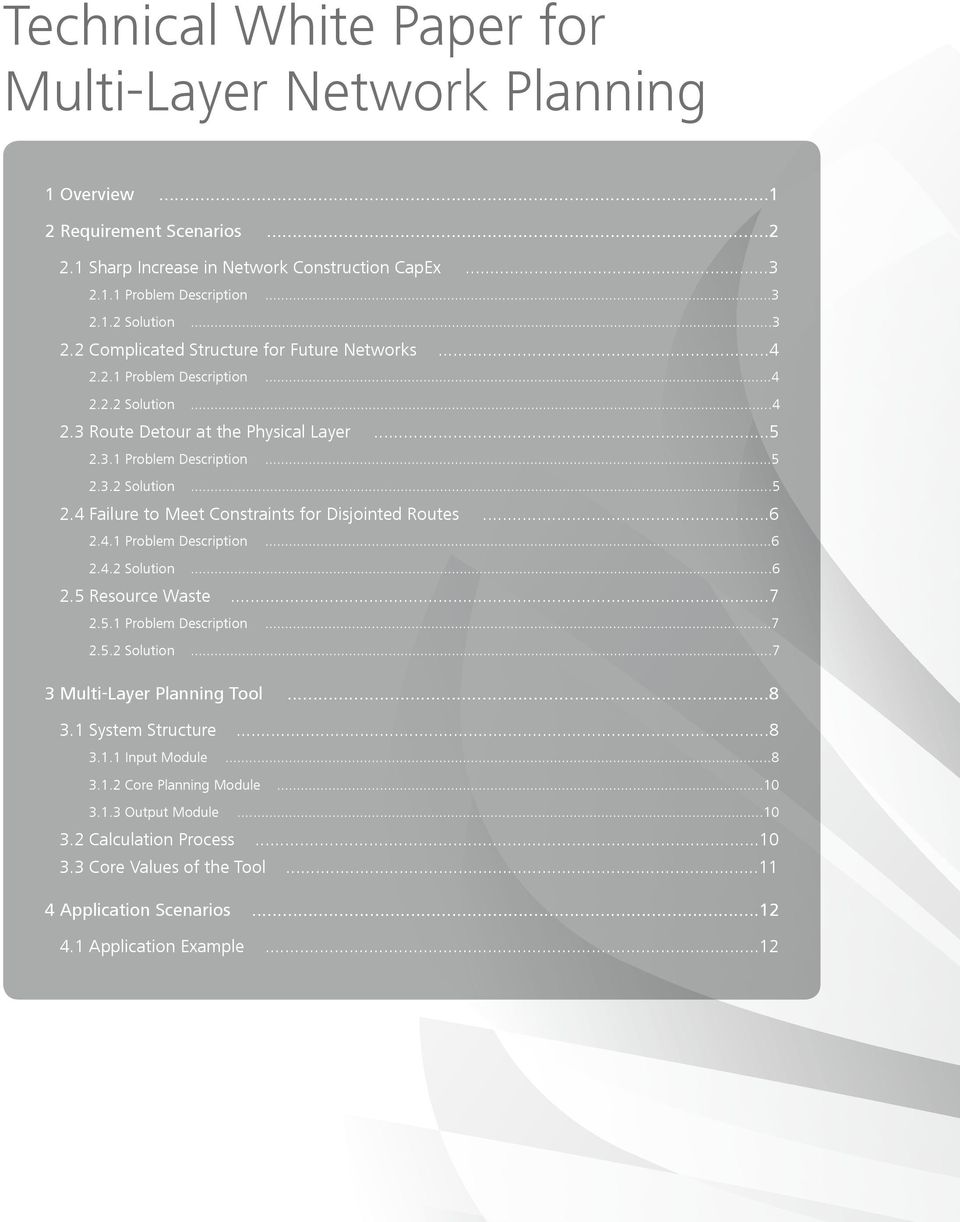
2 Technical White Paper for Multi-Layer Network Planning 1 Overview Requirement Scenarios Sharp Increase in Network Construction CapEx Problem Description Solution Complicated Structure for Future Networks Problem Description Solution Route Detour at the Physical Layer Problem Description Solution Failure to Meet Constraints for Disjointed Routes Problem Description Solution Resource Waste Problem Description Solution Multi-Layer Planning Tool System Structure Input Module Core Planning Module Output Module Calculation Process Core Values of the Tool Application Scenarios Application Example...12
3 Abstract Future networks and services will be based on an all-ip design. If the IP layer and optical layers on a backbone network stay independent of each other, more powerful backbone routers will be required. Such routers will be more complicated and have higher power consumption, and higher costs. This will be a challenge for the carriers. The unified ASON control plane technology will help the carriers in this challenge by synergizing the IP layer and optical layer, and providing unified grooming at the two layers. This technology will relieve the pressure on backbone routers, and reduce the costs for carrying these services, and it is an important part of Huawei SingleBackbone Solution. This document describes planning with IP&optical synergy in terms of key techniques, its strength and weakness; and also describes relevant technologies developed by Huawei, and an application example. Key Words IP, hierarchy, flat, OTN, network planning, heuristic algorithm 1 Overview Future networks and services will be based on the all-ip technology. If the IP layer and optical layers of a backbone network remain independent of each other, increasing capacity on backbone routers will be required, leading to more complicated routers with more power consumption and higher costs. This will be a large challenge for carriers. The unified ASON control plane technology will help carriers overcome this challenge by means of IP&optical synergy, and provide unified grooming at the two layers. this technology will relieve capacity pressure on the backbone routers, and reduce the costs of carrying services. Proper planning of service routes; and allocating resources at the IP layer and optical layer will be an urgent issue. As an important part of SingleBackbone Solution, a multi-layer network planning technology which achieves IP&optical synergy is urgently needed. Many software companies and network equipment vendors attach high importance to research and development of multi-layer planning software and technologies, and have made a lot of progress in this area. One IP network software company has achieved smooth connection of network design between the IP layer and the optical layer by means of a data stream. Another software company considers a unified design tool as its product strategy, and has announced a plan to develop multi-layer design software. 1

4 2 Requirement Scenarios Figure 2-1 shows data services grow with service transformation to packets and IP. Figure 2-1 Forecast of future service growth X Traffic 128 IP traffic: X 3 / 18 months Moore s law X 2 / 18 months Bandwidth-eating services, like video services and IPTV services, require larger capacity on a network. As service charges decrease, ARPU declines. Operators expect service transport over a pipe with large granularities, but with low costs. The optical-layer equipment is up to the expectations; however, an operator cannot overcome the challenge of service growth based only on router devices or a single IP network. When planning a network, an operator always separates the IP layer from other layers. The operator first plans the capacity of IP network according to the requirements of the traffic matrix at the IP layer; including the equipment at each node, and the interface bandwidth. The operator determines a solution of a transport network at the bottom layer according to the interface information at the IP layer. This approach divides a network into two standalone networks, which will result in the following problems: Sharp increase in network construction costs Complicated structure for future networks Route detour at the physical layer Failure to meet constraints for disjointed routes Resource waste 2

5 The following sections describe the above problems in details and provide solutions to them. 2.1 Sharp Increase in Network Construction CapEx Problem Description When a transport network and an IP network are built separately by using layer-by-layer network planning, all IP services have to be forwarded at intermediate routers, regardless of the granularities of them. This results in demands for increased capacity of the core routers as services grow at the access layer. A sharp increase in capacity of IP-layer equipment leads to demands for large capacity of the optical transport equipment at the bottom layer. This imposes a large challenge on CapEx reduction in network construction for operators Solution The statistical multiplexing technology on an IP network is very different from the space-division transport technology on an OTN network. Routers consume more resources, and require higher CapEx compared with OTN devices for the same volume of traffic. As shown in Figure 2-2, large-granularity traffic streams between two nodes do not need to be forwarded on an IP network hop by hop any more. Instead, these traffic streams are transported over large-granularity pipes provided by an OTN. The IP network only needs to forward and converge a small volume of traffic, requiring less capacity on the routers. This not only relieves current pressure for the expansion and upgrade of the routers, but also reduces total transport costs for operators. Figure 2-2 Solution to carrying service traffic IP with small traffic IP with large granularity traffic Traffic transport on the cheapest layer OTN IP Efficient schedule for large size traffic WDM WDM Efficient schedule for small size traffic 3

6 2.2 Complicated Structure for Future Networks Problem Description Currently, operators build their IP networks with a hierarchical structure where services are routed through layer-by-layer convergence. Though the hierarchical structure at the IP layer is critical to management and maintenance of the IP services; but operators will face the great pressure for network expansion, especially the core routers, as traffic increases quickly. In addition, nodes require a larger area in the telecommunication rooms and consume more power Solution Though the technical advances are ongoing, commercialization of IP&optical synergy has a long way to go. Network structure convergence for IP network and optical network is a feasible solution currently. That is, a network structure evolves from "hierarchical" to "flat", as shown in Figure 2-3. Figure 2-3 Network structure evolution from "hierarchical" to "flat" Core Metro Access The position of the traffic convergence point will change along with the network evolution, and traffic routes will become more and more complicated. Routing and traffic grooming at different nodes or layers will become more complicated. How do you reach a balance between service grooming and convergence? If the balance is based on manual operations, there will be critical issues about difficult and complex calculation, as networks and services grow. As a result, network design may fail. Multi-layer network planning can help resolve this problem. 4

7 2.3 Route Detour at the Physical Layer This section describes the problem with route detour at the physical layer and provides a solution to this problem. Figure 2-4 Route detour at the physical layer E D C B A Problem Description Currently, the planning of the IP layer is always separate from the planning of the optical layer. Then, the planning hardly avoids route detour. Figure 2-4 shows a route detour. Assume that there is a T1 IP service from point A to point B. Three links at the wavelength layer are available for the service, marked in purple, blue, and green. The T1 on the east coast is routed across to the west coast during wavelength-layer routing. In this case, if T1 requires a certain delay, the delay requirement may fail to be satisfied as the optical layer cannot sense delay requirements of all services between two sites. As a result, user experience is affected Solution When the service volume is low and network topology is simple, this problem is not urgent. The optical-layer trails of the IP service can be manually adjusted to resolve this problem. As the network and services grow, manual adjustment is not sufficient to resolve this problem. A network auto-planning tool can be used to calculate routes at the IP and optical layers based on service constraints, physical distance, and the number of router hops. The tool helps to avoid the route detour. 5

8 2.4 Failure to Meet Constraints for Disjointed Routes This section describes the problem with a failure to meet constraints for disjointed routes and provides a solution to this problem. Figure 2-5 Working trail and protection trail not separated at the physical layer T2 P2 P3 P4 T1 P1 P6 P5 N2 N3 N4 N1 N7 N6 N Problem Description Currently, planning of the IP layer is always separate from planning of the optical layer. This may result in a failure of the planned trails at the IP layer to meet SRLG separation constraints during deployment at the physical layer. As shown in Figure 2-5, T1, an IP service starts from P1 and reaches P4. This service is under link FRR protection. If the P1-P6 link is a risky link, standalone planning of the IP layer may output an FRR protection trail of P1-P3-P6. During planning of the optical layer, the physical working and protection trails may both include the N1-N7 link. As a result, the working and protection trails may both fail in case of a fault of the N1-N7 link on the network Solution As networks grow, the problem becomes more complicated and difficult to resolve, and manual adjustment is not sufficient. In this case, auto-calculation of the multi-layer planning tool can help resolve this problem. The multi-layer planning tool ensures not only disjointed routes at the IP layer, but also route constraints of the carrier physical trails on the physical topology. 6

9 2.5 Resource Waste This section describes the problem with resource waste and provides a solution to this problem. Figure 2-6 Resource waste T2 P W P2 P3 P4 T1 P1 P6 P5 N2 WP N3 PP PW N4 WW N1 N6 N Problem Description Currently, to provide protection for an IP service, an operator has to plan working and protection resources separately at the IP layer. To avoid overlapping of physical working and protection trails during the planning of the optical layer, the operator may not distinguish between the working and protection resources at the IP layer. Instead, the operator provides working and protection resources for the resources at the IP layer. As shown in Figure 2-6, four resources at the optical layer are planned to carry one resource at the IP layer. The resources are wasted. Similarly, an operator wants to provide protection against two faults at the IP layer or optical layer. Currently, planning of protection resources at one layer is independent from that at the other. This results in resource waste Solution The resources at the IP layer and optical layer must be jointly considered for service protection against n (n: 0 or 1) faults to avoid a waste of resources at the optical layer. 7

10 3 Multi-Layer Planning Tool According to the preceding analysis, a tool for unified planning of the optical layer and IP layer is required currently. The tool must consider the following: Various constraints of the optical layer and IP layer Resources available at the optical layer and IP layer Transport trails at the optical layer and IP layer In addition, the tool must help optimize service trails to reduce network construction costs. The tool will achieve the IP&optical synergy to resolve the preceding problems. 3.1 System Structure Figure 3-1 System structure Input Traffic Matrix Network Topology Device Model Cost Model All Constraints Core Module According to the optimization objective, to Every traffic, choose different grooming layers for different traffic Traffic Grooming in MPLS-TE layer Traffic Grooming in ODUK layer Traffic Grooming in Optical layer In every layer, based on corresponding constraints, choose different nodes to do grooming Optimization Iteration Output Traffic Route Node Configuration COST Link Deployment Wavelength Deployment Figure 3-1 shows the system architecture of the multi-layer planning tool, which consists of the input module, the core planning module, and the output module. This section describes the three modules in detail Input Module When starting network planning, a user needs to enter the service matrix information, the physical network topology information, the logical network 8

11 topology information at the router layer (only for the hierarchical structure), the equipment model, the cost model, and various constraints. The details about the inputs are as follows: Service matrix information - Original source and sink nodes of services - Service bandwidth - Service protection type Physical network topology information - Nodes - Physical inter-node connections - Physical distance - Bandwidth Logical network topology at the router layer - Inter-node port connections - Bandwidth of inter-node port connections Equipment model The equipment model is based on physical routers and optical equipment, and covers various ports and cross-connect granularities specific to each layer supported by a node. Figure 3-2 shows the details. In Figure 3-2, the packet forwarding equipment is at the top layer which represents the IP layer; the ODUk layer is in the middle; the wavelength layer is below ODUk layer and wavelength-layer equipment includes the ROADM and MUX/ DEMUX. When entering equipment model information, the user can select Figure 3-2 Equipment model Direct colored light or grey light from MPLS-TE to lambda layer MUX/DMUX MPLS-TE Switch OA Any/Ge/ODUk XC Cross Connect Transponder Cable Access MPLS-TE traffic Access any/ge/ SDH/ODUK traffic and lambda layer traffic ODUk layer includes Any/GE/ ODU1/1.5/2/3 sub-layers the mapping relationship can refer to the mapping road in MLN req. Spec. MPLS-TE ODUk Lambda Fiber Switch Fiber 9

12 input/output ports, and specify the OTN-layer service mapping modes on nodes at each layer. The various equipment groups can be emulated. Constraints - Constraints for disjointed routes (SRLG, link, and node) - Constraints on included and/or excluded nodes and/or links - Link utilization - BCM properties Core Planning Module The core planning module selects proper grooming layers and proper nodes at different grooming layers for services according to the optimization objectives specified by a user, including optimal network construction costs; and load banlance at the wavelength layer or router layer. This module optimizes the planning based on the iterations between the different grooming layers to try to achieve the optimal objectives for the network Output Module This module outputs service route information, node configuration information, network construction cost information, and wavelength allocation information. The details about the information are as follows: Service route information: service carrier channels and routes along each channel at the physical layer Node configuration information: various ports required at each node, such as GE/10GE equipment at the router layer, and ODU1, ODU2, OADM, OA, and MUX/DEMUX at the optical transport layer Network construction cost information: cost information about each node and equipment at each layer Wavelength allocation information: wavelengths allocated for each channel 3.2 Calculation Process Figure 3-3 Calculation process System input Service routing Iteration of optimization System output 10

13 Figure 3-3 shows the process for planning the multiple layers (TE + optical). The planning of each module is as follows: System input: Enter planning information. Abstract the equipment model to minimize its association with the following core planning modules. Service route: The tool calculates service routes at each network layer according to certain constraints and optimization objectives for network planning. Constraints at the optical layer and IP layer may specify SRLG/ link separation, and excluded or included nodes or links. Iteration of optimization: Based on certain rules, such as the random rule, the tool runs iteration on service routes at the IP layer and optical layer by using a heuristic algorithm. Then the tool gradually produces a near-optimal solution. System output: The tool outputs service routes (including carrier channels and configuration of equipment at each node along a channel), and various statistical information (including costs and utilization). 3.3 Core Values of the Tool The multi-layer planning tool helps an operator resolve the preceding problems based on the existing physical topology, and traffic model of a live network. In addition, the tool provides information about future network construction, including costs, service routes, and equipment configuration. It provides optimal network construction guidelines by comparing different solutions for building future networks. The functions of the multi-layer planning tool and its output information are listed as follows: Minimizes network construction costs regardless of whether the network is a hierarchical or flat structure. The tool creates planning results about how IP services can be routed at the IP layer and optical transport layer, and how to configure equipment at each node, to achieve minimum costs per bit. Determines whether a 40G port rate will satisfy the requirements for a future network based on the current traffic model; and, if not, when expansion to a 100G port rate should be executed. Predicts the requirements about the capacity of core routers, telecommunication rooms size, and power supply N (N 1) years later based on the current network hierarchy. Determines whether to provide GE/10G ports, GE/2.5G/10G ports, or 10G ports between routers and optical equipment N (N 1) years later. To different services, judges what protection (at the IP layer or ODUk protection at the optical layer) will reduce network construction costs. Determines whether pressure about capacity expansion of the core routers can be relieved on a flattened network; and compares a flattened network and a hierarchical network with respect to CapEx and OpEx N (N 1) years later. 11

14 4 Application Scenarios 4.1 Application Example An example of future network planning for a European operator based on the TE & optical planning technology is shown. A comparison is made between the traditional hierarchical network and multi-layer network based on multi-layer planning according to the service matrix information and network topology information provided by the operator. As services grow by 60% every year, CapEx and OpEx per year specific to each network can be predicted as shown in Figure 4-1. Figure 4-1 Comparison in aspects of costs, area of equipment rooms, and power consumption 100.0% 95.0% 90.0% 85.0% 80.0% 75.0% 70.0% 65.0% 60.0% 55.0% 50.0% 98.4% 87.7% 80.0% 74.3% 69.8% 66.6% 63.9% 61.6% 1st 2nd 3nd 4th 5th 6th 7th 8th Area of Equipment Rooms -50% Power -55% 12

15 If services grow by 60% per year, the traffic will be 6.5 times the current traffic in five years. A multi-layer network may reduce network construction costs by 30%, reduce the router equipment room area by 50%, and reduce power consumption of the routers by 55%, compared to a hierarchical network. The TE & optical multi-layer network planning tool can help operators understand clearly how to design their networks for the future. If you need more information about SingleBackbone Solution 13

16 Copyright Huawei Technologies Co., Ltd All rights reserved. No part of this document may be reproduced or transmitted in any form or by any means without prior written consent of Huawei Technologies Co., Ltd. Trademark Notice, HUAWEI, and are trademarks or registered trademarks of Huawei Technologies Co., Ltd. Other trademarks, product, service and company names mentioned are the property of their respective owners. NO WARRANTY THE CONTENTS OF THIS MANUAL ARE PROVIDED AS IS. EXCEPT AS REQUIRED BY APPLICABLE LAWS, NO WARRANTIES OF ANY KIND, EITHER EXPRESS OR IMPLIED, INCLUDING BUT NOT LIMITED TO, THE IMPLIED WARRANTIES OF MERCHANTABILITY AND FITNESS FOR A PARTICULAR PURPOSE, ARE MADE IN RELATION TO THE ACCURACY, RELIABILITY OR CONTENTS OF THIS MANUAL. TO THE MAXIMUM EXTENT PERMITTED BY APPLICABLE LAW, IN NO CASE SHALL HUAWEI TECHNOLOGIES CO., LTD BE LIABLE FOR ANY SPECIAL, INCIDENTAL, INDIRECT, OR CONSEQUENTIAL DAMAGES, OR LOST PROFITS, BUSINESS, REVENUE, DATA, GOODWILL OR ANTICIPATED SAVINGS ARISING OUT OF OR IN CONNECTION WITH THE USE OF THIS MANUAL. HUAWEI TECHNOLOGIES CO., LTD. Huawei Industrial Base Bantian Longgang Shenzhen , P.R. China Tel: Version No.: M C-1.0

Huawei Industry Successful Stories for Transmission Products HUAWEI TECHNOLOGIES CO., LTD.
 Copyright Huawei Technologies Co., Ltd. 2011. All rights reserved. No part of this document may be reproduced or transmitted in any form or by any means without prior written consent of Huawei Technologies
Eudemon8000 High-End Security Gateway HUAWEI TECHNOLOGIES CO., LTD.
 Eudemon8000 High-End Security Gateway HUAWEI TECHNOLOGIES CO., LTD. Product Overview Faced with increasingly serious network threats and dramatically increased network traffic, carriers' backbone networks,
Hierarchy and dynamics of optical networks.
 Hierarchy and dynamics of optical networks. F.-Joachim Westphal (1), Andreas Gladisch (1), Matthias Gunkel (2) (1) Deutsche Telekom AG, Laboratories (2) Deutsche Telekom Netzproduktion GmbH 1 Introduction.
Eudemon1000E Series Firewall HUAWEI TECHNOLOGIES CO., LTD.
 HUAWEI TECHNOLOGIES CO., LTD. Product Overview The Eudemon1000E series product (hereinafter referred to as the Eudemon1000E) is a new generation of multi-function security gateway designed by Huawei to
Designing Reliable IP/MPLS Core Transport Networks
 Designing Reliable IP/MPLS Core Transport Networks Matthias Ermel Workshop ITG FG 5.2.1 14. November 2008 München Content 1. Introduction 2. Protection Mechanisms 3. Failure Detection Page 1 Architecture
MPLS L2VPN (VLL) Technology White Paper
 MPLS L2VPN (VLL) Technology White Paper Issue 1.0 Date 2012-10-30 HUAWEI TECHNOLOGIES CO., LTD. 2012. All rights reserved. No part of this document may be reproduced or transmitted in any form or by any
IP/Optical integration & Management. WDM Stuff AKA. Sami COPYRIGHT 2013 ALCATEL-LUCENT. ALL RIGHTS RESERVED.
 WDM Stuff AKA. Sami IP/Optical integration & Management BEYOND 100G FIRST TO MARKET IN 400Gb/s PSE Year 2010 2012 Speed 100 Gb/s 400 Gb/s Line rates 40G, 100G 40G, 100G, 200G, 400G Capacity 8.8T >23T Reach
The Economics of Cisco s nlight Multilayer Control Plane Architecture
 The Economics of Cisco s nlight Multilayer Control Plane Architecture Executive Summary Networks are becoming more difficult to plan and optimize because of high traffic growth, volatile traffic patterns,
Recession-Proof Consulting Services with CWDM Network Design
 Recession-Proof Consulting Services with CWDM Network Design Presented By Ty Estes Marketing Communications Director Omnitron Systems Recession-Proof Consulting Services with CWDM Network Design Introduction
Flexible SDN Transport Networks With Optical Circuit Switching
 Flexible SDN Transport Networks With Optical Circuit Switching Multi-Layer, Multi-Vendor, Multi-Domain SDN Transport Optimization SDN AT LIGHT SPEED TM 2015 CALIENT Technologies 1 INTRODUCTION The economic
10G CWDM Conversion Technology
 10G CWDM Conversion Technology Simplifying Today s Challenges By Transition Networks Curt Carlson Product Manager [email protected] com Agenda WDM Technology Overview What are the features/benefits
Quidway SVN3000 Security Access Gateway
 Quidway SVN3000 Security Access Gateway SSL/IPSec VPN Access Gateway HUAWEI TECHNOLOGIES CO., LTD. Product Overview With the rapid development and popularization of the Internet, informatization of enterprise
WDM network management
 IO2654 Optical Networking WDM network management Paolo Monti Optical Networks Lab (ONLab), Communication Systems Department (COS) http://web.it.kth.se/~pmonti/ 1! Lecture objectives Overview of the control
Relationship between SMP, ASON, GMPLS and SDN
 Relationship between SMP, ASON, GMPLS and SDN With the introduction of a control plane in optical networks, this white paper describes the relationships between different protocols and architectures. Introduction
Huawei Agile WAN Solution
 Huawei Agile WAN Solution WAN Development and Challenge As more Enterprise services are deployed on IT systems and transmitted over IP networks, Enterprise networks are expanding to support more service
Business Case for BTI Intelligent Cloud Connect for Content, Co-lo and Network Providers
 Business Case for BTI Intelligent Cloud Connect for Content, Co-lo and Network Providers s Executive Summary Cloud computing, video streaming, and social media are contributing to a dramatic rise in metro
CloudEngine Series Data Center Switches. Cloud Fabric Data Center Network Solution
 Cloud Fabric Data Center Network Solution Cloud Fabric Data Center Network Solution Product and Solution Overview Huawei CloudEngine (CE) series switches are high-performance cloud switches designed for
White Paper on Video Wall Display Technology in Videoconferencing HUAWEI TECHNOLOGIES CO., LTD. Issue 01. Date 2012-2-23
 White Paper on Video Wall Display Technology in Videoconferencing Issue 01 Date 2012-2-23 HUAWEI TECHNOLOGIES CO., LTD. 2012. All rights reserved. No part of this document may be reproduced or transmitted
Alcatel-Lucent 1850 TSS Product Family. Seamlessly migrate from SDH/SONET to packet
 Alcatel-Lucent 1850 TSS Product Family Seamlessly migrate from SDH/SONET to packet The Alcatel-Lucent 1850 Transport Service Switch (TSS) products are a family of Packet-Optical Transport switches that
ASON for Optical Networks
 1/287 01-FGC1010609 Rev B ASON for Optical Networks Ericsson Control Plane for DWDM Optically Switched Networks ASON for MHL3000 Introduction The growing demand for multiple service is changing the network
Multi-Layer Packet-Optical: The Path to Efficient Networks
 IHS TECHNOLOGY OCTOBER 2015 Multi-Layer Packet-Optical: The Path to Efficient Networks Andrew Schmitt, Research Director, Carrier Transport Networking TABLE OF CONTENTS A Long-Overdue Improvement... 1
SDN, a New Definition of Next-Generation Campus Network
 SDN, a New Definition of Next-Generation Campus Network Contents Campus Evolution and Development Trends... 1 Three Changes to Drive the Campus Network Development... 2 Fundamental Changes in User Behaviors...2
Huawei One Net Campus Network Solution
 Huawei One Net Campus Network Solution 2 引 言 3 园 区 网 面 临 的 挑 战 4 华 为 园 区 网 解 决 方 案 介 绍 6 华 为 园 区 网 解 决 方 案 对 应 产 品 组 合 6 结 束 语 Introduction campus network is an internal network of an enterprise or organization,
OPTICAL TRANSPORT NETWORKS
 OPTICAL TRANSPORT NETWORKS EVOLUTION, NOT REVOLUTION by Brent Allen and James Rouse Nortel Networks, OPTera Metro Solutions KANATA, Canada This paper describes how the deployment today of an Optical Network
HUAWEI OceanStor 9000. Load Balancing Technical White Paper. Issue 01. Date 2014-06-20 HUAWEI TECHNOLOGIES CO., LTD.
 HUAWEI OceanStor 9000 Load Balancing Technical Issue 01 Date 2014-06-20 HUAWEI TECHNOLOGIES CO., LTD. Copyright Huawei Technologies Co., Ltd. 2014. All rights reserved. No part of this document may be
Huawei Cloud Data Center Solution
 Huawei Cloud Data Center Solution Copyright Huawei Technologies Co., Ltd. 2015. All rights reserved. No part of this document may be reproduced or transmitted in any form or by any means without prior
HUAWEI IP Contact Center
 HUAWEI IP HUAWEI TECHNOLOGIES CO., LTD. 1 HUAWEI IP s Challenge Competition Challenge: improve customer satisfaction and loyalty Facing the increasingly fierce market competition, enterprises come to know
PT500 500Mbps Powerline Adapter. User Guide
 PT500 500Mbps Powerline Adapter User Guide PT500 500Mbps Powerline Adapter V100R001 User Guide 202593_04 Huawei Technologies Co., Ltd. provides customers with comprehensive technical support and service.
Embracing Transport SDN for Open Networking Architectures
 Embracing Transport SDN for Open Networking Architectures Yabin YE [email protected] HUAWEI TECHNOLOGIES CO., LTD. Agenda Move Towards SDN Transport SDN Use Cases Examples of Transport SDN 2 ONF Definition
Backbone Capacity Planning Methodology and Process
 Backbone Capacity Planning Methodology and Process A Technical Paper prepared for the Society of Cable Telecommunications Engineers By Leon Zhao Senior Planner, Capacity Time Warner Cable 13820 Sunrise
Value Proposition for Data Centers
 Value Proposition for Data Centers C ollocation or a trend of hosting customers servers at a provider s physical location has been steadily growing in the recent years due to its many benefits. The collocation
SDH and WDM A look at the physical layer
 SDH and WDM A look at the physical Andrea Bianco Telecommunication Network Group [email protected] http://www.telematica.polito.it/ Network management and QoS provisioning - 1 Copyright This
A New Fault Tolerant Routing Algorithm For GMPLS/MPLS Networks
 A New Fault Tolerant Routing Algorithm For GMPLS/MPLS Networks Mohammad HossienYaghmae Computer Department, Faculty of Engineering, Ferdowsi University of Mashhad, Mashhad, Iran [email protected]
Analysis of Network Bandwidth Efficiency for Next Generation 100Gb/s WDM Architectures
 Analysis of Network Bandwidth Efficiency for Next Generation 100Gb/s WDM Architectures Slide: 1 The Paper Analysis of Network Bandwidth Efficiency for Next Generation 100Gb/s WDM Architectures Geoff Bennett,
United Security Technology White Paper
 United Security Technology White Paper United Security Technology White Paper 1 Challenges...6 1.1 Security Problems Caused by Mobile Communication...6 1.2 Security Fragmentation Problems...8 2 United
VLAN and QinQ Technology White Paper
 VLAN and QinQ Technology White Paper Issue 1.01 Date 2012-10-30 HUAWEI TECHNOLOGIES CO., LTD. 2012. All rights reserved. No part of this document may be reproduced or transmitted in any form or by any
1 Network Service Development Trends and Challenges
 1 Network Service Development Trends and Challenges Mobility 1. Shift the focus from technology, device, and connectivity to services and user experience. Cloud Computing 2. Shift from single-point security
Transport SDN Toolkit: Framework and APIs. John McDonough OIF Vice President NEC BTE 2015
 Transport SDN Toolkit: Framework and APIs John McDonough OIF Vice President NEC BTE 2015 Transport SDN Toolkit Providing carriers with essential tools in the Transport SDN toolkit How to apply SDN to a
Workshop - New Paradigms for Routing in Optical Networks
 Workshop - New Paradigms for Routing in Optical Networks Efficient routing for high capacity, flexible optical networks with different classes of service Douglas Aguiar July 2015 padtec.com Summary 1.
Connect & Go with WDM PON Ea 1100 WDM PON
 Connect & Go with WDM PON Ea 1100 WDM PON ericsson deep Fiber access Connectivity Begins in the Access Speed, connectivity, Efficiency In much the same way the worldwide web changed the traditional voice
Huawei NE5000E 400Gbps Flexible Line Processing Unit
 Huawei NE5000E 400Gbps Flexible Line Processing Unit Huawei NE5000E 400Gbps Flexible Line Processing Unit Overview The Huawei NetEngine5000E router (NE5000E) is a high-end IP core network router. It is
The Keys for Campus Networking: Integration, Integration, and Integration
 The Keys for Campus Networking: Introduction Internet Protocol (IP) is considered the working-horse that the vast majority of current and future applications use as the key technology for information exchange,
Juniper Networks QFabric: Scaling for the Modern Data Center
 Juniper Networks QFabric: Scaling for the Modern Data Center Executive Summary The modern data center has undergone a series of changes that have significantly impacted business operations. Applications
Scaling Cloud Networks with Packet-Optical Transport & Transport SDN
 Scaling Cloud Networks with Packet-Optical Transport & Transport SDN Chris Liou VP Network Strategy [email protected] 1 2015 Infinera Cloud Networking Trends ATT, VZ Spend Big 7 ICP Spend ICPs Greenfield
Business Case for the Brocade Carrier Ethernet IP Solution in a Metro Network
 Business Case for the Brocade Carrier Ethernet IP Solution in a Metro Network Executive Summary The dramatic rise of multimedia applications in residential, mobile, and business networks is continuing
A Software Architecture for a Photonic Network Planning Tool
 A Software Architecture for a Photonic Network Planning Tool Volker Feil, Jan Späth University of Stuttgart, Institute of Communication Networks and Computer Engineering Pfaffenwaldring 47, D-70569 Stuttgart
VRRP Technology White Paper
 Issue 01 Date 2012-08-31 HUAWEI TECHNOLOGIES CO., LTD. 2012. All rights reserved. No part of this document may be reproduced or transmitted in any form or by any means without prior written consent of
SDH and WDM: a look at the physical layer
 SDH and WDM: a look at the physical SDH and WDM A look at the physical Andrea Bianco Telecommunication Network Group [email protected] http://www.telematica.polito.it/ Network management and
Communication Networks. MAP-TELE 2011/12 José Ruela
 Communication Networks MAP-TELE 2011/12 José Ruela Network basic mechanisms Introduction to Communications Networks Communications networks Communications networks are used to transport information (data)
Addressing Scaling Challenges in the Data Center
 Addressing Scaling Challenges in the Data Center DELL PowerConnect J-Series Virtual Chassis Solution A Dell Technical White Paper Dell Juniper THIS WHITE PAPER IS FOR INFORMATIONAL PURPOSES ONLY, AND MAY
Introduction. Background
 Introduction By far, the most widely used networking technology in Wide Area Networks (WANs) is SONET/SDH. With the growth of Ethernet now into Metropolitan Area Networks (MANs) there is a growing need
How To Switch A Layer 1 Matrix Switch On A Network On A Cloud (Network) On A Microsoft Network (Network On A Server) On An Openflow (Network-1) On The Network (Netscout) On Your Network (
 Software- Defined Networking Matrix Switching January 29, 2015 Abstract This whitepaper describes a Software- Defined Networking use case, using an OpenFlow controller and white box switches to implement
How To Test For 10 Gigabit Ethernet At 10 Gb/S
 White Paper Testing Scenarios for Ethernet at 10 Gb/s By Guylain Barlow Introduction As a natural evolution, the typical test concepts borrowed from lower-rate Ethernet apply to 10 Gigabit Ethernet (GigE).
Service Quality Assessment in All-IP Networks
 2010-6-1 Security Level: Service Quality Assessment in All-IP Networks Wu Xiangping & Himanshu Pant 2010 Annual CQR Workshop June 8-10, 2010 www.huawei.com HUAWEI TECHNOLOGIES CO., LTD. Huawei Agenda Background
Virtual Machine in Data Center Switches Huawei Virtual System
 Virtual Machine in Data Center Switches Huawei Virtual System Contents 1 Introduction... 3 2 VS: From the Aspect of Virtualization Technology... 3 3 VS: From the Aspect of Market Driving... 4 4 VS: From
Evolution of telecom network infrastructure for broadcast and interactive applications
 Evolution of telecom network infrastructure for broadcast and interactive applications Fabio Tassara Business Development Director Alcatel-Lucent Optics Networks 2007 To IP and beyond! European Broadcasting
Optical interconnection networks for data centers
 Optical interconnection networks for data centers The 17th International Conference on Optical Network Design and Modeling Brest, France, April 2013 Christoforos Kachris and Ioannis Tomkos Athens Information
Huawei esight Brief Product Brochure
 Huawei esight Brief Product Brochure esight Integrated Enterprise NMS As the network scales and the number of enterprise network applications continue to grow, so does the number of devices, such as multi-service
Research and Development of IP and Optical Networking
 : The Future of IP and Optical Networking Research and Development of IP and Optical Networking Kohei Shiomoto, Ichiro Inoue, Ryuichi Matsuzaki, and Eiji Oki Abstract This article presents the targets,
Traffic Engineering & Network Planning Tool for MPLS Networks
 Traffic Engineering & Network Planning Tool for MPLS Networks Dr. Associate Professor, Department of Electrical Engineering Indian Institute of Technology Bombay, Powai, Mumbai 76 Founder & Director, Vegayan
Packet Optical Transmission
 2009 Verizon. All Rights Reserved. PTEXXXXX XX/09 Optical Transmission Examining Verizon s Transition to a Optical Infrastructure Thomas Sims Transmission Design Engineering Verizon Business March 30 th
SONET and DWDM: Competing Yet Complementary Technologies for The Metro Network
 and : Competing Yet Complementary Technologies for The Metro Network Introduction The next generation of equipment has been well accepted by service providers and is being usefully deployed into networks
A Business Case for Scaling the Next-Generation Network with the Cisco ASR 9000 System: Now with Converged Services. Key Takeaways.
 A Business Case for Scaling the Next-Generation Network with the Cisco ASR 9000 System: Now with Converged Services Executive Summary In a previous whitepaper ACG Research described the business case for
Enhancing BoD Services based on Virtual Network Topology Control
 NTT Network Service Systems Laboratories Enhancing BoD Services based on Virtual Network Topology Control T. Miyamura E. Oki I. Inoue K. Shiomoto NTT Network Service Systems Labs. Today s BoD service application
HUAWEI TECHNOLOGIES CO., LTD. Huawei IDS2000-S Small Modular Data Center Solution
 HUAWEI TECHNOLOGIES CO., LTD. Huawei IDS2000-S Small Modular Data Center Solution Group Data Center Concept: big center, small branch With the development and maturity of the IT automation age, rapid development
400GbE: Perspective from China Service Provider. Xinyuan Wang, Xin Chang, Huawei Technologies Lu Huang, China Mobile
 400GbE: Perspective from China Service Provider Xinyuan Wang, Xin Chang, Huawei Technologies Lu Huang, China Mobile Outline IP Network Architecture in China Traffic Growth of IP Networks in China 400GbE
NetStream (Integrated) Technology White Paper HUAWEI TECHNOLOGIES CO., LTD. Issue 01. Date 2012-9-6
 (Integrated) Technology White Paper Issue 01 Date 2012-9-6 HUAWEI TECHNOLOGIES CO., LTD. 2012. All rights reserved. No part of this document may be reproduced or transmitted in any form or by any means
Bandwidth-Flexible CDC ROADMs Massimo Di Blasio, Director, Carrier Business Development. Market Focus ECOC 2011
 Bandwidth-Flexible CDC ROADMs Massimo Di Blasio, Director, Carrier Business Development Market Focus ECOC 2011 Topics Being Presented Where are ROADMs today and how did we get here? Flexgrid : What are
Part Number: 203285. HG253s V2 Home Gateway Product Description V100R001_01. Issue HUAWEI TECHNOLOGIES CO., LTD.
 Part Number: 203285 HG253s V2 Home Gateway Issue V100R001_01 HUAWEI TECHNOLOGIES CO., LTD. 2013. All rights reserved. No part of this document may be reproduced or transmitted in any form or by any means
ICTTEN6172A Design and configure an IP- MPLS network with virtual private network tunnelling
 ICTTEN6172A Design and configure an IP- MPLS network with virtual private network tunnelling Release: 1 ICTTEN6172A Design and configure an IP-MPLS network with virtual private network tunnelling Modification
Broadband Networks. Prof. Karandikar. Department of Electrical Engineering. Indian Institute of Technology, Bombay. Lecture - 26
 Broadband Networks Prof. Karandikar Department of Electrical Engineering Indian Institute of Technology, Bombay Lecture - 26 Optical Network &MPLS So, as you were discussing in the previous lectures, next
Three Key Design Considerations of IP Video Surveillance Systems
 Three Key Design Considerations of IP Video Surveillance Systems 2012 Moxa Inc. All rights reserved. Three Key Design Considerations of IP Video Surveillance Systems Copyright Notice 2012 Moxa Inc. All
The Metro Ethernet Network
 The Metro Ethernet Network Comparison to Legacy SONET/SDH MANs for Metro Data Service Providers Revision 1.0 July 2003 Abstract This paper focuses on the results of a study commissioned by the MEF to quantify
Huawei Business Continuity and Disaster Recovery Solution
 Huawei Business Continuity and Disaster Recovery Solution Contents 01 Great Challenges to Business Continuity and Disaster Recovery 02 Huawei Business Continuity and Disaster Recovery Solution 02 Application
Timing over Packet. Technical Brief
 Technical Brief 02/08 1. Abstract This paper is designed to help operators understand how to deploy Precision Time Protocol (PTP, or IEEE 1588v2) in mobile networks for the purpose of synchronizing base
HUAWEI Tecal E6000 Blade Server
 HUAWEI Tecal E6000 Blade Server Professional Trusted Future-oriented HUAWEI TECHNOLOGIES CO., LTD. The HUAWEI Tecal E6000 is a new-generation server platform that guarantees comprehensive and powerful
Smart Operation, Efficient Support. --- Huawei NGBSS Solution HUAWEI TECHNOLOGIES CO., LTD.
 Smart Operation, Efficient Support --- Huawei NGBSS Solution HUAWEI TECHNOLOGIES CO., LTD. ABOUT NGBSS "Smart Operation, Efficient Support" Next Generation Business -- Support System Huawei NGBSS is an
Optical Transport Network Switching: Creating efficient and cost-effective optical transport networks. White Paper
 Optical Transport Network Switching: Creating efficient and cost-effective optical transport networks White Paper 1.0 Executive summary: Building for the future with optical transport networks Almost every
Multiple Layer Traffic Engineering in NTT Network Service
 Multi-layer traffic engineering in photonic-gmpls-router networks Naoaki Yamanaka, Masaru Katayama, Kohei Shiomoto, Eiji Oki and Nobuaki Matsuura * NTT Network Innovation Laboratories * NTT Network Service
The Key Benefits of OTN Networks
 he Key Benefits of ON Networks Introduction Optical transport networks have been migrating from SO technology to WDM architectures over the past 5 10 years. Deploying WDM systems has allowed carriers to
Product Overview. Product Family. Product Features. Powerful intrusion detection and monitoring capacity
 NIP IDS Product Overview The Network Intelligent Police (NIP) Intrusion Detection System (IDS) is a new generation of session-based intelligent network IDS developed by Huaweisymantec. Deployed in key
Overview of Requirements and Applications for 40 Gigabit and 100 Gigabit Ethernet
 Overview of Requirements and Applications for 40 Gigabit and 100 Gigabit Ethernet Version 1.1 June 2010 Authors: Mark Nowell, Cisco Vijay Vusirikala, Infinera Robert Hays, Intel 1. This work represents
Doc. Code. OceanStor VTL6900 Technical White Paper. Issue 1.1. Date 2012-07-30. Huawei Technologies Co., Ltd.
 Doc. Code OceanStor VTL6900 Technical White Paper Issue 1.1 Date 2012-07-30 Huawei Technologies Co., Ltd. 2012. All rights reserved. No part of this document may be reproduced or transmitted in any form
MRV EMPOWERS THE OPTICAL EDGE.
 Pro-Vision Service Delivery Software MRV EMPOWERS THE OPTICAL EDGE. WE DELIVER PACKET AND OPTICAL SOLUTIONS ORCHESTRATED WITH INTELLIGENT SOFTWARE TO MAKE SERVICE PROVIDER NETWORKS SMARTER. www.mrv.com
How To Build A Network For Storage Area Network (San)
 White Paper Data Storage across the MAN by deploying a SAN over Dark Fiber by Pieter Panis, EuroFiber 1/7 1 Introduction The purpose of this document is to illustrate how a storage area network (SAN) can
Facility Usage Scenarios
 Facility Usage Scenarios GDD-06-41 GENI: Global Environment for Network Innovations December 22, 2006 Status: Draft (Version 0.1) Note to the reader: this document is a work in progress and continues to
Huawei Smart Education Solution
 Copyright Huawei Technologies Co., Ltd. 2013. All rights reserved. No part of this document may be reproduced or transmitted in any form or by any means without prior written consent of Huawei Technologies
Photonic Switching Applications in Data Centers & Cloud Computing Networks
 Photonic Switching Applications in Data Centers & Cloud Computing Networks 2011 CALIENT Technologies www.calient.net 1 INTRODUCTION In data centers and networks, video and cloud computing are driving an
Policy-Based Fault Management for Integrating IP over Optical Networks
 Policy-Based Fault Management for Integrating IP over Optical Networks Cláudio Carvalho 1, Edmundo Madeira 1, Fábio Verdi 2, and Maurício Magalhães 2 1 Institute of Computing (IC-UNICAMP) 13084-971 Campinas,
Optical Software Defined Networking
 Optical Software Defined Networking Introduction Service providers look for a dynamic, application-aware network infrastructure that suits today s cloud and mobility needs. Software Defined Networking
IP over Optical Networks - A Framework draft-ip-optical-framework-01.txt
 IP over Optical Networks - A Framework draft-ip-optical-framework-01.txt Bala Rajagopalan James Luciani Daniel Awduche Brad Cain Bilel Jamoussi 1 IETF 7/31/00 About this Draft Deals with the following
Contents. Connection Guide. What is Dante?... 2. Connections... 4. Network Set Up... 6. System Examples... 9. Copyright 2015 ROLAND CORPORATION
 Contents What is Dante?............................................. 2 Outline.................................................. 2 Fundamental............................................ 3 Required Network
Accelerating Packet-Optical Convergence: A Blueprint for P-OTS 3.0
 White Paper Accelerating Packet-Optical Convergence: A Blueprint for P-OTS 3.0 Prepared by Sterling Perrin Senior Analyst, Heavy Reading www.heavyreading.com on behalf of www.mrv.com July 2014 Introduction
WHITE PAPER. Enabling 100 Gigabit Ethernet Implementing PCS Lanes
 WHITE PAPER Enabling 100 Gigabit Ethernet Implementing PCS Lanes www.ixiacom.com 915-0909-01 Rev. C, January 2014 2 Table of Contents Introduction... 4 The IEEE 802.3 Protocol Stack... 4 PCS Layer Functions...