
Enhancing BoD Services based on Virtual Network Topology Control
|
|
|
- Martha Daniel
- 9 years ago
- Views:
Transcription
1 NTT Network Service Systems Laboratories Enhancing BoD Services based on Virtual Network Topology Control T. Miyamura E. Oki I. Inoue K. Shiomoto NTT Network Service Systems Labs.

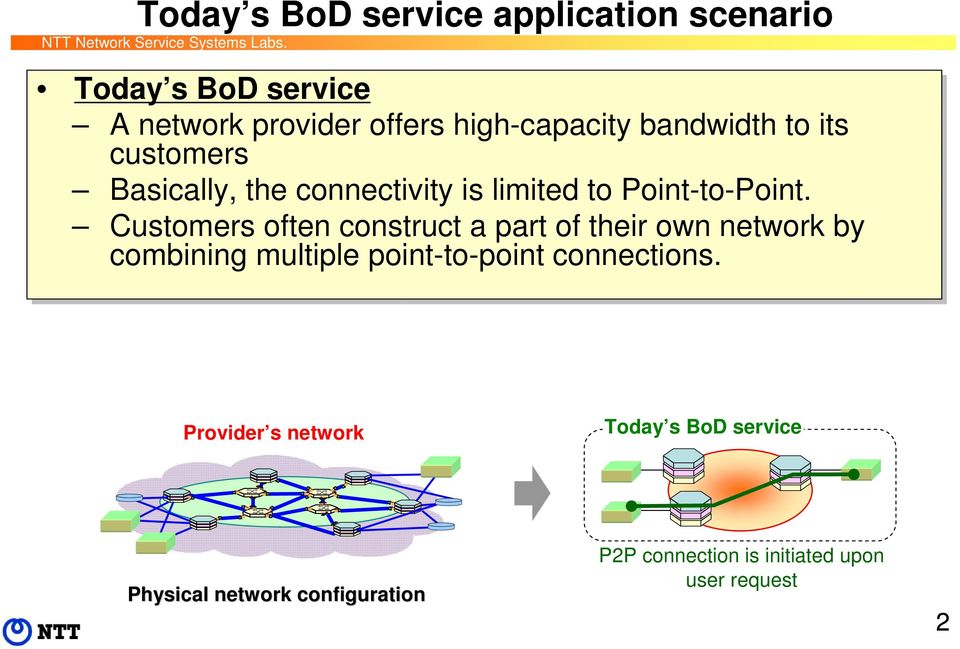
2 Today s BoD service application scenario NTT Network Service Systems Labs. Today s BoD service A network provider offers high-capacity bandwidth to its customers Basically, the connectivity is limited to Point-to-Point. Customers often construct a part of their own network by combining multiple point-to-point connections. Provider s network Today s BoD service Physical network configuration P2P connection is initiated upon user request 2
3 Today s BoD service application scenario cont d NTT Network Service Systems Labs. Outline of our proposal The price is basically determined by service parameters (e.g., a holding time, bandwidth, etc.) Customers wish to minimize the total cost while maintaining adequate service quality. We consider a new service that offers a minimum-cost network configuration in combination with multiple point-topoint connections. Today s BoD service Our proposal (VNT service) Point-to-point connection Fixed bandwidth Multi-point connection Flexible bandwidth 3

4 Outline 1. VNT service 2. Technologies for VNT Services 3. Pricing mechanism 4. Numerical Example 5. Concluding Remarks 4
5 Virtual Network Topology (VNT) The network topology formed by optical paths and advertised to the higher layer is called VNT. VNT is re-configured by optical paths setup/teardown. Virtual Network Topology IP Layer VNT1 VNT2 Optical Layer Physical Fiber Topology 5

6 Our proposal: VNT service NTT Network Service Systems Labs. A service provider network provides continuous connections among multiple customer sites. A set of connections corresponds to a VNT Provider accommodates multiple customers (i.e., VNTs) Bandwidth of each pipe connecting a pair of customer edges is is automatically adjusted in in accordance with traffic-demand changes Customer 1 Customer n Traffic demand bet. Site A and B A B VNT1 VNT n Total bandwidth of provider s network Residual Bandwidth Allocated resources Customer s traffic demand Provider s network 6

7 Our proposal: VNT service cont d Merits Customers: improves flexibility regarding bandwidth and reduces OPEX and CAPEX Providers: Improves efficiency of resource utilization Conventional BoD Service Connectivity Point-to-Point Muti-point VNT Service UNI (Data plane) Any (L1/L2/L3) Packet or Frame-based (L2/L3) Connection initiation /release Allocated bandwidth Triggered by customer request Manually specified upon connection request Continuously established Automatically adjusted based on actual demand by service provider Operation cost for customer network Estimating traffic demand and/or holding time is very complicated No additional task is required for traffic demand variation 7

8 Technologies for VNT service NTT Network Service Systems Labs. Challenges: Providers wishes to minimize network cost. How to accommodate efficiently multiple customers traffic on the provider s network? How to adjust network topology and bandwidth in in response to time-varying traffic demand? Technologies: Multilayer Traffic Engineering (TE) technology optimizes network resource considering all layer information for dynamically changing traffic. Customer 1 Traffic demand r1,1 r1,2 L r1, n r2,1 r2,2 L r2, n M M O M rn,1 rn,2 L rn, n Customer n Traffic demand r1,1 r1,2 L r1, n r2,1 r2,2 L r2, n M M O M rn,1 rn,2 L rn, n Provider s network Input Customer s traffic demand Output Optimal VNT (network configuration) 8

9 Multilayer TE and IP optical TE server NTT Network Service Systems Labs. Multilayer TE Optimizing network resource utilization considering all layers, rather than each layer independently. Optimization is is realized by reconfiguring VNT IP IP optical TE server Provides advanced path computation function and VNT control Interface bet. Server and network is is based on PCE architecture (IETF) IP/MPLS network Carriers policy implemented (Multi-layer, quality of service, reliability, etc.) Policies can be customized. IP Optical TE Server Multi-layer routes IP layer Optical layer VNT 1 VNT reconfiguration VNT 2 Optical network VNT: Virtual Network Topology

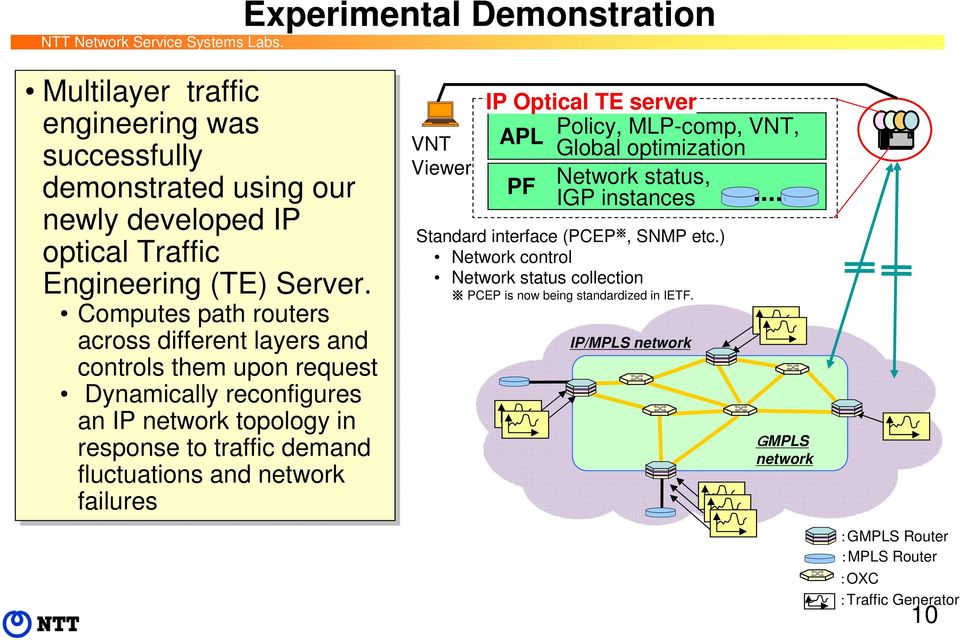
10 Experimental Demonstration Multilayer traffic engineering was successfully demonstrated using our newly developed IP optical Traffic Engineering (TE) Server. Computes path routers across different layers and controls them upon request Dynamically reconfigures an IP network topology in in response to traffic demand fluctuations and network failures VNT Viewer IP Optical TE server APL Policy, MLP-comp, VNT, Global optimization PF Network status, IGP instances Standard interface (PCEP, SNMP etc.) Network control Network status collection PCEP is now being standardized in IETF. IP/MPLS network GMPLS network :GMPLS Router :MPLS Router :OXC :Traffic Generator 10
11 Goal (Economics aspect) Challenges for VNT service We want to to maximize the utility of of users; at at the same time, maximize the profit of of the service providers. Possible problems i) i) Each user share the same objective. Resource contention will occur. ii) ii) Network cost increases if if resources are provisioned to to cover the peak demand. Our approach We introduce i) i) pricing mechanism and ii) ii) multilayer TE technologies. i) Avoid resource contention among users Pricing Customer 1 Customer n ii) Reduce network cost by efficient use of resources Multilayer TE Provider s network

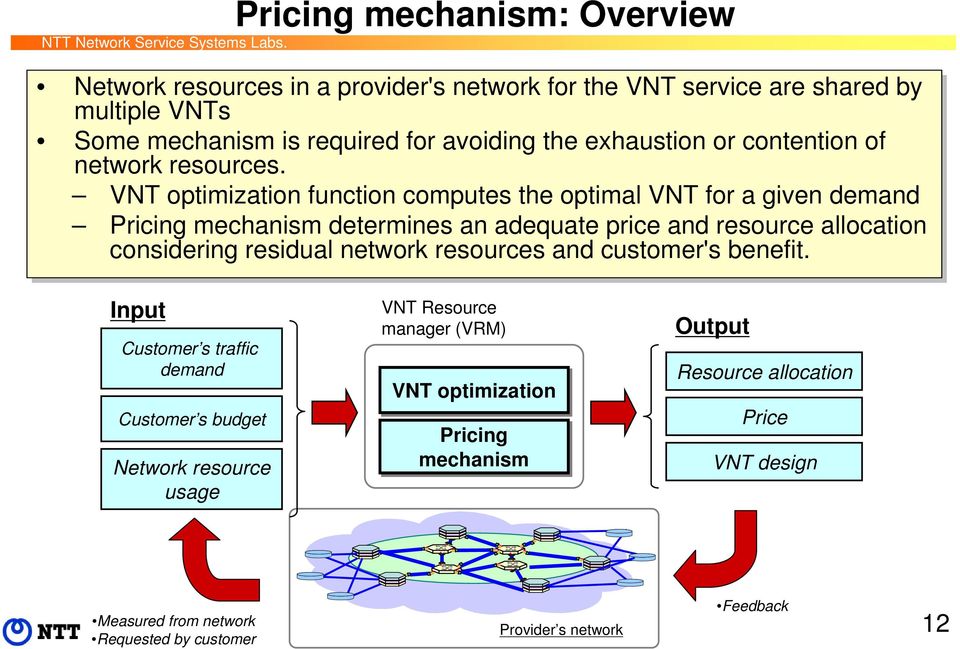
12 Pricing mechanism: Overview Network resources in in a provider's network for the VNT service are shared by multiple VNTs Some mechanism is is required for avoiding the exhaustion or contention of network resources. VNT optimization function computes the optimal VNT for a given demand Pricing mechanism determines an adequate price and resource allocation considering residual network resources and customer's benefit. Input Customer s traffic demand Customer s budget Network resource usage VNT Resource manager (VRM) VNT optimization Pricing mechanism Output Resource allocation Price VNT design Measured from network Requested by customer Provider s network Feedback 12
13 Pricing mechanism Objective Maximize the sum of user utility and profit of provider Resource for customer r (x r ) Total allocated resources ( x ) Total capacity (C) Customer r Subject to Capacity constraint Budget constraint Service quality constraint Qualitative characteristic Avoid resource contention among customers obtain the optimal pricing and network resources allocated to each customer Price P fix r 1 Customer 2 Customer 1 Pricing function U th Network utilization 13

14 Numerical Example Aim of of performance evaluation Clarify the impact of of traffic demand conditions on the effectiveness We measure the effectiveness from the viewpoint of of users Simulation conditions Network model; One-link network model, 2 users share the capacity of of 5 Mbps Cost: 1 Mbps/hour 10$ (Basic tariff) Traffic model: i) i) Highly fluctuated demand, ii) ii) Stable demand Performance measure :Cost paid by each user Fixed tariff: Each user pay the fee for the peak demand during the term Proposed method: Each user pay according to to the amount of of usage. We add 50% extra fee in in case the utilization is is over 80% Case 1: Highly fluctuated (60% in average) Case 2: Stable (80% in average) Traffic demand (Mbps) Traffic demand (Mbps) User A User B User A User B Time (day) Time (day) (hour) 14

15 Simulation Results Proposed method is is more effective for high fluctuated traffic conditions In Case 1, total cost for users decreased by 35% However, in in Case 2, the cost increased slightly by 8% Among users, User B (demand is is more variable) is is more advantageous For providers, the revenue decreases by 35%. However, 40% of network resources remained unallocated in in average. Case 1: Highly fluctuated demand Case 2: Stable demand 15

16 Findings Observation If If the traffic demand is is fluctuated, our mechanism is is very effective for users. In In some case, user can reduce the cost by 35%. This means the decrease in in provider s revenues. We need to investigate the merit of service provider Discussion: How to increase the total profit for providers? Improving the utility of users can leads to increase in in sales Utilize effectively residual bandwidth. Introduce time-reservation-based BoD service. Allocate residual bandwidth. Multilayer TE technology reduces the network cost, which can cover the revenue decrease. In In our study, it it can reduce network cost by 40% for fluctuated traffic conditions 16
17 Conclusion: Concluding Remarks This paper presented multilayer IP IP optical TE technologies based on VNT control and proposed its application to to BoD services. The VNT service can improve flexibility regarding bandwidth while reducing operation overhead and maintaining advantages of of existing BoD services. We demonstrated the effectiveness of of our proposal through numerical study. Further study: Investigate the merit of service provider (how to utilize effectively residual bandwidth) Extends a simulation model (simple one link model to multiple link model) More sophisticated VNT optimization algorithms 17
Network Virtualization Server for Adaptive Network Control
 Network Virtualization Server for Adaptive Network Control Takashi Miyamura,YuichiOhsita, Shin ichi Arakawa,YukiKoizumi, Akeo Masuda, Kohei Shiomoto and Masayuki Murata NTT Network Service Systems Laboratories,
Research and Development of IP and Optical Networking
 : The Future of IP and Optical Networking Research and Development of IP and Optical Networking Kohei Shiomoto, Ichiro Inoue, Ryuichi Matsuzaki, and Eiji Oki Abstract This article presents the targets,
Multiple Layer Traffic Engineering in NTT Network Service
 Multi-layer traffic engineering in photonic-gmpls-router networks Naoaki Yamanaka, Masaru Katayama, Kohei Shiomoto, Eiji Oki and Nobuaki Matsuura * NTT Network Innovation Laboratories * NTT Network Service
SDN FOR IP/OPTICAL TRANSPORT NETWORKS
 SDN FOR IP/OPTICAL TRANSPORT NETWORKS Tony Kourlas IP Routing and Transport Group, Alcatel-Lucent April 2014 THE EVOLUTION OF IP & OPTICAL NETWORKS Cloud-optimized IP routing & transport IP routing networks
OpenFlow/SDN activities of NTT Communications
 OpenFlow/SDN activities of NTT Communications Yukio ITO NTT Communications Senior Vice President Member of the ONF Board 6 th June 2013 Virtualization Technology Server Physical Logical Storage Virtualize
5 Performance Management for Web Services. Rolf Stadler School of Electrical Engineering KTH Royal Institute of Technology. [email protected].
 5 Performance Management for Web Services Rolf Stadler School of Electrical Engineering KTH Royal Institute of Technology [email protected] April 2008 Overview Service Management Performance Mgt QoS Mgt
Network-Wide Change Management Visibility with Route Analytics
 Network-Wide Change Management Visibility with Route Analytics Executive Summary Change management is a hot topic, and rightly so. Studies routinely report that a significant percentage of application
Flexible SDN Transport Networks With Optical Circuit Switching
 Flexible SDN Transport Networks With Optical Circuit Switching Multi-Layer, Multi-Vendor, Multi-Domain SDN Transport Optimization SDN AT LIGHT SPEED TM 2015 CALIENT Technologies 1 INTRODUCTION The economic
IP over Optical Networks - A Framework draft-ip-optical-framework-01.txt
 IP over Optical Networks - A Framework draft-ip-optical-framework-01.txt Bala Rajagopalan James Luciani Daniel Awduche Brad Cain Bilel Jamoussi 1 IETF 7/31/00 About this Draft Deals with the following
SDN IN WAN NETWORK PROGRAMMABILITY THROUGH CENTRALIZED PATH COMPUTATION. 1 st September 2014
 SDN IN WAN NETWORK PROGRAMMABILITY THROUGH CENTRALIZED PATH COMPUTATION st September 04 Aaron Tong Senior Manager High IQ Networking Centre of Excellence JUNIPER S AUTOMATION HORIZON SDN IS A JOURNEY NOT
MPLS is the enabling technology for the New Broadband (IP) Public Network
 From the MPLS Forum Multi-Protocol Switching (MPLS) An Overview Mario BALI Turin Polytechnic [email protected] www.polito.it/~baldi MPLS is the enabling technology for the New Broadband (IP) Public
The Economics of Cisco s nlight Multilayer Control Plane Architecture
 The Economics of Cisco s nlight Multilayer Control Plane Architecture Executive Summary Networks are becoming more difficult to plan and optimize because of high traffic growth, volatile traffic patterns,
Using YANG for the Dissemination of the Traffic Engineering Database within Software Defined Elastic Optical Networks
 Using YANG for the Dissemination of the Traffic Engineering Database within Software Defined Elastic Optical Networks ICTON 2015 Budapest, Hungary Tuesday, 7 July, 2015 J.E. López de Vergara, Naudit High
Business Case for Cisco SDN for the WAN
 Business Case for Cisco SDN for the WAN s Executive Summary Traffic requirements are growing rapidly because of the widespread acceptance of online video services, cloud computing, and mobile broadband.
TE in action. Some problems that TE tries to solve. Concept of Traffic Engineering (TE)
 1/28 2/28 TE in action S-38.3192 Verkkopalvelujen tuotanto S-38.3192 Network Service Provisioning Networking laboratory 3/28 4/28 Concept of Traffic Engineering (TE) Traffic Engineering (TE) (Traffic Management)
Technical White Paper for Multi-Layer Network Planning
 Technical White Paper for Multi-Layer Network Planning Technical White Paper for Multi-Layer Network Planning 1 Overview...1 2 Requirement Scenarios...2 2.1 Sharp Increase in Network Construction CapEx...3
Software Defined Networks in SP Environments
 Software Defined Networks in SP Environments Architecture, Elements and Use Cases Stefano Previdi ([email protected]) Distinguished Engineer Cisco Systems Darmstadt, October 25, 2012 2010 2012 Cisco and/or
MENTER Overview. Prepared by Mark Shayman UMIACS Contract Review Laboratory for Telecommunications Science May 31, 2001
 MENTER Overview Prepared by Mark Shayman UMIACS Contract Review Laboratory for Telecommunications Science May 31, 2001 MENTER Goal MPLS Event Notification Traffic Engineering and Restoration Develop an
Various Alternatives to achieve SDN. Dhruv Dhody, Sr. System Architect, Huawei Technologies
 Various Alternatives to achieve SDN Dhruv Dhody, Sr. System Architect, Huawei Technologies Huawei India R&D Dhruv Dhody Who? A multinational networking and telecommunications equipment and services company
Dynamic Network Resources Allocation in Grids through a Grid Network Resource Broker
 INGRID 2007 Instrumenting the GRID Second International Workshop on Distributed Cooperative Laboratories Session 2: Networking for the GRID Dynamic Network Resources Allocation in Grids through a Grid
Using YANG for the Dissemination of the Traffic Engineering Database within Software Defined Elastic Optical Networks
 Using YANG for the Dissemination of the Traffic Engineering Database within Software Defined Elastic Networks J.E. López de Vergara Naudit High Performance Computing and Networking, V. López J.P. Fernández-Palacios
ASON for Optical Networks
 1/287 01-FGC1010609 Rev B ASON for Optical Networks Ericsson Control Plane for DWDM Optically Switched Networks ASON for MHL3000 Introduction The growing demand for multiple service is changing the network
Business Case for BTI Intelligent Cloud Connect for Content, Co-lo and Network Providers
 Business Case for BTI Intelligent Cloud Connect for Content, Co-lo and Network Providers s Executive Summary Cloud computing, video streaming, and social media are contributing to a dramatic rise in metro
SOFTWARE DEFINED NETWORKS REALITY CHECK. DENOG5, Darmstadt, 14/11/2013 Carsten Michel
 SOFTWARE DEFINED NETWORKS REALITY CHECK DENOG5, Darmstadt, 14/11/2013 Carsten Michel Software Defined Networks (SDN)! Why Software Defined Networking? There s a hype in the industry!! Dispelling some myths
Juniper Networks NorthStar Controller
 Juniper Networks NorthStar Controller Functionality Test Report Introduction IP/MPLS has been the technology of choice for service providers for the better part of a decade and a half. Backbone network
SONET and DWDM: Competing Yet Complementary Technologies for The Metro Network
 and : Competing Yet Complementary Technologies for The Metro Network Introduction The next generation of equipment has been well accepted by service providers and is being usefully deployed into networks
Facility Usage Scenarios
 Facility Usage Scenarios GDD-06-41 GENI: Global Environment for Network Innovations December 22, 2006 Status: Draft (Version 0.1) Note to the reader: this document is a work in progress and continues to
Campus Network Best Practices: Core and Edge Networks
 Campus Network Best Practices: Core and Edge Networks Dale Smith Network Startup Resource Center [email protected] This document is a result of work by the Network Startup Resource Center (NSRC at http://www.nsrc.org).
GMPLS Network Management: Challenges and Solutions
 GMPLS Network Management: Challenges and Solutions Thomas D. Nadeau Technical Leader 1 Fundamental Question Why is network management so important to the success of GMPLS/UCP? 2 Agenda Motivations and
Campus Network Best Practices: Core and Edge Networks
 Campus Network Best Practices: Core and Edge Networks Dale Smith University of Oregon/NSRC [email protected] This document is a result of work by the Network Startup Resource Center (NSRC at http://www.nsrc.org).
Introduction. The Inherent Unpredictability of IP Networks # $# #
 Introduction " $ % & ' The Inherent Unpredictability of IP Networks A major reason that IP became the de facto worldwide standard for data communications networks is its automated resiliency based on intelligent
Network-Wide Capacity Planning with Route Analytics
 with Route Analytics Executive Summary Capacity planning is an important business process in large IP networks for ensuring reliable application and service delivery. In the days of fixed circuits and
CHAPTER 6. VOICE COMMUNICATION OVER HYBRID MANETs
 CHAPTER 6 VOICE COMMUNICATION OVER HYBRID MANETs Multimedia real-time session services such as voice and videoconferencing with Quality of Service support is challenging task on Mobile Ad hoc Network (MANETs).
TRILL Large Layer 2 Network Solution
 TRILL Large Layer 2 Network Solution Contents 1 Network Architecture Requirements of Data Centers in the Cloud Computing Era... 3 2 TRILL Characteristics... 5 3 Huawei TRILL-based Large Layer 2 Network
Policy-Based Fault Management for Integrating IP over Optical Networks
 Policy-Based Fault Management for Integrating IP over Optical Networks Cláudio Carvalho 1, Edmundo Madeira 1, Fábio Verdi 2, and Maurício Magalhães 2 1 Institute of Computing (IC-UNICAMP) 13084-971 Campinas,
RIP: Routing Information Protocol
 Laboratory 6 RIP: Routing Information Protocol A Routing Protocol Based on the Distance-Vector Algorithm Objective The objective of this lab is to configure and analyze the performance of the Routing Information
Broadband Networks. Prof. Karandikar. Department of Electrical Engineering. Indian Institute of Technology, Bombay. Lecture - 26
 Broadband Networks Prof. Karandikar Department of Electrical Engineering Indian Institute of Technology, Bombay Lecture - 26 Optical Network &MPLS So, as you were discussing in the previous lectures, next
Transport SDN Toolkit: Framework and APIs. John McDonough OIF Vice President NEC BTE 2015
 Transport SDN Toolkit: Framework and APIs John McDonough OIF Vice President NEC BTE 2015 Transport SDN Toolkit Providing carriers with essential tools in the Transport SDN toolkit How to apply SDN to a
On the effect of forwarding table size on SDN network utilization
 IBM Haifa Research Lab On the effect of forwarding table size on SDN network utilization Rami Cohen IBM Haifa Research Lab Liane Lewin Eytan Yahoo Research, Haifa Seffi Naor CS Technion, Israel Danny Raz
The Keys for Campus Networking: Integration, Integration, and Integration
 The Keys for Campus Networking: Introduction Internet Protocol (IP) is considered the working-horse that the vast majority of current and future applications use as the key technology for information exchange,
Real-Time Traffic Engineering Management With Route Analytics
 Real-Time Traffic Engineering Management With Route Analytics Executive Summary Increasing numbers of service providers and mobile operators are using RSVP-TE based traffic engineering to provide bandwidth
Backbone Capacity Planning Methodology and Process
 Backbone Capacity Planning Methodology and Process A Technical Paper prepared for the Society of Cable Telecommunications Engineers By Leon Zhao Senior Planner, Capacity Time Warner Cable 13820 Sunrise
for guaranteed IP datagram routing
 Core stateless distributed admission control at border routers for guaranteed IP datagram routing Takahiro Oishi Masaaki Omotani Kohei Shiomoto NTT Network Service Systems Laboratories, NTT corporation
Carrier/WAN SDN. SDN Optimized MPLS Demo
 Carrier/WAN SDN SDN Optimized MPLS Demo Problem Statement! Service Providers around the world have large investments in highly sophisticated and feature rich IP/MPLS network infrastructures for providing
Analysis of traffic engineering parameters while using multi-protocol label switching (MPLS) and traditional IP networks
 Analysis of traffic engineering parameters while using multi-protocol label switching (MPLS) and traditional IP networks Faiz Ahmed Electronic Engineering Institute of Communication Technologies, PTCL
Transport SDN Directions. March 20, 2013 Lyndon Ong Ciena [email protected]
 Transport SDN Directions March 20, 2013 Lyndon Ong Ciena [email protected] SDN Potential Benefits of Transport SDN SDN Benefit Transport Network Impact Network Utilization Application-aware optimization
IP Network Control: Turning an Art into a Science. Case Study: Global Crossing
 Case Study: Global Crossing IP Network Control: Turning an Art into a Science Company: Industry: Global Crossing Holdings Ltd. Telecommunications Challenge(s): Global Crossing want the visibility and control
Network Virtualization for Large-Scale Data Centers
 Network Virtualization for Large-Scale Data Centers Tatsuhiro Ando Osamu Shimokuni Katsuhito Asano The growing use of cloud technology by large enterprises to support their business continuity planning
4 Internet QoS Management
 4 Internet QoS Management Rolf Stadler School of Electrical Engineering KTH Royal Institute of Technology [email protected] September 2008 Overview Network Management Performance Mgt QoS Mgt Resource Control
Operational Cost Factor Consideration of Path Management Method for MPLS Networks
 Operational Cost Factor Consideration of Path Management Method for MPLS Networks Motoi Iwashita, and Masayuki Tsujino Abstract The recent improvements in broadband networks are enabling network carriers
MPLS Network Design & Monitoring
 Slide 1 MPLS Network Design & Monitoring Slide 2 What Is MPLS Traffic Engineering? Traffic Control -Unexpected Incidences -Fiber Cut -Delay Network Optimization Efficient Use of Network Resources Topology
Introducing Basic MPLS Concepts
 Module 1-1 Introducing Basic MPLS Concepts 2004 Cisco Systems, Inc. All rights reserved. 1-1 Drawbacks of Traditional IP Routing Routing protocols are used to distribute Layer 3 routing information. Forwarding
Corporate Network Services of Tomorrow Business-Aware VPNs
 Corporate Network Services of Tomorrow Business-Aware VPNs Authors: Daniel Kofman, CTO and Yuri Gittik, CSO Content Content...1 Introduction...2 Serving Business Customers: New VPN Requirements... 2 Evolution
RIP: Routing Information Protocol
 Laboratory 6 RIP: Routing Information Protocol A Routing Protocol Based on the Distance-Vector Algorithm Objective The objective of this lab is to configure and analyze the performance of the Routing Information
A New Fault Tolerant Routing Algorithm For GMPLS/MPLS Networks
 A New Fault Tolerant Routing Algorithm For GMPLS/MPLS Networks Mohammad HossienYaghmae Computer Department, Faculty of Engineering, Ferdowsi University of Mashhad, Mashhad, Iran [email protected]
Chapter 4. VoIP Metric based Traffic Engineering to Support the Service Quality over the Internet (Inter-domain IP network)
 Chapter 4 VoIP Metric based Traffic Engineering to Support the Service Quality over the Internet (Inter-domain IP network) 4.1 Introduction Traffic Engineering can be defined as a task of mapping traffic
Group Encrypted Transport VPN
 Group Encrypted Transport VPN Petr Růžička [email protected] Cisco Systems Czech Republic V Celnici 10, 117 21 Praha Abstract Today's networked applications, such as voice and video, are accelerating
GÉANT MD-VPN Service Description High performance IP-VPN connectivity to support European Research and Education
 GÉANT MD-VPN Service Description High performance IP-VPN connectivity to support European Research and Education Issue Date: 12 June 2015 1 1 GÉANT MD-VPN service description The
Cross-layer Optimisation and Traffic Control for Delivering Super High Definition Video
 Cross-layer Optimisation and Traffic Control for Delivering Super High Definition Video Miguel Rio, John Mitchell, David Griffin, Eleni Mykoniati, Raul Landa, Richard Clegg Department of Electronic and
Sustainable Network Resource Management System for Virtual Private Clouds
 Sustainable Network Resource Management System for Virtual Private Clouds Takahiro Miyamoto Michiaki Hayashi Kosuke Nishimura KDDI R&D Laboratories Inc. Cloud computing environment Infrastructure as a
Course Description. Students Will Learn
 Course Description The next generation of telecommunications networks will deliver broadband data and multimedia services to users. The Ethernet interface is becoming the interface of preference for user
ICTTEN6172A Design and configure an IP- MPLS network with virtual private network tunnelling
 ICTTEN6172A Design and configure an IP- MPLS network with virtual private network tunnelling Release: 1 ICTTEN6172A Design and configure an IP-MPLS network with virtual private network tunnelling Modification
Embracing Changes, Becoming Open. Huawei Transport SDN Solution
 Embracing Changes, Becoming Open Huawei Transport SDN Solution Transport SDN History Transport SDN Applications Huawei Transport SDN Progress SDN Background and Concepts In 2008, the Openflow team in the
2. Research and Development on the Autonomic Operation. Control Infrastructure Technologies in the Cloud Computing Environment
 R&D supporting future cloud computing infrastructure technologies Research and Development on Autonomic Operation Control Infrastructure Technologies in the Cloud Computing Environment DEMPO Hiroshi, KAMI
An Architecture for Application-Based Network Operations
 An Architecture for Application-Based Network Operations Daniel King Old Dog Consulting [email protected] Adrian Farrel - Old Dog Consulting [email protected] www.isocore.com/mpls2013 Control of Today
An Emulation Study on PCE with Survivability: Protocol Extensions and Implementation
 1 An Emulation Study on PCE with Survivability: Protocol Extensions and Implementation Xiaomin Chen, Yuesheng Zhong, Admela Jukan Technische Universität Carolo-Wilhelmina zu Braunschweig Email: [email protected],[email protected],
Software Defined Network Application in Hospital
 InImpact: The Journal of Innovation Impact: ISSN 2051-6002 : http://www.inimpact.org Special Edition on Innovation in Medicine and Healthcare : Vol. 6. No. 1 : pp.1-11 : imed13-011 Software Defined Network
Building MPLS VPNs with QoS Routing Capability i
 Building MPLS VPNs with QoS Routing Capability i Peng Zhang, Raimo Kantola Laboratory of Telecommunication Technology, Helsinki University of Technology Otakaari 5A, Espoo, FIN-02015, Finland Tel: +358
ABNO: The IETF approach for carrier SDN
 ABNO: The ITF approach for carrier SDN FIA Athens 2014 Software Defined Networking SDN Network equipment as Black boxes Open interfaces (OpenFlow) for instructing the boxes what to do OPRATING SYSTM OPRATING
Restorable Logical Topology using Cross-Layer Optimization
 פרויקטים בתקשורת מחשבים - 236340 - סמסטר אביב 2016 Restorable Logical Topology using Cross-Layer Optimization Abstract: Today s communication networks consist of routers and optical switches in a logical
ethernet services for multi-site connectivity security, performance, ip transparency
 ethernet services for multi-site connectivity security, performance, ip transparency INTRODUCTION Interconnecting three or more sites across a metro or wide area network has traditionally been accomplished
What Applications Can be Deployed with Software Defined Elastic Optical Networks?
 What Applications Can be Deployed with Software Defined Elastic Optical Networks? Yongli Zhao State Key Laboratory of Information Photonics and Optical Communications, Beijing University of Posts and Telecommunications
White Paper on NETWORK VIRTUALIZATION
 White Paper on NETWORK VIRTUALIZATION INDEX 1. Introduction 2. Key features of Network Virtualization 3. Benefits of Network Virtualization 4. Architecture of Network Virtualization 5. Implementation Examples
CHAPTER 8 CONCLUSION AND FUTURE ENHANCEMENTS
 137 CHAPTER 8 CONCLUSION AND FUTURE ENHANCEMENTS 8.1 CONCLUSION In this thesis, efficient schemes have been designed and analyzed to control congestion and distribute the load in the routing process of
ZTE Issues SDON Whitepaper, Explaining in Detail the Key. Technologies for Optical Network Evolution
 ZTE Issues SDON Whitepaper, Explaining in Detail the Key Technologies for Optical Network Evolution Ever-changing service demands and uncontrollable traffic and traffic direction are two major causes which
2004 Networks UK Publishers. Reprinted with permission.
 Riikka Susitaival and Samuli Aalto. Adaptive load balancing with OSPF. In Proceedings of the Second International Working Conference on Performance Modelling and Evaluation of Heterogeneous Networks (HET
1.1. Abstract. 1.2. VPN Overview
 1.1. Abstract Traditionally organizations have designed their VPN networks using layer 2 WANs that provide emulated leased lines. In the last years a great variety of VPN technologies has appeared, making
Project Report on Traffic Engineering and QoS with MPLS and its applications
 Project Report on Traffic Engineering and QoS with MPLS and its applications Brief Overview Multiprotocol Label Switching (MPLS) is an Internet based technology that uses short, fixed-length labels to
VRT Testing What Makes BullsEye Better and Different from the rest (Our competitive Advantage)
 VRT Testing What Makes BullsEye Better and Different from the rest (Our competitive Advantage) December 16 th, 2015 Table of Contents 1. Purpose... 3 2. What a typical internet speed test measures....
DREAMER and GN4-JRA2 on GTS
 GTS Tech+Futures Workshop (Copenhagen) GTS Tech+Futures Workshop (Copenhagen) DREAMER and GN4-JRA2 on GTS CNIT Research Unit of Rome University of Rome Tor Vergata Outline DREAMER (Distributed REsilient
Addressing Inter Provider Connections With MPLS-ICI
 Addressing Inter Provider Connections With MPLS-ICI Introduction Why migrate to packet switched MPLS? The migration away from traditional multiple packet overlay networks towards a converged packet-switched
Disaster Recovery Design Ehab Ashary University of Colorado at Colorado Springs
 Disaster Recovery Design Ehab Ashary University of Colorado at Colorado Springs As a head of the campus network department in the Deanship of Information Technology at King Abdulaziz University for more
A Simulation Study of Effect of MPLS on Latency over a Wide Area Network (WAN)
 A Simulation Study of Effect of MPLS on Latency over a Wide Area Network (WAN) Adeyinka A. Adewale, Samuel N. John, and Charles Ndujiuba 1 Department of Electrical and Information Engineering, Covenant
The Cloud-Optimized. Leveraging a multi-layer SDN framework
 The Cloud-Optimized MAN and WAN Leveraging a multi-layer SDN framework to deliver scalable and agile cloud services Strategic white paper Over the next few years, service providers will adopt Software-Defined
Driving SDN Adoption in Service Provider Networks
 WHITEPAPER Software Defined Networking (SDN) Driving SDN Adoption in Service Provider Networks This whitepaper provides an overview of key requirements and enablers for driving SDN adoption in Service
Delivering Dedicated Internet Access (DIA) and IP Services with Converged L2 and L3 Access Device
 Delivering Dedicated Internet Access (DIA) and IP Services with Converged L2 and L3 Access Device THE NEED Communications Service providers (CSPs) have been transitioning from legacy SONET/SDH to IP and
White Paper. Requirements of Network Virtualization
 White Paper on Requirements of Network Virtualization INDEX 1. Introduction 2. Architecture of Network Virtualization 3. Requirements for Network virtualization 3.1. Isolation 3.2. Network abstraction