
SSD1298. Advance Information. 240 RGB x 320 TFT LCD Controller Driver integrated Power Circuit, Gate and Source Driver with built-in RAM
|
|
|
- Derrick Mark Webb
- 10 years ago
- Views:
Transcription
1 SOLOMON SYSTECH SEMICONDUCTOR TECHNICAL DATA SSD1298 Advance Information 240 RGB x 320 TFT LCD Controller Driver integrated Power Circuit, Gate and Source Driver with built-in RAM This document contains information on a new product. Specifications and information herein are subject to change without notice. http// SSD1298 Rev 1.1 P 1/82 Mar 2008 Copyright 2008 Solomon Systech Limited

2 CONTENTS 1 GENERAL DESCRIPTION FEATURES ORDERING INFORMATION BLOCK DIAGRAM DIE PAD FLOOR PLAN PIN DESCRIPTION BLOCK FUNCTION DESCRIPTION COMMAND TABLE COMMAND DESCRIPTION GAMMA ADJUSTMENT FUNCTION MAXIMUM RATINGS DC CHARACTERISTICS AC CHARACTERISTICS GDDRAM ADDRESS INTERFACE MAPPING DISPLAY SETTING SEQUENCE POWER SUPPLY BLOCK DIAGRAM SSD1298 OUTPUT VOLTAGE RELATIONSHIP PACKAGE INFORMATION Solomon Systech Mar 2008 P 2/82 Rev 1.1 SSD1298
3 TABLES Table 3-1 Ordering Information... 7 Table SSD1298 Bump Pad Coordinate (Bump Center) Table 5-1 Power Supply Pins Table Interface Logic Pins Table 5-3 Mode Selection Pins Table 5-4 Driver Output Pins Table 5-5 Miscellaneous Pins Table Data bus selection modes Table Command Table Table field interlace driving Table 12-1 Parallel 6800 Timing Characteristics Table 12-2 Parallel 8080 Timing Characteristics Table Serial Timing Characteristics Table RGB Timing Characteristics Table 14-1 Interface setting and data bus setting Table 14-2 The Function of 6800-series parallel interface Table 14-3 The Function of 8080-series parallel interface SSD1298 Rev 1.1 P 3/82 Mar 2008 Solomon Systech

4 FIGURES Figure SSD1298 Block Diagram Description... 8 Figure 6-1 Read Display Data Figure wire SPI interface (9 bits) Figure wire SPI interface (8 bits) Figure gate output timing in 3-field interlacing driving Figure Line Inversion AC Driver Figure 8-3 OTP circuitry Figure 12-1 Parallel 6800-series Interface Timing Characteristics Figure 12-2 Parallel 8080-series Interface Timing Characteristics Figure wire Serial Timing Characteristics Figure 12-4 RGB Timing Characteristics Figure 12-5 Power Up Sequence Figure 17-1 Booster Capacitors Figure 17-2 Filtering and Charge Sharing Capacitors Figure 17-3 Panel Connection Example Solomon Systech Mar 2008 P 4/82 Rev 1.1 SSD1298
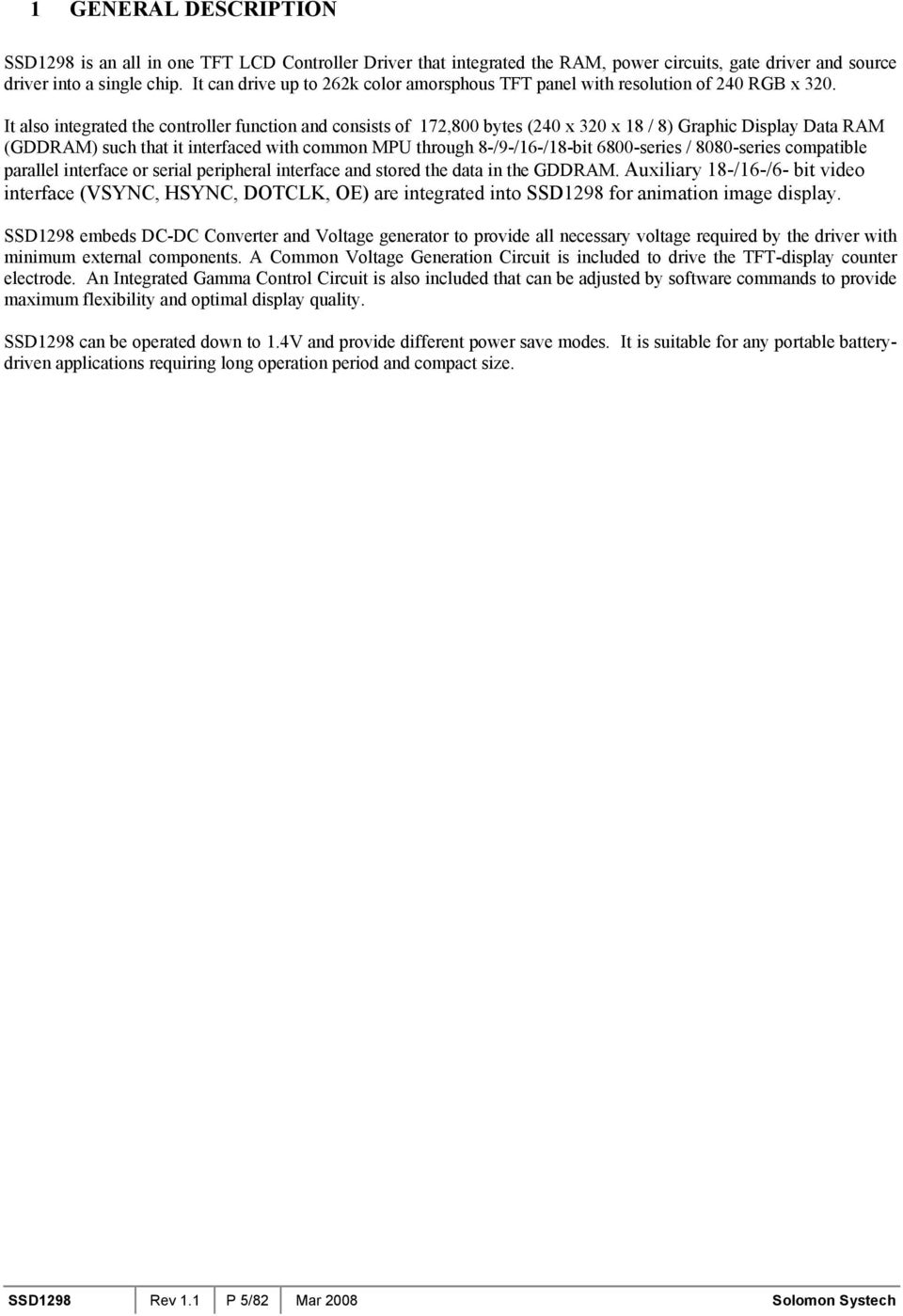
5 1 GENERAL DESCRIPTION SSD1298 is an all in one TFT LCD Controller Driver that integrated the RAM, power circuits, gate driver and source driver into a single chip. It can drive up to 262k color amorsphous TFT panel with resolution of 240 RGB x 320. It also integrated the controller function and consists of 172,800 bytes (240 x 320 x 18 / 8) Graphic Display Data RAM (GDDRAM) such that it interfaced with common MPU through 8-/9-/16-/18-bit 6800-series / 8080-series compatible parallel interface or serial peripheral interface and stored the data in the GDDRAM. Auxiliary 18-/16-/6- bit video interface (VSYNC, HSYNC, DOTCLK, OE) are integrated into SSD1298 for animation image display. SSD1298 embeds DC-DC Converter and Voltage generator to provide all necessary voltage required by the driver with minimum external components. A Common Voltage Generation Circuit is included to drive the TFT-display counter electrode. An Integrated Gamma Control Circuit is also included that can be adjusted by software commands to provide maximum flexibility and optimal display quality. SSD1298 can be operated down to 1.4V and provide different power save modes. It is suitable for any portable batterydriven applications requiring long operation period and compact size. SSD1298 Rev 1.1 P 5/82 Mar 2008 Solomon Systech
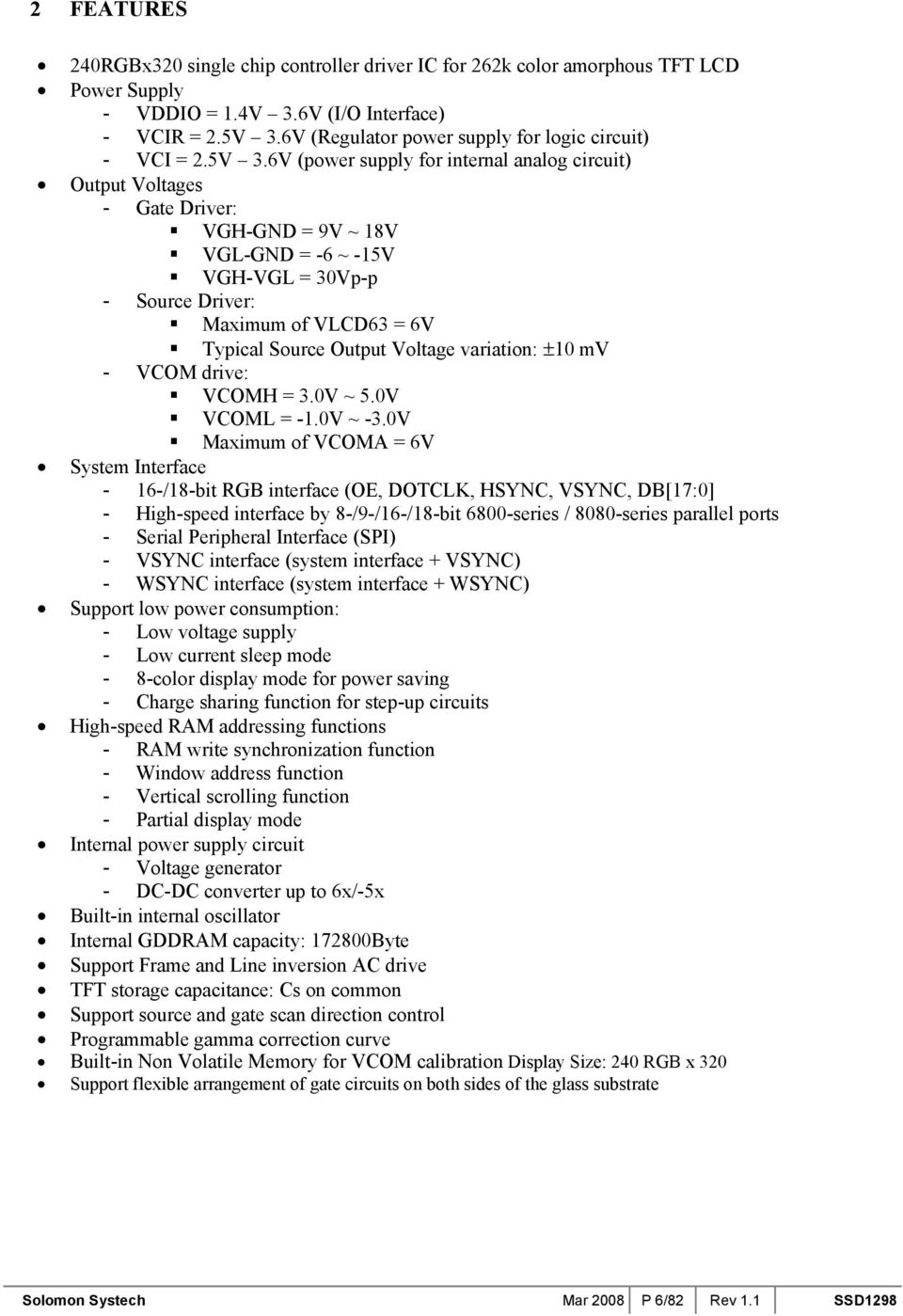
6 2 FEATURES 240RGBx320 single chip controller driver IC for 262k color amorphous TFT LCD Power Supply - VDDIO = 1.4V 3.6V (I/O Interface) - VCIR = 2.5V 3.6V (Regulator power supply for logic circuit) - VCI = 2.5V 3.6V (power supply for internal analog circuit) Output Voltages - Gate Driver VGH-GND = 9V ~ 18V VGL-GND = -6 ~ -15V VGH-VGL = 30Vp-p - Source Driver Maximum of VLCD63 = 6V Typical Source Output Voltage variation ±10 mv - VCOM drive VCOMH = 3.0V ~ 5.0V VCOML = -1.0V ~ -3.0V Maximum of VCOMA = 6V System Interface - 16-/18-bit RGB interface (OE, DOTCLK, HSYNC, VSYNC, DB[170] - High-speed interface by 8-/9-/16-/18-bit 6800-series / 8080-series parallel ports - Serial Peripheral Interface (SPI) - VSYNC interface (system interface + VSYNC) - WSYNC interface (system interface + WSYNC) Support low power consumption - Low voltage supply - Low current sleep mode - 8-color display mode for power saving - Charge sharing function for step-up circuits High-speed RAM addressing functions - RAM write synchronization function - Window address function - Vertical scrolling function - Partial display mode Internal power supply circuit - Voltage generator - DC-DC converter up to 6x/-5x Built-in internal oscillator Internal GDDRAM capacity Byte Support Frame and Line inversion AC drive TFT storage capacitance Cs on common Support source and gate scan direction control Programmable gamma correction curve Built-in Non Volatile Memory for VCOM calibration Display Size 240 RGB x 320 Support flexible arrangement of gate circuits on both sides of the glass substrate Solomon Systech Mar 2008 P 6/82 Rev 1.1 SSD1298
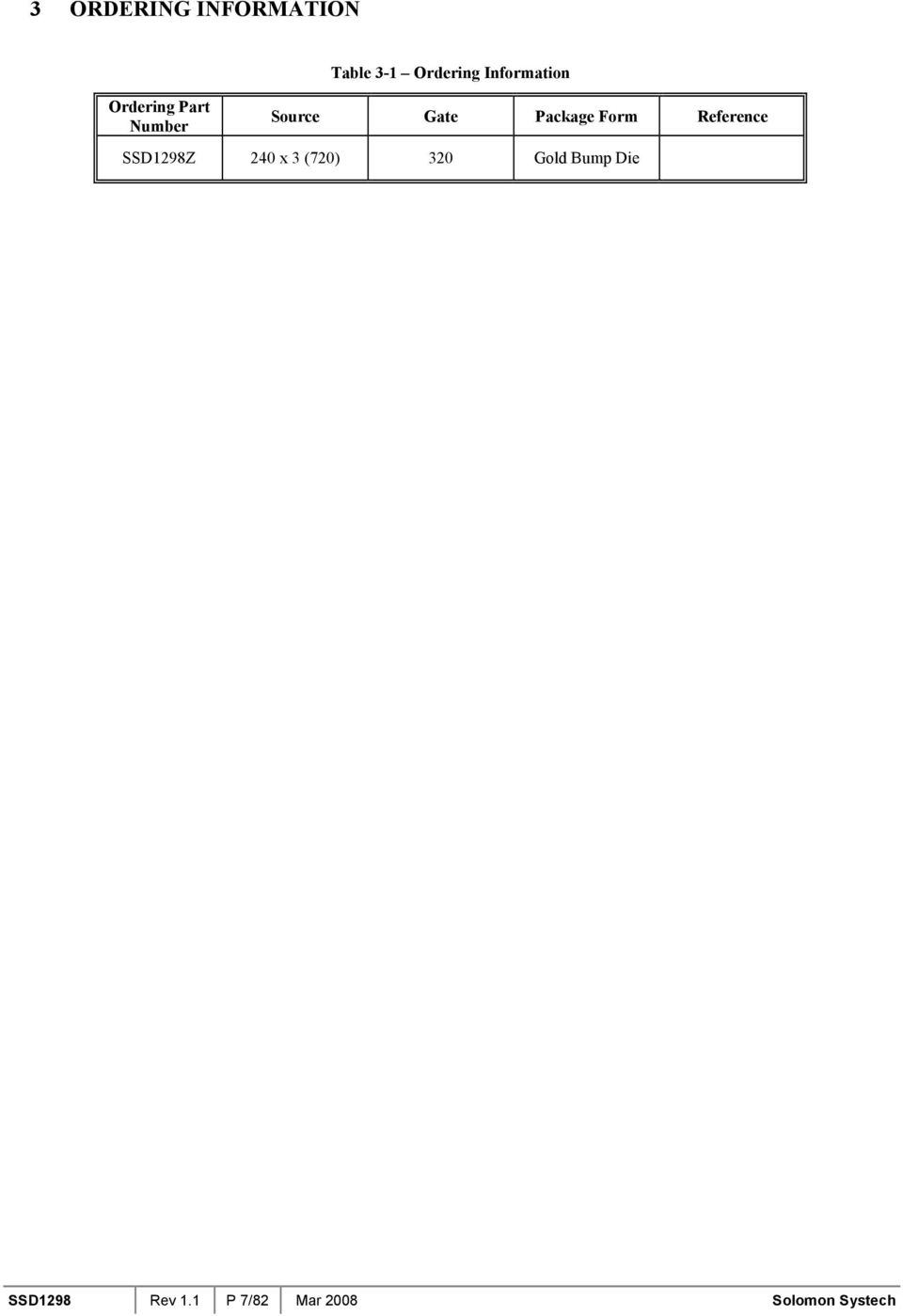
7 3 ORDERING INFORMATION Table 3-1 Ordering Information Ordering Part Number Source Gate Package Form Reference SSD1298Z 240 x 3 (720) 320 Gold Bump Die SSD1298 Rev 1.1 P 7/82 Mar 2008 Solomon Systech
8 4 BLOCK DIAGRAM Figure SSD1298 Block Diagram Description VCOM G0 to G319 S0 to S719 VCI VDDIO VDD regulator circuit Regulator Circuit Gamma / Grayscale Voltage Generator Source driver Switches Network VCI Regulator Circuit VLCD63 Data Latches C1N C1P C2N C2P C3N C3P CXP CXN CYP CYN VSS/AVSS/ IOGND/VCH Booster Circuit OSC VGH VGL GateDriver Address Counter Timing Generation System Interface 20 GDDR AM WSYNC RES PS0-3 OE CS WR/SCL DC/SDC D[170] DOTCLK VSYNC Solomon Systech Mar 2008 P 8/82 Rev 1.1 SSD1298

9 DIE PAD FLOOR PLAN Pin 1 Pin 1354 Note (1) Diagram showing the die face up. (2) Coordinates are referenced to center of the chip. (3) Coordinate units and size of all alignment marks are in um. (4) All alignment keys do not contain gold Figure 4-3 Alignment Marks Die Center y Figure 4-2 Output Pad Pitch (Pad ) x Center (-10633, ) Center (10633, ) Size 105 x 105 μm 2 Size 105 x 105 μm 2 20 Table 4-1 Die Information Die Size (no scribe) x 755 um 2 Die Thickness 300 ± 25 um Typical Bump Height 15 um Bump Co-planarity (within die) 2 um Bump Size 1 50 x 80 μm 2 (Pin 1 298) Pad Pitch 1 70 μm Bump Size 2 21 x 100 μm 2 (Pin ) Pad Pitch 2 20 μm stagger Pin 298 Pin 299 Figure SSD1298 Pad Arrangement (Bump face up) SSD1298 Rev 1.1 P 9/82 Mar 2008 Solomon Systech

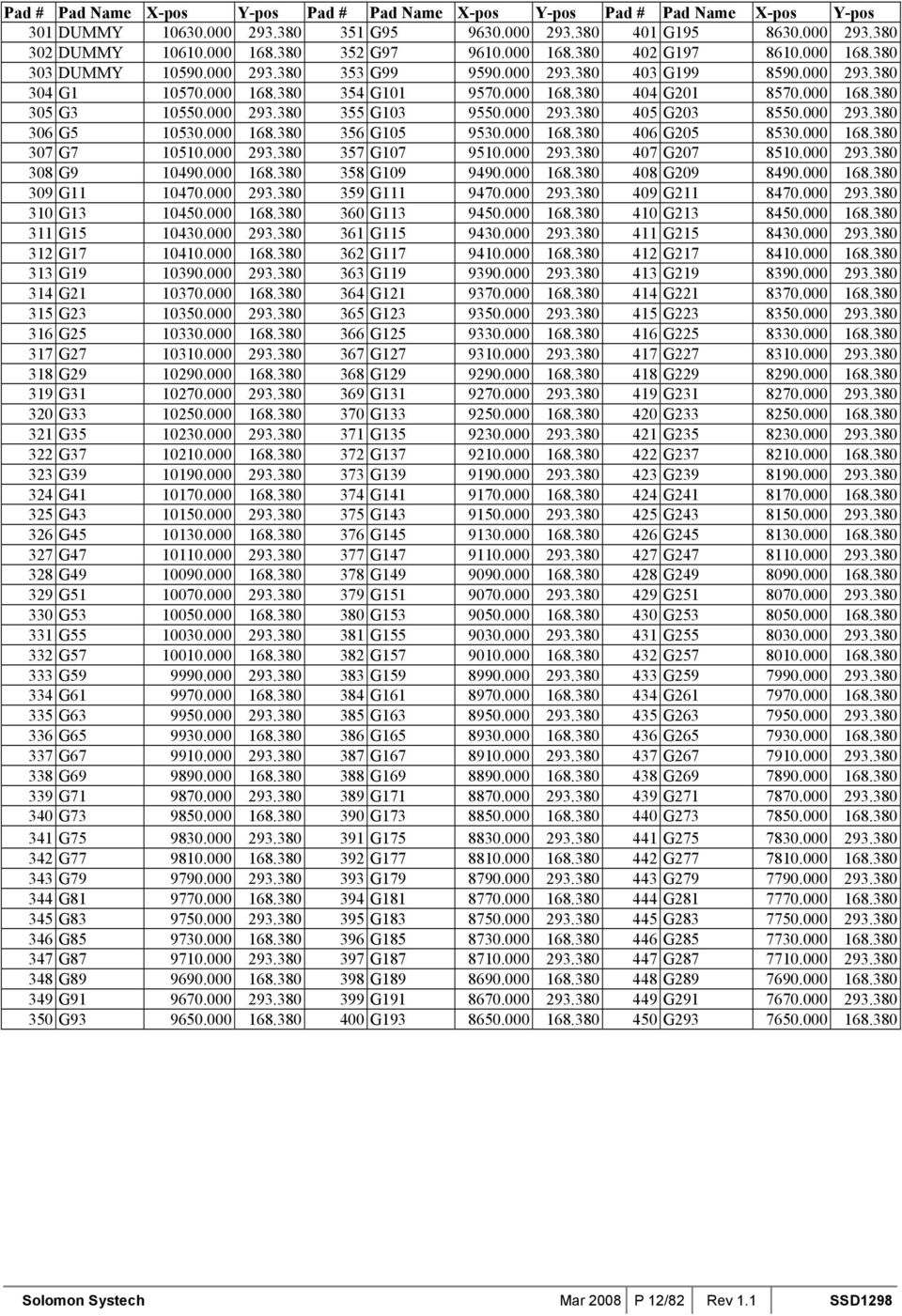
10 Table SSD1298 Bump Pad Coordinate (Bump Center) Note IC material temperature expansion factor is 2.6ppm, customer should take into account during panel design Pad # Pad Name X-pos Y-pos Pad # Pad Name X-pos Y-pos Pad # Pad Name X-pos Y-pos D VDDIO D VDDIO D VDDIO D VDDIO NC D VCIR NC D VCIR NC SDO VCIR VGH SDI VCIR VGH RD VCIR VGH WR VCIR VGH DC VCIR VGH CSB VCIR VSS NC VCORE VSS VDDIO VCORE VSS VDDIO VCORE WSYNC VCORE NC VCORE NC VCORE NC VCORE NC NC VCORE NC NC VCORE NC NC VREGC NC NC VREGC PS NC VREGC PS NC VREGC PS PS NC VDDIO NC NC RESB VSYNC TESTA HSYNC TESTB DOTCLK TESTC VCHS OE NC VCHS D VCHS D NC VCHS D NC VCHS D NC VCHS D NC VCHS D IOGND VCHS D IOGND VCHS D IOGND VCHS D IOGND VCHS D IOGND AVSS IOGND AVSS VSS IOGND AVSS NC VDDIO AVSS D VDDIO AVSS D VDDIO AVSS Solomon Systech Mar 2008 P 10/82 Rev 1.1 SSD1298

11 Pad # Pad Name X-pos Y-pos Pad # Pad Name X-pos Y-pos Pad # Pad Name X-pos Y-pos 151 VSS VCIX2G VGL VSS VCIX2G VGL VSS VCIX VGL VSS VCIX VGL VSS VCIX VGL VSS VCIX VGL VSS VCIX VGL VSS VCIX VGL VSS VCIX VGL VSS VCI VCI VCI VCI VGH EXVR VCI VGH VCI VGH VCI VGH VCI VGH VCIP VGH VCI VCI C3N VCOM VCI C3N VCOM VCI C3N VCOM VCI VCOM VCI C3P VCOM VCI C3P VCOM VCI C3P VCOMH CYN VCOMH CYN C1N VCOMH CYN C1N VCOMH CYN C1N VCOMH CYN C1P VCOMH CYP C1P VCOML CYP C1P VCOML CYP C2N VCOML CYP C2N VCOML CYP C2N VCOML CXN C2P VCOML CXN C2P CXN C2P CXN CDUM1N VLCD CXN CDUM1N CXP CDUM1N CXP CDUM1P CXP CDUM1P VCOMR CXP CDUM1P CXP VCIM VCIM VGL VCIM VGL VCIX2G VGL SSD1298 Rev 1.1 P 11/82 Mar 2008 Solomon Systech

12 Pad # Pad Name X-pos Y-pos Pad # Pad Name X-pos Y-pos Pad # Pad Name X-pos Y-pos G G G G G G G G G G G G G G G G G G G G G G G G G G G G G G G G G G G G G G G G G G G G G G G G G G G G G G G G G G G G G G G G G G G G G G G G G G G G G G G G G G G G G G G G G G G G G G G G G G G G G G G G G G G G G G G G G G G G G G G G G G G G G G G G G G G G G G G G G G G G G G G G G G G Solomon Systech Mar 2008 P 12/82 Rev 1.1 SSD1298
13 Pad # Pad Name X-pos Y-pos Pad # Pad Name X-pos Y-pos Pad # Pad Name X-pos Y-pos 451 G S S G S S G S S G S S G S S G S S G S S G S S G S S G S S G S S G S S G S S S S S S S S S S S S S S S S S S S S S S S S S S S S S S S S S S S S S S S S S S S S S S S S S S S S S S S S S S S S S S S S S S S S S S S S S S S S S S S S S S S S S S S S S S S S S S S S S S S S S S S S S S S S S S SSD1298 Rev 1.1 P 13/82 Mar 2008 Solomon Systech

14 Pad # Pad Name X-pos Y-pos Pad # Pad X-pos Y-pos Pad # Pad Name Name X-pos Y-pos 601 S S S S S S S S S S S S S S S S S S S S S S S S S S S S S S S S S S S S S S S S S S S S S S S S S S S S S S S S S S S S S S S S S S S S S S S S S S S S S S S S S S S S S S S S S S S S S S S S S S S S S S S S S S S S S S S S S S S S S S S S S S S S S S S S S S S S S S S S S S S S S S S S S S S S S S Solomon Systech Mar 2008 P 14/82 Rev 1.1 SSD1298

15 Pad # Pad Pad X-pos Y-pos Pad # X-pos Y-pos Pad # Pad Name Name Name X-pos Y-pos 751 S S S S S S S S S S S S S S S S S S S S S S S S S S S S S S S S S S S S S S S S S S S S S S S S S S S S S S S S S S S S S S S S S S S S S S S S S S S S S S S S S S S S S S S S S S S S S S S S S S S S S S S S S S S S S S S S S S S S S S S S S S S S S S S S S S S S S S S S S S S S S S S S S S S S S S SSD1298 Rev 1.1 P 15/82 Mar 2008 Solomon Systech

16 Pad # Pad Pad X-pos Y-pos Pad # X-pos Y-pos Pad # Pad Name Name Name X-pos Y-pos 901 S S S S S S S S S S S S S S S S S S S S S S S S S S S S S S S S S S S S S S S S S S S S S S S S S S S S S S S S S S S S S S S S S S S S S S S S S S S S S S S S S S S S S S S S S S S S S S S S S S S S S S S S S S S S S S S S S S S S S S S S S S S S S S S S S S S S S S S S S S S S S S S S S S S S S S Solomon Systech Mar 2008 P 16/82 Rev 1.1 SSD1298

17 Pad # Pad Pad X-pos Y-pos Pad # X-pos Y-pos Pad # Pad Name Name Name X-pos Y-pos 1051 S S S S S S S S S S S S S S S S S S S S S S S S S S S S S S S S S S S S S S S S S S S S S S S S S S S S S S S S S S S S S S S S S S S S S S S S S S S S S S S S S S S S S S S S S S S S S S S S S S S S S S S S S S S S S S S S S S S S G S S G S S G S S G S S G S S G S S G S S G S S G S S G S S G SSD1298 Rev 1.1 P 17/82 Mar 2008 Solomon Systech

18 Pad # Pad Pad X-pos Y-pos Pad # X-pos Y-pos Pad # Pad Name Name Name X-pos Y-pos 1201 G G G G G G G G G G G G G G G G G G G G G G G G G G G G G G G G G G G G G G G G G G G G G G G G G G G G G G G G G G G G G G G G G G G G G G G G G G G G G G G G G G G G G G G G G G G G G G G G G G G G G G G G G G G G G G G G G G G G G G G G G G G G G G G G G G G G G G G G G G G G G G G G G G G G G Solomon Systech Mar 2008 P 18/82 Rev 1.1 SSD1298

19 Remark 5 PIN DESCRIPTION I = Input; O = Output; IO = Bi-directional; P = Power; VCC = System VDD; GND = System VSS; Table 5-1 Power Supply Pins Pin Name Type Connect to Function Description VSS GND System ground pin of the IC. - Ground of AVSS GND Grounding for analog circuit. - P the Power IOGND GND Grounding for logic circuit. Supply VCHS AVSS Grounding for booster circuit. - Power Booster input voltage pin. VCI - Supply Power - Connect to voltage source between 2.5V to 3.6V Supply for P Analog VCIP VCI - Circuits Voltage supply pin for analog circuit. This pin requires a noise free path for providing accurate LCD driving voltages. - Connect to same source of VCI When not in use Stabilizing VCIM Negative voltage of VCI. - capacitor Booster O Stabilizing voltages VCIX2 Equals to 2x VCI - capacitor VCIX2 on VCIX2J - FPC Voltage for They are the power supply used by on chip analog P VCIX2 on analog blocks and VGH/VGL DC-DC. VCIX2G - FPC External This pin provides voltage reference for internal voltage VCOMR I voltage External regulator when register VDV[40] of Power Control 4 source or Reference set to Open Open - Connect to an external voltage source for reference Stabilizing This pin indicates a HIGH level of VCOM generated in VCOMH Voltages for - capacitor driving the VCOM alternation. O VCOM Stabilizing This pin indicates a LOW level of VCOM generated in VCOML Signal - capacitor driving the VCOM alternation. Stabilizing VLCD63 This pin is the maximum source driver voltage. - capacitor LCD Stabilizing A positive power output pin for gate driver and for MTP VGH O Driving - capacitor programming Voltages Stabilizing VGL A negative power output pin for gate driver. - capacitor EXVR I GND External External reference of internal gamma resistor Reference - Connect to VSS - CXP I Booster - Connect a capacitor to CXN - CXN capacitor - Connect a capacitor to CXP - CYP Booster - Connect a capacitor to CYN - CYN capacitor - Connect a capacitor to CYP - C1P Booster Booster and - Connect a capacitor to C1N - C1N capacitor Stabilization - Connect a capacitor to C1P - C2P Booster Capacitors - Connect a capacitor to C2N - C2N capacitor - Connect a capacitor to C2P - C3P - Connect a capacitor to C3N - Booster - C3N capacitor - Connect a capacitor to C3P CDUM1P Stabilizing capacitor Stabilization Capacitors - Connect a capacitor to CDUM1N SSD1298 Rev 1.1 P 19/82 Mar 2008 Solomon Systech

20 Pin Name CDUM1N VCORE Type P Connect to Stabilizing capacitor Stabilizing capacitor VREGC P VCORE VDDIO VCIR P P Power Supply Power Supply Function Power for Core Logic Regulator output for logic circuits Power for interface logic pins Power for interface logic pins Description When not in use Open - Connect a capacitor to CDUM1P Open Vdd for core use. Connect a capacitor for stabilization Regulator output for VCORE use. - Voltage input pin for logic I/O, connect to system VDD. - Connect to voltage source between 1.4V to 3.6V Internal regular input for logic supply VCIR=2.5V- 3.3V Solomon Systech Mar 2008 P 20/82 Rev 1.1 SSD1298

21 Table Interface Logic Pins Name Type Connect to Function DC MPU Data or command Description CSB MPU Chip select pin for 6800/8080/SPI interface system E (enable signal) RD MPU Logic I 8080-system RD (read strobe signal) Control Serial mode Not used and should be connected to V DDIO or V ss WR MPU 68-system RW (indicates read cycle when High, write cycle when Low) 80-system WR (write strobe signal) Serial mode SCL (serial clock input) When not in use V DDIO or V ss V DDIO or V ss V DDIO or V ss D0-D17 IO MPU Data bus For parallel mode, 8/9/16/18 bit interface. Please refer to Section 13 Interface Mapping for definition. V SS Unused pins should connect to V SS. WSYNC O MPU Logic Control Ram Write Synchronization output Open OE I MPU Display enable pin from controller. Data will be treated as dummy regardless the OE status during front/back porch setting at Vss registers R16 and R17. Display Dot-clock signal and oscillator source. A non-stop external clock Timing DOTCLK I MPU must be provided to that pin even at front or black porch nondisplay period. Vss Signals HSYNC I MPU Line Synchronization input V SS VSYNC I MPU Frame/Ram Write Synchronization input V SS RESB I MPU System reset pin. System - An active low pulse at this pin will reset the IC, Connect to Reset V DDIO in normal operation - SDI I MPU SDO O MPU Serial interface Data input pin in serial interface Data output pin in serial interface V SS Open SSD1298 Rev 1.1 P 21/82 Mar 2008 Solomon Systech
22 Table 5-3 Mode Selection Pins Name Type Connect to Function Description When not in use PS[30] I V DDIO or V SS Interface Selection PS3 PS2 PS1 PS0 Interface Mode bit 6800 parallel interface bit 6800 parallel interface bit 8080 parallel interface bit 8080 parallel interface bit generic D[80] (262k colour) + 3-wire SPI If 65K color, D3 shorts to D8 internally bit generic (262k colour) + 3-wire SPI bit generic (262k colour) + 3-wire SPI bit generic D[83] (262k colour) + 3-wire SPI bits 6800 parallel interface bits 6800 parallel interface bit 8080 parallel interface bit 8080 parallel interface wire SPI wire SPI - Solomon Systech Mar 2008 P 22/82 Rev 1.1 SSD1298
23 Table 5-4 Driver Output Pins When Connect Name Type Function Description not in to use VCOM LCD A power supply for the TFT-display common electrode. Open G0-G319 S0-S719 O LCD LCD LCD Driving Signals Gate driver output pins. These pins output V GH, V GL or V GOFFH level. Source driver output pins. S(3n) display Red if BGR = LOW, Blue if BGR = HIGH. S(3n+1) display Green. S(3n+2) display Blue if BGR = LOW, Red if BGR = HIGH. Open Open Table 5-5 Miscellaneous Pins Name Type When Connect Function Description not in to use NC These pins must be left open and cannot be connected together Open Floating pins and no connection inside the IC. These pins should be open. Open Test pin of the internal circuit. TESTA TESTB TESTC IO FPC FPC FPC IC Testing Signal - Leave this pin open and insert test point in FPC Test pin of the internal circuit. - Leave this pin open and insert test point in FPC Test pin of the internal circuit. - Leave this pin open and insert test point in FPC Open Open Open SSD1298 Rev 1.1 P 23/82 Mar 2008 Solomon Systech
24 6 BLOCK FUNCTION DESCRIPTION 6.1 System Interface The System Interface unit consists of three functional blocks for driving the 6800-series parallel interface, 8080-series high speed parallel interface, 3-lines serial peripheral interface and 4-lines serial peripheral interface. The selection of different interface is done by PS3, PS2, PS1 and PS0 pins. Please refer to the pin descriptions on page 19. a) MPU Parallel 6800-series Interface The parallel Interface consists of 18 bi-directional data pins D[170], R / W, D/ C, E and CS. R / W input high indicates a read operation from the Graphical Display Data RAM (GDDRAM) or the status register. R / W input low indicates a write operation to Display Data RAM or Internal Command Registers depending on the status of D/ C input. The E input serves as data latch signal (clock) when high provided that CS is low. Please refer to Parallel Interface Timing Diagram of 6800-series microprocessors. In order to match the operating frequency of the GDDRAM with that of the MCU, pipeline processing is internally performed which requires the insertion of a dummy read before the first actual display data read. This is shown in the following diagram. R/W#(WR#) E(RD#) DATA BUS N n n+1 n+2 write column address dummy read data read1 data read 2 data read 3 Figure 6-1 Read Display Data b) MPU Parallel 8080-series Interface The parallel interface consists of 18 bi-directional data pins D[170], RD, WR, DC and CSB. RD input serves as data read latch signal (clock) when low provided that CSB is low. Whether reading the display data from GDDRAM or reading the status from the status register is controlled by DC. WR input serves as data write latch signal (clock) when low provided that CSB is low. Whether writing the display data to the GDDRAM or writing the command to the command register is controlled by DC. A dummy read is also required before the first actual display data read for 8080-series interface. Please refer Figure 7-1. c) 3-lines Serial Peripheral Interface Solomon Systech Mar 2008 P 24/82 Rev 1.1 SSD1298
25 The operation is similar to 4-lines serial peripheral interface while DC is not used. There are altogether 9-bits will be shifted into the shift register on every ninth clock in sequence DC bit, D7 to D0 bit. The DC bit (first bit of the sequential data) will determine the following data byte in the shift register is written to the Display Data RAM (DC bit = 1) or the command register (DC bit = 0) series Parallel 8080 series Parallel MCU Serial Interface Interface Interface Data Read 18/16/9/8-bits 18/16/9/8-bits Yes Data Write 18/16/9/8-bits 18/16/9/8-bits 8-bits Command Read Status only Status only No Command Write Yes Yes 8-bits Table Data bus selection modes Figure wire SPI interface (9 bits) Transfer starts CSB Transfer Transfer starts Transfer SCL MSB LSB MSB LSB SDI DC DC DB 7 DB 6 DB 5 DB 4 DB 3 Register / data DB 2 DB 1 DB 0 DC DC DB 7 DB 6 DB 5 DB 4 DB 3 Register / data DB 2 DB 1 DB 0 d) 4-wire Serial Peripheral Interface (8 bits) The clock synchronized serial peripheral interface (SPI) using the chip select line (CSB), serial transfer clock line (SCL), serial input data (SDI). The serial data transfer starts at the falling edge of CSB input and ends at the rising edge of CSB.SDC determinate the data of SDI which is register or data. SSD1298 Rev 1.1 P 25/82 Mar 2008 Solomon Systech
26 Figure wire SPI interface (8 bits) CSB Transfer starts Transfer Transfer starts Transfer SDC SCK SDI MSB DB 7 DB 6 DB 5 DB 4 DB 3 DB 2 DB 1 LSB DB 0 MSB DB 7 DB 6 DB 5 DB 4 DB 3 DB 2 DB 1 LSB DB 0 Register Data 6.2 RGB Interface SSD1298 supports RGB interface. RGB interface unit consists of D[170], HSYNC, VSYNC, DOTCLK and OE signals for display moving pictures. When the RGB interface is selected, the display operation is synchronized with external control signals (HSYNC, VSYNC and DOTCLK). Data is written in synchronization with the control signals when DEN is enabled for write operation in order to avoid flicker or tearing effect while updating display data. 6.3 Address Counter (AC) The address counter (AC) assigns address to the GDDRAM. When an address set instruction is written into the IR, the address information is sent from the IR to the AC. After writing into the GRAM, the AC is automatically incremented by 1 (or decremented by 1). After reading the data, the AC is not updated. A window address function allows for data to be written only to a window area specified by GRAM. 6.4 Graphic Display Data RAM (GDDRAM) The GDDRAM is a bit mapped static RAM holding the bit pattern to be displayed. The size of the RAM is 240 RGB x 320 x 18 / 8 = 172,800 bytes. For mechanical flexibility, re-mapping on both Segment and Common outputs can be selected by software. Please refer to the command Data Output/Scan direction for detail description. Four pages of display data forms a RAM address block and stored in the GDDRAM. Each block will form the fundamental units of scrolling addresses. Various types of area scrolling can be performed by software program according to the command Set area Scroll and Set Scroll Start. 6.5 Gamma/Grayscale Voltage Generator The grayscale voltage circuit generates a LCD driver circuit that corresponds to the grayscale levels as specified in the grayscale gamma adjustment resister. 262,144 possible colors can be displayed when 1 pixel = 18 bit. For details, see the gamma adjustment register. Solomon Systech Mar 2008 P 26/82 Rev 1.1 SSD1298
27 6.6 Booster and Regulator Circuit These two functional blocks generate the voltage of VGH, VGL, VCOM levels and VLCD0~63 which are necessary for operating a TFT LCD. 6.7 Timing Generator The timing generator generates a timing signal for the operation of internal circuit such as the internal RAM accessing, date output timing etc. 6.8 Oscillation Circuit (OSC) This module is an on-chip low power RC oscillator circuitry. The oscillator generates the clock for the DC-DC voltage converter. This clock is also used in the display timing generator. 6.9 Data Latches This block is a series of latches carrying the display signal information. These latches hold the data, which will be fed to the HV Buffer Cell and Level Selector to output the required voltage level Liquid Crystal Driver Circuit SSD1298 consists of a 720-output source driver (S0-S719) and a 320-output gate driver (G0-G319). The display image data is latched when 720 bits of data are inputted. The latched data control the source driver and output drive waveforms. The gate driver for scanning gate lines outputs either VGH or VGL level. The shift direction of 720-bit source output from the source driver can be changed by setting the RL bit and the shift direction of gate output from the gate driver can be changed by setting the TB bit. The scan mode by the gate driver can be changed by setting the SM bit. Sets the gate driver pin arrangement in combination with the TB bit to select the operimal scan mode for the module. SSD1298 Rev 1.1 P 27/82 Mar 2008 Solomon Systech
28 7 COMMAND TABLE Table Command Table Reg# Register R/W D/C IB15 IB14 IB13 IB12 IB11 IB10 IB9 IB8 IB7 IB6 IB5 IB4 IB3 IB2 IB1 IB0 R Index ID7 ID6 ID5 ID4 ID3 ID2 ID1 ID0 SR Status Read 1 0 L7 L6 L5 L4 L3 L2 L1 L R00h R01h R02h Oscillation Start (0000h) Driver output control RL REV GD BGR SM TB MUX8 MUX7 MUX6 MUX5 MUX4 MUX3 MUX2 MUX1 MUX0 (3B3Fh) LCD drive AC control FLD ENWS B/C EOR WSMD NW7 NW6 NW5 NW4 NW3 NW2 NW1 NW0 (0000h) Power control (1) 0 1 DCT3 DCT2 DCT1 DCT0 BT2 BT1 BT0 0 DC3 DC2 DC1 DC0 AP2 AP1 AP0 0 R03h All GAMAS[20] setting 8 color (6A64h) Display control PT1 PT0 VLE2 VLE1 SPT 0 0 GON DTE CM 0 D1 D0 R07h (0000h) Frame cycle control 0 1 NO1 NO0 SDT1 SDT0 0 EQ2 EQ1 EQ0 DIV1 DIV0 SDIV SRTN RTN3 RTN2 RTN1 RTN0 R0Bh (5308h) Power control (2) VRC2 VRC1 VRC0 R0Ch (0004h) R0Dh Power control (3) VRH3 VRH2 VRH1 VRH0 R0Eh Power control (4) VCOMG VDV4 VDV3 VDV2 VDV1 VDV Gate scan start R0Fh position SCN8 SCN7 SCN6 SCN5 SCN4 SCN3 SCN2 SCN1 SCN0 (0000h) Sleep mode SLP R10h (0001h) OSCE N R11h R15h Entry mode 0 1 VS mode DFM1 DFM0 0 Denmode WMode Nosync DMode TY1 TY0 ID1 ID0 AM (6830h) Entry mode INVDOT INVDEN INVHS INVVS (0000h) Solomon Systech Mar 2008 P 28/82 Rev 1.1 SSD1298
29 (continued) Reg# Register R/W D/C IB15 IB14 IB13 IB12 IB11 IB10 IB9 IB8 IB7 IB6 IB5 IB4 IB3 IB2 IB1 IB0 R1Eh Power control (5) notp 0 VCM5 VCM4 VCM3 VCM2 VCM1 VCM0 RAM data write 0 1 R22h RAM data read 1 1 R23h R24h Data[170] mapping depends on the interface setting RAM write data mask (1) 0 1 WMR5 WMR4 WMR3 WMR2 WMR1 WMR0 0 0 WMG5 WMG4 WMG3 WMG2 WMG1 WMG0 0 0 (0000h) RAM write data mask (2) WMB5 WMB4 WMB3 WMB2 WMB1 WMB0 0 0 (0000h) Frame Frequency 0 1 OSC3 OSC2 OSC1 OSC R25h (8000h) VCOM OTP R28h (000Ah) VCOM OTP R29h (80C0h) R30h γ control (1) PKP12 PKP11 PKP PKP02 PKP01 PKP00 R31h γ control (2) PKP32 PKP31 PKP PKP22 PKP21 PKP20 R32h γ control (3) PKP52 PKP51 PKP PKP42 PKP41 PKP40 R33h γ control (4) PRP12 PRP11 PRP PRP02 PRP01 PRP00 R34h γ control (5) PKN12 PKN11 PKN PKN02 PKN01 PKN00 R35h γ control (6) PKN32 PKN31 PKN PKN22 PKN21 PKN20 R36h γ control (7) PKN52 PKN51 PKN PKN42 PKN41 PKN40 R37h γ control (8) PRN12 PRN11 PRN PRN02 PRN01 PRN00 R3Ah γ control (9) VRP14 VRP13 VRP12 VRP11 VRP VRP03 VRP02 VRP01 VRP00 R3Bh γ control (10) VRN14 VRN13 VRN12 VRN11 VRN VRN03 VRN02 VRN01 VRN00 R41h Vertical scroll control (1) VL18 VL17 VL16 VL15 VL14 VL13 VL12 VL11 VL10 (0000h) R42h Vertical scroll control (2) VL28 VL27 VL26 VL25 VL24 VL23 VL22 VL21 VL20 (0000h) R44h Horizontal RAM address position 0 1 HEA7 HEA6 HEA5 HEA4 HEA3 HEA2 HEA1 HEA0 HSA7 HSA6 HSA5 HSA4 HSA3 HSA2 HSA1 HSA0 (EF00h) Vertical RAM R45h address start VSA8 VSA7 VSA6 VSA5 VSA4 VSA3 VSA2 VSA1 VSA0 position (0000h) Vertical RAM R46h address end VEA8 VEA7 VEA6 VEA5 VEA4 VEA3 VEA2 VEA1 VEA0 position (013Fh) First window start SS18 SS17 SS16 SS15 SS14 SS13 SS12 SS11 SS10 R48h (0000h) First window end SE18 SE17 SE16 SE15 SE14 SE13 SE12 SE11 SE10 R49h (013Fh) Second window R4Ah start SS28 SS27 SS26 SS25 SS24 SS23 SS22 SS21 SS20 (0000h) Second window end SE28 SE27 SE26 SE25 SE24 SE23 SE22 SE21 SE20 R4Bh (013Fh) Set GDDRAM X R4Eh address counter XAD7 XAD6 XAD5 XAD4 XAD3 XAD2 XAD1 XAD0 (0000h) Set GDDRAM Y R4Fh address counter YAD8 YAD7 YAD6 YAD5 YAD4 YAD3 YAD2 YAD1 YAD0 (0000h) Note In R01h, bits REV, BGR, TB, RL, CM will override the corresponding hardware pins settings. Setting R28h as 0x0006 is required before setting R25h and R29h registers. SSD1298 Rev 1.1 P 29/82 Mar 2008 Solomon Systech
30 8 COMMAND DESCRIPTION Index (IR) R/W DC IB15 IB14 IB13 IB12 IB11 IB10 IB9 IB8 IB7 IB6 IB5 IB4 IB3 IB2 IB1 IB0 W ID7 ID6 ID5 ID4 ID3 ID2 ID1 ID0 The index instruction specifies the RAM control indexes (R00h to RFFh). It sets the register number in the range of to in binary form. But do not access to Index register and instruction bits which do not have it s own index register. Device Code Read (R00h) R/W DC IB15 IB14 IB13 IB12 IB11 IB10 IB9 IB8 IB7 IB6 IB5 IB4 IB3 IB2 IB1 IB0 R If this register is read forcibly, 8999h is read. Oscillator (R00h) (POR = 0000h) R/W DC IB15 IB14 IB13 IB12 IB11 IB10 IB9 IB8 IB7 IB6 IB5 IB4 IB3 IB2 IB1 IB0 W OSCEN POR OSCEN The oscillator will be turned on when OSCEN = 1, off when OSCEN = 0. Driver Output Control (R01h) (POR = 3B3Fh) R/W DC IB15 IB14 IB13 IB12 IB11 IB10 IB9 IB8 IB7 IB6 IB5 IB4 IB3 IB2 IB1 IB0 W 1 0 RL REV GD BGR SM TB MUX8 MUX7 MUX6 MUX5 MUX4 MUX3 MUX2 MUX1 MUX0 POR REV Displays all character and graphics display sections with reversal when REV = 1. Since the grayscale level can be reversed, display of the same data is enabled on normally white and normally black panels. Source output level is indicated below. REV 0 1 RGB data 00000H 3FFFFH 00000H 3FFFFH Source Output level Vcom = L V63 V0 V0 V63 Vcom = H V0 V63 V63 V0 GD Selects the 1st output Gate GD = 0, G0 is 1st output Gate, Gate sequence G0, G1, G2, G3,, G318, G319 GD = 1, G1 is 1st output Gate, Gate sequence G1, G0, G3, G2,, G319, G318 BGR Selects the order from RGB to BGR in writing 18-bit pixel data in the GDDRAM. When BGR = 0 <R><G><B> color is assigned from S0. When BGR = 1 <B><G><R> color is assigned from S0. Solomon Systech Mar 2008 P 30/82 Rev 1.1 SSD1298
31 SM Change scanning order of gate driver. See Scan mode setting on next page. TB Selects the output shift direction of the gate driver. When TB = 1, G0 shifts to G319. When TB = 0, G319 shifts to G0. SM Gate scan squence (GD= 0 ) 0 G0, G1, G2, G3 G219 (left and right gate interlaced) 1 G0, G2, G318, G1, G3, G319 RL Selects the output shift direction of the source driver. When RL = 1, S0 shifts to S719 and <R><G><B> color is assigned from S0. When RL = 0, S719 shifts to S0 and <R><G><B> color is assigned from S719. Set RL bit and BGR bit when changing the dot order of R, G and B. RL setting will be ignored when display with RAM (Dmode[10] = 00). MUX[80] Specify number of lines for the LCD driver. MUX[80] settings cannot exceed 319. Remark When using the partial display, the output for non-display area will be minimum voltage. SSD1298 Rev 1.1 P 31/82 Mar 2008 Solomon Systech
32 GD= 0, G0 is the 1st gate output channel, gate output sequence is G0, G1, G2, G3,, G318, G319. SM = 0 SM = 1 G0 G2 G4 G1 G3 G5 G0 G2 TB = 1 RL = 1 G316 G318 G1 G3 G316 G318 G317 G319 G317 G319 S0 S719 S0 S719 G0 G2 G4 G1 G3 G5 G0 G2 TB = 0 RL = 1 G316 G318 ` G317 G319 G316 G318 G1 G3 G317 G319 S0 S719 S0 S719 G0 G2 G4 G1 G3 G5 G0 G2 TB = 1 RL = 0 G316 G318 G1 G3 G316 G318 G317 G319 G317 G319 S0 S719 S0 S719 TB = 0 RL = 0 G0 G2 G4 G1 G3 G5 G0 G2 G316 G318 G1 G3 G316 G318 G317 G319 G317 G319 S0 S719 S0 S719 Solomon Systech Mar 2008 P 32/82 Rev 1.1 SSD1298
33 GD= 1, G1 is the 1st gate output channel, gate output sequence is G1, G0, G3, G2,, G319, G318. SM = 0 SM = 1 TB = 1 RL = 1 G0 G2 G4 G1 G3 G5 G0 G2 G1 G3 G317 G319 G316 G318 S0 S719 G317 G319 G316 G318 S0 S719 G0 G2 G4 G1 G3 G5 G1 G3 G317 G319 TB = 0 RL = 1 G0 G2 G316 G318 G317 G319 G316 G318 S0 S719 S0 S719 G0 G2 G4 G1 G3 G5 G1 G3 TB = 1 RL = 0 G0 G2 G317 G319 G316 G318 G317 G319 G316 G318 S0 S719 S0 S719 G0 G2 G4 G1 G3 G5 G1 G3 G317 G319 TB = 0 RL = 0 G0 G2 G316 G318 G317 G319 G316 G318 S0 S719 S0 S719 SSD1298 Rev 1.1 P 33/82 Mar 2008 Solomon Systech
34 LCD-Driving-Waveform Control (R02h) (POR = 0000h) R/W DC IB15 IB14 IB13 IB12 IB11 IB10 IB9 IB8 IB7 IB6 IB5 IB4 IB3 IB2 IB1 IB0 W FLD ENWS B/C EOR WSMD NW7 NW6 NW5 NW4 NW3 NW2 NW1 NW0 POR FLD Set display in interlace drive mode to protect from flicker. It splits one frame into 3 fields and drive. When FLD = 1, it is 3 field driving, which also limit VBP = 1. When FLD = 0, it is normal driving. The following figure shows the gate selection when the 3-field invension is enabled and the output waveform of the 3- field interlaced driving. Table field interlace driving TB = 1 TB = 0 Gate FLD = 0 FLD = 1 Gate FLD = 0 FLD = 1 G0 X G319 X G1 X G318 X G2 X X G317 X X G3 X G316 X G4 X G315 X X X X X X X X x G317 X G2 X G318 X G1 X G319 X X G0 X X Figure gate output timing in 3-field interlacing driving 1 frame Blank period Field 1 Field 2 Field 3 Field 1 AC Polarity G0 G1 G2 G3 G4 G5 G3n +1 G3n +2 G3n +3 Solomon Systech Mar 2008 P 34/82 Rev 1.1 SSD1298
35 B/C Select the liquid crystal drive waveform VCOM. When B/C = 0, frame inversion of the LCD driving signal is enabled. When B/C = 1, a N-line inversion waveform is generated and alternates in a N-line equals to NW[70]+1. EOR When B/C = 1 and EOR = 1, the odd/even frame-select signals and the N-line inversion signals are EORed for alternating drive. EOR is used when the LCD is not alternated by combining the set values of the lines of the LCD driven and the N-lines. NW[70] Specify the number of lines that will alternate at the N-line inversion setting (B/C = 1). N-line is equal to NW[70]+1. Figure Line Inversion AC Driver N Frame N+1 Frame Back porch Front porch Back porch Front porch Frame Inversion 320 line drive N Frame N+1 Frame Back porch Front porch Back porch Front porch Line Inversion 320 line drive SSD1298 Rev 1.1 P 35/82 Mar 2008 Solomon Systech
36 ENWS When ENWS = 1, it enables WSYNC output pin. Mode1 or Mode2 is selected by WSMD. When ENWS = 0(POR), it disables WSYNC feature, the WSYNC output pin will be high-impedance. WSYNC MPU /CS D/C /WR SSD D[170] WSMD = 0 is mode1, the waveform of WSYNC output will be tn tu WSYNC 100% Memory Access 0% Fast write MCU Slow write MCU SSD1298 displaying memory tn is the time when there is No Update of LCD screen from on-chip ram content. tu is the time when the LCD screen is updating based on on-chip ram content. e.g. fosc = 510KHz, for 320mux, tn = 282us (6 lines), tu =15.06ms (320 lines) WSMD = 1 is mode2, the waveform of WSYNC output will be WSYNC m-1 mux line read For fast write MCU MCU should start to write new frame of ram data just after rising edge of long WSYNC pulse and should be finished well before the rising edge of the next long WSYNC pulse. e.g. 5MHz 8 bit parallel write cycle for 18 bit color depth, or 3MHz 8 bit parallel write cycle for 16 bit color depth. For slow write MCU (Half the write speed of fast write) MCU should start to write new frame ram data after the rising edge of the first short WSYNC pulse and must be finished within 2 frames time. e.g. 2.5MHz 8 bit parallel write cycle for 18 bit color depth. * Usually, mode2 is for slower MCU, while mode1 is for fast MCU. Solomon Systech Mar 2008 P 36/82 Rev 1.1 SSD1298
37 Power control 1 (R03h) (POR = 6864h) R/W DC IB15 IB14 IB13 IB12 IB11 IB10 IB9 IB8 IB7 IB6 IB5 IB4 IB3 IB2 IB1 IB0 W 1 DCT3 DCT2 DCT1 DCT0 BT2 BT1 BT0 0 DC3 DC2 DC1 DC0 AP2 AP1 AP0 0 POR DCT[30] Set the step-up cycle of the step-up circuit for 8-color mode (CM = V DDIO ). When the cycle is accelerated, the driving ability of the step-up circuit increases, but its current consumption increases too. Adjust the cycle taking into account the display quality and power consumption. DCT3 DCT2 DCT1 DCT0 Step-up cycle Fline Fline Fline Fline Fline Fline Fline Fline Fline Fline fosc / fosc / fosc / fosc / fosc / fosc / 16 * Fline = Line frequency fosc = Internal oscillator frequency (~510KHz) BT[20] Control the step-up factor of the step-up circuit. Adjust the step-up factor according to the power-supply voltage to be used. BT2 BT1 BT0 V GH output V GL output V GH booster ratio V GL booster ratio x V CIX2 -(V GH ) + V CI x V CIX2 -(V GH ) + V CIX x V CIX2 -(V CIX2 ) x V CIX2 + V CI -(V GH ) x V CIX2 + V CI -(V GH ) + V CI x V CIX2 + V CI -(V GH ) + V Cix x V CIX2 -(V GH ) x V CIX2 -(V GH ) + V CI +4-3 SSD1298 Rev 1.1 P 37/82 Mar 2008 Solomon Systech
38 DC[30] Set the step-up cycle of the step-up circuit for 262k-color mode (CM = V SS ). When the cycle is accelerated, the driving ability of the step-up circuit increases, but its current consumption increases too. Adjust the cycle taking into account the display quality and power consumption. DC3 DC2 DC1 DC0 Step-up cycle Fline Fline Fline Fline Fline Fline Fline Fline Fline Fline fosc / fosc / fosc / fosc / fosc / fosc / 16 * Fline = Line frequency fosc = Internal oscillator frequency (~510KHz) AP[20] Adjust the amount of current from the stable-current source in the internal operational amplifier circuit. When the amount of current becomes large, the driving ability of the operational-amplifier circuits increase. Adjust the current taking into account the power consumption. During times when there is no display, such as when the system is in a sleep mode. AP2 AP1 AP0 Op-amp power Least Small Small to medium Medium Medium to large Large Large to Maximum Maximum Solomon Systech Mar 2008 P 38/82 Rev 1.1 SSD1298
39 Display Control (R07h) (POR = 0000h) R/W DC IB15 IB14 IB13 IB12 IB11 IB10 IB9 IB8 IB7 IB6 IB5 IB4 IB3 IB2 IB1 IB0 W PT1 PT0 VLE2 VLE1 SPT 0 0 GON DTE CM 0 D1 D0 POR PT[10] Normalize the source outputs when non-displayed area of the partial display is driven. VLE[21] When VLE1 = 1 or VLE2 = 1, a vertical scroll is performed in the 1st screen by taking data VL17-0 in R41h register. When VLE1 = 1 and VLE2 = 1, a vertical scroll is performed in the 1 st and 2 nd screen by VL1[80] and VL2[80] respectively. SPT When SPT = 1, the 2-division LCD drive is performed. CM 8-color mode setting. When CM = 1, 8-color mode is selected. When CM = 0, 8-color mode is disable. GON Gate off level becomes VGH when GON = 0. DTE When GON = 1 and DTE = 0, all gate outputs become VGL. When GON = 1 and DTE = 1, selected gate wire becomes VGH, and non-selected gate wires become VGL. D[10] Display is on when D1 = 1 and off when D1 = 0. When off, the display data remains in the GDDRAM, and can be displayed instantly by setting D1 = 1. When D1= 0, the display is off with all of the source outputs set to the GND level. Because of this, the driver can control the charging current for the LCD with AC driving. When D[10] = 01, the internal display is performed although the display is off. When D[10] = 00, the internal display operation halts and the display is off. Control the display on/off while control GON and DTE. GON DTE D1 D0 Internal Display Source output Gate output Operation Halt GND V GH Operation GND V GH Operation GND V GOFFL Operation Grayscale level output V GOFFL Operation Grayscale level output Selected gate line V GH Non-selected gate line V GOFFL Frame Cycle Control (R0Bh) (POR = 5308h) R/W DC IB15 IB14 IB13 IB12 IB11 IB10 IB9 IB8 IB7 IB6 IB5 IB4 IB3 IB2 IB1 IB0 W 1 NO1 NO0 SDT1 SDT0 0 EQ2 EQ1 EQ0 DIV1 DIV0 SDIV SRTN RTN3 RTN2 RTN1 RTN0 POR NO[10] Sets amount of non-overlap of the gate output. Gn NO1 NO0 Amount of non-overlap 0 0 reserved clock cycle (POR) clock cycle clock cycle 1 Line period 1 Line period Gn+1 Non-overlap period SSD1298 Rev 1.1 P 39/82 Mar 2008 Solomon Systech
40 SDT[10] Set delay amount from the gate output signal falling edge of the source outputs. EQ[20] Sets the equalizing period. SDT1 SDT0 Delay amount of the source output clock cycle clock cycle (POR) clock cycle clock cycle EQ2 EQ1 EQ0 EQ period No EQ clock cycle clock cycle clock cycle clock cycle clock cycle clock cycle clock cycle Gn 1 Line period 1 Line period Sn EQ Delay amount of the source output Equalizing period DIV[10] Set the division ratio of clocks for internal operation. Internal operations are driven by clocks which frequency is divided according to the DIV1-0 setting. DIV1 DIV0 Division Ratio * fosc = internal oscillator frequency, ~510kHz SDIV When SDIV = 1, DIV1-0 value will be count. When SDIV = 0, DIV1-0 value will be auto determined. SRTN When SRTN =1, RTN3-0 value will be count. When SRTN = 0, RTN3-0 value will be auto determined. RTN[30] Set the no. of clocks in each line. The total number will be the decimal value of RTN3-0 plus 16. e.g. if RTN3-0 = 1010h, the total number of clocks in each line = = 26 clocks. Solomon Systech Mar 2008 P 40/82 Rev 1.1 SSD1298
41 Frame frequency calculation For DMode[10] = 00 Frame _ Fosc frequency = div ( rtn + 16) ( mux + vbp + vfp + 3) where Fosc = internal oscillator frequency div = Division ratio determined by DIV[10] rtn = RTN[30] mux = MUX[80] vbp = VBP[70] vfp = VFT[70] for default values of SSD1298 Fosc = ~510KHz, DIV[10] = 00, RTN[30] = 8, MUX[80] = 319, VBP[70] = 3, VFP[70] = 1, Frame frequency = 510K 510K = = 65Hz 1 (8 + 16) ( ) Power Control 2 (R0Ch) (POR = 0004h) R/W DC IB15 IB14 IB13 IB12 IB11 IB10 IB9 IB8 IB7 IB6 IB5 IB4 IB3 IB2 IB1 IB0 W VRC2 VRC1 VRC0 POR VRC[20] Adjust VCIX2 output voltage. The adjusted level is indicated in the chart below VRC2-0 setting. VRC2 VRC1 VRC0 VCIX2 voltage V V V V V V Reserve Reserve Note The above setting is valid when VCI has high enough voltage supply for boosting up the required voltage. The above setting is assumed 100% booster efficiency. Please refer to DC Characteristics for detail. SSD1298 Rev 1.1 P 41/82 Mar 2008 Solomon Systech
42 Power Control 3 (R0Dh) (POR = 0009h) R/W DC IB15 IB14 IB13 IB12 IB11 IB10 IB9 IB8 IB7 IB6 IB5 IB4 IB3 IB2 IB1 IB0 W VRH3 VRH2 VRH1 VRH0 POR* VRH[30] Set amplitude magnification of V LCD63. These bits amplify the V LCD63 voltage 1.78 to times the Vref voltage set by VRH[30]. VRH3 VRH2 VRH1 VRH0 V LCD63 Voltage Vref x Vref x Vref x Vref x Vref x Vref x Vref x Vref x Vref x Vref x Vref x Vref x Vref x Vref x Vref x Vref x *Vref is the internal reference voltage equals to 2.0V. Power Control 4 (R0Eh) (POR = 3200h) R/W DC IB15 IB14 IB13 IB12 IB11 IB10 IB9 IB8 IB7 IB6 IB5 IB4 IB3 IB2 IB1 IB0 W VCOMG VDV4 VDV3 VDV2 VDV1 VDV POR* VcomG When VcomG = 1, it is possible to set output voltage of VcomL to any level, and the instruction (VDV4-0) becomes available. When VcomG = 0, VcomL output is fixed to Hi-z level, VCIM output for VcomL power supply stops, and the instruction (VDV4-0) becomes unavailable. Set VcomG according to the sequence of power supply setting flow as it relates with power supply operating sequence. VDV[40] Set the alternating amplitudes of Vcom at the Vcom alternating drive. These bits amplify 0.6 to 1.23 times the VLCD63 voltage. When VcomG = 0, the settings become invalid. External voltage at VcomR is referenced when VDV = VCOML = *VCOMH - VCOMA VDV4 VDV3 VDV2 VDV1 VDV0 Vcom Amplitude VLCD63 x VLCD63 x VLCD63 x 0.66 Step = VLCD63 x VLCD63 x Reference from external variable resistor VLCD63 x VLCD63 x 1.08 Step = VLCD63 x VLCD63 x Reserved 1 1 Reserved Note Vcom amplitude < 6V Solomon Systech Mar 2008 P 42/82 Rev 1.1 SSD1298
43 Gate Scan Position (R0Fh) (POR = 0000h) R/W DC IB15 IB14 IB13 IB12 IB11 IB10 IB9 IB8 IB7 IB6 IB5 IB4 IB3 IB2 IB1 IB0 W SCN8 SCN7 SCN6 SCN5 SCN4 SCN3 SCN2 SCN1 SCN0 POR SCN[80] Set the scanning starting position of the gate driver. The valid range is from 0 to 319. G0 1st line of data G0 G29 1st line of data SCN8-0 = SCN8-0 = G319 G319 Sleep mode (R10h) (POR = 0001h) R/W DC IB15 IB14 IB13 IB12 IB11 IB10 IB9 IB8 IB7 IB6 IB5 IB4 IB3 IB2 IB1 IB0 W SLP POR SLP Sleep mode enable bit. In the sleep mode, the internal display operations are halted except the R-C oscillator to reduce current consumption. No change in the GDDRAM data or instructions during the sleep mode is made, although it is retained. When SLP = 1, the driver enters into the sleep mode. When SLP = 0, the driver leaves the sleep mode. Entry Mode (R11h) (POR = 6230h) R/W DC IB15 IB14 IB13 IB12 IB11 IB10 IB9 IB8 IB7 IB6 IB5 IB4 IB3 IB2 IB1 IB0 W 1 VSMode DFM1 DFM0 0 DenMode Wmode Nosync Dmode TY1 TY0 ID1 ID0 AM POR VSMode When VSMode = 1 at DMode[10] = 00, the frame frequency will be dependent on VSYNC. VSYNC MPU /CS D/C /WR SSD D[170] In VSYNC interface operation, the internal display operation is synchronized with the VSYNC signal. By writing data to the internal RAM at faster than the calculated minimum speed (internal display oerpation speed + buffer), it becomes possible to rewrite the moving picture data without flickering the display and display a moving picture via system interface. The display operation is performed in synchronization with the internal clock signal generated from the internal oscillator and the VSYNC signal. The display data is written in the internal RAM so that the SSD1298 rewrites the data only within the moving picture area and minimize the number of data transfer required for moving picture display. Therefore, the SSD1298 can write data via VSYNC interface in high speed with low power consumption. SSD1298 Rev 1.1 P 43/82 Mar 2008 Solomon Systech
44 VSYNC RAM data write via system I/F The VSYNC interface has the minimum for RAM data write speed and internal clock frequency, which must be more than the values calculated from the following formulas, respectively. Fosc[ Hz ] = Frame _ frequency* ( mux + vfp + vbp + 3 )* ( rtn + 16 )* ( div ) 240* mux RAMWriteSpeed(min)[ Hz ] > 1 ( vbp + mux m arg ins )* ( rtn + 16 )* fosc where Fosc = internal oscillator frequency div = Division ratio determined by DIV[10] rtn = RTN[30] mux = MUX[80] vbp = VBP[70] vfp = VFT[70] Note When RAM write operation is not started right after the falling edge of VSYNC, the time from the falling edge of VSYNC until the start of RAM write operation must also be taken into account. DFM[10] Set the color display mode. DFM1 DFM0 Color mode k color (POR) k color DenMode DenMode=1 RGB interface ignore HSYNC, VSYNC pin and HBP, VBP DenMode=0 RGB interface control by HSYNC, VSYNC pin and HBP, VBP When DenMode=1, Generic mode will write each input rgb pixel into RAM buffer, the window of ram buffer to be written defined by command R44h (define X of window)m R45h (define Y start),r46 (define Y end), whenever the input RGB dimension is larger than the defined ram window, it wont have any effect. WMode WMode=1 Write RAM from Generic RGB data (POR, if PS00xx) WMode=0 Write RAM from SPI interface Nosync Nosync=1 Dmode change immediately Nosync=0 Dmode change Sync with on chip frame start Dmode Dmode=1 Display engine will be clocked by on chip oscillator and ignore DOTCLK pin Dmode=0 Display engine will be clocked by DOTCLK pin and onchip oscillator will be off (POR, if PS00xx) TY[10] In 262k color mode, 16 bit parallel interface, there are three types of methods in writing data into the ram, Type A, B and C are described as below. TY1 TY0 Writing mode 0 0 Type A 0 1 Type B Solomon Systech Mar 2008 P 44/82 Rev 1.1 SSD1298
45 1 0 Type C Hardware pins Interface Color mode Cycle D17 D16 D15 D14 D13 D12 D11 D10 D9 D8 D7 D6 D5 D4 D3 D2 D1 D0 262k Type A 1 st R5 R4 R3 R2 R1 R0 x x G5 G4 G3 G2 G1 G0 x x 2 nd B5 G4 B3 B2 B1 B0 x x R5 R4 R3 R2 R1 R0 x x 3 rd G5 G4 G3 G2 G1 G0 x x B5 G4 B3 B2 B1 B0 x x 16 bit 262k Type B 1 st R5 R4 R3 R2 R1 R0 x x G5 G4 G3 G2 G1 G0 x x 2 nd x x x x x x x x B5 G4 B3 B2 B1 B0 x x 262k Type C 1 st R5 R4 R3 R2 R1 R0 x x G5 G4 G3 G2 G1 G0 x x 2 nd B5 G4 B3 B2 B1 B0 x x x x x x x x x x Remark x Don't care bits Not connected pins SSD1298 Rev 1.1 P 45/82 Mar 2008 Solomon Systech
46 ID[10] The address counter is automatically incremented by 1, after data are written to the GDDRAM when ID[10] = 1. The address counter is automatically decremented by 1, after data are written to the GDDRAM when ID[10] = 0. The setting of incrementing or decrementing of the address counter can be made independently in each upper and lower bit of the address. The direction of the address when data are written to the GDDRAM is set with AM bits. AM Set the direction in which the address counter is updated automatically after data are written to the GDDRAM. When AM = 0, the address counter is updated in the horizontal direction. When AM = 1, the address counter is updated in the vertical direction. When window addresses are selected, data are written to the GDDRAM area specified by the window addresses in the manner specified with ID1-0 and AM bits. ID[10]="00 Horizontal decrement Vertical decrement ID[10]="01 Horizontal increment Vertical decrement ID[10]="10 Horizontal decrement Vertical increment ID[10]="11 Horizontal increment Vertical increment 00,00h 00,00h 00,00h 00,00h AM="0 Horizontal 13F,EFh 13F,EFh 13F,EFh 13F,EFh 00,00h 00,00h 00,00h 00,00h AM="1 Vertical 13F,EFh 13F,EFh 13F,EFh 13F,EFh Generic Interface Control (R15h) (POR = 0000h) R/W DC IB15 IB14 IB13 IB12 IB11 IB10 IB9 IB8 IB7 IB6 IB5 IB4 IB3 IB2 IB1 IB0 W INVDOT INVDEN INVHS INVVS POR INVDOT sets the signal polarity of DOTCLK pin. When INVDOT = 0, data is latched at positive edge of DOTCLK. When INVDOT = 1, data is latched at negative edge of DOTCLK. INVDEN sets the signal polarity of DEN pin. When INVDEN = 0, DEN is active high. When INVDEN = 1, DEN is active low. INVHS sets the signal polarity of HSYNC pin. When INVHS = 0, HSYNC is active low. When INVHS = 1, HSYNC is active high. INVVS sets the signal polarity of VSYNC pin. When INVVS = 0, VSYNC is active low. When INVVS = 1, VSYNC is active high. Solomon Systech Mar 2008 P 46/82 Rev 1.1 SSD1298
47 Power Control 5 (R1Eh) (POR = 0029h) R/W DC IB15 IB14 IB13 IB12 IB11 IB10 IB9 IB8 IB7 IB6 IB5 IB4 IB3 IB2 IB1 IB0 W notp 0 VCM5 VCM4 VCM3 VCM2 VCM1 VCM0 POR* notp notp equals to 0 after power on reset and VcomH voltage equals to programmed OTP value. When notp set to 1, setting of VCM[50] becomes valid and voltage of VcomH can be adjusted. VCM[50] Set the VcomH voltage if notp = 1. These bits amplify the VcomH voltage 0.35 to 0.99 times the VLCD63 voltage. Default value is when power on reset. VCM5 VCM4 VCM3 VCM2 VCM1 VCM0 VcomH VLCD63 x VLCD63 x 0.36 Step = VLCD63 x VLCD63 x 0.99 Write Data to GRAM (R22h) R/W DC D[170] W 1 WD[170] mapping depends on the interface setting WD[170] Transforms all the GDDRAM data into 18-bit, and writes the data. Format for transforming data into 18-bit depends on the interface used. SSD1298 selects the grayscale level according to the GDDRAM data. After writing data to GDDRAM, address is automatically updated according to AM bit and ID bit. Access to GDDRAM during stand-by mode is not available. Read Data from GRAM (R22h) R/W DC D[170] R 1 RD[170] mapping depends on the interface setting RD[170] Read 18-bit data from the GDDRAM. When the data is read to the microcomputer, the first-word read immediately after the GDDRAM address setting is latched from the GDDRAM to the internal read-data latch. The data on the data bus (DB17 0) becomes invalid and the second-word read is normal. When bit processing, such as a logical operation, is performed, only one read can be processed since the latched data in the first word is used. Frame Frequency Control (R25h) (POR = 8000h) R/W DC IB15 IB14 IB13 IB12 IB11 IB10 IB9 IB8 IB7 IB6 IB5 IB4 IB3 IB2 IB1 IB0 W 1 OSC3 OSC2 OSC1 OSC POR* OSC[30] Set the frame frequency by OSC[30] OSC[30] Internal Oscillator Frequency (Hz) Corresponding Frame Freq (Hz) (other registers are at POR value) K K K K K K K 80 SSD1298 Rev 1.1 P 47/82 Mar 2008 Solomon Systech
48 Vcom OTP (R28h R29h) Reg# R/W DC IB15 IB14 IB13 IB12 IB11 IB10 IB9 IB8 IB7 IB6 IB5 IB4 IB3 IB2 IB1 IB0 R28h W R29h W When OTP is access, these registers must be set accordantly. OTP programming sequence Step Operation Power up the module at VCI = 2.7V, VDDIO = 1.8V. 1 Turn on the display as normal to 65k/262k color mode (displaying a test pattern if any). Set notp to 1 (R1Eh) and optimizes VcomH by adjusting VCM[50] 2 (R1Eh). 3 Power down the whole module. 4 Connect a supply to the module at VCI = 2.7V, VDDIO = 1.8V Write below commands for OTP initialization and wait for 200ms for activate the OTP Index Value R00h 0x R28h 0x0006 R29h 0x80C0 Connect a 14.5V supply to VGH through a current limiting resistor, see figure below. Write the optimized value found in Step 2 to VCM[50] (R1Eh) and set 6 notp to 1. 7 Fire the OTP by write HEX code 000Ah to register R28h. 8 Wait 500ms. OTP complete. Power down the whole module and remove 14.5V 9 supply. Note notp must set to 0 to activate the OTP effect. Precaution 1. All capacitors on OTP machine should be discharged completely before placing the LCD module. 2. The OTP programming voltage should not be applied when placing and removing the LCD module. 3. The OTP programming voltage should not be applied before VDDIO/VCI. 4. After OTP is finished, the capacitors at VGH and VCIX2 must be discharged completely before removing the LCD module. Solomon Systech Mar 2008 P 48/82 Rev 1.1 SSD1298
49 Figure 8-3 OTP circuitry SSD1298 VGH GND + C - Note R R = 1K ~ 2k ohm C = 1uF (built-in on the module) GND 14.5V Gamma Control (R30h to R3Bh) Reg# R/W DC IB15 IB14 IB13 IB12 IB11 IB10 IB9 IB8 IB7 IB6 IB5 IB4 IB3 IB2 IB1 IB0 R30h W PKP PKP PKP PKP PKP PKP R31h W PKP PKP PKP PKP PKP PKP R32h W PKP PKP PKP PKP PKP PKP R33h W PRP PRP PRP PRP PRP PRP R34h W PKN PKN PKN PKN PKN PKN R35h W PKN PKN PKN PKN PKN PKN R36h W PKN PKN PKN PKN PKN PKN R37h W PRN PRN PRN PRN PRN PRN R3Ah W VRP VRP VRP VRP VRP VRP VRP VRP VRP R3Bh W VRN VRN VRN VRN VRN VRN VRN VRN VRN Note please refer to table 5 for POR values. PKP[5200] Gamma micro adjustment register for the positive polarity output PRP[1200] Gradient adjustment register for the positive polarity output VRP[1400] Adjustment register for amplification adjustment of the positive polarity output PKN[5200] Gamma micro adjustment register for the negative polarity output PRN[1200] Gradient adjustment register for the negative polarity output VRN[1400] Adjustment register for the amplification adjustment of the negative polarity output. (For details, see the Section 11 Gamma Adjustment Function). SSD1298 Rev 1.1 P 49/82 Mar 2008 Solomon Systech
50 Vertical Scroll Control (R41h-R42h) (POR =0000h) Reg# R/W DC IB15 IB14 IB13 IB12 IB11 IB10 IB9 IB8 IB7 IB6 IB5 IB4 IB3 IB2 IB1 IB0 R41h W VL18 VL17 VL16 VL15 VL14 VL13 VL12 VL11 VL10 POR R42h W VL28 VL27 VL26 VL25 VL24 VL23 VL22 VL21 VL20 POR VL1[80] Specify scroll length at the scroll display for vertical smooth scrolling. Any raster-row from the first to 320 th can be scrolled for the number of the raster-row. After 320 th raster-row is displayed, the display restarts from the first raster-row. The display-start raster-row (VL1[80]) is valid when VLE1 = 1 or VLE2 = 1. The raster-row display is fixed when VLE[21] = 00. VL2[80] Specify scroll length at the scroll display for vertical smooth scrolling at 2 nd screen. The display-start rasterrow (VL2[80]) is valid when VLE1 = 1 and VLE2 = 1. Horizontal RAM address position (R44h) (POR = EF00h) R/W DC IB15 IB14 IB13 IB12 IB11 IB10 IB9 IB8 IB7 IB6 IB5 IB4 IB3 IB2 IB1 IB0 W 1 HEA7 HEA6 HEA5 HEA4 HEA3 HEA2 HEA1 HEA0 HSA7 HSA6 HSA5 HSA4 HSA3 HSA2 HSA1 HSA0 POR HSA[70]/HEA[70] Specify the start/end positions of the window address in the horizontal direction by an address unit. Data are written to the GDDRAM within the area determined by the addresses specified by HEA[70] and HSA[70]. These addresses must be set before the RAM write. In setting these bits, make sure that 00 h HSA[70] HEA[70] EF h. Vertical RAM address position (R45h-R46h) Reg# R/W DC IB15 IB14 IB13 IB12 IB11 IB10 IB9 IB8 IB7 IB6 IB5 IB4 IB3 IB2 IB1 IB0 W VSA8 VSA7 VSA6 VSA5 VSA4 VSA3 VSA2 VSA1 VSA0 R45h POR R46h W VEA8 VEA7 VEA6 VEA5 VEA4 VEA3 VEA2 VEA1 VEA0 POR POR VSA[80]/VEA[80] Specify the start/end positions of the window address in the vertical direction by an address unit. Data are written to the GRAM within the area determined by the addresses specified by VEA[80] and VSA[80]. These addresses must be set before the RAM write. In setting these bits, make sure that 00 h VSA[80] VEA[80] 13F h. 1 st Screen driving position (R48h-R49h) Reg# R/W DC IB15 IB14 IB13 IB12 IB11 IB10 IB9 IB8 IB7 IB6 IB5 IB4 IB3 IB2 IB1 IB0 R48h W SS18 SS17 SS16 SS15 SS14 SS13 SS12 SS11 SS10 POR R49h W SE18 SE17 SE16 SE15 SE14 SE13 SE12 SE11 SE10 POR SS1[80] Specify the driving start position for the first screen in a line unit. The LCD driving starts from the set gate driver, i.e. the first driving Gate is G0 if SS1[80] = 00H SE1[80] Specify the driving end position for the first screen in a line unit. The LCD driving is performed to the set gate driver. For instance, when SS1[80] = 07 H and SE1[80] = 10 H are set, the LCD driving is performed from G7 to G16, and non-selection driving is performed for G1 to G6, G17, and others. Ensure that SS1[80] SE1[80] 13FH. Solomon Systech Mar 2008 P 50/82 Rev 1.1 SSD1298
51 2 nd Screen driving position (R4Ah-R4Bh) Reg# R/W DC IB15 IB14 IB13 IB12 IB11 IB10 IB9 IB8 IB7 IB6 IB5 IB4 IB3 IB2 IB1 IB0 R4Ah W SS28 SS27 SS26 SS25 SS24 SS23 SS22 SS21 SS20 POR R4Bh W SE28 SE27 SE26 SE25 SE24 SE23 SE22 SE21 SE20 POR SS2[80] Specify the driving start position for the second screen in a line unit. The LCD driving starts from the set gate driver. The second screen is driven when SPT = 1. SE2[80] Specify the driving end position for the second screen in a line unit. The LCD driving is performed to the set gate driver. For instance, when SPT = 1, SS2[80] = 20 H, and SE2[80] = 2F H are set, the LCD driving is performed from G32 to G47. Ensure that SS1[80] SE1[80] ; SS2[80] SE2[80] 13FH. RAM address set (R4Eh-R4Fh) Reg# R/W DC IB15 IB14 IB13 IB12 IB11 IB10 IB9 IB8 IB7 IB6 IB5 IB4 IB3 IB2 IB1 IB0 R4Eh W XAD7 XAD6 XAD5 XAD4 XAD3 XAD2 XAD1 XAD0 POR R4Fh W YAD8 YAD7 YAD6 YAD5 YAD4 YAD 3 YAD 2 YAD 1 YAD 0 POR XAD[70] Make initial settings for the GDDRAM X address in the address counter (AC). YAD[80] Make initial settings for the GDDRAM Y address in the address counter (AC). After GDDRAM data are written, the address counter is automatically updated according to the settings with AM, I/D bits and setting for a new GDDRAM address is not required in the address counter. Therefore, data are written consecutively without setting an address. The address counter is not automatically updated when data are read out from the GDDRAM. GDDRAM address setting cannot be made during the standby mode. The address setting should be made within the area designated with window addresses. Optimize display performance and crosstalk mininmization (R20+R26+R27+R2E+R2F) Reg# R/W DC IB15 IB14 IB13 IB12 IB11 IB10 IB9 IB8 IB7 IB6 IB5 IB4 IB3 IB2 IB1 IB0 R20h W R4Bh R26h W R27h W R2Eh W R2Fh W R20h is to adjust Internal Vcom strength R26h is to adjust Internal Bandgap strength R27h is to adjust Internal VCOMH/VCOML timing R2Eh is to adjust VCOM charge sharing time R2Fh is to adjust Ram speed SSD1298 Rev 1.1 P 51/82 Mar 2008 Solomon Systech
52 Window Address Function The window address function enables writing display data sequentially in a window address area made in the internal GDDRAM. The window address area is made by setting the horizontal address register (start HSA7-0, end HEA 7-0 bits) and the vertical address register (start VSA8-0, end VEA8-0 bits). The AM and ID[10] bits set the transition direction of RAM address (either increment or decrement, horizontal or vertical, respectively). Setting these bits enables the SSD1298 to write data including image data sequentially without taking the data wrap position into account. The window address area must be made within the GDDRAM address map area. Condition 00h HSA[70] HEA[70] EFh 00h VSA[80] VEA[80] 13Fh AM and ID[10] refer to R11h GDDRAM address map 0000h 0000h 00EFh 0000h Window address area 120x40 at middle 0000h 013Fh 00EFh 013Fh Window address setting area HSA[70] = 3Bh; HEA[70] = B3h VSA[80] = 8Bh; VEA[80] = B3h AM = 0 and ID[1;]] = 11 Solomon Systech Mar 2008 P 52/82 Rev 1.1 SSD1298
53 Partial Display and Scrolling Function SSD1298 support schrolling and partial display function. The SSD2220 enables to selectively drive two screens at arbitrary positions with the screen-driving position registers (R48h to R4Bh). Only the lines required to display two screens at arbitrary positions are selectively driven. The first screen driving position registers (R48 and R49) specifies the start line (SS18-10) and the end line (SE18-10) for displaying the first screen. The second screen driving position register (R4A) specifies the start line (SS28-20) and the end line (SE28-20) for displaying the second screen. The second screen control is effective when the SPT bit is set to 1. The total number of lines driven for displaying the first and second screens must be less than the number of lines to drive the LCD. Scrolling Funtion In Full screen display, schrolling could be enabled by setting VL1[80] Example Register setting Register Value Remark R07h 0233h MO=0, VLE2=0, VLE1=1, SPT=0 Enable schrolling by setting VLE1=1 R48h 0000h SS1[80] = 0 R49h 013Fh SE1[80] = 319 R4Ah 0000h SS2[80] = 0 R4Bh 013Fh SE2[80] = 431 R41h 0040h VL1[80] = 64 Set scrolling amount R42h 0000h VL2[80] = 0 RAM Content Display ROW G SSD1298 Rev 1.1 P 53/82 Mar 2008 Solomon Systech
54 Partial display with one window Example Register setting Register Value Remark R07h 1833h PT=11, VLE2=0, VLE1=0, SPT=0 Set PT=11 to set non-display to display data 1 R48h 0040h SS1[80] = 64 R49h 007Fh SE1[80] = 127 Define 1 st display window R4Ah 0000h SS2[80] = 0 R4Bh 013fh SE2[80] = 319 R41h 0000h VL1[80] = 0 R42h 0000h VL2[80] = 0 ROW RAM Content Display Non-display area Display area Non-display area 319 Solomon Systech Mar 2008 P 54/82 Rev 1.1 SSD1298
55 9 GAMMA ADJUSTMENT FUNCTION The SSD1298 incorporates gamma adjustment function for the 262,144-color display. Gamma adjustment is implemented by deciding the 8-grayscale levels with angle adjustment and micro adjustment register. Also, angle adjustment and micro adjustment is fixed for each of the internal positive and negative polarity. Set up by the liquid crystal panel s specification. RGB Interface Display Data R5 R4 R3 R2 R1 R0 G5 G4 G3 G2 G1 G0 B5 B4 B3 B2 B1 B0 Positive polarity register PKP02 PKP01 PKP00 PKP12 PKP11 PKP10 PKP22 PKP21 PKP20 PKP32 PKP31 PKP30 PKP42 PKP41 PKP40 PKP52 PKP51 PKP50 PRP02 PRP01 PRP00 PRP12 PRP11 PRP10 VRP03 VRP02 VRP01 VRP00 VRP14 VRP13 VRP12 VRP11 VRP10 Negative polarity PKN02 PKN01 PKN00 PKN12 PKN11 PKN10 PKN22 PKN21 PKN20 PKN32 PKN31 PKN30 PKN42 PKN41 PKN40 PKN52 PKN51 PKN50 PRN02 PRN01 PRN00 PRN12 PRN11 PRN10 VRN03 VRN02 VRN01 VRN00 VRN14 VRN13 VRN12 VRN11 VRN10 8-levels 64 levels Grayscale amplifier V0 V63 64 grayscale Control <R> 6-bits 6-bits 6-bits 64 grayscale Control <G> LCD Driver LCD Driver LCD Driver register R G B LCD 64 grayscale Control <B> SSD1298 Rev 1.1 P 55/82 Mar 2008 Solomon Systech
56 9.1 Structure of Grayscale Amplifier Below figure indicates the structure of the grayscale amplifier. It determines 8 levels (VIN0-VIN7) by the gradient adjuster and the micro adjustment register. Also, dividing these levels with ladder resistors generates V0 to V63. VLCD63 Gradient adjustment register PRP0 PRP1 Micro adjustment register Amplitude adjustment register PKP0 PKP1 PKP2 PKP3 PKP4 PKP5 VRP0 VRP VINP0 V0 8 to 1 selector VINP1 V1 V7 8 to 1 selector VINP2 V8 Ladder resistor 8 to 1 selector 8 to 1 selector VINP3 VINP4 Grayscale Amplifier V19 V20 V42 V43 V54 8 to 1 selector VINP5 V55 V61 8 to 1 selector VINP6 V62 VINP7 V63 GND * Individual ladder resistors are used for positive and negative polarity. Solomon Systech Mar 2008 P 56/82 Rev 1.1 SSD1298
57 Ladder resistor for positive polarity Ladder resistor for negative polarity VLCD63 0 to 30R VRP0 5R 4R RP0 RP1 RP2 RP3 RP4 RP5 RP6 RP7 VRP0[30] KVP0 KVP1 KVP2 KVP3 KVP4 KVP5 KVP6 KVP7 KVP8 8 to 1 selector VINP0 PKP0[20] VINP1 VRN0 5R 4R RN0 RN1 RN2 RN3 RN4 RN5 RN6 RN7 VRN0[30] KVN0 KVN1 KVN2 KVN3 KVN4 KVN5 KVN6 KVN7 KVN8 8 to 1 selector VINN0 PKN0[20] VINN1 0 to 28R VRHP 1R 5R 1R 16R 1R 5R 1R RP8 RP9 RP10 RP11 RP12 RP13 RP14 RP15 RP16 RP17 RP18 RP19 RP20 RP21 RP22 RP23 RP24 RP25 RP26 RP27 RP28 RP29 RP30 RP31 RP32 RP33 RP34 RP35 RP36 RP37 RP38 PRP0[20] KVP9 KVP10 KVP11 KVP12 KVP13 8 to 1 KVP14 selector KVP15 KVP16 KVP17 KVP18 KVP19 KVP20 KVP21 8 to 1 KVP22 selector KVP23 KVP24 KVP25 KVP26 KVP27 KVP28 KVP29 8 to 1 KVP30 selector KVP31 KVP32 KVP33 KVP34 KVP35 KVP36 KVP37 8 to 1 KVP38 selector KVP39 KVP40 PKP1[20] VINP2 PKP2[20] VINP3 PKP3[20] VINP4 PKP4[20] VINP5 0 to 28R VRHN 1R 5R 1R 16R 1R 5R 1R RN8 RN9 RN10 RN11 RN12 RN13 RN14 RN15 RN16 RN17 RN18 RN19 RN20 RN21 RN22 RN23 RN24 RN25 RN26 RN27 RN28 RN29 RN30 RN31 RN32 RN33 RN34 RN35 RN36 RN37 RN38 PRN0[20] KVN9 KVN10 KVN11 KVN12 KVN13 8 to 1 KVN14 selector KVN15 KVN16 KVN17 KVN18 KVN19 KVN20 KVN21 8 to 1 KVN22 selector KVN23 KVN24 KVN25 KVN26 KVN27 KVN28 KVN29 8 to 1 KVN30 selector KVN31 KVN32 KVN33 KVN34 KVN35 KVN36 KVN37 8 to 1 KVN38 selector KVN39 KVN40 PKN1[20] VINN2 PKN2[20] VINN3 PKN3[20] VINN4 PKN4[20] VINN5 GND 0 to 28R VRLP 4R 5R 0 to 31R VRP1 8R RP38 RP40 RP41 RP42 RP43 RP44 RP45 RP46 PRP1[20] KVP41 KVP42 KVP43 KVP44 KVP45 8 to 1 KVP46 selector KVP47 KVP48 VRP1[40] RP47 PKP5[20] VINP6 VINP7 0 to 28R VRLN 4R 5R 0 to 31R VRN1 8R RN38 RN40 RN41 RN42 RN43 RN44 RN45 PRN1[20] KVN41 KVN42 KVN43 KVN44 KVN45 8 to 1 KVN46 selector KVN47 KVN48 VRN1[40] RN47 PKN5[20] VINN6 VINN7 SSD1298 Rev 1.1 P 57/82 Mar 2008 Solomon Systech
58 9.2 Gamma Adjustment Register This block is the register to set up the grayscale voltage adjusting to the gamma specification of the LCD panel. This register can independent set up to positive/negative polarities and there are three types of register groups to adjust gradient, amplitude, and micro-adjustment on number of the grayscale, characteristics of the grayscale voltage. (Using the same setting for Reference-value and R.G.B.) Following graphics indicates the operation of each adjusting register. Gradient adjustment Amplitude adjustment Micro adjustment Grayscale Voltage Grayscale Voltage Grayscale Voltage Grayscale Number Grayscale Number Grayscale Number Gradient adjusting register The gradient-adjusting resistor is to adjust around middle gradient, specification of the grayscale number and the grayscale voltage without changing the dynamic range. To accomplish the adjustment, it controls the variable resistors in the middle of the ladder resistor by registers (PRP(N)0 / PRP(N)1) for the grayscale voltage generator. Also, there is an independent resistor on the positive/negative polarities in order for corresponding to asymmetry drive Amplitude adjusting register The amplitude-adjusting resistor is to adjust amplitude of the grayscale voltage. To accomplish the adjustment, it controls the variable resistors in the boundary of the ladder resistor by registers (VRP(N)0 / VRP(N)1) for the grayscale voltage generator. Also, there is an independent resistor on the positive/negative polarities as well as the gradientadjusting resistor Micro adjusting register The micro-adjusting register is to make subtle adjustment of the grayscale voltage level. To accomplish the adjustment, it controls each reference voltage level by the 8 to 1 selector towards the 8-level reference voltage generated from the ladder resistor. Also, there is an independent resistor on the positive/negative polarities as well as other adjusting resistors. Solomon Systech Mar 2008 P 58/82 Rev 1.1 SSD1298
59 9.3 Ladder Resistor / 8 to 1 selector This block outputs the reference voltage of the grayscale voltage. There are two ladder resistors including the variable resistor and the 8 to 1 selector selecting voltage generated by the ladder resistor. The gamma registers control the variable resistors and 8 to 1 selector resistors. Variable Resistor There are 3 types of the variable resistors that are for the gradient and amplitude adjustment. The resistance is set by the resistor (PRP(N)0 / PRP(N)1) and (VRP(N)0 / VRP(N)1) as below. PRP(N)[01] Resistance VRP(N)0 Resistance VRP(N)1 Resistance 000 0R R R 001 4R R R 010 8R R R 8 to 1 selecter R R R Step = 2R Step = 1R R R R R R R In the 8 to 1 selector, a reference voltage VIN can be selected from the levels which are generated by the ladder resistors. There are six types of reference voltage (VIN1 to VIN6) and totally 48 divided voltages can be selected in one ladder resistor. Following figure explains the relationship between the micro-adjusting register and the selecting voltage. Postive polarity Negative polarity Registor Selected voltage Registor Selected voltage PKP[20] VINP1 VINP2 VINP3 VINP4 VINP5 VINP6 PKN[20] VINN1 VINN2 VINN3 VINN4 VINN5 VINN6 000 KVP1 KVP9 KVP17 KVP25 KVP33 KVP KVN1 KVN9 KVN17 KVN25 KVN33 KVN KVP2 KVP10 KVP18 KVP26 KVP34 KVP KVN2 KVN10 KVN18 KVN26 KVN34 KVN KVP3 KVP11 KVP19 KVP27 KVP35 KVP KVN3 KVN11 KVN19 KVN27 KVN35 KVN KVP4 KVP12 KVP20 KVP28 KVP36 KVP KVN4 KVN12 KVN20 KVN28 KVN36 KVN KVP5 KVP13 KVP21 KVP29 KVP37 KVP KVN5 KVN13 KVN21 KVN29 KVN37 KVN KVP6 KVP14 KVP22 KVP30 KVP38 KVP KVN6 KVN14 KVN22 KVN30 KVN38 KVN KVP7 KVP15 KVP23 KVP31 KVP39 KVP KVN7 KVN15 KVN23 KVN31 KVN39 KVN KVP8 KVP16 KVP24 KVP32 KVP40 KVP KVN8 KVN16 KVN24 KVN32 KVN40 KVN48 Grayscale voltage Formula Grayscale voltage Formula Grayscale voltage Formula V0 VINP(N)0 V22 V43+(V20-V43)*(21/23) V44 V55+(V43-V55)*(22/24) V1 VINP(N)1 V23 V43+(V20-V43)*(20/23) V45 V55+(V43-V55)*(20/24) V2 V8+(V1-V8)*(30/48) V24 V43+(V20-V43)*(19/23) V46 V55+(V43-V55)*(18/24) V3 V8+(V1-V8)*(23/48) V25 V43+(V20-V43)*(18/23) V47 V55+(V43-V55)*(16/24) V4 V8+(V1-V8)*(16/48) V26 V43+(V20-V43)*(17/23) V48 V55+(V43-V55)*(14/24) V5 V8+(V1-V8)*(12/48) V27 V43+(V20-V43)*(16/23) V49 V55+(V43-V55)*(12/24) V6 V8+(V1-V8)*(8/48) V28 V43+(V20-V43)*(15/23) V50 V55+(V43-V55)*(10/24) V7 V8+(V1-V8)*(4/48) V29 V43+(V20-V43)*(14/23) V51 V55+(V43-V55)*(8/24) V8 VINP(N)2 V30 V43+(V20-V43)*(13/23) V52 V55+(V43-V55)*(6/24) V9 V20+(V8-V20)*(22/24) V31 V43+(V20-V43)*(12/23) V53 V55+(V43-V55)*(4/24) V10 V20+(V8-V20)*(20/24) V32 V43+(V20-V43)*(11/23) V54 V55+(V43-V55)*(2/24) V11 V20+(V8-V20)*(18/24) V33 V43+(V20-V43)*(10/23) V55 VINP(N)5 V12 V20+(V8-V20)*(16/24) V34 V43+(V20-V43)*(9/23) V56 V62+(V55-V62)*(44/48) V13 V20+(V8-V20)*(14/24) V35 V43+(V20-V43)*(8/23) V57 V62+(V55-V62)*(40/48) V14 V20+(V8-V20)*(12/24) V36 V43+(V20-V43)*(7/23) V58 V62+(V55-V62)*(36/48) V15 V20+(V8-V20)*(10/24) V37 V43+(V20-V43)*(6/23) V59 V62+(V55-V62)*(32/48) V16 V20+(V8-V20)*(8/24) V38 V43+(V20-V43)*(5/23) V60 V62+(V55-V62)*(25/48) V17 V20+(V8-V20)*(6/24) V39 V43+(V20-V43)*(4/23) V61 V62+(V55-V62)*(18/48) V18 V20+(V8-V20)*(4/24) V40 V43+(V20-V43)*(3/23) V62 VINP(N)6 V19 V20+(V8-V20)*(2/24) V41 V43+(V20-V43)*(2/23) V63 VINP(N)7 V20 VINP(N)3 V42 V43+(V20-V43)*(1/23) V21 V43+(V20-V43)*(22/23) V43 VINP(N)4 SSD1298 Rev 1.1 P 59/82 Mar 2008 Solomon Systech
60 Reference voltage of positive polarity Reference Formula Micr0-adjusting rgister Reference voltage KVP0 VLCD63 - ΔV x VRP0 / SUMRP -- VINP0 KVP1 VLCD63 - ΔV x (VRP0 + 5R) / SUMRP PKP0[20] = 000 KVP2 VLCD63 - ΔV x (VRP0 + 9R) / SUMRP PKP0[20] = 001 KVP3 VLCD63 - ΔV x (VRP0 + 13R) / SUMRP PKP0[20] = 010 KVP4 VLCD63 - ΔV x (VRP0 + 17R) / SUMRP PKP0[20] = 011 KVP5 VLCD63 - ΔV x (VRP0 + 21R) / SUMRP PKP0[20] = 100 VINP1 KVP6 VLCD63 - ΔV x (VRP0 + 25R) / SUMRP PKP0[20] = 101 KVP7 VLCD63 - ΔV x (VRP0 + 29R) / SUMRP PKP0[20] = 110 KVP8 VLCD63 - ΔV x (VRP0 + 33R) / SUMRP PKP0[20] = 111 KVP9 VLCD63 - ΔV x (VRP0 + 33R + VRHP) / SUMRP PKP1[20] = 000 KVP10 VLCD63 - ΔV x (VRP0 + 34R + VRHP) / SUMRP PKP1[20] = 001 KVP11 VLCD63 - ΔV x (VRP0 + 35R + VRHP) / SUMRP PKP1[20] = 010 KVP12 VLCD63 - ΔV x (VRP0 + 36R + VRHP) / SUMRP PKP1[20] = 011 KVP13 VLCD63 - ΔV x (VRP0 + 37R + VRHP) / SUMRP PKP1[20] = 100 VINP2 KVP14 VLCD63 - ΔV x (VRP0 + 38R + VRHP) / SUMRP PKP1[20] = 101 KVP15 VLCD63 - ΔV x (VRP0 + 39R + VRHP) / SUMRP PKP1[20] = 110 KVP16 VLCD63 - ΔV x (VRP0 + 40R + VRHP) / SUMRP PKP1[20] = 111 KVP17 VLCD63 - ΔV x (VRP0 + 45R + VRHP) / SUMRP PKP2[20] = 000 KVP18 VLCD63 - ΔV x (VRP0 + 46R + VRHP) / SUMRP PKP2[20] = 001 KVP19 VLCD63 - ΔV x (VRP0 + 47R + VRHP) / SUMRP PKP2[20] = 010 KVP20 VLCD63 - ΔV x (VRP0 + 48R + VRHP) / SUMRP PKP2[20] = 011 KVP21 VLCD63 - ΔV x (VRP0 + 49R + VRHP) / SUMRP PKP2[20] = 100 VINP3 KVP22 VLCD63 - ΔV x (VRP0 + 50R + VRHP) / SUMRP PKP2[20] = 101 KVP23 VLCD63 - ΔV x (VRP0 + 51R + VRHP) / SUMRP PKP2[20] = 110 KVP24 VLCD63 - ΔV x (VRP0 + 52R + VRHP) / SUMRP PKP2[20] = 111 KVP25 VLCD63 - ΔV x (VRP0 + 68R + VRHP) / SUMRP PKP3[20] = 000 KVP26 VLCD63 - ΔV x (VRP0 + 69R + VRHP) / SUMRP PKP3[20] = 001 KVP27 VLCD63 - ΔV x (VRP0 + 70R + VRHP) / SUMRP PKP3[20] = 010 KVP28 VLCD63 - ΔV x (VRP0 + 71R + VRHP) / SUMRP PKP3[20] = 011 KVP29 VLCD63 - ΔV x (VRP0 + 72R + VRHP) / SUMRP PKP3[20] = 100 VINP4 KVP30 VLCD63 - ΔV x (VRP0 + 73R + VRHP) / SUMRP PKP3[20] = 101 KVP31 VLCD63 - ΔV x (VRP0 + 74R + VRHP) / SUMRP PKP3[20] = 110 KVP32 VLCD63 - ΔV x (VRP0 + 75R + VRHP) / SUMRP PKP3[20] = 111 KVP33 VLCD63 - ΔV x (VRP0 + 80R + VRHP) / SUMRP PKP4[20] = 000 KVP34 VLCD63 - ΔV x (VRP0 + 81R + VRHP) / SUMRP PKP4[20] = 001 KVP35 VLCD63 - ΔV x (VRP0 + 82R + VRHP) / SUMRP PKP4[20] = 010 KVP36 VLCD63 - ΔV x (VRP0 + 83R + VRHP) / SUMRP PKP4[20] = 011 KVP37 VLCD63 - ΔV x (VRP0 + 84R + VRHP) / SUMRP PKP4[20] = 100 VINP5 KVP38 VLCD63 - ΔV x (VRP0 + 85R + VRHP) / SUMRP PKP4[20] = 101 KVP39 VLCD63 - ΔV x (VRP0 + 86R + VRHP) / SUMRP PKP4[20] = 110 KVP40 VLCD63 - ΔV x (VRP0 + 87R + VRHP) / SUMRP PKP4[20] = 111 KVP41 VLCD63 - ΔV x (VRP0 + 87R + VRHP + VRLP) / SUMRP PKP5[20] = 000 KVP42 VLCD63 - ΔV x (VRP0 + 91R + VRHP + VRLP) / SUMRP PKP5[20] = 001 KVP43 VLCD63 - ΔV x (VRP0 + 95R + VRHP + VRLP) / SUMRP PKP5[20] = 010 KVP44 VLCD63 - ΔV x (VRP0 + 99R + VRHP + VRLP) / SUMRP PKP5[20] = 011 KVP45 VLCD63 - ΔV x (VRP R + VRHP + VRLP) / SUMRP PKP5[20] = 100 VINP6 KVP46 VLCD63 - ΔV x (VRP R + VRHP + VRLP) / SUMRP PKP5[20] = 101 KVP47 VLCD63-ΔV x (VRP R + VRHP + VRLP) / SUMRP PKP5[20] = 110 KVP48 VLCD63 - ΔV x (VRP R + VRHP + VRLP) / SUMRP PKP5[20] = 111 KVP49 VLCD63 - ΔV x (VRP R + VRHP + VRLP) / SUMRP -- VINP7 SUMRP Total of the positive polarity ladder resistance = 128R + VRHP + VRLP + VRP0 + VRP1 ΔV Voltage difference between VLCD63 and of GND. Solomon Systech Mar 2008 P 60/82 Rev 1.1 SSD1298
61 Reference voltage of negative polarity Reference Formula Micr0-adjusting rgister Reference voltage KVN0 VLCD63 - ΔV x VRN0 / SUMRN -- VINN0 KVN1 VLCD63 - ΔV x (VRN0 + 5R) / SUMRN PKN0[20] = 000 KVN2 VLCD63 - ΔV x (VRN0 + 9R) / SUMRN PKN0[20] = 001 KVN3 VLCD63 - ΔV x (VRN0 + 13R) / SUMRN PKN0[20] = 010 KVN4 VLCD63 - ΔV x (VRN0 + 17R) / SUMRN PKN0[20] = 011 KVN5 VLCD63 - ΔV x (VRN0 + 21R) / SUMRN PKN0[20] = 100 VINN1 KVN6 VLCD63 - ΔV x (VRN0 + 25R) / SUMRN PKN0[20] = 101 KVN7 VLCD63 - ΔV x (VRN0 + 29R) / SUMRN PKN0[20] = 110 KVN8 VLCD63 - ΔV x (VRN0 + 33R) / SUMRN PKN0[20] = 111 KVN9 VLCD63 - ΔV x (VRN0 + 33R + VRHN) / SUMRN PKN1[20] = 000 KVN10 VLCD63 - ΔV x (VRN0 + 34R + VRHN) / SUMRN PKN1[20] = 001 KVN11 VLCD63 - ΔV x (VRN0 + 35R + VRHN) / SUMRN PKN1[20] = 010 KVN12 VLCD63 - ΔV x (VRN0 + 36R + VRHN) / SUMRN PKN1[20] = 011 KVN13 VLCD63 - ΔV x (VRN0 + 37R + VRHN) / SUMRN PKN1[20] = 100 VINN2 KVN14 VLCD63 - ΔV x (VRN0 + 38R + VRHN) / SUMRN PKN1[20] = 101 KVN15 VLCD63 - ΔV x (VRN0 + 39R + VRHN) / SUMRN PKN1[20] = 110 KVN16 VLCD63 - ΔV x (VRN0 + 40R + VRHN) / SUMRN PKN1[20] = 111 KVN17 VLCD63 - ΔV x (VRN0 + 45R + VRHN) / SUMRN PKN2[20] = 000 KVN18 VLCD63 - ΔV x (VRN0 + 46R + VRHN) / SUMRN PKN2[20] = 001 KVN19 VLCD63 - ΔV x (VRN0 + 47R + VRHN) / SUMRN PKN2[20] = 010 KVN20 VLCD63 - ΔV x (VRN0 + 48R + VRHN) / SUMRN PKN2[20] = 011 KVN21 VLCD63 - ΔV x (VRN0 + 49R + VRHN) / SUMRN PKN2[20] = 100 VINN3 KVN22 VLCD63 - ΔV x (VRN0 + 50R + VRHN) / SUMRN PKN2[20] = 101 KVN23 VLCD63 - ΔV x (VRN0 + 51R + VRHN) / SUMRN PKN2[20] = 110 KVN24 VLCD63 - ΔV x (VRN0 + 52R + VRHN) / SUMRN PKN2[20] = 111 KVN25 VLCD63 - ΔV x (VRN0 + 68R + VRHN) / SUMRN PKN3[20] = 000 KVN26 VLCD63 - ΔV x (VRN0 + 69R + VRHN) / SUMRN PKN3[20] = 001 KVN27 VLCD63 - ΔV x (VRN0 + 70R + VRHN) / SUMRN PKN3[20] = 010 KVN28 VLCD63 - ΔV x (VRN0 + 71R + VRHN) / SUMRN PKN3[20] = 011 KVN29 VLCD63 - ΔV x (VRN0 + 72R + VRHN) / SUMRN PKN3[20] = 100 VINN4 KVN30 VLCD63 - ΔV x (VRN0 + 73R + VRHN) / SUMRN PKN3[20] = 101 KVN31 VLCD63 - ΔV x (VRN0 + 74R + VRHN) / SUMRN PKN3[20] = 110 KVN32 VLCD63 - ΔV x (VRN0 + 75R + VRHN) / SUMRN PKN3[20] = 111 KVN33 VLCD63 - ΔV x (VRN0 + 80R + VRHN) / SUMRN PKN4[20] = 000 KVN34 VLCD63 - ΔV x (VRN0 + 81R + VRHN) / SUMRN PKN4[20] = 001 KVN35 VLCD63 - ΔV x (VRN0 + 82R + VRHN) / SUMRN PKN4[20] = 010 KVN36 VLCD63 - ΔV x (VRN0 + 83R + VRHN) / SUMRN PKN4[20] = 011 KVN37 VLCD63 - ΔV x (VRN0 + 84R + VRHN) / SUMRN PKN4[20] = 100 VINN5 KVN38 VLCD63 - ΔV x (VRN0 + 85R + VRHN) / SUMRN PKN4[20] = 101 KVN39 VLCD63 - ΔV x (VRN0 + 86R + VRHN) / SUMRN PKN4[20] = 110 KVN40 VLCD63 - ΔV x (VRN0 + 87R + VRHN) / SUMRN PKN4[20] = 111 KVN41 VLCD63 - ΔV x (VRN0 + 87R + VRHN + VRLN) / SUMRN PKN5[20] = 000 KVN42 VLCD63 - ΔV x (VRN0 + 91R + VRHN + VRLN) / SUMRN PKN5[20] = 001 KVN43 VLCD63 - ΔV x (VRN0 + 95R + VRHN + VRLN) / SUMRN PKN5[20] = 010 KVN44 VLCD63 - ΔV x (VRN0 + 99R + VRHN + VRLN) / SUMRN PKN5[20] = 011 KVN45 VLCD63 - ΔV x (VRN R + VRHN + VRLN) / SUMRN PKN5[20] = 100 VINN6 KVN46 VLCD63 - ΔV x (VRN R + VRHN + VRLN) / SUMRN PKN5[20] = 101 KVN47 VLCD63-ΔV x (VRN R + VRHN + VRLN) / SUMRN PKN5[20] = 110 KVN48 VLCD63 - ΔV x (VRN R + VRHN + VRLN) / SUMRN PKN5[20] = 111 KVN49 VLCD63 - ΔV x (VRN R + VRHN + VRLN) / SUMRN -- VINN7 SUMRN Total of the negative polarity ladder resistance = 128R + VRHN + VRLN + VRN0 + VRN1 ΔV Voltage difference between VLCD63 and of GND. SSD1298 Rev 1.1 P 61/82 Mar 2008 Solomon Systech
62 10 MAXIMUM RATINGS Maximum Ratings (Voltage Referenced to V SS ) Symbol Parameter Value Unit VDDIO Supply Voltage -0.3 to +4.0 V VCI Input Voltage VSS to 5.0 V I Current Drain Per Pin Excluding V DDIO and 25 ma V SS T A Operating Temperature -40 to +85 T stg Storage Temperature -65 to +150 Maximum ratings are those values beyond which damages to the device may occur. Functional operation should be restricted to the limits in the Electrical Characteristics tables or Pin Description section. This device contains circuitry to protect the inputs against damage due to high static voltages or electric fields; however, strong electric fields, when exposed to a MOS device, can cause destruction of the gate oxide and ultimately degrade the device operation. Steps must be taken to stop generation of static electricity as much as possible, and quickly dissipate it when it has occurred. Environmental control must be adequate. When it is dry, a humidifier should be used. It is recommended to avoid using insulators that easily build up static electricity. Semiconductor devices must be stored and transported in an anti-static container, static shielding bag or conductive material. All test and measurement tools including work benches and floors should be grounded. The operator should be grounded using a wrist strap. Semiconductor devices must not be touched with bare hands. Similar precautions need to be taken for PW boards with mounted semiconductor devices. It is advised that proper precautions to be taken to avoid application of any voltage higher than maximum rated voltages to this high impedance circuit. For proper operation it is recommended that VCI and Vout be constrained to the range VSS < VDDIO VCI < V OUT. Reliability of operation is enhanced if unused input is connected to an appropriate logic voltage level (e.g., either VSS or VDDIO). Unused outputs must be left open. This device may be light sensitive. Caution should be taken to avoid exposure of this device to any light source during normal operation. This device is not radiation protected. o C o C 11 DC CHARACTERISTICS DC Characteristics (Unless otherwise specified, Voltage Referenced to V SS, V DDIO = 1.65 to 3.6V, T A = -40 to 85 C) Symbol Parameter Test Condition Min Typ Max Unit VDDIO Power supply pin of IO pins Recommend Operating Voltage Possible Operating Voltage V VCIR Regulator power supply for Recommend Operating Voltage logic device Possible Operating Voltage V VCI VGH VCIX2 Booster Reference Supply Voltage Range Gate driver High Output Voltage Booster efficiency VCIX2 primary booster efficiency Recommend Operating Voltage Possible Operating Voltage No panel loading; 4x or 5x booster; ITO for CYP, CYN, VCIX2, VCI and VCHS = 10 Ohm No panel loading; 6x booster; ITO for CYP, CYN, VCIX2, VCI and VCHS = 10 Ohm No panel loading, ITO for CYP, CYN, VCIX2, VCI and VCHS = 10 Ohm 2.5 or VDDIO whichever is higher V % % % VGH Gate driver High Output Voltage 9-18 V VGL Gate driver Low Output Voltage V VcomH Vcom High Output Voltage V CI V VcomL Vcom Low Output Voltage -V CIM V VLCD63 Max. Source Voltage V ΔVLCD63 Source voltage variation -2 2 % V OH1 Logic High Output Voltage Iout=-100μA 0.9* VDDIO - VDDIO V V OL1 Logic Low Output Voltage Iout=100μA 0-0.1*VDDIO V V IH1 Logic High Input voltage 0.8*VDDIO - VDDIO V V IL1 Logic Low Input voltage 0-0.2*VDDIO V I OH I OL I OZ Logic High Output Current Source Logic Low Output Current Drain Logic Output Tri-state Current Drain Source Vout = V DDIO -0.4V μa Vout = 0.4V μa -1-1 μa Solomon Systech Mar 2008 P 62/82 Rev 1.1 SSD1298
63 I IL /I IH Logic Input Current -1-1 μa C IN Logic Pins Input Capacitance pf R SON Source drivers output resistance kω R GON Gate drivers output resistance Ω R CON Vcom output resistance Ω Vddi1o = 1.8V, Vci = 2.8V. 5x/-5x booster Ivdd ua I dp (262k) Display current for 262k ratio. Full color current consumption, without panel loading Ivci ma Display current for 8 color I dp (8 color) mode Current consumption for Ivdd μa 8 color partial display, without panel loading Ivci ma I slp Sleep mode current Oscillator off, no source/gate output, Ram read write halt. Send Ivdd μa command R (sleep mode), R (stop osc) Ivci μa Remark Ivci(total) = Ivci + Ivcir SSD1298 Rev 1.1 P 63/82 Mar 2008 Solomon Systech
64 12 AC CHARACTERISTICS Table 12-1 Parallel 6800 Timing Characteristics (T A = -40 to 85 C, V DDIO = 1.4V to 3.6V ) Symbol Parameter Min Typ Max Unit t cycle Clock Cycle Time (write cycle) ns t cycle Clock Cycle Time (read cycle) ns t AS Address Setup Time ns t AH Address Hold Time ns t DSW Data Setup Time ns t DHW Data Hold Time ns t ACC Data Access Time ns t OH Output Hold time ns PWCS L Pulse width /CS low (write cycle) ns PWCS H Pulse width /CS high (write cycle) ns PWCS L Pulse width /CS low (read cycle) ns PWCS H Pulse width /CS high (read cycle) ns t R Rise time ns t F Fall time ns D / C t AS t AH R / W t cycle CS t F PWCS L t R PWCS H E t DSW t DHW D 0 ~D 17 (WRITE) Valid Data t ACC D 0 ~D 17 (READ) Valid Data t OH Figure 12-1 Parallel 6800-series Interface Timing Characteristics Solomon Systech Mar 2008 P 64/82 Rev 1.1 SSD1298
65 Table 12-2 Parallel 8080 Timing Characteristics (T A = -40 to 85 C, V DDIO = 1.65V to 3.6V) Symbol Parameter Min Typ Max Unit t cycle Clock Cycle Time (write cycle) ns t cycle Clock Cycle Time (read cycle) ns t AS Address Setup Time ns t AH Address Hold Time ns t DSW Data Setup Time ns t DHW Data Hold Time ns t ACC Data Access Time ns t OH Output Hold time ns PWCS L Pulse Width /CS low (write cycle) ns PWCS H Pulse Width /CS high (write cycle) ns PWCS L Pulse Width /CS low (read cycle) ns PWCS H Pulse Width /CS high (read cycle) ns t R Rise time ns t F Fall time ns Write Cycle D / C t AS t AH PWCS L CS t F t R t cycle PWCS H WR RD t DSW t DHW D0~D17 Valid Data Read Cycle D / C t AS t AH PWCS L CS t F t R PWCS H t cycle WR RD t OH D0~D17 t ACC Valid Data Figure 12-2 Parallel 8080-series Interface Timing Characteristics SSD1298 Rev 1.1 P 65/82 Mar 2008 Solomon Systech
66 Table Serial Timing Characteristics (T A = -40 to 85 C, V DDIO = 1.65V to 3.6V ) Symbol Parameter Min Typ Max Unit t cycle Clock Cycle Time ns f CLK Serial Clock Cycle Time SPI Clock tolerance = +/- 2 ppm MHz t AS Register select Setup Time ns t AH Register select Hold Time ns t CSS Chip Select Setup Time ns t CSH Chip Select Hold Time ns t DSW Write Data Setup Time ns t OHW Write Data Hold Time ns t CLKL Clock Low Time ns t CLKH Clock High Time ns t R Rise time ns t F Fall time ns D / C t AS t AH CS t CSS t CSH t cycle SCK t F t CLKL t R t CLKH t DSW t DHW SDI Valid Data CS SCK SDI D7 D6 D5 D4 D3 D2 D1 D0 Figure wire Serial Timing Characteristics Solomon Systech Mar 2008 P 66/82 Rev 1.1 SSD1298
67 Table RGB Timing Characteristics (T A = -40 to 85 C, V DDIO = 1.65V to 3.6V ) Symbol Parameter Min Typ Max Unit f DOTCLK DOTCLK Frequency MHz t DOTCLK DOTCLK Period ns t VSYS Vertical Sync Setup Time ns t VSYH Vertical Sync Hold Time ns t HSYS Horizontal Sync Setup Time ns t HSYH Horizontal Sync Hold Time ns t HV Phase difference of Sync Signal Falling Edge t CLK DOTCLK Low Period ns t CKH DOTCLK High Period ns t DS Data Setup Time ns t DH Data hold Time ns t RES Reset pulse width 10 ns tdot CLK Note External clock source must be provided to DOTCLK pin of SSD1298. The driver will not operate in absence of the clocking signal. Figure 0-4 RGB Timing Characteristics SSD1298 Rev 1.1 P 67/82 Mar 2008 Solomon Systech
68 Figure Power Up Sequence Solomon Systech Mar 2008 P 68/82 Rev 1.1 SSD1298
69 GDDRAM ADDRESS RL=1 S0 S1 S2 S3 S4 S5 S6 S7 S8 S714 S715 S716 S717 S718 S719 RL=0 S719 S718 S717 S716 S715 S714 S713 S712 S711 S5 S4 S3 S2 S1 S0 BGR=0 R G B R G B R G B R G B R G B BGR=1 B G R B G R B G R B G R B G R TB=0 TB=1 G0 G H,0000H 0000H, 0001H 0000H, 0010H 0000H, 00EEH 0000H, 00EFH 0 G1 G H,0000H 0001H, 0001H 0001H, 0010H 0001H, 00EEH 0001H, 00EFH 1 G2 G H,0000H 0010H, 0001H 0010H, 0010H 0010H, 00EEH 0010H, 00EFH 2 G3 G H,0000H 0011H, 0001H 0011H, 0010H 0011H, 00EEH 0011H, 00EFH 3 G4 G H,0000H 0100H, 0001H 0100H, 0010H 0100H, 00EEH 0100H, 00EFH G316 G3 013CH, 0000H 013CH, 0001H 013CH, 0010H 013CH, 00EEH 013CH, 00EFH 316 G317 G2 013DH, 0000H 013DH, 0001H 013DH, 0010H 013DH, 00EEH 013DH, 00EFH 317 G318 G1 013EH, 0000H 013EH, 0001H 013EH, 0010H 013EH, 00EEH 013EH, 00EFH 318 G319 G0 013FH, 0000H 013FH, 0001H 013FH, 0010H 013FH, 00EEH 013FH, 00EFH 319 Horizontal address Vertical address Remark The address is in 00xxH,0yyyH format, where yyy is the vertical address and xx is the horizontal address SSD1298 Rev 1.1 P 69/82 Mar 2008 Solomon Systech
70 13 INTERFACE MAPPING 13.1 Interface Setting Table 13-1 Interface setting and data bus setting PS3 PS2 PS1 PS0 Interface Mode Data bus input Data bus output bit 6800 parallel interface D[1710], D[81] D[1710], D[81] bit 6800 parallel interface D[1710] D[81] bit 8080 parallel interface D[1710], D[81] D[1710], D[81] bit 8080 parallel interface D[1710] D[81] bits 8080 parallel interface D[170] D[170] bits 8080 parallel interface D[179] D[80] bits 6800 parallel interface D[170] D[170] bits 6800 parallel interface D[179] D[80] series System Bus Interface MPU E /CS D/C R/W SSD /16/9/8 D[170] Table 13-2 The Function of 6800-series parallel interface PS3 PS2 PS1 PS0 Interface Mode Data bus R/W E D/C /CS Operation Read 8-bit command 16-bit 6800 parallel interface D[1710], D[81] Read 8-bit parameters or status* Write 8-bit command Write 16-bit display data D[81] Read 8-bit command 8-bit 6800 parallel interface Read 8-bit parameters or status* D[1710] Write 8-bit command Write 8-bit display data Read 8-bit command 18-bits 6800 parallel interface D[170] Read 8-bit parameters or status* Write 8-bit command Write 18-bit display data D[80] Read 8-bit command 9-bits 6800 parallel interface Read 8-bit parameters or status* D[179] Write 8-bit command Write 9-bit display data * A dummy read is required before the first actual display data read Solomon Systech Mar 2008 P 70/82 Rev 1.1 SSD1298
71 series System Bus Interface MPU /RD /CS D/C /WR SSD /16/9/8 D[170] Table 13-3 The Function of 8080-series parallel interface PS3 PS2 PS1 PS0 Interface Mode Data bus /WR /RD D/C /CS Operation Read 8-bit command 16-bit 8080 parallel interface D[1710], D[81] Read 8-bit parameters or status* Write 8-bit command Write 16-bit display data D[81] Read 8-bit command 8-bit 8080 parallel interface Read 8-bit parameters or status* D[1710] Write 8-bit command Write 8-bit display data Read 8-bit command 18-bit 8080 parallel interface D[170] Read 8-bit parameters or status* Write 8-bit command Write 18-bit display data D[80] Read 8-bit command 9-bit 8080 parallel interface Read 8-bit parameters or status* D[179] Write 8-bit command Write 9-bit display data * A dummy read is required before the first actual display data read SSD1298 Rev 1.1 P 71/82 Mar 2008 Solomon Systech
72 13.2 Mapping for Writing an Instruction Hardware pins Interface Cycle D17 D16 D15 D14 D13 D12 D11 D10 D9 D8 D7 D6 D5 D4 D3 D2 D1 D0 18 bits IB15 IB14 IB13 IB12 IB11 IB10 IB9 IB8 x IB7 IB6 IB5 IB4 IB3 IB2 IB1 IB0 x 16 bits IB15 IB14 IB13 IB12 IB11 IB10 IB9 IB8 IB7 IB6 IB5 IB4 IB3 IB2 IB1 IB0 9 bits 8 bits 1 st IB15 IB14 IB13 IB12 IB11 IB10 IB9 IB8 x 2 nd IB7 IB6 IB5 IB4 IB3 IB2 IB1 IB0 x 1 st IB15 IB14 IB13 IB12 IB11 IB10 IB9 IB8 2 nd IB7 IB6 IB5 IB4 IB3 IB2 IB1 IB0 Remark x Don't care bits Not connected pins 13.3 Mapping for Writing Pixel Data Hardware pins Interface Color mode Cycle D17 D16 D15 D14 D13 D12 D11 D10 D9 D8 D7 D6 D5 D4 D3 D2 D1 D0 18 bits 262k R5 R4 R3 R2 R1 R0 G5 G4 G3 G2 G1 G0 B5 B4 B3 B2 B1 B0 1 st R5 R4 R3 R2 R1 R0 x x G5 G4 G3 G2 G1 G0 x x 2 nd B5 B4 B3 B2 B1 B0 x x R5 R4 R3 R2 R1 R0 x x 3 rd G5 G4 G3 G2 G1 G0 x x B5 B4 B3 B2 B1 B0 x x 16 bits 262k 1 st R5 R4 R3 R2 R1 R0 x x G5 G4 G3 G2 G1 G0 x x 2 nd x x x x x x x x B5 B4 B3 B2 B1 B0 x x 1 st R5 R4 R3 R2 R1 R0 x x G5 G4 G3 G2 G1 G0 x x 2 nd B5 B4 B3 B2 B1 B0 x x x x x x x x x x 65k R4 R3 R2 R1 R0 G5 G4 G3 G2 G1 G0 B4 B3 B2 B1 B0 9 bits 262k 1 st R5 R4 R3 R2 R1 R0 G5 G4 G3 2 nd G2 G1 G0 B5 B4 B3 B2 B1 B0 1 st R5 R4 R3 R2 R1 R0 x x 262k 2 nd G5 G4 G3 G2 G1 G0 x x 8 bits 3 rd B5 B4 B3 B2 B1 B0 x x 65k 1 st R4 R3 R2 R1 R0 G5 G4 G3 2 nd G2 G1 G0 B4 B3 B2 B1 B0 Remark x Don't care bits Not connected pins 13.4 Mapping for Writing Pixel Data in generic mode Interface Color mode Cycle D17 D16 D15 D14 D13 D12 D11 D10 D9 D8 D7 D6 D5 D4 D3 D2 D1 D0 18-bit RGB 262k - RR5 RR4 RR3 RR2 RR1 RR0 GG5 GG4 GG3 GG2 GG1 GG0 BB5 BB4 BB3 BB2 BB1 BB0 16-bit RGB 65k - RR4 RR3 RR2 RR1 RR0 RR4 GG5 GG4 GG3 GG2 GG1 GG0 BB4 BB3 BB2 BB1 BB0 BB4 9-bit RGB 262k 1 st RR5 RR4 RR3 RR2 RR1 RR0 GG5 GG4 GG3 2 nd BB5 BB4 BB3 BB2 BB1 BB0 GG2 GG1 GG0 1 st RR5 RR4 RR3 RR2 RR1 RR0 6-bit RGB 262k 2 nd GG5 GG4 GG3 GG2 GG1 GG0 3 rd BB5 BB4 BB3 BB2 BB1 BB0 Solomon Systech Mar 2008 P 72/82 Rev 1.1 SSD1298
73 14 DISPLAY SETTING SEQUENCE 14.1 Display ON Sequence Power supply setting Set R07h at 0021h GON = 1 DTE = 0 D[10] = 01 Set R00h at 0001h Set R07h at 0023h GON = 1 DTE = 0 D[10] = 11 Set R10h at 0000h Exit sleep mode Wait 30ms Set R07h at 0033h GON = 1 DTE = 1 D[10] = 11 Entry Mode setting (R11h) LCD driver AC setting (R02h) RAM data write (R22h) Display ON and start to write RAM SSD1298 Rev 1.1 P 73/82 Mar 2008 Solomon Systech
74 14.2 Display OFF Sequence Display ON Set R07h at 0000h Halt the operation Set R00h at 0000h Turn off oscillator Set R10h at 0001h Enter sleep mode Remove power from V CI, then remove V DDIO, V CIR Display OFF VGH VCIX2 RESB VCI VDDIO Note 1. VDDIO should be the last to fall, or VCI/VDDIO could be power off at the same time 2. If OTP is active in the application, the MTP programming voltage should be turned off and capacitors at VGH and VCIX2 discharged before VCI/VDDIO are turned off. Solomon Systech Mar 2008 P 74/82 Rev 1.1 SSD1298
75 14.3 Sleep Mode Display Sequence Display ON Set R10h at 0001h Ivci = 66uA Set R07h at 0000h Sleeping Release from Sleep Set R10h at 0000h Display ON SSD1298 Rev 1.1 P 75/82 Mar 2008 Solomon Systech
76 15 POWER SUPPLY BLOCK DIAGRAM VCOM V CIX2/G/J V CIM V GH V GL V COMH V COML V LCD63 V CI V CIR V SS /V SSRC / AV SS /V CHS Regulator Circuit & VCOM Generator Circuit Source driver S0 to S719 CDUM1P CDUM1N CXP CXN CYP CYN C1P Booster Circuit & Supply Voltage Regulator Circuit VLCD63 Regulator Circuit Gamma / Grayscale Voltage Generator Switches Network Data Latches C1N C2P C2N C3P C3N Gate Driver OSC / Timing Generator GDDRAM Address Counter G0 to G319 GTESTL, GTESTR System Interface / Control Logic V DDIO V CORE / V REGC WSYNC RESB PS0-3 OE CS WR DC D[0-17] VSYNC DOTCLK HSYNC Solomon Systech Mar 2008 P 76/82 Rev 1.1 SSD1298
77 16 SSD1298 OUTPUT VOLTAGE RELATIONSHIP VGH (9~18V) VLCD63 (max 6V) VCOMH (max 5V) VCI (2.5~3.6V) VCOM amplitude (max 6V) VSS VCOML VGL (-6~ -15V) Note VGH-VGL<30V p-p SSD1298 Rev 1.1 P 77/82 Mar 2008 Solomon Systech
78 19Application Circuit CYP CYN CXP CXN C1P C1N C2P C2N C3P C3N V 6.3V 6.3V 16V 16V Figure 16-1 Booster Capacitors All capacitors 0.1 ~ 0.22uF (0.22uF for better stability) Figure 16-2 Filtering and Charge Sharing Capacitors VCIX2 VCIM 6.3V + 6.3V - VSS Mandatory requirement on external components for SSD1298 is 13 capacitors. VCIX2, VCIM, VGH, VGL, VCI, VCORE, VCOMH, VCOML C1P/C1N, C2P/C2N, C3P/C3N, CYP/CYN, CXP/CXN VGH VGL VCI VCIP VCORE VCOMH VCOML (VLCD63) (CDUM1P) (CDUM1N) 16V + 16V - 6.3V V 6.3V + 6.3V - 6.3V + 6.3V + 6.3V Remark Capacitor for VCIX2 = 2.2uF VCI should be separated with VCIP at ITO layout to provide noise free path. VSS should be separated with VCHS, AVSS and VSSRC at ITO layout to provide noise free path. All other capacitors 1.0uF ~ 2.2uF (2.2uF is preferred for better display quality and power consumption.) (Optional capacitors) VLCD63, capacitors are for stability Capacitors on CDUM1N/CDUM1P are for power saving. Solomon Systech Mar 2008 P 78/82 Rev 1.1 SSD1298
79 Figure 16-3 Panel Connection Example 240RGB x 320 TFT Panel (Cs on Common) G0-G319 S0-S719 SSD1298 Power/Ground Refer to figure 3-5 VCI / VSS AVSS /IOGND VDDIO External component pins RESB CSB E DC WR D0-D17 MCU interface and control SSD1298 Rev 1.1 P 79/82 Mar 2008 Solomon Systech
80 Solomon Systech Mar 2008 P 80/82 Rev 1.1 SSD1298 TFT Panel Operating conditions System 3.6V>System VDD>1.95V or1.65v>system VDD>1.4V Cs on common structure is used Color filter mapping Normal white panel is used VPP NC NC NC VGH VGH VGH VGH VGH VSS VSS VSS VDDIO VDDIO NC NC NC NC PS0 PS1 PS2 PS3 RES VSYNC HSYNC DOTCLK OE D17 D16 D15 D14 D13 D12 D11 D10 D9 D8 NC D7 D6 D5 D4 D3 D2 D1 D0 SDO SDI RD WR DC CSB NC VDDIO VDDIO WSYNC NC NC NC NC NC NC NC NC NC NC NC NC TESTA TESTB TESTC NC NC NC NC NC IOGND IOGND IOGND IOGND IOGND IOGND IOGND VDDIO VDDIO VDDIO VDDIO VDDIO VDDIO VDDIO VCIR VCIR VCIR VCIR VCIR VCIR VCIR VCIR VDD VDD VDD VDD VDD VDD VDD VDD VDD VREGC VREGC VREGC VREGC VCHS VCHS VCHS VCHS VCHS VCHS VCHS VCHS VCHS VCHS VCHS AVSS AVSS AVSS AVSS AVSS AVSS VSS VSS VSS VSS VSS VSS VSS VSS VSS VSS EXVR VCOM VCOM VCOM VCOM VCOM VCOM VCOMH VCOMH VCOMH VCOMH VCOMH VCOMH VCOML VCOML VCOML VCOML VCOML VCOML VLCD63 VCOMR VCIM VCIM VCIM VCIX2G VCIX2G VCIX2G VCIX2 VCIX2 VCIX2 VCIX2 VCIX2 VCIX2 VCIX2 VCI VCI VCI VCI VCI VCI VCI VCI VCIP VCI VCI VCI VCI VCI VCI VCI VCI CYN CYN CYN CYN CYN CYP CYP CYP CYP CYP CXN CXN CXN CXN CXN CXP CXP CXP CXP CXP VGL VGL VGL VGL VGL VGL VGL VGL VGL VGL VGL VGL VGH VGH VGH VGH VGH VGH C3N C3N C3N C3P C3P C3P C1N C1N C1N C1P C1P C1P C2N C2N C2N C2P C2P C2P CSVCMN CSVCMN CSVCMN CSVCMP CSVCMP CSVCMP G0 G4 G8 G12 G16 G20 G24 G308 G312 G316 S1 S3 S5 S715 S717 S719 G317 G313 G309 G9 G5 G VDDIO VCI (Optional) Test Pad TESTA TESTB TESTC VCI Suggested Panel ITO resistnce Figure ITO and FPC connection example
81 17 PACKAGE INFORMATION 17.1 DIE TRAY DIMENSIONS SSD1298 Rev 1.1 P 81/82 Mar 2008 Solomon Systech
82 Solomon Systech reserves the right to make changes without further notice to any products herein. Solomon Systech makes no warranty, representation or guarantee regarding the suitability of its products for any particular purpose, nor does Solomon Systech assume any liability arising out of the application or use of any product or circuit, and specifically disclaims any and all liability, including without limitation consequential or incidental damages. Typical parameters can and do vary in different applications. All operating parameters, including Typicals must be validated for each customer application by customer s technical experts. Solomon Systech does not convey any license under its patent rights nor the rights of others. Solomon Systech products are not designed, intended, or authorized for use as components in systems intended for surgical implant into the body, or other applications intended to support or sustain life, or for any other application in which the failure of the Solomon Systech product could create a situation where personal injury or death may occur. Should Buyer purchase or use Solomon Systech products for any such unintended or unauthorized application, Buyer shall indemnify and hold Solomon Systech and its offices, employees, subsidiaries, affiliates, and distributors harmless against all claims, costs, damages, and expenses, and reasonable attorney fees arising out of, directly or indirectly, any claim of personal injury or death associated with such unintended or unauthorized use, even if such claim alleges that Solomon Systech was negligent regarding the design or manufacture of the part. All Solomon Systech Products complied with six (6) hazardous substances limitation requirement per European Union (EU) Restriction of Hazardous Substance (RoHS) Directive (2002/95/EC) and China standard 电 子 信 息 产 品 污 染 控 制 标 识 要 求 (SJ/T ) with control Marking Symbol. Hazardous Substances test report is available upon requested. http// Solomon Systech Mar 2008 P 82/82 Rev 1.1 SSD1298
SSD1289. Advance Information. 240 RGB x 320 TFT LCD Controller Driver integrated Power Circuit, Gate and Source Driver with built-in RAM
 SOLOMON SYSTECH SEMICONDUCTOR TECHNICAL DATA SSD1289 Advance Information 240 RGB x 320 TFT LCD Controller Driver integrated Power Circuit, Gate and Source Driver with built-in RAM This document contains
ILI9335. a-si TFT LCD Single Chip Driver 240RGBx320 Resolution and 262K color. Datasheet
 a-si TFT LCD Single Chip Driver Datasheet Version: V19 Document No: DS_V19pdf ILI TECHNOLOGY CORP 8F, No38, Taiyuan St, Jhubei City, Hsinchu County 32, Taiwan, ROC Tel886-3-5699; Fax886-3-5655 http://wwwilitekcom
ILI9341. a-si TFT LCD Single Chip Driver 240RGBx320 Resolution and 262K color. Specification Preliminary
 a-si TFT LCD Single Chip Driver Specification Preliminary Version: V1.02 Document No.: _DS_V1.02.pdf ILI TECHNOLOGY CORP. 8F, No. 38, Taiyuan St., Jhubei City, Hsinchu Country 302 Taiwan R.O.C. Tel.886-3-5600099;
ILI9325. a-si TFT LCD Single Chip Driver 240RGBx320 Resolution and 262K color. Datasheet
 a-si TFT LC Single Chip river atasheet Version: V43 ocument No: S_V43pdf ILI TECHNOLOGY CORP 4F, No 2, Tech 5 th Rd, Hsinchu Science Park, Taiwan 3, ROC Tel886-3-56795; Fax886-3-56796 http://wwwilitekcom
SSD1306. Advance Information. 128 x 64 Dot Matrix OLED/PLED Segment/Common Driver with Controller
 SOLOMON SYSTECH SEMICONDUCTOR TECHNICAL DATA SSD1306 Advance Information 128 x 64 Dot Matrix OLED/PLED Segment/Common Driver with Controller This document contains information on a new product. Specifications
DATA SHEET. ( DOC No. HX8347-A01-DS ) HX8347-A01
 DATA SHEET ( DOC No. HX8347-A01-DS ) HX8347-A01 240RGB x 320 dot, 262K color, with internal GRAM, TFT Mobile Single Chip Driver Preliminary version 01 240RGB x 320 dot, 262K color, with internal GRAM,
OLED into Mobile Main Display
 OLED into Mobile Main Display Author: Jack Tsang Title: Senior Product Marketing Engineer Company: Solomon Systech Limited Introduction A decade after the Electro-luminescent (EL) effect was first discovered,
NT7606. STN LCDController/Driver. RAM-Map STN LCD Controller/Driver. Preliminary
 16C Characters X 3L Character X 3 Lines + 80 + icon 80 icons RAM-Map STN LCD Controller/Driver STN LCDController/Driver V0.04 V1.0 Preliminary Revision History...3 Features...4 General Description...4
NTE2053 Integrated Circuit 8 Bit MPU Compatible A/D Converter
 NTE2053 Integrated Circuit 8 Bit MPU Compatible A/D Converter Description: The NTE2053 is a CMOS 8 bit successive approximation Analog to Digital converter in a 20 Lead DIP type package which uses a differential
3.2 inch QVGA TFT Color LCD User s Guide Version 1 & 2
 3.2 inch QVGA TFT Color LCD - User s Guide 3.2 inch QVGA TFT Color LCD User s Guide Version 1 & 2 Give graphics and to your application! EA2-USG-0701 v2.1 Rev A 3.2 inch QVGA TFT Color LCD - User s Guide
ILI9320. a-si TFT LCD Single Chip Driver 240RGBx320 Resolution and 262K color. Datasheet Preliminary
 a-si TFT LC Single Chip river atasheet Preliminary Version: V55 ocument No: S_V55pdf ILI TECHNOLOGY CORP 4F, No, Tech 5 th Rd, Hsinchu Science Park, Taiwan 3, ROC Tel886-3-56795; Fax886-3-56796 http://wwwilitekcom
Hello and welcome to this training module for the STM32L4 Liquid Crystal Display (LCD) controller. This controller can be used in a wide range of
 Hello and welcome to this training module for the STM32L4 Liquid Crystal Display (LCD) controller. This controller can be used in a wide range of applications such as home appliances, medical, automotive,
Application Notes (Preliminary)
 Application Notes (Preliminary) Model: 132 64 Area Color Univision Technology Inc. 8 Kebei Road 2, Science Park, Chu-Nan, Taiwan 350, R.O.C. Notes: 1. Please contact Univision Technology Inc. before assigning
LCM NHD-12032BZ-FSW-GBW. User s Guide. (Liquid Crystal Display Graphic Module) RoHS Compliant. For product support, contact
 User s Guide -FSW-GBW LCM (Liquid Crystal Display Graphic Module) RoHS Compliant NHD- 12032- BZ- F - SW- G- B- W- Newhaven Display 120 x 32 pixels Version Line Transflective Side White LED B/L STN- Gray
White Paper Thin-Film-Transistor (TFT) LCD Display Control Electronics Design and Operation Revision 1.0
 White Paper Thin-Film-Transistor (TFT) LCD Display Control Electronics Design and Operation Revision 1.0 TABLE OF CONTENTS 1 TFT OVERVIEW...3 2 TFT CONTROLLER LOGIC...5 2.1 DRIVERS-ONLY TFT LCD DISPLAYS...5
OLED Solution for Mobile Phone Subdisplay
 OLED Solution for Mobile Phone Subdisplay Bryan Ma Product Manager Solomon Systech Limited www.solomon-systech.com INTRODUCTION At 1987, a group of Kodak scientists developed a new luminous material. It
HD44780U (LCD-II) (Dot Matrix Liquid Crystal Display Controller/Driver)
 HD4478U (LCD-II) (Dot Matrix Liquid Crystal Display Controller/Driver) Description The HD4478U dot-matrix liquid crystal display controller and driver LSI displays alphanumerics, Japanese kana characters,
TFT LCD Specification. Model NO.: OSD080TN42
 310 Genius Drive Winter Park, FL 32789 Phone: 407-629-0500 Fax: 407-645-5376 [email protected] www.osddisplays.com TFT LCD Specification Model NO.: OSD080TN42 Customer Signature Date Record of Revision
AND8336. Design Examples of On Board Dual Supply Voltage Logic Translators. Prepared by: Jim Lepkowski ON Semiconductor. http://onsemi.
 Design Examples of On Board Dual Supply Voltage Logic Translators Prepared by: Jim Lepkowski ON Semiconductor Introduction Logic translators can be used to connect ICs together that are located on the
LCD Module Product Specification
 Website: www.displaytech.com.hk LCD Module Product Specification Product: DT022BTFT 2.2'' TFT Display Module (240RGBx320DOTS) Contents in this document are subject to change without notice. No part of
BE635 User Manual. Rev. V1.0. 2013-2014 Bolymin, Inc. All Rights Reserved.
 BE635 User Manual Rev. V1.0 2013-2014 Bolymin, Inc. All Rights Reserved. Copyright Copyright 2013-2014 BOLYMIN, INC. All rights reserved. No part of the materials may be reproduced, copied or translated
HT1632C 32 8 &24 16 LED Driver
 328 &216 LED Driver Features Operating voltage: 2.V~5.5V Multiple LED display 32 ROW /8 COM and 2 ROW & 16 COM Integrated display RAM select 32 ROW & 8 COM for 6 display RAM, or select 2 ROW & 16 COM for
LCD Module Product Specification
 Website: www.displaytech.com.hk LCD Module Product Specification Product: DT028ATFT & DT028ATFT-TS 2.8'' TFT Display Module (240RGBx320DOTS) Contents in this document are subject to change without notice.
Information Board User s Guide
 We are here just for you! Sure Electronics Dot Matrix Display Information Board User s Guide Product Name Product ID : Dot Matrix Display Information Board : DE-DP0 Product Version : Ver. Document Version
DS1621 Digital Thermometer and Thermostat
 Digital Thermometer and Thermostat www.dalsemi.com FEATURES Temperature measurements require no external components Measures temperatures from 55 C to +125 C in 0.5 C increments. Fahrenheit equivalent
Serial port interface for microcontroller embedded into integrated power meter
 Serial port interface for microcontroller embedded into integrated power meter Mr. Borisav Jovanović, Prof. dr. Predrag Petković, Prof. dr. Milunka Damnjanović, Faculty of Electronic Engineering Nis, Serbia
SH1106. 132 X 64 Dot Matrix OLED/PLED Segment/Common Driver with Controller. Features. General Description 1 V2.2
 132 X 64 Dot Matrix OLD/PLD Segment/Common Driver with Controller Features Support maximum 132 X 64 dot matrix panel mbedded 132 X 64 bits SRAM Operating voltage: - Logic voltage supply: VDD1 = 1.65V -
Allows the user to protect against inadvertent write operations. Device select and address bytes are Acknowledged Data Bytes are not Acknowledged
 Write Protect CAT24WCxxx I 2 C Serial EEPROMs. Allows the user to protect against inadvertent write operations. WP = V CC : Write Protected Device select and address bytes are Acknowledged Data Bytes are
Wireless Security Camera
 Wireless Security Camera Technical Manual 12/14/2001 Table of Contents Page 1.Overview 3 2. Camera Side 4 1.Camera 5 2. Motion Sensor 5 3. PIC 5 4. Transmitter 5 5. Power 6 3. Computer Side 7 1.Receiver
OLED DISPLAY MODULE. Product Specification. INTERNAL APPROVALS Product Mgr Mech. Eng Electr. Eng. Date: Aug. 04 05 Date: Aug.04.
 OLED DISPLAY MODULE Product Specification CUSTOMER STANDARD PRODUCT NUMBER CUSTOMER APPROVAL Date INTERNAL APPROVALS Product Mgr Mech. Eng Electr. Eng Bruno Recaldini Eric Date: Aug. 04 05 Date: Aug.04.05
LCD MODULE DEM 128064B FGH-PW
 DISPLAY Elektronik GmbH LCD MODULE DEM 128064B FGHPW Version : 2.1.1 30.09.2008 GENERAL SPECIFICATION MODULE NO. : DEM 128064B FGHPW VERSION NO. CHANGE DESCRIPTION DATE 0 ORIGINAL VERSION 27.11.2006 1
Fairchild Solutions for 133MHz Buffered Memory Modules
 AN-5009 Fairchild Semiconductor Application Note April 1999 Revised December 2000 Fairchild Solutions for 133MHz Buffered Memory Modules Fairchild Semiconductor provides several products that are compatible
AUTOMATIC NIGHT LAMP WITH MORNING ALARM USING MICROPROCESSOR
 AUTOMATIC NIGHT LAMP WITH MORNING ALARM USING MICROPROCESSOR INTRODUCTION This Project "Automatic Night Lamp with Morning Alarm" was developed using Microprocessor. It is the Heart of the system. The sensors
Link-65 MHz, +3.3V LVDS Transmitter 24-Bit Flat Panel Display (FPD) Link-65 MHz
 DS90C383A/DS90CF383A +3.3V Programmable LVDS Transmitter 24-Bit Flat Panel Display (FPD) Link-65 MHz +3.3V LVDS Transmitter 24-Bit Flat Panel Display (FPD) Link-65 MHz 1.0 General Description The DS90C383A/DS90CF383A
NJU6061. Full Color LED Controller Driver with PWM Control GENERAL DESCRIPTION PACKAGE OUTLINE FEATURES
 Full Color LED Controller Driver with PWM Control GENERAL DESCRIPTION The NJU6061 is a full color LED controller driver. It can control and drive a 3 in 1 packaged (Red, Green and Blue) LED. The NJU6061
Contents & P-LCD Modules Cross Reference Table
 Contents & P-LCD Modules Cross Reference Table Contents Contents & P-LCD Modules Cross Reference Table Introduction & Standard P-LCD Modules Modes Custom P-LCD Modules Standard Design P-LCD Modules (Character
LCD MODULE DEM 16481 SYH-LY
 DISPLAY Elektronik GmbH LCD MODULE DEM 16481 SYH-LY Version :1.1.1 16/Jan/2009 GENERAL SPECIFICATION MODULE NO. : DEM 16481 SYH-LY CUSTOMER P/N VERSION NO. CHANGE DESCRIPTION DATE 0 ORIGINAL VERSION 16.01.2001
KS0108B 64CH SEGMENT DRIVER FOR DOT MATRIX LCD INTRODUCTION 100 QFP
 INTRODUCTION 100 QFP The KS0108B is a LCD driver LSl with 64 channel output for dot matrix liquid crystal graphic display system. This device consists of the display RAM, 64 bit data latch 64 bit drivers
FEATURES DESCRIPTION. PT6321 Fluorescent Display Tube Controller Driver
 Fluorescent Display Tube Controller Driver DESCRIPTION The PT6321 is a dot matrix fluorescent display tube controller driver IC which displays characters, numerics and symbols. Dot matrix fluorescent display
DOG SERIES 3.3V. EA DOGM163W-A + EA LED55x31-W
 Issue 8.2012 DOG SERIES 3.3V INCL. CONTROLLER ST7036 FOR 4-/8-BIT, SPI (4-WIRE) available for 1 pc. off! even with LED: 5.8mm flat EA DOGM163B-A blue EA DOGM081S-A + EA LED55x31-W EA DOGM162E-A + EA LED55x31-G
7 OUT1 8 OUT2 9 OUT3 10 OUT4 11 OUT5 12 OUT6 13 OUT7 14 OUT8 15 OUT9 16 OUT10 17 OUT11 18 OUT12 19 OUT13 20 OUT14 21 OUT15 22 OUT16 OUT17 23 OUT18
 18 CHANNELS LED DRIVER GENERAL DESCRIPTION IS31FL3218 is comprised of 18 constant current channels each with independent PWM control, designed for driving LEDs. The output current of each channel can be
HD61202U. (Dot Matrix Liquid Crystal GraphicDisplay Column Driver)
 HD622U (Dot Matrix Liquid Crystal GraphicDisplay Column Driver) Description HD622U is a column (segment) driver for dot matrix liquid crystal graphic display systems. It stores the display data transferred
ICS379. Quad PLL with VCXO Quick Turn Clock. Description. Features. Block Diagram
 Quad PLL with VCXO Quick Turn Clock Description The ICS379 QTClock TM generates up to 9 high quality, high frequency clock outputs including a reference from a low frequency pullable crystal. It is designed
LCD Module Product Specification
 Website: www.displaytech.com.hk LCD Module Product Specification Product: INT070ATFT & INT070ATFT-TS 7.0'' Integrated TFT Display Module (800RGBx480DOTS) Contents in this document are subject to change
Memory Module Specifications KVR667D2D4F5/4G. 4GB 512M x 72-Bit PC2-5300 CL5 ECC 240-Pin FBDIMM DESCRIPTION SPECIFICATIONS
 Memory Module Specifications KVR667DD4F5/4G 4GB 5M x 7-Bit PC-5300 CL5 ECC 40- FBDIMM DESCRIPTION This document describes s 4GB (5M x 7-bit) PC-5300 CL5 SDRAM (Synchronous DRAM) fully buffered ECC dual
MICROPROCESSOR. Exclusive for IACE Students www.iace.co.in iacehyd.blogspot.in Ph: 9700077455/422 Page 1
 MICROPROCESSOR A microprocessor incorporates the functions of a computer s central processing unit (CPU) on a single Integrated (IC), or at most a few integrated circuit. It is a multipurpose, programmable
0832 Dot Matrix Green Display Information Board User s Guide
 0832 Dot Matrix Green Display Information Board User s Guide DE-DP105_Ver1.0 0832 DOT MATRIX GREEN DISPLAY INFORMATI BOARD USER S GUIDE Table of contents Chapter1.Overview... 1 1.1. Welcome... 1 1.2. Quick
Supply voltage Supervisor TL77xx Series. Author: Eilhard Haseloff
 Supply voltage Supervisor TL77xx Series Author: Eilhard Haseloff Literature Number: SLVAE04 March 1997 i IMPORTANT NOTICE Texas Instruments (TI) reserves the right to make changes to its products or to
CMOS OV7660 Camera Module 1/5-Inch 0.3-Megapixel Module Datasheet
 CMOS OV7660 Camera Module 1/5-Inch 0.3-Megapixel Module Datasheet Rev 1.0, June 2013 Table of Contents 1 Introduction...2 2 Features...3 3 Key Specifications...4 4 Application...4 5 Pin Definition...6
ADQYF1A08. DDR2-1066G(CL6) 240-Pin O.C. U-DIMM 1GB (128M x 64-bits)
 General Description ADQYF1A08 DDR2-1066G(CL6) 240-Pin O.C. U-DIMM 1GB (128M x 64-bits) The ADATA s ADQYF1A08 is a 128Mx64 bits 1GB DDR2-1066(CL6) SDRAM over clocking memory module, The SPD is programmed
The FT6x06 series ICs include FT6206 /FT6306, the difference of their specifications will be listed individually in this datasheet.
 FT6x06 Self-Capacitive Touch Panel Controller INTRODUCTION The FT6x06 Series ICs are single-chip capacitive touch panel controller ICs with a built-in 8 bit enhanced Micro-controller unit (MCU).They adopt
HT6P20X Series 2 24 OTP Encoder
 2 24 OTP Encoder Features Operating voltage: 2V~12V Low power consumption Built-in oscillator needs only 5% resistor 2/4 data selectable 2 24 maximum address and data codes Easy interface with an RF or
Touch Screen for Pictiva OLED display. Application Note. Introduction
 Touch Screen for Pictiva OLED display Application Note AN0 Introduction A touch screen interface can be added to Pictiva.7 inch or similar OLED displays to enhance its operation. This application note
Note monitors controlled by analog signals CRT monitors are controlled by analog voltage. i. e. the level of analog signal delivered through the
 DVI Interface The outline: The reasons for digital interface of a monitor the transfer from VGA to DVI. DVI v. analog interface. The principles of LCD control through DVI interface. The link between DVI
SPECIFICATION NO. : DS-1601-0000-00. D A T E O F I S S U E : July 16, 2010. R E V I S I O N : September 1, 2010 (00) : : :
 RoHS 22/95/EC VACUUM FLUORESCENT DISPLAY MODULE SPECIFICATION MODEL: CU229-UWJ SPECIFICATION NO. : DS-6-- D A T E O F I S S U E : July 6, 2 (R) R E V I S I O N : September, 2 () : : : PUBLISHED BY NORITAKE
HT6P20 2 24 OTP Encoder
 2 24 OTP Encoder Features Operating voltage: 2V~12V Low power consumption Built-in oscillator needs only 5 resistor 0/2/4/8 data selectable 2 24 maximum address and data codes Easy interface with an RF
DS1307ZN. 64 x 8 Serial Real-Time Clock
 DS137 64 x 8 Serial Real-Time Clock www.maxim-ic.com FEATURES Real-time clock (RTC) counts seconds, minutes, hours, date of the month, month, day of the week, and year with leap-year compensation valid
Introduction to graphics and LCD technologies. NXP Product Line Microcontrollers Business Line Standard ICs
 Introduction to graphics and LCD technologies NXP Product Line Microcontrollers Business Line Standard ICs Agenda Passive and active LCD technologies How LCDs work, STN and TFT differences How data is
DS1621 Digital Thermometer and Thermostat
 www.maxim-ic.com FEATURES Temperature measurements require no external components Measures temperatures from -55 C to +125 C in 0.5 C increments. Fahrenheit equivalent is -67 F to 257 F in 0.9 F increments
POCKET SCOPE 2. The idea 2. Design criteria 3
 POCKET SCOPE 2 The idea 2 Design criteria 3 Microcontroller requirements 3 The microcontroller must have speed. 3 The microcontroller must have RAM. 3 The microcontroller must have secure Flash. 3 The
LC898300XA. Functions Automatic adjustment to the individual resonance frequency Automatic brake function Initial drive frequency adjustment function
 Ordering number : A2053 CMOS LSI Linear Vibrator Driver IC http://onsemi.com Overview is a Linear Vibrator Driver IC for a haptics and a vibrator installed in mobile equipments. The best feature is it
Web Site: www.parallax.com Forums: forums.parallax.com Sales: [email protected] Technical: [email protected]
 Web Site: www.parallax.com Forums: forums.parallax.com Sales: [email protected] Technical: [email protected] Office: (916) 624-8333 Fax: (916) 624-8003 Sales: (888) 512-1024 Tech Support: (888) 997-8267
EA DOGS104x-A INCL. CONTROLLER SSD1803A FOR SPI AND I²C. available at 1 piece! Switchable font height ACCESSORIES
 Issue 7.2015 EA DOGS104-A INCL. CONTROLLER SSD1803A FOR SPI AND I²C available at 1 piece! Switchable font height Dimension 36,0 x 27.5 x 4.6 mm TECHNICAL DATA * HIGH-CONTRAST LCD SUPERTWIST DISPLAY * OPTIONAL
MicroMag3 3-Axis Magnetic Sensor Module
 1008121 R01 April 2005 MicroMag3 3-Axis Magnetic Sensor Module General Description The MicroMag3 is an integrated 3-axis magnetic field sensing module designed to aid in evaluation and prototyping of PNI
Features. DDR3 Unbuffered DIMM Spec Sheet
 Features DDR3 functionality and operations supported as defined in the component data sheet 240-pin, unbuffered dual in-line memory module (UDIMM) Fast data transfer rates: PC3-8500, PC3-10600, PC3-12800
M68EVB908QL4 Development Board for Motorola MC68HC908QL4
 M68EVB908QL4 Development Board for Motorola MC68HC908QL4! Axiom Manufacturing 2813 Industrial Lane Garland, TX 75041 Email: [email protected] Web: http://www.axman.com! CONTENTS CAUTIONARY NOTES...3 TERMINOLOGY...3
HD44780-Based LCD Modules. Introduction to the LM018L
 HD44780-Based LCD Modules Hitachi LM018L 40 character x 2 lines Built-in LSI HD44780 controller +5volt single power supply Display Colour: Grey LM018L: Introduction Interfacing Display Pattern and Character
8-Bit Flash Microcontroller for Smart Cards. AT89SCXXXXA Summary. Features. Description. Complete datasheet available under NDA
 Features Compatible with MCS-51 products On-chip Flash Program Memory Endurance: 1,000 Write/Erase Cycles On-chip EEPROM Data Memory Endurance: 100,000 Write/Erase Cycles 512 x 8-bit RAM ISO 7816 I/O Port
PACKAGE OUTLINE DALLAS DS2434 DS2434 GND. PR 35 PACKAGE See Mech. Drawings Section
 PRELIMINARY DS2434 Battery Identification Chip FEATURES Provides unique ID number to battery packs PACKAGE OUTLINE Eliminates thermistors by sensing battery temperature on chip DALLAS DS2434 1 2 3 256
M25P05-A. 512-Kbit, serial flash memory, 50 MHz SPI bus interface. Features
 512-Kbit, serial flash memory, 50 MHz SPI bus interface Features 512 Kbits of flash memory Page program (up to 256 bytes) in 1.4 ms (typical) Sector erase (256 Kbits) in 0.65 s (typical) Bulk erase (512
FEATURES DESCRIPTION APPLICATIONS BLOCK DIAGRAM. PT2272 Remote Control Decoder
 Remote Control Decoder DESCRIPTION PT2272 is a remote control decoder paired with PT2262 utilizing CMOS Technology. It has 12-bit of tri-state address pins providing a maximum of 531,441 (or 312) address
Preliminary Draft May 19th 1992. Video Subsystem
 Video Subsystem 2 Preliminary Draft May 19th 1992 Video Subsystem Section 1. Introduction....................... 1-1 Video Subsystem.......................... 1-2 Section 2. VGA Function......................
1. Description. 2. Feature. 3. PIN Configuration
 1. Description is a 9-channel LED driver control IC. Internal integrated with MCU digital interface, data flip-latch, LED high voltage driver and so on.through the external MCU control, the chip can achieve
LCD Module Product Specification
 Website: www.displaytech.com.hk LCD Module Product Specification Product: DT057ATFT 5.7'' TFT Display Module (640RGBx480DOTS) Contents in this document are subject to change without notice. No part of
Voice Dialer Speech Recognition Dialing IC
 Speech Recognition Dialing IC Speaker Dependent IC for Voice Dialing Applications GENERAL DESCRIPTION The IC, from the Interactive Speech family of products, is an application specific standard product
DS12885, DS12885Q, DS12885T. Real Time Clock FEATURES PIN ASSIGNMENT
 DS12885, DS12885Q, DS12885T Real Time Clock FEATURES Drop in replacement for IBM AT computer clock/calendar Pin configuration closely matches MC146818B and DS1285 Counts seconds, minutes, hours, days,
Design and Construction of Variable DC Source for Laboratory Using Solar Energy
 International Journal of Electronics and Computer Science Engineering 228 Available Online at www.ijecse.org ISSN- 2277-1956 Design and Construction of Variable DC Source for Laboratory Using Solar Energy
Using the Siemens S65 Display
 Using the Siemens S65 Display by Christian Kranz, October 2005 ( http://www.superkranz.de/christian/s65_display/displayindex.html ) ( PDF by Benjamin Metz, 01 st November 2005 ) About the Display: Siemens
GTS-4E Hardware User Manual. Version: V1.1.0 Date: 2013-12-04
 GTS-4E Hardware User Manual Version: V1.1.0 Date: 2013-12-04 Confidential Material This document contains information highly confidential to Fibocom Wireless Inc. (Fibocom). Fibocom offers this information
SFP-TX 1000BASE-T SFP Transceiver 10/100/1000M SFP Transceiver
 Product Features Up to 1.25Gb/s bi-directional data links SFP form with compact RJ-45 connector +3.3V single power supply 0 to 70 o C operating case temperature Intelligent Auto-Negotiation support for
ontroller LSI with Built-in High- Performance Graphic Functions for Automotive Applications
 C ontroller LSI with Built-in High- Performance Graphic Functions for Automotive Applications 1-chip solution for color display, video input and meter control with built-in highperformance CPU core FR81S
Hardware Specifications of V2AF Series Hybrid Card Reader
 B (1/ 14) Hardware Specifications of V2AF Series Hybrid Card Reader Rev. A Sep. 28, 1999 Rev. B Feb. 22, 2000 Card Business Promotion Division OMRON Corporation 1999 All Rights Reserved O M R O N B (2/
Interfacing Of PIC 18F252 Microcontroller with Real Time Clock via I2C Protocol
 RESEARCH ARTICLE OPEN ACCESS Interfacing Of PIC 18F252 Microcontroller with Real Time Clock via I2C Protocol Arnab G. Samanta (Electronics Design technology (EDT) department, R.C.O.E.M, RTM Nagpur University,
Hello, and welcome to this presentation of the STM32L4 reset and clock controller.
 Hello, and welcome to this presentation of the STM32L4 reset and clock controller. 1 The STM32L4 reset and clock controller manages system and peripheral clocks. STM32L4 devices embed three internal oscillators,
Thermostat Application Module Kit
 Thermostat Application Module Kit PUG0040-00 Product User Guide Kit Contents Overview Thermostat Application Module CD-ROM: Software Examples and Documentation The Thermostat Application Module provides
TURBO PROGRAMMER USB, MMC, SIM DEVELOPMENT KIT
 TURBO PROGRAMMER USB, MMC, SIM DEVELOPMENT KIT HARDWARE GUIDE This document is part of Turbo Programmer documentation. For Developer Documentation, Applications and Examples, see http:/// PRELIMINARY (C)
ZL30136 GbE and Telecom Rate Network Interface Synchronizer
 be and Telecom Rate Network Interface Synchronizer Features rovides synchronous clocks for network interface cards that support synchronous Ethernet (SyncE) in addition to telecom interfaces (T1/E1, DS3/E3,
Implementing SPI Communication Between MSP430 G2452 and LTC2382-16 ADC
 Implementing SPI Communication Between MSP430 G2452 and LTC2382-16 ADC Enwei Gu Nov. 12, 2011 MCU ADC MSP430- G2452 LTC2382-16 16- bits SPI Keywords 1 Abstract This document describes and shows how to
11. High-Speed Differential Interfaces in Cyclone II Devices
 11. High-Speed Differential Interfaces in Cyclone II Devices CII51011-2.2 Introduction From high-speed backplane applications to high-end switch boxes, low-voltage differential signaling (LVDS) is the
UT165 Advanced USB2.0 Flash Drive Controller
 UT165 Advanced USB2.0 Flash Drive Controller Datasheet Rev. 2.2 Jan. 29, 2008 http://www.afatech.com All rights strictly reserved. Any portion of this paper shall not be reproduced, copied, or translated
Introduction the Serial Communications Huang Sections 9.2, 10.2 SCI Block User Guide SPI Block User Guide
 Introduction the Serial Communications Huang Sections 9.2, 10.2 SCI Block User Guide SPI Block User Guide Parallel Data Transfer Suppose you need to transfer data from one HCS12 to another. How can you
Microtronics technologies Mobile: 99707 90092
 For more Project details visit: http://www.projectsof8051.com/rfid-based-attendance-management-system/ Code Project Title 1500 RFid Based Attendance System Synopsis for RFid Based Attendance System 1.
HDMM01 V1.0. Dual-axis Magnetic Sensor Module With I 2 C Interface FEATURES. Signal Path X
 Dual-axis Magnetic Sensor Module With I 2 C Interface FEATURES Low power consumption: typically 0.4mA@3V with 50 measurements per second Power up/down function available through I 2 C interface SET/RESET
Programmable Single-/Dual-/Triple- Tone Gong SAE 800
 Programmable Single-/Dual-/Triple- Tone Gong Preliminary Data SAE 800 Bipolar IC Features Supply voltage range 2.8 V to 18 V Few external components (no electrolytic capacitor) 1 tone, 2 tones, 3 tones
DS1821 Programmable Digital Thermostat and Thermometer
 ma www.maxim-ic.com FEATURES Requires no external components Unique 1-Wire interface requires only one port pin for communication Operates over a -55 C to +125 C (67 F to +257 F) temperature range Functions
AN-812 APPLICATION NOTE
 AN- APPLICATION NOTE One Technology Way P.O. Box 90 Norwood, MA 00-90, U.S.A. Tel: 7.9.700 Fax: 7.. www.analog.com Microcontroller-Based Serial Port Interface (SPI ) Boot Circuit by Alfredo Barriga INTRODUCTION