
United Theological Seminary Academic Catalog
|
|
|
- Lenard Barrett
- 10 years ago
- Views:
Transcription
1 United Theological Seminary Academic Catalog Spirit Led, Renewing the Church! United Theological Seminary 4501 Denlinger Road Dayton, Ohio 45426

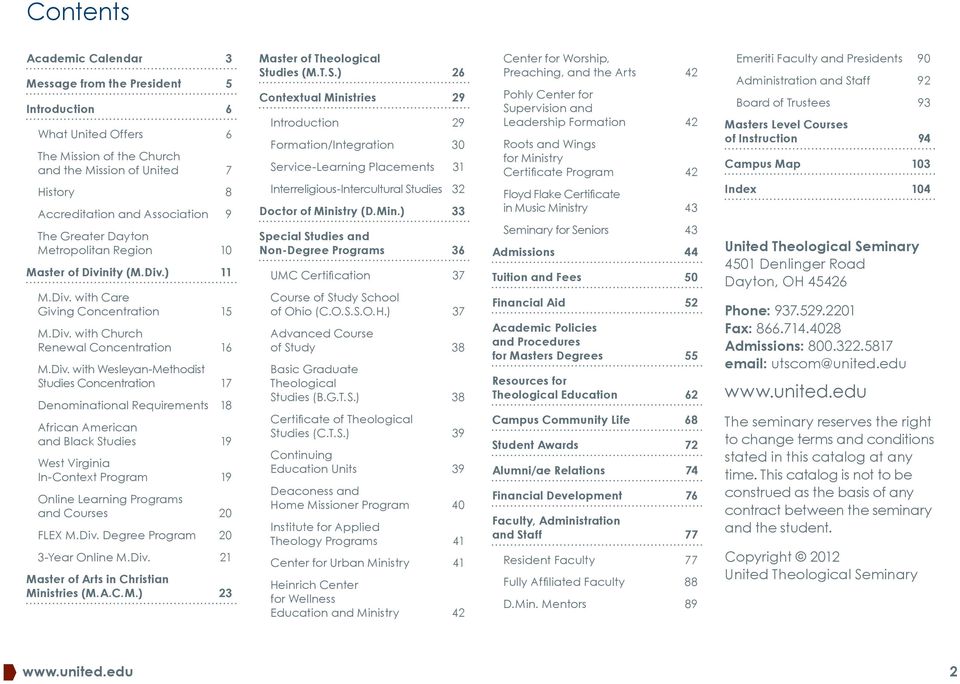
2 Contents Academic Calendar 3 Message from the President 5 Introduction 6 What United Offers 6 The Mission of the Church and the Mission of United 7 History 8 Accreditation and Association 9 The Greater Dayton Metropolitan Region 10 Master of Divinity (M.Div.) 11 M.Div. with Care Giving Concentration 15 M.Div. with Church Renewal Concentration 16 M.Div. with Wesleyan-Methodist Studies Concentration 17 Denominational Requirements 18 African American and Black Studies 19 West Virginia In-Context Program 19 Online Learning Programs and Courses 20 FLEX M.Div. Degree Program 20 3-Year Online M.Div. 21 Master of Arts in Christian Ministries (M.A.C.M.) 23 Master of Theological Studies (M.T.S.) 26 Contextual Ministries 29 Introduction 29 Formation/Integration 30 Service-Learning Placements 31 Interreligious-Intercultural Studies 32 Doctor of Ministry (D.Min.) 33 Special Studies and Non-Degree Programs 36 UMC Certification 37 Course of Study School of Ohio (C.O.S.S.O.H.) 37 Advanced Course of Study 38 Basic Graduate Theological Studies (B.G.T.S.) 38 Certificate of Theological Studies (C.T.S.) 39 Continuing Education Units 39 Deaconess and Home Missioner Program 40 Institute for Applied Theology Programs 41 Center for Urban Ministry 41 Heinrich Center for Wellness Education and Ministry 42 Center for Worship, Preaching, and the Arts 42 Pohly Center for Supervision and Leadership Formation 42 Roots and Wings for Ministry Certificate Program 42 Floyd Flake Certificate in Music Ministry 43 Seminary for Seniors 43 Admissions 44 Tuition and Fees 50 Financial Aid 52 Academic Policies and Procedures for Masters Degrees 55 Resources for Theological Education 62 Campus Community Life 68 Student Awards 72 Alumni/ae Relations 74 Financial Development 76 Faculty, Administration and Staff 77 Resident Faculty 77 Fully Affiliated Faculty 88 D.Min. Mentors 89 Emeriti Faculty and Presidents 90 Administration and Staff 92 Board of Trustees 93 Masters Level Courses of Instruction 94 Campus Map 103 Index 104 United Theological Seminary 4501 Denlinger Road Dayton, OH Phone: Fax: Admissions: [email protected] The seminary reserves the right to change terms and conditions stated in this catalog at any time. This catalog is not to be construed as the basis of any contract between the seminary and the student. Copyright 2012 United Theological Seminary 2
3 Academic Calendar Fall Semester Module A-3: Aug. 1 Aug. 24 Module A-9: Aug. 1 Sep. 28 FLEX M.Div. Residency Weeks: Aug Doctor of Ministry Intensive: Aug Module B-6: Sep. 3 Oct. 13 Module BC-12: Sep. 3 Dec. 14 Fall Convocation: Sep. 5 Gathering/Reading Week: Sep Heck Lectures: Oct. 17 Reading Week: Oct Module C-6: Oct. 29 Dec. 15 Spring Semester Module A-3: Jan Doctor of Ministry Intensive: Jan. 28 Feb. 1 Module B-6: Feb. 4 Mar. 16 Module BC-12: Feb. 4 May 24 Gathering Week: TBA Reading Week: Feb. 25 Mar. 1 Reading Week: Apr. 1 5 Holy Week Break: Mar Module C-6: Apr. 9 May 25 Reading Week: Apr. 29 May 3 Commencement: May 25 Module D-3: Jun Ryterband Symposium: Oct. 15 Reading Week and Thanksgiving Break: Nov Advent Commencement: Dec. 14 Christmas Recess: Dec. 17 Jan

4 Academic Calendar Fall Semester Spring Semester Fall Semester Spring Semester Module A-3: Aug Module A-3: Jan Module A-3: Aug Module A-3: Jan Module A-9: Aug. 5 Oct. 5 FLEX M.Div. Residency Weeks: Aug Doctor of Ministry Intensive: Jan Module B-6: Feb. 3 Mar. 21 FLEX M.Div. Residency Weeks: Aug Module A-9: Aug. 4 Oct. 3 Doctor of Ministry Intensive: Jan Module B-6: Feb. 2 Mar. 21 Doctor of Ministry Intensive: Aug Module B-6: Sep. 9 Oct. 28 Module BC-12: Sep. 9 Dec. 20 Fall Convocation: Sep. 11 Gathering/Reading Week: Sep. 30 Oct. 4 Heck Lectures: Oct. 16 Reading Week: Oct. 28 Nov. 1 Module C-6: Nov. 4 Dec. 20 Module BC-12: Feb. 3 May 23 Gathering Week: TBA Reading Week: Feb Reading Week: Mar Holy Week Break: Apr Module C-6: Apr. 1 May 23 Reading Week: Apr Commencement: May 24 Module D-3: Jun Doctor of Ministry Intensive: Aug Module B-6: Sep. 8 Oct. 24 Module BC-12: Sep. 8 Dec. 19 Fall Convocation: Sep. 10 Gathering/Reading Week: Sep. 29 Oct. 3 Reading Week: Oct. 27 Oct. 31 Module C-6: Nov. 3 Dec. 19 Ryterband Symposium: TBA Module BC-12: Feb. 2 May 22 Gathering Week: TBA Reading Week: Feb Reading Week: Mar Holy Week Break: Mar. 30 Apr. 4 Module C-6: Apr. 6 May 22 Reading Week: Apr. 27 May 1 Commencement: May 22 Module D-3: Jun Ryterband Symposium: TBA Reading Week and Thanksgiving Break: Nov Advent Commencement: Dec. 20 Christmas Recess: Dec. 23 Jan. 6 Reading Week and Thanksgiving Break: Nov Advent Commencement: Dec. 19 Christmas Recess: Dec. 22 Jan

5 Message from the President United: An amazing place to say yes to God's call! Do you want to dig deeper and grow spiritually and intellectually? Is the Holy Spirit beckoning you to follow Jesus into mission and ministry that will be dynamic, effective and compassionate? Do you want to help renew the Church and change the world for the better? Are you eager to learn from the best sources, starting with the Bible and the early Church, along with today s greatest teachers, leaders and practitioners? Please consider visiting and enrolling in United's vibrant community of faith and learning! Here you will be welcomed, supported, challenged, and equipped for faithful ministry in the name and Spirit of Jesus Christ! Our excellent academic programs are second to none and are designed to meet a variety of needs in different formats including traditional and online, day, evenings, and weekends. With our faculty and staff, I look forward to welcoming you to our campus. We are eager to assist you in exploring and fulfilling God's call! With faith and joy in Christ, Wendy J. Deichmann, President Spirit Led, Renewing the Church! 5

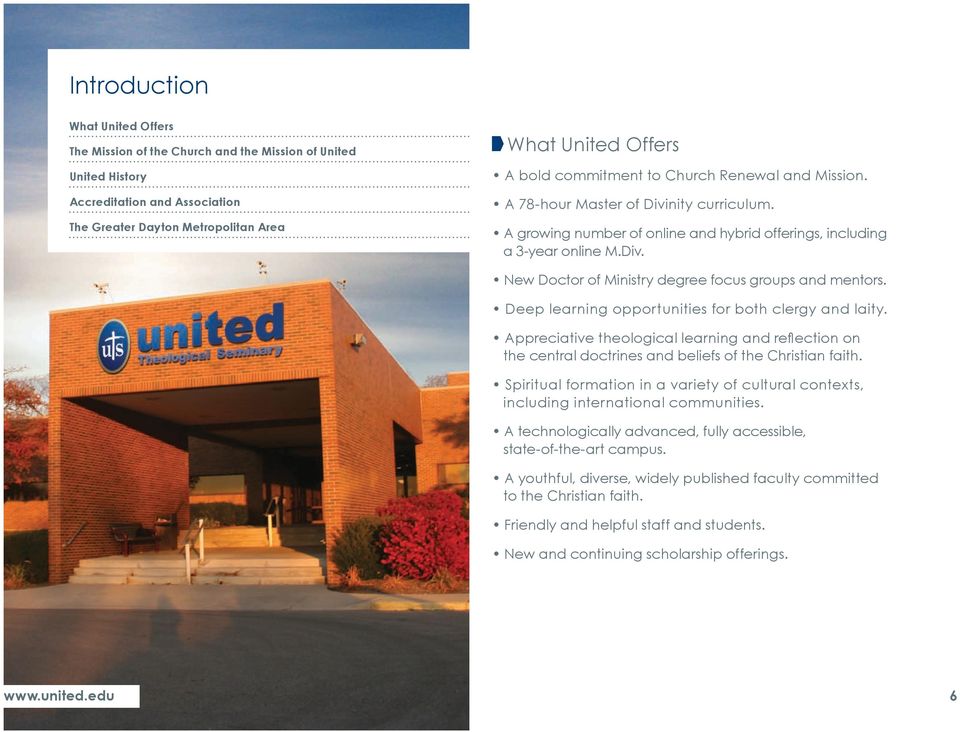
6 Introduction What United Offers The Mission of the Church and the Mission of United United History Accreditation and Association The Greater Dayton Metropolitan Area What United Offers A bold commitment to Church Renewal and Mission. A 78-hour Master of Divinity curriculum. A growing number of online and hybrid offerings, including a 3-year online M.Div. New Doctor of Ministry degree focus groups and mentors. Deep learning opportunities for both clergy and laity. Appreciative theological learning and reflection on the central doctrines and beliefs of the Christian faith. Spiritual formation in a variety of cultural contexts, including international communities. A technologically advanced, fully accessible, state-of-the-art campus. A youthful, diverse, widely published faculty committed to the Christian faith. Friendly and helpful staff and students. New and continuing scholarship offerings. 6
7 Introduction The Mission of the Church and the Mission of United The earliest Methodists were purposeful about the mission of God in and through the Church. What was this mission? At the London Conference of 1744, their statement of purpose was formally adopted: To reform the nation, more particularly the Church; to spread scriptural holiness over the land. The mission of the Methodists included reformation of the Church so that it could faithfully fulfill God s purposes in the world. United s programs are designed to prepare leaders who can renew the Church for its mission of proclaiming the Gospel and making disciples of Jesus Christ in today s world. This mission and our programs are explicitly ecumenical, welcoming the theological, cultural and denominational diversity that the Christian Church comprises. We celebrate the privilege of being part of this extraordinary mission, and we welcome the possibility of serving you as you figure out and follow God s dynamic call in your life! The United Methodist Church and the larger family of the Christian Church have been endowed and entrusted with the legacy of Christ s mission to the world. We take to heart this Great Commission: Go therefore and make disciples of all nations, baptizing them in the name of the Father and of the Son and of the Holy Spirit, and teaching them to obey everything I have commanded you... (Matthew 28:19-20; NRSV). In the Wesleyan theological tradition, this mission is necessarily paired with the Great Commandment: You shall love the Lord your God with all your heart, and with all your soul, and with all your mind... and... you shall love your neighbor as yourself (Matthew 22:37-39; NRSV). The mission of God, we believe, is always a product of the genuine, pure love that has its infinite source in God. It is the mission of reconciling, lifegiving love incarnated and made known to the world in Jesus Christ. What is the role of United Theological Seminary in this mission? We share with other schools a mission outlined in The Book of Discipline, which is: preparing persons for leadership in the ministry... ; leading in the ongoing reflection on Wesleyan theology; and... assisting the church in fulfilling its mission to make disciples of Jesus Christ (par. 1422). 7

8 Introduction History United Theological Seminary traces its history back to the former Church of the United Brethren in Christ and The Evangelical Church. Both denominations were made up of largely Germanspeaking immigrant communities, and both bodies traced their theological roots to the Wesleyan/Methodist movement and other Protestant missions in the eighteenth and early nineteenth centuries in North America. In 1871, The Church of the United Brethren in Christ founded Union Biblical Seminary in Dayton, Ohio. In 1910, the name of the school was changed to Bonebrake Theological Seminary. The seminary established its campus at 1810 Harvard Boulevard in Dayton in In 1946, The Church of the United Brethren in Christ and The Evangelical Church united to form The Evangelical United Brethren Church. The Evangelical School of Theology, situated in Reading Pennsylvania, on the campus of Albright College, had served The Evangelical Church since 1905, and the union of the two denominations brought about the merger of the two seminaries in 1954 into United Theological Seminary. United Theological Seminary was created by combining the full body of administrative and teaching personnel, the libraries and the financial resources of the two former schools. With the union of The Evangelical United Brethren Church and The Methodist Church in 1968, United Theological Seminary became one of thirteen theological schools of The United Methodist Church. United established course offering sites in New York and West Virginia in At these locations, students, clergy and laity have benefited from theological education opportunities in geographic areas not readily served by a United Methodist seminary. Need, interest, and available resources of the institution and local areas have determined the nature and extent of educational offerings at each site. In 2005, United Theological Seminary sold its Harvard Boulevard campus and relocated to a newer, completely accessible facility in the community of Trotwood, four miles to the northwest. United continues to celebrate its rich heritage and to draw upon the abiding commitment, ecumenical outlook, and religious professions of its founding members in its educational mission to a new generation of church leaders, lay and ordained Union Biblical Seminary 1923 Harvard Boulevard Campus 1946 EUB formed 1954 Merged with EUB; became United Theological Seminary of 13 UMC Schools 1995 Courses in NY and VA 2005 Trotwood Campus 8

9 Introduction Accreditation and Association United Theological Seminary is accredited by the Association of Theological Schools in the United States and Canada, and the Higher Learning Commission of the North Central Association of Colleges and Schools, and is approved by the Ohio Board of Regents. United Theological Seminary s off-site program in West Virginia is governed by and meets the requirements of specific accreditation bodies. The procedures for accreditation review are available in the seminary s library. United Theological Seminary is one of thirteen United Methodist seminaries in the United States and is listed by the University Senate of the denomination as an approved theological school for the education of United Methodist clergy. United Theological Seminary is a participating member in the Southwestern Ohio Council of Higher Education. 9

10 Introduction The Greater Dayton Metropolitan Region The seminary s location in Dayton, Ohio, provides a wealth of community and church resources for theological education in the heart of southwestern Ohio s rural-urban-industrial complex. The Dayton Art Institute, the Public Library, the Dayton Philharmonic Orchestra, Dayton Ballet, Opera, Contemporary Dance, Community and University Theater, the Dayton Dragons baseball team, the churches and the synagogues, the Greater Dayton Y, the Greater Dayton Christian Connection, the University of Dayton, Sinclair College, Wright State University, and scores of other institutions and organizations make the city a center rich with religious and cultural opportunities. Students find field placement in area churches and in community agencies such as child development centers, Goodwill Industries, community health programs, mental health centers, and various municipal programs in connection with urban development, housing, poverty, and community action programs. Students work under the supervision of chaplains and counselors in ACPE accredited programs in clinical pastoral education at The Upper Valley Medical Center (Troy), Kettering Medical Center (Kettering), Grandview Hospital (Dayton), The Veteran s Administration Hospital (Dayton), and other settings. Miami Valley Hospital (Dayton) offers clinical pastoral education under accreditation by the College of Pastoral Supervision and Psychotherapy. Many churches offer opportunities for ministry. Community centers, such as the Wesley Center supported by the West Ohio Conference of The United Methodist Church, provide opportunities for service to low income and disadvantaged persons. The seminary enjoys a close working relationship with the cities of Dayton and Trotwood and the seminary campus provides recreational facilities for children, youth and adults. The outdoor pool is managed by the Y and is open from Memorial Day to Labor Day each year. A membership to the Y is needed to access this pool, and discounted rates are given to students, staff, and faculty of the seminary. Current information about this program is available through the Trotwood Y. 10

11 Master of Divinity (M.Div.) For those preparing to enter ministry as ordained religious leaders or as lay professional ministers Purpose The Master of Divinity degree program is designed for those preparing to enter ministry as ordained religious leaders or as lay professional ministers. This program meets the requirements for ordination in most major Protestant denominations. The M.Div. degree is designed to: Strengthen personal and corporate spiritual life and worship, and deepen relationships with God and others in cooperation with the grace of Jesus Christ and the power of the Holy Spirit Provide opportunities for students to engage in rigorous intellectual inquiry of topics related to Christian ministry Expose students to aspects of world Christianity and world religions Develop selfunderstanding, spiritual maturity and direction within a Christ-centered seminary community Emphasize biblical, Christian teachings, values and heritage Accentuate the mission of the Church in both local and global contexts Foster understanding that God s redemptive activity is both personally and socially transformational Cultivate the skills and perspectives necessary for the faithful practice of Christian ministry and leadership 11

12 Master of Divinity (M.Div.) Comprehensive in academic focus and process, the Master of Divinity program includes rigorous coursework in both academic and practical disciplines, along with the intentional worship and community life necessary for personal and professional development in ministry. It integrates experience and theological knowledge to develop faithful, transformational leaders for effective and compassionate Christian ministry in the Church and world. The program s design requires that all students participate in intercultural experiences to increase sensitivity toward a multicultural world and to promote awareness that God s love and good will extend to the whole of humanity. Growth toward this objective is furthered by coursework that incorporates perspectives from, and texts written by, persons from a variety of cultures. Within the collegial and consultative setting of the Ministry Formation and Integration Groups, students gain expertise in reflecting theologically on their ministerial experiences and classroom learning and benefit from the insight and experience of peers, scholars, mentors and supervisors. Ministry Groups also provide helpful opportunities for students to set educational goals, share personal journeys and engage in self-evaluation. As part of the Ministry Formation and Integration experience, all first- and second-year M.Div. students are required to participate in the seminary community s corporate worship life and Common Meal. Student Orientation All entering students and transfer students must participate in an orientation session that introduces many crucial aspects of life at United. Details can be found at links.united.edu/gtfgc. Contextual Ministries At United, preparation for religious leadership in the Church and world requires that students encounter Christ within themselves, their own traditions and other cultures. This part of United s curriculum explores contexts for worship, sacramental life, and service. Students are exposed to the unity and diversity of the Church; issues of justice and peace; societies global interdependence; the integrity of creation; and servant ministry. The Contextual Ministries program includes the Formation/ Integration coursework, Service-learning Placements, and Intercultural Immersion. See the Contextual Ministries section on page 29 for more details. Curriculum The Master of Divinity degree can be accomplished in a variety of formats. Whether it is accomplished online, in person, or through a combination of these methods, the same curriculum is followed. For more details on the 3-Year Online Master of Divinity program, see page

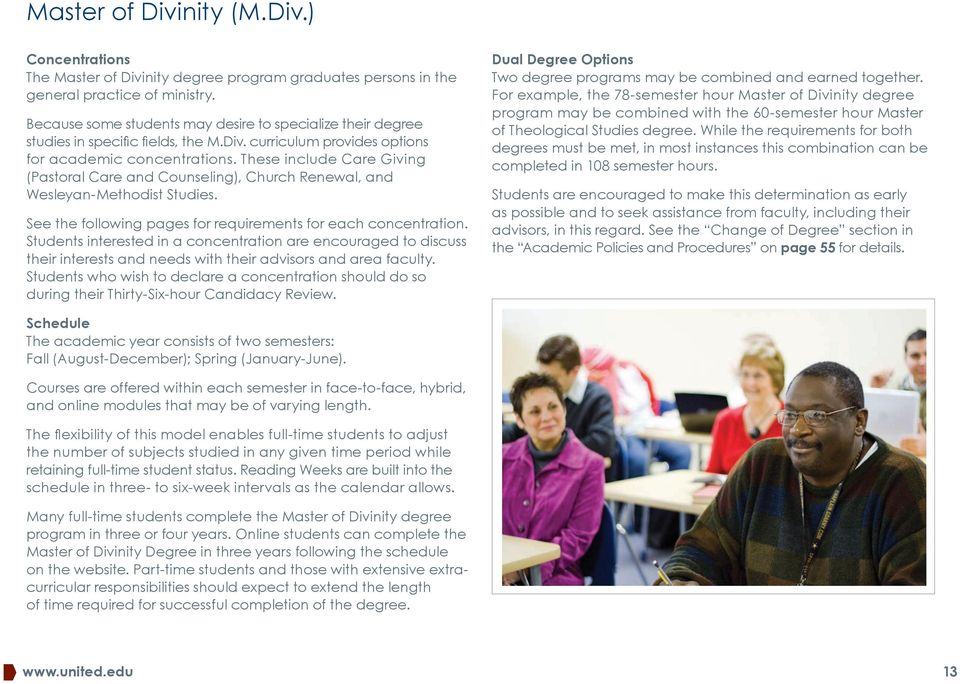
13 Master of Divinity (M.Div.) Concentrations The Master of Divinity degree program graduates persons in the general practice of ministry. Because some students may desire to specialize their degree studies in specific fields, the M.Div. curriculum provides options for academic concentrations. These include Care Giving (Pastoral Care and Counseling), Church Renewal, and Wesleyan-Methodist Studies. See the following pages for requirements for each concentration. Students interested in a concentration are encouraged to discuss their interests and needs with their advisors and area faculty. Students who wish to declare a concentration should do so during their Thirty-Six-hour Candidacy Review. Dual Degree Options Two degree programs may be combined and earned together. For example, the 78-semester hour Master of Divinity degree program may be combined with the 60-semester hour Master of Theological Studies degree. While the requirements for both degrees must be met, in most instances this combination can be completed in 108 semester hours. Students are encouraged to make this determination as early as possible and to seek assistance from faculty, including their advisors, in this regard. See the Change of Degree section in the Academic Policies and Procedures on page 55 for details. Schedule The academic year consists of two semesters: Fall (August-December); Spring (January-June). Courses are offered within each semester in face-to-face, hybrid, and online modules that may be of varying length. The flexibility of this model enables full-time students to adjust the number of subjects studied in any given time period while retaining full-time student status. Reading Weeks are built into the schedule in three- to six-week intervals as the calendar allows. Many full-time students complete the Master of Divinity degree program in three or four years. Online students can complete the Master of Divinity Degree in three years following the schedule on the website. Part-time students and those with extensive extracurricular responsibilities should expect to extend the length of time required for successful completion of the degree. 13
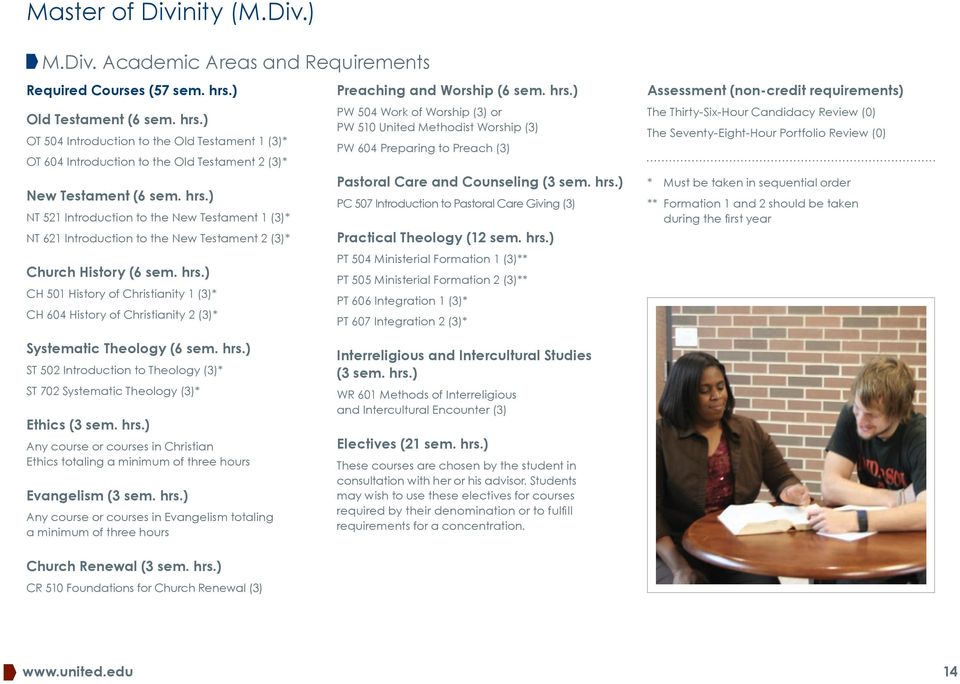
14 Master of Divinity (M.Div.) M.Div. Academic Areas and Requirements Required Courses (57 sem. hrs.) Old Testament (6 sem. hrs.) OT 504 Introduction to the Old Testament 1 (3)* OT 604 Introduction to the Old Testament 2 (3)* New Testament (6 sem. hrs.) NT 521 Introduction to the New Testament 1 (3)* NT 621 Introduction to the New Testament 2 (3)* Church History (6 sem. hrs.) CH 501 History of Christianity 1 (3)* CH 604 History of Christianity 2 (3)* Preaching and Worship (6 sem. hrs.) PW 504 Work of Worship (3) or PW 510 United Methodist Worship (3) PW 604 Preparing to Preach (3) Pastoral Care and Counseling (3 sem. hrs.) PC 507 Introduction to Pastoral Care Giving (3) Practical Theology (12 sem. hrs.) PT 504 Ministerial Formation 1 (3)** PT 505 Ministerial Formation 2 (3)** PT 606 Integration 1 (3)* PT 607 Integration 2 (3)* Assessment (non-credit requirements) The Thirty-Six-Hour Candidacy Review (0) The Seventy-Eight-Hour Portfolio Review (0) * Must be taken in sequential order ** Formation 1 and 2 should be taken during the first year Systematic Theology (6 sem. hrs.) ST 502 Introduction to Theology (3)* ST 702 Systematic Theology (3)* Ethics (3 sem. hrs.) Any course or courses in Christian Ethics totaling a minimum of three hours Evangelism (3 sem. hrs.) Any course or courses in Evangelism totaling a minimum of three hours Interreligious and Intercultural Studies (3 sem. hrs.) WR 601 Methods of Interreligious and Intercultural Encounter (3) Electives (21 sem. hrs.) These courses are chosen by the student in consultation with her or his advisor. Students may wish to use these electives for courses required by their denomination or to fulfill requirements for a concentration. Church Renewal (3 sem. hrs.) CR 510 Foundations for Church Renewal (3) 14
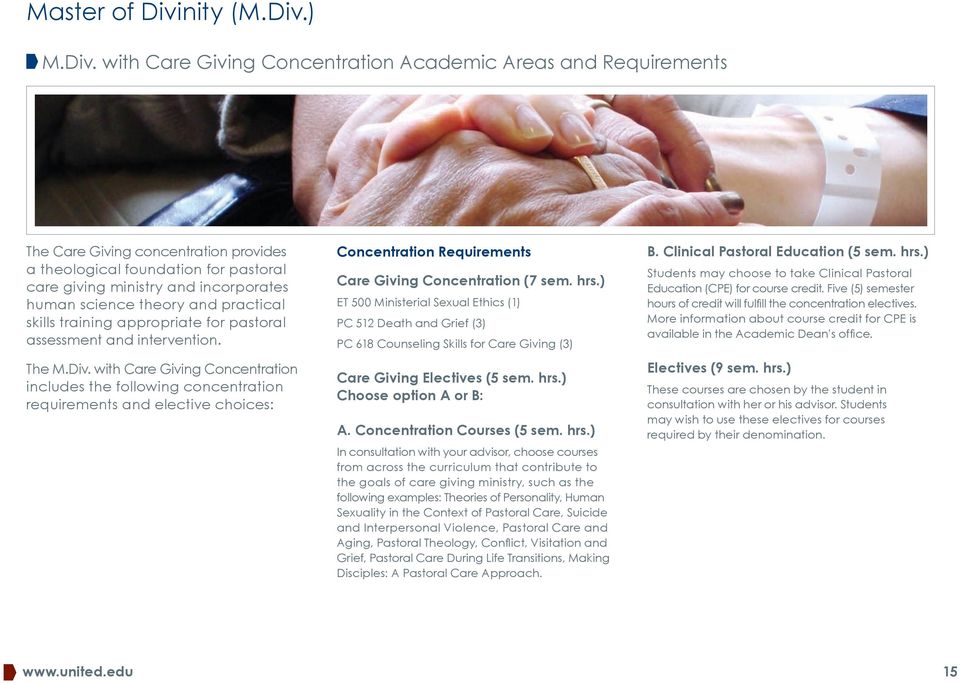
15 Master of Divinity (M.Div.) M.Div. with Care Giving Concentration Academic Areas and Requirements The Care Giving concentration provides a theological foundation for pastoral care giving ministry and incorporates human science theory and practical skills training appropriate for pastoral assessment and intervention. The M.Div. with Care Giving Concentration includes the following concentration requirements and elective choices: Concentration Requirements Care Giving Concentration (7 sem. hrs.) ET 500 Ministerial Sexual Ethics (1) PC 512 Death and Grief (3) PC 618 Counseling Skills for Care Giving (3) Care Giving Electives (5 sem. hrs.) Choose option A or B: A. Concentration Courses (5 sem. hrs.) In consultation with your advisor, choose courses from across the curriculum that contribute to the goals of care giving ministry, such as the following examples: Theories of Personality, Human Sexuality in the Context of Pastoral Care, Suicide and Interpersonal Violence, Pastoral Care and Aging, Pastoral Theology, Conflict, Visitation and Grief, Pastoral Care During Life Transitions, Making Disciples: A Pastoral Care Approach. B. Clinical Pastoral Education (5 sem. hrs.) Students may choose to take Clinical Pastoral Education (CPE) for course credit. Five (5) semester hours of credit will fulfill the concentration electives. More information about course credit for CPE is available in the Academic Dean s office. Electives (9 sem. hrs.) These courses are chosen by the student in consultation with her or his advisor. Students may wish to use these electives for courses required by their denomination. 15
16 Master of Divinity (M.Div.) M.Div. with Church Renewal Concentration Academic Areas and Requirements This concentration is designed for students who want to participate actively and meaningfully in the renewal of the church. This specialization will help students to think critically and creatively about the decline of the church in the modern West and about the recent explosive growth of the church in the Southern Hemisphere. In the light of these developments, students will construct a theological vision for church renewal that is biblically based, historically informed, and critically engaged with political, cultural, and global issues. This concentration will enable students to provide leadership in a variety of areas related to the renewal of the church, including the renewal of worship, missions and evangelism, Christian initiation and formation, and media communications in an increasingly digital culture and world. The M.Div. with Church Renewal Concentration includes the following concentration requirements and elective choices: Concentration Requirements Church Renewal Requirements (6 sem. hrs.) CR 611 Leadership for Ministry (3) CR 512 The Missional Church (3) or MM 524 Introduction to Digital Storytelling (3) Church Renewal Electives (3 sem. hrs.) CR 503 Seminar in Church Renewal 1 (3) CR 512 The Missional Church (3) CR 513 Seminar in Church Renewal 2 (3) CR 515 Holiness, Pentecostal, and Charismatic Renewal Movements (3) CR 601 The Reformation as Church Renewal (3) CR 615 Black Church Renewal (3) CR 618 Church Renewal in the Christian Tradition (3) CR 619 Scripture and Church Renewal (3) EV 520 Evangelism on Sunday Morning (3)*** EV 525 Issues in Evangelism (3)*** EV 528 Christ, Culture, and Conversion (3)*** MM 524 Introduction to Digital Storytelling (3)*** MM 534 Visual Storytelling in Worship (3) PT 503 Spiritual Disciplines for Renewal (3) PT 617 Preaching and Presiding in the Church Year PW 504 The Work of Worship (3)*** PW 607 Sunday Service of Word and Sacrament (3) PW 610 Sacraments of Christian Initiation (3) In addition, any course with a CR prefix will count toward the church renewal concentration elective requirements. Electives (12 sem. hrs.) These courses are chosen by the student in consultation with her or his advisor. Students may wish to use these electives for courses required by their denomination. *** Courses used to fulfill M.Div. requirements will not also count as Church Renewal Concentration electives 16

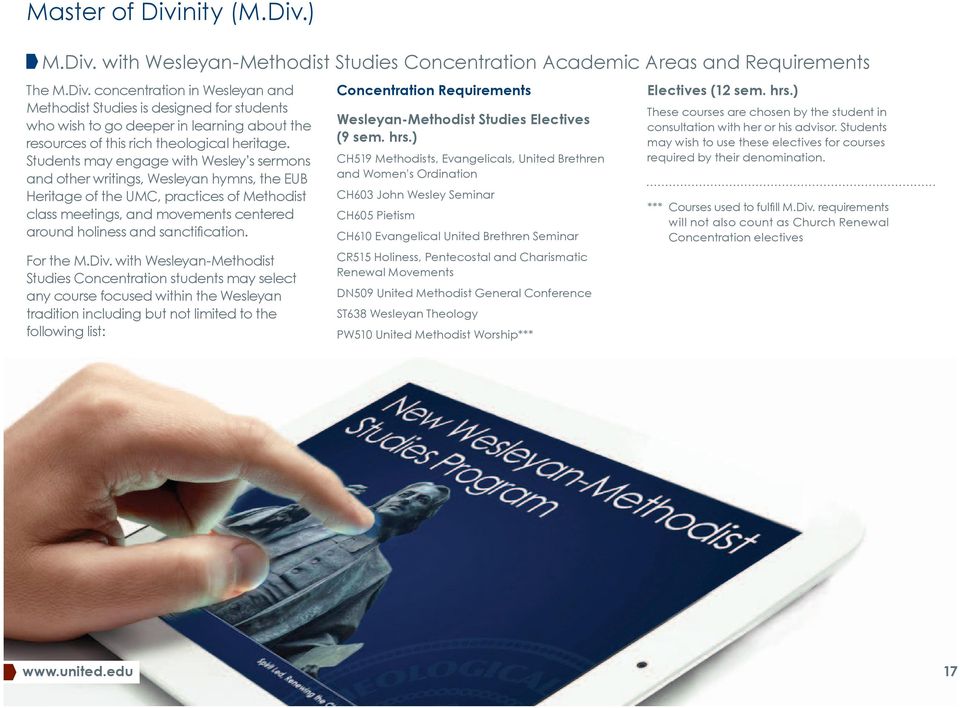
17 Master of Divinity (M.Div.) M.Div. with Wesleyan-Methodist Studies Concentration Academic Areas and Requirements The M.Div. concentration in Wesleyan and Methodist Studies is designed for students who wish to go deeper in learning about the resources of this rich theological heritage. Students may engage with Wesley s sermons and other writings, Wesleyan hymns, the EUB Heritage of the UMC, practices of Methodist class meetings, and movements centered around holiness and sanctification. For the M.Div. with Wesleyan-Methodist Studies Concentration students may select any course focused within the Wesleyan tradition including but not limited to the following list: Concentration Requirements Wesleyan-Methodist Studies Electives (9 sem. hrs.) CH519 Methodists, Evangelicals, United Brethren and Women s Ordination CH603 John Wesley Seminar CH605 Pietism CH610 Evangelical United Brethren Seminar CR515 Holiness, Pentecostal and Charismatic Renewal Movements DN509 United Methodist General Conference ST638 Wesleyan Theology PW510 United Methodist Worship*** Electives (12 sem. hrs.) These courses are chosen by the student in consultation with her or his advisor. Students may wish to use these electives for courses required by their denomination. *** Courses used to fulfill M.Div. requirements will not also count as Church Renewal Concentration electives 17
18 Master of Divinity (M.Div.) Denominational Requirements and Offerings (DN) The Master of Divinity degree program regularly provides opportunities to fulfill denominational requirements for The United Methodist Church, Presbyterian Church (P.C.U.S.A. and P.C.A.), The United Church of Christ, Baptist churches, and others as needed. Students are responsible for inquiring into the requirements of their respective denominations. United will make special arrangements whenever feasible to ensure that all M.Div. students meet the academic requirements of their denominations. Denominational courses are generally taught when the number of students in need of them is sufficient. In most cases that will be every two to three years. United Methodist courses are generally offered at least once a year. Provided that there are at least five students, these courses will be taught in the usual fashion. If there are fewer than five students, the course will be considered a Directed Study and each student will pay the school a $125 per semester hour surcharge at the time of registration to cover the instructor s stipend. Candidates for ordination in The United Methodist Church are advised to consult with their annual conference boards of ordained ministry regarding required competencies and areas of study. These courses are not required for graduation, but many denominations require denominational courses for ordination or various forms of ministry. These courses are also available to help prepare students to meet particular denominational needs and to foster growth in one s denominational heritage, theological identity and ethos. Please check the requirements prescribed by your denomination and discuss these with your faculty advisor. Baptist AF 624 Martin Luther King, Jr. (3) CH 655 Calvin and Calvinism (3) CH 651 The European Reformations (3) DN 522 Baptist Polity and History (3) DN 623 Baptist Theology: Doctrine, Ethics and Witness (3) ST 640 Baptist, Evangelical, and Pentecostal Theologies (3) Presbyterian CE 526 Introduction to Christian Education (3) CE 601 The Pastor as Christian Educator (3) CE 603 Christian Education of Children (3) CE 608 Christian Education of Adults (3) CH 655 Calvin and Calvinism (3) CH 651 The European Reformations (3) DN 510 Presbyterian Polity (2) DN 659 Reformed History and Theology (2) ET 512 Current Ethical Issues and Christian Praxis (3) NT 527 Greek 1 (3) NT 627 Greek 2 (3) OT 510 Hebrew 1 (3) OT 611 Hebrew 2 (3) PW 610 Sacraments of Christian Initiation (3) Courses in Greek and Hebrew Exegesis are available on a regular basis. United Methodist DN 502 United Methodist History (2) DN 503 Contemporary United Methodist Polity (2) DN 607 United Methodist Doctrine (2) Wesleyan and Methodist Studies CH 519 Methodists, Evangelicals, United Brethren and Women s Ordination (3) CH 605 Pietism (3) CH 639 Apostolic Fathers (3) CH 603 John Wesley Seminar (3) CH 610 Evangelical United Brethren Heritage Seminar (3) DN 509 United Methodist General Conference (3) ST 638 Wesleyan Theology (3) PW 510 United Methodist Worship (3) PW 610 Sacraments of Christian Initiation (3) 18

19 Master of Divinity (M.Div.) African American and Black Studies Building upon a long history of partnership with African American and Black Churches, United offers courses that prepare students for ministry in, and in relationship with, Black Church traditions. These courses include: CH 514 Introduction to African American Church History (3) AF 515 Introduction to Black Theology (3) AF 624 Martin Luther King, Jr. (3) CR 615 Black Church Renewal (3) In addition, United and Payne Theological Seminary share a relationship that allows students to cross-register in both institutions courses. A seminary of the African Methodist Episcopal Church located in nearby Wilberforce, Ohio, Payne offers numerous courses in African American and Black Studies that are available to United students. Please see the Payne website for the latest listings. West Virginia In-Context Master of Divinity The In-Context Master of Divinity degree program is designed for clergy and those preparing to enter full-time ministry as ordained religious leaders in geographic areas that are not readily served by a United Methodist Seminary. This program, which began in 1995, uses the library, classroom and faculty resources of West Virginia Wesleyan College in Buckhannon. Approved adjunct faculty members from neighboring institutions also serve as instructors. Faculty and coursework are shared between the campus in Ohio, the West Virginia site, and online learning. The curriculum for the West Virginia course offering site is structured by design and course schedule to meet the personal and professional needs and interests of those pursuing theological education while ministering to local churches clustered in this specific area. It meets the requirements for ordination in most major Protestant denominations. The In-Context curriculum is comprehensive in academic focus and process. It includes the disciplines appropriate to theological understanding and ministerial practice, intentional and supervised engagement in ministry and membership in a community of faith and caring. Intensive classes for this program are offered on Fridays, Saturdays and online. Normally, at least three years of full-time study are required for completion of this 78-hour degree program. For information, contact the Director of the West Virginia Program or see United s website for details. First click Future Students, then choose Masters Degree programs on the left. 19

20 Master of Divinity (M.Div.) Online Learning Programs and Courses Online Learning has been developed as a learning modality that enhances the student s ability to attend courses from a distance (the teacher and students in different locations) with the same rigor and quality as courses offered in the classroom and on campus. Courses are conducted in asynchronous lessons, meaning that the student can engage in discussions, assignments, and other forms of course work at any time of the day or night as their schedules permit. In some courses there may be synchronous course work, which means the instructor and student meet at the same time of day online. This is agreed upon and planned for by the instructor and students ahead of time. Some important distinctions need to be understood. Online learning courses are not the same as learning in the classroom. The student will need to take responsibility for seeking answers and becoming a self-motivated learner. Online courses require good time management, planning, writing, and communication skills. Students will also need adequate technology skills or the willingness to learn technology quickly. There are helpdesk services available to students who need additional help or trouble shooting advice at [email protected]. FLEX UMC M.Div. Degree Program United now offers a Flexible Residency Hybrid Master of Divinity degree that meets all the requirements for ordination in the United Methodist Church as established by the University Senate of the UMC. This program can be completed in seven semesters (or just over three years). This 80-hour degree offers the same quality of education as our traditional M.Div. with the added flexibility of August FLEX Residency Weeks as well as hybrid and online course offerings. It is designed especially for students in regions not readily served by a local seminary community and offers a hybrid model of distance theological education that aims to maximize the use of technology while also allowing the student to complete one-third of the degree in residence, as required for United Methodist ordination. Requirements Complete a minimum of one-third of the degree in residency on United s campus through a combination of four mandatory twoweek FLEX Residency Weeks and a Gathering Week residency each semester. Students should enroll in Hybrid Contextual Ministries as soon as they begin the M.Div. The degree program, may also be completed over a longer period of time and may be a mixture of educational formats to fit individual schedules. Schedules should be reviewed by the faculty advisor. Course Schedules A suggested course schedule is provided at but courses may be taken at any time or in any order (subject to prerequisites). Course offerings are subject to change. 20

21 Master of Divinity (M.Div.) Gathering Weeks Gathering Weeks will be offered twice a year at our Dayton, Ohio, campus so that online students can complete the face-to-face portion of their degree. For Gathering Week dates see links.united.edu/ljjne. Included in the Gathering Week: Ministerial Formation I and II and Intergration I and II Communal worship and meals Ministry (MIN) group gatherings Intensive courses Gathering Week Fees: There are some additional costs associated with Gathering Weeks. Please visit United s website for more details. Housing: Lower prices have been negotiated at some of the hotels in the area. Please explore the Visitor Accommodation section of the website to make room arrangements for the week or contact Student Services. Transportation: United may provide transportation to and from the hotels in Englewood near I-70 and SR 48 for a nominal fee. Please contact Student Services for details and to advise if this service is needed. Some hotels provide free transportation to and from the airport. Please arrange this with the hotel. FLEX Residency Weeks Every August, students will gather at our Dayton, Ohio, campus for two weeks (beginning on Monday and ending on Friday) to complete intensive courses, to worship as a community, to gain preaching experience, to serve the sacraments, to build relationships with other students, clergy and professors, and to develop as pastoral leaders. FLEX Residency Weeks also allow students to complete the face-to-face portion of the degree. FLEX Residency Weeks Include: Required and elective intensive courses Communal worship and meals Recreation 3-Year Online Master of Divinity Program United offers students a high-quality seminary education with the convenience of remaining with family and the local church community. Designed especially for students in regions not readily served by a local seminary community, this hybrid, student-centered degree program incorporates engaging online coursework with face-to-face time, resulting in a deeply relational and covenantal experience of Christian ministry. The degree is completed through a combination of internet interaction with instructors and classmates and intensive learning and fellowship time at our Dayton, Ohio, campus for one week each semester. This program is accredited by the Association of Theological Schools and The Higher Learning Commission which govern theological and higher education, respectively. 21
22 Master of Divinity (M.Div.) Each student must check with her or his own denominational judicatory regarding requirements for ordination. The seminary will assist each student in selecting courses to meet judicatory requirements. For the most current details about the program and for course planning schedules, students should visit United's website at In order to earn your degree, you must: 1. Complete a minimum of one-third of your degree in a hybrid or face-to-face format. United s Gathering Weeks allow you to complete up to two-thirds in a hybrid or face-to-face format. For ordination requirements, please check with your own judicatory. 2. Enroll in Hybrid Contextual Ministries as soon as you begin your M.Div. if you plan to complete your degree in three years. All theological students (except M.T.S.) must enroll in the Contextual Ministries Program, which consists of: A. A professionally facilitated ministry group (MINgroup) that meets weekly online and in the one-week intensives (Gathering Week) B. Ministry in a church or community site in your area (10 20 hours per week) C. Integration and Formation courses D. Intercultural Trip For more information on Contextual Ministries see page 29. Gathering Weeks Gathering Weeks will be offered twice a year at our Dayton, Ohio, campus so that online students can complete the face-to-face portion of their degree. For Gathering Week dates see links.united.edu/ljjne. Included in the Gathering Week: Formation I and II and Integration I and II Communal worship and meals MINgroup gatherings Intensive courses Gathering Week Fees: There are some additional costs associated with Gathering Weeks. Please visit United s website for more details. Housing: Lower prices have been negotiated at some of the hotels in the area. Please explore the Visitor Accommodation section of the website to make room arrangements for the week or contact Student Services. Transportation: United may provide transportation to and from the hotels in Englewood near I-70 and SR 48 for a nominal fee. Please contact Student Services for details and to advise us if this service is needed. Some hotels provide free transportation to and from the airport. Please arrange this with the hotel. Course Schedules A suggested course schedule is provided at but courses may be taken at any time or in any order (subject to prerequisites). Course offerings are subject to change. 22
23 Master of Arts in Christian Ministries (M.A.C.M.) For those seeking to specialize in various areas of leadership related to the Christian community s public life and practice Purpose The M.A. in Christian Ministries (M.A.C.M.) is designed to equip people for leadership and service in various areas related to the Christian community s public life and practice. The M.A. in Christian Ministries is designed for people who are: In a denomination that does not require a Master of Divinity Preparing for the work of Deacon in The United Methodist Church Seeking to supplement existing professional specialties with theological studies Laypersons who seek to serve the church with specific competencies Students who complete the M.A. in Christian Ministries will: Develop personal and spiritual characteristics necessary for Christian ministry Know the theories undergirding their ministry and be able to utilize them to carry out the practice of that ministry Be able to draw on different disciplines to create an effective ministry Be able to plan, implement, and evaluate ministry programs in their area of specialization 23
24 Master of Arts in Christian Ministries (M.A.C.M.) Curriculum Student Orientation All entering students and transfer students must participate in an orientation session that introduces many crucial aspects of life at United. Details can be found at links.united.edu/gtfgc. Course schedules are developed to accommodate both full-time and part-time students. Working in a placement of more than twenty hours each week may extend the time it takes to complete the degree. Contextual Ministries At United, preparation for religious leadership in the Church and world requires that students encounter Christ within themselves, within their own tradition(s) and within those of other cultures. Theologically and experientially, this part of United s curriculum explores local and global contexts for worship, sacramental life, and service; the unity and diversity of the Church and its relationship to other faiths; issues of justice and peace; societies global interdependence; the integrity of creation; and servant ministry as both ecumenical and global. The Contextual Ministries program includes the Formation/Integration coursework and Service-learning Placements. See the Contextual Ministries section on page 29 for more details. Schedule The academic year consists of two semesters: Fall (August-December); Spring (January-June). Courses are offered within each semester in modules that may be three, six, nine, or twelve weeks in length. The flexibility of this model enables full-time students to adjust the number of subjects studied in any given time period while retaining full-time student status. Reading Weeks are built into the schedule in three- to six-week intervals as the calendar allows. 24
25 Master of Arts in Christian Ministries (M.A.C.M.) M.A.C.M. Academic Areas and Requirements Required Courses (30 sem. hrs.) Church History (3 sem. hrs.) CH 501 History of Christianity 1 (3) or CH 604 History of Christianity 2 (3) Electives (15 sem. hrs.) In consultation with her or his advisor, a student may use these hours to fulfill denominational requirements or choose courses from across the curriculum. Assessment (non-credit requirements) The Twenty-One Hour Progress Evaluation (0) The Forty-Five Hour Portfolio Review (0) New Testament (3 sem. hrs.) NT 521 Introduction to New Testament 1 (3) or NT 621 Introduction to New Testament 2 (3) Old Testament (3 sem. hrs.) OT 504 Introduction to Old Testament 1 (3) or OT 604 Introduction to Old Testament 2 (3) Pastoral Care and Counseling (3 sem. hrs.) PC 507 Introduction to Pastoral Care Giving (3) Practical Theology (15 sem. hrs.) PT 504 Ministerial Formation 1 (3) PT 505 Ministerial Formation 2 (3) PW 504 Work of Worship (3) or PW 510 United Methodist Worship (3) Any 3 Credit Hour Course in Evangelism (3) PW 604 Preparing to Preach (3) or PT 611 Christian Spiritual Formation or CE 526 Introduction to Christian Education (3) Systematic Theology (3 sem. hrs.) ST 502 Introduction to Theology (3) 25
26 Master of Theological Studies (M.T.S.) For those pursuing the academic study of religion or seeking to increase religious understanding Purpose The Master of Theological Studies degree program is designed for persons who wish to pursue the academic study of religion or to increase their religious understanding and their ministerial capacity to serve the Church and community. Students in this program may include: Persons preparing for further graduate study Individuals with intellectual interests in religion Persons seeking ordination as deacons in The United Methodist Church Teachers and leaders in local churches Persons wishing to bring theological perspectives to their professional endeavors Pastors seeking to extend their theological education or concentrate in specific theological areas The Master of Theological Studies degree is designed to: Provide a solid basis in theological foundations including bible, theology, church history and related theological studies Introduce students to methodologies involved in the academic study of religion Extend one s understanding of theological studies through concentration in a specific theological area Enable a student to develop a specialization for a specific vocational aim Deepen a student s understanding of the varieties of Christian faith and practice 26
27 Master of Theological Studies (M.T.S.) Curriculum Student Orientation All entering students and transfer students must participate in an orientation session that introduces many crucial aspects of life at United. Details can be found at links.united.edu/gtfgc. Schedule Courses are offered within each semester in face-to-face, hybrid, and online modules of varying lengths. The flexibility of this model enables full-time students to adjust the number of subjects studied in any given time period while retaining full-time student status. Reading Weeks are built into the schedule in three- to six-week intervals as the calendar allows. Dual Degree Options The Master of Theological Studies (M.T.S.) degree program may be taken simultaneously with another masters level degree program. This normally adds a full year (30 semester hours) to the degree program or two full years (48 semester hours) when combined with the M.Div. degree. Students are encouraged to make this determination as early as possible and to seek assistance from faculty including their advisor in this regard. See the Change of Degree section in the Academic Policies and Procedures on page 61 for details. Academic Course of Study The M.T.S. degree program involves sixty (60) semester hours of academic study distributed among theological foundations, an area of concentration and electives. A field of concentration includes course work (15 semester hours) and a major thesis paper or project (3 semester hours) done as a Directed Study under the direction of a faculty member with expertise in the area. In addition, M.T.S. students meet four (4) times each semester in an M.T.S. Colloquy for evaluation, planning, reflection on their course of study and the presentation of final projects. 27
28 Master of Theological Studies (M.T.S.) M.T.S. Academic Areas and Requirements Basic Theological Studies (24 sem. hrs.) Biblical Studies (OT, NT) (12 sem. hrs.) OT 504 Introduction to the Old Testament 1 (3)* OT 604 Introduction to the Old Testament 2 (3)* NT 521 Introduction to New Testament 1 (3)* NT 621 Introduction to New Testament 2 (3)* Church History (CH) (6 sem. hrs.) CH 501 History of Christianity 1 (3)* CH 604 History of Christianity 2 (3)* Theology (ST) (6 sem. hrs.) ST 502 Introduction to Theology (3) One additional Theology (ST) elective (3) Master of Theological Studies (36 sem. hrs.) Concentration (18 sem. hrs.) Coursework (15) Thesis paper or project (3) M.T.S. Colloquy (3 sem. hrs.) Colloquy attendance is required of all M.T.S. students. The M.T.S. Colloquy meets four (4) times each semester. Students are required to register for: CQ 520 M.T.S. Colloquy (1) One semester hour of Colloquy must be taken within the first 30 semester hours of the program. CQ 520A M.T.S. Colloquy Attendance (0) Every semester for the length of the student s residency. There is no cost and no credit for Colloquy Attendance registrations. CQ 620 M.T.S. Colloquy Thesis Proposal (1) One semester hour of Colloquy must be taken in the semester in which the thesis proposal is presented. CQ 621 M.T.S. Colloquy Thesis Completion (1) One semester hour of Colloquy must be taken in the semester in which the thesis paper or project is completed. Assessment (non-credit requirements) The Thirty-hour Progress Evaluation (0) The Forty-five hour Candidacy Review (0) The Sixty Hour Portfolio Review (0) * Must be taken in sequential order Electives (15 sem. hrs.) These courses are chosen by the student in consultation with her or his advisor. 28
29 Contextual Ministries Formation/Integration Service Learning Placements Intercultural Immersion Introduction United s commitment to contextualized theological education originates in our historic Christian heritage, the cultivation of holiness in both personal and social dimensions of discipleship, and a living call to Christ-centered community in an unavoidably interreligious world. Within covenantal, facilitated peer groups each student serves in a community/church placement and learns critically contextual reasoning within the theological disciplines and shared practices of faith toward a supervised discernment of God s particular calling. The formation/integration program revolves around local church and community service-learning placements and facilitated peer groups for critical theological reflection. The intercultural immersion program toward the end of the degree stretches students horizons to understand context and collaboration in a global sense. Contextual Ministries encourages students to develop stronger skills in: Spiritual disciplines for a balanced life amidst the development of professional competence Critical understanding(s) of church leadership and corresponding criteria for further development of leadership skills Well-bounded relationships for the support of ministry Discernment of gifts as means of professional thriving in church and community ministries Critical theological reflection that speaks to the church/world, yet weaves concrete experience of the Spirit Engagement of cross-cultural and interreligious understanding and communication 29
30 Contextual Ministries Formation/Integration Formation Six credit hours of formation must be taken in sequence by all students in the M.Div., and M.A. degree programs. One avenue is PT 504 Formation 1 in the Fall module followed by PT 505 Formation 2 in the Spring module. The other avenue is six credits of the hybrid-delivery Formation curriculum composed of multiple online units and two oncampus Gathering Weeks, one each fall and spring semester. See page 3 for Gathering Week dates. Students are placed into a professionally facilitated peer group with expected duration of Formation 1 and 2. Students receive 3 semester hours of credit per course for successful completion of all syllabus objectives and course requirements, as evaluated by the MINgroup leadership including: Work(at least 10 hours a week) in a service-learning placement concurrent with Formation coursework Written assignments and presentations in MINgroup Regular weekly and active participation in peer group process and collegial development Attendance and participation in plenary sessions, MINgroup activities, worship and common meals Amidst brief readings, plenary lectures, spiritual autobiographies, and case studies, MINgroups engage intentional formation in spiritual, professional-pastoral, and wisdom dimensions. They provide contextually sensitive opportunities for students to grow in spiritual maturity and critical theological reflection. worship and table fellowship within the Gathering Weeks, complemented by intentional prayer and fellowship engaged in online community practices (hybrid curriculum). Liturgy, scripture, sacrament, table fellowship, small group process, and supervisory discernment constitute the web within which skills of faithful attentiveness and theological reflection develop toward faithful Christian leadership in God s church. Integration With a prerequisite of Formation 1 and 2, six credit hours of Integration must be taken in sequence by all students in the M.Div. degree program. Students are again placed into a professionally facilitated peer group which may or may not be similar in constitution to groups in Formation 1 and 2. One avenue is PT 606 Integration 1 in the Fall module followed by PT 607 Integration 2 in the Spring module. Another avenue is six credits of the hybrid-delivery Integration curriculum composed of multiple online units and two on-campus Gathering Weeks, one week each fall and spring semester. See page 3 for Gathering Week dates. Students receive 3 semester hours of credit per course for successful completion of all syllabus objectives and course requirements, as evaluated by the MINgroup leadership, including Work (at least 10 hours a week) in a service-learning placement concurrent with Integration coursework Written assignments and presentations in MINgroup Regular (weekly) and active participation in peer group process and collegial development Attendance and participation in plenary sessions, MINgroup activities, worship and common meals This formation is also rooted in practices of communal worship which vary according to curricular format of coursework: a weekly all-campus Word and Sacrament worship service and a communal meal (face-to-face curriculum) or communal Amidst advanced readings, plenary lectures, case studies, and theological composition, these MINgroups integrate with intention the diverse preparations of peers, ongoing theological 30
31 Contextual Ministries coursework, and service-learning placement experiences into a working paper called a theological statement for ministry. Within the similar contexts of liturgy, scripture, sacrament, table fellowship, small group process, and supervisory discernment, Integration students take fledging steps into professional ministry discourse that bridges the settings of local congregation and/or agencies with those of denominational bodies of certification. Service-Learning Placements Formation students participate hours/week in a local, service-learning placement for the duration of their coursework in PT504 and PT505. Integration students (M.Div. degree program) participate hours per week either in the same service-learning placements (i.e. Student Pastor or Student Associate appointment), or in new placements that may diversify their experience of Christian ministry and theological reflection in new contexts. The preferred pattern for M.Div. students is to serve one year in a community organization and one year in a church setting. A placement is negotiated between the service-learning site (mentors and staff) and the student, with assistance and approval by the Director of Contextual Ministries. It is the student s responsibility to discern her or his interests and the type of placement in which she or he desires to learn and serve. A listing of approved organizations/agencies and church sites is available through the Office of Contextual Ministries, and contains both voluntary (nonpaying) and compensated positions, some of which qualify for Federal Work Study funds. Each student works on-site at the service-learning placement and in regular monthly or bi-weekly conversations with a mentor (either on-site or in a nearby ministry site). Community Settings The advantage of a community site placement is the student s opportunity to experience in learning/teaching exchanges the diversity of ministry responsibilities within broader community. The breadth and depth of human needs to which faithful disciples must respond and from which the gifts and graces of attentive discipleship grow form a necessarily broad perspective for students critical theological reflection. Prison ministry, transitional housing ministries, community centers, shelters, hospitals and other community service organizations strengthen the students understandings of Christ s preferential option for the other (marginalized, poor, or unseen) within the Spirit s transformative work in us all. Church Settings The advantage of a church site placement is an in-depth contextual introduction to the real workings of the local church. Approximately one hundred churches located in rural and urban areas participate in United s Contextual Ministries program. Involvement in these settings provides students with opportunities to engage in a range of pastoral and specialized ministries that contribute to professional ministry identity and discernment of calling within the invitation to spiritual maturity. Particular to our United Methodist heritage, two placement options deserve further specification: student pastor and student associate appointments. A student pastor serves as the sole pastor of a church or charge. A student associate serves in a local church with an appointed or 31
32 Contextual Ministries called pastor. A student in either placement position is paired with a mentor who assists the student with theological reflection, annual learning goals, periodic feedback, and evaluation. For a student pastor the mentor is ordinarily a nearby ordained minister. For a student associate the mentor is ordinarily the senior pastor of the church. United students serving nearby churches often commute to campus daily; those situated in churches at some distance may find it more feasible to commute to campus weekly and use nearby housing options when on campus. Students living at a substantial distance from United s campus may take advantage of the hybrid-curriculum of Formation and Integration requiring residence at United for one week each fall and spring semester. Interreligious-Intercultural Curriculum In an increasingly polarized cultural milieu, effective religious leaders require opportunities to examine their socio-cultural location and presuppositions amidst those of others within and outside of the church in a religiously pluralistic world. The interreligious-intercultural curriculum is a faculty initiative designed to prepare students for encounter with diverse religious traditions in various cultural settings. The purpose of this initiative is: To develop sensitivity, deepen Christian discipleship, and heighten capacity for sustenance in interreligious and intercultural complexity(ies) To provide conceptual, liturgical, and practical introduction to theologies of religious pluralism, scriptural reasoning, and comparative theological deepening of discipleship To examine students theological integration and preparedness for ministry in culturally and religiously pluralist environments through an international immersion experience, which concludes with a post-experience, critical theological reflection. After completion of prerequisites NT521 or OT504 (Introduction to NT or OT), ST502 Introduction to Theology, and PT606 Integration 1 (at least concurrent) - Master of Divinity students are required, and other degree candidates are invited, to register for WR601 Methods for Interreligious and Intercultural Encounter. During their first two full semesters of degree coursework, students must select an Immersion Experience trip from the approved list available from the Coordinator of Student Services. Trips and seminars generally take place during January or in the summer months. Students complete WR601 at least the semester before their desired travel. The methods course is prerequisite to any travel. Upon successful completion of the course, students participate in the Immersion Experience, which, as a rule, takes place outside of the United States and Canada within a cohort of no less than six students. Exceptions are granted only with the approval of the Coordinator of Student Services and the Academic Dean. Spouses and older children are encouraged to participate when possible. The monies for this program are interwoven into the fee structure of the M.Div. degree program. A nonrefundable Immersion Experience surcharge of $60 per semester hour provides a way for students to accumulate up to $4,680 for the 78 semester hours of the Master of Divinity program. Additional funds might be raised from a student s congregation or in other ways, should the student choose a trip that exceeds the planned amount. The surcharge funds both those accumulated and those that will be paid by the time of graduation are made available at the time the student participates in an Immersion Experience. The Interreligious-Intercultural initiative is a crucial opportunity to encounter other cultures, religious practices, and people of faith outside a student s previous worldview. The coursework, travel, and concluding reflections are designed to provide critically reflective and sensitively nuanced capacity in United graduates for rooted, Christian discipleship within a religiously and culturally pluralistic world. 32
33 Doctor of Ministry (D.Min.) For religious leaders seeking to strengthen their prophetic and pastoral competence and equip others for ministry and outreach Purpose The Doctor of Ministry (D.Min.) program at United Theological Seminary is an advanced professional degree in the practice of ministry based on action research methodology. The program is designed to strengthen the work of ordained clergy in the practice of prophetic and pastoral ministry, lay leaders for ministry in the church, religious educators, and those involved in a variety of community-based ministries. The D.Min. degree is designed to: Empower people in ministry by emphasizing learning as a process of action and reflection within the work context Embody the principle that the ministry context determines the structure and content of theological reflection and research goals Advance the process of mutual inquiry through peer group participation and mentor supervision Challenge participants to discover new strengths and insights for ministry Prepare participants for new ministries 33
34 Doctor of Ministry (D.Min.) Master of Divinity Equivalency Students shall take Master of Divinity Equivalency at United. Students may take courses for Master of Divinity Equivalency from any other ATS-accredited seminary with the approval of the Associate Dean. Curriculum The D.Min. program is a mentor-based contextual model of education, which requires a combination of self-initiative and collegial action/ reflection. The curriculum is intended to develop both individual leadership skills and the ability to support the leadership of others. The two educational goals are achieved through peer group participation and mentor supervision. Individual leadership is achieved through the identification and execution of a research project that is unique to the participant s ministry context. The importance of mutual inquiry is fostered through the peer group process, where individual students reflect theologically in developing a research project with peers who are also engaged in the same general topic. The curriculum is designed to foster critical theological reflection, to model a form of mutual inquiry that will enhance ministry, and to aid the student in the design and execution of an original research project. Program Components The program requires the interweaving of course work, critical reflection on a ministry context, and peer group participation. The educational process makes it possible to develop a high degree of expertise in a particular area of ministry that is rooted in academic inquiry. The goal of the program is for students to test a specialized ministry model that can then be made available for others to use. All phases foster personal, academic and contextual growth. The program is 60 credit hours divided into six phases of ten credits each. Each phase begins with a five-day Intensive. Phases I V include Peer Sessions in addition to the Intensive meeting. In Phase V the student undertakes the research and writing of the thesis project. The Final Exam (project defense) and Thesis Completion is scheduled in Phase VI. The deadlines for Final Exams in Phase VI are February 15 (Spring term) and September 15 (Fall term) Phase Process Each of the six Phases of the program focuses on a particular aspect of the work toward the Doctor of Ministry degree. Phase I focuses on analysis of the participant and the context with an emphasis on how the two come together to form a thesis for the D.Min. research project. Phase II provides instruction in Biblical Studies, Church History and Theology. Phases III, IV, and V focus on the design, implementation, and documentation of a research project. Phase VI focuses on the Final Exam and Thesis Completion for the Doctor of Ministry degree. Intensives The Intensives introduce students to current issues that are impacting ministry. Each Intensive is organized around a specific theme that is taught by national leaders. The Intensives also provide the setting for course work in Bible, Theology, and History, for the development of research methodologies, and for peer group consultation. The 34
35 Doctor of Ministry (D.Min.) uniqueness of each Phase requires students to participate in all 6 Phases; therefore, there can be no admission with advanced standing. The Intensives include the following components: Worship Plenary Sessions focused on the theme of the Intensives Peer Sessions emphasize each phase of the program and the subject matter of the focus group Core Course Work concentrates on the required academic curriculum Peer Sessions The Peer Sessions are a crucial part of the D.Min. curriculum and consist of 32 contact hours for Phases I V. The Peer Sessions provide opportunity for students to work with Faculty Mentors, to participate in collegial peer-to-peer learning, and to receive critical evaluation from a Faculty Consultant. Participants develop relationships that enable them to be both critical and supportive, challenging and affirming. The process of learning through collegial relationships is meant to assist students in evaluating ministry contexts. The Peer Session is an important evaluation group, whose primary purpose is to provide a context for theological reflection at every Phase of the D.Min. program. Evaluation Evaluation of the program is conducted by Faculty Mentors and through the Doctoral Studies Office. The evaluation process consists of: Phase Reviews Review of the Model of Ministry Project Final Examination of Research Project It is important that participants provide constructive, honest criticism of each other. The Faculty Mentor will ensure that each student receives a review in each phase. The standard forms used in the evaluation process are the Phase Review, the Candidacy Review Team Evaluation and the Final Examination forms. Instructors Faculty Mentors United Faculty Mentors serve as instructors for each focus group. Faculty Mentors are experienced in various areas of academia. The Faculty Mentor is the most important instructor in assisting students in the development of their phase papers and designing their research projects. Faculty Consultants United Faculty Consultants serve as resource persons for each focus group. With the Faculty Mentor(s), Faculty Consultants will assist students in developing the Theological Foundation for the final research project. Professional Associates Each student is required to seek the advice of experts in the field. Degree Conferral Degrees are normally conferred in May and December. Candidacy Review 35
36 Special Studies and Non-Degree Programs For those seeking an introduction to theological education or to enhance their ministry opportunities Purpose United Theological Seminary provides a variety of educational offerings to meet a range of needs for theological education. Courses taken at the masters level for special studies and nondegree programs may be counted for credit toward a degree program, should a student who enrolls in one of these programs apply and be admitted to a United degree program. See the Change of Degree section in the Academic Policies and Procedures chapter on page 61 for details. A faculty advisor will be provided as a resource for students who enroll in special studies and non-degree programs for masters level credit, and these credits will be documented on a United transcript. Courses taken for the Roots and Wings Diploma, 30-hour certificate courses or Continuing Education Units are not eligible for degree credit. 36
37 Special Studies and Non-Degree Programs UMC Certification Courses United s UMC Certification program offers a full scope and sequence of courses leading to Professional Certification in these program ministries: Christian Education, Children s Ministry, Music Ministry, Older Adult Ministry, Spiritual Formation, Urban Ministry and Youth Ministry. Courses are offered in an Intensive, Hybrid format, three times a year in January, June and August. To enroll in the UMC Certification program, contact the General Board of Higher Education and Ministry ( and United s Admission s Office to register as a student and fulfill the GBHEM requirements. Questions may also be directed to the UMC Certification program director. Each course in the program, in addition to providing two graduate credits, may be taken for no credit by Visiting and Auditing Students, as well as those seeking GBHEM Paraprofessional Certification. Non-United Methodists are also welcome in the classes. Two scholarships are offered to each registered Professional Certification Student. The General Board of Higher Education and Ministry (GBHEM) scholarship is $200/credit hour and the United Scholarship is $100/credit hour. Scholarship applications can be made to GBHEM by using the Certification/Deacon Scholarship Application (Form 116) or by contacting United. Scholarships are available only to students who enroll as a UMC Professional Certification Student. They do not apply to those who enroll as Visiting or Auditing Students. Course of Study School of Ohio The Course of Study School of Ohio (COSSO) is an educational program established by the Division of Ordained Ministry of the General Board of Higher Education and Ministry, United Methodist Church. The basic Course of Study (COS) is prescribed by the United Methodist Church for the education of persons serving as licensed Local Pastors. This regional program is supported by the Methodist Theological School in Ohio (MTSO) and United Theological Seminary (United) in Dayton, Ohio. COSSO offers courses on both campuses. The faculty is made up of well-qualified instructors, including faculty from the two seminaries and from the surrounding community. All are academically qualified, theologically grounded, and persons who care about the best interest of the students and the church. As prescribed by The Book of Discipline of The United Methodist Church, each part-time licensed local pastor must complete two courses in an annual conference year; full-time licensed local pastors must complete four. Hybrid COS Program The Course of Study School of Ohio is the only COS school to offer hybrid classes and these courses are only offered at United Theological Seminary. Hybrid courses consist of one-half of each course being offered online and one-half offered in the traditional weekend on campus. Online Modules The online portion of each course is taught in modules. Most modules include an online lecture or video, required readings, and written interaction with other students and the professor. 37
38 Special Studies and Non-Degree Programs Face-to-Face Session Unlike standard COS classes, the hybrid format means you travel to campus for only one weekend. On the weekend, classes will be offered in a Friday/Saturday intensive format. Transferability All COSSO Hybrid courses offered at United are transferable to other UMCOS programs. Advanced Course of Study For United Methodist Students Upon approval by the Conference Board of Ordained Ministry, United Methodist local pastors who have completed the Basic Course of Study may meet the educational requirements for conference membership and Elder's orders by taking an additional 32 semester hours of graduate theological studies. Coursework must be planned in consultation with a faculty advisor and be in conformity with the Guidelines for Advanced Course of Study published by the General Board of Higher Education and Ministry. Graduates of the Advanced COS at United Theological Seminary participate fully in commencement exercises and receive a graduate Certificate of Theological Studies. Admission to Advanced COS requires a Bachelor's degree and successful completion of the Basic COS. Basic Graduate Theological Studies (B.G.T.S.) For students in any denomination, especially United Methodists seeking Deacon s orders. The B.G.T.S. program is designed for: Pastors in churches that do not require a masters degree for ordination but who would like graduate training to enhance their ministries Laypersons who desire greater knowledge of theological subjects in order to become more effective leaders in their churches Persons who hold a professional masters degree and are seeking to enter the Order of Deacon in the United Methodist Church United Theological Seminary offers all the courses that meet The United Methodist Church s requirements for Basic Graduate Theological Studies. For United Methodists seeking Deacon s Orders, this coursework must be in conformity with the requirements of the United Methodist General Board of Higher Education and Ministry for the B.G.T.S. program. This coursework is at the masters studies level, and the standards for admission are the same as for masters degrees. Educational Requirements for Deacons The United Methodist Church has opened four different educational paths for those seeking ordination as Deacon: Completion of the Master of Divinity degree Completion of a masters degree program from a graduate theological school, such as United s M.A.C.M. or M.T.S. Supplementing a nontheological masters degree with the B.G.T.S. For persons 35 years of age or older who are recommended by their conference Board of Ordained Ministry, completion of a bachelors degree and professional licensing program and eight semester hours of graduate credit PLUS the B.G.T.S. Student Orientation All entering students and transfer students must participate in an orientation session that introduces many crucial aspects of life at United. Details can be found at links.united.edu/gtfgc. 38
39 Special Studies and Non-Degree Programs B.G.T.S. Requirements United Methodist Studies in: History (2 semester hours) Doctrine (2 semester hours) Polity (2 semester hours) Old Testament (3 semester hours) New Testament (3 semester hours) Church History (3 semester hours) Mission of the Church in the World (3 semester hours) Theology (3 semester hours) Evangelism (3 semester hours) Worship/Liturgy (3 semester hours) Certificate of Theological Studies (C.T.S.) For Students in Any Denomination The C.T.S. is not denomination specific; it is a masters level certificate program offered by United that can be completed in one year of full-time study. The standards for admission are the same as for masters degrees. The goals of the C.T.S. are to: Provide in-depth biblical/theological study Guide students to examine and integrate the meaning of personal faith Help students discern vocational call Aid students to envision diverse and dynamic ministries for the rapidly changing world Certificate Requirements The C.T.S. requires 24 semester hours to be completed in a maximum of three years of full-time or part-time study. Courses must be distributed as follows: Biblical Studies (3 semester hours) Historical Studies (3 semester hours) Theological Studies (3 semester hours) Electives (15 semester hours) The C.T.S. program may satisfy some of the requirements for certain certification programs of The United Methodist Church as approved by the General Board of Higher Education and Ministry, Section of Deacons and Diaconal Ministries. Continuing Education Units For students in any denomination United Theological Seminary is a member of the ecumenical organization, The Society for the Advancement of Continuing Education for Ministry (SACEM). A Continuing Education Unit (CEU) is defined as 10 contact hours of participation in an organized continuing education experience offered under responsible sponsorship, capable direction and qualified instruction. SACEM provides guidelines for awarding Continuing Education Units. This list and a compilation of events sponsored by United are available through the office of the Institute for Applied Theology. 39
40 Special Studies and Non-Degree Programs Deaconess and Home Missioner Program For United Methodist students Deaconesses (women) and Home Missioners (men) are lay people who have responded to the call of God in their lives and have been commissioned by The United Methodist Church to fulltime ministries of love, justice and service. They form a covenant community that is rooted in scripture, informed by history, driven by mission, ecumenical in scope and global in outreach. The purpose of the Office of Deaconess and Home Missioner shall be to express representatively the love and concern of the believing community for the needs in the world and to enable, through education and involvement, the full ministry and mission of the people of God. Deaconesses and Home Missioners function through diverse forms of service directed toward the world to make Jesus Christ known in the fullness of his ministry and mission, which mandate that his followers: Church History (including United Methodist) Doctrine and Polity of the United Methodist Church The standards for admission are the same as for masters degrees. For more information about the Deaconess and Home Missioner program, visit the General Board of Global Ministries website at new.gbgm-umc.org and search deaconess-homemissioner. Or you may contact: Deaconess and Home Missioner Program General Board of Global Ministries 475 Riverside Drive, Room 320 New York, NY Telephone: Alleviate suffering Eradicate causes of injustice and all that robs life of dignity and worth Facilitate the development of full human potential Share in building global community through the church universal United Theological Seminary offers the courses needed to fulfill the educational requirements for the Office of Deaconess or Home Missioner. These masters level courses include: Old Testament New Testament Theology (with a focus on mission) 40
41 Special Studies and Non-Degree Programs Lifelong Learning: The Institute for Applied Theology United s Institute for Applied Theology programs are for church professionals seeking continuing education and UMC certification courses and for laity interested in lifelong learning and spiritual development. In addition, the Wellness Center supports health and wholeness in congregational leaders, from the time a student begins at United. Institute programs complement and enhance the seminary s masters and doctoral tracks by offering courses, workshops, and special events. These are open to students, clergy and lay ministers, and the community. The work of the Institute bears witness to the Gospel, grounded in the great ecumenical traditions of the Church, while seeking to be multicultural, intergenerational, and engaged in communication with a digital culture. Through its Centers, the Institute for Applied Theology: Initiates training opportunities in the practices of ministry Supports a variety of programs for continuing education and ongoing spiritual formation for pastors and other church professionals Offers seminars, classes, workshops, consultations and worship celebrations in which young and old alike may explore Christian faith and practice in fresh, transformative ways Seeks to build networks of congregations and ministry contexts committed to excellence in ministry, to equipping lay and clergy for sharing the Gospel in the 21st century, to health, wholeness, and Sabbath-living; to the renewal of congregational worship, urban outreach, and nurturing young persons and those who lead them For a calendar of Institute for Applied Theology events, go to united.edu and click on Lifelong Learning. The Center for Urban Ministry The Center for Urban Ministry provides urban ministry training for pastors, church professionals and lay persons regardless of formal educational experience. Classes and conferences are offered both on-site at United and through local congregations and judicatory bodies. In addition, the center provides consultant services to local churches wanting to assess and renew their outreach to the local community. In partnership with United s doctoral program, the Center periodically establishes cohort groups of students whose Doctor of Ministry focus is Urban Ministry. 41
42 Special Studies and Non-Degree Programs United offers an Urban Ministry Certification program through the General Board of Higher Education and Ministry, UMC. The Heinrich Center for Wellness Education and Ministry The Heinrich Center for Wellness Education and Ministry is dedicated to encouraging lay and ordained leaders to lead lives of health and wholeness. The center promotes the health and vitality of church leaders by offering workshops and seminars which foster holistic approaches to parish health and pastoral care ministries. United Theological Seminary, through the Heinrich Center, offers a Fit2Lead program, which encourages students to focus upon their own health and wholeness while attending seminary. The Association of Theological Schools has commended United for its strong emphasis on wellness and the partnership with other organizations devoted to mental and physical health. The Center for Worship, Preaching, and the Arts The Center for Worship, Preaching and the Arts offers continuing education for clergy, as well as students in various forms of Gospel proclamation including preaching, media and digital communication, and the visual liturgical arts. Through daylong workshops and a summer three-day retreat, the CWPA introduces participants to explorations of lectionary readings, offers experiences which encourage the use of multimedia communication, and encourages the development of clergy networks where pastors learn from and support one another. The CWPA is often the recipient of Worship Renewal Grants through the Calvin Institute of Christian Worship. The Pohly Center for Supervision and Leadership Formation The Pohly Center extends resources to judicatory leaders, seminaries, pastors, non-profit agencies, and lay persons who desire excellence in ministry in areas of supervision, principled Christian leadership, faith-based conflict management, and effective church organization. The Center provides these resources through seminars, workshops, classroom and online courses. Programs are offered at United and offsite locations structured to meet the needs of various settings and denominations. The Center offers a certification program in supervision, which emphasizes a five-stage process and framework for supervisory conversations as central to helping leaders reflect on the challenges that arise in their work. It also trains mentors for leading both seminary peer groups and doctoral focus groups. Roots and Wings for Ministry Certificate Program The Roots and Wings program is designed to foster and support lifelong learning by laity. There are regular, accessible opportunities through classes offered at the seminary and in host churches to strengthen knowledge and increase skills for leadership in the church and the world. Worship, meals and fellowship are offered in conjunction with many of the courses which are designed with a Sabbath quality in mind. Certificate Requirements Three core courses are required: Biblical Foundations for the Ministry of All Christians, Theology for the Practice of Ministry, and Spiritual Formation in the Christian Tradition. Three specialty courses round out the certificate program, with students choosing from a variety of areas of concentration including Urban Ministry, Leadership Formation, and Christian Formation. 42
43 Special Studies and Non-Degree Programs Six 20-hour courses are required to complete the Roots and Wings certificate and students may enroll in the program at united.edu under Lifelong Learning. Courses are categorized under two sections Roots and Wings. Course dates, updated information, and an online application can be found by going to clicking on the Lifelong Learning tab, and selecting the Roots and Wings menu item on the left. Floyd and Elaine Flake Certificate in Music Ministry The term registration fee allows participants to attend any or all courses taught during that term. Courses are held in local churches in multiple cities and states. More information can be found under the Lifelong Learning menu at To find out more about how Seminary for Seniors can help you reach your lifelong learning goals, contact the registrar at ext The Floyd and Elaine Flake Music Ministry Certificate is a Roots and Wings six-course program geared to enhance one s ability to provide outstanding leadership of music ministry in the twentyfirst century Christian church. The program is structured with some courses offered within a virtual community while others are taught in intensive, hybrid retreats. The cost for the Floyd and Elaine Flake Certificate in Music Ministry is $300 per course, plus meals, housing and course materials. Seminary for Seniors The mission of Seminary for Seniors is to provide opportunities for further learning for adults 50 years and older. Courses focus on issues related to the intersection of faith and culture and are designed to stimulate students intellectually while building fruitful relationships. Each course is in session for a five-week term, and is taught by facilitators with significant experience in their course s subject matter. Thematic concentrations include theology, cultural studies, literature and the arts, religious studies, science and philosophy. Students do not receive academic credit for completing courses, but are intellectually enriched through participation in class discussions and reading assignments. During the five-week term, each course will meet once a week for one to two hours. 43
44 Admissions Admissions Standards Application Process Requirements Deadlines Introduction United Theological Seminary seeks students who wish to deepen their personal and communal faith in Jesus Christ, experience and reflect on relevant issues facing today s Church and develop competency in the practice of ministry. Although each degree program is designed with unique objectives in mind, all degree programs prepare graduates for effective leadership in the Church and society. Prospective students are asked to submit an application with the necessary supporting documentation that attests to an adequate academic record, an obvious awareness of God s call in their lives and the affirming witness of the gathered community. 44
45 Admissions Campus Visitation United invites prospective masters students to schedule campus visits, preferably when classes are in session. Visiting on a Wednesday during a BC-12 module enables participation in community worship and Common Meal. Prospective students may attend a class of interest, meet current students and faculty, tour the campus and meet with admissions staff. In addition, United often sponsors special ministry events to assist prospective masters students in discerning their call into ministry. Participation in these activities offers prospective students another means to learn about theological education at United. Visit for dates, event description, and registration. Persons planning to visit the campus on specifically designated dates or at other times should contact the Admissions Office two weeks in advance. Application Information Prospective students seeking admission to any of United Theological Seminary s degree programs should request application materials from the Office of Admissions or use the application forms at These are located by clicking "Apply Now" at the top and following the instructions. Applications are evaluated for admission when all required documentation and fees are received. The Admissions Office responds to each applicant by or mail regarding their admittance or denial of admittance. Qualifying applicants are asked to indicate their response to the offer of admission by completing the accompanying Letter of Intent and returning the form to the Admissions Office. All application materials become the property of the seminary and cannot be returned. The seminary reserves the right to refuse admission to any student. Masters Degree Admissions Standards for Admission All students admitted to United are asked to provide evidence of a growing faith, potential for exercising creative ministry in a professional capacity, personal maturity and ability to relate well to others. Applicants should have successfully completed an undergraduate degree (with a minimum grade point average of 2.5 on a 4.0 scale) from a regionally accredited institution. Application Process To be considered for admission, prospective students must complete the following tasks on or before the appropriate deadline: Application: Provide a completed application including written answers to essays found in the body of the application form. Transcripts: Arrange for official transcripts of all education beyond high school to be sent directly from the colleges and universities to the Office of Admissions. Faxed copies are not accepted at any time. Recommendations: Arrange for completed recommendations to be sent directly from references to the Office of Admissions. Application Fee: Pay a non-refundable application fee. Payment must accompany the application. See links.united.edu/qzunp for amount. Interview: An interview may be requested. Background Checks: United Theological Seminary requires criminal background checks on all degree-seeking applicants. 45
46 Admissions Application Timeline for Masters Students New students typically begin courses in the BC-12 module. Applications and all supporting documents must be received by one month prior to the 12-week module start date (see calendar on page 3 for module dates). Prospective students seeking Student Pastor appointments in United Methodist churches and all International Students must submit application materials by January 15 before the Fall Semester in which they intend to enroll. Advanced Standing and Transfer Credit Shared Credit may be granted to students who request it on the basis of previous graduate level work completed for a degree at other accredited institutions. Transfer Credit may be granted for credit earned at other schools accredited by the Association of Theological Schools, if that credit has not yet been applied toward a degree, provided that the courses taken correspond to elements of United s curriculum. In some instances, advanced standing will be granted for prior academic work. Any student who wishes to receive advanced standing is required to meet with the Academic Dean. The Academic Dean has sole responsibility for granting advanced standing. In some cases, United has formal agreements with other institutions, and in those cases the stipulations of the agreement will determine what, if any, advanced standing a student may receive, contingent upon the approval of the Academic Dean. In cases in which no formal agreement exists, the Academic Dean may, in consultation with the student, grant advanced standing after reviewing the student s formal transcripts. Applicants seeking advanced standing should indicate this on their application for admission. Once all official transcripts are received, the Admissions Officer will prepare an Evaluation of Advanced Standing for the Academic Dean. The Academic Dean will review this evaluation and sign it as being officially acceptable. The evaluation is then returned to the Admissions Officer who notifies the student of the results of her or his request. Students who do not request advanced standing on their application form must submit a written request to the Admissions Office and the student is notified of the results of her or his request. United Methodist local pastors enrolled in the Course of Study program may be granted ten (10) semester hours of credit for a completed Course of Study or two (2) semester hours of credit for each year of completed coursework. Masters degree students who enter United with shared or transfer credit must take at least the last 30 semester hours of courses at United and fulfill all the requirements for the degree. Special Student Status Special Student status is available to qualified applicants who wish to take courses without designating a specific degree program. Students are required to complete the Special Student application form, pay a nonrefundable application fee (see links.united.edu/ qzunp for amount) and provide proof of Bachelor s Degree. Doctor of Ministry Degree Admissions Standards for Admission The Doctor of Ministry degree is an advanced degree program that presupposes a Master of Divinity degree followed by at least three years of professional ministry experience. 46
47 Admissions Application Process To be considered for admission, prospective students must complete the following tasks on or before the appropriate timeline date: Application: Provide a completed application including a spiritual autobiography and description of current ministry context. Transcripts: Arrange for official transcripts of all education beyond high school to be sent directly to United from the college, university or seminary, including official Master of Divinity transcript. Transcripts must show evidence of a cumulative grade point average of 3.0 (based on 4.0 GPA scale) or its equivalent. Faxed copies of transcripts are not accepted at any time. Letter of Support: Arrange for a letter of support and expression of cooperation for applicant s participation in the doctoral program from the appropriate group in the local congregation or other context of ministry. This letter is most helpful if it gives information about the applicant s style of ministry. Letter of Recommendation: Arrange for a letter of recommendation from an ecclesiastical supervisor who knows the applicant s work and can provide assurance of support for applicant s program involvement. If applicant has no ecclesiastical supervisor, a colleague-in-ministry is to be asked to write a letter of recommendation. Application Fee: Pay a non-refundable application fee. Payment must accompany the application. See links.united.edu/qzunp for amount. Background Checks: United Theological Seminary requires criminal background checks on all degree-seeking applicants. Due to the structure of United s Doctor of Ministry program, no advance standing (transfer credit) can be granted upon entry into the program. Application Timeline Full applications for admission, along with all supporting documents, must be received by the following dates: July 15: August Intensive December 15: January Intensive International Student Admissions Standards for Admission United welcomes students from throughout the world and is authorized under federal law to enroll a student of international origin (J or F visa) who is not a citizen or permanent resident of the United States. International students should begin the admission process no less than one year prior to their expected arrival date at United. Applications for admission received after January 15 may not be considered for admission in that calendar year. Students for whom English is a second language are required to have proficiency in English. Application Process To be considered for admission, prospective international students must forward the following items to the Admissions Office on or before the appropriate deadline: Application: Completed application for admission including all requested written essays. 47
48 Admissions Application Fee: Pay a non-refundable application fee. Payment must accompany the application. See links.united.edu/qzunp for amount. Recommendations: Professional and personal recommendations sent by postal mail to United. At least one reference should be submitted by a judicatory official such as a bishop or similar church authority indicating approval of the applicant s plans to study at United Theological Seminary. Transcripts: Official transcripts from all colleges and universities attended. These must be official transcripts sent directly to United by postal mail from the university. Faxed copies are not accepted at any time. Grade Point Average: Evidence of a cumulative grade point average of 2.5 for masters degree admission and 3.0 for Doctoral degree admission (based on 4.0 GPA scale) or its equivalent. TOEFL Score: Recent TOEFL score of 550 on paperbased tests or 213 for computerbased tests for masters degrees students and 570 (paper) or 230 (computer) for Doctoral degree students. The score needs to be reported by the testing agency on an original document. Information on taking the TOEFL test is available on their website ( or you may write to Educational Testing Service, PO Box 6151, Princeton, NJ Citizenship: Evidence of nationality and citizenship. Application Timeline All international students should submit full applications, including all supporting documents, no later than January 15 prior to the Fall Semester. Additional Admissions Information Housing United Theological Seminary works with several local apartment complexes in order to provide quality housing at affordable rates. From commuter housing to family student housing as well as temporary housing, a variety of options are available to meet the needs of United students. Descriptions are available on the website at united.edu in the Housing and Visitor Accommodations section under Future Students. Students interested in student housing must apply through United Theological Seminary. Only current students and fully admitted applicants may apply. For information about housing or to receive a housing application, please contact the Coordinator of Student Services. Accessibility The Trotwood campus is completely wheelchair accessible. The building has an elevator and entrances are equipped with ramps. Financial Resources: Evidence of adequate financial resources for school and living expenses including copies of bank statements and signed support letters from sponsoring organizations and individuals. 48
49 Admissions Administrative Policies Relating to Federal Guidelines Veteran s Information Degree programs at United Theological Seminary have been approved by the State approving agency for Veteran s Training. Veterans must complete the procedures required to establish entitlement to an academic program. Students who are veterans can contact the Registrar for further information and must report to the Registrar any change of status in enrollment or withdrawal. Equal Opportunity Act United Theological Seminary prohibits discrimination against any individual on the basis of race, color, religion, sex, age, national origin, disability, sexual orientation, marital status, parental status, or veteran status with reference to the seminary s admission policies, academic standards and policies, in the granting of scholarships, loans and other financial aid. Inquiries regarding the application of this policy should be addressed to the Academic Dean. Privacy Act (Buckley Amendment) Under the provisions of the Family Educational Rights and Privacy Act (Buckley Amendment), students have the right to inspect and review their educational records held by the seminary and to request correction of any inaccurate data. United will disclose student information only to those who are authorized and have legitimate need for such information. No records will be released without a written and signed request from the student. No third party requests will be honored without a signed waiver. For further information and assistance, contact the Registrar s Office. 49
50 Tuition and Fees United strives to make theological education affordable Introduction United Theological Seminary strives to make theological education affordable through reasonable tuition costs, contextual education placements and a financial aid and scholarship program. The Board of Trustees approves tuition rate changes on an annual basis. The current tuition and fees can be found on the seminary s website at links.united.edu/qzunp. 50
51 Tuition and Fees Payment Policy for All Students All tuition and fees must be paid prior to registration deadlines (see page 57). Any outstanding charges from the previous semester will delay course registration until such charges are met. Failure to pay tuition in a timely manner may result in loss of academic credit for that semester. Delinquent Accounts Students whose financial obligations are not paid in full are not eligible to register for the next semester or to receive transcripts, grades, enrollment verification or degrees. Financial obligations include tuition, fees, housing, library fines, and all other items billed by the seminary. Students anticipating graduation must pay in full all financial obligations to the school at least 14 days prior to the date of commencement. United permits payment by cash, check, Visa, MasterCard,Discover, or online at links.united.edu/qzunp. All payments are to be made directly to the Business Office. Inquiries regarding payment and payment options should be directed to the Business Office. Deferred Payment Plans for Full-time Students Full-time masters and Doctoral students may arrange to pay tuition and fees for the Fall or Spring Semesters on a deferred basis, subject to the following provisions: It is the student s responsibility to see that all payments reach the Business Office on or before the payment deadlines or agreedupon dates, whether or not a bill has been received. Students may pay their tuition for a semester in four monthly installments. The first payment is due at the time of enrollment. See the Business Office for details. Charges incurred during the semester are due in full upon receipt of written notice from the Business Office and are payable in addition to any deferred payment obligations. 51
52 Financial Aid A financial aid package may include eligibility for Scholarships, Federal Work/Study, Contextual Education Employment, and Loans Introduction Financial Aid works with students to determine and access resources available to support their theological education. Finances are handled with a view toward fiscal responsibility, integrity, accountability, and thoughtful planning. Financial assistance is available through both the seminary and outside sources. United attempts to present a comprehensive financial aid package which may include eligibility for scholarships, federal work/study, contextual education employment, and loans. For a complete listing of financial aid principles and procedures, contact Financial Aid. 52
53 Financial Aid Eligibility Students must be enrolled for a minimum of 6 credit hours in one of United s masters degree programs to be eligible for financial aid including loans and federal work/study. In order to be eligible for United's scholarships, a student must be enrolled for a minimum of 9 hours. Students enrolled in the doctoral program are eligible for loans and veteran s benefits. Financial aid at United is based on demonstrated financial need as determined by the school according to federal guidelines. Financial need is defined as the difference between cost of education and the student s total financial resources including scholarships, grants, work/study, and veteran s benefits. Application Process and Deadlines Students must submit a Free Application for Federal Student Aid (FAFSA) each academic year to be eligible for financial aid. The application can be completed online at United Theological Seminary s school code is G If you do not have a four-digit pin number from previous years please request a PIN number at before you begin the process. Students must also complete a United financial aid application that can be found on the website. United Methodist Student's loan applications may be obtained from your conference office. Scholarship applications and conference applications may be obtained through the Admissions Office and/or online. Deadlines for entering students: June 1: Entering in Fall Semester November 1: Entering in Spring Semester Deadline for continuing students: April 1: All information, paperwork, and forms must be submitted to Financial Aid by April 1 in order to receive financial aid for the coming year. Receipt of financial aid one year does not guarantee receipt of financial aid in subsequent years. Loans Financial aid in the form of federal loans requires that a student be accepted and enrolled in one of United s masters or doctoral degree programs. Enrollment must be at least half-time (six credit hours in each semester, Fall and Spring). The student must: Be a U.S. citizen or permanent resident Complete all financial aid application requirements Have demonstrated financial need as determined by federal guidelines Maintain satisfactory academic progress as determined by academic course load and grades The Direct Loan Program offers subsidized and unsubsidized loans. Subsidized loans require students to demonstrate need. Unsubsidized loans do not require students to demonstrate need. Repayment for all loans begins six (6) months after the last date of enrollment or if the student drops below 6 credit hours. Students should contact the Financial Aid Office for further information. Denominational Assistance For many major denominations, including The United Methodist Church, there are grants, scholarships and loan assistance. 53
54 Financial Aid Students are encouraged to consult their denominational offices early in the year for policies, procedures, and the denomination s application process. Employment Opportunities Students wishing to work on campus or off campus who are eligible for need-based financial aid may be employed through the Federal Work/ Study program. Students work hours per week. Some contextual education placements can be financed through the work/study program. In addition, churches frequently contact United requesting students for staff positions. M.Div. students may complete Contextual Education credit requirements for the second year through this program. A full-time academic load requires hours per week in class and study. Additional time spent in employment or other activities should be understood as over and above an already full week. Caution must be exercised in accepting on-campus and offcampus employment that may place excessive time demands on full-time students. Academic Scholarships In addition to loans available through Financial Aid, United Theological Seminary provides funding for academic scholarships. These scholarships are funded largely through endowed scholarships and the annual fund supported by United alumni/ ae and friends. For more information contact the Admissions Office or visit click Future Students and select Scholarships on the left. To be eligible for scholarships: Students must be enrolled in one of United s masters degree programs. Students must be enrolled in full-time studies of at least nine (9) hours per semester. Entering students must have at least a 2.5 cumulative GPA in their undergraduate degree and/or previous graduate studies. Continuing students must maintain a cumulative GPA of 2.5. Some scholarships give preference to students with outstanding academic records. Application Process Request, complete and submit the scholarship application with all requested documents to the Admissions Office by the deadline. Students will receive award notification by the scholarship selection committee. The deadline for returning students is July 1 for fall semester and March 1 for spring semester. Deadlines for new students are July 1 for the fall semester and December 1 for the Spring semester. For more information visit the scholarship section of United's website at Awards Academic scholarship awards vary in amounts. Full financial packages may be a combination of academic scholarships and work-study opportunities. The scholarship award is usually for one (1) academic year. 54
55 Academic Policies and Procedures for Masters Degrees Introduction Upon acceptance, all students agree to abide by the school s policies and regulations. For more descriptive information about United s policies and regulations, consult the Student Handbook. The school reserves the right to change or revise the information in this catalog regarding tuition, fees, courses and conditions for admission. Any changes will be communicated to students as promptly as possible. 55
56 Academic Policies and Procedures for Masters Degrees Inclusive Language United Theological Seminary is committed to equality for women and men of every racial and ethnic background. The seminary urges students, faculty and staff to use language which exemplifies respect, dignity and equality in conversations with seminary colleagues, in public discourse, in classroom discussions and in writings. Guidelines are included in the Student Handbook. Academic Integrity In a seminary community, academic integrity is integral to formation of Christian character. Academic integrity is characterized by mutual respect, honest inquiry, and honesty in the discovery and dissemination of knowledge, including academic instruction, evaluation, study, research, writing, preaching and all communications related to worship and learning in this community. Dishonesty in academic work is a serious violation of scholarship and community, just as stealing another person s property is illegal and harmful to persons. The seminary community, including students, is expected to accept, embrace and live in harmony with the concept of academic integrity. This includes fair and impartial evaluations on the part of faculty and honest conduct on the part of students. The purpose of an academic integrity policy is to clarify and codify the rights and responsibilities inherent in the faculty/student relationship of this community. A complete copy of the academic integrity policy and procedures, which applies to all degree and non-degree students of United Theological Seminary, is printed in the Student Handbook. Academic Schedule The school year consists of two semesters Fall Semester (August December) and Spring Semester (January June) Classes are offered at a variety of times during the day, evening, and weekends and in a variety of schedule formats from intensive to traditional, ranging from one week to 12 weeks. Evening and Weekend Courses Students who are unable to attend daytime classes may attend evening and weekend classes. Evening classes begin at 4:30 p.m. and 6:30 p.m., Monday through Thursday. Weekend classes meet Friday afternoon through evening and Saturday morning through afternoon on a variety of schedules. All courses required for the Master of Divinity degree program are taught during these time periods over a five-year period. Courses are offered in three modalities which are designated in the course number. t = traditional residential format, o = online format, h = hybrid format (contact hours are a mixture of face-to-face and online). An evening Ministry Formation and Integration group is provided when a sufficient number of students are enrolled in the evening program. Make-up Days Due to Campus Closings In the event that classes are cancelled due to inclement weather, power outages or other unforeseen circumstances, make-up days are set aside on the academic calendar. Students should hold these days open in the event that classes will be held during these times. It is, however, at the Instructor s discretion to propose other alternative make-up days with the agreement of the class. 56
57 Academic Policies and Procedures for Masters Degrees Weekend classes may be made up on an alternative weekend later in the semester. Classes that occur during the week may be made up during a reading week later in the semester. Faculty Advisors Upon admission to United, each student is assigned a faculty advisor who assists with the development of an appropriate program of study. Although every effort is made by the faculty and academic staff to assist students in planning to meet all requirements within their degree program, the student is fully responsible for meeting the requirements and deadlines specified in the degree program. The catalog, Student Handbook, and official academic notices serve to inform students of academic requirements and policies. Registration Registration is held during a two-week period in the Spring for Fall Semester courses and during a two-week period in the Fall for Spring Semester courses. Dates for both are announced via and on the website. Beginning degree students work with the Coordinator of Student Services to register once they have returned their Letter of Intent to the Admissions Office following admission to a degree program. In order to register for any semester, the necessary financial arrangements must be made in advance. Previous account balances must be paid in full before registration will be permitted. Registration is not complete until tuition is paid or until payment of the first installment for full-time students (those taking nine or more semester hours of credit). Student recipients of Stafford Loans are not eligible to pay tuition in installments because of federal guidelines. Payment by VISA, MasterCard, or Discover is an option. Registration Deadlines Registration (tuition payment) deadlines for continuing Masters students: Fall Semester: July 31; Spring Semester: December 31 Registration (tuition payment) deadlines for continuing Doctoral students: Fall Semester: Friday, one week prior to the August Intensive Spring Semester: Friday, one week prior to the January Intensive The registration is late and will incur late fees on the following schedule: Fall Semester $300 late fee will be assessed after July 31 Spring Semester $300 late fee will be assessed after December 31 The registration is late and will incur late fees on the following schedule for Doctoral students: Fall Semester: Monday of the August Intensive Spring Semester: Monday of the January Intensive Cross Registration United Theological Seminary enjoys a collaborative relationship with several theological schools and university departments of religion through United s membership in the Southwestern Ohio Council for Higher Education (SOCHE) and other connections. As a result, United students have the privilege of cross-registering for courses offered at the following schools: Bethany Theological Seminary Church of the Brethren Earlham School of Religion (Society of Friends) esr.earlham.edu Lindsey Wilson College, Columbia, Kentucky
58 Academic Policies and Procedures for Masters Degrees Northeastern Seminary, Rochester, New York Southwestern College, Winfield, Kansas The Methodist Theological School in Ohio (United Methodist) Payne Theological Seminary (African Methodist Episcopal) University of Dayton, Department of Religious Studies (Roman Catholic) artssciences.udayton.edu/religiousstudies Wright State University Graduate School Cross-registration is on a space-available basis and is conducted through the Registrar s Office. The cross-registration agreement excludes all online courses except through Payne Theological Seminary, Lindsey Wilson College, Northeastern Seminary, and Southwestern College. Schedule Changes and Refunds Schedule changes must be authorized by faculty advisors on forms available in the Registrar s Office, at the receptionist s desk, or on the website in the Registrar section under Current Students. In Fall and Spring Semesters, A-3, B-6, C-6, and D-3 module classes may be added before the module begins. BC-12 classes may be added through the first week of the module provided they have not met more than once. Withdrawal from a course which reduces the number of hours taken will be refunded on the schedule announced in the registration packets. Waivers Students who wish to substitute another course for an area requirement listed in the catalog shall submit a written rationale to the area faculty. Forms are available in the Registrar s Office, at the receptionist s desk, or on the website in the Registrar section under Current Students. Upon receiving written permission from the area faculty, the student must also secure signatures from his or her advisor and the Academic Dean and submit the form to the Registrar. Directed Study Students may negotiate with full-time faculty to take a Directed Study. A Directed Study will not be approved for introductory work and will not ordinarily be provided for courses listed in the catalog that are already scheduled. No more than one Directed Study may be taken in a term. Approval must be secured from the student s advisor and the Academic Dean for masters level students or the Associate Dean of Doctoral Studies for doctoral students. Authorization forms are available in the Registrar s Office or on the website in the Registrar section under Current Students. A Directed Study taught by an adjunct instructor is subject to a surcharge. 58
59 Academic Policies and Procedures for Masters Degrees Auditing Courses For Degree Students Students enrolled in masters degree programs may audit courses subject to the approval of their advisor and the instructor of the course and payment of the audit fee. Audits can be changed to credit registration prior to the beginning of the course. Credit courses may be changed to audit on the same tuition refund basis as withdrawal from a course. All audits will appear on the transcript. Spouses of degree students may audit one course per semester without charge subject to the permission of the instructor. No transcript record is maintained and no academic credit is given. Alumni/ae may audit courses subject to the permission of the instructor and the Registrar and upon payment of the audit fee. All audits will appear on the transcript. For Non-Degree Students Qualified persons who are not in degree programs may audit courses upon admission to the seminary in the Special Student status category and subject to the permission of the instructor. A Special Student Application must be submitted to the Admissions Office. A bachelor s degree or higher is required to apply for admission as a special student. As an auditor, the student must fulfill the requirements stated for auditors; these may include required readings, class attendance and other appropriate forms of participation. Auditors will not be required to submit written work for evaluation nor to take examinations. Auditors will be listed as such on class lists and grade sheets. Audited classes will appear on transcripts. Audited courses cannot later be changed from audit to credit. Procedures for Auditors All audit requests will be processed through the Office of Admissions and the Registrar. Auditors are required to apply for admission in the Special Student classification before enrollment in classes to be audited. The Office of Admissions will handle the admission process. The Registrar will receive the student s file upon being admitted and will proceed with processing the audit request. The Registrar will maintain the transcript record. Visiting Student Policy Persons who do not seek admission into a degree program may enroll as visitors, space permitting, in courses identified by the instructor as being open to this option. The Visiting Student must enroll for the course through the Institute for Applied Theology. Registrations are accepted only during the two weeks preceding the desired course module. The Visiting Student must fulfill course syllabus requirements, which may include required readings, class attendance and other appropriate forms of participation. Visitors will not be required to submit written work for evaluation nor to take examinations. A list of visitors enrolled in the class will be provided to the instructor before the class begins. Cost for Visiting Students in a course is $300. Language Studies There are no language requirements for masters level programs. Students are encouraged, however, to study Hebrew and Greek to enhance their work in biblical studies. Grading System Incompletes The contracting of an Incomplete grade will be determined 59
60 Academic Policies and Procedures for Masters Degrees between the student and the instructor before the final day of the course. If an instructor permits a student to take an incomplete for the course, the instructor will submit an I grade on the Grade Entry Sheet. No request form will be needed. The Registrar will record the I grade from the Grade Entry Sheet. Three weeks following the end of the term in which the I grade was submitted, the Registrar will notify both the student and the instructor that the grade needs to be converted. A month following the end of the term in which the I grade was submitted, the Registrar will automatically change the I to F unless the instructor has submitted a conversion grade or an extension agreement. The student may request an extension of the one-month time period from the instructor. If granted, the instructor is to notify the Registrar of the extension providing the agreed upon due date for the work. Following this time, if the instructor wishes to change the grade, s/he must submit a Grade Change form to the Registrar s office. QUALITY OF PERFORMANCE GRADE GRADE-POINT Excellent Exceptional Achievement Good Extensive Achievement Satisfactory Acceptable Achievement Failure Inadequate Achievement A 4.00 A B B 3.00 B C C 2.00 F 0.00 Academic Probation and Dismissal United Theological Seminary reserves the right to place under advisement, suspend or dismiss any student who fails to maintain a satisfactory academic record. Students will be placed on academic probation when admitted under special circumstances or when their GPA drops below 2.0. The student on probation will not be allowed to take more than nine credit hours per semester until the GPA is 2.0 or better. When a student is placed on probation, a notation is made on the transcript. When the student goes off probation, another notation is made on the transcript. As a student is placed on probation, the Registrar sends a copy of the transcript to the Coordinator of Student Services. A letter outlining her/ his status is sent to the student by the Coordinator of Student Services. Copies will also be sent to the advisor, Registrar, Financial Aid, Business Office, and if appropriate, the Director of the West Virginia In-Context program. The student will contact the Coordinator of Student Services and advisor to work out the conditions under which she/he may be removed from probation. If the student s GPA has not risen to a minimum of 2.0 after two semesters, the student will be dismissed. The student will be issued a written notice of dismissal from the Coordinator of Student Services. Readmission will not be considered for one year from the time of dismissal, will require duplication of all usual procedures for admission, and will require the approval of the Academic Dean. A student may appeal her/his academic probation or dismissal through the office of the Academic Dean, using the grievance policy and procedures outlined in the Student Handbook. 60
61 Academic Policies and Procedures for Masters Degrees Academic Transcripts On receipt of a release signed by the student, official transcripts will be issued provided the financial obligations to the seminary have been paid in full. There is no charge to current students for this service. Change of Degree A student who wishes to change from one degree program to another or to add a degree must submit a Change of Degree status request in order to be admitted into the new degree program. These forms are obtained from the Coordinator of Student Services. Withdrawal from Seminary Any student wishing to withdraw from seminary prior to the completion of a degree program must submit the Intent to Withdraw form. This form is available from the Admissions Office. Students are expected to consult with faculty advisors prior to formalizing this process. Additional interviews may include Contextual Education and Financial Aid. Name Corrections and Changes an Intention to Graduate form to the Registrar no later than February 1. Forms can be found on the website in the Registrar section under Current Students. Students expecting to graduate in May must submit an Intent to Graduate form to the Registrar no later than October 31. Students in all masters degree programs must complete and submit coursework to the instructors two weeks before the end of the semester before graduation to be eligible to receive a diploma at commencement. Graduating students are expected to be present at commencement unless a written request to be excused is submitted to the Academic Dean. The graduation fee and all financial obligations to the seminary must be paid no later than eight days before graduation. Students and graduates who wish to correct misspelled names or to change their names on official records are required to present sufficient identification (e.g. driver s license, marriage license, court order or other official identification), along with a written request, to the Registrar s Office. Graduation Degrees are awarded in May and December. Students expecting to graduate in December must submit 61
62 O'Brien Library Resources for Theological Education Print and digital resources are valuable to the theological enterprise. The library s online catalog, located at library.united.edu/default. asp provides easy access for searching the collection. United Theological Seminary Archives The Seminary Archives consists of more than 400 linear feet of administrative papers, Seminary publications, photographs, audio and audio-visual recordings, faculty publications and papers, and artifacts documenting the history of United Theological Seminary. Many of these historical materials are made available for research purposes upon request by contacting the Director of the Library at x 3400 for assistance. Requested materials will be brought to the Dr. James D. Nelson Research and Exhibit Room for use by patrons. This room is open to the public 9 a.m. to 5 p.m. Tuesday Friday each week that the library is open. Print and Media Collections The library contains more than 150,000 books, periodicals, audio and visual materials, micro-forms, computer software, and other materials. More than 500 periodical titles are received and indexed through the ATLA Religion Database (abstracts only). The library s circulating collection of books consists of more than 120,000 volumes maintained in open stacks. In addition, the library maintains limited circulating collections for reserve books, media, and the denominational collection relating to the former Evangelical United Brethren Church. Collections restricted to library use include the reference and periodical collections, microforms, rare books and archives. Special collections include the Edmond S. Lorenz Collection of early American hymn and songbooks, the J. Allan Ranck Collection of the Friendship Press, the Union Biblical Seminary Collection and the Waldensian-Methodist Collection. Together these collections support study and research in Biblical studies, theology, church history, practical ministry and the curriculum of United s degree programs. 62
63 Resources for Theological Education Electronic Resources Patrons can access bibliographic tools and resources in the library including the ATLA Religion Database (abstracts only), Old Testament Abstracts, New Testament Abstracts, the Bible and other teaching/learning media and educational resources. Assistance with searching non-local library resources, educational resources, Online Computer Library Consortium s First Search, and WorldCat is available from the reference staff. Library Services and Facilities The professional library staff provides reference service and online searching assistance. Resources not held by the library can usually be obtained for current students, faculty and staff through the interlibrary loan service. A photocopier and a microform reader printer are available at a minimal charge. Two study rooms are available to individuals and groups for quiet study. Services to students enrolled in United Theological Seminary programs beyond Trotwood are provided by libraries on-site and through interlibrary loan. Students at these sites may communicate with the library by fax and by to request materials, reference services and bibliographic assistance. Resource Sharing United s library participates in regional and international resource sharing arrangements that make its collections known and available through the Online Computer Library Center (OCLC). Its memberships and participation in the American Theological Library Association (ATLA), the Ohio Theological Library Association (OTLA), and the Southwestern Ohio Council for Higher Education (SOCHE) reflect its long-standing commitment to library resource sharing. United students have access to borrowing privileges at the Dayton and Montgomery County Public Library system and the sixteen colleges and university libraries of SOCHE when presenting a valid student ID card. Center for Evangelical United Brethren Heritage The Center for EUB Heritage encourages the study of the religious and ecclesiastical traditions that formed the Evangelical United Brethren Church and promotes appreciation for and use of that heritage within the United Methodist tradition and in the Church at large. To this end the center has carried on extensive oral history projects; it has gathered people for consultations and special observances; it produces publications and exhibits; and it holds an extensive collection of manuscripts, artifacts, and publications directly related to that denomination and its forebears, the Church of the United Brethren in Christ and the Evangelical Church. The center awards a cash prize for the best paper submitted on some aspect of Evangelical United Brethren Church history, theology or church life. This annual competition is open to students enrolled in accredited institutions of higher education. The awards are in memory of Audrie E. Reber, former missionary, author and active churchwoman who was a founding member of the center and a member of its advisory board. Award application information is available from the center. The Telescope-Messenger, an eight-page newsletter, is published by the center twice each year and is sent to the membership of the center as well as to a reading public of about 2,000 interested persons. 63
64 Resources for Theological Education Digital Media Center The Digital Media Center houses the seminary s video production facilities. This state-of-the-art center is used for class projects, student training events, and seminary related productions. It includes a 19'x40' studio, three broadcast-ready cameras, drapery, theatrical lighting, a control room housing a full complement of professional grade digital video and audio equipment, and six non-linear editing suites (four of which are housed in the Multimedia Classroom). Classes in video production skills are fully supported by the Digital Media Center. The center also maintains an inventory of portable production equipment for student use related to class work. The studio is connected to a CATV system to send and receive video and audio to and from the classrooms, teaching chapel, and the main chapel areas. Information Technology Resources Technology has become an essential part of ministry; and United expects students to be familiar with using a Windows-based computer for word processing, browsing the web, and sending and receiving . An account in the united.edu system has been provided to each masters degree student as well as a United network account (secure access on campus). All communications from the seminary will be sent to the students united.edu accounts. The united.edu accounts are web accessible and students may check their from any Internet enabled computer. It is provided by Google (gmail) and has all of the features normally provided by any gmail account, except it will have the ([email protected]) united.edu extension. accounts other than those provided by United are not supported, but students may forward united.edu mail to outside accounts. Each student is expected to check her or his united.edu account at least once per day. Access to copy student work at United is available to each masters degree student through the provided 4-digit copier code. This code enables the student to use the high-speed copiers located in the Library Circulation Office and in the Student Center Computer Lab. Copier use will be charged against these codes at the prevailing rate (see the notice posted at each location for the current rate). The copier in the Student Center Computer Lab also serves as the printer for those computers. A Tech Orientation Packet includes the instructions explaining how to log onto the computers in the lab and use the copier for printing. These packets are available in the Student Center or can be provided by the Information Technology Department. Live Streaming is provided for many of our programs, which gives students the ability to watch or review the major events at United at a later time. The first of these events was the installation of the Dean, Dr. David Watson. The multimedia classroom provides faculty, staff, and students access to advanced Windows and Mac-based software for presentation development, image scanning and editing, digital audio and video editing, and website creation for classes or ministry settings. This classroom is not a computer lab. The student computer lab is located upstairs in the Student Center. Students who need access to this classroom must obtain permission from the Academic Dean. The Editing Suite/Studio (1309/1327) is located in the Academic wing. Students, staff, and faculty are permitted to use the studio. No children under 12 are permitted to use the Editing Suite/Studio. Please do not bring food or drink into the studio. 64
65 Resources for Theological Education Online Learning Resources All courses at United have one or more online components accessible on the VirtualUnited site, which can be accessed via the VirtualUnited link at the bottom of In-classroom courses do not require the need of the Internet, but the Internet may provide some helpful resources. Online courses start at 8:30 a.m. on the first day of the term. VirtualUnited uses the Moodle course management system. At the beginning of each semester, the VirtualUnited Administrator assigns user accounts to all new students. Account information remains the same for returning students. Training for VirtualUnited, research tools, and other technology used by online and faceto-face students is available online and is part of the required Online Student Orientation. Students may request one-on-one training sessions (over the phone or in-person) and technical support by contacting the VirtualUnited Administrator at or call the Distance Learning Office at Student Computer Lab Students are encouraged to have their own computers, as they will be integral to their ministries and will aid in the preparation of papers and media projects. The Student Computer Lab provides access to Windows-based computers with word processing, spreadsheet, database, and presentation applications. Internet access is provided through these computers for research and . Wireless Access Points (WAP s) are located throughout the building to provide Internet access for student-owned computers. Lectureships Heck Lectures: The J. Arthur Heck Lectures were established by the Alumni/ae Association to honor the life and work of Dr. J. Arthur Heck, former President and Professor of Systematic Theology at United. The Heck Lectures are intended to relate the world of research to the practice of ministry. They are delivered each fall in conjunction with the gathering of United graduates from around the country. Ryterband Symposium: The Ryterband Symposium (formerly known as the Sanders Symposium) is a joint venture of United Theological Seminary, The University of Dayton, and Wright State University. It is made possible by a generous contribution from Dr. and Mrs. Louis Ryterband and Mrs. Natalie Roth. The purpose of the annual fall symposium is to promote better understanding between major religious groups in the Greater Dayton Area. Light the Fire: Light the Fire is an annual church renewal conference hosted by United Theological Seminary. Each year, the conference focuses on a theme related to church renewal. The conference is held in the spring. Clinical Pastoral Education Clinical Pastoral Education (CPE) is a long-standing partner in theological education. We encourage it in the M.Div. concentration in Care Giving degree program. 65
66 Resources for Theological Education CPE is most often offered in a hospital or other institutional setting. In the basic unit of CPE, students gain 400 hours of intensive experience in chaplaincy and supervised theological reflection on the practice of ministry. Students may register for five (5) semester hours of course credit at United for the basic unit of CPE that is taken while enrolled at United. Students also may take CPE without course credit, by paying a fee directly to a CPE training program. Accredited training programs in CPE are available throughout North America and in most regions in which students reside. Application materials and more detailed instructions are available on United s website. CPE Application United s CPE application materials can be found on the website under Masters Degree Programs. Go to united.edu and click on Future Students. On the left click Masters Degree Programs. The American Association for Clinical Pastoral Education or pastoral counselor should be advised that the minimum requirements for a chaplain in most mainline denominations are the Master of Divinity degree and ordination to sacramental ministry. For those who cannot or choose not to be ordained, the M.Div. is still highly recommended. For those who choose the M.A. degree, an additional 12 hours will be required in order to gain certification. Those who wish to become pastoral counselors are advised to complete the M.Div. and at least the basic unit of CPE. Additional training and supervision will be required for each of these professions beyond the M.Div. and M.A. degrees. For more information about membership and credentials, please consult these websites: American Association of Pastoral Counselors Association of Professional Chaplains Cokesbury Bookstore The College of Pastoral Supervision and Psychotherapy Dayton area CPE training programs are available at Kettering Medical Center s hospitals and nursing care facility and the VA Medical Center s hospitals and clinics. Programs are also available throughout Ohio and the tri-state region. ACPE and CPSP websites have directories of training programs available throughout North America and in many international locations. Chaplains and Pastoral Counselors Students who are considering the vocation of chaplain and/ The Cokesbury Bookstore offers the seminary community and the larger religious community current theological literature, course textbooks, supplies and other resources. Student discounts and charge accounts are available and personal book orders are welcome. The bookstore is located adjacent to the Corl Lounge, across the hall from the library and can be reached by phone at or at [email protected]. The store is open 1:00 p.m. to 6:30 p.m on Mondays and 10:30 a.m. to 6:30 p.m. Tuesday through Friday. The bookstore is closed Saturdays and Sundays. 66
67 Resources for Theological Education Miami Valley District of the West Ohio Conference UMC The Miami Valley District of the West Ohio Conference UMC offices are located on the United campus. The offices are open Tuesday through Friday from 8:00 a.m. to 5:00 p.m. Rev. Dr. Chris Heckaman District Superintendent Mary Littman Administrative Assistant Barbara Cherry District Bookkeeper Terry Heck Assistant to the District Superintendent, Candidacy Rev. Linda Hedden Assistant to the District Superintendent, Missions Rev. Ed Wilder Assistant to the District Superintendent-Coach x: 3906 Kendell Geiling Assistant to the District Superintendent-Coach National Capital Semester for Seminarians (NCSS) United students are invited to participate in a full semester of study at Wesley Theological Seminary in Washington, DC. This program offers students the opportunity to study the relationship between religion and public policy, to visit government offices and attend seminars led by nationally recognized ethicists, theologians and political leaders. Tuition to United and fees to the National Capital Semester are paid by the student. Additional information is available in the Academic Dean s Office or at the National Capital Semester website ( edu/academics/id.15/detail.asp). Wesley s Chapel Internship Wesley s Chapel and Leysian Mission in London, England, offers seminary students an opportunity for contextual education. In this program, students experience the British Methodist Church, become familiar with the birthplace of Methodism and explore traditional worship in the midst of Wesley s Chapel s multicultural inner-city congregation. Ministerial supervision for academic credit is negotiable. As an unpaid internship, costs to the student would include housing, meals and transportation. Additional information is available in the Office of the Academic Dean at United. For more information about Wesley s Chapel, see their website at
68 Campus Community Life Integrating the intellectual, spiritual, physical and communal aspects of life Community of Faith The seminary experience at United is intended to assist students in integrating the intellectual, spiritual, physical and communal aspects of human existence in such a way that local and longterm patterns are developed for the continued nurturing of the whole person as member and minister in the community of faith. Faculty, students and staff participate in retreats designed to strengthen spiritual and community life. Ministry Formation and Integration Groups, informal meetings for Bible study, prayer, praise and mutual support as well as opportunities for solitude, action and reflection are intended to assist the integration of the spiritual, intellectual, personal and corporate life of seminarians and the entire United community, whether on-campus or in community together online. Spouses and children of students are important members of the seminary community and their participation in programs and activities is warmly encouraged. 68
69 Campus Community Life Worship Community worship on campus and in VirtualUnited is as rich as the diverse backgrounds, experiences, gifts, and spiritual expressions of the students, faculty, administrators, staff, and guests who share by planning, and participating in the events of worship. All members of the United community are encouraged to meet on Wednesday mornings, Monday evenings, or Gathering Weeks for worship during each week of classes. Leadership at chapel services is provided by faculty, staff, students and guest preachers. Special Advent and Lenten services, along with other liturgical celebrations, feature liturgists and musicians from a variety of cultures. Common Meal Worship on campus is followed by a common meal and community time when announcements and introductions are offered, and conversations take place among all those who have gathered. Common Meal symbolizes and reflects the ways in which members of the Christian community commit to care for one another in all aspects of life. Common Meal is scheduled at lunchtime on Wednesdays and dinnertime on Monday evenings during the BC-12 modules. West Virginia and some weekend students have a Friday evening meal and Saturday lunch. Students participating in the hybrid Formation and Integration coursework meet for daily fellowship during the Gathering Weeks. All on-campus students in Formation or Integration courses are required to purchase 12 Common Meal tickets per semester unless excused by the Academic Dean. Distance students purchase Common Meal tickets for Gathering Week meals only. Students are charged in advance each semester for the required meals. Special community meals may be planned at other times of the year. Events and Activities A variety of community events are offered each semester. Celebrations of the opening and closing of the academic year, as well as seasonal worship, parties and summer picnics, are planned for the entire community. All members of the United community and their families are welcome at these events. These activities, both organized and spontaneous, help build relationships beyond the classroom. Community and Social Networks Students are invited to join together on Facebook, Twitter and The HUB Community to continue to build and engage in a sense of community within United. Student led organizations include: Young Adult Seminarians Network: A local group of a national network of United Methodist seminarians aged 35 and under. YASN is also open to those individuals over 35 who are concerned with issues of their younger counterparts. Sacristans: A liturgical ministry group led by students who prepare the worship spaces for seminary worship celebrations. Fabrics and accessories are incorporated as appropriate to enhance the worship experiences or to illustrate a worship theme or sermon topic. Sacristans also furnish the elements and dress the Communion table. 69
70 Campus Community Life Student Council United Theological Seminary fulfills its mission through the efforts of the faculty, staff and students. Each body contributes significantly to the life of the seminary and conducts its work through various committees and organizing principles. The Student Council helps to organize special events and represents student concerns throughout the institution and through online environments. Student leadership is elected annually. In addition, Student Council members serve on standing committees, task forces, and Board of Trustees. Student Center The Student Center is located at the south end of the United facility on the second floor. The center may be accessed by stairs or elevator. The center is available for all students to study, fellowship, pray and/or relax. Students are welcome to use the kitchen located within the center which contains a refrigerator, toaster, microwave oven, and sink. Students are expected to clean up after themselves when they use the Student Center. Harriet L. Miller Women s Center The Harriet L. Miller Women s Center was named for the first woman to serve on United s faculty. The Center was established to facilitate the partnership of women and men in a community of faith. The Women s Center objectives include both the present support of women in ministry and the actualization of a theological community in which the leadership of women and men will be perceived as a community of collegial partnership. Through varied dimensions of the Center, women receive support and resources to strengthen their identity and relationships as students, professionals in ministry, family members, friends and colleagues. It sponsors programs and projects that integrate the history, scholarship, leadership and ministries of women into the seminary curriculum and supports retreats, workshops and womanist/feminist/mujerista theological dialogue for women faculty and staff, ordained and lay women in the Church, denominational organizations and other church groups. A Harriet L. Miller scholarship is awarded annually. Interested students should see the current United scholarship booklet for details. Order of Saint Luke The Order of St. Luke is a dispersed community of men and women from many denominations who seek to live the sacramental life and to work together to promote liturgical scholarship, education and practice. A chapter of the Order is located at United Theological Seminary, its membership consisting of faculty, staff and students. The Order takes responsibility for leading the community in worship once or twice a year as well as for other gatherings of its members. The Order welcomes as members all who share an interest in sacramental life and devotion. The national office of the Order sponsors an annual award for a senior who has given evidence of a high quality of scholarship in the study of liturgy and is an effective leader of Christian worship. 70
71 Campus Community Life Publications Several publications are produced at United Theological Seminary. United Update is a quarterly electronic newsletter featuring short articles and photographs of campus events and members of the community. It is published four to six times per year and sent to all staff, faculty, students, alumni/ae and friends for whom we have addresses. Current and past issues are on the website. Student Denominational Profile Denominations represented by students: African Methodist Churches of Christ Episcopal Zion Presbyterian Church (U.S.A.) African Methodist Episcopal Progressive National American Baptist Association Baptist Convention Keeping in Touch, produced by the Office of Institutional Advancement, includes detailed information about United s alumni/ae and articles of interest to United alumni/ae and friends. Keeping in Touch is published in spring and fall and sent to alumni/ae, board members, donors and friends of United. The current issue and some back issues are online and print copies are available at the front desk. The Annual Report is published each year and includes the names of the seminary s donors and special information about donors and the seminary. American Baptist Churches in the USA Baptist General Conference Baptist Missionary Association of America Christian Church (Disciples of Christ) Christian Methodist Episcopal Church of Christ Church of the Nazarene Roman Catholic Seventh-day Adventist Southern Baptist Convention The Holiness Church of God United Church of Christ United Holy Church of America Inc. United Methodist Church 71
72 Student Awards Named awards given at the conclusion of each academic year The William and Carolyn Anderson Applied Theology Competition This award is given for a paper submitted in competition that demonstrates a student s ability to think critically on theological issues he or she applies to contemporary social concerns. It is given through the generosity of Dr. William and Carolyn Anderson. Deadline for the submission of papers is April 1. The Ruth Pippert Core Memorial Award To perpetuate Ruth Pippert Core s lifelong interest in peace, unity and the arts, Professor Emeritus Arthur C. Core established this award to provide enrichment in the arts, ecumenics and aid to exchange students. The Robert E. and Mary Elizabeth Cramer Award The Robert E. and Mary Elizabeth Cramer Award is given each year to an outstanding student who has completed two thirds of the required semester hours for their degree to recognize and encourage academic achievement. The Robert M. Daughtery Award The Robert M. Daughtery Award is given to a graduating senior who has demonstrated exceptional promise for pastoral ministry. The Harry L. Eckels Award The Harry L. Eckels Award is given each year to a person who has completed at least two thirds of the required semester hours for their degree and who demonstrates stewardship of time, talent and money. The Fellowship Seminarian Award This award is given for outstanding leadership in music and/or worship arts. 72
73 Student Awards The Bert V. Flinchbaugh Memorial Award The Bert V. Flinchbaugh Memorial Award is given each year to a student who excels in the study of the Old Testament in the Hebrew language. The Historical Award The Dr. Won Byung Roh Award This award for excellence in pastoral care-giving is given to a student who demonstrates outstanding scholarship and practice in the field of Pastoral Care-Giving and has completed two-thirds of the required semester hours for their degree. The Commission on Archives and History of The United Methodist Church offers an annual award of $300 (first prize) and $200 (second prize) to the students of the United Methodist seminaries who submit the most outstanding papers on aspects of denominational history. Deadline for submitting papers is February 1. The Hoyt Hickman Award The Hoyt Hickman Award for Outstanding Liturgical Scholarship and Practice is awarded by The Order of Saint Luke. The award is given to the graduating student who, in the judgment of the selection committee, both (1) has given evidence of a high quality of scholarship in the study of liturgy, and (2) is an effective leader of Christian worship. The Missionary Interpretation Award The Missionary Interpretation Award is given each year to assist a student in interpreting to the American Church its worldwide Christian responsibility. The award is made possible by an endowment established by the Youth Fellowship of the Memorial United Methodist Church, Silver Spring, Maryland. The Calvin and Audrie E. Reber Memorial Award The Center for the Evangelical United Brethren Heritage annually offers two cash prizes of not less than $100 to students enrolled in institutions of higher education who submit the best papers on some aspect of Evangelical United Brethren church history, theology, or church life. Deadline for the submission of papers is October 1. The Dr. Hervin U. Roop Award Through the generosity of the late Hervin U. Roop, former president of Lebanon Valley College, an award is given to recognize and encourage students in the leadership of worship and the public reading of Scriptures. The Corda E. Smith Memorial Award The Corda E. Smith Memorial Award is given each year to a student who excels in the study of the New Testament in the Greek language. The August Thomas Memorial Award The August Thomas Memorial Award is given to a student who shows special promise in church administration. The Bishop Joseph H. Yeakel Award The Bishop Joseph H. Yeakel Award is presented annually to the student who shows special promise in ecumenical and social justice ministries. The award is made possible by a gift from the New York Area of The United Methodist Church in recognition of Bishop Yeakel s twelve years of distinguished episcopal leadership in that area. 73
74 Alumni/ae Services The Alumni/ae Association's mission is to connect, nuture and energize its members in community for mission and ministry Introduction Since 1871, United Theological Seminary has been preparing leaders for the church. Our graduates serve with distinction as pastors, teachers, professors, bishops, community organizers, administrators, health professionals, and business leaders. Our alumni/ae are serving in all 50 states and in more than 30 countries. All persons who have graduated from United or one of our predecessor schools, Bonebrake Theological Seminary or the Evangelical School of Theology, are members of our Alumni/ae Association. The lifetime membership fee is assessed to current students. If a student withdraws from the seminary after completing ten (10) or more semester hours of credit, any alumni/ae fees paid remain with the Association. 74
75 Alumni/ae Services Lifetime membership in the Alumni/ae Association gives these benefits to all United Alumni/ae: 30% discount to United s annual Light the Fire Church Renewal Conference in late winter 30% discount to the annual Heck Lectures and Alumni/ae Banquet in the fall 30% discount to any Lifelong Learning program through the Institute for Applied Theology at United (including our emerging online and hybrid course offerings) 30% discount to United s Regional Alumni/ae "Exploring the Faith" Lecture Series throughout the year 50% discount to audit any masters level class with approval of instructor (only $100 per class) FREE Planned Giving and Stewardship workshops through United s Advancement office An executive committee composed of chairpersons and members-at-large governs the Alumni/ae Association. The Alumni/ae Association supports lifelong learning in several ways. Stimulating academic inquiry is offered through both the J. Arthur Heck Lectures (each fall) and the Samuel Proctor Lectures (each August). Continuing education events and alumni/ae dinner gatherings are offered throughout the year for regional alumni/ae groups featuring a United faculty member and presentation by seminary staff. The Distinguished Alumnus/a Award and the Award for Effective Ministry are granted to United graduates as deemed appropriate by the executive committee. Alumni/ae celebrating forty years in ministry since graduation are inducted into the Eckels Society during the Heck Lectures. Members of the Alumni/ae Association contribute to the financial stability of the seminary yearly through the Annual "United GIVES Back" Seminary Fund and Phonathon pledges. They support students through one-on-one mentoring relationships, hosting regional Alumni/ae gatherings in their local area, sharing the names of prospective students and donors, and praying for the campus community. Transcripts Requests for transcripts by alumni/ae must be submitted in writing, dated and signed ( or telephone requests cannot be honored). Requests should be sent to the Office of the Registrar at United Theological Seminary. Please include a check or money order, payable to United Theological Seminary, for $10 per transcript requested. Recruiting If you would be willing to represent United at a college fair or youth event in your geographic area, please contact the Admissions Office. The bi-annual alumni/ae magazine, Keeping in Touch, provides news and articles about the seminary and other alumni/ae, highlighting their current publications and achievements. 75
76 Opportunities Financial Development Gifts are crucial to the mission of United Theological Seminary and we are grateful for all who help support the seminary Introduction The Development Office at United Theological Seminary supports the mission of the seminary by actively seeking and receiving funds necessary for the fulfillment of our mission. These resources provide scholarship assistance, operational funding, institutional strength and endowment growth for the future. Funding for United is received through tuition income, generous gifts, grants, endowment earnings and the Ministerial Education Fund (MEF) of The United Methodist Church. Ways to Give United is capable of managing a variety of methods of giving and has professional development staff available to guide donors toward the opportunity that is best suited to their circumstances and wishes. Annual Fund Annual Fund contributions are made by: Staff and Faculty Alumni/ae Trustees Planned Giving The laws of the United States encourage charitable giving by offering many different tax benefits. United Theological Seminary is equipped to structure a gift that can significantly affect both the donor and the seminary. Details are available from the Development Office. Options included in our Planned Giving Program include but are not limited to: Cash or Securities Bequests Charitable Gift Annuities Charitable Remainder Trusts Charitable Lead Trusts Pooled Income Funds Giving Clubs United Theological Seminary offers recognition to donors at different levels of support. Donors within these categories are recognized in the Annual Report, which lists all donations received during the fiscal year of July 1 through June 30. Heritage Society Foundations, Businesses and Partnering Organizations Churches Friends Charitable Life Estate Agreements Life Insurance Real Property Retirement Savings Donors to United who have named the seminary in their will or estate plan are named to this special club. 76
77 Faculty, Staff, Administration Resident Faculty United's faculty represent a diversity of cultures and institutions of higher education. Peter Bellini Assistant Professor in the Practice of Missiology. Director of IAT and COSSO (2011-present) B.A., The Ohio State University, (1987) M.Div., Asbury Theological Seminary, (2000) Ph.D., Asbury Theological Seminary (2008) Peter teaches in the areas of Missiology, Evangelism, Church Renewal, and Urban Studies. His special interests are renewal movements, church planting and church turnarounds, postmodernism, and philosophical theology, specifically the intersection of epistemology and missional theology. He is the author of Truth Therapy: Renewing Your Mind with the Word of God, Xulon, 2010 and Participation: Epistemology and Mission Theology, Emeth, Peter is married to Mariuccia. They have one son Pietro Aaronne and one daughter Paola Arianna. In his spare time, Peter enjoys watching, playing and coaching a wide variety of sports. 77
78 Faculty, Staff, Administration Sarah D. Brooks Blair Director of the Library (1999-present) Assistant Professor of Church History (1999-present) Thomas B. Dozeman Professor of Hebrew Bible (1988-present) B.A., Bethel College (1967) M.S., Simmons College School of Library Science (1974) M.A., University of Massachusetts at Amherst (1982) M.T.S., Theological School, Drew University (1986) Ph.D. Graduate School, Drew University (2008) Sarah teaches in the fields of church history and study/research skills. Her expertise is in 19th century American religious history with a focus on Methodism. She served as compiler of The Evangelical United Brethren Church: A Historical Sampler published in celebration of the anniversary of the founding of the EUB Church. Sarah is a member of the American Theological Libraries Association (ATLA), the Ohio Theological Libraries Association (OTLA), and a lay member of The United Methodist Church. B.A., Calvin College (1974) M.Div., Fuller Theological Seminary (1978) M.Phil. and Ph.D., Columbia University (1983, 1985) Tom teaches Hebrew and Old Testament courses. His research interests are in the Pentateuch, the Former Prophets, and Biblical Theology. He is the author of Holiness and Ministry: A Biblical Theology of Ordination (Oxford: Oxford Press, 2008); Exodus (The Eerdmans Critical Commentary, Grand Rapids: Eerdmans, 2008), Numbers in The New Interpreter s Bible; and God at War: Power in the Exodus Tradition (New York: Oxford University Press, 1996). Tom is an associate editor for the Journal of Biblical Literature, and serves as co-chair of The Pentateuch Section of the Society of Biblical Literature. He is an ordained minister of the Presbyterian Church (USA). 78
79 Faculty, Staff, Administration Wendy J. Deichmann President (2008-present) Associate Professor of History and Theology (2001-present) James I. Eller Assistant Professor in the Practice of Digital Culture Ministries B.S., State University of New York at Geneseo (1981) M.Div., Colgate Rochester Divinity School (1984) Ph.D., Drew University (1991) Wendy serves as President and is a tenured member of the faculty in the area of church history. Her teaching and research interests include history of Christianity, American religious history, women in the history of Christianity, historical theology, Evangelical United Brethren/Wesleyan/and Pan-Methodist studies. She is the co-author of Gender and the Social Gospel and the author of numerous articles on the social gospel movement, the history of Christian missions and, more recently, theological education. Wendy has served as a pastor and is an ordained elder in the Upper New York Conference of The United Methodist Church. B.A. in Management, Antioch University (1993) M.A. in Religious Communications, United Theological Seminary (2000) Jim teaches Grassroots Video and Advanced Video in Ministry at United. He also is a professor in the Engineering Technology Division at Sinclair Community College with primary emphasis in HVAC/R and Energy Management. He is the author of The Mustard Seed Project; a consulting ministry in the United Church of Christ to churches with smallmembership; producer of Christian Education videos for local UCC churches; and provides multimedia support to Associations within the United Church of Christ. Jim serves as a consultant in the United Church of Christ specializing in conflict resolution. He is an authorized local pastor (retired) in the Southwest Ohio Northern Kentucky Association of the Ohio Conference in the United Church of Christ. 79
80 Faculty, Staff, Administration Richard L. Eslinger Professor of Homiletics and Worship (2001-present) Director, Center for Worship, Preaching, and the Arts Lisa M. Hess Associate Professor of Practical Theology and Contextual Ministries (2004-present) A.B., University of Maryland (1962) S.T.B., Boston University School of Theology (1965) Ph.D., Boston University Graduate School (1970) Dick s teaching and research interests include preaching, homiletics, and the role of scripture and worship in spiritual formation. He is the author of The Web of Preaching: New Options in Homiletic Method and Narrative and Imagination: Preaching the Worlds That Shape Us, as well as five other books on preaching. He enjoys soaring and is a commercial pilot and flight instructor with a glider rating. Dick has lectured in numerous Academy for Spiritual Formation settings sponsored by The Upper Room and has served on the editorial boards of The Liturgical Conference and Worship Arts journal. He is an ordained elder in the West Ohio Conference of the United Methodist Church. B.A., Carleton College (1991) M.Div., Princeton Theological Seminary (1996) Ph.D., Princeton Theological Seminary (2001) Lisa teaches formation/integration and interreligious learning through a comparative theological lens. She is author of Artisanal Theology (Cascade 2009), Learning in a Musical Key (Princeton Theological Monograph series, Pickwick, forthcoming), and various articles in journals of homiletics, religious leadership, spirituality, and practical theology. She currently serves the Society for the Study of Christian Spirituality as book-review editor for the journal Spiritus. An ordained teaching-elder in the Presbyterian Church (USA), Lisa serves local congregations in adult education, pulpit supply, and committee consultation, particularly in theological engagement with distance-learning in seminary education. She enjoys strength-training, bread-baking, contemplative practice, travel with family, and interfaith poetry. 80
81 Faculty, Staff, Administration Harold Hudson Vice President for Enrollment; Associate Dean for Doctoral Studies; Assistant Professor in the Practice of Preaching; Fully Affiliated D.Min. Mentor Vivian L. Johnson Associate Professor of Old Testament (2006-present) B.Th., International Seminary (1992) MRE, International Seminary (2000) D.Min., United Theological Seminary (2003) Harold is Senior Pastor of Calvary Tremont Missionary Baptist Church in Columbus, OH. As a doctoral mentor at United and a Fully Affiliated Faculty member at Ohio Christian University, he teaches Foundations of Teaching and Preaching, Foundations of Ethics: Hebrew Wisdom Literature, Theology of Missions, Evangelism and Discipleship, and Old Testament Survey. He is the author of The Basic Principles of Preaching and Preaching for Beginners. Harold is ordained by the Eastern Union Missionary Baptist Association and is a member of the National Baptist Association Inc. and the National Baptist U.S.A. B.A., Wesleyan University (1990) M.T.S., Harvard Divinity School (1993) Ph.D., Harvard University (2005) Vivian s teaching and research interests include Biblical Hebrew, literary interpretations of biblical stories, especially those pertaining to women, ancient Near Eastern cultures, and the history of interpretation of David. Her current project seeks to uncover positive interpretations of Job s wife by connecting her to the Wise Women of ancient Israel. She is the author of David in Distress: His Portrait Through the Historical Psalms (London: T & T Clark), 2009 and The Letter of Jeremiah, in Biblia Africana (Minneapolis: Augsburg Fortress Press), Vivian enjoys physical fitness activities, including weight lifting and spinning. She is a lay member of the United Methodist church. 81
82 Faculty, Staff, Administration Emma Justes Distinguished Professor of Pastoral Care and Counseling (2007-present) Felicia Howell LaBoy Assistant Professor of Evangelization in the Heisel Chair (2012- present) B.A. Franklin College (1963) B.D., Colgate Rochester Divinity School (1967) M.T.S., Princeton Theological Seminary (1969) Ph.D., Princeton Theological Seminary (1979) D.D., Franklin College (1991) Emma s teaching and research interests include pastoral care and counseling, pastoral theology, crisis, grief, aging, transitions, human sexuality, pastoral care in a pluralistic context, and discipleship from a pastoral care perspective. Her latest publication is Hearing Beyond the Words: How to Become a Listening Pastor, published in 2006 by Abingdon Press. She has numerous previous publications in the area of pastoral theology including a chapter entitled Pastoral Care and Older Women s Secrets in Through the Eyes of Women by Jeanne S. Moessner. Emma enjoys gardening, taking pictures, stone carving, jazz, and writing. She also loves to travel. She is an ordained member of the clergy in the American Baptist tradition. B.A., Lehigh University (1986) M.B.A., Fuqua School of Business, Duke University (1988) M.A., Indiana Christian University (1997) M.Div., Garrett-Evangelical Theological Seminary (2001) Ph.D. Graduate School, Drew University (2010) Felicia teaches in the areas of evangelism, formation and church renewal. Her special interests are in the connections between evangelism and social justice, urban ministry, racial reconciliation, faith-based community and economic development, and African American religious history and leadership. As pastor, community activist, entrepreneur and workshop leader, Felicia works with churches, businesses and community organizations to help reconcile and restore churches and communities by equipping persons. She enjoys traveling, music concerts, cooking and gardening. Felicia is an Elder in Full Connection of the Northern Illinois Conference of The United Methodist Church. 82
83 Faculty, Staff, Administration Alicia D. Myers Assistant Professor of New Testament (2011-present) Luther J. Oconer Assistant Professor of United Methodist Studies (2012-present) B.A. Indiana Wesleyan University (2004) M.T.S. Duke University Divinity School (2006) Ph.D. Baylor University (2010) Alicia teaches in the areas of New Testament and early church history. Her research areas include the Gospel of John, the Old Testament in the New, and women in the New Testament. She is particularly interested in how Greco-Roman rhetoric can aid our understanding of the New Testament. She has recently published an article in Perspectives in Religious Studies, has several forthcoming articles, and a monograph in the Library of New Testament Studies series titled Characterizing Jesus to be published in 2012 (T&T Clark). Alicia enjoys gardening, swimming, stained glass, and playing with her two dogs. She is a lay member of a Baptist church. B.S., Mapúa Instituteof Technology (1993) M.Div., Wesley Divinity School (2001) M.Phil. and Ph.D., Drew University (2006, 2009) Luther teaches in the areas of United Methodist History, Doctrine, and Polity. His research areas include the Holiness Movement, Pentecostalism and mission history. He is particularly interested in the history of Methodism in the Philippines and Asia, the intersection between revivalism and missions, and the connections between Methodism and Pentecostalism. He has recently published essays on the Development of Methodism in Asia and the Pacific in T&T Clark s Companion to Methodism (2010), and on the history of Methodism in the Philippines in Die Methodistische Kirchen (2011). He has also published articles in Methodist History and Pneuma: The Journal of the Society for Pentecostal Studies. Luther deeply enjoys hiking, photography and modern praise music. Luther is an ordained elder in the Pampanga Philippines Annual Conference of The United Methodist Church. 83
84 Faculty, Staff, Administration Horace Six-Means Associate Professor of Church History Jerome Stevenson Assistant Professor in the Practice of Pastoral Care and Counseling B.A., University of Pennsylvania (1988) M.Div., Princeton Theological Seminary (1995) Th.M., Princeton Theological Seminary (1996) Ph.D., Princeton Theological Seminary (2005) Horace s teaching and research interests include using hybridity and other Postcolonial categories for studying early Christianity: Christianity, culture, and the Constitution in US History; early Christian pneumatology, and using film and other forms of popular culture as teaching tools. He is author of Augustine and Catholic Christianization: The Catholicization of Roman Africa, (New York: Peter Lang, 2011). Other writings include Bishops, Early and Medieval in the New Westminister Dictionary of Church History, and Saints and Teachers: The Canon of Persons in Canonical Theism: A Proposal for Theology and the Church. A.S. Highland Park Community College (1971) B.S. Wayne State University (1973) B.R.E. William Tyndale College (1995) M.Ed Wayne State University (1986) M.A. Ashland Theological Seminary (1997) D.Min. Ashland Theological Seminary (2002) Board Certified Pastoral Counselor (American Association of Christian Counselors) Licensed Professional Counselor, State of Ohio Jerome is the Senior Pastor of Transforming Ministries Church in Dayton, OH. He serves as a facilitator in the M.Div. program, a mentor in the Doctoral program and teacher of Pastoral Care and Counseling at United Theological Seminary. Horace is ordained in the African Methodist Episcopal church and has striven to live out commitments to education and ecumenical Christian witness in his teaching, research and work in and with diverse congregations. 84
85 Faculty, Staff, Administration Andrew Sung Park Professor of Theology and Ethics (1992-present) Jason E. Vickers Associate Professor of Theology and Wesleyan Studies (2006-present) B.A., Seoul Methodist Theological College (1973) M.Div., The Iliff School of Theology (1978) M.A., The School of Theology at Claremont (1981) Ph.D., Graduate Theological Union (1986) Andrew s research interests are spirituality and liberation, Christology, global and ecological wholeness, theology and science, the healing of the Holy Spirit, inter-religious dialogue, multi-culturalism, racial relations, just peace-building, and Christian ethics. His publications include The Wounded Heart of God (Abingdon Press, 1993), Racial Conflict and Healing (Orbis Books, 1996, a Gustavus Myers Award for an outstanding book on the subject of human rights in North America in 1997), God Who Needs Our Salvation a video-tape, (Morehouse Publishing, 2000), The Other Side of Sin (SUNY 2001, co-editor), From Hurt to Healing (Abingdon, 2004), and Triune Atonement: Christ s Healing for Sinners, Victims, and the Whole Creation (John Knox/Westminster, 2009). In addition, he has authored a number of journal articles and book chapters. He enjoys biking, singing, and playing soccer, tennis, and table tennis. Andrew is an ordained elder in the California-Nevada Conference of The United Methodist Church. B.A., Trevecca Nazarene University (1996) M.Div., Nazarene Theological Seminary (1999) Ph.D., Southern Methodist University (2004) Jason teaches in the areas of Systematic Theology, Wesleyan Studies, Methodist Doctrine, and Philosophy of Religion. He is currently conducting research on transitions in Methodist Christology. He is especially interested in the relationship between Christological transitions and changes in political vision and commitments within the Methodist tradition. He is the author or editor of numerous books, including Minding the Good Ground: A Theology for Church Renewal (2011), The Cambridge Companion to John Wesley (2010), Wesley: A Guide for the Perplexed (2009), Invocation and Assent: The Making and The Remaking of Trinitarian Theology (2008), Immersed in the Life of God: The Healing Resources of the Christian Faith (2008) and Canonical Theism: A Proposal for Theology and Church (2008). He enjoys hiking, sports, casual reading, and travel. Jason is an ordained elder in the Western North Carolina Conference of The United Methodist Church. 85
86 Faculty, Staff, Administration David F. Watson Academic Dean and Vice President for Academic Affairs (2011-present) Associate Professor of New Testament (2006-present) B.A., Texas Tech University (1993) M.Div., Perkins School of Theology, Southern Methodist University (1997) Ph.D., Southern Methodist University (2005) David serves as Academic Dean and teaches New Testament and Greek courses. His research interests include the Gospel of Mark, theological interpretation of scripture, and the Bible and disability. An ordained elder in the West Ohio Conference of the United Methodist Church, David serves on the Miami Valley District Committee on Ordained Ministry and the West Ohio Conference Inclusive Body of Christ Ministry Team for Persons with Disabilities. David is the author of Honor Among Christians: The Cultural Key to the Messianic Secret (Fortress Press, 2010) and is co-editing a volume on Wesleyan interpretation of scripture. He has published in journals such as the Journal of Biblical Literature, Expository Times, the Wesleyan Theological Journal, and Lectionary Homiletics. He is also a contributor to the Wesley Study Bible, the Fortress Press New Proclamation commentary series, and Canonical Theism (Eerdmans, 2008). David M. Whitford Professor of the History of Christianity (2006-present) Director of Academic Assessment B.A., University of Massachusetts at Lowell (1989) M.Div., Princeton Theological Seminary (1992) Ph.D., Boston University (1999) David's areas of specialization include Late Medieval, Reformation, and Early Modern church history. His teaching and research interests include major sixteenth century theologians such as Martin Luther and John Calvin; the history of race and slavery; the relationship between the church, its theology and politics; and the development of political theology in the West. He is an editor of Sixteenth Century Journal (SCJ), a leading international journal of the Early Modern Era and the author of The Curse of Ham in the Early Modern Era: The Bible and Justifications for Slavery (2009), Reformation and Early Modern Europe: A Guide to Research (2008), Tyranny and Resistance: The Magdeburg Confession and the Lutheran Tradition; (2001) other books and articles in The Cambridge Companion to Martin Luther, Renaissance Quarterly, Archive for Reformation History, Church History, and Journal of the Historical Society. David has served on the board of the Sixteenth Century Society and the American Society for Reformation Research. He is an ordained elder in the New England Conference of The United Methodist Church. 86
87 Faculty, Staff, Administration Andrew J. Wood Lecturer in Wesleyan Studies and Church History (2012 present) B.A., Trevecca Nazarene University (1996) M.A., Trevecca Nazarene University (2001) M.T.S., The Divinity School, Vanderbilt University (2006) Ph.D., (cand.) Auburn University (2012) Andy s teaching and research interests include the history of Christianity in America, Wesleyan-Methodist Studies, the history of the clergy, and the history of revival, reform and renewal. His dissertation is a comparative study of doctrine, politics, and connectionalism in late nineteenth century Methodism in the American South and the early history of the Church of the Nazarene. He previously taught World history and American religious history at Auburn University. Andy has written several popular articles on Nazarene history and a chapter entitled American Methodism and War for the Cambridge Companion to American Methodism (forthcoming, 2013). Andy also serves as Coordinator of Pan-Methodist Student Recruitment at United. In this role he has the opportunity to meet believers from a variety of Wesleyan-Methodist denominations, which feeds his passion for intra-methodist ecumenism. Andy has served as a pastor in Tennessee, Ohio, and Georgia and is an ordained elder in the Church of the Nazarene. He enjoys college football when he is not trying to convince students that Church history is good for the soul. 87
88 Faculty, Staff, Administration Fully Affiliated Faculty Charles S. Brown Fully Affiliated Professor of Social Ethics B.A., Morehouse College (1956) M.Div., United Theological Seminary (1962) Th.D., Boston University (1973) Charles is the pastor of Bethel Missionary Baptist Church, Dayton, OH. Prior to entering the pastorate full-time, he was Professor of Church and Society at United and Professor of Practical Theology at Yale University Divinity School. He is the former president of the Ohio Baptist General Convention. L. Frank (Tex) Frye Fully Affiliated Professor of Christian Formation (WV) B.A., Marshall University (1979) M.Div., Emory University (1981) D.Min., Trinity Theological Seminary (1993) Frank teaches preaching, leadership, and pastoral care courses in the West Virginia In- Context Program. He is the author of A Response to Ecclesiastically Disenfranchised Immobile Elderly Persons. He enjoys outdoor activities and is an ordained elder in West Virginia Conference of The United Methodist Church. Rodney W. Kennedy Fully Affiliated Professor of Baptist Studies B.A., History/Speech, Louisiana College (1974) M.Div., New Orleans Baptist Theological Seminary (1978) Th.D. (abd) New Orleans Baptist Theological Seminary (1984) Ph.D. Rhetorical Criticism/Homiletics Louisiana State University (1991) Rod is Lead Pastor of First Baptist Church, Dayton, OH (American Baptist Churches, USA). He teaches in the areas of Baptist Studies: doctrine, history, and polity; and homiletics. He is the author of The Creative Power of Metaphor and The Encouraging Parent. Rod enjoys reading, golf, running, baseball, and basketball. He is a clergy member of the American Baptist Churches USA in the Ohio Region. Robert Walker Fully Affiliated M.Div. Formation/Integration Facilitator D.Min. Mentor B.A., Wiley College (1971) M.A., Scarritt College (1973) D.Min., United Theological Seminary (1995) Robert is the Executive Director of Wesley Community Center, an urban ministries project in Dayton, OH. Robert E. Jones Fully Affiliated Urban Ministries Advisor and Instructor M.Div., Yale Divinity School (1969) M.S.T. Yale Divinity School (1971) D.Min. United Theological Seminary (1994) Robert is Pastor of College Hill Community Church in Dayton, Ohio. 88
89 Faculty, Staff, Administration D.Min. Mentors Duane Anders, D.Min., Dayton, OH Peter Bellini, Ph.D., Dayton, OH Harold A. Carter, Jr., D.Min., Woodstock, MD Maureen Collins, D.Min., Auburn, NY Leroy Cothran, D.Min., Dayton, OH Kenneth Cummings, D.Min., Hephzibah, KY Lucius Dalton, D.Min., Alexandria, VA Sharon Ellis Davis, Ph.D., Chicago, IL Richard Eslinger, Ph.D., Dayton, OH Gary Eubanks, D.Min., Dayton, OH Peggy Garrison, Ph.D., Hamilton, OH Eric Gladney, D.Min., Summerfield, NC Gary Greig, Ph.D., Ventura, CA Randy Grimes, D.Min., Dayton, OH Dick Haid, Ph.D., Hamilton, OH Daryl R. Hairston, D.Min., Edmond, OK H. Beecher Hicks, D.Min., Largo, MD Ivan Hicks, Ph.D.., Indianapolis, IN Harold A. Hudson, D.Min., Columbus, OH Harriet Joyner, D.Min., Chicago, IL Sir Walter Lee Mack, Jr., D.Min., Winston-Salem, NC Rudolf McKissick, Jr., Jacksonville, FL Donnell J. Moore, D.Min., Stockbridge, GA Michael T. Neil, D.Min., Sugar Grove, IL Jon Ruthven, Ph.D., Boise, ID James Elvin Sadler, D.Min., Mathews, NC Michael Slaughter, D.Min., Dayton, OH T. Anthony Spearman, D.Min., Hickory, NC Jerome Stevenson, D.Min., Dayton, OH Stephen Swisher, D.Min., Ft. Worth, TX Terry Thomas, D.Min., Cary, NC Alfred Thompson, D.Min., Pickerington, OH Jason Vickers, Ph.D., Dayton, OH Robert C. Walker, D.Min., Dayton, OH Angela Washington, D.Min., Stockbridge, GA 89
90 Faculty, Staff, Administration Emeriti Faculty and Presidents Thomas Boomershine Professor Emeritus B.A., Earlham College (1962) M.Div., S.T.M., Ph.D., Union Theological Seminary, New York ( 66, 68, 74) Kathleen A. Farmer Professor Emerita of Old Testament B.A., University of Nebraska (1965) M.R.E. and M.Div., Perkins School of Theology (1967, 1970) Ph.D., Southern Methodist University (1978) Eric L. Friedland Professor Emeritus of Judaic Studies B.A., Boston University (1960) B.J. Ed., Hebrew Teachers College (1961) M.A. and Ph.D., Brandeis University (1962, 1967) Donald K. Gorrell Professor Emeritus of Church History B.A., Miami University (1949) M.A., Western Reserve University (1951) M.Div., Yale University Divinity School (1955) Ph.D., Western Reserve University (1960) Tyron L. Inbody Professor Emeritus of Theology B.A., University of Indianapolis (1962) M.Div., United Theological Seminary (1965) M.A. and Ph.D., University of Chicago (1967, 1973) Ai Ra Kim Professor Emerita of Sociology of Religion B.A., Ewha Women s University (1961) M.Div., Drew Theological School (1986) M. Phil., Drew University (1990) Ph.D., Drew University (1991) John R. Knecht President Emeritus B.A., University of Indianapolis (1942) M.Div., United Theological Seminary (1945) M.A., Yale University (1946) D.D., Lebanon Valley College (1957) L.H.D., Indiana Central University (1983) Harold W. McSwain Professor Emeritus of Rural Ministries A.B., Lambuth College (1948) M.A., Peabody College (1950) M.Div., Southern Methodist University (1953) Ph.D., Emory University (1971) 90
91 Faculty, Staff, Administration Elmer J. O Brien Professor Emeritus, Librarian B.A., Birmingham Southern College (1954) Th.M., The Iliff School of Theology (1957) M.A. in Library Science, The University of Denver (1961) Kenneth H. Pohly Professor Emeritus of Pastoral Care and Director of Supervised Ministries B.A., North Central College (1945) M.Div., Garrett-Evangelical Theological Seminary (1947) D.Min., Vanderbilt University (1969) Donald B. Rogers Col. Robert Cowden Professor Emeritus of Christian Education B.A., University of Colorado (1955) M.A., Ph.D., Princeton Theological Seminary (1958, 1967) Leonard Sweet President Emeritus and Professor Emeritus of Church History B.A. University of Richmond (1969 M.Div., Colgate Rochester Divinity School (1972) Ph.D., University of Rochester (1974) Norman E. Thomas Vera B. Blinn Professor Emeritus of World Christianity B.A., Yale University (1953) M.Div., Yale University Divinity School (1956) Ph.D., Boston University (1968) John C. Wagner Professor Emeritus of Administration B.A., Haverford College (1952) M.Div., Yale Divinity School (1955) S.T.M., Drew Theological Seminary (1956) Ph.D., Ohio State University (1974) Newell J. Wert Dean Emeritus and Professor Emeritus of Christian Ethics B.A., Albright College (1947) M.Div., United Theological Seminary (1950) Ph.D., Boston University (1958) G. Edwin Zeiders President Emeritus B.A., Lebanon Valley College (1970) M.Div., United Theological Seminary (1973) D.Min., Boston University School of Theology (1983) 91
92 Faculty, Staff, Administration Administration and Staff Evan Abla Director of Development Martha M. Anderson Registrar Peter Bellini Director, Course of Study School of Ohio Hybrid Program; Director of the Institute for Applied Theology Sarah D. Brooks Blair Director of the Library Marc Bostwick Instructional Technologist Roger Bowyer Director of Facilities Rychie Breidenstein Library Assistant Brent Byerly Director of Finance Robbie Collins Executive Assistant to the Academic Dean; Academic Coordinator Nora Dailey Admissions Associate Caryn Dalton Library Circulation Coordinator Wendy J. Deichmann President Lorraine Dodds Receptionist Charity Edwards-Ruffin Financial Aid Clerk Michele Engling Graphic Designer/Web Designer Phyllis J. Ennist Assistant Dean for Distance Learning Richard Eslinger Director, Center for Worship, Preaching, and the Arts Gary Eubank Coordinator of Contextual Ministries Marilyn Evans Co-Director of the Pohly Center for Supervision and Leadership Formation Roger Evans Co-Director of the Pohly Center for Supervision and Leadership Formation Janet Flanagan Director, West Virginia In-Context M.Div. Program Timothy Forbess Vice President for Development Dan Gildner Contextual Ministries Associate Jeff Gravitt Associate for Finance Rhansyl Harris Director of New Student Relations; Assistant to Associate Dean of Doctoral Studies Lesia Harvey Library Acquisitions and Collection Development Glenna Holdeman Administrative Assistant, Institute for Applied Theology Harold Hudson Vice President for Enrollment; Associate Dean for Doctoral Studies Darice Jackson Mailroom Supervisor; Night watch Rod Kennedy Director of the Baptist House of Studies Janice Kronour Administrative Assistant to the Associate Dean of Doctoral Studies Ron Kuker Vice President for Finance and Treasurer Tammy Lightfoot Custodian Pat Lodge Executive Assistant to the President Robin MacGregor Administrative Assistant to the Vice President for Finance and Treasurer; Payroll/Human Resource Administrator Janet McDermott Cataloging and Technical Services Assistant Marcus Milligan Chief Information Officer and Director of Electronic Marketing Rick Mohr Director of Information Technology Dorla Morgan Administrative Assistant to the Vice President for Development 92
93 Faculty, Staff, Administration Phyllis Nesselroad Course of Study Coordinator Helen Riley Cokesbury Bookstore Manager Lacey Vickers Coordinator of Student Billing JoAnn Wagner Director of Communications Board of Trustees George Bashore Pittsburgh, PA Chairperson Thomas Lasley Centerville, OH William O Donnell Trotwood, OH Brillie Scott Interlibrary Loan and Periodicals Shannon Sellars Coordinator of Studio Operations and Production Reneé Stefan Coordinator of Student Services George Taylor Lead Custodian Sandra D. Taylor Financial Aid Coordinator Brice Thomas Director of ALumni/ae Services Monique C. Tremaine Admissions Officer Jason Vickers Director of the Center for Evangelical United Brethren Heritage; President's Associate for Mission Advancement David F. Watson Academic Dean and Vice President for Academic Affairs Bridget Weatherspoon Administrative Assistant for Doctoral Studies Laura Weber Coordinator of the Institute for Applied Theology David Whitford Director of Academic Assessment Jeremy Winston Coordinator of Music and Director of the United Sound Andrew J. Wood Coordinator of Pan-Methodist Recruitment Charles Booth Reynoldsburg, OH Emojean Brindel Carmel, IN Charles Brown Dayton, OH Mark Burton Bellbrook, OH Ruth Daugherty Lancaster, PA James Dyer Dayton, OH Mary Kay Feller Kettering, OH William Gifford, Jr. Evanston, IL James Heinrich St. Marys, OH Byoung Sam Kim Seoul, South Korea Gary Olin Trotwood, OH Karen Painter Dayton, OH Chris Roberts Indianapolis, IN Stephen Swisher Newark, TX James Tharp Cincinnati, OH 93
94 Masters Level Courses of Instruction CH501-DA-t-D History of Christianity 1 (3) An introductory survey of Christianity from the New Testament to 1400A.D. Emerging institutional structures, practices and beliefs, as well as significant leaders and events will be studied in both primary and secondary sources. Fall, Six-Means. CH501-DA-o-D History of Christianity 1 (3) An introductory survey of Christianity from the New Testament to 1400A.D. Emerging institutional structures, practices and beliefs, as well as significant leaders and events will be studied in both primary and secondary sources. Fall, Six-Means. AD510-DA-t-D Church Stewardship and Finance (2) This course explores the biblical and theological background for stewardship and practical applications for funding the work of the local church. Attention will be given to the offering period in worship, motivations for giving, stewardship programs, church budgets, planning facility expansion funding, negotiating salaries for personnel, and administration of church finance. Fall, Stockman. CE526-DA-t-D Introduction to Christian Education (3) This course focuses upon biblical and theological understandings of Christian education and explores techniques for improving the effectiveness of those who teach in a congregational setting. Fall, Reiber CH501-DA-h-D History of Christianity 1 (3) An introductory survey of Christianity from the New Testament to 1400A.D. Emerging institutional structures, practices and beliefs, as well as significant leaders and events will be studied in both primary and secondary sources. Fall, Whitford. CH501-DA-t-E History of Christianity 1 (3) An introductory survey of Christianity from the New Testament to 1400A.D. Emerging institutional structures, practices and beliefs, as well as significant leaders and events will be studied in both primary and secondary sources. Fall, Six-Means. CH604-DA-t-E History of Christianity 2 (3) An introductory survey of Christianity from 1400 A.D. to the present. Developing institutional structures, practices, and beliefs as well as significant leaders and events will be studied in both primary and secondary sources. Prerequisite: History of Christianity 1. Spring, Six-Means. CH604-DA-h-D History of Christianity 2 (3) An introductory survey of Christianity from 1400 A.D. to the present. Developing institutional structures, practices, and beliefs as well as significant leaders and events will be studied in both primary and secondary sources. Prerequisite: History of Christianity 1. Spring, Whitford. CH604-DA-o-D History of Christianity 2 (3) An introductory survey of Christianity from 1400 A.D. to the present. Developing institutional structures, practices, and beliefs as well as significant leaders and events will be studied in both primary and secondary sources. Prerequisite: History of Christianity 1. Spring, Six-Means. CQ500-DA-t-E MTS Colloquy (Attendance) (0) MTS students meet regularly for reflection, curriculum planning and presentation of thesis projects. MTS students must register for colloquy attendance every semester for the length of the student s residency. There is no cost for CQ520A. Fall and Spring, Blair. 94
95 Masters Level Courses of Instruction CQ520 MTS-DA-t-E Colloquy (1) MTS students meet regularly for reflection, curriculum planning and presentation of thesis projects. MTS students register for one semester hour of colloquy credit within the first 30 semester hours of the program. Fall and Spring, Blair. CQ620-DA-t-E MTS Thesis Proposal (1) MTS students register for one semester hour of Colloquy credit in the semester in which the thesis proposal is presented. Prerequisite: MTS Colloquy. Fall and Spring, Blair. CQ621-DA-t-E MTS Thesis Completion (1) MTS students register for one semester hour of Colloquy credit in the semester in which the thesis paper or project is completed. Prerequisite: MTS Thesis Proposal. Fall and Spring, Blair. CR501-DA-t-W Seminar in Church Renewal 1 (1) This course will be offered each Fall in conjunction with the Change the World Conference held at Ginghamsburg United Methodist Church and will examine special topics within church renewal, including the renewal of worship, preaching, and church leadership. Fall, Vickers. CR503-DA-h-W Seminar in Church Renewal 1 (3) This course will be offered each Fall in conjunction with the Change the World Conference held at Ginghamsburg United Methodist Church and will examine special topics within church renewal, including the renewal of worship, preaching, and church leadership. Fall, Vickers. CR510-DA-t-E Foundations for Church Renewal (3) This course will enable students to think creatively and critically about the decline of the church in the modern West and about the recent explosive growth of the church in the Southern hemisphere. Fall, , Bellini. CR510-DA-h-D Foundations for Church Renewal (3) This course will enable students to think creatively and critically about the decline of the church in the modern West and about the recent explosive growth of the church in the Southern hemisphere. Fall,, Gutenson. Spring, , Laboy. CR510-DA-t-W Foundations for Church Renewal (3) This course will enable students to think creatively and critically about the decline of the church in the modern West and about the recent explosive growth of the church in the Southern hemisphere. Spring Bellini. CR510-DA-o-D Foundations for Church Renewal (3) This course will enable students to think creatively and critically about the decline of the church in the modern West and about the recent explosive growth of the church in the Southern hemisphere. Fall Gutenson. CR511-DA-t-D Seminar in Church Renewal 2 (1) This course will be offered each Spring in conjunction with the Light the Fire Church Renewal Conference at United Theological Seminary and will examine special topics within church renewal, including the renewal of worship, preaching, and church leadership. Spring, Vickers. CR512-DA-t-D The Missional Church (3) This course focuses on the church as missional community. Topics may include: pastoral leadership, social engagement, mission, and equipping the laity for effective ministry. Spring, Slaughter. CR513-DA-h-D Seminar in Church Renewal 2 (3) The course will be offered each Spring in conjunction with the Light the Fire Church Renewal Conference at United Theological Seminary and will examine special topics within church renewal, including the renewal of worship, preaching, and church leadership. Spring, Vickers. 95
96 Masters Level Courses of Instruction CR515-DA-h-D Holiness, Pentecostal, and Charismatic Renewal Movments (3) This course will examine the history and theology of the Holiness, Pentecostal, and Charismatic renewal movements w3ith a view toward the work of renewal today. Spring Wood. CR611-DA-t-D Leadership for Ministry (3) This course helps students cultivate a theological perspective and the preliminary skills necessary to lead congregations in the work of ministry and renewal. Prerequisite: Foundations for Church Renewal. Spring, TBA. DN502-DA-o-D United Methodist History (2) An introductory survey of the Methodist movement in its various historical traditions in England, America and around the world from the time of John Wesley to the present. The course provides United Methodist history credit. Fall Tait. Spring Oconer. DN502-DA-t-D United Methodist History (2) An introductory survey of the Methodist movement in its various historical traditions in England, America and around the world from the time of John Wesley to the present. The course provides United Methodist history credit. Fall, Blair. DN502-DA-t-D United Methodist History (2) An introductory survey of the Methodist movement in its various historical traditions in England, America and around the world from the time of John Wesley to the present. The course provides United Methodist history credit. Fall, Oconor. DN503-DA-o-DUnited Methodist Polity (2) The contemporary expressions of the organization and administration of The United Methodist Church are explored through the Discipline, the experience of the denomination interpreted by various resource persons, and the use of two texts. Fall, Fiedler. Spring, Fiedler. DN519-DA-h-W UCC History and Polity (3) Course will introduce students to the history, theologies, liturgical traditions, polity, organization, ministerial authorization policies and practices, and mission of the United Church of Christ. Fall, Thomas. DN607-DA-o-D United Methodist Doctrine (2) A study of the basic and characteristic doctrines of the Wesleyan heritage. Beginning with the theological position and contribution of John Wesley, the distinctive Wesleyan approach and teachings will be traced down to the present. Fall and Spring, Oconer. DN607-DA-t-D United Methodist Doctrine (2) A study of the basic and characteristic doctrines of the Wesleyan heritage. Beginning with the theological position and contribution of John Wesley, the distinctive Wesleyan approach and teachings will be traced down to the present. Fall and Spring, Oconor. ET500-DA-t-W Ministerial Sexual Ethics (1) Course will provide clarity about appropriate roles and boundaries by exploring a variety of situations and challenging the student to consider appropriate behavior. Denominational policies will be explained. Resources for clergy and laity provided. Spring, Justes. ET512-DA-t-D Current Ethical Issues in Christian Praxis (3) This course will explore Christian ethical models and treat specific topics such as homosexuality, abortion, euthanasia, cloning, stemcell research, urban issues, racism, cultural pluralism, neo-colonialism, politics, and religion. Spring, Park. ET601-DA-o-D Introduction to Christian Ethics (3) Course will explore sociological, political and economic factors which influence decision making, critical issues and theological perspective related to decision making and contemporary perspectives resulting from cultural change. Prerequisite: One course in Scripture, Church History, or Theology. Fall, Carnahan. 96
97 Masters Level Courses of Instruction ET604-DA-t-E Interprofessional Ethics (3) This seminar will focus on major ethical issues in which the professions converge and the possibilities of helpful interprofessional relationships in the community. Medical and psychology students and professors will be part of the seminar. Prerequisite: Must have completed Formation/Integration and at least one course in Scripture, Church History, or Theology. Spring, Justes. EV525-DA-t-D Issues in Evangelism (3) An examination and discussion of current questions being raised pro and con about the meaning and practice of evangelism. Fall, LaBoy. EV525-DA-h-D Issues in Evangelism (3) An examination and discussion of current questions being raised pro and con about the meaning and practice of evangelism. Fall, LaBoy. EV525-DA-o-D Issues in Evangelism (3) An examination and discussion of current questions being raised pro and con about the meaning and practice of evangelism. Fall, Reisman EV528-DA-t-D Christ, Culture and Conversion An examination of how cultural issues affect the proclamation of the Gospel and of the diverse ways in which the church has understood the meaning of conversion. Spring, LaBoy. MM534-DA-t-W Visual Storytelling in Worship and Christian Education (3) Computer-based multimedia presentations are inherently visual and communicate story on multiple levels. This course provides an introduction to designing and creating effective presentations for worship and education. Topics to be covered include project planning, copyright, image editing, graphic design principles, audio options, and presentation building. The class will be a hands-on, shared learning experience with each person producing a presentation for their current ministry setting or linked with another class. A valid address and access to the web are required for online assignments. Prerequisite: Permission of instructor. Limit: Six (6) students. Fall, Eller. MM615-DA-t-W Advanced Video in Ministry (3) This course will combine theory and experience, building on basic video/multimedia production concepts and techniques acquired in previous courses. It will include hands-on experience in complex field production and state-of-the-art editing. Prerequisite: Introduction to Video Storytelling. Spring Eller. NT521-DA-t-E Introduction to New Testament 1 (3) Course is on the four canonical Gospels, Acts, the Catholic Epistles, Hebrews, and Revelation, with specific attention to the history, culture, and literature of the early church and the ways in which these came to bear on New Testament writings. Spring, TBA. NT521-DA-o-D Introduction to New Testament 1 (3) Course is on the four canonical Gospels, Acts, the Catholic Epistles, Hebrews, and Revelation, with specific attention to the history, culture, and literature of the early church and the ways in which these came to bear on New Testament writings. Spring, TBA. NT521-DA-h-D Introduction to New Testament 1 (3) Course is on the four canonical Gospels, Acts, the Catholic Epistles, Hebrews, and Revelation, with specific attention to the history, culture, and literature of the early church and the ways in which these came to bear on New Testament writings. Spring, Watson. NT527-DA-t-D Greek 1 (3) Study of elementary Greek grammar and practice in translation, with introductory attention to exegesis. Fall, Myers. 97
98 Masters Level Courses of Instruction NT604-DA-t-D Gospel of John (3) This course will study the Gospel of John in order to encounter its significance for both early and current believers. Students will create exegetical studies on specific passages in the Gospel in light of its historical, rhetorical, and socio-cultural context. Prerequisite: Introduction to New Testament 1. Spring, Myers. NT621-DA-t-W Introduction to New Testament 2 (3) A course on the thirteen letters in the New Testament that are attributed to Paul. The history, culture, and literature of the early church and the ways in which these came to bear on New Testament writings will be explored. Prerequisite: Introduction to New Testament 1. Fall, Myers. NT621-DA-o-D Introduction to New Testament 2 (3) A course on the thirteen letters in the New Testament that are attributed to Paul. The history, culture, and literature of the early church and the ways in which these came to bear on New Testament writings will be explored. Prerequisite: Introduction to New Testament 1. Fall, Foster. NT627-DA-t-D Greek 2 (3) Continued study of Greek grammar, translation, and exegesis. Study of the Greek text of selected New Testament passages. Prerequisite: Greek 1. Spring, Myers. NT727-DA-t-D The Gospel of John: Greek (3) This course will study the Gospel of John in Greek in order to encounter its significance for both early and current believers. Students will create exegetical studies on specific passages in the Gospel in light of its historical, rhetorical, and socio-cultural context. Prerequisite: Introduction to New Testament 1, Greek 1 & 2. Spring, Myers. OT504-DA-t-W Introduction to the Old Testament 1 (3) This is a course on the Pentateuch and Former Prophets. Students will engage literary, cultural, and historical issues that come to bear on interpretation of the text. Fall, TBA. OT504-DA-h-D Introduction to the Old Testament 1 (3) This is a course on the Pentateuch and Former Prophets. Students will engage literary, cultural, and historical issues that come to bear on interpretation of the text. Fall, Dozeman. OT504-DA-o-D Introduction to the Old Testament 1 (3) This is a course on the Pentateuch and Former Prophets. Students will engage literary, cultural, and historical issues that come to bear on interpretation of the text. Fall, Johnson. OT601-DA-t-D Jeremiah (3) A consideration of the prophetic activity of Jeremiah and of the book which bears his name. The prophet s interaction with his times and the process of the growth of the book will be given primary attention as a basis for understanding the meaning and relevance of the text. Prerequisite: Introduction to Old Testament 1. Fall, Dozeman. OT604-DA-t-W Introduction to the Old Testament 2 (3) This is a course on the Prophets, Psalms, and Wisdom Literature. Students will engage literary, cultural, and historical issues that come to bear on interpretation of the text. Prerequisite: Introduction to the Old Testament 1. Spring, TBA. OT604-DA-h-D Introduction to the Old Testament 2 (3) This is a course on the Prophets, Psalms, and Wisdom Literature. Students will engage literary, cultural, and historical issues that come to bear on interpretation of the text. Prerequisite: Introduction to the Old Testament 1. Spring, Dozeman. OT604-DA-o-D Introduction to the Old Testament 2 (3) This is a course on the Prophets, Psalms, and Wisdom Literature. Students will engage literary, cultural, and historical issues that come to bear on interpretation of the text. Prerequisite: Introduction to the Old Testament 1. Spring, TBA. 98
99 Masters Level Courses of Instruction OT711-DA-t-D Hebrew 3 (3) Translation and exegesis of selected Old Testament prophetic and poetictexts for the purposes of developing both interpretive and linguisticskills. Prerequisite: Hebrew I &II. Fall Dozeman. PC507-DA-h-D Introduction to Pastoral Care Giving (3) An introduction to the interweaving of several disciplines that form the fabric of pastoral care giving. Understanding the human condition and learning basic skills of care giving in response to needs & crises in communities of faith & other contexts. Fall and Spring Stevenson. PC507-DA-t-D Introduction to Pastoral Care Giving (3) An introduction to the interweaving of several disciplines that form the fabric of pastoral care giving. Understanding the human condition and learning basic skills of care giving in response to needs and crises in communities of faith & other contexts. Fall Stevenson. PC507-DA-t-E Introduction to Pastoral Care Giving (3) An introduction to the interweaving of several disciplines that form the fabric of pastoral care giving. Understanding the human condition and learning basic skills of care giving in response to needs & crises in communities of faith & other contexts. Spring Justes. PT512-DA-o-D Death and Grief (3) This course is designed to explore the meaning of change, separation and loss as realities of human experience, with emphasis upon both the clinical and the theological dimensions of death and grief. Fall, Stevenson. PT502-DA-t-D The Seminarian Writes (1) This course introduces students to the particularities of theological writing and discourse in general. Students will be introduced to the methods, frameworks, and techniques that make seminary writing distinct from other academic disciplines. Fall, Baker. PT504-DA-t-D Ministerial Formation 1 (3) With input from readings, case studies and plenary group lectures, MIN groups address professional identity formation (including Christian identity formation and spiritual formation) and attend a weekly allcampus worship service and communal meal. Fall, TBA. PT504-DA-h-D Ministerial Formation 1 (3) With input from readings, case studies and plenary group lectures, MIN groups address professional identity formation (including Christian identity formation and spiritual formation) and attend a weekly allcampus worship service and communal meal. Fall, TBA. PT504-DA-t-E Ministerial Formation 1 (3) With input from readings, case studies and plenary group lectures, MIN groups address professional identity formation (including Christian identity formation and spiritual formation) and attend a weekly allcampus worship service and communal meal. Fall, TBA. PT504-WV-t-W Ministerial Formation 1 (3) With input from readings, case studies and plenary group lectures, MIN groups address professional identity formation (including Christian identity formation and spiritual formation) and attend a weekly allcampus worship service and communal meal. Fall TBA. PT505-DA-t-D Ministerial Formation 2 (3) With input from readings, case studies and plenary group lectures, formation groups address professional identity formation (including Christian identity formation and spiritual formation) and attend a weekly all-campus worship service and communal meal. Prerequisite: Ministerial Formation 1. Spring, TBA. PT505-DA-h-D Ministerial Formation 2 (3) With input from readings, case studies and plenary group lectures, formation groups address professional identity formation (including Christian identity formation and spiritual formation) and attend a weekly all-campus worship service and communal meal. Prerequisite: Ministerial Formation 1. Spring, TBA. 99
100 Masters Level Courses of Instruction PT505-DA-t-E Ministerial Formation 2 (3) With input from readings, case studies and plenary group lectures, formation groups address professional identity formation (including Christian identity formation and spiritual formation) and attend a weekly all-campus worship service and communal meal. Prerequisite: Ministerial Formation 1. Spring, TBA. PT505-WV-t-W Ministerial Formation 2 (3) With input from readings, case studies and plenary group lectures, formation groups address professional identity formation (including Christian identity formation and spiritual formation) and attend a weekly all-campus worship service and communal meal. Prerequisite: Ministerial Formation 1. Spring TBA. PT606-DA-t-D Integration 1 (3) With input from readings, case studies, plenary group lectures, and theological statements for ministry, MIN groups engage in advanced professional integration (building upon Christian identity formation through spiritual formation). Prerequisite: Ministerial Formation 2. Fall, TBA. PT606-DA-t-E Integration 1 (3) With input from readings, case studies, plenary group lectures, and theological statements for ministry, MIN groups engage in advanced professional integration (building upon Christian identity formation through spiritual formation). Prerequisite: Ministerial Formation 2. Fall, TBA. PT606-DA-h-D Integration 1 (3) With input from readings, case studies, plenary group lectures, and theological statements for ministry, MIN groups engage in advanced professional integration (building upon Christian identity formation through spiritual formation). Prerequisite: Ministerial Formation 2. Fall, TBA. PT607-DA-t-D Integration 2 (3) With input from readings, case studies and plenary group lectures, formation groups address professional identity formation (including Christian identity formation and spiritual formation) and attend a weekly all-campus worship service and communal meal. Prerequisite: Integration 1. Spring, TBA. PT607-DA-t-E Integration 2 (3) With input from readings, case studies and plenary group lectures, formation groups address professional identity formation (including Christian identity formation and spiritual formation) and attend a weekly all-campus worship service and communal meal. Prerequisite: Integration 1. Spring, TBA. PT607-DA-h-D Integration 2 (3) With input from readings, case studies and plenary group lectures, formation groups address professional identity formation (including Christian identity formation and spiritual formation) and attend a weekly all-campus worship service and communal meal. Prerequisite: Integration 1. Spring, TBA. PW013-DA-t-D Summer Preaching Seminar (1) Fall, Eslinger. PW504-DA-h-D The Work of Worship (3) Course provides a basic introduction to the pastor s liturgical responsibilities for Sundays and for such pastoral events as weddings and funerals. Principles of liturgical theology and resources for planning and evaluating public worship are examined. Spring, Eslinger. PW504-DA-t-E The Work of Worship (3) Course provides a basic introduction to the pastor s liturgical responsibilities for Sundays and for such pastoral events as weddings and funerals. Principles of liturgical theology and resources for planning and evaluating public worship are examined. Spring, Eslinger
101 Masters Level Courses of Instruction PW510-DA-t-D United Methodist Worship (3) Course examines United Methodist worship from historical, theological, and liturgical perspectives. Fall Rand. PW513-DA-t-D Summer Preaching Seminar (3) Fall, Eslinger. PW604-DA-h-D Preparing to Preach (3) This course is intended to help students begin to articulate a theology of preaching, to appreciate the contexts in which it occurs and to explore the options available to them for both the preparation and the delivery of sermons. Prerequisite: One course in Old or New Testament. Fall, Eslinger. PW604-DA-t-W Preparing to Preach (3) This course is intended to help students begin to articulate a theology of preaching, to appreciate the contexts in which it occurs and to explore the options available to them for both the preparation and the delivery of sermons. Prerequisite: One course in Old or New Testament. Fall, Eslinger. PW610-DA-t-E Sacraments of Christian Initiation The course will study the development, dissolution, and reform of the baptismal liturgies of the church. Attention will be given to the United Methodist service of Baptism, Confirmation, and Renewal along with ecumenical resources of the reformed baptismal rites. We will conclude the course by exploring the recovery of the adult catechumenate within the churches. Prerequisite: History of Christianity 1. Spring, Eslinger. ST502-DA-t-D Introduction to Theology (3) This survey course introduces the student to the basic categories of systematic theology, such as revelation, God, creation, sin, Christology, pneumatology, soteriology, ecclesiology, sacraments, and eschatology. Fall, Vickers. ST502-DA-o-D Introduction to Theology (3) This survey course introduces the student to the basic categories of systematic theology, such as revelation, God, creation, sin, Christology, pneumatology, soteriology, ecclesiology, sacraments, and eschatology. Spring, Vickers. ST502-DA-h-D Introduction to Theology (3) This survey course introduces the student to the basic categories of systematic theology, such as revelation, God, creation, sin, Christology, pneumatology, soteriology, ecclesiology, sacraments, and eschatology. Spring Park. ST601-DA-o-D Doctrine of the Holy Spirit (3) The course will begin with an examination of traditional church practice, the Charismatic Movement and the emergence of new theologies of the Spirit. Through lectures and readings, the course seeks to develop a viable "Theology of the Holy Spirit." This theology will be developed in a trinitarian context. Prerequisite: Introduction to Theology. Spring, Vickers. ST604-DA-h-D Disability, the Bible, and the Church (3) This course will examine the relationship with people with disabilities, taking into account key biblical texts that may come to bear on this relationship. Prerequisite: Introduction to Theology. Fall, Watson. ST702-DA-t-E Systematic Theology (3) The purpose of this course is to help each student develop an integrated account of his/her understanding of the Christian faith. Prerequisite: Introduction to Theology and Integration 2. Fall, Vickers. ST702-DA-o-D Systematic Theology (3) The purpose of this course is to help each student develop an integrated account of his/her understanding of the Christian faith. Prerequisite: Introduction to Theology and Integration 2. Spring, Park
102 Masters Level Courses of Instruction WR601-DA-o-D Methods for Interreligious and Intercultural Encounter (3) This course prepares students to encounter diverse religious traditions in various cultural settings. Coursework introduces students to a confessionally Christian engagement of comparative theology and diverse spiritual practices. Practical engagement involves an intercultural trip. Prerequisite: NT521 or OT 504, Introduction to Theology, PT206 Integration 1. Spring Hess. WR601-DA-o-D Methods for Interreligious and Intercultural Encounter (3) This course prepares students to encounter diverse religious traditions in various cultural settings. Coursework introduces students to a confessionally Christian engagement of comparative theology and diverse spiritual practices. Practical engagement involves an intercultural trip. Prerequisite: NT521 or OT 504, Introduction to Theology, PT206 Integration 1. Fall TBA. WR601-DA-t-D Methods for Interreligious and Intercultural Encounter (3) This course prepares students to encounter diverse religious traditions in various cultural settings. Coursework introduces students to a confessionally Christian engagement of comparative theology and diverse spiritual practices. Practical engagement involves an intercultural trip. Prerequisite: NT521 or OT 504, Introduction to Theology, PT206 Integration 1. Fall Bellini. WR601-DA-t-D Methods for Interreligious and Intercultural Encounter (3) This course prepares students to encounter diverse religious traditions in various cultural settings. Coursework introduces students to a confessionally Christian engagement of comparative theology and diverse spiritual practices. Practical engagement involves an intercultural trip. Prerequisite: NT521 or OT 504, Introduction to Theology, PT206 Integration 1. Spring Hess
103 Campus Map Chapels/ Prayer Room 9: Chapel Room 14: Practice Chapel 4: Prayer Room Classrooms 31: #1304 Multi-Media 42: # : # : # : # : #1322 Whitney Lecture Hall 35: #1326 Conference Rooms 36: Advancement 21: Mauerhan 25: Pohly Center Meeting House 29: Smith 9: Thie Fellowship Hall Room Food/Café 22: Café/Vending Machines 9: Common Meal 20: Main Kitchen General Purpose 11: Corl Lounge 30: Front Desk 40: Main Entrance 27: Mail Room 9: Multi-Purpose Room 19: Receiving Library/Bookstore 10: Cokesbury Bookstore 16: Library Archives 12: Library/EUB Multi-Media Resources 23: Editing Suite 31: Multi-Media Classroom 15: Video Studio 24: Video Studio Offices Offices 39: Admissions/ Recruitment/ Registrar/Student Services 37: Advancement/ Alumni Relations/ Communications 41: Faculty 34: Faculty (Adjunct) 38: Finance/Business 17: I.A.T. 7: I.T. 13: Library 1: Maintenance 28: Miami Valley District 26: Presidential 24: Studio Recreation 45: Playground 18: Pool (Indoor) 45: Pool (Outdoor) 45: Tennis Courts 5: Track Student Facilities 3: Computer Lab 8: Harriet Miller Women s Center 4: Prayer Room 6: Student Center w/kitchenette 2: Student Council Elevators Exits Restroom (Men) Restroom (Women) Stairs Second Floor E N S W First Floor 103
104 Index A Advanced Course of Study 38 Common Meal 69 Intensives 34 Academic Calendar 3 Academic Policies and Procedures for Masters Degrees 55 Academic Schedule 3 Academic Transcripts 61 Accessibility 48 Accreditation and Association 9 Administration and Staff 92 Admissions 44 Administrative Policies Relating to Federal Guidelines 49 Advanced Standing 46 Application Information 45 Campus Visitation 45 Doctor of Ministry Degree 33 Application Process 47 Application Timeline 47 Standards for Admission 46 Health Insurance 48 International Student Admissions 47 Application Process 47 Application Timeline 48 Standards for Admission 47 Masters Degree Admissions 45 Application Process 45 Application Timeline 46 Standards for Admission 45 B C Advanced Standing 46 African American Studies 19 Alumni/ae Relations 74 Auditing Courses 59 Awards 72 Basic Graduate Theological Studies (B.G.T.S.) 38 Board of Trustees 93 Bookstore 66 Campus Community Life 68 Campus Visitation 45 Center for Evangelical Brethren Heritage 63 Center for Supervision and Leadership Formation, The Pohly 42 Center for Urban Ministry 41 Center for Wellness Ministry and Education, The Heinrich 42 Center for Worship, Preaching and the Arts 42 Certificate of Theological Studies 39 Change of Degree 61 Clinical Pastoral Education (CPE) 65 Cokesbury Bookstore 66 D Community of Faith 70 Community and Social Networks 69 Contents 2 Contextual Ministries 29 Formation/Integration 30 Interreligious-Intercultural Program 32 Service-Learning Placements 31 Continuing Education Units 39 Course of Study School of Ohio 37 Courses of Instruction 94 Cross Registration 57 Dayton Metropolitan Region 10 Deaconess and Home Missioners Program 40 Denominational Profile of Students 71 Denominational Studies 18 Digital Media Center 64 Directed Study 58 Doctor of Ministry 33 Admissions 46 Curriculum 34 Degree Conferral 35 Evaluation 35 Faculty Mentors 89 E F Peer Sessions 35 Phase Process 34 Program Components 34 Purpose 33 Dual Degree Options 13,27 Equal Opportunity Act 49 Evangelical United Brethren Heritage, Center for 63 Evening/Weekend Courses 56 Events and Activities 69 Faculty 77 D.Min. Mentors 89 Emeriti Faculty 90 Fully Affiliated Faculty 88 Faculty Advisors 57 Fees, Tuition and 50 Financial Aid 52 Academic Scholarships 54 Application Process and Deadlines 53 Denominational Assistance 53 Eligibility 53 Employment Opportunities 54 Loans 53 Financial Development 76 Formation/Integration
105 Index G H I Gathering Weeks 21 Grading System 59 Graduation 61 Harriet Miller Women s Center 70 Health Insurance 48 Heck Lectures 65 History of United 8 Housing 48 In-Context Master of Divinity 19 Inclusive Language 56 Information Technology Resources 64 Institute for Applied Theology Programs 41 Center for Urban Ministry 41 Center for Worship, Preaching and the Arts 42 Floyd and Elaine Flake Certificate in Music Ministry 43 Heinrich Center for Wellness Education and Ministry 42 Pohly Center for Supervision and Leadership Formation 42 Roots and Wings for Ministry Diploma Program 42 Seminary for Seniors 43 L M N Interreligious-Intercultural Program 32 International Student Admissions 47 Introduction to United 6 Language Studies 59 Lectureships 65 Heck Lectures 65 Ryterband Symposium 65 Library 62 Make-Up Days 56 Map (Campus) 103 Master of Arts in Christian Ministries 23 Master of Divinity (M.Div.) 11 Master of Theological Studies (M.T.S.) 26 Message from the President 5 Miami Valley District 67 Name Corrections and Changes 61 National Capital Semester for Seminarians 67 O P R S O'Brien Library 62 Online Learning Programs 20 3-Year Online M.Div. 21 FLEX M.Div. 20 Online Learning Resources 65 Order of Saint Luke 70 Payment Policy for All Students 51 Privacy Act 49 Probation, Suspension and Dismissal 60 Publications 71 Recruiting 75 Refunds, Schedule Changes 58 Registration 57 Cross Registration 57 Registration Deadlines 57 Resources for Theological Education 62 Roots and Wings for Ministry Diploma Program 42 Ryterband Symposium 65 Schedule Changes and Refunds 58 Scholarships, Academic 54 Seminary for Seniors 43 Service-Learning Placements 31 Special Student Status 46 Special Studies/Non-Degree Programs 36 Advanced Course of Study 38 Basic Graduate Theological Studies (B.G.T.S.) 38 Course of Study School of Ohio 37 Center for Urban Ministry 41 Center for Worship, Preaching and the Arts 42 Certificate of Theological Studies 39 Continuing Education Units 39 Deaconess and Home Missioner Program 40 Heinrich Center for Wellness Education and Ministry 42 Institute for Applied Theology 41 Media in Ministry Certificate 43 Pohly Center for Supervision and Leadership Formation 42 Roots and Wings for Ministry Diploma Program 42 UMC Certification 37 Staff, Administration and 77 Student Awards 72 Student Computer Lab
106 Index T U Student Council 70 Student Denominational Profile 71 Student Status Change of Degree 61 Transfer Credit 46 Transcripts 61 Trustees 93 Tuition and Fees 50 Deferred Payment Plans for Full-time Students 51 Delinquent Accounts 51 Payment Policy for All Students 51 W Waivers 58 Wesley s Chapel Internship 67 West Virginia In-Context Program 19 Withdrawal from a Course 58 Withdrawal from Seminary 61 Women s Center 70 Worship 69 UMC Certification 37 V Veteran s Information 49 Visiting Student Policy
united Spirit Led, Renewing the Church! United Theological Seminary 4501 Denlinger Road Dayton. Ohio 45426 Theological Seminary
 Spirit Led, Renewing the Church! United Theological Seminary 4501 Denlinger Road Dayton. Ohio 45426 united Theological Seminary Contents Academic Calendar 3 Message from the President 4 Introduction 5
Welcome to United! Spirit Led, Renewing the Church! United Theological Seminary 4501 Denlinger Road Dayton, Ohio 45426
 Welcome to United! Spirit Led, Renewing the Church! United Theological Seminary 4501 Denlinger Road Dayton, Ohio 45426 Our purpose is to recruit and educate faithful leaders for the mission of Jesus Christ
Master of Divinity. Spirit Led, Renewing the Church! United Theological Seminary 4501 Denlinger Road Dayton, Ohio 45426
 Master of Divinity Spirit Led, Renewing the Church! United Theological Seminary 4501 Denlinger Road Dayton, Ohio 45426 Master of Divinity (M.Div.) United Theological Seminary recruits and educates dynamic,
Master of Divinity (MDiv)
 Master of Divinity (MDiv) Purpose The 82 semester-hour Master of Divinity program is the basic graduate professional degree program in the seminary and is designed to provide the foundational academic
Basic Programs Oriented Toward Ministerial Leadership
 Basic Programs Oriented Toward Ministerial Leadership A MASTER OF DIVINITY (MDiv) A.I Purpose of the Degree A.1.0 The Master of Divinity degree is the normative degree to prepare persons for ordained ministry
GRADUATE SCHOOL OF THEOLOGY & MINISTRY
 GRADUATE SCHOOL OF THEOLOGY & MINISTRY PROGRAM OVERVIEW ORU SEMINARY A GLOBAL PLACE FOR WORLD-CLASS TRAINING IN MINISTRY, COUNSELING, AND LEADERSHIP The Oral Roberts University Graduate School of Theology
Ge n e r a l Ac a d e m i c. Gr a d e s Lexington Theological Seminary uses a 4.0 grading scale. Graduation requires a 2.5 GPA.
 Ge n e r a l Ac a d e m i c In f o r m at i o n Gr a d e s Lexington Theological Seminary uses a 4.0 grading scale. Graduation requires a 2.5 GPA. Tr a n s f e r a n d Sh a r e d Cr e d i t from Other
Real-life experience for real-world ministry. Hazelip School of Theology
 Real-life experience for real-world ministry. Hazelip School of Theology Ministry is changing. Join the conversation. Ministry happens in many different ways. And the needs of those who lead and work within
Standards of Accreditation
 Standards of Accreditation Theological schools accredited by the Commission on Accrediting of the Association of Theological Schools (the Commission ) are special-purpose institutions of postbaccalaureate,
Christian Church (Disciples of Christ)
 Christian Church (Disciples of Christ) General Commission on Ministry Documents: http://www.disciples.org/ord eringofministry/tabid/698/de fault.aspx Contacts: Rev. Dr. Daisy Machado ([email protected])
DESCRIPTION OF PROGRAMS AND DEGREES
 DESCRIPTION OF PROGRAMS AND DEGREES Preparation for Pastoral Ministry Students, who are not planning on an elder (preaching) ordination but who desire to prepare for leading or assisting in the discipleship
MASTER OF ARTS ACADEMIC PROGRAM GUIDE 2014-2015
 MASTER OF ARTS ACADEMIC PROGRAM GUIDE 2014-2015 TABLE OF CONTENTS I. Overview of the Master of Arts (M.A.) Program...2 II. Master of Arts Degree Requirements...4 III. Advisement...5 IV. Assessment of Student
MASTER OF DIVINITY PURPOSES OBJECTIVES. Program Information Sheet wscal.edu/admissions [email protected] 888.480.8474
 888.80.87 MASTER OF DIVINITY PURPOSES Educate and form candidates for official, ordained ministries of instruction and leadership in the church as pastors, evangelists, and teachers Prepare graduates to
Commission on Accrediting DEGREE PROGRAM STANDARDS
 Commission on Accrediting DEGREE PROGRAM STANDARDS TABLE OF CONTENTS Standard A Master of Divinity (MDiv) 1 Standard B Master of Arts in [specialized ministry] (MA in [specialized ministry]), or Master
DOCTOR OF MINISTRY IN EXPOSITORY PREACHING. The School of Christian Studies
 Program Outcomes DOCTOR OF MINISTRY IN EXPOSITORY PREACHING The School of Christian Studies Available at the Stephen Olford Center of the Germantown Campus. Purpose Statement The Doctor of Ministry in
Master of Arts in Theology
 Master of Arts in Theology Overview The Whitworth Master of Arts in Theology Program seeks to produce Christ-centered, well-educated, spiritually disciplined, visionary leaders for the church and society.
Doctor of Ministry Degree Program: General Pastoral Ministry Concentration
 Doctor of Ministry Degree Program: General Pastoral Ministry Concentration Program Overview Purpose The purpose of the General Pastoral Ministry concentration is to offer theological leadership and education
MASTER OF DIVINITY. Required Courses
 Required Courses BIBLICAL STUDIES Total 15 Hours BS 101 Introduction to Hebrew Scriptures (3) BS 103 Introduction to New Testament (3) BS 270 Cultural Hermeneutics (3) 2 other Biblical courses at or above
Master of Divinity PROSPECTIVE STUDENT
 Master of Divinity PROSPECTIVE STUDENT Are you seeking for a lifetime of service to the Lord? The Master of Divinity is a professional graduate program that addresses every area of preparation you ll
MASTER OF DIVINITY. At the completion of this program, the student will be able to
 MASTER OF DIVINITY MASTER OF DIVINITY OBJECTIVES The three-year Master of Divinity (M.Div.) degree provides a strong theological and practical foundation to those preparing for the ordained priesthood
Emmanuel College Programs: Glossary of Terms
 Emmanuel College Programs: Glossary of Terms MDiv = Master of Divinity MTS = Master of Theological Studies MRE = Master of Religious Education MPS = Master of Pastoral Studies MSMus = Master of Sacred
Berkeley The Episcopal Seminary atyale
 Berkeley The Episcopal Seminary atyale From the Dean As members also of Yale Divinity School, Berkeley students experience study as well as worship in an ecumenical context, with colleagues from most
2015-2016 STUDENT HANDBOOK
 Emmanuel College Chapel, 2015 2015-2016 STUDENT HANDBOOK Table of Contents PROGRAM INFORMATION... 4 GENERAL INFORMATION... 4 Credit Study... 4 Non-Credit Study... 4 EMMANUEL COLLEGE PROGRAMS... 5 Glossary
International University of the Caribbean College for Leadership and Theological Development Faculty of Theology
 International University of the Caribbean College for Leadership and Theological Development Faculty of Theology MISSION STATEMENT: Equip, Enrich, and Empower to Engage the World. The Faculty of Theology
PROGRAMS OF STUDY. The Master of Divinity Program. The Master of Divinity Curriculum. Goals for the Master of Divinity Degree. Language Requirement
 PROGRAMS OF STUDY The Wake Forest University School of Divinity offers the Master of Divinity degree and five joint degrees: The Master of Divinity (MDiv) is a professional degree for persons preparing
PROVIDENCE THEOLOGICAL SEMINARY
 5. Curriculum 5.1 Master of Divinity Program Goals & Objectives The Master of Divinity is the normative degree prerequisite for ordained pastoral ministry in the church. It is also the degree that serves
A United Methodist Glossary of Terms
 A United Methodist Glossary of Terms The list below is of terms that candidates for ordained ministry and those who work with them through the candidacy and provisional process should be familiar with.
The Doctor of Ministry Program: Pastoral Leadership in Care and Counseling
 The Doctor of Ministry Program: Pastoral Leadership in Care and Counseling June 2007 2 Pastoral Leadership in Care and Counseling PTS offers this program in conjunction with the Counseling and Mediation
viewbook PROVIDENCE theological seminary 2013 / 2014 Master of Divinity Program and Save 60% on Tuition Enroll in the
 PROVIDENCE theological seminary viewbook 2013 / 2014 PREPARING LEADERS SERVING THE CHURCH Enroll in the Master of Divinity Program and Save 60% on Tuition PROVIDENCE theological seminary TABLE of CONTENTS
Regent College Academic Catalogue
 Regent College Academic Catalogue 2014 2015 Regent College Academic Catalogue 2014 2015 This Catalogue contains all of the academic program and policy information found in the Academic Catalogue on the
SEMINARY PROGRAMS SEMINARY PROGRAMS
 SEMINARY PROGRAMS Luther Rice University offers two seminary degrees to prepare Christian ministers for excellence in service to the local church and denominational entities. The Master of Divinity (M.Div.)
Planning Adult Christian Formation Programs
 Planning Adult Christian Formation Programs Key Content areas for Faith-Building Adult Christian Education 1. Biblical knowledge and understanding a. Bible Study b. Application to daily life 2. Moral decision
Diaconal Ministry at Luther Seminary
 Diaconal Ministry at Luther Seminary Diaconal ministers are consecrated to ministry of Word and Service, at the intersection of church and world. Diaconal ministers work to seek wholeness in the world,
APPLICATION FOR ADMISSION
 APPLICATION FOR ADMISSION OFFICE of ADMISSIONS, McAFEE SCHOOL of THEOLOGY MERCER UNIVERSITY 3001 MERCER UNIVERSITY DRIVE ATLANTA, GEORGIA 30341-4115 OFFICE: (678) 547-6474 TOLL FREE: (888) 471-9922 [email protected]
Graduate Program. Master of Divinity
 Purpose Graduate Program Master of Divinity Three-year program: 90 credits Twenty-six Core courses: 78 credits Four Elective courses: 12 credits All M.Div. courses are 3 credit hours The Master of Divinity
DENOMINATIONAL CONNECTIONS
 DENOMINATIONAL CONNECTIONS I. Vocation and Ministerial Authorization II. Ordained Elder in The United Methodist Church III. Ordained Deacon in The United Methodist Church IV. United Methodist Student Support
Purpose and Objectives of the Program
 Doctor of Ministry Program A. Purpose and Objectives of the Program The Doctor of Ministry (D. Min.) degree is a terminal degree in the practice of ministry. It is offered to persons who are engaged in
Manchester International Christian College
 Manchester International Christian College COURSE HANDBOOK Bachelor of Divinity (BD Hons) Bachelor of Philosophy (BPhil Hons) BD (Hons) and BPhil (Hons) awarded by the University of London Manchester International
GRADUATE PROGRAMS GRADUATE PROGRAMS
 GRADUATE PROGRAMS Luther Rice offers five Master of Arts programs of study: The Master of Arts in Apologetics, the Master of Arts in Christian Studies, the Master of Arts in Biblical Counseling, the Master
Doctor of Ministry Program Introduction
 Doctor of Ministry Program Introduction www.sebts.edu/dmin Welcome to the Doctor of Ministry Program at Southeastern! It is my prayer that through this course of study and interaction you will grow in
THE MASTER S SEMINARY: Changing Lives. Personalized Discipleship and Personalized Scholarship. Building Men of God. A Unique Training Ground
 THE MASTER S SEMINARY: Changing Lives Choosing a seminary is one of the most crucial ministry decisions you will ever make. Your life and the lives you touch will reflect the character of the training
Master of Divinity (MDiv)
 MDiv REQUIREMENTS In order to graduate from this program, a student must fulfill the following requirements and secure the approval of the faculty. 1. Successfully complete all the coursework described
Program Coordinator, Clinical Mental Health Counseling. Montreat College, Montreat, NC. Position Activities
 Program Coordinator, Clinical Mental Health Counseling Montreat College, Montreat, NC Position Activities Montreat College is currently seeking to fill a part-time (20 hours per week) Program Coordinator
GRADUATE PROGRAMS GRADUATE PROGRAMS
 GRADUATE PROGRAMS Luther Rice University offers four Master of Arts programs of study: The Master of Arts in Apologetics, the Master of Arts in Christian Studies, the Master of Arts in Biblical Counseling,
Training In Ministry (TRIM)
 Training In Ministry (TRIM) A Program of the Brethren Academy for Ministerial Leadership A PROSPECTUS I. Why TRIM? Ministry training in the Church of the Brethren has assumed a variety of forms across
The Covenant between Lyon College and the Synod of the Sun, Presbyterian Church (USA)
 The Covenant between Lyon College and the Synod of the Sun, Presbyterian Church (USA) This covenant is the basis for the commitment of the Synod of the Sun (hereafter, the Synod ) to Lyon College as a
SCHOOL OF THEOLOGY AND MISSIONS
 SCHOOL OF THEOLOGY AND MISSIONS Degrees Offered Available Online and on the Jackson, Germantown, Hendersonville Campuses Master of Christian Studies Available on the Germantown Campus and in partnership
Master of Arts in Church Planting
 Master of Arts in Church Planting And Jesus came and said to them, All authority in heaven and on earth has been given to me. Go and therefore make disciples of all nations, baptizing them in the name
F O R A N N U A L CO N F E R E N C E S
 From Readiness to Effectiveness The Residency Program for Provisional, Commissioned Members of The United Methodist Church 2013 2016 Mentoring Continuing Theological Education Covenant Groups Supervision
PRESIDENTIAL SEARCH. August 2014. www.regent-college.edu
 PRESIDENTIAL SEARCH August 2014 www.regent-college.edu REGENT COLLEGE, a transdenominational, evangelical graduate college in Vancouver, Canada, will have a vacancy for the office of President in August
2012 A Library copy of the Planning Guide must never be taken from the Library
 K N O W I N G T R A I N I N G T O God serve degree, diploma and graduate PLANNING GUIDE 2012 A Library copy of the Planning Guide must never be taken from the Library Use it in the Library and return it
Master of Arts in Theological Studies Assessment 2013-14. Master of Arts in Theological Studies. Assessed by:
 Master of Arts in Theological Studies Assessed by: Faculty of the Department of Bible, Theology & Ministry Cycle of Assessment: Fall 2013-Spring 2014 Mission Statement: Affiliated with the Evangelical
CALVIN THEOLOGICAL SEMINARY. Academic Catalog
 CALVIN THEOLOGICAL SEMINARY Academic Catalog 2014 2015 C A L V I N T H E O L O G I C A L S E M I N A R Y Academic Catalog 3233 Burton Street SE Grand Rapids, MI 49546 Phone 800.388.6034 Fax 616.957.6101
Church Divinity School of the Pacific
 Church Divinity School of the Pacific Academic Handbook Church Divinity School of the Pacific 2451 Ridge Road Berkeley, California 94709 510-204-0700; FAX 510-644-0712; www.cdsp.edu REVISED August 2014
l Ministry i Training Institute tu
 2007-2008 0 Catalog l Ministry i Training Institute tu A Ministry of the Association Free Lutheran Bible School 3134 East Medicine Lake Boulevard Plymouth, Minnesota 55441-3008 763.544.9501 www.aflbs.org
MASTER OF DIVINITY. Meeting of Educational Needs for Professional Ministerial Leadership BIBLICAL GRADUATE SCHOOL OF THEOLOGY
 MASTER OF DIVINITY Meeting of Educational Needs for Professional Ministerial Leadership BIBLICAL GRADUATE SCHOOL OF THEOLOGY PRINCIPAL S WELCOME Dear brother or sister in Christ, If this brochure is your
Tri-Cities Leadership Training Program Cohort 1
 Tri-Cities Leadership Training Program Cohort 1 Masters of Arts in Church Ministries Fall 2013 - Spring 2015 The Billy Graham School of Missions Evangelism & Ministry Louisville, Kentucky Committed to
I. PURPOSE, GOALS, AND OUTCOMES OF D.MIN. PROGRAM
 I. PURPOSE, GOALS, AND OUTCOMES OF D.MIN. PROGRAM A. Purpose The Doctor of Ministry is a twenty-seven hour advanced professional degree designed to enhance the practice of ministry and leadership in the
Caskey School of Divinity
 Caskey School of Divinity On December 14, 2010, the trustees of Louisiana College approved a resolution to establish a Divinity School that will train coming generations of Christian leaders 1) to correctly
D.Min. in Pastoral Care and Counseling
 D.Min. in Pastoral Care and Counseling Guidelines and Strategies for Completing the Program Revised 1/11 Index Section I Curriculum 3 Constructing a Course of Study 3 Areas of Study 3 Core D.Min. Seminars
GCS Goals and Objectives
 GCS Goals and Objectives Grace Communion Seminary P.O. Box 5005 (2011 E. Financial Way) Glendora, California 91740 GCS Mission: Equipping the Saints for Pastoral Ministry. We are committed to equip the
B. H. Carroll Theological Institute 301 S. Center St., Ste 100, Arlington, TX 76010 (817) 274-4284 www.bhcti.org [email protected]
 B. H. Carroll Theological Institute 301 S. Center St., Ste 100, Arlington, TX 76010 (817) 274-4284 www.bhcti.org [email protected] Master of Divinity in Chaplain Ministry CORE Gateway 2 Old Testament* 4
I. Four Year Program Master of Divinity Degree
 I. Four Year Program Master of Divinity Degree The Master of Divinity (M.Div.) degree is designed primarily for training spiritually gifted men for the pastorate and secondarily for training spiritually
institute of pastoral studies
 loyola university chicago institute of pastoral studies faith in action The many faces of ministry each generation of christians, since the first, has preserved the memory of jesus and, as best they could,
School of Theology Handbook
 School of Theology Handbook Updated Jul 2014 2 CONTENTS 1. Certificate in Ministry... 4 2. Diploma in Theology... 6 3. Bachelor of Theology... 8 4. Graduate Diploma in Christian Studies... 10 5. Master
The Fellowship of Local Pastors and Associate Members The United Methodist Church The South Georgia Area
 The Fellowship of Local Pastors and Associate Members The United Methodist Church The South Georgia Area Dear Colleagues, I count it a privilege to introduce this handbook to you for 2012-2016. This handbook
Pacific Lutheran Theological Seminary of California Lutheran University Learning Outcomes: Master of Theological Studies Degree Program
 Pacific Lutheran Theological Seminary of California Lutheran University Learning Outcomes: Master of Theological Studies Degree Program Degree Purpose Degree Outcomes Curriculum Correlation The Master
Faculty of Theology Huron University College 2015-2018 Academic Plan
 Faculty of Theology Huron University College 2015-2018 Academic Plan (Approved: Faculty of Theology Committee, September 14, 2015) Introduction The following provides a framework for academic planning
MASTER OF DIVINITY. Master of Divinity
 Master of Divinity MASTER OF DIVINITY The master of divinity degree (M.Div.) at LSTC in public church leadership prepares persons for ordained ministry and for pastoral and religious leadership in congregations
PRESIDENTIAL SEARCH PROFILE March 2011
 PRESIDENTIAL SEARCH PROFILE March 2011 THE SEARCH The Board of Trustees and Search Committee at Lexington Theological Seminary (LTS) seek nominations and applications for President of the Seminary. During
COURSE SELECTION PLANNING GUIDE
 COURSE SELECTION PLANNING GUIDE MASTER OF DIVINITY AND MASTER OF ARTS This document is intended to guide in planning a course of study in the Master of Divinity or Master of Arts programs and can be consulted
MINISTRY ABOUT THE PROGRAM MAJORS MINORS
 MINISTRY The studies in ministry minor is dedicated to preparing students, theologically and practically, for lay ministry positions in churches and Christian organizations. It aims to provide students
DOCTOR of MINISTRY. Emphasis in Church Revitalization. Charlotte
 DOCTOR of MINISTRY Emphasis in Church Revitalization Charlotte I am so grateful for the marvelous blessing of this unique D.Min. emphasis and how it came together. I am praying that our Lord will use this
Doctoral Program. Doctor of Ministry
 Purpose Doctoral Program Doctor of Ministry Two-year program: 30 credits and a Ministry Research Project Five Core courses: 15 credits Five Elective courses: 15 credits All D.Min. courses are 3 credit
Master of Divinity (MDiv) Program
 Academic Programs 77 Master of Divinity (MDiv) Program The Master of Divinity degree is the normative degree to prepare persons for ordained ministry and for general pastoral and religious leadership responsibilities
About Tyndale Seminary
 About Tyndale Seminary Introduction Tyndale Seminary, a division of Tyndale University College & Seminary, is a multidenominational, evangelical Christian community offering graduate theological education
APPLICATION FOR ADMISSION
 NEW JERSEY CAMPUS NEW YORK CAMPUS 35 SEMINARY PLACE ST. JOHN S UNIVERSITY NEW BRUNSWICK, NJ 08901 ST. JOHN S HALL, ROOM B36 732.247.5241 8000 UTOPIA PARKWAY 800.445.NBTS (6287) JAMAICA, NY 11439 [email protected]
GRACE COLLEGE AND SEMINARY CATALOG 2015-2016
 GRACE COLLEGE AND SEMINARY CATALOG 2015-2016 Master of Arts in Ministry Studies Mark H. Soto, D. Min., Program Director Jeff Gill, Ph.D. Matthew S. Harmon, Ph.D. Christine M. Hill, Ph.D. Rock M. LaGioia,
APPLICATION FOR ADMISSION
 NEW JERSEY CAMPUS NEW YORK CAMPUS 17 SEMINARY PLACE ST. JOHN S UNIVERSITY NEW BRUNSWICK, NJ 08901 ST. JOHN S HALL, ROOM B36 732.247.5241 8000 UTOPIA PARKWAY 800.445.NBTS (6287) JAMAICA, NY 11439 [email protected]
CANYON HILLS SCHOOL OF MINISTRY
 1 CANYON HILLS SCHOOL OF MINISTRY INTRODUCTION CANYON HILLS SCHOOL OF MINISTRY [a ministry of Canyon Hills Community Church] is a Bible-centered evangelical institution of Christian studies with a primary
Doctor of Ministry Degree Program: Homiletics Concentration
 Doctor of Ministry Degree Program: Homiletics Concentration Program Overview Purpose The purpose of the Homiletics concentration is to offer theological leadership and education in the homiletical task.
Pentecostal Theological Seminary GRADUATE Class Schedule Spring 2016 ~ Main Campus
 Spring 2016 ~ Main Campus TUESDAY 8:00-10:45 CF 720 Teaching the Word 3 A204 C. Johns 11:00-12:00 CO 701 Counseling Skills 3 B202 McMahan ML 720 Pastoral Ministries (Spanish) 3 CLS Estrada-Adorno NT 501
The Southern Baptist Theological Seminary LEADERSHIP TRAINING PROGRAM
 The Southern Baptist Theological Seminary LEADERSHIP TRAINING PROGRAM COHORT 3 FALL 2016-2018 Tri-Cities Baptist Church is committed to the Great Commission through multiplying churches, pastors, and Christian
Cornerstone Christian University School of Theology Orlando, FL. Doctor of Theology Program
 Cornerstone Christian University School of Theology Orlando, FL Doctor of Theology Program This is 48 credit hours of Theological Studies program. Completing this track will lead to a Doctor Degree in
Doctor of Ministry Handbook
 Louisville Presbyterian Theological Seminary Doctor of Ministry Handbook Office of the Doctor of Ministry and Continuing Education January, 2013 TABLE OF CONTENTS PURPOSE AND MISSION... 3 PLAN OF STUDY...
GRADUATE PROGRAMS. Programs of Study
 GRADUATE PROGRAMS Tennessee Temple University offers seven graduate degree programs. Temple Baptist Seminary offers programs for those students interested in pursuing an advanced degree in theological
DIVISION OF CHRISTIAN STUDIES
 DIVISION OF CHRISTIAN STUDIES Martha S. Bergen, Chair The Division of Christian Studies promotes the academic study of the Bible, Biblical Languages, Christian Education, Christian Ministries, Intercultural
Memphis Theological Seminary Accredited By: The Association of Theological Schools of the United States and Canada
 Memphis Theological Seminary in the heart of Memphis In 1852 the Cumberland Presbyterian Church established a theological department at Cumberland University, Lebanon, Tenn. In the same year Bethel College,
Mississippi Baptist Seminary and Bible College
 Mississippi Baptist Seminary and Bible College 3160 Lynch Street Jackson, MS 39209 769-233-8089 www.msbsbc.org Fall 2015 Schedule and Course Offerings Grace and peace be unto you from God our Father and
I. Assist churches by programs of prebaccalaureate and baccalaureate theological education for ministers.
 Page 1 of 7 Accomplishments for each of Southeastern Baptist Theological Ministry Assignments that create "value added" to the Cooperative Program dollars allocated to Southeastern Baptist Theological
Department of Practical Theology
 Azusa Pacific University 1 Department of Practical Theology The Department of Practical Theology (https://sites.google.com/a/apu.edu/practical-theology) offers two majors: Christian ministries and youth
A division of Lancaster Bible College
 A division of Lancaster Bible College Get the education you need to further prepare and equip yourself for the specific ministry context to which God has called you. Capital Seminary and Graduate School
Newsletter. Preparing Laborers for the Harvest. Our Mission and Vision
 Newsletter Volume 1, Issue 1 April 2015 Preparing Laborers for the Harvest What began as a dream has now become a reality. Through the efforts of many and the financial support of even more, the North