
Homes by WestBay Homeowner Maintenance Manual
|
|
|
- Blaise Perkins
- 10 years ago
- Views:
Transcription
1 Homes by WestBay Homeowner Maintenance Manual

2 HOMEOWNER S MAINTENANCE MANUAL HOMES BY WESTBAY HOMEOWNER S MAINTENANCE MANUAL V PAGE 2

3 Table of Contents 1. Welcome to Your New Home Your Builder Quality Assurance... 8 a. Pre-closing Orientation... 8 b. Access to Your Home After Closing... 9 c. How to Request Warranty Service Emergencies a. Utility Shut-Off Procedures b. Total Loss of Heat/Air Conditioning c. Total Loss of Electricity d. Total Loss of Water e. Total Sewer Stoppage f. What the WestBay Warranty is /10 Home Builder s Warranty Homeowner Maintenance a. Effects of Weather and Temperature b. Settlement c. Appliances d. Cabinets e. Concrete f. Electrical System g. Exterior Finishes h. Floors i. Heating and Air Conditioning j. Landscaping, drainage, and grading k. Mold l. Paint m.plumbing Systems n. Water Heater o. Roof p. Windows Maintenance Schedule HOMES BY WESTBAY HOMEOWNER S MAINTENANCE MANUAL V PAGE 3
4 Homes by WestBay Mission Statement Homes by WestBay strives to deliver a better way of life to homebuyers in Tampa Bay through the best customer experience in the Industry. We deliver exceptional quality, and value in our price range, superior design, and we lead the market in customer satisfaction. HOMES BY WESTBAY HOMEOWNER S MAINTENANCE MANUAL V PAGE 4

5 (This page left blank intentionally) HOMES BY WESTBAY HOMEOWNER S MAINTENANCE MANUAL V PAGE 5

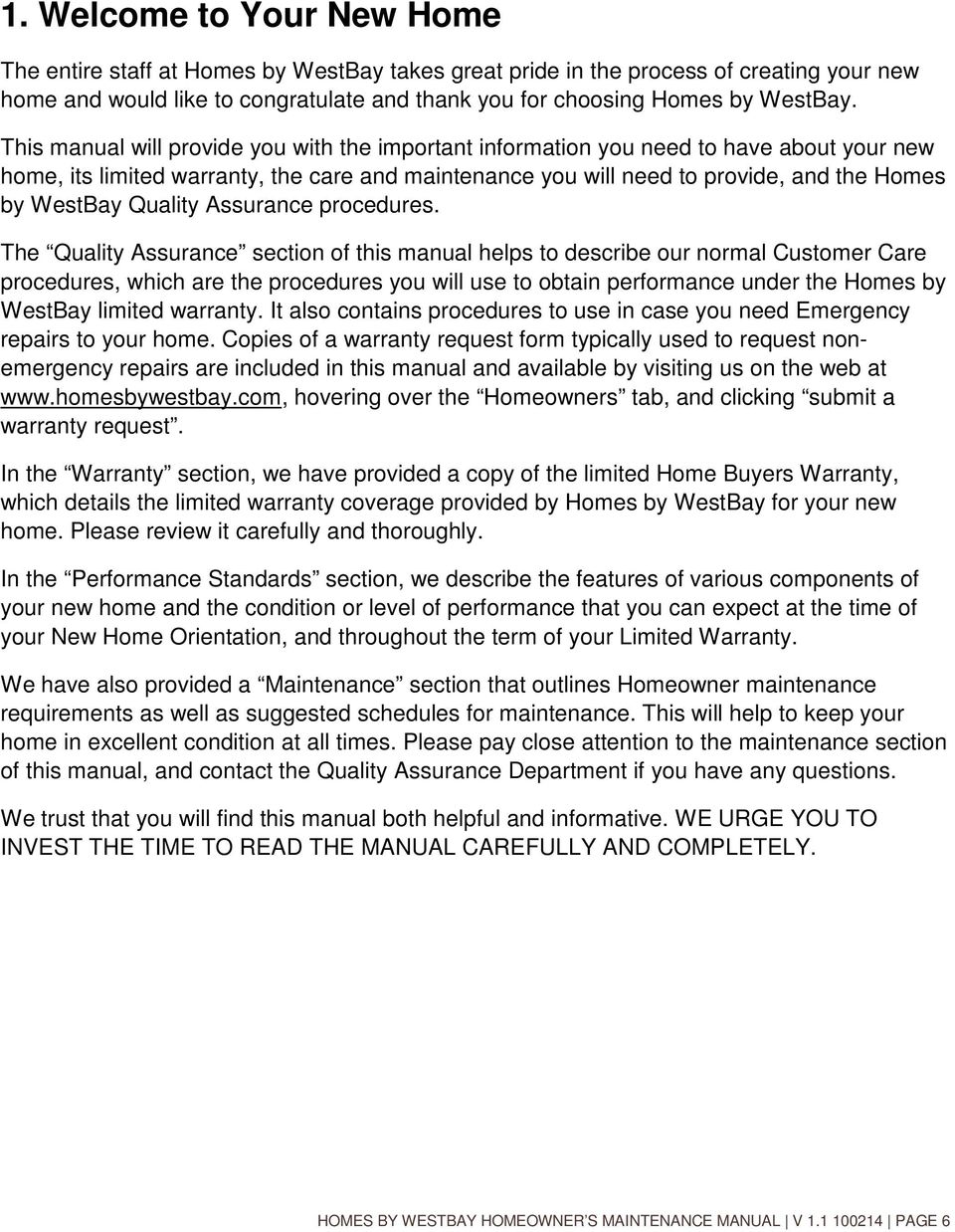
6 1. Welcome to Your New Home The entire staff at Homes by WestBay takes great pride in the process of creating your new home and would like to congratulate and thank you for choosing Homes by WestBay. This manual will provide you with the important information you need to have about your new home, its limited warranty, the care and maintenance you will need to provide, and the Homes by WestBay Quality Assurance procedures. The Quality Assurance section of this manual helps to describe our normal Customer Care procedures, which are the procedures you will use to obtain performance under the Homes by WestBay limited warranty. It also contains procedures to use in case you need Emergency repairs to your home. Copies of a warranty request form typically used to request nonemergency repairs are included in this manual and available by visiting us on the web at hovering over the Homeowners tab, and clicking submit a warranty request. In the Warranty section, we have provided a copy of the limited Home Buyers Warranty, which details the limited warranty coverage provided by Homes by WestBay for your new home. Please review it carefully and thoroughly. In the Performance Standards section, we describe the features of various components of your new home and the condition or level of performance that you can expect at the time of your New Home Orientation, and throughout the term of your Limited Warranty. We have also provided a Maintenance section that outlines Homeowner maintenance requirements as well as suggested schedules for maintenance. This will help to keep your home in excellent condition at all times. Please pay close attention to the maintenance section of this manual, and contact the Quality Assurance Department if you have any questions. We trust that you will find this manual both helpful and informative. WE URGE YOU TO INVEST THE TIME TO READ THE MANUAL CAREFULLY AND COMPLETELY. HOMES BY WESTBAY HOMEOWNER S MAINTENANCE MANUAL V PAGE 6
7 2. Your Builder Value and Design After decades of building homes in the Tampa Bay area, the Homes by WestBay team presents new homes created for today's lifestyles. We have taken the best of proven concepts and adapted these plans to your changing needs. Whether you work from home, live with extended family, pursue your artistic talents, or entertain your many friends, you will find design options that fit your varied lifestyle. We are a homebuilder with the unique ability to personalize our plans, allowing you to truly make our plans, yours. Want to add a room, delete an area, expand a living area, or even "raise the roof" of your new home? Homes by WestBay can do it. Our Relationships and Our Promise of Delivery With our years of experience, comes a promise to consistently deliver our new homes - 100% complete - on time. Our ability to make this promise comes from our long standing relationships with Tampa's best suppliers, sub-contractors, lenders and other local professionals. Customer Experience Homes by WestBay's outstanding team of Sales and Construction professionals will deliver an exceptional home building experience through every step of the process from choice of home site and floor plan, selection of options and designer features to financing, and construction. Moreover, our construction team ensures continued involvement throughout the building process with regularly scheduled meetings with our homebuyers. Our goal is to provide you with the opportunity to know your WestBay home inside and out. Ultimately, our customers live under the Homes by WestBay Quality Assurance umbrella, with an industry leading two year warranty on defects in craftsmanship and workmanship where other Builders only provide 1 year! Locally Owned and Operated Homes by WestBay is proudly owned and operated by long time Tampa Bay residents; who are often heard to say, We love where we work and live. As such, we are committed to sharing our love of the many Tampa Bay lifestyles with you. As long time residents, we have specifically created our homes for you to experience the best of Tampa Bay living. Our local experience also goes into building homes that minimize their impact on the environment and can face nature's occasional challenges. When you, your friends, family, or co-workers are searching for the perfect home in which to build a future then look for the WestBay difference! HOMES BY WESTBAY HOMEOWNER S MAINTENANCE MANUAL V PAGE 7

8 3. Quality Assurance Homes by WestBay is committed to excellence in everything we undertake, and our outstanding Quality Assurance Department is a prime example of that commitment. Our Quality Assurance Representatives are trained building professionals who are ready, and able to respond to your needs in a courteous and timely manner. The Quality Assurance Procedure Pre-Closing Orientation Your pre-closing orientation will typically occur about 5 to 7 days prior to your close of escrow and will provide you with the opportunity to view and enjoy the completion of your new home. Your Homes by WestBay Construction Manager will accompany you, pointing out and demonstrating the various components and operating systems within your home. Ask questions, join in. This is your opportunity to learn how your new home operates and to locate several things that you will need to know about such as water shut off, panel locations, and most importantly, how to contact the Quality Assurance Department for your service needs as you transition from your Construction phase, into your Warranty phase. Please make special note that any deficiencies to the following items must be noted on the Pre-closing orientation checklist found on page 2. Due to the likelihood of damage during, or after move-in, Homes by WestBay will not be responsible for these items after the pre-closing orientation unless they are specifically noted on page 2 of the checklist: Appliances: Scratches, dents, or damage of any kind Cabinets and Cabinet doors: Scratches, chips, or damage of any kind Tile: Broken, chipped, cracked or damaged on floors or walls Countertops: Scratches, chips, or damage of any kind Doors and door hardware: scratches, or damage of any kind Drywall: Scuffs, chips, holes, or damage of any kind Electrical fixtures: Scratches, chips, broken glass, light bulbs not working Exterior stucco and siding: Chips, scratches, scrapes, or damage of any kind Fireplace doors: Scratches, chips, or damage of any kind Floor covering (wood and carpet): Tears, scratches, chips, or damage of any kind Landscaping: Broken, damaged, or non-working irrigation heads or lines, and dead or dying sod or plant materials Mirrors: Scratched, chipped, cracked, or broken HOMES BY WESTBAY HOMEOWNER S MAINTENANCE MANUAL V PAGE 8

9 Paint: Marred, scratched, or damaged on walls, doors, ceilings, or trim, inside or outside Plumbing fixtures: Scratches, chips, cracks, or damage of any kind Roof shingles or tile: Cracks, chips, tears, or damage of any kind Screens: Missing, torn, or damage of any kind Sinks, tubs, and showers: Scratches, chips, or damage of any kind Windows: Scratches, chips, broken or cracked glass of any kind All of the above items are considered cosmetic in nature, and these items are not covered under warranty. Please be sure to inspect these items thoroughly and completely with your Construction Manager prior to the closing of your home, as Homes by WestBay will not be responsible for these items after closing. Access to Your Home After Closing After the close of your new home, from time to time it may be necessary for your Homes by WestBay Quality Assurance Representative to gain access to your home to make repairs to covered deficiencies. Service calls are scheduled between the hours of 8:30 am and 4:00 pm Monday through Friday. We will contact you to let you know when we would like to gain access to your home to do needed repairs or replacements. It will be required for either you, or a designee of your choice (over 18 years old) to be present to allow us to enter your home to do the needed work. We will make every effort to schedule repairs at your convenience; however, we will need your cooperation to permit us to complete any inspections and repairs in a timely manner. It may also be important to note that service work may be delayed or prolonged because of special scheduling requirements. Requests for repairs or service will usually be completed within 30 days after the written request is first made following the procedures explained in this warranty manual. Quality Assurance Requests Requests for repairs after the closing of your home MUST be covered under the written warranty, and MUST be requested in writing. Homes by WestBay has provided a convenient web based process for requesting repairs. The web location for this request form is: The following is a screenshot to help familiarize you with the look of this screen. All requested information must be filled in on this screen, including as much detail as possible about the defect. HOMES BY WESTBAY HOMEOWNER S MAINTENANCE MANUAL V PAGE 9

10 If you believe, you have a covered repair to be made, please review the Warranty and performance standards included in this manual prior to submitting the request. This section will help clarify if there is a deficiency to be corrected through Homes by WestBay, if it is covered by a separate manufacturer s warranty, or if it is your responsibility as a maintenance issue. If after review of the guidelines, you believe there is a deficiency to be addressed, please do so in a timely manner either as a non-emergency request, or an emergency request as the case may be. Our Sales staff is not responsible for, nor qualified to make judgments regarding repairs or replacements. All such decisions must originate from our Quality Assurance Department. If you believe you have an Emergency situation requiring immediate attention, please refer to the Emergency section of this manual. If the situation is a Non-Emergency, please follow the instructions below for requesting service. How to request Repairs for Non-Emergency Situations For your protection, and to allow us to maintain accurate and complete information on your home, ALL requests must be made in writing through the Homes by WestBay website at: As an alternative method, if for any reason our website is unavailable, requests can be ed to [email protected]. HOMES BY WESTBAY HOMEOWNER S MAINTENANCE MANUAL V PAGE 10

11 Please fill out ALL of the requested information on the form, including your closing date, address, and contact phone number. As you fill out the request, remember that we need as much detail as possible, including the room location. For example, if you develop a plumbing leak under the sink in your guest bath, please provide that level of description. Telephone, or face-to-face discussions, will not be considered as providing notice for a service request. All requests under the Warranty must be in writing. When we receive your written request, we will determine if the item is covered under the Homes by WestBay Limited Warranty;, if it is covered by a separate manufacturer s warranty, or if it is a Home Owner maintenance item. In most cases, we may need to examine the item for better evaluation and to fully understand the nature of the request to determine what action may need to be taken. Items that are determined to be the responsibility of separate manufacturer s warranty can usually be scheduled over the phone directly with that manufacturer. The product manufacturer and their phone numbers are listed in the separate manufacturer s warranty documents that you received with your closing documents, or that were located in your home at the time of your pre-closing orientation with your Construction Manager. Reasonable cooperation is needed to allow us access to your home to address any covered repairs, including access to investigate, evaluate, repair, monitor, replace or correct items found to be defective. We do not reimburse for any time taken off from work for any repairs. You must also not pay for repairs, or assume any obligations to pay for any repairs to remedy any situation for a claimed defect without Homes by WestBay s prior written approval. These items will not be reimbursed. Homes by WestBay will not be responsible for expenses you encounter for any work performed by persons other than those designated by Homes by WestBay, without prior written approval from Homes by WestBay. Our Quality Assurance Representatives in the field do not have the ability to authorize work done by others, or to extend the Limited Warranty in any way. Requests for non-emergency repairs are usually completed within 30 days of receipt. Occasionally, due to circumstances beyond the control of Homes by WestBay, this process may take longer than 30 days. Delays can be the cause of shortages in material or labor, back orders, weather problems, or other unanticipated events. Communication in this situation is our approach to keeping you up to date for any timeline delays. Some service calls may need to be scheduled over several days based on the sequence of work to be done. This process allows the Quality Assurance department to complete repairs more efficiently. Once work has been completed, you will be asked to sign an acknowledgment that the work is done and possibly, where appropriate, a release of claims relating to the repaired or replaced defect. Any such release will not prevent you from making claims on any subsequent or different construction defects. In the event a dispute arises relating to any Quality Assurance issues for any covered claim, such disputes will be resolved pursuant to the arbitration procedures defined in section VI of the Limited Home Builders Warranty. HOMES BY WESTBAY HOMEOWNER S MAINTENANCE MANUAL V PAGE 11

12 4. Emergencies Emergencies are defined as a defect or problem that causes the home to be uninhabitable, causes immediate danger to the occupants, or poses the likelihood of significant damage to the property, your home, or the home site. These may include the following: A. Total Sewer Stoppage: This is defined as a stoppage or situation in which the plumbing or plumbing drainage system stops working completely. This would cause ALL of your sinks, tubs, toilets, showers, and faucets to function incorrectly. A single toilet, tub, or sink stoppage is not an emergency situation. B. Water Supply Leak: This is defined as a water leak that forces you to shut off the main water supply to your home from the city connection. A leak that can be isolated at a single location such as a toilet or sink, and shut off at that location, is not defined as an emergency situation. Please follow the water shut off procedure reviewed at your preclosing orientation to isolate this type of leak and follow the general warranty request procedure. C. Total Electrical Failure: Defined as a situation where you lose power to your entire home and you have verified that your neighbors power is functioning properly. If the power failure is more widespread, please contact your utility service provider. D. Natural Gas Leak: If there is a Natural Gas leak, please immediately shut the gas off at the meter and immediately contact your Gas Service provider. E. Total Loss of Water, Heat, A/C, or other circumstance that endangers the occupants of the home: Emergency service contacts are provided for your safety and peace of mind. Each of the Mechanical Contractors who worked on your Electric, Plumbing, Gas, and HVAC systems has provided an emergency number for these situations. This number can be found on the warranty sticker that was demonstrated at your pre-closing orientation. This warranty sticker is located on your electric panel, most likely in your garage. In case of an emergency situation, your first response should always be to protect your family from any risks. If the situation does not pose imminent danger, you should make every effort to limit any effects or damage from the situation (such as shutting off water, gas, etc.) and then you should contact the emergency service number that fits your situation. In case of an emergency situation after normal business hours, you should contact the Contractor first, followed by Homes by WestBay through the website. HOMES BY WESTBAY HOMEOWNER S MAINTENANCE MANUAL V PAGE 12

13 A Homes by WestBay Quality Assurance Representative will contact you to offer assistance and to advise what procedure you should be following. Do not delay in reporting any actual emergencies. Damage caused by the delayed response time is not the responsibility of Homes by WestBay nor that of the 2/10 Limited Warranty. Damage to personal property as a result of any defect is also not the responsibility of Homes by WestBay nor that of the 2/10 Limited Warranty. These items would have to be addressed by your Home Owners Insurance policy. Items not covered or deemed un-addressable under this limited warranty include earthquakes, fire, severe weather, or invasions by pests or insects. Your Home Owners Insurance Policy may cover these items or circumstances and you should consult your agent. If the situation is covered by the limited warranty, but does not constitute one of the emergency situations described above, please follow the normal procedures for requesting service listed in the Quality Assurance requests section of this manual. Utility Shut-Off Procedures During your pre-closing orientation with your Homes by WestBay Construction Manager, you will be shown several locations of various types of shut off valves. These shut offs will be demonstrated to you so that in a situation where applicable, you will be able to locate and use the shut off functions. Below is a brief summary of the several types of shut offs you will need to be familiar with. How to Shut Off the Gas Shut the gas off to your new home ONLY if you suspect a leak or can smell excessive amounts of gas in the air. 1. Find the main shut off valve located on your gas meter outside the home 2. Use a wrench and turn the valve in either direction so that it runs crossways on the pipe, this indicates that the valve is closed. 3. Call your gas service provider immediately How to Shut Off the Electricity 1. Locate your electric panel breaker box 2. Locate the main service breaker 3. Flip this breaker completely to the off position HOMES BY WESTBAY HOMEOWNER S MAINTENANCE MANUAL V PAGE 13

14 How to Shut Off the Water 1. If the leak is located at a sink, toilet, washing machine, water heater, dishwasher, or other location that has an isolated shut off valve for that specific fixture, turn the valve to the right (clockwise) to tighten and shut off the flow of water. 2. If this does not work, you can use this same procedure at the secondary shut off location on the main water inlet to your home. This is usually located beside you garage. Turn this valve to a crossway position relating to the pipe and this shuts off the flow of water to the home. 3. If this still does not work, locate you water meter provided by your utility service provider. This is most commonly out in the front of your property near the sidewalk on one side of your property or the other. You will need a wrench to close this valve as well. Open the meter box door, locate the brass valve on the water line, and turn it to a crossway position relating to the pipe and this shuts off water flow from the meter 4. Check with neighbors or the local water service provider to verify that the water has not been shut down in your area for routine maintenance. Total Loss of Heat or Air Conditioning If for some reason you lose heat or air conditioning to the entire home, please consult the following list to help identify possible causes. You should fully review all documentation and manuals that came with your HVAC system for the most accurate information on your specific system as these vary a bit from home to home. If our service partners make an emergency service call to simply flip on a switch, replace a fuse, or to reset a breaker, they will charge for this trip and the homeowner will be responsible to pay this charge. Check all of the following items prior to calling for emergency service: 1. Thermostat temperature settings are correct and turned on 2. For heat, ensure that the switch at the furnace is turned on 3. Verify the fuse on the furnace, if it is equipped with one 4. The gas valve on the furnace is turned on if gas powered 5. Verify the breaker on the furnace is seated properly, if equipped 6. Breaker inside the electric panel is on 7. Check the overflow valve line to see if it is clogged and full of water If none of the above items are the cause of the problem, call the HVAC contractor for service assistance at the phone number provided on your warranty sticker. HOMES BY WESTBAY HOMEOWNER S MAINTENANCE MANUAL V PAGE 14

15 Total Loss of Electricity During your pre-closing orientation, your Homes by WestBay Construction Manager will verify the location of your electric meter (on the outside of your home) as well as the breaker panel location (usually in your garage). Please make note of these locations for future reference. The panel contains all of the breakers that control the flow of electricity throughout your new home. Pay particular attention at the pre-closing orientation as there is also a chance that there may be secondary breakers located inside the main electric panel located outside the home at the power meter location. All breakers will be labeled as to the nature of the circuit they control. There are also secondary disconnects for your outside AC condensers. The locations of these disconnects will be demonstrated at your pre-closing orientation as well. In the event you experience a total loss of power to your new home, please check the main breaker inside the panel first to ensure it is in the on position. Next, check to see if the power outage is more widespread. See if your neighbors have also lost power. Check both of these conditions prior to making an emergency call for service. Please remember, circuit breakers have three (3) positions; on, off, and tripped. Simply switching a breaker from the tripped position, to the on position, will not work. The breaker must first be flipped completely to the off position, and then returned to the on position. IMPORTANT NOTE: If the main breaker trips, or is turned to the off position, please wait 2 to 3 minutes prior to flipping it back to the on position. This helps to avoid overloading the system. If, after checking the items above, none of these remedies works, call the emergency number for the electrician located on your emergency warranty sticker located on your electric panel. Please note, if loss of power is limited to a section, or sections, but not the entire home, this is not considered an emergency situation. If the electric is off in limited areas please use the following troubleshooting suggestions to help determine the nature of the issue you may have. Once checked, you should follow the procedure for requesting normal warranty service as outlined in this manual. 1. Wall switches: If you have an outlet not working please first check to see if this is a half hot outlet controlled by a wall switch. These outlets are usually installed upside down when compared to other outlets and are commonly in bedrooms, the study, and formal rooms such as grand rooms or living rooms. If it is a ceiling light in question controlled by a switch, please first check the light bulb to ensure it is a good bulb. LIGHT BULBS ARE NOT COVERED BY THIS LIMITED WARRANTY. HOMES BY WESTBAY HOMEOWNER S MAINTENANCE MANUAL V PAGE 15

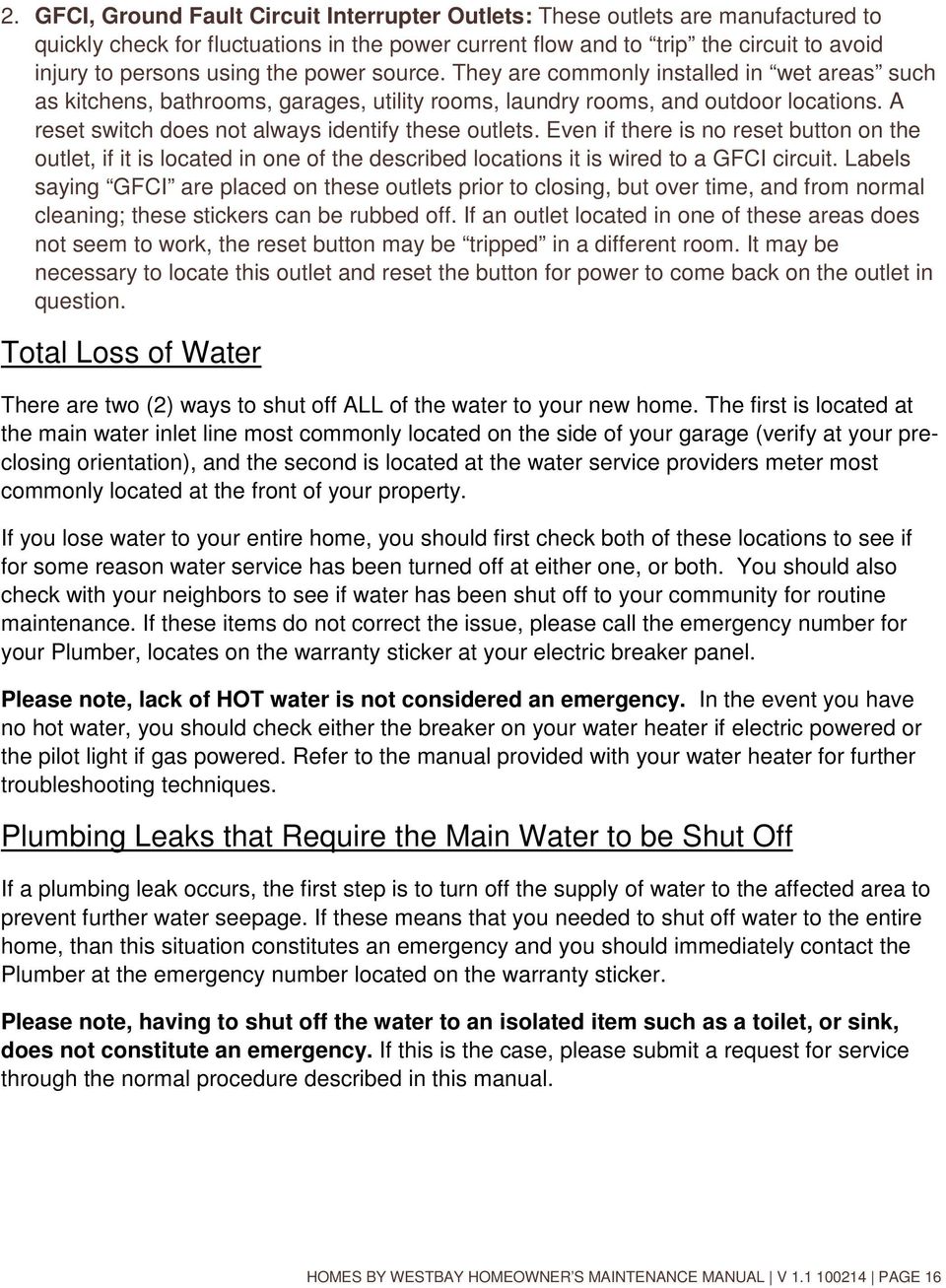
16 2. GFCI, Ground Fault Circuit Interrupter Outlets: These outlets are manufactured to quickly check for fluctuations in the power current flow and to trip the circuit to avoid injury to persons using the power source. They are commonly installed in wet areas such as kitchens, bathrooms, garages, utility rooms, laundry rooms, and outdoor locations. A reset switch does not always identify these outlets. Even if there is no reset button on the outlet, if it is located in one of the described locations it is wired to a GFCI circuit. Labels saying GFCI are placed on these outlets prior to closing, but over time, and from normal cleaning; these stickers can be rubbed off. If an outlet located in one of these areas does not seem to work, the reset button may be tripped in a different room. It may be necessary to locate this outlet and reset the button for power to come back on the outlet in question. Total Loss of Water There are two (2) ways to shut off ALL of the water to your new home. The first is located at the main water inlet line most commonly located on the side of your garage (verify at your preclosing orientation), and the second is located at the water service providers meter most commonly located at the front of your property. If you lose water to your entire home, you should first check both of these locations to see if for some reason water service has been turned off at either one, or both. You should also check with your neighbors to see if water has been shut off to your community for routine maintenance. If these items do not correct the issue, please call the emergency number for your Plumber, locates on the warranty sticker at your electric breaker panel. Please note, lack of HOT water is not considered an emergency. In the event you have no hot water, you should check either the breaker on your water heater if electric powered or the pilot light if gas powered. Refer to the manual provided with your water heater for further troubleshooting techniques. Plumbing Leaks that Require the Main Water to be Shut Off If a plumbing leak occurs, the first step is to turn off the supply of water to the affected area to prevent further water seepage. If these means that you needed to shut off water to the entire home, than this situation constitutes an emergency and you should immediately contact the Plumber at the emergency number located on the warranty sticker. Please note, having to shut off the water to an isolated item such as a toilet, or sink, does not constitute an emergency. If this is the case, please submit a request for service through the normal procedure described in this manual. HOMES BY WESTBAY HOMEOWNER S MAINTENANCE MANUAL V PAGE 16
17 Total Sewer Stoppage If a clogged sewer line is preventing you from using water in the entire home, than this issue constitutes and emergency. Please immediately contact the Plumber for your new home at the number provided on the warranty sticker on your electric panel. All drains and sewer lines should operate freely. All of the drains in your new home will have been inspected by the city, county or third part inspector as required by Florida statute prior to the closing of your home. Homes by WestBay will take responsibility ONLY for obstructions or blockages that are a direct result of Construction debris. If the Homes by WestBay Plumbing Contractor is called out for a stoppage, and it is determined not to be the result of Construction debris, the Owner may be subject to the cost of the service call. What the WestBay Warranty is, and what it is not Part of the WestBay difference is our Industry leading 2 year fit and finish warranty. The next section in this manual outlines the specifics of the 2/10 Limited Warranty including warranty standards, performance guidelines, general repair procedures, and exclusions. All of this information is taken directly from 2/10 documentation. You will find in this section that the workmanship coverage is listed as 1 year because this is the coverage that 2/10 usually provides. Homes by WestBay goes exclusively above and beyond by doubling this coverage from 1 year, to 2. This applies only to the section labeled items covered for 1 year. As an additional note (as will be explained at your pre-closing orientation), cosmetic items are excluded from coverage under this warranty. These items are defined further at your preclosing orientation. Any items of a cosmetic nature MUST be brought to the attention of your Construction Manager PRIOR TO CLOSE OF ESCROW or there will be no coverage. Wear and tear is also not covered under the terms of this Limited Warranty. If you have any questions about what may or may not be covered, please consult with your Construction Manager as soon as possible. HOMES BY WESTBAY HOMEOWNER S MAINTENANCE MANUAL V PAGE 17

18 5. 2/10 Limited Home Builders Warranty Long live happy homes says it all. It says we are in the business of promises kept and promises kept, make our customers happy. It says we have protected over 5.5 million new and pre-owned homes. It says we partner with thousands of the nation s finest home builders, service contractors and real estate professionals who consider our protection the industry s gold standard. It says we relentlessly focus on reducing the financial risks for our millions of customers. It says a lot about promises kept. The Buyer will receive a Certificate of Warranty within 30 days after the Builder/Seller took all steps required to make the express limited warranty effective. The Certificate of Warranty will identify the coverage selected by Your Builder/Seller and the Warranty Limits. Once the Certificate of Warranty is received, please keep it with this warranty booklet. You do not have a warranty without a valid Certificate of Warranty. *Register your warranty at *. *Not required for your warranty to be valid*. HOMES BY WESTBAY HOMEOWNER S MAINTENANCE MANUAL V PAGE 18

19 TABLE OF CONTENTS SECTION I Your Warranty Booklet and Certificate of Warranty Coverage SECTION II The Warranties Provided By Your Builder/Seller SECTION III The Option to Repair, Replace or Pay for Defect and/or Structural Defect SECTION IV Reporting a Warranty Claim SECTION V The Effect of this Warranty on Your Legal Rights SECTION VI Arbitration of Disputes SECTION VII Your Responsibilities under This Express Limited Warranty SECTION VIII Exclusions SECTION IX Manufacturers and Other Similar Warranties SECTION X Construction Performance Guidelines HOMES BY WESTBAY HOMEOWNER S MAINTENANCE MANUAL V PAGE 19

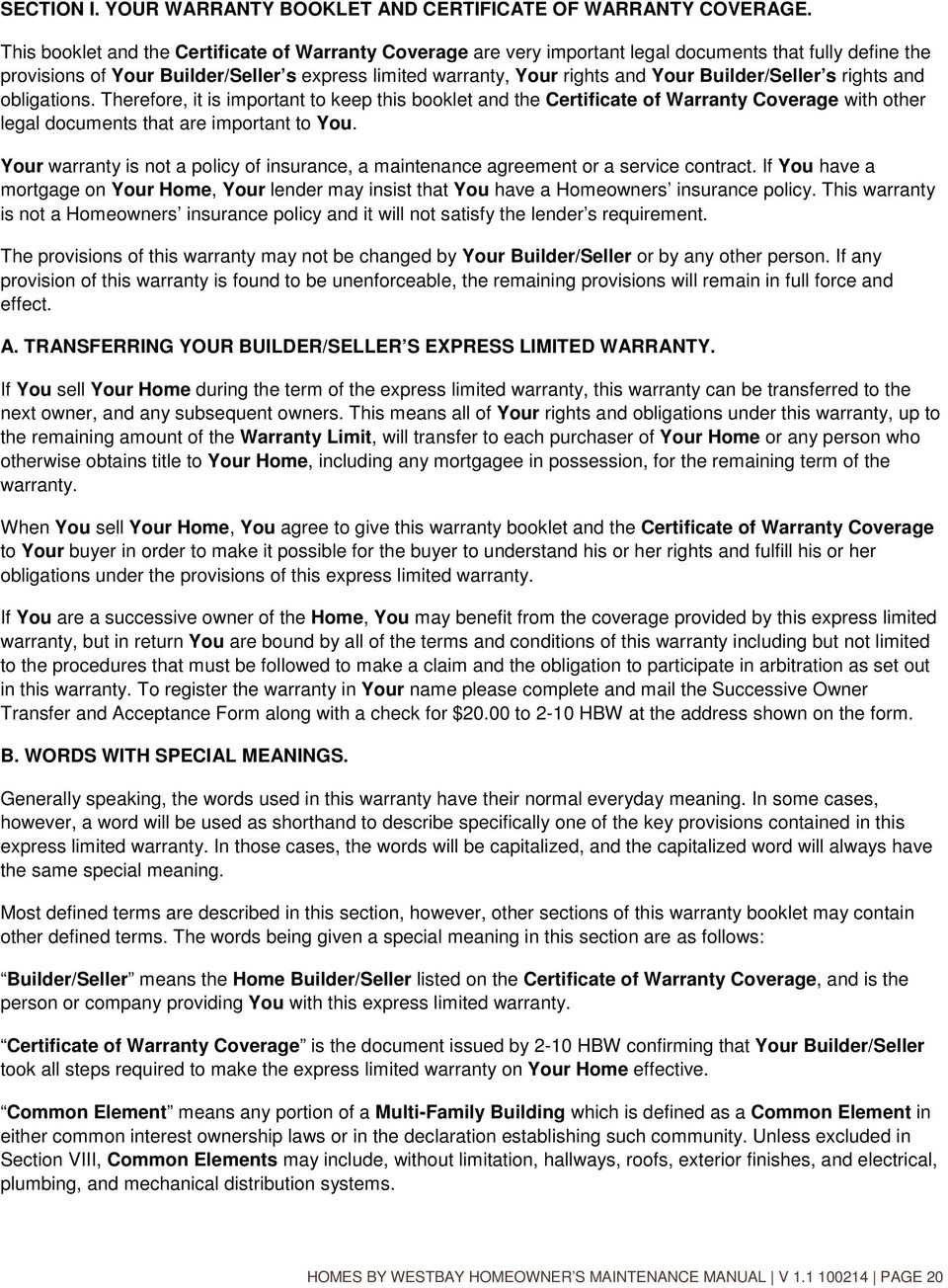
20 SECTION I. YOUR WARRANTY BOOKLET AND CERTIFICATE OF WARRANTY COVERAGE. This booklet and the Certificate of Warranty Coverage are very important legal documents that fully define the provisions of Your Builder/Seller s express limited warranty, Your rights and Your Builder/Seller s rights and obligations. Therefore, it is important to keep this booklet and the Certificate of Warranty Coverage with other legal documents that are important to You. Your warranty is not a policy of insurance, a maintenance agreement or a service contract. If You have a mortgage on Your Home, Your lender may insist that You have a Homeowners insurance policy. This warranty is not a Homeowners insurance policy and it will not satisfy the lender s requirement. The provisions of this warranty may not be changed by Your Builder/Seller or by any other person. If any provision of this warranty is found to be unenforceable, the remaining provisions will remain in full force and effect. A. TRANSFERRING YOUR BUILDER/SELLER S EXPRESS LIMITED WARRANTY. If You sell Your Home during the term of the express limited warranty, this warranty can be transferred to the next owner, and any subsequent owners. This means all of Your rights and obligations under this warranty, up to the remaining amount of the Warranty Limit, will transfer to each purchaser of Your Home or any person who otherwise obtains title to Your Home, including any mortgagee in possession, for the remaining term of the warranty. When You sell Your Home, You agree to give this warranty booklet and the Certificate of Warranty Coverage to Your buyer in order to make it possible for the buyer to understand his or her rights and fulfill his or her obligations under the provisions of this express limited warranty. If You are a successive owner of the Home, You may benefit from the coverage provided by this express limited warranty, but in return You are bound by all of the terms and conditions of this warranty including but not limited to the procedures that must be followed to make a claim and the obligation to participate in arbitration as set out in this warranty. To register the warranty in Your name please complete and mail the Successive Owner Transfer and Acceptance Form along with a check for $20.00 to 2-10 HBW at the address shown on the form. B. WORDS WITH SPECIAL MEANINGS. Generally speaking, the words used in this warranty have their normal everyday meaning. In some cases, however, a word will be used as shorthand to describe specifically one of the key provisions contained in this express limited warranty. In those cases, the words will be capitalized, and the capitalized word will always have the same special meaning. Most defined terms are described in this section, however, other sections of this warranty booklet may contain other defined terms. The words being given a special meaning in this section are as follows: Builder/Seller means the Home Builder/Seller listed on the Certificate of Warranty Coverage, and is the person or company providing You with this express limited warranty. Certificate of Warranty Coverage is the document issued by 2-10 HBW confirming that Your Builder/Seller took all steps required to make the express limited warranty on Your Home effective. Common Element means any portion of a Multi-Family Building which is defined as a Common Element in either common interest ownership laws or in the declaration establishing such community. Unless excluded in Section VIII, Common Elements may include, without limitation, hallways, roofs, exterior finishes, and electrical, plumbing, and mechanical distribution systems. HOMES BY WESTBAY HOMEOWNER S MAINTENANCE MANUAL V PAGE 20
21 Common Element Date of Warranty means the earlier of the date a certificate of occupancy is issued for the Multi-Family Building or the date a unit in the building is first occupied. Commercial Space means any unit within a Multi-Family Building that is used primarily for a non-residential purpose, including, without limitation, club houses, retail space, and recreational facilities. Defect means a failure to meet the Construction Performance Guidelines for workmanship and systems set forth in Section X of this warranty booklet. Effective Date of Warranty means the date the express limited warranty goes into effect. That date will be the earliest of: (1) the closing date on which You purchased the Home, (2) the date title to the Home was transferred to You if title was transferred before Your closing date, or (3) the date anyone first began living in the Home if before Your closing date. Homes With FHA/VA Financing Only If Your Certificate of Warranty indicates Your Home has FHA/VA financing, the Effective Date of Warranty is the date of closing. Home means the dwelling unit and garage (if any) or the Commercial Space (if any) located at the address shown on the Certificate of Warranty Coverage. Multi-Family Building is a building in a common interest community that may consist of dwelling units, shared parking spaces, Commercial Space(s) and/or Common Elements. Performance Guidelines mean the performance standard(s) the Home or element or component must satisfy. Structural Defect is defined in Section IIB of this warranty booklet. You, Your, and similar words means the person or persons who are the legal owners of the Home covered by this express limited warranty. Warranty Insurer is the Builder/Seller s Warranty Insurer as stated on Your Certificate of Warranty Coverage. Warranty Limit is the aggregate financial obligation of the Builder/Seller for all claims under this warranty and is the sum stated on the Certificate of Warranty Coverage. SECTION II. THE WARRANTIES PROVIDED BY YOUR BUILDER/SELLER. A. ONE YEAR WORKMANSHIP AND TWO YEAR SYSTEMS DEFECT WARRANTY. Your Builder/Seller is providing a One Year Workmanship and Two Year Systems Defect Warranty for Your Home. This means that Your Home will be free from Defects in materials and workmanship for one year as defined in the Construction Performance Guidelines in Section X; and for two years Your Home will be free from Defects in the electrical, plumbing, and mechanical distribution system as stated in Section X. The Workmanship warranty shall expire one year from the Effective Date of Warranty; and the Systems Warranty will expire two years from the Effective Date of Warranty. HOMES BY WESTBAY HOMEOWNER S MAINTENANCE MANUAL V PAGE 21
22 WORKMANSHIP: Examples of items typically covered under the one year workmanship warranty. SYSTEMS: Examples of items typically covered under the two year systems warranty. B. STRUCTURAL DEFECT WARRANTY. Your Builder/Seller is providing a Structural Defect warranty. This means that the Builder/ Seller warrants that Your Home will be free from Structural Defects from the Effective Date of Warranty for ten years. Structural Defect is defined as actual physical damage to the designated load-bearing elements of the Home caused by failure of such load-bearing elements which affects their load-bearing functions to the extent that Your Home becomes unsafe, unsanitary, or otherwise unlivable. This is coverage for catastrophic failure of loadbearing elements of Your Home. The designated load-bearing elements that are covered under the Structural Defect warranty are: 1. Footings and Foundation systems; 2. Beams; 3. Girders; 4. Lintels; 5. Masonry Arches; 6. Columns; 7. Load-bearing walls and partitions; 8. Roof framing systems; and 9. Floor systems. HOMES BY WESTBAY HOMEOWNER S MAINTENANCE MANUAL V PAGE 22
23 STRUCTURAL: Examples of typical items covered under the ten year structural warranty are found above. The remaining elements of Your Home are not load-bearing elements under this Structural Defect warranty. A non-exclusive list of some of the non-load-bearing elements in Your Home not covered by this Structural Defect warranty are: 1. Non-load-bearing partitions and walls; 2. Wall tile or paper, etc. 3. Drywall and plaster; 4. Flooring and sub-flooring material; 5. Stucco, brick and stone veneer; 6. Any type of exterior siding; 7. Roof shingles, roof tiles, sheathing, and tar paper; 8. Heating, cooling, ventilating, plumbing, electrical and mechanical systems; 9. Appliances, fixtures or items of equipment; 10. Doors, trim, cabinets, hardware, insulation, paint, stains; and 11. Basement and other interior floating, ground-supported concrete slabs. Homes With FHA/VA Financing Only If Your Certificate of Warranty indicates Your Home has FHA/VA financing, add the following to the definition of designated load-bearing elements that are covered: HOMES BY WESTBAY HOMEOWNER S MAINTENANCE MANUAL V PAGE 23
24 12. Roof sheathing only if Your Home has original FHA/VA financing still in effect; and 13. State of Colorado: Basement slabs for the first four years of the Structural Defect warranty period only if Your Home has original FHA/VA financing still in effect. C. INDIANA RESIDENTS. If Your Home is located in the State of Indiana, Your Home will be free from Defects in materials and workmanship as defined in the Construction Performance Guidelines contained in Section X of this warranty booklet for a period of two years from the Effective Date of Warranty, and the roof on Your Home will be free from Defects in faulty workmanship or defective materials for a period of four years from the Effective Date of Warranty. All other provisions of this warranty remain the same. SECTION III. THE OPTION TO REPAIR, REPLACE OR PAY FOR DEFECT AND/OR STRUCTURAL DEFECT. A. PROVISIONS APPLICABLE TO DEFECT AND/OR STRUCTURAL DEFECT. The Builder/Seller shall have the option to repair, replace or pay You the reasonable cost of repair of any Defect. The Warranty Insurer shall have the option to repair, replace or pay You the reasonable cost of repairing any Structural Defect. The design, method and manner of such repair shall be within the sole discretion of the Builder/Seller or Warranty Insurer, as applicable. At the time of repair, replacement or payment for the repair of any Defect or Structural Defect, You must: 1. Assign to the Builder/Seller or Warranty Insurer any rights You may have against any other person with respect to the Defect or Structural Defect. You must not do anything to prejudice these rights of subrogation. 2. Sign and deliver a full and unconditional release of the Builder/Seller or Warranty Insurer, in recordable form, of all legal obligations with respect to the warranted items and conditions arising from those items. If an improvement, fixture or property not constructed by the Builder/Seller is damaged or requires removal during the repair, it is Your sole responsibility, and not the responsibility of the Builder/Seller or Warranty Insurer, to pay for the cost of repair or removal of such improvement, fixture or property. No repair shall extend the term of this express limited warranty as to any Defect or Structural Defect, including without limitation, the Defect or Structural Defect that was the subject of the repair. Homes With FHA/VA Financing Only In the case of cash payments regarding Homes with original FHA/VA financing still in effect, the Warranty Insurer is required to make payment to You and Your mortgagee. You must provide the name and address of Your mortgagee, the FHA/VA case number and the loan number (Your HUD settlement statement will have this information) when You file a claim with respect to a Home with a FHA/VA financed mortgage, in order for these obligations to be performed. B. ADDITIONAL PROVISIONS APPLICABLE TO THE REPAIR OF STRUCTURAL DEFECT. The repair of a Structural Defect is limited to: 1. The repair of damage to designated load-bearing portions of the Home which is necessary to restore their load-bearing ability; 2. The repair of designated non-load-bearing portions, items or systems of the Home, damaged by the Structural Defect, which make the Home unsafe, unsanitary, or otherwise unlivable (such as the repair of inoperable windows, doors and the restoration of functionality of damaged electrical, plumbing, heating, cooling, and ventilating systems); and HOMES BY WESTBAY HOMEOWNER S MAINTENANCE MANUAL V PAGE 24
25 3. The repair and cosmetic correction of only those surfaces, finishes and coverings, original with the Home, damaged by the Structural Defect, or which require removal and replacement attendant to repair of the structural damage, or to repair other damage directly attributable to the Structural Defect. Repairs of the Structural Defect are intended to restore the Home to approximately the condition just prior to the Structural Defect, but not necessarily to a like-new condition. C. ACCESS TO YOUR HOME FOR INSPECTING AND MAKING REPAIRS. In order to carry out the warranty responsibilities, the Builder/Seller or Warranty Insurer will require access to Your Home. If Your Home is in a Multi-Family Building, You agree (after reasonable notice) to allow access to, or within Your Home during normal business hours so repairs may be made to any adjacent unit or Common Element. If emergency repairs are necessary and You cannot be reached within a reasonable time period, You waive such notice. If You do not provide access to Your Home during normal business hours to inspect, repair, or conduct tests on Your Home as may be required to evaluate or repair a Defect or Structural Defect, You are relieving the Builder/Seller and Warranty Insurer of all responsibility to make repairs, replace or pay for any Defect or Structural Defect under this warranty. In addition to the right to inspect Your Home, the Builder/Seller or Warranty Insurer shall have the right, in advance of any arbitration concerning Your Home, to re-inspect Your Home if the request for arbitration is made more than sixty (60) days after the last claim decision concerning the claim that is the subject of the arbitration. D. THE LIMITS OF YOUR WARRANTY. Every time Your Builder/Seller or Warranty Insurer pays a claim under this warranty, the amount of that payment is deducted from the Warranty Limit. When the Warranty Limit is exhausted, there is no longer warranty coverage for Your Home. A claim payment includes the cost to the Builder/Seller or Warranty Insurer of repairing a Defect or Structural Defect in Your Home covered under this warranty. However, a claim payment does not include the cost of investigating the claim. The Warranty Limit for Common Elements in a Multi-Family Building is equal to the sum of the unexpired Warranty Limits for all Homes in the building which are enrolled in the 2-10 HBW Program. In the event that all Homes in the Multi-Family Building were not enrolled, the Warranty Limit for Common Elements Defects or Common Elements Structural Defect coverage shall be reduced pro-rata based upon the ratio of the original sale price of the non-enrolled Homes compared to the total original sales price of all Homes in the Multi-Family Building. If the claim payment is for a Common Elements Defect or Common Elements Structural Defect, the Warranty Limit on each Home in the Multi-Family Building still covered by an unexpired warranty shall be reduced pro-rata in the proportion which the Common Elements claim payment bears to the total original sales price of all enrolled Homes. Any coverage for Your Builder/Seller s express limited warranty shall be excess of any other valid and collectible insurance available to You or Your Builder/Seller, whether primary, pro-rata or excess, and whether or not collected. E. EMERGENCY REPAIRS. An emergency means a substantial risk of serious physical damage to the Home or a substantial risk of serious bodily injury to its occupants if a Defect or Structural Defect is not immediately repaired. If You have an emergency involving a Defect or a Structural Defect, You must contact Your Builder/Seller immediately, who is responsible for making emergency repairs or authorizing You to make emergency repairs. If You are unable to contact Your Builder/Seller, You must then (1) make minimal repairs necessary to avoid the emergency until authorization for more extensive repairs have been approved by Your Builder/ Seller, (2) take any action reasonably necessary to limit additional damage, and (3) report the emergency to the Builder/Seller and 2-10 HBW on the next business day. HOMES BY WESTBAY HOMEOWNER S MAINTENANCE MANUAL V PAGE 25
26 Except for authorized emergency repairs, do not repair or attempt to repair a claimed Defect or Structural Defect before the Builder/Seller has an opportunity to inspect the Defect or Structural Defect. Any attempt to repair a claimed Defect or Structural Defect, other than an authorized emergency repair, will make it impossible to assess whether the Defect or Structural Defect was covered by this warranty, whether the repair was correct, cost-effective, necessary, and effective, or whether the problem could be resolved in another way. Unless an emergency Defect or Structural Defect repair is authorized, the Builder/ Seller and/or the 2-10 HBW Warranty Insurer will have no responsibility to reimburse any costs due to repair, replacement, and expenses, including engineering and attorney s fees. SECTION IV. REPORTING A WARRANTY CLAIM. A. WORKMANSHIP AND SYSTEMS DEFECTS. If You believe Your Home has a Defect that is covered under Your Builder/Seller s Workmanship or Systems Warranty that occurred during the applicable term of the warranties, You must take the steps described in this Section IV. B. STRUCTURAL DEFECTS. If You believe Your Home has a Structural Defect that is covered under Your Builder/Seller s Structural Warranty, You must take the steps described in Section IV.D.2. Notice of Structural Defect must be made by the Homeowner, except for Multi-Family Buildings, notice for each affected building must be made by the Homeowners association or its designated representative, along with a copy of the Certificate of Warranty Coverage for each Home in the building. C. NOTICE TO YOUR BUILDER/SELLER. 1. Workmanship and Systems Defect(s) must be reported to the Builder/Seller as soon as possible but no later than 15 days after the expiration of the applicable term of the warranty. Send written notification to Your Builder/Seller listing completely the specific Defect(s) and the date the Defect(s) occurred. The Defect will not be covered under this warranty if the Notice is received more than 15 days after the expiration of the warranty term. These time limits are a material condition of this warranty. It is recommended (but not required) that Your letter be sent by certified mail, return receipt requested so You have a record of when Your letter was sent and received. D. NOTICE TO 2-10 HBW. 1. WORKMANSHIP AND SYSTEMS DEFECTS MUST BE REPORTED TO 2-10 HBW AS SOON AS POSSIBLE BUT NO LATER THAN 15 DAYS AFTER THE EXPIRATION OF THE APPLICABLE TERM OF THE WARRANTY. If covered repairs for the Workmanship or Systems Defects are not completed by Your Builder/Seller within sixty (60) days of the date You sent Your letter or before the expiration of the warranty term (whichever date comes earlier), You must complete the following three steps: a. Complete the appropriate Notice of Complaint Form ( Notice ), which is found at the back of this warranty booklet. b. Send one copy of the Notice to Your Builder/Seller. c. Send one copy of the Notice to 2-10 HBW, and include: HOMES BY WESTBAY HOMEOWNER S MAINTENANCE MANUAL V PAGE 26
27 1. A copy of Your Certificate of Warranty Coverage; and 2. A copy of all correspondence with Your Builder/Seller regarding the Defect(s) in question to: 2-10 Home Buyers Warranty Warranty Administration Department East Harvard Avenue, Suite 100 Denver, CO Phone: We recommended (but do not require) that You send this notice by certified mail, return receipt requested, so You have a record of when the notice was sent and received. Include copies of Your Certificate of Warranty Coverage and all correspondence with Your Builder/Seller about the Defect(s) in question. WHAT 2-10 HBW WILL DO. Once 2-10 HBW has received Your Notice of Defect, it will again notify Your Builder/Seller of Your Defect(s). If You and Your Builder/Seller still cannot resolve Your differences even with 2-10 HBW s conciliation help, then You and Your Builder/Seller must arbitrate Your dispute under the arbitration agreement set forth in this booklet HBW will provide a form for You to request arbitration after You have completed the procedure described above. If 2-10 HBW determines that Your Builder/Seller cannot or will not participate in arbitration, or Your Builder/Seller refused to pay or perform an arbitration award in Your favor, 2-10 HBW will notify You of that fact. You must then forward to 2-10 HBW at the address above, a onetime $250 claim deductible (check payable to the Builder/Seller s Warranty Insurer stated on Your Certificate of Warranty Coverage). Upon receipt, 2-10 HBW will forward the check and Your file to the Builder/Seller s Warranty Insurer, and the Warranty Insurer will adjust the claim. Homes With FHA/VA Financing Only If You are the original owner and Your Home has original FHA/VA financing still in effect, the $250 deductible is collected after the claim is accepted and the amount of the loss is determined. 2. Structural Defect(s) must be reported to 2-10 HBW as soon as possible but no later than thirty (30) days after the expiration of the applicable term of the Warranty. Notice means that You must complete the following two steps: a. Complete the appropriate Notice of Claim Form ( Notice ), which is found at the back of this warranty booklet. b. Send one copy of the Notice to 2-10 HBW, and include: 1. A copy of Your Certificate of Warranty Coverage; pay a $250 claim investigation fee payable to the Warranty Insurer stated on the Certificate of Warranty Coverage; and 2. A copy of all correspondence with Your Builder/Seller regarding the Structural Defect(s) in question to: 2-10 Home Buyers Warranty Warranty Administration Department East Harvard Avenue, Suite 100 Denver, CO Phone: We recommended (but do not require) that You send this notice by certified mail, return receipt requested, so You have a record of when the notice was sent and received. HOMES BY WESTBAY HOMEOWNER S MAINTENANCE MANUAL V PAGE 27
28 Homes With FHA/VA Financing Only If You are the original owner and Your Home has original FHA/VA financing still in effect, You do not have to send the $250 claim fee investigation fee with Your Notice of Claim Form. The $250 fee will be collected after the claim is accepted and the amount of the loss is determined. WHAT 2-10 HBW WILL DO. Upon receipt of the items identified in D.2 above, 2-10 HBW will forward the check and Your file to the Warranty Insurer, and the Warranty Insurer will adjust the claim. SECTION V. THE EFFECT OF THIS WARRANTY ON YOUR LEGAL RIGHTS. You have accepted this express limited warranty provided in this warranty booklet. All other express or implied warranties, including oral or written statements or representations made by Your Builder/Seller or any implied warranty of habitability, merchantability or fitness, are disclaimed by Your Builder/Seller and waived by You to the extent possible under the laws of Your state. You may have other remedies as provided under the law of the state where the Home is located. *California: The protection provided under this Warranty is not in limitation of, but is in addition to any other rights provided to You under California law. *Kansas: You have not waived the implied warranties and the Warranty is not Your exclusive remedy. You may have other remedies as provided to You under Kansas law. *Florida: Units located in Multi-Family Buildings may have additional statutory protection under Florida law. *Oregon: Units located in Multi-Family Buildings may have additional statutory protection under Oregon law. SECTION VI. ARBITRATION OF DISPUTES.* To expedite the resolution of any and all claims, disputes and controversies by or between the Homeowner, the Builder/ Seller, 2-10 HBW, as administrator, the Warranty Insurer or any combination of the foregoing, arising from or related to this Warranty, the Warranty Insurance Policy or the 2-10 HBW Program, shall be settled by binding arbitration. Agreeing to arbitration means You are waiving Your right to a jury trial, class action or consolidation. Any party shall be entitled to recover reasonable attorney s fees and costs incurred in enforcing this arbitration agreement. The decision of the arbitrator shall be final and binding and may be entered as a judgment in any State or Federal Court of competent jurisdiction. A. SELECTING AN ARBITRATION SERVICE. The arbitration shall be conducted by DeMars & Associates, Ltd. or by Construction Dispute Resolution Services, LLC, or by any mutually agreeable arbitration services, pursuant to the applicable rules in effect at the time of the arbitration. The choice of the arbitration service shall be that of the Homeowner, or if the Homeowner is not involved, the party who initiates the arbitration shall choose the arbitration service. No arbitration proceeding shall involve more than one single-family detached dwelling or more than one Multi-Family Building. The arbitrator shall render an award in accordance with the substantive law in the state in which the Home is located. The decision of the arbitrator shall be final and binding and may be entered as a judgment in any State or Federal court of competent jurisdiction. HOMES BY WESTBAY HOMEOWNER S MAINTENANCE MANUAL V PAGE 28
29 B. DISPUTES CONCERNING THE APPLICATION OF THIS ARBITRATION AGREEMENT. The parties expressly agree that this arbitration agreement involves and concerns interstate commerce and interpretation of this arbitration agreement shall be governed by the Federal Arbitration Act (9 U.S.C. 1, et seq.) ( FAA ), to the exclusion of any different or inconsistent state or local law, ordinance or judicial rule. This arbitration agreement is a self-executing arbitration agreement. Any disputes concerning the interpretation or enforceability of this arbitration agreement, including without limitation, its revocability or void ability for any cause, the scope of arbitrable issues, and any defense based upon waiver, estoppel or laches, shall be decided by the arbitrator. C. COST OF ARBITRATION. All administrative fees of the arbitration service and fees of the arbitrator shall be allocated to the parties as provided in the rules of the arbitration service, subject to the discretion of the arbitrator to reallocate such fees in the interests of justice. D. FOR WARRANTIES ISSUED IN CALIFORNIA: For 2-10 HBW warranties issued on Homes located within the State of California, the arbitration provisions are amended as follows. The FAA shall govern the enforceability of this arbitration agreement, to the exclusion of any state law (statutory or judicial). Arbitration shall not be to stayed or denied enforcement pursuant to California Code of Civil Procedure (c). An arbitration service or arbitrator conducting an arbitration must satisfy the disclosure requirements mandated under the California Arbitration Act. The arbitrator shall not have the power to commit errors of law or legal reasoning. California procedural and substantive laws and the California Arbitration Act relating to the process of modifying, confirming, or vacating an arbitration award shall be the governing law with respect to the finality of any resulting arbitration award. Any award pursuant to this arbitration agreement will be subject to judicial vacatur if the award manifests legal errors. The arbitrator shall prepare in writing and provide to the parties an award including factual findings and the reasons on which his decision is based. A party may apply to such court for an order confirming, modifying or vacating the award, and upon the court s review of (a) whether the findings of fact rendered by the arbitrator are supported by substantial evidence and (b) whether, as a matter of law based on such findings of fact, a judgment shall be entered in favor of either party consistent with such review. *Homes With FHA/VA Financing Only If You are the original owner and Your Home has original FHA/VA financing still in effect, in lieu of any right to have a claim resolved in a judicial proceeding, You may, at Your election, submit to arbitration all claims, disputes and controversies by or between You, the Builder/Seller, the Warranty Insurer and/or 2-10 HBW, arising from or related to the warranty. In addition, 2-10 HBW and/or the Warranty Insurer will offer pre-arbitration conciliation at no cost to You. SECTION VII. YOUR RESPONSIBILITIES UNDER THIS EXPRESS LIMITED WARRANTY. You are responsible for proper maintenance of Your Home including maintaining Builder/Seller-set grades around the Home, planting trees and shrubs at the proper distance from the Home, and conforming to generally accepted landscape practices for Your region. Your Builder/Seller is not responsible for problems that arise if You do not meet these responsibilities. Also, all new Homes go through a period of settlement and movement, and Your Home may experience some minor material shrinkage, cracking and other events which are normal and customary. Examples include small cracks in drywall and paint; and separation where dissimilar materials meet each other for example, where moldings meet sheetrock, or where tile grout meets a sink. In most cases, paint and caulking is all that is necessary to conceal these types of blemishes that result from the natural HOMES BY WESTBAY HOMEOWNER S MAINTENANCE MANUAL V PAGE 29
30 expansion and contraction of construction material. Because these events are normal and customary, they are not a Defect or Structural Defect that are covered by this express limited warranty. SECTION VIII. EXCLUSIONS. This Warranty does not provide coverage for any of the following items which are specifically excluded. 1. Damage to land and other real property that was not part of Your Home, or any property that was not included in the purchase price stated on the Certificate of Warranty Coverage; 2. Damage to or Defects in swimming pools, tennis courts and other exterior recreational facilities; driveways; boundary walls, retaining walls and bulkheads (except where boundary walls, retaining walls and bulkheads are necessary for the structural stability of the Home); fences; landscaping (including sod, seeding, shrubs, trees, and plantings); sprinkler systems, patios, decks, and porches, outbuildings, detached carports, or any other appurtenant structure or attachment to the dwelling; or other additions or improvements not a part of Your Home; 3. Loss or damage which arises while Your Home is being used primarily for nonresidential purposes; 4. Changes in the level of underground water table which were not reasonably foreseeable at the time of construction of Your Home; 5. Failure of Your Builder/Seller to complete construction or construction which is noncompliant with plans and specifications; violations of local or national building codes, ordinances or standards; 6. Any condition which has not resulted in actual physical damage to Your Home; 7. Any loss or damage that is caused or made worse by any of the following causes, whether acting alone or in sequence or concurrence with any other cause or causes whatsoever, including without limitation: a. Negligence, improper maintenance, defective material or work supplied by, or improper operation by, anyone other than Your Builder/Seller or its employees, agents or subcontractors, including failure to comply with the warranty requirements of manufacturers of appliances, equipment or fixtures; b. Your failure to give prompt and proper notice to 2-10 HBW and Your Builder/Seller of any Defect or Structural Defect; c. Change of the grading of the ground that does not comply with accepted grading practices, or failure to maintain the original grade; d. Riot or civil commotion, war, vandalism, hurricane, tornado or other windstorm, fire, explosion, blasting, smoke, water escape, tidal wave, flood, hail, snow, ice storm, lightning, falling trees or other objects, aircraft, vehicles, mudslide, landslide, avalanche, earthquake, volcanic eruption or sinkholes or geographical phenomena involving subsurface slope instability; e. Abuse or use of Your Home, or any part thereof, beyond the reasonable capacity of such part for such use; f. Microorganisms, fungus, decay, wet rot, dry rot, soft rot, rotting of any kind, mold, mildew, vermin, termites, insects, rodents, birds, wild or domestic animals, plants, corrosion, rust, radon, radiation, formaldehyde, asbestos, any solid, liquid or gaseous pollutant, contaminant, toxin, irritant or carcinogenic substance, whether organic or inorganic, and electromagnetic field or emission, including any claim of health risk or un-inhabitability based on any of the foregoing; Homes With FHA/VA Financing Only If You are the original owner and Your Home has HOMES BY WESTBAY HOMEOWNER S MAINTENANCE MANUAL V PAGE 30
31 original FHA/VA financing still in effect, termite damage shall be covered for one year from the Effective Date of Warranty; g. Your failure to minimize or mitigate any defect, condition, loss or damage as soon as practicable; 8. Any loss or damage caused by buried debris, underground springs, sinkholes, mineshafts or other anomalies which were not reasonably foreseeable in a building site You provided; 9. Loss caused, in whole or in part, by any peril or occurrence for which compensation is provided by state legislation or public funds; 10. Costs of shelter, transportation, food, moving, storage, or other incidental expenses related to relocation during repair, or any other costs due to loss of use, inconvenience, or annoyance; 11. Diminished market value of Your Home*; 12. Any and all consequential loss or damage, including without limitation, any damage to property not covered by this warranty, any damage to personal property, any damage to property which You do not own, any bodily injury or personal injury of any kind, including physical or mental pain and suffering and emotional distress, and any medical or hospital expenses, or lost profits; 13. Any and all exclusions set forth in Section X (Construction Performance Guidelines); 14. Any Defect or Structural Defect first occurring after the applicable term of the Warranty expires. 15. Defects or Structural Defects that first occur or You knew about prior to the Effective Date of Warranty such as walk-through or punch list items. *Homes With FHA/VA Financing Only If You are the original owner and Your Home has original FHA/VA financing still in effect, Diminished market value of the Your Home is deleted. SECTION IX. MANUFACTURERS AND OTHER SIMILAR WARRANTIES. Your warranty does not apply to any manufactured item such as appliances, fixtures, equipment (except as specifically defined in the Construction Performance Guidelines) or any other item which is covered by a manufacturer s warranty, nor does it cover Defect in any systems that are caused by failure of any such manufactured item. Appliances and items of equipment not covered by this Limited Warranty include but are not limited to; air conditioning units, attic fans, boilers, burglar alarms, carbon monoxide detectors, ceiling fans, central vacuum systems, chimes, dishwashers, dryers, electric meters, electronic air cleaners, exhaust fans, fire alarms, freezers, furnaces, garage door openers, garbage disposals, gas meters, gas or electric grills, heat exchangers, heat pumps, humidifiers, intercoms, outside lights or motion lights not attached to the Home, range hoods, ranges, refrigerators, sewage pumps, smoke detectors, solar panels, space heaters, sump pumps, thermostats, trash compactors, washers, water pumps, water softeners, water heaters, whirlpool baths, and whole-house fans. This warranty does not affect or limit in any way any manufacturer s warranty. HOMES BY WESTBAY HOMEOWNER S MAINTENANCE MANUAL V PAGE 31
32 SECTION X. CONSTRUCTION PERFORMANCE GUIDELINES. The following Construction Performance Guidelines apply only to the One Year Workmanship and Two Year Systems Warranty. The Construction Performance Guidelines are standards that Your Builder/Seller s construction should meet. Noncompliance with these construction guidelines calls for corrective action by Your Builder/Seller. Builder/Seller will try to its best ability to match and replace with Your original choice of colors and materials, except where You custom-ordered the items. Builder/Seller cannot be responsible for discontinued items, changes in dye lots, colors or patterns, or items ordered outside of the original construction, or normal wear and deterioration. It is virtually impossible to develop Construction Performance Guidelines for each possible deficiency. Therefore, the construction industry and 2-10 HBW have attempted to identify the most common actual physical damage deficiencies that occur and also who has responsibility for the guideline, Your Builder/Seller, or You. Where a specific Construction Performance Guideline has not been specified, the guidelines found in the publication Residential Construction Performance Guidelines 3rd Edition-Contractor Reference, National Association of Home Builders (NAHB), will apply. Copies of this publication may be special ordered through most book retailers, or purchased directly from the NAHB Bookstore by calling The NAHB Bookstore may also be reached online at If an item is not covered in that publication, locally accepted trade practices of the construction industry will be used. HOMES BY WESTBAY HOMEOWNER S MAINTENANCE MANUAL V PAGE 32
33 1 YEAR WORKMANSHIP 1. Site Work - Page Grading 1.2 Drainage Soil Erosion Grassed or Landscaped Areas 2.Foundation and Concrete - Page Cast-In Place Concrete Basement Floor Attached Garage Floor Slab Attached Patio Slab and Sidewalks Concrete Slab on Grade Floors Uneven Concrete Floor Slabs Interior Concrete, Pitting Scaling or Spalling Basement Floor, Efflorescence Brick or Masonry Edging Stoops and Steps 2.2 Construction and Control Joints 3. Masonry - Page Unit Masonry (Brick, Block and Stone) Concrete Block Basement Walls, Cracks Concrete Block Basement Walls, Bowed 3.2 Stucco and Cement Plaster Exterior Stucco Wall 4.Carpentry - Page Plywood and Joists Wood Framed Floors, Uneven Walls or Ceilings, Bowed Wood Frame Walls, Plumb Wood Beam/Post, Split Exterior Sheathing and Sub-flooring Wood Floor, Square 4.2 Finish Carpentry - Page 44 Exterior Trim Interior Trim Interior Trim, Split Interior Trim, Hammer Marks Exposed Nail Heads, Woodwork 5. Thermal and Moisture Protection - Page Waterproofing Basement, Foundation, Crawl-space, Leaks 5.2 Insulation - Page 45 Insufficient Insulation Sound Transmission 5.3 Ventilation and Noise Control - Page 45 Crawl-Spaces, Inadequate Ventilation, Moisture Control Attics/Roofs, Inadequate Ventilation, Moisture Control Attic Vents/Louvers, Leak Exhaust Fans, Bath/Kitchen, Vented Into Attic 5.4 Sealants - Page Exterior Siding - Page 46 Siding, Delamination, Splitting, Deterioration Siding, Loose or Fallen Siding, Bowed Siding, Nails Stains 5.6 Roofing Roof or Flashing Leaks Roof Shingles, Blown Off Shingles, Defective Standing Water, Built-Up Roofs 5.7 Sheet Metal - Page 47 Gutters and Downspouts, Leak Gutter, Water Remains 6.Doors and Windows - Page Doors, Interior/Exterior Doors, Interior/Exterior, Warping Doors, Binding, Does not lock Door Panels, Shrink Door Panels, Split Doors, Drag on carpet Doors, Interior, Excessive Opening 6.2 Garage Doors (Attached Garage) - Page 48 Garage Door, Operation and Fit Wood, Plastic and Metal Windows - Page 48 Window, Operation Windows, Double Hung, Do Not Stay Open Windows, Condensation/Frost 6.4 Hardware - Page 49 Hardware, Operation 6.5 Storm Doors, Windows and Screens Page 49 Storm Doors, Windows and Screens, Operation, Fit 6.6 Weather-stripping and Seals - Page 49 Doors and Windows, Drafts 6.7 Glass and Glazing - Page 49 Insulated Glass, Clouding and Condensation 7.Finishes - Page Lath and Plaster - Page 49 Plaster Walls and Ceiling, Cracks 7.2 Drywall - Page 49 Drywall, Nail pops, Blisters, Blemishes Drywall, Corner bead, Joint Compound, Trowel Marks, Blisters 7.3 Hard Surfaces - Page 50 Flooring, Broken, Loose Grouting, Cracks 7.4 Resilient Flooring - Page 50 Resilient Flooring, Nail Pops Resilient Flooring, Depressions or Ridges Resilient Flooring, Adhesion Resilient Flooring, Seams, Shrinkage 7.5 Finished Wood Flooring - Page 51 Wood Flooring, Cupping, Joints, Separation HOMES BY WESTBAY HOMEOWNER S MAINTENANCE MANUAL V PAGE 33
34 7.6 Painting - Page 51 Paint, Knot and Wood Stains Exterior Paint, Stain, Peels or Deteriorates Painting, Repair Work Painted Surfaces, Mildew or Fungus Lacquer, Varnish, Deterioration Paint, Interior Coverage Paint, Splatter, Smears 7.7 Wall Covering - Page 25 Wall Covering, Peeling - Page 25 Wall Covering, Pattern Mismatched - Page 25 Wall Covering, Homeowner Installed, Lumps /Ridges - Page Carpeting - Page 25 Carpet seems do not meet- page 25 Carpet, Color Variations - Page 25 Carpet, Stretch, Loosen - Page 26 8.Specialties - Page Fireplaces - Page 26 Fireplace, Chimney, Operation - Page 26 Chimney, Separation - Page 26 Hearth, Cracks - Page 26 9.Cabinets and Vanities - Page Kitchen Cabinets and Vanities - Page 26 Cabinet Doors, Drawers, Bind - Page 26 Cabinet Doors, Drawers Warping - Page 26 Cabinets, Gaps - Page Countertops - Page 27 Countertops, Surface Cracks, De-lamination - Page Electrical Components - Page Switches and Receptacles - Page 28 Electrical Outlets, Drafts - Page 28 Electrical outlets, Switches, Fixtures Malfunction - Page 29 Light Fixture, Tarnish - Page Service and Distribution - Page 29 Ground Fault Interrupter (GFCI) Trips - Page 29 2 YEAR SYSTEMS 12. Mechanical - Page Septic Tank Systems - Page 29 Septic Tank, Operation - Page Plumbing - Page 30 Plumbing Pipes, Freeze - Page 30 Plumbing Pipes, Leak - Page 30 Sanitary Sewers, Waste, Drain Lines Clog - Page Water Supply - Page 30 Water Supply, Fails - Page Heating and Air Conditioning - Page 30 Refrigerant Lines, Leak - Page 30 Ductwork, Separates - Page Electrical System - Page Electrical Conductors - Page 31 Wiring, Designed Load, Failure - Page Mechanical - Page Plumbing - Page 27 Faucet, Valve, Leak - Page 27 Plumbing Fixtures, Fittings, Appliances Defective - Page Water Supply - Page 27 Plumbing, Fixtures, Staining - Page 27 Water Pipes, Noisy - Page Heating and Air Conditioning- Page 27 Heat Inadequate - Page 27 Cooling Inadequate - Page 28 Ductwork, Heating Piping, Insulation - Page 28 Condensation Lines, Clog - Page 28 Evaporative Cooling, Operation - Page 28 Ductwork, Noise - Page 28 Ductwork, Oil Canning - Page 28 HOMES BY WESTBAY HOMEOWNER S MAINTENANCE MANUAL V PAGE 34
35 Items covered under the 1-year workmanship coverage Deficiency 1. Site Work 1.1 Grading Settling of ground around foundation, utility trenches or other areas on the property where excavation and backfill have taken place that affect drainage away from your new home Construction Performance Guidelines Settling of ground around foundation walls, utility trenches or other filled areas that exceed a maximum of 6 inches from the finished grade established by the Builder/Seller Builder/Seller/Warrantor Responsibility If Builder/Seller has provided final grading, Builder/Seller shall fill settled areas affecting proper drainage, one time only, during the first year of the Warranty term. You are responsible for removal and replacement of shrubs and other landscaping affected by the replacement of the fill Exclusion 1.2 Drainage Improper surface drainage Necessary grades and swales shall be established to provide proper drainage away from the Home. Site drainage, under the Limited Warranty, is limited to grades within 10 feet and swales within 20 feet of the foundation of the Home. Standing or ponding water shall not remain in these areas for a period longer than 24-hours after rain, except in swales that drain from adjoining properties or where a sump pump discharges. In these areas, an extended period of 48 hours is to be allowed for water to dissipate. The possibility of standing water after an unusually heavy amount of rainfall should be anticipated and is not to be considered a deficiency. No grading determination is to be made while there is frost or snow or when the ground is saturated Builder/Seller is only responsible for initially establishing the proper grades, swales and drainage away from the Home. You are responsible for maintaining such grades and swales once constructed by the Builder/Seller. Builder/Seller is not responsible for drainage deficiencies attributable to grading requirements imposed by state, or local governing agencies Standing or ponding water outside of defined swales and beyond 10- feet from the foundation of the home, or within 10-feet but is caused by unusual grade conditions, or retention of tree areas, is not considered a deficiency. Standing or ponding water caused by changes in the grade or placement of sod, fencing, or any other obstructions by you are excluded from Limited Warranty coverage. Soil Erosion NONE. NO COVERAGE NONE. Builder/Seller is not responsible for soil erosion due to acts of God or other conditions beyond the Builder/Seller's control Grassed or landscaped areas, which are disturbed or damaged due to work perormed by Builder/Seller on the property in correcting a deficiency Landscaped areas that are disturbed during repair work are considerd a deficiency Restore grades, seed and landscape to meet original condition. Builder/Seller is not responsible for grassed or landscaped areas which are damaged by others, including any work performed by public or private utility companies Soil erosion and runoff caused by failure of you to maintain the properly established grades, drainage structures and swales; stabalized soil, sodded, seeded and landscaped areas; are excluded from Limited Warranty coverage Replacement of trees and large bushes that existed at the time Home was constructed or those added by you after occupancy or those that subsequently die, are excluded from Limited Warranty coverage HOMES BY WESTBAY HOMEOWNER S MAINTENANCE MANUAL V PAGE 35
36 Deficiency Construction Performance Guidelines Builder/Seller/ Warrantor Responsibility Exclusion 2. Foundation and Concrete 2.1 Cast-in Place Concrete Basement or Foundation wall cracks, other than expansion or control joints Cracking of basement floor Cracking of attached garage floor slab Concrete cracks greater than 1/4 inch in width, or which allow exterior water to leak into basement, are deficiencies Minor cracks in concrete basement floors are common. Cracks exceeding 1/4 inch in width or 3/16 inch in vertical displacement are deficiencies Cracks in concrete garage floor greater than 3/16 inch in width or 3/16 inch in vertical displacement are deficiencies Repair non-structural cracks by surface patching. These repairs should be made toward the end of the first year of the Limited Warranty coverage to permit normal stabilizing of the home by settlement. Repair cracks exceeding maximum tolerance by surface patching or other methods, as required Builder/Seller shall repair excessive cracks in the slab by filling, chipping out and surface patching, or other suitable method to meet the Construction Performance Guideline. Repaired area may not match the existing floor in color / texture Shrinkage cracks are not unusual and are inherent in the concrete curing process Builder/Seller is not responsible for cracking or deterioration caused by the storage of unusually heavy equipment or placement of excessive loads that exceed the weight of a typical automobile or light truck, or by other factors beyond the Builder/Sellers control. Movement and the resulting cracking may be minimized by good drainage, proper installation of landscaping and suitable maintenance Cracks in attached patio slab and sidewalks. NONE. NO COVERAGE. NONE. NO COVERAGE is provided for this element under the Limited Warranty Cracks in concrete slab on grade floors, with finish flooring Cracks that rupture or significantly impair the appearance or performance of the finish flooring material are deficiencies Repair cracks as required so as not to be apparent when the finish flooring material is in place. Repair or replace finish flooring Uneven concrete floor slabs Except for basement floors or where a floor or a portion of floor has been designed for specific purposes, concrete floors in rooms finished for habitability by Builder/Seller shall not have pits, depressions, or areas of uneveness exceeding 3/8 in in 32 inches Repair/replace to meet the Construction Performance Guidelines. Where applicable, surface patching is an accepted method of repair. Reinstall or replace any finish flooring material as needed Interior concrete work is pitting, scaling, or spalling Interior concrete s urfaces that disintegrate to the extent that aggregate is exposed and loosened under normal conditions are deficiencies Builder/Seller shall take whatever corrective action is necessary to repair or replace defective concrete s urfaces Builder/Seller is not responsible for deterioration caused by salt, chemicals, mechanical implements, or other factors beyond the Builder/Seller's control
37 Deficiency Construction Performance Guideline Builder/Seller/Warrantor Responsibility Exclusion Efflorescence is present on the surface of basement floor NONE. NO COVERAGE. NONE. This is a normal condition Separation of brick or masonry edging from concrete slab or step It is common for the joint to crack between concrete and masonry due to the dissimilarity of the materials. Cracks in excess of 1/4 inch are a deficiency Grout crack fully and reset loose masonry where required. Replacement of masonry material, if required, shall match the existing as closely as possible Cracking, settling or heaving of stoops or steps Stoops and steps that have settled, heaved, or separated in excess of 1 inch from the Home are a deficiency Builder/Seller will make a reasonable and cost effective effort to meet the Construction Performance Guideline. 2.2 Construction and control joints Separation or movement of concrete slabs within the structure at construction and control joints NONE. NO COVERAGE. NONE. Concrete slabs within the structure are designed to move at construction and control joints and are not deficiencies. You are responsible for maintenance of the joint material 3. Masonry 3.1 Unit Masonry (Brick, Block, and Stone) Cracks in masonry, brick, or stone veneer. Cracks in concrete block basement walls Small hairline cracks resulting from shrinkage are common in mortar joints of masonry construction. Cracks greater than 1/4 inch in width or are visible from a distance in excess of 20 feet are considered deficiencies Small shrinkage cracks that do not affect the structural ability of masonry foundation walls are not unusual. Cracks 1/4 inch or greater in width are deficiencies Builder/Seller will repair cracks that exceed 1/4 inch by tuck pointing and patching. These repairs should be made toward the end of the first year of Limited Warranty coverage to permit the Home to stabilize and normal settlement to occur. Builder/Seller is not responsible for color variation between existing and new mortar. Builder/Seller shall investigate to determine cause. Builder/Seller shall take necessary steps to remove the cause and make repairs by pointing and patching, reinforcement or replacement of the defective courses. Concrete block basement wall is bowed 3.2 Stucco and Cement Plaster Cracking or spalling of stucco and cement plaster Seperation of coating from base on exterior stucco wall Block concrete walls shall not bow in excess of 1 inch in 8 feet when measured from the base to the top of the wall Builder/Seller shall repair basement walls that are bowed in excess of 1 inch in 8 feet. Hairline cracks in stucco or cement plaster are common especially if Scrape out cracks and spalling areas, one time only during the first Builder/Seller is not responsible for failure to match color or texture, due applied directly to masonry back-ups. year of limited coverage. Fill with to nature of material Cracks greater than 1/8 inch in width or spalling of the finish surface are cement plaster or stucco to match finish and color as close as possible. deficiencies The Coating shall not separate from the base on exterior stucco walls Builder/Seller shall repair areas where coating seperates from base Builder/Seller not responsible for failure to match color and texture. HOMES BY WESTBAY HOMEOWNER S MAINTENANCE MANUAL V PAGE 37
38 Deficiency Construction Performance Guideline Builder/Seller/ Warrantor Responsibility Exclusion 4. Carpentry and Framing 4.1 Plywood and Joists Uneven wood framed floors Bowed stud walls or ceilings Wood framed walls out of plumb Wood beam or post is split Exterior sheathing and subflooring which delaminates or swells. Wood floor is out of square Loud and objectionable squeaks caused by improper installation or loose subfloor are deficiencies, but a totally squeak proof floor cannot be guaranteed Wood floors shall not have more than 1/4 inch ridge or depression within any 32 inch measurement All interior and exterior frame walls or ceilings have slight variations on the finish surfaces. Walls or ceilings that are bowed more than 1/2 inch within a 32 inch horizontal measurement; or 1/2 inch within any 8 foot vertical measurement, are deficiencies Wood framed walls that are more than 3/8 inch out of plumb for any 32 inch vertical measurement are a deficiency. Beams or posts, especially those greater in thickness, will sometimes split as they dry subsequent to construction. Unfilled splits exceeding 1/4 inch in width and all splits exceeding 3/8 inch in width and more than 4 inches in length are deficiencies. Sheathing and subflooring delaminating or swelling on the side that the finish material has been applied is a deficiency. The diagonal of a triangle with sides of 12 feet and 16 feet along the edges of the floor shall be 20 feet plus or minus 1/2 inch. Builder/Seller will refasten any loose subfloor or take other corrective action to reduce squeaking to the extent possible within reasonable repair capability without removing floor and ceiling finishes Correct or repair to meet the Construction Performance Guideline Exterior and interior framed walls or ceilings bowed in excess of the allowable standard shall corrected to meet the allowances of the Construction Performance Guidelines. Make necessary repairs to meet the Construction Performance guideline. Builder/Seller shall repair or replace as required. Filling splits is acceptable for widths up to 3/8 inch. Builder/Seller shall repair or replace subflooring or sheathing as required. Replacement of the finish materials, when necessary, shall be done to match the existing as closely as possible. Builder/Seller shall make the necessary modifications to any floor not complying with the Construction Performance Guideline. Floor squeaks may occur when a subfloor that has come loose from the joists is deflected by the weight of a person and rubs against the nails that hold it in place. Squeaks may also occur when one joist is deflected while the other members remain stationary. Because the Construction Performance Guidelines require the Builder/Seller to make a reasonable attempt to eliminate squeaks without requiring the removal of floor and ceiling finishes, nailing loose subflooring with casing nails into the carpet surface and countersinking the head is an acceptable practice.
39 Deficiency 4.2 Finish Carpentry Unsatisfactory quality of finished exterior trim and workmanship Unsatisfactory quality of finished interior trim and workmanship Construction Performance Guideline Joints between exterior trim elements and siding or masonry which are in excess of 1/4 inch, are deficiencies. In all cases, the exterior trim abutting masonry siding shall be capable of performing it's function to exclude the elements. Joints between moldings and adjacent surfaces that exceed 1/8 inch in width are deficiencies. Builder/Seller/ Warrantor Responsibility Repair open joints and touch up finish coating where required to match existing as closely as possible. Caulk open joints between dissimilar materials. Repair defective joints and touch up finish coating where required to match as closely as possible. Caulking is acceptable. Exclusion Interior trim is split NONE. NO COVERAGE. NONE. Splits, cracks, and checking are inherent characteristics of all wood products, and are not considered deficiencies. Hammer marks visible on interior trim Hammer marks on interior trim shall not be readily visible from a distance of 6 feet under normal lighting conditions. Builder/Seller shall fill hammer marks and refinish or replace affected trim to meet the Construction performance Guideline. Refinished or replaced areas may not match surrounding areas exactly. Exposed nail heads in woodwork Setting nails and filling nail holes are considered part of the painting and finishing. After painting and finishing, nails and nail holes shall not be visible from a distance of 6 feet under normal lighting conditions. Fill nail holes where required and if necessary, touch up paint, stain, or varnish to match as closely as possible. Nail holes do not have to be filled where the surface finish is not conducive or so designed to have nail holes filled because of the product. Nail holes in base and trim in unfinished rooms or closets do not have to be filled. 5. Thermal and Moisture Protection 5.1 Waterproofing Leaks in basement or in foundation/crawl space Leaks resulting in actual trickling of water thru the walls or seeping thru the floor are deficiencies. Take such action as is necessary to correct basement and crawl space leaks, except where the cause is determined to be the result of Buyer's negligence. Where a sump pump has been installed by Builder/Seller in the affected area but the sump pump was not contracted for or installed by Builder/Seller, no action is required until a properly sized pump is installed by You in an attempt to correct the condition. Should the condition continue to exist, than the Builder/Seller shall take necessary action to correct the problem Leaks caused by landscaping improperly installed by you or failure by you to maintain proper grades are excluded from Limited Warranty Coverage. Dampness in basement and foundation walls or in concrete basement and crawl space floors is often common to new construction and is not a deficiency. HOMES BY WESTBAY HOMEOWNER S MAINTENANCE MANUAL V PAGE 39
40 Deficiency 5.2 Insulation Insufficient Insulation Construction Performance Guideline Insulation that is not installed around all habitable areas in accordance with established local industry standards is a deficiency. Builder/Seller/ Exclusion Warrantor Responsibility Builder/Seller shall install insulation of sufficient thickness and characteristics to meet the local industry standards. In the case of dispute, cost for investigating the sufficiency of insulation and restoring areas to prior condition is to be borne by you if it is found that the standard has been met by Builder/Seller. Sound transmission between rooms, floor levels, adjoining condominium units in a building, or from the street into the home. 5.3 Ventilation and Moisture Control Inadequate ventilation or moisture control in crawl spaces NONE. NO COVERAGE NONE. NO COVERAGE NO COVERAGE is provided for soundproofing Crawl spaces shall have adequate ventilation to remove moisture or other approved method of moisture control. Ventilation or other moisture control methods shall be considered inadequate if there is damage to supporting members or insulation due to moisture accumulation. Builder/Seller shall investigate to determine cause, and make necessary repairs. Corrective action may include the installation of properly sized louvers, vents, vapor barrier, or other locally approved method of moisture control. Temporary conditions may cause condensation in crawl spaces that cannot be eliminated by ventilation and/or vapor barrier. Night air may cool foundation walls and provide a cool surface on which moisture may condense. In homes that are left unheated in winter, the underside of floors may provide a cool surface on which warmer crawl space air may condense. These and other similar conditions are beyond the Builders/Sellers control. Maintained adequate heat and seasonal adjustment of vents is your responsibility. Inadequate ventilation or moisture control in attics or roofs Attics or roofs shall have adequate ventilation to remove moisture, or other approved method of moisture control. Ventilation or other moisture control methods shall be considered inadequate if there is damage to supporting members or insulation due to moisture accumulation. Builder/Seller shall investigate to determine cause, and make necessary repairs. Corrective action may include the installation of properly sized louvers, vents, vapor retarder, or other locally approved method of moisture control. You are responsible for keeping existing vents unobstructed. Locally approved and properly constructed "hot roof" or other alternative roof designs may not require ventilation, and where there is no evidence of moisture damage to supporting members or insulation, there is no deficiency. Attic vents or louvers leak Attic vents and louvers shall not leak Builder/Seller shall repair or replace the roof vents as necessary to meet the Construction Performance Guideline Infiltration of wind-driven rain and snow are not considered leaks and are beyond the control of the Builder/Seller. Bath or kitchen exhaust fans improperly vented into attic Bath or kitchen exhaust fans that are vented into attic causing moisture to accumulate resulting in damage to supporting members or insulation, are deficiencies Builder/Seller shall vent exhaust fans to the outside to correct deficiency. HOMES BY WESTBAY HOMEOWNER S MAINTENANCE MANUAL V PAGE 40
41 Deficiency 5.4 Sealants Water or air leaks in exterior walls due to inadequate caulking Construction Performance Guideline Joints and cracks in exterior wall surfaces and around openings that are not properly caulked to exclude the entry of water or excessive drafts are a deficiency. Builder/Seller/ Warrantor Responsibility Repair and/or caulk joints in exterior wall surfaces as required to correct deficiency on time only during the first year of Limited Warranty Coverage. Exclusion 5.5 Exterior Siding Delamination, splitting or deterioration of exterior siding. Exterior siding that delaminates, Repair/replace only the damaged splits or deteriorates is a deficiency. siding. Siding to match the original as closely as possible, however, you should be aware that the new finish may not exactly match the original surface texture or color. You must maintain caulking once the condition is corrected. Loose or fallen siding Siding is bowed Bows exceeding 1/2 inch in 32 inches are deficiencies All siding that is not installed Reinstall or replace siding and make properly, which causes same to it secure come loose or fall off, is a deficiency. Builder/Seller will repair bowed siding to meet standard. If replacement of siding is required, Builder/Seller will match original material as closely as possible. You should be aware that the new finish may not exactly match the original surface texture or color Loose or fallen siding due to your actions or neglect, such as leaning heavy objects against siding, impact, or sprinkler system repeatedly wetting siding, is not a deficiency. Bowed siding due to your actions or neglect, such as bowing caused by sprinkler system repeatedly wetting siding, is not a deficiency. Nails have stained siding Nail stains exceeding 1/2 inch in length and visible from a distance of 20 feet are deficiencies builder/seller shall correct by either removing stains, painting, or staining the affected area. Builder/Seller shall match color and finish as closely as possible. Where paint or stain touch up affects the majority of the wall surface, the whole area shall be refinished. "Natural weathering" or semitransparent stains are excluded from coverage. 5.6 Roofing Roof or flashing leaks Roof or flashing leaks that occur under normal weather conditions are deficiencies. Correct any roof or flashing leaks that are verified to have occurred under normal weather conditions. Where cause of leaks is determined to result from severe weather conditions such as ice and snow build up, high winds and driven rain, such leaks are not deficiencies. HOMES BY WESTBAY HOMEOWNER S MAINTENANCE MANUAL V PAGE 41
42 Deficiency Roof shingles have blown off Construction Performance Guideline Shingles shall not blow off in winds less than the manufacturer's standards or specifications Builder/Seller/ Warrantor Responsibility Builder/Seller will replace shingles that blow off in winds less than the manufacturer's standards or specifications only if improper installation is shown to be the cause. Exclusion Shingles that blow off in winds less than the manufacturers' standards or specifications due to a manufacturing defect in the shingles are the manufacturer's responsibility. Shingles blown off in hurricanes, tornadoes, hailstorms, or winds, including gusts greater than 60 miles per hour, are not deficiencies. You should consult the shingle manufacturer's warranty for specifications, standards, and manufacturer's warranty responsibility if shingles blow off in higher wind speeds. Defective shingles NONE. NO COVERAGE NONE. Manufacturing defects in shingles are not covered under the Limited Warranty. You should consult shingle manufacturer's warranty for specifications, standards, and manufacturer's warranty responsibility. Standing water on built up roofs Water shall drain from a flat or low pitched roof within 24 hours of a rainfall. Builder/Seller shall take corrective action to assure proper drainage of the roof Minor ponding or standing water in not considered a deficiency 5.7 Sheet metal Gutters and downspouts leak Gutters and downspouts that leak are deficiencies Repair leaks in gutters and downspouts Water remains in gutters after rainfall 6. Doors and Windows 6.1 Doors: Interior and Exterior Warpage of interior and exterior doors Door binds against jamb or head of frame or does not lock Small amounts of water may remain in some sections of gutters for a short time after a rain. Standing water in gutters shall not exceed 1/2 inch in depth Interior and exterior doors that warp so as to prevent normal closing and fit are deficiencies. The maximum allowable warpage of an interior door is 1/4 inch when measured from corner to corner. Builder/Seller will repair gutters to assure proper drainage. Repair or replace as may be required. New doors to be refinished to match the original as closely as possible. Passage doors that do not open and Adjust door and keeper to operate close freely without binding against freely. the doorframe are deficiencies. Lock bolt is to fit the keeper to maintain a closed position. You are responsible for keeping gutters and downspouts free from debris that would obstruct drainage. Wood doors may stick during occasional periods of high humidity Door panels shrink and expose bare wood NONE. NONE. Door panels will shrink due to the nature of the material, exposing bare wood at the edges and is not a deficiency. HOMES BY WESTBAY HOMEOWNER S MAINTENANCE MANUAL V PAGE 42
43 Deficiency Door panels split Construction Performance Guideline Door panels that have split to allow light to be visible through the door are deficiencies Builder/Seller/ Warrantor Responsibility If light is visible, fill crack and finish panel to match as closely as possible. Correct one time only during the first year of Limited Warranty Coverage. Exclusion Bottom of doors drag on carpet surface Excessive opening at the bottom of interior doors. Where it is understood by Builder/Seller and you carpet is to be installed as floor finish by Builder/Seller, the bottom of the doors which drag on the carpet are deficiencies Passage doors from room to room that have openings between the bottom of the door and the floor finish material in excess of 1 1/2 inches are deficiencies. Closet doors having an opening in excess of 2 inches are deficiencies Undercut doors as required. Make necessary adjustments or replace door to meet required tolerance. Where carpet is selected by you having excessive high pile, you are responsible for any additional door undercutting. 6.2 Garage Doors (attached garage) Garage door fails to operate or fit properly Garage door fails to operate or garage doors that do not operate and fit the door opening within the manufacturers' installation tolerances are deficiencies. Some entrance of the elements can be expected under heavy weather conditions and is not considered a deficiency. Make necessary adjustments to meet the manufacturers' installation tolerances. No adjustment is required when cause is determined to result from anyone but Builder/Seller or Builder/Sellers subcontractors' installation of an electric door opener. 6.3 Wood, Plastic and Metal Windows, Interior and Exterior Window is difficult to open or close Windows should require no greater operating force than that described in the manufacturers' specifications. Builder/Seller shall correct or repair as required to meet manufacturers' specifications. Double hung windows do not stay in place when open Condensation or frost on window frames and/or glass Double hung windows are permitted to move within a 2 inch tolerance, up or down when put in an open position. Any excessive movement exceeding the tolerance is a deficiency. Adjust sash balances one time only during the first year of Limited Warranty Coverage. Where possible, Builder/Seller will instruct you on the method of adjustment for future repair. NONE. NONE. Window glass and frames will collect condensation on the frame and glass surface when humidity and temperature differences are present. Condensation is usually the result of temperature/humidity conditions in the Home. HOMES BY WESTBAY HOMEOWNER S MAINTENANCE MANUAL V PAGE 43
44 Deficiency 6.4 Hardware A doorknob deadbolt, or lockset does not operate smoothly Construction Performance Guideline A doorknob deadbolt, or lockset should not stick or bind during operation 6.5 Storm Doors, Windows and Screens Storm doors, windows and screens do not operate or fit properly 6.6 Weather-stripping and Seals Drafts around doors and windows 6.7 Glass and Glazing Clouding and condensation on the inside surface of insulated glass. Storm doors, windows, and screens when installed, which do not operate or fit properly to provide the protection for which they are intended, are considered deficiencies. Some infiltration is usually noticeable around doors and windows, especially during high winds. No daylight shall be visible around frame when window or exterior door is closed Insulated glass that clouds up or has condensation on the inside surfaces of the glass is a deficiency. Builder/Seller/ Warrantor Responsibility Builder/Seller will adjust, repair, or replace knobs that are not damaged by abuse, one time only during the first year of Warranty Builder/Seller shall make necessary adjustments for proper fit and operation. Replace when adjustment cannot be made. Builder/Seller shall repair to meet Construction Performance Guideline. Builder/Seller shall replace glass in accordance with window and glass manufacturers' requirements. Exclusion Missing screens, rips or gouges in the screen mesh are not covered by the Limited Warranty In high wind areas, you may need to have storm windows and doors installed to eliminate drafts. Glass breakage is excluded from coverage. 7. Finishes 7.1 Lath and Plaster Cracks in plaster walls and ceiling surfaces 7.2 Drywall Drywall cracks Nail pops, blisters, or other blemish is visible on wall or ceiling Hairline cracks are not unusual. Cracks in interior gypsum board or other drywall materials exceeding 1/16 inch in width are deficiencies Hairline cracks are not unusual. Cracks in interior gypsum board or other drywall materials exceeding 1/16 inch in width are deficiencies Nail pops and blisters that are readily visible from a distance of 6 feet under normal lighting conditions are deficiencies. Builder/Seller shall repair cracks that are greater than 1/16 inch in width and touch up paint to match as closely as possible, one time only. Such conditions should be reported near the end of the first year or Limited Warranty coverage to allow for normal movement in the Home. Builder/Seller shall repair cracks that are greater than 1/16 inch in width and touch up paint to match as closely as possible, one time only. Such conditions should be reported near the end of the first year or Limited Warranty coverage to allow for normal movement in the Home. Builder/Seller will repair such blemishes and touch up paint to match as closely as possible, one time only. Such conditions should be reported near the end of the first year of coverage to allow for normal settlement of the home. Depressions or slight mounds at nail heads are not considered deficiencies. Builder/Seller is not responsible for nail pops or blisters that are not visible, such as those covered by wallpaper. HOMES BY WESTBAY HOMEOWNER S MAINTENANCE MANUAL V PAGE 44
45 Deficiency Cracked corner bead, excess joint compound, trowel marks, or blisters in tape joints. Construction Performance Guideline Cracked or exposed corner bead, trowel marks, excess joint compound, or blisters in drywall tape, are deficiencies Builder/Seller/ Warrantor Responsibility Exclusion Builder/Seller will repair to meet Construction Performance Guideline, and touch up paint to match as closely as possible, one time only. Such conditions should be reported near the end of the first year of Limited Warranty coverage to allow for normal settlement of the Home 7.3 Hard Surfaces Flagstone, Marble, Quarry tile, Slate, or other hard surface flooring is broken or loose. Tile, Flagstone, or similar hard surfaced sanitary flooring that cracks or becomes loose is a deficiency. Subfloor and wallboard are required to be structurally sound, rigid, and suitable to receive finish. Builder/Seller shall replace cracked tiles, marble, or stone and resecure loose tiles, marble, or stone. Cracking and loosening of flooring caused by your negligence is not a deficiency. Builder/Seller is not responsible for color and pattern variations or discontinued patterns of the manufacturer. Cracks appear in grouting of ceramic tile joints or at junctions with other materials such as bath tub, countertops, or showers. Cracks in grout of ceramic tile joints in excess of 1/16 inch are deficiencies. Regrouting of these cracks is YOUR maintenance responsibility after the Builder/Seller has regrouted ONCE. Builder/Seller shall repair grouting as necessary one time only within the first year of Warranty coverage Open cracks or loose grouting where the wall surface abuts the flashing lip at a tub, shower basin, or countertop are considered YOUR maintenance and any resultant damage to other finish surfaces due to leaks, etc, are not considered deficiencies. 7.4 Resilient Flooring Nail pops appear on the surface of resilient flooring Readily apparent nail pops are deficiencies. Builder/Seller shall correct nail pops that have caused damage to the floor material and repair or replace damaged floor covering in the affected area. Builder/Seller is not responsible for discontinued patterns or color variations. Depressions or ridges appear in the resilient flooring due to subfloor irregularities. Readily apparent depressions or ridges exceeding 1/8 inch are a deficiency. The ridge or depression measurement is taken as the gap created at one end of a 6 inch straight edge placed over the depression or ridge with 3 inches on one side of the deficiency held tightly to the floor. Builder/Seller shall take required action to bring the deficiency within acceptable tolerances so as to be not readily visible. Builder/Seller is not responsible for discontinued patterns or color variations in the floor covering, Your neglect or abuse, nor installations performed by others. Resilient flooring or base loses adhesion Resilient flooring or base that lifts, bubbles, or becomes unglued is a deficiency. Builder/Seller shall repair or replace resilient flooring or base as required. Builder/Seller is not responsible for discontinued patterns or color variations. Seams or shrinkage gaps show at resilient flooring joints. Gaps in excess of 1/32 inch in width in resilient floor covering joints are deficiencies. Where dissimilar materials abut, a gap in excess of 1/8 inch is a deficiency. Builder/Seller shall repair or replace the resilient flooring to meet the Construction Performance Guidelines. Builder/Seller is not responsible for discontinued patterns or color variations of floor covering. Proper repair can be affected by sealing gap with seam sealer. HOMES BY WESTBAY HOMEOWNER S MAINTENANCE MANUAL V PAGE 45
46 Deficiency Construction Performance Guideline 7.5 Finished Wood Flooring Cupping, open joints, or separations in wood flooring Open joints or separations between floorboards of finished wood flooring shall not exceed 1/8 inch in width. Cups in strip floorboards shall not exceed 1/16 inch in height in a 3 inch maximum distance when measured perpendicular to the length of the board. Builder/Seller/ Warrantor Responsibility Builder/Seller shall determine the cause and if the result of the deficiency is in workmanship or material, correct one time only. For repairable deficiencies, repair wood cracks by filling and refinishing to match the wood surface as closely as possible. For non-repairable deficiencies, replace and finish affected area to match remaining flooring as closely as possible. Exclusion Wood floors are subject to shrinkage and swell due to seasonal variations in the humidity level of the Home. While boards may be installed tight together, gaps or separations may appear during heating seasons or periods of low humidity. Gaps or separations that appear during non-heating seasons are not considered deficiencies. You should be familiar with the recommended care and maintenance requirements of your wood floors. Repeated wetting and drying, or wet mopping may damage wood finishes. Dimples or scratches can be caused by moving furniture or dropping heavy objects, and certain high heel shoe styles may cause indentations. These conditions are not covered by the Limited Warranty. 7.6 Painting Knot and wood stains appear through paint on exterior Excessive knot and wood stains that bleed through the paint are considered deficiencies. Builder/Seller shall seal affected areas where excessive bleeding of knots and stains appear, one time only during the first year of Warranty. Builder/Seller will touch up paint as closely as possible. Exterior paint or stain peels or deteriorates. Painting required as corollary repair work because of other work. Mildew or fungus on painted or factory finished surfaces Exterior paints or stains that peel or deteriorate during the first year of ownership are deficiencies. Necessary repair of a painted surface under this Limited Warranty is to be refinished to match surrounding areas as closely as possible. Builder/Seller shall properly Fading however is normal and prepare and refinish affected subject to the orientation of areas, matching color as closely as painted surfaces to the climatic possible. Where repairs affect the conditions which prevail in the majority of the surface areas, the area. Fading is not a deficiency. whole area should be refinished. The Limited Warranty on the newly repainted surfaces will not extend beyond the original Warranty Term. Builder/Seller shall refinish repaired areas to meet the standard as required. NONE. NO COVERAGE. NONE. NO COVERAGE. Mildew and fungus are normal conditions. HOMES BY WESTBAY HOMEOWNER S MAINTENANCE MANUAL V PAGE 46
47 Deficiency Construction Performance Guideline Builder/Seller/Warrantor Responsibility Exclusion Deterioration of Varnish or lacquer finishes Interior paint coverage Paint splatters and smears on finish surfaces 7.7 Wall Covering Natural finish on interior woodwork that deteriorates during the first year of the limited warranty coverage is a deficiency Wall, ceiling, and trim surfaces that are painted shall not show through new paint when viewed from a distance of 6 feet under normal lighting conditions. Paint splatters on walls, woodwork, or other surfaces which are excessive, shall not be readily visible when viewed from a distance of 6 feet under normal lighting conditions. Builder/Seller shall refinish affected areas of natural finished interior woodwork, matching as closely as possible. Builder/Seller shall repaint wall, ceiling or trim surfaces where inadequate paint has been applied. Where the majority of the wall or ceiling surface is affected the entire area will be painted from breakline to breakline. Builder/Seller is not required to repaint an entire room unless all walls and ceiling have been affected. Builder/Seller shall remove paint splatters without affecting the finish materials, or replace the damaged surface if paint cannot be removed. Varnish-type finishes used on exterior surfaces will deteriorate rapidly and are not covered by the limited warranty Minor paint splatters and smears on impervious surfaces that can be easily removed by normal cleaning methods are considered to be your maintenance and are not deficiencies. Peeling of wall covering installed by Builder/Seller Peeling of wall covering is a deficiency, unless it is due to your abuse or negligence Builder/Seller shall repair or replace defective wall covering Wallpaper applied in high moisture areas is exempt from this guideline because the problem results from conditions beyond the Builder's control Pattern in wall covering is mismatched at the edges Pattern in wall covering shall match at the edges Builder/Seller shall remove mismatched wall covering and replace. Builder/Seller is not responsible for discontinued or variations in color. Defects in the wall covering patterns are the manufacturers responsibility, and are excluded from limited warranty coverage Lumps and ridges and nail pops in wallboard that appear after the Homeowner has wall coverings installed by others 7.8 Carpeting Carpet does not meet at the seam NONE. NO COVERAGE NONE You shall insure that the surface to receive wall covering is suitable and you shall assume full responsibility for any lumps ridges or drywall nail pops that occur at a later date. It is not unusual for carpet seams to show. However, a visible gap or overlapping at the seam due to improper installation is a deficiency Builder/Seller shall correct to eliminate visible gaps or overlapping at the seam Carpet material is not covered under the limited warranty Color variations in carpet NONE. NO COVERAGE NONE Colors may vary by dye lot, and from one end to the other in the same roll. Side to side shading may show at most, if not all seams, even where the same dye lot is used. Carpet material is not covered under the limited warranty. HOMES BY WESTBAY HOMEOWNER S MAINTENANCE MANUAL V PAGE 47
48 Deficiency Carpeting loosens, or carpet stretches Construction Performance Guideline Builder/Seller/Warrantor Responsibility When stretched and secured Builder/Seller will restretch or properly, wall to wall carpeting resecure carpeting to meet installed as a primary floor covering performance guideline one time shall not come up, loosen, or only during the first year of limited separate from points of attachment warranty coverage Exclusion 8. Specialties 8.1 Fireplaces Fireplace or Chimney does not draw A properly designed and properly causing smoke to enter the constructed fireplace or chimney home shall function correctly. High winds can cause temporary negative or down drafts. Negative drafts can also be caused by obstructions such as tree branches, steep hillsides, adjoining homes, and interior furnaces. In some cases, it may be necessary to open a window slightly to create an effective draft. Since negative draft conditions are temporary, it is necessary for the homeowner to substantiate the problems to the Builder/Seller by construction a fire so the condition can be observed When determined the malfunction is based upon improper construction of the fireplace, the Builder/Seller shall take the necessary steps to correct the problem, one time during the first year of limited coverage. When it is determined that the fireplace is properly designed and constructed, but still malfunctions due to natural causes beyond Builder/Sellers control, Builder/Seller is not responsible. Chimney separation from structure to which it is attached Cracks in masonry hearth or facing 9. Cabinets and Vanities 9.1 Cabinets and Vanities Kitchen and vanity cabinet doors and drawers bind Warping of kitchen and vanity cabinet doors and drawer fronts Newly built fireplaces will often incur slight amounts of separation. Separations that exceed 1/2 inch from the main structure in any 10 foot vertical measurement are a deficiency Small hairline cracks in mortar joints resulting from shrinkage are not unusual. Heat and flames from normal fires can cause cracking. Cabinet doors and drawers shall open and close with reasonable ease Warpage that exceeds 1/4 inch as measured from face of the cabinet frame to the furthermost point of warpage on door or drawer front in a closed position is a deficiency Builder/Seller shall correct. Caulking or grouting is acceptable unless the cause of the separation is due to structural failure of the chimney foundation. In that case, caulking is unacceptable. NONE Builder/Seller shall adjust or replace doors and drawers as necessary to meet guideline. Builder/Seller shall correct or replace door or drawer front as required to meet the guideline Heat and flames from normal fires can cause cracking of firebrick and mortar joints. This should be expected, and is not covered under the limited warranty HOMES BY WESTBAY HOMEOWNER S MAINTENANCE MANUAL V PAGE 48
49 Deficiency Gaps between cabinets, ceilings, and walls Construction Performance Guideline Builder/Seller/Warrantor Responsibility Countertops, splash boards, base Builder/Seller shall make necessary and wall cabinets are to be adjustments of cabinets and securely mounted. Gaps in excess countertops or close gap by means of 1/4 inch between wall and ceiling of molding suitable to match surfaces are a deficiency. cabinet or countertop finish, or as closely as possible: or other acceptable means. Exclusion 9.2 Countertops Surface cracks and delamination in high pressure laminates of vanity and kitchen cabinet tops 10. Mechanical Countertops fabricated with high pressure laminate coverings that delaminate or have surface cracks or joints exceeding 1/16 inch between sheets are considered deficiencies Builder/Seller shall repair or replace laminated surface coverings having cracks or joints exceeding the allowable width Plumbing Faucet or valve leak Defective plumbing fixtures, appliances, or trim fittings 10.2 Water Supply A valve or faucet leak due to material or workmanship is a deficiency and is covered only during the first year of the warranty Fixtures, appliances, or fittings shall comply with their manufacturer's standards as to use and operation Builder/Seller shall repair or replace the leaking faucet or valve NONE Leakage caused by worn or defective washers or seals are Your maintenance item Defective plumbing fixtures, appliances, and trim fittings are covered under their manufacturer's warranty Staining of plumbing fixtures due to high iron, manganese, or other mineral content in water supply Noisy water pipes 10.3 Heating and Air Conditioning NONE. NO COVERAGE Some noise can be expected from the water pipe system due to the flow of water. However, the supply pipes should not make pounding noises called "water hammering". Water hammering is a deficiency covered during the first year of limited coverage NONE. High iron and manganese content in the water supply system will cause staining of plumbing fixtures Builder/Seller shall correct to elinminate "water hammering" Maintenance and treatment of the water is Your responsibility. Noises due to water flow and pipe expansion are not considered deficiencies and are not covered. Inadequate Heat A heating system shall be capable of producing an inside temperature of at least 70 degrees Fahrenheit as measured in the center of a room at a height of five feet above the finished floor under local outdoor winter design conditions. NOTE FOR HEATING: There may be periods when the outdoor temperature falls below the design temperature, thereby lowering the temperature inside the home. Builder/Seller shall correct heating system as required to provide the required temperatures if a deficiency exists Orientation of home and location of room will also provide a temperature differential, especially when the heating system is controlled by a single thermostat for one or more floor levels. You are responsible for balancing dampers and registers and for making other necessary minor adjustments. HOMES BY WESTBAY HOMEOWNER S MAINTENANCE MANUAL V PAGE 49
50 Deficiency Inadequate cooling Construction Performance Guideline When air conditioning is provided, the cooling system is to be capable of maintaining a temperature of 78 degrees Fahrenheit as measured in the center of each room at a height of five feet above finish floor, under local outdoor summer design conditions. NOTE FOR AIR CONDITIONING: in the case of outside temperatures exceeding 95 degrees Fahrenheit, the system shall keep the inside temperature 15 degrees cooler than the outside temperature. National, State, or local requirements shall supersede this guideline where such requirements have been adopted by the local governing agency. Builder/Seller/Warrantor Responsibility Correct cooling system to meet the performance guideline during the first year of limited coverage. Exclusions Orientation of the home and location of room will also provide a temperature differential, especially when the air conditioning system is controlled by a single thermostat for one or more levels. You are responsible for balancing dampers and registers and for making other necessary minor adjustments. Ductwork and heating piping not insulated in uninsulated areas. Ductwork and heating pipes that Builder/Seller shall install required are run in uninsulated crawlspaces, insulation garages or attics are to be insulated. Basements are not "uninsulated areas" and no insulation is required here. Condensate lines clog up NONE. NO COVERAGE Builder/Seller shall provide clean and unobstructed lines on the effective date of warranty (closing date) Condensate lines will clog under normal conditions. You are responsible for continued operation of drain lines Improper mechanical operation of evaporative cooling system Equipment that does not function properly at temperature standard set is a deficiency Builder/Seller shall correct and adjust so that blower and water system operate as designed during the first year of limited coverage Ductwork makes noise NONE. NO COVERAGE NONE When metal is heated, it expands, and when cooled, it contracts. The resulting "ticking" or "crackling" sounds are to be expected and are not deficiencies Ductwork makes excessively loud noises known as "oil canning" 11. Electrical Components 11.1 Switches and Receptacles The stiffening of the ductwork and the gauge of metal used shall be such that ducts do not "oil can". The booming noise caused by oil canning is a deficiency Builder/Seller shall take the necessary steps to eliminate noise caused by oil canning Fuses blow, or circuit breakers trip Fuses and circuit breakers that Builder/Seller shall check all wiring deactivate under normal usage, and replace wiring or breaker if it when reset or replaced are does not perform adequately or is deficiencies during the first year of defective limited coverage Drafts from electrical outlets NONE. NO COVERAGE NONE Outlets on exterior walls may produce slight air flow whereby the cold outside air can be drawn through the outlet. This is normal HOMES BY WESTBAY HOMEOWNER S MAINTENANCE MANUAL and no V 1.1 coverage is provided PAGE 50
51 Deficiency Malfunction of electrical outlets, switches, or fixtures Construction Performance Guideline All switches, fixtures, and outlets which do not operate as intended are considered deficiencies only during the first year of limited coverage Builder/Seller/Warrantor Responsibility Builder/Seller shall repair or replace defective switches, fixtures and outlets Exclusions Light fixture tarnishes NONE. NO COVERAGE NONE Finishes on light fixtures may be covered under the manufacturer's warranty 11.2 Service and Distribution GFCI (ground fault circuit interrupter) trips frequently GCFI's are sensitive safety devices installed into the electrical system to provide protection against electrical shock. These devices are sensitive and can be tripped very easily. GCFI's that do not operate as intended are deficiencies. Items covered under the 2-year systems coverage 12. Mechanical Systems 12.1 Septic Tank Systems Septic system fails to operate properly Septic system should be capable of properly handling normal flow of household effluent (waste) Builder/Seller shall replace the device if defective during the first year of limited coverage Builder/Seller shall take corrective action if it is determined that malfunction is due to a deficiency in the workmanship, materials, or failure to construct system in accordance with State, County, or local requirements. Builder/Seller is not responsible for malfunctions or limitations in the operation of the system attributable to design restrictions imposed by State, County, or local governing agencies. Builder/Seller is also not responsible for malfunctions which occur or are caused by conditions beyond Builder/Seller's control, including your negligence, abuse, freezing, soil saturation, changes in ground water table, or other acts of nature You are responsible for periodic pumping of the septic tank and a normal need for pumping is not a deficiency. The following are considered your negligence or abuse as exclusions under the limited warranty: a) excessive use of water such as overuse of washing machine and dishwasher, including their simultaneous use. b) connection of a sump pump, roof drains or backwash from water conditioner, to the system. c) placing of non-biodegradable items into the system. d) addition of harsh chemicals, greases or cleaning agents, and excessive amounts of bleach or drain cleaner. e) use of a food waste disposal not supplied by Builder/Seller. f) placement of impervious surfaces over the disposal area. g) allowing vehicles to drive or park over the disposal area. h) failure to periodically pump out the septic tank when required. Sewage pumps are excluded under the limited warranty. HOMES BY WESTBAY HOMEOWNER S MAINTENANCE MANUAL V PAGE 51
52 Deficiency 12.2 Plumbing Water in plumbing pipe freezes, and the pipe bursts Construction Performance Guideline Drain, waste, vent, and water pipes shall be adequately protected to prevent freezing and bursting during normally anticipated weather Builder/Seller/Warrantor/ Responsibility Builder/Seller shall correct conditions not meeting the performance guideline Exclusion Burst pipes due to your neglect and resultant damage are not the Builder/Seller's responsibility. You are responsible for draining exterior faucets, and maintaining suitable temperature inside the home to prevent pipes from freezing. During periods when the outdoor temperature falls below the design temperature, you are responsible for draining or otherwise protecting the pipes. Homes which are periodically occupied, such as summer homes, or where there will be no occupancy for an extended period of time, must be properly winterized or periodically checked to insure that a reasonable temperature is maintained. Leakage from any piping Leaks in any waste, vent and water piping are deficiencies Builder/Seller shall make necessary repairs to eliminate the leak Condensation on piping does not constitute leakage and is not a deficiency, except where pipe insulation is required Sanitary sewers, fixtures, waste or drain lines are clogged The Builder/Seller is not responsible for sewers, fixtures, or drain lines that are clogged because of your actions or neglect. Sanitary sewers, fixtures, waste or drain lines that do not operate or drain properly due to improper construction are deficiencies When defective construction is Builder/Seller is not responsible for shown to be the cause, sewer lines that extend beyond the Builder/Seller shall make necessary property lines on which the home is repairs. If your actions or constructed. negligence is the cause of the problem, you are responsible for correcting the problem. You are liable for the entire cost of any sewer and drain cleaning service provided by Builder/Seller where clogged drains are caused by your actions or negligence 12.3 Water Supply Water supply system fails to deliver water 12.4 Heating and Air Conditioning Refrigerant line leak All service connections to municipal water main or private water supply are Builder/Seller's responsibility when installed by Builder/Seller Builder/Seller installed refrigerant lines or ground loop pipes that develop leaks during normal operation are deficiencies Builder/Seller shall repair as required if failure to supply water is the result of deficiency in workmanship or materials Builder/Seller shall repair leaking lines and recharge the unit as required If conditions exist which disrupt or eliminate the sources of water supply that are beyond Builder/Seller's control, then Builder/Seller is not responsible Leaks due to your actions or negligence are excluded Ductwork separates, becomes unattached Ductwork that is not intact or securely fastened is a deficiency Builder/Seller shall reattach and secure all separated or unattached ductwork HOMES BY WESTBAY HOMEOWNER S MAINTENANCE MANUAL V PAGE 52
53 Deficiency Construction Performance Guideline Builder/Seller/Warrantor Responsibility Exclusion 13. Electrical Systems 13.1 Electrical Conductors Failure of wiring to carry it's designed load Wiring that is not capable of carrying the designated load, for normal residential use to switches, receptacles, and equipment, is a deficiency Builder/Seller shall check wiring and replace if it fails to carry the design load. HOMES BY WESTBAY HOMEOWNER S MAINTENANCE MANUAL V PAGE 53
54 6. Homeowner Maintenance Obligations Your home has been built with natural and modern manufactured materials. It will require regular preventive maintenance by you to preserve its beauty and value. An understanding of how to care for each feature in your home will help prevent costly repairs and replacements later. The features and systems in your home require routine maintenance. Refer to this Maintenance section in this Manual and, if necessary, please consult a professional for advice on your maintenance requirements. Homes by WestBay is not responsible for damage, deterioration, or destruction of items due to improper or inadequate maintenance by the homeowner. Preventive maintenance on your home should begin when you move in. Read the following sections of this Manual to become familiar with the procedures for maintenance. The sections provide an overview of the features and materials in your home. Please study each section carefully so that you become familiar with the routine maintenance that your home requires. Some of the items may not apply to your particular home. The care and maintenance information and obligations set forth in this section and elsewhere in this Manual are not exclusive nor all inclusive. Various products and materials incorporated into your home have maintenance guidelines published by their manufacturers, which have been provided to you. In addition, your home could have features or items that are not listed in this Manual. If you have questions, please contact Homes by WestBay s Quality Assurance Department. The following pages have important facts about your home, the materials that were used in construction and other details that will enhance your knowledge of the home. This information is provided for your convenience and is not intended to supersede or replace the information that was included in your purchase documents. Some of the following items may not apply to your home. The Quality Assurance Department is your best source of additional information about your home. Effects of Weather and Temperature Natural building materials such as wood and concrete are subjected to constant expansion and contraction from day to day. This can result in minor warping of wood materials and hairline cracking of drywall, stucco, concrete, and mortar. These effects are particularly obvious in the first year after a home has been built, but can extend longer. You can minimize these effects by maintaining a constant temperature in your home during the first year. This allows the wood to dry at an even rate and may eliminate larger settlement cracks. Minor cracks and displacement of wood are a normal part of the aging process of your home and do not affect its structural integrity. HOMES BY WESTBAY HOMEOWNER S MAINTENANCE MANUAL V PAGE 54
55 Condensation Condensation is normal in a new home because many gallons of water were used in its construction. This water causes higher than normal humidity until the drying process is complete. When condensation appears on a cool pipe or on glass surfaces, it may give the false impression that you have leaks. Settlement All homes settle to some degree. Some adjustment in lumber and framing is normal and should be expected. If the finish trim shows slight joint separation, fill the cracks with wood filler. If nails work out of position, reset them with a hammer and nail set; then fill the holes with wood filler or spackle. Normal settling, expansion, and contraction also may cause small interior wall cracks around doorways, archways and at wallboard joints. It is best to wait until at least the end of your first year of occupancy before repainting minor cracks until most of the settling and shrinkage is complete. Homeowners Association Issues Many new communities and neighborhoods have Homeowners Associations. These associations are responsible for maintaining the standards of the Neighborhood and community. Before you perform any maintenance such as repainting and replacing exterior items, please consult your Homeowners Association to assure that the work you do meets the regulations and guidelines that have been established for your Neighborhood. Be especially careful when you want to repaint with a different color, erect new structures or fences, add to or change your landscaping, or when you install window coverings that are visible from outside the home. If you have a Homeowners Association, you will have received documents that detail the restrictions and rules that apply to your home. Usually, Homeowners Associations have three important documents that are used in guiding the Association through its responsibilities. These documents are the Bylaws of the Association, the Homeowners Association Rules and Regulations and the CC&R's (Covenants, Conditions, and Restrictions). Please refer to these Homeowners Association documents for more information. Generally, you usually must receive architectural approval from the Homeowners Association before you begin any improvement to your home site. HOMES BY WESTBAY HOMEOWNER S MAINTENANCE MANUAL V PAGE 55
56 Initially established by the developer/builder, the Homeowners Association Rules and Regulations are eventually turned over to the Board of Directors of the Association. The Board of Directors can add to or amend the Rules and Regulations through a process described in the Bylaws and CC&R's. Make certain that you are familiar with your Homeowners Association Rules and Regulations. We suggest that you attend the regular meetings and take part in your Homeowners Association. Review your Homeowners Association Rules and Regulations and your CC&R's before you begin any improvements to your home site. Give particular attention to the sections on appearance, fencing, landscaping, planting, and additions to your property and to your home. Generally, no homeowner may build, construct, or plant any improvements on his property, including landscaping, until he has submitted plans and specifications and obtained approval from the Association's Architectural Committee. The Committee may collect a fee to review the plans and may require a cash deposit or bonds to be posted to assure proper completion and clean-up in conformance with the provisions of the Declaration. If applicable, the Homeowners Association is responsible for the maintenance of certain areas and for the budgets for such maintenance. If you have any questions, requests, or concerns regarding these matters, please contact your Association's property management company. If there is not a Homeowner's Association in your Neighborhood, please direct your questions, in writing only, to Homes by WestBay s Quality Assurance Department at the address referenced in this Manual. Air Conditioning See the "Heating and Air Conditioning" section, below. Aluminum and Vinyl Window and Door Frames Inspect the caulking and seals of your windows annually. Repair or replace missing caulk or damaged seals promptly. Inspect the interior and exterior paint on your window trim annually. Use touch up paint as required. Repaint every two years or as necessary. This will protect your windows. Keep the window and door tracks free of dirt and debris. The tracks should be soft and can become damaged if they are not kept clean. Use a broom or a brush to loosen collected debris. Vacuuming thoroughly should be a part of your regular cleaning routine. Avoid using abrasive cleaners as they may scratch or damage the aluminum or vinyl frame coating. After cleaning, apply paraffin (wax) to the locks and rollers to prevent corrosion. If windows and doors do not slide freely, an oil-free silicone lubricant can be used on the tracks. HOMES BY WESTBAY HOMEOWNER S MAINTENANCE MANUAL V PAGE 56
57 Do not use any oil-based lubricant such as WD40. Oil attracts dust and dirt that become embedded in the lubricant and may damage the frames. Window and doorframes have small weep holes at the bottom to permit water to drain from the tracks. Keep the weep holes open and free of debris. Avoid flooding window and doorframe tracks. Excessive water can overflow the track and back up into your home. Please note that your sliding glass doors are more difficult to slide during the last six to eight inches of movement. This is normal and is due to environment protection requirements for a tight seal when the door is closed. We cannot make adjustments to make the doors easier to close. During high winds, air will penetrate your windows and doorframes, especially through the weep holes. This is normal. The weep holes are necessary for proper ventilation and you should keep them clear at all times. Window tinting may limit or void coverage under your Home Builder's Limited Warranty and/or cause damage with respect to the windows in your home. Window glass should be cleaned with water and mild cleaning products designed for use on windows. Do not clean windows with solvents, abrasive pads, putty knives, or any products that can disintegrate the rubber gasket material. Doing so may result in deterioration of rubber gaskets and can result in leaks or fogging of insulated windows. Do not clean windows with abrasive cleansers that may cause scratches. Window screens should be removed and cleaned every six months with water and a mild soap. Inspect window screens annually for holes, tears, or other deterioration. Window screens should be repaired or replaced when and if necessary. The Home Builder's Limited Warranty does not cover holes or tears in window screens unless reported AT the New Home Orientation. Appliances Appliances are warranted by their manufacturers ONLY, and are based on the guidelines within the terms and conditions of the written warranties supplied by the manufacturers. These warranties as well as any maintenance and preventative care procedures provided by the manufacturer have been provided to you along with the purchase of your new WestBay home and they should be read thoroughly and completely and stored in a convenient place for future reference. Some additional information about appliances may be found in the Electrical and/or Plumbing sections of this manual. HOMES BY WESTBAY HOMEOWNER S MAINTENANCE MANUAL V PAGE 57
58 1. Fill out, and mail in any and all warranty cards found in your new home or provided to you at your new home orientation. 2. If a problem arises with any of these appliances, please call the customer care number listed with the manufacturer s warranty information to schedule any service. When calling to report any problems, please be prepared to provide the following information: Date of purchase (closing date of your WestBay home) Serial numbers and/or model numbers (usually found inside the appliance, or on the back) A complete description of the problem or symptom 3. Black glass panels on appliances are usually plastic and should only be cleaned with mild detergent and water. Abrasive cleaners may damage this surface and should not be used. 4. Dishwasher A. For a dishwasher to perform properly, it depends on proper loading, the correct water temperature, and the correct amount and type of chemicals used. You may find the need to experiment with different brands to find the best one. Use one type for a week, and then switch to another until you find one that works best for you. B. Try experimenting with the amount of detergent that you add. The water chemical content varies from municipality to municipality and can have an effect on the results that the dishwasher produces. C. Prior to operating the dishwasher, always check to be sure the garbage disposal is empty (if one has been provided) as the dishwasher drains through the disposal. Failure to do this may cause the dishwasher drain to clog up, causing water to spray out of the air gap located on the top of the kitchen sink. 5. Water Heater See the Plumbing section of this manual. 6. Garbage disposal A. Please read completely, and follow the manufacturer s guidelines for proper use and care of your garbage disposal (if one was provided). Do not load the disposal with food waste prior to turning it on. For proper operation always turn on the cold water and start the disposal, then drop food waste items slowing into the disposal. Once the unit has completely disposed of the waste items, turn it off and leave the cold water running for several seconds to allow the food waste to be pushed into the sewer lines. HOMES BY WESTBAY HOMEOWNER S MAINTENANCE MANUAL V PAGE 58
59 B. Replace the sink stopper when the disposal is not in use. This will prevent unwanted items from falling into the disposal accidentally. C. Bones, corn cobs, celery stalks, onion skins, stringy vegetables and other types of hard objects should not be placed in the disposal. Large food waste items should either be cut up first, or disposed of elsewhere. This includes items like melon rinds, or grapefruit skins. D. Bottle caps, glass, rags, metal, paper, and any other non-food items will jam the disposal and damage the blades. These items should never be placed in the disposal. E. Cold water is essential to use in the disposal because cold water helps to keep the disposal motor from overheating during use. Cold water also works best if grease is poured down the unit. It will allow the grease to harden up, letting the blades cut up the waste more efficiently. F. Allowing the cold water to run for 15 seconds after the disposal has chopped up the waste will help to keep the unit clean. Do not use drain cleaners or harsh chemicals in the disposal under any circumstances. Periodically clean and freshen the disposal by grinding up a dozen ice cubes and a lemon cut into small pieces. G. If the disposal becomes jammed, please refer to the manufacturer s manual and instruction for freeing it up. Always be sure it is turned off by throwing the breaker in your electric panel into the off position. Please refer to the electrical section for a complete understanding of the 3 positions that electric breakers have (on, off, and tripped). Attic access The attic space is not intended for storage. Access is provided for purposes of maintaining mechanical equipment that may traverse the attic space. When performing any needed tasks in the attic, caution should be used not to step off wood members onto the drywall. This will result in damage to the ceiling below, and could cause severe personal injury. The attic space is not engineered for heavy loads. Balconies and Decks Your home may feature balconies and decks. Do not install heavy equipment or nail anything to balcony or deck. The hole caused by the installation could allow water to enter your home and cause damage. The damage is your responsibility. HOMES BY WESTBAY HOMEOWNER S MAINTENANCE MANUAL V PAGE 59
60 The flat surface of your deck has been treated with a sealant to prevent water penetration. It will require periodic application of a sealant to maintain its durability. A builder's supply, home center or hardware store can recommend a sealant. If your balcony or deck has roof drains, they should be kept free of debris. This allows proper water flow from the balcony or deck. After rain, water may stand in small puddles for a short time before evaporating. This is to be expected of any flat surface and is normal. If you place plants on your balcony, make certain that drainage from the plants does not accumulate on the floor of the balcony. Water can be trapped under potted plants and trays on your balcony or deck, which can deteriorate the balcony or deck surface. Consult your Homeowners Association or a licensed contractor, in absence of an Association, before you consider making any structural or cosmetic changes to your balcony or deck. Baths Caulking: See the "Caulking" section of this Manual, below. Ceramic Tile: See the "Ceramic Tile" section of this Manual, below. Fittings: Your plumbing fittings are designed to stay new-looking with minimum effort. Avoid abrasive cleaners. Clean with a soft, damp cloth followed by a brisk polishing with a clean, dry cloth. Porcelain: The delicate beauty and gloss of porcelain bathtubs and sinks are easily maintained by observing a basic rule: never use abrasive cleaners. They scratch through the glass-like surfaces quickly. Liquid dishwashing detergent on a moist cloth is preferred. Although porcelain is durable, be careful not to drop heavy articles on it that can cause chipping. Should scratching or chipping occur, contact a porcelain repair business. Safety Tips: It is possible to be accidentally locked out of the bathroom. Keep the door key in a safe open place outside the bathroom, but nearby. If you lose it, a small screwdriver or similar tool can be used to open the lock. Simulated Marble: This material, found in many homes, is easy to keep clean, and is far more resistant than natural marble to alcohol, food, acids, common household liquids, and boiling water. Again, harsh abrasives should be avoided. Soap and water or common cleaning solvents would eliminate most stubborn stains. Liquid waxes will maintain a higher luster, but avoid paste waxes that may cause yellowing. Be careful not to drop heavy or sharp objects on simulated marble, and avoid scratching or chipping, just as with natural marble. Should scratching or chipping occur, contact a simulated marble repair business. HOMES BY WESTBAY HOMEOWNER S MAINTENANCE MANUAL V PAGE 60
61 Tubs, Showers and Surrounds/Enclosures: Given proper care, the smooth surface of a fiberglass tub or shower will remain beautiful and easy to clean. As with any highly polished surface, regular care and no abrasives are the main rules to follow. Normal cleaning should be done with any liquid cleaner, detergent, or foaming cleanser. Alcohol used as a cleaning agent may cause discoloration. Stubborn stains can be removed with acetone or household cleaning solvents used with a nylon-scouring pad. Never use metal scrapers or similar tools. If the surface becomes dulled by an abrasive cleaner or other harsh treatment, rub the dull area with a good automotive cleaning or rubbing compound and then wax it. Cabinets Your cabinets are made of finished hardwoods or laminated vinyl materials. To maintain the beauty and utility of your cabinets, proper care is required. Remove splashes and splatters promptly to avoid permanent stains. Do not wash laminated cabinets with water or waterbased cleaners. If the cabinet manufacturer has provided maintenance instructions, please refer to them for recommendations as to proper products to be used. The wood in your cabinets is a natural product. Some fading of the original color will occur. Wood is subject to drying and can warp. This could cause drawers to stick and prevent doors from closing properly. If you notice sticking drawers and cabinet doors that do not close properly during the Home Builder's Limited Warranty Period, please notify the Homes by WestBay Quality Assurance Department in writing. After that, maintenance of cabinet drawers and doors is the responsibility of the homeowner. Minor scratches can be covered with a putty stick that matches the finish of your cabinets. Putty sticks can be purchased at paint or hardware stores. Do not use abrasives on the finish of your cabinets. Direct sunlight can cause fading of the original color. Consider using window coverings to prevent direct sun on cabinets. The hinges on your cabinet doors can be lubricated, if necessary, with an oil-based lubricant. Apply a very small drop of oil to the top of the hinge and work the door back and forth several times so the oil will penetrate into the hinge. Wipe the excess oil with a dry paper towel. Caulking Over time, and particularly during warm, dry weather, caulking will dry and shrink. When this happens, it no longer provides a good seal against moisture. As part of your routine maintenance, you should inspect the caulking around your sinks, showers, tubs, countertops, and ceramic tile, and should make any necessary repairs to the caulking every six (6) months or as needed. Caulking guns and applicator tubes, disposable caulking guns, and caulking compounds are available at hardware stores and home centers. HOMES BY WESTBAY HOMEOWNER S MAINTENANCE MANUAL V PAGE 61
62 Re-caulking, or any other repair by us, does not extend the terms of our Home Builder's Limited Warranty. Refer to the Home Builder's Limited Warranty section of this Manual for complete details. Please keep in mind that when we re-caulk or make any repairs to a painted, stained, colored or finished surface, it may not be possible to match the previous color. Variances in color are normal and are to be expected. Ceilings The ceilings in your home require occasional cleaning and periodic painting. Remove dust or cobwebs as part of your routine cleaning. When needed and as a part of your regular maintenance, you may want to repaint your ceiling. If your ceiling consists of luminous light fixtures, you should follow these tips. Do not use cleaning solvents or other strong chemicals on the plastic panels or aluminum grid. We recommend that you wash the panels in a mild solution of dish-washing liquid and water. Use a soft cloth to wipe the grids using only warm water. Towel dry the panels and grids to remove any soap residue and water spotting. Concrete Concrete is a major structural material in your home. It provides strength and durability for the foundation. Your concrete requires minimal care. It should be kept free of accumulated dirt and debris. Oil and grease stains and standing water should be removed. Concrete cleaners are available at home centers and hardware stores. Due to the extremes of weather, temperature, and moisture in this area and to the nature of concrete, masonry, and stucco, it is normal for concrete to shrink and expand. This will result in normal, hairline cracks on the surface which are characteristic of concrete and which do not affect the strength, performance, or purpose of the concrete, masonry, or stucco. Homes by WestBay makes no representations or warranties that the building slab or adjacent concrete will be free from shrinkage or surface cracking. Exterior Concrete Flatwork The driveways and walkways in your home are designed for residential use. Should any vehicle heavier than a conventional automobile or pickup truck be allowed to use your driveway, homes by WestBay will not respond to complaints of driveway cracking. For your own protection, do not allow moving vans, lumber, concrete, landscaping and pool trucks, etc. to make use of your driveway. HOMES BY WESTBAY HOMEOWNER S MAINTENANCE MANUAL V PAGE 62
63 Remove plant growth from the expansion joints when it appears. Left to grow, the roots of small plants expand and could crack or otherwise damage your concrete. If this happens, obtain patching cement from a hardware store or home center and follow the directions on the package for proper repair. Patches in concrete will vary in color from the original material. This is normal and cannot be avoided. Top soil, fertilizer and other chemical treatments for lawn care can discolor concrete and should be swept off immediately. Do not run water, or allow puddles to occur, near concrete foundations, fences, walls, walks and driveways. Water can cause soils expansion and infiltration and reaction to soils chemicals such as sulfates that can cause concrete to fracture or deteriorate. Foundation Slabs By maintaining good drainage away from your home, you are protecting your home's foundation and the floor slab. Maintenance of drainage away from all concrete slabs will minimize cracking and other forms of movement. Cracks in slabs should be sealed with a waterproof concrete caulk to prevent moisture from penetrating to the soil beneath. Condensation Condensation is normal in a new home because many gallons of water were used during construction in the concrete, paint, etc. This water causes higher than normal humidity until the drying process is complete. When condensation appears on a cool pipe or on glass surfaces, it may give the false impression that you have leaks. Excessive condensation or sweating on cool surfaces can be eliminated by making sure all attic louvers and crawl spaces are clear of debris or insect nests. Open windows can aid the home drying process; yet it takes time. Avoid speeding up the process by using excessive heat. You should use a constant thermostat temperature of between 68 and 72 degrees Fahrenheit. Counter Tops The counter tops in your kitchen may be constructed of glazed ceramic tile, cultured marble, marble, laminates (such as Formica), granite, limestone, or solid surface materials (such as Corian). Any cosmetic damage to your counter tops must be noted during your New Home HOMES BY WESTBAY HOMEOWNER S MAINTENANCE MANUAL V PAGE 63
64 Orientation. After you have moved in, the care of your kitchen counter tops is your responsibility. Always use a cutting board to protect your counter tops when you prepare food. While minor scratches that can result from cutting food may not be noticeable at first, in time they will dull and mar the luster of the finish. This can happen to even the hardest ceramic tile. Wipe up spills immediately. Some liquids, particularly hot ones, can cause almost imperceptible stains on ceramic tile grout, Formica and cultured marble. In time, the stains can accumulate and become unsightly. Be careful to avoid dropping pots and pans and other kitchen items on your counter tops. This can break or chip the counter's surface. Re-caulk separations that occur around sinks and along the backsplash of countertops, before water can enter into those separations and cause damage. See the "Caulking" section of this Manual, above. Ceramic Tile Glazed ceramic tile is known for its durability and the variety of colors and designs. Ceramic tiles are purchased in lots that have the same texture and color. Because an exact replacement match of ceramic tile can be impossible, we urge you to take special care to avoid breaking or damaging the ceramic tile on your counter tops. Ceramic tile is brittle and can be broken by a sharp blow from a heavy object. The best way to avoid broken tiles is to use a cutting board and other protection for your ceramic tiles when you are at work in your kitchen. Wipe spills away promptly to avoid staining the grout. Soapy warm water, a detergent or a commercial tile cleaner can be used to keep your tile clean. Sealing the grout between your tiles once a year or so will prevent stubborn stains from penetrating the grout and becoming unsightly. Routine scrubbing of the grout with warm soapy water will keep it clean and fresh. Strong cleaners such as Lysol can stain the grout. Sealers and cleaners can be found at your local hardware store. Sealing grout is a homeowner choice and maintenance responsibility. Minor separation and looseness of ceramic tile grout on tubs, showers, counter tops and flooring, where it is joined with other materials, is inevitable. This is caused by the normal expansion and contraction of materials involved. Grout repairs are routine homeowner maintenance. Repairs of sealed grout may cause color variations. HOMES BY WESTBAY HOMEOWNER S MAINTENANCE MANUAL V PAGE 64
65 Tile maintenance is the responsibility of the homeowner. Special care should be taken at ceramic tile areas that are exposed to water such as around bathtubs, showers, and on kitchen and bath counter tops. If any grout becomes loose or gaps appear between the tub and the tile, apply a waterproof caulking material to prevent water from migrating behind the tile. If water is allowed to accumulate behind the tile, damage to the walls and to the structure of the home can occur, and mold may develop. Homes by WestBay is not responsible for this kind of damage. Cultured Marble Proper maintenance of cultured marble is similar to the maintenance needs of fine wood. Use a cutting board to prevent scratches. Remove spills immediately to avoid stains. Do not use abrasive cleansers or scouring pads. Most food and drinks are acidic and can etch the finish on the marble. Do not place any items which may scratch or burn the surface directly onto the counter top. Routine care of cultured marble counter tops requires warm water and a soft cloth or sponge. If the surface of your cultured marble counter tops becomes dull, you might consider having the marble polished by a professional who specializes in marble polishing. Granite and Marble Granite and marble are natural stone products. These surfaces can be scratched by knives or sharp objects, and they can be etched by some chemicals or food products. Use cutting boards to avoid scratches. Remove spills immediately to avoid stains. Do not use abrasive cleansers or scouring pads. Most food and drinks are acidic and can etch the finish on the marble. Do not place any items which may scratch or burn the surface directly onto the counter top. Solid Surface Materials (such as Corian) Solid surface materials are durable, man-made products designed especially for use in counter tops. However, they are not impervious to stains and damage, and require regular cleaning to maintain their beauty. These materials are susceptible to burns, so do not place a hot pan or a cigarette directly on the counter. As with any surface, it is best to clean up spills immediately. Use non-abrasive cleaners and dry with a soft cloth to enhance the luster. HOMES BY WESTBAY HOMEOWNER S MAINTENANCE MANUAL V PAGE 65
66 Doors Doors (Exterior) Check the finish on your exterior doors several times a year. Doors that receive direct sunlight should be inspected more often. If you notice cracking or peeling, refinish the door promptly. Use touch-up paint as needed and repaint once a year or as required. If left unattended, cracking and peeling will progress rapidly and destroy the surface of the door. Reposition sprinklers that spray doors and other wood or metal surfaces. Water can severely damage wood surfaces. Avoid slamming doors because damage may result. Do not make hasty adjustments on new doors, since the condensation and humidity of a new home will affect them only temporarily. Occasional slight sticking is normal and even desirable for a weather-tight fit. To eliminate minor sticking, try paraffin, candle wax or commercial dry lubricant sticks. If occasional lock sticking occurs, exterior locks can be easily freed with lubricant sold in most hardware stores. Locks may require adjustments of the strike plate on the door jamb. Remove the strike plate and carefully file the latch opening. Or move the strike plate by moving the screws into new positions. Planing is a drastic solution. Do it carefully and cautiously otherwise the door may refuse to close properly in drier weather. When the door closes to your satisfaction after planing, seal the raw wood with paint or varnish to reduce the chance of swelling or warping later. Small cracks may also develop during a dry season and may disappear during wet winter months. If the cracks do not disappear over time, they can be easily filled with wood putty, caulking compound or filler. These materials may be obtained at your local hardware store or home center. The shrinkage of insert panels in doors showing raw wood edges is not uncommon due to temperature and humidity changes and can be corrected by repainting after the movement has stabilized. Inspect the weather-stripping on your exterior doors frequently. Weather-stripping should form a reasonably tight seal to prevent air and water from entering. Normal contraction of wood doors can leave a small gap in the weather-stripping. This is normal. The small gap will close when the humidity increases and the door expands. Re-glue or replace rubber and synthetic weather-stripping that has worked loose. Use an appropriate commercial weather-stripping cement or glue. Do not use super glue type adhesives. Metal weather-stripping components can become unfastened. If this happens, carefully reshape the metal to its proper position and fasten it with small nails or tacks. Replace metal weather-stripping that has been damaged beyond this simple repair procedure. HOMES BY WESTBAY HOMEOWNER S MAINTENANCE MANUAL V PAGE 66
67 Before you make structural or cosmetic changes to your exterior doors, check with any Homeowner's Association to which you may belong to determine any restrictions or necessary procedures or permits in connection with such changes. Doors (Interior) It is a good idea to keep duplicate keys for the bathrooms and other locking doors. Children may accidentally lock themselves into a room and be unable to work the lock. You may find that some interior locks can be opened with a small screwdriver, ice pick, or similar tool. Remove finger smudges from painted or varnished interior doors by washing with warm water and a soft cloth or sponge. Dry the surface thoroughly with a soft cloth or towel. Check your interior doors frequently and use touch up paint or varnish when necessary. These simple steps will keep your interior doors beautiful and in top condition. If your closets feature sliding doors keep clothes and other items away from the doors so they do not obstruct the door's proper operation. The roller and tracks should be lubricated with an oil-free silicon lubricant. Oil and grease attract dust and dirt that become embedded in the lubricant and tracks. Doors (Metal) Metal doors require paint touch up but usually require little other care. Observe the lower edge of metal doors to inspect for rust. Remove the cause of the rust where possible and any rust stains, and use touch up paint to cover the exposed metal. Doors (Wood) The doors and doorframes in your home may be made of painted or varnished wood. Wooden doors are subject to expansion and contraction with changes in heat and humidity. The result can be warping and sticking. This is normal and may correct itself as conditions change. You should allow your home to go through at least one dry and damp season before you make other permanent changes. You can correct most sticking doors by the careful removal of small amounts of wood. Usually, this can be done with sandpaper. In most cases, it is not necessary to remove the door. Use sandpaper to lightly sand the door to remove a small amount of wood at a time until the door no longer sticks. Use touch up paint on the exposed wood promptly. Planing is a drastic solution. Do it carefully and cautiously otherwise the door may refuse to close properly in drier weather. When the door closes to your satisfaction after planing, seal the raw wood with paint or varnish to reduce the chance of swelling or warping later. HOMES BY WESTBAY HOMEOWNER S MAINTENANCE MANUAL V PAGE 67
68 Small cracks may also develop during a dry season and may disappear during wet winter months. If the cracks do not disappear over time, they can be easily filled with wood putty, caulking compound, or filler. These materials may be obtained at your local hardware store or home center. Avoid slamming doors because damage may result. Do not make hasty adjustments on new doors, since the condensation and humidity of a new home will affect them only temporarily. Occasional slight sticking is normal and even desirable for a weather-tight fit. To eliminate minor sticking, try paraffin, candle wax or commercial dry lubricant sticks. If occasional lock sticking occurs, exterior locks can be easily freed with lubricant sold in most hardware stores. Locks may require adjustments of the strike plate on the door jamb. Remove the strike plate and carefully file the latch opening. Or move the strike plate by moving the screws into new positions. The hinges and locks on your doors may require lubrication from time to time for proper maintenance and to prevent squeaks. Remove the hinge pin and rub it with a graphite tube or lead pencil and then replace it. We do not recommend using oil because it accumulates dust. Door knobs that are used frequently can become loose. As soon as you notice such a condition, tighten any screws on the doorknob that are loose. The shrinkage of insert panels in doors, showing raw wood edges is not uncommon due to temperature and humidity changes and can be corrected by repainting after the movement has stabilized. Garage Doors Since the garage door is a large, moving object, periodic maintenance along with following the manufacturer's instructions will insure safe and reliable operation. Do not allow anyone except the operator near the door when it is in motion. Keep hands and fingers away from all parts of the door except the handle. Do not allow children to play with or around the door. A. Every three months, a 30 weight automobile oil or similar light lubricating oil should be applied to all metal moving parts: hinges, pulleys, and springs. Wipe away any excess oil. Do not lubricate the tracks or the surface of the nylon roller. If needed, you can adjust the tension on the upper and lower rods to compensate for any warping of the door. At this same three month interval, check to see that all hardware is tight and operating as intended without binding or scraping or contact a garage door company for assistance and to obtain a maintenance program. B. It is a normal condition for the garage door to sag somewhat due to its weight and span. This will stabilize after the panels have dried thoroughly. HOMES BY WESTBAY HOMEOWNER S MAINTENANCE MANUAL V PAGE 68
69 C. For your safety, after one year have any needed adjustments made by a qualified specialist. The door springs are under a considerable amount of tension and require special tools and knowledge for accurate and safe servicing. Have the door inspected by a professional garage door technician after any significant impact to the door. D. If an electric door operator is installed be sure the door is completely unlocked and the pull down rope had been removed before using the operator. The six-month inspection and servicing described above is still needed even if an electric opener is installed. If your home has a one-piece garage door that is made of wood, close your garage door during rain. If the garage door is left open during rain, water will collect on the door and cause severe warping and damage to the door and the door hardware. If your home has a sectional garage door that is made of lightweight steel, the door is very susceptible to denting and scratching. Take care to avoid leaning objects such as bicycles or ladders against the door. Any damage to this door MUST be noted at your New Home Orientation. Adjustments to the garage door mechanism may be needed after extensive use or after painting or repairs. The mechanism is under high tension. Injury can result if the mechanism is improperly handled. Contact an authorized dealer or other garage door service provider if adjustments are needed. Automatic garage door openers and sectional garage doors may be covered by a manufacturer's warranty. Please read the manufacturers' warranties provided to you in conjunction with your home purchase for information on maintenance, operation, and electronic coding. Electrical System The electrical system in your home is intended for normal residential use. We highly recommend that you consult a licensed electrician to make changes or additions to your electrical system. Please note that a permit may be required for changes and additions to your electrical system. Arc Fault Circuit Interrupter (AFCI) Devices Also during your New Home Orientation, the Homes by WestBay Representative will point out the breaker location of the arc fault circuit interrupter devices (AFCI outlets) in the main electrical panel. Each wall outlet in every bedroom is protected by an AFCI to mitigate against HOMES BY WESTBAY HOMEOWNER S MAINTENANCE MANUAL V PAGE 69
70 most arcing conditions as might be created by older appliances such as vacuum cleaners, etc. For instance, some older motors may create internal sparks while running which could trip the AFCI. Conventional circuit breakers only respond to overloads and short circuits so they do not protect against arcing conditions that produce erratic current flow. An AFCI is selective so that normal arcs do not cause it to trip. The AFCI circuitry continuously monitors current flow through the AFCI. Once an unwanted arcing condition is detected, the control circuitry in the AFCI trips the internal contacts, thus deenergizing the circuit and reducing the potential for a fire to occur. An AFCI should not trip during normal arcing conditions, which can occur when a switch is opened or a plug is pulled from a receptacle. Presently, AFCls are designed into conventional circuit breakers combining traditional overload and short-circuit protection. AFCI circuit breakers have a test button and look similar to GFI circuit breakers. To reset, simply press the reset button on the appropriate breaker in the electrical panel. Ceiling Fans DO NOT hang a ceiling fan from an existing ceiling light box without adding additional support to carry the extra weight. Circuit Breaker During the New Home Orientation, the Homes by WestBay Representative will point out the location of the circuit breaker panel. There will be one master circuit breaker and several individual circuit breakers. Circuit breakers trip under excessive electrical load. Circuit breakers have three positions: on, off, and tripped. When a circuit breaker trips it must first be turned "off" before it can be turned "on". Switching the breaker directly from "tripped" to "on" will not restore service. Reset tripped circuit breakers by moving them to the "off" position and then to the "on" position. In the event of a loss of electrical power in your home, follow these steps: A. If the power loss is in one area of your home and power is available in other areas of your home, it is likely that an individual circuit breaker has turned off. Unplug any appliances in the area that are without power and turn other appliances off. Check the circuit breaker and, if necessary, reset it. Plug your appliances back in. If the circuit breaker fails repeatedly, you have either a short circuit in one of your appliances or a short circuit in the electrical system in your home. Do not attempt further repair. HOMES BY WESTBAY HOMEOWNER S MAINTENANCE MANUAL V PAGE 70
71 Call a licensed electrician or Homes by WestBay if your home is still covered under our Home Builder's Limited Warranty. B. If electrical power is lost throughout your home, check the master circuit breaker. If the master circuit breaker has tripped, reset it. If the master circuit breaker trips repeatedly, refer the problem to a licensed electrician. If the master circuit breaker has not tripped, take a look around your neighborhood. If you notice a general electrical failure in your neighborhood, call your electric company to report the problem. Dishwasher/Disposal Units Under the kitchen sink you will find an electrical outlet for the dishwasher and disposal. It is possible that one half of this outlet is controlled by the wall switch and is used for the disposal; the other half is for the dishwasher. Ground Fault Interrupt Devices During your New Home Orientation, the Homes by WestBay Representative will point out the location of ground fault interrupt devices (GFI outlets). Usually, GFI outlets are located in bathrooms near tubs and bathroom sinks, in kitchens, laundry rooms, and garages, and on the exterior of your home. These are special circuit breakers that are designed to break the flow of electricity in the event of a short circuit. This will prevent dangerous electrical shock. GFI circuits have a test and reset button. These are pointed out during the New Home Orientation. Once each month the test button should be pressed. This will trip the circuit. To return service, press the reset button. If a GFI breaker trips during normal use it may be an indication of a faulty appliance and some investigation is in order. Always check the GFI breaker before calling for warranty services. Do not plug appliances such as air conditioners, refrigerators, and food freezers into GFI outlets. The electrical surge that occurs when these appliances cycle will trip the GFI outlets and break the circuit. Heavy electrical usage appliances such as power tools or even hair dryers can trip the GFI breaker. Atmospheric moisture, such as during rains or after a hot shower, may also trip the GFI breaker. It is possible that some outlets that are connected to the GFI device are not so marked. If you have a failure at an outlet, reset the GFI devices as well as the circuit breaker. Continued failures indicate a potentially dangerous electrical problem. Contact a licensed electrician for assistance. HOMES BY WESTBAY HOMEOWNER S MAINTENANCE MANUAL V PAGE 71
72 Lighting Lighting (Exterior) The exterior lights on your home can have brass or painted finishes. Replace the light bulbs with the recommended specification. Protect the brass finish with a wax or protectant product to avoid corrosion and discoloration. Replacement globes can be purchased at home centers, lighting stores and hardware stores. Lighting (Interior) The lighting fixtures in your home are designed for standard wattage bulbs. To avoid excessive heat, you should not exceed the manufacturer's recommendations. If a luminous light fixture does not work, make sure all fluorescent bulbs are installed properly. Adjust any tubes that are flickering or buzzing. Check wall switches and circuit breakers. If a light fails to come on, check the bulbs to be sure they are not loose or burned out. Also, check to see that they are the correct wattage for the fixture. Next check the breakers. If this fails to solve the problem, you will then need to arrange for service. Translucent panels can be cleaned by removing them. First push up slightly above the grid system (except attic access panels) then tilt and lower. Wash in a 1-2 solution of water and mild detergent. Do not rinse; the soap film will reduce static electricity. Outlets and Switches Electrical outlets can be found in every room in your home. Do not exceed the capacity for which the outlets were designed. Devices that increase the capacity of electrical outlets and multiple extension cords can cause a fire and severe personal injury or death. If any electrical outlet does not have power, there are two possible explanations: 1. Some outlets are controlled by a wall switch. Plug an appliance into the outlet and turn on nearby wall switches to see if the problem is corrected. If you find that an outlet is controlled by a wall switch, you might point this out to others who live in your home. 2. Check the circuit breaker. If the circuit breaker has been tripped, reset it and try the outlet again. Check the GFI devices and reset if necessary. If the circuit breaker trips repeatedly, call a licensed electrician or Homes by WestBay if your home is still covered under our Home Builder's Limited Warranty. HOMES BY WESTBAY HOMEOWNER S MAINTENANCE MANUAL V PAGE 72
73 CAUTION: Small children can be injured by poking small metal objects into wall outlets. You can prevent this by installing child proof devices on all floor level electrical outlets. These devices are available in grocery stores and drug stores as well as home centers and hardware stores. Expansion and Contraction All building materials are subject to expansion and contraction caused by changes in temperature and humidity. This applies to everything in your home, even including the concrete. Dissimilar materials expand or contract at different rates. This results in separation between materials, particularly dissimilar ones. The effects of this expansion and contraction can be seen in such things as small cracks in the foundation, drywall, paint -- especially where moldings meet sheetrock, and mitered corners, where tile grout meets tub or sink, etc. This can be alarming to an uninformed homeowner, but, in fact, it is very normal, even in the highest quality of construction. Especially in dry climates, shrinkage of wood members of your home is inevitable. This will occur in your home. It will be most noticeable during the first year, but typically continues into subsequent years. In most cases, caulking and paint is all that is needed to repair this minor evidence of a very natural phenomenon. Even properly installed caulking will shrink and must be maintained. Exterior Finishes The primary exterior finishes on your home are wood and stucco. Because they are exposed to constantly changing weather conditions, the exterior finishes on your home require routine maintenance and care. We recommend that you inspect the exterior surfaces of your home every three months. Brick is a masonry product with a cement mortar product between the bricks. Minor hairline cracks are common in mortar joints in masonry construction and do not reduce the function in any way. The white, powdery substance that sometimes accumulates on brick surfaces is called efflorescence. This is a natural phenomenon and cannot be prevented. In some cases, it can be removed by scrubbing with a brush and strong vinegar. HOMES BY WESTBAY HOMEOWNER S MAINTENANCE MANUAL V PAGE 73
74 Siding Siding can be made of vinyl, aluminum, or a cementious material. All of these siding materials are designed to enhance the exterior appearance of your home while also being long lasting if maintained properly. Inspect the caulking where your siding meets a different product like windows or doors. Even properly installed caulking will shrink and must be maintained. Avoid spraying water from irrigation or watering systems on siding surfaces. Stucco Stucco is a brittle cement product that is subject to expansion and contraction due to environmental factors in this area. Minor hairline cracks will develop in the outer layer of stucco. This is normal and does not reduce the function of the stucco in any way. Homes by WestBay will not be responsible for hairline cracks in stucco. Please see the performance guidelines for further information. The white, powdery substance that sometimes accumulates on stucco surfaces is called efflorescence. This is a natural phenomenon and cannot be prevented. In some cases, it can be removed by scrubbing with a brush and strong vinegar. Consult your home center or hardware store for commercial products to remove efflorescence. Other rules for maintaining the stucco on your home are: A. Avoid spraying water from irrigation or watering systems on stucco surfaces. Check the spray from your lawn and plant irrigation system frequently to make certain that water is not spraying or accumulating on stucco surfaces. B. Keep dirt a minimum of six (6) inches from the stucco screed C. Do not pour concrete or masonry over the stucco screed Wood Wood is throughout your home. Because wood is a natural, porous material, it requires protection with paint if it is exposed to the elements. Inspect your exposed wood surfaces every three months or after periods of inclement weather. If you find cracking or peeling of the paint, sand the area and repaint it promptly. The exterior wood on your home will require repainting every two to four years. HOMES BY WESTBAY HOMEOWNER S MAINTENANCE MANUAL V PAGE 74
75 Surfaces that receive direct sun will require more frequent repainting. Inspect these surfaces every three months. Repaint every year or as needed. A certain amount of splitting, cracking, or raised grain is normal for wood exposed to the weather, and does not indicate a defect in the wood or paint. Split or damaged wood, particularly on the ends of beams, should be repaired or repainted to avoid further damage. Such cracks can be filled with wood dough prior to repainting or staining. Small splits on the ends of beams are called checking. This is normal and does not affect the structural integrity of the beams. The natural drying of wood can result in gaps and splits in wood molding and trim parts. Nails can work loose. Reset all popped nails and reposition trim parts that have been moved by natural drying of the wood. In cases of severe warping, replace the trim parts. Fill any cracks with commercial wood filler or caulking and use touch up paint. Fencing The fencing around your home is of the type and in the location mandated by city ordinance and/or the approved landscaping plans. It will need regular preventive maintenance along with the other components of your home. Do not allow sprinklers to spray fences and other exterior surfaces. Please note that fencing around your home may vary from that in the models and from homes with different grade elevations. If you choose to add a fence to your property, we urge you to employ a professional fencing contractor. It is your responsibility to locate the property lines and to have your fencing installed according to local building codes, industry standards, manufacturers' specifications, and your CC&R's. Before you install fencing, refer any questions to local building authorities and your Homeowners Association for approval. Check with your Homeowners Association before you change the paint color of your wrought iron or wood fencing. Vinyl Fencing Vinyl fencing is designed to be a durable and long lasting product. Vinyl fencing does require a limited amount of maintenance. Under normal conditions this maintenance is in the form of annual washing of the fence to keep it looking new. Wood Fencing The natural finish of wood fencing should be maintained by yearly applications of a deck or wood sealer. If your fences are painted, repaint yearly or more frequently if necessary. HOMES BY WESTBAY HOMEOWNER S MAINTENANCE MANUAL V PAGE 75
76 Wrought Iron Fencing Some of the fencing on your property may be made of wrought iron. Wrought iron is subject to rusting if it is not maintained properly. Use touch up paint on nicks and scratches every few months or as needed. Areas with obvious rust should be sanded and repainted immediately with water resistant primer and paint. Repaint every one to two years. The frequency of maintenance depends on the exposure to sunlight and to dampness. Do not let water stand around the fence posts. Fireplaces The fireplaces in your new WestBay home are amenities, and are not designed nor intended to heat the home. We suggest that you use small fires that will lend a sense of warmth to the room while supplementing the heat from your heating system. Some fireplaces are gas-only appliances. The venting, clearances, and other construction features of these gas-only fireplaces do not accommodate the burning of wood, paper or other materials, and could cause a chimney fire or house fire to result if used and/or maintained improperly. Whether or not the fireplace in your home is gas-only, it will be reviewed with you at your New Home Orientation. Here are rules for getting the maximum benefit from your fireplace: A. Fireplaces need a draft to function properly. You should open a nearby window about one inch before you light a fire. This is especially true if your heating system is operating at the time your fire is lighted. Failure to open a window and provide a draft could cause a down draft and smoke or gas may fill your home. B. Always use a fire grate or andirons in your fireplace to allow air to circulate around the fire. C. Never place the fire directly on the floor of the fire box. D. Be sure the damper is in the open position before you build a fire. Become familiar with the operation of the damper before you light the fire. Some homes have a fresh air vent installed with the fireplace, to provide combustion air. Like the damper, this fresh air vent needs to be opened prior to starting a fire. This procedure will be explained during your New Home Orientation. E. For wood-burning fireplaces, use firewood that is intended for a residential fireplace. The logs should not be too long for the fire box. Do not use green or water-soaked wood. Do not use construction lumber or other wood that has high creosote or pitch content. The pitch will condense on the chimney and, in time, build up enough to become a fire hazard. Do not use pressed wood fireplace logs. Residues from these logs can damage HOMES BY WESTBAY HOMEOWNER S MAINTENANCE MANUAL V PAGE 76
77 fireplace equipment and stain the exterior chimney cap and the surrounding stucco. Store wood outside as it may be a home for unwanted insects. F. Close glass doors or fireplace screen doors when the fire is burning. G. Never leave the fire unattended. Extinguish the fire before going to bed and when leaving home. H. Never use your fireplace as an incinerator to burn trash, a Christmas tree, holiday decorations, or the like in a fireplace. I. After the fire is completely out and the embers are cold, close the damper to prevent heat loss through the chimney. J. Remove residual ashes after you are certain that they are cold. Hot coals in ashes can ignite if the ashes are dumped in a garbage can or other receptacle. K. Clean your fireplace and chimney regularly. The timing of cleaning will be determined by the frequency and way you use your fireplace, and (for wood-burning fireplaces) by the type of wood you burn. Heavy use with soft woods or improperly seasoned woods will result in the need for more frequent cleaning, probably once a year. Creosote and other wood-burning by- products accumulate inside the flues over a period of time. This buildup can be a fire hazard. A qualified chimney sweep should be hired for chimney cleaning. Fire Sprinklers If your home has been equipped with a residential fire sprinkler system, it is designed to quickly and automatically respond to a fire, giving you and your family additional time to exit the home. The sprinkler head is designed to execute on direct temperature heat (typically 135* to 175*). Only the sprinklers located where the fire is present will activate. In the event of a fire, IMMEDIATELY exit the property to eliminate any likelihood of bodily injury. Let the Fire Department determine when the sprinkler system can be de-activated. The likelihood of a sprinkler head falsely going off is rare. In the event of a malfunctioning sprinkler head, go outside, shut off the water main to the home at the water meter box near the front of the property (or wherever it is located on your property) and immediately notify the WestBay warranty department for service. HOMES BY WESTBAY HOMEOWNER S MAINTENANCE MANUAL V PAGE 77
78 DO DON T 1. Test your system monthly 1. Paint sprinkler heads 2. Know the location of system shut offs 2. Damage the sprinkler heads 3. Make certain the system control valve is 3. Hang objects from the sprinklers open at all times 4. Remove the sprinklers 4. Extend your system if you add to your home 5. Obstruct the sprinklers 5. Consider having the system inspected by a 6. Cover the sprinklers Professional every 2 years 7. Turn off or disconnect the system Floors The flooring in your new WestBay home requires regular maintenance and care to provide years of comfort. The coverage provided under the Homes by WestBay Limited warranty is limited only to materials that were installed by Homes by WestBay during the Construction of your new home. If you have installed products from an outside source and installed them after close of escrow, you must contact that supplier directly. In some instances, especially in upper floors, floors may squeak. Squeaky floors are usually caused by changes in weather conditions and seasons when shrinkage and expansion are at their peak. These squeaks may also occur with the normal settling of your home. This is a normal condition, and is not considered a defect under the limited warranty coverage. Please inspect your finished flooring carefully during your new home orientation. Any damage or defects in the flooring MUST be noted at this time. Cosmetic items such as this are not covered under the limited warranty and cannot be addressed at a later time. This damage includes, but may not be limited to chipped or broken tiles, scratched wood floors, torn carpeting, and scuffed vinyl flooring. These items will be your responsibility. If you retain an outside flooring Contractor for installation of floor coverings in your new home, installation and maintenance of these item is at your sole responsibility and cannot begin until after close of escrow. The subfloors of your home have generally been designed to support the weight of your home, plus a 40-pound per square foot furniture and occupancy load. Waterbeds and pool tables may exceed this limit. Homes by WestBay will not be responsible for any damage resulting from such overloads. Carpeting Vacuum carpeting frequently to avoid the buildup of dirt and grime. High traffic areas should be vacuumed twice a week. Use a fixed brush attachment on your vacuum cleaner. If your vacuum cleaner has a beater type attachment, the beater should barely touch the tops of the carpet fibers. HOMES BY WESTBAY HOMEOWNER S MAINTENANCE MANUAL V PAGE 78
79 Eliminate carpet shedding fibers as they appear. Loose carpet fibers will work their way to the surface for quite some time. This is known as fluffing or shedding. Vacuum these fibers as a part of your routine cleaning. If a tuft of carpet appears which is longer than the surrounding carpet, do not try to pull it out. It is probably attached to the backing and simply needs to be trimmed to the height of the surrounding tufts. Visible carpet seams are to be expected and are not an indication of a fault in the carpet. Most rolls of carpet are produced in 12 foot widths. This dictates that most of your rooms will have at least one seam. Professional installers will attempt to install your carpet with the minimal amount of seams and without excessive waste. Seams are most visible in a home before it has been furnished and occupied. As your carpet wears, the fibers will blend together, eliminating many of the visible seams. Visible seams are not a defect unless they have been improperly made. When moving furniture, lift rather than drag the pieces over carpeting, to avoid lumps and snags. Doormats are an excellent way to save your carpets. Use them in high traffic areas with one on each side of exterior doorways. Remove spills immediately. Stain removal is easier if it is done promptly. Consult your specific manufacturer's warranty information for stain removal. Cleaning products should be tested on a section of carpeting that is not in a high traffic area. Do not use cleaners that have not been recommended by the manufacturer for the carpeting materials in your home. You may void your manufacturer's warranty using cleaners that have not been recommended by the manufacturer. Thoroughly clean your carpets at least once each year. While do-it-yourself carpet shampoo devices can be effective, consider employing a professional carpet cleaner. You should refer to the manufacturer's recommendations on carpet care for additional information. Regular vacuuming and immediate treatment of stains will prolong the beauty and life of your carpeting. Ceramic Tile and Stone Ceramic tiles are available in a wide variety of colors, sizes, and finishes. Generally glazed ceramic tile is used in residential installations. Consult your manufacturer's instructions for cleaning and maintenance. HOMES BY WESTBAY HOMEOWNER S MAINTENANCE MANUAL V PAGE 79
80 If an outside flooring contractor is used, use of manufacturer approved underlayment in installations of tile over concrete slabs should be considered. You and your outside flooring contractor are responsible to determine the appropriate installation. Small bubbles or hairline cracks in the finish are common characteristics and will not affect the structural performance of ceramic tile nor is it considered a defect. Chipping and cracking may occur if objects are dropped on the surface or if objects are slid across them. Grit particles can scratch the surface as well. General Care: Sweep up dirt and grit with a soft broom or dust mop to avoid grit abrasion. Frequency of cleaning must be based on traffic and grit build-up. Wipe up spills promptly to save cleaning time and work. Mop with clean, warm water. Granite: Like marble, granite is not man-made; however, it is less porous and more dense than marble. Unlike marble, granite has no veins. Granite can be used indoors and outdoors. A sealant is recommended to help eliminate the seepage of foreign matter. Grout: Grout is cement with color additives. Coloring can change with time. It is suggested that the grout be sealed with a penetrating sealant to prevent particles seeping into the pores. There are products designed for homeowner use such as grout color blender, stains and dyes; and grout cleaners, strippers and sealers. Application of grout sealant is a homeowner maintenance responsibility. Grout sealers may change color over time, and may change the color of your grout when applied. Grout color is not a warranted item. The movement of metal thresholds against grout may cause the grout finish to crack. By placing a bead of clear silicone between the grout and the metal threshold, the silicone will act as a shock barrier and will minimize the powdering of the grout. Note: If a tile or any grout is replaced, there is no guarantee that the grout will match the existing; the new grout may dry lighter or darker than the original grout. Marble: Marble is a natural rock and not factory made or fired. No two pieces will be alike, as there is an inherent variance in all marble. Fusing is natural in marble and is not to be confused with cracking. Because 98% of marble is polished, it is recommended that a marble sealant be used to help eliminate the possibility of foreign liquids seeping in. There are several chemical preparations for marble treatment and polishing. DO NOT USE cleaners that contain grit or high alkaline compositions. If you have any questions, please contact your marble dealer or distributor. Pavers: Unglazed floor tile (pavers) is an unsealed, porous tile. Dealers suggest that a penetrating sealant be used to maintain this type of floor, to prevent spills and stains from seeping into the pores (may require re-sealing after a one year period). Application of sealant is a homeowner maintenance responsibility. HOMES BY WESTBAY HOMEOWNER S MAINTENANCE MANUAL V PAGE 80
81 Hardwood Hardwood and engineered hardwood floors are typically covered by a warranty from the manufacturer. Please read your warranty for more information. Wood floors will respond noticeably to changes in humidity level in the home, especially in the winter. A humidifier will help but will not completely eliminate this reaction. When new, small splinters of wood will appear; dimples or scratches can be caused by moving furniture, dropping heavy or sharp objects, etc. Some shrinkage or warping can be expected, especially around heat vents or any heat producing appliances. Warping will occur if the floor becomes wet repeatedly or is thoroughly soaked even one time. A dulling of the finish in heavy traffic areas is likely; a white, filmy appearance is caused by moisture (often from wet shoes or boots). Color variations may develop from exposure to direct sunlight. Plank flooring will sometimes be adversely affected by moisture when installed over concrete and may pop due to slight variations in the surface of the concrete slab. Follow these steps to care for your hardwood floors: A. Clean your hardwood floors frequently. Sweep the floors and mop with a soft, dry mop or cloth. Vacuum household carpets regularly. B. Do not use water or water-based cleaners, bleach or one-step floor cleaners. C. Do not flood hardwood floors with water. This will cause stains, warping and the destruction of the flooring. D. Do not permit water or other liquids to stand on hardwood flooring. Wipe up spills immediately. E. Use protective walk-off mats at the exterior doors to help prevent sand and grit from getting on the floor. Gritty sand is one of wood floorings worst enemies. F. Do not drag heavy appliances or furniture across hardwood flooring. Permanent scratches in the finish can result. Ladies' high-heeled shoes can dent hardwood flooring. G. Install proper floor protectors on furniture used on hardwood floors. Protectors will allow chairs to move easily over the floor while minimizing scuffing. Clean the protectors on a regular basis to remove any grit that may accumulate. H. Your hardwood floors should be maintained according to the manufacturer's instructions. Consider having this done by a professional. HOMES BY WESTBAY HOMEOWNER S MAINTENANCE MANUAL V PAGE 81
82 Vinyl Flooring The following are tips for proper care of your new vinyl floor: A. Because of its relatively soft texture, vinyl flooring can be damaged by heavy appliances, dropped tools and by rough use. This damage is permanent and cannot be repaired. B. Ladies' high-heeled shoes and furniture without proper casters are particularly damaging to vinyl. Gouging from sharp objects under pressure will cut any floor covering. All heavy furniture, appliances, and chairs should be supported with wide weight-bearing glides or casters. Protect your vinyl flooring when moving heavy appliances across the floor. C. Do not use abrasive cleansers or full strength bleach on vinyl floors. Abrasive cleaners will dull the finish and cause permanent damage. Full strength bleach can etch and destroy the surface of the flooring. Garbage Disposal See "Appliances" section, above. Gas Shut-Offs There is a shut off on the gas line at or near its connection to each item that operates on gas. In addition, there is a main shut off at the meter. These are pointed out during your New Home Orientation. Hazardous Materials Never put unwanted hazardous materials in the trash can or anywhere they could wash into the storm drain. The storm drains are not connected to the sewer system and pollution that enters goes directly into local waters. Take hazardous materials to local hazardous waste collection sites for safe disposal. If you accidentally spill hazardous material on a hard surface, use "kitty litter" or other absorbent material to soak it up. Then properly dispose of absorbents at hazardous waste collection sites. Please contact your city or county government for the nearest household toxics collection location. HOMES BY WESTBAY HOMEOWNER S MAINTENANCE MANUAL V PAGE 82
83 Practice recycling of reusable materials and buy household products which are labeled "nontoxic" whenever possible. If you must use toxic products follow the directions carefully and store them properly. Use pesticides, herbicides, and fertilizers sparingly according to the directions on the original container and avoid use if rain is forecast. Heating and Air Conditioning Your home is equipped with a heating system and perhaps an air conditioning system. Please read the instructions and become familiar with the heating and air conditioning systems before you use them. Your heating and air conditioning systems can play an important role in the first year after you move in. It is best not to overheat a new home during the initial year of occupancy because this may cause excessive shrinking of framing lumber and other materials. Begin with as little heat as possible and increase it gradually. Attempt to maintain an even temperature between 68 and 72 degrees. Carefully read and follow your manufacturers' warranties and instructions for use and care of your heating and air conditioning systems. Good maintenance of the heating and air conditioning systems can save energy dollars as well as prolong the effectiveness of those systems. Please note, when you turn the unit on for the first time you may experience smoke or the smell of dust and oil. This is typical and usually caused by the dust that has settled in the ducts, it should pass quickly. The following maintenance obligations are intended to assist you in getting the maximum usage from your heating and air conditioning systems: A. Inspect the filters at least once every thirty days; change or clean as needed during times of constant operation. In areas with heavy dust, changes that are more frequent may be in order. During the first two months after you occupy your house, check the filters every two weeks, as they may clog more frequently from removing accumulated construction dust. Fresh filters can significantly reduce operating costs and will prolong the life of your system. A clogged filter can slow airflow and cause cold spots in your home, and can result in damage to the unit and increased energy costs. B. Check the operation of your system well in advance of peak operating seasons and correct any problems before seasonal service demands are the greatest. An annual inspection of your heating and air conditioning systems by a heating and air conditioning professional is recommended. C. Keep all vents and registers clean and free of dust, cobwebs, and debris HOMES BY WESTBAY HOMEOWNER S MAINTENANCE MANUAL V PAGE 83
84 D. Furnaces will typically have combustion air vents run to them. Never cover or block these vents. Air from outside is needed to supply oxygen to the furnace. If they are covered or blocked, the furnace may draw air down the vent pipe, pulling poisonous exhaust fumes into your home. E. Air registers can be adjusted to control the flow of air into individual rooms. Simply close down or open the registers in each room to your own desired preference. This helps to balance the system. You may enjoy different settings for winter and summer in a twostory house. Direct warm air to the lower floor in the winter and cool air to the upper floor in the summer. Never close a register completely, even in an unoccupied room. F. Return air grilles allow air to circulate back to the heating and air conditioning system. Be sure not to cover the return air grilles with pictures, furniture, or other objects that might block the flow of air. G. The air conditioning condensation discharge point and the water heater pressure relief discharge points were located and identified during the New Home Presentation Tour. It is the homeowner's responsibility to keep these areas open so discharge points are free of obstructions. Check the flow of the discharge points every three months to assure that they are clear. H. The temperature in your home is controlled by a thermostat. In some cases, multiple systems may be installed, each with its own thermostat. Do not place a lamp or heatproducing appliance next to a thermostat, because heat generated by such an object may produce an incorrect reading. I. Your home air conditioning is a closed system, which means that the interior air is continually recycled and cooled until the desired air temperature is reached. Warm outside air disrupts the system and makes cooling impossible. Therefore, you must keep all windows closed when operating the air conditioning system. The heat from the sun shining through windows with open drapes is intense enough to overcome the cooling effect of the air conditioning unit. Drapes must be closed on these windows. J. Unlike a light bulb, which reacts instantly when you turn on a switch, the air conditioning unit only, begins a process when you set the thermostat. For example, should you come home at 5:30 P.M. on a day when the temperature has reached 90 degrees, and then set your thermostat to 75 degrees, the air conditioning unit will begin cooling, but it will take much longer to reach the desired temperature. During the whole day, the sun has been heating not only the air in the house, but the walls, carpet, and furniture. At 5:30 P.M. the air conditioning unit starts cooling the air, but the walls, carpet, and furniture release heat and nullify this cooling. By the time the air conditioning unit has cooled the walls, carpet, and furniture, you may well have lost patience. HOMES BY WESTBAY HOMEOWNER S MAINTENANCE MANUAL V PAGE 84
85 K. If evening cooling is the primary goal, you should set the air conditioning unit at a moderate temperature in the morning while the house is cooler, allowing the unit to maintain the cooler temperature through the day. This temperature setting may then be lowered slightly further when you arrive home, with better results. Setting the thermostat at 60 degrees will NOT cool the home any faster and can result in the unit "freezing up" and not performing at all. Extended use under these conditions can damage the unit. A common cause of air conditioning trouble is turning it off at the thermostat, and then turning it back on a short time later. This can cause an overload of the compressor motor which in turn can trip the breaker or blow the fuse and may shorten the life expectancy of the unit. The air conditioner compressor must be maintained in a level position at the original location. The compressor should not be enclosed. It is important to keep the area around the outdoor air conditioning unit clear of plants, grass, landscaping, and/or debris. If good airflow is not available, the system will not function properly and damage to the mechanism can result. Coolant or refrigerants should be added to the system only when the outside air temperature is 70 degrees F. or higher. Proper coolants or refrigerants for the particular equipment must be used, as specified by the equipment manufacturer. It is highly recommended to use an air conditioning professional for selection and addition of coolant or refrigerant. If you find yourself with no heat or air conditioning, the checklist that follows may help identify the cause. You should also review the manufacturers' literature for additional hints. These are normal homeowner maintenance items; if your heating contractor makes a service call to repair one of the items listed, there will be a service charge. A. Thermostat temperature setting and switches. B. The ON/OFF switch to the outlet supplying the furnace or air conditioner. C. ON/OFF switch on furnace or air conditioner itself, if any. D. The fuse, if your furnace or air conditioner has one. E. Breaker on the electrical panel. F. Safety switch for the fan cover. If none of these items correct the problem, refer to the trade contractor phone list and the emergency service information in this Manual for appropriate phone numbers. HOMES BY WESTBAY HOMEOWNER S MAINTENANCE MANUAL V PAGE 85
86 Interior Walls The walls in your home are constructed of wood and other materials which are subject to normal expansion and contraction. Molding and trim can shrink and warp in some cases. Routine maintenance on molding, trim and wall boards is the responsibility of the homeowner. Replace warped molding and trim. Reset nails that have popped out of position. Use touch up paint and, if necessary, the appropriate caulking material to complete the repairs. Use care when you hang pictures and other decorative items. The wall board will be damaged if it is hit with a hammer. Costly repairs can be avoided by using picture hooks and other supplies from a home center or hardware store. Always repair nail holes with a dab of spackle or putty. The walls in your home may be textured. The texturing material is relatively soft and can be damaged by scrubbing with abrasive cleansers and rough brushes or cloths. The pattern in textured walls can vary and is difficult to duplicate when repairs are made. Small finger smudges may be removed from the enameled walls with a solution of warm water and a mild detergent soap. Wash gently with a soft sponge or cloth. Rinse and wipe off the excess water carefully. Do not permit the wall board to become soaked with water. Larger spots, not easily removed by cleaning, will require paint touch up. Kitchens Cabinets, Countertops, and Appliances: See corresponding sections in this Maintenance section of this Manual. Range Hood Grease build-up in your range hood can present a fire hazard. Avoid this problem by cleaning both hood and filters at least once every six months (more frequently if required by heavy usage) with mild dishwashing detergent, drying thoroughly, and reinstalling new filters. Ventilation The exhaust fans provided in your home are designed to reduce odors, smoke, and moisture produced by cooking and bathing. Regular cleaning and inspection every six months (more frequently if required by heavy usage) will help keep them in working order. After cleaning is completed, lubricate the fan with a light household oil (and wipe up any excess oil from the surface). HOMES BY WESTBAY HOMEOWNER S MAINTENANCE MANUAL V PAGE 86
87 Landscaping, Drainage and Grading Your home site has been graded to provide for adequate drainage away from the structure that is your home. Failure to maintain drainage can result in damage to your home, your home site and to neighboring property. Any alteration of the drainage plan for your home site will void coverage under the Home Builder's Limited Warranty for the drainage features and anything damaged as a result. The drainage plan of your home site has been designed to accommodate the soils, elevations and other factors of the home site. Small hills and valleys - called berms and swales - are used to direct the water away from your home and adjacent properties. These contours must be maintained to avoid severe water damage during heavy rains, and to avoid long-term problems which may arise from improper drainage. Berms which are designed to direct the flow of water away from slopes are especially important and must not be altered. Areas surrounding foundation walls are often backfilled with earth. Backfill areas are not as compact and dense as most natural ground. Surface water (such as irrigation water and rainfall) may penetrate into backfill areas, percolate downward to the bottom of the foundation, and cause severe problems such as cracks, floor slab movement, etc. This must be managed by the homeowner by maintenance of proper drainage, and proper installation and design of any homeowner-installed landscaping and hardscaping, in order to prevent accumulation or ponding of surface water in these backfill areas (typically within the first five feet of the house's foundations). A system of underground drainage facilities may be provided in some home sites. On these home sites, a catch basin system may be installed at various locations in the yard to accept the water run-off. These catch basins, and the grates covering them, must be kept free of debris so that the flow of water is not impeded. Check and clear these grates monthly, or more frequently as necessary especially in times of rainfall. Proper irrigation control and drainage can mitigate the effects of expansive soils. Even with proper irrigation and drainage, some soils movement may occur due to expansive soils. Therefore, improvements should be designed with adequate reinforcement. A soils engineer or civil engineer should be retained to review your specific hardscape and landscape plans to minimize future problems. Since Homes by WestBay does not have any control of the quality of design, materials, construction procedures, or labor used in the improvements which homeowners construct on their home sites; you are hereby advised that it is your responsibility and that of your contractors and consultants to properly design and install any improvements so as not to deter proper home site drainage and to protect those improvements from damage due to expansive soil. HOMES BY WESTBAY HOMEOWNER S MAINTENANCE MANUAL V PAGE 87
88 Consult a soils engineer or civil engineer before you make any additions, changes, or alterations to the drainage of your home site, and make sure that all landscaping contracts you enter into include language to insure safe and adequate drainage. Homes by WestBay will not be responsible for any damage to your unit or other units caused by changes or alterations in the grading and drainage system. Prior to the installation of a pool or other permanent improvement, a soils report should be obtained so that soil conditions are taken into consideration in the design and engineering of your addition. Many soils are characterized as "expansive" or "highly expansive" in nature. "Expansive" soils expand or contract, often significantly, based upon the presence or absence of water in the soil. When expansive soils become wet they expand and can cause damage by lifting and cracking masonry walls, planters, patio slabs, walks, pools, decking and other concrete or masonry improvements. Homeowner improvements must be constructed with adequate surface drainage being provided to avoid ponding. It is recommended that homeowners install roof gutters/down spout improvements and corresponding area drain systems. Particular care should be taken to provide adequate drainage away from areas adjacent to the house foundation and other improvements. Homeowners are advised to carefully design and control their landscape irrigation system to minimize soil moisture changes. You are advised not to alter the grading and drainage design of the home site by re-grading or installing patios, planters, walls, pools, landscaping, irrigation or other improvements, that may redirect surface water flow towards your home or onto adjacent property, or trap water such that it ponds and floods improvements. Drainage devices such as concrete ditches, area drain lines; gutters and such like should be carefully designed and installed with professional assistance as required. You are also advised to note the manner in which adjacent properties drain. Modifications to home site grading and drainage are subject to applicable government codes and recorded easements, covenants, conditions and restrictions. Natural settling can also change the original grading. It is your responsibility to maintain the original grading of your home site and to preserve good drainage. Any changes to the grading or drainage features could damage your property as well as neighboring property. A soils engineer has recommended the type and design of the foundation for your home, based upon their evaluation of the soils present at this Neighborhood. Any changes in the foundation, the grading or the landscaping of your home and home site can result in severe damage to your property and to neighboring properties. Consult a licensed professional before any such changes are made. Please see the more detailed discussion of soils set forth later in this Manual under the caption "Landscaping Maintenance Tips -- Soils." HOMES BY WESTBAY HOMEOWNER S MAINTENANCE MANUAL V PAGE 88
89 If a concrete patio slab or other slab is installed next to the foundation, it must be constructed so that no water will penetrate the joint between the foundation and the slab. All slabs must be sloped so that water drains away from the home. Do not pour concrete directly against stucco screed or siding. Since the appropriate drainage swales were established when your home was finished, the area of the slab should be excavated to fit the existing grade. The soil removed from the area must be placed so that is doesn't destroy existing swales, or it should be removed from the property. If your home is in a Neighborhood that includes a Homeowners Association, consult the Covenants, Conditions, and Restrictions applicable to your home to determine landscape and architectural improvement requirements. Generally, no homeowner may build, construct, or plant any improvements on his property, including landscaping, until he has submitted plans and specifications and obtained approval from the Homeowner Association's Architectural Committee. The Committee may collect a fee to review the plans and may require a cash deposit or bond to be posted to assure proper completion and clean-up in conformance with the provisions of the Declaration. During your New Home Orientation, your Homes by WestBay Representative will show you the boundary corners of your home site if you are buying a single family home. It is your responsibility to know your boundary prior to beginning any construction. Homes by WestBay will not be responsible for protecting your boundary markers after your New Home Orientation. Please consider that any changes you make in the grading and drainage of your home site could affect neighboring properties. Damage to your property and to neighboring property will be your responsibility. Landscaping Homeowners are responsible to maintain all landscaping through proper watering and other plant care. Homes by WestBay's warranty obligations as to builder installed landscaping are voided if death or damage to the landscaping is caused in whole or part by homeowner conduct, such as failure to water, failure to maintain or provide proper plant care, modifications to the drainage or irrigation systems, etc. Homeowner installed landscaping is the sole responsibility of the homeowner to install and maintain, and is not covered by Homes by WestBay's Home Builder's Limited Warranty. Prior to establishing landscaping, the soils should not be allowed to dry out, especially below a depth of approximately six (6) inches. Homeowners should periodically water the bare soil to help maintain moisture during this interval. Once the landscaping has been established, irrigation should be limited to the minimum needed to maintain plant life. Homeowners should check beneath dry- looking surface soil to see if the soil is still wet underneath. Reduce and, as necessary, stop watering if the soil is saturated. The best method of reducing the effects of HOMES BY WESTBAY HOMEOWNER S MAINTENANCE MANUAL V PAGE 89
90 expansive soils is to maintain a constant level of soil moisture. This is especially important adjacent to the house foundation, driveway, and walkway/patio slab improvements. Overwatering can swell expansive soils and result in damage to concrete and other components of the structure. Check your irrigation system regularly. Look for clogged, cracked, or broken heads, leaks and spray adjustment. Position sprinkler heads so that the water does not fall on wood, stucco or other exterior surfaces of your home. Automatic sprinkler systems should not be connected to a GFI circuit. Avoid ponding from excessive watering in low spots and next to structures. Identify the location of irrigation lines and avoid digging or trenching around the lines. If a line is broken, consult with a nursery person or irrigation professional for advice on repairs. Observe the flow of irrigation water after each planting. If you notice pooling water or excessive flows in one area, construct drainage features to direct the flow of water away. Consult with a landscape contractor before such drainage features are begun. Always keep drains free of debris, leaves and lawn clippings. Landscaping can change the grading of your home site. We suggest that you consult a professional landscape contractor when the time comes to landscape your home site. Provide ample room for growth between plants and your home. The ground next to your home should always slope away to prevent standing water. If water is allowed to stand or pool next to your home, damage to the foundation and plantings will result. The water also could seep into your home and damage the interior and furnishings. If your landscaping projects require additional soil be added to your home site, be especially careful that the drainage is not altered significantly. Keep the surface of the soil at least six inches below the level of the stucco screed. This will assist in preventing wood rot and termites. Flowerbeds can significantly change drainage patterns. We suggest that you consult a professional landscape contractor before you dig flowerbeds. In any case, keep plantings in flowerbeds a minimum of two to three feet from the foundation. This will prevent excessive water from collecting at the base of the foundation. Locate plants and irrigation heads out of the way of pedestrian/bicycle traffic, and car bumpers. When planting trees, allow ample distance from the foundation and other improvements so that the root systems will not cause damage as the tree matures. "Street" trees (typically located in median strips between the sidewalk and the street) are typically a city or county requirement, but must be maintained by individual homeowners (unless they are in common areas managed by a Homeowners Association). Depending on local soils conditions, trees may need to be deep watered once a week until they are well established. Provide simple guying (restraint) systems for trees for a minimum of two years. HOMES BY WESTBAY HOMEOWNER S MAINTENANCE MANUAL V PAGE 90
91 Make provisions for efficient irrigation. Drain and service sprinkler systems on a regular basis, at least once per year. Conduct operational checks on a weekly basis to ensure proper performance of the system. Adjust any sprinkler that sprays any part of the structure or any painted fencing. Avoid overwatering that can cause ponding or infiltration of water next to, into, or under concrete slabs, patios, walkways, walls, fences or driveways. If your home is in a community that has a Homeowner's Association, be sure to check Association guidelines and/or requirements prior to landscaping or making changes in an established design. Please consider that any changes you make in the grading and drainage of your home site could affect neighboring properties. Damage to your property and to neighboring property will be your responsibility. Landscaping Tips The following information is provided to assist you in the care of your yard, the planting, the landscaping, and the irrigation system. Grass Diseases Most lawn diseases happen when lawns are over-watered and under-fertilized. Adjust your watering and fertilizer schedule when rust and other diseases appear. If diseased spots persist, discuss the problem with a nursery person. Ground Cover Water newly planted ground cover three times a day until the coverage has been established. Then water as you would lawn area. Fertilizer Apply fertilizer every two months year round. Use a balanced fertilizer. Water sufficiently after fertilizing to assure penetration of the fertilizer and to prevent burning your grass; but avoid ponding and puddling, especially near any concrete. Insects Some grasses are remarkably resistant to most insect infestations. Corrective measures should be taken only when large numbers of insects have been seen and damage is evident. At the first sign of damage to your lawn, take a specimen of the insect to a nursery person for advice. HOMES BY WESTBAY HOMEOWNER S MAINTENANCE MANUAL V PAGE 91
92 Irrigation Identify the location of irrigation lines and avoid digging or trenching around the lines. If a line is broken, consult with a nursery person or irrigation professional for advice on repairs. Check your irrigation system regularly. Look for clogged, cracked, or broken heads, leaks and spray adjustment. Make certain that the spray is not directed so that it falls on the house. Avoid ponding from excessive watering in low spots and next to structures. Adjust your irrigation schedules according to the temperature, wind conditions, and weather. Watering during rainy periods is wasteful and potentially damaging due to over watering. Mowing Maintain most grass at a height of 2 to 3 inches. Never cut more than 1/3rd the length of the blades of grass. Use a sharp mower blade to prevent damage to the fibrous blades of your fescue grass. Yellow or white tips on the grass indicate a dull mower blade. If your home was provided with front yard landscaping, certain maintenance procedures are important for its proper growth and maturity. Seeding If bare spots develop on your lawn, contact your nursery person for advice on seeding. Tall fescue grass seed is widely available in home centers and nurseries. Soil The soil within this Neighborhood has "expansive" characteristics, which is not unusual in many areas. When this soil becomes wet, it is prone to expand, and when it dries, it is prone to shrink. This expansion and contraction may cause damage to improvements built on top of this soil in the form of tilting, lifting and cracking. Special precautions should be taken in the design and construction of homeowner improvements such as pools, spas, patios, walls, slabs, planters, decking, landscaping, irrigation, and the like. It is recommended that planters be kept away from the house foundation. It is also recommended that, prior to landscaping or installing improvements, the homeowner contact a professional soils engineer and structural engineer to evaluate the soil conditions on the home site and, if necessary to carefully design improvements to account for those soils conditions. Homeowner improvements should not be constructed without adequate surface drainage being provided to avoid ponding. It is recommended that homeowners install roof gutters/down spout improvements and corresponding area drain systems. Particular care should be taken to provide adequate drainage away from areas adjacent to the house foundation and other improvements. Homeowners are advised to carefully design and control their landscape irrigation system to minimize soil moisture changes. Prior to establishing landscaping, the soils should not be allowed to dry out, especially below a depth of approximately six (6) inches. Homeowners HOMES BY WESTBAY HOMEOWNER S MAINTENANCE MANUAL V PAGE 92
93 should periodically water the bare soil to help maintain moisture during this interval. Once the landscaping has been established, irrigation should be limited to the minimum needed to maintain plant life. Homeowners should check beneath dry-looking surface soil to see if the soil is still wet underneath. If the soil is saturated, watering should be reduced. The best method of reducing the effects of expansive soils is to maintain a constant level of soil moisture. This is especially important adjacent to the house foundation, driveway, and walkway/patio slab improvements. Proper irrigation control and drainage can mitigate the effects of expansive soils. Even with proper irrigation and drainage, however, some soils movement may occur due to expansive soils. Therefore, improvements should be designed with adequate reinforcement. Since Homes by WestBay does not have control of the quality of design, materials, construction procedures, or labor used in the improvements which you construct on your home site, you are hereby advised that it is your responsibility and that of your contractors and consultants to properly design and install any improvements so as not to deter proper home site drainage and to protect those improvements from damage due to expansive soil. Homes by WestBay's Home Builder's Limited Warranty applies only to the house and other improvements constructed by Homes by WestBay, and Homes by WestBay will not be responsible for damage to such improvements caused by over watering, improper drainage, or improper or inadequate homeowner improvements. Homes by WestBay will not be responsible for damage to any improvements constructed by the homeowner. Minor tilting, lifting, and cracking can occur in improvements constructed by homeowners, but that the use of professional engineering can help minimize these conditions. Homes by WestBay shall have no liability or responsibility in connection with damage to improvements not installed by Homes by WestBay, including but not limited to any lifting or cracking that may be caused by expansive soil. Trees and Shrubs During the first year, your trees and shrubs will require more frequent watering. A good rule of thumb is to wait until the surface soil is dry between watering. After the first year, watering once or twice a week is normal. Use a pronged tool to cultivate the soil around your trees and shrubs. This promotes good water absorption. Plants that have yellowed or brown leaf tips may be under- watered. Consult your nursery person for information of specific watering problems. Prune trees and shrubs as needed. Consult your nursery person for advice on pruning. Watering During the first few months, your yard requires frequent watering. We recommend slow, deep watering. This enables root systems to develop. Slopes may require shorter, more frequent watering because it is more difficult for the water to penetrate. In normal conditions, your lawn requires watering about twice a week in hot weather. A withered or limp appearance is a sign HOMES BY WESTBAY HOMEOWNER S MAINTENANCE MANUAL V PAGE 93
94 of a lack of water. For maximum effect and to prevent evaporation water in the pre-dawn hours. After an initial start-up period, water minimally to sustain plant growth. Lock Care If occasional sticking occurs, exterior locks can be easily freed with lubricants sold in most hardware stores. Locks may require adjustment of the strike plate on the doorjamb. Two remedies are suggested. One is to remove the strike plate and carefully file the latch opening; the other is to move the strike plate by moving the screws into new positions. Louvers and Vents Attic ventilation and vents providing fresh air to furnace and water heater are required by code and therefore cannot be covered or obstructed. Occasionally, depending on the force and direction of the wind, moisture may infiltrate though these vents, and in the case of attic vents may cause spotting on the ceiling. Homes by WestBay's Home Builder's Limited Warranty does not cover such weather-related damage. Mirrors To clean your mirrors use any reliable liquid glass cleaner or polisher available at most hardware or grocery stores. Avoid splashing water behind and/or under the mirror. The moisture will cause the silvering to deteriorate. Mold What You Need to Know about Mold: According to the United States Environmental Protection Agency, mold can be found almost everywhere. Molds are microscopic organisms that are part of the fungi family, and are an essential part of the world's ecological system. Outdoors, many molds live in soil and are key to the natural breakdown and recycling of organic material, such as leaves, wood and plant debris. Lumber used in the construction of homes typically contains some level of molds, fungi, and/or spores. Because it may be impossible or impracticable to eliminate all indoor mold, indoor mold is an important topic about which a homeowner should become informed. Mold spores are airborne and travel in and out of buildings as air is exchanged and with the movement of people and their belongings. When excessive moisture or water accumulation HOMES BY WESTBAY HOMEOWNER S MAINTENANCE MANUAL V PAGE 94
95 occurs indoors, mold growth will likely occur, especially if the moisture problem is not discovered. There is no practical method to eliminate all molds and mold spores in an indoor environment. The primary method to control indoor mold growth is to control moisture. The best course of action for any homeowner is to keep the indoor environment as "clean and dry" and free from dust and dirt as reasonably possible. All molds are not necessarily harmful, but certain strains of mold have been shown to have adverse health effects in susceptible persons. The most common effects are allergic reactions, including skin irritation, watery eyes, runny nose, coughing, sneezing, congestion, sore throat and headache. Individuals with suppressed immune systems may risk infections. Some experts contend that mold causes serious symptoms and diseases that may be life threatening. However, experts disagree about the level of mold exposure that may cause health problems, and about the exact nature and extent of the health problems that may be caused by mold. The Center for Disease Control states that a casual link between the presence of toxic mold and serious health conditions has not been proven. For additional information, homeowners should contact the United States Environmental Protection Agency, applicable state agencies, or other governmental authorities. The EPA Web site contains information and publications regarding mold and other biological pollutants that may be of interest to homeowners. For example, see "Biological Pollutants in Your Home" and "Mold Resources" on the EPA Web site ( Additional mold-related information is available on the Centers for Disease Control and Prevention Website ( Mold growth A practical approach to limiting mold growth is early detection and prompt resolution of excessive moisture. If you can see mold or detect an earthy or musty odor, you can assume you have a moisture problem. Any moisture problem must be solved in order to arrest and eliminate mold growth. Part of the control of the indoor environment is controlling air moisture. Watch for water condensation on interior surfaces such as walls, windows, and areas near air conditioning registers. Uses that have the potential of increasing relative air humidity are such things as habitation, bathing, cooking, plants, washing, and humidifiers, especially if not vented. Other moisture sources, which sometimes can go unnoticed, are water leaks from pipes in walls, and rainwater leakage through windows and roofs. Controlling air moisture is the most important action in controlling mold growth. Therefore, keep drip pans from refrigerators and air conditioners clean and dry; use exhaust fans or open windows when cooking, washing, drying clothes, and bathing. Irrigation system timers should be adjusted to reflect seasonal weather changes. A more complete list of homeowners' maintenance obligations relating to mold ("Mold Prevention Obligations") is set forth below. HOMES BY WESTBAY HOMEOWNER S MAINTENANCE MANUAL V PAGE 95
96 Report or Fix Water Leaks Promptly Any indication of water leaks or resulting mold at roofs, windows, floors, carpets, etc., should be reported immediately, within 24 hours, to our Quality Assurance Department. Our Quality Assurance Department will determine if the condition is covered by our limited warranty. The prompt reporting of any water leak or intrusion to our Quality Assurance Department is critical to the containment and minimization of mold growth. Homes by WestBay will not be responsible for mold resulting from a water leak or water intrusion, which is not promptly reported to our Quality Assurance Department. Homeowner Maintenance Homeowner shall take all appropriate steps to prevent conditions that may cause mold or mildew to develop in the Property, including compliance with the Mold Prevention Obligations. If a homeowner is a member of a Homeowners' Association, the homeowner shall promptly report to any such Homeowners' Association any evidence of moisture accumulation or mold in portions of the Neighborhood which the Association is responsible to maintain. Homes by WestBay will not be responsible for mold resulting from homeowners' failure to take appropriate steps to prevent conditions that may cause mold or mildew to develop at the property, including a homeowner's failure to comply with the mold prevention obligations. Mold Prevention Obligations A. To keep the home free of dirt and debris that can harbor mold (dirt/dust/animal hair and dander are all very efficient hosts for mold); B. To regularly clean and sanitize, windows, bathrooms, kitchens, and other home surfaces where water, moisture condensation, mildew and mold can collect; C. To use dry towels or bath mats when stepping out of shower or tub; D. To use bathroom fans while showering or bathing. If no fan exists, open a window to allow proper ventilation and moisture to escape; E. To use exhaust fans whenever cooking, dishwashing, or cleaning. If no fan exists, open a window to allow proper ventilation and moisture to escape; F. To maintain regular air flow and circulation throughout the home; G. To use all reasonable care to close all windows and other openings in the home to prevent outdoor water from penetrating into the interior home (i.e. rain, irrigation water, etc.); HOMES BY WESTBAY HOMEOWNER S MAINTENANCE MANUAL V PAGE 96
97 H. To clean and dry any visible moisture on windows, walls, ceilings, floors and other surfaces including personal property, as soon as reasonably possible. (Note: Mold can grow on damp surfaces within 24 to 48 hours.); I. To limit the indoor watering of houseplants (total number of plants indoors is also an important variable); J. Do not hang wet clothing on indoor drying line; K. The use of humidifiers is not recommended (includes both whole house and room specific types); L. Properly maintain your dryer vent exhaust line (clean/remove lint at least once a year or sooner as may be needed); M. To maintain caulking around tubs, showers, toilets, sinks and other interior water receptacles at least once a year and more frequently if needed; N. To maintain caulking around windows, doors and other exterior openings at least once a year and more frequently if needed; O. To maintain window tracks and weep holes at least once a year and more frequently if needed (keep tracks and weep holes clean of debris/dust to allow proper egress of water when rain or irrigated water gets in them); P. To maintain positive drainage and grading away from the foundation and walls of the home; Q. To maintain gutters and downspouts in a clean and operable condition at least once a year and more frequently if needed; R. To prevent penetrations of exterior surfaces (i.e., stucco, siding, brick) and roof of home from post construction additions (ie. trellises, patio covers, awnings, satellite dishes, etc.); S. To maintain and not obstruct fresh air supply to furnace, air conditioner or heater; T. To maintain and not obstruct air conditioning primary and secondary condensate lines; U. To maintain and not obstruct ventilation installed by Standard Pacific in attic, basements, crawl spaces or other locations in the home; V. To prevent irrigation systems from exposing exterior surfaces of the home to water or over saturating/flooding ground/soil near and around foundation of the home; W. To properly use and maintain appliances containing water and other liquids; X. To not alter insulation installed by Standard Pacific; HOMES BY WESTBAY HOMEOWNER S MAINTENANCE MANUAL V PAGE 97
98 Y. To prevent clogging of plumbing; and Z. To report within twenty-four (24) hours the following to Homes by WestBay: Any non-working fan, heater, air conditioner or ventilation system; Plumbing leaks, drips, sweating pipes, wet spots; Overflows from bathroom, kitchen, or home laundry facilities, especially in cases Where the overflow may have permeated walls or cabinets; Water intrusion of any kind; Any mold or black or brown spots or moisture on surfaces inside the premises; Broken irrigation systems or standing water near structures; Any adverse health conditions or symptoms related to or suspected to be related to actual or potential mold growth; Any discovery of allergies, predisposition to or heightened risk of adverse health reactions or hypersensitivity, to mold, mildew, or other related organic organisms; Any musty or unusual odors. Paint The paint on exterior and interior wood surfaces must be maintained in good condition at all times. Chips, scratches, and other breaks in the surface of the paint must be repainted promptly, or serious damage to the underlying wood could result. Please be aware that all paint is subject to yellowing and discoloration. The action of the sun usually minimizes yellowing on exterior surfaces. However, yellowing can be noticeable on interior surfaces. Yellowing is caused by the natural drying and aging of the paint and by exposure to certain chemicals such as ammonia fumes and others that are found in some household cleaners. Light colors and white painted surfaces are more subject to yellowing than darker colors. Yellowing of oil-based paints is unavoidable. Because yellowing tends to take place over time and relatively evenly on given surfaces, it may not be noticeable until you use touch up paint. Your local paint store can assist you in choosing a touch up paint that will be a close match for yellowed paint. HOMES BY WESTBAY HOMEOWNER S MAINTENANCE MANUAL V PAGE 98
99 Our Quality Assurance Department will repair only when the problem is the result of improper original application or faulty material. It must be noted, however, that paint changes color as it seasons and we cannot guarantee a perfect color match in areas when touch-up is made after original application. Always dispose of paint and other hazardous materials properly. Exterior Paint Check the painted/stained surfaces of your home's exterior annually. If you repaint before there is much chipping or wearing away of the original finish, you will save the cost of extensive surface preparation. It is a wise maintenance policy to plan on refinishing the exterior surface of your home approximately every two to four years (or as often as your paint manufacturer suggests for your area and climate). The chemical structure of the paint used on the exterior is governed by the climatic conditions. Over a period of time, this finish will fade and dull a bit. Wood trim painted white or light colors will more readily show grain and cracks and will therefore require additional maintenance. Do not allow sprinklers to spray water on the exterior walls of your home. This will cause blistering, peeling, splintering, and other damage to the home. Color names, numbers, and paint brands used in the original construction of your home are provided with this Manual or are usually available upon request to your Homeowners' Association or to Standard Pacific. Please note that any exterior painting, and any variations from the original colors of your home, may require approval of your Homeowners' Association (if any). Interior Paint Painted interior walls are not "scrub-proof." These areas may be wiped down with a soft sponge and soapy water. Scrubbing or harsh cleaners will remove paint. Also, you should avoid washing newly painted interior surfaces for at least three months after you move into your home or after re- painting, to allow the paint to fully set. When doing paint touch-ups, use a small brush, applying paint only to the spot needing attention. Spackle may be used to cover any small defects prior to paint touch up. Touch-ups will sometimes be visible. When it is time to repaint a room, prepare the wall surfaces first by cleaning with a mild soap and water mixture or a reliable cleaning product. For stain touch-ups, products such as Old English Furniture Polish and Scratch Cover are inexpensive, easy to use, and blend in with the wood grain. Follow directions on the bottle. Patios Patios and other structures that you add to your home will not be the responsibility of Homes by WestBay. We suggest that before you begin any addition to your home, you check with your HOMES BY WESTBAY HOMEOWNER S MAINTENANCE MANUAL V PAGE 99
100 Homeowners Association and local building officials. This is to make certain that your plans are in compliance with state and local building codes and the CC&R's. It is likely that building permits will be required. A licensed contractor is best qualified to perform this work. If you install patio covers, consult a professional for proper methods of affixing the covers to your house. Improperly-installed patio covers can cause water leaks which can result in severe damage to your home and its contents which are not covered under Homes by WestBay's Home Builder's Limited Warranty. If you install patios, patio covers, or hardscape relating to patios or yard improvements, you need to have them designed and installed in a manner which does not disrupt proper home site drainage and which will accommodate expansive soil movement, backfill settlement, lateral fill extension, and/or "slope creep." Please see and reference the Grading, Drainage, and Landscaping sections of this Manual. You should consult with a professional engineer and contractor to make sure these issues are properly addressed. Pests New home construction on previously undeveloped land creates an environment that attracts many unwanted pests. Unwanted insect pests and rodents may enter any home at any time through open doors, unscreened louvers, etc. Pests and any damage they cause are not covered under Homes by WestBay's Home Builder's Limited Warranty. Professional exterminators are recommended, especially in the case of insects. Termites are a special problem and prevention is easier than eradication. Fight termite invasion by making sure the wooden portions of your home do not touch soil directly, and by keeping all exposed exterior wood painted. In certain areas, an annual professional termite inspection is a relatively inexpensive preventive measure. Your grading was designed to be a minimum of 6 to 8 inches below the wood sills when the home was completed. Maintain this grade as it will help keep termites and insects out. If your yard includes slopes, gophers, ground squirrels, mice, and other burrowing animals may be present. These animals can wreak havoc with slopes by creating tunnels or burrows. These burrows, while only a few inches in diameter, allow soil erosion to begin deep in your slope. During a rain or with the use of irrigation, water may enter the burrow and carry loose soil away. Over time, the burrow can enlarge and collapse, destroying your slope. It is important that a professional pest control expert be contacted for proper removal of burrowing animals. HOMES BY WESTBAY HOMEOWNER S MAINTENANCE MANUAL V PAGE 100
101 During construction of nearby neighborhoods, other animals may attempt to invade your home. These may include coyotes, opossums, raccoons, skunks, mice, ants, birds, bees, snakes, and other wildlife. Homes by WestBay is not responsible for removal of these animals or for repair of any damage they cause. Phone Jacks Each home is equipped with telephone jacks based on your selections. Initiating phone service is the homeowner's responsibility. Moving outlets for decorating purposes or convenience is a homeowner responsibility and expense. Plumbing System We recommend that you become familiar with your plumbing system as soon as you move in. You should know the location of the main shut off and individual shut offs in all the bathrooms and the kitchen. In the event of a plumbing emergency, you must close the main water shutoff for the house at once. Flowing water can cause severe damage to your home and its contents. The main water shutoff for the house is normally located on the garage wall towards the front of the garage or on the side exterior wall. The exact locations of all shutoffs in your house will be shown to you during your New Home Orientation. A shutoff valve for the property is also located at the water meter. The Homes by WestBay Representative will identify the water shutoffs during your New Home Orientation. Please make certain that everyone in your household knows the locations of the main shutoff valves. Other water shutoffs are located under the sinks in the bathrooms and the kitchen. Each toilet has a shutoff valve behind the toilet bowl. Another water shutoff is located on the top of the water heater. It controls the flow of water to the water heater and should be closed in the event of a leak in the water heater. You and others in your home should know where these water shutoffs are and how they work. Each plumbing fixture in your home has a drain pipe specially designed to provide a water vapor barrier between your home and the sewer. The drain pipe or trap is the U-shaped area of pipe directly under the sink. The trap holds water which prevents the airborne bacteria and odor of sewer gas from entering your home. If any of your faucets are used infrequently, we suggest that they be turned on occasionally to replace the water in the trap lost to evaporation. Because of their shape, the traps are the most likely area to become clogged. Periodically check under kitchen and bathroom cabinets for leaks. If you detect the odor of sewer gas from a sink after you have ensured there is water in the sink trap, contact a licensed plumbing contractor, or Homes by WestBay if your home is still covered under our Home Builder's Limited Warranty. HOMES BY WESTBAY HOMEOWNER S MAINTENANCE MANUAL V PAGE 101
102 The following rules apply to your plumbing system: Clogged Drains Many plumbing clogs are caused by improper garbage disposal use. Always use plenty of cold water when running the disposal. Supplied with a steady flow of cold water, grease congeals and is cut up by the blades. If you use hot water, grease remains a liquid, then cools and solidifies in the sewer line. Allow the water to run a minimum of 15 seconds after shutting off the disposal. Clogged traps can usually be cleared with a plumber's helper (plunger). If you use chemical agents, follow directions carefully to avoid injury or damage to the fixtures or personal injury. Clean a plunger drain stopper, usually found in bathroom sinks, by loosening the nut under the sink at the back, pull out the rod attached to the plunger and lift the stopper out. Clean and return the mechanism to its original position. Fiberglass or Acrylic Bathtub and Shower Stalls Fiberglass or acrylic are lightweight materials which add beauty and style to bathroom tubs and showers. You can preserve the original high gloss finish by regular cleaning with a liquid soap or detergent. Do not use abrasive cleansers. Always rinse the walls and the door of the shower after each use. Fixtures Polished brass and other special finishes plumbing fixtures are susceptible to damage and staining if water is permitted to stand on the surfaces and by the use of an abrasive cleansing product. Most of the plumbing fixtures in your new home are plated with polished brass, bright chromium, or other finishes that are resistant to water corrosion. The plating materials forming these finishes are, however, relatively soft, and can be damaged with abrasive cleansers, scouring pads and tools. Clean the fixtures with warm soapy water and a soft sponge or cloth. Rinse with clear water and wipe dry to prevent spotting and soap buildup. If water is permitted to accumulate and stand at the base of the fixtures, corrosion and tarnishing can result. Always wipe the area dry. Hard water can spot and damage bright chromed plumbing fixtures. While this is not entirely preventable, you can minimize the staining and discoloration by drying the fixtures after each use. Avoid using excessive force when you turn your faucets on and off. The seals in the faucets can be damaged by such abuse in a short time. Faucets are equipped with aerators which mix air with the stream of water to prevent splashing. They need to be cleaned occasionally to remove a buildup of mineral deposits. When you HOMES BY WESTBAY HOMEOWNER S MAINTENANCE MANUAL V PAGE 102
103 notice that the stream of water has lessened, unscrew the aerator from the mouth of the faucet. Remove the debris and rinse the washers and screens. Replace the parts in their original order and screw the aerator onto the faucet. Perform this homeowner maintenance as needed, usually every few months. Shower Doors /Tub Enclosures Always rinse the walls and door of the shower after each use. Inspect every six months, or at any sign of leakage, for proper fit and for deterioration of the rubber "sweep" at the bottom of the door. Adjust the door and replace the sweep if necessary. At the same times, inspect the caulking, and re-caulk where any separations appear. Toilets Toilets are made of vitreous china, a glasslike material that is highly resistant to staining. Clean your toilets with a toilet bowl cleaner and a brush or cloth. Vitreous china is brittle and will easily break or shatter if hit with a hard object. Water conservation regulations have mandated the use of low flow or water-saving toilets in new homes. These toilets use less water so they are important elements in the area's water conservation program. However, at times you may notice an incomplete flush. When this happens, allow the tank to refill, and then repeat the flush. Feminine products, diapers and baby wipes should not be flushed in toilets. Always keep a plumber's plunger on hand to use in the event of a stoppage of a toilet. If a stoppage occurs, close the shutoff valve on the back side of the toilet. Usually, a few vigorous pumps with the plunger will free the obstruction. Stoppages that are construction related are covered by the Homes by West Bay Home Builder's Limited Warranty. Stoppages that are not construction related are the responsibility of the homeowner. If you are unable to clear the obstruction yourself, we suggest that you call a licensed plumbing contractor. Most blockages in plumbing drains, including toilet drains, are progressive - they begin slowly and get worse over time until the drain is completely blocked. Use a plunger at the first sign of a slow drain. This simple step can prevent most serious drain blockages. Do not use drain cleaners for toilets. The harsh chemicals in drain cleaners can damage the toilet seals and cause a leak. HOMES BY WESTBAY HOMEOWNER S MAINTENANCE MANUAL V PAGE 103
104 If the flush valve fails or begins to leak, you can purchase a new flush valve at a home center or hardware store. If you are not entirely comfortable with this do-it-yourself project, a licensed plumbing contractor can perform this task. Water Heater Your water heater is covered by a warranty from the manufacturer. Please read the operating instructions that the manufacturer provides. Periodically, and no less frequently than every three months, check the area around the hot water heater for leaks. In the event of a leak in your water heater, turn off the water supply to the water heater, close the shutoff valve on the top of the water heater, and turn off its energy supply (gas supply line or electrical). Call the Plumber listed on the warranty sticker to request service. If you discover you have no hot water, check the pilot, temperature setting, and water supply valve before calling for service. Refer to the manufacturer's literature for specific locations of these items and other "trouble shooting" information. If the water temperature is not hot enough, adjust the temperature at the water heater by following the manufacturer's instructions, which are usually printed on the tank. If you have small children, do not set the temperature high enough that the children might accidentally burn themselves. While some water heaters do not require additional insulation, we suggest that you consider an inexpensive water heater blanket when it is appropriate. This can save significantly on the cost of operating the water heater. These products are available at home center and hardware stores. Check the operating manual that came with your water heater before you add an insulating blanket. Your water heater should be drained and flushed every six months, or otherwise as according to the manufacturer's suggestions. This simple procedure will remove accumulated silt and debris so that the water heater is efficient and durable. Water Lines Water pressure is regulated. The water pressure regulator valve is usually located at the front side of the house (if required). Contact a licensed plumbing contractor for advice on how to change the water pressure in your home. Copper tubing in plumbing systems should be maintained by running water through each faucet for approximately one minute each week, to minimize stagnation. HOMES BY WESTBAY HOMEOWNER S MAINTENANCE MANUAL V PAGE 104
105 In the event of water leaks, consider this advice: A. The main shutoff valve is located in the meter box in the front yard. B. Shut off the main water supply to the house. C. A shutoff for the house supply is located in the garage along an outside wall or outside the house along a garage wall. D. Individual shutoffs are located adjacent to the kitchen and bathroom sinks, the water heater, the washer outlet and the toilets. Use these shutoffs for local leaks. Roofs The roof on your home may be made of concrete tile or other roofing materials, such as asphalt composition or cedar shake shingles. While all of these materials will provide years of service and weather protection for your home, a few reminders on the maintenance of your roof could save a great deal of expense and discomfort in the future. DO NOT WALK ON THE ROOF OF YOUR HOME. The weight of a person can easily break the tiles and destroy the masonry tile on the roof. Leaking may occur and costly repairs could be necessary. Access to your roof is not necessary under normal conditions. If access to your roof is required, call a professional roofing contractor for advice and assistance. Broken tiles that are discovered after your New Home Delivery Tour will not be the responsibility of Homes by WestBay. Inspection of your roof by a roofing professional at least once per year, and after severe weather or upon any sign of water intrusion through the roof, is recommended. Do not nail anything to your roof. Television antennas, cable dishes, and other potential attachments may not be allowed in your Neighborhood, depending on the applicable CC&R's. You will need to check with your Homeowners' Association (if applicable). If allowed, any such attachment should only be made by a licensed roofer. Homes by WestBay's Home Builder's Limited Warranty does not apply to attachments or roof penetrations that were not part of the original construction, or any damages resulting from such attachments or penetrations. Remove fallen limbs and other debris from your roof promptly. If large limbs have fallen onto your roof, visually inspect the nearby tiles for signs of damage. Repairs should be made by a professional roofing contractor. Rain gutters, downspouts, valleys and roof to wall flashings should be kept free of debris such as leaves, twigs, bird defecation, and litter. Bird defecation and other such debris can block drainage and cause water to pool on your roof, and can result in the deterioration of underlayment and other components of your roofing system. HOMES BY WESTBAY HOMEOWNER S MAINTENANCE MANUAL V PAGE 105
106 Inspect the gutters, downspouts, valleys, roof to wall flashings, and vent pipe flashings at least once each year and after each heavy rain or windstorm. Downspouts should be directed so that erosion of the soil is prevented. Connection to a yard drainage system is strongly recommended. At least once per year, and after severe weather or upon any sign of water intrusion through the roof, you should have a maintenance inspection and "tune-up" of your roof by a roofing professional, Yearly inspections and maintenance by a roofing professional will help prevent or eliminate conditions which commonly result in roof failures. Settlement All homes settle to some degree. Some settling or adjustment in lumber and framing members is normal and should be expected. If moldings show slight joint separation, fill the cracks with wood filler. If nails work out of position, reset them with a hammer and nail set; then fill the holes with wood filler or spackle. Normal settling, expansion, and contraction also may cause small interior wall cracks around doorways, archways, and at wallboard joints. The best time to fill and sand such cracks is when you repaint. It is best to wait at least two years before repairing minor cracks, until most of the settling and shrinkage is complete. If your home has lath and plaster, cracks and blemishes are common, and should be left alone for two years to allow for drying and curing before filling and repainting. Smoke Detectors One or more smoke detectors have been installed in your home. The type of smoke detector, the installation procedure, and the location(s) of the smoke detector(s) are selected to meet the requirements of local and state building codes. Do not move or disable the smoke detector. If you feel the need for additional protection, consider purchasing additional smoke detectors to be installed at additional locations. If your smoke detector requires batteries, the batteries should be replaced every year. You should conduct monthly testing of the smoke detector and other care or maintenance as provided in any manufacturer recommendations. Storm Water Pollution Prevention Rainwater and irrigation pick up pollutants from many sources and carries them through the storm drain system and into local waters because the storm drains are not connected to the HOMES BY WESTBAY HOMEOWNER S MAINTENANCE MANUAL V PAGE 106
107 sanitary sewer system. The Environmental Protection Agency prohibits anything other than rainwater entering the storm drain. Sediment from erosion is not allowed in the storm drain system at any time. Stockpiles of sand, dirt or other landscaping materials that could be washed into the street and storm drain system are not allowed. Pesticides, herbicides, and fertilizers should be used sparingly, according to the directions and kept in the original containers. Recycle yard waste or compost it. Try to use non-toxic or biodegradable products whenever possible, especially on the exterior of your home. Use water sparingly on the exterior of your home and when washing your car. Sweep concrete driveways and sidewalks, rather than cleaning them with a hose. For further information regarding pollution prevention, please call your local city or county government. Stucco (see also "Exterior Finishes ) Small cracks in stucco are normal. They should be patched and repaired whenever you repaint your home, or more often if necessary. Stucco batches will vary in color. Stucco can discolor from exposure to wind, rain, environmental pollutants and landscaping irrigation and improvements made after construction. Any cosmetic problems in the stucco must be reported within 30 days after the New Home Orientation or they will not be covered by the Home Builder's Limited Warranty. Prompt maintenance can minimize the discoloration of stucco. Homeowners should consider steam cleaning of stucco by a professional annually or as needed. Walls Your home has two types of interior walls: bearing and non-bearing. Non-bearing walls can be altered without structural damage, but alteration of a bearing wall must be done carefully to avoid reducing its bearing capacity. This should be done under the supervision of a licensed contractor. Some slight cracking, nail "pops," and/or seams may become visible in plaster, gypsum wallboard, drywall or sheetrock walls and ceilings. These occurrences are caused by the shrinkage of the wood and normal deflection of rafters to which the sheetrock is attached, are considered normal, and are a maintenance responsibility of the homeowner. They can be repaired by filling with spackling compound, smoothing with fine sandpaper, and then painting the entire surface. Popped nails do not alter the strength of the wall and should be left alone until time to repaint. HOMES BY WESTBAY HOMEOWNER S MAINTENANCE MANUAL V PAGE 107
108 Water Conservation In the home, water conservation saves both water and energy, since energy is needed to heat water and run appliances. Every time a toilet is flushed, about 1.6 gallons of water goes into the sewer. Do not use the toilet for things that should go into the wastebasket. A partially full tub uses far less water than a long shower, while a short shower uses less than a full tub. Your home has been equipped with a water-saver showerhead. Always load your dishwasher to capacity before turning it on. Most models use between 15 to 25 gallons per run. The same rule applies to an automatic washer, which uses 40 or more gallons for each load. Repair all faucet leaks promptly to avoid letting valuable water run down the drain. Just a slow drip can add up to 15 to 20 gallons a day while 1/16 inch faucet leak wastes 100 gallons in 24 hours! Turn off the water while brushing your teeth or shaving to avoid wasting more water. Outside the home, the basic principle of lawn and garden watering is not to give the grass and plants more than they need. Water only when plants show signs of needing moisture. Water in the cool of the day to avoid excessive evaporation. Use herbicides and fertilizers sparingly according to the direction on the original container and avoid use if rain is forecast. Do not let the hose run while washing the car, use a bucket and biodegradable soap. Sweep down sidewalks and driveways rather than hosing them off. The storm drains are not connected to the sewer system and everything that enters goes directly into local waters. Windows Window glass should be cleaned with water and mild cleaning products designed for use on windows. Do not clean windows with solvents, abrasive pads, putty knives, or any products which can disintegrate the rubber gasket material. Doing so may result in deterioration of rubber gaskets and can result in leaks or fogging of dual pane windows. Do not clean windows with abrasive cleansers that may cause scratches. Homes by WestBay's Home Builder's Limited Warranty does not cover scratched or broken glass windows or sliding glass doors unless reported at the time of the New Home Orientation. Do not spray windows or screens with a garden hose. This could cause water infiltration into the structure of your home that could lead to interior damage and/or mold. HOMES BY WESTBAY HOMEOWNER S MAINTENANCE MANUAL V PAGE 108
109 Do not apply window tinting materials made of film to double-glazed windows and doors. The use of these materials can cause a buildup of heat between the panes of glass. This excessive heat will destroy the seals and permit water condensation to form between the panes. Aluminum foil also causes a heat buildup between window panes and should not be used. Use of such products may void coverage under the Home Builder's Limited Warranty for the affected windows. Window screens should be removed and cleaned every six months with water and a mild soap. Inspect Window screens annually for holes, tears, or other deterioration. Window screens should be repaired or replaced when and if necessary. Homes by WestBay's Home Builder's Limited Warranty does not cover holes or tears in window screens unless reported at the New Home Orientation. Consider your Homeowners Association regulations before you install window coverings that are visible from the street or other areas of your Neighborhood. Inspect the caulking and seals of your windows annually. Repair or replace missing caulk or damaged seals promptly. This will protect your windows. Window tracks and weep holes must be kept clean and free of debris, to facilitate proper drainage and to help prevent leaks and other problems resulting from standing water. See the discussion under "Aluminum and Vinyl Windows and Doors," above. Inspect the interior and exterior paint on your window trim annually. Use touch up paint as required. Repaint every two years or as necessary. Wood Trim See the discussion under "Painting," above. HOMES BY WESTBAY HOMEOWNER S MAINTENANCE MANUAL V PAGE 109
110 7. Homeowner Maintenance Schedule Every 30 days Air filters: Clean or replace. Furnace/Forced air vent: Clean or replace filter as needed. GCFI outlets: Test for proper operation. Irrigation: Check for leaks and for proper functioning of heads. Kitchen fan filter: Clean filter and fan housing. Plumbing: Check all sinks, toilets, faucets, tubs, etc. for leaks. Smoke detectors: Test for proper operation, change batteries in all at once. Windows: Vacuum out tracks, and confirm weep holes are clear. Cabinets: Apply proper wood protection product and clean surface. Every 90 days Caulking: Inspect ALL caulking at all locations and touch up as needed. Concrete: Clean/remove oil and grease. Exterior doors: Inspect finish, touch up as needed. Polish door hardware. Lubricate hinges and locks if needed. Adjust weather stripping. Interior doors: Lubricate hinges. Tighten knobs if needed. Check doorstops. Garage doors: Inspect tracks and springs for proper operation. Lubricate hinges hardware opener and chain/drive as needed. Landscaping: Confirm maintenance of proper and effective drainage as set by Builder. Windows: Lubricate rollers and latches. Inspect caulking and re-caulk as needed. HOMES BY WESTBAY HOMEOWNER S MAINTENANCE MANUAL V PAGE 110
111 Every 6 months Countertops: Inspect for separations at sinks and backsplash. Re-caulk as needed Faucet Aerators: Check water flow. Clean screens. (do this every 2 months for the first 6 months) Garage doors: Adjust travel and tension Shower doors: Inspect for proper fit. Inspect caulking and re-caulk as needed. Tiled areas: Inspect for loose or missing grout. Re-grout as needed Tub/Shower enclosures: Inspect for proper fit and leaks. Re-caulk as needed Water heater: Flush to remove accumulated sediment. Check for leaks. Weather-stripping: Inspect and adjust as needed. Replace if torn. Every year Exterior doors: Re-paint/touch up as needed. Inspect weather stripping and adjust door. Exterior paint: Inspect for cracked or peeling paint. Re-paint as needed. Fireplaces: Check for proper operation. Check for loose or missing mortar. Clean chimney if wood burning. Garage door: Adjust tension rods. Inspect tracks. Patios, balconies: Re-seal all surfaces in accordance with manufacturer s specifications. Plumbing shut-offs: Check for proper operation. Test by closing and re-opening. Roofs: Inspect visually for damage or debris. Have roof inspected by professional Stucco: Check for leaks, and cracks. Repair as needed and re-paint. Clean surface. Tiles areas: Check all grout and caulking. Re-caulk or grout as needed. HOMES BY WESTBAY HOMEOWNER S MAINTENANCE MANUAL V PAGE 111
LIMITED ONE-YEAR WARRANTY SELLER S RESPONSIBILITY
 LIMITED ONE-YEAR WARRANTY SELLER S RESPONSIBILITY Except as covered by a manufacturers limited warranty, the Seller hereby provides a Limited Warranty for the dwelling against defects in the original material
WARRANTIES AND PERFORMANCE STANDARDS T A B L E O F C O N T E N T S General Provisions Introduction Warranties Effective Date of Warranties Exclusive
 WARRANTIES AND PERFORMANCE STANDARDS T A B L E O F C O N T E N T S General Provisions Introduction Warranties Effective Date of Warranties Exclusive Warranties Time Limits for Reporting Manufacturer s
PEPPER VINER HOMES WARRANTY GUIDELINES
 PEPPER VINER HOMES WARRANTY GUIDELINES All non-emergency warranty and customer service requests MUST be made in writing. This provides you with documentation and allows Pepper Viner to operate efficiently.
D. R. Horton Homeowner Manual
 HOW TO REQUEST CUSTOMER CARE WARRANTY SERVICE Normal Procedures In order to assure quality, efficient service, and so that we (and you) may maintain a complete file on your property, requests for service
How To Insure Against Problems With Your Home Warranty
 Subcontractor Warranty Policy ALL WARRANTY REQUESTS MUST BE IN WRITING. Please submit all warranty requests online by visiting: www.rigginscustomhomes.com/customerservice.html Please fill out the form
Guide To Customer Care
 Guide To Customer Care 05/2015 TABLE OF CONTENTS CUSTOMER CARE ORIENTATION...1 All Service Requests Must Be in Writing...1 Emergency Situations...1 Manufacturers Warranties...2 Permission to Enter During
WOODLAND HOMES BUILDING PROCESS A STEP BY STEP CONSTRUCTION GUIDE TO YOUR NEW HOME
 WOODLAND HOMES BUILDING PROCESS A STEP BY STEP CONSTRUCTION GUIDE TO YOUR NEW HOME 1 THE BUILDING PROCESS The focus of Woodland Homes building department is Quality, Service and Predictability. Through
Warranty Service Summary
 Warranty Service Summary The many details of warranty coverage can be confusing. We hope this summary of key points will help. If you do not know who to contact, call our warranty office and we will guide
your new home - New Jersey workmanship, systems and structural warranty.
 your new home - New Jersey workmanship, systems and structural warranty. Long live happy homes says it all. It says we are in the business of promises kept and promises kept, make our customers happy.
PROPERTY INSPECTION REPORT
 (850) 297-1998 1716 Monticello Dr Tallahassee, Florida 32303 PROPERTY INSPECTION REPORT THIS INSPECTION IS A DETAILED LISTING OF AREAS VISUALLY INSPECTED AT:, Tallahassee FL Client Tallahassee, FL 32304
WILLIAM LYON HOMES - ARIZONA 3-YEAR WARRANTY & SERVICE PROGRAM
 WILLIAM LYON HOMES - ARIZONA 3-YEAR WARRANTY & SERVICE PROGRAM WARRANTY yr SERVICE PEACE OF MIND UNCOMPROMISING SERVICE DEPENDABILITY DOING OUR PART 30-DAY CARE VISIT A month after your closing date we
Report Index PROPERTY DESCRIPTION 1 ELECTRICAL SYSTEM 2 COMMON INTERIOR AREAS 3 INTERIOR ROOMS 6 KITCHEN 8 BATHROOMS 10
 Report Index PROPERTY DESCRIPTION 1 ELECTRICAL SYSTEM 2 COMMON INTERIOR AREAS 3 INTERIOR ROOMS 6 KITCHEN 8 BATHROOMS 10 PROPERTY DESCRIPTION PROPERTY INSPECTED: INSPECTION ADDRESS: 4722 Baltimore Avenue
TENANT HANDBOOK ARPG
 TENANT HANDBOOK ARPG WWW.ATLANTARESIDENTIALPG.COM 100 HARTSFIELD CENTRE PARKWAY SUITE # 500 (5 TH FLR) ATLANTA, GA 30354 Property Manager: Gregory E. Rayford (770-924-4351) [email protected]
HOME INSPECTION CHECKLIST
 CLOSING.COM LEARNING CENTER HOME INSPECTION CHECKLIST CONTENTS Attic 1 Balconies 1 Basement 1 Bathroom 2 Ceiling, Floors and Walls 2 Crawlspace 3 Decks and Porches 3 Doors and Windows 4 Drainage 4 Driveways
Self-Home Inspection Checklist
 To be used as a first home visit for note taking. Visit www.homeinspectiondirect.com for more tips and information about buying a home and hiring a home inspector. This form in no way replaces a professional
Final Walk-Through Checklist
 Final Walk-Through Checklist All Aspects Home Inspections Inc 516 731-7213 www.artofinspection.com The final walk-through gives homebuyers an opportunity to inspect a property before closing on the sale
Buffington Homes. Homebuilding 101
 Buffington Homes Homebuilding 101 Homebuilding 101 Topics About Buffington Homes. Our Customer Touch Points. Construction Process. Warranty Process. Customer Surveys/Feedback. Q & A. About Buffington Homes
SUMMARY REPORT THE BOTTOM LINE. Electrical. Report Number: 1860. Inspection Date: Saturday, February XX, XXXX
 SUMMARY REPORT Report Number: 1860 Inspection Date: Saturday, February XX, XXXX Property Address: XX XXXXX XXX Toronto, ON XXX XZX Client Name: Xxxx Xxxxxxxxxxxxx Prepared by: Andrew Marioselva BSc,CHI
Inspection Report. Dream Home Inspections. www.timinspects.com. 415 Second Ave. Frisco CO 80443-1789 (970) 368-2668
 Inspection Report Property Address: 123 Dream Home Way Frisco, CO 80443 Prepared for: Inspector: Tim Nixon Tim Nixon Inspection date: 3/28/2014 1 of 9 General Information Property Information Address:
#1) BEFORE Purchasing Land Here Is A Checklist Of Things You Should Check
 #1) BEFORE Purchasing Land Here Is A Checklist Of Things You Should Check Zoning laws Deed restrictions on home size, foundation style, roof pitch, etc. Suitability (slope, wetland issues, etc.) Accessibility
3142. Short title This Chapter shall be known and may be cited as the "New Home Warranty Act." Acts 1986, No. 676, 1.
 CHAPTER 5. NEW HOME WARRANTY ACT 3141. Purpose The legislature finds a need to promote commerce in Louisiana by providing clear, concise, and mandatory warranties for the purchasers and occupants of new
Georgia Home Inspection Services
 Cover Page Property Inspection Report My street, Anytown GA, 30000 Inspection prepared for: John Doe Inspection Date: 7/18/2011 Time: 5pm Age: 25+ Size: >1500 Weather: Clear This ranch style home is in
Real Property Title 10. Sales of Property Subtitle 6. New Home Warranties
 Real Property Title 10. Sales of Property Subtitle 6. New Home Warranties 10-601. Definitions (a) In this subtitle the following words have the meanings indicated. (b) "Appliances, fixtures, and items
NEW HOME LIMITED WARRANTY. Healy Homes LLC 11020 KINGSTON PIKE SUITE 250 KNOXVILLE TN 37934 865.679.0780 office 865.675.2344 fax
 NEW HOME LIMITED WARRANTY Healy Homes LLC 11020 KINGSTON PIKE SUITE 250 KNOXVILLE TN 37934 865.679.0780 office 865.675.2344 fax TABLE OF CONTENTS I. POLICY AND PROCEDURES PAGE Warranty Statement 3 Warranty
www.citiesinspection.com October 5, 2015 Dear Client,
 www.citiesinspection.com October 5, 2015 Dear Client, On 9/14/2015, Cities Inspection Service, Inc. completed a building inspection of the property located at 123 Oak Street, Someplace, Minnesota for you.
INTRODUCTION MOVE-IN / MOVE-OUT PHOTO INSPECTION PROCEDURES
 HANDBOOK HANDBOOK INTRODUCTION Welcome to your new home. All Valley Leasing is providing this handbook to help you with any questions that may arise while living in one of our professionally managed homes.
MANUFACTURER WARRANTY LIST
 MANUFACTURER WARRANTY LIST Before contacting a manufacturer, please consult the following list to ensure the item(s) in question correspond(s) with the appropriate manufacturer(s). Once you have determined
HVAC 95% + Energy Efficient Furnace KC Heating and Air. Derald Smith Plumbing. Mountain Vista Homes Customer Care Department
 MANUFACTURER WARRANTY LIST Before contacting a manufacturer, please consult the following list to ensure the item(s) in question correspond(s) with the appropriate manufacturer(s). Once you have determined
Vision Home Inspection
 Vision Home Inspection 324 Rams Run Shepherdsville KY 40165-7877 Inspector: James McFadden Property Inspection Report Client(s): Property address: Inspection date: View report summary This report is the
HOMEOWNER S PERMIT GUIDE
 HOMEOWNER S PERMIT GUIDE WHEN IS A PERMIT REQUIRED? Department of Development and Permits 306 Cedar Road, City Hall 2 nd Floor P.O. Box 15225 Chesapeake, VA 23328 Phone: (757) 382-6018 Fax: (757) 382-8448
PROPERTY INSPECTION OR ASSESSMENT OF DAMAGES
 PROPERTY INSPECTION OR ASSESSMENT OF DAMAGES ADDRESS: 123 MAIN ST MIAMI, FL CLIENT: BUYER ID No: 2014193 DATE: 5/13/2014 INSPECTION OR ASSESSMENT BY: GAIA CONSTRUCTION INC. CGC 1516136 FLORIDA HI-2792
New Home Walk-Through Package
 New Home Walk-Through Package Carrying out a Successful Walk-through Before Closing John MacDonald Architect inc. The Courtyard @ Bonnie Stuart, 141 Whitney Place Suite 101, Kitchener, ON. N2G 2X8 New
SWF Home Inspections
 Cover Page SWF Home Inspections Property Inspection Report Inspection prepared for: Mr & Mrs Home Buyer Real Estate Agent: My Favorite Agent - Date of Inspection: 7/4/2013 Age of Home: 2004 Size: 1568
COMPREHENSIVE PROPERTY INSPECTIONS
 COMPREHENSIVE PROPERTY INSPECTIONS Thank you for selecting CPI for your Deficiency Observation. A full home inspection was not performed on this property at the buyers request. This inspection is a limited
City of Treasure Island FEMA Cost Breakdown Worksheet For Substantial Improvement / Damage
 City of Treasure Island FEMA Cost Breakdown Worksheet For Substantial Improvement / Damage Property Address: Company Name: Contractor Name: Contractor Address: City: State: Zip: License Number: Phone Number
For a period of one (1) year beginning on the Closing ( Warranty Period ), Builder warrants to Purchaser, and only Purchaser, that:
 Limited Home Warranty Agreement The Limited Warranty specifies limits for responsibility and conditions under which it is valid or applicable. Our Employees, Sales Associates, Trade Contractors, Vendors,
CHRIS CURLES and ASSOCIATES INSPECTION SERVICES
 CHRIS CURLES and ASSOCIATES INSPECTION SERVICES Inc. Chris Curles, President www.homeinspectionsatlanta.com [email protected] Office: 770-493-0227 Professional Member Of: GAHI # 93006 ASHI # 211725
Inspection Item COMMENTS
 APPENDIX 9 AFFORDABLE HOUSING PROGRAM INSPECTION CHECKLIST Participating Jurisdiction: Homeowner Name: Assisted Property Address: Date of Physical Inspection of Property: Total Square Footage of Property:
Vari Inspection Services
 Cover Page Vari Inspection Services Property Inspection Report Inspection prepared for: Sample Real Estate Agent: None - Date of Inspection: 5/13/2015 Inspector: Tony Vari License # HI8047 23110 STRD 54
Orlando Home Inspection Services
 PLEASE NOTE: Orlando Home Inspection Services Serving Central Florida since 1999 P O Box 915451, Longwood, Florida, 32791-5451 Phone: (321) 228-2493 Fax: (407) 374-8505 Web: http://www.orlando-home-inspections.com
A.C.E. Home Inspection Service www.acehomeweb.com St. Peters, MO 63376 (636) 978-9111
 A.C.E. Home Inspection Service www.acehomeweb.com St. Peters, MO 63376 (636) 978-9111 Inspector Name: Tim Knight, ASHI Member 202490 Inspection No: 12121212 Inspection Date: 1/1/2012 Client: Address: John
PROPERTY INSPECTION REPORT Property Address:
 Scott Certified Member P. O. Box 9007 Indianapolis, IN 690-007 (7)-750-60 Fax: 7-876-8 PROPERTY INSPECTION REPORT Property Address: Prepared for: Inspection Inspector: Lou Buehler Inspection #: BUYERS
SAMPLE NOTICE. HOME BUYERS WARRANTY CORPORATION Warranty Administration Department 10375 E. Harvard Ave Denver, CO 80231 303.368.5204 720.747.
 NOTICE In compliance with the New Jersey New Home Warranty and Builder's Registration Act (N.J.S.A. 46:3B-10 et seq.), and the regulations promulgated thereunder, Home Buyers Warranty offers in New Jersey
Warranty Notification Process
 Warranty Notification Process 1. Overview of Commitment JM Wilkerson Construction (JMW) is committed to building every project using quality materials and workmanship. This commitment is as important to
YOUR NEW HOME 10 YEAR STRUCTURAL LIMITED WARRANTY COVERAGE SAMPLE
 YOUR NEW HOME 10 YEAR STRUCTURAL LIMITED WARRANTY COVERAGE SAMPLE THIS PAGE INTENTIONALLY LEFT BLANK TABLE OF CONTENTS SECTION I SECTION II SECTION III SECTION IV SECTION V SECTION VI SECTION VII SECTION
Building Condition Assessment Report
 Building Condition Assessment Report Asset C3c - Oak Terrace Cottage 121 Address Riverview Lands, 2601 Lougheed Highway, Coquitlam, BC. V5C 4J2 Construction Year Size (Gross Floor Area) 1920. 2,553 Sq.Ft.
Home Inspection Report
 4949 Brownsboro Rd Suite 293 Louisville, KY 40223 (502) 414-1440 [email protected] Inspected By: William Carter, HI-1956 Home Inspection Report Prepared For: Edward Cullen Property Address:
Inspecton Report. Property Address:
 Inspecton Report Provided by: National Home Inspections Inspector: Bob Smith 456 S Main Denver, CO 46312 (645) 423-3242 [email protected] www.nationalhomeservices.com Property Address: 873
A Residential Owner s Guide to PERMITS. Elgin CITY OF PLANNING & NEIGHBORHOOD SERVICES
 A Residential Owner s Guide to PERMITS CITY OF Elgin PLANNING & NEIGHBORHOOD SERVICES CITY OF Elgin A Residential Owner s Guide Welcome! This booklet has been prepared to provide residential property owners
Texas Premier Homes LIMITED BUILDER S WARRANTY COVERAGE
 Texas Premier Homes LIMITED BUILDER S WARRANTY COVERAGE AIR CONDITIONING LIMITED WARRANTY: Performance When air conditioning is included in the home, the system should be capable of maintaining a temperature
WARRANTY ADDENDUM TO RESIDENTIAL CONSTRUCTION SALE CONTRACT
 THIS FORM APPROVED BY THE LAWRENCE HOME BUILDERS ASSOCIATION [REV. 05/00] WARRANTY ADDENDUM TO RESIDENTIAL CONSTRUCTION SALE CONTRACT [Limited One Year Warranty] SECTION 1 - DEFINITIONS Owner's Name: Street
10 Secrets of Home Inspections Every Home Buyer Should Know
 10 Secrets of Home Inspections Every Home Buyer Should Know Gordon G Fox Fox Inspection Group Providing Peace of Mind, One Home At A Time, Since 1989! TM Houses are like Spouses Secret # 1 There is a common
your new home 10 year structural warranty.
 your new home 10 year structural warranty. Long live happy homes says it all. It says we are in the business of promises kept and promises kept, make our customers happy. It says we have protected over
BUILDING DEPARTMENT 8748 W. 82 nd Place - Justice, IL 60458 Phone: (708) 458-2130 Fax: (708) 458-3207
 BUILDING DEPARTMENT 8748 W. 82 nd Place - Justice, IL 60458 Phone: (708) 458-2130 Fax: (708) 458-3207 SELF EVALUATION CHECKLIST FOR RESIDENTIAL AND MULTI-FAMILY DWELLING INSPECTIONS The attached checklist
Home Rochester Limited Warranty
 Home Rochester Limited Warranty Home Owner Address Terms and Conditions The Asset Control Area (ACA) program is a self-warranting program that holds and honors the warranties issued with the homes sold
%&'!&()%&' &*! "!!& &+,! "#+ + &- ' &!&.'(%&'! %&%+ &+&&*-/" ' &+&+ '-0
 ! # $ %& ' %&'!&()%&' &*!!!& &+,! #+ + &- ' &!&.'(%&'! %&%+ &+&&*-/ ' &+&+ '-0! #!$ ()*+(*+,-.-.*/0& ()*+(*+,-.-1.20 ()*+(*3*45 ()*+(*326 4 4 7 &+ %,! #+ 83-58-1 This act shall be known and may be cited
SUBSTANTIAL IMPROVEMENT OR SUBSTANTIAL DAMAGE NOTICE TO PROPERTY OWNER
 NOTICE TO PROPERTY OWNER Rebuilding your Home after the storm? Adding on, renovating, or remodeling your home? Here's information YOU need to know about the 50% Rule. If your home or business is below
HOMEOWNER MAINTENANCE MANUAL
 A CME LLC, A C ALIFORNIA L IMITED DEVELOPMENT L IABILITY C OMPANY HOMEOWNER MAINTENANCE MANUAL ACME VILLAS This manual has been written exclusively for Acme Villas, a project of Acme Development LLC, a
RRIO Checklist. Use of checklist: Definitions: Limitations
 CITY OF SEATTLE RENTAL REGISTRATION AND INSPECTION ORDINANCE (RRIO) RRIO Checklist Use of checklist: Property owners will use the RRIO Checklist to confirm that their rental housing properties and units
INSPECTION REPORT. LOCATION OF PROPERTY 1234 Sample Street Tucson, AZ 85701. CLIENT Mr. & Mrs. John Q. Sample c/o Agent DATE OF INSPECTION 1/30/2008
 INSPECTION REPORT LOCATION OF PROPERTY 1234 Sample Street CLIENT Mr. & Mrs. John Q. Sample c/o Agent DATE OF INSPECTION 1/30/2008 INSPECTOR Dave Woityra FILE CODE: 0100114.SAM AGENT Sample Q. Jones A.B.C.
For purposes of this chapter the following words and phrases shall have the meanings ascribed herein unless the context clearly indicates otherwise:
 Mississippi s new home warranty required of builders 83-58-3. Definitions Note: Following this information is a form that must be signed by all parties for the builder s warranty time to begin. If the
Shaw s Incorporated Winterization Agreement
 Shaw s Incorporated Winterization Agreement Terms & Conditions 1. Prior to issuing this agreement, Shaw s Incorporated will inspect equipment to be covered by this agreement. Inspections will be scheduled
A Seller s Guide to the Home Inspection By
 A Seller s Guide to the Home Inspection By 13277 N. Illinois Street, Suite 120 Carmel, IN 46032 Indianapolis/Carmel - (317) 848-1744 Toll Free - (800) 878-1744 Lafayette (765) 420-7200 Fax (317) 573-2089
ELIGIBLE REPAIR PROJECT PARAMETERS
 THE DISTRICT MUNICIPALITY OF MUSKOKA ONTARIO RENOVATES PROGRAM FOR HOMEOWNERS ELIGIBLE REPAIR PROJECT PARAMETERS 1. To have your project considered and payment processed, all projects requiring a Building
GUIDELINES FOR NEW HOME BUILDERS AND RENOVATORS TO ASSIST THEM IN MEETING REALISTIC BUYER EXPECTATIONS. Canadian Home Builders Association
 GUIDELINES FOR NEW HOME BUILDERS AND RENOVATORS TO ASSIST THEM IN MEETING REALISTIC BUYER EXPECTATIONS Canadian Home Builders Association February 2007 TABLE OF CONTENTS Page INTRODUCTION... 1 Background...
Accurate Home Inspection of Illinois. Property Inspection Report For Steve & Jenny Hynek 210 W.Chicago Ave., Westmont, Illinois
 Accurate Home Inspection of Illinois 815-260-1727 1213 Norley st. Joliet, illinois 60435 [email protected] We Inspect to Protect!!! Property Inspection Report For Steve & Jenny Hynek 210 W.Chicago Ave.,
L&Q new home warranty L&Q new. home warranty
 L&Q new home warranty L&Q new Peace of mind in your new home home warranty Peace of mind in your new home Running in your new home You may not be aware that new homes have a running in period. One of the
CLIENT. Inspection Report. 271 Front St. Alert Bay, B.C. Island Building Inspections V ANCOUVER I SLAND B. C.
 CLIENT Inspection Report 271 Front St. Alert Bay, B.C. Island Building Inspections 2013 V ANCOUVER I SLAND B. C. Elevation Photos For the Property at 271 Front Street Alert Bay, BC ELEVATION PICTURES Front
Botetourt County, Virginia. Frequently Asked Questions
 Botetourt County, Virginia Development Services Construction Compliance Frequently Asked Questions Permits... 2 When is a permit required?... 2 When is a permit NOT required?... 2 Who may apply for a permit?...
INSPECTION PROPERTY ADDRESS: Fort Bend County, Texas
 5006 Cherry Ridge Road Richmond, Texas 77406 281-342-9944 [email protected] INSPECTION PROPERTY ADDRESS: INSPECTION PERFORMED FOR: XXXX Drive Fort Bend County, Texas Mr. and Mrs. New Construction
Inspection Tech. (330) 310-6559 http://www.inspectiontech.us [email protected] Inspected By: Aaron Westerburg
 Inspection Tech (330) 310-6559 http://www.inspectiontech.us [email protected] Inspected By: Aaron Westerburg Inspection Tech Home Inspection Report Prepared For: Mr. & Mrs. Homebuyer Property
ONE-YEAR HOME WARRANTY. For the purpose of this Agreement, the following terms shall have the meaning set forth herein:
 ONE-YEAR HOME WARRANTY For the purpose of this Agreement, the following terms shall have the meaning set forth herein: SECTION A. DEFINITIONS AND EXCLUSIONS 1. DEFINITIONS a. Effective Date of Warranty:
MUNICIPAL HOUSING REHABILITATION PROGRAM HANDBOOK
 MUNICIPAL HOUSING REHABILITATION PROGRAM HANDBOOK For further information or inquiries please write or call your municipality s Small Cities Consultants: Lisa Low & Associates 293 Riggs Street Oxford,
Make sure your builder is registered.
 Marylanders purchase more than 10,000 new homes each year. The purchase of a new home is protected by Maryland law. Understanding your rights and responsibilities as a new home buyer protects your investment
BOROUGH OF NATIONAL PARK APPLICATION FOR A CERTIFICATE OF OCCUPANCY FOR CHANGE OF OCCUPANCY ADDRESS OF PROPERTY FOR INSPECTION CURRENT OWNER
 BOROUGH OF NATIONAL PARK APPLICATION FOR A CERTIFICATE OF OCCUPANCY FOR CHANGE OF OCCUPANCY ADDRESS OF PROPERTY FOR INSPECTION # BLOCK LOT VACANT YES NO CURRENT OWNER NAME ADDRESS TELEPHONE # PROSPECTIVE
Plumbing Identification and Damage Assessment Guide
 Plumbing Identification and Damage Assessment Guide *Please note that not all systems will be represented exactly by these diagrams and photos. As a vendor, it is required that you familiar yourself with
Report for. Dick and Jane Homeowner. 1234 Lovers Lane, Houston, Texas 77000
 Report for Dick and Jane Homeowner 1234 Lovers Lane, Houston, Texas 77000 March 17, 2004 I NI NP R Inspection Item I. STRUCTURAL SYSTEMS o o o A. Foundations (If all crawl space areas are not inspected,
2 electrical. electrical. 2010 PulteGroup, Inc. All Rights Reserved.
 2 12 2010 PulteGroup, Inc. All Rights Reserved. circuit breakers Circuit breakers protect your home s system from power failure. The wiring in your home is protected by circuit breakers. Circuit breakers,
Building Condition Assessment Report
 C2 - Nurses Resident (aka Administration) Building Condition Assessment Report Asset Address Address Construction Year Size (Gross Floor Area) Asset Type Floors Above Ground Inspection Date C2 - Nurses
U.S. Department of Housing and Urban Development Office of Public and Indian Housing. A Good Place to Live!
 U.S. Department of Housing and Urban Development Office of Public and Indian Housing A Good Place to Live! Introduction Having a good place to live is important. Through your Public Housing Agency (or
Home Warranty Inspection Report
 Scope of the Inspection 1111 Sample Dr. home warranty inspection 2/30/2006 Home Warranty Inspection Report 1111 Sample Dr., Detroit, MI 48223 Inspection Date: February 30, 2006 Client: Alfred E. Neumann
Simplify. Homeownership
 Simplify Homeownership Home Pulse An Innovative Program To Maintain Your Home. The Home Pulse Preventive Maintenance Plan will keep your home looking great, dramatically slow the deterioration process
New Construction Addendum
 New Construction Addendum The following is made a part of that certain Purchase and Sale Agreement and/or Earnest Money Agreement, hereinafter the Agreement, dated, between Hunter Homes Building Group,
Your Warranty Guide.
 Your Warranty Guide. Congratulations on your new home purchase! We would like to thank you for choosing Mattamy Homes and for entrusting us to build your home. Mattamy takes great strides to provide you
Housing Quality Standards Inspection Checklist
 Housing Quality Standards Inspection Checklist To prevent delays, the R.T.A. must be complete and upon submission the unit must be in move in condition or an inspection will not be conducted. A Fair Housing
Home Inspection Report
 Report# 21009 Page 1 of 24 Home Inspection Report Property Address: 123 Maple Lane, St. Augustine, FL 32092 Prepared For: Mr. Smith Prepared By: EDGE Inspections www.edgeinspections.com PO Box 601055 Jacksonville,
Frontier Custom Builders, Inc.
 Frontier Custom Builders, Inc. 10-Year Builder Limited Home Warranty Buyer : Address : Date : Table of Contents General Provisions of the...2 Scope of One Year Limited Warranty...3 Thirty (30) Day Move-In
Home Inspections: Wise, or A Waste of Money?
 Home Inspections: Wise, or A Waste of Money? When shopping for a home, buyers are diligent in looking for the home that's right for them. Today's educated consumers will choose a home in the neighborhood
D Sample Notices to Property Owners, Sample Affidavits, and Other Material
 D Sample Notices to Property Owners, Sample Affidavits, and Other Material These samples are offered to illustrate specific points in the Desk Reference. States and communities should examine them carefully
Contents. Who is Premier Guarantee? Your Structural Warranty. What to look out for in your New Home. Running in your New Home. DIY and Maintenance
 Homeowners Handbook Contents Who is Premier Guarantee? Your Structural Warranty What to look out for in your New Home Running in your New Home DIY and Maintenance Structural Warranty Cover This booklet
Protecting Your Home From Water Damage
 1 P a g e Protecting Your Home From Water Damage The first signs of water damage might seem trivial. But warnings like water stains on the ceilings or a leak under the kitchen sink can lead to real problems,
Total Home Inspection Checklist
 Total Home Inspection Checklist Use a checklist like this to make sure that you are looking at all parts of the house. Check off those items that are in good condition and make notes about those that are
Four Point Inspection
 [email protected] Tampa Bay Area: Southwest Florida: (813) 368-6407 (239) 896-3986 Four Point Inspection Izzo, Frank & Jacqueline 3214 Williamsburg Street Sarasota, FL 34231 9/26/2013 Note to Policyholder:
Propery Inspection Report
 Propery Inspection Report Cover Page,, Ok Inspection prepared for: Date of Inspection: 9/28/2014 Time: 8:30 AM Age of Home: 2011 MOL Weather: Clear 62 degrees Inspector: License #130 5400 Hwy 177, Marland,
Crawford Inspection Services C.C.B. # 76914 www.crawfordinspections.com
 Crawford Inspection Services C.C.B. # 76914 www.crawfordinspections.com Portland Area PO Box 665 West Linn, OR 97068 Ph: (503) 650-6957 Salem Area 5434 River Rd. N; #192 Keizer, OR 97303 Ph: (503) 362-5809
The Uniform Building Inspection Report Condensed
 The Uniform Building Inspection Report Condensed Single Family Residence:, Scottsdale, AZ Condensed Report Version Prepared for: John Doe Inspection Date: 9/19/2005, 1:00:00 AM Report Number: 091805s Inspection