
JRC SCIENTIFIC AND POLICY REPORTS
|
|
|
- Clemence Baker
- 10 years ago
- Views:
Transcription
1 JRC SCIENTIFIC AND POLICY REPORTS Global Resources Use and Pollution, Volume 1 / Production, Consumption and Trade (-2008) Authors Iñaki Arto, Aurélien Genty, José Manuel Rueda-Cantuche, Alejandro Villanueva and Valeria Andreoni 2012 Report EUR 25462

2

3 Global Resources Use and Pollution, Volume 1 / Production, Consumption and Trade (-2008) Authors: Iñaki Arto, Aurélien Genty, José Manuel Rueda-Cantuche, Alejandro Villanueva and Valeria Andreoni 2012 EUR EN

4

5 Introduction In recent decades, the increase in world population, economic expansion, and the globalisation of the economy have led to a dramatic growth in the use of some natural resources and an increase in the levels of pollution. These trends have coincided with growing concern about some critical questions for the future of humankind such as resource scarcity and depletion, climate change, environmental degradation, the limits of growth, and the inequalities with respect to access to natural resources across countries. In this context, the need has arisen to develop a comprehensive dataset of reliable and comparable economic and environmental information that contributes to a better understanding of the complexity of these issues, and to supporting evidence-based policymaking. In order to comply with this need, this Pocketbook presents a series of indicators describing the evolution of the use of natural resources and the emission of air pollutants around the world, in relation to production, consumption, and trade activities. Based on different analyses derived from the World Input-Output Database (WIOD), this publication includes information on six environmental dimensions: land use, material extraction, water use, and emission of acid substances, greenhouse gases and ozone precursors. The time frame covered is the period between and 2008, and the geographical scope includes the EU-27 Member States, Brazil, China, India, Japan, Russia, the United States of America, and the Rest of the World. Global Resources Use and Pollution, Volume 1 / Production, Consumption and Trade (-2008) The information presented in this publication can be classified into three different groups of indicators: 1. The production or domestic side indicators report for each country the use of resources as primary inputs (i.e. domestic extraction of materials or land cultivated) and the emissions directly generated by national economic activities. 2. The consumption or footprint indicators show the resources or pollution embodied in the domestic final demand of one country, regardless of where these resources/emissions were used/emitted. 3
6 Introduction 3. The Trade indicators account for the resources/pollutionembodied international trade. More information on the WIOD can be found at 4

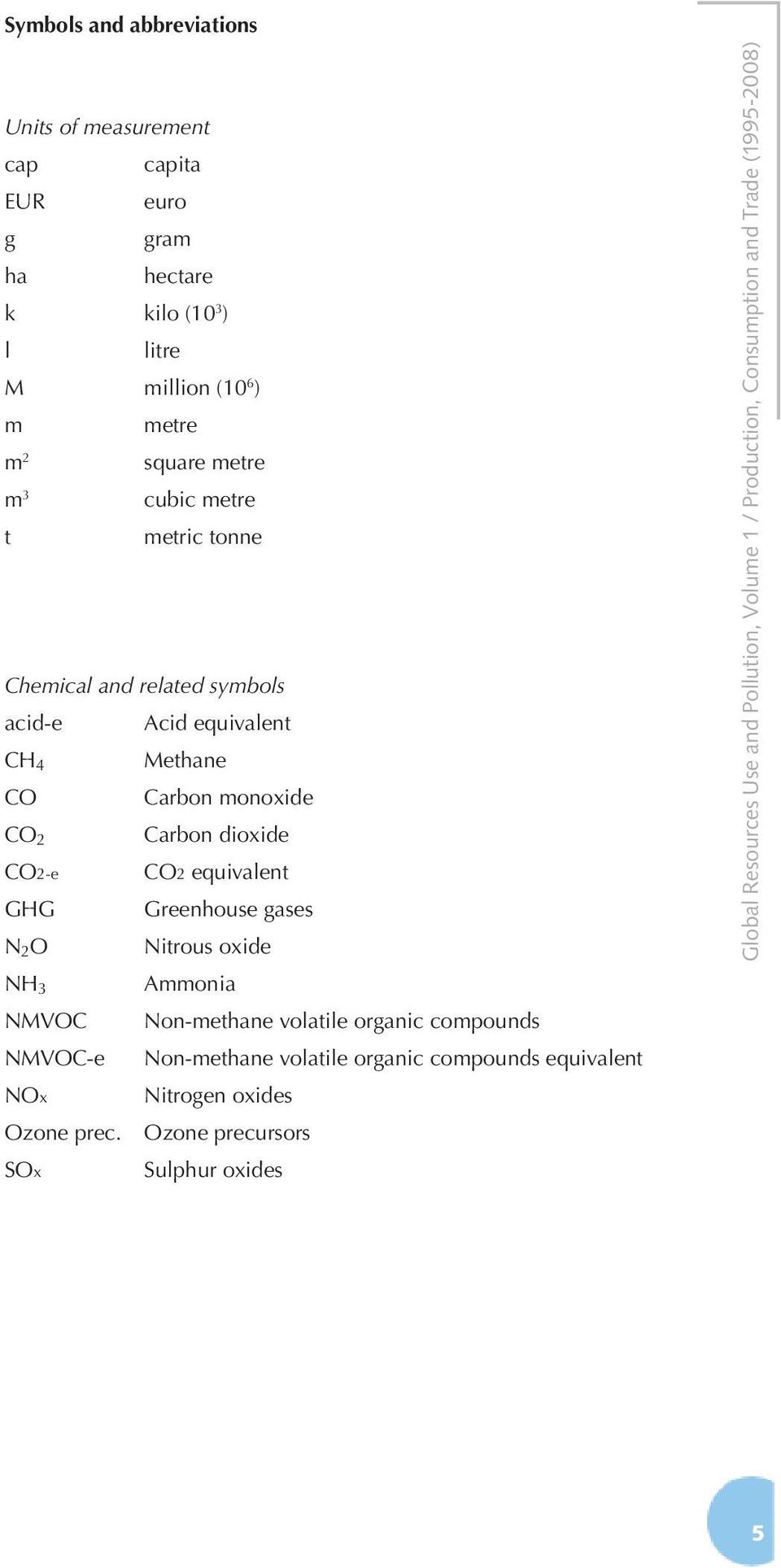
7 Symbols and abbreviations Units of measurement cap capita EUR euro g gram ha hectare k kilo (10 3 ) l litre M million (10 6 ) m metre m 2 m 3 t square metre cubic metre metric tonne Chemical and related symbols acid-e Acid equivalent CH 4 Methane CO Carbon monoxide CO 2 Carbon dioxide CO2-e CO2 equivalent GHG Greenhouse gases N 2 O Nitrous oxide NH 3 Ammonia NMVOC Non-methane volatile organic compounds NMVOC-e Non-methane volatile organic compounds equivalent NOx Nitrogen oxides Ozone prec. Ozone precursors SOx Sulphur oxides Global Resources Use and Pollution, Volume 1 / Production, Consumption and Trade (-2008) 5
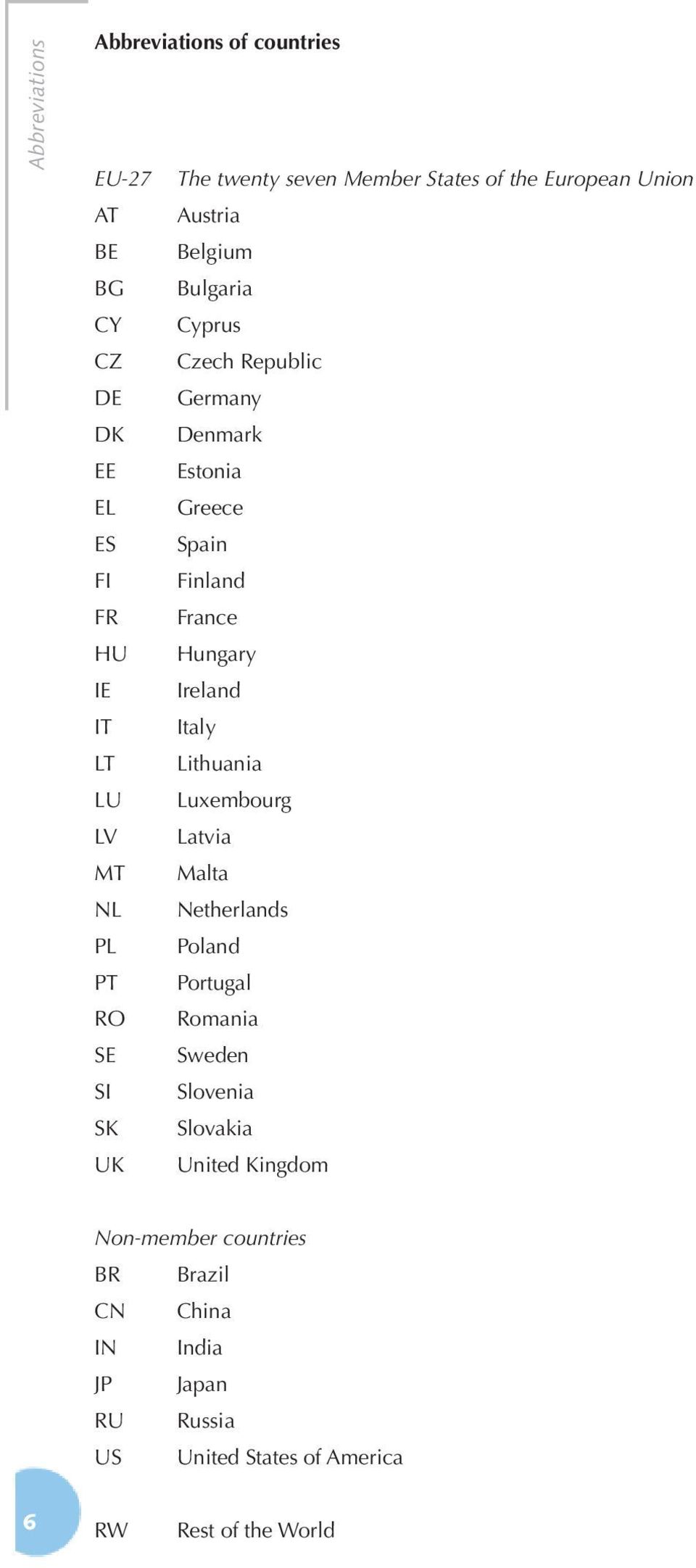
8 Abbreviations Abbreviations of countries EU-27 The twenty seven Member States of the European Union AT Austria BE Belgium BG Bulgaria CY Cyprus CZ Czech Republic DE Germany DK Denmark EE Estonia EL Greece ES Spain FI Finland FR France HU Hungary IE Ireland IT Italy LT Lithuania LU Luxembourg LV Latvia MT Malta NL Netherlands PL Poland PT Portugal RO Romania SE Sweden SI Slovenia SK Slovakia UK United Kingdom Non-member countries BR Brazil CN China IN India JP Japan RU Russia US United States of America 6 RW Rest of the World
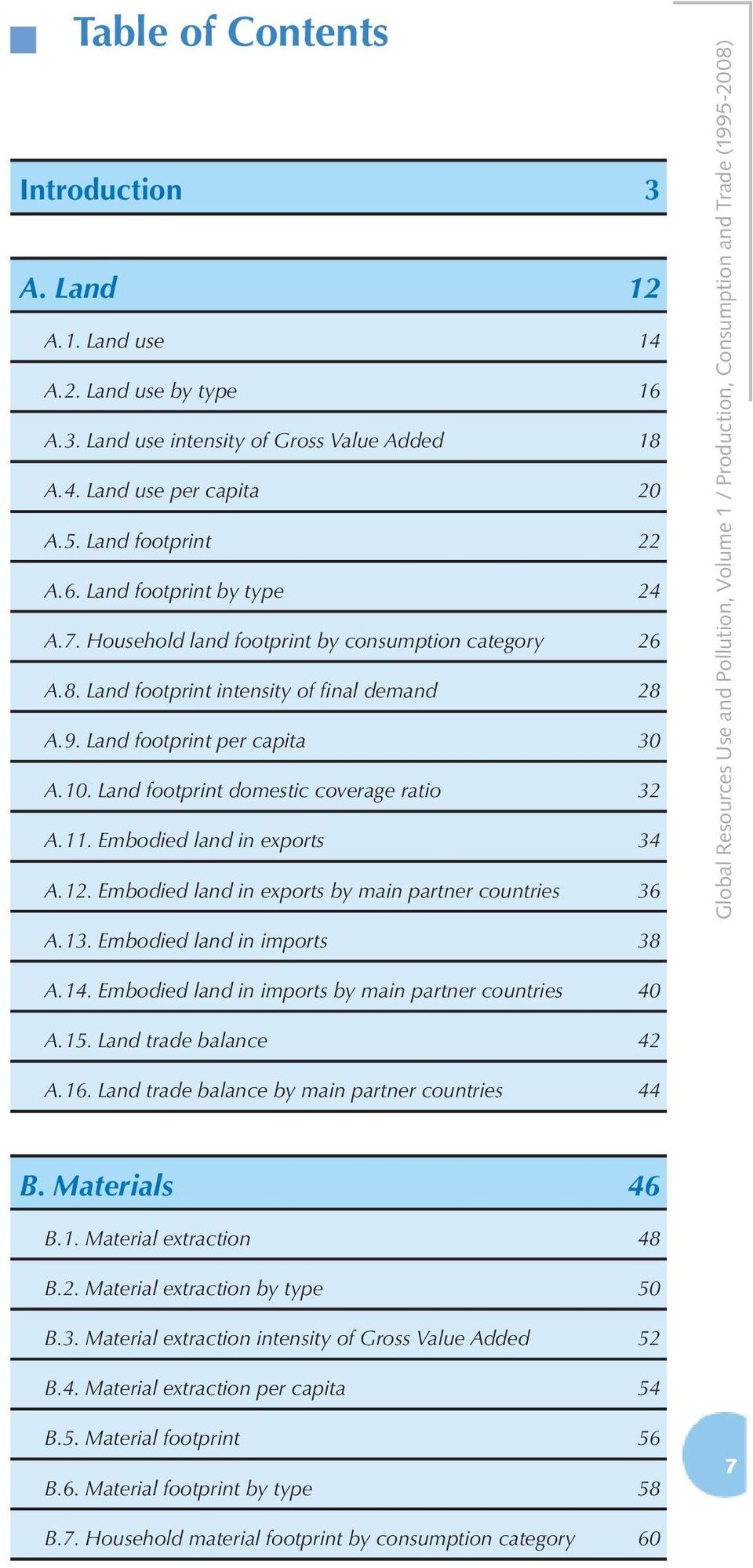
9 Table of Contents Introduction 3 A. Land 12 A.1. Land use 14 A.2. Land use by type 16 A.3. Land use intensity of Gross Value Added 18 A.4. Land use per capita 20 A.5. Land footprint 22 A.6. Land footprint by type 24 A.7. Household land footprint by consumption category 26 A.8. Land footprint intensity of final demand 28 A.9. Land footprint per capita 30 A.10. Land footprint domestic coverage ratio 32 A.11. Embodied land in exports 34 A.12. Embodied land in exports by main partner countries 36 Global Resources Use and Pollution, Volume 1 / Production, Consumption and Trade (-2008) A.13. Embodied land in imports 38 A.14. Embodied land in imports by main partner countries 40 A.15. Land trade balance 42 A.16. Land trade balance by main partner countries 44 B. Materials 46 B.1. Material extraction 48 B.2. Material extraction by type 50 B.3. Material extraction intensity of Gross Value Added 52 B.4. Material extraction per capita 54 B.5. Material footprint 56 B.6. Material footprint by type 58 7 B.7. Household material footprint by consumption category 60
10 Table of Contents B.8. Material footprint intensity of final demand 62 B.9. Material footprint per capita 64 B.10. Material footprint domestic coverage ratio 66 B.11. Embodied material in exports 68 B.12. Embodied material in exports by main partner countries 70 B.13. Embodied material in imports 72 B.14. Embodied material in imports by main partner countries 74 B.15. Material trade balance 76 B.16. Material trade balance by main partner countries 78 C. Water 80 C.1. Water use 82 C.2. Water use by type 84 C.3. Water use intensity of Gross Value Added 86 C.4. Water use per capita 88 C.5. Water footprint 90 C.6. Water footprint by type 92 C.7. Household water footprint by consumption category 94 C.8. Water footprint intensity of final demand 96 C.9. Water footprint per capita 98 C.10. Water footprint domestic coverage ratio 100 C.11. Embodied water in exports 102 C.12. Embodied water in exports by main partner countries 104 C.13. Embodied water in imports 106 C.14. Embodied water in imports by main partner countries 108 C.15. Water trade balance 110 C.16. Water trade balance by main partner countries 112 8

11 D. Acid Emissions 114 D.1. Acid emissions 116 D.2. Acid emissions by type 118 D.3. Acid emissions intensity of Gross Value Added 120 D.4. Acid emissions per capita 122 D.5. Acid footprint 124 D.6. Acid footprint by type 126 D.7. Household acid footprint by consumption category 128 D.8. Acid footprint intensity of final demand 130 D.9. Acid footprint per capita 132 D.10. Acid footprint domestic coverage ratio 134 D.11. Embodied acid emissions in exports 136 D.12. Embodied acid emissions in exports by main partner countries 138 D.13. Embodied acid emissions in imports 140 D.14. Embodied acid emissions in imports by main partner countries 142 D.15. Acid trade balance 144 D.16. Acid trade balance by main partner countries 146 Global Resources Use and Pollution, Volume 1 / Production, Consumption and Trade (-2008) E. GHG Emissions 148 E.1. GHG emissions 150 E.2. GHG emissions by type 152 E.3. GHG emissions intensity of Gross Value Added 154 E.4. GHG emissions per capita 156 E.5. GHG footprint 158 E.6. GHG footprint by type 160 E.7. Household GHG footprint by consumption category 162 E.8. GHG footprint intensity of final demand 164 E.9. GHG footprint per capita 166 E.10. GHG footprint domestic coverage ratio 168 9

12 Table of Contents E.11. Embodied GHG in exports 170 E.12. Embodied GHG in exports by main partner countries 172 E.13. Embodied GHG in imports 174 E.14. Embodied GHG in imports by main partner countries 176 E.15. GHG trade balance 178 E.16. GHG trade balance by main partner countries 180 F. Ozone Precursors Emissions 182 F.1. Ozone precursors emissions 184 F.2. Ozone precursors emissions by type 186 F.3. Ozone precursors emissions intensity of Gross Value Added 188 F.4. Ozone precursors emissions per capita 190 F.5. Ozone precursors footprint 192 F.6. Ozone precursors footprint by type 194 F.7. Household ozone precursors footprint by consumption category 196 F.8. Ozone precursors footprint intensity of final demand 198 F.9. Ozone precursors footprint per capita 200 F.10. Ozone precursors footprint domestic coverage ratio 202 F.11. Embodied ozone precursors in exports 204 F.12. Embodied ozone precursors in exports by main partner countries 206 F.13. Embodied ozone precursors in imports 208 F.14. Embodied ozone precursors in imports by main partner countries 210 F.15. Ozone precursors trade balance 212 F.16. Ozone precursors trade balance by main partner countries 214 Data & Methods
13

14 A. Land A. Land Basic concepts This chapter assesses the use of land by economic activities carried out across the world. Due to lack of information, built-up land has been kept out of the analysis and only 4 main categories of land use have been taken into account: Arable land: the land under temporary agricultural crops (multiplecropped areas are counted only once), temporary meadows for mowing or pasture, land under market and kitchen gardens and land temporarily fallow (less than five years). The abandoned land resulting from shifting cultivation is not included in this category. Data for arable land are not meant to indicate the amount of land that is potentially cultivable. Permanent crops land: the land cultivated with long-term crops which do not have to be replanted for several years (such as cocoa and coffee); land under trees and shrubs producing flowers, such as roses and jasmine; and nurseries (except those for forest trees, which should be classified under forest ). Permanent meadows and pastures are excluded from land under permanent crops. Permanent meadows and pastures: the land used permanently (five years or more) to grow herbaceous forage crops, either cultivated or growing wild (wild prairie or grazing land). Productive forest area: the forest area actually used for productive purposes. The land use intensity of Gross Value Added is a measure of the area used to produce one unit worth of goods and services in a specific country. It is calculated as the quotient between the land use and the Gross Value Added at constant prices of The concept of land footprint refers to the land used to produce the goods and services devoted to satisfy the domestic final demand of a country (i.e. households consumption, government consumption and investment), regardless of the country where this land was actually used.

15 The household footprint is the part of the land footprint related to household consumption. It distinguishes up to 9 categories of consumption. The land use intensity of the final demand is a measure of the area used to produce one unit worth of the goods and services demanded by households, government consumption and investment activities. It is calculated as the quotient between the land footprint and the domestic final demand at constant prices of The land footprint domestic coverage ratio is the relation between the land footprint and the land use of a country. It represents the share of the land footprint of a country that is covered by its own use of land. Embodied land in exports and imports accounts for the land directly or indirectly used to produce internationally traded goods and services. The difference between the land embodied in exports and imports gives the land trade balance. A deficit/surplus in the land trade balance indicates that the land embodied in imports is greater/less than the land exported. Moreover, a deficit in the land trade balance indicates that with the domestic land use is not possible to satisfy the domestic final demand (the contrary applies to a surplus). From this assertion, it follows that the land footprint equals the land use minus the land trade balance. Global Resources Use and Pollution, Volume 1 / Production, Consumption and Trade (-2008) 13

16 A. Land A.1. Land use Land use (1 000 km 2 ) AT % BE % BG % CY % CZ % DE % DK % EE % EL % ES % FI % FR % HU % IE % IT % LT % LU % LV % MT % NL % PL % PT % RO % SE % SI % SK % UK % EU % BR % CN % IN % JP % RU % US % RW % World % 14

17 Land use, EU-27 (1 000 km 2 ) FR ES DE FI PL SE IT UK RO EL BG AT HU PT CZ IE LT LV SK EE DK NL BE SI CY LU MT Global Resources Use and Pollution, Volume 1 / Production, Consumption and Trade (-2008) Between and 2008, land use increased worldwide by 1.3 Mkm 2 to 71.8 Mkm 2 (+2 %). The growth in the use of land was predominantly driven by Russia (+1.5 Mkm 2 ), Brazil (+0.48 Mkm 2 ) and the Rest of the World (+0.28 Mkm 2 ). In 2008, 59 % of the land use was located in the Rest of the World, 9 % in China and in Russia, 8 % in the US, 7 % in Brazil and 4% in the EU-27. Within the EU-27, in 2008, France used 14 % of the European land, Spain 12 %, Germany and Finland 8 % each, and Poland, Sweden, Italy and United Kingdom 7 % each. During the same period, the land use in the EU-27 slightly decreased by 1% to 3 Mkm 2. The largest reductions in absolute terms were reported by Greece and Spain (-0.02 Mkm 2 ). On the other hand, Finland (+0.03 Mkm 2 ) and Sweden (+0.02 Mkm 2 ) showed the highest growths. 15

18 A. Land A.2. Land use by type Land use by type in the EU-27, 2008 (1 000 km 2 ) Arable Permanent crops Pastures Forest Total AT BE BG CY CZ DE DK EE EL ES FI FR HU IE IT LT LU LV MT NL PL PT RO SE SI SK UK EU BR CN IN JP RU US RW World

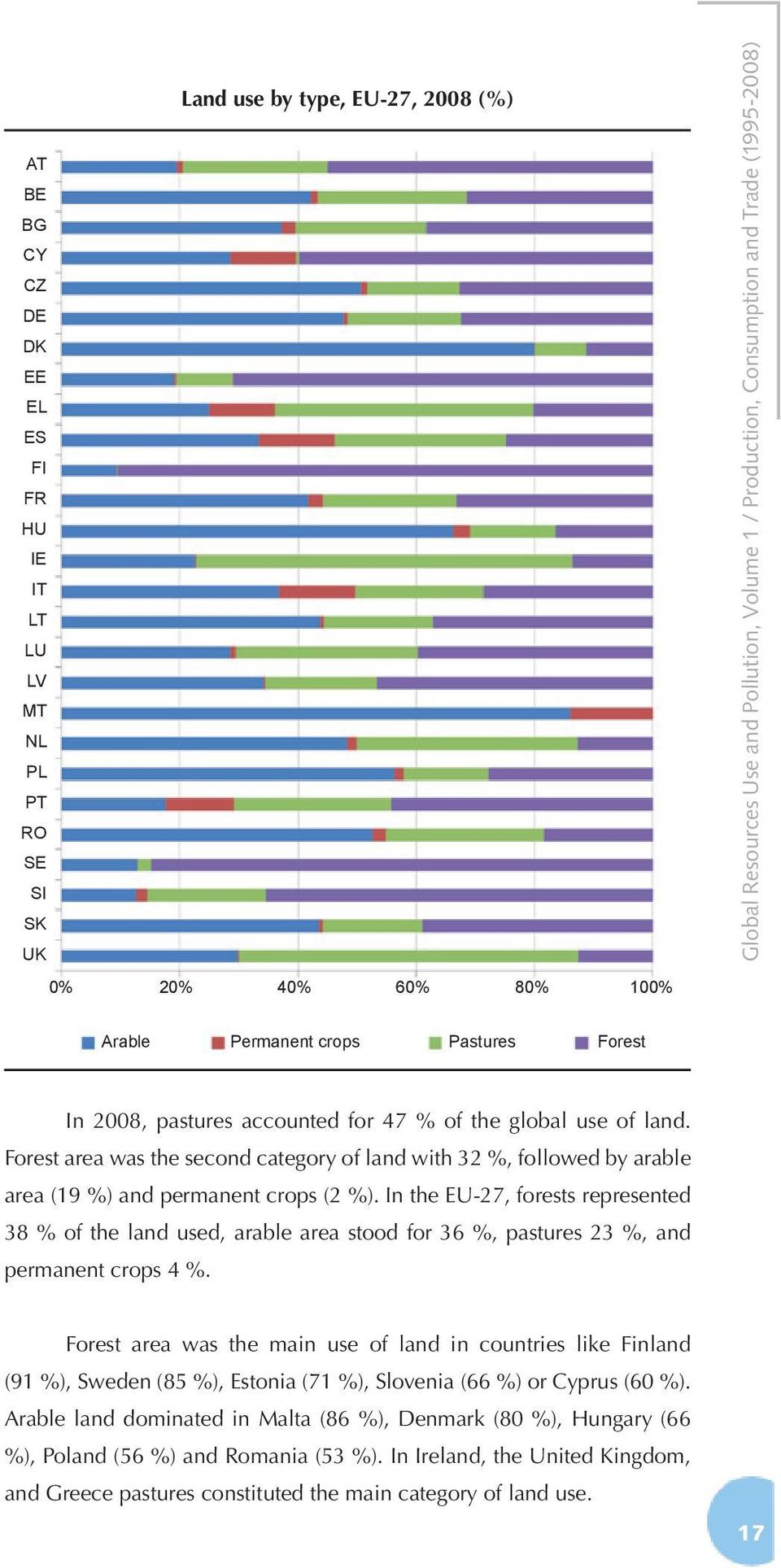
19 Land use by type, EU-27, 2008 (%) AT BE BG CY CZ DE DK EE EL ES FI FR HU IE IT LT LU LV MT NL PL PT RO SE SI SK UK 0% 20% 40% 60% 80% 100% Global Resources Use and Pollution, Volume 1 / Production, Consumption and Trade (-2008) Arable Permanent crops Pastures Forest In 2008, pastures accounted for 47 % of the global use of land. Forest area was the second category of land with 32 %, followed by arable area (19 %) and permanent crops (2 %). In the EU-27, forests represented 38 % of the land used, arable area stood for 36 %, pastures 23 %, and permanent crops 4 %. Forest area was the main use of land in countries like Finland (91 %), Sweden (85 %), Estonia (71 %), Slovenia (66 %) or Cyprus (60 %). Arable land dominated in Malta (86 %), Denmark (80 %), Hungary (66 %), Poland (56 %) and Romania (53 %). In Ireland, the United Kingdom, and Greece pastures constituted the main category of land use. 17
20 A. Land A.3. Land use intensity of Gross Value Added Land use intensity of Gross Value Added (m 2 /EUR) AT % BE % BG % CY % CZ % DE % DK % EE % EL % ES % FI % FR % HU % IE % IT % LT % LU % LV % MT % NL % PL % PT % RO % SE % SI % SK % UK % EU % BR % CN % IN % JP % RU % US % RW % World % 18

21 Land use intensity of Gross Value Added, EU-27, 2008 (m 2 /EUR) < > 0.8 Between and 2008, the world s land use intensity of the Gross Value Added decreased by 30 % to 1.9 m 2 /EUR; in the EU-27 it fell by 27 % to 0.27 m 2 /EUR. In China and India, the reductions of the land intensity amounted 5.3 and 3.9 m 2 /EUR respectively. In 2008, the regions with the highest land use intensity per unit of Gross Value Added were Russia (6.4 m 2 /EUR), the Rest of the World (5.6 m 2 /EUR), Brazil (5.3 m 2 /EUR), India (2.7 m2/eur) and China (2.1 m 2 /EUR). Japan showed the lowest land use intensity (0.09 m 2 /EUR), followed by the EU-27 (0.27 m 2 / EUR) and the US (0.62 m2/eur). Global Resources Use and Pollution, Volume 1 / Production, Consumption and Trade (-2008) In this period, all EU-27 Member States reduced their land use intensity; Lithuania, Latvia, Estonia, Bulgaria, and Romania were the countries with the highest reductions in absolute terms. Bulgaria, Estonia, Latvia, Finland, and Lithuania turned out to be the top countries with the highest land use intensities in Malta, the Netherlands and Luxembourg were the Member States with the lowest intensities in the same year. 19
22 A. Land A.4. Land use per capita Land use per capita (ha/cap) AT % BE % BG % CY % CZ % DE % DK % EE % EL % ES % FI % FR % HU % IE % IT % LT % LU % LV % MT % NL % PL % PT % RO % SE % SI % SK % UK % EU % BR % CN % IN % JP % RU % US % RW % World % 20
23 < > 1 Land use per capita, EU-27, 2008 (ha/cap) The global use of land per inhabitant between and 2008 decreased by 0.17 ha/cap to 1.1 ha/cap (-14 %), in the EU-27 it fell by 0.03 ha/cap to 0.61 ha/cap (-5 %). In Russia the use of land grew by 1.2 ha/cap, while in the US, the Rest of the World, and Brazil it reduced by 0.59, 0.35, and 0.19 ha/cap respectively. Global Resources Use and Pollution, Volume 1 / Production, Consumption and Trade (-2008) In 2008, the regions with the highest land use per capita were Russia (4.3 ha/cap), Brazil (2.6 ha/cap), the US (1.9 ha/cap), the Rest of the World (1.4 ha/cap) and the EU-27 (0.6 ha/cap). Concerning the EU-27, Finland, Estonia, Sweden, Latvia, and Lithuania were the top five countries in terms of land use per capita. In contrast, Malta, the Netherlands, Belgium, Germany, and the United Kingdom reported the lowest land use per capita. 21
24 A. Land A.5. Land footprint Land footprint (1 000 km 2 ) AT % BE % BG % CY % CZ % DE % DK % EE % EL % ES % FI % FR % HU % IE % IT % LT % LU % LV % MT % NL % PL % PT % RO % SE % SI % SK % UK % EU % BR % CN % IN % JP % RU % US % RW % World % 22
25 Land footprint, EU-27 (1 000 km 2 ) DE UK FR ES IT NL PL FI SE BR RO EL PT AT DK CZ HU IE BG SK LT LV SI EE CY LU MT Global Resources Use and Pollution, Volume 1 / Production, Consumption and Trade (-2008) 2008 The global land footprint in 2008 amounted to 71.8 Mkm 2 (2 % increase compared to ). Russia was the region with the largest growth (+1.9 Mkm 2 ), followed by China and the Rest of the World (+0.43 Mkm 2 ), and the EU-27 (+0.29 Mkm 2 ). On the contrary, Japan reduced its land footprint by 1 Mkm 2, the US by 0.68 and Brazil by 0.18 Mkm 2. In 2008, the Rest of the World was responsible for 51 % of global land footprint, the US held 10 %, and China, Russia, and the EU-27 9 %. Regarding the EU-27, in 2008, Germany (16 %), the United Kingdom (13 %), France (12 %), Spain (11 %), and Italy (10 %) summed up almost 60 % of the EU-27 total land footprint. Between and 2008, the land footprint of the EU-27 grew by 4 %. This indicator also followed a growing trend in most Member States. The three largest contributors to the increase of the European land footprint were the United Kingdom (+0.16 Mkm 2 ), Spain (+0.07 Mkm 2 ), and Finland (+0.05 Mkm 2 ). 23
26 A. Land A.6. Land footprint by type Land footprint by type, 2008 (1 000 km 2 ) Arable Permanent crops Pastures Forest Total AT BE BG CY CZ DE DK EE EL ES FI FR HU IE IT LT LU LV MT NL PL PT RO SE SI SK UK EU BR CN IN JP RU US RW World
27 AT BE BG CY CZ DE DK EE EL ES FI FR HU IE IT LT LU LV MT NL PL PT RO SE SI SK UK EU-27 Land footprint by type, EU-27, 2008 (%) Global Resources Use and Pollution, Volume 1 / Production, Consumption and Trade (-2008) 0% 20% 40% 60% 80% 100% Arable Permanent crops Pastures Forest In 2008, 47 % of the global land footprint corresponded to pastures. Forest areas constituted the second source of land footprint at the global level (32 %), followed by arable land (19 %) and permanent crops (2 %). Regarding the EU-27, pastures represented 41 % of the European total land footprint, forests 32 %, arable area 24 %, and permanent crops 3 %. The pastures component of the EU-27 land footprint was the most important in 19 out of 27 Member States, with a share ranging from 36 % to 54 %. Hungary, Romania, and Poland showed the highest shares of arable area, while in Finland, Sweden, and Estonia forest area is the main category of the land footprint. 25
28 A. Land A.7. Household land footprint by consumption category Household land footprint by consumption category, 2008 (1 000 km 2 ) C_1 C_2 C_3 C_4 C_5 C_6 C_7 C_8 C_9 AT BE BG CY CZ DE DK EE EL ES FI FR HU IE IT LT LU LV MT NL PL PT RO SE SI SK UK EU BR CN IN JP RU US RW World NB: C_1: Food, drinks and tobacco; C_2: Clothing and footwear; C_3: Housing, fuel, and power; C_4: Household goods and services; C_5: Health and education; C_6: Transport and Communications; C_7: Recreation and culture; C_8: Restaurants and hotels; C_9: Miscellaneous goods and services.
29 Household land footprint by consumption category, EU-27, 2008 (%) AT BE BG CY CZ DE DK EE EL ES FI FR HU IE IT LT LU LV MT NL PL PT RO SE SI SK UK EU-27 Global Resources Use and Pollution, Volume 1 / Production, Consumption and Trade (-2008) 0% 20% 40% 60% 80% 100% C_1 C_2 C_3 C_4 C_5 C_6 C_7 C_8 C_9 In 2008, food, drinks and tobacco drove more than two thirds of the global land footprint of households. Recreation and culture activities were responsible for 12 % of the land footprint, and restaurants and hotels for 6%. In the EU-27, food, drinks, and tobacco (64 %), recreation and culture (10 %), restaurants and hotels (8 %), and clothing and footwear (4 %) were the consumption activities that caused most of the land footprint. 27
30 A. Land A.8. Land footprint intensity of final demand Land footprint intensity of final demand, 2008 (m 2 /EUR) AT % BE % BG % CY % CZ % DE % DK % EE % EL % ES % FI % FR % HU % IE % IT % LT % LU % LV % MT % NL % PL % PT % RO % SE % SI % SK % UK % EU % BR % CN % IN % JP % RU % US % RW % World % 28
31 Land footprint intensity of final demand, EU-27, 2008 (m 2 /EUR) < > 0.95 The world s land footprint intensity of final demand totaled 1.9 m 2 / EUR in 2008, a 30 % decrease from. In the EU-27, the intensity reduced by 23 % to reach 0.57 m 2 /EUR. China, India, and Russia registered the highest absolute decreases. In 2008, the top five regions with the largest land intensity per unit of final demand were Russia (7.7 m 2 /EUR), the Rest of the World (5.6 m 2 /EUR), Brazil (3.8 m 2 /EUR) and India (2.5 m 2 /EUR). Japan showed the lowest land intensity (0.53 m 2 / EUR), followed by the EU-27 (0.57 m 2 /EUR) and the US (0.73 m 2 /EUR). Global Resources Use and Pollution, Volume 1 / Production, Consumption and Trade (-2008) Regarding the EU-27, all the Member States except Belgium reduced their land footprint intensity. Bulgaria (-1.2 m 2 /EUR), Romania (-1.1 m 2 /EUR) and Lithuania (-1 m 2 /EUR) showed the largest drops. In 2008, Bulgaria (2 m 2 /EUR), and Estonia and Latvia (1.7 m 2 /EUR each) ranked the top in terms of the land footprint intensities, while Luxembourg (0.3 m 2 /EUR), Ireland (0.41 m 2 /EUR), France and Italy (0.44 m 2 /EUR each) ranked the lowest. 29
32 A. Land A.9. Land footprint per capita Land footprint per capita (ha/cap) AT % BE % BG % CY % CZ % DE % DK % EE % EL % ES % FI % FR % HU % IE % IT % LT % LU % LV % MT % NL % PL % PT % RO % SE % SI % SK % UK % EU % BR % CN % IN % JP % RU % US % RW % World % 30
33 Land footprint per capita, EU-27, 2008 (ha/cap) < > 1.9 Between and 2008, the world s land footprint per capita decreased from 1.2 ha/cap to 1.1 ha/cap (-14 %). Most regions experimented a reduction in the land footprint per capita, particularly Japan (-0.86 ha/cap), the US (-0.6 ha/cap), and Brazil (-0.49 ha/cap). In contrast, the land footprint of Russia increased by 1.5 ha/cap and in the EU-27 by 0.01 ha/cap. Global Resources Use and Pollution, Volume 1 / Production, Consumption and Trade (-2008) In 2008, the regions with the highest land footprint per capita were Russia (4.6 ha/cap), the US (2.4 ha/cap), Brazil (2 ha/cap), and Japan and the EU-27 (1.4 ha/cap each). In the EU-27, Finland (4.5 ha/cap), Sweden (2.6 ha/cap), and Luxembourg (2 ha/cap) were the Member States with the highest land footprint per capita. Hungary (0.71 ha/cap), Poland (0.8 ha/cap) and Romania (0.9 ha/cap) showed the lowest land use per capita. Between and 2008, Estonia, Finland, and Latvia led the growth of the land footprint per capita within the EU-27, while Germany, Luxembourg, France, and Austria showed the highest reductions in absolute terms. 31
34 A. Land A.10. Land footprint domestic coverage ratio Land footprint domestic coverage ratio (%) AT 44% 49% 50% 51% 52% 53% 9% 21% BE 13% 12% 9% 9% 9% 9% -3% -26% BG 108% 116% 116% 115% 112% 120% 12% 11% CY 34% 30% 27% 25% 27% 21% -13% -39% CZ 73% 75% 67% 68% 69% 65% -8% -11% DE 21% 22% 24% 24% 24% 23% 3% 12% DK 30% 35% 31% 31% 29% 30% 1% 2% EE 169% 123% 139% 103% 101% 121% -49% -29% EL 74% 69% 52% 58% 44% 56% -18% -24% ES 59% 61% 53% 53% 48% 51% -8% -14% FI 119% 123% 103% 101% 105% 103% -16% -13% FR 52% 57% 53% 54% 53% 53% 1% 3% HU 102% 91% 92% 95% 98% 97% -5% -5% IE 125% 91% 82% 75% 69% 68% -56% -45% IT 30% 32% 29% 28% 29% 30% -0% -0% LT 130% 100% 91% 91% 99% 95% -35% -27% LU 24% 28% 23% 23% 23% 22% -1% -6% LV 115% 112% 102% 96% 90% 92% -23% -20% MT 3% 2% 3% 3% 2% 2% -1% -26% NL 7% 8% 7% 7% 7% 7% -1% -10% PL 91% 83% 81% 79% 78% 73% -18% -19% PT 42% 46% 46% 49% 45% 44% 2% 5% RO 98% 98% 88% 85% 83% 86% -13% -13% SE 85% 83% 100% 85% 89% 88% 2% 3% SI 45% 49% 52% 54% 49% 44% -1% -1% SK 83% 82% 62% 58% 52% 54% -29% -35% UK 28% 25% 21% 22% 22% 24% -5% -17% EU-27 47% 49% 45% 45% 44% 45% -2% -5% BR 112% 117% 135% 133% 131% 129% 18% 16% CN 105% 99% 100% 101% 100% 96% -9% -9% IN 102% 102% 97% 96% 92% 97% -5% -5% JP 11% 13% 15% 16% 18% 17% 6% 56% RU 101% 109% 99% 101% 98% 95% -6% -6% US 86% 74% 73% 74% 77% 83% -3% -4% RW 117% 117% 118% 117% 117% 116% -1% -1% World 100% 100% 100% 100% 100% 100% 0% 0% 32
35 Land footprint domestic coverage ratio, EU-27, 2008 (%) < 25% 25% - 50% 50% - 75% 75% - 100% > 100% In 2008, the share of the land footprint covered with domestic land use was below 100 % in all the regions except Brazil and the Rest of the World. Japan, the EU-27, and the US showed the lowest coverage ratios (17 %, 45 % and 83 % respectively). During the period 2008, the coverage ratios of China, India, and Russia turned to figures below 100 %. Global Resources Use and Pollution, Volume 1 / Production, Consumption and Trade (-2008) Between and 2008, the share of the land footprint of the EU-27 covered by domestic land fell from 47 % to 45 %. In this period, most Member States reduced their domestic coverage ratios. In 2008, only Estonia (121 %), Bulgaria (120 %) and Finland (103 %) showed a domestic coverage ratio above 100 %. Malta (2 %), the Netherlands (7 %) and Belgium (9 %) were the countries with the lowest figures, followed by Cyprus (21%) Luxembourg (22 %), Germany (23 %) and the United Kingdom (24 %). 33
36 A. Land A.11. Embodied land in exports Embodied land in exports (1 000 km 2 ) AT % BE % BG % CY % CZ % DE % DK % EE % EL % ES % FI % FR % HU % IE % IT % LT % LU % LV % MT % NL % PL % PT % RO % SE % SI % SK % UK % EU % BR % CN % IN % JP % RU % US % RW % World % 34
37 Embodied land in exports, EU-27 (1 000 km 2 ) FR ES DE FI SE PL IT BG UK HU AT IE CZ RO LT NL DK EE PT BE EL LV SK SI LU CY MT Global Resources Use and Pollution, Volume 1 / Production, Consumption and Trade (-2008) 2008 Between and 2008 the land embodied in global exports increased by 22 % to 16.6 Mkm 2. Growth in the exports of land was led by the Rest of the World (+1.3 Mkm 2 ), China (+0.71 Mkm 2 ), and Brazil (+0.63 Mkm 2 ). Most of the EU-27 Member States increased the amount of land embodied in exports; the largest growths in absolute terms were registered in Germany and Spain (+0.04 Mkm 2 ), and Sweden (+0.03 Mkm 2 ). In 2008, 64 % of the land embodied in global exports was related to the exports of the Rest of the World, 10 % to China, 8 % to the US, 8 % to Brazil, and 6 % to the EU-27. Within the EU-27, France was the country with the highest amount of land embodied in exports (0.15 Mkm 2 ), followed by Spain (0.13 Mkm 2 ) and Germany (0.09 Mkm 2 ). 35
38 A. Land A.12. Embodied land in exports by main partner countries Embodied land in exports by main partner countries, 2008 (1 000 km 2 ) EU-27 BR CN IN JP RU US RW Total exports AT BE BG CY CZ DE DK EE EL ES FI FR HU IE IT LT LU LV MT NL PL PT RO SE SI SK UK EU BR CN IN JP RU US RW
39 Embodied land in exports by main partner countries, EU-27, 2008 (%) AT BE BG CY CZ DE DK EE EL ES FI FR HU IE IT LT LU LV MT NL PL PT RO SE SI SK UK EU-27 Global Resources Use and Pollution, Volume 1 / Production, Consumption and Trade (-2008) 0% 20% 40% 60% 80% 100% EU-27 BR CN IN JP RU US RW In 2008, 29 % of the land embodied in the exports of the Rest of the World was conveyed to the European market, 20 % to the US and 13 % to China. Up to 21 % of the land embodied in the exports of the Rest of the World was traded within the region. In the case of China, 39 % of the embodied land in Chinese exports was delivered to the Rest of the World, 23 % to the EU-27, 20 % to the US and 10 % to Japan. The EU-27 countries delivered most of the land embodied in exports to other Member States (62 %), 26 % to the Rest of the World, and 5 % to the US. 37
40 A. Land A.13. Embodied land in imports Embodied land in imports (1 000 km 2 ) AT % BE % BG % CY % CZ % DE % DK % EE % EL % ES % FI % FR % HU % IE % IT % LT % LU % LV % MT % NL % PL % PT % RO % SE % SI % SK % UK % EU % BR % CN % IN % JP % RU % US % RW % World % 38
41 DE UK FR IT ES NL BE PL SE PT EL AT DK FI CZ RO IE SK HU BG SI LT LV EE CY LU MT Embodied land in imports, EU-27 (1 000 km 2 ) Global Resources Use and Pollution, Volume 1 / Production, Consumption and Trade (-2008) Between and 2008, the land embodied in global imports increased by 22 % to 16.6 Mkm 2. This growth was mainly driven by the Rest of the World (+1.5 Mkm 2 ), China (+1.3 Mkm 2 ), and the EU-27 (+0.53 Mkm 2 ). In 2008, the EU-27 imported 29 % of the land embodied in global imports, the Rest of the World 28 %, the US 16 %, and China 11 %. In most EU-27 Member States the land embodied in imports increased, the largest growth in absolute terms being reported by the United Kingdom (+0.15 Mkm 2 ), Spain (+0.13 Mkm 2 ), and Poland (+0.08 Mkm 2 ). Within the EU-27, in 2008, Germany was the country with the highest level of land embodied in imports (0.93 Mkm 2 ), followed by the United Kingdom (0.69 Mkm 2 ), France (0.54 Mkm 2 ), Italy (0.52 Mkm 2 ), and Spain (0.49 Mkm 2 ). 39
42 A. Land A.14. Embodied land in imports by main partner countries Embodied land in imports by main partner countries, 2008 (1 000 km 2 ) EU-27 BR CN IN JP RU US RW Total imports AT BE BG CY CZ DE DK EE EL ES FI FR HU IE IT LT LU LV MT NL PL PT RO SE SI SK UK EU BR CN IN JP RU US RW
43 Embodied land in imports by main partner countries, EU-27, 2008 (%) AT BE BG CY CZ DE DK EE EL ES FI FR HU IE IT LT LU LV MT NL PL PT RO SE SI SK UK EU-27 Global Resources Use and Pollution, Volume 1 / Production, Consumption and Trade (-2008) 0% 20% 40% 60% 80% 100% EU-27 BR CN IN JP RU US RW In 2008, almost half of the land embodied in the imports of the Rest of the World were originated in the region, 16 % in the US, 13 % in China, 12 % in Brazil, and 6 % in the EU-27. The Rest of the World and China were the main sources of land embodied in the imports of the US (78 % and 12 % respectively); while 73 % of the land embodied in Chinese imports came from the Rest of the World and 11 % from Brazil. In the year 2008, 63 % of the land embodied in the imports of the EU-27 countries came from the Rest of the World, 13 % from other Member States, 8 % from Brazil, 8 % China, and 4 % from the US. 41
44 A. Land A.15. Land trade balance Land trade balance (1 000 km 2 ) AT % BE % BG % CY % CZ % DE % DK % EE % EL % ES % FI % FR % HU % IE % IT % LT % LU % LV % MT % NL % PL % PT % RO % SE % SI % SK % UK % EU % BR % CN % IN % JP % RU % US % RW % 42
45 BG FI EE LT HU LV MT LU CY SI IE SK RO SE CZ AT DK EL PL PT BE NL ES FR IT UK DE Land trade balance, EU-27 (1 000 km 2 ) Global Resources Use and Pollution, Volume 1 / Production, Consumption and Trade (-2008) Between and 2008 the land trade deficit increased by 0.58 Mkm 2 in China, by 0.4 Mkm 2 in Russia and by 0.31 Mkm 2 in the EU-27. In 2008, the EU-27 showed the largest deficit in terms of land embodied in trade (3.7 Mkm 2 ), followed by Japan (1.4 Mkm 2 ) and the US (1.3 Mkm 2 ). The only regions with surplus in terms of land embodied in trade were the Rest of the World (5.9 Mkm 2 ) and Brazil (1.1 Mkm 2 ). In 2008, all the EU-27 countries (excluding Bulgaria, Finland, and Estonia) showed a deficit in the land trade balance. The largest deficits were those of Germany (0.83 Mkm 2 ), the United Kingdom (0.65 Mkm 2 ), Italy (0.47 Mkm 2 ), France (0.39 Mkm 2 ), and Spain (0.36 Mkm 2 ). Between and 2008, Germany was the Member State with the greatest reduction in the land deficit. 43
46 A. Land A.16. Land trade balance by main partner countries Land trade balance by main partner countries, 2008 (1 000 km 2 ) EU-27 BR CN IN JP RU US RW Trade Balance AT BE BG CY CZ DE DK EE EL ES FI FR HU IE IT LT LU LV MT NL PL PT RO SE SI SK UK EU BR CN IN JP RU US RW
47 Land trade balance by main partner countries, EU-27, 2008 (%) AT BE BG CY CZ DE DK EE EL ES FI FR HU IE IT LT LU LV MT NL PL PT RO SE SI SK UK EU-27 Global Resources Use and Pollution, Volume 1 / Production, Consumption and Trade (-2008) -100% -50% 0% 50% 100% EU-27 BR CN IN JP RU US RW In 2008, the land trade balance of the EU-27 showed a deficit with all the other regions except with Japan. The largest deficits of the EU-27 were with the Rest of the World (2.7 Mkm 2 ), Brazil (0.4 Mkm 2 ), and China (0.34 Mkm 2 ). Brazil presented a land trade surplus against all the other regions, and the Rest of the World showed a surplus with all the other regions except Brazil. Within the EU-27 counties, the largest deficits in the land trade balance were with the Rest of the World. Some EU-27 countries showed a surplus in the land trade balance, mostly with other Member States. 45
48 B. Materials B. Materials Basic concepts This chapter assesses the use of materials during economic activities across the world from different perspectives. The chapter begins with an analysis of the domestic extraction of materials at the country level. The domestic extraction covers the annual amount of solid, liquid, and gaseous raw materials (except for water and air) extracted from the natural environment by humans or humancontrolled means of technology insofar as they are considered resident units. This domestic extraction refers to the used extraction, i.e. the amount of extracted resources which enters the economic system for further processing or direct consumption. These materials are classified into four types: biomass, fossil fuels, metals, and non-metals. The material extraction intensity of Gross Value Added is a measure of the materials extracted to produce one unit worth of goods and services in a specific country. It is calculated as the quotient between the material extraction and the Gross Value Added at constant prices of The concept of material footprint refers to the materials extracted to produce the goods and services devoted to satisfy the domestic final demand of a country (i.e. households consumption, government consumption, and investment), regardless of the country where these materials were actually used. The household footprint is the part of the material footprint related to household consumption. It distinguishes up to 9 categories of consumption. The material intensity of the final demand is a measure of the materials extracted to produce one unit worth of the goods and services demanded by households, government consumption, and investment activities. It is calculated as the quotient between the material footprint and the domestic final demand at constant prices of The material footprint domestic coverage ratio is the relation between the material footprint and the material extraction of a country. It represents the share of the material footprint of a country that is covered by its own material extraction.
49 Embodied materials in exports and imports are the materials directly or indirectly extracted to produce internationally traded goods and services. The difference between the materials embodied in exports and imports gives the material trade balance. A deficit/surplus in the material trade balance indicates that the materials embodied in imports are greater/less than those exported. Moreover, a deficit in the material trade balance indicates that with the domestic material extraction is not possible to satisfy the domestic final demand (the contrary applies to a surplus). From this assertion it follows that the material footprint equals the material use minus the material trade balance. Global Resources Use and Pollution, Volume 1 / Production, Consumption and Trade (-2008) 47
50 B. Materials B.1. Material extraction Material extraction (Mt) AT % BE % BG % CY % CZ % DE % DK % EE % EL % ES % FI % FR % HU % IE % IT % LT % LU % LV % MT % NL % PL % PT % RO % SE % SI % SK % UK % EU % BR % CN % IN % JP % RU % US % RW % World % 48
51 Material extraction, EU-27 (Mt) DE FR ES PL UK IT RO SE IE PT FI CZ AT EL BG NL HU DK BE SK LT LV EE SI CY LU MT Global Resources Use and Pollution, Volume 1 / Production, Consumption and Trade (-2008) 2008 Between and 2008, the world s extraction of materials increased by Mt to Mt (+43 %). The growth in materials extraction was predominantly driven by China ( Mt), the Rest of the World ( Mt), and India ( Mt). In 2008, 36 % of materials were extracted in the Rest of the World, 26 % in China, 12 % in the US, and 10 % in the EU-27. Within the EU-27, Germany extracted in % of the total materials, France 10%, and Spain and Poland 9 % each. During the period 2008, the material extraction in the EU-27 increased by 11 % to Mt. Most of the Member States increased their material extraction; the largest growths in absolute terms were reported by Spain (+239 Mt), Romania (+214 Mt), and Poland (+127 Mt). In contrast, Germany (-257 Mt), United Kingdom (-169 Mt), Belgium (-21 Mt), Italy (-4 Mt), the Netherlands (-2 Mt) and Luxembourg (-0.4 Mt) showed reductions. 49
52 B. Materials B.2. Material extraction by type Material extraction by type, 2008 (Mt) Biomass Fossil fuels Metals Nonmetals Total AT BE BG CY CZ DE DK EE EL ES FI FR HU IE IT LT LU LV MT NL PL PT RO SE SI SK UK EU BR CN IN JP RU US RW World
53 AT BE BG CY CZ DE DK EE EL ES FI FR HU IE IT LT LU LV MT NL PL PT RO SE SI SK UK EU-27 Material extraction by type, EU-27, 2008 (%) Global Resources Use and Pollution, Volume 1 / Production, Consumption and Trade (-2008) 0% -20% 40% 60% 80% 100% Biomass Fossil fuels Metals Non-metals In 2008, the extraction of non-metals accounted for 44 % of the global material extraction. Biomass was the second most extracted material with 28 %, followed by fossil fuels (19 %) and metals (10 %). In the EU-27, the extraction of non-metals represented 59 % of total material extraction while biomass amounted for 26 %, fossil fuels 13 %, and metals 2 %. Non-metals were the type of material that was mostly extracted by Member States being only under 40 % in the Netherlands, and Malta. The Netherlands mainly extracted fossil fuels (due to the extraction natural gas), while in Luxembourg, Latvia, and Malta the material extraction was dominated by biomass. 51
54 B. Materials B.3. Material extraction intensity of Gross Value Added Material extraction intensity of Gross Value Added (kg/eur) AT % BE % BG % CY % CZ % DE % DK % EE % EL % ES % FI % FR % HU % IE % IT % LT % LU % LV % MT % NL % PL % PT % RO % SE % SI % SK % UK % EU % BR % CN % IN % JP % RU % US % RW % World % 52
55 Material extraction intensity of Gross Value Added, EU-27, 2008 (kg/eur) < > 1.4 Between and 2008, the world s materials intensity of the Gross Value Added decreased by 2 % to 1.8 kg/eur in 2008, while in the EU-27 it fell by 18 % to 0.62 kg/eur. In China and India, the reductions of the material intensity amounted 2.9 and 2.8 kg/eur respectively. In 2008, the regions with the highest material intensity per unit of Gross Value Added were China (5.9 kg/eur), India (5.3 kg/eur), the Rest of the World (3.3 kg/eur), Brazil (3.2 kg/eur), and Russia (2.7 kg/eur). Japan showed the lowest material intensity (0.19 kg/eur), followed by the EU-27 (0.62 kg/ EUR) and the US (0.82 kg/eur). Global Resources Use and Pollution, Volume 1 / Production, Consumption and Trade (-2008) In this period, all EU-27 Member States except Bulgaria, Cyprus, Spain, Portugal, and Romania reduced their material intensity. Regarding the EU-27, Bulgaria, Romania, Estonia, Latvia, and Poland turned out to be the top countries with the highest material intensities in Malta, Luxembourg, the Netherlands, the United Kingdom, and Belgium were the Member States with the lowest material intensities in the same year. 53
56 B. Materials B.4. Material extraction per capita Material extraction per capita (t/cap) AT % BE % BG % CY % CZ % DE % DK % EE % EL % ES % FI % FR % HU % IE % IT % LT % LU % LV % MT % NL % PL % PT % RO % SE % SI % SK % UK % EU % BR % CN % IN % JP % RU % US % RW % World % 54
57 Material extraction per capita, EU-27, 2008 (t/cap) < > 22 The global use of materials per inhabitant between and 2008 increased by 1.8 t/cap to 10.2 t/cap (+22 %), while in the EU-27, it increased by 0.9 t/cap to 14 t/cap (+7 %). In China, Russia, and Brazil the extraction of materials grew by 7.1, 4.8, and 3.7 t/cap respectively. The US and Japan reduced the material extraction by 5.4 and 2.1 t/cap respectively. Global Resources Use and Pollution, Volume 1 / Production, Consumption and Trade (-2008) In 2008, the regions with the highest material extraction per capita were the US (26.1 t/cap), Russia (18.4 t/cap), Brazil (16.2 t/cap), the EU-27 (14 t/cap), and China (13.6 t/cap). In the EU-27, Ireland, Finland, Estonia, Romania, and Sweden were the top five countries in terms of material extraction per capita. In contrast, Malta, Luxembourg, the Netherlands, Italy, and the United Kingdom reported the lowest materials extraction per capita. 55
58 B. Materials B.5. Material footprint Material footprint (Mt) AT % BE % BG % CY % CZ % DE % DK % EE % EL % ES % FI % FR % HU % IE % IT % LT % LU % LV % MT % NL % PL % PT % RO % SE % SI % SK % UK % EU % BR % CN % IN % JP % RU % US % RW % World % 56
59 Material footprint, EU-27 (Mt) DE FR IT UK ES PL RO NL EL PT BE SE AT FI IE CZ DK HU BG SK LT SI LV EE CY LU MT Global Resources Use and Pollution, Volume 1 / Production, Consumption and Trade (-2008) 2008 The global material footprint in 2008 amounted to Mt (43 % increase compared to ). China was the country with the largest variation ( Mt) followed by the Rest of the World ( Mt), the EU-27 ( Mt), and India ( Mt). In 2008, the Rest of the World was responsible for 30 % of global material footprint, China held 25 %, and the EU % and the US 15 % each. Regarding the EU-27, in 2008 Germany and France made up together almost 30 % of the EU-27 total material footprint. Adding up Italy, the United Kingdom, and Spain to the list, it then makes up almost to two-thirds. Between and 2008, the material footprint of the EU- 27 grew by 25 %. This indicator also followed a growing trend in most of the Member States. The three largest contributors to the increase of the European material footprint in this period were Spain (+410 Mt), Romania (+240 Mt), and France (+221 Mt). Germany was the only country that reduced its material footprint (-146 Mt). 57
60 B. Materials B.6. Material footprint by type Material footprint by type, 2008 (Mt) Biomass Fossil fuels Metals Nonmetals Total AT BE BG CY CZ DE DK EE EL ES FI FR HU IE IT LT LU LV MT NL PL PT RO SE SI SK UK EU BR CN IN JP RU US RW World
61 AT BE BG CY CZ DE DK EE EL ES FI FR HU IE IT LT LU LV MT NL PL PT RO SE SI SK UK EU-27 Material footprint by type, EU-27, 2008 (%) Global Resources Use and Pollution, Volume 1 / Production, Consumption and Trade (-2008) 0% -20% 40% 60% 80% 100% Biomass Fossil fuels Metals Non-metals In 2008, 44 % of the global material footprint corresponded to nonmetals. Biomass constituted the second source of materials at the global level (28 %) followed by fossil fuels (19 %) and metals (10 %). Regarding the EU-27, non-metals represented 40 % of the material footprint. Biomass and fossil fuels made up together 50 % (equally distributed), and metals 8 %. The non-metals component of the EU-27 material footprint was the most important in 22 Member States, with a share ranging from 34 % to 65 %. Greece, Malta, the Czech Republic and Estonia showed the highest shares of fossil fuels. In Malta, the Netherlands, and Luxembourg biomass was the main component of the material footprint. 59
62 B. Materials B.7. Household material footprint by consumption category Household material footprint by consumption category, 2008 (Mt) C_1 C_2 C_3 C_4 C_5 C_6 C_7 C_8 C_9 AT BE BG CY CZ DE DK EE EL ES FI FR HU IE IT LT LU LV MT NL PL PT RO SE SI SK UK EU BR CN IN JP RU US RW World NB: C_1: Food, drinks, and tobacco; C_2: Clothing and footwear; C_3: Housing, fuel, and power; C_4: Household goods and services; C_5: Health and education; C_6: Transport and communications; C_7: Recreation and culture; C_8: Restaurants and hotels; C_9: Miscellaneous goods and services.
63 Household material footprint by consumption category, EU-27, 2008 (%) AT BE BG CY CZ DE DK EE EL ES FI FR HU IE IT LT LU LV MT NL PL PT RO SE SI SK UK EU-27 Global Resources Use and Pollution, Volume 1 / Production, Consumption and Trade (-2008) 0% 20% 40% 60% 80% 100% C_1 C_2 C_3 C_4 C_5 C_6 C_7 C_8 C_9 In 2008, food, drinks, and tobacco drove 45 % of the global material footprint of households. Housing, fuel, and power represented 13 %, transport and communication activities 12 %, and recreation and culture activities 10 %. In the EU-27, food, drinks, and tobacco (32 %), housing, fuel, and power (22 %), and transport and communication activities (15 %) add up to almost two-thirds of the total material footprint. This was followed by recreation and culture activities (9 %). 61
64 B. Materials B.8. Material footprint intensity of final demand Material footprint intensity of final demand (kg/eur) AT % BE % BG % CY % CZ % DE % DK % EE % EL % ES % FI % FR % HU % IE % IT % LT % LU % LV % MT % NL % PL % PT % RO % SE % SI % SK % UK % EU % BR % CN % IN % JP % RU % US % RW % World % 62
65 Material footprint intensity of final demand, EU-27, 2008 (kg/eur) < > 1.6 The world s material footprint intensity of final demand totalled 1.8 kg/eur in 2008, a decrease of 2 % from ; in the EU-27 it decreased by 8 % to reach 0.87 kg/eur in the same year. China and India had the highest reductions in the material intensity (-3.3 and -2.1 kg/eur respectively). This was significantly higher compared to the country that followed, i.e. Russia (-0.91 kg/eur). In 2008, the top five regions with the largest material intensity per unit of final demand were China (5.3 kg/eur), India (4.6 kg/eur), the Rest of the World (3.2 kg/eur), Brazil (2.4 kg/eur), and Russia (2 kg/eur). Japan showed the lowest material intensity (0.67 kg/eur), followed by the EU-27 (0.87 kg/eur) and the US (1 kg/eur). Global Resources Use and Pollution, Volume 1 / Production, Consumption and Trade (-2008) Regarding the EU-27 Member States, the countries with the highest growth in the material footprint intensity of the final demand were Portugal (47 %), Cyprus (30 %), Ireland (29 %), Lithuania (17 %), and Malta (13 %). Conversely, Hungary (-36 %), Slovakia (-31 %) and the Czech Republic (-30 %) showed the highest reductions in their material footprint intensities. In 2008, Romania (3.9 kg/eur), and Bulgaria (3.3 kg/ EUR), and Lithuania (2.3 kg/eur), ranked the top in terms of the material footprint intensities, while Luxembourg (0.39 kg/eur), the Netherlands (0.54 kg/eur), and the United Kingdom (0.62 kg/eur), ranked the lowest. 63
66 B. Materials B.9. Material footprint per capita Material footprint per capita (t/cap) AT % BE % BG % CY % CZ % DE % DK % EE % EL % ES % FI % FR % HU % IE % IT % LT % LU % LV % MT % NL % PL % PT % RO % SE % SI % SK % UK % EU % BR % CN % IN % JP % RU % US % RW % World % 64
67 Material footprint per capita, EU-27, 2008 (t/cap) < > 27 The world s material footprint per capita showed a 22 % increase between and 2008, reaching 10 t/cap in The China (+6.8 t/ cap), the EU-27 (+3.5 t/cap), and Russia (+3.2 t/cap) were the regions with the largest increase in the material footprint per capita, while in Japan (-1 t/cap) and the US (-0.7 t/cap) reduced the material footprint per capita. Global Resources Use and Pollution, Volume 1 / Production, Consumption and Trade (-2008) In 2008, the regions with the highest material footprint per capita were the US (33 t/cap), the EU-27 (21 t/cap), Japan (17 t/cap), and Brazil and China (13 t/cap each). In the EU-27, Ireland (45 t/cap), Finland (44 t/cap), Cyprus(33 t/cap), Austria (30 t/cap) and Denmark (29 t/cap) were the Member States with the highest material footprint per capita. Malta (10 t/cap), Hungary (14 t/cap), Bulgaria (15 t/cap), Poland (16 t/cap), and the United Kingdom (17 t/ cap) showed the lowest material extraction per capita. Between and 2008, all the Member States except Germany increased their material footprint, being Lithuania (+179 %), Estonia (+131 %), and Ireland (+111 %) the countries with the highest increase. 65
68 B. Materials B.10. Material footprint domestic coverage ratio Material footprint domestic coverage ratio (%) AT 70% 71% 67% 70% 71% 70% -0% -0% BE 65% 62% 54% 50% 50% 47% -18% -28% BG 128% 137% 129% 142% 124% 129% 2% 1% CY 56% 57% 58% 52% 57% 50% -7% -12% CZ 118% 102% 104% 99% 104% 98% -21% -18% DE 66% 62% 60% 59% 60% 58% -9% -13% DK 79% 93% 87% 84% 82% 77% -2% -3% EE 131% 132% 105% 101% 105% 105% -26% -20% EL 85% 73% 65% 62% 59% 59% -26% -30% ES 71% 72% 68% 69% 69% 66% -5% -7% FI 89% 84% 85% 85% 84% 82% -7% -8% FR 67% 67% 59% 60% 61% 59% -8% -12% HU 81% 79% 86% 83% 79% 85% 4% 5% IE 121% 110% 103% 105% 102% 106% -16% -13% IT 61% 60% 54% 52% 52% 52% -10% -16% LT 76% 63% 66% 63% 66% 66% -10% -13% LU 35% 29% 20% 23% 22% 21% -14% -41% LV 105% 108% 103% 97% 95% 92% -13% -12% MT 4% 4% 4% 4% 3% 3% -1% -23% NL 56% 55% 49% 49% 47% 47% -9% -17% PL 118% 102% 112% 110% 107% 102% -16% -13% PT 68% 73% 70% 74% 75% 75% 7% 10% RO 102% 98% 94% 93% 97% 96% -5% -5% SE 91% 86% 91% 90% 89% 88% -3% -3% SI 74% 73% 72% 75% 74% 67% -7% -10% SK 74% 68% 73% 69% 66% 68% -6% -8% UK 82% 74% 58% 56% 55% 56% -27% -32% EU-27 76% 72% 69% 68% 68% 67% -8% -11% BR 109% 113% 130% 128% 128% 126% 17% 15% CN 108% 103% 105% 106% 106% 106% -2% -2% IN 104% 103% 104% 103% 103% 104% 0% 0% JP 38% 36% 33% 33% 34% 29% -10% -25% RU 154% 216% 174% 164% 153% 153% -2% -1% US 94% 85% 78% 78% 79% 79% -14% -15% RW 116% 125% 124% 123% 121% 120% 5% 4% World 100% 100% 100% 100% 100% 100% 0% 0% 66
69 Material footprint domestic coverage ratio, EU-27, 2008 (%) < 40% 40% - 60% 60% - 80% 80% - 100% > 100% In 2008, the share of the material footprint covered with domestic materials was below 100 % in Japan (21 %), the EU-27 (67 %), and the US (79 %). On the contrary, Russia presented one of the highest coverage ratios (153 %), followed by Brazil (126 %), the Rest of the World (120 %), and China (106 %). Global Resources Use and Pollution, Volume 1 / Production, Consumption and Trade (-2008) During the period 2008, the US reduced its domestic coverage ratio from 94 % to 79 %, being the largest decrease among the non-eu countries. It was followed by Japan with a reduction from 38 % to 29 %. Brazil s material footprint coverage ratio had the largest increase. The share of the material footprint of the EU-27 covered by domestic extraction fell from 76 % to 67 %. In this period, all the countries (excluding Austria, Hungary, Portugal, and Bulgaria) reduced their domestic coverage ratios. In 2008, only Bulgaria (129 %), Ireland (106 %), Estonia (105 %), and Poland (102 %) showed a domestic coverage ratio of the material footprint above 100 %, while Malta (3 %) and Luxembourg (21 %) were the countries with the lowest figures, followed by the Netherlands and Belgium (47 % each). 67
70 B. Materials B.11. Embodied material in exports Embodied material in exports (Mt) AT % BE % BG % CY % CZ % DE % DK % EE % EL % ES % FI % FR % HU % IE % IT % LT % LU % LV % MT % NL % PL % PT % RO % SE % SI % SK % UK % EU % BR % CN % IN % JP % RU % US % RW % World % 68
71 Embodied material in exports, EU-27 (Mt) DE PL UK FR NL ES CZ IT SE IE BG RO AT DK BE HU FI PT SK EE LV LT EL SI CY LU MT Global Resources Use and Pollution, Volume 1 / Production, Consumption and Trade (-2008) 2008 Between and 2008, the materials embodied in global exports increased by Mt to Mt (+80 %). Growth in material exports was led by the Rest of the World ( Mt), China ( Mt), Brazil (+540 Mt), Russia (+424 Mt), and the EU-27 (+348 Mt). Most of the EU-27 Member States increased the amount of materials embodied in exports; the largest growths in absolute terms were registered in Germany (+64 Mt), Poland (+61 Mt), and Spain (+42 Mt). In contrast, the United Kingdom (-39 Mt), Greece (-19 Mt) and Belgium (-6 Mt) reduced the materials embodied in exports. In 2008, 53% of the materials embodied in global exports were related to exports from the Rest of the World, 16 % from China, 10 % from the EU-27, and 8 % from Russia. Within the EU-27, Germany was the country with the highest amount of materials embodied in exports (315 Mt), followed by Poland (196 Mt), the United Kingdom (159 Mt), and France and the Netherlands (108 Mt each). 69
72 B. Materials B.12. Embodied material in exports by main partner countries Embodied material in exports by main partner countries, 2008 (Mt) EU-27 BR CN IN JP RU US RW Total exports AT BE BG CY CZ DE DK EE EL ES FI FR HU IE IT LT LU LV MT NL PL PT RO SE SI SK UK EU BR CN IN JP RU US RW
73 Embodied material in exports by main partner countries, EU-27, 2008 (%) AT BE BG CY CZ DE DK EE EL ES FI FR HU IE IT LT LU LV MT NL PL PT RO SE SI SK UK EU-27 Global Resources Use and Pollution, Volume 1 / Production, Consumption and Trade (-2008) 0% 20% 40% 60% 80% 100% EU-27 BR CN IN JP RU US RW In 2008, 25 % of the materials embodied in the exports of the Rest of the World were conveyed to the EU-27, while 21 % went to the US, 13 % to Japan, and 13 % to China. Almost 20 % of the materials embodied in the exports of the Rest of the World were traded within the own region. On the other hand, 40 % of the embodied materials in Chinese exports were to meet the Rest of the World markets, while 24 % and 20 % satisfied respectively the EU-27 s and the US s demand. The EU-27 countries delivered most of the materials embodied in exports to other Member States (59 %), 25 % to the Rest of the World, and 7 % to the US. 71
74 B. Materials B.13. Embodied material in imports Embodied material in imports (Mt) AT % BE % BG % CY % CZ % DE % DK % EE % EL % ES % FI % FR % HU % IE % IT % LT % LU % LV % MT % NL % PL % PT % RO % SE % SI % SK % UK % EU % BR % CN % IN % JP % RU % US % RW % World % 72
75 Embodied material in imports, EU-27 (Mt) DE UK FR IT ES NL PL BE EL AT SE PT CZ RO DK FI IE HU SK LT BG SI CY LV LU EE MT Global Resources Use and Pollution, Volume 1 / Production, Consumption and Trade (-2008) 2008 Between and 2008, the materials embodied in global imports increased by Mt (+80 %) to Mt. This growth was mainly driven by the Rest of the World ( Mt), the EU-27 ( Mt), the US ( Mt), and China ( Mt). In 2008, the EU-27 imported 30 % of the materials embodied in global imports, 27 % the Rest of the World, and 30 % the US. In all EU-27 Member States the materials embodied in imports increased, the largest positive growth in absolute terms being reported by the United Kingdom (+269 Mt), Spain (+213 Mt), France (+188 Mt), Italy (+184 Mt), and Germany (+175 Mt). Within the EU-27, in 2008, Germany was the country with the highest level of materials embodied in imports (1 015 Mt), followed by the United Kingdom (632 Mt), France (608 Mt), Italy (598 Mt), and Spain (441 Mt). 73
76 B. Materials B.14. Embodied material in imports by main partner countries Embodied material in imports by main partner countries, 2008 (Mt) EU-27 BR CN IN JP RU US RW Total imports AT BE BG CY CZ DE DK EE EL ES FI FR HU IE IT LT LU LV MT NL PL PT RO SE SI SK UK EU BR CN IN JP RU US RW
77 Embodied material in imports by main partner countries, EU-27, 2008 (%) AT BE BG CY CZ DE DK EE EL ES FI FR HU IE IT LT LU LV MT NL PL PT RO SE SI SK UK EU-27 Global Resources Use and Pollution, Volume 1 / Production, Consumption and Trade (-2008) 0% 20% 40% 60% 80% 100% EU-27 BR CN IN JP RU US RW In 2008, 24 % of the materials embodied in the imports of the Rest of the World were originated in China, 9 % in the EU-27 and in the US, and 38 % in other Rest of the World countries. The Rest of the World was also the main source of materials embodied in Chinese imports (73 %), while 65 % of the materials embodied in US imports came from the Rest of the World and 18 % from China. Almost 45 % of the materials embodied in the imports of the EU- 27 countries came from the Rest of the World, 19 % from other Member States, 14 % from Russia, and 13 % from China. 75
78 B. Materials B.15. Material trade balance Material trade balance (Mt) AT % BE % BG % CY % CZ % DE % DK % EE % EL % ES % FI % FR % HU % IE % IT % LT % LU % LV % MT % NL % PL % PT % RO % SE % SI % SK % UK % EU % BR % CN % IN % JP % RU % US % RW % 76
79 Material trade balance, EU-27 (Mt) BG PL IE EE LV MT CZ LU SI CY RO HU LT SE SK DK FI PT AT EL BE NL ES UK FR IT DE Global Resources Use and Pollution, Volume 1 / Production, Consumption and Trade (-2008) 2008 In 2008, the EU-27 showed the largest deficit in terms of materials embodied in trade (3.396 Mt), followed by the US (2.070 Mt) and Japan (1.546 Mt). Between and 2008 the material trade deficit increased by Mt in the US, by in the EU-27, and by 142 Mt in Japan. The countries with the largest surplus in terms of materials embodied in trade were the Rest of the World (4 235 Mt), China (1 050 Mt), and Russia (910 Mt). All the EU-27 countries (excluding Bulgaria, Poland, Ireland and Estonia) showed in 2008 a deficit in their material trade balance. The largest deficits were those of Germany (800 Mt), Italy (524 Mt), France (499 Mt), the United Kingdom (473 Mt), and Spain (346 Mt). Between and 2008, Bulgaria and Hungary were the only Member States that improved their material trade balance. 77
80 B. Materials B.16. Material trade balance by main partner countries Material trade balance by main partner countries, 2008 (Mt) EU-27 BR CN IN JP RU US RW Trade Balance AT BE BG CY CZ DE DK EE EL ES FI FR HU IE IT LT LU LV MT NL PL PT RO SE SI SK UK EU BR CN IN JP RU US RW
81 Material trade balance by main partner countries, EU-27, 2008 (%) AT BE BG CY CZ DE DK EE EL ES FI FR HU IE IT LT LU LV MT NL PL PT RO SE SI SK UK EU-27 Global Resources Use and Pollution, Volume 1 / Production, Consumption and Trade (-2008) -100% -50% 0% 50% 100% EU-27 BR CN IN JP RU US RW In 2008, the material trade balance of the EU-27 showed a deficit with all the other regions except with Japan. The largest deficits of the EU- 27 were with the Rest of the World (1 795 Mt), Russia (676 Mt), and China (577 Mt). Brazil presented a material trade surplus against all the other regions, and China showed a trade surplus against all the other regions except the Rest of the World and Brazil. Some EU-27 countries showed a surplus in the material trade balance, mostly with other Member States. 79
82 C. Water C. Water Basic concepts This chapter assesses the global use of water by economic activities (including water use by households). Conventional national water use accounts are restricted to statistics on water withdrawals within their own territories. This would include the use of surface and ground water by the different economic activities and final users (the blue water ). In this chapter, this approach has been extended by including data on rainwater use (green water), an estimation of the water evaporated from artificial reservoirs to produce electricity and the volumes of water used for waste assimilation (grey water), giving a broader perspective of humans appropriation of fresh water. Therefore, three different types of water are distinguished: Blue water: refers to the consumption of surface and ground water. Green water: is the volume of rainwater consumed, mainly in crop production. Grey water: is the volume of fresh water that is required to assimilate the load of pollutants based on existing ambient water quality standards. The water use intensity of Gross Value Added is a measure of the water used to produce one unit worth of goods and services in a specific country. It is calculated as the quotient between the water use and the Gross Value Added at constant prices of The concept of water footprint refers to the water used to produce the goods and services devoted to satisfy the domestic final demand of a country (i.e. household consumption, government consumption, and investment), regardless of the country where this water was actually used. It also includes the water directly used by households. 80 The household water footprint is the part of the water footprint related to household consumption of good and services plus the water used by households. It distinguishes up to 9 categories of consumption.
83 The water use intensity of the final demand is a measure of the water used to produce one unit worth of the goods and services demanded by households, government consumption, and investment activities. It is calculated as the quotient between the water footprint and the domestic final demand at constant prices of The water footprint domestic coverage ratio is the relation between the water footprint and the water use of a country. It represents the share of the water footprint of a country that is covered by its own use of water. Embodied water in exports and imports accounts for the water directly or indirectly used to produce internationally traded goods and services. The difference between the water embodied in exports and imports gives the water trade balance. A deficit/surplus in the water trade balance indicates that the water embodied in imports is greater/less than the water exported. Moreover, a deficit in the water trade balance indicates that with the domestic water use it is not possible to satisfy the domestic final demand (the contrary applies to a surplus). From this assertion it follows that the water footprint equals the water use minus the water trade balance. Global Resources Use and Pollution, Volume 1 / Production, Consumption and Trade (-2008) 81
84 C. Water C.1. Water use Water use (km 3 ) AT % BE % BG % CY % CZ % DE % DK % EE % EL % ES % FI % FR % HU % IE % IT % LT % LU % LV % MT % NL % PL % PT % RO % SE % SI % SK % UK % EU % BR % CN % IN % JP % RU % US % RW % World % 82
85 FR ES IT DE PL RO HU UK BG SE EL AT CZ PT LT FI DK SK LV BE NL IE EE SI CY LU MT Water use, EU-27 (km 3 ) Global Resources Use and Pollution, Volume 1 / Production, Consumption and Trade (-2008) 2008 Between and 2008, water use increased worldwide by km 3 to km 3 (+37 %). The growth in the use of water was predominantly driven by the Rest of the World ( km 3 ), China (+588 km 3 ), and India (332 Mkm 2 ). In 2008, 46 % of the water use was located in the Rest of the World, 14 % in China, 12 % in India, 10 % in the US, 6 % in Brazil, and 6 % in the EU-27. Within the EU-27, France used 15 % of the European water while Spain used 13 %, Italy 11 %, and Germany and Poland 9 % each. During the same period, the water use in the EU-27 grew by 95 km3 (+15%) to 732 km 3. All the Member States (excluding Portugal, Greece, Cyprus, the Netherlands and Malta) increased the use of water; the largest growths in absolute terms were reported by Spain (38 km 3 ), France (14 km 3 ), and Germany (10 km 3 ). 83
86 C. Water C.2. Water use by type Water use by type, 2008 (km 3 ) Blue water Grey Water Green water Total AT BE BG CY CZ DE DK EE EL ES FI FR HU IE IT LT LU LV MT NL PL PT RO SE SI SK UK EU BR CN IN JP RU US RW World
87 AT BE BG CY CZ DE DK EE EL ES FI FR HU IE IT LT LU LV MT NL PL PT RO SE SI SK UK EU-27 Water use by type, EU-27, 2008 (km 3 ) Global Resources Use and Pollution, Volume 1 / Production, Consumption and Trade (-2008) 0% 20% 40% 60% 80% 100% Blue water Grey water Green water In 2008, green water accounted for 69 % of the global use of water. Blue water is the second category of water use with 16 % followed by grey water (15 %). In the EU-27, green water represents 65 % of the water used while blue and grey water represent 17 %. Green water was the type of water that was mostly used by Member States being only under 40 % in Malta, Sweden, Slovenia, and Austria. In Sweden and Austria blue water is the main category due to the size of the hydropower generation sector. Grey water dominates in countries like Belgium and Slovenia (due to the industry), and Malta (due to households). 85
88 C. Water C.3. Water use intensity of Gross Value Added Water use intensity of Gross Value Added (l/eur) AT % BE % BG % CY % CZ % DE % DK % EE % EL % ES % FI % FR % HU % IE % IT % LT % LU % LV % MT % NL % PL % PT % RO % SE % SI % SK % UK % EU % BR % CN % IN % JP % RU % US % RW % World % 86
89 Water use intensity of Gross Value Added, EU-27, 2008 (l/eur) < > 120 Between and 2008, global water use intensity of the Gross Value Added decreased by 6 % to 318 l/eur in 2008, while in the EU-27 it fell by 15 % to 65 l/eur. In China and India the reductions of the water intensity amounted 55 % and 48 % respectively. In 2008, the regions with the highest water use intensity per unit of Gross Value Added were India (1.764 l/eur), Brazil (797 l/eur), the Rest of the World (716 l/eur), Russia (624 l/eur), and China (552 l/eur). Japan showed the lowest water use intensity (19 l/eur), followed by the EU-27 (65 l/eur) and the US (122 l/eur). Global Resources Use and Pollution, Volume 1 / Production, Consumption and Trade (-2008) In this period, all the EU-27 Member States except Spain reduced their water use intensity; Bulgaria, Romania, Lithuania, Poland, and Estonia were the countries with the highest reductions in absolute terms. Bulgaria, Romania, Lithuania, Hungary, and Latvia turned out to be the top countries with the highest water intensities in Luxembourg, the Netherlands, Malta, the United Kingdom, and Belgium were the Member States with the lowest intensities. 87
90 C. Water C.4. Water use per capita Water use per capita (Ml/cap) AT % BE % BG % CY % CZ % DE % DK % EE % EL % ES % FI % FR % HU % IE % IT % LT % LU % LV % MT % NL % PL % PT % RO % SE % SI % SK % UK % EU % BR % CN % IN % JP % RU % US % RW % World % 88
91 < > 2.5 Water use per capita, EU-27, 2008 (Ml/cap) In 2008, food, drinks, and tobacco drove almost two-thirds of the global water footprint of households. Recreation and culture activities were responsible for 11 % of the water footprint, housing, fuel, and power for 8 % and restaurants and hotels for 5 %. Global Resources Use and Pollution, Volume 1 / Production, Consumption and Trade (-2008) In the EU-27, food, drinks, and tobacco (56 %), recreation and culture activities (10 %), housing, fuel, and power (9 %) and restaurants and hotels for (8 %) were the consumption activities that caused most of the water footprint. 89
92 C. Water C.5. Water footprint Water footprint (km 3 ) AT % BE % BG % CY % CZ % DE % DK % EE % EL % ES % FI % FR % HU % IE % IT % LT % LU % LV % MT % NL % PL % PT % RO % SE % SI % SK % UK % EU % BR % CN % IN % JP % RU % US % RW % World % 90
93 Water footprint, EU-27 (km 3 ) DE FR IT UK ES PL RO NL SE BE EL PT AT HU CZ FI BG DK SK IE LT LV SI EE CY LU MT Global Resources Use and Pollution, Volume 1 / Production, Consumption and Trade (-2008) 2008 The global water footprint in 2008 amounted to km 3 (37 % increase compared to ). The Rest of the World was the region with the largest growth ( km 3 ), followed by China (+464 km 3 ), the EU- 27 (+332 km 3 ), India (+299 km 3 ), and the US (+280 km 3 ). In contrast, Japan reduced its water footprint by 36 km 3. In 2008, the Rest of the World was responsible for 42 % of the global water footprint, while China held 12 %, and the US, India, and the EU % each. Regarding the EU-27, in 2008, Germany (16 %), France (13 %), Italy (12 %), the United Kingdom (11 %), and Spain (11 %) summed up more than 60 % of the EU-27 total water footprint. Between and 2008, the water footprint of the EU-27 grew by 34 %. This indicator also followed a growing trend in all the Member States except Bulgaria. The four largest contributors to the increase of the European water footprint were Spain (+59 km 3 ), the United Kingdom (+58 km 3 ), France (+35 km 3 ) and Germany (+34 km 3 ). 91
94 C. Water C.6. Water footprint by type Water footprint by type, 2008 (km 3 ) Blue water Grey Water Green water Total AT BE BG CY CZ DE DK EE EL ES FI FR HU IE IT LT LU LV MT NL PL PT RO SE SI SK UK EU BR CN IN JP RU US RW World
95 AT BE BG CY CZ DE DK EE EL ES FI FR HU IE IT LT LU LV MT NL PL PT RO SE SI SK UK EU-27 Water footprint by type, EU-27, 2008 (km 3 ) Global Resources Use and Pollution, Volume 1 / Production, Consumption and Trade (-2008) 0% 20% 40% 60% 80% 100% Blue water Grey water Green water In 2008, 69 % of the global water footprint corresponded to green water. Blue water constituted the second source of water footprint at the global level (16 %), followed by grey water (15 %). Regarding the EU-27, green water represented 67% of the European total water footprint, 17 % blue water and grey water 16 %. The green water component of the EU-27 water footprint was the most important in all the Member States, with a share ranging from 45 % to 86 %. Lithuania, Estonia, and Latvia showed the highest shares of green water. Sweden and Austria reported the highest shares of blue water due to the water footprint of hydropower generation. 93
96 C. Water C.7. Household water footprint by consumption category Household water footprint by consumption category, 2008 (km 3 ) C_1 C_2 C_3 C_4 C_5 C_6 C_7 C_8 C_9 AT BE BG CY CZ DE DK EE EL ES FI FR HU IE IT LT LU LV MT NL PL PT RO SE SI SK UK EU BR CN IN JP RU US RW World NB: C_1: Food, drinks, and tobacco; C_2: Clothing and footwear; C_3: Housing, fuel, and power; C_4: Household goods and services; C_5: Health and education; C_6: Transport and communications; C_7: Recreation and culture; C_8: Restaurants and hotels; C_9: Miscellaneous goods and services.
97 Household Water footprint by consumption category, EU-27, 2008 (%) AT BE BG CY CZ DE DK EE EL ES FI FR HU IE IT LT LU LV MT NL PL PT RO SE SI SK UK EU-27 Global Resources Use and Pollution, Volume 1 / Production, Consumption and Trade (-2008) 0% 20% 40% 60% 80% 100% C_1 C_2 C_3 C_4 C_5 C_6 C_7 C_8 C_9 In 2008, food, drinks, and tobacco drove almost two-thirds of the global water footprint of households. Recreation and culture activities were responsible for 12 % of the water footprint, housing, fuel, and power for 8 % and restaurants and hotels for 6 %. In the EU-27, food, drinks, and tobacco (53 %), recreation and culture activities (10 %), housing, fuel, and power (9 %) and restaurants and hotels for (8 %) were the consumption activities that caused most of the water footprint. 95
98 C. Water C.8. Water footprint intensity of final demand Water footprint intensity of final demand (l/eur) AT % BE % BG % CY % CZ % DE % DK % EE % EL % ES % FI % FR % HU % IE % IT % LT % LU % LV % MT % NL % PL % PT % RO % SE % SI % SK % UK % EU % BR % CN % IN % JP % RU % US % RW % World % 96
99 Water footprint intensity of final demand, EU-27, 2008 (l/eur) < > 200 The world s water footprint intensity of final demand totalled 318 l/ EUR in 2008, a decrease of 6 % from. In the EU-27, the intensity slightly reduced by 1 % to reach 109 l/eur. India, China, and Russia registered the highest decreases in water intensity. In 2008, the top five regions with the largest water intensity per unit of final demand were India (1 485 l/eur), Russia (773 l/eur), the Rest of the World (760 l/eur), Brazil (587 l/eur), and China (454 l/eur). Japan showed the lowest water intensity (79 l/eur), followed by the EU-27 (109 l/eur) and the US (137 l/eur). Global Resources Use and Pollution, Volume 1 / Production, Consumption and Trade (-2008) Regarding the EU-27, most Member States reduced their water footprint intensity. Bulgaria (-320 l/eur), Romania (-292 l/eur), and Slovakia (-117 l/eur) showed the largest drops. In 2008, Bulgaria (546 l/eur), Romania (404 l/eur), and Latvia (336 l/eur) ranked the top in terms of the water footprint intensities, while Luxembourg (56 l/eur), Ireland (66 l/eur), and Denmark (80 l/eur) ranked the lowest. 97
100 C. Water C.9. Water footprint per capita Water footprint per capita (Ml/cap) AT % BE % BG % CY % CZ % DE % DK % EE % EL % ES % FI % FR % HU % IE % IT % LT % LU % LV % MT % NL % PL % PT % RO % SE % SI % SK % UK % EU % BR % CN % IN % JP % RU % US % RW % World % 98
101 Water footprint per capita, EU-27, 2008 (Ml/cap) < > 3.2 Between and 2008, the world s water footprint per capita grew from 1.5 Ml/cap to 1.8 Ml/cap (+17 %). Most regions experimented an increase in the water footprint per capita, particularly Russia (+1.9 Ml/cap), the EU-27 (+0.59 Ml/cap), and Brazil (+0.5 Ml/cap). On the other hand, the water footprint of Japan decreased by 0.32 Ml/cap. Global Resources Use and Pollution, Volume 1 / Production, Consumption and Trade (-2008) In 2008, the regions with the highest water footprint per capita were Russia (4.6 Ml/cap), the US (4.5 Ml/cap), Brazil (3.2 Ml/cap), and the EU-27 (2.6 Ml/cap). In the EU-27, Sweden (4 Ml/cap), Luxembourg (3.8 Ml/cap), and Finland (3.7 Ml/cap) were the Member States with the highest water footprint per capita. Poland (1.8 Ml/cap), the Czech Republic, and Malta (2 Ml/cap each) showed the lowest water use per capita. Between and 2008, the water footprint per capita increased in all the Member States. Latvia, Estonia, and Lithuania led the growth of the water footprint per capita, while Bulgaria, Portugal, and Austria showed the lowest growths. 99
102 C. Water C.10. Water footprint domestic coverage ratio Water footprint domestic coverage ratio (%) AT 65% 70% 63% 61% 61% 61% -4% -6% BE 29% 28% 19% 19% 19% 19% -11% -37% BG 126% 129% 130% 135% 126% 144% 18% 14% CY 72% 53% 42% 42% 38% 29% -43% -60% CZ 96% 94% 85% 80% 82% 80% -16% -17% DE 34% 37% 36% 34% 31% 33% -1% -3% DK 71% 78% 63% 62% 57% 58% -13% -18% EE 169% 124% 164% 104% 111% 115% -54% -32% EL 79% 75% 66% 62% 56% 54% -25% -31% ES 68% 87% 62% 69% 68% 67% -1% -2% FI 79% 82% 63% 60% 62% 58% -21% -27% FR 75% 79% 68% 67% 65% 67% -8% -10% HU 128% 115% 118% 121% 123% 133% 6% 4% IE 105% 79% 62% 54% 47% 45% -59% -57% IT 65% 64% 56% 54% 53% 54% -11% -17% LT 135% 113% 104% 95% 115% 117% -18% -13% LU 26% 27% 21% 22% 20% 21% -4% -17% LV 113% 102% 101% 92% 91% 96% -17% -15% MT 17% 15% 14% 14% 11% 11% -7% -38% NL 17% 17% 13% 12% 12% 11% -6% -34% PL 106% 96% 100% 96% 98% 93% -13% -13% PT 70% 68% 54% 65% 55% 56% -15% -21% RO 106% 106% 102% 99% 89% 96% -10% -10% SE 85% 84% 79% 72% 72% 72% -13% -15% SI 65% 71% 66% 66% 62% 56% -10% -15% SK 103% 90% 81% 77% 67% 72% -30% -30% UK 34% 29% 21% 20% 19% 22% -12% -36% EU-27 66% 66% 58% 57% 54% 57% -10% -15% BR 110% 115% 130% 128% 127% 125% 15% 13% CN 110% 106% 112% 115% 115% 116% 5% 5% IN 107% 109% 107% 108% 107% 108% 1% 1% JP 22% 25% 24% 25% 26% 23% 1% 6% RU 102% 111% 97% 98% 93% 92% -10% -10% US 94% 85% 81% 80% 84% 88% -6% -7% RW 111% 112% 113% 112% 111% 110% -1% -1% World 100% 100% 100% 100% 100% 100% 0% 0% 100
103 Water footprint domestic coverage ratio, EU-27, 2008 (%) < 25% 25% - 50% 50% - 70% 70% - 100% > 100% In 2008, the share of the water footprint covered with domestic water use was below 100 % in Japan (23 %), the EU-27 (57 %), the US (88 %), and Russia (92 %). On the other hand, Brazil (with a coverage ratio of 125 %), China (116 %), the Rest of the World (110 %), and India (108 %) used more water than the amount required to satisfy their domestic final demand. Global Resources Use and Pollution, Volume 1 / Production, Consumption and Trade (-2008) Between and 2008, the share of the water footprint of the EU-27 covered by domestic water fell from 66 % to 57 %. In this period, all Member States (excluding Bulgaria and Hungary) worsened their domestic coverage ratios. In 2008, only Bulgaria (144 %), Hungary (133 %), Lithuania (117 %), and Estonia (115 %) showed a domestic coverage ratio of the water footprint above 100%. Malta (11 %), the Netherlands (11 %), and Belgium (19 %) were the countries with the lowest figures, followed by Luxembourg (21 %), the United Kingdom (22 %), and Cyprus (29 %). 101
104 C. Water C.11. Embodied water in exports Embodied water in exports (km 3 ) AT % BE % BG % CY % CZ % DE % DK % EE % EL % ES % FI % FR % HU % IE % IT % LT % LU % LV % MT % NL % PL % PT % RO % SE % SI % SK % UK % EU % BR % CN % IN % JP % RU % US % RW % World % 102
105 FR ES DE PL IT HU BG RO SE CZ AT DK UK LT NL BE PT FI SK IE EE LV EL SI CY LU MT Embodied water in exports, EU-27 (km 3 ) Global Resources Use and Pollution, Volume 1 / Production, Consumption and Trade (-2008) 2008 Between and 2008 the water embodied in global exports increased by 88 % to km 3. Growth in the exports of water was led by the Rest of the World (+566 km 3 ), China (+324 km 3 ), and Brazil (+118 km 3 ). Most of the EU-27 Member States increased the amount of water embodied in exports; the largest growths in absolute terms were registered in Spain (+19 km 3 ), Germany (+14 km 3 ), and France (+9.7 km 3 ). In contrast, the United Kingdom (-0.4 km 3 ), Greece (-0.4 km 3 ), and Cyprus (-0.2 km 3 ) reduced the water embodied in exports. In 2008, 48 % of the water embodied in global exports was related to the exports of the Rest of the World, 18 % to China, 10 % to the US, 9 % to the EU-27, and 7 % to Brazil. Within the EU-27, France was the country with the highest amount of water embodied in exports (37 km 3 ), followed by Spain (30 km 3 ), and Germany (26 km 3 ). 103
106 C. Water C.12. Embodied water in exports by main partner countries Embodied water in exports by main partner countries, 2008 (km 3 ) EU-27 BR CN IN JP RU US RW Total exports AT BE BG CY CZ DE DK EE EL ES FI FR HU IE IT LT LU LV MT NL PL PT RO SE SI SK UK EU BR CN IN JP RU US RW
107 Embodied water in exports by main partner countries, EU-27, 2008 (%) AT BE BG CY CZ DE DK EE EL ES FI FR HU IE IT LT LU LV MT NL PL PT RO SE SI SK UK EU-27 Global Resources Use and Pollution, Volume 1 / Production, Consumption and Trade (-2008) 0% 20% 40% 60% 80% 100% EU-27 BR CN IN JP RU US RW In 2008, 31 % of the water embodied in the exports of the Rest of the World was conveyed to the European market, 20 % to the US, and 18 % was traded within the region. In the case of China, 39 % of the embodied water in Chinese exports was delivered to the Rest of the World, while 23 % to the EU-27, and 21 % to the US. The EU-27 countries delivered most of the water embodied in exports to other Member States (61 %), 26 % to the Rest of the World, and 5 % to the US. 105
108 C. Water C.13. Embodied water in imports Embodied water in imports (km 3 ) AT % BE % BG % CY % CZ % DE % DK % EE % EL % ES % FI % FR % HU % IE % IT % LT % LU % LV % MT % NL % PL % PT % RO % SE % SI % SK % UK % EU % BR % CN % IN % JP % RU % US % RW % World % 106
109 Embodied water in imports, EU-27 (km 3 ) DE UK FR IT ES NL BE PL SE AT EL PT DK FI CZ RO IE SK HU BG SI LT LV CY EE LU MT Global Resources Use and Pollution, Volume 1 / Production, Consumption and Trade (-2008) Between and 2008, the water embodied in global imports increased by 88 % to km 3. This growth was mainly driven by the Rest of the World (+458 km 3 ), the EU-27 (+322 km 3 ), China (+200 km 3 ), and the US (+166 km 3 ). In contrast, Japan reduced the water embodied in imports by 29 km 3. In 2008, the EU-27 imported 30 % of the water embodied in global imports, the Rest of the World 29 %, the US 16 %, China 9 %, and Japan 8 %. In most EU-27 Member States the water embodied in imports increased, the largest growths in absolute terms being reported by the United Kingdom (+55 km 3 ), Spain (+39 km 3 ), and Germany (+38 km 3 ). Within the EU-27, in 2008, Germany was the country with the highest level of water embodied in imports (161 km 3 ), followed by the United Kingdom (117 km 3 ), France (91 km 3 ), Italy (88 km 3 ), and Spain (77 km 3 ). 107
110 C. Water C.14. Embodied water in imports by main partner countries Embodied water in imports by main partner countries, 2008 (km 3 ) EU-27 BR CN IN JP RU US RW Total imports AT BE BG CY CZ DE DK EE EL ES FI FR HU IE IT LT LU LV MT NL PL PT RO SE SI SK UK EU BR CN IN JP RU US RW
111 Embodied water in imports by main partner countries, EU-27, 2008 (%) AT BE BG CY CZ DE DK EE EL ES FI FR HU IE IT LT LU LV MT NL PL PT RO SE SI SK UK EU-27 Global Resources Use and Pollution, Volume 1 / Production, Consumption and Trade (-2008) 0% 20% 40% 60% 80% 100% EU-27 BR CN IN JP RU US RW In 2008, 30 % of the water embodied in the imports of the Rest of the World originated in the region, 24 % in China, 17 % in the US, 10 % in Brazil, 8 % in India, and 8 % in the EU-27. The Rest of the World and China were the main sources of water embodied in the imports of the US (61 % and 23 % respectively); 65 % of the water embodied in Chinese imports came from the Rest of the World and 11 % from Brazil. In the year 2008, 49 % of the water embodied in the imports of the EU-27 countries came from the Rest of the World, 18 % from other Member States, 14 % from China, and 7 % from Brazil. 109
112 C. Water C.15. Water trade balance Water trade balance (km 3 ) AT % BE % BG % CY % CZ % DE % DK % EE % EL % ES % FI % FR % HU % IE % IT % LT % LU % LV % MT % NL % PL % PT % RO % SE % SI % SK % UK % EU % BR % CN % IN % JP % RU % US % RW % 110
113 HU BG LT EE LV MT LU CY RO SI SK CZ PL IE DK FI SE AT PT EL BE NL ES FR IT UK DE Water trade balance, EU-27 (km 3 ) Global Resources Use and Pollution, Volume 1 / Production, Consumption and Trade (-2008) In 2008, the EU-27 showed the largest deficit in terms of water embodied in trade (563 km 3 ), followed by Japan (198 km 3 ) and the US (170 km 3 ). Between and 2008 the water trade deficit increased by 237 km 3 in the EU-27, by 104 km 3 in the US and by 62 km 3 in Russia. The countries with the largest surplus in terms of water embodied in trade were the Rest of the World (498 km 3 ), China (228 km 3 ), and Brazil (152 km 3 ). All the EU-27 countries (excluding Hungary, Bulgaria, Lithuania, and Estonia) showed a deficit in the water trade balance. The largest deficits were those of Germany (135 km 3 ), the United Kingdom (111 km 3 ), Italy (69 km 3 ), France (55 km 3 ), and Spain (47 km 3 ). Between and 2008, all the Member States (excluding Bulgaria and Hungary) worsened their water trade balance. 111
114 C. Water C.16. Water trade balance by main partner countries Water trade balance by main partner countries, 2008 (km 3 ) EU-27 BR CN IN JP RU US RW Trade Balance AT BE BG CY CZ DE DK EE EL ES FI FR HU IE IT LT LU LV MT NL PL PT RO SE SI SK UK EU BR CN IN JP RU US RW
115 Water trade balance by main partner countries, EU-27, 2008 (%) AT BE BG CY CZ DE DK EE EL ES FI FR HU IE IT LT LU LV MT NL PL PT RO SE SI SK UK EU-27 Global Resources Use and Pollution, Volume 1 / Production, Consumption and Trade (-2008) -100% -50% 0% 50% 100% EU-27 BR CN IN JP RU US RW In 2008, the water trade balance of the EU-27 showed a deficit with all the other regions except with Japan. The largest deficits of the EU-27 were with the Rest of the World (332 km 3 ), China (103 km 3 ), and Brazil (53 km 3 ). Brazil and India presented a water trade surplus against all the other regions, the bilateral trade balance between both countries being balanced. The Rest of the World showed a surplus with all the other regions except Brazil, China, and India. Within the EU-27 countries, the largest deficits in the water trade balance were with the Rest of the World. Some EU-27 countries showed a surplus in the water trade balance, mostly with other Member States and with the Rest of the World. 113
116 D. Acid Emissions D. Acid Emissions Basic concepts This chapter assesses the emission of acid pollutants to the atmosphere. The emissions of each country are calculated on the basis of the residence principle. According to this approach, each country reports the emissions generated by the residents in the country (i.e. including the emissions of residents abroad and excluding the emissions of nonresidents in the national territory). This accounting framework is different from the one followed by the emissions inventories, which accounts for the emissions generated in the territory of the country, irrespectively of the residence of the polluter. Acid emissions include the release to the atmosphere of three pollutants: ammonia (NH3), nitrogen oxides (NOx), and sulphur oxides (SOx). The emissions of these pollutants are aggregated according to their potential fixation of the hydrogen ion (H+) and reported in terms of acid equivalent. The acid emissions intensity of Gross Value Added is a measure of the acid pollutants generated to produce one unit worth of goods and services in a specific country. It is calculated as the quotient between the acid emissions and the Gross Value Added at constant prices of The concept of acid footprint refers to the acid emissions generated when producing the goods and services devoted to satisfy the domestic final demand of a country (i.e. household consumption, government consumption, and investment), regardless of the country that actually emitted these substances. The household footprint is the part of the acid footprint related to household consumption. It distinguishes up to 9 categories of consumption. 114 The acid emissions intensity of the final demand is a measure of the emissions generated to produce one unit worth of the goods and services demanded by households, government consumption, and investment activities. It is calculated as the quotient between the acid footprint and the domestic final demand at constant prices of 2008.
117 The acid footprint domestic coverage ratio is the relation between the acid footprint and the acid emissions of a country. It represents the share of the acid footprint of a country that is covered by its own emissions. Embodied acid emissions in exports and imports account for the emissions directly or indirectly generated to produce internationally traded goods and services. The difference between the acid emissions embodied in exports and imports gives the acid trade balance. A deficit/ surplus in the acid trade balance indicates that the emissions embodied in imports are greater/less than those exported. Moreover, a deficit in the acid trade balance indicates that with the domestic emissions it is not possible to satisfy the domestic final demand (the contrary applies to a surplus). From this assertion it follows that the acid footprint equals the acid emission minus the trade balance. Global Resources Use and Pollution, Volume 1 / Production, Consumption and Trade (-2008) 115
118 D. Acid Emissions D.1. Acid emissions Acid emissions (kt acid-e) AT % BE % BG % CY % CZ % DE % DK % EE % EL % ES % FI % FR % HU % IE % IT % LT % LU % LV % MT % NL % PL % PT % RO % SE % SI % SK % UK % EU % BR % CN % IN % JP % RU % US % RW % World % 116
119 Acid emissions, EU-27 (kt acid-e) DE FR UK PL ES IT DK RO BG EL NL CZ PT BE SE HU FI IE AT SK LT EE SI LV CY MT LU Global Resources Use and Pollution, Volume 1 / Production, Consumption and Trade (-2008) 2008 Between and 2008, acid emissions increased worldwide by 842 kt acid-e to kt acid-e (+12 %). The growth in the emission of acid substances was predominantly driven by China (+876 kt acid-e), the Rest of the World (+509 kt acid-e), and India (+199 kt acid-e). In 2008, 47 % of the acid substances were emitted in the Rest of the World, 17 % in China, 10 % in the US, 9 % in the EU-27 and 7 % in India. Within the EU-27, Germany (12 %), France (12 %), and the United Kingdom (10 %) emitted in 2008 onethird of the European acid pollutants. During the same period, acid emissions in the EU-27 decreased by 37 % to 724 kt acid-e. The largest reductions in absolute terms were reported by Germany (-55 kt acid-e), and Italy and Poland (-54 kt acid-e each). Denmark was the only country that showed an increase in acid emissions (+27 kt acid-e) due to the growth of water transport. 117
120 D. Acid Emissions D.2. Acid emissions by type Acid emissions by type, 2008 (kt acid-e) SO X NO X NH 3 Total AT BE BG CY CZ DE DK EE EL ES FI FR HU IE IT LT LU LV MT NL PL PT RO SE SI SK UK EU BR CN IN JP RU US RW World
121 AT BE BG CY CZ DE DK EE EL ES FI FR HU IE IT LT LU LV MT NL PL PT RO SE SI SK UK EU-27 Acid emissions by type, EU-27, 2008 (%) Global Resources Use and Pollution, Volume 1 / Production, Consumption and Trade (-2008) 0% 20% 40% 60% 80% 100% SOx NOx NH3 In 2008, SOx was the main acid pollutant around the world (45 % of the global acid emissions), followed by NOx (32 %), and NH3 (23 %). In the EU-27, NOx made 40 % of the acid emissions, while NH3 and SOx represented 30 % each. SOx was the main acid pollutant in countries like Bulgaria, Estonia, Malta, Greece, and Romania. NOx dominated in Denmark, Sweden, Luxembourg, and the Netherlands. In Ireland and France, NH3 was the main category of acid emissions. 119
122 D. Acid Emissions D.3. Acid emissions intensity of Gross Value Added Acid emissions intensity of Gross Value Added (g acid-e/eur) AT % BE % BG % CY % CZ % DE % DK % EE % EL % ES % FI % FR % HU % IE % IT % LT % LU % LV % MT % NL % PL % PT % RO % SE % SI % SK % UK % EU % BR % CN % IN % JP % RU % US % RW % World % 120
123 Acid emissions intensity of Gross Value Added, EU-27, 2008 (g acid-e/eur) < > 0.18 The world s acid emissions intensity of the Gross Value Added decreased by 23 % to 0.21 g acid-e/eur between and 2008, while in the EU-27 it fell by 54 % to 0.06 g acid-e/eur. In China and India, the reductions amounted to 0.75 and 0.46 g acid-e/eur respectively. In 2008, China and India were the regions with the highest acid emissions intensity per unit of Gross Value Added (0.71 g acid-e/eur), followed by the Rest of the World (0.42 g acid-e/eur), Brazil (0.23 g acid-e/eur), and Russia (0.18 g acid-e/eur). Japan, the EU-27, and the US showed the lowest acid emissions intensities. Global Resources Use and Pollution, Volume 1 / Production, Consumption and Trade (-2008) In this period, all EU-27 Member States (excluding Denmark) reduced their acid emissions intensity; Bulgaria, Estonia, Poland, the Czech Republic, and Hungary were the countries with the highest reductions in absolute terms. Bulgaria, Denmark, Romania, Estonia, and Poland turned out to be the top countries with the highest acid emissions intensities in Luxembourg, Austria, Germany, the Netherlands, and Sweden were the Member States with the lowest intensities in the same year. 121
124 D. Acid Emissions D.4. Acid emissions per capita Acid emissions per capita (kg acid-e/cap) AT % BE % BG % CY % CZ % DE % DK % EE % EL % ES % FI % FR % HU % IE % IT % LT % LU % LV % MT % NL % PL % PT % RO % SE % SI % SK % UK % EU % BR % CN % IN % JP % RU % US % RW % World % 122
125 Acid emissions per capita, EU-27, 2008 (kg acid-e/cap) < > 2 The global acid emissions per inhabitant between and 2008 decreased by 0.07 kg acid-e/cap to 1.2 kg acid-e/cap (-5 %). In the EU-27, acid emissions fell by 0.96 kg acid-e/cap to 1.45 kg acid-e/cap (-40 %), while in the US, Russia, and Rest of the World they were reduced by 1.6, 0.06, and 0.05 kg acid-e/cap respectively. In China, acid emissions grew by 0.57 kg acid-e/cap. Global Resources Use and Pollution, Volume 1 / Production, Consumption and Trade (-2008) In 2008, the regions with the highest acid emissions per capita were the US (2.7 kg acid-e/cap), China (1.7 kg acid-e/cap), and the EU-27 (1.5 kg acid-e/cap). In the EU-27, Denmark, Bulgaria, Estonia, Greece, and Ireland were the top five countries in terms of acid emissions per capita. In contrast, Latvia, Austria, Italy, Germany, and Slovakia reported the lowest acid emissions per capita. 123
126 D. Acid Emissions D.5. Acid footprint Acid footprint (kt acid-e) AT % BE % BG % CY % CZ % DE % DK % EE % EL % ES % FI % FR % HU % IE % IT % LT % LU % LV % MT % NL % PL % PT % RO % SE % SI % SK % UK % EU % BR % CN % IN % JP % RU % US % RW % World % 124
127 Acid footprint, EU-27 (kt acid-e) DE UK FR IT ES PL NL EL RO BE SE AT BG PT CZ DK FI IE HU SK LT SI EE LV CY LU MT Global Resources Use and Pollution, Volume 1 / Production, Consumption and Trade (-2008) 2008 The global acid footprint in 2008 amounted to kt acid-e (+12 % increase compared to ). China was the region with the largest growth (+575 kt acid-e), followed by the Rest of the World (+560 kt acid-e) and India (+201 kt acid-e). On the contrary, the EU-27 reduced its acid footprint by 269 kt acid-e, the US by 220 and Japan by 42 kt acid-e. In 2008, the Rest of the World was responsible for 38 % of the global acid footprint, China 21 %, and the EU-27 and the US 13 % each. Regarding the EU-27, in 2008, Germany (17 %), the United Kingdom (13 %), France (12 %), Italy (11 %), and Spain (9 %) summed up almost twothirds of the EU-27 total acid footprint. Between and 2008, the acid footprint of the EU-27 decreased by 21 %. This indicator also followed a declining trend in most of the Member States. The three largest contributors to the reduction of the European acid footprint were Germany, the United Kingdom, and Italy. 125
128 D. Acid Emissions D.6. Acid footprint by type Acid footprint by type, 2008 (kt acid-e) SO X NO X NH 3 Total AT BE BG CY CZ DE DK EE EL ES FI FR HU IE IT LT LU LV MT NL PL PT RO SE SI SK UK EU BR CN IN JP RU US RW World
129 AT BE BG CY CZ DE DK EE EL ES FI FR HU IE IT LT LU LV MT NL PL PT RO SE SI SK UK EU-27 Acid footprint by type, EU-27, 2008 (%) Global Resources Use and Pollution, Volume 1 / Production, Consumption and Trade (-2008) 0% 20% 40% 60% 80% 100% SOx NOx NH3 In 2008, 45 % of the global acid footprint corresponded to SOx. Emissions of NOx comprised the second source of acid footprint at the global level (32 %), followed by NH3 (23 %). In the EU-27, SOx represented 38 % of the European total acid footprint, NOx 34 % and NH3 23 %. The SOx component of the EU-27 acid footprint was the most important in 13 out of 27 Member States, with a share ranging from 37 % to 68 %. Bulgaria (68 %), Estonia (56 %), Cyprus (51 %), and Malta and Greece (50 % each) were the countries with the highest level of SOx emissions in relation to total acid footprint. Finland, Lithuania, and Latvia showed the highest shares of NOx. 127
130 D. Acid Emissions D.7. Household acid footprint by consumption category Household acid footprint by consumption category, 2008 (kt acid-e) C_1 C_2 C_3 C_4 C_5 C_6 C_7 C_8 C_9 AT BE BG CY CZ DE DK EE EL ES FI FR HU IE IT LT LU LV MT NL PL PT RO SE SI SK UK EU BR CN IN JP RU US RW World NB: C_1: Food, drinks, and tobacco; C_2: Clothing and footwear; C_3: Housing, fuel, and power; C_4: Household goods and services; C_5: Health and education; C_6: Transport and communications; C_7: Recreation and culture; C_8: Restaurants and hotels; C_9: Miscellaneous goods and services.
131 Household acid footprint by consumption category, EU-27, 2008 (%) AT BE BG CY CZ DE DK EE EL ES FI FR HU IE IT LT LU LV MT NL PL PT RO SE SI SK UK EU-27 Global Resources Use and Pollution, Volume 1 / Production, Consumption and Trade (-2008) 0% 20% 40% 60% 80% 100% C_1 C_2 C_3 C_4 C_5 C_6 C_7 C_8 C_9 In 2008, food, drinks and tobacco caused 41 % of the global acid footprint of households. Housing, fuel and power were responsible for 15 % of the acid footprint; transport and communication activities 14 %, and recreation and culture 10 %. In the EU-27, food, drinks, and tobacco (33 %), housing, fuel, and power (17 %), transport and communication (16 %), and recreation and culture (10 %) were also the consumption activities that caused most of the acid footprint. 129
132 D. Acid Emissions D.8. Acid footprint intensity of final demand Acid footprint intensity of final demand (g acid-e/eur) AT % BE % BG % CY % CZ % DE % DK % EE % EL % ES % FI % FR % HU % IE % IT % LT % LU % LV % MT % NL % PL % PT % RO % SE % SI % SK % UK % EU % BR % CN % IN % JP % RU % US % RW % World % 130
133 Acid footprint intensity of final demand, EU-27, 2008 (g acid-e/eur) < > 0.15 The world s acid footprint intensity of final demand totalled 0.21 g acid-e/eur in 2008, decreasing by 23 % from its level. In the EU- 27, the intensity was reduced by 42 % reaching 0.09 g acid-e/eur. China, India, and Russia registered the largest reductions. In 2008, the top five regions with the largest acid intensity per unit of final demand were India (0.62 g acid-e/eur), China (0.52 g acid-e/eur), the Rest of the World (0.47 g acid-e/eur), Russia (0.22 g acid-e/eur), and Brazil (0.19 g acid-e/eur). Japan showed the lowest acid intensity (0.07 g acid-e/eur), followed by the EU-27 (0.09 g acid-e/eur), and the US (0.11 g acid-e/eur). Global Resources Use and Pollution, Volume 1 / Production, Consumption and Trade (-2008) In the EU-27, all the Member States reduced their acid footprint intensity. Bulgaria (-0.62 g acid-e/eur), Poland (-0.36 g acid-e/eur), and Romania and the Czech Republic (-0.32 g acid-e/eur) showed the largest drops. In 2008, Bulgaria (0.54 g acid-e/eur), Romania (0.25 g acid-e/ EUR), and Estonia (0.23 g acid-e/eur) ranked the top in terms of the acid footprint intensities. Luxembourg, Sweden, France, Denmark, Italy, the Netherlands, and Austria showed an acid intensity of final demand below 0.08 g acid-e/eur. 131
134 D. Acid Emissions D.9. Acid footprint per capita Acid footprint per capita (kg acid-e/cap) AT % BE % BG % CY % CZ % DE % DK % EE % EL % ES % FI % FR % HU % IE % IT % LT % LU % LV % MT % NL % PL % PT % RO % SE % SI % SK % UK % EU % BR % CN % IN % JP % RU % US % RW % World % 132
135 Acid footprint per capita, EU-27, 2008 (kg acid-e/cap) < > 2.6 Between and 2008, the world s acid footprint per capita decreased from 1.3 to 1.2 kg acid-e/cap (-5 %). Most regions experimented a reduction in the acid footprint, particularly the US (-1.3 kg acid-e/cap), the EU-27 (-0.65 kg acid-e/cap), and Japan (-0.37 kg acid-e/cap). In contrast, the acid footprint of China, Russia, and India increased by 0.35, 0.21, and 0.1 kg acid-e/cap respectively. Global Resources Use and Pollution, Volume 1 / Production, Consumption and Trade (-2008) In 2008, the regions with the highest acid footprint per capita were the US (3.5 kg acid-e/cap), the EU-27 (2.1 kg acid-e/cap), Japan (1.9 kg acid-e/cap), and Russia and China (1.3 kg acid-e/cap each). In the EU- 27, Luxembourg (3.8 kg acid-e/cap), Cyprus (3.4 kg acid-e/cap), and Ireland (3.1 kg acid-e/cap) were the Member States with the highest acid footprint. Hungary (1.2 kg acid-e/cap), Latvia (1.4 kg acid-e/cap), and Slovakia (1.5 kg acid-e/cap) showed the lowest acid footprints. Between and 2008, Lithuania, Estonia, Greece, and Latvia, were the only Member States that registered an increase in terms of acid footprint per capita. On the other hand, the Czech Republic, Luxembourg, Malta, Hungary, and Slovakia showed the highest reductions. 133
136 D. Acid Emissions D.10. Acid footprint domestic coverage ratio Acid footprint domestic coverage ratio (%) AT 40% 46% 47% 46% 44% 43% 4% 10% BE 77% 70% 55% 51% 50% 45% -32% -42% BG 167% 177% 147% 173% 166% 162% -5% -3% CY 75% 78% 72% 69% 65% 52% -22% -30% CZ 123% 101% 96% 93% 92% 82% -41% -33% DE 60% 55% 54% 54% 50% 49% -11% -18% DK 148% 241% 294% 340% 330% 377% 229% 154% EE 143% 119% 97% 89% 104% 104% -40% -28% EL 87% 82% 83% 80% 78% 73% -15% -17% ES 93% 92% 82% 79% 76% 66% -28% -30% FI 88% 88% 82% 81% 76% 70% -19% -21% FR 82% 81% 72% 70% 67% 65% -17% -21% HU 117% 108% 91% 93% 91% 89% -28% -24% IE 128% 113% 96% 87% 76% 71% -57% -44% IT 79% 70% 61% 59% 57% 55% -24% -31% LT 115% 101% 99% 94% 90% 83% -33% -28% LU 64% 47% 46% 46% 39% 42% -22% -34% LV 100% 88% 80% 73% 68% 68% -32% -32% MT 90% 83% 86% 83% 81% 80% -10% -11% NL 75% 74% 69% 64% 63% 53% -22% -29% PL 118% 108% 110% 110% 104% 97% -22% -18% PT 90% 87% 82% 81% 76% 72% -17% -19% RO 117% 123% 114% 110% 102% 100% -17% -14% SE 74% 68% 77% 72% 65% 62% -12% -16% SI 96% 94% 83% 73% 65% 59% -36% -38% SK 126% 113% 91% 86% 75% 70% -56% -44% UK 90% 74% 69% 62% 59% 60% -29% -33% EU-27 89% 83% 78% 76% 73% 70% -19% -21% BR 103% 107% 125% 122% 118% 114% 10% 10% CN 118% 114% 120% 122% 122% 130% 12% 10% IN 107% 108% 103% 104% 103% 104% -3% -3% JP 52% 55% 58% 59% 64% 60% 9% 17% RU 113% 145% 106% 101% 90% 91% -22% -20% US 91% 83% 79% 78% 79% 79% -12% -13% RW 106% 111% 108% 107% 107% 103% -3% -3% World 100% 100% 100% 100% 100% 100% -0% -0% 134
137 Acid footprint domestic coverage ratio, EU-27, 2008 (%) < > 2.6 In 2008, the share of the acid footprint covered with domestic acid emissions was over 100 % in China, Brazil, the Rest of the World, and India. Japan, the EU-27, and the US showed the lowest coverage ratios (60 %, 70 %, and 79 % respectively). During the period 2008, China, Brazil, and Japan increased the coverage, while it decreased in the rest of the regions. Global Resources Use and Pollution, Volume 1 / Production, Consumption and Trade (-2008) Between and 2008, the share of the acid footprint of the EU- 27 covered by domestic emissions fell from 89 % to 70 %. In this period, only Denmark and Austria increased their domestic coverage ratios. In 2008, Denmark (377 %), Bulgaria (162 %), and Estonia (104 %) showed domestic coverage ratios of the acid footprint above 100 %. Luxembourg (42 %), Austria (43 %), and Belgium (45 %), Germany (49 %), Cyprus (52 %), and the Netherlands (53 %) were the countries with the lowest coverage ratios. 135
138 D. Acid Emissions D.11. Embodied acid emissions in exports Embodied acid emissions in exports (kt acid-e) AT % BE % BG % CY % CZ % DE % DK % EE % EL % ES % FI % FR % HU % IE % IT % LT % LU % LV % MT % NL % PL % PT % RO % SE % SI % SK % UK % EU % BR % CN % IN % JP % RU % US % RW % World % 136
139 Embodied acid emissions in exports, EU-27 (kt acid-e) DK UK DE FR ES PL IT NL BG RD BE SE CZ IE HU PT FI EL AT SK LT LL SI LV LU M CY Global Resources Use and Pollution, Volume 1 / Production, Consumption and Trade (-2008) 2008 Between and 2008, the acid emissions embodied in global exports increased by 54 % to kt acid-e. Growth in the exports of acid emissions were led by the China (+413 kt acid-e) and the Rest of the World (+277 kt acid-e). Most of the EU-27 Member States decreased the amount of acid emissions embodied in exports; the largest falls in absolute terms were observed in Italy (-9.8 kt acid-e), the United Kingdom (-9.2 kt acid-e), and the Czech Republic (-8.8 kt acid-e). The exports of acid emissions of Denmark increased by 34 kt acid-e. In 2008, 39 % of the acid emissions embodied in global exports were related to the exports of the Rest of the World, 31 % to those of China, 14 % of the EU-27, and 6 % of the US. Within the EU-27, Denmark was the country with the highest amount of acid emissions embodied in exports (53 kt acid-e), followed by the United Kingdom (34 kt acid-e), and Germany (33 kt acid-e). 137
140 D. Acid Emissions D.12. Embodied acid emissions in exports by main partner countries Embodied acid emissions in exports by main partner countries, 2008 (kt acid-e) EU-27 BR CN IN JP RU US RW Total exports AT BE BG CY CZ DE DK EE EL ES FI FR HU IE IT LT LU LV MT NL PL PT RO SE SI SK UK EU BR CN IN JP RU US RW
141 Embodied acid emissions in exports by main partner countries, EU-27, 2008 (%) AT BE BG CY CZ DE DK EE EL ES FI FR HU IE IT LT LU LV MT NL PL PT RO SE SI SK UK EU-27 Global Resources Use and Pollution, Volume 1 / Production, Consumption and Trade (-2008) 0% 20% 40% 60% 80% 100% EU-27 BR CN IN JP RU US RW In 2008, 29 % of the acid emissions embodied in the exports of the Rest of the World were conveyed to the EU-27, 21 % to the US, 12 % to China, and 8 % to Japan. Up to 20 % of the acid emissions embodied in the exports of the Rest of the World were traded within the region. In the case of China, 40 % of the acid emissions embodied in exports were delivered to the Rest of the World, 23 % to the EU-27, 21 % to the US, and 8 % to Japan. The EU-27 countries delivered most of the acid emissions embodied in exports to other Member States (45 %), 41 % to the Rest of the World, and 6 % to the US. 139
142 D. Acid Emissions D.13. Embodied acid emissions in imports Embodied acid emissions in imports (kt acid-e) AT % BE % BG % CY % CZ % DE % DK % EE % EL % ES % FI % FR % HU % IE % IT % LT % LU % LV % MT % NL % PL % PT % RO % SE % SI % SK % UK % EU % BR % CN % IN % JP % RU % US % RW % World % 140
143 Embodied acid emissions in imports, EU-27 (kt acid-e) DE UK FR IT ES NL BE PL SE AT EL DK PT FI CZ IE RO HU SK BG LT SI LV CV LU EE MT Global Resources Use and Pollution, Volume 1 / Production, Consumption and Trade (-2008) Between and 2008, the acid emissions embodied in global imports increased by 54 % to kt acid-e. This growth was mainly driven by the Rest of the World (+329 kt acid-e), the EU-27 (+126 kt acid-e), and China (+112 kt acid-e). In 2008, the Rest of the World imported 34 % of the acid emissions embodied in global imports, the EU %, the US 17 %, and China 7 %. In all EU-27 Member States (excluding Austria, Germany, and Luxembourg) the acid emissions embodied in imports increased, with the largest growth in absolute terms being reported by Spain (+26 kt acid-e), the United Kingdom (+25 kt acid-e), and Poland (+13 kt acid-e). Within the EU-27, in 2008, Germany was the country with the highest level of acid emissions embodied in imports (122 kt acid-e), followed by the United Kingdom (86 kt acid-e), France (71 kt acid-e), Italy (66 kt acid-e), and Spain (53 kt acid-e). 141
144 D. Acid Emissions D.14. Embodied acid emissions in imports by main partner countries Embodied acid emissions in imports by main partner countries, 2008 (kt acid-e) EU-27 BR CN IN JP RU US RW Total imports AT BE BG CY CZ DE DK EE EL ES FI FR HU IE IT LT LU LV MT NL PL PT RO SE SI SK UK EU BR CN IN JP RU US RW
145 Embodied acid emissions in imports by main partner countries, EU-27, 2008 (%) AT BE BG CY CZ DE DK EE EL ES FI FR HU IE IT LT LU LV MT NL PL PT RO SE SI SK UK EU-27 Global Resources Use and Pollution, Volume 1 / Production, Consumption and Trade (-2008) 0% 20% 40% 60% 80% 100% EU-27 BR CN IN JP RU US RW In 2008, almost 40 % of the acid emissions embodied in the imports of the Rest of the World originated in China, 17 % in the EU-27, and 11 % in the US. The Rest of the World and China were the main sources of acid emissions embodied in the imports of the US (48 % and 38 % respectively); 69 % of the acid emissions embodied in Chinese imports came from the Rest of the World, 7 % from the US, 6 % from the EU-27 and 6 % from Brazil. In the year 2008, 40 % of the acid emissions embodied in the imports of the EU-27 countries came from the Rest of the World, 25 % from China, 22 % from other Member States, 4 % from Russia, and 4 % the US. 143
146 D. Acid Emissions D.15. Acid trade balance Acid trade balance (kt acid-e) AT % BE % BG % CY % CZ % DE % DK % EE % EL % ES % FI % FR % HU % IE % IT % LT % LU % LV % MT % NL % PL % PT % RO % SE % SI % SK % UK % EU % BR % CN % IN % JP % RU % US % RW % 144
147 Acid trade balance, EU-27, (kt acid-e) DK BG EE RO MT LV LT LU CY HU SI PL SK CZ IE FI PT SE EL AT BE NL ES FR IT UK DE Global Resources Use and Pollution, Volume 1 / Production, Consumption and Trade (-2008) 2008 In 2008, the EU-27 showed the largest deficit in terms of acid emissions embodied in trade (308 kt acid-e), followed by the US (224 kt acid-e), Japan (97 kt acid-e), and Russia (18 kt acid-e). Between and 2008, the acid emissions trade deficit increased by 161 kt acid-e in the EU-27, by 109 kt acid-e in the US, by 51 kt acid-e in the Rest of the World, and by 39 kt acid-e in Russia. The countries with the largest surplus in terms of acid emissions embodied in trade were China (501 Mt), the Rest of the World (97 Mt), and Brazil (26 Mt). All the EU-27 countries (excluding Denmark, Bulgaria, Estonia, and Romania) showed a deficit in the acid emissions trade balance. The largest deficits were those of Germany (89 kt acid-e), the United Kingdom (52 kt acid-e), and Italy (49 kt acid-e). The largest surpluses were reported by Denmark (42 kt acid-e) and Bulgaria (11 kt acid-e). 145
148 D. Acid Emissions D.16. Acid trade balance by main partner countries Acid trade balance by main partner countries, 2008 (kt acid-e) EU-27 BR CN IN JP RU US RW Trade Balance AT BE BG CY CZ DE DK EE EL ES FI FR HU IE IT LT LU LV MT NL PL PT RO SE SI SK UK EU BR CN IN JP RU US RW
149 Acid trade balance by main partner countries, EU-27, 2008 (%) AT BE BG CY CZ DE DK EE EL ES FI FR HU IE IT LT LU LV MT NL PL PT RO SE SI SK UK EU-27 Global Resources Use and Pollution, Volume 1 / Production, Consumption and Trade (-2008) -100% -50% 0% 50% 100% EU-27 BR CN IN JP RU US RW In 2008, the acid emissions trade balance of the EU-27 showed a deficit with all the other regions, except with Japan. The largest deficits of the EU-27 were with China (139 kt acid-e), the Rest of the World (118 kt acid-e), and India and Russia (16 kt acid-e each). China presented a trade surplus against all the other regions. Within the EU-27 countries, the largest deficits in the acid trade balance were with China, the Rest of the World, and Russia. Some EU-27 countries showed a surplus in the acid trade balance, mostly with other Member States. 147
150 E. GHG Emissions E. GHG Emissions Basic concepts This chapter assesses the emission of GHG to the atmosphere. The emissions of each country are calculated on the basis of the residence principle. According to this approach, each country reports the emissions generated by the residents in the country (i.e. including the emissions of residents abroad and excluding the emissions of non-residents in the national territory). This accounting framework is different from the one followed by the emissions inventories, which account for the emissions generated in the territory of the country, irrespectively of the residence of the polluter. GHG emissions include the release to the atmosphere of three pollutants: carbon dioxide (CO2), methane (CH4), and nitrous oxide (N2O). The emissions of these pollutants are aggregated according to their global warning potential and reported in terms of CO2 equivalent. The GHG emissions intensity of Gross Value Added is a measure of the GHG generated to produce one unit worth of goods and services in a specific country. It is calculated as the quotient between the GHG emissions and the Gross Value Added at constant prices of The concept of GHG footprint refers to the GHG generated when producing the goods and services devoted to satisfying the domestic final demand of a country (i.e. household consumption, government consumption, and investment), regardless of the country that actually emitted these substances. The household footprint is the part of the GHG footprint related to household consumption. It distinguishes up to 9 categories of consumption. The GHG emissions intensity of the final demand is a measure of the emissions generated to produce one unit worth of the goods and services demanded by households, government consumption, and investment activities. It is calculated as the quotient between the GHG footprint and the domestic final demand at constant prices of
151 The GHG footprint domestic coverage ratio shows the relation between the GHG footprint and the GHG emissions of a country. It represents the share of the GHG footprint of a country that is covered by its own emissions. Embodied GHG emissions in exports and imports account for the emissions directly or indirectly generated to produce internationally traded goods and services. The difference between the GHG emissions embodied in exports and imports gives the GHG trade balance. A deficit/ surplus in the GHG trade balance indicates that the emissions embodied in imports are greater/less than those exported. Moreover, a deficit in the GHG trade balance indicates that with the domestic emissions it is not possible to satisfy the domestic final demand (the contrary applies to a surplus). From this assertion it follows that the GHG footprint equals the GHG emission minus the trade balance. Global Resources Use and Pollution, Volume 1 / Production, Consumption and Trade (-2008) 149
152 E. GHG Emissions E.1. GHG emissions GHG emissions (Mt CO2-e) AT % BE % BG % CY % CZ % DE % DK % EE % EL % ES % FI % FR % HU % IE % IT % LT % LU % LV % MT % NL % PL % PT % RO % SE % SI % SK % UK % EU % BR % CN % IN % JP % RU % US % RW % World % 150
153 DE UK IT FR PL ES NL RO BE CZ LL DK PT AT FI HU SE BG IE SK LT SI EE LV CY LU MT GHG emissions, EU-27 (Mt CO2-e) Global Resources Use and Pollution, Volume 1 / Production, Consumption and Trade (-2008) Between and 2008, the world s emission of GHG increased by Mt CO2-e to Mt CO2-e (+29 %). The growth in GHG emission was predominantly driven by China ( Mt CO2-e), the Rest of the World ( Mt CO2-e), and India (+788 Mt CO2-e). In 2008, 32 % of the GHG were emitted in the Rest of the World, 21 % in China, 16 % in the US, and 13 % in the EU-27. Within the EU-27, in 2008, Germany released to the atmosphere 19 % of the total GHG, the United Kingdom emitted 13 %, Italy 11 %, France 10 %, and Spain and Poland 8 % each. During the period 2008, the GHG emissions in the EU-27 decreased by 3 % to Mt CO2-e. The largest falls in absolute terms were reported by Germany (-120 Mt CO2-e), the United Kingdom (-59 Mt CO2-e), and France (-45 Mt CO2-e). In contrast, Spain (+89 Mt CO2-e), Denmark (+32 Mt CO2-e), and Greece (+20 Mt CO2-e) showed the largest growth. 151
154 E. GHG Emissions E.2. GHG emissions intensity of Gross Value Added GHG emissions by type CO 2 CH 4 N 2 O Total AT BE BG CY CZ DE DK EE EL ES FI FR HU IE IT LT LU LV MT NL PL PT RO SE SI SK UK EU BR CN IN JP RU US RW World
155 AT BE BG CY CZ DE DK EE EL ES FI FR HU IE IT LT LU LV MT NL PL PT RO SE SI SK UK EU-27 GHG emissions by type, EU-27, 2008 (%) Global Resources Use and Pollution, Volume 1 / Production, Consumption and Trade (-2008) 0% 20% 40% 60% 80% 100% CO2 CH4 N2O In 2008, the emission of CO2 accounted for 75 % of the global GHG emission. The emissions of CH4 were the second most emitted GHG in CO2-e with 16 % followed by N2O (9 %). In the EU-27, the emission of CO2 represented 85 % of total GHG, while CH4 and N2O amounted for 8 % and 7 % respectively. Brazil was the country in which CH4 had the highest share in the total GHG emissions, essentially due to the emissions from livestock. CO2 was the GHG that was mostly emitted by Member States, being only under 75 % in Lithuania, Ireland, Romania, and Latvia. 153
156 E. GHG Emissions E.3. GHG emissions by type GHG emissions intensity of Gross Value Added AT % BE % BG % CY % CZ % DE % DK % EE % EL % ES % FI % FR % HU % IE % IT % LT % LU % LV % MT % NL % PL % PT % RO % SE % SI % SK % UK % EU % BR % CN % IN % JP % RU % US % RW % World % 154
157 GHG emissions intensity of Gross Value Added, EU-27, < > (kg CO2-e/EUR) Between and 2008, the world s GHG intensity of the Gross Value Added decreased by 11 %, while in the EU-27 it fell by 29 %. In China and India, the reductions of the GHG intensity amounted to 2.3 and 1.7 kg CO2-e/EUR respectively. In 2008, the regions with the highest GHG intensity per unit of Gross Value Added were India (2.8 kg CO2-e/ EUR), China (2.7 kg CO2-e/EUR), Russia (2.4 kg CO2-e/EUR), the Rest of the World (1.7 kg CO2-e/EUR), and Brazil (0.97 kg CO2-e/EUR). Japan showed the lowest GHG intensity (0.37 kg CO2-e/EUR), followed by the EU-27 (0.45 kg CO2-e/EUR) and the US (0.65 kg CO2-e/EUR). Global Resources Use and Pollution, Volume 1 / Production, Consumption and Trade (-2008) In this period, all EU-27 Member States except Denmark reduced their GHG intensity. Bulgaria, Estonia, Poland, Romania, and the Czech Republic turned out to be the top EU-27 countries with the highest GHG intensities in Luxembourg, Sweden, France, Austria, and Italy were the Member States with the lowest GHG intensities in the same year. 155
158 E. GHG Emissions E.4. GHG emissions per capita GHG emissions per capita (t CO2-e/cap) AT % BE % BG % CY % CZ % DE % DK % EE % EL % ES % FI % FR % HU % IE % IT % LT % LU % LV % MT % NL % PL % PT % RO % SE % SI % SK % UK % EU % BR % CN % IN % JP % RU % US % RW % World % 156
159 GHG emissions per capita, EU-27, 2008 (t CO2-e/cap) < > 14 The global emissions of GHG per inhabitant between and 2008 increased by 0.51 t CO2e to 5.8 t CO2-e/cap (+10 %), while in the EU-27 it reduced by 0.77 t CO2-e to 10.2 t CO2-e/cap (-7 %). In China, Russia, and Brazil the emission of GHG grew by 2.6, 1.3, and 0.6 t CO2-e/ cap, respectively; in the US there was a reduction of 1.5 t CO2-e/cap. Global Resources Use and Pollution, Volume 1 / Production, Consumption and Trade (-2008) In 2008, the regions with the highest GHG emission per capita were the US (20.9 t CO2-e/cap), Russia (16.2 t CO2-e/cap), the EU-27 (10.2 t CO2-e/cap), Japan (9.6 t CO2-e/cap), and China (6.3 t CO2-e/cap). Concerning the EU-27, Denmark, Ireland, Estonia, the Netherlands, and Finland were the top five countries in terms of GHG emission per capita. In contrast, Latvia, Romania, Malta, Hungary, and Portugal reported the lowest GHG emission per capita. 157
160 E. GHG Emissions E.5. GHG footprint GHG footprint (Mt CO2-e) AT % BE % BG % CY % CZ % DE % DK % EE % EL % ES % FI % FR % HU % IE % IT % LT % LU % LV % MT % NL % PL % PT % RO % SE % SI % SK % UK % EU % BR % CN % IN % JP % RU % US % RW % World % 158
161 GHG footprint, EU-27 (Mt CO2-e) DE UK FR IT ES PL NL BE EL RO CZ AT SE PT DK FI IE HU BG SK LT SI LV EE CY LU MT Global Resources Use and Pollution, Volume 1 / Production, Consumption and Trade (-2008) 2008 The global GHG footprint in 2008 amounted to Mt CO2-e (+29 % increase compared to ). The Rest of the World was the region with the largest growht ( Mt CO2-e), followed by China ( Mt CO2-e), the US ( Mt CO2-e), India (+787 Mt CO2-e), and the EU-27 (+636 Mt CO2-e). In 2008, the Rest of the World was responsible for 32 % of global GHG footprint, while the US held 19 %, the EU %, and China 16 %. Within the EU-27, in 2008 Germany (20 %), the United Kingdom (14 %), France (12 %), Italy (11 %), and Spain (9 %) summed up almost two-thirds of the EU-27 total GHG footprint. Between and 2008, the GHG footprint of the EU-27 increased by 11 %. This indicator also followed a growing trend in all of the Member States except Germany. The three largest contributors to the increase of the European GHG footprint were Spain (+196 kt Mt CO2-e), the United Kingdom (+112 kt Mt CO2-e), and Italy (+84 kt Mt CO2-e). 159
162 E. GHG Emissions E.6. GHG footprint by type GHG footprint by type, 2008 (Mt CO2-e) CO 2 CH 4 N 2 O Total AT BE BG CY CZ DE DK EE EL ES FI FR HU IE IT LT LU LV MT NL PL PT RO SE SI SK UK EU BR CN IN JP RU US RW World
163 AT BE BG CY CZ DE DK EE EL ES FI FR HU IE IT LT LU LV MT NL PL PT RO SE SI SK UK EU-27 GHG footprint by type, EU-27, 2008 (%) Global Resources Use and Pollution, Volume 1 / Production, Consumption and Trade (-2008) 0% 20% 40% 60% 80% 100% CO2 CH4 N2O In 2008, 75 % of the global GHG footprint consisted of CH4. Emissions of CH4 constituted the second source of GHG at the global level (16 %) followed by N2O (9 %). Regarding the EU-27, CO2 represented 80 % of the GHG footprint, CH4 12 %, and N2O 8 %. The CO2 component of the EU-27 GHG footprint was the most important in all Member States, with shares ranging from 71 % to 73 %. 161
164 E. GHG Emissions E.7. Household GHG footprint by consumption category Household GHG footprint by consumption category, 2008 (Mt CO2-e) C_1 C_2 C_3 C_4 C_5 C_6 C_7 C_8 C_9 AT BE BG CY CZ DE DK EE EL ES FI FR HU IE IT LT LU LV MT NL PL PT RO SE SI SK UK EU BR CN IN JP RU US RW World NB: C_1: Food, drinks, and tobacco; C_2: Clothing and footwear; C_3: Housing, fuel, and power; C_4: Household goods and services; C_5: Health and education; C_6: Transport and communications; C_7: Recreation and culture; C_8: Restaurants and hotels; C_9: Miscellaneous goods and services.
165 Household GHG footprint by consumption category, EU-27, 2008 (%) AT BE BG CY CZ DE DK EE EL ES FI FR HU IE IT LT LU LV MT NL PL PT RO SE SI SK UK EU-27 Global Resources Use and Pollution, Volume 1 / Production, Consumption and Trade (-2008) 0% 20% 40% 60% 80% 100% C_1 C_2 C_3 C_4 C_5 C_6 C_7 C_8 C_9 In 2008, housing, fuel, and power drove 25 % of the global GHG footprint of households. Food, drinks, and tobacco were responsible for 23 % of the GHG footprint, and transport and communication activities summed up 20 %, and recreation and culture 9 %. In the EU-27, housing, fuel, and power (29 %), transport and communication (23 %), food, drinks, and tobacco (17 %), and recreation and culture (9 %) were also the consumption activities that caused most of the GHG footprint. 163
166 E. GHG Emissions E.8. GHG footprint intensity of final demand GHG footprint intensity of final demand (kg CO2-e/EUR) AT % BE % BG % CY % CZ % DE % DK % EE % EL % ES % FI % FR % HU % IE % IT % LT % LU % LV % MT % NL % PL % PT % RO % SE % SI % SK % UK % EU % BR % CN % IN % JP % RU % US % RW % World % 164
167 GHG footprint intensity of final demand, EU-27, 2008 (kg CO2-e/EUR) < > 1 The world s GHG footprint intensity of final demand totalled 1.04 kg CO2-e/EUR in 2008, decreasing by 11 % from its level, while in the EU-27 it decreased by 19 % to reach 0.56 kg CO2-e/EUR. China, Russia, and India registered the largest reductions. In 2008, the top five regions with the largest GHG intensity per unit of final demand were India (2.4 kg CO2-e/EUR), Russia (2.1 kg CO2-e/EUR), China (1.9 kg CO2-e/EUR), the Rest of the World (1.9 kg CO2-e/EUR), and Brazil (0.84 kg CO2-e/EUR). Japan showed the lowest GHG intensity (0.49 kg CO2-e/EUR), followed by the EU-27 (0.56 kg CO2-e/EUR), and the US (0.74 kg CO2-e/EUR) Global Resources Use and Pollution, Volume 1 / Production, Consumption and Trade (-2008) Within the EU-27, all the Member States, except Cyprus, reduced their GHG footprint intensity. Romania (-1 kg CO2-e/EUR), Estonia (-0.98 kg CO2-e/EUR), and Poland (-0.95 kg CO2-e/EUR) showed the largest drops. In 2008, Bulgaria (1.7 kg CO2-e/EUR), Estonia (1.3 kg CO2-e/EUR), Romania (1.2 kg CO2-e/EUR), Lithuania (1.1 kg CO2-e/EUR), and Poland (1.1 kg CO2-e/EUR) ranked the top in terms of the GHG footprint intensities, while Luxembourg (0.36 kg CO2-e/EUR), France (0.41 kg CO2-e/EUR), Sweden (0.41 kg CO2-e/EUR), Denmark (0.45 kg CO2-e/EUR), and Italy (0.49 kg CO2-e/EUR) ranked the lowest. 165
168 E. GHG Emissions E.9. GHG footprint per capita GHG footprint per capita (t CO2-e/cap) AT % BE % BG % CY % CZ % DE % DK % EE % EL % ES % FI % FR % HU % IE % IT % LT % LU % LV % MT % NL % PL % PT % RO % SE % SI % SK % UK % EU % BR % CN % IN % JP % RU % US % RW % World % 166
169 GHG footprint per capita, EU-27, 2008 (t CO2-e/cap) < > 17 Between and 2008, the world s GHG footprint per capita grew from 5.3 to 5.8 t CO2-e/cap (+10 %). Most regions (excluding Japan) experimented an increase in the GHG footprint, particularly China (+1.6 t CO2-e/cap), Russia (+1 t CO2-e/cap), and the EU-27 (+0.8 t CO2-e/cap). In contrast, Japan reduced its GHG footprint by 0.9 t CO2-e/cap to 12.7 t CO2-e/cap. Global Resources Use and Pollution, Volume 1 / Production, Consumption and Trade (-2008) In 2008, the regions with the highest GHG footprint per capita were the US (24.3 t CO2-e/cap), the EU-27 (13.4 t CO2-e/cap), Japan (12.7 t CO2-e/cap), Russia (12.5 t CO2-e/cap), and China (4.7 t CO2-e/ cap). In the EU-27, Luxembourg (23.9 t CO2-e/cap), Cyprus (22.9 t CO2-e/ cap), and Ireland (20.7 t CO2-e/cap) were the Member States with the highest GHG footprint. Bulgaria (7.5 t CO2-e/cap), Romania (7.6 t CO2-e/ cap), and Hungary (8.8 t CO2-e/cap) showed the lowest GHG emissions per capita. Between and 2008, Germany and Denmark were the only Member States that registered a reduction in terms of GHG footprint per capita. On the other hand, Ireland, Cyprus, and Greece showed the highest growht. 167
170 E. GHG Emissions E.10. GHG footprint domestic coverage ratio GHG footprint domestic coverage ratio (%) AT 61% 62% 64% 64% 63% 62% 2% 3% BE 91% 91% 79% 77% 75% 73% -18% -20% BG 143% 134% 125% 136% 130% 120% -23% -16% CY 61% 65% 68% 68% 66% 56% -5% -9% CZ 113% 104% 106% 104% 105% 97% -16% -14% DE 76% 75% 78% 78% 77% 76% -1% -1% DK 95% 108% 110% 121% 124% 127% 32% 33% EE 126% 104% 96% 94% 99% 103% -23% -18% EL 81% 77% 75% 73% 70% 67% -14% -17% ES 81% 80% 75% 72% 70% 69% -12% -15% FI 89% 86% 80% 85% 83% 77% -12% -13% FR 81% 79% 71% 71% 68% 67% -15% -18% HU 95% 85% 81% 83% 84% 83% -12% -13% IE 114% 100% 85% 81% 74% 73% -41% -36% IT 80% 75% 74% 73% 72% 72% -8% -11% LT 99% 77% 81% 79% 74% 75% -24% -24% LU 93% 43% 47% 47% 43% 43% -50% -54% LV 92% 78% 73% 67% 64% 65% -27% -29% MT 61% 57% 66% 64% 63% 61% -0% -0% NL 91% 88% 86% 85% 83% 81% -10% -11% PL 117% 102% 108% 108% 104% 99% -18% -15% PT 82% 80% 81% 81% 78% 77% -6% -7% RO 115% 112% 102% 98% 93% 90% -26% -22% SE 74% 67% 65% 63% 60% 59% -15% -20% SI 83% 78% 82% 84% 79% 76% -7% -8% SK 124% 110% 104% 100% 93% 90% -34% -27% UK 90% 80% 73% 72% 70% 73% -17% -19% EU-27 87% 82% 79% 79% 77% 76% -11% -13% BR 102% 105% 117% 113% 110% 106% 4% 4% CN 118% 114% 125% 128% 128% 134% 16% 14% IN 108% 110% 104% 106% 104% 105% -3% -3% JP 71% 75% 75% 76% 79% 75% 4% 6% RU 131% 172% 146% 142% 132% 130% -0% -0% US 94% 88% 83% 83% 85% 86% -8% -9% RW 104% 109% 107% 105% 105% 102% -2% -2% World 100% 100% 100% 100% 100% 100% 0% 0% 168
171 GHG footprint domestic coverage ratio, EU-27, 2008 (%) < 65% 65% - 75% 75% - 85% 85% - 100% > 100% In 2008, the share of the GHG footprint covered with domestic GHG was below 100 % in Japan (75 %), the EU-27 (76 %), and the US (86 %). On the contrary, China presented one of the highest coverage ratios (134 %), followed by Russia (130 %), Brazil (106 %), India (105 %), and the Rest of the World (102 %). Global Resources Use and Pollution, Volume 1 / Production, Consumption and Trade (-2008) During the period 2008, the US reduced its domestic coverage ratio from 94 % to 86 %, the largest decrease among non-eu countries; India reduced its coverage ratio by from 108 % to 105 %. China s GHG footprint coverage ratio had the largest increase. The share of the GHG footprint of the EU-27 covered by domestic emissions fell from 87 % to 76 %. In this period, all the countries (excluding Denmark, Austria, and Malta) reduced their domestic coverage ratios. In 2008, only Denmark (127 %), Bulgaria (120 %), and Estonia (103 %) showed the domestic coverage ratios of the GHG footprint above 100 %, while Luxembourg (43 %), Cyprus (56 %), Sweden (59 %), Malta (61 %), and Austria (62 %) were the countries with the lowest figures. 169
172 E. GHG Emissions E.11. Embodied GHG in exports Embodied GHG in exports, EU-27 (Mt CO2-e) AT % BE % BG % CY % CZ % DE % DK % EE % EL % ES % FI % FR % HU % IE % IT % LT % LU % LV % MT % NL % PL % PT % RO % SE % SI % SK % UK % EU % BR % CN % IN % JP % RU % US % RW % World % 170
173 Embodied GHG in exports, EU-27 (Mt CO2-e) DE UK FR IT NL PL ES DK BE CZ RO AT SE BG FI HU SK IE PT EL LT SI EE LV LU CY MT Global Resources Use and Pollution, Volume 1 / Production, Consumption and Trade (-2008) 2008 Between and 2008, the GHG embodied in global exports increased by Mt CO2-e to Mt CO2-e (+83 %). Growth in GHG exports was led by China ( Mt CO2-e), the Rest of the World ( Mt CO2-e), and the EU-27 (+250 Mt CO2-e). Most of the EU-27 Member States increased the amount of GHG embodied in exports. The largest growth in absolute terms were registered in Germany (+114 Mt CO2-e), Denmark (+47 Mt CO2-e), and Spain (+36 Mt CO2-e). In contrast, France (-13 Mt CO2-e), Romania (-8 Mt CO2-e), and Luxembourg (-4 Mt CO2-e) reduced the GHG embodied in exports. In 2008, 35 % of the GHG embodied in global exports were related to exports of the Rest of the World, 28 % to China, 15 % to the EU-27, 7 % to Russia, and 7 % to the US. Within the EU-27, Germany was the country with the highest amount of GHG embodied in exports (330 Mt CO2-e), followed by the United Kingdom (167 Mt CO2-e), France (134 Mt CO2-e), Italy (130 Mt CO2-e), and the Netherlands (119 Mt CO2-e). 171
174 E. GHG Emissions E.12. Embodied GHG in exports by main partner countries Embodied GHG in exports by main partner countries, 2008 (Mt CO2-e) EU-27 BR CN IN JP RU US RW Total exports AT BE BG CY CZ DE DK EE EL ES FI FR HU IE IT LT LU LV MT NL PL PT RO SE SI SK UK EU BR CN IN JP RU US RW
175 AT BE BG CY CZ DE DK EE EL ES FI FR HU IE IT LT LU LV MT NL PL PT RO SE SI SK UK EU-27 Embodied GHG in exports by main partner countries, EU-27, 2008 (%) Global Resources Use and Pollution, Volume 1 / Production, Consumption and Trade (-2008) 0% 20% 40% 60% 80% 100% EU-27 BR CN IN JP RU US RW In 2008, 28 % of the GHG embodied in the exports of the Rest of the World were conveyed to the EU-27, while 22 % were to the US, 12 % to China, and 9 % to Japan. Almost 21 % of the GHG embodied in the exports of the Rest of the World were traded within this region. On the other hand, 41 % of the embodied GHG in Chinese exports were to meet the Rest of the World markets, 23 % to EU-27, and 21 % to the US. The EU-27 countries delivered most of the GHG embodied in exports to other Member States (51 %), 30 % to the Rest of the World, and 8 % to the US. 173
176 E. GHG Emissions E.13. Embodied GHG in imports Embodied GHG in imports (Mt CO2-e) AT % BE % BG % CY % CZ % DE % DK % EE % EL % ES % FI % FR % HU % IE % IT % LT % LU % LV % MT % NL % PL % PT % RO % SE % SI % SK % UK % EU % BR % CN % IN % JP % RU % US % RW % World % 174
177 Embodied GHG in imports, EU-27 (Mt CO2-e) DE UK FR IT ES NL BE PL AT SE EL DK CZ RO FI IE PT HU SK BG LT SI LV CY LU EE MT Global Resources Use and Pollution, Volume 1 / Production, Consumption and Trade (-2008) 2008 Between and 2008, the GHG embodied in global imports increased by Mt CO2-e to Mt CO2-e (+83 %). This growth was mainly driven by the Rest of the World ( Mt CO2-e), the EU- 27 ( Mt CO2-e), the US (+773 Mt CO2-e), and China (+599 Mt CO2-e). In 2008, the EU-27 imported 31 % of the GHG embodied in global imports, being roughly the same share as the Rest of the World (33 %). In all EU-27 Member States the GHG embodied in imports increased, the largest positive growth in absolute terms being reported by the United Kingdom (+168 Mt CO2-e), Spain (+143 Mt CO2-e), France (+116 Mt CO2-e), Italy (+94 Mt CO2-e), and Germany (+86 Mt CO2-e). Within the EU-27, in 2008 Germany was the country with the highest level of GHG embodied in imports (645 Mt CO2-e), followed by the United Kingdom (422 Mt CO2-e), France (392 Mt CO2-e), Italy (345 Mt CO2-e), and Spain (270 Mt CO2-e). 175
178 E. GHG Emissions E.14. Embodied GHG in imports by main partner countries Embodied GHG in imports by main partner countries, 2008 (Mt CO2-e) EU-27 BR CN IN JP RU US RW Total imports AT BE BG CY CZ DE DK EE EL ES FI FR HU IE IT LT LU LV MT NL PL PT RO SE SI SK UK EU BR CN IN JP RU US RW
179 Embodied GHG in imports by main partner countries, EU-27, 2008 (%) AT BE BG CY CZ DE DK EE EL ES FI FR HU IE IT LT LU LV MT NL PL PT RO SE SI SK UK EU-27 Global Resources Use and Pollution, Volume 1 / Production, Consumption and Trade (-2008) 0% 20% 40% 60% 80% 100% EU-27 BR CN IN JP RU US RW In 2008, 35 % of the GHG embodied in the imports of the Rest of the World were originated in China, 22 % in other Rest of the World, 14 % in the EU-27, and 12 % in the US. The Rest of the World was also the main source of GHG embodied in Chinese imports (70 %); while 45 % of the GHG embodied in US imports came from the Rest of the World and 58 % from China. Almost 32 % of the GHG embodied in the imports of the EU-27 countries came from the Rest of the World, 26 % from other Member States, 21 % from China, and 12 % from Russia. 177
180 E. GHG Emissions E.15. GHG trade balance GHG trade balance (Mt CO2-e) AT % BE % BG % CY % CZ % DE % DK % EE % EL % ES % FI % FR % HU % IE % IT % LT % LU % LV % MT % NL % PL % PT % RO % SE % SI % SK % UK % EU % BR % CN % IN % JP % RU % US % RW % 178
181 DK BG EE MT PL CZ SK LU LV SI CY LT HU RO FI IE PT AT SE BE NL EL ES IT UK FR DE GHG trade balance, EU-27 (Mt CO2-e) Global Resources Use and Pollution, Volume 1 / Production, Consumption and Trade (-2008) 2008 In 2008, the EU-27 showed the largest deficit in terms of GHG embodied in trade (1 605 Mt CO2-e), followed by the US (1 029 Mt CO2-e) and Japan (396 Mt CO2-e). Between and 2008 the GHG trade deficit increased by 811 Mt CO2-e in the EU-27, by 664 in the US and by 119 Mt CO2-e in the Rest of the World. The countries with the largest surplus in terms of GHG embodied in trade were China (2 130 Mt CO2-e), Russia (541 Mt CO2-e), and the Rest of the World (194 Mt CO2-e). All the EU-27 countries (excluding Denmark, Bulgaria, and Estonia) showed a deficit in the GHG trade balance. The largest deficits were those of Germany (315 Mt CO2-e), France (257 Mt CO2-e), the United Kingdom (255 Mt CO2-e), Italy (215 Mt CO2-e), and Spain (178 Mt CO2-e). Between and 2008, Germany and Denmark were the only Member States that improved their GHG trade balance. 179
182 E. GHG Emissions E.16. GHG trade balance by main partner countries GHG trade balance by main partner countries, 2008 (Mt CO2-e) EU-27 BR CN IN JP RU US RW Trade Balance AT BE BG CY CZ DE DK EE EL ES FI FR HU IE IT LT LU LV MT NL PL PT RO SE SI SK UK EU BR CN IN JP RU US RW
183 GHG trade balance by main partner countries, EU-27, 2008 (%) AT BE BG CY CZ DE DK EE EL ES FI FR HU IE IT LT LU LV MT NL PL PT RO SE SI SK UK EU-27 Global Resources Use and Pollution, Volume 1 / Production, Consumption and Trade (-2008) -100% -50% 0% 50% 100% EU-27 BR CN IN JP RU US RW In 2008, the GHG trade balance of the EU-27 showed a deficit with all the other regions except with Japan. The largest deficits of the EU-27 were with China (597 Mt CO2-e), the Rest of the World (529 Mt CO2-e), and Russia (334 Mt CO2-e). On the contrary, China presented a GHG trade surplus against all the other regions. Some EU-27 countries showed a surplus in the GHG trade balance, mostly with other Member States. 181
184 F. Ozone Precursors Emissions F. Ozone Precursors Emissions Basic concepts This chapter assesses the emission of ozone precursors to the atmosphere. The emissions of each country are calculated on the basis of the residence principle. According to this approach, each country reports the emissions generated by the residents in the country (i.e. including the emissions of residents abroad and excluding the emissions of nonresidents in the national territory). This accounting framework is different from the one followed by the emissions inventories, which account for the emissions generated in the territory of the country, irrespective of the residence of the polluter. Ozone precursors emissions include the release to the atmosphere of four pollutants: non-methane volatile organic compounds (NMVOC), methane (CH4), carbon monoxide (CO), and nitrogen oxides (NOx). The emissions of these pollutants are aggregated according to their tropospheric ozone-forming potential and are reported in terms of NMVOC equivalent. The ozone precursors emissions intensity of Gross Value Added is a measure of the ozone precursors generated to produce one unit worth of goods and services in a specific country. It is calculated as the quotient between the ozone precursors emissions and the Gross Value Added at constant prices of The concept of ozone precursors footprint refers to the ozone precursors generated when producing the goods and services devoted to satisfy the domestic final demand of a country (i.e. household consumption, government consumption, and investment), regardless of the country that actually emitted these substances. The household footprint is the part of the ozone precursors footprint related to household consumption. It distinguishes up to 9 categories of consumption. 182 The ozone precursors emission intensity of the final demand is a measure of the emissions generated to produce one unit worth of the goods and services demanded by households, government consumption, and investment activities. It is calculated as the quotient between the ozone precursors footprint and the domestic final demand at constant prices of 2008.
185 The ozone precursors footprint domestic coverage ratio shows the relation between the ozone precursors footprint and the ozone precursors emissions of a country. It represents the share of the ozone precursors footprint of a country that is covered by its own emissions. Embodied ozone precursors emissions in exports and imports account for the emissions directly or indirectly generated to produce internationally traded goods and services. The difference between the ozone precursors emissions embodied in exports and imports gives the ozone precursors trade balance. A deficit/surplus in the ozone precursors trade balance indicates that the emissions embodied in imports are greater/less than those exported. Moreover, a deficit in the ozone precursors trade balance indicates that with the domestic emissions it is not possible to satisfy the domestic final demand (the contrary applies to a surplus). From this assertion it follows that the ozone precursors footprint equals the ozone precursors emission minus the trade balance. Global Resources Use and Pollution, Volume 1 / Production, Consumption and Trade (-2008) 183
186 F. Ozone Precursors Emissions F.1. Ozone precursors emissions Ozone precursors emissions (kt NMVOC-e) AT % BE % BG % CY % CZ % DE % DK % EE % EL % ES % FI % FR % HU % IE % IT % LT % LU % LV % MT % NL % PL % PT % RO % SE % SI % SK % UK % EU % BR % CN % IN % JP % RU % US % RW % World % 184
187 Ozone precursors emissions, EU-27 (kt NMVOC-e) DE ES UK FR IT DK PL RO NL EL PT SE BE CZ FI AT HU BG IE SK LT LV SI EE CY LU MT Global Resources Use and Pollution, Volume 1 / Production, Consumption and Trade (-2008) 2008 Between and 2008, ozone precursors emissions increased worldwide by 39 Mt NMVOC-e to 393 Mt NMVOC-e (+11 %). The growth in the emission of these substances was predominantly driven by the Rest of the World (+40 Mt NMVOC-e), China (+23 Mt NMVOC-e), and India (+5 Mt NMVOC-e). In 2008, 51 % of the ozone precursors were emitted in the Rest of the World, 16 % in China, 10 % in the US, 7 % in the EU-27, and 7 % in India. Within the EU-27, in 2008, Germany (13 %), Spain (12 %), the United Kingdom (12 %), France (11 %), and Italy (10 %) emitted more than half of the European ozone precursors. During the same period, the emissions of ozone precursors in the EU-27 decreased by 29 % to 29 Mt NMVOC-e. The largest reductions in absolute terms were reported by the United Kingdom, France, and Germany. Denmark, Lithuania, and Romania were the only countries that showed an increase in the ozone precursors. 185
188 F. Ozone Precursors Emissions F.2. Ozone precursors emissions by type Ozone precursors emissions by type, 2008 (kt NMVOC-e) NMVOC CO NO X CH 4 Total AT BE BG CY CZ DE DK EE EL ES FI FR HU IE IT LT LU LV MT NL PL PT RO SE SI SK UK EU BR CN IN JP RU US RW World
189 AT BE BG CY CZ DE DK EE EL ES FI FR HU IE IT LT LU LV MT NL PL PT RO SE SI SK UK EU-27 Ozone precursors emissions by type, EU-27, 2008 (%) Global Resources Use and Pollution, Volume 1 / Production, Consumption and Trade (-2008) 0% 20% 40% 60% 80% 100% NMVOC CO NOx CH4 In 2008, NMOVC were the main ozone precursors around the world (38 % of global ozone precursors emissions), followed by NOx (37 %), CO (24 %), and CH4 (1 %). In the EU-27, NOx represented 55 % of the ozone precursors, NMVOC 33 %, CO 11 %, and CH4 1 %. The NMVOC component of the EU-27 ozone precursors footprint was the most important in 18 out of 27 Member States, with corresponding shares ranging from 42 % to 52 %. In the rest of the Member States, NOx was the main gas. Lithuania (52 %), Denmark (50 %), Spain (49 %), Latvia (48 %), and Estonia (48 %) were the Member States with the highest level of NMVOC in total ozone precursors emissions. 187
190 F. Ozone Precursors Emissions F.3. Ozone precursors emissions intensity of Gross Value Added Ozone precursors emissions intensity of Gross Value Added (g NMVOC-e/EUR) AT % BE % BG % CY % CZ % DE % DK % EE % EL % ES % FI % FR % HU % IE % IT % LT % LU % LV % MT % NL % PL % PT % RO % SE % SI % SK % UK % EU % BR % CN % IN % JP % RU % US % RW % World % 188
191 Ozone precursors emissions intensity of Gross Value Added, < > 6 EU-27, 2008 (g NMVOC-e/EUR) Between and 2008, global ozone precursors intensity of the Gross Value Added decreased by 24 % to 10 g NMVOC-e/EUR, while in the EU-27 it fell by 48 % to 2.6 g NMVOC-e/EUR. In India and China the reductions amounted 32 and 23 g NMVOC-e/EUR respectively. In 2008, India (32 g NMVOC-e/EUR) and the Rest of the World (26 g NMVOC-e/ EUR) were the regions with the highest ozone precursors intensity per unit of Gross Value Added, followed by China (20 g NMVOC-e/EUR), Russia (16 g NMVOC-e/EUR), Brazil (13 g NMVOC-e/EUR). Japan showed the lowest ozone precursors emissions intensity (1.9 g NMVOC-e/ EUR), followed by the EU-27 (2.6 g NMVOC-e/EUR) and the US (4.2 g NMVOC-e/EUR). Global Resources Use and Pollution, Volume 1 / Production, Consumption and Trade (-2008) In this period, all EU-27 Member States (excluding Denmark) reduced their ozone precursors emissions intensity; Latvia, Bulgaria, Estonia, Poland, and Slovakia were the countries with the highest reductions in absolute terms. Bulgaria, Denmark, Romania, Lithuania, and Latvia turned out to be the countries with the highest ozone precursors intensities in Luxembourg, Ireland, the Netherlands, Germany, and Austria were the Member States with the lowest intensities. 189
192 F. Ozone Precursors Emissions F.4. Ozone precursors emissions per capita Ozone precursors emissions per capita (kg NMVOC-e/cap) AT % BE % BG % CY % CZ % DE % DK % EE % EL % ES % FI % FR % HU % IE % IT % LT % LU % LV % MT % NL % PL % PT % RO % SE % SI % SK % UK % EU % BR % CN % IN % JP % RU % US % RW % World % 190
193 Ozone precursors emissions per capita, EU-27, < > (kg NMVOC-e/cap) The global ozone precursors emissions per inhabitant between and 2008 decreased by 4 kg NMVOC-e/cap to 58 kg NMVOC-e/ cap (-6 %); in the EU-27 they fell by 27 kg NMVOC-e/cap to 58 kg NMVOC-e/cap (-32 %). In China and Russia the emissions of ozone precursors grew by 15 and 12 kg NMVOC-e/cap respectively, while in the US, Brazil, and Japan ozone precursors emissions were reduced by 93, 7, and 4 kg NMVOC-e/cap respectively. Global Resources Use and Pollution, Volume 1 / Production, Consumption and Trade (-2008) In 2008, the regions with the highest emissions of ozone precursors per capita were the US (134 kg NMVOC-e/cap), Russia (105 kg NMVOC-e/cap), the Rest of the World (68 kg NMVOC-e/cap), Brazil (63 kg NMVOC-e/cap), and the EU-27 (58 kg NMVOC-e/cap). In the EU- 27, Denmark, Finland, Spain, Luxembourg, and Estonia were the top five countries in terms of per capita emissions of ozone precursors. In contrast, Slovakia, Malta, Hungary, Romania, and Germany reported the lowest emissions per capita. 191
194 F. Ozone Precursors Emissions F.5. Ozone precursors footprint Ozone precursors footprint (kt NMVOC-e) AT % BE % BG % CY % CZ % DE % DK % EE % EL % ES % FI % FR % HU % IE % IT % LT % LU % LV % MT % NL % PL % PT % RO % SE % SI % SK % UK % EU % BR % CN % IN % JP % RU % US % RW % World % 192
195 Ozone precursors footprint, EU-27 (kt NMVOC-e) DE UK FR IT ES PL NL EL BE RO SE DK AT PT FI CZ HU IE LT BG SK SI LV EE CY LU MT Global Resources Use and Pollution, Volume 1 / Production, Consumption and Trade (-2008) 2008 In 2008, the global ozone precursors footprint amounted to 393 Mt NMVOC-e (11 % increase compared to ). The Rest of the World and China were the regions with the largest growth (+19 Mt NMVOC-e each), followed by India (+6.2 Mt NMVOC-e), the EU-27 (+1.7 Mt NMVOC-e), and Russia (+1.5 Mt NMVOC-e). On the contrary, the US reduced its ozone precursors footprint by 9.1 Mt NMVOC-e. In 2008, the Rest of the World was responsible for 44 % of the global ozone precursors footprint, while the US held 14 %, and the EU-27 and China 13 % each. Between and 2008, the ozone precursors footprint of the EU- 27 increased by 4 %. This indicator also followed a growing trend in most of the Member States. In 2008, Germany (15 %), the United Kingdom (14 %), France (13 %), Italy (12 %), and Spain (11 %) summed up almost two-thirds of the EU-27 total ozone precursors footprint. 193
196 F. Ozone Precursors Emissions F.6. Ozone precursors footprint by type Ozone precursors footprint by type, 2008 (kt NMVOC-e) NMVOC CO NO X CH 4 Total AT BE BG CY CZ DE DK EE EL ES FI FR HU IE IT LT LU LV MT NL PL PT RO SE SI SK UK EU BR CN IN JP RU US RW World
197 AT BE BG CY CZ DE DK EE EL ES FI FR HU IE IT LT LU LV MT NL PL PT RO SE SI SK UK EU-27 Ozone precursors footprint by type, EU-27, 2008 (%) Global Resources Use and Pollution, Volume 1 / Production, Consumption and Trade (-2008) 0% 20% 40% 60% 80% 100% NMVOC CO NOx CH4 In 2008, NMOVC were the main ozone precursors around the world (38 % of global ozone precursors footprint), followed by NOx (37 %), CO (24 %), and CH4 (1 %). In the EU-27, NMVOC represented 43 % of the ozone precursors, NOx 39 %, CO 17 %, and CH4 1 %. The NMVOC component of the EU-27 ozone precursors footprint was the most important in 18 out of 27 Member States, with a share ranging from 42 % to 52 %. In the rest of the Member States, NOx was the main gas. Lithuania (52 %), Denmark (50 %), Spain (49 %), and Latvia and Estonia (48 % each) were the Member States with the highest level of NMVOC in relation to total ozone precursors footprint. 195
198 F. Ozone Precursors Emissions F.7. Household ozone precursors footprint by consumption category Household ozone precursors footprint by consumption category, 2008 (kt NMVOC-e) C_1 C_2 C_3 C_4 C_5 C_6 C_7 C_8 C_9 AT BE BG CY CZ DE DK EE EL ES FI FR HU IE IT LT LU LV MT NL PL PT RO SE SI SK UK EU BR CN IN JP RU US RW World NB: C_1: Food, drinks, and tobacco; C_2: Clothing and footwear; C_3: Housing, fuel, and power; C_4: Household goods and services; C_5: Health and education; C_6: Transport and communications; C_7: Recreation and culture; C_8: Restaurants and hotels; C_9: Miscellaneous goods and services.
199 Household ozone precursors footprint by consumption category, EU-27, 2008 (%) AT BE BG CY CZ DE DK EE EL ES FI FR HU IE IT LT LU LV MT NL PL PT RO SE SI SK UK EU-27 Global Resources Use and Pollution, Volume 1 / Production, Consumption and Trade (-2008) 0% 20% 40% 60% 80% 100% C_1 C_2 C_3 C_4 C_5 C_6 C_7 C_8 C_9 In 2008, transport and communication activities caused 34 % of the global ozone precursors footprint of households; housing, fuel, and power were responsible for 24 % of the footprint, food, drinks, and tobacco summed up 17 %, and recreation and culture 8 %. In the EU-27, transport and communication (34 %), housing, fuel, and power (20 %), food, drinks, and tobacco (17 %), and recreation and culture (7 %) were also the consumption activities that caused most of the ozone precursors footprint. 197
200 F. Ozone Precursors Emissions F.8. Ozone precursors footprint intensity of final demand Ozone precursors footprint intensity of final demand (g NMVOC-e/EUR) AT % BE % BG % CY % CZ % DE % DK % EE % EL % ES % FI % FR % HU % IE % IT % LT % LU % LV % MT % NL % PL % PT % RO % SE % SI % SK % UK % EU % BR % CN % IN % JP % RU % US % RW % World % 198
201 Ozone precursors footprint intensity of final demand, < > 8 EU-27, 2008 (g NMVOC-e/EUR) The world s ozone precursors footprint intensity of final demand totalled 10 g NMVOC-e/EUR in 2008, a decrease of 24 % from. In the EU-27, the intensity was reduced by 24 % to reach 4.3 g NMVOC-e/ EUR. India and China reported the largest reductions. In 2008, the top five regions with the largest ozone precursors intensity per unit of final demand were India (29 g NMVOC-e/EUR), the Rest of the World (26 g NMVOC-e/EUR), China (16 g NMVOC-e/EUR), Russia (14 g NMVOC-e/ EUR), and Brazil (12 g NMVOC-e/EUR). Japan showed the lowest ozone precursors intensity, followed by the EU-27 and the US (3.8, 4.3, and 5.4 g NMVOC-e/EUR respectively). Global Resources Use and Pollution, Volume 1 / Production, Consumption and Trade (-2008) Regarding the EU-27, all the Member States (excluding Denmark) reduced their ozone precursors footprint intensity. Poland, Slovakia, and Bulgaria showed the largest drops in absolute terms. In 2008, Lithuania (16 g NMVOC-e/EUR), Bulgaria (13 g NMVOC-e/EUR), Estonia (12 g NMVOC-e/EUR), Latvia (11 g NMVOC-e/EUR), and Romania (9.1 g NMVOC-e/EUR) ranked the top in terms of the ozone precursors footprint intensities. Luxembourg, Ireland, Germany, France, the Netherlands, Austria, and Italy showed an ozone precursors intensity of final demand below 4 g NMVOC-e/EUR. 199
202 F. Ozone Precursors Emissions F.9. Ozone precursors footprint per capita AT % BE % BG % CY % CZ % DE % DK % EE % EL % ES % FI % FR % HU % IE % IT % LT % LU % LV % MT % NL % PL % PT % RO % SE % SI % SK % UK % EU % BR % CN % IN % JP % RU % US % RW % World % 200
203 Ozone precursors footprint per capita, EU-27, 2008 (kg NMVOC-e/cap) < > 150 Between and 2008, the world s ozone precursors footprint per capita decreased from 62 to 58 kg NMVOC-e/cap (-6 %). The US (-60 kg NMVOC-e/cap), Brazil (-7 kg NMVOC-e/cap), and the Rest of the World (-6 kg NMVOC-e/cap) led the reduction in the ozone precursors footprint. In contrast, Russia, China, and India increased their ozone precursors footprint by 13, 12, and 1 kg NMVOC-e/cap respectively. In the EU-27 it stayed at the level of. Global Resources Use and Pollution, Volume 1 / Production, Consumption and Trade (-2008) In 2008, the regions with the highest ozone precursors footprint per capita were the US (178 kg NMVOC-e/cap), the EU-27 (102 kg NMVOC-e/cap), Japan (98 kg NMVOC-e/cap), Russia (86 kg NMVOC-e/ cap), and Brazil (62 kg NMVOC-e/cap). In the EU-27, Denmark (208 kg NMVOC-e/cap), Finland (167 kg NMVOC-e/cap), and Luxembourg (157 kg NMVOC-e/cap) were the Member States with the highest ozone precursors footprint. Hungary, Romania, and Bulgaria showed the lowest ozone precursors emission (58, 59, and 60 kg NMVOC-e/cap respectively). Between and 2008, Luxembourg, Italy, Germany, France, and Austria registered the largest reductions in terms of ozone precursors footprint per capita. On the other hand, Lithuania, Estonia, Denmark, Greece, and Latvia showed the highest growth. 201
204 F. Ozone Precursors Emissions F.10. Ozone precursors footprint domestic coverage ratio Ozone precursors footprint domestic coverage ratio (%) AT 56% 54% 52% 51% 48% 49% -7% -13% BE 78% 69% 53% 52% 42% 39% -39% -50% BG 131% 113% 112% 121% 97% 93% -39% -29% CY 59% 49% 52% 53% 43% 37% -23% -38% CZ 103% 88% 84% 81% 77% 73% -29% -29% DE 65% 56% 55% 54% 48% 49% -16% -25% DK 118% 157% 176% 205% 186% 194% 77% 65% EE 101% 77% 73% 68% 55% 55% -46% -45% EL 82% 71% 65% 64% 52% 46% -36% -44% ES 94% 88% 78% 78% 64% 65% -29% -31% FI 89% 71% 68% 70% 60% 52% -37% -41% FR 81% 74% 61% 61% 48% 47% -34% -42% HU 98% 82% 81% 87% 76% 77% -21% -21% IE 77% 64% 51% 48% 36% 40% -37% -48% IT 82% 68% 59% 57% 48% 49% -32% -40% LT 82% 73% 71% 78% 36% 43% -39% -48% LU 85% 53% 42% 45% 38% 50% -35% -42% LV 104% 93% 79% 84% 57% 58% -47% -45% MT 65% 43% 50% 48% 40% 39% -27% -41% NL 70% 63% 55% 52% 44% 44% -26% -38% PL 110% 94% 95% 96% 84% 82% -28% -26% PT 86% 80% 78% 78% 69% 71% -15% -17% RO 102% 105% 94% 90% 80% 76% -26% -26% SE 78% 65% 61% 62% 50% 50% -28% -36% SI 78% 71% 69% 72% 58% 42% -36% -46% SK 127% 94% 79% 75% 60% 62% -65% -51% UK 90% 71% 60% 58% 46% 51% -39% -43% EU-27 84% 73% 67% 67% 56% 57% -26% -32% BR 102% 103% 114% 109% 103% 101% -0% -0% CN 113% 115% 122% 139% 116% 117% 4% 3% IN 103% 105% 101% 103% 98% 100% -4% -4% JP 55% 52% 55% 52% 52% 51% -4% -7% RU 128% 171% 134% 133% 119% 122% -5% -4% US 95% 86% 80% 78% 74% 75% -20% -21% RW 105% 110% 111% 107% 118% 117% 12% 11% World 100% 100% 100% 100% 100% 100% -0% -0% 202
205 Ozone precursors footprint domestic coverage ratio, EU-27, 2008 (%) < 45% 45% - 50% 50% - 70% 70% - 100% > 100% In 2008, the share of the ozone precursors footprint covered with domestic emissions was over 100 % in all the regions, except the US (75 %), the EU-27 (57 %), and Japan (51 %). During the period 2008, only China and the Rest of the World increased the coverage ratios. Global Resources Use and Pollution, Volume 1 / Production, Consumption and Trade (-2008) Between and 2008, the share of the ozone precursors footprint of the EU-27 covered by domestic emissions fell from 84 % to 57 %. In this period, Denmark was also the only country with a domestic coverage ratio above 100 %. Cyprus (37 %), Malta and Belgium (39 % each), Ireland (40 %), and Slovenia (42 %) were the countries with the lowest domestic coverage ratios. 203
206 F. Ozone Precursors Emissions F.11. Embodied ozone precursors in exports Embodied ozone precursors in exports (kt NMVOC-e) AT % BE % BG % CY % CZ % DE % DK % EE % EL % ES % FI % FR % HU % IE % IT % LT % LU % LV % MT % NL % PL % PT % RO % SE % SI % SK % UK % EU % BR % CN % IN % JP % RU % US % RW % World % 204
207 DK DE UK ES FR IT PL NL SE BE PT CZ HU RO BG FI AT SK IE EL LT SI LV EE LU CY MT Embodied ozone precursors in exports, EU-27 (kt NMVOC-e) Global Resources Use and Pollution, Volume 1 / Production, Consumption and Trade (-2008) 2008 Between and 2008 the ozone precursors emissions embodied in global exports increased by 103 % to 109 Mt NMVOC-e. Growth in the exports of ozone precursors emissions was led by the Rest of the World (+39 Mt NMVOC-e) and China (+12 Mt NMVOC-e). Within the EU-27, the largest growths in absolute terms were registered in Denmark (+1.5 Mt NMVOC-e), Spain (+0.29 Mt NMVOC-e), and Germany (+0.26 Mt NMVOC-e). France, the United Kingdom, and Italy reduced the ozone precursors emissions embodied in exports by 0.31, 0.3, and 0.27 Mt NMVOC-e respectively. In 2008, 58 % of the ozone precursors emissions embodied in global exports were related to the exports of the Rest of the World, 56 % to China, 10 % to the EU-27, and 5 % to the US. Within the EU-27, Denmark was the country with the highest amount of ozone precursors emissions embodied in exports (2 Mt NMVOC-e), followed by Germany (1.6 Mt NMVOC-e), and the United Kingdom (1.3 Mt NMVOC-e). 205
208 F. Ozone Precursors Emissions F.12. Embodied ozone precursors in exports by main partner countries Embodied ozone precursors in exports by main partner countries, 2008 (kt NMVOC-e) EU-27 BR CN IN JP RU US RW Total exports AT BE BG CY CZ DE DK EE EL ES FI FR HU IE IT LT LU LV MT NL PL PT RO SE SI SK UK EU BR CN IN JP RU US RW
209 Embodied ozone precursors in exports by main partner countries, EU-27, 2008 (%) AT BE BG CY CZ DE DK EE EL ES FI FR HU IE IT LT LU LV MT NL PL PT RO SE SI SK UK EU-27 Global Resources Use and Pollution, Volume 1 / Production, Consumption and Trade (-2008) 0% 20% 40% 60% 80% 100% EU-27 BR CN IN JP RU US RW In 2008, 30 % of the ozone precursors emissions embodied in the exports of the Rest of the World were conveyed to the EU-27, 20 % to the US, 10 % to China, and 9 % to Japan. Up to 20 % of the ozone precursors emissions embodied in the exports of the Rest of the World were traded within the region. In the case of China, 42 % of the ozone precursors emissions embodied in Chinese exports were delivered to the Rest of the World, 22 % to the EU-27, 20 % to the US, and 8 % to Japan. The EU-27 countries delivered most of the ozone precursors emissions embodied in exports to other Member States (42 %), 41 % to the Rest of the World, and 7 % to the US. 207
210 F. Ozone Precursors Emissions F.13. Embodied ozone precursors in imports Embodied ozone precursors in imports (kt NMVOC-e) AT % BE % BG % CY % CZ % DE % DK % EE % EL % ES % FI % FR % HU % IE % IT % LT % LU % LV % MT % NL % PL % PT % RO % SE % SI % SK % UK % EU % BR % CN % IN % JP % RU % US % RW % World % 208
211 Embodied ozone precursors in imports, EU-27 (kt NMVOC-e) DE UK FR IT ES NL BE PL EL SE DK AT FI RO PT CZ IE LT HU SK SI BG LV EE CY LU MT Global Resources Use and Pollution, Volume 1 / Production, Consumption and Trade (-2008) Between and 2008, the ozone precursors emissions embodied in global imports increased by 103 % to 109 Mt NMVOC-e. This growth was mainly driven by the Rest of the World (+18 Mt NMVOC-e), the EU-27 (+15 Mt NMVOC-e), and the US (+9.4 Mt NMVOC-e). In 2008, the Rest of the World imported 32 % of the ozone precursors emissions embodied in global imports, the EU %, the US 17 %, China 8 %, and Japan 7 %. In all EU-27 Member States the ozone precursors emissions embodied in imports increased, the largest growth in absolute terms being reported by the United Kingdom (+2.5 Mt NMVOC-e), Spain (+1.9 Mt NMVOC-e), and France (+1.9 Mt NMVOC-e). Within the EU-27, in 2008, Germany was the country with the highest level of ozone precursors emissions embodied in imports (5.5 Mt NMVOC-e), followed by the United Kingdom (4.7 Mt NMVOC-e) and France (4.3 Mt NMVOC-e). 209
212 F. Ozone Precursors Emissions F.14. Embodied ozone precursors in imports by main partner countries Embodied ozone precursors in imports by main partner countries, 2008 (kt NMVOC-e) EU-27 BR CN IN JP RU US RW Total imports AT BE BG CY CZ DE DK EE EL ES FI FR HU IE IT LT LU LV MT NL PL PT RO SE SI SK UK EU BR CN IN JP RU US RW
213 Embodied ozone precursors in imports by main partner countries, EU-27, 2008 (%) AT BE BG CY CZ DE DK EE EL ES FI FR HU IE IT LT LU LV MT NL PL PT RO SE SI SK UK EU-27 Global Resources Use and Pollution, Volume 1 / Production, Consumption and Trade (-2008) 0% 20% 40% 60% 80% 100% EU-27 BR CN IN JP RU US RW In 2008, almost 21 % of the ozone precursors emissions embodied in the imports of the Rest of the World were originated in China, 13 % in the EU-27, and 9 % in the US. The Rest of the World and China were the main sources of ozone precursors emissions embodied in the imports of the US (68 % and 19 % respectively). In the case of China, 78 % of the ozone precursors embodied in imports came from the Rest of the World. In the year 2008, 59 % of the ozone precursors emissions embodied in the imports of the EU-27 countries came from the Rest of the World, 12 % from other Member States, 12 % from China, and 7 % from Russia. 211
214 F. Ozone Precursors Emissions F.15. Ozone precursors trade balance Ozone precursors trade balance (kt NMVOC-e) AT % BE % BG % CY % CZ % DE % DK % EE % EL % ES % FI % FR % HU % IE % IT % LT % LU % LV % MT % NL % PL % PT % RO % SE % SI % SK % UK % EU % BR % CN % IN % JP % RU % US % RW % 212
215 DK MT BG LU CY EE LV SK HU SI CZ PT LT RO IE FI PL AT SE BE EL NL ES IT UK FR DE Ozone precursors trade balance, EU-27 (kt NMVOC-e) Global Resources Use and Pollution, Volume 1 / Production, Consumption and Trade (-2008) 2008 In 2008, the EU-27 showed the largest deficit in terms of ozone precursors embodied in trade (22 Mt NMVOC-e) followed by the US (13 Mt NMVOC-e), and Japan (6 Mt NMVOC-e). Between and 2008 the ozone precursors emissions trade deficit increased by 14 Mt NMVOC-e in the EU-27 and by 10 Mt NMVOC-e in the US. The countries with the largest surplus in terms of ozone precursors embodied in trade were the Rest of the World (29 Mt), China (9.2 Mt), and Russia (2.7 Mt). All the EU-27 countries (excluding Denmark) showed a deficit in the ozone precursors trade balance. The largest deficits were those of Germany (3.9 Mt NMVOC-e), France (3.6 Mt NMVOC-e), the United Kingdom (3.4 Mt NMVOC-e), and Italy (3 Mt NMVOC-e). Denmark reported a surplus of 1.1 Mt NMVOC-e. 213
216 F. Ozone Precursors Emissions F.16. Ozone precursors trade balance by main partner countries Ozone precursors trade balance by main partner countries, EU (kt NMVOC-e) BR CN IN JP RU US RW Trade Balance AT BE BG CY CZ DE DK EE EL ES FI FR HU IE IT LT LU LV MT NL PL PT RO SE SI SK UK EU BR CN IN JP RU US RW
217 Ozone precursors trade balance by main partner countries, EU-27, 2008 (%) AT BE BG CY CZ DE DK EE EL ES FI FR HU IE IT LT LU LV MT NL PL PT RO SE SI SK UK EU-27 Global Resources Use and Pollution, Volume 1 / Production, Consumption and Trade (-2008) -100% -50% 0% 50% 100% EU-27 BR CN IN JP RU US RW In 2008, the ozone precursors trade balance of the EU-27 showed a deficit with all the other regions. The largest deficits of the EU-27 were with Rest of the World (15 Mt NMVOC-e), China (3.5 Mt NMVOC-e), and Russia (2 Mt NMVOC-e). China presented a trade surplus against all the other regions. Within the EU-27 countries, the largest deficits in the ozone precursors trade balance were with the Rest of the World, China, and Russia. Some EU-27 countries showed a surplus in the ozone precursors trade balance, mostly with other Member States and, in the case of Denmark, with the rest of the World. 215
218
219 Data & Methods World Input-Output Database The European Commission-funded World Input-Output Database (WIOD) is composed of a set of harmonised supply, use, and symmetric I-O tables, valued at current and previous year prices. It includes data on international trade and satellite accounts related to various environmental and socio-economic indicators. These include energy, emissions, water, land, materials, industry output and value added, capital stock and investment, and wages and employment by skills type. The database covers 27 EU countries and 13 other major countries in the world and the Rest of the World as an aggregated region. In the present document we have included some of the other major countries in the Rest of the World. The WIOD database distinguishes between 35 industries, 59 products and 5 final demand categories, and spans the period of to However, since 2009 figures are preliminary estimates, the time span used in this study has been constrained to the period The environmental extensions in WIOD are based in the accounting principles of the national accounts followed for compiling the whole database. Therefore, environmental accounts can be linked directly with the rest of the relevant socio-economic information of the WIOD. The environmental extensions cover the extraction of resources and the emissions released by national economic activities, i.e. those generated by economic activities of resident units. This accounting principle differs from the one followed by other data sources, such as the emissions inventories of United Nations, which consider the environmental pressures generated within the area under national jurisdiction (territorial principle). Global Resources Use and Pollution, Volume 1 / Production, Consumption and Trade (-2008) The database is freely downloadable from the website org, which also provides its detailed description. 217
220 Data & Methods Methodology As mentioned in the introduction, the indicators reported in this publication could be grouped into three categories: production indicators, consumption or footprint indicators and trade indicators. The production indicators cover the use of resources as primary inputs and the emissions directly generated by national economic activities. This information comes directly from the WIOD database, with only minor additional calculations to obtain some derived indicators such as per capita figures or intensities. The footprint and trade indicators were obtained by using a Multi- Regional Input-Output (MRIO) model. MRIO models have been widely used to calculate footprints and to analyse the environmental consequences of trade. The methodology is described for the case of three regions with n sectors and one environmental extension, but it can be applied to any number of regions and sectors. In this study, the model was applied to 34 regions, 35 industries, 5 final demand categories and 6 environmental dimensions of the WIOD. The starting point of the model is the MRIO table at basic prices. This table describes the flows of goods and services from all sectors to all intermediate and final users, explicitly distinguishing the countries of origin and destination for each flow. We can distinguish three main components in the MRIO table: 218 where Z rs is the intermediate matrix with sectoral deliveries from country r to country s; f rs is the column vector of country s final demand (including household consumption, government consumption, and investment) for goods produced by country r; and x r is the vector column vector of gross output for country r. Further, let assume that the MRIO table is extended to include a vector of sectoral resources use or emissions generation. For simplicity we will focus only on one environmental dimension, say, water and denote the corresponding column vector of sectoral water use by country by:
221 The relation between x, Z and f is defined by the accounting equation x = Zi + f, where i is the column summation vector consisting of ones. The input coefficient matrix for the whole system is defined as, where is a diagonal matrix with the values of vector x long its diagonal and zero elsewhere. Thus, the accounting equation can now be written as the standard input-output model:. The last, is the basic equation of the standard input-output model. For an arbitrary final demand final demand vector f, the solution to the model is given by x = Lf, where L = (I - A) -1 is the Leontief inverse. The water coefficients vector,, gives the amount of water per unit of output. Hence, the amount of water required for the production of goods in order to satisfy total final demand f is given by [1] We can write [1] in its partitioned form as: [2] From [2] we can calculate the water embodied in the exports wexp 1 and imports wimp 1 the water trade balance wtb 1, and the water footprint wpf 1 of region 1: Global Resources Use and Pollution, Volume 1 / Production, Consumption and Trade (-2008) [3] [4] [5] [6] where h 1 is the water used directly by households, and g 1 is a column vector that represents the domestic final demand of country 1: 219
222 Data & Methods In a similar way, it is possible to calculate the water embodied in trade and the water footprint of the other two regions. The household footprint by consumption category was computed from the vector of domestic final demand as follows. Firstly, household footprint was calculated by replacing the final demand vector of equation [6] by the vector of household consumption. The second step consists of allocating part of the impacts embodied in transport and wholesale and retail trade margins to the sectors that incorporate these margins. To that end, we used country-specific information on margins paid and received from EUROSTAT for the EU-27 countries and the EU-27 structures for non-eu-27 countries. Finally, the household footprint by consumption category was obtained by distributing the footprint calculated in the previous step to COICOP consumption categories, using bridge matrices elaborated by the JRC/IPTS. The indicators corresponding to the other environmental extensions have been calculated following the methodology described in this section. In spite of the large potentialities provided by the data reported in this document, we have however to highlight some limitations derived from the dataset. One of the main shortcomings of using the WIOD for environmental analysis is the sector aggregation, especially for resources use. This may result in a sectoral aggregation bias when allocating the use of resources (water, land, and materials). In the case of material extraction, and in order to avoid these issues, the extraction of construction materials was allocated to the building sector instead to the mining sector. 220
223
224 LF-NA EN-N
SURVEY ON THE TRAINING OF GENERAL CARE NURSES IN THE EUROPEAN UNION. The current minimum training requirements for general care nurses
 SURVEY ON THE TRAINING OF GENERAL CARE NURSES IN THE EUROPEAN UNION This survey serves as a background document for the discussion of the Commission's legislative proposal to modernize the minimum requirements
ERMInE Database. Presentation by Nils Flatabø SINTEF Energy Research. ERMInE Workshop 2 - Northern Europe Oslo, 1. November 2006
 ERMInE Database Presentation by Nils Flatabø SINTEF Energy Research ERMInE Workshop 2 - Northern Europe Oslo, 1. November 26 Overview Content of the Ermine Database Electronic Questionnaire RTD&D Data
Implementing the cooperation mechanisms of the RES directive current status and open questions
 Implementing the cooperation mechanisms of the RES directive current status and open questions Corinna Klessmann, Ecofys Germany RE-SHAPING Workshop, Vilnius, 16.05.2011 Supported by Intelligent Energy
ENTERING THE EU BORDERS & VISAS THE SCHENGEN AREA OF FREE MOVEMENT. EU Schengen States. Non-Schengen EU States. Non-EU Schengen States.
 ENTERING THE EU BORDERS & VISAS THE SCHENGEN AREA OF FREE MOVEMENT An area without internal borders where EU citizens and non-eu nationals may move freely EU Schengen States Non-Schengen EU States IS Azores
European Research Council
 ERC Starting Grant Outcome: Indicative statistics Reproduction is authorised provided the source ERC is acknowledged ERCEA/JH. ERC Starting Grant: call Submitted and selected proposals by domain Submitted
CO2 BASED MOTOR VEHICLE TAXES IN THE EU IN 2015
 CO2 BASED MOTOR VEHICLE TAXES IN THE EU IN 2015 COUNTRY AT (AUSTRIA) BE (BELGIUM) BG (BULGARIA) CO2/FUEL CONSUMPTION TAXES A fuel consumption tax (Normverbrauchsabgabe or NoVA) is levied upon the first
INNOBAROMETER 2015 - THE INNOVATION TRENDS AT EU ENTERPRISES
 Eurobarometer INNOBAROMETER 2015 - THE INNOVATION TRENDS AT EU ENTERPRISES REPORT Fieldwork: February 2015 Publication: September 2015 This survey has been requested by the European Commission, Directorate-General
OVERVIEW OF PURCHASE AND TAX INCENTIVES FOR ELECTRIC VEHICLES IN THE EU
 01.04.2014 OVERVIEW OF PURCHASE AND TAX INCENTIVES FOR ELECTRIC VEHICLES IN THE EU This table provides an overview of the incentives that are granted in the Member States of the European Union for the
THE ROLE OF PUBLIC SUPPORT IN THE COMMERCIALISATION OF INNOVATIONS
 Flash Eurobarometer THE ROLE OF PUBLIC SUPPORT IN THE COMMERCIALISATION OF INNOVATIONS REPORT Fieldwork: January February 2014 Publication: May 2014 This survey has been requested by the European Commission,
Finnish foreign trade 2014 Figures and diagrams. 27.2.2015 FINNISH CUSTOMS Statistics 1
 Finnish foreign trade 214 Figures and diagrams 27.2.215 FINNISH CUSTOMS Statistics 1 IMPORTS, EXPORTS AND TRADE BALANCE 199-214 7 billion e 6 5 4 3 2 1-1 9 91 92 93 94 95 96 97 98 99 1 2 3 4 5 6 7 8 9
How To Study The Small Ruminant Population In The European Land Animals
 1 Joint Research Centre (JRC) Economic Analysis of Electronic Identification (EID) of Small Ruminants in Member States IPSC - Institute for the Protection and Security of the Citizen Ispra - Italy http://ipsc.jrc.ec.europa.eu/
Dublin, March 2013. EPSO Network of Experts in the field of Personnel Selection 14th March 2013
 Dublin, March 2013 EPSO Network of Experts in the field of Personnel Selection 14th March 2013 On-going and upcoming competitions AD2012 by Citizenship AD2012 Citizenship %EU Population validated application
Study on comparison tools and third-party verification schemes
 Justice and Consumers Study on comparison tools and third-party verification schemes ECCG 25/03/2015 Julien Brugerolle JUST E6 Introduction Study objectives Explore consumer behavioural patterns in the
72/2015-21 April 2015
 72/2015-21 April 2015 Provision of deficit and debt data for 2014 - first notification Euro area and EU28 government deficit at 2.4% and 2.9% of GDP respectively Government debt at 91.9% and 86.8% In 2014,
European Research Council
 ERC Advanced Grants 2011 Outcome: Indicative Statistics Reproduction is authorised provided that the source ERC is acknowledged NB: In these graphs grantee refers to a candidate selected for ERC funding
Comparison of annuity markets (OECD National Annuity Markets: Features and Implications, Rusconi 2008) Mercer
 May 2009 Retirement Income/Annuities Around the World What US Policy Makers Might Learn Barbara Marder, Baltimore Global Defined Contribution Consulting Leader www.mercer.com 1 Comparison of annuity markets
HOW COMPANIES INFLUENCE OUR SOCIETY: CITIZENS VIEW
 Flash Eurobarometer HOW COMPANIES INFLUENCE OUR SOCIETY: CITIZENS VIEW REPORT Fieldwork: October-November 2012 Publication: April 2013 This survey has been requested by the European Commission, Directorate-General
BUSINESS-TO-BUSINESS ALTERNATIVE DISPUTE RESOLUTION IN THE EU
 Flash Eurobarometer BUSINESS-TO-BUSINESS ALTERNATIVE DISPUTE RESOLUTION IN THE EU REPORT Fieldwork: March-April 22 Publication: November 22 This survey has been requested by Directorate-General for Justice
User language preferences online. Analytical report
 Flash Eurobarometer 313 The Gallup Organization Flash Eurobarometer European Commission User language preferences online Analytical report Fieldwork: January 2011 Publication: May 2011 This survey was
Taxation of tobacco products in the European Union. Frank Van Driessche DG Taxation and Customs Union May 2006
 1 Taxation of tobacco products in the European Union Frank Van Driessche DG Taxation and Customs Union May 2006 2 Legislation on taxation Directive 92/79/EEC (Approximation of taxes on cigarettes) Directive
Voluntary health insurance and health care reforms
 Voluntary health insurance and health care reforms Sarah Thomson Senior Research Fellow, European Observatory Deputy Director, LSE Health IMF conference, Paris, 21 st June 2011 Health financing policy
EUROPEAN YOUTH: PARTICIPATION IN DEMOCRATIC LIFE
 Flash Eurobarometer EUROPEAN YOUTH: PARTICIPATION IN DEMOCRATIC LIFE REPORT Fieldwork: April 2013 Publication: May 2013 This survey has been requested by the European Commission, Directorate-General for
INNOVATION IN THE PUBLIC SECTOR: ITS PERCEPTION IN AND IMPACT ON BUSINESS
 Flash Eurobarometer INNOVATION IN THE PUBLIC SECTOR: ITS PERCEPTION IN AND IMPACT ON BUSINESS REPORT Fieldwork: February-March 22 Publication: June 22 This survey has been requested by the European Commission,
EUROPE 2020 TARGET: EARLY LEAVERS FROM EDUCATION AND TRAINING
 EUROPE 2020 TARGET: EARLY LEAVERS FROM EDUCATION AND TRAINING By 2020, the share of early leavers from education and training (aged 18-24) should be less than 10% Early school leaving 1 is an obstacle
Broadband Coverage in Europe Final Report 2009 Survey Data as of 31 December 2008. DG INFSO 80106 December 2009 IDATE 1
 Broadband Coverage in Europe Final Report 2009 Survey Data as of 31 December 2008 DG INFSO 80106 December 2009 IDATE 1 Table of contents 1. Methodological notes...5 2. Executive summary...7 3. European
Private Sector Debt Dívida do Sector Privado. dossiers. Economic Outlook Conjuntura Económica. Conjuntura Económica.
 dossiers Economic Outlook Private Sector Debt Dívida do Sector Privado Last Update Última Actualização:12/08/2015 Portugal Economy Probe (PE Probe) Prepared by PE Probe Preparado por PE Probe Copyright
INVESTING IN INTANGIBLES: ECONOMIC ASSETS AND INNOVATION DRIVERS FOR GROWTH
 Flash Eurobarometer INVESTING IN INTANGIBLES: ECONOMIC ASSETS AND INNOVATION DRIVERS FOR GROWTH REPORT Fieldwork: January February 213 Publication: May 213 This survey has been requested by the European
EUROPE 2020 TARGETS: RESEARCH AND DEVELOPMENT
 EUROPE 2020 TARGETS: RESEARCH AND DEVELOPMENT Research, development and innovation are key policy components of the EU strategy for economic growth: Europe 2020. By fostering market take-up of new, innovative
EUROPEAN AREA OF SKILLS AND QUALIFICATIONS
 EUROPEAN AREA OF SKILLS AND QUALIFICATIONS REPORT Fieldwork: April - May 2014 Publication: June 2014 This survey has been requested by the European Commission, Directorate-General for Education and Culture
ATTITUDES OF EUROPEANS TOWARDS BUILDING THE SINGLE MARKET FOR GREEN PRODUCTS
 Flash Eurobarometer 367 ATTITUDES OF EUROPEANS TOWARDS BUILDING THE SINGLE MARKET FOR GREEN PRODUCTS SUMMARY Fieldwork: December 2012 Publication: July 2013 This survey has been requested by the European
I have asked for asylum in the EU which country will handle my claim?
 EN I have asked for asylum in the EU which country will handle my claim? A Information about the Dublin Regulation for applicants for international protection pursuant to article 4 of Regulation (EU) No
YOUNG PEOPLE AND DRUGS
 Eurobarometer YOUNG PEOPLE AND DRUGS REPORT Fieldwork: June 2014 Publication: August 2014 This survey has been requested by the European Commission, Directorate-General for Justice and co-ordinated by
Broadband markets Digital Agenda Scoreboard 1 2014
 Broadband markets Digital Agenda Scoreboard 2014 1 Broadband coverage: Basic broadband is available to everyone in the EU, while fixed technologies cover 97% leaving 6 million homes unconnected. Next Generation
The energy industry and energy price issues in Slovakia during recent years 1
 The energy industry and energy price issues in Slovakia during recent years 1 Ing. Mikulá Cár, PhD. National Bank of Slovakia The energy industry and energy prices are becoming a subject of political decisions
Finnish foreign trade 2013 Figures and diagrams. 7.2.2014 TULLI Tilastointi 1
 Finnish foreign trade 213 Figures and diagrams 7.2.214 TULLI Tilastointi 1 IMPORTS, EXPORTS AND BALANCE OF TRADE 199-213 billion e 7 6 5 4 3 2 1-1 9 91 92 93 94 95 96 97 98 99 1 2 3 4 5 6 7 8 9 1 11 12
Costs of air pollution from European industrial facilities 2008 2012 an updated assessment
 Costs of air pollution from European industrial facilities 2008 2012 an updated assessment Summary In 2012, air pollution from European industrial facilities cost at least EUR 59 billion (and up to EUR
Total. Manufacturing. High tech. Medium-high tech. Low and medium-low tech. Total. Market services Know ledge intensive
 Statistics in focus SCIENCE AND TECHNOLOGY High tech industries and knowledge based services The importance of R&D and Human Resources in Science and Technology Figure 1: Proportion of Human Resources
GDP per capita, consumption per capita and comparative price levels in Europe
 Economy and finance Author: Lars SVENNEBYE Statistics in focus 2008 GDP per capita, consumption per capita and comparative price levels in Europe Final results for 2005 and preliminary results for 2006
Public Debt and Contingent Liabilities: A Cross-Country Comparison
 Public Debt and Contingent Liabilities: A Cross-Country Comparison Melchior Vella and Gevit Duca * 1. Contingent Liabilities 1.1 What are contingent liabilities? Contingent liabilities are obligations
Unmarried births turn UK into the family breakdown capital of Western Europe
 Unmarried births turn UK into the family breakdown capital of Western Europe Harry Benson, The Marriage Foundation, October 2014 Family breakdown affecting children can only come from one of two sources:
EUROPEANS SATISFACTION WITH RAIL SERVICES
 Flash Eurobarometer 382a EUROPEANS SATISFACTION WITH RAIL SERVICES SUMMARY Fieldwork: September 2013 Publication: December 2013 This survey has been requested by the European Commission, Directorate-General
Our patent and trade mark attorneys are here to help you protect and profit from your ideas, making sure they re working every bit as hard as you do.
 Our patent and trade mark attorneys are here to help you protect and profit from your ideas, making sure they re working every bit as hard as you do. Our people work with everyone from multi-nationals
Alcohol Consumption in Ireland 1986-2006 A Report for the Health Service Executive
 Alcohol Consumption in Ireland 1986-2006 A Report for the Health Service Executive Prepared by Dr. Ann Hope This report should be referenced: Hope, A. (2007). Alcohol consumption in Ireland 1986-2006.
41 T Korea, Rep. 52.3. 42 T Netherlands 51.4. 43 T Japan 51.1. 44 E Bulgaria 51.1. 45 T Argentina 50.8. 46 T Czech Republic 50.4. 47 T Greece 50.
 Overall Results Climate Change Performance Index 2012 Table 1 Rank Country Score** Partial Score Tendency Trend Level Policy 1* Rank Country Score** Partial Score Tendency Trend Level Policy 21 - Egypt***
Broadband Coverage in Europe Final Report 2011 Survey Data as of 31 December 2010. DG INFSO 80106 C December 2011 IDATE 1
 Broadband Coverage in Europe Final Report 2011 Survey Data as of 31 December 2010 DG INFSO 80106 C December 2011 IDATE 1 Table of contents 1. Methodological notes...6 2. Executive summary...8 3. European
Monitoring the social impact of the crisis: public perceptions in the European Union (wave 6) REPORT
 Eurobarometer Monitoring the social impact of the crisis: public perceptions in the European Union (wave 6) REPORT Fieldwork: December 2011 Publication: April 2012 This survey has been requested by Directorate-General
Flash Eurobarometer 355 SPACE ACTIVITIES REPORT
 Flash Eurobarometer SPACE ACTIVITIES REPORT Fieldwork: July 2012 Publication: September 2012 This survey has been requested by the European Commission, Directorate-General Enterprise and Industry and co-ordinated
The coverage rate of social benefits. Research note 9/2013
 Research note 9/2013 SOCIAL SITUATION OBSERVATORY INCOME DISTRIBUTION AND LIVING CONDITIONS APPLICA (BE), EUROPEAN CENTRE FOR THE EUROPEAN CENTRE FOR SOCIAL WELFARE POLICY AND RESEARCH (AT), ISER UNIVERSITY
EUROPEAN CITIZENS DIGITAL HEALTH LITERACY
 Flash Eurobarometer EUROPEAN CITIZENS DIGITAL HEALTH LITERACY REPORT Fieldwork: September 2014 Publication: November 2014 This survey has been requested by the European Commission, Directorate-General
RETAILERS ATTITUDES TOWARDS CROSS- BORDER TRADE AND CONSUMER PROTECTION
 Eurobarometer RETAILERS ATTITUDES TOWARDS CROSS- BORDER TRADE AND CONSUMER PROTECTION REPORT Fieldwork: September - October 2012 Publication: June 2013 This survey has been requested by the European Commission,
ATTITUDES OF EUROPEANS TOWARDS BUILDING THE SINGLE MARKET FOR GREEN PRODUCTS
 Eurobarometer ATTITUDES OF EUROPEANS TOWARDS BUILDING THE SINGLE MARKET FOR GREEN PRODUCTS REPORT Fieldwork: December 2012 Publication: July 2013 This survey has been requested by the European Commission,
ANALYSIS OF THE STAKEHOLDER CONSULTATION ON
 ANALYSIS OF THE STAKEHOLDER CONSULTATION ON Science and Technology, the key to Europe s future: guidelines for future European policy to support research COM(353)2004 DG Research, European Commission,
OVERVIEW OF RESEARCH PROJECTS IN THE ICT DOMAIN 2012. ICT statistical report for annual monitoring (StReAM)
 OVERVIEW OF RESEARCH PROJECTS IN THE ICT DOMAIN 2012 ICT statistical report for annual monitoring (StReAM) 12 June 2013 ACRONYMS AAL: ACC: ARTEMIS: ASS: BPN: CA: CIP: CP: CSA: EEA: EPO: FP: FET: GBAORD:
The Contribution made by Beer to the European Economy
 The Contribution made by Beer to the European Economy The Contribution made by Beer to the European Economy Marjolein Brink Siegnaida Gosepa Geerten Kruis Elske Oranje Matthijs Uyterlinde Bram Berkhout
PUBLIC ATTITUDES TOWARDS ROBOTS
 Special Eurobarometer 382 PUBLIC ATTITUDES TOWARDS ROBOTS REPORT Fieldwork: February - March 2012 Publication: September 2012 This survey has been requested by Directorate-General for Information Society
Family Law. Fieldwork: June 2006 Report: October 2006
 The Gallup Organization Flash EB N o 188 Consular Protection and Family Law Flash Eurobarometer European Commission Family Law Summary Fieldwork: June 06 Report: October 06 Flash Eurobarometer 188 The
Poverty and Social Exclusion in Central, Eastern and South-Eastern European Member States. Michael Knogler
 Department of Economics Policy Issues No. May 1 Institut für Ost- und Südosteuropaforschung Landshuter Straße, D-937 Regensburg Telefon: ++9 (9 1) 93 5-1 E-Mail: [email protected] Internet: www.ios-regensburg.de
Minimum Wage Protection Current German and European Debates
 Årskonferanse i Fafo Østforum Fire år etter EU-utvidelsen: Status og framtidsperspektiver Oslo, 3 June 2008 Minimum Wage Protection Current German and European Debates Thorsten Schulten Wirtschafts- und
Household saving rate higher in the EU than in the USA despite lower income Household income, saving and investment, 1995-2007
 Economy and finance Authors: Peeter LEETMAA, Hervé RENNIE, Béatrice THIRY Statistics in Focus 29/2009 Household saving rate higher in the EU than in the A despite lower income Household income, saving
ERGP (12) 33 ERGP report on data collection ERGP REPORT WITH DATA ON INDICATORS ON THE POSTAL MARKET
 ERGP REPORT WITH DATA ON INDICATORS ON THE POSTAL MARKET April 2013 Contents List of Tables... 3 List of Figures... 3 Country codes... 5 Executive Summary... 6 Part 1 Background and objectives... 8 Part
Special Eurobarometer 390 CYBER SECURITY REPORT
 Special Eurobarometer 390 CYBER SECURITY REPORT Fieldwork: March 2012 Publication: July 2012 This survey has been requested by the European Commission, Directorate-General Home Affairs and co-ordinated
Special Eurobarometer 379 FUTURE OF EUROPE REPORT. This survey has been requested by the European Commission, Directorate-General for Communication.
 Special Eurobarometer 379 FUTURE OF EUROPE REPORT Fieldwork: December 2011 Publication: April 2012 This survey has been requested by the European Commission, Directorate-General for Communication. http://ec.europa.eu/public_opinion/index_en.htm
Tourism trends in Europe and in Mediterranean Partner Countries, 2000-2006
 Industry, trade and services Author: Ulrich SPÖREL, Volker TÄUBE Statistics in focus 95/28 Tourism trends in Europe and in Mediterranean Partner Countries, 2-26 Tourism is a growth industry in Europe and
E-COMMUNICATIONS HOUSEHOLD SURVEY
 Special Eurobarometer 396 E-COMMUNICATIONS HOUSEHOLD SURVEY REPORT Fieldwork: February - March 2013 Publication: November 2013 This survey has been requested by the European Commission, Directorate-General
Digital Inclusion and Skills. Digital Agenda Scoreboard 2014
 Digital Inclusion and Skills Digital Agenda Scoreboard 2014 1 72% of EU population uses the internet weekly and 57% of disadvantaged do so. Most of EU population (62%) uses the internet every day. The
Life Domain: Labour Market and Working Conditions Goal Dimension: Preserving Natural Capital Measurement Dimension: Environmental Pollution by Economy
 Emissions by Industry Indicator: H6211 Intensity of Carbon Dioxide Emissions by Industry Carbon dioxide emissions from fossil fuel combustion by industry in kg per 1000 purchasing power parities of value
European judicial training 2014. Justice
 European judicial training 2014 Justice Europe Direct is a service to help you find answers to your questions about the European Union. Freephone number (*): 00 800 6 7 8 9 10 11 (*) Certain mobile telephone
Responsible Research and Innovation (RRI), Science and Technology
 Special Eurobarometer 401 Responsible Research and Innovation (RRI), Science and Technology REPORT Fieldwork: April - May 2013 Publication: November 2013 This survey has been requested by the European
DOCTORAL (Ph.D) THESIS
 DOCTORAL (Ph.D) THESIS UNIVERSITY OF KAPOSVÁR FACULTY OF ECONOMIC SCIENCE Department of Finance and Economics Head of Doctors School: DR. GÁBOR UDOVECZ Doctor of the Hungarian Academy of Sciences Supervisor:
ATTITUDES OF EUROPEANS TOWARDS TOBACCO AND ELECTRONIC CIGARETTES
 Special Eurobarometer 429 ATTITUDES OF EUROPEANS TOWARDS TOBACCO AND ELECTRONIC CIGARETTES REPORT Fieldwork: November-December 2014 Publication: May 2015 This survey has been requested by the European
Special Eurobarometer 423 CYBER SECURITY SUMMARY
 Special Eurobarometer 423 CYBER SECURITY SUMMARY Fieldwork: October 2014 Publication: February 2015 This survey has been requested by the European Commission, Directorate-General for Home Affairs and co-ordinated
Family Law. Analytical Report
 Flash Eurobarometer European Commission Family Law Analytical Report Fieldwork: June 2006 Report: October 2006 Flash Eurobarometer 188 The Gallup Organization This survey was requested by Directorate-General
RETAIL FINANCIAL SERVICES
 Special Eurobarometer 373 RETAIL FINANCIAL SERVICES REPORT Fieldwork: September 211 Publication: April 212 This survey has been requested by the European Commission, Directorate-General Internal Market
EN 106 EN 4. THE MOBILE USE OF THE INTERNET BY INDIVIDUALS AND ENTERPRISES. 4.1. Introduction
 4. THE MOBILE USE OF THE INTERNET BY INDIVIDUALS AND ENTERPRISES 4.1. Introduction This chapter looks at mobile use of the internet by individuals and enterprises, benefiting from new data collected in
RETAIL FINANCIAL SERVICES
 Special Eurobarometer 373 RETAIL FINANCIAL SERVICES REPORT Fieldwork: September 211 Publication: March 212 This survey has been requested by Directorate-General Internal Market and Services and co-ordinated
COMPANIES ENGAGED IN ONLINE ACTIVITIES
 Flash Eurobarometer 413 COMPANIES ENGAGED IN ONLINE ACTIVITIES SUMMARY Fieldwork: January-February 2015 Publication: May 2015 This survey has been requested by the European Commission, Directorate-General
Special Eurobarometer 431 DATA PROTECTION REPORT
 Special Eurobarometer 431 DATA PROTECTION REPORT Fieldwork: March 2015 Publication: June 2015 This survey has been requested by the European Commission, Directorate-General for Justice and Consumers and
Special Eurobarometer 423 CYBER SECURITY REPORT
 Special Eurobarometer 423 CYBER SECURITY REPORT Fieldwork: October 2014 Publication: February 2015 This survey has been requested by the European Commission, Directorate-General for Home Affairs and co-ordinated
3 Year: Year of the submission of the ingredient information.
 1 2 Footnotes to Table 3 Name of Manufacturer or Importer: This information is submitted by Philip Morris Products S.A., which owns the relevant intellectual property rights of Philip Morris International
Towards a safer use of the Internet for children in the EU a parents perspective. Analytical report
 Flash Eurobarometer 248 The Gallup Organisation Analytical Report Flash EB N o 251 Public attitudes and perceptions in the euro area Flash Eurobarometer European Commission Towards a safer use of the Internet
EN 43 EN 2. FAST AND ULTRA-FAST INTERNET ACCESS. 2.1. Introduction
 2. FAST AND ULTRA-FAST INTERNET ACCESS 2.1. Introduction Over 99.9% of European homes can have access to broadband of at least a basic quality, when considering all technologies (including fixed, fixed-wireless,
Social dumping and free movement: Overview of current issues from an economic point of view
 Social dumping and free movement: Overview of current issues from an economic point of view Prof. dr. Jozef Pacolet & Frederic De Wispelaere Design Charles & Ray Eames - Hang it all Vitra Statistics on
WOMEN IN DECISION-MAKING POSITIONS
 Special Eurobarometer 376 WOMEN IN DECISION-MAKING POSITIONS REPORT Fieldwork: September 2011 Publication: March 2012 This survey has been requested by Directorate-General Justice and co-ordinated by Directorate-
First estimate for 2014 Euro area international trade in goods surplus 194.8 bn 24.2 bn surplus for EU28
 30/2015-16 February 2015 First estimate for 2014 Euro area international trade in goods surplus 194.8 bn 24.2 bn surplus for EU28 The first estimate for the euro area 1 (EA18) trade in goods balance with
E-COMMUNICATIONS AND TELECOM SINGLE MARKET HOUSEHOLD SURVEY
 Special Eurobarometer 414 E-COMMUNICATIONS AND TELECOM SINGLE MARKET HOUSEHOLD SURVEY REPORT Fieldwork: January 2014 Publication: March 2014 This survey has been requested by the European Commission, Directorate-General
Quality of Drinking Water in the EU
 Quality of Drinking Water in the EU Public Consultation Questionnaire Quality of Drinking Water in the EU Introduction In its Communication on the European Citizens' Initiative "Right2Water", COM(2014)177
Report on the Possibility for Insurance Companies to Use Hedge Funds 1
 CEIOPS-DOC-06/05 Rev.1 Report on the Possibility for Insurance Companies to Use Hedge Funds 1 December 2005 1. Introduction The purpose of this survey is to gather information at Community level on the
THE EUROPEAN EMERGENCY NUMBER 112
 Flash Eurobarometer 368 THE EUROPEAN EMERGENCY NUMBER 112 SUMMARY Fieldwork: January 2013 Publication: February 2013 This survey has been requested by the European Commission, Directorate-General for Communications
187/2014-5 December 2014. EU28, euro area and United States GDP growth rates % change over the previous quarter
 187/2014-5 December 2014 This News Release has been revised following an error in the data for Gross Fixed Capital Formation. This affects both the growth of GFCF and its contribution to GDP growth. All
I have asked for asylum in the EU which country will handle my claim?
 EN I have asked for asylum in the EU which country will handle my claim? A Information about the Dublin Regulation for applicants for international protection pursuant to article 4 of Regulation (EU) No
ATTITUDES OF EUROPEANS TOWARDS WASTE MANAGEMENT AND RESOURCE EFFICIENCY
 Flash Eurobarometer ATTITUDES OF EUROPEANS TOWARDS WASTE MANAGEMENT AND RESOURCE EFFICIENCY REPORT Fieldwork: December 0 Publication: June 0 This survey has been requested by the European Commission, Directorate-General
EUROPEAN SEMESTER THEMATIC FICHE ACCESS TO FINANCE
 EUROPEAN SEMESTER THEMATIC FICHE ACCESS TO FINANCE Access to finance is key to business development. Investment and innovation are not possible without adequate financing. A difficulty in getting finance
99/2015-9 June 2015. EU28, euro area and United States GDP growth rates % change over the previous quarter
 2005Q1 2005Q2 2005Q3 2005Q4 2006Q1 2006Q2 2006Q3 2006Q4 2007Q1 2007Q2 2007Q3 2007Q4 2008Q1 2008Q2 2008Q3 2008Q4 2009Q1 2009Q2 2009Q3 2009Q4 2010Q1 2010Q2 2010Q3 2010Q4 2011Q1 2011Q2 2011Q3 2011Q4 2012Q1
Digital Agenda Targets Progress report. Digital Agenda Scoreboard 2014
 Digital Agenda Targets Progress report Digital Agenda Scoreboard 2014 1 NGA coverage: Fast broadband technologies capable of providing at least 30 Mbps are available to 64%, up from 54% a year ago Among
How To Understand The Habits Of Smokers In The European Union
 Special Eurobarometer 385 ATTITUDES OF EUROPEANS TOWARDS TOBACCO REPORT Fieldwork: February - March 2012 Publication: May 2012 This survey has been requested by the European Commission, Directorate-General
Health and long-term care in the European Union
 Special Eurobarometer European Commission Health and long-term care in the European Union Fieldwork: May June 2007 Publication: December 2007 Report Special Eurobarometer 283/ Wave 67.3 TNS Opinion & Social