
ATTITUDES OF EUROPEANS TOWARDS WASTE MANAGEMENT AND RESOURCE EFFICIENCY
|
|
|
- Jayson Hamilton
- 10 years ago
- Views:
Transcription
1 Flash Eurobarometer ATTITUDES OF EUROPEANS TOWARDS WASTE MANAGEMENT AND RESOURCE EFFICIENCY REPORT Fieldwork: December 0 Publication: June 0 This survey has been requested by the European Commission, Directorate-General for the Environment and co-ordinated by the Directorate-General for Communication.

2 Flash Eurobarometer Attitudes of Europeans towards Waste Management and Resource Efficiency Conducted by TNS Political & Social at the request of the European Commission, Directorate-General for the Environment Survey co-ordinated by the European Commission, Directorate-General for Communication (DG COMM Strategy, Corporate Communication Actions and Eurobarometer Unit)

3 Project title Linguistic Version Catalogue Number Flash Eurobarometer Waste Management and Resource Efficiency EN KH EN-N ISBN DOI 0.779/85 European Union, 0

4 FLASH EUROBAROMETER TABLE OF CONTENTS INTRODUCTION... MAIN FINDINGS... I. EFFICIENT USE OF RESOURCES How important is it that Europe uses its resources efficiently? The impact of more efficient resource use on the country Actions which would make a difference in how efficiently resources are used... II. HOUSEHOLD WASTE Waste generation Perception of the amount of waste generated Actions taken to reduce the amount of waste generated by households 0... Reasons for not trying to reduce household waste Estimation of the food waste generated by the household Possible solutions to reduce household food waste..... Waste management Households waste management practices Initiatives that would convince Europeans to separate more waste Preferred methods of paying for household waste management... III. PLASTIC WASTE AND LITTER Perceptions about plastic waste Presence of litter in respondents area Evaluation of actions to reduce littering Support for EU-level target to reduce marine litter IV. CIRCULAR ECONOMY Important factors when buying durable products Perceptions about second-hand products Willingness to buy second-hand products Reasons for not buying second-hand products Emerging alternatives to buying new products Emerging alternatives chosen by Europeans Reasons not to buy remanufactured products Reasons not to lease or rent a product instead of buying it Reasons not to use sharing schemes... 8 Annexes Technical specifications Questionnaire Tables

5 FLASH EUROBAROMETER INTRODUCTION Resource efficiency and waste management are key elements of EU environmental policy and the Europe 00 strategy. It is essential to get a clear picture of citizens attitudes on these topics, throughout all Member States, in order to better guide policy making in these fields. This survey seeks to understand citizens perceptions, attitudes and practices related to efficient use of resources, generation and management of waste, as well as elements of the so-called circular economy (including second-hand products and alternatives to buying new products). The first chapter of the report provides an overview of the issue of European resource management: how important is it that Europe uses its resources more efficiently? What impact would a more efficient use of resources have on quality of life, economic growth, and employment opportunities? Finally, which actions should be prioritised to improve the efficient use of resources? The second chapter is divided into two parts: waste generation and waste management. The first part deals with the amount of waste generated by respondents and the actions they take to reduce that amount. It also deals with the amount of food waste generated by households, and the possible solutions to reduce it. The second half of the chapter analyses the household waste management practices of respondents and the initiatives that might convince them to separate their waste. The third chapter focuses specifically on one common type of household waste plastic as well as on littering in general. It first looks at respondents attitudes towards plastic waste and litter, before evaluating the extent of the litter problem in the respondents own area. Potential ways to reduce littering and support for EU-level targets to reduce marine litter are also evaluated in this chapter. The fourth and final chapter of the report addresses the circular economy : durable or recyclable products, maximal use of products, repairing instead of discarding, etc. More specifically, this chapter deals with the most important factors when buying a durable product, as well as the main perceptions of second-hand products. Finally, it focuses on emerging alternatives to buying new products, like remanufactured, rented or shared products.
6 FLASH EUROBAROMETER This survey was carried out by TNS Political & Social network in the 8 Member States of the European Union between the rd and 7th of December 0. Some 6,595 respondents from different social and demographic groups were interviewed via telephone (landline and mobile phone) in their mother tongue on behalf of the European Commission, DG Environment. The methodology used is that of Eurobarometer surveys as carried out by the Directorate-General for Communication ( Strategy, Corporate Communication Actions and Eurobarometer Unit). A technical note on the manner in which interviews were conducted by the Institutes within the TNS Political & Social network is appended as an annex to this report. Also included are the interview methods and confidence intervals. Note: In this report, countries are referred to by their official abbreviation. The abbreviations used in this report correspond to: ABBREVIATIONS BE Belgium LT Lithuania BG Bulgaria LU Luxembourg CZ Czech Republic HU Hungary DK Denmark MT Malta DE Germany NL The Netherlands EE Estonia AT Austria EL Greece PL Poland ES Spain PT Portugal FR France RO Romania HR Croatia SI Slovenia IE Ireland SK Slovakia IT Italy FI Finland CY Republic of Cyprus* SE Sweden LV Latvia UK The United Kingdom EU8 European Union 8 Member States * Cyprus as a whole is one of the 8 European Union Member States. However, the acquis communautaire has been suspended in the part of the country which is not controlled by the government of the Republic of Cyprus. For practical reasons, only the interviews carried out in the part of the country controlled by the government of the Republic of Cyprus are included in the CY category and in the EU8 average. * * * * * We wish to thank the people throughout Europe who have given their time to take part in this survey. Without their active participation, this study would not have been possible. The results tables are included in the annex. It should be noted that the total of the percentages in the tables of this report may exceed 00% when the respondent has the possibility of giving several answers to the question.

7 FLASH EUROBAROMETER MAIN FINDINGS Almost all Europeans (96%) think it is important that the EU uses its resources more efficiently. This belief is consistently high in all EU Member States, with the proportion of those considering it as very important ranging from % in Estonia to twice as much in Cyprus (88%) and Malta (88%), and amounting to 68% in the EU as a whole. A vast majority of respondents consider that a more efficient use of resources would have a positive impact on the quality of life (86%), economic growth (80%) and employment opportunities (78%). Reducing and recycling waste both at home (5%) and in industry and construction (50%) is seen as the way to make the biggest difference in how efficiently resources are used. A vast majority of respondents across Europe (87%) consider that their country generates too much waste. Interestingly, only a minority (%) believe that their own household does the same thing. Nine out of ten respondents (9%) agree that they make efforts to reduce the amount of household waste that they generate. The most common actions that respondents mention doing to reduce the amount of waste generated by their household are avoiding food waste and other types of waste by buying exactly what they need (8%), as well as making an effort to get broken appliances repaired before buying new ones (77%). Among respondents who say they do not make any effort to reduce their household waste, the most frequently mentioned reasons are related to the belief that it is the responsibility of the product producer to reduce waste, not theirs (%), or that they tend to throw things away as it is difficult or too expensive to get them repaired (9%). Most respondents (86%) consider they waste no more than 5% of the food they buy, which represents a substantial increase from the 7% of respondents who gave this answer in January 0. Among the possible solutions that would help them waste less food, the two most useful actions mentioned by those who say they waste at least part of the food they buy are using the freezer to conserve food longer (60%), as well as re-using leftovers instead of throwing them away (59%). The sorting of most types of waste is very common in some Member States, and relatively uncommon in others. At least 70% of respondents sort all eight types of waste considered in Belgium, Germany, Ireland, Austria and the UK. Conversely, respondents in Romania, Bulgaria, Latvia and Cyprus are least likely to sort their household waste.

8 FLASH EUROBAROMETER Among a list of potential initiatives that would convince respondents to separate more of their waste, the reassurance that waste is effectively recycled is mentioned by a vast majority (7%), followed by more and better waste recycling and composting facilities in their area (59%) and by financial incentives (59%). To finance household waste management, four out of ten respondents (%) mention they would prefer to pay in proportion to the quantity of unsorted waste they generate, while three out of ten (0%) would prefer the cost of waste management to be included in the price of products they buy. There is a very high level of agreement with most initiatives to tackle plastic waste: more initiatives by industry to limit plastic waste and increase recycling (96%), better information about which plastics are recyclable (9%) and the stopping of nonrecyclable plastics production and the use of recyclable materials as an alternative (9%). In most countries, a majority of people say there is little or no litter where they live, although this is not the case in a few Member States (in Greece, Slovakia, Italy, Bulgaria, Poland, and Romania, more than four out of ten people consider there is a lot or quite a lot of rubbish where they live). Ensuring the availability of public litter bins is regarded as the most efficient way to reduce littering (mentioned by % of respondents), followed by better enforcement of existing anti-litter laws (5%), encouraging alternatives to plastic bags or other plastic packaging (%) and communication campaigns to raise awareness among citizens (%). A very large majority of respondents (9%) mention they would support the development of an EU-level target to reduce the amount of marine litter. When buying a durable product, the factors considered most important by respondents are: low running costs due to greater efficiency; the seller taking away the old product when supplying the new one; and ability to use the product for a long time. Books, CDs, DVDs and video games are the products that most respondents would buy second-hand (7%), followed by furniture (55%). Perceptions of inferior quality, as well as health and safety concerns, are the main factors preventing people from buying second-hand. About half of the respondents have tried one of the alternatives to buying brand new products: bought a remanufactured product (5%), used sharing schemes (7%) or leased/rented a product instead of buying it (%). 5
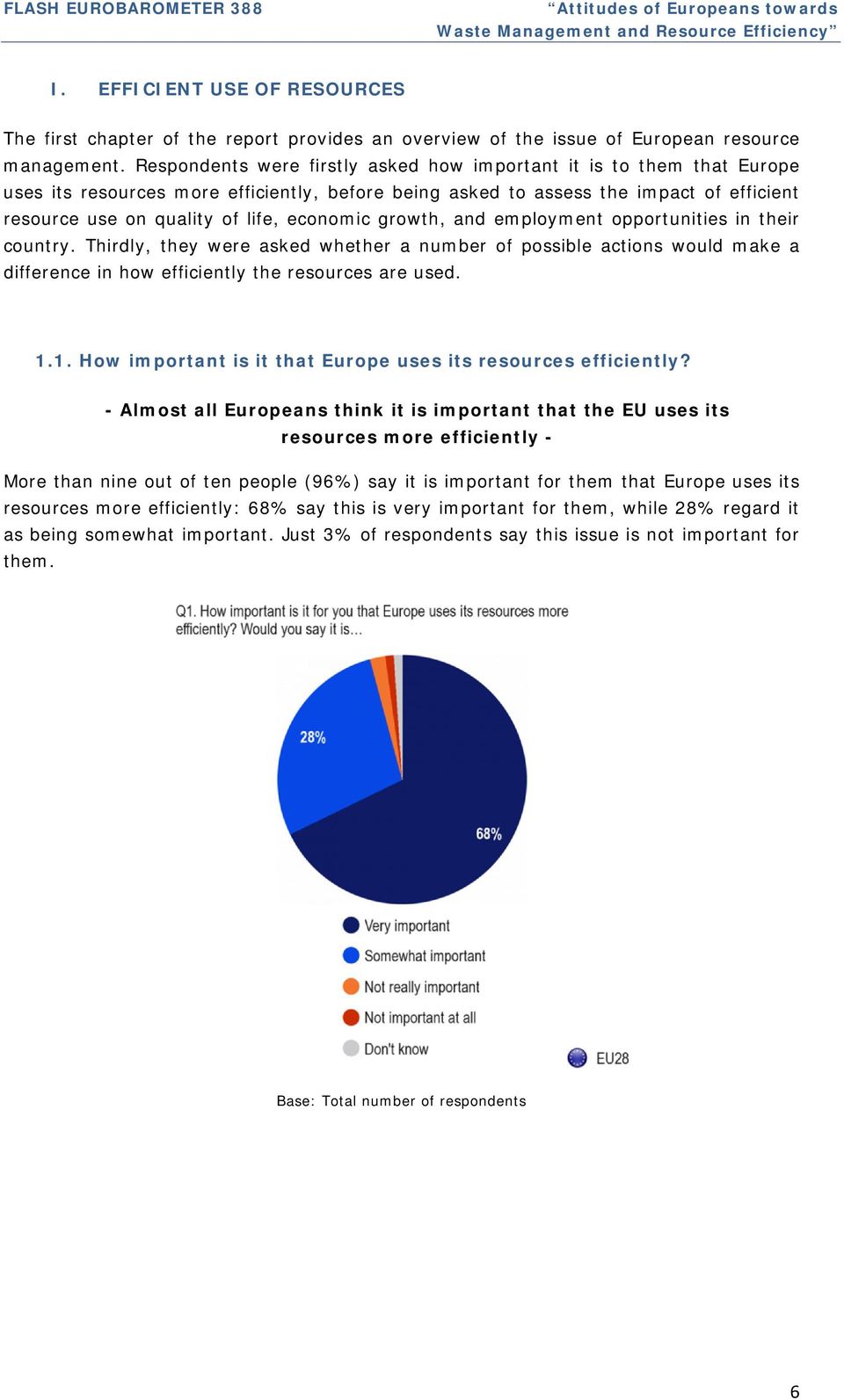
9 FLASH EUROBAROMETER I. EFFICIENT USE OF RESOURCES The first chapter of the report provides an overview of the issue of European resource management. Respondents were firstly asked how important it is to them that Europe uses its resources more efficiently, before being asked to assess the impact of efficient resource use on quality of life, economic growth, and employment opportunities in their country. Thirdly, they were asked whether a number of possible actions would make a difference in how efficiently the resources are used... How important is it that Europe uses its resources efficiently? - Almost all Europeans think it is important that the EU uses its resources more efficiently - More than nine out of ten people (96%) say it is important for them that Europe uses its resources more efficiently: 68% say this is very important for them, while 8% regard it as being somewhat important. Just % of respondents say this issue is not important for them. Base: Total number of respondents 6
10 FLASH EUROBAROMETER The belief that this is an important issue is consistently high in all EU Member States, from 87% in Lithuania and 89% in Latvia to almost unanimous agreement in Austria (99%) and Sweden (99%). The proportion of those considering it as very important varies to a larger extent, ranging from % in Estonia and % in Finland to twice as much in Cyprus (88%) and Malta (88%). Base: Total number of respondents 7

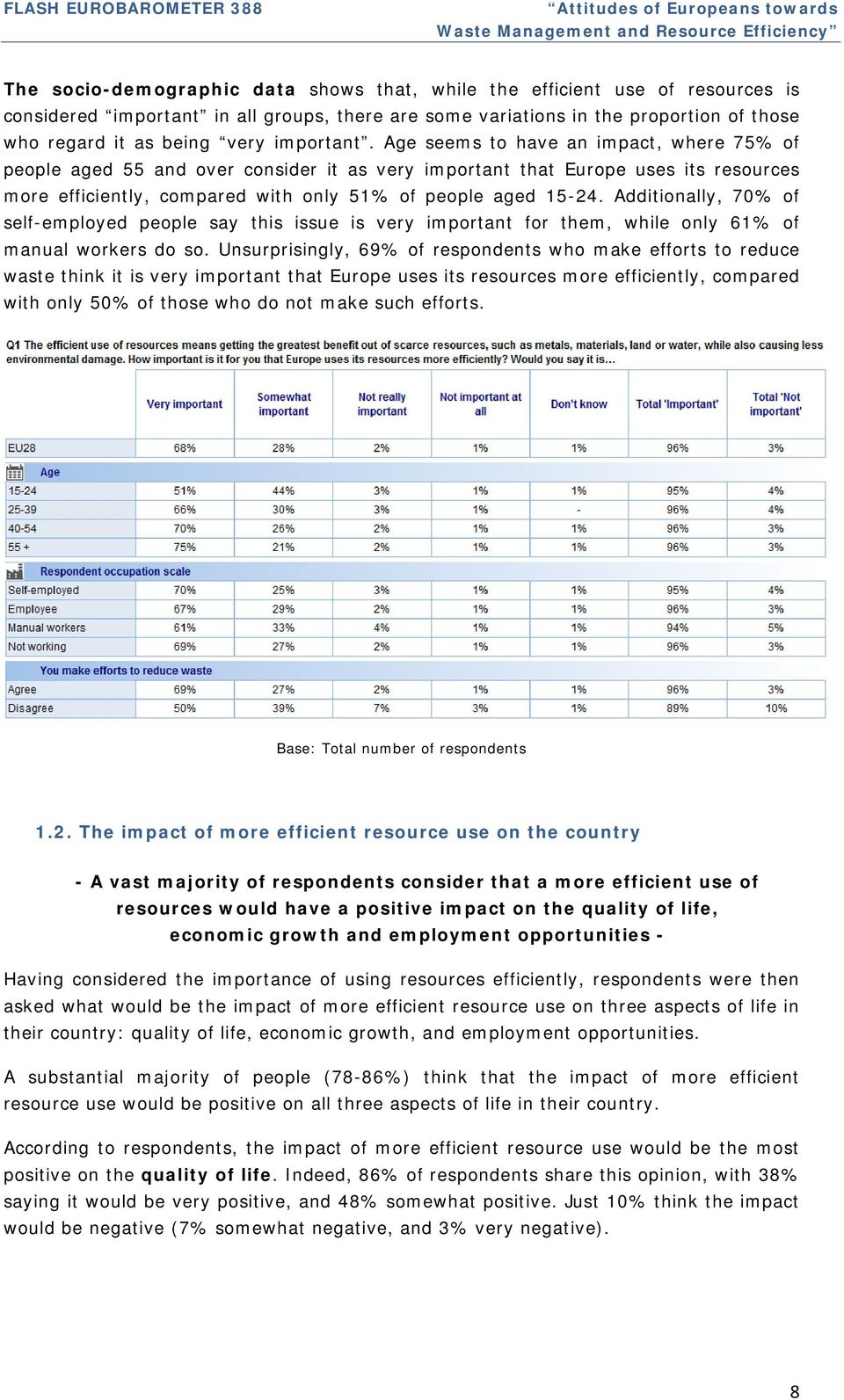
11 FLASH EUROBAROMETER The socio-demographic data shows that, while the efficient use of resources is considered important in all groups, there are some variations in the proportion of those who regard it as being very important. Age seems to have an impact, where 75% of people aged 55 and over consider it as very important that Europe uses its resources more efficiently, compared with only 5% of people aged 5-. Additionally, 70% of self-employed people say this issue is very important for them, while only 6% of manual workers do so. Unsurprisingly, 69% of respondents who make efforts to reduce waste think it is very important that Europe uses its resources more efficiently, compared with only 50% of those who do not make such efforts. Base: Total number of respondents.. The impact of more efficient resource use on the country - A vast majority of respondents consider that a more efficient use of resources would have a positive impact on the quality of life, economic growth and employment opportunities - Having considered the importance of using resources efficiently, respondents were then asked what would be the impact of more efficient resource use on three aspects of life in their country: quality of life, economic growth, and employment opportunities. A substantial majority of people (78-86%) think that the impact of more efficient resource use would be positive on all three aspects of life in their country. According to respondents, the impact of more efficient resource use would be the most positive on the quality of life. Indeed, 86% of respondents share this opinion, with 8% saying it would be very positive, and 8% somewhat positive. Just 0% think the impact would be negative (7% somewhat negative, and % very negative). 8
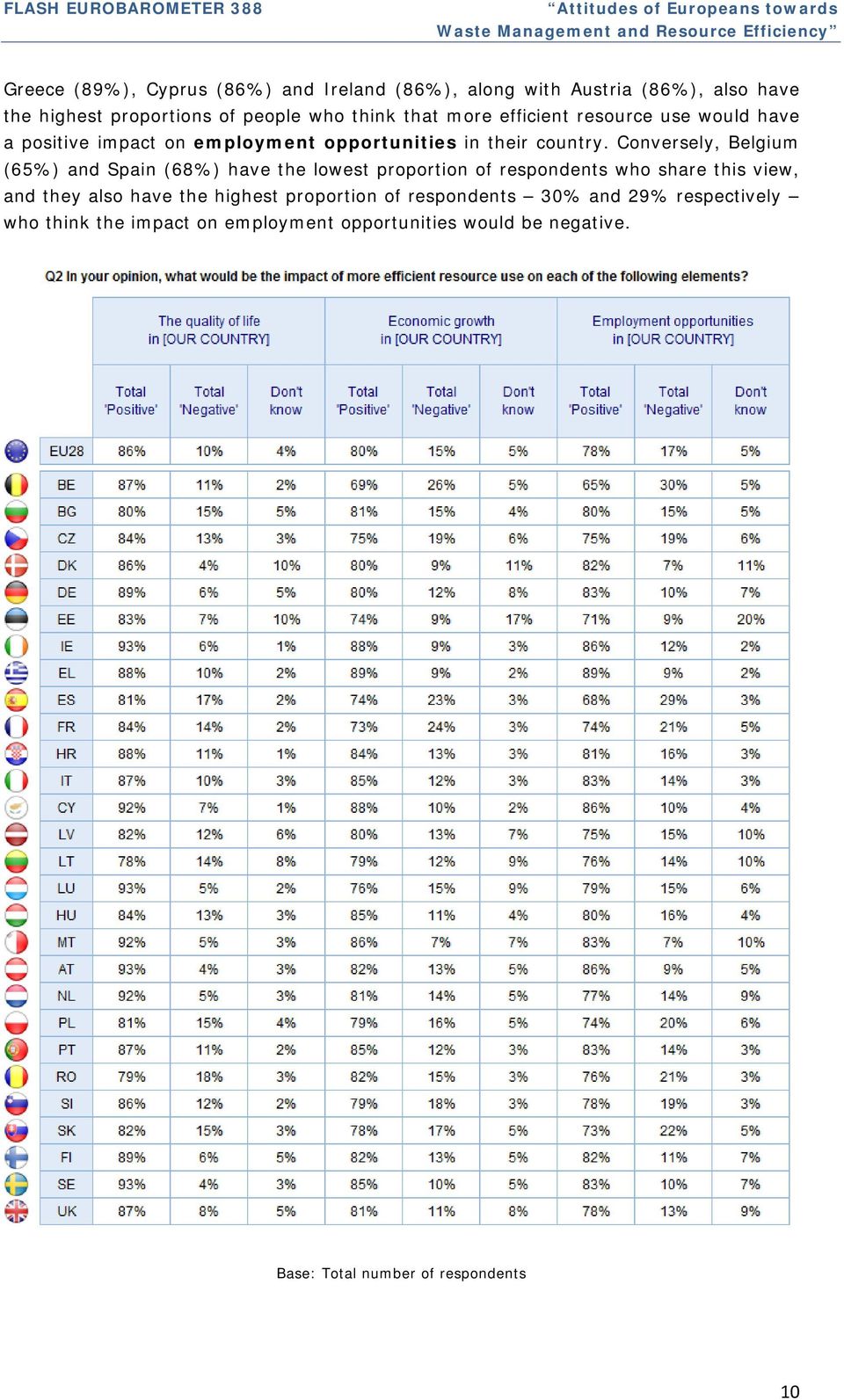
12 FLASH EUROBAROMETER Eight out of ten people (80%) say that there would be a positive impact on economic growth in their country, with % thinking that the impact would be very positive, and 8% somewhat positive. However, 5% think the economic impact of more efficient resource use would be negative (% somewhat negative, and % very negative). Over three-quarters (78%) of respondents believe that the impact of more efficient resource use would be positive when it comes to employment opportunities in their country: % think the impact would be very positive, while 5% say it would be somewhat positive. However, 7% say the impact would be negative (% somewhat negative, and 6% very negative). Base: Total number of respondents At country level, the number of respondents who think that more efficient resource use would have a positive impact on the quality of life ranges from 9% in Austria, Ireland, Luxembourg and Sweden, down to 78% in Lithuania and 79% in Romania. Conversely, Romania (8%) and Spain (7%) have the largest proportion of respondents who believe the impact on the quality of life in their country would be negative. In terms of economic growth, Greece (89%), Cyprus (88%) and Ireland (88%) have the largest proportion of respondents who think that more efficient resource use would have a positive impact. This proportion drops to 7% in France and 7% in both Estonia and Spain. The proportion of people who think the impact on economic growth would be negative is largest in France (%) and Spain (%). 9

13 FLASH EUROBAROMETER Greece (89%), Cyprus (86%) and Ireland (86%), along with Austria (86%), also have the highest proportions of people who think that more efficient resource use would have a positive impact on employment opportunities in their country. Conversely, Belgium (65%) and Spain (68%) have the lowest proportion of respondents who share this view, and they also have the highest proportion of respondents 0% and 9% respectively who think the impact on employment opportunities would be negative. Base: Total number of respondents 0
14 FLASH EUROBAROMETER In terms of socio-demographic profiles, individuals with a higher level of education are more likely to expect a positive impact in all three areas: for example, 8% of people who finished their education aged 0 or over say that more efficient resource use would have a positive impact on employment opportunities in their country, compared with just 67% of those who left school aged 5 or under. Respondents who feel that it is important for Europe to use its resources more efficiently are also more likely to anticipate a positive impact in all three areas: for example, 87% who say it is important think that more efficient resource use would have a positive impact on the quality of life in their country, compared with only 58% who say it is not important. Moreover, younger respondents are slightly more likely to think that more efficient resource use would have a positive impact on the quality of life in their country: 90% of 5- year-olds, compared to 8% of people aged 55 and over. Base: Total number of respondents.. Actions which would make a difference in how efficiently resources are used - Reducing and recycling waste and stricter protection of natural resources are seen as the way to make the biggest difference in how efficiently we use resources - In the final part of this chapter, respondents were asked which actions would make the biggest difference in how efficiently we use resources. They were able to choose a maximum of three options from a list of six possible actions. A majority of people consider that reducing waste and sorting recyclable waste at home (5%) and in industry and construction (50%) would make the biggest difference. A relatively high number of people (%) also think that stricter protection of natural resources would make the biggest difference in how efficiently we use resources.
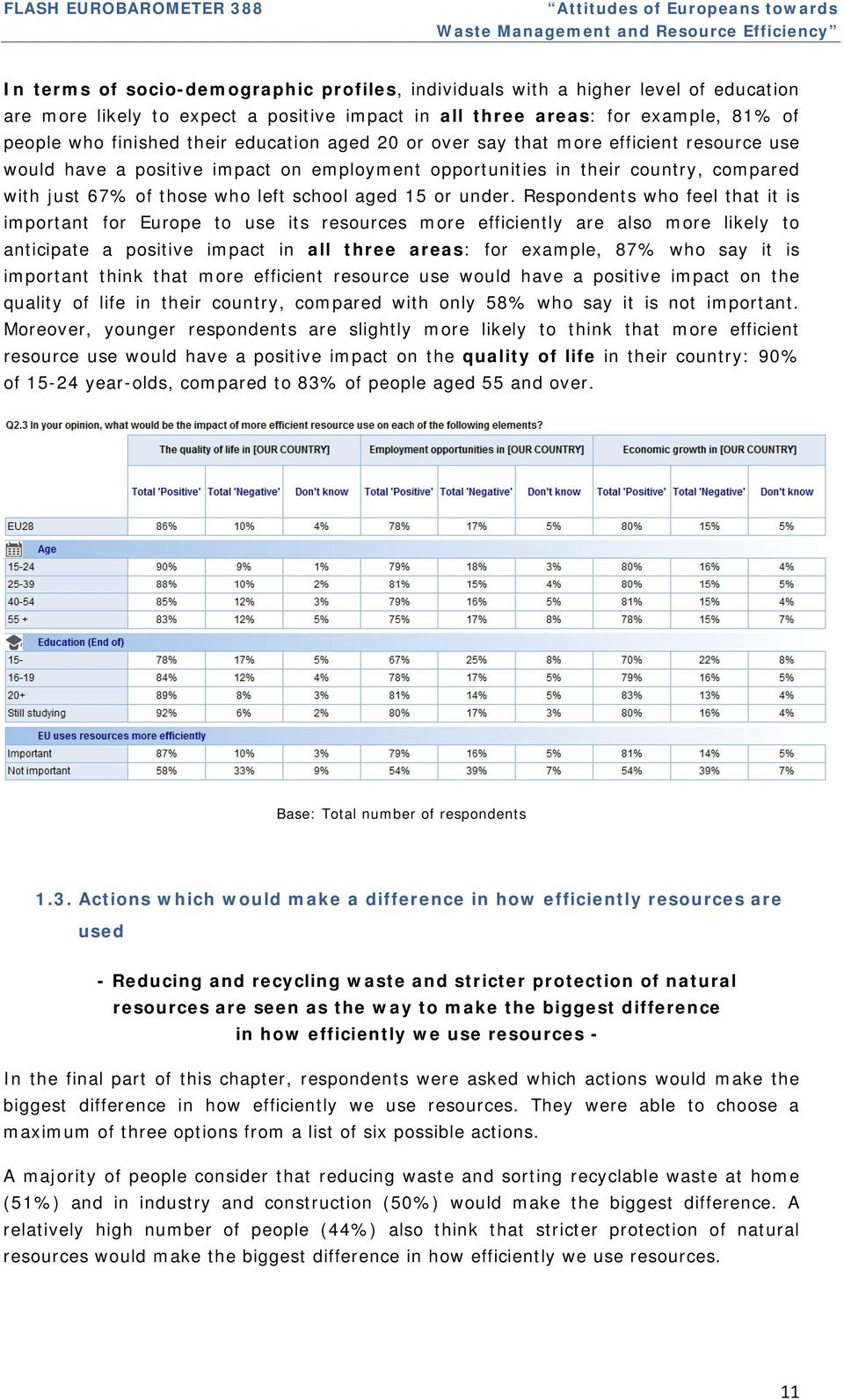
15 FLASH EUROBAROMETER Less than three out of 0 people think that setting more efficient, environmentallyfriendly product standards (9%) or cutting taxes on employment and increasing taxes on resource use (8%) would make the biggest difference in how efficiently we use resources, while only 9% say that setting resource efficiency targets would make the biggest difference. (MAX. ANSWERS) Base: Total number of respondents At country level, reducing waste and sorting recyclable waste at home is the action mentioned by most people in Member States. At least six out of ten people give this answer in the six following countries: Cyprus (6%), Italy (6%), Portugal (6%), the Czech Republic (60%), Hungary (60%) and Denmark (60%). At the other end of the scale, only 8% of respondents in Romania and % in Slovenia think this would make the biggest difference. In countries, reducing and recycling waste in industry and construction is the most popular answer. Again, at least six out of ten people give this answer in the five following countries: Estonia (69%), Austria (6%), Luxembourg (6%), the Czech Republic (60%) and Finland (60%). Only 6% of respondents in Romania and 8% in Poland argue that reducing and recycling waste in industry and construction would make the biggest difference.
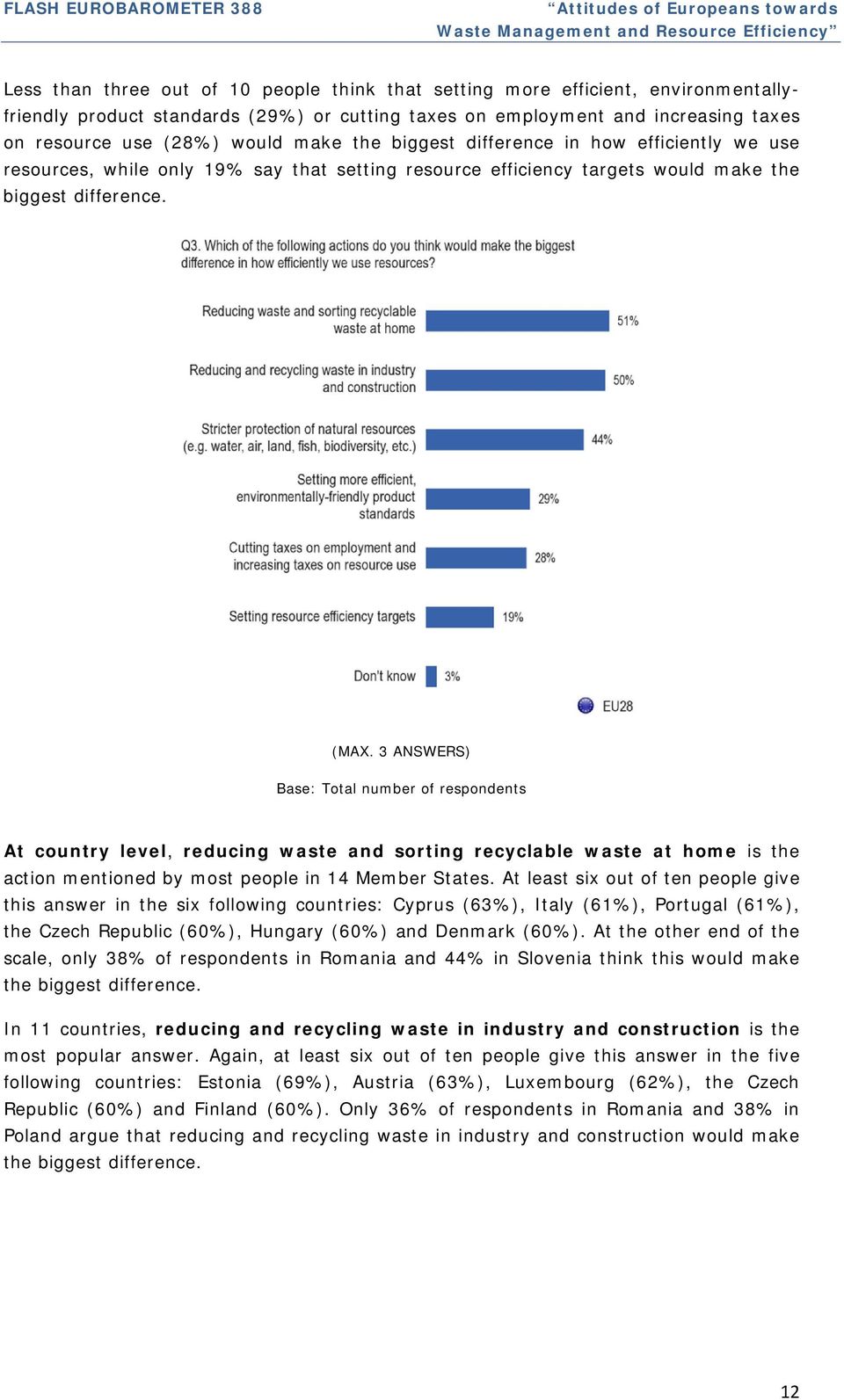
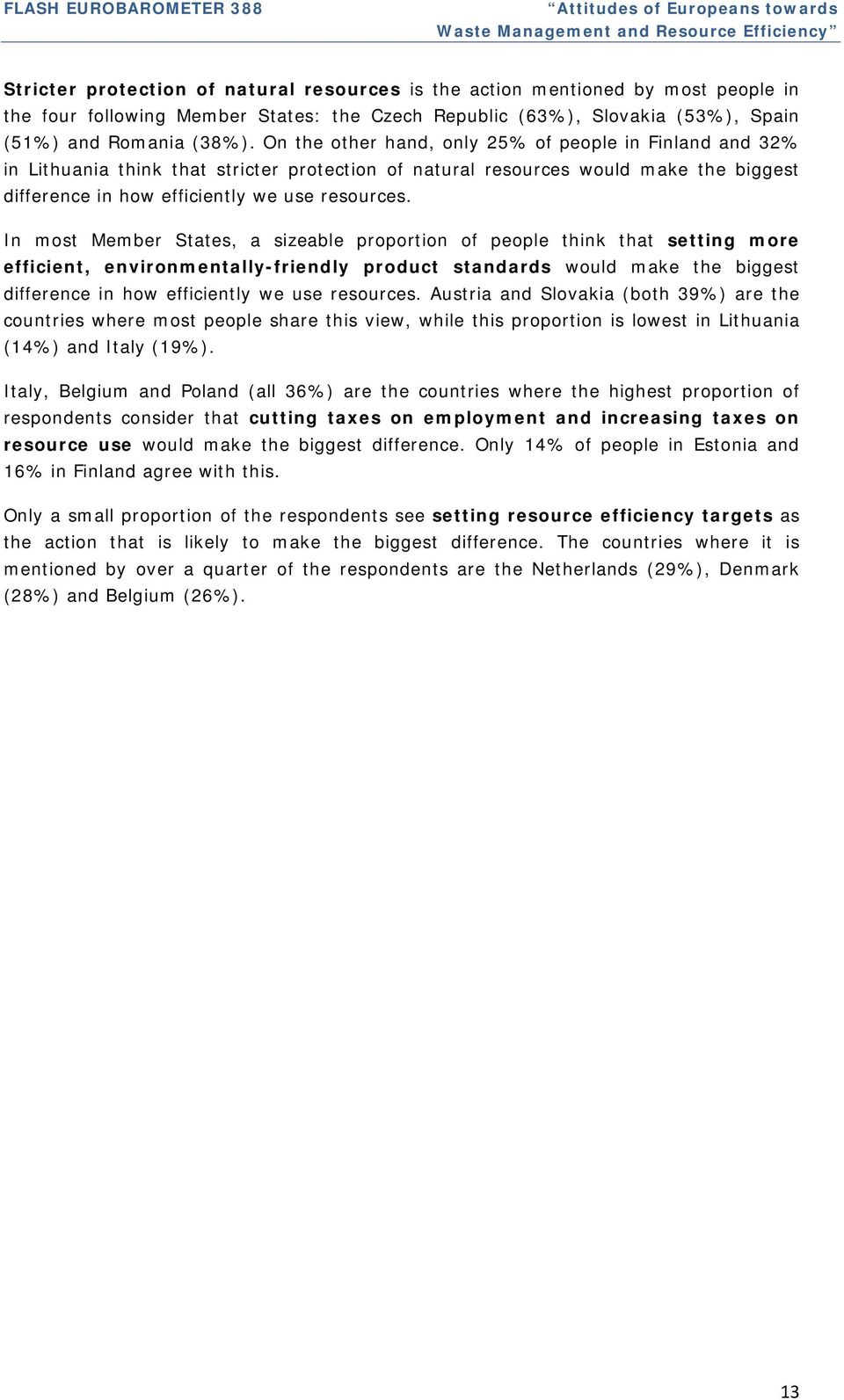
16 FLASH EUROBAROMETER Stricter protection of natural resources is the action mentioned by most people in the four following Member States: the Czech Republic (6%), Slovakia (5%), Spain (5%) and Romania (8%). On the other hand, only 5% of people in Finland and % in Lithuania think that stricter protection of natural resources would make the biggest difference in how efficiently we use resources. In most Member States, a sizeable proportion of people think that setting more efficient, environmentally-friendly product standards would make the biggest difference in how efficiently we use resources. Austria and Slovakia (both 9%) are the countries where most people share this view, while this proportion is lowest in Lithuania (%) and Italy (9%). Italy, Belgium and Poland (all 6%) are the countries where the highest proportion of respondents consider that cutting taxes on employment and increasing taxes on resource use would make the biggest difference. Only % of people in Estonia and 6% in Finland agree with this. Only a small proportion of the respondents see setting resource efficiency targets as the action that is likely to make the biggest difference. The countries where it is mentioned by over a quarter of the respondents are the Netherlands (9%), Denmark (8%) and Belgium (6%).
17 FLASH EUROBAROMETER Base: Total number of respondents

18 FLASH EUROBAROMETER Some differences appear in terms of socio-demographic profiles: firstly, men and women have different views on this question: men are more likely than women to think that cutting taxes on employment and increasing taxes on resource use would make the biggest difference in how efficiently we use resources (% vs. 5%). However, women are more likely to say that reducing waste and sorting recyclable waste at home would make the biggest difference (5% vs. 9%). Respondents in the 5- age group are the most likely to think that setting more efficient, environmentally-friendly product standards would make the biggest difference: %, compared with 6% of people aged 55 and over. Moreover, people aged 5-9 (55%) are the most likely to say that reducing and recycling waste in industry and construction would make the biggest difference, while people aged 55 and over (5%) are the least likely to give this answer. People who think that their country generates too much waste are more likely than those who do not think so to believe that stricter protection of natural resources (5% vs. 7%), and reducing waste and sorting recyclable waste at home (5% vs. %) would make the biggest difference. Unsurprisingly, respondents who say that they make efforts to reduce waste are particularly likely to say that reducing waste and sorting recyclable waste at home would make the biggest difference (5% vs. 8% of those who do not make such efforts). Base: Total number of respondents 5

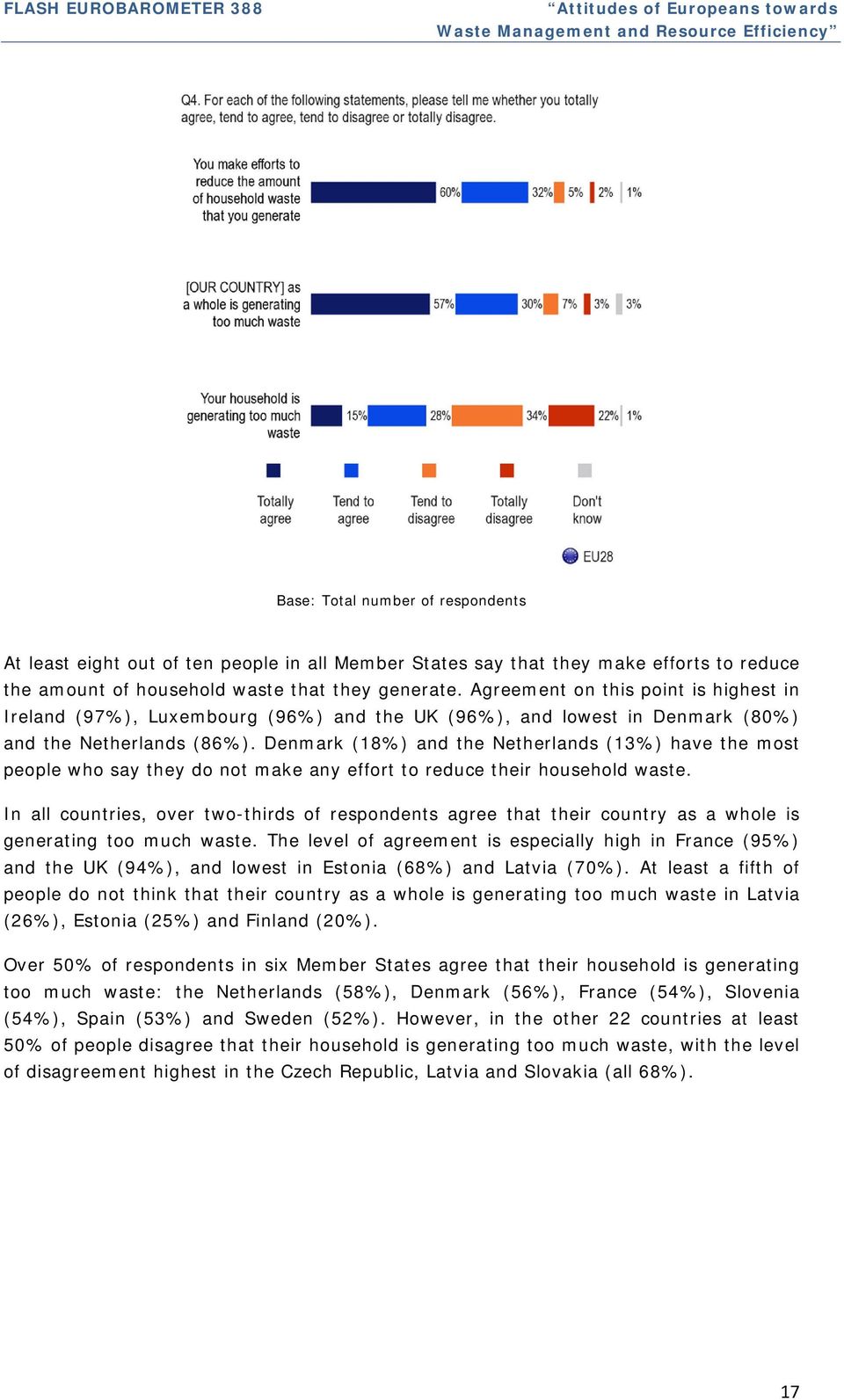
19 FLASH EUROBAROMETER II. HOUSEHOLD WASTE The second chapter of the report is divided into two parts: waste generation and waste management. The first part deals with the amount of waste generated by respondents and the actions they take to reduce that amount or, if they do not take such action, why they do not attempt to reduce their household waste. It also deals with the amount of food waste generated by households, and the possible solutions to reduce it. The second half of the chapter analyses the household waste management practices of respondents and the initiatives that might convince them to separate their waste. The last section deals with their preferred methods of paying for household waste management... Waste generation... Perception of the amount of waste generated - Most people think that their country generates too much waste, but only a minority believe that their own household does the same thing - Respondents were presented with three statements relating to waste generation, and asked whether they agreed or disagreed. Nine out of ten respondents (9%) agree that they make efforts to reduce the amount of household waste that they generate, with 60% totally agreeing and % tending to agree. Just 7% of people say they do not make efforts to reduce their household waste. Close to nine out of ten people (87%) agree that their country as a whole is generating too much waste. On this issue, 57% totally agree, and 0% tend to agree. Conversely, one out of ten respondents (0%) disagrees. However, only a minority of respondents (%) agree that their household is generating too much waste, with 5% totally agreeing and 8% tending to agree. A majority of people (56%) do not agree that their household is generating too much waste: on this point % tend to disagree, and % totally disagree. 6

20 FLASH EUROBAROMETER Base: Total number of respondents At least eight out of ten people in all Member States say that they make efforts to reduce the amount of household waste that they generate. Agreement on this point is highest in Ireland (97%), Luxembourg (96%) and the UK (96%), and lowest in Denmark (80%) and the Netherlands (86%). Denmark (8%) and the Netherlands (%) have the most people who say they do not make any effort to reduce their household waste. In all countries, over two-thirds of respondents agree that their country as a whole is generating too much waste. The level of agreement is especially high in France (95%) and the UK (9%), and lowest in Estonia (68%) and Latvia (70%). At least a fifth of people do not think that their country as a whole is generating too much waste in Latvia (6%), Estonia (5%) and Finland (0%). Over 50% of respondents in six Member States agree that their household is generating too much waste: the Netherlands (58%), Denmark (56%), France (5%), Slovenia (5%), Spain (5%) and Sweden (5%). However, in the other countries at least 50% of people disagree that their household is generating too much waste, with the level of disagreement highest in the Czech Republic, Latvia and Slovakia (all 68%). 7
21 FLASH EUROBAROMETER Base: Total number of respondents 8
22 FLASH EUROBAROMETER The socio-demographic data shows that women are slightly more likely than men to agree with all three statements; the gap is the widest on the question of whether the country as a whole is generating too much waste (90% for women vs. 85% for men). Age is an important factor on the issue of whether the respondent s own household is generating too much waste. While a majority (5%) of 5-9 year-olds agree with this statement, only 5% of people aged 55 and over do so. The respondent s level of education is also important to this issue: 8% of people who finished their education aged 0 or over agree that their household is generating too much waste, compared with 5% of people who left school aged 5 or under. Moreover, individuals who agree that their country generates too much waste are much more likely than those who disagree to say that their own household also generates too much waste (7% vs. 9%). Base: Total number of respondents 9
23 FLASH EUROBAROMETER... Actions taken to reduce the amount of waste generated by households - A majority of respondents say they take a wide range of measures in order to reduce their household waste - After discussing the amount of waste being generated, respondents were then asked about the actions they personally take to reduce their own household waste. They were given a list of eight possible actions, and were allowed to give multiple answers. A majority of respondents say they take seven out of the eight considered actions in order to reduce the amount of waste generated by their household. Eight out of ten people (8%) say that they avoid food waste and other types of waste by buying exactly what they need, while three-quarters (77%) make an effort to get broken appliances repaired before buying new ones. Two-thirds of respondents (67%) donate or sell items for re-use, while roughly six out of ten people avoid buying over-packaged goods (6%) and use rechargeable batteries (60%) or drink tap water to avoid packaging waste (59%). More than half of respondents make an effort to stop receiving unwanted mail (55%). Home composting, although not as widespread, is still done by % of respondents. (MULTIPLE ANSWERS POSSIBLE) Base: 9% from the total number of respondents (Those who make efforts to reduce household waste) 0
24 FLASH EUROBAROMETER In 9 Member States, avoiding food waste and other types of waste by buying exactly what is needed is the response given by most people. At least nine out of ten respondents say they do this in Portugal (95%) and Belgium (90%). This proportion drops to 6% in Croatia and 65% in Sweden. In three countries, repairing broken appliances is the most common action when it comes to waste management: Spain (89%), Latvia (8%) and the Netherlands (8%). Portugal (9%) has the highest proportion of respondents who say they do this, while the Czech Republic (56%) and Slovenia (58%) have the lowest. In the UK (87%), Denmark (86%) and Sweden (86%), donating or selling items for re-use is the action most commonly taken to reduce household waste. However, less than half of respondents do this in Slovenia (6%), Romania (8%) and Italy (%). In 6 Member States, a majority of respondents say that they reduce their household waste by avoiding over-packaged goods. This approach is most common in Portugal (75%), Germany (7%) and Austria (7%). However, just 5% of respondents in the Netherlands avoid buying over-packaged goods, followed by 0% in Lithuania. A majority of people in 0 EU countries say that they use rechargeable batteries in order to reduce their household waste. This action is done most often in the Czech Republic and Germany (70%) and least often in Croatia (8%), Estonia (%) and Romania (%). Drinking tap water to avoid packaging waste is the most widespread action in five Member States: Finland (89%), Sweden (86%), Slovakia (80%), Slovenia (77%) and Croatia (75%). A majority of people in countries say they drink tap water as a way of managing their waste. However, only 7% of people do it in Malta and 6% in Cyprus. In nine Member States a majority of respondents say that they have made an effort to stop receiving unwanted mail. This proportion is highest in the UK (7%), followed by Germany (66%) and Portugal (6%). On the other hand, about one in four respondents have taken this step in Malta (7%) and Croatia (8%). Finally, in EU countries over half of the respondents say that they undertake home composting. This approach is most popular in Austria (66%), the Czech Republic (6%) and Finland (57%), and least popular in Greece (9%), Malta (%), Cyprus (5%) and the Netherlands (5%).
25 FLASH EUROBAROMETER Base: 9% from the total number of respondents (Those who make efforts to reduce household waste)
26 FLASH EUROBAROMETER Several differences appear when looking at the socio-demographic profiles. First, women are somewhat more inclined than men to take certain steps to reduce their household waste, especially avoiding buying over-packaged goods (65% vs. 59%), drinking tap water to avoid packaging waste (6% vs. 56%), and donating or selling items for re-use (70% vs. 6%). Age also has an impact on the type of actions undertaken by respondents to reduce their household waste. Indeed, people aged 55 and over are the most likely to avoid waste by buying exactly what they need (87% vs. 77% for 5- year-olds) and to avoid buying over-packaged goods (68% vs. 8% for 5- year-olds). However, people aged 55 and over are the least likely to make an effort to stop receiving unwanted mail (50% vs. 6% for 5-9 year-olds) and to donate or sell items for re-use (6% vs. 7% for 5-9 year-olds). The respondent s level of education has relatively little impact on this question, with one exception: individuals who finished their education aged 0 or over are more likely to donate or sell items for re-use than those who left school aged 5 or under (7% vs. 58%). Unsurprisingly, home composting is more common among rural respondents: 58% of people who live in rural villages say they do this, compared to % of those who live in large towns. Respondents who think that it is important for the EU to use resources more efficiently are more likely to undertake all eight waste-reduction activities than people who think it is not important. Similarly, people who agree their country generates too much waste are more likely to undertake all eight waste-reduction activities than respondents who disagree.
27 FLASH EUROBAROMETER Base: 9% from the total number of respondents (Those who make efforts to reduce household waste)... Reasons for not trying to reduce household waste - Transferring the responsibility to producers and difficulties in getting things repaired are the reasons most often mentioned for not trying to reduce household waste - Those respondents who said that they did not make any effort to reduce their household waste (7% of the total) were then asked about their main reasons. They were given a list of five possible reasons and were allowed to give multiple answers. Among this group, around four out of ten say that it is the responsibility of the product producer to reduce waste, not theirs (%), or that they tend to throw things away as it is difficult or too expensive to get them repaired (9%). Three out of ten respondents say that they consider the level of waste they generate to be already at a minimum (6%), or that they don t know how to reduce the amount of waste they generate (0%).
28 FLASH EUROBAROMETER Relatively few respondents (7%) say that reducing waste is not important to them, while a tenth (0%) spontaneously give another reason for not reducing waste. (MULTIPLE ANSWERS POSSIBLE) Base: 7% from the total number of respondents (Those who do not make efforts to reduce household waste) In seven Member States, the most frequently given answer for not reducing waste is that it is the responsibility of the product producer. Over 50% of people give this explanation in five countries: France (6%), Belgium (57%), Austria (56%), Germany (5%) and the UK (5%). The countries where fewest people give this answer are Malta (8%) and Cyprus (%). Not reducing waste because it is too difficult or expensive to get things repaired is the reason given most commonly by respondents in seven EU countries, and again at least half of the respondents give this answer in the five following countries: Austria (6%), Denmark (5%), Portugal (5%), Belgium (50%) and the UK (50%). In contrast, only % of people in Estonia and 7% in Cyprus mention the difficulty or expense of having things repaired. In Member States, the reason most commonly given is that their level of waste is already at a minimum. However, Portugal (5%) is the only country where more than half of respondents give this answer, with Lithuania (8%) falling just short of that mark. The countries where fewest people say that their level of waste is already at a minimum are Denmark (0%) and the Netherlands (%). 5
29 FLASH EUROBAROMETER Not knowing how to reduce their waste is the reason most mentioned in Greece (%), Cyprus (%) and Poland (8%). Though not the most widespread reason, France (9%) has the highest proportion of respondents who give this answer, while Ireland (7%) and Germany (%) have the lowest. Due to the small proportion of respondents who do not take actions to reduce waste (only 7% of respondents at EU level), national results are based on a very limited sample size. Thus, country results are not analysed in this report. Base: 7% from the total number of respondents (Those who do not make efforts to reduce household waste) 6
30 FLASH EUROBAROMETER According to the socio-demographic data, men are somewhat more likely than women to say that they do not reduce their waste because it is not important to them (0% vs. %) or because reducing waste is the responsibility of the product producer (5% vs. 7%). However, women are more likely to say they don t know how to reduce waste (% vs. 7%). Age is also an important factor; 50% of 5-9 year-olds say that they tend to throw things away because it is too difficult or expensive to get them repaired, whereas only 0% of 5- year-olds take this view. Older respondents are the most likely to say that the amount of waste they generate is already at a minimum: 7% of people aged 55 and over, compared with 7% of 5- year-olds. However, 5- year-olds (9%) are the most likely to say that they don t know how to reduce waste, compared with 5% of 0-5 year-olds. Respondents with a relatively low level of education are more likely to say that the amount of waste they generate is already at a minimum: 50% of people who left school aged 5 or under give this explanation, as opposed to % of respondents who finished their education aged 0 or over. People in different occupations also emphasise different reasons for not reducing the amount of waste they generate: a majority of manual workers (5%) say that they tend to throw things away because it is too difficult or expensive to get them repaired, whereas only % of people who are not working say this. Half of employees (50%) think that reducing waste is the responsibility of the product producer, compared with % of people who are not working. Base: 7% from the total number of respondents (Those who do not make efforts to reduce household waste) 7
31 FLASH EUROBAROMETER... Estimation of the food waste generated by the household - The amount of food waste which respondents believe they generate is relatively small and has declined substantially since January 0 - A vast majority of respondents estimate that relatively little of the food they buy goes to waste. Indeed, 86% of people answer that they waste no more than 5% of the food they buy, a substantial increase from the 7% of respondents who gave this answer in January 0. Additionally, 5% of respondents answer spontaneously that they waste none of the food they buy, down from % who said this in 0. Just 6% of people estimate that they waste 6% to 0% of their food (compared with % of respondents in 0), while % say they waste % to 50% (down percentage points from 0), and % say they waste more than 50% (no change from 0). Base: Total number of respondents In 8 Member States, at least 90% of respondents say that they waste 5% or less (including None ) of the food they buy. In the four following countries, this proportion even climbs up to 95% of respondents: the Czech Republic, Estonia (both 96%), Spain and Malta (both 95%). Conversely, Cyprus (6%) and Latvia (5%) are the countries with the highest proportion of respondents who mention wasting at least 5% of the food they buy. Trend analysis shows that the number of people who waste 5% or less (including None ) of the food they buy has increased in all Member States since January 0 except in Slovakia (- percentage points), with the biggest changes occurring in Cyprus 8
32 FLASH EUROBAROMETER (+7 percentage points), Luxembourg (+0 points), Ireland (+8 points) and Lithuania (+6 points). Greece (%) and Cyprus (0%) are the only Member States in which at least a tenth of respondents estimate that they waste 6% to 0% of the food they buy. The proportion of respondents wasting this amount of food has declined in almost all Member States since 0, with the most substantial drops being recorded in Cyprus (-0 points), Denmark (- points), Ireland (- points) and Luxembourg (- points). Base: Total number of respondents 9
33 FLASH EUROBAROMETER Here again, results vary according to different socio-demographic profiles: first, it appears that older respondents are more likely to say they waste less food: 7% of people aged 55 and over say they waste 5% or less, compared with % of those aged 5-. Respondents in the youngest age group are the most likely to waste 6% to 5% of their food (7%) and also 6% to 0% of their food (%). Second, respondents who finished their education aged 5 or under seem to waste less food than those who finished aged 0 or over: 7% of them say they waste 5% or less of the food they buy (vs. 60% for the more educated). Respondents who disagree that their household generates too much waste are more likely than those who agree to say that they waste 5% or less (67% vs. 5%). Individuals who say they make efforts to reduce waste are more likely to say they waste no more than 5% of the food they buy: 6% vs. % of those who mention not making efforts to reduce waste. Base: Total number of respondents 0
34 FLASH EUROBAROMETER..5. Possible solutions to reduce household food waste - The perceived usefulness of the potential approaches to reducing food waste is high at EU level and varies substantially from country to country - All respondents, except those who said they did not waste any food, were then asked what would help them to waste less of the food they buy. They were given a list of seven options and were allowed to give multiple answers. Overall, all suggested actions appear useful to about half of respondents or so (from 8% to 60%). The two most useful actions are using the freezer to conserve food longer (60%), as well as re-using leftovers instead of throwing them away (59%). Over half of the respondents think that the availability of smaller portion sizes in shops (55%), better estimation of portion sizes (5%), and better and clearer information on food product labels (5%) would be of help to reduce household food waste. Finally, just under half say that better shopping planning by their household (9%) and better and clearer information on how to interpret best before dates (8%) would enable them to waste less food. (MULTIPLE ANSWERS POSSIBLE) Base: 9% from the total number of respondents (Those who say that some of food goes to waste)
35 FLASH EUROBAROMETER In 0 Member States, at least half of the respondents think that using the freezer to conserve food longer would help them waste less food, with the highest proportions in Portugal (79%), Spain (79%) and Belgium (7%). It is considered the best means of wasting less food in eight EU countries. However, just 0% of people in Slovenia and % in Hungary regard this approach as helpful. Re-using leftovers instead of throwing them away is the top answer in nine countries. At least 50% of respondents in 6 EU countries say this would help them to reduce their food waste. Portugal (8%), Spain (76%) and Belgium (7%) again have the highest proportions, while Romania (9%) and Slovenia (%) have the lowest. At least half of the people in Member States think that the availability of smaller portion sizes in shops would help them to waste less food. The highest proportions are found in the UK (67%), Belgium (66%), Portugal (66%) and Spain (6%), while Slovenia (%) and Croatia (8%) have the lowest. At least half of the respondents in Member States say that better estimation of portion sizes would help them to waste less of the food they buy. Portugal (79%) and Spain (70%) again have the highest proportion of respondents who think this approach would be helpful, while Slovenia and Estonia have the lowest (both 9%). Better and clearer information on food product labels is seen as helpful by at least 50% of respondents in 0 countries. This proportion is highest in Portugal (7%) and Bulgaria (68%), and lowest in Estonia (6%) and Slovenia (%). Better shopping planning by one s household is considered a helpful way to waste less food by at least 50% of people in Member States, and it is the top answer in nine countries. The proportion of respondents who think better shopping planning would help them is highest in Cyprus (7%) and Greece (7%), and lowest in the Netherlands (%), Hungary (%) and Slovenia (%). Finally, better and clearer information on how to interpret best before dates is seen as helpful by at least 50% of people in eight EU countries. Two-thirds of people in Bulgaria and Portugal (both 66%) think this would help them to waste less food, compared to only 7% of respondents in Estonia and % in Slovenia.
36 FLASH EUROBAROMETER Base: 9% from the total number of respondents (Those who say that some of food goes to waste)
37 FLASH EUROBAROMETER Several differences appear when looking at the socio-demographic profiles. First, younger respondents are more likely to think that better shopping planning would help them reduce food waste: 55% of 5- year-olds and 56% of 5-9 year-olds say this would be helpful, compared with 0% of respondents aged 55 and over. Similarly, 67% of 5- year-olds say that better estimation of portion sizes would be helpful, compared with 7% of those aged 55 and over. However, people in the oldest age group are more likely to say that the availability of smaller portion sizes in shops would be helpful (60% vs. 5-5% for other age groups). People who think it is important that the EU uses resources more efficiently are more likely to say that all seven approaches to reducing food waste would be helpful. For example, 5% of respondents in this category think that better and clearer information on food product labels would be helpful, as opposed to 8% of respondents who feel it is not important for the EU to use resources efficiently. Individuals who make efforts to reduce waste are also more likely to believe that all seven approaches to reducing food waste would be helpful. For example, 6% of people who make efforts to reduce waste think that using the freezer to conserve food would be helpful (vs. 9% of those who do not make any effort to reduce waste). Base: 9% from the total number of respondents (Those who say that some of food goes to waste)
38 FLASH EUROBAROMETER.. Waste management... Households waste management practices - The sorting of most types of waste is very common in some Member States, and relatively uncommon in others - After considering their level of household waste in the previous section, respondents were then asked to turn their attention to the question of waste management. Specifically, they were asked whether they sort, at least occasionally, eight particular types of waste. A majority of people say they sort all eight kinds of waste considered. Roughly nine out of ten respondents sort paper/cardboard/beverage cartons (90%), plastics (90%) and glass (88%). About three-quarters say they sort household hazardous waste (79%), metal cans (78%), electrical waste (76%) and kitchen waste (7%). About half of all respondents mention sorting garden waste, at least occasionally (57%). Only % of respondents spontaneously mention not sorting any waste at all. (MULTIPLE ANSWERS POSSIBLE) Base: Total number of respondents 5
39 FLASH EUROBAROMETER On a country level, we can see a clear difference between Member States where the sorting of all types of waste is relatively common and other countries where it is relatively uncommon. At least 70% of respondents sort all eight types of waste in Belgium, Germany, Ireland, Luxembourg, Austria, Slovenia and the UK, and waste sorting is also very widespread in Finland and Sweden. Conversely, respondents in Romania, Bulgaria, Latvia and Cyprus are least likely to sort their household waste. In 5 Member States, at least nine out of ten people say that they sort paper/cardboard/beverage cartons, with close to everyone doing so in Austria (99%), Germany (98%) and Belgium (97%). In nine countries, this is the most commonly sorted type of household waste. Romania (50%) has the lowest proportion of people who sort paper waste and is the country where proportions of respondents sorting waste are the lowest overall. Bulgaria (6%) and Latvia (67%) also have relatively low proportions of people who sort paper/cardboard/beverage cartons. At least 90% of respondents in 6 countries say that they sort plastic bottles or other plastic waste, with Belgium and Luxembourg (both 97%) having the highest proportions. Plastic is the type of waste most commonly sorted in 7 Member States. Proportions are lowest in Romania (60%), Latvia (6%) and Bulgaria (66%). In Member States, at least nine out of ten people say that they sort glass from the rest of their household waste. Nearly all respondents do this in Germany (98%), Belgium (97%) and Sweden (97%). Glass is the type of waste most commonly sorted in six Member States, with Romania (9%) the only country where less than half of the respondents sort glass. Hazardous waste such as paint and batteries is sorted by at least 90% of respondents in eight EU countries, and is the kind of waste most commonly sorted in Sweden (97%), Finland (9%) and Latvia (70%). A majority of people in all countries except Romania (8%) say that they sort this kind of waste. In four countries, at least 90% of people say they sort metal cans: Belgium (9%), Luxembourg (9%), Austria (90%) and Sweden (90%). The Netherlands (8%), Romania (5%) and Latvia (8%) are the only countries where less than half of the respondents do this. At least nine out of ten people say they sort electronic waste in the four following Member States: Sweden (96%), Germany (95%), Denmark (9%) and Austria (90%). Less than half of respondents sort electronic waste in Romania (%), Cyprus (7%), Bulgaria (%) and Malta (6%). Slovenia (87%) has the highest instance of kitchen waste sorting, followed by Germany (86%), Austria (8%) and Belgium (8%). In contrast, less than half of respondents sort this type of waste in Cyprus (0%), Romania (5%), Bulgaria (7%) and Latvia (9%). A majority of people in 0 countries say they sort their garden waste, with the highest proportions in the Netherlands (79%), followed by Germany, Ireland and the UK (all 75%). Conversely, sorting garden waste is least common in Romania (%) and Malta (5%). 6
40 FLASH EUROBAROMETER Base: Total number of respondents 7
41 FLASH EUROBAROMETER A few differences appear in terms of the socio-demographic profiles: older respondents are slightly more likely to sort their household waste than younger respondents, while, unsurprisingly, rural respondents are much more likely to sort garden waste than urban respondents (7% vs. %). This is also true for hazardous waste (8% of rural respondents vs. 7% of urban respondents). Base: Total number of respondents... Initiatives that would convince Europeans to separate more waste - Reassurance that waste is effectively recycled is seen as the best way to convince people to make more of an effort to separate it - After establishing which kinds of waste they already sort, all respondents, except those who said they do not sort any waste at all, were asked which kinds of initiatives would convince them to separate more of their waste. They were given a list of six potential initiatives, and were allowed to give multiple answers. Seven out of ten respondents (7%) say that reassurance that their waste is effectively recycled would persuade them to separate more of their waste. A majority of people also say that more and better waste recycling and composting facilities in their area (59%), financial incentives (59%), and more convenient separate waste collection at their home (5%) would convince them to do more. Fewer than half of the respondents say that more information on how and where to separate waste (8%), as well as increased tariffs if waste is not separated properly (%) would convince them to separate more of their waste. 8
42 FLASH EUROBAROMETER (MULTIPLE ANSWERS POSSIBLE) Base: 97% from the total number of respondents (Those who sort waste) On a country level, these results show a clear divide between those where relatively high proportions of people say that all the initiatives would convince them to separate more waste and those where relatively few respondents say this. For example, in Portugal at least 60% of respondents say they would be convinced by all six initiatives, while in Estonia no more than 0% would be convinced by any of them. Reassurance that waste is recycled effectively is seen as the most convincing tool in Member States. In Spain, 8% of respondents say that they would be convinced by this, as do 8% in Portugal and 80% in the UK. However, in five countries, less than half of the respondents say this would persuade them to separate more waste: Hungary (9%), Estonia (0%), Slovenia (%), Lithuania (7%) and Croatia (8%). More and better waste recycling and composting facilities are regarded as the best way to convince people to separate more of their waste in Member States. At least three-quarters of respondents say they would be persuaded by this in Bulgaria (8%), Portugal (77%) and Greece (76%). However, fewer than four out of ten respondents would find better recycling facilities persuasive in Estonia (%), Lithuania (6%) and Slovenia (9%). Financial incentives are seen as the best way to convince people to separate more waste in Poland (70%) and Denmark (6%); this proportion is also at its highest in Spain (70%), while it is lowest in Estonia (5%) and Malta (8%). 9
43 FLASH EUROBAROMETER A majority of people in 6 countries say that they would be convinced by more convenient waste separate collection at home, with the highest numbers of respondents expressing this view in Portugal (69%) and Latvia (67%). This proportion is lowest in Slovenia (6%) and Estonia (%). In nine Member States, over half of the respondents think that more information on how and where to separate waste would persuade them to do more. Portugal (66%) and Bulgaria (6%) are the countries with the highest proportions. On the other hand, only a quarter of respondents in Estonia and Slovenia (both 7%) think that more information would make any difference to their own habits. A majority of people in just four EU countries believe that increased tariffs on unsorted waste would convince them to separate more of it: Portugal (60%), Belgium (5%), Germany (5%) and Austria (5%). This option is least popular in Estonia (5%), Hungary (%) and Malta (%). 0
44 FLASH EUROBAROMETER Base: 97% from the total number of respondents (Those who sort waste)
45 FLASH EUROBAROMETER According to the socio-demographic data, young respondents are more likely to say that they would be convinced by all six initiatives. For example, 69% of 5- year-olds say they would be convinced to separate more of their waste if there were more and better waste and recycling facilities in their area, compared with 5% of people aged 55 and over. Respondents who think that it is important that the EU uses resources more efficiently or who agree that their country generates too much waste are also more likely to say that all six initiatives would persuade them to separate more of their waste. Base: 97% from the total number of respondents (Those who sort waste) - For those who do not make an effort to separate waste, more and better waste recycling and composting facilities in their area is regarded as the most persuasive tool - The respondents who previously said that they do not sort any waste were then asked which kinds of initiatives would convince them to start separating at least some of their waste. One should keep in mind that this basis is actually very limited, except in Bulgaria and Romania. Around half of these respondents say that more and better waste recycling and composting facilities in their area (50%) and reassurance that their waste is effectively recycled (8%) would persuade them to separate more of their waste. Four out of ten say that they would be convinced by more convenient separate waste collection at their home (%) and financial incentives (%). Less than four out of ten say that more information on how and where to separate waste (7%) would be persuasive, and just 9% think that increased tariffs if waste is not separated properly would encourage them to start separating at least some of their waste.
46 FLASH EUROBAROMETER (MULTIPLE ANSWERS POSSIBLE) Base: % from the total number of respondents (Those who do not sort waste) Due to the small proportion of respondents who do not separate any of their waste (only % of respondents at EU level), national results are based on a very limited sample size. Thus, country results are not analysed in this report.... Preferred methods of paying for household waste management - Paying in proportion to the amount of unsorted waste you generate is the system of payment which most respondents prefer - Finally in this section of the report, all respondents were asked to state their preferred way of financing household waste management. Four out of ten respondents (%) say that they would prefer to pay in proportion to the quantity of unsorted waste they generate, while three out of ten (0%) would prefer the cost of waste management to be included in the price of products they buy. Only a fifth of people (9%) favour paying a fixed sum for waste management through their taxes.
47 FLASH EUROBAROMETER Base: Total number of respondents Paying in proportion to the quantity of unsorted waste which you generate is the preferred approach in all but four Member States, and is supported by the highest percentages of people in Italy (58%), Belgium (5%) and Finland (5%). Support for this approach is lowest in Malta (%). In the four other countries, including the cost of waste management in the price of products is the most popular approach: Romania (6%), Bulgaria (5%), the UK (5%) and Malta (%). Denmark (%) and Lithuania (%) have the highest proportion of respondents who would like to pay a fixed sum for waste management through their taxes.
48 FLASH EUROBAROMETER Base: Total number of respondents 5
49 FLASH EUROBAROMETER The socio-demographic variations are quite negligible on this issue. However, it appears that 5- year-olds are somewhat more willing to pay a fixed sum for waste management through their taxes than 0-5 year-olds (% vs. 6%). Conversely, people in the 0-5 age bracket would rather pay in proportion to the quantity of unsorted waste they generate (8% vs. % for 5- year-olds). Base: Total number of respondents 6
50 FLASH EUROBAROMETER III. PLASTIC WASTE AND LITTER The third chapter of the report focuses specifically on one common type of household waste plastic as well as littering in general. It first looks at the respondents attitudes towards plastic waste and litter, before evaluating the extent of the litter problem in the respondents own area. Respondents then considered potential ways to reduce littering and were asked whether they would support EU-level targets to reduce marine litter... Perceptions about plastic waste - There is a very high level of agreement with the proposed initiatives for tackling plastic waste - With plastic waste being one of the key challenges to recycling and littering, respondents were asked whether they agree or disagree with seven statements relating to the problem. There is a very high level of agreement (9% or more) with the first five statements. 96% of respondents agree that more initiatives are needed by industry to limit plastic waste and increase recycling, with 7% totally agreeing and % tending to agree. Just % of people disagree with this. A very high proportion of people (9%) agree that better information should be provided about which plastics are recyclable (76% totally agree, 8% tend to agree), with just 5% saying that they disagree. Nine out of ten respondents (9%) agree that the production of non-recyclable plastics should be stopped and recyclable materials used as an alternative (7% totally agree, % tend to agree), while just 6% say they disagree. The same proportion of people (9%) agree that more initiatives are needed by the public authorities to limit the presence of plastic waste in the environment and increase recycling (70% totally agree, % tend to agree). Again, 6% of respondents disagree. Agreement is also very high (9%) on the question of whether measures should be taken to reduce the use of single-use plastic items, such as shopping bags (69% totally agree, % tend to agree). 7% of respondents disagree with this. The level of agreement is somewhat lower when it comes to the remaining two statements, although a large majority of people still agree with them. Nearly eight out of ten respondents (79%) agree that the disposing of plastic waste into landfill sites should be prohibited (58% totally agree, % tend to agree), while 7% of people disagree (0% tend to disagree, 7% totally disagree). 7
51 FLASH EUROBAROMETER Three-quarters of people (78%) agree that the use of micro plastic particles in consumer cosmetics and similar products should be forbidden (55% totally agree, % tend to agree). A tenth of respondents (%) disagree, with 8% tending to disagree and % totally disagreeing. A further % say they do not know, perhaps due to the technicality of the issue. Base: Total number of respondents In all Member States, at least nine out of ten people agree that more initiatives are needed by industry to limit plastic waste and increase recycling. The same applies to the question of whether better information should be provided about which plastics are recyclable, with the exception of Estonia, where only 87% of people agree. At least nine out of ten respondents also agree that the production of non-recyclable plastics should be stopped and recyclable materials used as an alternative in all but three Member States: Estonia (8%), Latvia (8%) and Poland (88%). On the issue of whether more initiatives are needed by the public authorities to limit the presence of plastic waste in the environment and increase recycling, the level of agreement dips below 90% in only four EU countries: Denmark (86%), Austria (88%), Germany (88%), and the Netherlands (89%). In 9 countries, agreement that measures should be taken to reduce the use of single-use plastic items, such as shopping bags, is over 90%. Here, the level of agreement ranges from 9% in Greece, the Netherlands, Portugal and Slovenia, to 8% in Estonia and 8% in Denmark. 8
52 FLASH EUROBAROMETER However, there is much more variation when it comes to the issue of whether the disposing of plastic waste into landfill sites should be prohibited. In Member States, at least 80% of respondents agree, the level of agreement being highest in Spain (90%), Bulgaria (89%) and Cyprus (89%). At the other end of the scale, Denmark (%) stands out as having by far the lowest level of agreement with this initiative; Finland and Sweden (both 69%) have the next lowest. At least four-fifths of respondents in ten EU countries agree that the use of micro plastic particles in consumer cosmetics and similar products should be forbidden, with support for this idea highest in Croatia and France (both 85%). At the other end of the scale, only 5% of people in Estonia and 65% in the Czech Republic agree with this. 9
53 FLASH EUROBAROMETER Base: Total number of respondents 50
54 FLASH EUROBAROMETER In terms of socio-demographic profiles, there is very little difference overall between men and women on this issue. In all seven cases, older respondents are more likely than younger respondents to totally agree with the proposed initiative, although the level of overall agreement is similar across the different age groups. Unsurprisingly, people who think it is important for the EU to use resources more efficiently, or who think their country generates too much waste, are more likely to support all seven of the initiatives, as are respondents who say they make efforts to reduce waste. Base: Total number of respondents.. Presence of litter in respondents area - In most countries, a majority of people say there is little or no litter where they live, although this is not the case in several Member States - Next, respondents were asked to give their assessment of the amount of litter in the area whether they live. A majority of people (5%) say that there is not much rubbish where they live, while % say there is none at all. On the other hand, about a third of respondents (%) say that litter is an issue where they live: % say that there is a lot of rubbish, while % say there is quite a lot. 5
55 FLASH EUROBAROMETER Base: Total number of respondents Overall, at least four out of ten people in six Member States say that there is a lot or quite a lot of rubbish where they live: Greece (6%), Slovakia (50%), Italy (9%), Bulgaria (6%), Poland (6%) and Romania (%). At the other end of the scale, less than a fifth of people say that there is a lot or quite a lot of rubbish where they live in the four following Member States: Austria (6%), Estonia (8%), Sweden (8%) and Finland (9%). In four Member States, more than 0% of people say that there is a lot of rubbish where they live: Greece (%), Bulgaria (%), Italy (%) and Poland (0%). In 6 EU countries, at least a tenth of respondents give this answer. In Member States, at least a fifth of respondents say that there is quite a lot of rubbish where they live. 0% of people say this in Greece, % in Slovakia and 0% in Romania. In four Member States, at least 80% of people overall say that there is not much rubbish or no rubbish at all where they live: Austria (8%), Estonia (8%), Sweden (8%) and Finland (8%). Conversely, in two countries less than 50% of people say that there is no rubbish or not much rubbish in their area: Greece (6%) and Slovakia (9%). In 5 Member States, over 50% of respondents say that there is not much rubbish where they live. The highest proportions of respondents who say this are in Finland (68%) and Ireland (65%), while the lowest proportions are in Greece (0%) and Cyprus (6%). 5
56 FLASH EUROBAROMETER At least a fifth of respondents in nine Member States say that there is no rubbish at all where they live. Malta (%) has the most people who say this, followed by Cyprus (8%), Estonia (5%) and Slovenia (%), whereas only 6% of respondents in both Greece and Poland say there is no rubbish where they live. Base: Total number of respondents) 5
57 FLASH EUROBAROMETER Respondents who mentioned that there was at least some litter in their area were then asked to say what kind of litter they are used to seeing. They were given a list of four potential types of litter, and were allowed to give multiple answers. Six out of ten respondents say that the litter they see contains plastic bags (66%), glass, metal or paper packaging (65%), and other plastic packaging (6%). A fifth of respondents (9%) say that there is electrical and electronic waste, while a tenth (9%) spontaneously mention there are also other kinds of waste. (MULTIPLE ANSWERS POSSIBLE) Base: 86% from the total number of respondents (Those who consider there is litter in the area where they live) In nine EU countries, at least 70% of respondents say that the litter they encounter includes plastic bags. In Greece, 77% of people say this, as do 76% in Bulgaria and the Czech Republic, whereas less than half of respondents say this in Malta (%), Sweden (9%), Ireland (%), the Netherlands (5%) and Finland (6%). Glass, metal and paper packaging constitutes part of the litter according to at least 70% of respondents in seven Member States. Austria, Denmark and the UK (all 7%) have the most people who say this, while Slovenia (5%), Greece (5%) and Malta (5%) have the fewest. In four EU countries, at least seven out of ten people say that there is other plastic packaging besides bags in the litter in their area: Romania (7%), Bulgaria (7%), Latvia (70%) and Slovakia (70%). Over half of respondents report this type of litter in all Member States, except Malta (6%), Cyprus (%), Croatia (9%) and Ireland (9%). 5
58 FLASH EUROBAROMETER In most countries relatively few people say that they see electrical or electronic waste where they live. However, at least a fifth of respondents report seeing this kind of rubbish in seven countries: Italy (6%), Croatia (5%), Greece (%), Portugal (%), Bulgaria (%), Cyprus (%), and France (0%). Malta stands out as having 5% of respondents who spontaneously say that they tend to see other kinds of litter where they live. Base: 86% from the total number of respondents (Those who consider there is litter in the area where they live) 55
59 FLASH EUROBAROMETER.. Evaluation of actions to reduce littering - Ensuring the availability of public litter bins is regarded as the most efficient way to reduce littering - After assessing the extent of the littering problem, respondents were asked to evaluate possible ways of reducing the amount of litter. They were given a list of seven potential approaches, and were allowed to name a maximum of three which they consider to be the most efficient at reducing littering. Four out of ten people (%) think that ensuring the availability of public litter bins is the most efficient way to reduce litter. A third of respondents think that better enforcement of existing anti-litter laws (5%), encouraging alternatives to plastic bags or other plastic packaging (%) and communication campaigns to raise awareness among citizens (%) are efficient ways of reducing littering. Around three out of ten people think that increasing and encouraging the recycling of waste (0%) and financial participation by the producers of plastics in funding the fight against litter (8%) are the most efficient ways to address the problem. A quarter of respondents (5%) think that organised clean-up events would be the most efficient approach, while just % of people say spontaneously that none of these approaches would reduce littering. (MAX. ANSWERS) Base: Total number of respondents 56
60 FLASH EUROBAROMETER Ensuring the availability of public litter bins is considered the most efficient way to reduce littering in 7 Member States. In seven countries, at least half of the respondents say that this would be the best approach, with Estonia (6%) and Sweden (6%) having the highest proportion of respondents who give this answer. Conversely, in Slovenia and Spain only 8% of respondents think that ensuring the availability of public litter bins would prove effective. In three countries, better enforcement of existing anti-litter laws is thought to be the most efficient way to reduce littering: Malta (65%), Romania (8%) and Luxembourg (%). At least four out of 0 people say that this would be the best approach in eight Member States. In contrast, just 5% of people in Estonia and 7% in Latvia think that better enforcement of existing anti-litter laws would be effective. Encouraging alternatives to plastic bags or other plastic packaging is seen as the best way to reduce littering in two countries: Austria (55%) and Germany (5%). At least three out of ten people support this approach in 6 Member States. However, only 6% of respondents in Romania and 8% in Hungary do so. In four Member States, communication campaigns are thought to be the best way to reduce littering: Spain (9%), Greece (6%), Cyprus (%) and Italy (%). At least three out of ten people think that this would be effective in 0 Member States. However, only % in both Bulgaria and Lithuania think it would work. Relatively high proportions of people in the Czech Republic (%), Portugal (%) and Finland (0%) believe that increasing and encouraging the recycling of waste would be an efficient way to reduce littering, as do at least 0% of respondents in 7 EU countries. In contrast, only 8% of people in Luxembourg and % in France and Malta think this approach would work. Germany (9%) and the Czech Republic (6%) have the highest proportions of people who say that financial participation by producers of plastics would be effective in reducing litter, and at least three out of ten people agree with this in seven EU countries. This proportion is lowest in Estonia (%) and Malta (5%). Organised clean-up events are considered an effective way of reducing litter by % of people in Slovakia, followed by 9% in Slovenia and 7% in Croatia. Indeed, in these three countries organised clean-up events are seen as the best way to reduce littering. In countries, at least three out of ten people think that this approach would be effective, while the countries with fewest respondents agreeing are Finland (9%), Italy (%) and Denmark (%). 57
61 FLASH EUROBAROMETER Base: Total number of respondents There is relatively little difference between men and women on this issue: men are slightly more likely than women to think that better enforcement of existing antilitter laws would be effective (7% vs. %), while women are more likely to express a slight preference for organised clean-up events (7% vs. %). 58
62 FLASH EUROBAROMETER There is also a difference between age groups, with young respondents more likely than older respondents to think that most of the potential approaches under discussion would be effective. Base: Total number of respondents.. Support for EU-level target to reduce marine litter - There is very strong support for an EU target concerning marine waste - A very large majority of respondents (9%) say they would support the development of an EU-level target to reduce the amount of litter entering the oceans. Just % of people say they would not support this. Base: Total number of respondents 59
63 FLASH EUROBAROMETER At least nine out of ten people say they would support EU targets on marine litter in all Member States, with the exception of the Netherlands (88%), where a tenth of respondents (0%) say they would not be in favour of this kind of target. Support for an EU target is highest in Malta, Portugal, Croatia and Spain (all 98%). Base: Total number of respondents 60
64 FLASH EUROBAROMETER There are very few socio-demographic variations on this question. However, and quite logically, people who think it is important for the EU to use resources more efficiently are more likely than those who do not think so to support an EU target to reduce marine waste (95% vs. 8%). Base: Total number of respondents 6
65 FLASH EUROBAROMETER IV. CIRCULAR ECONOMY The fourth and final chapter of the report addresses the circular economy. It involves increasing and prolonging the use of durable, repairable, reusable, remanufactured or recyclable products, rather than throwing them away. In examining this issue, respondents were first asked about the most important factors when it comes to buying a durable product, then about their perceptions of second-hand products. Finally, emerging alternatives to buying new products were examined, asking what kind of alternatives Europeans are choosing, and what reasons people might have for avoiding remanufactured, rented or shared products... Important factors when buying durable products - Efficiency, longevity and the possibility to have the old product taken back are seen as the most important qualities in a durable product - Respondents were asked which factors they consider most important when buying a durable product. They were given a list of eight potential factors, and were allowed to name three of them. Three of these factors are considered as important by about four out of ten people (9%): low running costs due to greater efficiency; the seller taking away the old product when supplying the new one; and being able to use the product for a long time. Around a third of people say it is important that the producer provides a longer warranty (5%), and that the product is environmentally-friendly (%). A quarter of respondents think it is important that the durable product is recyclable (5%). However, only 7% think it is important for the product to be made from recycled materials, while just 9% feel it is important for them to be able to sell the product when they no longer want to use it. 6
66 FLASH EUROBAROMETER (MAX. ANSWERS) Base: Total number of respondents In ten EU countries, the most important factor when buying a durable product is considered to be whether the running costs are lower to due to greater efficiency. In four countries, at least 50% of people say this is one of the factors they consider: the UK (55%), the Czech Republic (5%), Sweden (5%) and Ireland (50%). Also in ten Member States, the most important factor is thought to be whether the seller will take back the old product when you buy a new one. The proportion of people who say this is an important consideration ranges from 7% in the Czech Republic to just % in Denmark. Being able to use the product for a long time is the main factor for respondents in six EU countries. In two countries Finland (6%) and Denmark (55%) a majority of people say that this is important, while the lowest proportions of people emphasising this factor are in Bulgaria (7%) and Ireland (8%). In Hungary (5%) the most important factor is thought to be whether the producer provides a longer warranty for the product. This is also of particular importance to respondents in Estonia (%) and Bulgaria (%). Conversely, only % of people in Denmark and 5% in Sweden share this view. For respondents in two Member States Denmark (59%) and Greece (%) it is most important that the product should be environmentally-friendly. This is of least importance for people in Lithuania (7%) and Estonia (0%). 6
67 FLASH EUROBAROMETER At least three out of ten people say it is important for the product to be recyclable in the Netherlands (5%), Luxembourg (%), Austria (%), France (%) and Portugal (%). The countries where fewest people mention this factor are Estonia (0%) and Latvia (%). In Spain (5%) a quarter of respondents say it is important for the product to be made from recycled materials, as do % in the Netherlands. In contrast, only 5% of respondents in Estonia and Latvia regard this as an important factor when buying a durable product. In most Member States, relatively few people say that it is important for them to be able to sell the product easily when they no longer want to use it. Lithuania (5%) and Poland (%) have the most people who think this is important. 6
68 FLASH EUROBAROMETER Base: Total number of respondents 65
69 FLASH EUROBAROMETER.. Perceptions about second-hand products... Willingness to buy second-hand products - A majority of people say they would buy books, CDs, DVDs and video games as well as furniture second-hand - When considering what kinds of products they would buy second-hand, respondents were given a list of five product types. Multiple answers were allowed. Books, CDs, DVDs and video games are the products that most respondents say they would buy second-hand: seven out of ten people (7%) say they would do this. A majority (55%) would also consider buying second-hand furniture. More than four out of ten people (%) would buy second-hand electronic equipment, while more than three out of ten would purchase household electrical appliances (7%) or textiles (%) second-hand. However, 6% of respondents spontaneously indicate that they would not buy any of these products second-hand. (MULTIPLE ANSWERS POSSIBLE) Base: Total number of respondents 66
70 FLASH EUROBAROMETER In all but one Member State, books, CDs, DVDs and video games are the kind of products that most people would consider buying second-hand (with the exception of Estonia, where textiles are the first choice). Sweden and the UK (both 8%) have the highest proportions of people who say they would do this. Moreover, 50% of respondents or more say they would buy used books, CDs, DVDs and video games in every country, with the exception of Romania (6%). In 7 Member States, at least 50% of people say that they would buy second-hand furniture. Seven out of ten people would do this in Sweden (79%), Finland (76%) and Denmark (7%), while fewest people would do so in Malta (6%), Romania (8%) and Bulgaria (%). Buying second-hand electronic equipment would be considered by at least 50% of people in just three Member States: Spain (58%), Portugal (5%) and the UK (5%). The countries where fewest people would consider this are Malta (8%), Romania (7%) and Estonia (8%). The number of people who say they would buy second-hand household electrical appliances ranges from 9% in Portugal and 7% in Spain to just % in Malta and % in Ireland. A majority of people in Estonia (6%), Finland (55%) and Latvia (5%) say that they would buy second-hand textiles. In contrast, only 9% of respondents in Malta and 5% in Cyprus say they would do this. In ten Member States, at least a fifth of people say spontaneously that they would not buy any of these products second-hand. Romania (0%), Cyprus (6%) and Malta (6%) have the highest proportions of people who give this answer. Finland and Sweden (both 8%) have the fewest people who would not buy any of the products second-hand. 67
71 FLASH EUROBAROMETER Base: Total number of respondents 68
72 FLASH EUROBAROMETER In terms of socio-demographic profiles, there is little difference between men and women on this issue, except when it comes to textiles: women are more willing than men to buy these second-hand (0% vs. 7%). Younger respondents are more likely than older people to buy various types of secondhand products. For example, 8% of 5- year-olds say they would buy used books, CDs, DVDs or video games, but only 5% of people aged 55 and over would do the same. Respondents with a higher level of education are more likely to buy all these types of products second-hand. For example, 76% of people who finished their education aged 0 or over say they would buy used books, CDs, DVDs or video games, whereas only 56% of respondents who finished aged 5 or under would do so. People who think it is important for the EU to use resources efficiently or who think their country or household generates too much waste are also more likely to be willing to buy second-hand goods. Base: Total number of respondents 69
73 FLASH EUROBAROMETER... Reasons for not buying second-hand products - The perception of inferior quality and also health and safety concerns are the main factors preventing people from buying second-hand - Individuals who indicated they would not buy any second-hand products were then asked what prevents them from doing so. They were given five likely reasons, and were allowed to give multiple answers. More than four out of ten respondents in this group say that the inferior quality of the products (%) prevents them from buying second-hand, while % are worried about health and safety concerns. A fifth of people say that second-hand products usually look less appealing (0%), while a similar proportion indicate that they have never thought of buying anything secondhand. Only % say they are afraid of what others might think, while % spontaneously give another answer. (MULTIPLE ANSWERS POSSIBLE) Base: 6% from the total number of respondents (Those who would buy any of these products second-hand) In 8 Member States, the inferior quality of the products is the reason given most often for not wanting to buy second-hand products. At least 50% of people give this explanation in the five following countries: the Czech Republic (56%), Slovakia (5%), the UK (5%), Estonia (50%) and the Netherlands (50%). Conversely, only 7% of people in Hungary and % in Slovenia and Latvia give this reason. 70
74 FLASH EUROBAROMETER In ten countries, health and safety concerns are seen as the main barrier to buying second-hand products. Over half of the respondents mention this reason in the UK (5%) and Greece (5%), while the lowest proportions who take health and safety into consideration are in Slovenia (%) and Denmark (9%). The less appealing look of the product matters most to respondents in Poland (%), Portugal (%), the Czech Republic (9%) and the Netherlands (9%), and matters least in Slovenia (%) and Cyprus (6%). Luxembourg (%) is the only country where at least a tenth of respondents say they do not buy second-hand products because they are worried about what other people might think. In Slovenia (8%) and Denmark (6%) the most popular response is that they have never thought of buying second-hand products. At least a fifth of respondents say this in 6 Member States. In seven countries, more than 0% of people give other reasons. 7
75 FLASH EUROBAROMETER Base: 6% from the total number of respondents (Those who would buy any of these products second-hand) 7
76 FLASH EUROBAROMETER According to the socio-demographic results, women are somewhat more likely than men to mention health and safety concerns for not buying second-hand products (5% vs. 8%), while men are more inclined to mention the inferior quality of the products (6% vs. %). Younger respondents are more likely to mention inferior quality and the less appealing look as reasons for not buying second-hand products. People in the 5-9 age group are the most likely to mention health and safety concerns, while those aged 55 and over are the most likely to say that they have never thought of buying used goods. Base: 6% from the total number of respondents (Those who would buy any of these products second-hand).. Emerging alternatives to buying new products... Emerging alternatives chosen by Europeans - About half of the respondents have tried at least one of the alternatives to buying brand-new products - After second-hand products, respondents were then asked whether they had tried any other alternatives to buying new products. They were offered three possible alternatives, and were allowed to give multiple answers. A third of respondents (5%) say that they have already bought a remanufactured product (a used product whose faulty or old components have been replaced, enabling the product to be resold with the same guarantees as a new item). Roughly a quarter of respondents (7%) have used sharing schemes, involving the sharing of cars or bikes, or an item such as a lawn mower. A fifth of people (%) say that they have leased or rented a product such as a washing machine instead of buying it. 7
77 FLASH EUROBAROMETER More than four out of ten people (%) spontaneously answer that they have never done any of these things. (MULTIPLE ANSWERS POSSIBLE) Base: Total number of respondents In two Member States Germany (8%) and the UK (5%) more than four out of ten people say that they have bought a remanufactured product, and at least 0% of respondents have done this in countries. The countries in which fewest people have done so are Malta (%) and Croatia (6%). In Finland (59%) a majority of respondents say that they have used sharing schemes, with relatively high proportions of people also having done this in Latvia (5%) and Lithuania (9%). At least three out of ten people in Member States have used sharing schemes. In four Member States, at least 0% of respondents say that they have leased or rented a product: Belgium (7%), Latvia (%), Estonia (%) and Germany (0%). In contrast, less than a tenth of people have done this in Malta (7%), Croatia (9%) and Romania (9%). In eight countries, at least half of the respondents say that they have never done any of these things, with Malta (66%), Romania (6%) and Bulgaria (59%) having the most people who fall into this category. At the other end of the scale, only 6% of respondents in Finland and % in Germany have never tried any of the alternatives to buying new products. 7
78 FLASH EUROBAROMETER Base: Total number of respondents 75
79 FLASH EUROBAROMETER In terms of socio-demographic profiles, men (%) are more likely than women (0%) to have bought a remanufactured product. Younger respondents are also more likely to have done this: % of 5-9 year-olds say that have bought a remanufactured product, compared with only % of those aged 55 and over. Young people are also more likely to have leased or rented a product, and to have used sharing schemes. Respondents with a higher level of education are also more likely to have tried all three alternatives to buying new products. Base: Total number of respondents... Reasons not to buy remanufactured products - Most people who do not buy remanufactured products say that they prefer to buy new items - Respondents who answered that they had never bought a remanufactured product were then asked what prevents them from doing so. They were given six potential reasons, and were allowed to give multiple answers. 76
80 FLASH EUROBAROMETER A majority of people (5%) in this group say that they prefer to buy new products, while four out of ten (9%) say that they are not confident in the quality of remanufactured products. A third of respondents (%) have never bought a remanufactured product because the option is not available in their area, while around a fifth (%) think the price is not advantageous compared with a new product, and % say that their design is outdated. Three out of ten people (%) say that they have never heard of remanufactured products. (MULTIPLE ANSWERS POSSIBLE) Base: 65% from the total number of respondents (Those who have ever bought a remanufactured product) In 6 Member States, at least 50% of respondents who have never bought a remanufactured product say that they prefer to buy new products. This answer is the most common in the Czech Republic (75%), the UK (69%) and Belgium (68%), and is least common in Croatia (%), Finland (0%) and Ireland (0%). Over half of the respondents in three Member States the Czech Republic (59%), the UK (5%) and Latvia (5%) say that they are not confident about the quality of remanufactured products. At the other end of the scale, this is a factor for the lowest proportions of people in Malta (8%) and Denmark (0%). 77
81 FLASH EUROBAROMETER In Austria (5%), over half of the respondents say that they do not have the option of buying remanufactured products in their area. Relatively high proportions of people in Portugal (9%), the Czech Republic (5%) and Spain (%) also give this explanation. Romania (%) and Estonia (%) have the fewest respondents saying that they do not have the option of buying remanufactured products. In most countries, relatively few people say that they think the price of a remanufactured product is not advantageous compared with buying a new product, although at least three out of ten people do say this in the UK (%), Portugal (%) and the Czech Republic (%). Belgium (%) and the UK (%) stand out as having the most people who say that the outdated design of remanufactured products puts them off buying them. In seven Member States, at least four out of ten people say that they have never heard of remanufactured products. This answer is the most common in Denmark (5%), Finland (6%) and Spain (5%), and least common in Romania (8%), Slovenia (%) and Lithuania (%). 78
82 FLASH EUROBAROMETER Base: 65% from the total number of respondents (Those who have ever bought a remanufactured product) According to the socio-demographic data, men are somewhat more likely than women to say that they do not buy remanufactured products because they prefer a new product (55% vs. 50%) and because they think the price is not advantageous (5% vs. 9%). 79
83 FLASH EUROBAROMETER Women, on the other hand, are more likely to say that they have never heard of remanufactured products (5% vs. 7%). Base: 65% from the total number of respondents (Those who have ever bought a remanufactured product)... Reasons not to lease or rent a product instead of buying it - Most people who do not lease or rent products say that they prefer to own a product instead - Respondents who said previously that they had never leased or rented a product were then asked what prevents them from doing so. They were given five possible reasons, and were allowed to give multiple answers. A majority of people (6%) who have never leased or rented a product say that they prefer to own the product, by far the most common reason. Additionally, around three out of ten people say that they think the price is not advantageous compared with a new product (%), that the option is not available in their area (9%) or that they worry about the quality of the product or service (8%). Roughly a fifth of respondents (%) say that they have never heard of the possibility of leasing or renting products instead of buying them new. 80
84 FLASH EUROBAROMETER (MULTIPLE ANSWERS POSSIBLE) Base: 79% from the total number of respondents (Those who have never leased or rented a product) In all except four Member States, over half of the respondents who have never leased or rented a product say that they prefer to own the product. This answer is the most common in the Czech Republic (8%), the UK (8%) and Belgium (7%). The four exceptions where less than 50% of people say they like to own a product are Croatia (6%), Slovenia (0%), Italy (8%) and Finland (9%). Over half of the respondents in just two Member States the UK (58%) and Denmark (5%) say that they do not think the price of a rented product is advantageous compared with buying the product. Fewest people see this as a problem in Croatia (%), Slovenia (%) and Malta (%). In three countries, more than four out of ten respondents say that they have never leased or rented a product because the option is not available in their area: Portugal (5%), the Czech Republic (%) and Spain (%). In contrast, the lowest proportions of respondents giving this answer are in Denmark (7%) and Estonia (0%). At least four out of ten respondents in the Czech Republic (8%), Spain (6%) and the UK (0%) say they do not rent because they worry about the quality of the product or service. This response is least common in Estonia (%) and Denmark (%). Greece (6%), Poland (%) and Spain (%) are the only three countries where at least three out of ten people say that they have never heard of the possibility of leasing or renting products. 8
85 FLASH EUROBAROMETER Base: 79% from the total number of respondents (Those who have never leased or rented a product) 8
86 FLASH EUROBAROMETER When looking at the socio-demographic profiles, men appear somewhat more likely than women to say that they prefer to own rather than rent the product (6% vs. 58%). People with a lower level of education are more inclined to say that they have never heard of the possibility of renting products, that they prefer to own the product, and that they worry about the quality of a rented product. Base: 79% from the total number of respondents (Those who have never leased or rented a product)... Reasons not to use sharing schemes - Most people who do not use sharing schemes say that they prefer to own the product themselves - Respondents who said earlier that they had never used a sharing scheme were asked what prevents them from doing so. They were given five possible reasons, and were allowed to give multiple answers. A majority of people (5%) who have never used a sharing scheme say that they prefer to own the product. Four out of ten respondents (0%) say that the option is not available in their area. Almost a quarter of respondents (%) say that they worry about the quality of the product or service that comes with a sharing scheme, while 7% say that they think the price is not advantageous compared with purchasing a new product. Three out of ten respondents (%) say that they have never heard of sharing schemes. 8
87 FLASH EUROBAROMETER (MULTIPLE ANSWERS POSSIBLE) Base: 7% from the total number of respondents (Those who have never used a sharing scheme) In 6 Member States, at least half of the respondents who have never used a sharing scheme say that they prefer to own the product. This proportion is highest in the Czech Republic (77%), the UK (68%), Belgium (66%) and Latvia (66%), and lowest in Ireland (6%), Italy (7%) and Slovenia (8%). At least half of the respondents in three Member States Portugal (56%), the Czech Republic (55%) and Sweden (50%) say that they have never taken part in a sharing scheme because the option is not available in their area. In contrast, this proportion is lowest in Estonia (%) and Lithuania (6%). The Czech Republic (%) is the only country where at least four out of ten respondents say they worry about the quality of the product or service through a sharing scheme. However, a relatively high number of people in the UK (8%) also give this reason. Conversely, this is least common as an issue for people in Croatia (0%), Estonia (%), Italy (%), Lithuania (%) and Malta (%). The Czech Republic (0%) also has the highest number of people who feel that the price of a sharing scheme is not advantageous compared with actually buying the product, while the UK (8%) again has the second highest. The lowest proportions of people who see this as a problem are in Croatia, Estonia and Ireland (all 5%). 8
88 FLASH EUROBAROMETER More than four out of ten respondents in Greece (7%), the UK (%) and Poland (%) say that they have never heard of the possibility of using a product through a sharing scheme, while only % of people in Denmark and 6% in Slovenia mention this reason. Base: 7% from the total number of respondents (Those who have never used a sharing scheme) 85
89 FLASH EUROBAROMETER According to the socio-demographic data, men are more likely than women to say that they prefer to own rather than share a product (56% vs. 5%). However, a higher proportion of women mention that they have never heard of sharing schemes (% vs. 8%). Base: 7% from the total number of respondents (Those who have never used a sharing scheme) 86
90 ANNEXES
91 TECHNICAL SPECIFICATIONS
92 FLASH EUROBAROMETER FLASH EUROBAROMETER TECHNICAL SPECIFICATIONS Between the rd and the 7 th of December 0, TNS Political & Social, a consortium created between TNS political & social, TNS UK and TNS opinion, carried out the survey FLASH EUROBAROMETER about Attitudes of Europeans towards. This survey has been requested by the EUROPEAN COMMISSION, Directorate-General for the Environment. It is a general public survey co-ordinated by the Directorate-General for Communication (DG COMM Strategy, Corporate Communication Actions and Eurobarometer Unit). The FLASH EUROBAROMETER covers the population of the respective nationalities of the European Union Member States, resident in each of the 8 Member States and aged 5 years and over. The survey covers the national population of citizens as well as the population of citizens of all the European Union Member States that are residents in these countries and have a sufficient command of the national languages to answer the questionnaire. All interviews were carried using the TNS e-call center (our centralized CATI system). In every country respondents were called both on fixed lines and mobile phones. The basic sample design applied in all states is multi-stage random (probability). In each household, the respondent was drawn at random following the "last birthday rule". TNS has developed its own RDD sample generation capabilities based on using contact telephone numbers from responders to random probability or random location face to face surveys, such as Eurobarometer, as seed numbers. The approach works because the seed number identifies a working block of telephone numbers and reduces the volume of numbers generated that will be ineffective. The seed numbers are stratified by NUTS region and urbanisation to approximate a geographically representative sample. From each seed number the required sample of numbers are generated by randomly replacing the last two digits. The sample is then screened against business databases in order to exclude as many of these numbers as possible before going into field. This approach is consistent across all countries. TS
93 FLASH EUROBAROMETER Readers are reminded that survey results are estimations, the accuracy of which, everything being equal, rests upon the sample size and upon the observed percentage. With samples of about,000 interviews, the real percentages vary within the following confidence limits: Statistical Margins due to the sampling process (at the 95% level of confidence) various sample sizes are in rows various observed results are in columns 5% 0% 5% 0% 5% 0% 5% 0% 5% 50% 95% 90% 85% 80% 75% 70% 65% 60% 55% 50% N=50 6,0 8, 9,9,,0,7,,6,8,9 N=50 N=500,9,6,,5,8,0,,,, N=500 N=000,,9,,5,7,8,0,0,, N=000 N=500,,5,8,0,,,,5,5,5 N=500 N=000,0,,6,8,9,0,,,, N=000 N=000 0,8,,,,5,6,7,8,8,8 N=000 N=000 0,7 0,9,,,,,5,5,5,5 N=000 N=5000 0,6 0,8,0,,,,,,, N=5000 N=6000 0,6 0,8 0,9,0,,,,,, N=6000 N=7000 0,5 0,7 0,8 0,9,0,,,,, N=7000 N=7500 0,5 0,7 0,8 0,9,0,0,,,, N=7500 N=8000 0,5 0,7 0,8 0,9 0,9,0,0,,, N=8000 N=9000 0,5 0,6 0,7 0,8 0,9 0,9,0,0,0,0 N=9000 N=0000 0, 0,6 0,7 0,8 0,8 0,9 0,9,0,0,0 N=0000 N=000 0, 0,6 0,7 0,7 0,8 0,9 0,9 0,9 0,9 0,9 N=000 N=000 0, 0,5 0,6 0,7 0,8 0,8 0,9 0,9 0,9 0,9 N=000 N=000 0, 0,5 0,6 0,7 0,7 0,8 0,8 0,8 0,9 0,9 N=000 N=000 0, 0,5 0,6 0,7 0,7 0,8 0,8 0,8 0,8 0,8 N=000 N=5000 0, 0,5 0,6 0,6 0,7 0,7 0,8 0,8 0,8 0,8 N=5000 5% 0% 5% 0% 5% 0% 5% 0% 5% 50% 95% 90% 85% 80% 75% 70% 65% 60% 55% 50% TS
94 FLASH EUROBAROMETER ABBR. COUNTRIES INSTITUTES N INTERVIEWS FIELDWORK DATES POPULATION 5+ BE Belgium TNS Dimarso.000 //0 5// BG Bulgaria TNS BBSS.000 //0 5// CZ Czech Rep. TNS Aisa s.r.o.000 //0 5// DK Denmark TNS Gallup A/S.008 //0 7// DE Germany TNS Infratest.000 //0 5// EE Estonia TNS Emor.000 //0 5// IE Ireland IMS Millward Brown.000 //0 5// EL Greece TNS ICAP.000 //0 5// ES Spain TNS Demoscopia S.A.00 //0 5// FR France TNS Sofres.00 //0 5// HR Croatia HENDAL.005 //0 5// IT Italy TNS ITALIA.000 //0 5// CY Rep. of Cyprus CYMAR 50 //0 5// LV Latvia TNS Latvia.00 //0 5// LT Lithuania TNS LT.000 //0 5// LU Luxembourg TNS Dimarso 50 //0 5//0.878 HU Hungary TNS Hoffmann Kft.00 //0 5// MT Malta MISCO International Ltd 500 //0 5// NL Netherlands TNS NIPO.000 //0 5// AT Austria TNS Austria.00 //0 5// PL Poland TNS POLSKA.00 //0 5//0..75 PT Portugal TNS EUROTESTE.00 //0 5// RO Romania TNS CSOP.05 //0 5// SI Slovenia RM PLUS.0 //0 5// SK Slovakia TNS AISA Slovakia.00 //0 5// FI Finland TNS Gallup Oy.005 //0 5// SE Sweden TNS SIFO.000 //0 5// UK United Kingdom TNS UK.007 //0 5// TOTAL EU //0 7// TS
95 QUESTIONNAIRE
96 FLASH EUROBAROMETER Waste and Resource Efficiency ASK ALL Q The efficient use of resources means getting the greatest benefit out of scarce resources, such as metals, materials, land or water, while also causing less environmental damage. How important is it for you that Europe uses its resources more efficiently? Would you say it is (READ OUT - ONE ANSWER ONLY) Very important Somewhat important Not really important Not important at all DK/NA 5 NEW ROTATE STATEMENTS TO Q In your opinion, what would be the impact of more efficient resource use on each of the following elements? (READ OUT - ONE ANSWER ONLY) Very positive Somewhat positive Somewhat negative Very negative DK/NA NEW Economic growth in [OUR COUNTRY] Employment opportunities in [OUR COUNTRY] The quality of life in [OUR COUNTRY] Q
97 FLASH EUROBAROMETER ROTATE ITEMS TO 6 Q Which of the following actions do you think would make the biggest difference in how efficiently we use resources? (READ OUT - MAX. ANSWERS) Stricter protection of natural resources (e.g. water, air, land, fish, biodiversity, etc.) Setting resource efficiency targets Setting more efficient, environmentally-friendly product standards Cutting taxes on employment and increasing taxes on resource use Reducing waste and sorting recyclable waste at home Reducing and recycling waste in industry and construction DK/NA,,,, 5, 6, 7, NEW ROTATE STATEMENTS TO Q For each of the following statements, please tell me whether you totally agree, tend to agree, tend to disagree or totally disagree. (READ OUT ONE ANSWER ONLY) Totally agree Tend to agree Tend to disagree Totally disagree DK/NA NEW [OUR COUNTRY] as a whole is generating too much waste Your household is generating too much waste You make efforts to reduce the amount of household waste that you generate Q
98 FLASH EUROBAROMETER SPLIT A ASK Q5a IF make efforts to reduce household waste, (CODES,) IN Qc OTHERS GO TO Q5b ROTATE ITEMS TO 8 Q5a Which of the following actions are you undertaking to reduce the amount of household waste that you generate? (READ OUT - MULTIPLE ANSWERS POSSIBLE) You avoid food waste and other types of waste by buying exactly what you need You avoid buying over packaged goods You have made an effort to stop receiving unwanted mail You undertake home composting You use rechargeable batteries You drink tap water to avoid packaging waste You donate/sell items for re-use You make an effort to get broken appliances repaired before buying new ones Other (DO NOT READ OUT) DK/NA,,,, 5, 6, 7, 8, 9, 0, NEW SPLIT B ASK Q5b IF don t make efforts to reduce household waste, (CODES,) IN Qc OTHERS GO TO Q6 ROTATE ITEMS TO 5 Q5b What are the main reasons why you are not trying to reduce the amount of waste you generate? Would you say that (READ OUT - MULTIPLE ANSWERS POSSIBLE) Reducing waste is not important for you You don t know how you can reduce waste It is the responsibility of the product producer to reduce waste, not yours You consider the level of waste you generate is already at its minimum / you can t reduce it more You tend to throw things away as it is difficult or too expensive to get them repaired Other (DO NOT READ OUT) DK/NA,,,, 5, 6, 7, NEW Q
99 FLASH EUROBAROMETER ASK ALL ROTATE ITEMS TO 8. Code always follows code. ITEM 0 IS SINGLE Q6 Do you sort the following types of waste, at least occasionally? READ OUT - MULTIPLE ANSWERS POSSIBLE) Paper / Cardboard / Beverage cartons Plastic bottles or other plastic materials Metal cans Glass Kitchen waste Garden waste Household hazardous waste (paint, chemicals, batteries, etc.) Electrical and electronic waste Other (DO NOT READ OUT) I don t sort any waste (DO NOT READ OUT) DK/NA,,,, 5, 6, 7, 8, 9, 0,, NEW SPLIT A ASK Q7a IF sorts waste, (NOT CODE 0,) IN Q6 OTHERS GO TO Q7b ROTATE ITEMS TO 6 Q7a What would convince you to separate more of your waste? (READ OUT - MULTIPLE ANSWERS POSSIBLE) More convenient separate waste collection at your home More and better waste recycling and composting facilities in your area More information on how and where to separate waste Increased tariffs if waste is not separated properly Reassurance that this waste is effectively recycled Financial incentives to separate waste (deposits, reduced tariffs, etc.) Other (DO NOT READ OUT) DK/NA,,,, 5, 6, 7, 8, NEW BASED ON FL6 Qa Q
100 FLASH EUROBAROMETER SPLIT B ASK Q7b IF does not sort waste, (CODE 0) IN Q6 OTHERS GO TO Q8 ROTATE ITEMS TO 6 Q7b What would convince you to separate at least some of your waste? (READ OUT - MULTIPLE ANSWERS POSSIBLE) More convenient separate waste collection at your home More and better waste recycling and composting facilities in your area More information on how and where to separate waste Increased tariffs if waste is not separated properly Reassurance that this waste is effectively recycled Financial incentives to separate waste (deposits, reduced tariffs, etc.) Other (DO NOT READ OUT) DK/NA,,,, 5, 6, 7, 8, NEW BASED ON FL6 Qb ASK ALL ROTATE ITEMS TO Q8 Managing household waste has a cost. I am going to read out three possible ways of financing this management (there are others as well): through a flat rate, a contribution relative to your waste production, or more producer responsibility. Please indicate which you would prefer? (READ OUT ONE ANSWER ONLY) To pay a fixed sum for waste management through your taxes To pay in proportion to the quantity of unsorted waste you generate For the cost of waste management to be included in the price of the products you buy DK/NA NEW BASED ON FL6 Q-Q Q5
101 FLASH EUROBAROMETER Q9 Can you estimate what percentage of the food you buy goes to waste? (READ OUT ONE ANSWER ONLY) 5% or less (M) 6% to 5% (N) 6% to 0% % to 50% More than 50% None (DO NOT READ OUT) DK/NA TREND MODIFIED FL6 Q5 ASK Q0 IF SOME OF THE FOOD GOES TO WASTE, (CODES to 5) IN Q9 OTHERS GO TO Q ROTATE ITEMS TO 7 Q0 Amongst the following elements, which would help you to waste less food? (READ OUT MULTIPLE ANSWERS POSSIBLE) Better and clearer information on how to interpret 'best before' dates Better and clearer information on food product labels, e.g. information on storage and preparation Better shopping planning by your household Better estimation of portion sizes (how much food you cook) to avoid wasting food Availability of smaller portion sizes in shops Re-using leftovers instead of throwing them away Using the freezer to conserve food longer Other (DO NOT READ OUT) DK/NA,,,, 5, 6, 7, 8, 9, NEW BASED ON FL6 Q6 Q6
102 FLASH EUROBAROMETER ASK ALL ROTATE ITEMS TO 8 Q Which of the following aspects do you consider most important when buying a durable product, like a washing machine or a fridge? (READ OUT MAX. ANSWERS) You can use the product for a long time The producer gives you a longer warranty/guarantee for the product The product is made from recycled materials The product can be recycled after you use it The product is environmentally-friendly You can easily sell the product when you no longer want to use it The seller will take back the old product when you buy a new one The running costs are lower due to greater efficiency Other (DO NOT READ OUT) DK/NA,,,, 5, 6, 7, 8, 9, 0, NEW Q7
103 FLASH EUROBAROMETER ROTATE ITEMS TO 5 ITEM 6 IS SINGLE Q Would you buy the following products second hand? (READ OUT MULTIPLE ANSWERS POSSIBLE) Textiles (clothing, bedding, curtains, etc.) Electronic equipment (TV, computer, etc.) Furniture (couch, table, chairs, etc.) Household electrical appliances (oven, dishwasher, etc.) Books, CDs, DVDs, video games None of these products (DO NOT READ OUT) DK/NA,,,, 5, 6, 7, NEW BASED ON FL6 Q8 ASK Q ONLY IF Would not buy any of these products second hand (code 6) in Q OTHERS GO TO Q ROTATE ITEMS TO ITEM 5 IS SINGLE Q What prevents you from buying second hand products? (M) (READ OUT MULTIPLE ANSWERS POSSIBLE) Health and safety concerns Inferior quality of the product (M) Less appealing look of the product Afraid of what others might think of you Never thought of it (N) Other (DO NOT READ OUT) DK/NA,,,, 5, 6, 7, TREND MODIFIED FL6 Q9 Q8
104 FLASH EUROBAROMETER ASK ALL ROTATE ITEMS TO ITEM IS SINGLE Q There are emerging alternatives to buying new products. Have you ever done any of the following? (READ OUT MULTIPLE ANSWERS POSSIBLE) Bought a remanufactured product. This is a used product, the faulty or old components of which have been substituted, and which is sold with the same guarantees as a new product. Leased or rented a product instead of buying it (e.g. a washing machine, furniture) Used sharing schemes. These can be organised, like car or bike sharing schemes, or informal, like neighbours sharing lawn mowers. None of these alternatives (DO NOT READ OUT) DK/NA,,,, 5, NEW ASK Q5a ONLY IF Has never bought a remanufactured product (NOT CODE in Q) OTHERS GO TO Q5b ROTATE ITEMS TO 6 Q5a What prevents you from buying a remanufactured product? (READ OUT MULTIPLE ANSWERS POSSIBLE) You have never heard of remanufactured products You prefer a new product You are not confident in the quality of remanufactured products You think their design is outdated This option is not available in your area You think the price is not advantageous compared to buying a new product Other (DO NOT READ OUT) DK/NA,,,, 5, 6, 7, 8, NEW Q9
105 FLASH EUROBAROMETER ASK Q5b ONLY IF Has never leased a product (NOT CODE in Q) OTHERS GO TO Q5c ROTATE ITEMS TO 5 Q5b What prevents you from leasing or renting a product instead of buying it? (READ OUT MULTIPLE ANSWERS POSSIBLE) You have never heard of this possibility You prefer to own the product This option is not available in your area You think the price is not advantageous compared to buying the product You worry about the quality of the product/service Other (DO NOT READ OUT) DK/NA,,,, 5, 6, 7, NEW ASK Q5c ONLY IF Has never used sharing schemes (NOT CODE in Q) OTHERS GO TO Q6 ROTATE ITEMS TO 5 Q5c What prevents you from using sharing schemes? (READ OUT MULTIPLE ANSWERS POSSIBLE) You have never heard of sharing schemes You prefer to own the product This option is not available in your area You think the price is not advantageous compared to buying a product You worry about the quality of the product/service Other (DO NOT READ OUT) DK/NA,,,, 5, 6, 7, NEW Q0
106 FLASH EUROBAROMETER ASK ALL ROTATE STATEMENTS TO 7 Q6 Plastic waste remains a key challenge in terms of recycling and littering. Do you agree or disagree with each of the following statements regarding the specific issue of plastic waste? (READ OUT ONE ANSWER ONLY) Totally agree Tend to agree Tend to disagree Totally disagree DK/NA NEW Better information should be provided about which plastics are recyclable or not The production of nonrecyclable (or difficult to recycle) plastics should be stopped and recyclable materials should be used as an alternative Measures should be taken to reduce the use of singleuse plastic items (shopping bags, straws, tableware, ) The use of micro plastic particles in consumer cosmetics and similar products should be forbidden Disposing of plastic waste in landfill sites should be prohibited More initiatives are needed by the public authorities to limit the presence of plastic waste in the environment and increase plastic waste recycling More initiatives are needed by industry (producers, recyclers and all intermediaries) to limit the presence of plastic waste in the environment and increase plastic waste recycling Q
107 FLASH EUROBAROMETER Q7 How much litter is there in the area where you live? (litter on the street, in natural surroundings, etc.) (READ OUT ONE ANSWER ONLY) A lot Quite a lot Not much None DK/NA 5 NEW ASK Q8 ONLY IF considers there is litter (codes,, in Q7) ROTATE ITEMS TO Q8 What kind of litter is it? (READ OUT MULTIPLE ANSWERS POSSIBLE) Plastic bags Other plastic packaging Glass, metal, paper packaging Electrical and electronic waste (e.g. discarded appliances) Other (DO NOT READ OUT) DK/NA,,,, 5, 6, NEW Q
108 FLASH EUROBAROMETER ROTATE ITEMS TO 7 ITEM 8 IS SINGLE Q9 In your opinion, which of the following actions would be the most efficient in reducing littering? (READ OUT MAX. ANSWERS) Organised clean-up events Better enforcement of existing anti-litter laws Encouraging alternatives to plastic bags or other plastic packaging Increasing and encouraging the recycling of waste Communication campaigns to raise awareness among citizens Ensuring availability of public litter bins Financial participation by producers of plastics in funding the fight against litter None of these actions would be efficient (DO NOT READ OUT) DK/NA,,,, 5, 6, 7, 8, 9, NEW Q0 The amount of litter entering the oceans is a cause for concern. Would you support the development of an EU-level target to reduce such litter? Yes No DK/NA NEW Q
109 TABLES
110 FLASH EUROBAROMETER Q On entend par utilisation efficace des ressources le fait de tirer avantage au maximum de ressources limitées telles que les métaux, les matériaux, les sols et l eau, tout en provoquant moins de dégâts sur l environnement. Selon vous, à quel point est-il important que l Europe fasse une utilisation plus efficace de ses ressources? Diriez-vous que c est... Q The efficient use of resources means getting the greatest benefit out of scarce resources, such as metals, materials, land or water, while also causing less environmental damage. How important is it for you that Europe uses its resources more efficiently? Would you say it is Q Mit dem Begriff effiziente Ressourcennutzung ist gemeint, dass aus knappen Ressourcen, wie z. B. Metallen, sonstigen Materialien, Boden oder Wasser, der größtmögliche Nutzen bei gleichzeitig weniger Umweltschäden gezogen wird. Wie wichtig ist es Ihnen, dass Europa seine Ressourcen effizienter nutzt? Würden Sie sagen, dies ist...? Très important Plutôt important Pas vraiment important Pas important du tout NSP/NA Total 'Important' Total 'Pas important' Very important Somewhat important Not really important Not important at all DK/NA Total 'Important' Total 'Not important' Sehr wichtig Ziemlich wichtig Nicht sehr wichtig Überhaupt nicht wichtig Weiß nicht / Keine Angabe Gesamt "Wichtig" Gesamt "Nicht wichtig" % EU 8 BE BG CZ DK DE EE IE EL ES FR HR IT CY LV LT LU HU MT NL AT PL PT RO SI SK FI SE UK T
111 FLASH EUROBAROMETER Q. Selon vous, quel serait l impact d une utilisation plus efficace des ressources sur chacun des éléments suivants? La croissance économique en [NOTRE PAYS] Q. In your opinion, what would be the impact of more efficient resource use on each of the following elements? Economic growth in [OUR COUNTRY] Q. Welchen Einfluss würde eine effizientere Nutzung von Ressourcen Ihrer Meinung nach auf jeden der folgenden Bereiche haben? Das Wirtschaftswachstum in [UNSEREM LAND] Très positif Plutôt positif Plutôt négatif Très négatif NSP/ NA Total 'Positif' Total 'Negatif' Very positive Somewhat positive Somewhat negative Very negative DK/NA Total 'Positive' Total 'Negative' Sehr positiv Ziemlich positiv Ziemlich negativ Sehr negativ Weiß nicht / Keine Angabe Gesamt "Positiv" Gesamt "Negativ" % EU 8 BE BG CZ DK DE EE IE EL ES FR HR IT CY LV LT LU HU MT NL AT PL PT RO SI SK FI SE UK T
112 FLASH EUROBAROMETER Q. Selon vous, quel serait l impact d une utilisation plus efficace des ressources sur chacun des éléments suivants? Les opportunités d emploi en [NOTRE PAYS] Q. In your opinion, what would be the impact of more efficient resource use on each of the following elements? Employment opportunities in [OUR COUNTRY] Q. Welchen Einfluss würde eine effizientere Nutzung von Ressourcen Ihrer Meinung nach auf jeden der folgenden Bereiche haben? Die Beschäftigungsmöglichkeiten in [UNSEREM LAND] Très positif Plutôt positif Plutôt négatif Très négatif NSP/ NA Total 'Positif' Total 'Negatif' Very positive Somewhat positive Somewhat negative Very negative DK/NA Total 'Positive' Total 'Negative' Sehr positiv Ziemlich positiv Ziemlich negativ Sehr negativ Weiß nicht / Keine Angabe Gesamt "Positiv" Gesamt "Negativ" % EU 8 BE BG CZ DK DE EE IE EL ES FR HR IT CY LV LT LU HU MT NL AT PL PT RO SI SK FI SE UK T
113 FLASH EUROBAROMETER Q. Selon vous, quel serait l impact d une utilisation plus efficace des ressources sur chacun des éléments suivants? La qualité de vie en [NOTRE PAYS] Q. In your opinion, what would be the impact of more efficient resource use on each of the following elements? The quality of life in [OUR COUNTRY] Q. Welchen Einfluss würde eine effizientere Nutzung von Ressourcen Ihrer Meinung nach auf jeden der folgenden Bereiche haben? Die Lebensqualität in [UNSEREM LAND] Très positif Plutôt positif Plutôt négatif Très négatif NSP/ NA Total 'Positif' Total 'Negatif' Very positive Somewhat positive Somewhat negative Very negative DK/NA Total 'Positive' Total 'Negative' Sehr positiv Ziemlich positiv Ziemlich negativ Sehr negativ Weiß nicht / Keine Angabe Gesamt "Positiv" Gesamt "Negativ" % EU 8 BE BG CZ DK DE EE IE EL ES FR HR IT CY LV LT LU HU MT NL AT PL PT RO SI SK FI SE UK T
114 FLASH EUROBAROMETER Q Parmi les actions suivantes, lesquelles, selon vous, auraient le plus d impact sur l efficacité avec laquelle nous utilisons les ressources? (MAX. REPONSES) Q Which of the following actions do you think would make the biggest difference in how efficiently we use resources? (MAX. ANSWERS) Q Welche der folgenden Maßnahmen würden Ihrer Meinung nach den größten Unterschied dahingehend machen, wie effizient wir Ressourcen nutzen? (MAX. NENNUNGEN) Une protection renforcée des ressources naturelles (par exemple, eau, air, sols, poisson, biodiversité) La définition d objectifs à atteindre en matière d utilisation efficace des ressources La définition de normes de produit plus efficaces, respectueuses de l environnement Stricter protection of natural resources (e.g. water, air, land, fish, biodiversity, etc.) Setting resource efficiency targets Setting more efficient, environmentally-friendly product standards Strengerer Schutz von natürlichen Ressourcen (wie z. B. Wasser, Luft, Land, Fische, Biodiversität) Festlegung von Zielen zur Ressourceneffizienz Festlegung effizienterer, umweltfreundlicherer Produktstandards % EU 8 BE BG CZ DK DE EE IE EL ES FR HR IT CY LV LT LU HU MT NL 9 6 AT PL 7 5 PT RO 8 6 SI 7 8 SK 5 9 FI 5 6 SE 0 8 UK T5
115 FLASH EUROBAROMETER Q Parmi les actions suivantes, lesquelles, selon vous, auraient le plus d impact sur l efficacité avec laquelle nous utilisons les ressources? (MAX. REPONSES) Q Which of the following actions do you think would make the biggest difference in how efficiently we use resources? (MAX. ANSWERS) Q Welche der folgenden Maßnahmen würden Ihrer Meinung nach den größten Unterschied dahingehend machen, wie effizient wir Ressourcen nutzen? (MAX. NENNUNGEN) La réduction de la fiscalité sur le travail et l augmentation de la fiscalité sur l utilisation des ressources La réduction des déchets et le tri des déchets recyclables à la maison La réduction et le recyclage des déchets dans l industrie et la construction NSP Cutting taxes on employment and increasing taxes on resource use Reducing waste and sorting recyclable waste at home Reducing and recycling waste in industry and construction DK/NA Senkung der Besteuerung von Arbeit und Erhöhung der Besteuerung von Ressourcennutzung Verringerung von Abfall und Sortieren von recycelbaren Abfällen zu Hause Reduzierung und recyceln von Abfällen in der Industrie und im Baugewerbe Weiß nicht / Keine Angabe % EU 8 BE BG CZ DK DE EE IE EL ES FR HR IT CY LV LT LU HU MT NL AT PL PT RO SI SK FI SE UK T6
116 FLASH EUROBAROMETER Q. Pour chacune des propositions suivantes, veuillez me dire si vous êtes tout à fait d accord, plutôt d accord, plutôt pas d accord ou pas du tout d accord. [NOTRE PAYS] dans son ensemble produit trop de déchets Q. For each of the following statements, please tell me whether you totally agree, tend to agree, tend to disagree or totally disagree. [OUR COUNTRY] as a whole is generating too much waste Q. Bitte sagen Sie mir zu jeder der folgenden Aussagen, ob Sie ihr voll und ganz zustimmen, eher zustimmen, eher nicht zustimmen oder überhaupt nicht zustimmen. [UNSER LAND] als Ganzes erzeugt zu viel Abfall Tout à fait d accord Plutôt d accord Plutôt pas d accord Pas du tout d accord NSP/NA Total 'D'accord' Total 'Pas d'accord' % EU 8 BE BG CZ DK DE EE IE EL ES FR HR IT CY LV LT LU HU MT Totally agree Stimme voll und ganz zu Tend to agree Stimme eher zu Tend to disagree Stimme eher nicht zu Totally disagree Stimme überhaupt nicht zu 5 7 DK/NA Weiß nicht / Keine Angabe Total 'Agree' Total 'Disagree' Gesamt 'Stimme zu' Gesamt 'Stimme nicht zu' NL AT PL PT RO SI SK FI SE UK T7
117 FLASH EUROBAROMETER Q. Pour chacune des propositions suivantes, veuillez me dire si vous êtes tout à fait d accord, plutôt d accord, plutôt pas d accord ou pas du tout d accord. Votre ménage produit trop de déchets Q. For each of the following statements, please tell me whether you totally agree, tend to agree, tend to disagree or totally disagree. Your household is generating too much waste Q. Bitte sagen Sie mir zu jeder der folgenden Aussagen, ob Sie ihr voll und ganz zustimmen, eher zustimmen, eher nicht zustimmen oder überhaupt nicht zustimmen. Ihr Haushalt erzeugt zu viel Abfall Tout à fait d accord Plutôt d accord Plutôt pas d accord Pas du tout d accord NSP/NA Total 'D'accord' Total 'Pas d'accord' Totally agree Tend to agree Tend to disagree Totally disagree DK/NA Total 'Agree' Total 'Disagree' Stimme voll und ganz zu Stimme eher zu Stimme eher nicht zu Stimme überhaupt nicht zu Weiß nicht / Keine Angabe Gesamt 'Stimme zu' Gesamt 'Stimme nicht zu' % EU 8 BE BG CZ DK DE EE IE EL ES FR HR IT CY LV LT LU HU MT NL AT PL PT RO SI SK FI SE UK T8
118 FLASH EUROBAROMETER Q. Pour chacune des propositions suivantes, veuillez me dire si vous êtes tout à fait d accord, plutôt d accord, plutôt pas d accord ou pas du tout d accord. Vous faites des efforts pour réduire la quantité de déchets ménagers que vous produisez Q. For each of the following statements, please tell me whether you totally agree, tend to agree, tend to disagree or totally disagree. You make efforts to reduce the amount of household waste that you generate Q. Bitte sagen Sie mir zu jeder der folgenden Aussagen, ob Sie ihr voll und ganz zustimmen, eher zustimmen, eher nicht zustimmen oder überhaupt nicht zustimmen. Sie bemühen sich, die Menge an Haushaltsabfällen zu reduzieren, die Sie erzeugen Tout à fait d accord Plutôt d accord Plutôt pas d accord Pas du tout d accord NSP/NA Total 'D'accord' Total 'Pas d'accord' % EU 8 BE BG CZ DK DE EE IE EL ES FR HR IT CY LV LT LU HU MT Totally agree Stimme voll und ganz zu Tend to agree Stimme eher zu Tend to disagree Stimme eher nicht zu Totally disagree Stimme überhaupt nicht zu 8 DK/NA Weiß nicht / Keine Angabe Total 'Agree' Gesamt 'Stimme zu' Total 'Disagree' Gesamt 'Stimme nicht zu' NL AT PL PT RO SI SK FI SE UK T9
119 FLASH EUROBAROMETER Q5a Parmi les actions suivantes, lesquelles entreprenez-vous pour réduire la quantité de déchets ménagers que vous produisez? (PLUSIEURS REPONSES POSSIBLES) Q5a Which of the following actions are you undertaking to reduce the amount of household waste that you generate? (MULTIPLE ANSWERS POSSIBLE) Q5a Welche der folgenden Maßnahmen ergreifen Sie, um die von Ihnen erzeugte Menge an Haushaltsabfällen zu reduzieren? (MEHRFACHNENNUNGEN MÖGLICH) Vous évitez le gaspillage de nourriture ou d autres produits en achetant exactement ce dont vous avez besoin Vous évitez d acheter des produits «suremballés» Vous avez pris les mesures nécessaires pour ne plus recevoir de courrier indésirable Vous pratiquez le compostage à domicile Vous utilisez des piles rechargeables You avoid food waste and other types of waste by buying exactly what you need You avoid buying over packaged goods You have made an effort to stop receiving unwanted mail You undertake home composting You use rechargeable batteries % EU 8 BE BG CZ DK DE EE IE EL ES FR HR IT CY LV LT LU HU MT NL AT PL PT RO SI SK FI SE UK Sie vermeiden Lebensmittelabfälle und andere Arten von Abfall, indem Sie genau das kaufen, was Sie benötigen Sie vermeiden es, unnötig verpackte bzw. "überverpackte" Waren zu kaufen Sie unterbinden die Zustellung unerwünschter Post, so weit Sie können Sie kompostieren zu Hause Sie verwenden wiederaufladbare Batterien T0
120 FLASH EUROBAROMETER Q5a Parmi les actions suivantes, lesquelles entreprenez-vous pour réduire la quantité de déchets ménagers que vous produisez? (PLUSIEURS REPONSES POSSIBLES) Q5a Which of the following actions are you undertaking to reduce the amount of household waste that you generate? (MULTIPLE ANSWERS POSSIBLE) Q5a Welche der folgenden Maßnahmen ergreifen Sie, um die von Ihnen erzeugte Menge an Haushaltsabfällen zu reduzieren? (MEHRFACHNENNUNGEN MÖGLICH) Vous buvez l eau du robinet pour éviter les déchets d emballage Vous donnez/vendez des objets pour qu ils soient réutilisés Vous vous efforcez de faire réparer les appareils cassés avant d en acheter de nouveaux Autre (NE PAS LIRE) NSP You drink tap water to avoid packaging waste You donate/sell items for re-use You make an effort to get broken appliances repaired before buying new ones Other (DO NOT READ OUT) DK/NA % EU 8 BE BG CZ DK DE EE IE EL ES FR HR IT CY LV LT LU HU MT Sie trinken Leitungswasser, um Verpackungsabfälle zu vermeiden Sie spenden oder verkaufen Gegenstände zur weiteren Verwendung Sie bemühen sich, defekte Geräte reparieren zu lassen, bevor Sie neue kaufen Andere (Nicht vorlesen) Weiß nicht / Keine Angabe NL AT PL PT RO SI SK FI SE UK T
121 FLASH EUROBAROMETER Q5b Quelles sont les principales raisons pour lesquelles vous ne faites pas d effort pour réduire la quantité de déchets que vous produisez? Diriez-vous que... (PLUSIEURS REPONSES POSSIBLES) Q5b What are the main reasons why you are not trying to reduce the amount of waste you generate? Would you say that (MULTIPLE ANSWERS POSSIBLE) Q5b Was sind die Hauptgründe, weshalb Sie nicht versuchen, die von Ihnen erzeugte Abfallmenge zu reduzieren? Würden Sie sagen, dass? (MEHRFACHNENNUNGEN MÖGLICH) La réduction des déchets n est pas importante pour vous Vous ne savez pas comment réduire vos déchets C est la responsabilité du fabricant du produit de réduire les déchets, pas la vôtre Reducing waste is not important for you You don t know how you can reduce waste It is the responsibility of the product producer to reduce waste, not yours Ihnen die Reduzierung von Abfall nicht wichtig ist Sie wissen nicht, wie Sie Abfall reduzieren können Die Reduzierung von Abfall Aufgabe der Produkthersteller und nicht Ihre Aufgabe ist % EU 8 BE BG CZ DK DE EE IE EL ES FR HR IT CY LV LT LU HU MT NL AT PL PT RO SI SK FI SE UK T
122 FLASH EUROBAROMETER Q5b Quelles sont les principales raisons pour lesquelles vous ne faites pas d effort pour réduire la quantité de déchets que vous produisez? Diriez-vous que... (PLUSIEURS REPONSES POSSIBLES) Q5b What are the main reasons why you are not trying to reduce the amount of waste you generate? Would you say that (MULTIPLE ANSWERS POSSIBLE) Q5b Was sind die Hauptgründe, weshalb Sie nicht versuchen, die von Ihnen erzeugte Abfallmenge zu reduzieren? Würden Sie sagen, dass? (MEHRFACHNENNUNGEN MÖGLICH) Vous estimez que le niveau de déchets que vous produisez est déjà à son plus bas / vous ne pouvez pas les réduire davantage Vous avez tendance à jeter les choses car il est difficile ou trop coûteux de les faire réparer Autre (NE PAS LIRE) NSP You consider the level of waste you generate is already at its minimum / you can t reduce it more You tend to throw things away as it is difficult or too expensive to get them repaired Other (DO NOT READ OUT) DK/NA Sie der Meinung sind, dass Sie die Menge an Abfall, die Sie erzeugen, bereits auf ein Minimum reduziert haben bzw. die Abfallmenge nicht weiter reduzieren können Sie Dinge eher wegwerfen, weil es schwierig oder zu teuer ist, diese reparieren zu lassen Andere (Nicht vorlesen) Weiß nicht / Keine Angabe % EU 8 BE BG CZ DK DE EE IE EL ES FR HR IT CY LV LT LU HU MT NL AT PL PT RO SI SK FI SE UK T
123 FLASH EUROBAROMETER Q6 Triez-vous les types de déchets suivants, au moins occasionnellement? (PLUSIEURS REPONSES POSSIBLES) Q6 Do you sort the following types of waste, at least occasionally? (MULTIPLE ANSWERS POSSIBLE) Q6 Sortieren Sie die folgenden Arten von Müll zumindest gelegentlich? (MEHRFACHNENNUNGEN MÖGLICH) Le papier/ le carton / les briques de boissons Les bouteilles en plastique et autres matériaux en plastique Les boîtes et canettes en métal Le verre Les déchets de cuisine Paper / Cardboard / Beverage cartons Plastic bottles or other plastic materials Metal cans Glass Kitchen waste Papier / Pappe / Getränkekartons Plastikflaschen oder andere Kunststoffmaterialien Blechdosen Glas Küchenabfälle % EU 8 BE BG CZ DK DE EE IE EL ES FR HR IT CY LV LT LU HU MT NL AT PL PT RO SI SK FI SE UK T
124 FLASH EUROBAROMETER Q6 Triez-vous les types de déchets suivants, au moins occasionnellement? (PLUSIEURS REPONSES POSSIBLES) Q6 Do you sort the following types of waste, at least occasionally? (MULTIPLE ANSWERS POSSIBLE) Q6 Sortieren Sie die folgenden Arten von Müll zumindest gelegentlich? (MEHRFACHNENNUNGEN MÖGLICH) Les déchets de jardin Les déchets ménagers dangereux (peinture, produits chimiques, piles, etc.) Les déchets électriques et électroniques Autre (NE PAS LIRE) Je ne trie pas les déchets (NE PAS LIRE) NSP Garden waste Household hazardous waste (paint, chemicals, batteries, etc.) Electrical and electronic waste Other (DO NOT READ OUT) I don t sort any waste (DO NOT READ OUT) DK/NA % EU 8 BE BG CZ DK DE EE IE EL ES FR HR IT CY LV LT LU HU MT NL AT PL PT RO SI SK FI SE Gartenabfälle Gefährliche Haushaltsabfälle (Farbe, Chemikalien, Batterien etc.) Elektro- und Elektronikschrott Andere (Nicht vorlesen) Ich sortiere keine Abfälle (NICHT VORLESEN) Weiß nicht / Keine Angabe UK T5
125 FLASH EUROBAROMETER Q7a Qu est-ce qui pourrait vous convaincre de trier davantage vos déchets? (PLUSIEURS REPONSES POSSIBLES) Q7a What would convince you to separate more of your waste? (MULTIPLE ANSWERS POSSIBLE) Q7a Was würde Sie überzeugen, Ihren Müll umfassender zu trennen? (MEHRFACHNENNUNGEN MÖGLICH) Une collecte sélective des déchets à votre domicile mieux adaptée Des installations de meilleure qualité et en plus grand nombre pour le recyclage et le compostage des déchets dans la zone où vous vivez Plus d informations sur comment et où trier les déchets Des tarifs plus élevés si les déchets ne sont pas correctement triés % EU 8 BE BG CZ DK DE EE IE EL ES FR HR IT CY LV LT LU HU MT NL AT PL PT RO SI SK FI SE UK More convenient separate waste collection at your home Bequemere Mülltrennung bei Ihnen zu Hause More and better waste recycling and composting facilities in your area Mehr und bessere Recycling- und Kompostierungsstellen für Abfälle in Ihrer Gegend More information on how and where to separate waste Mehr Informationen, wie und wo man Müll trennt Increased tariffs if waste is not separated properly Höhere Gebühren, wenn Müll nicht ordnungsgemäß getrennt wird T6
126 FLASH EUROBAROMETER Q7a Qu est-ce qui pourrait vous convaincre de trier davantage vos déchets? (PLUSIEURS REPONSES POSSIBLES) Q7a What would convince you to separate more of your waste? (MULTIPLE ANSWERS POSSIBLE) Q7a Was würde Sie überzeugen, Ihren Müll umfassender zu trennen? (MEHRFACHNENNUNGEN MÖGLICH) L assurance que ces déchets sont véritablement recyclés Des incitations financières au tri des déchets (consigne, tarifs réduits, etc.) Autre (NE PAS LIRE) NSP Reassurance that this waste is effectively recycled Financial incentives to separate waste (deposits, reduced tariffs, etc.) Other (DO NOT READ OUT) DK/NA Die Zusicherung, dass dieser Müll auch wirklich recycelt wird Finanzielle Anreize zur Mülltrennung (Pfand, geringere Gebühren etc.) Sonstiges (Nicht vorlesen) Weiß nicht / Keine Angabe % EU 8 BE BG CZ DK DE EE IE EL ES FR HR IT CY LV LT LU HU MT NL AT PL PT RO SI SK FI SE UK T7
127 FLASH EUROBAROMETER Q7b Qu est-ce qui pourrait vous convaincre de trier au moins une partie de vos déchets? (PLUSIEURS REPONSES POSSIBLES) Q7b What would convince you to separate at least some of your waste? (MULTIPLE ANSWERS POSSIBLE) Q7b Was würde Sie überzeugen, zumindest einige Ihrer Abfälle zu trennen? (MEHRFACHNENNUNGEN MÖGLICH) Une collecte sélective des déchets à votre domicile mieux adaptée Des installations de meilleure qualité et en plus grand nombre pour le recyclage et le compostage des déchets dans la zone où vous vivez Plus d informations sur comment et où trier les déchets Des tarifs plus élevés si les déchets ne sont pas correctement triés More convenient separate waste collection at your home More and better waste recycling and composting facilities in your area More information on how and where to separate waste Increased tariffs if waste is not separated properly % EU 8 BG CZ DK DE EE IE EL ES FR HR IT CY LV LT HU MT NL AT PL PT RO SI SK FI SE UK Bequemere Mülltrennung bei Ihnen zu Hause Mehr und bessere Recycling- und Kompostierungsstellen für Abfälle in Ihrer Gegend Mehr Informationen, wie und wo man Müll trennt Höhere Gebühren, wenn Müll nicht ordnungsgemäß getrennt wird T8
128 FLASH EUROBAROMETER Q7b Qu est-ce qui pourrait vous convaincre de trier au moins une partie de vos déchets? (PLUSIEURS REPONSES POSSIBLES) Q7b What would convince you to separate at least some of your waste? (MULTIPLE ANSWERS POSSIBLE) Q7b Was würde Sie überzeugen, zumindest einige Ihrer Abfälle zu trennen? (MEHRFACHNENNUNGEN MÖGLICH) L assurance que ces déchets sont véritablement recyclés Des incitations financières au tri des déchets (consigne, tarifs réduits, etc.) Autre (NE PAS LIRE) NSP Reassurance that this waste is effectively recycled Financial incentives to separate waste (deposits, reduced tariffs, etc.) Other (DO NOT READ OUT) DK/NA Die Zusicherung, dass dieser Müll auch wirklich recycelt wird Finanzielle Anreize zur Mülltrennung (Pfand, geringere Gebühren etc.) Sonstiges (Nicht vorlesen) Weiß nicht / Keine Angabe % EU 8 BG CZ DK DE EE IE EL ES FR HR IT CY LV LT HU MT NL AT PL PT RO SI SK FI SE UK T9
129 FLASH EUROBAROMETER Q8 La gestion des déchets ménagers a un coût. Je vais maintenant lire trois solutions possibles pour financer cette gestion (il en existe d autres) : un forfait, une contribution liée à votre production de déchets, ou une plus grande responsabilité du producteur. Veuillez me dire laquelle vous privilégieriez. Q8 Managing household waste has a cost. I am going to read out three possible ways of financing this management (there are others as well): through a flat rate, a contribution relative to your waste production, or more producer responsibility. Please indicate which you would prefer? Q8 Die Entsorgung von Haushaltsmüll kostet Geld. Ich werde Ihnen jetzt drei Möglichkeiten zur Finanzierung der Abfallwirtschaft vorlesen (wobei es natürlich noch andere Möglichkeiten gibt). Die Möglichkeiten lauten: eine Pauschalgebühr, ein Beitrag in Abhängigkeit der von Ihnen erzeugten Abfallmenge oder mehr Herstellerverantwortung. Bitte geben Sie an, welche Möglichkeit Sie vorziehen würden. % EU 8 BE BG CZ DK DE EE IE EL ES FR HR IT CY LV LT LU HU MT NL AT PL PT RO SI SK FI SE UK Payer un montant fixe pour la gestion des déchets via les impôts locaux To pay a fixed sum for waste management through your taxes Die Zahlung eines Pauschalbetrags für die Abfallwirtschaft über Ihre Steuern Payer proportionnellement à la quantité de déchets nontriés que vous produisez To pay in proportion to the quantity of unsorted waste you generate Die Zahlung eines Betrags in Abhängigkeit von der Menge an unsortiertem Abfall, den Sie erzeugen Inclure le coût de la gestion des déchets dans le prix des produits que vous achetez For the cost of waste management to be included in the price of the products you buy Dass die Kosten für die Abfallwirtschaft in den Preis der Produkte, die Sie kaufen, eingerechnet werden NSP DK/NA Weiß nicht / Keine Angabe T0
130 FLASH EUROBAROMETER Q9 Pouvez-vous estimer quel pourcentage de la nourriture que vous achetez va à la poubelle? Q9 Can you estimate what percentage of the food you buy goes to waste? Q9 Können Sie schätzen, wie viel Prozent der Lebensmittel, die Sie kaufen, im Müll landen? 5% ou moins (avec Aucun - SPONT.) 6% à 0% % à 50% Plus de 50% NSP 5% or less (with None - SPONT.) 6% to 0% % to 50% More than 50% DK/NA % 5% oder weniger (mit Keine - SPONT.) Flash EB Diff. 6 6% bis 0% Flash EB Diff. Flash EB 6 % bis 50% Flash EB Diff. Flash EB 6 Mehr als 50% Flash EB Diff. Flash EB 6 Weiß nicht / Keine Angabe Flash EB EU BE BG CZ DK DE EE IE EL ES FR HR IT CY LV LT LU HU MT NL AT PL PT RO SI SK FI SE UK Diff. Flash EB 6 T
131 FLASH EUROBAROMETER Q0 Parmi les éléments suivants, lesquels vous aideraient à moins gaspiller de la nourriture? (PLUSIEURS REPONSES POSSIBLES) Q0 Amongst the following elements, which would help you to waste less food? (MULTIPLE ANSWERS POSSIBLE) Q0 Welche der folgenden Maßnahmen würden Ihnen helfen, weniger Lebensmittel zu verschwenden? (MEHRFACHNENNUNGEN MÖGLICH) % EU 8 BE BG CZ DK DE EE IE EL ES FR HR IT CY LV LT LU HU MT NL AT PL PT RO SI SK FI SE UK Une meilleure information pour interpréter les dates «à consommer de préférence avant le» Better and clearer information on how to interpret 'best before' dates Bessere und klarere Informationen, wie 'mindestens haltbar bis'-daten zu verstehen sind Une meilleure information pour interpréter l étiquettage des produits alimentaires, par exemple de l information sur la conservation et la préparation Better and clearer information on food product labels, e.g. information on storage and preparation Bessere und klarere Informationen auf Etiketten von Lebensmittelprodukten, wie z. B. Informationen zur Lagerung und Zubereitung Une meilleure planification des achats par votre ménage Better shopping planning by your household Bessere Einkaufsplanung durch Ihren Haushalt Une meilleure estimation de la taille des portions (quelle quantité de nourriture vous cuisinez) pour éviter de gaspiller de la nourriture Better estimation of portion sizes (how much food you cook) to avoid wasting food Bessere Einschätzung von Portionsgrößen (wie viel Essen Sie kochen), um Essensverschwendung zu vermeiden T
132 FLASH EUROBAROMETER Q0 Parmi les éléments suivants, lesquels vous aideraient à moins gaspiller de la nourriture? (PLUSIEURS REPONSES POSSIBLES) Q0 Amongst the following elements, which would help you to waste less food? (MULTIPLE ANSWERS POSSIBLE) Q0 Welche der folgenden Maßnahmen würden Ihnen helfen, weniger Lebensmittel zu verschwenden? (MEHRFACHNENNUNGEN MÖGLICH) La disponibilité de plus petites portions en magasin Availability of smaller portion sizes in shops Erhältlichkeit von kleineren Portionsgrößen in Geschäften La réutilisation des restes au lieu de les jeter Re-using leftovers instead of throwing them away Wiederverwend ung von Resten, anstatt diese wegzuwerfen L utilisation du congélateur pour conserver la nourriture plus longtemps Using the freezer to conserve food longer Nutzung der Tiefkühltruhe, um Lebensmittel länger aufzubewahren Autre (NE PAS LIRE) Other (DO NOT READ OUT) Andere (Nicht vorlesen) NSP DK/NA Weiß nicht / Keine Angabe % EU 8 BE BG CZ DK DE EE IE EL ES FR HR IT CY LV LT LU HU MT NL AT PL PT RO SI SK FI SE UK T
133 FLASH EUROBAROMETER Q Parmi les aspects suivants, lesquels jugez-vous les plus importants lorsque vous achetez un produit durable, comme une machine à laver ou un réfrigérateur? (MAX. REPONSES) Q Which of the following aspects do you consider most important when buying a durable product, like a washing machine or a fridge? (MAX. ANSWERS) Q Welche der folgenden Aspekte halten Sie beim Kauf eines langlebigen Produkts, wie z. B. beim Kauf einer Waschmaschine oder eines Kühlschranks, für am wichtigsten? (MAX. NENNUNGEN) Vous pouvez utiliser le produit pendant longtemps Le fabricant vous donne une garantie plus longue pour le produit Le produit est fabriqué à partir de matériaux recyclés Le produit pourra être recyclé après que vous l'ayez utilisé You can use the product for a long time The producer gives you a longer warranty/guarantee for the product The product is made from recycled materials The product can be recycled after you use it % EU 8 BE BG CZ DK DE EE IE EL ES FR HR IT CY LV LT LU HU MT NL AT PL PT RO SI SK FI SE UK Sie können das Produkt über einen langen Zeitraum nutzen Der Hersteller gibt Ihnen eine längere Garantie bzw. Gewährleistung für das Produkt Das Produkt ist aus recycelten Materialien hergestellt Das Produkt lässt sich recyceln, nachdem Sie es benutzt haben T
134 FLASH EUROBAROMETER Q Parmi les aspects suivants, lesquels jugez-vous les plus importants lorsque vous achetez un produit durable, comme une machine à laver ou un réfrigérateur? (MAX. REPONSES) Q Which of the following aspects do you consider most important when buying a durable product, like a washing machine or a fridge? (MAX. ANSWERS) Q Welche der folgenden Aspekte halten Sie beim Kauf eines langlebigen Produkts, wie z. B. beim Kauf einer Waschmaschine oder eines Kühlschranks, für am wichtigsten? (MAX. NENNUNGEN) Le produit respecte l'environnement Vous pourrez facilement vendre le produit lorsque vous ne voudrez plus l utiliser Lorsque vous achetez un nouveau produit, le vendeur s engage à reprendre l ancien produit Les coûts de fonctionnement sont plus faibles grâce à une efficacité supérieure Autre (NE PAS LIRE) NSP The product is environmentallyfriendly You can easily sell the product when you no longer want to use it The seller will take back the old product when you buy a new one The running costs are lower due to greater efficiency Other (DO NOT READ OUT) DK/NA Das Produkt ist umweltfreundlich Sie können das Produkt problemlos verkaufen, wenn Sie es nicht länger nutzen möchten Der Verkäufer nimmt das alte Produkt zurück, wenn Sie ein neues kaufen Die Betriebskosten sind aufgrund der höheren Effizienz niedriger Andere (Nicht vorlesen) Weiß nicht / Keine Angabe % EU 8 BE BG CZ DK DE EE IE EL ES FR HR IT CY LV LT LU HU MT NL AT PL PT RO SI SK FI SE UK T5
135 FLASH EUROBAROMETER Q Achèteriez-vous les produits suivants d occasion / en seconde main? (PLUSIEURS REPONSES POSSIBLES) Q Would you buy the following products second hand? (MULTIPLE ANSWERS POSSIBLE) Q Würden Sie die folgenden Produkte gebraucht kaufen? (MEHRFACHNENNUNGEN MÖGLICH) Textiles (vêtements, literie, rideaux etc.) Equipements électroniques (télévision, ordinateur, etc.) Meubles (canapé, table, chaises, etc.) Appareils électroménagers (four, lavevaisselle, etc.) Livres, CD, DVD, jeux vidéo Aucun de ces produits (NE PAS LIRE) NSP % EU 8 BE BG CZ DK DE EE IE EL ES FR HR IT CY LV LT LU HU MT NL AT PL PT RO SI SK FI SE UK Textiles (clothing, bedding, curtains, etc.) Textilien (Kleidung, Bettwäsche, Gardinen etc.) Electronic equipment (TV, computer, etc.) Elektronische Geräte (Fernseher, Computer etc.) Furniture (couch, table, chairs, etc.) Möbel (Couch, Tisch, Stühle etc.) Household electrical appliances (oven, dishwasher, etc.) Elektrische Haushaltsgeräte (Ofen, Geschirrspüler etc.) Books, CDs, DVDs, video games Bücher, CDs, DVDs, Videospiele None of these products (DO NOT READ OUT) Keines dieser Produkte (NICHT VORLESEN) DK/NA Weiß nicht / Keine Angabe T6
136 FLASH EUROBAROMETER Q Qu est-ce qui vous empêche d acheter des produits d occasion / en seconde main? (PLUSIEURS REPONSES POSSIBLES) Q What prevents you from buying second hand products? (MULTIPLE ANSWERS POSSIBLE) Q Was hält Sie davon ab, Produkte gebraucht zu kaufen? (MEHRFACHNENNUNGEN MÖGLICH) % Des préoccupations de santé et de sécurité Health and safety concerns Gesundheitsund Sicherheitsbedenken Flash EB Diff. Flash EB 6 Une moins bonne qualité du produit Inferior quality of the product Minderwertige Qualität des Produktes Flash EB Diff. Flash EB 6 L apparence moins attirante du produit Less appealing look of the product Weniger ansprechendes Aussehen des Produktes Flash EB Diff. Flash EB 6 Peur de ce que les autres pourraient penser de vous Afraid of what others might think of you Angst davor, was andere über Sie denken Flash EB Diff. 6 Vous n y avez jamais pensé Never thought of it Nie darüber nachgedacht Flash EB Diff. Flash EB 6 Autre (NE PAS LIRE) Other (DO NOT READ OUT) Sonstiges (Nicht vorlesen) Flash EB Diff. Flash EB 6 EU BE BG CZ DK DE EE IE EL ES FR HR IT CY LV LT LU HU MT NL AT PL PT RO SI SK FI SE UK Flash EB NSP DK/NA Weiß nicht / Keine Angabe Diff. Flash EB 6 T7
137 FLASH EUROBAROMETER Q Des solutions autres que l achat de produits neufs commencent à apparaître. Avezvous déjà fait une des choses suivantes? (PLUSIEURS REPONSES POSSIBLES) Q There are emerging alternatives to buying new products. Have you ever done any of the following? (MULTIPLE ANSWERS POSSIBLE) Q Es entstehen Alternativen zum Kauf neuer Produkte. Haben Sie jemals eines oder mehrere der folgenden Dinge getan? (MEHRFACHNENNUNGEN MÖGLICH) Acheté un produit reconditionné. Il s agit d un produit qui a déjà servi, dont les parties défectueuses ou vieilles ont été remplacées, et qui est vendu avec les mêmes garanties qu un produit neuf Loué un produit au lieu de l acheter (une machine à laver, des meubles par exemple) Bought a remanufactured product. This is a used product, the faulty or old components of which have been substituted, and which is sold with the same guarantees as a new product Leased or rented a product instead of buying it (e.g. a washing machine, furniture) % EU 8 BE BG CZ DK DE EE IE EL ES FR HR IT CY LV LT LU HU MT NL AT PL PT RO SI SK FI SE UK Ein wiederaufbereitetes Produkt gekauft. Dabei handelt es sich um ein gebrauchtes Produkt, bei dem die defekten oder alten Teile ausgetauscht wurden, und das mit den gleichen Garantien wie ein neues Produkt verkauft wird Ein Produkt geleast oder gemietet, anstatt es zu kaufen (z. B. eine Waschmaschine, Möbel) T8
138 FLASH EUROBAROMETER Q Des solutions autres que l achat de produits neufs commencent à apparaître. Avez-vous déjà fait une des choses suivantes? (PLUSIEURS REPONSES POSSIBLES) Q There are emerging alternatives to buying new products. Have you ever done any of the following? (MULTIPLE ANSWERS POSSIBLE) Q Es entstehen Alternativen zum Kauf neuer Produkte. Haben Sie jemals eines oder mehrere der folgenden Dinge getan? (MEHRFACHNENNUNGEN MÖGLICH) Eu recours à des systèmes de partage. Il s agit de systèmes soit organisés, comme le partage de voitures ou de vélos, soit informels, comme le fait de partager une tondeuse entre voisins Aucune de ces solutions alternatives (NE PAS LIRE) NSP Used sharing schemes. These can be organised, like car or bike sharing schemes, or informal, like neighbours sharing lawn mowers None of these alternatives (DO NOT READ OUT) DK/NA % EU 8 BE BG CZ DK DE EE IE EL ES FR HR IT CY LV LT LU HU MT NL AT PL PT RO SI SK FI SE UK Sharing-Angebote genutzt. Dabei kann es sich um Angebote ähnlich dem Caroder Fahrrad-Sharing handeln oder um informelle Angebote, z. B. wenn sich Nachbarn gemeinsam einen Rasenmäher teilen Keine dieser Alternativen (NICHT VORLESEN) Weiß nicht / Keine Angabe T9
139 FLASH EUROBAROMETER Q5a Qu'est-ce qui vous empêche d acheter un produit reconditionné? (PLUSIEURS REPONSES POSSIBLES) Q5a What prevents you from buying a remanufactured product? (MULTIPLE ANSWERS POSSIBLE) Q5a Was hält Sie davon ab, ein wiederaufbereitetes Produkt zu kaufen? (MEHRFACHNENNUNGEN MÖGLICH) Vous n avez jamais entendu parler de produits reconditionnés Vous préférez un produit neuf Vous n avez pas confiance dans la qualité des produits reconditionnés Vous trouvez que leur design est démodé Cette solution n existe pas dans votre région Vous trouvez que le prix n est pas avantageux comparé à l achat d un produit neuf Autre (NE PAS LIRE) NSP You have never heard of remanufacture d products You prefer a new product You are not confident in the quality of remanufactured products You think their design is outdated This option is not available in your area You think the price is not advantageous compared to buying a new product Other (DO NOT READ OUT) DK/NA Sie haben noch nie von wiederaufbereiteten Produkten gehört Sie haben kein Sie Vertrauen in die bevorzugen Qualität von ein neues wiederaufbereiteten Produkt Produkten Sie sind der Meinung, dass das Design veraltet ist In Ihrer Gegend gibt es diese Möglichkeit nicht Sie sind der Meinung, dass es keinen Preisvorteil im Vergleich zum Kauf eines neuen Produktes gibt Sonstiges (Nicht vorlesen) Weiß nicht / Keine Angabe % EU 8 BE BG CZ DK DE EE IE EL ES FR HR IT CY LV LT LU HU MT NL AT PL PT RO SI SK FI SE UK T0
140 FLASH EUROBAROMETER Q5b Qu est-ce qui vous empêche de louer un produit au lieu de l acheter? (PLUSIEURS REPONSES POSSIBLES) Q5b What prevents you from leasing or renting a product instead of buying it? (MULTIPLE ANSWERS POSSIBLE) Q5b Was hält Sie davon ab, ein Produkt zu leasen oder zu mieten, anstatt es zu kaufen? (MEHRFACHNENNUNGEN MÖGLICH) Vous n avez jamais entendu parler de cette possibilité Vous préférez être propriétaire du produit Cette solution n existe pas dans votre région Vous trouvez que le prix n est pas avantageux comparé à l achat du produit La qualité du produit/service vous inquiète Autre (NE PAS LIRE) NSP You have never heard of this possibility You prefer to own the product This option is not available in your area You think the price is not advantageous compared to buying the product You worry about the quality of the product/service Other (DO NOT READ OUT) DK/NA % EU 8 BE BG CZ DK DE EE IE EL ES FR HR IT CY LV LT LU HU MT NL AT PL PT RO SI SK FI SE UK Sie haben von dieser Möglichkeit noch nie gehört Sie ziehen es vor, das Produkt zu besitzen In Ihrer Gegend gibt es diese Möglichkeit nicht Sie sind der Meinung, dass es keinen Preisvorteil im Vergleich zum Kauf des Produktes gibt Sie haben Bedenken hinsichtlich der Qualität des Produktes oder der Dienstleistung Sonstiges (Nicht vorlesen) Weiß nicht / Keine Angabe T
141 FLASH EUROBAROMETER Q5c Qu est-ce qui vous empêche d avoir recours à des systèmes de partage? (PLUSIEURS REPONSES POSSIBLES) Q5c What prevents you from using sharing schemes? (MULTIPLE ANSWERS POSSIBLE) Q5c Was hält Sie davon ab, Sharing-Angebote zu nutzen? (MEHRFACHNENNUNGEN MÖGLICH) Vous n avez jamais entendu parler de systèmes de partage Vous préférez être propriétaire du produit Cette solution n existe pas dans votre région Vous trouvez que le prix n est pas avantageux comparé à l achat d un produit La qualité du produit/service vous inquiète Autre (NE PAS LIRE) NSP You have never heard of sharing schemes You prefer to own the product This option is not available in your area You think the price is not advantageous compared to buying a product You worry about the quality of the product/service Other (DO NOT READ OUT) DK/NA % EU 8 BE BG CZ DK DE EE IE EL ES FR HR IT CY LV LT LU HU MT NL AT PL PT RO SI SK FI SE UK Sie haben noch nie von Sharing- Angeboten gehört Sie ziehen es vor, das Produkt zu besitzen In Ihrer Gegend gibt es diese Möglichkeit nicht Sie sind der Meinung, dass es keinen Preisvorteil im Vergleich zum Kauf des Produktes gibt Sie haben Bedenken hinsichtlich der Qualität des Produktes oder der Dienstleistung Sonstiges (Nicht vorlesen) Weiß nicht / Keine Angabe T
142 FLASH EUROBAROMETER Q6. Les déchets plastiques restent un défi de taille en termes de recyclage et de pollution. Etes-vous d accord ou pas d accord avec chacune des propositions suivantes concernant le problème spécifique des déchets plastiques? De meilleures informations devraient être fournies sur les plastiques qui sont recyclables ou non Q6. Plastic waste remains a key challenge in terms of recycling and littering. Do you agree or disagree with each of the following statements regarding the specific issue of plastic waste? Better information should be provided about which plastics are recyclable or not Q6. Plastikmüll bleibt sowohl beim Recycling als auch hinsichtlich der Umweltverschmutzung eine zentrale Herausforderung. Bitte sagen Sie mir zu jeder der folgenden Aussagen zum spezifischen Problem von Plastikmüll, ob Sie der Aussage zustimmen oder nicht zustimmen. Es sollten bessere Informationen darüber zur Verfügung gestellt werden, welche Kunststoffe recycelbar sind und welche nicht % EU 8 BE BG CZ DK DE EE IE EL ES FR HR IT CY LV LT LU HU MT Tout à fait d accord Totally agree Stimme voll und ganz zu Plutôt d accord Tend to agree Stimme eher zu Plutôt pas d accord Tend to disagree Stimme eher nicht zu Pas du tout d accord Totally disagree Stimme überhaupt nicht zu 0 NSP/ SR DK/NA Weiß nicht / Keine Angabe Total 'D'accord' Total 'Agree' Gesamt 'Stimme zu' Total 'Pas d'accord' Total 'Disagree' Gesamt 'Stimme nicht zu' NL AT PL PT RO SI SK FI SE UK T
143 FLASH EUROBAROMETER Q6. Les déchets plastiques restent un défi de taille en termes de recyclage et de pollution. Etes-vous d accord ou pas d accord avec chacune des propositions suivantes concernant le problème spécifique des déchets plastiques? La production de plastiques non-recyclables (ou difficiles à recycler) devrait cesser et des matériaux recyclables devraient être utilisés comme alternatives Q6. Plastic waste remains a key challenge in terms of recycling and littering. Do you agree or disagree with each of the following statements regarding the specific issue of plastic waste? The production of non-recyclable (or difficult to recycle) plastics should be stopped and recyclable materials should be used as an alternative Q6. Plastikmüll bleibt sowohl beim Recycling als auch hinsichtlich der Umweltverschmutzung eine zentrale Herausforderung. Bitte sagen Sie mir zu jeder der folgenden Aussagen zum spezifischen Problem von Plastikmüll, ob Sie der Aussage zustimmen oder nicht zustimmen. Die Produktion nicht recycelbarer (oder nur schwer recycelbarer) Kunststoffe sollte eingestellt werden, und es sollten recycelbare Materialien als Alternative verwendet werden % EU 8 BE BG CZ DK DE EE IE EL ES FR HR IT CY LV LT LU HU MT Tout à fait d accord Totally agree Stimme voll und ganz zu Plutôt d accord Tend to agree Stimme eher zu Plutôt pas d accord Tend to disagree Stimme eher nicht zu Pas du tout d accord Totally disagree Stimme überhaupt nicht zu 0 NSP/ SR DK/NA Weiß nicht / Keine Angabe Total 'D'accord' Total 'Agree' Gesamt 'Stimme zu' Total 'Pas d'accord' Total 'Disagree' Gesamt 'Stimme nicht zu' NL AT PL PT RO SI SK FI SE UK T
144 FLASH EUROBAROMETER Q6. Les déchets plastiques restent un défi de taille en termes de recyclage et de pollution. Etes-vous d accord ou pas d accord avec chacune des propositions suivantes concernant le problème spécifique des déchets plastiques? Des mesures devraient être prises pour réduire l utilisation d articles jetables en plastique (sacs en plastique, pailles, vaisselle,...) Q6. Plastic waste remains a key challenge in terms of recycling and littering. Do you agree or disagree with each of the following statements regarding the specific issue of plastic waste? Measures should be taken to reduce the use of single-use plastic items (shopping bags, straws, tableware, ) Q6. Plastikmüll bleibt sowohl beim Recycling als auch hinsichtlich der Umweltverschmutzung eine zentrale Herausforderung. Bitte sagen Sie mir zu jeder der folgenden Aussagen zum spezifischen Problem von Plastikmüll, ob Sie der Aussage zustimmen oder nicht zustimmen. Es sollten Maßnahmen zur Verringerung des Verbrauchs an Einwegartikeln aus Kunststoff (wie z. B. Einkaufstüten, Strohhalme, Plastikgeschirr etc.) ergriffen werden Tout à fait d accord Plutôt d accord Plutôt pas d accord Pas du tout d accord NSP/ SR Total 'D'accord' Total 'Pas d'accord' % EU 8 BE BG CZ DK DE EE IE EL ES FR HR IT CY LV LT LU HU MT Totally agree Stimme voll und ganz zu Tend to agree Stimme eher zu Tend to disagree Stimme eher nicht zu Totally disagree Stimme überhaupt nicht zu DK/NA Weiß nicht / Keine Angabe Total 'Agree' Gesamt 'Stimme zu' Total 'Disagree' Gesamt 'Stimme nicht zu' NL AT PL PT RO SI SK FI SE UK T5
145 FLASH EUROBAROMETER Q6. Les déchets plastiques restent un défi de taille en termes de recyclage et de pollution. Etes-vous d accord ou pas d accord avec chacune des propositions suivantes concernant le problème spécifique des déchets plastiques? L utilisation de microparticules de plastique dans les cosmétiques grand public et produits similaires devrait être interdite Q6. Plastic waste remains a key challenge in terms of recycling and littering. Do you agree or disagree with each of the following statements regarding the specific issue of plastic waste? The use of micro plastic particles in consumer cosmetics and similar products should be forbidden Q6. Plastikmüll bleibt sowohl beim Recycling als auch hinsichtlich der Umweltverschmutzung eine zentrale Herausforderung. Bitte sagen Sie mir zu jeder der folgenden Aussagen zum spezifischen Problem von Plastikmüll, ob Sie der Aussage zustimmen oder nicht zustimmen. Die Verwendung von Kunststoff-Mikropartikeln in Kosmetika und ähnlichen Produkten sollte verboten werden Tout à fait d accord Plutôt d accord Plutôt pas d accord Pas du tout d accord NSP/ SR Total 'D'accord' Total 'Pas d'accord' % EU 8 BE BG CZ DK DE EE IE EL ES FR HR IT CY LV LT LU HU MT Totally agree Stimme voll und ganz zu Tend to agree Stimme eher zu Tend to disagree Stimme eher nicht zu Totally disagree Stimme Weiß nicht / überhaupt nicht Keine Angabe zu 6 DK/NA Total 'Agree' Gesamt 'Stimme zu' Total 'Disagree' Gesamt 'Stimme nicht zu' NL AT PL PT RO SI SK FI SE UK T6
146 FLASH EUROBAROMETER Q6.5 Les déchets plastiques restent un défi de taille en termes de recyclage et de pollution. Etes-vous d accord ou pas d accord avec chacune des propositions suivantes concernant le problème spécifique des déchets plastiques? La mise en décharge de déchets plastiques devrait être interdite Q6.5 Plastic waste remains a key challenge in terms of recycling and littering. Do you agree or disagree with each of the following statements regarding the specific issue of plastic waste? Disposing of plastic waste in landfill sites should be prohibited Q6.5 Plastikmüll bleibt sowohl beim Recycling als auch hinsichtlich der Umweltverschmutzung eine zentrale Herausforderung. Bitte sagen Sie mir zu jeder der folgenden Aussagen zum spezifischen Problem von Plastikmüll, ob Sie der Aussage zustimmen oder nicht zustimmen. Die Entsorgung von Plastikmüll auf Mülldeponien sollte verboten werden Tout à fait d accord Plutôt d accord Plutôt pas d accord Pas du tout d accord NSP/ SR Total 'D'accord' Total 'Pas d'accord' % EU 8 BE BG CZ DK DE EE IE EL ES FR HR IT CY LV LT LU HU MT Totally agree Stimme voll und ganz zu Tend to agree Stimme eher zu Tend to disagree Stimme eher nicht zu Totally disagree Stimme überhaupt nicht zu 5 5 DK/NA Weiß nicht / Keine Angabe Total 'Agree' Gesamt 'Stimme zu' Total 'Disagree' Gesamt 'Stimme nicht zu' NL AT PL PT RO SI SK FI SE UK T7
147 FLASH EUROBAROMETER Q6.6 Les déchets plastiques restent un défi de taille en termes de recyclage et de pollution. Etes-vous d accord ou pas d accord avec chacune des propositions suivantes concernant le problème spécifique des déchets plastiques? Davantage de mesures devraient être prises par les autorités publiques pour limiter la présence de déchets plastiques dans l environnement et accroître le recyclage des déchets plastiques Q6.6 Plastic waste remains a key challenge in terms of recycling and littering. Do you agree or disagree with each of the following statements regarding the specific issue of plastic waste? More initiatives are needed by the public authorities to limit the presence of plastic waste in the environment and increase plastic waste recycling Q6.6 Plastikmüll bleibt sowohl beim Recycling als auch hinsichtlich der Umweltverschmutzung eine zentrale Herausforderung. Bitte sagen Sie mir zu jeder der folgenden Aussagen zum spezifischen Problem von Plastikmüll, ob Sie der Aussage zustimmen oder nicht zustimmen. Es sind mehr Initiativen vonseiten der Behörden erforderlich, um das Vorhandensein von Plastikmüll in der Umwelt zu begrenzen und das Recycling von Kunststoffabfällen zu steigern Tout à fait d accord Plutôt d accord Plutôt pas d accord Pas du tout d accord NSP/ SR Total 'D'accord' Total 'Pas d'accord' Totally agree Tend to agree Tend to disagree Totally disagree DK/NA Total 'Agree' Total 'Disagree' % EU 8 BE BG CZ DK DE EE IE EL ES FR HR IT CY LV LT LU HU MT Stimme voll und ganz zu Stimme eher zu Stimme eher nicht zu Stimme überhaupt nicht zu Weiß nicht / Keine Angabe Gesamt 'Stimme zu' Gesamt 'Stimme nicht zu' NL AT PL PT RO SI SK FI SE UK T8
148 FLASH EUROBAROMETER Q6.7 Les déchets plastiques restent un défi de taille en termes de recyclage et de pollution. Etes-vous d accord ou pas d accord avec chacune des propositions suivantes concernant le problème spécifique des déchets plastiques? Davantage de mesures devraient être prises par l industrie (producteurs, recycleurs et tous les intermédiaires) pour limiter la présence de déchets plastiques dans l environnement et accroître le recyclage des déchets plastiques Q6.7 Plastic waste remains a key challenge in terms of recycling and littering. Do you agree or disagree with each of the following statements regarding the specific issue of plastic waste? More initiatives are needed by industry (producers, recyclers and all intermediaries) to limit the presence of plastic waste in the environment and increase plastic waste recycling Q6.7 Plastikmüll bleibt sowohl beim Recycling als auch hinsichtlich der Umweltverschmutzung eine zentrale Herausforderung. Bitte sagen Sie mir zu jeder der folgenden Aussagen zum spezifischen Problem von Plastikmüll, ob Sie der Aussage zustimmen oder nicht zustimmen. Es sind mehr Initiativen vonseiten der Industrie (Hersteller, Recycler und alle Zwischenhändler) erforderlich, um das Vorhandensein von Plastikmüll in der Umwelt zu begrenzen und das Recycling von Kunststoffabfällen zu steigern % EU 8 BE BG CZ DK DE EE IE EL ES FR HR IT CY LV LT LU HU MT Tout à fait d accord Totally agree Stimme voll und ganz zu Plutôt d accord Tend to agree Stimme eher zu Plutôt pas d accord Tend to disagree Stimme eher nicht zu Pas du tout d accord Totally disagree Stimme überhaupt nicht zu NSP/ SR DK/NA Weiß nicht / Keine Angabe Total 'D'accord' Total 'Agree' Gesamt 'Stimme zu' Total 'Pas d'accord' Total 'Disagree' Gesamt 'Stimme nicht zu' NL AT PL PT RO SI SK FI SE UK T9
149 FLASH EUROBAROMETER Q7 Dans la zone où vous vivez, dans quelle mesure y a-t-il des déchets / détritus (dans la rue, dans la nature, etc.)? Diriez-vous qu il y en a Q7 How much litter is there in the area where you live? (litter on the street, in natural surroundings, etc.) Q7 Wie viel Müll findet sich in Ihrer Wohngegend (Müll auf der Straße, in der Natur etc.)? Beaucoup Relativement beaucoup Pas beaucoup Pas du tout NSP A lot Quite a lot Not much None DK/NA % EU 8 BE BG CZ DK DE EE IE EL ES FR HR IT CY LV LT LU HU MT NL AT PL PT RO SI SK FI SE UK Sehr viel 9 Ziemlich viel Nicht viel Keiner Weiß nicht / Keine Angabe T0
150 FLASH EUROBAROMETER Q8 De quel type de détritus s agit-il? (PLUSIEURS REPONSES POSSIBLES) Q8 What kind of litter is it? (MULTIPLE ANSWERS POSSIBLE) Q8 Um welche Art von Müll handelt es sich? (MEHRFACHNENNUNGEN MÖGLICH) Sacs en plastique Autres emballages en plastique Emballages en verre, métal ou papier Déchets électriques et électroniques (par exemple des appareils électroménagers abandonnés) Autre (NE PAS LIRE) NSP Plastic bags Other plastic packaging Glass, metal, paper packaging Electrical and electronic waste (e.g. discarded appliances) Other (DO NOT READ OUT) DK/NA Plastiktüten Andere Kunststoffverpa ckungen Glas, Metall, Papierverpacku ngen Elektro- und Elektronikschrott (z. B. weggeworfene Geräte) Andere (Nicht vorlesen) Weiß nicht / Keine Angabe % EU 8 BE BG CZ DK DE EE IE EL ES FR HR IT CY LV LT LU HU MT NL AT PL PT RO SI SK FI SE UK T
151 FLASH EUROBAROMETER Q9 Selon vous, parmi les actions suivantes, lesquelles contribueraient le plus efficacement à lutter contre les dépôts de détritus ou les gestes de malpropreté? (MAX. REPONSES) Q9 In your opinion, which of the following actions would be the most efficient in reducing littering? (MAX. ANSWERS) Q9 Welche der folgenden Maßnahmen zur Verringerung der Umweltverschmutzung wären Ihrer Meinung nach am wirksamsten? (MAX. NENNUNGEN) Des actions de nettoyage organisées Organised clean-up events Une meilleure application des lois contre les détritus Better enforcement of existing anti-litter laws La promotion d alternatives aux sacs en plastique ou autres emballages en plastique Encouraging alternatives to plastic bags or other plastic packaging L accroissement et la promotion du recyclage des déchets Increasing and encouraging the recycling of waste % EU 8 BE BG CZ DK DE EE IE EL ES FR HR IT CY LV LT LU HU MT NL AT PL PT RO SI SK FI SE UK Organisierte Müllsammelaktionen Bessere Durchsetzung der bestehenden Gesetze zur Abfallvermeidung Förderung von Alternativen zu Plastiktüten oder anderen Kunststoffverpackungen Erhöhung und Förderung des Recyclings von Abfall T
152 FLASH EUROBAROMETER Q9 Selon vous, parmi les actions suivantes, lesquelles contribueraient le plus efficacement à lutter contre les dépôts de détritus ou les gestes de malpropreté? (MAX. REPONSES) Q9 In your opinion, which of the following actions would be the most efficient in reducing littering? (MAX. ANSWERS) Q9 Welche der folgenden Maßnahmen zur Verringerung der Umweltverschmutzung wären Ihrer Meinung nach am wirksamsten? (MAX. NENNUNGEN) Des campagnes de communication pour sensibiliser les citoyens Communication campaigns to raise awareness among citizens La mise à disposition de poubelles publiques Ensuring availability of public litter bins La participation financière des producteurs de plastiques au financement de la lutte contre les détritus Financial participation by producers of plastics in funding the fight against litter Aucune de ces actions ne serait efficace (NE PAS LIRE) None of these actions would be efficient (DO NOT READ OUT) NSP DK/NA Kommunikationska mpagnen zur Sensibilisierung der Bürger Sicherstellung der Verfügbarkeit von öffentlichen Abfalleimern Finanzielle Beteiligung von Kunststoffherstellern bei der Finanzierung des Kampfes gegen Müll Keine dieser Maßnahmen wäre wirksam (NICHT VORLESEN) Weiß nicht / Keine Angabe % EU 8 BE BG CZ DK DE EE IE EL ES FR HR IT CY LV LT LU HU MT NL AT PL PT RO SI SK FI SE UK T
153 FLASH EUROBAROMETER Q0 La quantité de déchets qui se retrouvent dans les océans est une source de préoccupation. Seriezvous en faveur de la mise en place d un objectif européen afin de réduire ces déchets marins? Q0 The amount of litter entering the oceans is a cause for concern. Would you support the development of an EU-level target to reduce such litter? Q0 Die Menge an Müll, die in die Ozeane gelangt, gibt Anlass zur Sorge. Würden Sie die Entwicklung eines EU-weiten Ziels zur Verringerung dieses Mülls unterstützen? % EU 8 BE BG CZ DK DE EE IE EL ES FR HR IT CY LV LT LU HU MT NL AT PL PT RO SI SK FI SE Oui Yes No DK/NA Ja Nein Weiß nicht / Keine Angabe UK 90 7 Non NSP T
EUROPEAN CITIZENS DIGITAL HEALTH LITERACY
 Flash Eurobarometer EUROPEAN CITIZENS DIGITAL HEALTH LITERACY REPORT Fieldwork: September 2014 Publication: November 2014 This survey has been requested by the European Commission, Directorate-General
EUROPEAN YOUTH: PARTICIPATION IN DEMOCRATIC LIFE
 Flash Eurobarometer EUROPEAN YOUTH: PARTICIPATION IN DEMOCRATIC LIFE REPORT Fieldwork: April 2013 Publication: May 2013 This survey has been requested by the European Commission, Directorate-General for
ATTITUDES OF EUROPEANS TOWARDS BUILDING THE SINGLE MARKET FOR GREEN PRODUCTS
 Eurobarometer ATTITUDES OF EUROPEANS TOWARDS BUILDING THE SINGLE MARKET FOR GREEN PRODUCTS REPORT Fieldwork: December 2012 Publication: July 2013 This survey has been requested by the European Commission,
Special Eurobarometer 431 DATA PROTECTION REPORT
 Special Eurobarometer 431 DATA PROTECTION REPORT Fieldwork: March 2015 Publication: June 2015 This survey has been requested by the European Commission, Directorate-General for Justice and Consumers and
YOUNG PEOPLE AND DRUGS
 Eurobarometer YOUNG PEOPLE AND DRUGS REPORT Fieldwork: June 2014 Publication: August 2014 This survey has been requested by the European Commission, Directorate-General for Justice and co-ordinated by
INNOBAROMETER 2015 - THE INNOVATION TRENDS AT EU ENTERPRISES
 Eurobarometer INNOBAROMETER 2015 - THE INNOVATION TRENDS AT EU ENTERPRISES REPORT Fieldwork: February 2015 Publication: September 2015 This survey has been requested by the European Commission, Directorate-General
THE ROLE OF PUBLIC SUPPORT IN THE COMMERCIALISATION OF INNOVATIONS
 Flash Eurobarometer THE ROLE OF PUBLIC SUPPORT IN THE COMMERCIALISATION OF INNOVATIONS REPORT Fieldwork: January February 2014 Publication: May 2014 This survey has been requested by the European Commission,
EUROPEAN AREA OF SKILLS AND QUALIFICATIONS
 EUROPEAN AREA OF SKILLS AND QUALIFICATIONS REPORT Fieldwork: April - May 2014 Publication: June 2014 This survey has been requested by the European Commission, Directorate-General for Education and Culture
Special Eurobarometer 390 CYBER SECURITY REPORT
 Special Eurobarometer 390 CYBER SECURITY REPORT Fieldwork: March 2012 Publication: July 2012 This survey has been requested by the European Commission, Directorate-General Home Affairs and co-ordinated
ATTITUDES OF EUROPEANS TOWARDS BUILDING THE SINGLE MARKET FOR GREEN PRODUCTS
 Flash Eurobarometer 367 ATTITUDES OF EUROPEANS TOWARDS BUILDING THE SINGLE MARKET FOR GREEN PRODUCTS SUMMARY Fieldwork: December 2012 Publication: July 2013 This survey has been requested by the European
PREFERENCES OF EUROPEANS TOWARDS TOURISM
 Eurobarometer PREFERENCES OF EUROPEANS TOWARDS TOURISM REPORT Fieldwork: January 2014 Publication: February 2014 This survey has been requested by the European Commission, Directorate-General for Enterprise
User language preferences online. Analytical report
 Flash Eurobarometer 313 The Gallup Organization Flash Eurobarometer European Commission User language preferences online Analytical report Fieldwork: January 2011 Publication: May 2011 This survey was
RETAIL FINANCIAL SERVICES
 Special Eurobarometer 373 RETAIL FINANCIAL SERVICES REPORT Fieldwork: September 211 Publication: April 212 This survey has been requested by the European Commission, Directorate-General Internal Market
RETAIL FINANCIAL SERVICES
 Special Eurobarometer 373 RETAIL FINANCIAL SERVICES REPORT Fieldwork: September 211 Publication: March 212 This survey has been requested by Directorate-General Internal Market and Services and co-ordinated
Special Eurobarometer 423 CYBER SECURITY REPORT
 Special Eurobarometer 423 CYBER SECURITY REPORT Fieldwork: October 2014 Publication: February 2015 This survey has been requested by the European Commission, Directorate-General for Home Affairs and co-ordinated
HOW COMPANIES INFLUENCE OUR SOCIETY: CITIZENS VIEW
 Flash Eurobarometer HOW COMPANIES INFLUENCE OUR SOCIETY: CITIZENS VIEW REPORT Fieldwork: October-November 2012 Publication: April 2013 This survey has been requested by the European Commission, Directorate-General
Monitoring the social impact of the crisis: public perceptions in the European Union (wave 6) REPORT
 Eurobarometer Monitoring the social impact of the crisis: public perceptions in the European Union (wave 6) REPORT Fieldwork: December 2011 Publication: April 2012 This survey has been requested by Directorate-General
INNOVATION IN THE PUBLIC SECTOR: ITS PERCEPTION IN AND IMPACT ON BUSINESS
 Flash Eurobarometer INNOVATION IN THE PUBLIC SECTOR: ITS PERCEPTION IN AND IMPACT ON BUSINESS REPORT Fieldwork: February-March 22 Publication: June 22 This survey has been requested by the European Commission,
ATTITUDES OF EUROPEANS TOWARDS TOBACCO AND ELECTRONIC CIGARETTES
 Special Eurobarometer 429 ATTITUDES OF EUROPEANS TOWARDS TOBACCO AND ELECTRONIC CIGARETTES REPORT Fieldwork: November-December 2014 Publication: May 2015 This survey has been requested by the European
Special Eurobarometer 398 INTERNAL MARKET REPORT
 Special Eurobarometer 398 INTERNAL MARKET REPORT Fieldwork: April - May 2013 Publication: October 2013 This survey has been requested by the European Commission, Directorate-General Internal Market and
EUROPEANS SATISFACTION WITH RAIL SERVICES
 Flash Eurobarometer 382a EUROPEANS SATISFACTION WITH RAIL SERVICES SUMMARY Fieldwork: September 2013 Publication: December 2013 This survey has been requested by the European Commission, Directorate-General
E-COMMUNICATIONS HOUSEHOLD SURVEY
 Special Eurobarometer 396 E-COMMUNICATIONS HOUSEHOLD SURVEY REPORT Fieldwork: February - March 2013 Publication: November 2013 This survey has been requested by the European Commission, Directorate-General
E-COMMUNICATIONS AND TELECOM SINGLE MARKET HOUSEHOLD SURVEY
 Special Eurobarometer 414 E-COMMUNICATIONS AND TELECOM SINGLE MARKET HOUSEHOLD SURVEY REPORT Fieldwork: January 2014 Publication: March 2014 This survey has been requested by the European Commission, Directorate-General
PUBLIC ATTITUDES TOWARDS ROBOTS
 Special Eurobarometer 382 PUBLIC ATTITUDES TOWARDS ROBOTS REPORT Fieldwork: February - March 2012 Publication: September 2012 This survey has been requested by Directorate-General for Information Society
Special Eurobarometer 397 CORRUPTION REPORT
 Special Eurobarometer 397 CORRUPTION REPORT Fieldwork: February - March 213 Publication: February 214 This survey has been requested by the European Commission, Directorate-General for Home Affairs and
Special Eurobarometer 423 CYBER SECURITY SUMMARY
 Special Eurobarometer 423 CYBER SECURITY SUMMARY Fieldwork: October 2014 Publication: February 2015 This survey has been requested by the European Commission, Directorate-General for Home Affairs and co-ordinated
BUSINESS-TO-BUSINESS ALTERNATIVE DISPUTE RESOLUTION IN THE EU
 Flash Eurobarometer BUSINESS-TO-BUSINESS ALTERNATIVE DISPUTE RESOLUTION IN THE EU REPORT Fieldwork: March-April 22 Publication: November 22 This survey has been requested by Directorate-General for Justice
PATIENTS RIGHTS IN CROSS-BORDER HEALTHCARE IN THE EUROPEAN UNION
 Special Eurobarometer 425 PATIENTS RIGHTS IN CROSS-BORDER HEALTHCARE IN THE EUROPEAN UNION REPORT Fieldwork: October 2014 Publication: May 2015 This survey has been requested by the European Commission,
WOMEN IN DECISION-MAKING POSITIONS
 Special Eurobarometer 376 WOMEN IN DECISION-MAKING POSITIONS REPORT Fieldwork: September 2011 Publication: March 2012 This survey has been requested by Directorate-General Justice and co-ordinated by Directorate-
Flash Eurobarometer 355 SPACE ACTIVITIES REPORT
 Flash Eurobarometer SPACE ACTIVITIES REPORT Fieldwork: July 2012 Publication: September 2012 This survey has been requested by the European Commission, Directorate-General Enterprise and Industry and co-ordinated
THE ELECTRONIC CUSTOMS IMPLEMENTATION IN THE EU
 Flash Eurobarometer THE ELECTRONIC CUSTOMS IMPLEMENTATION IN THE EU REPORT Fieldwork: April-May 214 Publication: October 214 This survey has been requested by the European Commission, Directorate-General
CROSS-BORDER ACCESS TO ONLINE CONTENT
 Flash Eurobarometer 411 CROSS-BORDER ACCESS TO ONLINE CONTENT SUMMARY Fieldwork: January 2015 Publication: August 2015 This survey has been requested by the European Commission, Directorate-General for
Attitudes towards vocational education and training
 Special Eurobarometer 369 European Commission Attitudes towards vocational education and training REPORT Special Eurobarometer 369 / Wave TNS opinion & social Fieldwork: June Publication: September This
How To Understand The Habits Of Smokers In The European Union
 Special Eurobarometer 385 ATTITUDES OF EUROPEANS TOWARDS TOBACCO REPORT Fieldwork: February - March 2012 Publication: May 2012 This survey has been requested by the European Commission, Directorate-General
Responsible Research and Innovation (RRI), Science and Technology
 Special Eurobarometer 401 Responsible Research and Innovation (RRI), Science and Technology REPORT Fieldwork: April - May 2013 Publication: November 2013 This survey has been requested by the European
RETAILERS ATTITUDES TOWARDS CROSS- BORDER TRADE AND CONSUMER PROTECTION
 Eurobarometer RETAILERS ATTITUDES TOWARDS CROSS- BORDER TRADE AND CONSUMER PROTECTION REPORT Fieldwork: September - October 2012 Publication: June 2013 This survey has been requested by the European Commission,
BUILDING THE DIGITAL SINGLE MARKET CROSS BORDER DEMAND FOR CONTENT SERVICES
 Special Eurobarometer 366 BUILDING THE DIGITAL SINGLE MARKET CROSS BORDER DEMAND FOR CONTENT SERVICES REPORT Fieldwork: April - May 2011 This survey has been requested by the European Commission, Directorate-General
Internal Market: Awareness, Perceptions and Impacts
 Special Eurobarometer 363 European Commission Internal Market: Awareness, Perceptions and Impacts REPORT Special Eurobarometer 363 / Wave TNS opinion & social Fieldwork: February-March 2011 Publication:
Health and long-term care in the European Union
 Special Eurobarometer European Commission Health and long-term care in the European Union Fieldwork: May June 2007 Publication: December 2007 Report Special Eurobarometer 283/ Wave 67.3 TNS Opinion & Social
INVESTING IN INTANGIBLES: ECONOMIC ASSETS AND INNOVATION DRIVERS FOR GROWTH
 Flash Eurobarometer INVESTING IN INTANGIBLES: ECONOMIC ASSETS AND INNOVATION DRIVERS FOR GROWTH REPORT Fieldwork: January February 213 Publication: May 213 This survey has been requested by the European
Attitudes towards vocational education and training
 Special Eurobarometer 369 European Commission Attitudes towards vocational education and training SUMMARY Special Eurobarometer 369 / Wave EB75.4 TNS opinion & social Fieldwork: June 2011 Publication:
COMPANIES ENGAGED IN ONLINE ACTIVITIES
 Flash Eurobarometer 413 COMPANIES ENGAGED IN ONLINE ACTIVITIES SUMMARY Fieldwork: January-February 2015 Publication: May 2015 This survey has been requested by the European Commission, Directorate-General
How To Understand The Differences Between The Different Types Of Phone Access In European Countries
 Special Eurobarometer 381 E-COMMUNICATIONS HOUSEHOLD SURVEY REPORT Fieldwork: December 2011 Publication: June 2012 This survey has been requested by the European Commission, Directorate-General for Information
Special Eurobarometer 379 FUTURE OF EUROPE REPORT. This survey has been requested by the European Commission, Directorate-General for Communication.
 Special Eurobarometer 379 FUTURE OF EUROPE REPORT Fieldwork: December 2011 Publication: April 2012 This survey has been requested by the European Commission, Directorate-General for Communication. http://ec.europa.eu/public_opinion/index_en.htm
Family Law. Analytical Report
 Flash Eurobarometer European Commission Family Law Analytical Report Fieldwork: June 2006 Report: October 2006 Flash Eurobarometer 188 The Gallup Organization This survey was requested by Directorate-General
CONSUMERS ATTITUDES TOWARDS CROSS- BORDER TRADE AND CONSUMER PROTECTION
 Eurobarometer CONSUMERS ATTITUDES TOWARDS CROSS- BORDER TRADE AND CONSUMER PROTECTION REPORT Fieldwork: September 2011 Publication: May 2012 This survey has been requested by the European Commission, Directorate-General
SMES, RESOURCE EFFICIENCY AND GREEN MARKETS
 Eurobarometer SMES, RESOURCE EFFICIENCY AND GREEN MARKETS REPORT Fieldwork: September 2013 Publication: December 2013 This survey has been requested by the European Commission, Directorate-General for
THE EUROPEAN EMERGENCY NUMBER 112
 Flash Eurobarometer 368 THE EUROPEAN EMERGENCY NUMBER 112 SUMMARY Fieldwork: January 2013 Publication: February 2013 This survey has been requested by the European Commission, Directorate-General for Communications
PREFERENCES OF EUROPEANS TOWARDS TOURISM
 Flash Eurobarometer 414 PREFERENCES OF EUROPEANS TOWARDS TOURISM SUMMARY Fieldwork: January 2015 Publication: March 2015 This survey has been requested by the European Commission, Directorate-General for
SURVEY ON THE TRAINING OF GENERAL CARE NURSES IN THE EUROPEAN UNION. The current minimum training requirements for general care nurses
 SURVEY ON THE TRAINING OF GENERAL CARE NURSES IN THE EUROPEAN UNION This survey serves as a background document for the discussion of the Commission's legislative proposal to modernize the minimum requirements
Towards a safer use of the Internet for children in the EU a parents perspective. Analytical report
 Flash Eurobarometer 248 The Gallup Organisation Analytical Report Flash EB N o 251 Public attitudes and perceptions in the euro area Flash Eurobarometer European Commission Towards a safer use of the Internet
Attitudes of Europeans towards Tobacco. Report. Special Eurobarometer. Fieldwork October - November 2006 Publication May 2007
 Special Eurobarometer European Commission Attitudes of Europeans towards Tobacco Fieldwork October - November 2006 Publication May 2007 Report Special Eurobarometer 272c / Wave 66.2 TNS Opinion & Social
Family Law. Fieldwork: June 2006 Report: October 2006
 The Gallup Organization Flash EB N o 188 Consular Protection and Family Law Flash Eurobarometer European Commission Family Law Summary Fieldwork: June 06 Report: October 06 Flash Eurobarometer 188 The
SMES, RESOURCE EFFICIENCY AND GREEN MARKETS
 Flash Eurobarometer 381 SMES, RESOURCE EFFICIENCY AND GREEN MARKETS SUMMARY Fieldwork: September 2013 Publication: December 2013 This survey has been requested by the European Commission, Directorate-General
the environment towards Special Eurobarometer 365 Special Eurobarometer 365 / Wave EB75.2 TNS opinion & social This document of the authors.
 Special Eurobarometer 365 European Commission Attitudes of European citizens towards the environment REPORT Special Eurobarometer 365 / Wave TNS opinion & social Fieldwork: April-May 2011 Publication:
The Future European Constitution
 Flash Eurobarometer European Commission The Future European Constitution Fieldwork : January 2004 Publication : February 2004 Flash Eurobarometer 159 - TNS Sofres / EOS Gallup Europe This survey was requested
Domestic Violence against Women. Report. Fieldwork: February March 2010 Publication: September 2010. Special Eurobarometer 344
 Special Eurobarometer 344 European Commission Domestic Violence against Women Report Fieldwork: February March 2010 Publication: September 2010 Special Eurobarometer 344 / Wave TNS Opinion & Social This
ERMInE Database. Presentation by Nils Flatabø SINTEF Energy Research. ERMInE Workshop 2 - Northern Europe Oslo, 1. November 2006
 ERMInE Database Presentation by Nils Flatabø SINTEF Energy Research ERMInE Workshop 2 - Northern Europe Oslo, 1. November 26 Overview Content of the Ermine Database Electronic Questionnaire RTD&D Data
Study on comparison tools and third-party verification schemes
 Justice and Consumers Study on comparison tools and third-party verification schemes ECCG 25/03/2015 Julien Brugerolle JUST E6 Introduction Study objectives Explore consumer behavioural patterns in the
Patient safety and quality of healthcare
 Special Eurobarometer European Commission Patient safety and quality of healthcare Full report Fieldwork September-October 2009 Publication April 2010 Special Eurobarometer 327 / Wave - European Opinion
EU citizens attitudes towards alcohol
 Special Eurobarometer 331 European Commission EU citizens attitudes towards alcohol Fieldwork: October 2009 Publication: April 2010 Special Eurobarometer 331 / Wave TNS Opinion & Social This survey was
EN 106 EN 4. THE MOBILE USE OF THE INTERNET BY INDIVIDUALS AND ENTERPRISES. 4.1. Introduction
 4. THE MOBILE USE OF THE INTERNET BY INDIVIDUALS AND ENTERPRISES 4.1. Introduction This chapter looks at mobile use of the internet by individuals and enterprises, benefiting from new data collected in
E-Communications Household Survey. Report. Fieldwork: November - December 2009 Publication: October 2010. Special Eurobarometer 335
 Special Eurobarometer 335 European Commission E-Communications Household Survey Report Fieldwork: November - December 2009 Publication: October 2010 Special Eurobarometer 335 / Wave TNS Opinion & Social
ENTERING THE EU BORDERS & VISAS THE SCHENGEN AREA OF FREE MOVEMENT. EU Schengen States. Non-Schengen EU States. Non-EU Schengen States.
 ENTERING THE EU BORDERS & VISAS THE SCHENGEN AREA OF FREE MOVEMENT An area without internal borders where EU citizens and non-eu nationals may move freely EU Schengen States Non-Schengen EU States IS Azores
AIDS Prevention. Fieldwork September to December 2005 Publication February 2006
 Special Eurobarometer European Commission AIDS Prevention Fieldwork September to December 2005 Publication February 2006 Special Eurobarometer 240 / Wave 64.1 and 64.3 TNS Opinion & Social This survey
OVERVIEW OF PURCHASE AND TAX INCENTIVES FOR ELECTRIC VEHICLES IN THE EU
 01.04.2014 OVERVIEW OF PURCHASE AND TAX INCENTIVES FOR ELECTRIC VEHICLES IN THE EU This table provides an overview of the incentives that are granted in the Member States of the European Union for the
Fieldwork: November December 2010 Publication: June 2011. http://ec.europa.eu/public_opinion/index_en.htm
 Special Eurobarometer European Commission SPECIAL EUROBAROMETER 359 Attitudes on Data Protection and Electronic Identity in the European Union REPORT Fieldwork: November December 2010 Publication: June
European judicial training 2014. Justice
 European judicial training 2014 Justice Europe Direct is a service to help you find answers to your questions about the European Union. Freephone number (*): 00 800 6 7 8 9 10 11 (*) Certain mobile telephone
Dublin, March 2013. EPSO Network of Experts in the field of Personnel Selection 14th March 2013
 Dublin, March 2013 EPSO Network of Experts in the field of Personnel Selection 14th March 2013 On-going and upcoming competitions AD2012 by Citizenship AD2012 Citizenship %EU Population validated application
Comparison of annuity markets (OECD National Annuity Markets: Features and Implications, Rusconi 2008) Mercer
 May 2009 Retirement Income/Annuities Around the World What US Policy Makers Might Learn Barbara Marder, Baltimore Global Defined Contribution Consulting Leader www.mercer.com 1 Comparison of annuity markets
EUROPE 2020 TARGET: EARLY LEAVERS FROM EDUCATION AND TRAINING
 EUROPE 2020 TARGET: EARLY LEAVERS FROM EDUCATION AND TRAINING By 2020, the share of early leavers from education and training (aged 18-24) should be less than 10% Early school leaving 1 is an obstacle
Pan-European opinion poll on occupational safety and health
 PRESS KIT Pan-European opinion poll on occupational safety and health Results across 36 European countries Press kit Conducted by Ipsos MORI Social Research Institute at the request of the European Agency
Implementing the cooperation mechanisms of the RES directive current status and open questions
 Implementing the cooperation mechanisms of the RES directive current status and open questions Corinna Klessmann, Ecofys Germany RE-SHAPING Workshop, Vilnius, 16.05.2011 Supported by Intelligent Energy
The coverage rate of social benefits. Research note 9/2013
 Research note 9/2013 SOCIAL SITUATION OBSERVATORY INCOME DISTRIBUTION AND LIVING CONDITIONS APPLICA (BE), EUROPEAN CENTRE FOR THE EUROPEAN CENTRE FOR SOCIAL WELFARE POLICY AND RESEARCH (AT), ISER UNIVERSITY
Special Eurobarometer 413 FUTURE OF EUROPE REPORT
 Special Eurobarometer 413 FUTURE OF EUROPE REPORT Fieldwork: January 2014 Publication: March 2014 This survey has been requested by the European Commission, Directorate-General for Communication and co-ordinated
European Research Council
 ERC Starting Grant Outcome: Indicative statistics Reproduction is authorised provided the source ERC is acknowledged ERCEA/JH. ERC Starting Grant: call Submitted and selected proposals by domain Submitted
I have asked for asylum in the EU which country will handle my claim?
 EN I have asked for asylum in the EU which country will handle my claim? A Information about the Dublin Regulation for applicants for international protection pursuant to article 4 of Regulation (EU) No
Digital Agenda Targets Progress report. Digital Agenda Scoreboard 2014
 Digital Agenda Targets Progress report Digital Agenda Scoreboard 2014 1 NGA coverage: Fast broadband technologies capable of providing at least 30 Mbps are available to 64%, up from 54% a year ago Among
Our patent and trade mark attorneys are here to help you protect and profit from your ideas, making sure they re working every bit as hard as you do.
 Our patent and trade mark attorneys are here to help you protect and profit from your ideas, making sure they re working every bit as hard as you do. Our people work with everyone from multi-nationals
Finnish foreign trade 2014 Figures and diagrams. 27.2.2015 FINNISH CUSTOMS Statistics 1
 Finnish foreign trade 214 Figures and diagrams 27.2.215 FINNISH CUSTOMS Statistics 1 IMPORTS, EXPORTS AND TRADE BALANCE 199-214 7 billion e 6 5 4 3 2 1-1 9 91 92 93 94 95 96 97 98 99 1 2 3 4 5 6 7 8 9
Information and Communications Technologies (ICTs) in Schools
 H u n g a r y : k e y f i n d i n g s Almost all Hungarian schools now use computers for teaching and have internet access. 77% use the internet via a broadband connection. With this figure Hungary ranks
How To Find Out What Young People Do In The European Union
 Flash Eurobarometer 319a The Gallup Organization Flash Eurobarometer European Commission Youth on the move Fieldwork: February 211 Publication: May 211 Flash Eurobarometer 319a YOUTH PARTICIPION This survey
SPECIAL EUROBAROMETER 354
 Special Eurobarometer European Commission SPECIAL EUROBAROMETER 54 Food-related risks REPORT Special Eurobarometer 54 / Wave TNS Opinion & Social Fieldwork: June 00 Publication: November 00 This survey
European Research Council
 ERC Advanced Grants 2011 Outcome: Indicative Statistics Reproduction is authorised provided that the source ERC is acknowledged NB: In these graphs grantee refers to a candidate selected for ERC funding
How To Study The Small Ruminant Population In The European Land Animals
 1 Joint Research Centre (JRC) Economic Analysis of Electronic Identification (EID) of Small Ruminants in Member States IPSC - Institute for the Protection and Security of the Citizen Ispra - Italy http://ipsc.jrc.ec.europa.eu/
E-Communications Household Survey. Summary. Fieldwork: November - December 2009 Publication: October 2010. Special Eurobarometer 335
 Special Eurobarometer 335 European Commission E-Communications Household Survey Summary Fieldwork: November - December 2009 Publication: October 2010 Special Eurobarometer 335 / Wave 72.5 TNS Opinion &
SURVEY OF SCHOOLS: ICT IN EDUCATION COUNTRY PROFILE: CZECH REPUBLIC
 SURVEY OF SCHOOLS: ICT IN EDUCATION COUNTRY PROFILE: CZECH REPUBLIC November 2012 This report was prepared by the Contractor: European Schoolnet and University of Liège under contract SMART 2010/0039.
Private Sector Debt Dívida do Sector Privado. dossiers. Economic Outlook Conjuntura Económica. Conjuntura Económica.
 dossiers Economic Outlook Private Sector Debt Dívida do Sector Privado Last Update Última Actualização:12/08/2015 Portugal Economy Probe (PE Probe) Prepared by PE Probe Preparado por PE Probe Copyright
72/2015-21 April 2015
 72/2015-21 April 2015 Provision of deficit and debt data for 2014 - first notification Euro area and EU28 government deficit at 2.4% and 2.9% of GDP respectively Government debt at 91.9% and 86.8% In 2014,
European contract law in business-to-business transactions
 Flash EB N o 320 European Contract Law, B2B Flash Eurobarometer European Commission European contract law in business-to-business transactions Report: 2011 Flash Eurobarometer 320 The Gallup Organization
EUROPE 2020 TARGETS: RESEARCH AND DEVELOPMENT
 EUROPE 2020 TARGETS: RESEARCH AND DEVELOPMENT Research, development and innovation are key policy components of the EU strategy for economic growth: Europe 2020. By fostering market take-up of new, innovative
EUROPEAN SEMESTER THEMATIC FICHE ACCESS TO FINANCE
 EUROPEAN SEMESTER THEMATIC FICHE ACCESS TO FINANCE Access to finance is key to business development. Investment and innovation are not possible without adequate financing. A difficulty in getting finance
ANALYSIS OF THE STAKEHOLDER CONSULTATION ON
 ANALYSIS OF THE STAKEHOLDER CONSULTATION ON Science and Technology, the key to Europe s future: guidelines for future European policy to support research COM(353)2004 DG Research, European Commission,
CO2 BASED MOTOR VEHICLE TAXES IN THE EU IN 2015
 CO2 BASED MOTOR VEHICLE TAXES IN THE EU IN 2015 COUNTRY AT (AUSTRIA) BE (BELGIUM) BG (BULGARIA) CO2/FUEL CONSUMPTION TAXES A fuel consumption tax (Normverbrauchsabgabe or NoVA) is levied upon the first
Fieldwork: June July 2008 Report: January 2009
 Flash Eurobarometer 23 The Gallup Organization Flash EB N o 23 Consumers view on switching service providers (/ Flash Eurobarometer European Commission Consumers views on switching service providers Fieldwork:
EUROPEANS ATTITUDES TOWARDS FOOD SECURITY, FOOD QUALITY AND THE COUNTRYSIDE
 Special Eurobarometer 389 EUROPEANS ATTITUDES TOWARDS FOOD SECURITY, FOOD QUALITY AND THE COUNTRYSIDE REPORT Fieldwork: March 202 Publication: July 202 This survey has been requested by the European Commission,
Quality of Drinking Water in the EU
 Quality of Drinking Water in the EU Public Consultation Questionnaire Quality of Drinking Water in the EU Introduction In its Communication on the European Citizens' Initiative "Right2Water", COM(2014)177