
Network Virtualization with the Cisco Catalyst 6500/6800 Supervisor Engine 2T
|
|
|
- Chrystal Bradford
- 10 years ago
- Views:
Transcription
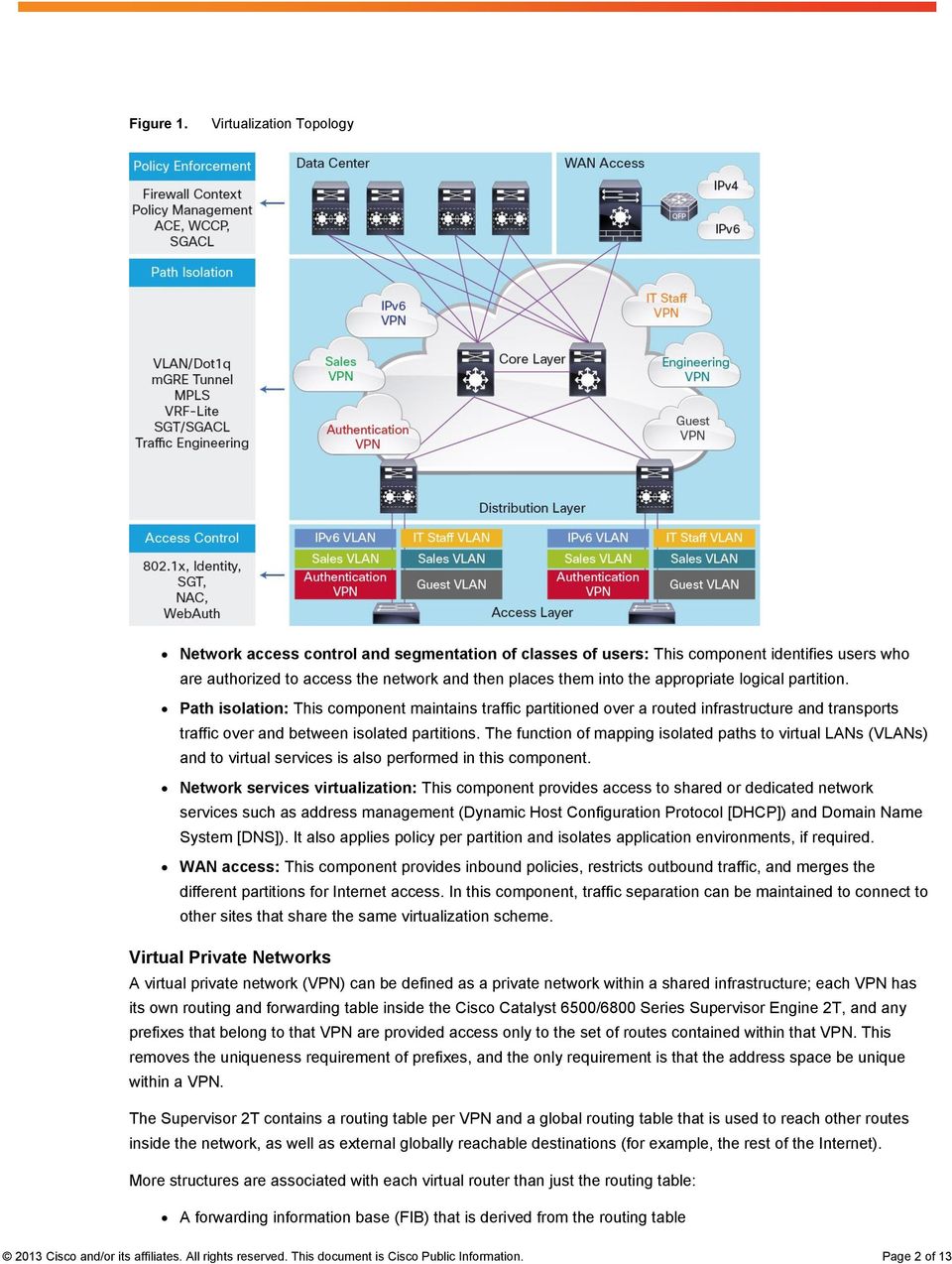
1 White Paper Network Virtualization with the Cisco Catalyst 6500/6800 Supervisor Engine 2T Introduction Network virtualization is a cost-efficient way to provide traffic separation. A virtualized network offers multiple individual networks superimposed on a single physical infrastructure. Within the campus, these individual networks can be used to transport traffic belonging to different departments or to third-party vendors. Another example of how traffic separation is used is for different security and/or routing policies. Network virtualization can also be used to transport both IPv4 and IPv6 on the same infrastructure. As a concept, network virtualization is similar to server virtualization, where a physical server can host multiple virtual machines. The Cisco Catalyst 6500/6800 Series with network virtualization enables network resources to be deployed and managed as logical services rather than as physical resources. As a result, companies can: Enhance enterprise agility Improve network efficiency Reduce capital and operational costs Maintain high standards of security, scalability, manageability, and availability throughout the campus design The Cisco Catalyst 6500/6800 Series Supervisor Engine 2T is the ideal platform to build a virtual network for the campus. The Supervisor Engine 2T has many enhancements that its predecessor did not support, such as LISP, Virtual Private LAN Services (VPLS), H-VPLS, L2omGRE natively in hardware, 4000 VRFs, L3VPNomGRE, higher Multiprotocol Label Switching (MPLS) throughput, VPN routing and forwarding (VRF)-aware services like Web Cache Communication Protocol (WCCP) for application acceleration, VLAN Reuse for scalability, and other enhancements. The Cisco Catalyst 6500/6800 Series platform is in a unique place in the network because it supports the Cisco Wireless Services Module 2 (WiSM2) Wireless Controller and also the Cisco Adaptive Security Appliance (ASA) Service Module. These features provide the ability to have a consistent secure policy between wireless and wired users using network virtualization segmentation. It is very important to have a holistic approach when designing a virtualized infrastructure. You must consider three main components that enable an end-to-end virtualization solution: the access to the virtualized infrastructure, the transport, and finally the network services (Figure 1) Cisco and/or its affiliates. All rights reserved. This document is Cisco Public Information. Page 1 of 13
2 Figure 1. Virtualization Topology Network access control and segmentation of classes of users: This component identifies users who are authorized to access the network and then places them into the appropriate logical partition. Path isolation: This component maintains traffic partitioned over a routed infrastructure and transports traffic over and between isolated partitions. The function of mapping isolated paths to virtual LANs (VLANs) and to virtual services is also performed in this component. Network services virtualization: This component provides access to shared or dedicated network services such as address management (Dynamic Host Configuration Protocol [DHCP]) and Domain Name System [DNS]). It also applies policy per partition and isolates application environments, if required. WAN access: This component provides inbound policies, restricts outbound traffic, and merges the different partitions for Internet access. In this component, traffic separation can be maintained to connect to other sites that share the same virtualization scheme. Virtual Private Networks A virtual private network (VPN) can be defined as a private network within a shared infrastructure; each VPN has its own routing and forwarding table inside the Cisco Catalyst 6500/6800 Series Supervisor Engine 2T, and any prefixes that belong to that VPN are provided access only to the set of routes contained within that VPN. This removes the uniqueness requirement of prefixes, and the only requirement is that the address space be unique within a VPN. The Supervisor 2T contains a routing table per VPN and a global routing table that is used to reach other routes inside the network, as well as external globally reachable destinations (for example, the rest of the Internet). More structures are associated with each virtual router than just the routing table: A forwarding information base (FIB) that is derived from the routing table 2013 Cisco and/or its affiliates. All rights reserved. This document is Cisco Public Information. Page 2 of 13
3 An adjacency table that contains the next hop addresses Rules that control the import and export of routes from and into the VPN routing table A set of routing protocols that create the routing information base (RIB) within the VPN The combination of the VPN IP routing table and the associated VPN IP forwarding table is called a VPN routing and forwarding (VRF) instance. The Supervisor 2T offers several virtualization solutions that span different needs. The criteria that are used to select one set of solutions over another are usually the scalability of the specific technology, ease of deployment, and manageability. This document will review different technologies and will highlight the benefits and drawbacks of using one over another. Access Control Wireless Clients Wireless clients associate to the access point using a service set identifier (SSID). For each defined SSID, we can have a different authentication method; for example, guest users can be associates using a broadcast SSID with open authentication. Managed users may benefit from a separate SSID with a dynamic wireless authentication mechanism (Extensible Authentication Protocol [EAP] and so on) or using static Wired Equivalent Privacy (WEP) keys or eventually open authentication. The Supervisor Engine 2T supports the latest two generations of wireless services module (WiSM). The WiSM is a wireless LAN controller services module that, among multiple functionalities, uses the Control and Provisioning of Wireless Access Points Protocol (CAPWAP) to encapsulate original Ethernet frames from the wireless access point and transport them across Layer 3 boundaries. Using a combination of CAPWAP and VLANs, the administrator can logically isolate traffic for different user groups. Wired Clients At the access level, VLAN assignment is the preferred mechanism to associate a user to a logical segment. The VLAN assignment can be performed statically or dynamically using one of the identity technologies. Since the Supervisor Engine 2T includes Identity 4.1 support, static VLAN assignment is less desirable because of the lack of mobility, potential security hazard, and port provisioning issue. Path Isolation The logical isolation provided by VLANs at the access level ceases to exist at the first Layer 3 hop device (usually the distribution layer device), and we need to extend this isolation into the routed network domain. This is usually performed by defining a VRF on the first hop device and mapping a single or multiple VLANs to the defined VRF instance (see the configuration example in Figure 2). Since the distribution block usually aggregates multiple access devices, it is important to maintain a good redundancy mechanism. Supervisor Engine 2T supports all the first hop redundancy protocols: Hot Standby Router Protocol (HSRP) and Gateway Load Balancing (GLBP) for both IPv4 and IPv6, and Virtual Router Redundancy Protocol [VRRP] for IPv4. Supervisor 2T also supports Virtual Switching System (VSS). This technology offers a simpler configuration that does not require using a first hop redundancy protocol Cisco and/or its affiliates. All rights reserved. This document is Cisco Public Information. Page 3 of 13
4 Figure 2. VLAN to VRF Mapping VRF-Lite VRF-Lite is a simple, elegant solution to perform path isolation within Supervisor Engine 2T. The concept was already present with Cisco Catalyst 6500 Series Virtual Switching Supervisor Engine 720, but there are big improvements that derive from the enhanced scalability, performance, and manageability of the new supervisor engine. VRF-Lite can slice the RIB and the FIB in multiple partitions by adding a VPN identifier to each entry. Unlike Multiprotocol Label Switching (MPLS)/VPN, VRF-Lite does not take into account the transport of the VPN information to other switches or routers. Two methods can be used to transport the VRF information throughout the network. If all the devices within the network support VRF-Lite, a hop-by-hop solution can be used. This method maintains traffic separation between switches by using 802.1q trunk and associates each VLAN carried by the trunk with a VRF (see Figure 3). Figure q VRF Transportation 2013 Cisco and/or its affiliates. All rights reserved. This document is Cisco Public Information. Page 4 of 13

5 If not all devices in the path support VRF-Lite, the VRF can be transported across using Generic Routing Encapsulation (GRE) tunnels, so that each VRF can be mapped to a specific tunnel interface. Depending on the topology, point-to-point or point-to-multipoint tunnels can be used (see Figure 4). Figure 4. GRE Tunnel VRF Transportation Hop-by-Hop VRF Transport When using a hop-by-hop method to propagate the VRF, the administrator usually creates a subinterface and associates that interface with a specific VRF on the connection between neighboring switches. The hop-by-hop propagation is facilitated by the new logical interface (LIF) concept, which allows the configuration of the same VLAN identification on two different primary interfaces (for more information on LIF, refer to the appendix). In the topology illustrated in Figure 5, SUP2T-2 assigned VLAN10 to the interfaces connecting to SUP2T-1 and SUP2T-3 for VRF-1. Figure 5. Hop-by-Hop VRF Configuration Example 2013 Cisco and/or its affiliates. All rights reserved. This document is Cisco Public Information. Page 5 of 13

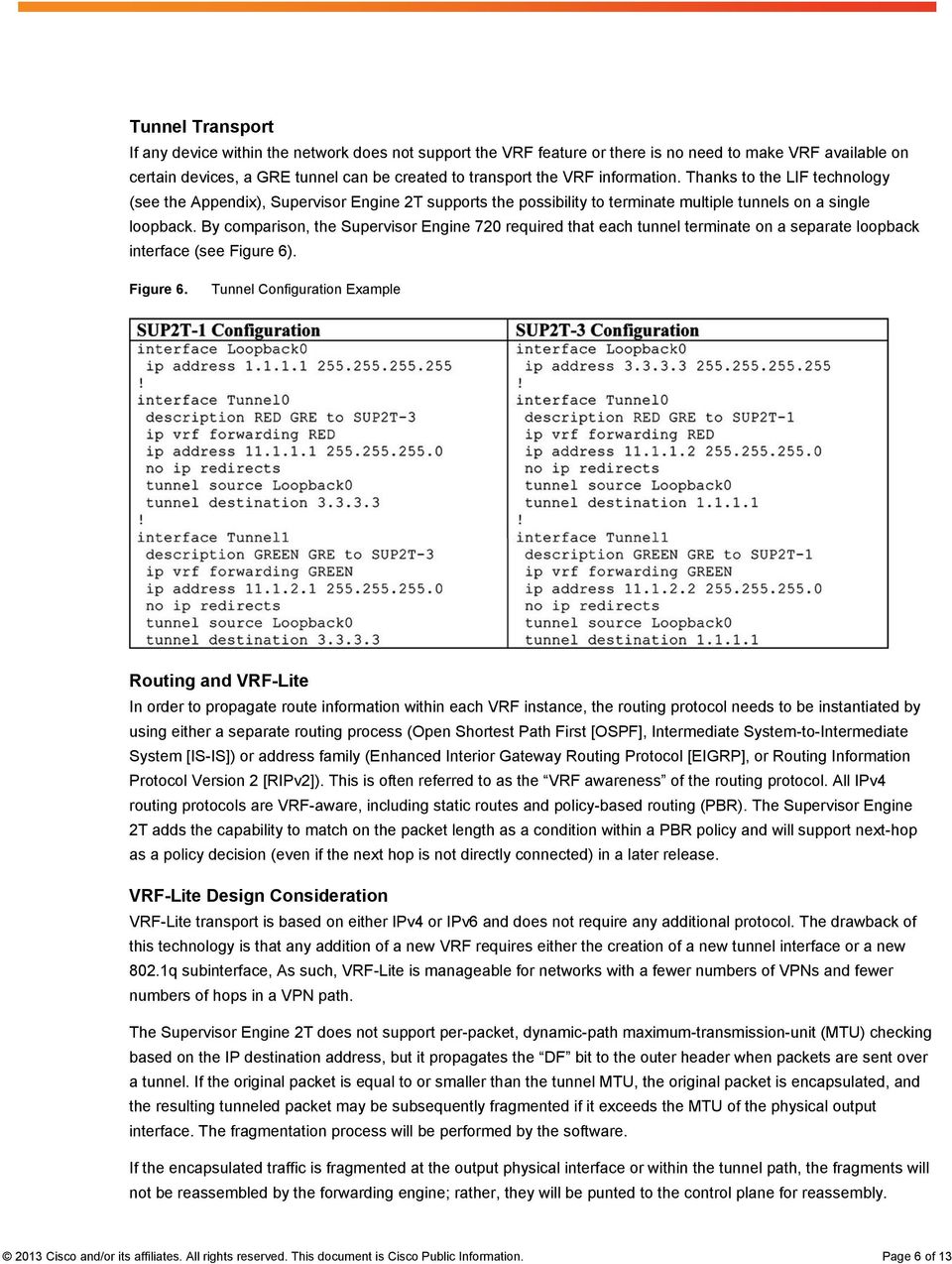
6 Tunnel Transport If any device within the network does not support the VRF feature or there is no need to make VRF available on certain devices, a GRE tunnel can be created to transport the VRF information. Thanks to the LIF technology (see the Appendix), Supervisor Engine 2T supports the possibility to terminate multiple tunnels on a single loopback. By comparison, the Supervisor Engine 720 required that each tunnel terminate on a separate loopback interface (see Figure 6). Figure 6. Tunnel Configuration Example Routing and VRF-Lite In order to propagate route information within each VRF instance, the routing protocol needs to be instantiated by using either a separate routing process (Open Shortest Path First [OSPF], Intermediate System-to-Intermediate System [IS-IS]) or address family (Enhanced Interior Gateway Routing Protocol [EIGRP], or Routing Information Protocol Version 2 [RIPv2]). This is often referred to as the VRF awareness of the routing protocol. All IPv4 routing protocols are VRF-aware, including static routes and policy-based routing (PBR). The Supervisor Engine 2T adds the capability to match on the packet length as a condition within a PBR policy and will support next-hop as a policy decision (even if the next hop is not directly connected) in a later release. VRF-Lite Design Consideration VRF-Lite transport is based on either IPv4 or IPv6 and does not require any additional protocol. The drawback of this technology is that any addition of a new VRF requires either the creation of a new tunnel interface or a new 802.1q subinterface, As such, VRF-Lite is manageable for networks with a fewer numbers of VPNs and fewer numbers of hops in a VPN path. The Supervisor Engine 2T does not support per-packet, dynamic-path maximum-transmission-unit (MTU) checking based on the IP destination address, but it propagates the DF bit to the outer header when packets are sent over a tunnel. If the original packet is equal to or smaller than the tunnel MTU, the original packet is encapsulated, and the resulting tunneled packet may be subsequently fragmented if it exceeds the MTU of the physical output interface. The fragmentation process will be performed by the software. If the encapsulated traffic is fragmented at the output physical interface or within the tunnel path, the fragments will not be reassembled by the forwarding engine; rather, they will be punted to the control plane for reassembly Cisco and/or its affiliates. All rights reserved. This document is Cisco Public Information. Page 6 of 13
7 Easy Virtual Networks (EVN) Easy Virtual Network (EVN) is a simplified LAN virtualization solution that helps enable network managers to provide service separation on a shared network infrastructure. It uses existing technology to increase the effectiveness of VRFs. Existing enterprise network architecture and protocols, as well as concepts such as trunk and access interface, are preserved in EVN architecture. EVN builds on VRF-Lite concepts and capabilities and provides additional benefits: Increased enterprise scalability Simplified configuration and management Routing contexts for ease of operations in a VRF Better monitoring and troubleshooting Shared services between groups Traffic Separation in EVN Path isolation can be achieved by using a unique tag for each VN. This tag is called the VNET tag. Each VN carries over a virtual network the same tag value that was assigned by a network administrator. An EVN device in the virtual path uses the tags to provide traffic separation among different VNs. This removes the dependency on physical or logical interfaces to provide traffic separation. Provisioning in EVN EVN requires Supervisor Engine 2T and a minimum of Cisco IOS Software Release 15.0(1)SY1. EVN requires additional configuration concepts summarized here: Basic VRF Provisioning 1. Provision VRFs: vnet tag <> new command 2. Associate user facing (AC) and Trunk (core-facing interfaces) with VRF: vnet trunk new command 3. Define routing instance for VRFs: Same configuration as in VRF-Lite (Multi-VRF or MPLS VPNs on access side) Advanced VRF Provisioning 1. Customize attributes for each VRF (override inheritance) 2. Filter VRFs on some links but allow on others: vrf list <> new command 3. Setup inter-vrf communication (shared services/extranet services): route-replicate from vrf <> new command 2013 Cisco and/or its affiliates. All rights reserved. This document is Cisco Public Information. Page 7 of 13
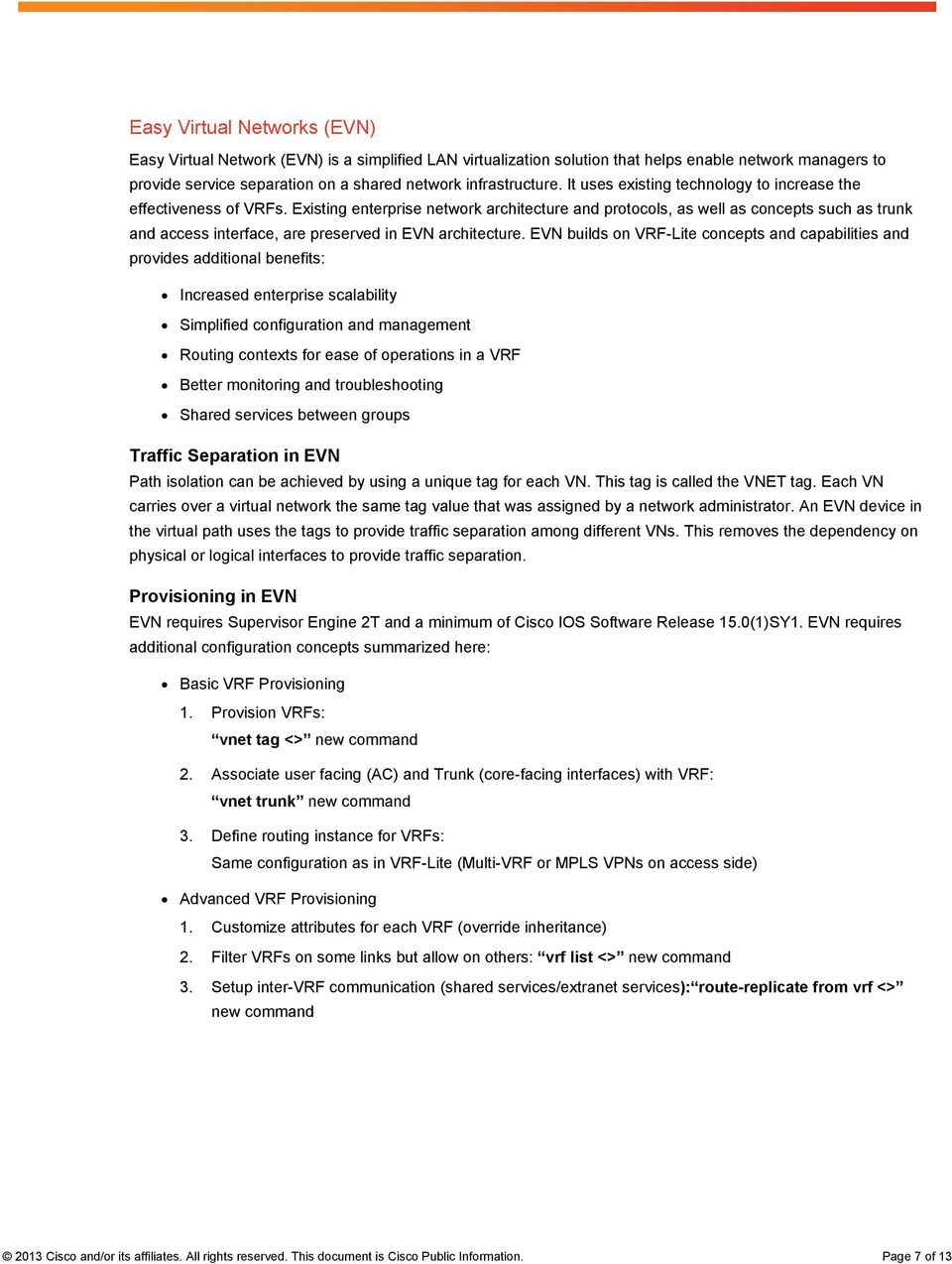
8 Note: When configuring EVN on a Cisco Catalyst 6500 Family networking device, we recommend you assign a vnet tag in the range Beginning with Cisco IOS Release 15.1(1)SY, on the Sup2T platform of the Cisco Catalyst 6500/6800 product lines, if the vlan internal allocation policy descending command is configured, the vnet tag range is from 2 to Figure 7. Interface Configuration Comparison between VRF-Lite and EVN For more Information on EVN, please refer to the white paper and configuration guides: Cisco and/or its affiliates. All rights reserved. This document is Cisco Public Information. Page 8 of 13

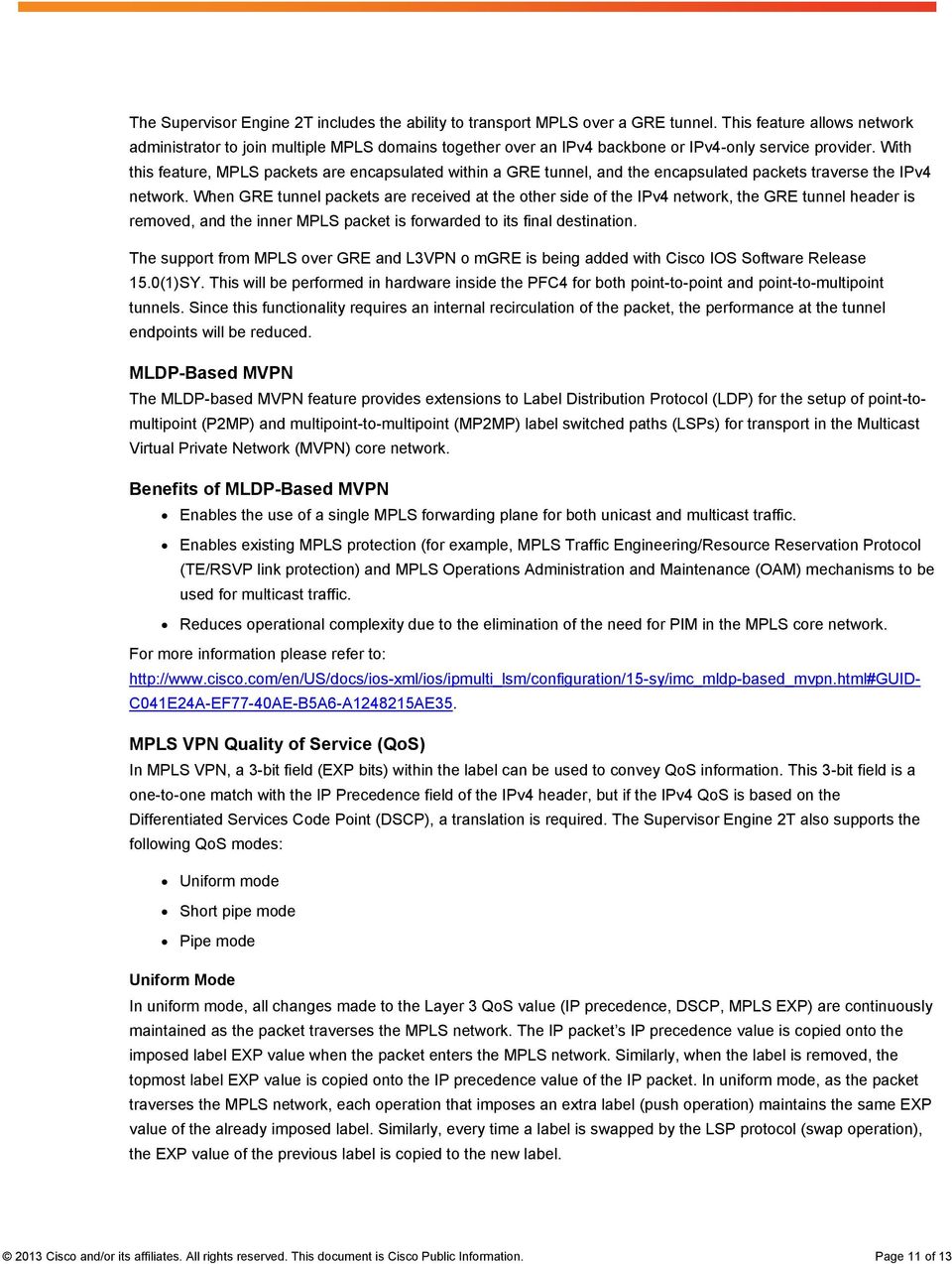
9 LISP Enhancements to Network Virtualization: Lisp based Network Virtualization enhancements are also supported. For more information, please refer to the following white paper: solution_overview_c html. MPLS VPN MPLS is an infrastructure technology used by service providers and large enterprises, allowing an easy integration of services such as VPN, traffic engineering (TE), quality of service (QoS), and fast convergence (Fast ReRoute [FRR]). The MPLS terminology defines three types of nodes. The first type of node is the provider edge (PE), which sits at the border of the MPLS network and faces the customer edge (CE) on one side and the provider (P) node on the other. The P nodes may also be referred to as a label switching router (LSR) because they base their forwarding decision on the MPLS label (see Figure 8) rather than the IP header. A packet enters the MPLS network at the ingress PE and is label-switched up to the egress PE. The path followed by a specific packet is called a label switching path (LSP) and is set up by a control-plane protocol such as Label Distribution Protocol (LDP) or Resource Reservation Protocol (RSVP). For detailed information about MPLS, refer to the book MPLS and VPN Architectures by Ivan Pepelnjak and Jim Guichard. The Supervisor Engine 2T provides all the features necessary to support MPLS switching at both the PE and P level, including Layer 2 services such as Ethernet over MPLS (EoMPLS) and virtual private LAN service (VPLS). Figure 8. MPLS Label MPLS VPN Configuration Like VRF-Lite, MPLS VPN deployment requires mapping the VLAN to a Layer 3 interface at the first hop device referred to now as a PE router; that Layer 3 interface belongs to a specific VRF previously defined. All Layer 3 interfaces in the core, including the one facing the core on the PE, have MPLS forwarding enabled. Multiprotocol BGP (MP-BGP) needs to be enabled on the PE devices to exchange the VPN routes. All the PE devices within the network become BGP neighbors within a single AS (ibgp). VPN traffic is now carried end-to-end across the network, maintaining logical isolation between the defined groups, and two MPLS tags are added to each frame: one to route the packet within the MPLS network and the second to identify the VPN of the packet. MPLS VPN is a highly scalable solution that can take advantage of the Supervisor Engine 2T capabilities to provide up to 16K VRFs within each system; the Supervisor Engine 720 supported up to 512 VRFs without performance degradation and up to 1024 VRFs with performance degradation on the additional 512 VRFs (see Figure 9.) 2013 Cisco and/or its affiliates. All rights reserved. This document is Cisco Public Information. Page 9 of 13
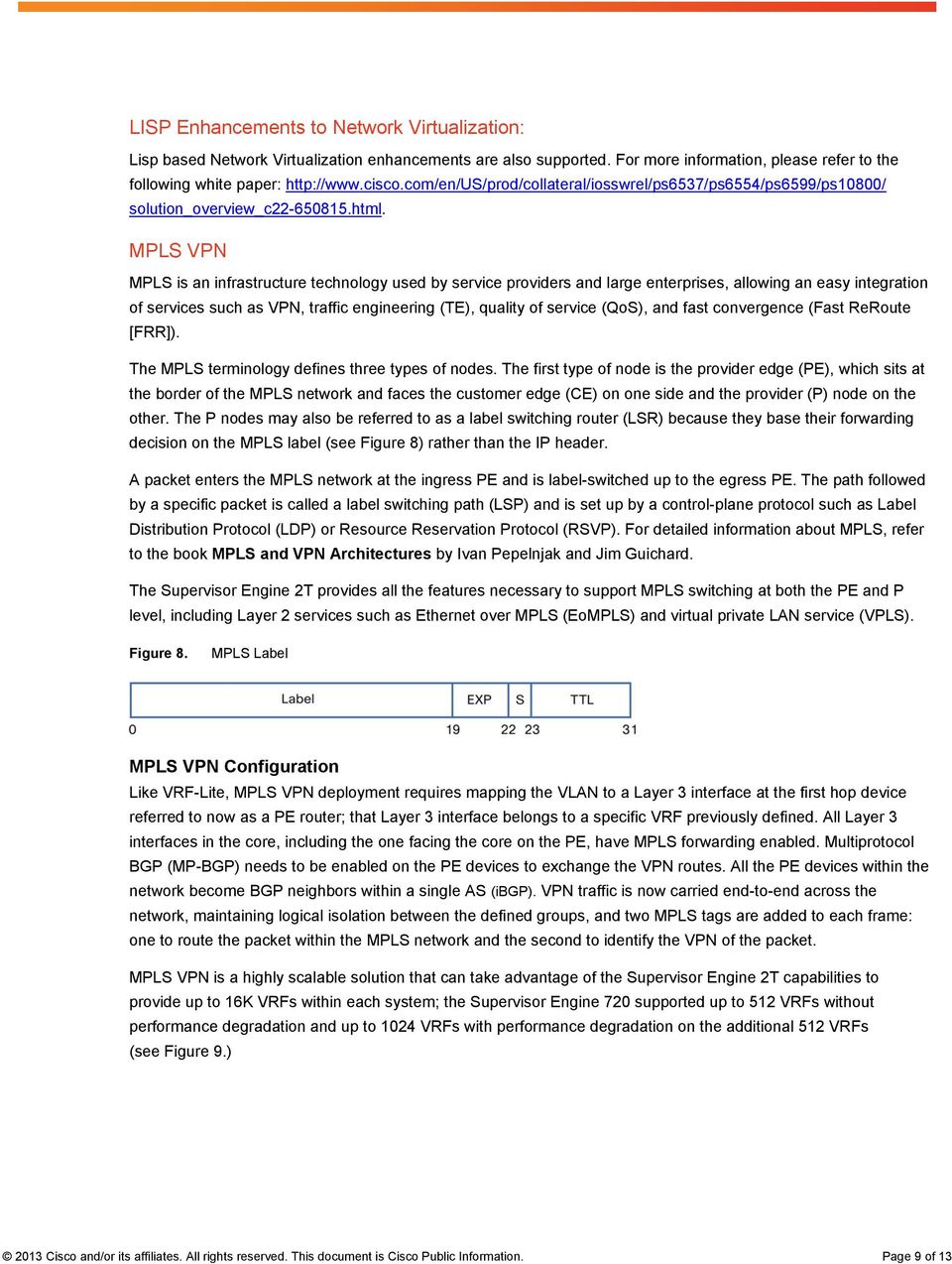
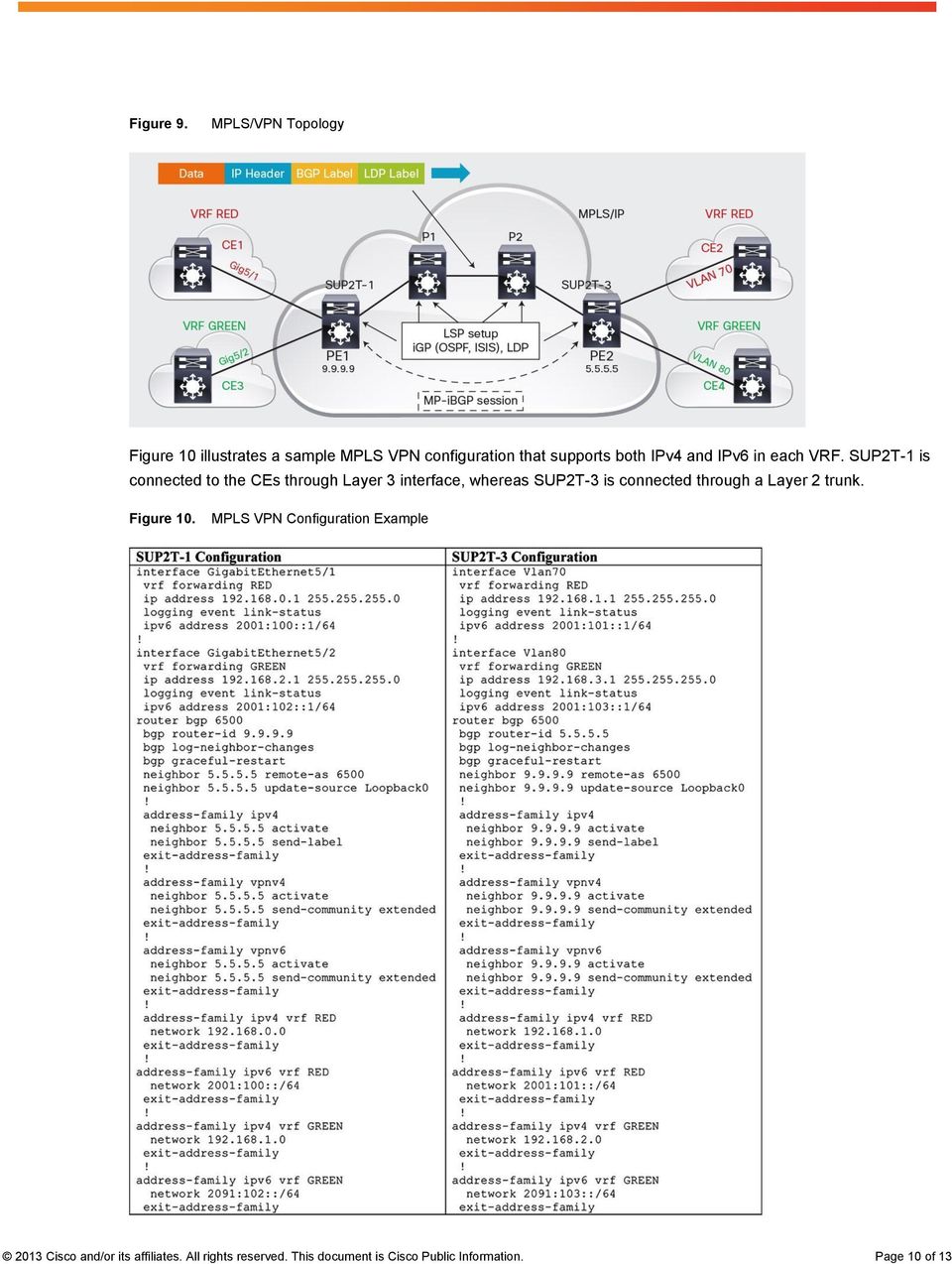
10 Figure 9. MPLS/VPN Topology Figure 10 illustrates a sample MPLS VPN configuration that supports both IPv4 and IPv6 in each VRF. SUP2T-1 is connected to the CEs through Layer 3 interface, whereas SUP2T-3 is connected through a Layer 2 trunk. Figure 10. MPLS VPN Configuration Example 2013 Cisco and/or its affiliates. All rights reserved. This document is Cisco Public Information. Page 10 of 13
11 The Supervisor Engine 2T includes the ability to transport MPLS over a GRE tunnel. This feature allows network administrator to join multiple MPLS domains together over an IPv4 backbone or IPv4-only service provider. With this feature, MPLS packets are encapsulated within a GRE tunnel, and the encapsulated packets traverse the IPv4 network. When GRE tunnel packets are received at the other side of the IPv4 network, the GRE tunnel header is removed, and the inner MPLS packet is forwarded to its final destination. The support from MPLS over GRE and L3VPN o mgre is being added with Cisco IOS Software Release 15.0(1)SY. This will be performed in hardware inside the PFC4 for both point-to-point and point-to-multipoint tunnels. Since this functionality requires an internal recirculation of the packet, the performance at the tunnel endpoints will be reduced. MLDP-Based MVPN The MLDP-based MVPN feature provides extensions to Label Distribution Protocol (LDP) for the setup of point-tomultipoint (P2MP) and multipoint-to-multipoint (MP2MP) label switched paths (LSPs) for transport in the Multicast Virtual Private Network (MVPN) core network. Benefits of MLDP-Based MVPN Enables the use of a single MPLS forwarding plane for both unicast and multicast traffic. Enables existing MPLS protection (for example, MPLS Traffic Engineering/Resource Reservation Protocol (TE/RSVP link protection) and MPLS Operations Administration and Maintenance (OAM) mechanisms to be used for multicast traffic. Reduces operational complexity due to the elimination of the need for PIM in the MPLS core network. For more information please refer to: C041E24A-EF77-40AE-B5A6-A AE35. MPLS VPN Quality of Service (QoS) In MPLS VPN, a 3-bit field (EXP bits) within the label can be used to convey QoS information. This 3-bit field is a one-to-one match with the IP Precedence field of the IPv4 header, but if the IPv4 QoS is based on the Differentiated Services Code Point (DSCP), a translation is required. The Supervisor Engine 2T also supports the following QoS modes: Uniform mode Short pipe mode Pipe mode Uniform Mode In uniform mode, all changes made to the Layer 3 QoS value (IP precedence, DSCP, MPLS EXP) are continuously maintained as the packet traverses the MPLS network. The IP packet s IP precedence value is copied onto the imposed label EXP value when the packet enters the MPLS network. Similarly, when the label is removed, the topmost label EXP value is copied onto the IP precedence value of the IP packet. In uniform mode, as the packet traverses the MPLS network, each operation that imposes an extra label (push operation) maintains the same EXP value of the already imposed label. Similarly, every time a label is swapped by the LSP protocol (swap operation), the EXP value of the previous label is copied to the new label Cisco and/or its affiliates. All rights reserved. This document is Cisco Public Information. Page 11 of 13
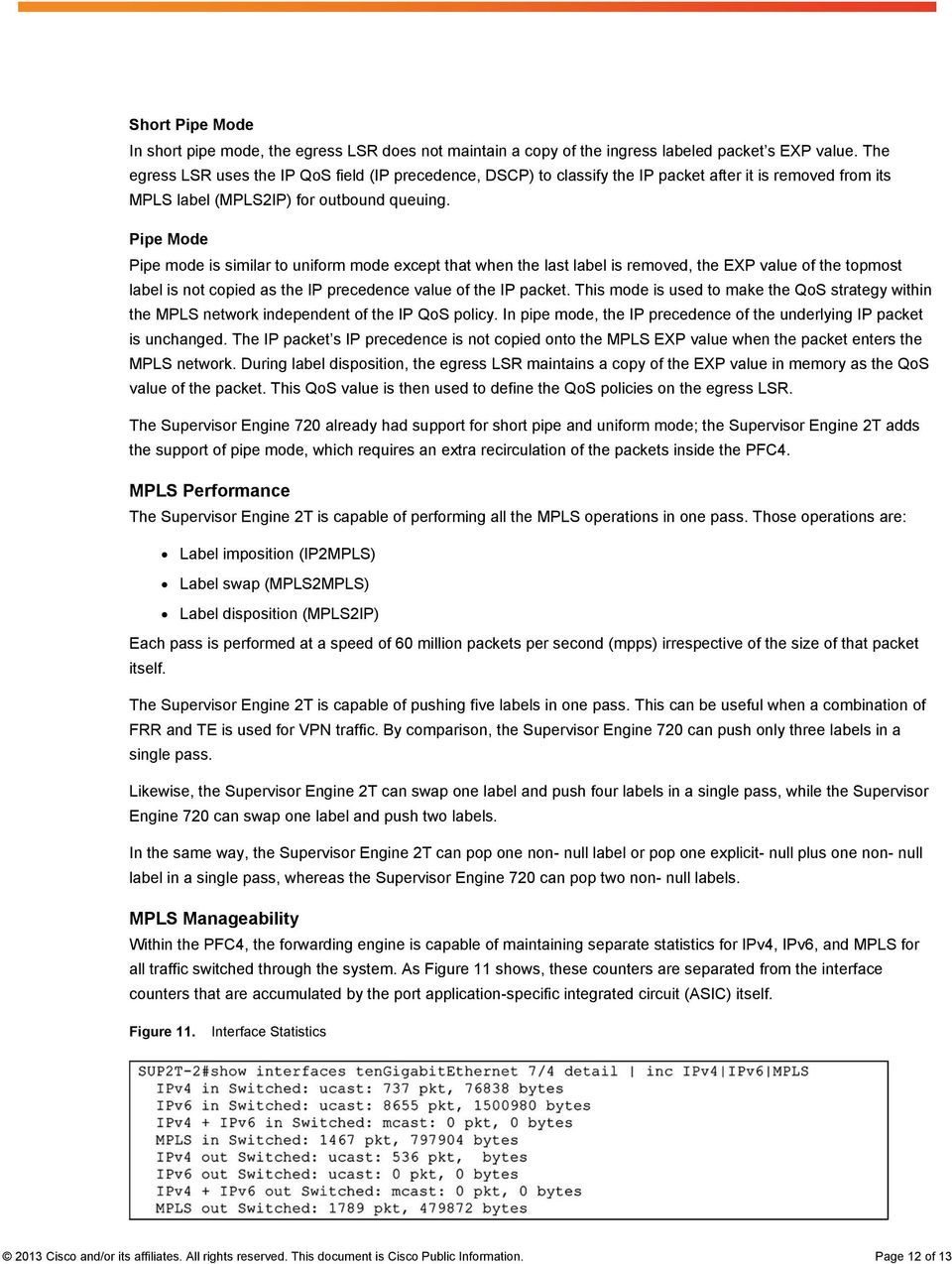
12 Short Pipe Mode In short pipe mode, the egress LSR does not maintain a copy of the ingress labeled packet s EXP value. The egress LSR uses the IP QoS field (IP precedence, DSCP) to classify the IP packet after it is removed from its MPLS label (MPLS2IP) for outbound queuing. Pipe Mode Pipe mode is similar to uniform mode except that when the last label is removed, the EXP value of the topmost label is not copied as the IP precedence value of the IP packet. This mode is used to make the QoS strategy within the MPLS network independent of the IP QoS policy. In pipe mode, the IP precedence of the underlying IP packet is unchanged. The IP packet s IP precedence is not copied onto the MPLS EXP value when the packet enters the MPLS network. During label disposition, the egress LSR maintains a copy of the EXP value in memory as the QoS value of the packet. This QoS value is then used to define the QoS policies on the egress LSR. The Supervisor Engine 720 already had support for short pipe and uniform mode; the Supervisor Engine 2T adds the support of pipe mode, which requires an extra recirculation of the packets inside the PFC4. MPLS Performance The Supervisor Engine 2T is capable of performing all the MPLS operations in one pass. Those operations are: Label imposition (IP2MPLS) Label swap (MPLS2MPLS) Label disposition (MPLS2IP) Each pass is performed at a speed of 60 million packets per second (mpps) irrespective of the size of that packet itself. The Supervisor Engine 2T is capable of pushing five labels in one pass. This can be useful when a combination of FRR and TE is used for VPN traffic. By comparison, the Supervisor Engine 720 can push only three labels in a single pass. Likewise, the Supervisor Engine 2T can swap one label and push four labels in a single pass, while the Supervisor Engine 720 can swap one label and push two labels. In the same way, the Supervisor Engine 2T can pop one non- null label or pop one explicit- null plus one non- null label in a single pass, whereas the Supervisor Engine 720 can pop two non- null labels. MPLS Manageability Within the PFC4, the forwarding engine is capable of maintaining separate statistics for IPv4, IPv6, and MPLS for all traffic switched through the system. As Figure 11 shows, these counters are separated from the interface counters that are accumulated by the port application-specific integrated circuit (ASIC) itself. Figure 11. Interface Statistics 2013 Cisco and/or its affiliates. All rights reserved. This document is Cisco Public Information. Page 12 of 13
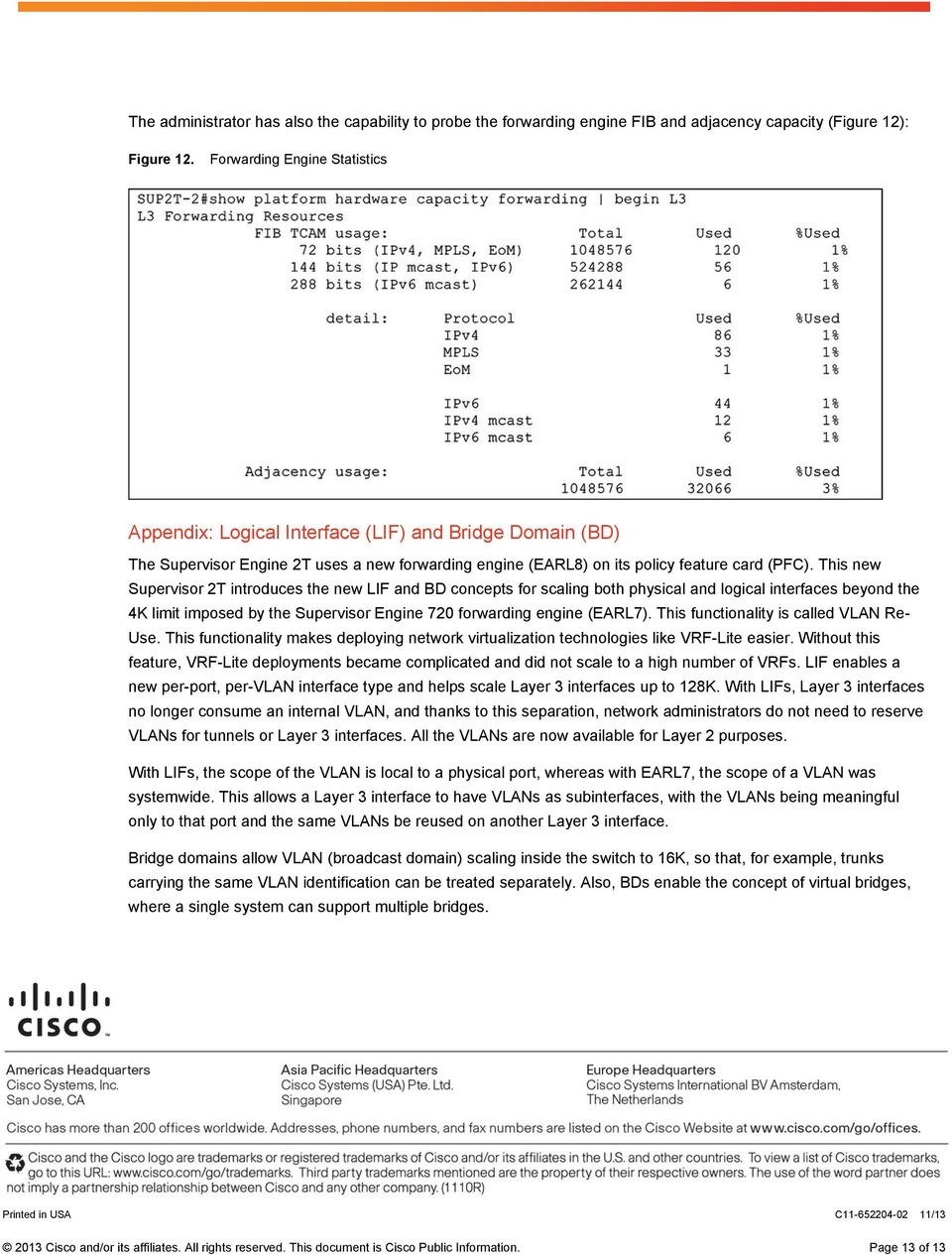
13 The administrator has also the capability to probe the forwarding engine FIB and adjacency capacity (Figure 12): Figure 12. Forwarding Engine Statistics Appendix: Logical Interface (LIF) and Bridge Domain (BD) The Supervisor Engine 2T uses a new forwarding engine (EARL8) on its policy feature card (PFC). This new Supervisor 2T introduces the new LIF and BD concepts for scaling both physical and logical interfaces beyond the 4K limit imposed by the Supervisor Engine 720 forwarding engine (EARL7). This functionality is called VLAN Re- Use. This functionality makes deploying network virtualization technologies like VRF-Lite easier. Without this feature, VRF-Lite deployments became complicated and did not scale to a high number of VRFs. LIF enables a new per-port, per-vlan interface type and helps scale Layer 3 interfaces up to 128K. With LIFs, Layer 3 interfaces no longer consume an internal VLAN, and thanks to this separation, network administrators do not need to reserve VLANs for tunnels or Layer 3 interfaces. All the VLANs are now available for Layer 2 purposes. With LIFs, the scope of the VLAN is local to a physical port, whereas with EARL7, the scope of a VLAN was systemwide. This allows a Layer 3 interface to have VLANs as subinterfaces, with the VLANs being meaningful only to that port and the same VLANs be reused on another Layer 3 interface. Bridge domains allow VLAN (broadcast domain) scaling inside the switch to 16K, so that, for example, trunks carrying the same VLAN identification can be treated separately. Also, BDs enable the concept of virtual bridges, where a single system can support multiple bridges. Printed in USA C / Cisco and/or its affiliates. All rights reserved. This document is Cisco Public Information. Page 13 of 13
Introducing Basic MPLS Concepts
 Module 1-1 Introducing Basic MPLS Concepts 2004 Cisco Systems, Inc. All rights reserved. 1-1 Drawbacks of Traditional IP Routing Routing protocols are used to distribute Layer 3 routing information. Forwarding
Virtual Private LAN Service on Cisco Catalyst 6500/6800 Supervisor Engine 2T
 White Paper Virtual Private LAN Service on Cisco Catalyst 6500/6800 Supervisor Engine 2T Introduction to Virtual Private LAN Service The Cisco Catalyst 6500/6800 Series Supervisor Engine 2T supports virtual
MPLS Concepts. Overview. Objectives
 MPLS Concepts Overview This module explains the features of Multi-protocol Label Switching (MPLS) compared to traditional ATM and hop-by-hop IP routing. MPLS concepts and terminology as well as MPLS label
How To Make A Network Secure
 1 2 3 4 -Lower yellow line is graduate student enrollment -Red line is undergradate enrollment -Green line is total enrollment -2008 numbers are projected to be near 20,000 (on-campus) not including distance
How Routers Forward Packets
 Autumn 2010 [email protected] MULTIPROTOCOL LABEL SWITCHING (MPLS) AND MPLS VPNS How Routers Forward Packets Process switching Hardly ever used today Router lookinginside the packet, at the ipaddress,
AMPLS - Advanced Implementing and Troubleshooting MPLS VPN Networks v4.0
 Course Outline AMPLS - Advanced Implementing and Troubleshooting MPLS VPN Networks v4.0 Module 1: MPLS Features Lesson 1: Describing Basic MPLS Concepts Provide an overview of MPLS forwarding, features,
WAN Topologies MPLS. 2006, Cisco Systems, Inc. All rights reserved. Presentation_ID.scr. 2006 Cisco Systems, Inc. All rights reserved.
 MPLS WAN Topologies 1 Multiprotocol Label Switching (MPLS) IETF standard, RFC3031 Basic idea was to combine IP routing protocols with a forwarding algoritm based on a header with fixed length label instead
Network Virtualization Network Admission Control Deployment Guide
 Network Virtualization Network Admission Control Deployment Guide This document provides guidance for enterprises that want to deploy the Cisco Network Admission Control (NAC) Appliance for their campus
Introduction to MPLS-based VPNs
 Introduction to MPLS-based VPNs Ferit Yegenoglu, Ph.D. ISOCORE [email protected] Outline Introduction BGP/MPLS VPNs Network Architecture Overview Main Features of BGP/MPLS VPNs Required Protocol Extensions
IMPLEMENTING CISCO MPLS V3.0 (MPLS)
 IMPLEMENTING CISCO MPLS V3.0 (MPLS) COURSE OVERVIEW: Multiprotocol Label Switching integrates the performance and traffic-management capabilities of data link Layer 2 with the scalability and flexibility
Implementing Cisco MPLS
 Implementing Cisco MPLS Course MPLS v2.3; 5 Days, Instructor-led Course Description This design document is for the refresh of the Implementing Cisco MPLS (MPLS) v2.3 instructor-led training (ILT) course,
MPLS VPN Services. PW, VPLS and BGP MPLS/IP VPNs
 A Silicon Valley Insider MPLS VPN Services PW, VPLS and BGP MPLS/IP VPNs Technology White Paper Serge-Paul Carrasco Abstract Organizations have been demanding virtual private networks (VPNs) instead of
DD2491 p2 2011. MPLS/BGP VPNs. Olof Hagsand KTH CSC
 DD2491 p2 2011 MPLS/BGP VPNs Olof Hagsand KTH CSC 1 Literature Practical BGP: Chapter 10 MPLS repetition, see for example http://www.csc.kth.se/utbildning/kth/kurser/dd2490/ipro1-11/lectures/mpls.pdf Reference:
Implementing Cisco Service Provider Next-Generation Edge Network Services **Part of the CCNP Service Provider track**
 Course: Duration: Price: $ 3,695.00 Learning Credits: 37 Certification: Implementing Cisco Service Provider Next-Generation Edge Network Services Implementing Cisco Service Provider Next-Generation Edge
ICTTEN6172A Design and configure an IP- MPLS network with virtual private network tunnelling
 ICTTEN6172A Design and configure an IP- MPLS network with virtual private network tunnelling Release: 1 ICTTEN6172A Design and configure an IP-MPLS network with virtual private network tunnelling Modification
Cisco IOS Software Release 15.0(1)SY1 New Features and Hardware Support
 Product Bulletin Cisco IOS Software Release 15.0(1)SY1 New Features and Hardware Support PB696622 Cisco IOS Software Release 15.0(1)SY1 supports Cisco Catalyst 6500 Series Supervisor Engine 2T only. Release
IMPLEMENTING CISCO MPLS V2.3 (MPLS)
 IMPLEMENTING CISCO MPLS V2.3 (MPLS) COURSE OVERVIEW: The course will enable learners to gather information from the technology basics to advanced VPN configuration. The focus of the course is on VPN technology
For internal circulation of BSNLonly
 E3-E4 E4 E&WS Overview of MPLS-VPN Overview Traditional Router-Based Networks Virtual Private Networks VPN Terminology MPLS VPN Architecture MPLS VPN Routing MPLS VPN Label Propagation Traditional Router-Based
MPLS L2VPN (VLL) Technology White Paper
 MPLS L2VPN (VLL) Technology White Paper Issue 1.0 Date 2012-10-30 HUAWEI TECHNOLOGIES CO., LTD. 2012. All rights reserved. No part of this document may be reproduced or transmitted in any form or by any
MPLS-based Virtual Private Network (MPLS VPN) The VPN usually belongs to one company and has several sites interconnected across the common service
 Nowdays, most network engineers/specialists consider MPLS (MultiProtocol Label Switching) one of the most promising transport technologies. Then, what is MPLS? Multi Protocol Label Switching (MPLS) is
- Multiprotocol Label Switching -
 1 - Multiprotocol Label Switching - Multiprotocol Label Switching Multiprotocol Label Switching (MPLS) is a Layer-2 switching technology. MPLS-enabled routers apply numerical labels to packets, and can
Expert Reference Series of White Papers. An Overview of MPLS VPNs: Overlay; Layer 3; and PseudoWire
 Expert Reference Series of White Papers An Overview of MPLS VPNs: Overlay; Layer 3; and PseudoWire 1-800-COURSES www.globalknowledge.com An Overview of MPLS VPNs: Overlay; Layer 3; and PseudoWire Al Friebe,
PRASAD ATHUKURI Sreekavitha engineering info technology,kammam
 Multiprotocol Label Switching Layer 3 Virtual Private Networks with Open ShortestPath First protocol PRASAD ATHUKURI Sreekavitha engineering info technology,kammam Abstract This paper aims at implementing
Enterprise Network Simulation Using MPLS- BGP
 Enterprise Network Simulation Using MPLS- BGP Tina Satra 1 and Smita Jangale 2 1 Department of Computer Engineering, SAKEC, Chembur, Mumbai-88, India [email protected] 2 Department of Information Technolgy,
MikroTik RouterOS Introduction to MPLS. Prague MUM Czech Republic 2009
 MikroTik RouterOS Introduction to MPLS Prague MUM Czech Republic 2009 Q : W h y h a v e n 't y o u h e a r d a b o u t M P LS b e fo re? A: Probably because of the availability and/or price range Q : W
Cisco Configuring Basic MPLS Using OSPF
 Table of Contents Configuring Basic MPLS Using OSPF...1 Introduction...1 Mechanism...1 Hardware and Software Versions...2 Network Diagram...2 Configurations...2 Quick Configuration Guide...2 Configuration
MPLS VPN over mgre. Finding Feature Information. Prerequisites for MPLS VPN over mgre
 The feature overcomes the requirement that a carrier support multiprotocol label switching (MPLS) by allowing you to provide MPLS connectivity between networks that are connected by IP-only networks. This
MPLS over IP-Tunnels. Mark Townsley Distinguished Engineer. 21 February 2005
 MPLS over IP-Tunnels Mark Townsley Distinguished Engineer 21 February 2005 1 MPLS over IP The Basic Idea MPLS Tunnel Label Exp S TTL MPLS VPN Label Exp S TTL MPLS Payload (L3VPN, PWE3, etc) MPLS Tunnel
RFC 2547bis: BGP/MPLS VPN Fundamentals
 White Paper RFC 2547bis: BGP/MPLS VPN Fundamentals Chuck Semeria Marketing Engineer Juniper Networks, Inc. 1194 North Mathilda Avenue Sunnyvale, CA 94089 USA 408 745 2001 or 888 JUNIPER www.juniper.net
MPLS Implementation MPLS VPN
 MPLS Implementation MPLS VPN Describing MPLS VPN Technology Objectives Describe VPN implementation models. Compare and contrast VPN overlay VPN models. Describe the benefits and disadvantages of the overlay
Computer Network Architectures and Multimedia. Guy Leduc. Chapter 2 MPLS networks. Chapter 2: MPLS
 Computer Network Architectures and Multimedia Guy Leduc Chapter 2 MPLS networks Chapter based on Section 5.5 of Computer Networking: A Top Down Approach, 6 th edition. Jim Kurose, Keith Ross Addison-Wesley,
VPLS Technology White Paper HUAWEI TECHNOLOGIES CO., LTD. Issue 01. Date 2012-10-30
 Issue 01 Date 2012-10-30 HUAWEI TECHNOLOGIES CO., LTD. 2012. All rights reserved. No part of this document may be reproduced or transmitted in any form or by any means without prior written consent of
MPLS/BGP Network Simulation Techniques for Business Enterprise Networks
 MPLS/BGP Network Simulation Techniques for Business Enterprise Networks Nagaselvam M Computer Science and Engineering, Nehru Institute of Technology, Coimbatore, Abstract Business Enterprises used VSAT
MP PLS VPN MPLS VPN. Prepared by Eng. Hussein M. Harb
 MP PLS VPN MPLS VPN Prepared by Eng. Hussein M. Harb Agenda MP PLS VPN Why VPN VPN Definition VPN Categories VPN Implementations VPN Models MPLS VPN Types L3 MPLS VPN L2 MPLS VPN Why VPN? VPNs were developed
How To Understand The Benefits Of An Mpls Network
 NETWORKS NetIron XMR 16000 NETWORKS NetIron XMR 16000 NETWORKS NetIron XMR 16000 Introduction MPLS in the Enterprise Multi-Protocol Label Switching (MPLS) as a technology has been around for over a decade
Cisco 7600 Series Route Switch Processor 720
 Cisco 7600 Series Route Switch Processor 720 Product Overview The Cisco 7600 Series Route Switch Processor 720 (RSP 720) is specifically designed to deliver high scalability, performance, and fast convergence
Data Networking and Architecture. Delegates should have some basic knowledge of Internet Protocol and Data Networking principles.
 Data Networking and Architecture The course focuses on theoretical principles and practical implementation of selected Data Networking protocols and standards. Physical network architecture is described
Table of Contents. Cisco Configuring a Basic MPLS VPN
 Table of Contents Configuring a Basic MPLS VPN...1 Introduction...1 Prerequisites...1 Requirements...1 Components Used...2 Related Products...2 Conventions...2 Configure...3 Network Diagram...3 Configuration
OVERLAYING VIRTUALIZED LAYER 2 NETWORKS OVER LAYER 3 NETWORKS
 OVERLAYING VIRTUALIZED LAYER 2 NETWORKS OVER LAYER 3 NETWORKS Matt Eclavea ([email protected]) Senior Solutions Architect, Brocade Communications Inc. Jim Allen ([email protected]) Senior Architect, Limelight
SBSCET, Firozpur (Punjab), India
 Volume 3, Issue 9, September 2013 ISSN: 2277 128X International Journal of Advanced Research in Computer Science and Software Engineering Research Paper Available online at: www.ijarcsse.com Layer Based
Notice the router names, as these are often used in MPLS terminology. The Customer Edge router a router that directly connects to a customer network.
 Where MPLS part I explains the basics of labeling packets, it s not giving any advantage over normal routing, apart from faster table lookups. But extensions to MPLS allow for more. In this article I ll
MPLS is the enabling technology for the New Broadband (IP) Public Network
 From the MPLS Forum Multi-Protocol Switching (MPLS) An Overview Mario BALI Turin Polytechnic [email protected] www.polito.it/~baldi MPLS is the enabling technology for the New Broadband (IP) Public
Junos MPLS and VPNs (JMV)
 Junos MPLS and VPNs (JMV) Course No: EDU-JUN-JMV Length: Five days Onsite Price: $32500 for up to 12 students Public Enrollment Price: $3500/student Course Level JMV is an advanced-level course. Prerequisites
MPLS in Private Networks Is It a Good Idea?
 MPLS in Private Networks Is It a Good Idea? Jim Metzler Vice President Ashton, Metzler & Associates March 2005 Introduction The wide area network (WAN) brings indisputable value to organizations of all
Kingston University London
 Kingston University London Thesis Title Implementation and performance evaluation of WAN services over MPLS Layer-3 VPN Dissertation submitted for the Degree of Master of Science in Networking and Data
IP/MPLS-Based VPNs Layer-3 vs. Layer-2
 Table of Contents 1. Objective... 3 2. Target Audience... 3 3. Pre-Requisites... 3 4. Introduction...3 5. MPLS Layer-3 VPNs... 4 6. MPLS Layer-2 VPNs... 7 6.1. Point-to-Point Connectivity... 8 6.2. Multi-Point
s@lm@n Cisco Exam 400-201 CCIE Service Provider Written Exam Version: 7.0 [ Total Questions: 107 ]
![s@lm@n Cisco Exam 400-201 CCIE Service Provider Written Exam Version: 7.0 [ Total Questions: 107 ]](/thumbs/27/11074762.jpg "s@lm@n Cisco Exam 400-201 CCIE Service Provider Written Exam Version: 7.0 [ Total Questions: 107 ]") s@lm@n Cisco Exam 400-201 CCIE Service Provider Written Exam Version: 7.0 [ Total Questions: 107 ] Cisco 400-201 : Practice Test Question No : 1 Which two frame types are correct when configuring T3 interfaces?
s@lm@n Cisco Exam 400-201 CCIE Service Provider Written Exam Version: 7.0 [ Total Questions: 107 ] Cisco 400-201 : Practice Test Question No : 1 Which two frame types are correct when configuring T3 interfaces?
Designing and Developing Scalable IP Networks
 Designing and Developing Scalable IP Networks Guy Davies Telindus, UK John Wiley & Sons, Ltd Contents List of Figures List of Tables About the Author Acknowledgements Abbreviations Introduction xi xiii
Implementing MPLS VPN in Provider's IP Backbone Luyuan Fang [email protected] AT&T
 Implementing MPLS VPN in Provider's IP Backbone Luyuan Fang [email protected] AT&T 1 Outline! BGP/MPLS VPN (RFC 2547bis)! Setting up LSP for VPN - Design Alternative Studies! Interworking of LDP / RSVP
IPv6 over IPv4/MPLS Networks: The 6PE approach
 IPv6 over IPv4/MPLS Networks: The 6PE approach Athanassios Liakopoulos Network Operation & Support Manager ([email protected]) Greek Research & Technology Network (GRNET) III Global IPv6 Summit Moscow, 25
Juniper / Cisco Interoperability Tests. August 2014
 Juniper / Cisco Interoperability Tests August 2014 Executive Summary Juniper Networks commissioned Network Test to assess interoperability, with an emphasis on data center connectivity, between Juniper
Internetworking II: VPNs, MPLS, and Traffic Engineering
 Internetworking II: VPNs, MPLS, and Traffic Engineering 3035/GZ01 Networked Systems Kyle Jamieson Lecture 10 Department of Computer Science University College London Taxonomy of communica@on networks Virtual
MPLS Pseudowire Innovations: The Next Phase Technology for Today s Service Providers
 MPLS Innovations: The Next Phase Technology for Today s Service Providers Introduction MPLS technology enables a smooth evolution of core networks within today s service provider infrastructures. In particular,
Course Contents CCNP (CISco certified network professional)
 Course Contents CCNP (CISco certified network professional) CCNP Route (642-902) EIGRP Chapter: EIGRP Overview and Neighbor Relationships EIGRP Neighborships Neighborship over WANs EIGRP Topology, Routes,
Cisco Dynamic Multipoint VPN: Simple and Secure Branch-to-Branch Communications
 Cisco Dynamic Multipoint VPN: Simple and Secure Branch-to-Branch Communications Product Overview Cisco Dynamic Multipoint VPN (DMVPN) is a Cisco IOS Software-based security solution for building scalable
Configuring MPLS QoS
 CHAPTER 45 This chapter describes how to configure Multiprotocol Label Switching (MPLS) quality of service (QoS) in Cisco IOS Release 12.2SX. For complete syntax and usage information for the commands
MPLS-based Layer 3 VPNs
 MPLS-based Layer 3 VPNs Overall objective The purpose of this lab is to study Layer 3 Virtual Private Networks (L3VPNs) created using MPLS and BGP. A VPN is an extension of a private network that uses
Protection Methods in Traffic Engineering MPLS Networks
 Peter Njogu Kimani Protection Methods in Traffic Engineering MPLS Networks Helsinki Metropolia University of Applied Sciences Bachelor of Engineering Information technology Thesis 16 th May 2013 Abstract
Cisco Catalyst 3750 Metro Series Switches
 Cisco Catalyst 3750 Metro Series Switches Product Overview Q. What are Cisco Catalyst 3750 Metro Series Switches? A. The Cisco Catalyst 3750 Metro Series is a new line of premier, customer-located switches
Disaster Recovery Design Ehab Ashary University of Colorado at Colorado Springs
 Disaster Recovery Design Ehab Ashary University of Colorado at Colorado Springs As a head of the campus network department in the Deanship of Information Technology at King Abdulaziz University for more
AT&T Managed IP Network Service (MIPNS) MPLS Private Network Transport Technical Configuration Guide Version 1.0
 AT&T Managed IP Network Service (MIPNS) MPLS Private Network Transport Technical Configuration Guide Version 1.0 Introduction...2 Overview...2 1. Technology Background...2 2. MPLS PNT Offer Models...3
Quidway MPLS VPN Solution for Financial Networks
 Quidway MPLS VPN Solution for Financial Networks Using a uniform computer network to provide various value-added services is a new trend of the application systems of large banks. Transplanting traditional
DD2491 p2 2009. BGP-MPLS VPNs. Olof Hagsand KTH/CSC
 DD2491 p2 2009 BGP-MPLS VPNs Olof Hagsand KTH/CSC Literature Practical BGP: Chapter 10 JunOS Cookbook: Chapter 14 and 15 MPLS Advantages Originally, the motivation was speed and cost. But routers does
MPLS Layer 3 and Layer 2 VPNs over an IP only Core. Rahul Aggarwal Juniper Networks. [email protected]
 MPLS Layer 3 and Layer 2 VPNs over an IP only Core Rahul Aggarwal Juniper Networks [email protected] Agenda MPLS VPN services and transport technology Motivation for MPLS VPN services over an IP only core
Virtual Leased Lines - Martini
 Virtual Lease Lines - Martini Virtual Leased Lines - Martini Martini Drafts draft -martini-l2circuit-encap-mpls -04.txt defines the handling and encapsulation of layer two packets. draft -martini-l2circuit-trans-mpls
Example: Advertised Distance (AD) Example: Feasible Distance (FD) Example: Successor and Feasible Successor Example: Successor and Feasible Successor
 642-902 Route: Implementing Cisco IP Routing Course Introduction Course Introduction Module 01 - Planning Routing Services Lesson: Assessing Complex Enterprise Network Requirements Cisco Enterprise Architectures
Implementing MPLS VPNs over IP Tunnels
 Implementing MPLS VPNs over IP Tunnels The MPLS VPNs over IP Tunnels feature lets you deploy Layer 3 Virtual Private Netwk (L3VPN) services, over an IP ce netwk, using L2TPv3 multipoint tunneling instead
l.cittadini, m.cola, g.di battista
 MPLS VPN l.cittadini, m.cola, g.di battista motivations customer s problem a customer (e.g., private company, public administration, etc.) has several geographically distributed sites and would like to
TRILL for Data Center Networks
 24.05.13 TRILL for Data Center Networks www.huawei.com enterprise.huawei.com Davis Wu Deputy Director of Switzerland Enterprise Group E-mail: [email protected] Tel: 0041-798658759 Agenda 1 TRILL Overview
APNIC elearning: Introduction to MPLS
 2/5/5 ANIC elearning: Introduction to MLS 3 MAY 25 3: M AEST Brisbane (UTC+) Issue Date: Revision: Introduction resenter Sheryl Hermoso Training Officer [email protected] Specialties: Network Security DNS/DNSSEC
Multiprotocol Label Switching Load Balancing
 Multiprotocol Label Switching Load Balancing First Published: July 2013 The Cisco ME 3800 and ME 3600 switches support IPv4 and IPv6 load balancing at the LER and LSR. Effective with Cisco IOS Release
IPv6 Fundamentals, Design, and Deployment
 IPv6 Fundamentals, Design, and Deployment Course IP6FD v3.0; 5 Days, Instructor-led Course Description The IPv6 Fundamentals, Design, and Deployment (IP6FD) v3.0 course is an instructor-led course that
Multi-Protocol Label Switching To Support Quality of Service Needs
 Technical Report, IDE1008, February 2010 Multi-Protocol Label Switching To Support Quality of Service Needs Master s Thesis in Computer Network Engineering - 15hp AMJAD IFTIKHAR AOON MUHAMMAD SHAH & FOWAD
MPLS-TP. Future Ready. Today. Introduction. Connection Oriented Transport
 MPLS-TP Future Ready. Today Introduction As data traffic started dominating telecom networks, there was a need for transport data networks, as opposed to transport TDM networks. Traditional transport technologies
The Essential Guide to Deploying MPLS for Enterprise Networks
 White Paper The Essential Guide to Deploying MPLS for Enterprise Networks Daniel Backman Systems Engineer Troy Herrera Sr. Field Solutions Manager Juniper Networks, Inc. 1194 North Mathilda Avenue Sunnyvale,
New Features in Cisco IOS Software Release 12.2(33)SXI2
 . Product Bulletin New Features in Cisco IOS Software Release 12.2(33)SXI2 PB552599 This product bulletin introduces Cisco IOS Software Release 12.2(33)SXI2, highlighting the new features it offers. Introduction
CLOUD NETWORKING FOR ENTERPRISE CAMPUS APPLICATION NOTE
 CLOUD NETWORKING FOR ENTERPRISE CAMPUS APPLICATION NOTE EXECUTIVE SUMMARY This application note proposes Virtual Extensible LAN (VXLAN) as a solution technology to deliver departmental segmentation, business
MPLS Architecture for evaluating end-to-end delivery
 International Journal of Scientific and Research Publications, Volume 2, Issue 11, November 2012 1 MPLS Architecture for evaluating end-to-end delivery Nikita Wadhera Lovely Professional University Abstract-
Interconnecting Data Centers Using VPLS
 Interconnecting Data Centers Using VPLS Nash Darukhanawalla, CCIE No. 10332 Patrice Bellagamba Cisco Press 800 East 96th Street Indianapolis, IN 46240 viii Interconnecting Data Centers Using VPLS Contents
Multi Protocol Label Switching (MPLS) is a core networking technology that
 MPLS and MPLS VPNs: Basics for Beginners Christopher Brandon Johnson Abstract Multi Protocol Label Switching (MPLS) is a core networking technology that operates essentially in between Layers 2 and 3 of
MPLS VPN Security BRKSEC-2145
 MPLS VPN Security BRKSEC-2145 Session Objective Learn how to secure networks which run MPLS VPNs. 100% network focus! Securing routers & the whole network against DoS and abuse Not discussed: Security
Design of MPLS networks VPN and TE with testing its resiliency and reliability
 MASARYK UNIVERSITY FACULTY OF INFORMATICS Design of MPLS networks VPN and TE with testing its resiliency and reliability Diploma thesis Michal Aron Brno, spring 2014 ZADANIE DP Declaration I declare
Campus Network Virtualization using Multiprotocol Label Switching Virtual Private Networks (MPLS-VPNs)
 Campus Network Virtualization using Multiprotocol Label Switching Virtual Private Networks (MPLS-VPNs) Frank Ibikunle Electrical and Information Engineering Dept, Covenant University Ota, Nigeria Segun
ETHERNET VPN (EVPN) NEXT-GENERATION VPN FOR ETHERNET SERVICES
 ETHERNET VPN (EVPN) NEXT-GENERATION VPN FOR ETHERNET SERVICES Alastair JOHNSON (AJ) February 2014 [email protected] AGENDA 1. EVPN Background and Motivation 2. EVPN Operations 3. EVPN
Cisco Certified Network Associate Exam. Operation of IP Data Networks. LAN Switching Technologies. IP addressing (IPv4 / IPv6)
 Cisco Certified Network Associate Exam Exam Number 200-120 CCNA Associated Certifications CCNA Routing and Switching Operation of IP Data Networks Operation of IP Data Networks Recognize the purpose and
L2 VPNs. Pseudowires. Virtual Private LAN Services. Metro/Carrier Ethernet.
 L2 VPNs. Pseudowires. Virtual Private LAN Services. Metro/Carrier Ethernet. Petr Grygárek rek 1 Layer 2 VPNs 2 Usages of L2 VPNs Server farms/clusters and other L2- dependent applications redundancy and
Project Report on Traffic Engineering and QoS with MPLS and its applications
 Project Report on Traffic Engineering and QoS with MPLS and its applications Brief Overview Multiprotocol Label Switching (MPLS) is an Internet based technology that uses short, fixed-length labels to
Fundamentals Multiprotocol Label Switching MPLS III
 Fundamentals Multiprotocol Label Switching MPLS III Design of Telecommunication Infrastructures 2008-2009 Rafael Sebastian Departament de tecnologies de la Informació i les Comunicaciones Universitat Pompeu
Investigation of different VPN Solutions And Comparison of MPLS, IPSec and SSL based VPN Solutions (Study Thesis)
 MEE09:44 BLEKINGE INSTITUTE OF TECHNOLOGY School of Engineering Department of Telecommunication Systems Investigation of different VPN Solutions And Comparison of MPLS, IPSec and SSL based VPN Solutions
Demonstrating the high performance and feature richness of the compact MX Series
 WHITE PAPER Midrange MX Series 3D Universal Edge Routers Evaluation Report Demonstrating the high performance and feature richness of the compact MX Series Copyright 2011, Juniper Networks, Inc. 1 Table
Department of Communications and Networking. S-38.2131/3133 Networking Technology, Laboratory course A/B
 Department of Communications and Networking S-38.2131/3133 Networking Technology, Laboratory course A/B Work Number 38: MPLS-VPN Basics Student Edition Preliminary Exercises and Laboratory Assignments
Development of the FITELnet-G20 Metro Edge Router
 Development of the Metro Edge Router by Tomoyuki Fukunaga * With the increasing use of broadband Internet, it is to be expected that fiber-tothe-home (FTTH) service will expand as the means of providing
"Charting the Course...
 Description "Charting the Course... Course Summary Interconnecting Cisco Networking Devices: Accelerated (CCNAX), is a course consisting of ICND1 and ICND2 content in its entirety, but with the content
Implementing MPLS VPNs over IP Tunnels on Cisco IOS XR Software
 Implementing MPLS VPNs over IP Tunnels on Cisco IOS XR Software The MPLS VPNs over IP Tunnels feature lets you deploy Layer 3 Virtual Private Netwk (L3VPN) services, over an IP ce netwk, using L2TPv3 multipoint
Provisioning Cable Services
 CHAPTER 10 This chapter describes how to provision MPLS VPN cable in IP Solutions Center (ISC). It contains the following sections: Overview of MPLS VPN Cable, page 10-1 in ISC, page 10-5 Creating the
CS419: Computer Networks. Lecture 9: Mar 30, 2005 VPNs
 : Computer Networks Lecture 9: Mar 30, 2005 VPNs VPN Taxonomy VPN Client Network Provider-based Customer-based Provider-based Customer-based Compulsory Voluntary L2 L3 Secure Non-secure ATM Frame Relay
Introduction Inter-AS L3VPN
 Introduction Inter-AS L3VPN 1 Extending VPN services over Inter-AS networks VPN Sites attached to different MPLS VPN Service Providers How do you distribute and share VPN routes between ASs Back- to- Back
Virtual Private Networks. Juha Heinänen [email protected] Song Networks
 Virtual Private Networks Juha Heinänen [email protected] Song Networks What is an IP VPN? an emulation of private (wide area) network facility using provider IP facilities provides permanent connectivity between