
OVERLAYING VIRTUALIZED LAYER 2 NETWORKS OVER LAYER 3 NETWORKS
|
|
|
- Eleanore Julia Walters
- 10 years ago
- Views:
Transcription
1 OVERLAYING VIRTUALIZED LAYER 2 NETWORKS OVER LAYER 3 NETWORKS Matt Eclavea ([email protected]) Senior Solutions Architect, Brocade Communications Inc. Jim Allen ([email protected]) Senior Architect, Limelight Networks 1

2 ABSTRACT Cloud computing and virtual machines require significantly more logical networks than traditional data center networks, and past network segmentation techniques such as VLANs cannot scale adequately. Several technologies were developed to enable Layer 2 overlay networks that are tunneled over Layer 3 for scalable cloud network architectures. This presentation will briefly highlight existing challenges, and then introduce Technologies enabling Virtualized L2 overlay networks, brief concept and related deployment case studies
3 Agenda Overview Existing Challenges Proposed Solutions IETF VxLAN IETF OTV Concepts & Deployment Case Studies Concepts & Deployment Case Studies IETF MAC VPN Concepts & Deployment Case Studies

4 Overview Why Overlay Networks? Increased demand on the physical network infrastructure due to server virtualization Switched Ethernet network needs more MAC address table entries Due to attachment to hundreds of thousands of virtual machines Every VM will have its own MAC address VM may be grouped according to their Virtual LAN (VLANs) Drives requirement of thousands of vlans to partition the traffic according to specific group vlan may belong to

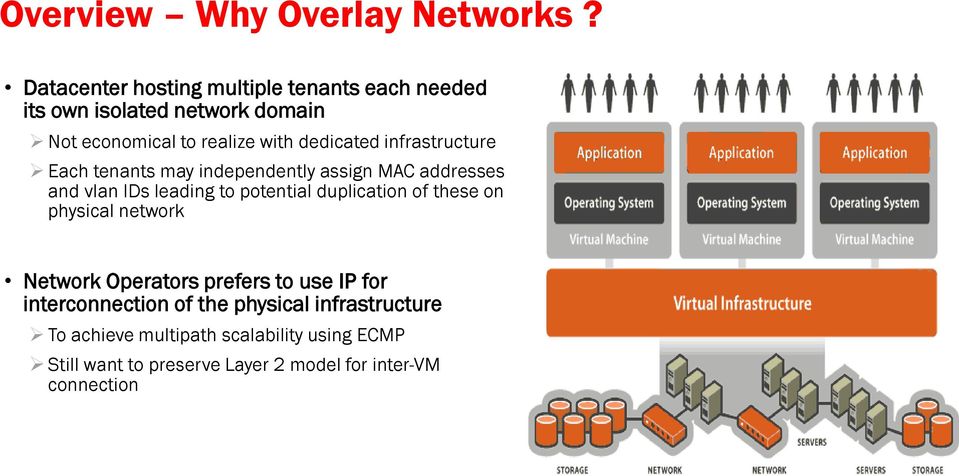
5 Overview Why Overlay Networks? Datacenter hosting multiple tenants each needed its own isolated network domain Not economical to realize with dedicated infrastructure Each tenants may independently assign MAC addresses and vlan IDs leading to potential duplication of these on physical network Network Operators prefers to use IP for interconnection of the physical infrastructure To achieve multipath scalability using ECMP Still want to preserve Layer 2 model for inter-vm connection
6 Agenda Overview Existing Challenges Proposed Solutions IETF VxLAN IETF OTV Concepts & Deployment Case Studies Concepts & Deployment Case Studies IETF MAC VPN Concepts & Deployment Case Studies
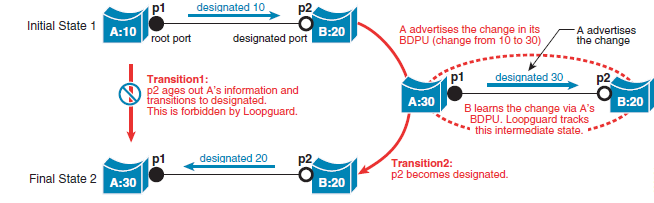
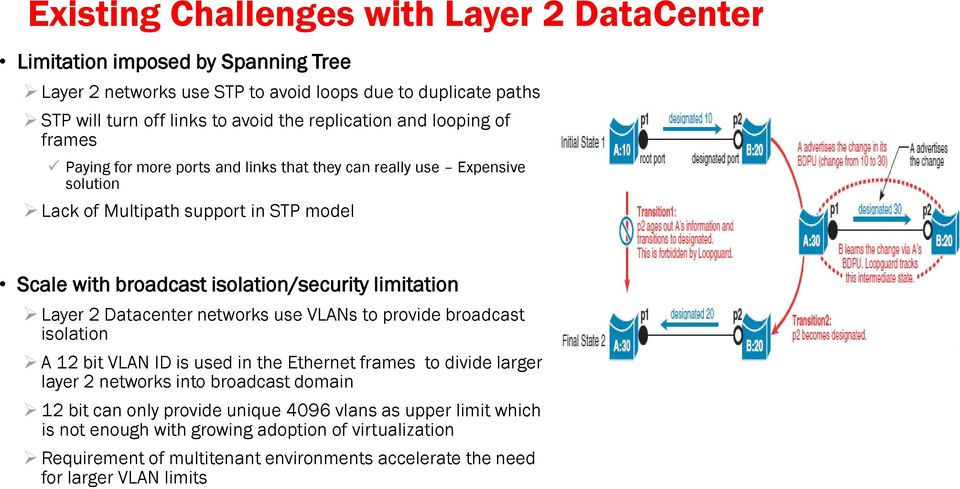
7 Existing Challenges with Layer 2 DataCenter Limitation imposed by Spanning Tree Layer 2 networks use STP to avoid loops due to duplicate paths STP will turn off links to avoid the replication and looping of frames Paying for more ports and links that they can really use Expensive solution Lack of Multipath support in STP model Scale with broadcast isolation/security limitation Layer 2 Datacenter networks use VLANs to provide broadcast isolation A 12 bit VLAN ID is used in the Ethernet frames to divide larger layer 2 networks into broadcast domain 12 bit can only provide unique 4096 vlans as upper limit which is not enough with growing adoption of virtualization Requirement of multitenant environments accelerate the need for larger VLAN limits
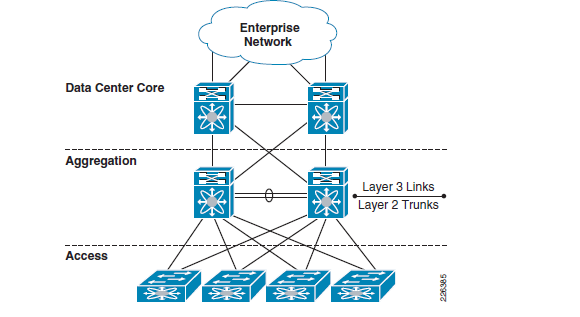
8 Existing Challenges with Layer 2 DataCenter Cross POD expansion Stretched layer 2 environment POD consist of one or more rack of servers with associated network and storage connectivity Tenants may start off on a POD and due to expansion, requires servers/vm on other PODs (due to resource availability) Requires Stretched Layer 2 networks to connect Servers / VMs Multi Tenancy with Layer 3 networks Layer 3 networks are not a complete solution for a multi tenancy There can be IP addressing overlaps between two tenants requires Cloud Provider to isolation of some sort Using IP connectivity excludes customers relying on direct layer 2 or non-ip layer 3 protocols for inter-vm communication.

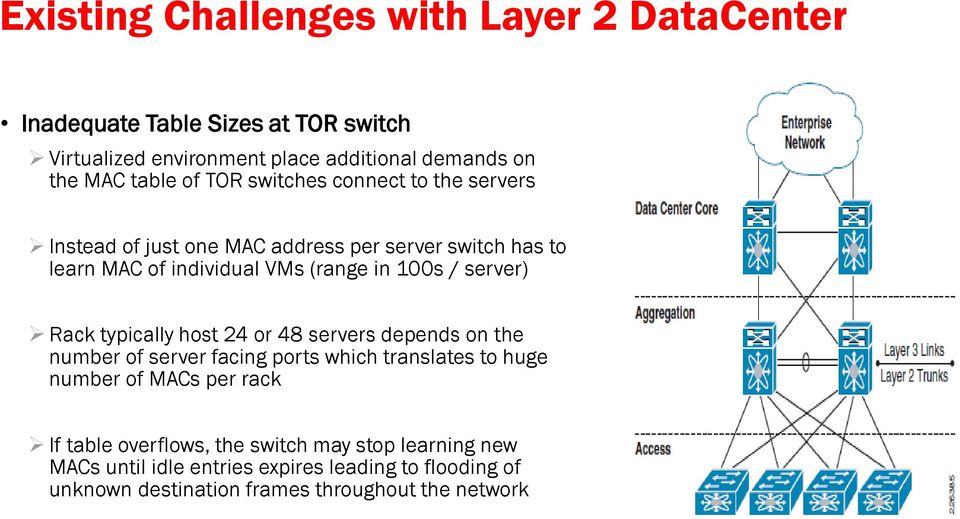
9 Existing Challenges with Layer 2 DataCenter Inadequate Table Sizes at TOR switch Virtualized environment place additional demands on the MAC table of TOR switches connect to the servers Instead of just one MAC address per server switch has to learn MAC of individual VMs (range in 100s / server) Rack typically host 24 or 48 servers depends on the number of server facing ports which translates to huge number of MACs per rack If table overflows, the switch may stop learning new MACs until idle entries expires leading to flooding of unknown destination frames throughout the network
10 Agenda Overview Existing Challenges Proposed Solutions IETF VxLAN Concepts & Deployment Case Studies IETF OTV Concepts & Deployment Case Studies IETF MAC VPN Concepts & Deployment Case Studies
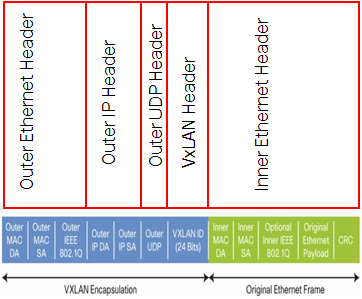
11 VxLAN Virtual Extensible LAN Concept The VXLAN standard enables overlay networks, focuses on eliminating the constraints of STP, CAPEX Capacity expansion across racks or server expansion and Inter Host workload mobility by enabling virtualized workloads to seamlessly communicate or move across server clusters and data. VTEP VXLAN is simply a MAC-in-UDP encapsulation (encapsulation of an Ethernet L2 Frame in IP) scheme enabling the creation of virtualized L2 subnets that can span physical L3 IP networks L2 overlay scheme over L3 transport network VXLAN is a tunneling scheme (Hypervisor to Hypervisor). The VTEPs encapsulate the virtual machine traffic in a VXLAN header as well as strip it off and present the destination virtual machine with the original L2 packet. 2/27/

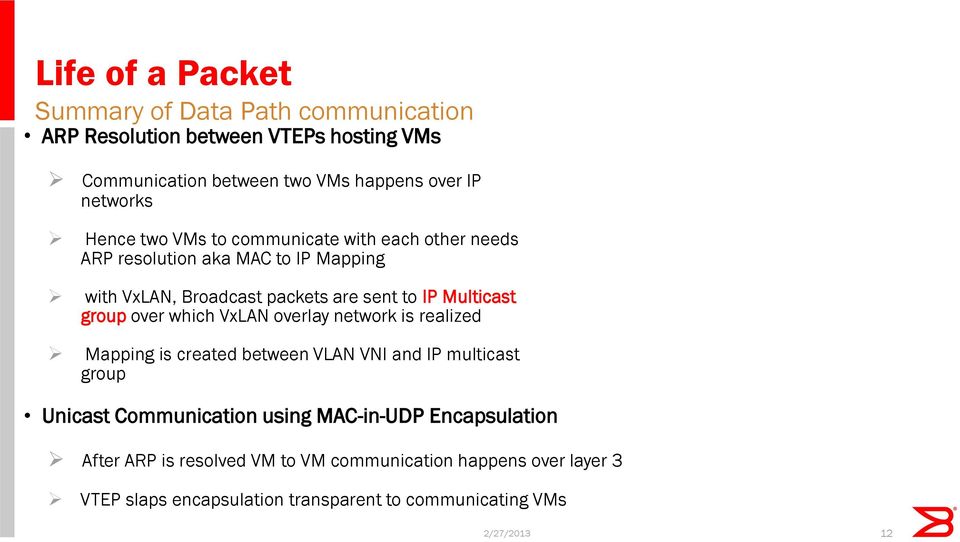
12 Life of a Packet Summary of Data Path communication ARP Resolution between VTEPs hosting VMs Communication between two VMs happens over IP networks Hence two VMs to communicate with each other needs ARP resolution aka MAC to IP Mapping with VxLAN, Broadcast packets are sent to IP Multicast group over which VxLAN overlay network is realized Mapping is created between VLAN VNI and IP multicast group Unicast Communication using MAC-in-UDP Encapsulation After ARP is resolved VM to VM communication happens over layer 3 VTEP slaps encapsulation transparent to communicating VMs 2/27/
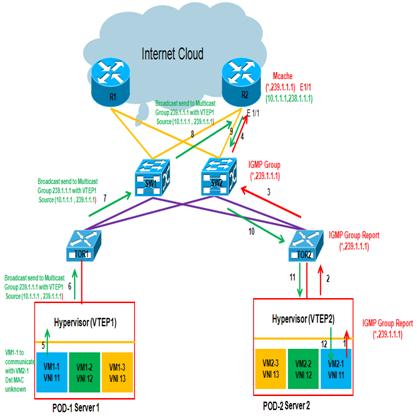
13 Life of a Packet Broadcast resolution using Multicast Packet from VM1-1 to VM2-1 Step 1 Multicast group mapping to VNI SW creates VNI and IP multicast group mapping Step 2 IGMP Group membership report VTEP sends IGMP group membership report to upstream switch / router to join/leave the VxLAN related multicast group as needed Step 3 VTEP initiates ARP request when VM needs to communicate Since Multicast tree is build up using step 2 Arp packets destined to multicast group is forwarded to the interested listeners Step 4 Receiving VTEP will process packet Receiving VTEP will learn sending VTEP MAC from received Packet and will send unicast ARP response 2/27/

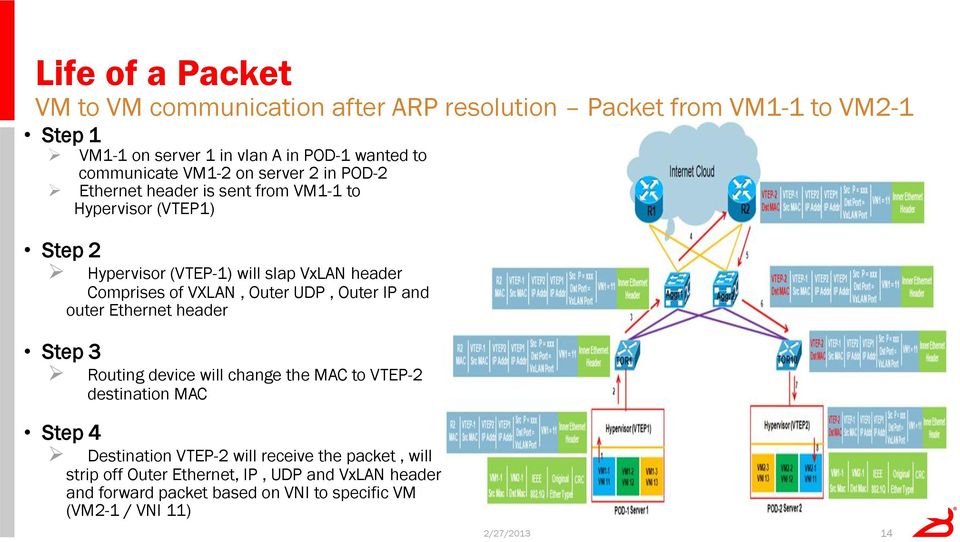
14 Life of a Packet VM to VM communication after ARP resolution Packet from VM1-1 to VM2-1 Step 1 VM1-1 on server 1 in vlan A in POD-1 wanted to communicate VM1-2 on server 2 in POD-2 Ethernet header is sent from VM1-1 to Hypervisor (VTEP1) Step 2 Hypervisor (VTEP-1) will slap VxLAN header Comprises of VXLAN, Outer UDP, Outer IP and outer Ethernet header Step 3 Routing device will change the MAC to VTEP-2 destination MAC Step 4 Destination VTEP-2 will receive the packet, will strip off Outer Ethernet, IP, UDP and VxLAN header and forward packet based on VNI to specific VM (VM2-1 / VNI 11) 2/27/
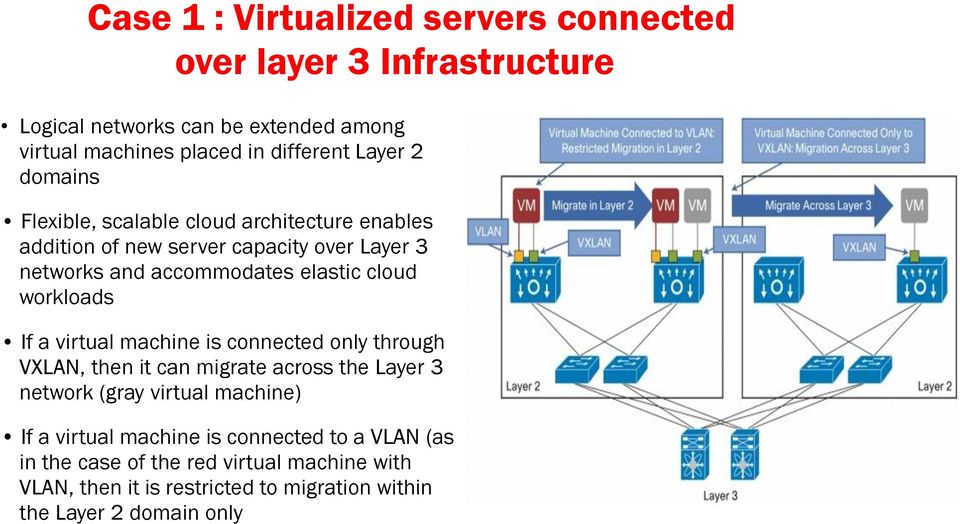
15 Case 1 : Virtualized servers connected over layer 3 Infrastructure Logical networks can be extended among virtual machines placed in different Layer 2 domains Flexible, scalable cloud architecture enables addition of new server capacity over Layer 3 networks and accommodates elastic cloud workloads If a virtual machine is connected only through VXLAN, then it can migrate across the Layer 3 network (gray virtual machine) If a virtual machine is connected to a VLAN (as in the case of the red virtual machine with VLAN, then it is restricted to migration within the Layer 2 domain only
16 Case 2: VXLAN aware Virtualized servers communicates with legacy servers Figure depicts a scenario where VXLAN overlay network need to communicate with nodes on legacy networks which could be VLAN based To enable this communication, a Network can include gateways which forwards traffic between VXLAN and non-vxlan environments Physical Firewall The gateway devices could be TOR switches Access switches Core devices WAN edge devices VM VXLAN Gateway For incoming frames on VXLAN connected interface The gateway strips out VXLAN header and forwards to a physical port based on destination MAC address on inner ETH Header VXLAN5500 VLAN 500 For incoming frames on non VxVLAN connected interface The incoming frames from non-vxlan interfaces are mapped to a specific VXLAN overlay network based on the VLAN ID in the frame

17 Agenda Overview Existing Challenges Proposed Solutions IETF VxLAN Concepts & Deployment Case Studies IETF OTV Concepts & Deployment Case Studies IETF MAC VPN Concepts & Deployment Case Studies
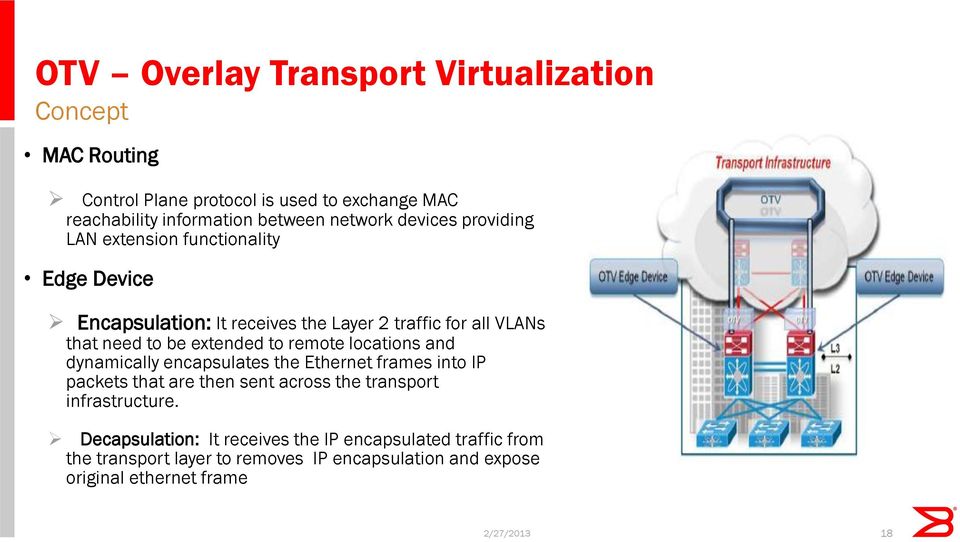
18 OTV Overlay Transport Virtualization Concept MAC Routing Control Plane protocol is used to exchange MAC reachability information between network devices providing LAN extension functionality Edge Device Encapsulation: It receives the Layer 2 traffic for all VLANs that need to be extended to remote locations and dynamically encapsulates the Ethernet frames into IP packets that are then sent across the transport infrastructure. Decapsulation: It receives the IP encapsulated traffic from the transport layer to removes IP encapsulation and expose original ethernet frame 2/27/
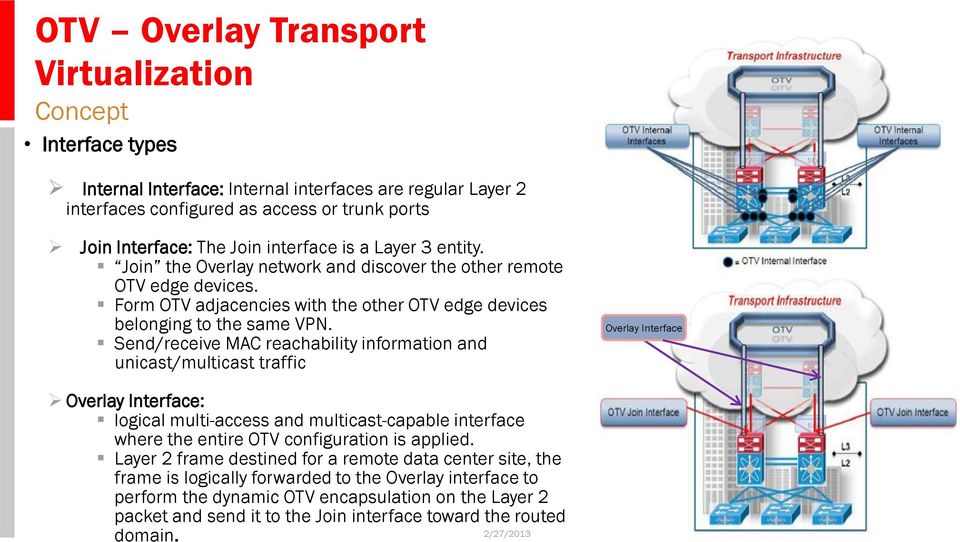
19 OTV Overlay Transport Virtualization Concept Interface types Internal Interface: Internal interfaces are regular Layer 2 interfaces configured as access or trunk ports Join Interface: The Join interface is a Layer 3 entity. Join the Overlay network and discover the other remote OTV edge devices. Form OTV adjacencies with the other OTV edge devices belonging to the same VPN. Send/receive MAC reachability information and unicast/multicast traffic Overlay Interface Overlay Interface: logical multi-access and multicast-capable interface where the entire OTV configuration is applied. Layer 2 frame destined for a remote data center site, the frame is logically forwarded to the Overlay interface to perform the dynamic OTV encapsulation on the Layer 2 packet and send it to the Join interface toward the routed domain. 2/27/
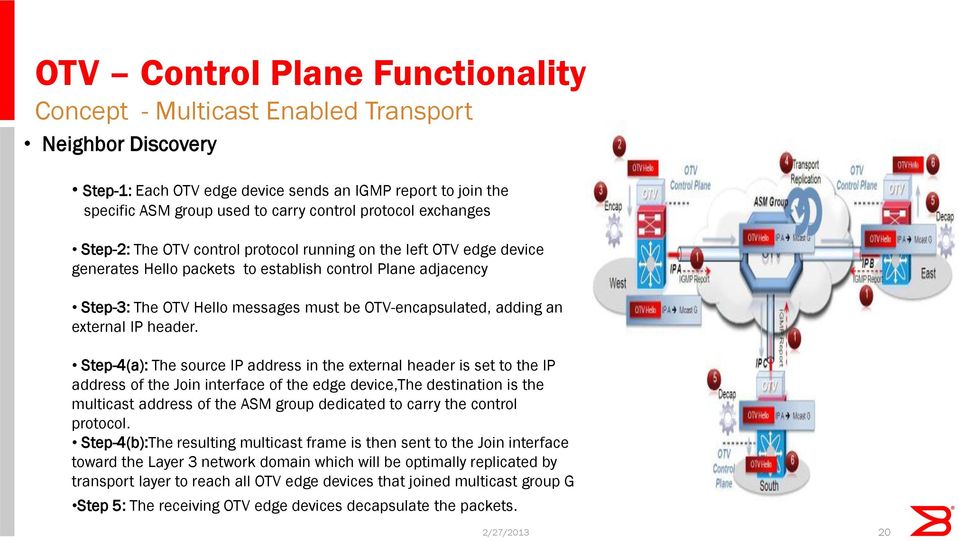
20 OTV Control Plane Functionality Concept - Multicast Enabled Transport Neighbor Discovery Step-1: Each OTV edge device sends an IGMP report to join the specific ASM group used to carry control protocol exchanges Step-2: The OTV control protocol running on the left OTV edge device generates Hello packets to establish control Plane adjacency Step-3: The OTV Hello messages must be OTV-encapsulated, adding an external IP header. Step-4(a): The source IP address in the external header is set to the IP address of the Join interface of the edge device,the destination is the multicast address of the ASM group dedicated to carry the control protocol. Step-4(b):The resulting multicast frame is then sent to the Join interface toward the Layer 3 network domain which will be optimally replicated by transport layer to reach all OTV edge devices that joined multicast group G Step 5: The receiving OTV edge devices decapsulate the packets. 2/27/
21 OTV Control Plane Functionality Concept - Multicast Enabled Transport MAC Learning Step-1: The OTV edge device in the West data center site learns new MAC addresses (MAC A, B and C on VLAN 100) on its internal interface. This is done via traditional data plan learning. Step-2: An OTV Update message is created containing information for MAC A, MAC B and MAC C. The message is OTV encapsulated with the IP destination address of the packet in the outer header is the multicast group G used for control protocol exchanges. Step-3: The OTV Update is optimally replicated in the transport and delivered to all remote edge devices which decapsulate it and hand it to the OTV control process. Step-4: The MAC reachability information is imported in the MAC Address Tables (CAMs) of the edge devices. Step-5: The only difference with a traditional CAM entry is that instead of having associated a physical interface, these entries refer the IP address of the Join interface of the originating 2/27/
22 OTV Control Plane Functionality Concept - Unicast-only Transport Neighbor Discovery Step-1: The OTV control protocol running on the left OTV edge device generates Hello packets that need to be sent to all other OTV edge devices. This is required to communicate its existence and to trigger the establishment of control plane adjacencies Step-2 (a): The left OTV device must perform head-end replication, creating one copy of the Hello message for each remote OTV device part of the unicast-replication-list previously received from the Adjacency Server. Step-2(b): Each of these frames must then be OTV-encapsulated, adding an external IP header. The source IP address in the external header is set to the IP address of the Join interface of the local edge device The destination is the Join interface address of a remote OTV edge device. The resulting unicast frames are then sent out the Join interface toward the Layer 3 network domain 2/27/
23 OTV Control Plane Functionality Concept - Unicast-only Transport Neighbor Discovery Step-3: The unicast frames are routed across the unicast-only transport infrastructure and delivered to their specific destination sites. Step-4: The receiving OTV edge devices decapsulate the packets Step 5: The Hellos are passed to the control protocol process 2/27/
24 OTV Control Plane Functionality Concept - Unicast-only Transport MAC Learning Step-1: The OTV edge device in the West data center site learns new MAC addresses (MAC A, B and C on VLAN 100, 101 and 102) on its internal interface. This is done via traditional data plan learning. Step-2: An OTV Update message containing information for MAC A, MAC B and MAC C is created for each remote OTV edge device (headend replication). The IP destination address of the packet in the outer header is the Join interface address of each specific remote OTV device.. Step-3: The OTV Updates are routed in the unicast-only transport and delivered to all remote edge devices which decapsulate them and hand them to the OTV control process. Step-4: The MAC reachability information is imported in the MAC Address Tables (CAMs) of the edge devices. The only difference with a traditional CAM entry is that instead of having associated a physical interface, these entries refer the IP address (IP A) of the Join interface of the originating edge device. 2/27/
25 OTV Data Plane Functionality Concept - Intra Site Traffic Forwarding Intra-site forwarding Step-1: MAC 1 (Server 1) needs to communicate with MAC 2 (Server 2), both belonging to the same VLAN. Step-2: When the frame is received at the aggregation layer device (which in this case is also deployed as the OTV edge device), the usual Layer 2 lookup is performed to determine how to reach the MAC 2 destination. Step-3: Information in the MAC table points out a local interface (Eth 1), so the frame is delivered by performing classical Ethernet local switching 2/27/
26 OTV Data Plane Functionality Concept - Inter-Site Traffic Forwarding Inter-site forwarding Step-1: The Layer 2 frame is received at the OTV edge device. A traditional Layer 2 lookup is performed, but this time the MAC 3 information in the MAC table does not point to a local Ethernet interface but to the IP address of the remote OTV edge device that advertised the MAC reachability information. Step-2: The OTV edge device encapsulates the original Layer 2 frame: the source IP of the outer header is the IP address of its Join interface, whereas the destination IP is the IP address of the Join interface of the remote edge device Step-3: The OTV encapsulated frame (a regular unicast IP packet) is carried across the transport infrastructure and delivered to the remote OTV edge device. Step-4: The remote OTV edge device decapsulates the frame exposing the original Layer 2 packet 2/27/
27 OTV Data Plane Functionality Concept - Inter-Site Traffic Forwarding Inter-site forwarding Step-5: The edge device performs another Layer 2 lookup on the original Ethernet frame and discovers that it is reachable through a physical interface, which means it is a MAC address local to the site. Step-6: The frame is delivered to the MAC 3 destination. 2/27/
28 OTV Deployment Case Study Case-1: Aggregation Layer Each aggregation block represents a separate STP domain. Routed links interconnecting each aggregation layer to the core and having native OTV STP isolation functionality. inter and Intra Aggregation layer traffic will be forwarded via core routers Aggregation layer instability will be collocated within itself. Case-2: Core Layer (Large Data Center) DC Core devices will perform Layer 3 and OTV function Each aggregation layer will be connected to transport layer via layer 3 link which brings resiliency and stability to the overall design For core devices to start functioning as OTV edge devices, traffic for all the VLANs that need to be extended to remote sites must now be carried to the DC core 2/27/
29 Agenda Overview Existing Challenges Proposed Solutions IETF VxLAN Concepts & Deployment Case Studies IETF OTV Concepts & Deployment Case Studies IETF MAC VPN Concepts & Deployment Case Studies
30 Building blocks IETF MAC VPN Technology Overview Customer Edge routers (CEs) Can be a host, a router or a switch MPLS Edge Switches (MEs) Provides layer 2 virtual bridge connectivity between CEs Partitioned MAC table over VRF boundaries MVI Security for multi-tenant application /overlapping MACs can be used Distributes MAC table across PE routers via MP-iBGP Provides MPLS transport Encapsulates L2 Packets into MPLS header Virtual Routing and Forwarding Instance Route Distinguishers are used to uniquely identify overlap MAC addresses Way to virtually partition MAC table Import and Export Filters are the key to install routes into VRF partition 2/27/
31 Building blocks IETF MAC VPN Technology Overview Multi-Protocol BGP Extensions are added to distributes MAC addresses across MEs using ibgp sessions Export Filters carries over in the update must match target VRF import map to be qualified to install the route 2/27/
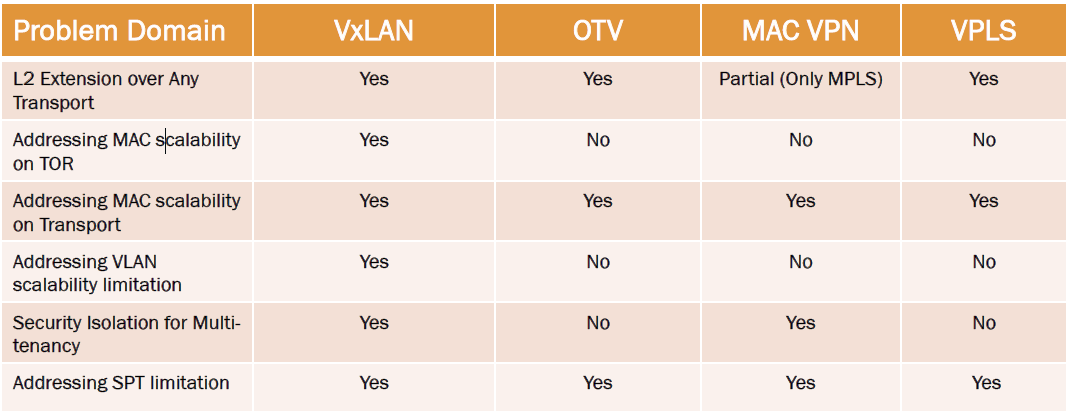
32 Technology Comparison vs Problem Domain Comparative Analysis of Technologies 2/27/
33 Q&A
Extending Networking to Fit the Cloud
 VXLAN Extending Networking to Fit the Cloud Kamau WangŨ H Ũ Kamau Wangũhgũ is a Consulting Architect at VMware and a member of the Global Technical Service, Center of Excellence group. Kamau s focus at
VXLAN: Scaling Data Center Capacity. White Paper
 VXLAN: Scaling Data Center Capacity White Paper Virtual Extensible LAN (VXLAN) Overview This document provides an overview of how VXLAN works. It also provides criteria to help determine when and where
CLOUD NETWORKING FOR ENTERPRISE CAMPUS APPLICATION NOTE
 CLOUD NETWORKING FOR ENTERPRISE CAMPUS APPLICATION NOTE EXECUTIVE SUMMARY This application note proposes Virtual Extensible LAN (VXLAN) as a solution technology to deliver departmental segmentation, business
VXLAN Overlay Networks: Enabling Network Scalability for a Cloud Infrastructure
 W h i t e p a p e r VXLAN Overlay Networks: Enabling Network Scalability for a Cloud Infrastructure Table of Contents Executive Summary.... 3 Cloud Computing Growth.... 3 Cloud Computing Infrastructure
WHITE PAPER. Network Virtualization: A Data Plane Perspective
 WHITE PAPER Network Virtualization: A Data Plane Perspective David Melman Uri Safrai Switching Architecture Marvell May 2015 Abstract Virtualization is the leading technology to provide agile and scalable
Analysis of Network Segmentation Techniques in Cloud Data Centers
 64 Int'l Conf. Grid & Cloud Computing and Applications GCA'15 Analysis of Network Segmentation Techniques in Cloud Data Centers Ramaswamy Chandramouli Computer Security Division, Information Technology
TRILL Large Layer 2 Network Solution
 TRILL Large Layer 2 Network Solution Contents 1 Network Architecture Requirements of Data Centers in the Cloud Computing Era... 3 2 TRILL Characteristics... 5 3 Huawei TRILL-based Large Layer 2 Network
Data Center Network Virtualisation Standards. Matthew Bocci, Director of Technology & Standards, IP Division IETF NVO3 Co-chair
 Data Center Network Virtualisation Standards Matthew Bocci, Director of Technology & Standards, IP Division IETF NVO3 Co-chair May 2013 AGENDA 1. Why standardise? 2. Problem Statement and Architecture
VXLAN Bridging & Routing
 VXLAN Bridging & Routing Darrin Machay [email protected] CHI-NOG 05 May 2015 1 VXLAN VM-1 10.10.10.1/24 Subnet A ESX host Subnet B ESX host VM-2 VM-3 VM-4 20.20.20.1/24 10.10.10.2/24 20.20.20.2/24 Load
Multitenancy Options in Brocade VCS Fabrics
 WHITE PAPER DATA CENTER Multitenancy Options in Brocade VCS Fabrics As cloud environments reach mainstream adoption, achieving scalable network segmentation takes on new urgency to support multitenancy.
TRILL for Data Center Networks
 24.05.13 TRILL for Data Center Networks www.huawei.com enterprise.huawei.com Davis Wu Deputy Director of Switzerland Enterprise Group E-mail: [email protected] Tel: 0041-798658759 Agenda 1 TRILL Overview
Virtual Private LAN Service on Cisco Catalyst 6500/6800 Supervisor Engine 2T
 White Paper Virtual Private LAN Service on Cisco Catalyst 6500/6800 Supervisor Engine 2T Introduction to Virtual Private LAN Service The Cisco Catalyst 6500/6800 Series Supervisor Engine 2T supports virtual
Expert Reference Series of White Papers. vcloud Director 5.1 Networking Concepts
 Expert Reference Series of White Papers vcloud Director 5.1 Networking Concepts 1-800-COURSES www.globalknowledge.com vcloud Director 5.1 Networking Concepts Rebecca Fitzhugh, VMware Certified Instructor
Using Network Virtualization to Scale Data Centers
 Using Network Virtualization to Scale Data Centers Synopsys Santa Clara, CA USA November 2014 1 About Synopsys FY 2014 (Target) $2.055-2.065B* 9,225 Employees ~4,911 Masters / PhD Degrees ~2,248 Patents
Scalable Approaches for Multitenant Cloud Data Centers
 WHITE PAPER www.brocade.com DATA CENTER Scalable Approaches for Multitenant Cloud Data Centers Brocade VCS Fabric technology is the ideal Ethernet infrastructure for cloud computing. It is manageable,
VMware Network Virtualization Design Guide. January 2013
 ware Network Virtualization Technical WHITE PAPER January 2013 ware Network Virtualization Table of Contents Intended Audience.... 3 Overview.... 3 Components of the ware Network Virtualization Solution....
Lecture 02b Cloud Computing II
 Mobile Cloud Computing Lecture 02b Cloud Computing II 吳 秀 陽 Shiow-yang Wu T. Sridhar. Cloud Computing A Primer, Part 2: Infrastructure and Implementation Topics. The Internet Protocol Journal, Volume 12,
How To Make A Vpc More Secure With A Cloud Network Overlay (Network) On A Vlan) On An Openstack Vlan On A Server On A Network On A 2D (Vlan) (Vpn) On Your Vlan
 Centec s SDN Switch Built from the Ground Up to Deliver an Optimal Virtual Private Cloud Table of Contents Virtualization Fueling New Possibilities Virtual Private Cloud Offerings... 2 Current Approaches
Network Virtualization for Large-Scale Data Centers
 Network Virtualization for Large-Scale Data Centers Tatsuhiro Ando Osamu Shimokuni Katsuhito Asano The growing use of cloud technology by large enterprises to support their business continuity planning
Avaya VENA Fabric Connect
 Avaya VENA Fabric Connect Executive Summary The Avaya VENA Fabric Connect solution is based on the IEEE 802.1aq Shortest Path Bridging (SPB) protocol in conjunction with Avaya extensions that add Layer
A Case for Overlays in DCN Virtualization Katherine Barabash, Rami Cohen, David Hadas, Vinit Jain, Renato Recio and Benny Rochwerger IBM
 Presenter: Vinit Jain, STSM, System Networking Development, IBM System & Technology Group A Case for Overlays in DCN Virtualization Katherine Barabash, Rami Cohen, David Hadas, Vinit Jain, Renato Recio
TRILL for Service Provider Data Center and IXP. Francois Tallet, Cisco Systems
 for Service Provider Data Center and IXP Francois Tallet, Cisco Systems 1 : Transparent Interconnection of Lots of Links overview How works designs Conclusion 2 IETF standard for Layer 2 multipathing Driven
Transform Your Business and Protect Your Cisco Nexus Investment While Adopting Cisco Application Centric Infrastructure
 White Paper Transform Your Business and Protect Your Cisco Nexus Investment While Adopting Cisco Application Centric Infrastructure What You Will Learn The new Cisco Application Centric Infrastructure
Data Center Infrastructure of the future. Alexei Agueev, Systems Engineer
 Data Center Infrastructure of the future Alexei Agueev, Systems Engineer Traditional DC Architecture Limitations Legacy 3 Tier DC Model Layer 2 Layer 2 Domain Layer 2 Layer 2 Domain Oversubscription Ports
VMDC 3.0 Design Overview
 CHAPTER 2 The Virtual Multiservice Data Center architecture is based on foundation principles of design in modularity, high availability, differentiated service support, secure multi-tenancy, and automated
SDN CONTROLLER. Emil Gągała. PLNOG, 30.09.2013, Kraków
 SDN CONTROLLER IN VIRTUAL DATA CENTER Emil Gągała PLNOG, 30.09.2013, Kraków INSTEAD OF AGENDA 2 Copyright 2013 Juniper Networks, Inc. www.juniper.net ACKLOWLEDGEMENTS Many thanks to Bruno Rijsman for his
DCB for Network Virtualization Overlays. Rakesh Sharma, IBM Austin IEEE 802 Plenary, Nov 2013, Dallas, TX
 DCB for Network Virtualization Overlays Rakesh Sharma, IBM Austin IEEE 802 Plenary, Nov 2013, Dallas, TX What is SDN? Stanford-Defined Networking Software-Defined Networking Sexy-Defined Networking Networking
ConnectX -3 Pro: Solving the NVGRE Performance Challenge
 WHITE PAPER October 2013 ConnectX -3 Pro: Solving the NVGRE Performance Challenge Objective...1 Background: The Need for Virtualized Overlay Networks...1 NVGRE Technology...2 NVGRE s Hidden Challenge...3
NVGRE Overlay Networks: Enabling Network Scalability for a Cloud Infrastructure
 W h i t e p a p e r NVGRE Overlay Networks: Enabling Network Scalability for a Cloud Infrastructure Table of contents Executive Summary.... 3 Cloud Computing Growth.... 3 Cloud Computing Infrastructure
Roman Hochuli - nexellent ag / Mathias Seiler - MiroNet AG
 Roman Hochuli - nexellent ag / Mathias Seiler - MiroNet AG North Core Distribution Access South North Peering #1 Upstream #1 Series of Tubes Upstream #2 Core Distribution Access Cust South Internet West
Ethernet-based Software Defined Network (SDN) Cloud Computing Research Center for Mobile Applications (CCMA), ITRI 雲 端 運 算 行 動 應 用 研 究 中 心
 Ethernet-based Software Defined Network (SDN) Cloud Computing Research Center for Mobile Applications (CCMA), ITRI 雲 端 運 算 行 動 應 用 研 究 中 心 1 SDN Introduction Decoupling of control plane from data plane
Network Technologies for Next-generation Data Centers
 Network Technologies for Next-generation Data Centers SDN-VE: Software Defined Networking for Virtual Environment Rami Cohen, IBM Haifa Research Lab September 2013 Data Center Network Defining and deploying
Cloud Networking: Framework and VPN Applicability. draft-bitar-datacenter-vpn-applicability-01.txt
 Cloud Networking: Framework and Applicability Nabil Bitar (Verizon) Florin Balus, Marc Lasserre, and Wim Henderickx (Alcatel-Lucent) Ali Sajassi and Luyuan Fang (Cisco) Yuichi Ikejiri (NTT Communications)
VMware and Brocade Network Virtualization Reference Whitepaper
 VMware and Brocade Network Virtualization Reference Whitepaper Table of Contents EXECUTIVE SUMMARY VMWARE NSX WITH BROCADE VCS: SEAMLESS TRANSITION TO SDDC VMWARE'S NSX NETWORK VIRTUALIZATION PLATFORM
Data Center Use Cases and Trends
 Data Center Use Cases and Trends Amod Dani Managing Director, India Engineering & Operations http://www.arista.com Open 2014 Open Networking Networking Foundation India Symposium, January 31 February 1,
Data Center Virtualization and Cloud QA Expertise
 Data Center Virtualization and Cloud QA Expertise Highlights Broad Functional QA Experience Deep understanding of Switching and Routing Protocols Strong hands on experience in multiple hyper-visors like
Enabling Solutions in Cloud Infrastructure and for Network Functions Virtualization
 Enabling Solutions in Cloud Infrastructure and for Network Functions Virtualization Gateway Use Cases for Virtual Networks with MX Series Routers 1 Table of Contents Executive Summary... 3 Introduction...4
Virtualization, SDN and NFV
 Virtualization, SDN and NFV HOW DO THEY FIT TOGETHER? Traditional networks lack the flexibility to keep pace with dynamic computing and storage needs of today s data centers. In order to implement changes,
Virtual PortChannels: Building Networks without Spanning Tree Protocol
 . White Paper Virtual PortChannels: Building Networks without Spanning Tree Protocol What You Will Learn This document provides an in-depth look at Cisco's virtual PortChannel (vpc) technology, as developed
SOFTWARE DEFINED NETWORKING: INDUSTRY INVOLVEMENT
 BROCADE SOFTWARE DEFINED NETWORKING: INDUSTRY INVOLVEMENT Rajesh Dhople Brocade Communications Systems, Inc. [email protected] 2012 Brocade Communications Systems, Inc. 1 Why can t you do these things
Increase Simplicity and Improve Reliability with VPLS on the MX Series Routers
 SOLUTION BRIEF Enterprise Data Center Interconnectivity Increase Simplicity and Improve Reliability with VPLS on the Routers Challenge As enterprises improve business continuity by enabling resource allocation
Cloud Networking Disruption with Software Defined Network Virtualization. Ali Khayam
 Cloud Networking Disruption with Software Defined Network Virtualization Ali Khayam In the next one hour Let s discuss two disruptive new paradigms in the world of networking: Network Virtualization Software
What is VLAN Routing?
 Application Note #38 February 2004 What is VLAN Routing? This Application Notes relates to the following Dell product(s): 6024 and 6024F 33xx Abstract Virtual LANs (VLANs) offer a method of dividing one
Stretched Active- Active Application Centric Infrastructure (ACI) Fabric
 Stretched Active- Active Application Centric Infrastructure (ACI) Fabric May 12, 2015 Abstract This white paper illustrates how the Cisco Application Centric Infrastructure (ACI) can be implemented as
Network Virtualization and Data Center Networks 263-3825-00 Data Center Virtualization - Basics. Qin Yin Fall Semester 2013
 Network Virtualization and Data Center Networks 263-3825-00 Data Center Virtualization - Basics Qin Yin Fall Semester 2013 1 Walmart s Data Center 2 Amadeus Data Center 3 Google s Data Center 4 Data Center
ETHERNET VPN (EVPN) OVERLAY NETWORKS FOR ETHERNET SERVICES
 ETHERNET VPN (EVPN) OVERLAY NETWORKS FOR ETHERNET SERVICES Greg Hankins RIPE 68 RIPE 68 2014/05/12 AGENDA 1. EVPN Background and Motivation 2. EVPN Operations 3. EVPN
Datacenter Network Virtualization in Multi-Tenant Environments
 Chair for Network Architectures and Services Technische Universität München Datacenter Network Virtualization in Multi-Tenant Environments 8. DFN-Forum Kommunikationstechnologien Viktor Goldberg, Leibniz-Rechenzentrum,
MPLS-based Virtual Private Network (MPLS VPN) The VPN usually belongs to one company and has several sites interconnected across the common service
 Nowdays, most network engineers/specialists consider MPLS (MultiProtocol Label Switching) one of the most promising transport technologies. Then, what is MPLS? Multi Protocol Label Switching (MPLS) is
CLOUD NETWORKING THE NEXT CHAPTER FLORIN BALUS
 CLOUD NETWORKING THE NEXT CHAPTER FLORIN BALUS COMMON APPLICATION VIEW OF THE NETWORK Fallacies of Distributed Computing 1. The network is reliable. 2. Latency is zero. 3. Bandwidth is infinite. 4. The
Secure Cloud Computing with a Virtualized Network Infrastructure
 Secure Cloud Computing with a Virtualized Network Infrastructure Fang Hao, T.V. Lakshman, Sarit Mukherjee, Haoyu Song Bell Labs Cloud Security: All or Nothing? Amazon EC2 Government Cloud Shared computing,
Advanced Computer Networks. Datacenter Network Fabric
 Advanced Computer Networks 263 3501 00 Datacenter Network Fabric Patrick Stuedi Spring Semester 2014 Oriana Riva, Department of Computer Science ETH Zürich 1 Outline Last week Today Supercomputer networking
Software Defined Networking using VXLAN
 Thomas Richter IBM Research and Development, Linux Technology Center LinuxCon Edinburgh 21-Oct-2013 Software Defined Networking using VXLAN Thomas Richter 2009 IBM Corporation Agenda Vxlan IETF Draft VXLAN
Virtual Machine in Data Center Switches Huawei Virtual System
 Virtual Machine in Data Center Switches Huawei Virtual System Contents 1 Introduction... 3 2 VS: From the Aspect of Virtualization Technology... 3 3 VS: From the Aspect of Market Driving... 4 4 VS: From
VXLAN, Enhancements, and Network Integration
 VXLAN, Enhancements, and Network Integration Apricot 2014 - Malaysia Eddie Parra Principal Engineer, Juniper Networks Router Business Unit (RBU) [email protected] Legal Disclaimer: This statement of product
SOFTWARE-DEFINED NETWORKING AND OPENFLOW
 SOFTWARE-DEFINED NETWORKING AND OPENFLOW Freddie Örnebjär TREX Workshop 2012 2012 Brocade Communications Systems, Inc. 2012/09/14 Software-Defined Networking (SDN): Fundamental Control
Virtual Subnet: A Scalable Cloud Data Center Interconnect Solution
 Virtual Subnet: A Scalable Cloud Data Center Interconnect Solution draft-xu-virtual-subnet-06 Xiaohu Xu ([email protected]) IETF82, TAIWAN Why VM Mobility across Data Centers Data center maintenance Applications
Evolution of Software Defined Networking within Cisco s VMDC
 Evolution of Software Defined Networking within Cisco s VMDC Software-Defined Networking (SDN) has the capability to revolutionize the current data center architecture and its associated networking model.
MPLS VPN Services. PW, VPLS and BGP MPLS/IP VPNs
 A Silicon Valley Insider MPLS VPN Services PW, VPLS and BGP MPLS/IP VPNs Technology White Paper Serge-Paul Carrasco Abstract Organizations have been demanding virtual private networks (VPNs) instead of
ETHERNET VPN (EVPN) NEXT-GENERATION VPN FOR ETHERNET SERVICES
 ETHERNET VPN (EVPN) NEXT-GENERATION VPN FOR ETHERNET SERVICES Alastair JOHNSON (AJ) February 2014 [email protected] AGENDA 1. EVPN Background and Motivation 2. EVPN Operations 3. EVPN
NVO3: Network Virtualization Problem Statement. Thomas Narten [email protected]. IETF 83 Paris March, 2012
 NVO3: Network Virtualization Problem Statement Thomas Narten [email protected] IETF 83 Paris March, 2012 High-Level Motivation Imagine a data center Could be cloud provider, hosting center, enterprise
Cloud Computing and the Internet. Conferenza GARR 2010
 Cloud Computing and the Internet Conferenza GARR 2010 Cloud Computing The current buzzword ;-) Your computing is in the cloud! Provide computing as a utility Similar to Electricity, Water, Phone service,
CONNECTING PHYSICAL AND VIRTUAL WORLDS WITH VMWARE NSX AND JUNIPER PLATFORMS
 White Paper CONNECTING PHYSICAL AND VIRTUAL WORLDS WITH WARE NSX AND JUNIPER PLATFORMS A Joint Juniper Networks-ware White Paper Copyright 2014, Juniper Networks, Inc. 1 Connecting Physical and Virtual
Software Defined Network (SDN)
 Georg Ochs, Smart Cloud Orchestrator ([email protected]) Software Defined Network (SDN) University of Stuttgart Cloud Course Fall 2013 Agenda Introduction SDN Components Openstack and SDN Example Scenario
Optimizing Data Center Networks for Cloud Computing
 PRAMAK 1 Optimizing Data Center Networks for Cloud Computing Data Center networks have evolved over time as the nature of computing changed. They evolved to handle the computing models based on main-frames,
VPLS Technology White Paper HUAWEI TECHNOLOGIES CO., LTD. Issue 01. Date 2012-10-30
 Issue 01 Date 2012-10-30 HUAWEI TECHNOLOGIES CO., LTD. 2012. All rights reserved. No part of this document may be reproduced or transmitted in any form or by any means without prior written consent of
Testing Network Virtualization For Data Center and Cloud VERYX TECHNOLOGIES
 Testing Network Virtualization For Data Center and Cloud VERYX TECHNOLOGIES Table of Contents Introduction... 1 Network Virtualization Overview... 1 Network Virtualization Key Requirements to be validated...
VMware. NSX Network Virtualization Design Guide
 VMware NSX Network Virtualization Design Guide Table of Contents Intended Audience... 3 Overview... 3 Components of the VMware Network Virtualization Solution... 4 Data Plane... 4 Control Plane... 5 Management
Multi-site Datacenter Network Infrastructures
 Multi-site Datacenter Network Infrastructures Petr Grygárek rek 1 Why Multisite Datacenters? Resiliency against large-scale site failures (geodiversity) Disaster recovery Easier handling of planned outages
IP/MPLS-Based VPNs Layer-3 vs. Layer-2
 Table of Contents 1. Objective... 3 2. Target Audience... 3 3. Pre-Requisites... 3 4. Introduction...3 5. MPLS Layer-3 VPNs... 4 6. MPLS Layer-2 VPNs... 7 6.1. Point-to-Point Connectivity... 8 6.2. Multi-Point
Cisco Virtual Topology System: Data Center Automation for Next-Generation Cloud Architectures
 White Paper Cisco Virtual Topology System: Data Center Automation for Next-Generation Cloud Architectures 2015 Cisco and/or its affiliates. All rights reserved. This document is Cisco Public Information.
Cisco Certified Network Associate Exam. Operation of IP Data Networks. LAN Switching Technologies. IP addressing (IPv4 / IPv6)
 Cisco Certified Network Associate Exam Exam Number 200-120 CCNA Associated Certifications CCNA Routing and Switching Operation of IP Data Networks Operation of IP Data Networks Recognize the purpose and
Accelerating Network Virtualization Overlays with QLogic Intelligent Ethernet Adapters
 Enterprise Strategy Group Getting to the bigger truth. ESG Lab Review Accelerating Network Virtualization Overlays with QLogic Intelligent Ethernet Adapters Date: June 2016 Author: Jack Poller, Senior
How To Make A Network Secure
 1 2 3 4 -Lower yellow line is graduate student enrollment -Red line is undergradate enrollment -Green line is total enrollment -2008 numbers are projected to be near 20,000 (on-campus) not including distance
基 於 SDN 與 可 程 式 化 硬 體 架 構 之 雲 端 網 路 系 統 交 換 器
 基 於 SDN 與 可 程 式 化 硬 體 架 構 之 雲 端 網 路 系 統 交 換 器 楊 竹 星 教 授 國 立 成 功 大 學 電 機 工 程 學 系 Outline Introduction OpenFlow NetFPGA OpenFlow Switch on NetFPGA Development Cases Conclusion 2 Introduction With the proposal
White Paper. Juniper Networks. Enabling Businesses to Deploy Virtualized Data Center Environments. Copyright 2013, Juniper Networks, Inc.
 White Paper Juniper Networks Solutions for VMware NSX Enabling Businesses to Deploy Virtualized Data Center Environments Copyright 2013, Juniper Networks, Inc. 1 Table of Contents Executive Summary...3
Interconnecting Cisco Networking Devices Part 2
 Interconnecting Cisco Networking Devices Part 2 Course Number: ICND2 Length: 5 Day(s) Certification Exam This course will help you prepare for the following exam: 640 816: ICND2 Course Overview This course
Introduction to MPLS-based VPNs
 Introduction to MPLS-based VPNs Ferit Yegenoglu, Ph.D. ISOCORE [email protected] Outline Introduction BGP/MPLS VPNs Network Architecture Overview Main Features of BGP/MPLS VPNs Required Protocol Extensions
Network Virtualization Solutions
 Network Virtualization Solutions An Analysis of Solutions, Use Cases and Vendor and Product Profiles October 2013 The Independent Community and #1 Resource for SDN and NFV Tables of Contents Introduction
DREAMER and GN4-JRA2 on GTS
 GTS Tech+Futures Workshop (Copenhagen) GTS Tech+Futures Workshop (Copenhagen) DREAMER and GN4-JRA2 on GTS CNIT Research Unit of Rome University of Rome Tor Vergata Outline DREAMER (Distributed REsilient
Connecting Physical and Virtual Networks with VMware NSX and Juniper Platforms. Technical Whitepaper. Whitepaper/ 1
 Connecting Physical and Virtual Networks with VMware NSX and Juniper Platforms Technical Whitepaper Whitepaper/ 1 Revisions Date Description Authors 08/21/14 Version 1 First publication Reviewed jointly
What is SDN? And Why Should I Care? Jim Metzler Vice President Ashton Metzler & Associates
 What is SDN? And Why Should I Care? Jim Metzler Vice President Ashton Metzler & Associates 1 Goals of the Presentation 1. Define/describe SDN 2. Identify the drivers and inhibitors of SDN 3. Identify what
CORD Fabric, Overlay Virtualization, and Service Composition
 CORD Design Notes CORD Fabric, Overlay Virtualization, and Service Composition Saurav Das Open Networking Foundation Ali Al Shabibi, Jonathan Hart, Charles Chan and Flavio Castro Open Networking Lab Hyunsun
EVOLVING ENTERPRISE NETWORKS WITH SPB-M APPLICATION NOTE
 EVOLVING ENTERPRISE NETWORKS WITH SPB-M APPLICATION NOTE EXECUTIVE SUMMARY Enterprise network managers are being forced to do more with less. Their networks are growing in size and complexity. They need
PRASAD ATHUKURI Sreekavitha engineering info technology,kammam
 Multiprotocol Label Switching Layer 3 Virtual Private Networks with Open ShortestPath First protocol PRASAD ATHUKURI Sreekavitha engineering info technology,kammam Abstract This paper aims at implementing
20. Switched Local Area Networks
 20. Switched Local Area Networks n Addressing in LANs (ARP) n Spanning tree algorithm n Forwarding in switched Ethernet LANs n Virtual LANs n Layer 3 switching n Datacenter networks John DeHart Based on
Broadcom Smart-NV Technology for Cloud-Scale Network Virtualization. Sujal Das Product Marketing Director Network Switching
 Broadcom Smart-NV Technology for Cloud-Scale Network Virtualization Sujal Das Product Marketing Director Network Switching April 2012 Introduction Private and public cloud applications, usage models, and
Simplify IT. With Cisco Application Centric Infrastructure. Barry Huang [email protected]. Nov 13, 2014
 Simplify IT With Cisco Application Centric Infrastructure Barry Huang [email protected] Nov 13, 2014 There are two approaches to Control Systems IMPERATIVE CONTROL DECLARATIVE CONTROL Baggage handlers follow
JUNIPER DATA CENTER EDGE CONNECTIVITY SOLUTIONS. Michael Pergament, Data Center Consultant EMEA (JNCIE 2 )
 JUNIPER DATA CENTER EDGE CONNECTIVITY SOLUTIONS Michael Pergament, Data Center Consultant EMEA (JNCIE 2 ) AGENDA Reasons to focus on Data Center Interconnect MX as Data Center Interconnect Connectivity
Simplify Your Data Center Network to Improve Performance and Decrease Costs
 Simplify Your Data Center Network to Improve Performance and Decrease Costs Summary Traditional data center networks are struggling to keep up with new computing requirements. Network architects should
Network Virtualization Network Admission Control Deployment Guide
 Network Virtualization Network Admission Control Deployment Guide This document provides guidance for enterprises that want to deploy the Cisco Network Admission Control (NAC) Appliance for their campus
Cisco Which VPN Solution is Right for You?
 Table of Contents Which VPN Solution is Right for You?...1 Introduction...1 Before You Begin...1 Conventions...1 Prerequisites...1 Components Used...1 NAT...2 Generic Routing Encapsulation Tunneling...2
Software-Defined Networks Powered by VellOS
 WHITE PAPER Software-Defined Networks Powered by VellOS Agile, Flexible Networking for Distributed Applications Vello s SDN enables a low-latency, programmable solution resulting in a faster and more flexible
the Data Center Connecting Islands of Resources Within and Across Locations with MX Series Routers White Paper
 White Paper Integrating SDN into the Data Center Connecting Islands of Resources Within and Across Locations with MX Series Routers Copyright 2013, Juniper Networks, Inc. 1 Table of Contents Executive
Multi-Tenant Isolation and Network Virtualization in. Cloud Data Centers
 Multi-Tenant Isolation and Network Virtualization in. Cloud Data Centers Raj Jain Washington University in Saint Louis Saint Louis, MO 63130 [email protected] These slides and audio/video recordings of
Cisco Dynamic Workload Scaling Solution
 Cisco Dynamic Workload Scaling Solution What You Will Learn Cisco Application Control Engine (ACE), along with Cisco Nexus 7000 Series Switches and VMware vcenter, provides a complete solution for dynamic
Juniper / Cisco Interoperability Tests. August 2014
 Juniper / Cisco Interoperability Tests August 2014 Executive Summary Juniper Networks commissioned Network Test to assess interoperability, with an emphasis on data center connectivity, between Juniper
STATE OF THE ART OF DATA CENTRE NETWORK TECHNOLOGIES CASE: COMPARISON BETWEEN ETHERNET FABRIC SOLUTIONS
 STATE OF THE ART OF DATA CENTRE NETWORK TECHNOLOGIES CASE: COMPARISON BETWEEN ETHERNET FABRIC SOLUTIONS Supervisor: Prof. Jukka Manner Instructor: Lic.Sc. (Tech) Markus Peuhkuri Francesco Maestrelli 17
Building Scalable Multi-Tenant Cloud Networks with OpenFlow and OpenStack
 Building Scalable Multi-Tenant Cloud Networks with OpenFlow and OpenStack Dave Tucker Hewlett-Packard April 2013 1 About Me Dave Tucker WW Technical Marketing HP Networking [email protected] Twitter: