
Table of Contents. Cisco Configuring a Basic MPLS VPN
|
|
|
- Adrian McGee
- 10 years ago
- Views:
Transcription
1 Table of Contents Configuring a Basic MPLS VPN...1 Introduction...1 Prerequisites...1 Requirements...1 Components Used...2 Related Products...2 Conventions...2 Configure...3 Network Diagram...3 Configuration Procedures...3 Configurations...4 Verify...11 Troubleshoot...13 Related Information...13 i
2 Configuring a Basic MPLS VPN Introduction Prerequisites Requirements Components Used Related Products Conventions Configure Network Diagram Configuration Procedures Configurations Verify Troubleshoot Related Information Introduction This document provides a sample configuration of a Multiprotocol Label Switching (MPLS) VPN over ATM when Border Gateway Protocol (BGP) or Routing Information Protocol (RIP) is present on the customer's site. When used with MPLS, the VPN feature allows several sites to interconnect transparently through a service provider's network. One service provider network can support several different IP VPNs. Each of these appears to its users as a private network, separate from all other networks. Within a VPN, each site can send IP packets to any other site in the same VPN. Each VPN is associated with one or more VPN routing or forwarding instances (VRFs). A VRF consists of an IP routing table, a derived Cisco express forwarding (CEF) table, and a set of interfaces that use this forwarding table. The router maintains a separate routing and CEF table for each VRF. This prevents information being sent outside the VPN and allows the same subnet to be used in several VPNs without causing duplicate IP address problems. The router using Multiprotocol BGP (MP BGP) distributes the VPN routing information using the MP BGP extended communities. For more information regarding the propagation of updates through a VPN, see the following URLs: VPN Route Target Communities BGP Distribution of VPN Routing Information MPLS Forwarding Prerequisites Requirements There are no specific requirements for this document.
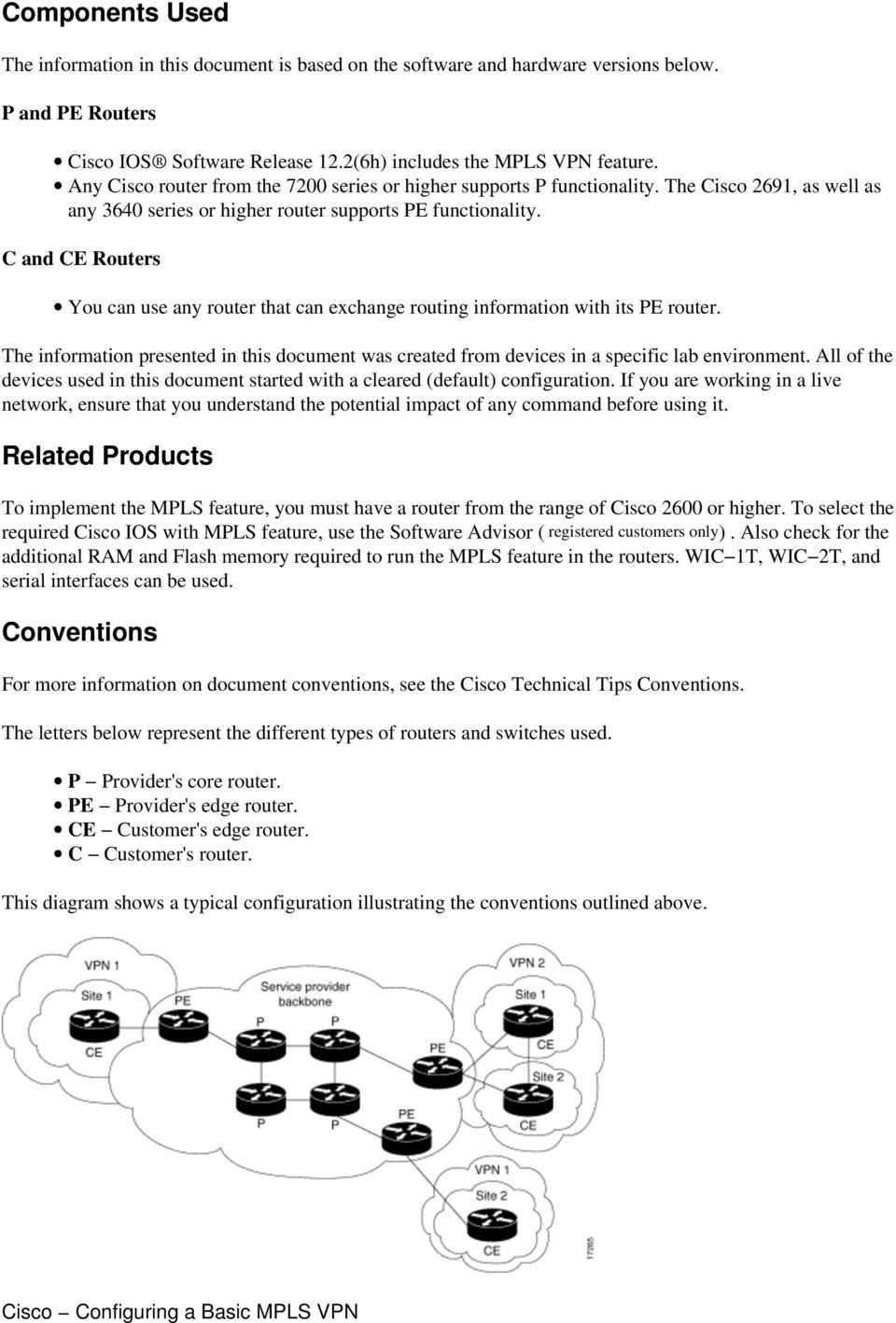
3 Components Used The information in this document is based on the software and hardware versions below. P and PE Routers Cisco IOS Software Release 12.2(6h) includes the MPLS VPN feature. Any Cisco router from the 7200 series or higher supports P functionality. The Cisco 2691, as well as any 3640 series or higher router supports PE functionality. C and CE Routers You can use any router that can exchange routing information with its PE router. The information presented in this document was created from devices in a specific lab environment. All of the devices used in this document started with a cleared (default) configuration. If you are working in a live network, ensure that you understand the potential impact of any command before using it. Related Products To implement the MPLS feature, you must have a router from the range of Cisco 2600 or higher. To select the required Cisco IOS with MPLS feature, use the Software Advisor ( registered customers only). Also check for the additional RAM and Flash memory required to run the MPLS feature in the routers. WIC 1T, WIC 2T, and serial interfaces can be used. Conventions For more information on document conventions, see the Cisco Technical Tips Conventions. The letters below represent the different types of routers and switches used. P Provider's core router. PE Provider's edge router. CE Customer's edge router. C Customer's router. This diagram shows a typical configuration illustrating the conventions outlined above.
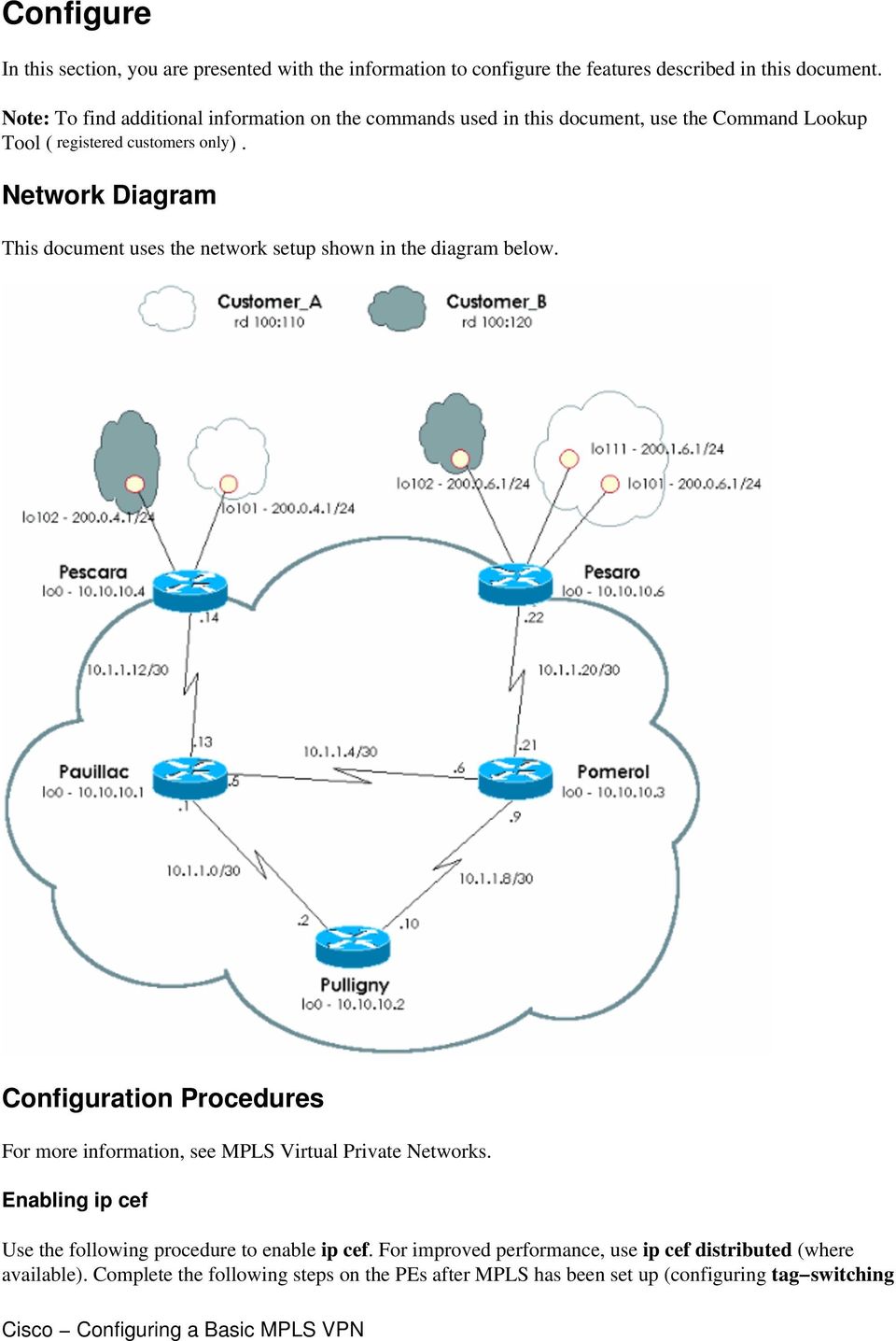
4 Configure In this section, you are presented with the information to configure the features described in this document. Note: To find additional information on the commands used in this document, use the Command Lookup Tool ( registered customers only). Network Diagram This document uses the network setup shown in the diagram below. Configuration Procedures For more information, see MPLS Virtual Private Networks. Enabling ip cef Use the following procedure to enable ip cef. For improved performance, use ip cef distributed (where available). Complete the following steps on the PEs after MPLS has been set up (configuring tag switching
5 ip on the interfaces). 1. Create one VRF for each VPN connected using the ip vrf <VPN routing/forwarding instance name> command. When doing this: Specify the correct route distinguisher used for that VPN. This is used to extend the IP address so that you can identify which VPN it belongs to. rd <VPN route distinguisher> Set up the import and export properties for the MP BGP extended communities. These are used for filtering the import and export process. route target [export import both] <target VPN extended community> 2. Configure the forwarding details for the respective interfaces using the ip vrf forwarding <VPN routing/forwarding instance name> command and remember to set up the IP address after doing this. 3. Depending on the PE CE routing protocol you are using, you can configure static routes or routing protocols (RIP, Open Shortest Path First [OSPF], or BGP) between PE and CE. Detailed configurations are available on the MPLS over ATM Support Page. Configuring MP BGP Configure MP BGP between the PE routers. There are several ways to configure BGP, such as using the route reflector or confederation methods. The method used heredirect neighbor configurationis the simplest and the least scalable. 1. Declare the different neighbors. 2. Enter the address family ipv4 vrf <VPN routing/forwarding instance name> command for each VPN present at this PE router. 3. Carry out one or more of the following steps, as necessary: Redistribute the static routing, RIP, or OSPF information. Redistribute connected routing information. Activate BGP neighboring with the CE routers. Enter the address family vpnv4 mode, and complete the following steps: Configurations Activate the neighbors. Specify that extended community must be used. This is mandatory. This document uses the configurations shown below. Pescara Pesaro Pomerol Pulligny Pauillac
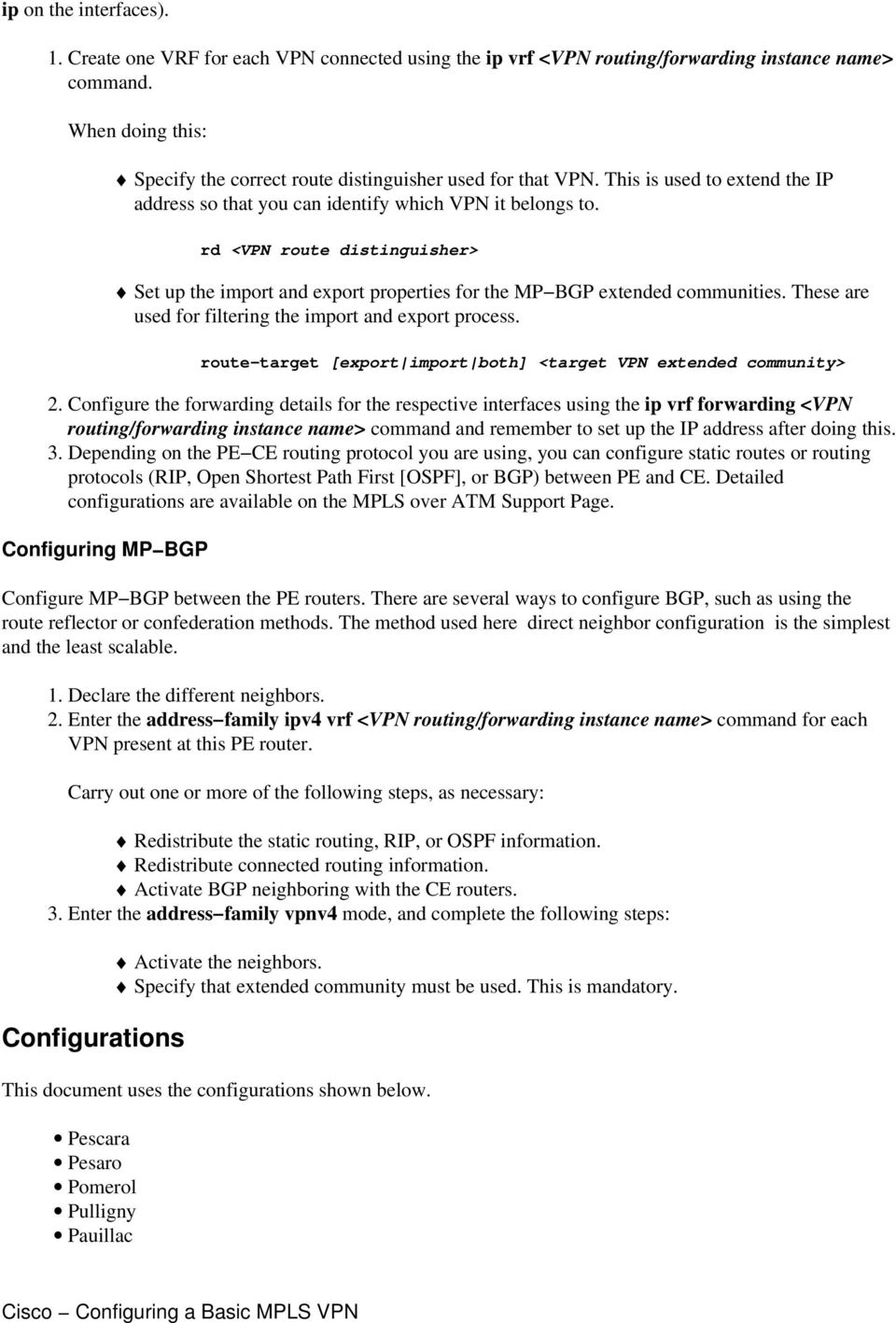
6 Pescara Current configuration: version 12.2 hostname Pescara ip cef Customer A commands. ip vrf Customer_A Enables the VPN routing and forwarding (VRF) routing table. This command can be used in global or router configuration mode. rd 100:110 Route distinguisher creates routing and forwarding tables for a VRF. route target export 100:1000 Creates lists of import and export route target extended communities for the specified VRF. route target import 100:1000 Customer B commands. ip vrf Customer_B rd 100:120 route target export 100:2000 route target import 100:2000 interface Loopback0 ip address Customer A commands. interface Loopback101 ip vrf forwarding Customer_A Associates a VRF instance with an interface or subinterface. ip address Loopback101 and 102 use the same IP address, This is allowed because they belong to two different customers' VRFs.
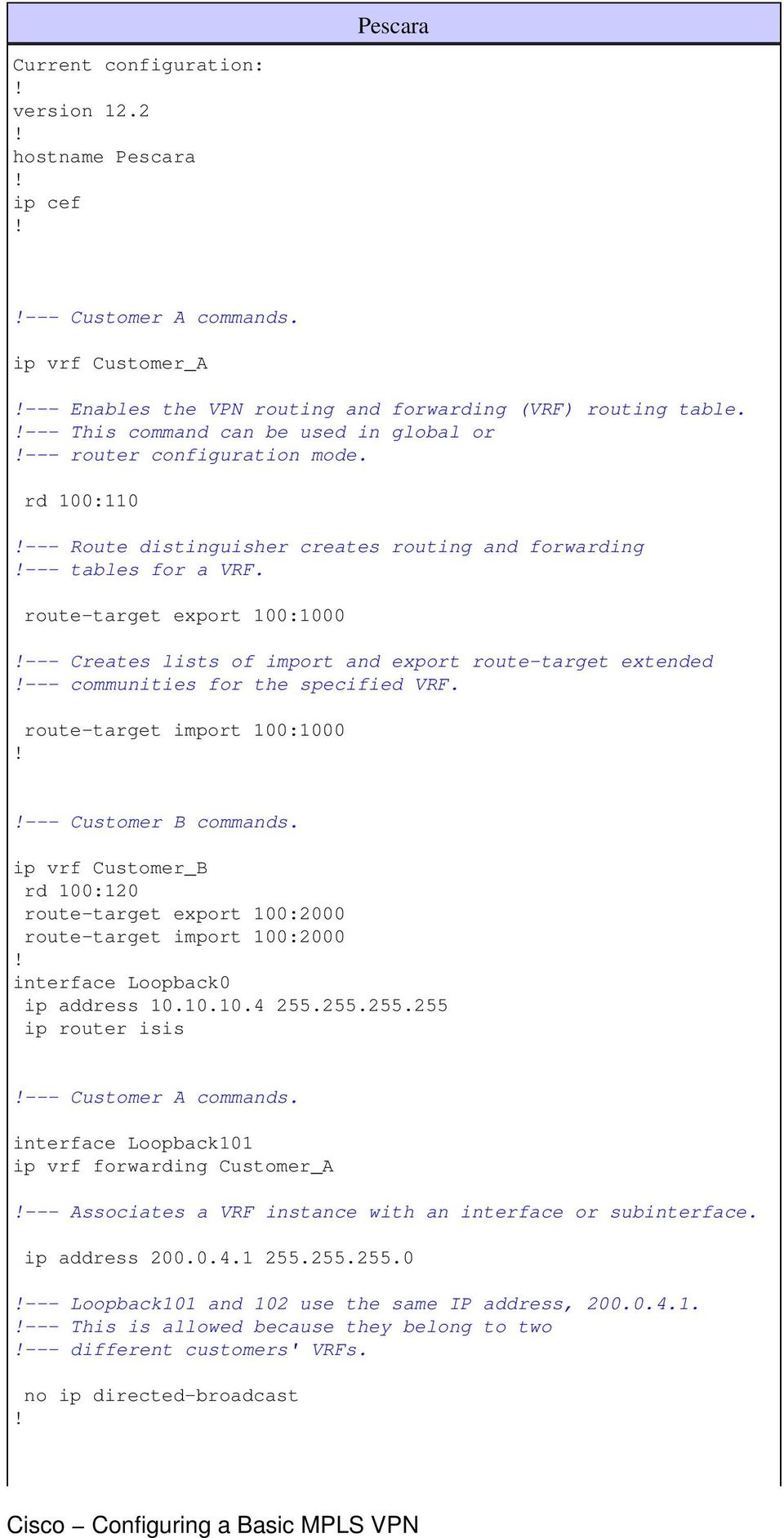
7 Customer B commands. interface Loopback102 ip vrf forwarding Customer_B ip address Loopback101 and 102 use the same IP address, This is allowed because they belong to two different customers' VRFs. interface Serial2/0 no ip address encapsulation frame relay no fair queue interface Serial2/0.1 point to point description link to Pauillac bandwidth 512 ip address frame relay interface dlci 401 router isis net is type level 1 router bgp 100 bgp log neighbor changes Enables logging of BGP neighbor resets. neighbor remote as 100 Adds an entry to the BGP or multiprotocol BGP neighbor table. neighbor update source Loopback0 Enables BGP sessions to use a specific operational interface for TCP connections. Customer A and B commands. address family vpnv4 To enter address family configuration mode for configuring routing sessions, such as BGP, that use standard VPN version 4 address prefixes. neighbor activate neighbor send community both Sends the community attribute to a BGP neighbor. exit address family
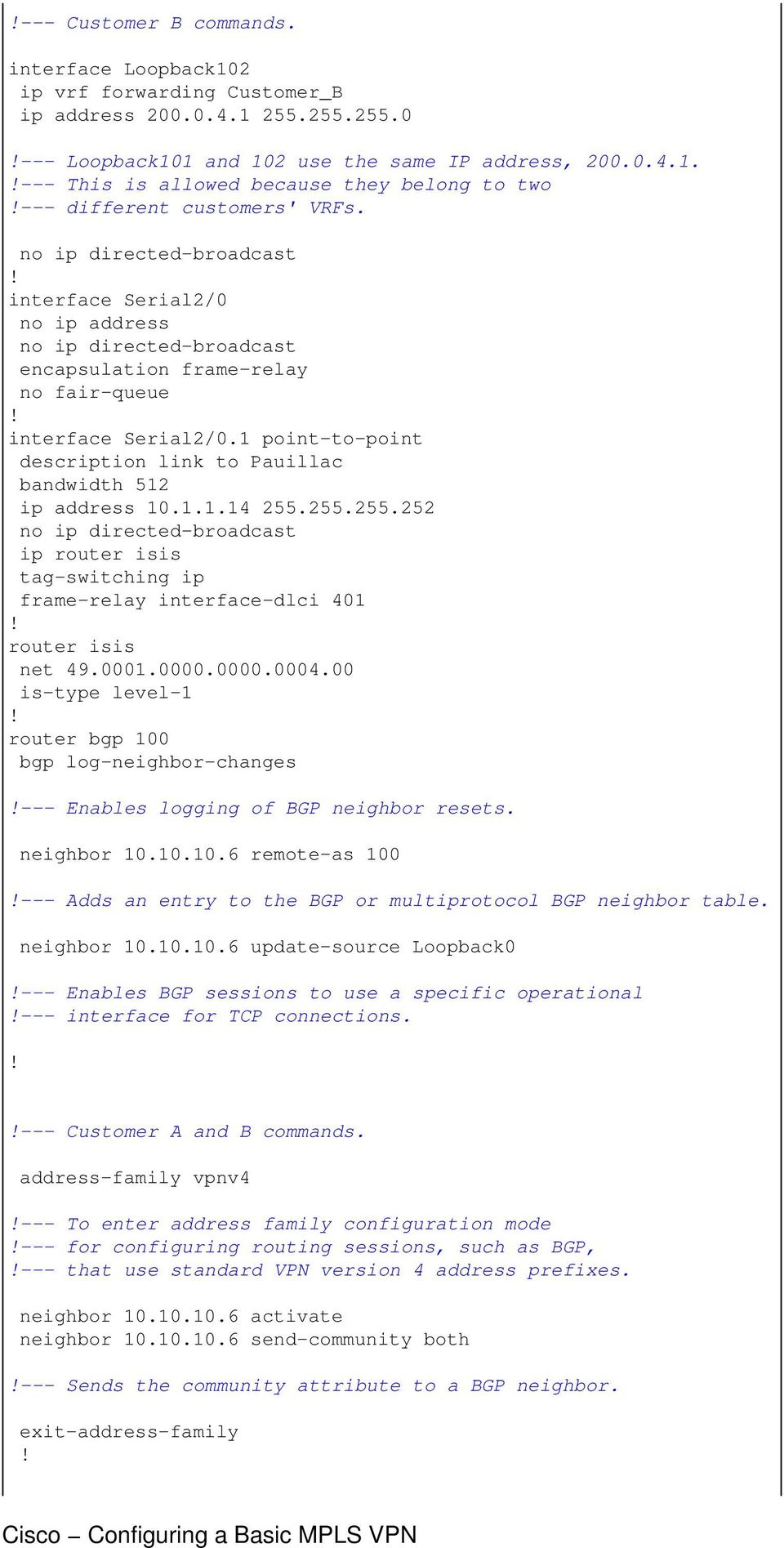
8 Customer B commands. address family ipv4 vrf Customer_B To enter address family configuration mode for configuring routing sessions, such as BGP, that use standard VPN version 4 address prefixes. redistribute connected no auto summary no synchronization exit address family Customer A commands. address family ipv4 vrf Customer_A redistribute connected no auto summary no synchronization exit address family ip classless end Current configuration: version 12.1 hostname Pesaro Pesaro Customer A commands. ip vrf Customer_A rd 100:110 route target export 100:1000 route target import 100:1000 Customer B commands. ip vrf Customer_B rd 100:120 route target export 100:2000 route target import 100:2000 ip cef interface Loopback0 ip address Customer A commands.
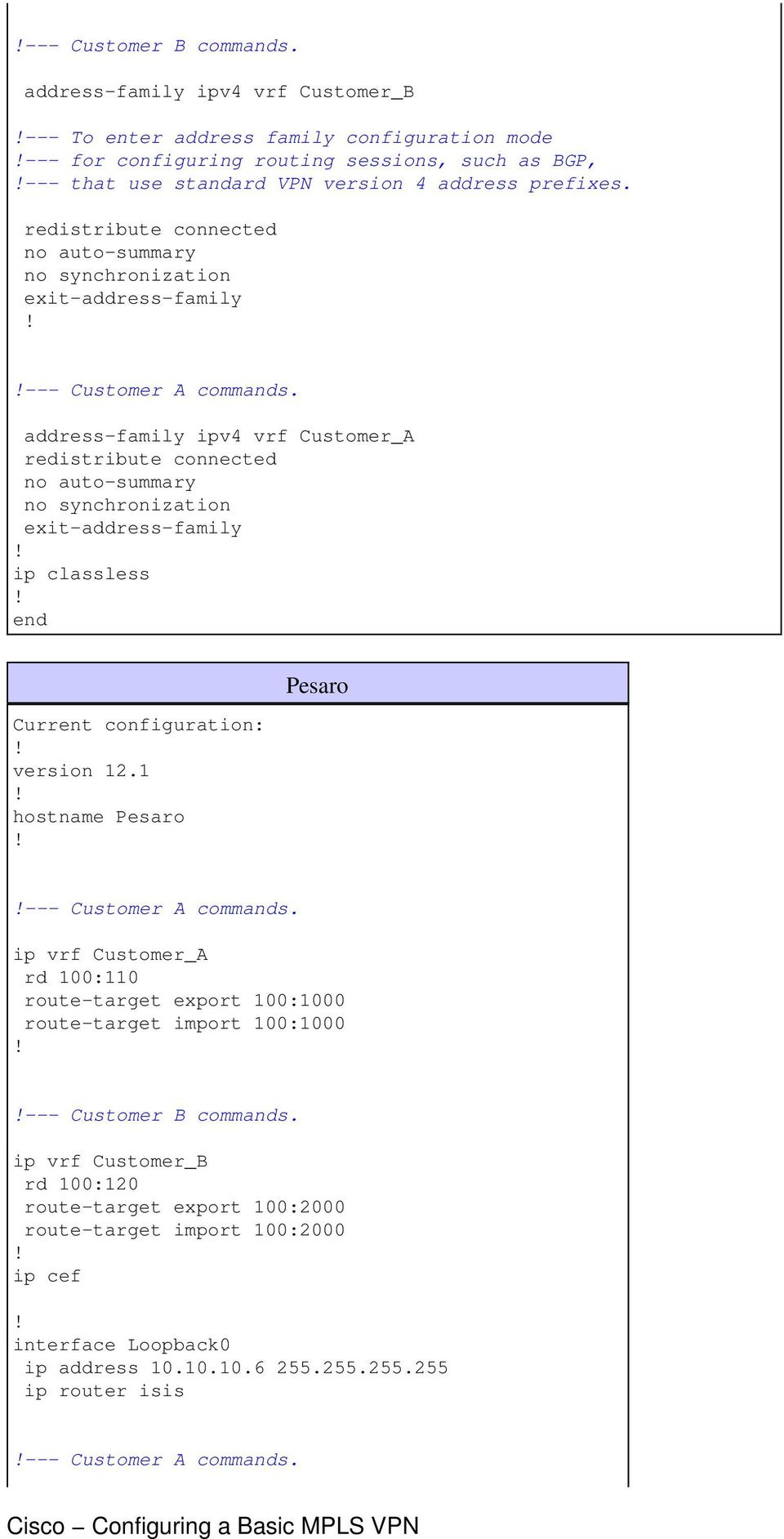
9 interface Loopback101 ip vrf forwarding Customer_A ip address Customer B commands. interface Loopback102 ip vrf forwarding Customer_B ip address Customer A commands. interface Loopback111 ip vrf forwarding Customer_A ip address interface Serial0/0 no ip address encapsulation frame relay no ip mroute cache random detect interface Serial0/0.1 point to point description link to Pomerol bandwidth 512 ip address frame relay interface dlci 603 router isis net is type level 1 router bgp 100 neighbor remote as 100 neighbor update source Loopback0 Customer B commands. address family ipv4 vrf Customer_B redistribute connected no auto summary no synchronization exit address family Customer A commands. address family ipv4 vrf Customer_A redistribute connected no auto summary no synchronization exit address family

10 Customer A and B commands. address family vpnv4 neighbor activate neighbor send community both exit address family ip classless end Current configuration: version 12.0 hostname Pomerol ip cef Pomerol interface Loopback0 ip address interface Serial0/1 no ip address encapsulation frame relay random detect interface Serial0/1.1 point to point description link to Pauillac ip address tag switching mtu 1520 frame relay interface dlci 301 interface Serial0/1.2 point to point description link to Pulligny ip address frame relay interface dlci 303 interface Serial0/1.3 point to point description link to Pesaro ip address frame relay interface dlci 306 router isis net

11 is type level 1 ip classless end Pulligny Current configuration: version 12.1 hostname Pulligny ip cef interface Loopback0 ip address interface Serial0/1 no ip address encapsulation frame relay random detect interface Serial0/1.1 point to point description link to Pauillac ip address frame relay interface dlci 201 interface Serial0/1.2 point to point description link to Pomerol ip address frame relay interface dlci 203 router isis passive interface Loopback0 net is type level 1 ip classless end version 12.1 hostname pauillac ip cef Pauillac interface Loopback0 ip address

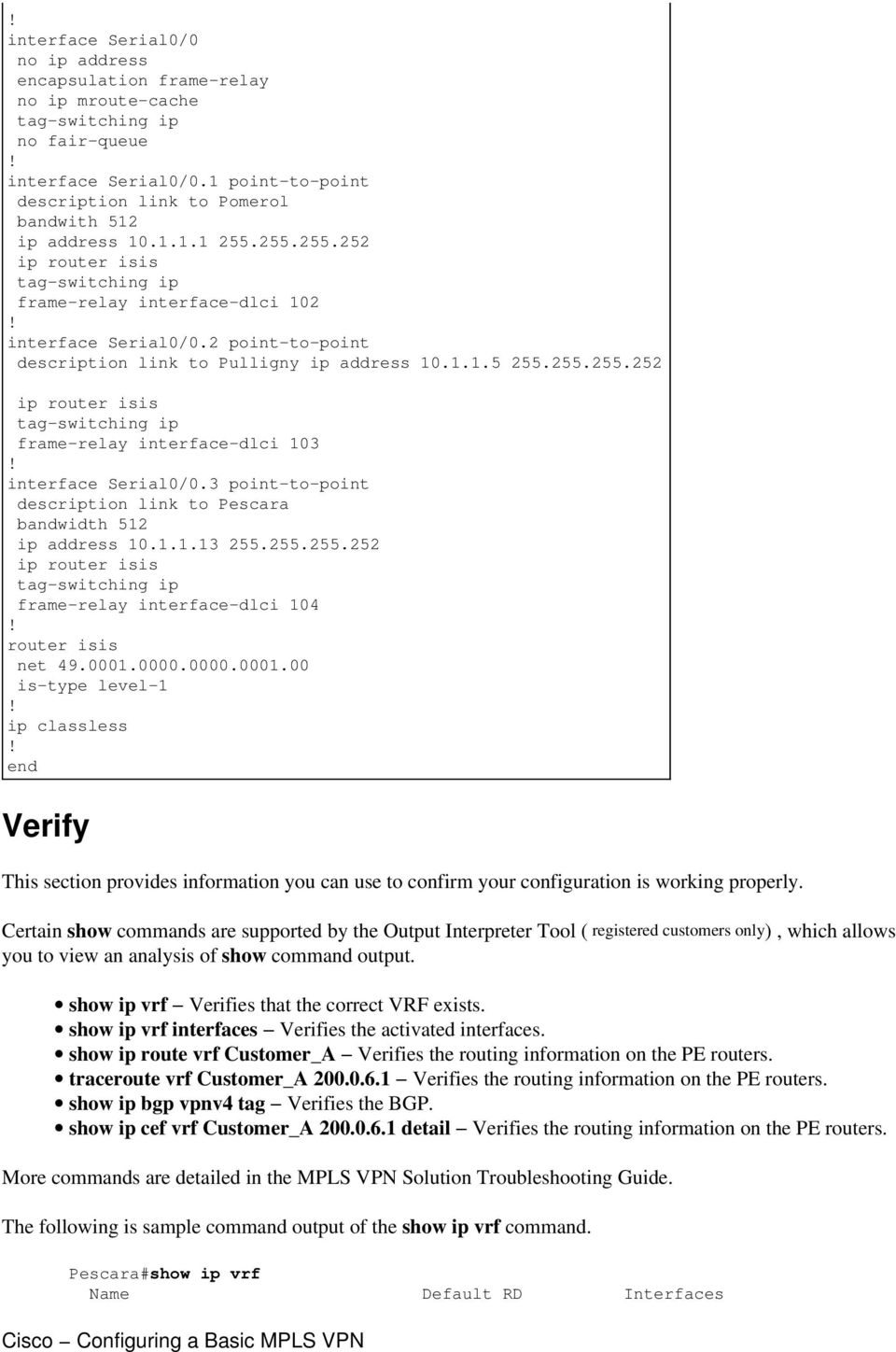
12 interface Serial0/0 no ip address encapsulation frame relay no ip mroute cache no fair queue interface Serial0/0.1 point to point description link to Pomerol bandwith 512 ip address frame relay interface dlci 102 interface Serial0/0.2 point to point description link to Pulligny ip address frame relay interface dlci 103 interface Serial0/0.3 point to point description link to Pescara bandwidth 512 ip address frame relay interface dlci 104 router isis net is type level 1 ip classless end Verify This section provides information you can use to confirm your configuration is working properly. Certain show commands are supported by the Output Interpreter Tool ( registered customers only), which allows you to view an analysis of show command output. show ip vrf Verifies that the correct VRF exists. show ip vrf interfaces Verifies the activated interfaces. show ip route vrf Customer_A Verifies the routing information on the PE routers. traceroute vrf Customer_A Verifies the routing information on the PE routers. show ip bgp vpnv4 tag Verifies the BGP. show ip cef vrf Customer_A detail Verifies the routing information on the PE routers. More commands are detailed in the MPLS VPN Solution Troubleshooting Guide. The following is sample command output of the show ip vrf command. Pescara#show ip vrf Name Default RD Interfaces
13 Customer_A 100:110 Loopback101 Customer_B 100:120 Loopback102 The following is sample command output of the show ip vrf interfaces command. Pesaro#show ip vrf interfaces Interface IP Address VRF Protocol Loopback Customer_A up Loopback Customer_A up Loopback Customer_B up The following show ip route vrf commands show the same prefix /24 in both the outputs. This is because the remote PE has the same network for two customers, Customer_A and Customer_B, which is allowed in a typical MPLS VPN solution. Pescara#show ip route vrf Customer_A Codes: C connected, S static, I IGRP, R RIP, M mobile, B BGP D EIGRP, EX EIGRP external, O OSPF, IA OSPF inter area N1 OSPF NSSA external type 1, N2 OSPF NSSA external type 2 E1 OSPF external type 1, E2 OSPF external type 2, E EGP i IS IS, L1 IS IS level 1, L2 IS IS level 2, ia IS IS inter area * candidate default, U per user static route, o ODR Gateway of last resort is not set C /24 is directly connected, Loopback101 B /24 [200/0] via , 05:10:11 B /24 [200/0] via , 04:48:11 Pescara#show ip route vrf Customer_B Codes: C connected, S static, I IGRP, R RIP, M mobile, B BGP D EIGRP, EX EIGRP external, O OSPF, IA OSPF inter area N1 OSPF NSSA external type 1, N2 OSPF NSSA external type 2 E1 OSPF external type 1, E2 OSPF external type 2, E EGP i IS IS, L1 IS IS level 1, L2 IS IS level 2, ia IS IS inter area * candidate default, U per user static route, o ODR P periodic downloaded static route Gateway of last resort is not set C /24 is directly connected, Loopback102 B /24 [200/0] via , 00:03:24 By running a traceroute between two sites of Customer_A, it is possible to see the label stack used by the MPLS network (if it is configured to do so by mpls ip ttl...). Pescara#traceroute vrf Customer_A Type escape sequence to abort. Tracing the route to [MPLS: Labels 20/26 Exp 0] 400 msec 276 msec 264 msec [MPLS: Labels 18/26 Exp 0] 224 msec 460 msec 344 msec msec * 100 msec Note: Exp 0 is an experimental field used for Quality of Service (QoS).

14 Troubleshoot There is currently no specific troubleshooting information available for this configuration. Related Information MPLS Command Guide Configuring MPLS Multiprotocol BGP Extensions for IP Multicast Commands Command Lookup Tool ( registered customers only) MPLS Support Page Technical Support Cisco Systems All contents are Copyright Cisco Systems, Inc. All rights reserved. Important Notices and Privacy Statement.
Configuring a Basic MPLS VPN
 Configuring a Basic MPLS VPN Help us help you. Please rate this document. Contents Introduction Conventions Hardware and Software Versions Network Diagram Configuration Procedures Enabling Configuring
Cisco Configuring Basic MPLS Using OSPF
 Table of Contents Configuring Basic MPLS Using OSPF...1 Introduction...1 Mechanism...1 Hardware and Software Versions...2 Network Diagram...2 Configurations...2 Quick Configuration Guide...2 Configuration
IPv6 over MPLS VPN. Contents. Prerequisites. Document ID: 112085. Requirements
 IPv6 over MPLS VPN Document ID: 112085 Contents Introduction Prerequisites Requirements Components Used Conventions Configure Network Diagram VRF Configuration Multiprotocol BGP (MP BGP) Configuration
Lab 4.2 Challenge Lab: Implementing MPLS VPNs
 Lab 4.2 Challenge Lab: Implementing MPLS VPNs Learning Objectives Configure Open Shortest Path First (OSPF) and Enhanced Interior Gateway Routing Protocol (EIGRP) on a router Enable MPLS on a router Verify
- Multiprotocol Label Switching -
 1 - Multiprotocol Label Switching - Multiprotocol Label Switching Multiprotocol Label Switching (MPLS) is a Layer-2 switching technology. MPLS-enabled routers apply numerical labels to packets, and can
Frame Mode MPLS Implementation
 CHAPTER 4 Frame Mode MPLS Implementation Lab 4-1: Configuring Frame Mode MPLS (4.5.1) In this lab, you learn how to do the following: Configure EIGRP on a router. Configure LDP on a router. Change the
MPLS VPN Implementation
 MPLS VPN Implementation Overview Virtual Routing and Forwarding Table VPN-Aware Routing Protocols VRF Configuration Tasks Configuring BGP Address families Configuring BGP Neighbors Configuring MP-BGP Monitoring
Objectives. Router as a Computer. Router components and their functions. Router components and their functions
 2007 Cisco Systems, Inc. All rights reserved. Cisco Public Objectives Introduction to Routing and Packet Forwarding Routing Protocols and Concepts Chapter 1 Identify a router as a computer with an OS and
Notice the router names, as these are often used in MPLS terminology. The Customer Edge router a router that directly connects to a customer network.
 Where MPLS part I explains the basics of labeling packets, it s not giving any advantage over normal routing, apart from faster table lookups. But extensions to MPLS allow for more. In this article I ll
MPLS VPN over mgre. Finding Feature Information. Prerequisites for MPLS VPN over mgre
 The feature overcomes the requirement that a carrier support multiprotocol label switching (MPLS) by allowing you to provide MPLS connectivity between networks that are connected by IP-only networks. This
Table of Contents. Cisco How Does Load Balancing Work?
 Table of Contents How Does Load Balancing Work?...1 Document ID: 5212...1 Introduction...1 Prerequisites...1 Requirements...1 Components Used...1 Conventions...1 Load Balancing...1 Per Destination and
MPLS-based Layer 3 VPNs
 MPLS-based Layer 3 VPNs Overall objective The purpose of this lab is to study Layer 3 Virtual Private Networks (L3VPNs) created using MPLS and BGP. A VPN is an extension of a private network that uses
How Routers Forward Packets
 Autumn 2010 [email protected] MULTIPROTOCOL LABEL SWITCHING (MPLS) AND MPLS VPNS How Routers Forward Packets Process switching Hardly ever used today Router lookinginside the packet, at the ipaddress,
Sample Configuration Using the ip nat outside source static
 Sample Configuration Using the ip nat outside source static Table of Contents Sample Configuration Using the ip nat outside source static Command...1 Introduction...1 Before You Begin...1 Conventions...1
PRASAD ATHUKURI Sreekavitha engineering info technology,kammam
 Multiprotocol Label Switching Layer 3 Virtual Private Networks with Open ShortestPath First protocol PRASAD ATHUKURI Sreekavitha engineering info technology,kammam Abstract This paper aims at implementing
IOS NAT Load Balancing for Two ISP Connections
 IOS NAT Load Balancing for Two ISP Connections Document ID: 100658 Contents Introduction Prerequisites Requirements Components Used Conventions Configure Network Diagram Configurations Verify Troubleshoot
MPLS Implementation MPLS VPN
 MPLS Implementation MPLS VPN Describing MPLS VPN Technology Objectives Describe VPN implementation models. Compare and contrast VPN overlay VPN models. Describe the benefits and disadvantages of the overlay
Implementing Cisco MPLS
 Implementing Cisco MPLS Course MPLS v2.3; 5 Days, Instructor-led Course Description This design document is for the refresh of the Implementing Cisco MPLS (MPLS) v2.3 instructor-led training (ILT) course,
AMPLS - Advanced Implementing and Troubleshooting MPLS VPN Networks v4.0
 Course Outline AMPLS - Advanced Implementing and Troubleshooting MPLS VPN Networks v4.0 Module 1: MPLS Features Lesson 1: Describing Basic MPLS Concepts Provide an overview of MPLS forwarding, features,
Lab 7.2.9 Load Balancing Across Multiple Paths Instructor Version 2500
 Lab 7.2.9 Load Balancing Across Multiple Paths Instructor Version 2500 Objective onfigure Load balance across multiple paths. Observe the load balancing process. Background/Preparation able a network similar
For internal circulation of BSNLonly
 E3-E4 E4 E&WS Overview of MPLS-VPN Overview Traditional Router-Based Networks Virtual Private Networks VPN Terminology MPLS VPN Architecture MPLS VPN Routing MPLS VPN Label Propagation Traditional Router-Based
Sample Configuration Using the ip nat outside source list C
 Sample Configuration Using the ip nat outside source list C Table of Contents Sample Configuration Using the ip nat outside source list Command...1 Introduction...1 Before You Begin...1 Conventions...1
IOS NAT Load Balancing with Optimized Edge Routing for Two Internet Connections
 IOS NAT Load Balancing with Optimized Edge Routing for Two Internet Connections Document ID: 99427 Contents Introduction Prerequisites Requirements Components Used Conventions Configure Network Diagram
Chapter 2 Lab 2-2, EIGRP Load Balancing
 Chapter 2 Lab 2-2, EIGRP Load Balancing Topology Objectives Background Review a basic EIGRP configuration. Explore the EIGRP topology table. Identify successors, feasible successors, and feasible distances.
IMPLEMENTING CISCO MPLS V3.0 (MPLS)
 IMPLEMENTING CISCO MPLS V3.0 (MPLS) COURSE OVERVIEW: Multiprotocol Label Switching integrates the performance and traffic-management capabilities of data link Layer 2 with the scalability and flexibility
Implementing MPLS VPNs over IP Tunnels on Cisco IOS XR Software
 Implementing MPLS VPNs over IP Tunnels on Cisco IOS XR Software The MPLS VPNs over IP Tunnels feature lets you deploy Layer 3 Virtual Private Netwk (L3VPN) services, over an IP ce netwk, using L2TPv3 multipoint
IMPLEMENTING CISCO MPLS V2.3 (MPLS)
 IMPLEMENTING CISCO MPLS V2.3 (MPLS) COURSE OVERVIEW: The course will enable learners to gather information from the technology basics to advanced VPN configuration. The focus of the course is on VPN technology
Expert Reference Series of White Papers. An Overview of MPLS VPNs: Overlay; Layer 3; and PseudoWire
 Expert Reference Series of White Papers An Overview of MPLS VPNs: Overlay; Layer 3; and PseudoWire 1-800-COURSES www.globalknowledge.com An Overview of MPLS VPNs: Overlay; Layer 3; and PseudoWire Al Friebe,
Configuring a Gateway of Last Resort Using IP Commands
 Configuring a Gateway of Last Resort Using IP Commands Document ID: 16448 Contents Introduction Prerequisites Requirements Components Used Conventions ip default gateway ip default network Flag a Default
MPLS VPN Route Target Rewrite
 The feature allows the replacement of route targets on incoming and outgoing Border Gateway Protocol (BGP) updates Typically, Autonomous System Border Routers (ASBRs) perform the replacement of route targets
Introduction Inter-AS L3VPN
 Introduction Inter-AS L3VPN 1 Extending VPN services over Inter-AS networks VPN Sites attached to different MPLS VPN Service Providers How do you distribute and share VPN routes between ASs Back- to- Back
Configuring MPLS Hub-and-Spoke Layer 3 VPNs
 CHAPTER 23 This chapter describes how to configure a hub-and-spoke topology for Multiprotocol Layer Switching (MPLS) Layer 3 virtual private networks (VPNs) on Cisco NX-OS devices. This chapter includes
Introducing Basic MPLS Concepts
 Module 1-1 Introducing Basic MPLS Concepts 2004 Cisco Systems, Inc. All rights reserved. 1-1 Drawbacks of Traditional IP Routing Routing protocols are used to distribute Layer 3 routing information. Forwarding
MPLS. Cisco MPLS. Cisco Router Challenge 227. MPLS Introduction. The most up-to-date version of this test is at: http://networksims.com/i01.
 MPLS Cisco MPLS MPLS Introduction The most up-to-date version of this test is at: http://networksims.com/i01.html Cisco Router Challenge 227 Outline This challenge involves basic frame-mode MPLS configuration.
How To Configure InterVLAN Routing on Layer 3 Switches
 How To Configure InterVLAN Routing on Layer 3 Switches Document ID: 41860 Contents Introduction Prerequisites Requirements Components Used Conventions Configure InterVLAN Routing Task Step by Step Instructions
White Paper. Cisco MPLS based VPNs: Equivalent to the security of Frame Relay and ATM. March 30, 2001
 The leading edge in networking information White Paper Cisco MPLS based VPNs: Equivalent to the security of Frame Relay and ATM March 30, 2001 Abstract: The purpose of this white paper is to present discussion
ASA 9.x EIGRP Configuration Example
 ASA 9.x EIGRP Configuration Example Document ID: 91264 Contributed by Dinkar Sharma, Magnus Mortensen, and Prashant Joshi, Cisco TAC Engineers. May 13, 2015 Contents Introduction Prerequisites Requirements
How To Configure A Cisco Router With A Cio Router
 CHAPTER 1 This chapter provides procedures for configuring the basic parameters of your Cisco router, including global parameter settings, routing protocols, interfaces, and command-line access. It also
Implementing Cisco Service Provider Next-Generation Edge Network Services **Part of the CCNP Service Provider track**
 Course: Duration: Price: $ 3,695.00 Learning Credits: 37 Certification: Implementing Cisco Service Provider Next-Generation Edge Network Services Implementing Cisco Service Provider Next-Generation Edge
Enterprise Network Simulation Using MPLS- BGP
 Enterprise Network Simulation Using MPLS- BGP Tina Satra 1 and Smita Jangale 2 1 Department of Computer Engineering, SAKEC, Chembur, Mumbai-88, India [email protected] 2 Department of Information Technolgy,
Implementing MPLS VPNs over IP Tunnels
 Implementing MPLS VPNs over IP Tunnels The MPLS VPNs over IP Tunnels feature lets you deploy Layer 3 Virtual Private Netwk (L3VPN) services, over an IP ce netwk, using L2TPv3 multipoint tunneling instead
IP Routing Configuring Static Routes
 11 IP Routing Configuring Static Routes Contents Overview..................................................... 11-3 IP Addressing.............................................. 11-3 Networks.................................................
Router and Routing Basics
 Router and Routing Basics Malin Bornhager Halmstad University Session Number 2002, Svenska-CNAP Halmstad University 1 Routing Protocols and Concepts CCNA2 Routing and packet forwarding Static routing Dynamic
Why Is MPLS VPN Security Important?
 MPLS VPN Security An Overview Monique Morrow Michael Behringer May 2 2007 Future-Net Conference New York Futurenet - MPLS Security 1 Why Is MPLS VPN Security Important? Customer buys Internet Service :
Using the Border Gateway Protocol for Interdomain Routing
 CHAPTER 12 Using the Border Gateway Protocol for Interdomain Routing The Border Gateway Protocol (BGP), defined in RFC 1771, provides loop-free interdomain routing between autonomous systems. (An autonomous
Using OSPF in an MPLS VPN Environment
 Using OSPF in an MPLS VPN Environment Overview This module introduces the interaction between multi-protocol Border Gateway Protocol (MP-BGP) running between Provider Edge routers (s) and Open Shortest
Inter-Autonomous Systems for MPLS VPNs
 Inter-Autonomous Systems for MPLS VPNs This feature module explains how to provide MPLS VPN services that can span several autonomous systems (ASs) and VPN service providers. History of the Inter-Autonomous
How To Import Ipv4 From Global To Global On Cisco Vrf.Net (Vf) On A Vf-Net (Virtual Private Network) On Ipv2 (Vfs) On An Ipv3 (Vv
 BGP Support for IP Prefix Import from Global Table into a VRF Table The BGP Support for IP Prefix Import from Global Table into a VRF Table feature introduces the capability to import IPv4 unicast prefixes
Multiprotocol Label Switching Load Balancing
 Multiprotocol Label Switching Load Balancing First Published: July 2013 The Cisco ME 3800 and ME 3600 switches support IPv4 and IPv6 load balancing at the LER and LSR. Effective with Cisco IOS Release
How To Understand Bg
 Table of Contents BGP Case Studies...1 BGP4 Case Studies Section 1...3 Contents...3 Introduction...3 How Does BGP Work?...3 ebgp and ibgp...3 Enabling BGP Routing...4 Forming BGP Neighbors...4 BGP and
Lab: Basic Router Configuration
 Topology Diagram Addressing Table Device Interface IP Address Subnet Mask Def. Gateway R1 Fa0/0 192.168.1.1 255.255.255.0 N/A S0/0/0 192.168.2.1 255.255.255.0 N/A R2 Fa0/0 192.168.3.1 255.255.255.0 N/A
MPLS Concepts. Overview. Objectives
 MPLS Concepts Overview This module explains the features of Multi-protocol Label Switching (MPLS) compared to traditional ATM and hop-by-hop IP routing. MPLS concepts and terminology as well as MPLS label
MPLS/BGP Network Simulation Techniques for Business Enterprise Networks
 MPLS/BGP Network Simulation Techniques for Business Enterprise Networks Nagaselvam M Computer Science and Engineering, Nehru Institute of Technology, Coimbatore, Abstract Business Enterprises used VSAT
Lab 7-1 Configuring Switches for IP Telephony Support
 Lab 7-1 Configuring Switches for IP Telephony Support Learning Objectives Configure auto QoS to support IP phones Configure CoS override for data frames Configure the distribution layer to trust access
WAN Topologies MPLS. 2006, Cisco Systems, Inc. All rights reserved. Presentation_ID.scr. 2006 Cisco Systems, Inc. All rights reserved.
 MPLS WAN Topologies 1 Multiprotocol Label Switching (MPLS) IETF standard, RFC3031 Basic idea was to combine IP routing protocols with a forwarding algoritm based on a header with fixed length label instead
Kingston University London
 Kingston University London Thesis Title Implementation and performance evaluation of WAN services over MPLS Layer-3 VPN Dissertation submitted for the Degree of Master of Science in Networking and Data
S-38.3192 ITGuru Exercise (3: Building the MPLS BGP VPN) Spring 2006
 S-38.3192 ITGuru Exercise (3: Building the MPLS BGP VPN) Spring 2006 Original version: Johanna Nieminen and Timo Viipuri (2005) Modified: Timo-Pekka Heikkinen, Juha Järvinen and Yavor Ivanov (2006) Task
BGP Best Path Selection Algorithm
 BGP Best Path Selection Algorithm Document ID: 13753 Contents Introduction Prerequisites Requirements Components Used Conventions Why Routers Ignore Paths How the Best Path Algorithm Works Example: BGP
Cisco CCNP 642 901 Optimizing Converged Cisco Networks (ONT)
 Cisco CCNP 642 901 Optimizing Converged Cisco Networks (ONT) Course Number: 642 901 Length: 5 Day(s) Certification Exam This course will help you prepare for the following exams: Cisco CCNP Exam 642 901:
Chapter 7 Lab 7-1, Configuring Switches for IP Telephony Support
 Chapter 7 Lab 7-1, Configuring Switches for IP Telephony Support Topology Objectives Background Configure auto QoS to support IP phones. Configure CoS override for data frames. Configure the distribution
Designing and Developing Scalable IP Networks
 Designing and Developing Scalable IP Networks Guy Davies Telindus, UK John Wiley & Sons, Ltd Contents List of Figures List of Tables About the Author Acknowledgements Abbreviations Introduction xi xiii
Introduction to Routing and Packet Forwarding. Routing Protocols and Concepts Chapter 1
 Introduction to Routing and Packet Forwarding Routing Protocols and Concepts Chapter 1 1 1 Objectives Identify a router as a computer with an OS and hardware designed for the routing process. Demonstrate
DD2491 p2 2011. MPLS/BGP VPNs. Olof Hagsand KTH CSC
 DD2491 p2 2011 MPLS/BGP VPNs Olof Hagsand KTH CSC 1 Literature Practical BGP: Chapter 10 MPLS repetition, see for example http://www.csc.kth.se/utbildning/kth/kurser/dd2490/ipro1-11/lectures/mpls.pdf Reference:
Introduction to Dynamic Routing Protocols
 CHAPTER 3 Introduction to Dynamic Routing Protocols Objectives Upon completion of this chapter, you should be able to answer the following questions: Can you describe the role of dynamic routing protocols
Cisco 642-889. Implementing Cisco Service Provider Next-Generation Egde Network Services. Version: 4.1
 Cisco 642-889 Implementing Cisco Service Provider Next-Generation Egde Network Services Version: 4.1 QUESTION NO: 1 Cisco 642-889 Exam Which type of VPN requires a full mesh of virtual circuits to provide
Cisco Certified Network Associate Exam. Operation of IP Data Networks. LAN Switching Technologies. IP addressing (IPv4 / IPv6)
 Cisco Certified Network Associate Exam Exam Number 200-120 CCNA Associated Certifications CCNA Routing and Switching Operation of IP Data Networks Operation of IP Data Networks Recognize the purpose and
s@lm@n Cisco Exam 642-889 Implementing Cisco Service Provider Next-Generation Egde Network Services Version: 7.0 [ Total Questions: 126 ]
![s@lm@n Cisco Exam 642-889 Implementing Cisco Service Provider Next-Generation Egde Network Services Version: 7.0 [ Total Questions: 126 ]](/thumbs/31/15221132.jpg "s@lm@n Cisco Exam 642-889 Implementing Cisco Service Provider Next-Generation Egde Network Services Version: 7.0 [ Total Questions: 126 ]") s@lm@n Cisco Exam 642-889 Implementing Cisco Service Provider Next-Generation Egde Network Services Version: 7.0 [ Total Questions: 126 ] Cisco 642-889 : Practice Test Question No : 1 Refer to the exhibit.
s@lm@n Cisco Exam 642-889 Implementing Cisco Service Provider Next-Generation Egde Network Services Version: 7.0 [ Total Questions: 126 ] Cisco 642-889 : Practice Test Question No : 1 Refer to the exhibit.
Implementing VPN over MPLS
 IOSR Journal of Electronics and Communication Engineering (IOSR-JECE) e-issn: 2278-2834,p- ISSN: 2278-8735.Volume 10, Issue 3, Ver. I (May - Jun.2015), PP 48-53 www.iosrjournals.org Implementing VPN over
MPLS-based Virtual Private Network (MPLS VPN) The VPN usually belongs to one company and has several sites interconnected across the common service
 Nowdays, most network engineers/specialists consider MPLS (MultiProtocol Label Switching) one of the most promising transport technologies. Then, what is MPLS? Multi Protocol Label Switching (MPLS) is
Cisco Discovery 3: Introducing Routing and Switching in the Enterprise 157.8 hours teaching time
 Essential Curriculum Computer Networking II Cisco Discovery 3: Introducing Routing and Switching in the Enterprise 157.8 hours teaching time Chapter 1 Networking in the Enterprise-------------------------------------------------
SEC-370. 2001, Cisco Systems, Inc. All rights reserved.
 SEC-370 2001, Cisco Systems, Inc. All rights reserved. 1 Understanding MPLS/VPN Security Issues SEC-370 Michael Behringer SEC-370 2003, Cisco Systems, Inc. All rights reserved. 3
Cisco Configuring Commonly Used IP ACLs
 Table of Contents Configuring Commonly Used IP ACLs...1 Introduction...1 Prerequisites...2 Hardware and Software Versions...3 Configuration Examples...3 Allow a Select Host to Access the Network...3 Allow
BGP Link Bandwidth. Finding Feature Information. Contents
 The BGP (Border Gateway Protocol) Link Bandwidth feature is used to advertise the bandwidth of an autonomous system exit link as an extended community. This feature is configured for links between directly
RFC 2547bis: BGP/MPLS VPN Fundamentals
 White Paper RFC 2547bis: BGP/MPLS VPN Fundamentals Chuck Semeria Marketing Engineer Juniper Networks, Inc. 1194 North Mathilda Avenue Sunnyvale, CA 94089 USA 408 745 2001 or 888 JUNIPER www.juniper.net
Understanding Route Aggregation in BGP
 Understanding Route Aggregation in BGP Document ID: 5441 Contents Introduction Prerequisites Requirements Components Used Conventions Network Diagram Aggregate Without the as set Argument Aggregate with
BGP Link Bandwidth. Finding Feature Information. Prerequisites for BGP Link Bandwidth
 The Border Gateway Protocol (BGP) Link Bandwidth feature is used to advertise the bandwidth of an autonomous system exit link as an extended community. This feature is configured for links between directly
Provisioning Cable Services
 CHAPTER 10 This chapter describes how to provision MPLS VPN cable in IP Solutions Center (ISC). It contains the following sections: Overview of MPLS VPN Cable, page 10-1 in ISC, page 10-5 Creating the
OSPF Configuring Multi-Area OSPF
 OSPF Configuring Multi-Area OSPF Objective In this lab configure a multiarea OSPF operation, interarea summarization, external route summarization, and default routing. Scenario International Travel Agency
Configuring Remote Access to MPLS VPN
 CHAPTER 3 TheCisco 10000 series router supports the IP virtual private network (VPN) feature for Multiprotocol Label Switching (MPLS). MPLS-based VPNs allow service providers to deploy a scalable and cost-effective
l.cittadini, m.cola, g.di battista
 MPLS VPN l.cittadini, m.cola, g.di battista motivations customer s problem a customer (e.g., private company, public administration, etc.) has several geographically distributed sites and would like to
How To Make A Network Secure
 1 2 3 4 -Lower yellow line is graduate student enrollment -Red line is undergradate enrollment -Green line is total enrollment -2008 numbers are projected to be near 20,000 (on-campus) not including distance
AT&T Managed IP Network Service (MIPNS) MPLS Private Network Transport Technical Configuration Guide Version 1.0
 AT&T Managed IP Network Service (MIPNS) MPLS Private Network Transport Technical Configuration Guide Version 1.0 Introduction...2 Overview...2 1. Technology Background...2 2. MPLS PNT Offer Models...3
Introduction to MPLS-based VPNs
 Introduction to MPLS-based VPNs Ferit Yegenoglu, Ph.D. ISOCORE [email protected] Outline Introduction BGP/MPLS VPNs Network Architecture Overview Main Features of BGP/MPLS VPNs Required Protocol Extensions
MP PLS VPN MPLS VPN. Prepared by Eng. Hussein M. Harb
 MP PLS VPN MPLS VPN Prepared by Eng. Hussein M. Harb Agenda MP PLS VPN Why VPN VPN Definition VPN Categories VPN Implementations VPN Models MPLS VPN Types L3 MPLS VPN L2 MPLS VPN Why VPN? VPNs were developed
IMPLEMENTING CISCO IP ROUTING V2.0 (ROUTE)
 IMPLEMENTING CISCO IP ROUTING V2.0 (ROUTE) COURSE OVERVIEW: Implementing Cisco IP Routing (ROUTE) v2.0 is an instructor-led five day training course developed to help students prepare for Cisco CCNP _
Cisco IP Solution Center MPLS VPN Management 5.0
 Cisco IP Solution Center MPLS VPN Management 5.0 As part of the Cisco IP Solution Center (ISC) family of intelligent network management applications, the Cisco ISC MPLS VPN Management application reduces
Network Simulator Lab Study Plan
 The CCNA 640-802 Network Simulator has 300 lab exercises, organized both by type (Skill Builder, Configuration Scenario, Troubleshooting Scenario, and Subnetting Exercise) and by major topic within each
CCT vs. CCENT Skill Set Comparison
 Operation of IP Data Networks Recognize the purpose and functions of various network devices such as Routers, Switches, Bridges and Hubs Select the components required to meet a given network specification
Implementing Secured Converged Wide Area Networks (ISCW) Version 1.0
 COURSE OVERVIEW Implementing Secure Converged Wide Area Networks (ISCW) v1.0 is an advanced instructor-led course that introduces techniques and features that enable or enhance WAN and remote access solutions.
s@lm@n Cisco Exam 400-201 CCIE Service Provider Written Exam Version: 7.0 [ Total Questions: 107 ]
![s@lm@n Cisco Exam 400-201 CCIE Service Provider Written Exam Version: 7.0 [ Total Questions: 107 ]](/thumbs/27/11074762.jpg "s@lm@n Cisco Exam 400-201 CCIE Service Provider Written Exam Version: 7.0 [ Total Questions: 107 ]") s@lm@n Cisco Exam 400-201 CCIE Service Provider Written Exam Version: 7.0 [ Total Questions: 107 ] Cisco 400-201 : Practice Test Question No : 1 Which two frame types are correct when configuring T3 interfaces?
s@lm@n Cisco Exam 400-201 CCIE Service Provider Written Exam Version: 7.0 [ Total Questions: 107 ] Cisco 400-201 : Practice Test Question No : 1 Which two frame types are correct when configuring T3 interfaces?
This feature was introduced. This feature was integrated in Cisco IOS Release 12.2(11)T.
 BGP Link Bandwidth The Border Gateway Protocol (BGP) Link Bandwidth feature is used to advertise the bandwidth of an autonomous system exit link as an extended community. This feature is configured for
Interconnecting Cisco Networking Devices Part 2
 Interconnecting Cisco Networking Devices Part 2 Course Number: ICND2 Length: 5 Day(s) Certification Exam This course will help you prepare for the following exam: 640 816: ICND2 Course Overview This course
Analyzing Capabilities of Commercial and Open-Source Routers to Implement Atomic BGP
 Telfor Journal, Vol. 2, No. 1, 2010. 13 Analyzing Capabilities of Commercial and Open-Source Routers to Implement Atomic BGP Aleksandar Cvjetić and Aleksandra Smiljanić Abstract The paper analyzes implementations
Exam Name: BGP + MPLS Exam Exam Type Cisco Case Studies: 3 Exam Code: 642-691 Total Questions: 401
 Question: 1 Every time a flap occurs on a route, the route receives A. 750 per-flap penalty points which are user configurable B. 1500 per-flap penalty points which are user configurable C. 200 per-flap
Example: Advertised Distance (AD) Example: Feasible Distance (FD) Example: Successor and Feasible Successor Example: Successor and Feasible Successor
 642-902 Route: Implementing Cisco IP Routing Course Introduction Course Introduction Module 01 - Planning Routing Services Lesson: Assessing Complex Enterprise Network Requirements Cisco Enterprise Architectures
Introduction about cisco company and its products (network devices) Tell about cisco offered courses and its salary benefits (ccna ccnp ccie )
 CCNA Introduction about cisco company and its products (network devices) Tell about cisco offered courses and its salary benefits (ccna ccnp ccie ) Inform about ccna its basic course of networking Emergence
Configuring a Leased Line
 CHAPTER 4 Configuring a Leased Line The configuration in this chapter describes how to configure a Cisco 1700 router for IP and IPX over a synchronous serial line. Before You Begin The configuration in