
DD2491 p BGP-MPLS VPNs. Olof Hagsand KTH/CSC
|
|
|
- Ariel Wright
- 10 years ago
- Views:
Transcription
1 DD2491 p BGP-MPLS VPNs Olof Hagsand KTH/CSC

2 Literature Practical BGP: Chapter 10 JunOS Cookbook: Chapter 14 and 15

3 MPLS Advantages Originally, the motivation was speed and cost. But routers does IP lookup in hardware at very high speeds. Current advantages: Label switching can be used for traffic engineering Aggregating a class of traffic and treating it in a specific way Control of traffic in a network Labels can be used to forward using other fields than destination address Label switching can be used to support VPNs virtual private networks The generalized form of MPLS: GMPLS can be used for optical networking such as management of wavelengths: lambdas
4 Where is MPLS used? MPLS is used as a tunneling technique within an operator's internal IP network tunneling characteristics - traffic is isolated VPNs traffic engineering - control bandwidths and links MPLS is not used in traditional enterprise networks between operators (inter-as) L2 networks
5 Why MPLS? MPLS gives a simple tunneling mechanism integrated with IP BGP is not needed for transit traffic in interior routers: A BGP-free core Another IP-based tunneling protocol could give the same service IP in IP But MPLS has a nice toolbox and is easy to configure Alternatives Pure IP networking: manage tunnels yourself Provider backbone bridging (IEEE 802.1ah)
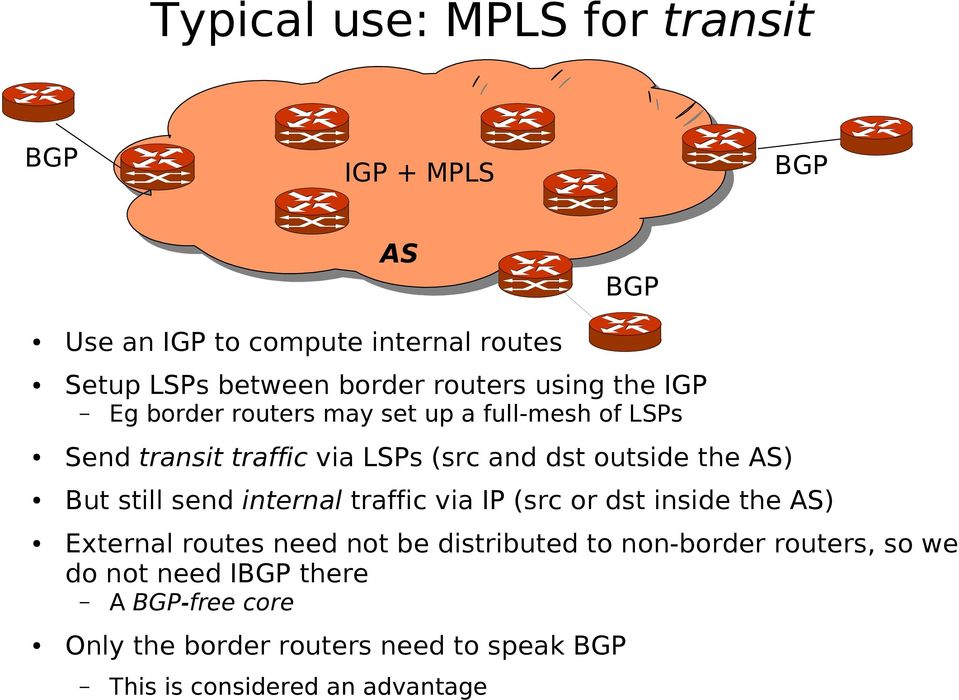
6 Typical use: MPLS for transit BGP BGP IGP + MPLS AS BGP Use an IGP to compute internal routes Setup LSPs between border routers using the IGP Eg border routers may set up a full-mesh of LSPs Send transit traffic via LSPs (src and dst outside the AS) But still send internal traffic via IP (src or dst inside the AS) External routes need not be distributed to non-border routers, so we do not need IBGP there A BGP-free core Only the border routers need to speak BGP This is considered an advantage
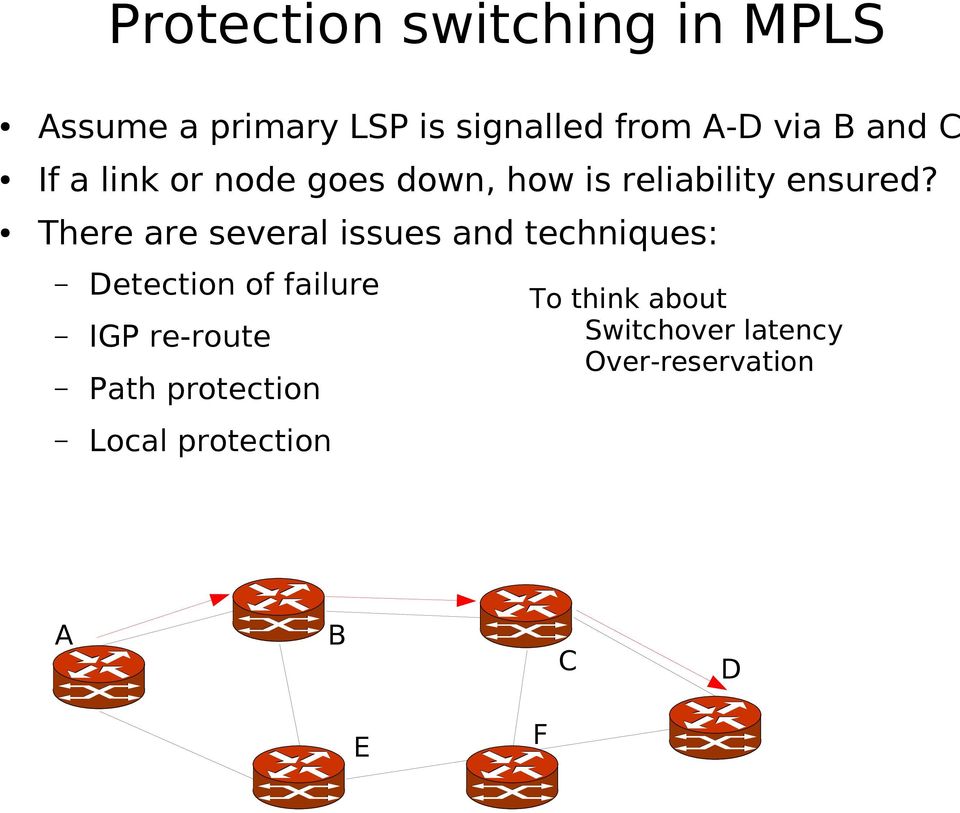
7 Protection switching in MPLS Assume a primary LSP is signalled from A-D via B and C If a link or node goes down, how is reliability ensured? There are several issues and techniques: Detection of failure IGP re-route Path protection Local protection A To think about Switchover latency Over-reservation B C E F D
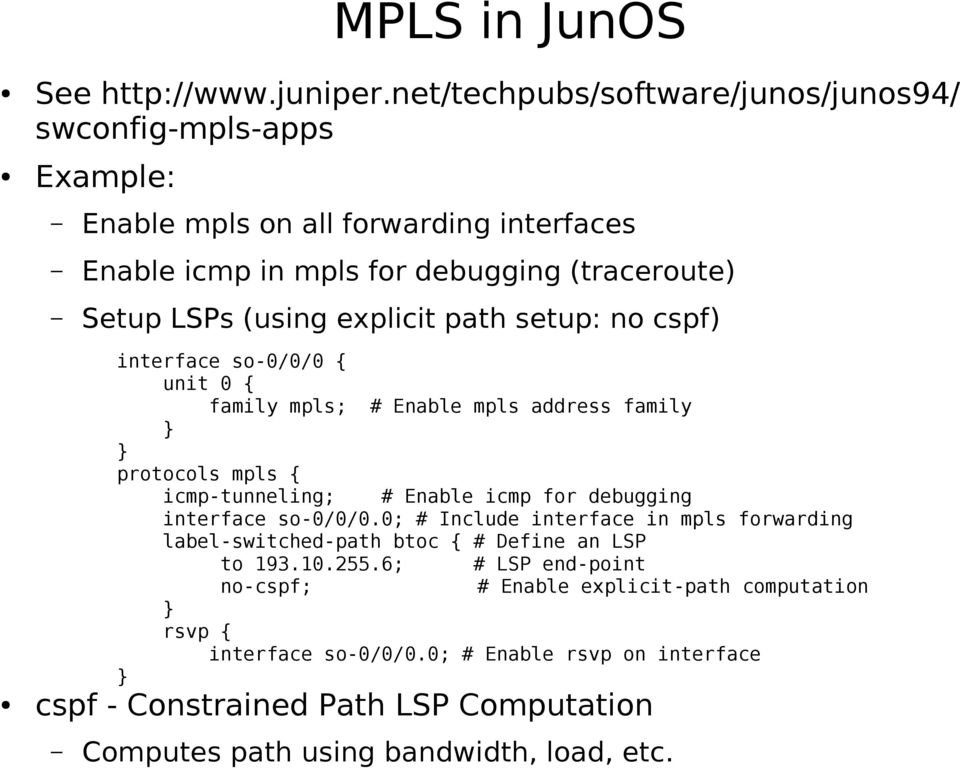
8 MPLS in JunOS See swconfig-mpls-apps Example: Enable mpls on all forwarding interfaces Enable icmp in mpls for debugging (traceroute) Setup LSPs (using explicit path setup: no cspf) interface so-0/0/0 { unit 0 { family mpls; # Enable mpls address family } } protocols mpls { icmp-tunneling; # Enable icmp for debugging interface so-0/0/0.0; # Include interface in mpls forwarding label-switched-path btoc { # Define an LSP to ; # LSP end-point no-cspf; # Enable explicit-path computation } rsvp { interface so-0/0/0.0; # Enable rsvp on interface } cspf - Constrained Path LSP Computation Computes path using bandwidth, load, etc.
9 Motivation to VPNs Companies and organizations wish to connect their local offices, personel working from their home or while travelling. Leased lines are expensive, it makes sense to use IP / the Internet.

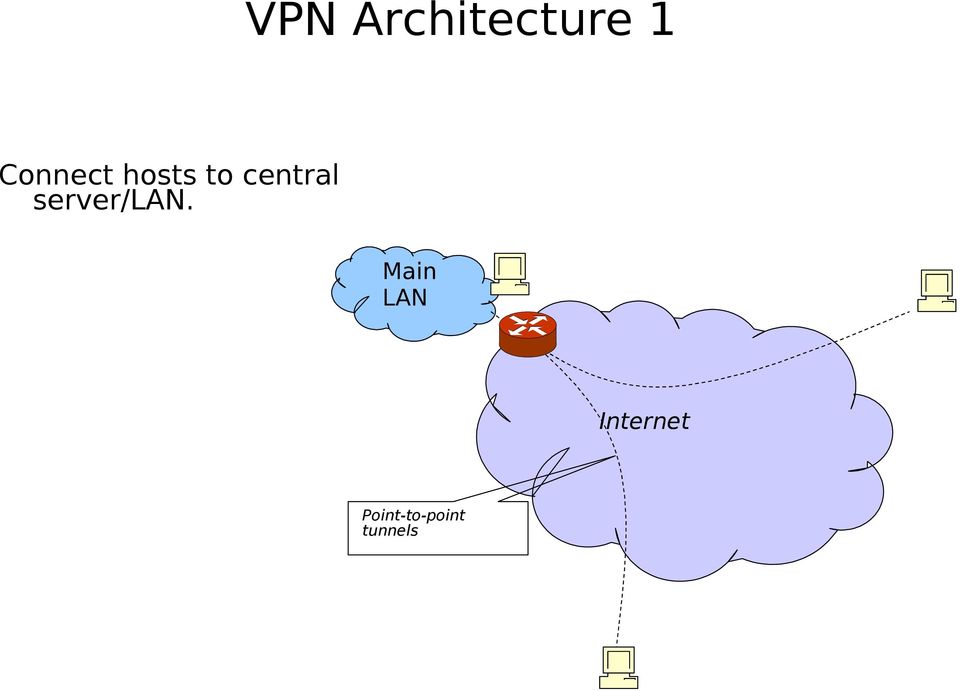
10 VPN Architecture 1 Connect hosts to central server/lan. Main LAN Internet Point-to-point tunnels
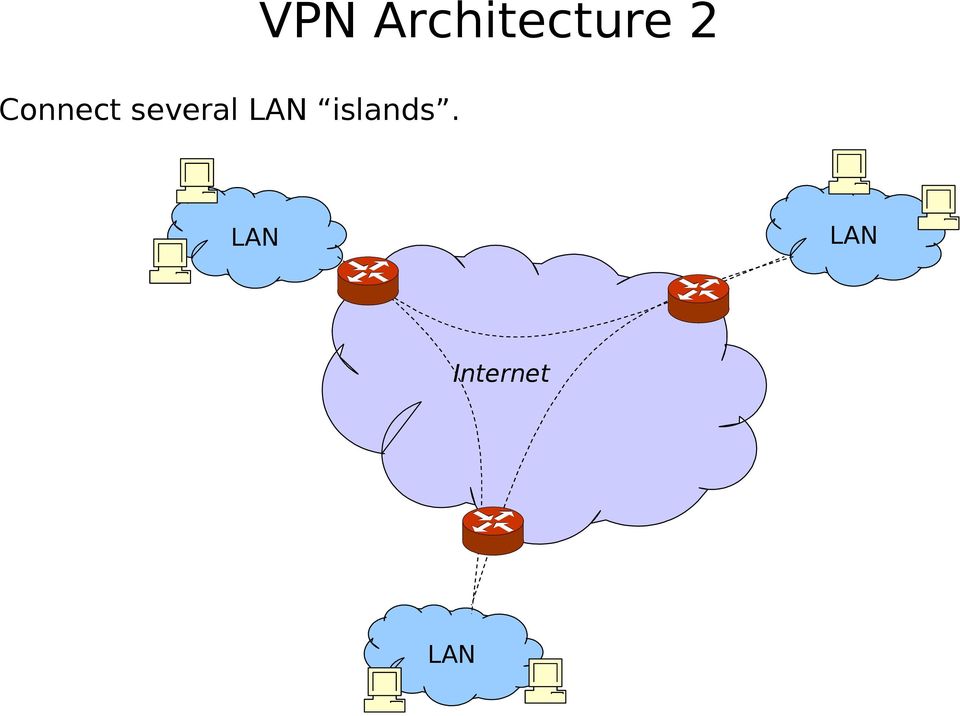
11 VPN Architecture 2 Connect several LAN islands. LAN LAN Internet LAN
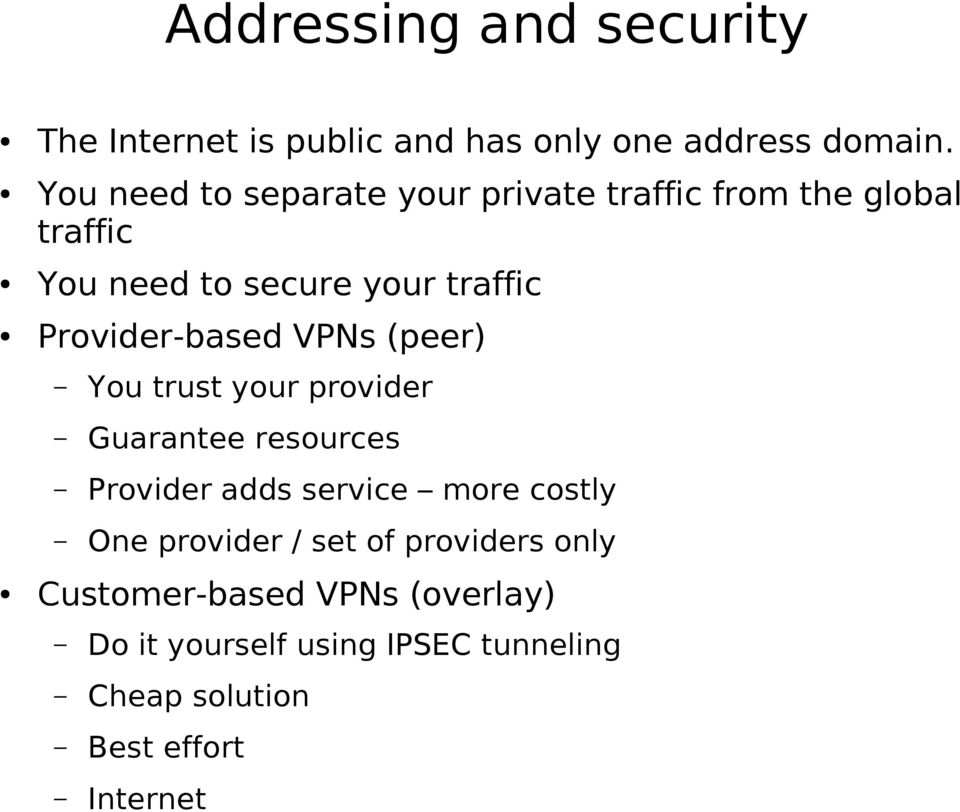
12 Addressing and security The Internet is public and has only one address domain. You need to separate your private traffic from the global traffic You need to secure your traffic Provider-based VPNs (peer) You trust your provider Guarantee resources Provider adds service more costly One provider / set of providers only Customer-based VPNs (overlay) Do it yourself using IPSEC tunneling Cheap solution Best effort Internet
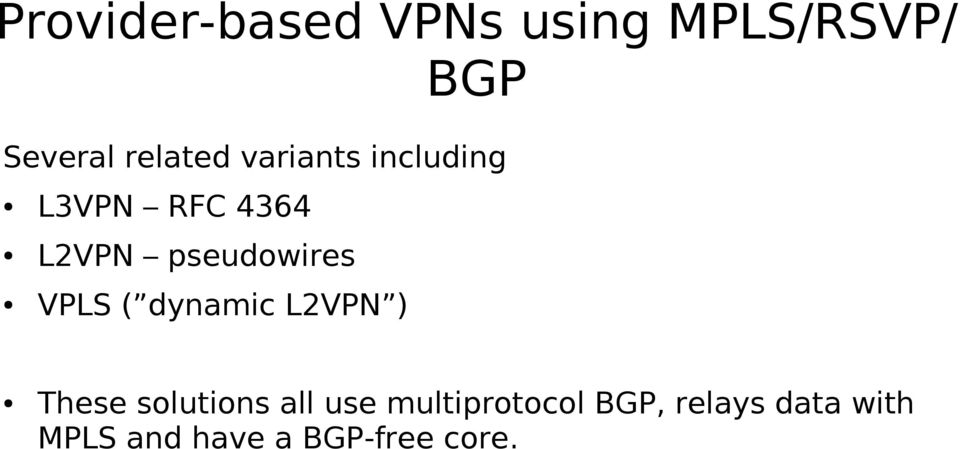
13 Provider-based VPNs using MPLS/RSVP/ BGP Several related variants including L3VPN RFC 4364 L2VPN pseudowires VPLS ( dynamic L2VPN ) These solutions all use multiprotocol BGP, relays data with MPLS and have a BGP-free core.
14 Provider-based VPNs CE - Customer Edge PE - Provider Edge (BGP) P - Provider (no BGP) More than one customer: red and blue More than two sites per customer CE is either router or L2 device CE CE PE PE CE P P CE CE PE PE

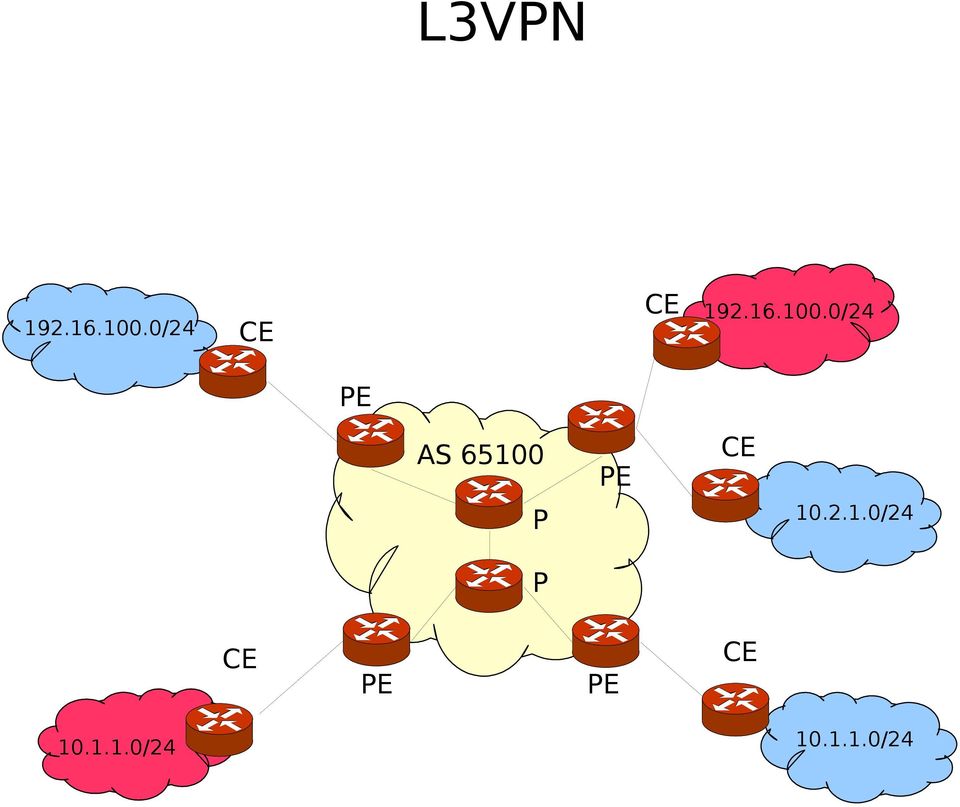
15 L3VPN L3VPN is a peer-type and dynamic VPN using BGP and MPLS Each customer may use the same adress space, eg 1918 addresses Each customer site is modelled as a separate AS customer interior routing runs independently at each site An address conversion scheme makes each customer VPN route unique within the provider's network Multiple routing and forwarding tables are supported on each PE separating different customer routing information BGP is used as a signalling protocol to setup VPN connections between customer sites. RSVP (or LDP) is used to setup the MPLS paths MPLS multistacking is used to keep provider's network free of customer routing information Encryption by other means, security by trusting the provider

16 L3VPN /24 CE CE /24 PE AS PE CE /24 P P CE /24 CE PE PE /24
17 View from one customer Provider network acts as a distributed router /24 AS / /24

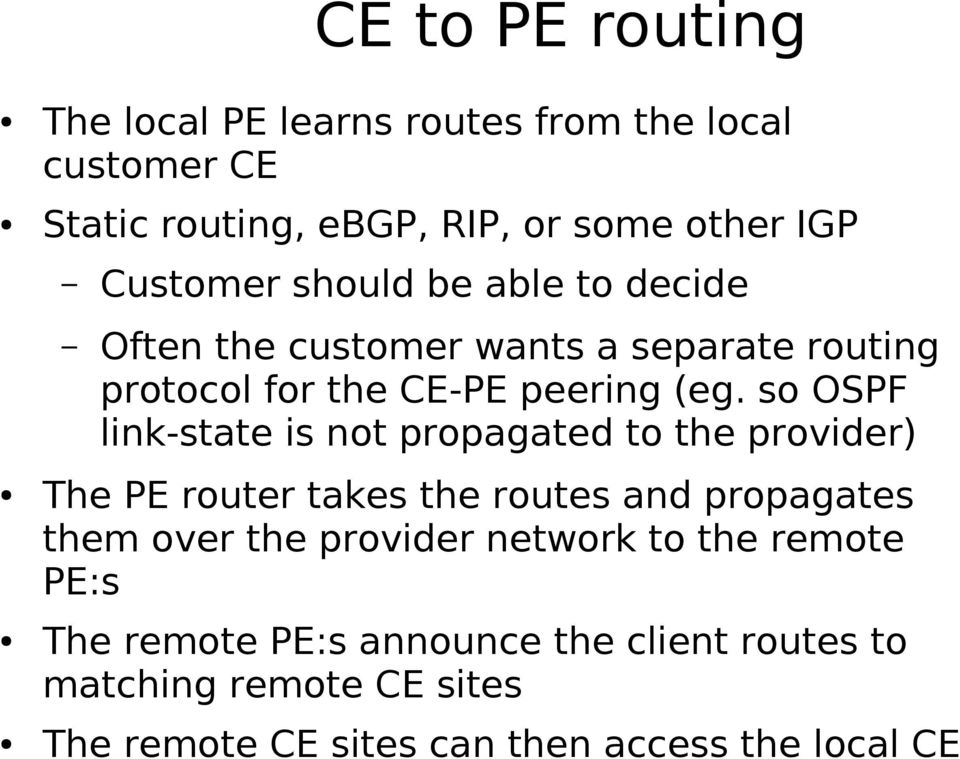
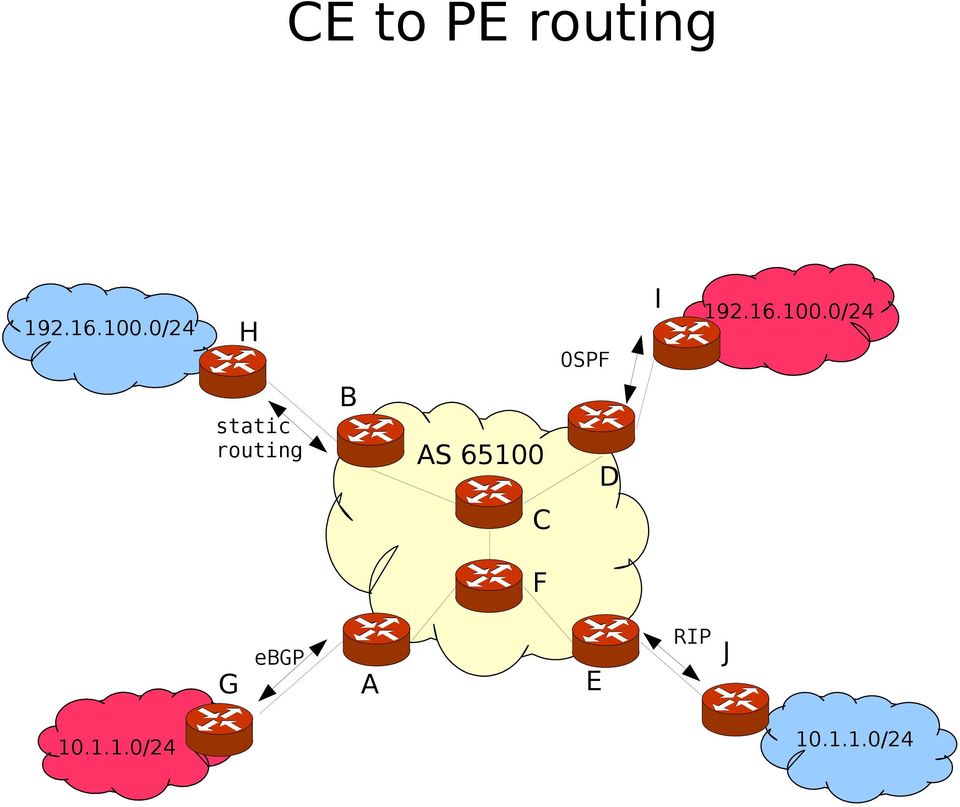
18 CE to PE routing The local PE learns routes from the local customer CE Static routing, ebgp, RIP, or some other IGP Customer should be able to decide Often the customer wants a separate routing protocol for the CE-PE peering (eg. so OSPF link-state is not propagated to the provider) The PE router takes the routes and propagates them over the provider network to the remote PE:s The remote PE:s announce the client routes to matching remote CE sites The remote CE sites can then access the local CE
19 CE to PE routing I /24 H /24 OSPF B static routing AS D C F G /24 ebgp RIP A E J /24
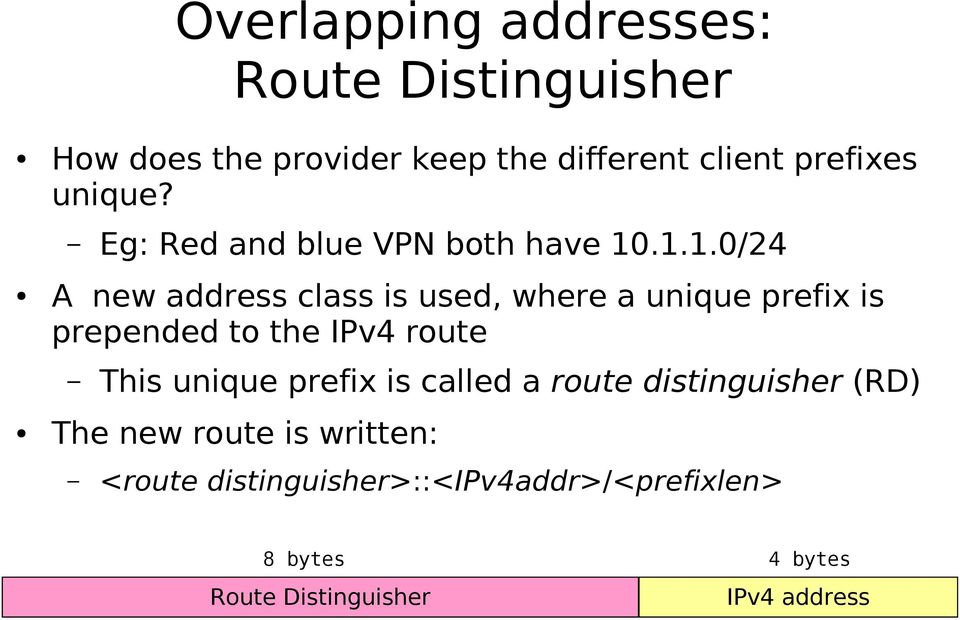
20 Overlapping addresses: Route Distinguisher How does the provider keep the different client prefixes unique? A new address class is used, where a unique prefix is prepended to the IPv4 route Eg: Red and blue VPN both have /24 This unique prefix is called a route distinguisher (RD) The new route is written: <route distinguisher>::<ipv4addr>/<prefixlen> 8 bytes Route Distinguisher 4 bytes IPv4 address
21 Route Distinguisher I T Type[Subtype] 1 byte 1 byte Data 6-7 bytes The route distinguisher has the same format as the BGP extended community (see earlier lecture) which is 8 bytes. Two variants Type 0 and Type 1 Type 0 used in the book Can be better to identify VPNs, or if many AS Type 1 used primarily in the lab Easier to see the origin of the routes 8 bytes 4 bytes Route Distinguisher 2 bytes Type 0: Type/Subtype 2 bytes Type 1: Type/Subtype 2 bytes IPv4 address 4 bytes AS# Number 4 bytes IP# IPv4 address 2 bytes Number IPv4 address
22 Route distinguisher type 0 Example: 65100:3:: /24 announced by B 65100:4:: /24 announced by D I /24 H /24 B RD: 65100:3 AS RD: 65100:4 D C F RD: 65100:2 G /24 RD: 65100:1 A E J /24
23 Route distinguisher type 1 Example: :1:: /24 announced by B You can see where the routes come from And you can see which VPN they belong to (1=blue, 2=red) I /24 H /24 B RD: :1 AS RD: :2 D C F RD: :2 G /24 RD: :1 A E J /24
24 Routing table example Example: Routing table in a PE router (prefix + nexthop) VPN-IPv4 address family (bgp.l3vpn in JunOS) :1:: /24 B :2:: /24 A :1:: /24 E :2:: /24 IPv4 address family: D
25 Operation A CE announces a prefix to a PE The PE prepends the route distinguisher and announces it to the other PE:s Eg :1:: /24 The PEs receive it, strips the route distinguisher and announces it to the local matching CE Eg /24 to B by H Eg /24 to J by E The CE network can reach /24
26 Operation: announcing prefixes /24 H 00.0 /2 4 I /24 B RD: : AS C :1 /2 :: 4F RD: :2 G /24 RD: :2 D RD: :1 A 19 J 2 E / /24
27 Virtual Routing and Forwarding - VRF A virtual router is a subset of a physical router. A virtual router has its own routing processes, routing tables, forwarding tables and its own interfaces, Typically interfaces of virtual routers are virtual (eg VLANs) The virtual routers are partitioned into several disjoint virtual routers. Similar in concept to VLANs and VLAN bridges, but in L3. Virtual Physical...
28 VRF in a PE Example: A router with two customers instances: VRF1 and VRF2. VRF table VRF1 VRF1 VRF_ main VRF2 VRF_ main Local BGP table VRF table VRF2
29 VRF Importing and exporting Local BGP Table: import :1:: / / / /24 H export :1:: /24 B RD: :1 C F E RD: :1 J /24 VRF:
30 Routing instances in JunOS Routing Instance: main RIBs Routing Instance: other RIBs inet.0 Routing protocol 3 RI B inet.0 IPv4 unicast routes inet6.0 IPv6 unicast routes inet.1 IPv4 multicast forwarding cache inet.2 IPv4 multicast RPF table IPv4 routes learnt from MPLS-TE path exploration VPN-IPv4 routes inet.3 bgp.l3vp n mpls.0 MPLS label-switch table Example: main.inet.0 juniper_private1.inet.0 Logical routers, VPNs, virtual routers, etc, use routing instances.
31 BGP signaling How does BGP carry the extended VPN-IPv4 extended adress family? By using the multiprotocol extension (see earlier lecture) MP_REACH and MP_UNREACH VPN-IPv4 is AFI= 1, SAFI = 128 The NLRI is The 12 byte route: distinguisher::ipv4 adress An MPLS forwarding label The next-hop is the CE nexthop
32 Using MPLS and RSVP Establish LSP:s between border routers Use double stacking: outer tag: LSP PE<-->PE inner tag: VPN label Internal nodes (P-nodes) are only aware of outer tags (PE to PE) With RSVP you set up the outer tag and can also traffic engineer the LSP:s outer: LSP label inner: VPN label VRF1 VRF VRF_ main VRF_ main 23 VRF2 1 VRF2
33 LSP label 20 Double push Swap F LSP label 10Pop IP: dst Route C MPLS: 10 IP: dst B MPLS: 9 MPLS: 10 IP: dst H MPLS: 8 MPLS: 10 IP: dst IP: dst Local routing table VRF Local BGP table MPLS table MPLS table Local BGP table VRF Local routing table MPLS Forwarding E J Pop+route
34 Route target We still have not described how the VPNs are constructed how PE:s know which CE:s are a part of which VPNs. The purpose of the route target (RT) extended community is to tag the VPN-IPv4 routes with this information The route target has the same format as the routedistinguisher AS#:number (type 0) IP#:number (type 1) The route target is used to color the routes In our example red and blue
35 Route target example Example: RT 65100:100 <-> blue VPN RT 65100:3 <-> red VPN Tag the routes when exporting to BGP I /24 H /24 B RD: :1 RT: 65100:100 AS D RD: :2 RT: 65100:3 C F RD: :2 RT: 65100:3 G /24 RD: :1 RT: 65100:100 A E J /24
36 Importing and exporting routes Routes are exported from the VRF to BGP And imported from BGP to the VRF Rules are defined using route targets How to export routes How to import routes Typically, every VRF has a set of import and export rules Every export rule corresponds to tagging the announced VPN-IPv4 route with a route target attribute Every import rule corresponds to matching targets with incoming route target attributes
37 Import and export Same as previous example using export and import rules This is the default policy (full mesh) and can be accomplished in JunOS without export/import using: set vrf-target target:<route target> I /24 H /24 B RD: :1 import: 65100:100 export: 65100:100 AS D C RD: :2 import: 65100:3 export: 65100:3 F RD: :2 import: 65100:3 export: 65100: /24 G A E RD: :1 import: 65100:100 export: 65100:100 J /24
38 More elaborate examples More elaborate examples (apart from full mesh) can be made by using import and export rules in various ways The book has several examples Extranets Hub-and-spoke
39 Extranet The Extranet is defined between the upper two customer sites Note that the prefixes have been changed to be unique And the route targets are unique per PE I /24 H /24 B RD: :1 import: 65100: :21 export: 65100:22 AS D C RD: :2 import: 65100: :22 export: 65100:12 F RD: :2 import: 65100:12 export: 65100: /24 G A E RD: :1 import: 65100:22 export: 65100:21 J /24
40 Hub-and-spoke VPN All traffic passes via a HUB Filtering / security purposes Note the two peerings at A I /24 H /24 B RD: :1 import: 65100:200 export: 65100:100 AS C RD: :2 export: 65100:200 F A K import: 65100:100 Filtering ibgp D RD: :2 import: 65100:200 export: 65100:100 G E RD: :1 import: 65100:200 export: 65100:100 J /24
41 Summary of protocols in L3VPN IP basic information carrier MPLS tunnels (LSPs) through the provider network RSVP or LDP label distribution to setup MPLS LSPs (outer labels) OSPF or ISIS Find shortest paths through provider network for RSVP and BGP BGP Distribition of reachability information (prefixes), VRF information and inner VPN labels CE-PE routing protocol. RIP?
42 L3VPN JunOS example protocols { bgp { local-address ; group internal { type internal; family inet-vpn unicast; neighbor ; } } } routing-instances { VRF1_BLUE { instance-type vrf; interface fe-0/0/0.0; route-distinguisher :1; vrf-target target:65100:100; vrf-table-label; protocols { bgp { group siteb { type external; peer-as 1; neighbor ; # H } } } }
43 L3VPN Summary L3VPN is a peer-type and dynamic VPN using BGP and MPLS This way of creating VPNs have quickly become popular. Easy to configure (but hard to understand) Drawback: Customer routing tables are imported into the provider's network (PE:s) Suppose each customer has its own full BGP routing table (~200K routes) The providers routing tables will explode Typical encapsulation in provider's network: MPLS MPLS IP
44 L2VPN pseudo-wire Static, multipoint overlay solution Setup point-to-point L2 connections between every site in the VPN Pseudo-wires Using MPLS/RSVP/BGP in a similar way as L3VPN L2 frames are encapsulated using IP and MPLS Can transform between different link-layers Typical encapsulation in provider's network: MPLS MPLS ETH IP
45 Customer view: Switches as CE:s Provider network acts as a set of wires. Learning and spanning tree can be made by attaching learning bridges as CE:s to create a large LAN I
46 Customer view: Routers as CE:s Routers can communicate backto-back over an L2VPN I
47 Provider view: L2VPN Access circuits between CE/PE MPLS LSPs between PEs using RSVP BGP signals L2 circuits between sites CE Site 1 PE I CE Site 2 P P PE PE Site 3 CE
48 CE-PE issues Since CE-PE communication needs to distinguish between different circuits, it is common to use virtual connections, as CE-PE circuits, such as VLANs. You assign one VLAN per wire. There are many link-layers. You need to configure which encapsulation you use. We use 'ethernet-vlan', but it is possible to use other encapsulation types and translate between them using 'translational cross-connects'
49 Configuring L2VPN Setup the backbone: ISIS, MPLS, RSVP, ibgp as before but enable 'l2vpn signaling' as bgp protocol family Setup CE-PE circuits (VLANs) Use ethernet interface with units > 0 Set RFC1918 addresses on the VLANs Setup an l2vpn routing instance: Set route distinguisher Setup Sites and setup LSPs by connecting remote sites <PE loopback>:<vpnid> Bind vlans to remote sites using vlanids Setup encapsulation 'ethernet-vlan' Set no-control-word (used for other link-layers) Setup vpn import/export rules use vrf-target
50 Configuring VLAN example CE side: fe-1/0/0 { vlan-tagging; unit 15 { vlan-id 15; family inet { address /30; } } } PE side: no IP address, configure encapsulation vlan-ccc
51 L2VPN JunOS example routing-instances { l2vpn { description "experimental L2VPN"; instance-type l2vpn; interface fe-0/0/0.512; route-distinguisher :10; vrf-target target:1000:10; protocols { l2vpn { encapsulation-type ethernet-vlan; no-control-word; site red1 { site-identifier 1; interface fe-0/0/0.512 { remote-site-id 2; } } } } } }
52 Virtual Private LAN Services (VPLS) Dynamic, multipoint peer solution VPN services for L2 (eg switched networks) Backbone over IP Interconnects a switched L2 network In VPLS an IP network works as a distributed switch MPLS is used together with BGP to create pseudo-wires between the LAN islands. VPLS: Dynamic establishment of pseudo-wires Bridging (learning) enabled STP MP-BGP is used for distributing mac adress learning Disadvantage (similar to L3VPN) Provider imports MAC learning tables into network
53 View from one customer Customer B Provider network acts as a distributed switch Provider network performs learning (and STP) Customer B Customer B
54 Lab: L3VPN and L2VPN First build a backbone Core routers are pre-configured Then configure L3VPN Finally configure L2VPN
55 LAB backbone Backbone RTC1 RTB3 RTB4 RTC2 RTB1 RTB2 RTC3 RTC4
56 L3VPN lab setup: customer view (Yellow) Provider Edge (PE) /30.2 RTD /30.2 RTA /30.2 Customer Edge (CE) RTE3
57 L2VPN lab setup: customer view (RED) /30 VLANID: / /30 VLANID: 512 VLANID: Customer Edge (CE) RTD2 RTA2 RTE2
58 LAB Netmap Backbone RTB3 RTB4 RTC1 RTC2 RTC2 RTA2 RTA3 RTC2 RTA4 RTE1 RTE2 RTE3 RTE4 L3VPN #4 L3VPN #3 L2VPN #2 L1VPN #1 L3VPN #4 L3VPN #3 RTA1 RTB2 L2VPN #2 L3VPN #3 L2VPN #2 L2VPN #1 RTD4 L2VPN #1 RTD2 RTD3 L3VPN #4 RTD1 RTB1
DD2491 p2 2011. MPLS/BGP VPNs. Olof Hagsand KTH CSC
 DD2491 p2 2011 MPLS/BGP VPNs Olof Hagsand KTH CSC 1 Literature Practical BGP: Chapter 10 MPLS repetition, see for example http://www.csc.kth.se/utbildning/kth/kurser/dd2490/ipro1-11/lectures/mpls.pdf Reference:
Introduction to MPLS-based VPNs
 Introduction to MPLS-based VPNs Ferit Yegenoglu, Ph.D. ISOCORE [email protected] Outline Introduction BGP/MPLS VPNs Network Architecture Overview Main Features of BGP/MPLS VPNs Required Protocol Extensions
DD2490 p4 2011. Routing and MPLS/IP. Olof Hagsand KTH CSC
 DD2490 p4 2011 Routing and MPLS/IP Olof Hagsand KTH CSC 1 Literature Lecture slides and lecture notes (on web) Reference JunOS Cookbook: Chapter 14 2 Background MPLS - Multiprotocol Label Switching Originally
MPLS VPN Services. PW, VPLS and BGP MPLS/IP VPNs
 A Silicon Valley Insider MPLS VPN Services PW, VPLS and BGP MPLS/IP VPNs Technology White Paper Serge-Paul Carrasco Abstract Organizations have been demanding virtual private networks (VPNs) instead of
Junos MPLS and VPNs (JMV)
 Junos MPLS and VPNs (JMV) Course No: EDU-JUN-JMV Length: Five days Onsite Price: $32500 for up to 12 students Public Enrollment Price: $3500/student Course Level JMV is an advanced-level course. Prerequisites
MP PLS VPN MPLS VPN. Prepared by Eng. Hussein M. Harb
 MP PLS VPN MPLS VPN Prepared by Eng. Hussein M. Harb Agenda MP PLS VPN Why VPN VPN Definition VPN Categories VPN Implementations VPN Models MPLS VPN Types L3 MPLS VPN L2 MPLS VPN Why VPN? VPNs were developed
Expert Reference Series of White Papers. An Overview of MPLS VPNs: Overlay; Layer 3; and PseudoWire
 Expert Reference Series of White Papers An Overview of MPLS VPNs: Overlay; Layer 3; and PseudoWire 1-800-COURSES www.globalknowledge.com An Overview of MPLS VPNs: Overlay; Layer 3; and PseudoWire Al Friebe,
IP/MPLS-Based VPNs Layer-3 vs. Layer-2
 Table of Contents 1. Objective... 3 2. Target Audience... 3 3. Pre-Requisites... 3 4. Introduction...3 5. MPLS Layer-3 VPNs... 4 6. MPLS Layer-2 VPNs... 7 6.1. Point-to-Point Connectivity... 8 6.2. Multi-Point
Computer Network Architectures and Multimedia. Guy Leduc. Chapter 2 MPLS networks. Chapter 2: MPLS
 Computer Network Architectures and Multimedia Guy Leduc Chapter 2 MPLS networks Chapter based on Section 5.5 of Computer Networking: A Top Down Approach, 6 th edition. Jim Kurose, Keith Ross Addison-Wesley,
Introducing Basic MPLS Concepts
 Module 1-1 Introducing Basic MPLS Concepts 2004 Cisco Systems, Inc. All rights reserved. 1-1 Drawbacks of Traditional IP Routing Routing protocols are used to distribute Layer 3 routing information. Forwarding
RFC 2547bis: BGP/MPLS VPN Fundamentals
 White Paper RFC 2547bis: BGP/MPLS VPN Fundamentals Chuck Semeria Marketing Engineer Juniper Networks, Inc. 1194 North Mathilda Avenue Sunnyvale, CA 94089 USA 408 745 2001 or 888 JUNIPER www.juniper.net
MPLS L2VPN (VLL) Technology White Paper
 MPLS L2VPN (VLL) Technology White Paper Issue 1.0 Date 2012-10-30 HUAWEI TECHNOLOGIES CO., LTD. 2012. All rights reserved. No part of this document may be reproduced or transmitted in any form or by any
MPLS-based Virtual Private Network (MPLS VPN) The VPN usually belongs to one company and has several sites interconnected across the common service
 Nowdays, most network engineers/specialists consider MPLS (MultiProtocol Label Switching) one of the most promising transport technologies. Then, what is MPLS? Multi Protocol Label Switching (MPLS) is
How Routers Forward Packets
 Autumn 2010 [email protected] MULTIPROTOCOL LABEL SWITCHING (MPLS) AND MPLS VPNS How Routers Forward Packets Process switching Hardly ever used today Router lookinginside the packet, at the ipaddress,
MikroTik RouterOS Introduction to MPLS. Prague MUM Czech Republic 2009
 MikroTik RouterOS Introduction to MPLS Prague MUM Czech Republic 2009 Q : W h y h a v e n 't y o u h e a r d a b o u t M P LS b e fo re? A: Probably because of the availability and/or price range Q : W
For internal circulation of BSNLonly
 E3-E4 E4 E&WS Overview of MPLS-VPN Overview Traditional Router-Based Networks Virtual Private Networks VPN Terminology MPLS VPN Architecture MPLS VPN Routing MPLS VPN Label Propagation Traditional Router-Based
How To Make A Network Secure
 1 2 3 4 -Lower yellow line is graduate student enrollment -Red line is undergradate enrollment -Green line is total enrollment -2008 numbers are projected to be near 20,000 (on-campus) not including distance
PRASAD ATHUKURI Sreekavitha engineering info technology,kammam
 Multiprotocol Label Switching Layer 3 Virtual Private Networks with Open ShortestPath First protocol PRASAD ATHUKURI Sreekavitha engineering info technology,kammam Abstract This paper aims at implementing
Kingston University London
 Kingston University London Thesis Title Implementation and performance evaluation of WAN services over MPLS Layer-3 VPN Dissertation submitted for the Degree of Master of Science in Networking and Data
How To Understand The Benefits Of An Mpls Network
 NETWORKS NetIron XMR 16000 NETWORKS NetIron XMR 16000 NETWORKS NetIron XMR 16000 Introduction MPLS in the Enterprise Multi-Protocol Label Switching (MPLS) as a technology has been around for over a decade
MPLS VPN over mgre. Finding Feature Information. Prerequisites for MPLS VPN over mgre
 The feature overcomes the requirement that a carrier support multiprotocol label switching (MPLS) by allowing you to provide MPLS connectivity between networks that are connected by IP-only networks. This
Implementing MPLS VPN in Provider's IP Backbone Luyuan Fang [email protected] AT&T
 Implementing MPLS VPN in Provider's IP Backbone Luyuan Fang [email protected] AT&T 1 Outline! BGP/MPLS VPN (RFC 2547bis)! Setting up LSP for VPN - Design Alternative Studies! Interworking of LDP / RSVP
IPv6 over IPv4/MPLS Networks: The 6PE approach
 IPv6 over IPv4/MPLS Networks: The 6PE approach Athanassios Liakopoulos Network Operation & Support Manager ([email protected]) Greek Research & Technology Network (GRNET) III Global IPv6 Summit Moscow, 25
MPLS Virtual Private Networks
 MPLS Virtual Private Networks Luca Cittadini Giuseppe Di Battista Maurizio Patrignani Summary This chapter is devoted to Virtual Private Networks (VPNs) designed with Multi Protocol Label Switching (MPLS)
UNDERSTANDING JUNOS OS NEXT-GENERATION MULTICAST VPNS
 WHITE PAPER UNDERSTANDING JUNOS OS NEXT-GENERATION MULTICAST VPNS Copyright 2010, Juniper Networks, Inc. 1 Table of Contents Executive Summary.............................................................................................
Enterprise Network Simulation Using MPLS- BGP
 Enterprise Network Simulation Using MPLS- BGP Tina Satra 1 and Smita Jangale 2 1 Department of Computer Engineering, SAKEC, Chembur, Mumbai-88, India [email protected] 2 Department of Information Technolgy,
MPLS Concepts. Overview. Objectives
 MPLS Concepts Overview This module explains the features of Multi-protocol Label Switching (MPLS) compared to traditional ATM and hop-by-hop IP routing. MPLS concepts and terminology as well as MPLS label
Analyzing Capabilities of Commercial and Open-Source Routers to Implement Atomic BGP
 Telfor Journal, Vol. 2, No. 1, 2010. 13 Analyzing Capabilities of Commercial and Open-Source Routers to Implement Atomic BGP Aleksandar Cvjetić and Aleksandra Smiljanić Abstract The paper analyzes implementations
Introduction Inter-AS L3VPN
 Introduction Inter-AS L3VPN 1 Extending VPN services over Inter-AS networks VPN Sites attached to different MPLS VPN Service Providers How do you distribute and share VPN routes between ASs Back- to- Back
Quidway MPLS VPN Solution for Financial Networks
 Quidway MPLS VPN Solution for Financial Networks Using a uniform computer network to provide various value-added services is a new trend of the application systems of large banks. Transplanting traditional
VPLS Technology White Paper HUAWEI TECHNOLOGIES CO., LTD. Issue 01. Date 2012-10-30
 Issue 01 Date 2012-10-30 HUAWEI TECHNOLOGIES CO., LTD. 2012. All rights reserved. No part of this document may be reproduced or transmitted in any form or by any means without prior written consent of
MPLS Implementation MPLS VPN
 MPLS Implementation MPLS VPN Describing MPLS VPN Technology Objectives Describe VPN implementation models. Compare and contrast VPN overlay VPN models. Describe the benefits and disadvantages of the overlay
Virtual Private Networks. Juha Heinänen [email protected] Song Networks
 Virtual Private Networks Juha Heinänen [email protected] Song Networks What is an IP VPN? an emulation of private (wide area) network facility using provider IP facilities provides permanent connectivity between
Tackling the Challenges of MPLS VPN Testing. Todd Law Product Manager Advanced Networks Division
 Tackling the Challenges of MPLS VPN ing Todd Law Product Manager Advanced Networks Division Agenda Background Why test MPLS VPNs anyway? ing Issues Technical Complexity and Service Provider challenges
Cisco 642-889. Implementing Cisco Service Provider Next-Generation Egde Network Services. Version: 4.1
 Cisco 642-889 Implementing Cisco Service Provider Next-Generation Egde Network Services Version: 4.1 QUESTION NO: 1 Cisco 642-889 Exam Which type of VPN requires a full mesh of virtual circuits to provide
Design of Virtual Private Networks with MPLS
 Design of Virtual Private Networks with MPLS Luca Cittadini Giuseppe Di Battista Maurizio Patrignani Summary This chapter is devoted to Virtual Private Networks(VPNs) designed with Multi Protocol Label
IMPLEMENTING CISCO MPLS V3.0 (MPLS)
 IMPLEMENTING CISCO MPLS V3.0 (MPLS) COURSE OVERVIEW: Multiprotocol Label Switching integrates the performance and traffic-management capabilities of data link Layer 2 with the scalability and flexibility
Implementing MPLS VPNs over IP Tunnels on Cisco IOS XR Software
 Implementing MPLS VPNs over IP Tunnels on Cisco IOS XR Software The MPLS VPNs over IP Tunnels feature lets you deploy Layer 3 Virtual Private Netwk (L3VPN) services, over an IP ce netwk, using L2TPv3 multipoint
Fundamentals Multiprotocol Label Switching MPLS III
 Fundamentals Multiprotocol Label Switching MPLS III Design of Telecommunication Infrastructures 2008-2009 Rafael Sebastian Departament de tecnologies de la Informació i les Comunicaciones Universitat Pompeu
Implementing Cisco MPLS
 Implementing Cisco MPLS Course MPLS v2.3; 5 Days, Instructor-led Course Description This design document is for the refresh of the Implementing Cisco MPLS (MPLS) v2.3 instructor-led training (ILT) course,
Department of Communications and Networking. S-38.2131/3133 Networking Technology, Laboratory course A/B
 Department of Communications and Networking S-38.2131/3133 Networking Technology, Laboratory course A/B Work Number 38: MPLS-VPN Basics Student Edition Preliminary Exercises and Laboratory Assignments
MPLS multi-domain services MD-VPN service
 MPLS multi-domain services MD-VPN service Xavier Jeannin, RENATER Tomasz Szewczyk / PSNC Training and Workshops for advancing NRENs 8-11 Sept 2014 Chisinau, Moldova MPLS brief overview Original purpose:
MPLS-based Layer 3 VPNs
 MPLS-based Layer 3 VPNs Overall objective The purpose of this lab is to study Layer 3 Virtual Private Networks (L3VPNs) created using MPLS and BGP. A VPN is an extension of a private network that uses
- Multiprotocol Label Switching -
 1 - Multiprotocol Label Switching - Multiprotocol Label Switching Multiprotocol Label Switching (MPLS) is a Layer-2 switching technology. MPLS-enabled routers apply numerical labels to packets, and can
IMPLEMENTING CISCO MPLS V2.3 (MPLS)
 IMPLEMENTING CISCO MPLS V2.3 (MPLS) COURSE OVERVIEW: The course will enable learners to gather information from the technology basics to advanced VPN configuration. The focus of the course is on VPN technology
Examination. IP routning på Internet och andra sammansatta nät, DD2491 IP routing in the Internet and other complex networks, DD2491
 Examination IP routning på Internet och andra sammansatta nät, DD2491 IP routing in the Internet and other complex networks, DD2491 Date: December 15 2009 14:00 18:00 1. No help material is allowed - You
Virtual Private LAN Service on Cisco Catalyst 6500/6800 Supervisor Engine 2T
 White Paper Virtual Private LAN Service on Cisco Catalyst 6500/6800 Supervisor Engine 2T Introduction to Virtual Private LAN Service The Cisco Catalyst 6500/6800 Series Supervisor Engine 2T supports virtual
Implementing Cisco Service Provider Next-Generation Edge Network Services **Part of the CCNP Service Provider track**
 Course: Duration: Price: $ 3,695.00 Learning Credits: 37 Certification: Implementing Cisco Service Provider Next-Generation Edge Network Services Implementing Cisco Service Provider Next-Generation Edge
Configuring MPLS Hub-and-Spoke Layer 3 VPNs
 CHAPTER 23 This chapter describes how to configure a hub-and-spoke topology for Multiprotocol Layer Switching (MPLS) Layer 3 virtual private networks (VPNs) on Cisco NX-OS devices. This chapter includes
MPLS VPN Implementation
 MPLS VPN Implementation Overview Virtual Routing and Forwarding Table VPN-Aware Routing Protocols VRF Configuration Tasks Configuring BGP Address families Configuring BGP Neighbors Configuring MP-BGP Monitoring
MPLS VPN. Agenda. MP-BGP VPN Overview MPLS VPN Architecture MPLS VPN Basic VPNs MPLS VPN Complex VPNs MPLS VPN Configuration (Cisco) L86 - MPLS VPN
 MPLS VPN Peer to Peer VPN s Agenda MP-BGP VPN Overview MPLS VPN Architecture MPLS VPN Basic VPNs MPLS VPN Complex VPNs MPLS VPN Configuration (Cisco) CE-PE OSPF Routing CE-PE Static Routing CE-PE RIP Routing
Table of Contents. Cisco Configuring a Basic MPLS VPN
 Table of Contents Configuring a Basic MPLS VPN...1 Introduction...1 Prerequisites...1 Requirements...1 Components Used...2 Related Products...2 Conventions...2 Configure...3 Network Diagram...3 Configuration
Overlay Networks and Tunneling Reading: 4.5, 9.4
 Overlay Networks and Tunneling Reading: 4.5, 9.4 COS 461: Computer Networks Spring 2009 (MW 1:30 2:50 in COS 105) Mike Freedman Teaching Assistants: WyaN Lloyd and Jeff Terrace hnp://www.cs.princeton.edu/courses/archive/spring09/cos461/
White Paper. Cisco MPLS based VPNs: Equivalent to the security of Frame Relay and ATM. March 30, 2001
 The leading edge in networking information White Paper Cisco MPLS based VPNs: Equivalent to the security of Frame Relay and ATM March 30, 2001 Abstract: The purpose of this white paper is to present discussion
VPN Technologies A Comparison
 VPN Technologies A Comparison Matthew Finlayson, [email protected] Jon Harrison, [email protected] Richard Sugarman, [email protected] First issued February 2003 100
Designing and Developing Scalable IP Networks
 Designing and Developing Scalable IP Networks Guy Davies Telindus, UK John Wiley & Sons, Ltd Contents List of Figures List of Tables About the Author Acknowledgements Abbreviations Introduction xi xiii
MPLS over IP-Tunnels. Mark Townsley Distinguished Engineer. 21 February 2005
 MPLS over IP-Tunnels Mark Townsley Distinguished Engineer 21 February 2005 1 MPLS over IP The Basic Idea MPLS Tunnel Label Exp S TTL MPLS VPN Label Exp S TTL MPLS Payload (L3VPN, PWE3, etc) MPLS Tunnel
Implementing MPLS VPNs over IP Tunnels
 Implementing MPLS VPNs over IP Tunnels The MPLS VPNs over IP Tunnels feature lets you deploy Layer 3 Virtual Private Netwk (L3VPN) services, over an IP ce netwk, using L2TPv3 multipoint tunneling instead
S-38.3192 ITGuru Exercise (3: Building the MPLS BGP VPN) Spring 2006
 S-38.3192 ITGuru Exercise (3: Building the MPLS BGP VPN) Spring 2006 Original version: Johanna Nieminen and Timo Viipuri (2005) Modified: Timo-Pekka Heikkinen, Juha Järvinen and Yavor Ivanov (2006) Task
Design of MPLS networks VPN and TE with testing its resiliency and reliability
 MASARYK UNIVERSITY FACULTY OF INFORMATICS Design of MPLS networks VPN and TE with testing its resiliency and reliability Diploma thesis Michal Aron Brno, spring 2014 ZADANIE DP Declaration I declare
l.cittadini, m.cola, g.di battista
 MPLS VPN l.cittadini, m.cola, g.di battista motivations customer s problem a customer (e.g., private company, public administration, etc.) has several geographically distributed sites and would like to
IPv6 over MPLS VPN. Contents. Prerequisites. Document ID: 112085. Requirements
 IPv6 over MPLS VPN Document ID: 112085 Contents Introduction Prerequisites Requirements Components Used Conventions Configure Network Diagram VRF Configuration Multiprotocol BGP (MP BGP) Configuration
CS419: Computer Networks. Lecture 9: Mar 30, 2005 VPNs
 : Computer Networks Lecture 9: Mar 30, 2005 VPNs VPN Taxonomy VPN Client Network Provider-based Customer-based Provider-based Customer-based Compulsory Voluntary L2 L3 Secure Non-secure ATM Frame Relay
Data Networking and Architecture. Delegates should have some basic knowledge of Internet Protocol and Data Networking principles.
 Data Networking and Architecture The course focuses on theoretical principles and practical implementation of selected Data Networking protocols and standards. Physical network architecture is described
Virtual Private LAN Service
 Virtual Private LAN Service Authors Kireeti Kompella, Juniper Networks, 1194 N Mathilda Avenue, Sunnyvale, CA 94089, USA E-mail : [email protected] Jean-Marc Uzé, Juniper Networks, Espace 21, 31 Place
Transition to IPv6 in Service Providers
 Transition to IPv6 in Service Providers Jean-Marc Uzé Director Product & Technology, EMEA [email protected] UKNOF14 Workshop Imperial college, London, Sept 11 th, 2009 1 Agenda Planning Transition Transition
Notice the router names, as these are often used in MPLS terminology. The Customer Edge router a router that directly connects to a customer network.
 Where MPLS part I explains the basics of labeling packets, it s not giving any advantage over normal routing, apart from faster table lookups. But extensions to MPLS allow for more. In this article I ll
OVERLAYING VIRTUALIZED LAYER 2 NETWORKS OVER LAYER 3 NETWORKS
 OVERLAYING VIRTUALIZED LAYER 2 NETWORKS OVER LAYER 3 NETWORKS Matt Eclavea ([email protected]) Senior Solutions Architect, Brocade Communications Inc. Jim Allen ([email protected]) Senior Architect, Limelight
MPLS VPN Route Target Rewrite
 The feature allows the replacement of route targets on incoming and outgoing Border Gateway Protocol (BGP) updates Typically, Autonomous System Border Routers (ASBRs) perform the replacement of route targets
Network Virtualization with the Cisco Catalyst 6500/6800 Supervisor Engine 2T
 White Paper Network Virtualization with the Cisco Catalyst 6500/6800 Supervisor Engine 2T Introduction Network virtualization is a cost-efficient way to provide traffic separation. A virtualized network
SBSCET, Firozpur (Punjab), India
 Volume 3, Issue 9, September 2013 ISSN: 2277 128X International Journal of Advanced Research in Computer Science and Software Engineering Research Paper Available online at: www.ijarcsse.com Layer Based
Demonstrating the high performance and feature richness of the compact MX Series
 WHITE PAPER Midrange MX Series 3D Universal Edge Routers Evaluation Report Demonstrating the high performance and feature richness of the compact MX Series Copyright 2011, Juniper Networks, Inc. 1 Table
MPLS/BGP Network Simulation Techniques for Business Enterprise Networks
 MPLS/BGP Network Simulation Techniques for Business Enterprise Networks Nagaselvam M Computer Science and Engineering, Nehru Institute of Technology, Coimbatore, Abstract Business Enterprises used VSAT
ISTANBUL. 1.1 MPLS overview. Alcatel Certified Business Network Specialist Part 2
 1 ISTANBUL 1.1 MPLS overview 1 1.1.1 Principle Use of a ATM core network 2 Overlay Network One Virtual Circuit per communication No routing protocol Scalability problem 2 1.1.1 Principle Weakness of overlay
Internetworking II: VPNs, MPLS, and Traffic Engineering
 Internetworking II: VPNs, MPLS, and Traffic Engineering 3035/GZ01 Networked Systems Kyle Jamieson Lecture 10 Department of Computer Science University College London Taxonomy of communica@on networks Virtual
AMPLS - Advanced Implementing and Troubleshooting MPLS VPN Networks v4.0
 Course Outline AMPLS - Advanced Implementing and Troubleshooting MPLS VPN Networks v4.0 Module 1: MPLS Features Lesson 1: Describing Basic MPLS Concepts Provide an overview of MPLS forwarding, features,
Network Configuration Example
 Network Configuration Example Configuring Branch SRX Series for MPLS over IPsec (1500-byte MTU) Published: 2014-12-17 Juniper Networks, Inc. 1194 North Mathilda Avenue Sunnyvale, California 94089 USA 408-745-2000
Protection Methods in Traffic Engineering MPLS Networks
 Peter Njogu Kimani Protection Methods in Traffic Engineering MPLS Networks Helsinki Metropolia University of Applied Sciences Bachelor of Engineering Information technology Thesis 16 th May 2013 Abstract
INTRODUCTION TO L2VPNS
 INTRODUCTION TO L2VPNS 4 Introduction to Layer 2 and Layer 3 VPN Services CE Layer 3 VPN Link Comprised of IP Traffic Passed Over IP Backbone LEGEND Layer 3 VPN Layer 2 VPN CE CE PE IP Backbone PE CE Layer
AT&T Managed IP Network Service (MIPNS) MPLS Private Network Transport Technical Configuration Guide Version 1.0
 AT&T Managed IP Network Service (MIPNS) MPLS Private Network Transport Technical Configuration Guide Version 1.0 Introduction...2 Overview...2 1. Technology Background...2 2. MPLS PNT Offer Models...3
ICTTEN6172A Design and configure an IP- MPLS network with virtual private network tunnelling
 ICTTEN6172A Design and configure an IP- MPLS network with virtual private network tunnelling Release: 1 ICTTEN6172A Design and configure an IP-MPLS network with virtual private network tunnelling Modification
Testing Edge Services: VPLS over MPLS
 Testing Edge Services: VPLS over MPLS White Paper Introduction Virtual Private LAN Services (VPLS) is an emerging technology for transparently connecting corporate LANs over the Internet so they appear
MPLS Security Considerations
 MPLS Security Considerations Monique J. Morrow, Cisco Systems [email protected] November 1 2004 MPLS JAPAN 2004 1 Acknowledgments Michael Behringer, Cisco Systems 2 Why is MPLS Security Important? Customer
WAN Topologies MPLS. 2006, Cisco Systems, Inc. All rights reserved. Presentation_ID.scr. 2006 Cisco Systems, Inc. All rights reserved.
 MPLS WAN Topologies 1 Multiprotocol Label Switching (MPLS) IETF standard, RFC3031 Basic idea was to combine IP routing protocols with a forwarding algoritm based on a header with fixed length label instead
MPLS VPN Security BRKSEC-2145
 MPLS VPN Security BRKSEC-2145 Session Objective Learn how to secure networks which run MPLS VPNs. 100% network focus! Securing routers & the whole network against DoS and abuse Not discussed: Security
Leveraging Advanced Load Sharing for Scaling Capacity to 100 Gbps and Beyond
 Leveraging Advanced Load Sharing for Scaling Capacity to 100 Gbps and Beyond Ananda Rajagopal Product Line Manager Service Provider Solutions Foundry Networks [email protected] Agenda 2 Why Load
MPLS L3 VPN Supporting VoIP, Multicast, and Inter-Provider Solutions
 MPLS L3 VPN Supporting VoIP, Multicast, and Inter-Provider Solutions Luyuan Fang ATT MPLSCon 2005, NYC The world s networking company SM Outline Overview of the L3 VPN deployment VoIP over MPLS VPN MPLS
Why Do IPv6 over MPLS?
 IPv6 and IPv6 VPN services over MPLS Quality Excellence for Suppliers of Telecommunications TL 9000 Certified Mark Williams [email protected] 1 Why Do IPv6 over MPLS? IPv6 Layer 3 VPN Maybe have connecting
Implementing VPN over MPLS
 IOSR Journal of Electronics and Communication Engineering (IOSR-JECE) e-issn: 2278-2834,p- ISSN: 2278-8735.Volume 10, Issue 3, Ver. I (May - Jun.2015), PP 48-53 www.iosrjournals.org Implementing VPN over
MPLS in Private Networks Is It a Good Idea?
 MPLS in Private Networks Is It a Good Idea? Jim Metzler Vice President Ashton, Metzler & Associates March 2005 Introduction The wide area network (WAN) brings indisputable value to organizations of all
Addressing Inter Provider Connections With MPLS-ICI
 Addressing Inter Provider Connections With MPLS-ICI Introduction Why migrate to packet switched MPLS? The migration away from traditional multiple packet overlay networks towards a converged packet-switched
L2 VPNs. Pseudowires. Virtual Private LAN Services. Metro/Carrier Ethernet.
 L2 VPNs. Pseudowires. Virtual Private LAN Services. Metro/Carrier Ethernet. Petr Grygárek rek 1 Layer 2 VPNs 2 Usages of L2 VPNs Server farms/clusters and other L2- dependent applications redundancy and
BUILDING MPLS-BASED MULTICAST VPN SOLUTION. DENOG3 Meeting, 20.10.2011/Frankfurt Carsten Michel
 BUILDING MPLS-BASED MULTICAST VPN SOLUTION DENOG3 Meeting, 20.10.2011/Frankfurt Carsten Michel Agenda Multicast VPN (mvpn) Overview L3VPN Multicast Solution using PIM/GRE (Draft-Rosen) MPLS Multicast Building
ETHERNET VPN (EVPN) NEXT-GENERATION VPN FOR ETHERNET SERVICES
 ETHERNET VPN (EVPN) NEXT-GENERATION VPN FOR ETHERNET SERVICES Alastair JOHNSON (AJ) February 2014 [email protected] AGENDA 1. EVPN Background and Motivation 2. EVPN Operations 3. EVPN
Migrating to MPLS Technology and Applications
 Migrating to MPLS Technology and Applications Serge-Paul Carrasco June 2003 asiliconvalleyinsider.com Table Of Content Why to migrate to MPLS? Congestion on the Internet Traffic Engineering MPLS Fundamentals
Glossary. 7750 SR Advanced Configuration Guide Page 2785
 Glossary 6PE IPv6 Provider Edge router. An MPLS IPv4 core network that supports IPv6 domains which communicate over an IES service. 6VPE IPv6 Provider Edge router with IP-VPN Services. An MPLS IPv4 core
APNIC elearning: Introduction to MPLS
 2/5/5 ANIC elearning: Introduction to MLS 3 MAY 25 3: M AEST Brisbane (UTC+) Issue Date: Revision: Introduction resenter Sheryl Hermoso Training Officer [email protected] Specialties: Network Security DNS/DNSSEC
MPLS Layer 2 VPNs Functional and Performance Testing Sample Test Plans
 MPLS Layer 2 VPNs Functional and Performance Testing Sample Test Plans Contents Overview 1 1. L2 VPN Padding Verification Test 1 1.1 Objective 1 1.2 Setup 1 1.3 Input Parameters 2 1.4 Methodology 2 1.5