
Proposal Writing in a Nutshell
|
|
|
- Anissa Russell
- 10 years ago
- Views:
Transcription
1 Proposal Writing in a Nutshell Context

2 Resources Find Your Purpose

3 Who is the Audience? If you don t know, find out.?? Don t assume too much!! What are Review Criteria? The criteria used by the committee are the same as those used at NIH study sections A Lie!

4 But That s OK, They Are the Granting Agency Does the project represent hypothesisdriven science? Is there a clearly stated hypothesis and is there a test of the hypothesis? Hypothesis vs. Engineering Research Idea Idea Generate Hypothesis Design Experiment Model Design Test Design Reject Accept Acquire/Analyze Data Reject Accept Acquire/Analyze Data Communicate Communicate

5 What Else Do They Want? Is there evidence that the student was involved in writing the proposal? Does the project offer a learning experience for the student? Is it feasible to accomplish, or at least initiate, a body of work in the allotted time frame? Pitfalls of Proposals Overambitious Unfocused Naive Incoherent Low impact Lacks Innovation

6 Tips for Proposal Writing Propose something significant. Good ideas don t always sell themselves. Make it exciting. Be brief with stuff everyone knows. Probe for mechanisms and seek new models. Avoid proposing to "collect more data." Be very clear and concise. Pull it together but don t pack it too tight. Standard Grant Structure Specific Aims + Significance Innovation Approach Investigator(s) Environment Impact

7 Specific Aims Page Three Key Questions What are you going to do? STRONG research? question Why is it important to do this? Who cares? So what?? What happens if you do this? Why is your approach innovative? How is your approach? creative? How are you going to do it?

8 One Strategy 1. Get the readers attention, 2. Convince the reader there is a problem, 3. Offer a broad solution to the problem, 4. Give the specifics on how to solve the problem 5. Describe the impact of success Principal Investigator/Program Director (Last, first, middle): Wahlby, Carolina Example Structure Background Significance 3 Aims Impact Environment Each Aim Describes action Identical organization Clear and direct Specific Aims Microscopy has emerged as one of the most powerful and informative ways to analyze cell-based high-throughput screening (HTS) samples in experiments designed to uncover novel drugs and drug targets. However, many diseases and biological pathways can be better studied in whole animals particularly diseases that involve organ systems and multicellular interactions, such as metabolism and infection. The worm Caenorhabditis elegans is a well-established and effective model organism that can be robotically prepared and imaged, but existing image-analysis methods are insufficient for most assays. We propose to develop algorithms for the analysis of high-throughput C. elegans images, validating them in three specific experiments to identify chemicals to cure human infections and genetic regulators of host response to pathogens and fat metabolism. Novel computational tools for automated image analysis of C. elegans assays will make whole-animal screening possible for a variety of biological questions not approachable by cellbased assays. Building on our expertise in developing image processing and machine learning algorithms for high-throughput screening, and on our established collaborations with leaders in C. elegans research, we will: Aim 1: Develop algorithms for C. elegans viability assays to identify modulators of pathogen infection Challenge: To identify individual worms in thousands of two-dimensional brightfield images of worm populations infected by Microsporidia, and measure viability based on worm body shape (live worms are curvy whereas dead worms are straight). Approach: We will develop algorithms that use a probabilistic shape model of C. elegans learned from examples, enabling segmentation and body shape measurements even when worms touch or cross. Impact: These algorithms will quantify a wide range of phenotypic descriptors detectable in individual worms, including body morphology as well as subtle variations in reporter signal levels. Aim 2: Develop algorithms for C. elegans lipid assays to identify genes that regulate fat metabolism Challenge: To detect worms versus background, despite artifacts from sample preparation, and detect subtle phenotypes of worm populations. Approach: We will improve well edge detection, illumination correction, and detection of artifacts (e.g. bubbles and aggregates of bacteria) and enable image segmentation in highly variable image backgrounds using level-set segmentation. We will also design feature descriptors that can capture worm population phenotypes. Impact: These algorithms will provide detection for a variety of phenotypes in worm populations. They will also improve data quality in other assays, such as those in Aims 1 and 3. Aim 3: Develop algorithms for gene expression pattern assays to identify regulators of the response of the C. elegans host to Staphylococcus aureus infection Challenge: To map each worm to a reference and quantify changes in fluorescence localization patterns. Approach: We will develop worm mapping algorithms and combine them with anatomical maps to extract atlas-based measurements of staining patterns and localization. We will then use machine learning to distinguish morphological phenotypes of interest based on the extracted features. Impact: These algorithms will enable addressing a variety of biological questions by measuring complex morphologies within individual worms. In addition to discovering novel anti-infectives and genes involved in metabolism and pathogen resistance, this work will provide the C. elegans community with (a) a versatile, modular, open-source toolbox of algorithms readily usable by biologists to quantify a wide range of important high-throughput whole-organism assays, (b) a new framework for extracting morphological features from C. elegans populations for quantitative analysis of this organism, and (c) the capability to discover disease-related pathways, chemical probes, and drug targets in high-throughput screens relevant to a variety of diseases. Primary collaborators Gary Ruvkun and Fred Ausubel, MGH/Harvard Medical School: Development, execution, and follow-up of large-scale C. elegans screens probing metabolism and infection. Polina Golland and Tammy Riklin-Raviv, MIT Computer Science and Artificial Intelligence Lab: Illumination/bias correction, model-based segmentation, and statistical image analysis. Anne Carpenter, Broad Imaging Platform: Software engineering and support. Specific Aims Page Bioengineering Presentations
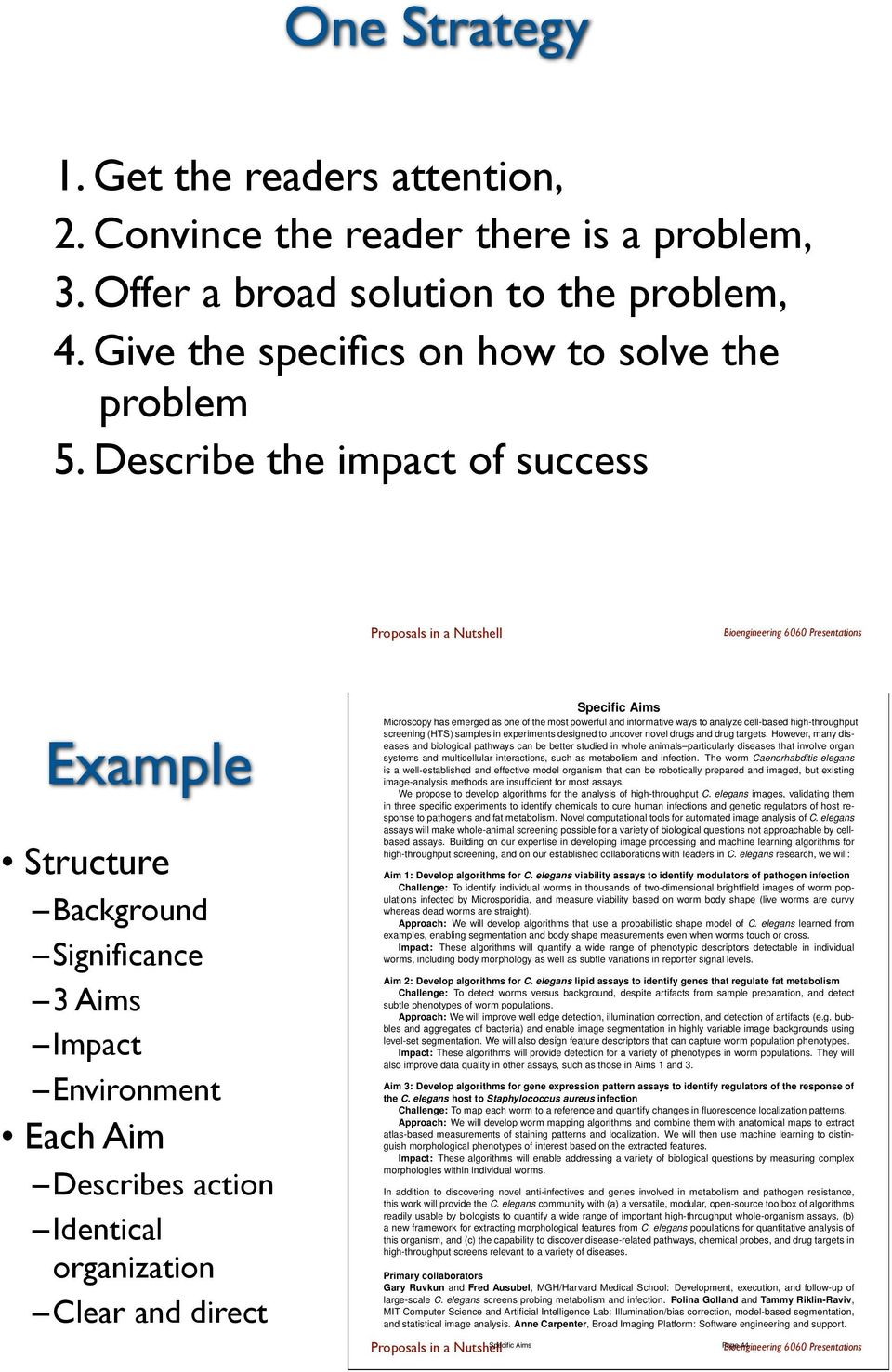
9 Opening Paragraph Microscopy has emerged as one of the most powerful and informative ways to analyze cell-based high-throughput screening (HTS) samples in experiments designed to uncover novel drugs and drug targets. However, many diseases and biological pathways can be better studied in whole animals particularly diseases that involve organ systems and multicellular interactions, such as metabolism and infection. The worm Caenorhabditis elegans is a well-established and effective model organism that can be robotically prepared and imaged, but existing image-analysis methods are insufficient for most assays. We propose to develop algorithms for the analysis of high-throughput C. elegans images, validating them in three specific experiments to identify chemicals to cure human infections and genetic regulators of host re- sponse to pathogens and fat metabolism. Novel computational tools for automated image analysis of C. elegans assays will make whole-animal screening possible for a variety of biological questions not approachable by cell- based assays. Building on our expertise in developing image processing and machine learning algorithms for high-throughput screening, and on our established collaborations with leaders in C. elegans research, we will: Opening Paragraph Microscopy has emerged as one of the most powerful and informative ways to analyze cell-based high-throughput screening (HTS) samples in experiments designed to uncover novel drugs and drug targets. However, many diseases and biological pathways can be better studied in whole animals particularly diseases that involve organ systems and multicellular interactions, such as metabolism and infection. The worm Caenorhabditis elegans is a well-established and effective model organism that can be robotically prepared and imaged, but existing image-analysis methods are insufficient for most assays. We propose to develop algorithms for the analysis of high-throughput C. elegans images, validating them in three specific experiments to identify chemicals to cure human infections and genetic regulators of host response to pathogens and fat metabolism. Novel computational tools for automated image analysis of C. elegans assays will make whole-animal screening possible for a variety of biological questions not approachable by cell- based assays. Building on our expertise in developing image processing and machine learning algorithms for high-throughput screening, and on our established collaborations with leaders in C. elegans research, we will:

10 Writing Specific Aims Direct, clear, active statement Challenge or significance Approach: rationale, or preliminary results Expected outcomes Stay away from extremely technical words and jargon Hofmann, pg 413 Example Simple words and statements Direct and explicit addressing of all points Scope is reasonable, not saving the world in one grant! Aim 1: Develop algorithms for C. elegans viability assays to identify modulators of pathogen infection Challenge: To identify individual worms in thousands of two-dimensional brightfield images of worm populations infected by Microsporidia, and measure viability based on worm body shape (live worms are curvy whereas dead worms are straight). Approach: We will develop algorithms that use a probabilistic shape model of C. elegans learned from examples, enabling segmentation and body shape measurements even when worms touch or cross. Impact: These algorithms will quantify a wide range of phenotypic descriptors detectable in individual worms, including body morphology as well as subtle variations in reporter signal levels.

11 Emphasis Version 1 Aim 1: Develop algorithms for C. elegans viability assays to identify modulators of pathogen infection Version 2 Aim 1: Identify modulators of pathogen infection by means of C. elegans viability assays Version 3 Aim 1: Carry out C. elegans viability assays to identify modulators of pathogen infection Note the effect of Power Positions The Rest of the Proposal

12 Significance Significance Explain the importance of the problem or critical barrier to progress in the field that the proposed project addresses. Explain how the proposed project will improve scientific knowledge, technical capability, and/or clinical practice in one or more broad fields. Describe how the concepts, methods, technologies, treatments, services, or preventative interventions that drive this field will be changed if the proposed aims are achieved.

13 Innovation Innovation Explain how the application challenges and seeks to shift current research or clinical practice paradigms. Describe any novel theoretical concepts, approaches or methodologies, instrumentation or intervention(s) to be developed or used, and any advantage over existing methodologies, instrumentation or intervention(s). Explain any refinements, improvements, or new applications of theoretical concepts, approaches or methodologies, instrumentation or interventions. Not all proposals need to be innovative (at least, this is the NIH official policy)

14 Approach Essentials of the Approach AKA Research Design and Methods Specific Aims What Link Approach How Be Confident...use future tense

15 More Essentials Structure of Approach Overview & Rationale Experimental Design Analysis Impact Expected Results

16 Approach I Describe the overall strategy, methodology, and analyses to be used to accomplish the specific aims of the project. Unless addressed separately in a Resource Sharing Plan, include how the data will be collected, analyzed, and interpreted as well as any resource sharing plans as appropriate. Discuss potential problems, alternative strategies, and benchmarks for success anticipated to achieve the aims. Approach II Describe previous or preliminary results that indicate the feasibility of the proposed approach. If the project is in the early stages of development, describe any strategy to establish feasibility, and address the management of any high risk aspects of the proposed work. Point out any procedures, situations, or materials that may be hazardous to personnel and precautions to be exercised. A full discussion on the use of Select Agents should appear in a Select Agent Research section.

17 Impact Definitions vary So you can define it! Impact Describe how the research will exert a sustained, powerful influence on the research field.

18 The Tools of the Trade Text Tools

19 Making Figures Literature Reference Tools

20 The Grant Cycle

1 R01 GM095672-01 2 MI WAHLBY, C
 PROGRAM CONTACT: SUMMARY STATEMENT ( Privileged Communication ) Release Date: 06/09/2010 Principal Investigator AROLINA EWA ASA PHD Applicant Organization: BROAD INSTITUTE, INC. Review Group: MI Microscopic
Elements of Grant Writing. Denise Gellene Director, Academic Support Programs UCLA CTSI
 Elements of Grant Writing Denise Gellene Director, Academic Support Programs UCLA CTSI The Objective Overarching Challenge Present a tremendous amount of information in a limited amount of space. The three
Principal Investigator/Program Director (Last, first, middle): Wahlby, Carolina
 Specific Aims Microscopy has emerged as one of the most powerful and informative ways to analyze cell-based high-throughput screening (HTS) samples in experiments designed to uncover novel drugs and drug
What you need to know about NIH grant writing
 What you need to know about NIH grant writing 2 NIH grant preparation: Know your resources 3 Understanding the NIH grant process 4 Study sections, peer review and the importance of the cover letter 6 Writing
Dr Alexander Henzing
 Horizon 2020 Health, Demographic Change & Wellbeing EU funding, research and collaboration opportunities for 2016/17 Innovate UK funding opportunities in omics, bridging health and life sciences Dr Alexander
Grant Writing Essentials Deborah Ann McClellan, Ph.D.
 Grant Writing Essentials Deborah Ann McClellan, Ph.D. Research Associate Department of Pharmacology and Molecular Sciences and Division of Biomedical Information Sciences Welch Medical Library Johns Hopkins
Keys to Writing Successful NIH Research and Career Development Grant Applications
 Keys to Writing Successful NIH Research and Career Development Grant Applications Rick McGee, PhD Northwestern University Feinberg School of Medicine Outline Introduction to the NIH Grant Review Process
Keys to Writing Successful NIH Research, Fellowship, and Career Development Grant Applications
 Keys to Writing Successful NIH Research, Fellowship, and Career Development Grant Applications Rick McGee, PhD Northwestern University Feinberg School of Medicine Associate Dean for Faculty Recruitment
CLUSTER ANALYSIS WITH R
 CLUSTER ANALYSIS WITH R [cluster analysis divides data into groups that are meaningful, useful, or both] LEARNING STAGE ADVANCED DURATION 3 DAY WHAT IS CLUSTER ANALYSIS? Cluster Analysis or Clustering
a measurable difference
 Thermo Scientific Cell Analysis Software and Informatics Products a measurable difference for everyone Thermo Scientific HCS Studio Cell Analysis Software Thermo Scientific Store Image and Database Management
Technology funding opportunities at the National Cancer Institute
 Technology funding opportunities at the National Cancer Institute Through the Cancer Diagnosis Program http://cancerdiagnosis.nci.nih.gov/index.html Avraham Rasooly Ph.D. National Cancer Institute, Cancer
Bacterial Transformation Post lab Questions:
 Bacterial Transformation Post lab Questions: 1. This graph represents typical bacteria growth and death on any culture plate. This trend occurs in both Luria Broth/ agarose and Luria broth/ Agarose/ Ampicillin/Arabinose
Thermo Scientific CellInsight CX5 HCS Platform. discover more uncover the possibilities
 Thermo Scientific CellInsight CX5 HCS Platform discover more uncover the possibilities high content screening Driving your Productivity with Innovated Technology What is High Content Screening (HCS)? High
Molecular Genetics: Challenges for Statistical Practice. J.K. Lindsey
 Molecular Genetics: Challenges for Statistical Practice J.K. Lindsey 1. What is a Microarray? 2. Design Questions 3. Modelling Questions 4. Longitudinal Data 5. Conclusions 1. What is a microarray? A microarray
Thermo Scientific ArrayScan XTI High Content Analysis Reader. revolutionizing cell biology with the power of high content
 Thermo Scientific ArrayScan XTI High Content Analysis Reader revolutionizing cell biology with the power of high content learn more about your cells using high content technology Thermo Scientific High
Specific Aims Do s and Don ts
 Specific Aims Do s and Don ts John A. Peyman, PhD National Institute of Allergy and Infectious Disease William H. Robinson, MD, PhD Stanford University School of Medicine VA Palo Alto Kelli D. Allen, PhD
M.S. Degree Prospectus Guidelines Department of Biological Sciences TITLE
 M.S. Degree Prospectus Guidelines Department of Biological Sciences The signature page should include all information on this page. A copy of the Prospectus Guidelines should be attached to the copy of
NSF-SPECIFIC GRANT WRITING WORKSHOP: Writing a Compelling Grant Proposal to NSF
 NSF-SPECIFIC GRANT WRITING WORKSHOP: Writing a Compelling Grant Proposal to NSF Sunshine Consultants, International specializing in research competitiveness Lynn W. Jelinski, Ph.D. 6406 Hopkins Drive Austin,
LCFA/IASLC LORI MONROE SCHOLARSHIP IN TRANSLATIONAL LUNG CANCER RESEARCH
 LCFA/IASLC LORI MONROE SCHOLARSHIP IN TRANSLATIONAL LUNG CANCER RESEARCH FUNDING OPPORTUNITY DESCRIPTION 2016 REQUEST FOR APPLICATION (RFA) Lung Cancer Foundation of America (LCFA) and the International
Getting Started on your Grant Application: The Big Picture and Specific Aims
 Getting Started on your Grant Application: The Big Picture and Specific Aims Content adapted from NIH Mentored Career Development Awards (K Series) Part 3 Thomas Mitchell, MPH, at UCSF Getting Started
SIMCA 14 MASTER YOUR DATA SIMCA THE STANDARD IN MULTIVARIATE DATA ANALYSIS
 SIMCA 14 MASTER YOUR DATA SIMCA THE STANDARD IN MULTIVARIATE DATA ANALYSIS 02 Value From Data A NEW WORLD OF MASTERING DATA EXPLORE, ANALYZE AND INTERPRET Our world is increasingly dependent on data, and
Why Taking This Course? Course Introduction, Descriptive Statistics and Data Visualization. Learning Goals. GENOME 560, Spring 2012
 Why Taking This Course? Course Introduction, Descriptive Statistics and Data Visualization GENOME 560, Spring 2012 Data are interesting because they help us understand the world Genomics: Massive Amounts
BCMB 496: BIOCHEMISTRY/MOLECULAR BIOLOGY SENIOR RESEARCH
 BCMB 496: BIOCHEMISTRY/MOLECULAR BIOLOGY SENIOR RESEARCH Course Description Biochemistry/Molecular Biology senior research is a two-semester long independent research project that culminates in the submission
Study Plan for the Master Degree In Industrial Engineering / Management. (Thesis Track)
 Study Plan for the Master Degree In Industrial Engineering / Management (Thesis Track) Plan no. 2005 T A. GENERAL RULES AND CONDITIONS: 1. This plan conforms to the valid regulations of programs of graduate
Tips and Guidelines for an NIH Proposal
 Tips and Guidelines for an NIH Proposal FORMAT SPECIFICATIONS All file attachments must be in PDF format, and should have descriptive filenames of 50 characters or less, using only standard characters.
Automating Cell Biology Annual general meeting, September 7, 2015. Phase Holographic Imaging www.phiab.se
 Automating Cell Biology Annual general meeting, September 7, 2015 www.phiab.se 1 PHASE HOLOGRAPHIC IMAGING (PHI) Began as a research project at Lund University, Sweden, in 2000 Founded in 2004 Sales in
Call 2014: High throughput screening of therapeutic molecules and rare diseases
 Call 2014: High throughput screening of therapeutic molecules and rare diseases The second call High throughput screening of therapeutic molecules and rare diseases launched by the French Foundation for
College of Health and Social Services Mini-Grant Program 2014-2015 Call for Proposals
 College of Health and Social Services Mini-Grant Program 2014-2015 Call for Proposals This document provides guidance and instructions for completion of College of Health and Social Services (CHSS) Mini-Grant
Unit I: Introduction To Scientific Processes
 Unit I: Introduction To Scientific Processes This unit is an introduction to the scientific process. This unit consists of a laboratory exercise where students go through the QPOE2 process step by step
National Education Technology Standards
 National Education Technology Standards Objectives Satisfied by Each Deliverable in the Program 1 Basic operations and concept Students demonstrate a sound understanding of the nature and operation of
A leader in the development and application of information technology to prevent and treat disease.
 A leader in the development and application of information technology to prevent and treat disease. About MOLECULAR HEALTH Molecular Health was founded in 2004 with the vision of changing healthcare. Today
1. Programme title and designation Biochemistry. For undergraduate programmes only Single honours Joint Major/minor
 PROGRAMME APPROVAL FORM SECTION 1 THE PROGRAMME SPECIFICATION 1. Programme title and designation Biochemistry For undergraduate programmes only Single honours Joint Major/minor 2. Final award Award Title
#jenkinsconf. Jenkins as a Scientific Data and Image Processing Platform. Jenkins User Conference Boston #jenkinsconf
 Jenkins as a Scientific Data and Image Processing Platform Ioannis K. Moutsatsos, Ph.D., M.SE. Novartis Institutes for Biomedical Research www.novartis.com June 18, 2014 #jenkinsconf Life Sciences are
2019 Healthcare That Works for All
 2019 Healthcare That Works for All This paper is one of a series describing what a decade of successful change in healthcare could look like in 2019. Each paper focuses on one aspect of healthcare. To
Computer Modeling. Exciting careers in. * How were computer models involved in making this scene possible? What is it? How does it work? Who uses it?
 Computer Modeling Exciting careers in What is it? How does it work? Who uses it? What can I do with it? Where can I learn it? * How were computer models involved in making this scene possible? What is
AMERICAN ORTHOPAEDIC SOCIETY FOR SPORTS MEDICINE OSTEOARTHRITIS BASIC SCIENCE RESEARCH GRANT
 AMERICAN ORTHOPAEDIC SOCIETY FOR SPORTS MEDICINE OSTEOARTHRITIS BASIC SCIENCE RESEARCH GRANT GENERAL INFORMATION The purpose of these grants is to foster high-quality research in the areas of early osteoarthritis
NIH Grants 101: Funding
 NIH Grants 101: Funding Mechanisms, Peer Review and Strategies for Success Dr. Sharon L. Milgram, Director NIH OITE [email protected] Tk Take Home Message You will decrease your stress level and have
Automated Library Preparation for Next-Generation Sequencing
 Buyer s Guide: Automated Library Preparation for Next-Generation Sequencing What to consider as you evaluate options for automating library preparation. Yes, success can be automated. Next-generation sequencing
7- Master s Degree in Public Health and Public Health Sciences (Majoring Microbiology)
 7- Master s Degree in Public Health and Public Health Sciences (Majoring Microbiology) Students should fulfill a total of 38 credit hours: 1- Basic requirements: 10 credit hours. 150701, 150702, 150703,
Research and Digital Game- based Play: A Review of Martha Madison
 Research and Digital Game- based Play: A Review of Martha Madison White Paper Compiled by Anne Snyder, Ph.D. Second Avenue Learning is a certified women- owned business, specializing in the creation of
An Overview of Cells and Cell Research
 An Overview of Cells and Cell Research 1 An Overview of Cells and Cell Research Chapter Outline Model Species and Cell types Cell components Tools of Cell Biology Model Species E. Coli: simplest organism
BOSTON UNIVERSITY SCHOOL OF PUBLIC HEALTH PUBLIC HEALTH COMPETENCIES
 BOSTON UNIVERSITY SCHOOL OF PUBLIC HEALTH PUBLIC HEALTH COMPETENCIES Competency-based education focuses on what students need to know and be able to do in varying and complex situations. These competencies
Biostatistics and Epidemiology within the Paradigm of Public Health. Sukon Kanchanaraksa, PhD Marie Diener-West, PhD Johns Hopkins University
 This work is licensed under a Creative Commons Attribution-NonCommercial-ShareAlike License. Your use of this material constitutes acceptance of that license and the conditions of use of materials on this
European Master of small animal veterinary medicine
 European Master of small animal veterinary medicine Master thesis instructions 1. Learning objectives of the thesis - Formulate a precise question, hypothesis, or goals of the thesis - Select an appropriate
Specialized Master of Science in Experimental Biomedical Research
 Curriculum for the award of the Degree of Specialized Master of Science in Experimental Biomedical Research options: Neuroscience Infection, Inflammation and Cancer Cardiovascular and Metabolic Health
Six Trends in Robotics in the Life Sciences
 Parker Hannifin Electromechanical Dvision N. A. 1140 Sandy Hill Road Irwin, PA 1564203049 724-861-6903 www.parkermotion.com Six Trends in Robotics in the Life Sciences By Mike Szesterniak Big Impact in
How To Change Medicine
 P4 Medicine: Personalized, Predictive, Preventive, Participatory A Change of View that Changes Everything Leroy E. Hood Institute for Systems Biology David J. Galas Battelle Memorial Institute Version
Preparing and Refining a Research Proposal: Tips for Inexperienced Scientists
 Preparing and Refining a Research Proposal: Tips for Inexperienced Scientists Topics Proposal format Strengthening elements Internal continuity Funding targets Know your donor Grantee ethics Never too
US Perspective on the Regulatory Assessment of Benefit-Risk of Vaccines
 US Perspective on the Regulatory Assessment of Benefit-Risk of Vaccines Norman W. Baylor Biologics Consulting Group, Inc. 23-25 June 2014 Foundation Merieux Conference Center OUTLINE OF PRESENTATION Introduction
Discover more, discover faster. High performance, flexible NLP-based text mining for life sciences
 Discover more, discover faster. High performance, flexible NLP-based text mining for life sciences It s not information overload, it s filter failure. Clay Shirky Life Sciences organizations face the challenge
HSA Consumer Guide. Understanding Vaccines, Vaccine Development and Production. www.hsa.gov.sg November 2009. How a Vaccine Works.
 November 2009 Understanding Vaccines, Vaccine Development and Production Vaccines, in general, help protect people from harmful infections before they come in contact with the disease. Vaccines may also
full library phenotypic screening without compromise www.ttplabtech.com
 R full library phenotypic screening without compromise www.ttplabtech.com full library phenotypic screening is within your reach acumen is unique, has sophisticated software and offers the best characteristics
Core Curriculum to the Course:
 Core Curriculum to the Course: Environmental Science Law Economy for Engineering Accounting for Engineering Production System Planning and Analysis Electric Circuits Logic Circuits Methods for Electric
Problems With Programmable self-assembly in a thousand-robot swarm
 Problems With Programmable self-assembly in a thousand-robot swarm Affiliations: Department of Computer Science, COMSATS Institute of IT, Islamabad, Pakistan Author: Muaz A. Niazi* ǂ *Correspondence to:
Basics of Immunology
 Basics of Immunology 2 Basics of Immunology What is the immune system? Biological mechanism for identifying and destroying pathogens within a larger organism. Pathogens: agents that cause disease Bacteria,
CHAPTER 1 INTRODUCTION
 1 CHAPTER 1 INTRODUCTION 1.1 Overview Software testing is a verification process in which an application of the software or the program meets the business requirements and technology that have dominated
Degree Level Expectations, Learning Outcomes, Indicators of Achievement and the Program Requirements that Support the Learning Outcomes
 Department/Academic Unit: Pathology and Molecular Medicine Degree Program: PhD Degree Level Expectations, Learning Outcomes, Indicators of Achievement and the Program Requirements that Support the Learning
Developing an R Series Plan that Incorporates Mixed Methods Research
 Developing an R Series Plan that Incorporates Mixed Methods Research / 16 Developing an R Series Plan that Incorporates Mixed Methods Research primary mechanism for obtaining NIH grants to conduct mixed
Grantsmanship: Best Practices for the Research Statement
 Grantsmanship: Best Practices for the Research Statement - Women in Science at Columbia - (WISC) November 5, 2013 Jaime S. Rubin, Ph.D. Dept. of Medicine College of Physicians and Surgeons Columbia University
Study Program Handbook Biochemistry and Cell Biology
 Study Program Handbook Biochemistry and Cell Biology Bachelor of Science Jacobs University Undergraduate Handbook BCCB - Matriculation Fall 2015 Page: ii Contents 1 The Biochemistry and Cell Biology (BCCB)
Core Ideas of Engineering and Technology
 Core Ideas of Engineering and Technology Understanding A Framework for K 12 Science Education By Cary Sneider Last month, Rodger Bybee s article, Scientific and Engineering Practices in K 12 Classrooms,
Web-Based Genomic Information Integration with Gene Ontology
 Web-Based Genomic Information Integration with Gene Ontology Kai Xu 1 IMAGEN group, National ICT Australia, Sydney, Australia, [email protected] Abstract. Despite the dramatic growth of online genomic
White Paper. Yeast Systems Biology - Concepts
 White Paper Yeast Systems Biology - Concepts Stefan Hohmann, Jens Nielsen, Hiroaki Kitano (see for further contributers at end of text) Göteborg, Lyngby, Tokyo, February 2004 1 Executive Summary Systems
BIOINF 525 Winter 2016 Foundations of Bioinformatics and Systems Biology http://tinyurl.com/bioinf525-w16
 Course Director: Dr. Barry Grant (DCM&B, [email protected]) Description: This is a three module course covering (1) Foundations of Bioinformatics, (2) Statistics in Bioinformatics, and (3) Systems
Encouraging the Teaching of Biotechnology in Secondary Schools
 O N L I N E A R T I C L E Teaching About Designer Babies & Genetically Modified Foods: Encouraging the Teaching of Biotechnology in Secondary Schools G L E N D A L E S L I E R E N AT O S C H I B E C I
J D R F R E Q U E S T S L E T T E R S O F I N T E N T F O R : B I O M AR K E R S O F P AN C R E A T I C B E T A C E L L S T R E S S AN D H E AL T H
 J D R F R E Q U E S T S L E T T E R S O F I N T E N T F O R : B I O M AR K E R S O F P AN C R E A T I C B E T A C E L L S T R E S S AN D H E AL T H PURPOSE JDRF, the world s leading non-profit organization
How to Write a Quality Technical Paper and Where to Publish within IEEE Part 1. George Plosker IEEE Client Services Manager September 2015
 How to Write a Quality Technical Paper and Where to Publish within IEEE Part 1 George Plosker IEEE Client Services Manager September 2015 About the IEEE World s largest technical membership association
Medical Laboratory Technology Program. Student Learning Outcomes & Course Descriptions with Learning Objectives
 Medical Laboratory Technology Program Student Learning Outcomes & Course Descriptions with Learning Objectives Medical Laboratory Technology Student Learning Outcomes All Colorado Mesa University associate
Cell Discovery 360: Explore more possibilities.
 Cell Discovery 360: Explore more possibilities. Flexible solutions for the BioPharma laboratory Blood Banking Capillary Electrophoresis Centrifugation Flow Cytometry Genomics Lab Automation Lab Tools Particle
Selecting a Master s Thesis Research Theme (Ideas for Thesis Research) DR. ANTHONY FAIOLA DR. KARL MACDORMAN
 Selecting a Master s Thesis Research Theme (Ideas for Thesis Research) DR. ANTHONY FAIOLA DR. KARL MACDORMAN December 2007 Master s Thesis Research Proposals (Ideas for Thesis Research) The following topics
Chapter 18: Applications of Immunology
 Chapter 18: Applications of Immunology 1. Vaccinations 2. Monoclonal vs Polyclonal Ab 3. Diagnostic Immunology 1. Vaccinations What is Vaccination? A method of inducing artificial immunity by exposing
CROHN S & COLITIS FOUNDATION OF AMERICA. Senior Research Award INSTRUCTIONS. Effective September 2013
 CROHN S & COLITIS FOUNDATION OF AMERICA Senior Research Award INSTRUCTIONS Effective September 2013 Crohn s & Colitis Foundation of America National Office Research & Scientific Programs Department 733
Real-time PCR: Understanding C t
 APPLICATION NOTE Real-Time PCR Real-time PCR: Understanding C t Real-time PCR, also called quantitative PCR or qpcr, can provide a simple and elegant method for determining the amount of a target sequence
CHAPTER 2 ANTIGEN/ANTIBODY INTERACTIONS
 CHAPTER 2 ANTIGEN/ANTIBODY INTERACTIONS See APPENDIX (1) THE PRECIPITIN CURVE; (2) LABELING OF ANTIBODIES The defining characteristic of HUMORAL immune responses (which distinguishes them from CELL-MEDIATED
MetaMorph Software Basic Analysis Guide The use of measurements and journals
 MetaMorph Software Basic Analysis Guide The use of measurements and journals Version 1.0.2 1 Section I: How Measure Functions Operate... 3 1. Selected images... 3 2. Thresholding... 3 3. Regions of interest...
Differentiation = Making specialized cells
 Differentiation = Making specialized cells What is a stem cell? Screws: JM www.logodesignweb.com/stockphoto Differentiation = Making specialized cells What is a stem cell? What the photo shows A lump of
Characterizing Knowledge Management Tools
 Characterizing Knowledge Management Tools Half-day Tutorial Presented by Kurt W. Conrad conrad@sagebrushgroup sagebrushgroup.com Developed by Kurt W. Conrad, Brian (Bo) Newman, and Dr. Art Murray Based
Why Modern B2B Marketers Need Predictive Marketing
 Why Modern B2B Marketers Need Predictive Marketing Sponsored by www.raabassociatesinc.com [email protected] www.mintigo.com [email protected] Introduction Marketers have used predictive modeling
FACULTY OF MEDICAL SCIENCE
 Doctor of Philosophy Program in Microbiology FACULTY OF MEDICAL SCIENCE Naresuan University 171 Doctor of Philosophy Program in Microbiology The time is critical now for graduate education and research
KNIME Enterprise server usage and global deployment at NIBR
 KNIME Enterprise server usage and global deployment at NIBR Gregory Landrum, Ph.D. NIBR Informatics Novartis Institutes for BioMedical Research, Basel 8 th KNIME Users Group Meeting Berlin, 26 February
VENTANA Digital Pathology. Reliable. Efficient. Comprehensive.
 VENTANA Digital Pathology Reliable. Efficient. Comprehensive. In the quest to improve the lives of all patients afflicted with cancer, every second counts. Fast, informed clinical decisions are essential
Manufacturing process of biologics
 Manufacturing process of biologics K. Ho Afssaps, France 2011 ICH International Conference on Harmonisation of Technical Requirements for Registration of Pharmaceuticals for Human Use 2011 ICH 1 Disclaimer:
How Can Institutions Foster OMICS Research While Protecting Patients?
 IOM Workshop on the Review of Omics-Based Tests for Predicting Patient Outcomes in Clinical Trials How Can Institutions Foster OMICS Research While Protecting Patients? E. Albert Reece, MD, PhD, MBA Vice