
Loan guarantee portfolios and joint loan guarantees with stochastic interest rates
|
|
|
- Lorin Caldwell
- 10 years ago
- Views:
Transcription
1 The Quarterly Review of Economics and Finance 46 (2006) Loan guarantee portfolios and joint loan guarantees with stochastic interest rates Chuang-Chang Chang a,, San-Lin Chung b, Min-Teh Yu c a Department of Finance, National Central University, Jung-Li 32001, Taiwan b Department of Finance, National Taiwan and National Central Universities, Taipei, Taiwan c Department of Finance, Providence University, Taichung 43301, Taiwan Received 16 January 2003; accepted 28 July 2003 Abstract Most papers studying loan guarantee are under a one-borrower and one-guarantor framework This study uses the option approach to construct models in which loan guarantees are analyzed under a multiple-borrower and one-guarantor framework and under a one-borrower and multiple-guarantor structure with stochastic interest rates We carry out simulations to investigate how the important parameters of borrowers and guarantors affect the values and default probability of loan guarantees Our results show that the correlation parameters play a critical role in determining the premiums of loan guarantee portfolios and joint loan guarantees 2003 Board of Trustees of the University of Illinois All rights reserved JEL classification: G13 Keywords: Default probability; Loan guarantee portfolios; Joint loan guarantees 1 Introduction Financial guarantee insurance is a commitment by a third party to make payment in the event of default on a financial contract Usually, a bank, an insurance company, and/or different levels of government stand as third party Financial guarantee insurance as such Corresponding author Tel: ; fax: address: ccchang@ccncuedutw (C-C Chang) /$ see front matter 2003 Board of Trustees of the University of Illinois All rights reserved doi:101016/jqref

2 C-C Chang et al / The Quarterly Review of Economics and Finance 46 (2006) has become increasingly widespread with the development of securitization of various types of loans and the growth of off-balance-sheet guarantees by commercial banks, insurance companies and government agencies Since financial guarantees are popular in the world, it has become an important issue that researchers develop models to estimate the fair values of guarantee contracts Merton (1977) first illustrates that a loan guarantee is analogous to that of a put option and derives a closed-form solution to estimate the values of deposit insurance guarantees Jones and Mason (1980) construct valuation models of loan guarantees with a riskless guarantor Their simulation results show that the value of a loan guarantee rises, as the risk represented by the variance of return on the borrowing firm s assets increases Chen, Chen, and Sears (1986) develop a model to examine the effects of loan guarantees on the outstanding debts of Chrysler Johnson and Stulz (1987) derive a formula for calculating the value of an insured, risky discount bond with default risk Selby, Franks, and Karki (1988) use the Geske (1979) compound option approach to value the loan guarantee provided by the British government to International Computer Limited and compare the size and direction of the consequent wealth transfer to and from bondholders Merton and Bodie (1992) show the purchase of any loan, whether or not the guarantees are explicit, is equivalent to purchasing a pure default-free loan and the simultaneous issue of a guarantee on that loan Lai (1992) constructs a discrete-time model to analyze vulnerable loan guarantees under different conditions of debt subordination Lai and Gendron (1994) extend to value private financial guarantees under stochastic interest rates Lai and Yu (1999) compute the values of the guaranteed and unguaranteed subordinated loan and compare the accurate results obtained by numerical integration techniques with those approximated from the closedform formula More recently, Dermine and Lajeri (2001) introduce lending risk explicitly in the literature on market-based estimation of deposit insurance premium All of the above-mentioned literature constructs models that value loan guarantee contracts under a one-borrower and one-guarantor framework However, many real world cases for loan guarantees are one-borrower and multiple-guarantor, or multiple-borrower and oneguarantor For example, one financial institution acts as the guarantor for several loans of different firms at the same time, or a large firm with a huge amount of loans seeks several banks or insurance companies as its guarantor at the same time For these cases, the models existing in the literature cannot directly be used to estimate the loan guarantee values The contributions of this paper are twofold First, we construct a model in which a loan guarantee is analyzed under a one-borrower and multiple-guarantor framework with stochastic interest rates Second, we analyze a loan guarantee under a multiple-borrower and one-guarantor structure with stochastic interest rates We carry out simulations to investigate how the important parameters of borrowers and guarantors affect the values and default probability of guarantee contracts in both cases Hence, our paper fills in the existing gap in the literature and provides solutions for valuing the loan guarantee for a general framework The article continues with Section 2 constructing a model, which estimates the value of loan guarantees for the case of multiple-guarantees and one-guarantor with stochastic interest rates Section 3 follows the analysis of Section 2 to develop a model for estimating the value of loan guarantees for the case of one-guarantee and multiple-guarantor Section 4 carries out simulations to investigate how the important parameters of guarantees and

3 18 C-C Chang et al / The Quarterly Review of Economics and Finance 46 (2006) guarantor affect the values and default probability of guarantee contracts in both cases Section 5 draws forth conclusions 2 The model for loan guarantee portfolio In this section, we construct a model to estimate the values of loan guarantees for the case of multiple-borrower and one-guarantor with stochastic interest rates In the subsequent context, we adopt the following assumptions: The capital market is perfectly competitive with no transaction costs, no taxes, and equal access to information for all investors with symmetric information No dividend and coupon payments There are no payouts from either the firms of borrowers or their guarantor to shareholders and bondholder before the maturity date of the discount bond The borrowers asset values and the guarantor s asset value are multivariate lognormally distributed We ignore all potential agency problems inherent to financial contracting No-arbitrage opportunity exists All securities with identical payoffs sell at the same price Let W(T) and H denote the end-of-period asset value and the senior debt value of the guarantor firm, respectively Assume that there are n borrowing firms (guarantees) Let V i (T), D i (T), E Vi (T ), and F i (i =1,2,, n) represent the end-of-period asset value, the senior debt value, the equity value, and the junior guaranteed debt face value of the borrowing firm i, respectively We can use a simple T account to present the capital structure of the i borrowing firm and the guarantor as follows: Borrowing firm i Guarantor V i D i W H F i G(F 1 ), G(F 2 ), E Vi E W At maturity date, T, if the residual value of the end-of-period asset after payments of senior debt is less than the face value of its corresponding junior guaranteed debt, then the borrowing firm is bankrupt The shortage for paying the guaranteed debt face value is compensated by the guarantor in the amount of the guarantor s asset value minus its senior debt value Hence, to own the junior guaranteed debt of borrowing firms is similar to holding the subordinated debt of the guarantor Assume that the owners of the borrowing firm i (i =1, 2,, n) have equal protection from the guarantor When the guarantor s end-of-period asset value after payment of senior debt is less than the shortage between the residual value of the borrowing firms asset values after paying their senior debts and their debt face value, the guarantor is bankrupt In such a case, the guarantor can only proportionally compensate the holders of junior guaranteed bonds of the borrowing firms

4 C-C Chang et al / The Quarterly Review of Economics and Finance 46 (2006) Based on the above setting, the total shortage between the residual value of all borrowing firms asset values after paying their senior debts and their junior guaranteed debt face values is n X(T ) = min{α j F j, max[f j max[v j (T ) D j (T ), 0], 0]}, j=1 where α j is the protected proportion of the insured bonds of borrowing firm j It is straightforward to show that the proportionally compensated value from the guarantor for the holders of junior guaranteed bond of borrowing firm i R i (T ) = min{α if i, max[f i max[v i (T ) D i (T ), 0], 0]} max[w(t ) H, 0] (1) X(T ) Therefore, the payoffs B gi for the owners of junior guaranteed debt of borrowing firm i, at time T, can be expressed as follows: B gi (T ) = min{max[v i (T ) D i (T ), 0] + R i (T ),F i } (2) It should be noted that if the borrowing firm i is not bankrupt, the compensated value R i (T) is zero We construct an artificial asset, Q i, with the value as follows: Q i = max[v i (T ) D i (T ), 0] + R i (T ) (3) We then have B gi (T ) = min[q i (T ),F i ] = F i + min[q i (T ) F i, 0] = F i max[f i Q i (T ), 0] = F i Put(Q i (T ),F i,t), where Put(Q i (T ),F i,t) is the time T value of the European put option with strike price F i and underlying asset price Q i (T) The holders of the debts without guarantee of borrowing firm i at maturity date T have the payoffs, B i (T), with the value as follows: B i (T ) = min{max[v i (T ) D i (T ), 0],F i } (4) Since the guaranteed value of a loan with a risky guarantor equals the value of loan without guarantee minus the value of a loan with guarantee, the value of guarantee G i at time T for borrowing firm i can be simply expressed as follows: G i (T ) = B gi (T ) B i (T ) = min[q i,f i ] min{max[v i (T ) D i (T ), 0],F i } = max{f i max[v i (T ) D i (T ), 0], 0} max[f i Q i (T ), 0] = Put(Call(V i (T ),D i (T ),T),F i,t) Put(Q i (T ),F i,t) (5) The third equality in the above equation comes from the fact that min(a, b)=b max(a b, 0) Discounting and taking expectation of Eq (5), we have the formula for calculating the

5 20 C-C Chang et al / The Quarterly Review of Economics and Finance 46 (2006) value of loan guarantee for borrowing firm i, that is G i (0) = E[e T 0 r(τ)dτ G i (T )] (6) Apart from calculating the value of loan guarantee for borrowing firm i, we are also interested in how to compute the probability of default for the risky guarantor The economic condition for the risky guarantor to default is when the guarantor s end-of-period asset value after payment of senior debt is less than the shortage between the residual value of the borrowing firms asset values after payment of their senior debts and their junior guaranteed debt s face value The condition of default for the risky guarantor can be defined as follows: W(T ) H<X(T ) Based on Eq (7), one can calculate the probability of default for the risky guarantor by simulations We will illustrate how to calculate this probability through the Monte-Carlo simulation in Section 4 (7) 3 The model for joint guarantees for loans In this section, we construct a model to estimate the values of loan guarantees for the case of one-borrower and multiple-guarantor with stochastic interest rates The assumptions made in the previous section are still valid in the following context Assume that there are m guarantors for the loans of one borrowing firm Let W j (T )(j = 1, 2,,m) and H j (T )(j = 1, 2,,m) denote the end-of-period asset value and the senior debt value of the j guarantor, respectively Since there is only one borrowing firm in this case, we let V(T), D(T), and F denote the end-of-period asset value, senior debt value, and insured junior debt face value of the borrowing firm, respectively In the case of V(T) D(T)<F, the borrowing firm is bankrupt and guarantors must share equally for the shortage value between V D and F However, if some of the guarantors are also bankrupt at the same time, other guarantors have to share their losses Based on the above structure, we recognize that the end-of-period cost (C j (T)) (or the value of loan guarantee provided by guarantor j) for guarantor j includes two parts One is its own share of cost (S j (T)) for the loan guarantee of the borrowing firm The other is the extra share of cost (U j (T)) belonging to the bankrupt guarantors Its own share (S j (T)) of the j guarantor for the loan guarantee can be expressed as follows: 0, if D(T ) + F V (T ) < 0, else if 1 min(d(t ) + F V (T ),F), S j (T ) = m W j(t ) H j (T ) > 1 min(d(t ) + F V (T ),F), else if m W j (T ) H j (T ), 0 <W j (T ) H j (T ) < 1 min(d(t ) + F V (T ),F), else m 0, Another expression for S j (T)is { } 1 S j (T ) = min m min[max(d(t )+F V(T ), 0),F], max(0,w j(t ) H j (T )) (8)

6 C-C Chang et al / The Quarterly Review of Economics and Finance 46 (2006) Let Y = 1 min[max(d(t ) + F V (T ), 0,F)] m It follows that S j (T ) = min[y, max(0,w j (T ) H j (T ))] (9) The extra share of cost (U j (T)) for guarantor j is as following U j (T ) = min max[max(w j(t ) H j (T ), 0) Y, 0], 1 m max[y max(w i (T ) H i (T ), 0), 0] m l, (10) i=1 i j where l is the number of the bankrupt guarantor (not including guarantor j), that is { m 1, if Y<max(Wi (T ) H i (T ), 0) l = A i, A i = 0, else i=1 i j Hence, the end-of-period cost (C j (T)) for the j guarantor can be obtained by following equation C j (T ) = S j (T ) + U j (T ) (11) We are also interested in how to compute the default probability for the joint guarantee contract The economic condition for the joint guarantee contract to default is when the guarantors end-of-period asset values after payment of senior debts are less than the shortage between the residual value of the borrowing firm s asset value after payment of senior debt and its junior guaranteed debt face value The condition of default for the joint guarantee contract can be defined as follows: m max(w i (T ) H i (T ), 0) < min(f + D(T ) V (T ),F) (12) i=1 Based on Eq (12), we can directly calculate the default probability for the joint guarantee contract by simulations 4 Numerical methods Based on the model setting given in Sections 2 and 3, it is difficult, if not impossible, to obtain closed-form solutions for the values of loan guarantees Hence, we employ Monte Carlo simulations to estimate the values of loan guarantees The Monte Carlo simulation procedure for derivative pricing can be briefly described as follows: first, simulate sample paths for the underlying variables; second, compute its corresponding derivative payoff for

7 22 C-C Chang et al / The Quarterly Review of Economics and Finance 46 (2006) each path; and finally, average the simulated payoffs and discount the average to yield the derivative price For the case of multiple-borrower and one-guarantor, we assume that the asset values of borrowing firms and the guarantor follow a geometric Brownian motion as given in Eq (12) dw W = µ W dt + σ W ε W dt, (13) dv i = µ Vi dt + σ Vi ε Vi dt (i = 1, 2,,n), V i where µ W (µ Vi ) is the drift rate of the asset return of guarantor (borrower i), and σ W (σ Vi ) is the instantaneous volatility of the asset return of guarantor (borrower i), respectively Additionally, ε W and ε Vi are standard normal random variables, and the correlation among them is ρ Vi,W For the case of one-borrower and multiple-guarantor, we also similarly assume that the asset values of borrowing firms and the guarantor follow a geometric Brownian motion as given in Eq (13) dw j = µ Wj dt + σ Wj ε Wj dt (j = 1, 2,,m), (14) W j dv V = µ V dt + σ V ε V dt The notations in Eq (13) are similar to those in Eq (12) Since we consider stochastic interest rate environments, we employ the Cox, Ingersoll, and Ross (1985) model to describe the dynamic process of interest rates We express the interest rate process as follows: dr = a(b r)dt + σ r rεr dt, (15) where a and b are the speed of mean reversion and the average long-term rate, respectively This model incorporates mean reversion where the short rate is pulled to a level b at a rate of a Furthermore, let ρ r,w and ρ r,vi denote the correlation coefficient between interest rate and the asset value of the guarantor, and the correlation coefficient between interest rate and the asset value of borrowing firm i We describe the process of generating random variables in Appendix A The process presented in the appendix is general enough to pricing a derivative whose payoff depends on n variables 5 Numerical results We conduct experiments to investigate how the important parameters of borrowers and guarantors affect the values and default probability of loan guarantees for both cases of loan guarantee portfolios and joint guarantees Most of the parameter settings in this paper

8 C-C Chang et al / The Quarterly Review of Economics and Finance 46 (2006) Table 1 Results of comparative static analysis for loan guarantee portfolio P = P(σ r +,ρ+ W,r,ρ+ V 2,r,H+,d + 2,f+ 2,σ+ W,σ+ V 2 ) G 1 = G 1 (σ r +,ρ W,r,ρ V 2,r,H,d2,f 2,σ W,σ V 2 ) G 2 = G 2 (σ r +,ρ W,r,ρ+ V 2,r,H,d + 2,f+ 2,σ W,σ+ V 2 ) are based on Lai and Gendron (1994) The initial guarantor firm value (W(0)) is chosen as 35 (million), the volatility of guarantor firm (σ W ) value is 10%, and the value of guarantor senior debt (H) is 2 million We set the initial firm value of borrower i (V i (0)) at 21 million, the volatility of the firm s value of borrower i (σ Vi ) at 20%, the value of borrower i s senior debt at 1 million, and the face value of insured debts of borrower i (f i ) at 1 million The coefficients of correlation between a risky guarantor s firm value and the borrower (i) firm value are ρ W,Vi = 03 and ρ Vj,V i = 03, respectively Additionally, the coefficients of correlation between risky guarantor firm value, the value of borrowing firm (i), and the interest rate are ρ W,r = 03 and ρ V,r = 03, respectively 1 We also set other interest rate parameters as follows: σ r = , a = 42753, and b = In the following analysis, we use 50,000 simulation runs 3 to calculate the values and default probability of loan guarantees 51 Results of loan guarantee portfolio For compactness, we report only those results for how changes in the covariance matrix, the values of guarantor and borrowers senior debts, and the value of borrower s insured debt affect the value and default probability of loan guarantees under stochastic interest rates 4 Additionally, to simplify the analysis, we use the case of two borrowers and one guarantor 5 as an example to carry out simulations From our numerical examples, we have the following signs for comparative static analysis In Table 1, P, G 1, and G 2 stand for the default probability, the value of loan guarantee for borrowing firm one and the value of loan guarantee for borrowing firm two with stochastic interest rates, respectively Like financial options, the loan guarantee values increase with the volatility of state variable Additionally, the default probability also increases with the volatility of state variables, since increases in the volatility of the state variable will amplify the risks of the loan guarantee contracts We will first investigate the effects of changes in the correlation coefficient between the guarantor s firm value and the value of borrowing firm two (ρ W,V2 ) on the loan guarantee value and default probability From Fig 1, we find that the higher ρ W,V2, the smaller is the 1 The correlation coefficients used here (ρ = 03) can guarantee that the correlation coefficient matrix is a positive definite matrix 2 The settings of interest rate parameters in this paper are based on Chan, Karolyi, Longstaff, and Sanders (1992) We assume the market risk of interest rate (λ) equal to zero since the estimated value for λ is very small in Chan et al (1992) paper 3 The standard deviations of loan guarantee values are less 1% under 50,000 simulation runs 4 We perform the same simulation under constant interest rates However, for conciseness, we did not report those results here 5 Our results remain valid for general cases

9 24 C-C Chang et al / The Quarterly Review of Economics and Finance 46 (2006) Fig 1 The effects of a change in ρ W,V2 on the value of loan guarantee portfolio and default probability G 1 represents the loan guarantee value (in terms of millions of dollars) for borrowing firm one, G 2 represents the loan guarantee value (in terms of millions of dollars) for borrowing firm two, and P denotes the default probability of the loan guarantee contract, respectively loan guarantee value and the higher the default probability is The reason for this result is that the higher ρ W,V2 is, the smaller is the risk diversification Hence, when the correlation coefficient between the guarantor s firm value and the value of borrowing firm two increases, the loan guarantee values decrease and the default probability increases Fig 2 The effects of a change in ρ V1,V 2 on the value of loan guarantee portfolio and default probability G 1 represents the loan guarantee value (in terms of millions of dollars) for borrowing firm one, G 2 represents the loan guarantee value (in terms of millions of dollars) for borrowing firm two, and P denotes the default probability of the loan guarantee contract, respectively

10 C-C Chang et al / The Quarterly Review of Economics and Finance 46 (2006) Fig 3 The effects of a change in ρ W,r on the loan guarantee portfolio value and default probability G 1 represents the loan guarantee value (in terms of millions of dollars) for borrowing firm one, G 2 represents the loan guarantee value (in terms of millions of dollars) for borrowing firm two, and P denotes the default probability of loan guarantee contract, respectively Additionally, as reported in Fig 2, the loan guarantee values decrease when the correlation coefficient between borrowing firm one s value and borrowing firms two s value increases Furthermore, the default probability also increases when ρ V1,V 2 increases The reason for the result is the same as that in Fig 1 Other important factors which could significantly affect the loan guarantee value are the correlation coefficient between the guarantor s firm value and the interest rate (ρ W,r ), and the correlation coefficient between the borrowing firm value and interest rate (ρ Vi,r) As reported in Fig 3, the higher the correlation coefficient is between the guarantor s firm value and the interest rate, the smaller is the loan guarantee value, and the higher is the default probability The explanation for this result is that the growth rates of asset returns for a guarantor and borrowing firms are equal to the riskless interest rate in the risk-neutral world Hence, the effect of an increase in the correlation coefficient between the guarantor s firm value and the interest rate is similar to the effect of an increase in the correlation coefficient between the guarantor s firm value and the borrowing firm s value We also find that the higher the correlation coefficient is between borrowing firm two s value and the interest rate, the smaller is the loan guarantee value for borrowing firm one, the higher is the loan guarantee value for borrowing firm two, and the higher is the default probability The possible reason is that a higher ρ V2,r means a larger amount of bankruptcy for borrowing firms If the guarantor does not default, then the compensation for borrowing firm two will increase, and hence will increase the loan guarantee value for borrowing firm two In contrast, the loan guarantee value for borrowing firm one will decrease due to the crowding out effect

11 26 C-C Chang et al / The Quarterly Review of Economics and Finance 46 (2006) Fig 4 The effects of a change in ρ V2,r on the loan guarantee portfolio value and default probability G 1 represents the loan guarantee value (in terms of millions of dollars) for borrowing firm one, G 2 represents the loan guarantee value (in terms of millions of dollars) for borrowing firm two, and P denotes the default probability of loan guarantee contract, respectively The amount of the guarantor s senior debts is also an important factor, which affects the values of loan guarantee contracts Figs 4 and 5 illustrate that the larger the guarantor s senior debts are, the smaller is the loan guarantee value and the higher is the default probability We know that the compensation amount for the guarantees is equal to the difference Fig 5 The effects of a change in H on the loan guarantee portfolio value and default probability G 1 represents the loan guarantee value (in terms of millions of dollars) for borrowing firm one, G 2 represents the loan guarantee value (in terms of millions of dollars) for borrowing firm two, and P denotes the default probability of loan guarantee contract, respectively

12 C-C Chang et al / The Quarterly Review of Economics and Finance 46 (2006) Fig 6 The effects of a change in D 2 on the loan guarantee portfolio value and default probability G 1 represents the loan guarantee value (in terms of millions of dollars) for borrowing firm one, G 2 represents the loan guarantee value (in terms of millions of dollars) for borrowing firm two, and P denotes the default probability of loan guarantee contract, respectively between the guarantor s firm value and its senior debt values Hence, other things being equal, the larger the guarantor s senior debts are, the smaller is the compensation for the guarantees and the higher is the default probability This result is reasonable and intuitive Other factors which could affect the value of loan guarantee contracts are the amounts of borrowing firm two s senior debts and its guaranteed debts Fig 6 shows that the larger the amount is of borrowing firm two s senior debts, the larger is the value of loan guarantee for borrowing firm two, and the smaller is the value of loan guarantee for borrowing firm one This result is quite intuitional When the amount of borrowing firm two s senior debts becomes larger, borrowing firm two is more likely to become bankrupt Therefore, the loan guarantee contract becomes more valuable for borrowing firm two In contrast, other things being equal, the value of loan guarantee for borrowing firm one will be smaller Furthermore, the larger the amount of borrowing firm two s senior debts is, the higher the default probability is Fig 7 demonstrates additionally that the larger the amount is of borrowing firm two s guaranteed debts, the larger is the value of loan guarantee for borrowing firm two, the smaller is the value of loan guarantee for borrowing firm one, and the higher is the default probability The reason for these results is similar to that of Fig 6 52 Results of joint loan guarantees As mentioned earlier, it is very common for a large firm with huge amount of loans to seek several banks or insurance companies as its guarantor at the same time In this subsection, we investigate how important factors affect the value of joint loan guarantees with stochastic interest rates according to the models constructed in Section 3

13 28 C-C Chang et al / The Quarterly Review of Economics and Finance 46 (2006) Fig 7 The effects of a change in F 2 on the loan guarantee portfolio value and default probability G 1 represents the loan guarantee value (in terms of millions of dollars) for borrowing firm one, G 2 represents the loan guarantee value (in terms of millions of dollars) for borrowing firm two, and P denotes the default probability of loan guarantee contract, respectively We first examine the effects of changes in the correlation coefficient between the firm value of guarantor one and that of guarantor two (ρ W1,W 2 ) on the loan guarantee cost shared by each guarantor (or the corresponding loan guarantee value provided by each guarantor) and the default probability from each guarantor As reported in Fig 8, we find that the Fig 8 The effects of a change in ρ W1,W 2 on the joint loan guarantee value and default probability C 1 represents the loan guarantee value (in terms of millions of dollars) provided by guarantor one, C 2 represents the loan guarantee value provided by guarantor two, and P denotes the default probability of loan guarantee contract, respectively

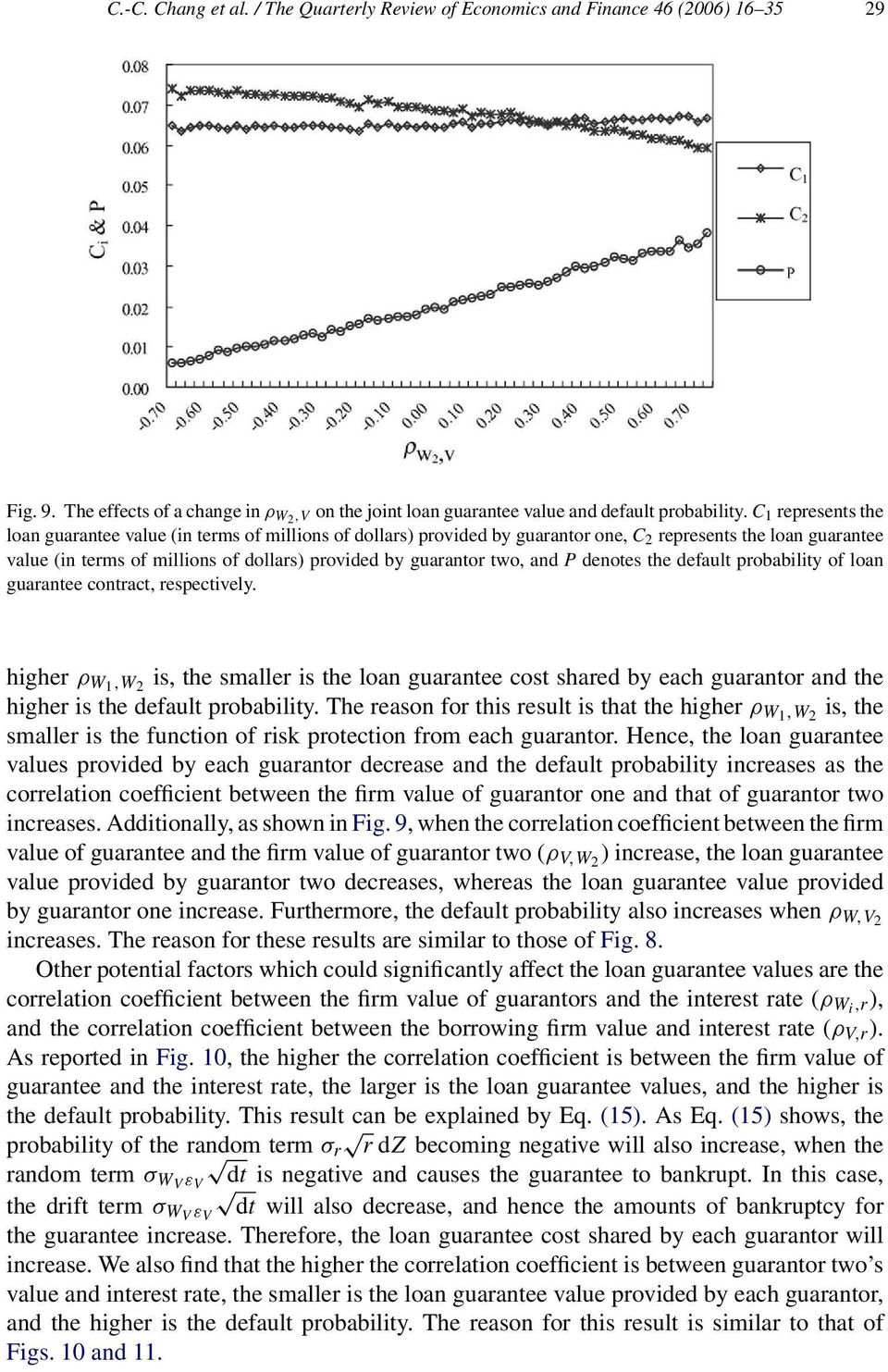
14 C-C Chang et al / The Quarterly Review of Economics and Finance 46 (2006) Fig 9 The effects of a change in ρ W2,V on the joint loan guarantee value and default probability C 1 represents the loan guarantee value (in terms of millions of dollars) provided by guarantor one, C 2 represents the loan guarantee value (in terms of millions of dollars) provided by guarantor two, and P denotes the default probability of loan guarantee contract, respectively higher ρ W1,W 2 is, the smaller is the loan guarantee cost shared by each guarantor and the higher is the default probability The reason for this result is that the higher ρ W1,W 2 is, the smaller is the function of risk protection from each guarantor Hence, the loan guarantee values provided by each guarantor decrease and the default probability increases as the correlation coefficient between the firm value of guarantor one and that of guarantor two increases Additionally, as shown in Fig 9, when the correlation coefficient between the firm value of guarantee and the firm value of guarantor two (ρ V,W2 ) increase, the loan guarantee value provided by guarantor two decreases, whereas the loan guarantee value provided by guarantor one increase Furthermore, the default probability also increases when ρ W,V2 increases The reason for these results are similar to those of Fig 8 Other potential factors which could significantly affect the loan guarantee values are the correlation coefficient between the firm value of guarantors and the interest rate (ρ Wi,r), and the correlation coefficient between the borrowing firm value and interest rate (ρ V,r ) As reported in Fig 10, the higher the correlation coefficient is between the firm value of guarantee and the interest rate, the larger is the loan guarantee values, and the higher is the default probability This result can be explained by Eq (15) As Eq(15) shows, the probability of the random term σ r r dz becoming negative will also increase, when the random term σ WV ε V dt is negative and causes the guarantee to bankrupt In this case, the drift term σ WV ε V dt will also decrease, and hence the amounts of bankruptcy for the guarantee increase Therefore, the loan guarantee cost shared by each guarantor will increase We also find that the higher the correlation coefficient is between guarantor two s value and interest rate, the smaller is the loan guarantee value provided by each guarantor, and the higher is the default probability The reason for this result is similar to that of Figs 10 and 11
15 30 C-C Chang et al / The Quarterly Review of Economics and Finance 46 (2006) Fig 10 The effects of a change in ρ V,r on the joint loan guarantee value and default probability C 1 represents the loan guarantee value (in terms of millions of dollars) provided by guarantor one, C 2 represents the loan guarantee value (in terms of millions of dollars) provided by guarantor two, and P denotes the default probability of loan guarantee contract, respectively Fig 11 The effects of a change in ρ W2,r on the joint loan guarantee value and default probability C 1 represents the loan guarantee value (in terms of millions of dollars) provided by guarantor one, C 2 represents the loan guarantee value (in terms of millions of dollars) provided by guarantor two, and P denotes the default probability of loan guarantee contract, respectively

16 C-C Chang et al / The Quarterly Review of Economics and Finance 46 (2006) Fig 12 The effects of a change in D on the joint loan guarantee value and default probability C 1 represents the loan guarantee value (in terms of millions of dollars) provided by guarantor one, C 2 represents the loan guarantee value (in terms of millions of dollars) provided by guarantor two, and P denotes the default probability of loan guarantee contract, respectively Figs 12 and 13 demonstrate that as the amounts of guarantee s debt (no matter junior or senior debt) increase, the loan guarantee values provided by each guarantor increase, and the default probability will increase This result is very intuitive The risk magnitude of guarantee will increase when the amounts of the guarantee s debt increase Hence, Fig 13 The effects of a change in F on the joint loan guarantee value and default probability C 1 represents the loan guarantee value (in terms of millions of dollars) provided by guarantor one, C 2 represents the loan guarantee value (in terms of millions of dollars) provided by guarantor two, and P denotes the default probability of loan guarantee contract, respectively

17 32 C-C Chang et al / The Quarterly Review of Economics and Finance 46 (2006) Fig 14 The effects of a change in H 2 on the joint loan guarantee value and default probability C 1 represents the loan guarantee value (in terms of millions of dollars) provided by guarantor one, C 2 represents the loan guarantee value (in terms of millions of dollars) provided by guarantor two, and P denotes the default probability of loan guarantee contract, respectively the loan guarantee values provided by each guarantor and the default probability will increase As reported in Fig 14, the higher the amount is of guarantor two s senior debt, the smaller is the guarantee value provided by guarantor two, the larger is the guarantee value provided by guarantor one, and the higher is the default probability The reason can be explained as follows The compensation amount for the guarantees is equal to the difference between the guarantor s firm value and its senior debt values Hence, other things being equal, the larger the guarantor s senior debts are, the smaller is the compensation for the guarantees and the higher is the default probability 6 Conclusions Many real world cases for loan guarantees are one-guarantee and multiple-guarantor, or multiple-guarantee and one-guarantor For these cases, the models existing in the literature cannot directly be used to estimate the loan guarantee values In this paper, we construct models which can estimate the loan guarantee values under one-guarantee and multipleguarantors, or multiple-guarantees and one-guarantor with stochastic interest rates Hence, our paper fills in the existing gap in the literature and provides solutions for valuing the loan guarantee for a general framework From the simulation results, we find that the correlation coefficients such as ρ W,V2, ρ V1,V 2, ρ r,w, ρ r,v2, etc play important roles in the valuation of a loan guarantee con-

18 C-C Chang et al / The Quarterly Review of Economics and Finance 46 (2006) tract We also find that the amounts of junior debt or senior debt of guarantees or guarantor will significantly affect the value and default probability of loan guarantee contracts Acknowledgments The earlier version of this paper was presented at the 10th Conference on Theories and Practices of Securities and Financial Markets and the 2002 EFMA annual meeting We are especially grateful to Bing-Huei Lin and Robin Chow for helpful comments and discussions Appendix A We describe the process of generating random variables in this appendix As an illustration, we consider the case of multiple-borrowers and one-guarantor, where the payoff of the loan guarantee depends on n + 2 variables (W, V 1, V 2,, V n, r) In this case, we need to generate n + 2 standard normal random variables, ε i, i =1,2,, n The correlation coefficient between ε i and ε j is ρ i,j for 1 i, j n + 2 One simulation trial involves generating M sample paths of the ε i (1 i n + 2) The required samples of ε i can be obtained from a multivariate independent standard normal distribution X as follows: n+2 ε i = α ik X k k=1 (A1) For ε i to have correct variance and the correct correlation with ε j, we must have n+2 α 2 ik = 1, k=1 and for all j < i, n+2 α ik α jk = ρ i,j k=1 The above linear equations are traditionally solved using the Cholesky decomposition technique The Cholesky decomposition factorizes a symmetric positive definite matrix Any symmetric positive definite matrix, A, may be written as the product of a lower triangular matrix, L, and its transpose, L T, which is an upper triangular matrix For the case of

19 34 C-C Chang et al / The Quarterly Review of Economics and Finance 46 (2006) multiple-borrowers and one-guarantor, the correlation matrix is given as Eq (A1) 1 ρ W,V1 ρ W,V2 ρ W,r ρ V1,W 1 ρ V1,V 2 ρ V1,r R = ρ V2,W ρ V2,V 1 1 ρ V2,r (A2) ρ r,w ρ r,v1 ρ r,v2 1 To use Cholesky decomposition, we let R = LL T, where α 1, α 2,1 α 2,2 0 0 L = (A3) α n+2,1 ρ n+2,2 ρ n+2,3 ρ n+2,n+2 If R is a positive definite matrix, then L exists For this case, n + 2 independent standard normal variables time L can be expressed as the following form: ε 1 X 1 ε = ε 2 = LX, X = X 2 iid N(0,I), (A4) ε n+2 X n+2 where I is an identical matrix Using Eq (A3), we can easily generate random variables from a multivariate independent standard normal distribution References Chan, K C, Karolyi, A K, Longstaff, F, & Sanders, A (1992) An empirical comparison of alternative models of the short-term rates Journal of Finance, Chen, A H, Chen, K C, & Sears, R S (1986) The value of loan guarantee: The case of Chrysler Corporation Research in Finance, 6, Cox, J C, Ingersoll, J E, & Ross, S A (1985) Theory of term structure of interest rate Econometrica, Dermine, J, & Lajeri, F (2001) Credit risk and the deposit insurance premium: A note Journal of Economics and Business, Geske, R (1979) The valuation of compound options Journal of Financial Economics, Johnson, H, & Stulz, R (1987) The pricing of options with default risk Journal of Finance, 42, Jones, E P, & Mason, S P (1980) The valuation of loan guarantee Journal of Banking and Finance, Lai, V S (1992) An analysis of private loan guarantee Journal of Financial Services Research, 6, Lai, V S, & Gendron, M (1994) On financial guarantee insurance under stochastic interest rates The Geneva Papers on Risk and Insurance Theory, 19, Lai, V S, & Yu, M T (1999) An accurate analysis of vulnerable loan guarantees Research in Finance, 17,

20 C-C Chang et al / The Quarterly Review of Economics and Finance 46 (2006) Merton, R C (1977) An analytic derivation of the cost of deposit insurance and loan guarantees: An application of modern option pricing theory Journal of Banking and Finance, 1, 3 11 Merton, R C, & Bodie, Z (1992) On the management of financial guarantees Financial Management, 21, Selby, M J P, Franks, J R, & Karki, J P (1993) Loan guarantees, wealth transfers and incentives to invest Journal of Fixed Income, 3, 58 65

Tutorial: Structural Models of the Firm
 Tutorial: Structural Models of the Firm Peter Ritchken Case Western Reserve University February 16, 2015 Peter Ritchken, Case Western Reserve University Tutorial: Structural Models of the Firm 1/61 Tutorial:
Black Scholes Merton Approach To Modelling Financial Derivatives Prices Tomas Sinkariovas 0802869. Words: 3441
 Black Scholes Merton Approach To Modelling Financial Derivatives Prices Tomas Sinkariovas 0802869 Words: 3441 1 1. Introduction In this paper I present Black, Scholes (1973) and Merton (1973) (BSM) general
Black-Scholes-Merton approach merits and shortcomings
 Black-Scholes-Merton approach merits and shortcomings Emilia Matei 1005056 EC372 Term Paper. Topic 3 1. Introduction The Black-Scholes and Merton method of modelling derivatives prices was first introduced
The Behavior of Bonds and Interest Rates. An Impossible Bond Pricing Model. 780 w Interest Rate Models
 780 w Interest Rate Models The Behavior of Bonds and Interest Rates Before discussing how a bond market-maker would delta-hedge, we first need to specify how bonds behave. Suppose we try to model a zero-coupon
Forward Price. The payoff of a forward contract at maturity is S T X. Forward contracts do not involve any initial cash flow.
 Forward Price The payoff of a forward contract at maturity is S T X. Forward contracts do not involve any initial cash flow. The forward price is the delivery price which makes the forward contract zero
THE FINANCING DECISIONS BY FIRMS: IMPACT OF CAPITAL STRUCTURE CHOICE ON VALUE
 IX. THE FINANCING DECISIONS BY FIRMS: IMPACT OF CAPITAL STRUCTURE CHOICE ON VALUE The capital structure of a firm is defined to be the menu of the firm's liabilities (i.e, the "right-hand side" of the
Article from: Risk Management. June 2009 Issue 16
 Article from: Risk Management June 2009 Issue 16 CHAIRSPERSON S Risk quantification CORNER Structural Credit Risk Modeling: Merton and Beyond By Yu Wang The past two years have seen global financial markets
LECTURE 10.1 Default risk in Merton s model
 LECTURE 10.1 Default risk in Merton s model Adriana Breccia March 12, 2012 1 1 MERTON S MODEL 1.1 Introduction Credit risk is the risk of suffering a financial loss due to the decline in the creditworthiness
Session IX: Lecturer: Dr. Jose Olmo. Module: Economics of Financial Markets. MSc. Financial Economics
 Session IX: Stock Options: Properties, Mechanics and Valuation Lecturer: Dr. Jose Olmo Module: Economics of Financial Markets MSc. Financial Economics Department of Economics, City University, London Stock
Caput Derivatives: October 30, 2003
 Caput Derivatives: October 30, 2003 Exam + Answers Total time: 2 hours and 30 minutes. Note 1: You are allowed to use books, course notes, and a calculator. Question 1. [20 points] Consider an investor
Part V: Option Pricing Basics
 erivatives & Risk Management First Week: Part A: Option Fundamentals payoffs market microstructure Next 2 Weeks: Part B: Option Pricing fundamentals: intrinsic vs. time value, put-call parity introduction
MULTIPLE DEFAULTS AND MERTON'S MODEL L. CATHCART, L. EL-JAHEL
 ISSN 1744-6783 MULTIPLE DEFAULTS AND MERTON'S MODEL L. CATHCART, L. EL-JAHEL Tanaka Business School Discussion Papers: TBS/DP04/12 London: Tanaka Business School, 2004 Multiple Defaults and Merton s Model
FIN-40008 FINANCIAL INSTRUMENTS SPRING 2008
 FIN-40008 FINANCIAL INSTRUMENTS SPRING 2008 Options These notes consider the way put and call options and the underlying can be combined to create hedges, spreads and combinations. We will consider the
HPCFinance: New Thinking in Finance. Calculating Variable Annuity Liability Greeks Using Monte Carlo Simulation
 HPCFinance: New Thinking in Finance Calculating Variable Annuity Liability Greeks Using Monte Carlo Simulation Dr. Mark Cathcart, Standard Life February 14, 2014 0 / 58 Outline Outline of Presentation
DISCUSSION OF OPTIMAL DEBT SERVICE: STRAIGHT
 Gunther Friedl * DISCUSSION OF OPTIMAL DEBT SERVICE: STRAIGHT VS. CONVERTIBLE DEBT 1 MOTIVATION AND OBJECTIVE OF THE PAPER Corporate bond default plays a significant role in today s business environment.
The Valuation of Currency Options
 The Valuation of Currency Options Nahum Biger and John Hull Both Nahum Biger and John Hull are Associate Professors of Finance in the Faculty of Administrative Studies, York University, Canada. Introduction
Pricing Interest-Rate- Derivative Securities
 Pricing Interest-Rate- Derivative Securities John Hull Alan White University of Toronto This article shows that the one-state-variable interest-rate models of Vasicek (1977) and Cox, Ingersoll, and Ross
t = 1 2 3 1. Calculate the implied interest rates and graph the term structure of interest rates. t = 1 2 3 X t = 100 100 100 t = 1 2 3
 MØA 155 PROBLEM SET: Summarizing Exercise 1. Present Value [3] You are given the following prices P t today for receiving risk free payments t periods from now. t = 1 2 3 P t = 0.95 0.9 0.85 1. Calculate
Lecture 12: The Black-Scholes Model Steven Skiena. http://www.cs.sunysb.edu/ skiena
 Lecture 12: The Black-Scholes Model Steven Skiena Department of Computer Science State University of New York Stony Brook, NY 11794 4400 http://www.cs.sunysb.edu/ skiena The Black-Scholes-Merton Model
The Monte Carlo Framework, Examples from Finance and Generating Correlated Random Variables
 Monte Carlo Simulation: IEOR E4703 Fall 2004 c 2004 by Martin Haugh The Monte Carlo Framework, Examples from Finance and Generating Correlated Random Variables 1 The Monte Carlo Framework Suppose we wish
Black and Scholes - A Review of Option Pricing Model
 CAPM Option Pricing Sven Husmann a, Neda Todorova b a Department of Business Administration, European University Viadrina, Große Scharrnstraße 59, D-15230 Frankfurt (Oder, Germany, Email: [email protected],
Option Pricing Theory and Applications. Aswath Damodaran
 Option Pricing Theory and Applications Aswath Damodaran What is an option? An option provides the holder with the right to buy or sell a specified quantity of an underlying asset at a fixed price (called
Introduction to Options. Derivatives
 Introduction to Options Econ 422: Investment, Capital & Finance University of Washington Summer 2010 August 18, 2010 Derivatives A derivative is a security whose payoff or value depends on (is derived
TPPE17 Corporate Finance 1(5) SOLUTIONS RE-EXAMS 2014 II + III
 TPPE17 Corporate Finance 1(5) SOLUTIONS RE-EXAMS 2014 II III Instructions 1. Only one problem should be treated on each sheet of paper and only one side of the sheet should be used. 2. The solutions folder
Four Derivations of the Black Scholes PDE by Fabrice Douglas Rouah www.frouah.com www.volopta.com
 Four Derivations of the Black Scholes PDE by Fabrice Douglas Rouah www.frouah.com www.volopta.com In this Note we derive the Black Scholes PDE for an option V, given by @t + 1 + rs @S2 @S We derive the
Option pricing. Vinod Kothari
 Option pricing Vinod Kothari Notation we use this Chapter will be as follows: S o : Price of the share at time 0 S T : Price of the share at time T T : time to maturity of the option r : risk free rate
Asymmetry and the Cost of Capital
 Asymmetry and the Cost of Capital Javier García Sánchez, IAE Business School Lorenzo Preve, IAE Business School Virginia Sarria Allende, IAE Business School Abstract The expected cost of capital is a crucial
2.5 Debt negotiation models and optimal capital structure
 2.5 Debt negotiation models and optimal capital structure The option-based approach gives the prices of equity and bonds in a given capital structure. Instead of the static choice of capital structure,
The Discount Rate: A Note on IAS 36
 The Discount Rate: A Note on IAS 36 Sven Husmann Martin Schmidt Thorsten Seidel European University Viadrina Frankfurt (Oder) Department of Business Administration and Economics Discussion Paper No. 246
Forward Contracts and Forward Rates
 Forward Contracts and Forward Rates Outline and Readings Outline Forward Contracts Forward Prices Forward Rates Information in Forward Rates Reading Veronesi, Chapters 5 and 7 Tuckman, Chapters 2 and 16
FNCE 301, Financial Management H Guy Williams, 2006
 REVIEW We ve used the DCF method to find present value. We also know shortcut methods to solve these problems such as perpetuity present value = C/r. These tools allow us to value any cash flow including
Click Here to Buy the Tutorial
 FIN 534 Week 4 Quiz 3 (Str) Click Here to Buy the Tutorial http://www.tutorialoutlet.com/fin-534/fin-534-week-4-quiz-3- str/ For more course tutorials visit www.tutorialoutlet.com Which of the following
DETERMINING THE VALUE OF EMPLOYEE STOCK OPTIONS. Report Produced for the Ontario Teachers Pension Plan John Hull and Alan White August 2002
 DETERMINING THE VALUE OF EMPLOYEE STOCK OPTIONS 1. Background Report Produced for the Ontario Teachers Pension Plan John Hull and Alan White August 2002 It is now becoming increasingly accepted that companies
Likewise, the payoff of the better-of-two note may be decomposed as follows: Price of gold (US$/oz) 375 400 425 450 475 500 525 550 575 600 Oil price
 Exchange Options Consider the Double Index Bull (DIB) note, which is suited to investors who believe that two indices will rally over a given term. The note typically pays no coupons and has a redemption
On Black-Scholes Equation, Black- Scholes Formula and Binary Option Price
 On Black-Scholes Equation, Black- Scholes Formula and Binary Option Price Abstract: Chi Gao 12/15/2013 I. Black-Scholes Equation is derived using two methods: (1) risk-neutral measure; (2) - hedge. II.
How To Price Garch
 2011 3rd International Conference on Information and Financial Engineering IPEDR vol.12 (2011) (2011) IACSIT Press, Singapore A Study on Heston-Nandi GARCH Option Pricing Model Suk Joon Byun KAIST Business
Assessing Credit Risk for a Ghanaian Bank Using the Black- Scholes Model
 Assessing Credit Risk for a Ghanaian Bank Using the Black- Scholes Model VK Dedu 1, FT Oduro 2 1,2 Department of Mathematics, Kwame Nkrumah University of Science and Technology, Kumasi, Ghana. Abstract
Introduction to Binomial Trees
 11 C H A P T E R Introduction to Binomial Trees A useful and very popular technique for pricing an option involves constructing a binomial tree. This is a diagram that represents di erent possible paths
Journal of Financial and Economic Practice
 Analyzing Investment Data Using Conditional Probabilities: The Implications for Investment Forecasts, Stock Option Pricing, Risk Premia, and CAPM Beta Calculations By Richard R. Joss, Ph.D. Resource Actuary,
Computational Finance Options
 1 Options 1 1 Options Computational Finance Options An option gives the holder of the option the right, but not the obligation to do something. Conversely, if you sell an option, you may be obliged to
For both risk and return, increasing order is b, c, a, d. On average, the higher the risk of an investment, the higher is its expected return. 2.
 For both risk and return, increasing order is b, c, a, d. On average, higher risk of an investment, higher is its expected return. 2. Since price didn t change, capital gains yield was zero. If total return
Valuation of Razorback Executive Stock Options: A Simulation Approach
 Valuation of Razorback Executive Stock Options: A Simulation Approach Joe Cheung Charles J. Corrado Department of Accounting & Finance The University of Auckland Private Bag 92019 Auckland, New Zealand.
LECTURE 9: A MODEL FOR FOREIGN EXCHANGE
 LECTURE 9: A MODEL FOR FOREIGN EXCHANGE 1. Foreign Exchange Contracts There was a time, not so long ago, when a U. S. dollar would buy you precisely.4 British pounds sterling 1, and a British pound sterling
Jorge Cruz Lopez - Bus 316: Derivative Securities. Week 11. The Black-Scholes Model: Hull, Ch. 13.
 Week 11 The Black-Scholes Model: Hull, Ch. 13. 1 The Black-Scholes Model Objective: To show how the Black-Scholes formula is derived and how it can be used to value options. 2 The Black-Scholes Model 1.
Valuing Stock Options: The Black-Scholes-Merton Model. Chapter 13
 Valuing Stock Options: The Black-Scholes-Merton Model Chapter 13 Fundamentals of Futures and Options Markets, 8th Ed, Ch 13, Copyright John C. Hull 2013 1 The Black-Scholes-Merton Random Walk Assumption
第 9 讲 : 股 票 期 权 定 价 : B-S 模 型 Valuing Stock Options: The Black-Scholes Model
 1 第 9 讲 : 股 票 期 权 定 价 : B-S 模 型 Valuing Stock Options: The Black-Scholes Model Outline 有 关 股 价 的 假 设 The B-S Model 隐 性 波 动 性 Implied Volatility 红 利 与 期 权 定 价 Dividends and Option Pricing 美 式 期 权 定 价 American
Financial Options: Pricing and Hedging
 Financial Options: Pricing and Hedging Diagrams Debt Equity Value of Firm s Assets T Value of Firm s Assets T Valuation of distressed debt and equity-linked securities requires an understanding of financial
Bond Valuation. Capital Budgeting and Corporate Objectives
 Bond Valuation Capital Budgeting and Corporate Objectives Professor Ron Kaniel Simon School of Business University of Rochester 1 Bond Valuation An Overview Introduction to bonds and bond markets» What
An Approach to Stress Testing the Canadian Mortgage Portfolio
 Financial System Review December 2007 An Approach to Stress Testing the Canadian Mortgage Portfolio Moez Souissi I n Canada, residential mortgage loans account for close to 47 per cent of the total loan
Review of Basic Options Concepts and Terminology
 Review of Basic Options Concepts and Terminology March 24, 2005 1 Introduction The purchase of an options contract gives the buyer the right to buy call options contract or sell put options contract some
Chapter 21 Valuing Options
 Chapter 21 Valuing Options Multiple Choice Questions 1. Relative to the underlying stock, a call option always has: A) A higher beta and a higher standard deviation of return B) A lower beta and a higher
Valuing equity-based payments
 E Valuing equity-based payments Executive remuneration packages generally comprise many components. While it is relatively easy to identify how much will be paid in a base salary a fixed dollar amount
BINOMIAL OPTIONS PRICING MODEL. Mark Ioffe. Abstract
 BINOMIAL OPTIONS PRICING MODEL Mark Ioffe Abstract Binomial option pricing model is a widespread numerical method of calculating price of American options. In terms of applied mathematics this is simple
Binomial lattice model for stock prices
 Copyright c 2007 by Karl Sigman Binomial lattice model for stock prices Here we model the price of a stock in discrete time by a Markov chain of the recursive form S n+ S n Y n+, n 0, where the {Y i }
How To Value Bonds
 Chapter 6 Interest Rates And Bond Valuation Learning Goals 1. Describe interest rate fundamentals, the term structure of interest rates, and risk premiums. 2. Review the legal aspects of bond financing
M.I.T. Spring 1999 Sloan School of Management 15.415. First Half Summary
 M.I.T. Spring 1999 Sloan School of Management 15.415 First Half Summary Present Values Basic Idea: We should discount future cash flows. The appropriate discount rate is the opportunity cost of capital.
How credit analysts view and use the financial statements
 How credit analysts view and use the financial statements Introduction Traditionally it is viewed that equity investment is high risk and bond investment low risk. Bondholders look at companies for creditworthiness,
When to Refinance Mortgage Loans in a Stochastic Interest Rate Environment
 When to Refinance Mortgage Loans in a Stochastic Interest Rate Environment Siwei Gan, Jin Zheng, Xiaoxia Feng, and Dejun Xie Abstract Refinancing refers to the replacement of an existing debt obligation
Schonbucher Chapter 9: Firm Value and Share Priced-Based Models Updated 07-30-2007
 Schonbucher Chapter 9: Firm alue and Share Priced-Based Models Updated 07-30-2007 (References sited are listed in the book s bibliography, except Miller 1988) For Intensity and spread-based models of default
CS 522 Computational Tools and Methods in Finance Robert Jarrow Lecture 1: Equity Options
 CS 5 Computational Tools and Methods in Finance Robert Jarrow Lecture 1: Equity Options 1. Definitions Equity. The common stock of a corporation. Traded on organized exchanges (NYSE, AMEX, NASDAQ). A common
Valuation of Asian Options
 Valuation of Asian Options - with Levy Approximation Master thesis in Economics Jan 2014 Author: Aleksandra Mraovic, Qian Zhang Supervisor: Frederik Lundtofte Department of Economics Abstract Asian options
The Binomial Option Pricing Model André Farber
 1 Solvay Business School Université Libre de Bruxelles The Binomial Option Pricing Model André Farber January 2002 Consider a non-dividend paying stock whose price is initially S 0. Divide time into small
Risk and Return in the Canadian Bond Market
 Risk and Return in the Canadian Bond Market Beyond yield and duration. Ronald N. Kahn and Deepak Gulrajani (Reprinted with permission from The Journal of Portfolio Management ) RONALD N. KAHN is Director
 A Pricing Model for American Options with Stochastic Interest Rates Bert Menkveld and Ton Vorst Department of Finance Erasmus University Rotterdam P.O. Box 1738 NL-3000 DR Rotterdam The Netherlands e-mail:
How to Value Employee Stock Options
 John Hull and Alan White One of the arguments often used against expensing employee stock options is that calculating their fair value at the time they are granted is very difficult. This article presents
Bond Valuation. FINANCE 350 Global Financial Management. Professor Alon Brav Fuqua School of Business Duke University. Bond Valuation: An Overview
 Bond Valuation FINANCE 350 Global Financial Management Professor Alon Brav Fuqua School of Business Duke University 1 Bond Valuation: An Overview Bond Markets What are they? How big? How important? Valuation
INTERNATIONAL COMPARISON OF INTEREST RATE GUARANTEES IN LIFE INSURANCE
 INTERNATIONAL COMPARISON OF INTEREST RATE GUARANTEES IN LIFE INSURANCE J. DAVID CUMMINS, KRISTIAN R. MILTERSEN, AND SVEIN-ARNE PERSSON Abstract. Interest rate guarantees seem to be included in life insurance
Option Pricing Applications in Valuation!
 Option Pricing Applications in Valuation! Equity Value in Deeply Troubled Firms Value of Undeveloped Reserves for Natural Resource Firm Value of Patent/License 73 Option Pricing Applications in Equity
The term structure of Russian interest rates
 The term structure of Russian interest rates Stanislav Anatolyev New Economic School, Moscow Sergey Korepanov EvrazHolding, Moscow Corresponding author. Address: Stanislav Anatolyev, New Economic School,
Guaranteed Annuity Options
 Guaranteed Annuity Options Hansjörg Furrer Market-consistent Actuarial Valuation ETH Zürich, Frühjahrssemester 2008 Guaranteed Annuity Options Contents A. Guaranteed Annuity Options B. Valuation and Risk
Excess Volatility and Closed-End Fund Discounts
 Excess Volatility and Closed-End Fund Discounts Michael Bleaney School of Economics University of Nottingham Nottingham NG7 RD, U.K. Tel. (+44) 115 951 5464 Fax (+44) 115 951 4159 e-mail: [email protected]
CALCULATOR TUTORIAL. Because most students that use Understanding Healthcare Financial Management will be conducting time
 CALCULATOR TUTORIAL INTRODUCTION Because most students that use Understanding Healthcare Financial Management will be conducting time value analyses on spreadsheets, most of the text discussion focuses
This paper is not to be removed from the Examination Halls
 ~~FN3023 ZB d0 This paper is not to be removed from the Examination Halls UNIVERSITY OF LONDON FN3023 ZB BSc degrees and Diplomas for Graduates in Economics, Management, Finance and the Social Sciences,
Variance Reduction. Pricing American Options. Monte Carlo Option Pricing. Delta and Common Random Numbers
 Variance Reduction The statistical efficiency of Monte Carlo simulation can be measured by the variance of its output If this variance can be lowered without changing the expected value, fewer replications
FUNDING INVESTMENTS FINANCE 238/738, Spring 2008, Prof. Musto Class 6 Introduction to Corporate Bonds
 FUNDING INVESTMENTS FINANCE 238/738, Spring 2008, Prof. Musto Class 6 Introduction to Corporate Bonds Today: I. Equity is a call on firm value II. Senior Debt III. Junior Debt IV. Convertible Debt V. Variance
Black-Scholes Equation for Option Pricing
 Black-Scholes Equation for Option Pricing By Ivan Karmazin, Jiacong Li 1. Introduction In early 1970s, Black, Scholes and Merton achieved a major breakthrough in pricing of European stock options and there
The Term Structure of Lease Rates with Endogenous Default Triggers and Tenant Capital Structure: Theory and Evidence
 The Term Structure of Lease Rates with Endogenous Default Triggers and Tenant Capital Structure: Theory and Evidence Sumit Agarwal, Brent W. Ambrose Hongming Huang, and Yildiray Yildirim Abstract This
Risk/Arbitrage Strategies: An Application to Stock Option Portfolio Management
 Risk/Arbitrage Strategies: An Application to Stock Option Portfolio Management Vincenzo Bochicchio, Niklaus Bühlmann, Stephane Junod and Hans-Fredo List Swiss Reinsurance Company Mythenquai 50/60, CH-8022
A Study on Pricing of the Reverse Mortgage with an Embedded Redeemable Option An analysis based on China s market
 A Study on Pricing of the Reverse Mortgage with an Embedded Redeemable Option An analysis based on China s market Chen Bingzheng, Deng Yinglu, Qin Peng CCIRM, Tsinghua Univ. Introduction Reverse mortgage:
Options: Valuation and (No) Arbitrage
 Prof. Alex Shapiro Lecture Notes 15 Options: Valuation and (No) Arbitrage I. Readings and Suggested Practice Problems II. Introduction: Objectives and Notation III. No Arbitrage Pricing Bound IV. The Binomial
Management of Asian and Cliquet Option Exposures for Insurance Companies: SPVA applications (I)
 Management of Asian and Cliquet Option Exposures for Insurance Companies: SPVA applications (I) Pin Chung and Rachid Lassoued 5th September, 2014, Wicklow, Ireland 0 Agenda 1. Introduction 2. Review of
Fin 3312 Sample Exam 1 Questions
 Fin 3312 Sample Exam 1 Questions Here are some representative type questions. This review is intended to give you an idea of the types of questions that may appear on the exam, and how the questions might
A liability driven approach to asset allocation
 A liability driven approach to asset allocation Xinliang Chen 1, Jan Dhaene 2, Marc Goovaerts 2, Steven Vanduffel 3 Abstract. We investigate a liability driven methodology for determining optimal asset
Finite Differences Schemes for Pricing of European and American Options
 Finite Differences Schemes for Pricing of European and American Options Margarida Mirador Fernandes IST Technical University of Lisbon Lisbon, Portugal November 009 Abstract Starting with the Black-Scholes
CHAPTER 22: FUTURES MARKETS
 CHAPTER 22: FUTURES MARKETS PROBLEM SETS 1. There is little hedging or speculative demand for cement futures, since cement prices are fairly stable and predictable. The trading activity necessary to support
Constructing Portfolios of Constant-Maturity Fixed- Income ETFs
 Constructing Portfolios of Constant-Maturity Fixed- Income ETFs Newfound Research LLC December 2013 For more information about Newfound Research call us at +1-617-531-9773, visit us at www.thinknewfound.com
Private Equity Fund Valuation and Systematic Risk
 An Equilibrium Approach and Empirical Evidence Axel Buchner 1, Christoph Kaserer 2, Niklas Wagner 3 Santa Clara University, March 3th 29 1 Munich University of Technology 2 Munich University of Technology
Chapter 3 Fixed Income Securities
 Chapter 3 Fixed Income Securities Road Map Part A Introduction to finance. Part B Valuation of assets, given discount rates. Fixed-income securities. Stocks. Real assets (capital budgeting). Part C Determination
Risk-Neutral Valuation of Participating Life Insurance Contracts
 Risk-Neutral Valuation of Participating Life Insurance Contracts DANIEL BAUER with R. Kiesel, A. Kling, J. Russ, and K. Zaglauer ULM UNIVERSITY RTG 1100 AND INSTITUT FÜR FINANZ- UND AKTUARWISSENSCHAFTEN