
MICROSIMULATION MODELS IN GEOGRAPHY USING OBJECT-ORIENTED PROGRAMMING:
|
|
|
- Darren Young
- 10 years ago
- Views:
Transcription
1 ΠΑΝΕΠΙΣΤΗΜΙΟ ΑΙΓΑΙΟΥ ΣΧΟΛΗ ΚΟΙΝΩΝΙΚΩΝ ΕΠΙΣΤΗΜΩΝ ΤΜΗΜΑ ΓΕΩΓΡΑΦΙΑΣ MICROSIMULATION MODELS IN GEOGRAPHY USING OBJECT-ORIENTED PROGRAMMING: AN APPLICATION TO RESIDENTIAL MOBILITY Υποδείγµατα µικρο-προσοµοίωσης στη Γεωγραφία µε χρήση αντικειµενοστραφούς προγραµµατισµού: Εφαρµογή στη µετεγκατάσταση αστικών πληθυσµών Marianthi Svinterikou Advisory Committee: Dr. P. Kanaroglou, Dr. N. Soulakellis, Dr. S. Koukoulas 2007

2 Acknowledgements I would like to thank my supervisor Dr. Pavlos Kanaroglou for his guidance throughout this work. His vast experience on my research area was an important source of knowledge for me. I would like to thank my colleague Justin Ryan at McMaster University in Hamilton, Canada, for his cooperation throughout this work. His useful comments improved the outcome of my research significantly. I would like to thank Dr Mari Lavrendiadou who lectured at the Housing Geography course for her help in filling out my research questionnaires. I am grateful to my beloved husband for his support the last years of this thesis. His patience and encouragement helped me overcome difficulties and make it all the way to the submission of this thesis. I am grateful to my mother for her valuable help and support throughout this thesis. I would like to thank her for the countless hours of babysitting my new born daughter to help me make it all the way to the submission of this thesis. I would like to thank my parents for their endless love and patience all these years and my beloved sister Sofi who stood by me during the years of my studies. Their support encouraged me to continue searching for knowledge. I would like to thank my colleague and very good friend Makis Nikellis for helping me keep up a full time job with PhD research. ii

3 Στην κόρη µου Ιωάννα, το σύζυγό µου Μιχάλη και τη µητέρα µου Μαρία. iii

4 TABLE OF CONTENTS TABLE OF CONTENTS... IV LIST OF FIGURES...X LIST OF TABLES... XIII ABSTRACT...XV ΠΕΡΙΛΗΨΗ...XVII CHAPTER 1 INTRODUCTION INTRODUCTION OBJECTIVES OF THE INVESTIGATION THE STRUCTURE OF THE THESIS...5 CHAPTER 2 BACKGROUND LITERATURE IN MODELING RESIDENTIAL MOBILITY INTRODUCTION RESIDENTIAL MOBILITY MODELING RESIDENTIAL MOBILITY THE MICROSIMULATION TECHNIQUE ELEMENTS OF RESIDENTIAL MOBILITY MICROSIMULATION MODELS LOCSIM HUDS FRANSSON MODEL SVERIGE UPDATE HOUSIM ILUTE RESIDENTIAL MOBILITY MODEL ILUMASS LAND-USE MODEL SUMMARY OF THE MODELS SUMMARY...70 CHAPTER 3 BACKGROUND LITERATURE IN SYSTEM DEVELOPMENT METHODS INTRODUCTION...71 iv

5 3.2 SYSTEM DEVELOPMENT METHODS THE ELEMENTS OF OBJECT-ORIENTED METHODS UNIFIED MODELING LANGUAGE (UML) THE CONCEPTS OF SPATIOTEMPORAL METHODS Spatial concepts Temporal concepts Spatiotemporal concepts EXTENDED SPATIOTEMPORAL UML SPATIOTEMPORAL PVL FOR UML THE ARCINFO UML GEODATABASE MODEL SUMMARY OF THE MODELING LANGUAGES THE STUML PROCESS SUMMARY CHAPTER 4 SYSTEM ANALYSIS INTRODUCTION THE URM-MICROSIM MODEL THE HOUSING DEMAND SUB-MODEL Demographic change events Income change events Demand change event THE HOUSING SUPPLY SUB-MODEL New construction event Structure conversion events Demolition event Housing expenditures change event THE RESIDENTIAL SEARCH AND MIGRATION SUB-MODEL Search and migration event Housing prices change event THE URM-MICROSIM DATABASE SUMMARY CHAPTER 5 SYSTEM DESIGN INTRODUCTION THE URM-MICROSIM MODEL THE HOUSING DEMAND EVENTS v

6 5.3.1 Death event Fertility event Union Formation event Union Dissolution event Nest Leaving event Flat-mate Formation event Flat-mate Leaving event Out-migration event In-migration event Education event Job entry event Job change event Demand change event THE RESIDENTIAL SEARCH AND MIGRATION EVENTS Dwelling Search event Dwelling vacation event THE URM-MICROSIM DATABASE IMPLEMENTATION EVOLUTION SUMMARY CHAPTER 6 DATA AND SYNTHETIC POPULATION DEVELOPMENT INTRODUCTION THE MYTILENE HOUSING MARKET History Residence zones POPULATION AND HOUSING STOCK DATA Population synthesis technique Base Data Synthetic Data PROBABILITIES Death event Fertility event Union formation event Union dissolution event Nest leaving event Flat-mate formation event vi

7 6.4.7 Flat-mate leaving event Out-migration event In-migration event Education event Demand change event Residential search and migration use case SUMMARY CHAPTER 7 RESULTS AND DISCUSSION INTRODUCTION CALIBRATION Base run simulation Nest leaving effect run simulation Union dissolution effect run simulation Union formation effect run simulation VALIDATION SUMMARY CHAPTER 8 CONCLUSIONS AND FUTURE RESEARCH INTRODUCTION THESIS OVERVIEW THESIS LIMITATIONS FUTURE WORK EPILOGUE BIBLIOGRAPHY APPENDIX A THE UML NOTATION A.1 USE CASE DIAGRAM NOTATION A.2 CLASS DIAGRAM NOTATION A.3 OBJECT DIAGRAM NOTATION A.4 SEQUENCE DIAGRAM NOTATION A.5 COLLABORATION DIAGRAM NOTATION A.6 STATECHART DIAGRAM NOTATION A.7 ACTIVITY DIAGRAM NOTATION A.8 COMPONENT DIAGRAM NOTATION A.9 DEPLOYMENT DIAGRAMS NOTATION vii

8 APPENDIX B THE STUML PROCESS: A USER S GUIDE B.1 THE MACRO DEVELOPMENT PROCESS B.1.1 Conceptualisation B.1.2 Analysis B.1.3 Design B.1.4 Evolution B.1.5 Maintenance B.2 THE MICRO DEVELOPMENT PROCESS B.2.1 Identify classes and objects B.2.2 Identify the semantics of classes and objects B.2.3 Identify the relationships among classes and objects B.2.4 Identify the spatial semantics of classes, objects and relationships B.2.5 Identify the temporal semantics of classes, objects and relationships B.2.6 Implement classes and objects APPENDIX C THE UML USE CASE SCENARIOS C.1 THE HOUSING DEMAND USE CASE SCENARIOS C.1.1 Demographic change use case scenario C.1.2 Death use case scenario C.1.3 Fertility use case scenario C.1.4 Union formation use case scenario C.1.5 Union dissolution use case scenario C.1.6 Nest leaving use case scenario C.1.7 Flat-mate formation use case scenario C.1.8 Flat-mate leaving use case scenario C.1.9 Out-migration use case scenario C.1.10 In-migration use case scenario C.1.11 Income change use case scenario C.1.12 Education use case scenario C.1.13 Job entry use case scenario C.1.14 Job change use case scenario C.1.15 Job search use case scenario C.1.16 Demand change use case scenario C.2 THE HOUSING SUPPLY USE CASE SCENARIOS C.2.1 New construction use case scenario viii

9 C.2.2 Structure conversion use case scenario C.2.3 Renovation use case scenario C.2.4 Split use case scenario C.2.5 Combination use case scenario C.2.6 Demolition use case scenario C.2.7 Housing expenditures change use case scenario C.3 THE RESIDENTIAL SEARCH AND MIGRATION USE CASE SCENARIOS C.3.1 Search and migration use case scenario C.3.2 Dwelling Search use case scenario C.3.3 Dwelling vacation use case scenario C.3.4 Housing prices change use case scenario APPENDIX D THE HOUSEHOLD AND DWELLING QUESTIONNAIRE ix

10 LIST OF FIGURES FIGURE 1: OUTLINE OF LOCSIM...34 FIGURE 2: GENERAL OUTLINE OF LOCSIM'S DEMOGRAPHIC MODEL...35 FIGURE 3: SCHEMATIC REPRESENTATION OF LOCSIM'S HOUSING MARKET MODULE...36 FIGURE 4: SEQUENCE OF MAJOR SUB-MODELS INCLUDED IN THE HUDS MODEL...42 FIGURE 5: THE MAIN COMPONENTS DECIDING THE MOVES OF HOUSEHOLDS IN FRANSSON MODEL...46 FIGURE 6: RELATIONS BETWEEN THE MODULES OF THE FRANSSON MODEL FIGURE 7: THE SVERIGE MODEL...53 FIGURE 8: MICROSIMULATIION OF HOUSEHOLD FORMATION ILUMASS...65 FIGURE 9: MICROSIMULATIION OF HOUSEHOLD CHOICE ILUMASS...66 FIGURE 10: UTILITY CLASS...81 FIGURE 11: LOCSIM CLASS DIAGRAM...83 FIGURE 12: LOCSIM USE CASE DIAGRAM...85 FIGURE 13: FERTILITY SEQUENCE DIAGRAM...86 FIGURE 14: NEST LEAVING SEQUENCE DIAGRAM I...87 FIGURE 15: NEST LEAVING SEQUENCE DIAGRAM II...88 FIGURE 16: AN EXAMPLE IN EXTENDED SPATIOTEMPORAL UML (ESTUML)...98 FIGURE 17: AN EXAMPLE IN SPATIOTEMPORAL PVL FOR UML FIGURE 18: ARCINFO UML MODEL DIAGRAM PACKAGES FIGURE 19: THE MACRO DEVELOPMENT PROCESS FIGURE 20: THE MICRO DEVELOPMENT PROCESS FIGURE 21: THE URM-MICROSIM ANALYSIS MODEL FIGURE 22: THE HOUSING DEMAND ANALYSIS SUB-MODEL FIGURE 23: THE HOUSING SUPPLY ANALYSIS SUB-MODEL FIGURE 24: THE RESIDENTIAL SEARCH AND MIGRATION ANALYSIS SUB-MODEL FIGURE 25: THE URM-MICROSIM DATABASE CLASS DIAGRAM FIGURE 26: THE URM-MICROSIM DESIGN MODEL FIGURE 27: DEATH EVENT FIGURE 28: FERTILITY EVENT FIGURE 29: UNION FORMATION EVENT FIGURE 30: UNION DISSOLUTION EVENT FIGURE 31: NEST LEAVING EVENT FIGURE 32: FLAT-MATE FORMATION EVENT FIGURE 33: FLAT-MATE LEAVING EVENT x
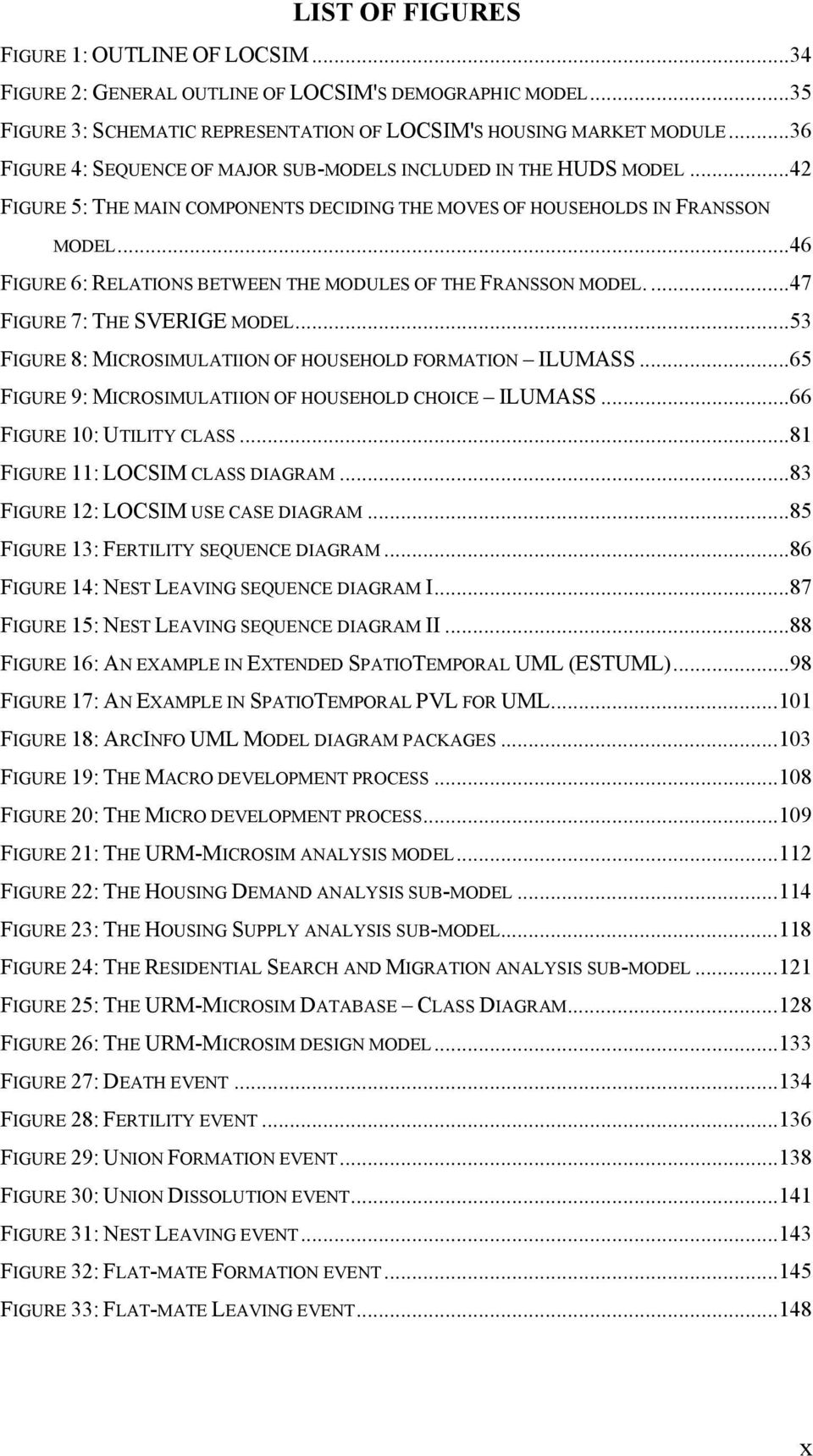
11 FIGURE 34: OUT-MIGRATION EVENT FIGURE 35: IN-MIGRATION EVENT FIGURE 36: EDUCATION EVENT FIGURE 37: JOB ENTRY EVENT FIGURE 38: JOB CHANGE EVENT FIGURE 39: DEMAND CHANGE EVENT FIGURE 40: DWELLING SEARCH EVENT FIGURE 41: DWELLING VACATION EVENT FIGURE 42: THE URM-MICROSIM DATABASE FIGURE 43: THE URM-MICROSIM DATABASE DOMAINS FIGURE 44: MAP OF LESVOS ISLAND FIGURE 45: THE LOCATION OF THE MUNICIPALITY OF MYTILENE FIGURE 46: MYTILENE RESIDENCE ZONES FIGURE 47: DEATH PROBABILITY BY SEX AND AGE GROUP FIGURE 48: LIVE BIRTHS BY MOTHER'S AGE GROUP FIGURE 49: LIVE BIRTHS BY MOTHER'S AGE GROUP & MARITAL STATUS - N. AEGEAN FIGURE 50: LIVING NEWLY BORN SEX PROBABILITY FIGURE 51: MORTALITY PROBABILITY OF NEWLY BORN (UNDER 1 YEAR OLD) FIGURE 52: MARRIAGE PROBABILITY BY AGE OF UNMARRIED POPULATION GREECE FIGURE 53: PROBABILITY MALE OF AGE X MARRYING FEMALE OF AGE Y GREECE FIGURE 54: PROBABILITY FEMALE OF AGE X MARRYING MALE OF AGE Y GREECE FIGURE 55: DIVORCES RATES BY DURATION OF MARRIAGE FIGURE 56: FEMALE S AGE SPECIFIC MARRIAGE DURATION PROBABILITY MYTILENE FIGURE 57: AGE SPECIFIC EDUCATION PROBABILITY GREECE FIGURE 58: NUMBER OF INDIVIDUALS PER RESIDENCE ZONE MAP OF MYTILENE FIGURE 59: NUMBER OF HOUSEHOLDS PER RESIDENCE ZONE MAP OF MYTILENE FIGURE 60: NUMBER OF DWELLINGS PER RESIDENCE ZONE MAP OF MYTILENE FIGURE 61: NUMBER OF AVAILABLE DWELLINGS PER RESIDENCE ZONE MAP OF MYTILENE xi

12 FIGURE 62: NUMBER OF IN-MIGRATING HOUSEHOLDS PER RESIDENCE ZONE MAP OF MYTILENE FIGURE 63: NUMBER OF OUT-MIGRATING HOUSEHOLDS PER RESIDENCE ZONE MAP OF MYTILENE FIGURE 64: NUMBER OF HOUSEHOLDS MOVING FROM EACH RESIDENCE ZONE TO CHRISOMALOUSA (ZONE 1) MAP OF MYTILENE FIGURE 65: BASE RUN SIMULATION RESULTS MAP OF MYTILENE FIGURE 66: NEST LEAVING SIMULATION RESULTS MAP OF MYTILENE FIGURE 67: UNION DISSOLUTION SIMULATION RESULTS MAP OF MYTILENE FIGURE 68: UNION FORMATION SIMULATION RESULTS MAP OF MYTILENE xii

13 LIST OF TABLES TABLE 1: SUMMARY OF IMPLEMENTED MICROSIMULATION MODELS...68 TABLE 2: SUMMARY OF SPATIO-TEMPORAL MODELING LANGUAGES TABLE 3: EXCERPT FROM HOUSEHOLDS, HOUSEHOLD MEMBERS AND DWELLINGS PER BUILDING BLOCK TABLE 4: INDIVIDUALS BY AGE CATEGORIES AND AREA TABLE 5: INDIVIDUALS BY SEX AND AREA TABLE 6: EMPLOYED INDIVIDUALS BY OCCUPATION PER AREA TABLE 7: HOUSEHOLDS BY NUMBER OF HOUSEHOLD MEMBERS AND AREA TABLE 8: DWELLINGS BY NUMBER OF ROOMS AND AREA TABLE 9: DWELLING USE BY TYPE OF USE AND ARE TABLE 10: BUILDINGS BY NUMBER OF FLOORS AND AREA TABLE 11: BUILDINGS BY PARKING AVAILABILITY AND AREA TABLE 12: BUILDINGS BY BUILDING TYPE AND AREA TABLE 13: BUILDINGS BY CONSTRUCTION PERIOD AND AREA TABLE 14: NUMBER OF ROOMS & TYPE SPECIFIC RENT & MARKET VALUES PER AREA TABLE 15: EXCERPT FROM BUILDING BLOCKS ARCINFO FEATURE TABLE TABLE 16: EXCERPT FROM BUILDINGS ARCINFO FEATURE TABLE TABLE 17: EXCERPT FROM INDIVIDUAL TABLE TABLE 18: EXCERPT FROM HOUSEHOLD TABLE TABLE 19: EXCERPT FROM DWELLING TABLE TABLE 20: EXCERPT FROM BUILDING TABLE TABLE 21: EXCERPT FROM BUILDING BLOCK TABLE TABLE 22: AGE SPECIFIC DEATH PROBABILITY FOR NATIONAL & LOCAL DATA TABLE 23: AGE SPECIFIC FERTILITY PROBABILITY FOR NATIONAL & LOCAL DATA TABLE 24: AGE & MARITAL STATUS SPECIFIC FERTILITY PROBABILITY FOR NATIONAL & LOCAL DATA TABLE 25: LIVING NEWLY BORN SEX PROBABILITY TABLE 26: MARRIAGE PROBABILITY BY AGE OF UNMARRIED POPULATION GREECE TABLE 27: PROBABILITY MALE OF AGE X MARRYING FEMALE OF AGE Y GREECE TABLE 28: PROBABILITY FEMALE OF AGE X MARRYING MALE OF AGE Y GREECE TABLE 29: COHABITATE PROBABILITY MYTILENE xiii
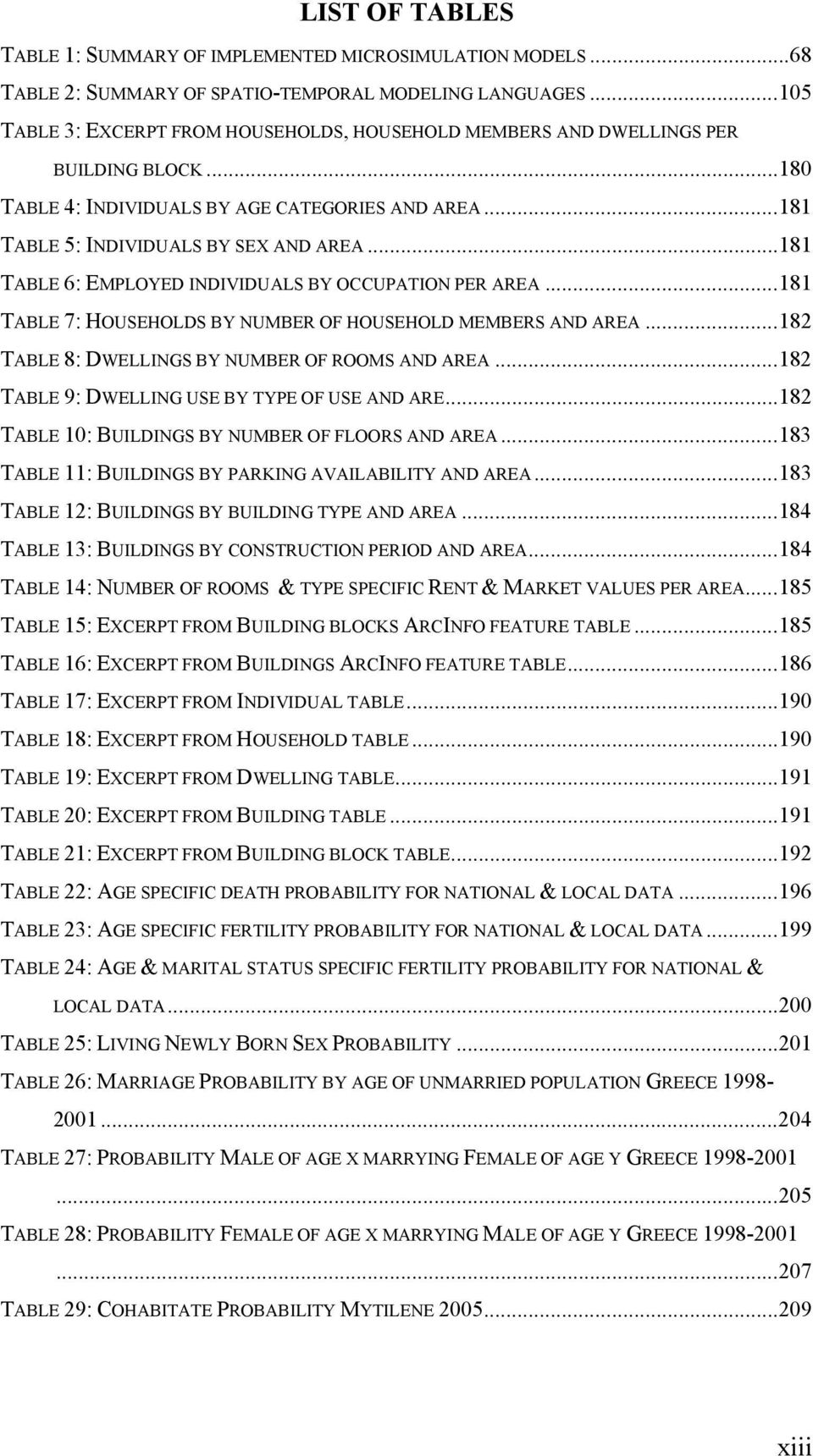
14 TABLE 30: DIVORCE RATES BY DURATION OF MARRIAGE GREECE TABLE 31: FEMALE S AGE SPECIFIC MARRIAGE DURATION PROBABILITY MYTILENE TABLE 32: DIVORCED OUT-MIGRATE PROBABILITY PREFECTURE OF LESVOS TABLE 33: NEST LEAVING PROBABILITY MYTILENE TABLE 34: FLAT-MATE FORMATION & LEAVING PROBABILITIES MYTILENE TABLE 35: EVENT SPECIFIC OUT-MIGRATION PROBABILITIES TABLE 36: AGE SPECIFIC EDUCATION PROBABILITIES GREECE TABLE 37: OWNERSHIP SPECIFIC RESIDENTIAL SEARCH PROBABILITIES MYTILENE TABLE 38: EVENT & SEARCH CRITERIA SPECIFIC SEARCH PROBABILITIES MYTILENE TABLE 39: HOUSEHOLD CHANGE IN 7 AND 22 RESIDENCE ZONES TABLE 40: THE NUMBER OF POTENTIAL MOVERS AND REALIZED MOVES BY EVENT - BASE RUN TABLE 41: THE NUMBER OF POTENTIAL MOVERS AND REALIZED MOVES BY EVENT EFFECT OF NEST LEAVING TABLE 42: BASE & NEST LEAVING RUN HOUSEHOLD CHANGE IN 8 AND 13 RESIDENCE ZONES TABLE 43: THE NUMBER OF POTENTIAL MOVERS AND REALIZED MOVES BY EVENT EFFECT OF UNION DISSOLUTION TABLE 44: NUMBER OF ROOMS AND RENT/MARKET VALUE OF DWELLINGS CHOSEN BY UNION DISSOLUTION LEAVERS TABLE 45: THE NUMBER OF POTENTIAL MOVERS AND REALIZED MOVES BY EVENT EFFECT OF UNION FORMATION TABLE 46: NUMBER OF ROOMS AND RENT/MARKET VALUE OF DWELLINGS CHOSEN BY UNION FORMATION LEAVERS xiv

15 Abstract The need to mitigate the repercussions of urban sprawl over the last decades triggered the use of systematic urban plans that encompass land use, transportation and environmental dimensions. These plans aim at forecasting housing demand and analyzing the impacts governmental policy programs may have on urban development. While a considerable number of transportation models has been developed and used in the regional transportation planning process, review of the recent literature reveals that land use models have received less attention. The lack of a fully documented and easily expandable land use model that incorporates formally the representation of spatial entities in the model triggered the need for the development of URM-Microsim (Urban Residential Mobility Microsimulation); a prototype decision-support system, which captures the household development and the housing market changes of a city. Initially, the analysis part of URM-Microsim is defined which captures the requirements of the system to be developed. For the graphical representation of the analysis model, UML with spatio-temporal extensions is used in conjunction with the Microsoft Visio 2000 UML CASE tool. Next, the design model of URM-Microsim is presented taking into consideration the implementation platform to be used. Therefore, UML with ArcInfo extensions (ArcInfo Geodatabase Model) in conjunction with the Microsoft Visio 2000 UML CASE tool is used for the graphical representation of the design model. Then, URM-Microsim is implemented and applied in the real world. The Municipality of Mytilene is chosen as a testing ground. A population synthesis technique is used to produce the Mytilene micro-data at the individual and household level. Aggregate demographic and housing market data are gathered from various data sources (for example, the National Statistical Service of Greece, Eurostat, xv

16 etc). Furthermore, a survey questionnaire is defined and used to collect a small sample of household and dwelling micro-data for the city of Mytilene. In addition, the probability distributions required by URM-Microsim are calculated. Finally, URM-Microsim is loaded with the Mytilene data and the system s performance is examined; it is executed in order to simulate the population and housing market developments and the simulation results are discussed. xvi
17 Περίληψη Η άναρχη οικοδοµική ανάπτυξη των πόλεων τις τελευταίες δεκαετίες προκάλεσε την ανάγκη ανάπτυξης µοντέλων που αφορούν τη χρήση γης, τις συγκοινωνίες και το περιβάλλον. Στόχος τους είναι να προβλέψουν την απαίτηση για κατοικία και να αναλύσουν τις επιδράσεις που τα κυβερνητικά πολιτικά προγράµµατα µπορούν να έχουν στην αστική ανάπτυξη. Η µελέτη της σχετικής βιβλιογραφίας έδειξε ότι ενώ ένας σηµαντικός αριθµός µοντέλων έχει αναπτυχθεί και έχει χρησιµοποιηθεί κατά τη διαδικασία της περιφερειακής σχεδίασης των συγκοινωνιακών δοµών διαφόρων πόλεων, λιγότερη πρόοδος έχει γίνει στον τοµέα της χρήσης γης. Ένας βασικός λόγος είναι το γεγονός ότι πρόκειται για συστήµατα από τη φύση τους εξαιρετικά πολύπλοκα. Γι αυτό το λόγο, κατά την ανάπτυξή τους είναι απαραίτητη η οµαδοποίηση των διεργασιών που περιλαµβάνουν, καθώς και η σταδιακή και αυξητική ανάπτυξή τους. Ακαδηµαϊκοί και ερευνητές έχουν επικρίνει τα υπάρχοντα συστήµατα για τα αµφίβολα αποτελέσµατα τους και τα χαρακτηρίζουν ως ανεπαρκή για την πρόβλεψη και το σχεδιασµό της αστικής ανάπτυξης. Επιπλέον τα χαρακτηρίζουν ως «µαύρα κουτιά» θεωρώντας δύσκολο να κατανοήσουν τον τρόπο λειτουργία τους. Όσο αφορά τα µοντέλα χρήσης γης, τα περισσότερα ασχολούνται µε την χρήση γης για κατοικία, µία που αυτή παίζει τον καθοριστικό ρόλο στην οικιστική ανάπτυξη µιας πόλης. Για παράδειγµα στην περίπτωση του ήµου Μυτιλήνης, το 81.43% των κτηρίων του διατίθενται για κατοικία, ενώ µόνο το 6% τους χρησιµοποιούνται για εµπορικούς σκοπούς. Εποµένως, η οικιστική δοµή µιας πόλης αλλάζει συνεχώς, κυρίως λόγω της προσφοράς xvii

18 και της ζήτησης για κατοικία. Η οικιστική κινητικότητα σε µια πόλη εξαρτάται από µια σειρά αλληλένδετων αποφάσεων που λαµβάνονται σε επίπεδο ατόµων και νοικοκυριών, και εξαρτώνται από τις δηµογραφικές, κοινωνικές και οικονοµικές ιδιότητες των ατόµων και των νοικοκυριών (π.χ. οικογενειακή κατάσταση, εισόδηµα και απασχόληση). Αυτές οι αποφάσεις προκαλούνται είτε από γεγονότα ανεξάρτητα των νοικοκυριών, όπως προγράµµατα πολιτικής στέγασης και κυβερνητικές κοινωνικές πολιτικές, είτε από την αναµενόµενη δηµογραφική ανάπτυξη των νοικοκυριών καθώς αυτά περνούν από τα διάφορα στάδια του κύκλου ζωής τους. Η απόφαση µπορεί επίσης να προκληθεί από φυσικές καταστροφές όπως ένας σεισµός. Η γνώση των µελλοντικών αναγκών κατοικίας είναι µεγάλης σπουδαιότητας για όλους τους όσους συµµετέχουν στην αγορά κατοικίας όπως οι δηµόσιοι και ιδιωτικοί επενδυτές, οι αρµόδιοι για το σχεδιασµό και οι κατασκευαστικές εταιρίες. Οι µελλοντικές ανάγκες κατοικίας και συνεπώς, η οικιστική κινητικότητα εξαρτώνται από τις αλλαγές στη δοµή των νοικοκυριών και έχουν επιπτώσεις στη δυναµική της αγοράς κατοικίας. Εποµένως, η ανάπτυξη των νοικοκυριών και οι αλλαγές στην αγοράς κατοικίας µπορούν να χρησιµοποιηθούν σε εφαρµογές όπως η πρόβλεψη της ζήτησης κατοικίας, καθώς επίσης και η ανάλυση των επιδράσεων που γεγονότα µπορεί να έχουν στους αστικούς πληθυσµούς και τη δοµή των πόλεων. Η µοντελοποίηση της οικιστικής κινητικότητας αποτελεί ένα ερευνητικό ζήτηµα στις κοινωνικές επιστήµες εδώ και αρκετές δεκαετίες. Ο Rossi, ήταν ο πρώτος που το 1955 ανέλυσε τη σχέση µεταξύ των αλλαγών στον κύκλο ζωής ενός νοικοκυριού και της τάσης ενός νοικοκυριού να αλλάξει κατοικία. xviii

19 Από τότε, ένας σηµαντικός αριθµός µοντέλων έχει αναπτυχθεί και τα περισσότερα είναι µοντέλα συνάθροισης (η πληροφορία οργανώνεται και αναφέρεται σε σύνολα ατόµων της υπό µελέτη περιοχής). Ωστόσο, αυτά τα µοντέλα δεν είναι αποτελεσµατικά λόγω της πολυπλοκότητας των δηµογραφικών γεγονότων που βιώνουν τα άτοµα και νοικοκυριά µιας πόλης. Επιπλέον, δεν µπορούν να µοντελοποιήσουν τη χωρική διάσταση της οικιστικής κινητικότητας του πληθυσµού. Αυτά τα δύο µειονεκτήµατα των µοντέλων συνάθροισης αντιµετωπίζει η µέθοδος της µικρο-προσοµοίωσης (micro-simulation). Γι αυτό το λόγο ολοένα και περισσότερα µοντέλα βασίζονται στη µέθοδο της µικροπροσοµοίωσης (όπου η οργάνωση της πληροφορίας γίνεται σε επίπεδο κάθε ατόµου ξεχωριστά). Η έρευνα της σχετικής βιβλιογραφίας έδειξε ότι έχουν οριστεί οκτώ (8) τέτοια µοντέλα: HUDS, UPDATE, HOUSIM, LOCSIM, Fransson model, SVERIGE, ILUMASS και ILUTE. Από αυτά, τα έξι (6) πρώτα έχουν υλοποιηθεί. Η µελέτη και σύγκρισή τους έδειξε ότι αν και τα µοντέλα δεν λαµβάνουν υπόψη όλα τα στοιχεία και τις παραµέτρους της οικιστικής κινητικότητας, δύο (2) από αυτά, το LOCSIM και το µοντέλο του Fransson, έχουν την πιο ολοκληρωµένη ανάπτυξη και την πληρέστερη τεκµηρίωση. Και τα δύο έχουν αναπτυχθεί χρησιµοποιώντας εργαλεία πληροφορικής που βασίζονται σε παραδοσιακές τεχνικές ανάπτυξης συστηµάτων. Επιπρόσθετα, δεν χρησιµοποιούν κάποια ολοκληρωµένη µέθοδο ανάπτυξης πληροφοριακών συστηµάτων. Αυτό έχει δύο σηµαντικά µειονεκτήµατα: εν δίνουν τη δυνατότητα της χωρικής αναπαράστασης των αποτελεσµάτων του µοντέλου σε διάφορα επίπεδα συνάθροισης π.χ. σε επίπεδο γειτονιάς και οικοδοµικού τετραγώνου. Είναι δύσκολη η βελτίωση και επέκτασή τους ιδιαίτερα όταν αυτό πρόκειται να γίνει από µία διαφορετική οµάδα ανάπτυξης από την xix

20 αρχική όπως συµβαίνει συνήθως σε µεγάλα και πολύπλοκα συστήµατα όπως τα συστήµατα οικιστικής κινητικότητας. Αυτά τα δύο µειονεκτήµατα αποσκοπεί να εξαλείψει αυτή η ερευνητική δουλειά. Πιο συγκεκριµένα, στόχος είναι ο καθορισµός και η ανάπτυξη του URM-Microsim (Urban Residential Mobility Microsimulation), ένα πρωτότυπο δυναµικό, χωρο-χρονικό σύστηµα λήψης αποφάσεων, το οποίο προσοµοιώνει την ανάπτυξη των νοικοκυριών και τις αλλαγές στην αγορά κατοικίας µιας πόλης χρησιµοποιώντας την τεχνική της µικροπροσοµοίωσης. Για τον καθορισµό και την ανάπτυξη του URM-Microsim χρησιµοποιήθηκαν ισχυρά εργαλεία πληροφορικής τα οποία βασίζονται στην αντικειµενοστραφή τεχνολογία (την τελευταία τάση στην επιστήµη της πληροφορικής). Πιο συγκεκριµένα, έγινε επέκταση και συνδυασµός υπαρχόντων µεθόδων για τη δηµιουργία µίας αντικειµενοστραφούς µεθοδολογίας η οποία διευκολύνει την ανάπτυξη χωρο-χρονικών συστηµάτων λογισµικού. Έτσι λοιπόν: Για την ανάλυση και σχεδίαση χρησιµοποιήθηκε η ενοποιηµένη γλώσσα µοντελοποίησης (UML) εµπλουτισµένη µε χωρικές, χρονικές και χωροχρονικές έννοιες και µία διαδικασία Booch, προσαρµοσµένη στην ST-UML, η οποία περιλαµβάνει το σύνολο των βηµάτων που καθοδηγούν την ανάπτυξη ενός συστήµατος. Για την υλοποίηση του URM-Microsim χρησιµοποιήθηκε ένα γεωγραφικό σύστηµα πληροφοριών, το ArcGIS, σε συνδυασµό µε µια αντικειµενοστραφή γλώσσα προγραµµατισµού, την Visual Basic. xx

21 Μετά τη µελέτη της υπάρχουσας βιβλιογραφίας η οποία πραγµατοποιήθηκε στα πλαίσια του εννοιολογικού καθορισµού, πραγµατοποιήθηκε η ανάλυση, ο σχεδιασµός και τελικά η υλοποίηση του URM-Microsim. Κατά τη φάση της ανάλυσης καθορίστηκαν οι οντότητες που ενδιαφέρουν. Έτσι λοιπόν, ο πληθυσµός µιας πόλης αποτελείται από τα νοικοκυριά. Ένα νοικοκυριό έχει ένα ή περισσότερα µέλη. Κάθε µέλος είναι άτοµο µε µια συγκεκριµένη θέση στο νοικοκυριό (µέλος ζευγαριού, παιδί ή µόνος) και αυτό µπορεί να αλλάξει µε την πάροδο του χρόνου. Ένα άτοµο µπορεί να έχει ένα επάγγελµα δηλαδή µία θέση εργασίας (και εποµένως, ένα µισθό) ή όχι και αυτό µπορεί να αλλάξει µε την πάροδο του χρόνου. Η θέση εργασίας ανήκει σε µια περιοχή της πόλης (ζώνη κατοικιών). Ένα νοικοκυριό ζει σε µια κατοικία που νοικιάζει ή είναι ιδιόκτητη και που µπορεί να αλλάξει µε την πάροδο του χρόνου. Μια κατοικία µπορεί να έχει έναν ή περισσότερους προγόνους (η κατοικία είναι η έκβαση µιας διάσπασης ή ενός συνδυασµού κατοικιών) ή έναν ή περισσότερους απογόνους (η κατοικία συµµετέχει σε συνδυασµό ή διάσπαση κατοικιών). Μια κατοικία ανήκει σε ένα κτήριο, το οποίο ανήκει σε ένα οικοδοµικό τετράγωνο, το οποίο µε τη σειρά του, ανήκει σε µια ζώνη κατοικιών (περιοχή). Η ζώνη κατοικιών έχει έναν ή περισσότερους γείτονες. Τα κτήρια, τα οικοδοµικά τετράγωνα και οι ζώνες κατοικιών έχουν µια θέση στο χώρο, δηλαδή σαν αντικείµενα έχουν χωρική υπόσταση. Όλες αυτές οι οντότητες έχουν κάποια χαρακτηριστικά, οι τιµές των οποίων µπορούν να αλλάξουν µε την πάροδο του χρόνου καθώς επίσης και οι σχέσεις µεταξύ των οντοτήτων. Για παράδειγµα, ένα άτοµο έχει χαρακτηριστικά όπως το Φύλο, Ηµεροµηνία γέννησης και Οικογενειακή κατάσταση (ανύπαντρος, παντρεµένος, διαζευγµένος κ.λπ.). Η οικογενειακή κατάσταση ενός ατόµου µπορεί να αλλάξει µε την πάροδο του χρόνου και αυτή η αλλαγή πρέπει να κρατηθεί στη βάση δεδοµένων. Γι αυτό η οικογενειακή κατάσταση ορίζεται ως χρονικό χαρακτηριστικό. xxi
22 Στη συνέχεια καθορίστηκε η συµπεριφορά των οντοτήτων του URM- Microsim. Πιο συγκεκριµένα, το σύστηµα αποτελείται από τρία συστατικά µέρη (υπο-µοντέλα): τη Ζήτηση κατοικίας, την Προσφορά κατοικίας, και την Αναζήτηση κατοικίας και µετακίνηση. Η ζήτηση κατοικίας προσοµοιώνει τα γεγονότα εκείνα που επηρεάζουν την απόφαση ενός νοικοκυριού να αναζητήσει µία νέα κατοικία (όπως δηµογραφικά και οικονοµικά γεγονότα). Η προσφορά κατοικίας προσοµοιώνει τις αλλαγές στο απόθεµα κατοικιών και καθορίζει έτσι τον αριθµό κατοικιών που είναι διαθέσιµες στα νοικοκυριά. Τέλος, η αναζήτηση κατοικίας και µετακίνηση προσοµοιώνει το ψάξιµο κατοικίας και την πραγµατοποίηση των µετακινήσεων των νοικοκυριών που εξασφαλίζουν µία νέα κατοικία. Η έκβαση του επηρεάζει τόσο την προσφορά κατοικίας όσο και τη ζήτηση. Η ανάγκη νέας κατοικίας εξαρτάται από διάφορους παράγοντες, όπως οι αλλαγές στη δοµή του νοικοκυριού που προκαλείται από τα δηµογραφικά γεγονότα (το θάνατο, τη γονιµότητα, το σχηµατισµό ένωσης, τη διάλυση ένωσης, το σχηµατισµό συγκατοίκων, τη διάλυση συγκατοίκησης, και τα παιδιά που φεύγουν από τους γονείς τους), τη µετανάστευση (έσω ή έξω µετανάστευση), τις αλλαγές στο εισόδηµα και την απασχόληση του πληθυσµού, και την αλλαγή των απαιτήσεων για συγκεκριµένες υπηρεσίες κατοικίας (π.χ. δυνατότητα εύκολης πρόσβασης στη θέση εργασίας, ποιότητα γειτονιάς, κτλ). Καθώς άτοµα και νοικοκυριά περνούν µέσα από τα διαφορετικά στάδια ζωής οι προτιµήσεις τους για κατοικία αλλάζουν, προκαλώντας την κινητικότητα. Όλα τα νοικοκυριά δεν έχουν την ίδια επιθυµία να βρουν µια νέα κατοικία. Η ένταση µε την οποία ένα νοικοκυριό ψάχνει για µια νέα κατοικία εξαρτάται από το γεγονός που προκαλεί την επιθυµία για µετακίνηση. Για παράδειγµα, ένας διαζευγµένος επείγεται να βρει µια νέα κατοικία, ενώ µια οικογένεια µε ένα νέο µέλος ψάχνει την αγορά κατοικίας µε λιγότερη ένταση. Τρεις τύποι µετακινήσεων διακρίνονται µε βάση τον προορισµό: νοικοκυριά που κινούνται µέσα στα xxii
23 όρια της αγοράς κατοικίας (οικιστική κινητικότητα), νοικοκυριά που κινούνται από την αγορά κατοικίας προς µία άλλη (έξω- µετανάστευση), και νοικοκυριά που κινούνται στην αγορά κατοικίας από τον υπόλοιπο κόσµο (έσω-µετανάστευση). Κάθε άτοµο υποβάλλεται στην πιθανότητα της βίωσης ενός από τα δηµογραφικά γεγονότα καθώς και της εξω-µετανάστευσης, µε βάση το τρέχον στάδιο του κύκλου ζωής του. Επιπλέον, καθορίζεται ο αριθµός των νοικοκυριών που εσω-µεταναστεύουν. Θάνατος. Κάθε άτοµο υποβάλλεται στην πιθανότητα θανάτου µε βάση την ηλικία και το φύλο του. Εάν το άτοµο πεθάνει οι πληροφορίες σχετικά µε το άτοµο ενηµερώνονται. Επιπλέον οι ιδιότητες του νοικοκυριού του ενηµερώνονται καθώς επίσης και οι πληροφορίες σχετικά µε τα υπόλοιπα µέλη του νοικοκυριού. Το νοικοκυριό εκφράζει την πρόθεση να µετακινηθεί σε µια άλλη κατοικία. Γονιµότητα. Κάθε γυναίκα του πληθυσµού υποβάλλεται στη πιθανότητα της γέννησης µε βάση την ηλικία και την οικογενειακή κατάστασή της. Εάν η γυναίκα γεννήσει ένα παιδί, οι πληροφορίες σχετικά µε το παιδί καθορίζονται και οι ιδιότητες του νοικοκυριού της µητέρας ενηµερώνονται. Η οικογένεια εκφράζει την πρόθεση να κινηθεί προς µια άλλη κατοικία. Σχηµατισµός ένωσης. Κάθε µη παντρεµένο άτοµο ορισµένης ηλικίας αναζητά ένα µη παντρεµένο άτοµο του αντίθετου φύλου και ορισµένης ηλικίας. Εάν το άτοµο βρει ένα σύντροφο, το ζεύγος αποφασίζει να ζήσει µαζί (δηµιουργία νοικοκυριού) και να ψάξει για µια άλλη κατοικία. ιάλυση ένωσης. Κάθε ζευγάρι που είναι παντρεµένο ή συµβιώνει υποβάλλεται στην πιθανότητα διάλυσης της ένωσης µε βάση την ηλικία τους και τα έτη γάµου. Εάν το ζευγάρι χωρίσει, αποφασίζεται ποιος θα xxiii
24 εγκαταλείψει την κατοικία. Το άτοµο που εγκαταλείπει την κατοικία δηµιουργεί ένα νέο νοικοκυριό και αποφασίζει να ψάξει για µια άλλη κατοικία. Παιδιά που φεύγουν από τους γονείς τους. Κάθε άτοµο της ηλικίας άνω των 18, που ζει ακόµα µε τους γονείς του υποβάλλεται στην πιθανότητα να αφήσει τους γονείς του για να µείνει µόνο του. Εάν το άτοµο αποφασίσει να αφήσει το πατρικό του σπίτι, δηµιουργεί ένα νέο νοικοκυριό που πρέπει να ψάξει για µια άλλη κατοικία. Σχηµατισµός συγκατοίκων. Ένα άτοµο που ζει µόνο του ή συγκατοικεί µε άλλους υποβάλλεται στην πιθανότητα εύρεσης ενός άλλου συγκατοίκου. Εάν το άτοµο βρει έναν συγκάτοικο, αποφασίζουν να συγκατοικήσουν (δηµιουργία νοικοκυριού) και να αναζητήσουν µια άλλη κατοικία. ιάλυση συγκατοίκησης. Ένα άτοµο που συγκατοικεί µε άλλα άτοµα υποβάλλεται στην πιθανότητα της αναχώρησης από το νοικοκυριό για να ζήσει µόνο του. Εάν το άτοµο αποφασίσει να αφήσει την αρχική κατοικία, δηµιουργεί ένα νέο νοικοκυριό που πρέπει να ψάξει για µια άλλη κατοικία. Έξω-µετανάστευση. Ένα άτοµο ή ένα νοικοκυριό µπορεί να αποφασίσει να έξω-µεταναστεύσει για διάφορους λόγους. Για παράδειγµα, ένα άτοµο που είναι άνεργο για µεγάλο χρονικό διάστηµα µπορεί να αποφασίσει να έξω-µεταναστεύσει. Ένα παιδί ηλικίας άνω των 18 µπορεί να αποφασίσει να σπουδάσει στο πανεπιστήµιο µιας άλλης πόλης. Εάν ολόκληρο το νοικοκυριό έξω-µεταναστεύει, η κατοικία του εγκαταλείπεται και προστίθεται στο σύνολο των διαθέσιµων κατοικιών. Έσω-µετανάστευση. Νοικοκυριά εκτός των ορίων της αγοράς κατοικίας αποφασίζουν να µετακινηθούν στην αγορά κατοικίας. Αυτά τα νοικοκυριά αποτελούνται από φοιτητές, ανώτερους υπαλλήλους του xxiv
25 στρατού, ξένους εργαζοµένους κ.λπ. Αυτά τα νοικοκυριά πρέπει να βρουν µια κατοικία. Κάθε άτοµο ηλικίας 18 και άνω υποβάλλεται στην πιθανότητα να αλλάξει το εισόδηµά του µε βάση τις αλλαγές στην εκπαίδευσης του και τις επαγγελµατικές τους αλλαγές. Εκπαίδευση. Το επίπεδο εκπαίδευσης του ατόµου καθορίζεται και το άτοµο αποκτά µία σταδιοδροµία. Είσοδος εργασίας. Κάθε άτοµο της ηλικίας 15 και άνω που δεν εργάζεται (οι στρατιώτες εξαιρούνται) υποβάλλεται στην πιθανότητα να βρει µια εργασία βασισµένη στο φύλο του ατόµου, την ηλικία καθώς και την τρέχουσα απασχόληση. Εάν το άτοµο βρει µια εργασία, η οικογένειά του εκφράζει την πρόθεση της να µετακινηθεί σε µια άλλη κατοικία. Αλλαγή εργασίας. Κάθε άτοµο, που εργάζεται ήδη, υποβάλλεται στην πιθανότητα να αλλάξει εργασία, να πάρει σύνταξη ή να γίνει άνεργος µε βάση το φύλο του ατόµου, την ηλικία, καθώς και την τρέχουσα απασχόληση. Ένα νοικοκυριό που δεν βιώνει κάποιο δηµογραφικό ή οικονοµικό γεγονός υποβάλλεται στην πιθανότητα της αλλαγής απαίτησης για συγκεκριµένες υπηρεσίες κατοικίας. Η προσφορά κατοικίας τροποποιείται µακροπρόθεσµα προκειµένου να ικανοποιήσει τη ζήτηση κατοικίας. Οι αλλαγές στην προσφορά κατοικίας προκύπτουν από την κατασκευή των νέων κατοικιών, την κατεδάφιση και τη µετατροπή των υφιστάµενων κατοικιών (διαχωρισµός, συνδυασµός και ανακαίνιση κατοικιών) και τις αλλαγές στα έξοδα στέγασης. xxv
26 Νέα κατασκευή. Ο αριθµός των νέων κατοικιών που προστίθενται στο απόθεµα κατοικιών καθορίζεται µε βάση την κινητικότητα της αγοράς και την έλλειψη κατοικίας. Η θέση κάθε νέας κατοικίας καθορίζεται µε βάση την µη αναπτυγµένη γη που είναι κατάλληλη για την ανάπτυξη της περιοχής αγοράς και των τάσεων απαίτησης κατοικίας της αγοράς. Ο τύπος και οι υπηρεσίες της κατοικίας καθορίζονται µε βάση τις τάσεις ζήτησης κατοικίας της αγοράς. Μετατροπή κατοικίας. Η δοµή µιας κατοικίας µετατρέπεται σύµφωνα µε κάποιο πιθανό τρόπο. o ιάσπαση. Κάθε κενή, µεγάλη κατοικία υποβάλλεται στην πιθανότητα διαχωρισµού σε δύο ή περισσότερες µικρότερες κατοικίες. o Συνδυασµός. Όλο το σύνολο δύο ή περισσότερων κενών, µικρών και γειτονικών κατοικιών υποβάλλεται στην πιθανότητα συνδυασµού σε µια µεγαλύτερη κατοικία. o Ανακαίνιση. Κάθε κατοικία σε µέτρια ή κακή κατάσταση υποβάλλεται στην πιθανότητα της ανακαίνισης. Εάν η ανακαίνιση πραγµατοποιείται, ο τύπος της ανακαίνισης καθορίζεται (συντήρηση κατοικίας, επέκταση κατοικίας, αλλαγή αριθµού δωµατίων κ.λπ.). Κατεδάφιση. Μια κατοικία σε κακή κατάσταση υποβάλλεται στην πιθανότητα της κατεδάφισης. Εάν η κατοικία είναι κατειληµµένη, το αντίστοιχο νοικοκυριό πρέπει να ψάξει για µια άλλη κατοικία. Η κατεδάφιση πραγµατοποιείται µόνο µετά την εκκένωση της κατοικίας. Αλλαγή στις δαπάνες στέγασης. Οι δαπάνες στέγασης (κεφάλαιο συντήρησης, θέρµανσης, ηλεκτρική ενέργεια κ.λπ.) κάθε κατοικίας καθορίζονται µε βάση τον τύπο της κατοικίας, το µέγεθος, την ηλικία και την ποιότητα κατασκευής. xxvi
27 Όσο αφορά την αναζήτηση κατοικίας και τη µετακίνηση. Όλα τα νοικοκυριά τα οποία επιθυµούν να µετακινηθούν ψάχνουν τη λίστα των διαθέσιµων κατοικιών για να βρουν µια κατοικία σύµφωνα µε τους ακόλουθους κανόνες: 1. Αρχικά, το νοικοκυριό αποφασίζει εάν θα ψάξει για να αγοράσει ή να νοικιάσει µία κατοικία. 2. Το νοικοκυριό εξετάζει τις κατοικίες µε βάση κάποια χαρακτηριστικά όπως η τιµή αγοράς/ ενοικίου, ο αριθµός δωµατίων, ο τύπος κατοικίας, η ηλικία κτηρίου κτλ. Το νοικοκυριό καθορίζει τα χαρακτηριστικά που πρέπει να έχει η επιθυµητή κατοικία µε βάση το γεγονός που βιώνει, το εισόδηµα καθώς επίσης και αν πρόκειται για αγορά ή ενοικίαση κατοικίας. Ο αριθµός κατοικιών που εξετάζεται από το νοικοκυριό εξαρτάται από την ένταση αναζήτησης του νοικοκυριού. Με άλλα λόγια, τα νοικοκυριά µε την υψηλή ένταση αναζήτησης εξετάζουν περισσότερες κατοικίες από αυτές µε τη χαµηλή ένταση αναζήτησης. Εάν το νοικοκυριό βρει µία νέα κατοικία, τότε µετακοµίζει εκεί και εκκενώνεται η τρέχουσα κατοικία του, διαφορετικά είτε παραµένει στην αρχική του κατοικία είτε εγκαταλείπει την πόλη (έξω-µετανάστευση). Μόλις πραγµατοποιηθούν όλες οι µετακινήσεις, το ενοίκιο και η αγοραστική αξία των κατοικιών θα πρέπει να υπολογιστούν εκ νέου και να ενηµερωθούν µια που οι τιµές τους είναι συνάρτηση της προσφοράς και της ζήτησης κατοικίας. Στη συνέχεια πραγµατοποιήθηκε η σχεδίαση τόσο της βάσης δεδοµένων δηλαδή των οντοτήτων του URM-Microsim, όσο και της συµπεριφοράς τους. ιαγράµµατα της UML χρησιµοποιήθηκαν για τον αναλυτικό σχεδιασµό της ροής των διαδικασιών του συστήµατος και των γεγονότων που οι οντότητες βιώνουν. xxvii
28 Κατόπιν, πραγµατοποιήθηκε η δηµιουργία της βάσης δεδοµένων χρησιµοποιώντας το Repository του Visio και στη συνέχεια τον Schema wizard του ArcCatalog. Κατόπιν προχωρήσαµε στην υλοποίηση των διαγραµµάτων της UML που αναπαριστούν τη συµπεριφορά των οντοτήτων της βάσης δεδοµένων χρησιµοποιώντας τη Visual Basic for Applications του ArcGIS. Προκειµένου να διαπιστωθεί η λειτουργικότητα του URM-Microsim εφαρµόστηκε στον ήµο της Μυτιλήνης. Μια που δεδοµένα σε επίπεδο ατόµου και νοικοκυριού δεν είναι διαθέσιµα από την ΕΣΥΕ, χρησιµοποιήθηκαν συνθετικά δεδοµένα. Για την παραγωγή των δεδοµένων αυτών χρησιµοποιήθηκε µία µέθοδο σύνθεσης πληθυσµού που ονοµάζεται Συνδυαστική Μέθοδος Βελτιστοποίησης (Combinatorial Optimisation technique) ο αλγόριθµος της οποίας υλοποιήθηκε σε C++. Η µέθοδος δέχεται σαν είσοδο τα συνολικά στοιχεία του πληθυσµού, καθώς επίσης και δείγµα στοιχείων του πληθυσµού σε επίπεδο ατόµων και νοικοκυριών. Έτσι, για την περίπτωση του ήµου Μυτιλήνης τα δεδοµένα εισόδου που χρησιµοποιήθηκαν είναι: Γεωγραφικά δεδοµένα και συγκεκριµένα τα οικοδοµικά τετράγωνα µε κωδικούς ΕΣΥΕ καθώς και τα κτίρια ανά οικοδοµικό τετράγωνο από το Εθνικό Κτηµατολόγιο. Συνολικά περιγραφικά δεδοµένα από την Απογραφή 2001 της ΕΣΥΕ και ιδιαίτερα σηµαντικά ήταν ο αριθµός νοικοκυριών ανά οικοδοµικό τετράγωνο. Μίκρο περιγραφικά δεδοµένα, δηλαδή δεδοµένα σε επίπεδο ατόµου και νοικοκυριού τα οποία συλλέχθηκαν µε τη χρήση ερωτηµατολογίου. Το αποτέλεσµα του προγράµµατος σύνθεσης είναι τέσσερις πίνακες µε τα επιθυµητά δεδοµένα δηλαδή τον συνθετικό πληθυσµό του ήµου xxviii
29 Μυτιλήνης, τα οποία προκειµένου να εισαχθούν στη βάση δεδοµένων υλοποιήθηκαν οι κατάλληλες ρουτίνες σε Visual Basic. Επιπλέον, για τον υπολογισµό των παραµέτρων του συστήµατος (όπως η πιθανότητα θανάτου, γέννησης κτλ) χρησιµοποιήθηκαν αθροιστικά δεδοµένα της EUROSTAT. Στη συνέχεια, πραγµατοποιήθηκαν κάποιες προσοµοιώσεις για το έτος 2002 προκειµένου να διαπιστωθεί η λειτουργικότητα του συστήµατος. Αρχικά, µία βασική προσοµοίωση πραγµατοποιήθηκε χρησιµοποιώντας τον συνθετικό πληθυσµό και τις τιµές των παραµέτρων του συστήµατος για το ήµο Μυτιλήνης. Στις ακόλουθες προσοµοιώσεις, προκειµένου να διαπιστωθεί η επίδραση των δηµογραφικών γεγονότων στην µετακίνηση του πληθυσµού, διατηρήθηκαν σταθερές όλες οι παράµετροι εκτός από µία κάθε φορά. Πιο συγκεκριµένα, σε κάθε προσοµοίωση διπλασιάστηκε η πιθανότητα του παιδιού που φεύγει από τους γονείς του, της δηµιουργίας ένωσης και της διάλυσης µιας ένωσης, αντίστοιχα. Ο µεγάλος ανασταλτικός παράγοντας στην ανάπτυξη του URM-Microsim ήταν η έλλειψη δεδοµένων για την πόλη της Μυτιλήνης. Για πολλά γεγονότα τα δεδοµένα είτε ήταν ελλιπή, είτε δεν ήταν διαθέσιµα. Καταρχήν, δεν υλοποιήθηκε η προσφοράς κατοικίας. Στο URM-Microsim όλες οι νέες κατοικίες και οι µετατροπές κατοικιών δίνονται εξωγενώς. Το ίδιο γίνεται και µε τις αλλαγές στις τιµές των ενοικίων και των αγοραστικών αξιών των κατοικιών. Ακόµη το γεγονός αλλαγής εισοδήµατος το οποίο συµπεριλαµβάνεται στην ανάλυση και το σχεδιασµό του URM-Microsim δεν υλοποιήθηκε. Έτσι, τα νοικοκυριά δεν ψάχνουν για νέα κατοικία λόγω αλλαγής στο εισόδηµά τους. Επιπλέον, κατά την εύρεση εργασίας δεν λαµβάνεται υπόψη η χωρική διάσταση της νέας εργασίας (περιοχή στην xxix
30 οποία βρίσκεται η εργασία). Τέλος όσο αφορά την εσω-µετανάστευση, λαµβάνονται υπόψη µόνο οι φοιτητές που έρχονται κάθε χρόνο στη Μυτιλήνη για σπουδές, ενώ υπάρχουν και άλλες κατηγορίες νοικοκυριών που µετακοµίζουν στην πόλη της Μυτιλήνης. Τέλος, το σύστηµα εξετάστηκε και αξιολογήθηκε µε την πραγµατοποίηση ενός συνόλου προσοµοιώσεων για το έτος Ωστόσο, µία πλήρης αξιολόγηση και αξιοποίηση του URM-Microsim δεν ήταν εφικτή µια που δεν ήταν διαθέσιµα εµπειρικά δεδοµένα για την πόλη της Μυτιλήνης URM-Microsim είναι ένα πρωτότυπο σύστηµα και σαν τέτοιο, επιδέχεται πλήθος βελτιώσεων και επεκτάσεων. Καταρχήν, κάποια από τα γεγονότα που υλοποιούνται στο URM-Microsim µπορούν να βελτιωθούν περαιτέρω όπως η αλλαγή στο εισόδηµα ενός νοικοκυριού, η εύρεση εργασίας λαµβάνοντας υπόψη τις κενές θέσεις εργασίας και τους χώρους εργασίας, και η εσω-µετανάστευση. Επιπρόσθετα, ο αλγόριθµος αναζήτησης κατοικιών πρέπει να διαµορφωθεί για να ενσωµατώσει όλες τις διαστάσεις αναζήτησης. Αυτή τη στιγµή οι σηµαντικότερες διαστάσεις αναζήτησης εξετάζονται, δηλαδή ο αριθµός δωµατίων, η τιµή, ο τύπος και κατάσταση ενοικίασης. Η υλοποίηση της προσφοράς κατοικίας. Ιδιαίτερα, στατιστικά µοντέλα θα πρέπει να χρησιµοποιηθούν και να ενσωµατωθούν στο σύστηµα για τον υπολογισµό των τιµών των ενοικίων και της αγοραστικής αξίας των κατοικιών σαν συνάρτηση της προσφοράς και της ζήτησης κατοικίας. Η εφαρµογή του URM-Microsim σε µία άλλη πόλη µε περισσότερα δεδοµένα θα δώσει τη δυνατότητα εξαγωγής περισσότερων συµπερασµάτων για την µετεγκατάσταση των νοικοκυριών της πόλης και καλύτερης αξιοποίησης των δυνατοτήτων του συστήµατος. xxx
31 Τέλος ο σχεδιασµός και η ανάπτυξη ενός µοντέλου µεταφορών ως επέκταση του URM-Microsim, θα δώσει τη δυνατότητα ανάπτυξης ενός ολοκληρωµένου συστήµατος µεταφορών και χρήσης γης. xxxi
32 Chapter 1 Introduction Chapter 1 Introduction 1.1 Introduction The continuous waves of urbanization in most countries over the last few decades, have led to urban sprawl and car dependency with unfavourable repercussions for the quality of life in urban areas. Population swelling in cities and sprawl have been linked to excessive congestion, environmental problems with adverse effects on human health, and economic and fiscal problems in maintaining the city infrastructure. The need to mitigate these repercussions triggered the need of developing systematic urban plans that encompass land use, transportation, environmental and economic dimensions. A basic need within such plans is the ability to forecast housing demand and supply and to analyze the impacts governmental policy programs may have on urban housing markets. Unfortunately, the data analysis tools available to planners and policy makers have lagged far behind the need for developing coherent policy programs, leaving decision makers inadequately prepared to anticipate the potential consequences of alternative policy initiatives or infrastructure choices. Until recently, another inhibiting factor in developing such tools has been the hardware limitations in computer technology. In many cases the use of data analysis and modelling techniques lead to rather contradictory or at least poorly integrated policy objectives (Waddell, 1998). Furthermore, the market effects and constraints of policy initiatives are given insufficient attention or are misunderstood. Therefore, the use of effective data analysis 1
33 Chapter 1 Introduction techniques as an objective for urban development planning is not in question. Over the last three decades, while a considerable number of transportation models has been developed and used in the regional transportation planning process of several cities, especially in North America, land use models received substantial criticism for their poor performance (Waddell, 1998). It is striking that all integrated land-use and transportation models such as ILUTE (Miller et al., 2004), ILUMASS (Moeckel et al., 2002) and MOSES 1 (Birkin et al., 2005; Birkin et al., 2006) pay considerable attention to transportation modeling marginitizing the treatment of land-use modeling. Moreover, the field of modeling land use and transportation systems has been consistently criticized for its complexity and black box character (Timmermans, 2003). It is within this context that this work focuses on, modeling land use. Among competing land uses within a city, residential land use is perhaps the most significant in determining the urban structure. For example, in the case of the Municipality of Mytilene, 81.43% of its buildings are allocated to residential use, while only 6% of them can be characterized as commercial. Therefore, the structure of a city constantly changes, mainly due to housing demand and housing supply. Housing demand depends on several factors, such as changes in household structure caused by demographic events (for example mortality, fertility, marriage/divorce etc), migration (in- or outmigration), changes in income and employment of the urban population, and demand for specific housing qualities (for example accessibility to employment location, structure type, neighborhood quality). Housing 1 The MOSES system has not been implemented yet. 2
34 Chapter 1 Introduction supply, on the other hand, aims to satisfy housing demand. Urban housing markets are, thus, constantly adjusting to new demand/supply equilibria. Residential mobility in a city is highly dependent on a series of interrelated decisions that are taken both at individual and household levels, and depend on the demographic, social and economic attributes of individuals and households (for example marital status, income and employment). These decisions are triggered either by shock events external to the households such as housing policy programs and government social policies or by the expected household and family demographic development as they progress in their life cycle. Decision may also be triggered by natural disasters such as an earthquake. Knowledge of future housing needs is of profound importance to all actors involved in the market such as public and private investors, planners and housing corporations. Future housing needs and consequently, residential mobility depends on changes in household structures and affects housing market dynamics. Therefore, modeling household development and housing market changes may be used in applications such as forecasting housing demand, as well as analyzing the impacts that shock events may have on urban populations and city structure. These models result in complex behavioral systems and their development, management and exploitation require the use of effective development tools. Conceptualizing urban residential mobility has been a long-standing research issue in the social sciences (Rossi, 1955; Brown and Moore, 1970). Urban academics and policy makers have used over the years various data analysis and modeling techniques for the development of residential mobility models. While some of them do not produce reliable representations of these complex systems, others deal with this complexity 3
35 Chapter 1 Introduction more effectively (Bartlema and Vossen, 1988). The field of computer science has defined several methodologies for the development of software systems. However, not all of them handle the requirements of complex systems and thus, are not suited for residential mobility systems (Booch, 1994). The choice of effective data analysis techniques and powerful computer science tools is an important issue in developing residential mobility systems. 1.2 Objectives of the investigation The aim of this work is the design and development of a prototype decisionsupport system, called URM-Microsim (Urban Residential Mobility Microsimulation), which captures the household development and the housing market changes in a city. Its development will be shaped by several constraints that emanate from the context described in the previous section. First, URM-Microsim should be based on sound theory, offering the ability to analyze the impact of the events experienced by individuals and households on population residential mobility and consequently in the change of a city structure. Second, it should be defined in a way that it would be comprehensible to all actors involved in the development of such a system and particularly to the system s end users i.e. the policy makers. Third, it should be defined and then implemented in a way that it would be easily extended with additional functionality even by a team different than the original development team. Fourth, it should be defined and implemented in a way that it would make it adaptable to cities of varying size and complexity. Finally, it should be developed and tested within one city, using existing data. In order to accomplish the above objectives: 4
36 Chapter 1 Introduction 1. An effective data analysis technique called microsimulation will be used to define the URM-Microsim model. 2. A computer science modeling language, called the Unified Modeling Language (UML) enriched with spatial, temporal and spatio temporal concepts will be used for the graphical representation of the URM- Microsim model, during the analysis and design phases of the system development life cycle. 3. A powerful computer science tool i.e. the ArcGIS platform, which is a Geographic Information System (GIS) tool, will be used in conjunction with Visual Basic for Applications (VBA), an object-oriented programming language, as the system s implementation platform. 4. The use of the developed system will be demonstrated by applying it to the city of Mytilene. For this purpose demographic and housing market data for the city of Mytilene will be gathered from various data sources (for example, National Statistical Service of Greece, Eurostat, Surveys). Using these data a synthetic population of individuals and households will be created. The synthetic population will be inserted in the developed system, in order to simulate the residential mobility in the town of Mytilene, on a yearly basis. 1.3 The structure of the thesis The development of a software system such as URM-Microsim consists of a set of phases that follow each other seamlessly and constitute the system development life cycle. The thesis is structured according to these phases, which are (Booch, 1994): Conceptualization: the scope of the system is defined and the core requirements for the system to be developed are identified. Earlier in this 5
37 Chapter 1 Introduction chapter (Chapter 1) we addressed the issues that need to beincluded in the phase of conceptualization. Analysis: the function of the system is defined, that is, what the system does, through domain analysis and use case planning. In Domain analysis existing related systems are examined in order to identify the classes and objects that are common to all applications within a given domain, such as housing market systems. The issues included in the domain analysis are addressed in Chapter 2 and Chapter 3. In particular, Chapter 2 discusses the research conducted on the residential mobility process and examines existing residential mobility microsimulation models. Initially, the factors thought to influence residential mobility are discussed, as well as the most significant results that have been accumulated over the last forty years. Then, the different strategies employed in the modeling of the residential mobility process are presented. Next, the microsimulation technique, as well as its strengths is presented and the key concepts of a residential mobility microsimulation model are defined. Following that, we describe LOCSIM at length. This seems to be the most well developed and documented microsimulation model of residential mobility. Next, the HUDS, Fransson, SVERIGE, ILUMASS, UPDATE, HOUSIM and ILUTE residential mobility models are examined, and their main strengths and weaknesses are highlighted. Finally, an overview of the methods presented is given and the contribution of this work in the field of residential mobility systems is outlined. Chapter 3 discusses powerful computer science tools i.e. models, methods and processes which allow the effective conceptual and graphical representation of a system under development such as a residential mobility system. Initially, the kinds of system development methods are presented where the predominance of object-oriented technology is pointed out. Next, 6
38 Chapter 1 Introduction the elements of object-oriented methods are presented. Then, the Unified Modeling Language (UML) is presented, which is defined by the Object Management Group (OMG), as the standard object-oriented modeling language and the use of UML in microsimulation model development is illustrated, through an example: applying UML to the existing model LOCSIM. In relation to Chapter 3, Appendix A provides the detailed graphical notation of the elements used in UML diagrams. The remaining sections of chapter 3 discuss the spatial, temporal and spatiotemporal concepts of systems and examine two existing Spatio-Temporal modeling languages based on UML called Extended SpatioTemporal UML and SpatioTemporal PVL for UML as well as the ArcInfo Geodatabase Model. The main strengths and weaknesses of these models are pointed out. Moreover, an overview of the modeling languages presented is given and the choices made within the context of this work are justified. Finally, the ST-UML process is defined, that is, a set of activities that guide the development of a system, by applying the UML modeling techniques extended with spatiotemporal constructs. In Appendix B the SpatioTemporal UML (STUML) Process is described in detail. Use case planning: once domain analysis is completed, the analysis phase moves on to use case planning in order to develop a model of the system s desired behavior. Use case planning is addressed in Chapter 4 where the analysis model of URM-Microsim is presented. The analysis model captures the requirements of the system to be developed and does not contain any implementation details in order to be usable by all members of a development team (users, analysts, programmers etc). For the graphical representation of the analysis model, UML with spatio-temporal extensions is used in conjunction with the Microsoft Visio 2000 UML CASE tool. Initially, the behavior of the system to be developed (what the system does) is presented that is, the URM-Microsim Model as well as its components, 7
39 Chapter 1 Introduction namely, the Housing Demand, Housing Supply and Residential Search and Migration sub-models. The use-cases scenarios that define in detail the events modeled by URM-Microsim are presented in Appendix C. Then, the URM-Microsim Database is presented, namely, the entities that are of interest as well as their characteristics and the relationships with each other. Design: the architecture of the system under development is defined. Design is addressed in Chapter 5 where the design model of URM-Microsim is presented taking into consideration the implementation platform to be used. Therefore, UML with ArcInfo extensions (ArcInfo Geodatabase Model) in conjunction with the Microsoft Visio 2000 UML CASE tool is used for the graphical representation of the design model. Initially, the behavior of the URM-Microsim Model and its sub-models (Housing Demand, Housing Supply and Residential Search and Migration) is presented, that is, the steps the model goes through, in order to execute the model processes. Next, the events that occur in the Housing Demand and the Residential Search and Migration sub-models are presented. In addition, the URM-Microsim Database is presented, namely, the entities that are of interest as well as their characteristics and the relationships with each other. Finally, implementation issues concerning the implementation of the URM- Microsim design model are discussed. Evolution: the implementation is evolved though successive refinement in a series of releases. URM-Microsim is implemented and Chapter 6 refers to the last system implementation releases. Specifically, the chapter is devoted to applying URM-Microsim to the real world. The Municipality of Mytilene was chosen as a testing ground for URM-Microsim. Mytilene was chosen for two practival reasons. First, it is a small town (about population) with a single economy and quite self-contained. Secondly, since it is the seat of the Department of Geography of the University of the Aegean, it was 8
40 Chapter 1 Introduction reasoned that it would be easier to collect the required data and in cases where no data are available, more realistic assumption could be made. Initially, a short introduction on the history and background of Mytilene, its population and its housing market are presented. Next, the population synthesis technique used to produce the Mytilene data is presented, as well as its input data and an excerpt of the synthetic data is given. The questionnaire used to collect household and dwelling information for the city of Mytilene is presented in Appendix D. Finally, the probability distributions required by URM-Microsim are calculated. Once URM-Microsim is loaded with the Mytilene data, the system s performance is examined in Chapter 7. The system is executed in order to simulate the population and housing market developments. Then, the issue of model efficiency arises: how well does the model simulate reality? Initially, the notion of system calibration is discussed, then the series of simulations carried out for URM-Microsim are presented and the simulation results are discussed. Next, the notion and methods of system validation are discussed. Finally, in Chapter 8 an overview of the work presented in this thesis, a summary of the main contributions of the research, and its conclusions are presented. In addition, further work in this area is discussed. 9
41 Chapter 2 Background Literature in Modeling Residential Mobility Chapter 2 Background Literature in Modeling Residential Mobility 2.1 Introduction In this chapter, we discuss the residential mobility research, including theories and empirical findings, as well as the relevant microsimulation models. Section 2.4 presents the factors thought to influence residential mobility and the most significant research findings over the last forty years. Section 2.5 presents the different strategies employed in the modeling of the residential mobility process. Section 2.6 presents the microsimulation technique along with its strengths. Section 2.7 defines the key concepts of a residential mobility microsimulation model. Section 2.6 gives an extended description of the LOCSIM model, which seems to be the most well developed and documented microsimulation model with respect to modeling demographic processes. Sections 2.7 to 2.13 examine the HUDS, Fransson, SVERIGE, UPDATE, HOUSIM, ILUTE and ILUMASS residential mobility models, and their main strengths and weaknesses are highlighted. Finally, section 2.14 gives an overview of the models presented and the contribution of this work in the field of residential mobility systems is outlined. 10
42 Chapter 2 Background Literature in Modeling Residential Mobility 2.2 Residential mobility Residential mobility can be defined as the movement of individual households from one place of residence to another. Regarding intra-urban mobility, these movements take place within the confines of a particular urban area. This form of population movement is quite substantial in any given year. On average, approximately 20% of all North American households move each year and about two-thirds of these residential shifts are intra-urban in nature (Short, 1978; Knox, 1987). This high level of movement indicates that the intra-urban migration process has an enormous potential to alter spatial relationships within urban areas. Given this ability for population redistribution, it is not surprising that residential mobility has become a major area of interest in geographical research. This interest was sparked by a major paradigm shift within the field of geography. From approximately 1930 to 1960, areal differentiation was the major method of geographic inquiry. During this time period, most research was concerned with describing differences and similarities across space (e.g., Burgess, 1925; Hoyt, 1939). In the mid- to late-1950s, there was a growing dissatisfaction with the descriptive nature of areal differentiation because these techniques offered no explanations for the patterns they described (Golledge, 1980). As a result, there was a shift in methodological emphasis from simply describing spatial patterns to also trying to understand and explain the processes that influence these patterns. The method of analysis that was developed shifted the focus of inquiry away from observed aggregate patterns towards the individual decisions that combine to create these patterns. The emergence of this method, which is referred to as behaviouralism, helped to bring research on residential mobility to the fore of geographic inquiry because, at the most 11
43 Chapter 2 Background Literature in Modeling Residential Mobility basic level, residential mobility is... a process involving [individual] household decisions... (Short, 1978, 420). Over the last forty years, a considerable amount of research on the residential mobility process has been conducted. The vast majority of this research has been framed within the concepts of micro-economics and behaviouralism. These studies have attempted to explain the process of residential mobility (i.e., the circumstances or events that influence the household decision to move). The general findings of these studies are that Households [choose to] move when they perceive their existing dwelling to be undesirable, or at least less desirable than an alternative (Harris, 1991). There are several factors that contribute to a household s perception of its housing situation. Housing Characteristics. Several authors have discussed the impact of housing attributes on mobility (e.g., Clark et al., 1986; Michelson, 1977; Rossi, 1955). Housing characteristics that are commonly associated with residential mobility include tenure, physical attributes and cost. One of the most consistent findings in mobility research is the large difference in the mobility rates of owners and renters. Renters are typically found to have a much greater desire to move and are thus more mobile than owners (Rossi, 1955). Among the physical attributes of housing, space is usually found to be the dominant factor in mobility decisions. In (Goodman, 1976) crowding, which serves as a measure of space pressure, is found to influence mobility and housing quality (measured as expenditure per room) is found to have a very small impact on mobility. In (Moore, 1972) it is suggested that the impact of housing costs on mobility is weak and the empirical results tend to support this claim. In (Rossi, 1955) housing costs are found to be a major consideration after the mobility decision has been made and the household is considering alternative locations. If a household is faced 12
44 Chapter 2 Background Literature in Modeling Residential Mobility with two or more suitable alternatives, they will select the least expensive option (Rossi, 1955). Neighbourhood Characteristics. The relationship between neighbourhood attributes and residential mobility has been the subject of several studies (e.g., Brown, 1975; Connerly, 1986; Speare, 1974; Varady, 1983). Neighbourhood attributes, which are commonly thought to influence mobility, include quality, social composition, social ties, public services and accessibility. Neighbourhood quality, essentially, is a composite measure of neighbourhood characteristics. While some studies (Speare, 1974; Rossi, 1955) suggest that neighbourhood quality impacts the mobility decision indirectly through residential satisfaction, others claim that most moves are short, within familiar territory, and reflect satisfaction with the neighbourhood (Simmons, 1968). With regard to social composition, while some argue that the mobility is the same, regardless of social background (Simmons, 1968), others show that the mobility process does not work in the same way for households from different ethnic backgrounds (St. John et al., 1995). While some studies state that over time (i.e., as people age), people become integrated into the community in which they live through social relations and organizations, and the more integrated a person is, the less likely he/she is to break the ties by moving (Goldscheider, 1971; Speare, 1974), others show that neighbourhood relationships have a weak impact on mobility in comparison to factors such as tenure and age (Connerly, 1986). Public services include a wide range of common goods provided by the local government, such as police protection, garbage removal and schools. While, it is a commonly accepted belief that households move because of the poor provision of public services in some neighbourhoods (Michelson, 1977), the results of empirical studies are not conclusive (Varady, 1983). With regard to the relationship between workplace accessibility and residential mobility, there are 13
45 Chapter 2 Background Literature in Modeling Residential Mobility reviews, which explicitly reject any relationship (Clark, 1982; Short, 1978; Simmons, 1968). However, in (Brown, 1975) the produced results demonstrated that households that did not experience a change in employment had a substantially lower annual move rate than those households that did undergo a change in job location. Income. A number of authors have analyzed the relationship between changes in income and residential movements. Generally, the results conclude that there is weak relationship between income and voluntary mobility (Speare; 1974; Pickvance, 1974; Duncan and Newman, 1976). Life-Cycle. Without debate, the life-cycle hypothesis has received the most attention of any of the theories associated with residential mobility. First analyzed by (Rossi, 1955), the life-cycle hypothesis generally states that mobility is a process by which households adjust their housing to the needs that are created by the changes in household structure that result from life-cycle transitions (e.g., the birth of a child). Empirical studies have generally provided support for the hypothesis. (Pickvance; 1974; Duncan and Newman, 1976; Clark et al., 1986; Speare and Goldscheider, 1987). While it is possible for the mobility process to be triggered by any one of these causes, it is more likely that the decision to move is conditioned by a combination of events. The next section looks at how these factors, and different combinations of factors, have been incorporated into a modelling framework. 2.3 Modeling residential mobility There are two basic approaches that can be used to study any phenomenon: empirical and theoretical studies. Empirical studies seek to explain 14
46 Chapter 2 Background Literature in Modeling Residential Mobility processes based on observations of how they work. In studying processes of human behaviour, it is not always possible to directly observe the mechanism under investigation and, as a substitute, researchers use surveys in order to find out how individuals respond to specific stimuli. Once data for a representative sample has been collected, the researcher is able to infer generalizations of how the process operates for the entire population. In contrast, theoretical studies attempt to explain a process by creating a simplified representation of that process (i.e., a model) and observing how the model responds to situational changes. Models can take on many forms: physical, graphical, mathematical expressions, verbal descriptions or computer programs. As with empirical analyses of human behaviour, a researcher can run into problems due to the complex nature of human decision-making. If the researcher tries to incorporate all of the variables involved in the decision making process, the model will quickly become overly complex and extremely difficult to operationalize. On the other hand, if the researcher leaves out a critical variable, the results generated could be meaningless. As a result of the difficulties in designing a representative model of human behaviour, model builders have tended to rely on the results of empirical studies in order to determine which factors are the most important in terms of explaining the process being studied. Models of the residential mobility process are a classical example of how the results of empirical studies have been incorporated into a modelling framework. The vast majority of residential mobility models have been developed from a behavioural perspective. The behavioural method is concerned with studying human activity from the viewpoint of the individual. The primary goal of behaviouralism is to... identify the steps involved in decisions made by individuals and [the] constraints wherein these decisions are made (Filion and Bunting, 1991, 13). Thus, the behavioural method views 15
47 Chapter 2 Background Literature in Modeling Residential Mobility residential mobility as a decision made by individual households. This is the approach that has been applied to models that approach mobility from an economic view as well as those that approach it from a sociological view. Generally speaking, economic models of the residential mobility process assume that households derive utility from their housing situation. Households are assumed to consume housing so that the utility they obtain is maximized. These are standard assumptions of economic models. The economic models of mobility that have been developed are based on the disequilibrium model of housing consumption (e.g., Goodman; 1976; Hanushek and Quigley, 1978a, 1978b). These models assume that households derive utility from the consumption of housing and all other goods (a composite commodity). Subject to a budget constraint, households will maximize their utility by consuming the appropriate amounts of these two goods. If there is a change in housing attributes or household preferences, a household will begin to deviate from its equilibrium level of housing consumption. In order to realign consumption with preferences, the household will move to a new house which satisfies better the household s needs/wants. The probability of moving is the greatest for households that deviate the most from their equilibrium consumption level and who face the lowest costs of moving. A move occurs if the utility gain from the move is greater than the disutility associated with moving (i.e., search, psychic and monetary costs). There has been a large number of residential mobility models developed from a sociological perspective. In the sociological literature, there have essentially been two main approaches to mobility modelling: (cumulative) stress adjustment and (cumulative) inertia effects. 16
48 Chapter 2 Background Literature in Modeling Residential Mobility (Rossi, 1955) was the first to analyse the link between changes in the family life cycle and a household s propensity towards residential mobility. The empirical regularities of the family life-cycle cited in the mobility literature have been generalized into a life-cycle model of residential mobility by (Abu-Lughod and Foley, 1960). According to the life-cycle model, a household goes through a number of different stages in its lifetime. As a household progresses through these phases of development, it experiences a number of changes in its structure, which impact upon its housing needs. As a result, the household will move in order to satisfy this change in housing needs. The stages of development in the life-cycle model are intrinsically linked to the space requirements of the household. As the household moves through its life cycle, and subsequently experiences changes in its size, it will move in order to adjust its housing situation to these space requirements. It should be stressed that this development process is a generalization of household transition and that all families do not follow the exact same life course. Specifically, the life-cycle model generalizes the movement patterns of middle-income households. This issue has become more salient in recent years, as there has been a large increase in the number of alternative households (for example, single parents, childless couples, same-sex partners). Also, changes in a family s life cycle do not fully account for the housing considerations of the household (Kendig, 1984). Preferences alone do not dictate where a household lives and that a household s housing situation cannot be properly understood without considering their economic means and the constraints that exist in the housing market (Kendig, 1984). Also, there may be a strong correlation between changes in the family lifecycle and changes in its economic conditions (Kendig, 1984). For example, a young couple wanting to start a family may wait until such time as it can 17
49 Chapter 2 Background Literature in Modeling Residential Mobility afford to do so. Therefore, while the family life-cycle model provides many useful insights into one reason behind the mobility decision, it does not fully explain the mobility process. Another important concept in modelling residential mobility from a sociological perspective is the idea that there exist factors, which work to impede the mobility process. The concept of cumulative inertia was introduced, which is the idea that The probability of remaining in any state... increases as a strict monotone function of duration of prior residence in that state (McGinnis, 1968, 716). This means that, the longer a household lives in a specific dwelling (i.e., state), the less likely it is that it will move from that dwelling. Compared to the volume of literature which focuses specifically either on cumulative stress or cumulative inertia, there have been a negligible number of attempts to model both processes together (Huff and Clark, 1978). Residential mobility models have evolved over time and are presently in the process of being further developed. A number of researchers have applied a modelling technique, known as microsimulation, to the study of mobility. This technique has the potential to improve significantly the modelling of the residential mobility process and is discussed in the next section. 2.4 The microsimulation technique Until recently, urban academics and policy makers developed demographic and urban models using conventional modeling techniques. Models based on these techniques are defined at the aggregate level (macro-models), that is, they refer to groups of individuals that comprise their population. In particular, the principle feature of such a model is an n-dimensional matrix 18
50 Chapter 2 Background Literature in Modeling Residential Mobility which represents the population database used by the model; the population is categorized based on a number of attributes that are of interest within the particular application and the cells of the matrix, referred to as states, contain information on the total number of individuals within each state. It is argued that aggregate-models do not produce reliable representations of the complex behavioral relationships that household and family demographic systems incorporate; the modeling of demographic processes such as fertility, marriage and migration, generates discrepancies between projected and real world outcomes (Bartlema and Vossen, 1988). This is due to the fact that individuals are the basic decision makers with regard to these processes, not the population as a whole. Moreover, aggregate-models cannot capture the spatial representation of the population residential mobility. Consequently, the spatial representation of model results may only be made at aggregate level i.e. the housing market level. That is why, in recent years, microsimulation has been receiving ever-increasing attention as a method for modeling household decisions. Microsimulation was first introduced by (Orcutt, 1957) and is used for the development of models at the disaggregate level, that is, it aims at the modeling of micro-units such as individuals, households and firms, and the events they encounter. In other words, in a microsimulation model each entity of the modeled application forms a record within a database and the attributes of each entity are updated based on the assumed or observed behavior of the entity. The development of a microsimulation model involves two main phases: 1. The construction of a detailed database defined at the micro-level (i.e. consists of a list of individuals, households, etc, and their associated attributes). 19
51 Chapter 2 Background Literature in Modeling Residential Mobility 2. The construction of a mechanism for the processing of these micro-units through a set of rules that will lead to changes in the value of the attribute associated with each individual unit. A microsimulation model should be capable of storing the spatial dimension of objects (or entities, or actors) and handling the objects behavior over space. In addition, it should be capable of storing information over time and querying this information to determine objects future behavior and help decision-makers with future decisions. While it might seem as though the main concern of microsimulation is with the individual actors of a given system, this approach is actually interested in determining the system s aggregate results. Whereas aggregate models make generalizations about human behaviour and model decisions at the aggregate level, the microsimulation approach models decisions at the individual level and then combines these outcomes in order to attain an aggregate result. The microsimulation method has several advantages over the macro approach; however five of these can be considered the most important. These five benefits include: detailed descriptions of individuals, the disaggregate nature of the results, explanatory variables are subjected to few restrictions, a decreased chance of inferential error and, finally, the ease with which theories can be incorporated into the microsimulation framework. First, the structure of the microsimulation approach allows for highly detailed descriptions of the individuals, which are part of the system being modelled. A microsimulation database is comprised of a list of individuals that are described by a number of characteristics. The macro approach, on 20
52 Chapter 2 Background Literature in Modeling Residential Mobility the other hand, uses data that is in matrix form and the cells of a macromatrix contain a count of the number of individuals that fall into specified categories. Due to data aggregation, the macro approach tends to suffer from data loss and abstraction (Orcutt et al., 1968). This is not a problem in the micro case because the database contains the actual data for each individual. On a related note, the database in the micro case represents the life-histories of several individuals. Thus, the validity of the simulated events can be established by comparing the simulated and actual life-histories of individuals. A second advantage of the microsimulation method is that the generated results are in a disaggregate form. This is advantageous for two reasons. First, results of this nature allow for flexibility in aggregation. If the researcher needs to analyse the data at various scales (e.g., local, regional, national), this is done with relative ease. Second, analysis of the data for different sub-groups within the population (e.g., sub-groups could be defined spatially or by any of the attributes in the database) allows the researcher to establish how the results are distributed amongst these groups. This is a particularly important feature in policy analysis, where it is critical to determine the gainers and losers of a certain (change in) policy. Another advantageous feature of the microsimulation approach involves the number of explanatory variables that can be factored into the analysis. Due to the nature of the database in a microsimulation (i.e., a list containing all individuals), the size of the data structure is not a function of the number of variables, but is determined by the sample size. Therefore, a large number of explanatory variables can be factored into the analysis without any problems of storage and computation. In contrast to this, the database in a macro model, because it is in matrix form, increases in size very rapidly as more and more variables are added to the database. This means that macro-level 21
53 Chapter 2 Background Literature in Modeling Residential Mobility data files can become very large with just a few explanatory variables, which can cause computational and storage problems (this problem becomes less of a factor as computer technology keeps improving). A fourth benefit of the microsimulation method is that it involves less of a chance in making inferential errors due to heterogeneity. Aggregation tends to mask a lot of the variation that is present within data. As a result, this hidden heterogeneity is often mistaken for substantive relationships between variables. In microsimulation, the results are in a disaggregate form and, therefore, the variation in the results is not masked. This situation reduces the chance of drawing spurious conclusions. A final advantage associated with the microsimulation technique is that it... allows for the incorporation of theories that have been developed at that level as opposed to those relating to aggregates of micro units (Clarke and Holm, 1987, 147). Behavioural theories are developed at the level of the individual and are meant to be applied to situations that focus exclusively on the decisions made by individuals. Since microsimulation models simulate the behaviour of individuals, the concepts (e.g., decision rules) developed in behavioural theories are easily incorporated into this type of framework. Microsimulation literature includes several residential mobility models which may be grouped in two categories. The first category includes the residential location-choice models such as SwarmCity (Devisch et al., 2004) and UrbanSim (Waddell, 1998). These models describe the behavior of an individual (be it a household, firm, company etc) searching for a location to settle. In these models, the demographic model is either modeled as a transition model simulating population changes using iterative proportional fitting to create households of particular types (in case of UrbanSim) or given exogenously (in case of SwarmCity). The second category includes 22
54 Chapter 2 Background Literature in Modeling Residential Mobility the demographic and housing market models, which explicitly model the demographic events experienced by individuals and households, as well as their interrelationship with residential mobility. Models enlisted in this category are: HUDS (Kain and Apgar, 1985), UPDATE (Clarke, 1995), HOUSIM (Clarke et al., 1989), LOCSIM (Oskamp, 1995; Oskamp, 1997), Fransson model (Fransson, 1994; Fransson and Makila, 1994), SVERIGE (Vencatasawmy et al., 1999), ILUMASS land-use model (Moeckel et al., 2002) and ILUTE residential mobility model (Miller et al., 1987). As the importance of the demographic model was outlined in Chapter 1, within the context of this work the second category of models is of interest. 2.5 Elements of residential mobility microsimulation models When defining a residential mobility microsimulation model, a set of issues and concepts is of importance and should be taken into consideration. The elements that such a model should incorporate are: Database entities. The entities that are of interest within the context of the model and thus comprise the model s database such as individuals, households, dwellings, companies, etc. Space & time dimensions. The ability of the model to store the spatial dimension of database entities, to handle their behavior over space, to store information over time and to query this information. Housing, demographic and economic events. The event attributes which are of importance in residential mobility microsimulation modeling include the occurrence of events, the sequencing of events and the event modules. o Occurrence of events. During a simulation period, each individual may experience one or more events. Various methods may be used to determine whether an individual experiences a specific event or not. 23
55 Chapter 2 Background Literature in Modeling Residential Mobility Monte Carlo sampling is such a method, and is employed by several microsimulation models. In Monte Carlo sampling (Oskamp, 1995), a random number from a uniform distribution [0,1] is drawn for each process that an individual may experience. This number is compared to the probability that the event occurs; if the random number falls in the interval between 0 and the event probability then the event occurs; if the random number falls in the interval between the event probability and 1, the event does not occur. o Sequencing of events. Since each individual of the population is sequentially subjected to the probability of experiencing each event, the order of events is of importance mainly for two reasons (Oskamp, 1995). First the sequence may bias the number of events that occur. For example, if death is simulated before fertility, women who died may have had a child before they died. If fertility is simulated before death, births are included of women who would have died before they gave birth. Second the occurrence of one event may change the probability of occurrence of another event. For example, if marriage (union formation) is simulated first, then fertility probability increases since it depends on marital status. Most models use a fixed order of events. Alternatively, one strategy used in event ordering is the random order of events called random dates (Oskamp, 1995). This is a two-step process. The first step only determines if an event will occur, and if so on which of the 365 days of the year. The second step then executes the events in the order determined in the first step. o Event modules. It refers to the events simulated by the model. Within a model, an individual may experience demographic events such as fertility, nest leaving and marriage, and economic events such as job change. A dwelling may experience housing events such as demolition, split and renovation. 24
56 Chapter 2 Background Literature in Modeling Residential Mobility Housing search. The housing search attributes which are of importance in residential mobility microsimulation modeling are the dimensions of housing search taken into consideration and the housing search method used. o Dimensions of housing search. It refers to the elements of a dwelling taken into consideration during the search process. A vacancy s attributes on all dimensions of the housing search are checked against the household s aspirations, and the searching household decides whether to accept or not the dwelling. Important dimensions of housing search are price, number of rooms, type, neighborhood quality, relative location, quality and age of house. o Housing Search Method. It refers to the method that households use to search the housing market, and to structure their housing decisions. Realization level. There are three levels of model realization: implementation, calibration and validation. o Implementation. The process aims at generating program code in some programming language to construct a microsimulation information system that is based on the model. o Calibration. It is a process aiming at fine-tuning the model, so that it can replicate real world developments (Oskamp, 1997). It simulates the behavior of the base population living in a geographical area over a time period, for which empirical data are available. The outcome of the simulation is compared to the empirical data and the analysis of their discrepancies reveals which code modules and parameters should be fine-tuned. o Validation. The process applies the calibrated model to different data and/or geographical area and/or period, and checks whether it yields 25
57 Chapter 2 Background Literature in Modeling Residential Mobility comparable results i.e. whether the model fits in another context (Oskamp, 1997). The following sections discuss existing residential mobility microsimulation models and look at how the above mentioned elements have been incorporated into the models. 2.6 LOCSIM LOCSIM (LOCal SIMulation) (Oskamp, 1995; Oskamp, 1997) is a dynamic microsimulation model that captures the developments in demographic structures and housing markets, as well as the interrelation between them. It was developed using conventional analysis and design methods, and operates at local levels and for short periods of time within a time horizon of three to five years. Within LOCSIM, the database entities of interest are individuals, households and dwellings. In addition, three types of mobility by destination are distinguished: households moving within the boundaries of the housing market (residential mobility), households moving from the LOCSIM housing market to another one (out-migration), and households moving into the LOCSIM housing market from the rest of the world (in-migration). Most of the processes are simulated using Monte Carlo techniques. In some cases, the process is clearly one of choice and may therefore be modeled with a decision rules approach. The model consists of three main sub-models (Figure 1): The Demographic Development sub-model (Figure 2), which simulates the occurrence of demographic events (e.g. fertility, marriage etc) and therefore generates housing demand. Demographic events are assigned 26
58 Chapter 2 Background Literature in Modeling Residential Mobility to individuals using Monte Carlo sampling. The order of events (sequencing) occurring during a one-year period is simulated using random dates. The probability distributions of the various events can be age, sex or duration specific. The model sequentially exposes individuals to the risk of experiencing demographic events. As the occurrence of such an event changes the structure of the household to which the individual belongs, the household is assigned a move tag to denote its desire to move. The tag may be a preferred move tag (the desire to move is the reaction to the occurrence of the demographic event), implied move tag (moving is a condition for the occurrence of the demographic event) or forced move tag (in case of dwelling demolition, eviction, etc). All households do not have an equally strong desire to find a new dwelling; this is captured by introducing search intensity. Within LOCSIM the following demographic events are modeled: o Mortality: at the beginning of each simulation period, all individuals are exposed to the risk of dying, based on age- and sex- specific rates of mortality. If a death occurs, the attributes of the individual and the household to which the individual belongs, are updated accordingly, and the household is assigned a move tag. If the individual is a oneperson household, then the dwelling of the deceased is added to the stock of vacant dwellings. o Fertility: all female members of the population that are of childbearing age (i.e. aged 18 to 45) are subjected to the probability of giving birth, based on age-specific rates of fertility. If a child is born, a new individual is added to the population database and the household is assigned a preferred move tag. o Nest leaving: all individuals of age 18 and older, who are living with their parents, are subjected to an age- and sex- specific nest leaving probability. (i.e. leaving the parental home to live alone). The nest 27
59 Chapter 2 Background Literature in Modeling Residential Mobility leaver and the parental household are tagged with an implied and a preferred move tag, respectively. If the individual s housing search is unsuccessful, then the nest leaver is returned to the parental household and the move tags are removed. o Divorce and dehabitation: all individuals in unions are subjected to dissolution probabilities, which are different for marriages and cohabitations and are based on the duration of the union. When a couple breaks up, the next decision is which partner moves out of the current dwelling forming a new household, and if there are children, with which parent they go. The newly formed household receives an implied move tag and the original household receives a preferred move tag. The new household returns to the original household if housing search is unsuccessful, and the move tags are removed. o Marriage of cohabiters: as it is assumed that if two persons who are cohabiting marry, they will marry each other, they do not enter the partner market. All cohabiting couples are subjected to the probability of marriage. The only consequence is that marital and cohabitation status of the individuals is updated. The newly married couple is tagged with a preferred move tag but with low search intensity. o Partner market: marriage and cohabitation: all individuals not living with a partner are copied from the population to a partner market file. In the partner market each individual is first subjected to a search probability to decide whether or not the individual will actively search for a partner. If search commences, it is decided whether the individual will search within the municipal boundaries (i.e. the partner market file) or outside the municipality. The current search criteria are only age and sex, but could easily be extended to include other attributes, such as ethnicity and education. If the individual s partner search succeeds, the new household is tagged 28
60 Chapter 2 Background Literature in Modeling Residential Mobility with a move tag. If the partner is from another municipality, then it is determined whether the partner moves in with the searcher or vice versa. o Income change: after having been put through the demographic processes, each individual is subjected to a probability of income change. If the income of the individual changes, the household to which it belongs, is tagged with a preferred move tag. o Non-triggered mobility: each household that did not receive a move tag of any kind in the previous modules is now subjected to a probability to make a move not triggered by one of the processes (demographic events and income change) simulated in LOCSIM. If a household is to move, it is tagged with a preferred move tag. o In-migration: the composition of an in-migrating household is based on probability distributions by household size and age-of-the-head. When household size and age of the head are known a random household from the population with corresponding size and age is copied to create the in-migrating household. The Housing Supply sub-model which simulates exogenous changes on the supply side of the housing market. Changes in housing stock are modelled in LOCSIM using Monte Carlo sampling. Dwellings are exposed to the risk of being demolished, split, combined and renovated and having their tenure changed. The updating of housing prices (rent and market value) is modelled using exogenously induced rent and market value increase. Changes in the characteristics of the dwellings households occupy generate moving intentions. o Demolition of dwellings: each dwelling is exposed to the probability of being demolished, based on the NCBS housing statistics. If a dwelling is to be demolished, it is removed from the database and the household occupying it, is tagged with a forced-move tag, giving it a high priority in housing allocation. 29
61 Chapter 2 Background Literature in Modeling Residential Mobility o Splitting of dwellings: each unoccupied dwelling is exposed to the splitting probability. If splitting takes place, the database is updated. o Combining dwellings: all sets of unoccupied dwellings and unoccupied neighbouring dwellings are exposed to the combine probability. If combining takes place, the database is updated. o Tenure change: every rented dwelling is exposed to the probability of changing into an owner-occupied dwelling based on Dutch Housing Demand Surveys. If tenure change occurs, the resale value is determined based on the market value of the dwelling or the average market value of the dwellings in the street. o Renovation: all dwellings are exposed to a renovation probability. If renovation takes place, the quality indicator of the dwelling is updated as well as the rent and/or market value, and, in case of rentincrease, the household is tagged with a preferred tag. o Rent and market value update: all rents of rental dwellings in the housing database are increased by the average percentage valid for the municipality. All market values of owner-occupied housing are annually increased by 6.67 per cent. o Housing construction: new housing is added by exactly specifying new dwellings in complete dwelling records which are added to the stock on January 1rst, and are directly available. The Housing Market sub- model (Figure 3), which simulates the clearing of the housing market (the match between housing demand and supply). The input of the housing search module is stated preferences (what households want) and the output is revealed preferences (what households got). Household mobility is the outcome of successful housing search. A probabilistic heuristic search model is used to structure decisions. The model uses Decision Plan Nets (DPNs) in conjunction with Monte Carlo techniques that parameterize the decision rules. A decision plan is the structured representation of a household s 30
62 Chapter 2 Background Literature in Modeling Residential Mobility decision process, i.e. what the household does if the attribute of the dwelling under consideration on a housing search dimension does not comply with the household s desire. LOCSIM captures the constant and continuous allocation of dwellings to households searching the market, by executing the housing market simulation in four cycles. Dwellings vacated in one cycle are available to searchers in the next cycle. o Selecting potential movers: all households whose structure or housing circumstances have changed and all newly formed households as well as the households they originate from are selected. Finally, all other households are subjected to a move probability to account for non-triggered mobility. o Selecting vacancies for internal movers: for each dwelling, it is determined if it is to be offered to internal or to external searchers., based on the housing market competition probability by dwelling type. o Selecting a searching household: within the model, households are searching the market sequentially, within an order determined by their priority in municipal housing allocation regulations. Within each group of households with the same priority, households are ordered randomly. o Determining the search intensity: during a housing market cycle, each household evaluates offers until one is accepted or the number of rejects equals the search intensity (i.e. the maximum number of offered dwellings to be inspected by a household in one housing market cycle). The household s search intensity is estimated on the basis of its reason to move. o Determining the acceptance interval: For existing households, the lower boundary of the acceptance interval (i.e. the range of acceptable dwellings) is the present housing situation of the searcher. For starting households, the lower boundary is set to an arbitrarily 31
63 Chapter 2 Background Literature in Modeling Residential Mobility defined minimum. The upper boundary is the aspired housing situation. Within LOCSIM, dwellings are defined by seven dimensions: price, number of rooms, type, neighbourhood quality, relative location, quality and age of house. On each of these dimensions an acceptance interval is estimated and in order to fall within the total acceptance interval, a dwelling has to fall in the seven partial intervals. o Selecting a vacancy: the vacancy which is to be offered to the searching household is selected randomly from all vacancies the searching household is eligible for and that fall within the acceptance interval. The number of possible vacancies offered to the searching household (arrival rate of opportunities) is determined by municipal housing allocation regulations, the number of vacancies available, the competition of other households, and the acceptance interval of the household. o Determining the acceptance probability: dwellings nearer the lower boundary of the acceptance interval have a lower probability of being accepted (acceptance probability) than dwellings closer to the aspirations. The acceptance probability is estimated for the selected vacancy based on the Dutch Housing Demand Survey (WBO). o Deciding to accept or reject: if the household decides to reject the vacancy, it will be offered another dwelling, until either the household accepts, or the number of rejected vacancies equals the search intensity. Each rejected offer increases the acceptance probability. o Updating movers file and vacancy file: unsuccessful potential movers as well as households from which a starter originated, wait for the next housing market cycle to start. Searching households that move or out-migrate, have their original dwelling vacated and are added to the list of obtainable vacancies in the next cycle. 32
64 Chapter 2 Background Literature in Modeling Residential Mobility o Returning unsuccessful starters: starters that fail to secure a dwelling, return to the original household, and the occurrence of the corresponding event as well as their intention to move, are cancelled. All other unsuccessful potential movers remain in the original dwelling and retain their move intention, placing them back on the market at the beginning of the next interval. The data flow diagram technique (discussed in Chapter 3) was used for the graphical representation of LOCSIM during design. The model was implemented in Pascal 7.0 (a simplified version of the model was implemented due to data availability restrictions), calibrated and validated. The model does not incorporate modules pertaining to educational and employment careers. In addition, since a market clearing mechanism is used by the model, the updating of housing prices (rent and market value) could be done endogenously. The model is not capable of storing information over time and thus the life histories of the model s entities i.e. individuals, households and dwellings, may not be captured. Although the model incorporates the spatial dimension of population, the implementation platform chosen does not facilitate the spatial representation of model results at various levels of aggregation i.e. at residential zone and building block levels. 33
65 Chapter 2 Background Literature in Modeling Residential Mobility HOUSING SUPPLY DEMOGRAPHY hh formation hh dissolution births deaths construction demolition splitting combining renovation tenure change WISH TO MOVE implied preferred WISH TO MOVE forced preferred HOUSING MARKET accept reject MOVE RE-EVALUATE Figure 1: OUTLINE OF LOCSIM 34
66 Chapter 2 Background Literature in Modeling Residential Mobility pop t change supply select ind i simulate dates for demographic processes mortality; fertility; nest leaving, union formation and dissolution more i yes no select ind i execute demographic events add non-triggered moves income changes select all hh with tags housing market add tags to ind and hh pop t+1 yes more i no Figure 2: General outline of LOCSIM's demographic model 35
67 Chapter 2 Background Literature in Modeling Residential Mobility create file of potential movers create file of all internal vacancies select random household HH determine serach intensity (SI) determine acceptance interval (AI) select all vacancies HH is eligible for withn AI select random vacancy V select acceptance probability <SI nr of rejects reject decide =SI accept out-migrate yes is HH starter yes add originating HH(s) to file of potential movers no no add old dwelling to file of vacancies yes more movers no <=4 cycle >4 return unsuccessful starters finish Figure 3: Schematic representation of LOCSIM's housing market module 36
68 Chapter 2 Background Literature in Modeling Residential Mobility 2.7 HUDS The HUDS (Harvard Urban Development Simulation Model) model (Kain and Apgar, 1985) simulates the processes of housing markets in large metropolitan areas, where access to workplaces has an important influence on the demand for housing. The model is designed for the Chicago metropolitan area and has been used to assess the impacts of a series of housing policy programs, such as neighbourhood improvement programs. The model assumes that urban housing markets never achieve a long-run equilibrium but instead are constantly adjusting to new target equilibrium. The processes modelled by HUDS are simulated at the dwelling unit and household levels. The database used contains a permanent record of each dwelling unit in the Chicago sample. If a unit is occupied, the dwelling unit record also includes attributes which provide a description of the occupant(s). Three distinct geographic specifications are employed: the residence zones are aggregates of census tracts and are contained within residential districts which are defined on the basis of neighbourhood quality; the residential districts are further aggregated in order to specify workplace zones. Dwelling units are classified as one of 50 housing bundle types, defined by 10 structure types and 5 levels of neighbourhood quality, each housing bundle produces a quantity of structure services. They are also described in terms of quantities of maintenance capital and structure capital. The model consists of three main sub-models (Figure 4): The Demand Sector is simulated by eight sub-models that capture changes in household demographics, employment, the migration 37
69 Chapter 2 Background Literature in Modeling Residential Mobility preferences of households, new household formation and the demand for specific housing bundles and tenure choices. o The Demographic sub-model simulates the aging of the household head, changes in household size and changes in household income for each household. The age of the household head is incremented by one at the beginning of each year. Changes in household size are determined in a probabilistic manner given the household s size and the age of the household head. Changes in income are determined in a probabilistic manner given the household s previous income, as well as the race and age of the household head. o The Job-change sub-model uses exogenous estimates of changes in the level and composition of employment in the 20 workplace zones to determine if the primary worker in a household will remain at his current job, find a new job, become unemployed or leave the labor force entirely. When the primary worker is simulated to find a new job, the sub-model determines the industry, occupation and workplace zone of this new position. o The Movers sub-model selects those households that will vacate their dwelling in the current simulation period and participate in the housing market. The selection is determined by conditional probabilities given the age of the household head, tenure of the household, change in employment and change in household size. Households that are selected as movers are placed on a separate demand list along with new households and in-migrants. o The New household sub-model simulates the in-migration of households to the region and adds new households to meet exogenous projections of aggregate population characteristics. The primary worker of each household is assigned to an industry, occupation and workplace zone (job change sub-model). 38
70 Chapter 2 Background Literature in Modeling Residential Mobility o The Demand sub-model assigns each household on the demand list to one of the 50 housing bundle types. The assignment of specific households to a particular housing bundle are determined probabilistically given income, life cycle, race, as well as the workplace location of the primary worker, the gross price of each housing bundle and the number of available units in each housing bundle. o The Tenure sub-model determines probabilistically which movers will own or rent their new dwelling given past tenure, household income, the age and race of the household head and the type of housing bundle previously consumed. The Supply Sector is simulated by five interrelated sub-models which capture the decisions of landowners, homeowners and developers. Housing services are viewed as a bundle of attributes, which include neighborhood quality, accessibility, structure type and the quantity of structure services provided. The model specifies an index of neighborhood quality, which is a function of the average quantity of structure services provided by the dwelling units within each residence zone. o The Expectations sub-model estimates the decisions to make highly durable capital investments, which depend heavily upon how investors envision the future. These decisions are modeled as a function of projections of future rents. The model also estimates aggregate levels of target demand. o The New construction sub-model estimates the profit levels associated with building each type of structure in each residence zone, ranks these construction options based on the profitability measures and then allocates the construction activities in the order of decreasing profitability until the demand targets have been met. 39
71 Chapter 2 Background Literature in Modeling Residential Mobility o The Structure conversion sub-model determines which of the already existing structures will be replaced by the construction of new units. Due to the fact that these type of changes are quite costly, they represent the least common type of supply activity. The model assumes that projects of this nature take a minimum of two years to complete. o The Structure services sub-model simulates the decisions of property owners with regard to capital outlays, which are used to maintain or increase the level of structure services associated with each building. It is assumed that a minimum level of maintenance capital is required every time period in order to preserve the level of structure services associated with a given building. o The Capital improvement sub-model simulates the decline in value of all structures and the subsequent improvements made to them. The model also determines the level of maintenance capital required to produce the quantity of structure services calculated in the structure services sub-model. Finally, the model simulates demolition and abandonment decisions when, respectively, structure capital falls below 50% of the quantity included in a new structure and when the rental income of a unit no longer covers the necessary operating costs. In the Market Sector the demand and supply estimates calculated in the previous models are brought together in order to assign each household on the demand list to a residence zone. The model treats each of the 50 housing bundles as a discrete sub-market. It consists of three submodels. o The Market sub-model uses the housing bundle assignments to simulate spatial competition among households by solving a linear programming problem which minimizes the total accessibility cost for each workplace. Households are matched to dwellings in such a 40
72 Chapter 2 Background Literature in Modeling Residential Mobility way that the total accessibility costs are minimized for each housing sub-market. o The Structure rent sub-model calculates current periods rents for each housing bundle type in each residence zone and land values for each residence zone. o The Structure services rent sub-model determines the quantity of structure services supplied by each structure during the current simulation period and the market rents paid for them. No graphical representation of the system s design model exists and thus the model defined, as well as the interaction among its sub-models, is not easily discerned. The model was implemented, calibrated and validated. The major weakness of the model is that it does not model the decisionbased demographic processes such as fertility, union formation and union dissolution; Changes in household size are determined in a probabilistic manner given the household s size and the age of the household head. Moreover, the model is not capable of storing information over time and thus the life histories of the model s entities i.e. individuals, households and dwellings, may not be captured. Although the model incorporates the spatial dimension of population, the system does not provide spatial representation of model results at various levels of aggregation i.e. at residential zone and building block levels. 41
73 Chapter 2 Background Literature in Modeling Residential Mobility Exogenous employment Land use Population serving employment Expectations Demographic New construction Job change Structure conversion Movers New households Demand Tenure MARKET SECTOR Market Structure rent Structure services Structure services rent Capital improvements Figure 4: Sequence of major sub-models included in the HUDS model 42
74 Chapter 2 Background Literature in Modeling Residential Mobility 2.8 Fransson model The microsimulation model defined by (Fransson, 1994; Fransson and Makila, 1994) is time geographically dynamic and connects changes in the macro world to individual behavior as well as individual preferences, resources and decisions to the restrictions and opportunities in the market. The model aims for a synthesis of what is already known about the different processes in housing, based on empirical studies as well as theoretical arguments. It can be used as a tool for experimenting with economic and political changes towards different groups in society as well as for analyzing the consequences of such changes. The most important terms are population, household, housing and new construction, the match between supply and demand as well as income and housing expenses. The households match their demands with the supply of the market (Figure 5). Within the model, the area of interest is divided into statistical areas that represent the geographical dimension in the model (each dwelling is linked to a particular statistical area) and the actions of the individuals on the local housing market of interest during a time period are modeled. The behaviour of the individual is modelled by probability distributions and by deterministic and stochastic rules. It is assumed that social actions, together with demographic and economic events, only occur for each individual once a year. The model consists of a number of co-operating modules (Figure 6): Housing module: housing expenditure on the different types of tenure are given exogenously (sample surveys) to each single dwelling in the 43
75 Chapter 2 Background Literature in Modeling Residential Mobility model depending on period of construction and housing size. The change in number and type of dwelling is given exogenously for each year simulated. Each vacant dwelling is marked in a pool according to the dimensions size and expenditure. Population (Demographic) module: demographic changes such as the death or the birth of an individual as well as in-migration and outmigration affect the demand for housing. Death, birth and out-migration rates are represented by known probability distributions. The process of in-migration is represented by exogenously given empirical data as in known probability distributions and given numbers. Household module: consists of the processes that can alter the number of members of a household. o Nest leaving among the young: the opportunities of the young to leave the parental home are, among other things, dependent on the housing market supply and the resources available. Within the model, the intention of young individuals to move is modeled separately from the actual move. o Divorce decisions: the separation process is divided in two. In the first part all couples are considered to have an age specific risk of separation, which may result to a decision to separate. In the second part, the separation takes place, i.e. at least one of the partners finds a new dwelling. o Moving together: the process comprises four steps, that is, look for a partner, find a partner, accept a partner, move in with this partner to form a household. An individual can meet potential partners at work, at the place of a friend or relative or at a more open place such as in pubs or at dance locations. A man and a woman can live with their parents but still be considered as a couple. 44
76 Chapter 2 Background Literature in Modeling Residential Mobility Changing demands module: a household may look for new housing due to social aspirations, to move in a more attractive neighborhood or aging. Households on low housing expenditure rate are assumed to request housing in more attractive areas for socio-economic upgrading. Households, whose current dwelling expenses exceed the household s housing budget, request a less expensive dwelling. Income and educational module: the income of the individuals is changed according to educational level, part-time work, unemployment, income career, pension and housing allowance. The educational level constitutes the base for the income career realized, which is in turn expressed as changes to the individual s salary over time. Changes to the income are affected by the general income development nationally. Search and decision module: households use a hierarchical strategy. First the household decides what housing area or part of the city is preferable for new housing and then maps the vacant dwellings. The requested dwelling has to fulfill certain criteria, which are matched against the structure of vacancies on the local housing market at the time of housing search. The household makes its decision based on only the most important criteria and on a rather limited number of vacant dwellings. The rule of domination is used to structure decision making of the households, that is, the dwelling attributes are compared across all the options, in that one attribute at a time is compared on all dwellings. When the household finds a new dwelling, its current one is transferred to the supply of vacant dwellings. As the structure of vacant dwellings varies during a year, households are allowed to search several times within the same year. The model has been applied to the municipality of Ga vle, 200km. North Stockholm, Sweden, for the time period of 15 years ( ). Data on 45
77 Chapter 2 Background Literature in Modeling Residential Mobility individuals and dwellings according to the National Census in 1975 constitute the initial population of the model. In addition, national data as well as data for the municipality under study are used in the model. The results of the model were compared to census data on an aggregated level (calibration- validation). No formally defined technique was used for the graphical representation of the system s design model, and thus several issues concerning the modeled processes, as well as the interaction among the sub-models, are not easily discerned. Although the model incorporates the spatial dimension of population, the system does not provide spatial representation of model results at various levels of aggregation i.e. at residential zone and building block levels. Finally, since a market clearing mechanism is used by the model, the updating of housing prices (rent and market value) could be done endogenously. Population New construction More attractive neighborhood Household Matching Dwelling Housing costs Income Demolition Figure 5: The main components deciding the moves of households in Fransson model 46
78 Chapter 2 Background Literature in Modeling Residential Mobility Population Module In-migration Deceased Birth of children Out-migration Search and Decision Module Housing Module New construction Renewal Demolish Household Module Changes in Households Intention to move due to: -crowdness -nestleaving Vacant dwellings: -cost -size -tenure -location -attractivity of the neighborhood Basic terms for search Economic growth Taxation allowances Formation of couples (without moving together) Changing Demands Intention to move: -social aspirations -more attractive neighborhood -ageing Income career Income of the individual/ household Labour market: -umemployed -part-time Income Module Education: Choice of education in upper secondary school and university Figure 6: Relations between the modules of the Fransson model. 2.9 SVERIGE SVERIGE (System for Visualizing Economic and Regional influences in Governing the Environment) (Vencatasawmy et al., 1999) is a dynamic spatial microsimulation model for Sweden based on households. It generates events for individuals through the interplay of deterministic models of individual behavior and a Monte Carlo simulation. The behaviors are functions of individual, household and regional socio-economic characteristics usually included as independent variables in discrete choice models or simply as categories used to estimate transition matrices that describe the probability of moving from one state to another. The model is 47
79 Chapter 2 Background Literature in Modeling Residential Mobility dynamic as the evolution and development of the individuals occurs in chronological order, with initial conditions being changed for subsequent periods by counters and simulation. In addition, the model is spatial, and thus, not only makes life-cycle transitions depended on a spatial context but also models individual spatial transitions such as internal migration. The SVERIGE model is shown in Figure 7. Grey shading indicates that the module is operational in SVERIGE v Therefore, the current version of the model contains 10 modules. Each module consists of a series of discrete or continuous variable equations, transition matrices, or rules that determine the occurrence of specific events in a person s life. When individual events occur, personal attributes are updated. In this version of SVERIGE, all the events occur at yearly intervals. The modules of the model are: Mortality module. It is used to terminate lives in the model. There are two sets of mortality equations. The first set is for individuals under the age of 25 years and is estimated as an exponential time trend from historical mortality rates grouped by age and sex. The second set is for individuals between the ages of 25 and 127 years. These equations are logistic with socio-economic attributes used as independent variables. If a person is 127 years or older, his/her life is terminated. In addition to removing individuals from the simulation, deaths directly trigger both personal and household changes. For instance, when a death occurs, the marital status of the surviving spouse changes from married or sambo to widow. In addition, if the deceased is a single or parents die, then the under-aged children (less than 15 years) are assigned to an orphan queue and allocated to a family in the same labor market region at the end of the year. Children older than 15 years old automatically become a head of household and leave home. Attributes such as 48
80 Chapter 2 Background Literature in Modeling Residential Mobility education level, employment status, and marital status influence an individual s probability of dying in any year. Fertility module. The primary role of the fertility module is to create new lives for simulation in the microsimulation model. Upon birth, each infant is assigned a sex based on a fixed probability of of being a male. Only woman aged 15 to 44 years old are at risk of giving birth. Equations are estimated for two groups: married and unmarried woman. The group unmarried includes singles, sambos, widows, and divorcees. All births produce a single baby. Fertility behaviors in SVERIGE are influenced directly by individual and household attributes such as employment, marital status, age, family earnings, and education. Education module. The model uses a series of logistic regression equations to determine completion of Compulsory school, completion of Gymnasium, entry to Komvux (an adult education program), persistence through Komvux, entry to College, persistence through College, entry to Graduate school and persistence through Graduate school. Employment and earnings module. The module estimates the amount of time each individual between the ages of 16 and 65 is employed during the year and his/her wage rate. It consists currently of four sub-modules. Initially, a logistic regression equation determines the likelihood that a given individual is employed at all during the year. For those who are simulated as being employed, the next two sub-modules determine the amount of weeks worked utilizing a logistic regression equation to determine full-time workers and a transition matrix to determine the number of weeks worked by part-time workers. The final module estimates the average relative wage rate (the ratio of wage rate to average wage rate) for each employed individual. Annual earnings are computed as the product of weeks worked and wage rate. 49
81 Chapter 2 Background Literature in Modeling Residential Mobility Cohabitation and marriage module. The marriage module creates common-law marriage (sambo) for selected unmarried individuals over the age fifteen and Christian marriage partners for sambo couples. The module consists of three sub-modules. The first sub-module (sambo decision) determines whether a person is eligible for sambo or not. The second sub-module (cohabitation compatibility) computes an index of compatibility for pairs of eligible singles based on their attributes and matches pairs on the basis of the compatibility index using a heuristic matching algorithm. Each woman is assigned an index based on her age, education level and country of birth. The indexes are then sorted from highest to lowest. A man is then drawn at random from the pool and an index is computed using lookup tables. The two indexes are compared and the nearest available woman is found. The final sub-module (marriage decision) determines whether cohabiting individuals will get married. In Sweden it is very uncommon for people who move together to marry immediately soon after. Marriage usually happens after a long period of cohabitation. Couples who marry directly make up less than 5% of the total couples moving together in a given year. Because of this fact, only cohabiting couples are eligible to marry in the model. Moreover, cohabitation triggers the movement of female partners to the male partner s home. Leaving home module. The module determines whether a person will leave the parental home to start a new household. Children are eligible to leave home, beginning with the age of 16. If someone has still not left home, then he or she is forced to do so at the age of 30. Divorce module. The module dissolves sambo and marital relationships. Seven groups are used: couples without children (age groups 15-20, 21-30, ), couples with children (age groups 15-20, 21-30, ) and couples in which one spouse immigrated in 1990 (age group 15-50
82 Chapter 2 Background Literature in Modeling Residential Mobility 127), where the age group refers to age of the female spouse. Divorce results in persons being assigned new marital statuses (from married to divorced or from sambo to single ) and makes them eligible for remarriage. Also, it triggers a number of other microsimulation events, including movement of the former husband out of the marital dwelling, re-allocation of children to each new household, and de-coupling of household earnings. Currently, children are assigned to the female partner. In-migration module. Given an initial stock of immigrants, look-up tables of historical probabilities are used to assign the age, sex and marital status of the head of the household. Given these three characteristics, a comparable individual from a pool of immigrants is chosen to clone this new immigrant family. The economic and family characteristics of this clone are thus assigned to the new immigrant household head. The labor market region where the immigrant will settle is then estimated using a transition matrix based on immigrant settlement characteristics for the different immigrant groups. The family is then placed into a queue of families looking for residential locations (100 meter square land tracts). They are assigned a particular location in the migration module. Emigration module. The module determines who will leave Sweden as emigrants. Statistics Sweden defines an emigrant as anyone who intends to settle abroad for at least one year. Four groups were used, based on this empirical analysis: everyone between the ages of 16 and 21 years; single individuals between the ages of 22 and 58 years; couples for which the head is of age between 22 and 58 years, and everyone of age greater than 59 years. The unit of observation in the third group was the head of household. In the remaining groups the unit of observation was an individual. 51
83 Chapter 2 Background Literature in Modeling Residential Mobility Internal migration module. This migration module tracks the movement of households and individuals to an accuracy of 100 meters. Movement can be either inter-regional or intra-regional. Sweden can be divided into 108 labor market regions where commuting between labor markets is minimized while commuting within labor market region is maximized. A move is called intra-regional when it happens within a labor market and is called inter-regional when it happens between labor markets. In this version emphasis has been given to inter-regional migration. Intra-migration is modeled by heuristic rules. The interregional migration decision is divided into three stages: Decision to move, choosing a labor market, and choosing a 100-metre square. In discriminating between movers and non-movers in stage one, both personal and regional attributes are used. In the second stage only regional attributes are used and in the third stage an attraction measure based on personal characteristics is used. In intra-regional migration, the first two steps are ignored. A diagram technique was used for the graphical representation of SVERIGE during design. The model was implemented. The major weakness of the model is that it does not model dwelling search: it is included in future work. Moreover, the model does not incorporate the housing supply of the housing market under examination. 52
84 Chapter 2 Background Literature in Modeling Residential Mobility SVERIGE Core Fertility Mortality Cohabitation and Marriage Divorce Leaving home Education Employment and Earnings Inmigration Emigration Property Value Housing Transportation Pollution Migration Figure 7: The SVERIGE model 2.10 UPDATE A demographic microsimulation model (Clarke, 1995) used to revise the attributes of a population of individuals and households over time at the small area level. The purpose of the model is to provide demographic profiles in non-census years so that planners can properly allocate resources. The model uses a synthetically generated population of individual and households. The population of each postal sector is processed sequentially through a series of demographic processes. Each postal sector is treated as an isolated system receiving in-migrants and releasing out-migrants. The number of in-migrants is dependent upon events within the specific postal sector only, and is not contingent upon any events that occur outside of the given region. The solution procedure used by the model involves list processing and Monte Carlo sampling. 53
85 Chapter 2 Background Literature in Modeling Residential Mobility The following processes are simulated: Mortality, which is conditional upon age and sex. Mortality probabilities are estimated based on national death rates. Maternity. Maternity probability is estimated by exposing women to the risk of giving birth in each year. Births are determined by sampling from a probability distribution of the number of births per maternity. They are concentrated at one birth per maternity, but also take into account the chance of multiple births (e.g. twins). New born infants are assigned a sex based on local probabilities of a male or female. Births depend upon age and sex, but also upon marital status and ethnicity. Marriage/divorce. The marriage process involves the matching of two individuals with appropriate characteristics. The model creates two pools of individuals (male and female pools) which are sampled from all of the individuals deemed to be eligible for marriage. The probability of entering one of these pools is dependent upon age, sex and marital status. These two lists are then aggregated into appropriate age groups and an allocation procedure is carried out. The probability of divorce is defined as a simple function of age and sex of the household head. In the event of a divorce, it is assumed that the husband initiates a search for new housing and both former partners become eligible for remarriage. Migration. Three types of migration processes are addressed: migration of wholly moving households, migration of independently moving individuals and the probability of intra- or inter- regional move. Migration probabilities for households in the base year, classified by household type and age of household head, are estimated for the district containing the postal sector of interest. These estimates are adjusted to reflect mobility patterns in the postal sector of interest, changes in mobility between the base and current years, and the chance of being forced to move due to demolition. For households that do not move as 54
86 Chapter 2 Background Literature in Modeling Residential Mobility an entire unit, each eligible individual is exposed to the risk of moving as an individual or as part of a subset of household members. Thus, the model creates a pool of moving entire and part households that will search for vacancies on the housing market. Movers are allocated a destination inside or outside of their origin postal sector by sampling the appropriate probabilities of staying or leaving. Next, they are matched with a vacant dwelling in the zone of destination based on a probabilistic matching of housing characteristics to housing needs. The major weakness of the model is that it does not model the housing supply of the housing market under examination; no housing supply module is included in the system HOUSIM A dynamic microsimulation model (Clarke et al., 1989), that explores the processes of asset accumulation, mobility and subsidy effects in the owneroccupied sector of the British housing system. A detailed database of households incorporates a large number of demographic, economic and housing attributes specified from the 1976 English House Condition Survey (EHCS) such as tenure, age, sex and marital status of household head, and house purchase price. The model updates or simulates changes in these attributes on an annual basis for the ten year period between 1976 and HOUSIM makes use of list processing, whereby each household in the database is tested for a series of potential events and any changes are updated accordingly. Transitions, such as residential mobility, are 55
87 Chapter 2 Background Literature in Modeling Residential Mobility determined via Monte Carlo sampling, which employs the use of transition probabilities stored in a series of look-up tables. The model consists of a number of steps that are repeated for each year of the simulation: Annual Update of Housing and Socio-Economic Attributes. For each year in the simulation period, the following attributes are updated: the age of the household head is incremented by one at the beginning of each year; the income of the household head is assumed to increase by average regional rate of wage inflation across all occupations; the value of any given house; the amount of annual mortgage repayments; the amount of the mortgage outstanding; the accumulation of assets and capital; the tax relief that owner-occupiers with a mortgage are entitled on the associated interest payments; the household capital gains exemption. Mobility Sub-model: simulates the movement of households between dwelling units and tenures. The model distinguishes between two types of households: those that are already in owner-occupation and those in other tenure categories. Households already in owner-occupation are assigned probabilities of remaining owners, while households that are not owners are assigned probabilities of becoming owner-occupiers. For households simulated to move, the following mechanism is used to determine the characteristics of the new dwelling: first, the house price is calculated for households that are already owner-occupiers and for first time buyers; next, the mortgage amount is calculated; finally, the term of the mortgage is determined. The major weakness of the model is that it does not model the decisionbased demographic processes such as fertility, union formation and union 56
88 Chapter 2 Background Literature in Modeling Residential Mobility dissolution. Therefore, residential mobility is determined via Monte Carlo sampling, which employs the use of transition probabilities stored in a series of look-up tables. Moreover, the model does not incorporate the housing supply of the housing market under examination ILUTE residential mobility model A prototype microsimulation model (Miller et al., 1987) of urban residential mobility defined as part of the Integrated Land Use, Transportation, Environment (ILUTE) modeling system (Miller et al., 2004). It is a typical time-driven stochastic simulation model, which simulates the evolution over time of the spatial distributions of households, building stock, and place of residence place of employment linkages. The model views urban systems as being inherently in a dynamic state of incremental adjustment to a range of internal and external forces, rather than on any explicit concept of equilibrium. The model has been defined for application to the Toronto Census Metropolitan Area (CMA). The study area has been divided into 133 zones which are combinations of census tracts. Within the model, residential mobility is viewed as resulting from a divergence (residential stress) between a household s residential needs and wants and the satisfaction of these needs and wants which the household receives from its current residence. If this residential stress is great enough and if the housing market appears to provide opportunities for relieving this stress, then the household is likely to enter the housing market in search of a new residence, and, if successful in this search, actually move to a new location. 57
89 Chapter 2 Background Literature in Modeling Residential Mobility Household residential needs and wants are assumed to depend upon household demographic characteristics, household participation in the labor force, characteristics of the household s current dwelling unit, as well as perceived characteristics of alternative dwelling units, and characteristics of the household s current neighborhoods, as well as perceived characteristics of alternative neighborhoods. The basic time increment used in the model is one year. The initial system state for the model is defined by the 1971 Census. Within the basic time increment of the year, residential mobility decisions are modeled on a monthly basis. The model s database consists of a number of two- and three- dimensional matrices which collectively define the system state at each point in time. Two types of data are maintained: distributional information i.e. matrices that define spatial distributions of persons, workers, households and linkages between them, and activity rates i.e. matrices that define marriage, mortality etc rates. Individual households are synthesized as required from these aggregate distributions. A household is specified by its household type, zone of residence, dwelling unit type, current dwelling unit market price, the number of persons and workers in the household, the occupation and place of employment of each worker, and the household income. Every demographic and employment-related change generated in a given time period in the model requires the synthesis of the household associated with this change. The model consists of four major components: life cycle (demographic) changes, labor market (employment) changes, housing stock updates, and residential search and migration. 58
90 Chapter 2 Background Literature in Modeling Residential Mobility Life cycle components. The following demographic processes are likely to influence residential mobility in a significant way: o Marriage: the number of marriages to occur in a population of eligible persons (i.e. single, divorced, widowed) can be determined as a Binomial process given the average marriage rates. Information associated with each marriage is synthesized and updated, and the corresponding households are added to the potential movers file for later evaluation by the residential mobility sub-model. o Births: they are obtained by sampling from a Binomial distribution given fertility rates by age group. Information associated with each birth is synthesized and updated, and the corresponding household is added to the potential movers file. o Household dissolution: they are generated by sampling from a Binomial distribution given the number of households in each household type and the probability by household type of an individual household dissolving. Information associated with each household dissolution is synthesized and updated, and the resulting households ( leavers and stayers ) are added to the potential movers file. o Deaths: a random number of deaths is generated from a Binomial distribution given mortality rates and population groups by sex and age. Information associated with each death (household, worker, dwelling etc) is synthesized and updated. o Aging: age categories correspond to each year of life with only exception the last category 75 years of age or older. o In-migration: the total number of in-migrants to the study area each year is an exogenous input to the model. o Out-migration: the current version of the model does not generate any out-migration of households from the study area. 59
91 Chapter 2 Background Literature in Modeling Residential Mobility Labor market components. Employment changes within a household have the potential to influence residential mobility. Changes in the market demand for workers are currently determined by exogenous inputs into the model. Labor force reactions to such changes are endogenously generated. o Job changes: exogenous layoffs generate additional unemployed workers each year by place of work and occupation group. Fired workers are estimated according to rates by occupation group. Some employed workers will change jobs in a given year, where the number of such job transitions is randomly generated based on average transition rates by occupation group. Each worker changing jobs is permitted a choice of a new occupation group from among feasible alternatives given the current occupation, weighted by the number of vacancies. The new place of work is then selected. The household to which each transitioning, layed off or fired worker belongs, is then stored in the potential movers file. o Entry and exit: the number of workers entering or leaving the labor force each year can be explicitly estimated using census labor force participation rates by sex and age. Households experiencing these changes are stored in the potential movers file. New workers, currently unemployed workers and new in-migrants compete for the job vacancies available within each occupation group. Housing stock components. Important actors in the housing market include developers, builders, landlords etc whose decisions determine the levels of new building stock construction, as well as the extent of old building stock conversions, renovations and demolitions occurring in each time period. The current version of the model, however does not include any endogenous component of the supply side of the housing market. Rather, changes in the supply side of the housing 60
92 Chapter 2 Background Literature in Modeling Residential Mobility market are introduced into the model as exogenous inputs during any month within the year being simulated. Residential search and migration. The residential mobility sub-model is based on the concept of continuous search, i.e. every household in the urban area is always active in the housing market in that it is constantly accumulating at least some information about the housing market. Each household accumulates information at its own level of activity, called search intensity. A household is said to be actively searching when this search intensity is high and passively searching when it is low. When the Anticipated Residential Utility (ARU) of the hypothetical alternative residence exceeds the Present Residential Utility (PRU) of the currently occupied residence by a sufficient amount, then it is assumed that the household will transition sharply from passive search to active search. The cusp catastrophe surface of the catastrophe theory is used to model continuous residential search. All households not already in the potential movers file which fall into the active search range are added to the file. Each household in the file is processed sequentially. For each household an initial search area is defined. Next, ARU and PRU are estimated and the catastrophe model is then used to ascertain the search intensity. Households with active search intensity are the only ones retained in the file as active searchers. During the current month, an active searcher will consider either five or ten new vacancies, which are selected at random from the set of vacancies available within the household s search area constrained by the household s financial capabilities. For all those vacancies offering more residential utility than the current dwelling, a bid is formulated. The best alternative to bid on is the one that maximizes the sum of residential utility and the utility associated with all other goods which could be purchased if this bid was successful. During the market clearing process, records are selected at random from the file of bidding households for 61
93 Chapter 2 Background Literature in Modeling Residential Mobility the current month. If a bid is accepted by the seller, then the household is successful in its residential search. In this case the household is removed from the potential movers file and the corresponding information is updated. The major weakness of the model is that it has not yet been implemented and tested with real data ILUMASS land-use model A model defined as part of ILUMASS (Integrated Land-Use Modelling and Transportation System Simulation) The land-use model of ILUMASS will be based on the land-use parts of an existing urban simulation model, but is to be microscopic like the transport parts of ILUMASS. The model works with synthetic micro data which can be retrieved from generally accessible public data. The model consists of the following modules: Household Formation. The module models the evolution of household attributes associating each household with a particular life (Figure 8). In the household formation module the following household events are modeled simultaneously for households and household members: birth, ageing, death; new household, dissolution of household; marriage/divorce, cohabitation/separation, separation of child, person joins household; new job, retirement, unemployment; change of income. Even though household formation events in reality are the outcome of more or less rational decisions, most of them will not be modeled as decisions but simply as the result of the passage of time, i.e. as transitions. Typical transitions are changes of the state of a household with respect to age or size conditional on the relevant probabilities for 62
94 Chapter 2 Background Literature in Modeling Residential Mobility events such as ageing/death, birth of child, relative joins or leaves household. Also clearly choice-based events such as marriage or divorce are modeled as transitions because the causal chain behind them is not represented in the model. Some events result in the dissolution of households or the creation of new households. Other events, such as a new job or un-employment are triggered by external events such as hiring or firing in the labor market represented in another part of the model not described here. Change of income is a consequence of employment-related events. Beyond these straightforward relationships there is wide scope in the model for introducing more complex interdependencies between household and economic events. For instance, the rise of dual-worker households may be in part a life style choice and in part a necessity dictated by rising housing costs and stagnant real incomes. Children may delay new household formation or marriage. Childbearing may be postponed based on some combination of life style preferences and response to housing cost and income expectations. The role of labor market expectations in shaping these choices is an area of considerable policy implication. Housing Choice. The module models location and housing choice decisions of households who move into the region (in-migration), move out of the region (out-migration), move into a dwelling for the first time (starter households), or have a dwelling and move into another dwelling (moves). Dwellings are affected by ageing and by decisions on new construction, upgrading and demolition modeled in other modules not described in this context. The housing choice model is a Monte Carlo microsimulation of transactions in the housing market. A market transaction is any successfully completed operation by which a household moves into or out of a dwelling or both. There are two types of actors in the housing market (Figure 9): households looking for a dwelling ('dwelling wanted') and landlords looking for tenants or buyers 63
95 Chapter 2 Background Literature in Modeling Residential Mobility ('dwelling for rent or sale'). The household looking for a dwelling behaves as a satisfier, i.e. it accepts a dwelling if this will improve its housing situation by a considerable margin. Otherwise, it enters another search phase, but after a number of unsuccessful attempts it abandons the idea of a move. The amount of improvement necessary to make a household move is assumed to depend on its prior search experience, i.e. to go up with each successful and down with each unsuccessful search. In other words, households adapt their aspiration levels to supply conditions on the market. The attractiveness of a dwelling for a household is a weighted aggregate of the attractiveness of its location, its quality and its rent or price in relation to the household's housing budget. The attractiveness of the location and the quality of the dwelling are themselves multiattribute encompassing relevant attributes of the neighbourhood and of the dwelling. The major weakness of the model is that it has not yet been implemented and tested with real data. 64
96 Chapter 2 Background Literature in Modeling Residential Mobility Start Select Household (life style, micro location) Select Person (age, sex, occupation) Demographic events -Persons -Ageing -Births -Death -Households -Marriage/cohabitation -Divorce/separation -Person joins/leaves Long-term adjustment YES YES Economic events -Persons -New job -Retirement -Unemployment -Households -Change of income Information from economic submodel Update lists -Persons -Households -with dwellings -without dwellings Another person? NO Another household? NO Return Figure 8: Microsimulatiion of household formation ILUMASS 65
97 Chapter 2 Background Literature in Modeling Residential Mobility Housing Demand Housing Supply Start Start Select Household -Out-migration -In-migration -New household/forced move -Move Select dwelling -Area -Type Select dwelling -Area -Type Select Household -In-migration -New household/forced move -Move NO 1-5 NO 1-5 YES Accept? YES Accept? YES Update lists -Households -with dwellings -without dwellings -Dwellings -occupied -vacant NO 6 Update lists -Households -with dwellings -without dwellings -Dwellings -occupied -vacant Another household? NO YES NO 6 Another dwelling? NO Return Return Figure 9: Microsimulatiion of household choice ILUMASS 2.14 Summary of the models This section provides an overview of the implemented models examined in this chapter. The models are compared with respect to the most important elements of residential mobility microsimulation models mentioned in section 2.5 aiming to point out their differences and similarities. 66
98 Chapter 2 Background Literature in Modeling Residential Mobility Elements to capture: Database entities Space & Time dimensions Occurrence of events Sequencing of events Event modules Demographic LOCSIM HUDS Fransson model SVERIGE UPDATE HOUSIM Individuals Households Dwellings Households Dwellings Individuals Households Dwellings Individuals Households Individuals Households Only SPACE Only SPACE YES YES YES YES Monte Carlo sampling and decision rules Random order of events Mortality Fertility Nest Leaving Divorce & Dehabitation Marriage of cohabitors Marriage & cohabitation Income change Non-triggered mobility In-migration Out-migration Probabilistic manner Fixed order of events Aging of the household head Changes in household size Changes in household income Changes in primary worker s job In-migration Probability distributions, deterministic & stochastic rules Events occur for each individual only once a year Death Birth Nest Leaving Divorce Moving together Changing demands Income & education change In-migration Out-migration Monte Carlo sampling Fixed order of events Mortality Fertility Leaving home Divorce Cohabitation and Marriage Employment and Earnings Education Immigration Emigration List processing and Monte Carlo sampling List processing Mortality Maternity Divorce Marriage In-migration Out-migration Households Monte Carlo sampling List processing Aging of the household head Changes in household income 67
99 Chapter 2 Background Literature in Modeling Residential Mobility Elements to capture: Housing Supply Dimensions of housing search Housing Search Method LOCSIM HUDS Fransson model SVERIGE UPDATE HOUSIM Demolishment Splitting Combining Tenure change Renovation Rent & Market value update New housing construction Price Number of rooms Type Neighborhood quality Relative location Quality Age of house A probabilistic heuristic search model - Decision Plan Nets (DPNs) in conjunction with Monte Carlo techniques Demolishment Structure conversion Tenure change Renovation Rent & Market value update New housing construction Residential zone Minimal total accessibility cost for each workplace Linear programming algorithm. Households are matched to dwellings in such a way that the total accessibility costs are minimized for each housing sub-market. Housing expenditure All other changes in the housing supply are given exogenous Cost Size Attractiveness of the area Tenure Location Rule of domination is used to structure decision making of the households NO NO NO NO Residential zone Cost Tenure Mortgage amount Term of the mortgage NO A probabilistic matching of housing characteristics to housing needs. Calibration YES YES YES - - YES Validation YES YES YES - - YES Definition Year Table 1: Summary of implemented microsimulation models New dwelling characteristics: 1) house price for already owneroccupiers and for first time buyers 2) mortgage amount 3) term of the mortgage 68
100 Chapter 2 Background Literature in Modeling Residential Mobility Table 1 shows that although models do not take into consideration all elements and parameters of residential mobility, LOCSIM and Fransson models have the most complete definition and development. While both models seem to model all demographic changes, LOCSIM does not take into consideration the work & education related changes of individuals and the Fransson model leaves out several desirable dimensions of housing search. Additionally, the Franson model incorporates both the space and time dimensions whereas LOCSIM incorporates only the space dimension. On the other hand, LOCSIM is the most well documented model since the data flow diagram technique was used for the graphical representation of the model during design. It should be mentioned that, although all models incorporate the spatial dimension of population, none of them provides spatial representation of model results at various levels of aggregation i.e. at residential zone and building block levels. The importance of the systematic handling of space in residential mobility model is evident. The lack of spatial representation is due to limitations imposed by the implementation platform chosen for each model. Moreover, none of the models uses a formally defined technique for specifying, visualizing, and documenting the models during the phases of system development life cycle. The lack of using such a technique leads to models that are not comprehensible to all actors involved in the development of such a system and particularly in the system s end users i.e. the policy makers and consequently can not be easily extended with additional functionality by another development team. Therefore, it is evident that there is the need to define a model that encompasses all elements of residential mobility. In addition it is important 69
101 Chapter 2 Background Literature in Modeling Residential Mobility to use powerful computer science tools to develop and implement the model. These tools should allow designers and developers to develop a residential mobility system incrementally, that is, to be able to successively encompass new elements of residential mobility (new modules/sub-systems) without having to make major changes to the system already implemented. The Unified Modeling Language (UML) is such a tool, it will be used within this work and is presented in the following chapter Summary In this chapter, the research conducted on residential mobility process was discussed and existing residential mobility microsimulation models were presented. Initially, the factors thought to influence residential mobility were discussed as well as the most significant results that have been accumulated over the last forty years. Then, the different strategies employed in the modeling of the residential mobility process were presented. Next, the microsimulation technique was presented and its strengths were pointed out. Then, the key concepts of a residential mobility microsimulation model were defined. Next, the LOCSIM, HUDS, Fransson model, SVERIGE, ILUMASS land-use model, UPDATE, HOUSIM and ILUTE residential mobility model were examined, and their main strengths and weaknesses were pointed out. Finally, an overview of the models presented was given and the contribution of this work in the field of residential mobility systems was outlined. 70
102 Chapter 3 Background Literature in System Development Methods Chapter 3 Background Literature in System Development Methods 3.1 Introduction In this chapter, powerful computer science tools i.e. models, methods and processes are discussed which allow the effective conceptual and graphical representation of a system under development such as a residential mobility system. Section 3.2 presents the kinds of software system development methods where the predominance of object-oriented technology is pointed out. Section 3.3 presents the elements of object-oriented methods. Section 3.4 presents the Unified Modeling Language (UML), which is defined by the Object Management Group (OMG), as the standard object-oriented modeling language and the use of UML in microsimulation model development is illustrated, through an example: applying UML to the existing model LOCSIM. Section 3.5 defines the spatial, temporal and spatiotemporal concepts of systems. Sections 3.6 to 3.8 discuss two existing Spatio-Temporal modeling languages based on UML called Extended SpatioTemporal UML and SpatioTemporal PVL for UML as well as the ArcInfo Geodatabase Model, and their main strengths and weaknesses are pointed out. Moreover, in section 3.9 an overview of the modeling languages presented is given and the choices made within the context of this work are justified. Finally, section 3.10 defines ST-UML process, that is, a set of activities that guides the development of a system, by applying the UML modeling techniques extended with spatiotemporal constructs. 71
103 Chapter 3 Background Literature in System Development Methods 3.2 System development methods The field of computer science has defined several methodologies for the development of software systems. Most of them may be categorized as being one of two kinds: function/data and object-oriented. Some of these methods have been used in the development of demographic and urban microsimulation systems. Until recently, the development of such systems was based on a function/data analysis and design method, that is, the data flow diagram technique, in conjunction with a procedural programming language, such as FORTRAN and C. These methods enable the modeling of a system as a collection of functions that communicate through the exchange of data. However, there was a growing dissatisfaction with this approach due to the fact that these methods they do not seem to handle well the needs of complex systems, and are thus not well-suited for microsimulation applications [Miller97]. As a result, in recent years, a growing number of demographic and urban microsimulation systems are being developed within another framework called object-oriented. Object-oriented methods represent some of the most promising ways of meeting the demands of the most advanced applications [Miller97]. The main building block of an object-oriented system is the object (entity). Every object has identity (it can be named or otherwise distinguished from other objects), state (some data that define characteristics associated with it), and behavior (actions that affect the object s state and its relationships with other objects). Object-oriented analysis and design methods enable the modeling of a system as a collection of objects from the vocabulary of the problem domain. 72
104 Chapter 3 Background Literature in System Development Methods The use of object-oriented technology offers several advantages over the function/data methods; however, seven of these can be considered the most important. These seven benefits include: One-to-one mapping of objects in the simulated world, to objects in the real world. This means that application objects can be manipulated in a way that is similar to the manipulation of real-world objects. This alone reduces the inherent complexity of the problem and increases the understandability of the system under development. Modularity: an object-oriented system may be decomposed into a set of individual components (modules) that are cohesive (strong connectivity among the elements of a single module) and loosely coupled (weak connectivity between the modules). The use of modularity is essential for managing the complexity of microsimulation applications. Several modules may be developed simultaneously and each module may be developed independently of the other ones. Objects, modules and even entire designs of a system under development may be reused in the development of other systems, leading to productivity improvements. The produced systems are more resilient to change, resulting in maintenance and cost benefits. A change will not affect the whole system; rather only one or more system modules will be affected (one or more objects). System development may be done in an iterative and incremental way. The system is developed and released gradually, and each release incorporates more functionality than the previous one, aiming to ultimately meet the requirements of the end user. The use of an object-oriented analysis and design method for the development of an information system, improves the collaboration between the different groups that participate in system development, 73
105 Chapter 3 Background Literature in System Development Methods resulting in higher quality products. By matching real-world objects with system objects, analysts/ programmers can focus on understanding the problem rather than programming the solution. It is easier for endusers as well as for researchers/ analysts who do not possess computer programming skills, to understand the system under development, since object-oriented analysis and design is performed in the language of the problem domain and, therefore, does not contain implementation (code) details. Exploits the expressive power of object-oriented programming languages, resulting in productivity and code quality improvements. 3.3 The elements of object-oriented methods Since the late 1980s object-oriented analysis and design methods have been highly popular and numerous methods have been developed (a comparison of 23 methods is given in (Monarchi and Puhr, 1992)). Most of them facilitate the development of a software system by providing the following mechanisms (Booch, 1994): Notation: the graphical representation of the method s concepts and semantics (model elements); the visual language used for the representation of the models of a system under development. Process: the activities that lead to the orderly construction of the system's model. Tools: the artifacts that facilitate model building and enforce rules on the models so that errors and inconsistencies of the model may be revealed. The primary elements of an analysis and design method are the concepts underlying the method s notation, the modeling techniques for the graphical 74
106 Chapter 3 Background Literature in System Development Methods representation of the system under development, and the process the method provides (Hong et al., 1993). The framework of an object-oriented analysis and design method consists of the following concepts (Booch, 1994; Rumbaugh et al., 1991; Svinterikou, 1998): Object. An object represents an entity that exists in time and space. An object has state, behavior and identity. The state and behavior of similar objects are defined in their common class. The state of an object encompasses all the properties of the object and their current values. The behavior is how an object acts and reacts, in terms of state changes and message passing. The identity of an object is the property that distinguishes it from all other objects. The terms object and instance are interchangeable. Class. A class is a set of objects that share a common structure and a common behavior. Encapsulation. Encapsulation is the process of compartmentalizing the state and behavior of a class. It serves to separate the interface of a class and its implementation. The interface of a class provides its outside view, that is, the operations and state variables of its objects. The implementation of a class comprises the representation of the operations defined in the interface of the class. Association. Association denotes a semantic relationship between classes, and consequently, a conceptual connection between instances of the classes participating in the association. The multiplicity of an association specifies how many objects of one class may relate to a single object of an associated class. Aggregation. Aggregation is a strong form of association. It is a partwhole relationship in which objects representing the parts of something 75
107 Chapter 3 Background Literature in System Development Methods are associated with an object representing the whole (also called the aggregate). Inheritance. Inheritance is a relationship among classes wherein one class (subclass) shares the structure and/or behavior defined in one (single inheritance) or more (multiple inheritance) classes (superclass). Therefore, inheritance defines an IS A relationship between classes where a subclass inherits all the behavior and properties of one or more superclasses. Typically, a subclass may define additional information and may refine the information it inherits to specialize it. An inheritance relationship is also called a generalization relationship. Modularity. Modularity is the decomposition of a system into a set of individual components (modules) that are cohesive (strong connectivity among the elements of a single module) and loosely coupled (weak connectivity between modules). Especially in large systems, the use of modularity is essential for managing complexity. The modeling techniques a method provides have a profound influence upon how a problem may be attacked and how a corresponding solution may be shaped (Booch et al., 1999). According to (Booch, 1994), it is impossible to capture all the details of a complex system in just one view of a model. That is why most methods provide more than one modeling technique for the graphical representation of the system under development. These techniques allow the modeling of a system from different viewpoints, each capturing important aspects of the system. The process of a method guides the modeler during the construction of the system model. It consists of the following properties: A set of steps recommended by the method that cover (usually part of) the system development lifecycle. In particular, the process of a method 76
108 Chapter 3 Background Literature in System Development Methods defines the sequence of these steps, the required inputs and outputs, and the interaction between these steps. Methodological guidelines and rules that assist the modeler in following the process steps in the most effective way. They may refer to the identification of the various elements of the system under development, to the modeling of these elements, to the transformation of a model from a higher level of abstraction to a lower one (e.g. implementing a design model using a particular implementation platform). According to (The Object Agency Inc., 1995), in addition to these primary process properties, the following properties are considered to be desirable features of a process: Domain analysis is the examination of existing related systems in order to identify the classes and objects common to all applications within a given domain (Booch, 1994). A method should consider domain analysis as part of its process activities. Traceability is the ability to trace objects in one model to objects in another model (Jacobson et al., 1992). A process should provide guidelines to ensure traceability through the development life cycle. Reuse of software development artifacts such as classes, designs and code. A process should provide guidelines that facilitate artifact reuse. Most methods provide processes that may be used in an iterative and incremental approach of development, that is, the software is developed and released gradually, and each release incorporates more functionality than the previous one, aiming to ultimately meet the requirements of the end user. Until recently, the methods scene was split and competitive (Fowler and Scott, 1997): each method had its own group of practitioners, and although 77
109 Chapter 3 Background Literature in System Development Methods all of these methods were quite similar, basic concepts would appear in very different notations, causing confusion to the users of the methods. The need of a standard object-oriented modeling language emerged. In 1997 the Object Management Group (OMG) adopted the Unified Modeling Language (UML) as the standard object-oriented modeling language which is discussed in the next section Unified Modeling Language (UML) The Unified Modeling Language (UML) is a language for specifying, constructing, visualizing, and documenting the artifacts of a softwareintensive system. The main characteristics of UML are: It represents a collection of "best engineering practices" that have proven successful in the modeling of large and complex systems. UML fuses the concepts of the Booch, OMT and OOSE methods. It consists of a set of semantics and notation that addresses a wide variety of domains, life cycle stages and implementation technologies. Additionally, it provides a set of extension mechanisms that allows the core concepts of UML to be tailored according to the needs of specific applications and domains. Moreover, UML focuses on a standard modeling language, not a standard process. It offers a set of concepts and a set of graphical notations for representing these concepts, which is process independent. As a result, UML may be used in conjunction with the processes defined in Booch, OMT, OOSE and many other methods. Finally, UML is formally defined through a metamodel expressed in UML. 78
110 Chapter 3 Background Literature in System Development Methods UML defines a set of modeling techniques that provide multiple perspectives of the system under development. 1. Use case diagrams show the behavior of the system under development without specifying its internal structure. It uses actors that are the roles played by users with respect to the system, and use cases where each one represents part of the system behavior that is performed during the interaction of an actor with the system. 2. Class diagrams show the static structure of the system, that is, the existence of classes, their attributes, operations, relationships with other classes, and the constraints that apply to classes and their properties. Classes and the relationships among them may be grouped into packages. 3. Object diagrams show the static structure of the systems just as do class diagrams, but from the perspective of real or prototypical cases. It uses objects and their relationships to show the static snapshots of instances of the information captured in class diagrams. 4. Sequence diagrams show groups of objects (example objects) and the messages exchanged among these objects. Typically, an interaction diagram traces the execution of a single use case. It emphasizes the sequence of the message exchange that takes place within a use case. 5. Collaboration diagrams capture the behavior of use cases in the same context as sequence diagrams. A collaboration diagram represents a Collaboration, which is a set of objects related in a particular context and an Interaction, which is a set of messages exchanged among the objects within the collaboration. In contrast to sequence diagrams, collaboration diagrams emphasize static connections between objects. 6. Statechart diagrams show all the possible states in which a particular object may be, the events that cause the transition from one state to another, and the actions that result from a state change. 79
111 Chapter 3 Background Literature in System Development Methods 7. Activity diagrams are a special case of statechart diagrams, in which the states (action states) are activities representing the execution of operations, and transitions are triggered by the completion of the operation executions. Additionally, an activity diagram uses decisions to indicate different potential transitions of an action state depending on some constraints. 8. Component diagrams show the structure of the code itself, that is, the dependencies among software components, including source code and executable components. A component diagram uses components to represent physical modules of code. 9. Deployment diagrams show the physical relationships among software and hardware components in the delivered system. A deployment diagram consists of components, nodes that represent pieces of hardware, and connections and dependencies to show the communication paths among nodes and components respectively. The graphical notation of the elements used in UML diagrams is presented in Appendix A. In addition, UML defines three built-in extension mechanisms that are common to all diagrams previously described, and apply consistently throughout the language. These mechanisms include tagged values, constraints and stereotypes, and are defined to meet the needs of applications that require additional features and/or notations beyond those defined in UML. 1. A tagged value is an extension of the properties of a UML element, allowing the creation of new information in that element s specification. 2. A constraint is an extension of the semantics of a UML element, allowing the addition of new rules or the modification of existing ones. 3. A stereotype is an extension of the vocabulary of the UML, allowing the creation of new kinds of building block similar to existing ones but 80
112 Chapter 3 Background Literature in System Development Methods specific to the problem domain. In other words, a stereotype may introduce additional properties (tagged values), additional constraints and a new graphical representation into the UML element to which it is attached. An example of a stereotype predefined in UML is the <<utility>> stereotype, which may be attached to the class element. A utility stereotyped class is a kind of class, which is used to group the attributes and/or operations that may be accessed by more than one class. Utility classes do not have objects; the class itself serves as the sole instance. Figure 10 shows the graphical representation of the MathFunction utility class. <<utility>> MathFunction sin(angle):float cos(angle):float sqrt(float):float Figure 10: Utility class In order to illustrate the use of UML in microsimulation model development, UML is applied at the conceptual phase of an existing model called LOCSIM (Oskamp, 1995; Oskamp, 1997). LOCSIM as discussed in Chapter 2 is a microsimulation model that captures the developments in demographic structures and housing markets, as well as the interrelation between them. It was developed using conventional analysis and design methods, and operates at local levels and for short periods of time within a time horizon of three to five years. The model consists of three main sub-models: demographic, housing supply, and housing market. Within the model, the individual, household and dwelling entities (classes) are of interest. Figure 11 shows these classes, 81
113 Chapter 3 Background Literature in System Development Methods their attributes and the relationships among them, using the class diagram UML modeling technique. In LOCSIM: Individual class keeps information concerning the sex, education, job, income and marital status of each individual. An individual may be either a household head (HEAD=1) or a household member (HEAD=0). A household head is associated with zero or more household members. Household class keeps information concerning the size and total income of the each household. A household has one household head and zero or more household members. A household lives in a dwelling. Dwelling class keeps information concerning each dwelling such as its type, number of rooms, location and ownership. A dwelling may be occupied by one household or be unoccupied. 82
114 Chapter 3 Background Literature in System Development Methods Head 1 Individual IIDNR SEX COHAB MARSTAT EDUC * JOB INCOME YOB YOMA YODI YOW YOC YODE YOMO HEAD TAG Dwelling DWELLINGNR DWTYPE Member * 1 Head NROFROOMS CONSYEAR OWNERSHIP 1 1 RENT RESALE Household HHIDNR HHSIZE HHINCOME QUALITY LOCATION OCCUPIED 1 TAG SEARCHINT 0,1 lives in > Key Inheritance Multiplicity of Associations class name attributes operations Association Class Association multiplicity role * 1 Class Class exactly one many (zero or more) Figure 11: LOCSIM class diagram 83
115 Chapter 3 Background Literature in System Development Methods Monte Carlo sampling is used to determine the occurrence of different events, which include: mortality, fertility, nest leaving, divorce/dehabitation, marriage/cohabitation, and mobility. Individuals are sequentially exposed to the risk of experiencing these events. The occurrence of different events may change the demographic structure of a household, which may in turn increase a household s desire to move. LOCSIM keeps track of the household desire to move, which may lead to different types of mobility: residential migration, out-migration or inmigration. Within LOCSIM, mobility is either the direct result of household formation and dissolution, or is based on age-specific mobility rates. As a household experiences a demographic change, it is assigned a move tag to indicate that the given household is searching for a new residence (TAG attribute of Household class). A tag can be a preferred move tag or an implied move tag. All households do not have an equally strong desire to find a new residence. For example, a household wanting to move to a new dwelling because of the birth of a child, will have less of a desire to move compared to a divorcing couple. This difference is captured by introducing search intensity (SEARCHINT of Household class). Figure 12 shows the use case view of LOCSIM, that is, the model s desired behavior. In LOCSIM demographic events are modeled as distinct use cases. These use cases incorporate some common behavior, which is the effectuation of the desired move, modeled as a distinct use case called Moving Behavior. 84
116 Chapter 3 Background Literature in System Development Methods Mortaliy <<include>> Fertility <<include>> Nest Leaving <<include>> Union Dissolution <<include>> <<include>> Cohabitation to Marriage Moving Behaviour <<include>> Union Formation In-migration Figure 12: LOCSIM use case diagram LOCSIM use cases are further elaborated through scenarios. In addition, each use case scenario is further elaborated through sequence diagrams. Each sequence diagram shows the objects that participate in a use case scenario and their behavior within the use case. In this example, two LOCSIM use case are further elaborated: Fertility and Nest Leaving. Fertility use case scenario All women aged 18 to 45 are subjected to a probability of giving birth. If a child is born, a new individual is created and added to the population list. Using Monte Carlo sampling, the sex of the child is determined. The birth leads to an increase in household size. The household is tagged with a preferred move tag. Figure 13 shows the Fertility sequence diagram. 85
117 Chapter 3 Background Literature in System Development Methods I1:Individual SEX=2 AGE = H2:Household P(birth) [birth=true] <<create>> I2:Individual set(sex) addmember() set(tag, "Preferred") Figure 13: Fertility sequence diagram Nest Leaving use case scenario All individuals of age 18 and above, who are living with their parents, are subjected to a nest leaving probability. The original household decreases in size and is therefore tagged with a preferred move tag. The individual simulated to leave its parents, forms a new singlemember household, tagged with an implied move. A dwelling search takes place, which is modeled in Moving Behavior use case. If the individual s house search is unsuccessful, the individual returns to the original household and the new household no longer exists. The original household no longer has a preferred move tag. If the individual s house search is successful the move actually takes place, and the new household no longer has an implied move tag. 86
118 Chapter 3 Background Literature in System Development Methods Figure 14 and Figure 15 show the Nest Leaving sequence diagrams. I1:Individual H1:Household AGE>18 MARSTAT=1 COHAB=0 HEAD=0 remove_member() setvalue(head,1) setvalue(tag, "Implied") I1:Individual HEAD=1 <<create>> H2:Household addhead() setvalue(tag, "Implied") Figure 14: Nest Leaving sequence diagram I 87
119 Chapter 3 Background Literature in System Development Methods NOT MOVE MOVE H2:Household I1:Individual H1:Household H2:Household remove_member() setvalue (TAG, NULL) setvalue(head,0) add_member() setvalue(tag, NULL) <<destroy>> Figure 15: Nest Leaving sequence diagram II Further elaboration of LOCSIM class diagram and sequence diagrams lead to diagrams whose mapping to code in an object-oriented language is quite straightforward either for a programmer, or for a forward engineering tool. 3.5 The concepts of spatiotemporal methods The ability to capture and analyze population changes over time and to incorporate the spatial dimension of population is of great importance to a residential mobility model, as outlined in Chapter 2. That is why, the methods used to develop a residential mobility system should be able to capture spatial, temporal and spatiotemporal concepts Spatial concepts The key concepts of a system incorporating spatial information are (Pfoser and Tryfona, 1998; Tryfona et al., 1997; Tryfona and Jensen, 1999; Price et al., 1999b): 88
120 Chapter 3 Background Literature in System Development Methods Space. A set of elements called points; finite sets of points (i.e. subsets of space, which can be point, lines or regions) are called geometric figures. Space may be defined as a set of any kind of elements, even non-numeric ones. However, the Euclidean space, which is based on a coordinate system allowing standardized metric measurements, is used in current spatial applications. Space Views. There are two competing views of Euclidean space (Price et al., 1999b): o Object View: discrete, identifiable objects associated with spatial and thematic properties. o Field View: a framework of spatial locations across a field where thematic data is measured (e.g. temperature or different values of soil type across an area). Model of Space. o The continuous model that views space as isomorphic to real numbers. o The discrete model that views space as isomorphic to the integer numbers. Space Dimensions. Spatial dimensionality is the number of axes or coordinates considered. Both the dimensions of the underlying space and the information being modeled within that space should be considered, e.g. 1D points and 2D polygons in 3D space. Spatial Information. o Spatial Objects. Real-world objects have a position in space. An object whose position in space (spatial extent) is of interest within an information system, is called a spatial object (e.g. the position of a dwelling is of interest within a residential mobility system). Position is fully and non-redundantly defined by four components: shape, size, location (centroid) and orientation (Tryfona and Jensen, 1999). 89
121 Chapter 3 Background Literature in System Development Methods o Spatial Attributes. Spatial objects may have attributes whose value is a spatial extent (e.g. the soil type of a land parcel or the walk distance zone of a dwelling). o Spatial Relationships. Spatial objects may be related to each other in space via spatial relationships. Spatial relationships among objects are in fact relations on the objects positions. There are three kinds of spatial relationships (Tryfona and Jensen, 1999): topological (e.g. INSIDE, OUTSIDE), directional (e.g. NORTH OF) and metric (e.g. 5KM AWAY FROM) Temporal concepts The key issues involved in the analysis and design of a system incorporating temporal information are (Theodoulidis and Loucopoulos, 1991): Model of time: In temporal databases three basic time models have been proposed (Snodgrass, R., (ed), 1995): o The continuous model that views time as isomorphic to real numbers. o The dense model that views time as isomorphic to the rational numbers. o The discrete model that views time as isomorphic to the integer numbers. In all three models, a point on the underlying time axis is called a time point 2 ; the time between two time points, that is, a duration of time with a starting and ending point, is called a time period 3 ; an unanchored duration of time is called an interval. Time linearity: Time axis may be considered as linear, periodic or branching. In the linear model time advances from the past to the present and then to the future in a totally ordered form. The periodic 2 In the consensus glossary it is called instant [Jen94]. 3 In the consensus glossary it is called interval [Jen94]. 90
122 Chapter 3 Background Literature in System Development Methods model allows the modeling of requirements, which refer to the periodicity of time units such as weeks, months etc., and of user-defined periods such as weekends, work-weeks etc (Theodoulidis and Loucopoulos, 1991). In the branching model time is linear from the past up to the present, where 3it branches into several time lines each one representing a potential sequence of events. Time boundaries: Conceptually, time may extend from the infinite past to the infinite future. However, in many temporal systems time is bounded at both ends, as unbounded time requires variable sized data structures for its storage (Snodgrass, R., (ed), 1995). Time reference: Time is called absolute if it does not depend either on the current time or on other times, and it is called relative if it references some other time. An example of absolute time is October 10, 1972 and an example of relative time is last Christmas. Calendars and granularities. A calendar provides a human interpretation of time (Jensen et al., 1994). As such, calendars determine the mapping between human-meaningful time values and an underlying time-line. The calendar supported by most temporal systems is the Gregorian calendar, defined in (Jensen et al., 1994). Calendars define granularities: granularity is a partition of the time axis into a finite number of discrete segments. The default granularities of the Gregorian calendar are the year, month, day, hour, minute and second. Different temporal applications require different levels of granularity. Therefore, a temporal model should enable the user to choose the appropriate granularity for his/her application. Object identification across time: In systems that incorporate temporal information, object identification takes on an added dimension as it is necessary to recognize that an object currently under examination is in fact the same as some other object already known to the database 91
123 Chapter 3 Background Literature in System Development Methods (Theodoulidis and Loucopoulos, 1991). Thus, a time-invariant identifier is needed, whose purpose is to ensure that a single real-world object is represented only once in the system, together with all of its time-varying properties. Time dimensions: Three time dimensions are of general interest: userdefined time, valid time and transaction time (Jensen et al., 1994). o User-defined time is an uninterpreted attribute domain of date and time. It is parallel to domains such as money and integer, and it may be used for attributes such as birth day and hiring date. o The valid time of a fact is the time when the fact is true in the modelled reality. A fact may have associated any number of time points and time periods, with single time points and periods being important special cases. Valid times are usually supplied by the user. o The transaction time of a fact is when the fact is current in the database and may be retrieved. Transaction times are consistent with the serialization order of the transactions. Transaction-time values cannot be later than the current transaction time. In addition, as it is impossible to change the past, transaction times cannot be changed. Transaction times are system-generated and supplied. A system that supports both valid and transaction time is termed bitemporal. Timestamping: A timestamp is a time value associated with some information. The timestamp may be of valid time, transaction time or both. A timestamp may be represented by a time point, a period etc. expressed in a particular granularity (timestamp granularity). The granularity of the timestamp denotes the precision to which the timestamp can be represented (Kakoudakis, 1996). Two approaches have been proposed for timestamping: property timestamping and object timestamping. In property timestamping, a timestamp may be associated 92
124 Chapter 3 Background Literature in System Development Methods with each time-varying attribute of an object, while in object timestamping, a timestamp may be only associated with the whole object Spatiotemporal concepts The spatial and temporal concepts described in the previous sections are combined to produce the following spatiotemporal concepts (Price et al., 1999b, Price et al., 2000): Objects (Classes) o Spatial object (class): the object's position in space, i.e. spatial extent, is of interest. o Temporal object (class): the object associated with one or more timestamps, representing the object s valid and/or transaction time. o Spatiotemporal object (class): an object associated with a spatial extent and one or more timestamps representing the object s valid and/or transaction time. o Temporally dependent spatial object (class): an object with a spatial extent associated with one or more timestamps, representing the spatial extent s valid and/or transaction time. o Temporally dependent spatiotemporal object (class): an object associated with one or more timestamps, representing the object s valid and/or transaction time and a spatial extent associated with one or more timestamps, representing the spatial extent s valid and/or transaction time. Attributes o Spatial attribute: the attribute value is a spatial extent. o Spatially dependent thematic attribute: the attribute has a set of thematic values, each associated with a spatial extent representing 93
125 Chapter 3 Background Literature in System Development Methods the location where that attribute value is valid, i.e. the attribute values may change over space and their changed values are retained. o Temporally dependent thematic attribute: the attribute has a set of thematic values, each associated with one or more timestamps (the value s valid and/or transaction time), i.e. the attribute values may change over time and their changed values are retained. o Temporally dependent spatial attribute: a spatial attribute whose value is associated with one or more timestamps representing the spatial extent s valid and/or transaction time. o Spatiotemporally dependent thematic attribute: a spatially dependent thematic attribute that has a set of thematic values, each associated with a spatial extent and one or more timestamps. Associations o Spatially dependent association: each link of the association is associated with a spatial extent representing the location where the link is valid, i.e. the link may change over space and its changes are retained. o Temporally dependent association: the association has a set of links, each associated with one or more timestamps (the value s valid and/or transaction time), i.e. the links may change over time and their changes are retained. o Spatiotemporally dependent association: the association has a set of links, each associated with a spatial extent and one or more timestamps. The spatial, temporal and spatiotemporal concepts presented in this and the preceding sub-sections are not incorporated in the set of the UML core elements (Price et al., 2000). However, UML provides a set of extension mechanisms to allow core concepts to be tailored according to the needs of spatiotemporal applications. Two object-oriented modeling languages have 94
126 Chapter 3 Background Literature in System Development Methods been proposed as extensions of UML with spatial, temporal and spatiotemporal semantics and notation. In addition, an object-oriented modeling language has been proposed by ESRI as an extension of UML with spatial semantics and notation. These modeling languages are presented in the following sections. 3.6 Extended SpatioTemporal UML The Extended SpatioTemporal UML (ESTUML) (Price et al., 2000; Price et al., 1999a; Price et al., 1999b; Price et al., 1999c), is a general conceptual data modeling language suitable for specification and analysis of spatiotemporal database applications. The main characteristics of ESTUML are: It is an extension of UML, a modeling language with a high level of acceptance, understandability and the flexibility needed for extensions. It is a generic language that can support a range of spatiotemporal data models and types, and can be mapped to different implementation systems. ESTUML s semantic modeling constructs and their corresponding notation are formally defined through functional specification. The latest version of ESTUML does not use the UML extension mechanisms; rather, the constructs defined to extend UML with spatiotemporal semantics, go beyond the extension mechanisms available in UML. It will be difficult to incorporate these extensions, since most UML tools allow the extension of their modeling constructs only though UML extension mechanisms. Within Extended SpatioTemporal UML, UML is extended with the addition of five new symbols named Spatial, Temporal, Thematic, Group and 95
127 Chapter 3 Background Literature in System Development Methods Existence-Dependent, and a Specification Box describing the detailed semantics of the spatiotemporal data represented by the new symbol. The spatial symbol represents a spatial extend, which consists of an arbitrary set of points, lines, regions or volumes. The spatial extent may be associated with thematic or composite data, or may be used to define an attribute domain. The temporal symbol represents a temporal extent, or timestamp, which may be associated with thematic, spatial or composite data. Timestamps may represent existence time for objects, valid time for associations and attributes, and transaction time for objects, associations, and attributes. The thematic symbol represents thematic data. It can only be used at the attribute level and only in conjunction with one of the other two symbols to describe an attribute with temporal or spatial properties. A thematic attribute domain with no spatial or temporal properties uses standard UML notation. The group symbol is used to group attributes with common spatiotemporal properties or inter-attribute constraints. It is used to graphically illustrate associated sets of attributes and avoids the possibility of redundantly specifying the same spatial extents or timestamps for attributes. The existence-dependent symbol is used to describe attributes and associations dependent on object existence, i.e. they are defined only when the related object(s) exist. Each object, association, attribute or attribute group may be associated with a Specification Box to provide details of its spatiotemporal semantics. A specification box includes information on the time units (e.g. instant, interval), dimensions (e.g. valid, transaction), model (e.g. linear, periodic) and interpolation (e.g. discrete, step), and space dimensions (0D, 1D or 2D), model (object or field based) and 96
128 Chapter 3 Background Literature in System Development Methods interpolation. Specification Boxes of a single class (or association class) are collected in an extra specification compartment and added to the class. The first three constructs (spatial, temporal and thematic) can be applied at different levels of the UML class diagram and in different combinations to add spatiotemporal semantics to a UML model element. At the attribute (and attribute group) level, spatially, temporally, and spatiotemporally dependent thematic attributes, spatial attributes, and temporally dependent spatial attributes may be modeled. At the object class level, spatial, temporal and spatiotemporal objects (classes), and temporally dependent spatial and spatiotemporal objects (classes) may be modeled. At the association level, spatially, temporally and spatiotemporally dependent associations may be modeled. A simple example is used to illustrate the STUML notation. It concerns information about household employment and is shown in Figure 16. In this example: A household class has an income, a family size, a household head age and it is denoted whether it is a new household or not. Its objects' existence time is of interest. Changes of the income and family size attributes' values over time should be stored in the database. A job position class has a position (spatial extent) that may change over time. Its objects' existence time is of interest. The class has the IndustryType, Occupation and WorkplaceZone attributes. WorkplaceZone is a spatial attribute, whose values may change over time (spatiotemporal attribute). 97
129 Chapter 3 Background Literature in System Development Methods The Primary Worker has association between Household and Job Position classes may change over time. Household T Job_Position S T T Hheadage: integer G ED income : famililysize: newhousehold : boolean T Th: int * Primary Worker has T * IndustryType Occupation WorkplaceZone S T Opereations Specifications Specification Box Household: TimeDimen := existence TimeUnit := interval Specification Box Houshold Group: TimeDimen := valid TimeUnit := interval TimeModel := irregular Specification Box Primary Worker Has: TimeDimen := valid, transaction TimeUnit[ valid ] := interval TimeUnit[ transaction ] := interval Opereations Specifications Specification Box Job_Position: SpaceModel := (0,2): object TimeDimen := existence, valid TimeUnit[ existence ] := element TimeUnit[ valid ] := interval Specification Box WorkplaceZone: SpaceModel := (2,2): object TimeDimen := valid TimeUnit := interval Figure 16: An example in Extended SpatioTemporal UML (ESTUML) The major weakness of the modelling language is that there has not been developed yet a visual modelling tool that supports ESTUML. Since ESTUML does not use the UML extension mechanisms to define spatiotemporal concepts, it cannot be defined through the UML metamodel and the Object Constraint Language (OCL). Consequently, tool developers will have difficulty in incorporating these spatiotemporal extensions in their UML tools. 3.7 SpatioTemporal PVL for UML The SpatioTemporal PVL for UML (ST-PVL for UML) (Bedard, 1999; Brodeur et al., 2000; Bedard and Proulx, 2000) is a visual modeling 98
130 Chapter 3 Background Literature in System Development Methods language suitable for spatiotemporal database modeling. It involves two aspects: 1. The Spatiotemporal Plug-in for Visual Languages (ST-PVL). It is a generic set of spatiotemporal concepts that allows the effective modeling of spatiotemporal information and may be applied to create a spatiotemporal extension for any visual modeling language. The main characteristics of ST-PVL are: a. It allows for independence of the solution from any visual modeling language while remaining pluggable into the users favorite language and tool. b. It targets the level of abstraction of conceptual database modeling (i.e. an analysis level closer to the client s view than usual) to facilitate analysis/conceptual spatial and temporal modeling without bothering with implementation issues. 2. The Unified Modeling Language (UML). It is the visual modeling language into which the ST-PVL is integrated. Within UML, the ST- PVL concepts are defined as a set of spatial and temporal stereotypes that apply to the Class diagram. A visual modeling tool, named Perceptory, is developed to support ST-PVL for UML. It allows users to create conceptual spatial and spatiotemporal object class models, document these objects using an object class and project dictionary, automatically produce various reports on the content of the dictionary, and generate the skeleton programming code for different implementation platforms (e.g. Oracle8i, MapInfo). In addition, Perceptory is based on a repository especially developed for spatial and spatiotemporal databases. Finally, it is developed on a stencil supported by the Visio software (v. 5.0 or 2000) and conforms to the international spatial database standards ISO TC-211 and OGC. 99
131 Chapter 3 Background Literature in System Development Methods ST-PVL for UML is formally defined through the Perceptory s geospatial data repository metamodel. The metamodel uses UML object class metamodel elements, and integrates ISO TC-211 and OGC necessary elements. ST-PVL for UML uses five basic constructs named point (0-dimensional geometry), line (1-dimensional geometry), area (2-dimensional geometry), punctual time (0-dimensional temporality), and durable time (1-dimensional temporality). The fist three constructs can be combined in four different ways (simple, alternative, complex, multiple) with cardinalities in order to properly represent spatial properties of objects (classes), attributes and associations. Simple geometry. The geometry of an object may be a point, line, or area (non-decomposable geometry). Complex geometry. It is a spatial definition with more than one spatial components that, when taken together, constitute the geometry of an object (e.g. a park delineated by an aggregate of areas). It can be constructed from 0D, 1D or 2D primitives exclusively, or combinations of them. Multiple geometry. It is a spatial definition comprised of more than one simple, complex and/or alternate spatial components. All components of multiple geometry shall be instantiated and all have specific meanings (e.g. a city object may be represented by an area and a point denoting its downtown location). Alternate geometry. It is a spatial definition comprised of more than one simple, complex and/or multiple spatial components. However, only one geometry shall be instantiated at a time (e.g. a river will be shown as a line if its width is less that 10 meters, otherwise it will be shown as an area). 100
132 Chapter 3 Background Literature in System Development Methods Punctual time and durable constructs can be combined in four different ways (simple, alternative, complex, multiple) with cardinalities in order to properly represent temporal properties of objects (classes), attributes and associations. These combinations of temporality constructs have the same semantics with the ones defined for geometric constructs. Moreover, they may be applied to spatial attributes, spatial associations and the geometry of objects (classes) to define the spatial evolution of attributes, associations and classes respectively over time. Details of the spatial, temporal and spatiotemporal semantics are defined in a formal dictionary. The household employment example presented in the preceding section is used to illustrate the ST-PVL for UML notation and is shown in Figure 17. Household Hheadage: integer income:integer familysize: integer newhousehold: boolean operations Primary Worker has * * Job_Position Industry Type Occupation WorkplaceZone operations Primary Worker has Figure 17: An Example in SpatioTemporal PVL for UML 3.8 The ArcInfo UML Geodatabase Model ESRI ArcGIS defines a new object-oriented data model called ArcInfo geodatabase model which brings the modelling and implementation of geographic features closer to their actual real-world counterparts (ESRI, 2001). Therefore, one may create a geodatabase (geographic database) by 101
133 Chapter 3 Background Literature in System Development Methods defining parcels, dwellings, neighbourhoods as well as a number of characteristics for each, such as fields, validation rules, relationships and subtypes. The geodatabase data model supports, as standard, a rich collection of objects (rows in a database table) and features (objects with geometry). The model supports advanced feature types such as geometric and logical networks, true curves, complex polylines, and user-defined features. Vector features can have two, three, or four dimensions (x, y, z and m). In addition, one can define topological and associative relationships and rules that define how feature classes interact. A relationship is an association between two objects. These objects can be non spatial (objects) or spatial (feature). Besides identifying the associated objects relationships can have additional properties. Moreover, the model supports the definition of sybtypes and domains to ensure the attribute integrity of the database: Subtypes allow the developer to define categories for features, which allow him/her to distinguish objects base on different behaviours, attributes and access privileges. For example, if telephone poles only have three locations (highways, arterial roads, secondary roads), the user subtypes can be set for each pole location so that during data entry, users can easily associate the proper attribute. Domains control the allowable set of values that an attributes may have. There are two types of attributes domains: o Coded Values specify listings of acceptable values. For example, the type of telephone poles could be coded as 1 (Wood), 2 (Steel) or 3 (Cable). 102
134 Chapter 3 Background Literature in System Development Methods o Range specifies acceptable starting and ending numeric values. For example, telephone pole heights could be between 20 and 50 feet. The Computer-Aided Software Engineering (CASE) tools such as Microsoft Visio, allow developers to create design models of the geodatabase structures using UML. The ArcInfo UML Model diagram is a set of Visio Drawing templates defined by ESRI and contains the object model required for modeling a geodatabase using UML in Microsoft Visio. It consists of five packages (Figure 18): 1) Logical View, 2) ESRI Classes, 3) Workspace, 4) ESRI Interfaces and 5) ESRI Network, which act as directories where different parts of the entire model are maintained. The Logical Package is the root level and contains the other packages. Database designers and developers can use the Workspace package to create their designs. The ESRI Classes package contains classes (e.g. Object and Feature) that extend UML concepts to represent components that incorporate a spatial dimension and access spatial data sources, including geodatabases. Classes defined by the designer will inherit from these classes. The remaining packages are not used in database design. In addition, the ArcInfo UML Model diagram defines a set of constraints and validation rules that should apply to UML constructs (e.g. many to-many relationships are not allowed). Figure 18: ArcInfo UML Model diagram packages 103
135 Chapter 3 Background Literature in System Development Methods Once the model is created, it may be exported to the Microsoft Repository by Microsoft Visio. Then, the Schema Wizard in ArcCatalog (ArcGIS) may be used to create the database schema. 3.9 Summary of the modeling languages This section provides an overview of the modeling languages examined in this chapter. The modeling languages are compared with respect to the most important elements of spatio-temporal methods mentioned in section 3.5 aiming to point out their differences and similarities. Elements to capture: Extended SpatioTemporal UML SpatioTemporal PVL for UML Space YES YES YES Space Views Object - Field Object - Field Object Model of Space Continuous discrete Space Dimensions 1D,2D,3D 1D,2D,3D and various combinations of them Spatial Information Model of time Time linearity Spatial Objects Spatial Attributes Spatial Relationships Continuous, Dense, Discrete Linear, periodic, branching Time boundaries ANY ANY Time reference Calendars and granularities Object identification across time Absolute, relative Gregorian YES Spatial Objects Spatial Attributes Spatial Relationships Gregorian YES ArcInfo Geodatabase Model 1D,2D,3D Spatial Objects NO 104
136 Chapter 3 Background Literature in System Development Methods Elements to capture: Time dimensions Timestamping Spatiotemporal Information Attributes Classes (Objects) Associations Phases of system development Uses UML extension mechanisms Extended SpatioTemporal UML User-defined Valid time Transaction time Property timestamping Spatially, temporally, and spatiotemporally dependent thematic attributes Spatial attributes Temporally dependent spatial attributes Spatial, temporal and spatiotemporal objects (classes) Temporally dependent spatial and spatiotemporal objects (classes) Spatially, temporally and spatiotemporally dependent associations Analysis SpatioTemporal PVL for UML User-defined Valid time Property timestamping Spatial, temporal and spatiotemporal attributes Spatial, temporal and spatiotemporal objects (classes) Spatial, temporal and spatiotemporal associations Analysis Design Implementation NO YES YES Tool available NO YES YES Table 2: Summary of spatio-temporal modeling languages ArcInfo Geodatabase Model Spatial objects (classes) Design Implementation When compared to ESTUML, it should be noted that although ST-PVL for UML is a conceptual visual modeling language, it is a step further in the analysis process. Also, it should be noted that ST-PVL for UML supports a 105
137 Chapter 3 Background Literature in System Development Methods limited set of temporal and consequently, spatiotemporal concepts (e.g. transaction time is not supported). On the other hand, having a tool that supports the modeling language and goes from analysis though design to implementation is an important strength of ST-PVL for UML. Finally, an important weakness of ESTUML is that no visual modeling tool exists, to support it. The ArcInfo UML Geodatabase Model on the other hand, is a spatial model that may be used during design in case the implementation platform chosen is ArcInfo. Unfortunately, the model as well as the implementation platform does not support the time dimension; time modeling and implementation is left to the developer of the system. The importance of spatial representation in residential mobility systems necessitates the use of a powerful GIS platform such as ArcInfo. In addition, ArcInfo exploits UML, a powerful analysis and design tool by incorporating the ArcInfo UML Geodatabase Model. Therefore, within the context of this work ArcInfo will be used for the implementation of URM-Microsim and therefore, the ArcInfo UML Geodatabase Model will be used during design. However, a conceptually rich model that supports time is required during analysis and the Extended SpatioTemporal UML (ESTUML) is chosen The STUML Process Since neither ESTUML nor ArcInfo UML Geodatabase Model defines a process, one should be provided to guide the modeler during the construction of the system model. The process that will be used is called SpatioTemporal UML (STUML). 106
138 Chapter 3 Background Literature in System Development Methods The STUML process is a set of activities that leads to the orderly construction of the system under development by applying the UML modeling techniques extended with spatiotemporal constructs. It is based on the TUML process (Svinterikou, 1998). The TUML process develops the Booch process (Booch, 1994) to address temporal concerns by: Modifying the Booch process to incorporate UML modeling techniques. In particular, the TUML process further modifies the Booch process to exploit the use of the use case diagram technique and to provide support for requirements capture. As the rest of the UML modeling techniques are mainly derived from the ones provided by the Booch method, they fit well in the steps and guidelines of the Booch process. Extending the Booch process with steps and guidelines that facilitate the capture of the temporal semantics of information. The STUML process further develops the TUML process (Svinterikou, 1998) to address spatial and spatiotemporal concerns by extending the TUML process with steps and guidelines that facilitate the capture of the spatial and spatiotemporal semantics of information. The STUML process is architecture-centric, iterative and incremental. In addition, it is use-case driven, that is, the whole development process is controlled by use cases and consequently by the user requirements. The process allows creativity and innovation within a controlled development process by distinguishing the micro and macro elements of the development process. The micro process serves as the framework for an iterative and incremental approach to development while the macro process serves as the controlling framework for the micro process. During the macro process a set of activities takes place that leads to a number of products and allows the development team to identify risks and 107
139 Chapter 3 Background Literature in System Development Methods make early corrections to the micro process. It represents the activities of the development team during the entire development life cycle. As Figure 19 shows, the high-level activities that comprise the macro process are: Conceptualization: establish the core requirements for the software. Analysis: develop a model of the system s desired behavior. Design: create an architecture for the implementation. Evolution: evolve the implementation though successive refinement. Maintenance: manage post-delivery evolution. Conceptualisation Analysis Design Maintenance Evolution Figure 19: The Macro development process The macro process repeats itself after major product releases. This particularly applies to the development of families of products. The micro process is driven by the set of use cases and product releases that result from, and are successively refined by, the macro process. It mainly represents the daily activities of the individual developer or a small team of developers. 108
140 Chapter 3 Background Literature in System Development Methods In the micro process the traditional phases of analysis and design are intentionally blurred. As Figure 20 shows, the activities that comprise the micro process are: Identify the classes and objects at a given level of abstraction. Identify the semantics of these classes and objects. Identify the relationships among these classes and objects. Identify the spatial semantics of these classes, objects and relationships. Identify the temporal semantics of these classes, objects and relationships. Specify the interface and then the implementation of these classes and objects.. Identify classes and objects Specify class and object interfaces and implementation Identify class and object semantics Identify class, object and relationship temporal semantics Identify class and object relationships Identify class, object and relationship spatial semantics Figure 20: The Micro development process The whole STUML process is presented in detail in Appendix B. 109
141 Chapter 3 Background Literature in System Development Methods 3.11 Summary In this chapter, powerful computer science tools were discussed. Initially, the kinds of software system development methods were presented where the predominance of object-oriented technology was pointed out. Next, the elements of object-oriented methods were presented. Then, the Unified Modeling Language (UML) was presented, which is defined by the Object Management Group (OMG), as the standard object-oriented modeling language and the use of UML in microsimulation model development was illustrated, through an example: applying UML to the existing model LOCSIM. Next, the spatial, temporal and spatiotemporal concepts of systems were defined. In addition, two existing Spatio-Temporal modeling languages based on UML were discussed called Extended SpatioTemporal UML and SpatioTemporal PVL for UML, as well as the ArcInfo Geodatabase Model, and their main strengths and weaknesses were pointed out. Moreover, an overview of the modeling languages presented was given and the choices made within the context of this work were justified. Finally, ST-UML process was defined, that is, a set of activities that guides the development of a system, by applying the UML modeling techniques extended with spatiotemporal constructs. 110
142 Chapter 4 System Analysis Chapter 4 System Analysis 4.1 Introduction In this chapter, the analysis model of URM-Microsim, i.e. the Housing Market System to be developed within the context of this thesis is presented. The analysis model captures the requirements of the system to be developed and does not contain any implementation details in order to be usable by all members of a development team (users, analysts, programmers). For the graphical representation of the analysis model, UML with spatio-temporal extensions is used in conjunction with the Microsoft Visio 2000 UML CASE tool. Sections 4.2 to 4.5 present the behavior of the system to be developed (what the system does) that is, the URM-Microsim Model as well as its components, namely, the Housing Demand, Housing Supply and Residential Search and Migration sub-models. Finally, section 4.6 presents the URM-Microsim Database, namely, the entities that are of interest as well as their characteristics and the relationships with each other. 4.2 The URM-Microsim Model The URM-Microsim Model is a dynamic, spatio-temporal microsimulation model that captures the developments in demographic structures and housing markets, as well as the interrelation between them. The model consists of three sub-models (packages): Housing Demand, Housing Supply, and Residential Search and Migration (Figure 21). The Housing demand sub-model simulates the occurrence of demographic 111
143 Chapter 4 System Analysis events that influence the household decision to move such as death, fertility, marriage, and income change and therefore determines the number of households that will search for a new house. The housing supply sub-model on the other hand, simulates the changes in housing stock and thus determines the number of houses that are available to households. Finally, the Residential Search and Migration sub-model simulates the clearing of the housing market, that is, which households actually find a new dwelling. The outcome of the Residential Search and Migration sub-model affects the way housing demand and supply are modified. Housing Market System Housing Demand Housing Supply Residential Search and Migration Figure 21: The URM-Microsim analysis model 4.3 The Housing Demand sub-model Housing demand depends on several factors, such as changes in household structure caused by demographic events (e.g. mortality, fertility, marriage/divorce etc), migration (in- or out- migration), changes in income and employment of the urban population, and changes in demand for 112
144 Chapter 4 System Analysis specific housing services (e.g. accessibility to employment location, structure type, neighborhood quality). As individuals and households pass through different life stages (fertility, marriage, occupation, education), their housing preferences change, triggering mobility (Oskamp, 1997). For example, a change of job (occupational life stage) could lead to an increase in income, which makes an upward move in the housing market possible. If the new job is not within acceptable commuting distance, it could also imply that a move must be made. All households do not have an equally strong desire to find a new dwelling; the search intensity with which a household searches for a new dwelling depends on the event that triggers the desire to move. For example, a divorcee is urged to find a new dwelling, while a household with a new child searches the housing market with low search intensity. Three types of move by destination are distinguished: households moving within the boundaries of the housing market (residential mobility), households moving from the housing market to another one (out-migration), and households moving into the housing market from the rest of the world (in-migration). Figure 22 shows the use case diagram corresponding to the Housing Demand sub-model. The sub-model affects Individuals as well as Households. In addition, it models three types of events: Demographic change, Income change and Demand change events. The use-cases scenarios that define these events in detail are presented in Appendix C. 113
145 Chapter 4 System Analysis Housing Market System::Housing Demand Sub-Model Demand change Top Package::Household Fertility Death «extends» «extends» «extends» «extends» Demographic change «extends» «extends» «extends» «extends» Union Formation Union Dissolution «extends» Nest Leaving FlatMate Leave FlatMate Formation In-migration Top Package::Individual Out-migration «extends» «extends» Income change «extends» Job Entry Job Change «uses» «uses» Job Search Education Figure 22: The Housing Demand analysis sub-model Demographic change events Each individual is subjected to the probability of experiencing one of the death, fertility, union formation, union dissolution, flat-mate formation, flatmate leaving, nest leaving events and out-migration, based on the individual s current life cycle stage, as well as the previous event experienced by the individual s household. In addition, the number of inmigrating households is determined. Death. Each individual is subjected to a probability of dying based on his/her age and sex. If the individual dies the information concerning the individual is updated. In addition his/her household s properties are updated as well as the information concerning the remaining household 114
146 Chapter 4 System Analysis members. The household expresses the intention to move to another dwelling. Fertility. Each female individual is subjected to a probability of giving birth based on her age and marital status. If the individual gives birth to a child, the information concerning the child is determined and the mother s household properties are updated. The household expresses the intention to move to another dwelling. Union formation. Each not married individual of certain age searches for a not married individual of the opposite sex and of certain age. If the individual finds a partner, then the couple decides to live together (form a household) and to search for another dwelling. Union dissolution. Each couple (married or cohabitates) is subjected to a probability of splitting based on their age and the years of marriage. If the couple splits, it is decided which partner leaves the house. The partner that leaves the house forms a new household and decides to search for another dwelling. Nest leaving. Each individual of age 18 and above, who still lives with his/her parents is subjected to a probability of moving out. If the individual decides to leave the parental house, he/she forms a new household that must search for another dwelling. Flat-mate formation. An individual who lives on his/her own or flatmates with others is subjected to the probability of finding another flatmate. If the individual finds a flat-mate, then they decide to flat-mate (form a household) and to search for another dwelling. Flat-mate leaving. An individual who flat-mates with other individuals is subjected to the probability of leaving the household to live on his/her own. If the individual decides to leave the initial house, he/she forms a new household that must search for another dwelling. 115
147 Chapter 4 System Analysis Out-migration. An individual or a household may decide to out-migrate due to several reasons. For example, an individual who is unemployed for a long time may decide to out-migrate. A child of age 18 and above may decide to study at the University of another city. If the whole household out-migrates, then its dwelling is vacated and added to the housing supply set. In-migration. Households outside the housing market decide to inmigrate. These households consist of students, army officers, foreign workers etc. These households must find a dwelling Income change events Each individual of age 18 and above is subjected to the probability of having his/her income changed based on the individual s education career and occupational changes. Education. The education group to which the individual belongs is determined (none, primary or less, lower secondary, upper secondary, post secondary, tertiary) and he/she is assigned an education career. Job entry. Each individual of age 15 and above who does not work (soldiers are excluded) is searching for a job according to the first criteria of the job search event (the remaining criteria are not taken into consideration). If the individual finds a job, then his/her household expresses the intention to move to another dwelling. Job change. Each individual, who already works, is subjected to a probability of retiring or becoming unemployed. Alternatively, the individual searches for a new job according to the criteria of the job search event. If a job change takes place, then the individual s household expresses the intention to move to another dwelling. Job search. The individual searches for a job according to the following criteria: 116
148 Chapter 4 System Analysis 1. The type of occupation should correspond to the education group to which the individual belongs. 2. The job offers a higher salary than the one offered by the worker s current job based on the worker s education group and the type of occupation. 3. The job is located at the city center or at the residence zone of the individual s house or neighboring residence zones. If the individual finds a job that matches his/her criteria, then he/she accepts the job offer Demand change event A household that does not have experienced a demographic or income change event is subjected to the probability of searching for a new dwelling due to demand changing. A household whose rent and housing expenditure are lower than the household s housing budget is simulated to request housing in a more attractive neighborhood aiming for socio-economic upgrading. A household whose rent and housing expenditure exceed the household s housing budget is simulated to request a less expensive dwelling. 4.4 The Housing Supply sub-model Housing supply develops on the long-term to satisfy housing demand. Changes on housing supply arise from the construction of new dwellings, the demolition and conversion of existing dwellings (e.g. splitting, combining and renovation) and the changes in the housing expenditures of dwellings. Figure 23 shows the use case diagram corresponding to the Housing Supply sub-model. The sub-model affects Dwelling and models 117
149 Chapter 4 System Analysis four types of events: New construction, Structure conversion, Demolition and Housing expenditures change. The use-cases scenarios that define these events in detail are presented in Appendix C. Housing Market System:: Housing Supply Sub-model Housing expenditur es change New construction Renovation «extends» Split «extends» «extends» Structure conversi on Top Package::Dwelling Combination Demolition Figure 23: The Housing Supply analysis sub-model New construction event The number of new dwellings to be added to the house stock is determined based on the market s mobility and housing shortage. The location of each new dwelling is determined based on the undeveloped land suitable for development of the market area and the market s housing demand trends. The dwelling s type and services are determined based on the market s housing demand trends. 118
150 Chapter 4 System Analysis Structure conversion events The structure of a dwelling is converted according to some possible way. Split. Each vacant, large dwelling is subjected to the probability of splitting to two or more smaller dwellings. The cost and difficulty of the split are determined based on how similar the current and targeted structure types and construction qualities are. If the split is profitable, then the split takes place. Combination. All set of two or more vacant, small and neighboring dwellings are subjected to the probability of being combined to a larger dwelling. The cost and difficulty of the combination are determined based on how similar the current and targeted structure types and construction qualities are. If the combination is profitable, then the combination takes place. Renovation. Each dwelling in medium or poor condition is subjected to the probability of being renovated. The cost and difficulty of the renovation are determined based on the current and targeted construction qualities of the dwelling. If the renovation takes place, then the type of renovation is determined (dwelling maintenance, dwelling extension, number of rooms change etc) Demolition event A dwelling in poor condition is subjected to the probability of being demolished. If the dwelling is occupied, then the corresponding household must search for another dwelling. The demolition takes place only after the household moves out. 119
151 Chapter 4 System Analysis Housing expenditures change event The housing expenditures (maintenance capital, heat, electricity etc) of each dwelling is determined based on the dwelling s type, size, age and construction quality. 4.5 The Residential Search and Migration sub-model Households that are dissatisfied with their current housing, search the housing market for a vacant dwelling that meets their needs. If a household finds a dwelling that complies with its preferences, then the household moves into the new dwelling. If household search fails, then the household either remains to its current dwelling or migrates to another housing market (out-migration). Housing demand and supply determine the rent and market value of the dwellings (housing prices). Figure 24 shows the use case diagram corresponding to the Residential Search and Migration sub-model. The sub-model affects Households as well as Dwellings and models Search and Migration and Housing prices events. The use-cases scenarios that define these events in detail are presented in Appendix C. 120
152 Chapter 4 System Analysis Housing Market System:: Residential Search and Migration Sub-model Housing Prices Change «extends» Search and Migrati on «extends» «extends» Top Package::Household Dwelling Search Dwelling Vacation Housing Demand::Out-migration Top Package::Dwelling Figure 24: The Residential Search and Migration analysis sub-model Search and migration event All households whose structure or housing circumstances have changed and all newly formed households as well as the households they originate from are simulated to search for a new dwelling. Dwelling Search. The household searches the list of vacant dwellings for a dwelling according to the following rules: o Tenure. Initially, the household decides whether it will search for a house to own or rent, based on the household s previous tenure, its current income, its current life cycle stage and the current mortgage interest rates and taxation allowances (e.g. households that decide to buy a dwelling and do not already own one are entitled to a tax relief). o Dwellings are defined by seven (7) dimensions: dwelling price/rent, number of rooms, dwelling type, dwelling age, structure condition, amenities (garden, parking etc), and neighborhood quality. The household defines the values of the dimensions the desired dwelling should have, as well as the dimensions that are of importance 121
153 Chapter 4 System Analysis (primary dimensions) and those that are not (secondary dimensions). The desired dwelling is defined based on the event experienced by the household, the household s income as well as whether the household searches for a dwelling to rent or own. o The number of dwellings considered by the household depends on the search intensity of the household. In other words, households with high search intensity consider more dwellings than the ones with low search intensity. If the household decides to accept a vacancy then it moves to the new dwelling and the dwelling the household occupied (if any) is vacated (Dwelling vacation). If the household fails to find a dwelling, then if it is an in-migrating household, the household as well as its members is deleted. In any other case, the household is subjected to the probability of out-migrating. If the household does not out-migrate then if it already has a dwelling it remains there, or in any other case the household is deleted and its members return to their parental households Housing prices change event Once all household moves have taken place, the rent and market values of the dwellings are updated based on housing demand and supply. 4.6 The URM-Microsim Database Within URM-Microsim, the database entities of interest are individuals, households and dwellings. The population of a city consists of households. A household has one or more members. Each household member is an individual with a specific position in the household (couple member, child or single) which may change over time. An individual may have an 122
154 Chapter 4 System Analysis occupation (and therefore, a salary) or not which may change over time. The occupation belongs to a residence zone. A household lives at a dwelling that owns or rents and that may change over time. A dwelling may have at some point in time one or more ancestors (the dwelling is the outcome of a split or combination) or one or more descendants (the dwelling takes part in a combination or split process). A dwelling belongs to a building, which in turn belongs to a building block, which in turn, belongs to a residence zone. The residence zone has one or more neighbours. Buildings, building blocks and residence zones have a position in space i.e. they are spatial objects. In addition, the database entities have characteristics, whose values may change over time as well as the relationships between the entities. An individual has the following characteristics: Personal characteristics o Sex. o Date of birth. o Marital status (never married, married, divorced etc). o Date of in-migration. o Date of out-migration. o Date of death. The marital status of an individual may change over time and this change should be kept in the database. That is why marital status should be denoted as a temporal attribute. Moreover, individuals who outmigrate or die are not deleted from the database in order to store the past of the housing market system. That is why an individual should be denoted as a temporal object. Occupational characteristics o The education group to which the individual belongs (none, primary or less, lower secondary, upper secondary, post secondary, tertiary). 123
155 Chapter 4 System Analysis o The employment status of the individual (employee, employer, selfemployed, family worker, unemployed, student, engaged in family duties, engaged in the army service, retired, other inactive). o The search intensity with which the individual searches for a new job (none, low, high). o The income of the individual which is calculated as the sum of the individual occupational income, that is: Salary if the individual is a worker. Unemployment allowance if the individual is unemployed. Pension if the individual is retired. The individual s non-occupational income (e.g. rent of a house owned by the individual etc). All occupational characteristics of an individual may change over time. The education level, employment status and income changes are of interest within the context of this work and should be kept in the database. That is why these characteristics should be denoted as temporal attributes. An occupation has the following characteristics: Occupation branch (professional, technician and associate professional, clerk, service worker and shop and market sales worker, etc). The industry branch, that is, the branch of economic activity to which the occupation belongs (construction, wholesale and retail trade, hotels and restaurants, public administration and defence, education, etc). Working time (full-time, part-time). A household has the following characteristics: The household size that is, the number of individuals that constitute the household. 124
156 Chapter 4 System Analysis The event that the household currently experiences. The search intensity with which the individual searches for a new house (none, low, medium, high). The household s income, which is calculated as the sum of the household members income. All household characteristics may change over time. Since household size changes and all the events experienced by the household during its life cycle, are of interest in order to capture population life histories, they should be denoted as temporal attributes. In addition, households which no longer belong to the housing market under examination are not deleted from the database in order to store the past of the housing market system. That is why a household should be denoted as a temporal object. A dwelling has the following characteristics: Dwelling Size. Number of rooms. The dwelling s structure quality 4 (quality of interior and exterior finishing, the architectural distinction of the unit, and the unit s spaciousness or average room size). Renovation year. Renovation type, that is an indicator to denote the type of renovation that took place if any (room add/change, structure renovation, building renovation). Market value of the dwelling. Rent value of the dwelling. Housing expenditures of the dwelling. 4 In [HUDS] it is called Quantity of structure services. 125
157 Chapter 4 System Analysis Available, that is an indicator to denote whether the dwelling is available to searching households or not (no, for rent, for sale). All dwelling characteristics may change over time and their changes should be kept in the database. Therefore, all of them are denoted as temporal attributes. Moreover, demolished dwellings are not deleted from the database in order to store the past of the housing market system. That is why a dwelling should be denoted as a temporal object. A building has the following characteristics: Building type (one, two, three or more dwelling house). The size of the lot to which the building belongs. Number of floors Number of dwellings Parking, that is, an indicator to denote whether the building offers parking place or not. Garden, that is, an indicator to denote whether the building has a garden or not. The construction period of the building (age of the building). Demolition year. The type, number of floors and number of dwellings of a building may change over time due to its dwellings renovation. Since these changes are of importance, the aforementioned attributes should be denoted as temporal ones. A building block has the following characteristics: The level of shopping access of the neighborhood. The level of school access of the neighborhood. The level of transportation access of the neighborhood. 126
158 Chapter 4 System Analysis A residence zone has the following characteristics: Zone name. Zone type. Zone quality. Population type. Figure 25 shows the Class diagram corresponding to the URM-Microsim. This diagram shows the database structure of the system (static structure of the system), that is, the classes, their attributes, operations, and relationships with other classes that will be implemented and maintained in the database of the Housing Market System to be developed. 127
159 Chapter 4 System Analysis «temporal asc» Household_Membership Position_in_Household = {single, couple, child, flat-mate} «temporal asc» lives_at «temporal att» owner «temporal ass» Dwelling Conversion «temporal obj» Individual -sex -birth_date «temporal att» -marital_status = {never married, married, divorced, widow, cohabitating} -death_date -in_migration_date -out_migration_date «temporal att» -education = {none, primary, lower, upper, post secondary, tertiary} «temporal att» -employment = {employee, employer, self-employed, unemployed, etc} -job_search_intensity = {none, low, high} «temporal att» -income 1..* -Member 0..1 «temporal obj» Household «temporal att» -Size «temporal att» -event_experience -house_search_intensity = {none, low, medium, high} +income() Ancestor * «temporal obj» Dwelling «temporal att» -dwelling_size «temporal att» -num_of_rooms «temporal att» -structure_quality «temporal att» -renovation_year «temporal att» -renovation_type «temporal att» -market_value «temporal att» -rent_value «temporal att» -housing_expenditure «temporal att» -available = {no, rent, sale} * Descendant -Worker * dwelling_belongs_to * «temporal asc» Working «temporal att» salary 0..1 «temporal obj» Occupation -occupation_branch = {professional, technician, clerk, service worker and sales worker, etc} -industry_branch = {construction, trade, public administration and defence, education, etc} -working_time = {full-time, part-time} * * 1 «spatial obj» Residence_Zone -zone_name -zone_type -zone_quality -population_type 1 «spatial obj» BuildingBlock 1 «spatial ass» * -shopping_access building_belongs_to -school_access -transportation_access «spatial ass» * 1 «spatio-temporal obj» Building «temporal att» -type = {one, two, three or more dwelling house} -lot_size «temporal att» -num_of_floors «temporal att» -num_of_dwellings -construction_period -demolition_year -parking = {no, yes} -garden = {no, yes} -neighbor * Figure 25: The URM-Microsim Database Class Diagram 128
160 Chapter 4 System Analysis 4.7 Summary In this chapter, the analysis model of Housing Market System to be developed within the context of this thesis was presented. UML with spatiotemporal extensions was used for the graphical representation of the analysis model. Initially, the behavior of the system to be developed (what the system does) was presented that is, the URM-Microsim Model as well as its components, namely, the Housing Demand, Housing Supply and Residential Search and Migration sub-models. Then, the URM-Microsim Database was presented, namely, the entities that are of interest as well as their characteristics and the relationships with each other. 129
161 Chapter 5 System Design Chapter 5 System Design 5.1 Introduction In this chapter, the design model of URM-Microsim is presented taking into consideration the implementation platform to be used. Therefore, UML with ArcInfo extensions (ArcInfo Geodatabase Model) in conjunction with the Microsoft Visio 2000 UML CASE tool is used for the graphical representation of the design model. Section 5.2 presents the behavior of the URM-Microsim Model and its sub-models (Housing Demand, Housing Supply and Residential Search and Migration), that is, the steps the model goes through, in order to execute the model processes. Section 5.3 presents the events that occur in the Housing Demand sub-model. Section 5.4 presents the events that occur in the Residential Search and Migration submodel. Additionally, section 5.5 presents the URM-Microsim Database, namely, the entities that are of interest as well as their characteristics and the relationships with each other. Finally, section 5.6 presents implementation issues concerning the implementation of the URM- Microsim design model. 5.2 The URM-Microsim Model The URM-Microsim Model and its sub-models (Housing Demand, Housing Supply and Residential Search and Migration) defined in the analysis model are further elaborated to show the steps the model goes through, in order to execute the model processes. 130
162 Chapter 5 System Design In URM-Microsim the housing market under examination is initially determined, namely the city whose residential mobility will be simulated. In addition, the date of simulation (execution date) is defined. Then the Housing Demand and Housing Supply sub-models of URM-Microsim are executed in parallel. In the Housing Demand sub-model each individual of the population is initially subjected to the probability of experiencing one of the income events (education, job entry and job change) and successively is subjected to the probability of experiencing one of the demographic events (death, fertility, union formation, union dissolution, flat-mate formation, flat-mate leaving, and nest leaving). Next, each household that does not have experienced a demographic or income change event is subjected to the probability of experiencing the demand change event. In addition, the type and number of in-migrating households is determined. Each in-migrating household is simulated to experience the in-migrating event. In the Housing Supply sub-model each dwelling of the housing stock is initially subjected to the probability of experiencing one of the structure events (renovation, split, combination and demolition) and successively is subjected to the probability of experiencing the housing expenditure changes events. In addition, the type and number of new dwellings is determined. Each new dwelling is simulated to experience the new construction event. Once Housing Demand and Housing Supply sub-models execution is completed, the Residential Search and Migration sub-model is initiated. All Households that wish to search for a dwelling are selected as well as all vacant dwellings. Each one of these households is randomly selected and the number of dwellings it will be offered is determined based on the 131
163 Chapter 5 System Design household s search intensity. Next the dwelling search event is simulated. If the household fails to find a dwelling, then if it is an in-migrating household, the household as well as its members is deleted. In any other case, the household is subjected to the probability of out-migrating. If the household does not out-migrate then if it already has a dwelling it remains there, or in any other case the household is deleted and it s members return to their parental households. Once all households have searched the housing market and all household moves have taken place, the housing prices are updated based on housing demand and supply. Figure 26 shows the activity diagram corresponding to the URM-Microsim design model under development. This diagram shows the steps the model goes through, in order to execute the model processes and explores how various processes interact in the model. 132
164 Chapter 5 System Design Housing Market Model Select Housing Market Select Execution Date Housing Demand Sub-model Select Population Set Housing Supply Sub-model Select Dwelling Set Select Individual Determine Type & Number of In-migrating Hlds Select Dwelling Determine Type & Number of New Dwgs [more indvs] Simulate Income Events Job Entry Job Change Education Simulate Demographic Events Death Fertility UnionFormation UnionDissoulution NestLeave Flat-mateLeave Flat-mateFormation Select In-migrating Household Simulate In-Migration event [more hlds] [more dwgs] Simulate Structure Events Renovation Split Combination Demolition Simulate Housing Expenditures Change Select New Dwelling Simulate New Construction event [more dwgs] Check number of Individuals Check number of Households Check number of Dwellings Check number of New Dwellings Select Household with no event [more hlds] Simulate Demand Change event Check number of Households Residential Search & Migration Sub-model Select Households Wishing to Move Select Vacant Dwellings Select random Household Determine Number of Dwelling Offers Call Dwelling Search Household moved in another dwelling [no] [more hlds] [no] Check if out-migrates [in-migration hld] [yes] [yes] [no] Delete household & members Call OutMigration [already has a dwelling] [no dwelling] Delete household and members back to parental hlds Check number of searching Hlds Call HousingPricesChange Figure 26: The URM-Microsim design model 133
165 Chapter 5 System Design 5.3 The Housing Demand events In this section each demographic and income event of the Housing Demand sub-model (Figure 26) is further elaborated Death event Death [yes] Set death date of the individual Update individual information - end date marital_status employment_status education_status household_membership Check household size phsize [phsize=1] [phsize>1] Set ceased date of the household [couple member] [single] [no] Update household information Get partner from household membership Update partner information marital_status=widow household_membership=single [child OR flat-mate] [at least one not child] Check household position of the remaining members [at least one child >=18] Update child>=18 information household_membership=single [all members are children] event_experienced=death size = end_date Call DwellingVacation Update household information household_size=phsize-1 search_intensity=low event_experienced=death Call OutMigrationHousehold Figure 27: Death event Each individual is subjected to a probability of dying based on his/her age and sex. If the individual is simulated to die then the death date of the individual is set and his/her information is updated to denote that this individual no longer belongs to the population. In addition, the household s information is updated and it is denoted as a household with low search 134
166 Chapter 5 System Design intensity. If the individual belonged to a one-member household, then the household's ceased date is set to denote that the household no longer belongs to the city s household set and the dwelling the household occupied is vacated and added to the housing stock. If the individual had a partner (he/she was a couple member) then the partner s information is updated. If the individual was the parent in a one-parent household with one or more children, then the definition of a guardian (single or child>=18 years old) from the remaining household members is considered. If a guardian is available then his/her information is updated, otherwise the household outmigrates since it is assumed that the city does not have an orphan house. 135
167 Chapter 5 System Design Fertility event [Female AND page >= 10] Fertility [yes] Determine birth of one child or twins Determine child's sex Insert new born child in the database Check if the child dies [child dies] [child does not die] [no] [more children] Set death date of the child Insert child information marital_status=never_married employment_status=school_child household_membership=child_&_mother's_household Update event_experienced=infant death Update household information household_size=phsize+1 search_intensity=low event_experienced=fertility event Check if there are more children [no] Figure 28: Fertility event Each woman of age 10 and above is subjected to a probability of giving birth based on her age and marital status. If the woman is simulated to give 136
168 Chapter 5 System Design birth then she is subjected to the probability of giving birth to twins. For each child born the child s sex is determined and he/she is added to the population. Next, each child is exposed to the probability of dying (infant mortality). If the child dies then the death date of the child is set and the household s information is updated. If the child survives, then information concerning the child is inserted, the household s information is updated and it is denoted as a household with low search intensity. 137
169 Chapter 5 System Design Union Formation event [not married AND page >= 10] [couple] Check hld position Select partner's age group [get married] Select all possible partners Update Indiv 1 marital status = married not married selected age group opposite sex Update Indiv 2 marital status = married Randomly select a possible partner [more partners] Update household information event_experienced=union_formation search_intensity=low Union Formation [yes] [no] Decide marry or cohabitate [both not singles] Check partners' hld position [both singles] Create new household event_experienced=union_form_leavers search_intensity=medium [one single AND other not single] Select dwelling kept base on criteria ownership = owne number of rooms = larger individual sex = female Update Indiv 1 information marital_status=married(if_marriage) h_membership=couple & new hld Update Single Information marital_status=married(if_marriage) h_membership=couple Update Indiv d_kept information marital_status=married(if_marriage) h_membership=couple Update Indiv d_left information [no] Update Indiv 2 information marital_status=married(if_marriage) h_membership=couple & new hld Update Not Single Information marital_status=married(if_marriage) h_membership=couple & hld single marital_status=married(if_marriage) h_membership=couple & hld kept Check d_left hld size Update Indiv 1 initial hld information Update Single hld information [phsize>1] hld size=phsize-1 search_intensity=low event_experienced=union_form_stayers hld size=phsize+1 search_intensity=low event_experienced=union_form_1dwell Update h_membership= hld kept [more members] Update Indiv 2 initial hld information Update Not Single initial information Update Indiv d_kept hld information hld size =phsize-1 search_intensity=low event_experienced=union_form_stayers hld size=phsize-1 search_intensity=low event_experienced=union_form_stayers hld_size=phsize+d_left_size search_intensity=low event_experienced=union_form_1dwell [no] Set ceased date of Indiv d_left hld Update Indiv d_left hld information event_experienced=union_form_stayers size = end_date Call DwellingVacation for d_left Figure 29: Union Formation event 138
170 Chapter 5 System Design Each individual of age 10 and above, who is not married, searches for a not married individual of the opposite sex and of certain age. If the individual is a couple member (but not married) namely the individual cohabitates then he/she is subjected to the probability of getting married. If the individual marries his/her cohabiter then the information concerning the individual, the partner as well as their household is updated. If the individual is not a couple member then the age group of possible partners is selected. Then the list of possible partners is selected, which consists of all not married individuals of the opposite sex and of the selected age group. A possible partner is randomly selected and the individual is subjected to the probability of accepting the partner based on his/her sex and age as well as, the partner s age. Partners are randomly selected until one is accepted or until all possible partners are examined. If the individual finds a partner, then it is decided whether the individuals will get married or will cohabitate. Next the current household position of the two partners is examined. If both individuals are not singles that is, they either live with their parents or flat-mate, then a new household is created, which is denoted as a one with medium search intensity. The information concerning the partners as well as their parental households is updated. In addition, the parental households are denoted as households with low search intensity. It should be noted that the parental households will search for another dwelling only if the new household finds a new dwelling and consequently, the union formation actually takes place. If only one of the partners is single that is, he/she already has a dwelling of his/her own, then the other partner moves in with him/her and become member of his/her household. The information concerning the partners, the 139
171 Chapter 5 System Design single s household as well as the other partner s parental household is updated accordingly. In addition, both households are denoted as households with low search intensity. If both partners are single that is they both have their own dwellings then it is decided who s dwelling and consequently household the partners keep. The two dwellings are compared based on ownership status, size (number of rooms) and partner s sex. Once it is decided whose partner dwelling is kept, the other partner as well as his/her children (if any) moves in with him/her and become member of his/her household. The information concerning the partners, the moving children (if any) as well as the household kept is updated accordingly. The household left has its ceased date set to denote that the household no longer belongs to the city s household set and the dwelling the household occupied is vacated and added to the housing stock. In addition, the household kept is denoted as a one with low search intensity. 140
172 Chapter 5 System Design Union Dissolution event [married OR cohabitates] Union Dissolution [yes] Get partner from the household membership Find who is female (individual or partner) Find current size of the initial household phsize Create the new household with search intensity =high [married] Check if partners are married Update female's marital status=divorced [cohabitate] Update male's marital status=divorced [female moves out] [male moves out] [no] Update female's h_membership= single & new hld Update female's h_membership= single & initial hld Update male's h_membership= single & initial hld Update male's h_membership= single & new hld [more members] Check number of hld members [phsize>2- children] [phsize=2 no children] Update h_membership= new household Update initial household information household_size=1 event_experienced=union_diss_stayer search_intensity=low Update initial household information household_size=phsize-1 event_experienced=union_diss_stayer search_intensity=low Insert new household information event_experienced=union_diss_leave household_size=phsize-1 search_intensity=high Insert new household information search_intensity=high event_experienced=union_diss_leave household_size=1 Check if new household out-migrates [no] [yes] Call OutMigrationHousehold Figure 30: Union Dissolution event 141
173 Chapter 5 System Design Each individual who is married or cohabitates is subjected to the probability of separating based on female s age and the years of marriage/cohabitation. If the individual is simulated to separate from his/her partner, then it is decided which partner (male or female) moves out of the current dwelling. It is assumed that the children stay with the mother and any singles are the mother s parents. Next, a new household is created that consists of the partner that moves out and is denoted as a household with high search intensity. The information concerning the initial household is updated and the household is denoted as one with low search intensity. It should be noted that the initial household will search for another dwelling only if the new household finds a new dwelling and consequently, the union dissolution actually takes place. The partners information is also updated as well as the information concerning the rest of the members, if any (in case the mother s household is moving out). Finally, the new household (moving out household) is subjected to the probability of out-migrating. 142
174 Chapter 5 System Design Nest Leaving event [hld_positiion = child AND page >= 18] Check if child out-migrates [no] [Nest Leave] [yes] Create the new household Get parental household Update household membership= single & new household Insert new household information [no] household_size=1 event_experienced=nest_leaving_leaver search_intensity=medium Find current size of parental household phsize Call OutMigrationIndividual Update parental household information household_size=phsize-1 search_intensity=low event_experienced=nest_leaving_stayer Figure 31: Nest Leaving event 143
175 Chapter 5 System Design Each individual of age 18 and above, who still lives with his/her parents is initially subjected to the probability of out-migrating. If the individual remains in the housing market system under examination then he/she is subjected to the probability of moving out the parental household. If the individual is simulated to leave his/her parents then he/she forms a new single-member household, which is denoted as a one with medium search intensity. The information concerning the individual as well as the parental household is updated. In addition, the parental household is denoted as one with low search intensity. It should be noted that the parental household will search for another dwelling only if the new household finds a new dwelling and consequently, the nest leave actually takes place. 144
176 Chapter 5 System Design Flat-mate Formation event [((single AND alone) OR flat-mate) AND page between 18 and 34 AND rents] Flat-mate Formation [yes] Select all possible flat-mates single AND alone OR flat-mate[] page between 18 and 34 same sex rents Randomly select a flat-mate Check flat-mates' hld size [both live with others] [both live alone] Create new household event_experienced=f_m_form_leavers search_intensity=medium [one lives alone AND other lives with others] Select dwelling kept base on criteria number of rooms = larger rent value = cheaper Update Indiv 1 information Update Alone hld Information Update Indiv d_kept information h_membership=flat-mate & new hld h_membership=flat-mate h_membership=flat-mate [no] Update Indiv 2 information h_membership=flat-mate & new hld Update Not Alone hld Information h_membership=f-m & hld alone Update Indiv d_left information h_membership=f-m & hld kept Update Indiv 1 initial hld information hld size=phsize-1 search_intensity=low event_experienced=f_m_form_stayers Update hld size = 1 information hld size=phsize+1 search_intensity=low event_experienced=f_m_form_1dwell Update Indiv d_kept hld information hld_size=phsize+1 search_intensity=low event_experienced=union_form_1dwell Check hld size [phsize=1] Update h_membership= single Update hld size > 1 information search_intensity=low hld size=phsize-1 event_experienced=f_m_form_stayers Set ceased date of Indiv d_left hld Update Indiv 2 initial hld information Update Indiv d_left hld information hld size =phsize-1 search_intensity=low event_experienced=f_m_form_stayers size = end_date event_experienced=f_m_form_stayers Check hld size [phsize=1] Update h_membership=single Call DwellingVacation for d_left Figure 32: Flat-mate Formation event 145
177 Chapter 5 System Design Each individual of age between 18 and 34 who lives on his/her own or flatmates with others in a rented dwelling, is subjected to the probability of finding another flat-mate with the same characteristics. If the individual is simulated to flat-mate with another individual, then the list of possible flatmates is selected, which consists of all individuals of the same sex and age group who live on their own or flat-mate with others in a rented dwelling. A possible flat-mate is randomly selected and the size of their current households is examined. If both individuals live with others, then a new household is created, which is denoted as a one with medium search intensity. The information concerning the flat-mates as well as their initial households is updated. If the initial households have only one member left, then the member s information is updated to denote that he/she no longer flat-mates (hld position = single). In addition, the initial households are denoted as households with low search intensity. It should be noted that the initial households will search for another dwelling only if the new household finds a new dwelling and consequently, the flat-mate formation actually takes place. If only one of the flat-mates lives alone that is, he/she already has a dwelling of his/her own, then the other flat-mate moves in with him/her and becomes member of his/her household. The information concerning the flat-mates, the single s household as well as the other flat-mate s initial household is updated accordingly. In addition, both households are denoted as households with low search intensity. If both flat-mates live alone that is, they both have their own dwellings, it is decided whose dwelling and consequently household the flat-mates keep. The two dwellings are compared based on size (number of rooms) and rent 146
178 Chapter 5 System Design value. Once it is decided whose flat-mate dwelling is kept, the other flatmate moves in with him/her and becomes member of his/her household. The information concerning the flat-mates as well as the household kept is updated accordingly. The household left has its ceased date set to denote that the household no longer belongs to the city s household set and the dwelling the household occupied is vacated and added to the housing stock. In addition, the household kept is denoted as a one with low search intensity. 147
179 Chapter 5 System Design Flat-mate Leaving event [hld_position = flat mate] Check if flat-mate out-migrates [no] [Flat mate Leave] [yes] Create the new household Get initial household Update household membership= single & new household Insert new household information household_size=1 event_experienced=flat_mate_leaving_leaver search_intensity=medium [no] Find current size of initial household phsize Call OutMigrationIndividual Update initial household information household_size=phsize-1 event_experienced=flat_mate_leaving_stayers search_intensity=low Check new size of initial houseld [phsize>1] [phsize=1] Update member's h_membership= single Figure 33: Flat-mate Leaving event 148
180 Chapter 5 System Design Each individual, who flat-mates with other individuals, is initially subjected to the probability of out-migrating. If the individual remains in the housing market system under examination then he/she is subjected to the probability of leaving the household to live on his/her own. If the individual is simulated to leave his/her household then he/she forms a new singlemember household, which is denoted as a one with medium search intensity. The information concerning the individual as well as the initial household is updated. If the initial household has now only one member then his/her information is also updated. In addition, the initial household is denoted as one with low search intensity. It should be noted that the initial household will search for another dwelling only if the new household finds a new dwelling and consequently, the flat-mate leave actually takes place. 149
181 Chapter 5 System Design Out-migration event Check who Out-Migrates [individual] [household] [phsize>1] [phsize=1] [couple member] Check individual's hld position [single] Select all household members [all members are children] [child or flat-mate] [at least one not child] Set out-migration date of the member [more members] Update member information - end date marital_status employment_status education_status household_membership Set ceased date of the household Set out-migration date of the individual Update individual information - end date marital_status education_status household_membership employment_status Update household information event_experienced=out-migration size = end_date Update household information household_size=phsize-1 search_intensity=low event_experienced=out-migration member[] Call DwellingVacation Figure 34: Out-migration event A household or an individual is subjected to the probability of outmigrating. If a household is simulated to out-migrate then the out-migration date of each household member is set and his/her information is updated to denote that the individual no longer belongs to the population. In addition, the household's ceased date is set to denote that the household no longer 150
182 Chapter 5 System Design belongs to the city s household set and the dwelling the household occupied is vacated and added to the housing stock. If an individual is simulated to out-migrate, then the whole household to which the individual belongs out-migrates in the following cases: If the individual belongs to a one-member household. If the individual has a partner (he/she was a couple member). If the individual is the parent in a one-parent household with one or more children. In all other cases the individual out-migrates on his/her own, that is, his/her out-migration date is set and his/her information is updated to denote that the individual no longer belongs to the population. In addition, the household s information is updated and it is denoted as a household with low search intensity. 151
183 Chapter 5 System Design In-migration event Create new household event_experienced=in-migration search_intensity=high Determine household size Create household member information education_status household_membership employment_status marital_status [more members] Check number of household members Figure 35: In-migration event The number as well as the type of households entering the housing market is determined. For each in-migrating household a new household is created and denoted as a household with high search intensity. Next the number of members of the household is determined based on the household type. The individuals members of the household are added to the population and information concerning each individual is inserted. 152
184 Chapter 5 System Design Education event [page>=15] Check age and current education level [no] Determine individual's education level [education set AND age>=35] Check if new education level > current education level [yes] Update individual's education status = new level [no] Figure 36: Education event The education level of an individual may not change if he/she already has an education level and is over 35. In all other cases, each individual of age 15 and above is subjected to the probability of having his/her education level determined based on the individual s sex and age (none, primary or less, lower secondary, upper secondary, post secondary, tertiary). If the individual s new education level is higher than his/her current education level then the information concerning the individual is updated. 153
185 Chapter 5 System Design Job entry event [page>=15] [no] JobEntry [yes] [age >= 35 AND (current job = student OR army) OR age >= 20 AND (current job = school child)] Update individual's employment status Update individual's employment status=unemployed Update household information search_intensity=low event_experienced=job_entry [no] Figure 37: Job entry event Each individual of age 15 and above, who does not work (soldiers are excluded) is subjected to the probability of getting a job based on the individual s sex, age, current employment (unemployed, student, schoolchild, army service, other inactive) and education status. If the individual is simulated to get a job (one of employee, employer, employed, familyworker, family-duties, and student) then the information concerning the individual as well as its household is updated and the household is denoted as one with low search intensity. If the individual is not simulated to get a job then if he/she is over 35 and a student or engaged in army service, or he/she is over 20 and a school-child then his/her employment status is changed to unemployed. 154
186 Chapter 5 System Design Job change event JobChange [yes] Update individual's employment status [no] Update household information event_experienced=job_change search_intensity=low Figure 38: Job change event Each individual who already works is subjected to the probability of job changing based on the individual s sex, age, current employment (employee, employer, self-employed, family-worker) and education status. If the individual is simulated to change job (one of employee, employer, employed, family-worker, unemployed, family duties, retired, other inactive) then the information concerning the individual as well as its household is updated and the household is denoted as one with low search intensity. 155
187 Chapter 5 System Design Demand change event [household with no event] Demand Change [yes] [no] Update household information event_experienced=demand_change search_intensity=low Figure 39: Demand change event Each household that does not have experienced a demographic or income change event is subjected to the probability of searching for a new dwelling due to demand changing. If the household is simulated to have its demands changed then its information is updated and it is denoted as a household with low search intensity. 5.4 The Residential Search and Migration events In this section each event of the Residential Search and Migration submodel shown in Figure 26 is further elaborated. 156
188 Chapter 5 System Design Dwelling Search event Check if household currently has a dwelling [no] [yes] Assume current dwelling's number of rooms = household size Find current dwelling's number of rooms Assume household's current ownership status = rent Find household's current ownership status Decide new dwelling buy or rent Decide new dwelling buy or rent based on ownership Define new dwelling price threshold New dwelling price threshold = current dwelling value Decide to search for a smaller or larger dwelling Decide to search for a more expensive or cheaper dwelling Decide new dwelling's building type Decide new dwelling's remaining characteristics Find available dwellings with desired characteristics [more dwellings] Choose randomly one dwelling Check if household accepts offer [no] [yes] [household occupied a dwelling] [no old dwelling] Call DwellingVacation [no more offers] Update Dwelling information available=no residence=new_dwelling Figure 40: Dwelling search event 157
189 Chapter 5 System Design Each newly formed household or each household whose structure or housing circumstances have changed is simulated to search the list of vacant dwellings. Initially, it is decided whether the household will search for a dwelling to buy or rent based on the household s current ownership status, (the ownership status of a newly formed household is assumed to be renter). Next, the rent/market value threshold as well as the number of rooms threshold is defined based on the current dwelling s rent/market value and number of rooms (the rent/market value threshold of a newly formed household is given exogenously and the number of rooms is assumed to be equal to the household size). Based on these threshold values and the event experienced by the household, it is decided whether the household will search for a larger or a smaller as well as for a more expensive or a cheaper dwelling. In addition, the new dwelling s building type is determined. Next, the vacant dwellings with the desired characteristics are selected. If there is at least one available dwelling that matches the criteria, one dwelling is randomly chosen. If the household accepts the offer then the dwelling the household occupied (if any) is vacated and added to the housing stock and the new dwelling s information is updated. If the household rejects the dwelling then another suitable dwelling is randomly chosen and offered to the household successively until the household either accepts one dwelling or the number of dwellings the household may be offered is exceeded. 158
190 Chapter 5 System Design Dwelling vacation event Check if household occupies a dwelling [yes] Determine whether dwelling will be available for rent or sale [no] Update Dwelling information residence= nothing available=for rent or for sale Figure 41: Dwelling vacation event If the household moves to a new dwelling then if the household occupied a dwelling it should be vacated. Initially it is decided whether the dwelling will be available for rent or sale. Next, the dwelling s information is updated to denote that the dwelling is vacated and added to the housing stock. 159
191 Chapter 5 System Design 5.5 The URM-Microsim Database While the analysis model does not contain any implementation details in order to be usable by all members of a development team (users, analysts, programmers etc), the design model of a system should take into consideration the implementation platform to be used. Therefore, the database entities defined in the analysis model (in section 4.3), are further elaborated taking into consideration the implementation platform chosen. Since the ArcGIS platform is used for the implementation of URM- Microsim, the ArcInfo UML Geodatabase Model (an extension of UML) is used for the graphical representation of the design model. In the URM-Microsim analysis model each database entity (individual, household, dwelling, occupation, building, building block and residence zone) corresponds to one class in the UML class diagram, which in turn, corresponds to a table in the ArcGIS database schema. Since ArcGIS platform does not allow the explicit modeling of the temporal semantics of information, each entity characteristic with temporal semantics in the analysis model is converted to a separate class in the design model. This class is related to the entity class via a composite relationship to denote that the temporal characteristic belongs to the entity. For example, the marital status of an individual may change over time since an individual who is married may get a divorce, and may then get married again. Therefore, the marital status characteristic is modeled as a separate class (marital status class) with the following attributes: marital status which contains the marital status value of the individual start_date and end_date to denote the time period the individual has a single marital status value and 160
192 Chapter 5 System Design IndividualID to denote the ID of the individual to whom the marital status value refers. In addition, the marital status class is related to the Individual class via the Has_marital_status composite relationship. In the design model the type of each entity characteristic (class attribute) should be defined based on the types available by the ArcGIS platform. For example the birth_date of an individual is of esrifieldtypedate type. Moreover, the ArcInfo UML Geodatabase Model allows the use of coded value domains to give a more understandable description to the set of permissible values an entity characteristic may have. For example the marital status of an individual may be one of never married, married, divorced, widow or cohabitating. The type of marital status is defined in a coded value domain class called marital status type, according to which marital status is of esrifieldtypeinteger type and may have one of the 1,2,3,4 or 5 values (1 corresponds to never married, 2 corresponds to married, etc). In the URM-Microsim design model seven (7) new class attributes were defined. These attributes are not entity characteristics and that is why they were not defined in the analysis model; they are in fact information that is required in the implementation of the design model. In other words, these attributes are programmatic attributes and are required in program execution. In Individual class the event_in_process attribute is defined to denote whether an individual is currently experiencing an event or not. In Household size class the leaverid attribute is defined to store the ID of the individual that left the household. 161
193 Chapter 5 System Design In Household class the num_of_cycles attribute is defined to denote the searching cycle in which the household is. In URM-Microsim each household may search the housing market in four cycles. In Event experienced class the hld_move attribute is defined to denote whether the household has actually moved from one dwelling to another. In Building block class the code_esye attribute is defined to store the building block code given by the National Statistical Service of Greece (NSS). In Building block class the Hld_change attribute is defined to store the number of households that moved in the number of households that moved out of the building block. In Building class the code_esye attribute is defined to store the building block code given by the National Statistical Service of Greece (NSS). In Residence zone class the Hld_change attribute is defined to store the number of households that moved in the number of household that moved out of the residence zone. Finally, it should be noted that each entity with non-spatial semantics such as individual is denoted as a subtype of the Object ESRI Class whereas each spatial entity such as building block is denoted as a subtype of the Feature ESRI Class. Figure 42 shows the Class diagram corresponding to the design model of the URM-Microsim and Figure 43 shows the classes corresponding to the coded value domains defined in the design model. 162
194 Chapter 5 System Design ESRI Classes::Object +OBJECTID : esrifieldtypeoid marital_status -marital_status : marital_status_type -start_date : esrifieldtypedate -end_date : esrifieldtypedate -individualid : esrifieldtypeinteger education -education : education_type -start_date : esrifieldtypedate -end_date : esrifieldtypedate -individualid : esrifieldtypeinteger employment -employment : employment_type -start_date : esrifieldtypedate -end_date : esrifieldtypedate -individualid : esrifieldtypeinteger * Has_marital_status Has_education * * Has_job Individual -sex : sex_type -birth_date : esrifieldtypedate -death_date : esrifieldtypedate -in_migration_date : esrifieldtypedate -out_migration_date : esrifieldtypedate -job_search_int : job_search_intensity_type -event_in_process : yes_no_type 1 1 Member Household_Membership -position_in_household : position_in_household_type -start_date : esrifieldtypedate -end_date : esrifieldtypedate -individualid : esrifieldtypeinteger -householdid : esrifieldtypeinteger 1 ESRI Classes::Feature +Shape : esrifieldtypegeometry 1 Income -occup_income : esrifieldtypeinteger -income_type : occup_income_type -non_occupat_income : esrifieldtypeinteger -start_date : esrifieldtypedate -end_date : esrifieldtypedate -individualid : esrifieldtypeinteger -occupationid : esrifieldtypeinteger * household_size -hsize : esrifieldtypeinteger -start_date : esrifieldtypedate -end_date : esrifieldtypedate -householdid : esrifieldtypeinteger -leaverid : esrifieldtypeinteger event_experienced -h_event : h_event_type -hld_move : yes_no_type -start_date : esrifieldtypedate -end_date : esrifieldtypedate -householdid : esrifieldtypeinteger Dwelling_size_info -dsize : esrifieldtypeinteger -num_of_rooms : esrifieldtypeinteger -start_date : esrifieldtypedate -end_date : esrifieldtypedate -dwellingid : esrifieldtypeinteger Structure_info -quality : quality_type -renovation_date : esrifieldtypedate -renovation : renovation_type -start_date : esrifieldtypedate -end_date : esrifieldtypedate -dwellingid : esrifieldtypeinteger Dwelling_value * Has_size -market_value : esrifieldtypedouble -rent_value : esrifieldtypedouble -housing_expenditure : esrifieldtypedouble -start_date : esrifieldtypedate -end_date : esrifieldtypedate -dwellingid : esrifieldtypeinteger * * * 1 1 * 1 1 Membership 1..* 1 1 Household -house_search_intensity : house_search_intensity_type -creation_date : esrifieldtypedate 1 -ceased_date : esrifieldtypedate -num_of_cycles : esrifieldtypeinteger +income() Has_experienced 1 1 Residence -d_owner : yes_no_type -start_date : esrifieldtypedate -end_date : esrifieldtypedate -dwellingid : esrifieldtypeinteger -householdid : esrifieldtypeinteger 1 1 Dwelling -related_dwellingid : esrifieldtypeinteger -conversion : conversion_type -creation_date : esrifieldtypedate -end_date : esrifieldtypedate -buildingid : esrifieldtypeinteger 1 Contains_dwelling * 1 Building -lot_size : esrifieldtypeinteger -construction_period : constuction_period_type -demolition_year : esrifieldtypedate -buildingblockid : esrifieldtypeinteger -code_esye : esrifieldtypeinteger 1..* Contains_building Availability -available : availability_type -start_date : esrifieldtypedate -end_date : esrifieldtypedate -dwellingid : esrifieldtypeinteger Building_info -btype : building_type -floor_num : esrifieldtypeinteger -dwelling_num : esrifieldtypeinteger -parking : yes_no_type -garden : yes_no_type -start_date : esrifieldtypedate -end_date : esrifieldtypedate -buildingid : esrifieldtypeinteger * * 1 BuildingBlock -shopping_access : esrifieldtypestring -shool_access : esrifieldtypestring -transportation_access : esrifieldtypestring -zoneid : esrifieldtypeinteger 1 -code_esye : esrifieldtypeinteger -Hld_change : esrifieldtypeinteger 1..* Occupation Contains_BBlock Residence_zone -occupation_branch : occupation_type -zone_name : esrifieldtypestring 1 -industry_branch : industry_type -zone_type : esrifieldtypeinteger -working_time : working_time_type -zone_quality : quality_type -start_date : esrifieldtypedate -population_type : esrifieldtypestring Contains_occupation -end_date : esrifieldtypedate -Hld_change : esrifieldtypeinteger -zoneid : esrifieldtypeinteger 1 * Figure 42: The URM-Microsim Database 163
195 Chapter 5 System Design «CodedValueDomain» Coded_Value_Domains::availability_type +FieldType : esrifieldtype = esrifieldtypeinteger +MergePolicy : esrimergepolicytype = esrimptdefaultvalue +SplitPolicy : esrisplitpolicytype = esrisptdefaultvalue +no : <unspecified> = 1 +for_rent : <unspecified> = 2 +for_sale : <unspecified> = 3 «CodedValueDomain» Coded_Value_Domains::building_type +FieldType : esrifieldtype = esrifieldtypeinteger +MergePolicy : esrimergepolicytype = esrimptdefaultvalue +SplitPolicy : esrisplitpolicytype = esrisptdefaultvalue +one dwelling : <unspecified> = 1 +two dwellings : <unspecified> = 2 +three or more dwellings : <unspecified> = 3 +Church : <unspecified> = 4 -Hospital : <unspecified> = 5 -Hotel : <unspecified> = 6 -Public : <unspecified> = 7 -School : <unspecified> = 8 -Shop/Office : <unspecified> = 9 -Other : <unspecified> = 10 «CodedValueDomain» Coded_Value_Domains::h_event_type +FieldType : esrifieldtype = esrifieldtypeinteger +MergePolicy : esrimergepolicytype = esrimptdefaultvalue +SplitPolicy : esrisplitpolicytype = esrisptdefaultvalue +death : <unspecified> = 1 +fertility : <unspecified> = 2 +nest leaving leaver : <unspecified> = 3 -nest leaving stayers : <unspecified> = 4 -union diss leaver : <unspecified> = 5 -union diss stayer : <unspecified> = 6 -union form leavers : <unspecified> = 7 -union form (one dwelling) : <unspecified> = 8 -union form stayers : <unspecified> = 9 -job entry : <unspecified> = 10 -job change : <unspecified> = 11 -out-migration : <unspecified> = 12 -out-migration member : <unspecified> = 13 -f-m form leavers : <unspecified> = 14 -f-m form stayers : <unspecified> = 15 -f-m form (one dwelling) : <unspecified> = 16 -f-m leaving leaver : <unspecified> = 17 -f-m leaving stayers : <unspecified> = 18 -infant death : <unspecified> = 19 -in-migration : <unspecified> = 20 -demand change : <unspecified> = 21 «CodedValueDomain» Coded_Value_Domains::occup_income_type +FieldType : esrifieldtype = esrifieldtypeinteger +MergePolicy : esrimergepolicytype = esrimptdefaultvalue +SplitPolicy : esrisplitpolicytype = esrisptdefaultvalue +none : <unspecified> = 1 +salary : <unspecified> = 2 +unemployment allowance : <unspecified> = 3 +pension : <unspecified> = 4 «CodedValueDomain» Coded_Value_Domains::occupation_type +FieldType : esrifieldtype = esrifieldtypeinteger +MergePolicy : esrimergepolicytype = esrimptdefaultvalue +SplitPolicy : esrisplitpolicytype = esrisptdefaultvalue +legislator, senior official or manager : <unspecified> = 1 +professional : <unspecified> = 2 +technician or associate professional : <unspecified> = 3 +clerk : <unspecified> = 4 +service worker or shop and market sales worker : <unspecified> = 5 +skill agricultural or fishery worker : <unspecified> = 6 +craft or relative worker : <unspecified> = 7 +plant and machine operator or assembler : <unspecified> = 8 +elementary occupation : <unspecified> = 9 +armed forces : <unspecified> = 10 «CodedValueDomain» Coded_Value_Domains::constuction_period_type +FieldType : esrifieldtype = esrifieldtypeinteger +MergePolicy : esrimergepolicytype = esrimptdefaultvalue +SplitPolicy : esrisplitpolicytype = esrisptdefaultvalue +Before 1919 : <unspecified> = : <unspecified> = : <unspecified> = : <unspecified> = : <unspecified> = : <unspecified> = : <unspecified> = : <unspecified> = plus : <unspecified> = 9 +Under construction : <unspecified> = 10 «CodedValueDomain» Coded_Value_Domains::conversion_type +FieldType : esrifieldtype = esrifieldtypeinteger +MergePolicy : esrimergepolicytype = esrimptdefaultvalue +SplitPolicy : esrisplitpolicytype = esrisptdefaultvalue +descendant_split : <unspecified> = 1 +ancestor_combination : <unspecified> = 2 «CodedValueDomain» Coded_Value_Domains::education_type +FieldType : esrifieldtype = esrifieldtypeinteger +MergePolicy : esrimergepolicytype = esrimptdefaultvalue +SplitPolicy : esrisplitpolicytype = esrisptdefaultvalue -none : <unspecified> = 1 +primary or less : <unspecified> = 2 +lower secondary : <unspecified> = 3 +upper secondary : <unspecified> = 4 +post secondary : <unspecified> = 5 +TEI_college : <unspecified> = 6 -university : <unspecified> = 7 «CodedValueDomain» Coded_Value_Domains::employment_type +FieldType : esrifieldtype = esrifieldtypeinteger +MergePolicy : esrimergepolicytype = esrimptdefaultvalue +SplitPolicy : esrisplitpolicytype = esrisptdefaultvalue +employee : <unspecified> = 1 +employer : <unspecified> = 2 +self-employed : <unspecified> = 3 +family-worker : <unspecified> = 4 +unemployed : <unspecified> = 5 +student : <unspecified> = 6 +family-duties : <unspecified> = 7 +army-service : <unspecified> = 8 +retired : <unspecified> = 9 +other inactive : <unspecified> = 10 +school-child : <unspecified> = 11 «CodedValueDomain» Coded_Value_Domains::house_search_intensity_type +FieldType : esrifieldtype = esrifieldtypeinteger +MergePolicy : esrimergepolicytype = esrimptdefaultvalue +SplitPolicy : esrisplitpolicytype = esrisptdefaultvalue +none : <unspecified> = 1 +low : <unspecified> = 2 +medium : <unspecified> = 3 +high : <unspecified> = 4 «CodedValueDomain» Coded_Value_Domains::industry_type +FieldType : esrifieldtype = esrifieldtypeinteger +MergePolicy : esrimergepolicytype = esrimptdefaultvalue +SplitPolicy : esrisplitpolicytype = esrisptdefaultvalue +Agriculture, hunting and forestry : <unspecified> = 1 +Fishing : <unspecified> = 2 +Mining and quarrying : <unspecified> = 3 +Manufacturing : <unspecified> = 4 +Electricity, gas and water supply : <unspecified> = 5 +Construction : <unspecified> = 6 +Wholesale and retail trade; repair of...vehicles...goods : <unspecified> = 7 +Hotels and restaurants : <unspecified> = 8 +Transport, storage and communication : <unspecified> = 9 +Financial intermediation : <unspecified> = 10 +Real estate, renting and business activities : <unspecified> = 11 +Public administration and defence : <unspecified> = 12 +Education : <unspecified> = 13 +Health and social work : <unspecified> = 14 +Other community, social and personal service activities : <unspecified> = 15 +Private households with employed persons : <unspecified> = 16 +Extra-territorial organizations and bodies : <unspecified> = 17 +Not Specified : <unspecified> = 18 «CodedValueDomain» Coded_Value_Domains::job_search_intensity_type +FieldType : esrifieldtype = esrifieldtypeinteger +MergePolicy : esrimergepolicytype = esrimptdefaultvalue +SplitPolicy : esrisplitpolicytype = esrisptdefaultvalue +none : <unspecified> = 1 +low : <unspecified> = 2 +high : <unspecified> = 3 «CodedValueDomain» Coded_Value_Domains::marital_status_type +FieldType : esrifieldtype = esrifieldtypeinteger +MergePolicy : esrimergepolicytype = esrimptdefaultvalue +SplitPolicy : esrisplitpolicytype = esrisptdefaultvalue +never married : <unspecified> = 1 +married : <unspecified> = 2 +divorced : <unspecified> = 3 +widow : <unspecified> = 4 +cohabitating : <unspecified> = 5 «CodedValueDomain» Coded_Value_Domains::position_in_household_type +FieldType : esrifieldtype = esrifieldtypeinteger +MergePolicy : esrimergepolicytype = esrimptdefaultvalue +SplitPolicy : esrisplitpolicytype = esrisptdefaultvalue +single : <unspecified> = 1 +couple : <unspecified> = 2 +child : <unspecified> = 3 +flat-mate : <unspecified> = 4 «CodedValueDomain» Coded_Value_Domains::quality_type +FieldType : esrifieldtype = esrifieldtypeinteger +MergePolicy : esrimergepolicytype = esrimptdefaultvalue +SplitPolicy : esrisplitpolicytype = esrisptdefaultvalue +poor : <unspecified> = 1 +low : <unspecified> = 2 +medium : <unspecified> = 3 +high : <unspecified> = 4 «CodedValueDomain» Coded_Value_Domains::renovation_type +FieldType : esrifieldtype = esrifieldtypeinteger +MergePolicy : esrimergepolicytype = esrimptdefaultvalue +SplitPolicy : esrisplitpolicytype = esrisptdefaultvalue +room_addchange : <unspecified> = 1 +structure_renovation : <unspecified> = 2 +building_renovation : <unspecified> = 3 «CodedValueDomain» Coded_Value_Domains::sex_type +FieldType : esrifieldtype = esrifieldtypeinteger +MergePolicy : esrimergepolicytype = esrimptdefaultvalue +SplitPolicy : esrisplitpolicytype = esrisptdefaultvalue +female : <unspecified> = 1 +male : <unspecified> = 2 «CodedValueDomain» Coded_Value_Domains::working_time_type +FieldType : esrifieldtype = esrifieldtypeinteger +MergePolicy : esrimergepolicytype = esrimptdefaultvalue +SplitPolicy : esrisplitpolicytype = esrisptdefaultvalue +full-time : <unspecified> = 1 +part-time : <unspecified> = 2 «CodedValueDomain» Coded_Value_Domains::yes_no_type +FieldType : esrifieldtype = esrifieldtypeinteger +MergePolicy : esrimergepolicytype = esrimptdefaultvalue +SplitPolicy : esrisplitpolicytype = esrisptdefaultvalue +yes : <unspecified> = 1 +no : <unspecified> = 2 Figure 43: The URM-Microsim Database Domains 164
196 Chapter 5 System Design 5.6 Implementation evolution Once the design model of URM-Microsim is completed, the implementation phase of system development is initiated. Since all diagrams are created using the Microsoft Visio 2000 UML CASE tool and will be implemented in ArcGIS, the class diagram corresponding to the URM-Microsim Database is initially exported to the Microsoft Repository by Microsoft Visio Then, the Schema Wizard in ArcGIS ArcCatalog is used to create the database schema. The database schema is stored in the repository.mdb Access file. Once the database is created, then for each activity diagram presented in the previous sections, code is written in ArcInfo VBA and the program is called UrbanModel. In particular four modules are created: HousingMarket: it is the main module of the program and contains the main routine; from this routine the HousingDemand and SearchAndMigration modules are called (executed). HousingDemand: it corresponds to the Housing Demand sub-model of the URM-Microsim activity diagram (Figure 26). In addition, it contains all routines that simulate the demographic and income and employement events and correspond to the activity diagrams shown in Figure 27 to Figure 38. SearchAndMigration: it corresponds to the Residential Search and Migration sub-model of the URM-Microsim Model activity diagram (Figure 26). In addition, it contains the dwelling search routines that correspond to the activity diagrams shown in Figure 40 and Figure 41. UrbanModelLibrary: it contains subsidiary routines such as routines for accessing the temporal information of entities (MaritalStatusInsert, MaritalStatusUpdate), a routine for calculating the minimum value of ten values (Min_Value) etc. 165
197 Chapter 5 System Design It should be noted that during the course of model development, parameter estimation and model application, a number of URM-Microsim elements were under- or undeveloped. First, the Housing Supply sub-model was not implemented. All new dwellings and structure conversions are given exogenously. In addition, rent and market value changes of the dwellings are also given exogenously. Second, the income event was not implemented and households do not search for a new dwelling due to income changes. Third, in job entry and job change events the location of employment is not taken into consideration. Finally, in-migration event takes into consideration only one type of in-migrating households: students. The program may be executed by clicking the Housing_Market button added at the tools toolbar. 5.7 Summary In this chapter, the design model of URM-Microsim was presented taking into consideration the implementation platform to be used. Therefore, UML with ArcInfo extensions (ArcInfo Geodatabase Model) in conjunction with the Microsoft Visio 2000 UML CASE tool is used for the graphical representation of the design model. Initially, the behavior of the URM- Microsim Model and its sub-models (Housing Demand, Housing Supply and Residential Search and Migration) was presented, that is, the steps the model goes through, in order to execute the model processes. Next, the events that occur in the Housing Demand and the Residential Search and Migration sub-models were presented. In addition, the URM-Microsim Database was presented, namely, the entities that are of interest as well as their characteristics and the relationships with each other. Finally, 166
198 Chapter 5 System Design implementation issues concerning the implementation of the URM- Microsim design model were discussed. 167
199 Chapter 6 Data and Synthetic Population Development Chapter 6 Data and Synthetic Population Development 6.1 Introduction This chapter is devoted to applying URM-Microsim with real world data. The Municipality of Mytilene was chosen as a testing ground for URM- Microsim. Mytilene was chosen for two practical reasons. First, it is a small town (about population) with a single economy and quite selfcontained. Secondly, since it is the seat of the Department of Geography of the University of the Aegean, it was reasoned that it would be easier to collect the required data and in cases where no data are available, realistic assumption could be made. Section 6.2 presents a short introduction on the history and background of Mytelene, its population and its housing market. Section 6.3 presents the population synthesis technique used to produce the Mytilene data as well as its input data and gives an excerpt of the synthetic data. Finally, in section 6.4 the probability distributions required by URM- Microsim are calculated. 6.2 The Mytilene Housing Market Mytilene is built on the southeastern coast of Lesvos island (Figure 44 and Figure 45), one of the islands of the Aegean Sea. It is the largest city and the capital of the Prefecture of Lesvos, as well as the administrative and economic centre of the island. The urban planning and the architecture of the city reflect the needs for spatial organisation according to the political, economical and social conditions that prevailed in the past. 168
200 Chapter 6 Data and Synthetic Population Development Figure 44: Map of Lesvos Island Figure 45: The location of the Municipality of Mytilene 169
201 Chapter 6 Data and Synthetic Population Development History From the mid 19th century until the interwar period ( ), Mytilene experienced important economic and cultural development (Βουνάτσου, 2002). The economy of Mytilene was based on olive oil production and trade. Trade activities were extended in all corners of the Mediterranean Sea and the Black Sea. Historical events such as the Balkan Wars, World War I, the Russian Revolution and the Near East Catastrophe as well as the shifts of the commercial axes altered the favourable economic conditions and set the stage for a prolonged recession. After 1912, the city experienced demographic growth due to the liberation of Mytilene from the Ottoman Empire and the exchange of populations that followed the Near East Catastrophe in At that time the city of Mytilene embraced refugees causing a significant increase in housing demand, which in turn set the stage for the reconstruction of the city. At the same time, the transactions and the communication with Near East were interrupted, with unfavourable repercussions in the economy of the whole island (mainly in the trade) and the demographic characteristics. In 1928, the city of Mytilene had inhabitants, in 1940 it had inhabitants, and in 1951 it had inhabitants. Thus, from 1912 to 1960 a progressive reconstruction of the city is observed and the first high rise buildings were erected (Βουνάτσου, 2002). The city was reorganized and its reconstruction and growth was initiated. Furthermore, after 1923 the image of the city changed due to the withdrawal of the Muslims and the settlement of the refugees. New districts were built and titles of property were conveyed. Despite the repercussions of the Near East Catastrophe in the economic and social life, commercial activity and industrial production flourished up until
202 Chapter 6 Data and Synthetic Population Development On the contrary, from 1960 to 1974, significant drop in olive oil prices created and economic crisis accompanied by the massive out-migration of population to foreign countries (Germany, U.S.A., Australia and Canad) and large urban centres (Athens and Thessalonica) (Βουνάτσου, 2002). In 1974 the crisis accelerated, owing to the Greek-Turkish crisis and the reconstruction of the city was held back. After 1974, the reconstruction of Mytilene restarted and households left old houses to live in new apartments in blocks of flats. However, the city s growth was hampered during the 1980s because of the prevailing high interest rates, and was significantly increased during the 1990s. In particular, during the 1990s significant public works were financed by the European Union. Such is the construction of the city s biological infrastructure and Marina, and the introduction of new technologies in critical sectors of the public administration, aiming to provide improved services to the citizens. Moreover, the governmental policy of decentralisation led to the establishment of the University of the Aegean with six of its Departments and the University s headquarters settled in Mytilene. In addition, the governmental policy of decentralised public administration led to the enactment of the North Aegean Prefecture as well as the Ministry of the Aegean with their headquarters settled in Mytilene. These governmental policies activated the development of the city since they created new places of work and restrained population out-migration, evoked the in-migration of students and therefore contributed in the economic growth and prosperity of the city. New building construction as well as old building conversion was significantly increased to meet the increase in housing demand (Βουνάτσου, 2002). 171
203 Chapter 6 Data and Synthetic Population Development Residence zones The continuous demographic and economic growth of Mytilene during the 20th century, led to the extension of the residential space to the rural regions of city, as well as to the configuration of industrial zones round the harbours. The extension was focused along the north-south axis, the coast and the two harbours, but the residential development also included the hills at the western boundaries of the city. Commercial, craft-based, social and symbolic centre of the city constitutes the Market Street (Ermou Street) that is extended from north to south connecting the two harbours. The economic growth of the city kept up with the growth of the southern harbour of the city, while the northern harbour that was used from the ancient years, was abandoned in the 18th century, due to the illuviations that did not allow the mooring of boats. The residential growth of Mytilene led to the creation of new districts and to the continuous change of the urban network. However, most districts maintain up to date the same boundaries and name since the beginning of the 20th century. The most important residence zones of Mytilene (Area 1) starting from north are the following: The Sinikoismos residence zone (zoneid= 13) is the district where the refugees who arrived in Lesvos Island in 1922 settled. The residence zone was established in 1929 in order to cope with the massive needs of the refugees for accommodation and takes up the hills westwards of the Northern harbour. The Paidikos Stathmos residence zone (zoneid=12) lies next to the Sinikoismos district and received many refugees in The Epano Scala residence zone (zoneid= 14) is located at the Northern harbour and takes up the northern part of the Ermou market street, which constituted the old Turkish Market. It consisted of the houses of the 172
204 Chapter 6 Data and Synthetic Population Development Muslim residents of the city, as well as their cemeteries and temples, and received many refugees in The Agios Georgios residence zone (zoneid= 15) extends round the homonym temple at the west side of the Ermou market street. The Agias Eirinis (zoneid= 9), Kentriki Agora (zoneid= 10) and Kamares (zoneid= 11) residence zones mainly consist of commercial shops, craft-based shops and offices in the Ermou and Kavetsou streets and include few residences. The Koulbara residence zone (zoneid= 21) is a large district that extends towards the west side of the Castle and east of the Ermou market street. It includes a large number of small neighbourhoods, with dense residential layout. The Kioski residence zone (zoneid =22) is located at the hills south of the Koulbara district and the Castle. It constituted one of the aristocratic districts of Mytilene and included many mansions that are maintained up to date. The Lagada residence zone (zoneid =8) that takes up the western entry of the city. The district is considerably under populated with small and low cost houses. The Vounaraki residence zone (zoneid =7) was developed at the beginning of the 20th century at the hill south of the Lagada district. The Makris Yalos residence zone (zoneid =6) was initially under populated and consisted of many mansions along the seacoast with large courtyards and gardens. After 1960, the residences owners sold the courtyards and gardens to contractors who built large apartment blocks. The Sourada (zoneid =18) and Akelidiou (zoneid =19) residence zones used to be the resorts of the city s upper class and henceforth have been included in the urban network. They were relatively under populated regions, with impressive mansions with large gardens and impressive 173
205 Chapter 6 Data and Synthetic Population Development views of the sea. After 1980, the residences owners sold the gardens to contractors who built semi-detached double-deck houses and maisonettes. The Chrisomalousa (zoneid = 1), Kalithea (zoneid = 2), Gipedo (zoneid = 3), Pirgelia (zoneid = 4), Maura Sidera (zoneid = 5), Nosokomeio (zoneid = 16), ΟΕΚ Chrisomalousa (zoneid = 20) residence zones are over-populated districts at the south-west part of the city. Up to the mid of the 20th century these districts were regions with gardens, while in the past decades they developed rapidly with the construction of large blocks of flats. The Halikas(zoneID =17) residence zone used to be a suburb of Mytilene, is currently included in the urban network of city, and extends in the slope over the Chrisomalousa district. The Vareia (zoneid =23), Neapolis (zoneid =24) and Pligoni (zoneid =25) residence zones are southern suburbs of Mytilene, that experience a rapid growth in the last decade since they have a large number of developable blocks and many maisonettes or semi-detached double-deck houses are being constructed. Additionally, a few more residence zones at the southern suburbs of Mytilene experience a rapid growth during the last decade due to the developable blocks they have: The Agia Marina (zoneid =26) Agia Paraskeui (zoneid =27), Kratigos (zoneid =28) residence zones (Area 2). The Taksiarxon (zoneid =29) residence zone (Area 9). Finally, is should be noted that the Municipality of Mytilene includes the Alyfanta (Area 3), Afalona (Area 4), Loutra (Area 5), Moria (Area 6), 174
206 Chapter 6 Data and Synthetic Population Development Pamfila (Area 7) and Panagiouda (Area 8) villages that are outside the scope of this work since they are not included in the urban web. 175
207 Chapter 6 Data and Synthetic Population Development Figure 46: Mytilene residence zones 176
208 Chapter 6 Data and Synthetic Population Development 6.3 Population and Housing Stock Data URM-Microsim is based on a dynamic, spatio-temporal microsimulation model that requires micro level input data. Since population micro data is suppressed to maintain confidentiality, a population synthesis technique is used as a viable alternative to the collection of micro data (Ryan et al., 2006) Population synthesis technique Population synthesis techniques are algorithms that take aggregate population data, as well as sample population data as inputs, and produce a complete list of a population s members, each with associated attribute data, as output (Ryan et al., 2006). Various types of synthetic populations can be created to suit different needs such as individuals, households and dwellings. The basic idea behind population synthesis is that given whatever population information is available, a list of members of the population is created, using some algorithm, such that the synthetic population conforms to the base information. Then it can be said that the synthetic population is among the set of best possible estimates of the actual population, given the input information. Of course, different algorithms may produce synthetic populations, which all conform to the input data, but differ in their quality. This is the result of each algorithm having its own underlying theory, which may or may not be sound. A common situation is to have input data consisting of a small sample from the population (generally with no spatial identifiers), as well as tabulations representing the distribution of population characteristics over space. It is to this situation that the Combinatorial Optimisation (CO) technique (Voas and Williamson, 2000), which is used to produce the data of Mytilene, is particularly well suited. In the Combinatorial Optimization (CO) method, the study area for which a population is to be created is normally divided into mutually exclusive and 177
209 Chapter 6 Data and Synthetic Population Development exhaustive zones such as census tracts, enumeration areas or traffic analysis zones. If each member of the synthetic population is to contain certain attribute variables, then two forms of input data are required by the CO method. First, a micro sample from the whole population is needed, where members of the sample contain the attribute variables desired in members of the synthetic population. Second, tabulations for a sub-set of the desired attribute variables are required, showing the distribution of those variables over the zones comprising the study area. For example, if a synthetic population is to be created with members having the characteristics of sex, age and height, then the sample members must have values for each of these variables, and tabulations for at least one of the variables is also required. The CO method creates a population for each zone in the study area separately, by fitting a sub-set of the sample to the tabulations for each zone. First, a randomly selected sub-set of individuals from the sample is selected, matching the population size of the zone. A statistic is calculated to measure the fit of this sub-set to the known distributions of characteristics in the zone. Following this, one of the individuals from the sub-set is switched randomly with another individual from the sample (with replacement), and the statistic is calculated again. If the overall fit of the new sub-set is superior to that of the original sub-set, then the switch is maintained; otherwise, the original sub-set is maintained. This process is repeated until a threshold value of the comparison statistic is reached, or a user defined iteration limit is reached. A program to execute the CO method was written in C++ and is called the Synthpop program. 178
210 Chapter 6 Data and Synthetic Population Development Base Data A variety of data sources were used to derive the inputs to the SynthPop program: 1. In order to collect the micro sample population data, a questionnaire was composed within the context of this work based on the questionnaire used during the National Statistical Census The questionnaire is presented in Appendix D. The data was collected by students who attended the Housing Geography undergraduate course of the Department of Geography of the University of the Aegean (April May 2005). The study area was Chrisomalousa (residence zoneid =1). It should be noted that 109 questionnaires were filled in, that is, 109 households corresponding to 280 individuals. It is a very small sample since it corresponds to the 0,82% of the city s population. 2. The tabulations representing the distribution of population characteristics over space were derived from the National Statistical Service of Greece (NSS) data tables based on the National Statistical Population Census 2001 data for the Municipality of Mytilene. In addition, the tabulations representing the distribution of building characteristics over space were derived from the NSS data tables based on the National Statistical Census 2000 data for the Municipality of Mytilene ( The tabulations that were used as inputs to the population synthesis technique are shown in Table 3 to Table The rent and market values of dwellings were derived from a real estate agency research regarding the city of Mytilene (Βουνάτσου, 2002) (Table 14). 4. The ArcInfo feature table representing the building block spatial characteristics was produced by the Spatial Analysis, GIS and Remote Sensing Laboratory of the Department of Geography of the University of the Aegean (Table 15). 179
211 Chapter 6 Data and Synthetic Population Development 5. The ArcInfo feature table representing the building spatial characteristics was derived from the National cadastre AUTOCAD layers (Table 16). CENCUS CODE BLOCK CODE USUAL RESIDENCE POPULATION Private Households GEO CODE PREFECT, AREA MUNICIPALITY OF MYTILENE Area of Mytilene (Area 1) Mytilene (Sub-Area 1.1) Table 3: Excerpt from households, household members and dwellings per building block Members Dwellings 180
212 Chapter 6 Data and Synthetic Population Development AgeCat Area 1 Area 2 Area 3 Area 4 Area 5 Area 6 Area 7 Area 8 Area 9 Grand Total Grand Total Table 4: Individuals by age categories and area Sex male female Grand Total Area 1 Area 2 Area 3 Area 4 Area 5 Area 6 Area 7 Area 8 Area 9 Grand Total Table 5: Individuals by sex and area Industry Sectors Area 1 Area 2 Area 3 Area 4 Area 5 Area 6 Area 7 Area 8 Area 9 Grand Total Primary (NACE groups A/B) Secondary (NACE groups C/F) Tertiary (NACE groups G/Q) Not Specified Unemployed Grand Total Table 6: Employed individuals by occupation per area 181
213 Chapter 6 Data and Synthetic Population Development Number of Members Area 1 Area 2 Area 3 Area 4 Area 5 Area 6 Area 7 Area 8 Area 9 Grand Total Grand Total Table 7: Households by number of household members and area Rooms Area 1 Area 2 Area 3 Area 4 Area 5 Area 6 Area 7 Area 8 Area 9 Grand Total Grand Total Table 8: Dwellings by number of rooms and area Use Area 1 Area 2 Area 3 Area 4 Area 5 Area 6 Area 7 Area 8 Area 9 Grand Total Occupied Temporarily vacant Vacant Seasonal Vacant 4 rent/sale non conventional dwellings collective living quarters Grand Total Table 9: Dwelling use by type of use and are 182
214 Chapter 6 Data and Synthetic Population Development Floors Area 1 Area 2 Area 3 Area 4 Area 5 Area 6 Area 7 Area 8 Area 9 Grand Total to plus Grand Total Table 10: Buildings by number of floors and area Ground Floor Parking Area 1 Area 2 Area 3 Area 4 Area 5 Area 6 Area 7 Area 8 Area 9 Grand Total No Yes Grand Total Table 11: Buildings by parking availability and area Type Area 1 Area 2 Area 3 Area 4 Area 5 Area 6 Area 7 Area 8 Area 9 Grand Total RtoD(1) RtoD(2) RtoD(3to 5) RtoD(6to 15) RtoD(16t o30) RtoD(31p lus) RtoChurc hes RtoHotels RtoFacto ries RtoSchoo ls RtoShops /Office RtoCar Parks RtoHospi tals RtoOther MtoD(1)
215 Chapter 6 Data and Synthetic Population Development Type Area 1 Area 2 Area 3 Area 4 Area 5 Area 6 Area 7 Area 8 Area 9 Grand Total MtoD(2) MtoD(3to 5) MtoD(6to 15) MtoD(16t o30) MtoD(31 plus) MtoChur ches MtoHotel s MtoFacto ries MtoScho ols MtoShop s/office MtoCar Parks MtoHospi tals MtoOthe r Grand Total Table 12: Buildings by building type and area Construction Period Area 1 Area 2 Area 3 Area 4 Area 5 Area 6 Area 7 Area 8 Area 9 Grand Total Before to to to to to to to plus Under construction Not specified Grand Total Table 13: Buildings by construction period and area 184
216 Chapter 6 Data and Synthetic Population Development Number of rooms & type specific Rent & Market values per area Residence Number of rooms zones or more 7, 8, 10-15, 21, 22 (cheap areas) 1-5, 16, 20, 25 0, 9, 17-19, 23, 24, (expensive areas) 260 euros 280 euros 300 euros 280 euros 300 euros 350 euros 300 euros 350 euros 400 euros 350 euros 370 euros 420 euros 370 euros 400 euros 440 euros Market value 910 euros/m euros/m euros/m2 One dwelling house 450 euros 1500 'euros/m2 Table 14: Number of rooms & type specific Rent & Market values per area OBJECTID code_esye zoneid Table 15: Excerpt from Building blocks ArcInfo feature table 185
217 Chapter 6 Data and Synthetic Population Development OBJECTID Num_of_Floors BLOCK_CODE Table 16: Excerpt from Buildings ArcInfo feature table Synthetic Data The output of the SynthPop program is five tables: Individual (Table 17), Household (Table 18), Dwelling (Table 19), Building (Table 20) and Building block (Table 21). The population data created refer to the areas of Mytilene (Area 1), Agia Marina (Area 2) and Taxiarxon (Area 9) and includes individuals. Population is composed of individuals linked to households linked to dwellings linked to buildings linked to blocks. Initially, the Combinatorial Optimization (CO) method was used to create the population of individuals from the micro sample population data (size = 280). The tabulations which were used to constrain the synthesis process were: age X area (Table 4), sex X area (Table 5) and household heads X 186
218 Chapter 6 Data and Synthetic Population Development area (Table 7). Once the population of individuals was created, it adopted additional attributes from the sample. The attributes of individuals are shown in Table 17. Then the CO method was used to create the population of households from the micro sample population data (size = 109). The tabulation used to constrain the synthesis process was: number of household members X area (Table 7). Once the population of households was created, it adopted additional attributes from the sample. The attributes of households are shown in Table 18. Next, the list of dwellings was created based on the list of the number of dwellings, individuals, households and buildings per block (Table 3), the main use of each building (Table 12) and the number of floors in each building (Table 16). Each dwelling was assigned semi-randomly to a building on its block, where buildings having more floors had a correspondingly higher probability of being assigned dwellings. Based on the number of dwellings in a dwellings building, the number of rooms was assigned to each dwelling. The rules for assigning rooms to dwellings were as follows: a. A building with one dwelling may have a dwelling with 4 to 7 rooms. b. A building with two dwellings may have dwellings with 3 to 5 rooms. c. A building with three or more dwellings may have dwellings with 1 to 4 rooms. d. Based on the number of rooms and the area, each dwelling was assigned a rent and market value. (Table 14). 187
219 Chapter 6 Data and Synthetic Population Development Buildings were assigned dwellings as described above. The Type attribute of building denotes the number of dwellings in case of a residential building and its general use in case of a non-residential building (for example Shops/Office) (Table 20). Block data was entirely provided by the National Statistical Service of Greece (NSS). Each individual from the synthesized population of individuals was linked to a household from the synthesized population of households. This was done in accordance with a set of rules to create reasonable households. The method begins with one-member households and then sequentially moves through the rest of them as follows: 1. If the Household of an area has only one member then an Individual from the area is chosen such that he/she is a household head and is never married, widow or divorced, and he/she is assigned to the Household. 2. If the Household of an area has two members then an Individual from the area is chosen such that he/she is a household head (his/her marital status is of no importance). Next, the second Individual is chosen such that if the household head is married or cohabitating then the second member has the same marital status with the household head, is of opposite sex, has an age category within (head age category-1, head age category+1) and has a husband/wife or cohabitee relation to the household head accordingly. If household head is not married or cohabitating then the next rule applies. 3. Rules for assigning 3 rd, 4 th etc. members to households where the Household Head is married or cohabitating OR for assigning 2 nd, 3 rd etc. members to households where Household head is not married or cohabitating. The new member: 188
220 Chapter 6 Data and Synthetic Population Development a. Can not have a husband/wife or cohabitee relation to the household head b. If the new member has a child relation to the household head then he/she must be one or two age categories younger than the youngest parent. In addition, the child can be married only if this individual will not be the last one selected for the family, i.e. other individuals are remained to be selected after this one. c. If the new member has a grandson relation to the household head, then he/she must be two or more age categories younger than the youngest grandparent. d. If the new member has a son in law relation to the household head, then there must already be a married daughter (ie. Female Child) in the Household. (Vice versa for Daughter in law). The general rule is to assign as many of the original list of individuals to households as possible (without replacement), and then if the process gets stuck near the end of the assignments, another member(s) is taken from the original list (with replacement), assigning it a new individual ID. Each household from the synthesized population of households was randomly linked to a dwelling from the population of dwellings. Once the population data were created, a new module was written in VBA and added in the UrbanModel ArcInfo program called DataInsert. The module includes all routines necessary to load the data contained in the aforementioned data tables in the database created based on URM- Microsim. These routines highly depend on the data model used as well as the input data. 189
221 Chapter 6 Data and Synthetic Population Development Indiv Hld ID ID Relation to Hld Head Age Hld Marital Education Employment Sex Cat Head Status Level Status Occupation 1 1 'male' '3' 'NO' 'Husband 'married' '' '' 2 1 'female' '3' 'YES' '' 'married' 'Univers 'working' High Sch 3 2 'male' '3' 'NO' 'Husband 'married' '' '' 4 2 'female' '3' 'YES' '' 'married' 'Univers 'working' High Sch 5 3 'male' '3' 'NO' 'Husband 'married' '' '' 6 3 'female' '3' 'YES' '' 'married' 'Univers 'working' High Sch 7 4 'male' '3' 'NO' 'Husband 'married' '' '' 8 4 'female' '3' 'YES' '' 'married' 'Univers 'working' High Sch 9 5 'female' '2' 'YES' '' 'never marri '' 'student' 10 6 'male' '4' 'YES' '' 'married' 'Univers 'working' Dentist 'never 11 6 'female' '2' 'NO' 'Flat-ma marri '' 'student' 'never 12 6 'male' '2' 'NO' 'Flat-ma marri '' 'student' 13 6 'female' '4' 'NO' 'Husband 'married' 'Primary 'never marri '' '' 'Familyduties' 14 7 'male' '1' 'NO' 'Grandso 15 7 'male' '7' 'YES' '' 'married' 'Upper s 'retired' Table 17: Excerpt from Individual table Household ID Original Sample Number Block Code Number of Hhld Members Dwelling Ownership Dwelling ID Y Y Y Y Y Y Y N N N N N Y Y Y 3489 Table 18: Excerpt from Household table 190
222 Chapter 6 Data and Synthetic Population Development Dwelling ID Block Code HHldNum Building ID Building Type Number of Rooms 30 7 vacant vacant vacant vacant vacant vacant vacant Table 19: Excerpt from Dwelling table Building ID Private Hhlds in block Number of Floors Block Code Members in block Dwellings in block Table 20: Excerpt from Building table Number of Dwellings Type 191
223 Chapter 6 Data and Synthetic Population Development Sub Area Block Code Block Code Num Private Hhlds Members Dwellings 1, , , , , , , , , , , , , , , , , , Table 21: Excerpt from Building block table 6.4 Probabilities All parameters in URM-Microsim are probability distributions: what is the probability of a certain event occurring before January 1 of the next year. To determine whether a certain event will occur, the Monte Carlo sampling method is used. A random number between 0 and 1 is drawn from a uniform distribution, and is compared to the event probability (Oskamp, 1995). If the random number falls in the interval between 0 and the event probability then the event occurs; if the random number falls in the interval between the event probability and 1, the event does not occur. In URM-Microsim each individual of the population is sequentially subjected to the probability of experiencing each demographic event (death, fertility, union formation, union dissolution, flat-mate formation, flat-mate leaving and nest leaving). Since events are simulated sequentially, the order 192
224 Chapter 6 Data and Synthetic Population Development of events is of importance mainly for two reasons (Oskamp, 1995). First the sequence may bias the number of events that occur. For example, if death is simulated before fertility, women who died may have had a child before they died. If fertility is simulated before death, births are included of women who would have died before they gave birth. Second the occurrence of one event may change the probability of occurrence of another event. For example, if marriage (union formation) is simulated first, then fertility probability increases since it depends on marital status. One strategy used in event ordering is the random dates of event occurring (Oskamp, 1995). This is a two-step process. The first step only determines if an event will occur, and if so on which of the 365 days of the year. The second step then executes the events in the order determined in the first step. In URM- Microsim it is assumed that an individual may experience only one event in one simulation period and therefore the second step executes the event that occurs earlier in the year. The probability distributions required by URM-Microsim are calculated from the European Statistics (EUROSTAT) data tables based on data for North Aegean, Lesvos Island or Municipality of Mytilene ( Death event Mortality is simulated in URM-Microsim using the death probability by sex and age calculated from the EUROSTAT data tables based on data for North Aegean as shown in Table 22 and Figure
225
226 Chapter 6 Data and Synthetic Population Development Age specific death probability for national & local data Age in completed Males Greece Females Greece Males North Aegean Females North Aegean years Population Deaths Probability Population Deaths Probability Population Deaths Probability Population Deaths Probability Less than , , , , , , , , , , , , , , , , , , , , , , , , , , , , , , , , , , , , , , , , , , , , , , , , , , , , , , , , , , , , , , , , , , , , , , , , , , , ,
227 Chapter 6 Data and Synthetic Population Development Age specific death probability for national & local data Age in completed Males Greece Females Greece Males North Aegean Females North Aegean years Population Deaths Probability Population Deaths Probability Population Deaths Probability Population Deaths Probability , , , , , , , , and over , , , ,1665 Table 22: Age specific death probability for national & local data 196
228 Chapter 6 Data and Synthetic Population Development Death Probability by sex and age group ,0052 0,0004 0,0002 0,0006 0,0002 0,0002 0,0002 0,0005 0,0012 0,0010 0,0011 0,0011 0,0020 0,0029 0,0052 0,0065 0,0122 0,0210 0,0334 0,0559 0,0165 0,0094 0,0052 0,0365 0,1665 0,0996 0,1832 0,2000 0,1900 0,1800 0,1700 0,1600 0,1500 0,1400 0,1300 0,1200 0,1100 0,1000 0,0900 0,0800 0,0700 0,0600 0,0500 0,0400 0,0300 0,0200 0,0100 0,0000 0,0024 0,0028 0,0754 Death Probability Less than 1 year 1 year 2 years 3 years 4 years 5-9 years years years years years years years years years years years years years years years years 85 year and over Age Group Males Greece Females Greece Males North Aegean Females North Aegean Figure 47: Death Probability by sex and age group
229 Chapter 6 Data and Synthetic Population Development Fertility event For the simulation of childbirth, four sets of probabilities are used: fertility probabilities, sex ratio at birth, mortality probability of newly born and twin probability. Within the context of this work age specific fertility probabilities as well as age and marital status specific probabilities for national data are calculated from the EUROSTAT data tables based on data. In addition, age specific fertility probabilities for local data (North Aegean) are calculated from the EUROSTAT data tables based on data. A comparison between national and North Aegean data shows that fertility levels in North Aegean are somewhat higher, and that women tend to have their children a little earlier (Figure 48). Age and marital status specific probabilities are not available for local data and therefore national data are used with corrections to deal with both the difference in tempo and quantum. The probability that a newly born child is female is 0,4935 for North Aegean (Table 25 and Figure 50). The mortality probability of newly born (that is, the probability that a new-born child will die in the same calendar year) is derived from the first row of Table 22 (that is, the probability that a newly born child will die under 1 year old) and is shown in Figure 51. Finally, the probability of a twin birth is 0.1 namely, the general probability found in researches in the Internet. 198
230 Chapter 6 Data and Synthetic Population Development Age specific fertility probability for national & local data Age in completed Females Greece Females North Aegean years Population Births Probability Population Births Probability , , , , , , , , , , , , , , , , and over , ,0000 Table 23: Age specific fertility probability for national & local data Live Births by mother's age group Live Birth Probability 0,1200 0,1100 0,1000 0,0900 0,0800 0,0700 0,0600 0,0500 0,0400 0,0300 0,0200 0,0100 0,0000 0,1057 0,0702 0,0712 0,0248 0,0135 0,0051 0, , ,0000 >=50 Greece Female Age Group North Aegean Figure 48: Live Births by mother's age group
231 Chapter 6 Data and Synthetic Population Development Age & marital status specific fertility probability for national & local data Females Greece Females North Aegean Age in In Not Outside In Outside completed Married marriag Married marriage marriage marriage years Females e Births Prob Females Births Prob Prob Prob , , , , , , , , , , , , , , , , , , , , , , , , , , , , , , , ,00014 >= , , , ,00000 Table 24: Age & marital status specific fertility probability for national & local data Live Births by mother's age group & marital status , , , ,45000 Live Birth Probability 0, , , , , , , , , , ,09148 In Marriage North Aegean Outside Marriage North Aegean In Marriage Greece Outside Marriage Greece 0, , , , , >=50 Female Age Group Figure 49: Live Births by mother's age group & marital status - N. Aegean
232 Chapter 6 Data and Synthetic Population Development Age in completed years Living Newly Born Sex Probability Population Greece Population North Aegean Total Males Females Total Males Females Less than Less than Less than Less than Less than Less than 1 Total Sex Probability 0,5145 0,4855 0,5065 0,4935 Table 25: Living Newly Born Sex Probability Probability 0,5200 0,5150 0,5100 0,5050 0,5000 0,4950 0,4900 0,4850 0,4800 0,4750 0,4700 Living Newly Born Sex Probability ,5145 0,4855 0,5065 Males Greece Females Greece Males North Aegean Area/Sex 0,4935 Females North Aegean Living Newly Born Figure 50: Living Newly Born Sex Probability
233 Chapter 6 Data and Synthetic Population Development Probability 0,0070 0,0060 0,0050 0,0040 0,0030 0,0020 0,0010 0,0000 Mortality probability of newly born (under 1 year old) ,0064 0,0053 0,0052 Males Greece Females Greece Males North Aegean Area/Sex 0,0062 Females North Aegean Less than 1 year Figure 51: Mortality probability of newly born (under 1 year old) Union formation event In URM-Microsim three types of union formation are distinguished: marriage, cohabitation and marriage of cohabitating partners. The latter is, technically, not a union formation since no partner search takes place, just a change in partners marital status. Union formation probabilities are not available for Greece and therefore marriage probabilities are used. This is not a large misspecification since in Mytilene most partners do not cohabitate: they live in separate households until they get married. If partners cohabitate then either at least one of them comes for another municipality (in-migration) or they get married shortly after cohabitation. It should be noted that the questionnaire data analysis points out that each year roughly one (1) household of cohabiters is formed out of 109 households. The cohabitation probability is calculated from the questionnaire data analysis and is shown in Table
234 Chapter 6 Data and Synthetic Population Development Sex and age specific marriage probabilities are calculated from the NSS data tables based on data for Greece (Table 26). In addition, the probabilities male of age x marrying female of age y as well as the probabilities female of age x marrying male of age y are calculated from the NSS data tables based on data for Greece as shown in Table 27 and Table 28 respectively. These probabilities are calculated from marriages that actually took place. Marriages that were planned but could not be effectuated due to lack of housing opportunities are not taken into consideration. This implies that the model needs intension marriage probabilities. Since these are not available, probabilities based on actual behavior are used. If two partners forming a union are both singles that is they both have their own dwellings then a decision must be made on whose dwelling to keep. As no statistical data exist, a common sense rule is implemented in URM- Microsim. If one of the partners is owner-occupant then the new couple will keep the owner-occupied dwelling. If both partners are renters or owneroccupants then they will keep the larger of the two dwellings. In case of two dwellings of the same size, the partners will keep the female s dwelling. If only one of the partners has a dwelling then the couple will naturally live there. If neither partner has a dwelling of his/her own, then a new dwelling has to be found. In case of marriage of cohabitating partners no statistics exist, and the probability that a cohabitating couple decides to get married is assumed to be
235 Chapter 6 Data and Synthetic Population Development Marriage Probability by age of unmarried population Greece Males Greece Females Greece Age Not Not Group Marriages Probability Marriages Probability Married Married < , , , , , , , , , , , , , , , , , , , , , , , , , ,0003 >= , ,0001 Table 26: Marriage Probability by age of unmarried population Greece Marriage Probability by age of unmarried population Greece ,1200 0,1000 0,10520,1014 Males Females Marriage Probability 0,0800 0,0600 0,0400 0,0200 0,0000 0,0003 0,0480 0,0101 < , ,0301 0,0175 0,0102 0,00470,00220,00080, >= 75 Age Group Figure 52: Marriage Probability by age of unmarried population Greece
236 Chapter 6 Data and Synthetic Population Development Probability Male of age x marrying Female of age y Greece Female Age Group Male Age Group < 15 years >=70 < 15 0,0000 0,0000 0,0000 0,0000 0,0000 0,0000 0,0000 0,0000 0,0000 0,0000 0,0000 0,0000 0, ,0001 0,0008 0,0002 0,0000 0,0000 0,0000 0,0000 0,0000 0,0000 0,0000 0,0000 0,0000 0, ,0001 0,0036 0,0077 0,0018 0,0003 0,0001 0,0000 0,0000 0,0000 0,0000 0,0000 0,0000 0, ,0000 0,0028 0,0178 0,0212 0,0034 0,0005 0,0001 0,0000 0,0000 0,0000 0,0000 0,0000 0, ,0000 0,0009 0,0087 0,0187 0,0104 0,0016 0,0003 0,0001 0,0000 0,0000 0,0000 0,0000 0, ,0000 0,0002 0,0021 0,0062 0,0064 0,0027 0,0006 0,0001 0,0000 0,0000 0,0000 0,0000 0, ,0000 0,0000 0,0005 0,0018 0,0027 0,0021 0,0010 0,0003 0,0001 0,0000 0,0000 0,0000 0, ,0000 0,0000 0,0001 0,0006 0,0010 0,0011 0,0010 0,0005 0,0001 0,0000 0,0000 0,0000 0, ,0000 0,0000 0,0001 0,0002 0,0004 0,0006 0,0007 0,0006 0,0003 0,0001 0,0000 0,0000 0, ,0000 0,0000 0,0000 0,0001 0,0001 0,0002 0,0004 0,0004 0,0004 0,0002 0,0001 0,0000 0, ,0000 0,0000 0,0000 0,0000 0,0001 0,0001 0,0002 0,0003 0,0003 0,0002 0,0001 0,0000 0, ,0000 0,0000 0,0000 0,0000 0,0000 0,0001 0,0001 0,0002 0,0003 0,0002 0,0002 0,0001 0,0000 >=70 0,0000 0,0000 0,0000 0,0000 0,0000 0,0000 0,0001 0,0001 0,0002 0,0002 0,0002 0,0001 0,0001 Table 27: Probability Male of age x marrying Female of age y Greece
237 Chapter 6 Data and Synthetic Population Development Marriage Probability 0,0231 0,0210 0,0189 0,0168 0,0147 0,0126 0,0105 0,0084 0,0063 0,0042 0,0021 0,0000 Probability Male of age x marrying Female of age y Greece < >= 70 < >= 70 Male age group Figure 53: Probability Male of age x marrying Female of age y Greece
238 Chapter 6 Data and Synthetic Population Development Probability Female of age x marrying Male of age y Greece Female Age Group Male Age Group < 15 years >= 70 < 15 0,0000 0,0000 0,0000 0,0000 0,0000 0,0000 0,0000 0,0000 0,0000 0,0000 0,0000 0,0000 0, ,0001 0,0009 0,0002 0,0001 0,0000 0,0000 0,0000 0,0000 0,0000 0,0000 0,0000 0,0000 0, ,0001 0,0044 0,0099 0,0038 0,0012 0,0004 0,0001 0,0000 0,0000 0,0000 0,0000 0,0000 0, ,0000 0,0035 0,0232 0,0452 0,0148 0,0033 0,0007 0,0003 0,0001 0,0000 0,0000 0,0000 0, ,0000 0,0010 0,0113 0,0394 0,0442 0,0109 0,0024 0,0005 0,0002 0,0000 0,0000 0,0000 0, ,0000 0,0002 0,0026 0,0120 0,0252 0,0171 0,0044 0,0010 0,0002 0,0001 0,0000 0,0000 0, ,0000 0,0001 0,0006 0,0033 0,0103 0,0133 0,0073 0,0020 0,0004 0,0001 0,0000 0,0000 0, ,0000 0,0000 0,0002 0,0010 0,0036 0,0064 0,0065 0,0033 0,0009 0,0001 0,0000 0,0000 0, ,0000 0,0000 0,0001 0,0003 0,0012 0,0030 0,0046 0,0041 0,0019 0,0003 0,0001 0,0000 0, ,0000 0,0000 0,0000 0,0001 0,0004 0,0011 0,0020 0,0026 0,0020 0,0008 0,0002 0,0000 0, ,0000 0,0000 0,0000 0,0000 0,0002 0,0005 0,0011 0,0018 0,0019 0,0011 0,0005 0,0001 0, ,0000 0,0000 0,0000 0,0000 0,0001 0,0003 0,0006 0,0010 0,0014 0,0010 0,0006 0,0002 0,0000 >=70 0,0000 0,0000 0,0000 0,0000 0,0000 0,0001 0,0002 0,0006 0,0007 0,0006 0,0005 0,0003 0,0001 Table 28: Probability Female of age x marrying Male of age y Greece
239 Chapter 6 Data and Synthetic Population Development Probability Female of age x marrying Male of age y Greece Marriage Probability 0,0500 0,0450 0,0400 0,0350 0,0300 0,0250 0,0200 0,0150 0,0100 0,0050 0,0000 < >=70 Female age group < >=70 Figure 54: Probability Female of age x marrying Male of age y Greece
240 Chapter 6 Data and Synthetic Population Development Cohabitate Probability Mytilene Questionnaire 2005 Total Population Not Married Population Mean Number of Cohabitates ,6667 Cohabitate Probability 0,0100 Table 29: Cohabitate Probability Mytilene Union dissolution event Table 30 and Figure 55 show the divorce rates EUROSTAT data table by duration of marriage based on data for Greece. For each calendar year n, if the number of divorces ranked according to the duration of marriage in years x is available, divorce rates by duration of marriage can be calculated by relating the number of divorces at the end of x years of marriage to the number of marriages in year n-x. Age specific marriage duration probabilities are calculated from the NSS data tables based on 2001 data for Mytilene as shown in Table 31 and Figure 56. The age is the age of the female partner of marriage. For each married individual, the duration of his/her marriage is calculated based on the probabilities of Table 31. Next, the individual is subjected to the probability of divorcing based on his/her years of marriage (Table 30). In case of de-habitation no statistics exist, and the probability of union dissolution of cohabiters is 0.1 namely, the general probability found in researches in the Internet. In URM-Microsim union dissolution is subject to housing opportunities: a union cannot dissolve if there is no available dwelling for the leaving partner. This implies that the model needs intension union dissolution probabilities. Since these are not available, probabilities based on actual 209
241 Chapter 6 Data and Synthetic Population Development behavior are used. In the case of union dissolution this is not a misspecification since it is not very likely, that partners who want their union to dissolve will decide against it because no housing is available. It is more likely that the leaving partner will move in with his/her parents, occupy a dwelling, which is not according to his/her needs, or move out of the municipality. It should be noted that the questionnaire data analysis points out that 3 out of 5 divorced individuals are living with their parents. As a union dissolves, it should be decided whether the female or the male moves out of the dwelling and who keeps the children. In Greece custody is granted to the mother. Therefore, the children stay with the mother and any singles in the household are assumed to be the mother's parents. In URM- Microsim the probability that the male moves out is 0.85 since the dwelling in which a couple lives usually belongs to the female (there is a custom in Mytilene according to which a bride should have a house) and even if this is not the case, a male allows his partner and children to keep the house. The leaving partner is subjected to the probability of out-migrating. The partner is highly probable to out-migrate if he/she is a citizen of another Municipality. In Table 32 the divorced out-migration probability is calculated from the NSS data tables based on 2001 data. It should be noted that the difference between divorced females and males could be owed to the fact that divorced males have got re-married or the fact that divorced females that lived in another municipality returned to the parental municipality (in-migration) after the divorce. However, since these are the only data available it is decided to use them in order to have a rough estimate of the divorced out-migrate probability. 210
242 Chapter 6 Data and Synthetic Population Development Divorce Rates By Duration Of Marriage Greece EUROSTAT data table Year Duration of marriage reached during the year Less than to 4 5 to 9 10 to to to to or more ,0000 0,0023 0,0092 0,0085 0,0054 0,0040 0,0025 0,0018 0, ,0000 0,0014 0,0084 0,0076 0,0051 0, ,0000 0,0016 0,0106 0,0093 0,0060 0,0041 0,0026 0,0028 Total 0,0000 0,0018 0,0094 0,0085 0,0055 0,0038 0,0026 0,0023 0,0083 Table 30: Divorce Rates By Duration Of Marriage Greece Divorces rates by duration of marriage reached during the year Greece Divorce Probability 0,0100 0,0090 0,0080 0,0070 0,0060 0,0050 0,0040 0,0030 0,0020 0,0010 0,0000 0,0094 0,0085 0,0083 0,0055 0,0038 0,0018 0,0023 0,0000 0,0026 <1 1 2 to 4 5 to 9 10 to to to to 29 >=30 Years of Marriage Figure 55: Divorces rates by duration of marriage 211
243 Chapter 6 Data and Synthetic Population Development Female s age specific Marriage Duration probability Mytilene 2001 Marriage Female s Age in completed years Duration year 0,0457 0,2690 0,3147 0,1726 0,0508 0,0305 0,0152 0,0152 0, to 4 0,0238 0,1997 0,3592 0,2191 0,0760 0,0358 0,0119 0,0134 0, to 9 0,0020 0,0602 0,2929 0,3320 0,1494 0,0652 0,0241 0,0160 0, to 14 0,0000 0,0020 0,0897 0,3675 0,2611 0,1143 0,0414 0,0305 0, to 19 0,0000 0,0000 0,0043 0,1298 0,3564 0,2383 0,1074 0,0468 0, to 24 0,0000 0,0000 0,0000 0,0049 0,1430 0,3619 0,2298 0,0937 0, to 29 0,0000 0,0000 0,0000 0,0000 0,0031 0,1454 0,3402 0,2443 0,2670 >=30 0,0000 0,0000 0,0000 0,0000 0,0000 0,0008 0,0359 0,1183 0,8450 Table 31: Female s age specific Marriage Duration probability Mytilene 2001 Female s age specific Marriage Duration probability Mytilene 2001 Marriage Duration probability 0,9000 0,8000 0,7000 0,6000 0,5000 0,4000 0,3000 0,2000 0,1000 0, to 4 5 to 9 10 to to to to or more Marriage Duration in completed years Figure 56: Female s age specific Marriage Duration probability Mytilene 2001 Divorced Out-Migrate Probability Prefecture of Lesvos 2001 Population Divorced Total Males Females The difference between divorced females & males 409 Divorced Out-Migrate Probability Table 32: Divorced Out-Migrate Probability Prefecture of Lesvos
244 Chapter 6 Data and Synthetic Population Development Nest leaving event In URM-Microsim nest leaving is defined as the process of leaving the parental home to live alone. Children leaving the parental home to live together (cohabitation or marriage) are treated in the union formation event. Nest leaver may choose to live inside Mytilene or outside. Therefore, each individual of age 18 and above, who still lives with his/her parents is initially subjected to the probability of out-migrating. According to the School Administrative Unit of Lesvos, 60% of school children of age 18 to 20 succeed in the Panellenic examinations and are accepted in University Departments most of which reside in other municipalities. Although some of these school children may be accepted in one of Mytilene s University Departments (Mytilene has six University Departments) or they may decide to remain in Mytilene and take part in the next year s Panellenic examinations, the majority of nest leavers for reasons of education will move out of Mytilene. In addition, there are a proportion of children of age 18 and above, who out-migrate for work-related reasons (for example to search for a job in Athens or to work in the Army). Children that choose to live outside reach this decision independently of the housing market opportunities within the municipality. The child out-migrate probability is 0.6 and is calculated from the School Administrative Unit of Lesvos. The rest of the children of age 18 and above, either already work or once they graduate high school they search for a job in Mytilene. In Mytilene children do not often leave the parental home to live alone. They usually live with their parents until they get married. This also applies to children who out-migrated for educational reasons and returned to Mytilene once they completed their studies. The nest leaving probability is calculated from the questionnaire data analysis and is shown in Table 33. It should be noted that nest leaving is a process which highly depends on housing market 213
245 Chapter 6 Data and Synthetic Population Development opportunities: dependent children wishing to leave the parental home may only do so if housing is available. This implies that the model needs intension nest leaving probability. Since this is not available, the probability based on actual behavior is used. Nest Leaving Probability Mytilene Questionnaire 2005 Number of Children of age >= Mean Number of Nest Leavers ,6667 Nest Leaving Probability 0,0175 Table 33: Nest Leaving Probability Mytilene Flat-mate formation event In URM-Microsim flat-mate formation is defined as the process during which an individual who lives on his/her own or flat-mates with others in a rented dwelling finds another individual of the same sex to flat-mate. Flatmate formation is a common practice especially for students and Army officers. The flat-mate formation probability is calculated from the questionnaire data analysis and is shown in Table 34. This probability is calculated from flatmate formations that actually took place. Formations that were planned but could not be effectuated due to lack of housing opportunities are not taken into consideration. This implies that the model needs intension flat-mate formation probability. Since this is not available, the probability based on actual behavior is used. If two individuals deciding to flat-mate both live on their own, that is, they both have their own dwellings, then a decision must be made on who s dwelling to keep. As no statistical data exist, a common sense rule is implemented in URM-Microsim. The two flat-mates will keep the larger of 214
246 Chapter 6 Data and Synthetic Population Development the two dwellings. In case of two dwellings of the same size, the flat-mates will keep the cheaper dwelling. If only one of the flat-mates lives on his/her own and therefore has a dwelling, then the flat-mates will naturally live there. If neither flat-mate has a dwelling of his/her own, then a new dwelling has to be found. Flat-mate Formation & Leaving Probabilities Mytilene Questionnaire 2005 Students/Military Workers etc Population 25 % Flat-mate 8 32 Living alone Number of flat-mate formation persons 2 Flat-mate Formation Probability 0,08 Number of flat-mate dissolution persons 2 Flat-mate Dissolution Probability 0,08 Table 34: Flat-mate Formation & Leaving Probabilities Mytilene Flat-mate leaving event In URM-Microsim flat-mate leaving is defined as the process of leaving the flat-mate house to live alone. Flat-mates leaving the flat-mate house to live together are treated in the flat-mate formation event. A flat-mate may choose to live inside the Mytilene or outside. Therefore, each flat-mate is initially subjected to the probability of out-migrating. It should be noted that most students leave Mytilene once they have completed their studies. Since no statistical data are available, it is assumed that the out-migration probability of a student of age 25 and above is 0.9, while all other flat-mates out-migration probability is 0.1. The flat-mate leaving probability is calculated from the questionnaire data analysis and is shown in Table 34. It should be noted that flat-mate leaving is a process, which highly depends on housing market opportunities: flatmates wishing to leave the flat-mate house may only do so if housing is available. This implies that the model needs intension flat-mate leaving 215
247 Chapter 6 Data and Synthetic Population Development probability. Since this is not available, the probability based on actual behavior is used Out-migration event In URM-Microsim all households that fail to find a dwelling (except inmigrating households) are subjected to the probability of out-migrating. The out-migration probability highly depends on the type of event experienced by the household. For example, the leaving partner of a union is more likely to out-migrate in another municipality in case of dwelling search failure, than the household whose size increases due to childbirth. Since no statistical data are available, event specific out-migration probabilities are assumed, taking into consideration the fact that households would substitute one or more of their search criteria to obtain a dwelling in the area of Mytilene, and are shown in Table 35. Out-Migration Event Probability Total 0,4 Death 0,05 Fertility 0,05 Nest Leavers 0,01 Union dissolution Leaver 0,1 Union formation Leavers 0,05 Union formation (one dwelling) 0,01 Flat-mate formation Leavers 0,05 Flat-mate formation (one dwelling) 0,01 Flat-mate leaving Leaver 0,05 Stayers 0,01 Table 35: Event specific Out-migration probabilities In-migration event Within the housing market system of Mytielene, the most important categories of in-migrating households are: 1. Students. According to the information available in the site of the University of the Aegean ( each year about
248 Chapter 6 Data and Synthetic Population Development students are accepted in the Departments of the University that are located in Mytilene. In addition, the probability that an in-migrating student is female is Moreover, according to the Mytilene Questionnaire 40% of students flat-mate mostly in pairs (at least when in-migrating), that is 280 students (140 households), and the remaining 60% of students live alone, that is 420 students (420 households). Therefore, it is assumed that each year about 560 households in-migrate. 2. Military men. Another category of in-migrating households is Military men and their families who are obliged by their job to move from town to town every two to five years. Since the Lesvos Island and Mytilene are at the bounds of Greece, a large number of military camps are located at the boundaries of the city. 3. Foreigners. About foreigners, who mostly come from East Europe, live in Lesvos Island. A significant number of the above mentioned lives and works in the city of Mytilene. 4. Urbanization. Individuals and households move from other villages of the island to Mytilene, usually searching for better job opportunities. Since the only statistics available concern student in-migration and it is estimated that it constitutes the largest in-migration category, the remaining categories were not taken into consideration Education event In URM-Microsim sex and age specific education probabilities for national data are calculated from the EUROSTAT data tables based on 2001 data (Table 36 and Figure 57). 217
249 Chapter 6 Data and Synthetic Population Development Highest level of educational Age specific Education probability for national data 2001 Males Age Females -Age attainment No education at all 0,0111 0,0134 0,0123 0,0373 0,0101 0,0110 0,0150 0, Primary or less 0,1332 0,1527 0,3271 0,6187 0,0915 0,1253 0,3931 0, Lower secondary 0,3109 0,1509 0,1022 0,0578 0,2834 0,1211 0,0889 0, Upper secondary 0,4493 0,4117 0,3101 0,1607 0,4720 0,3929 0,2963 0, Post secondary 0,0495 0,0569 0,0344 0,0146 0,0827 0,0885 0,0368 0, Tertiary 0,0461 0,2144 0,2138 0,1108 0,0603 0,2612 0,1698 0,0442 Table 36: Age specific Education probabilities Greece ,8000 0,7000 0,6000 0,5000 0,4000 0,3000 0,2000 0,1000 0,0000 Age specific Education probability Greece 2001 Males Males Males Males Females Females Females Females No education at all Primary or less Low er secondary Upper secondary Post secondary Tertiary Figure 57: Age specific Education probability Greece Demand change event In URM-Microsim all households that do not experience a demographic or income change event are subjected to the probability of demand changing. Since no statistical data are available and no realistic assumption can be made, a low demand change probability is assumed (0.001) Residential search and migration use case Finding and securing a dwelling and being successful in housing search is a process governed by a number of probabilities. First there is the acceptance probability: will the searching household accept the dwelling offered? The 218
250 Chapter 6 Data and Synthetic Population Development acceptance probabilities are disaggregated by the four dimensions of the housing aspirations that are of importance (primary dimensions), namely size (number of rooms), price, type and tenure. The desired dimensions of a dwelling highly depend on current household tenure (if any) and on the event experienced by the household. The probabilities that determine the desired dwelling are calculated from the Mytilene Questionnaire data and are shown in Table 38. As mentioned in Chapter 5, dwellings are defined by seven dimensions. However no statistics are available to determine the remaining three dimensions of a dwelling (secondary dimensions): structure condition, amenities (garden, parking etc), and neighborhood quality. Therefore, the probability that a household may reject an offered dwelling that has all desired primary dimensions but falls short of the secondary dimensions, should be taken into consideration. That is why the OwnerAcceptance and the RenterAcceptance probabilities are used namely the probability of an owner to accept the offered dwelling and the probability of a renter to accept the offered dwelling correspondingly. These probabilities are calculated from the Mytilene Questionnaire data and are shown in Table 37 and Table 38. Aside from the probabilities discussed above, search intensity is an important factor governing the housing search process. As mentioned in Chapter 4, all households do not have an equally strong desire to find a new dwelling; the search intensity with which a household searches for a new dwelling depends on the event that triggers the desire to move and determines the number of dwellings the household will be offered. The number of dwelling offers highly depends on the housing market opportunities. 219
251 Chapter 6 Data and Synthetic Population Development Ownership specific Residential Search probabilities Mytilene Questionnaire 2005 Num of Households 109 Num of Households searching 16 Probability of Household searching 0,1468 Num of Owner Households searching 6 Probability of Owner Household searching (powneracceptance) 0,375 Num of Owner Households search for a dwelling to buy 4 PownerBuy 0,67 Num of Owner Households search for a dwelling to rent 2 PownerRent 0,33 Num of Renter Households searching 10 Probability of Renter Household searching (prenteracceptance) 0,625 Num of Renter Households search for a dwelling to buy 5 PrenterBuy 0,5 Num of Renter Households search for a dwelling to rent 5 PrenterRent 0,5 Table 37: Ownership specific Residential Search probabilities Mytilene 2005 Event Event and Search Criteria specific Residential Search probabilities Mytilene Questionnaire 2005 PownerBuy pownerrent PPenterBuy prenterrent 0,375 0,625 Death 0,67 0,33 0,2 0,8 0,06 0,06 0,01 0,5 Fertility 0,67 0,33 0,5 0,5 0,06 0,06 0,9 0,5 Nest Leavers 0 0 0,2 0,8 0 0,8 0,1 0,5 Stayers 0,67 0,33 0,5 0,5 0,015 0,03 0,4 0,5 if mother & children leave then Union dissolution Leaver 0 0 0,2 0,8 0 0,9 0,5 else 0,1 0,5 Union formation Leavers 0 0 0,5 0,5 0 0,06 0,1 0,5 Union formation (one dwelling) 0,67 0,33 0,5 0,5 0,06 0,03 0,4 0,5 Flat-mate formation Leavers ,06 0,1 0,5 Flat-mate formation (one dwelling) ,03 0,6 0,5 Flat-mate leaving Leaver ,06 0,1 0,5 Flat-mate Stayers ,03 0,2 0,5 In-migration students ,9 0,1 0,8 Demand change 0,67 0,33 0,5 0,5 0,18 0,205 0,5 0,5 Table 38: Event & Search Criteria specific Search probabilities Mytilene 2005 POwnerAcceptance prenteracceptance plarger pcheaper 220
252 Chapter 6 Data and Synthetic Population Development 6.5 Summary This chapter was devoted to applying URM-Microsim in the real world. The Municipality of Mytilene was chosen as a testing ground for URM- Microsim. Initially, a short introduction on the history and background of Mytilene, its population and its housing market were presented. Next, the population synthesis technique used to produce the Mytilene data was presented as well as its input data and an excerpt of the synthetic data is given. Finally, the probability distributions required by URM-Microsim are calculated. 221
253 Chapter 7 Results and Discussion Chapter 7 Results and Discussion 7.1 Introduction This chapter focuses on the performance of URM-Microsim. Once the system is loaded with the Mytilene data, it is executed in order to simulate the population and housing market developments. Then, the issue of model efficiency arises: how well does the model simulate reality? Section 7.2 discusses the notion of system calibration, presents the series of simulations carried out for URM-Microsim and discusses the simulation results. Next, in section 7.3 the notion and methods of system validation are discussed. 7.2 Calibration Once URM-Microsim is loaded with the Mytilene data for 2001, it is executed in order to simulate the population and housing market developments on a yearly basis. During program execution, a variety of errors may occur owning either to the inherent complexity of residential mobility models or the inherent incompleteness of real data. Microsimulation residential mobility models deal with complex behavioral processes and result in the development of particularly complex systems. During the development of such a system, model errors may be discovered, that is, errors at the theoretical, methodological or operational level of the model. Once model errors are corrected, all other errors are data errors, that is, errors that arise from the misspecification of the input data (parameters). 222
254 Chapter 7 Results and Discussion Both types of errors may be detected during the process of calibration. The behavior of the base population living in a geographical area over a time period, for which empirical data are available, is simulated. The outcome of the simulation is compared to the empirical data and the analysis of their variations reveals which code modules and parameters should be fine-tuned. Unfortunately, no empirical data are available for the Municipality of Mytilene. Therefore, the process of calibration cannot be applied to the outcome of URM-Microsim. However, in order to show the function of the model namely, the interrelation between the development in demographic structures and the housing market, a series of simulations are carried out. Initially, a base run is executed using the population data created and the probability distribution calculated as described in Chapter 6. In the subsequent runs all probability distributions but one are held constant to show the effect of the changed one. In each subsequent run the values of nest leaving, union formation and union dissolution probabilities are doubled correspondingly. It should be noted that the simulations should be viewed in relation to each other. It is not the outcome of each simulation that is of importance, but rather the differences between the simulations and particularly between a given simulation and the base population run Base run simulation The population database used in the simulation contains individuals and households. In Figure 58 and Figure 59 the map of Mytilene shows how these individuals and households are distributed in each residence zone correspondingly. In addition Figure 60 and Figure 61 show the number of dwellings and available dwellings of each residence zone correspondingly. 223
255 Chapter 7 Results and Discussion In Figure 62 and Figure 63 the map of Mytilene shows the number of inmigrating and out-migrating households per residence zone correspondingly. Moreover Figure 64 shows the number of households moving from each residence zone to Chrisomalousa (zone 1). Finally, in Figure 65 the map of Mytilene shows the range of households that entered minus the ones that left each residence zone of the city. In particular, the map shows that the recently developed, over-populated residence zones such as Chrisomalousa (zoneid = 1), Kalithea (zoneid = 2), Gipedo (zoneid = 3) and Nosokomeio (zoneid = 16) have a large number of incoming households as expected. One thing that is striking in the base run simulation results is that two old residence zones, Kioski (zoneid =22) and Vounaraki (zoneid =7), also have a large number of incoming households. This is due to the fact that a considerable number of old houses of these residence zones have been renovated and split to small one or two dwelling apartments (personal contact with civil engineers of Mytilene). In conjunction to fact that these residence zones have a low dwelling rent and market values, they attracted a large number of one and two member households (nest leavers and students) as shown in Table 39. Table 40 gives an overview of the potential movers as well as the realized move in the base run. Union dissolution leavers and nest leavers are most successful in realizing the desired move since they have high search intensity and high offer acceptance probabilities. Out-migration is low almost in all event categories since households would prefer to substitute one or more of their search criteria to obtain a dwelling in the area of Mytilene than leave the city to search for a dwelling in another area. Those households that are slightly affected by demographic events, such as nest leaving stayers and union formation stayers have a low percentage of realized moves. 224
256 Chapter 7 Results and Discussion zoneid Zone name In_households out_households Household size 7 Vounaraki Vounaraki Kioski Kioski 20 2 Table 39: Household change in 7 and 22 residence zones 225
257 Chapter 7 Results and Discussion Event event statistics potential moves internal realised moves Outmigration Total % of realised moves 1 Death ,38 2 fertility ,49 3 nest leaving leaver ,15 4 nest leaving stayers ,91 5 union diss leaver ,00 6 union diss stayers ,17 7 union form leavers ,00 8 uinion form (one dwelling) ,60 9 union form stayers ,92 13 out-migration member ,75 14 f-m form leavers ,00 15 f-m form stayers ,18 16 f-m form (one dwelling) ,22 17 f-m leaving leaver ,33 18 f-m leaving stayers ,22 20 in-migration ,00 Total number of households number of individuals number of inmigrating households 700 Table 40: The number of potential movers and realized moves by event - base run 5 There are 15 union dissolution leavers who out-migrate without first searching for a dwelling in the city. They are usually citizens of another Municipality. 226
258 Chapter 7 Results and Discussion Figure 58: Number of Individuals per Residence zone Map of Mytilene 227
259 Chapter 7 Results and Discussion Figure 59: Number of Households per Residence zone Map of Mytilene 228
260 Chapter 7 Results and Discussion Figure 60: Number of Dwellings per Residence zone Map of Mytilene 229
261 Chapter 7 Results and Discussion Figure 61: Number of Available Dwellings per Residence zone Map of Mytilene 230
262 Chapter 7 Results and Discussion Figure 62: Number of In-migrating households per Residence zone Map of Mytilene 231
263 Chapter 7 Results and Discussion Figure 63: Number of Out-migrating households per Residence zone Map of Mytilene 232
264 Chapter 7 Results and Discussion Figure 64: Number of Households moving from each Residence zone to Chrisomalousa (zone 1) Map of Mytilene 233
265 Chapter 7 Results and Discussion Figure 65: Base run simulation results map of Mytilene 234
266 Chapter 7 Results and Discussion Nest leaving effect run simulation To illustrate the effect of nest leaving, the nest leaving probability is doubled in the second simulation. As shown in Table 41 the number of nest leavers and consequently the number of nest leaving stayers are significantly increased: there are 116 potential nest leavers from 99 households instead of 54 out of 47 in the base run. In addition, the number of nest leavers realized moves is also increased. In all, many more moves are made in this run than in the base run (2.136 instead of 2.040). This is due to the increased number of nest leavers who have high search intensity. In addition, the absolute number of realized moves of nest leavers is increased and consequently, more vacancies are created which gives moving households for reasons of death or other categories of stayers a better chance of success. In Figure 66 the map of Mytilene shows the range of households that entered minus the ones that left each residence zone of the city. One may observe that the range of household moves of two residence zones with small, old houses and low dwelling rent/market values that is Sinikoismos (zoneid= 13) and Lagada (zoneid =8) has increased. This may be justified by the increase of nest leavers who prefer small and cheap dwellings as shown in Table
267 Chapter 7 Results and Discussion Event event statistics potential moves internal realised moves outmigration Total % of realised moves 1 death ,64 2 fertility ,29 3 nest leaving leaver ,00 4 nest leaving stayers ,31 5 union diss leaver ,00 6 union diss stayers ,70 7 union form leavers ,86 8 uinion form (one dwelling) ,45 9 union form stayers ,52 13 out-migration member ,59 14 f-m form leavers ,00 15 f-m form stayers ,82 16 f-m form (one dwelling) ,50 17 f-m leaving leaver ,00 18 f-m leaving stayers ,14 20 in-migration ,00 Total number of households number of individuals number of inmigrating households 700 Table 41: The number of potential movers and realized moves by event effect of nest leaving In_households out_households Nest leaving zoneid Zone name Base run run Household size 8 Lagada Sinikoismos Table 42: Base & nest leaving run household change in 8 and 13 residence zones 236
268 Chapter 7 Results and Discussion Figure 66: Nest leaving simulation results map of Mytilene 237
269 Chapter 7 Results and Discussion Union dissolution effect run simulation To illustrate the effect of union dissolution, the union dissolution probabilities are doubled in the third simulation. As shown in Table 43 the number of union dissolution leavers and consequently the number of union dissolution stayers are significantly increased: there are 250 potential union dissolution leavers from 327 households instead of 142 out of 139 in the base run. In addition, the number of union dissolution leavers realized moves does not change significantly (from 100% to 99.60%). In all, many more moves are made in this run than in the base run (2.203 instead of 2.040). This is due to the increased number of union dissolution leavers who have high search intensity. In addition, the successful moves of nest leavers decrease from 98.15% in the base run to 94.74%. This is caused by the competition between nest leavers and union dissolution leavers in housing demand; both search for small houses (since in case of union dissolution the male usually moves out) and union dissolution leavers have higher search intensity than nest leavers. In Figure 67 the map of Mytilene shows the range of households that entered minus the ones that left each residence zone of the city. One may observe that the divergence in the range of household moves of the residence zones smoothes out. For example, there are no residence zones with the lowest range of household moves (-29 to -17). This may be justified by the increase of union dissolution leavers who come from all social and economic layers and thus, although they prefer small dwellings they may afford to live in high rent/market residence zones as shown in Table
270 Chapter 7 Results and Discussion internal realised moves % of realised moves Event event statistics potential moves Outmigration Total 1 Death ,42 2 Fertility ,15 3 nest leaving leaver ,74 4 nest leaving stayers ,28 5 union diss leaver ,60 6 union diss stayers ,77 7 union form leavers ,89 uinion form (one 8 dwelling) ,06 9 union form stayers ,00 13 out-migration member ,63 14 f-m form leavers ,00 15 f-m form stayers ,75 f-m form (one dwelling) , f-m leaving leaver ,45 18 f-m leaving stayers ,22 20 in-migration ,00 Total number of households number of individuals number of inmigrating households 700 Table 43: The number of potential movers and realized moves by event effect of union dissolution 239
271 Chapter 7 Results and Discussion Number of Union dissolution leavers Number of rooms Dwelling rent value Dwelling market value Table 44: Number of rooms and rent/market value of dwellings chosen by union dissolution leavers 240
272 Chapter 7 Results and Discussion Figure 67: Union dissolution simulation results map of Mytilene 241
273 Chapter 7 Results and Discussion Union formation effect run simulation To illustrate the effect of union formation, the union formation probabilities are doubled in the forth simulation. As shown in Table 45 the number of union formation leavers as well as union formation (one dwelling) and consequently the number of union dissolution stayers are significantly increased: there are 128 potential union formation leavers and 387 union formations with at least one dwelling from 312 households instead of 40 and 328 out of 104 in the base run. Union formations with at least one dwelling are not significantly increased since cohabitants who get married are also included in this type of event and they are the same in number in both runs. In addition, the number of union formation leavers realized moves slightly decreases (from 90% to 86.72%). In all, many more moves are made in this run than in the base run (2.189 instead of 2.040). This is due to the increased number of union formation leavers who have high search intensity. In addition, the successful moves of nest leavers decrease from 98.15% in the base run to 87.27%. This indicates that there is competition between nest leavers and union formation leavers in housing demand; both search for small houses. In Figure 68 the map of Mytilene shows the range of households that entered minus the ones that left each residence zone of the city. One may observe that there is a slight increase in the range of household moves of residence zones with high rent/market values such as Sourada (zoneid =18) and Vareia (zoneid =23). This may be justified by the increase of union formation leavers who although come from all social and economic layers, they prefer newly constructed and consequently, more expensive dwellings as shown in Table 46. It should be noted that most newly constructed dwellings reside in the recently developed and consequently, more expensive residence zones. 242
274 Chapter 7 Results and Discussion internal realised moves % of realised moves Event event statistics potential moves outmigration Total 1 Death ,36 2 Fertility ,18 3 nest leaving leaver ,27 4 nest leaving stayers ,75 5 union diss leaver ,00 6 union diss stayers ,04 7 union form leavers ,72 8 uinion form (one dwelling) ,73 9 union form stayers ,29 13 out-migration member ,40 14 f-m form leavers ,00 15 f-m form stayers ,50 f-m form (one dwelling) , f-m leaving leaver ,67 18 f-m leaving stayers ,22 20 in-migration ,00 Total number of households number of individuals number of inmigrating households 700 Table 45: The number of potential movers and realized moves by event effect of union formation 243
275 Chapter 7 Results and Discussion Number of Union formation leavers Number of rooms Dwelling rent value Dwelling market value Table 46: Number of rooms and rent/market value of dwellings chosen by union formation leavers 244
276 Chapter 7 Results and Discussion Figure 68: Union formation simulation results map of Mytilene 245
277 Chapter 7 Results and Discussion 7.3 Validation Once URM-Microsim is calibrated it should be validated to verify that the model may be successfully applied in another context. In other words, the process of validation applies the calibrated model to different data and/or geographical area and/or period, and checks whether it yields comparable results i.e. whether the model fits in another context (Oskamp, 1997). According to (Oskamp, 1997), four types of validation may be discerned. In in-sample validation, simulation results on a given sample are tested against the empirical values of the same sample. Conventional test-statistics for measures of goodness of fit are calculated (R 2, t- and F-statistics). In out-ofsample validation, the model is tested against a different sample of the base population aiming to show whether the model successfully simulates various samples. The same statistical measures as in the in-sample validation are used. In out-of-type validation the models is tested against a different data source. Finally, in out-of context validation, different data from a different geographical, temporal or institutional context are entered to verify that the model also performs in another context. Unfortunately, no empirical data are available for the Municipality of Mytilene. Therefore, none of the first three types of validation can be applied to the outcome of URM-Microsim. Since the validation of the model is of great importance, the use of out-of-context validation, i.e. the loading of URM-Microsim with data from another city, is part of this thesis future work. 7.4 Summary This chapter focused on the performance of URM-Microsim. Once the system is loaded with the Mytilene data, it is executed in order to simulate 246
278 Chapter 7 Results and Discussion the population and housing market developments. Then, the issue of model efficiency arises: how well does the model simulate reality? Initially, the notion of system calibration was discussed then the series of simulations carried out for URM-Microsim were presented and the simulation results were discussed. Next, the notion and methods of system validation were discussed. 247
279 Chapter 8 Conclusions and Future Research Chapter 8 Conclusions and Future Research 8.1 Introduction This chapter provides an overview of the work presented in this thesis, it summarises the main contributions of the research and presents its conclusions. In addition, further work in this area is discussed. 8.2 Thesis overview URM-Microsim (Urban Residential Mobility Microsimulation) is a dynamic, spatio-temporal microsimulation prototype decision-support system that captures the evolution of the housing market of an urban area on a yearly basis, taking account of housing demand and supply. The system is capable of evaluating the impact of demographic and economic scenaria on the building area of a city. Within URM-Microsim, the database entities of interest are individuals, households and dwellings. The population of a city consists of households. A household has one or more members. Each household member is an individual with a specific position in the household (couple member, child or single). An individual may have an occupation (and therefore, a salary) or not. The occupation belongs to a residence zone. A household lives at a dwelling that owns or rents. A dwelling belongs to a building, which in turn belongs to a building block, which in turn, belongs to a residence zone. In addition, the database entities have characteristics, whose values may change over time as well as the relationships between the entities. 248
280 Chapter 8 Conclusions and Future Research The model consists of three sub-models (packages): Housing Demand, Housing Supply, and Residential Search and Migration. The Housing demand sub-model simulates the occurrence of demographic and economic events (for example death, fertility, marriage, occupation and income change) and therefore determines the number of households that will search for a new house. The housing supply sub-model on the other hand, simulates the changes in housing stock and therefore determines the number of houses that are available to households. Finally, the Residential Search and Migration sub-model simulates the clearing of the housing market, that is, which households actually find a new dwelling. The outcome of the Residential Search and Migration sub-model affects the way housing demand and supply are modified. Three types of move by destination are distinguished: households moving within the boundaries of the housing market (residential mobility), households moving from the housing market to another one (out-migration), and households moving into the housing market from the rest of the world (in-migration). Most of the processes are simulated using Monte Carlo techniques. In some cases, the process is clearly one of choice and may therefore be modeled with a decision rules approach. The order of events (sequencing) occurring during a one-year period is simulated using random dates. The probability distributions of the various events can be age, sex or duration specific. The Housing Demand sub-model incorporates three types of events: Demographic change, Income change and Demand change events. Demographic change events. Each individual is subjected to the probability of experiencing one of the death, fertility, union formation, union dissolution, flat-mate formation, flat-mate leaving, nest leaving events and out-migration, based on the individual s age and stage in life cycle. In addition, the number of in-migrating households is 249
281 Chapter 8 Conclusions and Future Research determined. Finally, an individual or a household may decide to outmigrate due to several reasons. For example, an individual who is unemployed for a long time may decide to out-migrate. Income change events. The education group to which the individual belongs is determined. Next, each individual of age 15 and above, who does not work (soldiers are excluded) is subjected to the probability of getting a job based on the individual s sex, age, current employment. If the individual already works he/she is subjected to the probability of job changing, retiring or becoming unemployed based on the individual s sex, age, current employment and education status. Finally, each individual of age 18 and above is subjected to the probability of having his/her income changed based on the individual s education career and occupational changes. Demand change event. A household that does not have experienced a demographic or income change event is subjected to the probability of demand changing. The Housing supply sub-model incorporates four types of events: New construction, Structure conversion, Demolition and Housing expenditures change. New construction event. The number of new dwellings to be added to the house stock is determined based on the market s mobility and housing shortage. The location of each new dwelling is determined based on the undeveloped land that is suitable for development, the market area and the market s housing demand trends. The dwelling s type and services are determined based on the market s housing demand trends. Structure conversion events. The possible structure changes of a dwelling are split, combination or renovation. Each dwelling is 250
282 Chapter 8 Conclusions and Future Research subjected to the probability of being split, combined or renovated, based on the cost and difficulty of the each conversion. Demolition event. A dwelling in poor condition is subjected to the probability of being demolished. If the dwelling is occupied, then the corresponding household must search for another dwelling. The demolition takes place only after the household moves out. Housing expenditures change event. The housing expenditures (maintenance capital, heat, electricity etc) of each dwelling are determined based on the dwelling s type, size, age and construction quality. Households that are dissatisfied with their current housing, search the housing market for a vacant dwelling that meets their needs. If a household finds a dwelling that complies with its preferences, then the household moves into the new dwelling. If household search fails, then the household either remains to its current dwelling or migrates to another housing market (out-migration). Housing demand and supply determine the rent and market value of the dwellings (housing prices). The sub-model incorporates the Search and Migration and Housing prices events. Search and migration event. All households whose structure or housing circumstances have changed, all newly formed households, as well as the households they originate from are simulated to search for a new dwelling. The household searches the list of vacant dwellings for a dwelling according to the following rules: o Tenure. Initially, the household decides whether it will search for a house to own or rent, based on the household s previous tenure, its current income, and its current life cycle stage. o Dwellings are defined by seven (7) dimensions: dwelling price/rent, number of rooms, dwelling type, dwelling age, structure condition, 251
283 Chapter 8 Conclusions and Future Research amenities (garden, parking etc), and neighborhood quality. The household defines the values of the dimensions the desired dwelling should have, as well as the dimensions that are of importance (primary dimensions) and those that are not (secondary dimensions). The desired dwelling is defined based on the event experienced by the household, the household s income as well as whether the household searches for a dwelling to rent or own. o The number of dwellings considered by the household depends on the search intensity of the household. In other words, households with high search intensity consider more dwellings than the ones with low search intensity. o If the household decides to accept a vacancy then it moves to the new dwelling and the dwelling the household occupied (if any) is vacated (Dwelling vacation). If the household fails to find a dwelling, then if it is an in-migrating household, the household as well as its members is deleted. In any other case, the household is subjected to the probability of out-migrating. If the household does not out-migrate then if it already has a dwelling it remains there, or in any other case the household is deleted and its members return to their parental households. Housing prices change event. Once all household moves have taken place, the rent and market values of the dwellings are updated based on housing demand and supply. URM-Microsim was implemented and tested within the city of Mytilene, using existing data. 252
284 Chapter 8 Conclusions and Future Research 8.3 Thesis limitations The need to mitigate the repercussions of urban sprawl over the last decades triggered the use of systematic urban plans that encompass land use, transportation and environmental dimensions. These plans aim to forecast housing demand and to analyze the impacts governmental policy programs may have on urban development. While a considerable number of transportation models has been developed and used in the regional transportation planning process, research review revealed that land use models have received little attention. The lack of a fully documented and easily expandable land use model that incorporates spatial representation of model results at various levels of aggregation triggered the need for the development of URM-Microsim. URM-Microsim fulfils all thesis objectives discussed in section 1.2. It incorporates most of the elements of a residential mobility microsimulation model discussed in section 2.5 (it has not been fully calibrated and validated yet). Therefore, it is theoretically sound and provides the capacity to analyze the impact of the events experienced by individuals and households in population residential mobility and consequently in the change of a city structure. In addition, its development followed the STUML process, a set of activities that leads to the orderly construction of the system under development by applying the UML modeling techniques extended with spatiotemporal constructs. The use of a process during all phases of system development in conjunction with the use a graphical modeling language during analysis and design make it possible for a researcher to comprehend URM-Microsim development even if he/she does not have a programmer s background. That makes URM-Microsim easily extendable with additional functionality and 253
285 Chapter 8 Conclusions and Future Research easily adaptable to the cultural, social, economic and geographical peculiarities of each city. Moreover, the use of the ArcGIS platform for the implementation of URM- Microsim allows the spatial representation of model results at various levels of aggregation i.e. at building block and residential zone levels. Finally, the use of the developed system was demonstrated by applying it to the city of Mytilene. For this purpose demographic and housing market data for the city of Mytilene was gathered from various data sources (e.g. National Statistical Service of Greece, Eurostat, Surveys etc) and was inserted in the developed system, in order to simulate the residential mobility of Mytilene. Unfortunately, a full calibration of URM-Microsim was not possible since no empirical data were available for the city of Mytilene. However, it should be noted that during the course of model development, parameter estimation and model application, a number of URM-Microsim elements were under- or undeveloped. First, the Housing Supply sub-model was not implemented. All new dwellings and structure conversions are given exogenously. In addition, rent and market value changes of the dwellings are also given exogenously. Second, the income event was not implemented and households do not search for a new dwelling due to income changes. Third, in job entry and job change events the location of employment is not taken into consideration. Finally, in-migration event takes into consideration only one type of in-migrating households: students. 254
286 Chapter 8 Conclusions and Future Research 8.4 Future work URM-Microsim is a prototype system and thus is susceptible of a considerable number of improvements and extensions. First, URM-Microsim should be fully calibrated and then validated. The importance of calibrating and validating complex systems such as a residential mobility system was outlined in Chapter 7. Therefore, URM- Microsim should be applied to different data from a different geographical, temporal or institutional context are entered to verify that the model also performs in another context. Second, some of the events modelled in URM-Microsim may be improved by further elaborating their design, implementation or parameter estimation: partner search, housing supply, income and in-migration. In URM-Microsim an individual who is not married searches for a partner based only on age since only this information was available. Evidently, the search criteria for union formation are more, such as education level, social and economical status and nationality. The lack of digitized information concerning housing construction in Greece as well as the lack of organized research data concerning urban development inhibited the implementation of the Housing Supply sub-model. All new dwellings and structure conversions are given exogenously. In addition, rent and market values changes of the dwellings are also given exogenously. Since housing supply develops on the long-term to satisfy housing demand, and rent and market values of the dwellings depend on housing demand and supply, they should be incorporated in URM-Microsim. 255
287 Chapter 8 Conclusions and Future Research The analysis and design models of URM-Microsim draw on the notion that income changes may trigger mobility. In order to implement this notion income changes at the individual level, or at least at disaggregate level are required. Since this information was not available, the income event was not implemented. Therefore households do not search for a new dwelling due to income to changes. The analysis model of URM-Microsim draws on the notion that an individual searches for a job according to the certain criteria: However, since data statistics are not available, this notion was dropped during design and the individual is subjected to the probability of job entering or changing, based on the his/her sex, age, current employment (if any) and education status. In addition, the location of employment is not taken into consideration due to lack of information concerning job vacancies and work places. In the implementation of URM-Microsim, in-migration event takes into consideration only one type of in-migrating households: students. This is due to the lack of any other statistics available. Other categories of inmigrating households should be taken into consideration. Finally, the dwelling search algorithm should be elaborated to incorporate all search dimensions. Currently the most important search dimensions are considered (primary dimensions), namely size (number of rooms), price, type and tenure. No statistics were available to determine the remaining three dimensions of a dwelling (secondary dimensions): structure condition, amenities (garden, parking etc), and neighborhood quality. Third, a number of parameters were found to be inadequate or even nonexistent. For example, since no statistical data are available, the probabilities 256
288 Chapter 8 Conclusions and Future Research of out-migration of unsuccessful searchers based on the event experienced are assumed, taking into consideration the fact that households would substitute one or more of their search criteria to obtain a dwelling in the area of Mytilene. Chapter 6 describes all calculations and assumptions made for probability distributions. 8.5 Epilogue In this concluding chapter, an overview of URM-Microsim was given and possible enhancements and directions for future work were also discussed. The innovation of the URM-Microsim lies in the use of the most effective data modeling technique i.e. microsimulation, in conjunction with the most effective system development tools i.e. spatio-temporal UML and GIS. The outcome is a model that handles the inherent complexity of residential mobility systems effectively and at the same time is transparent and consequently comprehendible to all actors involved. This makes URM- Microsim easily expandable. Model development of a complex system such as residential mobility systems is never completed. Improvements, extensions and updates can be made continuously. Future work on URM-Microsim should focus on broadening the scope of the model, adding and improving modules and parameters, and elaborating on the analysis and design models underlying URM-Microsim. 257
289 Bibliography Bibliography Abu-Lughod, J.L. and M.M. Foley (1960). Consumer strategies. Housing choices and housing constraints, Part 2, N.N. Foote, J.L. Abu- Lughod, M.M. Foley and L. Winnick, editors. New York: McGraw-Hill. Bartlema, J., Vossen, A. (1988). Reflections on household modelling. In Modelling household formation and dissolution, N. Keilman, A. Kuijsten and A. Vossen, editors. Oxford: Clarendon. Bedard, Y. (1999). Visual Modeling of Spatial Databases: Towards Spatial PVL and UML. Geomatica. Vol. 53, No.2, pp Bedard, Y., Proulx, M.J. (2000). Perceptory. Centre de recherche en geomatique, Universite Laval, Quebec, Canada. ( Birkin, M., Clarke, M., Chen, H., Dew, P., Keen, J., Rees, P., Xu, J. (2005). MOSES: Modeling and Simulation for e-social Science. Proceedings of the AHM. Birkin, M., Turner, A., Wu, B. (2006). A Synthetic Demographic Model of the UK Population: Methods, Progress and Problems. Proceedings of the 2nd International Conference on e-social Science, Manchester, June. Booch, G. (1994). Object-Oriented Analysis and Design with Applications. Benjamin/ Cummings Publishing Company. 258
290 Bibliography Booch, G., Rumbaugh, J., Jacobson, I. (1999). The Unified Modeling Language User Guide. Addison-Wesley Longman Inc. Βουνάτσου, Β. (2002). Κτηµαταγορά και η ανάπτυξη µιας µεσαίου µεγέθους πόλης: η περίπτωση της Μυτιλήνης. Πτυχιακή εργασία. Τµήµα Γεωγραφίας, Πανεπιστήµιο Αιγαίου. Brodeur, J., Bedard, Y., Proulx M.J. (2000). Modeling Geospatial Application Databases using UML-based Repositories Aligned with International Standards in Geomatics. Geomatics, ACMGIS Washington DC, USA, November. Brown, H.J. (1975). Changes in workplace and residential locations. Journal of the American Institute of Planners 41, Brown, L.A., Moore, E.G. (1970). The intra-urban migration process: a perspective. Geografiska Annaler B 52, Burgess, E.W. (1925). The growth of the city: an introduction to a research project. The city R.E. Park, E.W. Burgess and R.D. McKenzie, editors. Chicago: University of Chicago Press. Clarke, M. (1995). A Microsimulation approach to demographic and social accounting, in Social and demographic accounting, G.J.D. Hewings and M. Madden, editors. Cambridge: Cambridge University Press. Clarke, M., Longley, P.A., Williams, H.C.W.L. (1989). Microanalysis and simulation of housing careers: subsidy and accumulation in the UK housing market. Papers of the Regional Science Association 66,
291 Bibliography Clarke, M., Holm, E. (1987). Microsimulation methods in spatial analysis and planning. Geografiska Annaler B 69, Clark, W.A.V., Deurloo M.C., Dieleman F.M. (1986). Residential mobility in Dutch housing markets. Environment and Planning A 18, Clark, W.A.V. (1982). Recent research on migration and mobility: a review and interpretation. Progress in Planning 18, Connerly, C.E. (1986). The impact of neighbourhood social relations on prospective mobility. Social Science Quarterly 67, Devisch, O.T.J., Timmermans, H.J.P., Arentze, T.A., Borgers, A.W.J. (2004). Towards a Generic Multi-Agent Engine for the Simulation of Spatial Behavioral Processes. In: Van Leeuwen, J.P. and H.J.P Timmermans (eds.) Recent advance in Design & Decision Support Systems in Architecture and Urban Planning. Dordrecht: Kluwer Academic Publishers, ISBN: , p Duncan, G.J. and S.J. Newman (1976). Expected and actual residential mobility. Journal of the American Institute of Planners 42, ESRI (2001). Building a Geodatabase. ESRI ( Filion, P., Bunting, T. (1991). Introduction: perspectives on the city. Canadian cities in transition, T. Bunting and P. Filion, editors. Toronto: Oxford University Press. Fowler, M., Scott K. (1997). UML Distilled: A Brief Guide to the Standard Object Modeling Language. Addison-Wesley Longman Inc. 260
292 Bibliography Fransson, U. (1994). Interrelationship between household and housing market: A microsimulation model of household formation among the young. CYBERGEO, No Institute for Housing Research, Uppsala University, Sweden. ( Fransson, U., Makila, K. (1994). Residential Choice in a Time-Space Perspective: A Micro-Simulation Approach. Neth. J. of Housing and the Built Environment. Vol. 9, No 3. Goldscheider, C. (1971). Population, modernization, and social structure. Boston: Little, Brown & Co. Golledge, R.G. (1980). A behavioural view of mobility and migration research. Professional Geographer 32, Goodman, J.L. Jr. (1976). Housing consumption disequilibrium and local residential mobility. Environment and Planning A 8, Hanushek, E.A. and J.M. Quigley (1978a). An explicit model of intrametropolitan mobility. Land Economics 54, Hanushek, E.A. and J.M. Quigley (1978b). Housing market diseqilibrium and residential mobility. Population mobility and residential change, W.A.V. Clark and E.G. Moore, editors. Evanston: Northwestern University. Harris, R. (1991). Housing. Canadian cities in transition T. Bunting and P. Filion, editors. Toronto: Oxford University Press. 261
293 Bibliography Hong, S., Van den Goor, G.P.M., Brinkkemper, S. (1993). A Formal Approach to the Comparison of Object-Oriented Analysis and Design Methodologies. Proceedings of the 26th Hawaii International Conference on System Sciences, Volume IV, pp Hoyt, H. (1939). The structure and growth of residential neighbourhoods in American cities. Washington: Federal Housing Administration. Huff, J.O. and W.A.V. Clark (1978). Cumulative stress and cumulative inertia: a behavioural model of the decision to move. Environment and Planning A 10, Jacobson, I., Christerson, M., Jonsson, P., Övergaard, G. (1992). Object- Oriented Software Engineering. Addison-Wesley. Jackson, R.W. (1994). Object-Oriented Modeling in Regional Science: An Advocacy View. Papers in Regional Science 73, Jensen, C.S., Cliffrod, J., Elmasri, R., Gadia, S.K., Hayes, P., Jacobia, S., (eds), Dyreson, C.E., Grandi, F., Kafer, W., Kline, N., Lorentzos, N., Mitsopoulos, Y., Montnari, A., Nonen, D., Peressi, E., Percini, B., Roddick, J.F., Sadra, N.L., Scalas, M.R., Segev, A., Snodgrass, R.T., Soo, M.D., Tansel, A., Tiberio, R., Wiederhold, G. (1994). A Consensus Glossary of Temporal Database Concepts. SIGMOD Record, Vol. 23, No 1, pp Jensen, C.S., Snodgrass, R.T. (1997). Temporal Data Management. Technical Report TR-17, TIMECENTER. (Available from 262
294 Bibliography Kain, J.F., Apgar Jr., W.C. (1985). Housing and neighborhood dynamics: a simulation study. Cambridge: Harvard University Press. Kakoudakis, I. (1996). The TAU Temporal Object Model. MPhil Thesis, UMIST, Manchester, UK. Kendig. H.L. (1984). Housing careers, life cycle and residential mobility: implications for the housing market. Urban Studies 21, Knox, P.L. (1987). Urban social geography: an introduction. 2nd edition. Essex: Longman Group. McGinnis, R. (1968). A stochastic model of social mobility. American Sociological Review 33, Michelson, W. (1977). Environmental choice, human behaviour, and residential satisfaction. New York: Oxford University Press. Miller, E.J., Noehammer, P.J., Ross, D.R. (1987). A Micro-Simulation Model of Residential Mobility. Proceedings of the International Symposium on Transport, Communication and Urban Form: 2, Analytical Techniques and Case Studies, W. Young, ed., Clayton, Victoria: Monash University, pp Miller, E.J. (1996). Microsimulation and Activity Based Forecasting. Activity Based Travel Forecasting Conference Proceedings, June 2-5. Miller, E.J., Salvini P.A. (2002). Activity-Based Travel Behavior Modeling in a Microsimulation Framework. Invited resource paper, Chapter 26, in H.S. Mahmassani (ed.) In Perpetual Motion, Travel Behavior Research 263
295 Bibliography Opportunities and Application Challenges, Amsterdam: Pergamon, pp Miller, E.J., Hunt, J.D., Abraham, J.E., Salvini, P.A. (2004). Microsimulating urban systems. Computers, Environment and Urban Systems Moeckel, R., Schurmann, C., Wegener, M. (2002). Microsimulation of Urban Land Use. 42 nd European Congress on the Regional Science Association, Dortmund, August Monarchi, D.E., Puhr, G. I. (1992). A Research Typology for Object- Oriented Analysis and Design. Communications of the ACM, Vol. 35, No. 9, September, pp Moore, E.G. (1972). Residential mobility in the city. Association of American Geographers Resource Paper No. 13. Washington, D.C.: Commission on College Geography. Newell, C. (1988). Methods and Models in Demography. Guilford Pubn Publisher. ISBN-10: The Object Agency, Inc. (1995). A Comparison of Object-Oriented Development Methodologies. (Available from Orcutt, G.H. (1957). A new type of socio-economic system. Review of Economics and Statistics 39,
296 Bibliography Orcutt, G.H., H.W. Watts and J.B. Edwards (1968). Data aggregation and information loss. American Economic Review 58, Oskamp, A. (1995). A Microsimulation Approach to Household and Housing Market Modeling. A paper presented to the 1995 Annual Meeting of the American Association of Geographers, Chicago, March 15-18, PDOD Paper No. 29. Oskamp, A. (1997). Local Housing Market Simulation: A Micro Approach. NETHURD Publications, Amsterdam. Pfoser, D., Tryfona, N. (1998). Requirements, Definitions and Notations for Spatiotemporal Application Environment. 6 th ACM International Workshop on Advances in Geographic Information Systems, ACM Press Baltimore, MD. Pickvance, C.G. (1974). Life cycle, housing tenure and residential mobility: a path analytic approach. Urban Studies 11, Price, R., Tryfona, N., Jensen, C. S. (1999a). A Conceptual Modeling Language for Spatiotemporal Applications, Chorochronos Technical Report. Price, R., Srinivasan, B., Kotagiri, R. (1999b). Extending the Unified Modeling Language to Support Spatiotemporal Applications. Asia TOOLS 99, Price, R., Kotagiri, R., Srinivasan, B. (1999c). Spatiotemporal Extensions to Unified Modeling Language. Workshop on Spatio-Temporal Data Models and Languages. Florence, Italy, August
297 Bibliography Price, R., Tryfona, N., Jensen, C. S. (2000). Extended Spatiotemporal UML: motivations, requirements, and constructs. Journal of Database Management, to be published in Oct/Dec 2000 issue. Rossi, P.H. (1955). Why families move: a study in the social psycholody of urban residential mobility. Glencoe: The Free Press. Rumbaugh, J., Blaha, M., Premerlani, W., Eddy, F., Lorenzen, W. (1991). Object-Oriented Modeling and Design. Prentice Hall. Ryan, J., Maoh, H., Kanaroglou, P. (2006). Population Synthesis: Comparing the Major Techniques Using a Small, Complete Population of Firms. Report for the Center for Spatial Analysis (CSpA), School of Geography and Earth Sciences, McMaster University, Hamilton, Ontario, Canada. Short, J.R. (1978). Residential mobility. Progress in Human Geography 2, Simmons, J.W. (1968). Changing residence in the city: a review of intraurban mobility. Geographical Review 58, Snodgrass, R., (ed) (1995). The TSQL2 Temporal Query Language. Kluwer Academic Publishers. Speare, A. Jr., Goldscheider, F.K. (1987). Effects of marital status change on residential mobility. Journal of Marriage and the Family 49, Speare, A. Jr. (1974). Residential satisfaction as an intervening variable in residential mobility. Demography 11,
298 Bibliography St. John, C., M. Edwards and D. Wenk (1995). Racial differences in intraurban residential mobility. Urban Affairs Review 30, Svinterikou, M. (1998). TUML: A Method for Modelling Temporal Information Systems. MPhil Thesis, UMIST, Manchester, UK. Theodoulidis, C. I., Loucopoulos, P. (1991). The Time Dimension in Conceptual Modelling. Information Systems, vol. 16, no. 3, pp Timmermans, H. (2003). The Saga of Integrated Land Use-Transport Modeling: How Many More Dreams Before We Wake Up? 10 th International Conference on Travel Behavior Research, Lucerne, August. Tiglao, N. C.C., Tsutsumi, M. (2005). Modeling Households and Location Choices in Metro Manila Using Spatial Microsimulation Approach. Proceedings of the Eastersn Asia Society for Transportation Studies. Vol. 5, pp Tryfona, N., Pfoser, D., Hadzilacos, T. (1997). Modeling Behavior of Geographic Objects: An Experience with the Object Modeling Technique. Proceedings of the 9th International Conference on Advanced Information Systems Engineering. Pages: , ISBN: Tryfona, N., Jensen, C. S. (1999). Conceptual Data Modeling for Spatiotemporal Applications, Geoinformatica. 267
299 Bibliography Varady, D.P. (1983). Determinants of residential mobility decisions: the role of government services in relation to other factors. Journal of the American Planning Association 49, Vencatasawmy, C.P., et al. (1999). Building a spatial microsimulation model. Paper presented at the 11 th European Colloquium on Quantitative and Theoretical Geography in Durham, England, September 3-7. Voas, D., Williamson, P. (2001). Evaluating Goodness-of-Fit Measures for Synthetic Microdata. Geographical & Environmental Modeling, Vol. 5, No. 2, 2001, Waddell, P. (1998). An Urban Simulation model for Integrated Policy Analysis and Planning: Residential Location and Housing Market Components of UrbanSim. 8 th World Conference on Transport Research, Antwerp, Belgium, July Weeks, J.R. (2001). Population: An Introduction to Concepts and Issues. Wadsworth Publishing. ISBN:
300 Appendix A The UML notation Appendix A The UML notation This appendix presents the graphical notation of the elements used in UML diagrams through several examples. Some elements may be used in more than one diagram. The note UML element is used to illuminate element notation. Note A.1 Use Case Diagram Notation Actor Use Case Customer <<include>> Place Order Extension points set priority <<extend>> (set priority) Place rush order Validate user 269
301 Appendix A The UML notation A.2 Class Diagram Notation Private School Database package School name class address phone_num ISecureInformation interface multiplicity 1.. * aggregation dependency * is Member of Person role PersonelRecord taxid employmenthistory salary Class teache s 1.. * ha s 1.. * class_code max_stud num_of_students() Test association class test_code description Teacher name salaryph work_hours monthly_salary() address phone_num Birth_date getpersonalrecord() consists_of 1 attends written_by * * writes Examination grade association * Fees Student reg_date fees performance() * 1 Month pays generalization attributes operations qualifier amount_paid 270
302 Appendix A The UML notation A.3 Object Diagram Notation T1: Teacher T2: Teacher C1: Class class_code = "101" max_stud = "20" C2: Class class_code="102" max_stud="15" A.4 Sequence Diagram Notation object c:client p:odbcproxy {transient } lifeline time <<create>> :Transaction message setactions(a,d,o) setvalues(d, 3.4) focus of control committed return setvalues(a, "CO") <<destroy>> 271
303 Appendix A The UML notation A.5 Collaboration Diagram Notation c:client object link 1: <<create>> 2: setactions(a, d, o) 3: <<destroy>> <<local>> :Transaction {transient} <<global>> 2.1: setvalues(d, 3.4) 2.2: setvalues(a, "CO") p:odbcproxy message A.6 Statechart Diagram Notation initial state H Idle transition ringing Receiving H Connected headerok nested state event Processing error /printrepor t Clearing up checksumok action triggerless transition event exit / disconnect composite state 272
304 Appendix A The UML notation A.7 Activity Diagram Notation initial state H Select site Commission architect action state Develop plan sequential branch Bid plan [not accepted] [else] concurrent fork action state Do site work Do trade work() activity state with submachine concurrent join Finsih construction :CertificateOfOccupancy [completed] final state H object flow 273
305 Appendix A The UML notation A.8 Component Diagram Notation dependency realization image.jave ImageObserver component.java component interface A.9 Deployment Diagrams Notation connection Kiosk <<10-T Ethernet>> <<processor>> server RAID farm console <<RS-232>> node 274
306 Appendix B The STUML process: A User s Guide Appendix B The STUML process: A User s Guide This appendix presents the steps of the STUML process in detail. The STUML process is use-case driven, architecture-centric, iterative and incremental. It consists of the macro and micro development processes. B.1 The Macro development process The macro process is the framework for controlling the micro process. During the macro process a set of activities takes place that leads to a number of products and allows the development team to identify risks and make early corrections to the micro process. It represents the activities of the development team during the entire development life cycle. The highlevel activities that comprise the macro process are: 1. Conceptualisation: establish the core requirements for the software. 2. Analysis: develop a model of the system s desired behaviour. 3. Design: create an architecture for the implementation. 4. Evolution: evolve the implementation though successive refinement. 5. Maintenance: manage post-delivery evolution. The macro process repeats itself after major product releases. This particularly applies to the development of families of products. Next, a description of the macro process activities is given. 275
307 Appendix B The STUML process: A User s Guide B.1.1 Conceptualisation The purpose of conceptualisation is to identify the core requirements for the system to be developed, to define the scope of the system and to prove that the system may actually be developed. The primary products of this activity are prototypes. Each prototype implements a particular system development path with specific assumptions concerning functionality, performance, size, complexity, etc. The prototypes serve as the proof of concept and their evaluation reveals whether the potential risks permit the system development. The prototypes developed during this activity are by their nature incomplete and should be put aside once the activity of conceptualisation is completed (Booch, 1994). B.1.2 Analysis The purpose of analysis is to define the function of the system, that is, to determine what the system does. This is achieved through domain analysis and use case planning. Domain analysis (Booch, 1994) is the examination of existing related systems in order to identify the classes and objects that are common to all applications within a given domain such as patient record tracking, compilers, etc. This activity helps the development team to identify the behaviour of the system under development, as it indicates the classes and objects that have proven useful in other related systems. Moreover, the development team benefits from the experience of related system development and there are cases where domain analysis leads to the conclusion that existing software may be reused or adapted and therefore, there is no need for the development of new software. Use case planning is the central activity of analysis. The order of events that takes place during use case planning is: 276
308 Appendix B The STUML process: A User s Guide Identify all the primary use cases of the system, namely all the primary activities. If possible, group them into sets of use cases with related functionality and into use case hierarchies where high level use cases build upon more primitive ones. Elaborate on each interesting use case and determine the associated primary scenarios. A use case scenario refers to a single path through a use case (Fowler and Scott, 1997) and serves as the starting point for defining the semantics of the use case. Define the semantics of each use case. In particular, use interaction diagrams (collaboration and/or sequence diagrams) to show how objects collaborate to carry out the activities of the use case. Additionally, use class diagrams to show the semantics of the objects that take part to the use case. Finally, if the use case contains significant workflow elements, use activity diagrams to capture them. Document any assumptions, constraints, or performance issues for each use case. If necessary, elaborate on use cases to show behaviour under exceptional conditions. If the life cycle of certain objects is complex or significant, use a statechart diagram for the class of objects to describe it. Search for patterns among use cases and express them in terms of class diagrams to show the similarities among different use cases. Update the data dictionary with the classes and objects identified in the previous events. The activity of analysis is completed when all the primary use cases have been developed and validated as well as the set of secondary use cases that are considered to be important to the system s scope. The evaluation of the diagrams produced during analysis reveals the potential risks that may impact the design activity. 277
309 Appendix B The STUML process: A User s Guide B.1.3 Design The purpose of design is to define the architecture of the system under development and to determine the common policies that must be used by different parts of the system. This is achieved through the activities of architectural planning, tactical design and release planning. According to (Booch, 1994) the architecture of an OO software system encompasses its class and object structure, organised in terms of distinct layers and partitions. Therefore, architectural planning involves the creation of the layers and partitions that comprise the architecture of the system. During this activity, the packages and deployment diagrams are particularly useful. Packages show the logical pieces of the system under development and their dependencies. Deployment diagrams show the physical relationships among software and hardware components of the delivered system. The order of events that takes place during this activity is: Consider grouping the use cases identified during analysis, and allocate these to layers and partitions of the architecture. Use cases that build upon one another should fall into different layers; use cases that collaborate at a similar level of abstraction should fall into partitions of the same layer. Develop an executable release that implements parts of some use cases in order to validate the architecture. Evaluate the architecture and estimate its weaknesses and strengths. Identify the potential risks of the architecture so that resources can be accordingly allocated at the beginning of evolution. Architectural planning aims to create a domain-specific application framework that may be successively refined, early in the development process. 278
310 Appendix B The STUML process: A User s Guide Tactical design involves the design of mechanisms that appear throughout the system. Examples of such mechanisms are the policies for error detection and handling, memory management etc. Some policies address domain-independent issues such as memory management and error handling while others address domain-specific issues such as transaction and database management in information systems. The order of events that take place is: Determine the common policies that must be used by different parts of the system. For each policy develop a use case to demonstrate the behaviour of that policy. In addition, develop a prototype that implements it. Document each policy. An issue specific to temporal information systems is the longevity of data, that is, the time period that information referring to past states of the application objects is kept in the temporal database. The physical deletion of past information is a desirable feature of a temporal application (Snodgrass, R., (ed), 1995). That is why, during tactical design the development team should design the policy concerning the longevity of data. Initially, they should decide when data should be removed from the database: after a fixed period of storage in the database, the decision is left to the database administrator etc. At this stage, the team should design the mechanism for the physical deletion of the data. During release planning the plan for the development of a series of software releases is defined. Each release will incorporate more functionality than the previous one aiming to ultimately encompass the requirements of the entire system. The plan is based on the use cases and the risk assessment generated during analysis. The order of events that takes place during this activity is: Define the level of priority for each use case identified during analysis. 279
311 Appendix B The STUML process: A User s Guide Allocate use cases to a series of software releases whose final delivery will be the production system. Set the goals and schedules of the releases and ensure that delivery dates allow adequate development time and that releases are synchronised with other activities such as documentation. Begin task planning in order to identify the work and the resources that are necessary for each release. The activity of design is completed when a description of an architecture, a description of the common policies and a plan for successive releases has been produced. B.1.4 Evolution The purpose of evolution is to construct the system in a series of releases, wherein each release is a refinement of the previous one. These releases are driven by the plan set in release planning. At this phase constraints such as functionality, time and space should be taken into consideration in order to produce a system that will actually serve the purposes of its development. The work that is carried out between two releases is a compressed development process. The development team performs analysis, design and implementation for the use cases assigned to each release. The order of events that takes place is: Identify the use cases that should be implemented by this release and the areas of highest risk, based on the evaluation of the previous release and the release plan. Assign tasks to the team to carry out this release. Based on the products of the analysis phase and the products of the previous release, the team should perform the activities of micro process in order to identify the classes and objects necessary to implement the use cases. During this 280
312 Appendix B The STUML process: A User s Guide task, changes may occur in existing classes and these changes should be controlled in order to prevent the destruction of the system architecture. In (Booch, 1994) this is referred to as the activity of change management. During the evolution of a system the kinds of changes to be expected are (Booch, 1994): o Adding a new class or a new group of classes; o Changing the implementation of a class; o Changing the representation of a class; o Reorganising the class structure; o Changing the interface of a class. When a change in a class occurs consideration must be given to the way this change affects other classes. Assign developers to produce behavioural prototypes. A behavioural prototype serves to explore design alternatives (such as a new algorithm) so that areas of risk may be resolved early. Produce the product release. Reconsider the original release plan and make the required adjustments for subsequent releases. The phase of evolution is completed when the functionality and quality of the release meet the user requirements. B.1.5 Maintenance Maintenance is in fact a continuation of the evolution phase, during which more localised changes are made to the system (through successive releases) as new requirements are added and bugs are being detected. The activities in this phase are the same as the ones that take place during the previous phase. In addition, during maintenance the planning activity takes place, which prioritises the tasks to be completed. 281
313 Appendix B The STUML process: A User s Guide B.2 The Micro development process The micro process is driven by the set of use cases and product releases that result from, and are successively refined by, the macro process. It mainly represents the daily activities of the individual developer or a small team of developers. In the micro process the traditional phases of analysis and design are intentionally blurred. The activities that comprise the micro process are: 1. Identify the classes and objects at a given level of abstraction. 2. Identify the semantics of these classes and objects. 3. Identify the relationships among these classes and objects. 4. Identify the spatial semantics of these classes, objects and relationships. 5. Identify the temporal semantics of these classes, objects and relationships. 6. Specify the interface and then the implementation of these classes and objects. B.2.1 Identify classes and objects The purpose of this activity is to establish the boundaries of the system under development. The starting point for identifying classes and objects is the use cases and the use case scenarios identified during the macro process. The development team walks through each use case and each use case scenario in order to identify the objects that participate in each one, and to determine their responsibilities and how these objects collaborate to carry out the activities of the use case. During analysis, this step reveals the classes and objects that form the vocabulary of the system domain. During design, this step reveals new classes and objects that should be part of the system under development. 282
314 Appendix B The STUML process: A User s Guide During implementation, this step discovers lower-level classes and objects that may be used to construct higher-level ones. As the development team learns more about the system under development, some of the classes identified early in the lifecycle are discarded, while others carry through all the way to implementation. Moreover, the boundaries of certain classes change by reallocating responsibilities, splitting larger classes to groups of collaborating ones, etc. The product of this step is a data dictionary of all significant classes that is updated as development proceeds. The activity of identifying classes and objects is completed when a stable data dictionary is produced that contains an adequate set of classes, consistently named and with a reasonable separation of responsibilities. B.2.2 Identify the semantics of classes and objects The purpose of this activity is to identify the responsibilities, that is, the behaviour and attributes of each class identified in the previous phase. During analysis, this step identifies the responsibilities of the classes derived from the system domain. During design, this step distributes the responsibilities among the parts of the system under development. During implementation, this step specifies the interface of each class and defines the concrete signature of each operation. The activities that take place during this phase are the responsibility definition, the isolated class design and the pattern search. The starting point of the responsibility definition is the use cases and the use case scenarios generated by the macro process. The order of events that takes place during this activity is: 283
315 Appendix B The STUML process: A User s Guide For each use case and use case scenario reconsider the classes and objects identified in the previous phase. Walk through each use case and each use case scenario, allocating responsibilities to each object sufficient to accomplish the desired behaviour. Use interaction diagrams, namely collaboration and sequence diagrams, to show the distribution of responsibilities among the objects of each use case. Moreover, use statechart diagrams to show the responsibilities of certain classes whose behaviour depends on their current state. Reallocate responsibilities so that there is a balanced distribution of behaviour. Consider reusing responsibilities, splitting large responsibilities into smaller ones and combining trivial responsibilities to larger ones. Early in the development process the responsibilities of each class and each object may be defined in natural language. As the development process proceeds, the names of the operations that satisfy each responsibility are defined, and finally the full signature of each operation is specified. During isolated class design, the development team focuses on a single class and defines the set of operations that satisfy the responsibilities of the class. The order of events that takes place during this activity is: Select one class and identify its responsibilities. Specify a set of operations that satisfy these responsibilities. Consider reusing operations for similar responsibilities. Consider each operation and check whether it is primitive. If not, split it into more primitive ones. Composite operations may be kept in the class itself or defined in a utility class. 284
316 Appendix B The STUML process: A User s Guide Consider the policy for construction, copying, and destruction. Follow a common policy for these behaviours and do not allow the class to have its own idiom unless that is absolutely necessary. This event takes place later in the development process. Consider the need for completeness; add other primitive operations that complete the semantics of the class although they are not required by the present clients. If the class is part of an inheritance lattice, then consider placing the operations of the class higher in the hierarchy and consider introducing new classes if necessary. For example, operations that may be used by two or more peer classes should be placed in a common superclass. During pattern search, the development team searches for common behaviours in order to exploit opportunities for reuse. The order of events that takes place during this activity is: Search the set of use cases and use case scenarios for patterns of collaborations among classes/objects and explicitly document the nontrivial ones so that they can be reused rather than reinvented. Search the set of responsibilities for patterns of behaviour and consider unifying common responsibilities, for example, in common abstract classes. Search for patterns within operation signatures. This event takes place later in the development process when operation signatures are specified. Remove any unnecessary differences and introduce, for example, utility classes that contain operations that are found in two or more classes. 285
317 Appendix B The STUML process: A User s Guide The products of this activity are a refined data dictionary that includes the responsibilities assigned to each class and each object as well as a set of collaboration diagrams and sequence diagrams that capture the semantics of the use cases. The activity of identifying the semantics of classes and objects is completed when an adequate, primitive and complete set of responsibilities and operations is produced for each class and each object. B.2.3 Identify the relationships among classes and objects. The purpose of this activity is to clearly define the boundaries of each class and to identify the classes that collaborate with each class. The activities that take place during this phase are the specification of associations, the identification of various collaborations and the refinements of associations. The specification of associations is mainly an analysis and early design activity during which the development team captures the details of the relationships between classes without having to make premature design decisions. The order of events that takes place during this activity is: Select the classes of one or more use cases, and populate the diagram with the operations and attributes of each class as needed to show the significant properties of the system part being modelled. Consider the presence of a semantic dependency between any two classes such as the need for navigation from one object to the other and the need for triggering some behaviour from an object, and define a binary association if such a dependency exists. Next, consider the presence of a semantic dependency between three or more classes and define an n-ary association if such a dependency exists. This kind of association is not often encountered and it should be used only when it cannot be replaced by a semantically equivalent set of binary associations. Some associations may immediately be identified as 286
318 Appendix B The STUML process: A User s Guide generalisation relationships, aggregation associations or composition associations. For each association specify the role and the multiplicity of each participating class as well as any other constraint that applies to the association ends or to the association itself. Validate these decisions by walking through use cases and use case scenarios, and verifying that associations provide the navigation and behaviour required by each use case. The identification of collaborations is mainly a design decision. The development team should consider several kinds of collaborations, depending on the phase of the macro process in which the team is: Specify the mechanisms identified in the previous step through object diagrams, each illustrating the dynamic semantics of a mechanism. Validate each mechanism by walking through use case scenarios and consider introducing concurrency. During this activity, new paths may be introduced among objects or existing ones may be removed. Consider placing the classes into a generalisation/specialisation hierarchy. Where necessary introduce new classes as part of the hierarchy. Review the resulting class diagram in order to ensure that the hierarchy lattice is well balanced, that is, it is not too tall or too short and neither too wide nor too shinny. If patterns of structure or behaviour appear among classes, reorganise the hierarchy only if there is no loss of simplicity. Consider grouping classes into packages and components into nodes. This is done by taking a global view of the system and splitting it into parts. Each part should denote a service offered by the system, which is logically cohesive and/or likely to change independently from the others. 287
319 Appendix B The STUML process: A User s Guide Consider allocating classes and objects to components. This activity is part of mapping the system model to actual code and enables the development team to make decisions on the implementation of the classes identified so far. The refinement of associations is both an analysis and design activity. During analysis some of the associations are semantically refined as a result of the developments team s increasing understanding of the system under development. During design, the associations are refined and even new ones are added in order to be closer to implementation. The order of events that takes place during this activity is: Select a set of classes that are grouped by some set of associations and search for patterns of behaviour that indicate the opportunity for introducing generalisation relationships. Place the classes in an existing inheritance lattice, or create a new one if an appropriate lattice does not already exist. Search for patterns of structure and capture them by introducing new classes through inheritance or aggregation. Search for classes with similar behaviour that are either disjoint peers or not part of an inheritance lattice and consider introducing parameterised classes. Consider the navigability of existing associations. Consider defining the characteristics of the existing associations such as keys, multiplicity etc.; include only the association characteristics that are important for the analysis or design phase, or that are necessary for implementation. The products of this step are a refined data dictionary that includes the relationships defined among classes and objects, as well as a set of class, 288
320 Appendix B The STUML process: A User s Guide collaboration and deployment diagrams. The activity of identifying the relationships among classes and objects is completed when the relationships between the important classes have been specified. B.2.4 Identify the spatial semantics of classes, objects and relationships The purpose of this phase is to define the spatial semantics of the classes and objects that were identified as part of the system domain earlier in the micro process. When considering the spatial semantics of the classes in a hierarchy lattice, the development team should start by considering the root of the hierarchy lattice, and then continue by examining the classes all the way down to the leaves. For each class the order of events that take place is: Identify the spatial semantics of the attributes. For each attribute of the class consider whether: o The attribute value should be a spatial extent (spatial attribute). o The attribute should have a set of thematic values, each associated with a spatial extent representing the location where that attribute value is valid, i.e. the attribute values may change over space and their changed values should be retained (spatially dependent thematic attribute). o For each spatial and spatially dependent thematic attribute, consider its spatial dimension(s) (0-D, 1-D, 2D). o For each attribute that the class inherits from its superclasses, consider changing its spatial dimensions (e.g. 0-D to 2-D) or changing the number of spatial dimensions defined (e.g. 1-D to 1-D and 2-D). Define the spatial semantics of the class. o Consider whether the objects positions in space are of interest (spatial objects/class). 289
321 Appendix B The STUML process: A User s Guide o A class with one or more spatial or spatially dependent thematic attributes should be defined as a spatial one, i.e. its objects should be associated with one or more spatial extents. Identify the spatial semantics of the associations. If the class has spatial semantics, then for each association identified earlier in the micro process in which the class participates, consider whether: o Each association instance (link) should be associated with a spatial extent representing the location where the link is valid, i.e. the link may change over space and its changes should be retained (spatially dependent association). o For each spatially dependent association consider its spatial dimension (0-D, 1-D, 2D) based on the spatial dimensions of the participating classes. Define the spatial semantics of the classes that belong to the same hierarchy as the class under consideration. If the class has one or more superclasses with spatial semantics, then the class as well as its subclasses should also have spatial semantics. Early in the development process, spatial and spatially dependent thematic attributes, spatial classes and spatially dependent associations are defined. As development proceeds, the spatial semantics of classes and their properties are re-examined and are refined to include the spatial dimensions and interpolation of information. The products of this activity are a refined data dictionary as well as a set of class diagrams that capture the spatial semantics of classes and relationships. The activity of identifying the spatial semantics of classes, objects and relationships is completed when the spatial semantics of all the significant classes and relationships have been specified. 290
322 Appendix B The STUML process: A User s Guide B.2.5 Identify the temporal semantics of classes, objects and relationships The purpose of this phase is to define the temporal semantics of the classes and objects that were identified as part of the system domain earlier in the micro process. When considering the temporal semantics of the classes in a hierarchy lattice, the development team should start by considering the root of the hierarchy lattice, and then continue by examining the classes all the way down to the leaves. For each class the order of events that take place is: Identify the temporal semantics of the attributes. For each attribute of the class, its temporal semantics are considered. In particular: o For each thematic attribute consider whether the attribute should have a set of thematic values, each associated with one or more timestamps (the value s valid and/or transaction time), i.e. the attribute values may change over time and their changed values should be retained (temporally dependent thematic attribute). o For each spatial attribute consider whether its value should be associated with one or more timestamps representing the spatial extent s valid and/or transaction time (temporally dependent spatial attribute). o For each spatially dependent thematic attribute consider whether the attribute should have a set of thematic values, each associated with a spatial extent and one or more timestamps (spatio-temporally dependent thematic attribute). o For each attribute that the class inherits from its superclasses, consider specialising its temporal semantics. In particular, an attribute without any temporal semantics may be refined to a transaction, valid or bitemporal time attribute, while a transaction or valid time attribute may be refined to a bitemporal time attribute. 291
323 Appendix B The STUML process: A User s Guide Identify the temporal semantics of the associations. For each association identified earlier in the micro process in which the class participates, consider its temporal semantics. In particular: o For each association without spatial semantics consider whether the association should have a set of links, each associated with one or more timestamps (the value s valid and/or transaction time), i.e. the links may change over time and their changes should be retained (temporally dependent association). o For each spatially dependent association consider whether the association should have a set of links, each associated with a spatial extent and one or more timestamps (spatio-temporally dependent association). o For each association that the class inherits from its superclasses, consider specialising its temporal semantics. In particular, an association without temporal semantics may be refined to a transaction, valid or bitemporal time association, while a transaction or valid time association may be refined to a bitemporal time association. Define the temporal semantics of the class. o If the class is not a spatial one, consider whether each object of the class should be associated with one or more timestamps, representing the object s valid and/or transaction time (temporal class). o If the class is a spatial one, consider whether: Each object of the class should be associated with a spatial extent and one or more timestamps representing the object s valid and/or transaction time (spatiotemporal class). Each object of the class should have its spatial extent associated with one or more timestamps, representing the spatial extent s valid and/or transaction time (temporally dependent spatial class). 292
324 Appendix B The STUML process: A User s Guide Each object of the class should be associated with one or more timestamps, representing the object s valid and/or transaction time and should have its spatial extent associated with one or more timestamps, representing the spatial extent s valid and/or transaction time (temporally dependent spatiotemporal class). The temporal semantics of the class must by default include all the temporal dimensions that its properties have. Moreover, the class may have more temporal dimensions. In particular, a class without temporal semantics may only have non-temporal properties, a valid time class may only have valid time and/or non-temporal properties and a bitemporal time class may have bitemporal time, valid time, transaction time and/or non-temporal properties. For example, a class that has nontemporal properties, one or more valid time properties and one or more transaction time properties, should be defined as a bitemporal time class. On the other hand, a class that has non-temporal properties and one or more valid time properties may be defined as a valid time or a bitemporal time class. Define the temporal semantics of the classes that belong to the same hierarchy as the class under consideration. If the class has superclasses and/or subclasses, then update the hierarchy lattice so that each subclass either belongs to the same temporal category as its superclass, or has more temporal dimensions. In particular, a non-temporal class should have as a subclass non-temporal, transaction, valid or bitemporal time classes. A transaction time class should have as a subclass transaction or bitemporal time classes. A valid time class should have as a subclass valid or bitemporal time subclasses. Finally, a bitemporal time class may have as a subclass only bitemporal time classes. Early in the development process, valid, transaction and bitemporal classes, attributes and relationships are defined. As development proceeds, the 293
325 Appendix B The STUML process: A User s Guide temporal semantics of classes and their properties are re-examined and are refined to include the granularity and type of the valid time timestamp of each valid and bitemporal time information. The products of this activity are a refined data dictionary as well as a set of class diagrams that capture the temporal semantics of classes and relationships. The activity of identifying the temporal semantics of classes, objects and relationships is completed when the temporal semantics of all the significant classes and relationships have been specified. B.2.6 Implement classes and objects The purpose of this activity is to define the representation of the classes and objects defined in the previous activities, and to define the mapping of these representations to actual code. During analysis, the purpose of this activity is to refine the existing classes and objects in order to reveal new classes and objects to which responsibilities may be delegated. During design the purpose of this activity is to create executable or near-executable representations of the existing classes and objects. The order of events that takes place during this activity is: For each class consider its interface. Identify the operations that should be optimised and define the signatures of all the important operations. Before choosing a representation from scratch, consider the use of inheritance for implementation, or the use of parameterised classes. Consider the objects to which responsibilities may be delegated. If the class semantics can not be provided through the representations mentioned in the two previous events, consider a suitable representation from scratch. 294
326 Appendix B The STUML process: A User s Guide Select a suitable algorithm for each operation. Divide complex algorithms into a set of auxiliary operations that are less complicated and more likely to be reused. The products of this activity are a refined data dictionary as well as a set of diagrams (class, interaction, statechart and/or deployment diagrams). 295
327 Appendix C The Housing Market Model use case scenarios Appendix C The UML use case scenarios This appendix presents the use-cases scenarios that define in detail the events modeled by URM-Microsim. C.1 The Housing Demand use case scenarios The Housing Demand sub-model consists of the following use cases: C.1.1 Demographic change use case scenario Use Case Name: Demographic change Summary: The demographic changes and the development of the population are determined. Actor: Household, Individual Precondition: - Description: Each individual is subjected to the probability of experiencing one of the death, fertility, union formation, union dissolution, flat-mate formation, flat-mate leaving, nest leaving events and out-migration, based on the individual s current life cycle stage, as well as the previous event experienced by the individual s household. The In-migration use case is called. Postcondition: The household denotes whether it intends to search for a new house or not. 296
328 Appendix C The Housing Market Model use case scenarios C.1.2 Death use case scenario Use Case Name: Death Summary: An individual dies. Actor: Individual Precondition: An individual is subjected to a probability of dying based on his/her age and sex. Description: 1. The individual dies. 2. The individual is removed from the population. 3. If the individual was a worker then his/her job is denoted as available. 4. The number of deaths increases by one. 5. The household size is decreased by one. 6. The household expresses the intention to move to another dwelling Alternatives: If the individual belonged to a one-member household, then: 5. The household is removed from the household set. 6. The dwelling the household occupied is vacated and added to the housing supply set. If the individual was parent in a one-parent household with one or more children, then consider defining a guardian (>=18 years old) from the remaining household members. If no guardian is available then: 5. The household is removed from the household set. 6. The children are added to the orphan set. 7. The dwelling the household occupied is vacated and added to the housing supply set. Postcondition: The household intends to search for a new house with low intensity. 297
329 Appendix C The Housing Market Model use case scenarios C.1.3 Fertility use case scenario Use Case Name: Fertility Summary: An individual gives birth to one or more individuals Actor: Individual Precondition: A woman of age >= 10 is subjected to a probability of giving birth based on her age. Description: 1. The individual gives birth to a child. 2. A new individual is created. 3. The sex of the child is determined. 4. The child is subjected to the infant mortality probability. 5. If the child survives, it becomes a member of the household to which the mother belongs. 6. The household size increases by one. 7. The household expresses the intention to move to another dwelling. Alternatives: If more than one child is born, the scenario is repeated for each child. If the infant dies, then the number of deaths increases by one and the use case terminates. Postcondition: The household intends to search for a new house with low intensity. C.1.4 Union formation use case scenario Use Case Name: Union formation Summary: An individual finds a partner and decides to live in with her/him. Actor: Individual Precondition: An individual, who is of age >= 10 and not married, is searching for a partner. 298
330 Appendix C The Housing Market Model use case scenarios Description: 1. The individual searches for a not married individual of the opposite sex and of certain age. 2. If the individual finds a partner, then the couple decides to live together (form a household). 3. If both individuals live with their parents or flat-mate, then a new household is created. 4. The new household expresses the intention to find a dwelling. Alternatives: If the individual does not find a partner, then the use case terminates. If one partner already has a dwelling of his/her own, then: 3. The other partner moves in with him/her. 4. The existing household is updated and its size is increases by one. 5. The household, to which the moving partner belonged, decreases in size by one 6. The household expresses the intention to search for a house with low intensity. If both partners already have a dwelling of their own, then: 3. The couple decides which dwelling to keep. 4. The corresponding household is updated and its size is increases by one. 5. The household of the moving partner is removed from the household set. 6. Its dwelling is vacated and added to the housing supply set. 7. The household expresses the intention to search for a house with low intensity. Postcondition: The new household intends to search for a house with medium intensity. 299
331 Appendix C The Housing Market Model use case scenarios C.1.5 Union dissolution use case scenario Use Case Name: Union dissolution Summary: A couple that belongs to the same household (married or cohabitates) decides to separate. Actor: Household Precondition: A couple is subjected to a probability of splitting based on the female s age and the years of marriage. Description: 1. The household is simulated to split. 2. It is decided which parent keeps the children (if any). 3. It is decided which partner (male or female) moves out of the current dwelling. 4. A new household is created and consists of the partner that moves out. 5. The original household size is decreased by the number of moving out members. 6. The new household must move to another dwelling. Alternatives: If the new household decides to leave the housing market under examination, then the use case terminates. Postcondition: The household intends to search for a new house with high intensity. C.1.6 Nest leaving use case scenario Use Case Name: Nest leaving Summary: An individual, who lives with his/her parents, decides to leave. Actor: Individual Precondition: An individual of age >= 18, who still lives with his/her parents is subjected to a probability of moving out. Description: 1. The individual is simulated to leave his/her parents. 300
332 Appendix C The Housing Market Model use case scenarios 2. The original household decreases in size. 3. If the individual decides to remain in the housing market under examination (the individual should have a job/income), then he/she forms a new single-member household. 4. The new household expresses the intention to move to another dwelling. Alternatives: If the individual decides to leave the housing market under examination (to search for a job or study at a university), then the use case terminates. Postcondition: The new household intends to search for a new house with medium intensity. C.1.7 Flat-mate formation use case scenario Use Case Name: Flat-mate formation Summary: An individual who lives on his/her own or flat-mates with others decides to find another individual to flat-mate. Actor: Individual Precondition: An individual who lives on his/her own or flat-mates with others is subjected to the probability of finding another flat-mate. Description: 1. The individual searches for an individual of the same sex and age range who lives on his/her own or flat-mates with others. 2. If the individual finds a flat-mate, then they decide to flat-mate (form a household). 3. If both individuals live with their others, then a new household is created. 4. The new household expresses the intention to find a dwelling. Alternatives: If the individual does not find a flat-mate, then the use case terminates. If one flat-mate already has a dwelling of his/her own, then: 301
333 Appendix C The Housing Market Model use case scenarios 3. The other flat-mate moves in with him/her. 4. The existing household is updated and its size is increased by one. 5. The household, to which the moving flat-mate belonged, decreases in size by one 6. The household expresses the intention to search for a house with low intensity. If both flat-mates already have a dwelling of their own, then: 3. They decide which dwelling to keep. 4. The corresponding household is updated and its size is increased by one. 5. The household of the moving flat-mate is removed from the household set. 6. Its dwelling is vacated and added to the housing supply set. 7. The household expresses the intention to search for a house with low intensity. Postcondition: The new household intends to search for a house with medium intensity. C.1.8 Flat-mate leaving use case scenario Use Case Name: Flat-mate leaving Summary: An individual, who flat-mates with others, decides to leave. Actor: Individual Precondition: An individual who flat-mates with other individuals is subjected to the probability of leaving the household to live on his/her own. Description: 1. The individual is simulated to leave the household. 2. The original household decreases in size. 3. If the individual decides to remain in the housing market under examination, then he/she forms a new single-member household. 4. The new household expresses the intention to move to another dwelling. 302
334 Appendix C The Housing Market Model use case scenarios Alternatives: If the individual decides to leave the housing market under examination, then the use case terminates. Postcondition: The new household intends to search for a new house with medium intensity. C.1.9 Out-migration use case scenario Use Case Name: Out-migration. Summary: An individual or a household decides to migrate out of the housing market. Actor: Individual, Household Precondition: 1. A child of age 18 and above may decide to study at the University of another city. 2. If a household searches for a dwelling with high intensity and fails to find one, then the household is subjected to the probability of outmigrating based on the years of housing search. 3. If the primary worker of a household is unemployed or cannot find a job that satisfies him/her, then the household is subjected to the probability of out-migrating based on the years of unemployment. Description: 1. The household is simulated to out-migrate. 2. The household is removed from the household set and its members from the population. 3. If one or more members of the household were workers, then their jobs are denoted as available. 4. The household s dwelling is vacated and added to the housing supply set. Alternatives: 303
335 Appendix C The Housing Market Model use case scenarios If only one individual is simulated to out-migrate then the original household decreases in size. Postcondition: The housing market is updated. C.1.10 In-migration use case scenario Use Case Name: In-migration Summary: Households outside the housing market decide to in-migrate. Actor: Household Precondition: The number of households entering the housing market is determined. Description: 1. A new household is formed for each in-migrating household. 2. The individuals members of each household are created. 3. The new households must find a dwelling. Postcondition: The new households intend to search for a new house with high intensity. C.1.11 Income change use case scenario Use Case Name: Income change Summary: An individual has its income changed due to its occupation. Actor: Individual Precondition: An individual of age 18 and above. Description: If the education career of the individual is not already set then the Education use case is called. If the individual is not a worker, then the Job entry use case is called. If the individual already works, then the Job change use case is called. Alternatives: 304
336 Appendix C The Housing Market Model use case scenarios The worker becomes unemployed and his/her salary is set to the unemployment allowance. It is decided whether the job is suspended or denoted as available. His/her household expresses the intention to move to another dwelling. The household intends to search for a house with high intensity. The worker retires and his/her pension is determined. The worker s job is denoted as available. His/her household expresses the intention to move to another dwelling. The household intends to search for a house with low intensity. Postcondition: The worker s household denotes whether it intends to search for a new house or not. C.1.12 Education use case scenario Use Case Name: Education Summary: The education career of an individual is determined. Actor: Individual Precondition: An individual of age 15 and above. Description: The education group to which the individual belongs is determined (none, primary or less, lower secondary, upper secondary, post secondary, tertiary). Postcondition: The individual is assigned an education career. C.1.13 Job entry use case scenario Use Case Name: Job entry Summary: An individual, who does not already work, finds a job. Actor: Individual Precondition: An individual of age 15 who is not a soldier, or an individual who does not work (immigrant or currently unemployed worker). 305
337 Appendix C The Housing Market Model use case scenarios Description: 1. The individual is simulated to search for a job with high intensity. 2. The Job search use case is called. 3. If the individual finds a job then his/her salary is determined based on his/her education and type of occupation. 4. The worker s household expresses the intention to move to another dwelling. Alternatives: If the individual does not find a job, then he/she is denoted as unemployed and his/her salary is set to the unemployment allowance. His/her household intends to search for a house with high intensity. Postcondition: The worker s household intends to search for a new house with low intensity. C.1.14 Job change use case scenario Use Case Name: Job change Summary: A worker searches for a new job. Actor: Individual Precondition: An individual, who already works, is subjected to a probability of searching for a job. Description: 1. The worker is simulated to search for a job with low intensity. 2. The Job search use case is called. 3. If the worker finds a new job, then his/her characteristics are updated. 4. The worker s previous job is denoted as available 5. The worker s household expresses the intention to move to another dwelling. Alternatives: If the worker does not find a new job then: 306
338 Appendix C The Housing Market Model use case scenarios 3. The worker remains at his/her current job. 4. He/she is subjected to the probability of having a salary rise. 5. If the salary rise takes place then the amount of rise is determined based on the worker s education, type of occupation and previous salary. 6. The worker s household expresses the intention to move to another dwelling. Postcondition: The worker s household intends to search for a new house with low intensity. C.1.15 Job search use case scenario Use Case Name: Job search Summary: An individual, searches for a job. Actor: Individual Precondition: An individual is simulated to search for a job. Description: 1. The individual searches for a job according to the following criteria: a. The type of occupation should correspond to the education group to which the individual belongs. b. The job offers a higher salary than the one offered by the worker s current job based on the worker s education group and the type of occupation. c. The job is located at the city center or at the residence zone of the individual s house or neighboring residence zones. 2. If the individual finds a job that matches his/her criteria, then he/she accepts the job offer. Alternatives: If the individual does not already have a job, then he/she searches for a job according to the 1.a criteria (the remaining criteria are not taken into consideration). 307
339 Appendix C The Housing Market Model use case scenarios Postcondition: The individual s job characteristics are updated. C.1.16 Demand change use case scenario Use Case Name: Demand change Summary: The household s housing standards change. Actor: Household Precondition: A household that does not have experienced a demographic or income change event is subjected to the probability of searching for a new dwelling due to demand changing. Description: A household whose rent and housing expenditure are lower than the household s housing budget is simulated to request housing in a more attractive neighborhood aiming for socio-economic upgrading. A household whose rent and housing expenditure exceed the household s housing budget is simulated to request a less expensive dwelling. Postcondition: The household intends to search for a new house with low intensity. C.2 The Housing Supply use case scenarios The Housing Supply sub-model consists of the following use cases: C.2.1 New construction use case scenario Use Case Name: New construction Summary: New dwellings are constructed. Actor: Dwelling 308
340 Appendix C The Housing Market Model use case scenarios Precondition: The number of new dwellings to be added to the housing supply set is determined based on the market s mobility and housing shortage. Description: 1. The location of each new dwelling is determined based on the undeveloped land suitable for development of the market area and the market s housing demand trends. 2. The dwelling s type and services are determined based on the market s housing demand trends. 3. A new dwelling is created and added to the vacated dwellings set, for each newly constructed dwelling. Postcondition: The house stock is updated. C.2.2 Structure conversion use case scenario Use Case Name: Structure conversion Summary: The structure of a dwelling is converted according to some possible way. Actor: Dwelling Precondition: - Description: 1. If the dwelling is unoccupied and large in size, then the Split use case is called. 2. If the dwelling is unoccupied and small in size, then its neighboring dwellings are also examined; if the same conditions apply to one or more neighboring dwellings, then the Combination use case is called. 3. The Renovation use case is called. Postcondition: The house stock is updated. C.2.3 Renovation use case scenario Use Case Name: Renovation 309
341 Appendix C The Housing Market Model use case scenarios Summary: A dwelling is renovated. Actor: Dwelling Precondition: A dwelling in medium or poor condition is subjected to the probability of being renovated. Description: 1. The cost and difficulty of the renovation are determined based on the current and targeted construction qualities of the dwelling. 2. If the renovation takes place, then the type of renovation is determined (dwelling maintenance, dwelling extension, number of rooms change etc). 3. The dwelling s characteristics are updated. Postcondition: The house stock is updated. C.2.4 Split use case scenario Use Case Name: Split Summary: A dwelling is split to two or more smaller dwellings. Actor: Dwelling Precondition: A vacant, large dwelling is subjected to the probability of splitting to two or more smaller dwellings. Description: 1. The cost and difficulty of the split are determined based on how similar the current and targeted structure types and construction qualities are. 2. If the split is profitable 6, then the split takes place. 3. The number of new dwellings is determined based on the size of the original dwelling. 4. The new dwellings are created and added to the vacated dwellings set. 6 The amount that a property owner can invest in a particular year depends on the cash flow the building generates and on current and anticipated levels of neighborhood quality [HUDS]. 310
342 Appendix C The Housing Market Model use case scenarios 5. The original dwelling is removed from the dwellings set. Postcondition: The house stock is updated. C.2.5 Combination use case scenario Use Case Name: Combination Summary: Two or more dwellings are combined to a larger one. Actor: Dwelling Precondition: Two or more vacant, small and neighboring dwellings are subjected to the probability of being combined to a larger dwelling. Description: 1. The cost and difficulty of the combination are determined based on how similar the current and targeted structure types and construction qualities are. 2. If the combination is profitable, then the combination takes place. 3. A new dwelling is created and added to the vacated dwellings set. 4. The original dwellings are removed from the dwellings set. Postcondition: The house stock is updated. C.2.6 Demolition use case scenario Use Case Name: Demolition Summary: A dwelling is demolished. Actor: Dwelling Precondition: A dwelling in poor condition is subjected to the probability of being demolished. Description: 1. If the dwelling is unoccupied then the demolition takes place. 2. The demolished dwelling is removed from the dwellings set. Alternatives: 311
343 Appendix C The Housing Market Model use case scenarios 1. If the dwelling is occupied, then the corresponding household expresses the intention to search for a house with high intensity. The demolition takes place only after the household moves out Postcondition: The house stock is updated. C.2.7 Housing expenditures change use case scenario Use Case Name: Housing expenditures change Summary: The housing cost of a dwelling, changes. Actor: Dwelling Precondition: Description: The housing expenditures (maintenance capital, heat, electricity etc) of the dwelling is determined based on the dwelling s type, size, age and construction quality. Postcondition: The dwelling s characteristics are updated. C.3 The Residential Search and Migration use case scenarios The Residential Search and Migration sub-model consists of the following use cases: C.3.1 Search and migration use case scenario Use Case Name: Residential search and migration Summary: All households whose structure or housing circumstances have changed and all newly formed households as well as the households they stem from, are simulated to search for a new dwelling. Actor: Household, Dwelling Precondition: A household whose structure or housing circumstances have changed or a newly formed household. 312
344 Appendix C The Housing Market Model use case scenarios Description: 1. The Tenure use case is called. 2. The Dwelling Search use case is called. 3. If the household has moved to a new dwelling then the Dwelling vacation use case is called for the dwelling the household occupied (if any). 4. The original household(s) (if any) expresses the intension to move to another dwelling. Alternatives: It is decided the amount of mortgage. If the household fails to find a dwelling then: o If it is an in-migrating household, the household as well as its members is deleted. o In any other case, the household is subjected to the probability of out-migrating. If the household does not out-migrate then: If it already has a dwelling it remains there. In any other case the household is deleted and its members return to their parental households. Postcondition: The original household(s) (if any) intends to search for a new dwelling with low search intensity. C.3.2 Dwelling Search use case scenario Use Case Name: Dwelling Search Summary: A household that intends to move to another dwelling searches the list of vacant dwellings. Actor: Household, Dwelling Precondition: A household searches for another dwelling. Description: 313
345 Appendix C The Housing Market Model use case scenarios 1. The household searches the list of vacant dwellings for a dwelling according to the following rules: a. Dwellings are defined by seven (7) dimensions: dwelling price/rent, number of rooms, dwelling type, dwelling age, structure condition, amenities (garden, parking etc), and neighborhood quality. The household defines the values of the dimensions the desired dwelling should have, as well as the dimensions that are of importance (primary dimensions) and those that are not (secondary dimensions). The desired dwelling is defined based on the event experienced by the household, the household s income as well as whether the household searches for a dwelling to rent or own. b. The number of dwellings considered by the household, depends on the search intensity of the household. In other words, households with high search intensity consider more dwellings than the ones with low search intensity. 2. If the household decides to accept a vacancy it moves to the new dwelling and the household and dwelling characteristics are updated. Postcondition: The household denotes whether it has moved to a new dwelling or not. C.3.3 Dwelling vacation use case scenario Use Case Name: Dwelling Vacation Summary: If the household moves to a new dwelling then the dwelling the household occupied is vacated Actor: Household Precondition: The household decides to accept a vacancy and moves to the new dwelling Description: 1. The dwelling is vacated and added to the housing stock. 2. It is decided whether the dwelling will be available for rent or sale. 314
346 Appendix C The Housing Market Model use case scenarios Postcondition: The house stock is updated. C.3.4 Housing prices change use case scenario Use Case Name: Housing Prices Change Summary: The rent and market value of each dwelling are updated based on housing demand and supply. Actor: Household, Dwelling Precondition: - Description: The market value of a dwelling depends on: o The region-wide (national-wide) value inflation rate. o The municipality s housing demand and vacancy rate for dwellings having the same dwelling type, size, age, neighborhood quality and construction quality with the dwelling examined. In case of a rental dwelling, its rent is determined according to: o The region-wide (national-wide) rent inflation rate. o The municipality s housing demand and vacancy rate for renting dwellings that have the same dwelling type, size, age, neighborhood quality and construction quality with the dwelling examined. Postcondition: The dwellings characteristics are updated. 315
347 Appendix D The Household and Dwelling Questionnaire Appendix D The Household and Dwelling Questionnaire This appendix presents the questionnaire used to collect household and dwelling information for the city of Mytilene, which was in turn used in the development of Mytilene s synthetic population. 316
348 Appendix D The Household and Dwelling Questionnaire HOUSEHOLD DWELLING QUESTIONNAIRE A. DWELLING INFORMATION 1. α) AREA 2. BUILDING TYPE 3. CONSTRUCTION PERIOD.. b) ADDRESS One dwelling house Two dwelling houses Three or more dwelling houses Renovation year. 6. Dwelling Size (m2):.. 8. TYPE OF HEAT Central 5. Lot Size (m2): 7. Number of bedrooms.. Other None Β. HOUSEHOLD INFORMATION 1. Tenure status: 2. Household Owner composition: Renter Males Other Females... Description 3. Household composition January 2004: Males Females 4. Household composition January 2000: Males Females C. HOUSEHOLD HEAD INFORMATION 1. SEX Male Female 2. Year of Birth 3. Temporarily absent. He/she is: Other municipality.. Abroad Reason. 4. Marital Status Never Married Married Widow Divorced Separated Cohabitate 5. Place of Birth This municipality Elsewhere. 6. Country Citizenship Greece Greece + Other country Other country. 7. Municipality Registration This municipality Elsewhere 317
349 Appendix D The Household and Dwelling Questionnaire 8. Dwelling of residence in January 2004 Same dwelling Other dwelling. Move reason.. Area. Municipality/Country 9. Dwelling of residence in January 2000 Same dwelling Other dwelling. Move reason.. Area. Municipality/Country 10. Dwelling of residence in January 1995 Same dwelling Other dwelling. Move reason.. Area. Municipality/Country 11. Searching for a new dwelling? YES NO 12. If the answer is YES give reason 13. Education Level PhD Masters University Degree TEI College Post Secondary Upper Secondary 14. Degree 15. What is your employment status? α) University Unemployed β) School Schoolchild γ) Department Retired δ) Municipality/Country Working Job starter Student Property incomes Family Duties Army service Other Lower Secondary Primary School Left Primary School 16. If the answer in question 15 was not working, which was your employment status the last time you worked? Working Unemployed Job starter Schoolchild Student Retired Property incomes Family Duties Army service Other 318
350 Appendix D The Household and Dwelling Questionnaire 17. What kind of shop, company etc do you work or did you work at? (Give full description) 19. α) What was your occupation the last time you worked (e.g. Accountant assistant). 20. How many hours do you work or did you work per week? 18. What was your employment status Employer Self-employed Employee Family worker β) What are or were the major duties at this work? (e.g. book keeping) 21. How many people work or worked at the shop, company etc you work or worked?. 22. Place of work 23. What was your 24. What kind of shop, Not permanent employment status last year? company etc do you work Permanent Working or did you work at? In the house Unemployed At the dwelling Job starter 25. What was your municipality Schoolchild employment status At another Student Employer municipality Retired Self-employed Property incomes Employee Family Duties Family worker Army service 26. How many work at Other the shop, company etc you work or worked? Questions 27 & 28 should be answered only by women 27. How many children have you given birth to? 28. Total marriage duration Number of children.. Years of marriage.. Birth year of the 1 st, 2 nd & last child Year the first marriage took place 319
351 Appendix D The Household and Dwelling Questionnaire FILL IN THE FOLLOWING INFORMATION FOR EVERY HOUSEHOLD MEMBER. INFORMATION.. HOUSEHOLD MEMBER 1. SEX 2 Year of 4. Relation to household head 5. Marital Status Male Female Birth Never Married Married 3. Temporarily absent. He/she is: Other municipality.. Husband Cohabiter Child Grandson Father/mother Father/Mother in Law Grandfather/ Widow Divorced Separated Cohabitate Abroad Reason. Nephew Grandmother Brother/ Sister Brother/ Sister in Law Other 6. Place of Birth This municipality Elsewhere. 7. Country Citizenship Greece Greece + Other country 8. Municipality Registration This municipality Elsewhere Other country.. 9. Dwelling of residence in January 2004 Same dwelling Other dwelling. 10. Dwelling of residence in January 2000 Same dwelling Other dwelling. 11. Dwelling of residence in January 1995 Same dwelling Other dwelling Move reason Move reason.... Area Area.. Municipality/Country Municipality/Country. Move reason Area Municipality/Country 12. Searching for a new dwelling? YES NO 13. If the answer is YES give reason 320
352 Appendix D The Household and Dwelling Questionnaire 14. Education Level PhD Masters University Degree 15. Degree α) University β) School γ) Department δ) Municipality/Country 18. What kind of shop, company etc do you work or did you work at? (Give full description) TEI College Post Secondary Upper Secondary 16. What is your employment status? Working Unemployed Job starter Schoolchild Student Retired Property incomes Family Duties Army service Other 20. α) What was your occupation the last time you worked (e.g. Accountant assistant). Lower Secondary Primary School Left Primary School 17. If the answer in question 16 was not working, which was your employment status the last time you worked? Working Unemployed Job starter Schoolchild Student Retired Property incomes Family Duties Army service Other 21. How many hours do you work or did you work per week? 19 What was your employment status Employer Self-employed Employee Family worker 23. Place of work Not permanent Permanent In the house β) What are or were the major duties at this work? (e.g. book keeping) 24. What was your employment status last year? Working 22. How many people work or worked at the shop, company etc you work or worked?. 25. What kind of shop, company etc do you work or did you work at? 321
353 Appendix D The Household and Dwelling Questionnaire At the dwelling municipality At another municipality Unemployed Job starter Schoolchild Student Retired Property incomes Family Duties Army service Other 26.. What was your employment status Employer Self-employed Employee Family worker 27. How many work at the shop, company etc you work or worked? Questions 28 & 29 should be answered only by women 28. How many children have you given birth to? Number of children.. Birth year of the 1 st, 2 nd & last child 29. Total marriage duration Years of marriage.. Year the first marriage took place 322
How To Make A City Center More Sustainable
 Απομακρύνοντας τα εμπορικά οχήματα από το κέντρο της πόλης της Θεσσαλονίκης Ευστάθιος Μπουχουράς 1, Σωκράτης Μπάσμπας 2 1,2 Τομέας Συγκοινωνιακών & Υδραυλικών Έργων, Τμήμα Αγρονόμων & Τοπογράφων Μηχανικών,
Μοναδική εορταστική προσφορά!
 Μοναδική εορταστική προσφορά! Η Louis Cruises και το γραφείο μας ως αντιπρόσωπος Βορείου Ελλάδος, με υπερηφάνεια παρουσιάζουν την Celestyal Cruises με μια μοναδική εορταστική προσφορά: Για όλες τις κρατήσεις
ATHENS UNIVERSITY OF ECONOMICS & BUSINESS Department of Management Science & Technology. Ph.D. Thesis
 ATHENS UNIVERSITY OF ECONOMICS & BUSINESS Department of Management Science & Technology Ph.D. Thesis Design and evaluation of a real-time fleet management system for dynamic incident handling in urban
Oil Analysis Services
 Oil Analysis Services for the European Markets by Pro-Action and Valuation & Research Specialists (VRS) June 2012 Pro-Action www.proaction.gr Value Invest www.valueinvest.gr Investment Research & Analysis
A STRUCTURAL AND ECONOMIC ANALYSIS OF FARMING IN CYPRUS
 AGRICULTURAL ECONOMICS REPORT 38 ISSN 0379-0827 A STRUCTURAL AND ECONOMIC ANALYSIS OF FARMING IN CYPRUS Chr. Papayiannis and M. Markou AGRICULTURAL RESEARCH INSTITUTE MINISTRY OF AGRICULTURE, NATURAL RESOURCES
NATIONAL TECHNICAL UNIVERSITY OF ATHENS
 NATIONAL TECHNICAL UNIVERSITY OF ATHENS SCHOOL OF ELECTRICAL AND COMPUTER ENGINEERING COMPUTER SCIENCE DIVISION IMAGE, VIDEO AND MULTIMEDIA SYSTEMS LABORATORY Automatic Detection of Opinion Polarity from
REQUIREMENTS ANALYSIS FOR MEDICAL INFORMATION SYSTEMS DESIGN RENA PERAKI. Technical University of Crete
 Technical University of Crete Department of Electronic and Computer Engineering REQUIREMENTS ANALYSIS FOR MEDICAL INFORMATION SYSTEMS DESIGN by RENA PERAKI Chania, March 2008 ii Abstract The World Wide
PART TIME FARMING IN CYPRUS
 AGRICULTURAL ECONOMICS REPORT 40 ISSN 0379-0827 PART TIME FARMING IN CYPRUS A. Antoniades and Chr. Papayiannis AGRICULTURAL RESEARCH INSTITUTE MINISTRY OF AGRICULTURE, NATURAL RESOURCES AND THE ENVIRONMENT
THE ROLE OF WOMEN IN THE FAMILY FARM OF THE MOUNTAIN REGION OF CYPRUS
 AGRICULTURAL ECONOMICS REPORT 39 ISSN 0379-0827 THE ROLE OF WOMEN IN THE FAMILY FARM OF THE MOUNTAIN REGION OF CYPRUS A. Antoniades and Chr. Papayiannis AGRICULTURAL RESEARCH INSTITUTE MINISTRY OF AGRICULTURE,
ΠΑΝΕΠΙΣΤΗΜΙΟ ΑΙΓΑΙΟΥ ΠΑΙΔΑΓΩΓΙΚΟ ΤΜΗΜΑ ΔΗΜΟΤΙΚΗΣ ΕΚΠΑΙΔΕΥΣΗΣ
 ΠΑΝΕΠΙΣΤΗΜΙΟ ΑΙΓΑΙΟΥ ΠΑΙΔΑΓΩΓΙΚΟ ΤΜΗΜΑ ΔΗΜΟΤΙΚΗΣ ΕΚΠΑΙΔΕΥΣΗΣ ΠΡΟΓΡΑΜΜΑ ΜΕΤΑΠΤΥΧΙΑΚΩΝ ΣΠΟΥΔΩΝ «ΕΠΙΣΤΗΜΕΣ ΤΗΣ ΑΓΩΓΗΣ ΕΚΠΑΙΔΕΥΣΗ ΜΕ ΧΡΗΣΗ ΝΕΩΝ ΤΕΧΝΟΛΟΓΙΩΝ» ΜΕΤΑΠΤΥΧΙΑΚΗ ΕΡΓΑΣΙΑ EVALUATION AND COMPARISON OF
Lexical effects in sentence processing: evidence from modifier attachment in Greek. Περίληψη
 In: Proceedings of the 6th International Conference on Greek Linguistics. Crete, 2003. Lexical effects in sentence processing: evidence from modifier attachment in Greek Despina Papadopoulou Cyprus College
DEVELOPING AND OPERATIONALISING STRATEGIC PRIORITIES FOR A LOW-COST ZERO WASTE MUNICIPALITY
 DEVELOPING AND OPERATIONALISING STRATEGIC PRIORITIES FOR A LOW-COST ZERO WASTE MUNICIPALITY Karagiannidis A. 1, Karkanias C. 1, Samaras P. 2 1 Laboratory of Heat Transfer and Environmental Engineering,
Terminology in times of economic and political globalisation. Η ορολογία σε καιρούς οικονομικής και πολιτικής παγκοσμιοποίησης. Jan Roukens ABSTRACT
 Terminology in times of economic and political globalisation Jan Roukens ABSTRACT The consequences of globalisation increased interest for language diversity, in Europe and hopefully worldwide. Multilingualism
Are Grammatical Terminologies Translatable?; A Debate about Subject in Japanese Linguistics
 AΒSTRACT Are Grammatical Terminologies Translatable?; A Debate about Subject in Japanese Linguistics Keisuke Kasuya, Maria Kovani There has been a long debate about the concept of subject in Japanese linguistics.
Validity of Self-Reported Anthropometric Values Used to Assess Body Mass Index and Estimate Obesity in Greek School Children
 Σάββας Τοκµακίδης, Καθηγητής Τµήµα Επιστήµης Φυσικής Αγωγής και Αθλητισµού ηµοκρίτειο Πανεπιστήµιο Θράκης Validity of Self-Reported Anthropometric Values Used to Assess Body Mass Index and Estimate Obesity
MARKETING OF FRUITS AND CONSUMER PREFERENCES IN CYPRUS
 AGRICULTURAL ECONOMICS REPORT 42 ISSN 0379-0827 MARKETING OF FRUITS AND CONSUMER PREFERENCES IN CYPRUS M. Markou AGRICULTURAL RESEARCH INSTITUTE MINISTRY OF AGRICULTURE, NATURAL RESOURCES AND THE ENVIRONMENT
MAKING THE INTERNE T THRIVE IN GREECE Social & Economic Barriers
 MAKING THE INTERNE T THRIVE IN GREECE Social & Economic Barriers Costas Troulos Elias Demian Aggelos Tsakanikas December 2012 IΔΡΥΜΑ ΟΙΚΟΝΟΜΙΚΩΝ & ΒΙΟΜΗΧΑΝΙΚΩΝ ΕΡΕΥΝΩΝ FOUNDATION FOR ECONOMIC & INDUSTRIAL
POTATO VARIETAL DIFFERENCES IN PETIOLE NITRATE CONCENTRATION
 MISCELLANEOUS REPORTS 77 ISSN 0253-6749 POTATO VARIETAL DIFFERENCES IN PETIOLE NITRATE CONCENTRATION I. Papastylianou and S. Gregoriou AGRICULTURAL RESEARCH INSTITUTE MINISTRY OF AGRICULTURE, NATURAL RESOURCES
ΜΕΤΑΠΤΥΧΙΑΚΗ ΔΙΠΛΩΜΑΤΙΚΗ ΕΡΓΑΣΙΑ
 ΜΕΤΑΠΤΥΧΙΑΚΗ ΔΙΠΛΩΜΑΤΙΚΗ ΕΡΓΑΣΙΑ Βιβλιογραφική έρευνα σχετικά με Denial of Service επιθέσεις: Σύγκριση των διαφορετικών μορφών DoS επιθέσεων, Ανάλυση των DoS defense schemes σε περιβάλλοντα πληροφοριακών
UPDATE on illegal bird trapping activity in Cyprus
 UPDATE on illegal bird trapping activity in Cyprus Covering the autumn 2014 findings of BirdLife Cyprus continuing monitoring programme for illegal bird trapping in Cyprus and providing an overview of
Delivering training since 1996
 - Get hands-on instruction and practice installing and configuring, including R2, in this five-day Microsoft Official Course. This course is part one in a series of three courses that provides the skills
THE EFFECTS OF MILKING COWS THREE TIMES DAILY ON MILK YIELD, MILK COMPOSITION AND PROFITABILITY COMPARED TO TWO TIMES DAILY MILKING
 MISCELLANEOUS REPORTS 73 ISSN 0253-6749 THE EFFECTS OF MILKING COWS THREE TIMES DAILY ON MILK YIELD, MILK COMPOSITION AND PROFITABILITY COMPARED TO TWO TIMES DAILY MILKING S. Economides AGRICULTURAL RESEARCH
Science Education: We know the answers, let s look at the problems
 ΔΙΔΑΚΤΙΚΗ ΦΥΣΙΚΩΝ ΕΠΙΣΤΗΜΩΝ ΚΑΙ ΝΕΕΣ ΤΕΧΝΟΛΟΓΙΕΣ ΣΤΗΝ ΕΚΠΑΙΔΕΥΣΗ ΠΡΑΚΤΙΚΑ 5 ου ΠΑΝΕΛΛΗΝΙΟΥ ΣΥΝΕΔΡΙΟΥ, ΤΕΥΧΟΣ Α Κεντρικές Ομιλίες Science Education: We know the answers, let s look at the problems Alex
UNIVERSITY OF THE AEGEAN. Monotone and Generalized Monotone Bifunctions and their Application to Operator Theory. Mohammad Hossein Alizadeh
 UNIVERSITY OF THE AEGEAN Monotone and Generalized Monotone Bifunctions and their Application to Operator Theory Mohammad Hossein Alizadeh Department of Product and Systems Design Engineering March 2012
Variability of aerosol and cloud optical properties and their effect on the transfer of solar irradiance in the atmosphere
 UNIVERSITY OF PATRAS PHYSICS DEPARTMENT LABORATORY OF ATMOSPHERIC PHYSICS Doctoral Thesis Variability of aerosol and cloud optical properties and their effect on the transfer of solar irradiance in the
HBV Immunization policies. A. Konstantopoulos Prof. of Pediatrics Director of National Board of Immunization
 HBV Immunization policies A. Konstantopoulos Prof. of Pediatrics Director of National Board of Immunization National Board of Immunization (NBI) Operates since 1982. Assembles 3 4 times /year. Members
Skyline Query Processing in SpatialHadoop
 Skyline Query Processing in SpatialHadoop Dimitrios Pertesis Master of Science Department of Digital Systems University of Piraeus 2014 Abstract The MapReduce programming model allows us to process large
In Greece, the need for epidemiological data became evident at the beginning of the mental health
 PSYCHIATRIKI 25 (1), 2014 19 Prevalence of mental disorders in a Greek island S. Stylianidis, 1,2 S. Pantelidou, 2 P. Chondros, 2 J.L. Roelandt, 3 A. Barbato 4 Research article Eρευνητική εργασία 1 Department
GENOTYPE BY ENVIRONMENT INTERACTIONS IN PRODUCTION TRAITS OF SHEEP
 TECHNICAL BULLETIN 194 ISSN 0070-2315 GENOTYPE BY ENVIRONMENT INTERACTIONS IN PRODUCTION TRAITS OF SHEEP A.P. Mavrogenis, Chr. Papachristoforou and I. Papastylianou AGRICULTURAL RESEARCH INSTITUTE MINISTRY
ΑΠΟΦΑΣΗ ΡΑΕ ΥΠ ΑΡΙΘΜ. 325/2007
 ΑΠΟΦΑΣΗ ΡΑΕ ΥΠ ΑΡΙΘΜ. 325/2007 Καθορισµός όρων πλειοδοτικών διαγωνισµών για την εκχώρηση σε µακροχρόνια και σε βραχυχρόνια βάση του δικαιώµατος µεταφοράς ηλεκτρικής ενέργειας για εισαγωγές και για εξαγωγές
Augustus s Victory Monument, 3D Modeling, and New Directions for Warship Research
 1 Augustus s Victory Monument, 3D Modeling, and New Directions for Warship Research William M. Murray [To be published in Speira, a Festschrift in honor of K. Zachos and A. Douzougli; rev. 1-26-2013] Summary
DESIGN OF LARGE SCALE WIND TURBINE TOWERS IN SEISMIC AREAS
 DESIGN OF LARGE SCALE WIND TURBINE TOWERS IN SEISMIC AREAS Iakovos Lavassas Civil Engineer, Research Associate E-mail: [email protected] George Nikolaidis Civil Engineer, Research Associate E-mail: [email protected]
JOB CATALOGUE Μάρτιος / Απρίλιος 2014
 JOB CATALOGUE Μάρτιος / Απρίλιος 2014 Θα θέλαμε να σας παρουσιάσουμε τις θέσεις που η Grecruitment έχει κληθεί να καλύψει σε επιχειρήσεις με έδρα στην Ελβετία, στη Γερμανία, στο Λίχτενσταϊν και στην Ολλανδία.
ΑΝΑΚΟΙΝΩΣΗ. Οι ενδιαφερόµενοι πρέπει να επικοινωνούν απευθείας µε τις εργοδότριες επιχειρήσεις, οι οποίες και θα κάνουν την επιλογή.
 ΕΛΛΗΝΙΚΗ ΠΡΕΣΒΕΙΑ ΣΤΗ ΣΕΟΥΛ ΓΡΑΦΕΙΟ ΟΙΚΟΝΟΜΙΚΩΝ & ΕΜΠΟΡΙΚΩΝ ΥΠΟΘΕΣΕΩΝ Rm 2511, Janggyo Bldg, Janggyo-dong 1, Chung-ku, Seoul, Korea 100-760 Τηλ: +82-2-754-8292, Fax: +82-2-754-8293 E-mail: [email protected]
REDUCTION OF ROCKFALL RISK OF THE TELEFERIK AREA OF SANTORINI - GREECE.
 Δελτίο της Ελληνικής Γεωλογικής Εταιρίας, τομ. XLVII, 2013 Πρακτικά 13 ου Διεθνούς Συνεδρίου, Χανιά, Σεπτ. 2013 Bulletin of the Geological Society of Greece, vol. XLVII 2013 Proceedings of the 13 th International
EXAMINATION COMMITEE:
 , Professor UoA, Ph.D. Candidate UoA , Καθηγητής ΕΚΠΑ, Υποψήφιος Διδάκτωρ ΕΚΠΑ R.N.: M1224, Professor UoA, Ph.D. Candidate UoA, Assistant Professor UoA A.M.: Μ1224, Καθηγητής ΕΚΠΑ, Υποψήφιος Διδάκτωρ ΕΚΠΑ,
New Balkan records of Bombus subterraneus (Linnaeus 1758) and Bombus cryptarum (Fabricius 1775) from Greece
 ENTOMOLOGIA HELLENICA 18 (2009): 56-61 New Balkan records of Bombus subterraneus (Linnaeus 1758) and Bombus cryptarum (Fabricius 1775) from Greece IOANNIS TH. ANAGNOSTOPOULOS * Technological Educational
Sensor Networks and Software Platform Development for Seamless Traffic Monitoring
 Sensor Networks and Software Platform Development for Seamless Traffic Monitoring A. Marousis, T. Economopoulos, A. Panagopoulos School of Electrical and Computer Engineering National Technical University
NEWSLETTER ISSUE 3 13/3/2015. NEWSLETTER: ISSUE # 3 13 March 2015
 NEWSLETTER: ISSUE # 3 13 March 2015 From The Principal Yesterday is history, tomorrow is a mystery, today is a gift, which is why they call it the present! Dear Parents and Guardians, Eleanor Roosevelt
Monitoring the QoS of Web Services using SLAs - Computing metrics for composed services
 University of Crete Computer Science Department Monitoring the QoS of Web Services using SLAs - Computing metrics for composed services Chrysostomos Zeginis Master s Thesis Heraklion, March 2009 ΠΑΝΕΠΙΣΤΗΜΙΟ
a growing community ANNUAL REPORT 10/11
 a growing community ANNUAL REPORT 10/11 mission Fronditha Care s mission is to enhance the well-being of the elderly, promoting excellence in care and support whilst ensuring that social and individual
MORPHOTECTONICS OF THE SFAKIA NORMAL FAULT, SOUTH-WESTERN CRETE, GREECE
 MORPHOTECTONICS OF THE SFAKIA NORMAL FAULT, SOUTH-WESTERN CRETE, GREECE Christina Tsimi 1, Athanassios Ganas 1, Graham Ferrier 2, Georgios Drakatos 1, Richard J. Pope 3 and Charalampos Fassoulas 4. 1 Institute
Full list of Greek Austerity/bailout measures/conditions up to 2015
 Full list of Greek Austerity/bailout measures/conditions up to 2015 You find this text on http://www.xn--jxafi7ax1b.gr/ which is drachma.gr in Greek script. http://www.xn--jxafi7ax1b.gr/ is for sale -
Appmon: An Application for Accurate Per-Application Network Traffic Characterization
 Computer Science Department University of Crete Appmon: An Application for Accurate Per-Application Network Traffic Characterization Master s Thesis Demetres Antoniades October 2007 Heraklion, Greece 2
ΓΕΩΠΟΝΙΚΟ ΠΑΝΕΠΙΣΤΗΜΙΟ ΑΘΗΝΩΝ ΤΜΗΜΑ ΕΠΙΣΤΗΜΗΣ ΤΡΟΦΙΜΩΝ ΚΑΙ ΔΙΑΤΡΟΦΗΣ ΤΟΥ ΑΝΘΡΩΠΟΥ ΕΡΓΑΣΤΗΡΙΟ ΜΙΚΡΟΒΙΟΛΟΓΙΑΣ ΚΑΙ ΒΙΟΤΕΧΝΟΛΟΓΙΑΣ ΤΡΟΦΙΜΩΝ
 ΓΕΩΠΟΝΙΚΟ ΠΑΝΕΠΙΣΤΗΜΙΟ ΑΘΗΝΩΝ ΤΜΗΜΑ ΕΠΙΣΤΗΜΗΣ ΤΡΟΦΙΜΩΝ ΚΑΙ ΔΙΑΤΡΟΦΗΣ ΤΟΥ ΑΝΘΡΩΠΟΥ ΕΡΓΑΣΤΗΡΙΟ ΜΙΚΡΟΒΙΟΛΟΓΙΑΣ ΚΑΙ ΒΙΟΤΕΧΝΟΛΟΓΙΑΣ ΤΡΟΦΙΜΩΝ «Βιοτεχνολογική επεξεργασία υποστρωμάτων με βάση τα υγρά απόβλητα
Research article Ερευνητικό άρθρο
 : 43-48 : 43-48 Research article Ερευνητικό άρθρο Rabbit-assisted interventions in a Greek kindergarten Loukaki K., Koukoutsakis P. 2nd Department of Paediatrics, Medical School, University of Athens,
DANGEROUS GOODS TRANSPORTATION: A
 : A European cooperative system for routing, monitoring, re-routing, enforcement and driver support, for dangerous goods vehicles Report number: CERTH HIT PR Α 2012 1 Publication of Project Report H.I.T.
Αυτοματοποιημένη Αναγνώριση και Παράκαμψη Κανόνων Ασφαλείας Εφαρμογών Διαδικτύου
 ΕΘΝΙΚΟ ΚΑΙ ΚΑΠΟΔΙΣΤΡΙΑΚΟ ΠΑΝΕΠΙΣΤΗΜΙΟ ΑΘΗΝΩΝ ΣΧΟΛΗ ΘΕΤΙΚΩΝ ΕΠΙΣΤΗΜΩΝ ΤΜΗΜΑ ΠΛΗΡΟΦΟΡΙΚΗΣ ΚΑΙ ΤΗΛΕΠΙΚΟΙΝΩΝΙΩΝ ΠΤΥΧΙΑΚΗ ΕΡΓΑΣΙΑ Αυτοματοποιημένη Αναγνώριση και Παράκαμψη Κανόνων Ασφαλείας Εφαρμογών Διαδικτύου
26 The European Translation Standard EN 15038 and it s Terminology A Mirror of Missing Professionalism?
 1 ABSTRACT 26 The European Translation Standard EN 15038 and it s Terminology A Mirror of Missing Professionalism? Jürgen F. Schopp The European Standard EN 15038 Translation Services Service Requirements,
Teleconference Service --- e:presence --- User Manual
 Teleconference Service --- e:presence --- User Manual Version 1.3 June 2014 CONTENTS CONTENTS 1 INTRODUCTION 2 USING A PERSONAL COMPUTER TO PARTICIPATE IN A TELECONFERENCE 3 INVITATION TO PARTICIPATE IN
CURRICULUM VITAE. of Olga Solomontos-Kountouri. Neapolis University Pafos, 2 Danaes Avenue, 8042, Pafos, Cyprus
 CURRICULUM VITAE of Olga Solomontos-Kountouri Neapolis University Pafos, 2 Danaes Avenue, 8042, Pafos, Cyprus E-mail: [email protected] Tel: +357 26843602 Mob: +357 99216190 Fax: +357 26931944
Teleconference Service --- e:presence --- User Manual
 Teleconference Service --- e:presence --- User Manual Version 1.2 June 2013 CONTENTS CONTENTS 1 INTRODUCTION 2 USING A PERSONAL COMPUTER TO PARTICIPATE IN A TELECONFERENCE 3 INVITATION TO PARTICIPATE IN
The Debate on Online and Distance Education
 Online, distance education and globalisation: Its impact on educational access, inequality and exclusion Dimitris Zondiros [[email protected]] Technological Education Institution (TEI) of Athens, Athens
ΠΤΥΧΙΑΚΗ ΕΡΓΑΣΙΑ ΜΕ ΘΕΜΑ:
 AΛΕΞΑΝ ΡΕΙΟ ΤΕΧΝΟΛΟΓΙΚΟ ΕΚΠΑΙ ΕΥΤΙΚΟ Ι ΡΥΜΑ ΘΕΣΣΑΛΟΝΙΚΗΣ ΣΧΟΛΗ ΙΟΙΚΗΣΗΣ & ΟΙΚΟΝΟΜΙΑΣ ΤΜΗΜΑ ΒΙΒΛΙΟΘΗΚΟΝΟΜΙΑΣ & ΣΥΣΤΗΜΑΤΩΝ ΠΛΗΡΟΦΟΡΗΣΗΣ ΠΤΥΧΙΑΚΗ ΕΡΓΑΣΙΑ ΜΕ ΘΕΜΑ: «Καταχώρηση των ξενόγλωσσων περιοδικών της
Γείωση Εγκαταστάσεων
 ΤΕΧΝΙΚΗ ΠΡΟΔΙΑΓΡΑΦΗ ΕΠΑ-WS-0 EN ISO 900:2000 ΣΥΝΤΑΞΗ: TMHMA ΤΕΧΝΙΚΗΣ ΥΠΟΣΤΗΡΙΞΗΣ Θ. Πολυμενάκος Γείωση Εγκαταστάσεων ΕΛΕΓΧΟΣ: ΕΠΙΤΡΟΠΗ ΤΕΧΝΙΚΩΝ ΠΡΟΔΙΑΓΡΑΦΩΝ ΕΠΑ ΑΤΤΙΚΗΣ Ι. Τσιμπλάκης ΕΓΚΡΙΣΗ: ΕΠΙΤΡΟΠΗ
SUNDAY CHURCH SCHOOL. Upcoming Events: Godparents/Godchild Sunday OCMC Coin Box Drive Easter Lenten Retreat Oratorical Festival
 SUNDAY CHURCH SCHOOL Our Sunday Church School is having an active and fruitful year this year and hopefully having fun in the process. The surprise guests at our Christmas Pageant were received joyfully
26 29 NOVEMBER 2015. Palace Nova Eastend 250 Rundle Street, Adelaide. greekfilmfestival.com.au
 26 29 NOVEMBER 2015 Palace Nova Eastend 250 Rundle Street, Adelaide greekfilmfestival.com.au SPONSORS AN INITIATIVE OF FESTIVAL SPONSORS PROUDLY PRESENTED BY VENUE PARTNER Welcome to the Delphi Bank 22nd
Νεότερα αντιπηκτικά, νέες μελέτες, νέα φάρμακα και δεδομένα απο τον πραγματικό κόσμο
 Νεότερα αντιπηκτικά, νέες μελέτες, νέα φάρμακα και δεδομένα απο τον πραγματικό κόσμο Χαράλαμπος Βλαχόπουλος Επίκουρος Καθηγητής Καρδιολογίας 1 η Πανεπιστημιακή Κλινική, Ιπποκράτειο ΓΝΑ Ελληνική πραγματικότητα
sophisticated opentype fonts for designers creatives visionaries and trendsetters
 2007 PARACHUTE FONTS sophisticated opentype fonts for designers creatives visionaries and trendsetters SPECIMEN MANUAL PF Handbook Pro OpenType PS supports Latin, Greek, Cyrillic, Eastern European, Turkish,
Instructor (s): Takis Voilas Email:
 Instructor (s): Takis Voilas Email: [email protected] Course Title: Advanced Modern Greek Level II Course Code: GREA GRMO 302 Subject: Greek Language Credits: 4 Semester/Term : Spring Fall Summer Course
Workflow Administration of Windchill 10.2
 Workflow Administration of Windchill 10.2 Overview Course Code Course Length TRN-4339-T 2 Days In this course, you will learn about Windchill workflow features and how to design, configure, and test workflow
PROGRAMS IN ENGLISH. www.unimarconi.gr BACHELORS MASTERS ADVANCED PROFESSIONAL TRAINING COURSES
 PROGRAMS IN ENGLISH BACHELORS MASTERS ADVANCED PROFESSIONAL TRAINING COURSES www.unimarconi.gr INDEX 1. ACADEMICS... 4 1.1. Scholarship... 4 2. BACHELORS & MASTER S DEGREE... 5 2.1. Bachelor in Economic
COMPLEMENTING THE CEFR: Developing Objective Criteria to Assess Interlingual Mediation Competence
 COMPLEMENTING THE CEFR: Developing Objective Criteria to Assess Interlingual Mediation Competence Dr Maria Stathopoulou RCeL Research Associate University of Athens This presentation: deals with an unexplored
How To Develop A Business Strategy Model
 REPORT SERIES/DSV Model-driven Alignment: Linking Business Strategy with Information Systems DSV Report Series No. 14-008 Model-driven Alignment Linking Business Strategy with Information Systems Constantinos
ΓΡΑΠΤΕΣ ΠΡΟΑΓΩΠΚΕΣ ΕΞΕΤΑΣΕΙΣ ΜΑΪΟΥ / ΙΟΥΝΙΟΥ 2014
 ΤΕΧΝΙΚΗ ΣΧΟΛΗ ΜΑΚΑΡΙΟΣ Γ ΣΧΟΛΙΚΗ ΧΡΟΝΙΑ: 2013 2014 ΓΡΑΠΤΕΣ ΠΡΟΑΓΩΠΚΕΣ ΕΞΕΤΑΣΕΙΣ ΜΑΪΟΥ / ΙΟΥΝΙΟΥ 2014 Κατεύθυνση: Πρακτική Μάθημα: ΑΓΓΛΙΚΑ Κλάδος: Ξενοδοχειακά Αρ. Μαθητών: 19 Τμήμα: ΒΞ1Α4/1 Ημερομηνία:
Business Administration of Windchill PDMLink 10.0
 Business Administration of Windchill PDMLink 10.0 Overview Course Code Course Length TRN-3160-T 3 Days After completing this course, you will be well prepared to set up and manage a basic Windchill PDMLink
INPUT - OUTPUT ELASTICITIES:
 ΕΠΙθΕΩΡΗΣΗ ΟΙΚΟΝΟΜΙΚΩΝ ΕΠΙΣΤΗΜΩΝ - Τεύχος 9 (2006), 249-264 f) _ '- INPUT - OUTPUT ELASTICITIES: ΤΗΕ CASE OF WESTERN THESSALY Abstract The input - output models haνe been used enough in regional economy
Dissertation submitted for the award of a PhD degree at the University of Cyprus
 DEPARTMENT OF ENGLISH STUDIES TRANSLATING CHILDREN S LITERATURE IN A CHANGING WORLD: AND ITS ARTICULATIONS INTO GREEK Dissertation submitted for the award of a PhD degree at the University of Cyprus February,
Original article Ερευνητικό άρθρο
 : 159-166 : 159-166 Original article Ερευνητικό άρθρο Comparative pharmacokinetics and bioavailability of two tylosin formulations in chickens after oral administration Ehab A. Abu-Basha 1*, Ahmad F. Al-Shunnaq
FREE PRESS GREEK AMERICAN NEWSPAPER
 NATIONAL HELLENIC FREE PRESS GREEK AMERICAN NEWSPAPER VOL. 25 NO. 306 CHICAGO, IL. DECEMBER, 2010 WE WISH YOU A MERRY CHRISTMAS AND A HAPPY NEW YEAR! MARIYANA SPYROPOULOS INSTALLED AS COMMIS- SIONER FOR
ΕΚΘΕΣΗ ΤΗΣ ΕΠΙΤΡΟΠΗΣ. σχετικά με τις εργασίες των επιτροπών κατά τη διάρκεια του 2014. {SWD(2015) 165 final}
 ΕΥΡΩΠΑΪΚΗ ΕΠΙΤΡΟΠΗ Βρυξέλλες, 3.9.2015 COM(2015) 418 fial ΕΚΘΕΣΗ ΤΗΣ ΕΠΙΤΡΟΠΗΣ σχετικά με τις εργασίες των επιτροπών κατά τη διάρκεια του 2014 {SWD(2015) 165 fial} EL EL ΕΚΘΕΣΗ ΤΗΣ ΕΠΙΤΡΟΠΗΣ ΣΧΕΤΙΚΑ ΜΕ
INDEX APPENDICES. ΤΑ ΚΕΙΜΕΝΑ ΣΤΑ ΕΛΛΗΝΙΚΑ ΕΧΟΥΝ ΤΗΝ ΙΔΙΑ ΑΡΙΘΜΗΣΗ ΠΟΥ ΑΝΑΦΕΡΟΝΤΑΙ ΣΤΑ ΑΝΤΙΣΤΟΙΧΑ ΑΓΓΛΙΚΑ (σελίδες 72-78)
 INDEX 1. Contact details 2 1.1 Permanent contact details 1.2 Rally HQ contact details 1.3 Press contact details 2. Programme and Critical Deadlines 3 2.1 Schedule prior to rally week 2.2 Schedule during
Alcohol misuse in Greece: a 15-year experience from a specialized outpatient service * Psychiatriki 2014, 25:208 216
 208 PSYCHIATRIKI 25 (3), 2014 Special article Ειδικό άρθρο Alcohol misuse in Greece: a 15-year experience from a specialized outpatient service * V. Pomini, 1 L. Mellos, 2 T. Paparrigopoulos, 1 J. Liappas
Health consequences of large scale use of tear gases and other chemical substances in mass gatherings as a means for law enforcement.
 Health consequences of large scale use of tear gases and other chemical substances in mass gatherings as a means for law enforcement. Review Article by George Gkeneralis 2012 Εθνικό και Καποδιστριακό Πανεπιστήμιο
ΤΗΕ HEALTH SECTOR ΙΝ ΤΗΕ E.U. COUNTRIES. Α COMPARATIVE ECONOMETRIC ANALYSIS. Abstract
 ΕΠΙΘΕΩΡΗΣΗ ΟΙΚΟΝΟΜΙΚΩΝ ΕΠΙΣΤΗΜΩΝ - Τεύχο ς 2 (2002), 97-126 Νικόλαος Δριτοάκης Αναπληρωτής Κοβηyητήc; Τμήματος Εφηρμοσμένης Πληροφορικής, Πονεπιοτημίου Μακεδονίας ΤΗΕ HEALTH SECTOR ΙΝ ΤΗΕ E.U. COUNTRIES.
TOP 25 ABORTION STATISTICS IN AMERICA
 TOP 25 ABORTION STATISTICS IN AMERICA 2015 Care Net. All rights reserved. 2015 Care Net. Facts On Abortion. All rights reserved. No part of this publication may be reproduced, stored in a retrieval system,
Analysis and optimization of Cloud software in shared environment with adaptive resource allocation
 NATIONAL TECHNICAL UNIVERSITY OF ATHENS SCHOOL OF ELECTRICAL AND COMPUTER ENGINEERING COMPUTING SCIENCE DIVISION COMPUTING SYSTEMS LABORATORY Analysis and optimization of Cloud software in shared environment
Introduction to Windchill PDMLink 10.0 for Heavy Users
 Introduction to Windchill PDMLink 10.0 for Heavy Users Overview Course Code Course Length TRN-3146-T 2 Days In this course, you will learn how to complete the day-to-day functions that enable you to create
Assessment of the performance of some new insecticides for the control of the vine mealybug Planococcus ficus in a Tunisian vineyard
 ENTOMOLOGIA HELLENICA 19 (2010): 21-33 Assessment of the performance of some new insecticides for the control of the vine mealybug Planococcus ficus in a Tunisian vineyard R. MANSOUR 1*, K. GRISSA LEBDI
egaming in Cyprus Legal Framework & Recent Developments
 egaming in Cyprus Legal Framework & Recent Developments Outline of Issues 1. Introduction 2. Historical Overview of Cyprus Legislation (or the Lack thereof): Lotteries, Machines, Games of Chance, Taxation
Climate and Disaster Resilience Index of Asian Cities
 Climate and Disaster Resilience Index of Asian Cities Coexistence of Contrast Rajib Shaw Professor, http://www.iedm.ges.kyoto-u.ac.jp/ Increasing Trend 4000 3500 Source: UNPD, 2010 3000 2500 2000 1500
Contents. iii. ix xi xi xi xiii xiii xiii xiv xv xvi xvii xix
 What s New in Microsoft Office Project 2003 Getting Help Getting Help with This Book and Its CD-ROM Getting Help with Microsoft Office Project 2003 Using the Book s CD-ROM What s on the CD-ROM System Requirements
Prostate Cancer and Radiation Therapy
 UNIVERSITY OF PATRAS SCHOOLS OF HEALTH SCIENCE - SCIENCE FACULTIES OF MEDICINE - PHYSICS MSc Thesis Clinically derived Dose-Response relations for Rectum and Penile Bulb from combined photon and proton
FREE PRESS GREEK AMERICAN NEWSPAPER
 NATIONAL HELLENIC FREE PRESS GREEK AMERICAN NEWSPAPER VOL. 30 NO. 323 CHICAGO, IL. DECEMBER, 2012 The angel Gabriel appeared to Mary and said, Do not be afraid, Mary, you have found favor with God. You
AΓΓΛIKA ΣT ΔΗΜΟΤΙΚΟY. Βιβλίο μαθητή
 AΓΓΛIKA ΣT ΔΗΜΟΤΙΚΟY Βιβλίο μαθητή ΣΥΓΓΡΑΦΕΙΣ ΚΡΙΤΕΣ-ΑΞΙΟΛΟΓΗΤΕΣ ΕΙΚΟΝΟΓΡΑΦΗΣΗ ΦΙΛΟΛΟΓΙΚΗ ΕΠΙΜΕΛΕΙΑ ΥΠΕΥΘΥΝΟΣ ΤΟΥ ΜΑΘΗΜΑΤΟΣ ΚΑΤΑ ΤΗ ΣΥΓΓΡΑΦΗ ΥΠΕΥΘΥΝΟΣ ΥΠΟΕΡΓΟΥ Ελένη Εφραιμίδου, Εκπαιδευτικός ΠΕ6 Ελένη
Program Learning Objectives
 Geographic Information Science, M.S. Majors in Computational Geosciences. 2012-201. Awase Khirni Syed 1 *, Bisheng Yang 2, Eliseo Climentini * 1 [email protected], Assitant Professor, Taif University,
How To Treat Hereditary Spherocytosis
 CASE REPORT ΕΝ ΙΑΦΕΡΟΥΣΑ ΠΕΡΙΠΤΩΣΗ ARCHIVES OF HELLENIC MEDICINE 2011, 28(6):814-818 Hereditary spherocytosis in a young male Report of an unusual case Hereditary spherocytosis (HS) is the most frequent
CBRNE Terrorism Newsletter
 2 «Η διεθνής τρομοκρατία θα τελειώσει μόνον όταν αποκτήσουμε το θάρρος να καθίσουμε και να μιλήσουμε με τον μουσουλμανικό κόσμο, αντί να προκαλούμε νέες κρίσεις ή να αρχίζουμε νέους πολέμους» Sir Βασίλειος