
MSIS SPECIAL EDUCATION MANUAL
|
|
|
- Sheila Atkins
- 10 years ago
- Views:
Transcription
1 MSIS SPECIAL EDUCATION MANUAL Copyright 2014 MDE/Office of Instructional Programs/Office of Special Education 05/15/2014

2 Table of Contents Important Dates... 3 SPP/APR Indicator data sources and timelines... 4 School 500 Students... 5 Requesting MSIS IDs... 6 How to Roll Special Education Data for a New School Year... 7 Personnel Data... 8 MAEP/Teacher Unit (TU) Edit Report MAEP Special Education Edits Forces and December Hires TU Edit Report Examples Highly Qualified STUDENTS Student Grade Level Scheduling Entering New Special Education Students in MSIS CHILD COUNT Child Count Checklist Child Count Verification Child Count and LRE LRE/PLACEMENT LRE Checklist DSD (Daily Student Data) File MSD (Monthly Student Data) File MODULES SPECIAL EDUCATION Student Update Screen Non-Public Student Data Entry Screen Post-Secondary Screen Child Find Screen Summer Program Report Entry Screen REPORTS SPECIAL EDUCATION Pre Cut-Off Student Roster Pre Cut-Off Student Roster by Teacher Report Post Cut-Off Snap Shot Report

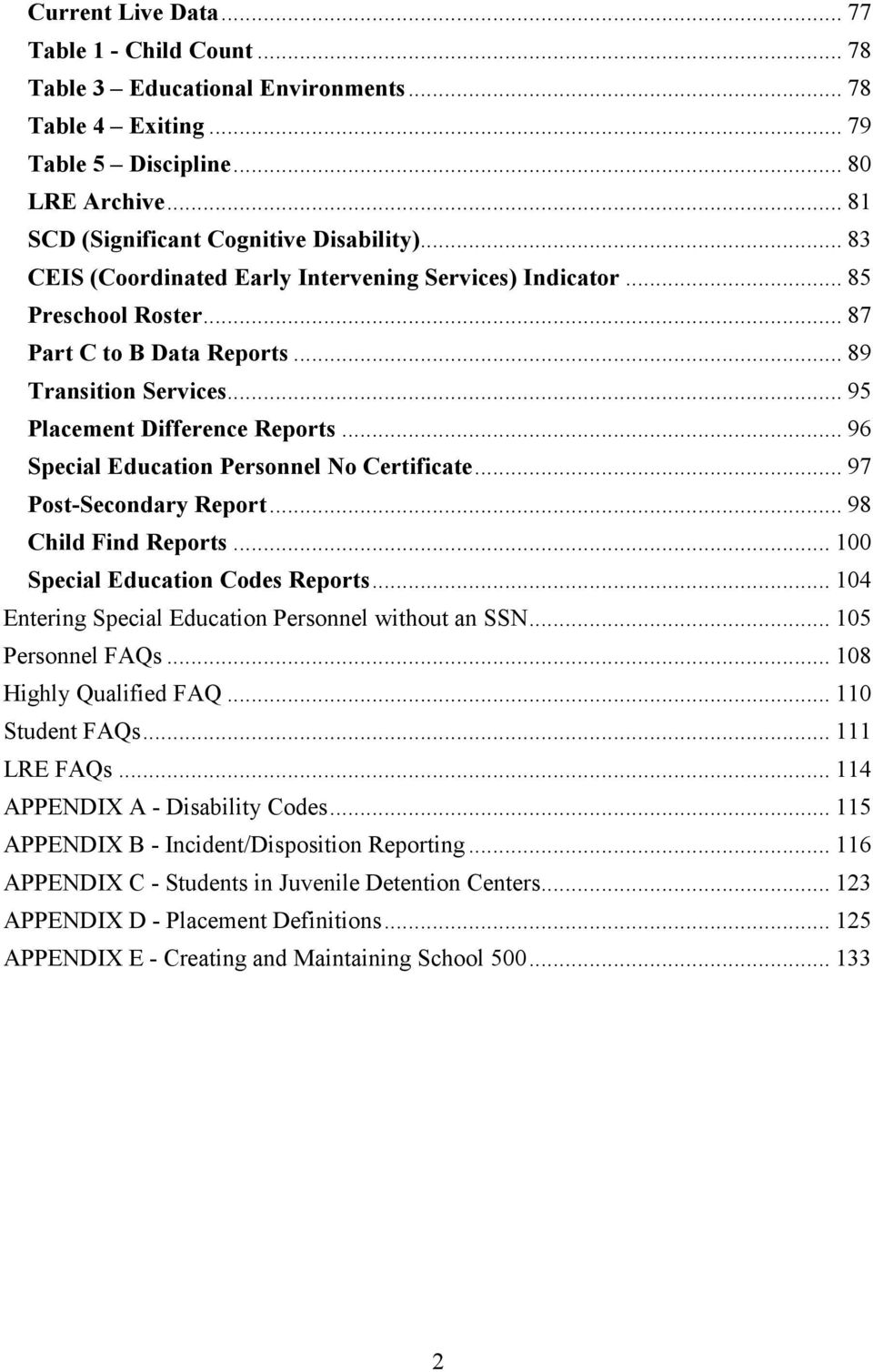
3 Current Live Data Table 1 - Child Count Table 3 Educational Environments Table 4 Exiting Table 5 Discipline LRE Archive SCD (Significant Cognitive Disability) CEIS (Coordinated Early Intervening Services) Indicator Preschool Roster Part C to B Data Reports Transition Services Placement Difference Reports Special Education Personnel No Certificate Post-Secondary Report Child Find Reports Special Education Codes Reports Entering Special Education Personnel without an SSN Personnel FAQs Highly Qualified FAQ Student FAQs LRE FAQs APPENDIX A - Disability Codes APPENDIX B - Incident/Disposition Reporting APPENDIX C - Students in Juvenile Detention Centers APPENDIX D - Placement Definitions APPENDIX E - Creating and Maintaining School
4 Important Dates July July 1 Begins New School Year in MSIS July 30 Summer Program Data Screen Final Updates should be entered July to August Roll Personnel Data (all schools), this will automatically make the Special Education Data roll the next night September September Post-Secondary data is due the third Friday in September September 30 First day to submit Month 01 files need to have all SPED indicators set, student schedules entered, and personnel entered December December 1 Child Count due (if December 1 falls on a weekend, the Child Count date will be moved to a date prior to December 1 as determined by the Office of Special Education) December 10 th Personnel/MAEP data is due December 31 Last day to verify or request changes to Child Count April April SPP/APR and Public Reporting published April to September Complete Post-Secondary Screen for Indicator 14 June June 30 Summer Program Data Screen initial data should be entered June 30 Last day to complete Parent Surveys (Indicator 8) June 30 Last day to enter Preschool Assessment (BDI-2) data (Indicator 7) Year-round data activities Review Part C to B reports and notify MDE Office of Special Education of the status of each child Update the Child Find Screen for any referrals for evaluations, including Part C to B referrals and referrals to MET through the TST process Set CEIS Indicator monthly for any students receiving services Monitor discipline data for accuracy Record entry and exit screeners in the BDI-2 Data Manager for 3 to 5 year olds with IEPs 3

5 SPP/APR Indicator data sources and timelines State Performance Plan/Annual Performance Report (SPP/APR) Indicators Indicator 1 Graduation Data source - 4-year graduation cohort, based on year-end data in MSIS Indicator 2 Dropout Data source Year-end data in MSIS (withdrawal codes) Indicator 3 Assessment Data source Statewide assessment collections, including alternate assessments Indicator 4 Discipline Significant Discrepancy Data source Year-end data in MSIS (Incident data) Indicator 5 Least Restrictive Environment Data source Child Count LRE data Due Date Child Count Date/ Month 3 Indicator 6 Preschool Least Restrictive Environment Data source Child Count LRE data Due Date Child Count Date Indicator 7 Preschool Assessment/Outcomes Data source BDI-2 Data Manager online application Due Date June 30 th Indicator 8 Parental Involvement Data source Special Education Parent Survey Due Date June 30 th Indicator 9 Disproportionate Representation Data source Child Count Due Date Child Count date Indicator 10 Disproportionate Representation by Disability Data source Child Count disability data Due Date Child Count date Indicator 11 Child Find Data source Child Find Screen in MSIS Due Date September 1 st for prior school year data Indicator 12 Part C to B Transition Data source Part C to B and Child Find Screen in MSIS Due Date June 30 th Indicator 13 Transition Services Data source Child Count Due Date Child Count date Indicator 14 Post-Secondary Outcomes (students who exited in prior school year) Data source Post-Secondary Screen in MSIS Due Date Third Friday in September 4

6 School 500 Students Students for whom your district is providing special education services (Head Start, Private School, Home School, etc.) but are not enrolled in a regular public school should be placed in School 500 (Non-Public Special Education School). Placing these students in School 500 allows you to include the students in your Child Count. School 500 students will not be pulled into public school data. You cannot assign a teacher to school 500 (use 001 for their major school if they do not have any other). School 500 will not be part of your monthly student data files or district approval process. You cannot expend any funds from School 500. Students in School 500 will NOT be included in Average Daily Attendance (ADA). Students who are moved to School 500 from another District or School will need to be released and transferred in MSIS. All information, including demographics, special education data, and schedules, will be entered on the Non-Public Student Update Screen for School 500 Students. You will need to have all of this information available when entering the students data. If a student will be placed in School 500 and does not have an existing MSIS ID, you will need to request a MSIS ID (remember to select School 500 on the Select School tab). If a student does have an MSIS ID and is currently enrolled in a public school, you will need to request a release of that student from the owning district or school. Transferring School 500 Students to a Public School For those School 500 students that will be attending one of your regular public schools - or another district's public school - (Ex: 5 year old that your district was serving and will now go to Kindergarten), your district office needs to release them from school 500 to the public school they will be attending and then they will need to complete the transfer for the public school. These students do not appear on the Year-End Student School Transfers screen. Only students with a promote indicator of Y appear on this screen and School 500 students do not have a promote indicator so they will have to be individually released and transferred. The school that they will be attending in the new school year needs to own these students before the school submits a Month 01 MSD file for the next school year. 5

7 Requesting MSIS IDs An MSIS ID should be created for students that enroll in a public school or for School 500 students who will be receiving special education services. An MSIS ID should NOT be requested for students who are not enrolled and have been evaluated for services and found not eligible. Only those students who you are serving will require an MSIS ID. A new MSIS ID should only be requested after a thorough search has been completed to make sure an ID does not already exist for the child. Try several queries in MSIS BEFORE requesting the MSIS ID. This will help cut down on duplicate MSIS IDs. Duplicate IDs will not be merged in MSIS. Helpful Hint Be sure to search for entering Kindergarten or Preschool students. They might have been served by the district in a non-public setting prior to enrolling in Kindergarten or Preschool. Remember, once an MSIS ID has been assigned, it can never be reused again. Even if we delete that MSIS ID, the ID is lost. Some things to remember when querying for MSIS IDs: Names are commonly misspelled or suffixes are left off (Ex: Jr., III, etc.). Be sure to search for the student using alternate fields or using the wildcard (%) search. Last names may change for students, so be sure to include at least one search without it. Names with hyphens (-), apostrophes ( ), accents (`), or other special characters are often missing these characters in MSIS. Be sure to use the wildcard search on these names. SSNs are not required in MSIS, so it may not exist in MSIS for the student. Try the last name and date of birth or the names with a wildcard (%) search. Don t search all fields at once (Full name, SSN, DOB). Try different combinations. Misspelled names and incorrect date of birth can be corrected without requesting a new ID. If you were searching for a student named James Doe, Jr. with a date of birth of 01/01/2005, here are some sample searches: 1. Last Name: Doe% First Name: James% 2. Last Name: Doe% First Name: J% 3. Last Name: Do% Date of Birth: 01/01/ First Name: James% Date of Birth: 01/01/2005 6

8 How to Roll Special Education Data for a New School Year Once all districts have completed Month 09, the districts may start rolling personnel for the new school year. ( Rolling data means that data from the previous year is rolled forward to the next school year so that information that does not change from year to year does not have to be re-entered.) Be sure to check with your personnel person to find out when your district plans to roll personnel. REMEMBER, your special education data rolls the night after personnel data rolls - beginning after July 1 - any districts that roll personnel before July 1 won't see their students on the Student Update screen for the new school year until MSIS comes back up after the ownership records are built for the new school year. Remember that EVERYONE has to roll personnel for your special education data to roll - districts can roll just the district data if they so choose but that is the minimum that can be done to make the special education data roll the next night (after July 1st). Districts that are in the District Sharing table (for special education, vocational, or other services shared between districts) will not have their special education data rolled until all districts that share services have rolled their personnel data. MSIS Special Education Data Rolling Business Rules for the upcoming school year: If the SPED Indicator is set to Y in Month 09, MSIS will create a new SPED Indicator of Y for the coming school year Ownership will be the school and district that owns the student once the new ownership records are built on July 1 The IEP Date will be rolled if it is within 12 months of the Child Count date The Eligibility Date will be rolled if it is within 3 years of the Child Count date The Graduation Track, Disability, and Related Services will be rolled If the student will be greater than the age allowed for a particular data element on the Child Count date, MSIS will blank out that data element (Ex: DD) If any of the codes have been made inactive, MSIS will blank out the related field for the coming school year (Ex: Primary Disability) Teacher information for the Disability and Related Services: o Will be rolled if the teacher is active after Personnel is rolled o If the teacher is made inactive when personnel is rolled, MSIS will populate for the SSN and VACANT for the teacher s name o If the teacher information was blank during the previous school year, MSIS will roll a blank for the next school year (these must be updated before the Child Count date) MSIS Calculated Placement will be blank until a calculation can be made after Month 01 or a user entry is made 7

9 Personnel Data Personnel Data is used for: Monthly Processing MAEP Funding Accreditation Edit Checks Class Overload Reports Federal Reporting Teacher Unit Calculation Report Card Superintendent s Annual Report Changes made to personnel data will be reflected in MAEP and Accreditation reports the day after your district approves its personnel data. Personnel data can and should be approved daily as changes are made. Changes to a teacher s caseload and student roster will not be reflected in these reports until the next monthly file is submitted. The only exception is changes to a school 500 student s schedule, which can be updated through the Non-Public Student Update Screen. You should approve your Personnel each night before you leave to see changes made that day reflected on reports the next day. Personnel data should be entered by September 30 th of each school year. Changes can be made until December 10 th. During monthly processing of files, MSIS checks the student schedules against the teacher schedules. The monthly file (MSD) will fail if there is not a matching course code, period, and semester/term in the teacher s schedule (The Semester/Term edit is relaxed for Sharing Districts). Use the Students Matching Report and the Students Not Matching Reports to determine which students are associated with a teacher. In MSIS, to run these reports go to Reports -> Personnel Data -> Teacher Schedule -> Students Matching or Students Not Matching. Endorsement checks for Special Education personnel For MAEP, teachers must be endorsed for the most prevalent disability they are teaching in a course or course load. You can find the required endorsements for each disability in MSIS under Maintenance->Special Education Codes-> Disability Codes - click on the green light at the top and this will run a report for you that lists each endorsement allowed for each disability. 8


10 9


11 MAEP/Teacher Unit (TU) Edit Report Begin checking the TU Edit report after Month 01 and District Personnel has been approved and run. December 10 th is the deadline for any needed changes. Any needed student schedule changes must be completed by the Month 03 file submission. Go to Reports-> Personnel Data-> MAEP>TU Edit. Select SPED for Program Type and All for Selection. TU Edit Report Checklist Do you see all of your Special Education teachers on the report? Possible reasons a teacher may not be on the report include not having a Program Code of 5 anywhere on their schedule or being set to an inactive employee in MSIS. Check your Contract Employees make sure ONLY the contract employees have this selection these personnel will NOT be included in the MAEP edits Do ALL your teachers have a student count for EVERY period? After Month 03 processing, no student count (unless you have school 500 students to associate with that period) is going to cause your teacher to fail MAEP and Accreditation edits. You must populate a student count for every period in your teacher's schedules. Month 03 processing is your last chance to update student schedules and link them to teachers. If your report says you have no Special Education students, then NO WHERE in 10

12 MSIS is that particular course code, period, and semester/term in a student's schedule. You need to be sure that you correct that before submitting Month 02 or Month 03 files. Do you see the message: Last TU? You want to see this message on one of your teachers so that you know you have used ALL your Teacher Units allocated to you for the current school year. Review each of your Special Ed teachers to make sure that you see a funding percentage for each teacher. You should have a 5 in the Special Program Field on all your Special Education teachers. Correct any annual salary errors (check that District Time, Days Employed, and Years of Experience are correct). Helpful Hint District Time Formula: (Percent of day) x (Percent of week) x (Percent of year) Percent of day = Periods/Day Percent of week = School Days/Week Percent of year = Days/Year Be sure to put XX in the reserved field for those teachers with Homeroom or National Certified - Teacher/Counselor/Librarian or Mentor Teacher course code in their schedule. This will keep these periods from prorating the MAEP percentage. For teachers with more than 100% instructional time, be sure to read item #9 in the MAEP Special Education section of this manual. If you notice your calculation is incorrect, please send the Office of Special Education the SSN of the teacher and what you expect the calculation to be. Bus Drivers need an AS on their Bus Driver period. Coaches (that coach after school) need an AS on their Coach period so that period won't prorate their MAEP. KEEP in mind that if they do the coaching during regular school hours, then their salary should be prorated. Regular education courses will prorate the MAEP funding of your Special Education teachers - this includes (SPED Early Work Release) 11

13 Teachers with course code Lead Teacher in their schedule, since that is a regular education course code, the MAEP Special Education percentages will be prorated. 3 and 4 year olds are funded at 70% - this is state law. Any teacher with a 3 and 4 year old count will NOT calculate at 100%. 12

14 MAEP Special Education Edits 1. Teacher endorsement: MAEP uses the endorsement codes on the Disability Codes screen - not the endorsement codes on the Course Codes table. MSIS determines the majority of the primary disabilities per class using the student update screen to decide which endorsements should be checked. If there are an equal number of two or more primary disabilities, MSIS will check all the endorsements (Ex: 1 HI Student and 1 SLD Student, MSIS checks that the teacher is endorsed in both HI and SLD). Helpful Hint Determining the Majority Disability per class: The majority disability is the most prevalent disability in the class, which may or may not be more than 50% of the class. Example of less than 50% majority: A class has 3 EMD students, 2 SLD students, 2 LS students, and 2 AU students. Although the EMD students account for 33% of the class, EMD is the most prevalent disability in the class and therefore the majority. 2. Course-specific Endorsement Checks: Language Speech (132002) and Language Impaired (132003) - MSIS checks for an endorsement of 215 or 216 Audiological Services (132035) - MSIS will check for an endorsement of 202 Special Educator/Assessment Team Member (132021) - MSIS will check for any 200 Special Education endorsements Transition Coordinator (132167) MSIS will check the disability endorsements if students are connected on the schedule; MSIS will check the course code endorsements if no students are attached 3. If a teacher fails the endorsement check for a Low Incidence (AU, DB, EMD, HI, MD, OHI, OI, TBI, VI) by individual period - MSIS will check the entire schedule to determine the majority of students served 4. Planning Periods: MAEP allows only one per semester. If you are using two: Use S1/T1 and Carnegie Unit 100 to indicate Semester 1 for the first one S2/T3 and Carnegie Unit 200 for the second one NOTE: You can use S1/T1 with CU of 000 to indicate all year 13

15 5. Concurrent Periods: MSIS will select the period with the highest minutes to calculate MAEP. If the periods are identical, MSIS will select the first one in the schedule. MSIS will prorate salary based on the remaining Special Education courses in the schedule. For concurrent regular education and Special Education course, MSIS will prorate funding with a message of why and listing the concurrent periods 6. Special Program Field: Enter per period on teacher s schedule. Use Code 5 to indicate use of Special Education Funds. Special Education MAEP will not fund any other codes. 7. Reserved Field: Use XX for any period that should not be part of the MAEP edit checks (such as Homeroom or National Board Certified Teacher/Counselor/Librarian or Mentor Teacher) Use AS to indicate After School - any teacher whose instructional time is more than 100% should have at least one line on their schedule with an AS or any other activity after school such as coaching, cheerleader sponsor, etc. Helpful Hint Reserved Field Codes: 02 Pre-Kindergarten ages 0-2 only (Grade 52 ONLY) AP Alternative Program AS After School LS Long-term Substitute SW Title I School Wide XX Exclude from Basic Funding calculations 8. MSIS will fail any teachers with: 1. 0 Student Count 2. Students who do not have a Primary Disability 3. Salary Errors 4. Endorsement Errors 9. More than 100% Instructional Time: MSIS will calculate this value for the teacher using the following formula: Formula: (A * B) +(C * D) / (A * B) (A) Total Number of regular contract days - MSIS will pull from the Days Employed data field on the District Info tab (B) Total number of instructional minutes per day - MSIS will calculate from the teacher's schedule (C) Total number of after-hours contract days MSIS will pull from the data field on the District Info tab 14
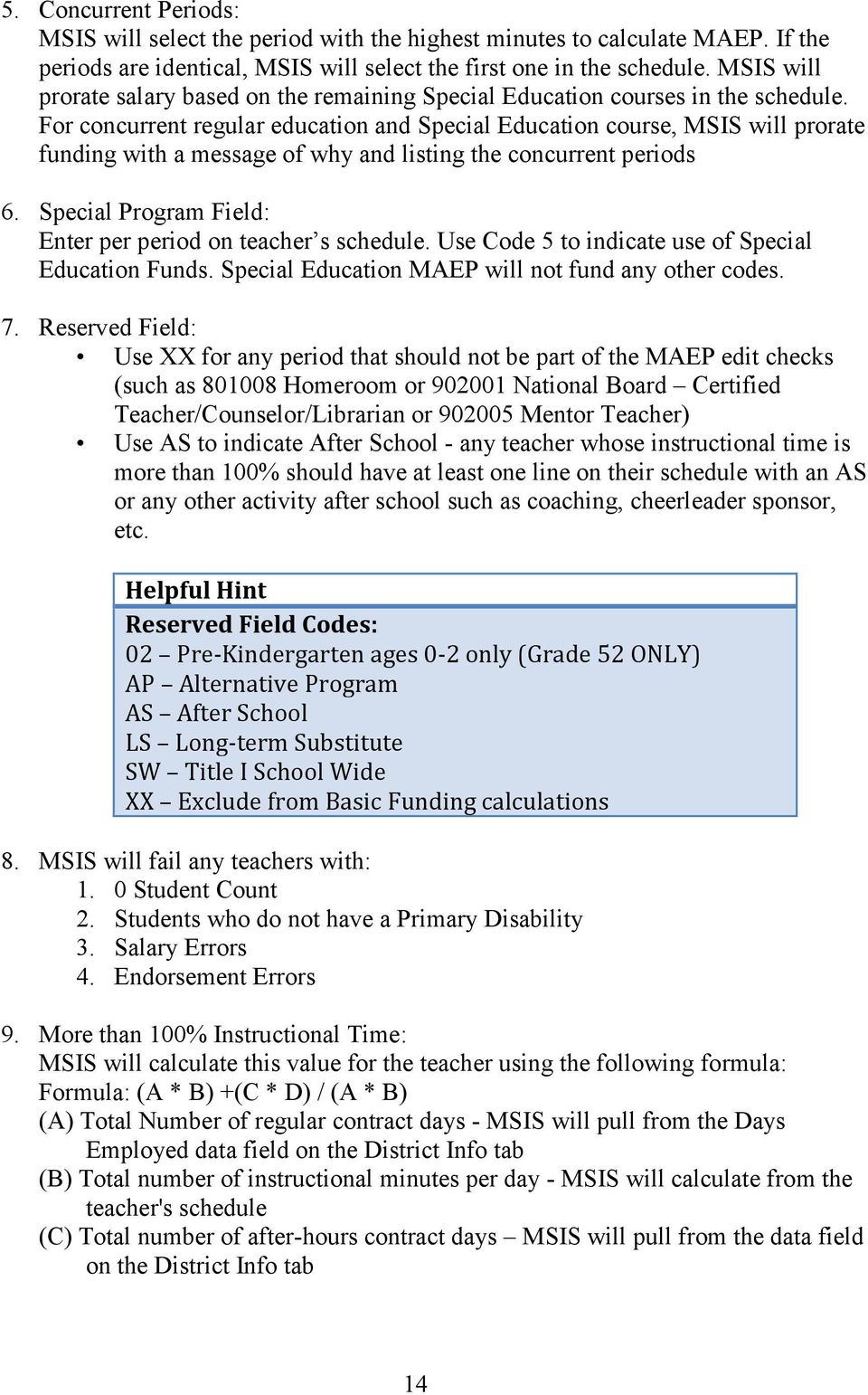
16 (D) Total number of after-hours instructional minutes per day - MSIS will pull minutes for the period with AS (After School) under the Reserved field Helpful Hint Over 100% Instructional Time Example: (A * B) +(C * D) / (A * B) A = 200 Days Employed B = 330 instructional minutes per day C = 72 after-hours contract days D = 80 minutes after-hours per day (200 * 330) + (72 * 80) / (200 * 330) = (66, ,760) / 66,000 = 1.09 or 109% and 4 year olds in grade 52: MSIS calculates the number of 3 and 4 year olds after monthly processing based on the students age as of September 1 st. By state law, 3 and 4 year olds are funded at 70%. If a teacher has ANY 3 and 4 year olds, they will not fund at 100% 11. If the course (Infant and Toddler) has a Lo/Hi Grade of 52, MSIS will not check the student count. 12. If the Lo/Hi grade is 52 AND the Reserve Field is not 02 AND the course code is not then there must be a 3 and 4 year old count on the Special Education tab of the Personnel screen [NOTE: These are NOT the 3 and 4 year old students in School 500 (Head Start, Home Schooled, Private School, etc.)] 13. All teachers must be certified by October 1st of each school year: If the teacher is certified in any other certification and receives a Special Education endorsement by the December snap-shot, MSIS will fund the teacher at 100%. If the teacher holds no certification on October 1st but receives a certification (with a Special Education endorsement) by the December snap-shot, MSIS will prorate the teacher s salary based on when the certificate was issued. 14. MAEP edits are ignored for any personnel listed as contractual. 15. MSIS will prorate the Special Education MAEP salary for any regular education courses in the teacher s schedule. 15

17 Forces and December Hires Forces In certain cases, teachers with MAEP errors can be forced by the Office of Special Education. Requests for forces must be documented by either ing or faxing the teacher s name and reason for request to the Office of Special Education. In years where MAEP funds are distributed in a lump sum payment to districts, forces will only take place for: Teachers with a 224 who have students in grades 07 and 08 Teachers at a juvenile detention center or alternative school who have no students at the time of the personnel deadline Teachers that left during the school year New hires These forces can only be completed if the district has available teacher units. No additional teacher units will be given during a lump sum payment year. In years where MAEP funds are NOT distributed in a lump sum payment, forces may be requested for the following: Teachers with a 224 who have students in grades 07 and 08 Teachers at a juvenile detention center or alternative school who have no students at the time of the personnel deadline Teachers that left during the school year New hires Other (Send in student schedules and disabilities to support request) Teachers that are not properly endorsed and teachers with salary errors will not be forced. Teacher units may be re-allocated during years where lump sum funding is not taking place. December Hires Applies only if funding is NOT lump sum. IF you can (if you know who your December hires are and your board has approved them), enter them into MSIS personnel and request a force. We will need their SSN, endorsements, and the students you plan for them to teach. We will review this information after all the other edits have been worked and if you still have Teacher Units left, we will be able to do a force on this teacher. Their certification must be in MSIS by the time the personnel snapshot is taken or these teachers will have to be approved outside of MSIS (but only if they have certification by the end of January). No forces can be made in MSIS for any teacher who does not have their certification in MSIS. 16

18 TU Edit Report Examples Certification received after October 1 Teacher did not have a previous certification. Salary was prorated based on the date the certificate was issued. You want to have your teachers certified as quickly as possible to avoid having their salary prorated. 3 and 4 Year Olds Teacher has a total of 57 students; of these 35 are 3 and 4 year olds (22 are older). MSIS prorates the teacher s salary and percentage: ((35/57) *.70) + (22/57) = ( *.70) = = or 82% based on the 70% funding allowed for these students by state law. 17

19 District Time less than 100% Teacher was prorated to 60% because their district time was entered by the district as 60%. Passes all other MAEP edits has a student count for each period and is properly endorsed for the students they are serving. Contract Employees Contract Employees are not pulled into the MAEP edits. These must be paid out of another source of funds other than the State Special Education MAEP funds. You should not have included 5 under the Fed Program column. You should use a 9 or 0 in the Fed Program column for contract workers. 18

20 Non-Teaching Codes This is a Non-Teaching Course Code keep in mind that MAEP is for teaching course codes only. Use 0 or 9 under the Fed Program column 5 indicates that you are using State MAEP funds to pay this teacher. Forced Teacher This teacher failed at least one of the MAEP edits. In these cases, the Office of Special Education will review your data (and will most likely request additional information from you) and decide if the teacher should be forced or not. If a teacher is forced, you will see the message above. 19

21 After-School/Over 100% Instructional Time Period 11 is an After School (AS in the RES column) period for the teacher. This teacher s time is more than 100% - they have calculated at 108%. Special Education/CTE Combo Teacher When a teacher teaches both Special Education and Career and Technical Education courses, MAEP allows funding from both sources. The total cannot exceed 100% (keep in mind that Career and Technical Education always displays only 50% of their part because the rest of the teacher s salary is paid from the Career and Technical Education teacher budget). 20
22 Special Education/Regular Education Combo Teacher If a teacher passed Special Education MAEP edits but they also teach one or more regular education courses, their MAEP will be prorated based on the minutes. In this example, 33% of their time (regular education min/total instructional minutes = 188 min/564 min) is spent teaching the regular education course and 67% of their time is spent teaching Special Education courses. Teacher Unit Error List Report Example Use the TU Error List Report to check that you have used all your allocated Teacher Units. The TU Error List report will also list if you do not have enough Teacher Units in a specific area under the TU Remaining column. 21
23 Highly Qualified The United States Department of Education has confirmed with Mississippi Department of Education that No Child Left Behind Act of 2001 requires Special Education teachers who are the primary teacher of instruction giving grades to Special Education students in core subject areas (language arts, math, science or social studies) show subject area competency in those core subject areas. Some examples of Special Education core courses (NOT an exhaustive list) are: OD-Reading I (SPED) OD-Reading II (SPED) OD-Reading III OD-Reading IV Special Education Reading (K-8) OD-Employment English I - Secondary OD-Employment English II - Secondary OD-Employment English III - Secondary OD-Employment English IV - Secondary OD-Job/Life Skills Math I - Secondary OD-Job/Life Skills Math II - Secondary OD-Job/Life Skills Math III - Secondary OD-Job/Life Skills Math IV - Secondary Functional Language Arts/Reading Elementary Functional Language Arts/Reading Secondary Special Education Language Arts Elementary Special Education Language Arts Secondary Functional Math Elementary Functional Math Secondary Special Education Math - Secondary Special Education Math - Elementary Special Education Social Studies Elementary Special Education Social Studies - Secondary Special Education Science Elementary Special Education Science - Secondary Contact the Office of Educator Licensure at
24 STUDENTS Student Grade Level MSIS Grade Levels 62 PRE-KINDERGARTEN 52 PRE-KINDERGARTEN SPED 64 KINDERGARTEN 54 KINDERGARTEN SPED 56 ELEMENTARY SELF-CONTAINED SPED 01 FIRST GRADE 02 SECOND GRADE 03 THIRD GRADE 04 FOURTH GRADE 05 FIFTH GRADE 06 SIXTH GRADE 07 SEVENTH GRADE 08 EIGHTH GRADE 58 SECONDARY SELF-CONTAINED SPED 78 SECONDARY GED 09 NINTH GRADE 10 TENTH GRADE 11 ELEVENTH GRADE 12 TWELFTH GRADE A Special Ed student is considered self-contained if they spend less than 40% of their day in regular education classes. Grade 56 covers grades 01 to 08 and grade 58 covers grades 07 to 12. They overlap because each district decides if grades 07 and 08 are elementary or secondary. If your district has denoted grades 07 and 08 as elementary in MSIS, you would use 56, but if they have selected grades 07 and 08 to be secondary, you would use 58. If a student has an LRE or placement code of SC - they need to be in grade 56 or 58. MAEP Edit - Students in Grade 52 and 62 must be 3 or 4 years old on September 1st. Students who are under 3 on September 1 will need to put in another grade, such as 54 or
25 Scheduling In order to match a student s schedule to a teacher s schedule for LRE, MAEP, and other calculations, all of the following information must be the same on the student and teacher schedule: Year Course Number Period Semester/Term Code Teacher SSN MSIS Semester/Term Codes S1 First Semester or All Year S2 Second Semester T1 First Term T2 Second Term T3 Third Term T4 Fourth Term INCLUSION PERIODS Students will have concurrent periods for each period that they have an inclusion teacher in a regular education class. One concurrent period will link the student to the regular education teacher (this is the teacher that is providing the primary instruction and will assign grades for the class) and the other concurrent period will link the student to the Special Education teacher. For example, you have a Special Education student that needs inclusion for English and Math. The student's schedule might look like: Period 01 Math - linked to the regular education teacher Period 01 Inclusion - linked to the Special Education teacher Period 02 Science Period 03 Social Studies Period 04 English - linked to the regular education teacher Period 04 Inclusion - linked to the Special Education teacher Period 05 Computer Period 06 PE If the student had an inclusion teacher for each period, then each period would have a concurrent period for inclusion. Inclusion teachers should have a course entry for each period they provide inclusion services (even if it s the same course code) rather than one course entry to cover the whole day. 24
26 ROTATING PERIODS Traditionally elementary students have one period per day that they use to rotate through different extra courses. You need to enter that one period as concurrent for all the courses that it might reflect so as not to inflate the LRE calculation. Example: Period 01 English Period 02 Reading Period 03 Language Arts Period 04 Computer Period 04 PE Period 04 Art Period 05 Science Period 06 Social Studies SPED EARLY WORK RELEASE (COURSE CODE ) Used for students who are on a Traditional Diploma or Certificate Graduation Track AND who are not earning Carnegie Units as part of a work release program (such as in the Occupational Diploma and Vocational Co-Op programs). Add to the student s schedule if the student is part of an early release program at your high school (they work during school hours). Considered a non-teaching course Add to a Regular Education personnel schedule so minutes can be pulled for LRE don t use 5 in the Special Program field. OTHER SCHEDULING NOTES To receive Language Speech Teacher Units, you must use in the student s schedule. Day Treatment Courses , , are all teaching course codes and can be used in a teacher s and a student s schedule. Mental Health personnel in Day Treatment for the licensed mental health professional counselor use (LICENSED PROFESSIONAL COUNSELOR - A licensed professional counselor providing related services to students with disabilities. Includes contractual staff, state agencies, and private agencies.) This is not a teaching course and cannot be used in a student s schedule. Regular Ed Day Treatment - use for Elementary, for Middle, and for Secondary 25
27 None of the Occupational Diploma courses earn Carnegie Units. The only Special Ed courses that allow Carnegie Units are: Learning Strategies Grades Compensatory Math Grades Compensatory Reading I Grades Compensatory Reading II Grades Compensatory Writing I Grades Compensatory Writing II Grades 9-12 Courses for SCD Students ONLY: DAILY LIVING SKILLS - SECONDARY COMMUNITY LIVING SKILLS - ELEMENTARY COMMUNITY LIVING SKILLS - SECONDARY HOUSEHOLD MANAGEMENT AND LIVING SKILLS - ELEMENTARY HOUSEHOLD MANAGEMENT AND LIVING SKILLS - SECONDARY PERSONAL/SOCIAL SKILLS - SECONDARY INTERPERSONAL SKILLS - ELEMENTARY INTERPERSONAL SKILLS - SECONDARY COMMUNICATION SKILLS - ELEMENTARY COMMUNICATION SKILLS - SECONDARY SELF HELP SKILLS - ELEMENTARY SELF HELP SKILLS - SECONDARY MOTOR SKILLS ELEMENTARY MOTOR SKILLS - SECONDARY 26
28 Entering New Special Education Students in MSIS 27
29 CHILD COUNT The Special Education annual Child Count must take place between October 1 and December 1 each year. The Child Count is generally scheduled as close to December 1 as possible (but no later), and may be referred to as the December 1 Count in some materials. How does MSIS recognize a Special Education student? The SPED Indicator must be set to Y o Set the Indicator using the Daily Student Data File (DSD) - the file returns a list of the students and their SPED Indicator (must check that the file was a Success, a Failed file will not update the student s SPED Indicator in MSIS), OR o The Indicator may also be set using the Monthly Student Data File (MSD) o If you use a DSD file to set the SPED Indicator, be sure that you update your database so that the MSD file will pull the data correctly Edit Checks on the SPED Indicator: o If MSIS sees a SPED Indicator is set to Y, MSIS will check to be sure there is a Special Education Course Code in the student s schedule - if there isn t a Special Education course code, the MSD file will fail. o If MSIS sees a Special Education Course in the student s schedule, MSIS will check to be sure that the SPED Indicator is set to Y - if it isn t, the MSD file will fail. Student Update Screen Used for the Child Count Student s SPED Indicator must be set to Y to pull the student into this screen NOTE: Changing Services Completed to Y will remove the student from the December 1 Child Count. 28
30 Child Count Checklist 1. To check your Child Count, run the Pre Cut-Off Student Roster by Teacher (Reports ->Special Education Data -> Student Data -> Pre Cut-Off). This report will be used for your Child Count. Remember this report is populated by the SPED Indicator being set to Y AND a primary disability associated with a teacher on the Student Update screen. 2. Use the Pre Cut-Off Student Roster report to determine if you have any students that have not had a Primary Disability or Teacher SSN set. The Pre Cut-Off Student Roster report is populated by the SPED Indicator being set to Y only this report could reflect more students than the Pre Cut-Off Student Roster by Teacher (this report lists students who have the SPED Indicator set to Y but do not have a Primary Disability or Teacher SSN entered). 3. Submit a DSD (Daily Student Data) File to update the SPED Indicator for any student that you need to access on the Student Update Screen (this screen is only populated by students whose SPED Indicator is set to Y). For most of the student packages, you will need to touch the student in your database the day you create the DSD file. The DSD files are processed ahead of the monthly files so you should see a results file in a short amount of time. Students that are on the Student Update screen but are not on the report are missing enrollment data (that has been the case every time that we have looked) so these students will also need a DSD file sent to MSIS as well. 4. Check the results file for ALL DSD files submitted. The results file will list the students that were included in your DSD file and how their SPED Indicator was set. If you do not see your student in the DSD results file, then they were not included in the DSD file that you submitted. You must be sure that the submitted file was a Success or the students SPED Indicators will not be updated in MSIS. You will need to contact your vendor to discuss why you are having problems with your files. 5. For Primary Disabilities MSIS allows only the 13 federally defined disabilities. 6. On the student update screen related service tab, you will need a SSN for ALL related services that you enter. You will need to be sure to enter the person in MSIS personnel first. Make sure you have the required SSN before entering the related service data. Use the Entering Special Education Personnel without an SSN section in this manual if you have issues with securing a SSN for contractual staff. 7. Enter the User Entered: Educational Environment from the IEP on the Placement tab of the Student Update Screen for ALL students. The LRE procedure will run 29
31 for all of those that you enter an SA, SB, or SC. School 500 allows only the User Entered Placement field because the LRE procedure ignores School Run the Pre Cut-Off Missing Placement Report (Reports->Special Education Data ->Student->Missing Placement-> ) to check for any students whose placement still needs to be entered. 9. Run the Placement Difference Report (Reports->Special Education Data - >Student-> Placement Difference-> Placement Different Pre Cutoff). Use this report to find any students whose LRE Calculated placement differs from the User Entered Placement. The User Entered Placement should reflect the placement decided by the IEP Committee. 10. Run the LRE Live Report (Reports->Special Education Data ->Student->LRE Live). Use the LRE Live Report to check the student s schedule to be sure that you have sent MSIS all the periods in the student s schedule and to check the time that is being pulled from the teacher s schedule. The LRE Live Report lists a COMPLETE schedule for the student. 11. Run the Transition Services Pre Cutoff Report (Reports->Special Education Data ->Student->Transition Services->Transition Services Pre Cutoff) to check for any missing or No entries. The report will not list any students who have a Yes in the data field. This data is required for students age 14 and up and will be used for Indicator 13 in the SPP/APR. 12. Set the SCD indicators for your students. 13. Check the race on all your students using your Pre Cut-Off Reports. The race needs to be 100% accurate when the Child Count Snapshot is taken. 14. Enter all your non-public students (Head Start, Private School, or Home School Students) in school 500 using the Non-Public Student Update Screen. Click on the Details tab when you query for a student to create a SPED indicator for the current school year. This must be done for every school 500 student that should be in your Child Count. They will need their Special Education tab completed for IEP and Eligibility dates as well as Primary Disability, Placement, and Related Service. They MUST have a schedule (remember you want to generate Teacher Units) under the Schedule tab. You can only enter a Special Education course code (these begin with 13). The student s schedule must match the teacher s schedule be sure to enter the teacher s schedule in Personnel FIRST before you try to enter the student s schedule. 15. Enter a Diploma Track for all students in grades 09-12, 58, and 78. This needs to be part of the Child Count data so that vocational and testing can use this along with Special Education. 30
32 16. DO NOT change the Service Completed? data element to Yes unless the student is no longer receiving any Special Education services. Once you change this to Yes, MSIS will remove the teacher s SSN associated with the Primary Disability, which removes the student from the Child Count. 17. Check your Pre Cutoff Student Roster by Teacher report to be sure that you do not see any SSNs or VACANT VACANT teacher names. Both of these MUST be replaced with an active teacher in your district. 18. You will have until the end of the Child Count Day to complete your Child Count. 19. Be sure to run and print a hard copy or save an electronic copy of the Pre Cut-Off Student Roster by Teacher report before you leave on the Child Count Day. You can use this to compare with the Post Cut-Off Student Roster once the snapshot has been made. NOTE Only students that are ruled AND served will be counted in the Child Count. For MSIS, this means that the student s SPED Indicator must be set to Y and the student must have a primary disability associated with a teacher s SSN on the Student Update screen. Pre Cut-Off Student Roster by Teacher Report Checklist The Pre Cut-Off Student Roster by Teacher report must have 2 things to pull the student into the report: a) the SPED Indicator set to Y, AND b) an enrollment for this school year - that can be an E code or a DSD file - either of these will pull the student into the report. KEEP IN MIND, if you send a T or D code after your last E code, then the child will have to have a DSD sent to pull into the report. You should review the Pre Cut-Off Student Roster by Teacher Report for the following (be sure to click cancel when the list of schools pops up, this will run the report for your whole district): 1. Is the number of age 3-21 students on the last page correct? This is your child count number! 2. Do you see any SSNs on the report? Remove these if you do by either deleting them or replacing them with an active teacher using the Student Update Screen or the Non Public Student Update screen for school 500 students. 3. Do you see VACANT VACANT where a teacher's name should be? If so, remove this by either deleting VACANT VACANT or replacing it with an active 31
33 teacher using the Student Update Screen or the Non Public Student Update screen for school 500 students. 4. Do you see placement for ALL 3 to 5 year olds and ALL school 500 students (regardless of their age)? If not, then use the Student Update screen or the Non Public Student Update screen and select a placement for these students. You can run your Missing Placement report to find these. 5. Do you see an IEP Date for all the students? If not, it should be added. 6. Do you see an Eligibility Date for all the students? If not, it should be added. 7. Are there students on the report that should not be there? If so, change the Services Completed? data element to Yes. This will remove the teacher's SSN from the screen and it will pull the student out of the report. 8. Are students missing from the report? If there are, then either the student's SPED Indicator has been reset to N (have a DSD file sent to reset it back to Y), the student does not have a teacher's SSN associated with their primary disability (add one), the student has a withdrawal code that was submitted during Month 02 (send a DSD file), this is a brand new student (send a DSD file), or your student was transferred to another school within your district (send a DSD file). Be sure to check that the DSD file is a Success. 9. AND REMEMBER, if you make any corrections, RUN and PRINT/SAVE your report AGAIN! MSIS will go down the night of Child Count Day, after normal business hours. You will have until then to work with your students and make sure your child count is 100% accurate. When MSIS goes down, it will not come back up until the Child Count Snapshot has been made. So you will not have access to MSIS on the morning after the Child Count date. MSIS should be back up by the afternoon of the next day. Child Count Verification When MSIS is back up after the Child Count date, you can run your Post Cut-Off by Teacher Report in MSIS and compare that with your Pre Cut-Off Student Roster by Teacher report that you saved or printed once you completed your child count. The age 3-21 count listed at the end of the report is your Child Count number. If your two reports match as far as the child count goes, then please complete the posted verification form. The number listed on the verification form must match the age 3-21 count listed on your Post Cut-Off by Teacher Report in MSIS. Keep in mind that we are NOT asking you to verify LRE, we are only asking your district to verify the number of children. Also, missing grade level, race, LEP, and gender will be updated once Month 32
34 03 is completed. We cannot add these to the report since these are pulled from the monthly processing data. IF YOU SEE ANY DATA that needs to be corrected or updated with your child count (missing IEP date, all 9's for a teacher's SSN, missing transition data, etc.), please contact the Office of Special Education with your district number, school number, MSIS ID, and the specific item that needs to be changed. Keep in mind that you cannot update information in the snapshot, you can only run reports. We will have to make the updates for you. If you request any updates in the snapshot, you should also update the same data in MSIS to keep your data current. If you have a student that needs to be removed from your child count, please contact the Office of Special Education with your district number, school number, and the MSIS ID of the student that needs to be removed from your report. If you have a student that is missing from your Post Cut-Off report, please contact the Office of Special Education with your district number, school number, and the MSIS ID of the student that needs to be pulled into your report. Keep in mind there are no guarantees on this. The student has to either have enrollment data (that comes from an MSD file) OR a DSD file since the last MSD submission. If one of these does not exist, we will not be able to add any students to your count because they did not make it to the snapshot. Child Count and LRE The Child Count and the LRE actually are two separate events in MSIS. We report them together in the final Child Count data, but in MSIS they happen at different times BUT they still reflect the same time period. Since the calculated LRE is based on student schedules, the calculation for November schedules cannot be completed until November (Month 3) files are processed in MSIS. This takes place beginning December 1, after the Child Count date. After all Month 3 files are processed, the students that were in your Child Count will be updated with any changes to their LRE. The Month 3 files will not allow you to add any additional students to your Child Count. The Educational Environment/User-Entered Placement should be entered before the Child Count date. This includes your 3-5 year olds and school 500 students. 33
35 LRE/PLACEMENT The Least Restrictive Environment (LRE) (a.k.a. Placement) is calculated based on how much time a student spends in the regular education classroom. The LRE for students who have a placement other than SA, SB, or SC on their IEP will not have their LRE calculated by MSIS. Students for whom you have indicated as SA, SB, or SC will have their LRE calculated based on the following formula: Total Regular Education Minutes + Recess (Break) + Lunch / Instructional Time + Recess (Break) + Lunch Total Regular Education Minutes = Courses in a student s schedule that do not start with a 13 (non-special education courses) and do not contain more than 50% special education students. The minutes are taken from the teacher s schedule. Instructional Time & Recess/Break & Lunch = These minutes come from the School Demographics screen and are specific to each school and grade level. For A/B Schedules, MSIS will double the denominator and lunch and recess in the numerator to allow MSIS to look at the total 2-day schedule. The LRE procedure only looks at one semester at a time. From August to the end of December (Months 01-04), the LRE procedure looks at the courses in the first semester. From January to May/June (Months 05-09), the LRE procedure looks at the courses in the second semester. The following course codes are hard-code exceptions to pulling minutes. MSIS will use only 60 minutes for the following (this is to address the issue that most districts code these course codes for teachers with 300 or more minutes): Physical Education Grades Physical Education Grades PK Band Middle Band Band Elementary Music General Middle Music Choral Middle Music Performing Elementary Music Performing Middle Music Elementary Visual Arts - Middle Visual Arts - Elementary Arts Integrated in the Middle School Class Art Grade Arts Integrated in Regular Elementary Intellectually Gifted 34
36 Creatively Gifted Artistically Gifted The Month 03 files are used to calculate the LRE for 6 to 21 year olds (excluding school 500) that are in the Child Count. Month 03 files represent the student's schedules as of November 30th -that's as close as we can get to the Child Count Date for the schedules. The LRE missing will NOT keep a student out of the child count! The LRE procedure will run again as the district completes their district approval. The Month 03 data will be what is used for reporting purposes. You won't see changes until Month 03 is completed for your district that should be by December 10th. The LRE Live report will display the LRE for all students. A 99 on the LRE Live report means MSIS did not find a schedule for the student when the LRE procedure was run. This should go away when the LRE procedure runs again after the district is processed for the month. Don't worry about this if there is a schedule for your student in MSIS or a schedule will be submitted in the MSD file. In November, new special education students sent in DSD files will not have a placement until after Month 03 is finished - they were not marked as Special Education the last time the LRE procedure was run. MSIS will not calculate the placements for all school 500 students, all students 5 years and under on the count day, privately or publicly placed students, and home/hospital students. School 500 students will not appear on the LRE Live or Archive reports. All placement codes for school 500 students have to be entered by the user. The placement entered on the screen will be used for reporting. For all other students 6 21 years old, MSIS will calculate the student s placement. 35
37 LRE Calculation Example Student s Schedule: Period Course th Grade English Compensatory Math Social Studies Language Speech Computer Discovery Physical Education 110 Minutes from teacher s schedule Total Regular Education Minutes = 55 (Period 1) + 55 (Period 3) + 55 (Period 4) (Period 5) = 275 REMEMBER: MSIS will pull ONLY course codes that do NOT begin with 13 to calculate LRE. Total Regular Education Minutes = 275 Recess (Break) Minutes = 15 Lunch Minutes = 30 Instructional Time Minutes = 330 Formula: Total Regular Education Minutes + Recess (Break) + Lunch / Instructional Time + Recess (Break) + Lunch ( ) / ( ) = 320 / 375 = OR 85% LRE = Regular Education (SA) SA - (Ages 6-21) Regular (Special Education students in Regular Education courses for 80% or more of the school day) SB - (Ages 6-21) - Resourced (Special Education students in Regular Education courses between 40% and 79% percent of the school day) SC - (Ages 6-21) - Self-Contained (Special Education students that spend less than 40% of their school day in Regular Education classes) 36
38 LRE Checklist 1. All students must have the placement from their IEP entered on the Student Update Screen or the Non-Public Student Update Screen. This is the user-entered placement. 2. Enter Placement for the four sets of students that MSIS cannot calculate for you: All school 500 students, students between the ages of 3 and 5 years old on the Child Count Day, Home/Hospital Students, and any publicly or privately placed students. These MUST BE ENTERED BEFORE SEPTEMBER 30th for your 6-21 year olds. Check for the MSIS calculated placement after each monthly processing for all others. 3. Run the Missing Placement report and enter placement for all students listed on the report. 4. Run the Placement Difference report - if the IEP placement and the LRE calculated placement is NOT the same, then you need to review the student's schedule to see what was entered incorrectly into your student package and sent to MSIS so that you can correct this on the student's schedule by the Month 03 submission. The placement calculated in MSIS must match the placement decided by the IEP team! Helpful Hint MSIS calculates LRE after each month s MSD file is processed and completed. The changes should appear on the LRE reports the next day. Any changes made to a teacher s schedule will not reflect in the LRE calculations until the next MSD is processed. 5. Review the LRE Live Report for any student whose placement is not matching the placement from their IEP. i. Does the student have a complete schedule? Are they missing periods throughout the day? ii. Does the total number of minutes add up to the number of minutes in the instructional day for that grade and school? iii. Do you see 50% or less in the SPED LRE REG PCT column? Any number above 50 means that the course will not count as a regular education class. You will need to either move regular educations into the class or move special education students to another class. iv. Have you included the course SPED Early Work Release, , for every High School student that leaves early? This is the ONLY regular education course that the LRE procedure will ignore the makeup of the class. (NOTE: Be sure that you do not add this regular education course code to any Special 37
39 Education teacher that you want to receive 100% Special Education MAEP Funding - it will prorate your Special Education teacher's MAEP.) v. If you have a period that spans two periods, have you doubled the minutes on your teacher's schedule? Example: Period 01 LA covers period 1 (55 min) and period 02 (55 min). The teacher should have 110 min for period 01. vi. Have you (or someone in your district) checked the Instructional Minutes, Break/Recess, and Lunch minutes on the School Demographic screen under the Grades tab? Instructional minutes should ONLY reflect the instructional part of your school day not the whole school day. Example: 7 periods at 50 minutes each would equal 350 instructional minutes. 38
40 DSD (Daily Student Data) File When should a DSD File be submitted for Special Education? Whenever a new Student arrives in your district and they were a Special Education student in their previous school and you are going to serve them a Student moves from one school to another school within your district a Student moves from one grade to another grade within your district a student is ruled Special Education a student has any kind of T or D code in their file, even though you see the SPED Indicator is set to Y, MSIS is still waiting for a DSD or MSD to tell it the SPED Indicator belongs to that specific school a student is not on your Student Update screen or they don't pull into the Pre Cut- Off Student Roster by Teacher report NOTE: ALL the above must be completed before the end of the day on the Child Count Day! Be sure someone checks the results file for the submitted DSD. Your DSD can fail OR the SPED Indicator could be set to N in the file -- and you still wouldn't see your students on the Student Update screen. Helpful Hint A DSD file ONLY reports an incident or sets the SPED Indicator to Y or N. A DSD file WILL NOT update a student's schedule or correct any problems with LRE. DSD EXAMPLES: Billy has an E1 on 08/08/2012 and SPED Indicator is Y and a T code on 10/11/ he will NOT pull into the Child Count without a DSD file being sent Charlie has no enrollment data for this school year and SPED Indicator is set to Y - he will NOT pull into the Child Count without a DSD file being sent (PLUS you need to be sure that he is included in the MSD file for Month 03) Danny has an E1 on 08/08/2012 and SPED Indicator is N - he needs a DSD file as well to set the SPED Indicator to Y to be pulled into the Child Count 39
41 MSD (Monthly Student Data) File 504 INDICATOR A 504 Indicator is in your Student Administrative Package (SAP) and is to be submitted in the MSD files. The following business rules apply: If 504 Indicator is set to Y, then the SPED Indicator must be set to N. If the SPED Indicator is set to Y, then the 504 Indicator must be set to N. If the 504 Indicator is set to Y, then the Section 504 Tutorial course code (851005) MUST be included in the student s schedule. CEIS (COORDINATED EARLY INTERVENING SERVICES) INDICATOR CEIS Indicator should be set monthly for any student identified in the at-risk group and receiving CEIS in that month. These are services that are being provided with the current fiscal year set-aside funds. Match the at-risk group to the fiscal year of the grant. The at-risk student group is defined in your district s IDEA Project Application. CEIS Indicator is required for both mandatory and voluntary set-aside of funds. CEIS students cannot receive Tier 3 Intervention services using CEIS funds and cannot be students with an IEP. Students receiving CEIS from any year prior to FY13 will continue to be tracked manually to determine if they become a special education student in the following 2 years. Counts reported in IDEA Project Application Use CEIS Tracker Sheet A CEIS Indicator is in your Student Administrative Package (SAP) and is to be submitted in the MSD files. The following business rules apply: If CEIS Indicator is set to Y, then the SPED Indicator must be set to N. If the SPED Indicator is set to Y, then the CEIS Indicator must be set to N. MONTH 03 FILE PROCESSING Only DSD files will be processed on the Child Count date so that all Special Education students can be identified as such in MSIS using a DSD file. When MSIS goes down at the end of the Child Count date, that data will become the Child Count. MSIS will not come back up until the snapshot for the Child Count has been made - that should be by Noon on the next day. To ensure the Child Count, IDEA Part B Funding, MAEP edits, and Teacher Unit Allocations for each district are accurate, the following edits in MSIS for Month 03 processing will be used: 1. MSIS will consider all DSD (Daily Student Data) Files to be Month 03 until the end of the Child Count Cut-Off Date. This is to prevent you from 40
42 accidentally using a Month 04 DSD to overwrite your monthly files (remember December 1 starts Month 04). 2. During the Month 03 monthly processing, MSIS will return an error if your Month 03 file's SPED Indicators do not agree with the current SPED Indicators in MSIS set by the DSD files. This is to prevent users from overwriting SPED Indicators that were set to Y in a Month 03 DSD file to allow the Special Education users to enter data on the student using the Student Update screen, which allows the student to be included in the Child Count. COMMON MONTH 03 FILE ERRORS: THE MONTHLY SPECIAL ED IND = Y AND THE CURRENT SPECIAL ED IND = N (WHICH WAS SET BY A DAILY TRANSACTION). THE MONTHLY SPECIAL ED INDICATOR MUST MATCH THE CURRENT SPECIAL ED INDICATOR OR THE CURRENT SPECIAL ED INDICATOR MUST BE CHANGED BY MDE SPECIAL ED DEPT. PLEASE RESEARCH THE SPECIAL ED INDICATOR AND THE STUDENT'S SCHEDULE FOR SPECIAL ED COURSES TO CONFIRM THE INDICATOR. THIS DATA WILL HAVE AN IMPACT ON YOUR MAEP FUNDING, IDEA PART B FUNDING, AND TEACHER UNIT ALLOCATION. -OR- THE MONTHLY SPECIAL ED IND = N AND THE CURRENT SPECIAL ED IND = Y (WHICH WAS SET BY A DAILY TRANSACTION). If you see the above error message in your Month 03 Results file, the MSIS District Primary Contacts should contact their Special Education District Users to research the problem. In most cases, you will need to add Special Education courses to the student's schedule. DO NOT add any Special Education courses without first checking with your Special Education Office since most users who oversee the monthly processing do not know what is required by the student's IEP. This data MUST be entered correctly to ensure all funding and counts are accurate for Special Education. Please remember the Special Education data entered into MSIS will be used for Child Count, MAEP edits, LRE calculation, and Teacher Units calculation for the next school year. Once Month 04 begins for the DSD files (normally NOON of the day after the Child Count), in the rare case that your SPED Indicator should be what is in the Month 03 MSD file and not what is in MSIS, you will need to contact the MDE Special Education Office so that we can research the issue and change the indicator in MSIS to allow your file to pass. We will need verification from the District Special Education users that this is actually the case before any changes can be made. 41
43 If the MSD file has the error that the SPED Indicator doesn't match the indicator in the child count, the Special Education Director should send an saying it is okay to make the change and include the following information: MSIS ID Child s Name What the SPED Indicator should be District Number School Number Once the Office of Special Education has that , we can update the indicator on the Indicators screen and the district will pass the Month 03 files. Keep in mind that in some cases you need to update your student database and not change the SPED indicator. 42
44 MODULES SPECIAL EDUCATION Note: The following screens are for use by MDE staff only and are not accessible to district users: Student Update Cut-off Date Student Indicator Update Post Cut-off screens University Based SPED Student Update Part C to B Student Update District Monitoring Update 43
45 Student Update Screen The Student Update Screen is used to enter Special Education data for all public school students with an IEP. There are strict edit rules for the Student Update screen be sure to have ALL of the data to be entered before querying a student to update. To select a specific student to enter data, click on the Select Student tab. Select student by scrolling or by querying on the MSIS ID. If expected students are not displaying on the screen, you most likely need to send in a DSD file. (See DSD section of manual) 44

46 Special Ed Student Update Tab IEP Date The date of the IEP for the current school year. It must be within 12 months of the Child Count Date for that school year. If you are revising IEPs for the next school year in the spring, wait and enter the new IEP date after July 1. Eligibility Date The date eligibility was last determined. It must be within 3 years of the Child Count Date for that school year. Graduation Track Select a Graduation Track for all students in grades 58, 78, 09, 10, 11, or 12. Graduation Track is required for all students in grades 09-12, 78, and 58 if they are 14 or older User will select a Graduation Track that matches the Graduation Type for the student: Traditional (T) GED (G) Occupational Diploma (OD) Other Completers (Certificate O) The graduation track is used by Assessment, Reporting, Career and Technical, and Special Education Services Completed? Use the Services Completed Data Field to pull students in and out of the child count and reports. Everyone defaults to N Service Has Not Been Completed Select Y Service has been completed for any students that you are no longer serving. This will remove the teacher s SSN associated with the primary disability. 45
47 Transition Services data element for all students 14 and up. This data element will not roll as the federal government requires that the question be answered each year after reviewing the current IEP. Reflects if the student is receiving transition services to enable them to meet post-secondary goals. By selecting Yes, you are ensuring that: The IEP includes appropriate measurable postsecondary goals that are annually updated and based upon an age-appropriate transition assessment, transition services, including courses of study, that will reasonably enable the student to meet those postsecondary goals, and annual IEP goals related to the student s transition services needs There exists evidence that the student was invited to the IEP Team meeting where transition services are to be discussed and evidence that, if appropriate, a representative of any participating agency was invited to the IEP Team meeting with the prior consent of the parent or student who has reached the age of majority Limited English Proficiency (LEP) View Only Data Field LEP Indicator is pulled from the View Student Data Screen Detail Tab Set in the Monthly Student Data File each month Required data element each month 46
48 Special Ed Student Update Tab Primary Disability Sub-tab Teacher SSN - Enter the teacher s SSN who serves that student or is in charge of their IEP. (MSIS will populate the teacher s name) The student will appear on the Student Roster by Teacher Report under this teacher Remember the teacher MUST be entered into Personnel BEFORE you can enter them on the Student Update Screen (that includes the Non- Public screen) Primary Disability Select value from drop-down box. If you select the sub-code of Other for OHI, the screen will allow you to type in the description (up to 100 Characters - Ex: Asthma, Sickle Cell, Diabetes, Leukemia, etc.) 47
49 Special Ed Student Update Tab Placement Sub-tab MSIS Calculated Placement This is a read-only field. A value will display once the LRE Live Procedure runs after Month 01. This is the placement that the LRE Live Procedure (SA or SB or SC) will calculate for your 6 to 21 year olds (excluding school 500). Reporting Period This is a read-only field that displays the month of the data that was used to calculate the MSIS Calculated Placement. Placement Modified Date - This is a read-only field that displays the last date the MSIS Calculated Placement was generated. Helpful Hint For a complete explanation of how MSIS will calculate LRE, see the LRE/Placement section of this manual User Entered Educational Environment from IEP This field represents the LRE/placement from the IEP. This is the ONLY data field on this tab that will allow you to select a placement for your students. You should select a placement for ALL your students, including 3 to 5 year olds, school 500 students, any public or private placed students, and any home/hospital students. You can select any placement value, including SA, SB, or SC. Please see Appendix D for definitions of all placement codes. If you select anything other than SA, SB, or SC, the MSIS Calculated Placement data field will also reflect this value and no calculation will be made during the LRE Procedure. Users will receive a warning message if an Ed Environment is entered that does not match the LRE Calculated placement. This is just a warning to alert the user that a difference exists in the two data fields. 48
50 DECSP Reporting Placement This is a read-only field that displays the LRE value that was recorded in the Child Count. DECSP stands for December Snapshot This data field pulls from the December snapshot tables that we use for state and federal reporting. This will allow you to compare what you see now in one of the other two data fields (MSIS Calculated Placement or User Entered Placement) with what was reported for the Child Count. This placement is on your Post Cut-Off report. If you see a value in the DECSP Reporting Placement field and do not see a value in one of the other placement fields, this most likely means the placement value was missing at the time of the Child Count and the Office of Special Education updated the information in the snapshot only. 49

51 Special Ed Student Update Tab Related Services Sub-tab Select the Related Service by clicking to the left of the service scroll through list as needed Enter Teacher s SSN MSIS will populate Teacher Name The teacher MUST be in your district s personnel FIRST you can enter them as a contract worker if needed Helpful Hint Use the Entering Special Education Personnel without an SSN section in this manual if you have issues with securing a SSN for contractual staff The related service must be highlighted before you can view the teacher information that you have entered For each related service that is checked, a teacher must be entered 50

52 Special Education Student Update Tab Accountability Sub-tab Review this tab each year for any updates Update the Significant Cognitive Disability (SCD) field before your district completes Month 01 this information is transferred to testing companies for the alternate assessment after Month 01 each year Update the Served by Resident School field for any student who is not being served by their resident district or school. This will notify MDE to send State test results to the resident district or school. Significant Cognitive Disability (SCD) SCD data field rolls each year Originally defaults everyone to No If you choose Yes for any Primary Disability except AU, ID, TBI, or MD MSIS displays a message "NOTICE: SPED Student's Primary Disability is <primary disability>. Do you wish to continue?" The user can click YES if they want to keep the changes they have made or NO if they want the indicator to remain No EXAMPLE 1: User changes SCD to Yes for a student who is listed as SLD. The above message would display when the user goes to the next data field or leaves that screen. This will allow the user a second chance to be sure that they are changing the SCD on the proper student. EXAMPLE 2: User changes SCD to Yes for a student who is listed as MD. No message is displayed - the change is saved to the database. 51
53 Served by Resident School? Is the student in the school that is their resident school? Defaults all students to Yes. If indicator is changed to No, a different district or school number can be selected from the pop-up box. If a different district number is selected, the school will default to 001. If the district number remains the same, a different school within the current district can be selected (excluding schools 200 and 500). If a student is placed in a public or private facility (Millcreek, CARES, etc.) by their RESIDENT district, select 001 as the school. This data element will NOT be rolled each year due to the vast movement of students. EXAMPLE 1: User in District X changes resident school indicator to No for student in school 004. User selects District Y as the new district, MSIS defaults the school to 001. EXAMPLE 2: User in District X changes resident school indicator to No for student in school 004. User selects school 008 in their district. 52

54 Non-Public Student Data Entry Screen The Non-Public Student Date Entry screen collects special education and other data for students that are not enrolled in a public school in your district. The Non-Public Student Date Entry screen has an edit that checks that ALL data has been entered on ALL tabs. If you start to enter data for ANY student on the Non Public screen, you must enter ALL the data or the screen will NOT let you exit. You can just look at students but the minute you click in a data field the edits will start checking that you have entered all the data. Before you pull up a student in the Non Public screen, be sure that you have all the demographic data on the student for the details tab, all the Special Education data (IEP, Eligibility, Placement, etc.) for the Special Education tab, and all the scheduling data for the Schedule tab (this means the teacher information and schedule has to be in personnel first). If you are in the screen and you don't have the data and you want to exit, you will have to press CTRL-ALT-DELETE -- this is a force quit on the screen and will take you completely out of MSIS. This edit makes the data more complete and accurate. Once your Non-public students have an MSIS ID, you will need to enter their data on the Non-Public Student Data Entry screen (Modules ->Special Education ->Non-Public Student Data Entry). If the student is an initial ruling you will also need to enter them on the Child Find screen. Helpful Hint This screen works best if you TAB from field to field and do not use the mouse 53
55 You MUST enter the Personnel data on the teacher s schedule before you can use this screen You do NOT send a MSD or DSD file on the Non-Public School 500 Students These students are NOT counted in your district s ADA These students ARE counted in your Child Count These students could include students in Head Start, Private School, or Home School Data should be entered in the following order on this screen: Details, Special Ed, then Schedule 54
56 Select Student Tab Select Tab - You can query for a Non-Public student by their MSIS ID or their last name (you can use the wildcard with their last name also - %). Helpful Hint Go through the tabs on this screen sequentially EACH time you enter the screen (Select, Details, Special Ed, Schedule DO NOT skip ahead to the Special Ed tab or the Schedule tab.) 55

57 Details Tab IMPORTANT NOTE Be sure that you click on the Details tab for ALL school 500 students BEFORE the Child Count this sets their SPED Indicator for the current school year and pulls the student into your reports and child count. If you pull the student up in MSIS and go straight to the schedule or Special Ed tab, then you didn't create a SPED indicator and the student will not pull into your report. MSIS will populate the top part of the screen (District, School, MSIS ID, Last Name, etc.). Changes to name, SSN, or DOB can be made from this screen. Grade Level, Gender, Race, Parent/Guardian, Address, and Indicators are required fields. Grade Level Select the grade level of the Non-Public student - if the grade needed for the student is not in the drop down list, please see the Creating and Maintaining School 500 section of this manual to see how to add the grades. MSIS will pull this grade to the schedule tab when you begin to enter data on the schedule 56
58 Indicators Report Month and School Year will default to the current year and month SPED will be set to Y You can select Y or N for the IEP and LEP fields Aliases are optional and will be created automatically when the student s name is changed. 57

59 Special Ed Tab Required fields on this tab include IEP Date, Eligibility Date, Service Completed, Disability, Primary Disability Teacher SSN, and User Entered Placement. This tab is the same information that you enter for public school students on the Student Update Screen. Please see the Student Update Screen section of this manual for directions on completing this tab. The only difference is the Placement Sub-tab. School 500 students will not have a calculated LRE field. All placements for school 500 students must be user entered from their IEP. For school 500 students no longer receiving services you should change the Services Completed to Yes. That removes the teacher's SSN and takes the student out of your Child Count. 58
60 Schedule Tab Helpful Hint Before entering the schedule for the student, make sure the courses have already been added to the teacher s schedule You must enter a schedule for all 500 students to ensure correct calculations for MAEP and Teacher Units If no other courses are appropriate, you may use disability codes for the course code Helpful Hint Be sure to use for LS students Tab through the data fields do NOT click with your mouse! Must enter an N under the Inactive? Column to indicate that the course in active 59
61 Helpful Hint If you need to delete or change a course, you must make them inactive by changing the N to Y in the Inactive? Column. Deleting courses is not allowed. MSIS will populate the Grade Level pulling from the Details tab To add a course to the schedule: 1. Enter the course code - this screen limits you to Special Education course codes (these begin with 13...) then TAB to next field 2. Enter Carnegie Units TAB 3. Final Grade and Credits Earned are optional and entered at the end of the school year if needed TAB 4. If the student is also a vocational student, mark the appropriate option (optional) TAB 5. Inactive? enter N (this tells MSIS the course is NOT inactive) TAB this will take you back to the course code data field. 6. Click with your mouse under Classes (just this one time ONLY) in the Sem/Term Data field - this will create a school year in the School Year data field TAB 7. Enter S1, S2, T1, T2, etc. under Sem/Term (required and must match teacher s schedule exactly) TAB 8. Enter Period (required and must match teacher s schedule) TAB 9. Enter Section (optional) TAB 10. Enter Sem/Term Grade at the end of the semester/term as needed (optional) TAB 11. Enter Teacher SSN TAB one last time and this will populate your teacher s name at the bottom of the screen. 12. SAVE For each additional course, follow the same directions by entering a course code in a blank line or click the green plus sign to create a new blank row if all are filled. Helpful Hint If you receive a message that the course does not exist on the teacher s schedule, check to make sure the course code, Semester/Term, and period matches the teacher s schedule in MSIS. 60
62 Emergency Tab This tab contains optional information, BUT if you start entering the data, you MUST enter data in all the blue fields for that person. Incidents Tab This tab contains optional information BUT if you start entering the data, you MUST enter data in all the blue fields. Testing Program Tab Any testing data will be loaded by MDE if the MSIS ID is used to identify the student during testing. This tab is read-only. 61
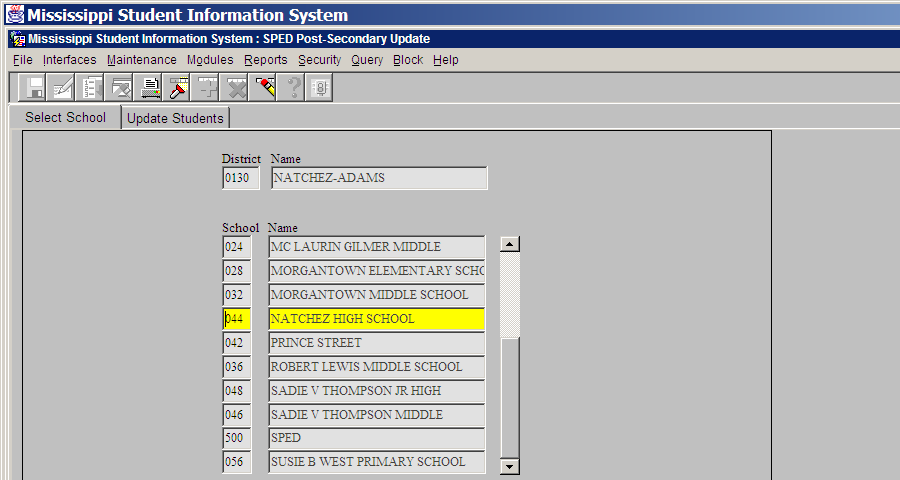
63 Post-Secondary Screen This screen in MSIS is used to enter the data for Indicator 14. Information on this screen is collected each year between April and September. Students listed on the screen exited your district during the prior school year and you must indicate what they are doing a year later. The list of students who exited is pulled from the Child Count data. Helpful Hint Be sure to check each school (including school 500) that may have 14 year olds or older exiting school. This may include students that have dropped out from middle schools. 62
64 The year should be automatically chosen for you. If you are updating records in May 2014, you will be updating students that left school a year ago, or at the end of the school year. You need to enter a response for every student in your list. When collecting data about students activities in the year since they left school, you should keep the categories in mind. Select all of the choices that apply to the student. If they attended a 4 year university and also held a part-time job, you would choose both Enrolled in Higher Education and Competitive Employment or Some other employment. For some of the choices, there is an available help button (?) next to the choice that will display a definition for that choice. Helpful Hint To ensure the correct category is chosen, use the Post- Secondary Student Survey Protocol found on the SPP/APR section of the MDE Special Education website Helpful Hint You can run a report directly from the Post-Secondary screen, click on the green traffic light at the top. This will provide you with a list of students that need to be contacted and surveyed for the current collection. 63
65 Enrolled in Higher Education - Enrolled in a community college, college/university, or other Institute of Higher Education: in an educational program to earn a degree or other recognized credential; OR in a training program that lasts at least one academic year to prepare for gainful employment. i.e. completed a term at a 2 or 4 year college/university. Ask this question: Does the program lead to a 2 or 4 year degree? If not, it should not be counted as Enrolled in Higher Education. Competitive Employment - Worked for pay at or above the minimum wage in a setting with others who are nondisabled for a period of 20 hours a week for at least 90 days at any time in the year since leaving high school. This includes military employment. 90 days (cumulative, at any time, can be multiple jobs), at least minimum wage, average of 20 hours or more a week: In a company, business, or service with people with and without disabilities In the military In supported employment (paid work with services and wage support to the employer) Self-employed In your family s business (e.g. farm, store, fishing, ranching, catering) Includes students who are out on paid sick leave, such as worker s comp. Some other postsecondary education or training program - Postsecondary education or training programs including, but not limited, to: Compensatory education programs, GED, Job Corps, Workforce development, Workforce Investment Act, Adult education, or Vocational technical school which is less than a two-year program. Completed a term in: High School completion (GED, Adult Basic Education) Short-term education or employment training program (WIA, Job Corps, etc.) Vocational or Technical school that is less than a 2 year program On a mission, in the Peace Corps, Rehabilitation services, etc. Other (Any type of educational program not included above, as long as one term was completed. Term can be different lengths of time depending on the program). Some other employment - Worked for pay or been self-employed for a period of at least 90 days at any time in the year since leaving high school, including working in a family business or working for room and board. Worked for at least 90 days (any rate of pay or hours/week): In a company, business, or service with people with and without disabilities In supported employment (paid work with services and wage support to the employer) Self-employed 64
66 In your family s business (e.g. farm, store, fishing, ranching, catering) In sheltered employment (where most workers have disabilities) Employed while in jail or prison Other Other options include: Re-enrolled in secondary If a student has since re-enrolled in secondary school, even if it s in another state, select this choice. This will mostly apply to dropout students who choose to return to school. Unknown Student or parents/guardians could not be reached or declined to participate in the post school survey. Several attempts should be made to contact the student. Deceased Student has died since leaving school. Not engaged Student is not participating in any postsecondary education, training, or employment. This includes students incarcerated, stay at home parents, hospitalized, seeking employment, etc. Please provide comments. Comments can be entered for any student. Examples of comments would be: type of education or training program student is enrolled in, contact attempts made, or reasons the student is not engaged. 65
67 Child Find Screen The purpose of the Child Find module is to collect initial ruling information for students that are referred for testing and eligibility determination. The data entered on this screen is used for Indicator 11 (% evaluated within 60 days of Parent Consent to Evaluate Date) of the SPP/APR (State Performance Plan/Annual Performance Plan). The data for this indicator is collected throughout the school year. All data should be entered on this screen by June 30 th for the school year. Select a school and click on the Select Student tab to view the list of students. 66
68 Select Student Tab The students listed on this screen must be owned by the district and school. You may need to complete a transfer or enter some other information in MSIS if you do not see a student that you are expecting. There are four types of students that will be listed on this screen: 1. Students with a Special Education Indicator in MSIS who have not been served in previous school years. So, if you send in a daily file (DSD) or a monthly file (MSD) with a student s special education indicator set to Yes, they will display on this screen. [Spec Ed = Y] 2. Intervention referrals. Any student who has been referred for an evaluation through the Intervention process and entered on the Intervention screen will display in your list. [Inter. Ref. = Y] 3. Part C to B referrals. These are students that the Department of Health has referred for evaluation and who have been given an MSIS ID. In most cases, only children who are eligible for services are given an MSIS ID by a district, but it is possible that they will have an MSIS ID for some other reason, such as being enrolled in a preschool program. [Part C to B = Y] 4. The fourth type is students who have been queried on this screen and have some initial ruling information entered. Since not all children who you evaluate will be eligible for services, you will need to query students from the general population and enter information for them. 67
69 To query for a student from the general population, search by either the last name or the MSIS ID. Both fields will accept a wildcard search, meaning you can search for a partial match on a last name or MSIS ID. To search using a wildcard, use the percent symbol (%). If the student s parents have requested an evaluation and you have referred the case to the MET, you can start entering information on this screen at that point. You can enter as much information as you have at the time and come back later to finish it up. If you are not referring the child to MET for whatever reason, you can also start entering data with the Parental Consent to Evaluate. The MET fields are optional, but if you enter an MET Referral Date, the MET Response and Date are required. Update Student Tab Non-Initial - indicates why a student will not have information entered on the Child Find screen. The options are: Ruled in prior school year Ruled by another district Moved out of state Accepted out-of-state evaluation 68
70 MET Referral Date - the date a student is referred from TST for testing. (optional) MET Response the response of the MET. (required if MET Referral Date is not blank) The options are: Referred Back to TST Remains in Regular Education Referred for Comprehensive Evaluation MET Response Date date of response from MET (required if a MET Response is chosen) Parental Consent to Evaluate - Yes or No Parental Consent to Evaluate Date - the date consent was obtained or declined. If Parental Consent to Evaluate is No, no further information is required. Evaluation Date date that evaluation was completed. This will be the date of the completed Evaluation Report. Compliance for the 60-day timeline will begin with the Parental Consent to Evaluate Date and end with the Evaluation Date. This field will turn red if it is outside of the 60-day timeline. Eligibility Decision - Yes or No Eligibility Decision Date The date that the district determined whether or not the child is eligible for special education services. This field is required if Eligibility Decision is not blank. If the Eligibility Decision is No, no further information is required. Parent Permission to Serve - Yes or No IEP Date - the date of the initial IEP developed for the child. If you complete a re-eval later in the year or revise the IEP for any reason, DO NOT change this date. This date must always be the date the very first IEP was developed for the child. This field will turn red if it is outside of the 30-day timeline. Allowable Exception - If the 60-day timeline is missed, you may select one of the allowable exceptions to the timeline IF it applies to the student s evaluation: Allowable Exception SLD written mutual agreement Parent repeatedly failed to produce child Child moved during process Helpful Hint The SLD written mutual agreement is a written signed agreement between the parent and the team responsible for evaluation (not just the district or the IEP committee) to extend the timeline for additional testing to take place 69
71 Remember that the 60 day and 30 day timelines are calendar days and not school days. Holidays and weekends are counted in the timeline. The 60 day deadline applies to students who are not eligible for services, as well as those who are. 70

72 Summer Program Report Entry Screen The Summer Program Report Entry Screens are used to enter your summer school activities (Regular ESY, SPED ESY, Enrichment, and Summer School). You can find the screen under Modules -> District/School ->Summer Program Report Entry. (NOTE: Special Education enters SPED ESY only) Select the district and school that is hosting the summer school program. Remember if you are offering credits to students in your summer program, you must have 140 hours of instructional time. NOTE: The Summer Program Report screen is completed by the hosting school (this only pertains to those that are serving students from other districts). The Summer Student Data (Month 10) file is submitted by the school that owns the student once they have completed the summer program. 71
73 Summer Programs tab MSIS will populate the District and School Fields. 1. Enter the SSN for the Principal, MSIS will populate the name. 2. Enter Phone Area Code and Phone Number 3. Select the type of Program from the drop down menu that you offered - choices include: Enrichment, Regular Extended Year, SPED Extended Year, and Summer School. 4. Enter Date Session Begins and Date Session Ends - MSIS will calculate the Total Days in Session 5. Enter Military Beginning Time and Military Ending Time (you will need to use a 24 hour clock, ex: 5:00 P.M. = 1700 in Military Time). 6. Select Funding Source from the drop down menu. Choices include: Other, SPED, Title I, Tuition, and WIA (Workforce Investment Act). 7. Enter Grade Level Served 8. Enter Number of Students Served 9. SAVE 10. If you need to add an additional Summer Program Type, click in the Date Session Begins field. This will allow you to go to the next line. If you need to enter more than three lines, click on the plus sign (+) while your cursor is in the Date Session Begins field and MSIS will add another line. 72
74 Employees Tab You can select any employee in Mississippi. They do not have to be associated with your district for the summer programs but they do have to be an active teacher in MSIS. Helpful Hint The teacher must be in MSIS Personnel and they must have the proper teacher certification 1. Query for your teacher. 2. Select teacher from list returned by the query. 3. MSIS will populate Certificates/Endorsements. 4. Enter Course Code - MSIS will populate Course Title and School. 5. Enter Hours Per Day. 6. Enter Students (this is the number of students in that particular course code). 7. Enter Grade Level Lo and Grade Level Hi. 8. Select the Program Type from the drop-down menu - choices include: Enrichment, Regular Extended Year, SPED Extended Year, and Summer School. 9. SAVE. 10. Click in Course Code field to enter additional courses for that teacher. 11. To enter additional teachers, begin with a new query and repeat the next steps. 73

75 REPORTS SPECIAL EDUCATION STUDENT REPORTS Pre Cut-Off Reports should be run from July 1 to Child Count Day. Post Cut-Off Reports can be run any time after the Child Count. These are snapshot reports and will not change after the Child Count. Current Live Data Reports should be run after Child Count to display current data. Pre Cut-Off Reports Run any of these reports from July 1 until the end of the Child Count Day. You should wait until your district has processed Month 01 before running the Pre Cut-Off Student Roster by Teacher report. For a student to be on the Pre Cut-Off Student Roster by Disability Report, the Pre Cut-Off Student Roster by District Report or the Pre Cut-Off Student Roster by Teacher Report, their SPED Indicator must be set to Y AND they must have a teacher associated with their Primary Disability 74

76 Pre Cut-Off Student Roster Students are shown on the Student Roster report if their SPED Indicator is set to Y - the Disability does not have to be set for a student to be included on this roster To remove a student from this report - submit a DSD or MSD file and change their SPED Indicator to N Pre Cut-Off Student Roster by Teacher Report This report represents your Child Count. This report can be run after Month 01 has been processed for your district and up until the end of the day on the Child Count date. To remove a student from Student Roster by Teacher Report, change the Services Completed? data field to Y on the Student Update screen. 75
77 Post Cut-Off Snap Shot Report This report should not be run until the Child Count snapshot has been taken. The Post-Cut Off by Teacher Report pulls from the snapshot data that represents the Child Count for the selected school year. This is the Child Count report; this report is used for federal and state reporting. 76
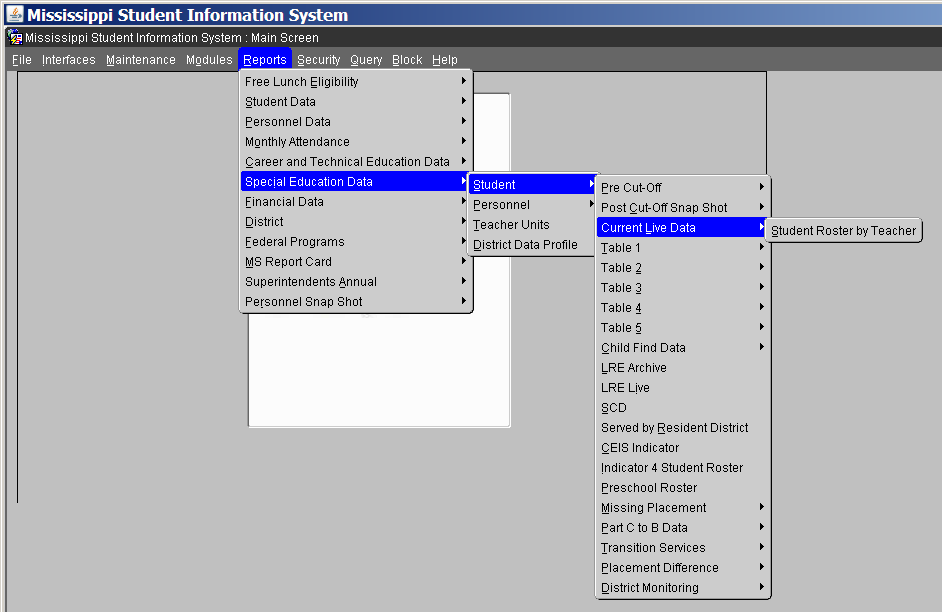
78 Current Live Data Current Live Data lists students in your live data. Use after Snapshot is taken to list current students. Begin running AFTER the Count Day and use through June 30th to view your data as you make updates. The Current Live Data report pulls the teacher from the Student Update screen just like it does for the Pre Cut-Off reports and Post Cut-Off reports. 77

79 Table 1 - Child Count Table 1 Reports represent your district s Child Count by Age and Race - you should add the Ages 3-5 and Ages 6-21 reports together for your total District Child Count. Table 3 Educational Environments Table 3 reports represent your district s Child Count by placement, or LRE, and age, disability, and race. 78
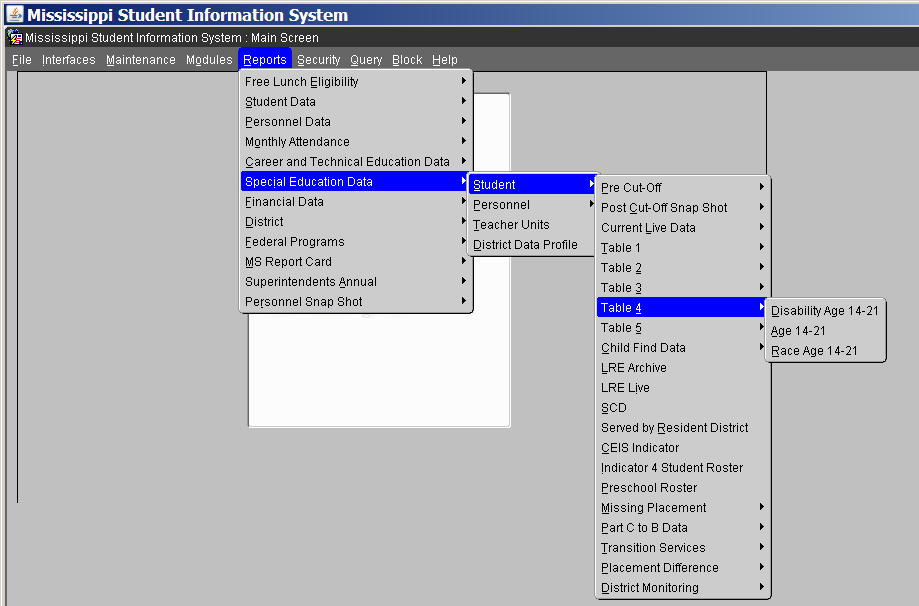
80 Table 4 Exiting Table 4 reports represent counts of students with disabilities who left your school district in the selected school year, by disability, race, and age. 79

81 Table 5 Discipline Table 5 reports represent counts of students with disabilities with disciplinary actions and removals in the selected school year, by disability and race. 80
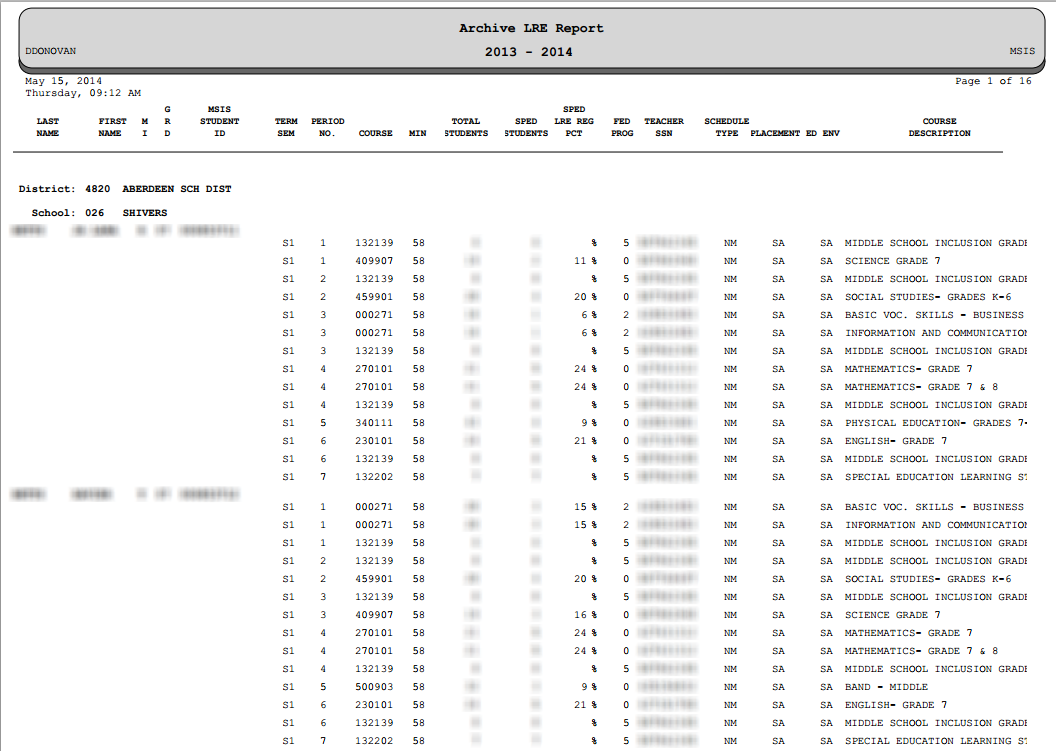
82 LRE Archive The LRE Archive Procedure runs after Month 03 is completed AND the personnel snapshot has been taken - use the LRE Archive Report to review the LRE calculations used for Child Count and reporting. 81

83 LRE Live The LRE Live Procedure will run each month after your district approval runs - use the LRE Live Report to review current student schedules in MSIS. In months 1-4, MSIS will use the courses listed as Semester 1 and Terms 1 and 2 to calculate a student s LRE. In months 5-9, MSIS will use the courses listed as Semester 2 and Terms 3 and 4 to calculate a student s LRE. If the student is enrolled in the same courses all year, MSIS will use Semester 1 and Terms 1 and 2. 82
84 SCD (Significant Cognitive Disability) Be sure to set the SCD indicator to Yes for all your students that have been identified as SCD. It is best to have the SCD students marked in Month 01 since the Month 01 data is loaded into alternate assessment systems near the beginning of the school year. A close count of the number of students identified as SCD is needed so that alternate assessment materials can be ordered for testing. Continue to update the SCD indicator as needed throughout the school year. The report will list all students who are currently marked as Special Ed and SCD. 83
85 Served by Resident District This report lists all students with disabilities who are not served by their resident district. 84

86 CEIS (Coordinated Early Intervening Services) Indicator This report will list all students who have their CEIS Indicator set for the most recent reporting month. It will also list the Special Ed Indicator and whether or not the student has been referred to Tier 3 Intervention. Students that are receiving CEIS should not have their Special Ed indicator marked Yes. The CEIS Indicator should be set for any student receiving CEIS with funds that were set aside in the current school year. 85
87 Indicator 4 Student Roster This report is a roster of students, separated by Special Education and Regular Education, who have more than 10 days of suspensions/expulsions. 86

88 Preschool Roster This report will list all students age 3-5 (as of the Child Count day) who are currently marked as special education students. This report is intended to help identify the students who should be given the BDI-2 screener for Indicator 7 data collection. 87

89 Missing Placement This report will identify those students who are missing placement. Pre Cut-Off Missing Placement - run this report July to Child Count Day - the report lists all those students who do not have a placement entered by school. You can run the report for the whole district by clicking cancel when the school drop down box appears (this defaults to All Schools). The Pre Cut-Off Missing Placement report will list the MSIS ID, student's name, DOB, age, race, gender, grade, and disability. You will need to pull these students up on the Student Update screen or the Non-Public Student Update screen (for school 500 students) and update their placement. NOTE: If a student is listed on the Pre Cut-Off Missing Placement report they should NOT be part of your coming Child Count. Pull the student up on the Student Update screen or the Non-Public Student Update screen and change their Services Completed data field to Yes. This will pull the student out of the child count. Post Cut-Off Missing Placement - you can NOT run this report until the snapshot of the Child Count data is taken. This report will list any students missing placement that are in the snapshot. This is just a quicker way of identifying these students that were pulled into the Child Count. 88

90 Part C to B Data Reports The data on these reports is used for Indicator 12. It is collected throughout the school year and should be complete by June 30 th. The Department of Health will send MDE a file daily of those students that currently are being served under Part C that are 30 months old The Part C data will be loaded into MSIS and a procedure will be run to find matches in MSIS to the Part C data There are six reports in MSIS that users can run that will list the Part C children that match or do not match a student in MSIS The reports will display: Student s Name, MSIS ID, DOB, Race, Gender Health ID - number assigned by Part C Leading ED - district assigned by Part C Trans Date - Transition Date representing the date student is transitioning from Part C to B Tested Ind - to track those students that are tested but not served, Y or N will be set by MDE once information is received from the school district Removed - indicator MDE will use to remove students from the report 89

91 Part C to B Monthly Student Roster Monthly Student Roster - Lists any student who is assigned to the district running the report. This report includes both students have been removed from the No Match report and those have been removed. This is a listing of all students referred from Part C. 90
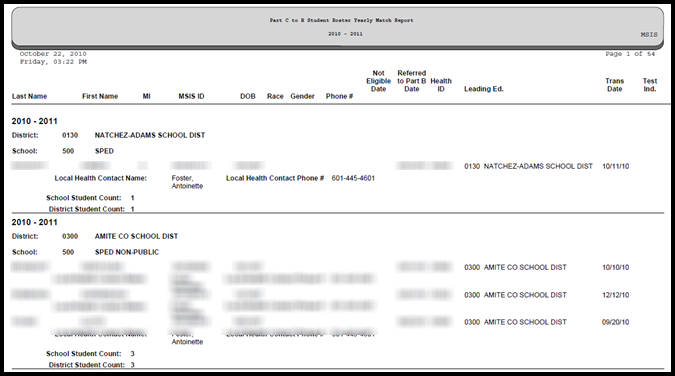
92 Part C to B Student Match Roster Student Match Roster - Lists any student who is assigned to the district running the report and who has not been removed. 91
93 Part C to B Student No Match Student No Match Report - Lists any student who is assigned to the district running the report and whose MSIS ID is missing or the Removed indicator on the student is not selected. This report also lists the parent/guardian s name and address, and the local health contact name and phone number. Once you have run the Student No Match report, please review the list below to decide: 1. If you are serving these students, we need their MSIS ID, district number, and school number. Once we enter this information into MSIS, you will have a match in the system for that child. 2. If you are not serving these students, we need to know why. Please choose one of the reasons below and fax or that to Louis King (see fax information below). A. Parent Refused Services B. Service Discontinued C. Not Eligible (Must send date determined not eligible) D. Parent wants to delay to later school year E. Moved out of state F. Parent did not respond G. No Permission to test H. Parent did not show up I. Student is deceased J. Referred to Part C after 33 months K. Unknown to district and First Steps (you will need to talk to First Steps in your area before sending in this reason) L. Enrolled in University based program 3. If you have students listed that should be in another district, we need to know the district name and number and the name of the student. 4. If you have students listed that you were unaware of, we need to know that too (see K above). Run the Part C to B Student No Match report and fax or it to Louis King ([email protected]) at with an explanation or MSIS ID next to each child. This data is used for Indicator 12. Complete your updates no later than June 30th so that we can include this data in MSIS before it is taken down on July 1 to prepare for the next school year. 92
94 93
95 Part C to B Yearly Special Education Match Student Roster Yearly Special Education Match Student Roster - Lists any student who is assigned to the district running the report, and their SPED Indicator = Yes and the Removed indicator is not selected. Part C to B Yearly Special Education No Match Student Roster Yearly Special Education No Match Student Roster - Lists any student who is assigned to the district running the report, and their SPED Indicator = No and the Removed indicator is not selected. This report also lists the parent/guardian s name and address. Part C to B Removals This report lists students that have been coded with a Removal Code on the Part C to B screen. If the student was not eligible then the Not Eligible Date is included on the report. 94
96 Transition Services Report lists all those students 14 years old and up (as of the Child Count day) that are missing a Transition Services (Y or N) OR their Transition Services was marked N. The Post Cut-Off Transition Report pulls from the December snapshot data used for reporting. This data will be used for Indicator 13 in the SPP/APR. The Pre Cut-Off Transition report pulls from production data prior to the December 1 child count. 95

97 Placement Difference Reports The Post-Cutoff Placement Difference Report runs from the Child Count snapshot data and lists any student whose MSIS Calculated Placement, or LRE, differs from the User Entered placement from the IEP. The Pre-Cutoff Placement Difference Report displays current data and lists any student whose MSIS Calculated Placement, or LRE, differs from the User Entered placement from the IEP. 96

98 Special Education Personnel No Certificate This report lists any personnel for your district who do not have a certificate on file with MSIS. 97


99 Post-Secondary Report You can run the report directly from the Post-Secondary screen, click on the green traffic light at the top. This is the data used for Indicator 14 (% of youth who had IEPs, are no longer in secondary school and who have been employed, enrolled in postsecondary school, or both, within 1 year of leaving high school) of the SPP/APR. 98
100 The report lists the MSIS ID, student s last name, first name, middle initial, exiting reason, race, age, disability, and prints a Y in the Enrolled in Higher Education, Competitive Employment, Enrolled in Other Post Secondary, Other Employment, Deceased, Not Engaged, and Unknown columns for all fields that were checked and any comments that were entered. Students marked as Re-enrolled in Secondary will not appear on this report. 99
101 Child Find Reports There are two reports available in MSIS for the Child Find Data, a Roster Report and a Compliance Report. 100

102 The Roster Report will list every student that is displayed on the screen and any information that you have entered for that student. You may run the report for a single school in your district or for the whole district. If you run the report for the whole district, you can see all of your students, grouped by the school they are enrolled in. You will see on this report some of the basic information for a student like their MSIS ID and their date of birth. It also displays those indicators from the screen that will help you determine why the student is on your list for Child Find. After that, you have all of the information from the screen related to an initial evaluation. This report can be a helpful tool to let you know where you are in the initial evaluation process for all of your students. 101

103 The Compliance Report also lists every student that is on the screen, plus any Part C to B referrals that have been determined not eligible for services. This report can only be generated for the whole district. On the Compliance report, you see all of the students from the screen along with some basic information for each student. You also have the indicators for each student listed, just like the Roster Report. There are 3 fields to the right of the indicators that lists whether or not you are in compliance with the timelines for each student. The first field is the Indicator 12 Part C to B Compliance field. This field is for those students who have the Part C to B Referral Indicator marked. Yes - IEP Date is before or on their 3 rd birthday or an allowable exception occurred No - IEP Date is after the 3 rd birthday or that birthday has passed and no IEP date has been entered. Blank - Does not apply to the student The second field is the Indicator 11 Evaluation Compliance. This field indicates whether or not Evaluation was completed within 60 calendar days of the Parent Consent to Evaluate Date. Yes - Student has an Evaluation Date that is within 60 days of Parental Consent to Evaluate Date or an allowable exception occurred No - Evaluation Date is more than 60 days past the Parent Consent to Evaluate Date, or the 60 days have passed and the Evaluation Date has not been entered yet 102
104 Blank Does not apply to the student. For example, if the consent has not been entered yet, or if parental consent was not given. The last field is the IEP Compliance. This field indicates whether or not the IEP was developed within 30 calendar days of the Eligibility Decision Date. Yes - Student has an Eligibility Decision Date and the IEP date is within 30 calendar days No - IEP date is more than 30 days past the Eligibility Decision Date or the 30 days have passed and the IEP date has not been entered yet. Blank - Does not apply to a student. For example, if the Parent Permission to Serve is No. An important thing to remember is that, even though a compliance field is blank, that doesn t mean that it will remain blank. For example, we can t determine if you have met a timeline if we don t have 2 dates to compare. So, you might look at your report and not see any No values, but that doesn t necessarily mean that you are in compliance for every student. It could be that you haven t entered all of your data yet. After the compliance fields there are two fields, Non-Initial and Allowable Exception. If data was entered in either of these fields there will be an X in the appropriate column. At the end of this report, you will see the other type of student. These are the children who were referred from Part C to B, but were not eligible. When you report to our office on your Part C to B No Match Report, if you have any children that you determined were not eligible, you must provide us with the date that you determined they were not eligible. On this compliance report, we can then pull that information into the report so you will know if you met the deadline for those evaluations. That is, did you determine eligibility by their third birthday? The reason that these children are not listed on the Child Find Screen is because in most cases, they will not have an MSIS ID. If you are not serving them, they are usually too young to be entered into MSIS unless your district happens to have a specific program for these children that you track in MSIS. But since you still have timelines to meet on these children, we can display them here on this report once you tell us they are not eligible. The compliance for the Part C to B section will be: Yes - Date the child was determined not eligible is before their third birthday. No - Date is after the 3 rd birthday or no date was provided and their 3 rd birthday has passed. 103
105 Special Education Codes Reports You can run reports from the Special Education Codes Maintenance Screens Click on green traffic light to run the report from this screen. Endorsement edit checks for MAEP are taken from the Endorsement Area tab. You can check the subgroups for the Primary Disability on the Specific Area tab. 104
106 Entering Special Education Personnel without an SSN In order to capture all related services for the Personnel Report (Table 2) that is due to the federal government, we have worked with MIS to create a method to allow you to enter these positions without having to enter an actual person. If you contract with an institution such as a hospital or a large group of people to provide related services (L/S, OT, PT, etc.) to your Special Education students where the contract reads that you will be furnished X number of Physical Therapists and X number of Occupational Therapists but these people change during the span of your contract, then use the following instructions to enter the contract workers into MSIS. This method would also be used to enter personnel for whom you cannot obtain a SSN. Each entry will have the same information varying only the SSN and Schedule information. Remember that each district is responsible for ensuring that these personnel are properly certified. 1. Go to Modules -> Personnel -> General/Schedule Entry. 2. Employee Tab: Query by SSN you are about to enter. a. Last Name = SPED b. First Name = Contract c. SSN use 000 for the first 3 digits, your district number as the next 4 digits, and vary the last 2 digits (1-99). Example: , where 000 is the first 3 digits, district 6100, and the first Language/Speech instructor. d. Race = White (Note: it is the first in the list) e. Gender = Female (Note: it is the first in the list) f. Birthdate = 07/01/2009 (chosen to indicate the school year we began this) g. Years of Experience = 0 105
107 District Info tab: a. Major School = 001 b. Status = Active c. Days Employed = 180 d. Title I Bilingual = N e. District Time = 100 f. Roll Employee = Y g. User Defined = For your district use h. Contract Employee = SP 4. Schedule Tab should reflect the service that is being offered. a. Enter Term/Sem b. Period c. Course reflects service being offered d. School where the service is being offered (remember you can not select school 500 in personnel) e. Low Grade/High Grade should reflect the grade levels of the students being served f. Special Program = 0 (you can not use a 5 for a contract worker) g. School Type = defaulted to your school demographics h. Reserved = XX 106
108 5. Salary Tab enter 0 (zero) salary 6. Continue to enter these related service positions by varying the SSN s last two digits and entering a schedule that reflects the service provider. 107
109 Personnel FAQs QUESTION: I have a Special Education teacher that started the school year, but only worked 16 days then resigned, even though we replaced him, I still left him active in MSIS so that we can get credited with those 16 days that he worked. But the problem is he shows up with 0 students. Can you tell me what I need to do? ANSWER: You will request that we force this teacher because he resigned. QUESTION: Can regular education students be assigned to Special Education teachers and not effect funding? ANSWER: Regular education students cannot take Special Education classes, Special Education teachers that are 100% Special Education MAEP funded cannot teach regular education classes. If a Special Education teacher is properly endorsed to teach a regular education class, they can teach it and teach regular education students, but their Special Education MAEP funding will be prorated. QUESTION: Please provide the Course Code for a Multidisciplinary Evaluation Team chairperson who is a certified teacher says non-teaching staff. ANSWER: You can use that course code but as you see it is not MAEP fundable and it is for those that do not teach. The memo reads: Non-teaching staff assigned to serve as assessment team member, local survey committee, or multidisciplinary team member. This position is not MAEP fundable. It includes contractual staff, state agencies, and private agencies. You probably want to use , Special Educator/Assessment Team Member. The memo reads: Limited to one period per day for Minimum Program funds. So you could use this for one period in a teacher's schedule and they would still be MAEP fundable. QUESTION: We have 2 students at Millcreek of Pontotoc. We have entered their teachers' info but do not have the salary listed because we don't pay them. The error message reads: Annual salary less than MAEP salary or invalid annual salary. Is there anything I need to do differently? ANSWER: Put in zero for the salary and be sure that you check SP under Contract Worker on the District tab. QUESTION: Is it okay to just put inclusion once on the schedule or should it be there every period? ANSWER: It should be for every period that an inclusion teacher goes into a regular education class. The schedule should reflect the period the student actually receives this service. QUESTION: I am unable to approve my personnel due to incomplete data being reflected for Special Education personnel throughout the district. ANSWER: Do you see an asterisk next to your Special Education teachers on the Approve Personnel screen report? If so, pull them up on the personnel screen, click on 108
110 the Special Ed tab (you can't enter anything there), then SAVE. Then you should be able to approve your personnel. QUESTION: I am still getting messages that employees are not properly certified and then it lists the disability for the student that we have assigned to the teacher. ANSWER: The errors are coming from the disabilities of the students and not the course codes. MAEP checks the make-up of the class and the user sometimes forgets and looks at just what the courses allow. Any course code will check for the disability of the students - Accreditation does that too. Generally Accreditation will have you send documentation to show that the teacher is properly endorsed but if their license is not in MSIS, Accreditation has to work that outside of MSIS. QUESTION: How do we or can we show Transportation by parents in personnel so it shows up in the Special Education modules as a related service? ANSWER: Enter them like you would a contract worker with a 0 salary. QUESTION: We have a student that is receiving Special Education services and is also receiving PT by a private contractual person once per week and 1 person that comes in 1 afternoon a week after school to service another blind child. Do we have to enter these 2 people in MSIS personnel and in Special Education? They are only paid for the hour they come during the week? ANSWER: It's up to the district. If you want to include these two services in the student's related services in MSIS, they will have to be in MSIS personnel. QUESTION: Please tell which is correct for a SPED Teacher Assistant? Teacher Aide or SPED paraprofessional ANSWER: is the correct code to use for a Special Ed Teacher Assistant. 109
111 Highly Qualified FAQ QUESTION: If a person is teaching middle school inclusion and we are using the course number for middle school inclusion, does the person need to have a subject area endorsement also to be considered highly qualified? Can a Special Education teacher in an inclusion class teach Math if he/she does not have the math endorsement? Where can I go to get something in writing on Special Education inclusion and highly qualified? ANSWER: As long as your teacher is inclusion only and they are endorsed for the student's disabilities that they are serving, they will pass Highly Qualified and MAEP (you can find the requirement endorsements for each disability in MSIS->Maintenance- >Special Education Codes->Disabilities - click on the green light at the top and this will run a report for you that lists each endorsement allowed for each disability). If the teacher is teaching a core subject, such as Special Education Math or Special Education English, then the teacher has to be endorsed in both Special Education and that subject area. 110
112 Student FAQs QUESTION: What grade level do we label kids that are school 500 ages 3-5 that are L/S only? EXP: Kids that are at Head Start or home, or day care. ANSWER: 52, 54, 56, and 58 are for students that are self-contained. Those at home or Head Start or day care are generally not self-contained. So use the regular education grade levels. Be careful with 52 and 62, they have to be 3 or 4 on September 1st to use this grade level. This is an edit in MAEP. QUESTION: What students should we code as grade 56 or 58? ANSWER: Grades 56 and 58 indicate Special Education Self-Contained so any student whose LRE is SC should be in one of the ungraded grades. 56 is for elementary (01-08) and 58 is for secondary (07-12) QUESTION: We had to change some grade levels of a few students; how can we get the changes to MSIS if we cannot send a MSD file until after the child count day? Will this mess up the Child Count of my district? ANSWER: We will pick up the grade level change after Month 03 is completed. QUESTION: We have an at-risk program for 4-year old kids only. All students at this location are classified in our school package as 62. If one of these kids has a speech ruling, do they remain at 62? If not, what would the designation be? We are thinking it won't change. ANSWER: If the student is not self-contained, the grade level should remain 62. QUESTION: I have several school 500 students who turned 3 in September. When I select grade 62 and use PA as the federal placement I get the error "grade level invalid for the age of this student". Can you help? ANSWER: That edit is for MAEP funding and they have to be 3 on September 1st or before. Use grade 64 until next school year when they will be 3 on September 1st. QUESTION: What should we do for school 500 students no longer receiving services? ANSWER: You should change the Services Completed to Yes. That removes the teacher's SSN and takes the student out of the report. QUESTION: This is the first time I have had to deal with students who are placed at Millcreek. What course code would I use to cover all the subjects that are being taught at Millcreek? Also, do I get the MSIS person to add a teacher at Millcreek as the teacher of record or do I use a Special Ed teacher in our district. ANSWER: Use the disability course code. For the teacher, you can either enter a Millcreek teacher as a contract worker, or if you have a teacher that oversees the child's progress, you can link them to that teacher - it's the district s choice. QUESTION: We looked at a report in MSIS under Special Education Pre-Cut Off Roster by Teacher. We are having teachers not employed by our district and that we 111
113 have never heard of before showing up on this report. They are showing up in our MSIS report so what needs to be done to fix this? The students that are assigned to them are now enrolled in our school. Could it be that these students were assigned to these teachers at the school they came from and it somehow carried over? We just don't want this to count in our Special Education unit count and mess up our teacher units. ANSWER: Most situations like this, the students are transfers into your district and when their Special Education data moved during the transfer in MSIS, it moved everything as it was. Just pull the students up on the Student Update screen and enter a new SSN for the teacher. QUESTION: We have found that one of our students has been marked wrong for SCD. Can we do anything about that? ANSWER: Yes, just go to the Student Update screen, Accountability tab, and change the Y to N. QUESTION: After reading the which states that we must pull up all of our School 500 students by November 30th, it sounds like we will not be able to count any children that are ruled eligible and an IEP is written on December 1, this year. Is this correct? If yes, does this apply to any other child that is enrolled in one of our K-12 schools that is ruled eligible and an IEP is written and that child is placed on December 1st? [*Question only applies when Child Count falls on December 1] ANSWER: No that's just school 500 kids. Anyone that you rule eligible on December 1, put in your database, send a DSD, and update their information. Be sure they are included in the MSD file that will come later. You can always move any of these students to School 500 after we finish M3 if necessary. It's always been this way for the school 500 students but some folks don't pull the kids up until the Child Count Day and that is considered Month 4 by MSIS QUESTION: If a student is being served at Millcreek Magee, we mark the indicator under accountability as NO (being served by resident school) and do we use the 6475 Millcreek Adm code? I don't see Millcreek Magee listed there. ANSWER: Move them to your district office so they count in the district but not in a school. QUESTION: If you have a student at Brentwood or some other non-state hospital facility do you mark the student absent for the time he is out or do you withdraw the student and reenroll him when he returns? ANSWER: The student is not marked absent since they are still receiving educational services at the hospital. You report them the same as you would a homebound student receiving instructional services. You can either use the teacher that oversees their IEP in your district or you can put the Brentwood teacher in MSIS as a contract worker. 112
114 QUESTION: What should we do when we discover a student has a duplicate MSIS ID? ANSWER: If one of the MSIS IDs has no data attached to it, request the empty MSIS ID be deleted by submitting a Record Change Request form to the MSIS help desk. If you have entered any information on both of the IDs, select the ID with the most recent information and continue to use that ID. Mark the older ID as services completed for special education. If both of the IDs are showing as enrolled in a school other than school 500, contact the MSIS help desk for assistance. 113
115 LRE FAQs QUESTION: We have 17 students whose calculated placement doesn't match their Ed Environment forms. What s the penalty for this and which one will MDE use for LRE calculations? ANSWER: There is no penalty; however, these students files may be reviewed during a monitoring visit to ensure the children are in the placement indicated on the IEP. The calculated LRE is used for all reporting. QUESTION: Since we have cleared Month 01 the calculated placements on the student update screens should be correct, right?? I had some L/S only students showing up as SB, and some other students who should be SA showing as SB. I printed student schedules and they seem to be right. Only one code entered for L/S, and the other schedules looked correct also. ANSWER: Did you run the LRE Live report? Are you only counting the periods that you see on the report that have a percentage calculated? Those periods with no percentage numbers do not count towards the LRE. Also, do you see every period for the day represented? If there are any periods missing that will hurt the LRE calculation. QUESTION: We have a child who is calculated in MSIS as SH. This child is in school and should be SC. She is showing up in the "Placement Difference' Report. Will this clear up when MSIS is updated or is there something else we should do? ANSWER: Someone had to enter SH for the student. Go to the Student Update screen, pull up the student, and select SC. The next time the LRE procedure runs, it will calculate a placement for this child. QUESTION: In preparing for the December 1 Count, I ran the report Placement Difference Pre-Cutoff. It had several students listed who only go to speech services, so I had entered them SA, but the calculated placement is SB. Shouldn't they be SA if they only go to speech twice a week for 30 minutes? ANSWER: Yes they should be SA. Check your LRE Live report - are the classes 50% or less Special Education? If not, that class is not counting towards the LRE. Do you see every period on the LRE Live report? If not, those periods are not counting towards LRE. Check your instructional minutes too to be sure that they don't have the whole school day in them. 114
116 APPENDIX A - Disability Codes CODE DESCRIPTION AU AUTISM DB DEAF-BLIND DD DEVELOPMENTALLY DELAYED EMD EMOTIONAL DISABILITY HI HEARING IMPAIRED ID INTELLECTUAL DISABILITY LS LANGUAGE/SPEECH IMPAIRED MD MULTIPLE DISABILITIES (Minimum of 2) SUBCODES AU AUTISM EMD EMOTIONAL DISABILITY HI HEARING IMPAIRMENT ID INTELLECTUAL DISABILITY OHI OTHER HEALTH IMPAIRMENT OI ORTHOPEDIC IMPAIRMENT TBI TRAMATIC BRAIN INJURY VI VISUAL IMPAIRMENT OHI OTHER HEALTH IMPAIRMENT (Minimum of 1) SUBCODES ADD ATTENTION DEFICIT DISORDER (INCLUDES ADHD) OTH PROVIDE DESCRIPTION OI ORTHOPEDIC IMPAIRMENT SLD SPECIFIC LEARNING DISABILITY (Minimum of 1) SUBCODES BR BASIC READING LC LISTENING COMPREHENSION MPS MATH PROBLEM SOLVING MC MATH CALCULATION OE ORAL EXPRESSION RC READING COMPREHENSION RF READING FLUENCY WE WRITTEN EXPRESSION TBI TRAUMATIC BRAIN INJURY VI VISUALLY IMPAIRED 115
117 APPENDIX B - Incident/Disposition Reporting The Office of Special Education reviews the incidents/dispositions reported to MSIS to retrieve the data needed for Table 5 Discipline EDFacts files, and Indicator 4 of the SPP/APR (State Performance Plan/Annual Performance Report). It is very important that this data is reported accurately. The EDFacts files (N005 and N007) look at Children with Disabilities (IDEA) Removal to Interim Alternative Educational Setting and Removed Reasons. This includes unilateral removals to an interim alternative education setting by school personnel for drugs, weapons, or serious bodily injury and removals to an interim alternative education setting based on a Hearing Officer determination regarding likely injury. The EDFacts file (N006) looks at Children with Disabilities (IDEA) Suspension/Expulsions. This includes a removal length less than or equal to 10 days or greater than 10 days, and out of school suspensions and in school suspensions. The EDFacts file (N088) looks at Children with Disabilities (IDEA) Disciplinary Removals. This includes removal length of 1 day or less, 2 to 10 days or greater than 10 days. The EDFacts file (N143) looks at Children with Disabilities (IDEA) Total Disciplinary Removals. This includes counts by disability, counts by race, counts by gender, and counts by LEP (limited English proficiency). The EDFacts file (N144) looks at Children Subject to Expulsion with and without Educational Services by Disability Status. This looks at children with disabilities and whether educational services were provided or not and children without disabilities and whether educational services were provided or not. The discipline data is reported to MSIS in either a DSD file or a MSD file. All discipline data reported is required by either state or federal legislation. Discipline reporting requirements are different for different program offices. Requirements for each program office are dictated by either federal or state law, not MDE. An incident is an infraction committed by a student. A disposition is the result of an incident and is prescribed by the district. It is important to include the beginning and ending dates and the duration of the disposition. 116
118 Different Groupings of Incidents I. Alternative Education Codes Used as a tracking system to track reasons for remanding students to Alternative School Does not count in aggregate numbers of incidents for school/district II. III. IV. Persistently Dangerous School Codes Must be reported within 72 hours of occurrence State law codes Incident codes reported to track dispositions Alternative Education Codes ASAE student remanded to alternative school after completing expulsion from regular school ASCO student remanded to alternative school as a stipulation of probation ASCP student is remanded to alternative school after receiving corporal punishment ASFY student starts the year in alternative school ASGD student is remanded to alternative school to complete GED ASHS student is remanded to alternative school after completing suspension. ASOS student is remanded to alternative school by youth court for committing crimes off campus. ASPR student is remanded to alternative school at the request of a parent. ASRR student is remanded to alternative school for remedial education purposes ASSA student is remanded to alternative school for truancy. ASTS student is remanded to alternative school after release from juvenile correctional facility. ASHO student is remanded to alternative school upon decision of hearing officer. Violent Criminal Offenses are the following crimes: These incidents must be reported within 72 hours of occurrence ASLT Assault - Any verbal threat or physical assault which results in a court (Youth or Adult) prosecution. Same as fighting except the student was prosecuted in court. BULLY Bullying - It is unlawful for any person to intimidate, threaten or coerce, or attempt to do such things, to any person enrolled in any school for the purposes of interfering with the right of that person to attend school classes or of causing him not to attend such classes. Similar to harassment means verbal or physical conduct based on an individual s actual or perceived race, religion, color, national origin, gender, age, or disability that affects or interferes with a student s 117
119 educational performance or creates a hostile, offensive, or intimidating environment. EXTN Extortion - The use of threats to obtain something of value from another person Similar to robbery only a threat is used instead of physical force When in doubt, use robbery FAP Firearms Possession - The possession of any firearm of any type by a student Includes firearms only. FIGHT Any verbal threat or physical assault committed in violation of state code that does not result in prosecution. Includes normal school yard type fights. Includes shoving, gesturing, pushing, pulling, striking, etc. GANG Gang-Related - Any combination, confederation, alliance, network, conspiracy, understanding, or other similar conjoining, in law or in fact, of three (3) or more persons with an established hierarchy that, through its membership or through the agency of any member, engages in felonious criminal activity. Any criminal activity, enterprise, pursuit or undertaking directed by, ordered by, authorized by, consented to, agreed to, requested by, acquiesced in, or ratified by any gang leader, officer or governing or policymaking person or authority, or by any agent, representative or deputy of any such officer, person or authority. HOCI Homicide - Any death that occurs on school property caused by a student KNAP Kidnapping - Without lawful authority to seize, confine, or imprison a person against their will, or against the will of the custodial parent. MYHM Mayhem Disfigurement Slicing, Cutting with a razor, or the intentional disfigurement of a person ROBB Robbery To take property from the possession of another by violence or threat of violence. To tell someone I ll beat you up if you don t give me your shoes and lunch money. STAS Staff Assault Any verbal or physical assault or offer to do bodily harm, committed against school staff by a student. Immediately upgraded to a felony. Unlawful touching a staff member or the offer to do bodily harm to a staff member. 118
120 STKG Stalking To harass or credibly threaten another with the intent to instill fear of death or injury that results in prosecution. To follow, gesture, speak to, or communicate with another person with the intent of causing them to be afraid they will be injured or killed. Often associated with terminated romantic relationships. PSNG Poisoning Introduction by a student of a hazardous substance to food or water supply with the intent to kill or injure Placing a hazardous material in any substance normally ingested by a person. RAPE Rape Sexual relations by a person 18 or older with a child under the age of 14. Any person who forcibly attempts to have sexual relations with a female regardless of age. Consensual sexual relations between an adult (>18) and a child (<14) are illegal. Also, to attempt to force a person to have sexual relations is illegal. SXBT Sexual Battery Actual sexual penetration without consent; or of a mental defective; or child >14 but <18; or sex between staff and student. Sex without consent or sex with a SPED student or student between 14 and 18 as well as sex between student and staff. WPOS Weapon Possession Possession of any weapons other than a firearm. Possession of knives, edged weapons, blunt weapons, or any device carried with the obvious intent to be a weapon such as clubs, ax handles, screw drivers other than in a shop environment. State-Law Codes These incidents must be reported in accordance with state law. They do not carry the 72-hour stipulation. They can be reported in the current monthly submission. ALC Alcohol The solicitation to purchase, sell, use, or the possession of an alcoholic beverage on a school campus. Liquor, beer, or other alcoholic beverage BTHR Bomb Threat This includes bomb threats where a student subject is identified. Any threat affecting a school must be reported no matter who received the call. Contact the Division of School Safety immediately via phone even if a student subject is not identified. DCOND Disorderly Conduct Unlawful conduct that promotes either an unsafe or other environment that is not conducive to effective and efficient education operations that result in prosecution. 119
121 REPORT ONLY INCIDENTS THAT RESULT IN PROSECUTION. Includes but is not limited to Abuse of Staff Bullying Disturbing School Sessions Profane Language Indecent Exposure Abusive Language Disturbance in a Public Place DRUG Possession of Drugs The student solicitation to purchase, use, or the possession of a controlled substance or paraphernalia without a prescription. Possession of any drug of abuse such as marijuana, cocaine, crack, methamphetamine, etc. Does not include non-prescription medications. THEF Theft Any violation of state code that involves the unlawful taking of the property of another with the intent to deprive the person of their property. Stealing money, books, clothing, personal articles, etc. TRES Trespassing Entering school property without authorization or not pursuant to school business. Entering school property before or after school hours or while in a suspended or expelled status. VAND Vandalism The intentional destruction or defacement of school property. Graffiti, destruction of desks, equipment, breaking windows, doors, etc. Codes Used to Track the Disposition NCB Non Criminal Behavior Any incident which is a violation of school policy that is NOT a violation of the law. Disrespect to teachers, insubordination or defiant behavior. Only these dispositions may be used with NCB Expulsions (with or without continuation of services) Suspensions Corporal Punishment Alternative School ISS 120
122 Dispositions Reportable to MSIS ADMIN Administrative Discipline Discipline that is within the parameters of district policies and procedures. Any incident OTHER THAN NCB that results in a disposition of ADMIN is reportable. Any incident that is a violation of school policy AND state law. Examples of ADMIN are: Verbal intervention or chastisement Behavioral modification plan Student conference After school detention ALSCH Alternative School Student assigned to Alternative School. Any infraction that results in the student being remanded to Alternative School. CORP Corporal Punishment Striking the posterior with hand or instrument. When a student is spanked by hand or instrument such as paddle. Any infraction that results in corporal punishment. EXP Expulsion The termination of ALL educational services for a period of time to exceed 10 days up to one calendar year. SUS Suspension The temporary termination of ALL educational services for a period of time not to exceed 10 days. ISS In School Suspension Student assigned to In School Suspension. EXPES Expulsion with Educational Services The termination of all noneducational services for a period of time to exceed 10 days up to one calendar year. Discipline Reports in MSIS How can I see what has been reported in MSIS? Incidents by Race/Gender Lists all incidents reported by school broken down by race and gender Dispositions by Race/Gender Lists all dispositions reported by school broken down by race and gender Student Discipline Report Lists details of each incident/disposition 121
123 Student name, MSIS ID Incident Type, Date, Location (Weapon Type if applicable) Disposition Type, Start Date, End Date, Duration Discipline Incident Summary Report MSIS ID, Incident Type, and Number of Incidents for the time period requested Indicator 4 Student Roster Roster of students, separated by Special Education and Regular Education, who have more than 10 days of suspensions/expulsions 122
124 APPENDIX C - Students in Juvenile Detention Centers QUESTION: How will the Juvenile Detention Centers know which students are students with disabilities? ANSWER: The Detention Centers shall notify school district officials in the last school attended, by the first school day following the student s placement in the facility. This requirement is to ensure reasonable efforts are made to obtain and review information to determine whether such youths had been identified as having a disability and if an IEP had been developed in their last educational placement. Reasonable efforts to obtain and review such information include a review of the youth s educational records and/or interviews with the incarcerated youth and the parents. QUESTION: Who is responsible for providing a free appropriate public education (FAPE) to students with disabilities placed at the Juvenile Detention Centers? ANSWER: Seventeen school districts have been designated (sponsoring school districts) to provide services to detainees in the youth detention centers. (See listing provided below). The sponsoring school district or a private provider agreed upon by the youth court judge and sponsoring school district shall provide educational services to detainees. Teacher selection shall be in consultation with the youth court judge. The sponsoring school district must provide an appropriately licensed Special Education teacher, provide all Special Education and related services included in the youth s IEP, and ensure the provision of a FAPE. The following table lists the locations of the seventeen detention centers, along with the designated school districts: Designated District Detention Center Natchez-Adams Schools Corinth Schools DeSoto County Forrest County Biloxi Public Schools Jackson Public Schools Pascagoula Municipal Schools Laurel Schools Meridian Separate Schools Lee County Schools Leflore County Schools Columbus Municipal Schools South Pike Schools Rankin County Schools Vicksburg-Warren Schools Greenville Public Schools Yazoo County Schools Location Adams County Alcorn County DeSoto County Forrest County Harrison County Hinds County Jackson County Jones County Lauderdale County Lee County Leflore County Lowndes County Pike County Rankin County Warren County Washington County Yazoo County 123
125 QUESTION: Is it required that students with disabilities who are in a detention center be taught by a Special Education teacher? ANSWER: If a student with a disability has been suspended for more than 10 consecutive school days, or has been removed from his or her current placement for more than 10 cumulative school days in the current school year, services are to be provided by a Special Education teacher. QUESTION: Must supplementary aids and services (accommodations and modifications) be provided to students with disabilities? ANSWER: If a student with a disability has been suspended for more than 10 consecutive school days, or has been removed from his or her current placement for more than 10 cumulative school days in the current school year, all services, including accommodations and modifications included on the youth s IEP must be provided for the child to make progress towards meeting the goals outlined in the IEP. QUESTION: Is it best practice to hire a teacher who is licensed in Special Education? ANSWER: Under IDEA 2004, all students who receive Special Education services must be taught by a highly qualified Special Education teacher. QUESTION: Is it necessary to provide related services that are listed on an IEP? ANSWER: IDEA 2004 mandates the services listed in the IEP are to be provided, including related services. The IEP is a legal document and all services, including related services are to be provided to a student with a disability in accordance with the IEP. QUESTION: May anyone provide these related services? ANSWER: Related services are to be provided by appropriately licensed personnel. For example, if speech therapy is listed on the IEP, the therapy must be provided by a licensed language/speech therapist. Every effort must be made to hire the appropriately licensed persons to provide all services. Additional information concerning these centers can be found on the website of the Office of Dropout Prevention, 124
126 APPENDIX D - Placement Definitions Adapted from Federal Table 3 Instructions, revised with specifics for MS and MSIS data entry. I. When reporting educational environments for children ages 3 through 5 (age is based on the age of the child on the child count day), use the following decision rules to determine which environment to use when reporting each child. I. The first factor to consider is whether the child is attending a regular early childhood program, as defined below. If so, report the child as PI, PJ, PK, or PL. Report the child in one of these environments even if the child receives special education services in other environments. Refer to the instructions in the section below to determine which category is appropriate. Regular Early childhood program (PI, PJ, PK, or PL): A Regular Early Childhood is a program that includes at least 50 percent nondisabled children. Regular Early Childhood programs include, but are not limited to: - Head Start; - kindergarten; - private kindergartens or preschools; - preschool classes offered to an eligible pre-kindergarten population by the public school system; and - group child development center or child care. Attendance at an early childhood program need not be funded by IDEA, Part B funds. If you decide your 3 to 5 year old is in an early childhood program, calculate their time using the Calculating Time in Regular Early Childhood Programs section below. The Excel 3 to 5 Educational Environment form may be used for this calculation. The form can be found on the Special Education web page at II. If the child does not attend a regular early childhood program or kindergarten, the next factor to consider is whether the child attends a special education program, as defined below. If so, report the child as PG, PF, or PE according to the location of the special education program. Report the child in one of these environments even if the child also receives special education at home or in a service provider location. Special education program (PG, PF, PE): A program that includes less than 50 percent nondisabled children. Special education programs include, but are not limited to, special education and related services provided in special education 125
127 classrooms in: - regular school buildings; - trailers or portables outside regular school buildings; - child care facilities; - hospital facilities on an outpatient basis; - other community-based settings; - separate schools; and - residential facilities. III. IV. Home (PC): If the child attends neither a Regular Early Childhood Program or a Special Education Program, the next factor to consider is whether the child receives the majority of his/her special education and related services in the home. Report the child in this category (PC) even if the child also receives special education and related services in a service provider location or some other location that is not in any other category. Service provider location (PH): Service Provider location or some other location not in any other category. If the child attends neither a Regular Early Childhood Program nor a Special Education Program and receives the majority of his/her special education and related services in a service provider location or some other location that is not in any other category, report the child in PH. Calculating Time in Regular Early Childhood Programs When determining whether to report a child as PI, PJ, PK, or PL, you must determine the number of hours the child attends a regular early childhood program and where they are receiving services. For example, If the child attends a regular early childhood program 26 hours a week and receives 1 hour of special education and related services at that site, report the child as PI - Reg Early Prog => 10 Hrs - Services in Reg Prog. If the child attends a regular early childhood program 6 hours a week and receives special education and related services in a special education program at that site for an additional 3 hours a week, report the child as PK, Reg Early Prog < 10 Hrs - Services in Reg Prog. If the child attends a regular early childhood program 16 hours a week and receives 1 hour of special education and related services at home and an additional half hour of special education and related services a service provider location, report the child as PJ - Reg Early Prog => 10 Hrs - Services in Other Location. If the child attends a regular early childhood program 8 hours a week and receives 1 hour of special education and related services at home and an additional half 126
128 MSIS Code PI hour of special education and related services a service provider location, report the child as PL - Reg Early Prog < 10 Hrs - Services in Other Location. Description In The Regular Early Childhood Program At Least 10 Hours per Week and Receiving the Majority of Hours of Special Education and Related Services in the Regular Early Childhood Program Explanation of Code for 3 to 5 Year Olds Unduplicated total who attend an early childhood program for at least 10 hours per week and receive the majority of hours of Special Education and related services in the regular early childhood program. PJ PK User Entered In The Regular Early Childhood Program At Least 10 Hours per Week and Receiving the Unduplicated total who attend an early childhood program Majority of Hours of for at least 10 hours per week and receive the majority of Special Education hours of Special Education and related services in some and Related Services other location. in Some Other Location User Entered In The Regular Early Childhood Program Less than 10 Hours per Week and Unduplicated total who attend an early childhood program Receiving the less than 10 hours per week and receive the majority of Majority of Hours of hours of Special Education and related services in the Special Education regular early childhood program. and Related Services in the Regular Early Childhood Program User Entered 127
129 MSIS Code PL PC PE PF PG Description In The Regular Early Childhood Program Less than 10 Hours per Week and Receiving the Majority of Hours of Special Education and Related Services in Some Other Location User Entered Home User Entered Residential Facility User Entered Separate School User Entered Separate Class User Entered Explanation of Code for 3 to 5 Year Olds Unduplicated total who attend an early childhood program less than 10 hours per week and receive the majority of hours of Special Education and related services in some other location. Unduplicated total who receive special education and related services in the principal residence of the child's family or caregivers, and who did not attend an early childhood program or a special education program provided in a separate class, separate school, or residential facility. Include children who receive special education both at home and in a service provider location. The term caregiver includes babysitters. Unduplicated total who receive education programs in publicly or privately operated residential schools or residential medical facilities on an inpatient basis. (Do not include children who also attended a regular early childhood program. These children should be reported as PI, PJ, PK, or PL). Unduplicated total who receive education programs in public or private day schools designed specifically for children with disabilities. (Do not include children who also attended a regular early childhood program. These children should be reported as PI, PJ, PK, or PL). Unduplicated total who attend a special education program in a class with less than 50% non-disabled children. (Do not include children who also attended a regular early childhood program. These children should be reported as PI, PJ, PK, or PL). 128
130 MSIS Code PH Description Service Provider Location User Entered Explanation of Code for 3 to 5 Year Olds Unduplicated total who receive all of their special education and related services from a service provider, and who did not attend an early childhood program or a special education program provided in a separate class, separate school, or residential facility. For example, speech instruction provided in: -private clinicians offices, -clinicians offices located in school buildings, -hospital facilities on an outpatient basis, and -libraries and other public locations. Do not include children who also received special education at home. Children who received special education both in a service provider location and at home should be reported in the home category. 129
131 II. When reporting educational environments for children ages 6 through 21 (age is based on the age of the child on the child count day), use the following decision rules to determine which environment to use when reporting each child. Users will be required to enter a placement in MSIS based on the student s IEP. The information below explains how MSIS will calculate the student s placement. There is a report in MSIS that will allow you to compare any differences so that the differences may be corrected. MSIS Code SA SB SC Description Inside regular class 80% or more of day MSIS Calculated and User Entered* Inside Regular Class 79-40% Of Day MSIS Calculated and User Entered * Inside Regular Class Less Than 40% Of Day MSIS Calculated and User Entered * Explanation of Code for 6 to 21 Year Olds Unduplicated total who were inside the regular classroom for 80 percent or more of the school day. (These are children who receive Special Education and related services outside the regular classroom for less than 21 percent of the school day.) This may include children with disabilities placed in: - regular class with Special Education/related services provided within regular classes; - regular class with Special Education/related services provided outside regular classes; or - regular class with Special Education services provided in resource rooms. Unduplicated total who were inside the regular classroom between 40 and 79% of the day. (These are children who receive Special Education and related services outside the regular classroom for at least 21 percent but no more than 60 percent of the school day.) Do not include children who are reported as receiving education programs in public or private separate school or residential facilities. This may include children placed in: - resource rooms with Special Education/related services provided within the resource room; or - resource rooms with part-time instruction in a regular class. Unduplicated total who were inside the regular classroom less than 40 percent of the day. (These are children who receive Special Education and related services outside the regular classroom for more than 60 percent of the school day.) Do not include children who are reported as receiving education programs in public or private separate school or residential facilities. This category may include children placed in: - self-contained special classrooms with part-time instruction in a regular class; or - self-contained special classrooms with full-time Special Education instruction on a regular school campus. 130
132 SD SF Separate School User Entered Residential Facility User Entered Unduplicated total who receive education programs in public or private separate day school facilities. This includes children with disabilities receiving Special Education and related services, at public expense, for greater than 50 percent of the school day in public or private separate schools. This may include children placed in: - public and private day schools for students with disabilities; - public and private day schools for students with disabilities for a portion of the school day (greater than 50 percent) and in regular school buildings for the remainder of the school day; or - public and private residential facilities if the student does not live at the facility. Unduplicated total who receive education programs and live in public or private residential facilities during the school week. This includes children with disabilities receiving Special Education and related services, at public expense, for greater than 50 percent of the school day in public or private residential facilities. This may include children placed in: - public and private residential schools for students with disabilities; or - public and private residential schools for students with disabilities for a portion of the school day (greater than 50 percent) and in separate day schools or regular school buildings for the remainder of the school day. SH SI Do not include students who receive education programs at the facility, but do not live there. Unduplicated total who receive education programs in homebound/hospital environment includes children with Home/Hospital disabilities placed in and receiving Special Education and related services in: - hospital programs, or - homebound programs. User Entered Do not include children with disabilities whose parents have opted to home-school them and who receive Special Education at the public expense. Unduplicated total who receive Special Education in Correctional Facilities correctional facilities. These data are intended to be a count of all children receiving Special Education in: - short-term detention facilities (community-based User Entered or residential), or - correctional facilities. 131
133 SJ Parentally Placed In Private Schools User Entered Unduplicated total who have been enrolled by their parents or guardians in regular parochial or other private schools and whose basic education is paid through private resources and who receive Special Education and related services at public expense from a local educational agency or intermediate educational unit under a service plan. (A private institution or school is a school NOT under Federal or public supervision or control and may be non-profit or proprietary.) Include children whose parents chose to home-school them, but who receive Special Education and related services at the public expense. Do not include children who are placed in private schools by the LEA. NOTE: ALL placements are user entered for school 500 students regardless of age. MSIS does not calculate placement for any students in school
134 APPENDIX E - Creating and Maintaining School 500 The Non-Public Special Education School 500 has been assigned to the District Special Education role and the District Primary Contact Role. Follow the directions below to set up your school if it does not already exist. Create a School 500 in your district as a holding place for any non-public students that you serve (Head Start, Private School, Home School, etc). To create School 500: 1. Go to Modules ->District/School ->School Identification. 2. On the School tab, enter: a) School Type = SPED Non-Public b) Number = 500 c) Official Name = SPED Non-Public d) Short Name = SPED Non-Public e) Status = Active 3. Go to Modules ->District/School ->School Demographics. 4. Demographics tab - enter the same data (Street Address, etc.) that you entered for your district office (School 001). 5. Grades tab - select the grades for the students that you are serving. Helpful Hint The grades offered at school 500 should be reviewed each year and updated throughout the year as needed. To add or remove grades for School 500: 1. Click in the box under the column Taught? (you may have to use the up/down arrow to highlight the grade you want to check) you should see a check mark in the box 2. SAVE 3. Open your Non-Public screen, go to the details tab, check to see that you see ALL the grades that you checked on the School Demographic screen in the drop down box for Grade Level 133
Florida Department of Education Bureau of Exceptional Education and Student Services. 2016 LEA Profile. Introduction
 Bureau of Exceptional Education and Student Services Pam Stewart Commissioner 2016 LEA Profile Introduction : Enrollment Group: PK-12 Population: Percent Disabled: Alachua 20,000 to 40,000 29,320 13% The
How To Enter A School Register Summary
 STATE OF NEW JERSEY DEPARTMENT OF EDUCATION DIVISION OF ADMINISTRATION & FINANCE OFFICE OF SCHOOL FINANCE SCHOOL REGISTER SUMMARY ONLINE TECHNICAL MANUAL 2014-2015 June 2015 General requirements for Submission
OREGON STUDENT ACCOUNTING MANUAL
 OREGON STUDENT ACCOUNTING MANUAL FOR THE 2011 12 SCHOOL YEAR OREGON DEPARTMENT OF EDUCATION SALEM, OREGON Susan Castillo, State Superintendent of Public Instruction It is the policy of the State Board
APPLICATION GUIDELINES Special Education Program 2014
 SPECIAL EDUCATION Financial Assistance from the Queensland Government 2014 APPLICATION GUIDELINES Special Education Program 2014 IMPORTANT INFORMATION Applications should be submitted when an eligible
LOS ANGELES UNIFIED SCHOOL DISTRICT POLICY BULLETIN
 TITLE: NUMBER: ISSUER: High School A-G Graduation Requirements and Students with Disabilities BUL-6257.0 DATE: May 19, 2014 Sharyn Howell, Executive Director Division of Special Education ROUTING All Secondary
Data Housed at the North Carolina Education Research Data Center
 Data Housed at the North Carolina Education Research Data Center District-level data Community Index Data, Year 2004 Each file has one record per Local Education Agency with the percent of students (a)
FTE General Instructions 2014-15
 Florida Department of Education Bureau of Education Information and Accountability Services and Office of Funding and Financial Reporting FTE General Instructions 2014-15 Questions and comments regarding
School Social Worker INTRODUCTION
 INTRODUCTION The following document is designed to help School Social Workers to utilize Infinite Campus in their job functions. We will be looking at four areas of the program. The first area will be
Service Delivery Models
 Service Delivery Models Anne Arundel County Public Schools (AACPS) is committed to educational excellence by "Elevating all Students, Eliminating all Gaps." To that end, AACPS offers a full continuum of
Florida Public Virtual Schools Questions and Answers 2014-15
 Florida Public Virtual Schools Questions and Answers 2014-15 General Information About Virtual (Online) Education Virtual Education Options for 2014-15 District Virtual Instruction Program (VIP) District
ETR. Evaluation Team Report TYPE OF EVALUATION: CHILD'S INFORMATION: DATES PARENTS'/GUARDIAN INFORMATION ETR FORM STATUS CHILD'S NAME:
 CHILD'S INFORMATION: TYPE OF EVALUATION: STREET: GENDER: CITY: STATE: OH ZIP: DISTRICT OF RESIDENCE: DISTRICT OF SERVICE: GRADE: INITIAL EVALUATION DATES DATE OF MEETING: DATE OF LAST ETR: REFERRAL DATE:
Special Education NSSRS Data Element Definitions
 Special Education NSSRS Data Element Definitions These definitions are compiled to supplement the Special Education Snapshot instructions in the NSSRS Student Template available on the NSSRS Instructions
Special Education FTE 101
 Special Education FTE 101 Let s Start at the Very Beginning.A Very Good Place to Start! FY15 Georgia Department of Education Data Collections Conference Dr. John D. Barge, State School Superintendent Dr.
Individual Education Program (IEP) Form Guidance
 The purpose of the IEP document is to provide a written record of the decisions made at an IEP meeting where parent(s) and school personnel jointly make decisions about the educational program for a student
Superintendents and Charter School Administrators. Melissa K. Ambre, Director, Office of School Finance Kathryn Roth, Program Manager
 M E M O R A N D U M TO: FROM: Superintendents and Charter School Administrators Melissa K. Ambre, Director, Office of School Finance Kathryn Roth, Program Manager DATE: January 15, 2016 RE: 2016 Summer
Special Education July Submission. PIMS Submission Info & Special Education Tables Who and What are we supposed to report?
 Special Education July Submission PIMS Submission Info & Special Education Tables Who and What are we supposed to report? Special Education July Submission Window Info Open 6/15-6/30 Closed for Maintenance
April 2008 SUBJECT: CONTINUUM OF SPECIAL EDUCATION SERVICES FOR SCHOOL-AGE STUDENTS WITH DISABILITIES
 THE STATE EDUCATION DEPARTMENT / THE UNIVERSITY OF THE STATE OF NEW YORK / ALBANY, NY 12234 OFFICE OF VOCATIONAL AND EDUCATIONAL SERVICES FOR INDIVIDUALS WITH DISABILITIES STATEWIDE COORDINATOR FOR SPECIAL
J O Y H O F M E I S T E R
 J O Y H O F M E I S T E R S T A T E S U P E R I N T E N D E N T O F P U B L I C I N S T R U C T I O N O K L A H O M A S T A T E D E P A R T M E N T O F E D U C A T I O N MEMORANDUM TO: FROM: Superintendents,
APPLICATION FOR A PROVISIONAL (SPECIAL EDUCATION) VIRGINIA LICENSE
 APPLICATION FOR A PROVISIONAL (SPECIAL EDUCATION) VIRGINIA LICENSE PLEASE NOTE: THIS APPLICATION MUST BE SUBMITTED BY A VIRGINIA PUBLIC SCHOOL OR ACCREDITED NONPUBLIC SCHOOL. Thank you for your interest
Title of Regulation Regulation No.: 43-62. REQUIREMENTS FOR ADDITIONAL Effective Date: 06/26/15 AREAS OF CERTIFICATION
 Title of Regulation Regulation No.: 43-62 REQUIREMENTS FOR ADDITIONAL Effective Date: 06/26/15 AREAS OF CERTIFICATION Constitutional and Statutory Provisions: Section(s): 59-5-60(1). General powers of
Data Housed at the North Carolina Education Research Data Center
 Data Housed at the North Carolina Education Research Data Center District-level data Community Index Data, Year 2004 Each file has one record per Local Education Agency with the percent of students (a)
2014-2015 to 2016-2017 DTU/DCPS Non Economic Teacher. Tentative Agreement #1
 2014-2015 to 2016-2017 DTU/DCPS Non Economic Teacher Tentative Agreement #1 Article VI- Employment Conditions: Y. Resource Teachers 1. Resource teachers in the areas of Art, Music, and Physical Education
2015 SDA Teacher Application
 2015 SDA Teacher Application Page 2 of 2 0% complete Table of Contents 2015 Summer Dreamers Teacher Application 2015 Summer Dreamers Academy Teacher 2015 Summer Dreamers Application Teacher Application
OSPI Special Education Technical Assistance Paper No. 5 (TAP 5) REVISED
 OSPI Special Education Technical Assistance Paper No. 5 (TAP 5) REVISED The Individuals with Disabilities Education Act (IDEA): Evaluation Procedures Under Part B Note: All TAPS are posted on OSPI s Web
Frequently Asked Questions
 Frequently Asked Questions Click a topic below to be taken to a list of questions relating to that topic. You may then select your question from the list to see the corresponding answer. TOPICS o The Exchange
Illinois Educator Licensure Frequently Asked Questions
 Illinois Educator Licensure Frequently Asked Questions Click a topic below (ctrl + click) to be taken to a list of questions relating to that topic. You may then select your question from the list to see
EDM Validation Report
 Template: ASSESSMENT FACT EDM Validation Report Data Collection: SY202 80D (ID: 4) 6 6 STUDENT SNAPSHOT DATE No Value Allowed 0 N/A 09/9/202 Copyright 202 escholar LLC / 2 Template: COURSE 26 26 27 SUPPLEMENTARY
APPLICATION FOR A PROVISIONAL (SPECIAL EDUCATION) VIRGINIA LICENSE
 APPLICATION FOR A PROVISIONAL (SPECIAL EDUCATION) VIRGINIA LICENSE PLEASE NOTE: THIS APPLICATION MUST BE SUBMITTED BY A VIRGINIA PUBLIC SCHOOL DIVISION OR VIRGINIA ACCREDITED NONPUBLIC SCHOOL. Thank you
2014 2015 Student Attendance Accounting Handbook: Section 1 Change Document
 2014 2015 Student Attendance Accounting Handbook: Section 1 Section 1 Overview Per state law District staff must report The TEA then uses this attendance data to determine the allocation of Foundation
Schedule User Guide. PowerSchool 6.0 Student Information System
 PowerSchool 6.0 Student Information System Released June 2009 Document Owner: Document Services This edition applies to Release 6.0 of the PowerSchool Premier software and to all subsequent releases and
PRESCHOOL/ELEMENTARY SCHOOL INDIVIDUALIZED EDUCATION PROGRAM (IEP)
 PRESCHOOL/ELEMENTARY SCHOOL INDIVIDUALIZED EDUCATION PROGRAM (IEP) Student Demographics Student Name: Date: Student State ID #: DOB: Age: Grade: Gender: M F Ethnicity: Parent(s)/Guardian(s): Address: Home
Question 1: What Process was used to develop the delivery system for eligible individuals?
 Colfax-Mingo Special Education Service Delivery Plan June 2015 Question 1: What Process was used to develop the delivery system for eligible individuals? The delivery system was developed in accordance
BROOKLAND PUBLIC SCHOOL GIFTED AND TALENTED EDUCATION HANDBOOK
 BROOKLAND PUBLIC SCHOOL GIFTED AND TALENTED EDUCATION HANDBOOK PROGRAM OVERVIEW Philosophy: The Brookland School District believes that within its boundaries are students for whom the regular classroom
Special Education Child Count December 1, 2013
 Special Education Child Count December 1, 2013 Reporting Instructions 12/1/2013 Child Count Collection Due No Later Than December 16, 2013 6/30/2014 Exiting Collection Due No Later Than July 15, 2014 General
SPECIAL EDUCATION SERVICE DELIVERY PLAN
 SPECIAL EDUCATION SERVICE DELIVERY PLAN Dubuque Community School District 2300 Chaney Road Dubuque, Iowa 52001 P: 563/552-3000 F: 563/552-3102 www.dbqschools.org DISTRICT DEVELOPED SPECIAL EDUCATION SERVICE
Illinois State Board of Education (ISBE) Planning for 2016 Student Information System (SIS) (Webinar Date: 09/10/2015) # Question Answer
 Illinois State Board of Education (ISBE) Planning for 2016 Student Information System (SIS) (Webinar Date: 09/10/2015) # Question Answer 1 Do W-APT and MODEL screener s scores have to be completed for
TENNESSEE STATE BOARD OF EDUCATION EDUCATOR LICENSURE 5.502
 Educator Licensure Policy The purpose of educator licensure is to ensure that individuals who serve in Tennessee classrooms and schools meet minimum standards. In order to earn, advance or renew a license
COLLEGE CREDIT PLUS GUIDELINES
 1 COLLEGE CREDIT PLUS GUIDELINES INTRODUCTION If you will be a college-ready seventh, eighth, ninth, tenth, eleventh, or twelfth grade student next year, the College Credit Plus (CC+) program provides
Handbook for Districts Highly Qualified Teachers in Colorado
 Handbook for Districts Highly Qualified Teachers in Colorado October 2012 http://www.cde.state.co.us/fedprograms/tii/a_hqt.asp Purpose This resource has been created to inform educators and other interested
South Carolina Pupil Accounting System
 South Carolina Pupil Accounting System Revised Fall 2011 1 PART I - INTRODUCTION Overview The South Carolina Pupil Accounting System described in this manual is designed to provide the State Department
DEVELOPING THE SPECIAL EDUCATION PROGRAM
 Making sure that all of Pennsylvania s children have access to quality public schools DEVELOPING THE SPECIAL EDUCATION PROGRAM IMPORTANT: ELC's publications are intended to give you a general idea of the
Governor Snyder s FY2016 Education & School Aid Budget Recommendations
 Governor Snyder s FY2016 Education & School Aid Budget Recommendations February 23, 2015 The annual budget is the single most powerful expression of the state s priorities. It is during the budget process
Continuum of Special Education Services for School-Age Students with Disabilities. April 2008 (Updated November 2013)
 Continuum of Special Education Services for School-Age Students with Disabilities April 2008 (Updated November 2013) The University of the State of New York The State Education Department Office of P-12
The school only has access to enter data information into two fields using SIS. These two fields may only be entered through SIS:
 STUDENT INFORMATION SYSTEM SCREEN 24 - IWEN INDIVIDUALS WITH EXCEPTIONAL NEEDS (IWEN) PURPOSE/DESCRIPTION The IWEN screen allows for the viewing and limited entry of data for Special Education, and Sec.
School Nutrition Programs Online Services Claim Manual
 School Nutrition Programs Online Services Claim Manual Revised October 2015 This manual illustrates how to enter, modify, view-print claims for the National School Lunch Program, School Breakfast Program,
GaPSC Certificate Level Upgrade Rule 505-2-.41 GUIDANCE FOR EDUCATORS
 GaPSC Certificate Level Upgrade Rule 505-2-.41 GUIDANCE FOR EDUCATORS Introduction and Use of This Document In Georgia the Professional Standards Commission (GaPSC) is the state agency authorized to assume
QUESTIONS & ANSWERS Highly Qualified Status and Michigan s Special Education Teachers January 2008
 QUESTIONS & ANSWERS Highly Qualified Status and Michigan s Special Education Teachers January 2008 1. Q: What are the core academic subjects? A: The core academic subjects, as defined by the Elementary
WHO LEAVES TEACHING AND WHERE DO THEY GO? Washington State Teachers
 www.erdc.wa.gov ERDC Research Brief 2011-01 Longitudinal Studies January 2011 WHO LEAVES TEACHING AND WHERE DO THEY GO? Washington State Teachers The Washington State Education Research & Data Center (ERDC)
FAST TRACK FOR INDUSTRY PO Box 2000/ 801 Main Street NW Hanceville, AL 35077-2000 Phone: 256.352.8051 or 256.352.8050 Fax: 256.352.
 FAST TRACK FOR INDUSTRY PO Box 2000/ 801 Main Street NW Hanceville, AL 35077-2000 Phone: 256.352.8051 or 256.352.8050 Fax: 256.352.8415 General Information Fast Track for Industry is a joint partnership
SPECIAL EDUCATION PERSONNEL REIMBURSEMENT INSTRUCTIONS
 SPECIAL EDUCATION PERSONNEL REIMBURSEMENT INSTRUCTIONS --- 2014-15 School Year --- This is a compilation of procedures and instructions, supported by statute to assist local education agencies in claiming
WISEdata Ed-Fi Integration SIS Certification Test Plan Details
 WISEdata Ed-Fi Integration Certification Test Plan Details In order for Wisconsin DPI to completely validate vendors: Vendors will record data/property values that will be needed to validate. Vendors will
Diploma Requirements Procedure (up to the Class of 2016) Hoover City Schools September 2013
 Note: These requirements apply to students who enrolled in the ninth (9 th ) grade before the 2013-14 school year. Graduation Credential Options The following sections describe the various options for
(e) Creditable Year of Experience a year of experience that meets the requirements of this rule.
 Code: GBA(5) 160-5-2-.05 EXPERIENCE FOR SALARY PURPOSES. (1) DEFINITIONS. (a) Career, Technical, and Agricultural Education (CTAE) program of study featuring concentrations developed to provide students
2013-2014 Division Performance (based on data from 2012-2013) 2013-2014 Division. Performance
 June 1, 2015 Orange County Public Schools 200 Dailey Drive Orange, VA 22960 The Individuals with Disabilities Education Act (IDEA) requires each state to report to the public on state-level data and individual
eschoolplus Users Guide Teacher Access Center 2.1
 eschoolplus Users Guide Teacher Access Center 2.1. i Table of Contents Introduction to Teacher Access Center... 1 Logging in to Teacher Access Center (TAC)...1 Your My Home Page... 2 My Classes...3 News...4
NCLB and the Highly Qualified Teacher
 October 2008 NCLB the Highly Qualified Teacher GENERAL 1. Who must meet the highly qualified teacher requirements? All teachers who teach core academic subjects (provide direct instruction, i.e. are the
Important Dates. November 20th Advanced Academics. November Application opens. January 31st TSI administration
 h Need Help? Stop by B102 before school, during lunch or after school. Email Mrs. Ellis [email protected] Visit the Dual Credit website: https: // sites.google.com/ a/ nisd.net/ oconnor- ellisk / **Applying
APPLICATION FOR A VIRGINIA PROVISIONAL (SPECIAL EDUCATION) LICENSE
 APPLICATION FOR A VIRGINIA PROVISIONAL (SPECIAL EDUCATION) LICENSE Please refer to the Licensure Regulations for School Personnel on the s Web site to review requirements for this license (http://www.doe.virginia.gov/teaching/licensure/index.shtml).
NEW JERSEY DEPARTMENT OF EDUCATION SPECIAL EDUCATION SUBMISSION STUDENT DATA HANDBOOK VERSION 4.1. State of New Jersey Department of Education
 NEW JERSEY DEPARTMENT OF EDUCATION SPECIAL EDUCATION SUBMISSION STUDENT DATA HANDBOOK VERSION 4.1 State of New Jersey Department of Education 100 River View Executive Plaza P.O. Box 500 Trenton, New Jersey
Highly Qualified Teacher Requirements
 Overview Highly Qualified Teacher Requirements Elementary and Secondary Education Act of 2001 and Individuals with Disabilities Education Improvement Act of 2004 The Elementary and Secondary Education
Highly Qualified Exceptional Student Education Teachers. Questions and Answers
 Florida Department of Education Bureau of Exceptional Education and Student Services Highly Qualified Exceptional Student Education Teachers Questions and Answers Exceptional student education (ESE) teachers
http://www.bls.gov/oco/ocos070.htm Teachers Special Education
 http://www.bls.gov/oco/ocos070.htm Teachers Special Education * Nature of the Work * Training, Other Qualifications, and Advancement * Employment * Job Outlook * Projections Data * Earnings * OES Data
DC CATS. Early Childhood Outcomes B-7 Administrator Manual. District of Columbia Office of State Special Education
 DC CATS Early Childhood Outcomes B-7 Administrator Manual District of Columbia Office of State Special November 1, 2012 2012-2013 DC CATS User Functionality... 4 Introduction... 4 Agency Affiliation...
MASTER TEACHER / NATIONAL BOARD CERTIFICATION
 MASTER TEACHER / NATIONAL BOARD CERTIFICATION 1 State Board Policy 2700 MS Code 37-19-7 2 3 National Board- Cost of Certification 2013-2014 Assessment Fee: $2500.00 2013-2014 Processing Charge: $65.00
HMIS Client Services User Guide
 HMIS Client Services User Guide Washington State HMIS AES Adaptive Enterprise Solutions unlocking the dawn of better results for your organization 2009 AdSystech, Inc. This document is not to be photocopied
Options for Awarding Credit Toward Policy 6116 High School Graduation
 INDEPENDENT STUDY The following Independent Study options are approved by the Smyrna Board of Education as means for awarding credit toward high school graduation. In all cases listed, the option or options
CHAPTER 4 THE INDIVIDUALIZED EDUCATION PROGRAM (IEP) INTRODUCTION A. IEP TEAM
 C H A P T E R 4 : T H E I N D I V I D U A L I Z E D E D U C A T I O N P R O G R A M ( I E P ) INTRODUCTION The Individualized Education Program is defined as a written statement for each student with an
2016 Bilingual Education Program Delivery Report (PDR) User Guide for Electronic Submission
 2016 Bilingual Education Program Delivery Report (PDR) User Guide for Electronic Submission This User Guide provides instructions on reporting and submitting the Bilingual Education Program Delivery Report
PROGRAM OVERVIEW. Secondary Alternative Programs. Chemeketa Community College Programs 4071 Winema Pl. Building 50 97305. Winema.
 Chemeketa Community College Programs 4071 Winema Pl. Building 50 97305 Winema Credit recovery program for students to complete their secondary education and earn their high school diploma. It is a three
Secondary Alternative Programs. Chemeketa Community College Programs 4071 Winema Pl. Building 50 97305. Winema. GED at Chemeketa
 Chemeketa Community College Programs 4071 Winema Pl. Building 50 97305 Winema Credit recovery program for students to complete their secondary education and earn their high school diploma. It is a three
The following table details the requirements applicable to practice a discipline in California for the positions listed.
 Professional Requirements DDS and CDE share the responsibility for ensuring that all personnel under California's Early Start Program meet the current qualifications in statute, regulations, and policy.
2. Transfers from the Basic Teaching Schedule to the Vocational Teaching Schedule may be made on approval of the Board of Trustees.
 EQUIVALENTS FOR COMMUNITY COLELGE INSTRUCTORS CREDENTIALS FOR TEACHING VOCATIONAL SUBJECTS AND FOR THE STANDARD DESIGNATED SUBJECTS CREDENTIAL IN BUSINESS AND IN TRADE AND INDUSTRY 1. Placement on the