
THE REGIMENTAL HANDBOOK THE DUKE OF LANCASTER'S REGIMENT
|
|
|
- Bertina Stafford
- 10 years ago
- Views:
Transcription
1 THE REGIMENTAL HANDBOOK OF THE DUKE OF LANCASTER'S REGIMENT

2 THE REGIMENTAL HANDBOOK OF THE DUKE OF LANCASTER S REGIMENT The Regimental Charity of The Duke of Lancaster s Regiment Preston 2007

3 THE REGIMENTAL HANDBOOK OF THE DUKE OF LANCASTER S REGIMENT FOREWORD SECTION I CONTENTS THE REGIMENTAL ORGANISATION The Colonel-in-Chief The Colonel The Deputy Colonels The Honorary Colonel, Volunteer Battalion The Regimental Council The Regimental Headquarters The Commanding Officers The Adjutants The Regimental Recruiting Officer The Regimental Representatives SECTION II THE COLOURS Historical Background Description of the Colours Presentation of Colours Lodgement of the Colours Procedure for Casing, Uncasing and Dressing the Colours Compliments to the Colours on Parade Compliments to the Colours off Parade Colours in Church Carrying the Colours Laying up of Colours Active Service SECTION III REGIMENTAL DISTINCTIONS The Regimental Title Company Titles The Duke of Lancaster The Regimental Crest: The Red Rose of Lancaster The Regimental Motto The Fontenoy Wreath Regimental Flags Distinctions: The Lion of England The Royal Cypher The Royal Crest The Plume of The Prince of Wales The White Horse of Hanover The Sphinx The Chinese Dragon The Glider

4 The Mailed Fist The Badge of The Reconnaissance Corps The Rank of Kingsman Uniform Embellishments: Facing and Piping Cap Badges and Backing Collar Badges Buttons Glider Shoulder Flash Tactical Recognition Flash Regimental Rank/Title Slip-Ons Stable Belt Lanyard Officers Lace Parade Belt Buckle Sword Frog The Wilkinson, Downward and Scotter Swords The Regimental Medal Pioneers The Arroyo Drummers Regimental Colours Regimental Items of Civilian Dress Annex: A. The Duchy and County Palatine of Lancaster SECTION IV A SHORT HISTORY OF THE REGIMENT Annexes: A. Recipients of the VC and the GC B. Regimental Battle Honours C. Facings, Mottos, Distinctions and Nicknames D. Select Regimental Bibliography E. Regimental Family Tree SECTION V THE REGIMENTAL FAMILY The Royal Navy Allied Regiments Affiliated UOTCs Affiliated Cadet Units Combined Cadet Contingents Army Cadet Force Civic Freedoms SECTION VI INSTRUCTIONS FOR OFFICERS General Instructions Conduct in the Officers Mess Visitors Ladies in the Mess Mess Membership Treating The Line Book Entertainment in the Mess Procedure for Regimental Guest Nights

5 The Loyal Toast The Snuff Horn Procedure The Band Silver and Property Regimental History The Wedding Present Fund The Officers (Past and Present) Dining Club The Black Pudding Club The Nelson Club The Wolfe Society Annexes: A. Customs Associated with Mess Silver B. A Selection of Mess Silver C. A Selection of Mess Pictures SECTION VII INSTRUCTIONS FOR WARRANT OFFICERS, NCOs AND KINGSMEN Warrant Officers The Regimental Sergeant Majors The Company Sergeant Majors Non-Commissioned Officers The Warrant Officers and Sergeants Mess The Quebec Breakfast The Inkerman Dinner The Triple P Club The Corporals Mess The Guadeloupe Dinner Drummers and Kingsmen Christmas Celebrations SECTION VIII REGIMENTAL DAYS AND CELEBRATIONS General Principles St George s Day Waterloo Day Arroyo Day Ladysmith Day Fontenoy Day Guadeloupe Day Somme Day Quebec Day Inkerman Day Trooping the Colour Other Traditional Days Annexes: A. Special Order for St George s Day B. The Waterloo Day Citation C. The Arroyo Day Citation D. The Ladysmith Day Citation E. The Fontenoy Day Citation F. The Guadeloupe Day Citation G. The Somme Day Citation H. The Quebec Day Citation J. The Inkerman Day Citation

6 SECTION IX REGIMENTAL MUSIC Military Music The Regimental Marches Other Traditional Regimental Music Previous Regimental Marches The Regiments of Foot The County and City Regiments Regimental Songs Regimental Bands The Corps of Drums The Silver Drums Drum Hoop Markings The Silver Bugles The Commanding Officers and Adjutants Buglers Regimental and Battalion Bugle Calls The Liverpool Scottish Pipes and Drums Annex: A. Regimental Songs SECTION X THE REGIMENTAL CHAPELS AND MEMORIALS The Garrison Church of St Alban, Fulwood Barracks. Carlisle Cathedral Manchester Cathedral Blackburn Cathedral Lancaster Priory Preston Minster Warrington Parish Church Other Churches Associated with The Regiment Honorary Chaplains The Regimental Collects The Regimental Grace The Regimental Hymn The Regimental Baptismal Bowl The Regimental Memorials SECTION XI THE REGIMENTAL MUSEUMS Purpose of the Museums The Regimental Museums Co-ordinating Committee Annexes: A. The King s Own Royal Regiment Museum B. The King s Regiment Museum & The Liverpool Scottish Regimental Museum C. The Queen s Lancashire Regiment Museum D. The Border Regiment and King's Own Royal Border Regiment Museum E. The Museum of The Manchester Regiment SECTION XII THE REGIMENTAL CHARITY The Scheme The Trustees The Regimental Charity of The Duke of Lancaster s Regiment

7 The Regimental Association of The Duke of Lancaster s Regiment The Benevolence Fund of The Duke of Lancaster s Regiment The Queen s Lancashire Collage Homes Charity ( The Homes ) The Regimental Chattels Day s Pay SECTION XIII THE REGIMENTAL ASSOCIATION Constitution Membership Subscriptions Branches Reunions and Other Annual Events Association Standards Toasts at Regimental Association Functions The Regimental Shop Funerals SECTION XIV REGIMENTAL COMMUNICATIONS General The Regimental Journal The Regimental Website Media Operations SECTION XV RECRUITING Regimental Recruiting Responsibilities The Regimental Recruiting Area Regimental Recruiting Policy Recruits under Training Internal Recruiting SECTION XVI REGIMENTAL DRESS REGULATIONS Forms of Dress Details of Badges, Uniforms and Accoutrements Ceremonial Full Dress Regimental Items of Civilian Dress Guide to Young Officers Regimental Tailors and Hatters SECTION XVII AWARD OF COLOURS FOR SHOOTING AND SPORT

8 SECTION I THE REGIMENTAL ORGANISATION THE COLONEL-IN-CHIEF Her Majesty The Queen is Colonel-in-Chief and is supreme in all matters relating to the Regiment. Approaches to the Colonel-in-Chief on any subject must be made through the Colonel of The Regiment. Her Majesty was Colonel-in-Chief of The Queen's Lancashire Regiment and before that held the same appointment in The Loyal Regiment (North Lancashire) from 1 st June 1953, the day before her Coronation. THE COLONEL Appointment. The Colonel of the Regiment is appointed from serving officers of the rank of Colonel or above, or from retired officers of the rank of Lieutenant Colonel or above. If he is a retired officer, he should be permanently resident in the United Kingdom or the Irish Republic. Selection of the Colonel of the Regiment is based on the wishes of the Colonel-in-Chief and senior officers of the Regiment, serving and retired, and subject to the willingness of the nominee to accept the appointment. The Colonel s tenure of appointment is initially five years, which may be extended to a maximum of ten years, or until reaching the age of 65. Duties. The Colonel of The Regiment stands in the position Head of the Regimental Family to all ranks of all battalions of the Regiment, and to the wider Regimental Family, and it is his pleasure to devote his utmost energies to the enhancement of their welfare and the good name of the Regiment. His main responsibility is to safeguard the long-term health and success of the Regiment by promoting Regimental spirit, maintaining Regimental traditions and representing Regimental interests. His duties are: To deal with all matters affecting the Colonel-in-Chief. To advise the Colonel Commandant of the King s Division on matters on which he may be consulted. These are mainly concerned with the domestic affairs of the Regiment, the recruitment of officers and selection for key appointments. To represent the Regiment on operational matters where a Regimental view is required by the chain of command. To meet and approve of potential officers seeking a commission in the Regiment. To advise and assist Officers, Warrant Officers and Senior Non-Commissioned Officers in the pursuit of their military careers. To be the authority to whom all matters of Regimental policy regarding customs and procedures will be referred. To maintain goodwill and liaison between all parts of the Regimental Family, serving and retired, including the Territorial Army, Cadets and Regimental Association. To foster County and City connections and Regimental alliances. He is ex officio President of the Regimental Council, of the Regimental Association and of the Officers Luncheon Club, Chairman of the Trustees of the Regimental Charity, and Governor of Carlisle Castle. Approaches to the Colonel of The Regiment by serving members of the Regiment will normally be made through their Commanding Officer and by retired members through Regimental Headquarters. The form of address within the Regiment for the Colonel of the Regiment, irrespective of his rank in the Army, is Colonel. I-1

9 THE DEPUTY COLONELS In view of the size of the Regimental area and the number of local links and representational commitments to be sustained, the Colonel will be assisted in his representational duties by three Deputies. The Deputies, who will normally be senior serving Regular officers of The Regiment, will be appointed by the Colonel. They will be Regimental Council Members and Nominated Trustees of the Regimental Charity. Role and Responsibilities. The Deputy Colonels will assist in preserving the Regiment s historic affiliations in the Regimental area, will promote recruiting and assist in keeping the Regiment in the public eye, and will take a particular interest in the Regimental Association and Cadets. When the Colonel of The Regiment is not available to take the salute at a Regimental parade, to attend an important Regimental function, or to represent the Regiment on other occasions when a presence at his level is appropriate, he will appoint one of these officers to deputise for him. THE HONORARY COLONEL, VOLUNTEER BATTALION Role. The Honorary Colonel has no executive powers, but like the constitutional monarch he has the right to be consulted, the right to encourage, the right to warn. He will foster esprit-de-corps and promote the interests of the Volunteer Battalion of the Regiment, and in particular he should: Represent Regimental interests, especially among the civil community in the Battalion recruiting area, attending significant civic and social events when appropriate. Advise and assist the Commanding Officer in officer recruiting. He will meet and approve the appointment of those who wish to be commissioned into the Volunteer Battalion. Visit Battalion training activities on a regular basis and get to know and be known by as many of the members of the Battalion as possible, in particular the Officers, the Warrant Officers and the Senior Non Commissioned Officers. Be consulted by the Commanding Officer and other appropriate authorities on officer appointments, particularly command appointments. Be consulted early about Honours and Awards so that he can make a meaningful contribution. In particular, the application for a Lord Lieutenant s Certificate must be signed by the Honorary Colonel, whenever possible on the basis on personal knowledge of the individual concerned; the force of the Honorary Colonel s support will add considerable weight to other citations at all levels. Act as a conduit for any matters of concern that might appropriately be brought to the concern of the Colonel of the Regiment, the Brigade Commander or the Chief Executive of The North West of England and Isle of Man Reserve Forces & Cadets Association outside the Chain of Command. Be available to foster mutual cooperation and goodwill between the Volunteer Battalion and other units of the Regiment. Advise the Commanding Officer as necessary on charities, funds, titles, dress and customs as they affect the Battalion. The Honorary Colonel is ex officio a member of the Regimental Council and a Trustee of the Regimental Charity. As such he will be informed of and will contribute to the development of Regimental policy, in particular as it affects TA members of the Regiment. The Honorary Colonel will be expected to represent the TA Battalion, or nominate a representative to do so, at any meetings called by the Colonel Commandant of the King s Division. The Commanding Officer will wish to make it as easy as possible for the Honorary Colonel to carry out his or her role. He will keep the Honorary Colonel fully informed, in regular meetings, by verbal briefings and by including the Honorary Colonel in the routine distribution of papers relevant to the I-2

10 activities of the Battalion. Tenure. Territorial Army Regulations detail the terms of service for an Honorary Colonel including the tenure, which is to be for 5 years, renewable on application, up to the age of 65 years. Royal Regiment of Fusiliers. Deputy Colonel (Lancashire) The Royal Regiment of Fusiliers retains a regimental overview of the Fusilier-badged Bury platoon of 4 th Battalion The Duke of Lancaster s Regiment and has direct access to the Honorary Colonel and Colonel of The Duke of Lancaster s Regiment on Fusilier matters. CO-ORDINATION AND STAFF SUPPORT FOR REPRESENTATION Regimental Headquarters will co-ordinate the representational activities of the Colonel, his Deputies, the Honorary Colonel of the 4 th Battalion and Regimental Headquarters officers to ensure that all key commitments are adequately covered at an appropriate level. Staff support for individual footprint operations undertaken by the Deputy Colonels will be provided by the Headquarters of the Area in which they are operating THE REGIMENTAL COUNCIL The Regimental Council consists of five ex officio members and up to eight nominated senior serving and retired officers of the Regiment who are also Trustees of Regimental Charity, plus the Regimental Sergeant Majors. They will normally meet twice each year, in April/May and September/October, under the chairmanship of the Colonel of The Regiment, to consider all matters relating to the Regimental Charity (see Section XIII) and to advise on other domestic affairs of the Regiment. The Regimental Secretary is Secretary to the Council and Trustees. A list of the Regimental Council/Trustees is to be published annually in the Regimental journal. THE REGIMENTAL HEADQUARTERS Locations. The main Regimental Headquarters (RHQ) is located at Fulwood Barracks, Preston, home to elements of the Regiment since 1873, and a former Depot to all antecedent Regiments. There are also four Area Headquarters, whose primary role is to provide footprint across the Regimental area: Lancashire County Headquarters: Co-located at Fulwood Barracks, Preston with RHQ Main. County Headquarters, Carlisle: Carlisle Castle, the historic home of the Border Regiment whose Dragon flag by tradition still flies from the main gatehouse. City Headquarters, Liverpool: New Zealand House, Water Street, Liverpool. City Headquarters, Manchester: Ardwick Green TA Centre, Manchester. Role and Responsibilities of RHQ. The aim of the RHQ is: To promote a strong Regimental ethos and to support all elements of the Regimental family in order to enhance the effectiveness of The Duke of Lancaster s Regiment in peace and war, and in particular to promote recruiting, retention and community support. Core activities will be focused on: Provision of support to the Regiment in its recruiting area in order to deliver fully manned Regular and TA battalions. I-3

11 Promotion of Regimental esprit de corps and high morale based on a strong, consistent and easily understood Regimental image and ethos projected throughout the Regiment, its recruiting area and the wider Army. Provision of appropriate welfare and financial support to all parts of our Regimental Family. The RHQ will assist the Colonel of The Regiment and act as the focal point within the Regimental area for the management and coordination of Regimental affairs. Specific functions include: Secretariat to the Colonel of The Regiment and his Deputies. Safeguarding the interests of the Regiment and representing the views of the Colonel to the chain of command. Secretariat to the Regimental Council, the Trustees of the Regimental Charity, and the Regimental Association. Promulgation of Regimental policy, including the Colonel s Directive. Production, maintenance and promulgation of Regimental Council Instructions. Promotion of Regimental spirit and cohesion. Management of Regimental funds, investments, chattels and property as directed by the Trustees. Officer recruiting (in conjunction with Commanding Officers). Coordination of Regimental support for soldier recruiting (in conjunction with the Commanding Officer of the 4 th Battalion. Regimental publications, publicity and information, including Regimental Journal, Diary and Website. Regimental liaison with: County, civic and ecclesiastical authorities in the Regimental area, in particular those cities and boroughs of which the Regiment enjoys the Freedom. Schools, colleges and universities. Cadets. Allied Ships and Regiments. Benevolence and Welfare. Regimental support to Ministry of Defence Casualty Procedures. Regimental Cottage Homes. Assistance with Resettlement. Management of the Regimental Association, including AGM.. Regimental reunions, commemorative events, and battlefield pilgrimages. Regimental dress: Regulations, procurement of non-public items, and liaison with accredited tailors. Officers Luncheon/Dinner Club and Wedding Present Fund. Support and co-ordination of Regimental Museums and Archives (in conjunction with local Trustees). Care of Regimental Chattels and control of items on loan. Historical research and Regimental history, including publications and battlefield tours/studies. Care of Regimental Chapels and Memorials (in conjunction with local Trustees where appropriate). Representing the Colonel of The Regiment at events as required. Regimental Shop, including supply of non-issue items of Regimental dress and accoutrements. The Regimental Secretary The Regimental Secretary is the principal staff officer to the Colonel of the Regiment and is responsible for the day-to-day direction and co-ordination of the work of RHQ. When promulgating Regimental policy he acts on behalf of the Colonel. He is responsible for liaison with the Colonel-in-Chief and the Honorary Colonel TA, and for day-to-day interface with battalions, Regional Brigade HQ, the Reserve Forces and Cadets Association, County Cadet I-4

12 HQs, HQ Infantry and the Ministry of Defence. He maintains an oversight of the Area Office contacts with the Deputy Colonels. He is Secretary to the Regimental Council, to the Trustees of the Regimental Charity, and to the Regimental Association. He is Editor-in-Chief of the Regimental journal and website, directs the RHQ s public information effort, and will chair the Regimental Museums Co-ordinating Committee unless the Colonel is present. He will co-ordinate the Regiment s footprint operations and, when required, represent the Colonel of the Regiment at functions which the latter or his Deputies are unable to attend, and will at all times seek to promote the Regiment's good name, influence and interests in our Regimental recruiting areas and within the Army. Role and Responsibilities of RHQ Main Those functions listed above that can most efficiently be run on a centralised basis will be concentrated at RHQ Main. This includes, in addition to regimental policy matters, such functions as financial management, officer recruiting, benevolence and welfare, control of chattels, production of the journal and other publications, and coordination of Association and Regimental events, Role and Responsibilities of Area HQs The Area HQs (County and City) will cover all those functions that are most effectively and credibly delivered by a more locally based Regimental representative. Footprint operations are the vital link between the Regiment (and wider Army) and local opinion formers and the general public, providing the conditions for successful Regimental recruiting and public support. They will include: Briefings, contacts and visits to engage the support of political, teaching, community and religious leaders. Sustained local media operations. Representation at important Civic and other local occasions, including staff support to the Colonel of the Regiment or a Deputy Colonel attending such events. Contact with local schools, colleges, universities, cadets and other youth groups. Casualty support, including hospital visits and funerals. Support to Old Comrades and Association Branches within area. Arranging Regimental events in area (e.g. Freedom Marches). Support to antecedent Regimental Museums, including acting as Secretary to the Trustees and dealing with historical enquiries. Support to Regimental Chapels in area, including maintenance, services and acting as Secretary to the Trustees. Support to Regimental Recruiting within area. Areas of Responsibility for Footprint Operations Preston: Carlisle: Liverpool: Lancashire (post-1974 boundaries); the Isle of Man. Cumbria. Merseyside and Cheshire within Regimental boundaries. Manchester: Greater Manchester within Regimental boundaries. THE COMMANDING OFFICERS The authority of the Commanding Officer is paramount within the Battalion. All orders, or even the expression I-5

13 of a wish, must receive unhesitating and cheerful obedience. Commanding Officers are ex officio members of the Regimental Council and Trustees of the Regimental Charity. They are responsible to the Charity for Regimental chattels held by their Battalions. They are not to alter Regimental dress, customs or procedures without the prior authority of the Colonel of The Regiment. It is the privilege of the Commanding Officers to use the cautionary words of command Duke of Lancaster s instead of Battalion when on parade. THE ADJUTANTS The Adjutant of a Battalion will normally be of captain s rank and his tour of duty will usually be for two years. The appointment of an officer as Adjutant is a mark of distinguished conduct and ability. The appointment of Adjutant is one to which all junior officers should aspire and will invariably be filled by an officer of the Regiment. The Adjutant is responsible within the Battalion for executing the Commanding Officer s policy and orders. Irrespective of his seniority, the Adjutant s orders on matters of routine and discipline, in so far as they represent the policy of the Commanding Officer, are to be carried out without question. The Adjutant is directly responsible for the standard of dress, turnout and discipline of all Battalion officers below field rank. THE REGIMENTAL RECRUITING OFFICER Under the direction of Commanding Officer of the 4 th Battalion and in close conjunction with Commander Regional Recruiting, the Regimental Recruiting Officer will task and deploy all Regimental recruiting assets to best effect to achieve fully recruited battalions. He will in addition pay particular attention to the retention and well-being of Regimental recruits under training. He will liaise with RHQ, HQ King s Division and battalions to ensure that our recruiting effort is properly resourced. Regimental Recruiting will from time to time be the subject of Regimental Directives and Regimental Council Instructions. Further details are at Section XVI. THE REGIMENTAL REPRESENTATIVES Regimental Representatives will be appointed as the focus of Regimental activities at the Royal Military Academy, Sandhurst, at The Infantry Training Centre Catterick, at The Army Foundation College, Harrogate, and in any other unit where recruits for The Duke of Lancaster s Regiment are trained. It is their responsibility to promote and foster Regimental spirit, to inculcate a basic knowledge of Regimental history, customs and traditions, and to ensure that all regimental staff set the highest standards for young men to emulate. They will organise Regimental social occasions and, when appropriate, arrange for the observance of Regimental Days. A small RHQ budget is available to support this activity. The Regimental Representatives are to regularly liaise with the Regimental Recruiting Officer and RHQ in particular over recruiting matters and to ensure that Regimental training and promotional material is available. REGIMENTAL POLICY Regimental policy is promulgated through: Decisions recorded in the Minutes of the Regimental Council. Regimental Council Instructions. The Regimental Handbook. Such Directives as may from time to time be issued by the Colonel of the Regiment. I-6

14 THE COLOURS OF THE DUKE OF LANCASTER S REGIMENT The Queen s Colour The Regimental Colour 7
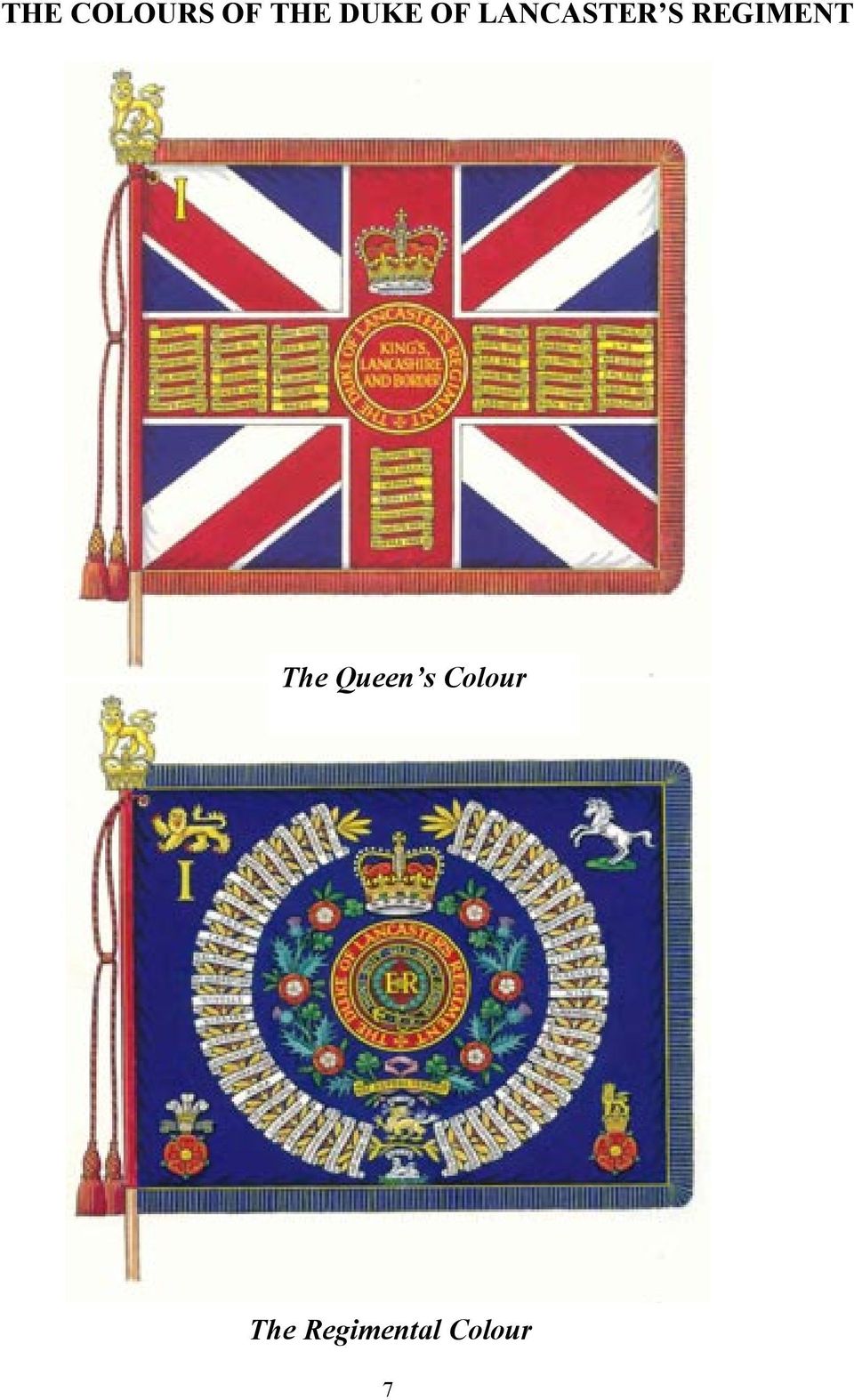
15 SECTION II THE COLOURS HISTORICAL BACKGROUND The Colours embody the spirit of the Regiment. They symbolise service to Queen and Country and depict the principal honours and distinctions earned by our predecessors. The Colours are consecrated before they are handed over to the safe keeping of the Regiment and for that reason they must always be treated with the greatest respect and accorded the highest honours. Colours have been carried by the Regiment since its formation in 1680 and originally had a tactical purpose as the Regiment's rallying point in battle when soldiers fought in close formation. Defence of the Colours was of the utmost importance and the selected officers and NCOs who formed the Colour Party occupied a post of the greatest honour and danger. At Waterloo it is recorded that 14 sergeants and officers in proportion fell while guarding the Colours of the 40 th Foot, which were shot almost to pieces, and at Inkerman both Colour Ensigns of the 63 rd were killed. The last occasion when the Colours were carried in action by the Regiment was at the Battle of Ahmad Khel in Afghanistan, 1880, where the 59 th fought in traditional close order to defeat charging waves of fanatical tribesmen and twenty picked men were detailed to defend the Colours. DESCRIPTION OF THE COLOURS In common with most other British infantry regiments, The Duke of Lancaster s Regiment and its predecessors have carried two Colours per battalion since the early eighteenth century (prior to which a Colour was carried by the ensign of each company). The Colours of each battalion are of identical design except for the battalion number in Roman numerals, which is embroidered near the top of each Colour and close to the pike.. The Queen's Colour is based on the Union Flag and displays 43 scrolls bearing selected Battle Honours from the First and Second World Wars. In the centre are embroidered in gold the Regimental title and sub-title on a red ground beneath a Queen s Crown. The Queen s Colour is fringed with crimson and gold alternate strands. The Regimental Colour has a dark blue field (background) as we are a Royal Regiment. In the centre is the Royal Cypher within a Garter and the Fontenoy Laurel Wreath, surrounded by the Regimental title, surmounted by a Queen s Crown, and encircled with a Union wreath of roses, thistles and shamrocks. Below the central device is the Regimental Motto, Nec Aspera Terrent. In the four corners are the emblems of our most recent Regimental forebears: The King s Own Royal Border Regiment (top left): A Lion of England. The King s Regiment (top right): The White Horse of Hanover. The Lancashire Regiment (Prince of Wales s Volunteers) (bottom left): A Red Rose charged with the Plume of the Prince of Wales. The Loyal Regiment (North Lancashire) (bottom right): A Red Rose charged with the Royal Crest. The Regimental Colour is encircled with the Laurel Wreath awarded for Waterloo, on which are embroidered 46 selected Battle Honours (other than those awarded for the two World Wars). Central below the Laurel Wreath is a Sphinx superscribed Egypt, and above the wreath is a Dragon superscribed China. The Regimental Colour is fringed with blue and gold alternate strands. The Colour pikes are topped with the Royal Crest, beneath which hang tasseled cords. II-1

16 The background to each Regimental Distinction is detailed at Part III, and the Battle Honours are listed at Annex B to Part IV. PRESENTATION OF COLOURS Regular battalion Colours are now normally replaced every 20 years and Volunteer battalion Colours every 30 years. LODGEMENT OF THE COLOURS The Colours will normally be lodged in the Officers Mess in the charge of the Senior Subaltern and under the direction of the Adjutant. The Senior Subaltern will ensure that the Colours are carefully cased as detailed in Ceremonial for the Army and secured under lock and key at night and during periods when the Mess is unattended. He will at once report any damage to the Adjutant. Care should be taken that the Colours are at all times shown proper respect, that they are only displayed on appropriate occasions and that they are not handled by unauthorised persons. The only persons permitted to handle the uncased Colours are: The PMC. The Senior Subaltern. Officers of The Colour Party. The Adjutant in the course of his duties. The Orderly Officer in the course of his duties (he may request another officer to assist him in casing the Colours). The Regimental Sergeant Major in the course of his duties. The Drum Major in the course of his duties. The Mess Colour Sergeant in the course of his duties. When displayed on a Colour stand, the Queen s (or Sovereign s) Colour is on the right with its pike crossing behind that of the Regimental Colour. If the Colours are wet after being carried on parade it is the responsibility of the Senior Colour Ensign to see that they are completely dried before being cased. When the Colours are being moved from, or to, their usual place of lodgement an escort is invariably to accompany them. If the Colours are to be moved any distance they are to be cased. The casing is the responsibility of the Senior Subaltern or the Orderly Officer, as directed by the Adjutant. When the Colours are to be uncased on parade the Drum Major has the honour of carrying out this duty in accordance with the procedure laid down in Ceremonial for The Army. PROCEDURE FOR CASING, UNCASING AND DRESSING THE COLOURS Casing a Colour The Ensign or Orderly Officer will hold the Colour in a horizontal position. His assistant, who according to the circumstances may be another officer, the Mess Colour Sergeant or, on parade, the Drum Major, will take the top of the Colour pike in his left hand and, with his right hand, take hold of the bottom right-hand corner of the Colour, the Ensign at the same time taking hold of the bottom left-hand corner. The edge of the Colour will then be lifted and placed over the top of the pike. This procedure is repeated twice, care being taken to ensure there are no creases, so that the whole Colour is neatly rolled along the top of the pike. The cord with tassels will then be wrapped three 2

17 times around the Colour, the end being grasped by the Ensign and passed around the pike. The leather case will then be slipped over the Colour, care being taken to ensure that the Colour is not rucked in any way. Finally, the Ensign will raise the Colour to the order and his assistant will tie the tapes of the case. When uncasing a Colour, the procedure described above is carried out in reverse. All subalterns are to be instructed in this drill on first doing duty as Orderly Officer. Dressing a Colour When a Colour is uncased the Colour Ensign will Dress the Colour. This consists of taking the left-hand top corner (the free end) with his left hand and bringing the Colour to a perpendicular position. This will result in the lowest corner falling straight down the pike. The Colour will then be evenly distributed on either side of the pike, and when carried on the shoulder the pike will always be covered by the overhang of the Colour. When changing arms, care must be taken to ensure that the same overhang is on the left shoulder as on the right. Should the Colour become disturbed, the Ensign may use his disengaged hand to put it back in the correct position. This is not a drill movement and should be carried out unobtrusively. COMPLIMENTS TO THE COLOURS ON PARADE Movement to the Parade Ground. Colours are carried on all ceremonial parades. Prior to a Battalion Parade, the Colour Party will form up at the entrance of the Officers Mess or other place of lodgement. There they will receive the uncased Colours from the Drum Major. The Drum Major will have the Queen s Colour in his right hand and the Regimental Colour in his left hand, and will be accompanied by the Sergeants of the Colour Party. The Colour Ensigns will salute the Colours with their swords, then return swords before receiving the Colours from the Drum Major, Queen s Colour first. On the command of the Senior Colour Ensign, carrying the Queen s Colour, the Colour Party will then proceed to a point adjacent to the parade ground, accompanied by a side drummer and a fifer playing The British Grenadiers, and await the order to march on. Marching on the Colours. The procedure and words of command for marching on the Colours will be as follows: The Commanding officer will order Slope arms, followed by March on the Colours. The Senior Colour Ensign will answer Sir. The Commanding Officer will immediately order Duke of Lancaster s, salute to the Colours, present arms. The Senior Colour Ensign will then order Colour Party, by the centre, quick march. The Band and Drums will then play the Regimental Quick March while, by a series of forms and turns ordered by the Senior Colour Ensign, the Colour Party will take up its correct position on parade. When the Colour Party are in position, the Band and Drums will cease to play and the Senior Colour Ensign will order Colour Party, present arms. The Band will then play Point of War, after which the Commanding Officer will order Duke of Lancaster s, slope arms. Marching off the Colours. The procedure for marching off the Colours will be as follows: With the Battalion at the slope arms, the Commanding Officer will order March off the Colours, to which the Senior Colour Ensign will answer Sir. The Commanding Officer will then immediately order Duke of Lancaster s, salute to the Colours, present arms. The Senior Colour Ensign will order Colour Party, by the centre, quick march. The Band and Drums will play the Regimental Quick March and the Colour Party, under the orders of the Senior Colour Ensign, will march off the parade and straight back to the place of lodgement, where the Colours will be disposed in accordance with instructions issued by the Adjutant for that day. In the 1 st Battalion it is the privilege of the Duke of Lancaster s Company to provide the Escort to the Colours on any ceremonial occasion when an Escort is required. This Company occupies the position of honour on the right of the Battalion line. 3

18 COMPLIMENTS TO THE COLOURS OFF PARADE When Colours are uncased, all ranks passing them will salute. When uncased Colours pass an individual he or she will halt, face the Colours and salute or, if armed, present arms. Formed bodies will stand to attention and the senior rank will salute; if armed, they will be ordered to present arms. When Colours are cased, compliments will not be paid to them but will be paid to the Colour Ensigns in the normal manner. All ranks will give precedence to a Colour Party marching with Colours cased and will stand to attention as the Colours pass. Compliments will be paid to the Colours, Standards and Guidons of other Regiments as to our own. COLOURS IN CHURCH During a Church parade or other appropriate service the Colours may be laid on an altar. The procedure is: After the choir and clergy have processed, the Band will strike up the Regimental Slow March and the Colour Party will slow march up the aisle to the chancel, halting before the altar rails. Arms will be carried, with bayonets fixed, and head-dress will be worn. The Senior Colour Ensign will then order the Colour Party to present arms. The Chaplain will first take the Queen s Colour and lay it on the altar with the pike to his right and the Colour draped over the front of the altar. He will then take the Regimental Colour and drape it with its pike to his left. The Senior Colour Ensign will then bring the Colour Party to the shoulder. They will then left/right turn and march off to their seats, where they will unfix bayonets, remove head-dress and take their places. At the end of the Service, the reverse procedure will be followed and the Colours will be marched out of Church to the Regimental Quick March. In Church, all commands are to be given and drill movements carried out with dignity, reverence and the minimum of noise. CARRYING THE COLOURS An officer, when he first has the honour of carrying a Colour on parade, shall fee the Drum Major the sum of 10 and may celebrate the occasion by ordering wine for all present at dinner, to be drunk at his expense on the day of carrying the Colour. LAYING UP OF COLOURS When old Colours have been replaced it will be normal practice for them to be laid up in a Regimental Chapel, museum or other public/civic building in the Regimental Area in accordance with the decision of the Regimental Council. Old Colours laid up in a Chapel should be netted or otherwise conserved within 5 years. The procedure for the replacement and laying up of old Colours is set out in Queen s Regulations. The ceremonial and form of prayer appropriate to the laying up of Colours is laid down for guidance in Ceremonial for The Army. ACTIVE SERVICE When the Battalion proceeds on active service and local conditions are such that it would be inappropriate to take the Colours, they are to be sent under escort to be deposited for safe keeping, normally at Regimental Headquarters. Under no circumstances are they to be left in unoccupied unit lines. 4

19 Crest of The Duke of Lancaster s Regiment

20 SECTION III REGIMENTAL DISTINCTIONS THE REGIMENTAL TITLE The full title of The Regiment is The Duke of Lancaster s Regiment (King s, Lancashire and Border). This is an historic royal title, rich with connotations of northern chivalry and strongly reinforces our long-standing regimental connection to the Sovereign and to our recruiting areas. The abbreviation of the title is LANCS: however the use of this form, other than for such necessary and practical purposes as military writing or map marking, is strongly discouraged. Abbreviated battalion titles are 1 LANCS, 2 LANCS and 4 LANCS. The short title of The Regiment, by which its members will usually refer to it, is Duke of Lancaster s, which should whenever possible be used in preference to the abbreviated form. For instance, this form should always be used when making an introduction, answering the telephone, etc. Any tendency to use the abbreviated form in such circumstances is to be corrected. Commanding Officers on parade have the privilege of using the words Duke of Lancaster s as a cautionary command, rather than Battalion. COMPANY TITLES Company titles and colours in the three battalions will be as follows: 1 st Battalion 2 nd Battalion 4 th Battalion Company Colour A Anzio Arnhem Inkerman Red B Burma Blenheim Somme Yellow C Corunna Chindit Kohima Green D or Support Somme Dettingen Ladysmith Blue HQ Helles Arroyo Waterloo Black THE DUKE OF LANCASTER The Monarch has inherited the title and Palatinate rights of the Duke of Lancaster since 1413, when the warrior King Henry V ascended the throne. Further details of the Duchy and the County Palatine are at Annex A. THE REGIMENTAL CREST The Regimental Crest is the Red Rose of Lancaster charged with the Royal Crown, with the motto Nec Aspera Terrent on a scroll beneath the Rose, all within a gold Fontenoy Laurel Wreath,. The crest is shown opposite in full colour, but the following variations are also approved: On Stationery and Programmes: In royal blue, printed or embossed. When printed in monochrome, the petals of the rose should be filled in to differentiate it from a white rose. On Invitation, Greeting and Visiting Cards, Menus, Place Cards, Band Programmes and Crockery: In gold, with the rose petals in red with green or gold sepals, printed or (preferably) embossed.

21 The Red Rose of Lancaster The Red Rose of Lancaster, an heraldic depiction of the ancient Rosa Gallica Officinalis, is a semi-double red rose with five petals. It is heraldically immaterial in what way the petals are placed: usually the rose is represented with two petals at the top with a single sepal between pointing upwards, but it is equally correct with a single petal at the top and on our badge and crest the Red Rose takes this form. Our Red Rose has had a long and turbulent history which is closely intertwined with that of the Monarchy, the County Palatine, and our Regimental forebears. It was adopted as an heraldic device in the 13 th century by Edmund, first Earl of Lancaster. Tradition has it that in 1460 the War of the Roses between the Houses of Lancaster and York started when the Duke of Somerset plucked a red rose in the Temple Garden, London and challenged his Yorkist adversaries with the words: Let all the friends of Lancaster follow my example. Following the battle of Bosworth Field, 1485, it became the proud emblem of Lancashire and of England as a whole. The Red Rose of Lancaster has been part of our Regimental heritage for over two centuries. It was first granted by King George III to the Royal Lancashire Militia in 1803 on account of the zeal shewn by this Corps and the uniform personal attachment of that County to the King s person. The rose was worn from 1822 by the 47 th (Lancashire) Regiment of Foot, whose recruiting area covered the whole of the historic County Palatine. From 1881 its use by Lancashire regiments was widespread and it was incorporated in the badges and appointments of the King s Own, the King s, the East Lancashires and the Loyals. In both World Wars of the last century the 55 th (West Lancashire) Division, comprising TA battalions of the King s Own, King s, South Lancashires and Loyals, proudly wore a Red Rose shoulder flash and had the motto They win or die who wear the Rose of Lancaster. The Regimental Motto. Nec Aspera Terrent was the motto of the Hanoverian Kings of England and was conferred on the 8 th, or King s, Regiment of Foot in 1716 to reward their gallantry against the Jacobites the previous year at the Battle of Sheriffmuir. This motto was also borne on the caps of the elite grenadier companies of all our antecedent regiments of foot. Its literal meaning is Let not hardships deter but it is usually more loosely translated as Difficulties Be Damned. The Fontenoy Wreath. At the battle of Fontenoy in 1745 (see Annex D to Part IX) the British infantry advanced, unsupported and outnumbered, into the centre of the French army, and were at length obliged to make a fighting withdrawal. Only the gallant action of the rearguard saved the British force from being surrounded, and for their conspicuous part in this desperate action the 34 th Foot were permitted to emblazon a laurel wreath on their Colours. REGIMENTAL FLAGS The Regimental Flag is emblazoned with the Regimental Crest on a Royal blue ground. Battalion numbers, if appropriate, are in yellow roman numerals at the top next to the staff. The Colonel s Flag is plain but for the Crest. It is flown in a battalion or detachment of the Regiment when the Colonel of the Regiment is in station, and is also flown by Regimental Headquarters and the Area Headquarters. The Commanding Officer s Flag is numbered I, II and IV for the relevant battalion and is flown in any battalion location when the Commanding Officer is present. 2
22 The Detachment Commander s Flag is the plain flag differenced with a yellow stream blazant in the top corner nearest the staff. The latter is flown by a Battalion Second-in- Command when the Commanding Officer is out of station and by a major commanding a detachment of the Regiment. DISTINCTIONS The Regiment has been honoured with the following distinctions: The Lion of England. A pair of silver Lions of England are worn as collar badges. It is a regimental tradition that King William III (William of Orange) conferred the unique honour of bearing this royal badge on the 4 th, or King s Own, Regiment of Foot for being one of the first to go over to his side when he landed at Torbay in In the Royal Warrant of 1751, an early attempt to regulate Army Colours and dress, the Lion is referred to as the Regiment s Ancient Badge and its display in the corners of the Regimental Colour was ordered: it has ever since been variously displayed on caps, collars and belt plates by The King s Own and their lineal successors. The lion is the oldest device known in heraldry and, as King of Beasts, was adopted by the Norman Kings of England in the 11 th century. It was the warlike King Richard the Lionheart who first bore on his shield and surcoat three golden Lions passant gardant in the form worn today by The Duke of Lancaster s Regiment and borne on the arms of the Duchy. The Royal Cypher. The Royal Warrant of 1 July 1751 authorised the King s Own Regiment to emblazon in the centre of their Colours the King s Cypher on a red ground within the Garter, and the Crown above it. King s Own Royal Border continued this tradition. The King s were similarly authorised at that time to display the King s Cypher and Crown in the corners of their Regimental Colour. These ancient traditions have been brought together in the Regimental Colour of The Duke of Lancaster s Regiment, which proudly displays at its centre the Queen s Cypher, E II R, within a Garter and Laurel Wreath. The Royal Crest. The Royal Crest of a Crowned Lion was worn by the 47 th Regiment on their buttons at least as early as the American War of , and by the 1820s it was widely displayed on the Regiment s badges, buttons and embellishments. From 1881 until 1970 the Royal Crest was a prominent feature of the badge of The Loyal Regiment (North Lancashire). The Plume of The Prince of Wales. In 1793, at the start of the French Revolutionary War, the 82 nd Regiment of Foot was raised at Stamford, Lincolnshire from volunteers. Its first Colonel, Charles Leigh, was a gentleman of the household of the Prince of Wales, and accordingly the Regiment became known as the Prince of Wales s Volunteers and took the Prince s three-feathered Plume as its badge. This was officially authorised in 1831 and was subsequently incorporated in the badge of The South Lancashire Regiment (Prince of Wales s Volunteers). The Plume of ostrich feathers, and the motto Ich Dien, were found on the helmet of the blind King of Bohemia after he was slain at the battle of Crecy, 1346, while serving as a volunteer in the army of the King of France. In commemoration of this valiant foe, Edward the Black Prince adopted the plume and motto for his crest, and as such they have ever since been borne by Princes of Wales. The White Horse of Hanover. In 1716, when King George I rewarded the loyalty and gallantry of the 8 th Regiment of Foot by granting them the title of King s, he also changed their yellow Stuart facings to Royal blue and gave them his family emblem, the White Horse of Hanover, as their regimental badge. The King s White Horse is distinctive in that, unlike others including the 3
23 Yorkshires, it is prancing rather than running. This historic emblem, one of the oldest regimental badges in the Army, is now borne on our Regimental Colour. The Sphinx. The Sphinx commemorates the 1801 campaign to evict the French from Egypt. For their part in that victorious campaign, in which our forebears performed several remarkable feats of arms, the 8 th, 30 th, 40 th and 96 th Regiments were awarded the distinction of carrying a Sphinx, inscribed with the word Egypt, on their Colours, badges and appointments as a distinguished mark of His Majesty s royal approbation and as a lasting memorial of the glory acquired to His Majesty s arms by the zeal, discipline and intrepidity of his troops in that arduous and important campaign. It is a curious fact, owing more to military taste than antiquarian research, that the British Army s Sphinx, unlike the enigmatic original at Gizeh, is always depicted as a female with rather prominent breasts and a lion s tail; the body of the Sphinx was at that time buried in the sand, so perhaps some artistic license was permissible. The Chinese Dragon. A Dragon superscribed China is emblazoned on the Regimental Colour and commemorates the 55 th (Westmoreland) Regiment s campaign service in that country in , when they captured the Imperial Dragon Standard which is now cased in Kendal Parish Church. The Glider. This distinction was awarded to The Border Regiment by King George VI in 1949 in recognition of the part played by the 1 st Battalion in the airborne invasion of Sicily on the night of 9/10 July This was the first operation in which the British Army used glider-borne troops and, despite heavy losses, the Border Regiment captured the vital Ponte Grande Bridge. The same Battalion, which included many Lancashire soldiers, also landed by glider at Arnhem on 17 September 1944 and took part in the 1 st Airborne Division s heroic action, which Field Marshal Montgomery summed up in these words: In the annals of the British Army there are many glorious deeds. In our Army we have always drawn great strength and inspiration from past traditions, and endeavoured to live up to the high standards of those who have gone before. But there can be few episodes more glorious than the epic of Arnhem, and those that follow after will find it hard to live up to the standards that you have set. Our forebears were also involved in equally daring glider-borne operations on the other side of the world where, in March 1944, 1 st Battalion The King s Regiment were flown into jungle clearings in Burma as part of the famous Chindit force, fighting deep behind Japanese lines. The Mailed Fist. 5 th Battalion The King s Own (TA), which became 107 th Regiment RAC (King s Own) during World War II, received the honorary distinction of the Mailed Fist badge of the Royal Armoured Corps, with the dates and a scroll inscribed North-West Europe, which was borne on the Regimental Colour of that battalion and its TA successor (but not on the Regular battalion Colours). Six other battalions of our antecedent regiments were also converted to armour, but as wartime-only units they received no such honours. The Badge of The Reconnaissance Corps. 5 th Battalion The Loyal Regiment (North Lancashire) (TA) converted in 1941 to become 18 th Battalion The Reconnaissance Corps, and sailed for Singapore. As they approached the island their ship was dive-bombed and had to be abandoned, together with all the battalion equipment, and the survivors later shared the sad fate of the remainder of the Singapore garrison. Their fight in defence of Singapore and their subsequent suffering on the infamous Burma Railway was recognised by the grant of a Badge of The Reconnaissance Corps with the date 1942 and a scroll inscribed Malaya. 4
24 KINGSMAN The unique rank of Kingsman, instead of Private, was officially sanctioned in 1951, but had previously been in informal use by The King s Regiment (Liverpool) for over one hundred years. UNIFORM EMBELLISHMENTS Facing. The facing colour, as on the collar and cuffs of full dress uniform, is dark blue (blue black) as we are a Royal Regiment, as were all three of our immediate predecessors. This distinction is believed to have been conferred by King George I on the King s Own in 1715 and on the King s in The Queen s Lancashires were granted this distinction in 1970, when HM Queen Elizabeth II became Colonel-in-Chief. For the same reason, members of the Regiment wear Royals hatbands of red on their forage caps. Piping. Our soldiers have the honour of wearing the scarlet piping of a Royal regiment on their No. 1 Dress. Cap Badge The standard badge worn by all ranks in forage caps and by soldiers in their berets and side hats is the Regimental Crest in matt gold metal with polished highlights and a red enamel rose. Officers and Warrant Officers First Class wear a gold wire embroidered badge on both beret and side hat. The officers beret badge has a red diamond backing, but their side hat badge has a narrow blue black backing cut out round the badge. In ceremonial dress, bandsmen, drummers and pioneers wear the universal helmet plate with a Red Rose of Lancaster in the central roundel surrounded by the inscription Duke of Lancaster s Regiment. Cap badge Backing When worn in the beret the badge is backed with a red cloth diamond. Red is the Royal colour of England and the traditional cap badge backing colour for a Royal Regiment, and was accordingly authorised as a helmet badge backing for the King s Own and King s Regiments from This in turn was derived from the pom pom tuft of red wool worn by Royal Regiments in their shakos from A red beret badge backing was introduced by The King s Own Royal Regiment (Lancaster) in 1947 and by The King s Regiment (Liverpool) in The first recorded use of a red diamond patch was by The King s (Liverpool Regiment) A red cap badge backing was also worn by 1 st Battalion The South Lancashire Regiment, the old Fighting Fortieth, in remembrance of a famous regimental victory over the American rebels at Germantown in 1777, when they thwarted a surprise attack by George Washington. Regimental tradition has it that the Americans were so upset by their defeat that they vowed vengeance upon the men who had beaten them so soundly and they tried to find out which regiment it was. On hearing this, the men of the 40 th dipped their white cockades, or hackles, in cock s blood and invited the Americans to look out for the men with the red hackles. In course of time this hackle was represented by a red patch worn behind the cap badge. The distinctive diamond shape of the backing is equally significant. A diamond in various colours was originally worn as a helmet flash from circa 1900 by the King s, King s Own, East Lancashires and Manchesters (the last two deriving from the cardinal points of the Fleur-de-Lys 5
25 badge of the 59 th and 63 rd Regiments of Foot), and latterly as a beret patch by the King s Own Royal Border and Queen s Lancashire Regiments. In ceremonial dress there is a red backing to the badge in the central roundel of the universal helmet plate worn with both Home Service and Foreign Service helmets. Collar Badges. A pair of silver Lions of England (see above), facing inwards, are worn as Regimental collar badges. These were worn as collar badges by the King s Own from 1873 and by King s Own Royal Border They are issued in two sizes, the larger Lions being worn on the collars of Ceremonial and No. 1 Dress jackets. Buttons Our button bears a silver Fleur-de-Lys mounted on gold. This emblem was adopted by the predecessors of The Manchester Regiment in commemoration of their early service against the French in the West Indies. In 1759, and again in 1810 and 1815, the 63 rd Regiment of Foot took part in the capture of the French Caribbean island of Guadeloupe (see Annex E to Part IX), and as a trophy the Regiment took the French fleur de lys as its badge. A large silver fleur de lys was worn on 63 rd officers epaulettes as early as Following the 1958 merger of the Manchesters with The King s Regiment (Liverpool), the Fleur-de-Lys became the most prominent device of The King s Regiment. The Fleur-de-Lys, a stylised lily flower with three petals, became the armorial emblem of the Kings of France in the 12 th century. In 1340, during the Hundred Years War, King Edward III of England quartered the Lilies with the Lions of England to emphasise his claim to the throne of France and they remained on the Royal coat of arms until By a happy regimental coincidence, the Fleurs-de-Lys appear with the Lions of England on the arms of the Duke of Lancaster. The Fleur-de-Lys also featured among the badges and devices of the East Lancashire Regiment and The Loyal North Lancashire Regiment. A white Fleur-de-Lys was the demi-official emblem of 2 nd Battalion The East Lancashire Regiment, the old 59 th, who were accordingly known as the Lilywhites, and was first adopted by them as early as the Napoleonic Wars. It perpetuated the Regiment s territorial designation from 1782 until 1881 as the 2 nd Nottinghamshire, the Fleur-de-Lys appearing on the coat of arms of that County. Similarly, from 1881 until 1970 the collar badge and regimental crest of The Loyal Regiment (North Lancashire) featured the Lincoln Shield, worn as a collar badge by the 81 st Regiment (Loyal Lincoln Volunteers) from The Lincoln Shield was the heraldic emblem of the City of Lincoln, where the 81 st were raised in 1793, and bore a Fleur-de-Lys on the cross of St George. Officers of the Duke of Lancaster s wear a third small button in a triangular form on the cuff of their No. 1 Dress jacket, this being a long-standing custom of the Border Regiment. The origins of the spare button are obscure, but a pleasant Regimental tradition has it that officers in the Peninsular War would cut buttons off as parting keepsakes for their sweethearts and were accordingly ordered to wear an extra button to avoid being improperly dressed. The less romantic official explanation is that the buttons represent the three crowns at the centre of the cross of the Order of the Bath, which in 1829 became the centre of the badge of the 34 th Regiment when three Colonels of the Regiment in succession had been appointed Knights Grand Cross of that Order. These officers were: 6
26 Lieutenant General Sir Eyre Coote GCB, 1810 Lieutenant General Sir Lowry Cole GCB, 1816 Lieutenant General Sir Thomas Brisbane GCB, 1826 Glider Shoulder Flash. A yellow embroidered Glider (gold wire for officers) is worn on the right arm in most orders of dress except combat clothing, where it is incorporated in the Tactical Recognition Flash. Tactical Recognition Flash. This flash, which is worn as a distinguishing mark on combat clothing, displays the yellow Glider on a deep green background with a maroon surround. The Glider is a distinction of the Border Regiment (see above), deep (Manchester) green is from King s, while the Queen s Lancashires maroon also recalls the World War II airborne service of predecessor regiments (King s in Burma, Border in Sicily and at Arnhem, and South Lancashires in Normandy and on the Rhine). Regimental Rank/Title Slip-Ons. All ranks of the Regiment wear olive green slip-ons as epaulettes or gorgets as appropriate, embroidered in maroon with the title Duke of Lancaster s and their badge of rank. A slip-on of similar pattern was worn by The Lancashire Regiment (Prince of Wales s Volunteers) and The Queen s Lancashire Regiment in succession from 1 July A sand-coloured variant may be worn with desert combat dress. Stable Belt. Maroon, side fastened with black straps. This belt was introduced in Hong Kong on the formation of The Lancashire Regiment (Prince of Wales s Volunteers), 1 July The colour maroon, or a similar shade, has been common to the majority of our predecessors for well over a century. Proper stable belts should always be side-fastening. Lanyard The maroon lanyard derives from The East Lancashire Regiment. It was originally worn by the old 59 th (2 nd Battalion East Lancashires), abolished in 1902 on the introduction of Service Dress, but reintroduced at Poona, India in 1906 as a unit recognition aid following particularly chaotic formation manoeuvres. The maroon lanyard was worn by the 2 nd Battalion throughout the Great War and was subsequently adopted by the whole of The East Lancashire Regiment and its successors. The maroon colour is believed to derive from the original facings of the 59 th Foot. For the first twenty years of their existence the 59 th wore the usual red coat of the British infantry with facings of the fashionable pinkish-purple hue known as pompadour, so named from its being the favourite colour of the Marquise de Pompadour ( ), the beautiful, shrewd and powerful mistress of King Louis XV of France. A sample of the original facing material is in the Regimental Collection and is indeed virtually identical in colour to the present-day lanyards. The three knots on the lanyard are a reference to the Regiment s long association with the Royal Navy and its service under Nelson, whose victories at the Nile, Copenhagen and Trafalgar they commemorate. Officers Lace. The black stripe in our officers lace is said to be in memory of the death of Wolfe at the battle of Quebec, 1759, though it was worn by the 47 th Regiment as early as The 40 th also introduced a black stripe into their lace shortly after Quebec, probably for the same reason, and for many years wore black in their lace in memory of Sir Ralph Abercomby, their commander at the battle of Alexandria,
27 Parade Belt Buckle. The gold metal belt buckle, worn by other ranks with a white parade belt, combines several Regimental distinctions, all explained above. The central feature is the Sphinx, charged with the Queen s Crown and with a Rose below, all within a laurel wreath. The clasp is inscribed Duke of Lancaster s Regiment. Sword Frog. Our officers always wear a sword frog with the Sam Browne belt. This custom is said to originate in an occasion when King George V, then Colonel-in-Chief of the King s Regiment, appeared thus accoutred even though he was not wearing a sword. The officers of the King s, to spare the Monarch any discomfort, hastened to do likewise. For some unknown reason, this custom was shared by the South Lancashires. The Wilkinson Swords. 1 st Battalion The King s Own Royal Border Regiment had the distinction of being twice awarded a Wilkinson Sword of Peace. These swords are now carried on ceremonial parades by the Commanding Officers of the two Regular Battalions of the Duke of Lancaster s Regiment, and are allocated as follows: 1 st Battalion: The Northern Ireland Sword. Awarded in 1994 for an outstanding contribution to developing community relations in Londonderry. 2 nd Battalion: The Sword for Macedonia. Awarded in 1999 to the Burma Company Group during Operation Upminster for boosting stability in a highly uncertain and war-torn environment by an imaginative and committed humanitarian operations policy. The Downward Sword. This was presented to the Warrant Officers and Sergeants Mess of 1 st Battalion The Queen s Lancashire Regiment on Waterloo Day, 18 June 1984 by Major-General Sir Peter Downward KCB DSO DFC, Colonel of the Queen s Lancashire Regiment. September 1978 to September It is carried by the Regimental Sergeant Major of the 1 st Battalion on ceremonial occasions. The Scotter Sword. This was presented to the Warrant Officers and Sergeants Mess of 1 st Battalion The King s Own Royal Border Regiment by Lady Scotter in memory of General Sir William Scotter KCB OBE MC who died when still serving as Colonel of the Regiment. It is carried by the Regimental Sergeant Major of the 2 nd Battalion on ceremonial occasions. THE REGIMENTAL MEDAL Award of the Regimental Medal is available as an appropriate way of recognising distinguished service to the Regiment. Rules for nomination for award of the Regimental Medal are contained in Regimental Council Instructions. The Regimental Medal is a silver medal bearing on the obverse the Regimental badge and title and on the reverse the inscription For Outstanding Regimental Service within a laurel wreath. It is suspended from a deep green, royal gold and maroon ribbon. It may be worn on the right breast on Regimental occasions. PIONEERS 8
28 A section of Regimental Pioneers, led by the Pioneer Sergeant, have the honour of marching at the head of a battalion in column of route on ceremonial occasions. On parade they take post on the right flank of the battalion. The origin of this ancient custom was the practical necessity for the Pioneers to clear and improve the battalion s route through rough or wooded country. On parade the Pioneers will wear the ceremonial dress of the Regiment (see Section XVI) with white aprons and gauntlets, highly polished ceremonial axes, and pioneers swords. The Pioneer Sergeant should whenever practicable wear the traditional full set of beard and moustache. THE ARROYO DRUMMERS On 28 October each year, or on some other convenient Regimental occasion, the Regiment celebrates the capture at Arroyo dos Molinos of the Drums and Drum Major s Staff of the French 34 th by trooping them. Replicas of the French Drums are carried on this occasion by six soldiers selected from among the smallest men in the battalion to wear replica 1811 drummers uniforms of their 34 th Foot forebears. They are led by a Senior NCO selected for the role of Drum Major. The Arroyo Drummers wear white breeches, black leggings buttoned down the outsides, and, since drummers always wore the reverse of their Regimental coat and facings, jackets of the 34 th s bright yellow laced with silver and faced in scarlet, with drummers wings. They wear black stovepipe felt shakos with the brass universal plate bearing the Royal Cypher with flags and trumpets either side and the Lion of England below. The French Drums are carried but not played. The Drum Major similarly wears white breeches, black leggings and a yellow jacket faced with scarlet, but of officer pattern. He also wears a sergeant s waist sash of crimson with a central stripe of Regimental yellow, a sword-belt and sword, and a Drum Major s sash in yellow trimmed with silver lace and bearing two miniature drum sticks. His black bicorne hat is ornamented with silver lace, a decorative edging and a large white over red plume. He carries the Drum Major s Mace of the French 34 th Regiment. REGIMENTAL COLOURS The principal Regimental colour is dark (Royal) blue, which appears in two shades: Facings on uniforms are a dark (Royal) blue, so dark that they are in effect blue-black. A deep Royal blue (but considerably lighter than the facing colour) is used on signage, flags, etc. The paint is General Service Gloss BS381C 105 Blue, for which the NATO Stock Number is SEA 129/105-G575. The Regiment uses three other colours, all of which are deeply embedded in our Regimental heritage: Orange. Originally a colour of the King s Own, adopted circa in honour of King William III and the Hanoverian succession. This was, and remains, the colour of the Royal House of Orange. Deep Green. Similar shades of deep/dark green, variously described as Brunswick, Kendal, Lincoln or Manchester green, were common to the Border, Loyal North Lancashire, and Manchester Regiments: 9
29 Kendal green was the facing colour of the 55 th, or Westmoreland, Regiment from 1755 and was subsequently adopted by the Border and King s Own Royal Border Regiments in succession. The deep Brunswick green facings of the 63 rd, dating from 1758, were inherited by the Manchesters and the King s, who wore deep green facings from 1958 until Lincoln green was adopted by the Loyals from their 2 nd Battalion, formerly the 81 st Foot, or Loyal Lincolnshire Volunteers, and then by the Queen s Lancashires. Maroon. Shades of the dark red colour variously described as crimson or maroon were common to the King s Regiment, the East Lancashires (from 1879), South Lancashires (from 1881), the Loyals (from 1875), and briefly the Border Regiment in their World War II airborne role. REGIMENTAL SIGNAGE Regimental signage follows the Flag design, i.e. the Regimental crest on a dark (Royal) blue ground with mid-yellow lettering. The Crest and Royal blue ground are explained above. The yellow lettering recalls the early, Stuart, facing colour of the 4 th and 8 th Regiments, and that of the 30 th, 34 th and 82 nd Regiments until More recently, yellow was the facing colour of the East Lancashire and Border Regiments, and from 1945 to 2006 was worn by the East Lancashires and their successors as a cap badge backing. REGIMENTAL ITEMS OF CIVILIAN DRESS Regimental Tie. Dark (Royal) blue with 1 cm stripes of (from the top) Orange, Deep Green and Maroon sloping top left to bottom right (from wearer s perspective) at intervals of 4.5 cm. Regimental Blazer Badge. A gold wire and coloured silk embroidered Regimental crest. Regimental Blazer Buttons. A gold button mounted with matt white fleur de lys (as issued). These items may be obtained from the Shop at Regimental Headquarters and from Battalion PRI shops. Those Regimental museums with shops may stock some items. Colours Ties. These are awarded for Sports and Shooting. See Section XVII. Sportswear. Standard Regimental items in Royal blue with a Regimental crest on the breast will be procured centrally whenever possible. Battalion sports strips, track suits, etc. should reflect this and/or the three Regimental colours described above. REGIMENTAL PLAQUES When depicted on a wall plaque, the Regimental Crest is to be in full colour on a dark (Royal) blue shield with the title Duke of Lancaster s Regiment on a scroll below the shield. Regimental plaques in two sizes may be obtained from the Shop at Regimental Headquarters. 10
30 ANNEX A TO SECTION III THE DUCHY AND COUNTY PALATINE OF LANCASTER ORIGINS OF THE LANCASTER INHERITANCE A violent baronial rebellion in the thirteenth century laid the foundations of the Duchy of Lancaster. When King Henry III emerged victorious he seized the possessions of two of the rebel leaders: Simon de Montfort, Earl of Leicester and Robert Ferrers, Earl of Derby, granting their estates to his son, Edmund Crouchback. On 30 June 1267, Edmund received the Honor, County, Town and Castle of Lancaster and was created the 1 st Earl of Lancaster. Edmund was a soldier, a popular commander of English armies in France and Wales. THE REBEL EARL On Edmund's death, the earldom passed to his son, Thomas, who extended the heritage of Lancaster. Thomas's life ended disastrously. He opposed King Edward II, and was implicated in the murder of Edward's favourite, Piers Gaveston, and other conspiracies. In 1322 he was declared a rebel, captured and tried before King Edward. He was condemned and beheaded, and his estates were forfeited. Thomas's brother Henry had not been involved in this rebellion, and gradually recovered the family fortunes, becoming the most powerful man in England. THE WARRIOR DUKE OF LANCASTER In 1345 Henry was succeeded as Earl of Lancaster by his son, known as Henry of Grosmont. This Henry earned early fame as a crusader in Prussia, Rhodes, Cyprus and Granada, and took a leading part in many of Edward III s military campaigns in France, Flanders and Scotland, fighting by land and sea. Henry of Lancaster was esteemed throughout Europe as a perfect knight: he was personally valiant in field and tourney, courteous, just and charitable, and one of the foremost military commanders of his age. To reward Henry for his numerous chivalric achievements, on 6 March 1351 Edward III created him Duke of Lancaster in recognition of astonishing deeds of prowess and feats of arms THE COUNTY PALATINE OF LANCASTER In the same charter, Edward III raised Lancaster to a County Palatine for Henry s lifetime. This meant that the new Duke had sovereign rights in the county in the spheres of justice and administration. The law courts in Lancashire were to be under the Duke s administration, and he appointed the sheriff, judges, justices of the peace and other senior officials. In medieval England, such Palatinate powers were devolved royal powers for use in border areas remote from central government, and the creation of the County Palatine of Lancaster, matching Durham in the North East, provided a protective barrier against Scottish incursions. JOHN OF GAUNT, TIME HONOURED LANCASTER Henry, 1 st Duke of Lancaster died in 1361 without a male heir. The ducal title became extinct, and the Palatinate powers reverted to King Edward III. The inheritance passed to Henry s daughters, Blanche and Maude. Lancaster was part of Blanche s dowry when she married King Edward III s son, John of Gaunt, in Maude died without children in 1362, and her portion of the inheritance passed to her sister Blanche, reuniting the inheritance. John of Gaunt became one of the most powerful noblemen in England. He commanded English armies with
31 considerable success in France and Spain, and was created 2 nd Duke of Lancaster by Edward III in He recovered many of the Lancaster possessions that had been lost in 1322 and made valuable additions. In 1377, Edward III recreated the Palatinate for John's lifetime, and in 1390 this grant was extended to include John's heirs. BOLINGBROKE S REVENGE Dramatic events at the end of the fourteenth century brought a Duke of Lancaster to the throne of England. When Edward III died in 1377, his ten-year-old grandson, Richard II, came to the throne. The young king was heavily influenced by his powerful uncle, John of Gaunt, who acted effectively as Regent. The Duke s son and heir, Henry Bolingbroke, was an able, accomplished and much-admired knight, renowned for his chivalry, the leading jouster of his age, and a crusader. But the fortunes of Lancaster changed. Henry Bolingbroke made an enemy of King Richard II, and in 1398 he was banished from the kingdom for six years. When John of Gaunt died in 1399, Richard II confiscated the enormous Lancaster inheritance and extended Henry s banishment to a life sentence. Bolingbroke exacted a swift revenge. In 1399, while Richard II was campaigning in Ireland, Henry returned to England to claim his inheritance. Supported by leading families, he regained control of Lancastrian strongholds and captured Richard II. The king abdicated and was imprisoned in Pontefract Castle, where he died. DUKE AND KING Henry Bolingbroke was crowned King Henry IV of England on 13 October His first act was to stipulate the conditions under which the Lancaster inheritance should be held. The regulating charter was known to contemporaries as the Charter of Duchy Liberties. Later the Great Charter of the Duchy specified that the inheritance should be held separately from all other Crown possessions, and should descend to Henry s male heirs. This ensured that the Lancaster possessions were not merged with other Crown estates but remain the personal inheritance of the reigning Monarch. It has remained so to the present day. A PRINCELY INHERITANCE The Duchy estate includes lands all over England, and was in 1556 described as one of the most famous, princeliest and stateliest of the Queen s inheritance. Its most valuable property is the Savoy Estate in London, which has formed part of the Lancaster inheritance since In the North West, Lancaster Castle is among the Duchy s ancient possession, and the Duchy owns most of the foreshore between Barrow-in-Furness and the River Mersey. The net revenue of the Duchy is the property of the Sovereign in Right of Her Duchy. Revenue from the estates and other investments is paid to Her Majesty s Privy Purse, but the balance of monies arising from ancient duties in the County Palatine, such as those from intestacy, are paid into the Duchy of Lancaster Benevolent Fund, a registered charity from which grants are made. THE COUNTY PALATINE TODAY The term the County Palatine refers to the original and historic County of Lancaster, the bounds of which extend from the River Mersey to the Lakeland fells and include the cities of 2
32 Liverpool and Manchester. Successive reorganisations of the administrative areas of local government in 1888, 1974, 1986 and 1998, did not abolish this traditional County Palatine, or indeed alter the boundaries of other historic counties, nor did they prejudice Palatinate rights. In addition to almost all of the current administrative County of Lancashire, the historic County Palatine embraces the Furness and Cartmel areas of administrative Cumbria, Warrington north of the Mersey, and most of the former administrative areas of Greater Manchester and Merseyside. Well over ninety percent of the population of our Regimental recruiting area live within the County Palatine. 3
33 SECTION IV A SHORT HISTORY OF THE REGIMENT RAISING AND EARLY DISTINCTIONS The earliest of our predecessors, later known as the 4 th, or King s Own, Regiment of Foot, was raised by King Charles II on 13 July 1680 as The Earl of Plymouth s Regiment of Foot for service in Tangiers, a former Portuguese possession which had come to the Merry Monarch in his wife s dowry. The Regiment s first active service was the suppression of Monmouth s Rebellion at Sedgemoor in A consequence of this revolt was an expansion of the Royal Army and the formation on 20 June 1685 of Princess Anne of Denmark s Regiment of Foot, later known as the 8 th, or King s Regiment. Both regiments were soon involved in opposition to King James II s increasingly autocratic rule and were early adherents of William of Orange. The 4 th were the first to join William at Torbay, which later earned for them the name The King s Own and the unique distinction of the Lion of England as their regimental badge. The accession of King William III led to war with Jacobite supporters in Ireland and Scotland and with Louis XIV of France, and among the new regiments raised was the future 30 th Foot, formed on 8 March 1689 as Viscount Castleton s Regiment of Foot. The 4 th and 8 th (as it will be convenient to call them) saw service in Ireland, , at the Battle of the Boyne and the sieges of Carrickfergus, Cork, Kinsale and Limerick, while the 30 th was sent to Scotland. In 1692 all three regiments joined King William s army in the Spanish Netherlands, where they fought at Steenkirk and Landen, and the 4 th and 30 th gained particular distinction at the capture of the fortress-city of Namur in 1695, the Regiment s first battle honour. THE WAR OF SPANISH SUCCESSION 17O2-13 Renewed war with France saw the 4 th and 30 th re-formed as Marines. As such they served both as detachments on board Royal Navy ships and ashore, taking part in numerous battles, sieges and naval actions, mostly in Spain and the Mediterranean, but also in home waters. The most notable of these were the capture of Gibraltar, 1704, and its subsequent defence when the English Marines gained immortal honour, naval actions at Vigo and off Malaga, the capture of Cadiz, Barcelona, Alicante, Carthegena, Iveca, Majorca, Sardinia and Minorca, the siege of Toulon, the defence of Lerida and Denia, and the battle of San Estevan. In North America the 30 th were present at the capture of Annapolis Royal, in Nova Scotia, Britain s first conquest in Canada, but then the 4 th had over 200 drowned in a disastrous expedition up the River St Lawrence. The 34 th Foot, raised on 12 February 1702 as Lord Lucas Regiment, also fought in Spain, in particular at the capture and subsequent defence of Barcelona. The 8 th, meanwhile, fought throughout the war in Flanders and Germany under the Duke of Marlborough, notably at his great victories of Blenheim, 1704, Ramillies, 1706, Oudenarde, 1708, and Malplaquet, 1709, and the successful sieges of Venlo, Liege, Menin, Lille, Tournai and Douai. The 34 th joined Marlborough s army in 1710 and took part in the capture of Douai and Bouchain. REDCOATS AND JACOBITES The 4 th and 30 th were restored to the Army establishment in 1710 and 1715 respectively, and in 1715 King George I conferred upon the 4 th the title The King s Own. A similar honour was given to the 8 th in 1716, when it became The King s Regiment and was granted the White Horse of Hanover as a badge,
34 with the motto Nec Aspera Terrent, in recognition of its loyalty and bravery at the battle of Sheriffmuir, 1715, when it sustained heavy casualties in a rearguard action against the Jacobites. The 40 th Foot was formed on 25 August 1717 in Nova Scotia as Phillips Regiment. In the first 44 years of its existence the Regiment garrisoned the Canadian frontier and took part in numerous actions against the French and their Indian allies, becoming adept early practitioners of Light Infantry tactics. Hostilities with Spain took the 34 th in 1719 on a successful expedition to Vigo, while in 1727 the 30 th, together with the 34 th, again defended Gibraltar against the French and Spaniards. The War of Austrian Succession brought the 8 th back to the Low Countries in 1743 to fight at Dettingen and, with the 34 th, Fontenoy, 11 May On the latter occasion the British Infantry broke the French line but, unsupported and outnumbered, they were obliged to make a fighting withdrawal. For their gallantry in covering the retreat the 34 th were given the right to emblazon a Laurel Wreath on their Colours. This battle is commemorated annually by the Regiment. On 3 March 1741 Mordaunt s Regiment, later the 47 th Foot, was raised in Scotland. Its first active service was in the Jacobite Rebellion of 1745, when it fought at Prestonpans and subsequently defended Edinburgh Castle against the Young Pretender. The 8 th and 34 th were hurried back from the Continent to meet this emergency and, with the 4 th, were present at the battles of Falkirk and Culloden. In the latter action the 4 th and 8 th were largely responsible for breaking the fierce charge of the Highlanders. From 1745 to 1748 the 30 th were again marines, serving in the Channel Fleet and taking part in Admiral Anson s victory over the French off Cape Finisterre in Back in the Low Countries the 8 th were again in action at the battles of Roucoux and Lauffeld. THE SEVEN YEARS WAR In 1755 the threat of renewed war with France resulted in the raising of new regiments, including 55 th and 59 th Foot, while the following year the 8 th were given a second battalion which, in 1758, became the 63 rd Foot. In Canada the 40 th and 47 th dealt with the French threat to Nova Scotia, notably by the capture in 1755 of Fort Beausejour, and in 1758 won their first battle honours for the reduction of the fortress of Louisburg, where the 47 th gained the nickname Wolfe s Own. Also in 1758 also the gallant 55 th met with a bloody repulse at Ticonderoga, but the following year they were present at the capture of Fort Niagara. On 17 September 1759 the 47 th and the Grenadier Company 40 th earned great distinction at the decisive battle of Quebec, where their perfect volleys decided the fate of North America. This is commemorated annually by the Regiment, and the officers wear black in their ceremonial gold lace in memory of General Wolfe s death at the moment of victory. The 40 th, 47 th and 55 th Regiments were all present at the capture of Montreal, 1760, which ended French rule in Canada. The 55 th was then heavily engaged in quelling the Indian rising known as Pontiac s Conspiracy. In Europe, the 4th and 34 th were among the gallant defenders of Fort St Philip on Minorca, 1756, while the Kings, 30 th and 34 th raided the French coast, capturing Cherbourg and earning the battle honour Belleisle, Subsequently the 8 th fought in Germany , where their engagements included the battles of Corbach, Marburg, Kloster Kampen, Vellinghausen and Wilhelmstahl, and the siege of Cassel. In the West Indies, the 4 th and the newly-formed 63 rd took part in the capture of Guadeloupe, 1759, as a trophy of which the latter took the French fleur-de-lys as its badge and Guadeloupe Day is 2
35 commemorated annually on 10 June. The 4 th went on to capture the island of Dominica, 1762 and, with the 40 th, Martinique. Finally, the 4 th, 34 th and 40 th were with the force which, again in 1762, captured Havannah, capital of the Spanish Caribbean Empire. In 1765, 48 years after their formation, the 40 th arrived for the first time in the British Isles. AMERICAN WAR OF INDEPENDENCE The 4 th, 8 th, 30 th, 34 th, 40 th, 47 th, 55 th, 59 th and 63 rd all fought in America. The 4 th, 47 th and 59 th were stationed in the colonies at the outbreak of hostilities and took part in the first skirmishes at Lexington and Concord, and, with the 63 rd, in the bloody battle of Bunker s Hill, 1775, where the 47 th made the final charge to carry the rebel lines. The 40 th and 55 th were recalled to North America and in 1776, together with the 4 th and 63 rd, took part in the battle of Brooklyn which led to the capture of New York from George Washington. In 1777 the 40 th and 55 th fought at Princeton and later that year, with the 4 th and the 63 rd flank companies, beat Washington again at the battle of Brandywine and at Germantown, where the famous stand of the 40 th saved the day. All four regiments were also present at the indecisive battle of Monmouth Court House, Meanwhile the 34 th and 47 th, having relieved Quebec and expelled the rebels from Canada, had the misfortune to be involved in Burgoyne s disastrous Saratoga campaign of Despite initial successes at Ticonderoga and Hubbardton, the expedition was eventually overwhelmed by superior force and the survivors were interned for the duration of the war (though most subsequently escaped). The 63 rd participated in an attempt from New York to link up with Burgoyne, taking part in the storming of Fort Clinton. The 8 th, stationed on the Great Lakes since 1768, also fought on this front, capturing forts and, with survivors of the 47 th, raiding many hundreds of miles into rebel-held territory until the end of the war. Britain was now also at war with France and Spain, and in 1778 the 4 th, 40 th and 55 th were sent to capture the West Indian island of St Lucia where their flank companies earned particular distinction. In the 30 th and 63 rd were engaged in the Carolinas. The 63 rd were present at the capture of Charleston and fought with success as mounted infantry at Sherar s Ferry. They were also victorious at Hobkirk s Hill and, with the 30 th flankers, at Eutaw Springs, one of the hardest fought actions of the war. The 40 th returned to America, and in 1782 led in the capture of Fort Griswold. But elsewhere the war was drawing to an unsuccessful close and in 1783 the 40 th left New York with the last of the British garrison. Meanwhile, in the 59 th took part in the latter stages of the third siege of Gibraltar. FIRST COUNTY TITLES 1782 On 31 August 1782 the Regiments (except for the King s Own and King s) were given county titles which may at all times be useful towards recruiting. The new titles were: The 30 th, or Cambridgeshire, Regiment The 40 th, or 2 nd Somersetshire, Regiment The 55 th, or Westmoreland, Regiment* The 63 rd, or West Suffolk, Regiment The 34 th, or Cumberland, Regiment The 47 th, or Lancashire, Regiment The 59 th, or 2 nd Nottinghamshire, Regiment * The 55 th always spelt the county name with an e. 3
36 THE FRENCH REVOLUTIONARY WAR Army Expansion. In 1793 war with Revolutionary France found Britain militarily unprepared and additional regiments were hurriedly raised. Two of these were formed in Lincolnshire, largely from militia volunteers. These were the 81 st, popularly known as The Loyal Lincoln Volunteers, and the 82 nd, who earned the title of The Prince of Wales s Volunteers. These subsidiary titles were officially authorised in 1832 and 1831 respectively. Foreigners were also enlisted, and in 1798 the Minorca Regiment was formed on that island from nominally Swiss prisoners of war. This was later to enter the British line as the 96 th Foot, a forebear of the 2 nd Manchesters. The Mediterranean. The first priority on the outbreak of war was to man the Fleet, and accordingly the 30 th Foot once again became Marines, serving gallantly in that role at the defence of Toulon, at the capture of Bastia and Calvi in Corsica (under Nelson s command), and in several fleet and single ship actions in the Mediterranean and elsewhere. In 1798, after a spell in Ireland, they returned to the Mediterranean, first occupying Sicily, then in taking part in the capture of Malta from the French. The West Indies. Reinforcements were also poured into the commercially valuable West Indian islands. The flank companies of the 8 th, 40 th and 55 th were sent in 1794 with an elite force which rapidly captured Martinique and St Lucia before succumbing on Guadeloupe, more from disease than enemy action. Over the next few years the 8 th, 34 th, 40 th, 47 th, 55 th, 59 th, 63 rd, 81 st and 82 nd all saw much service in the West Indies, fighting many small actions against the French and local insurgents on the islands of St Vincent, Grenada, St Lucia (again), and San Domingo (now Haiti), and on the mainland in Honduras. All were virtually destroyed by disease. Holland. In Europe the Regiments were involved in attempts to cooperate with unreliable allies against the revolutionaries. In 1793 the 40 th and 59 th took part in an abortive expedition to aid the French Royalists in the Vendee, and the following year they joined the 8 th, 55 th and 63 rd with the Duke of York s army, then withdrawing through Holland. All five Regiments were engaged in a sortie from Nijmegan, while the 59 th, supported by the 40 th, fought a sharp rearguard action near Arnhem before the Regiments shared in a harsh winter retreat to Bremen. In 1799 three battalions of the 4 th and two of the 40 th, together with the 55 th and 63 rd, were again in Holland where in an otherwise ill-managed allied campaign the 40 th fought a brilliant Regimental action near Alkmaar while the 63 rd fought particularly well at Bergen-op-Zoom, Egmont-op-Zee and Beverwijk. Egypt and the Sphinx. In 1801 the 8 th and 30 th, together with the Minorca Regiment and four flank companies of the 40 th, joined Sir Ralph Abercromby s expedition to wrest Egypt from the French. The 8 th and 40 th took part in a daring assault landing in Aboukir Bay, where the 40 th won the admiration of the army, and all four Regiments took part in the battle of Alexandria, where the 40 th and the Minorca Regiment earned particular distinction. The army then advanced up the Nile to capture Cairo, and the campaign was concluded with the fall of Alexandria, where the 30 th earned fresh laurels in a valiant Regimental action at the Green Hill. All four Regiments were awarded a Sphinx superscribed Egypt, to be displayed on their Colours and badges. THE NAPOLEONIC WARS Peace with France came in 1802, but lasted barely a year. Under the threat of invasion by Napoleon Bonaparte the British Army expanded rapidly and all our predecessor regiments raised second battalions. The initial priority was home defence, but from 1805 the emphasis switched to expeditionary warfare in support of a succession of alliances. 4
37 Northern Europe. In 1805 the 1/4 th, 1/8 th and 1/30 th were sent to the Elbe in northern Germany but, compromised by unreliable allies, were shortly withdrawn. In 1807 the 1/4 th, 1/8 th and 1/82 nd captured Copenhagen and secured the Danish fleet, while in 1808 the 1/4 th were sent to Göteborg in Sweden. In 1809 both battalions of the 4 th, together with the 2/59 th, 2/63 rd, 2/81 st and 2/82 nd, were despatched with an ill-fated expedition to Walcheren, at the mouth of the Scheldt, where battle casualties were few but fever took a heavy toll. Italy. In 1806 the 1/81 st were part of an expeditionary force which, having occupied Sicily, routed a French army at the battle of Maida in southern Italy. South Africa. Also in 1806, the 1/59 th took part in the capture of the Cape of Good Hope from the Dutch. This was not the first regimental visit to the Cape, for the 1/81 st had seen active service there during the Third Cape Frontier War. South America. In 1807 the 1/40 th and 1/47 th were in South America, adding Monte Video to the Regiment s battle honours. West Indies. In 1809 the 1/8 th captured the French island of Martinique, while the following year the 1/63 rd, having occupied Madeira, again took Guadeloupe. THE PENINSULA WAR But the main arena for British arms was to be Spain and Portugal, the Iberian Peninsula, where the 1/40 th, 1/82 nd and the former Minorca Regiment (now numbered 97 th ) landed in 1808 under Sir Arthur Wellesley, later Duke of Wellington, and helped gain his early victories at Rolica and Vimiera. Later that year the 1/4 th, 2/59 th, 2/81 st and 2/82 nd took part in Sir John Moore s audacious advance into Spain and his subsequent retirement to and victorious stand at Corunna, where the 4 th, 59 th and 81 st gained particular distinction, before evacuation to England. Meanwhile the 40 th had remained in Spain (indeed they were one of only three regiments to serve throughout the six-year campaign) and in 1809 they earned fresh laurels at the battle of Talavera. In 1810 they were present, with the 97 th, at the battle of Busaco and took part in the strategic withdrawal to the Lines of Torres Vedras. British reinforcements in included the 1/4 th, 2/30 th, 2/34 th, 2/47 th and 1/82 nd. In 1811 the 4 th and 30 th were present at the battle of Fuentes d Onoro, the 34 th and detachments of the 40 th and 97 th took part in the bloody battle of Albuhera, and the flank companies of the 81 st and 82 nd played a prominent part in the hard fought victory of Barossa. At Arroyo dos Molinos, on 28 October, the 34 th routed the French 34 th Regiment and captured its drums and Drum Major s mace, earning an unique battle honour which is commemorated annually in the Regiment. Finally, on New Year s Eve of that year the 47 th, supported by the 82 nd, repulsed a French assault on the town of Tarifa. Before he could advance into Spain in 1812 Wellington had to capture the frontier fortresses. The 40 th took an active part in the siege of Ciudad Rodrigo, and then the 4 th and 30 th (brigaded together), and the 40 th displayed great gallantry and sustained severe casualties in their successful assault on the grim fortress of Badajoz, one of the fiercest fights in the history of the Army. Later that year all three Regiments again distinguished themselves at the battle of Salamanca, where the 30 th captured a French Eagle. The campaign ended with another retirement on Portugal, during which the 4 th and 30 th fought a successful delaying action at Villa Muriel; likewise the 47 th at Puente Largo. Meanwhile the 81 st were engaged on the east coast at Denia. The following spring Wellington advanced to drive the French out of Spain, and with him marched the 1/4 th, 2/47 th and 2/59 th (together forming Robinson s Brigade), and the 2/34 th, 1/40 th and 1/82 nd. All were 5
38 heavily engaged at Vittoria, where Robinson s Brigade carried the village of Gamara Mayor in the day s heaviest fighting. The 34 th and 82 nd then fought a desperate defensive battle at Maya, while the 40 th greatly distinguished itself by routing a French brigade at Sorauren, for which they were awarded the battle honour Pyrenees. Meanwhile Robinson s Brigade was in action at San Sebastian, which they stormed with the utmost gallantry, leaving 865 casualties in the breach, one of whom was Ensign Maguire of the 4 th who fell at the head of the Forlorn Hope on his 21 st birthday. Meanwhile the 40 th and 82 nd were engaged on the Heights of Salain. Wellington then entered France where the Regiments saw hard fighting at the crossing of the Bidassoa and the battles of the Nivelle, Nive and St Pierre before winter brought the campaign of 1813 to a close. Meanwhile the 1/81 st took part in diversionary operations on the east coast of Spain, seeing action at the battle of Castalla, the siege of Tarragona and the combat of Villafranca. In 1814 the 34 th, 40 th and 82 nd fought at Orthes and the 34 th and 40 th were appropriately in action at Toulouse, the last battle of the Peninsula War, while the 4 th, 47 th and 59 th were besieging Bayonne when news came of Napoleon s abdication. Holland. Also in 1814, the 2/30 th, 55 th and 2/81 st joined an expedition to open a second front in the Low Countries and besiege Antwerp, in the course of which the 55 th had the misfortune to be involved in a disastrously managed attempt to storm the strong fortress of Bergen-op-Zoom. The East Indies. Meanwhile the 1 st Battalions of the 30 th, 34 th, 47 th and 59 th were serving in India, from where expeditions were mounted against the colonies of France and her allies. In 1807 the 30 th again saw active service at sea against warships of the Dutch East Indies, while in 1809 the 47 th was sent to deal with pirates in the Persian Gulf. Also in 1809 the 59 th took part in the capture of Mauritius from the French and subsequently the same Regiment played a leading role in the capture of Java, Sumatra, Bali and the Celebes from the Dutch and local princes. The hard-fought battle of Cornelis in Java, 1811, stands as one of the greatest achievements in the history of the 59 th Regiment. The 30 th, 34 th and 47 th, meanwhile, where fully extended in maintaining the security of British India and dealing with several insurrections and mutinies. WAR WITH THE UNITED STATES Peace in Europe brought no respite for the Peninsula veterans, for the 4 th, 40 th, 81 st and 82 nd were at once despatched to North America, where the 8 th had been stationed on the Canadian frontier since The 4 th fought at the battle of Bladensburg, which led to the capture of Washington (and the burning of the White House), but then suffered heavy losses in the attack on New Orleans. The 40 th was present at the subsequent capture of Mobile. The 8 th fought throughout the war on the Canadian frontier, at York, Stoney Creek, Chippewa, Lundy s Lane and elsewhere, while the 82 nd repelled a final attack on Canada to share with the 8 th in the battle honour Niagara. WATERLOO 1815 In 1815 Napoleon returned from exile and the 1/4 th, 2/30 th, 1/40 th, 2/59 th and 2/81 st joined Wellington s army for the Waterloo campaign. The 30 th took part in the initial engagement at Quatre Bras, where they steadily formed square to repulse French cavalry charges, and were with the rearguard when Wellington fell back to his chosen ground at Waterloo. The 4 th and 40 th returned from America just in time to join the army at Waterloo shortly before the battle commenced on 18 June The 59 th were with a brigade detached to cover Wellington s right flank while the 81 st, despite their entreaties, could not be spared from duties in Brussels. The 30 th occupied a position in the right centre of the British front line throughout the day and for six hours sustained the attacks of massed cavalry and infantry supported by murderous artillery fire. Eleven 6
39 times they were charged by Marshal Ney s cavalry but the square was never broken. Towards the end of the day they advanced in line to meet the Grenadiers of Napoleon s Imperial Guard and routed them with one volley. By evening nearly half the battalion had fallen and the survivors were commanded by the officer sixth in seniority, all his seniors having been killed or wounded. The 4 th and 40 th were at first in reserve but later were moved into the centre of the allied line, on Wellington s vital ground near the farm of La Haye Sainte. There, like the 30 th, they withstood repeated attacks by cavalry and infantry and were pounded by cannon, but they too stood firm. Towards evening they drove back Napoleon s final attack by massed infantry. Shortly afterwards the Duke of Wellington personally ordered them to advance, at which they charged, swept away the French infantry to their front and took part in the recapture of La Haye Sainte. For their steadfastness and discipline at Waterloo the 4 th, 30 th and 40 th were permitted to encircle their badge with a Laurel Wreath. The battle is commemorated annually as a major Regimental Day. After Waterloo the 59 th took part in the storming of Cambrai and, with the 4 th, 30 th, 40 th, 81 st and 82 nd, the occupation of Paris. The campaign had a tragic sequel for the 2/59 th and 1/82 nd when those two veteran battalions were wrecked off the Irish coast with the loss of some 550 men, women and children, the greatest disaster in the Regiment s long history. OUTPOSTS OF EMPIRE In the 40 years between Waterloo and the outbreak of the Crimean War our predecessors had few home postings, spending long periods in overseas garrisons guarding British trade routes and the frontiers of the rapidly expanding Empire. Their stations spanned the world, from Canada, the West Indies and Bermuda to Gibraltar, Malta and the Ionian Islands, and on via Arabia, Mauritius, South Africa, India, Ceylon, Afghanistan, China and Burma to Australia and New Zealand. Third Mahratta War. In the 30 th, 34 th, 47 th and 59 th campaigned against the turbulent Pindaris of Central India and the 30 th took part in the reduction of their last stronghold at Asseerghur. Ceylon. In 1818 the 59 th were in Ceylon for the Kandyan War. Persian Gulf. In 1819 the 47 th were sent on an expedition which captured the pirate lair of Ras-al- Khyma on the Straits of Hormuz. Ionian Islands. Meanwhile the 8 th saw action against rebel Greeks on Corfu. First Burmese War. War with Burma in involved the 47 th in much arduous campaigning and several sharp encounters, earning them the battle honour Ava. Bhurtpore. Meanwhile the 59 th took part in a war with the Jats in India, during which they displayed great gallantry at the storming of the previously impregnable fortress of Bhurtpore, Portugal. In 1827 the 63 rd were part of a British force which briefly intervened in Portugal, where their very presence sufficed to restore stability. Coorg. In 1834 the 55 th took part in an expedition against the rebellious Rajah of Coorg which involved them in severe fighting at Soamwar Pettah. First China War. In this punitive campaign of the 55 th stormed Amoy, Chusan, Ningpo, Chapoo and Nankin, carrying all before them and compelling the Emperor to sue for peace. For their 7
40 gallant part in these operations, during which they captured an Imperial Standard, the 55 th were awarded the distinction of a Dragon inscribed China which is borne on the Regimental Colour. Canada. In 1838 the 34 th assisted in quelling a republican rebellion in Upper Canada. First Afghan War. In 1839 the 40 th were present at the capture of Karachi and were then heavily engaged in Afghanistan, earning the battle honours Candahar 1842, Ghuznee 1842 and Cabul 1842 for their unbroken string of victories in an otherwise disastrous war. Maharajpore. Returning to India, the 40 th took part in the Gwalior campaign of 1843 and were awarded the battle honour Maharajpore and a special medal made of captured guns for their distinguished services in that hard-fought engagement. First Maori War. The 96 th fought throughout this first campaign in New Zealand, , Australia. In 1854 the 40 th faced insurgency in the goldfields of New South Wales and took part in the only battle on Australian soil when they stormed the rebel entrenchment at the Eureka Stockade. THE CRIMEAN WAR The 30 th, 47 th, 55 th and 63 rd formed part of the British army despatched to the Crimea in The 30 th, 47 th and 55 th, brigaded together, advanced gallantly and side by side against the centre of the Russian line at the battle of the Alma, when the 4 th and 63 rd were also present. The 30 th, 47 th and 55 th then fought with great determination and success at the battle of Inkerman, where they repeatedly charged with the bayonet to hold off massed Russian attacks at odds of up to twelve to one until Allied reinforcements, including the 4 th and 63 rd, could arrive. The 63 rd also distinguished itself in this close quarter soldiers battle, which is commemorated annually by the Regiment on 5 November. Victoria Crosses (VCs) were earned by Lieutenant and Adjutant Walker of the 30 th, Private McDermond of the 47 th and Private Beach of the 55 th. Having endured the cruel winter of 1854/55, during which the 34 th also joined the army, all six regiments took a prominent part in the siege of Sevastopol, the capture of which virtually ended the war. VCs were won by Private Grady of the 4 th, Privates Coffey and Sims of the 34 th, and Major Elton of the 55 th, and the regiments saw particularly hard fighting at the capture of the Quarries and the assault on the Redan. The 82 nd also joined the army in the Crimea in SOLDIERS OF THE QUEEN The Indian Mutiny. The 8 th and 81 st were already in India when the Mutiny broke out in 1857, and the 4 th, 34 th and 82 nd were hurried east as reinforcements. The 81 st disarmed the mutineers around Lahore, where their presence did much to keep the Punjab loyal, while the 8 th secured Jullundur and then played a prominent part in the siege and storming of Delhi and at Agra. The 8 th, 34 th and 82 nd then saw considerable fighting at Cawnpore and Lucknow. A VC was won by Private Richardson of the 34 th. Subsequently all four regiments took part in the systematic clearance of rebel forces from Northern India, the 34 th and 81 st pursuing them into Nepal and over the North West Frontier respectively while the 82 nd were heavily engaged at Shahjehanpore and elsewhere in Oude. Second China War. Also in 1857, the 59 th earned the battle honour Canton for their part in the storming of that city by an international force. As the 59 th was the only British regiment to take part, this honour is unique in the Army. 8
41 Second Maori War. The 40 th took part in many hard-fought engagements with the Maoris in New Zealand between 1860 and 1866, in one of which Colour-Sergeant Lucas earned the VC. Bhutan. In the 55 th were engaged in operations in Bhutan. Abyssinia. In the 4 th took part in the epic march to capture King Theodore s mountain stronghold at Magdala, routing the Ethiopian army at the battle of Arogi. Fenian Raids. In 1866 the 30 th and 47 th were in Canada when they were called on to repel an inept Irish invasion across the American frontier. Zulu War. In 1879 the 4 th were involved in the Zulu War. The Regiment was mainly employed on the lines of communication but detachments, including the Mounted Infantry, saw some action. The 82 nd subsequently garrisoned Zululand. Second Afghan War. The 8 th, 59 th, 63 rd and 81 st all took part in this campaign. In 1878 the 8 th and 81 st were in action at Peiwar Kotal and Ali Masjid respectively, while in 1880 the 59 th took part in the fierce battle of Ahmad Khel, the last occasion when the regiment fought in traditional close order around its Colours. Captain Sartorious of the 59 th was awarded a VC. ARMY REORGANISATION In 1873 the territorial basis of Army recruiting was reorganised and this was further confirmed on 1 July 1881 when many of the old Regiments of Foot were linked and all were redesignated as follows: 4 th - The King s Own (Royal Lancaster Regiment) Depot Lancaster 8 th - The King s (Liverpool Regiment) Depot Warrington (Seaforth 1910) 30 th - 1 st Bn The East Lancashire Regiment Depot Burnley 59 th - 2 nd Bn The East Lancashire Regiment (Preston 1898) 34 th - 1 st Bn The Border Regiment Depot Carlisle 55 th - 2 nd Bn The Border Regiment 40 th - 1 st Bn The South Lancashire Regiment Depot Warrington (Prince of Wales s Volunteers) 82 nd - 2 nd Bn The South Lancashire Regiment (Prince of Wales s Volunteers) 47 th - 1 st Bn The Loyal North Lancashire Regiment Depot Preston 81 st - 2 nd Bn The Loyal North Lancashire Regiment 63 rd - 1 st Bn The Manchester Regiment Depot Ashton 96 th - 2 nd Bn The Manchester Regiment under Lyne The Militia and Volunteer units of Lancashire, Cumberland and Westmorland were also linked to the new County and City Regiments. These battalions that were now brought into the regimental families had their own antecedents, which in the case of the Militia dated back to 18 th century reforms of the County forces. The Militia had been expanded and embodied for home defence during the Napoleonic wars, and again for the Crimea when they took over garrison duties in Ireland and the Mediterranean. 9
42 Corps of Rifle Volunteers were formed from 1859 in response to invasion threats by Napoleon III of France, and the towns of the North West were among the foremost in raising such units. It is of interest to note that at the time of this reorganisation the Fighting Fortieth were entitled to bear 19 battle honours, more than any other Regiment entitled to carry Colours except the 1 st Foot. Although numerical titles were officially abolished in 1881 they will continue to be used in this short history, for the sake of brevity, to designate the old Regular regiments. Egypt The 63 rd took part in the brief campaign which consolidated British power in Egypt. Third Burmese War. The 8 th took part in the protracted campaign, , to depose the tyrannical King Thibaw and subjugate Upper Burma. Trouble broke out again in 1889 and the 34 th were among the troops then sent to restore order. North West Frontier of India. The turbulent frontier with Afghanistan remained a constant threat to the security of India. In 1891 the 96 th participated in a punitive expedition to the Miranzai Valley, while in the 55 th were involved in operations in Waziristan and in 1895 the 30 th took part in the relief of Chitral. THE SOUTH AFRICAN WAR Regular battalions of all our predecessor regiments were engaged in the Boer War, as were formed Militia battalions and a succession of Active Service Companies drawn from the Volunteers. This joint venture was a defining experience for the Regimental System, bonding the newly extended regiments as living, organic families with strong local roots and a collective pride in their heritage and achievements. The 47 th were part of the pre-war garrison at the Cape and just before the outbreak of hostilities half the Battalion was sent to defend the diamond town of Kimberley. The town was soon besieged but held out for over four months until relieved by a force which included the remaining companies of the Regiment, which was awarded the unique battle honour Defence of Kimberley. The companies with the relief force took a prominent part in the battles of Graspan and Modder River. The 8 th were also in South Africa at the outbreak of war and were moved up to the town of Ladysmith, where they were joined by the 63 rd. The latter were soon in action at the battle of Elandslaagte, but despite this victory Ladysmith was soon invested by the Boers, who from positions on surrounding heights blocked successive relief attempts. The King s and Manchesters suffered great privations during the 118-day siege, in which starvation and disease added to the casualty list. Both Regiments took part in the action on 6 January 1900 to repel a strong Boer attack on Caesar s Camp, when VCs were won by Privates Pitts and Scott of the 63 rd. The 8 th and 63 rd were awarded the battle honour Defence of Ladysmith. Beyond the Tugela, the 34 th fought at Colenso in Buller s first unsuccessful attempt to relieve Ladysmith, while the 4 th and 40 th, together in the Lancashire Brigade, together with the 34 th, took part in the battle of Spion Kop. All three regiments then fought at Vaal Krantz, and finally on the Tugela Heights in the offensive which led to the Relief of Ladysmith. The 40 th earned particular distinction at the breakthrough battle of Pieters Hill, when the Commanding Officer was killed leading the charge that finally broke the Boer position. The anniversary of the relief, 28 February, is celebrated as a major Regimental Day. The 30 th, meanwhile, were with Lord Roberts army which marched on Pretoria. They fought at Jacobsdaal, Karee and the Zand River, earning high praise for their part in these actions. 10
43 From Ladysmith the 4 th and 40 th moved north, clearing a path through the Drakensberg Mountains at the battles of Botha s Pass and Alleman s Nek. The 34 th marched to the relief of Wepener and fought a fierce action at Bushman s Kop, while the 8 th and 63 rd were in action at Graskop, at Van Wyk s Vlei, where Sergeant Hampton and Corporal Knight of the 8 th earned VCs, and at Geluk Farm, where Private Heaton of the 8 th also won the highest award for gallantry. Although the Boer field armies were now defeated an arduous guerrilla campaign lasted until 1902 and our predecessor Regiments all fought many minor engagements, and some few larger actions, both on foot and as mounted infantry. For their services the Regiments were awarded the battle honour South Africa The Territorial Force. Further Army reform and reorganisation followed the Boer War, and in 1908 the Volunteer battalions were redesignated and formed into operational Territorial Force divisions on a County or Regional basis. THE GREAT WAR During the Great War our predecessors raised some 176 battalions, of whom 109 saw active service overseas, earning 124 battle honours and 43 VCs. Many of these battalions fought side by side: for instance, the 42 nd (East Lancashire) Division had two battalions of East Lancashire territorials and six of Manchesters, 55 th (West Lancashire) Division contained two battalions each of the King s Own, South Lancashires and Loyals together with six battalions of the King s, and the 30 th Division had eight battalions of Liverpool and Manchester Pals and one of South Lancashires, while the 13 th and 19 th Divisions had the 6 th and 7 th Battalions respectively of the King s Own, East Lancashires, South Lancashires and Loyals, all brigaded together. The 57 th and 66 th Divisions were similarly constituted. France and Flanders The 1/4 th, 1/8 th, 30 th, 47 th, 63 rd, 82 nd and 96 th formed part of the original British Expeditionary Force of 1914, the celebrated Old Contemptibles, earning 13 battle honours of which Mons, Retreat from Mons, Marne 1914, Aisne 1914, Messines 1914 and Ypres 1914 are borne on the present Colours. They were joined in France before the year s end by the 55 th and 59 th. Drummer Bent of the 30 th won the VC, as did Privates Acton and Smith of the 55 th and 2 nd Lieutenant Leach and Sergeant Hogan of the 96 th. In the desperate fighting of late 1914 Britain s small pre-war Regular Army fought virtually to the death to buy time for national mobilisation. In 1915 the surviving Regulars were reinforced by an increasing flow of Territorials and newly-formed Service battalions of Kitchener s New Army. Lancashire and Border battalions took a notable part in the Neuve Chapelle offensive, the first major British attempt to break the stalemate on the Western Front, then fought the defensive battle of Second Ypres, where Corporal Smith of the 63 rd earned a VC, and took part in the Loos offensive, in which the highest award for gallantry was won by Lance Corporal Tombs of the 8 th and Private Kenny of the 47 th. Later in the year the award was also made to Private Christian, 2 nd King s Own, and to Private Young, 8 th East Lancashires. In the early months of 1916 VCs were earned by 2 nd Lieutenant Baxter, 1/8 th King s, Private Proctor, 1/5 th King s, and Lieutenant Wilkinson, 8 th Loyals. By early 1916 there were fifty-one Lancashire battalions and seven Border on the Western Front. Almost all of these took part in the great Somme offensive of that year. On 1 July 1916, the opening day of the battle, at Beaumont Hamel and Serre the 1 st and 11 th East Lancashires advanced steadily across open ground in the face of German machine guns and unbroken wire, sustaining eleven hundred casualties in minutes. Border Regiment losses at Y Ravine and the Thiepval Spur were equally heavy, and the 1 st King s Own suffered severely at the Heidenkopf. Further south at Montauban eight 11
44 Liverpool and Manchester Pals battalions of the 30 th Division met with better fortune, taking all their objectives in the major British success of the day. Twenty of our predecessor battalions were in action that day, which is commemorated annually in the Regiment. The offensive continued until November, by which time both sides had suffered appalling losses, not least in battalions from the North West. Among their many hard-fought and gallant actions, those around the Thiepval Spur, La Boiselle, Ovillers and Guillemont are particularly notable. They had added thirteen battle honours to their Colours, and VCs had been won by Private Miller, 7 th King s Own, Sergeant Jones, 12 th King s, 2 nd Lieutenant Coury, 1/4 th South Lancashires, Lieutenant Wilkinson, 7 th Loyals, and WOII Evans, 18 th Manchesters, together with Captain Chavasse, Medical Officer of the Liverpool Scottish saw our Regimental strength in France and Flanders reach a remarkable peak of 85 battalions. Lancashire and Border battalions took part in the costly Arras offensive and the more successful battle of Messines, in which Private Ratcliffe MM of the 82 nd earned a VC, while no fewer than 65 of our battalions fought in the mud of Third Ypres at Passchendaele and elsewhere. VCs were won in the Ypres Salient by Private Halton of the 1 st King s Own, Lance-Sergeant Fletcher, 1/4 th King s Own and Sergeant Coverdale, 11 th Manchesters, while Captain Chavasse of the Liverpool Scottish was awarded a posthumous bar to his VC. Later that year battalions were in action at Cambrai, near where Lance-Sergeant Neely, 8 th King s Own, and Sergeant Mott DCM, 1 st Border won VCs and the 55 th Division fought a difficult defensive battle. Private Mills, 1/10 th Manchesters earned the award at Givenchy and Sergeant Spackman, 1 st Border, at Marcoing. In the final German offensive of spring 1918 the Lancashire and Border battalions fought on stubbornly, despite mounting casualties, until the attack was halted. There were many feats of heroism, notably at Givenchy where the 55 th Division stood firm and VCs were earned by 2 nd Lieutenant Collin and Lance-Corporal Hewitson of 1/4 th King s Own. The award was also made to Private Counter, 1 st King s, 2 nd Lieutenant Horsfall, 11 th East Lancashires, A/Lieutenant Colonel Forbes Robertson, 1 st Border, Corporal Davies, 11 th South Lancashires, and Lieutenant-Colonel Elstob, 16 th Manchesters for their part in desperate stands which eventually halted the German advance. All then took part in the allied offensive which breached the Hindenburg Line and brought the war to an end, in the course of which 2 nd Lieutenant Kirk of the 96 th and Private Wilkinson, 1/5 th Manchesters, earned VCs, and Lieutenant Wilfred Owen MC of the Manchesters, the great war poet, was killed one week before the Armistice. Private Isaac Rosenberg of the King s Own, another celebrated war poet, was also killed in action in Italy. The 55 th served on the Italian front against the Austro-Hungarians in , together with three Service battalions of the Manchesters, earning three battle honours including Vittorio Veneto and Piave. East Africa. The 81 st served in East Africa as infantry, mounted infantry and gunners. They were present at Tanga and earned the battle honour Kilimanjaro in protracted bush warfare before their transfer to Palestine and subsequently the Western Front. Gallipoli. In 1915 fifteen battalions of our predecessors fought on the Gallipoli Peninsula, mainly in the 13 th and 42 nd Divisions, but it was the Regular 1 st Border that landed first at Helles with the Incomparable 29 th Division. The 42 nd Division subsequently had heavy casualties in repeated and gallant attempts to break through the Turkish lines at Krithia, while the 13 th Division, having landed at Suvla, experienced severe fighting and devastating losses on the slopes of Sari Bair. The 1 st and 6 th Border also fought in this area, where both battalions also suffered very heavy losses. VCs were awarded to Lieutenant Forshaw, 9 th Manchesters, and to 2 nd Lieutenant Smith, 5 th East Lancashires. 12
45 Egypt and Palestine. The 13 th and 42 nd Divisions then participated in the defence of Egypt against the Turks, and in five Lancashire battalions were engaged in the capture of Palestine, where the 63 rd took part in the decisive battle of Megiddo and eight battle honours were earned. Mesopotamia. The four Lancashire Battalions in 13 th Division distinguished themselves in the hardfought advance up the Tigris to Baghdad and beyond, and especially at the Diyala Crossing, winning four battle honours. VCs were awarded to Private White, 6 th Kings Own, Private Readitt, 6 th South Lancashires, Captain Reid, King s attached 6 th Loyals, and the Reverend Addison. They were joined on the Tigris by the 63 rd, serving with the Indian Corps: Private Stringer of that battalion was awarded a VC. Macedonia. One Kitchener battalion of each Regiment saw active service in Macedonia against the Bulgarians and their German allies, together with the Regular 2 nd King s Own, earning five battle honours and taking part in particularly heavy fighting at Doiran before the Bulgarian surrender. BETWEEN THE WARS Occupation. In the immediate aftermath of the war battalions were involved in occupation duties in Germany until 1929, and, following the dissolution of the Ottoman Empire, in Turkey, Greece, Palestine, Iraq and Cyprus. Russia. In Russia was in a state of civil war and the 17 th King s were part of an international force which occupied Archangel in support of the White Russians and fought some minor actions against the Bolsheviks. Ireland. Ten of our Regular battalions served in Ireland during the Sinn Fein insurrection of , acting in aid of the civil power and having numerous brushes with the Republican rebels. Iraq. In the 96 th was stationed in Iraq, losing 134 dead when a column was overwhelmed near Hillah by rebel tribesmen. Captain Henderson, who died fighting, was awarded a VC. The 2 nd King s were based in Baghdad , when they handed over to the newly-formed Iraqi army. Turkey The 47 th were sent from Constantinople to Chanak (now Canakkale) on the Dardanelles, where they successfully interposed themselves between Greeks and Turks during the Greco-Turkish War; in 1931 the 1 st King s did likewise in Cyprus. Palestine. In the late 1930s the 2 nd King s Own, 34 th, 47 th and 63 rd fought a counter-insurgency campaign in Palestine, where they had many successful engagements with armed gangs of Arab terrorists. North West Frontier. The 2 nd King s and the 40 th had remained on the turbulent North West Frontier of India throughout the Great War and were joined there by 1/4 th and 2/4 th Border. In 1915 the King s saw action against Mohmand tribesmen, and the 40 th was the only British battalion awarded the battle honour Baluchistan 1918, while all three Regiments were involved in the Third Afghan War, The 34 th were in action in Waziristan in and on the North West Frontier again in , the 47 th saw further service on the Frontier in , the 82 nd in , and the 1 st King s in Burma. In the 96 th were deployed to help defeat a rebellion north of Rangoon. China. Following the fall of the Manchu dynasty China was plunged into civil war and Japanese intervention, and international forces were sent to preserve foreign interests. The 30 th, 34 th, 47 th, 55 th, 13
46 59 th and 81 st all served there in the 1920s and 30s, guarding the legations in Peking and defending international settlements at Tientsin, Canton, and most importantly Shanghai. Other more peaceful overseas postings took battalions to Bermuda, Jamaica, Germany, Gibraltar, Malta, Egypt, Sudan, Aden, India, Burma, China, Hong Kong and Singapore. SECOND WORLD WAR In the course of the war of our predecessors raised some 67 battalions, of whom 37 saw overseas service in the infantry role, earning 108 battle honours, and 20 were converted to other arms: seven Royal Armoured Corps, nine Royal Artillery, two Reconnaissance Corps and two Parachute battalions. Both Regular battalions of the Manchesters, together with the 7 th and 9 th, were converted to medium machine gun (MMG) battalions, while 1 st Border converted to the airborne role in gliders. Dunkirk Seventeen battalions drawn from all our predecessor regiments, less King s, went to France in and were involved in the retreat to Dunkirk, fighting rearguard actions on the Dyle and Escaut and around Arras until outflanked by the French and Belgian collapse. The 30 th, 40 th and 47 th particularly distinguished themselves in covering the evacuation and a VC, the only one at Dunkirk, was earned by Captain Ervine-Andrews of the 30 th. The Lancashire battalions were among the very last to leave the beaches of France, just as four years later they would be among the very first to return. 4 th Border, cut off from the main evacuation, continued in bitter fighting on the lower Somme and did not depart, through Cherbourg and Brest, until 18 June. In Defence of Britain. Following the Dunkirk evacuation the Army prepared for a German invasion and many of our battalions prepared and manned beach defences; but as the immediate threat receded training began for offensive operations. New battalions were raised, and some were converted to Armour or Artillery at this time, while many officers and men volunteered for the newly-formed Army Commandos, 2 Commando in particular having a strong Lancashire contingent. Malaya and Singapore The 81 st fought several rearguard actions against the Japanese in Malaya and, together with the 63 rd, remained in action on Singapore Island until ordered to capitulate. 18 th Recce Regiment (formerly 6 th Loyals) arrived in Singapore without equipment in time to share their fate and the survivors of all three battalions suffered cruelly in captivity. Madagascar Later in 1942 the 59 th and 82 nd, in the same brigade, took part in highly successful combined operations to capture Madagascar from the Vichy French. Malta. When Italy entered the war on the Axis side the 8 th Manchesters were the only infantry in garrison on Malta. The 8 th King s Own reinforced the island , and both shared in the defence which earned the beleaguered island a George Cross. Iraq Following a pro-german coup, 1 st King s Own were flown to Iraq from India and became the first unit to be airlifted into action. They defeated the Iraqi army at the Defence of Habbaniya (an unique honour) and the battle of Fallujah, then occupied key points in the north of the country. Syria The 2 nd King s Own fought in two actions against the Vichy French forces in Syria, at Merjayun and on the mountainous Jebel Mazar. The 4 th Border were also engaged in Syria. North Africa The 2 nd King s Own deployed briefly to the Western Desert in 1940, as did 4 th Border in June 1941, but the first significant Regimental engagement was at Tobruk, where the isolated garrison was reinforced by sea in November 1941 by 2 nd King s Own and 4 th Border, both of whom took part in the successful Tobruk Sortie before being withdrawn for service in the Far East. The 1 st King s 14
47 Own were less fortunate when they suffered severely in the June 1942 withdrawal to Egypt. The 40 th and 41 st RTR (formerly 7 th Kings and 10 th Manchesters) then contributed to the decisive victory at El Alamein. From March 1943 the 47 th were with the 1 st Army in Tunisia where they fought several desperate battles and earned seven battle honours, most notably Djebel KessKiss and Gueriat el Atach. A posthumous VC was awarded to Lieutenant Sandys-Clarke. The campaign ended with the surrender of the Axis forces in North Africa. Sicily On the night of 9/10 July 1943 the 1 st Border took part in a costly glider-borne assault on Sicily: due to poor weather 65% of the gliders came down in the sea with heavy loss. Nevertheless the objective, Ponte Grande, was secured, leading to the early capture of the port of Syracuse, and in addition to the battle honour Landing in Sicily the Regiment was in 1949 awarded the distinction of a Glider flash which is worn to the present day. The 47 th meanwhile occupied the nearby island of Pantelleria. Leros In November 1943 the 1 st King s Own were sent to the island of Leros, off the coast of Turkey. One week later the island was subjected to heavy air attack and a German seaborne landing and, after fierce fighting without air cover, the Battalion was obliged to surrender. The 8 th King s Own was subsequently redesignated as the 1 st Battalion. Italy The re-formed 1 st King s Own, the 2 nd King s, 1 st Border, 1 st and 2 nd Loyals, and 8 th and 9 th Manchesters all took part in the Italian campaign, overcoming a succession of river and mountain obstacles as they fought their way up the peninsula. In January 1944 the 47 th played a decisive part in holding the Anzio bridgehead and then advanced through Rome, Florence and the Gothic Line to Monte Grande, where the re-formed 81 st also saw action. The 2 nd King s had their first major engagement at the Rapido Crossing, part of the battle for Cassino, and then fought their way through the Trasimene Line and Rimini Line. The re-formed 1 st King s Own distinguished itself at Montone and saw heavy fighting on the Adriatic front. The Manchesters arrived in the summer of 1944, when the 8 th Battalion took part in the advance to the Gothic Line while the 9 th, in the MMG role, provided support in many actions on the Adriatic front, most notably at Monte Gridolfo. The Lancashire battalions were awarded 25 battle honours for their part in the Italian campaign, of which four are unique: Montone and San Martino Sogliano earned by the King s Own, Tuori by the King s, and Fiesole by the Loyals. A posthumous GC was won in Italy by Corporal Horsfield of the Manchesters, attached SAS. Athens. In December 1944 the 2 nd King s and 9 th Manchesters, together with 40 RTR (formerly 7 th King s) were sent from Italy to Greece, where communist partisans had taken over a large part of Athens. Several weeks of street fighting ensued before the city was cleared. The Manchesters were then deployed to the border with Albania, while the King s carried out internal security duties in Greece until early Normandy On D-Day, 6 June 1944, the 40 th were one of the two assault battalions of 3 rd Division who captured the initial beachhead and earned the battle honour Normandy Landing. The 5 th and 8 th King s and 6 th Border were also present that day, acting as Beach Groups, while the 13 th (Lancashire) Parachute Battalion, formerly 2/4 th South Lancashires, was the first to drop in Normandy. The 40 th was then involved in fierce fighting on the approaches to Caen and the Bourgebus Ridge. A few days later the 30 th and 5 th East Lancashires also arrived in France, the former being supported in 53 rd Division by the 63 rd in the MMG role. The 30 th, 40 th, 63 rd and 5 th East Lancashires all fought in the breakout from Normandy which led to victory at Falaise, as did 107 th (King s Own), 144 th and 148 th Regiments RAC, formerly 5 th King s Own, 8 th East Lancashires and 9 th Loyals respectively. The 5 th King s Own received the Honorary Distinction of the Mailed Fist badge of the RAC. 15
48 Holland and Belgium Following a rapid advance across France and Belgium the Allies attempted to force a series of river crossings in Holland and the 34 th, still in its glider role, shared in the famous Market Garden operation at Arnhem, holding the Airborne perimeter around Oosterbeek until ordered to withdraw, while the 30 th, supported by the 63 rd, carried out an assault crossing of the Albert Canal. The 30 th, 40 th and 63 rd all took part in subsequent operations to widen the Market Garden corridor and played important parts in the capture of s Hertogenbosch, Overloon and Venraij, while 7 th Manchesters, the MMG battalion of 52 nd Division, took part in operations to capture the Scheldt estuary islands of Walcheren and South Beveland. The 30 th and 63 rd were then rushed south to counter the German offensive in the Ardennes, where the 30 th, supported by 144 th Regiment RAC, and the 13 th (Lancashire) Parachute Battalion fought costly but successful winter battles at Grimbiemont and Bure. Germany All three Regular battalions, together with the 7 th Manchesters and 107 th (King s Own) and 144 th Regiments RAC, were then involved in bitter fighting to clear the west bank of the Rhine, particularly in the Reichswald and Hochwald and at Weeze before crossing the river and advancing across the North German Plain to capture Hamburg and Bremen. In the course of this advance there were a number of stiff fights, notably at Ibbenburen and at the crossing of the Aller and other water obstacles. 5 th King s also played an important, and unusual, part in the closing stages of the campaign, providing the main component of T Force, which was tasked to secure special intelligence targets and took the surrender of part of the German Navy. For their contributions to the liberation in North West Europe our predecessors were awarded 28 battle honours. Burma Ten battalions of our predecessors fought in the gruelling Burma campaign. Early in 1943, following the Japanese invasion of Burma, 13 th King s were selected to form part of General Wingate s original force of Chindits, inserted by air to operate in the jungle deep behind enemy lines; from March to July 1944 the 2 nd King s Own, 1 st King s and 4 th Border assumed this role, fighting many fierce actions in arduous conditions beyond the River Chindwin and in the Naga Hills. Early in 1944 British and Japanese offensives met in the North Arakan, and the 59 th and 82 nd, still in the same brigade, were in action there supported by an MMG company of the 96 th. Further north the Japanese, intent on invading India, surrounded and attempted to capture Imphal and Kohima. The 9 th Border, in 17 th (Indian) Division, took part in the epic retreat up the Tiddim Road to Imphal and the stubborn defence of that place. The 55 th also fought at Imphal, with the 20 th (Indian) Division, while the 82 nd, the 96 th (supporting the 2 nd Division with its MMGs), and the 2 nd Recce Regiment (formerly 6 th Loyals), all took part in the relief of Kohima and clearance of Japanese positions in that area. In the great convergent advance into central Burma the 55 th was the first unit to cross the Irrawaddy at the Myinmu Bridgehead, and the 82 nd made the longest assault river crossing of the war at the Nyaungu Bridgehead. The 9 th Border then fought to cut off the Japanese retreat from Meiktila and Pyawbwe, while the main body of the 63 rd supported the 2 nd Division advance on Mandalay. The 59 th and one company of the 96 th came down the Irrawaddy from Northern Burma with the 36 th Division, overcoming Japanese delaying positions in numerous unit-level and patrol actions for which they earned the battle honour Pinwe. Finally the Japanese retreat from Burma was cut off, most notably by 9 th Border on the Rangoon Road and at Sittang. With the recapture of Burma, preparations began for the invasion of Malaya and 1 st Kings converted to become 15 th (King s) Parachute Battalion while other battalions began amphibious training, but the Japanese surrendered before they were deployed. 16
49 The Lancashire and Border battalions were awarded 22 battle honours for the Burma campaign, of which three are unique: Chindits 1943, earned by the King s, and Nyaungu Bridgehead and Letse by the South Lancashires. THE POST-WAR YEARS First Amalgamations In the immediate aftermath of the war Regular battalions from Lancashire and the Borders (albeit full of National Servicemen) served in India, Palestine, Lebanon, Jordan, Egypt, Somaliland, the Sudan, Eritrea, Greece, Cyprus, Malta, Italy, Trieste, Austria, Germany and Norway, in most of which they carried out internal security and/or occupation duties. Peace brought major reductions and in our seven County and City Regiments were reduced to one battalion each; however, active service continued in many parts of the world. Canal Zone The East Lancashires, Border, South Lancashires and Loyals all carried out tours of internal security in the Canal Zone of Egypt. Malaya The Manchesters served in Malaya in at the height of the Emergency, when they lost an officer and 13 men, while in the Loyals took part in the final stages of that successful counter-insurgency campaign. Korean War In st King s arrived in Korea as part of the UN force defending South Korea from the Chinese communists and their North Korean allies. The war had stabilised in defensive lines but the Kings had a number of engagements including an action on the notorious Hook feature for which they were awarded a battle honour. Three officers and 25 NCOs and Kingsmen were killed in Korea and nearly two hundred were wounded. In 1953, after the ceasefire, 1 st King s Own also served with the UN in Korea. The Cold War. The post-war period was also marked by the start of the Cold War, and the British Army of the Rhine (BAOR) transmuted from an occupying force to a vital part of the NATO defensive alliance against the Warsaw Pact. The King s Own, East Lancashires, Border and Manchesters all served in BAOR in the 1950s, at Osnabruck, Hubbelrath, Luneburg, Gottingen, Minden and Wuppertal, and the King s, Border, South Lancashires and Manchesters all had tours in the isolated city of Berlin. Battalions also had overseas tours in Trieste, Hong Kong, Singapore and Kenya, from where in 1958 the King s Own deployed to deal with unrest in Aden and Bahrein. The New Regiments Further amalgamations took place in the late 1950s, this time combining pairs of the old regiments as follows: The King s Own Royal Regiment (Lancaster) and The Border Regiment merged at Barnard Castle on 1 October 1959 to form: The King s Own Royal Border Regiment. The King s Regiment (Liverpool) and The Manchester Regiment merged at Brentwood on June 1958 to form: The King s Regiment (Manchester and Liverpool) the suffix was dropped in The East Lancashire Regiment and The South Lancashire Regiment (Prince of Wales s Volunteers) merged in Hong Kong on 1 July 1958 to form: The Lancashire Regiment (Prince of Wales s Volunteers). In its short life The Lancashire Regiment worthily upheld the traditions of its forebears, serving in Hong Kong, Germany, Swaziland, Cyprus, Aden and Malta. 17
50 Southern Cameroons. In 1960 the King s Own Royal Border saw active service when it deployed to provide security during a plebiscite in the West African Trust Territory of Southern Cameroons and to counter communist insurgency. Kuwait. In 1961 the King s were airlifted from Kenya to the oil-rich Gulf state of Kuwait where their timely arrival effectively deterred a threatened Iraqi invasion. British Guiana. In 1964 the King s Own Royal Border flew to British Guiana and deployed to assist the police in controlling inter-communal tension, and in 1965 the King s took over internal security duties in the colony. Swaziland. In 1963 the Loyals were flown via Kenya to Swaziland, tasked to support the civil power in the event of disturbances. They were followed there in by the Lancashires, who were also on standby during elections in Basutoland (now Lesotho) and Bechuanaland (now Botswana). Aden. In 1966 the security situation in Aden deteriorated and reinforcement companies of the Loyals were rotated from Malta, and the following year the Lancashires played a distinguished part in the difficult final months of the bitter anti-terrorist campaign, amassing more operational awards there than any other unit. Companies of 1 st King s Own Royal Border, which was then based in Bahrein, were equally effective, but between them the two battalions lost an officer and six soldiers killed and over 50 wounded. Libya. Also in 1967, the Loyals deployed to protect British bases in Libya during that year s Arab- Israeli war. Two years later, after Colonel Gadaffi s coup, the King s Own Royal Border and Lancashires were poised in Cyprus to intervene, but in the event were not required. British Honduras. In the King s provided a company group in British Honduras, now Belize, to deter aggression by neighbouring Guatemala, and in 1971 they took part in an amphibious demonstration of British capability in the West Indies for the same purpose. In 1991 the King s Own Royal Border also served in Belize. The Queen s Lancashire Regiment was formed at Dover on 25 March 1970 by merging The Lancashire Regiment (Prince of Wales s Volunteers) with The Loyal Regiment (North Lancashire) and only six weeks later the 1 st Battalion was on active service in Northern Ireland. Northern Ireland. Between 1970 and 2005 the three Regiments undertook between them 27 battalionlevel operational tours in Northern Ireland, seven of them residential, in the course of which 27 of our soldiers were killed by terrorist action and many hundreds were wounded. Among the numerous incidents a few stand out: the post-internment battles of , when we fought gunmen and rioters of both persuasions on the squalid streets of West Belfast; the King s Own Royal Border participation in Operation Motorman in 1972; the 1990 human bomb at Victor 2 checkpoint which killed five Kingsmen and wounded many others; and the 1998 Omagh bomb when the swift and humanitarian response of the Queen s Lancashires saved many lives. No regiments have made a greater effort to restore order and harmony to the troubled Province, and in recognition of their contribution in 1994 the King s Own Royal Border were awarded the Wilkinson Sword of Peace. Cyprus. All three Regiments have been stationed in Cyprus, responsible for the internal security of the British Sovereign Base Areas (SBA), and sometimes serving with the UN Force in Cyprus (UNFICYP) on the Green Line between Greek and Turk. The King s Own Royal Border were based on the Island in , and ; the King s were present in and ; the Queen s Lancashires were stationed there in , 1983 and
51 The Falkland Islands. In 1982 the Queen s Lancashires, having helped train the units sent to recapture the Islands, were warned for deployment as a follow-up battalion, but in the event only one company was required. 1 st King s Own Royal Border provided the Falklands and South Georgia Infantry garrison in 1983, as did 1 st King s in The latter also found Reinforcement Infantry Companies in , and the King s Own Royal Border and Queen s Lancashires did likewise in 2002 and respectively. Germany. For some 40 years up to the collapse of the Warsaw Pact the main effort of the British Army was directed towards the North German Plain, where BAOR stood prepared as a vital part of the NATO Alliance to resist a Soviet Russian invasion of Western Europe. Between 1960 and the withdrawal of Russian troops our Regiments carried out a further eight tours of duty in Western Germany and four in Berlin. The King s Own Royal Border were stationed in Wuppertal , Minden , and Berlin ; the King s were based in Berlin , Minden , Osnabruck , and Berlin (for the fourth time) in ; the Lancashires were in Hilden and the Loyals in Wuppertal ; the Queen s Lancashires served in Osnabruck , Paderborn , and Berlin To set the seal on this period it is pleasing to recall that the King s were in Berlin when, in 1989, the Wall came down, and following the dissolution of the Warsaw Pact the Queen s Lancashires had the honour of being the last British battalion in Berlin. It was a bloodless victory, and in December 2005 the Queen s Lancashires started another tour in Osnabruck in a reunited Germany. The Balkans. The Queen s Lancashires carried out peace-keeping operations in Bosnia in 1996, as did the King s Own Royal Border in and again in 2000, while on account of the Kosovo crisis a company of the King s Own Royal Border deployed in to Macedonia, where their professionalism was reflected by a second award of the Wilkinson Sword of Peace. Iraq. The Regular battalions of the King s and the Queen s Lancashires, serving together in 19 Mechanised Brigade and, both reinforced by TA soldiers of their Regiments, deployed to Basra June- November 2003 in the immediate aftermath of the overthrow of Saddam Hussein, bringing a measure of peace and stability to the city and surrounding area. The Queen s Lancashires lost an officer killed. The King s Own Royal Border Regiment completed a tour in Southern Iraq from October 2005 to May 2006, when a composite company of regimental Territorials deployed. Afghanistan. In 2002, following Allied intervention to oust the Taliban from Afghanistan our Territorials produced a composite sub-unit for Force Protection in Kabul. In addition to the operational tours outlined above, since 1960 battalions have been stationed overseas in Hong Kong, Bahrein, Kenya, Malta and Gibraltar. The Territorial Battalions. Since World War II our Territorials have experienced at least as much turbulence and change as their Regular comrades, with radical cuts followed by expansion and then renewed mergers. In 1967 the old TA battalions, previously unaffected by the amalgamation of the Regulars, were reduced to cadres and a single battalion of The Lancastrian Volunteers spanned the Regimental areas from the Mersey to the Borders. This later expanded to two battalions, and in 1975 the companies were all restored to their parent Regiments to form the 4 th King s Own Royal Border, 5 th /8 th King s and 4 th Queen s Lancashires, the latter two having NATO roles in Germany. This happy state of affairs continued, with minor reduction in the early 90s, until 1999 when a major reduction in the TA Infantry resulted in the merger of the 4 th Battalions of The King s Own Royal Border and The Queen s Lancashires to form The Lancastrian and Cumbrian Volunteers, and of 5 th /8 th King s and 3 rd Cheshires to form The King s and Cheshire Regiment, sub-units retaining their parent Regimental uniform and identity. Since the 1990s many of our TA officers and soldiers have served with the Regular Army in the Balkans, Iraq, Falklands, Kuwait and Afghanistan, often as individual reinforcements to the 1 st Battalions of their Regiments, but also as complete sub-units in Afghanistan and Iraq. 19
52 The Duke of Lancaster s Regiment. On 1 July 2006 The King s Own Royal Border Regiment, The King s Regiment, and The Queen s Lancashire Regiment, together with their respective companies of The Lancastrian and Cumbrian Volunteers and The King s and Cheshire Regiment, merged to form: The Duke of Lancaster s Regiment (King s, Lancashire and Border) The new Regiment, originally of three Regular battalions and the TA component, reorganised by 31 March 2007 to form Regular 1 st and 2 nd Battalions in Osnabrück and Catterick, and a Territorial Army 4 th Battalion in the Regimental recruiting area with its headquarters at Preston. Iraq On Formation Day the composite Territorial company mentioned above was the first element of the Duke of Lancaster s on active service. Its tour in Basra finished in October 2006 when 2 nd Battalion The Duke of Lancaster s Regiment deployed with its Warrior armoured vehicles. This battalion conducted battlegroup-level operations throughout Southern Iraq until June 2007, earning a high reputation. Two officers, a sergeant and five Kingsmen were killed in action. Today the honours, affiliations and great traditions of all our forebears are cherished and sustained by our Regular and Territorial Battalions. Annexes: A. Victoria Cross and George Cross Recipients. B. Battle Honours. C. Badges and Distinctions. D. Regimental Bibliography. E. Regimental Family Tree Nec Aspera Terrent 20
53 ANNEX A TO SECTION IV RECIPIENTS OF THE VICTORIA CROSS AND THE GEORGE CROSS (all VC winners unless otherwise specified) Date Rank & Name Unit Location of Action Citation (Shortened) 18 Oct 1854 Private Thomas GRADY DCM 4 th (King's Own) Foot Sebastopol, Crimea For having volunteered to repair the embrazures of the Sailor's Battery on the Left Attack, and effected the same, with the assistance of one other volunteer, under a very heavy fire from a line of batteries. 5 Nov 1854 Lieutenant & Adjutant Mark WALKER 30 th Foot Inkerman, Crimea For having distinguished himself in front of his regiment, by jumping over a wall in the face of two battalions of Russian infantry which were marching towards it, for the purpose of encouraging his comrades by his example to advance against such heavy odds, which they did and succeeded in driving back both battalions. 5 Nov 1854 Private John McDERMOND 47 th Foot Inkerman, Crimea For saving the life of Colonel Haly by his intrepid conduct in rushing up to his rescue when lying on the ground disabled and surrounded by a party of Russians, and killing the man who disabled him. 5 Nov 1854 Private Thomas BEACH 55 th Foot Inkerman, Crimea For conspicuous gallantry in the battle of Inkerman when on picket, in attacking several Russians who were plundering Lt Col Carpenter of the 41 st Regt who was lying wounded on the ground. He killed two of the Russians and protected Lt Col Carpenter until the arrival of some of the 41 st Regt. 22 Nov 1854 Private Thomas GRADY DCM (2 nd Citation) 4 th (King's Own) Foot Sebastopol, Crimea For gallant conduct in the repulse of the Russian attack on the advanced trench on the Left Attack, when on being severely wounded, he refused to quit the front, encouraging, by such determined bearing, the weak force engaged with the enemy to maintain its position. NB: At the time it was not possible to be awarded the VC twice, nor was an additional bar authorised until later. 29 Mar 1855 Private William COFFEY DCM 34 th Foot Crimea For having thrown a lighted shell that fell into the trench over the parapet and thus saved many lives. 18 Jun 1855 Private John Joseph SIMS 34 th Foot Sevastopol, Crimea For having, after the regiment had retired from the trenches from the assault on Redan, gone out over the open ground under a heavy fire in broad daylight and brought in wounded soldiers outside the trenches.
54 4 Aug Apr Mar Oct Jan Jan 1900 Brevet Major Frederick Cockayne ELTON 55 th Foot Sevastopol, Crimea Private George RICHARDSON 34 th Foot Kewan Trans- Gogra, India Colour Sergeant John LUCAS 40 th Foot Huirangi Bush, New Zealand Captain Euston Henry SARTORIOUS 59 th Foot Shahjui, Afghanistan Private James PITTS 1 st Manchester Caesar s Camp, Ladysmith, South Africa Private Robert SCOTT 1 st Manchester Caesar s Camp, Ladysmith, South Africa For distinguished conduct during night when in command of a working party in the advanced trenches in front of the Quarries in encouraging and inciting his men, by his example, to work under a dreadful fire, and when there was some hesitation shown in consequence of the severity of the fire, going into the open and working with a pick and shovel, thus exhibiting the best possible example to his men. In the words of one of them, 'There was not another officer in the British Army who would have done what Major Elton did that night.' Richardson did, despite the fact that his arm was broken by a rifle bullet and leg slashed by a sabre, rush to the aid of his officer, who was attacked by six natives and, that crippled as he was, succeeded in killing five and the sixth fled. A very heavy and well directed fire was suddenly opened upon them. Three men being wounded simultaneously, two of them mortally, assistance was called for; a file was immediately sent, but had scarcely arrived when one of them fell and Lt Rees was wounded. Colour Sergeant Lucas under a very heavy fire from the rebels, who were not more than thirty yards distant, immediately ran up to the assistance of this officer, and sent one man with him to the rear. He then took charge of the arms belonging to the killed and wounded men, and maintained his position until the arrival of supports. For conspicuous bravery in leaving a party of five or six men against a body of the enemy, of unknown strength, occupying an almost inaccessible position on the top of a precipitous hill. The nature of the ground made any sort of regular formation impossible, and he had to bear the first brunt of the attack from the whole body of the enemy, who fell upon him and his men as they gained the top of the precipitous pathway; but the gallant and determined bearing of this officer, emulated as it was by his men, led to the most perfect success and the seven surviving occupants of the hill top were all killed. Captain Sartorious was wounded by sword cuts in both hands and one of his men was killed. Together with Private Scott he occupied a sangar, on the left of which all our men had been shot down and their positions occupied by Boers. They held their post for fifteen hours without food or water, all the time under extremely heavy fire, keeping up their fire and a smart look-out though the Boers occupied sangars on their immediate left rear. Together with Private Pitts he occupied a sangar, on the left of which all our men had been shot down and their positions occupied by Boers. They held their post for fifteen hours without food or water, all the time under extremely heavy fire, keeping up their fire and a smart look-out though the Boers occupied sangars on their immediate left rear. 2
55 21 Aug Aug Aug Oct Oct /2 Nov 1914 Sergeant Harry HAMPTON 2 nd King s Van Wyks Vlei, South Africa Corporal Henry James KNIGHT 1 st King s Van Wyks Vlei, South Africa Private William Edward HEATON 1 st King s Geluk, South Africa 2 nd Lieutenant James LEACH 2 nd Manchester Festubert, France Sergeant John HOGAN 2 nd Manchester Festubert, France Drummer Spencer John BENT 1 st East Lancashire Le Gheer Belgium He was in command of a small party of mounted infantry, holding an important position against heavy odds. When compelled to retire he saw all his men to safety. Although he had himself been wounded in the head he supported Lance-Corporal Walsh, who was unable to walk, until the latter was again hit and killed. Sergeant Hampton was again wounded some time later. He was posted in some rocks with four men covering the right rear of a detachment of the company who, under Captain Ewart, were holding the right of the line. About fifty Boers attacked Captain Ewart s right and almost surrounded Corporal Knight s small party. He held his ground, directing his party to retire one by one to better cover, while he maintained his position for nearly an hour. He covered the withdrawal of Captain Ewart s force but two of his four men were wounded. He then retired, bring the two wounded men with him. One of these he left in a place of safety, the other he carried for nearly two miles on his back. The party were hotly engaged during the whole time. The company to which he belonged, advancing in front of the general line held by the troops, became surrounded by the enemy and was suffering severely. Private Heaton volunteered to take a message back to explain the position of the company. He was successful, though at the imminent risk of his own life. Had it not been for his courage there can be little doubt that the remainder of the company, which suffered severely would have had to surrender. With Sergeant Hogan, after their trench had been taken by the Germans, and after two attempts at recapture had failed, they decided on the afternoon of the same day to recover the trench themselves. Working from traverse to traverse at close quarters with great bravery, they gradually succeeded in regaining possession, killing eight of the enemy, wounding two and taking sixteen prisoner. With 2 nd Lieutenant Leach, after their trench had been taken by the Germans, and after two attempts at recapture had failed, they decided on the afternoon of the same day to recover the trench themselves. Working from traverse to traverse at close quarters with great bravery, they gradually succeeded in regaining possession, killing eight of the enemy, wounding two and making sixteen prisoner. For conspicuous gallantry, when after his officer, platoon sergeant and section commander had been struck down, he took command, and with great presence of mind and coolness succeeded in holding the position. He had previously distinguished himself on two occasions by bringing up ammunition, under heavy shell and rifle fire, and again when he brought into cover some wounded men who were lying exposed in the open. 3
56 21 Dec Apr Jun Aug Sep Oct 1915 Private Abraham ACTON 2 nd Border Rouges Bancs, France Private James SMITH 3 rd Border (attached 2 nd ) Corporal Issy SMITH 1 st Manchester St Julien, Ypres Salient, Belgium Lance-Corporal Joseph TOMBS 1 st King s Rue de Bois, France Lieutenant William Thomas FORSHAW 1/9 th Manchester The Vineyard Gallipoli Peninsula Private Henry KENNY 1 st Loyals Near Loos France Private Harry CHRISTIAN 2 nd King s Own Givenchy, France For conspicuous bravery on 21 December at Rouges Bancs in voluntarily going from their trench and rescuing a wounded man who had been lying exposed against the enemy's trench for 75 hours, and on the same day again leaving their trench voluntarily under heavy fire, to bring into cover another wounded man. They were under fire for 60 minutes whilst conveying wounded men to safety. On his own initiative he went forward to the enemy s position to assist a severely wounded man, and carrying him a distance of 250 yards to safety, whilst exposed the whole time to heavy machine-gun and rifle fire. Subsequently he displayed great gallantry, when the casualties were very heavy in voluntarily assisting to bring in many more wounded men throughout the day and attending to them with the greatest devotion to duty regardless of personal risk. On his own initiative he crawled out repeatedly under very heavy shell and machine-gun fire to bring in wounded men who were lying about 100 yards in front of our trenches. He rescued four men, one of whom he dragged back by means of a rifle sling placed round his neck and the man s body. This man was so severely wounded that unless he had been immediately attended to he might have died. When holding the north-west corner of the 'Vineyard' his position was attacked and heavily bombed by Turks who advanced time after time by three trenches converging at this point. He directed his men and encouraged them with the utmost disregard of danger, personally throwing bombs at the enemy continuously for 41 hours. When his detachment was relieved after twenty-four hours he volunteered to continue the direction of the operations. Three times during the night of 8/9 August he was again heavily attacked and once the Turks got over the barricade. After shooting three with his revolver he led his men forward and recaptured it. When he rejoined his battalion he was choked and sickened by bomb fumes, badly bruised by a fragment of shrapnel, and could barely lift his arm from continuous bomb-throwing. It was due to his personal example, magnificent courage and endurance that this important corner was held. For most conspicuous bravery. He went out on six different occasions on one day under a very heavy shell, rifle and machine gunfire, and each time succeeded in carrying to a place of safety a wounded man who had been lying in the open. He was himself wounded in the neck whilst handing the last man over the parapet. For most conspicuous bravery. He was holding a crater with five or six men in front of our trenches. The enemy commenced a very heavy bombardment of the position with heavy 4
57 22 Dec Dec Mar Apr Apr 1916 Private William YOUNG 2 nd Lieutenant Alfred Victor SMITH (P) Private George STRINGER Reverend William Robert Fontaine ADDISON (CF4) 2 nd Lieutenant Edward Felix BAXTER (P) 8 th East Lancashire Near Fonque- Villers, Somme, France 1/5 th East Lancashire Fusilier Bluff, Gallipoli 1 st Manchester Es Sinn, Mesopotamia RAChD (Attached 6 th King s Own & 6 th Loyals) Sannaiyat, Mesopotamia 1/8 th King s Ransart, near Blairville, France minenwerfer bombs forcing a temporary withdrawal. When he found that three men were missing, Private Christian at once returned alone to the crater and, although bombs were continually bursting actually on the edge of the crater, he found, dug out, and carried one by one into safety all three men, thereby undoubtedly saving their lives. Later he placed himself where he could see the bombs coming, and directed his comrades when and where to seek cover. For most conspicuous bravery. On seeing that his sergeant had been wounded, he left his truck to attend to him under very heavy fire. The wounded NCO requested him to get under cover, but he refused and was almost immediately very seriously wounded by having both jaws shattered. Notwithstanding his terrible injuries he continued endeavouring to effect the rescue upon which he had set his mind, and eventually succeeded with the aid of another soldier. He then went unaided to the dressing-station where it was discovered that he had also been wounded by a rifle bullet in the chest. The great fortitude, determination, courage and devotion to duty displayed by this soldier could hardly be surpassed. For most conspicuous bravery. He was in the act of throwing a grenade when it slipped from his hand and fell to the bottom of the trench, close to several of our officers and men. He immediately shouted out a warning and himself jumped clear and into safety; but seeing that the officers and men were unable to get into cover, and knowing well that the grenade was due to explode, he returned without any hesitation, and flung himself down on it. He was instantly killed by the explosion. His magnificent act of self sacrifice undoubtedly saved many lives. After the capture of an enemy position he was posted on the extreme right of his battalion on guard against any hostile attack. His battalion was subsequently forced back by an enemy counter-attack. His very gallant stand saved the flank of the battalion and rendered a steady withdrawal possible. The Reverend William Addison carried a wounded man to the cover of a trench and helped several others to the same cover after binding up their wounds under heavy rifle and machine-gun fire. In addition to these unaided efforts, his splendid example and utter disregard of personal danger encouraged the stretcher-bearers to go forward under heavy fire and collect the wounded. He was engaged during two nights in cutting wire close to and within earshot of the enemy's trenches. While assisting in the wire cutting he held a bomb in his hand with the pin drawn ready to throw. On one occasion the bomb slipped and fell to the ground, but he instantly picked it up, unscrewed the base plug and took out the detonator, which he smothered in the 5
58 21 May Jun Jul Jul 1916 Lieutenant Richard Basil Brandram JONES (P) 8 th Loyals Near St Eloi France Private Arthur Herbert PROCTER 1/5 th King s Blairville France Lieutenant Thomas Orde Lawder WILKINSON (P) 7 th Loyals La Boiselle Somme, France CSM George EVANS 18 th Manchester Guillemont, Somme, France ground, thereby preventing that alarm being given and undoubtedly saving many casualties. Later he led the storming party with the greatest gallantry and was the first man into the enemy trench. He then assisted to bomb dug-outs, and finally climbed out of the trench and assisted the last man over the parapet. After this he was not seen again, though search parties went out at once to look for him. There seems no doubt that he lost his life in his great devotion to duty. For most conspicuous bravery. He was holding with his platoon a crater recently captured from the enemy. By exploding a mine and by a heavy barrage the enemy isolated the platoon. They then attacked in overwhelming numbers. He kept his men together by steadying them by his fine example and shot no less than fifteen of the enemy as they advanced counting them aloud as he do so to cheer his men. When his ammunition was expended the took a bomb, but was shot through the head while getting up to throw it. His splendid courage had so encouraged his men that when they had no more ammunition or bombs they threw stones and ammunition boxes at the enemy until only nine of the platoon were left. Finally they were compelled to retire. Seeing some movement by two wounded men who were lying in the open in full view of the enemy at about 75 yards in front of our trenches, he went out on his own initiative and, though heavily fired at, ran and crawled to the two men. He got them under cover of a small bank and dressed their wounds. After cheering them with a promise of rescue after dark, and leaving them some of his clothing for warmth, he regained his own trenches again being heavily fired at. At dusk both wounded men were brought out alive. For most conspicuous bravery. During an attack, when a party of another unit was retiring without their machine gun, he rushed forward and with two of his men, got the gun into action, and held up the enemy until they were relieved. Later when the advance was checked during a bombing attack he forced his way forward and found four or five men of different units stopped by a solid block of earth over which the enemy was throwing bombs. With great pluck and promptness he mounted a machine gun on the top of the parapet and dispersed the enemy bombers. Subsequently he made two most gallant attempts to bring in a wounded man, but in the second attempt he was shot through the heart just before reaching the man. Throughout the day he set a magnificent example of courage and self-sacrifice. Under heavy rifle and machine-gun fire he volunteered to take back an important message after five runners had been killed in attempting to do so. He had to cover about 700 yards, the whole of which was under observation from the enemy. CSM Evans succeeded in delivering the message and, although wounded, rejoined his company. The return journey to the company again meant a journey of 700 yards under severe rifle and machine-gun fire, but by dodging from shell-hole to shell-hole he was able to do so. On previous occasions at 6
59 30 Jul Aug Aug Sept Jan 1917 Private James MILLER (P) 7 th King s Own Bazentin-le- Petit, Somme, France 2 nd Lieutennt Gabriel COURY 3 rd South Lancashire (attached 1/4 th ) Near Arrow Head Copse, Guillemont, Somme, France Captain Noel Godfrey CHAVASSE MC RAMC (attached 10 th King s) Guillemont, Somme, France Sergeant David JONES 12 th King s Guillemont, Somme, France Sergeant Edward John MOTT DCM 1 st Border Le Transloy, France Mountauban and Trones Wood this gallant warrant officer displayed great bravery and devotion to duty, and was always a splendid example to his men. For most conspicuous bravery. His battalion was consolidating a position after its capture by assault. Private Miller was ordered to take an important message under heavy shell and rifle fire, and to bring back a reply at all costs. He was compelled to cross the open, and on leaving the trench was shot almost immediately in the back, the bullet coming through his abdomen. In spite of this, with heroic courage and self-sacrifice, he compressed the gaping wound in his abdomen, delivered his message, staggered back with his answer, and fell dead at the feet of the officer to whom he delivered it. He gave his life with a supreme devotion to duty. For most conspicuous bravery. During an advance he was in command of two platoons ordered to dig a communication trench from the old firing line to the position won. By his fine example and utter contempt for danger he kept up the spirits of his men and completed his task under intense fire. Later, after his battalion had suffered severe casualties and the commanding officer had been wounded he went out in front of the advanced position in broad daylight and, in full view of the enemy, found his commanding officer, and brought him back to the new advanced trench over ground swept by machine gunfire. He was also assisted in rallying the attacking troops when they were shaken and in leading them forward. During an attack he tended the wounded in the open all day, under heavy fire, frequently in view of the enemy. During the ensuing night he searched for wounded on the ground in front of the enemy's lines for four hours. Next day he took one stretcher-bearer to the advanced trenches, and, under heavy fire, carried an urgent case for 500 yards into safety, being wounded in the side by a shell splinter during the journey. The same night he took up a party of trusty volunteers, rescued three wounded men from a shell hole twenty five yards from the enemy's trench, buried the bodies of two officers and collected many identity discs, although fired on by bombs and machine guns. Altogether he saved the lives of some twenty badly wounded men, besides the ordinary cases which passed through his hands. His courage and self-sacrifice were beyond praise. His platoon was ordered to a forward position and came under heavy machine-gun fire, the officer being killed and the platoon suffering heavy losses. Sgt Jones led the remainder forward, occupied the position and held it for two days and two nights without food or water until relieved. On the second day he drove back three counter-attacks inflicting heavy losses. His coolness was most praiseworthy. It was due entirely to his resources and example that his men retained confidence and held their post. For most conspicuous gallantry and initiative when in an attack, the company to which he belonged was held up at a strong point by machine gun fire. Although severely wounded in 7
60 25 Feb /8 Mar /10 Mar Mar 1917 Private John READITT 6 th South Lancashire Private Jack WHITE 6 th King s Own Captain Oswald Austin REID 2 nd Kings (attached 6 th Loyals) 2 nd Lieutenant Richard Leslie BROWN GC 1 King s Own Shumran Bend Mesopotamia Diyala River, Mesopotamia Diyala River, Mesopotamia Marquay, France the eye, Sergeant Mott made a rush for the gun, and after a fierce struggle seized the gunner and took him prisoner, capturing the gun. It was due to the dash of the non-commissioned officer that the left flank attack succeeded. For most conspicuous bravery and devotion to duty when working down a broad deep watercourse. Five times he went forward in the face of very heavy machine gunfire at very close range, being the sole survivor on each occasion. These advances drove back the enemy machine guns, and about 300 yards of watercourse was made good in an hour. After his officer had been killed, on his own initiative he organised and made several more advances. On reaching the enemy barricade he was forced by a counter attack to retire giving ground slowly and continuing to throw bombs. On supports reaching him, he held a forward bend by bombing until the position was consolidated. The action of this gallant soldier saved the left flank and enabled his battalion to maintain its position. For most conspicuous bravery and resource. This signaller during an attempt to cross a river saw the pontoons ahead of him come under heavy machine-gun fire, with disastrous results. When his own pontoon had reached mid-stream, with every man except himself either dead or wounded, finding that he was unable to control the pontoon Private White promptly tied a telephone wire to the pontoon, jumped overboard, and towed it to the shore, thereby saving the officer s life and bringing to land rifles and equipment of the other men in the boat, who were either dead or dying. By his courage and gallant leadership he was able to consolidate a small post on the opposite side of the river to the main body after his line of communications had been cut by the sinking of the pontoons. He maintained this position for thirty hours against constant attacks by bombs, machine guns and shellfire, with the full knowledge that relief attempts had failed and that his ammunition was all but exhausted. It was greatly due to his tenacity that the passage of the river was effected on the following night. In France on 27 th March 1917 Lieutenant Brown was instructing a class on firing rifle grenades. Owing to a defective cartridge case one of the grenades was lifted only about two inches, and then fell back into the cup. The safety catch had been released and the grenade was fusing. Lieutenant Brown at once ordered the men to clear and, running forward, picked up the rifle seizing it between his legs, grasped the grenade in his hand and endeavoured to throw it away. While he was doing so it exploded, blowing off his right hand, and inflicting other wounds. Had not Lieutenant Brown seized the grenade in his hand, thus sheltering the men, there could be little doubt that several of them could have been killed or severely injured. 8
61 14 Jun Jul Jul 2 Aug Oct 1917 Private William RADCLIFFE Lance-Sergeant Tom Fletcher MAYSON Captain Noel Godfrey CHAVASSE VC MC (P) Sergeant (later 2 nd Lieutenant) Charles Harry COVERDALE MM 2 nd South Lancashire 1/4 th King s Own RAMC (attached 10 th King s) 11 th Manchester Messines, Belgium Wieltje, Belgium Wieltje, Belgium Poelcapelle, Belgium For most conspicuous bravery. After an enemy's trench had been captured he located an enemy machine gun position and bayoneted the crew. He then brought the gun back into action on the front line. This very gallant soldier had displayed great resource on previous occasions, and had set an exceptionally fine example of devotion to duty. For most conspicuous bravery and devotion to duty when with the leading wave of the attack his platoon was held up by machine-gun fire from a flank. Without waiting for orders, Lance-Sergeant Mayson at once made for the gun, which he put out of action with bombs, wounding four of the team. The remaining three of the team fled, pursued by Lance- Sergeant Mayson to a dugout into which he followed them, and disposed of them with his bayonet. Later when clearing up a strong point, this non-commissioned officer again tackled a machine-gun single-handed, killing six of the team. Finally, during an enemy counterattack, he took charge of an isolated post, and successfully held it till ordered to withdraw as his ammunition was exhausted. He displayed throughout the most remarkable valour and initiative. Though severely wounded early in the action whilst carrying a wounded soldier to the dressing station, he refused to leave his post, and for two days, not only continued to perform his duties, but in addition, went out repeatedly under heavy fire to search for and attend to the wounded who were lying out. During these searches, although practically without food during this period, worn with fatigue and faint with his wound, he assisted to carry a number of badly wounded men over heavy and difficult ground. By his extraordinary energy and inspiring example was instrumental in rescuing many wounded who would have otherwise undoubtedly succumbed under the bad weather conditions. This devoted and gallant officer subsequently died of his wounds. He showed the utmost gallantry in approaching his objective. When close to it he killed an enemy officer and captured two snipers. He then rushed two machine-guns, killing or wounding the teams. He subsequently reorganised his platoon in order to capture another position, but after getting within 100 yards of it he was held up by our barrage, ad was obliged to return having sustained nine casualties. Later he again went out with five men to capture the position and when he had gone some distance saw a considerable number of the enemy advancing. He withdrew his detachment man by man, himself being the last to retire, when he was able to report the enemy was forming a counter-attack. By his gallant leadership and utter disregard of danger throughout the attack, he set a splendid example of fearlessness to his men and inspired all with a spirit of emulation which undoubtedly contributed largely to the success of the operations. 9
62 12 Oct Nov /11 Dec Apr Mar 1918 Private Albert HALTON Sergeant Charles Edward SPACKMAN Private Walter MILLS (P) 2 nd Lieutenant Joseph Henry COLLIN (P) Lieutenant Colonel Wilfrith ELSTOB MC DSO (P) 1 st King s Own Poelcappelle, Belgium 1 st Border Marcoing, France 1/10 th Manchester Givenchy, France 1/4 th King s Own Givenchy, France 16 th Manchester Manchester Redoubt, near St Quentin, France For most conspicuous bravery in attack. After the objective had been reached Private Halton rushed forward about three hundred yards under very heavy rifle and shell-fire, and captured a machine-gun and its crew, which was causing many losses to our men. He then went out again and brought in about twelve prisoners, showing the greatest disregard for his own safety and setting a very fine example to those around him. For most conspicuous bravery when in action. The leading company was checked by heavy fire of a machine gun mounted in a position which covered the approaches. The ground was absolutely devoid of cover of any description. Sergeant Spackman realizing the situation, and seeing it was impossible for troops to advance, went through the fire to attack the gun. Working forward gradually, he succeeded in killing all but one of the gun crew. He then rushed the gun and captured it single handed, thereby enabling the company to advance. The behaviour of the non-commissioned officer was gallant in the extreme and he set a fine example of courage and devotion to his men. After an intense gas attack a strong enemy patrol endeavoured to rush our posts, the garrisons of which had been overcome. Although badly gassed himself he met the attack single-handed and continued to throw bombs until the arrival of reinforcements, remaining at his post until the enemy's attacks had been finally driven off. He died from gas poisoning whilst being carried away. It was solely due to his exertions, when his only chance of personal safety lay in remaining motionless, that the enemy was defeated and the line remained intact. For conspicuous bravery, devotion to duty, and self-sacrifice in action. After offering a long and gallant resistance against heavy odds in the Keep held by his platoon, this officer, with only five of his men remaining, slowly withdrew in the face of superior numbers, contesting every inch of ground. The enemy was pressing him hard with bombs and machine-gun fire from close range. Single-handed 2 nd Lieutenant Collin attacked the machine-gun team. After firing his revolver into the enemy, he seized a Mill s grenade and threw it into the hostile team, putting the gun out of action, killing four of the team, and wounding two others. Observing a second hostile machine-gun firing, he took a Lewis gun, and selecting a high point of vantage on the parapet whence he could engage the gun, he unaided kept the enemy at bay until he fell mortally wounded. The heroic self-sacrifice of 2 nd Lieutenant Collin was a magnificent example to all. During the preliminary bombardment he encouraged his men in the posts in the Redoubt by frequent visits. When repeated attacks developed he controlled the defence at the points threatened, giving personal support with revolver, rifle and bombs. Single-handed he repulsed one bombing assault, driving back the enemy and inflicting severe casualties. Later, 10
63 24 Mar Mar /12 Apr 1918 Private John Thomas DAVIES 2 nd Lieutenant Basil Arthur HORSFALL (P) Captain (A/Lieutenant Colonel) James FORBES- ROBERTSON DSO MC 11 th South Lancashire Near Eppeville, France 3 rd East Lancashire (attached 11 th ) Ervillers, France 1 st Border Near Vieux Berquin, France when ammunition was required, he made several journeys under severe fire in order to replenish the supply. Throughout the day, although twice wounded he showed the most fearless disregard for his own safety, and by his encouragement and noble example inspired his command to the fullest degree. The Manchester Redoubt was surrounded in the first wave of the enemy attack, but by means of the buried cable, Lieutenant Colonel Estob was able to assure his Brigade Commander that the Manchester Regiment will defend Manchester Hill till the last. Some time later the post was overcome by vastly superior forces and this very gallant officer was killed in the final assault. He maintained to the end the duty which he impressed upon his men, namely, Here we fight and here we die. For most conspicuous bravery and devotion to duty under heavy rifle and machine gunfire. When his company out flanked on both sides received orders to withdraw, he knew that the only line of withdrawal lay through a deep stream lined with a belt of barbed wire and that it was imperative to hold up the enemy as long as possible. He mounted the parapet, fully exposing himself in order to get a more effective field of fire and kept his Lewis gun in action to the last, causing the enemy many casualties and checking their advance. By his very great devotion to duty he enabled part of his company to get across the river, which they would otherwise have been unable to do, thus undoubtedly saving the lives of many of his comrades. For most conspicuous bravery and devotion to duty. When the enemy first attacked his three forward sections were driven back, and he was wounded in the head. Nevertheless, he immediately organised the remainder of his men and made a counter-attack, which recovered his original positions. On hearing that of the remaining three officers of his company two were killed and one wounded, he refused to go to the dressing station although his wound was severe. Later his platoon had to be withdrawn to escape very heavy shell fire, but immediately the shelling lifted he made a second counter-attack and again he recovered his positions. When the order to withdraw was given he was the last to leave his position, and, although exhausted, said he could have held on if it had been necessary. His conduct was a splendid example to his men, and he showed throughout the utmost disregard for danger. This very gallant officer was killed when retiring to positions in the rear. For most conspicuous bravery whilst commanding his battalion during heavy fighting. Through his quick judgement, resource, untiring energy, and magnificent example, Lieutenant Colonel Forbes-Robertson, on four separate occasions, saved the line from breaking and averted a situation which might have had the most serious and far-reaching results. On the first occasion, when troops in front were falling back, he made a rapid reconnaissance on horseback in full view of the enemy, under heavy machine gun and close range shell fire. He then organised, and, still mounted, lead a counter attack which was completely successful in re-establishing our line. When his horse was shot under him he 11
64 16 Apr Apr Sep 1918 Private Jack Thomas COUNTER Lance-Corporal James HEWITSON Lance-Sergeant Tom NEELY MM continued on foot. Later on the same day, when troops to the left of his line were giving way, he went to the flank and checked and steadied the line, inspiring confidence by his splendid coolness and disregard for personal danger. His horse was wounded three times and he was thrown five times. The following day, when the troops on both his flanks were forced to retire, he formed a post at Battalion Headquarters and with his battalion still held his ground, thereby covering the retreat of troops on his flanks. Under the heaviest fire this gallant officer fearlessly exposed himself when collecting parties, organising and encouraging. On a subsequent occasion, when troops were retiring on his left and the condition of things on his right were obscure, he again saved the situation by his magnificent example and cool judgement. Losing a second horse, he continued alone on foot until he had established a line to which his own troops would withdraw and so conformed to the general situation. 1 st Kings Boisleux St Marc, France It was necessary for information to be obtained from the front line in which the enemy had effected a lodgement. The only way was from the support line along a sunken road, and then on a forward slope for about 250 yards with no cover, in full view of the enemy and swept by machine-gun and rifle fire. After a small party had tried unsuccessfully it was thought that a single man had more chance of getting through. This was attempted five times but on each occasion the runner was killed. Private Counter, who had seen the five runners killed one after the other, volunteered to carry the message. He went under terrific fire and succeeded in getting through. He then returned carrying with him the vital information with regard to the estimated number of enemy in our line, the exact position of our flank and the remaining strength of our troops. This information enabled his commanding officer to organise and launch the final counter-attack, which succeeded in regaining the whole of our position. Subsequently he carried back five messages across the open under a heavy artillery barrage to company headquarters. His extraordinary courage in facing almost certain death produced a most excellent impression on his young and untried companions. 1/4 th King s Own Givenchy, France For most conspicuous bravery, initiative and daring action. In a daylight attack on a series of crater posts Lance-Corporal Hewitson led his party to their objective with dash and vigour, clearing the enemy from both trench and dugouts, killing in one dugout six of the enemy who would not surrender. After capturing the final objective, he observed a hostile machinegun team, killing four and capturing one. Shortly afterwards he engaged a hostile bombing party, which was attacking a Lewis gun post; he routed the party, killing six of them. The extraordinary feats of daring performed by this gallant non-commissioned officer crushed the hostile opposition at this point. 8 th King s Own Flesquieres For most conspicuous bravery during operations at Flesquieres on the 27 th September His company was held up during the advance by heavy machine-gun fire from a flank. Corporal Neely, realising the seriousness of the situation at once, under point-blank fire, 12
65 20 Oct Nov Jul May - 1 Jun 1940 Private Alfred WILKINSON 2 nd Lieutenant James KIRK Captain George Stuart HENDERSON MC DSO (P) Captain Harold Marcus ERVINE-ANDREWS 1/5 th Manchester 2 nd Manchester 2 nd Manchester 1 st East Lancashires dashed out with two men and rushed the positions, disposing of the garrisons and capturing three machine-guns. Subsequently on two successive occasions he rushed concrete strong points, killing or capturing the occupants. The splendid initiative and fighting spirit displayed by this gallant non-commissioned officer in dealing with a series of posts, in some cases single-handed, was largely responsible for the taking and clearing of a heavily fortified and strongly garrisoned position, and enabled his company to advance 3,000 yards along the Hindenburg support line. Maru, France Four runners in succession having been killed in an endeavour to deliver a message to a supporting company, Private Wilkinson volunteered for the duty. He succeeded in delivering the message, though the journey involved exposure to heavy machine-gun and shell-fire for 600 yards. He showed magnificent courage and complete indifference to danger, thinking only of the needs of his company and entirely disregarding any consideration for personal safety. Oise Canal, near Ors, France To cover the bridging of the canal he took a Lewis gun, and under intense machine-gun fire, paddled across the canal on a raft where at a range of ten yards he expended all his ammunition. Further ammunition was paddled across to him and he continuously maintained covering fire for the bridging party from a most exposed position until killed. The supreme contempt of danger and magnificent self-sacrifice displayed by this gallant officer prevented many casualties and enabled two platoons to cross the bridge before it was destroyed. Hillah, Mesopotamia The company under his command was ordered to retire. After proceeding for about 500 yards a large party of Arabs suddenly opened fire from a flank, causing the company to split up and waver. Regardless of all danger Captain Henderson at once reorganised the company, led them gallantly to attack and drove off the enemy. On two further occasions he led his men in bayonet charges forcing the enemy to retire. During the second charge he fell wounded, but refused to leave his command. As the company reached the trench they were making for he was again wounded. Realising that he could not do more he asked one of the NCOs to hold him up on the embankment, saying: I m done now, don t let them beat you. He died fighting. Dunkirk, France For most conspicuous gallantry on active service on the night of 31 st May/1 st June he took over about a thousand yards of defence in front of Dunkirk, his line extending along the Canal de Bergues; and the enemy attacked at dawn. For over ten hours, notwithstanding intense artillery, mortar and machine gunfire and in the face of vastly superior enemy forces, he and his company held their position. The enemy however, succeeded in crossing the canal on both flanks and owing to superior enemy forces a company of his own battalion, which was despatched to protect his flanks was unable to gain contact with him. There 13
66 23 Apr 1943 Lieutenant Willward Alexander Congreve SANDYS-CLARKE (P) (P) = Posthumous 1 st Loyals Gueriat-el- Atach, Tunisia being danger of one of his platoons being driven in, he called for volunteers to fill the gap and then going forward climbed onto the top of a straw roofed barn, from which he engaged the enemy with rifle and light automatic fire, though at the time, the enemy were sending mortar bombs and armour piercing bullets through the roof. He personally accounted for seventeen of the enemy with his rifle, and for many more with a Bren gun. Later, when the house which he held had been shattered by enemy fire and set alight, and all his ammunition had been expended, he sent back his wounded on the remaining carrier. He then collected the remaining eight men of his company from this forward position, and, when almost completely surrounded, led them back to the cover afforded by the company in the rear, swimming or wading up to the chin in water for over a mile. Having brought all that remained of his company safely back, he once again took up position. Throughout this action, Captain Ervine-Andrews displayed courage, tenacity and devotion to duty, worthy of the highest traditions of the British Army, and his magnificent example imbued his own troops with the dauntless fighting spirit which he himself displayed. By dawn during the attack on the Gueriat feature 1 Loyals had been fully committed. B Company after gaining their objective were counter attacked and almost wiped out. The sole remaining officer was Lieutenant Clarke who, already wounded in the head, gathered a composite platoon together and volunteered to attack the position again. As the platoon closed on to the objective it was met by heavy fire from a machine gun post. He manoeuvred his platoon into position to give covering fire and then tackled the post single handed, killing or capturing the crew and knocking out the gun. Almost at once the platoon came under heavy fire from two or more machine gun posts. He again manoeuvred his platoon into position and went forward alone, and tackling in the same manner one gun at a time, killed or compelled the crews to surrender and put the guns out of action. He then led his platoon to the objective and ordered it to consolidate. During consolidation the platoon came under fire from two sniper posts. Without hesitation he advanced to clear the position, but was killed outright within a few feet of the enemy. The gallantry, example and magnificent leadership displayed by this officer restored the situation. 14
67 ANNEX B TO SECTION IV REGIMENTAL BATTLE HONOURS The award of a Battle Honour is the system by which the Sovereign recognises the presence of a regiment at, and its contributions to, a particular battle or campaign. It provides, also, a means by which the Regiment s past glories are brought to mind and publicised. The rules covering the granting of Battle Honours have varied greatly over the years and have at times been capricious. Some of our most prized Battle Honours, such as Gibraltar, Blenheim and Quebec, were not authorised until many years after the event, while many hard-fought victories have never been honoured. Nevertheless, the Regiment is entitled to 303 Battle Honours, of which eleven (marked * below) are unique in the British Army and others changed the course of world history. The selected Battle Honours shown below in bold type are borne on the Colours. For the sake of brevity regiments and battalions are indicated up to 1914 by their pre-1881 numbers. Date Honour War/Campaign Regiments Present 1695 Namur 1695 King William s War 4 th, 30 th Gibraltar War of Spanish Succession 4 th, 30 th 1704 Blenheim 8 th 1706 Ramillies 8 th 1708 Oudenarde 8 th 1709 Malplaquet 8 th 1743 Dettingen War of Austrian Succession 8 th 1758 Louisburg Seven Years War 40 th, 47 th 1759 Guadeloupe th, 63 rd Quebec th, 47 th 1761 Belleisle 30 th 1762 Martinique th, 40 th Havannah 4 th, 34 th, 40 th 1778 St Lucia 1778 American Independence 4 th, 40 th, 55 th 1799 Egmont-op-Zee French Revolutionary War 4 th, 40 th, 55 th, 63 rd 1801 Egypt (Sphinx) 8 th, 30 th, 40 th, 96 th 1806 Cape of Good Hope 1806 Napoleonic Wars 59 th Maida 81 st 1807 Monte Video 40 th, 47 th 1808 Rolica Peninsula War 40 th, 82 nd Vimiera 40 th, 82 nd, 96 th 1809 Corunna 4 th, 59 th, 81 st, 82 nd Talavera 40 th, 96 th 1811 Albuhera 34 th Arroyo dos Molinos * 34 th Tarifa 47 th, 82 nd 1812 Badajoz 4 th, 30 th, 40 th Salamanca 4 th, 30 th, 40 th 1813 Vittoria 4 th, 34 th, 40 th, 47 th, 59 th, 82 nd St Sebastian 4 th, 47 th, 59 th Pyrenees 34 th, 40 th, 82 nd
68 Nivelle 34 th, 40 th, 47 th, 59 th, 82 nd Nive 4 th, 34 th, 47 th, 59 th 1814 Orthes 34 th, 40 th, 82 nd Toulouse 34 th, 40 th Peninsula 4 th, 30 th, 34 th, 40 th, 47 th, 59 th, 63 rd, 81 st, 82 nd, 96 th 1809 Martinique 1809 Napoleonic War 8 th, 63 rd 1810 Guadeloupe rd 1811 Java 59 th 1814 Bladensburg American War of th Niagara 8 th, 82 nd 1815 Waterloo The Hundred Days 4 th, 30 th, 40 th, 59 th Ava First Burmese War 47 th 1826 Bhurtpore Rajah s Revolt 59 th China (Dragon) First China War 55 th 1842 Candahar 1842 First Afghan War 40 th Ghuznee th Cabool th 1843 Maharajpore Gwalior Campaign 40 th New Zealand First Maori War 96 th 1854 Alma Crimean War 4 th, 30 th, 47 th, 55 th, 63 rd Inkerman 4 th, 30 th, 47 th, 55 th, 63 rd 1855 Sevastopol 4 th, 30 th, 34 th, 47 th, 55 th, 63 rd, 82 nd 1857 Canton * Second China War 59 th Delhi 1857 Indian Mutiny 8 th Lucknow 8 th, 34 th, 82 nd New Zealand Second Maori War 40 th Abyssinia Abyssinian Campaign 4 th 1878 Ali Masjid Second Afghan War 81 st Peiwar Kotal 8 th 1880 Ahmad Khel 59 th Afghanistan th, 59 th, 63 rd, 81 st 1879 South Africa 1879 Zulu War 4 th 1882 Egypt 1882 Egypt 63 rd, 96 th, Burma Burma 8 th 1895 Chitral Chitral Campaign 30 th Defence of Kimberley * South African War 47 th Defence of Ladysmith 8 th, 63 rd 1900 Relief of Ladysmith 4 th, 34 th, 40 th South Africa th, 8 th, 30 th, 34 th, 40 th, 47 th, 63 rd, 96 th FIRST WORLD WAR Date Theatre/Honour Regiments Present France and Flanders 1914 Mons Kings, S Lan R, Loyals, Manchesters Le Cateau Kings Own, E Lan R, S Lan R, Loyals, Manchesters Retreat from Mons Kings Own, Kings, E Lan R, S Lan R, Loyals, Manchesters Marne 1914 Kings Own, Kings, E Lan R, S Lan R, Loyals, Manchesters 2
69 Aisne 1914 Kings Own, Kings, E Lan R, S Lan R, Loyals, Manchesters La Bassee 1914 S Lan R, Manchesters Messines 1914 S Lan R Armentières 1914 Kings Own, E Lan R, S Lan R, Manchesters Ypres 1914 Kings, Border, S Lan R, Loyals Langemarck 1914 Kings, Border Gheluvelt Kings, Border, Loyals Nonne Bosschen Kings, S Lan R, Loyals Givenchy 1914 Loyals, Manchesters 1915 Neuve Chapelle Kings, E Lan R, Border, Manchesters Gravenstafel Kings Own, Kings, Manchesters Ypres 1915 Kings Own, Kings, E Lan R, Border, S Lan R, Manchesters St Julien Kings Own, Kings, E Lan R, S Lan R, Manchesters Frezenberg Kings Own, Kings, E Lan R, Border, S Lan R, Manchesters Bellewaarde Kings Own, Kings, E Lan R, Border, S Lan R, Manchesters Aubers Kings, E Lan R, Border, Loyals, Manchesters Festubert 1915 Kings Own, Kings, Border, Loyals Loos Kings Own, Kings, Border, Loyals 1916 Somme 1916 Kings Own, Kings, E Lan R, Border, S Lan R, Loyals, Manchesters Albert 1916 Kings Own, Kings, E Lan R, Border, S Lan R, Loyals, Manchesters Bazentin Kings Own, Kings, E Lan R, Border, S Lan R, Loyals, Manchesters Delville Wood Kings Own, Kings, Border, Manchesters Pozières Kings Own, Kings, E Lan R, Border, S Lan R, Loyals Guillemont Kings Own, Kings, Border, S Lan R, Loyals, Manchesters Ginchy Kings Own, Kings, S Lan R, Loyals Flers-Courcelette Kings Own, Kings, Border, S Lan R, Loyals, Manchesters Morval Kings Own, Kings, Border, S Lan R, Loyals Thiepval Border, Manchester Le Transloy Kings Own, Kings, E Lan R, Border, S Lan R, Manchesters Ancre Heights Kings Own, E Lan R, Border, S Lan R, Loyals, Manchesters Ancre 1916 Kings Own, Kings, E Lan R, Border, S Lan R, Loyals, Manchesters 1917 Bapaume 1917 Kings Arras 1917 Kings Own, Kings, E Lan R, Border, S Lan R, Loyals, Manchesters Vimy 1917 E Lan R Scarpe 1917 Kings Own, Kings, E Lan R, Border, S Lan R, Loyals, Manchesters Arleux Kings Own, Kings, E Lan R, Loyals Oppy E Lan R Bullecourt Border, Manchesters Messines 1917 Kings Own, E Lan R, Border, S Lan R, Loyals, Manchesters Ypres 1917 Kings Own, Kings, E Lan R, Border, S Lan R, Loyals, Manchesters Pilckem Kings Own, Kings, E Lan R, Border, S Lan R, Loyals, Manchesters Langemarck 1917 Kings, E Lan R, Border, S Lan R, Manchesters Menin Road Kings Own, Kings, E Lan R, S Lan R, Loyals, Manchesters Polygon Wood Kings Own, Kings, E Lan R, Border, S Lan R, Loyals, Manchesters Broodseinde Kings Own, E Lan R, Border, Manchesters Poelcappelle Kings Own, Kings, E Lan R, Border, Loyals, Manchesters Passchendaele Kings Own, Kings, E Lan R, Border, S Lan R, Loyals, Manchesters Cambrai 1917 Kings Own, Kings, Border, S Lan R, Loyals, Manchesters 1918 Somme 1918 Kings Own, Kings, E Lan R, Border, S Lan R, Loyals, Manchesters St Quentin Kings Own, Kings, E Lan R, Border, S Lan R, Loyals, Manchesters Bapaume 1918 Kings Own, Kings, E Lan R, Border, S Lan R, Loyals, Manchesters 3
70 Rosieres Kings, E Lan R, Border, S Lan R, Manchesters Arras 1918 Kings Own, Kings, E Lan R, Border, S Lan R, Loyals, Manchesters Avre Kings Ancre 1918 E Lan R, Manchesters Villers-Bretonneux E Lan R Lys Kings Own, Kings, E Lan R, Border, S Lan R, Loyals, Manchesters Estaires Kings Own, Kings, E Lan R, Border, S Lan R, Loyals Messines 1918 Kings, Border, S Lan R Hazebrouck Kings Own, E Lan R, Border, S Lan R Bailleul Kings, E Lan R, Border, S Lan R, Loyals Kemmel Kings, E Lan R, Border, S Lan R, Loyals, Manchesters Béthune Kings Own, Kings, Loyals Scherpenberg Kings, Border, S Lan R, Loyals Aisne 1918 E Lan R, Border, S Lan R, Loyals Marne 1918 Loyals Soissonais-Ourcq Loyals Amiens Border, Manchesters Albert 1918 Kings Own, Kings, E Lan R, Border, Manchesters Scarpe 1918 Kings Own, Kings, E Lan R, S Lan R Drocourt-Queant Kings Own, Kings, S Lan R, Loyals Hindenburg Line Kings Own, Kings, E Lan R, Border, S Lan R, Loyals, Manchesters Epéhy Kings, Border, Loyals, Manchesters Canal du Nord Kings Own, Kings, E Lan R, S Lan R, Loyals, Manchesters St Quentin Canal Kings, Border, Loyals, Manchesters Beaurevoir Border, Manchesters Cambrai 1918 Kings Own, Kings, E Lan R, Border, S Lan R, Loyals, Manchesters Ypres 1918 E Lan R, Border, S Lan R, Loyals, Manchesters Courtrai Border, S Lan R, Loyals, Manchesters Selle Kings Own, Kings, E Lan R, Border, S Lan R, Loyals, Manchesters Valenciennes Kings Own, E Lan R Sambre Kings Own, Kings, E Lan R, Border, S Lan R, Loyals, Manchesters France & Flanders Kings Own, Kings, E Lan R, Border, S Lan R, Loyals, Manchesters Italy 1918 Piave Border, Manchesters Vittorio Veneto Border, Manchesters Italy Border, Manchesters Macedonia 1915 Kosturino E Lan R 1916 Struma Kings Own 1917 Doiran 1917 Kings Own, Kings, E Lan R, Border, S Lan R, Loyals, Manchesters 1918 Doiran 1918 Kings Own, E Lan R, S Lan R Macedonia Kings Own, Kings, E Lan R, Border, S Lan R, Loyals, Manchesters Gallipoli 1915 Helles E Lan R, Border, Manchesters 4
71 Landing at Helles Krithia Suvla Sari Bair Landing at Suvla Scimitar Hill Gallipoli Border E Lan R, Border, Manchesters Kings Own, E Lan R, Border, S Lan R, Loyals, Manchesters Kings Own, E Lan R, S Lan R, Loyals Border, Manchesters Border, Manchesters Kings Own, E Lan R, Border, S Lan R, Loyals, Manchesters Egypt 1916 Rumani E Lan R, Manchesters Egypt Kings Own, E Lan R, Border, S Lan R, Loyals, Manchesters Palestine 1917 Gaza Loyals Nebi Samwil Loyals Jerusalem Loyals Jaffa Loyals 1918 Tell Asur Loyals Megiddo Manchesters Sharon Manchesters Palestine Loyals, Manchesters Mesopotamia (Iraq) 1916 Tigris 1916 Kings Own, E Lan R, S Lan R, Loyals, Manchesters 1917 Kut al Amara 1917 Kings Own, E Lan R, S Lan R, Loyals, Manchesters Baghdad Kings Own, E Lan R, S Lan R, Loyals, Manchesters Mesopotamia Kings Own, E Lan R, S Lan R, Loyals, Manchesters East Africa 1916 Kilimanjaro Loyals East Africa Loyals India North-West Frontier Kings, Border 1918 Baluchistan 1918 S Lan R Russia Archangel Kings Third Afghan War 1919 Afghanistan 1919 Kings, Border, S Lan R 5
72 SECOND WORLD WAR North-West Europe Dyle Manchesters Withdrawal to Escaut Manchesters Defence of Escaut E Lan R, Border, Manchesters Defence of Arras Manchesters St Omer-La Bassee Kings Own, Manchesters Ypres-Comines Canal Manchesters Dunkirk 1940 Kings Own, E Lan R, Border, S Lan R, Loyals Somme 1940 Border North-West Europe 1940 Kings Own, E Lan R, Border, S Lan R, Loyals, Manchesters North-West Europe Normandy Landing Kings, S Lan R Odon E Lan R, S Lan R Caen E Lan R, Manchesters Esquay Manchesters Borguebus Ridge S Lan R Troarn S Lan R Falaise E Lan R, S Lan R, Manchesters Nederrijn E Lan R, Manchesters Arnhem 1944 Border Scheldt Manchesters Walcheren Causeway Manchesters Flushing Manchesters Lower Maas E Lan R, Manchesters Venraij S Lan R Venlo Pocket Manchesters 1945 Roer Manchesters Ourthe E Lan R, Manchesters The Rhineland E Lan R, S Lan R, Manchesters Reichswald E Lan R, Manchesters Goch Manchesters Weeze E Lan R, Manchesters Hochwald S Lan R Rhine E Lan R, Manchesters Ibbenburen E Lan R, Manchesters Dreirwalde Manchesters Aller E Lan R, Manchesters Bremen E Lan R, Manchesters North-West Europe Kings, E Lan R, Border, S Lan R, Manchesters Middle East (Iraq, Syria, North Africa & Madagascar) 1941 Defence of Habbaniya * Kings Own Falluja Kings Own Iraq 1941 Kings Own 6
73 Merjayun Kings Own Jebel Mazar Kings Own Syria 1941 Kings Own Tobruk 1941 Kings Own, Border Tobruk Sortie 1941 Kings Own 1942 Madagascar E Lan R, S Lan R Middle East 1942 E Lan R, S Lan R 1943 Banana Ridge Loyals Djebel Kesskiss Loyals Medjez Plain Loyals Gueriat el Atach Ridge Loyals Gab Gab Gap Loyals Djebel Bou Aoukaz 1943, I Loyals North Africa Kings Own, Loyals Italy 1943 Landing in Sicily Border 1944 Anzio Loyals Cassino II Kings Rome Loyals Trasimene Line Kings Tuori * Kings Montone * Kings Own Citta di Castello Kings Own Fiesole * Loyals Gothic Line Loyals, Manchesters Monte Gridolfo Manchesters Coriano Manchesters San Clemente Manchesters Gemmano Ridge Manchesters Rimini Line Kings, Manchesters Montescudo Manchesters Monte Gamberaldi Loyals San Martino Sogliano * Kings Own Montilgallo Manchesters Cesena Manchesters Monte Ceco Loyals Capture of Forli Kings, Manchesters Monte Grande Loyals Lamone Crossing Manchesters Defence of Lamone Bridgehead Kings Own, Manchesters Italy Kings Own, Kings, Loyals, Manchesters Mediterranean Malta Kings Own, Manchesters Athens Kings Greece Kings 7
74 Malaya 1942 Johore Loyals Batu Pahat Loyals Singapore Island Loyals, Manchesters Malaya Loyals, Manchesters Burma 1943 Chindits 1943 * Kings 1944 North Arakan E Lan R, S Lan R, Manchesters Mayu Tunnels S Lan R Chindits 1944 Kings Own, Kings, Border Imphal Border Sakawng Border Tamu Road Border Shenam Pass Border Kohima Border, S Lan R, Manchesters Ukhrul Border Pinwe E Lan R, Manchesters 1945 Schwebo Manchesters Mandalay Border Myinmu Bridgehead Border, Manchesters Meiktila Border, S Lan R Nyaungu Bridgehead * S Lan R Letse * S Lan R Irrawaddy S Lan R, Manchesters Rangoon Road Border Pyawbwe Border Sittang 1945 Border Burma Kings Own, Kings, E Lan R, Border, S Lan R, Manchesters 1953 The Hook 1953 Kings Korea Kings KOREA 8
75 ANNEX C TO SECTION IV REGIMENTAL FACINGS, MOTTOS, DISTINCTIONS AND NICKNAMES Regiment Facing Motto Badges & Distinctions Nicknames 4 th (King s Own) Red Yellow Dark (Royal) Blue The Lion of England The Royal Cypher within the Garter The Lions 1 Barrell s Blues 2 8 th (King s) Yellow Dark (Royal ) Blue 1742 (possibly1716)-1881 Nec Aspera Terrent (Let not hardships deter but more usually translated as Difficulties be Damned ) The White Horse of Hanover The Royal Cypher within the Garter A Sphinx superscribed Egypt The Leather Hats 3 Wolfe s Boys 4 30 th Purple Primrose Yellow Spectamur Agendo (By our deeds we are known) A Sphinx superscribed Egypt A Laurel Wreath (Waterloo 1815) The Three Tens (XXX Regt) The Yellow Bellies 5 The Travelling Tinkers 6 34 th Deep Yellow A Laurel Wreath (Fontenoy 1745) The Cumberland Gentlemen 7 The Cattle Reivers 8 40 th Buff A Sphinx superscribed Egypt A Laurel Wreath (Waterloo 1815) The Fighting Fortieth 9 The Excellers (XL Regt) 47 th White (Red facings during Quebec campaign) - The Royal Crest The Red Rose of Lancaster Wolfe s Own 10 The Blessed Images 11 The Cauliflowers 12 The Lancashire Lads th Kendal Green A Dragon superscribed China The Two Fives 59 th Pale Crimson/Pompadour White The Lilywhites 14 The Five and Nine
76 63 rd Deep Green A Fleur de Lys The Bloodsuckers 15 The Green Horse st Buff Mox Sugere Victor (Soon to arise as victor) The Arms of the City of Lincoln 82 nd (PWV) Yellow Ich Dien (I serve) The Plume of The Prince of Wales 96 th Yellow Dark (Royal) Blue Yellow A Sphinx superscribed Egypt King s Own Royal Regiment (Lancaster) Dark (Royal) Blue The Lion of England A Royal Cypher within the Garter The Red Rose of Lancaster RAC Mailed Fist (5 th Bn) King s Regiment (Liverpool) Dark (Royal Blue) The White Horse of Hanover The Royal Cypher within the Garter A Sphinx superscribed Egypt The Red Rose of Lancaster East Lancashire Regiment White Primrose Yellow Spectamur Agendo A Sphinx superscribed Egypt A Laurel Wreath The Red Rose of Lancaster Border Regiment White Deep Yellow A Dragon superscribed China A Laurel Wreath A Glider South Lancashire Regiment (PWV) White Salmon Buff Ich Dien The Plume of The Prince of Wales A Sphinx superscribed Egypt A Laurel Wreath Loyal North Lancashire Regiment White Loyaute m Oblige (Loyalty binds me) The Royal Crest The Red Rose of Lancaster The Arms of the City of Lincoln Reconnaissance Corps Badge (5 th Bn) 2
77 Manchester Regiment White Deep (Manchester or Brunswick) Green The Arms of the City of Manchester A Sphinx superscribed Egypt A Fleur de Lys King s Own Royal Border Regiment Dark (Royal) Blue The Lion of England The Royal Cypher within the Garter A Laurel Wreath A Dragon superscribed China A Glider RAC Mailed Fist (4 th Bn) King s Regiment Deep Green Nec Aspera Terrent The White Horse of Hanover The Royal Cypher within the Garter A Fleur de Lys A Sphinx superscribed Egypt Lancashire Regiment (PWV) White Spectamur Agendo The Plume of The Prince of Wales The Red Rose of Lancaster A Sphinx superscribed Egypt A Laurel Wreath Queen s Lancashire Regiment Royal Blue Loyally I Serve The Royal Crest The Red Rose of Lancaster The Plume of The Prince of Wales A Sphinx superscribed Egypt A Laurel Wreath The Duke of Lancaster s Regiment Royal Blue Nec Aspera Terrent The Royal Crest The Red Rose of Lancaster The Royal Cypher within the Garter The Lion of England The Plume of The Prince of Wales A Fleur de Lys The White Horse of Hanover A Laurel Wreath A Sphinx superscribed Egypt A Glider A Dragon superscribed China 4 th Battalion: Reconnaissance Corps Badge RAC Mailed Fist 3
78 Notes: The Lions: From the Regiment s ancient badge. 2 Barrell s Blues: The 4 th, or King s Own Regiment was known by this title during the colonelcy of General William Barrell ( ). The practice of referring to regiments by their colonel s name was common until the 1750s, and Barrell s name probably survived due to his Regiment s gallant conduct at Culloden, Blues refers to the blue facings worn since The Leather Hats: During the American War of Independence, , the 8 th King s wore distinctive civilian-style leather hats. 4 Wolfe s Boys: General Edward Wolfe, father of James Wolfe of Quebec fame, was Colonel of the 8 th, or King s Regiment The Yellow Bellies: From the pale (primrose) yellow facings of the 30 th. This is also the nickname for an inhabitant of Lincolnshre, where the Regiment was originally recruited. 6 The Travelling Tinkers: An alliterative variant to The Three Tens. 7 The Cumberland Gentlemen: The 34 th became The 34 th, or Cumberland, Regiment of Foot in The Cattle Reivers: Reference to the common Border pastime of plundering their neighbours and rustling their cattle. The Fighting Fortieth: A hard-earned title, for by the time of the 1881 Cardwell mergers the 40 th Foot had more Battle Honours than any other Regiment except 1 st (Royal Scots). 10 Wolfe s Own: Earned by the 47 th at Louisburg, 1758, when they were favoured by General James Wolfe. The Regiment fought again under his command at Quebec, The Blessed Images: A nickname given to the 47 th for their steadiness, like statues of saints, on parade. 12 The Cauliflowers: The 47 th wore white facings, and green was a Regimental colour. 13 The Lancashire Lads: The 47 th became The 47 th, or Lancashire, Regiment of Foot in The Lilywhites: White was the facing colour of the 59 th Regiment who are said to have kept their uniform facings whitened even during the terrible retreat to Corunna, Their discipline paid off in the battle which followed, when they earned high praise. Even after their 1881 amalgamation to become 2 nd Battalion The East Lancashire Regiment, the Battalion retained its Lilywhite nickname and white fleur de lys badge. 15 The Bloodsuckers: From the supposed resemblance of the Regiment s fleur de lys badge to a blood-sucking insect. 16 The Green Horse: The 63 rd fought as mounted infantry in the Carolinas during the American War of Independence under the command of the celebrated irregular cavalry leader Banastre Tarleton. Their regimental facings were deep green. 4
79 ANNEX D TO SECTION IV SELECT REGIMENTAL BIBLIOGRAPHY Some of the books on this list are out of print and scarce. However, copies of the most useful standard works are held by all three battalions and other books may be consulted in the Regimental Archives at Regimental Headquarters. Those books marked (*) may be purchased through the Regimental Shop or from the appropriate Regimental Museum. Title/Subject Author Publisher The King s Own Royal Regiment (Lancaster) (4 th ) Historical Records of the Fourth or King s Own Regiment of Foot R Cannon London, 1839 The King s Own The Story of a Royal Regiment, Volume I, Colonel L I Cowper OBE DL Oxford, , Volume II, The King s Own The Story of a Royal Regiment, Volume III, Colonel J M Cowper Aldershot & London, * The King s Own (Famous Regiments series)* Howard Green Leo Cooper, London, 1972 Lions of England A Pictorial History of The King s Own Royal Regiment (Lancaster) * Stuart Eastwood Silver Link Publishing Ltd, Kettering, 1991 ISBN The Fourth Battalion The King s Own (Royal Lancaster Regiment) and the Great War* W F A Wadham & J Crossley Ulverston, 1935 Albert Hodgkinson Lewes, 1921 History of the 1/5 th Battalion The King s Own Royal Lancaster Regiment in the European War History of 107 th Regiment RAC (King s Own) Lengerich, West Germany, 1946 Ballads of The King s Own and Other Verses E Williams Lancaster, 1918 Actions, Movements and Quarters of the 4 th, King s Own Royal Regiment & King s Own Royal Border Regiment * Letters from the Crimea of Captain Jasper Hall, 4 th Foot (King s Own) * Letters from the Abyssinian Campaign of Lieutenant Herbert Charles Borrett, King s Own, 1868* King s Own Museum Publication, Lancaster, 2006 Edith Tyson (Ed) King s Own Museum Publication, Lancaster, ISBN King s Own Museum Publication, Lancaster ISBN A Chaplain with the Chindits 2 nd Battalion King s Own 1944 The Rev Wilfred H Miller King s Own Museum Publication, Lancaster ISBN
80 The King s Own Royal Border Regiment (4 th, 34 th and 55 th ) A Short History of The King s Own Royal Border Regiment, Lions and Dragons A Pictorial History of The King s Own Royal Border Regiment * Colonel R K May 1980 Stuart Eastwood Silver Link Publishing Ltd, Kettering, 2006 ISBN & The King s Regiment (Liverpool) (8 th ) Historical Records of The King s Liverpool Regiment ( ) R Cannon Trimble, Enniskillen, 1904 (3 rd Edition) A Short History of The King s Regiment (Liverpool) Regimental compilation Gale & Polden, Aldershot, 1925 The Story of The King s Regiment (Liverpool) (3 volumes) E Wyrall Edward Arnold, London, * Reprinted ISBN X The Story of The King s Regiment (Liverpool) Lieutenant Colonel J J Burke-Gaffney Sharpe & Kennett, Liverpool, 1954 History of the 2/6 th (Rifle) Battalion The King s (Liverpool Regiment) Captain C E Wurzburg MC Gale & Polden, Aldershot, 1920 The Story of the 9 th King s in France (1/9 th & 2/9 th Battalions) E H G Roberts Northern Publishing, Liverpool, 1922 Liverpool Scottish (1/10 th & 2/10 th Battalions) A M McGilchrist Henry Young & Sons, Liverpool, 1930 Bravest of Hearts, The Biography of a Battalion The Liverpool Hal Giblin Winordie Publications, Liverpool, 2000 ISBN Scottish in the Great War * Chavasse Double VC Ann Clayton Leo Cooper, Barnsley, 1992 ISBN X Liverpool Pals 17 th, 18 th, 19 th and 20 th Battalions The King s (Liverpool) Regiment * Graham Maddocks Leo Cooper, London, 1991 ISBN The King s Regiment (8 th, 63 rd and 96 th ) Difficulties Be Damned The King s Regiment (8 th, 63 rd and 96 th ) * Patrick Mileham Fleur de Lys Publishing, Knutsford, 2000 ISBN The King s Regiment Alan Shepperd & Michael Roffe Osprey (Men-at-Arms Series), Reading, 1973, ISBN For Valour VCs of The King s Liverpool & Manchester Regiments * Captain R A Bonner Fleur de Lys Publishing, Knutsford, 1997 ISBN The East Lancashire Regiment (30 th and 59 th ) Historical Records of the XXX Regimental Committee Wm Clowes & Sons Ltd, London, 1887 History of the Thirtieth Regiment * Lieutenant Colonel N Bannatyne Littlebury Bros, Liverpool,
81 The Annals of the Five and Nine, being the History of HM 59 th Regiment The Lilywhite 59 th The 2 nd Nottinghamshire and 2 nd East Lancashire Regiment Facsimile reprint Naval & Military Press Ltd, ISBN 2 nd Lieutenant F Montague James Israelite Press, Poona, 1906 A S Lewis Blackburn Recreation Services, 1985 Sudden Death, Sudden Glory The 59 th Regiment David Ingham Jade Publishing Ltd, Oldham, 1996 ISBN History of The East Lancashire Regiment Lieutenant Colonel N Bannatyne and Captain E R Collins DSO History of The East Lancashire Regiment in The Great War Major General Sir Lothian Nicholson * KCB CMG & Major H T MacMullen MC Spectamur Agendo 1 st Battalion The East Lancashire Regiment, August-September 1914 Gale & Polden, Aldershot, 1919 Littlebury Press, Liverpool, 1936 Facsimile reprint (2 volumes) DP&G, Doncaster, 2002, ISBN Captain E C Hopkinson MC W Heffer & Sons Ltd, Cambridge, 1926 The Accrington Pals (Pictorial Record) * W Turner Lancashire County Council Turner & Reid Barnsley Chronicle, 1987 Pals - The 11 th (Service) Battalion (Accrington) East Lancashire Regiment * A Short History of The East Lancashire Regiment RHQ East Lancashire Regiment T Snape & Co, Preston 1952 History of The East Lancashire Regiment in The War * Brigadier G W P N Burden DSO & Regimental Officers H Rawson & Co Ltd, Manchester 1953 Facsimile reprint DP & G, Doncaster, ISBN The East Lancashire Regiment (photographic history) * Lieutenant-Colonel E J Downham MBE Tempus Publishing Ltd, Stroud, 2000 ISBN The Journal of Corporal William Todd (30 th Regiment ) Andrew Cormack & Alan Jones (Ed) Army Records Society, 2001 ISBN X Redcoats in the Caribbean Memoirs of Private James Aytoun, 30 th A S Lewis (Ed) Blackburn Recreation Services, 1984 Regiment Some Recollections in the Life of Lieutenant Colonel P P Nevill late Lieutenant Colonel P P Nevill Cox & Wyman, London, 1864 Major 63 rd Regiment (30 th Regiment in Peninsula, Waterloo & India) A Soldier s View of Empire The Reminiscences of James Bodell, 59 th Regiment Diary of an Old Contemptible, from Mons to Baghdad , Private Edward Roe, East Lancashire Regiment Keith Sinclair (Ed) The Bodley Head Ltd, London, 1982 ISBN Dr Peter Downham (Ed) Pen & Sword Books Ltd, Barnsley, 2004 ISBN The Queen s Lancashire Regiment (30 th, 40 th, 47 th, 59 th, 81 st and 82 nd ) Loyally They Served A Short History of The Queen s Lancashire Regiment * Major B S Mackenzie Nemco Press, Preston,
82 Red Roses on the Veldt Lancashire Regiments in the Boer War, * Lieutenant-Colonel E J Downham MBE DL Carnegie Publishing, Lancaster, 2000 ISBN The Border Regiment (34 th & 55 th ) Historical Records of the 34 th, Cannon Parker, Furnivale Parker, London, 1844 Historical Account of the 34 th and 55 th Regiments Colour Sergeant George Noakes C Thurnam & Sons, Carlisle, 1875 A Record of Events During Six Years Service in India Sergeant-Major T H Vickers, 55 th Foot 55 th Regimental Printing Press, Chakrata, India, 1870 The Border Regiment in South Africa Anon Eyre & Spotiswoode, London The Border Regiment in the Great War Colonel H C Wylly CB Gale & Polden, Aldershot & London, 1924 Glory is No Compensation The Border Regiment at Gallipoli 1915 Colonel R K May with Stuart Eastwood & Clive Elderton KORBR Museum & Silver Link Publishing, ISBN Diary of 2/4 th Battalion The Border Regiment Captain L McGlasson C Thurnam & Sons, Carlisle,1920 Record of the XIth (Service) Battalion The Border Regiment (Lonsdale) Compiled by Lady Valda Machell J Whitehead & Son, Appleby September July 1916 The Story of The Border Regiment P J Shears Nisbet & Co, London, 1948 Tried and Valiant The Story of The Border Regiment Douglas Sutherland Leo Cooper, London, 1972 ISBN st Battalion The Border Regiment, Arnhem September 1944 Alan Green Border & KORBR Museum, 1991 ISBN When Dragons Flew 1 st Battalion The Border Regiment Stuart Eastwood, Charles Gray & Alan Rough Notes of an Old Soldier (2 volumes) or Soldier s Glory (shortened version) Green Major General Sir George Bell (34 th Foot) Silver Link Publishing Ltd, Peterborough, ISBN Day & Son, London, 1867 Republished by George Bell & Sons Ltd, 1956, and by Spellmount 1991 ISBN Recollections of the Peninsula Major Moyle Sherer (2/34 th Foot) Longman Hurst, London, Reprinted by Spellmount, ISBN Reminiscences of The Crimean War with the 55 th Major General John R Hume Unwim Bros., London, 1894 A Border Man in Normandy (4 th Battalion Border Regiment) John D Vallely Privately Published 1987 The Little Men (2 nd Battalion Border Regiment in Burma) K W Cooper Robt. Hale, London, 1973 (paperback 1992) ISBN X B Company (9 th Battalion Border Regiment in Burma, ) Major Raymond Cooper MC Dennis Dobson Books Ltd, London, 1978 ISBN Quartered Safe Out Here A Recollection of the War in Burma (9 th Battalion Border Regimen) George MacDonald Fraser Harvill Harper Collins, London, 1992 ISBN Also Harper Collins 2000, ISBN
83 The South Lancashire Regiment (Prince of Wales s Volunteers) (40 th & 82 nd ) Historical Records of the 40 th (2 nd Somersetshire) Regiment ( ) Captain R H Raymond Smythies A H Swiss, Devonport, 1894 Historical Records of the Eighty-Second Regiment or Prince of Wales s Bt Major S P Jarvis W O Mitchell, London, 1866 Volunteers The Warrington Volunteers Crompton & Vern Ashton & Crompton, Warrington, 1909 Henry Eaves, Preston, 1900 From Warrington to Ladysmith with 1 st Battalion South Lancashire Regiment Volunteer Service Company (1 st South Lancashire Regiment) in South Africa Ich Dien The Prince of Wales s Volunteers (South Lancashire Regiment) * One of the Regiment (Private T Neligan) Captain F Appleton Mackie & Co., Ltd, Warrington, 1901 Captain H Whalley-Kelly Gale & Polden, Aldershot, 1935 Facsimile reprint DP&G, Doncaster, 2002 ISBN A Short History of The Prince of Wales s Volunteers (South Lieutenant Colonel F E Whitton CMG Gale & Polden, Aldershot, 1928 Lancashire) The South Lancashire Regiment (Prince of Wales s Volunteers) * Colonel B R Mullaly White Swan Press, Bristol, 1952 Journal of the Secret Expedition, etc (Mediterranean including 1801 campaign in Egypt Lieutenant Aeneus Anderson (40 th Foot) London, 1802 Autobiography of Sergeant William Lawrence, 40 th Regiment (Peninsular, Waterloo, etc) George Nugent Bankes (Ed) Sampson Low, Marston, Searle & Rivington, London, 1886 Facsimile reprint Ken Trotman Ltd, 1987 ISBN The Subaltern Officer ( 82 nd Regiment in Peninsula) Captain George Wood Septimus Prowett, London, 1825 Facsimile reprint Ken Trotman Ltd, 1986 ISBN The Journal of an Army Surgeon during the Peninsular War Charles Boutflower (Surgeon 40 th Foot) Refuge Printing Dept, Manchester, 1912 Spellmount reprint ISBN Recollections of Four Years Service in the East with HM 40 th Regiment (1 st Afghan War ) Captain J M B Neill Richard Bentley, London, 1845 Facsimile reprint Naval & Military Press Ltd, ISBN Allen s Diary of Scinde and Afghanistan Rev I N Allen (Chaplain 40 th Foot) Hatchard, London, 1843 The Loyal Regiment (North Lancashire) (47 th & 81 st ) Historical Sketch of the 47 th (Lancashire) Regiment Major H C Purdon Guardian Printing Works, Preston, 1907 Historical Record of the Eighty-First Regiment, or Loyal Lincoln Regimental Records 28 th Regimental Press, Gibraltar, 1872 Volunteers
84 The Loyal North Lancashire Regiment, Volume I ( ) and Volume II ( ) * 1 st Battalion The Loyal North Lancashire Regiment, South African War The War History of the 1 st /4 th Battalion The Loyal North Lancashire Regiment ( ) 92 nd (Loyals) Light Anti-Aircraft Regiment History 1 June 1944 to 8 May 1945 (unit converted from 7 th Loyals) Colonel H C Wylly CB RUSI, London, 1933 Facsimile reprint DP&G, Doncaster, ISBNs X (Volume I) & (Volume II) Regimental Records Swiss & Co., Devonport, 1903 RHQ Loyal Regiment George Townain & Son Ltd, Preston The Loyal Regiment (North Lancashire) * Captain C G T Dean MBE 2 nd Edition with additional material by Colonel J A C Bird OBE DL and Major A J Maher MBE Crown Press, 1945 Mayflower Press, Watford, 1955 Facsimile reprint DP&G, Doncaster, 2003 ISBN The Loyals in Malaya (short history) RHQ Loyal Regiment Tillotson s Newspapers, Bolton, 1959 The Loyal Regiment (Famous Regiments series) Michael Langley Leo Cooper, London, 1976 ISBN The Loyal North Lancashire Regiment (photographic history) * Dr Stephen Bull Tempus Publishing Ltd, Stroud, 2002 ISBN The Veteran, or Forty Years in the British Service (includes Peninsula) John H Harley (Paymaster 47 th Foot) London, 1838 Captain J G W Hyndson MC Wyman & Sons Ltd, London, 1932 From Mons to the First Battle of Ypres (1 st Battalion The Loyal Regiment 1914) The Manchester Regiment (63 rd & 96 th ) History of The Manchester Regiment (late 63 rd and 96 th Foot), Volume I ( ) and Volume II ( ) Colonel H C Wylly CB Forster Groom, London, Records of the 4 th Volunteer Battalion Manchester Regiment Captain H C Evans Manchester, 1900 Volunteer Infantry of Ashton-under-Lyne (9 th Manchesters & forebears ) Captain R A Bonner Fleur de Lys Publishing, Knutsford, 2005 ISBN th Battalion Manchester Regiment ( ) Captain R A Bonner Fleur de Lys Publishing, Knutsford, 1994 ISBN How Shall I Replace Him? - Life of Brigadier General Noel Lee (6 th Manchesters in Gallipoli) Neill Cherry Fleur de Lys Publishing, Knutsford, 2001 ISBN Letters from Helles (1/5 th Battalion Manchester Regiment) Sir Henry Darlington Longmans Green, London, 1936 Great Gable to Gallipoli Diary of Lieutenant Colonel C Worthington Captain R A Bonner (Ed) Fleur de Lys Publishing, Knutsford, 2001 DSO, 6 th Manchesters (Gallipoli) Wilfrith Elstob VC DSO - Here we Fight, Here we Die (16 th Manchesters) Captain R A Bonner Fleur de Lys Publishing, Knutsford, 1998 ISBN
85 Manchester Pals Michael Stedman Leo Cooper, London, st Battalion Manchester Regiment ( ) Captain R A Bonner Fleur de Lys Publishing, Knutsford, 1994 ISBN A History of The Manchester Regiment, First and Second Battalions, Regimental Life in the British Army in India (2 nd Manchesters) P H Broomhall (Ed. Captain R A Bonner) Lieutenant Commander A C Bell John Sherratt, Altrincham, 1954 Fleur de Lys Publishing, Knutsford, 1997 ISBN Jack Churchill Unlimited Boldness (biography) Rex King-Clark Fleur de Lys Publishing, Knutsford, 1996 ISBN Free for a Blast (a young officer with the Manchesters ) Rex King-Clark Grenville Publishing, London, 1988 Battle for Kohima Rex King-Clark Fleur de Lys Publishing, Knutsford, 1995 (CO 2 nd Manchesters) Forward from Kohima A Burma Diary 1944-May 1945 Rex King-Clark Fleur de Lys Publishing, Knutsford, 2001 ISBN The Ardwick Boys Went to Malta (8 th (Ardwick) Battalion ) Captain R A Bonner Fleur de Lys Publishing, Knutsford, 1992 ISBN Jungle Bashers (Malayan Emergency ) Captain R A Bonner Fleur de Lys Publishing, Knutsford, 2002 ISBN The Royal Lancashire Militia An Account of The Regiments of Royal Lancashire Militia, J G Rawsthorne Lancaster, 1874 Historical Records of the 1 st Royal Lancashire Militia R J T Williamson & J Lawson London, 1888 A Short History of the 3 rd Battalion Prince of Wales s Volunteers Compiled from records Taylor, Garnett, Evans & Co., Manchester (South Lancashire), formerly 4 th Royal Lancashire (Duke of Lancaster s Own) Light Infantry Militia Lancashire TA Formations The 42 nd (East Lancashire) Division Frederick P Gibbon Country Life, London, 1920 The Story of the 55 th Division Rev J O Coop DSO TD Liverpool Post, 1919
86 SECTION V THE REGIMENTAL FAMILY The Duke of Lancaster s Regiment is a Family Regiment, and an extended family at that: a strong and supportive home base in Lancashire and the Border Counties is coupled with historic links to the Royal Navy and long-standing Alliances with Regiments throughout the Commonwealth. THE ROYAL NAVY The Regiment and its forebears have a close association with the Royal Navy which dates back to the formation of Seymour s and Saunderson s Marine Regiments in 1702 and was particularly cemented by their capture and defence of Gibraltar, , and by the service of the 30 th Foot under Nelson s command in Corsica, Today we are one of only two Regiments which annually lays a wreath at Nelson s Column in Trafalgar Day, 21 October. From those early days the Regiment has taken part in several naval battles and numerous single ship engagements, and has often distinguished itself in amphibious operations, most notably at Louisburg, 1758, Aboukir Bay, 1801, and in the 1944 Normandy landings. Alliances. The Regiment has formed alliances by mutual consent and with the approval of the Ministry of Defence with the Ship s Companies of: HMS Cumberland. The latest of 16 Royal Navy ships of that name, HMS Cumberland is a Type 22 frigate, launched in The Ship was awarded the Freedom of Cumbria in The Regimental connection dates back to the 1906 alliance of the Border Regiment with the 14 th HMS Cumberland. HMS Lancaster. A Type 23 destroyer, launched in 1990 by the Queen, Duke of Lancaster, and allied to the Regiment since She is the sixth warship of that name, and her predecessors shared in the Regiment s victories at Louisburg, Guadeloupe and Buenos Aires. The Ship s emblem is the Red Rose of Lancaster. HMS Liverpool. A Type 42 destroyer. The close link between the Regiment and HM Ships Liverpool and Manchester goes back to the launching in 1937 of the first cruisers of those names. HMS Liverpool has the Freedom of the City of Liverpool. HMS Manchester. A stretched Type 42 destroyer, launched in Her ship s badge consists of a globe sprinkled with the bees of Manchester within a border of Fleurs de Lys, signifying her original affiliation to the Manchester Regiment. The ship has the Freedom of Manchester and has adopted the King s Regimental March as her own. HMS Trafalgar. The latest of five warships to bear the name of Nelson s crowning victory, HMS Trafalgar gave her name to a class of nuclear-powered attack submarines. She was commissioned in 1981 and enjoys close links with Morecambe and Lancaster, of which the Ship s Company have the Freedom. ALLIED REGIMENTS The aim of regimental alliances is to promote mutual understanding and friendship between all ranks of The Duke of Lancaster s Regiment and Allied Commonwealth Regiments. All ranks of Allied Regiments are invited to visit Regimental Headquarters when visiting Britain and are also invited to visit Battalions of the Regiment wherever they may be at the time. Serving officers, warrant officers and sergeants of Allied Regiments are considered to be honorary members of the Regiments messes as appropriate. The following alliances have been approved:
87 AUSTRALIA 10 th /27 th Battalion, The Royal South Australia Regiment. In 1937 the 10 th Infantry Battalion (The Adelaide Rifles) was affiliated to The Manchester Regiment. During World War II the Colours and Regimental silver of the 1 st Manchesters were taken from Singapore to the Adelaide Rifles for safekeeping. Under a reorganisation in 1960 the Adelaide Rifles amalgamated with the 27 th Battalion (South Australian Scottish Regiment) and the 43 rd Battalion (Bushmen s Rifles) to form The South Australia Regiment. In 1965 a second battalion was formed which bore the designation 27 th Battalion The Royal South Australia Regiment, but this was disbanded in Under a further reorganisation in 1984, the 27 th Battalion was re-formed and liked with the 10 th Battalion to form the 10 th /27 th Battalion, The Royal South Australia Regiment. The battalion is based at the Torrens Depot in Adelaide, South Australia. The Royal Queensland Regiment. In 1914, Brigadier E G Sinclair MacLagan raised and trained the 3 rd Australian Infantry Brigade and led them into action on 25 April at Anzac Cove on the Gallipoli Peninsular. His DAA & QMG was a solicitor from Townsville, North Queensland, Captain F R North. They became firm friends. Major General Sinclair MacLagan was Colonel of The Border Regiment from 1923 to In 1933, Lieutenant Colonel North was commanding the 31 st Battalion (The Kennedy Regiment) CMF, whose HQ was in Townsville. They applied for authority to form an alliance between the two Regiments and this was approved. Colonel North became Honorary Colonel 31 st Battalion The Border Regiment presented a replica French 34 th Drum Major s Mace to the 31 st Battalion in 1934, and two 55 th Regiment silver wine coasters in 1960, to mark the Centenary of Queensland. In 1960, the 31 st Battalion was incorporated into the 2 nd Battalion The Royal Queensland Regiment on the reorganisation of the CMF and the alliance was transferred to this Battalion. However, close ties are kept with The 31 st Independent Rifle Company in Townsville and the old 31 st Regiment s Association. The Royal Tasmania Regiment. This unit of the volunteer military forces of Australia became allied to The South Lancashire Regiment (PWV) in 1929 when it was known as the 40 th Battalion (Derwent Regiment). This link was inspired because of the service in Tasmania of the 40 th Foot in the periods and The 63 rd and 96 th also saw early service in Tasmania in and respectively. The 40 th Battalion fought on the Western Front in World War I and in the Pacific during World War II. CANADA The Royal Regiment of Canada. In 1927, the year that King George V became Colonel-in-Chief of The King s Regiment (Liverpool), he approved an affiliation between the then Toronto Regiment and the King s. The two regiments first met in 1932 when a party travelled from Canada to take part in the Aldershot review. The Royal Regiment of Canada owes its earliest origins to an unofficial Militia unit known as The Toronto Engineers and Mechanics Rifle Corps, raised in 1862 in response to the threatening behaviour of the United States during the American Civil War. It was officially gazetted on 14 March 1862 as 10 th Battalion Volunteer Rifles, Canada. The Regiment first saw action in 1855 during an Indian rebellion, and from that time celebrates the anniversary of the battle of Batoche on 12 May. By the turn of the century the regiment was known as The Royal Grenadiers, and a contingent served in the Boer War. In World War I both the Royal Grenadiers and the newly-raised Toronto Regiment fought at Second Ypres, the Somme and Paschendaele, and in 1936 these two regiments amalgamated to form The Royal Regiment of Canada. During World War II the Royals took part in the Dieppe raid, landed in Normandy on D-Day, and fought through North West Europe to the end of the war. Officers from the Regiment served with the King s (Liverpool) Regiment in Hong Kong, 2
88 The Royals are based at Fort York Armoury, Toronto, a city which was defended against American invaders by the 8 th King s in The Princess of Wales s Own Regiment. A unit of the volunteer militia forces of Canada with its headquarters and territorial home at Kingston, Ontario. It became allied to The South Lancashire Regiment (PWV) on 15 July The Regiment served on the Western Front during World War I and in Italy and North West Europe during World War II. This alliance is particularly appropriate since Kingston (then Fort Frontenac) was taken from the French in 1758 by Lieutenant Colonel John Bradstreet, late 40 th in an audacious campaign. The Princess of Wales s Own Regiment also enjoys strong links with affiliated units of the Lancashire Army Cadet Force. The West Nova Scotia Regiment. Also a unit of the volunteer militia forces of Canada with its headquarters at Annapolis Royal, Nova Scotia which the 30 th Foot helped to capture from the French in 1710 and where the 40 th were raised in It has been allied to The South Lancashire Regiment (PWV) and its successors since 6 May The Regiment fought on the Western Front in World War I and in Sicily, Italy and North West Europe during World War II. The King s Own Calgary Regiment. On 5 th September, 1927, The King approved an alliance between The King s Own Royal Regiment and The Calgary Regiment (Active Militia of Canada). In 1931 The King s Own presented a centrepiece in the form of a silver lion to The Calgary Regiment. During World War II the Regiment became known as the 14 th Canadian Armoured Regiment (Calgary Regiment), and it remains an armoured regiment to this day. After the war, when it fought in Italy, the words King s Own were added to the title and the Regiment became known as The King s Own Calgary Regiment. The Loyal Edmonton Regiment. Another famous unit of volunteer militia forces of Canada. An alliance was formed in 1933 between The Loyal Regiment (North Lancashire) and the then 49 th Edmonton Regiment. The additional title Loyal was granted in 1943 in recognition of the Regiment s excellent fighting record in Sicily. The Regiment won additional honours at Ortona and elsewhere during the Italian campaign. INDIA 5 th Battalion The Sikh Regiment. The origins of our alliance with this Regiment date back to October 1911 when 1 st Battalion The Manchester Regiment joined with the 47 th Sikhs (later 5 th Battalion The Sikh Regiment) and the 59 th Scinde Rifles of the Punjab Frontier Force (later 1 st Battalion (Scinde) The Frontier Force) as part of the Jullundur Brigade of the Lahore Division of the Army in India. The Brigade mobilised for active service on 8 August 1914 and sailed for France and the Western Front, arriving there on 26 September Together they fought in the First and Second Battles of Ypres and distinguished themselves at Givenchy in October 1914 and at Neuve Chapelle in March In December 1915 the Jullundur Brigade, as part of the Indian Corps, was sent to Mesopotamia (modern Iraq) to expel the Turkish Army. The three battalions continued as comrades in arms until the end of The 5 th Sikhs are an Infantry battalion based near Delhi. MALAYSIA 2 nd Battalion The Royal Malay Regiment. This alliance, originally with The Loyal Regiment (North Lancashire) was formally approved in 1954, but the connection between 2 nd Malay Regiment and 2 nd Loyals was forged in the heat of battle in 1942 when they fought gallantly and side by side in the defence of Singapore. More recently, 2 nd Malay Regiment and 1 st Queen s Lancashires were on active service together in Bosnia. 3
89 NEW ZEALAND The Otago and Southland Regiment. This Regiment traces its descent from the Militia battalions established in 1860 and the companies of Otago volunteers raised from 1862 onwards. During post- World War I reorganisation the 2 nd Battalion Otago Regiment was re-named 1 st Battalion Southland Regiment, and in 1936 The Southland Regiment was officially affiliated to The Manchester Regiment, although an unofficial alliance dates from In 1962 the Regiment became 4 th Battalion (Otago and Southland) Regiment, The Royal New Zealand Infantry. In 1999 the title was changed to The Otago and Southland Regiment. The Regiment, which today has medical and Scottish infantry companies, is based in South Dunedin. 7 th Battalion (Wellington (City of Wellington s Own) and Hawkes Bay), The Royal New Zealand Infantry Regiment. This Militia battalion became allied to The East Lancashire Regiment on 22 January 1913 under its old title, 9 th Wellington (East Coast) Regiment. In 1923, on re-organisation, the title Hawkes Bay was incorporated. The 6 th Battalions of, in particular, the South Lancashires and Loyals fought alongside the Hawkes Bay Company of the Wellington Battalion at the bloody battle of Sari Bair on Gallipoli in PAKISTAN 8 th Battalion, The Punjab Regiment. The alliance of this unit of the Pakistan Army with The Lancashire Regiment (PWV) was approved in Before partition in 1947 the then 8 th Punjabis had served alongside the 2 nd East Lancashires in Hong Kong from 1934 to 1937 and with the 2 nd South Lancashires through much of the Burma campaign of th Battalion, The Punjab Regiment. 1 st Battalion The Loyal Regiment (North Lancashire) served with the old 2/16 th Punjabis on the North West Frontier of India in 1932 and a formal alliance with their successors of the Pakistan Army was approved in st Battalion (Scinde), The Frontier Force Regiment. A mechanised battalion based in Karian, near Lahore. The background to this affiliation is as for 5 th Battalion The Sikh Regiment of India (see above). 15 th Battalion, The Frontier Force Regiment. The 15 th Battalion Frontier Force Regiment was raised as the 14 th /13 th Frontier Force Rifles in In June, 1943, it joined 2 nd Border in 100 th Indian Infantry Brigade, 20 th Indian Division. The Battalions served side by side until March, 1945, when, to quote the Regimental History, 2 nd Border with many regrets, bade farewell to 100 th Brigade, in which it had trained and fought for nearly three years. The 14 th /13 th Frontier Force Rifles became the 2 nd Battalion Pathan Regiment in 1949 and was redesignated the 15 th Battalion Frontier Force Regiment in In 1962, when Regiments of the Pakistan Army made it known that they would welcome alliances with British Army Regiments, it was agreed that the erstwhile 14 th /13 th Frontier Force Rifles would be an appropriate alliance with The King s Own Royal Border Regiment due to the mutual admiration of the Battalions in Burma. The alliance was formally approved in SOUTH AFRICA The Kimberley Regiment. The formal alliance with this unit of the South African Defence Forces dates from December 1925 but owes its origins to the siege of , when The Kimberley Regiment fought side by side with 1 st Battalion The Loyal North Lancashire Regiment in defence of their home town. It was Colonel Sir David Harris, Commanding Officer of The Kimberley Regiment, who in 1908 presented the Loyals with the Kimberley Memorial centrepieces on behalf of the citizens. 4
90 AFFILIATED REGIMENTS Italy: The Julia Brigade. Affiliated to The King s Own Royal Border Regiment in France: 126e Regiment, Brive. Affiliated to The King s Own Royal Border Regiment in AFFILIATED UNIVERSITY OFFICER TRAINING CORPS (OTC) Liverpool University OTC. Liverpool University OTC traces its King s affiliation to The OTC wears the old King s Regiment (Liverpool) White Horse cap badge, together with Duke of Lancaster s dress embellishments. The OTC has a detachment at Lancaster University. Manchester University OTC. The Manchester and Salford University OTC traces its origins to the Owens College Company of the 2 nd Volunteer Battalion, The Manchester Regiment in The present affiliation dates to the 1970s when the OTC requested a formal link with The King s Regiment. The OTC wears its own cap badge but with Duke of Lancaster s dress embellishments. AFFILIATED CADET UNITS COMBINED CADET FORCE CONTINGENTS Arnold School. Formed in 1900, this corps has been affiliated with the Regiment since Audenshaw School. This Tameside Comprehensive School has a voluntary contingent. King William s College. This Isle of Man corps was formed in 1917 and was initially affiliated with The South Lancashire Regiment. Kirkham Grammar School. Originally affiliated with The Loyal Regiment. Lancaster Royal Grammar School. Liverpool College. Nathaniel Bousefield, who in 1859 raised the 1 st Lancashire Rifle Volunteers (one of the very oldest volunteer units in the country) in Liverpool, was an Old Lerpoolian, as was Captain Noel Chavasse, Medical Officer to the Liverpool Scottish, the only double Victoria Cross earner of World War I. Cadets wear the school badge, but officers wear the Regiment s cap badge. Merchant Taylors School. Merchant Taylors School, Crosby dates its regimental links to the raising of a cadet corps in 1915, when an affiliation to 6 th Battalion The King s (Liverpool) Regiment (the Liverpool Rifles) was approved. Rossall School. Britain s oldest cadet unit, the Rossall Corps first paraded in February In 1909 the contingent obtained permission to wear the Loyals badges with certain modifications and since 1921 it has been formally affiliated to the Regiment. The School awards a Regimental Scholarship. St Bees. The School Cadet Corps was established after the Boer War in 1904 as a Cadet Company of 3 rd (Volunteer) Battalion The Border Regiment. The Corps adopted the King s Own Border badge in 1993 and the Duke of Lancaster s badge in Its most famous member was General Sir William Scotter KCB OBE MC, Colonel King s Own Royal Border and C-in-C BAOR
91 Sedbergh. The Corps was formed in 1901 with close links to the Border Regiment, whose badge they wore until the 1970s, when the Corps adopted the King s Own Royal Border badge. Stonyhurst College. The Corps was formed in 1860 and was styled the Stonyhurst Volunteers. It became the School Cadet Corps in 1900 and, at the same time, was affiliated to 1 st Volunteer Battalion The East Lancashire Regiment. The College has produced some of the Regiment s most gallant and distinguished officers, including Lieutenant Coury VC, Lieutenant Colonel Ervine-Andrews VC, and Lieutenant Colonel McCarthy O Leary of Pieters Hill fame. William Hulme s Grammar School. This Manchester school formed a Military Training Corps in It wore a distinctive lion s head cap badge, based on the coat of arms of the school s founder, until the late 1940s when the cap badge of The Manchester Regiment was adopted. In 1935 William Hulme s was one of seven out of 194 schools to successfully apply for OTC status, and at the same time was affiliated to the 8 th (Ardwick) Battalion, The Manchester Regiment. ARMY CADET FORCE The following units of the Army Cadet Force are affiliated with the Regiment at Company and Detachment level: Cheshire Army Cadet Force: C Company, Widnes: detachments at Penketh, Croft and Peninsula Barracks, Warrington. Cumbria Army Cadet Force: HQ Arnhem Company, Carlisle Castle: detachments at Brampton, Carlisle Castle, Eden Grove, Harraby, Longtown, Morton, Penrith and Wigton. HQ Burma Company, Barrow: detachments at Barrow, Dalton, Kendal, Millom, Ulverston (Band), Walney Island (Corps of Drums) and Windermere. HQ Chindit Company, Workington: detachments at Aspatria, Cleator Moor, Cockermouth, Keswick, Maryport, Whitehaven and Workington. Greater Manchester Army Cadet Force: No. 2 (Kohima) Company, Ashton-under-Lyne: detachment at Ashton-under-Lyne. No. 3 (Somme) Company, Stockport: detachments at Ardwick and Levenshulme. No. 5 (Anzio) Company, Wigan: detachments at Bolton and Farnworth. Lancashire Army Cadet Force: HQ Corunna Company, Blackburn: detachments at Blackburn, Blackburn Somme, Penwortham, Lostock Hall and Moss Side. HQ Egypt Company, Haslingden: detachments at Accrington, Barnoldswick, Brierfield, Burnley Kimberley, Burnley Waterloo, and Haslingden. 6
92 HQ Normandy Company, Lancaster: detachments at Carnforth, Galgate, Garstang, Heysham, Hornby, Lancaster, Lancaster Lunesdale and Morecambe. HQ Salerno Company, Chorley: detachments at Chorley, Leyland, Preston and Preston (Corps of Drums). HQ Wingate Company, Blackpool: detachments at Blackpool, Blackpool Palatine, Fleetwood, Kirkham & Weeton, and Thornton. Merseyside Army Cadet Force: 1 Company, Bootle: detachments at Netherton and Southport. 2 Company, Huyton: detachments at Kirkby, Newton-le-Willows and Prescot. 4 Company, Liverpool: detachments at Edge Lane (Liverpool Scottish) and Townsend Avenue. FREEDOM TOWNS The Regiment has been honoured with the Freedom or Adoption of twenty Cities or Boroughs in our recruiting area and has the privilege of marching with Colours flying, drums beating and bayonets fixed through the following places: Freedom City/Town First Granted to Date Carlisle Border Regiment 2 September 1944 Warrington South Lancashire Regiment 17 September 1947 Kendal Border Regiment 25 October 1947 Blackburn East Lancashire Regiment 17 April 1948 Preston (Adoption) Loyal Regiment 7 August 1952 Appleby Border Regiment 10 September 1952 Burnley East Lancashire Regiment 6 June 1953 Lancaster King s Own Royal Regiment 29 August 1953 Workington Border Regiment 28 July 1959 Liverpool King s Regiment 11 May 1962 Manchester King s Regiment 11 May 1962 Whitehaven Border Regiment 17 April 1964 Haslingden (Rossendale) Lancashire Regiment 18 April 1964 The Fylde Queen s Lancashire Regiment 13 November 1989 Tameside King s Regiment 22 October 1994 Pendle Queen s Lancashire Regiment 3 November 2001 Barrow- in-furness King s Own Royal Border Regiment 5 March 2002 Rossendale Queen s Lancashire Regiment 28 June 2002 Hyndburn Queen s Lancashire Regiment 29 June 2002 Chorley Queen s Lancashire Regiment 16 April 2005 In addition, The Queen s Lancashire Regiment was honoured with the Freedom of Spandau, near Berlin, on 16 August The Regiment also has a close relationship with Cockermouth, Knowsley and Oldham. 7
93 SECTION VI INSTRUCTIONS FOR OFFICERS GENERAL INSTRUCTIONS All officers by their dress, bearing and demeanour on all occasions, both inside and outside barracks, will uphold the high standards of the Regiment and set an example to those serving under them. They are personally responsible for the clean and soldierly appearance of the men of the Regiment and for the state of their clothing, arms and equipment. The welfare and happiness of the men under their command is a matter of primary importance, and will be the personal concern of every officer. A happy unit is, more often than not, an efficient unit. The scrupulously fair administration of discipline is not enough. Any intelligent man wants to know why he is doing things and to what purpose; it is the officer s responsibility to tell him. It is out of parade hours that officers have the opportunity to associate themselves with the interests and activities of the men under their command. They will, therefore, not only identify themselves with the games and sports of all ranks, but where possible will take part in them. Participation of this kind will foster and encourage team and regimental spirit. Over and above this, every officer must be prepared to undertake some work for the good of the Regiment. Spontaneous and enthusiastic support is called for on the part of the younger generation to preserve and enhance the heritage that has been handed down. CONDUCT IN THE OFFICERS MESS The Officers Mess is the home of all the officers of the Regiment, particularly of unmarried and livingin members. As such, an atmosphere of friendly informality will be fostered within the bounds of the good manners and respect that will prevail between junior and senior members. Punctilious behaviour and politeness between officers in the Mess, and to any guest of the Mess is one of the hallmarks of a good Regiment. Similarly, as officers are judged by their general bearing and comportment outside the Mess, so will the Regiment be judged. In any corporate society certain rules must be applied and be adhered to in the interests of harmony and to uphold standards and traditions. These are set out in Mess Rules. All officers will be thoroughly conversant with these Rules and will take it upon themselves to see that they are observed. Senior officers present will reprimand on the spot any conduct likely to interrupt the general harmony, or be inconsistent with order and decorum, or tend to be injurious to Mess property. All officers will rise when the Commanding Officer enters the ante-room. Junior officers will give way to officers of Field rank when the gesture is prompted by the dictates of good behaviour. An officer temporarily in command will, during that period, be accorded the same respect as is shown to the Commanding Officer. It is customary in the Regiment to address the Lieutenant Colonel commanding as Colonel in the Mess and on other informal occasions, and all other officers, up to and including the majors, by their Christian names.
94 The Senior Subaltern is responsible to the PMC for ensuring that the subaltern officers play an active and constructive role in Mess activities, take a lively interest in the history and preservation of the many valuable, and in some cases unique, items of property and silver which have been handed down by preceding generations, and meet the standards required of them on all occasions. MESS RULES The Officers Mess of each Battalion of the Regiment is to produce Mess Rules which are to be agreed at a Mess Meeting. The Mess Rules are to follow the provisions of this Section of the Handbook in both letter and spirit. They will in addition detail the duties and responsibilities of the Mess Committee members and of the Mess staff. The efficient execution of these duties and responsibilities underpins many of the provisions set out above. VISITORS If any visitor enters the Mess, an officer will immediately approach and offer hospitality. Other officers will stand up and introduce themselves. The courtesy of the home is expected and junior officers are to assist in entertaining. Visitors calling on the Mess will be introduced to the senior officer present and offered the hospitality of the Mess by him. If the visitor has come to see an individual officer, steps will be taken to notify the officer immediately. Should a senior officer come to visit the Mess, the Commanding Officer and/or the Adjutant will be informed immediately. THE VISITORS BOOK Each Mess of the Regiment will have a Visitor s Book, which should be displayed in the entrance to the Mess or in some other convenient place. All visitors should be asked to sign the Mess Visitors Book. The Book should also be signed by Officers on first joining, on posting or retirement, and on rejoining the Battalion. LADIES IN THE MESS Ladies are to be made welcome in the Mess at all times. They should only be entertained in the ante-room, where every effort should be made to make them feel comfortable and at home. Ladies may be invited to dine, but the senior living in member should be informed if time permits. Officers should remember that the ante-room and dining room are not only public rooms for entertaining guests but also the home of living in officers. Officers should be considerate and discrete in the manner in which they entertain ladies in the Mess. HONORARY MEMBERSHIP OF THE REGULAR BATTALION MESSES The following are life honorary members of the Mess: The Colonel of The Regiment and all past Colonels of The Regiment and antecedent Regiments. All Serving and Retired Regular Officers of The Regiment and antecedent Regiments. 2
95 The following are honorary members: Serving Officers of the 4 th Battalion. Serving Officers of Allied Ships and Commonwealth Regiments. Regimentally-badged Serving Officers of the CCF and ACF. The following may be invited to become temporary honorary members with the agreement of the Commanding Officer: Commanders of the Formations in which Battalions are, for the time being, serving. Such ladies and gentlemen as the PMC may recommend to the Commanding Officer as deserving honorary membership. Honorary members are entitled to use the Mess facilities and will receive Mess bills for the food and drink they consume. They will not pay Mess subscriptions, nor are they entitled to vote at Mess Meetings. TREATING It is customary for an officer on promotion to invite all other officers who are present in the Mess prior to luncheon on the day of his promotion to partake of a drink at his expense (see also below, The Subaltern s Cup). At all other times a no-treating rule is to be strictly observed. THE LINE BOOK In the 1 st Battalion it is the custom for the more eccentric statements of Officers Mess members to be entered and duly witnessed in the Line Book held in the Mess. ENTERTAINMENT IN THE MESS The frequency and nature of the official entertainment to be given by a Battalion of The Regiment will be decided by the Commanding Officer. It will be consistent with the general level of entertainment wherever the Regiment may be stationed, and will be designed to enhance the good name of the Regiment in that station. Regular Battalions. In the Regular Battalions, whenever practicable it is customary: For a Ladies Guest Night to be held annually on St George s Day, 23 April, Arroyo Day, 28 October, or another suitable occasion. The procedure at dinner will be as for a Regimental Guest Night and the meal may be followed by a dance. On Waterloo Day, 18 June, to hold a drinks party and luncheon after the parade. If the Battalion is accompanied a Waterloo Ball may be held on or near this anniversary. Alternatively it is customary for the Ladies of the Regiment to be the guests of the Officers at dinner in the Mess. On Quebec Day, 13 September, or some such suitable occasion annually, for the Officers 3
96 to invite the Warrant Officers of the Regiment serving with the Battalion to dine in the Mess as their guests. The procedure is as for a Regimental Guest Night. To hold Regimental Guest Nights to commemorate the Relief of Ladysmith, 28 February, and the Battle of Inkerman, 5 November. During the month of December and as near to Christmas Day as may be convenient, for the Officers to invite the Warrant Officers and Sergeants of the Regiment serving with the Battalion to pre-luncheon drinks in the Mess after serving the Soldiers Christmas Meal. N.B. On alternate years this pre-christmas event will be hosted by the Warrant Officers and Sergeants Mess. Volunteer Battalion. In the 4 th Battalion, whenever possible, it is customary: To hold a Volunteer Officers Dinner annually in March. To host the annual Regimental Reception in the Regimental recruiting area, on or around the Somme Weekend (the anniversary of the Regiment s Formation), in conjunction with RHQ. To hold a Ladies Guest Night annually. To hold a Regimental Dinner at Annual Camp. To support the Regimental Race Meetings at Cartmel (May) and Haydock Park (September). Dining In and Out of Officers The Colonel of the Regiment, if not previously a Regimental officer, will be formally dined in at the first opportunity after assuming his appointment, and will in any case be dined out on a suitable occasion close to the end of his appointment. Likewise, the Commanding Officer of a battalion of the Regiment will be dined out by his Officers upon relinquishment of command. Newly commissioned officers and officers transferred into the Regiment will be dined in as guests of the Mess. This will normally be done at a Regimental Guest Night when no other official guests are invited, and should take place within three months of a newly joined officer s arrival in the Battalion. Any officer serving with a Battalion will be dined out at a Regimental Guest Night on retirement. Subalterns Dance Parties in the mess will be encouraged. They will be organised by a committee under the Senior Subaltern or whoever he may appoint in his place. The date will be notified as far in advance as possible to the PMC, who will then obtain the agreement to it of the Commanding Officer. The PMC will be informed of all details connected with the dance, and his approval will be obtained before arrangements are made or invitations issued. The Subalterns Committee should not feel bound in any way to invite the more senior officers of the Regiment. 4
97 Black Tie Suppers. It is customary in the Regular Battalions to hold a black tie supper once a week. All living in members are expected to attend unless excused by the PMC. Other Mess members are most welcome to book in with their wives if they so wish, and private guests may be invited. PROCEDURE FOR REGIMENTAL GUEST NIGHTS Attendance. A Regimental Guest Night is a parade. Officers are to be present in the Mess fifteen minutes before the guests are due to arrive. If an officer is unavoidably late he is to make his excuses to the President on entering the Mess. If he unavoidably enters after dinner has started he is to make his apologies to the President before taking his seat. President and Vice President The Vice-President and the officers sitting on his right and left are to remain at the table until all the other officers have left or until the PMC gives his permission to leave. Should the President or the Vice President unavoidably have occasion to leave the table during the dinner he is to ask another officer to take his place. The Loyal Toast After the dessert course, the table will be cleared leaving only port glasses and table decorations. Decanters of port and madeira will be placed before the President and Vice President. The President will gavel three times, rise and say Mr Vice, The Queen. The decanters will then be passed clockwise round the table once, on trolleys if available, the stoppers then being replaced. When all the glasses are filled, the Vice-President will ring his bell, rise and say Gentlemen (or Ladies and Gentlemen), The Queen, Duke of Lancaster, our Colonel-in-Chief'. All officers and their guests will then rise and stand, glass raised in right hand, while the band plays the National Anthem in full (14 bars). At the end of the last bar, officers and guests will give the toast The Queen, Duke of Lancaster, our Colonel-in-Chief (to which Field Officers may add God bless her ) before drinking the Sovereign s health. All then resume their seats. The Lancashire form of the Loyal Toast dates from 6 July 1909 when King Edward VII reviewed a parade of the newly-formed East Lancashire Division (later 42nd Division) at Worsley Hall. The East Lancashire and Manchester Territorial battalions were on parade that day and received new Colours. The magnificent bearing of this Territorial division so impressed His Majesty that he subsequently authorised Lancastrians to include the proud title Duke of Lancaster when toasting the Sovereign. The additional title Duke of Lancaster was formerly used only within the County but is now included, at the express wish of HM The Queen, on all occasions when Lancastrians are gathered. Our other unique toasting custom (i.e. the circulation of decanters after the PMC has announced the toast) originates in the Loyal North Lancashire Regiment. Additional Toasts If guests from foreign country are present, other than Heads of State, it is customary to toast their 5
98 Head of State immediately after the Loyal Toast. If guests from more than one country are present, the order of precedence will be determined by the alphabetical order of their countries names in French. If this proves unwieldy, the toast shall be Heads of State of those here present. The only other toast under normal circumstances is The Ladies on a Ladies Guest Night. This will follow the Loyal Toast after a brief interval. At guest nights, members and guests may drink toasts in port or madeira, or may request water if they so wish. After the Toasts Cheese may then be served, and coffee, liqueurs and cigars may also be offered at this point. The senior Regimental officer present may give permission to smoke, either by word or example, and no officer may smoke until he does so. If smoking is permitted, the mess staff will place ashtrays by smokers. N.B. Smoking is not currently permitted at indoor functions. Decanters of port and madeira will continue to circulate freely. The President and Vice-President will retain the stoppers and will not replace them until the end of the dinner when all officers have left the table. Snuff Horn Procedure. The President will then order the Mess Colour Sergeant to bring snuff. The Hoystead snuff box (1 st Battalion) or the tortoiseshell and gold snuff box (2 nd Battalion) will be placed in front of the Commanding Officer, and the snuff horn in front of the President. The rituals for taking snuff and for passing the horn are as follows: The horn is received by gripping its stout end with the left hand just below the silver cap. The right hand is then passed through and along the horn, grasping it with the thumb on the left, six inches below the snuff bowl. The snuff is then taken from the horn with the first finger and thumb of the left hand. The snuff so taken is then placed on the back of the right hand. The lid of the horn is then closed, tapped three times with the tips of the fingers of the left hand, and then polished with the left sleeve. The lid is then opened and the horn passed to the left with the words, Will you take snuff, sir? Speeches. It is not customary in the Officers Messes of the Regiment to make speeches at table. Presentations may be made in the ante-room before or after the meal. Speeches will only be permitted on special occasions and with the agreement of the Commanding Officer. The Band. When a band is playing in the Mess, the following points should be noted: After the snuff has passed the Commanding Officer, an additional chair will be drawn up between the Commanding Officer and his senior guest. The President will then instruct the Mess Colour Sergeant to ask the Bandmaster to come in. The Bandmaster will then sit with the Commanding Officer and be offered a glass of port. 6
99 The Commanding Officer may invite an officer who is being dined out to conduct the band playing the Regimental March. The march God Bless The Prince of Wales is played at the end of the band programme immediately after the Regimental March. It is not the custom of the Regiment to stand at attention when the Regimental March is played, nor to applaud. However, it is customary not to talk during the performance of both our own march and those of guests. Leaving the Table When ladies are present at Guest Nights they may wish to withdraw for a short time shortly after the toasts, but it is expected that they will return. No officers may leave the table before the Commanding Officer and his guests rise. Officers are to acknowledge their departure by standing, but may resume their seats as the Commanding Officer leaves the room. At the end of a Guest Night no officer is to leave the Mess except on duty until the last Regimental guest has left. SILVER AND PROPERTY The Regiment possesses a wealth of valuable silver, medals, pictures and other property, most of which is to be found either with the Battalion messes or in the Regimental collections. Some of the more interesting items are described at Annexes A to C. As regards items with battalions, officers should realise that during their active service they are the custodians of this Regimental property and are collectively responsible for passing it on to succeeding generations in good condition. See also Part XIII Chattels. Every officer should, early in his career, acquaint himself with the property held in the battalion in which he is serving. Presentations to the Mess. It is a custom in the Regiment that when a Regular officer leaves the Mess on permanent transfer, relinquishment of command, or retirement, he makes a voluntary presentation to the Mess as a mark of affection and pride in the Regiment. Such presentations are entirely optional. The form of presentation will normally be decided in consultation with the PMC, and as far as possible should be dictated by the requirements of the Mess as well as the personal inclination of the donor. There is no objection to a subscription being made toward a fund for a particular purpose, e.g. the purchase of a picture or piece of silver. When this is done the names of all officers who have subscribed to the item will be inscribed upon it in a suitable and prominent place. THE OFFICERS PRESENTATION FUND It is customary for Regimental officers to subscribe toward the purchase of a wedding present for any officer of the Regiment who is to be married. It is often the expressed wish of officers, who may not be serving at the time with the Regiment, that they be included in such subscription 7
100 lists. Experience has shown that the simplest way of ensuring that these wishes are met, and also that the marriage of an officer temporarily employed away from the Regiment is not overlooked, is for all officers to subscribe annually, to a Presentation Fund. The Rules for operating this fund will be promulgated as a Regimental Council Instruction. The Fund will be administered by Regimental Headquarters, who will arrange for the purchase of presents. Officers who subscribe to the Fund but do not marry during their service will receive a present on retirement or permanent transfer from the Regiment. Late Entry officers already married when they are commissioned may request a Silver Wedding present. No officer may receive more than one present. While this system may be more impersonal than some officers would wish, it overcomes the difficulties described, and will give some protection to officers, who might otherwise be called upon to contribute more heavily at more frequent intervals and at short notice. REGIMENTAL HISTORY All officers should be acquainted with the history of the Regiment in greater detail than it is possible to give in this publication. To assist in this, a bibliography is given at Annex D to Part IV and each Battalion Mess will maintain a library of Regimental histories on loan from Regimental Headquarters. Officers should be aware of the need to collect papers and information on current activities and pass them to Regimental Headquarters for the Regimental Archives as a basis for future Regimental histories. THE OFFICERS DINING CLUB Officers of The Regiment have been accustomed to meet and dine together since circa , when the Officers of The King s Own formed The Loyal and Friendly Society of the Blew and Orange (see Annex A), and regular annual Dinners or Luncheons have been held since at least the 1870s. Constitution The Dining Club is governed by the Regimental Council and the Colonel of The Regiment is President. The Secretary is the Regimental Secretary, to whom all enquiries and applications to subscribe should be addressed. The Rules of the Club will be issued as a Regimental Council Instruction. Full account will be taken of the wishes of the Club Membership, serving and retired, who will from time to time be consulted as to what form future social gatherings should take. Membership Membership of the Club is open to any person who is serving or has served as an officer of The Duke of Lancaster s Regiment or its antecedent Regiments, including Volunteer and Cadet units on payment of a small annual subscription. All Regular officers are expected to be members of the Club. Honorary membership may be offered to attached officers who have closely identified themselves with the Regiment. Widows of officers will be invited to attend functions but will not pay subscriptions. Annual Functions Regimental Headquarters will arrange at least one function (luncheon or dinner) each year. 8
101 In view of the comradeship and Regimental spirit engendered, and the benefits which accrue to the Regiment through officers, past and present, keeping in touch, all serving officers who are in the United Kingdom should make a special effort to attend these annual functions. Volunteer and Cadet officers are also welcome and are in particular encouraged to attend functions in the North of England. It is also accepted that predecessor regiments may wish for some time to continue to meet to perpetuate their own heritage. The RHQ database will be made available to the organizers of such functions. Toasts and Speeches The first toast after the meal will invariably be the Loyal Toast and will follow the Regimental procedure set out earlier in this Section. Speeches at a Regimental Luncheon or Dinner have never been the rule. It has been found, however, that a short address by the Colonel of The Regiment or his Deputy, giving a summary of Regimental happenings during the past year and the Regimental outlook and aspirations for the coming one, has been welcomed by all members of the Club. This may conveniently be followed by proposing a toast to The Regiment. No other speeches or toasts will, except in very special circumstances, be permitted. THE BLACK PUDDING CLUB This informal luncheon club for Regimental Officers and their guests meets on the last Friday of each month in the Officers Mess of the 4 th Battalion at Kimberley Barracks, Preston to partake of the eponymous Lancashire delicacy. Once a member has introduced a guest, that guest becomes a member and may attend future luncheons. Officers wishing to attend should notify the Mess Secretary of the 4 th Battalion. THE NELSON CLUB This is an informal lunchtime gathering of serving and retired members of the Regiment (predominantly officers) held in the bar of the Charing Cross Hotel, London on the last Friday of each month. THE WOLFE SOCIETY Although its antecedents date back to 1760/61, the present Wolfe Society was formed in 1926 to perpetuate the memory of Major General James Wolfe of Quebec fame. The Regiment has been granted membership of the Society in succession to the 4 th, 40 th and 47 th Regiments of Foot. An annual dinner is held at Westerham, Kent, at which the Regiment is represented by an officer nominated by Regimental Headquarters. Anexes: A. Customs Associated with Mess Silver. B. A Selection of Mess Silver. C. A Selection of Mess Pictures. 5
102 ANNEX A TO SECTION VI CUSTOMS ASSOCIATED WITH MESS SILVER Equestrian Statuette of HM Queen Elizabeth II. This silver statuette was purchased by the officers of the Loyal Regiment in 1958 to commemorate the assumption of the Colonelcy-in- Chief of the Regiment by HM Queen Elizabeth II on 2 nd June At meals in the Mess it is set before the Commanding Officer of the 1 st Battalion. The Blew and Orange Cup. This cup, made in Edinburgh in 1750, and was presented by Samuel Dukinfield to Colonel James Thorne when 4 th, or King s Own, Regiment of Foot was stationed at Fort William. The cup bears the arms of Dukinfield and the badge of The Loyal and Friendly Society of the Blew and Orange, a dining society formed by the King s Own in 1733 or 1734 as an expression of devotion to the Royal House of Hanover and in grateful remembrance of King William III. The members originally dined together four times a year, opening the proceedings by singing a song in memory of the Glopriaug, or the Glorious First of August, when King George I succeeded to the throne of England. At these dinners, members wore round their necks the gold medal of the Society suspended by two narrow ribbons of orange and blue. The first registrar of the Society was James Thorne, whose father had been killed at Gibraltar in Today the cup is displayed in the King s Own Museum at Lancaster, but is placed before the Colonel of the Regiment at the Officers Dinner Club. The Subaltern s Cup. The 1 st Battalion possess an old silver chalice, known as the Subaltern s Cup on account of it being entrusted to the care of the senior subaltern for the time being and set before him in the Mess. On the senior subaltern's promotion to Captain it has been the custom for the cup to be handed over to his successor after dinner in the Mess when all the senior officers have left the room. The cup is filled with champagne, which the newly promoted captain has to drain at one draught. His successor, followed by all the subalterns in turn, then do the same at the new captain's expense. Should any officer fail to drain the cup at one draught, he has to stand another round of champagne to all present. The cup hallmarked London 1769, was presented to the Mess of the 47 th by Lieutenant Thomas Faunce on retirement from the Regiment in On one side is engraved the arms and motto of the Faunce family and the other side has his crest and the initials TF. Thomas Faunce ( ) was commissioned into the 47 th in 1758 and fought with them the following year at Quebec, where he was wounded. He later served as Town Major of Quebec His son Alured Faunce ( ) was commissioned into the King s Own in 1795 and served with great distinction in Spain and America. He fought under Sir John Moore at Corunna and in the battles of the Peninsula campaign. At the battle of Salamanca, 1812, the Light Company 30 th Regiment were in a composite Light Battalion under his command when they captured the Eagle of the French 22 nd Regiment. Faunce later commanded the King s Own in the West Indies and Portugal, and became a Major- General. This is the oldest piece of silver in continuous use in the Regiment. The Maida Tortoise. On 4 th July 1806 the 81 st Regiment were in a British force which, having landed in Southern Italy, met and defeated Napoleon's army there at the Battle of Maida. This signal triumph over a boasting and insolent foe, in which the 81 st commanded by Lieutenant Colonel James Kempt particularly distinguished themselves, considerably enhanced the reputation of British arms and demonstrated to our continental allies that the French could be beaten. After the battle the 81 st were without rations but Colonel Kempt s
103 servant caught and cooked a small tortoise for his Commanding Officer s supper. Many years later, the then Lieutenant General Sir James Kempt GCB GCH, Colonel of the 81 st Regiment (and of the 40 th Regiment ), presented the tortoise shell, mounted in silver as a snuff box, to the Officers Mess of the 81 st. The original shell, now very brittle, is kept in the Regimental Museum at Preston, but is brought out on special occasions and placed before the Colonel of the Regiment at Regimental Dinners. A replica tortoise in solid silver, made in 1906, is a prized possession of the 1 st Battalion and is likewise set before the Colonel of the Regiment when he dines with the Battalion. The Jullundur Centrepiece. To mark the close association of the three battalions of the Jullundur Brigade who served together on the Western Front and in Mesopotamia (modern Iraq) during the First World War each battalion, now 2 nd Duke of Lancaster s, 5 th Sikhs in India, and 1 st Frontier Force Regiment in Pakistan, has an identical centrepiece. An active association between the three Regiments is still maintained. At table, the Jullundur Centrepiece is always placed in front of the Commanding Officer 2 nd Battalion. The Tientsin Goblet. The Commanding Officer of the 1 st Battalion uses a handsome silver goblet decorated with a Chinese dragon, acquired by 1 st Battalion The Loyal Regiment during their tour in Tientsin, China in The Badajoz Cup. This water cup is placed before the Commanding Officer at Regimental dinners. The Coomes Cup. This is used by the Commanding Officer to drink beer. The PMC s Goblet. This silver Burmese goblet, heavily chased with hunting scenes, is used by the President of the Mess Committee of the 1 st Battalion Officers Mess and is set before him when dining in the Mess. The Somme Lion. This is placed in front of the Officer Commanding Somme (Support) Company 1 st Battalion at Regimental dinners, Somme being the company name of Support Company in the 1 st Battalions of The King s Own Royal Border Regiment, where his piece originated, and in The Queen s Lancashire Regiment. The Silver Fox. When Colonel W H P Hill CMG DSO gave up command of 2 nd Battalion The Loyal Regiment in 1928 he presented a silver fox to the Mess, requesting that it should be placed in front of the junior subaltern every night at dinner to encourage prowess in the hunting field. This custom is a reminder to young officers of the Regiment that the qualities of boldness and decisiveness in action and a good eye for ground remain equally vital today. The Silver Fox is held in the Officers Mess 1 st Battalion. The LE Dragon. This piece was presented to the Officers Mess 1 st Battalion The King s Own Royal Border Regiment by the Late Entry officers in Cyprus on 28 April 2002 to commemorate the 300 th Anniversary of the raising of the 34 th Regiment of Foot, later 1 st Battalion The Border Regiment. It is positioned before the junior subaltern of the 2 nd Battalion during Mess dinners. Silver Carriages. When available to a Battalion these trolleys are used to pass the port and madeira at Mess dinners. 95
104 Snuff Horns and Boxes. In both Regular Battalions of the Regiment it is customary to take snuff after dinner. The 1 st Battalion circulates the Balfour Snuff Mull, presented to the Officers Mess 82 nd Regiment by Lieutenant Colonel Balfour in 1881, while the Commanding Officer uses the Hoysted Snuff Box, presented in 1809 and one of the few items of regimental silver to survive the disastrous wreck of the Seahorse in In the 2 nd Battalion a gold and tortoiseshell box serves the same purpose. Sam Boast. In the late 1920s the officers of 2 nd Battalion The South Lancashire Regiment subscribed towards a piece of silver which would serve as a memorial to those of their brother officers who had died in the Great War. The well-known sculptor Ried Dick was commissioned to make a silver statuette of a subaltern of the 82 nd dressed in field service uniform. The honour of being the model fell to 2 nd Lieutenant S W Sam Boast MC because he seemed to symbolise the tradition of family service, the mutual trust and respect between officers and men, and the unifying and sustaining spirit of the Regiment. The Boasts had a tradition of service with the South Lancashires and at one time four of the family were serving together as Quartermaster, Platoon Commander, Drum Major and Drummer, while three Boast brothers won the Military Cross during the Great War. Sam, having been commissioned in the field, was decorated for gallantry in The sculpture was completed in 1930 and has had pride of place in the 1 st Battalion Officers Mess ever since. By tradition, Sam is never cleaned because the unpolished silver conveys the rugged feel of the mud of Flanders. His helmet, however, is shiny from the touch of generations of Regimental officers who, by leaning on Sam, can identify with the deeds of their forebears. At first sight, Sam looks rather stern and aggressive, but this is superficial. He represents, above all else, the good-humoured determination of the fighting men of Lancashire to succeed whatever the cost. The Commanding Officer s Silver Tea Service. This set, consisting of a teapot, two milk jugs, a water jug and a sugar basin, is kept in the office of Commanding Officer Battalion. 96
105 ANNEX B TO SECTION VI REGIMENTAL TROPHIES AND OTHER ITEMS OF HISTORIC INTEREST HELD IN OFFICERS MESSES In addition to the items noted at Annex A, the following are among the many items of historic interest displayed in the Officers Messes: The French Drums and Drum Major s Staff. The Drums of the French 34 th Infantry Regiment, captured at Arroyo Dos Molinos by the 34 th Foot, are brass with hoops painted in the French colours and manner. One drum, that of the Grenadier Company, is embossed with three grenades. The stained black wooden staff, encircled from top to bottom with a silver chain, has a silver head bearing an Imperial French Eagle surmounted by a crown. It was captured by Sergeant Moses Simpson. The original drums are now displayed in the Regimental Museum at Carlisle, with replicas held in the Battalions. Colours carried at Waterloo and in the Crimea Fragments of the King s Colour 30 th Foot carried at Waterloo and of the Regimental Colour 30 th Foot carried in the Crimea are in the possession of the 1 st Battalion Officers Mess. The 2 nd Battalion Officers Mess displays remnants of the Regimental Colour of the 63 rd Foot carried in the Crimea, which are mounted in a fire screen together with Ensign Clutterbuck s sword and sections of the Colour pikes. The Seahorse Silver. A silver snuff box and two silver forks are believed to be the only pieces of 59 th Foot mess silver salvaged from the tragic wreck of the transport Seahorse off Tramore, Ireland in The snuff box and one fork are held by the 1 st Battalion Officers Mess; the other fork is exhibited at Towneley Hall, Burnley. The silver snuff box was presented by Lieutenant Colonel Frederick Hoystead in 1809, when he was a captain. As a major, Hoystead commanded the 59 th in the Peninsula, at the battles of Vittoria and Nive, and served during the Waterloo campaign. Dauntless. This centrepiece stands 18 inches high, but has a stand of black ebony which gives a total height of 21 inches. Figures surrounding a pedestal representing a sailor assisted by a soldier of the 34 th Regiment, and a third figure, recording the dead. The flags are those of the Regiment and Union Jack surrounded by Hydra, or pestilence. The bottom of the pedestal is surrounded by naval and military emblems. In 1852 the 34 th Foot was stationed in Barbados. HMS Dauntless dropped anchor off the coast, unable to land on the island due to being ridden with fever. Officers and men of the 34 th Foot braved the risk of infection to save the crew, and in consequence were presented with his centrepiece. A similar presentation was made to the 69 th (Welch) Regiment. The White Horse. This rearing silver stallion represents the White Horse of Hanover, ancient emblem of the King s Regiment. An oval plaque on the plinth records that the horse was cast using silver donated by officers of the 8 th Foot present at the Relief of Delhi in 1857 and whose names are inscribed on the plaque on the reverse of the plinth. That plaque is blank, reputedly because the silver was looted. An alternative explanation is that the officers who donated the silver were unable to pay for the work when the Horse was made in There is an apocryphal story that the Horse was once a magnificent and well-endowed stallion, but the detail of his
106 nether anatomy so offended the Colonel s Lady that he was gelded. After the First World War he was restored to his former glory, but eventually reduced to his present size. Hebe. This is a silver statue of the Greek Goddess Hebe mounted on a silver plinth in the form of a column. In her hands she holds a pitcher of wine and a wine cup. Hebe is the Greek Goddess of Wine Vendors and one of the followers of Bacchus. This piece is unusual as it was made circa 1837 by a lady silversmith (rare at that time) in the London workshops of Paul Storr, the foremost silversmith of the period. It was acquired by 2 nd Battalion King s Own in Abyssinia. This large silver centrepiece on a black ebonised base is reputed to be one of the tallest in the Army. When they returned from the Abyssinia campaign of , the officers of the 4 th, or King s Own commissioned it with their batta, or share of the proceeds of selling the booty taken during the campaign. It was presented at Dover, where the King s Own were based, in Silver plates on the front and rear show scenes from the campaign. The front scene depicts the advance on the city of Magdala prior to the assault to rescue the European hostages held by Abyssinia s tyrannical ruler, King Theodore. The rear plate depicts the triumphant withdrawal from Magdala with the unharmed captives. The figure on the plinth represents the spirit of Freedom, who holds the remains of the shackles she has just cut free from the wrists of the captives, represented by the kneeling figures at her feet. She is standing above the prostrate figure of Theodore whom she has just defeated. The piece is flanked by two Lions of England and by the Colours of the Regiments involved in the short successful campaign. Around the base, within laurel wreaths, are the Battle Honours of the King s Own Regiment up to King Theodore s Drum. Also known as the Drum of Gold, it is in fact a conical drum of solid silver with ornately carved gold bands on the outside, and stands about 18 high. It was originally presented to the Nelim (Queen) of Abyssinia in about 1440 and was taken as booty from the palace of King Theodore after the release of the hostages by Lord Napier s expedition in April, According to Regimental tradition it is only one third of a drum, the remaining two thirds being in the possession of The 3 rd Dragoon Guards, now The Royal Scots Dragoon Guards, and the 33 rd Foot, now 3 rd Battalion (Duke of Wellington s) The Yorkshire Regiment. The story goes that this large drum was found by bandsmen of the 33 rd, but that Napier decreed that it should be divided into three, the 33 rd keeping the central section and the King s Own and the Dragoon Guards receiving one end each. This is myth, for although all three Regiments brought back silver drums from the mountain stronghold at Magdala as trophies, as did the Mahratta Regiment, the three sections do not match. The piece in possession of the Regiment may have been part of a bigger drum but this has never been proved. It was a custom in The King s Own and King s Own Border for a newly joined officer to take his first drink in the Mess while wearing the drum as a collar, but this custom is now forbidden as it damaged the drum. The 59 th Regiment Afghan War Centrepiece. This massive silver centrepiece, with two flanking pieces, consists of a domed Indo-Islamic pavilion or chatri surmounted with regimental Colours. It is elaborately decorated with elephants, camels and palm trees, with battle scenes depicted in relief. This centrepiece commemorates the distinguished service of the 59 th Regiment of Foot in the Second Afghan War, , when the Regiment fought with distinction in the fierce Battle of Ahmad Khel and Captain Sartorious earned a Victoria Cross at Shahjui. It is held by the Officers Mess of the 1 st Battalion while the historic Colours carried at Ahmad Khel are displayed in the Warrant Officers and Sergeants Mess. The Musketeers. The Officer and Musketeer in the uniform of 1685 were made in 1887 to mark the bicentenary of the King s (Liverpool) Regiment in A bronze pair were also produced
107 and are on loan to the Royal Regiment of Canada. Originally the silver statuettes were held by the Mess of the Home-based Battalion whilst the bronze pair were with the Battalion serving abroad. The silver Musketeers are now in the 2 nd Battalion Officers Mess. Silver Statuettes. Since 1896, when the custom was started by 1 st Battalion The South Lancashire Regiment (Prince of Wales s Volunteers), successive generations of Mess members have purchased or presented statuettes depicting contemporary and historic Regimental figures. The matching series now comprises twenty statuettes, each around 9-12 inches high: Private Soldier 40 th Regiment, 1742; Grenadier 40 th Regiment, 1751; Sergeant40 th Regiment, 1770; Officer 40 th Regiment, 1790; Officer 82 nd Regiment, 1793; Private Soldier 40 th Regiment, 1812; Colour Ensign 40 th Regiment, 1815; Officer 82 nd Regiment, 1825; Officer 82 nd Regiment, 1865; Drummer in full dress, 1 st Battalion The South Lancashire Regiment, 1897; Private Soldier The South Lancashire Regiment, ; Private Soldier The South Lancashire Regiment, 1915; Private Soldier 1 st Battalion The Prince of Wales s Volunteers (South Lancashire Regiment), North West Frontier 1917; Colour Ensign1 st Battalion The Prince of Wales s Volunteers with Regimental Colour, 1928 (Public Duties, London); Officer 2 nd Battalion The Prince of Wales s Volunteers (South Lancashire Regiment), 1932 (Landi Kotal, North West Frontier); Private 2 nd Battalion The Prince of Wales s Volunteers (South Lancashire Regiment), (Khyber Statuette); Soldier in jungle green with slouch hat, 2 nd Battalion The South Lancashire Regiment, Burma 1944; Colour Ensign 1 st Battalion The South Lancashire Regiment with Regimental Colour, 1955 (Colours Presentation); Officer 1 st Battalion The Lancashire Regiment (Prince of Wales s Volunteers), Aden 1967; Private Soldier 1 st Battalion The Queen s Lancashire Regiment wearing combat dress and flak jacket, Ballykinler These statuettes are displayed in the 1 st Battalion Officers Mess. The Dragon Bowl. This is a large circular plain silver bowl on a tricorn ebony stand surrounded by three silver dragons, which was presented by the Officers of 1 st Battalion The Border Regiment who served in the South African Campaign On return from the campaign the officers decided to present a cup to be competed for annually and presented to the champion shot within the Mess. The officers had been given an object lesson in the value of accurate musketry by the Boers in the South African campaign and were determined to maintain and improve the overall standard of the Regiment s shooting by annual competitions throughout all ranks. Their efforts bore fruit during the early days of Word War I, when the rifle fire by the Old Contemptibles was so fierce and accurate that the Germans thought the British troops were using machine guns. The Kimberley Memorials. In 1899 there was a growing probability of war with the Boer republics of South Africa and Colonel R G Kekewich of 1 st Battalion The Loyal North Lancashire Regiment was sent to report on the defences of the rich diamond town of Kimberley, vulnerably situated on the border. His report prompted the authorities to send Regular reinforcements, comprising principally of headquarters and four companies of the North Lancashires, and Kimberley was rapidly prepared for a siege. Although severely hampered by the overweening presence of in Kimberley of Cecil Rhodes, Kekewich conducted an active and innovative defence for some four months until relieved on 15 February On 26 June 1908 the citizens of Kimberley and Beaconsfield presented both the Officers and Sergeants Messes of 1 st Battalion The Loyal North Lancashire Regiment with silver replicas of the Honoured Dead Memorial erected in Kimberley to the memory of those who fell during the siege. The gun in front of the Memorial is Long Cecil, locally manufactured in the De Beers workshops to counter the Boer siege artillery. The Kimberley Memorial presented to the Officers Mess is now held by the 2 nd Battalion while the one presented to the Sergeants Mess is displayed in the 1 st Battalion.
108 The Manchester Centrepiece. This imposing silver column surrounded by figures in uniforms of the 96 th Foot is a memorial to the service of 2 nd Battalion The Manchester Regiment in the South African War, The Manchester Mounted Infantry Centrepiece. This consists of a central equestrian figure of a Mounted Infantryman in Boer War campaign dress on a plinth depicting campaign scenes in relief with, at the four corners, officers and soldiers of the Manchester Regiment in home service and field service uniform. It was presented by the listed officers in 1904 in commemoration of the embodiment of 6 th Battalion The Manchester Regiment for the Boer War, 1900 and for having raised and sent to South Africa a Mounted Infantry company. This piece is displayed in the Council Chamber at Regimental Headquarters. The Duke of Wellington. This equestrian statue of the Iron Duke is a copy of the Queen Victoria Cup trophy, won by 1 st Battalion The King s (Liverpool) Regiment in The Farmer Furniture. This oak dining room suite was made for Sir John Hopkins Bt as a memorial to his son, Lieutenant A M Hopkins, who was killed in action at Grandcourt on 18 November 1916 while serving with 7 th Battalion The South Lancashire Regiment in the final phase of that great and costly series of attacks known as the Battle of the Somme. The Regimental history records of Lieutenant Hopkins, who was commanding one of the assaulting companies, that: Although mortally wounded in the stomach and lying in an exposed shell-hole, this brave young officer continued to send in cheerful and clear reports until he died. Further comment is needless. The suite, comprising a dining table, ten chairs and two sideboards, is carved with Great War scenes, personalities and crests, and was used in the family home until donated to the Regiment by Mrs Joan Farmer, Lieutenant Hopkins sister. The furniture is normally used in the Officers Mess of the 1 st Battalion. Lieutenant Hopkins is buried in Connaught Cemetery, Thiepval. The Francilly Selency Field Guns. The Field Guns mark the capture of a battery of six 77mm guns on 1 April 1917 by 2 nd Battalion The Manchester Regiment in the course of the German withdrawal from the Somme. The battery, which was firing at point blank range, was captured after a hand to hand fight with the enemy gunners, as were six machine guns. The Field Guns are now in the 2 nd Battalion Officers Mess. See also the Caton Woodville painting of this action. The Liver Birds. The Liver Birds, which are displayed in the Officers Mess of the 2 nd Battalion, were presented by the City of Liverpool to mark the return of 1 st Battalion The King s Regiment (Liverpool) in 1953 from the Korean War. An identical pair of Liver Birds are used as supports for the Lord Mayor s mace on all ceremonial occasions. Korean Figures. Also commemorating the Korean War are silver statuettes of a soldier wearing a parka against the intense cold and a Korean peasant carrying a bundle of faggots.
109 ANNEX C TO SECTION VI A SELECTION OF MESS PICTURES The Queen. This Regimentally-commissioned portrait by Michael Noakes of Queen Elizabeth II was completed to mark the tenth anniversary of Her Majesty becoming Colonel-in-Chief of The Queen s Lancashire Regiment. The Queen had previously held the same appointment with The Loyal Regiment (North Lancashire) since 2 June 1953, the day before her Coronation, and on 1 July 2006 she honoured The Duke of Lancaster s Regiment by consenting to become its Colonelin-Chief. Robert Lord Ferrers. Oil portrait. On 16 June 1685 Lord Ferrers of Chartley received a commission from King James II to raise Princess Anne of Denmark s Regiment of Foot, the earliest predecessor of The King s Regiment. The Regiment was raised, mainly in Derbyshire, on account of the Duke of Monmouth s rebellion. Culloden. A painting by David Rowlands of the 8 th, or King s Regiment at the battle of Culloden, 16 April 1746, commemorates the Regiment s leading part in that final victory over Prince Charles Stuart s Jacobites. When the rebel Highlanders charged they were engaged at close quarters with the 4 th, or King s Own Regiment to their front and cut down by the flanking fire of the King s. The latter were thanked by the Duke of Cumberland for the way in which they had supported the hardpressed King s Own, but no Battle Honour was given as the Forty-Five Rebellion was a civil war. The painting was commissioned in 1985 by the officers of 1 st Battalion The King s Regiment to mark the Regimental Tercentenary. Captain John Hale. An oil painting by J Theus, 1754, of Captain John Hale in the undress uniform of the 47 th Regiment of Foot. Hale joined Lascelles Regiment (the 47 th ) at the age of 14 and fought with it in Scotland in 1745 and subsequently in Nova Scotia. He earned distinction as a captain in 1755 at the siege of Fort Beauséjour, and was Commanding Officer at the capture of Louisburg, where the 47 th became known as Wolfe s Own, and at the decisive Battle of Quebec, when the 47 th fired the most perfect volley ever fired on battlefield. At the dying request of General Wolfe, John Hale had the honour of being sent home with the despatches describing the victory. Shortly after his return to England he severed his connection with the 47th, being commissioned to raise the 17 th Light Dragoons, of which in 1763 he became Colonel. Hale clothed his new regiment in red faced with white in honour of the 47th, while a skull and crossbones badge, Or Glory motto and two black mourning stripes in the white lace edging the shabraque were adopted in memory of his old friend and commander, Wolfe. Subsequently promoted to the rank of General, Hale died near Guisborough in 1806, leaving a family of seventeen children. His portrait is in the Officers Mess of the 1st Battalion. The Red Indian. The subject of this portrait has been identified as Lieutenant John Caldwell of the 8 th, or King s Regiment of Foot, later Sir John Caldwell Bt of Castle Caldwell, Fermanagh. Caldwell served with the Regiment on the Canadian frontier , a period which included the War of American Independence. Many Native Americans were allied with the British against the rebels, and Lieutenant Caldwell is believed to have been a liaison officer with the Ojibboway tribe, by whom he was known as A Peto, or The Runner. Caldwell took his duties so seriously that he adopted Indian dress, married an Indian woman, and chose to be portrayed wearing the regalia of a Chief of the Ojibboway. There are three copies of this oil painting, which is in the style of George Romney: one in the Officers Mess, one in the King s Regimental Museum and the third in the private ownership of the family. Battle of Alexandria. David Rowlands has portrayed the incident at the Battle of Alexandria, 21 March 1801, when Private Antoine Lutz, a Swiss grenadier of the Minorca Regiment, captured the
110 Colour of the French 21e Demi-Brigade d Infanterie Légère, known as The Incincibles. This Colour had initially been taken by the 42 nd Foot, the Black Watch, but was recaptured by French dragoons. Lutz retook the Colour, killing the officer who was carrying it and capturing a dragoon in the struggle. For his exceptional bravery Private Lutz was promoted to sergeant in the field, given a Royal Bounty of 20 per annum for life, and awarded the Regimental Order of Merit. The Minorca Regiment evolved into 2 nd Battalion The Manchester Regiment, and Lutz s Order of Merit, a large badge embroidered onto his uniform jacket, survives today in the Regimental Museum at Ashton-under-Lyne. For their part in the Battle of Alexandria, four of our predecessor Regiments were awarded the distinction of a Sphinx, superscribed Egypt to be borne on their Colours, badges and appointments. Sir James Kempt. A large oil painting of General Sir James Kempt GCB GCH ( ), Colonel 81 st Foot , Colonel 40 th Foot , hangs in the Regimental Council Chamber at at Fulwood Barracks, Preston. Kempt first saw active service in Holland and Egypt. He commanded the 81 st Foot , and in the latter year was largely responsible for the victory of Maida. He saw much action as a brigade commander in the Peninsula where he was wounded leading the assault on the Castle of Badajoz and again at the Battle of Nivelle, in Canada and in the Waterloo campaign, where he succeeded to the command of Picton s division. He was Governor- General of Canada Sir James was an excellent and popular officer. The Forlorn Hope by J P Beadle RA, an oil painting depicting Lieutenant Francis Maguire and men of the 4 th, or King s Own Regiment at the storming of San Sebastian, 31 August Maguire had been selected from several volunteers to lead the Forlorn Hope on his 21 st birthday and, conspicuous in his cocked hat and white plume, led his men on with eager courage until he fell at the foot of the great breach. The three assaulting regiments, the 4 th, 47 th and 59 th, swept over his body and up the breach, where they struggled for some two hours before breaking into the town. They left 865 dead and wounded in the breach. Francis Maguire, born into the Regiment and commissioned at the age of twelve, had previously won distinction at the battles of Salamanca and Vittoria, and his heroic death was greatly lamented. The original painting is held by the Officers Mess of the 1 st Battalion and a copy is displayed in the Regimental Council Chamber. Waterloo. This near-contemporary oil painting, attributed to William Heath, represents the scene around La Haye Sainte at the height of the battle on the evening of 18 June The 4 th, 30 th and 40 th Regiments of Foot all fought in this central part of the battlefield. The 30 th at Waterloo. This oil painting by David Cartwright, widely known for his atmospheric Napoleonic and Crimean battle scenes, portrays a moment at the crisis of the battle. Having repulsed the Grenadiers of Napoleon s Imperial Guard with one devastating volley, the 30 th advanced through the powder smoke with levelled bayonets. The painting shows Ensign Edward Macready of the Light Company leading his few remaining Light Bobs to the charge. Macready described how the Imperial Guard were seen ascending our position, in as correct order as at a review. As they rose step by step before us, and crossed the ridge, their red epaulettes and cross belts, put on over their blue greatcoats, gave them a gigantic appearance, which was increased by their high hairy caps and long red feathers, which waved with the nod of their heads as they kept time to the drums in the centre of their column... While they were moving up the slope, Halkett, as well as the noise permitted us to hear him, addressed us, and said, My boys, you have done everything I could have wished, and more than I could expect, but much remains to be done; at this moment we have nothing for it but a charge. Our brave fellows replied by three cheers. The enemy halted, carried arms about forty paces from us, and fired a volley. We returned it, and giving our Hurra! brought down the bayonets. Our surprise was inexpressible when, pushing
111 thro the clearing smoke, we saw the backs of the Imperial Grenadiers. The painting was commissioned by the officers of The Queen s Lancashire Regiment in McDermond VC. Between 1857 and 1862 the Chevalier Louis Desanges painted 50 early recipients of the Victoria Cross. These paintings were exhibited in the Crystal Palace in the 1860s and 70s, then bought by Lord Wantage who presented them in 1900 to Wantage Town Council. Later the collection was dispersed, many being bought by or given to regiments. This painting shows Private John McDermond of the 47 th Foot saving his Colonel s life at the Battle of Inkerman on 5 November Lieutenant Colonel O Grady Haly had led the picqets forward in a desperate charge to hold back the initial Russian assault. He was unhorsed and lay severely wounded in the midst of the enemy when McDermond and others came to his aid. Private McDermond took part in the first Victoria Cross investiture parade on 26 June A second painting of this action, also by Desanges, is on display in the National Army Museum. See Citation at Annex A to Section IV. Come on the 63 rd by David Carwright depicts the Colour Party of the 63 rd Regiment (later 1 st Battalion The Manchester Regiment) at the Battle of Inkerman. The picture shows the 63 rd advancing to drive the Russian masses back from a breastwork known as the Barrier. The Russians stood their ground and Hulton Clutterbuck and Heneage Twysden, the two Ensigns who carried respectively the Queen s and Regimental Colours, were both struck down, the one being killed on the spot and the other mortally wounded. Come on the 63 rd were the dying words of Ensign Clutterbuck. The Sergeants of the 63 rd excelled themselves that day: Colour Sergeant John Brophey and Sergeant Arthur Roberts, although both wounded, retrieved the Colours and carried them for the rest of the battle. This picture was presented to the officers of 1 st Battalion The King s Regiment in 1996 by Major Robert Clutterbuck, great-nephew of Ensign Hulton Clutterbuck. Ahmad Khel. Two small oil paintings by Lieutenant J F Irwin, 59 th Regiment, hang in the Officers Mess of the 1 st Battalion. Irwin was present at the victorious Battle of Ahmad Khel, 19 April 1880, during the Second Afghan War. The first is a panoramic view of the battlefield as four thousand Afghans swept down on the British line. The second painting shows the 59 th Foot with their Colours under the walls of the old fort at Ghazni, having marched eight miles from the battlefield. This fierce engagement was the last occasion on which our Regimental Colours were carried in action, for this practice ceased the following year. The Ahmad Khel Colours of the 59 th are now displayed in the Warrant Officers and Sergeants Mess of the 1 st Battalion. Ladysmith. A painting by Peter Archer of the action at Caesar s Camp, Ladysmith on 6 January 1900 commemorates the Defence of Kimberley by the 1 st Battalions of the King s (Liverpool Regiment) and the Manchester Regiment during the 118-day Boer War siege. A remote corner of the Ladysmith perimeter was held by sixteen of the Manchesters who fought for fifteen hours from three in the morning until dusk, when they were relieved by a counter-attack. Fourteen of the little band were killed and of the two survivors, Privates James Pitts and Robert Scott, Scott was wounded, but although surrounded, under heavy fire, and without food and water, held their position in a sangar. Both were awarded the Victoria Cross (see Citation at Annex A to Section IV), and Scott later became Regimental Quartermaster-Sergeant. Pieters Hill. This large oil painting by W B Wollen RA depicts the magnificent charge by 1 st Battalion The South Lancashire Regiment (Prince of Wales s Volunteers) on 27 February 1900 which opened the way for the Relief of Ladysmith. The Battalion climbed the steep hillside until, some 250 yards short of the Boer trenches, they halted to draw breath. Then Lieutenant Colonel MacCarthy O Leary ordered Fix bayonets prepare to charge, and addressed his beloved 40 th for the last time: Remember, men, the eyes of Lancashire are watching you today Charge! At his
112 words, wrote a private soldier, the whole regiment rose like one man, and the black slope fairly twinkled with the glitter of the bayonets as they flashed in the sun. Like a wall of rock the gallant 40 th closed upon their foe, and the best disciplined troops in the wide world could not have withstood that irresistible rush. The gallant Colonel fell dead, close to the enemy trenches, in the act of waving on his men. The painting was given by Lieutenant Frederick Raphael of the South Lancashires, who fell at Spion Kop on 24 January Raphael, the only British officer of Jewish parentage killed in the Boer War, left money to the officers of my dear old regiment... for the purpose of buying a picture representing one of the actions in which the regiment has fought. The choice to rest with the officers. Drummer Bent VC MM. Drummer (later RSM) Spencer John Joe Bent VC MM earned his Victoria Cross with 1 st Battalion The East Lancashire Regiment at Le Gheer, near Ploegsteert Wood in the desperate struggle of October-November 1914 when the Old Contemptibles of the British Expeditionary Force fought almost literally to the death to hold back the German hordes. Drummer Bent, who enlisted in the East Lancashires in 1905, aged 14, was cited for four separate instances of conspicuous bravery over the period 22 October to 2 November. He twice volunteered to carry ammunition to forward positions under heavy fire, rescued several fallen comrades, and finally rallied the men around him when his officers had been shot down, holding an exposed position for two hours until supported. The painting shows Joe Bent rescuing Private McNulty, who lay wounded and under heavy fire close to the wall of Le Gheer Convent. The gallant Drummer hooked his feet under McNulty s arms and, using his elbows, dragged the casualty across 25 yards of open ground to safety. See Citation at Annex A to Section IV. The Francilly Selency Field Guns. A large painting by Richard Caton Woodville of the action in which 2 nd Battalion The Manchester Regiment captured a battery of German 77mm field guns on 1 April 1917 hangs in the Officers Mess at Ardwick Green TA Centre, Manchester. The troops involved in the hand to hand fight with the German gunners were C Company and a part of B Company, led by Captain Gerald Glover. King George V. The King was Colonel-in-Chief of The King s Regiment (Liverpool) , and in this 1927 portrait by John Barries he is wearing Regimental uniform. Regimental legend has it that it was due to an oversight by the officer modelling the uniform that the King is depicted improperly dressed, in that he is shown wearing a sword frog on his Sam Browne belt even though he is without a sword. Whatever the truth, the Regimental custom of always wearing a sword frog on a Sam Browne persists to the present day. King George V was also Colonel-in- Chief of The King s Own ( ) and the Manchesters ( ) George Henderson VC DSO & Bar MC. Captain George Henderson of the Manchester Regiment had a most gallant record in the First World War, winning a Military Cross in 1915 and the Distinguished Service Order in 1916 with a Bar in His posthumous Victoria Cross was gained at Hillah in Mesopotamia (modern Iraq), where he died fighting Arab insurgents in 1920 (see Citation at Annex A to Section IV). His was the only Victoria Cross awarded between the two World Wars. This picture was traditionally hung above the fireplace in the Officers Mess of 1 st Battalion The Manchester Regiment, but is now normally displayed with his medals. Ervine-Andrews VC. An oil painting by Frank Wootton of the action in which Captain H M Ervine-Andrews earned the Victoria Cross (the only one at Dunkirk). On 1 June 1940 a determined German attack on the Dunkirk perimeter was halted by the gallant stand of B Company, 1 st Battalion The East Lancashire Regiment, commanded by Marcus Ervine-Andrews. It was very largely due to his personal example of dauntless courage, leadership and skill at arms that a vastly
113 superior enemy force was held at bay for over ten hours. In the picture, Ervine-Andrews is seen engaging the enemy with a Bren gun from the roof of a blazing barn. See Citation at Annex A to Section IV. Broadway. This painting by David Rowlands depicts the glider-borne operation on 5-6 March 1944 by 1 st Battalion The King s Regiment, part of Brigadier Calvert s 77 Brigade, to seize a jungle landing site, known as Broadway, and establish an operational base 200 miles behind enemy lines. This was the start of Major-General Orde Wingate s second Chindit operation against the lines of communication of the Japanese forces in Burma. Lieutenant Colonel (later Brigadier) Scotty Scott DSO MC, who commanded the King s, is shown in the centre of the picture, which is considered to be an accurate representation of the landing with the exception that cap badges were not worn. Complete surprise was achieved and the hazardous night-time landing, using US Waco gliders towed by Dakotas, was unopposed. Within a week, Broadway had been transformed into an airfield and stronghold while twelve thousand Chindits were operating between the Chindwin and the Irrawaddy. Wingate published an Order of the Day, concluding: This is a moment to live in history. It is an enterprise in which every man who takes part may feel proud one day to say I was there. Queen Elizabeth The Queen Mother. A portrait by David Fildes of Queen Elizabeth (later the Queen Mother) in Her Majesty was Colonel-in-Chief of The Manchester Regiment and of The King s Regiment Her Majesty was particularly fond of the Manchesters, and during World War II the Royal Family was guarded by soldiers from the Regiment. A second portrait, by David Shepherd, was commissioned in 1968 and unveiled by Her Majesty. Corporal Cross MM. An oil painting by David Rowlands of Corporal Kenneth Cross of 1 st Battalion The Queen s Lancashire Regiment winning his Military Medal in an action off the Falls Road, Belfast in Londonderry This modern painting by Kershaw shows images from the King s Regiment s first resident operational tour in Northern Ireland, The countryside of Antrim and the relative peace of Waterside and Lough Foyle are contrasted with Aggro Corner in Strabane, images of republican Derry and the uniforms and equipment of A Company. Bessbrook Mill. Another unusual oil painting is this aerial view of the Bessbrook base in South Armagh, from which 1 st Battalion The Queen s Lancashire Regiment operated in 1977, and It depicts a Puma helicopter coming in to land during the 2003 tour at what was then reputed to be the busiest heliport in Europe. The painting is by Roger McPhail, best known for his illustration on the Famous Grouse whisky bottle. WOII Leigh MC. An oil painting by David Rowlands of WOII (CSM) Darren Daz Leigh of 1 st Battalion The Queen s Lancashire Regiment winning the Military Cross at Al Tenumah, Basrah on 9 August 2003 when, although wounded by a grenade, he led his men on to disperse a hostile crowd. Tragically, WOII Leigh died on the day he was notified of his award. Another version of this scene by the same artist is displayed in the Warrant Officers and Sergeants Mess of the 1 st Battalion.
114 SECTION VII INSTRUCTIONS FOR WARRANT AND NON- COMMISSIONED OFFICERS AND KINGSMEN WARRANT OFFICERS Non-commissioned officers and soldiers, when addressing a Warrant Officer, are to show their respect by calling him Sir and by standing at attention. Warrant Officers Class I have the privilege of wearing officers pattern Service Dress, Barrack Dress and Mess Dress. THE REGIMENTAL SERGEANT MAJOR The RSM will be an example to all in dress, demeanor and conduct both in and out of barracks. He will at all times be active and zealous for the reputation of the Battalion and will endeavour in every way to set a tone corresponding to the great responsibility and trust of his position. He will continuously observe the character and conduct of the NCOs, encourage their professional development, and be unremitting in detecting and checking any neglect of duty or unsportsmanlike conduct on the part of either NCOs or Kingsmen. He must not hesitate to bring to the notice of the Commanding Office or Adjutant, as appropriate, any matter which he may consider would be beneficial or prejudicial to the interests of the Battalion, and must always be prepared to give confidential advice to the Commanding Officer. The Sergeants Mess is under his immediate direction, as is the Corporals' Mess, and he is responsible for their good order, tone and regularity. He will keep the senior NCOs duty rosters with accuracy and fairness, and in detailing the number of soldiers each company is to provide daily for duty he will be careful that each furnishes its proper proportion. At the proper time, he will parade at the Orderly Room all accused and witnesses, and others who are brought before the Commanding Officer. He will ensure that they are sober, clean and properly dressed. He will set the standard of drill in the Battalion and will frequently attend Guard Mounting and such other parades as may be ordered. THE COMPANY SERGEANT MAJOR The CSM is to the Company as the RSM is to the Battalion, and he must at all times both set an example of soldierly conduct and character and maintain the highest standards within the Company. He is responsible to his Company Commander for the good order of the Company both in barracks and the field. The CSM will carefully and in detail superintend the Company routine, ensure that all returns are submitted at the proper time, and that the Officer Commanding the Company is kept informed of all matters concerning the Company which should be brought to his knowledge and attention. He will take great pains in the instruction of the Junior NCOs in their duties and will render advice, encouragement and assistance to all NCOs and Kingsmen.
115 NON-COMMISSIONED OFFICERS The NCOs will at all times and in all circumstances set an exemplary standard in all soldierly duties, as also during sporting and social activities. They are expected to pay constant attention to the junior ranks of their companies in every particular; to instruct them in their duties, watch their conduct, enforce discipline when necessary, and insist on correct behaviour and professional standards. They must do their utmost to instruct the awkward and ignorant, and to encourage young soldiers. NCOs will by these means convince their men that they are true and worthy leaders. NCOs will have opportunities for observing the conduct of Kingsmen which are not always possible for officers. It is here that the good NCO will show that he has the good name of the Regiment at heart by checking and preventing irregularities and misconduct without prompting. NCOs must recollect that they are chosen men in positions of responsibility, and must learn to distinguish between the natural friendliness which should be a feature of relationships between all ranks of the Regiment and that over-familiarity which prejudices discipline. An NCO, whose social life will normally be conducted with friends from his own mess, should therefore be aware of the need to ensure that when social activities with junior ranks take place he never puts his standing as an NCO at risk. So much depends upon the attention, efficiency and integrity of the NCOs that great care must be taken in selecting for promotion or appointment men of sufficient capacity and zeal. As a rule, no man will be appointed a Lance-Corporal unless he is likely to become fitted for further promotion. In selecting an NCO for promotion or appointment, the Commanding Officer will consider not only his military qualifications and educational attainments, but also his general character, habits and bearing. It must be distinctly understood that, as regards promotion or appointment, seniority alone gives no claim whatsoever. THE WARRANT OFFICERS AND SERGEANTS MESS A Warrant Officers and Sergeants Mess will be maintained in each Battalion of the Regiment in accordance with Queen s Regulations. The Mess will be under the control of the RSM and will additionally be supervised by a Field Officer appointed by the Commanding Officer. The authority of the RSM or in his absence from station that of the next senior Warrant Officer, is paramount in the Sergeants Mess. The Warrant Officers and Sergeants Mess of each Battalion of the Regiment is to produce Mess Rules which are to be agreed at a Mess Meeting. The Mess Rules are to follow the provisions of this Section of the Handbook in both letter and spirit. They will in addition detail the duties and responsibilities of the Mess Committee members and of the Mess staff. The efficient execution of these duties and responsibilities underpins many of the provisions set out above and elsewhere in this Handbook. All Warrant Officers and Sergeants are Members of the Mess and are to be in possession of copies of the Mess Rules and this Handbook, with which they are to acquaint themselves. Mess members are to purchase Mess Dress at the earliest oppoertunity. A well-conducted and vibrant Warrant Officers and Sergeants Mess is invariably the back-bone of a happy and effective Battalion. It is the duty of all Mess members to ensure that high standards and an appropriate tone are maintained, and in particular that all visitors to the Mess are welcomed with our traditional courtesy and hospitality.
116 Customs of the Mess General. In so far as is practicable, every effort should be made to harmonise Mess customs across both Regular Battalions of the Regiment. Joining and Leaving The Mess. All members on first entering the Warrant Officers and Sergeants Mess will be formally introduced by the President. They will be dined in as guests of the Mess at the earliest suitable occasion. Members leaving the Mess on retirement will be formally dined out, as will the RSM on relinquishing his appointment and the Quartermaster on retirement. It is also customary for the Commanding Officer to be dined out. 'Ringing the Bell'. It is customary for Mess members to celebrate their promotions by treating all present to drinks. This is announced by the ringing of a bell kept for this purpose in each Mess. When several members of the Mess are promoted, the cost of drinks is shared between them. Members may be required to ring the bell on other occasions at the RSM s discretion. Treating is otherwise strongly discouraged. The Graham s Port Cabinet. In each Mess there will be a cabinet stocked with Graham s vintage port, keys to which are held by the RSM and CSMs. Any Mess member may obtain the key from a key holder and have access to the cabinet, but may only drink from his own Company bottle. The port must never be drunk by an individual but must be shared with those present. When a bottle is emptied a new bottle must be purchased by the Mess member who opened the cabinet. If the bottle is not replaced within 24 hours or by the next bar check, all Mess members who belong to the Company with the empty bottle will share the cost of six bottles of port to fully recharge the cabinet. Mess Social Occasions The Waterloo Ball. When the anniversary of the Battle of Waterloo, 18 June 1815, is celebrated in an accompanied station it is customary for the Warrant Officers and Sergeants to hold a ball. The Quebec Breakfast. On the morning of Quebec Day, 13 September, whenever circumstances allow, the Mess will hold the Quebec Breakfast, a champagne breakfast taken in mess kit. The RSM will nominate an NCO to read the Quebec Citation (Annex G to Section IX) and after the meal there will be a Quebec re-enactment. The Warrant Officers Inkerman Dinner. On the anniversary of the Battle of Inkerman, 5 November, the Warrant Officers of The Duke of Lancaster s Regiment, serving and retired, will hold a dinner, which will normally be hosted by a home-based battalion of the Regiment. The Warrant Officers and Sergeants Christmas Draw. It is customary in the Regular battalions for the Mess to hold an annual Draw, which is a feature of the traditional pre-christmas Ball or Party. The Warrant Officers and Sergeants Past and Present Reunion. A reunion of past and present members of the Warrant Officers and Sergeants Messes of the Duke of Lancaster s Regiment and its predecessors will be held bienially whenever circumstances permit. This will normally be organised by the Mess Committee of a home-based battalion of the Regiment. The Triple P Club. This informal gathering of past and present Warrant Officers and Sergeants of the Regiment is held at Kimberley Barracks, Preston and will be organised by the Mess Committee of the 4 th Battalion. The timing and frequency of such gathering will be determined by the RSM of the 4 th Battalion, to whom enquiries about forthcoming functions should be addressed. The title stands for Pie, Peas and Pints.
117 Mess Property The Warrant Officers and Sergeants Messes of all three Battalions are custodians of a wealth of valuable silver, medals, pictures and other property, which form a vital part of our Regimental heritage. Some of the more interesting items are described at Annex A, and Mess members should acquaint themselves with these and other items in their Mess. During their active service they are the custodians of this Regimental property and are collectively responsible for passing it on to succeeding generations in good condition. REGIMENTAL HISTORY All Warrant Officers and Senior Non-Commissioned Officers should become acquainted with the history of the Regiment in greater detail than it is possible to give in this publication. To assist in this, a bibliography is given at Annex D to Part IV. They should also be aware of the continuing need to collect papers, information relating to current activities and pass them to Regimental Headquarters for the Regimental Archives as a basis for future Regimental histories and displays. THE CORPORALS MESS It was on 6 April 1756 that Corporal William Todd of the 30 th Foot noted in his diary the formation, apparently at his instigation, of the first recorded Corporals Mess in the British Army. A Corporals Mess will be established in each Battalion of the Regiment. It will be conducted by a Mess Committee, under the supervision of the RSM and a Field Officer appointed by the Commanding Officer, on the same lines as the Sergeants Mess. All Corporals and Lance-Corporals will be members. Mess members will be encouraged to purchase Mess Dress which will be worn on appropriate occasions. Ringing the Bell. The custom is similar to that of the Warrant Officers and Sergeants Mess. The Guadeloupe Dinner. On the evening of Guadeloupe Day, 10 June, whenever circumstances allow, each Regular Battalion Corporals Messes will hold a dinner. DRUMMERS AND KINGSMEN Private soldiers of The Duke of Lancaster s Regiment will be known as Kingsman (plural is Kingsmen and the abbreviation Kgn ). Every Kingsman should remember that it is in his power to enhance or injure the reputation of his Regiment and he should conduct himself as if the good name of the Regiment depended on him alone, particularly when he is absent from it on leave or duty. By gallantry and devotion in the field, by smartness in the performance of all duties, by his soldier-like bearing and smart turn-out, by his good behaviour, temperate habits and civility to all with whom he may come into contact, and by sportsmanlike conduct in sports, games, and competitions he creates a good impression and enhances both the reputation of the Regiment and his own career prospects. But if he is slack, and slovenly on parade, whether in the field, at training and drill, or in performing the many duties that fall to a soldier s lot; if he behaves in an unsportsmanlike manner, whether taking part in or looking on at games or sports, or if he falls into bad company, uses foul language, gets mixed up in quarrels outside barracks or does anything to get himself brought up before the civil power, then he not only disgraces himself but brings discredit on his Regiment and on his comrades.
118 A good soldier is obedient and respectful to his superiors, lives on good terms with his comrades, has a high sense of duty to his Regiment and comrades, and takes pride in doing his work well and cheerfully. An order given by an officer or NCO is to be obeyed instantly, without hesitation or remark. If a soldier considers himself aggrieved, he may complain or seek redress afterwards through his Company Commander, but the order must be complied with at once. SALUTING The exchange of salutes is a sign of mutual recognition and respect between all ranks and is initiated by the junior rank. Nothing shows the discipline and alertness of a Regiment more than smart saluting. Soldiers will salute officers of all corps whom they know to be officers, whether they are dressed in uniform or not. LEAVING CERTIFICATES All NCOs and Kingsmen who serve with The Duke of Lancaster s Regiment are presented with a Certificate of Regimental Service by their Commanding Officer before they depart. In the case of soldiers of the Regiment it will be presented on leaving the Army or departing from their Battalion for the last time. In the case of attached soldiers of other Regiments or Corps it will be presented on posting from the Battalion. Regimental soldiers who are discharged while serving away from a Battalion of the Regiment will be sent a certificate by Regimental Headquarters. The only soldiers not entitled to the Certificate will be those who are discharged for disciplinary reasons. The Certificate is signed by the Colonel of the Regiment. It is the Adjutant s responsibility to ensure that there are always sufficient certificates for presentation. CHRISTMAS CELEBRATIONS On Christmas Day, or the nearest available day before the holiday if the Battalion will be on leave, the following customs should whenever possible be observed: Gunfire. At reveille the Officers, Warrant Officers and Senior NCOs visit their Company lines and serve their junior ranks in bed with tea or coffee laced with rum. Soldier s Christmas Lunch. For this occasion the Dining Hall is decorated and the Corporals and below, seated at Company tables, are served with a Christmas meal by the Officers, Warrant Officers and Senior NCOs of the Battalion. Service Dress/No.2 Dress is normally worn. At the conclusion of the meal it is customary for the Commanding Officer to make a short speech and for the Senior Kingsman to reply, toasting the Regiment. Chelsea Pensioners. When a Battalion of the Regiment is in England at Christmas it is customary to invite the Regiment s Chelsea Pensioners to join in the celebrations, but they will in any case be visited at Chelsea Hospital by an officer from RHQ. Mess Hospitality After the Soldiers Lunch, the Officers will entertain the Sergeants to drinks in their Mess, or the other way round on alternate years. When circumstances permit, it is customary in the afternoon to hold an Officers versus Sergeants football match, usually in fancy dress and with flexible rules, or some other suitable sporting fixture.
119 Battalion Concert The opportunity may also be taken over the Christmas period to hold a Battalion concert.
120 SECTION IX REGIMENTAL DAYS AND CELEBRATIONS INTRODUCTION The long and glorious histories of all our predecessor Regiments are full of remarkable feats of arms and outstanding examples of courage, endurance and devotion. The occasions of some of these have traditionally been celebrated as Regimental Days, and such Days and the customs associated with them remain both an inspiration and an important part of the fabric of Regimental life. The purpose of this Section is to record the customs and procedures appropriate to each of these Days. Regimental Days. The Duke of Lancaster s Regiment celebrates four principal Regimental Days: St George s Day Waterloo Day Arroyo Day Ladysmith Day 23 April 18 June 28 October 28 February Regimental Celebrations. The following Days are also appropriately observed: Fontenoy Day Guadeloupe Day Somme Day Quebec Day Inkerman Day 11 May 10 June 1 July 13 September 5 November GENERAL PRINCIPLES The four Regimental Days are to be the focus for major celebrations across the Regiment, while those days noted as Regimental Celebrations may be observed with traditional ceremonies but in a rather lower key at the discretion of Commanding Officers. Appropriate ceremonies and other observances for each day are set out below. Ideally, St George s Day and the anniversaries of the Battle of Waterloo, the action at Arroyo dos Molinos and the Relief of Ladysmith should be celebrated by each battalion with full ceremony whenever circumstances permit and should otherwise be observed in abbreviated form. The aim should be to achieve a balance between these principal Days. It is the duty of the Commanding Officer for the time being to ensure the procedures for each day, as laid down in this Section, are carried out. If circumstances prevent the full ceremonial being observed on these Days, he will adapt the procedures laid down in the manner most fitting to the occasion in the prevailing circumstances. Special Orders of the Day. On both Regimental Days and Days of Regimental Celebration the routine orders of all units of the Regiment are headed by a Special Order of the Day, using the Citations in the Annexes to this Section. Greetings. It is customary on the four principal Regimental Days for greetings to be exchanged.
121 Attendance. Our Regimental Days are essentially 'family' occasions, so whenever circumstances permit all members of the Regiment not serving with the Battalion, both serving and retired, should be welcomed as guests of the Battalion. They should notify their intention to be present at least a month in advance. Details of such events are to be publicised through the Regimental journal and on the Regimental website. Official Guests. There is no obligation to invite any official guests outside the Regiment either to the parade on a Regimental Day or to any entertainment that may be held in the Messes. The Commanding Officer may, however, at his discretion, invite selected officers or others who have been closely connected with the Battalion in its station at the time. Similarly, if the Colonel of the Regiment is unable to be present, the Commanding Officer may invite a senior officer, for example, the Brigade Commander, to take the salute at a parade. Background ST GEORGE S DAY, 23 APRIL This was traditionally the Regimental Day of the senior of our forebears, The King s Own Royal Regiment (Lancaster). In November 1688 William of Orange landed at Torbay in Devon to claim the throne of England and The Queen s Own Regiment (as the King s Own were then named), led by Colonel Charles Trelawny, was one of the first to rally to his side. For their support, King William III bestowed upon the Regiment the right to wear the Lion of England on its Colours and badges. The first recorded Regimental celebration of this day was in 1704, when Seymours and Saunderson s Marine Regiments (later 4 th and 30 th Foot) paraded in Lisbon, Portugal on their expedition to capture Gibraltar. They observed St George s Day again the following year at the end of their immortal defence of the famous Rock. St George s Day is also the day on which all our Battle Honours, in addition to those specifically commemorated on other days, are remembered. A Special Order of the Day is at Annex A. Outline of Celebrations On St George s Day all ranks wear the Red Rose and the Colours, Drums and Drum Major s staff are garlanded with wreathes of red roses. The Colours remain garlanded and uncased throughout the day. Operational commitments permitting, it is customary to hold a ceremonial parade in the traditional form outlined below. St George s Day is always observed, even on active service when the observances are adapted to local circumstances. When Battalion commitments do not permit sufficient time to produce a full parade of the required standard, Commanding Officers may adjust the format at their discretion. Possible variations include presentation of roses by the Commanding Officer to a representative cross-section of the Battalion, or presentations of roses in the Messes and in the Junior Ranks Restaurant. Custom has also seen roses presented to Officers and their Ladies at a Guest Night. At Commanding Officers discretion some appropriate Battalion functions may be arranged on this day. A dinner may be given for the Corporals and Kingsmen, and Officers and Sergeants Messes may hold dinners, balls or other entertainments. St George s Day is also celebrated with suitable social functions by the Regimental Association
122 When St George s Day falls on a Sunday, a church parade or drumhead service may be most appropriate. Roses. Red Roses (artificial if absolutely necessary) are worn on St George s Day by all ranks in uniform or in civilian clothes, and the custom is normally extended to the families and all guests attending a parade or other function. A rose is worn behind and slightly to the right of the cap badge in the beret, on the left side of the forage or service dress cap (just forward of the chinstrap button), on the left breast (above miniatures) in mess dress, and on the left lapel in civilian clothes. THE ST GEORGE S DAY PARADE The parade will normally be held on the Battalion Parade Ground. If it is necessary to hold the parade on some other parade ground, it will be picquetted by soldiers of the Regiment. The Battalion marches on parade. The Band (if available) and Corps of Drums will already be wearing their roses, and the drums are garlanded. The Colours, already garlanded, are marched on parade and received with a salute. The person to present the roses is received on parade with an appropriate salute (this may be the Mayor of Lancaster or the Lord Mayor or Mayor of another City or Borough of which the Regiment has the Freedom, the Colonel s or the Commanding Officer s wife, etc.). The Company Commanders and their Sergeant Majors march to the dais where they are presented with their own roses and with baskets of roses to be presented to the rank and file of their Guards. Alternatively, the person presenting roses may walk forward and present the front rank with roses, or if the numbers on parade permit, all may be presented with roses. Other officers and warrant officers on parade, together with other officers and warrant officers present, form up in front of the dais and are presented with their roses. The Colours may then be trooped (see below). In recent years it has also been customary, when commitments do not permit the full celebration of Arroyo Day on 28 October, to troop the Arroyo Drums during the St George s Day parade. The Battalion marches off parade. Parade Music. Certain marches are appropriately played at the following times on this parade: March on: The Standard of St George. March on the Colours: The Regimental March. Inspection/Presentation of Roses: The Red Rose, Trelawny and The Lancashire Witches. March Past in Quick Time: The Regimental March, which may appropriately be preceded by Here s to the Maiden and followed by L'Attaque. March off the Colours: The Regimental March
123 March off: A Life on the Ocean Waves. WATERLOO DAY, 18 JUNE Background. The 30 th Foot celebrated the Anniversary of the Battle of Waterloo, 1815, in considerable style as early as 1816, on which occasion balls were held by the Officers and Sergeants messes and a dinner was given for the soldiers. 'Waterloo' was celebrated as the principal Regimental Day of the 40 th Regiment of Foot and of The South Lancashire Regiment, and was formerly also observed by the King s Own. A Citation is at Annex B. Outline of Celebrations The main event on Waterloo Day will be the traditional parade at which the Colours are decorated with laurel wreaths and each officer and soldier is presented with a laurel leaf to wear behind his cap badge. It is customary to hold a Lancashire Fair or some such all ranks event as part of the Waterloo celebrations. The Messes may take the opportunity to organise balls and other social activities. Waterloo Day is always observed, even on active service when the observances are adapted to local circumstances. For instance, it may be necessary to hold separate parades in company locations. THE WATERLOO DAY PARADE General On the morning of Waterloo Day, being the anniversary of the Battle of Waterloo fought in 1815, a parade will be held at which the Colours will be decorated with wreaths of laurel leaves and at which all ranks of the Regiment will be given a laurel wreath to be worn behind the cap badge for the remainder of the day. A citation outlining the activities of the Regiment at the Battle of Waterloo will be read aloud to all ranks on this parade. After the parade, the remaining part of Waterloo Day will be a holiday, and only the minimum number of officers and men required for essential tasks will remain on duty. The Wreaths of Laurel Leaves The wreaths of laurel leaves used to decorate the Colours will measure fourteen inches in diameter. Each wreath will have tied to it by means of a reef knot a length of white silk ribbon. The ribbon will measure a yard long and two inches wide. The ends of the ribbon will be cut at an angle. When decorating the Colours, the wreath will be tied by the ribbon to the top of the pike where the pike head joins the shaft. The wreath will be facing the front; that is to say with the glossy fronts of the leaves facing in the same direction as the fore quarters of the lion on the pike head. The ribbon will be securely tied to the Colour pike with a double knotted bow. After the parade the Colours will stand uncased and decorated in the Officers Mess until midnight on Waterloo Day, when it will be the duty of the Colour Ensigns for that day, detailed by the Adjutant, to remove the wreaths of laurel leaves and to case the Colours
124 The Laurel Leaves The laurel leaves to be worn behind the cap badges of all ranks of the Regiment will be freshly cut and will be between five and seven inches in length from stalk to tip. The leaf will be worn vertically behind the cap badge with the tip of the leaf uppermost and with approximately two thirds of the leaf showing above the badge. The laurel leaves will be worn with all orders of uniform dress by officers and men of the Regiment until midnight on Waterloo Day, when they will be removed. It will be the duty of the President of the Regimental Institute to procure the laurel wreaths and leaves. When a Battalion is abroad he may arrange for the wreaths and leaves to be procured in England by Regimental Headquarters and delivered to the Battalion in a fresh condition by the morning of 18 June. The Parade Timing and Location. The parade will take place on the morning of Waterloo Day at a reasonably early hour so that the men may gain the greatest benefit from the day s holiday. The parade will normally be held on the Battalion Parade Ground. If it is necessary to hold the parade on some other parade ground, it will be picquetted by soldiers of the Regiment. Layout of Parade. The Battalion will be formed up at the open order in line of companies in three ranks. There will be no gap in the centre for the Colours. The procedure for reporting the Battalion and for the falling in of the officers will be normal. The Commanding Officer will be positioned twenty-five paces in front of the centre of the Battalion. The Band and Drums will be in the centre rear to the Battalion. The Pioneers will be on the right flank. The Colour Party will be standing by on the right flank of the Battalion facing the parade. Two hassocks, one for each Colour Ensign, will be positioned three paces apart and sixteen paces in front of the centre of the front rank of the Battalion. One Colour Sergeant or Sergeant for each company on parade will be positioned on the passing line, facing his respective company. Each such Colour Sergeant will carry three salvers, bowls or baskets containing sufficient laurel leaves for each Warrant Officer, Non-Commissioned Officer and man of his company on parade. In the centre of the passing line will be the Quartermaster, who will be facing the parade. He will carry a silver bowl or salver containing sufficient laurel leaves for all Officers on parade. The Quartermaster will also be carrying the two wreaths of laurels. He will be flanked by two orderlies. When there is a saluting dais, the Quartermaster will stand to the right of it, and the orderlies will flank the dais. The Colonel s Lady, or the lady of the senior married officer in the Battalion, will be seated in the centre of the spectators behind the passing line. Marching on The Colours. At the appointed hour, the Commanding Officer will order, March on the Colours. The senior Colour Ensign will reply Sir. The Commanding Officer will order, Duke of Lancaster s, salute to the Colours, present arms. The senior Colour Ensign will order, Colour Party, by the centre quick march, and the Colour Party will march onto parade to The Regimental March. The Colour Party will take post fifteen paces in front of the centre of the front rank of the Battalion, facing the front, and with the Colour Ensigns one pace in rear of their respective hassocks. When the Colour Party is in position, the Band and Drums will cease playing and the senior Colour Ensign will order: Colour Party, salute to the Colours, present arms. The Band will play 'Point of War'. The Commanding Officer will order: Duke of Lancaster s, slope arms. If there is an Inspecting Officer, he will then inspect the Battalion escorted by the Commanding Officer
125 Forming Square. On resuming his place on parade, the Commanding Officer will face the Battalion and order: Duke of Lancaster s will form three sides of a square. Flank Companies, at the halt, inwards form. Flank Companies, quick march. The Band will play The Somerset Poacher as the flank companies wheel inwards and the Battalion forms square in remembrance of the many times this manoeuvre was executed by the Regiment at Waterloo. The Commanding Officer will then order Flank Companies, in open order, inwards dress. Eyes front. Duke of Lancaster s, shoulder arms. Stand at ease. The Waterloo Day Citation. The junior subaltern on parade will then return his sword and will march to a position five paces in front of the Commanding Officer where he will halt, face the parade and salute. The junior subaltern will then read the Waterloo Day Citation. He will then salute, take up his original position on parade, and draw his sword. Dressing The Colours. The Commanding Officer will order the parade to attention and will order the officers to return swords. He will then march to the passing line from whence he will escort his Lady, or the lady of the senior married officer, onto the parade ground. The Colonel s Lady will be escorted by the Colonel on her right and by the Quartermaster on her left. They will approach the Colour Party from the front. When they are approximately fifteen paces from the Colour Party, the Colour Ensigns will take a pace forward, with the left foot leading, and each kneel on one of the two hassocks with the right knee. They will lower the pike heads of the Colours to a height of approximately four feet six inches from the ground. The butts of the Colour pikes will be touching the ground to the rear of the Ensigns. On arriving at a distance of three or four paces from the Colours, the Colonel s Lady will curtsey and the Colonel and Quartermaster will salute. They will then approach the Queen's Colour and the Quartermaster will hand one of the wreaths to the Colonel s Lady, who will tie it to the Colour pike as described above. The second wreath will be tied in a similar manner to the Regimental Colour. When this has been done, both Colour Ensigns will rise to their feet simultaneously and will resume their positions in the Colour Party with the Colours at the order. The Colonel s Lady, the Colonel and the Quartermaster will then move to a position facing the Colours and a few paces in front of them. They will pay compliments to the Colours and then, moving to their left, they will approach the Second-in-Command, who will be on the right flank of the parade. The two orderlies will march onto the parade ground from the passing line, halt by the hassocks and salute the Colours. They will then take up the hassocks and march off parade with them. Presentation of Laurel Leaves to Officers. The Colonel s Lady, escorted by the Colonel and Quartermaster will now pass from officer to officer, starting with the Second-in-Command on the right flank of the parade, and ending with the Adjutant on the left flank of the parade. On arriving at the Second-in-Command, the Quartermaster will hand two laurel leaves to the Colonel s Lady. The first of these leaves will be presented to the Colonel and the second to the Second-in-Command. When officers are approached by the Colonel s Lady, they will salute and, on receiving their laurel leaves, they will remove their hats, fix the laurel leaf behind the cap badge, and replace their hats. When the Adjutant has been presented with his laurel leaf, the Colonel s Lady will be escorted back to her seat by the Colonel and the Quartermaster. The Quartermaster will resume his post on the passing line and will there fix his own laurel leaf behind his cap badge. The Colonel will return to his own position on parade, facing the parade. Presentation of Laurel Leaves to Companies. When the Colonel s Lady has reached her seat, the Company Commander and two of the officers of each company on parade will turn to their right and march to the right flanks of their respective companies. The Company Commander will take post on the right flank of the front rank, and the other two officers will take post on the right flanks of the centre and rear ranks respectively. At the same time, the Colour Sergeants or Sergeants carrying the - 6 -
126 laurel leaves will march from the passing line to the right flanks of their respective companies where they will hand a salver, bowl, or basket containing the laurel leaves to each of the officers with the centre and rear ranks. The salver, bowl, or basket containing laurel leaves for the front rank will be carried by the Colour Sergeant or Sergeant who will escort the Company Commander. The officers will then proceed along their respective ranks issuing laurel leaves to the men. As each man is approached he will ground arms, remove his headdress, receive the laurel leaf in his left hand and, using both hands, will fix the laurel leaf behind the cap badge. He will then replace his head-dress, and will smartly resume the position of shoulder arms and stand at ease. When every man has been issued with a laurel leaf, the Colour Sergeants or Sergeants will collect the empty salvers, bowls or baskets from their officers and will return to their positions on the passing line. The officers will resume their posts in front of their companies. Throughout the decoration of the Colours and the presentation of laurel leaves the Band will play solemn melodies appropriate to the occasion. At this point the Commanding Officer, or the Inspecting Officer, may address the Battalion if he so wishes, or present medals if appropriate. Reforming Line. The Commanding Officer will now order: Duke of Lancaster s, attention. Officers will draw swords. Draw swords. Duke of Lancaster s will reform line. Flank Companies will retire, about turn. Flank Companies, at the halt, inwards form Quick march. As the flank companies execute this movement, the Band will again play The Somerset Poacher. The Commanding Officer will order: Flank Companies will advance, about turn. Duke of Lancaster s, in close order, inwards dress. The RSM will dress the ranks and give Eyes Front. Conclusion of the Parade. There is considerable flexibility as to how the Waterloo Day Parade may be concluded, and the Commanding Officer will adopt the option which best suits the Battalion s circumstances and requirements. The simplest form for concluding the parade is for the Colours to be marched off, with the usual compliments, and for the Battalion to dismiss in the normal way on the parade ground. Alternatively, the Battalion may march past the saluting base in column of route before dismissing. If there is no senior officer present, the Commanding Officer will hand over the parade to the Second-in-Command and take up his position at the saluting base. The Battalion will be ordered to close order march, turn to the right in column of route, and march past by companies from the right, the Colour Company leading. When the salute is being taken by a senior officer, the Commanding Officer, having marched past the saluting base, will leave the parade and join the senior officer to the right flank of the saluting base. When a more impressive ceremonial parade is appropriate and there is adequate rehearsal time, the Battalion will march past by divisions from the right in slow and quick time, then advance in review order and give a General Salute. The Colours will then be marched off and, the Commanding Officer having formally requested permission, the Battalion will march off parade in column of route and be dismissed. Inspecting Officer. When a senior officer is invited to watch the Waterloo Day Ceremony, he will be received by the parade with a General Salute before the Colours are marched on, and he will be formally asked by the Commanding Officer to inspect the parade and to take the salute at the march past. When the Colonel of The Regiment is able to be present at the Waterloo Day Ceremony, he will - 7 -
127 take the place of the senior officer referred to above who may, nevertheless, be invited as a guest and spectator without taking any part in the parade. Parade Music. Certain marches are appropriately played at the following times on this parade: March on: The Young May Moon, (played by the Band of the 30 th Regiment on the march to Quatre Bras) and La Marseillaise (played by the Band of the 4 th, or King s Own when the 4 th and 40 th Regiments marched onto the field of Waterloo). March on the Colours: The Duke of Lancaster. Forming square from line (and line from square): The Somerset Poacher. March Past in Slow Time: The Red Rose, which may appropriately be preceded by Trelawny and followed by The Lancashire Witches. March Past in Quick Time: The Regimental March, which may appropriately be preceded by The Young May Moon or Garryowen (both popular marches at the time of Waterloo) and followed by L'Attaque. Advance in Review Order: The British Grenadiers. March off the Colours: The Regimental March. March off: The Somerset Poacher. ARROYO DAY, 28 OCTOBER Background. Ten of our predecessor Regiments of Foot fought in the epic seven-year Peninsula campaign, earning 17 battle honours. Of these, the most unusual, indeed unique, is Arroyo dos Molinos, an action in which the British 34 th Foot routed their French counterparts, the 34 e Régiment de la Ligne, and captured their Drums and Drum-Major s Staff which are still in the Regiment s possession. This was the Regimental Day of the Border Regiment and was subsequently celebrated by the King s Own Royal Border Regiment. A Citation is at Annex C. Outline of Celebrations Trooping of the French Drums. A ceremony has been devised in which the actual Drums captured in 1811, or replicas, are paraded in front of the Battalion, carried by soldiers in the Peninsula uniform of drummers of the 34 th Foot. The traditional format of the parade is: The Commanding Officer marches onto the parade ground, which is empty except for the French Drums that have been pre-positioned in a line on individual stands, and orders, March on The Duke of Lancaster s Regiment. The Battalion marches onto parade under the Battalion Second in Command. The Commanding Officer takes over command of the parade and orders the Colours to be marched on with the usual compliments (as Waterloo Parade)
128 If there is an Inspecting Officer, he will be received with the appropriate salute and will be invited to take the parade. The 1811 Drummers, Band (if available) and Drums take post opposite the French Drums, facing the parade, and the French Drums are collected from their stands by the 1811 Drummers. The Commanding Officer orders, Troop the French Drums, and the 1811 Drummers, led by their Drum Major with the French Mace, troop through the Battalion. Three French tunes are played: Le Rêve Passe as the drummers march in quick time to the flanks, La Marseillaise as they slow-march to the centre, and finally the quick March of the 34 e Régiment. On completion of the Troop, the French Drums are replaced on the stands. The Battalion will then advance in review order and pay appropriate compliments to the inspecting officer, who may then inspect the parade escorted by the Commanding Officer. The Battalion, with Colours, marches off parade. If commitments do not allow a parade on or near the due date a number of options are available: A ceremonial Trooping of the French Drums may be included in a St George s Day or Waterloo parade. A smaller, representative parade may be held on Arroyo Day outside the Guardroom or Battalion Headquarters. Alternatively, a Troop by the Corps of Drums and 1811 Drummers may take place around the Battalion s barracks, at a Mess function, and/or in the Junior Ranks Restaurant. Arroyo Dinner. It has become customary for the 4 th Battalion to host an Arroyo Dinner for Officers and Senior Ranks in the Regimental recruiting area. Background LADYSMITH DAY, 28 FEBRUARY The Relief of the South African town of Ladysmith on 28 February 1900 gave rise to national rejoicing, and nowhere was the jubilation greater than in Lancashire. The King s (Liverpool Regiment), who together with the Manchester Regiment were among the defenders, adopted the anniversary of the Relief as their principal Regimental Day. A Citation is at Annex D. The South Lancashire Regiment, who together with the King s Own and Border Regiments, were with the relieving army, have traditionally celebrated Pieter s Hill, the final battle of the Relief, with a parade in Warrington. Outline of Celebrations In the Battalions, Ladysmith Day is an occasion for the Warrant Officers and Sergeants Mess to hold a mess dinner
129 It is also customary for Association Branches, particularly in the former King s Regiment area, to hold Ladysmith functions. In Warrington, Pieter s Hill is celebrated on 27 February or the nearest Sunday to that date with a parade at the South African War Memorial of The South Lancashire Regiment (PWV) in Queen s Gardens, followed by a luncheon. FONTENOY DAY, 11 MAY Background. This Day celebrates the gallant rearguard action of the 34 th Regiment of Foot at the Battle of Fontenoy, 11 May 1745, for which the Regiment was granted the distinction of having a Laurel Wreath emblazoned on its Colours and appointments. A Citation is at Annex E. Outline of Celebrations Fontenoy Day is principally marked by the decoration of the Regimental Colours by the Commanding Officer and the youngest soldier with wreathes of laurel leaves. This should if possible be done with due ceremony on a Battalion parade, but could also be done outside the Guardroom or Battalion Headquarters. The Colours should then be marched around camp, with escort and accompanied by the Corps of Drums playing The British Grenadiers. The Colours are to be displayed in front of the Guardroom until lunchtime, when they are to be marched by the Colour Party back to the Officers Mess and received there with the usual ceremony. The Ensigns to the Colours buy drinks for the rest of the Colour Party in the Officers Mess. Fontenoy Day may also be a suitable occasion for a Mess Dinner or other social function. GUADELOUPE DAY, 11 JUNE Background. This Day commemorates the Regiment s many gruelling campaigns in the West Indies, and in particular the services of the 63 rd Regiment on Guadeloupe. This was a Regimental Day of the Manchester Regiment, and subsequently of the King s. A Citation is at Annex F. Outline of Celebrations. Guadeloupe Day is celebrated with a Corporals Mess Dinner in each Regular Battalion of the Regiment. SOMME DAY, 1 JULY Background. This was originally the Regimental Day of The King s (Liverpool Regiment) and The East Lancashire Regiment. The anniversary of the opening of the Battle of The Somme, 1 July 1916, should whenever possible be observed with a Church or Drumhead Commemorative Service. Coincidentally, 1 July was also the Formation Day of The Duke of Lancaster s Regiment in 2006, and indeed of its predecessor County and City Regiment in Outline of Celebrations A Commemorative Service is held in particular remembrance of the 463 casualties out of 700 of the 30 th who assaulted Beaumont Hamel on the 1 July 1916, but also to remember our other Regimental
130 casualties on the Somme and all who have fallen in the service of The Duke of Lancaster s Regiment and its forebears. Commemoration within Battalion of the Regiment may most appropriately take the form of a simple Drumhead Service. There is no set pattern for the form of service, but the Citation at Annex G to this section may most appropriately be included, together with the Regimental Hymn and Collects for The King s Regiment, The East Lancashire Regiment and The Duke of Lancaster s Regiment (see Section XI). A special meal may be provided for the rank and file at mid-day, and the remainder of the day should be a holiday. Regimental sports or an Officers versus Sergeants cricket match may be held during the afternoon. A Regimental Service to commemorate the Battle of the Somme is held in Blackburn Cathedral on the first Sunday in July as part of a Regimental Association reunion weekend, and the Regimental Officers (Serving and Retired) Luncheon is held on the nearest Saturday to 1 July. QUEBEC DAY, 13 SEPTEMBER Background. Quebec was the Regimental Day of The Loyal North Lancashire Regiment and was subsequently celebrated by the Queen s Lancashires. A Citation is at Annex H. Outline of Celebrations This Day has traditionally been celebrated with a parade or with sporting and social activities as ordered by the Commanding Officer. It is customary for the Sergeants Mess to open the Quebec Day celebrations with a champagne breakfast, The Quebec Breakfast, at which an imaginative re-enactment of the battle is performed by Mess members. INKERMAN DAY, 5 NOVEMBER Background. Inkerman Day was celebrated by the Manchester Regiment in honour of the gallant fight of the 63 rd Regiment on 5 November 1854, but it would have been equally appropriate for the East Lancashire, Loyal (North Lancashire) and Border Regiments, then the 30 th, 47 th and 55 th Regiments of Foot, all of whom played a conspicuous part in the victory and earned their first Victoria Crosses. A Citation is at Annex J. Outline of Celebrations On the morning of Inkerman Day the uncased Colours will be collected by the Colour Party from their place of lodgement and marched to the Guardroom, where they will be displayed until lunchtime. They will then be carried back to their place of lodgement by the Sergeants of the Escort alone, in commemoration of the death of both Colour Ensigns of the 63 rd Foot in that battle. It is customary that evening for the Warrant Officers Inkerman Dining Club to hold their annual function, usually with a home-based Regular Battalion of the Regiment
131 TROOPING THE COLOUR The Colours may be trooped on any of our Regimental Days, though St George s Day or Waterloo Day are the most appropriate. On St George s Day it is customary in the Regiment to troop both Colours. With this exception, it will be usual to troop the Regimental Colour since the Queen s Colour is normally trooped only in the case of a Guard mounted for Her Majesty The Queen, members of the Royal Family or Her Majesty s chief representative in British territories overseas. Trooping the Colour is an ancient guard mounting ceremony, dating back to the earliest days of the Regiment, the main purpose of which was to familiarise soldiers with the Colour around which they would be required to rally in battle. The Colours are normally carried by a Commissioned Officer, but the ceremony of Trooping the Colour commences with the Colour in the charge of a Sergeant, assisted by two sentries ready to guard the Colour from any harm. The six Guards are drawn up in line without their Officers. The object in both cases is to show that the Warrant Officers, Non-Commissioned Officers and men are so trusted that the responsibility of guarding the Colour can be safely left in their hands. The Warrant Officers and Sergeants who have been commanding the Guards now assemble with the Officers at the passing line. This is a relic of the days when they were so collected together in order to draw lots for their guards, to receive the password for the day and for any other necessary orders. The Drummers then beat the Assembly. All Officers (except the Adjutant), Warrant Officers and the Sergeants recover their arms, and step off in slow time to take over their Guards. This movement is said to have been introduced about the year 1740 by the Duke of Cumberland as a test to ensure that Officers and Non-Commissioned Officers were sober enough to perform guard duties. The first honour is now paid to the Colour by the Band and Drums, who march from right to left in front of the Guards and return to their original position, playing the slow troop The Regimental Colour and a quick march appropriate to the occasion. No.l Guard, which is on the right of the line of Guards, is the Escort to the Colour and is provided by the Champion/Duke of Lancaster s Company. In former days the Grenadiers were always the escort to the Colour and the Grenadier Company invariably took post on the right of the line. The right has been the post of honour ever since the time when the Roman legionaries wore their shields on their left arms, their right being exposed, and accordingly the bravest only were posted on the right of the line. Consequently the right Guard still remains the escort. A drummer beats The Drummer s Call as a signal for the Captain of the Escort to leave his command and hand it over to the Lieutenant of the Guard. The origin of this curious procedure has never been determined, but it may be taken as a tribute to youth and a symbol of the responsibility which youth is expected to assume. The Escort moves across the front of the parade to the tune of The British Grenadiers and halts facing the Colour, which is posted in front of the left of the line of Guards. The Regimental Sergeant Major, as the representative of the Warrant Officers, Non-Commissioned Officers and Men of the Regiment, takes the Colour from the Sergeant, who up till then has had charge of it, and hands it over to the Colour Ensign. The Colour is then received with full honours by the Escort. Arms are presented and the Band plays the General Salute. The Regimental Sergeant Major salutes with his sword the only time he ever does so. As the Escort, with its arms at the present, is
132 in such a position that it is rendered useless from the point of view of protection, the NCOs on each flank port their arms so as to be ready to repel any intruder. The Escort, together with the Colour, now moves back to its original position on the right of the line to the music of The Grenadiers March. As they file through the ranks of the Guards, arms are presented and every man has the opportunity of seeing the Colour carried past him and of paying homage to it. The ceremony continues with the Battalion marching past in slow and quick time, proudly showing itself and its Colour to the world.. The Battalion will then advance in review order to the tune of The British Grenadiers and give a General Salute. The Colour will next be marched off parade in the normal manner. Finally, the Commanding Officer will request leave from the Inspecting Officer to march the Battalion off parade, which will be executed in column of route. OTHER TRADITIONAL DAYS The following are among the additional anniversaries which have been observed by our Regimental predecessors: Blenheim Day, 12 August. The King s Regiment played a conspicuous part in this battle of 1704, the greatest of Marlborough s victories, and subsequently adopted it as a Regimental Day. Maida Day, 4 July. Celebrated as a Regimental Day by the old 81 st, later 2 nd Loyals, on the anniversary of that early British victory over Napoleons s army, in Southern Italy on 4 July The Regiment was commanded at Maida by James Kempt, of tortoise-eating fame, who subsequently became Colonel of both the 81 st and the 40 th Regiments. Tarifa Day, 31 December. On 31 December 1811 the 47 th Foot were part of a small British garrison which repulsed a French assault on the walled Spanish town of Tarifa. The Sergeants Mess of 1 st Loyals celebrated this victory annually with a Tarifa Ball on New Year s Eve. Kimberley Day, 15 February The 1 st Loyal North Lancashires were the only Regular Regiment in the garrison which defended the town of Kimberley against the Boers from October 1899 until relieved on 15 February An annual Regimental Association parade in Preston commemorates this siege, one of the Regiment s unique battle honours, as do our Alliance with the Kimberley Regiment, the name of our Preston TA Centre, and the massive silver centrepieces presented by the people of Kimberley to our Officers and Sergeants Messes. The annual Kimberley Parade is held in Avenham Park, Preston on the nearest Sunday to 15 February, when the Standard of the South African War Veterans is paraded at the Monument to members of The Loyal Regiment (North Lancashire) who lost their lives in that conflict. It is followed by a luncheon, usually in Kimberley Barracks. The Relief of Ladysmith, 27 February The 1 st South Lancashires played a prominent role in the protracted and costly operations to raise the Boer siege of Ladysmith. On 27 February 1900 they assaulted the final Boer position on Pieter's Hill
133 Pausing short of the crest, Lieutenant Colonel MacCarthy O'Leary ordered the Battalion to fix bayonets and charge, adding Remember, men, the eyes of Lancashire are watching you today. The Commanding Officer fell in the attack, but the South Lancashires swept over the Boer entrenchments to relieve Ladysmith. This action is commemorated annually in Warrington by the Regimental Association on the anniversary with a short parade at the South African War Memorial to the South Lancashire Regiment in Queen s Gardens, followed by a luncheon. Annexes: A. Special Order for St George s Day. B. The Waterloo Day Citation. C. The Arroyo Day Citation. D. The Ladysmith Day Citation. E. The Fontenoy Day Citation. F. The Guadeloupe Day Citation. G. The Somme Day Citation. H. The Quebec Day Citation. J. The Inkerman Day Citation
134 ANNEX A TO SECTION VIII ST GEORGE S DAY SPECIAL REGIMENTAL ORDER OF THE DAY On this day, 23 April, we celebrate St George, Patron Saint of England and of chivalrous soldiers of every faith and nation. Although St George is among the most renowned of early Christian figures, his life is veiled in myth and legend. Indeed, as early as 496 the Church included George among those saints whose names are rightly reverenced among us, but whose actions are known only to God. Tradition has it that he was born in Cappadocia (modern Turkey) of noble parents and, joining the Roman Army, he rose to the rank of tribune, the equivalent of colonel. He became a Christian and, on 23 April 303, he was tortured and beheaded near Lydda in Palestine by the pagan Diocletian for making a principled stand against that cruel Emperor s persecution of Christians. George became venerated throughout Christendom as an example of valour in defence of the Christian faith and of the poor and defenceless. He was also revered by Islam under the name Gerghis or El Khoudi. Many miracles became attached to his name, and he became widely recognized as a saint some time after the year 900. Stories of St. George s courage and faith soon spread and his reputation grew very quickly. He was adopted as the patron saint of soldiers in 1098, when he was said to have come to the aid of a Crusader army at the Battle of Antioch, and tales of his military prowess were spread far and wide by wandering troubadours. When King Richard Coeur-de-Lion was campaigning in Palestine in he put his army under the protection of St George, and around this time the Soldier Saint s banner, a red cross on a white ground, was adopted as the uniform of English soldiers. This later became the flag of England and the central cross of the Union Flag. St George was well-known to the Anglo-Saxons as early as the 8 th century, and in 1222 the Saint s day, 23 April, was declared a holiday in England. In the mid-fourteenth century, shortly after the battle of Crécy, he was adopted by King Edward III as Patron Saint of England, and in 1415, the year of Agincourt, the Archbishop of Canterbury raised St George's Day to a great feast and ordered it to be observed like Christmas Day. St George soon became a stock figure in English folklore, epitomising the chivalrous Christian knight: strong in faith, valiant in battle, and a protector of the weak and oppressed against the forces of evil. The fame of St George was greatly increased by the publication in 1265 of The Golden Legend. It was this medieval book which popularized the allegorical tale of George and the Dragon. According to this legend, a dragon dwelt near the city of Silenae in Libya, keeping the people in terror. To satiate this personification of evil the population offered tethered animals, until they had no more. They then provided human sacrifices, and in their ultimate desperation a young princess was selected, the king s daughter. The story then relates that St. George rode up on his white charger, dismounted and fearlessly fought the dragon on foot until it succumbed. He then led the dying monster into the city, using the girdle of the rescued maiden, and slew it in front of the people. St George was greeted as their saviour and the King offered him riches as a reward for saving his daughter. This he refused and asked that it be given to the poor. It was a potent myth of the triumph of good over evil, and as such has echoed down the ages. Our Regimental forebears have celebrated St George s Day for over three hundred years, the first recorded occasion being in Today the knightly virtues associated with the Soldier Saint, steadfast courage, honour, fortitude in adversity, faith and charity, remain as important to us as ever. For soldiers of The Duke of Lancaster s Regiment it is also apt on this day to recall that William Shakespeare, who was born and died on 23 April, puts some of his most eloquent reflections on England into the mouth of John of Gaunt, Duke of Lancaster, and gives his most rousing pre-battle oration to King Henry V, who was the first to inherit both the English Crown and the Duchy of Lancaster: I see you stand like greyhounds in the slips, Straining upon the start. The game s afoot: Follow your spirit; and, upon this charge Cry God for Harry, England and St George!
135 ANNEX B TO SECTION VIII THE WATERLOO DAY CITATION After his escape from Elba, Napoleon began at once to reorganise his disbanded army, and his first move was an offensive against the Anglo-Dutch and Prussian forces in Belgium. The Allies concentrated in front of Brussels to intercept the French advance, and on the morning of the 18th of June, 1815, the armies of the Emperor Napoleon and the Duke of Wellington met on the field of Waterloo. The 4 th, or King s Own, the 30 th and 40 th Regiments of Foot played a notable part in the decisive battle which followed. Wellington had determined to make his stand on a gently sloping ridge, in front of which stood several walled farms, including La Haye Sainte in the centre, which became fortified as strongpoints. The greater part of his infantry were drawn up in column behind the ridge, where they had some protection from the formidable French artillery and could deploy into square or line to meet attacks by cavalry or infantry. The 30 th Foot had already been marching and fighting, without food, for two days before the battle, and at Quatre Bras on the 16 th June had earned high praise for beating off repeated charges by the French cuirassiers. They were in Halkett's Brigade and had the honour of fighting throughout the day in the centre of the field under Wellington s immediate eye. The King s Own and the Fighting Fortieth were, like the 30 th, seasoned veterans of Wellington s Spainish victories, and they had recently returned from campaigning in America. With the 27 th Inniskillings, they formed Lambert's brigade. After a forced march from Ghent, they had arrived near the village of Waterloo late in the evening of 17 th June, and next morning were placed in reserve behind the centre of Wellington s position. The night before Waterloo had been particularly wet, and so it was about 11 o'clock before the ground was dry enough for Napoleon to launch his first attack. The 30 th were in the front line near the centre, while at this time the 4 th and 40 th remained in reserve. All three Regiments were subjected to heavy cannonading and suffered some losses. At this early stage in the battle only the Light Company of the 30 th was engaged, skirmishing with the French tirailleurs: the others were unable by reason of their position to return a shot. At about 3 o'clock, following the repulse of a massed infantry attack on the Allied left centre, Wellington committed his infantry reserve, and Lambert s brigade was brought into the front line to defend the vital crossroads behind La Haye Sainte. As they marched onto the field with flying Colours the band of the King s Own played the Marseillaise. Shortly afterwards, mistaking allied redeployment on the ridge for signs of retreat, Napoleon launched eight and a half thousand of his superb cavalry, led by Marshal Ney, in an impetuous charge against the centre of the Allied line. The British regiments formed square and their disciplined musketry volleys felled the gallant horsemen in great numbers, but in the intervals between the cavalry assaults the close-ranked squares were devastated by the French artillery. Over the next two hours the 30 th Foot beat off eleven charges by cuirassiers and lancers, but losses from the French guns mounted, and when at one point the Regiment closed to its left a perfect square of dead and wounded marked its former position. The King s Own and the 40 th also held their ground against repeated attacks by French cavalry, infantry and guns, sometimes combined and sometimes separately. At times, Lambert s brigade was engaged by several columns of infantry at once, and was frequently surrounded by French cavalry, who became more and more desperate as the battle developed. Their position, some three hundred yards from the farm buildings of La Haye Sainte, was particularly exposed when, at about 6.30, the farm was captured by the enemy. A French breakthrough in Wellington s centre appeared imminent, but despite the ferocity and persistence of the closequarter infantry assaults, the constant and destructive cannonade of the enemy guns, and the fire of the French tirailleurs on the rising ground to their front, neither Regiment yielded a foot of ground. Towards the close of the day the 30 th had the honour, together with the 73 rd Foot, of repulsing the Grenadiers of Napoleon's Imperial Guard, whom they routed with one volley. The Guard was Napoleon s last reserve. Shortly after 7 o clock the Duke of Wellington ordered a general advance, and a ringing cheer ran from right to left along the British line. The Duke galloped up to Lambert s brigade and called out, No cheering, my lads, but go on and complete your victory. With fixed bayonets the King s Own and the 40th dashed forward to sweep away the tirailleurs, rout the French columns to their front and recapture La Haye Sainte. The general advance continued until the men were so exhausted that they were forced to halt. In the latter stages of the battle all three Regiments suffered severely. At the time of the advance the 30 th Foot were commanded by the officer sixth in seniority, all his seniors having been killed or wounded, and the Commanding Officer of the 40th was shot dead during an attack by massed infantry. At the end of the day the 30 th had lost about half its numbers, and around one in four of the King s Own and the 40 th had fallen around their Colours, which in the latter case were shot to ribbons.
136 For their steadfastness, discipline and stubborn gallantry on this day the King s Own, 30 th and 40 th Regiments of Foot were permitted to encircle their badges with a wreath of laurels. Today the three Regiments which fought side by side at Waterloo are one, and a tradition of.... years standing remains unbroken. N.B. Insert appropriate number of years in final paragraph.
137 ANNEX C TO SECTION VIII ARROYO DAY CITATION Arroyo Dos Molinos is a small village in Spain where an unique action took place on 28 th October 1811, during the Peninsular War. On this occasion the 34 th, or Cumberland, Regiment of Foot met and defeated their French opposite numbers, the 34 e Régiment d Infanterie de la Ligne. At that time the 34 th were serving in the 2 nd Division under Lieutenant-General Sir Rowland Hill, who was sent by the Duke of Wellington to drive a troublesome French force under General Girard out of the province of Estremadura. Hill set off to hunt Girard down, and after a week s forced marching the French were discovered on the evening of the 27 th October. Accordingly, the British troops deployed for a surprise attack at first light next day. Let Ensign George Bell of the 34 th, whose first action this was, take up the tale: All was still and cold and cheerless until about two o clock in the morning of the 28 th, when the word was gently passed through all regiments: Stand to your arms! The whole division was now in silent motion and moved on to the plain some few miles, pretty close to the enemy, who were quartered and encamped in and about the little town of Arroyo Molinos. The division was now divided into three brigades, cavalry on the flanks and centre. It was just before the dawn of day with a drizzling rain. We could just see our men to call the roll. Our gallant and worthy General, riding along our front, said, Are you ready? Yes Sir. Uncase you Colour, and prime and load. All this looked very serious and I began to have a queer feeling of mortal danger stirring my nerves. As I took the King s Colour in charge, being senior ensign, the Major said, Now my lads, hold those standards fast, and let them fly out when you see the enemy. Away we went across the plain to be baptised in blood. Our skirmishers in advance had come across the French outlying pickets and had begun operations. A cannon-shot came rattling past, making a hissing noise, such as I had never heard before. Four sergeants supported the Colours in battle; my old friend Bolland from Beverley was one of them. I said, What s that, Bolland? Only the morning gun, sir: they re coming on them now. A little onwards and I saw two men cut across by that last shot, the first that I had ever seen killed. I was horrified but said nothing. The French were getting ready to be off again when our advance got up to their pickets and began the quarrel. The horses were saddled and tied to olive trees, infantry gathering from different points for their alarm-post artillery taking up position all getting on the defensive, when they were skilfully hemmed in on three sides. Behind the little town the 71 st and 92 nd Regiments brought up their left shoulders, and came pouring into the streets with a destructive fire; the French were now falling by fifties but fighting and struggling hard to maintain their ground. We had lined the garden walls, and kept pitching into their ranks while our cavalry gave them no time to reform; a thick mist rolled down the craggy steep mountain behind the town; there was a terrifying cheer, such as is not known except amongst British troops on the battleground; it drowned the clatter of musketry, while the driving storm carried with it the enemy up this sierra, the 28 th and 34 th Regiments at their heels. We pressed them so closely that they threw off their knapsacks, turned round, and fired into us; still our men pushed on until this body of Girard s brave army dropped their firelocks, dispersed, and as many as could got clear away over the mountains. Captain Moyle Sherar, also of the 34 th, recalled how: In the French column one of the regiments was numbered thirty-four; in the British column also the thirtyfourth Regiment led the pursuit, and got quite mixed up with the enemy. Several of the French officers, as they tendered their swords, embraced the officers of the English thirty-fourth, saying: Ah, Messieurs, nous sommes des frères, nous sommes du trente-quatrième régiment tous deux. Vous êtes des braves [Gentlemen, we are brothers; we are both of the 34 th Regiment. You are brave men].
138 In his tactical plan, Sir Rowland Hill had ordered the 28 th and 34 th to go round the village to cut off the French retreat, and so it was to them that the spoils of war largely fell. Nearly thirteen hundred prisoners were taken, together with Girard s guns and baggage, at a cost of only seven British killed and sixty-four wounded. The 34 th were virtually unscathed, but they had played a vital part in the victory. Of them, Hill wrote in his dispatch: No praise of mine can do full justice to their admirable conduct; the patience and goodwill shown by all ranks during the forced marches, in the worst of weather; their strict attention to the orders they received; the precision with which they moved to the attack; their obedience to command during the action; in short, the manner every one of them has performed his duty, from the commencement of the operation, merits my warmest thanks. Arroyo has ever since had a special place in the annals of the Regiment. The Cumberland Gentlemen, as they were nicknamed, had met their opposite numbers in the French Army and had made them their prisoners, including the band with their drums, and the drum major with his long staff. These trophies remain a proud possession of the Regiment to the present day, and Arroyo Day is kept every year in remembrance of an unique victory.
139 ANNEX D TO SECTION VIII THE LADYSMITH DAY CITATION In 1899, as the threat of war with the Boer republics of South Africa grew, 1 st Battalion The King s (Liverpool Regiment) was moved up from the Cape to the strategic border town of Ladysmith in Natal, and reinforcements were rapidly mobilised. The latter included 2 nd Battalion The King s Own at Lichfield, 1 st Battalion The Border Regiment in Malta, 1 st Battalion The South Lancashire Regiment at Fulwood Barracks, Preston, and 1 st Battalion The Manchester Regiment in Gibraltar. On 13 October 1899 the Boers invaded Natal, and both the King s and Manchesters were involved in indecisive fighting on the frontier before falling back on Ladysmith. Sir George White, the British commander, decided to defend the town, and by early November 23,500 Boers surrounded the garrison of some 13,500 men. The siege that followed lasted for nearly four months. It was essential to the prestige of the British Empire that Ladysmith should be relieved, and General Buller marched to the rescue with the Natal Field Force, which eventually included 2 nd King s Own, 1 st Border and 1 st South Lancashires. But Buller s way to Ladysmith was blocked by the Tugela River, beyond which the Boers lay entrenched on the rocky heights, and he suffered a severe reverse at Colenso on 15 December, when the Border Regiment had thirty casualties. A further relief attempt by the Lancashire Brigade, including the King s Own and the South Lancashires, ended in disaster at Spion Kop on 24 January 1900 when, having endured sustained shelling and enfilade rifle fire all day on the exposed summit, the troops were at length ordered to withdraw. The King s Own lost 51 dead that day, together with 121 wounded or missing; the South Lancashires lost 11 dead and 30 wounded. Nearby, in the same operation the Border Regiment lost 16 men killed and some 140 wounded. Meanwhile, in their positions around Ladysmith the King s and Manchesters were under regular shellfire and sniping attacks and remained for nearly three months under constant threat of attack. The outer defensive perimeter, some 14 miles long, was overlooked along its length by higher ground. As the siege wore on, the food ration was progressively decreased and the troops suffered greatly from dysentery and fever. Despite all odds, it was vital for the morale of the whole Army that Ladysmith should be held. Early on the morning of 6 January 1900 the Boers made a determined attack upon the Manchester s defences at Caesar s Camp and succeeded in occupying some sangars. The position was reinforced by the 1 st King s Mounted Infantry Company, and very heavy fighting continued all day until the enemy were at length thrown back. The Manchesters, who had 34 men killed and 40 wounded in this sharp engagement, were thanked in the following terms by their brigade commander: The Officer Commanding 7 th Brigade wishes to convey to all ranks of the Manchester Regiment his admiration of the courage and determination displayed by them in the action of the 6 th January The casualty list testifies to the severity of the fighting, and the fact that all the positions were maintained shows how complete was the victory. The Brigadier is proud to have been so long associated with the Battalion, which has invariably come to the front when called upon to show the enemy and the world at large how stubbornly an Englishman can fight. Sir George White later recalled how During the attack on Caesar s Camp a remote corner was held by sixteen of the Manchester Regiment who fought from three in the morning until dusk, when the Devonshires reinforced them. Fourteen of the little band lay dead, and of the two survivors one was wounded but they still held their position. The two heroic survivors were Privates James Pitts and Robert Scott, who had held their post all day, without food and water, with little support and under constant fire. Both were awarded the Victoria Cross. Beyond the Tugela, Buller prepared for a more methodical advance, and on 23 February the Lancashire Brigade crossed the river to attack Pieter s Hill, key to the Boer blocking position. The King s Own, who
140 were leading on the left, came under fire from Hart s Hill to their left flank, which they swung round to capture, and the South Lancashires moved up the long slope to assault the main Boer position. It was recognisably the climax of the battle and the Commanding Officer, Lieutenant-Colonel MacCarthy O Leary ordered Fix bayonets Prepare to charge! and addressed his beloved 40 th for the last time: Remember, men, the eyes of Lancashire are watching you today. Almost at once the Colonel was wounded, but he stepped forward, a tall, imposing figure in front of the first line, and shouted Charge! before being hit twice more and falling dead, close to the enemy trenches, in the act of waving on his leading companies. At his words, wrote Private Neligan, the whole Regiment rose like one man, and the black slope fairly twinkled with the glitter of the bayonets as they flashed in the sun. Like a wall of rock the gallant 40 th closed upon their foe, and the best disciplined troops in the wide world could not have withstood that irresistible rush. Like demons let loose they charged upon the enemy, who quailed before the contact, and those who were able rushed precipitately away, falling in dozens under the bullets of our men. The Boers who were unable to escape sued piteously for quarter, and the Lancashire lads, now as merciful as they had been brave, gave it to them, though with a bad grace as they were burning to avenge the losses they had already sustained. In the words of Buller s despatch, the enemy s main position was magnificently carried by the South Lancashire Regiment about sunset. The following day, 28 February 1900, Ladysmith was relieved. The cost had been very heavy: our forebears suffered over 160 casualties in the defence of Ladysmith and another 715 during the relief operations. On account of the endurance and gallant action of our predecessor regiments in the defence and relief of Ladysmith, both separately and together, the Duke of Lancaster s Regiment has chosen to celebrate Ladysmith as one of its premier Regimental Days.
141 ANNEX E TO SECTION VIII THE FONTENOY CITATION When the War of Austrian Succession broke out in 1743 a British army of sixteen thousand men, including the 8 th and 34 th Regiments of Foot, was despatched to Flanders to support the cause of the young Archduchess Maria Theresa against the Prussians, Bavarians and French, thereby maintaining the balance of power in Europe. The first major British engagement was at Dettingen on 26 June King George II personally took command of his Army in this action, and a combination of well-drilled musketry and disciplined close quarter fighting gradually forced the French back to win the day. The 8 th, or King s, Regiment fought in the front rank of the British infantry to gain this victory, the last battle in which a ruling King of England took the field in person. In April 1745 the French under Marshal Saxe were besieging Tournai, and the Duke of Cumberland marched to the relief of that town with an Anglo-Dutch force of fifty thousand men. Leaving part of his army to continue the siege, Saxe took fifty-six thousand troops to occupy a blocking position near the village of Fontenoy. His hilltop entrenchments, dominated by three redoubts, were well-manned and formidable: nevertheless, shortly after dawn on 11 May 1745 Cumberland mounted a frontal attack. After a brief contest the Dutch gave way and took no further part in the battle, and this threw the full burden of the fight upon the British. Cumberland, with considerably more courage than generalship, responded by launching fifteen thousand British and Hanoverian infantry, including the 8 th and 34 th, up the slope in an attempt to smash his way through the centre of the French army. The infantry advanced resolutely in three lines, of which the first two were British, passing between one of the French redoubts and the fortified village of Fontenoy. The King s Regiment, on account of their seniority, were again in the front line. Ten battalions of British infantry in the first line and seven battalions in the second, supported by some Hanoverians, strode steadily forward through a murderous artillery crossfire right and left. At length they were within fifty yards of the French behind their breastwork and received the first French fire. Down came the muskets from the shoulder, and the first French line was almost blasted out of existence. Fresh battalions shared the same fate, and the British continued their advance right into the French position. The French infantry in the centre were broken and fleeing in panic, and forty squadrons of cavalry were also repulsed, but Saxe gathered reinforcements and at length sheer weight of numbers brought the indomitable British Infantry to a halt. Assaulted on all sides by infantry, cavalry and artillery, the survivors, unsupported and heavily outnumbered, were at length ordered to withdraw. They fell back steadily, stubbornly returning the French fire and repulsing pursuing French cavalry. It was during this fighting withdrawal that the 34 th Regiment earned particular distinction. A contemporary report describes their action in the following terms: With the French artillery ploughing through ranks and the triumphant squadrons of French horse riding around it, the Regiment, with cool, soldier-like courage and discipline, covered the retreat of their comrades so effectually as to allow no trophies to the enemy. One hundred and eight of the 34 th were killed or wounded at Fontenoy, and the King s lost one hundred and fifty-eight, including their Commanding Officer. The battle was at best inconclusive and is often accounted an Allied defeat, but the British infantry played such an heroic part in this action as to enhance still further their hard-earned reputation for dogged courage and rock-like discipline. For their conspicuous gallantry this day in covering the retreat the 34 th were granted the high honour and distinction of bearing a Laurel Wreath on their Colours and appointments.
142 ANNEX F TO SECTIONVIII THE GUADELOUPE DAY CITATION Throughout the 18 th century and into the Napoleonic period one of the main theatres of conflict between England and France was in their sugar-rich West Indian colonies. All our predecessor regiments of foot fought there, and all suffered appalling losses, not so much from enemy action as from yellow fever, dysentery and other tropical diseases. These islands frequently changed hands, and today we commemorate campaigns on the island of Guadeloupe, richest of all the French colonies in the Caribbean, which was captured by our forebears no fewer than four times between 1759 and The island of Guadeloupe is shaped somewhat like a butterfly, and on 24 January 1759 the 4 th, or King s Own, and the 63 rd Regiments of Foot landed near Basse Terre town on the outer edge of its western wing. The newly-created 63 rd had until the previous year been the 2 nd Battalion of the 8 th, or King s, Regiment, and so this was its first action under its new name. The town and its citadel, which had been bombarded by the Royal Navy, were abandoned by the French garrison who withdrew into the mountainous interior to fight a guerrilla campaign. Two months of irregular warfare followed around Basse Terre, with smallscale British sorties into the hills. On 1 February Major John Trollope s detachment of the 63 rd had a considerable success when they repulsed a considerable attack, taking thirty prisoners. By early March the British troops were suffering severely from constant fatigues in the intense heat and it was decided to move the greater part of the force to Grande Terre, the other wing of the butterfly, leaving the 63 rd alone to defend the semi-ruined citadel of Basse Terre. Their Commanding Officer, Lieutenant- Colonel Peter Desbrisay, was appointed Governor and Commander-in-Chief of all His Britannic Majesty s forces in the islands of Guadeloupe. The French made a number of attacks on the isolated post, in one of which Desbrisay and Trollope were both killed, but the gallant 63 rd held their ground. Meanwhile, the King s Own were involved in a series of engagements to capture Grande Terre, turning the flank of the enemy positions or driving them out of their entrenchments at bayonet point. On 1 May 1759 the French governor hauled down the golden lilies of the French monarchy, the fleur de lys. This French emblem was adopted by the 63 rd as their badge, while its passing resemblance to a mosquito gave to the Regiment its nickname, the Bloodsuckers. Early in the French Revolutionary War, Britain again determined to weaken her adversary by seizing her colonies, and in 1794 General No Flint Grey (so-called on account of his penchant for silent night attacks with the bayonet) was sent to capture the French islands of Martinique, St Lucia and Guadeloupe. His force included the elite flank companies (Grenadiers and Light Infantry) of the 8 th King s, 34 th, 40 th and 55 th Regiments. Grey took all three colonies in an audacious series of combined operations which involved numerous hard-fought actions and culminated in a brilliantly executed ten-day campaign to wrest Guadeloupe from a French force twice the size of his own. The island fell on 21 April The story now takes a tragic turn, for the gallant flank companies were ravaged by the endemic yellow fever and, in their reduced and weakened state, were attacked by reinforcements from France. The veteran Grenadiers and Light Infantry more than held their own, but incessant fighting and disease took its toll on the outnumbered force and eventually the surviving British fell back to a fortified camp at Berville. Hopelessly cut off, they fought on and beat off five assaults, inflicting 900 casualties on their 3,000 besiegers, until with their supplies exhausted they were obliged to surrender on 6 October with the honours of war. Just 125 debilitated men staggered out, all that were left of the original three battalions and 23 companies of infantry. The historian Fortescue wrote of them that the records of the British Army contain no grander example of heroism than this of the dying garrison of the Camp of Berville. In the course of the Napoleonic Wars the island of Guadeloupe was captured twice more, in 1810 and again in On 28 January 1810 a British force of seven thousand men under Sir George Beckwith,
143 including the 63 rd, made an unopposed landing on the island. The French retired towards Basse Terre, but in an arduous eight-day campaign of manoeuvre over rugged mountain terrain Beckwith turned a succession of fortified positions and forced the garrison to capitulate. The strategic island was returned to France at the peace of 1814, but rallied to Napoleon during the Hundred Days. It was retaken on 9-10 August 1815, nearly eight weeks after Waterloo, by a British expedition which yet again included the 63 rd Regiment. Today the fleur de lys emblem, which was so hard-earned by our predecessors on the fever-ridden island of Guadeloupe and passed down through the Manchester and King s Regiments, is proudly worn on the buttons of the Duke of Lancaster s Regiment, and Guadeloupe remains an inspiring example of heroic endurance. Nec Aspera Terrent
144 THE SOMME DAY CITATION ANNEX G TO SECTION VIII The Battle of The Somme, which saw some of the bloodiest fighting of the First World War, took place in France astride the River Somme. It began on the 1 st July 1916 and lasted for some four months. Battalions of all the Regiments now forming The Duke of Lancaster s Regiment fought on The Somme, and most suffered heavy losses in that great offensive, but today we in particular commemorate the sacrifice of the 1 st and 11 th Battalions of The East Lancashire Regiment on the opening day of the Battle, and the remarkable success of the Liverpool and Manchester Pals battalions that same day. For the East Lancashires, the Battle of The Somme is not a story of exalting victory. Nor is there any tale to tell of ground that was won, or of ground that was lost and regained. Rather it is a story to typify the spirit of the fighting men of Lancashire, men who left their trenches on a summer morning and moved forward towards an impregnable position knowing, as most of them must have known, that their chances of returning unscathed were remote. At 0730 hours on 1st July 1916 the artillery lifted and the British infantry advanced in extended lines towards the German trenches. For a few moments there was silence, and skylarks could be heard singing overhead; then suddenly machine guns opened up from behind largely unbroken wire and cut down the attackers in swathes. The casualties were the worst ever suffered by the British Army on a single day: fifty-seven thousand men fell, of whom well over twenty thousand died. On the far left of the British attack, the 11 th East Lancashires (the famous Accrington Pals ) assaulted the village of Serre, while a mile to their south their 1 st Battalion (the old 30th Foot) attacked to the north of Beaumont Hamel. Despite rapidly mounting casualties, the East Lancashires moved steadily forward, as if on parade, until they melted away under withering machine gun fire. Small parties of both battalions entered the German trenches, but they were never seen again. Within a few hours The East Lancashire Regiment suffered more casualties than on any other day in its long history. Out of 700 officers and men of the 1 st Battalion who went into action that morning only 237 were present to answer their names when the roll was called, while the 11 th Battalion lost 594 killed, wounded and missing out of 720 in the attack. The story was much the same along most of the line. Twenty of our predecessor battalions were in action that first day, and several of them suffered devastating casualties. The 1 st King s Own lost 395 men that day attacking the Heidenkopf, while 619 men of 1 st Border fell in front of the wire at Y Ravine and 516 of the 11 th (Lonsdale) Battalion of that Regiment fell in a spirited assault on the Thiepval Spur. There were, however, some penetrations of the German defences, and the most spectacular British success on July 1 st was on the right, at Montauban, where the Liverpool and Manchester Pals battalions of the 30 th Division were among the very few to take all their objectives. Four Pals battalions, the 17 th, 18 th and 20 th King s, and 19 th Manchesters, stormed the German front and second lines despite taking several hundred casualties from machine guns. Then two more Manchester battalions, the 16 th and 17 th passed through to capture the village of Montauban, one thousand yards away at the top of a slope. As they advanced in perfect order a machine gun opened up on their left flank, inflicting casualties; but the Manchesters silenced the gun and the battalions charged on through the village to take their final objective, a trench just beyond, together with three field guns. Before them the Manchesters saw open countryside, fleeing Germans and no defences. The anticipated breakthrough appeared imminent, but neither orders nor reinforcements were forthcoming and the moment passed. The offensive continued until November, by which time our forebears had earned thirteen hard-fought battle honours and six Victoria Crosses, but had suffered appalling losses. Thus the battle came to be regarded as one of supreme sacrifice, and so it has stood ever since, dedicated to the glorious memory of all who have fought and died, not only on The Somme in 1916, but in all the numerous actions in which we have been engaged, before and since, which go to make up the incomparable fighting record of The Duke of Lancaster s Regiment. Nec Aspera Terrent Spectamur Agendo
145 THE QUEBEC DAY CITATION ANNEX H TO SECTION VIII Two of the former Regiments which now make up The Duke of Lancaster s Regiment played a prominent part in the decisive Battle of Quebec, fought in Canada on the 13 th September The capture of the fortress city of Quebec from the French by Major General James Wolfe was a difficult and brilliantly conducted joint operation. Wolfe's force, including the 47 th Regiment and a corps styled the Louisburg Grenadiers which included the Grenadier Company of the 40 th, sailed up the River St Lawrence and arrived off Quebec on the 26 th June His able adversary Montcalm was well prepared, and during July and August various fruitless attempts were made to draw the French out of their fortified positions. These included an action on the 30 th July when the Grenadier Companies of the 40 th and 47 th paid for their rash gallantry with heavy casualties on the Heights of Montmorenci. Time was now running short, for the winter ice would soon close the St Lawrence to the British fleet. Wolfe resolved on a bold stroke. Having first established his army above Quebec to threaten Montcalm's supply routes, he secretly moved his force back downstream by night and scaled the precipitous cliffs to the west of the city. As dawn broke on the 13 th September the French were surprised to find Wolfe's army drawn up for battle on the Plains of Abraham, within a mile of the walls of Quebec. The 47 th were in the centre of the British line and the Louisburg Grenadiers on the right flank. Montcalm soon gathered his forces and about 10 a.m. his French regiments attacked, covered by the fire of his Indian and Canadian auxiliaries on the flanks. With great coolness, Wolfe s men waited in silence until their opponents were within forty paces of the British line before delivering a perfect and devastating volley which shattered the French regiments. A second volley was fired, followed by independent firing; then the order to charge was given. The British line swept forward with sword and bayonet, driving the French back to the city walls in confusion and with heavy loss. The 47 th were well to the fore in the assault and did not cease their pursuit until close to the St Louis Gate of the city, where Montcalm fell mortally wounded. Wolfe too was mortally wounded, charging at the head of the Louisburg Grenadiers, who also pressed on with their bayonets. At Wolfe s dying request, Lieutenant Colonel Hale of the 47 th had the honour of being sent home with the despatches announcing the victory. Five days later Quebec surrendered and the following year the fall of Montreal completed the conquest of Canada. The 40 th, 47 th and 55 th Regiments of Foot were present on that occasion to witness half a century of conflict in North America crowned with victory. No regiments had done more to bring about this outcome. The 47 th were subsequently known as Wolfe s Own and tradition has it that the black line in the Regimental lace was worn as an expression of sorrow for the General s death. Today this black line is perpetuated in the gold lace of our officers epaulettes and mess dress. Few military victories have had more profound and lasting consequences than Wolfe s at Quebec. It is no exaggeration to say that one perfect volley on the Heights of Abraham caused half a continent to change hands and, by removing the French threat to the American colonies, both hastened the independence of the United States and ensured that North America remained part of the English speaking world.
146 Hot Stuff Tune: The Lilies of France In June 1759 the last of the British expedition to Quebec sailed out of Louisbourg harbour, the troops cheering and the officers drinking to the toast British Colours on every French fort, port and garrison in America. Spirits were high as the great fleet steered for the St Lawrence River, and no doubt the men of the 47 th sang the following rollicking ballad newly composed by Sergeant Edward Botwood of their elite Grenadier Company, known to his comrades as Ned Botwood the Poet : Come, each death-doing dog that dares venture his neck, Come, follow the hero that goes to Quebec; Jump aboard of the transports, and loose every sail, Pay your debts at the tavern by giving leg-bail 1 ; And ye that love fighting shall soon have enough; Wolfe commands us, my boys, we shall give them Hot Stuff. Up the River St. Lawrence our troops shall advance, To the Grenadier s March we will teach them to dance. Cape Breton 2 we ve taken and next we will try At their capital to give them another black eye. Vaudreuil 3, t is in vain you pretend to look gruff, Those are coming who know how to give you Hot Stuff. With powder in his periwig, and snuff in his nose, Monsieur will run down our descent to oppose; And the Indians will come, but the Light Infantry Will soon compel them to betake to a tree. From such rascals as these may we fear a rebuff? Advance, Grenadiers, and let fly your Hot Stuff. When the Forty-seventh Regiment is dashing ashore, When bullets are whistling and cannon do roar, Says Montcalm, Those are Shirley s, I know their lapels. You lie, says Ned Botwood, We swipe for Lascelles! Though our clothing is changed, yet we scorn a powder-puff; So at you, ye bitches, here s give you Hot Stuff. 4 With Monkton and Townsend, those brave brigadiers, I think we shall soon have the town bout their ears, And when we have done with the mortars and guns, If you please, Madam Abbess, a word with your nuns. Each soldier shall enter the convent in buff And then, never fear, we will give them Hot Stuff. Poor Ned Botwood never saw the capture of Quebec, but died sword in hand when the Grenadiers stormed the French entrenchments on the Heights of Montmorenci. His song, however, lived on and remained a favourite of the British troops over twenty years later during the American Revolution. 1 Giving leg-bail = departing in haste without paying the bill. 2 Cap Breton = Louisburg, captured in 1758 by a British force including the 40 th and 47 th. 3 Vaudreuil was the Governor of French Canada. 4 Peregrine Lascelles, Colonel of the 47 th, had bought up and issued the surplus uniforms of a disbanded American regiment (Shirley s) and so his Regiment were not wearing their usual white facings at Quebec, hence the deception.
147 ANNEX J TO SECTION VIII THE INKERMAN DAY CITATION The Battle of Inkerman, fought in the Crimea on 5 November 1854, was one of the very finest feats of arms in the long and eventful annals of the British Infantry, and one in which four battalions of our predecessors, the 30 th, 47 th, 55 th and 63 rd Regiments of Foot, all played central roles and earned immortal distinction as The Heroes of Inkerman. After their victory at the Alma on 20 September the British and French armies laid siege to the fortified Russian naval base at Sevastopol. It was in truth a risky venture, for the Allies were outnumbered by nearly two to one and in a weak position. Faced by a well-defended fortress, they also had to contend with a strong Russian field army which hovered on their right flank. The Allied siege lines on this vulnerable flank were held by fewer than three thousand infantrymen of the British 2 nd Division, six battalions in all, including the 30 th, 47 th, and 55 th Regiments, who occupied the scrub-covered Heights of Inkerman. They had only twelve field guns. Shortly after 5 o clock on the morning of 5 November this little force was attacked by General Soimonoff with over forty thousand Russians supported by 135 guns, whose aim was to turn the British position and drive the Allies into the sea. As the leading Russian columns loomed out of the mist they were at once stoutly engaged around Shell Hill by the divisional picquets, which included men of the 47 th and 55 th. Brigadier Pennefather, then commanding the 2 nd Division, decided to fight the battle as far forward as possible, pushing out almost the whole division in small bodies, one or two hundred at a time, to buy time for reinforcements to arrive. His plan was risky, relying on lowlevel leadership, individual courage, and initiative to maintain a tenacious resistance to the advancing hordes, but he had every confidence in his men. He also trusted to the fog and brushwood to conceal his lack of numbers. Accordingly, all available men were sent forward to feed the picquets. Lieutenant Colonel O Grady Haly of the 47 th (Lancashire) Regiment commanded the divisional picquets that morning and, reinforced by a wing of the 30 th, he mounted a vigorous counter-attack. Giving the order to charge, he rode into the midst of the enemy and cut down three with his sword before he was unhorsed and bayoneted. Private McDermond of the Light Company 47 th was one of those who rushed to his rescue and he was awarded the Victoria Cross for his gallantry on this occasion. As fresh enemy columns breasted the hill and emerged from the gullies, the picquets slowly retired and the Russian masses poured towards the camp of the 2 nd Division on Home Ridge. The outnumbered defenders put up a fierce resistance. All over the Inkerman Ridge, and in the surrounding ravines, little knots of British soldiers fought desperate close quarter engagements in the fog-shrouded brushwood, completely unaware of what was happening elsewhere on the field or even, mercifully, what odds they faced. Major James Patullo of the 30 th Foot summed up the fighting as follows: Where the enemy was thickest, there each English soldier forced his way without regard to regiment, and there he fought or fell, drove the enemy before him or was repulsed, as fate or fortune ordained. In one of these close engagements Colonel Carpenter of the 41 st lay desperately wounded and surrounded by several Russians who were stabbing at him with their bayonets when Private Beach of the 55 th (Westmoreland) Regiment rushed forward alone and rescued him. Thomas Beach earned the Victoria Cross. On the left, one company of the 47 th drove back eight times their own number; in the centre, six hundred men at most of the 30 th, 47 th, 49 th and 55 th sprang forward, cheering loudly, and chased six thousand Russians back to Shell Hill. Soimonoff was killed and half his division was beaten out of sight. On the other side of the field at about this time, scarcely visible in the thick fog, four battalions of the Borodino Regiment, over 2,500 strong, headed up the Post Road from the Quarry Ravine towards a rough stone breastwork known as the Barrier. Here they were met by Colonel Mauleverer with some two hundred men of the 30 th. As the head of the foremost Russian column approached the Barrier, Mauleverer himself, his Adjutant and all the officers, mounted to the top of the wall and leaped down among the enemy. In an instant, the men followed and with a cheer they tore into the Russian mass with the bayonet. Mauleverer himself was gravely wounded, and numbers of the 30 th fell killed or disabled; but the encounter, if bloody, was short. Incredibly, Mauleverer s men routed over twelve times their own numbers and pursued them to Shell Hill. The Adjutant, Lieutenant Mark Walker, was prominent in the charge and Mauleverer, modestly ignoring his own part in the action, recommended him for the Victoria Cross, which he received.
148 By 7.30 a.m. three and a half thousand British infantry had soundly defeated twenty-five thousand Russians; but the day was far from over. General Danneburg now assumed command of the Russian force on the Inkerman Ridge, and with 28 fresh battalions still in hand he resumed the offensive. Again the Russian masses swarmed forward; among them, four battalions of the Iakoutsk Regiment, over three thousand men, headed for the Barrier. They were resolutely engaged and repeatedly charged by the indomitable remnants of the 30 th, but weight of numbers at length told and, after a foot to foot resistance long maintained against heavy columns, the surviving few score men of the 30 th retired fighting to the top of Home Ridge. They had once more outfought their opponents, and when Pennefather launched a counter-attack with a small body of fresh troops these sufficed to drive the Russians back. However, one Russian battalion was missed in the fog, and advanced up the slope of Home Ridge. The only troops able to deal with this serious threat were the already exhausted 30 th, many of whom, despite the din of battle, had fallen asleep behind the breastwork. At first it was assumed that the silently approaching troops were British, and the Russians were within a few yards of the crest when a cry of Up, 30 th, up! roused the weary Regiment. The men sprang to their feet, bounded over the breastwork and laid into their new enemies with the bayonet, driving the unfortunate Iakoutsk before them. The Russians had taken fearful losses, but they still had a considerable numerical superiority, and their final attempt to take Home Ridge almost succeeded. Six thousand men were launched straight up the Post Road. To meet them, Pennefather sent forward the remnants of several regiments, including men of the 30 th and 55 th, and a sharp skirmish followed in the thick scrub; but the Russians pushed on with great determination, by-passing this thin screen and appearing on the almost undefended crest of Home Ridge. Small groups of defiant British soldiers worried the flanks of the Russian columns, and repeatedly charged them, but lacked the critical mass to throw them back. At one point the main body of the 55 th, now reduced to some hundred men, was surrounded by a Russian column which, again mistaken for British reinforcements, pushed the little band off the crest of Home Ridge: but the gallant 55 th quickly re-formed and charged, clearing its former ground at bayonet point. On another occasion Lieutenant Colonel Daubeney and Colour Sergeant Walker of the 55 th with just thirty men attacked the flank of an advancing Russian regiment and, with rifle butts, bare fists and boots, forced their way entirely through one of its battalions from flank to flank, causing the enemy s whole attack to falter in fatal confusion. The issue of the battle still hung in the balance at 8 a.m. when substantial Allied reinforcements began to arrive. These included the 63 rd Regiment who, having helped secure the Home Ridge and to recapture some guns, were faced with yet another massive Russian column. Together with the 21 st, the 63 rd sprang to their feet and advanced obliquely across the battlefield to the Barrier, sweeping all before them. The Russians made a determined stand at the Barrier, and their fire told heavily on the 63 rd, but the British line pressed forward and tumbled the Russian masses back into the Quarry Ravine. Officer casualties were particularly heavy in the 63 rd : Colonel Swyny was shot dead and both Colour ensigns were among the fallen. Come on the 63 rd! were the dying words of Ensign Hulton Clutterbuck, while Ensign Heneage Twysden was mortally wounded. The Colours of the 63 rd were taken up by Colour Sergeant Brophey and Sergeant Roberts, both of whom were also wounded. Despite repeated Russian assaults, the 21 st and 63 rd maintained their exposed forward position at the Barrier until the end of the battle, at 1 p.m., when the Russians had been defeated at all points and General Dannenberg gave the order to retreat. British casualties at Inkerman totalled 130 officers and 2,227 men, of whom 24 and 389 respectively were our Regimental forebears, the greatest loss falling on the 30 th and 63 rd. Russian losses are less certain, but included nearly five thousand dead and can hardly have been much less than twenty thousand. Inkerman is rightly known as the soldiers battle, but it was also the regimental officers and NCOs battle, for it was determined and inspirational Regimental leadership coupled with sheer bloody-minded courage that tipped the scales of victory. We will give the last word to Sir John Fortescue, the great historian of the British Army, who wrote: The moral ascendancy of the British was astonishing. They met every attack virtually with a counter-offensive, and hesitated not to encounter any numbers whether with bullet, bayonet or butt. There never was a fight in which small parties of scores, tens, or even individuals, showed greater audacity or achieved more surprising results. They never lost heart nor, by all accounts, cheerfulness. The enemy might be in front, flanks or rear, or all three points together: it mattered not. They flew at them quite undismayed and bored their way out... Never have the fighting qualities of the British been seen to greater advantage than at Inkerman.
149 SECTION IX REGIMENTAL MUSIC MILITARY MUSIC Throughout the ages, music has inspired soldiers to deeds of heroism in battle, put a spring in their step on the march, added tone and colour to their ceremonial occasions and played an important role in their daily lives. Until comparatively recent times drums and bugles were used to transmit orders on the battlefield, and the latter still have a part in regulating Regimental routine through bugle calls. THE REGIMENTAL MARCHES The Regimental Quick March is an arrangement by Captain G Clegg of the Regimental March of The King s Own Royal Border Regiment. The latter march is itself a combination of three marches drawn from the three historic counties which today constitute our Regimental recruiting area: Corn Riggs are Bonnie John Peel The Lass o Gowrie The Regimental Quick March of the King s Own Royal Regiment (Lancaster), which as 4 th of Foot was the senior of the old County Regiments of Lancashire. The well-known Border Regiment Quick March has strong associations with the Cumberland fells. The Quick March of the 55 th (Westmoreland) Regiment. The following are among the appropriate occasions for playing the Regimental Quick March: Entering barracks or camp after a route or parade march. When marching past a saluting base in quick time. At the end of a band programme, immediately before the National Anthem. When a band has been playing at a Regimental Guest Night, after the Regimental marches of all the guests and immediately before God Bless The Prince of Wales, which will be the last march. When marching the Regimental Colours on or off parade or out of Church. Formed bodies of the Regiment will invariably march past to the Regimental March. The following old Regimental Marches may be played in the Regimental areas appropriate to them, or on any occasion or parade which has territorial or antecedent regimental connections, or when a substantial number of spectators from that part of the Regimental area are present: March Area Connection Parades Corn Riggs are Bonnie Lancaster, Lonsdale and Furness St George s Day, Waterloo Here s to the Maiden Liverpool Ladysmith, Somme L Attaque East Lancashire Waterloo, Inkerman, Somme John Peel Cumberland and Westmorland Arroyo, Fontenoy
150 God Bless The Prince of Wales South Lancashire Waterloo, October Reunion The Red Rose (Quick March) Central Lancashire Quebec, Kimberley (Bolton, Preston, Wigan, etc) The Lass o Gowrie Westmorland Inkerman The Manchester Manchester Ladysmith, Inkerman, The Regimental Slow March is The Red Rose in slow tempo. Occasions when the Regimental Slow March is played include: When marching past a saluting base in slow time. When marching the Regimental Colours into Church. The following other Regimental Slow Marches are played on appropriate occasions and parades: Occasion/Parade Trelawny God Bless The Prince of Wales The Lancashire Witches The 47 th Regimental Slow March Quebec St George s Day, Waterloo Somme Day Waterloo Kimberley (Association parade in Preston), OTHER TRADITIONAL REGIMENTAL MUSIC Mess Occasions. On Dinner Nights in Mess the band programme may appropriately include: On entering the Dining Room: The Roast Beef of Old England, a traditional eighteenth century air. Before the Regimental Marches: Chinese Airs. This piece was composed in 1927 by the Bandmaster (later Lieutenant Colonel and Senior Director of Music) O W Geary, 1 st Battalion The Border Regiment. At that time both battalions of the Regiment were in Shanghai, China, hence the name of the arrangement. It encapsulates the history of the Regiment Spanish dances, nautical tunes and so forth. This piece is only played in the Officers Mess. After the Regimental Marches: God Bless The Prince of Wales. Introduced by the 30 th in 1871 when the Prince of Wales (later Edward VII) had a serious illness, the march was thereafter played at Regimental guest nights after the Regimental march. This custom continued in The Queen s Lancashire Regiment. In the Mess anteroom: Traditional Regimental songs (See Annex A). 2
151 Regimental Days. Certain music has a traditional place in the celebration of our Regimental Days (see Section VIII): Waterloo Day: The Battalion forms square and re-forms line to the tune of The Somerset Poacher, the old march of the 40 th Foot (and, under its more familiar name of The Lincolnshire Poacher, of the 4 th Foot who fought alongside them at that decisive battle). The Young May Moon was played by the Band of the 30 th Foot as they marched to Quatre Bras at the opening of the campaign, while at Waterloo the 4 th played La Marseillaise as they entered the field. Arroyo Day: Three French marches are played during the ceremonial trooping of the French Drums: La Rêve Passe, La Marseillaise, played as a slow march. March of the French 34 th Regiment of Infantry. This was originally scored for fifes and drums, but was arranged for a military band in 1920 by Bandmaster O W Geary. Inkerman Day: At the Warrant Officers Inkerman Dinner (see Sections VII and VIII) or other celebrations on that day it would be very appropriate to play The Russian Imperial National Anthem. This was an old tradition of the King s Own Royal Regiment in common with several others and perpetuates the pleasant custom of playing the enemy s national anthem on the battlefield, as was done in the Crimea and (see also La Marseillaise above) in the Peninsular and at Waterloo. Parade Music Fanfare: The Regimental Reunion, composed by Bandmaster G H Leask for the 1976 October Reunion, when The Queen s Lancashire Regiment adopted the South Lancashire Regiment Chapel in Warrington Parish Church. Troop: The Regimental Colour, composed by Bandmaster P Ryan under the pseudonym Max Baylys and dedicated to The Prince of Wales s Volunteers, with whose 2 nd Battalion he served from 1924 to The Dismissal. A lively 6/8 quickstep of two 8-bar repeated phrases played in the East Lancashire Regiment to march troops off parade after being dismissed, usually at a pace of 140. Marches: A Life on the Ocean Waves. Played on ceremonial parades to commemorate the early service of the 4 th and 30 th Regiments as Marines. Quebec. A quick march written by Bandmaster T W Stopford, who was appointed to the Loyals in 1915, to commemorate the famous victory of Lancastria. A quick march composed by Bandmaster T Chandler who served with 2 nd King s Own The Prince. A quick march composed for The Prince of Wales s Volunteers on the occasion of the 1930 Tidworth Tattoo. The 1 st Battalion played it whenever they marched back into barracks. 3
152 PREVIOUS REGIMENTAL MARCHES Regimental marches as such were not common until the latter half of the nineteenth century. Before that time, our predecessors are known to have favoured a variety of spirited popular and traditional airs. The Grenadiers March (also known as The Grenadiers Return ) inspired the elite Grenadier companies of all our predecessor regiments, the 47 th beat back the French from the walls of Tarifa in 1811 to the tune of Garryowen, the Band of the King s Own are said to have played La Marseillaise as they marched onto the field of Waterloo, and three of our old Regiments of Foot favoured The Lincolnshire Poacher in various guises, while the Regimental Band were ordered to strike up The British Grenadiers as the 59 th stormed the ramparts at Bhurtpore in Eventually the following were adopted as official Regimental Marches: Marches of the Regiments of Foot 4 th (King s Own): Corn Riggs are Bonnie. This traditional north country English air, to which may be sung words by Robert Burns, was composed circa 1680, was first used by the 2 nd King s Own circa Prior to this the 4 th marched past to The Lincolnshire Poacher, as did the 40 th and 81 st. 8 th (King s): Here s to the Maiden. The tune is that of the song of the same title, composed in 1777 by Thomas Linley for a production of Richard Brinsley Sheridan s play The School for Scandal. Linley, a composer of repute in his day, became the musical director at Drury Lane Theatre in 1776 and was Sheridan s father-in-law. 30 th : L Attaque. Adopted by the 30 th Foot at Chatham in 1879, but believed to be an old French march learned from a Regiment of Zouaves in the Crimean War. Tradition has it that the strains of L Attaque played by the French band so attracted Colonel Mauleverer of the 30 th that permission to adopt it was obtained. 34 th : John Peel. This well-known hunting song was an obvious choice for a Regiment so closely associated with the County of Cumberland. The words were written in 1829 by John Woodcock Graves, a close friend and hunting companion of the famous John Peel. It was on a stormy night at a small inn in Caldbeck, where both Graves and John Peel lived, that they heard a young girl sing the old north country folk-tune Bonnie Annie, and Graves at once improvised some doggerel verses starting D ye ken John Peel... Turning to Peel, Graves said, John, that song will be sung when we are both run to earth. John Peel is reported to have been sung by soldiers of the 34 th Foot at the Relief of Lucknow, India as early as 1858, and on 1 July 1916, the first day of the Battle of the Somme, the Lonsdale Battalion of the Border Regiment charged up the Thiepval Spur singing John Peel like mad and cheering to raise the dead. 40 th : The Somerset Poacher. A traditional English song better known as The Lincolnshire Poacher. From 1782 until 1881 the 40 th had the subsidiary title of 2 nd Somersetshire Regiment, but the original tune is that of a Lancashire air, The Manchester Angel, about a soldier who loved and left a pretty young doxy in Manchester. The song was in print at York circa th : The Mountain Rose. The origin of this tune is unknown, but it is probably French. Its adoption by the 47 th (Lancashire) Regiment is believed to have been suggested by its title which, by an association of ideas, connected with the Red Rose of Lancaster. For many years after 1881 this march was played by 1 st Loyals in preference to The Red Rose. 55 th : The Lass o Gowrie. An old Scottish tune, to which was set a song by Caroline, Lady Nairne, who wrote many well-known Jacobite lays. The earliest version of the verse appeared in 1797 from the pen of William Reid of Glasgow as Kate o Gowrie. The 55 th was raised at Stirling in
153 59 th : The Lancashire Lad. Thought to be an old English or French folk tune, which was used by the 59 th Foot and was given its Lancashire title around 1881 when the 59 th became 2 nd East Lancashires and retained it as a battalion march. 63 rd : The Young May Moon. This old Irish air, originally named The Dandy O, was introduced into the opera Robin Hood, composed in 1784 by William Shield, a leading English composer of his day who in 1817 became Master of the King s Musik. The tune was popular with British regiments in the Napoleonic Wars, and East Lancashire tradition has it that The Young May Moon was played by the band of the 30 th Foot on the march to Quatre Bras during the Waterloo campaign. 81 st : The Lincolnshire Poacher. This traditional air (see above) is believed to have been adopted in 1820 when the Regiment were The Loyal Lincoln Volunteers. 82 nd : God Bless The Prince of Wales. Composed by Henry Brinley Richards in 1851 with words by John Ceiriog Hughes, this march was for obvious reasons adopted by 82 nd Regiment, who were also known as The Prince of Wales s Volunteers. Their first Colonel of the Regiment, Charles Leigh, was a gentleman of the Prince s household. 96 th : The March Past of the 96 th Foot. This march, republished in 1882 as The Manchester, consists of an arrangement of two Neapolitan song tunes, Las Luisella and Fenesta Vascia. It was composed by Signor Antonio Vlacco, the 96 th Regiment s Italian Bandmaster , which explains the choice of tunes. The King s Own Royal Regiment (Lancaster) Quick March: Corn Riggs are Bonnie. See above. Slow March: And Shall Trelawny Die. It is not recorded when the Regiment adopted this march, which is said to date from Two members of the Trelawny family, Charles and Henry, commanded and were successive Colonels of the Regiment from 1682 to Their brother, Jonathan ( ), was one of the Seven Bishops imprisoned in the Tower of London in 1688 by King James II for petitioning against the Declaration of Indulgence and tried for seditious libel. When the Bishops were acquitted cheering broke out in the army encamped on Hounslow Heath. This trial caused such dissent in the West Country that a song with the refrain And Shall Trelawny Die was apparently current, though the version of this Cornish ballad known today was composed in 1825 by the Reverend Robert Hawker. The King s Regiment (Liverpool) Quick March: Here s to the Maiden. See above. When serving on the North West Frontier of India, the 2 nd Battalion adopted as a march the Pathan love song Zachmi Dhil ( The Wounded Heart ) which features the singular lyrics There s a boy across the river with a bottom like a peach, but alas I cannot swim. Slow March: The English Rose. The title derives from the fact that the march includes an arrangement of the tenor air of that name from Edward German s opera Merrie England, first produced in The East Lancashire Regiment Quick March: L Attaque, inherited from the 30 th, though the 2 nd Battalion continued to play the old Regimental March of the 59 th, retitled The Lancashire Lad. 5
154 Slow March: God Bless The Prince of Wales. Introduced by the 30 th in 1871 when the Prince of Wales (later Edward VII) had a serious illness. The Border Regiment Quick March: John Peel, inherited from the 34 th, though the 2 nd Battalion continued to play the old Regimental March of the 55 th, The Lass of Gowrie. On the amalgamation of the 1 st an 2 nd Battalions in 1947, Band Master Young rearranged the Regimental Quick March to include John Peel, The Lass of Gowrie and part of the French 34 th Regiment Quick March. Slow March: The Horn of the Hunter. This march comprises three tunes: A Chinese Air (not to be confused with the arrangement Chinese Airs above), believed to have been adopted in commemoration of the 55 th Foot s part in the China War of Horn of the Hunter, a Cumberland folk tune which forms the central portion of the march. La Ligne, a tune of French origin to which the words of Soldier, Soldier, Will You Marry Me may be sung. The South Lancashire Regiment (Prince of Wales s Volunteers) Quick March: God Bless The Prince of Wales. Inherited from the 82 nd, the march was first used publicly at the 1 st Battalion Colour presentation in It was preceded by The Somerset Poacher and The Lancashire Witches in the 1 st and 2 nd Battalions respectively. Slow March: The Lancashire Witches, composed by Frederick Stanislaus, is from a light opera of the same name produced at the Theatre Royal, Manchester in It was adopted first as the 2 nd Battalion s quick march and then in 1931 became the Regimental slow march. The Loyal Regiment (North Lancashire) Quick March: The Red Rose. This march is an adaption of an old Scottish air, Down in the Broom, and was adopted by The Loyal North Lancashires in 1885 as appropriate to their Red Rose of Lancaster badge. To it may be sung the words of Robert Burns poem, O, my luve s like a red, red rose (see Annex A), believed to have been based on a ballad written by a Lieutenant Hinches as a farewell to his betrothed. The 2 nd Battalion (late Loyal Lincoln Volunteers) retained The Lincolnshire Poacher as a Battalion March. Slow March: The 47 th Regimental Slow March. There is no traceable name for this traditional march, which resembles The Mountain Rose and may have a similar French origin. It was officially adopted as the Loyals slow march in The score was not written down until about that time, having previously been handed down orally within the Band. The present arrangement is by Bandmaster E G R Palmer, who served with the Regiment The Manchester Regiment Quick March: The Manchester. Published in 1882, this was formerly The March Past of the 96 th Foot. See above. Slow March: Farewell Manchester. This is an adaption of a song of the same name, the tune of which is based on Felton s Gavotte, a harpsichord piece composed in 1728 by the Reverend William Felton of Hereford Cathedral. The first regiment to be raised actually in Manchester was 6
155 the ill-fated one formed by Prince Charles Edward Stuart in the 1745 rebellion, and it was to this tune that the army of the Young Pretender marched out of the city. The Lancashire Regiment (Prince of Wales s Volunteers) Quick March: L Attaque/God Bless The Prince of Wales, from the East and South Lancashire Regiments. Slow March: The Lancashire Witches, from The South Lancashire Regiment. The King s Own Royal Border Regiment Quick March: John Peel, a combination of John Peel from the 34 th, The Lass of Gowrie from the 55 th and Corn Riggs are Bonnie from the King s Own. Slow March: And Shall Trelawny Die, from the King s Own. The King s Regiment Quick March: The Kingsman, a combination of Here s to the Maiden from the King s Regiment (Liverpool) and The Manchester from the Manchester Regiment. Slow March: Lord Ferrars March, a combination of The English Rose from the King s Regiment (Liverpool) and Farewell Manchester from the Manchester Regiment. The Queen s Lancashire Regiment Quick March: L Attaque/The Red Rose, from The East Lancashires and Loyals. Slow March: Long Live Elizabeth from Edward German s opera Merrie England, which was adopted by The Queen s Lancashire Regiment in 1970 in honour of the Regiment s Colonel-in- Chief. REGIMENTAL SONGS There are words to several of our present and antecedent Regimental marches, including John Peel, The Red, Red Rose and Here s to the Maiden. The song Kings are Coming up the Hill is sung on suitable occasions, particularly at Regimental boxing tournaments. There are several other songs which are associated with the antecedent Regiments and are frequently sung after a dinner night in the Mess: Sarie Marais. A South African song reminiscent of the Regiment s service there The Horn of the Hunter and Joe Bowman. Cumberland hunting songs, introduced to the Border Regiment by Volunteer officers. Rawtenstall Annual Fair, a rather bawdy traditional Lancashire folk song. Uncle Joe s Mint Balls, a ballad in praise of the eponymous Wigan delicacy. The words of all these songs are shown at Annex A, while Hot Stuff, composed by Sergeant Ned Botwood of the 47 th Regiment during the Quebec campaign, will be found at Annex H to Section VIII 7
156 REGIMENTAL BANDS The Regimental Band. The Regiment has a Volunteer Band, formerly the King s Regiment-badged North West Infantry Band (TA), which is based in Liverpool. Its full title is: The Regimental Band of The Duke of Lancaster s Regiment The Regimental Band uses the six silver fanfare trumpets presented to The Queen s Lancashire Regiment by Freedom Towns. The Band of The King s Division. Our predecessor Regiments had their own Regular bands from the mid-eighteenth century until 1994, when two King s Division bands were formed to provide the six divisional regiments with appropriate military support. In 2006 these were reduced to one Band of The King s Division, based at Weeton Camp, near Blackpool. Cadet Bands. Two Army Cadet Force Bands are badged to The Duke of Lancaster s Regiment: The Cumbria Army Cadet Force Band The Lancashire Army Cadet Force Band Dress: Regimental Bands of The Duke of Lancaster s Regiment wear ceremonial dress uniform on parade, including: Scarlet tunic with dark (Royal) blue Regimental facings and musician s wings. Home Service pattern blue spiked helmet with Regimental helmet plate. Blue trousers with a narrow red stripe on the seams. White belt and accoutrements with Regimental buckle. For further detail see Section XVI Regimental Dress Regulations. The Regimental Fanfare Trumpet Banners. The Fanfare Trumpet Banners are to be made of dark blue (Garter blue) cord silk, edged with gold strands, with a Regimental Crest embroidered centrally on each side in gold wire and coloured silks. If a banner has been presented (e.g. by a Borough) it will be appropriate to display the donor s crest on one side. Regimental Music Stand Banners. These banners are to be of dark (Royal) blue superfine cloth (Hainsworth s No. 205 Garter blue), edged with gold strands, with a Regimental Crest embroidered centrally. The banners are to have a pointed tip at the bottom, and in style are otherwise to match the Fanfare Banners. THE CORPS OF DRUMS The Regiment has had drummers since its formation in Their prime purposes were to transmit commands and beat a marching cadence on the battlefield and to regulate daily routine in camp, but their lively music put a spring into soldiers step and heightened their martial ardour long before the general introduction of regimental bands. Today each of our three Battalions has a Corps of Drums, providing pageantry of which both The Regiment and the North West can be justly proud. The greater part of their uniforms and accoutrements are provided from Regimental funds, and the Regimental Charity owns their silver drums and bugles. 8
157 The Corps of Drums in each battalion is commanded by the Drum Major, who is responsible to the Adjutant, and should consist of eighteen drummers equipped with side, tenor and bass drums, flutes and bugles. The Regular Battalion Drummers are not separately established but usually double as Machine Gun Platoons. Dress: The Corps of Drums wear ceremonial dress uniform on parade, including: Scarlet Drummer s tunic with dark (Royal) blue Regimental facings, drummer s wings, crown lace and Royals cords. Home Service pattern blue spiked helmet with Regimental helmet plate, the curb-chain chin strap normally worn down by drummers and up by buglers. White Foreign Service helmets are worn in hot weather overseas stations as appropriate. Blue tweed trousers with a narrow red stripe on the seams. White belt and accoutrements with Regimental buckle. Drummer s swords. The Drum Major additionally wears a sash embroidered with Regimental devices and battle honours and a warrant officer s sword with metal scabbard. He carries the Drum Major s staff. In addition to its military merit and its drill, the appearance of a Corps of Drums in Full Dress uniform provides in itself an imposing spectacle. Its significance is actually derived more from the historical validity of the uniforms than from the mere colourful nature of what is worn. Without a proper historical basis the uniform loses both its meaning and its dignity. It is therefore essential to ensure that there is no deviation from correct patterns. For further detail see Section XVI Regimental Dress Regulations. The Arroyo Drummers. See Section III (Regimental Distinctions) and Section XVI (Regimental Dress Regulations). SILVER DRUMS The Regiment is fortunate in having inherited nine sets of silver drums: 2 nd Battalion King s (Liverpool Regiment) Drums. Ten engraved silver Drums of 2 nd Battalion King s (Liverpool Regiment) are held by 2 nd Battalion The Duke of Lancaster s Regiment, an eleventh drum having been presented to the Royal Regiment of Canada. The origins of these drums are not known. 1 st Battalion East Lancashire Regiment Drums. Presented to the 30 th by Field Marshall Lord Plumer in Malta, 1924, these drums were purchased by past and present officers and relatives in memory of officers who were killed during the Great War They are now displayed in the Regimental Council Chamber at Fulwood Barracks, Preston. 2 nd Battalion East Lancashire Regiment Drums. These are now on loan to the Officers Mess of The Army Foundation College, Catterick. 1 st Battalion The South Lancashire Regiment (PWV) Drums. Presented at Victoria Barracks, Portsmouth on the Waterloo Day parade, June 18 th 1923, in commemoration of the bicentenary of the 40 th, This set of drums is now on display in the Officers Mess of the 1 st Battalion. 9
158 2 nd Battalion The South Lancashire Regiment (PWV) Drums. Subscribed to by all ranks of the 82 nd in memory of their comrades who fell in the Great War, these drums were presented by Lord Irwin, Viceroy of India, on the Maidan at Calcutta on the occasion of the Proclamation Parade, 1 st January They are now displayed in the Regimental Council Chamber at Fulwood Barracks, Preston. 1 st Battalion The Loyal North Lancashire Regiment Drums. Presented by Lieutenant General Sir Charles Harrington, Commander-in-Chief Allied Forces of Occupation in Turkey, on 26 th August 1922 at Chanak, these drums were subscribed to by all ranks of the 1 st Battalion as a memorial to their fallen comrades of the Great War, whose names are all inscribed within the drums. These rod-tensioned drums are played by the 1 st Battalion Corps of Drums and, when not in use, are displayed in the Sergeants Mess of the 1 st Battalion. 4 th Battalion The Loyal North Lancashire Regiment Drums. These drums commemorate all those who died in 1/4 th Battalion The Loyal Regiment and were subscribed to by all ranks of the battalion and by the people of Preston, Chorley and Lytham St Annes. They were presented to the Mayor of Preston and GOC 55 th (West Lancashire) Division on 13 th June They are now held by the 4 th Battalion as display pieces. 1 st and 2 nd Battalion The Manchester Regiment Drums. In 1934 the City of Manchester gave a set of eleven silver drums to each of the two Regular battalions of the Regiment. These were funded by a public appeal. The 1 st Battalion set was presented in Jamaica in October that year while the 2 nd Battalion Drums were presented on the occasion of a visit to Manchester by King George V, who as Colonel-in- Chief accepted them on behalf of the Regiment. Both sets are playable and consist of a bass drum, two tenor drums and eight side drums. The 1 st Manchesters Drums are held and played by the present 2 nd Battalion Corps of Drums. Since World War II the 2 nd Manchesters Drums have been held and played successively by the Ardwick Battalion, 5 th /8 th Battalion The King s Regiment, and The King s and Cheshire Regiment. They are now used by the 4 th Battalion Corps of Drums. DRUM HOOP MARKINGS Various designs have in the past been used for our Regimental drums, but it has been a long-standing custom in the British Army to adopt the markings of captured drums. Regimental policy is that: The hoops of drums which are in use by battalions should be painted in a dog-tooth black and white pattern (black towards the rims). At the battle of Inkerman, 5 November 1854, both the 34 th (Cumberland) and the 47 th (Lancashire) Regiments captured sets of Russian infantry drums marked in that way. Drums which are used for display only should be left in their original (or present) livery. SILVER BUGLES First Battalion. The 1 st Battalion Corps of Drums play a set of 16 silver bugles presented to the 1 st Battalion The South Lancashire Regiment (PWV) in 1913 by Lieutenant Colonel H H Douglas-Withers. The Regiment also has a set of 16 silver bugles presented by the towns of East Lancashire, eight each to the 30 th and 59 th, in appreciation of the Regiment s services in These are at Regimental Headquarters. Second Battalion. The 2 nd Battalion Corps of Drums have a set of 19 silver bugles presented to the 1 st Battalion The Manchester Regiment in 1938, subscribed to by serving officers, men and families. Each bugle is engraved with the name of a Regimental Battle Honour. Following the Manchesters service in the Malayan Emergency an additional silver bugle was presented by the Kulim Police Circle of Kedah. A further 14 silver bugles of the King s (Liverpool Regiment) are displayed in the Warrant Officers and Sergeants Mess of the 2 nd Battalion: 12 of these were presented in 1920, the gift of 10
159 officers, serving and retired, of the Territorial battalions; the other two were presented by Captain Denham and Lord Derby in 1910 and 1913 respectively. Fourth Battalion. Eight bugles of the former 2 nd Battalion The Manchester Regiment are held by Corps of Drums of the 4 th Battalion. A further three of this set were presented in 1987 to The Royal Regiment of Canada, The Otago and Southland Regiment of New Zealand and 10 th /27 th Battalion The Royal South Australia Regiment. THE COMMANDING OFFICER S AND ADJUTANT S BUGLERS Subject to the exigencies of the service, there should be an annual competition within each Corps of Drums, testing drill, turnout and musical ability in sounding a selection of bugle calls. The winner and runner-up are appointed Commanding Officer s and Adjutants Buglers respectively, wear distinctive badges and carry special bugles: The 1 st Battalion Commanding Officer s Bugle: Presented for the use of the Commanding Officer s Bugler 59 th Regiment by Captain and Adjutant Battye on 1 st April 1888, this silver bugle was carried throughout the Great War by the CO s Bugler. The 1 st Battalion Adjutant s Bugle: This silver bugle was presented to 1 st Battalion The Loyal Regiment (North Lancashire) by Tientsin British Municipal Volunteer Corps to mark the Battalion s tour in North China The 2 nd Battalion Commanding Officer s Bugle: Presented to The King s Own Royal Border Regiment by the City of Lancaster. REGIMENTAL AND BATTALION BUGLE CALLS Regimental Call. This is the Call of our senior antecedent, The King s Own Royal Border Regiment, and is to be used when two or more Battalions of The Duke of Lancaster s Regiment are represented on parade or encamped together: First Battalion Call. The first part of the former Call of The Queen s Lancashire Regiment will be used in camp and on parade by the 1 st Battalion: Second Battalion Call. The former Call of The King s Regiment will be used in camp and on parade by the 2 nd Battalion: 11
160 Fourth Battalion Call. The former Call of 5 th /8 th Battalion The King s Regiment will be used in camp and on parade by the 4 th Battalion: THE LIVERPOOL SCOTTISH PIPES AND DRUMS Unusually for an English Infantry Regiment, whenever possible the Duke of Lancaster s has pipers as part of its Liverpool Scottish heritage within the Liverpool TA Company. In addition, there is usually a Liverpool Scottish Association Pipe Band. Liverpool Scottish Music includes: Quick March: The Glendaruel Highlanders. Slow March: Loch Rannoch. The Pipe Major's Toast. The Pipe Major (or senior piper) after playing in the Mess may be called in to receive a dram from the senior officer present. The toasting procedure is as follows. The Piper, on completion of the piobaireachd (pibroch), re-enters the dining room without his pipes, preceded by the Mess Sergeant who carries a salver on which is a quaich containing a dram of whisky (previously diluted as required by the Piper!).They halt behind the Commanding Officer and senior guest, and the piper salutes. The Commanding Officer stands up, takes the quaich, and hands it to the Piper (the senior guest may be invited to do this if appropriate). The Piper holds the quaich with both hands, at about chin level, and gives the Toast. Slainte mor, slainte Banrighinn, slainte agus buaidh gu brath le Gillean Forbasach. Translation: Good health, health to the Queen, health and success for ever to the Forbes Lads. The Piper then drinks the dram. All present reply Slainte (Slanjer) and also drink the toast. The Piper then kisses the underneath of the quaich (symbolising the hidden portrait of the King over the Water ). He replaces the quaich on the salver, salutes, and leaves the room followed by the Mess Sergeant. 12
161 JOHN PEEL ANNEX A TO SECTION IX REGIMENTAL SONGS D ye ken John Peel in his coat so grey D ye ken John Peel at the break of day D ye ken John Peel going far far away With his hounds and his horn in the morning. Chorus: For the sound of the horn called me from my bed And the cry of the hounds which he oft times led For Peel s view Hallo would waken the dead Or a fox from his lair in a morning. Do you ken that bitch whose tongue was death Do you ken her sons of peerless faith Do you ken that fox with his last breath Cursed them all as he died in the morning. Chorus Yes, I kenn d John Peel and old Ruby too Ranter and Royal and Bellman as true From the drag to the chase, and the chase to the view And the view to the death in a morning. Chorus And I followed John Peel both oft and far Over many a gate and toppling bar From low Denton Holme and to Scratchmore Scar Whilst we struggled for a brush in the morning. Chorus Then here s to John Peel from the Heart and Soul Come fill, O fill, to him a brimming bowl And follow John Peel through fair and foul While we re waked by his horn in the morning. Chorus John Peel ( ) was born on Greenrigg Farm, Caldbeck in Cumberland and for over forty years ran the famous pack of hounds that bore his name. Peel grew up with a very limited education, but nothing could be said to him about the art of fox hunting. His friend John Woodcock Graves wrote of him, Peel was generous, as every true sportsman must be. He was free with the glass at the heel of the hunt, but a better heart never throbbed in man. He was lang in the leg and lish (nimble), wi a fine girt neb (nose), and gray eyes, that could see for ever; and he d a laal (little) pony that wad foller him like a dog. His coat so grey was a lang lappeted cwoat of hodden-gray homespun. Other garments worn were leather knee brutches and ankle jacks, a tall boxer hat, and he d a laal bugle horn.
162 THE RED, RED ROSE O, my luve s like a red, red rose, That's newly sprung in June; O, my luve s like a melodie That's sweetly played in tune. As fair art thou, my bonnie lass, So deep in luve am I; And I will luve thee still, my dear, till a' the seas gang dry. Till a the seas gang dry, my dear, And the rocks melt wi the sun; And I will luve thee still, my dear, While the sands of life shall run. But fare thee weel, my only luve! O, fare thee weel awhile! And I will come again, my luve, Tho it were ten thousand mile. HERE S TO THE MAIDEN Here s to the maiden of bashful fifteen, Here s to the widow of fifty; Here s to the flaunting extravagant queen, And here s to the housewife that s thrifty; Chorus: Let the drink pass, Drink to the lass, I ll warrant she ll prove an excuse for the glass. Here s to the charmer, whose dimples we prize, And now to the maid who has done, sir, Here s to the girl with a pair of blue eyes, And here s to the nymph with but one, sir. Chorus Here s to the maid with a bosom of snow, And to her who is brown as berry; Here s to the wife with a face full of woe, And now to the girl that is merry: Chorus 2
163 For let em be clumsy, or let em be slim, Young or ancient, I care not a feather; So fill a pint bumper quite up the brim, And let us e en toast them together. Chorus THE KING S ARE COMING UP THE HILL The King s are coming up the hill, boys The King s are coming up the hill, boys They all laugh at us, they all scoff at us They all say our days are numbered. Oh, to be a Kingo, victorious are we, If you want to win the cup Then you d better hurry up, Cos the King s are coming up the hill. Victorious and glorious, One bottle of beer between the four of us, Glory be to God there isn t any more of us, Cos one of us would drink the ******* lot! SARIE MARAIS Down under in the mealies by the old Transvaal There lives my Sarie Marais. I wooed her neath the shade of the old thorn tree Just before I was sent away. Chorus: Oh take me back to the old Transvaal That s where I long to be. There s never been another one since I first met My beautiful Sarie Marais. One night I sailed from Table Bay The African moon above. I vowed to be true to the one I love My beautiful Sarie Marais. Chorus My Sarie Marais she came to me When I to the war went away. I asked her to wait till I came back, My beautiful Sarie Marais. Chorus 3
164 THE HORN OF THE HUNTER C horus : For forty long years we have known him A Cumberland Yeoman of old But twice forty years they shall perish Ere the fame of his deeds shall grow cold No broadcloth of scarlet adorned him No buckskin as white as the snow. Of plain Skiddaw gray was his garment, And he wore it for work, not for show. The Horn of the Hunter is silent By the banks of the Ellen no more Nor in Denton is heard it wild echo Clear sounding o er the dark Caldew s roar When dark draws her mantle around us, And cold by the fire bids us steal, Our children will say, Father tell us Some tales of the famous John Peel. And we ll tell them of Ranter and Royal Of Briton and Bellman so true How they rattled their fox around Carrick And pressed him from chase into view horus C How often from Brathwait to Skiddaw, Through Isel, Bewaldeth, Whitefield, We galloped like madmen together, To follow the hounds of John Peel. Though long may we hunt with another When the hand of old age we may feel We ll mourn for a sportsman and brother And remember the tales of John Peel horus C JOE BOWMAN Down at Howtown we met Joe Bowman at dawn The grey hill echoed back the glad sounds of his horn And the charm of its notes sent the mist far away And the fox to its lair at the dawn of the day horus : When the fire s on the hearth and good cheer abounds We ll drink to Joe Bowman and his Ullswater hounds For we ll never forget how he woke us at dawn With the crack of his whip and the sound of his horn. 4
165 Now his head s in the crook and the bowl is below And we re gathered around by the fire s warming glow Our songs they are merry, our choruses high As we drink to the hunters who join in the cry Chorus The shout of the hunters it startled the stag As the fox came to view on the lofty Brock Cragg Tally Ho we re away o er the rise and the fall Joe Bowman, Kit Farra, Will Milcrest and all. Chorus Joe Bowman ( ), Huntsman of the Ullswater Foxhounds for 41 seasons between 1879 and 1924, was probably the most famous fell huntsman after John Peel. RAWTENSTALL ANNUAL FAIR Down behind the gas works Down in Rawtenstall, That s a little town in Lancashire, Me and the lads the other Friday night Went down to the Annual Fair. There were side shows, figure eights, roundabouts and cocinuts, Everybody were delighted. Then we heard the showman shout: Roll up, roll up, come and see the Fat Girl, Forty stones of loveliness and every inch her own. Eh, she were a bigun, wi accent on the big, Farmers with their walking sticks kept giving her a dig. Now this shapely lassie, sitting on her chassie, Was blown up with air I do declare. Things were going champion until some silly clown Stuck her with a pin and the showman with a frown Shouted Hands to the pumps, lads, the vessel s going down, Down at Rawtenstall Annual Fair. Roll up, roll up, come and see the Mermaid, See the lovely creature half a woman half a fish. In went the lads, and with a show of swank Little Tommy Atkins poured some whisky in the tank. The mermaid got so frisky swimmin in the whisky The first time that she came up for air She bowed to the audience and gave her tail a swish, Her tail came off and damn it lads she really looked delish. She said Now what s your fancy, is it meat or is it fish? Down at Rawtenstall Annual Fair. 5
166 Roll up, roll up, see the Tattooed Lady, See the lovely lady with the tattoos on her skin. In went the lads and gave a mighty cheer For tattooed on her body were the towns of Lancashire. Now on her form so pretty was Manchester city, The Town Hall were standin in the square. There were Oldham, Bolton, Ashton-under-Lyne, The coal fields of Wigan were doing mighty fine, Till some silly bugger shouted Don t go down the mine, Down at Rawtenstall Annual Fair. Roll up, roll up, see the House of Mystery, Women pay a tanner to get tickled in the dark. In went the lads like a flock of sheep, The showman pulled a lever and they all fell in a heap. Now when the got to t bottom the showman he shot em, You should have heard the language in the air. Women got excited and caused a lot of strife, I saw more dirty washin than I ve seen in all my life, And lots of other things I ve never seen upon the wife, Down at Rawtenstall Annual Fair. UNCLE JOE S MINT BALLS There s a little place in Wigan, a place you all should know A busy little factory where things are all the go They don t make Jakes or Eccles cakes or things to stick on walls But night and day they work away at Uncle Joe s Mint Balls. Chorus Uncle Joe s Mint Balls keep you all aglow Give em to your Granny and watch the bugger go Away with coughs and sniffles, take a few in hand Suck em and see, and you ll agree They re the best in all the land. Me Dad has always wanted curly hair on his bald head Suck an Uncle Joe s Mint Ball, that s what the doctor said So he got an Uncle Joe s Mint Ball and sucked it all night long When he got up next morning, he d hairs all over his tongue. Chorus My Uncle Albert passed away from ale upon the brain The doctors said that he were dead and would never walk again So they gave the corpse an Uncle Joe s and then stood back aghast Cos the corpse jumped up and ran to the pub and spent the insurance brass. Chorus 6
167 C C C Me Granny said me Grandad e were gettin old and slow And fire in Grandad s boiler ad gone out long ago So e got an Uncle Joe s Mint Ball, sucked it all the night But his hot breath singed her vest and set the bed alight. horus CC C We ad a pigeon, it were bald and couldn t fly too fast Never won places in the races, always come in last Though it were bald, no feathers at all, it won a race one day We give it an Uncle Joe s Mint Ball and it ran all t bloody way. horus CC I had a girl, er name were May, in passion she was lackin Fed er on whisky to make er frisky, still she wouldn t get crackin So I give er an Uncle Joe s Mint Ball to get er all aglow Now she combs the streets of Wigan lookin for Uncle Joe. horus CC We gave some to the coalman s orse as it stood in the road It gave a cough, then beggared off with its cart an load It ran onto the racecourse, going like a bird Covered the track with nutty slack and came first, second and third. horus CC The RSPCA have bought six tons of Uncle Joe s To give to all the animules to keep em all aglow Our budgie now is six foot tall, the cat is eight foot three And all the poor brass monkeys are as happy as could be. horus CC 7
168 SECTION X THE REGIMENTAL CHAPELS AND MEMORIALS There are nine Regimental Chapels, of which three have been officially adopted by The Duke of Lancaster s Regiment. The Regiment has over the years raised numerous memorials, large and small, in many parts of the world, of which a few are noted below. Maintenance of the Chapels and Memorials is a responsibility of the Regimental Charity, though it should be noted that the Chapels in Carlisle, Lancaster and Manchester also have their own trustees or committees who have responsibility for these in the first instance. THE GARRISON CHURCH OF ST ALBAN, FULWOOD BARRACKS Situated next to Regimental Headquarters, this Church is notable for being built at first floor level, above the barracks archway through which generations of our predecessors have marched. Completed in 1848, it is the second oldest Garrison Church in use in the United Kingdom. The Church contains a number of Regimental memorials including: The Crimean War Memorial of the 30 th Foot, moved to Preston from Arbour Hill Garrison Church, Dublin in The Font Cover, dedicated to the memory of all ranks of The East Lancashire Regiment and The Loyal Regiment who fell in World War II. Stained Glass Windows commemorating The King s Own Royal Regiment (Lancaster), The King s Regiment (Liverpool), The East Lancashire Regiment and The Loyal Regiment (North Lancashire). Memorial plaque to members of The Queen s Lancashire Regiment who died on active service in Northern Ireland., moved to Preston from the Garrison Church at Lisanelly Barracks, Omagh in Within the Church are laid up several stands of Colours: The 59 th Regiment of Foot, , carried on active service at the Great Siege of Gibraltar, in Holland and the West Indies. The 47 th (Lancashire) Regiment : These Colours were the very first to be emblazoned with the County title of Lancashire, even though that title had been borne by the 47 th since The Colours were carried during the First Burma War ( ). Fragments of the Crimean War Colours of the 30 th Regiment, carried at the Battles of the Alma and Inkerman, Fragments of the Colours of 1 st Battalion The South Lancashire Regiment (Prince of Wales s Volunteers), rescued when the Mess burned down in Jersey, st Battalion The South Lancashire Regiment (Prince of Wales s Volunteers)
169 1st Battalion The Lancashire Regiment (Prince of Wales s Volunteers) Of interest also is the Standard of England carried by Lord Derby at the Coronation of HM Queen Elizabeth II, our Colonel-in-Chief. The Garrison Church was, formerly the Chapel of The Lancastrian Brigade, was adopted as a Chapel of The Queen's Lancashire Regiment on 25 March 1970 and as a Chapel of The Duke of Lancaster s Regiment on 1 July CARLISLE CATHEDRAL The Border Regiment and King s Own Royal Border Regiment Chapel is situated in the west end of Carlisle Cathedral. Memorials to the officers and men of the 34 th (Cumberland) Regiment and The Border Regiment, including those for the Crimean War, Indian Mutiny, Boer War and First World Wars were placed in that area of the Cathedral, but it was not until 4 November 1949 that the Border Regiment Chapel was dedicated by the Archbishop of York. Funds for the Chapel were raised by public subscription as a result of an appeal to the people of Cumberland and Westmorland by the then Colonel of the Regiment, Brigadier-General George Hyde-Harrison DSO. Only a small part of the nave of Carlisle Cathedral remains (the rest was removed by Cromwell s soldiers, who used the stones to repair the Castle), and it is in this remaining part that the Regimental Chapel was erected. Beautiful wrought iron grills were placed on three sides of the Chapel between Norman arches, displaying the Regimental badges, emblems and battle honours. Two massive silver plated candlesticks and a cross surmount the altar. Two kneeling desks were added in 1980, one to the memory of Major-General V Blomfield CB DSO and the other in memory of the men of The King s Own Royal Border Regiment who have died in the service of their country, together with an Altar Rail in memory of members of the 9 th Battalion who fell in Burma A showcase holds three Books of Remembrance, containing the names of the Border Regiment s fallen in the two World Wars and those who have lost their lives whilst serving with The King s Own Royal Border Regiment since A page in each book is turned each week by a former officer and a soldier or member of the Regimental Association. There is also a memorial to all ranks of the Cumberland Artillery who fell in thefirst World War. Ten pairs of Colours hang in the Cathedral, the oldest being the Colours carried at Fontenoy in In the side aisle there are the first Colours of 1 st Battalion The King s Own Royal Border Regiment and memorials to General Sir William Scotter KCB OBE MC and Major-General David Miller, Colonels of The King s Own Royal Border Regiment, and to the Victoria Cross recipients of The Border Regiment. There is a stall in the Choir which is reserved for the Colonel of the Regiment, or an officer of the Regiment acting on his behalf, in his capacity as ex-officio Honorary Governor of Carlisle Castle. Officers of the Regiment may use the Cathedral stalls on Regimental occasions. Carlisle Cathedral was adopted as was adopted as a Chapel of The Duke of Lancaster s Regiment on 1 July MANCHESTER CATHEDRAL 2
170 The Chapel of the Manchester Regiment and the King s Regiment was built in 1513 as a Chantry dedicated to St John the Baptist by Bishop James Stanley as a thanksgiving for the safe return of the Stanleys from the Battle of Flodden Field. In 1936 their descendant, the 17 th Earl of Derby agreed to the dedication of the Chapel for the use by the Manchester Regiment. Following severe bomb damage on 23 December 1940 during the Manchester blitz, extensive post-war rebuilding was undertaken and it was during this period that the carved wooden angels on the roof trusses were introduced. Above the altar is the Dove, the emblem of the Holy Spirit, then coming westward, the arms of Her Majesty Queen Elizabeth the Queen Mother, Colonel in Chief of the Manchester Regiment and King s Regiment from 1958 until her death in 2002, the King s Regiment. Next are the arms of the City of Manchester and of the Earls of Derby, and finally the fleur de lys of the Manchester Regiment. In 1951 the completed Chapel was rededicated in the presence of Queen Elizabeth the Queen Mother. Subsequently, on 5 February 1986 a Service of Dedication was held at which the name of the Chapel was changed to the Chapel of the Manchester Regiment and the King s Regiment. It was further adopted as a Chapel of The Duke of Lancaster s Regiment on 1 July A short service for the turning of the leaves of the Books of Remembrance is held at p.m. on the second and fourth Wednesdays each month and a full Remembrance Service is held on the nearest weekday to 11 November. Separate services are held from time to time to commemorate specific events in the life of the Regiment. Weddings, christenings and memorial services can be conducted for serving and retired members of the Regiment and their families. THE CATHEDRAL CHURCH OF ST MARY, BLACKBURN The Memorial Chapel of The East Lancashire Regiment is in the Chapel of St Martin of Tours in Blackburn Cathedral. The connection between the Regiment and the Cathedral Church dates back many years and after the War it was decided to build there a memorial Chapel, The simple Chapel is of a contemporary style and is divided from the choir by an etched glass screen depicting three soldier saints: St George, St Michael and St Martin. A pair of wrought iron gates bearing Regimental badges were dedicated in Within the Chapel is a case which holds the Regimental Roll of Honour, together with a stone altar and other fittings gifted by members of the Regiment and their relatives. Above the Chapel are suspended old Colours of The East Lancashire Regiment. The Cathedral is the venue for the Regiment's annual Somme Commemoration Service on the first Sunday in July. LANCASTER PRIORY The King s Own Chapel in the Priory Church, Lancaster was dedicated on 29 July 1904 by the Bishop of Manchester as a Boer War memorial. A Brass to the fallen of that campaign and a stained-glass window in memory of Lieutenant-Colonel Gawne, killed at Vryheid, were unveiled by Field-Marshal Lord Roberts VC on the same day. The Chapel was the first of its kind in England and was designed by Messrs Austin and Paley of Lancaster. 3
171 A metal-bound casket contains the Rolls of Honour from the two World Wars, a page from which is turned every Sunday. Members of the Regiment take part in the annual Service of Remembrance held in the Priory on the Sunday nearest to 11 November. The east windows are in memory of officers killed during the war in South Africa, and one of the west windows, in memory of those of the Regiment killed in World War I, contains a figure of John of Gaunt, Duke of Lancaster. The pews were presented from time to time as memorials to various officers. A memorial to King Edward VII, a former Colonel-in-Chief, takes the form of a pink alabaster plaque depicting the Royal Arms and Cypher. By the altar are displayed two Coptic crosses of the Ethiopian Church dating from the early nineteenth century and recovered by the King s Own from Magdala, Abyssinia in The Chapel contains fifteen pairs of Colours belonging to Regular, Militia and Territorial battalions of The King s Own, of which the following Regular battalion Colours are particularly notable: The oldest surviving Colours, dating back to 1756, carried at the capture of Guadeloupe and other West Indian islands, and in the War of American Independence. The 1799 King s Colour, carried in the Peninsula, in America and at Waterloo. The 1846 Colours, carried in the Crimea. Prior to the Cardwell reorganisation of infantry regimental recruiting areas in 1881, the Colours of the 47 th (Lancashire) Regiment were laid up in the Priory Church. These were removed to Preston in LIVERPOOL CATHEDRAL The largest Anglican cathedral in the world includes a Memorial Chapel which, while not strictly speaking a Regimental Chapel, houses the Colours and the Rolls of Honour of The King s Regiment (Liverpool). In the second transept on the right will be found the memorial of the 55 th (West Lancashire) Division, in which TA battalions of the King s Own, King s Liverpool, South Lancashires and Loyals all served with conspicuous gallantry throughout the Great War., Opposite is the Memorial Chapel to Liverpool s war dead, where the Colours of The King s Regiment (Liverpool) are to be found, together with three books containing the names of members of the King s Regiment who died in the service of their country in two World Wars and subsequent conflicts, particularly in Korea and Northern Ireland. Four times each year, during Evensong, leaves of each book are turned by members of the Regimental Association. THE MINSTER CURCH OF ST JOHN THE EVANGELIST, PRESTON The association between Preston Parish Church and The Loyal Regiment (North Lancashire) goes back over one hundred years. After the War it was decided to put a permanent reminder in the Church to the fallen of that conflict. This task was duly completed, and on 3 June 1950 the Loyal Regiment Memorial Chapel and Book of Honour were dedicated. 4
172 The Loyal Regiment Memorial Chapel is situated at the east end of the north aisle in the Chapel of Charles, King and Martyr, and and is simply furnished in light oak. The architect was Major D Wynne-Thomas, who had served with 5 th Loyals. On 4 June 1995 the Chapel was considerably enhanced by the dedication of a fine wrought iron screen built by the Lancashire craftsman Mr R Carter. The Chapel Screen commemorates both the 50 th Anniversary of the ending of the Second World War and the amalgamation of The Loyal Regiment Old Comrades Association with the Regimental Association of The Queen s Lancashire Regiment. The Book of Honour records the names of seventy officers and 1,134 other ranks of The Loyal Regiment who lost their lives in the War. Within the Chapel hang old Colours of the 47 th (Lancashire) and Loyal North Lancashire Regiments, while around the Church are numerous memorials to those Regiments. THE PARISH CHURCH OF ST ELPHIN, WARRINGTON The former Boteler Chapel in Warrington Parish Church, built in 1390, has been closely connected with the Regiment for almost a century. In 1903 it was enclosed by a very fine oak screen to commemorate the men of 3rd Battalion The South Lancashire Regiment who died in the South African War of On 9 October 1938 were dedicated the Regimental War Memorial and the Book of Remembrance of The South Lancashire Regiment, inscribed with 5,428 names. These and other furnishings were designed by the celebrated architect George Kruger Gray, while the reredos and most other work in the Chapel were to the design of Lord Mottistone and Paul Paget. On 16th May 1943, in the midst of World War II, the Chapel was solemnly set aside for all time as the Chapel of The South Lancashire Regiment. The lovely stained glass windows, the work of Hugh Easton, are the Regiment s memorial to that war, as are a further 864 names in the Book of Remembrance. On 1st October 1961 the Chapel was adopted by The Lancashire Regiment (PWV) and on 3rd October 1976 by The Queen's Lancashire Regiment. The names of our fallen comrades from Aden, Northern Ireland and Iraq have since joined those from earlier conflicts. Around the Chapel are many Regimental memorials and much fine craftsmanship, eloquent testimony to the dedication of generations of our Regimental forebears. Apart from those mentioned above, the following of are particular note: The Trumpeters Case housing the Solly-Flood Trumpets, to be sounded upon great and solemn occasions in the life of the Regiment, and always when the last honour is paid to its members who have given their lives for their country, or when their service and sacrifice are commemorated in after time, and the Trumpeters Book in which these occasions are recorded. The Address of Honour presented to the Regiment on 4 October 1947 when they were honoured with the Freedom of Warrington. The South Lancashire Regimental Family Tree, carved on a 15 foot oak panel. The Crests of Allied Regiments in Canada, Australia and New Zealand. 5
173 A tapestry banner and a pulpit fall presented by 1 st and 4 th Battalions The Queen's Lancashire Regiment respectively, together with kneelers and cushions given by individual members of The Regiment. Above the Chapel hang 25 old Colours of The South Lancashire Regiment and their predecessors, of which the most notable are: The 1799 King s Colour of the 2 nd /40 th, carried on active service in Holland and the Mediterranean. The 1840 Colours of the 40 th, carried in the First Afghan War, 1842 ( Candahar, Ghuznee and Cabool ) and the 1843 Gwalior campaign ( Maharajpore ). Since 1938 an annual Regimental Service of Remembrance and Thanksgiving for The South Lancashire Regiment, Lancashire Regiment and Queen s Lancashire Regiment in succession has been held in Warrington Parish Church, traditionally on the first Sunday in October. It is attended by Civic parties from all over Lancashire and by serving and former members of the Regiment from far and wide. OTHER CHURCHES ASSOCIATED WITH THE REGIMENT The Parish Church of St Michael and All Angels, Ashton-under-Lyne. Holds the Colours of 9 th Battalion The Manchester Regiment. Holy Trinity Parish Church, Kendal. The links with Kendal began when the 55 th (Westmoreland) Regiment laid up two stands of Colours in the Parish Church in The Regiment s Crimean War Memorial was placed there in 1856 and the Imperial Chinese Standard, captured at Chusan in 1841, was laid up here in There are memorials to the Volunteers who served in South Africa during the Boer War and to members of the 1/4 th and 2/4 th Territorial Battalions who served in India, Burma and Afghanistan The King s Colour of the 2/4 th is also laid up in the Chapel. Following an appeal in 1964 by the Kendal Branch of the Regimental Association, the Chapel was dedicated on 7 September 1969 as a memorial to the fallen of the Border Regiment. HONORARY CHAPLAINS From time to time Honorary Chaplains may be appointed by the Regimental Council, normally from amongst the incumbents of the Churches in which our Regimental Chapels are established. This is not, however, an ex officio appointment. THE REGIMENTAL COLLECTS The following Regimental collects should be used as appropriate: The Collect of The Duke of Lancaster s Regiment. O Lord Jesus Christ, bless we beseech Thee all members of The Duke of Lancaster s Regiment and grant that we may so loyally serve our Sovereign and our native land that, having fought the good fight and risen dauntless over all difficulties in this 6
174 life, we may be known by our deeds to be Thy servants and come at last to Thine everlasting kingdom; through Jesus Christ our Lord. Amen. The Collect for The King s Own Royal Border Regiment: O Lord Jesus, who has called all men to serve thee; give Thy grace, we pray Thee, to The King s Own Royal Border Regiment; that we may so fight the good fight in this life, that we may come at last to thine everlasting Kingdom; who with the Father and the Holy Ghost, livest and reignest for ever. The Collect For The King s Regiment. O Thou who didst build the Kingdom of God on earth through a company of men, grant that we who are Kingsmen may never cease to be Thy servants, who are the King of Kings; make us true to Thee, and guard us with Thy love. Then shall no difficulty daunt us, foe we shall be Thy soldiers and Thou shalt be our God; through Jesus Christ our Lord. Amen. The Collect For The Queen's Lancashire Regiment. O Lord Jesus Christ, in whose service is our perfect freedom, grant that Thy servants of The Queen's Lancashire Regiment may so loyally serve our Sovereign and our native land that, being faithfully unto death, they may share in the crown of life for Thy truth s sake, who art one with the Father and the Holy Spirit, world without end. Amen. The Collect for The King s Own Royal Regiment (Lancaster). Lord Jesus Christ, King of Glory, who dost love Thine own until the end, grant, we pray Thee, that we, The King s Own Royal Regiment, may faithfully serve our Sovereign Lord the Queen, whose true soldiers we are; and in all our service may ever seek Thy Kingdom, who with the Father and the Holy Ghost livest and reignest for ever. Amen. The Collect for The King s Regiment (Liverpool). Lord Jesus, wisdom of God, by whom kings reign and princes decree justice, look mercifully on Thy servants of the King s Regiment, and so strengthen us that in hardships and dangers we may fear no evil for that Thou art with us, who with the Father and the Holy Ghost livest and reignest for ever. Amen. The Collect For The East Lancashire Regiment. O Blessed Lord God, who in Thy Son Jesus Christ has given to all men the example of the true way of life; we beseech Thee, bless all members of The East Lancashire Regiment and grant that as they are known by their deeds, so in all their works they may set forward Thy glory and the well-being of all mankind, through Jesus Christ our Lord. Amen. The Collect For The Lancashire Regiment (PWV). O Lord Jesus Christ, who art the Prince of all Kings of the earth; Ye, who dost delight to do Thy Father's will and to serve mankind; grant that we of The Lancashire Regiment may be known by our deeds to be Thy faithful and willing soldiers and servants, and may ever continue to serve our Queen and our native land to Thy Glory and the welfare of mankind, though Jesus Christ our Lord. Amen. The Collect for The Border Regiment. O Lord, the righteous judge, who hast laid up for us a crown of righteousness, give Thy grace, we pray Thee, to The Border Regiment, so to fight the good fight and to strive for an incorruptible crown, that being faithful unto death we may win the crown of life from Jesus Christ our Lord. Amen. The Collect For The South Lancashire Regiment (PWV). Lord Jesus Christ, who dost delight to do Thy Father's will, grant that we, The South Lancashire Regiment, may ever continue to serve our Queen and our native land, and in all our service may so willingly offer ourselves to Thee that Thou 7
175 mayest never be ashamed to call us Thy brethren, who art with the Father and the Holy Ghost, one God, world without end. Amen. The Collect For The Loyal Regiment (North Lancashire). O Lord Jesus Christ, faithful and true, grant we pray Thee that as the Loyal Regiment is loyal to our Sovereign on earth, so we may, in loyalty to Thee, our Heavenly King, be faithful unto death for Thy truth's sake, who art with the Father and the Holy Ghost, one God, world without end. Amen. The Collect For The Manchester Regiment. O Lord our God whose name only is excellent and thy praise above heaven and earth we thank thee for the men of the Manchester Regiment who counted not their lives dear unto themselves but laid them down for their friends, beseeching thee to give them a part in those good things which thou has prepared for all whose names are written in the Book of Life. And grant to us that having them always in remembrance we may imitate their faithfulness and with them inherit, the new name which thou has promised to them that overcome; through Jesus Christ our Lord. Amen. THE REGIMENTAL GRACE God bless our meat God guide our ways God give us grace our Lord to please Lord long preserve in health serene Elizabeth our gracious Queen. THE REGIMENTAL HYMN It is customary for the last verse only of the following hymn to be sung, softly and kneeling as in prayer, towards the end of appropriate Regimental Services: The tune is Melita. O Trinity of love and power, Our brethren shield in danger's hour, From rock and tempest, fire and foe, Protect them wheresoe'er they go. Thus evermore shall rise to Thee Glad hymns of praise from land and sea. THE REGIMENTAL BAPTISMAL BOWL This bowl was purchased by 2nd Battalion The East Lancashire Regiment in Hong Kong in 1935 and dedicated for use at holy baptism within the Regiment. Since then it has been inscribed with the names of generations of Regimental children and today, although no space remains for additional names, the bowl remains available for Regimental baptisms. It is held at Regimental Headquarters. 8
176 THE REGIMENTAL MEMORIALS The whole Earth is the sepulchre of the renowned, and their memorial is written not on tablets of stone, but in the hearts of men. Pericles of Athens (c BC) In addition to those in our Chapels, memorials to our forebears are to be found world-wide. The following list, which is far from exhaustive, notes some of the most interesting of these monuments: St Sebastian, Spain. On the slopes of Monte Orgullo by the Citadel of St Sebastian is the Spanish memorial to the British dead of the Peninsula War, , unveiled by the Queen of Spain in The monument consists of a sculptured group, notably Lieutenant Francis Maguire of the King s Own (prominent with raised arm), and is inscribed In Memory of the Gallant British Soldiers who gave their lives for the greatness of their own Country and for the Independence of Spain. It is particularly appropriate regimentally that this memorial should be at St Sebastian, for the storming of its walls on 31 August 1813 was led by a brigade consisting entirely of our forebears, the 4 th, 47 th and 59 th Regiments. They suffered 865 casualties in the breach that day, and among their 332 dead was Ensign Maguire, who fell while gallantly leading the Forlorn Hope. Waterloo. The domed Royal Chapel in the town of Waterloo contains a memorial to the Officers, NCOs and Men of the 30 th Regiment of Foot who fell in the battle, whilst in a nearby courtyard behind the Wellington Museum (housed in the old inn that was the Duke s headquarters) lies the grave of Major Arthur Rowley Heyland, Commanding Officer of the 40 th Foot at the decisive battle. Chicksands Priory, Bedfordshire. In the grounds of the Defence Intelligence and Security Centre at Chicksands Priory, the ancestral seat of the Osborne family for four centuries until it was sold to the Crown in 1936, is a stone obelisk to the 40 th Foot raised by General Sir George Osborne Bart, Colonel of the Regiment , to mark the conclusion of the Napoleonic Wars in which the Fighting Fortieth had played such a large part. The main inscription reads: To the Memory of the Officers, Non Commissioned Offices and Private Soldiers/ Of the Fortieth Regiment of Foot who Gloriously Fell in the Contest/ Maintained by Great Britain against Revolutionary France/ Commencing in the Year 1795 and Terminated in the Year 1815/ By the Battle of Waterloo and the Capture of Paris/ This pillar was erected by General Sir George Osborne Bart their Colonel/ In humble gratitude to Divine Providence/ For the Success of His Majesty s Arms/ And the Restoration of the Blessings of Peace. Tramore Bay, Ireland. In the churchyard at Tramore is a memorial to the wreck of the transport Seahorse off the coast of Southern Ireland on 30 January Out of 348 men, women and children of the 59 th Regiment on board, returning from France after the Waterloo Campaign, there were only 29 survivors. The following day the transports Lord Melville, carrying the rest of the 59 th, and Boadicea, carrying the 82 nd Regiment, were also wrecked near Kinsale with further heavy loss of life. This was the greatest single disaster in the Regiment s long history. The monument at Tramore reads: Your Heroic Deeds, Brave Warriors, will never be erased from the page of History and though Cypress instead of Laurels encircle your brows, your Cenotaph is erected in the Bosoms of your Countrymen. Hong Kong. In the Old Colonial Cemetery there is a memorial to 10 officers, 21 sergeants, 11 corporals, 4 drummers, 406 privates, 36 women and 107 children of the 59 th Regiment who died between June 1849 and November This period included the Regiment's participation in the 2nd 9
177 China War, when they earned the unique battle honour 'Canton', but as in India, most of this heavy mortality was due to disease. Ballarat, Australia. In the cemetery at Ballarat, Victoria is a memorial to Captain Henry Wise and two soldiers of the 40 th Regiment who died in the assault on a band of aggrieved diggers at the Eureka Stockade, 3 December 1854, in the only battle on Australian soil. There is another monument on the site of the Stockade. Liverpool. In Shaw Street stands a memorial to the men of 1 st Battalion the 8 th (King s) Regiment who died in the Indian Mutiny campaigns, This memorial has at various times previously been located at the Royal Hospital Chelsea and in barracks at Portsmouth. Waitara, New Zealand. A monument at Waitara is in memory of Lieutenant Brooke and 29 NCOs and men of the 40 th Regiment who fell in the attack on the Puketakauere Pah, 27 June There are other Maori War memorials of Regimental interest at Rangariri and in St Mary s Church, New Plymouth. Lucknow, India. A monument at Kukrail, near Lucknow, commemorates 99 members of 1st Battalion The East Lancashire Regiment who died of cholera there in 1895, an occasion also remarkable for the extraordinary heroism and self-sacrifice of members of the Regiment who volunteered to tend the sick and, in many cases, lost their own lives. There is a similar memorial to this disaster in Rossendale Road Cemetery, Burnley. Spion Kop, South Africa. On the summit of Spion Kop, near Ladysmith, are monuments to the officers and men of the 2 nd King s Own and 1 st South Lancashires who died there on 24 January There is a simple pyramid monument to two officers and ten other ranks of 1st Battalion The South Lancashire Regiment who died in the battle. Kimberley, South Africa. The Honoured Dead Memorial in Kimberley commemorates those who fell defending that town October 1899 to February 1900, notably 1 st Battalion The Loyal North Lancashire Regiment who were the only Regular infantry present. Silver replicas of this memorial were presented in 1908 to the Offocers and Sergeants Messes of that Battalion. Liverpool. In St John s Garden stands a fine monument dedicated in 1905 to commemorate the services of The King s Liverpool Regiment in the South African War, The sculptor was Sir W Gascombe John. Burnley. There is a fine marble South African War Memorial to The East Lancashire Regiment at the West end of Burnley Parish Church. Burnley was the Regimental Depot until Warrington. In the Queen's Gardens, Palmyra Square stands the South African War Memorial of The South Lancashire Regiment. It is a statue of Lieutenant Colonel McCarthy O Leary, who died leading the final charge at Pieter s Hill, 27 February 1900, which led to the Relief of Ladysmith. The Regimental Association Warrington Branch observes this anniversary each year with a parade and luncheon. 10
178 Preston. The South African War Memorial of The Loyal North Lancashire Regiment is in Avenham Park, Preston, where a Regimental Association parade is held each year to commemorate the Defence of Kimberley, October 1899 to February Caesars Camp, Ladysmith, South Africa. Stone memorial in memory of those of 1 st Manchesters who fell in the defence of Ladysmith in Built during the war, it was refurbished in 1999 with funds raised by the Manchester Regiment Officers Association and friends. There is also a King s (Liverpool Regiment) memorial at Ladysmith. St Ann s Square, Manchester. The Regimental South African War Memorial. The work of William Hamo Thorneycroft it represents a soldier of the Manchester Regiment standing with bayonet fixed at the ready while a wounded comrade at his feet hands him a cartridge to continue the fight. The plinth represents a large rough rock, on the front face of which is a wreath of bay leaves. There are bronze plaques on all sides of the pedestal, three of which record the names of those of the four regular army battalions, two militia battalions and the Volunteer Service Companies who gave their lives in the War: eight officers, 309 non-commissioned officers and men. The inscription reads: To the memory of the following Officers, Non-Commissioned Officers and Men who fell in the War in South Africa gallantly serving their Sovereign and Country. Ardwick Green Barracks, Manchester. A marble wall memorial records the names of all those who served in the Boer War with the Volunteer Service sections and other units provided by the 8 th (Ardwick) Battalion. Troyon, France. On the 14th September st Battalion The Loyal North Lancashire Regiment fought its first general action of the First World War in an attempt to break through the German positions on the Chemin des Dames, above the River Aisne. The Battalion assaulted the area of a sugar factory at Troyon, losing 14 officers and over 500 other ranks, killed, wounded and missing. A Regimental memorial, in the form of a handsome column, was afterwards erected on the site and was unveiled by the Colonel of The Regiment in September The Regiment makes payments to the Commonwealth War Graves Commission for the maintenance of this monument, which is one of the largest regimental memorials on the Western Front. Cleethorpes Cemetery, Lincolnshire. A massive stone memorial cross to the memory of 31 men of 3 rd Manchesters who were killed in a zeppelin raid on Cleethorpes on 1 April 1916 and whose names are recorded on three panels. The memorial, which was unveiled on 9 March 1918, stands on a grassy mound within an area of lawn where the men are buried. Serre, France. At Serre on the Somme a monument in Accrington brick was erected in 1991 To the memory of the l1 th (Service) Battalion The East Lancashire Regiment, The Accrington Pals, who suffered 584 casualties there out of the 720 men who advanced against the German wire and machine guns on 1 July An eye-witness of this attack wrote: I have never seen, indeed could never have imagined such a magnificent display of gallantry, discipline and determination. There is also an Accrington Pals Memorial Chapel in St John s Church, Accrington. Montauban, France. At Montauban on the Somme a memorial to the 17 th, 18 th, 19 th and 20 th King s Liverpool Pals and 16 th, 17 th, and 19 th Manchester Regiment Pals Battalions was unveiled by Major General Peter Davies, Colonel of The Regiment in the centre of the village on 1 July Inscription: 11
179 To the glorious memory of the Liverpool and Manchester Pals who, as part of the 30 th Division liberated this village 1 st July Lonsdale Cemetery, Authuile, France. This Commonwealth War Graves Cemtery on the Somme is located at the foot of the Thiepval Spur and named after 11 th (Service) Battalion The Border Regiment who attacked near there on 1 July 1916 and suffered grievous losses. The Battalion was better known as The Lonsdales, having been raised in September 1914 by Hugh Lowther, 5 th Earl of Lonsdale. Many members of the Battalion are buried in the cemetery. Mametz, France. At Mametz on the Somme a bronze memorial plaque to the 20 th, 21 st, 22 nd and 24 th Battalions (Manchester Pals) was unveiled by Captain Robert Bonner on 1 July It is mounted on a brick plinth in the centre of the village of Mametz. The text, in English and French, reads: This plaque commemorates the everlasting memory of the 20 th, 21 st, 22 nd and 24 th Regiments of the Manchester Regiment who, as part of the British 7 th Division successfully freed this village on the morning of 1 st July Contalmaison, France. In August 1927 a party of 55 veterans of the 12 th Manchesters, wives and friends made a trip to the battlefields and at Mametz Wood on the Somme they unveiled a 6-foot high cross of oak to the 642 men of the battalion were killed in action, many of whom died there on 7 July The inscription read: To the eternal memory of all those comrades who laid down their lives on 7 th July The cross had been made by one of the comrades and was unveiled by Major H F Browell. Two years later funds were raised to buy a site in the Contalmaison Cemetery and the cross was replaced with a granite memorial which is now in the care of the Commonwealth War Graves Commission. Baghdad. In the North Gate Commonwealth War Graves Cemetery in Baghdad is the 6th Battalion Loyal North Lancashire Regiment monument, originally erected by the battalion in 1918 on the bank at the Diyala River to commemorate the heroic action there on 8-10 March The Battalion made an assault crossing under heavy fire, then held a small bridgehead against repeated Turkish counterattacks for over 24 hours before being reinforced. Captain Oswald Reid was awarded the Victoria Cross. The inscription reads: In memory of those of the 6 th Battalion Loyal North Lancashire Regiment who fell while forging the passage of this river March 8 th to 10 th Also to those who were killed during the successful defence of this spot for thirty hours against overwhelming odds. The King s Own, East and South Lancashire Regiments were also heavily involved in this epic Lancashire operation, and a further VC was won by Private Jack White of the King s Own. Francilly Selency, France. A monument to 2 nd Manchesters and 16 th Manchesters was unveiled in Francilly Selency (just west of St Quentin) to commemorate Manchester Hill, captured by the 2 nd Battalion in 1917 and the scene of the famous last stand of the 16 th Battalion in March Unveiled by Major General Peter Davis on 30 June 1996, the memorial occupies a special position on the lawn between the Mairie and the church, adjacent to the French memorial to the men of the village who lost their lives in World War I and the memorial to those who fell in the battle of St Quentin in January 1871 during the Franco-Prussian War. Westfield War Memorial Village and King s Own Royal Regiment Memorial, Lancaster. Westfield House and the land on which the War Memorial Village stands formed the estate of the late Sir Thomas Storey and was given by his family. The village was designed by the architect Thomas Mawson of Lancaster, the foundation stone of the first cottage was laid by Lord Richard Cavendish on 12
180 26 November 1919, and the village was officially opened by Field Marshal Sir Douglas Haig on 27 November Initially 55 cottages and bungalows were built by public and private subscription, with others added in 1930 and These were provided for local men, mainly from the King s Own, who were disabled as a result of service during the First World War, one of only a few similar projects in the United Kingdom. Each house or bungalow bore a plate naming the group or individual who provided it; 500 paid for a cottage. Eventually each building carried the name of a famous battle from the two World Wars. The War Memorial, a bronze figure of a soldier giving his wounded comrade a drink, was designed and made by Miss Delahunt at the Storey Institute in Lancaster and was unveiled by General Sir Archibald Hunter, Colonel of The King s Own Royal Regiment, on 4 August It was dedicated to all ranks of the King s Own, the Lancaster Artillery and others from Lancaster who served during the First World War. Bolton. In Queen s Park, Bolton is a carved sarcophagus to the memory of 1,060 officers and men serving with the 5th Loyal North Lancashire Regiment who died in the Great War This memorial was unveiled on 15 July 1922 by the Mayor of Bolton. An additional plaque was placed on the monument on Armistice Day 1955 to commemorate the 291 officers and men of l/5th Loyals (later 18th Reconnaisance Battalion) who lost their lives in Whitworth Park, Manchester. The 7 th Manchesters War Memorial is located in Whitworth Park, Oxford Road, Manchester within the recruiting area of the battalion. The memorial is a tapered column of Westmorland Elterwater black granite, standing on a base of white stone. An unusual floriated fleur de lys, as worn by the 7 th Battalion, is engraved on each of the four sides. The Honorary Colonel, General Sir Reginald Wingate, unveiled it in September Ardwick Cenotaph, Ardwick Green, Manchester. The 8 th (Ardwick) Battalion Memorial to the dead of their three battalions of World War I, in a simple and dignified Renaissance style, rises to a height of 24 feet and is made of Portland Stone, about 70 tons in weight. On the front face is carved the coat of arms of the City of Manchester and on the reverse the Sphinx, superscribed Egypt. Above are four Ionic columns; one at each corner and the whole monument is crowned with a simple dome. In the space between columns and reaching the full height are solid square centres on which the Battle Honours of the Battalion are inscribed. The memorial was unveiled on 16 July 1921 by General Sir Ian Hamilton in the presence of a crowd of about ten thousand. Hermanville, Normandy. On 6 June 1997 a memorial to the men of 1 st Battalion The South Lancashire Regiment (PWV) who died in Normandy and later during the liberation of North West Europe was unveiled on the seafront at La Breche d Hermanville (Sword Beach) in the presence of parties from 1 st Battalion The Queen s Lancashire Regiment and the Regimental Association, the latter including many veterans who landed on or near that spot on 6 June 1944 in the first wave of the assault. The memorial is in the form of a Caen stone plinth surmounted by a cast bronze plaque bearing in relief the Battalion crest and, in English and French, the inscription: The town of Hermanville sur Mer was liberated on the morning of 6 th June 1944 by 1 st Battalion The South Lancashire Regiment (Prince of Wales s Volunteers). This memorial is dedicated to the memory of 288 officers and men of the Battalion who sacrificed their lives on D Day and in the subsequent campaign to free North West Europe. Bois-Halbout, Normandy. In the centre of the village of Bois Halbout, near Falaise, stands a Lancashire stone memorial commemorating the first full-scale battalion action of the 1 st East Lancashires during the liberation campaign. The inscription, in English and French, reads: 13
181 The village of Bois-Halbout was liberated on 12 th August 1944 by 1 st Battalion The East Lancashire Regiment. This monument commemorates the officers and men of The East Lancashire Regiment who fell on that day and elsewhere in North West Europe The monument was unveiled on 12 August 1998 by Lieutenant Colonel F O Cêtre MC, who commanded a company in the battle, in the presence of other Veterans. Oosterbeek, near Arnhem, Holland. On the walls of the Westerbouwing restaurant at Oosterbeek, overlooking the River Rhine, is a Lakeland slate Memorial to all ranks of the 1 st (Airborne) Battalion The Border Regiment who fought at the Battle of Arnhem, September 1944, and defended the western side of the 1 st Airborne Division perimeter. The Memorial was unveiled on 17 September 2004, the 60 th Anniversary of the battle, by 1 st Border Arnhem Veterans. RMA Sandhurst. In the Royal Memorial Chapel are white marble plaques recording the names of the Gentleman Cadets commissioned from the Royal Military College into our former Regiments who died in the First World War, oak pews carrying our Regimental badges and a Book of Remembrance recording the names of all Commonwealth officers who died in the Second World War, many of whom served with our predecessor regiments. Another book records the names of Sandhurst Cadets who have died on active service since Accrington. A Regimental Memorial in Church Street Gardens, Accrington commemorates both the World War I Accrington Pals and the granting of the Freedom of Hyndburn to The Queen s Lancashire Regiment in
182 INTRODUCTION SECTION XI THE REGIMENTAL MUSEUMS The Duke of Lancaster s Regiment is fortunate to have been endowed with a rich material heritage, much of which is on display or otherwise accessible in our six Regimental Museum collections: The King s Own Royal Regiment Museum The King s Regiment Museum The Liverpool Scottish Regimental Museum The Regimental Collection of The Queen s Lancashire Regiment The Border Regiment and King s Own Royal Border Regiment Museum The Museum of The Manchester Regiment PURPOSE OF THE MUSEUMS The purpose of our Regimental Museums is to collect, document, preserve, exhibit and interpret material evidence and associated information which illustrate and perpetuate the history and traditions of the Duke of Lancaster s Regiment and its antecedents, Regular, Volunteer and Militia, since Specific functions are: To provide a source of inspiration to officers and soldiers of The Duke of Lancaster s Regiment. To provide a visible and accessible Regimental presence across our Regimental recruiting area, projecting the Regiment in a positive manner. To educate the public, and in particular the population of our Regimental recruiting area, in the part played by the Regiment and its antecedents in the history of the Nation and Region, and in so doing confirm, strengthen and maintain links between the Regiment and the community. To provide resources, including archive material, for research into the history of the Regiment. CONSTITUTION Each of the five Museum collections is governed by a separate charitable deed of trust and has its own Trustees. The Regimental Museums Co-ordinating Committee of The Duke of Lancaster s Regiment will meet at least annually to promulgate Regimental policy, to co-ordinate the efforts of trustee bodies and curators, and to facilitate mutual assistance. Annexes: A. The King s Own Royal Regiment Museum B. The King s Regiment Museum & The Liverpool Scottish Regimental Museum C. The Queen s Lancashire Regiment Museum D. The Border Regiment and King's Own Royal Border Regiment Museum E. The Museum of The Manchester Regiment
183 ANNEX A TO SECTION XI THE KING S OWN ROYAL REGIMENT MUSEUM Location. The King s Own Royal Regiment Museum is housed within the Lancaster City Museum in the old Town Hall, Market Square. It was established in 1929, the first to be colocated with a local authority museum. Scope of Collection. The Museum tells the story of the King s Own Royal Regiment from its raising in 1680 until 1959 for the Regular battalions and 1975 for the Volunteer units. Displays cover the Napoleonic, Crimean and Abyssinian campaigns, and the Boer War, Great War and World War II. Some more recent items are displayed to continue the story of the Regiment s descendants, The King s Own Royal Border and The Duke of Lancaster s Regiments. The Museum also contains a substantial military (non-lending) library and archive relating to the Regiment. Collection Highlights The Blew and Orange Cup. This cup dates from 1750, when it was presented to The Loyal and Friendly Society of the Blew and Orange, a dining society formed by the King s Own in 1733 or 1734 as an expression of devotion to the Royal House of Hanover and in grateful remembrance of King William III. The Gold Medal worn at dinners by members of the Society is also displayed. See Annex A to Section VI. Sir Robert Rich. A portrait by Arthur Devis, circa 1756, of Sir Robert Rich, who commanded Barrell s Regiment (the 4 th, or King s Own) at Culloden in 1745 and became Colonel of the Regiment Rich was badly wounded at Culloden, losing his left hand and almost his right arm. Militia Uniform The uniform of Captain Plumbe of The Royal Lancashire Militia, 1760, is the oldest complete British Army uniform in existence. Private George Hatton. The silver Regimental Medal awarded to Private George Hatton of the Light Company 4 th Foot for capturing a Colour of the Hesse-Darmstadt Regiment during the escalade of the San Vicente Bastion at the storming of Badajoz, 6 April The medal, hanging from an blue and orange ribbon, bears the Lion of England and Regimental title. On the reverse it reads: To Private Hatton from his Comrades for Capturing the Enemies Flag. Two Colours of this Battalion were presented to the Duke of Wellington, who gave Hatton a 20 reward and desired that he be promoted. The second Colour was captured by Private John Kelton, who also received a Regimental Medal. These Colours hung in the Royal Hospital, Chelsea until 1947, when the remnants were formally handed back to the Regiment and placed in the Museum (not currently on display). Victoria Crosses. The Museum s large collection of Regimental medals includes five Victoria Crosses, awarded to the following members of the King s Own Royal Lancaster Regiment: Private Harry Christian, 2 nd Battalion; 2 nd Lieutenant Joseph Henry Collin, 1/4 th Battalion; Private Albert Halton, 1 st Battalion; Lance-Sergeant Tom Fletcher Mayson, 1/4 th Battalion; Private James Miller, 7 th Battalion. See Annex A to Section IV for Citations.
184 Access and Facilities Access. Entrance to the museum is free. The museum is open Monday to Saturday Closed Christmas and New Year. Facilities. Educational visits, school bookings, etc are operated through the Education Service of the Lancashire County Museums Service. Various options are available for guided visits and workshop sessions. There is a Museum Shop stocking a range of Regimental histories Enquiries and Research. The museum has an enquiry and research service. All enquiries should be addressed to the Curator, preferably by post, fax or . No charge is made, but donations, particularly with Gift Aid, are always welcome. An appointment should always be made if wishing to visit the Museum for the purpose of research or enquiries. Contact Details The King s Own Royal Regiment Museum City Museum Market Square Lancaster LA1 1HT Tel: (Museum) or (Curator direct) Fax: [email protected] Website: Management The Regimental collection is a registered charity: The King s Own Royal Regiment Museum, number , and is held in trust by the Trustees, who include former members of the Regiment
185 ANNEX B TO SECTION XI THE KING S REGIMENT MUSEUM AND THE LIVERPOOL SCOTTISH REGIMENTAL MUSEUM THE KING'S REGIMENT MUSEUM Closed for major refurbishment. Re-opening in the new Museum of Liverpool in Although the displays are currently closed, some of the highlights can be explored by following the links on Enquiries and Research. The City Headquarters Liverpool of The Duke of Lancaster s Regiment will continue to deal with enquiries, and archives for personal research are available at the Merseyside Maritime Museum, Albert Dock. There are extensive biographical details for World War I. Open Tuesday to Thursday Reserve archives by appointment. Contact Details (Merseyside Maritime Museum). Tel: THE LIVERPOOL SCOTTISH REGIMENTAL MUSEUM The Former TA Centre Botanic Road Edge Lane Liverpool Tel: Opening: Wed (phone to confirm) or by appointment
186 ANNEX C TO SECTION XI THE QUEEN S LANCASHIRE REGIMENT MUSEUM Location The Museum and Archives of The Queen s Lancashire Regiment are located within Fulwood Barracks, Preston and are co-located with Regimental Headquarters, The Duke of Lancaster s Regiment. Smaller permanent displays of Queen s Lancashire material can also be seen at The Museum of Lancashire, Preston, in Blackburn Museum, at Towneley Hall, Burnley and in Warrington Museum. Fulwood Barracks was built in 1848 to contain Chartist unrest and remains one of the finest examples of barracks architecture of that period. The Regimental Museum dates from Scope of the Collections. The collections includes uniforms, weapons, badges, accoutrements, silver, trophies, pictures and memorabilia of the following: The East Lancashire Regiment 30 th and 59 th Foot The South Lancashire Regiment (Prince of Wales s Volunteers) 40 th and 82 nd Foot The Loyal Regiment (North Lancashire) 47 th and 81 st Foot The Lancashire Regiment (Prince of Wales s Volunteers) The Queen s Lancashire Regiment The Duke of Lancaster s Regiment and associated units of the Militia, Rifle Volunteers, Territorials, Cadets and Home Guard. The collection is housed on two floors: Downstairs, the Quebec Room displays trace the history of the predecessor Regiments of Foot and County Regiments from 1689 to This is a very broad canvas since these regiments fought on every inhabited continent, but displays are in particular focussed on North America, the Revolutionary and Napoleonic Wars, India and the Crimea. The Somme Room continues the story of the Queen s Lancashire Regiment and its predecessors from 1899 to the present day, including the Boer War, the two World Wars and many lesser conflicts. Finally, the Waterloo Room is used for temporary displays and special exhibitions. Upstairs there is access to the Regimental Council Chamber of The Duke of Lancaster s Regiment, which displays paintings, silver and artefacts from across the whole Regimental area, and to the Regimental Chapel of St Albans. There are also three archive rooms, one for each of the old County Regiments, and a military history library. Finally, there are two museum stores housing the reserve collection. Regimental Council Chamber. The Museum has curatorial care of the fine Regimental Council Chamber on the first floor, which contains additional displays, silver and pictures drawn from all antecedents of The Duke of Lancaster s Regiment and is frequently used for Regimental events. Collection Highlights The Germantown Medals. These Regimental medals were struck by Sir George Osborne, Colonel of the 40 th Regiment of Foot, to commemorate the gallant stand made by his men at Chew House, Germantown against a surprise attack by the American forces led by George Washington. It was a bloody day, wrote Washington, would to heaven I could add that it had been a more fortunate one for us. The medal, bearing the date October 4 th 1777 and a
187 representation of the Chew House surrounded by American troops and cannon, is the first authenticated British example of an award for service in the field and as such may be said to be the forerunner of later official campaign medals. Only five Germantown medals are known to exist, of which two are housed in the Museum. The Maida Tortoise. This is the original silver-mounted tortoise shell presented by Sir James Kempt to the 81 st Regiment, its contents having provided his supper after the Battle of Maida in Italy, 4 July See Annex A to Section VI. Drum Major s Staff of the 30 th Regiment of Foot. This silver-mounted staff, modest in decoration if not in length, was carried by the Drum Majors of the 30 th Regiment in the Peninsula War, at Waterloo and in the Crimea. Drum Major s Staff of the French 65 th Infantry Regiment. On 15 July 1812 the Fighting Fortieth was with the rear-guard during Wellington s retirement upon Salamanca when the Duke ordered the Regiment, together with the 27 th, to check a French advance threatening his line of march in the Vale of Canizal. This was done, and on the appearance of an additional body of enemy infantry, 4-5,000 strong, the two regiments charged home with the bayonet and routed them with great slaughter. The 40 th Regiment captured the handsome, silver-mounted Drum Major s staff of the French 65 th Infantry Regiment, which for many years thereafter was carried by the Drums of the 40 th Foot. This staff replaced another captured from the French in Holland in 1794, whose location is now unknown. The Salamanca Eagle. The Eagle of the French 22 nd Regiment was captured at the Battle of Salamanca, 22 July 1812, by Ensign John Pratt of the Light Company 30 th Regiment of Foot. The Eagle was taken to London for presentation to the Prince Regent and was lodged at the Royal Hospital, Chelsea for many years before it was presented back to the Regiment in The Waterloo Drum. This drum of the French 105 th Regiment was captured by the 30 th Foot towards the end of the battle of Waterloo, 18 June 1815, shortly after their defeat of the Grenadiers of Napoleon s Imperial Guard. For many years it was carried on parade by the 30 th, and later it was kept in the Officers Mess. The Asseerghur Gong. In 1819 the 30 th Regiment of Foot were present at the siege of the great rock fortress of Asseerghur ( Asirgahr on modern maps), the last refuge of the Pindari bands who had for years been ravaging central India. A large metal gong was captured on this occasion and served as Guardroom Gong in the 30 th and in 1 st Battalion The East Lancashire Regiment. The Maharajpore Drum. Towards the end of 1843 there was a dispute over the succession to the powerful Mahratta state of Gwalior, where the native army had seized power, and on 29 December the 40 th Foot were with a British force which attacked the Mahrattas in a strong position at Maharajpore. The British were heavily outgunned by 60 Mahratta cannon and the only course was for the infantry to advance and capture the enemy artillery. The assault was launched in three columns. The centre column was led by Major-General Valiant, who had previously commanded both the 40 th and the 82 nd, and was headed by the 40 th. The Regiment advanced nearly a mile over the open plain in the face of intense artillery fire to take three entrenched batteries in succession in gallant style, each battery desperately defended by the Mahratta infantry. The Commanding Officer of the 40 th fell at the muzzle of the enemy guns, as did his successor, and the Regiment had 180 other casualties. The 40 th captured four regimental standards together with the Maharajpore Drum, whilst the East India Company awarded each officer and soldier with a bronze star made from the captured guns. The Drum was damaged in a
188 fire in the Officers Mess in 1891, but the shell was saved and was carried for many years in the Corps of Drums. The Russian Drums. A set of Russian drums in the Regimental Collection are said to have been captured by the 47 th (Lancashire) Regiment at the Battle of Inkerman, 5 November 1854, when Private McDermond of the Regiment earned a Victoria Cross. See VC Citation at Annex A tp Section IV and Regimental Day Citation at Annex to Section VIII The Sebastopol Bell. The capture of the Russian Black Sea naval base of Sebastopol was the principal objective of the Allied campaign in the Crimea, and its fall on 10 September 1855 brought an effective end to the war. The 30 th, 47 th and 82 nd were all in front of Sebastopol when the fortress fell, and the 82 nd brought away the bell as a trophy. The Rajah s Bed Post. On the outbreak of the Indian Mutiny in 1857 the 82 nd Regiment was hurried up-country from Calcutta to take part in the relief of the besieged British garrison at Lucknow. A staff of beaten and chased Indian silver inscribed 82 nd Regiment 14 November 1857 captured at Lucknow is a trophy of the fierce fighting which followed. This staff, which was generally referred to in the Regiment as The Rajah s Bed Post, is probably the ceremonial staff of the major domo to an Indian nobleman. For many years it was carried by the Drum Major at the head of the Regiment on ceremonial parades. The Ratcliffe VC Machine Gun (Maxim 08/15). Private William Ratcliffe was a veteran soldier who had seen service in the Boer War and had been awarded a Military Medal for gallantry on the Somme. On 14 June 1917 he was a stretcher-bearer with the 2 nd Battalion, The South Lancashire Regiment during the Battle of Messines. The battalion had captured its objective, the Ferme de la Croix, when a German machine-gun nest opened fire on the flank and rear of the assaulting troops. Ratcliffe at once dropped his stretcher and, seizing a dead man s rifle, he charged the machine-gun single handed and on his own initiative. Having bayoneted the German officer and five of the crew, Ratcliffe picked up the machine-gun and some ammunition and, running forward to join his company, he brought the captured gun into action against the enemy. He then went back to collect his stretcher and spent the rest of the night bringing in the wounded through a heavy barrage. He was awarded the Victoria Cross. Victoria Crosses. The Regiment s extensive medal collection includes five Victoria Crosses. The medals of Colour Sergeant John Lucas, 40 th Foot, 2 nd Lieutenant Gabriel Coury, 1/4 th South Lancashires and and 2 nd Lieutenant Basil Horsfall, 11 th East Lancashires are held at the Museum at Fulwood, while the Victoria Crosses of Captain Marcus Ervine-Andrews, 1 st East Lancashires and Private William Young, 8 th East Lancashires are displayed in Blackburn Museum and the Lancashire County Museum respectively. See Annex A to Section IV for Citations. The Berlin Wall. A section of the Berlin Wall was brought back to England by the 1 st Battalion, The Queen s Lancashire Regiment. It commemorates the Regiment s contribution to the collapse of he Soviet empire, through many years of high readiness and arduous training and the 1 st Battalion s presence as the last British Battalion in Berlin Access and Facilities Access. Entrance to the museum is free. The museum is open Tuesdays to Thursdays 10 a.m. to 4 p.m. all year round apart from two weeks at Christmas. Group visits are welcome, although evening visits must be booked well in advance and a small charge is made. There is ample free parking within the barracks and disabled access to all areas.
189 Enquiries and Research. The museum houses an extensive archive containing documents, photographs, diaries, maps and other archival material relating to the Queen s Lancashires, their predecessors and successors, and a military library, both of which may be consulted by appointment. There is an enquiry and research service. A small charge is normally made, but it is free to serving members of the Regiment and to Museum Friends. All enquiries should be addressed to the Curator. Education Packages. The Museum currently offers three education packages. The Simulation World War I exercise based at Fulwood Barracks is ideal for gifted and talented Year 9 or GCSE Modern World students. The museum also has an outreach programme suitable for KS3 pupils, World War I in your Classroom. World War I and World War II Loans Boxes may be hired. Museum Friends. The Friends of the Queen s Lancashire Regiment Museum are an active organisation helping the Museum to preserve and promote the largest regimental heritage collection in the North West of England and one of the most important in the country. The Friends have a busy calendar including study days, evening events and annual battlefield tours. Many of the Friends also assist in the Museum. If you would like to join, please contact the Curator for further details. Shop. The RHQ Shop sells a wide variety of regimental items, books (including regimental histories) and quality memorabilia. Contact Details: The Curator, Museum of the Queen s Lancashire Regiment Fulwood Barracks Preston Lancashire PR2 8AA. Tel : / Fax: [email protected] Website: Management. The Regimental collection is governed by a Deed of Trust and is a registered Charity (No ). The governing body are the Trustees of the Regimental Museum of The Queen s Lancashire Regiment. The Museum has a professional Curator, who is assisted by volunteers.
190 ANNEX D TO SECTION XI THE BORDER REGIMENT AND KING'S OWN ROYAL BORDER REGIMENT MUSEUM Location. The Museum, founded in 1932, is housed in the 16 th century Queen Mary s Tower, within the Inner Ward of Carlisle Castle. This superb Border fortress, dating from 1092, is Crown property and is maintained by English Heritage. Both English and Scottish monarchs have contributed to its buildings; Edward I held a Parliament there, Mary Queen of Scots was imprisoned there in 1568, and Bonnie Prince Charlie captured it in Within its stout walls are the early 19 th century barrack buildings which housed the Depot of The Border Regiment from 1873 to The Regimental presence is maintained by the County HQ, TA and Cumbria Army Cadet Force. Scope of the Collections. The collections cover: 34 th (Cumberland) and 55 th (Westmoreland) Regiments of Foot The Border Regiment The King s Own Royal Border Regiment The Duke of Lancaster s Regiment and Militia, Volunteer, Territorial, Home Guard and Cadet units associated with the Regiment and Cumbria, including Westmorland and Cumberland Yeomanry and Cumberland Artillery. The collections are displayed on two floors and include a wide range of uniforms, equipment, weapons, medals, Colours, silver, paintings, models, musical instruments and personal items. The first floor covers the Regiment s history from 1702 to 1914, with items from the Peninsula War, First China War , Crimean War, Indian Mutiny, minor campaigns in India, and the Boer War, together with the local Militia, Volunteer and Territorial units. The ground floor covers the period from the First World War to the present day, with displays including a Great War trench, the Regiment s airborne role in World War II and the services of three battalions in the Burma campaign Collection Highlights Queen Mary s Table. The 13 th century oak table said to have been used by Mary Queen of Scots is displayed on the first floor. One of the few remaining original items of furniture in the Castle, it was restored by the Officers of the Regimental Depot and used in their Mess until placed in the Museum. Officer s Mitre Cap. A Grenadier Officer s cap of the Cumberland Militia, circa 1745, with the crest of the Lowther family. The Arroyo Drums and Drum Major s Staff. The original Drums and Staff of the French 34 th Infantry Regiment, captured at Arroyo Dos Molinos on 28 October 1811 by the 34 th Foot. The drums are made of brass with hoops painted in the French colours and manner; one drum, that of the Grenadier Company, is embossed with three grenades. The stained black wooden staff, encircled from top to bottom with a silver chain, has a silver head bearing an Imperial French Eagle surmounted by a crown. Sergeant Moses Simpson. The Regimental Medal presented to Sergeant Simpson of the Grenadier Company by the Commanding Officer and Officers of the 2/34 th for the capture of the French Drum Major s Staff at Arroyo Dos Molinos, together with his Military General Service Medal.
191 The Alma Drums and Sebastopol Eagle. Six Russian drums captured by the 55 th Foot at the Battle of the Alma in 1854 and a large gilded plaster Russian Imperial Eagle from the Royal Box at the Sebastopol Opera House acquired by Private Carruthers of the 34 th Foot when the city surrendered. British and French Troops Off Duty in the Crimea. This oil painting by Paul Alexandre Protais, a French war artist who was himself wounded in action, shows a Private of the 34 th Regiment playing bowls in the Crimea with French Chasseurs Alpins. The Hume Centrepiece. This magnificent silver centrepiece featuring two mounted knights and one on foot was presented in 1872 to General Sir Robert Hume KCB by the officers on the occasion of his marriage and presented back to the Regiment by his daughters to mark the coronation of King George V. Sir Robert, a member of a distinguished regimental family, served in the 55 th Foot during the Crimean War and later commanded the Regiment in India. He was Colonel of The Border Regiment Victoria Crosses. The Museum s extensive medal collection includes those of six recipients of the Victoria Cross: Sergeant William Coffey VC DCM, 34 th Foot; Major Frederick Elton VC, 55 th Foot; Private George Richardson VC, 34 th Foot; Private James Smith VC, 2 nd Border; Sergeant Edward Mott VC DCM, 1 st Border; Lieutenant-Colonel James Forbes Robertson VC DSO and Bar MC, 1 st Border. The Museum also has the German MG08/15 machine gun captured by Sergeant Mott in the action which earned him the Victoria Cross at Le Transloy on 27 January See Annex A to Section IV for Citations. Access. The Museum is open April to September daily, October to March daily. It is closed December and 1 January. Museum admission is included in the English Heritage entry charge to the Castle; entry to the Museum is free to past and present serving members of the Regiment. There is disabled parking within the Castle and there is other parking close by. There is disabled access to the ground floor of the Museum only. Guided Tours of the Museum and an introduction to the military history of the Castle can be provided for groups on application to the Museum by or telephone. Education and School Visits. The Museum provides an education and outreach service. This ranges from general information for teachers and groups to specific presentations and handling sessions with material on the two World Wars for Year 4-6, Year 9 and Year GCSE students. Other presentations include Medicine and Warfare for GCSE History and Written Records in World War I for A/AS level English students. Pre-booked educational visits to the Castle and Museum are free. Contact the Museum or English Heritage ( ) for booking details. There is a charge for outreach visits to schools. Enquiries and Research. The Museum has an extensive library and archive of unit and personal documents, maps and photographs relating to the Regiment. The archive includes a database of soldiers who served from 1830 onwards which is being continually updated and expanded. Enquiries and access to the library and archive may be made in person (by appointment), by letter (include A4/A5 SAE), telephone, fax or (include full postal address). The Staff will undertake research, for which there is no set fee, but a donation is expected. The Museum Friends. The Friends of The King s Own Royal Border Regiment Museum was established in 2004 to provide support and promote the Museum and its Collections. For details of events an activities, and information on how to join, contact the Curator. The Museum Shop sells a wide range of books and publications, regimental items and souvenirs. Send SAE for current sales list.
192 Contact Details: The Curator The Border and King s Own Royal Border Regimental Museum Queen Mary s Tower, The Castle Carlisle, Cumbria CA3 8UR Tel: Fax: [email protected] Website: Management. The Museum s collection is governed by a Deed of Trust and it is a Registered Charity (No ). The governing body are the Trustees of The King s Own Royal Border Regiment Museum Trust. The Museum has a professional Curator and Assistant Curator.
193 ANNEX E TO SECTION XI MUSEUM OF THE MANCHESTER REGIMENT Location. The Museum is in the Town Hall, Ashton-under-Lyne, where it has been on loan to Tameside Metropolitan Borough Council since 1987, when it was opened by Queen Elizabeth The Queen Mother, Colonel-in-Chief of The King s Regiment. Following a major refurbishment, it was re-opened in 2002 by HRH Prince Charles, who followed Her Majesty in that appointment. Scope of Displays. The displays trace the history of The Manchester Regiment, , and comprise medals, uniforms, personal mementos and a range of military equipment of the 63 rd and 96 th Regiments of Foot, the Manchester Regiment and associated Volunteer and Militia units. The collection is displayed in three galleries, with a small temporary exhibition space. There is a significant reserve collection stored off-site. Highlights Antoine de Lutz. The original watercolour painting by Ramsey Reinagle RA of Private Antoine de Lutz of the Minorca Regiment (later 96 th Foot, progenitors of the 2 nd Manchesters) with the French standard he captured at the Battle of Alexandria, 21 March Private Lutz is wearing a specially designed breast badge, and the Museum also displays an example of the Regimental Medal presented to soldiers of the 96 th Foot who emulated his brave conduct. Hobart Town Address. The 96 th Regiment served in Tasmania from 1841 to 1849, and in 1848 they were presented with this fine Address of Appreciation by the inhabitants of Hobert Town. The Elandslaagte Bugles. These two bugles sounded the Charge at the Battle of Elandslaagte, near Ladysmith, on 21 October The 1 st Manchesters took part in this early engagement of the South African War, assaulting the main Boer position on a kopje. Victoria Crosses. The Museum s extensive medal collection includes those of five recipients of the Victoria Cross: Lieutenant Colonel Wilfrith Elstob DSO MC, 16 th Manchesters; Major William Thomas Forshaw, 9 th Manchesters; Corporal James Pitts, 1 st Manchesters; Private Robert Scott, 1 st Manchesters; Private George Stringer, 1 st Manchesters. Access and Facilities Opening: 10 a.m. to 4 p.m. Monday-Saturday except closed on Good Friday, Easter Monday and 23 December to 2 January. Admission is free. There is no shop, but a range of Regimental historical publications are available for purchase from the Museum. Education. Visits are by prior arrangement with the Curator. Enquiries and Research. The Regimental Archive is on loan to Tameside Local Studies and Archive Centre, also based in Ashton. Research enquiries may be directed either to the Museum Curator or to the Local Studies and Archive Centre.
194 Contact Details Museum of the Manchester Regiment Tameside Local Studies and Archive Centre The Town Hall Tameside Central Library, Old Street Ashton-under-Lyne OL6 6DL Ashton-under-Lyne OL6 7SG Tel: Tel: Fax: Website: Management. The collection is the property of the Trustees of the King s and Manchester Regiment Collection and is in the care of Tameside Metropolitan Borough Council, who appoint a professional curator.
195 THE SCHEME SECTION XII THE REGIMENTAL CHARITY The charities administered in connection with The Duke of Lancaster's Regiment are treated as forming part of The Regimental Charity of The Duke of Lancaster's Regiment ( The Regimental Charity ), Registered No , for the purposes of registration and accounting. Within this overarching scheme are four Charities: The Regimental Charity of The Duke of Lancaster s Regiment The Regimental Association of The Duke of Lancaster s Regiment The Benevolence Fund of The Duke of Lancaster s Regiment The Queen s Lancashire Cottage Homes Charity ( The Homes ) Each of the constituent charities listed above is endowed with its own assets, and any income derived from them or from other charity activities generated by them may only be used for the specific purposes of that charity or for its management and administration. The combined Regimental Charity will have a common investment fund (including a deposit account), a single bank account, and one set of accounts. The Regimental Charity is administered from Regimental Headquarters, where a copy of the Charity Scheme may be inspected. Financial management and control of the Regimental Charity is additional regulated by The Regimental Finance Instruction (Regimental Council Instruction No. 1) and the Regimental Investment Policy. THE TRUSTEES There are five ex-officio Trustees (the Colonel of The Regiment, the Commanding Officers of the 1 st, 2 nd, and 4 th Battalions, and the Honorary Colonel of the 4 th Battalion, and eight co-opted Trustees, who will also be members of the Regimental Council. The Regimental Secretary is Secretary to the Trustees. The names of Trustees will be published annually in the Regimental journal. THE REGIMENTAL CHARITY OF THE DUKE OF LANCASTER'S REGIMENT The object of this Charity is to promote the efficiency of the Regiment or any of its units in such charitable ways as the Trustees may in their absolute discretion decide, including: Grants to any Regimental Charity of the Regiment or to any other Charity or charitable organisation for the benefit of the Regiment or the former Regiments. Maintenance and preservation in perpetuity of the Regimental Chapels and Memorials, including those of the former Regiments (see Section X above). This may include repair and decoration of the Regimental Chapels, other than structural repairs. Provision for the conduct of religious services in the Regimental Chapels. Appropriate maintenance and preservation of the Regimental Colours laid up in the Regimental Chapels or elsewhere.
196 Grants towards the upkeep and maintenance of the Regimental Museums and Archives and the conservation and display of their contents. The purchase of books and other educational material for the Regimental Library. Provision for the compilation and reproduction by printing, photography or otherwise of records and histories of the Regiment or the former Regiments. The maintenance and preservation of Regimental Chattels (see below). Promotion of the physical efficiency of all ranks of The Regiment by making grants for the encouragement of unit sports and adventurous activities. Support to the Regimental Band and Battalion Corps of Drums. THE REGIMENTAL ASSOCIATION OF THE DUKE OF LANCASTER'S REGIMENT The objects of the Regimental Association are set out at Section XIII below. In practice the main purposes of expenditure are support to: Association events The Regimental journal Recruiting Wreaths and funerals The Association also runs the Regimental Shop at Regimental Headquarters. THE BENEVOLENCE FUND OF THE DUKE OF LANCASTER'S REGIMENT The object of the Benevolence Fund is to relieve, either generally or individually, serving or former members of the Regiment or the former Regiments, or the dependants of such persons, who are in need by virtue of financial hardship, sickness or old age by making grants of money, by providing or paying for items, services or facilities calculated to reduce the need, hardship or distress of such persons, or by making grants of money to other persons or bodies who provide such goods, services or facilities. The Fund is managed on behalf of the Trustees by a standing Welfare and Benevolence Subcommittee comprising the Regimental Secretary, the Regimental Association and Welfare Secretary, and the Area Secretaries. Association Branches and other Regimental members are encouraged to bring eligible persons who they believe to be in real need to the attention of the Regimental Association and Welfare Secretary. Cases are dealt with in confidence. THE HOMES The objects of the Charity are the provision of housing accommodation for persons who are in need by virtue of financial hardship, sickness and old age and are former members of The Queen's Lancashire Regiment, or its predecessor or successor Regiments, or the dependants of such persons, or such charitable purposes for the benefit of the residents as the Trustees decide. THE REGIMENTAL CHATTELS Definition: The Regimental Chattels may be defined as those items of silver, pictures, medals,
197 furniture and other property which have been donated or purchased with a view to their being held in perpetuity by the Regiment or by one of its units or messes. The Regimental Charity holds these chattels upon trust for use or display in the Regimental messes or elsewhere. The Trustees of the Regimental Charity have a duty to ensure that: A register or database of chattels is maintained at Regimental Headquarters and within the unit with sufficient detail (a short description and photograph) to identify each item, its insurable value and location. An annual certificate as at 1 January is received from the appropriate officer in each unit in possession of Regimental chattels stating that all the chattels are intact, under his control and adequately insured. The proper care, maintenance and repair of chattels is essentially the responsibility of the user mess or unit, but grants towards refurbishment may in some circumstances be made by the Trustees. Chattels will normally be used by the mess or unit (or its successor) to which they were originally presented or which purchased them. Legacy items from the former Regiments will in general terms be distributed as follows: Each Regular battalion is to have an appropriately balanced proportion of chattels originally presented to or purchased by Regular battalions of the predecessor Regiments. Likewise, the 4 th Battalion is to have a balanced proportion of chattels originally presented to or purchased by Volunteer, Militia or Territorial battalions of the predecessor Regiments. Officers mess chattels should be used in Officers messes, Warrant Officers and Sergeants messes in their messes, and Corporals mess items in their messes. The holdings of chattels in each mess may from time to time be varied, by arrangement between the Mess Committee and Regimental Headquarters, depending on the capacity, layout and requirements of each mess at that time. In the short term, Regimental Headquarters may store chattels for future use in a mess, but when chattels are surplus to longer term mess or unit requirements they should be offered to Regimental Headquarters for redeployment. New chattels (as defined above) should be registered with Regimental Headquarters as soon as possible following acquisition. The Regimental Charity may in exceptional circumstance assist in the purchase of new chattels. There is a presumption against the disposal of Regimental chattels and no disposals are to take place without the authority of the Trustees of the Regimental Charity. On those occasions when the Trustees do decide to sell any of the chattels, the proceeds shall be credited to the Regimental Charity. DAY'S PAY Every serving Regular Officer, Warrant Officer, NCO and Kingsman of The Regiment is expected to make a gift-aided contribution equating to approximately one day s net pay per annum to the Regimental Charity for the period of his service. This is deducted at source by the Army Pay Office. Each company of the 4 th Battalion will make an appropriate collective contribution to the Charity on behalf of its TA officers and soldiers (See Regimental Council Instructions).
198 SECTION XIII THE REGIMENTAL ASSOCIATION TITLE The full title of the Association is The Regimental Association of The Duke of Lancaster s Regiment (King s, Lancashire and Border). It will normally be referred to as The Regimental Association. HISTORY The majority of our antecedent regimental associations were formed in the early years of the twentieth century, and in particular after the Great War, for purposes which remain valid to the present day and are set out in our Regimental Charity Scheme and in the Rules of The Regimental Association. Our Association can trace its earliest origins to the formation in 1893 of The East Lancashire Regiment Old Comrades Association by ex-bandsman Abbis Waldock of the 59 th Regiment of Foot, and is believed to be the oldest Regimental Association in the British Army. OBJECTS OF THE ASSOCIATION The Regimental Association is governed under authority of The Regimental Charity (Registered No ) which states that the objects of the Regimental Association of The Duke of Lancaster s Regiment are: To promote the efficiency of the Regiment by: Fostering esprit de corps among serving and former members of the Regiment and former members of the predecessor Regiments and enabling them to keep in touch with Regimental affairs and with one another. Preserving the traditions and perpetuating the deeds of the Regiment and the predecessor Regiments. Encouraging recruitment for the Regiment. Assisting serving and former members of the Regiment and former members of the predecessor Regiments to obtain suitable employment. To relieve serving or former members of the Regiment or former members of the predecessor Regiments, or the dependants of such persons, who are in need by virtue of financial hardship, sickness or old age by: Making grants of money to them, or Providing or paying for goods, services or facilities for them, or Making grants of money to other persons or bodies who provide goods, services or facilities to those in need. ORGANISATION The Colonel of the Regiment is President of the Association, which is administered within the Regimental Charity. The Trustees of the Charity will delegate day-to-day administration to Regimental Headquarters, where the Welfare and Association Secretary will co-ordinate Association activities under the direction of the Regimental Secretary.
199 There shall be an Association Managing Committee whose primary function is to advise the Colonel of the Regiment and Trustees on all matters relating to the business of the Association. The Committee will comprise: The Colonel of the Regiment (Chairman). Three representative Chairmen of Association Branches elected annually at the Association Annual General Meeting. The Area Secretaries. The Editor of the Regimental Journal. The Association Treasurer. The Welfare and Association Secretary (Secretary) The Association will hold an Annual General Meetings in each calendar year. ASSOCIATION RULES The Association will agree Rules to govern the conduct of its affairs and these will be promulgated as a Regimental Council Instruction. Should there be any difference between these Rules and the more general guidance given in this Section of the Handbook, the Association Rules are authoritative. MEMBERSHIP Membership of the Association shall include all those who are serving or have at any time served in the Duke of Lancaster s Regiment or the Regiments from which it was formed. Members are eligible to join any Branch of the Association on payment of a small branch subscription. There are four classes of membership of the Association: Serving Membership. Serving Membership of the Regimental Association is automatically conferred on all commissioned officers and other ranks of The Duke of Lancaster s Regiment, both Regular and Territorial. Full Membership. Full Membership of the Regimental Association is automatically conferred on all those who have served in the Regiment or the predecessor Regiments. This includes those who have served as officer and adult members of the Regiment s affiliated Cadet detachments and contingents. Only Full Members are entitled to vote at Branch and Association meetings. Honorary Membership. This is automatically conferred on widows, widowers or partners of Serving or Full Members of the Association. Branches may at their discretion confer Honorary Membership on a person in recognition of exceptional service to the Branch. Associate Membership. This may be conferred on serving or retired members of the Armed Forces at the discretion of Branch Committees. Associate Membership of the Regimental Association is automatically conferred on the following: Any former member of another regiment or corps who served as an attached member of a battalion of the Regiment or one of its predecessor Regiments. The ship s companies of allied ships whenever such a ship is visiting the Regimental area. Members of affiliated Commonwealth Regiments whilst temporarily in the United Kingdom. Members of Liverpool University Officer Training Corps, and Manchester and Salford University Officer Training Corps. Any other person on whom the Association Management Committee grants the status of Associate Membership.
200 When a Regular soldier is discharged, the Association Secretary will write to him after three months giving him details of his nearest Association Branch. BRANCHES All Branches of the Regimental Associations of the predecessor Regiments are automatically considered to be Branches of the Regimental Association of The Duke of Lancaster s Regiment. The Regimental Council may authorise the formation of new Regimental Association Branches. Any group of Association Members who wish to form a new Branch may do so, although to be recognised formally as a Branch of the Association an application must be made to the President of the Association through the Regimental Secretary. A group wishing to become a Branch of the Regimental Association must have been meeting for 12 months and must have an active membership of at least 25. Such Branches shall be properly constituted with an elected Chairman and Committee. Branch rules shall have the approval of the Council, and Branch accounts are to be submitted annually to Association Headquarters. Though modest grants may be made from the Charity, Branches are in principle financially selfsupporting. They are therefore authorised to levy their own Branch membership subscription, to be determined by vote at their own Annual General Meeting. Contact details for Association Branch Secretaries and information about Association events may be found in the Regimental Journal, on the Regimental Website, or from Regimental Headquarters. SUBSCRIPTIONS The Regimental Association subscriptions of serving Regular officers and soldiers are included in their Day s Pay contributions. Likewise, TA members are covered by the collective contributions to the Regimental Charity made on their behalf. Full Members are strongly encouraged to pay the small annual subscription which will entitle subscribers to the Regimental journal and details of future events. This also enables Regimental Headquarters to maintain an up to date database of Regimental contacts, thereby helping Members keep in touch with old friends. REUNIONS AND OTHER ANNUAL EVENTS The following is a list of the main annual Regimental Reunions and other events: The May Weekend. This reunion is held in Carlisle over the second weekend in May. On the Saturday there is a meeting of the Trustees of The Border and King s Own Royal Border Regimental Museum. In the evening, the Cumbria Army Cadet Force beat Retreat and this is followed by a King s Own Royal Border Dinner. On the Sunday, a parade forms up at the Castle and marches to Carlisle Cathedral, where a Service is held. Participation is Army Cadet Force and Veterans (with Standards), and Regular and Territorial contingents if available. The parade then returns to the Castle for inspection and presentations, followed by luncheon. Cartmel Race Meeting. This event in May is run by the 4 th Battalion. The Somme Weekend, Blackburn. This reunion on the first Sunday in July commemorates the first day of the Battle of The Somme (see Part VIII) and takes the form of a Service of Commemoration in Blackburn Cathedral, which houses the Regimental Chapel of The East Lancashire Regiment, followed by a Reunion Luncheon at Somme Barracks. It has been customary for the Blackburn Branch to run an Eve of Somme dinner dance the previous evening.
201 Haydock Park Race Meeting. Members of the Association attend Haydock Park racecourse on the first Friday in September for The King s Regiment Cup. The October Weekend, Warrington. This reunion, popularly known as The October Revolution, has been held on the first weekend in October since It centres on a Service of Remembrance and Thanksgiving at the Regimental Chapel of the South Lancashire Regiment, the Lancashire Regiment and the Queen s Lancashire Regiment in Warrington Parish Church on the Sunday morning. This is preceded by a Parade on the North Lawn of the Church when Branch Standards are decorated and the Old Comrades are inspected. The Service is followed by a March Past, when the Colonel of the Regiment and the Mayor of Warrington take the salute, and a Regimental Reunion Luncheon in the Parr Hall, where Regimental events have been held for well over a century. This occasion, which is jointly hosted by Warrington Town Hall, is attended by many civic and other dignitaries from throughout Lancashire, and a Colour Party and Band are invariably on parade. On the Saturday evening the Warrington Branch hold a formal Hot Pot Supper, usually in Peninsula Barracks. Trafalgar Day. On 21 October each year a Regimental wreath is laid at Nelson s Column in Trafalgar Square, London in commemoration of the service of the 30 th Foot under Nelson at the siege of Bastia, Corsica in Regimental Headquarters will normally nominate an officer of the South of England Branch to lay the wreath. Field of Remembrance. The Regimental plot outside St Margaret s Church, Westminster is attended by Association Members each November. Remembrance Service, Manchester. A Regimental Service is held in Manchester Cathedral on Armistice Day, 11 November (unless that date falls on Remembrance Sunday, when the Service is held on the following Monday). It is followed by luncheon at the Ardwick Green TA Centre. Remembrance Weekend, Lancaster. This takes place over the Remembrance weekend in November. On the Saturday the Trustees of the King s Own Chapel and Museum meet, and in the evening the Lancaster Branch of the Regimental Association holds a reception. On the Sunday a Remembrance Service is held in Lancaster Priory, followed by a march through the City to the Memorial Garden, where wreaths are laid. Participation in the parade is Army Cadet Force and Veterans (with Standards), and Regular and Territorial contingents if available. The parade is followed by a small civic reception. The Regimental Carol Service, Carlisle. A Regimental Carol Service has been held in Carlisle Cathedral since the 1950s. It is held on the nearest Wednesday night that falls a fortnight before Christmas. The Regimental Band plays if available. The Kimberley Weekend, Preston. This reunion, to celebrate the anniversary of the raising of the siege of Kimberley in 1900, is held on the nearest weekend to 15 February. A dinner dance is held on the Saturday evening. On the Sunday morning there is a Memorial Service in the Loyals Chapel, Preston Minster, or (in alternate years) a parade at the South African War Memorial in Avenham Park. The Service or parade is followed by a luncheon, usually in Kimberley Barracks. The Pieters Hill Parade, Warrington. This commemorates the final charge of the South Lancashires on 27 February 1900, which led to the Relief of Ladysmith the following day. It may be held on the anniversary or on the nearest weekend, and consists of a parade at the statue of Colonel MacCarthy O Leary, who was killed leading the charge. The parade is followed by a luncheon. Ladysmith Commemoration. Lunches or dinners are held in many Regimental Association Branches on or about 28 February, the Anniversary of the Relief of Ladysmith.
202 The Accrington Pals Service. This commemorative Service is held each February in Accrington to mark the anniversary of the farewell Church Service there in 1915 of 11 th (Service) Battalion The East Lancashire Regiment, better known as The Accrington Pals. The Battalion suffered severe losses on 1 July This Service is always very well supported by the local community. The Two Counties (Cumberland and Westmorland) Reunion Supper is held at the Shap Hotel in March. THE ROYAL HOSPITAL CHELSEA Regimental In-Pensioners of Chelsea Hospital should whenever appropriate be invited to attend Regimental functions. They will be visited at Chelsea before Christmas each year by an officer of Regimental Headquarters. The Regiment will be represented at Founder s Day in June as designated by Regimental Headquarters ASSOCIATION STANDARDS Branches may continue to carry existing Standards of the predecessor Regimental Associations but are encouraged to adopt the Standard of the new Regimental Association. New Branch Standards will conform to the Association sealed pattern, which is a Regimental flag with the addition of the Regimental and Branch titles. Regimental Headquarters will advise on the authorised pattern and maker. Association Standards of The Duke of Lancaster s Regiment shall take precedence over the Standards of all other ex-service associations on Regimental occasions. Within the Association, precedence of Standards shall be alphabetical by Branch title except that a host Branch Standard shall have precedence in its own town or city, or at its own function. TOASTS AT REGIMENTAL ASSOCIATION FUNCTIONS It may be appropriate to precede a formal meal, before the grace, with a silent toast to Absent Friends. The first toast after the meal will invariably be the Loyal Toast, i.e. The Queen, Duke of Lancaster, our Colonel-in-Chief. A toast to The Regiment is also customary at Regimental events. When a senior member of the Association is present, and is addressing the gathering, he may conveniently propose this toast at the end of his address. It is courteous to toast the Head of State of any foreign national who is present. Other toasts are not normally permitted and should be cleared in advance with the Association or Branch Secretary, or with the senior member present, as appropriate. The civilian notice Please be upstanding is not used in the Regiment. Instead, the proposer should gavel if necessary to draw attention, then simply announce the toast, e.g. Ladies and Gentlemen, the Regiment. All then rise, glass in hand, repeat the toast, drink, then resume their seats. When a band is present, all shall wait standing while the appropriate anthem is played, then repeat the toast as before.
203 THE REGIMENTAL SHOP The Regimental Shop, run by Regimental Headquarters, stocks a wide range of Regimental uniform and civilian dress items, historical publications, statuettes and other presentation and decorative items, and much more. A full list is published on the Regimental website. Orders are accepted by post and . Since the main purpose of the Shop is to provide a service to serving and retired members of the Regiment, prices are deliberately kept low and all profit is credited to the Regimental Charity. FUNERALS When an Association member dies, the Association shall whenever possible arrange for appropriate representation at the funeral, together with a Regimental poppy wreath. Floral tributes will be exceptional. Association members who become aware of the death of a fellow-member are requested to inform their Branch, Area or Regimental Headquarters as soon as possible. The Association will endeavour to notify as many as possible of those who knew the deceased member and will pass details of funeral arrangements when these are known. In the event of the death of a serving officer or soldier, when the family wish a military funeral to be held, Association members will show their support by attending in strength and with Standards.
204 GENERAL SECTION XIV REGIMENTAL COMMUNICATIONS The purposes of Regimental communications are: To support the Regiment in its core operational and recruiting activities through proactive and co-ordinated media operations. To provide a service to members of the Regiment by providing timely and accessible information about Regimental matters. The focal point for Regimental Communications is Regimental Headquarters, but every element of the Regiment has an important part to play. MEDIA OPERATIONS Responsibility. Media operations are a command responsibility and will be directed at an appropriate level, in conjunction with MOD Media Operations staff, in order to project a positive and consistent view of Regimental activities and achievements. Plans and Directives. Like any other aspect of operations, Media operations will constantly evolve to take account of current and future opportunities and challenges. These will be addressed in the Regimental Media Operations Directive, drafted by Regimental Headquarters, and in Battalion Media Operations Plans, all of which should be reviewed and updated at least annually. Enquiries. Media enquiries of a Regimental nature will in general be dealt with by Regimental Headquarters, guided by the Regional Brigade Media Operations staff; those relating to a specific battalion will be dealt with by that battalion in close co-operation with its chain of command Media Operations staff, keeping Regimental Headquarters informed. THE REGIMENTAL VISION In order to project the Regiment with clarity and consistency, we need an easily understood and coherent vision of who we are and what we aspire to be and to achieve. End State. We aim to sustain a fully recruited and operationally excellent Regiment, rightly proud of its military heritage, with a reputation for representing the very best in the Army and the North West and known for its high standards, its wide diversity of professional challenge, its sporting prowess, its warm hospitality, and its support for family life. Ethos and Identity. The Duke of Lancaster s Regiment embraces the traditional virtues of courage and integrity which are common to all good military units, but has its own unique identity, the core of which is a deep-rooted sense of belonging to the North West of England. The Regiment also draws great strength and inspiration from the unsurpassed military record of our forebear regiments, a seamless tradition of service which stretches back to 1680 and covers every inhabited continent. Finally, we cherish our particularly close relationship with the Monarch, Duke of Lancaster and our Colonel-in-Chief.
205 The Regimental Family. The Regiment prides itself on being a close-knit Family whose component parts, serving, retired and supporters, draw strength and inspiration from each other. This has three aspects: The Regiment aspires to be a strong, fair, inclusive and meritocratic family, a true band of brothers with a strong bond of mutual respect between all ranks and echelons. The Regiment values the vital support given to our officers and soldiers by their families. The Regiment draws its strength and character from a traditionally supportive home base in Lancashire and the Border Counties, an extended family network of supporters which is sustained by Regimental Headquarters, by Territorial Army and Cadet footprint, through the Regimental Association, the Museums and the Chapels, and by close and historic links with cities and boroughs. The Kingsmen. Soldiers from Lancashire and the English Borders tend to be tough, cheerful, resilient, resourceful, direct in speech and manner, and immensely capable. They are independent spirits but respond very positively to first-rate leadership. Sharing a common ethos of military competence, fitness and regimental pride, Kingsmen thrive on being given the freedom of action to be decisive in war and peace. The Officers. The officer corps of the Duke of Lancaster s Regiment aspires to attract the brightest and best of the young men of their generation, and will reflect this in commensurately high personal standards. Professionally highly capable, socially at ease in any company, and proud of their Regiment, the officers will be to the fore in taking every opportunity to project the advantages and privilege of service in The Duke of Lancaster s Regiment to any audience. A Regiment which Leads the Way. Our officers and soldiers have always led the way in developing and conducting innovative, forward-looking, and often irregular, forms of warfare requiring a high state of training and resolute, independent action. Our predecessors were among the first to adopt Light Infantry tactics in the forests of North America, played a distinguished part in all the major airborne operations of World War II, have led many daring amphibious assaults (notably the Normandy Landing) and, as the famous Chindits, operated deep behind enemy lines in the Burmese jungle. The proven qualities which brought success in the past remain even more relevant today and we aspire to be the Regiment of choice for demanding military operations. PASSAGE OF INFORMATION Rapid passage of Regimental information is often required. The Regimental Website has an important function in the universal dissemination of such information, but there will also be an occasional need for contact with individual members of the Regiment, serving and retired. In such cases, is the preferred means of communication. The Regimental Headquarters database holds contact details for all members of the Regiment, serving and retired, of whom it has knowledge, but can only be as comprehensive and accurate as the information provided by individual members. Retired members, and those serving away from battalions, are accordingly requested to keep Regimental Headquarters informed of their current address and contact details.
206 THE REGIMENTAL WEBSITE The Regimental Website is set up to: Facilitate timely circulation of news, views and information about all mattes of Regimental interest. Publicise Regimental achievements and generally project a positive image of the Regiment. Provide information for potential officer and soldier recruits to the Regiment. Provide a medium for liaison between all parts of the Regimental Family. THE REGIMENTAL JOURNAL The Regimental journal is entitled The Kingsman and is published by Regimental Headquarters at a frequency determined by the Regimental Council. The Editor is appointed by the Regimental Council. Each Battalion shall have a sub-editor, normally the Second-in-Command or another field officer. The objects of the journal are: To record and publicise the activities and achievements of all battalions of the Regiment, together with affiliated Cadet units, the Regimental Association, and allied ships and regiments. To be a fundamental part of the Regiment s historical record. To be used for publicity and public relations purposes. To attract recruits, particularly potential officers. The Kingsman shall aim to be financially self-sufficient but allowance will be made for any loss of revenue due to copies issued on a complimentary basis for recruiting and public relations purposes and for the significant, if indefinable, part the journal plays in promoting esprit de corps and the general well-being of all ranks past and present. All serving Day s Pay subscribers, including Territorial soldiers whose contribution is paid centrally, shall be entitled to receive The Kingsman without further payment. The normal method of payment for other subscribers shall be by standing order. The success of our Regimental journal depends on lively contributions from all parts of the Regimental Family.
207 SECTION XV RECRUITING REGIMENTAL RECRUITING RESPONSIBILITIES Recruiting is the lifeblood and future of the Regiment and it is a core obligation of commanders to ensure that this vital task is properly resourced. It is the responsibility of every officer, NCO and Kingsman to help bring in sufficient numbers of energetic and intelligent young men of strong motivation and character. Indeed, it is very much to the advantage of all ranks that our battalions are fully manned. Officer Recruiting. Regimental Headquarters has lead responsibility, but Battalions have a vital role to play in finding and nurturing the high quality leaders our soldiers deserve, and in particular will conduct potential officer familiarisation visits of high standard and appropriate style. See Regimental Council Instructions. Soldier Recruiting. The Regimental Recruiting Officer has lead responsibility, under the direction of Commanding Officer 4 th Battalion, but needs the support of all Battalions, Regimental Headquarters, and indeed every member of the Regiment. See Regimental Council Instructions. THE REGIMENTAL AREA OF THE DUKE OF LANCASTER S REGIMENT The Regimental recruiting area comprises the historic County Palatine of Lancaster, the Border Counties of Cumberland and Westmorland, and the Isle of Man. The Regiment has recruited since 1782 in these areas, all of which have a strong military tradition and continue to nurture many of the British Army s finest soldiers. Our detailed Regimental recruiting boundaries, as delineated on the map opposite, are as follows: Cheshire: North of the River Mersey and the Manchester Ship Canal. Cumbria Greater Manchester: Bolton (except Bradshaw, Breightmet, Bromley Cross and Harwood) 1 1 In Bolton, Farnworth, Little Lever and Kearsley are shared with RRF.
208 Manchester (Ardwick, Moss Side, part of Openshaw, Withington and Wythenshawe only) Oldham (Lees, Oldham and Saddleworth only) 2 Tameside (Ashton-under-Lyne, Dukinfield and part of Mossley only) Wigan Lancashire: All except Rossendale (Rawtenstall, Whitworth, Bacup, Stacksteads, Waterfoot, Edenfield, Stubbins allocated to RRF) Merseyside: Knowsley, Liverpool, Sefton and St Helens. The Isle of Man REGIMENTAL RECRUITING POLICY The Regimental Recruiting strategy is to: Establish, both conceptually and physically, the Regiment as the predominant force in Army recruiting in the North West of England and the Isle of Man. Adopt a Regimental approach to recruiting (Regular and TA) in order to make best use of resources. Conduct a continuous public relations campaign across all media and the internet to raise and subsequently maintain a high Regimental profile in our recruiting area and to reinforce a positive Regimental image. Ensure that every recruiting office in the recruiting area is staffed by a Regimental NCO and that the Regiment is well represented in the Army Recruiting Teams. Use Regimental recruiting teams to target and nurture promising sources of recruits and, by following up enquiries, maximise the enquiry to enlistment ratio. Pay particular attention to providing training support to the Army Cadet Force and Combined Cadet Force Contingents in order to foster an attachment to the Regiment. Co-ordinate our activities with other recruiting agencies to make best use of Army resources. 2 In Oldham, Lees and Oldham are shared with RRF.
209 These themes will be developed in Regimental Council Instructions and in Regimental Recruiting Directives issued by the Colonel of the Regiment. RECRUITS UNDER TRAINING The recruiting process does not end with enlistment, but is only completed when a well-trained and highly motivated soldier joins one of our battalions. The Regimental Recruiting staff, together with our Regimental representatives in the Army Training units, will take a particular care that recruits under training are regularly visited, encouraged and made to feel part of the Regimental Family. Some financial support for Regimental functions in Army Training units will be provided on application to Regimental Headquarters. INTERNAL RECRUITING Considerable recruiting effort may be saved if sufficient trained soldiers prolong their Colour service, while the proportion of seasoned and experienced soldiers in the ranks will have a profound effect on battalion effectiveness. Officers and NCOs at all levels must therefore make it their business to encourage suitable soldiers to extend their service.
210 SECTION XVI REGIMENTAL DRESS REGULATIONS The better you dress a soldier, the more highly will he be thought of by the women, and consequently by himself INTRODUCTION Field Marshall Lord Wolseley 1. These Regulations have been approved by the Colonel of The Regiment and are in accordance with Queen s Regulations, Dress Regulations for Officers of the Army, and the decisions of the Army Dress Committee. 2. No amendments to, or variation from, these Regulations may be made without the specific prior approval of the Colonel of The Regiment. 3. These Regulations cover most likely dress requirements at Regimental Duty. Officers, Warrant Officers and NCOs taking up overseas training or representational appointments should, however, take advice on local requirements. If still in doubt about the more unusual orders of dress, consult Dress Regulations for Officers of the Army or seek guidance from RHQ. 4. All ranks of the Regiment are individually responsible for maintaining their uniform, accoutrements and equipment up to scale and in a serviceable condition. Certain articles of clothing referred to in these regulations are not obligatory, and others are a personal purchase, but if worn they must be of the pattern laid down. PART I FORMS OF DRESS Serial Officers Other Ranks TEMPERATE WEATHER DRESS No. 1 DRESS CEREMONIAL UNIFORM
211 1 No. 1 Dress (Ceremonial): Cap Forage peaked, Royals Blue Infantry pattern Jacket with: Regimental Lion Collar Badges (large) Gold wire Glider Badge on blue ground Gold wire Regimental Shoulder Cords with metal Badges of Rank Infantry pattern crimson Waist Sash Overalls or Trousers with scarlet welt Wellington (patent leather) or George Boots White Shirt, Patrol Collar and plain gold Cufflinks White cotton Gloves Dark blue Socks Medals, Court Mounted Sword, gold Sword Knot and nickel plated Scabbard Gold Sword Slings 2 No. 1 Dress (Undress): Cap Forage peaked, Royals Blue Infantry pattern Jacket Cloth Epaulettes with metal Badges of Rank Regimental Lion Collar Badges (large) Gold wire Glider Flash on blue ground Overalls or Trousers George Boots White Shirt without collar Plain gold Cufflinks Brown Gloves Dark blue Socks Sam Browne Belt with Frog Medals, court mounted (if ordered) Sword with brown leather Sword Knot and Scabbard Regimental Cane (as ordered alternative to sword) Cap Forage peaked, Royals Blue Infantry pattern Jacket, scarlet piping on epaulettes, and: Regimental Lion Collar Badges (large) Gold wire Glider Badge on blue ground Gold wire Rank Badges and Chevrons on scarlet backing Gold wire Qualification Badges and Good Conduct Chevrons on dark blue backing Blue Infantry pattern Trousers with scarlet welt Black Ammunition Boots (if available) or Combat Boots White Belt with Regimental buckle White cotton Gloves Black issue Socks Medals (court mounted for WOs and SNCOs only) Scarlet Sash (WOs II and SNCOs only) Rifle and side arms, white webbing Pace stick or Regimental Cane (as ordered)
212 No. 2 DRESS SERVICE DRESS (SD) 3 Parade Dress: Cap Forage peaked, Royals SD Jacket and Trousers with: Regimental Lion Collar Badges (small) Gold wire Glider Badge Regimental Lanyard Brown Oxford Shoes Sand coloured khaki Shirt (as issued) Khaki braid Tie (as issued) Fawn Socks Brown leather Gloves Sam Browne Belt, with Frog Medals, court mounted (if ordered) Sword with brown leather Sword Knot and Scabbard 4 Off Parade: As above less Forage Cap, Sword and Medals Headgear: Cap Field Service (Side Hat) or Cap SD Regimental Cane No. 8 DRESS COMBAT DRESS 5 Operational: Khaki Beret, embroidered Regimental Badge C95 Combat Jacket (Smock) with TRF C95 Light Jacket (Combat Shirt) with TRF Cap Forage peaked, Royals No. 2 Dress Jacket and Trousers with: Regimental Lion Collar Badges (small) Glider Badge (issue, khaki backing) White on khaki worsted Rank, Qualification and Good Conduct Badges Regimental Lanyard Black Ammunition Boots (if available) or Combat Boots White Belt with Regimental Buckle White cotton Gloves (as ordered) Sand coloured khaki Shirt (as issued) Khaki braid Tie (as issued) Black issue Socks Medals (court mounted for WOs and SNCOs only) Scarlet Sash (WOs II and SNCOs only) Brown leather waist-belt and sword sling (WOs II only) Rifle and sidearms, white webbing Pace Stick or Regimental Cane (as ordered) As above less Medals, Rifle and Sidearms Headgear: Cap Field Service (Side Hat) or Cap Forage peaked, Royals Shoes or Boots Khaki Beret, issue Regimental Badge and Backing C95 Combat Jacket (Smock) with TRF C95 Light Jacket (Combat Shirt) with TRF 3
213 DPM slip-on Badges of Rank (as issued) C95 Combat Trousers Green Belt (as issued) worn with Combat Smock Boots DPM Waterproof as required 6 Non-Operational/Working Dress: As above with Regimental Stable Belt and embroidered Regimental slip-on Badges of Rank. Green Belt (as issued) is worn over combat smock. No. 10 DRESS MESS DRESS 7 Cap Field Service (Side Hat) or Cap Forage peaked, Royals Scarlet Mess Jacket with roll collar and cuff flaps, dark blue (Royal Regiment) facings and white piping, gold wire Regimental Shoulder Cords with Badges of Rank, Regimental Collar Badges (small) and gold wire embroidered Glider Badge. Plain soft white pique (dimpled) Shirt with attached turn-down collar, white buttons, double cuffs and plain gold cuff-links Black double-ended silk Bow Tie (ends 1¾" to 2" wide) Regimental Waistcoat (dark (Royal) blue with gold Russia lace) Mess Overalls Wellington (patent leather) or George Boots Spurs (Field Officers, Adjutants and ADCs) Black Socks Miniature Medals (court mounted) No. 13 DRESS BARRACK DRESS 8 Cap Field Service (Side Hat) or Cap SD Regimental Pullover (no Glider Flash) Regimental metal Shoulder Titles Metal badges of Rank DPM slip-on Badges of Rank (as issued) C95 Combat Trousers Green Belt (as issued) worn with Combat Smock Boots DPM Waterproof as required As Officers. Cap Field Service (Side Hat) or Cap Forage peaked, Royals Scarlet Mess Jacket with roll collar and dark blue (Royal Regiment) facings, Regimental Collar Badges (small), Gold wire embroidered Glider Badge and gold Rank Badges and Chevrons. Plain soft white Shirt with attached turn-down collar, white buttons, double cuffs and plain gold cuff links Black double-ended silk Bow Tie (ends 1¾" to 2" wide) Dark (Royal) blue Waistcoat (WOs & SNCOs) Dark (Royal) blue Cummerbund (Corporals) No. 1 Dress Trousers Wellington or George Boots (Corporals may wear plain black Shoes, as issued) Black Socks Miniature Medals (court mounted) Cap Field Service (Side Hat) or Cap Forage peaked, Royals Jersey Heavy Wool Regimental metal Shoulder Titles Regimental Stable Belt (or white Parade Belt if ordered) 4
214 Sand coloured khaki Shirt (as issued) Khaki braid Tie (as issued) Barrack Dress Trousers (as issued) or SD Trousers Brown Oxford Shoes Fawn Socks Brown Leather Gloves in cold weather Regimental Cane Scarlet Sash (WOs II and SNCOs only) Sand coloured khaki Shirt (as issued) Khaki braid Tie (as issued) Barrack Dress Trousers (as issued) Black Shoes (as issued) Black Socks (as issued) Pace Stick (WOs & SNCOs only) No. 14 DRESS BARRACK DRESS SHIRT SLEEVE ORDER 9 Cap Field Service (Side Hat) or Cap SD Blue-Gray Regimental Shirt (no Glider Badge) Regimental metal Shoulder Titles Regimental Lanyard Regimental Stable Belt Barrack Dress Trousers (as issued) or SD Trousers Brown Oxford Shoes Fawn Socks Regimental Cane Cap Field Service (Side Hat) or Cap Forage peaked, Royals Sand coloured khaki Shirt, as issued (no Glider Badge) Regimental metal Shoulder Titles Regimental Lanyard Regimental Stable Belt (or white Parade Belt if ordered) Barrack Dress Trousers (as issued) Black Shoes (as issued) Black Socks (as issued) Scarlet Sash (WOs II and SNCOs only) Pace Stick (WOs & SNCOs only) 10 CEREMONIAL FULL DRESS Detailed Description at Part III below ARROYO DRUMMERS 11 The Arroyo Drummers wear the uniform of the 1811 Drummers of the 34 th Regiment of Foot, comprising: Drum Major: Bright yellow Officer-pattern Jacket faced with scarlet, with Regimental buttons Black Bicorne Hat ornamented with silver lace, a decorative edging and a large white over red plume White Breeches Black Leggings buttoned down the outsides 5
215 A Sergeant s Waist Sash of crimson with a central stripe of Regimental yellow Sword-belt and Sword Drum Major s Sash in yellow trimmed with silver lace and bearing two miniature drum sticks He carries a replica of the Drum Major s Mace of the French 34 th Regiment Drummers: Bright yellow Jacket laced with silver and faced in scarlet, with drummers wings and Regimental buttons Black Stovepipe felt Shako with the brass universal plate bearing the Royal Cypher with flags and trumpets either side and the Lion of England below, or Black Bearskin Cap with brass plates bearing the Regimental number, 34, within a Fontenoy laurel wreath White Breeches Black Leggings buttoned down the outsides The Drummers carry replicas of the Drums of the French 34 th Regiment MESS STAFF 12 Mess Committees may wish to note that it has been customary for Mess Staff, when serving at formal functions, to be attired as follows or similar: Mess Colour Sergeant & Corporal: Dark green Tailcoat with Regimental buttons; Dark (Royal) blue Waistcoat (as WOs & SNCOs Mess Dress); White shirt with black bow tie; No. 1 Dress Trousers; black George boots or shoes; black socks; miniature medals (court mounted) Junior Mess Staff: White shirt with black bow tie; No. 1 Dress trousers with Dark (Royal) blue Cummerbund or Regimental Stable Belt; black shoes and socks, as issued. Soldiers employed as Temporary Waiters: White shirt with black bow tie; No. 1 or No. 2 Dress trousers with Regimental Stable Belt; black shoes and socks, as issued. Since Regimental uniformity is desirable, Mess Committees will wish to co-ordinate purchase of Mess Staff livery items.
216 WARM WEATHER DRESS No. 4 DRESS WARM WEATHER SERVICE DRESS 13 Lightweight stone-coloured Jacket and Trousers, cut to same specifications as Service Dress. Headgear, badges and accoutrements as Service Dress. Lightweight stone-coloured Jacket and Trousers, cut to same specifications as No. 2 Dress. Headgear, badges and accoutrements as No. 2 Dress. No. 5 DRESS DESERT COMBAT 14 Operational: Khaki Beret, embroidered Regimental Badge; Smock Desert Combat with TRF and DPM sand-coloured slip-on Badges of Rank (as issued); Trousers Desert Combat; Boots desert. Khaki Beret, issue Regimental Badge and Backing; Smock Desert Combat with TRF and DPM sand-coloured slip-on Badges of Rank (as issued); Trousers Desert Combat; Boots desert 15 Non-Operational: As above with Regimental Stable Belt and embroidered Regimental slip-on Badges of Rank on sand-coloured backing. As above with regimental stable belt and embroidered Regimental slip-on Badges of Rank on sand-coloured backing No. 11 DRESS TROPICAL MESS DRESS 16 Cap Field Service (Side Hat) or Cap Forage peaked, Royals; White drill Jacket with roll collar, white drill Epaulettes with metal Badges of Rank, Regimental Collar Badges (small) and Glider badge embroidered in gold wire on white drill backing; Plain soft white pique (dimpled) Shirt with attached turn-down collar, white buttons, double cuffs and plain gold Cuff links; Black double-ended silk Bow Tie (ends 1¾" to 2" wide); Mess Overalls; Regimental (dark (Royal) blue) Cummerbund; Wellington or George Boots; Spurs (Field Officers, Adjutants and ADCs); Black Socks; Miniature Medals (court mounted) As Officers, but gold Badges of Rank and Chevrons on scarlet. Corporals may wear plain black Shoes, as issued.
217 PART II DETAILS OF BADGES, UNIFORMS AND ACCOUTREMENTS Serial Item Officers Other Ranks Remarks BADGES, BUTTONS, MEDALS AND INSIGNIA 1 Regimental Cap Badge No. 1 & SD Caps: Matt gold metal with polished highlights, the Rose in red enamel (4.5 cm x 4.3 cm), as issued. Cap Field Service (Side Hat): Gold wire embroidered badge on blue/black cut-out backing. Beret: Embroidered gold wire badge on 4.5 cm square red diamond patch. All Headgear: Matt gold metal with polished highlights, the Rose in red enamel, as issued. Worn on a 4.5 cm square red diamond patch on beret only. Red Rose of Lancaster charged with the Royal Crown, within a Fontenoy Laurel Wreath with motto Nec Aspera Terrent on a scroll beneath the Rose. WOs I wear officer pattern gold wire embroidered badges on Cap Field Service (Side Hat) and Beret. The design & dimensions of the embroidered badges are as the issue metal badge. 2 Regimental Collar Badges No. 1 and Full Dress: Large (5.2 cm long) silver Lion of England, worn with the centre of the badge 2" from the opening of the collar. The Lions are in pairs, both inwardfacing. No. 2, 4, 10 & 11 Dress: Small (4.3 cm long) silver Lion of England, worn in a central and horizontal position above the collar step on Nos. 2 & 4 Dress jacket (the front paw touching the collar step seam). In Mess Dress the Lion is worn 20 cm below the centre of the shoulder cord where it goes under the collar and located centrally on facing. 3 Regimental Buttons Domed brass (gold) button mounted with matt white metal Fleur de Lys in 3 sizes: Large (40 ligne or 1"); Medium (30 ligne or ¾"); Small (22 ligne or 11 /20"). 8
218 4 Glider Badge Nos 1, 2, 4, 10 and 11 Dress: Gold wire Glider embroidered on a cloth backing to match uniform colour (i.e.: scarlet, khaki, sand, white and dark blue as appropriate). Nos. 1, 10 and 11 Dress: Gold wire Glider embroidered on a cloth backing to match uniform colour (i.e. scarlet, white and dark blue as appropriate). No. 2 Dress: Issue yellow Glider Flash embroidered on khaki cloth. 5 Tactical Recognition Flash (TRF) A golden yellow Glider (facing to the right) embroidered on a Brunswick green ground with a 0.5 cm maroon surround. Total dimensions 5 x 3 cm. 6 Rank Badges No. 1 Dress: Plain bright metal Bath Star 5 / 8" between points. Medium size ( 5 /8") plain bright anodized St Edward s Crown. No. 1 Dress: WOs & SNCOs: Gold wire Rank Badges and Chevrons on scarlet cloth backing. Chevrons are of ½" gold bias and stand lace, approx 6" across (Universal NCOs pattern). SD & Barrack Dress: As No. 1 Dress. SD & Barrack Dress: White tape and embroidery on khaki worsted. In Shirt Sleeve Order WOs wear a metal crown with red backing on a wristband. Slip-On: Olive green cloth embroidered in maroon with rank insignia above title: DUKE OF LANCASTER S DPM issue slides may be worn with combat clothing on active service. The Glider Badge is worn on the right sleeve ½" from the top of the shoulder seam. The backing cloth of the Glider Flash is to be left rectangular as issued and is not a cut-out. Worn on right sleeve of Combat Smock, Combat Shirt and Desert Combat Smock ½" from the top of the shoulder seam. The Bath Star: In the centre is a device of three Imperial crowns, surrounded by a circle on which is the motto of the Order, Tria Juncta in Uno, which is again surrounded by two branches of laurel. The three Imperial Crowns are arranged triangularly and the star should be worn with two crowns uppermost. ACF slides to have ACF in addition below the title. TA Officer Cadet slides to have a maroon bar above the title.
219 Mess Dress: Silver embroidered Bath Star 5 /8" between points. Mess Dress: Gold badges and chevrons on scarlet. 7 Qualification Badges and Good Conduct Chevrons - No. 1 Dress: Gold wire on dark blue backing. No. 2 & Barrack Dress: White badges and tapes embroidered on khaki worsted. 8 Shoulder Titles A gilt anodized straight bar with the title in two lines: DUKE OF LANCASTER S 9 Regimental Police - Gold metal RP below an embroidered Regimental Crest (as Blazer badge) and a gold metal Glider on a dark (Royal) blue brassard. 10 Medal Ribbons Ribbons will be worn in the order of precedence laid down in Army Regulations. They will be 5 /8" in height and will be placed centrally immediately above the flap of the left-hand breast pocket. The number of ribbons to be worn in one row is governed by the following: No ribbon will be fully obscured by the lapel of the uniform jacket. As many ribbons as convenient will be accommodated in a row before another row is started. An incomplete row will be placed centrally above the top complete row and will contain the ribbons of the senior orders, decorations or medals. The rows should be approximately 1 /8" apart. Ribbons are mounted in a continuous line on stiff backing and stitched to the uniform jacket. 11 Medals Orders, decorations or medals will be worn in an horizontal line suspended from a single broach, of which no part shall be seen, in the same order as medal ribbons. The broach will Chevrons are of ½" gold bias and stand lace (Universal NCOs pattern), approximately 6" across. Shoulder titles may be backed with company colours. The Provost Sergeant and Corporal will wear a metal PS and PC respectively instead of RP. Worn on Nos. 1, 2 & 4 Dress as shown. For wear with Nos. 3 & 6 Dress, ribbons are to be mounted on a pin broach. Soldiers not in possession of No. 2 Dress may exceptionally, and with
220 be pinned to the uniform jacket directly over any ribbons. Medals will be worn so as to show the Sovereign s head. The first earned clasp will be worn nearest the medal. The length of the ribbon will normally be 2, but when two or more medals are worn they will be so arranged that the lower edges or points are in line. SNCOs and above will have their medals mounted in court style. their Commanding Officer s permission, wear medals on Combat Clothing. 12 Regimental Medal A Silver Medal inscribed on the obverse with the Regimental Crest and title, and on the reverse with the words For Outstanding Regimental Service. The medal is suspended from a maroon, royal gold and dark green ribbon by a silver bar. The Regimental Medal may only be worn on Regimental occasions, when it will be worn on the right breast. 13 Miniature Medals Miniature medals will be one third size and will be worn, Court mounted, on a broach. In full evening dress or dinner jacket the broach will be worn on the left lapel above or below the button hole. Worn with Mess Dress, in full evening dress or with dinner jacket. HEADGEAR 14 Forage Cap (No. 1 Dress Hat) Cap Forage peaked, Royals with Regimental Cap Badge and small (22 ligne) Regimental Buttons. As Officers. Field Officers below the rank of Colonel will wear ¾ inch plain gold embroidery on cap peak. Colonels have one row of gold oakleaf embroidery. 15 Service Dress Cap Khaki barathea with piping round the crown. The distance from the join of the peak with the band to the piping at the top front centre will be approximately 4" and will be stiffened so that it provides a straight backing behind the cap badge. The peak will be 2" deep in the centre. Dark brown polished leather chinstap with squared ends and small buttons. - Worn with Service Dress and Barrack Dress, but not when on parade with soldiers wearing Cap Forage peaked. NB. The purchase of a Service Dress Cap is not obligatory, but those officers in possession may wear it when appropriate. 16 Cap Field Service (Side Hat) Maroon body, Brunswick green tip, no peak. Embroidered gold wire cap badge. Maroon body, Brunswick green tip, no peak. Metal/enamel cap badge. Worn with Service Dress and Barrack Dress. 11
221 17 Beret Khaki brown. Embroidered gold wire cap badge on 4.5 cm square red diamond patch sewn on beret. Khaki brown with 4.5 cm square red diamond patch and internal backing stiffener (as issued). Bottom point of diamond is to touch hat band directly over the left eye. 18 Hat Tropical or Desert As issued. As issued. Worn only when ordered. (Regimental headgear is always to be preferred) UNIFORMS 19 No. 1 Dress Jacket Standard Infantry pattern dark blue barathea. Large Regimental collar badges (5.2 cm long), facing inwards. Gold wire embroidered glider badge on blue backing ½" from the seam at top of right sleeve. Five medium Regimental buttons down the front, one on each breast pocket and three on each sleeve. The sleeve buttons are worn in a triangular pattern with the normal two buttons above the open seam and the third button set to the rear on the bottom seam. Blue detachable barathea epaulettes with screw buttons and badges of rank are normally worn, but gold braid shoulder boards (Serial 32 below) are worn in Ceremonial Dress. No belt hooks. Standard dark blue Infantry pattern with scarlet epaulette piping. Large (5.2 cm long) Regimental collar badges. Gold embroidered wire glider badge on blue backing ½" from the seam at top of right sleeve. Five medium Regimental buttons down the front, one on each breast pocket and epaulette. Gold rank badges and chevrons on scarlet backing. Gold appointment, qualification and Good Conduct badges and chevrons on dark blue backing. In No. 1 Dress Ceremonial and in the evening Officers will wear a white stiff strip detachable collar, showing " above the collar of the jacket and meeting at the front of the collar. Chevrons are of ½" gold bias and stand lace (Universal NCOs pattern), approximately 6" across. The backing cloth of the Glider Flash is to be left rectangular as issued and is not a cut-out shape. 20 No. 1 Dress Trousers Standard Infantry pattern blue barathea with 1" raised scarlet stripe the length of the outside seam. Standard blue Infantry pattern with 1" raised scarlet stripe the length of the outside seam. Field Officers and Adjutants in mounted order wear overalls with Wellingtons and box spurs. 21 No. 2 (Service) Dress Jacket Hainsworth Khaki Barathea 501 (23/24 oz per yard) lined with khaki drab rayon and cut to King s Division pattern; 4 large (40 ligne) buttons down front; breast pockets King s Division standard pattern, as issued; no shoulder titles; small (4.3 cm long) Regimental Lion Collar Badges are worn facing inwards. WOs I will wear Officer pattern Service Dress. A Regimental Lanyard (Serial below) is worn.
222 with centre pleats not sewn down, with three-pointed flaps (corners secured with snap fasteners) and medium (30 ligne) buttons; expanding waist pockets with straight flaps and medium buttons; single back vent; pointed Infantry cuffs 2½" rising to 6" at point, no buttons on cuff; shoulder strap with metal badges of rank sewn into top of sleeve and fastened with medium button, no shoulder titles; no belt hooks; one inside breast pocket optional; the bottom of the jacket skirt will be level with the first knuckle from the tip of the thumb when standing to attention; small (4.3 cm long) Regimental Lion Collar Badges are worn facing inwards; gold wire embroidered Glider Flash on khaki backing ½" from the seam at top of right sleeve. 22 No. 2 (Service) Dress Trousers Material as for Jacket. Standard pattern, hollowed over instep. No turn-ups. Cut with tops straight all round. 23 Mess Jacket Guards shade superfine scarlet material with roll collar, 3" cuffs and cuff flaps; collar, cuffs and Van Dyke cuff flaps faced with dark (Royal) blue; white piping outlining edge of collar, cuff, top, bottom and rear edges of cuff flap and edges of jacket; gold braid Shoulder Cords with black worm and embroidered badges of rank; small (4.3 cm long) silver Regimental Collar Badges 20 cm below centre of the shoulder cord where it goes under the collar and located centrally on facing; cuff flaps are 5¾" wide at front edge and 6" high at rear edge, and are 2 3 /8" wide at the points. They have three small mounted Regimental buttons with dummy A yellow Glider Flash embroidered on khaki (as issued) is worn ½" from the seam at top of right sleeve. Rank, qualification and good conduct badges and chevrons are white on khaki worsted. Material as for Jacket. Standard pattern, as issued. Scarlet with roll collar and peninsular cuffs faced in dark (Royal) blue; small (4.3 cm long) Regimental Lion Collar Badges 20 cm below shoulder seam where it goes under the collar and located centrally on facing; on the right sleeve a gold Glider embroidered on a rectangular scarlet background is worn ½ from the top seam. Chevrons of ½" gold bias and stand lace (Universal NCOs pattern) on scarlet cloth backing. WOs and Colour Sergeants Crowns in gold wire and coloured embroidery. Appointment badges (e.g. Drum Major Medal ribbons, when entitled, will be sewn to the jacket immediately above the left-hand breast pocket (see Serial 10 above). The backing cloth of the Glider Flash is to be left rectangular as issued and is not a cut-out shape. Made to be worn with belt or braces. Belt loops to be 2¾" to accommodate stable belt. Miniature medals will be court mounted and attached to the left hand facing by eye loops. WOs I will wear Officer pattern Mess Jacket without shoulder cords. The backing cloth of the Glider Flash is to be left rectangular as issued and is not a cut-out shape.
223 button-holes in dark blue twist extending 1 1 /8" from centre of button towards front of flap; on the right sleeve a gold Glider embroidered on a scarlet rectangular background is worn ½" from the top seam. Lining of blue quilted twill. and Pioneer Sergeant) in gold and silver wire embroidery. 24 Mess Waistcoat Regimental pattern dark (Royal) blue (blueblack) superfine material; gold Russia No. 4 3 /16" lace trimming with black chevrons down front and along bottom, forming a crows-foot knot in front corners; pockets with crows-foot lace of same pattern above and at each end; four small mounted Regimental buttons. WOs & Sergeants: Plain dark (Royal) blue waistcoat with 4 small mounted Regimental buttons. Corporals: Cummerbund dark (Royal) blue cut to Naval pattern, approximately 6" wide at widest point. No seams, straps or buckles are to show. Gold watch chains may be worn on waistcoats. WOs I will wear Officer pattern Mess Waistcoat. 25 Overall Trousers Blue, Infantry pattern 24 oz barathea with a raised ¼" scarlet welt the length of the outside seam. Leather strap and buckle round boot instep. - Field Officers, Adjutants and ADCs wear overalls with Wellingtons and box spurs. 26 Tropical Mess Jacket White drill with roll collar and marine cuffs, 5" deep at point and 2½" behind. The white drill epaulettes are sewn beneath the roll collar. Metal badges of rank. Small (4.3 cm long) Regimental Collar Badges 20 cm below centre of the epaulette where it goes under the collar and located centrally on facing. On the right shoulder an embroidered gold wire Glider on a rectangular white drill background is worn ½" from the top seam. As Officers, but gold badges of rank and chevrons on scarlet. Normally a local purchase in overseas stations where required. The backing cloth of the Glider Flash is to be left rectangular as issued and is not a cut-out shape. 27 Cummerbund Dark (Royal) blue material cut to Naval pattern, approximately 6" wide at widest point. No seams, straps or buckles are to show. Worn with Tropical Mess Dress and Dinner Jacket, and by the Corporals 14
224 Mess in Temperate Mess Dress 28 Officers Pullover Deep green with vee-neck and epaulettes. Metal badges of rank and shoulder titles. 29 Officers Shirt Blue/gray with epaulettes and breast pockets. Metal badges of rank, shoulder titles and lanyard are worn. Worn in Barrack Dress Shirt Sleeve Order. Sleeves rolled 3" wide to 1" above elbow. ACCOUTREMENTS 30 Parade Belt Infantry pattern brown leather Sam Browne, single brace, with frog. The belt will be highly polished dark brown. By Regimental custom a frog is always worn with the Sam Browne belt. Matt white plastic Belt (Corlene or similar, as issued) with matching frog, matt gold metal Union Locket with polished highlights. The central device is a Sphinx superscribed Egypt within a Fontenoy Laurel Wreath, with a Royal Crown above and a small Rose below. Regimental title Duke of Lancaster s Regiment on surround. A heavy, solid white matt plastic is preferable to Corlene but is not at present issued. Rifle slings are to match the white belts. Provost Staff will normally wear a White Belt in Barrack Dress. WOs II wear Brown leather waist-belt and sword sling 31 Sword Regulation Infantry pattern with brown leather sword knot and scabbard. Field Officers and Adjutants will wear the sword knot with one loop around the guard and the knot hanging free. All other Officers will have the knot bound tight to the guard with the end of the knot on the outside pointing towards the sword tip. WOs I and Drum Majors: Infantry Warrant Officer pattern. Drummers: 1895 pattern Drummers Sword with Royal Cypher on cross-hilt. Pioneers: 1856 pattern Pioneers Sword. In No. 1 Dress Ceremonial a nickel plated metal scabbard, gold sword knot and slings, and waist sash are worn. These are pool items issued as required by RHQ. 32 Officers Shoulder Cords Three-ply gold orris twisted braid with a black worm, lined with scarlet cloth. To be attached to shoulders with 30 ligne screw buttons. - Regimental requiring Ceremonial pool item for those to wear No. 1 Dress
225 33 Waist Sash Infantry pattern dark crimson silk net waist sash without pleats, backed with leather (2¾" wide) with 2 tassels worn at left side to rear of front sword sling and extending 4" below the tunic. - Regimental pool item. 34 Sword Knot, No. 1 Dress (Ceremonial) Gold and crimson with acorn tassel. Field Officers and Adjutants will wear the sword knot with one loop around the guard and the knot hanging free. All other Officers have the knot bound tight to the guard with the end of the knot on the outside pointing towards the sword tip. - Regimental pool item. 35 Sword Slings Suspended from a concealed web waist-belt, slings of red Morocco leather 1" wide, faced with " Infantry pattern gold lace with thin crimson central line. Gilt billet studs and oval gilt wire buckles. A hook on the eye at top of the front sling for hooking-up the sword. - Regimental pool item 36 Shoulder Sash - Scarlet worsted webbing. Tailored in Regimental style. Worn over right shoulder with lower end of tassels level with bottom edge of tunic. 37 Stable Belt Maroon 2½" adjustable webbing, side fastening on left with two black leather straps. 38 Lanyard Maroon double cord with three knots. Worn on the left shoulder and clipped to the inner edge of the left breast pocket.
226 39 Gloves No. 1 Dress: Either white or plain brown with one button at the wrist, as ordered. No. 1 Dress: White. Service & Barrack Dress: Plain brown leather with one button at the wrist. No. 2 Dress: White (as ordered). Combat Dress: As issued. Combat & Barrack Dress: As issued. 40 Spurs Infantry pattern box type. Worn by Field Officers, Adjutants and ADCs with overall trousers. - Officers dancing. will remove spurs for 41 Regimental Cane Black cane tipped with a silver or white metal ferrule and having a round silver or white metal head bearing the Regimental Crest. Carried as ordered by Stick Orderlies only. Available from RHQ 42 Pace Stick - Infantry pattern Note on Officers Ceremonial Accoutrements These consist of shoulder boards, waist sash, metal scabbard, gold sword knot and sling. They are occasionally worn with No. 1 Dress, most usually by Regimental Colonel, Deputy Colonels, Colour Ensigns, Officers attending the Sovereign s Parade at RMA Sandhurst, Equerries and ADCs on parade, together with the Groom and Best Man at Regimental Weddings. Officers are not expected to purchase such items, which are issued on loan from RHQ to Battalions (for their Colour Ensigns), to Regimental representatives at Sandhurst (sword and furniture not required), and on short-term loan for parades and weddings. Colour Ensigns and others on a dismounted parade will wear the gold sword slings outside the jacket. The long sling hangs from the middle of the waist belt at the back, the short sling from the left side. The metal sword scabbard is hooked up to the waistband reversed to allow the left arm to be swung when marching in quick time with a drawn sword or when carrying a Colour. All officers wear No. 1 Dress Trousers when on parade dismounted. Field Officers and Adjutants may wear mounted order on other suitable occasions, including weddings and when accompanying a Reviewing Officer, when they will wear overalls, spurs and an un-slung sword, with the sword slings worn underneath the No. 1 Dress Jacket.
227 PART III CEREMONIAL FULL DRESS Serial Worn By Description CORPS OF DRUMS 1 Drum Major (any rank) Home Service Helmet. Universal (Home Service) pattern cloth helmet with gilt/gilding metal fittings to the pattern described in Dress Regulations for Warrant and Non-Commissioned Officers and Men of the Army, 1902, paragraph 12(a) as subsequently modified. Cork covered with fine very dark blue cloth made with four seams (two on each side); rounded front and rear peaks edged with black leather or plastic; above the peaks and encircling lower part of the helmet a blue cloth band ¾" wide; on either side a gilded rose boss 1 1 /16" in diameter to which is attached, extending from the near side, a curb-chain chinstrap, the gilded metal chain links 5 /8" wide sewn onto black leather, worn on the chin; on the top of the helmet a gilded 2¾" high metal spike screwed vertically into a metal cross-piece mounting, with hook at rear. Regimental Helmet Plate (see below). Foreign Service Helmet. Worn in hot weather overseas stations such as Cyprus. A white Wolseley pattern helmet with, on the top, a gilt metal/brass spike on a matching dome mount (1 " in diameter); a curb-chain of 5 /8" gilded metal chain links sewn onto black leather, worn on the chin. Regimental Helmet Plate (see below). Helmet Plate. Universal pattern gilt/gilding metal plate consisting of an 8-pointed star with its top point displaced by the St Edward s Crown; on the star, set slightly higher than central, a laurel wreath. Within the wreath/helmet plate centre, a circlet bearing the Regimental title, The Duke of Lancaster s Regiment, with a small spray of laurel at the bottom, and within the centre a Regimental Red Rose of Lancaster in gilt and red enamel on a scarlet cloth ground. Tunic. Scarlet cloth with dark blue (Royal Regiment) collar, cuffs and shoulder straps. The collar, approximately 1 " high and cut square, is ornamented with ½" gold bias and stand (Universal NCOs pattern) lace along the top and ends, and with 3 /16" gold Russia braid along the bottom; large (No. 1 Dress) Regimental Lion collar badges fixed with their centres 2" from the ends of the collar and midway up between lace above and braid below. The cuffs pointed, edged with ½" gold bias and stand lace around the top, extending to 6" from the bottom of the sleeve at the point, inclusive of lace, and 2 5 /8" at back of cuff. Seven large (40 ligne) Regimental Fleur de Lys buttons down the front. The skirt, unlined or with matching lining and closed behind, edged with white cloth ¼" (correctly 3 /16") wide on the closing seam, down centre, with a skirt slash at each side extending inwards from 2 nearly vertical (very slightly diverging) pleats that extend down to bottom of skirt (each slash forming 2 points below the waist). Two large Regimental buttons (as on front) at the waist behind and one more at each point of each slash below, the waist buttons being each located at the top of one of the pleats (centres of the 2 waist buttons about 3½" and not more than 4" apart). The whole tunic front and slashes (but not adjoining the pleats) are edged (piped) with white cloth not more than ¼" wide, the points of the
228 slashes being approximately ¼" clear from the white cloth edging of the closing seam, and the bottom of the slashes being about ¼" clear above the lower edge of the tunic. A brass belt hook at each waist side. The shoulder straps 2½" wide at the outer end tapering to 2" level with the buttonhole, with end angled to a point, are edged with 3 /16" gold Russia braid on the sides and around the point, and fastened with medium (30 ligne) Regimental buttons. Gilt Regimental titles set ½" clear from the base of the shoulder straps. Scarlet cloth wings edged all round with ½" gold bias and stand lace and crossed with 5 diagonally placed bars of the same lace (wings in pairs, the diagonal lace running inwards and to the rear). Gold embroidered Glider badge on rectangular scarlet cloth backing worn 2" from top of right sleeve. Badges of Rank and Appointment. On the right forearm, 4 chevrons of ½" gold bias and stand lace (6" across) inverted on scarlet with, above them, a drum embroidered in gold and silver wire on scarlet; the lower edge of the badge to be ½" above the point of the cuff. N.B. This badge is regardless of rank: no crown should be worn. If the Drum Major is below the rank of Sergeant he will still wear the Drum Major s tunic on parade and not that of a Drummer. Trousers. Blue tweed or heavy cloth with a scarlet cloth welt ¼" wide down each side seam, well shaped at the ankles. Trousers cut high without pleats at waist and fitted with buttons for braces. Thinner pair can be provided for hotter climes. Shoulder Sash. Crimson cotton (Warrant Officer pattern) with tassels, worn over right shoulder, the lower end of the tassels level with bottom edge of tunic. Embroidered Shoulder Belt ( Drum Major s Sash ). As issued or presented. Worn over left shoulder. Dark blue (Royal Regiment) facing cloth edged with gold lace, fitted with 2 token drumsticks and embellished with Crown and Royal Cypher, Regimental insignia, and scrolls bearing Regimental title and Battle Honours, etc. When the sash has been a civic presentation, the city/borough arms will be included in the design. Medals court-mounted on Shoulder Belt. Sword and Scabbard. Infantry Warrant Officer pattern with nickel plated scabbard, white buff leather or matt plastic strap and acorn sword knot, worn hooked up. Sword Belt and Slings. Heavy, solid white matt plastic or whitened buff leather, 1¾" wide, with union locket and Regimental clasp. Sword-slings of the same material as the belt, 1" wide, with metal billet studs. The longer sword-sling slides on the belt, its upper end being at centre back between the 2 waist buttons, on which the belt edge rests. All metal furniture, including hook and adjustment buckle, to be brass, gilt metal or similar. Staff ( Mace ) & Drum Major s Cane. As issued or presented. Gloves. White wrist. Boots. Black Ammunition Boots or George Boots. Cape. Blue-grey, unlined, with Regimental buttons, of length to reach the knuckles.
229 2 Drummer (Sergeant to Drummer) Greatcoat. Blue-grey, single-breasted with Regimental buttons. The regulation insignia are worn above the right cuff, the inverted chevrons being ½" dark blue worsted lace (about 6" across) on scarlet cloth backing, the drum in scarlet embroidery on dark blue cloth. Helmet & Helmet Plate. As Drum Major Serial 1 above. The curb-chain is normally worn down by drummers and up by buglers. It is important that this helmet be worn level on the head (not tilted back) and that it should not be too large. Tunic. Scarlet cloth with dark blue (Royal Regiment) collar, cuffs and shoulder straps. The collar approximately 1 " high and cut square 1, trimmed along the top and ends with Line Infantry pattern Drummer s white worsted lace, ¾" wide, bearing a design of scarlet imperial crowns set 1¼" apart from centre to centre (known as Crown and Inch lace) 2 ; large (No. 1 Dress) Regimental Lion collar badges fixed midway up the collar, with their centres 2" from the end of the collar. The bottom of the collar, the edges of the shoulder-straps (except outer ends) and the tops of the pointed cuffs are trimmed with ¼" Drummer s braid of Line Infantry pattern (white worsted braid woven with a scarlet diagonal cross design set ¾" apart from centre to centre). Cuffs are pointed, 6" high at point and 2 5 /8" high at back of cuff, including braid. 3 Seven large Regimental Fleur de Lys buttons down the tunic front, which is edged with ¼" white cloth (as Drum Major). A brass belt hook at each waist side. To the rear of each shoulder strap is a simulated shoulder-seam trimmed with ¾" Crown and Inch lace extending from the armhole upwards and inwards to the base of the collar; the front and the rear seams of the sleeves are also trimmed with ¾" Crown and Inch lace, which extends from the top of the cuff braid to the armhole; the two back seams of the tunic are trimmed with ¾" Crown and Inch lace (curving to meet the rear sleeve-seam lace at the armhole); a third (central) line of the same lace extends vertically down the tunic from the base of the collar, running half-way between the two back seams, all three rows of lace bearing a very small padded square (1½" x 1½") of Crown and Inch lace set in diamond fashion where they cross the waist seam, the two outer squares each touching the centre one. The two outer squares each bear a large Regimental button, the centres of these two buttons being 4¼" apart. Below the waist the central row of lace covers the notional closing seam of the skirt and the two outer rows of lace splay very slightly outwards, each covering a nearly vertical pleat extending down the skirt; from each of these there extends inwards the usual scarlet slash with ¼" white cloth edging (except adjoining the pleat), with 2 large Regimental buttons at the waist behind and one at each point of each slash below, the waist buttons being each located at the top of a pleat (centres of the 2 waist buttons about 3½" and not more than 4" apart). The two points of each slash touch the central row of lace. The lower edge of each slash is approximately ¼" clear above bottom edge of tunic. The skirt is unlined or with matching lining. Shoulder straps are 2½" wide at seam, tapering to 2" level with the buttonhole, with end angled to a point, the straps fastened with medium (30 ligne) Regimental buttons. Gilt Regimental titles set ½" clear from the base of the shoulder straps. Scarlet wings edged all round with Crown and Inch lace and crossed with 5 diagonally placed bars of the same lace (wings in pairs, the diagonal braid running inwards and to the rear); the outer edge of each wing trimmed with a (gathered) worsted fringe 1¼" in length with alternating sections (about ½" wide) of scarlet and white. Gold embroidered Glider badge on rectangular scarlet cloth worn 2" from top of right sleeve. Notes: 1. The square cut and accurately aligned fastening of the collar are of great importance. 2. The Crown and Inch lace consists of crowns and the lace therefore runs in a particular direction. In the three small squares at the back of the tunic, the design runs clock-wise (four crowns showing on each square). Otherwise, the ¾" lace through the tunic runs so that the tops of the crowns point upwards or inwards towards the collar, the collar lace itself being joined at centre back with the
230 crowns pointing towards the join. The lace edging of the wings has the crowns pointing upwards as seen from the front. 3. The pointed cuffs should be cut so that the edge curves to a point (with concave sides to the point of the cuff) as opposed to being simply angled to a point. Badges of Rank and Appointment Sergeant: Three chevrons of Line Infantry 1914 Dress pattern ½" gold bias and stand lace (point down and approximately 6" across) on scarlet on the right upper arm, above them a drum embroidered in gold and silver wire on scarlet. Scarlet webbing sash worn over right shoulder, the lower end of the tassels level with bottom edge of tunic. Corporal: Two chevrons of Line Infantry 1914 Dress pattern ½" white worsted chevron weave lace (point down) on scarlet on the right upper arm, with above them a drum embroidered in worsted colours on scarlet. Lance-Corporal: As for Corporal, but one chevron. Drummer: As for Corporal, but without chevrons. Good Conduct Badges. As appropriate, reversed ½" white worsted chevron lace on scarlet worn point upwards on left forearm of tunic, the lower edge ½" clear above the point of the cuff. Commanding Officers & Adjutants Buglers. King s pattern: two bugle horns within a laurel wreath embroidered on an oval scarlet backing, CO s Bugler badge embroidered in gold wire, Adjutant s Bugle badge in silver wire. Trousers. As Drum Major Serial 1 above. Boots. Black Ammunition Boots. Waist Belt. Heavy, solid white matt plastic or whitened buff leather, 1¾" wide, with union locket and Regimental clasp. Leg Guards & Aprons. Side Drummers white buff or artificial substitute with gilt metal or brass buckles; Bass & Tenor Drummers synthetic leopard skin lined with scarlet cloth; Cymbalist scarlet cloth. Flute ( Fife ) Case (Flautists only). White buff, or similar material to belt, with gilt or brass buckle. Worn on waist belt. Music Card Case (Flautists only, if ordered). White, of similar material to belt, embellished with a silver White Horse of Hanover badge with beneath it the Regimental motto Nec Aspera Terrent, suspended from a white 2" wide shoulder belt with gilt metal buckle, slide and tip, worn over the left shoulder. Bugle Cords. Royals Regiments pattern (i.e. mixed scarlet, blue and yellow worsted).
231 REGIMENTAL BAND 3 Director of Music Dress Cords. Royals Regiments pattern (i.e. mixed scarlet, blue and yellow worsted). The method of wearing them is illustrated in The Drummer s Handbook page 2-5; plaiting is illustrated on page 2-9. Not worn by Drum Major. Drag Ropes. Side and tenor drums have drag ropes, slung crossed. Side Arms. Drummer s Sword (1895 pattern (Mark II) with 13" blade) with Royal Cypher on cross-hilt, worn in an SLR-pattern white frog (to match belt). Gloves. White wrist. Cape. Blue-grey, unlined, with Regimental buttons, of length to reach the knuckles. Greatcoat. Blue-grey, single-breasted, as for Drum Major except the insignia. Rank chevrons, ½" blue worsted lace about 6" across on scarlet cloth backing, are worn point down above the right cuff. Home Service Helmet. Infantry Officer Universal Home pattern, as described in Dress Regulations for the Army, 1934, paragraph 739. Cork covered with fine very dark blue cloth made with four seams (two on each side); above the peaks and encircling lower part of the helmet a blue cloth band ¾" wide; pointed front peak edged with gilt metal; a convex bar of gilt metal down centre of rear of helmet; back peak, slightly squared off, with narrow edging of patent leather or similar; on either side a rose boss 1 1 /8" in diameter to which is attached, extending from the near side, a curb-chain chinstrap, the gilded metal chain links 5 / 8" wide sewn onto black patent leather and lined with black velvet, worn on the chin; on the top of the helmet a gilded 2¾" high metal spike screwed vertically into a metal cross-piece mounting, with hook at rear. Regimental Helmet Plate (see below). Foreign Service Helmet. To be worn in tropical climates such as Cyprus. A white Wolseley pattern helmet with, on the top, a gilt metal/brass spike on a matching dome mount (1 " in diameter); a curb-chain of 5 /8" gilded metal chain links sewn onto black leather, worn on the chin. Regimental Helmet Plate (see below). Helmet Plate. Gilt plate as described in Dress Regulations for the Army, 1934, paragraph 740, consisting of an eight pointed star with top point displaced by the St Edward s crown; mounted on the face, a gilt laurel wreath and, within the wreath, a gilt Garter inscribed Honi Soit Qui Mal Y Pense. Within the Garter, on a crimson velvet ground, a Regimental Red Rose of Lancaster in gilt and red enamel. On the bottom of the wreath is mounted a narrow silvered scroll bearing the Regimental title, The Duke of Lancaster s Regiment. The bottom point of this comes half-way over the cloth band of the helmet. Tunic. Officer pattern. Scarlet cloth with dark blue (Royal Regiment) collar and cuffs. The collar 2-2¼" high, ornamented with 5 / 8" gold Rose (English Line Regiment pattern) 1 lace along the top and ends, and with 3 /16" gold Russia braid along the bottom,
232 with large (5.2cm) Regimental Lion collar badges fixed with their centres 2" from the ends of the collar and midway up between lace above and braid below. The cuffs pointed, trimmed with 5 /8" gold Rose lace round the top, extending to 7½" from the lower edge of the cuff at the point and 2½" at the back, inclusive of lace. There is a tracing of 3 /16" gold Russia braid " clear above and below the lace, the upper tracing forming an Austrian knot at the top (the whole ornament extending to 9½" from the bottom of the sleeve) and the lower tracing forming a small upward eye onto the point of the Rose lace. Eight 40 ligne Regimental Fleur-de- Lys buttons down the front. Two similar buttons at the back at the intersection of the waist-seam with the back-seams (their centres approximately 3½-4" apart). Two almost vertical (very slightly diverging) pleats that extend down to bottom of skirt. A skirt slash extends inwards from each pleat, each slash forming two points below and bearing a 40 ligne Regimental button at each point. The skirt closed behind. The closing seam edged with white cloth, is mid-way between the two slashes, with the points of the slashes almost touching it. The tunic fronts and skirt slashes (except adjoining the pleats) are also edged with white cloth, all such edging showing not more than ¼" wide. The collar is edged (outside the lace) with slightly narrower white cloth edging. The skirt lined with white cloth. A gilt belt hook in waist-seam at each side. Three ply twisted round gold shoulder cords with a black worm, lined with scarlet cloth and fastened at the top with a small (22 ligne) Regimental button. Silver embroidered Bath stars ¾ size with coloured tops. On the right sleeve a gold Glider embroidered on a scarlet background is worn 2" from the top seam. Note: 1. Correctly, The Duke of Lancaster s Regimental lace should be Rose pattern with a thin black line near both edges. Overalls. Dark blue cloth, with a raised ¼" scarlet welt down each side seam and with leather boot straps. Sash. Infantry pattern. Crimson silk net waist sash without pleats, backed with leather (2¾" wide) with tassels worn at left side immediately to rear of front sword sling and extending 4" below the tunic. Sword Slings. Suspended from a concealed web waist-belt, slings of red Morocco leather 1" wide, faced with " Infantry pattern gold lace with thin crimson central line. Gilt billet studs and oval gilt wire buckles. A hook on the eye at top of the front sling for hooking-up the sword. Sword & Scabbard. Infantry Officer pattern with nickel plated scabbard, worn hooked up. Sword Knot. Gold and crimson with acorn tassel, the knot bound tight to the guard with the end of the knot on the outside pointing towards the sword tip. Boots. Wellingtons or black George Boots, preferably patent leather. Gloves. White cotton wrist. Frock Coat. Universal pattern, plain dark blue double-breasted with matching shoulder-straps; large (5.2cm) Regimental Lion collar badges and large (40 ligne) Regimental Fleur-de-Lys buttons. Gold wire embroidered Bath stars ¾ size with coloured tops. NB. The Frock Coat is worn with a No. 1 Dress Hat.
233 Cape. Blue-grey, dull red lining, with Regimental buttons, of length to reach the knuckles. Great Coat. Blue grey double-breasted Officer pattern with Regimental buttons. Gold wire embroidered Bath stars ¾ size with coloured tops. 4 Bandmaster As Director of Music except: Tunic. As for Director of Music but no rank insignia on shoulder cords. Instead, a Bandmaster s Lyre badge, embroidered in gold on scarlet backing, is worn on the right forearm above the braid Austrian knot, with the WO I s badge of rank (in gold embroidery on scarlet backing) ½" above the Lyre. Great Coat. OR pattern blue-grey, with Regimental buttons. Sleeve insignia colouring as for Guards WO I. 5 Band Sergeant Major Helmets (Home & Foreign Service) & Helmet Plate. As Drum Major, Serial 1 above. NB. Regimental No. 1 Dress hat may be worn with Full Dress when appropriate (e.g. for a bandstand concert). Tunic. Scarlet cloth with dark blue (Royal Regiment) collar, cuffs and shoulder straps. The collar, approximately 1 " high and cut square, is ornamented with ½" gold bias and stand (Universal NCOs pattern) lace along the top and ends, and with 3 /16" gold Russia braid along the bottom; large (No. 1 Dress) Regimental Lion collar badges fixed with their centres 2" from the ends of the collar and midway up between lace above and braid below. The cuffs pointed, edged with ½" gold bias and stand lace around the top, extending to 6" from the bottom of the sleeve at the point, inclusive of lace, and 2 5 /8" at back of cuff. Seven large (40 ligne) Regimental Fleur de Lys buttons down the front. The skirt, unlined or with matching lining and closed behind, edged with white cloth ¼" (correctly 3 /16") wide on the closing seam, down centre, with a skirt slash at each side extending inwards from 2 nearly vertical (very slightly diverging) pleats that extend down to bottom of skirt (each slash forming 2 points below the waist). Two large Regimental buttons (as on front) at the waist behind and one more at each point of each slash below, the waist buttons being each located at the top of one of the pleats (centres of the 2 waist buttons about 3½" and not more than 4" apart). The whole tunic front and slashes (but not adjoining the pleats) are edged (piped) with white cloth not more than ¼" wide, the points of the slashes being approximately ¼" clear from the white cloth edging of the closing seam, and the bottom of the slashes being about ¼" clear above the lower edge of the tunic. A brass belt hook at each waist side. The shoulder straps 2½" wide at the outer end tapering to 2" level with the buttonhole, with end angled to a point, are edged with 3 /16" gold Russia braid on the sides and around the point, and fastened with medium (30 ligne) Regimental buttons. Gilt Regimental titles set ½" clear from the base of the shoulder straps. Scarlet cloth wings edged all round with ½" gold bias and stand lace and crossed with 5 diagonally placed bars of the same lace (wings in pairs, the diagonal lace running inwards and to the rear). Gold embroidered Glider badge on rectangular scarlet cloth backing worn 2" from top of right sleeve. Badges of Rank & Appointment. A WO2 s Crown in wreath embroidered in gold on scarlet cloth on the right forearm with the lower edge of the badge ½ inch above the Musician s Lyre, the Lyre to be worn ½" above the point of the cuff.
234 Sash. Crimson cotton (Warrant Officer pattern) with tassels, worn over right shoulder, the lower end of the tassels level with bottom edge of tunic. Trousers. As Drum Major, Serial 1 above, or concert trousers as issued. Thinner pair can be provided for hotter climes. Gloves. White cotton wrist. Sword and Scabbard. Infantry Warrant Officer pattern with nickel plated scabbard, white buff leather or matt plastic strap and acorn sword knot, worn hooked up. Sword Belt and Slings. Heavy, solid white matt plastic or whitened buff leather, 1¾" wide, with union locket and Regimental clasp. Sword-slings of the same material as the belt, 1" wide, with metal billet studs. The longer sword-sling slides on the belt, its upper end being at centre back between the 2 waist buttons, on which the belt edge rests. All metal furniture, including hook and adjustment buckle, to be brass, gilt metal or similar. Boots. Black George Boots (patent leather). Cape. Blue-grey, unlined, with Regimental buttons, of length to reach the knuckles. Greatcoat. Blue-grey, as Drum Major, with rank insignia above right cuff in scarlet embroidery on dark blue cloth. 6 Drum Major Described under Corps of Drums at Serial 1 above. The Lyre badge is not worn. 7 Musician (any rank below WOII) Helmets & Helmet Plate. As Band Sergeant Major. Tunic. As described for Band Sergeant Major but without the trimming of gold lace and gold braid. The scarlet Bandsmen s wings are trimmed to the same design as the Band Sergeant Major but with ½" white worsted chevron-weave lace, and there is a ¼" white braid trim along the top edge of cuffs and along bottom edge of collar. Badges of Rank and Appointment. Worn on the right upper arm, all on scarlet cloth backing, the chevrons point down and approximately 6" across, as follows: Sergeant and above: Chevrons of ½" gold bias and stand lace, with Lyre badge (immediately above chevrons) in gold and silver wire embroidery. Any crown, which would be above hatchets, to be in gild wire and coloured embroidery. SNCOs wear shoulder sash of scarlet worsted webbing Corporal and Lance-Corporal: Chevrons of ½" white worsted chevron weave lace, with Lyre badge in white worsted embroidery.
235 Musician: Lyre badge as JNCOs, but no chevrons. Good Conduct Badges. As appropriate, reversed ½" white worsted chevron lace on scarlet worn point upwards on left forearm of tunic, the lower edge ½" clear above the point of the cuff. Trousers, Waist-Belt Boots, Gloves, Cape & Greatcoat. As Band Sergeant Major. Leg Guards & Aprons. As Corps of Drums. Flute ( Fife ) Case (Flautists only). White buff, or similar material to belt, with gilt or brass buckle. Worn on waist belt. Shoulder Belt with Music Pouch. White, of similar material to belt, embellished with a silver White Horse of Hanover badge with beneath it the Regimental motto Nec Aspera Terrent, suspended from a white 2" wide shoulder belt with gilt metal buckle, slide and tip, worn over the left shoulder (not worn at concerts). Alternatively, a Music Card Case of similar material may be worn on the waist-belt. CEREMONIAL PIONEERS 8 Pioneer Sergeant (any rank) Helmets (Home & Foreign Service) & Helmet Plate. As Drum Major Serial 1 above. The Pioneer Sergeant should wear a full set of beard and moustache. Tunic. Scarlet cloth with Dark Blue (Royal Regiment) collar, cuffs and shoulder straps. The collar 1 " high, ornamented with ½" gold bias and stand lace along the top and ends, and with 3 /16" gold Russia braid along the bottom; Regimental No 1 Dress Lion collar badges fixed with their centres 2" from the end of the collar and midway up between lace above and braid below. The cuffs pointed, edged with ½" gold bias and stand lace round the top extending to 6" from the bottom of the cuff, inclusive of lace, and 2 " at back of cuff (edge curving to a point, with concave sides to the point). Seven large Regimental Fleur-de-Lys buttons down the front. A brass belt hook in waist-seam on each side. The skirt (unlined or with matching lining) closed behind, edged with white cloth ¼" (correctly 3 /16") wide on the closing seam down centre, with a skirt slash at each side extending inwards from 2 nearly vertical (very slightly diverging) pleats that extend down to bottom of skirt (each slash forming 2 points below the waist). Two large Regimental buttons at the waist behind and one at each point (centres of the 2 waist buttons about 3½" apart). The front and slashes edged with white cloth ¼" wide, the points of the slashes being approximately ¼" clear from the white cloth edging of the closing seam, and the bottom of the slashes being about ¼" clear above the lower edge of the tunic. The shoulder strap 2½" wide at the armhole seam tapering to 2" level with the buttonhole, with end angled to a point, trimmed with 3 /16" gold Russia braid on the sides and top, gilt Regimental titles set ½" clear from the base of the strap, fastened with a medium Regimental button. Gold embroidered Glider badge on rectangular scarlet cloth worn 2 inches from top of right sleeve. Badges of Rank and Appointment
236 WOII: Crown in wreath rank badge embroidered in gold, silver and colours above crossed hatchets embroidered in gold and silver, all on scarlet cloth, worn on the right forearm with the lower edge of the axes ½" above the point of the cuff. Colour Sergeant: On the right upper arm, three chevrons of Line Infantry 1914 Dress pattern ½" gold bias and stand lace (point down and approximately 6" across) on scarlet surmounted by crossed hatchets embroidered in gold and silver on scarlet with, above them, a small St Edward s crown embroidered in gold, silver and colours on scarlet cloth. Sergeant: As Colour Sergeant above, less the crown badge. Shoulder Sash WOII: Crimson cotton sash worn over right shoulder, the lower end of the tassels level with bottom edge of tunic. Colour Sergeant or Sergeant: Scarlet worsted webbing, worn as above. If the Pioneer Sergeant is below the rank of Sergeant he will still wear the Pioneer Sergeant s tunic on parade, with Sergeant s rank chevrons and sash. Trousers. As Drum Major Serial 1 above. Boots. Black ammunition boots or George boots. Waist Belt. Narrow (1¾") white buff or solid matt white plastic, with union locket and Regimental buckle clasp. Apron. White buff leather (or matt plastic simulating leather) the left side front corner turned back and fastened with a substantial silver White Horse of Hanover badge with beneath it the Regimental motto Nec Aspera Terrent. Gloves. White gauntlet. Axe. Large highly polished, silver-plate or electro-plated Pioneer s Axe. Side Arm pattern Pioneer s Sword with frog. Medals. Court-mounted, worn on apron. Cape. Blue-grey, unlined, with Regimental buttons, of length to reach the knuckles. Greatcoat. Blue-grey, single-breasted with Regimental buttons. If the Pioneer Sergeant is a WO II, the insignia will be as described above for the tunic but in scarlet embroidery on dark blue cloth, the hatchets being 1" clear above the right cuff; if the Pioneer Sergeant is a Colour Sergeant or below, inverted chevrons (point down and approximately 6" across) are of ½" blue 27
237 worsted lace on scarlet cloth backing and are worn 1" clear above the right cuff, any crowns being in scarlet embroidery on dark blue cloth. Crossed hatchets, also in scarlet on dark blue cloth, are worn on the right upper arm. 9 Pioneer Helmets (Home & Foreign Service) & Helmet Plate. As Drum Major Serial 1 above. Tunic. As described for Pioneer Sergeant, Serial 3 above, without the trimming of gold lace and gold braid but with ¼" white braid trim along the top edge of cuffs and along bottom edge of collar. Badges of Rank and Appointment. Worn on the upper arm, all on scarlet cloth backing, the chevrons point down and approximately 6" across, as follows: Sergeant and above: Chevrons of ½" gold bias and stand lace, with crossed hatchets (immediately above chevrons) in gold and silver wire embroidery. Any crown, which would be above hatchets, to be in gild wire and coloured embroidery. Corporal and Lance-Corporal: Chevrons of ½" white worsted chevron weave lace, with crossed hatchets in white worsted embroidery. Kingsman: Crossed hatchets as JNCOs, but no chevrons. Good Conduct Badges. As appropriate, reversed ½" white worsted chevron lace on scarlet worn point upwards on left forearm of tunic, the lower edge ½" clear above the point of the cuff. Trousers, Boots, Waistbelt, Apron, Gauntlets, Axe, Side Arm & Cape. As Pioneer Sergeant, Serial 3 above. Medals on Apron, court-mounted for SNCOs. Greatcoat. As described for the Pioneer Sergeant, except the rank insignia, which are as described for the tunic but with chevrons (point down and approximately 6" across) are of ½" blue worsted lace on scarlet cloth backing and are worn 1" clear above the right cuff, any crowns being in scarlet embroidery on dark blue cloth. Crossed hatchets, also in scarlet on dark blue cloth, are worn on the right upper arm.
238 PART IV REGIMENTAL ITEMS OF CIVILIAN DRESS Serial Item Description Remarks 1 Regimental Tie Equal diagonal stripes of maroon, royal gold and deep green. Available from RHQ 2 Regimental Blazer Double breasted Navy with 3 pairs of medium (30 ligne) buttons down the front and two small (22 ligne) buttons on each cuff. Two back vents. A third button may be worn on each cuff in the manner set out at Part II Serial Regimental Blazer Badge An embroidered Regimental crest on Navy blue backing. Available from PRI or RHQ 4 Regimental Blazer Buttons Gold buttons mounted with white fleur de lys (as issued). Available from RHQ 5 Regimental Tracksuit Dark blue with maroon panels and orange piping on top. Regimental Crest embroidered on left breast. Available from PRI or RHQ 6 Regimental Regatta Jacket Dark blue with Regimental Crest embroidered on left breast. Available from RHQ 7 Regimental Polo Shirt Dark blue with Regimental Crest embroidered on left breast. Available from RHQ 8 Regimental Training Top Dark blue with Regimental Crest embroidered on left breast. Available from RHQ 9 Regimental Tee-shirt Dark blue Olive Green or with Regimental Crest embroidered on left breast. Available from PRI or RHQ
239 PART V GUIDE TO YOUNG OFFICERS 1. Young Officers should not purchase any uniforms or equipment without first contacting the Regimental representative at RMA Sandhurst or the Adjutant of their Battalion. This is to ensure that you purchase the correct pattern of uniform. 2. The following uniforms, accoutrements and equipment are mandatory: Serial Item Supplier Reference (Part II Above) Remarks 1 No. 1 Dress Forage Cap Herbert Johnson Serial 14 2 Service Dress Regimental Tailor Serials FAD Parade Dress to be issued 3 Badges & Buttons Issued at RMAS Serials 2, 3 & 6 Issue items only (see also 14 below) 4 Sam Browne Belt Issued at RMAS Serial 30 Including Sword Frog 5 Brown Oxford Shoes Issued at RMAS 6 Brown Leather Gloves Issued at RMAS Serial 39 7 Regimental Lanyard RHQ Serial 38 8 Regimental Cap Field Service (Side Hat) Herbert Johnson Serial 16 Embroidered badge from RHQ 9 Regimental Blue/Gray Shirt RHQ Serial 29 Metal Shoulder Titles from Battalion QM 10 Regimental Pullover RHQ Serial Regimental Stable Belt RHQ Serial Regimental Cane RHQ Serial 41
240 13 George Boots Issued at RMAS 14 Beret Issued at RMAS (or Herbert Johnson) Serial 17 Embroidered beret badge from RHQ 15 Regimental slip-on Badges of Rank RHQ Serial 6 16 DPM slip-on Badges of Rank Issued at RMAS Serial 6 17 TRF (x 4) RHQ Serial 5 18 Sand coloured khaki shirt Issued at RMAS 19 Khaki braid tie Issued at RMAS 20 Fawn socks 21 Mess Dress Regimental Tailor Serials White Pique Shirt Regimental Tailor 23 Black Bow Tie Regimental Tailor 24 Gold Cuff-links Individual choice 25 Dinner Jacket Individual choice 26 Regimental Cummerbund Regimental Tailor Serial Blazer Issued at RMAS 28 Regimental Tie RHQ
241 3. The following items of uniform and equipment are optional but desirable: Serial Item Supplier Remarks 29 Wellington Boots Regimental Tailor Patent leather, boxed for spurs 30 Sword A limited number of swords are available on loan as required 31 No. 1 Dress (Blues) Purchase from RMAS if you can. With white collarless shirt and detached patrol collar 32 White cotton Gloves Regimental Tailor To be worn with No. 1 Dress
242 PART VI REGIMENTAL TAILORS AND HATTERS Young Officers purchasing uniforms from other sources should be aware that only the tailors and hatter detailed below have been appointed by The Duke of Lancaster s Regiment and that any items purchased elsewhere and deemed by the Battalion Adjutant to fall short of the quality required or to be of incorrect pattern or material may have to be replaced at the Officer s personal expense. Tailors: G D Golding (Tailors) Ltd Tel: Hatfield Road Fax: St Albans [email protected] HERTS AL1 4LW Website: Kashket & Partners Tel: , Hoxton Square Islington [email protected] LONDON N1 6NN Hatters: Herbert Johnson Tel: , Old Burlington Street Mobile: LONDON W1X 1LA [email protected] Patey (London) Ltd Tel: , Gowlett Rd LONDON SE15 4HX Swords: Thomas Fattorini Ltd Tel: Regent Street Works BIRMINGHAM B1 3HQ Hobson & Sons Ltd Tel: Keneth Rd Thundersley Benfleet ESSEX SS7 3AF
243 SECTION XVII AWARD OF COLOURS FOR SHOOTING AND SPORT INTRODUCTION The Duke of Lancaster s Regiment places a high value on personal fitness, teamwork and skill at arms, and the purpose of awarding Battalion Colours is to encourage and reward prowess in Shooting and Sport, activities which make a vital contribution to unit morale and efficiency. MINIMUM QUALIFICATIONS FOR AWARD OF COLOURS The minimum qualifications required for the award of Battalion Colours are: SHOOTING To have represented the Battalion at least in the Divisional or District or equivalent Rifle Meeting. To have been selected to represent the Battalion in one of the ARA central or non-central competitions. To have shot at a consistently high standard throughout the season. SPORTS To have represented the Battalion in at least fifty per cent of the First Team matches in any one season. To have represented the Battalion in at least two First Team major competition games during the season. To have shown a consistently high standard of play throughout the season. PROCEDURE FOR AWARD OF COLOURS Toward the end of the season the Officers in Charge of Shooting and Sports will recommend to the Commanding Officer the names of those whom they consider qualify for the award of Colours. Final decision as to the award of Battalion Colours will rest with the Commanding Officer. In general the award of colours will indicate an outstanding distinction in the field of activity concerned and, whenever practicable, the award will be made by the Commanding Officer on some suitable public occasion. Colours will be awarded annually in accordance with the proficiency shown by individuals in each season. The fact that an individual has previously been awarded Colours will not be taken into consideration. Those awarded Colours are entitled to wear the Battalion Colour Tie and a Blazer Badge, which will be presented at cost to the Battalion PRI. Once an individual has been awarded his Colours, he may thereafter wear the Battalion Colour Tie and the Blazer Badge of the year in which the Colours were awarded.
244 COLOURS TIE A dark (Royal) Blue tie with Regimental crests embroidered in full colour in diagonal rows, each crest 1.5 cm across, in with 5 cm between rows. COLOURS BLAZER BADGES Shooting Colours will show crossed rifles surmounted by the Regimental crest, beneath which will be a date bar showing the year in which the Colours were awarded. The Blazer Badge for Sports Colours will show the Regimental crest with, beneath it, the title of the game concerned and the year in which the Colours were awarded, all embroidered in gold wire. The award of colours in subsequent years will be indicated by additional date bars on the Blazer Badge. When an individual has been awarded his Colours for more than one activity, the titles of the games concerned will all be shown below the Badge with the relevant dates.
Flag Procedure. General Considerations. Flag Procedure. Flag Carrying - On The March. At The Halt
 Flag Procedure S Item Code FS322086 Feb 2010 Edition no 3 (103911) 0845 300 1818 General Considerations Most, if not all, sections possess Colours. The design and wording on the flags are outlined in Policy,
RECOMMENDED ORDERS OF PRECEDENCE
 THE ROYAL BRITISH LEGION RECOMMENDED ORDERS OF PRECEDENCE 1. Remembrance Services 2. Wreath-Laying 3. Simplified Order of Precedence at Legion Events 4. Royal British Legion Parade a. Legion Officers and
THE BRITISH ARMY OF THE AMERICAN WAR OF INDEPENDENCE
 THE BRITISH ARMY OF THE AMERICAN WAR OF INDEPENDENCE Bill Braham British Army & Loyalist Provincial Corps At the close of the Seven Years War the British Army was reduced in size despite the fact that
CHAPTER 5: MILITARY CUSTOMS & COURTESIES
 CHAPTER 5: MILITARY CUSTOMS & COURTESIES GENERAL Military courtesy is simply the display of good manners and politeness in dealing with other people. Military courtesy conveys respect from both subordinate
SALVADOR. I. Army. and the National Guard.
 SALVADOR Area.34,00 sq. km. Population (XII. 1933)... 1,550,000 Density per sq. km... 45.6 Length of railway system (1930) 604 km. I. Army. MAIN CHARACTERISTICS OF THE ARMED FORCES. The Salvador army includes
Module 3. USMC Culture
 Module 3 USMC Culture Goals and Objectives State the Core Values of the Marine Corps Understand common USMC customs and courtesies Describe common USMC traditions Identify a minimum of two cultural characteristics
ROTC RANK STRUCTURE. 1 The Purpose of Army Ranks 2 The Cadet Ranks 3 The Cadet Unit Structure. 4 The Cadet Chain of Command e. Section 1.
 Section 1 ROTC RANK STRUCTURE Key Points 1 The Purpose of Army Ranks 2 The Cadet Ranks 3 The Cadet Unit Structure Officership Track 4 The Cadet Chain of Command e As the Continental Army have unfortunately
Presentation on Military Chaplaincy GS 1776. Supporting Papers for:
 GS 1776 Presentation on Military Chaplaincy Supporting Papers for: The Naval Chaplaincy Service The Royal Army Chaplains Department The Royal Air Force Chaplains Branch The Naval Chaplaincy Service To
Chapter 6 Dress Instructions
 Chapter 6 Dress Instructions 1. Canadian Forces Dress Instructions (A-AD-265-000/AG-001) provides direction for standards of personal appearance and wearing of Canadian Forces uniforms. Engineers must
Images from recent field trips run by the CMHSS MILITARY EDUCATION. Some of our students... outside the classroom!
 The Centre for Military History and Strategic Studies (CMHSS) serves to support, coordinate and promote the work of the university within the broad fields of military history and strategic studies. It
AN ARMED FORCES COMMUNITY COVENANT FOR ESSEX
 AN ARMED FORCES COMMUNITY COVENANT FOR ESSEX BETWEEN ESSEX COUNTY COUNCIL, UNITARY, CITY, DISTRICT & BOROUGH COUNCILS, REPRESENTATIVES OF THE CHARITABLE AND VOLUNTARY SECTORS, THE CIVILIAN COMMUNITY OF
UNIFORM WEAR(Class A/B) AND APPEARANCE. Personal Appearance. Male Cadets
 UNIFORM WEAR(Class A/B) AND APPEARANCE Personal Appearance Male Cadets The hair on top of the head will be neatly groomed. The length and bulk of the hair will not be excessive or present a ragged, or
US 5th Army in Italy Battle of Cassino January-February 1944
 US 5th Army in Italy Battle of Cassino January-February 1944 II US Corps: 34th US Infantry Division: 1/,2/,3/133rd Infantry Regiment 1/,2/,3/135th Infantry Regiment 1/,2/,3/168th Infantry Regiment 59th
7 Allington Drive Appletree Village York YO31 0NL
 From: Major A K Barley, National Events Co-ordinator (NEC) Royal Military Police Association (RMPA) email: [email protected] Tel: (01904) 427422 7 Allington Drive Appletree Village York
CATALOGUE - MARCH 2015
 CATALOGUE - MARCH 2015 1 PWRR PRI SHOP CATALOGUE MARCH 2015 PRINCESS OF WALES S ROYAL REGIMENT OFFICERS REQUIREMENTS PWRR AGC (SPS) Maj Rank Slide Each 4.20 Badge Embroidered Side Hat Each 8.70 Badge Tiger
Chapter 3 The Scout Group
 Chapter 3 The Scout Group Chapter Contents Rule 3.1 Membership of the Scout Group Rule 3.2 Admission to membership Rule 3.3 Forfeit of membership Rule 3.4 Transfer of membership Rule 3.5 Annual Census
Battle Color of the Marine Corps
 Battle Color of the Marine Corps Marine Barracks, Washington, D.C., holds the official Battle Colors of the Marine Corps. A duplicate is maintained in the office of the Commandant of the Marine Corps in
THE CORPS STRUCTURE ORGANISATION
 THE CORPS STRUCTURE ORGANISATION SQUADRONS 1. In building a structure it is usual to start at the bottom by laying the foundation, and the strength of the structure relies almost entirely on the strength
LAW NO. 40/2006 OF 25 AUGUST 2006 LAW ON THE ORDER OF PRECEDENCE OF THE PROTOCOL OF THE PORTUGUESE STATE
 LAW NO. 40/2006 OF 25 AUGUST 2006 LAW ON THE ORDER OF PRECEDENCE OF THE PROTOCOL OF THE PORTUGUESE STATE Pursuant to Article 161 c) of the Constitution, the Assembly of the Republic decrees the following:
CHILE. I. Army. Density per sq. km... MAIN CHARACTERISTICS OF THE ARMED FORCES
 58 CHILE Area.... 752,000 sq. km. Population (ix. i930)... 4,287,000 Density per sq. km... MAIN CHARACTERISTICS OF THE ARMED FORCES The armed forces of Chile consist of the army, the military air force
Men from the British Empire in the First World War
 In 1914, Britain ruled over one quarter of the world s surface area and 434 million people. This was known as the British Empire. When war broke out, Britain was desperate for men to fight. Unlike France,
Marriage (Same Sex Couples) Act 2013
 Marriage (Same Sex Couples) Act 2013 CHAPTER 30 Explanatory Notes have been produced to assist in the understanding of this Act and are available separately 10.75 Marriage (Same Sex Couples) Act 2013 CHAPTER
KNUTSFORD TOWN COUNCIL. Civic Protocol
 KNUTSFORD TOWN COUNCIL Civic Protocol CONTENTS Introduction... 3 Background... 3 Town Mayor... 3 The Councillor becoming Mayor... 3 Role of the Mayor... 4 Support for the Mayor... 4 Mayor s Charities...
MARINE CORPS DRILL AND CEREMONIES MANUAL PART I: DRILL CHAPTER 13 INSPECTIONS PARAGRAPGH PAGE GENERAL... 13000 13-3 COMPANY FORMATIONS...
 MARINE CORPS DRILL AND CEREMONIES MANUAL PART I: DRILL CHAPTER 13 INSPECTIONS PARAGRAPGH PAGE GENERAL........................... 13000 13-3 COMPANY FORMATIONS..................... 13001 13-3 INSPECTION
CHAPTER 9 WEARING OF AIGUILLETTES, SWORDS, CEREMONIAL BELTS, WHITE GLOVES AND WEBBING
 CHAPTER 9 WEARING OF AIGUILLETTES, SWORDS, CEREMONIAL BELTS, WHITE GLOVES AND WEBBING Contents Para No/Page No Wearing Of Aiguillettes Supply Para 0901 Dress With Which Aiguillettes Are To Be Worn Para
So you re going to a Dining Out..
 So you re going to a Dining Out.. This is a detailed explanation of some of the history, organization, planning and execution of a formal military dinner commonly referred to as Mess Night or Dining-In.
BRIEF ON SINGAPORE'S SAFTI MILITARY INSTITUTE
 BRIEF ON SINGAPORE'S SAFTI MILITARY INSTITUTE MISSION The mission of SAFTI Military Institute is to develop a corps of SAF officers to lead in the defence of Singapore and to safeguard its independence
The Queen s Awards for Enterprise
 THE QUEEN S AWARDS FOR ENTERPRISE 2014 The Queen s Awards for Enterprise General Background Note For Business Awards QA0067_BG_General_Note_v4.indd 1 15/04/2013 17:50 FREQUENTLY ASKED QUESTIONS What is
SUMMARY The Estonian Military Technical School (1920 1923, 1936 1940). Surveys, memoirs and documents
 SUMMARY The Estonian Military Technical School (1920 1923, 1936 1940). Surveys, memoirs and documents The present publication is compiled from the memoirs and articles of officers who studied or served
Duty Descriptions AS OF: 5/27/2006
 Duty Descriptions AS OF: 5/27/2006 Introduction Duty Description Pamphlet by ArmyToolbag.com The purpose of this pamphlet is to compile various duty descriptions for NCOERs and OERs. This is a work in
World War One. Campaign Medals. Defence Honours & Awards
 World War One Campaign Medals Defence Honours & Awards From Australia s earliest involvement in war-like campaign service, medals were awarded under the Imperial system until the introduction of the Australian
Wear of Awards, Insignia and Accoutrements on the Uniform
 Wear of Awards, Insignia and Accoutrements on the Uniform The United States Army is a uniformed service where discipline, esprit de corps and morale is judged by how the individual wears the uniform. Therefore,
ANNUITY AND ADDITIONAL PENSION FOR HOLDERS OF GALLANTRY AWARDS
 JSP 764 PART 7 ANNUITY AND ADDITIONAL PENSION FOR HOLDERS OF GALLANTRY AWARDS Chapter 1 Annuity Victoria Cross and George Cross Para No Introduction 0101 Eligibility 0103 Conditions of Payment 0105 Payment
ORDER OF MARCH - ANZAC DAY 2015 AREA A
 ORDER OF MARCH - ANZAC DAY 2015 MOUNTED POLICE CONTINGENT AREA A QLD MOUNTED INFANTRY HISTORICAL TROOP BAND PARADE COMMANDER DEPUTY PARADE COMMANDER COLOUR GUARD 9 RQR NZ Infantry BOER WAR 1899 1901 Banner
MILPERSMAN 1800-010 GENERAL GUIDELINES FOR CONDUCTING CEREMONY FOR RETIREMENT OR TRANSFER TO THE FLEET RESERVE
 Page 1 of 9 MILPERSMAN 1800-010 GENERAL GUIDELINES FOR CONDUCTING CEREMONY FOR RETIREMENT OR TRANSFER TO THE FLEET RESERVE Responsible Office NAVPERSCOM (PERS-835) Phone: DSN COM FAX 882-3246 (901) 874-3246
The History of RMA Sandhurst
 The History of RMA Sandhurst Gentlemen Cadets Students at the Royal Military Academy, Woolwich and the Royal Military College, Sandhurst, both of which closed on the outbreak of war in September 1939,
International Non-profit Association Association Européenne de Logistique, European Logistics Association in English, ELA in abbreviated form STATUTES
 International Non-profit Association Association Européenne de Logistique, European Logistics Association in English, ELA in abbreviated form STATUTES Article 1. Name and location: The name of the Association
RHQ RMP Shop Items & Price List
 RHQ RMP Shop Items & Price List Please contact us with your order either by post, phone or email. RHQ Shop RHQ RMP Defence College of Policing & Guarding PP38 Southwick Park Fareham Hants PO17 6EJ Tel:
TAMIL NADU STATE COUNCIL FOR HIGHER EDUCATION
 (TANSCHE) TAMIL NADU STATE COUNCIL FOR HIGHER EDUCATION FORM OF PROCEDURE FOR CONVOCATION 1 FORM OF PROCEDURE FOR COLLEGES (AUTONOMOUS AND NON-AUTONOMOUS) I ARRIVAL OF DIGNITARIES: All the Heads of the
SCOTLAND. Mme Nguyen - Lycée professionnel Gustave Eiffel - Narbonne
 SCOTLAND What about myths and Scottish Stereotypes? Let s test our knowledge about Scotland Geography * Scotland is part of the United Kingdom. * Scotland is located in the north of England. * Scotland
CLUB ROLES AND RESPONSIBILITIES
 CLUB ROLES AND RESPONSIBILITIES 2 Job Description To ensure volunteers enjoy their involvement in rugby it is important to ensure that individuals are appointed to roles that suit their strengths and personality.
South Carolina State Guard. Lieutenant Colonel George H. McCall, P.E.
 South Carolina State Guard Lieutenant Colonel George H. McCall, P.E. Our Proud Heritage The SC State Guard evolved from a volunteer force named the First Provincial Militia that was formed when colonists
LESSON 9: COMPANY FORMATIONS AND MOVEMENT
 LESSON 9: COMPANY FORMATIONS AND MOVEMENT PURPOSE arc base double time guide mark time mass formation post (2 different meanings) DRILL TIPS The company has four prescribed formations: company in line
YEAR 1: Kings, Queens and Leaders (6 lessons)
 YEAR 1: Kings, Queens and Leaders (6 lessons) Contents Include: The United Kingdom and the Union Jack Kings and Queens The Magna Carta Charles I Parliament The Prime Minister Suggested Teacher Resources:
Summary 1. Module scope and objectives 2. Terms, definitions and abbreviations 3. Introduction 4. The military component
 4.40 UN Military Roles and Responsibilities Contents Summary... 1 1. Module scope and objectives... 1 2. Terms, definitions and abbreviations... 2 3. Introduction... 2 4. The military component... 2 4.1.
Corporate Governance Statement
 Corporate Governance Statement The Board of Directors of APN Outdoor Group Limited (APO) is responsible for the overall corporate governance of APO, including establishing the corporate governance framework
FIRE DEPARTMENT UNIFORMS
 Page 1 of 9 01/08//2015 08/25/2010, 10/21/2009, 04/01/2008, 10/01/2007, Administrative Purpose: To promote an excellent public image, members of the fire department shall wear uniforms and accessories
LORD CHANCELLOR S CODE OF PRACTICE ON THE MANAGEMENT OF RECORDS UNDER
 LORD CHANCELLOR S CODE OF PRACTICE ON THE MANAGEMENT OF RECORDS UNDER SECTION 46 OF THE FREEDOM OF INFORMATION ACT 2000 NOVEMBER 2002 Presented to Parliament by the Lord Chancellor Pursuant to section
ARMY LEGAL SERVICES Career Guide
 ARMY LEGAL SERVICES Career Guide 2 Army Legal Services als role & function The Army Legal Services Branch (ALS) of the Adjutant General s Corps is a specialist branch of the Army, with just over 115 Officers.
MARINE CORPS DRILL AND CEREMONIES MANUAL PART I: DRILL CHAPTER 7 NATIONAL AND ORGANIZATIONAL FLAGS PARAGRAPH PAGE GENERAL...
 MARINE CORPS DRILL AND CEREMONIES MANUAL PART I: DRILL CHAPTER 7 NATIONAL AND ORGANIZATIONAL FLAGS PARAGRAPH PAGE GENERAL........................... 7000 7-5 COLOR SALUTES........................ 7001
Slough. The Ahmadiyya Muslim Community. Serving Humanity. Promoting Interfaith Harmony. Striving for Peace. Uniting Faiths
 The Ahmadiyya Muslim Community Slough Serving Humanity Promoting Interfaith Harmony Striving for Peace Uniting Faiths Building Bridges for Universal Brotherhood Love For All Hatred For None Working Towards
Aleda Ester Lutz A Memoir of This VA Medical Center s Namesake A GIRL FROM FREELAND...
 Aleda Ester Lutz A Memoir of This VA Medical Center s Namesake A GIRL FROM FREELAND... Aleda Ester Lutz was born on November 9, 1915 in Freeland, Michigan. Aleda E. Lutz, a graduate of the Saginaw General
CHAPTER 44 ORDERS AND DECORATIONS, MEDALS AND MEDAL RIBBONS CONTENTS SECTION 1 - GENERAL SECTION 2 - MANNER OF WEAR
 CHAPTER 44 ORDERS AND DECORATIONS, MEDALS AND MEDAL RIBBONS POINT OF CONTACT - PART 6 Para 4401. Authority For Wear 4402. Terms of Issue 4403. Order of Precedence 4404. Conditions Governing Awards 4405.
Lord Chancellor s Code of Practice on the management of records issued under section 46 of the Freedom of Information Act 2000
 Lord Chancellor s Code of Practice on the management of records issued under section 46 of the Freedom of Information Act 2000 Lord Chancellor s Code of Practice on the management of records issued under
In this activity, students try to solve a mystery about the Pledge of Allegiance.
 Enrichment Activity 1 The Changing Pledge In this activity, students try to solve a mystery about the Pledge of Allegiance. They are provided with a version of the Pledge from October 1892 and are asked
Chapter 3: ADF salaries and bonuses
 Chapter 3: ADF salaries and bonuses Contents Overview 3.0.1 Overview 1 3.0.2 Contents 1 Part 1: Salaries 3.1.1 Contents 1 Part A: Administration [from DFRT Determination No 15 of 2008] A.1.1 Commencement
Colours Cards, indicating the nature of the awards, and signed by the Rector and Deputy Rector will be presented at a School Assembly.
 COLOURS, HONOURS, MERIT AWARDS (Revised September 2013) All the awards detailed below contribute to the promotion of an ethos of achievement in which hard work, application and excellence are recognised,
VETERANS OF FOREIGN WARS MOTORCYCLE GROUP of TEXAS GUIDELINES FOR OPERATION OF MOTORCYCLE UNITS (GMOU) NAME AND EMBLEM ARTICLE 1 OBJECTIVES ARTICLE 2
 VETERANS OF FOREIGN WARS MOTORCYCLE GROUP of TEXAS GUIDELINES FOR OPERATION OF MOTORCYCLE UNITS (GMOU) The name of the group is: NAME AND EMBLEM ARTICLE 1 Veterans of Foreign Wars Motorcycle Group of Texas.
Background briefing on the Crown Dependencies: Jersey, Guernsey and the Isle of Man. The Ministry of Justice Crown Dependencies Branch
 Background briefing on the Crown Dependencies: Jersey, Guernsey and the Isle of Man The Ministry of Justice Crown Dependencies Branch Background briefing on the Crown Dependencies (Bailiwick of Jersey,
OFFICE OF THE NATIONAL COMMANDER CIVIL AIR PATROL UNITED STATES AIR FORCE AUXILIARY MAXWELL AIR FORCE BASE, ALABAMA 36112-5937
 OFFICE OF THE NATIONAL COMMANDER CIVIL AIR PATROL UNITED STATES AIR FORCE AUXILIARY MAXWELL AIR FORCE BASE, ALABAMA 36112-5937 4 May 2016 MEMORANDUM FOR ALL CAP MEMBERS FROM: CAP/CC SUBJECT: CAP Transition
International Fellowship of Chaplains
 International Fellowship of Chaplains ADM-08.0 PERSONAL APPEARANCE AND UNIFORM REGULATIONS Date of Issue General Order Number April 20, 2008 Effective Date Section Code MAY 01,2008 ADM-08 ADM-08.1 PURPOSE:
David J. Berteau Senior Vice President and Director of International Security Program, Center for Strategic & International Studies
 David J. Berteau Senior Vice President and Director of International Security Program, Center for Strategic & International Studies David J. Berteau is senior vice president and director of the CSIS International
Volume MILITARY CHAPLAINCY. Department of Leadership Development. Chaplains Manual
 Volume 1 MILITARY CHAPLAINCY Department of Leadership Development Chaplains Manual T H E A N G L I C A N M I S S I O N I N T H E A M E R I C A S Chaplains Manual Mission Resource Center P.O. Box 3427 Pawleys
STATUTE OF THE COMMONWEALTH SECRETARIAT ARBITRAL TRIBUNAL
 STATUTE OF THE COMMONWEALTH SECRETARIAT ARBITRAL TRIBUNAL Adopted by Commonwealth Governments on 1 July 1995 and amended by them on 24 June 1999, 18 February 2004, 14 May 2005, 16 May 2007 and 28 May 2015.
OKLAHOMA FIRE CHIEFS ASSOCIATION CONSTITUTION AND BY-LAWS
 OKLAHOMA FIRE CHIEFS ASSOCIATION CONSTITUTION AND BY-LAWS (as amended in 2015) ARTICLE I NAME This organization shall be known as the Oklahoma Fire Chiefs Association (OFCA), hereafter referred to as the
WESTMINSTER ABBEY. Verger, St. Margaret s Church, Westminster Abbey
 WESTMINSTER ABBEY Application Pack Verger, St. Margaret s Church, Westminster Abbey April 2009 Enclosed with this pack: About Westminster Abbey Job Description and Person Specification Working for us Equality
1 Royal School of Military Engineering Regiment Royal School of Military Engineering Brompton Barracks, CHATHAM, Kent, ME4 4UG
 1 Royal School of Military Engineering Regiment Royal School of Military Engineering Brompton Barracks, CHATHAM, Kent, ME4 4UG Telephone 01634 82 2337 Fax 01634 82 2834 E-Mail [email protected] Reference:
How To Help The Florence Nightingale Foundation
 About us... The Florence Nightingale Foundation Providing inspiration and scholarships in healthcare for the 21 st century The Foundation The Florence Nightingale Foundation is governed by a Board of Trustees.
NATIONAL REPORT 2007/2008 DENMARK
 NATIONAL REPORT 2007/2008 DENMARK INTRODUCTION All initiatives by the Danish Armed Forces (DAF) in connection with new policies, recruitment, retention, training and career development are based on equality
Sir William Paston Scholarships
 Sir William Paston Scholarships In awarding the scholarships, the Trustees of the Paston College Foundation, seek to further the work begun by Sir William Paston in founding his school in 1606 and continued
UNITED STATES MARINE CORPS Marine Corps University Corporals Noncommissioned Officers Program STUDENT HANDOUT. Marine NCO Sword Manual
 UNITED STATES MARINE CORPS Marine Corps University Corporals Noncommissioned Officers Program CPL 0103 Jan 99 STUDENT HANDOUT Marine NCO Sword Manual LEARNING OBJECTIVES: a. TERMINAL LEARNING OBJECTIVE:
UNIFORMS OF THE MARINE CORPS LEAGUE
 UNIFORMS OF THE MARINE CORPS LEAGUE Undress Uniform Short and Long Sleeve Shirts With this uniform you may wear either blue trousers with the NCO red stripe or the optional black trousers. Other parts
UNIFORMS WHY DO WE WEAR A UNIFORM? CARE OF UNIFORM. Page 1 of 5
 Page 1 of 5 As a cadet in the Australian Air Force Cadets, you have been issued with several uniforms upon joining your squadron. It is an organisational requirement that you wear a uniform at weekly parades
THE SALVATION ARMY INTERNATIONAL HERITAGE CENTRE SUBJECT GUIDE OFFICER RECORDS
 THE SALVATION ARMY INTERNATIONAL HERITAGE CENTRE SUBJECT GUIDE OFFICER RECORDS This guide offers an overview of archives and published sources available at the International Heritage Centre relating to
The Friendship of Washington and His Adopted Son, the Marquis de Lafayette
 The Friendship of Washington and His Adopted Son, the Marquis de Lafayette Diplomatic Reception Rooms U.S. DEPARTMENT of STATE Adolphe Phalipon (active c.1825 1880) Marquis de Lafayette c.1825 oil on canvas
GUIDANCE ON THE USE OF ROYAL ARMS, NAMES AND IMAGES
 GUIDANCE ON THE USE OF ROYAL ARMS, NAMES AND IMAGES 1 The following booklet summarises the legal position governing the use, for commercial purposes, of the Royal Arms, Royal Devices, Emblems and Titles
Annexes to IHT206 IHT206A
 Annexes to IHT206 IHT206A Contents Page Annex 1 Charity exemption 3 Annex 2 Exemptions for gifts and lifetime transfers 5 Annex 3 The right to live in a house 7 Annex 4 Pensions 8 Annex 5 Valuing stocks
EMBLEMS OF ALBERTA ACT
 Province of Alberta EMBLEMS OF ALBERTA ACT Revised Statutes of Alberta 2000 Current as of September 9, 2013 Office Consolidation Published by Alberta Queen s Printer Alberta Queen s Printer 7 th Floor,
A BRIEF HISTORY OF US MILITARY VETERANS AT THE UNIVERSITY OF PENNSYLVANIA
 A BRIEF HISTORY OF US MILITARY VETERANS AT THE UNIVERSITY OF PENNSYLVANIA From the American Revolution through the current wars in the Middle East, University of Pennsylvania students, faculty, and staff
LA SOCIETE DES 40 HOMMES ET 8 CHEVAUX
 LA SOCIETE DES 40 HOMMES ET 8 CHEVAUX Who are we? La Societe des Quarante Hommes et Huit Chevauxis an independent, by invitation, honor organization of male and female U. S. veterans, more commonly known
Allied Forces North African Theater of Operations 13 May 1943
 Allied Forces North African Theater of Operations 13 May 1943 Allied Force Headquarters (AFHQ): General D.D.Eisenhower 1st British Airborne Division: Major General G.F.Hopkinson 1st Airlanding Brigade
THE MENIN GATE. The Last Post Ceremony. Matt Walsh. Table of content
 THE MENIN GATE The Last Post Ceremony Matt Walsh Table of content Topic Page Introduction Menin Gate and its relationship to Australia s Military History The Battle of Ypres The Menin Gate Buglers Who
Faculty of Engineering By-laws
 Faculty of Engineering By-laws I THE FACULTY OF ENGINEERING (i) Membership (a) Vice- (Research and International Affairs) (Chair) Associate Deans of the Faculty Assistant Dean (Studies) Associate Vice-
The Role of the Non Commissioned Officer in the British Army
 CP 46 The Role of the Non Commissioned Officer in the British Army Just one word of warning here, and it s a personal one: what we need to be able to do, and I speak now as a Brit, is to fight with our
The Ebola Medal for Service in West Africa
 The Ebola Medal for Service in West Africa Presented to Parliament by the Prime Minister by Command of Her Majesty June 2015 Cm 9060 Crown copyright 2015 This publication is licensed under the terms of
UNIFORMS AND EQUIPMENT
 CHAPTER 29 May 15, 2000 UNIFORMS AND EQUIPMENT 29.1 QUARTERMASTER 29.1.1 The Quartermaster is responsible for the distribution of uniforms and equipment in accordance with procedures established by the
Merchistoun Hall. The home of Horndean Community Association... A living history. Estate Regeneration Investment Portfolio
 Merchistoun Hall The home of Horndean Community Association... A living history Estate Regeneration Investment Portfolio Welcome to Merchistoun Hall The home of Horndean Community Association Horndean
GALENA FIRE DEPARTMENT Policy and Procedure Manual DEPARTMENT DRESS UNIFORM
 Fire Chief Signature Date Page: 1 of 7 GFD Uniform and Professionalism The GFD Uniform is a significant representation of the pride, dedication and loyalty of the members who wear the GFD uniform. As a
British Empire Troops. First World War
 Ahmed Iqbal Ullah Education Trust British Empire Troops in the Title First World War Subtitle Empire and other troops More than 1,500,000 ethnic minority troops contributed to the work of the British Allied
The Causes of the French and Indian War
 The Causes of the French and Indian War The End of the French Threat 1. relations between England & the colonies had been positive until the 1760s 2. England & France were the two main rivals for leadership
THE COMBINED CODE PRINCIPLES OF GOOD GOVERNANCE AND CODE OF BEST PRACTICE
 THE COMBINED CODE PRINCIPLES OF GOOD GOVERNANCE AND CODE OF BEST PRACTICE Derived by the Committee on Corporate Governance from the Committee s Final Report and from the Cadbury and Greenbury Reports.
United States Guntai-Shù Martial arts Honoring our US Military Veterans
 Guntai Shù ( 軍 隊 術 ) is a combination of Japanese and Chinese words that means military skills. Many military members have put a lot of time and practice in training for combat. These combat skills relate
COMMITTEE PURPOSE/DUTIES. The purpose of all committees shall be to fulfill their duties in accordance with the
 COMMITTEE PURPOSE/DUTIES The purpose of all committees shall be to fulfill their duties in accordance with the purpose statement of Eastview Baptist Church, as stated in Article II of the by-laws. BAPTISM
Patch and Badge Placement
 Patch and Badge Placement United States Flag This patch is one that you shouldn't have to sew on! Most uniforms come with the flag already attached to the right sleeve. Some previously used uniforms may