
Degrees, diplomas and certificates
|
|
|
- Brice Bennett
- 10 years ago
- Views:
Transcription
1 FACULTY OF GEO-INFORMATION SCIENCE AND EARTH OBSERVATION ITC Degrees, diplomas and certificates in geo-information science and earth observation At ITC, online, or with partner institutes worldwide academic year

2 Why choose the Faculty ITC of the University of Twente? Join a network of 20,000 alumni! The Faculty of Geo-Information Science and Earth Observation (ITC) of the University of Twente is one of the world s foremost education and research establishments in the field of geo-information science and earth observation, with a wide range of disciplines and activities in this field. At the heart of ITC s activities lies capacity building and institutional development, the processes by which individuals, groups and organizations strengthen their ability to carry out their functions and pursue their goals effectively and efficiently. This dynamic setting offers attractive career perspectives, enabling qualified personnel to put their skills and expertise to excellent use. After completing a study at ITC, students (now alumni) will leave with a degree, diploma, or certificate, but also with something more a thriving network of international contacts. The highly valued refresher courses that seek to update the knowledge and proficiency of alumni who graduated five or more years ago may also owe something of their popularity to the chance of renewing these contacts on a personal basis. Dedicated staff with a diverse range of expertise A unique programme structure Flexible modular educational programmes to meet your individual training needs A personal approach State-of-the-art computer facilities Inspiration and information from the library Modern comfortable accommodation A multicultural environment with staff and students from over 175 countries Enschede, a friendly atmosphere in a peaceful setting

3 1 contents 2 Course overview 4 What s ITC all about? 6 Education at ITC 8 Programmes in Geo-information Science and Earth Observation 8 Degree programmes 8 Master of Science (MSc) degree programme 9 Master degree programme 9 Diploma programmes 9 Postgraduate diploma programme (PGD) 10 Undergraduate diploma programme 10 programmes 10 programme and individual modules 11 Distance programme 11 joint courses 11 Graduate programme 12 Courses Domains in Geo-information Science and Earth Observations 12 Disaster Management 17 Earth Sciences 24 Geoinformatics 34 Governance 37 Land Administration 41 Natural Resources and Environment 48 Urban Planning and Management 51 Water Resources 56 Interdisciplinary courses 61 Admission requirements 63 Application and registration 64 Financial matters 65 Fellowships 66 Practical information and facilities 70 ITC alumni, a worldwide network
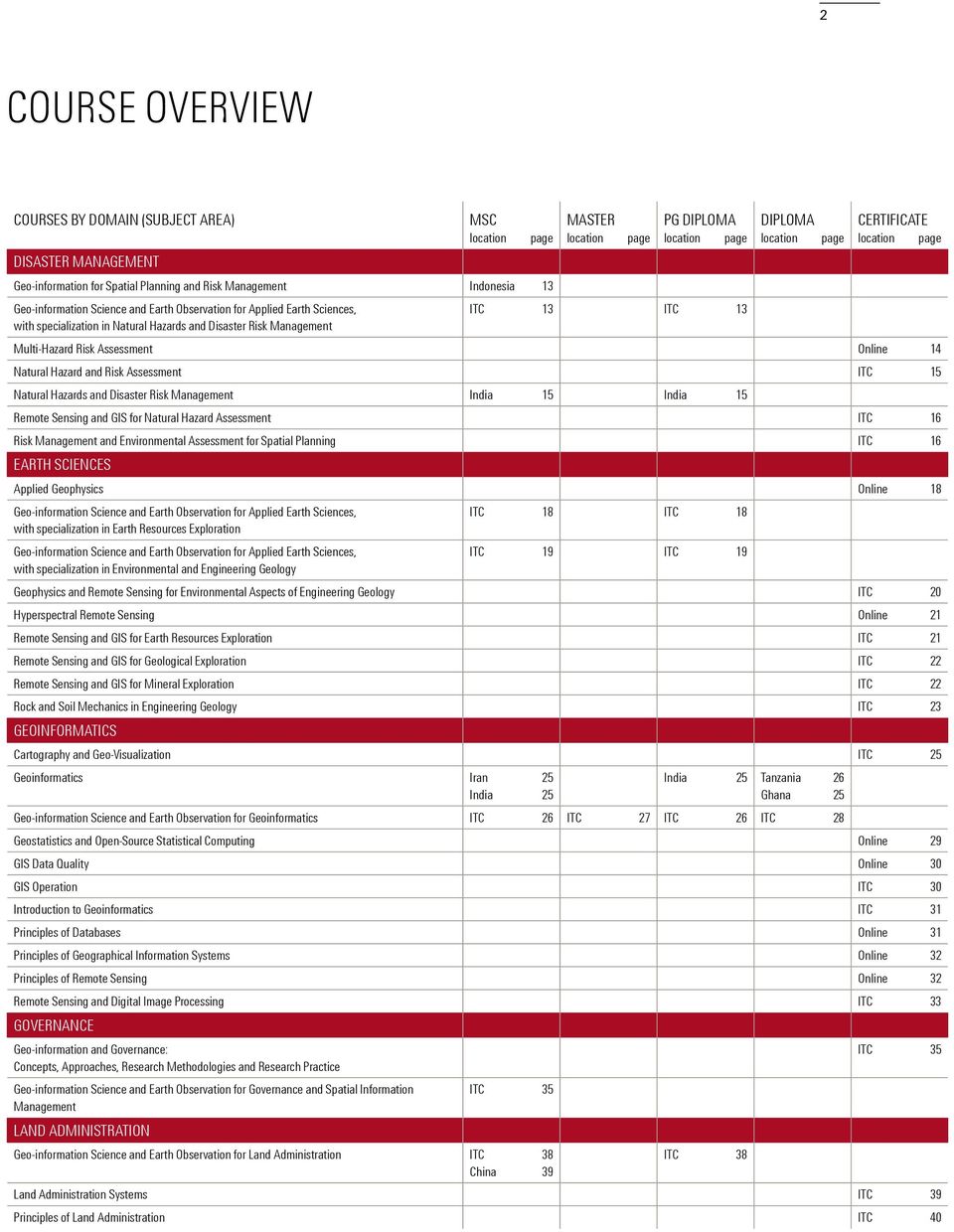
4 2 Course overview Courses by domain (subject area) Disaster management MSc location Geo-information for Spatial Planning and Risk Management Indonesia 13 Geo-information Science and Earth Observation for Applied Earth Sciences, with specialization in Natural Hazards and Disaster Risk Management page Master location page PG diploma location page ITC 13 ITC 13 Diploma location page location page Multi-Hazard Risk Assessment Online 14 Natural Hazard and Risk Assessment ITC 15 Natural Hazards and Disaster Risk Management India 15 India 15 Remote Sensing and GIS for Natural Hazard Assessment ITC 16 Risk Management and Environmental Assessment for Spatial Planning ITC 16 Earth sciences Applied Geophysics Online 18 Geo-information Science and Earth Observation for Applied Earth Sciences, with specialization in Earth Resources Exploration Geo-information Science and Earth Observation for Applied Earth Sciences, with specialization in Environmental and Engineering Geology ITC 18 ITC 18 ITC 19 ITC 19 Geophysics and Remote Sensing for Environmental Aspects of Engineering Geology ITC 20 Hyperspectral Remote Sensing Online 21 Remote Sensing and GIS for Earth Resources Exploration ITC 21 Remote Sensing and GIS for Geological Exploration ITC 22 Remote Sensing and GIS for Mineral Exploration ITC 22 Rock and Soil Mechanics in Engineering Geology ITC 23 Geoinformatics Cartography and Geo-Visualization ITC 25 Geoinformatics Iran 25 India 25 India 25 Tanzania 26 Ghana 25 Geo-information Science and Earth Observation for Geoinformatics ITC 26 ITC 27 ITC 26 ITC 28 Geostatistics and Open-Source Statistical Computing Online 29 GIS Data Quality Online 30 GIS Operation ITC 30 Introduction to Geoinformatics ITC 31 Principles of Databases Online 31 Principles of Geographical Information Systems Online 32 Principles of Remote Sensing Online 32 Remote Sensing and Digital Image Processing ITC 33 Governance Geo-information and Governance: Concepts, Approaches, Research Methodologies and Research Practice Geo-information Science and Earth Observation for Governance and Spatial Information Management Land administration ITC 35 Geo-information Science and Earth Observation for Land Administration ITC 38 China 39 ITC 38 ITC 35 Land Administration Systems ITC 39 Principles of Land Administration ITC 40
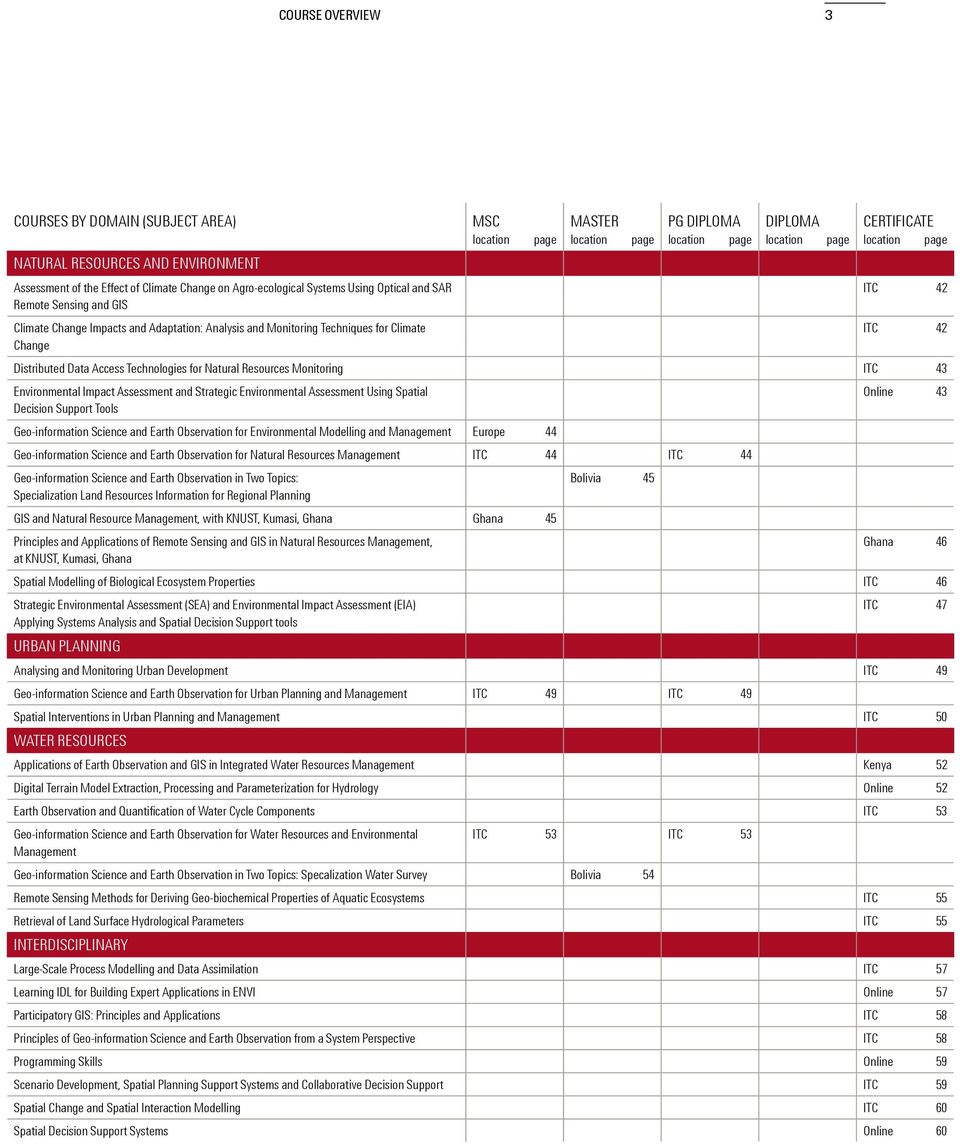
5 course overview 3 Courses by domain (subject area) Natural resources and environment Assessment of the Effect of Climate Change on Agro-ecological Systems Using Optical and SAR Remote Sensing and GIS Climate Change Impacts and Adaptation: Analysis and Monitoring Techniques for Climate Change MSc location page Master location page PG diploma location page Diploma location page location page ITC 42 ITC 42 Distributed Data Access Technologies for Natural Resources Monitoring ITC 43 Environmental Impact Assessment and Strategic Environmental Assessment Using Spatial Decision Support Tools Geo-information Science and Earth Observation for Environmental Modelling and Management Europe 44 Geo-information Science and Earth Observation for Natural Resources Management ITC 44 ITC 44 Geo-information Science and Earth Observation in Two Topics: Specialization Land Resources Information for Regional Planning GIS and Natural Resource Management, with knust, Kumasi, Ghana Ghana 45 Principles and Applications of Remote Sensing and GIS in Natural Resources Management, at knust, Kumasi, Ghana Bolivia 45 Online 43 Ghana 46 Spatial Modelling of Biological Ecosystem Properties ITC 46 Strategic Environmental Assessment (SEA) and Environmental Impact Assessment (EIA) Applying Systems Analysis and Spatial Decision Support tools Urban planning ITC 47 Analysing and Monitoring Urban Development ITC 49 Geo-information Science and Earth Observation for Urban Planning and Management ITC 49 ITC 49 Spatial Interventions in Urban Planning and Management ITC 50 Water resources Applications of Earth Observation and GIS in Integrated Water Resources Management Kenya 52 Digital Terrain Model Extraction, Processing and Parameterization for Hydrology Online 52 Earth Observation and Quantification of Water Cycle Components ITC 53 Geo-information Science and Earth Observation for Water Resources and Environmental Management ITC 53 ITC 53 Geo-information Science and Earth Observation in Two Topics: Specalization Water Survey Bolivia 54 Remote Sensing Methods for Deriving Geo-biochemical Properties of Aquatic Ecosystems ITC 55 Retrieval of Land Surface Hydrological Parameters ITC 55 Interdisciplinary Large-Scale Process Modelling and Data Assimilation ITC 57 Learning IDL for Building Expert Applications in ENVI Online 57 Participatory GIS: Principles and Applications ITC 58 Principles of Geo-information Science and Earth Observation from a System Perspective ITC 58 Programming Skills Online 59 Scenario Development, Spatial Planning Support Systems and Collaborative Decision Support ITC 59 Spatial Change and Spatial Interaction Modelling ITC 60 Spatial Decision Support Systems Online 60
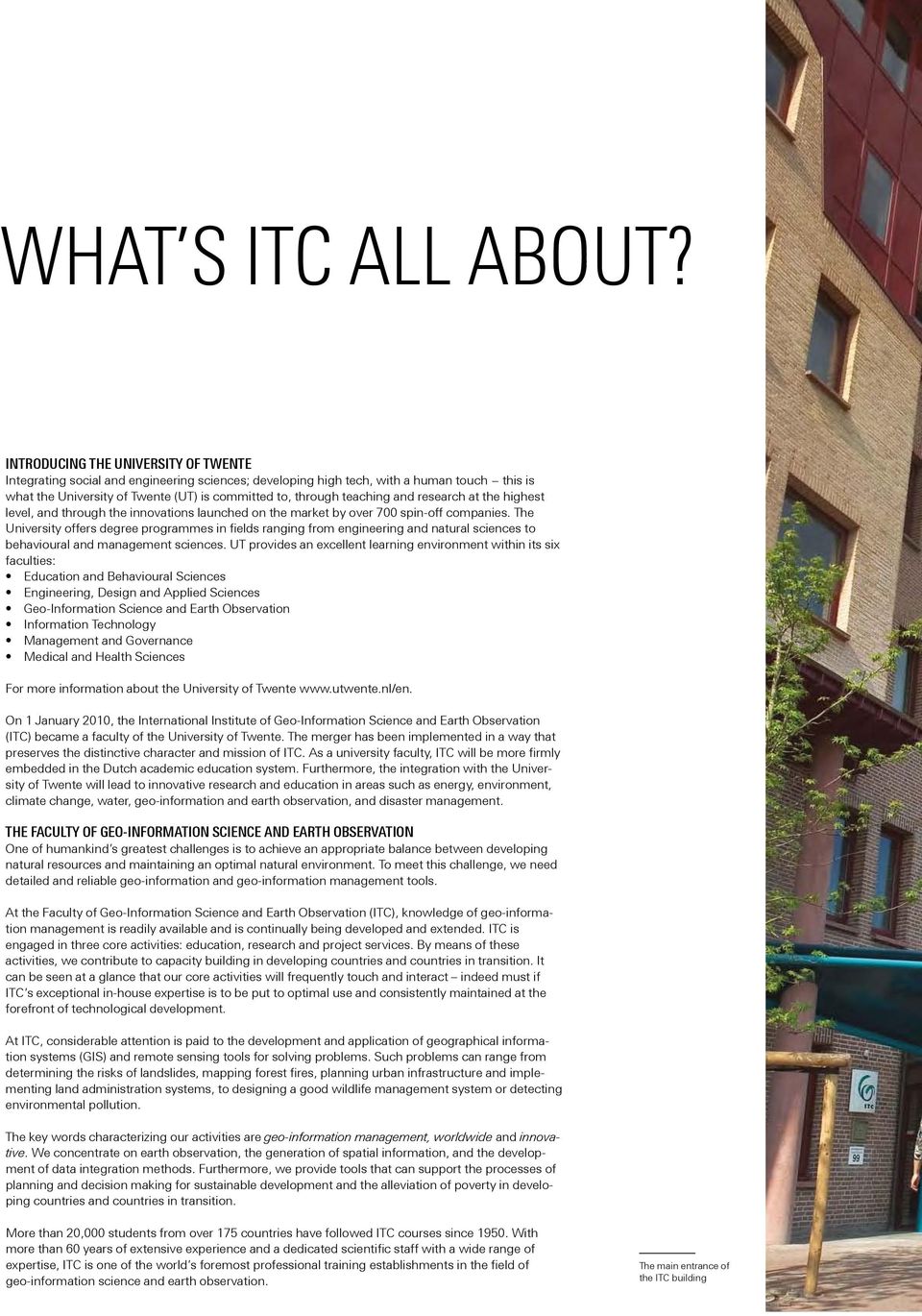
6 What s ITC all about? Introducing the University of Twente Integrating social and engineering sciences; developing high tech, with a human touch this is what the University of Twente (UT) is committed to, through teaching and research at the highest level, and through the innovations launched on the market by over 700 spin-off companies. The University offers degree programmes in fields ranging from engineering and natural sciences to behavioural and management sciences. UT provides an excellent learning environment within its six faculties: Education and Behavioural Sciences Engineering, Design and Applied Sciences Geo-Information Science and Earth Observation Information Technology Management and Governance Medical and Health Sciences For more information about the University of Twente On 1 January 2010, the International Institute of Geo-Information Science and Earth Observation (ITC) became a faculty of the University of Twente. The merger has been implemented in a way that preserves the distinctive character and mission of ITC. As a university faculty, ITC will be more firmly embedded in the Dutch academic education system. Furthermore, the integration with the University of Twente will lead to innovative research and education in areas such as energy, environment, climate change, water, geo-information and earth observation, and disaster management. The Faculty of Geo-Information Science and Earth Observation One of humankind s greatest challenges is to achieve an appropriate balance between developing natural resources and maintaining an optimal natural environment. To meet this challenge, we need detailed and reliable geo-information and geo-information management tools. At the Faculty of Geo-Information Science and Earth Observation (ITC), knowledge of geo-information management is readily available and is continually being developed and extended. ITC is engaged in three core activities: education, research and project services. By means of these activities, we contribute to capacity building in developing countries and countries in transition. It can be seen at a glance that our core activities will frequently touch and interact indeed must if ITC s exceptional in-house expertise is to be put to optimal use and consistently maintained at the forefront of technological development. At ITC, considerable attention is paid to the development and application of geographical information systems (GIS) and remote sensing tools for solving problems. Such problems can range from determining the risks of landslides, mapping forest fires, planning urban infrastructure and implementing land administration systems, to designing a good wildlife management system or detecting environmental pollution. The key words characterizing our activities are geo-information management, worldwide and innovative. We concentrate on earth observation, the generation of spatial information, and the development of data integration methods. Furthermore, we provide tools that can support the processes of planning and decision making for sustainable development and the alleviation of poverty in developing countries and countries in transition. More than 20,000 students from over 175 countries have followed ITC courses since With more than 60 years of extensive experience and a dedicated scientific staff with a wide range of expertise, ITC is one of the world s foremost professional training establishments in the field of geo-information science and earth observation. The main entrance of the ITC building
7 5 UN Our Hope for Humankind Associated institution of UNU ITC is an associated institution of the United Nations University (UNU). The cooperation between ITC and UNU is directed at developing and carrying out a Joint Programme on Capacity Building in Disaster Management and in Land Administration, and at disseminating knowledge of these and directly related issues. The programme activities are accommodated in two schools: School for Disaster Geo-Information Management School for Land Administration Studies Both Schools offer courses in the degree, diploma and certificate programmes. For more information Remote sensing and GIS Remote sensing is the collection and analysis of scientific data about phenomena at, above or below the Earth s surface without coming into physical contact with them. There are a variety of ways of collecting such data, for example by using conventional aerial photography, radar, and airborne electronicscanning devices. And naturally satellites have been playing an increasingly significant role over the last few decades. Such remote sensing techniques and the images they produce can be used, for example, to monitor environmental changes and meteorological disturbances, determine the existence of certain mineral deposits, and detect the build-up of pressure along the faults in the Earth s crust. The uses are many and various and to some extent have already unobtrusively entered our daily lives. With such huge quantities of data involved, some help is needed at ground level. And this is where the geographical information systems (GIS) come in. Central to every GIS is the database, which stores the data on which the eventual output depends. The application of thess data to real-world problems is a function of the specific software designed to manipulate the data. The software enables the database to be accessed, transformed and manipulated for such purposes as studying trend patterns, examining environmental issues, or simulating the outcomes of project proposals or planning procedures. Skilled personnel with the appropriate expertise are needed to effectively manage the information and opportunities provided by these new technologies. Exciting prospects for those willing to take up the challenge.

8 6 Education at ITC Over the years, ITC has developed a wide selection of courses in its degree, diploma and certificate programmes in geoinformation science and earth observation. These courses are offered in the Netherlands, online and abroad by ITC itself or by ITC in collaboration with reputable qualified educational organizations (joint courses). Programmes in Geo-information Science and Earth Observation Degree programmes Master of Science (MSc) degree programme Master degree programme Diploma programmes Postgraduate diploma programme (PGD) Undergraduate diploma programme programmes programme and individual modules Distance programme Joint courses Graduate programme Origins and backgrounds of course participants The origins and backgrounds of ITC course participants have a significant influence on the educational processes. The majority of these participants are professionals in their respective fields, with prior academic training and (often) professional experience. Consequently, professional relevancy and problem orientation are important factors in designing ITC s training courses, with the emphasis on the application of concepts and skills. Our courses aim at providing in-depth study of a particular set of problems in developing countries and countries in transition. They attract young and midcareer professionals with an interest in developmentrelated issues. The origins and backgrounds of ITC course participants have a significant influence on the educational processes

9 education at itc 7 Workshops, case studies, project assignments and simulations are included to strengthen the practical nature of the course Programme structure ITC s degree and diploma programmes are divided into blocks, facilitating a multidisciplinary approach to problem solving for development purposes, and considerable emphasis is placed on remote sensing and GIS. The blocks vary in length and are divided into three-week modules. A module deals with one subject or related subjects. All blocks and appropriate modules are open to individual subscription, provided the applicant has the right entry level. Educational methods Workshops, case studies, project assignments and simulations are included to strengthen the practical nature of the courses. Study trips Excursions form an integral part of some teaching modules and provide participants with the opportunity to see relevant applications in the Netherlands, to be instructed in (ground) data acquisition, and to visit companies or government offices involved in geo-information and earth observation. Fieldwork is an option in most courses and is carried out in areas that reflect problems clearly related to the application domain. During fieldwork, course participants are responsible for a field data acquisition assignment - usually part of the Postgraduate final assignment, the Master individual final assignment, or the MSc research. Besides the direct input into assignments, fieldwork offers participants first-hand insight into current practices, as well as the opportunity to assess through ground verification and validation the impact and value (and limitations) of GIS and remote sensing technology. Study load and ECTS The European Union (EU) has developed a European Credit Transfer System (ECTS) to allow easy comparison of the study loads of courses within Europe. ITC has adopted this system as a means of improving academic recognition for study abroad. The study load for each course is expressed in credits (ECs). The number of credits applicable is specified in the individual course descriptions. At ITC, 144 hours of study is equivalent to five ECs. Language of study English is the first language for both staff and students at ITC. Thus the language of instruction is English and all courseware is in English. Participants are obliged to fulfil the minimum requirements for English as specified in the admission requirements (page 61). Recognition of degrees Higher education in the Netherlands enjoys a worldwide reputation for high quality. This is achieved through a national system of regulation and quality assurance. The Ministry of Education, Culture and Science (OCW) is responsible for legislation pertaining to education. The Master and Master of Science degrees are formally recognized by the Ministry of OCW, based on accreditation of the programmes by the Netherlands-Flemish Accreditation Organisation (NVAO), and are listed in the Central Register of Higher Education Programmes (CROHO). Code of conduct ITC complies with certain minimum conditions that are laid down in a general code of conduct. This code of conduct is an initiative of institutions, independent educationrelated organizations and the Dutch government, and defines the values guiding those who recruit and educate international students. More information on the code of conduct can be found at Study, Study at ITC, Code of conduct.

10 8 Programmes in Geo-information Science an When you are selecting a programme, it is important to find the right level. Whichever programme you decide to take, you will receive full support from our academic staff and access to the best modern resources and information, all within a truly international environment where you will be able to meet colleagues from all over the world. Master of Science (MSc) degree programme in Geo-information Science and Earth Observation For whom is this programme relevant? This 18-month programme (118 ECs) leading to an MSc degree in Geo-information Science and Earth Observation is designed for young and mid-career professionals who perform, or aspire to perform, tasks predominantly in applied research, or who require academic knowledge and skills to enhance the execution of their work. Successful completion of the MSc degree programme provides graduates with a qualification that enables them to continue to PhD level, either in the Netherlands or abroad. What will you learn? Important elements of the programme include academic skills such as developing a critical understanding of appropriate tools; exposure to new methods and techniques; gaining competence in developing tools for the acquisition, processing, transformation, analysis, modelling, storage and presentation of spatial data; using geo-information in identifying and responding to development problems and in drafting development policies; and developing research skills. What is the programme structure? The MSc programme consists of four distinct blocks. A programme based on research The MSc degree programme is based on research. The development of research skills is given attention throughout the entire course. Each MSc candidate is required to design, undertake and report on research where geo-information science and earth observation is used to develop techniques and/or deal with a specific application problem connected with the field of interest of the course. The precise focus of the research will be determined by the candidate and supervising staff in dialogue, and will fall within the scope of the research themes of the Faculty. More information about the ITC Research programme can be found on our website at Where relevant, MSc research topics are related to the topics of candidates following other courses. The MSc research phase (six months) concludes with the presentation and defence of the MSc thesis. Distance supervision There is an option whereby MSc programme participants can spend five months of the six-month thesis period in their home country under distance supervision (the tuition fee for the total programme remains the same). Participants have to meet the requirements set by the ITC programme management, and are selected on an individual basis. Courses in the MSc degree programme Eight courses are offered in the MSc degree programme in Geo-information Science and Earth Observation: Applied Earth Sciences Environmental Modelling and Management Geoinformatics Governance and Spatial Information Management Land Administration Natural Resources Management Urban Planning and Management Water Resources and Environmental Management. Block Modules Principles of geo-information science and earth observation Introduction and principles of remote sensing, GIS and databases Application of geo-information science and earth observation in the field of interest Task-supported learning in the technical or application domain Research orientation Research methods, advanced subjects of choice, engagement in a research team, and proposal writing Individual research Executing research and writing an MSc thesis

11 education programmes 9 d Earth Observation Master degree programme in Geo-information Science and Earth Observation For whom is this programme relevant? This 12-month programme (77 ECs) leading to a Master degree in Geo-information Science and Earth Observation is designed for young and mid-career professionals and managers with overall responsibility for projects in the relevant fields of interest. What will you learn? The programme focuses on the application of appropriate existing tools in the planning and execution of problem-driven projects. What is the programme structure? The Master programme consists of three distinct blocks. Block Modules Principles of geo-information science and earth observation Introduction and principles of remote sensing, GIS and databases Application of geo-information science and earth observation in the field of interest Task-supported learning in the domain Individual final assignment Individual production-oriented project leading to a report A programme based on coursework The Master degree programme is based on coursework. The individual final assignment at the end of the Master programme involves working on practical applications related to the chosen field of interest. In this project, participants can demonstrate proficiency in applying the methods and techniques addressed throughout the programme to specific problems encountered in professional practice. Course in the Master degree programme One course is offered in the Master degree programme in Geo-information Science and Earth Observation: Geoinformatics Postgraduate diploma programme (PGD) in Geo-information Science and Earth Observation For whom is this programme relevant? The nine-month Postgraduate diploma programme (62 ECs) caters for young and mid-career professionals who need to be proficient in applying geo-information science and earth observation in their field of interest, analysing problems and applying new methods and techniques, as well as managing (multi)disciplinary scientific teams. What will you learn? Important elements of the programme include developing a critical understanding of appropriate tools; exposure to new methods and techniques; gaining competence in developing tools for the acquisition, processing, transformation, analysis, modelling, storage and presentation of spatial data; and using geo-information in identifying and responding to development problems and in drafting development policies. What is the programme structure? The Postgraduate diploma programme consists of three distinct blocks. Block Modules Principles of geo-information science and earth observation Introduction and principles of remote sensing, GIS and databases Application of geo-information science and earth observation in the field of interest Task-supported learning in the technical or application domain Final assignment Individual literature study or limited project leading to a report A programme based on the first part of the MSc programme The Postgraduate diploma programme will have the same end qualifications as the first part of the MSc programme. Successful completion of the Postgraduate diploma programme (modules 1-12) serves as a basis for entering the second part (modules 11-23) of the MSc programme. Courses in the Postgraduate diploma programme Six courses are offered in the Postgraduate diploma programme: Applied Earth Sciences Geoinformatics Land Administration Natural Resources Management Urban Planning and Management Water Resources and Environmental Management.

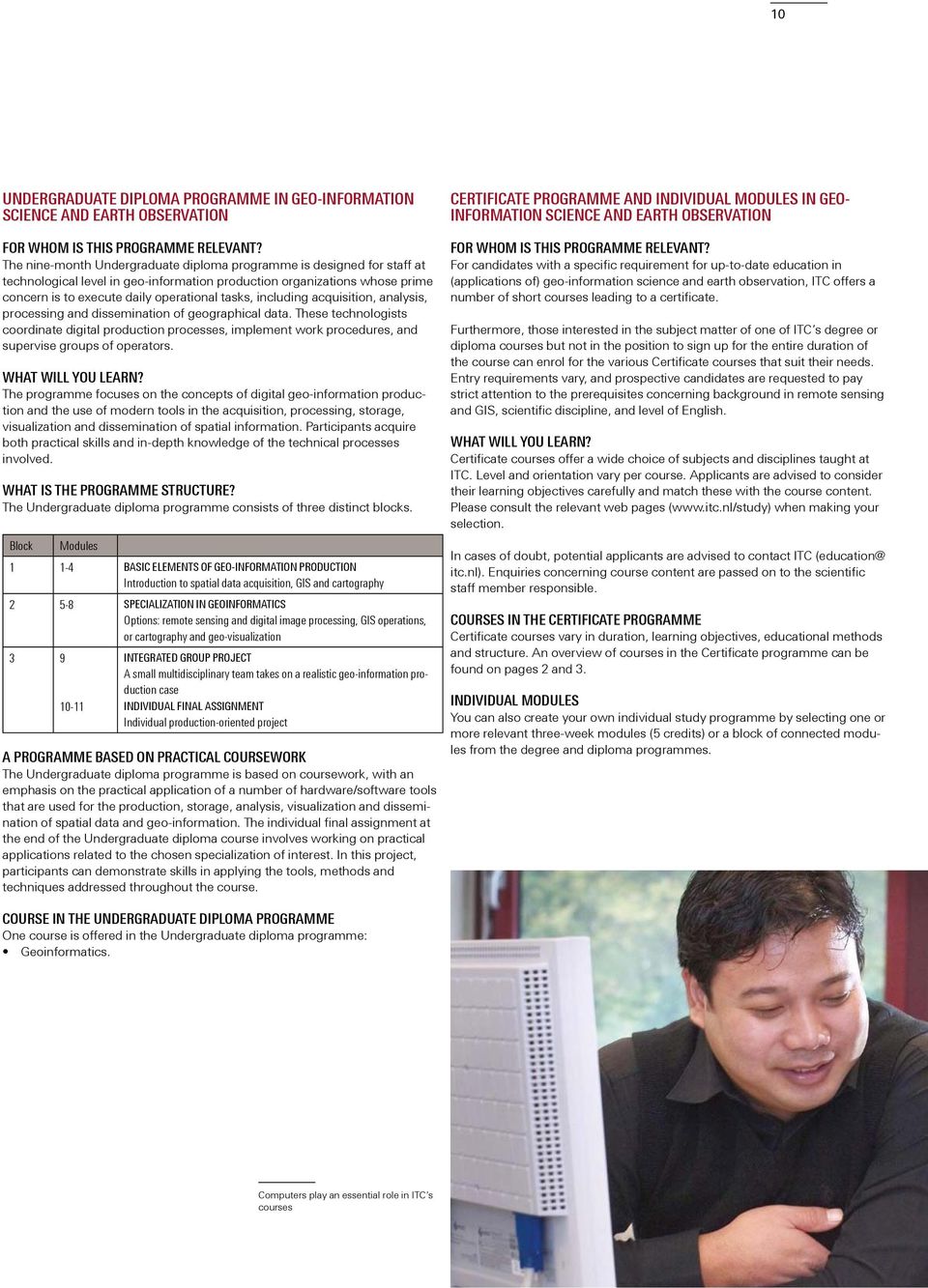
12 10 Undergraduate diploma programme in Geo-information Science and Earth Observation For whom is this programme relevant? The nine-month Undergraduate diploma programme is designed for staff at technological level in geo-information production organizations whose prime concern is to execute daily operational tasks, including acquisition, analysis, processing and dissemination of geographical data. These technologists coordinate digital production processes, implement work procedures, and supervise groups of operators. What will you learn? The programme focuses on the concepts of digital geo-information production and the use of modern tools in the acquisition, processing, storage, visualization and dissemination of spatial information. Participants acquire both practical skills and in-depth knowledge of the technical processes involved. What is the programme structure? The Undergraduate diploma programme consists of three distinct blocks. Block Modules Basic elements of geo-information production Introduction to spatial data acquisition, GIS and cartography Specialization in geoinformatics Options: remote sensing and digital image processing, GIS operations, or cartography and geo-visualization Integrated group project A small multidisciplinary team takes on a realistic geo-information production case Individual final assignment Individual production-oriented project A programme based on practical coursework The Undergraduate diploma programme is based on coursework, with an emphasis on the practical application of a number of hardware/software tools that are used for the production, storage, analysis, visualization and dissemination of spatial data and geo-information. The individual final assignment at the end of the Undergraduate diploma course involves working on practical applications related to the chosen specialization of interest. In this project, participants can demonstrate skills in applying the tools, methods and techniques addressed throughout the course. programme and individual modules in Geoinformation Science and Earth Observation For whom is this programme relevant? For candidates with a specific requirement for up-to-date education in (applications of) geo-information science and earth observation, ITC offers a number of short courses leading to a certificate. Furthermore, those interested in the subject matter of one of ITC s degree or diploma courses but not in the position to sign up for the entire duration of the course can enrol for the various courses that suit their needs. Entry requirements vary, and prospective candidates are requested to pay strict attention to the prerequisites concerning background in remote sensing and GIS, scientific discipline, and level of English. What will you learn? courses offer a wide choice of subjects and disciplines taught at ITC. Level and orientation vary per course. Applicants are advised to consider their learning objectives carefully and match these with the course content. Please consult the relevant web pages ( when making your selection. In cases of doubt, potential applicants are advised to contact ITC (education@ itc.nl). Enquiries concerning course content are passed on to the scientific staff member responsible. Courses in the programme courses vary in duration, learning objectives, educational methods and structure. An overview of courses in the programme can be found on pages 2 and 3. Individual modules You can also create your own individual study programme by selecting one or more relevant three-week modules (5 credits) or a block of connected modules from the degree and diploma programmes. Course in the Undergraduate diploma programme One course is offered in the Undergraduate diploma programme: Geoinformatics. Computers play an essential role in ITC s courses
13 education programmes 11 Distance programme in Geo-information Science and Earth Observation Joint courses in Geo-information Science and Earth Observation For whom is this programme relevant? This option is attractive to professionals interested in a short training course on a specific topic, or those interested in a long training course (Postgraduate diploma or MSc degree level) but who are unable to leave their job for the full course duration. Up to 50% of an MSc course (the first four course modules plus five months of the thesis period) can be done at a distance. Short Distance courses ITC offers several modules of their Postgraduate diploma and MSc degree courses as Distance courses. The six- or eight-week Distance courses (5 ECs) have a weekly study load of 20 to 24 hours. The courses combine self-study with online support by ITC staff. The general approach is task-based learning that blends theory and practice. Participants access the course material through internet. All materials and (most of) the software will be provided online within ITC s digital learning environment Blackboard. Those who later decide to follow a full Postgraduate or MSc programme at ITC will be exempted from the modules they followed successfully as a Distance course. Changes in world society have resulted in changes in the demand for ITC s products and services, particularly education. Client organizations have indicated that mid-career professionals in important decision-making positions, or with the potential to grow into such positions, have difficulty in sparing the time to be away from their work and home for extended periods. To address the increasing demand for flexibility in courses, ITC has entered into partnerships with reputable qualified educational organizations for the purpose of providing joint courses in several countries. Under this arrangement, (part of) a course leading to a recognized ITC degree, diploma or certificate can be conducted in the student s home country. Joint courses are offered in Bolivia, China, Europe (the Netherlands, Poland, Sweden, United Kingdom), Ghana, India, Indonesia, Iran, Kenya and Tanzania. Note: The websites of our partners give more detailed information on the joint courses. The information in this brochure does not always directly apply to all our joint courses. Courses in the Distance programme Courses in the Distance programme can be found in the overview on pages 2 and 3. Please consult our website ( for exact dates, new Distance courses on offer, and detailed course information. Although some courses are in high demand, only a limited number of students can be admitted. The rule is first come, first served. If the number of applications is extremely high, the course may be offered again. Graduate programme Research leading to the award of the degree of Doctor of Philosophy (PhD) is pursued through registration in the ITC Graduate programme. The research topic of each PhD student constitutes a project under one of the 15 research themes of the ITC Research programme (see below). In this way the PhD student benefits from membership of a research team, as well as from receiving expert supervision and attending research-supporting advanced courses. Research leading to a PhD thesis at ITC normally takes about 3½ years. The doctoral degree is granted by the University of Twente, or by one of the other affiliated Dutch universities (Utrecht, Wageningen or Delft). The ITC Graduate programme also offers a limited possibility of internships for PhD students registered and graduating in an overseas university. Research themes Under each theme, research is carried out by a group led by one of ITC s professors. Each group typically comprises several expert staff members and a number of graduate students carrying out research for a PhD degree within the framework of the Graduate programme. MSc students are assigned to a research theme as apprentice researchers during their six-month thesis period. Furthermore, the outcome of research activities is used to update the education in both degree and non-degree (short) courses. The 15 research themes at ITC are: Biodiversity in fragmenting landscapes Carbon cycle and climate change Disaster management Earth systems science Food security and environmental sustainability Governance and integrated spatial assessment Informed multilevel governance of urban regions Land administration for informed governance Managing water scarcity Spatial data infrastructure technology Spatio-temporal data integration and visualization Stochastic methods for image mining and data quality Sustainable urban-regional dynamics Utilization of sensor developments for efficient topographic mapping Water cycle and climate More information For more information on the ITC Graduate programme (including how to apply) and the research themes, visit
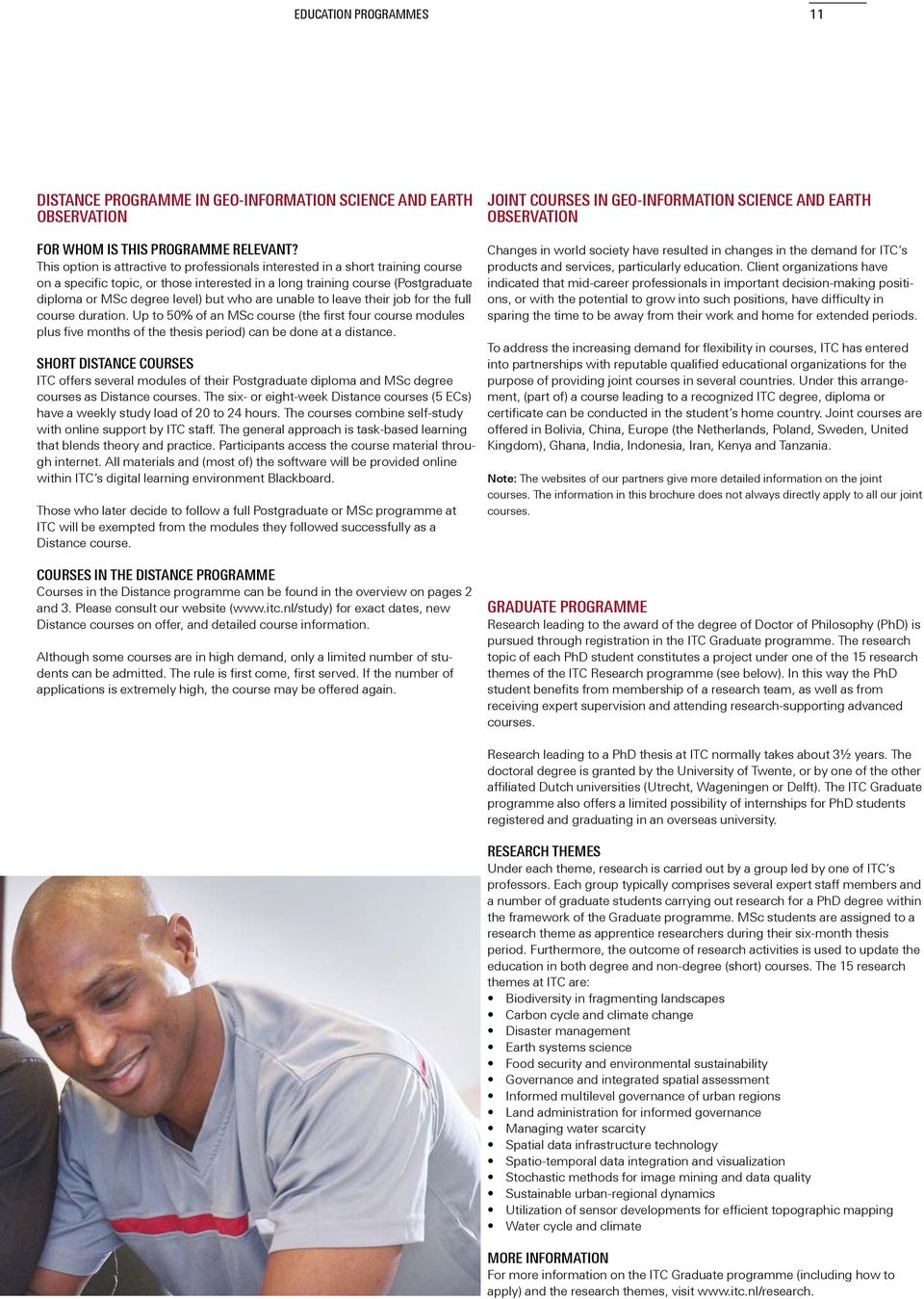
14 12 COURSES DISASTER MANAGEMENT UN Our Hope for Humankind Beichuan city in China after the 2008 earthquake. Beichuan city will not be reconstructed and has been declared a monument site by the Chinese government

15 disaster management 13 GEO-INFORMATION FOR SPATIAL PLANNING AND RISK MANAGEMENT GEO-INFORMATION SCIENCE AND EARTH OBSERVATION FOR APPLIED EARTH SCIENCES, WITH SPECIALIZATION IN NATURAL HAZARDS AND DISASTER RISK MANAGEMENT DEGREE MSc degree EUROPEAN CREDITS 118 start date 28 September 2011 end date 15 March 2013 study mode and duration Full-time at ITC - 18 months TUITION FEE euro 7725 MSc degree Postgraduate diploma EUROPEAN CREDITS start date 12 September September 2011 end date 8 March June 2012 study mode and duration Full-time at ITC - 18 months Full-time at ITC - 9 months TUITION FEE euro 9500 euro 4800 joint course with Gadjah Mada University, Yogyakarta, Indonesia For more information: E: Dr Sudibyakto [email protected] (UGM) drs Tom Loran [email protected] (ITC) I: The sustainable use of land and earth resources is a key factor in economic development. In our daily life we are continuously confronted with situations that have a direct link with earth resources and related processes. The buildings in which we live and work are constructed of materials from the earth, the soil produces our daily food, and mineral resources provide fuel for transport and cooking. The course on Natural Hazards and Disaster Risk Management analyses the processes within a landscape setting (and the drivers behind them) that lead to disasters. GIS and remote sensing are used in the analysis procedures. The course concentrates more specifically on the assessment of geological and hydrological hazards and on the determination of the vulnerability of elements-at-risk for multidisciplinary disaster risk management. The MSc degree course is designed for academicians, while the Postgraduate diploma course is designed for practitioners who are active in environmental, engineering or planning organizations and who are dealing with hazard and disaster management. Participants of the Postgraduate diploma course have a specific interest in the practical application of the tools and techniques taught in the course Participants of the MSc degree course have a specific interest in an academic career, and in applied research concerning the tools and techniques taught in the course. Participants of both courses have a specific interest in spatial information, and want to learn state-of-the-art GIS and earth observation techniques. They are mid-career professionals with a university background (BSc), or recent university graduates in a field relevant to earth sciences. What is the course content? The course will deal with the following topics (among others): principles of GIS and remote sensing techniques image analysis for hazard monitoring, susceptibility and assessment spatial modelling of hazards dynamic modelling concepts and software tools mapping of elements at risk vulnerability assessment risk assessment and risk reduction planning research skills and methodology; thesis research (MSc degree course) project skills; individual final project assignment (Postgraduate diploma course).
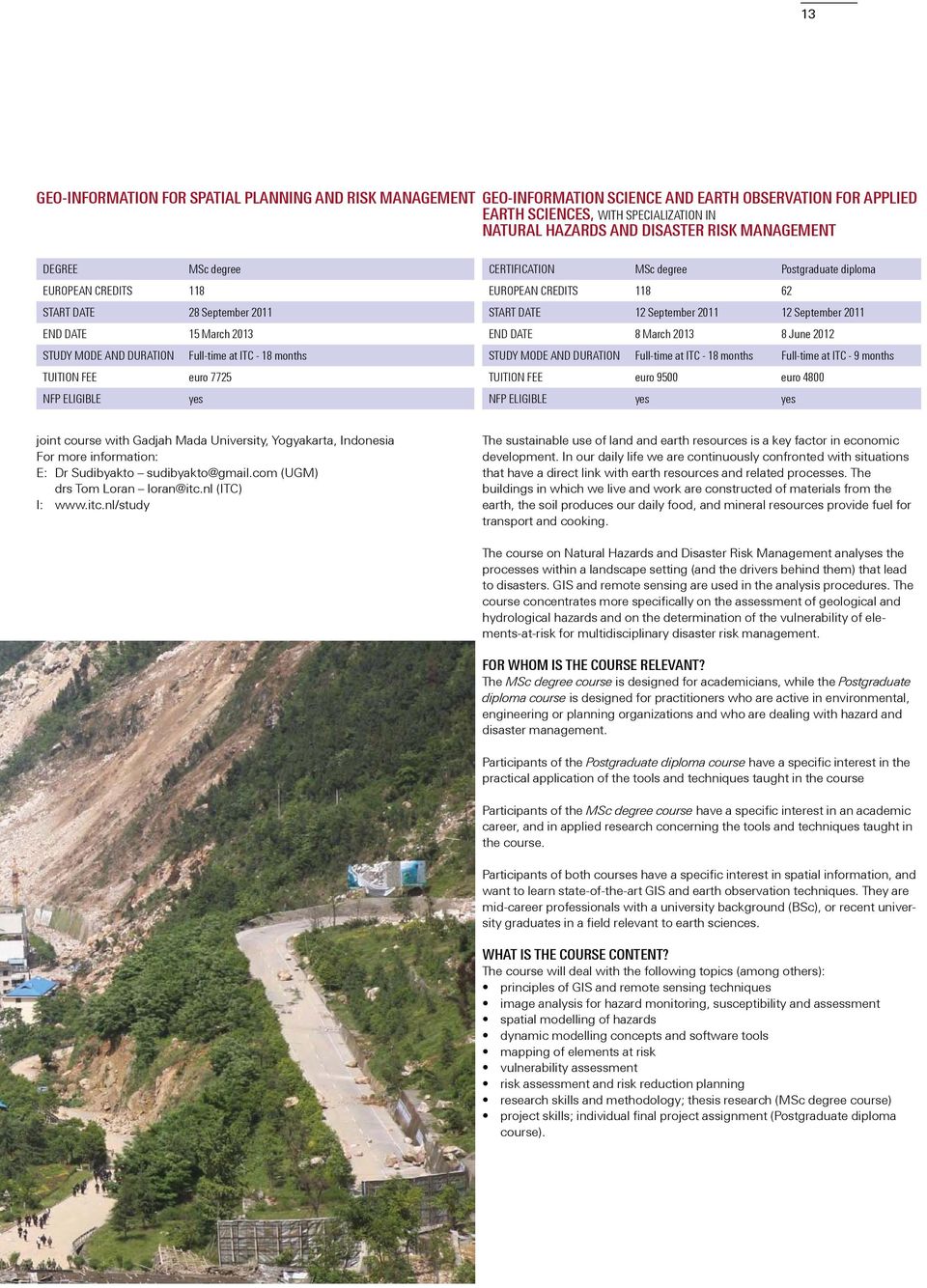
16 14 The course teaches how to apply GIS, remote sensing and modelling techniques in the analysis and assessment of natural hazards, and in disaster risk management. Participants will be able to use remotely sensed data to identify natural hazards and assess susceptibility to these hazards. They will learn how to apply process-based modelling, GIS and remote sensing in multi-hazard and risk assessment. The MSc degree course is oriented towards carrying out independent research, and includes MSc thesis research. The Postgraduate diploma course is oriented towards the practical application of methods and techniques, and includes a challenging hazard modelling/risk assessment project and a final practical assignment. Why choose this course? This course will transform you into a skilled and knowledgeable expert in the field of natural hazards who can identify the both risks they pose to society and what can be done to reduce these risks. The course offers the opportunity to experiment with spatial approaches and techniques for hazard assessment, and integrate the modelling of the physical processes involved into multi-hazard risk assessment. MULTI-HAZARD RISK ASSESSMENT EUROPEAN CREDITS 5 start date 16 May 2011 end date 24 June 2011 study mode and duration Online - 6 weeks TUITION FEE euro 1000 Owing to increased vulnerability and climatic extremes, we are faced with the rapidly growing impact of disasters worldwide. There is an urgent need to incorporate the concepts of disaster risk management into planning, sustainable development and environmental impact assessment. Disaster risk management requires the assessment of risk, which is a multidisciplinary endeavour. The course explains how to conduct a risk assessment using spatial information on hazards, elements at risk and vulnerability with the aid of GIS and remote sensing, and how this information can be used in risk management, with a focus on urban areas. This course is designed for all those who have to carry out risk assessment and require knowledge and skills in using a GIS to handle the necessary the procedures, such as professionals working in governmental and non-governmental organizations, planners, engineers, architects, geographers, environmental specialists and university teachers. Some basic background in GIS is desirable, although not strictly necessary as the course follows a step-by-step approach that enables participants to rapidly acquire the basic skills in handling GIS software. The course will guide participants through the entire process of risk assessment, on the basis of a case study of a city exposed to multiple hazards. At the end of this course, you will be able to: understand the concepts of hazard assessment, elements-at-risk mapping, vulnerability assessment and risk assessment formulate the spatial data requirements for risk assessment use GIS to generate an elements-at-risk database apply various methods for vulnerability assessment generate risk maps using qualitative and quantitative methods understand how risk assessment is used in risk reduction and disaster preparedness. Historical landslides and flood affected areas mapping from multi-temporal highresolution imagery used for multi-hazard risk assessment

17 disaster management 15 NATURAL HAZARD AND RISK ASSESSMENT NATURAL HAZARDS AND DISASTER RISK MANAGEMENT EUROPEAN CREDITS 15 start date 7 March 2011 end date 6 May 2011 study mode and duration Full-time at ITC - 9 weeks TUITION FEE euro 2000 MSc degree Postgraduate diploma EUROPEAN CREDITS start date 28 September September 2011 end date 15 March July 2012 study mode and duration Full-time in India - 18 months Full-time in India - 9 months TUITION FEE euro 7725 euro 3090 An important element of disaster risk management is the assessment of risk: the overlap in space and time of natural hazards and the vulnerability of communities at risk. The first part of this course concentrates on the spatio-temporal modelling of natural hazards that are related to hydrological processes (drought, landslides, runoff/erosion, flash floods, river floods). Step-by-step modelling provides insight into hazard processes and allows scenario predictions. joint course with the Indian Institute of Remote Sensing (IIRS) - India For more information: E: Dr Suresh Kumar [email protected] (IIRS) drs Tom Loran [email protected] (ITC) I: The second part focuses on multi-hazard risk assessment. Spatial information is used to assess vulnerability and elements at risk, and combine this into risk. The RiskCity case study of a city exposed to multiple hazards is used to demonstrate the different procedures for risk assessment. Towards the end of the course, small teams of participants carry out a hazard modelling or risk assessment project assignment. It is possible to combine this course with the certificate course Remote Sensing and GIS for Natural Hazard Assessment (see page 15). This course is aimed at working professionals and postgraduate students who wish to focus on the process-based modelling of hazards, and on the application of GIS and remote sensing in multi-hazard and risk assessment. Participants should have active working experience in using GIS and remote sensing. The course requires an affinity with landscape processes and willingness to approach risk assessment in a quantitative way. On completion of this course, participants should be able to: apply dynamic modelling concepts and software tools use process-based models correctly and critically use the PCRaster open-source modelling environment at intermediate level predict better where and how a natural process becomes a hazard generate an elements-at-risk database using GIS apply various approaches to vulnerability assessment generate risk maps using qualitative and quantitative methods understand how a risk assessment could be carried out in their own situation.

18 16 REMOTE SENSING AND GIS FOR NATURAL HAZARD ASSESSMENT RISK MANAGEMENT AND ENVIronmental ASSESSMENT FOR SPATIAL PLANNING EUROPEAN CREDITS 15 start date 3 January 2011 end date 4 March 2011 study mode and duration Full-time at ITC - 9 weeks TUITION FEE euro 2000 EUROPEAN CREDITS 15 start date 16 May 2011 end date 15 July 2011 study mode and duration Full-time at ITC - 9 weeks TUITION FEE euro 2000 Spatial data are perfectly suited to studying, identifying, characterizing and monitoring natural hazards. Remote sensing and GIS are becoming mainstream technology, being applied in many organizations and work processes with a geographical orientation. This course concentrates on hazard-related information extraction from remote sensing image data and on GIS-based data-driven modelling for hazard susceptibility mapping. Remote sensing images and map data are used for expert-based visual interpretation of landforms, for identifying and characterizing different natural hazards and their controlling factors, and for image-based change detection. Digital image processing techniques as well as more advanced remote sensing approaches (e.g. radar, laser scanning) will also be considered. Digital terrain modelling provides terrain parameters to support hazard identification and to serve as input for landslide and erosion modelling. Towards the end of the course, small teams of participants will carry out a remote sensing-based hazard identification or a hazard susceptibility mapping project assignment It is possible to combine this course with the certificate course Natural Hazard and Risk Assessment (see page 15). This course is aimed at working professionals and postgraduate students who wish to use satellite images, DEMs, aerial photographs and other spatial data for hazard identification and susceptibility assessment, or for the analysis and monitoring of landscape/surface processes. Participants should have active working experience of using remote sensing and GIS. The course requires an affinity with landscape processes. On completion of this course, participants should be able to: select, (pre-)process and interpret remote sensing image data for landform interpretation and hazard identification select and use multitemporal images for change detection of natural hazard processes construct hydro-morphometric parameter maps by digital terrain modelling select and prepare factor maps as input for data-driven modelling of landslide/soil erosion susceptibility critically evaluate and communicate the quality of a landslide/erosion susceptibility map resulting from data-driven hazard modelling. Owing to increased vulnerability and extreme events (including both natural and human-induced hazards), we are faced with the rapidly growing impact of disasters worldwide. There is an urgent need to include the concept of disaster risk management in planning, sustainable development and environmental assessment. Strategic environmental assessment is a process for evaluating the environmental consequences of proposed policy, plan or programme initiatives to ensure they are included and addressed at the earliest possible stage of decision making. The course provides a unique opportunity to integrate a multidisciplinary assessment of risk into strategic planning processes. It brings together a set of powerful tools and techniques to provide timely and objective information on our living environment, and in doing so provides sound information as a basis for planning and policy decisions. This course is designed for all those who are involved in development planning (including environmental and risk assessment) at all levels of society and who need to acquire procedural knowledge and skills in risk assessment, risk management and planning to carry out their work. These include professionals working in governmental and non-governmental organizations, as well as planners, engineers, architects, geographers, environmental specialists and university teachers. The course provides knowledge and skills applicable to multi-hazard risk assessment and strategic environmental assessment within a clear context of spatial planning routines. At the end of the course, the two concepts are brought together in a realistic case study that deals with a practical situation involving either environmental or human-induced (industrial) hazards. It pays close attention to the use of relevant tools and techniques such as satellite imagery, dynamic modelling and scenario development within a GIS environment.
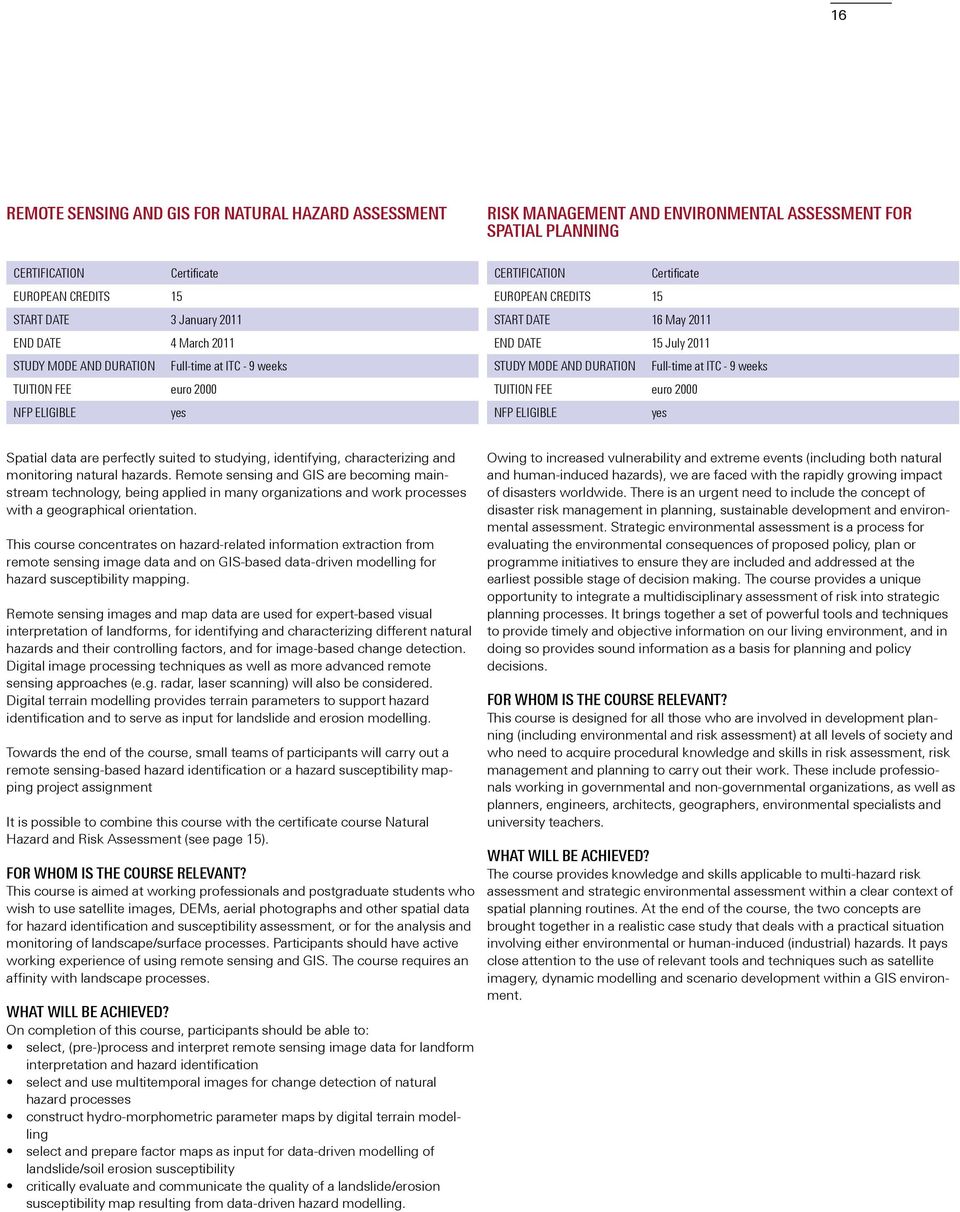
19 earth sciences 17 COURSES EARTH SCIENCES Airborne hyperspectral (Hymap) image showing hydrothermal alteration associated with high-sulfidation epithermal gold mineralization near Rodalquilar, Almeria province, Spain
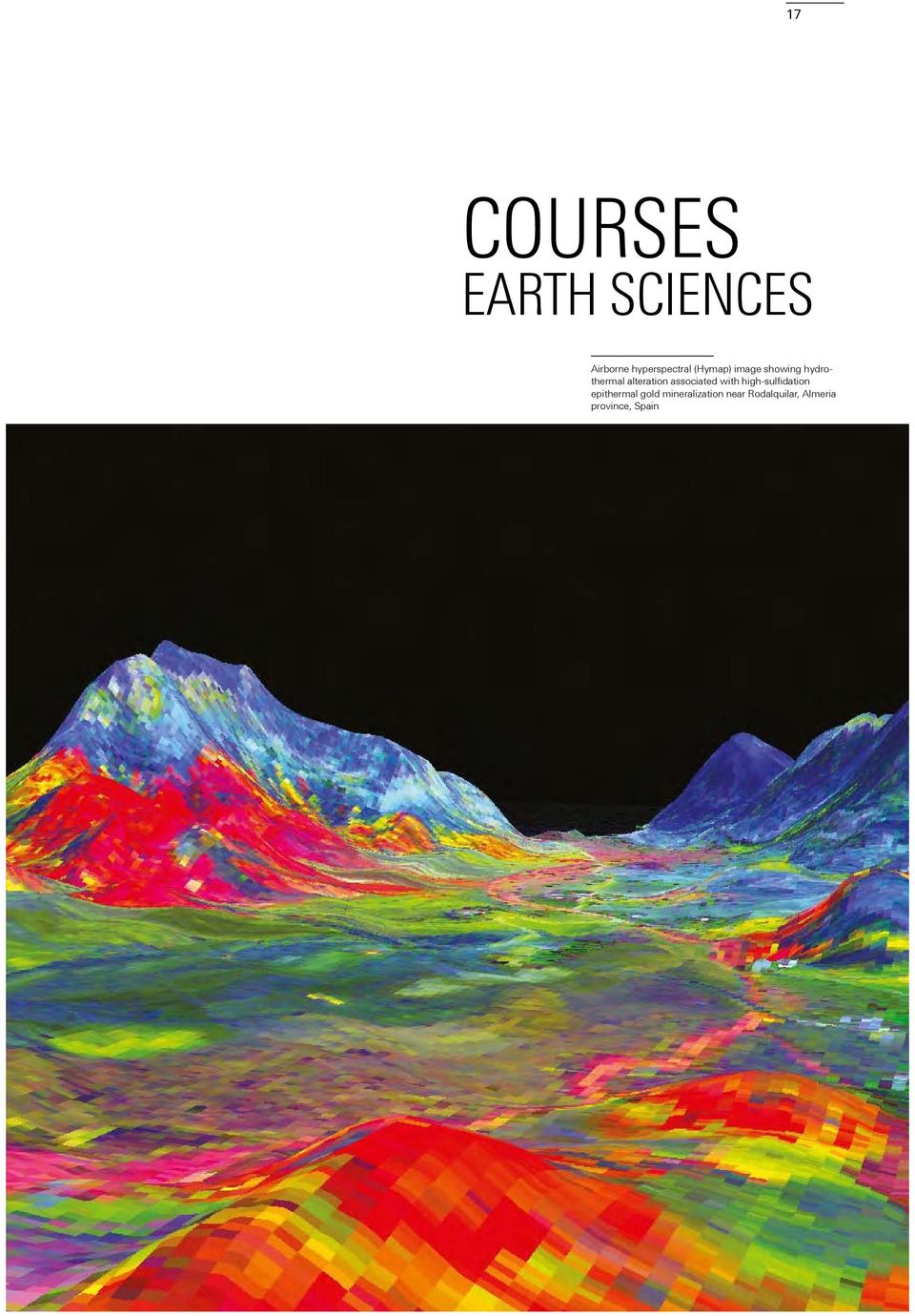
20 18 APPLIED GEOPHYSICS GEO-INFORMATION SCIENCE AND EARTH OBSERVATION FOR APPLIED EARTH SCIENCES, WITH SPECIALIZATION IN EARTH RESOURCES EXPloratION EUROPEAN CREDITS 5 start date Autumn 2011 end date - study mode and duration Online - 8 weeks TUITION FEE euro 1000 no MSc degree Postgraduate diploma EUROPEAN CREDITS start date 12 September September 2011 end date 8 March June 2012 study mode and duration Full-time at ITC - 18 months Full-time at ITC - 9 months TUITION FEE euro 9500 euro 4800 Many earth processes have a source or a component below the surface. Understanding the spatial and temporal variations in physical parameters in the subsurface therefore gives additional insight into these processes and their extent. This could be the extent of pollution plumes, water or mineral resources, or the sliding planes of landslides. The development of homogeneous 3D subsurface information systems is therefore important for various fields, such as environmental monitoring, natural hazards and earth resources. This is carried out on the basis of bore hole data, field data, and airborne- and satellite-based geophysical datasets, which are used to generate subsurface volumes in a 3D GIS environment. These volumes are linked to subsurface dynamic process models that are used to study dynamic phenomena such as resource deposits, pollution plumes, and groundwater flow in aquifers. This course delivers knowledge on tools for 3D subsurface characterization, visualization and modelling. This course is relevant for professionals who: have to carry out geophysical surveys, data processing or analysis want to use results from geophysical surveys in their own work are exposed to geophysics in their work environment and would like to gain a better understanding. These include professionals working in geophysical companies, geological surveys, universities, consultancy firms and industry. The sustainable use of land and earth resources is a key factor in economic development. In our daily life, we are continuously confronted with situations that have a direct link with earth resources and related processes. The buildings in which we live and work are constructed of materials from the earth, the soil produces our daily food, and mineral resources provide fuel for transport and cooking. Sustainable development of a country s mineral resources is generally seen as a key factor in economic growth. The search for mineral resources relies on the availability of up-to-date geological knowledge bases, conceptual mineral deposit models and modern exploration technologies. This course follows an integrated approach to upgrading geological maps, and to reinterpreting geological information in a GIS environment, using aerial photographs, satellite imagery and airborne geophysical data. Subsequently, exploration data and deposit concepts are brought together for integration and analysis using GIS and modelling systems to assess mineral resources potential. The MSc degree course is designed for academicians who are active in the field of earth resources and who have a specific interest in geological and mineral exploration. They have a specific interest in an academic career, and in applied research on the concepts and strategies taught in the course. The Postgraduate diploma course is designed for practitioners who are active in the field of earth resources and who have a specific interest in geological Participants will learn about the theory and practical use of geophysical methods for subsurface investigations in their day-to-day work. At the end, participants will be able to: understand the fundamental differences between various geophysical methods select the appropriate geophysical method for their problem process and analyse geophysical data interpret geophysical data for a specific purpose write and/or evaluate geophysical proposals. Field trip in the Harz Mountain, Germany. Course participants of the Applied Earth Sciences MSc course are trained in validation of remote sensing data by measuring infrared, natural gamma radiation and magnetic properties of rock outcrops

21 earth sciences 19 and mineral exploration. They have a specific interest in the pratical application of the concepts and strategies taught in the course. Participants in both courses are university graduates with a background in earth sciences, and with an interest in applying remote sensing and GIS techniques for exploration purposes. What is the course content? The courses will deal with the following topics (among others): principles of GIS and remote sensing techniques airborne geophysics geological remote sensing integrated image interpretation geological mapping methodology mineral deposit geology exploration geochemistry hyperspectral remote sensing prospectivity modelling research skills and methodology; thesis research (MSc degree course) project skills; individual final project assignment (Postgraduate diploma course). Participants are trained in upgrading the geological knowledge bases of countries or regions and in the assessment of their mineral potential, using remote sensing and GIS technology. The MSc degree course is oriented towards carrying out independent research, and includes MSc thesis research. The Postgraduate diploma course is oriented towards the practical application of methods and techniques, and includes challenging case studies on geological and earth exploration, and an individual final project. Why choose this course? The strong link between education and research activities at ITC guarantees a modern course that covers state-of-the-art methods and technologies for earth resources exploration. Examples include integrated image analysis for geological mapping, mineral mapping using hyperspectral remote sensing, and quantitative modelling of mineral prospectivity. Participants come from a wide range of countries, and the teaching staff have ample experience in international education and projects. GEO-INFORMATION SCIENCE AND EARTH OBSERVATION FOR APPLIED EARTH SCIENCES, WITH SPECIALIZATION IN ENVIronmental AND ENGINEERING GEOLOGY MSc degree Postgraduate diploma EUROPEAN CREDITS start date 12 September September 2011 end date 8 March June 2012 study mode and duration Full-time at ITC - 18 months Full-time at ITC - 9 months TUITION FEE euro 9500 euro 4800 The sustainable use of land and earth resources is a key factor in economic development. In our daily life, we are continuously confronted with situations that have a direct link with earth resources and related processes. The buildings in which we live and work are constructed of materials from the earth, the soil produces our daily food, and mineral resources provide fuel for transport and cooking. Engineering geology is a complex of processes involving geological and geotechnical information that may affect the construction or performance of civil engineering and building projects. Construction activities directly influence the surrounding environment and often engineering geological measures are needed in the case of environmental damage. Understanding spatial and temporal variations in physical parameters at the surface and in the subsurface gives the necessary insight into the extent, for example, of pollution plumes, water or mineral resources or landslides. A range of tools and techniques have been developed to make relating inventories, and to plan and manage the resources in an effective and sustainable way. The MSc degree course is designed for academicians who are active in environmental and geological engineering practices and have a specific interest in spatial information, and who want to learn state-of-the-art GIS and earth observation techniques. They have a specific interest in an academic career and in applied research concerning the tools and techniques taught in the course. The Postgraduate diploma course is designed for practitioners who are active in environmental and geological engineering practices and have a specific interest in spatial information, and who want to learn state-of-the-art GIS and earth observation techniques. They have a specific interest in the practical application of tools and techniques taught in the course. Participants in both courses are mid-career professionals with a university background (BSc), or recent university graduates in a field relevant to earth sciences. What is the course content? The course will deal with the following topics (among others): principles of GIS and remote sensing techniques characterization, classification, mechanics and properties of rock and soil masses possibilities for analytical and numerical modelling of discontinuous rock masses role of groundwater and water movement in soil mechanics various soil and rock mass testing techniques stability of slopes in soil spectroscopy and remote sensing techniques for environmental and engineering purposes
22 20 near-surface geophysics for site investigations and monitoring 3D modelling of subsurface structure and composition environmental geochemistry visits to relevant companies and organizations research skills and methodology; thesis research (MSc degree course) project skills; individual final project assignment (Postgraduate diploma course). The course teaches how to apply GIS, remote sensing and geophysics in engineering geology with a particular focus on the environmental impact of engineering activities. Participants will learn theory and practical use of soil and rock mechanics for engineering purposes, and will study the theory and practical use of remote sensing, geophysics, and modelling techniques in addressing environmental issues related to engineering geology activities. The MSc degree course is oriented towards carrying out independent research, and includes MSc thesis research. The Postgraduate diploma course is oriented towards the practical application of methods and techniques, and includes a final practical assignment. Why choose this course? This course offers both the new and the experienced geological engineer specific knowledge on the application of environmental issues in geological engineering. This will result in improved understanding of the role and possibilities of remote sensing and geophysics in addressing environmental aspects of engineering geology. The MSc degree course has a scientific focus, and is specifically meant for those who wish to pursue an academic career. The Postgraduate diploma course focuses on applications and practice, and is specifically meant for those who are operating in a working environment. GEOPHYSICS AND REMOTE SENSING FOR ENVIronmental ASPECTS OF ENGINEERING GEOLOGY EUROPEAN CREDITS 15 start date 7 March 2011 end date 6 May 2011 study mode and duration Full-time at ITC - 9 weeks TUITION FEE euro 2000 Many engineering geology activities are resulting either in or from changes in the environment. Construction activities directly influence the surrounding environment and often engineering geological measures are needed in the case of environmental damage. Many of these processes have a source or a component below the surface. Understanding the spatial and temporal variations in physical parameters at the surface and in the subsurface therefore gives additional insight into these processes and their extent. This could be the extent of pollution plumes, water or mineral resources, or the sliding planes of landslides. The development of homogeneous 3D (sub)surface information systems is therefore important for various fields, such as environmental monitoring, natural hazards and earth resources. This is carried out on the basis of bore hole data, geochemical and field data, airborne- and satellite-based remote sensing data, and geophysical datasets, which are used to generate subsurface volumes in a 3D GIS environment. These volumes are linked to subsurface dynamic process models that are used to study dynamic phenomena such as geological hazards, pollution plumes and groundwater flow in aquifers. This course is designed for those who are interested in studying the environment in a scientific way in order to detect, monitor and remediate environmentally hazardous events using earth observation techniques and engineering principles. This could be professionals working in engineering companies, geological surveys, universities, consultancy firms and industry. The course teaches participants how to apply GIS, remote sensing and geophysics, with a particular focus on the environmental impact of engineering geology activities. They will learn about the theory and practical use of remote sensing, geophysics and modelling in addressing environmental issues related to engineering geology activities. Practical knowledge will be gained by visiting consultancy and industrial companies working in the field of engineering geology and seeing how they deal with environmental issues in their daily routines. Fieldwork is an option in most courses and is carried out in areas that reflect problems clearly related to the application domain
23 earth sciences 21 HYPERSPECTRAL REMOTE SENSING REMOTE SENSING AND GIS FOR EARTH RESOURCES EXPloratION EUROPEAN CREDITS 5 start date 31 January 2011 end date 11 March 2011 study mode and duration Online - 6 weeks TUITION FEE euro 1000 EUROPEAN CREDITS 30 start date 3 January 2011 end date 6 May 2011 study mode and duration Full-time at ITC - 18 weeks TUITION FEE euro 3500 Since the launch in 1972 of the first earth observation satellite, ERTS1, techniques for extracting information from objects at the Earth s surface have rapidly evolved, generating remote sensing methods for the systematic monitoring of dynamic earth processes. In the early 1980s, hyperspectral sensors (instruments acquiring images in a large number of narrow and contiguous spectral bands) became available. In hyperspectral remote sensing, energy reflected or emitted from an object is measured and translated into information about the object or used to understand processes affecting the object. Visible and near-infrared spectroscopy offers a rapid and inexpensive technique for determining the mineralogy of samples and obtaining information on soil, water and biochemical composition. This Distance education course introduces state-of-the-art techniques for processing and interpreting multispectral and hyperspectral data, with a focus on airborne and satellite-based hyperspectral sensors. The course is designed for students, researchers and practitioners in remote sensing with a background or interest in earth and/or life sciences who want to learn the basics and prospective applications of hyperspectral remote sensing. Basic knowledge of remote sensing is desirable. Participants will learn the basic physics of spectroscopy, as well as how to measure and understand spectra in the laboratory and field, and how to integrate these with image data. The full processing chain, from data acquisition and calibration to thematic mapping, will be covered in the course. Elective case studies, covering real-life examples from the fields of geology, mineral exploration, oil and gas exploration, environmental sciences, soil science, geo-engineering, vegetation science and agriculture, and water quality, will serve to instruct participants on the use and application of hyperspectral data. In this 18-week course, participants are trained in the use of remote sensing and GIS techniques for geological and mineral exploration. Sustainable development of a country s mineral resources is generally seen as a key factor in economic growth. The search for mineral resources relies on the availability of up-to-date geological knowledge bases, conceptual mineral deposit models and modern exploration technologies. In this course, an integrated approach is followed for upgrading geological maps, in which published geological maps are re-interpreted in a GIS environment on the basis of aerial photographs, satellite imagery and airborne geophysical data. Subsequently, exploration data and deposit concepts are brought together for integration and analysis using GIS and modelling systems to assess mineral resources potential. The main subjects in this course are mineral deposit geology, geological remote sensing, exploration geochemistry, airborne geophysics, hyperspectral remote sensing and mineral prospectivity modelling. The course is designed for university graduates (BSc required) in earth sciences with an interest in applying remote sensing and GIS techniques to geological and mineral exploration. Participants must have a basic understanding of remote sensing and GIS techniques. At the end of the course, participants will be able to apply remote sensing and GIS to map geological features, to upgrade existing geological knowledge bases, and to assess the mineral potential of particular areas. Though this involves the use of software in a digital environment, the focus of the course is on concepts and strategies rather than on specific software tools.
24 22 REMOTE SENSING AND GIS FOR GEOLOGIcal EXPloratION REMOTE SENSING AND GIS FOR MINERAL EXPloratION EUROPEAN CREDITS 15 start date 3 January 2011 end date 4 March 2011 study mode and duration Full-time at ITC - 9 weeks TUITION FEE euro 2000 EUROPEAN CREDITS 15 start date 7 March 2011 end date 6 May 2011 study mode and duration Full-time at ITC - 9 weeks TUITION FEE euro 2000 In this nine-week course, participants are trained in the use of remote sensing and GIS techniques for geological exploration. Many countries, particularly those with under-explored mineral resources, need efficient methods for upgrading their geoscience knowledge base, which primarily means updating the national geological map coverage. Whereas in the past, the publication of traditional geological paper maps was a process lasting decades and entailing years of fieldwork, the need to attract timely foreign investment in mineral resource exploration requires an iterative and more time-efficient approach. In this course, an integrated geological mapping approach is followed in which published geological maps are digitized and re-interpreted in a GIS environment on the basis of aerial photographs, satellite imagery and airborne geophysical data. The main subjects in this course are airborne geophysics, geological remote sensing, integrated image interpretation and geological mapping methodology. The course is designed for university graduates (BSc required) in earth sciences with an interest in applying remote sensing and GIS techniques to geological exploration. Participants must have a basic understanding of remote sensing and GIS techniques. At the end of the course, participants will be able to apply remote sensing and GIS to map geological features and to update/upgrade existing geological knowledge bases. Though this involves the use of software in a digital environment, the focus of the course is on concepts and strategies rather than on specific software tools. In this nine-week course, participants are trained in the use of remote sensing and GIS techniques for mineral exploration. Sustainable development of a country s mineral resources is generally seen as a key factor in economic growth. The search for mineral resources relies on conceptual models and modern technologies. Selection of the search area is based on a thorough knowledge of the concepts of ore genesis and the geological terrains likely to host the many different types of mineral deposits. Exploration data for prospective areas are acquired from satellite and airborne sensors, geochemical and heavy mineral surveys, and from geological mapping. In this course, concepts and data are brought together for integration and analysis using GIS and modelling systems to assess mineral resources potential. The main subjects in this course are mineral deposit geology, exploration geochemistry, spectral remote sensing and mineral prospectivity modelling. The course is designed for university graduates (BSc required) in earth sciences with an interest in applying remote sensing and GIS techniques to mineral exploration. Participants must have a basic understanding of remote sensing and GIS techniques. At the end of the course, participants will be able to apply remote sensing and GIS to assess the mineral potential of particular areas. Though this involves the use of software in a digital environment, the focus of the course is on concepts and strategies rather than on specific software tools.
25 earth sciences 23 ROCK AND SOIL MECHANICS IN ENGINEERING GEOLOGY EUROPEAN CREDITS 15 start date 3 January 2011 end date 4 March 2011 study mode and duration Full-time at ITC - 9 weeks TUITION FEE euro 2000 Engineering geology is a complex process involving geological, geotechnical, and other relevant information that might affect the construction or performance of a civil engineering or building project. It starts with an adequate site investigation, which is vital to the success of any construction project. It is the basis for a proper design based on the mechanics of rock and soil masses. Rock and soil mechanics are elementary for the safe design of tunnels, dams, foundations and slopes. This course is relevant for professionals who: have to carry out, plan and/or evaluate geological engineering projects want to use results from engineering geology in their own work are exposed to engineering geology in their work environment and would like to gain a better understanding. These include professionals working in engineering companies, geological surveys, universities, consultancy firms and industry. Participants will learn about the theory and practical use of rock and soil mechanics for engineering geology purposes in their day-to-day work. At the end, participants will be able to: understand the mechanical and physical behaviour of discontinuous rock masses understand the interaction between civil engineering structures and discontinuous rock masses understand of the behaviour of different types of soil, as well as determine the major soil parameters and execute basic calculations understand the changes in the vertical effective stresses due to surcharges and changes in the groundwater levels understand the specific issues concerning tunnels, dams and foundations in or on soil and rock masses draw up a plan for a site investigation (with laboratory tests if required), with monitoring during the execution that will give all the parameter values of possible importance for a certain project in more or less known circumstances. The MIDAC thermal range FTIR field spectrometer is used to support thermal infrared remote sensing studies
26 24 COURSES GEOINFORMATICS Course participants learn to generate information from earth observation and GIS data to support the study and visualization of processes in System Earth and the related role of human beings
27 geoinformatics 25 CARTOGRAPHY AND GEO-VIsualIZATION GEOINFORMATICS EUROPEAN CREDITS n.a. start date 18 April 2011 end date 8 July 2011 study mode and duration Full-time at ITC - 12 weeks TUITION FEE euro 2500 Undergraduate diploma EUROPEAN CREDITS n.a. start date 26 September 2011 end date 16 June 2012 study mode and duration Full-time in Ghana - 9 months TUITION FEE euro 4635 In addition to contemporary digital cartographic output, GIS-derived products are increasingly used to disseminate geographical information by means of intranet, internet and multimedia applications. Static, dynamic and user-interactive maps are offered to meet the needs and demands of customers. These relatively new means of communication require their own specific approach to effectively convey the appropriate cartographic message. This course seamlessly blends cartographic fundamentals with the developments in modern geo-visualization techniques. This is achieved in a series of related modules by means of both theoretical and practical in-depth training in the principles and application of map design, visualization techniques, and the production management aspects that are required to effectively produce state-of-the-art cartography for topographic, thematic and web-oriented output. This course aims at staff from governmental organizations and private companies who are specialized in the field of topographic, thematic and/or cartographic web-oriented production. An important course component is training participants to solve problems independently, preparing them to become supervisory staff in the domain of cartography and geo-visualization. Furthermore, this course provides excellent opportunities for participants to improve their knowledge and techniques within the cartographic production environment and to broaden and deepen their geo-visualization perspective. On completion of the course, participants will be able to: describe and model the cartographic communication process determine the representation method and apply the appropriate cartographic grammar implement basic workflow management design and produce topographic maps design and produce the main types of thematic maps understand the concepts of statistics for thematic maps understand the need for, and apply, geographical data classification design and produce static and interactive (web) maps design and create a cartographically based web application execute a cartographic/web mapping project. joint course with the Ghana School for Survey and Mapping (GSSM) - Ghana For more information: E: [email protected] - Mohammed Baidoo (GSSM) [email protected] - Jeroen van den Worm (ITC) I: GEOINFORMATICS MSc degree Postgraduate diploma EUROPEAN CREDITS start date 28 September September 2011 end date 15 March July 2012 study mode and duration Full-time in India/at ITC -18 months Full-time in India/at ITC -9 months TUITION FEE euro 7725 euro 3090 joint course with the Indian Institute of Remote Sensing (IIRS) of the National Remote Sensing Agency (NRSA) - India For more information: E: [email protected] - Dr Sameer Saran (IIRS) [email protected] Dr Nicholas Hamm (ITC) I: GEOINFORMATICS DEGREE MSc degree EUROPEAN CREDITS 118 start date 4 April 2011 end date 4 November 2011 study mode and duration Full-time in Iran/at ITC TUITION FEE euro 9500 joint course with the Khajeh Nasirodin Toosi University of Technology (KNTUT) - Iran For more information: E: [email protected] - Dr Behzad Vosoghi (KNTUT) [email protected] Gerrit Huurneman, MSc (ITC) I:
28 26 GEOINFORMATICS GEO-INFORMATION SCIENCE AND EARTH OBSERVATION FOR GEOINFORMATICS Undergraduate diploma EUROPEAN CREDITS n.a. start date 26 September 2011 end date 16 June 2012 study mode and duration Full-time in Tanzania - 9 months TUITION FEE euro 4635 MSc degree Postgraduate diploma EUROPEAN CREDITS start date 12 September September 2011 end date 8 March June 2012 study mode and duration Full-time at ITC - 18 months Full-time at ITC - 9 months TUITION FEE euro 9500 euro 4800 joint course with the ARDHI University (ARU) - Tanzania For more information: E: [email protected] - Dr Chaula (ARU) [email protected] - drs Wan Bakx (ITC) I: Geographical and earth sciences are relying increasingly on digital spatial data acquired from remotely sensed images, analysed by geographical information systems (GIS), distributed through complex infrastructures, and visualized on the computer screen or on paper by an ever-increasing variety of users. The technologies supporting these processes form the core of geoinformatics. Technological skills alone, however, are not sufficient for organizations involved in the production and management of such geo-information. Owing to the rapid changes and developments in geo-information acquisition, analysis and dissemination, these organizations require scientific staff that can keep pace with and validate the relevancy of such developments, design new systems and infrastructures, and explore new-edge technology for efficient and effective implementation. The 18-month MSc course, which includes a strong research component, leads to an MSc degree. This course is designed for research and development staff at national mapping agencies and other organizations dealing with geo-information, as well as for university staff (Bachelor level) pursuing an academic career. Geomorphology (left) and landform (right) maps of Najafabad, Iran
29 geoinformatics 27 The nine-month Postgraduate diploma course is relevant for those who are interested in the content matter of geoinformatics technology but have no urgent need to develop research skills. From diploma to degree Participants who have successfully completed the Postgraduate diploma course are eligible to pursue the MSc degree course at a later stage. See page 9 for more information. What is the course content? The MSc course contains four major blocks that cover different topics from the geospatial data handling process spectrum, ranging from core principles to disciplinary research topics. GEO-INFORMATION SCIENCE AND EARTH OBSERVATION FOR GEOINFORMATICS DEGREE Master degree EUROPEAN CREDITS 77 start date 12 september 2011 end date 31 August 2012 study mode and duration Full-time at ITC - 12 months TUITION FEE euro 6200 Block 1 Core modules focusing on the theory, tools and techniques of GIS and remote sensing that form the basis of all geo-information applications at ITC. Block 2 Thematic modules building from the core principles to basic geoinformatics science. Topics dealt with include principles of databases, programming, design and optimization of geodata processing, image processing techniques and spatial data quality, geo-information sharing and distribution, web technology for GIS and mapping, and visualization and distribution of geospatial data. Block 3 Research orientation modules (covering such topics as research skills and research proposal writing) and coherent disciplinary modules (deepening the knowledge and skills in user selectable profiles). The emphasis is on the contribution of geoinformatics to multidisciplinary problem-solving projects in such fields as disaster management, urban infrastructure, land subsidence and biodiversity. Topics dealt with include spatio-temporal data analysis, automating information extraction, spatial data infrastructure technology, and multidisciplinary project work. Block 4 MSc research period. The nine-month Postgraduate diploma course includes Blocks 1 and 2, followed by a concluding multidisciplinary project in which competence in geoinformatics is efficiently and effectively implemented. The goal of the MSc degree course is to develop a critical understanding of, and competence in, geo-information science, and to develop capabilities for designing systems and tools for the acquisition, processing, transformation, analysis, storage, presentation and use of geo-information. Participants will thus acquire the skills to design and undertake research and development projects in various fields of geoinformatics, as well as become key players in multidisciplinary research and development projects. Why choose this course? If your interest goes beyond existing technology and you want to know and influence what lies behind it, as well as research and design cutting-edge solutions, this course is for you. The programming and research skills acquired during the course, together with the personal attitude developed, will prepare you for any upcoming challenge in geoinformatics or the geo-information disciplinary field that you are likely to meet in your work. There is an increasing need for organizations to efficiently acquire and exploit geo-information. The emphasis is therefore on the integration and reuse of geo-information and the associated production process. Such efforts are the core activity of building spatial data infrastructures (SDIs). To handle the ever-increasing volumes of data storage and data flow between computer systems, the characteristics and functionality of such infrastructures require special attention from different technical perspectives: data acquisition, processing and dissemination. Understanding the design principles and being able to apply appropriate technology for implementation purposes is of key importance to staff in these organizations. They must effectively carry out data acquisition (from remotely sensed images and other sensors), database management, geo-information processing and visualization techniques to build integral geo-information applications and SDIs in any geo-information application domain. The Master degree course addresses the needs of geoinformatics engineers who wish to improve their skills in using integrated geo-information production technology. An integral part of the course is the operational management of geo-information production systems, including design, planning, maintenance (execution, quality control) and exploitation. The course is designed for young and mid-career engineering staff at governmental organizations or companies such as mapping agencies that deal with geo-information. What is the course content? In this course, the overall theme is the application of technology for SDIs. After a thorough introduction to the principles of databases, remote sensing and GIS, six consecutive modules address specific aspects of the theme: the design and development of the component systems of an SDI requirement analysis 3D data acquisition base mapping from sensor data spatial data modelling and spatial database design spatial data analysis methods and techniques for acquiring and eventually disseminating and visualizing (via the Web) geospatial data geo-information application development and customization. The overall aim of the modules, the real-life case study that runs through all six modules, and the exercises in computer programming is to improve the understanding and engineering skills of the course participants. On completion of the course, participants will be able to: analyse geo-technical problems and design production processes (from acquisition to dissemination) for geospatial data and services for different application fields of geo-information support the design of, and implement, technological and infrastructural components in an organization evaluate (intermediate) information products that can be used as building blocks for multilevel SDIs evaluate the performance of production and dissemination processes work in multidisciplinary teams engaged in production projects that
30 28 involve spatial data collection, database management and data dissemination transfer the acquired knowledge to the home working environment. Why choose this course? The topics covered in this course will provide you with an in-depth knowledge of geo-information technology that can be readily applied in your home organization. It will also allow you to effectively create and handle geo-information and to build and use geo-information applications and SDIs. Moreover, the course has been set up to give you a clear overview of information integration issues and common solutions to real-life geo-information problems. GEO-INFORMATION SCIENCE AND EARTH OBSERVATION FOR GEOINFORMATICS Undergraduate diploma EUROPEAN CREDITS n.a. start date 10 January 2011 end date 23 September 2011 study mode and duration Full-time at ITC - 9 months TUITION FEE euro 4800 Researching the use of a geo-mobile application in the field The task of managing land use and the Earth s resources is becoming increasingly important owing to the rising world population and economic growth. To keep pace with demand, planners and resources managers now make considerable use of complex and powerful computerized geographical information systems (GIS). GIS users such as land and urban planners, resources managers and application scientists depend on the availability of up-to-date, well-structured data. Digital images from airborne and spaceborne sensors and aerial photographs are often used as data sources, along with modern techniques such as laser altimetry and mobile GIS. Technical means are necessary to extract data from these sources and to georeference the data accurately. Furthermore, systems are required to manipulate the spatial data and present this in quality maps and other (e.g. web) output. To achieve this, it is essential that an organization be staffed by capable personnel at all levels. The course is designed for staff at the technological level in map and geoinformation production organizations. The prime concern of these technologists is the execution of daily operational tasks. Such tasks demand specialists with both practical skills and in-depth knowledge of the technical processes involved. The function of the technologist is to coordinate production processes, organize and execute operational tasks, implement work procedures, and supervise groups of operators. What is the course content? The course itself is composed of core and specialization modules. The core modules give an introduction to the technical aspects of remote sensing data acquisition, GIS and geo-visualization. The specialization modules enable each participant to acquire skills specific to his or her primary professional tasks in the home organization. In all specializations, the emphasis lies on understanding the principles of geo-information production techniques, and there is ample opportunity for hands-on experience with leading commercial software. The specialization modules offered are given below. Remote Sensing and Digital Image Processing Appropriate processing of satellite images and aerial photographs for geoinformation production requires theoretical and practical training in various aspects of digital image processing, such as image enhancement, orientation and digital image classification.
31 geoinformatics 29 GIS Operation This specialization provides participants with the theoretical basis and practical training needed to build and manage spatial databases and perform spatial analysis using database management systems and GIS tools. Cartography and Geo-Visualization This specialization focuses on the theory and practice related to structuring, managing and executing GIS-based map production, with an emphasis on cartographic analysis and visualization. Special attention is given to maps for interactive web applications. The aim of the course is to provide participants with: theoretical knowledge and practical training designed to contribute to the production of maps and geo-information in-depth knowledge of one specific (individually chosen) aspect of the production process. Special attention is given to the implementation of the digital production of geo-information. Why choose this course? Geographical and earth sciences are relying increasingly on digital spatial data, much of which is acquired from remotely sensed images, analysed in GIS, and visualized on computer screens. Course participants will be trained in the modern tools, hardware and software that are used to create and disseminate digital spatial data and information on the world for many applications. GEOSTATISTICS AND OPEN-SOURCE statistical COMPUTING EUROPEAN CREDITS 5 start date 24 January 2011 end date 4 March 2011 study mode and duration Online - 6 weeks TUITION FEE euro 1000 Almost all the interesting data collected in geographical studies are from known locations on, in or over the Earth s surface. These data usually have a spatial structure that can be visualized and modelled. The resulting models can be used to map by interpolation, for example, using kriging or trend surfaces. Often, conventional statistical methods are not valid when there is spatial covariation, so specific geostatistical methods must be used to make inferences. The model of spatial covariation can also be used to design sampling plans. Statistical computing is becoming routine among geoscientists. In addition, extensive computing using actual datasets is the best way to learn statistics. The R Project for Statistical Computing is the leading open-source environment for exploratory, introductory and advanced computational statistics. R includes several add-in geostatistical packages. This course will use mostly the GSTAT package, although students may elect to use any software that is available in their organization for a data analysis project. This course is aimed at postgraduate students and working professionals who wish to apply spatial statistics and geostatistical computing in research and consulting projects. On completion of this course, participants should be able to: select and apply appropriate visualization and numerical techniques to explore the structure of a spatial dataset select and apply appropriate procedures to model the structure of a spatial dataset select and apply appropriate procedures to predict data values at unvisited locations, using parametric and non-parametric models design a sampling strategy to reveal or account for spatial structure use the R environment for statistical computing at an intermediate level and be able to improve their skills by self-study and experimentation.
32 30 GIS DATA QUALITY GIS OPERATION EUROPEAN CREDITS 5 start date 14 March 2011 end date 29 April 2011 study mode and duration Online - 6 weeks TUITION FEE euro 1000 EUROPEAN CREDITS n.a. start date 18 April 2011 end date 8 July 2011 study mode and duration Full-time at ITC - 12 weeks TUITION FEE euro 2500 This course aims to cover the basic principles of spatial data quality. This subject is of central importance in GIS and related fields since the quality of the data used and produced impacts on the quality of decisions made. The term spatial data quality is widely used in academic, governmental and industrial contexts but often remains undefined. In this course, participants are required to give critical attention to the meaning of spatial data quality. Greatest attention will be given to quantitative and statistical aspects of the subject. To do this, we will revise and develop some fundamental statistical concepts and computational tools that will be of more general value for data analysis and modelling. The course is relevant for a wide range of geospatial data users and producers. On completion of this course, particpants should be able to: explain the term spatial data quality and use it appropriately explain basic concepts in probability and statistics implement basic exploratory data analysis in R explain the basic principles of simple and multiple linear regression and implement them in R outline the modifiable areal unit problem define attribute and positional uncertainty and evaluate their impact on the quality of spatial data describe the potential impacts of uncertainty on the quality of spatial data products evaluate quantitatively the impact of uncertainty on the output of a simple model. The growing global interest in spatial information in all sectors calls for properly qualified personnel. Through providing appropriate training, this course meets the increasing demand to acquire, process and utilize geo-information data. Building and managing spatial databases and performing analysis by using tools embedded in GIS and database management systems (DBMS) are core activities in this course. GIS tools provide specific functionalities for spatial data input, processing, analysis and output, while DBMS tools provide more advanced functionality for storing and managing large spatial databases. This course provides participants with the theoretical background and practical training necessary to gain the skills required to integrate the two sets of tools for purposes of spatial data analysis and spatial database management. In addition, participants acquire the basic programming skills to customize the GIS interface and develop functions not yet available or embedded. This course is designed particularly for staff responsible for implementing geographical information production at national and regional agencies, local authorities and private companies. On completion of the course, participants will be able to: understand the basics of programming discern spatial data models design and create a relational database design, build and populate a geodatabase perform spatial analysis on different types of datasets implement and realize a user interface for a GIS application develop GIS applications.
33 geoinformatics 31 INTRODUCTION TO GEOINFORMATICS PRINCIPLES OF databases EUROPEAN CREDITS n.a. start date 17 January 2011 end date 8 April 2011 study mode and duration Full-time at ITC - 12 weeks TUITION FEE euro 2500 EUROPEAN CREDITS 5 start date 3 October 2011 end date 25 November 2011 study mode and duration Online - 8 weeks TUITION FEE euro 1000 Modern geo-information processing organizations aim to excel in domains ranging from spatial data capture, handling and analysing to geo-visualization. Owing to the rising demand for geo-information products, these organizations must work professionally and efficiently to satisfy client demands. Consequently, the requirement for staff to have proper understanding of the entire geo-information production line is of growing significance. This course provides the basic theoretical knowledge and hands-on experience required to perceive the synergy within this multidisciplinary production environment. It will foster improved mutual understanding, collaboration, and the effective exchange of geo-information between the domains, leading to higher-quality output. This course is also a good foundation for the following certificate courses: Remote Sensing and Digital Image Processing (see page 33) GIS Operation (see page 30) Cartography and Geo-Visualization (see page 25). This course is designed for staff of geo-information production organizations and (private) companies who are working in the domains of geodata acquisition, handling, analysing and/or visualization, and recognize the need for a wider understanding and awareness of the entire geo-information production line to improve efficiency and productivity. On completion of the course, participants will be able to: describe the main components of, and their role in, geo-information production describe the common coordinate systems and reference surfaces describe geodata acquisition methods acquire the basic GPS skills describe the main components of a GIS build relational databases and perform database query tasks perform spatial analysis on vector data describe the main components of geodata visualization understand the difference between conceptual and graphic map generalization design and create a simple website understand the concepts and techniques of internet mapping apply the knowledge and skills acquired during the course in a multidisciplinary map production case study. This course introduces participants to databases and data manipulation. The course focuses on thematic (also known as attribute) databases, the relational data model, and queries in the query language SQL. Database engineering is an important tool for any type of information management. The techniques learnt will be useful in a variety of settings in professional life. The course is relevant for anyone working with (usually large) collections of structured data. It focuses on what database technology has to offer, and lays the foundation for more advanced data handling techniques covered in other courses. We expect a basic level of computer skills and independence from participants, as well as familiarity with standard Windows software and secondary school discrete mathematics, and the ability to explore new software and new datasets. Participants will learn how database management systems work, what stored tables and queries are, and how to define queries in SQL. In addition, the first aspects of database design will be covered. On completion of this course, participants will be able to: explain the fundamentals of the relational data model formulate simple queries in mathematics define, execute and verify SQL queries against an existing relational database follow simple steps in database design (UML class diagrams).
34 32 PRINCIPLES OF GEOGRAPHIcal INFORMATION SYSTEMS PRINCIPLES OF REMOTE SENSING EUROPEAN CREDITS 5 start date 5 September 2011 end date 21 October 2011 study mode and duration Online - 7 weeks TUITION FEE euro 1000 EUROPEAN CREDITS 5 start date 16 May 2011 end date 8 July 2011 study mode and duration Online - 8 weeks TUITION FEE euro 1000 This course introduces participants to the basic concepts and operational skills necessary for data entry, data manipulation and analysis, and the production of interpretable output. The course is useful to novices, as well as to those experienced in some aspects of GIS but lacking a complete overview of the state of the art and/or the conceptual foundation. The course is designed for those with little or no knowledge of GIS. It is an excellent option for anyone driven by curiosity and wishing to take the first step in becoming a GIS expert, or for anyone driven by the need to explore the capabilities and limitations of current GIS technology in his or her field of application. On completion of this course, participants will have covered the following GIS topics: a gentle introduction to GIS geographical information and spatial data types hardware and software, GIS, steps in spatial data handling database management systems spatial referencing data quality, measures of location errors on maps satellite-based positioning spatial data input, data preparation point data transformation advanced operations on continuous field rasters analytical GIS capabilities, retrieval and classification, overlay functions neighbourhood operations, network analysis, error propagation data visualization. This course introduces participants to the basic concepts and operational skills necessary to acquire the most appropriate remote sensing data and extract geo-information from such data. The objective is to create a firm basis for the successful integration of remote sensing in any field of application. In addition, participants can choose two topics of personal interest to deepen their knowledge. The course is useful to novices in the realm of remote sensing, as well as to those experienced in some aspects but lacking a complete overview of the state of the art and/or the conceptual foundation. It is designed for anyone driven by curiosity and wishing to take the first step in becoming a remote sensing expert, or for anyone driven by the need to explore the capabilities and limitations of current remote sensing technology in his or her field of application. You will acquire a good basis that will facilitate the efficient selection of remote sensing data, the careful consideration of required preprocessing, and the optimal analysis of image data for purposes of obtaining necessary geo-information. The knowledge gained through study and communication with tutors and fellow participants will stimulate your appreciation of existing applications of remote sensing data in geospatial studies and will enable you to assess new applications.
35 geoinformatics 33 REMOTE SENSING AND DIGItal IMAGE PROCESSING EUROPEAN CREDITS n.a. start date 18 April 2011 end date 8 July 2011 study mode and duration TUITION FEE euro 2500 Full-time at ITC - 12 weeks The task of managing land use and the Earth s resources is becoming increasingly important owing to the rising world population and economic growth. To keep pace with demand, planners, resources managers and application scientists now make considerable use of frequently acquired high-resolution and/or multispectral images. Sound application depends on the availability of up-to-date, reliable and well-structured data. Satellite images from various sensors and digital aerial photographs are often used as data sources, along with modern techniques such as laser altimetry. Technical means to reference and extract topographic and thematic information from these sources in semi-automated processing environments are continuously under development. It is essential to train the staff responsible for acquiring such reference data not only in established and upcoming techniques such as object-based classification but also in understanding the relevancy of the acquisition process and its reliability for current GIS specialists. The course is intended to train staff to function at the supervisory level in rapidly changing map and geo-information production environments. It focuses on state-of-the-art technology in the field of remote sensing and digital image processing for information extraction, as well as on its consequences for applications by GIS specialists. The course is targeted at staff from government agencies and private companies who have practical professional experience in remote sensing and/or photogrammetry and who wish to become familiar with state-of-the-art technology. GIS specialists who make regular use of digitally acquired spatial reference data and are interested in the source and accuracy of these data would also significantly benefit from this course. The aim of the course is to equip participants with practical knowledge of: acquiring and producing geospatial information by using remote sensing and digital image processing the positional and thematic accuracy of this information and its relevancy in GIS applications. The Richat Structure, in the Sahara desert of Mauritania is an eroded circular anticline (structural dome) of layered sedimentary rocks. This view was generated from a Landsat satellite image draped over an elevation model produced by the Shuttle Radar Topography Mission (SRTM)
36 34 COURSES GOVERNANCE Public policies require geo-information when dealing with for instance land use, development, sustainability, environment access and equity
37 governance 35 GEO-INFORMATION AND GOVERNANCE: CONCEPTS, APProaches, RESEARCH METHODOLOGIES AND RESEARCH PractICE GEO-INFORMATION SCIENCE AND EARTH OBSERVATION FOR GOVERNANCE AND SPATIAL INFORMATION MANAGEMENT EUROPEAN CREDITS 10 start date 6 June 2011 end date 15 July 2011 study mode and duration Full-time at ITC - 6 weeks TUITION FEE euro 1500 MSc degree EUROPEAN CREDITS 118 start date 12 September 2011 end date 8 March 2013 study mode and duration Full-time at ITC TUITION FEE euro 9500 Public sector organizations are mobilizing significant resources around the world to develop and implement electronic government (e-government). E-government can be seen as a commitment to improve the relationship between government and citizens. Geographical information systems (GIS) and related technologies are crucial in e-government. Important research themes in this field include the use of e-government, public sector geo-information management, the administrative reform and modernization of the public sector, land administration systems, and the changing role of land administration. Qualitative research methodologies play a key role in this scientific domain. The course is designed for middle and senior managers and professionals working in public sector organizations involved in the management of (geo-) information systems for urban planning, land management and government. This course is also attractive to young and mid-career academics, PhD students and professionals (with a BSc) working in a relevant area. Participants are able to analyse how governance actors (government, citizens, private sector) use, produce and share geo-information and geoict. Participants are also able to carry out independent empirical research in the field of geo-information and public governance. Geo-information has gained importance in societies over the past decades. The public sector has always been a major spatial data provider and user. Topographic mapping, land use planning, environmental management, land administration and land registration are examples of public sector activities in which geo-information plays a major role. Public policy development and public management have undergone major shifts because of government reform, decentralization, market reform and information technologies. Governments have invested in digital registration systems, and many are active in developing service delivery to citizens via internet technology. Nowadays, too, the use of information technology for policy evaluation and policy design is being explored. The course is targeted at professionals and students from countries where the improvement of governance and the development of digital (geo-)information are on the political agenda. More specifically, it is designed for: mid-career professionals with a Bachelor degree (minimum) in a science appropriate for a job in the public sector, particularly professionals in policy agencies where ICT developments are in progress Bachelor students in relevant disciplines who wish to strengthen their capabilities in handling the spatial component for policy analysis and policy design. The learning approach is based on lectures on governance concepts and methodological aspects, analysis of exemplary publications, and conducting an individual three-week mini-research project that covers all stages of empirical research, from formulating a research question to reflecting on the results. What is the course content? The course lasts 18 months and consists of three blocks: Block 1 Provides participants with the core knowledge and techniques for each of the two disciplines (i.e. scientific knowledge and skills in public administration and geo-information science and technology). Land policy, land administration and case studies link the two sides in this first block. Block 2 Consists of courses on environmental policy, environmental economics and spatial economics, integrated with public sector and governance information, information systems, statistics and spatial decision support systems. Block 3 Dedicated to thesis research, which can include integrative fieldwork. The thesis will be defended in the MSc examination. Concepts of public administration Economics; policy design and policy evaluation; law; governance and political science; spatial planning, environmental policy and law. Concepts of geo-information and GIS Data models and databases; GIS theory and techniques; remote sensing and GPS; visualization and cartography; land administration and land policy. Participants who studied these concepts in their academic formation can be awarded credits for these topics.
38 36 Advanced topics Environmental policy; environmental economics; information and governance; spatial methods and techniques; spatial decision support; information systems and data management; fieldwork. Research Research skills; thesis research. This course provides participants with an adequate understanding of systems of governance and the embedded role of spatial information, as well as the competencies necessary to improve the quality of public administration, policy evaluation and policy design. The course integrates geosciences with social and political sciences. Why choose this course? The course is given jointly by ITC and other faculties of the University of Twente. This cooperation provides an environment in which the social and political sciences at the University are combined with the natural and geoinformation sciences at ITC. With regard to research, the course participant will be able to focus on a theme of personal and professional interest. Land is at the basis of all societies. Land policy regulates the access to land and the management of land. A sound land policy is a critical success factor in economic growth, food security, nature conservation, the protection of vulnerable groups, poverty reduction and housing
39 land administration 37 COURSES LAND ADMINISTRATION UN Our Hope for Humankind
40 38 GEO-INFORMATION SCIENCE AND EARTH OBSERVATION FOR LAND ADMINIstratION MSc degree Postgraduate diploma EUROPEAN CREDITS start date 12 September September 2011 end date 8 March June 2012 study mode and duration Full-time at ITC - 18 months Full-time at ITC - 9 months TUITION FEE euro 9500 euro 4800 Land is at the basis of all societies. Land policy regulates the access to land and the management of land. A sound land policy is a critical success factor in economic growth, food security, nature conservation, the protection of vulnerable groups, poverty reduction and housing. Land policy and land policy instruments determine how a government can provide access to land, offer tenure security, regulate the land market, implement land reform, protect the environment, and levy land taxes. Such tasks become even more challenging in post-conflict or post-disaster areas, and where government systems are in transition. Applying relevant principles of business administration and information technology, the course provides theoretical and practical knowledge and expertise in building a viable land administration organization. The course is designed for young and mid-career professionals involved, or likely to be involved, in developing land administration systems from an academic, managerial, technical and operational perspective. On completion of the course, participants will be able to: analyse land administration components and land administration systems to serve society understand the concepts of land policy and policy instruments regarding access to land, tenure security, land markets, land reform, land use planning and land taxation formulate institutional, operational and technological requirements for operating land administration procedures in a transitional environment specify and operate (geo-)information technology relevant to the functioning of land administration systems. Why choose this course? The cooperation between ITC and the Netherlands Cadastre provides a unique foundation for the course. The international networks of both institutions afford access to academic developments and the latest policies and guidelines of international donors and UN agencies. ITC is an associated institution of the United Nations University within the context of land administration. The links to academic and operational environments distinguish this course from education offered elsewhere in the world. The strength of this course lies in the combination of the institutional aspects of land administration and the development of sound information systems operated by viable land administration institutions. If you are interested in developing viable land administration systems within the context of your own country s land management and legal framework, this is the right course for you. A substantial part of the course is dedicated to information technology and information management for land administration systems and spatial data infrastructures. The ultimate aim is to ensure that participants become respected and valuable land administration experts in their own countries. From diploma to degree Participants who have successfully completed the Postgraduate diploma course are eligible to pursue the MSc degree course at a later stage. See page 9 for more information. What is the course content? The nine-month Postgraduate diploma course includes Blocks 1 and 2 of the MSc course. Block 1 Addresses the theory, tools and techniques of GIS and remote sensing and their application in land administration. Block 2 Focuses on academic, institutional, operational and information technology topics, and addresses: concepts of land policy and land management and administration process design; simulation and management of workflows adjudication; cadastral and social tenure mapping value assessment and land use classification business administration; planning and control; financial management modelling of data, processes, stakeholder analysis, community participation information system design, development, (re-)engineering information management (legal aspects, authentication, pricing, costing) SDI concept and application (authentic registers). Blocks Participants specialize further in their field of interest and deepen 3 and 4 their knowledge and skills in preparation for the MSc research phase.
41 land administration 39 GEO-INFORMATION SCIENCE AND EARTH OBSERVATION FOR LAND ADMINIstratION LAND ADMINIstratION SYSTEMS MSC degree EUROPEAN CREDITS 118 start date 12 September 2011 end date 8 March 2013 study mode and duration Full-time in China/at ITC - 18 months TUITION FEE euro 9500 EUROPEAN CREDITS 15 start date 28 November 2011 end date 27 January 2012 study mode and duration Full-time at ITC - 9 weeks TUITION FEE euro 2500 with the College of Earth Sciences and Land Resources of Chang an University - China For more information: E: [email protected] - Prof. Ma Zhimin (CHD) [email protected] - ir Kees Bronsveld (ITC) I: Land is at the basis of all societies. Land policy regulates the access to land and the management of land through the land administration processes. Its instruments, however, determine how governments provide access to land, protect tenure security, regulate the land market, implement land reform, preserve the environment, and levy land taxes for economic growth, food security, nature conservation, the protection of vulnerable groups, poverty reduction and housing. Land information systems provide land information about the ownership, value and use of land and, consequently, are an essential tool when it comes to accomplishing these tasks. The course is designed for motivated academics and mid-career professionals involved, or likely to be involved, in developing land information systems, with the emphasis on land administration systems from the academic, managerial, technical and operational perspectives. On completion of the course, participants will be able to: analyse user needs and components of land administration systems to serve society design a land information system using information system tools and methodologies such as soft system methodology prototype a land information system using Unified Modelling Language (UML) and GIS software-based OGC and ISO standards carry out adjudication processes based on a GIS participatory approach integrate topographic data collection using high-resolution stereo photographs and remote sensing images with field survey for land administration purposes carry out dissemination via internet technologies explain institutional aspects, tenure concepts, legal pluralism, land registration, legislative frameworks, land use property values, land markets, land reform, land use planning and land taxation in a transitional environment. Transparency is a critical component of a functioning land administration, particularly in view of the scarcity of clear and credible information on land availability and transactions, and the poor dissemination of public information on land rights and policies
42 40 PRINCIPLES OF LAND ADMINIstratION EUROPEAN CREDITS 20 start date 14 February 2011 end date 6 May 2011 study mode and duration TUITION FEE euro 2500 Full-time at ITC - 12 weeks Land policy and land policy instruments determine how a government can provide access to land, offer tenure security, regulate the land market, implement land reform, protect the environment, and levy land taxes. Such tasks become even more challenging in post-conflict or post-disaster areas, and where government systems are in transition. Fieldwork in El Torcal, Spain for MSc research about tree transpiration upscaling Applying relevant principles of business administration and geo-information technology, the course provides theoretical and practical knowledge and expertise on how to build a viable network of land administration organizations through a spatial data infrastructure. The course is designed for motivated academics and mid-career professionals involved, or likely to be involved, in developing land policy and land information infrastructure from an academic, managerial, technical and operational perspective. The ultimate aim is to ensure that participants become respected and valuable policy designers in the field of spatial data infrastructure for land administration in their own countries. On completion of the course, participants will be able to: develop land policy and the role of its instruments within the context of poverty reduction strategy papers and the Millennium Development Goals discuss implementation aspects of land policy, including the management of state land, urbanization and rural-urban transition, informal settlement, credit mechanisms, pro-poor land management, and land administration in post-disaster management identify elements of information policy and data protection identify and derive performance indicators in line with organizational goals, and develop public and private business administration use management techniques such as balanced score card and SWOT analysis in land administration organizations and change management understand the concepts of spatial data infrastructure and use advanced techniques such as UML/OCL for developing business cases in distributed environments for sharing multiple databases.
43 natural resources and environment 41 COURSES NATURAL RESOURCes and environment
44 42 ASSESSMENT OF THE EFFECT OF CLIMATE CHANGE ON AGRO- ECOLOGIcal SYSTEMS USING OPTIcal AND SAR REMOTE SENSING AND GIS CLIMATE CHANGE IMPACTS AND ADAPtatION: ANALYSIS AND MONITORING TECHNIQUES FOR CLIMATE CHANGE EUROPEAN CREDITS 5 start date 6 June 2011 end date 24 June 2011 study mode and duration Full-time at ITC - 3 weeks TUITION FEE euro 1000 EUROPEAN CREDITS 5 start date 27 June 2011 end date 15 July 2011 study mode and duration Full-time at ITC - 3 weeks TUITION FEE euro 1000 The greenhouse effects and the carbon cycle, in particular carbon emissions and carbon sequestration, are at the heart of climate change, one of the most pressing problems the Earth is facing. Global instruments such as the UNFCCC, Kyoto Protocol, CDM and IPCC reports all address these problems, resulting in an explicit link with the International Environmental Agenda. The accurate quantification of the various components in the carbon cycle forms a core requirement for the assessment, monitoring, modelling and mitigation of adverse climate effects and, in the end, for the sustainability of livelihoods in many parts of the world. The last requires the identification, analysis and development of policy instruments to handle the impacts of the foreseeable changes in the carbon cycle. Forestry in the broad sense forms the principal scientific area for researching the carbon cycle, including both emissions (sources) and sequestration (sinks). This course is targeted at: people who work with geo-information and/or with its application in natural resources management people who are interested in understanding the carbon cycle and its effect on climate change and would like to assess and estimate forest, crop agriculture, grass, shrubs and wetland vegetation biomass, and thus model carbon stock people who are interested in modelling carbon sequestration from optical and radar images and modelling forest fire behaviour, and thus carbon emission and how carbon emission affects climate change. This course will offer a set of methods and techniques for analysis and monitoring of climate change, with applications in climate change impacts and adaptation. The course is relevant for hydrometrologists, water/natural resources and environmental engineers, biologists, hydrologists and biohydrologists. On completion of this course, the participants will have: a better understanding of the links of both natural and anthropogenically induced climate change, its impacts, and adaptation and mitigation response options concerning water-related issues the advanced knowledge necessary to inform policy makers and stakeholders about the implications for water resources not only of climate change and climate change response options but also of various climate change scenarios and climate change response options, including associated synergies and tradeoffs. On completion of this course, participants will be able to: understand the carbon cycle and its effect on climate change assess and estimate forest, crop agriculture, grass, shrubs and wetlands vegetation biomass detect, monitor and model deforestation and forest degradation model biomass of vegetation types from all agro-ecological systems and consequently model sequestrated carbon from optical and radar images model forest fire behaviour and consequently carbon emission understand how deforestation, forest degradation, carbon sequestration and carbon emission affect climate change.
45 natural resources and environment 43 DISTRIBUTED data ACCESS TECHNOLOGIES FOR NATURAL RESOURCES MONITORING ENVIRONMENTAL IMPACT ASSESSMENT AND STRATEGIC ENVIronmental ASSESSMENT USING SPATIAL DECISION SUPPORT TOOLS EUROPEAN CREDITS 5 start date 6 June 2011 end date 24 June 2011 study mode and duration Full-time at ITC - 3 weeks TUITION FEE euro 1000 EUROPEAN CREDITS 5 start date 31 October 2011 end date 9 December 2011 study mode and duration Online - 8 weeks TUITION FEE euro 1000 In the face of global climate change and population increase, our ability to monitor the Earth s natural resources has become more and more pressing. The promise of timely and easy access to geo-information is an essential building stone in this endeavour. Geodata infrastructure (GDI) technologies try to sell us the idea that data but no longer our time is a consumable. In reality, however, we still consume a significant portion of our time and energy on obtaining and understanding the messages hidden therein. In the absence of a Google Earth-type system providing easy and real-time access to data collections relevant to natural resources management, holistic approaches also lag behind. This course highlights new technologies that may well change this situation, ushering in a new era of distributed data access, processing and analysis. This course is relevant for professionals who are engaged in any of the geosciences, natural sciences or engineering sciences and who have a basic knowledge of natural resources monitoring, remote sensing, digital image processing and GIS. By successfully completing this course, employees of (inter)governmental organizations or private companies who intend to follow a degree course later at ITC can be exempted from the corresponding module Distributed Data Access Technologies for Natural Resources Monitoring. On completion of this course, participants should be able to use scripting computer languages to perform various scientific interrogations of remote data collections, including: spatial and temporal aggregation of coarse-resolution satellite observations (MODIS, SEVIRI, etc.) analytically compare large 2D/3D grids using web-processing services technology generate descriptive statistics and perform basic parametric statistics (i.e. regression analysis) on variables offered by a remote data collection apply vegetation growth and biodiversity models to remote data collections. The course introduces participants to environmental impact assessment (EIA) and strategic environmental assessment (SEA). EIA and SEA are basically procedures to support decision making. The key principles of EIA and SEA are the involvement of relevant stakeholders, a transparent and adaptive planning process, consideration of alternatives, and using the best information possible for decision and policy making. EIA and SEA therefore improve both the planning process and the information used in this process. In this course, you will explore how GIS, models and spatial decision support systems can be used to help to identify and structure the problem(s), to find and compare possible solutions, and to monitor and evaluate the proposed activities. These will be examined as components of a general sustainability assessment process, involving participatory modelling, planning, management and assessment. Spatial multicriteria analysis, optimization techniques, scenario analysis, vulnerability and risk assessment, and environmental valuation methods will be introduced and applied in this course based on real EIA and SEA studies. Hands-on experience with real EIA and SEA projects will be a major part of the course. Although participants may have diverse backgrounds, they should share practical experience of, or an affinity with, the application of EIA, SEA and GIS within an environmental context. They may be employed by local or government authorities or line agencies, or be practitioners, reviewers, consultants, experts, students or professionals working in the field of environment. On completion of this Distance course, participants should be able to: explain the procedures, principles and steps in EIA and SEA illustrate the importance of public involvement in the EIA and SEA process value environmental assessment methods and techniques apply GIS and multicriteria evaluation in EIA and SEA evaluate the use of spatial decision support tools in EIA and SEA.
46 44 GEO-INFORMATION SCIENCE AND EARTH OBSERVATION FOR ENVIronmental MODELLING AND MANAGEMENT GEO-INFORMATION SCIENCE AND EARTH OBSERVATION FOR NATURAL RESOURCES MANAGEMENT MSc degree diploma EUROPEAN CREDITS 120º start date 12 September 2011 end date 8 March 2013 study mode and duration Full-time in Europe - 18 months TUITION FEE euro 9500 MSc degree Postgraduate diploma EUROPEAN CREDITS start date 12 September September 2011 end date 8 March June 2012 study mode and duration Full-time at ITC - 18 months Full-time at ITC - 9 months TUITION FEE euro 9500 euro 4800 within the Erasmus Mundus programme. ITC is linked with three European universities: Lund University (Sweden), the University of Iceland (Iceland), the University of Southampton (UK), and the University of Warsaw (Poland). For more information: E: [email protected] I: The ITC faculty library supports the primary processes of the Faculty by ensuring adequate provision of, and efficient enduse access to, useful scientific material The world s population is expected to reach nine billion people by the year Although the majority will live in cities, the demand for food and other resources will nevertheless place unprecedented pressure on the Earth s natural environment. Not only increasing population but also growing welfare leads directly, or indirectly, to problems such as deforestation, overgrazing, and the contamination of land and water resources. In recent years, we have become increasingly aware that many environmental issues, such as climate change, transcend national boundaries. As evidenced by the seventh of the UN s Millennium Development Goals, which relates to environmental sustainability, as well as other international agendas and agreements, the management of the Earth s natural resources is of concern to us all. With developments in remote sensing technology, we are now able to observe the Earth s surface in great detail and almost continuously. Never before has it been so easy to monitor and map our natural environment. Yet an ability to monitor and map processes such as deforestation, land use change and environmental degradation is only the first step towards solving these problems. To understand the complexity of factors involved, environmental managers must not only collect relevant data but also interpret and analyse them to obtain useful information to support decisions that can lead to more sustainable use of our natural resources. In carrying out these tasks, environmental managers increasingly work together with professionals from a wide range of disciplines. Geo-information technology in particular modelling and decision support systems plays an important role in this rewarding multidisciplinary work. Both the MSc degree and Postgraduate diploma courses are designed for young and mid-career professionals who work in the field of natural resources management and who wish to develop a critical understanding of, and competence in, using modern methods of working with spatial data. The Postgraduate diploma course aims at developing practical skills, while the MSc degree course additionally aims to develop academic skills leading to independent research and the defence of an MSc thesis. Participants will normally have a BSc or similar first degree in environmental science or in a discipline related to natural resources management, such as ecology, forestry or agriculture. If you have such a background and a keen interest and motivation to study in an international multidisciplinary environment, then the MSc degree or the Postgraduate diploma course in Natural Resources Management may be for you. From diploma to degree Participants who have successfully completed the Postgraduate diploma course are eligible to pursue the MSc degree course at a later stage. See page 9 for more information.
47 natural resources and environment 45 What is the course content? The MSc degree and Postgraduate diploma courses not only emphasize the multidisciplinary aspects of natural resources management but also offer you the opportunity of in-depth study in your particular field of interest. During the first block of the course, you will acquire knowledge and skills in applying geo-information science and earth observation to natural resources management. After this, in the second block, you will spend four months developing more in-depth knowledge and technical skills in order to analyse problems and identify and structure relevant information in selected aspects of natural resources management. For further details, see our web page at Study, Study at ITC, Study guides. Following this period of in-depth study, if you opt for the nine-month Postgraduate diploma course, you will complete your studies by carrying out an individual project. Alternatively, if you opt to pursue the 18-month MSc degree course, you will continue to develop an understanding of the purpose and use of research in natural resources management and will study advanced topics to support your planned research. Before your actual research work commences, you will spend a number of weeks working with staff and fellow MSc students in a research group (see web page to prepare yourself for your own independent research project. GEO-INFORMATION SCIENCE AND EARTH OBSERVATION IN TWO TOPICS: specialisation in land resources information for regional planning Master degree EUROPEAN CREDITS 77 start date 7 February 2011 end date 9 December 2011 study mode and duration Full-time in Bolivia - 10 months TUITION FEE euro 4175 with the Center for Aerospace Survey and GIS Applications for Sustainable Natural Resources Development, the Universidad Mayor de San Simon (UMSS) - Bolivia For more information: E: [email protected] I: In recent years, MSc graduates in Natural Resources Management have carried out their research on a range of research themes, but primarily in the areas of Biodiversity in fragmenting landscapes, Carbon cycle and climate change, Food security and Environmental sustainability. A selection of recent MSc theses can be found at Library, Repository ITC publications, Academic Output. Participants in both courses will learn to: analyse a problem encountered in natural resources management practice and develop an appropriate method for studying and/or solving the problem apply appropriate methods for spatial data acquisition, verification and quality control use geo-information science and earth observation technology to generate, integrate, analyse and display spatial data evaluate and apply relevant and appropriate methods and models for data analysis and problem solving in natural resources management. If you follow the MSc course, you will also: carry out in-depth study of two advanced topics that are relevant to your research apply research skills to formulate and carry out an independent research project communicate and defend findings of this research work. Why choose this course? The course offers a unique opportunity to share experiences in natural resources management with young scientists and professionals from all over the world. The teaching staff have a wealth of research and practical experience in the application of geo-information science and earth observation for natural resources management in many different environments and in many different countries. You will study and undertake research in a friendly, multicultural and multidisciplinary environment. GIS AND NATURAL RESOURCE MANAGEMENT MSc degree EUROPEAN CREDITS 118 start date 22 August 2011 end date 22 March 2013 study mode and duration Full-time in Ghana/at ITC - 19 months TUITION FEE euro 6695 with the Faculty of Renewable Natural Resources (FRNR) and the Department of Geomatic Engineering (DGE), both of the Kwame Nkrumah University of Science and Technology (KNUST) - Ghana For more information: E: [email protected] Prof. Dr Samuel Oppong (KNUST) [email protected] - ir Louise van Leeuwen (ITC) I: Study, Coursefinder
48 46 PRINCIPLES AND APPLIcatIONS OF REMOTE SENSING AND GIS IN NATURAL RESOURCES MANAGEMENT SPATIAL MODELLING OF BIologIcal ECOSYSTEM PROPERTIES EUROPEAN CREDITS 20 start date 26 September 2011 end date 16 December 2011 study mode and duration Full-time in Ghana - 12 weeks TUITION FEE euro 2500 EUROPEAN CREDITS 5 start date 27 June 2011 end date 15 July 2011 study mode and duration Full-time at ITC - 3 weeks TUITION FEE euro 1000 with the Kwame Nkrumah University of Science and Technology (KNUST) - Ghana For more information: E: [email protected] Prof. Dr Samuel Oppong (KNUST) [email protected] - ir Louise van Leeuwen (ITC) I: Accurate spatial information about biological ecosystem properties is a requirement for developing policy and managing natural resources. Information about green biomass, species, assemblages and diversity serves a wide range of purposes in environmental management. Remote sensing may enable direct mapping of such biological properties. Frequently however indirect approaches are used, where environmental conditions are used to predict the distribution of the biological variable of interest. This course aims to strengthen skills in developing models to predict the distribution of biological variables for purposes such as biological or environmental conservation, biodiversity assessment, and the determination of species richness and species distribution. On completion of the course, you will be able to select appropriate models for estimating biological ecosystem properties and apply these to real-world situations.
49 natural resources and environment 47 STRATEGIC ENVIronmental ASSESSMENT (SEA) AND ENVIronmental IMPACT ASSESSMENT (EIA) APPLYING SYSTEMS ANALYSIS AND SPATIAL DECISION SUPPORT TOOLS EUROPEAN CREDITS 5 start date 27 June 2011 end date 15 July 2011 study mode and duration TUITION FEE euro 1000 Full-time at ITC - 3 weeks On completion of the (interactive) lecture series and the associated practical exercises, participants should be able to: explain the procedures, principles and steps in EIA and SEA illustrate the importance of public involvement in the EIA and SEA process value environmental assessment methods and techniques apply GIS and multicriteria evaluation in EIA and SEA evaluate the use of spatial decision support tools in EIA and SEA. Ad hoc and often uncontrolled development initiatives can have undesired social, economic and ecological consequences. Environmental impact assessment (EIA) is a legal procedure established to evaluate the consequences of proposed projects. Although by now EIA is acknowledged and legally embedded in most countries, practice has shown that EIA often occurs too late in the planning process. Strategic environmental assessment (SEA) for policies, plans and programmes has evolved since the 1990s. The key principles of EIA and SEA are the involvement of relevant stakeholders, a transparent and adaptive planning process, consideration of alternatives, and using the best possible information for decision and policy making. EIA and SEA therefore improve both the planning process and the information used in this process. In this course, you will explore how GIS, models and spatial decision support systems can be used to help to identify and structure the problem(s), find and compare possible solutions, and monitor and evaluate the proposed activities. Hands-on experience with real EIA and SEA projects will be a major part of the course. Although participants may have diverse backgrounds, they should share practical experience of, or an affinity with, the application of EIA, SEA and GIS within an environmental context. They may be employed by local or government authorities or line agencies, or be practitioners, reviewers, consultants, experts, students or professionals working in the field of environment. Community forest in Nepal
50 48 Courses Urban planning Urban land use. Part of the city of Turrialba, Province of Cartago, Costa Rica
51 urban planning 49 ANALYSING AND MONITORING URBAN DEVELOPMENT GEO-INFORMATION SCIENCE AND EARTH OBSERVATION FOR URBAN PLANNING AND MANAGEMENT EUROPEAN CREDITS 15 start date 3 January 2011 end date 4 March 2011 study mode and duration Full-time at ITC - 9 weeks TUITION FEE euro 2000 MSc degree Postgraduate diploma EUROPEAN CREDITS start date 12 September September 2011 end date 8 March June 2012 study mode and duration Full-time at ITC - 18 months Full-time at ITC - 9 months TUITION FEE euro 9500 euro 4800 This course addresses various contemporary themes in urban planning and management and focuses on the application of geo-information technology for understanding the nature and dynamics of urban regions. Contemporary themes addressed in the course are: land, land use and shelter (planned versus unplanned development) economic development and urban poverty infrastructure, transport and service provision environment: hazards, pollution and solid waste. The methods and techniques addressed are: conceptual modelling and problem analysis observation and measurement of urban themes and processes (monitoring, indicators) spatial analytical techniques social statistics (descriptive and explorative) visualization and communication quality/uncertainty in (spatial) data. This course could be complemented by the subsequent course Spatial Interventions in Urban Planning and Management (see page 50). The course is designed for professionals and academics who wish to enhance their knowledge of, and skills in, geo-information science, spatial analytical techniques and social statistics, and apply these in the field of urban planning and management. The course is particularly relevant for those people who are interested in applying geo-information science in monitoring and analysing urban development. The magnitude and dynamics of urbanization place an enormous burden on organizations responsible for the planning and management of urban regions. The core objectives of urban planning and management are seen as understanding dynamic urban processes and developing effective interventions that contribute to the sustainability of urban development. Geo-information and geo-information technology play a vital role in supporting these objectives. The MSc degree and Postgraduate diploma courses in urban planning and management integrate knowledge of, and skills in, geo-information technology with current themes in the field of urban planning and management. Themes include urban poverty, urban transport, infrastructure and public services, disaster preparedness and mitigation, urban environmental planning, land use and land tenure, participatory GIS, and spatial planning and decision support systems. Any academically oriented professional who is active in urban planning and management and who uses spatial data in planning and management tasks belongs to the target group, for example town and district planners, land (policy) officers, infrastructure engineers and environmental planners. The course is also highly relevant for staff at universities and non-governmental organizations in the field of urban planning and management who are interested in the use of geo-information technology. The 18-month MSc course includes a strong research component and leads to an MSc degree. The nine-month Postgraduate course is relevant for those who are interested in the content matter of geo-information technology and urban planning and management but to a lesser extent in the research part and an MSc degree. The Postgraduate diploma course includes Blocks 1 and 2 of the MSc course. Basic knowledge of, and skills in working with, GIS and/or digital image processing of remotely sensed data are required. On completion of the course, participants should demonstrate knowledge and understanding of: the different dimensions and components of the urban system and their interrelationships appropriate methods and techniques of spatial and statistical analysis to gain insight into the nature and dynamics of urban development. From diploma to degree Participants who have successfully completed the Postgraduate diploma course are eligible to pursue the MSc degree course at a later stage. See page 9 for more information. What is the course content? The MSc course content is clustered in four blocks: Block 1 Geo-information science and earth observation: focuses on the theory, tools and techniques of GIS and remote sensing and their application in urban planning and management. Block 2 Urban planning and management: addresses contemporary themes in urban planning and management, with a dual focus on understanding the nature and dynamics of urban regions and on developing and evaluating interventions in multi-stakeholder settings. Subjects dealt with in this block include: urbanization processes urban indicators and monitoring spatial analytical techniques statistics and visualization conceptual modelling of urban processes data gathering and information supply governance of urban regions
52 50 planning and management approaches policy processes and policy instruments methods and tools in contemporary planning and management planning and decision support scenario development, modelling and scenario analysis. Block 3 Research methods and advanced choice subjects Block 4 MSc thesis research (linked to one of the ITC s research themes). In Blocks 3 and 4, participants specialize further in their field of interest and deepen knowledge and skills in preparation for the MSc research phase. The individual MSc research takes place in a multidisciplinary research project that is related to one of ITC s main research themes. The research typically includes fieldwork in a city in a developing country to collect primary and secondary data and information. The nine-month Postgraduate course includes Blocks 1 and 2 of the MSc course and is complemented by an individual project. Both courses aim to improve the knowledge and skills of the course participants in the use of geo-information science for effective task execution and problem solving in urban planning and management. In addition, the MSc course will enable participants to specialize further in current research themes and will give them the opportunity to undertake an independent research project, making effective use of geo-information technology. Why choose this course? In a recent survey, graduates gave the following reasons for following a course in urban planning and management at ITC: advanced expertise in geo-information science and remote sensing relevant contents and tools, reflecting contemporary urban planning practice opportunity to undertake empirical research in developing countries international environment, with access to Dutch and European experiences. All in all, ITC offers a unique international academic environment for applying geo-information technology within the context of urban planning and management. SPATIAL INTERVENTIONS IN URBAN PLANNING AND MANAGEMENT EUROPEAN CREDITS 15 start date 7 March 2011 end date 6 May 2011 study mode and duration Full-time at ITC - 9 weeks TUITION FEE euro 2000 Addressing contemporary themes in urban planning and management, this course focuses on the development and evaluation of effective interventions, making appropriate use of geo-information technology. Themes addressed include: land, land use and shelter (planned versus unplanned development) infrastructure, transport and service provision economic development and urban poverty environment: hazards, pollution and solid waste. Topics, methods and techniques addressed include: concepts of urban government and urban policies, traditional and contemporary theory and concepts of urban planning and management in various geographical and political contexts, and participants experiences urban planning and urban policy instruments for economic and sustainable development: land, shelter, infrastructure and environment stakeholder involvement: stakeholder analysis methods and techniques of urban planning and management modelling and scenario development: concept of modelling, types of models, land use modelling, network modelling, accessibility modelling, flood modelling, land use-transport interaction modelling integrated assessment and evaluation methods, spatial multicriteria evaluation, environmental and social impact assessment, economic appraisal integrated case study excursions and guest speakers. This course could be combined with the preceding course Analysing and Monitoring Urban Dynamics (see page 49). The course is designed for professionals and academics who wish to enhance their knowledge and skills in developing and evaluating spatial interventions in urban planning and management, making appropriate use of geo-information science, and applying methods and techniques for scenario development and evaluation in a multi-actor environment. Basic knowledge of, and skills in working with, GIS and/or digital image processing of remotely sensed data are required. On completion of this course, participants will be able to: demonstrate knowledge and understanding of (a) geo-information-science-based methods and techniques and (b) urban planning processes and policies use appropriate methods, models and techniques for scenario development evaluate and assess spatial interventions in a multi-stakeholder environment.
53 water resources 51 COURSES WATER RESOURCES Course participant analyzing the water quality
54 52 APPLICATIONS OF EARTH OBSERVATION AND GIS IN INTEGRATED WATER RESOURCES MANAGEMENT DIGITAL TERRAIN MODEL EXtractION, PROCESSING AND PARAMETERIZATION FOR HYDROLOGY Postgraduate certificate EUROPEAN CREDITS 25 start date 17 January 2011 end date 6 May 2011 study mode and duration Full-time in Kenya - 16 weeks TUITION FEE euro 2575 EUROPEAN CREDITS 5 start date 5 December 2011 end date 27 January 2012 study mode and duration Online - 8 weeks TUITION FEE euro 1000 with the Regional Centre for Mapping of Resources for Development (RCMRD) - Kenya; Egerton University - Kenya; and Addis Ababa University - Ethiopia For more information: E: [email protected] - Dr Tesfay Korme (RCMRD) [email protected] - ir Arno van Lieshout (ITC) I: Study, Course finder or Process-based models are created in order to simulate and understand the relationships between natural processes under certain physical rules and conditions. Models range from very simple 1D models to complex models that involve many parameters and are capable of simulating a 4D environment (x,y,z and time). Recently, many modellers have fully adopted the use of digital terrain models (DTMs) and other thematic maps as part of the input parameters for these hydrological models. Catchment topography has a major impact on the hydrological processes active in the landscape. This course aims to equip participants with the necessary conceptual and practical knowledge to acquire and process DTMs for parameterization in hydrology. This course is relevant for professionals who are engaged in any of the geosciences, natural sciences or engineering sciences and who have a basic knowledge of hydrology, remote sensing, digital image processing and GIS. On completion of this course, participants should be able to: describe the relevance of a DTM for hydrological studies and modelling in general, and the types of parameters that can be obtained for hydrological and hydraulic modelling in greater detail, as well as how these parameters are used extract 3D information, process and construct a DTM from points and by contour interpolation, and calculate relevant DTM-based derivatives (1st and 2nd order) and compound indices import and process DTMs from existing sources (point-, line- and rasterbased) use ILWIS software for hydrological parameterization use remote sensing data for extracting other relevant hydrological parameters (e.g. hydrographs). Water loss and erosion from irrigation runoff due to unregulated watering
55 water resources 53 EARTH OBSERVATION AND QUANTIFIcatION OF WATER cycle COMPONENTS GEO-INFORMATION SCIENCE AND EARTH OBSERVATION FOR WATER RESOURCES AND ENVIronmental MANAGEMENT EUROPEAN CREDITS 20 start date 3 January 2011 end date 25 March 2011 study mode and duration Full-time at ITC - 12 weeks TUITION FEE euro 2500 MSc degree Postgraduate diploma EUROPEAN CREDITS start date 12 September September 2011 end date 8 March June 2012 study mode and duration Full-time at ITC - 18 months Full-time at ITC - 9 months TUITION FEE euro 9500 euro 4800 In this 12-week course, the theoretical background of the different water budget and water quality components is discussed, including the earth observation methodologies to quantify each of the components. To assess the water balance component you need data. Data can be obtained from the ground and/or from satellite observations. Also applications of process modelling require reliable data related to water quantity and quality, climate, soils and vegetation. Today, using the newest sensor, ground and environmental technologies, a large number of these data can be acquired from space and can be integrated with in situ and laboratory measurements. This course is designed for all who want to learn how earth observation can contribute to the quantification of hydrological systems. The contribution of earth observation to hydrological assessment and analyses will be reviewed at various scales. Your hydrological and earth observation knowledge will be strengthened, and your analysing skills in spatial hydrology will be greatly enhanced through using dedicated software to master all kinds of guided exercises. Security and sustainable development of our water resources is one of the key problems of the 21st century. Improved water management can make a significant contribution to achieving the Millennium Development Goals. Current international initiatives such as the Global Earth Observation System of Systems 10-Year Implementation Plan have identified earth observation as the key to helping to solve the world s water problems. The availability of spatial information on water resources will enable closure of the water budget at river basin scales to the point where effective water management as requested by the EU Water Framework Directive is possible. Floods, droughts, water quality, water-ecosystem and soil-water-climate interactions, and the sustainability of water resources are important issues in water resources management and hydrology. Course participants are exposed to developments in geo-information science and earth observation for assessment, monitoring and prediction purposes in the fields of water resources, hydrology and environmental management. The course is designed for young and mid-career professionals involved in water resources, agriculture, irrigation, civil engineering, hydrology, (agro-) meteorology and physical geography who are of BSc or MSc level and preferably have some years of professional experience. Most of our alumni work for ministries of water, irrigation departments, meteorological departments, water authorities, universities or international organizations such as IWMI and UNEP. What is the course content? The course introduces participants to the use of earth observation and geo-information for quantifying components of the water cycle. Specialization topics and specific modules are offered in three streams: Environmental Hydrology, Surface Hydrology, and Groundwater Assessment and Modelling. Each stream focuses on a different aspect of water resources and the environment. Participants can also focus on one of these application fields in the MSc research part. Earth observation techniques can be used for water resources assessment and management. In the course, the concepts related to the acquisition of hydrological data from satellite images are explored. The applications of earth observation in flood, recharge, drought, water quality monitoring and climate studies are demonstrated. The Groundwater Assessment and Modelling stream focuses on subsurface processes and the use of spatial models for groundwater assessment and management. The Surface Hydrology stream focuses on water quantity aspects (flooding, agricultural water use, climate) from local to regional scale. Participants with an environmental hydrology orientation study freshwater, wetland and coastal zone interactions and the environmental impacts of water resources projects. Important topics include optical remote sensing of water quality and the modelling of hydro-geochemical data. An option exists to take several modules in the field of water engineering and management at the Faculty of Engineering Technology. The Postgraduate diploma course (total duration nine months) concludes with a six-week project assignment. At MSc level, a research project is carried out over a period of six months.
56 54 From diploma to degree Participants who have successfully completed the Postgraduate diploma course are eligible to pursue the MSc degree course at a later stage. See page 9 for more information. Participants will develop skills in methods and techniques relevant to integrated watershed hydrology, groundwater, surface water and/or environmental hydrology. Case studies and fieldwork play a crucial role, enabling participants to acquire a working knowledge of advanced tools and methods. Through real-life problem-oriented case studies, the course participants will be exposed to problem-solving techniques. Earth observation, GIS and modelling software are provided, so participants will be able to apply their skills in their home organizations. Why choose this course? This course provides a unique opportunity for hydrologists, water resources managers, decision makers and practitioners to combine their experience and (field) knowledge with recent advances in the use of space technology and computational methods for water resources and environmental management. Knowledge gained in the courses can directly support activities in the area of water resources management, environmental monitoring, environmental security, disaster management and sustainable development. GEO-INFORMATION SCIENCE AND EARTH OBSERVATION IN TWO TOPICS: specialization water survey Master degree EUROPEAN CREDITS 77 start date 7 February 2011 end date 9 December 2011 study mode and duration Full-time in Bolivia - 10 months TUITION FEE euro 4175 with the Center for Aerospace Survey and GIS Applications for Sustainable Natural Resources Development, the Universidad Mayor de San Simon (UMSS) - Bolivia For more information: E: [email protected] I: Courses in the water resources domain focus on different aspects of water resources and the environment
57 water resources 55 REMOTE SENSING METHODS FOR DERIVING GEO-BIOCHEMIcal PROPERTIES OF AQuatIC ECOSYSTEMS RETRIEVAL OF LAND SURFACE HYDROLOGIcal PARAMETERS EUROPEAN CREDITS 5 start date 6 June 2011 end date 24 June 2011 study mode and duration Full-time at ITC - 3 weeks TUITION FEE euro 1000 EUROPEAN CREDITS 5 start date 6 June 2011 end date 24 June 2011 study mode and duration Full-time at ITC - 3 weeks TUITION FEE euro 1000 Having and maintaining suitable water quality is critical to sustaining life on our planet. Inland and coastal areas are of particular concern as the majority of the world s population lives in these riparian and coastal areas. Monitoring water quality using remote sensing, in conjunction with strategic in situ sampling and hydrodynamic modelling can play a crucial role in determining the current status of water quality conditions and mitigate future water catastrophes. The course deals with the retrieval of geophysical and biochemical properties of aquatic ecosystems from remotely sensed data in a generic manner. The course will treat water quality indicators, primary production indictors, phytoplankton species, and characteristics of substrate in shallow and clear waters (e.g. bottom type and coral reef), intertidal mudflats, aquatic vegetation and wetland. This course is targeted at water/natural resources and environmental engineers, biologists, biohydrologists, and hydraulics and coastal engineers. On completion of the course, the participants will be able to: derive geo-biochemical properties of aquatic ecosystems understand remote sensing methods to derive biochemical properties of aquatic ecosystems derive water quality parameters differentiate between different phytoplankton species derive the characteristics of substrate and intertidal mudflats perform uncertainty analysis apply the above-mentioned goals to real-world situations, using advanced analysis techniques. Land surface properties related to hydrological processes are important for the quantitative modelling of the water balance over an area. The main processes driving the hydrological cycle are precipitation, runoff, evapotranspiration and soil storage. Evapotranspiration and surface runoff are strongly influenced by the surface properties of soil and vegetation and by terrain topography so, in order to enable the closing of the water balance, quantitative information about soils and vegetation canopies has to be derived. This course is aimed at teaching quantitative retrieval methods applied to earth observation data from the visible to the thermal infrared domain. These methods are based on the use of radiative transfer models that simulate the relationships between surface properties and remote sensing data. This course is targeted at water/natural resources and environmental engineers, biologists, hydrologists and biohydrologists. On completion of this course, participants will be able to: understand remote sensing model inversion methods derive water cycle components from raw data of remote sensing images perform time series and uncertainty analysis.
58 56 Courses Interdisciplinary Interdisciplinary courses at ITC are short courses that cover more than one domain
59 interdisciplinary 57 LARGE-SCALE PROCESS MODELLING AND data ASSIMILATION LEARNING IDL FOR BUILDING EXPERT APPLIcatIONS IN ENVI EUROPEAN CREDITS 5 start date 27 June 2011 end date 15 July 2011 study mode and duration Full-time at ITC - 3 weeks TUITION FEE euro 1000 EUROPEAN CREDITS 5 start date 24 October 2011 end date 3 December 2011 study mode and duration Online - 6 weeks TUITION FEE euro 1000 This course will offer a set of methods and techniques to deal with large-scale process modelling and data assimilation, and subsequently this knowledge will be applied in different application domains. The course is relevant for hydrometrologists, water/natural resources and environmental engineers, hydrologists and biohydrologists. On completion of this course, participants should be able to: apply state-of-the-art large-scale process models for a specific application domain fuse multisensor data on different levels using different techniques use satellite data products via data assimilation in a specific application domain use open-source tools to process spatial and temporal data products for food security, carbon cycle vegetation dynamics, and drought and climate impacts. Interactive Data Language (IDL) is a popular programming language among scientists and is widely used in medical imaging and remote sensing. IDL is optimized for fast calculations on multidimensional arrays and has a wide range of processing libraries and visualization tools. Dynamic visualizations and image processing applications with graphical user interfaces can be developed relatively easily within the IDL software development environment. This environment, the IDL Workbench, is based on the open-source Eclipse framework, making it a cross-platform solution. The image processing package Environment for Visualizing Images (ENVI) is written in IDL and adds its image processing functionality to IDL. At the same time, ENVI functionality can be easily customized or extended by adding IDL scripts as a plug-in. The combination of IDL and ENVI makes a powerful image processing tool in remote sensing. This course gives an introduction to image processing with ENVI, then explains the basics of IDL, and finally, through training on real-life remote sensing problems, demonstrates how to extend ENVI functionality with custom-built user functions. This course is aimed at PhD students and working professionals who wish to create their own ENVI functionality by applying IDL programming. Participants must have experience with remote sensing and image processing. Familiarity with ENVI and programming experience with IDL or another programming language are recommended but not required. On completion of this course, participants should be able to: work with the IDL command line, IDL Workbench and Online Help write IDL scripts for use with ENVI band math and spectral math use ENVI library routines to write ENVI plug-ins and batch programs use ENVI widgets routines to build simple graphical user interfaces continue programming with IDL-ENVI on their own. The main objective is not to cover the complete IDL and ENVI knowledge fields but to equip participants to continue learning and creating their own ENVI image processing functionality.
60 58 PARTICIPATORY GIS: PRINCIPLES AND APPLIcatIONS PRINCIPLES OF GEO-INFORMATION SCIENCE AND EARTH OBSERVATION FROM A SYSTEM PERSPECTIVE EUROPEAN CREDITS 5 start date 6 June 2011 end date 24 June 2011 study mode and duration Full-time at ITC - 3 weeks TUITION FEE euro 1000 EUROPEAN CREDITS 15 start date 25 September 2011 end date 25 November 2011 study mode and duration Full-time at ITC weeks TUITION FEE euro 2500 Participatory GIS (PGIS) is an established practice in participatory spatial planning and management. It includes actual spatial information techniques, tools, products and outputs that are appropriate to a participatory approach and are for use by non-professionals. PGIS applies a variety of information acquisition, analysis and synthesis tools, according to their utility for specific local needs. In the field of PGIS developments, there are some exciting research issues, made more complex and challenging by the inseparability of theory and practice in participatory research topics. This advanced course in PGIS focuses on the following issues: investigating the ontologies of spatial knowledge in cognitive maps, especially of local or indigenous spatial knowledge handling the complex ethical issues of participation in spatial planning assessing institutional structures for PGIS in planning assessing the applicability of an array of new technologies such as mobile GIS and multimedia exploring the new research fields of e-participation and VGI (volunteered geographical information). This course is relevant for people who have ambitions to incorporate PGIS concepts and practice into their research work or who wish to find out if PGIS can play a role in it. Over the past decade, the fields of earth observation and geo-information science have gradually moved away from the traditional mapping or inventory type of science to focus increasingly on understanding the processes that shape our environment, predicting their future effects, and providing improved information to support planning and policy making. A processoriented approach to solving problems requires not only a sound basis of factual spatial data that can be used by scientists and/or decision makers but also a strong background in the field of application. Combined with expert knowledge, earth observation and geo-information science are essential tools to support decision making and the management of System Earth. The course is especially relevant for professionals (scientists and practitioners) with an academic background who deal with geospatial data but who have only a limited knowledge of the principles of GIS and earth observation in their application field. Participants will be able to generate information from earth observation and GIS data to support the study and visualization of processes in System Earth and the related role of human beings. In addition to a providing a strong theoretical basis, the course will also develop practical skills in the capture and analysis of spatial data and the visualization of the resulting information. After completing this course, participants can: put geo-information issues into the context of participatory spatial planning and management understand the concepts and importance of local and indigenous spatial knowledge and VGI analyse participatory spatial planning and community-based management, stakeholder interests (including problem and agenda setting) and (e-)governance perform participatory (local-level) spatial data acquisition using participatory rural appraisal tools, sketch mapping, participatory image interpretation and digital tools such as GPS and mobile GIS describe how the role of PGIS suits both research objectives and participatory ethics.
61 interdisciplinary 59 PROGRAMMING SKILLS SCENARIO DEVELOPMENT, SPATIAL PLANNING SUPPORT SYSTEMS AND COLLABORATIVE DECISION SUPPORT EUROPEAN CREDITS 5 start date 3 October 2011 end date 25 November 2011 study mode and duration Online - 8 weeks TUITION FEE euro 1000 no EUROPEAN CREDITS 10 start date 6 june 2011 end date 15 July 2011 study mode and duration Full-time at ITC - 6 weeks TUITION FEE euro 1500 The main objective of this course is to provide a working knowledge (understanding and skills) of programming in Python. Python is a general-purpose open-source computer programming language used by thousands of developers around the world in areas as diverse as spatial modelling, internet scripting, user interfaces, product customization, etc. With its no-frills syntax and insightful command structure, the language is generally regarded as probably the easiest general programming language to learn. It is also recognized as an extremely powerful language, with more and more industrial-quality extension modules becoming available. Finally, it is one of the most suitable languages to use in hybrid contexts of databases, GIS, image processing and web applications. The course is relevant for anyone who wants to know how to program. The course demonstrates how to utilize programming in the geospatial domain and is therefore targeted at professionals from geo domains, such as GIS, remote sensing and geosciences. On completion, participants should be able to: decompose and structure a problem formulate algorithms that solve a given (sample) problem implement these algorithms using Python. The first part of this course addresses spatial scenario development through spatial planning support systems. Planning is the innovative part of the decision-making process, as it aims at initiating, developing and analysing the possible courses of action. Development of policies, plans, projects or interventions are among the very important decisions in resource management. Planning should consider a variety of complex social, ecological, economic and cultural processes, and this requires proper tools, methods and procedures that integrate major processes in a planning support system. The second part addresses collaborative analysis and decision making regarding scenarios. For improved decision making, the required information, tools, techniques, models and procedures have to be integrated in a userfriendly information processing system a spatial decision support system. Such systems are linked to the new research and development in information technology, decision science and disciplinary fields, facilitating the modelling and integration of complex natural and socio-economic processes. In contrast to other geo-information systems, spatial decision support systems provide insight into judgments of tradeoffs between various decision options, which vary between actors. More importantly, they assist in aggregating data and turning them into relevant information for the decision-making processes. The course is designed for professionals involved and interested in the application of GIS, remote sensing and decision science in collaborative planning, decision making and the management of scarce resources. On completion of parts 1 and 2, participants should be able to: explain the principles of planning and decision-making processes and the role of planning and (collaborative) decision support systems describe policy formulation, scenario development and analysis, and the collaborative choice process state the role of disciplinary models in the planning process use, assess and interpret multicriteria evaluation techniques in time and space to evaluate the impact of various scenarios from single and multiple stakeholder perspectives explain ways of handling uncertainty in planning and decision making. Graduation ceremony in the auditorium of the ITC building
62 60 SPATIAL CHANGE AND SPATIAL InteractION MODELLING SPATIAL DECISION SUPPORT SYSTEMS EUROPEAN CREDITS 5 start date 27 June 2011 end date 15 July 2011 study mode and duration Full-time at ITC - 3 weeks TUITION FEE euro 1000 EUROPEAN CREDITS 5 start date 17 October 2011 end date 9 December 2011 study mode and duration Online - 8 weeks TUITION FEE euro 1000 This course covers important modelling foundations of urban and regional dynamics and their relation to GIS and remote sensing, in particular for spatial change and spatial interaction analysis. Increasingly, the generation of relevant information is the problem since (according to American political scientist, economist and psychologist Herbert Simon) a wealth of information creates poverty of attention. Changes in locations and patterns of human activity in cities and their hinterland can be characterized by sets of variables that determine the direction, extent and nature of these changes. Such change processes are highly complex because they are the result of the aggregate outcomes of a large number of individuals and organizations interacting with one another and with their environment. In peri-urban areas, urbanization results in both direct and indirect changes in the use of land. Understanding such processes is essential to achieving sustainable development. This course introduces participants to techniques for selecting and processing data to generate meaningful and timely information to support the better management of resources. To improve decision making, the required information, tools, techniques, models and decision-making procedures can be integrated in a user-friendly information processing system called a spatial decision support system (SDSS). In contrast to other geo-information systems, an SDSS provides insight into assessments of tradeoffs between the various options open to decision makers. Spatial growth (or spatial change) models can be used to better analyse, predict and simulate the likely functional patterns of urban and regional development. Spatial interaction models analyse flows of people and goods between locations, based on the size of (potential) economic activity. Such models are of relevance to the study of optimal service locations and people s accessibility to economic opportunities, as well as the simulation and forecast of network flows, and can also be used to optimize and manage network throughput. In this course, participants will learn about spatial interaction theory and models, spatial growth/change models, such as cellular automata and agent-based models, and the use of detection algorithms for multitemporal remote sensing images to model development, change and expansion in rapidly changing peri-urban regions. Network geography and space syntax are also discussed. The course is designed for (urban) planners, geographers, transport planners and engineers. On completion of this course, participants will be able to: explain the theoretic and modelling foundations of urban and regional spatial growth analysis and spatial interaction describe the strengths and limitations of remote sensing and GIS in modelling spatial change and interaction describe the functional requirements for a set of advanced modelling tools for spatial growth, change and interaction modelling and analysis apply models for spatial growth, change and interaction, as well as space syntax. The course is intended for organizations, individual practitioners and spatial analysts with a professional or academic background who support spatial planning and decision-making processes. Although it is interesting for decision makers to establish a way of thinking for themselves, the course also goes into some practical detail. This course is also attractive to PhD students and researchers who want to work with SDSS. On completion of this course, participants should be able to: explain the principles of decision-making processes and decision support systems (e.g. phases and their required types of information) discuss the linkages between GIS and decision support systems integrate non-spatial and spatial multicriteria decision analysis techniques to combine various layers of information criteria of different quality, format and type to support the planning and decision-making process classify and compare different multicriteria evaluation techniques use spatial multicriteria evaluation techniques in proposing an appropriate solution to a spatial problem assess and interpret the results of the (spatial) multicriteria evaluation process.
63 admission requirements 61 Admission requirements The entrance of the ITC International Hotel
64 62 Academic level and background Postgraduate courses Applicants for the MSc and Master degree and Postgraduate diploma courses and the majority of the and Distance courses should have a Bachelor degree or equivalent from a recognized university in a discipline related to the course, preferably combined with working experience in a relevant field. Undergraduate courses Applicants for the undergraduate Diploma course in Geoinfomatics and courses in Cartography and Geo-Visualization, Digital Photogrammetry and Remote Sensing, GIS Operations, and Introduction to Geoinformatics should have completed their secondary education in a discipline related to the course specialization and have at least three years of relevant practical experience. Postgraduate and Undergraduate courses Some and Distance courses and individual modules require knowledge of, and skills in, working with GIS and/or digital image processing of remotely sensed data. English language As all courses are given in English, proficiency in the English language is a prerequisite. Those who have English as their mother tongue, or were taught in the English language up to university level, are exempted from an English language test. Please note: the requirements when applying for fellowships may vary according to the regulations of the fellowship provider. Distance courses Participants in Distance courses are also exempted from an English language test. However, ITC expects their proficiency in the English language to meet the minimum requirements mentioned below. English language tests: minimum requirements Postgraduate courses Undergraduate courses - toefl Paper-based Test (PBT) toefl internet-based Test British Council/IELTS Cambridge CPE/CAE CPE/CAE Skills in taught or related subjects are a prerequisite for some courses in the Distance education programme and some courses or separate modules. Even if the applicant satisfies the overall admission requirements, acceptance is not automatic. Only internationally recognized test results are accepted. Computer skills Although introductory lessons on computer skills are scheduled in the degree and diploma programmes, applicants lacking computer experience are strongly advised to follow basic courses in their home countries. Distance courses Applicants for the Distance courses must have elementary computer experience, and internet, and bulletin board skills. Distance courses require availability of software and hardware. For details, visit The reception of the ITC International Hotel
65 application and registration 63 Application and registration Application procedures It is possible to apply for all ITC courses online via the ITC website ( nl/study). As part of the application procedure, you will be asked to upload scanned copies of your highest academic qualifications, proof of English language ability and proof of identity (passport or identity card). You will also be asked to supply information about your educational and employment background, as well as your motivation for following the course. Full instructions and guidance on this procedure are given on the ITC website, but you are advised to have all the necessary scanned documentation and texts ready to upload at the time of initial application. Alternatively, a digital application form in PDF format can be downloaded from the ITC website. This needs to be printed, completed, signed and sent to ITC by conventional post. For those with no internet access, a paper application form can be obtained from the ITC Student Registration Office ([email protected]). Candidates are strongly encouraged to use the online application method as this is very much faster than submitting a conventional application form by post. As demand for courses is high and places are limited, it is essential to apply early. Application deadlines It should be noted that candidates who intend to apply for some form of sponsorship (e.g. Netherlands Fellowship Programme, Joint Japan/World Bank Scholarship Programme, International Fellowship Programme of the Ford Foundation, STUNED, European Union, Huygens Scholarship Programme) will be required to adhere to the deadlines imposed by the sponsor, and in many cases these may be as early as nine months before course commencement. Early bird deadline Seven months before the starting date of the course: For applicants who wish to apply for fellowships and thus need early notification of admission. Main deadlines Three months before the starting date of the course: For applicants who need a visa to enter the Netherlands. Six weeks before the starting date of the course: For applicants who wish to apply for a certificate course. Three weeks before the starting date of the course: For applicants who wish to apply for a distance course. Late deadline One month before the starting date of the course: For applicants who do not need a visa and/or do not wish to apply for a fellowship. Postponement or withdrawal Applicants wishing to postpone participation in a course or wishing to withdraw from a course must notify the Student Registration Office as soon as possible, and no later than two months before the commencement of courses of more than three months duration and no later than one month before the commencement of courses of three months duration or shorter. In such cases, the fees paid can be refunded, or credited for attendance at a later date by the same or a different person. If an applicant withdraws at a later date, part of the course fee will be charged in accordance with the general conditions for ITC courses (these conditions are attached to the invoice and are available on the ITC website). Questions For any urgent questions regarding application or admission, please contact: ITC - Student Registration Office T: +31 (0) F: +31 (0) E: [email protected] Office hours: Monday to Friday 9:00 am to 5:00 pm (Central European Time)
66 64 Financial matters Tuition fees and additional costs Programme Duration Tuition fee Prices are in euros and are subject to change Additional costs* Insurance cover** MSc degree 18 months 9,500 2, ,850 Master degree 12 months 6,200 2, ,900 Postgraduate diploma 9 months 4,800 1, ,425 Undergraduate diploma 9 months 4,800 1, ,425 Distance 6 weeks 1,000/500*** n.a. n.a. n.a. 3 weeks 1, weeks 1, ,220 9 weeks 2, , weeks 2, , weeks 2, , weeks 3, ,520 Minimum living allowance * Additional costs: Additional costs cover books and lecture materials, fieldwork, vaccination (for fieldwork), registration fees, residence permit and visa. Costs for these items are charged as a lump sum. Medical insurance, living allowance and accommodation are not included. For more details, see the ITC website and the general conditions for ITC courses. ** Insurance cover: All course participants travelling to ITC are required by law to hold full medical insurance. ITC generally arranges comprehensive insurance cover in advance of arrival at the rates shown above. Participants (generally from European Union countries) holding their own medical insurance and not requiring additional cover need not purchase this additional cover. *** Tuition fee for Distance courses Euro 1,000: participants who reside in, or are nationals of, a non-oda (OECD approved List of Recipients of Official Development Assistance) country. Euro 500: participants who reside in, or are nationals of, an ODA country. Accommodation and living costs Accommodation and living costs in the Netherlands are estimated at a minimum of Euro 825 per month. For instance, participants funded by the Dutch government (NFP fellowship) receive Euro 970 per month for accommodation and living costs. The figures shown in the table above are approximate values based on the nominal course duration and the minimum monthly living allowance. The rates are calculated on a daily basis of approximately 27 euros. The accommodation cost of approximately euros has to be paid out of this sum. A more accurate indication of the sum required will be given on a formal invoice and will be based on the period of stay and the minimum monthly living allowance rate in effect at the time. Payment conditions The tuition fee, additional costs and health insurance premium are to be fully paid in advance to cover the total duration of the course. The general conditions for ITC courses apply. Visit to see the general conditions. If the individual study period has to be extended, an additional payment must be made before the extension period begins.
67 fellowships 65 Fellowships After admission, a student needs to secure funding. For your convenience, we have listed the most important fellowship programmes for ITC course participants on our website ( Indicate in the fellowship database the country of which you are a national and an overview of fellowship programmes is produced that may be of interest to you. Courses offered by ITC are eligible for different fellowships. Consult the individual websites of fellowship programmes to learn more about criteria and eligibility guidelines for specific fellowships. Additional information about fellowships can be found at Important note: In most cases procedures are lengthy, so make sure your application is sent in early. Please note that receipt of an ITC letter of provisional admission in no way constitutes an offer of a study fellowship. It simply indicates that you have been found eligible to join the course. Application for a fellowship is a procedure totally separate from the application for course entry and is entirely your own responsibility. ITC plays no part in the process of securing a fellowship. The main stairs of the ITC building
68 66 Practical information and f Living in the Netherlands The website Study in Holland ( is the most comprehensive source of information on living and studying in the Netherlands. The website provides information on finance (funding, living expenses), the Dutch education system, the Netherlands, food, climate and cultural issues. The city of Enschede Enschede, a distinctive, modern and lively university town well used to welcoming international students lies on the eastern border of the Netherlands. Its immediate surroundings offer some remarkable spots of natural beauty and tranquillity, while excellent connections to Amsterdam, Brussels, Paris, London and Berlin make it an ideal centre of operations. Shopping in Enschede Besides the familiar large department stores, a number of specialist shops can be found in the city centre. Every Tuesday and Saturday is market day on the spacious Van Heekplein. On Saturday, the busiest day, there are no less than 160 market stalls selling quality goods: not only fresh fruit, vegetables, meat and fish, but also leatherware, clothes, music and Mediterranean delicacies. For more information about Enschede: Enschede, a distinctive, modern and lively university town well used to welcoming international students A variety of moderately priced meals and snacks are available at lunchtime from the restaurant of the ITC building
69 practical information and facilities 67 acilities Prepare your stay abroad ITC representatives Applicants can contact the local ITC representative in their own country for details on studying at ITC and on living in the Netherlands. For contact details, visit Netherlands education support offices The Netherlands education support offices serve as an information channel, and support and liaise with the academic communities of the Netherlands and of the country in which they are situated. For contact details, visit www. nuffic.nl. Visa, MVV and residence permits Foreign students who wish to study at ITC in the Netherlands need to go through Dutch immigration procedures. Depending on how long you are going to stay, you may need: a short-stay visa/tourist visa authorization for a temporary stay. Short-stay visa/tourist visa For a stay of less than three months, you need a short-stay visa (Visum Kort Verblijf), depending on your nationality. Authorization for temporary stay If you are staying longer than three months, you need authorization for a temporary stay (Machtiging tot Voorlopig Verblijf (MVV)). The regular application procedure for an MVV may take three to six months, sometimes even longer. ITC will apply for an MVV on your behalf using a fast-track procedure of approximately three to four weeks. Residence permit If you are staying longer than three months, ITC will assist you in applying for a residence permit. ITC will also assist you in registering at the local town hall after your arrival in the Netherlands. More information on visas, MVV and residence permits can be found at Insurances All residents of the Netherlands are obliged by Dutch law to have health insurance. Those course participants receiving fellowships from the Dutch government or international organizations will be automatically covered by (partial) insurances for health, liability, luggage, household contents, emergency assistance, accidental death and dismemberment for the duration of their study at ITC. All course participants with other financial arrangements are strongly recommended to use the full insurance cover of Aon Consulting, The Hague. For more information about this insurance, see Course participants from the European Union should apply for a European Health Card in their own country. The cover offered by this insurance card is very limited. They are strongly recommended to use the health insurance of Aon Consulting, The Hague, in combination with the insurance for liability, luggage, household contents, emergency assistance, accidental death and dismemberment. More information about studying in the Netherlands can be found at Accommodation and facilities Accommodation ITC provides accommodation in well-furnished rooms or apartments at the ITC International Hotel (IIH) as an integral component of a study at ITC. The hotel and its annexes are located in the centre of Enschede, close to the ITC main building and close to the railway station, shopping centre and market. Additional facilities include a 24-hour reception, a self-service laundry, a bar ITC provides accommodation in well-furnished rooms or apartments at the ITC International Hotel as an integral component of a study at ITC
70 The hotel is located in the centre of Enschede, close to the ITC main building 68
71 practical information and facilities 69 operated by the student union, and other recreation areas. All rooms have an internet connection and the hotel lobby is equipped with an internet café with four computers. ITC course participants can use these computers to check and send s. Use is free of charge. Course participants from outside the European Union are in principle obliged to make use of the accommodation provided by ITC to meet the requirements of the Dutch code of conduct for international students. Course participants from the European Union are free to seek their own accommodation. Furthermore, PhD students may seek accommodation elsewhere after six months. As ITC subsidizes the IIH accommodation, bookings at the subsidized rate apply to the entire course period. Course participants that wish to seek non-itc-provided accommodation should do so before the start of the course. For more information, visit meals From Monday to Friday, a variety of moderately priced meals and snacks are available at lunchtime from the self-service restaurant on the ground floor of the ITC building. Course participants living in single rooms at the International Hotel can make use of common kitchens; those living in apartments have small individual kitchens (crockery, cutlery and kitchen utensils to be provided by the occupant). State-of-the-art computer facilities Computers play an essential role in ITC s courses, and basic lessons are offered on computer skills. Most courses also include modules on GIS, remote sensing and modelling, where the use of computers is indispensable. ITC s high-speed network (wired and wireless) ensures that accessing the ITC network and internet is easy and convenient. The computer clusters have long opening hours to ensure facilities are available when most needed. All course participants are issued with their own account. ITC notebook programme ITC course participants have the opportunity to buy a state-of-the-art notebook computer at a very competitive price. The notebook comes with a three-year international warranty plus accidental damage insurance. As an extra ITC provides a set of free accessories an external hard-disk drive, keyboard and notebook stand for ergonomic and backup purposes. Notebook Service Centre If any software or hardware problems are experienced during the stay at ITC Enschede, the ITC Notebook Service Centre will provide assistance. More information about the notebook programme is available at Study, ITC Notebook programme. The aim of the library literacy lectures and workshops is to provide course participants with a body of knowledge, practice and experience in the optimal exploitation of the library and its information resource applications and tools. Information literacy competencies include recognizing the need for information, accessing information from appropriate sources, developing skills in using information technologies, critically analysing and evaluating information, organizing and processing information, applying information for effective and creative decision making, and generating and effectively communicating information and knowledge. Next to the growing virtual side of the library, some basic facilities are available: individual and group study areas with and without multimedia PCs, and convenient opening hours for course participants. Language courses to improve English language skills are also part of our collection. Library staff are available during all business hours. Visit our library at GeoScience laboratory The GeoScience laboratory at ITC provides services in the field of education and research activities. The laboratory is equipped with a wide range of instrumentation for the spectrometric infra-red determination of minerals, soils and vegetation, for inorganic geochemical water and soil analysis, for sample preparation, as well as for the determination of soil properties such as particle size distribution, hydraulic conductivity and bulk density. In the laboratory, ITC students can receive hands-on training in analytical determination to help them to understand analytical procedures and the quality of their analytical data, to help them to optimalise sample collection methods and sample analysis by their team workers in the field or laboratory, and to help them to choose appropriate analytical instrumentation and procedures for their work. Within ITC s research activities, the GeoScience laboratory can be used to validate existing analytical datasets and generate additional analytical data. Medical facilities A general practitioner group is on hand to offer initial medical counselling. Student Affairs Office The Student Affairs Office is the first port of call for course participants when questions arise. The Student Affairs officers support course participants during their stay at ITC and are a veritable mine of information. They offer a comprehensive service, covering such matters as residence permits, social and cultural matters, emergencies at home, consular affairs and general student information. Extracurricular activities An elected Student Association Board (SAB) represents the student body on academic and non-academic issues and organizes social activities. Library The ITC faculty library supports the primary processes of the Faculty of Geo-Information and Earth Observation by ensuring adequate provision of, and efficient end-use access to, useful scientific material. This means that the library contributes to the effectiveness of the education provided by the Faculty and the research executed at the Faculty. The ITC faculty library creates an environment in which course participants can learn how to study and conduct research in an independent way. World-renowned databases such as Web of Science and Scopus, in combination with large online journal platforms, offer a solid knowledge base for ITC s staff and students. The library helps staff and students to clearly present their expertise in the form of academic publications on the ITC faculty library web pages, enabling the Faculty to present itself as a leading international education and research organization. Outside study hours, course participants can relax together in the Schermerhorn Lounge at the ITC International Hotel, enjoy regular social events and exchange cultural experiences. Excursions are arranged to major tourist attractions in the Netherlands and neighbouring countries. Three yearly events that attract considerable interest and are a great deal of fun are the international cultural evening, when course participants perform traditional musical and dance routines from their home countries; the annual sports day, which brings together competitors from all the international education institutes throughout the Netherlands; and the international food festival, when course participants prepare traditional gourmet dishes for anyone within the ITC community to try. Close to the ITC building the beautiful green park-like campus of the University of Twente offers top facilities for sports and culture. There are over 50 sports and cultural associations active on the campus.
72 ITC alumni, a worldwide net 70
73 itc alumni, a worldwide network 71 work It may be one, 10 or even 60 years since they left, but ITC s former students still have a strong bond with the Faculty and the Netherlands, and still keep in touch with ITC and friends from their student days. ITC alumni belong to a worldwide community of over 20,000 individuals, who together form an extensive network of international contacts, a network that includes United Nations organizations, universities, research groups, resources survey and map production services, and various international professional associations. There are many reasons for alumni to stay in touch with ITC and fellow alumni, and the opportunities to do so are many and various: ITC provides alumni with opportunities to expand their knowledge base and to access refresher courses and short tailor-made training contact details of alumni can be found on the secure ITC website social and business events are organized throughout the world in many countries there are ITC alumni associations that organize all kinds of professional and social activities alumni have access to the ITC (digital) library and the services of the library staff alumni accounts are free personal accounts offered by ITC for life. They serve as a means of facilitating communication between alumni and ITC. For more information about the ITC alumni network, visit Living in a foreign culture can be overwhelming at times but is also regarded as one of the most important experiences in the lives of alumni
74 72 While every effort has been made to ensure that the information contained in this prospectus is accurate at the date of publication (June 2010), all matters covered may be subject to change from time to time, both before and after a student has registered. Prospective students are strongly advised to check our website ( for any revisions to this prospectus. The ITC International Hotel and its annexes are located in the centre of Enschede, close to the ITC main building and close to the railway station, shopping centre and market
75 ITC would like to credit the following persons for the use of their photo s and/or images in our prospectus. Page: Gerard Kuster 4, 6, 7, 10, 24, 44, 54, 56, 61, 62, 65, 66, 67, 68 Cees van Westen, ITC 12, 14 Frank van Ruitenbeek, ITC 17 Boudewijn de Smeth, ITC 18, 23, 51 Chris Hacker, ITC 20 Farah Haerinejad, ITC Alumnus 26 Sumbal Bahar Saba, ITC PhD 28 Courtesy SRTM Team NASA/JPL/NIMA 33 Johan de Meijere, ITC 34 Paul van der Molen, ITC 37 Christiaan Lemmen, ITC 38 Valentijn Venus, ITC 41 Jeroen Verplanke, ITC 46 Pedro Ramirez Jr, US Fish and Wildlife Service 52 Rinus Baayens 58, 70 Promotie Enschede 66 We have done our best to credit everyone as accurately as possible. If your photo and/or image is printed but not credited, please contact the Communication department ([email protected]). ITC 2010
76 University of Twente FACULTY of Geo-Information Science and Earth OBSERVATION (ITC) PO Box AE ENSCHEDE The Netherlands T: +31 (0) F: +31 (0) E: I: Admission and information Faculty ITC Student Registration Office hours: 09:00 am 17:00 pm (Central European Time) Monday to Friday T: +31 (0) F: +31 (0) E: More detailed information about studying at the faculty ITC of the University of Twente can be found on our web pages at:
FACULTY OF GEO-INFORMATION SCIENCE AND EARTH OBSERVATION HEADER ITC. Degree and Diploma courses in GEO-INFORMATION SCIENCE AND EARTH OBSERVATION
 FACULTY OF GEO-INFORMATION SCIENCE AND EARTH OBSERVATION ITC HEADER Degree and Diploma courses in GEO-INFORMATION SCIENCE AND EARTH OBSERVATION ACADEMIC YEAR 2014 2015 Geo-information is a rapidly growing
FACULTY OF GEO-INFORMATION SCIENCE AND EARTH OBSERVATION ITC. Degrees and diplomas. in geo-information science and earth observation
 FACULTY OF GEO-INFORMATION SCIENCE AND EARTH OBSERVATION ITC Degrees and diplomas in geo-information science and earth observation academic year 2013-2014 1 contents 2 What s ITC all about? 4 Career opportunities
E-learning at ITC. Project group E-learning ITC Ineke ten Dam INTERNATIONAL INSTITUTE FOR GEO-INFORMATION SCIENCE AND EARTH OBSERVATION
 E-learning at ITC Project group E-learning ITC Ineke ten Dam INTERNATIONAL INSTITUTE FOR GEO-INFORMATION SCIENCE AND EARTH OBSERVATION Main items What is ITC? Why e-learning at ITC? Multi-usable courseware
Doctoral Programs. the globally networked management school
 Doctoral Programs the globally networked management school Accreditation Accreditation is the review of the quality of higher education institutions and programs. Why is accreditation important? It is
How To Get A Geoscience Degree
 REGULATIONS AND SYLLABUS FOR THE MASTER OF SCIENCE IN GEOGRAPHIC INFORMATION SYSTEMS 1. INTRODUCTION The proliferation of numerous applications in Geographic Information Systems (GIS) has generated a great
Course Outline MS Global Environmental Change candidates are required to complete the core module, as well as three compulsory modules:
 ISA Master s Degrees in Sustainability Degree Title Master of Science in Global Environmental Change University King s College University Overview King's College London, ranked among the top 25 universities
Geographical Information Systems with Remote Sensing
 SCHOOL OF SCIENCE Geographical Information Systems with Remote Sensing PGDip/MSc Medway Campus www.gre.ac.uk/science Why study this programme? Geographical Information Systems (GIS) and Remote Sensing
GIMA A DISTANCE LEARNING MSC DEGREE IN GEOGRAPHICAL INFORMATION MANAGEMENT AND APPLICATIONS
 GIMA A DISTANCE LEARNING MSC DEGREE IN GEOGRAPHICAL INFORMATION MANAGEMENT AND APPLICATIONS Köbben, Barend 1 Blok, Connie 2 International Institute for Geo-information Sciences and Earth Observation, ITC
MSc and PhD. Integrated Master s and PhD opportunities
 MSc and PhD Twente Graduate School Integrated Master s and PhD opportunities Twente Graduate School Integrated Master s and PhD opportunities Twente Graduate School offers high-quality educational programmes
MSc & PhD TWENTE GRADUATE SCHOOL STRUCTURED PHD PROGRAMMES
 MSc & PhD TWENTE GRADUATE SCHOOL STRUCTURED PHD PROGRAMMES TWENTE GRADUATE SCHOOL STRUCTURED PHD PROGRAMMES Twente Graduate School coordinates high-quality educational programmes based on topics closely
Management School. MSc/PG Dip/PG Cert. Finance. University of Stirling Management School
 Management School MSc/PG Dip/PG Cert Finance University of Stirling Management School The University of Stirling Management School MSc Finance provides a thorough grounding in the theory and analytical
Graz University of Technology
 Curriculum for the Master s Programme Master of Engineering (MEng) in Space Systems and Business Engineering (SpaceTech) at Graz University of Technology On 6 Oct. 2014, according to 25 clause 1 Z. 10
Management School. MSc/PG Dip/PG Cert. Energy Management. University of Stirling Management School
 Management School MSc/PG Dip/PG Cert Energy Management University of Stirling Management School The MSc Energy Management develops the knowledge and analytical skills needed to equip students for a successful
3TU MSc in Construction Management and Engineering. Creating the construction leaders of the future
 3TU MSc in Construction Management and Engineering Creating the construction leaders of the future The challenge of Construction Management and Engineering Today s construction industry is changing fast.
PROF. J. O. BARONGO DEPARTMENT OF GEOLOGY UNIVERSITY OF NAIROBI
 THE UNIVERSITY OF NAIROBI POSTGRADUATE TRAINING PROGRAMME IN NATURAL AND ENVIRONMENTAL DISASTER MANAGEMENT AND ITS ROLE IN KENYA S NATIONAL DEVELOPMENT BY PROF. J. O. BARONGO DEPARTMENT OF GEOLOGY UNIVERSITY
CURRICULUM OF THE MASTER S PROGRAM IN ARCHITECTURE AT THE ACADEMY OF FINE ARTS VIENNA (MArch)
 Academy of Fine Arts Vienna Institute for Art and Architecture Curriculum Commission for Architecture CURRICULUM OF THE MASTER S PROGRAM IN ARCHITECTURE AT THE ACADEMY OF FINE ARTS VIENNA (MArch) Table
3TU MSc in Sustainable Energy Technology. Creating the sustainable energy specialists of the future
 3TU MSc in Sustainable Energy Technology Creating the sustainable energy specialists of the future The challenge of Sustainable Energy Technology The world is becoming acutely aware of the urgency of resolving
GEM the first GI Erasmus Mundus Masters Course
 Page 1 of 5 GEM the first GI Erasmus Mundus Masters Course Petter Pilesjö 1, Andrew K. Skidmore 2, Andre Kooiman 2 and Ulrik Mårtensson 1 1 GIS Centre, Lund University, Lund, Sweden, [email protected],
DISASTER RISK DETECTION AND MANAGEMENT COURSES SETUP SCENARIO AT MAKERERE UNIVERSITY. Makerere University
 DISASTER RISK DETECTION AND MANAGEMENT COURSES SETUP SCENARIO AT MAKERERE UNIVERSITY CASE OF THE DEPARTMENT OF GEOGRAPHY Derek Muhwezi 2 MISSION OF THE DEPARTMENT To provide and promote quality education,
(FHEQ) level 7] MA/MSc Postgraduate Diploma Postgraduate Certificate. September 2015
![(FHEQ) level 7] MA/MSc Postgraduate Diploma Postgraduate Certificate. September 2015](/thumbs/27/12226013.jpg "(FHEQ) level 7] MA/MSc Postgraduate Diploma Postgraduate Certificate. September 2015") Faculty of Management and Law, School of Management Programme Specification Programme title: MSc in Finance and Investment Academic Year: 2015-16 Degree Awarding Body: Final and interim award(s): University
Faculty of Management and Law, School of Management Programme Specification Programme title: MSc in Finance and Investment Academic Year: 2015-16 Degree Awarding Body: Final and interim award(s): University
Programme Specifications for Bachelor of Science in Urban Planning and Architectural Design
 Programme Specifications for Bachelor of Science in Urban Planning and Architectural Design 1 Name of Degree Bachelor of Science (B.Sc.) in Urban Planning and Architectural Design Background and Rationale
Global Green MBA. MBA Program Overview
 Global Green MBA MBA Program Overview Israel is rated as one of the most advanced countries in the world for the management of water and renewable energy resources, and a leader in developing innovative
Doctor of Philosophy (Ph.D.), Major in. Geographic Information Science. Ph.D. Program. Educational Goal. Admission Policy. Advancement to Candidacy
 Texas State University 1 Doctor of Philosophy (Ph.D.), Major in Geographic Information Science Ph.D. Program The course curriculum for the doctoral degree is designed to provide depth and breadth of knowledge
THE STATUS OF GEOSPATIAL TRAINING IN TANZANIAN UNIVERSITIES
 1 st Esri Eastern Africa Education UC Opening Session 17 September 2013 THE STATUS OF GEOSPATIAL TRAINING IN TANZANIAN UNIVERSITIES Dr. Job Asheri Chaula & Mr. Zakaria Ngereja School of Geospatial Sciences
Post-graduate Programmes in Construction. Chartered Institute of Building; Royal Institution of Chartered Surveyors
 MSc Construction Management (full-time) For students entering in 2014/5 Awarding Institution: Teaching Institution: Relevant QAA subject Benchmarking group(s): Faculty: Programme length: Date of specification:
DAAD Ghana Newsletter, 13 th February 2009
 DAAD Ghana Newsletter, 13 th February 2009 Today s topics: DAAD PROGRAMMES (1) GERMAN IAESTE OFFICE HONOURED FOR ITS WORK DAAD IC ACCRA / IN-COUNTRY-EVENTS (2) DAAD SYMPOSIUM ON STUDY AND RESEARCH WELL
TERRITORIAL PLANNING FOR THE MANAGEMENT OF RISK IN EUROPE
 , Territorial págs. Planning 383-388 for the Management of Risk in Europe TERRITORIAL PLANNING FOR THE MANAGEMENT OF RISK IN EUROPE Mark Fleischhauer, Stefan Greiving & Sylvia Wanczura Universität Dortmund
Management School. MSc/PG Dip/PG Cert. International Accounting & Finance. University of Stirling Management School
 Management School MSc/PG Dip/PG Cert International Accounting & Finance University of Stirling Management School Globalisation, growth of multinational enterprises, convergence of international accounting
MSc Geo-information Science (MGI) INFORMATION. Willy ten Haaf (Study Advisor)
 MSc Geo-information Science (MGI) INFORMATION Willy ten Haaf (Study Advisor) Why Wageningen University? international university flexible programmes - much free choice intensive study advise small and
Master of Science in Geography
 Master of Science in Geography Specializations: Earth and Climate City, Society and Space GIS and Spatial Modelling INTERUNIVERSITY PROGRAMME Faculty of Science The Master of Science in Geography is a
3TU Master of Science in Systems and Control. An essential engineering qualification for future decades
 3TU Master of Science in Systems and Control An essential engineering qualification for future decades The challenge of Systems and Control As the complexity and importance of our many industrial structures
Vienna School of International Studies École des Hautes Études Internationales de Vienne
 Vienna School of International Studies École des Hautes Études Internationales de Vienne MASTER OF ADVANCED INTERNATIONAL STUDIES (MAIS) POSTGRADUATE PROGRAMME FULL TIME Master of Advanced International
Master of Science (MSc) in Water Resources Engineering
 Master of Science (MSc) in Water Resources Engineering Water Resources Engineering Water Resources Engineering deals with the methods and techniques applied in the study of: water needs for agriculture,
Geospatial Software Solutions for the Environment and Natural Resources
 Geospatial Software Solutions for the Environment and Natural Resources Manage and Preserve the Environment and its Natural Resources Our environment and the natural resources it provides play a growing
How To Get A Phd In Philosophy And Technology
 MSc AND PhD TWENTE GRADUATE SCHOOL ETHICS AND TECHNOLOGY GRADUATE SCHOOL TWENTE GRADUATE SCHOOL - ETHICS AND TECHNOLOGY GRADUATE SCHOOL 2 TWENTE GRADUATE SCHOOL TWENTE GRADUATE SCHOOL OFFERS HIGH-QUALITY
Master s degree programme in Architecture
 Study plan Master s degree programme in Architecture (Master of Science in Architecture MSc Arch) 2014 16. May 2014 Curriculum Master of Science in Architecture 2014 1 The Study concept was developed by
Master of Urban Environmental Planning and Development Program 2006
 Master of Urban Environmental Planning and Development Program 2006 Course Title: Master of Urban Environmental Planning and Development Program Degree Offered (in full): Master of Urban Environmental
ADVANCED DIPLOMA IN DISASTER MANAGEMENT STUDY CODE: 5201
 DISASTER MANAGEMENT STUDY CODE: 5201 ADVANCED DIPLOMA IN STUDY AIMS The main aim of the programme is to provide aspiring disaster management students or those who may have future disaster management responsibilities,
3TU MSc in Science Education and Communication. Science Communication track A critical qualification for future decades
 3TU MSc in Science Education and Communication Science Communication track A critical qualification for future decades The challenge of Science Education and Communication Science and technology are omnipresent
Programme description for PhD Programme in Educational Sciences for Teacher Education (180 ECTS credits) at Oslo and Akershus University College of
 Programme description for PhD Programme in Educational Sciences for Teacher Education (180 ECTS credits) at Oslo and Akershus University College of Applied Sciences Approved by the Oslo and Akershus University
DIABLO VALLEY COLLEGE CATALOG 2015-2016
 GEOGRAPHY GEOG Tish Young, Dean Physical Sciences and Engineering Division Physical Sciences Building, Room 263 Possible career opportunities Geography is an interdisciplinary study focusing on the spatial
Masters Intellectual Property Law and Knowledge Management. LLM/MSc
 Masters Intellectual Property Law and Knowledge Management LLM/MSc 2 Masters Intellectual Property Law and Knowledge Management (LLM/MSc) 2008 LLM and MSc in Intellectual Property Law and Knowledge Management
MASTERS IN BUSINESS ADMINISTRATION MBA PLUS
 MASTERS IN BUSINESS ADMINISTRATION MBA PLUS INTRODUCING THE NORTHAMPTON BUSINESS SCHOOL MBA PLUS The Northampton Business School MBA Plus is an internationally recognised postgraduate qualification in
LLM/MSc. Environmental Policy and Governance. School of Arts and Humanities. http://stir.ac.uk/fm
 LLM/MSc Environmental Policy and Governance School of Arts and Humanities http://stir.ac.uk/fm Why Environmental Policy and Governance? By combining the study of different fields with an interdisciplinary
REGULATIONS FOR THE DEGREE OF MASTER OF SCIENCE IN URBAN PLANNING (MSc[UrbanPlanning])
![REGULATIONS FOR THE DEGREE OF MASTER OF SCIENCE IN URBAN PLANNING (MSc[UrbanPlanning])](/thumbs/27/9938136.jpg "REGULATIONS FOR THE DEGREE OF MASTER OF SCIENCE IN URBAN PLANNING (MSc[UrbanPlanning])") REGULATIONS FOR THE DEGREE OF MASTER OF SCIENCE IN URBAN PLANNING (MSc[UrbanPlanning]) To be applicable to all students enrolled for 2012-13 academic year and thereafter. (See also General Regulations)
REGULATIONS FOR THE DEGREE OF MASTER OF SCIENCE IN URBAN PLANNING (MSc[UrbanPlanning]) To be applicable to all students enrolled for 2012-13 academic year and thereafter. (See also General Regulations)
Chair in Sport (Social Sciences) University of Bath Campus. Job purpose
 Job title: Department/School: Grade: Location: Chair in Sport (Social Sciences) Education Chair University of Bath Campus Job purpose The Department of Education wishes to appoint a Chair in Sport (Social
Curriculum for the Master s Programme at the Royal Danish Academy of Fine Art, School of Architecture
 The Royal Danish Academy of Fine Arts School of Adopted by the School Council on 18 June 2008 Amended on 24 September 2008 and 13 January 2011 September 2008 Unofficial translation File no. 001105 / File
M.Sc INTERNATIONAL ENVIRONMENTAL MANAGEMENT
 Joint Degree Online Distance Learning Course on M.Sc INTERNATIONAL ENVIRONMENTAL MANAGEMENT Conducted by Department of Geography School of Earth and Atmospheric Sciences University of Madras, India & School
Frequently Asked Questions (FAQ) on SUSPLACE vacancies
 Frequently sked uestions (F) on SUSPLCE vacancies This F contains questions within the following categories: pplication questions Eligibility questions Organisational questions General questions pplication
PROGRAMME SPECIFICATION UNDERGRADUATE PROGRAMMES
 PROGRAMME SPECIFICATION UNDERGRADUATE PROGRAMMES KEY FACTS Programme name BEng Electrical & Electronic Engineering / BEng Electrical & Electronic Engineering with Placement Award BEng (Hons) School School
The Masters in Applied & Environmental Geoscience AEG
 Faculty of Science Department of Geosciences The Masters in Applied & Environmental Geoscience AEG What is Applied & Environmental Geoscience? Applied & Environmental Geoscience (AEG) is a research oriented
At a Glance A short portrait of the Technical University of Crete
 At a Glance A short portrait of the Technical University of Crete Contact: Technical University of Crete Public & International Relations Department University Campus Akrotiri 731 00 Chania Crete Greece
How To Get A Social Work Degree In Hku.Hku.Hk
 FACULTY OF SOCIAL 93 SOCIAL DEGREES OFFERED Website: http://www.hku.hk/socsc/ Title Abbreviation to be used JUPAS Code in the application form Bachelor of Social Sciences BSS 6717 BSocSc Bachelor of Social
Master in International Business
 Master in International Business Offered jointly with Introduction Welcome to Barcelona Welcome to UPF Barcelona, located in the Northeastern coast of Spain, is one of Europe s most cosmopolitan cities
Undergraduate 2015-16. Business & Management programmes
 Undergraduate 2015-16 Business & Management programmes 1 2 3 4 5 5 reasons why You ll study at a top research-led University and gain an incisive and indepth understanding of business and how it works,
BEng Biomedical Engineering / BEng Biomedical Engineering with Placement
 PROGRAMME SPECIFICATION KEY FACTS Programme name Award School Department or equivalent UCAS Code BEng Biomedical Engineering / BEng Biomedical Engineering with Placement BEng (Hons) School of Mathematics
Double Masters Degree in Field Vegetable Production and Supply Systems (VegSys) a collaboration between LUH and WU
 Double Masters Degree in Field Vegetable Production and Supply Systems (VegSys) a collaboration between LUH and WU The program offers a new specialisation in field vegetable production and supply systems
School of Natural and Built Environments
 School of Natural and Built Environments The School of Natural and Built Environments (NBE) focuses on the unique relationships and synergies between natural and built environments, with a particular interest
Henley MBA by Flexible Learning For students entering in 2012/3. Relevant QAA subject Benchmarking group(s): Programme length:
 Henley MBA by Flexible Learning For students entering in 2012/3 Awarding Institution: Teaching Institution: Relevant QAA subject Benchmarking group(s): Faculty: Programme length: Date of specification:
Programme Specification
 Programme Specification Title: Marketing Final Award: Master of Science (MSc) With Exit Awards at: Postgraduate Certificate (PG Cert) Postgraduate Diploma (PG Dip) Master of Science (MSc) To be delivered
POSTGRADUATE PROGRAMME SPECIFICATION
 POSTGRADUATE PROGRAMME SPECIFICATION Programme Title: Awarding Body: Final Awards: Teaching Institution: MA International Relations MA International Policy and Diplomacy Staffordshire University MA, PG
UNIVERSITEIT VAN AMSTERDAM. Faculty of Science CERTIFICATION OF THE SUPPLEMENT. Purpose of this document. Student information
 bachelor Diploma Supplement UNIVERSITEIT VAN AMSTERDAM Faculty of Science Purpose of this document This supplement provides a description of the nature, level, content and status of the studies that were
Psychology Online MSc Programmes
 Online MSc Programmes 2 Why study for an online masters in psychology with the University of Liverpool? Gain a masters degree from a pioneering, globally respected university with a School of Psychology
Programme name Engineering with Management and Entrepreneurship
 PROGRAMME SPECIFICATION KEY FACTS Programme name Engineering with Management and Entrepreneurship Award BEng (Hons) School School of Mathematics Computer Science and Engineering Department or equivalent
Teaching institution: Institute of Education, University of London
 PROGRAMME SPECIFICATION MA Geography in Education Awarding body: Institute of Education, University of London Teaching institution: Institute of Education, University of London Name of the final award:
Study Programme for a Degree of Bachelor of Science in Geomatics, 180 ECTS credits
 UNIVERSITY OF GÄVLE STUDY PLAN BASIC LEVEL STUDY PROGRAMME FOR A DEGREE OF BACHELOR OF SCIENCE IN GEOMATICS Programme code: TGGEB Confirmed by NT board 2007-03-13 Revised by the NT-board 2008-10-28 Study
Understanding global issues better!
 FACULTY OF BUSINESS, ECONOMICS AND SOCIAL SCIENCES Master of Science ECONOMICS Understanding global issues better! Latest Update: November 2015 IT S UP TO YOU! CHOOSE OUT OF A HUGE VARIETY OF FIELDS IN
Nottingham Trent University Course Specification
 Nottingham Trent University Course Specification 1. 2. 3. 4. 5. Basic Course Information Awarding Institution: School/Campus: Final Award, Course Title and Modes of Study: Normal Duration: UCAS Code: Nottingham
Field Techniques Manual: GIS, GPS and Remote Sensing
 Field Techniques Manual: GIS, GPS and Remote Sensing Section A: Introduction Chapter 1: GIS, GPS, Remote Sensing and Fieldwork 1 GIS, GPS, Remote Sensing and Fieldwork The widespread use of computers
GEOSPATIAL SCIENCE. Program Guide
 MASTER OF SCIENCE GEOSPATIAL SCIENCE Program Guide 2012-2013 Department of Geography University of North Alabama Page 1 MASTER OF SCIENCE IN GEOSPATIAL SCIENCE Department of Geography University of North
School of Earth and Environment FACULTY OF ENVIRONMENT. Sustainability Masters Programmes
 School of Earth and Environment FACULTY OF ENVIRONMENT Sustainability Masters Programmes Studying Sustainability at Leeds The School of Earth and Environment at Leeds is one of the largest and most vibrant
Professional online certificate course in Disaster Management
 Online certificate course Professional online certificate course in Disaster Management Course length: 12 months online Course fee: National Societies and IFRC (and TISS alumni) participants $990 USD.
School of Earth and Environmental Sciences (SEES) The University of Guyana. Proposal
 School of Earth and Environmental Sciences (SEES) The University of Guyana Proposal Postgraduate Diploma/Master of Science Degree in Environmental Management Expected Start Date: August 2012 Proposed by
How To Get A Degree From Crawford School
 Crawford School of Public Policy ANU College of Asia & the Pacific Crawford School is the University s gateway to public policy. It is Australia s leading public policy school, and one of the great public
2. Programme Specification MSc Geographical Information Systems -Programme Specification
 2. Programme Specification MSc Geographical Information Systems -Programme Specification Section 1: Summary information Awarding body Location of Study School of Study Faculty University of Brighton Moulsecoomb
POSTGRADUATE PROGRAMME SPECIFICATION
 POSTGRADUATE PROGRAMME SPECIFICATION Programme Title: Forensic Science Awarding Body: Teaching Institution: Pg Certificate, Pg Diploma, MSc Staffordshire University Staffordshire University Final Awards:
3TU MSc in Embedded Systems. A critical engineering qualification for future decades
 3TU MSc in Embedded Systems A critical engineering qualification for future decades The challenge of Embedded Systems Embedded systems are hardware/software systems built into devices that are not necessarily
First Cycle (Undergraduate) Degree Programme in Environmental Science, Cl. L-32
 First Cycle (Undergraduate) Degree Programme in Environmental Science, Cl. L-32 DURATION 3 years 180 CAMPUS Udine ADMISSION REQUIREMENTS High school graduate students are allowed to be admitted to the
Rules for the PhD Programme at the Graduate School, Arts
 Rules for the PhD Programme at the Graduate School, Arts Table Of Contents 1. Purpose, structure, etc.... 1 1.1. Purpose... 1 1.2. Organisation... 1 2. Admission etc. to the PhD programme... 2 2.1. The
MSc in European and International Tax Law 2015/16
 MSc in European and International Tax Law 2015/16 LUND UNIVERSITY SCHOOL OF ECONOMICS AND MANAGEMENT QUICK FACTS DEGREE Master of Law for students entering the programme with a LL.B or Master of Science
Faculty of Engineering, the Built Environment and Information Technology Technology for tomorrow
 Faculty of Engineering, the Built Environment and Information Technology If you want to be at the forefront of what s happening in engineering, construction or IT, then stick around because NMMU is where
European Public Administration
 European Public Administration PROGRAM FOR TODAY 1. What is (European) public administration? Prof. dr. René Torenvlied, Programme director Approach Programme Twente educational model (TOM) Practical issues
DEPARTMENT OF GEOGRAPHY
 KENYATTA UNIVERSITY SCHOOL OF HUMANITIES AND SOCIAL SCIENCES DEPARTMENT OF GEOGRAPHY BACHELOR OF EDUCATION PROGRAMME For a student to be registered for the Degree of Bachelor of Education in Geography,
College of Agriculture, Engineering and Science INSPIRING GREATNESS
 School of Agricultural, Earth and Environmental Sciences College of Agriculture, Engineering and Science INSPIRING GREATNESS UKZN s School of Agricultural, Earth and Environmental Sciences is one of five
Programme Specification
 Programme Specification Where appropriate outcome statements have be referenced to the appropriate Benchmarking Statement (BS) 1 Awarding Institution Queen Margaret University 2 Teaching Institution Queen
REGULATIONS FOR THE DEGREE OF MASTER OF SCIENCE IN URBAN PLANNING (MSc[UrbanPlanning])
![REGULATIONS FOR THE DEGREE OF MASTER OF SCIENCE IN URBAN PLANNING (MSc[UrbanPlanning])](/thumbs/27/9755474.jpg "REGULATIONS FOR THE DEGREE OF MASTER OF SCIENCE IN URBAN PLANNING (MSc[UrbanPlanning])") 100 REGULATIONS FOR THE DEGREE OF MASTER OF SCIENCE IN URBAN PLANNING (MSc[UrbanPlanning]) (See also General Regulations) Any publication based on work approved for a higher degree should contain a reference
100 REGULATIONS FOR THE DEGREE OF MASTER OF SCIENCE IN URBAN PLANNING (MSc[UrbanPlanning]) (See also General Regulations) Any publication based on work approved for a higher degree should contain a reference
REGULATIONS FOR THE DEGREE OF MASTER OF GEOGRAPHIC INFORMATION SYSTEMS (MGIS)
 150 REGULATIONS FOR THE DEGREE OF MASTER OF GEOGRAPHIC INFORMATION SYSTEMS (MGIS) (See also General Regulations) Any publication based on work approved for a higher degree should contain a reference to
The Cardiff Met MBA. Advanced Entry Programme On Campus
 The Cardiff Met MBA Advanced Entry Programme On Campus Enables students with a suitable Postgraduate Diploma in Business Management to enter the dissertation phase of the MBA On Campus programme Located
Contents. Page 1 of 18
 Contents Programme-specific Section of the Curriculum for the MSc Programme in Forest and Livelihoods, Sustainable Tropical Forestry at the Faculty of Science, University of Copenhagen 2010 (Rev. 2015)
Curriculum of the Doctoral Programme in Natural Sciences and in Technical Sciences in the field of Natural Sciences
 Curriculum of the Doctoral Programme in Natural Sciences and in Technical Sciences in the field of Natural Sciences Status as of October 2012 University Gazette 2002 Universities Act as of 11 May 2009,