
Solving NP Hard problems in practice lessons from Computer Vision and Computational Biology
|
|
|
- Buck Watts
- 10 years ago
- Views:
Transcription
1 Solving NP Hard problems in practice lessons from Computer Vision and Computational Biology Yair Weiss School of Computer Science and Engineering The Hebrew University of Jerusalem yweiss Collaborators: Talya Meltzer, Chen Yanover

2 Outline Energy minimization in computer vision and computational biology. Linear Programming relaxations. Using BP to solve LP. Experimental results.
3 Pairwise energy minimization E(x) = <ij> E ij (x i, x j ) + i E i (x i ) Stereo vision. Side-Chain Prediction. Protein Design.

4 Stereo Vision Left Right Disparity (Tsukuba University)

5 Stereo problem as discrete optimization x is disparity image. E(x i, x j ) is compatability cost and E(x i ) is local data cost. x = argmin x i,j E ij (x i, x j ) + i E i (x i ) Old formulation (Marr and Poggio 82) but how do we optimize?

6 Protein Folding Gene sequence Amino-acid sequence 3D structure.

7 Protein folding in two stages Backbone Side Chains
8 Backbone

9 Backbone plus sidechains

10 Side chain prediction as combinatorial optimization Search space: position of each side chain defined by 4 angles. Each angle is one of 3 possibilities. Search space is 81 n. Cost function: local energy and pairwise energies. Goal: find set of angles such that energy is minimal.

11 Protein design Given desired sequence - find Amino-acid sequence.

12 Protein design as combinatorial optimization Search space: amino-acids plus angles. Search space is (2 81) n. Cost function: local energy and pairwise energies. Goal: find set of amino-acids and angles such that energy is minimal.

13 Graphical models Variables = nodes, edges = pairwise energy term

14 MAP in graphical models x = argmin x i,j E ij (x i, x j ) + i E i (x i ) NP Hard for protein folding and stereo vision many approximate algorithms.

15 What s wrong with approximations? Best approximate minimizers: Stereo vision - unsatisfactory results. Side chain prediction - approx. 85% Protein design - good structure often in top 1. Better minimizer or better energy functions?

16 Linear Programming relaxations J(x) = i,j E ij (x i, x j ) + i E i (x i ) q i (x i ), q ij (x i, x j ) are indicator variables. J({q}) = i,j x i,x j q ij (x i, x j )E ij (x i, x j ) + i x i q i (x i )E i (x i )

17 Integer Programming formulation minimize: J({q}) = i,j x i,x j q ij (x i, x j )E ij (x i, x j ) + i x i q i (x i )E i (x i ) subject to: q ij (x i, x j ) {,1} x i,x j q ij (x i, x j ) = 1 x i q ij (x i, x j ) = q j (x j )

18 Linear Programming relaxation minimize: J({q}) = i,j x i,x j q ij (x i, x j )E ij (x i, x j ) + i x i q i (x i )E i (x i ) subject to: q ij (x i, x j ) [,1] x i,x j q ij (x i, x j ) = 1 x i q ij (x i, x j ) = q j (x j )
![i )E i (x i ) subject to: q ij (x i, x j ) [,1] x i,x](/docs-images/43/4026436/images/page_18.jpg "j q ij (x i, x j ) = 1 x i q ij (x i, x j ) = q j (x j")
19 Guarantee of optimality If the LP solution is integer (q ij (x i, x j ) {,1} for all i, j) then we have found the global minimum of J.

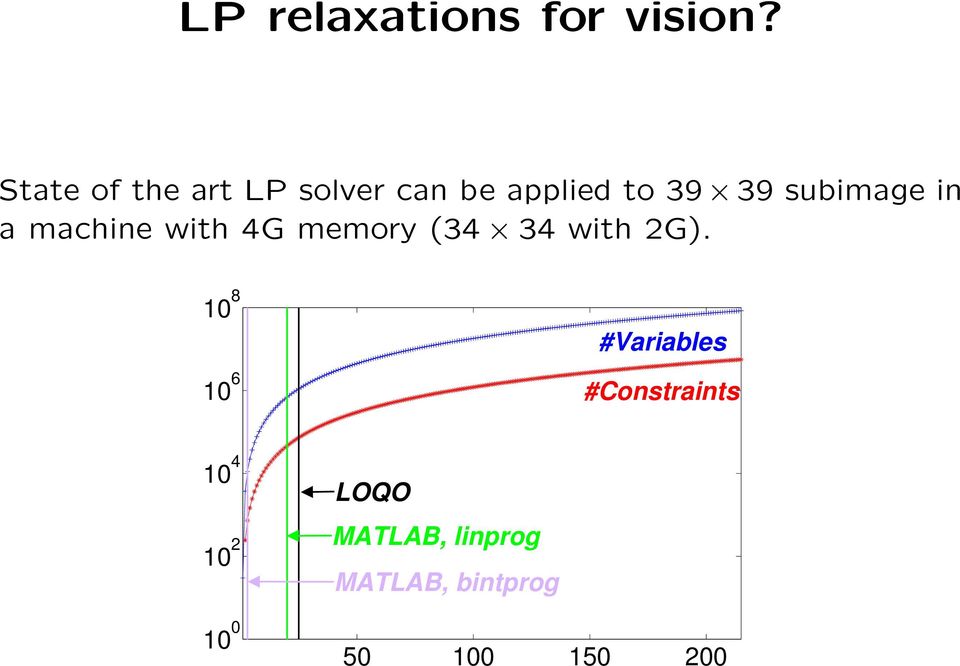
20 LP relaxations for vision? State of the art LP solver can be applied to subimage in a machine with 4G memory (34 34 with 2G) #Variables #Constraints LOQO MATLAB, linprog MATLAB, bintprog
21 LP using BP Surprisingly, belief propagation can be used to solve for the linear programming relaxation (Wainwright, Jaakkola and Willsky 3; Weiss, Meltzer and Yanover 5)
22 Belief Propagation: A parallel message-passing algorithm. Every node sends a probability density to its neighbors.
23 From energy function to potentials Ψ ij (x i, x j ) = exp( 1 T E ij(x i, x j )) Ψ i (x i ) = exp( 1 T E i(x i )) Iterate: m ij (x j ) α Ψ ij (x i, x j )Ψ i (x i ) m ki (x i ) x i X k N(X i )\X j From the messages we calclate b i (x i ), b ij (x i, x j ).
24 BP and LP Fixed points of BP correspond to stationary points of the Bethe- Kikuchi free energy (Yedidia, Freeman, Weiss 1, Kabashima Saad 98). F β = i,j +T x i,x j b ij (x i, x j )E ij (x i, x j ) + i i,j x i,x j b ij (x i, x j )ln b ij (x i, x j ) i x i b i (x i )E i (x i ) (d i 1) x i b i (x i )ln b i (x i )
25 BP and LP minimize: F β = i,j +T x i,x j b ij (x i, x j )E ij (x i, x j ) + i i,j x i,x j b ij (x i, x j )ln b ij (x i, x j ) i x i b i (x i )E i (x i ) (d i 1) x i b i (x i )ln b i (x i ) subject to: b ij (x i, x j ) [,1] b ij (x i, x j ) = 1 x i,x j b ij (x i, x j ) = b j (x j ) x i
26 Visualizing BP and LP F β = i,j +T x i,x j b ij (x i, x j )E ij (x i, x j ) + i i,j x i,x j b ij (x i, x j )ln b ij (x i, x j ) i x i b i (x i )E i (x i ) (d i 1) x i b i (x i )ln b i (x i ) b ij (x i, x j ) = ( a b b 1 (a + 2b) )
27 Visualizing BP and LP.5 T=
28 Visualizing BP and LP.5 T=
29 Visualizing BP and LP.5 T=
30 Visualizing BP and LP.5 T=
31 Visualizing BP and LP.5 T=
32 Visualizing BP and LP.5 T=
33 Visualizing BP and LP.5 T=
34 Visualizing BP and LP.5 T=
35 Visualizing BP and LP.5 T=
36 Solving LP by running BP at zero temperature Ψ ij (x i, x j ) = exp( 1 T E ij(x i, x j )) Ψ i (x i ) = exp( 1 T E i(x i )) Iterate: m ij (x j ) αmax x i Ψ ij (x i, x j )Ψ i (x i ) m ki (x i ) X k N(X i )\X j Claim: If sharpened max-product beliefs are feasible they give zero-temperature sum-product beliefs.
37 Visualizing BP and LP.5 T=
38 Visualizing BP and LP.5 T=
39 Visualizing BP and LP.5 T=
40 Visualizing BP and LP.5 T=
41 Visualizing BP and LP.5 T=
42 Visualizing BP and LP.5 T=
43 Visualizing BP and LP.5 T=
44 Visualizing BP and LP.5 T=
45 Is F β convex? F β = i,j +T x i,x j b ij (x i, x j )E ij (x i, x j ) + i i,j x i,x j b ij (x i, x j )ln b ij (x i, x j ) i x i b i (x i )E i (x i ) (d i 1) x i b i (x i )ln b i (x i ) The entropy is always bounded but convexity depends on graph topology (through degree d i ) (Pakzad and Ananthram 3, Heskes 3).
46 Convexifying F F β = i,j +T x i,x j b ij (x i, x j )E ij (x i, x j ) + i i,j x i,x j b ij (x i, x j )ln b ij (x i, x j ) x i b i (x i )E i (x i ) (several convexification possible)
47 Visualizing BP and LP.5 T=
48 Visualizing BP and LP.5 T=
49 Visualizing BP and LP.5 T=
50 Visualizing BP and LP.5 T=
51 Visualizing BP and LP.5 T=
52 Visualizing BP and LP.5 T=
53 Visualizing BP and LP.5 T=
54 Visualizing BP and LP.5 T=
55 Minimizing Convexified F β n ji (x i) = X k N(X i )\X j m ki (x i ) m ij (x j) = α x i Ψ ij (x i, x j )Ψ i (x i )n ji (x i ) m ij (x j ) n ij (x j ) ( m ij (x j) ) γ j ( n ij (x j ) ) γ j 1 ( m ij (x j) ) γ j 1 ( n ij (x j) ) γ j γ j = 1 2 1/d j. two way GBP (Yedidia, Freeman, Weiss 2)
56 Minimizing Convexified F β at zero temperature n ji (x i) = m ij (x j) X k N(X i )\X j m ki (x i ) αmax x i Ψ ij (x i, x j )Ψ i (x i )n ji (x i ) m ij (x j ) = ( m ij (x j) ) γ j ( n ij (x j ) ) γ j 1 n ij (x j ) ( m ij (x j) ) γ j 1 ( n ij (x j) ) γ j A new LP solver?
57 Comparisons Compare run-times of: Generic BP code. CPLEX 9.. solver. Perhaps the most powerful commercial LP
58 Comparisons - stereo #Variables 1 5 #Constraints Tomlab Grid size BP can solve full sized images.
59 Comparisons - protein folding
60 side-chain prediction Variables Constraints Non zeros x x x Protein length [aa] Protein length [aa] Protein length [aa] Variables Constraints Non zeros design x Protein length [aa] x Protein length [aa] x Protein length [aa]
61 Run times - stereo BP TRBP PRIMAL BP TRBP DUAL BP TRBP NET time [min.] time [min.] time [min.] non zeros non zeros non zeros time [min.] BP TRBP BARRIER time [min.] BP TRBP SIFTING time [min.] BP TRBP CONCURRENT non zeros non zeros non zeros
62 Run times - side chain prediction
63 scwrl time [min.] BP TRBP PRIMAL time [min.] BP TRBP DUAL time [min.] BP TRBP NET non zeros x non zeros x non zeros x 1 5 time [min.] BP TRBP BARRIER time [min.] BP TRBP SIFTING time [min.] BP TRBP CONCURRENT non zeros x non zeros x non zeros x 1 5 rosetta time [min.] 1 5 BP TRBP PRIMAL time [min.] BP TRBP DUAL time [min.] BP TRBP NET non zeros x non zeros x non zeros x BP TRBP BARRIER 2 BP TRBP SIFTING 1 BP TRBP CONCURRENT time [min.] 4 2 time [min.] time [min.] non zeros x non zeros x non zeros x 1 5
64 Comparisons - protein design 25 BP TRBP BARRIER time [min.] non zeros x 1 7
65 Discussion BP almost always faster than all solvers in CPLEX. BP can be applied when CPLEX cannot. BP is not a general purpose LP solver.
66 Global Optimum? When LP/BP solution integer. Even when BP solution is partly fractional (Meltzer et al. 5) In about 9% of benchmark problems, we can find global optimum in about 1 minutes.
67 Does global optimum improve performance? Using global optimizers: Stereo vision - unsatisfactory results. Side chain prediction - approx ɛ% Protein design - good structure often in top 1. Better energy functions are needed!
68 Conclusions Energy minimization in computer vision and computional biology. Typically NP hard. Standard LP solvers cannot handle LPs arising from our applications. Convex BP gives a simple, efficient algorithm for solving LP relaxations. Globally optimal solutions can be obtained in minutes.
Finding the M Most Probable Configurations Using Loopy Belief Propagation
 Finding the M Most Probable Configurations Using Loopy Belief Propagation Chen Yanover and Yair Weiss School of Computer Science and Engineering The Hebrew University of Jerusalem 91904 Jerusalem, Israel
MAP-Inference for Highly-Connected Graphs with DC-Programming
 MAP-Inference for Highly-Connected Graphs with DC-Programming Jörg Kappes and Christoph Schnörr Image and Pattern Analysis Group, Heidelberg Collaboratory for Image Processing, University of Heidelberg,
Approximating the Partition Function by Deleting and then Correcting for Model Edges
 Approximating the Partition Function by Deleting and then Correcting for Model Edges Arthur Choi and Adnan Darwiche Computer Science Department University of California, Los Angeles Los Angeles, CA 995
Proximal mapping via network optimization
 L. Vandenberghe EE236C (Spring 23-4) Proximal mapping via network optimization minimum cut and maximum flow problems parametric minimum cut problem application to proximal mapping Introduction this lecture:
Dantzig-Wolfe bound and Dantzig-Wolfe cookbook
 Dantzig-Wolfe bound and Dantzig-Wolfe cookbook [email protected] DTU-Management Technical University of Denmark 1 Outline LP strength of the Dantzig-Wolfe The exercise from last week... The Dantzig-Wolfe
! Solve problem to optimality. ! Solve problem in poly-time. ! Solve arbitrary instances of the problem. #-approximation algorithm.
 Approximation Algorithms 11 Approximation Algorithms Q Suppose I need to solve an NP-hard problem What should I do? A Theory says you're unlikely to find a poly-time algorithm Must sacrifice one of three
Algorithm Design and Analysis
 Algorithm Design and Analysis LECTURE 27 Approximation Algorithms Load Balancing Weighted Vertex Cover Reminder: Fill out SRTEs online Don t forget to click submit Sofya Raskhodnikova 12/6/2011 S. Raskhodnikova;
! Solve problem to optimality. ! Solve problem in poly-time. ! Solve arbitrary instances of the problem. !-approximation algorithm.
 Approximation Algorithms Chapter Approximation Algorithms Q Suppose I need to solve an NP-hard problem What should I do? A Theory says you're unlikely to find a poly-time algorithm Must sacrifice one of
Chapter 11. 11.1 Load Balancing. Approximation Algorithms. Load Balancing. Load Balancing on 2 Machines. Load Balancing: Greedy Scheduling
 Approximation Algorithms Chapter Approximation Algorithms Q. Suppose I need to solve an NP-hard problem. What should I do? A. Theory says you're unlikely to find a poly-time algorithm. Must sacrifice one
An Overview Of Software For Convex Optimization. Brian Borchers Department of Mathematics New Mexico Tech Socorro, NM 87801 borchers@nmt.
 An Overview Of Software For Convex Optimization Brian Borchers Department of Mathematics New Mexico Tech Socorro, NM 87801 [email protected] In fact, the great watershed in optimization isn t between linearity
Lecture 3. Linear Programming. 3B1B Optimization Michaelmas 2015 A. Zisserman. Extreme solutions. Simplex method. Interior point method
 Lecture 3 3B1B Optimization Michaelmas 2015 A. Zisserman Linear Programming Extreme solutions Simplex method Interior point method Integer programming and relaxation The Optimization Tree Linear Programming
Recovery of primal solutions from dual subgradient methods for mixed binary linear programming; a branch-and-bound approach
 MASTER S THESIS Recovery of primal solutions from dual subgradient methods for mixed binary linear programming; a branch-and-bound approach PAULINE ALDENVIK MIRJAM SCHIERSCHER Department of Mathematical
Chapter 13: Binary and Mixed-Integer Programming
 Chapter 3: Binary and Mixed-Integer Programming The general branch and bound approach described in the previous chapter can be customized for special situations. This chapter addresses two special situations:
Discrete Optimization
 Discrete Optimization [Chen, Batson, Dang: Applied integer Programming] Chapter 3 and 4.1-4.3 by Johan Högdahl and Victoria Svedberg Seminar 2, 2015-03-31 Todays presentation Chapter 3 Transforms using
11. APPROXIMATION ALGORITHMS
 11. APPROXIMATION ALGORITHMS load balancing center selection pricing method: vertex cover LP rounding: vertex cover generalized load balancing knapsack problem Lecture slides by Kevin Wayne Copyright 2005
Efficient and Robust Allocation Algorithms in Clouds under Memory Constraints
 Efficient and Robust Allocation Algorithms in Clouds under Memory Constraints Olivier Beaumont,, Paul Renaud-Goud Inria & University of Bordeaux Bordeaux, France 9th Scheduling for Large Scale Systems
5 INTEGER LINEAR PROGRAMMING (ILP) E. Amaldi Fondamenti di R.O. Politecnico di Milano 1
 5 INTEGER LINEAR PROGRAMMING (ILP) E. Amaldi Fondamenti di R.O. Politecnico di Milano 1 General Integer Linear Program: (ILP) min c T x Ax b x 0 integer Assumption: A, b integer The integrality condition
Cloud Branching. Timo Berthold. joint work with Domenico Salvagnin (Università degli Studi di Padova)
 Cloud Branching Timo Berthold Zuse Institute Berlin joint work with Domenico Salvagnin (Università degli Studi di Padova) DFG Research Center MATHEON Mathematics for key technologies 21/May/13, CPAIOR
Optimization Modeling for Mining Engineers
 Optimization Modeling for Mining Engineers Alexandra M. Newman Division of Economics and Business Slide 1 Colorado School of Mines Seminar Outline Linear Programming Integer Linear Programming Slide 2
Yousef Saad University of Minnesota Computer Science and Engineering. CRM Montreal - April 30, 2008
 A tutorial on: Iterative methods for Sparse Matrix Problems Yousef Saad University of Minnesota Computer Science and Engineering CRM Montreal - April 30, 2008 Outline Part 1 Sparse matrices and sparsity
Message-passing for graph-structured linear programs: Proximal methods and rounding schemes
 Message-passing for graph-structured linear programs: Proximal methods and rounding schemes Pradeep Ravikumar [email protected] Martin J. Wainwright, [email protected] Alekh Agarwal [email protected]
Equilibrium computation: Part 1
 Equilibrium computation: Part 1 Nicola Gatti 1 Troels Bjerre Sorensen 2 1 Politecnico di Milano, Italy 2 Duke University, USA Nicola Gatti and Troels Bjerre Sørensen ( Politecnico di Milano, Italy, Equilibrium
Online Learning and Competitive Analysis: a Unified Approach
 Online Learning and Competitive Analysis: a Unified Approach Shahar Chen Online Learning and Competitive Analysis: a Unified Approach Research Thesis Submitted in partial fulfillment of the requirements
Big Data Optimization at SAS
 Big Data Optimization at SAS Imre Pólik et al. SAS Institute Cary, NC, USA Edinburgh, 2013 Outline 1 Optimization at SAS 2 Big Data Optimization at SAS The SAS HPA architecture Support vector machines
Max Flow. Lecture 4. Optimization on graphs. C25 Optimization Hilary 2013 A. Zisserman. Max-flow & min-cut. The augmented path algorithm
 Lecture 4 C5 Optimization Hilary 03 A. Zisserman Optimization on graphs Max-flow & min-cut The augmented path algorithm Optimization for binary image graphs Applications Max Flow Given: a weighted directed
Supporting Differentiated QoS in MPLS Networks
 Supporting Differentiated QoS in MPLS Networks Roberto A. Dias 1, Eduardo Camponogara 2, and Jean-Marie Farines 2 1 Federal Technology Center of Santa Catarina, Florianópolis, 88020-300, Brazil 2 Federal
Dynamic Programming and Graph Algorithms in Computer Vision
 Dynamic Programming and Graph Algorithms in Computer Vision Pedro F. Felzenszwalb and Ramin Zabih Abstract Optimization is a powerful paradigm for expressing and solving problems in a wide range of areas,
BIG DATA PROBLEMS AND LARGE-SCALE OPTIMIZATION: A DISTRIBUTED ALGORITHM FOR MATRIX FACTORIZATION
 BIG DATA PROBLEMS AND LARGE-SCALE OPTIMIZATION: A DISTRIBUTED ALGORITHM FOR MATRIX FACTORIZATION Ş. İlker Birbil Sabancı University Ali Taylan Cemgil 1, Hazal Koptagel 1, Figen Öztoprak 2, Umut Şimşekli
Doctor of Philosophy in Computer Science
 Doctor of Philosophy in Computer Science Background/Rationale The program aims to develop computer scientists who are armed with methods, tools and techniques from both theoretical and systems aspects
Branch and Cut for TSP
 Branch and Cut for TSP jla,[email protected] Informatics and Mathematical Modelling Technical University of Denmark 1 Branch-and-Cut for TSP Branch-and-Cut is a general technique applicable e.g. to solve symmetric
Adaptive Linear Programming Decoding
 Adaptive Linear Programming Decoding Mohammad H. Taghavi and Paul H. Siegel ECE Department, University of California, San Diego Email: (mtaghavi, psiegel)@ucsd.edu ISIT 2006, Seattle, USA, July 9 14, 2006
Network Optimization using AIMMS in the Analytics & Visualization Era
 Network Optimization using AIMMS in the Analytics & Visualization Era Dr. Ovidiu Listes Senior Consultant AIMMS Analytics and Optimization Outline Analytics, Optimization, Networks AIMMS: The Modeling
Scheduling Home Health Care with Separating Benders Cuts in Decision Diagrams
 Scheduling Home Health Care with Separating Benders Cuts in Decision Diagrams André Ciré University of Toronto John Hooker Carnegie Mellon University INFORMS 2014 Home Health Care Home health care delivery
Semi-Supervised Support Vector Machines and Application to Spam Filtering
 Semi-Supervised Support Vector Machines and Application to Spam Filtering Alexander Zien Empirical Inference Department, Bernhard Schölkopf Max Planck Institute for Biological Cybernetics ECML 2006 Discovery
Branch-and-Price Approach to the Vehicle Routing Problem with Time Windows
 TECHNISCHE UNIVERSITEIT EINDHOVEN Branch-and-Price Approach to the Vehicle Routing Problem with Time Windows Lloyd A. Fasting May 2014 Supervisors: dr. M. Firat dr.ir. M.A.A. Boon J. van Twist MSc. Contents
Locating and sizing bank-branches by opening, closing or maintaining facilities
 Locating and sizing bank-branches by opening, closing or maintaining facilities Marta S. Rodrigues Monteiro 1,2 and Dalila B. M. M. Fontes 2 1 DMCT - Universidade do Minho Campus de Azurém, 4800 Guimarães,
Applied Algorithm Design Lecture 5
 Applied Algorithm Design Lecture 5 Pietro Michiardi Eurecom Pietro Michiardi (Eurecom) Applied Algorithm Design Lecture 5 1 / 86 Approximation Algorithms Pietro Michiardi (Eurecom) Applied Algorithm Design
9th Max-Planck Advanced Course on the Foundations of Computer Science (ADFOCS) Primal-Dual Algorithms for Online Optimization: Lecture 1
 9th Max-Planck Advanced Course on the Foundations of Computer Science (ADFOCS) Primal-Dual Algorithms for Online Optimization: Lecture 1 Seffi Naor Computer Science Dept. Technion Haifa, Israel Introduction
CHAPTER 9. Integer Programming
 CHAPTER 9 Integer Programming An integer linear program (ILP) is, by definition, a linear program with the additional constraint that all variables take integer values: (9.1) max c T x s t Ax b and x integral
Approximation Algorithms
 Approximation Algorithms or: How I Learned to Stop Worrying and Deal with NP-Completeness Ong Jit Sheng, Jonathan (A0073924B) March, 2012 Overview Key Results (I) General techniques: Greedy algorithms
17.3.1 Follow the Perturbed Leader
 CS787: Advanced Algorithms Topic: Online Learning Presenters: David He, Chris Hopman 17.3.1 Follow the Perturbed Leader 17.3.1.1 Prediction Problem Recall the prediction problem that we discussed in class.
Distributed Structured Prediction for Big Data
 Distributed Structured Prediction for Big Data A. G. Schwing ETH Zurich [email protected] T. Hazan TTI Chicago M. Pollefeys ETH Zurich R. Urtasun TTI Chicago Abstract The biggest limitations of learning
Integrating Benders decomposition within Constraint Programming
 Integrating Benders decomposition within Constraint Programming Hadrien Cambazard, Narendra Jussien email: {hcambaza,jussien}@emn.fr École des Mines de Nantes, LINA CNRS FRE 2729 4 rue Alfred Kastler BP
Minimizing costs for transport buyers using integer programming and column generation. Eser Esirgen
 MASTER STHESIS Minimizing costs for transport buyers using integer programming and column generation Eser Esirgen DepartmentofMathematicalSciences CHALMERS UNIVERSITY OF TECHNOLOGY UNIVERSITY OF GOTHENBURG
Iterative Solvers for Linear Systems
 9th SimLab Course on Parallel Numerical Simulation, 4.10 8.10.2010 Iterative Solvers for Linear Systems Bernhard Gatzhammer Chair of Scientific Computing in Computer Science Technische Universität München
Optimal Scheduling for Dependent Details Processing Using MS Excel Solver
 BULGARIAN ACADEMY OF SCIENCES CYBERNETICS AND INFORMATION TECHNOLOGIES Volume 8, No 2 Sofia 2008 Optimal Scheduling for Dependent Details Processing Using MS Excel Solver Daniela Borissova Institute of
5.1 Bipartite Matching
 CS787: Advanced Algorithms Lecture 5: Applications of Network Flow In the last lecture, we looked at the problem of finding the maximum flow in a graph, and how it can be efficiently solved using the Ford-Fulkerson
Mathematical finance and linear programming (optimization)
 Mathematical finance and linear programming (optimization) Geir Dahl September 15, 2009 1 Introduction The purpose of this short note is to explain how linear programming (LP) (=linear optimization) may
RELAXATION HEURISTICS FOR THE SET COVERING PROBLEM
 Journal of the Operations Research Society of Japan 2007, Vol. 50, No. 4, 350-375 RELAXATION HEURISTICS FOR THE SET COVERING PROBLEM Shunji Umetani University of Electro-Communications Mutsunori Yagiura
Sanjeev Kumar. contribute
 RESEARCH ISSUES IN DATAA MINING Sanjeev Kumar I.A.S.R.I., Library Avenue, Pusa, New Delhi-110012 [email protected] 1. Introduction The field of data mining and knowledgee discovery is emerging as a
The Problem of Scheduling Technicians and Interventions in a Telecommunications Company
 The Problem of Scheduling Technicians and Interventions in a Telecommunications Company Sérgio Garcia Panzo Dongala November 2008 Abstract In 2007 the challenge organized by the French Society of Operational
Resource Optimization of Spatial TDMA in Ad Hoc Radio Networks: A Column Generation Approach
 Resource Optimization of Spatial TDMA in Ad Hoc Radio Networks: A Column Generation Approach Patrik Björklund, Peter Värbrand and Di Yuan Department of Science and Technology, Linköping University SE-601
On the effect of forwarding table size on SDN network utilization
 IBM Haifa Research Lab On the effect of forwarding table size on SDN network utilization Rami Cohen IBM Haifa Research Lab Liane Lewin Eytan Yahoo Research, Haifa Seffi Naor CS Technion, Israel Danny Raz
SBB: A New Solver for Mixed Integer Nonlinear Programming
 SBB: A New Solver for Mixed Integer Nonlinear Programming Michael R. Bussieck GAMS Development Corp. Arne S. Drud ARKI Consulting & Development A/S OR2001, Duisburg Overview! SBB = Simple Branch & Bound!
Duality in General Programs. Ryan Tibshirani Convex Optimization 10-725/36-725
 Duality in General Programs Ryan Tibshirani Convex Optimization 10-725/36-725 1 Last time: duality in linear programs Given c R n, A R m n, b R m, G R r n, h R r : min x R n c T x max u R m, v R r b T
A Network Flow Approach in Cloud Computing
 1 A Network Flow Approach in Cloud Computing Soheil Feizi, Amy Zhang, Muriel Médard RLE at MIT Abstract In this paper, by using network flow principles, we propose algorithms to address various challenges
Linear Programming. March 14, 2014
 Linear Programming March 1, 01 Parts of this introduction to linear programming were adapted from Chapter 9 of Introduction to Algorithms, Second Edition, by Cormen, Leiserson, Rivest and Stein [1]. 1
Linear Programming for Optimization. Mark A. Schulze, Ph.D. Perceptive Scientific Instruments, Inc.
 1. Introduction Linear Programming for Optimization Mark A. Schulze, Ph.D. Perceptive Scientific Instruments, Inc. 1.1 Definition Linear programming is the name of a branch of applied mathematics that
Introduction to Support Vector Machines. Colin Campbell, Bristol University
 Introduction to Support Vector Machines Colin Campbell, Bristol University 1 Outline of talk. Part 1. An Introduction to SVMs 1.1. SVMs for binary classification. 1.2. Soft margins and multi-class classification.
A Constraint Programming based Column Generation Approach to Nurse Rostering Problems
 Abstract A Constraint Programming based Column Generation Approach to Nurse Rostering Problems Fang He and Rong Qu The Automated Scheduling, Optimisation and Planning (ASAP) Group School of Computer Science,
Nonlinear Optimization: Algorithms 3: Interior-point methods
 Nonlinear Optimization: Algorithms 3: Interior-point methods INSEAD, Spring 2006 Jean-Philippe Vert Ecole des Mines de Paris [email protected] Nonlinear optimization c 2006 Jean-Philippe Vert,
A Service Design Problem for a Railway Network
 A Service Design Problem for a Railway Network Alberto Caprara Enrico Malaguti Paolo Toth Dipartimento di Elettronica, Informatica e Sistemistica, University of Bologna Viale Risorgimento, 2-40136 - Bologna
Message-passing sequential detection of multiple change points in networks
 Message-passing sequential detection of multiple change points in networks Long Nguyen, Arash Amini Ram Rajagopal University of Michigan Stanford University ISIT, Boston, July 2012 Nguyen/Amini/Rajagopal
Protein Protein Interaction Networks
 Functional Pattern Mining from Genome Scale Protein Protein Interaction Networks Young-Rae Cho, Ph.D. Assistant Professor Department of Computer Science Baylor University it My Definition of Bioinformatics
ONLINE DEGREE-BOUNDED STEINER NETWORK DESIGN. Sina Dehghani Saeed Seddighin Ali Shafahi Fall 2015
 ONLINE DEGREE-BOUNDED STEINER NETWORK DESIGN Sina Dehghani Saeed Seddighin Ali Shafahi Fall 2015 ONLINE STEINER FOREST PROBLEM An initially given graph G. s 1 s 2 A sequence of demands (s i, t i ) arriving
IEOR 4404 Homework #2 Intro OR: Deterministic Models February 14, 2011 Prof. Jay Sethuraman Page 1 of 5. Homework #2
 IEOR 4404 Homework # Intro OR: Deterministic Models February 14, 011 Prof. Jay Sethuraman Page 1 of 5 Homework #.1 (a) What is the optimal solution of this problem? Let us consider that x 1, x and x 3
Multi-layer MPLS Network Design: the Impact of Statistical Multiplexing
 Multi-layer MPLS Network Design: the Impact of Statistical Multiplexing Pietro Belotti, Antonio Capone, Giuliana Carello, Federico Malucelli Tepper School of Business, Carnegie Mellon University, Pittsburgh
IBM ILOG CPLEX for Microsoft Excel User's Manual
 IBM ILOG CPLEX V12.1 IBM ILOG CPLEX for Microsoft Excel User's Manual Copyright International Business Machines Corporation 1987, 2009 US Government Users Restricted Rights - Use, duplication or disclosure
Online Adwords Allocation
 Online Adwords Allocation Shoshana Neuburger May 6, 2009 1 Overview Many search engines auction the advertising space alongside search results. When Google interviewed Amin Saberi in 2004, their advertisement
How To Cluster Of Complex Systems
 Entropy based Graph Clustering: Application to Biological and Social Networks Edward C Kenley Young-Rae Cho Department of Computer Science Baylor University Complex Systems Definition Dynamically evolving
TOMLAB - For fast and robust largescale optimization in MATLAB
 The TOMLAB Optimization Environment is a powerful optimization and modeling package for solving applied optimization problems in MATLAB. TOMLAB provides a wide range of features, tools and services for
A New Method for Estimating Maximum Power Transfer and Voltage Stability Margins to Mitigate the Risk of Voltage Collapse
 A New Method for Estimating Maximum Power Transfer and Voltage Stability Margins to Mitigate the Risk of Voltage Collapse Bernie Lesieutre Dan Molzahn University of Wisconsin-Madison PSERC Webinar, October
Beyond the Stars: Revisiting Virtual Cluster Embeddings
 Beyond the Stars: Revisiting Virtual Cluster Embeddings Matthias Rost Technische Universität Berlin September 7th, 2015, Télécom-ParisTech Joint work with Carlo Fuerst, Stefan Schmid Published in ACM SIGCOMM
LECTURE 4. Last time: Lecture outline
 LECTURE 4 Last time: Types of convergence Weak Law of Large Numbers Strong Law of Large Numbers Asymptotic Equipartition Property Lecture outline Stochastic processes Markov chains Entropy rate Random
SIGMOD RWE Review Towards Proximity Pattern Mining in Large Graphs
 SIGMOD RWE Review Towards Proximity Pattern Mining in Large Graphs Fabian Hueske, TU Berlin June 26, 21 1 Review This document is a review report on the paper Towards Proximity Pattern Mining in Large
Improving Market Clearing Software Performance to Meet Existing and Future Challenges MISO s Perspective
 Improving Market Clearing Software Performance to Meet Existing and Future Challenges MISO s Perspective FERC Technical Conference on Increasing Real-Time and Day-Ahead Market Efficiency through Improved
Number of hours in the semester L Ex. Lab. Projects SEMESTER I 1. Economy 45 18 27. 2. Philosophy 18 18. 4. Mathematical Analysis 45 18 27 Exam
 Year 1 Lp. Course name Number of hours in the semester L Ex. Lab. Projects SEMESTER I 1. Economy 45 18 7. Philosophy 18 18 3. Linear Algebra 45 18 7 Exam 4. Mathematical Analysis 45 18 7 Exam 5. Economical
The Multiplicative Weights Update method
 Chapter 2 The Multiplicative Weights Update method The Multiplicative Weights method is a simple idea which has been repeatedly discovered in fields as diverse as Machine Learning, Optimization, and Game
4.6 Linear Programming duality
 4.6 Linear Programming duality To any minimization (maximization) LP we can associate a closely related maximization (minimization) LP. Different spaces and objective functions but in general same optimal
Optimization Theory for Large Systems
 Optimization Theory for Large Systems LEON S. LASDON CASE WESTERN RESERVE UNIVERSITY THE MACMILLAN COMPANY COLLIER-MACMILLAN LIMITED, LONDON Contents 1. Linear and Nonlinear Programming 1 1.1 Unconstrained
Integrated Backup Topology Control and Routing of Obscured Traffic in Hybrid RF/FSO Networks*
 Integrated Backup Topology Control and Routing of Obscured Traffic in Hybrid RF/FSO Networks* Abhishek Kashyap, Anuj Rawat and Mark Shayman Department of Electrical and Computer Engineering, University
Towards running complex models on big data
 Towards running complex models on big data Working with all the genomes in the world without changing the model (too much) Daniel Lawson Heilbronn Institute, University of Bristol 2013 1 / 17 Motivation
Tutorial: Operations Research in Constraint Programming
 Tutorial: Operations Research in Constraint Programming John Hooker Carnegie Mellon University May 2009 Revised June 2009 May 2009 Slide 1 Motivation Benders decomposition allows us to apply CP and OR
Sensitivity Report in Excel
 The Answer Report contains the original guess for the solution and the final value of the solution as well as the objective function values for the original guess and final value. The report also indicates
Industrial Optimization
 Industrial Optimization Lessons learned from Optimization in Practice Marco Lübbecke Chair of Operations Research RWTH Aachen University, Germany SICS Stockholm Feb 11, 2013 Discrete Optimization: Some
A MODEL TO SOLVE EN ROUTE AIR TRAFFIC FLOW MANAGEMENT PROBLEM:
 A MODEL TO SOLVE EN ROUTE AIR TRAFFIC FLOW MANAGEMENT PROBLEM: A TEMPORAL AND SPATIAL CASE V. Tosic, O. Babic, M. Cangalovic and Dj. Hohlacov Faculty of Transport and Traffic Engineering, University of
Linear Programming. Widget Factory Example. Linear Programming: Standard Form. Widget Factory Example: Continued.
 Linear Programming Widget Factory Example Learning Goals. Introduce Linear Programming Problems. Widget Example, Graphical Solution. Basic Theory:, Vertices, Existence of Solutions. Equivalent formulations.
npsolver A SAT Based Solver for Optimization Problems
 npsolver A SAT Based Solver for Optimization Problems Norbert Manthey and Peter Steinke Knowledge Representation and Reasoning Group Technische Universität Dresden, 01062 Dresden, Germany [email protected]
A Column Generation Model for Truck Routing in the Chilean Forest Industry
 A Column Generation Model for Truck Routing in the Chilean Forest Industry Pablo A. Rey Escuela de Ingeniería Industrial, Facultad de Ingeniería, Universidad Diego Portales, Santiago, Chile, e-mail: [email protected]