
EMC Supplemental Information and Alternative Component Requirements
|
|
|
- Philippa Brooks
- 10 years ago
- Views:
Transcription
1 DaimlerChrysler DC Joint Engineering Standard Date Published: Chrysler Category: L-2 Total No. of Pages (Including Annex): 39 Mercedes-Benz Category: 22 Chrysler Author: Terry M. North ADRESS Change Level: - Dept: E/E Standards CoC/6960 Phone: Mercedes-Benz Author: Dr. Martin Aidam Dept: REI/EE Phone: EMC Supplemental Information and Alternative Component Requirements Foreword This joint engineering standard is intended to be a supplement to DC as an acceptance specification for the electromagnetic compatibility (EMC) requirements of electrical and electronic components and systems for DaimlerChrysler (DC) vehicles that reference this standard. This standard shall be used in combination with DC-11224, EMC Performance Requirements Component, DC , EMC Performance Requirements Vehicle and with DC-10615, Electrical System Performance Requirements for Electrical and Electronic Components. These requirements have been developed to assure compliance with present and anticipated domestic and foreign regulations and customer satisfaction regarding the EMC of vehicle E/E systems. Changes Initial issue. NOTE: The English version of this jointly developed engineering standard is the official document. The German version of this jointly developed engineering standard is the official translation of this document. The official German translation can be found on the DocMaster website. For all other translations, no guarantee can be made as to the accuracy of the technical information.

2 DC-11225, EMC Supplemental Information and Alternative Component Requirements, , Page 2 Contents 1 Scope Purpose of the Standard Use of this Standard References Terms and Definitions Regulated Substances and Recyclability...4 ANNEX A (normative) Pin Conducted RF Emissions (PCE)...5 A.1 General...5 A.2 Requirements...5 A.3 Test...6 A.4 Test Setup...7 ANNEX B (normative) Direct RF Power Injection (DRFI) Test...9 B.1 General...9 B.2 DRFI Test Requirements...9 B.3 Test Setup...11 ANNEX C (normative) Tube Coupler Method...13 C.1 General...13 C.2 Requirements...13 C.3 Test Setup...13 C.4 Tube Coupler...15 C.5 Calibration...15 ANNEX D (informative) EMC Testing and Termination Information for CAN and LIN Bus Systems...16 D.1 EMC Testing Information for Module / System with CAN Bus...16 D.2 Introduction to CAN Bus Loading...16 D.3 CAN-B...17 D.4 CAN-C...19 D.5 CAN-B Termination Requirements without Using Optical CAN Interface...21 D.6 CAN-C Termination Requirements without Using Optical CAN Interface...23 D.7 LIN Bus Termination Requirements...24 ANNEX E (informative) Additional Information...26 E.1 Relationship to Other Standards...26 E.2 Component Location in the Vehicle...26 E.3 Pin Conducted RF Emissions (PCE)...26 E.4 DRFI...26 E.5 RF Immunity of RF Link Systems...26 E.6 RF Emissions of RF Link Systems...27 ANNEX F (informative) Broadband Artificial Network (BAN) Design Requirements...28 ANNEX G (informative) ALSE Characterization and Verification...32 G.1 Initial Chamber Characterization...32 G.2 Routine Chamber Verification...32 ANNEX H (informative) TEM Cell Characterization and Verification...34 H.1 System Characterization...34 H.2 Test Signal Quality and Level Verification...34 H.3 Test signal quality verification...34 H.4 Test signal amplitude verification...34 H.5 Filtered Bulkhead Panel Design...34 H.6 Test Set-Up...36 ANNEX I (informative) Frequency Tables for Immunity Testing Using Percentage Steps...38

3 DC-11225, EMC Supplemental Information and Alternative Component Requirements, , Page 3 1 Scope This joint engineering standard supplements DC-11224, EMC Performance Requirements Components. It applies to components and / or subassemblies containing electrical or electronic components for DaimlerChrysler vehicles that specifically reference this standard in their product specification. 1.1 Purpose of the Standard The purpose of this joint engineering standard is to supplement DC It defines two alternative component tests as substitutes for tests defined in DC and one additional test that applies only for certain components and is not intended for regular use. Additionally this standard collects relevant material that was originally published as informative annexes in DC This material is intended to provide useful information about the test methods used or EMC testing in general, but is not normative to this standard. 1.2 Use of this Standard This standard shall be used together with DC All requirements of DC apply also to all electrical and electronic components that reference this standard except as otherwise agreed upon between supplier and the appropriate EMC platform team at DaimlerChrysler and specifically stated in the product specification. Refer to DC for details. 2 References ISO Road vehicles Component test methods for electrical disturbances from narrowband radiated electromagnetic energy Part 4: Bulk current injection (BCI) ISO Road vehicles, Electrical disturbances by narrowband radiated electromagnetic energy - Component test methods Part 7 - Direct RF Power Injection IEC Integrated Circuits, Measurement of Electromagnetic Emissions, 150 khz to 1 GHz SAE J1752 Electromagnetic Compatibility Measurement Procedures for Integrated Circuits DC-11223, EMC Performance Requirements Vehicle DC-11224, EMC Performance Requirements Components DS-150, Electronic Module Design Guidelines for Designers to Meet EMC Requirements DS-151, Electronic Module Design Guidelines for Engineers to Meet EMC Requirements LP-388C-65, E/E Systems Level Electrical and Electromagnetic Compatibility (EMC) Testing - General Information and requirements for DCTC, Supplier or Third Party EMC Laboratory 3 Terms and Definitions Refer to DC for additional definitions. Direct RF Power Injection. A conducted RF immunity test technique that involves isolating the DUT so that the RF coupling path is controlled. This test is also referred to as single line injection (SLI) or Direct Radio Frequency Injection (DRFI).

4 DC-11225, EMC Supplemental Information and Alternative Component Requirements, , Page 4 4 Regulated Substances and Recyclability All materials, procedures, processes, components, or systems must conform to the current regulatory (governmental) requirements regarding regulated substances and recyclability. End of Main Document # # # # #

5 DC-11225, EMC Supplemental Information and Alternative Component Requirements, , Page 5 A.1 General Annex A (normative) Pin Conducted RF Emissions (PCE) This test may be used as an alternative test method to the CISPR 25 conducted RF emissions voltage and current methods of DC-11224, if explicitly agreed upon between the supplier and the responsible DaimlerChrysler EMC engineering department and specifically referenced in the product specification. Detailed information on emission measurements and instrument settings is given in the Emissions section of DC-11224, which applies for this test as well. For details on test requirements, tolerances and test plans refer to Test Requirements and Functional Status Classification in DC Refer to Annex D for special adaptations for CAN and LIN bus testing. A.2 Requirements The measurement settings and limit values are defined in Tables A.1, A.2, and A.3.. Table A.1 contains the basic limits for the continuous frequency range. The required frequency bands from Table A.3 by marketing region are given in Table A.2 (on-board receiver bands). All bands from Table A.1 and those from Table A.3 called out in the DUT product specification shall be measured and the limits met. For CAN or similar data bus lines, emissions up to 85 dbμv, from 500 khz to 6.3 MHz and the NB values in Table A.3 from 6.3 MHz to 110/200 MHz, are allowed subject to verification that vehicle emission level requirements are met. Also, there shall be no interference with the vehicle receiver attributed to CAN or other data bus emissions at this higher level. Test No. Frequency Range (MHz) Table A.1: Basic Limit Levels. PCE Method. Peak Quasi-Peak Average Level BW Level BW Level BW db (µv) khz db (µv) khz db (µv) khz CE V / CE V / Markets Table A.2: PCE Required Frequency Bands Required test bands for broadcast and mobile services test numbers from Table A.3 ECE All vehicles: 1, 2, 3, 13, 19 Opt. 1 (if TV available for car line): 16, 17, 18 Opt. 2 (fleet vehicles): 30, 31, 44, 46, 47, 48 Opt. 3 (heavy trucks): 4-8, 24 Opt. 4 (add. SW broadcast): 4-12 NA All vehicles: 2, 13, 25, 31 Opt. 1 (fleet vehicles): 43, 45 Opt. 2 (if weather band avail.): 14 JP 2, 13, 17, 18 RoW 2, 13, 31 (Rest of World)

6 DC-11225, EMC Supplemental Information and Alternative Component Requirements, , Page 6 Test No. Service or Band Table A.3: On-board Receiver Limits. PCE Method. Frequency (MHz) Peak Quasi-Peak Average Level BW Level BW Level BW db (µv) khz db (µv) khz db (µv) khz Broadcast 1 LW / MW / SW 49m / SW 41m / SW 31m / SW 25m / SW 21m / SW 19m / SW 17m / SW 16m / SW 14m / SW 12m / VHF / WB / TV I / TV II / TV III / DAB / Mobile Services 24 Communication / Communication / m / m / Fleet Mobile Services 43 Fleet (US) / Fleet (EU) / Fleet (US) / Fleet (EU) / Fleet (EU) / Fleet (EU) / A.3 Test The DUT shall be powered from a dc supply or storage battery. The voltage shall be within the acceptable range given in DC If a power supply is used, it shall have low conducted RF emissions that will not affect the test results. If a storage battery is used, its terminal voltage, under load,

7 DC-11225, EMC Supplemental Information and Alternative Component Requirements, , Page 7 must not be below 12.0 V dc (or 24.0 V or 36.0 V depending on system voltage). Preferably, the DUT shall be operated with the minimal input and output connections consistent with essentially normal oscillator frequency and logic activity. Necessary inputs and outputs shall be connected to their terminations through appropriate broadband artificial networks (BANs), except where special situations apply. An alternative is to use the full BAN isolated test setup from the DRFI test. For outputs that drive PWM or inductive loads, a representative load shall be connected to the line under test if the typically broadband RF output due to the switching activity is to be evaluated. This loaded characteristic is only to be evaluated if called out in the DUT PF or test plan. The measurement is limited by the dynamic range of the preamplifier. The measurement shall be made using a 500 to 1000 ohms nominal input impedance (10X to 20X) probe (50 ohms output impedance) connected through a blocking capacitor to a preamplifier (if used) and a spectrum analyzer or measuring receiver. A preamplifier may be used for NB measurements from 2 to 110/200 MHz, if needed for measurement to the specified levels. Do not use a preamplifier for BB measurements or below 2 MHz. If a preamplifier is used, assure that the preamplifier is not being overloaded by the DUT signal voltage by switching in 10 db of attenuation between the probe and the preamplifier and verifying that the signal voltage from the preamplifier to the analyzer is attenuated by 10 db at 2 MHz. A shielded room is required to provide an ambient level low enough for measurement to the levels specified. A.4 Test Setup - Measurements shall be made over the following frequency ranges: 150 khz to 2 MHz and 2 MHz to 110/200 MHz - The maximum allowable length of the wiring from the DUT to point 3 on the BAN shall be 150 mm. For the Pin Conducted Emissions Test setup, refer to Figure A.1. Measuring Equipment Preamplifier 1 DC Block 4 2 BAN 3 Probe Ground 1 DUT Support & Loads 2 2 BAN 1 BAN n DUT If local grounded Ground Plane Key: 1. Low capacitance BNC or similar RF connector 2. Connection to the DUT supply/load circuitry 3. Connection to the DUT 4. Ferrite Clamps at each end of cable Figure A.1: Pin Conducted Emissions Test Setup

8 DC-11225, EMC Supplemental Information and Alternative Component Requirements, , Page 8 End of Annex A # # # # #

9 DC-11225, EMC Supplemental Information and Alternative Component Requirements, , Page 9 B.1 General Annex B (normative) Direct RF Power Injection (DRFI) Test This test is described in ISO and may be used as an alternative test method to the BCI test method of DC-11224, if explicitly agreed upon between the supplier and the responsible DaimlerChrysler EMC engineering department and specifically referenced in the product specification. The DUT shall be subjected to direct RF power injection, line by line, on all input and output lines specified in the test plan, including unused connector pins. This test applies in the frequency range from 1 to 400 MHz. This test uses a 50 ohm, 10 db attenuator in the injection network and a broadband isolator (BAN - see Annex F) between each DUT line and its termination, except that low impedance (less than 50 ohms) dedicated sensor or load lines shall be injected at the DUT without using an isolator. As this is a pin by pin test, exercise care to minimize cross coupling from the line under test to adjacent lines. The 10 db attenuator limits the power at the DUT line under test to one tenth, or less, of the input power and minimizes the effect of reflections caused by the impedance discontinuity at the injection point. Balanced lines shall be injected with a common mode signal. Some lines may be considered balanced over part, but not all, of the frequency range. DUT with multiple grounds are subject to injection on one ground relative to another. If the DUT has a metal case with a local ground, the DUT shall be bonded to the ground plane. Otherwise, the DUT shall be placed on a 50 mm spacer over the ground plane. If the series inductance of the BAN inhibits data transfer on signal or bus lines, a reduced inductance (increased bandwidth) BAN is available for testing these lines with corresponding modifications to required test frequency ranges. Check in Annex F for details. The test levels in Tables B.1 and B.2 are given as power measured into a 50 ohm load at the output of the 10 db attenuator. B.2 DRFI Test Requirements For Group A, B and C evaluation, the test level is 200mW from 1 to 30 MHz, from 30 to 400 MHz the test levels are split into the basic test level of 100mW and the HIRF test level of 400 mw. For Group D evaluation, the test level is 400mW from 1 to 30 MHz, from 30 to 400 MHz the test levels are split into the basic test level of 200mW and the HIRF test level of 400 mw. The test levels and functional status requirements by frequency range and functional group are specified in Tables B.1 and B.2, the Test Levels are given in Figures B.1 and B.2. The immunity performance requirements are specified in Tables B.1 and B.2 and the Test Levels in Figures B.1 and B.2.

10 DC-11225, EMC Supplemental Information and Alternative Component Requirements, , Page 10 1W Systems including Group A/B/C Functions 800 mw 600 mw 400 mw 200 mw 0 mw 1 MHz 10 MHz 100 MHz 400 MHz 1W Figure B.1: Test Levels for DRFI Testing, Group A, B and C Systems including Group D Functions 800 mw 600 mw 400 mw 200 mw 0 mw 1 MHz 10 MHz 100 MHz 400 MHz Figure B.2: Test Levels for DRFI Testing, Systems including Group D functions The top level of Tables B.1 and B.2, shaded gray, is only evaluated if the DUT has a Group D function.

11 DC-11225, EMC Supplemental Information and Alternative Component Requirements, , Page 11 Table B.1: DRFI Immunity Performance Requirements, 1 to 30 MHz for Group A, B, C & D Test Level [mw] Group A Status Group B Status Group C Status Group D Status > 200 to 400 IV IV III II > 100 to 200 III III II > 50 to 100 II II > 25 to 50 I 25 I I I Table B.2: DRFI Immunity Performance Requirements, >30 to 400 MHz for Group A, B, C & D Test Level [mw] Group A Status Group B Status Group C Status Group D Status > 400 to 800 IV IV III II > 200 to 400 III III II > 100 to 200 II II > 50 to 100 I 50 I I I B.3 Test Setup The maximum allowable length of the wiring from the DUT to the BAN shall be 150 mm. Refer to ISO and Figure B.3 for test setup.

12 DC-11225, EMC Supplemental Information and Alternative Component Requirements, , Page If local ground n A Connection to the Ground Plane 7 12 Ground Plane Key: 1. RF signal generator 2. RF amplifier(s) (10 to 25 W, typical) 3. Spectrum analyzer or RF power meter 4. RF sampling device (sampling T connector or directional coupler), 50 ohm, 25 W rating, 30 db isolation 5. Attenuator (Pad) 50 ohm, 10 db, 10 W 6. DC blocking capacitor 7. Peripherals 8. BANs, one in series with each lead except RF reference ground 9. Device under test 10. RF power meter (for test stand reference level determination) 11. Coaxial transmission line (double shielded or equivalent) 12. Ground Plane 13. Programmable controller and data acquisition equipment 14. Instrumentation data bus Figure B.3: DRFI Immunity Test Setup End of Annex B # # # # #

13 DC-11225, EMC Supplemental Information and Alternative Component Requirements, , Page 13 C.1 General Annex C (normative) Tube Coupler Method The tube coupler method is appropriate to simulate RF coupling into the wiring harness at high frequencies and can be seen as an extension of BCI to higher frequencies. It is most appropriate for smaller or metal-shielded modules and less appropriate for larger modules with large PCBs like instrument clusters. This test applies for testing immunity to handheld transmitters operating in the bands GSM 900 and GSM 1800/1900 or for 1.2 and 2.7 GHz radar band testing of selected components. This test is required only if explicitly agreed to between the supplier and the responsible DaimlerChrysler EMC engineering department and specifically referenced in the product specification. C.2 Requirements The immunity requirements are based on environmental data and are adapted to the tube coupler test method through correlation with vehicle data. The immunity performance requirements are specified in Table C.1. Table C.1: Simulated Handheld Transmitter Immunity Performance Requirements Band (MHz) Test Level 1 [mw] Performance Status Group A Performance Status Groups B, C and D II I II I (with radar pulse) 2000 NA I (Group D only) NA I (Group D only) (with radar pulse) 1 Peak power level, note that the power meter in Figure C.2 will read the average value and for a 12% duty cycle rectangular pulse this will be approximately 12% of the peak value The power levels given in Table C.1 are the forward power levels into the tube coupler reduced by the insertion loss (L i ) of the tube coupler and measured in db using the procedure in C.5: or in a linear scale using a transfer factor: P test dbm = P P test forward = P dbm forward L i db S 21 C.3 Test Setup The test setup is essentially the same as for BCI testing (see DC-11224). However, a tube coupler is used instead of a BCI injection probe; refer to Figure C.1 for a schematic diagram of the test setup.

14 + DC-11225, EMC Supplemental Information and Alternative Component Requirements, , Page min min min min / ± 10 9 ± Key: 1 Device under test (connected to ground if specified in the test plan) 2 Wiring harness 3 Load simulator (placement and ground connection according to ISO ) 4 Stimulation and monitoring system 5 Power supply 6 AN or 50 ohm BAN 7 Optical fibers 8 High frequency equipment 9 Tube coupler (2 nd port loaded with 50 ohm) 10 The distance from the DUT to the tube coupler position 11 Ground plane (connected to the shielded room) 12 Insulating support 13 Shielded room This figure is adapted from ISO WD Figure C.1: Immunity Test Using the Tube Coupler Method - Test Setup A tube coupler appropriate for the frequency range being evaluated shall be used. The second input of the tube coupler shall be loaded with 50 ohms.

15 DC-11225, EMC Supplemental Information and Alternative Component Requirements, , Page 15 Use substitution method with forward power. The ground plane shall extend beyond the test setup by at least 100 mm on all sides. The distance between the test setup and all other conductive structures (such as the walls of the shielded enclosure) with the exception of the ground plane shall be no less than 500 mm. Where part of the system to be tested is normally connected electrically with the vehicle body, this part shall be placed directly on the ground plane and connected to it. The test harness shall be 1700 (+ 300, 0) mm long and routed 50 mm above the ground plane (this harness can also be used for CISPR 25 radiated emission testing). The tube coupler shall be located on the test harness 100 mm from the DUT. Where the harness has a number of branches, the test shall be repeated, so that the tube coupler shall be attached around each branch in turn. The power supply and peripheral equipment shall be filtered and shielded or located outside the shielded enclosure except for non-susceptible peripherals (such as mechanical switches). Wherever possible, production intent vehicle switching devices and sensors shall be used. C.4 Tube Coupler A tube coupler is a coaxial system having two input ports that can be clamped around the wiring harness similar to a current probe. It consists of two tubes having the same axis. They form an outer coaxial system having 50 ohms impedance, and the inner tube together with the wiring harness forms an inner coaxial system. Both systems are coupled at the ends of the tubes. C.5 Calibration Calibration is done in a method similar to ISO deviating in that the calibration jig shall be designed to form a 150-ohm system together with the tube coupler in the jig. Both ends of the jig shall be loaded by 150 ohms. The calibration setup is shown in Figure C.2. Signal Generator RF Amplifier Power Meters Directional Coupler 50 ohms Load Power Meter 150 ohms Load Tube Coupler Calibration Jig 150/50 ohms Adaptation Figure C.2: Immunity Test Using the Tube Coupler Method - Calibration Setup Calibration involves measuring the transfer factor from port 1 to port 2, i.e. the S-parameter S 21. RF power is injected into the system at port 1 using a signal generator and possibly an amplifier if needed (both with 50 ohm output impedance). At port 2, the transferred power through the tube coupler is measured using a power meter or equivalent (with 50 ohms input impedance). Care shall be taken to include the effects of the 150 ohm / 50 ohm matching network. Alternatively, a network analyzer can be used. The insertion loss L i is given by the negative of the absolute value of S 21 in db. End of Annex C # # # # #

16 DC-11225, EMC Supplemental Information and Alternative Component Requirements, , Page 16 Annex D (informative) EMC Testing and Termination Information for CAN and LIN Bus Systems D.1 EMC Testing Information for Module / System with CAN Bus The default CAN Data Bus Functional Classification requirements are: CAN B: Bus system communications (vehicle bus disabled due to latching or streaming): Fault indicator lamp on, no diagnostic trouble code recorded: DUT CAN communication faults (DUT not communicating correctly): CAN C: Bus communications (vehicle bus is disabled due to latching or streaming): Fault indicator lamp on, no diagnostic trouble code recorded: DUT CAN communication faults (DUT not communicating correctly): Group C Group C Group C Group C Group C Group C The above functional classification information is offered as a guideline to be referred to when writing the DUT test plan. The actual CAN bus functional classification requirements depend on the criticality of the message content carried on the bus that the DUT is connected to. For example, if the CAN B bus is used for vehicle immobilizer to allow the vehicle to start, the CAN B bus would be considered Group C for Bus communications (vehicle bus is disabled due to latching or streaming). For CAN applications, a PC based CANoe (CAN open environment) simulation program, along with the vehicle message matrix (VMM) are required to provide the correct CAN bus traffic. The hardware interface between the PC and the DUT is comprised of a CANcardX (PCMCIA card) and either a CANcab 1041 (CAN B node and cable connecting the CANcardX to the DUT CAN B transceiver) or a CANcab 251 (CAN C node and cable connecting the CANcardX to the DUT CAN C transceiver). The CAN bus shall be monitored for stability via the CANoe tool error frame rate indicator and VMM mismatch indicator. Note: If a CAN BAN is used to test CAN C lines, the termination requirements of the bus shall be met. (See Annex F for information on BANs.) Bulk Current Injection (BCI): Either Fiber Optical CAN interface or a Common Mode CAN BAN without Single Point Injection is used, refer to Annex F. This BAN allows the test to be performed from 1 to 250 MHz. Direct RF Injection: A Common Mode CAN BAN with Single Point Injection is used, refer to Annex F. This BAN allows the test to be performed from 1 to 250 MHz. A 470 pf DC block shall be used to perform the test. Pin Conducted Emission (PCE): A Common Mode CAN BAN with Single Point Injection is used, refer to Annex F. This BAN allows the test to be performed from 1 to 250 MHz. The CAN bus may be classified as a broadband source below 2.0 MHz. A 470 pf DC block shall be used to perform the test. Radiated Immunity (TEM CELL): Either Fiber Optical CAN interface a Common Mode CAN BAN without Single Point Injection is used, refer to Annex G. The CAN wiring harness shall be as described in DC , TEM Cell Test. Radiated Immunity (ALSE - Anechoic Chamber): CAN shall be optically coupled for the test. For testing with a ground plane, the CAN wiring harness shall be as described in DC-11224, BCI (Figure 9). For testing without a ground plane, the CAN wiring harness shall be as described in DC-11224, ALSE without Ground Plane. D.2 Introduction to CAN Bus Loading During the EMC testing, if the required loading for CAN BUS and LIN BUS is not provided, the CAN system may not function properly and the test results for both RF immunity and RF emissions may not be

17 DC-11225, EMC Supplemental Information and Alternative Component Requirements, , Page 17 reliable. For other special BUS applications, similar information shall be provided by the product engineer. For vehicle level testing, if a component is removed from the testing vehicle, the proper BUS loading may need to be added to substitute for this component. For component level testing, the proper BUS loading shall be used. The detailed loading methods are discussed in this document. Note: all resistors and capacitors are within +/-5% tolerance. All CAN BUS harnesses shall be twisted during the testing (33-50 twists / meter or 1-2 twists / inch). Optical CAN probes are recommended for EMC testing especially for RF immunity and ESD tests. If a Fiber Optical Interface is used, the length of the fiber shall be controlled to avoid the delay of BUS signals. The test plan shall provide the information for the component CAN type (B, C, IHS, or LIN) and the function (dominant, non-dominant, etc). D.3 CAN-B D.3.1 Typical CAN-B System Layout Figure D.1 and Table D.1 show the basic layout and internal impedance values for CAN-B. Vdc + - GND GND Vdc - + R 1 R 1 CAN H CAN H R 1 R 1 C 1 C 1 C 1 CAN L CAN L C 1 CAN BUS (B) Dominate DUT CAN BUS (B) Dominate DUT Vdc + - GND Vdc + - GND R 2 R 2 CAN H R 2 R 2 CAN H CAN L C 2 CAN L C 2 C 2 C 2 CAN BUS (B) Non- Dominate DUT (1) GND CAN BUS (B) Non- Dominate DUT (n) Figure D.1: CAN-B System DUT Interface Layout Table D.1: CAN-B Bus Termination Type of DUT Internal Resistor Internal Capacitor Dominant node Non-dominant node R 1 = 560 ohms R 2 = 4.7 kohms C 1 = 100 pf (maximum allowed) C 1 = 100 pf (maximum allowed)

18 DC-11225, EMC Supplemental Information and Alternative Component Requirements, , Page 18 Table D.2: CAN-B Bus Vdc Test Mode Normal Sleep Vdc 5 Volt 12 Volt There are two dominant node modules in a vehicle. D.3.2 CAN-B Termination Requirements Using Optical CAN Interface (OPTOCAN 2000) The OPTOCAN 2000 CAN-B optical interface provides 6 resistor values (100/180/270/390/560/1000 ohms) with 470 pf capacitor for each line (CAN H and CAN L). D Vehicle Level EMC Testing A) Test Dominant DUT If the OPTOCAN 2000 is used to replace a dominant component in a vehicle, the resistance value R=560 ohms shall be selected. The resistor value R=560 ohms shall be selected for the transceiver that is connected to the computer through the CAN-B probe (OPTO 1041). B) Test Non-Dominant DUT If the OPTOCAN 2000 is used to replace a non-dominant component in a vehicle, the resistance value R=1.0 kohm (should be 4.7 kohms) shall be selected. The resistor value R=560 ohms shall be selected for the transceiver that is connected to the computer through the CAN-B probe (OPTO 1041). C) CAN-B Communication Only If the OPTOCAN 2000 is used for CAN BUS communication purpose only without removing any component from a vehicle, the resistance value R=1.0 kohm (should be 4.7 kohms) shall be selected. The resistor value R=560 ohms shall be selected for the transceiver that is connected to the computer through the CAN-B probe (OPTO 1041). D Component Level EMC Testing The setup for normal operation is shown in Figure D.2. A) Test Dominant DUT: If the testing DUT is a dominant component, the resistance value R=560 ohms shall be selected. C=470 pf shall be added for CAN H and CAN L (refer to Figure D.2). The capacitors shall be located at the end of the harness close to the transceiver. Note: Total capacitor value is about 1,000 pf per line (470 pf is built in the transceiver). The resistor value R=560 ohms shall be selected for the transceiver that is connected to the computer through the CAN-B probe (OPTO 1041). B) Test Non-Dominant DUT: If the testing DUT is a non-dominant component in a vehicle, the resistance value R=270 ohms shall be selected. C=470 pf shall be added for CAN H and CAN L (refer to Figure D.2). The capacitors shall be located at the end of the harness close to the transceiver. Note: Total capacitor value is about 1,000 pf

19 DC-11225, EMC Supplemental Information and Alternative Component Requirements, , Page 19 (470 pf is built in the transceiver). The resistor value R=560 ohms shall be selected for the transceiver that is connected to the computer through the CAN-B probe (OPTO 1041). 12 V (Blue) CAN BUS-B DUT DUT Ground Line CAN H CAN L Twisted Pair (3 twists / Inch) C C GND (Yellow) CAN H (Red) CAN L(Green) OPTOCAN 2000 Out In Fiber Optical Cables Computer with CAN Application CAN Card 1054 OPTO CAN-B PROBE GND (Yellow) CAN H (Red) CAN L(Green) OPTOCAN 2000 Out In GND CAN H CAN L Figure D.2: CAN-B Interface Using OPTOCAN D.4 CAN-C D.4.1 Typical CAN BUS system CAN-C (500 kbps) or CAN-IHS (125 kbps) The Figure D.3 and Table D.3 show the basic layout and internal impedance values for CAN-C or CAN- IHS. GND GND C 1 CAN H C 1 CAN BUS (C) Dominate DUT R 1 R 1 CAN BUS (C) Dominate DUT C 1 CAN L C 1 C 2 C 2 R 2 R 2 C 2 GND C 2 GND Non- Dominate DUT (1) Non- Dominate DUT (n)

20 DC-11225, EMC Supplemental Information and Alternative Component Requirements, , Page 20 Figure D.3: CAN-C System DUT Interface Layout Table D.3: CAN-C Bus Termination Type of DUT Internal Resistor Internal Capacitor Dominant node Non-dominant node R 1 = 120 ohms R 2 = 3.0 kohms C 1 = 47 pf (maximum allowed) C 2 = 47 pf (maximum allowed) There are two dominant modules in a vehicle. D.4.2 CAN-C Termination Requirements Using Optical CAN Interface (OPTOCAN 2000) The OPTOCAN 2000 CAN-C optical interface provides 3 resistor values (60 ohms, 120 ohms, or open) with 220 pf capacitors in each line (CAN H and CAN L). D Vehicle Level EMC Testing A) Test Dominant DUT: If the OPTOCAN 2000 is used to replace a dominant component in a vehicle, the resistance value R=120 ohms shall be selected. The resistor value R=120 ohms shall be selected for the transceiver that is connected to the computer through the CAN-C probe (OPTO 1041 or 251 ). B) Test Non-Dominant DUT: If the OPTOCAN 2000 is used to replace a non-dominant component in a vehicle, the resistance value R= open shall be selected. The resistor value R=120 ohms shall be selected for the transceiver that is connected to the computer through the CAN-C probe (OPTO 1041 or 251). C) CAN-C Communication Only: If the OPTOCAN 2000 is used for CAN BUS communication purpose only without removing any component from a vehicle, the resistance value R=open shall be selected. The resistor value R=120 ohms shall be selected for the transceiver that is connected to the computer through the CAN-C probe (OPTO 1041 or 251). D Component Level EMC Testing The setup for normal operation is shown in Figure D.4. A) Test Dominant DUT: For the CAN-C, the resistance value R=120 ohms shall be selected. The total 220 pf shall be added for each line. If OPTOCAN 2000 is used, no additional capacitors are needed because there are 220 pf capacitances built in the transceiver. The resistor value R=120 ohms shall be selected for the transceiver that is connected to the computer through the CAN-C probe (OPTO 1041 or 251). For CAN-IHS, the resistance value R=120 ohms shall be selected. The total 470 pf shall be added for each line. If OPTOCAN 2000 is used, C= pf shall be added at each lines. The resistor value R=120 ohms shall be selected for the transceiver that is connected to the computer through the CAN-C probe (OPTO 1041 or 251). B) Test Non-Dominant DUT:

21 DC-11225, EMC Supplemental Information and Alternative Component Requirements, , Page 21 For the CAN-C, the resistance value R=60 ohms shall be selected. The total 220 pf shall be added for each line. If OPTOCAN 2000 is used, no additional capacitors are needed because there are 220 pf capacitances built in the transceiver. The resistor value R=120 ohms shall be selected for the transceiver that is connected to the computer through the CAN-C probe (OPTO 1041 or 251). For CAN-IHS, the resistance value R=60 ohms shall be selected. The total 470 pf shall be added for each line. If OPTOCAN 2000 is used, C= pf shall be added at each lines. The resistor value R=120 ohms shall be selected for the transceiver that is connected to the computer through the CAN-C CAN BUS-C DUT DUT Ground Line CAN H CAN L Twisted Pair C C GND CAN H (Brown) CAN L (White) OPTOCAN 2000 Out In Fiber Optical Cables Computer with CAN Application CAN Card 1054 OPTO CAN-B PROBE GND CAN H (Brown) CAN L (White) OPTOCAN 2000 Out In GND CAN H CAN L Figure D.4: CAN-C Interface Using OPTOCAN D.5 CAN-B Termination Requirements without Using Optical CAN Interface D.5.1 Vehicle Level EMC Testing A) Dominant Component: If a dominant component is removed in a vehicle, the resistance value R and R pullup =560 ohms and C=100 pf shall be used to substitute for this component. See Figure D.5 for the setup.
22 DC-11225, EMC Supplemental Information and Alternative Component Requirements, , Page 22 GND CAN H C CAN L R R pullup C + - 5V External Termination Figure D.5: CAN-B Termination Setup for Vehicle Level EMC Testing B) Test Non-Dominant DUT: If a non-dominant component is removed from a vehicle, no termination is required. D.5.2 Component Level EMC Testing The setup for normal operation is shown in Figure D.6. A) Test Dominant DUT: If the testing DUT is a dominant component, the resistance value R and R pullup =560 ohms and C=1000 pf (considering the capacitance for total 10 modules) shall be used. B) Test Non-Dominant DUT: If the testing DUT is a non-dominant component, the resistance value R and R pullup =270 ohms and 1000 pf (considering the capacitance for total 10 modules) shall be used. The length from the CAN BUS harness to the CAN probe is less than 200 mm. Note: if the chamber filters are in the lines of CAN-B, the capacitance of the filters shall be considered. For example, the Tusonix has 1000 pf. The filters are installed in the Chrysler ALSE and TEM. No additional capacitances are required for the testing at the Chrysler ALSE and TEM. GND GND CAN BUS-B CAN H Harness CAN H C CAN L Less 20 cm CAN L R C CAN PROBE R pullup + - 5V Computer with CAN Application CAN Card Less 20 cm External Termination Figure D.6: CAN-B Termination Layout for Sleep Mode
23 DC-11225, EMC Supplemental Information and Alternative Component Requirements, , Page 23 D Sleep Mode For sleep mode, the equivalent external bus load is shown in Figure D.6. The R is the same value as normal mode. During sleep, the bus voltage on CAN_L is close to battery voltage (12 V, not 5 V). D.6 CAN-C Termination Requirements without Using Optical CAN Interface D.6.1 Vehicle Level EMC Testing A) Dominant Component: If a dominant component is removed in a vehicle, the resistance value R=120 ohms shall be used to substitute for this component. See Figure D.7 for the setup. B) Test Non-Dominant DUT: If a non-dominant component is removed in a vehicle, the resistance value R =3.0 kohms and C=47 pf shall be used to substitute for this component. See Figure D.8 for the setup. CAN H R CAN L CAN-C External Termination Figure D.7: CAN-C Termination Setup for Vehicle Level EMC Testing D.6.2 Component Level EMC Testing The setup is shown in Figure D.8. A) Test Dominant DUT: For CAN-C, if the testing DUT is a dominant component, the resistance value R=120 ohms and C= pf shall be used. For CAN-IHS, if the testing DUT is a dominant component, the resistance value R=120 ohms and C=470 pf shall be used. B) Test Non-Dominant DUT: For CAN-C, if the testing DUT is a non-dominant component, the resistance value R=60 ohms and C= pf shall be used. For CAN-IHS, if the testing DUT is a dominant component, the resistance value R=60 ohms and C=470 pf shall be used.
24 DC-11225, EMC Supplemental Information and Alternative Component Requirements, , Page 24 CAN BUS-C GND CAN H Harness GND CAN H R C CAN L Less 20 cm CAN L C CAN PROBE External Termination Computer with CAN Application CAN Card Less 20 cm Figure D.8: CAN-C Termination Layout Notes: 1) Since the Tusonix filter has 1000 pf. The CAN-C will not work due to the loading of the capacitance. The CAN Optical Interface shall be used to perform the testing at the Chrysler ALSE and TEM. 2) Most CAN DUTs will go to network sleep and stop transmitting messages when alone on the bus. A CAN tool or another CAN DUT has to be present on the bus during the test to keep the DUT alive. D.7 LIN Bus Termination Requirements If using a commercial probe, check manufacturer specifications for the built in termination information. For example, Vector LINcab probe (6259 opto) provides the terminations discussed in the following sections based on the configurations of the software set for Master or Slave termination. D.7.1 LIN Bus internal termination A) The component has the master function, the capacitance is 1 nf and the resistance is 1 kohm. B) The component has the slave function, the capacitance is 220 pf and resistance is 100 kohms. D.7.2 LIN Termination Requirements without Using Optical CAN Interface D Vehicle Level EMC Testing A) Master Component: If a master component is removed in a vehicle, the resistance value R=1 kohm and C=1 nf shall be used to substitute for this component. See Figure D.9 for the setup.
25 DC-11225, EMC Supplemental Information and Alternative Component Requirements, , Page 25 LIN GND C R + 12 V - LIN External Termination B) Slave Component: Figure D.9: LIN Termination Setup for Vehicle Level EMC Testing No termination is required for the slave component. D Component Level EMC Testing The setup is shown in Figure D.9. A) Test Master DUT: If the testing DUT is a master component, the resistance value R=10 kohms and C=3.3 nf shall be used. B) Test Slave DUT: If the testing DUT is a slave component, the resistance value R= 1 kohm and C=3.3 nf shall be used. Note: Vector LINcab probe (6259 opto) has the terminations built into the probe. No additional termination is required. End of Annex D # # # # #
26 DC-11225, EMC Supplemental Information and Alternative Component Requirements, , Page 26 E.1 Relationship to Other Standards Annex E (informative) Additional Information This standard is a part of a series of standards intended to assure electromagnetic compatibility in vehicle electrical and electronic systems. During the module design process, reference should be made to DaimlerChrysler CG design standards DS-150 and DS-151 for information on PC board layout and the SAE J1752 or IEC series of standards for techniques to evaluate the RF emissions potential of integrated circuits. See references in DC E.2 Component Location in the Vehicle Emissions For most module locations in a metallic vehicle, the vehicle body provides some shielding. However, the risk of interference increases for modules in exposed or unshielded locations that have enhanced visibility to the vehicle antenna(s). For front mounted vehicle antennas, these exposed locations are the high instrument panel area (instrument cluster) and the overhead console. For vehicles with rear-mounted antennas or nonmetallic body panels, other locations may have enhanced visibility to the vehicle antenna(s). Immunity A wide range of factors including location, wiring interconnects and the shielding effectiveness of the vehicle affects the actual EMC performance of a system as installed in a vehicle. Some level of shielding may be provided by the vehicle body. Instrument clusters and overhead consoles are in locations where shielding effectiveness cannot be assumed and therefore they may be at increased risk of RF exposure. Other modules in exposed or unshielded locations, or any electronics in a nonmetallic vehicle, may also require special considerations in order to maintain the required vehicle immunity levels in DC This should be considered in the product specification and EMC test plan. E.3 Pin Conducted RF Emissions (PCE) This test evaluates the radiated RF emissions potential that the DUT will present when installed in a vehicle. A measurement of open circuit or simulated open circuit RF voltage, referenced to ground, is made at all DUT input and output terminals, including unused connector pins. This test evaluates the RF characteristics of a printed circuit board (PCB), including the ground plane and bypassing effectiveness. It is at the prototype PCB level where the diagnostic capabilities of this test facilitate cost-effective improvements in the RF emissions performance of the component. E.4 DRFI The Direct RF Power Injection (DRFI) test in Annex B, a pin-by-pin test, is particularly effective when used as part of the engineering development of the electronic component as it provides circuit board level diagnostic information to facilitate corrective action. E.5 RF Immunity of RF Link Systems Vehicle systems that use a low power RF link (i.e., RF remote keyless entry), require a low RF environment near their operating frequency to realize their normal operating range. In the presence of RF sources within this "window of vulnerability", devices such as RF RKE will exhibit reduced range or inhibited remote operation. This immunity window can be reduced by improved filtering in the receive module and should not exceed ± 5% of the system operating frequency. The product specification should
27 DC-11225, EMC Supplemental Information and Alternative Component Requirements, , Page 27 define the acceptable performance limits for the system in the vicinity of its operating frequency range and the EMC test plan should take this into account. E.6 RF Emissions of RF Link Systems RF link systems will necessarily have emissions at their operating frequency and these emissions may exceed the emission limits specified for that band. Typically, these emission requirements are to control the emissions from unintended radiators in order to protect the operation of RF link devices and are not intended to inhibit the range or operation of these RF link systems themselves. The EMC test plan should take this into account. End of Annex E # # # # #
28 DC-11225, EMC Supplemental Information and Alternative Component Requirements, , Page 28 Annex F (informative) Broadband Artificial Network (BAN) Design Requirements NOTE: DaimlerChrysler holds patents (#4,763,062 and #5,541,521) on an RF isolator or BAN design. This BAN is commercially available. Other designs may be used if they meet the design intent. Term #2 L1 L2 L3 L4 L5 Term #1 1 2 BAN 3 C Term #3 Figure 1 Symbols L1 L2 L3 L4 L5 Terminal #1 B Terminal #2 C Terminal #3 A Figure F.1: Example Schematic and Assembly Drawing of a BAN (Side View) The BAN is assembled from the appropriate wound toroid cores listed in Tables F.3 through F.7 on a nonconductive and nonmagnetic rod supported over a copper ground plane. In order for this isolator to function as designed up to 400 MHz, care must be taken to minimize and control parasitic capacitance, especially on the DUT (terminal #1) end of the BAN. To this end, the ground plane shall not extend out past L5 farther than necessary and any conductive support structure on the DUT end of the BAN shall be minimized. - A is the separation between the L1 core and the ground plane surface. - B is the distance from the axis of the cores to the ground plane surface and is the minimum separation between adjacent L1 of additional BAN when assembled into a multi line unit. - Terminal #1: RF input, low capacitance BNC or similar RF connector, for CAN BAN, this BNC shall be 30 mm min above the ground plane - Terminal #2: Connection to the DUT supply and/or load support circuitry - Terminal #3: Connection to the DUT input or output lead Note: Terminal #1 and #3 are connected together in the BAN. BAN bypassing - The supply/load/support circuitry end of the BAN shall be bypassed to ground. This requires the optimum value of capacitor to provide sufficiently low impedance across the frequency range
29 DC-11225, EMC Supplemental Information and Alternative Component Requirements, , Page 29 of interest for the test. Minimum lead length is to be used. Suggested optimum bypass capacitor C is a uf ceramic monolithic capacitor for normal BANs, 0.01 uf for high speed BANs and 470 pf for CAN BANs. L1 L2 L3 L4 L5 C Figure F.2: Typical Wiring Arrangement (Top View) BAN winding - The recommended technique for winding the assembly utilizes one continuous piece of wire. Leave sufficient wire for the termination on the capacitor end of L1 and wind the turns close-spaced on the toroid for L1. At this point, hold the toroid for L2 approximately 6 mm from L1 and wind the turns for L2 close-spaced in the opposite direction so that the windings are parallel to those of L1. Continue in this manner with L3 through L5 with the windings zigzagging from L1 to L5. Figure F.2 shows this arrangement. The remaining wire should be cut off allowing enough to connect L5 to its terminal lug. Install the assembly on the dowel, and then assemble the dowel to the support lugs (with the closespaced windings away from the ground plane) with nonmetallic screws. Use minimum lead length for all connections. It is very important to control the geometry of the BAN assembly to minimize the parasitic capacitance at the terminal #1 end of the BAN, as this is critical to meeting the impedance requirements specified in Tables F.1 and F.2. Through loss is measured from terminals 1 and 3 to terminal 2. Table F.1: Impedance and Through Loss Requirements - BANs up to 8 A Capacity Frequency Range [MHz] Standard Min. Impedance [ohms] High Speed CAN Standard Min. Through Loss [db] High Speed CAN 1 to N/A N/A to to N/A N/A Table F.2: Impedance and Through Loss Requirements - BANs Over 8 A Capacity Frequency Range [MHz] Min. Impedance [ohms] Min. Through Loss [db] 1 to to to
30 DC-11225, EMC Supplemental Information and Alternative Component Requirements, , Page 30 Current Capacity - Current handling capacity shall be included in the parameters of the BAN design. The saturation characteristics of ferrite or powdered iron cores are a significant factor in the current handling capacity of a BAN. Table F.3: Coil Winding Information 0.5 A BAN Coil Core Type Number of Turns Inductance [μh] L1 FT L2 FT L3 FT L4 FT L5 FT A = 4 mm, B is equal to or greater than 15 mm. Wire is approximately 0.40 mm diameter (#26 AWG or #26 B&S) and approximately 1 m in length. Core material - Ferrite (Amidon part numbers shown, equivalent parts are acceptable). Inductance is measured at 10 khz for L1, calculated for L2-L5. Table F.4: Coil Winding Information 0.5 A High Speed BAN Coil Core Type Number of Turns Inductance [μh] L2 FT L3 FT L4 FT L5 FT A = 4 mm, B is equal to or greater than 15 mm. Inductance is calculated for L2-L5. Wire is approximately 0.40 mm diameter (#26 AWG or #26 B&S). Bypass capacitor is 0.01 μf. Core material - Ferrite (Amidon part numbers shown, equivalent parts are acceptable). NOTE: The high data rate BAN is available for testing high-speed, single line, signal or bus lines. To fabricate a high data rate BAN, remove L1 (the 12-turn toroid) from a 0.5 A isolator and replace the μf bypass capacitor with 0.01 μf. This lowers the inductance of the isolator to approximately 2 µh and raises the resonant frequency allowing 125 k baud data transmission bandwidth. When this isolator is required, the frequency range for Direct RF Injection is modified to 20 MHz to 400 MHz. Check with the E/E Systems Compatibility Department of DaimlerChrysler Corporation Scientific Laboratories for additional details. NOTE: The CAN BAN has been developed for immunity and emissions testing of CAN bus lines. It is constructed with two lines bifilar wound (ten turns per inch) on six cores with two bypass caps on each line (terminal #2) and two capacitor feeds from the two lines to a common BNC connector (terminal #1) for common mode testing. Check with the E/E Systems Compatibility Department of DaimlerChrysler Corporation Scientific Laboratories for additional details and current information as this design is evolving.
31 DC-11225, EMC Supplemental Information and Alternative Component Requirements, , Page 31 Coil Table F.5: Coil Winding Information 0.5 A CAN BAN Number of Turns Core Type (2 lines - bifilar wound, 4 turns/cm or 10 turns/in) L1 FT L2 FT L3 FT L4 FT L5 FT L6 FT A = 4 mm, B is equal to or greater than 15 mm. BNC connector is Amphenol minimum 30 mm above the ground plane. Wire is approximately 0.40 mm diameter (#26 AWG or #26 B&S) and approximately 1 m in length. Core material - Ferrite (Amidon part numbers shown, equivalent parts are acceptable). 1) For PCE and DRFI tests, the bypass capacitor is 470 pf, split feed capacitors are 470 pf. This BAN with the split feed capacitor is called Common Mode CAN BAN with Single Point Injection. 2) For BCI and TEM Immunity Tests, the split feed capacitors shall be removed. The bypass capacitors shall be changed to 1500 pf. This BAN without the split feed capacitor is called Common Mode CAN BAN without Single Point Injection. The tolerance on the capacitors is ± 2%. Table F.6: Coil Winding Information - 2 A BAN Coil Core Type Number of Turns Inductance [μh] L1 FT114A L2 FT L3 FT L4 FT L5 FT A = 7 mm, B is equal to or greater than 17 mm Wire is approximately 0.64 mm diameter (#22 AWG or #22 B&S) and approximately 1.3 m long. Core material - Ferrite (Amidon part numbers shown, equivalent parts are acceptable). Inductance is measured at 10 khz for L1 and L2, calculated for L3-L5. Table F.7: Coil Winding Information - 30 A BAN Coil Core Type Number of Turns Inductance [μh] L1 T L2 T L3 T A = 12 mm, B is equal to or greater than 30 mm, Inductance is measured at 10 khz Wire is approximately 1.61 mm diameter (#14 AWG or #14 B&S) and approximately 1.5 m long. Core material - Powdered Iron (Amidon part numbers shown, equivalent parts are acceptable). End of Annex F # # # # #
32 DC-11225, EMC Supplemental Information and Alternative Component Requirements, , Page 32 Annex G (informative) ALSE Characterization and Verification G.1 Initial Chamber Characterization The procedure is only required when the chamber RF System is initially setup, or when the system verification is performed. The following procedure is a guideline for chamber characterization. RF Path Characterization: Measure all cable losses, amplifier & antenna gain and directional coupler attenuation. Ensure that the RF power does not overdrive the RF equipment, i.e., antenna, directional coupler. Antenna Location Optimization: The distance between the probe and any antenna is a minimum of one (1) meter. Typically if the antenna is placed further away from the test region, it provides a better uniformity pattern. To optimize the antenna position, the limitation of amplifier power shall be considered. RF Uniformity Measurement: Define a 0.5x1.0 meter rectangle area on the Vertical Plane (Figure G.1). The uniformity calculations are based on each point (e.g. a1, b1, c1) which is perpendicular to the active antenna. The reference point is point c3. The uniformity shall be calculated by 20*log(any position / c3) in db. The measured uniformity shall be less or equal to 6 db when referenced to point c3. There is no requirement for the two top corner areas. If the separation distances are used between the DUT table and antenna with defined antenna, the uniformity results shall satisfy the requirement. Field Strength Level Calibrations with a CW Signal: The RF probe shall be placed on the DUT turntable at an isotropic angle such that no axis of the probe aligns directly with the polarization of the radiated electric field. The calibration frequencies are the frequency points defined in the requirements of LP- 388C-65. The chamber uniformity and characterization results shall be documented and dated. G.2 Routine Chamber Verification This procedure shall be performed every six months. Amplifier gain verification: To ensure the gain of the amplifiers meets the minimum requirements to achieve the desired RF field strength levels. RF calibration verification: The verification is based on the test sweep method (evaluation mode) with a field probe re-located at the calibration reference. The field strength levels shall be compared between the computer calibration table values and the field probe. The differences shall be within 10% of each other. Repeat the procedure for all bands and field levels. The results shall be recorded along with the calibration date. RF calibration correction: Any suspicious results from the band verification shall be corrected by investigating the system setup and replacing hardware components if required. The band RF characterization shall be performed based on the above procedure.
33 DC-11225, EMC Supplemental Information and Alternative Component Requirements, , Page 33 25cm a b cm c 25cm d Figure G.1: Uniformity Measurement Dimension End of Annex G # # # # #
34 DC-11225, EMC Supplemental Information and Alternative Component Requirements, , Page 34 H.1 System Characterization Annex H (informative) TEM Cell Characterization and Verification The TEM cell system characterization is based on theoretical calculations. Use equation (1) to calculate the test field strength resulting from a specific Forward Power E = Z h P o in (1) TEM Where P in is the Forward Power in watts; E TEM is the RF Field Strength in Volts/meter; h is the TEM cell septum height in meters; Z 0 is the characteristic impedance at the test frequency measured at the input of the TEM cell. To get an accurate measured value of P F, the coupling factor of the dual directional coupler and the system cable losses (both as a function of frequency) shall be measured and applied to calculate the actual P F. H.2 Test Signal Quality and Level Verification This test shall be performed every six months. H.3 Test signal quality verification Compare the amplitudes of the harmonics of the test signals at the amplifier output. The power level shall be set to generate the highest field strength level required for testing. Use a spectrum analyzer to measure the amplitudes of the harmonics as the test frequency is swept across the test frequency range. The second harmonic shall be at least 12 db lower than the fundamental signal. H.4 Test signal amplitude verification Place a calibrated field strength probe into the empty TEM cell and compare the measured field strength to the calculated field strength over the frequency range of the test. The field probe reading shall be within 15 percent of the calculated field strength. If the 15 % requirement is exceeded, the test stand shall be analyzed to determine the cause. The results shall be recorded along with the verification date. H.5 Filtered Bulkhead Panel Design To set the RF boundary for the TEM cell and allow the test load box to be located at out side of the cell, the RF filters shall be used. Figure H.2 provides an example of the filter assembly and the filter type information.
35 DC-11225, EMC Supplemental Information and Alternative Component Requirements, , Page 35 FLANGES TO COMPRESS TEM CELL BOTTOM & CONNECTOR MOUNTING PLATE AGAINST BRASS SUPPORT BOX TEM CELL BOTTOM HOLE PATTERN DOUBLE SIDED COPPER CLAD PC BOARD MATERIAL TO MOUNT CONNECTORS BRASS PLATES TO FORM SUPPORT BOX DOUBLE SIDED COPPER CLAD PC BOARD MATERIAL TO MOUNT TUSONIX PI FILTERS FLANGES TO COMPRESS PI FILTER PLATE TIGHT AGAINST BRASS SUPPORT BOX DIE CAST ALUMNIUM BOX HAMMOND INC. #1590E Note: For illustration purposes, output shown has two connectors. The filter: Tusonix or equivalent. Figure H.1: Filtered Bulkhead Panel Design Overall Layout
36 DC-11225, EMC Supplemental Information and Alternative Component Requirements, , Page INSTALL THESE FILTERS FROM THIS SIDE OF PC BOARD. INSTALL THESE FILTERS FROM FAR SIDE OF PC BOARD LOCKWASHER NUT FILTER P. C. BOARD Figure H.2: Filtered Bulkhead Panel Design Feedthrough Capacitors H.6 Test Set-Up SEPTUM DUT SUPPORTED WIRING HARNESS OR PRINTED CIRCUIT BOARD CONNECTOR 1/3 h max h DIELECTRIC SUPPORT 1/3 h FILTERED CONNECTOR PANEL TEM CELL FLOOR Figure H.3: Standard DUT and Harness Setup
37 DC-11225, EMC Supplemental Information and Alternative Component Requirements, , Page 37 SEPTUM DUT SHIELDED WIRING HARNESS OR CONNECTOR PRINTED CIRCUIT BOARD DIELECTRIC SUPPORT 50 mm 1/3 h max h FILTERED CONNECTOR PANEL TEM CELL FLOOR Figure H.4: Special DUT and Harness Setup to Minimize Harness Coupling End of Annex H # # # # #
38 DC-11225, EMC Supplemental Information and Alternative Component Requirements, , Page 38 Annex I (informative) Frequency Tables for Immunity Testing Using Percentage Steps Table I-1 represents the implementation of the percentage increments given in DC-11224, RF Immunity Test Frequency Resolution Table. Table I-1: RF Immunity Percentage Progression Frequency Test Table (MHz) 1 to 10 MHz 4.0% 10 to 100 MHz 2.0% 100 to 1,000 MHz 1.0% to MHz 0.5%
39 DC-11225, EMC Supplemental Information and Alternative Component Requirements, , Page 39 1 to 10 MHz 4.0% 10 to 100 MHz 2.0% 100 to 1,000 MHz 1.0% to MHz 0.5% Total Number of Freq. 641 Table I-2 represents the implementation of the required 10 frequency steps per decade as given in DC , Magnetic Field Immunity. Table I-2: Magnetic Field Immunity Percentage Progression Frequency Test Table (Hz) 15 to Hz 10 freq/dec Total Number of Freq. 67
Current Probes. User Manual
 Current Probes User Manual ETS-Lindgren L.P. reserves the right to make changes to any product described herein in order to improve function, design, or for any other reason. Nothing contained herein shall
Measurement of RF Emissions from a Final Coat Electronics Corrosion Module
 Engineering Test Report No. 37802-02 Rev. A Measurement of RF Emissions from a Final Coat Electronics Corrosion Module For : Canadian Auto Preservation, Inc. 390 Bradwick Drive Concord, Ontario CANADA
Pre-Compliance Test Method for Radiated Emissions of Automotive Components Using Scattering Parameter Transfer Functions
 PreCompliance Test Method for Radiated Emissions of Automotive Components Using Scattering Parameter Transfer Functions D. Schneider 1*, S. Tenbohlen 1, W. Köhler 1 1 Institute of Power Transmission and
RX-AM4SF Receiver. Pin-out. Connections
 RX-AM4SF Receiver The super-heterodyne receiver RX-AM4SF can provide a RSSI output indicating the amplitude of the received signal: this output can be used to create a field-strength meter capable to indicate
MEASUREMENT SET-UP FOR TRAPS
 Completed on 26th of June, 2012 MEASUREMENT SET-UP FOR TRAPS AUTHOR: IW2FND Attolini Lucio Via XXV Aprile, 52/B 26037 San Giovanni in Croce (CR) - Italy [email protected] Trappole_01_EN 1 1 DESCRIPTION...3
AVX EMI SOLUTIONS Ron Demcko, Fellow of AVX Corporation Chris Mello, Principal Engineer, AVX Corporation Brian Ward, Business Manager, AVX Corporation
 AVX EMI SOLUTIONS Ron Demcko, Fellow of AVX Corporation Chris Mello, Principal Engineer, AVX Corporation Brian Ward, Business Manager, AVX Corporation Abstract EMC compatibility is becoming a key design
This application note is written for a reader that is familiar with Ethernet hardware design.
 AN18.6 SMSC Ethernet Physical Layer Layout Guidelines 1 Introduction 1.1 Audience 1.2 Overview SMSC Ethernet products are highly-integrated devices designed for 10 or 100 Mbps Ethernet systems. They are
A CW QRP Transceiver for 20 m band. How it works I'll describe individually the three boards and the relative tuning devices.
 A CW QRP Transceiver for 20 m band The little QRP presented in this article may be built in a gradual manner, in fact it is divided in two main modules (plus VFO), you may also complete only a single part
UNDERSTANDING AND CONTROLLING COMMON-MODE EMISSIONS IN HIGH-POWER ELECTRONICS
 Page 1 UNDERSTANDING AND CONTROLLING COMMON-MODE EMISSIONS IN HIGH-POWER ELECTRONICS By Henry Ott Consultants Livingston, NJ 07039 (973) 992-1793 www.hottconsultants.com [email protected] Page 2 THE BASIC
HP 8970B Option 020. Service Manual Supplement
 HP 8970B Option 020 Service Manual Supplement Service Manual Supplement HP 8970B Option 020 HP Part no. 08970-90115 Edition 1 May 1998 UNIX is a registered trademark of AT&T in the USA and other countries.
USB 3.0* Radio Frequency Interference Impact on 2.4 GHz Wireless Devices
 USB 3.0* Radio Frequency Interference Impact on 2.4 GHz Wireless Devices White Paper April 2012 Document: 327216-001 INFORMATION IN THIS DOCUMENT IS PROVIDED IN CONNECTION WITH INTEL PRODUCTS. NO LICENSE,
Amplifier for Small Magnetic and Electric Wideband Receiving Antennas (model AAA-1B)
 Amplifier for Small Magnetic and Electric Wideband Receiving Antennas (model AAA-1B) 1. Description and Specifications Contents 1.1 Description 1.2 1.2 Specifications 1.3 1.3 Tested parameters in production
VJ 6040 Mobile Digital TV UHF Antenna Evaluation Board
 VISHAY VITRAMON Multilayer Chip Capacitors Application Note GENERAL is a multilayer ceramic chip antenna designed for receiving mobile digital TV transmissions in the UHF band. The target application for
Grounding Demystified
 Grounding Demystified 3-1 Importance Of Grounding Techniques 45 40 35 30 25 20 15 10 5 0 Grounding 42% Case 22% Cable 18% Percent Used Filter 12% PCB 6% Grounding 42% Case Shield 22% Cable Shielding 18%
DEPARTMENT OF DEFENSE TEST METHOD STANDARD METHOD OF INSERTION LOSS MEASUREMENT
 INCH-POUND MIL-STD-220C 14 May 2009 SUPERSEDING MIL-STD-220B 24 January 2000 DEPARTMENT OF DEFENSE TEST METHOD STANDARD METHOD OF INSERTION LOSS MEASUREMENT AMSC N/A FSC EMCS FOREWORD 1. This standard
1+1 PROTECTION WITHOUT RELAYS USING IDT82V2044/48/48L & IDT82V2054/58/58L HITLESS PROTECTION SWITCHING
 1+1 PROTECTION WITHOUT RELAYS USING IDT82V2044/48/48L & IDT82V2054/58/58L APPLICATION NOTE AN-357 1.0 INTRODUCTION In today's highly competitive market, high quality of service, QOS, and reliability is
Embedded FM/TV Antenna System
 1 Embedded FM/TV Antenna System Final Report Prepared for By January 21, 2011 2 Table of Contents 1 Introduction... 5 2 Technical Specification... 6 3 Prototype Antenna... 7 4 FASTROAD Active module fabrication...
Evaluating Cell Phone and Personal Communications Equipment and their EMC Effects on Automotive Audio and In-Cabin Modules
 Evaluating Cell Phone and Personal Communications Equipment and their EMC Effects on Automotive Audio and In-Cabin Modules Craig W. Fanning Elite Electronic Engineering, Inc. 1516 Centre Circle Downers
A NEAR FIELD INJECTION MODEL FOR SUSCEPTIBILITY PREDICTION IN INTEGRATED CIRCUITS
 ICONIC 2007 St. Louis, MO, USA June 27-29, 2007 A NEAR FIELD INJECTION MODEL FOR SUSCEPTIBILITY PREDICTION IN INTEGRATED CIRCUITS Ali Alaeldine 12, Alexandre Boyer 3, Richard Perdriau 1, Sonia Ben Dhia
FM Radio Transmitter & Receiver Modules
 FM Radio Transmitter & Receiver Modules T5 / R5 Features MINIATURE SIL PACKAGE FULLY SHIELDED DATA RATES UP TO 128KBITS/S RANGE UPTO 300 METRES SINGLE SUPPLY VOLTAGE INDUSTRY PIN COMPATIBLE QFMT5-434 TEMP
EMC STANDARDS STANDARDS AND STANDARD MAKING BODIES. International. International Electrotechnical Commission (IEC) http://www.iec.
 EMC STANDARDS The EMC standards that a particular electronic product must meet depend on the product application (commercial or military) and the country in which the product is to be used. These EMC regulatory
Clamp Filters that Suppress Emission Noise Provide Immunity Against Surge Noise
 TDK EMC Technology Product Section Clamp Filters that Suppress Emission Noise Provide Immunity Against Surge Noise TDK Shonai Corporation Satoru Saito Reduce Emission Noise from Cables Even if an electronic
PCB Radiation Mechanisms: Using Component-Level Measurements to
 Radiation Directly from PCB Structures PCB Radiation Mechanisms: Using Component-Level Measurements to Determine System-Level Radiated Emissions Signal or component voltage appears between two good antenna
An Ethernet Cable Discharge Event (CDE) Test and Measurement System
 An Ethernet Cable Discharge Event (CDE) Test and Measurement System Wei Huang, Jerry Tichenor ESDEMC Technology LLC Rolla, MO, USA [email protected] Abstract A Cable Discharge Event (CDE) is an electrostatic
CAN Bus Transceivers Operate from 3.3V or 5V and Withstand ±60V Faults
 CAN Bus Transceivers Operate from 3.3V or 5V and Withstand ±6 Faults Ciaran Brennan design features The LTC2875 is a robust CAN bus transceiver that features ±6 overvoltage and ±25kV ESD tolerance to reduce
EMC-conform development of a Tablet-PC
 EMC-conform development of a Tablet-PC January 21, 2014 Johannes Biner Electrosuisse Montena EMC Bernstrasste 93 CH - 3006 Bern Tel. +41 79 256 21 55 [email protected] www.montenaemc.ch Programm
EMC Countermeasures for In-Vehicle Communication Networks
 TDK EMC Technology Practice Section EMC Countermeasures for In-Vehicle Communication Networks TDK Corporation Magnetics Business Group Toshio Tomonari 1 Introduction In recent years, Electronic Control
IC-EMC v2 Application Note. A model of the Bulk Current Injection Probe
 IC-EMC v2 Application Note A model of the Bulk Current Injection Probe This work has been conducted by S. Akue Boulingui and A. Cisse Ndoye within the French project EPEA-Aerospace Valley funded by the
Instruction Sheet ACS-101. General Description. Specifications. Amplified Broadband UHF Combiner-Splitter. Overall. Antenna Splitter.
 ACS-101 Amplified Broadband UHF Combiner-Splitter General Description The ACS-101 (Antenna Combiner Splitter 10 to 1) is an amplified and filtered broadband splitter-combiner. It allows up to 10 base stations
Rated Power(W) 8W 2. EG-LED0840-01 8W 3. EG-LED1027-01 10W
 14713221 001 Seite 2 von 37 Page 2 of 37 Model List: No Model Rated Voltage(V) 1. EG-LED0827-01 Rated Power(W) 8W 2. EG-LED0840-01 8W 3. EG-LED1027-01 10W 4. EG-LED1040-01 AC 100-240V, 10W 5. EG-LED1027-02
Features. Applications. Transmitter. Receiver. General Description MINIATURE MODULE. QM MODULATION OPTIMAL RANGE 1000m
 Features MINIATURE MODULE QM MODULATION OPTIMAL RANGE 1000m 433.05 434.79 ISM BAND 34 CHANNELS AVAILABLE SINGLE SUPPLY VOLTAGE Applications IN VEHICLE TELEMETRY SYSTEMS WIRELESS NETWORKING DOMESTIC AND
An extended EMC study of an electrical powertrain for transportation systems
 European Association for the Development of Renewable Energies, Environment and Power Quality (EA4EPQ) International Conference on Renewable Energies and Power Quality (ICREPQ 12) Santiago de Compostela
Assembly Instructions: Shortwave Radio Kit
 Assembly Instructions: Shortwave Radio Kit MTM Scientific, Inc P.O. Box 522 Clinton, MI 49236 U.S.A Introduction Fig 1: The assembled Shortwave Radio Kit The SHORTWAVE RADIO KIT (#SWRAD) from MTM Scientific
Harmonics and Noise in Photovoltaic (PV) Inverter and the Mitigation Strategies
 Soonwook Hong, Ph. D. Michael Zuercher Martinson Harmonics and Noise in Photovoltaic (PV) Inverter and the Mitigation Strategies 1. Introduction PV inverters use semiconductor devices to transform the
Adding Heart to Your Technology
 RMCM-01 Heart Rate Receiver Component Product code #: 39025074 KEY FEATURES High Filtering Unit Designed to work well on constant noise fields SMD component: To be installed as a standard component to
LS RS. Figure 1: Assumed inductor model
 Characterizing Inductors at HF and VHF Inductors are a key component in RF circuits. Their performance makes a great difference in the operation of amplifiers, oscillators, and other circuit blocks --
DDX 7000 & 8003. Digital Partial Discharge Detectors FEATURES APPLICATIONS
 DDX 7000 & 8003 Digital Partial Discharge Detectors The HAEFELY HIPOTRONICS DDX Digital Partial Discharge Detector offers the high accuracy and flexibility of digital technology, plus the real-time display
MEASUREMENT UNCERTAINTY IN VECTOR NETWORK ANALYZER
 MEASUREMENT UNCERTAINTY IN VECTOR NETWORK ANALYZER W. Li, J. Vandewege Department of Information Technology (INTEC) University of Gent, St.Pietersnieuwstaat 41, B-9000, Gent, Belgium Abstract: Precision
Silvertel. Ag5200. 1 Features. 2 Description. Power-over-Ethernet Plus Module. IEEE802.3at and IEEE802.3af compliant. Maximum 30W output power
 Silvertel V1.1 November 2012 Datasheet Pb 1 Features IEEE802.3at and IEEE802.3af compliant Maximum 30W output power Dual In-Line (DIL) package size 50.6mm (L) x 30mm (W) Overload, short-circuit and thermal
Workbench EMC Measurements by Henry W. Ott Henry Ott Consultants www.hottconsultants.com
 Workbench EMC Measurements by Henry W. Ott Henry Ott Consultants www.hottconsultants.com Workbench EMC measurements are simple, inexpensive precompliance tests that a product designer can perform early
Quick Start Guide Fiber Optic Bridge Local Interconnect Network (LIN) System DG-FO-BRIDGE-L System (LIN)
 Quick Start Guide Fiber Optic Bridge Local Interconnect Network (LIN) System DG-FO-BRIDGE-L System (LIN) Please read all instructions BEFORE applying power! Dearborn Group Technology is Vehicle Networks!
Cable Analysis and Fault Detection using the Bode 100
 Cable Analysis and Fault Detection using the Bode 100 By Stephan Synkule 2014 by OMICRON Lab V1.3 Visit www.omicron-lab.com for more information. Contact [email protected] for technical support.
155 Mb/s Fiber Optic Light to Logic Receivers for OC3/STM1
 155 Mb/s Fiber Optic Light to Logic Receivers for OC3/STM1 Application Note 1125 RCV1551, RGR1551 Introduction This application note details the operation and usage of the RCV1551 and RGR1551 Light to
Modifying the Yaesu FT-847 External 22.625 MHz Reference Input
 Modifying the Yaesu FT-847 External 22.625 MHz Reference Input David Smith VK3HZ Introduction This document describes the modification of an FT-847 to allow an external 22.625 MHz Reference oscillator
Impedance Analysis of Automotive High Voltage Networks for EMC Measurements
 Impedance Analysis of Automotive High Voltage Networks for EMC Measurements M. Reuter *, S. Tenbohlen, W. Köhler, A. udwig Institute of Power Transmission and High Voltage Technology (IEH), University
Time and Frequency Domain Analysis for Right Angle Corners on Printed Circuit Board Traces
 Time and Frequency Domain Analysis for Right Angle Corners on Printed Circuit Board Traces Mark I. Montrose Montrose Compliance Services 2353 Mission Glen Dr. Santa Clara, CA 95051-1214 Abstract: For years,
EMC Basics. Speaker : Alain Lafuente. [email protected]
 EMC Basics Speaker : lain Lafuente [email protected] WHT IS EMC? 2 CE Marking With the formation of the single European market, standardization was required to remove technical barriers to trade.
Capacitor Self-Resonance
 Capacitor Self-Resonance By: Dr. Mike Blewett University of Surrey United Kingdom Objective This Experiment will demonstrate some of the limitations of capacitors when used in Radio Frequency circuits.
Network Design. Yiannos Mylonas
 Network Design Yiannos Mylonas Physical Topologies There are two parts to the topology definition: the physical topology, which is the actual layout of the wire (media), and the logical topology, which
Agilent 8753ET/8753ES Network Analyzers
 Agilent 8753ET/8753ES Network Analyzers 8753ET, 300 khz to 3 or 6 GHz 8753ES, 30 khz to 3 or 6 GHz Configuration Guide System configuration summary The following summary lists the main components required
Application Note SAW-Components
 Application Note SAW-Components Principles of SAWR-stabilized oscillators and transmitters. App: Note #1 This application note describes the physical principle of SAW-stabilized oscillator. Oscillator
AN003. Evaluation of Anechoic Chambers For EMC Measurements Using A CNE. Overview. CNE III 9kHz to 2GHz Conducted and radiated output
 Evaluation of Anechoic Chambers For EMC Measurements Using A CNE Overview Anechoic chambers are used for EMC testing primarily for radiated emissions (RE) and radiated immunity (RI) in the frequency range
RF data receiver super-reactive ASK modulation, low cost and low consumption ideal for Microchip HCS KEELOQ decoder/encoder family. 0.
 Receiver AC-RX2/CS RF data receiver super-reactive ASK modulation, low cost and low consumption ideal for Microchip HCS KEELOQ decoder/encoder family. Pin-out 38.1 3 Component Side 1 2 3 7 11 13 14 15
application note The Measurement and Suppression of RF Interference from TDMA Phones GSM Cellular Introduction
 APPLICATION NOTE AN-3 The Measurement and Suppression of RF Interference from TDMA Phones Introduction While the recent explosion of mobile telephone usage has improved the quality of life for many in
DDX 7000 & 8003. Digital Partial Discharge Detectors FEATURES APPLICATIONS
 DDX 7000 & 8003 Digital Partial Discharge Detectors The HAEFELY HIPOTRONICS DDX Digital Partial Discharge Detector offers the high accuracy and flexibility of digital technology, plus the real-time display
11. High-Speed Differential Interfaces in Cyclone II Devices
 11. High-Speed Differential Interfaces in Cyclone II Devices CII51011-2.2 Introduction From high-speed backplane applications to high-end switch boxes, low-voltage differential signaling (LVDS) is the
FM TRANSMITTER & RECEIVER HYBRID MODULES. FM-RTFQ SERIES FM-RRFQ SERIES. Transmitter. Receiver. Applications
 FM Radio Transmitter & Receivers Available as or or 868MHz Transmit Range up to 20m Miniature Packages Data Rate up to 9.6Kbps No Adjustable Components Very Stable Operating Frequency Operates from 20
INTRODUCTION FIGURE 1 1. Cosmic Rays. Gamma Rays. X-Rays. Ultraviolet Violet Blue Green Yellow Orange Red Infrared. Ultraviolet.
 INTRODUCTION Fibre optics behave quite different to metal cables. The concept of information transmission is the same though. We need to take a "carrier" signal, identify a signal parameter we can modulate,
Case Study Competition 2013. Be an engineer of the future! Innovating cars using the latest instrumentation!
 Case Study Competition 2013 Be an engineer of the future! Innovating cars using the latest instrumentation! The scenario You are engineers working on a project team that is tasked with the development
Impedance Matching and Matching Networks. Valentin Todorow, December, 2009
 Impedance Matching and Matching Networks Valentin Todorow, December, 2009 RF for Plasma Processing - Definition of RF What is RF? The IEEE Standard Dictionary of Electrical and Electronics Terms defines
Application Note: Spread Spectrum Oscillators Reduce EMI for High Speed Digital Systems
 Application Note: Spread Spectrum Oscillators Reduce EMI for High Speed Digital Systems Introduction to Electro-magnetic Interference Design engineers seek to minimize harmful interference between components,
M68EVB908QL4 Development Board for Motorola MC68HC908QL4
 M68EVB908QL4 Development Board for Motorola MC68HC908QL4! Axiom Manufacturing 2813 Industrial Lane Garland, TX 75041 Email: [email protected] Web: http://www.axman.com! CONTENTS CAUTIONARY NOTES...3 TERMINOLOGY...3
MITSUBISHI RF MOSFET MODULE RA07H4047M
 MITSUBISHI RF MOSFET MODULE RA7H7M RoHS Compliance,-7MHz 7W.V, Stage Amp. For PORTABLE RADIO DESCRIPTION The RA7H7M is a 7-watt RF MOSFET Amplifier Module for.-volt portable radios that operate in the
Zlinx Wireless I/O. Peer-to-Peer and Modbus I/O B&B ELECTRONICS PRODUCT INFORMATION
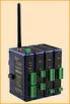 Modular, Customizable Wire Replacement 128 / 256 Bit AES Encryption Software Selectable RF Transmit Power Software Selectable Over-the-air Data Rate Modbus ASCII /RTU Compatible Wide Operating Temperature
Fibre Optic Solutions for your Test and Instrumentation needs
 Fibre Optic Solutions for your Test and Instrumentation needs Aerospace Test EMC/EMP Military Industrial Control High Energy Physics Automotive Test Custom www.point2point.co.uk Fibre Optic Solutions for
Cable Discharge Event
 Cable Discharge Event 1.0 Introduction The widespread use of electronic equipment in various environments exposes semiconductor devices to potentially destructive Electro Static Discharge (ESD). Semiconductor
DRM compatible RF Tuner Unit DRT1
 FEATURES DRM compatible RF Tuner Unit DRT1 High- Performance RF Tuner Frequency Range: 10 KHz to 30 MHz Input ICP3: +13,5dBm, typ. Noise Figure @ full gain: 14dB, typ. Receiver Factor: -0,5dB, typ. Input
Investigation of the Calibration Procedure from CISPR 25, Annex B, for use with Vehicle Component Testing.
 Investigation of the Calibration Procedure from CISPR 25, Annex B, for use with Vehicle Component Testing. Dennis D Swanson, EMC Engineer TijV Product Service 1775 Old Highway 8 New Brighton MN 551-1891
Annex 113A Description of cable clamp and test setup. (informative) 113A.1 Overview
 Annex 113A Description of cable clamp and test setup (informative) 113A.1 Overview This annex describes an example of a cable clamp and a a representative methodology that should be used in common-mode
A Low Frequency Adapter for your Vector Network Analyzer (VNA)
 Jacques Audet, VE2AZX 7525 Madrid St, Brossard, QC, Canada J4Y G3: [email protected] A Low Frequency Adapter for your Vector Network Analyzer (VNA) This compact and versatile unit extends low frequency
FOSTCDR. Industrial Serial to Multimode Fiber Optic Converter PRODUCT INFORMATION B&B ELECTRONICS. Specifications Serial Technology
 FOSTCDR pn 8684R1 FOSTCDR-0812ds page 1/5 Industrial Serial to Multimode Fiber Optic Converter Data Rates up to 115.2 kbps 2.5 Mile (4 km) Range 10 to 30 VDC Input Voltage Wide Operating Temperature 2000V
Crosstalk effects of shielded twisted pairs
 This article deals with the modeling and simulation of shielded twisted pairs with CST CABLE STUDIO. The quality of braided shields is investigated with respect to perfect solid shields. Crosstalk effects
Predicting radiated emissions from cables in the RE02/RE102/DO- 160/SAE J113-41 test set up, using measured current in NEC and simple TX equations.
 Predicting radiated emissions from cables in the RE02/RE102/DO- 160/SAE J113-41 test set up, using measured current in NEC and simple TX equations. D. A. Weston RE02Tx.rep 14-6-2004 NARTE Certified EMC
2. The Vector Network Analyzer
 ECE 584 Laboratory Experiments 2. The Vector Network Analyzer Introduction: In this experiment we will learn to use a Vector Network Analyzer to measure the magnitude and phase of reflection and transmission
Application Note 58 Crystal Considerations with Dallas Real Time Clocks
 www.dalsemi.com Application Note 58 Crystal Considerations with Dallas Real Time Clocks Dallas Semiconductor offers a variety of real time clocks (RTCs). The majority of these are available either as integrated
Design and Certification of ASH Radio Systems for Japan
 Design and Certification of ASH Radio Systems for Japan RFM s second-generation ASH radio hybrids are being used in a wide variety of applications in Japan, operating under the Japanese BIJAKU radio regulations.
Features. Modulation Frequency (khz) VDD. PLL Clock Synthesizer with Spread Spectrum Circuitry GND
 DATASHEET IDT5P50901/2/3/4 Description The IDT5P50901/2/3/4 is a family of 1.8V low power, spread spectrum clock generators capable of reducing EMI radiation from an input clock. Spread spectrum technique
Cond-IS RF Conducted Immunity System
 Cond-IS RF Conducted Immunity System About RF Conducted Immunity In the global contest of EMC testing for residential and industrial EUTs (Equipments Under Test) RF Conducted Immunity compliance verification
Flexible PCB Antenna with Cable Integration Application Note Version 2
 Flexible PCB Antenna with Cable Integration Application Note Version 2 CONTENTS 1. BASICS 2. APPLICATIONS 3. SIZE 4. SHAPE 5. GROUND PLANE SIZE 6. IMPEDANCE 7. BANDWIDTH 8. VSWR 9. GAIN 10. EFFICIENCY
ETSI EN 300 328-1 V1.2.2 (2000-07)
 EN 300 328-1 V1.2.2 (2000-07) European Standard (Telecommunications series) Electromagnetic compatibility and Radio spectrum Matters (ERM); Wideband Transmission systems; data transmission equipment operating
PRO 5000 CPE 1D Quick Installation Guide
 PRO 5000 CPE 1D Quick Installation Guide Introduction This Quick Installation Guide covers the basic installation of the PRO 5000 CPE. For more information, refer to the relevant sections in the Product
Designing the NEWCARD Connector Interface to Extend PCI Express Serial Architecture to the PC Card Modular Form Factor
 Designing the NEWCARD Connector Interface to Extend PCI Express Serial Architecture to the PC Card Modular Form Factor Abstract This paper provides information about the NEWCARD connector and board design
LVDS Technology Solves Typical EMI Problems Associated with Cell Phone Cameras and Displays
 AN-5059 Fairchild Semiconductor Application Note May 2005 Revised May 2005 LVDS Technology Solves Typical EMI Problems Associated with Cell Phone Cameras and Displays Differential technologies such as
Shielding Effectiveness Test Method. Harbour s LL, SB, and SS Coaxial Cables. Designs for Improved Shielding Effectiveness
 Shielding Effectiveness Test Method Harbour s LL, SB, and SS Coaxial Cables Designs for Improved Shielding Effectiveness Harbour Industries 4744 Shelburne Road Shelburne Vermont 05482 USA 802-985-3311
SELECTION GUIDE. Nominal Input
 www.murata-ps.com NKE Series FEATURES RoHS Compliant Sub-Miniature SIP & DIP Styles 3kVDC Isolation UL Recognised Wide Temperature performance at full 1 Watt load, 40 C to 85 C Increased Power Density
Application Note. Line Card Redundancy Design With the XRT83SL38 T1/E1 SH/LH LIU ICs
 Application Note Design With the XRT83SL38 T1/E1 SH/LH LIU ICs Revision 1.3 1 REDUNDANCY APPLICATIONS INTRODUCTION Telecommunication system design requires signal integrity and reliability. When a T1/E1
Impedance 50 (75 connectors via adapters)
 VECTOR NETWORK ANALYZER PLANAR TR1300/1 DATA SHEET Frequency range: 300 khz to 1.3 GHz Measured parameters: S11, S21 Dynamic range of transmission measurement magnitude: 130 db Measurement time per point:
MDM192 MULTI-DROPS DIGITAL MODEM FOR PRIVATE LINE. USER GUIDE Document reference : 9010709-03
 MDM192 MULTI-DROPS DIGITAL MODEM FOR PRIVATE LINE USER GUIDE Document reference : 9010709-03 If you have questions about the MDM192 or desire assistance, contact ETIC TELECOMMUNICATIONS at the following
PL-277x Series SuperSpeed USB 3.0 SATA Bridge Controllers PCB Layout Guide
 Application Note PL-277x Series SuperSpeed USB 3.0 SATA Bridge Controllers PCB Layout Guide Introduction This document explains how to design a PCB with Prolific PL-277x SuperSpeed USB 3.0 SATA Bridge
RDF1. RF Receiver Decoder. Features. Applications. Description. Ordering Information. Part Number Description Packages available
 RDF1 RF Receiver Decoder Features Complete FM Receiver and Decoder. Small Form Factor Range up to 200 Metres* Easy Learn Transmitter Feature. Learns 40 transmitter Switches 4 Digital and 1 Serial Data
Application Note Noise Frequently Asked Questions
 : What is? is a random signal inherent in all physical components. It directly limits the detection and processing of all information. The common form of noise is white Gaussian due to the many random
PCAN-B10011S Bus Converter High-speed CAN to Truck Trailer CAN. User Manual. Document version 2.1.0 (2013-11-15)
 PCAN-B10011S Bus Converter High-speed CAN to Truck Trailer CAN User Manual Document version 2.1.0 (2013-11-15) Products taken into account Product Name Model Part number PCAN-B10011S IPEH-002041 CANopen
ICS379. Quad PLL with VCXO Quick Turn Clock. Description. Features. Block Diagram
 Quad PLL with VCXO Quick Turn Clock Description The ICS379 QTClock TM generates up to 9 high quality, high frequency clock outputs including a reference from a low frequency pullable crystal. It is designed
Design of Bidirectional Coupling Circuit for Broadband Power-Line Communications
 Journal of Electromagnetic Analysis and Applications, 2012, 4, 162-166 http://dx.doi.org/10.4236/jemaa.2012.44021 Published Online April 2012 (http://www.scirp.org/journal/jemaa) Design of Bidirectional
Single Transistor FM Transmitter Design
 Single Transistor FM Transmitter Design In telecommunications, frequency modulation (FM) conveys information over a carrier wave by varying its frequency. FM is commonly used at VHF radio frequencies for
Application Note AN:005. FPA Printed Circuit Board Layout Guidelines. Introduction Contents. The Importance of Board Layout
 FPA Printed Circuit Board Layout Guidelines By Paul Yeaman Principal Product Line Engineer V I Chip Strategic Accounts Introduction Contents Page Introduction 1 The Importance of 1 Board Layout Low DC
MSAN-001 X-Band Microwave Motion Sensor Module Application Note
 1. Introduction HB Series of microwave motion sensor module are X-Band Mono-static DRO Doppler transceiver front-end module. These modules are designed for movement detection, like intruder alarms, occupancy
ICS650-44 SPREAD SPECTRUM CLOCK SYNTHESIZER. Description. Features. Block Diagram DATASHEET
 DATASHEET ICS650-44 Description The ICS650-44 is a spread spectrum clock synthesizer intended for video projector and digital TV applications. It generates three copies of an EMI optimized 50 MHz clock
EH-20 20m antenna. By VE3RGW
 EH-20 20m antenna By VE3RGW Equivalent circuit of EH-20 (prototype 2A) antenna system. Upper cylinder Lower cylinder Ground Counter pose Phasing coil Impedance transformer and tune circuit Tune coil Feed
ACRS 2.0 User Manual 1
 ACRS 2.0 User Manual 1 FCC Regulatory Information This device complies with part 15 of the FCC Rules. Operation is subject to the following two conditions: (1) This device may not cause harmful interference,