
Practice Final Math 122 Spring 12 Instructor: Jeff Lang
|
|
|
- Poppy Maude Stevens
- 10 years ago
- Views:
Transcription
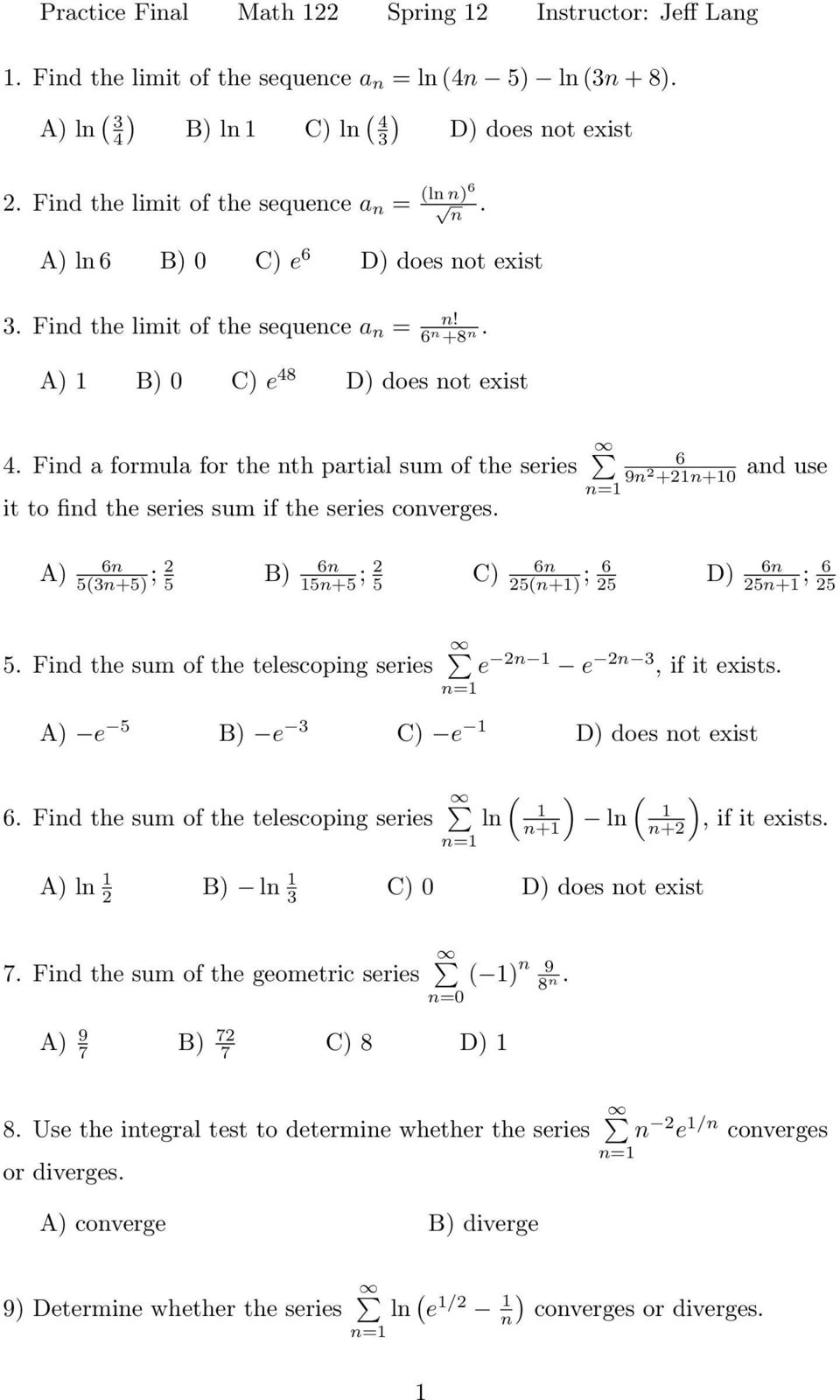
1 Practice Final Math Spring Instructor: Jeff Lang. Find the limit of the sequence a n = ln (n 5) ln (3n + 8). A) ln ( ) 3 B) ln C) ln ( ) 3 D) does not exist. Find the limit of the sequence a n = (ln n)6 n. A) ln 6 B) C) e 6 D) does not exist 3. Find the limit of the sequence a n = n! 6 n +8 n. A) B) C) e 8 D) does not exist. Find a formula for the nth partial sum of the series it to find the series sum if the series converges. 6 9n +n+ n= and use A) 6n 5(3n+5) ; 5 B) 6n 5n+5 ; 5 C) 6n 5(n+) ; 6 5 D) 6n 5n+ ; Find the sum of the telescoping series e n e n 3, if it exists. n= A) e 5 B) e 3 C) e D) does not exist 6. Find the sum of the telescoping series ( ln n= n+ ) ln ( n+ A) ln B) ln 3 C) D) does not exist ), if it exists. 7. Find the sum of the geometric series n= A) 9 7 B) 7 7 C) 8 D) ( ) n 9 8 n. 8. Use the integral test to determine whether the series n e /n converges or diverges. A) converge B) diverge n= 9) Determine whether the series ln ( e / n) converges or diverges. n=
2 A) converge B) diverge. Use the ratio test to determine if the series n= 5(n!) (n)! converges or diverges. A) converge B) diverge. Use the comparison test to determine if the series ( n n 5n+) converges or diverges. A) converge B) diverge n=. Use the limit comparison test to determine whether the series 9 converges or diverges. n 3 ln n+ n= A) converge B) diverge 3. Determine whether the alternating series ( ( ) n ln diverges. n= A) converge B) diverge 6n+ 6n+3. Determine whether the alternating series ( ) n ( n n + ) converges absolutely, conditionally, or diverges. n= ) converges or A) converge absolutely B) diverges C) converges conditionally 5. Estimate the magnitude of the error involved in using the sum of the first four terms to estimate the sum of the entire series n= ( ) n+ (.) n+ n+. A) B) 3. C).5 8 D) Find the radius of convergence of the power series A) 8 B) C) 9 D) n= 7. Find the radius of convergence of the power series n= (x 5) n 9 n n. (x 5) n 9 n n!.

3 A) 8 B) C) D) 9 8. Find the interval of convergence of the power series n= ( ) n (x 5) n (n+)6 n. A) x B) < x C) x 6 D) x < 6 9. Find the first for tems of the McLaurin series for f (x) = ln ( + x). A) x x! + x3 3! x x! + B) x + + x3 3 + x C) x x + x3 3 x. Find the Taylor series sin x at x = π. + x + D) x +! + x3 3! + x! + A) ( ( ) ( ) x π + x π ( ) ) 6 x π 3 + B) ( + ( ) ( ) x π x π ( ) ) 3 x π 3 + C) ( ( ) ( ) + x π 6 x π ( ) ) x π 3 + D) ( + ( ) ( ) x π x π ( ) ) 6 x π 3 + E) None of the above. Find the angle between the two planes x + 3y 3z = and x + y 5z =. A).9 B).3 C).57 D).8. Which of the following vectors is parallel to the two planes x + 3y z = and x + y + z = 8? A) i + 3 j 5 k B) i 3 j 5 k C) i + 3 j 6 k D) i 3 j 6 k 3. Find parametric equations of the line of intersection of the two planes x + y + z = and x y + z =. A) x = t +, y = t, z = 3t B) x = t +, y = t, z = 3t C) x = t, y = 3 + t, z = 5 3t D) x = + t, y = t, z = 3 + 3t. Find the point of intersection of the line x x + y + z =. = y+ = z and the plane 3

4 A) (,, ) B) (,, ) C) ( 9,, ) D) (,, ) 5. Find symmetric equations of the line perpendicular to the plane 5x + y + z = and passing through the point (, 3, ). A) x+ = y + 3 = z+ 5 B) x+ 5 = y + 3 = z+ C) x 5 = y 3 = z D) x 5 = y 3 = z 6. Which of the vectors below is tangent to the curve r (t) = cos t i + sin t j + e t k at t =? A) j k B) j + k D) All of the above C) j k 7. Calculate the arc length of the curve r (t) = t i + t sin t j + t cos t k ; t. A) 5 B) C) D) 6 8. Find the acceleration at t = for r (t) = ( t t 3) i + 5t j + ( t 3 ln t ) k. A) i + k B) i + k C) 6 i + 6 k D) i + 5 j + k x 9. Find lim +y + (x,y)(,) x 6xy+7. A) B) 7 C) 7 D) No limit 3. Find lim x+y. (x,y)(,) x +y A) B) No limit C) 7 D) - 3. At what points is the function f (x, y) = xy x continuous? A) All (x, y) such that xy > and x B) All (x, y) such that x i y and x > C) All (x, y) such that x D) All (x, y) 3. Find all first order partial derivatives of the function f (x, y) = x ln (xy).
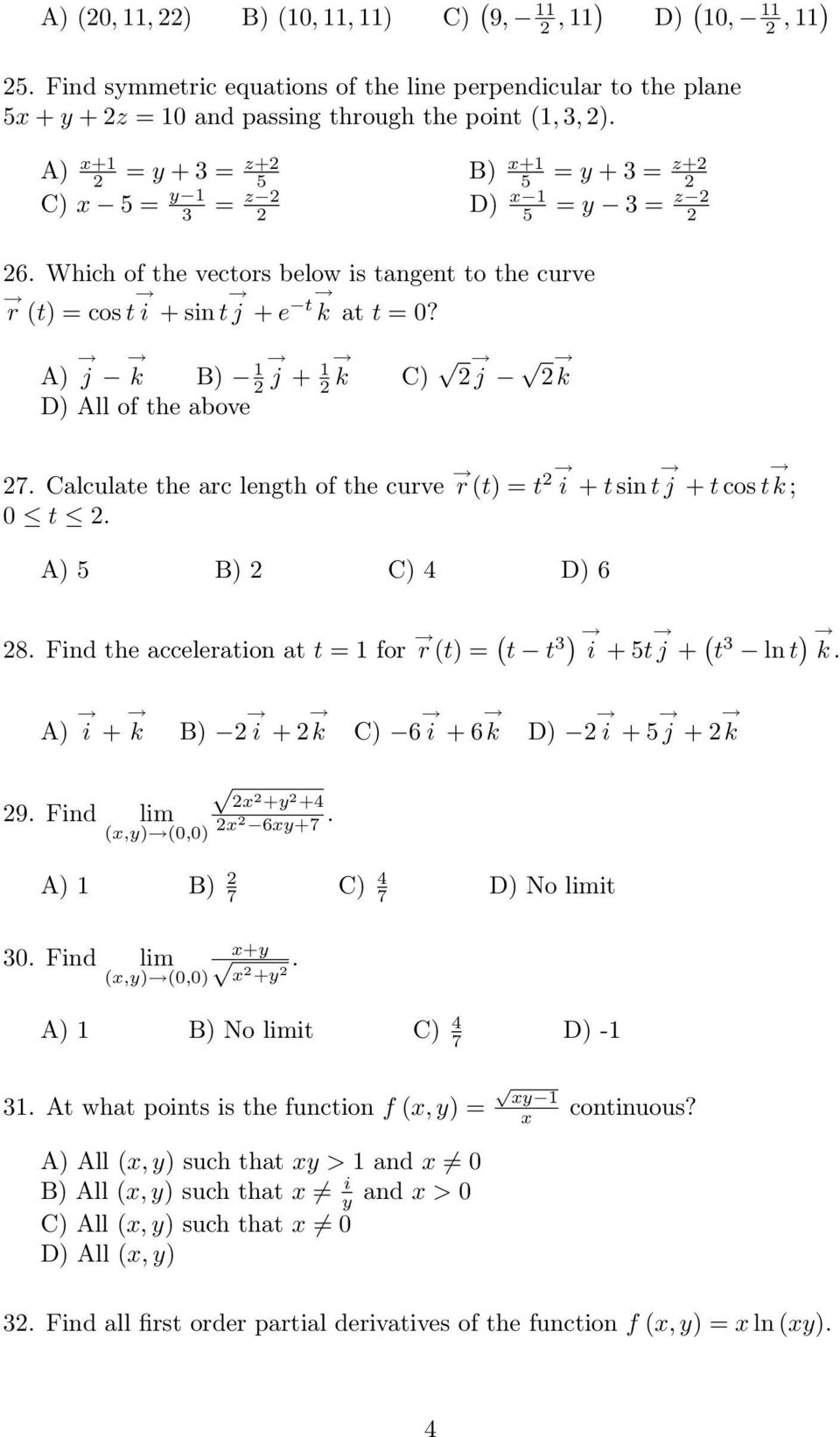
5 A) f f x = + ln (xy) ; y = x y C) f f x = x + ln (xy) ; y = x y B) f f x = ln (xy) ; y = x y D) f x = x + x y ; f y = y 33. Find all second order partial derivatives of the function f (x, y) = xye y. A) f x B) f x C) f x D) f x = ye y ; f y = xye y ( y 6 ) ; = ; f y = xye y ( y 3 ) ; = ye y ; f y = xye y ( y ) ; = ; f y = xye y ( y 3 ) ; 3. Find a chain rule formula for w z = k(r, s, t). f x y = f y x = ( ) y e y f x y = f y x = ( ) y e y f x y = f y x = ( ) y e y f x y = f y x = ( ) y e y if w = f(x, y, z), x = g(r, s), y = h(t), A) w C) w = w dx dt + w z = w dy y dt + w z z B) w D) w = w z z = dy dt + z 35. Compute the gradient of f(x, y, z) = ln ( x 5y + 7z ) at ( 5, 5, 5). A) 5 i + 3 j B) 5 i + 3 j 5 C) i + 3 j 5 k D) i + 3 j k k k 36. Find the derivative of f (x, y, z) = 3xy 3 z at the point ( 3, 7, 9) in the direction of v = i + j k. A) 53, B) 885, 735 C) 78, 588 D) 35, Find the direction in which the function f (x, y) = xe y ln x is decreasing most rapidly at the point (, ). A) 7 i + 7 j B) 7 i 7 j C) 7 i 7 j D) 7 i 38. Find the derivative of the function f (x, y) = arctan ( y x) at the point ( 8, 8) in the direction in which the function increases most rapidly. A) 3 B) 6 C) D) 3 6 5
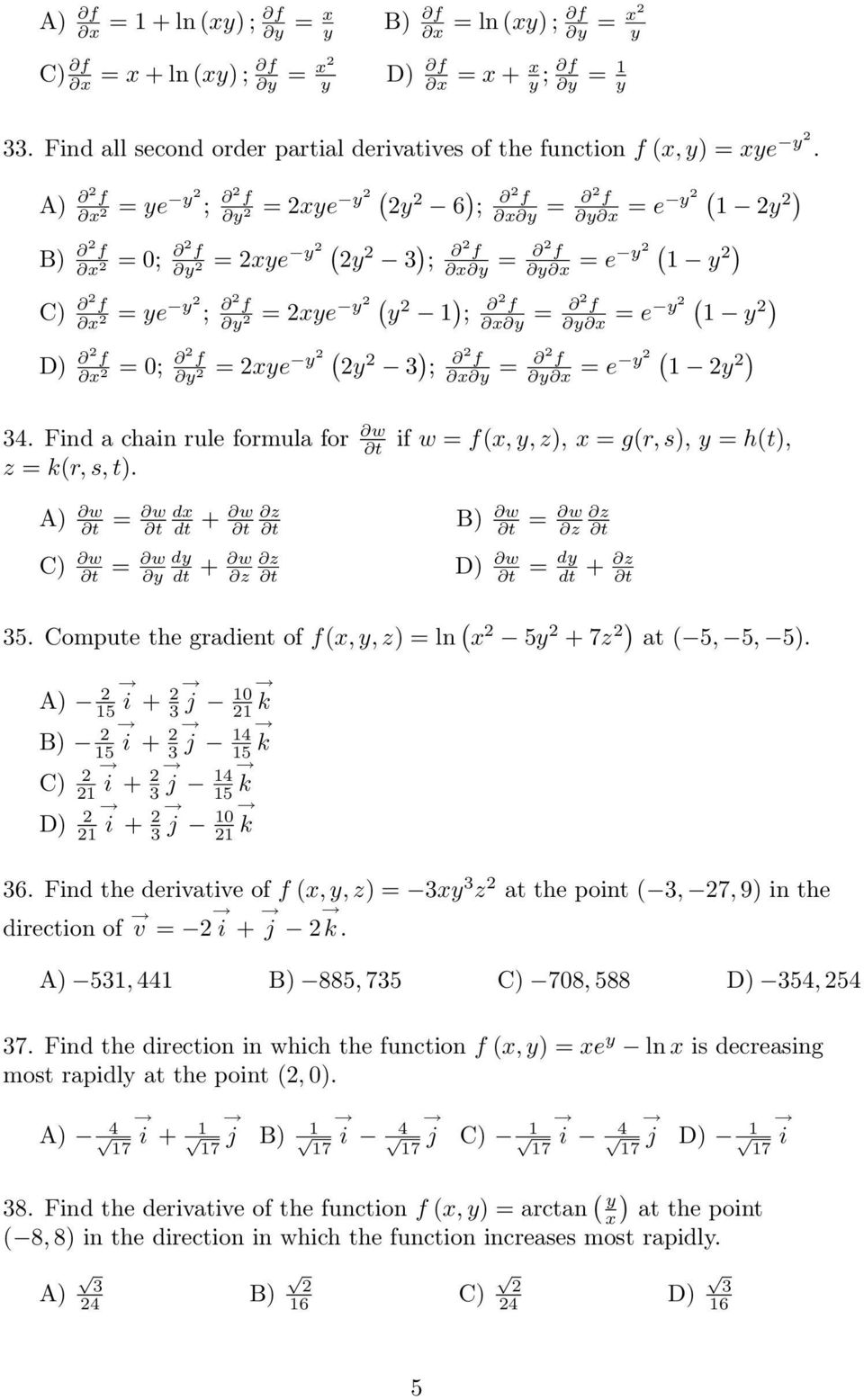
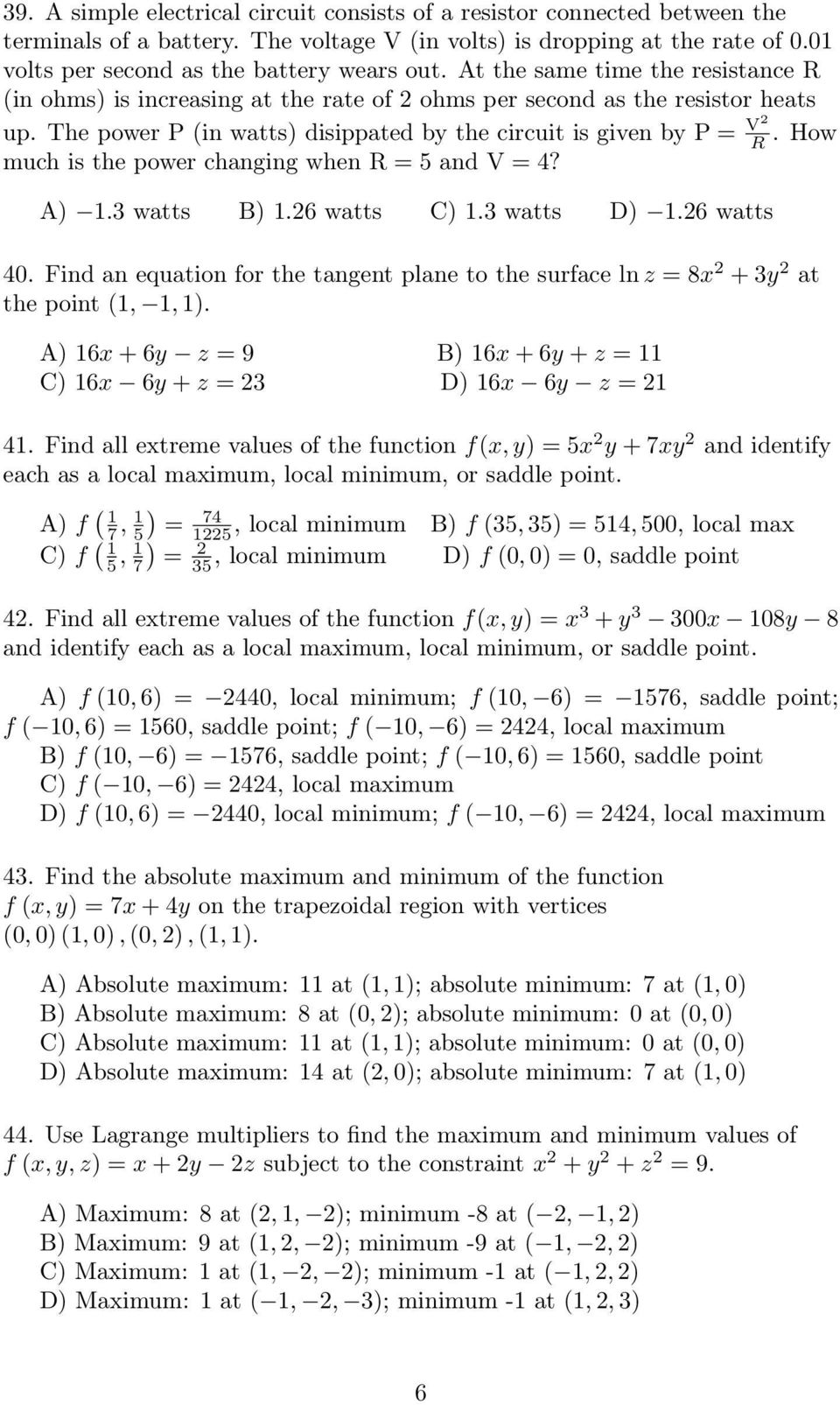
6 39. A simple electrical circuit consists of a resistor connected between the terminals of a battery. The voltage V (in volts) is dropping at the rate of. volts per second as the battery wears out. At the same time the resistance R (in ohms) is increasing at the rate of ohms per second as the resistor heats up. The power P (in watts) disippated by the circuit is given by P = V R. How much is the power changing when R = 5 and V =? A).3 watts B).6 watts C).3 watts D).6 watts. Find an equation for the tangent plane to the surface ln z = 8x + 3y at the point (,, ). A) 6x + 6y z = 9 B) 6x + 6y + z = C) 6x 6y + z = 3 D) 6x 6y z =. Find all extreme values of the function f(x, y) = 5x y + 7xy and identify each as a local maximum, local minimum, or saddle point. A) f ( 7, ) 5 = 7 5, local minimum B) f (35, 35) = 5, 5, local max C) f ( 5, ) 7 = 35, local minimum D) f (, ) =, saddle point. Find all extreme values of the function f(x, y) = x 3 + y 3 3x 8y 8 and identify each as a local maximum, local minimum, or saddle point. A) f (, 6) =, local minimum; f (, 6) = 576, saddle point; f (, 6) = 56, saddle point; f (, 6) =, local maximum B) f (, 6) = 576, saddle point; f (, 6) = 56, saddle point C) f (, 6) =, local maximum D) f (, 6) =, local minimum; f (, 6) =, local maximum 3. Find the absolute maximum and minimum of the function f (x, y) = 7x + y on the trapezoidal region with vertices (, ) (, ), (, ), (, ). A) Absolute maximum: at (, ); absolute minimum: 7 at (, ) B) Absolute maximum: 8 at (, ); absolute minimum: at (, ) C) Absolute maximum: at (, ); absolute minimum: at (, ) D) Absolute maximum: at (, ); absolute minimum: 7 at (, ). Use Lagrange multipliers to find the maximum and minimum values of f (x, y, z) = x + y z subject to the constraint x + y + z = 9. A) Maximum: 8 at (,, ); minimum -8 at (,, ) B) Maximum: 9 at (,, ); minimum -9 at (,, ) C) Maximum: at (,, ); minimum - at (,, ) D) Maximum: at (,, 3); minimum - at (,, 3) 6
7 5. Find the point on the plane x + y z = that is nearest the origin. A) (,, ) B) (, 8, ) C) (,, ) D) (,, ) 6. Evaluate π 5π (sin x + cos y) dxdy A) π B) 9π C) 5π D) 8π 7. Write an integral equivalent to ln 8 ln integration reversed. A) 8 ln x ln 8 ln 7y dy dx B) 8 C) 8 ln x ln 7y dy dx D) 8 ln 8 e y 7y dx dy but with the order of ln x ln 8 7y dy dx ln x 7y dy dx ln 8 8. Write an integral equivalent to 6 integration reversed. 36 8y dx dy but with the order of y A) 36 x 8y dy dx B) 36 x 8y dy dx 6 C) 6 x 8y dy dx D) 6 x 6 8y dy dx 9. Express the area of the region bounded by x = y and the line y = x as a double integral. A) y+8 dx dy B) y C) 5. Evaluate ln y+8 dx dy D) e y dx dy. e y y+8 y dx dy y+8 dx dy A) 8 B) C) 8 D) 5. Integrate f (x, y) = ln x over the region bounded by the x axis, the line x = 3, and the curve y = ln x. A) B) C) 3 D) 5. Find the volume of the region bounded by the coordinate planes, the parabolic cylinder z = x, and the plane y = 5. 7
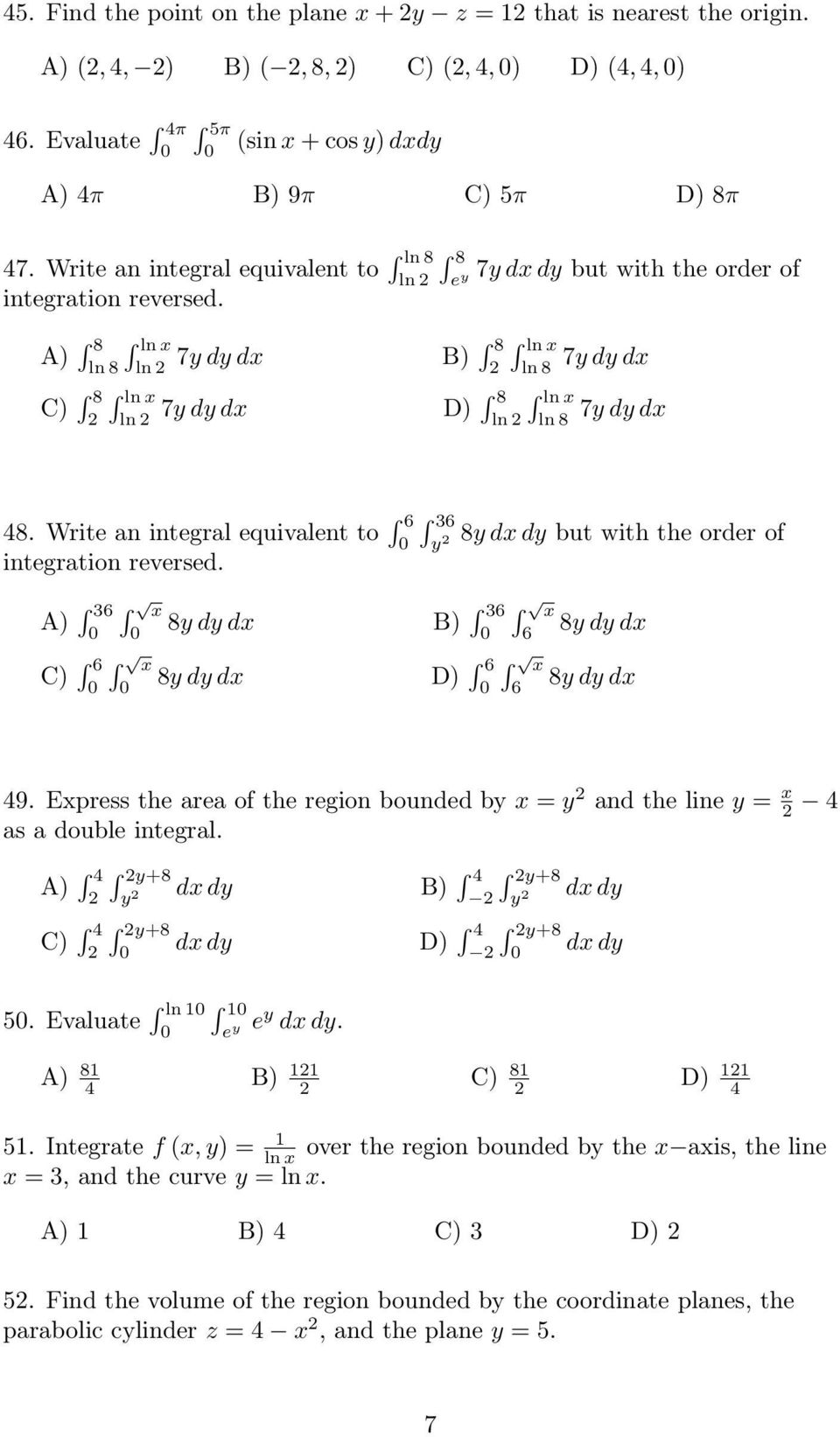
8 A) 8 3 B) 3 C) 8 D) Evaluate ln 8 ln 8 dx dy by reversing the order of integration. y/ ex A) 36 B) 35 C) D) 5 5. Change 6 dy dx to polar coordinates and evaluate. 36 x + x +y A) π(6+ln 7) π(6 ln 7) B) 55. Find the area of the region enclosed by r = 9 sin θ. π(6 ln 7) π(6+ln 7) C) D) A) 7 π B) 8 π C) 8 8 π D) 8 π 56. Write a triple integral in the order dz dy dx for the volume of the solid enclosed by the parabaloids z = x y and z = x + y. A) x x y dz dy dx B) x x x +y x y dz dy dx x x +y C) x x x y x +y dz dy dx D) 57. Write cylindrical coordinates. A) π C) π x x y x x +y dz dy dx as an equivalent integral in r r dz dr dθ B) π r 5 r r dz dr dθ D) π/ r x x y dz dy dx x x +y r r dz dr dθ r r r r dz dr dθ 58. Set up a triple integral for the volume of the solid in the first octant inside the cone ϕ = π 3 and between the spheres ρ = and ρ = 7. A) π/ π/3 C) π π/ 7 ρ sin ϕ dρ dϕ dθ B) π/ π/ π/3 7 ρ sin ϕ dρ dϕ dθ D) π/ π/3 7 π/ π/3 ρ sin ϕ dρ dϕ dθ 7 ρ sin ϕ dρ dϕ dθ 59. Use cylindrical coordinates to find the volume of the solid bounded below by the xy-plane, laterally by the cylinder r = sin θ, and above by the plane z = 7 x. A) 9π B) 9 π C) 7 π D) 7π 8
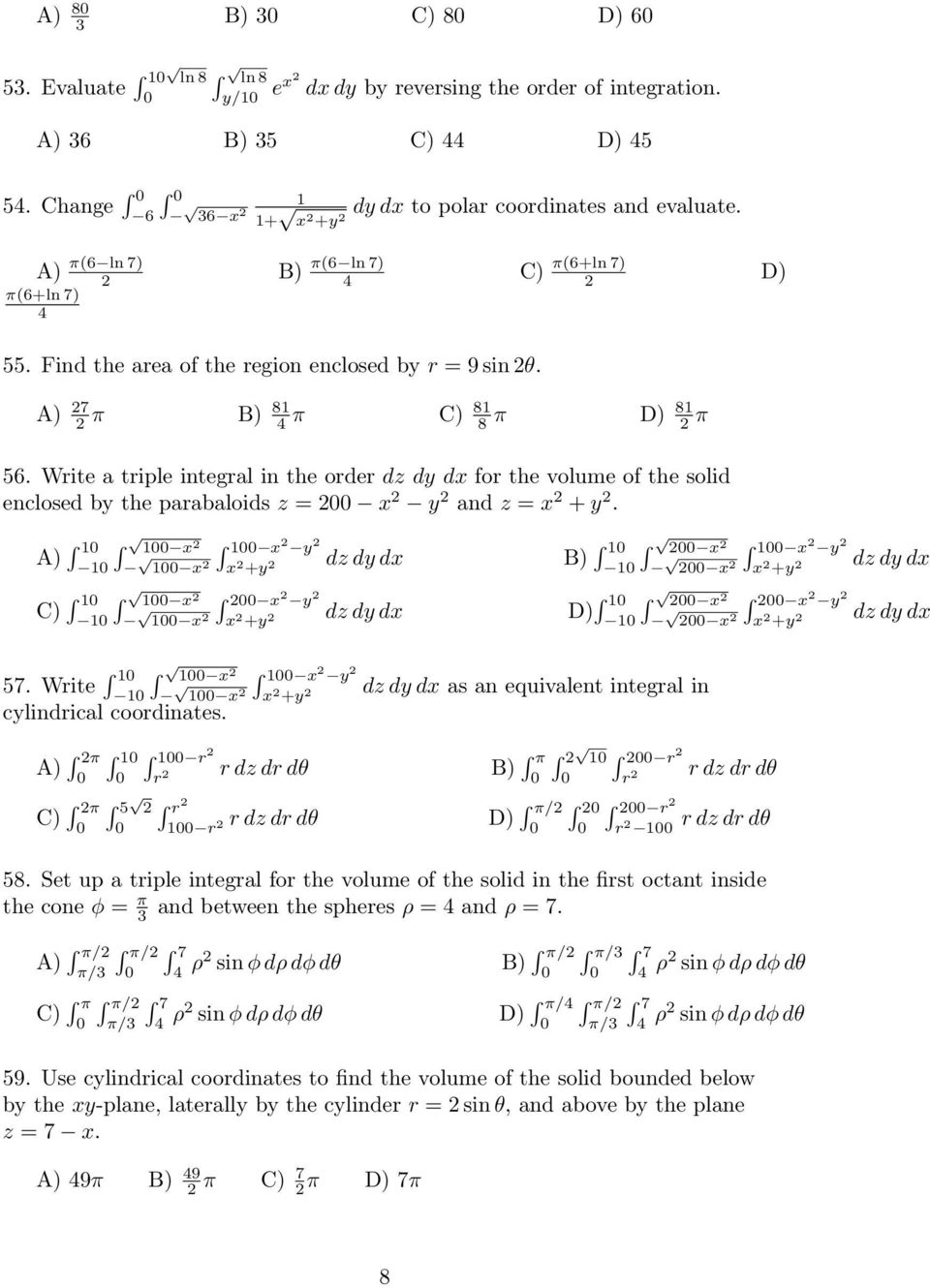
9 6. Find the mass of the solid in the first octant between the spheres x + y + z = 6 and x + y + z = if the density at any point is inversely proportional to the distance from the origin. A) 68kπ B) 8kπ C) k D) kπ Answer Key. C. B 3. D. A 5. B 6. D 7. C 8. A 9. B. A. A. B 3. A. C 5. D 6. C 7. D 8. B 9. C. D. A. B 3. C. D 5. D 6. D 7. C 8. C 9. B 3. B 3. A 3. A 33. D 3. C 35. B 36. A 37. C 9
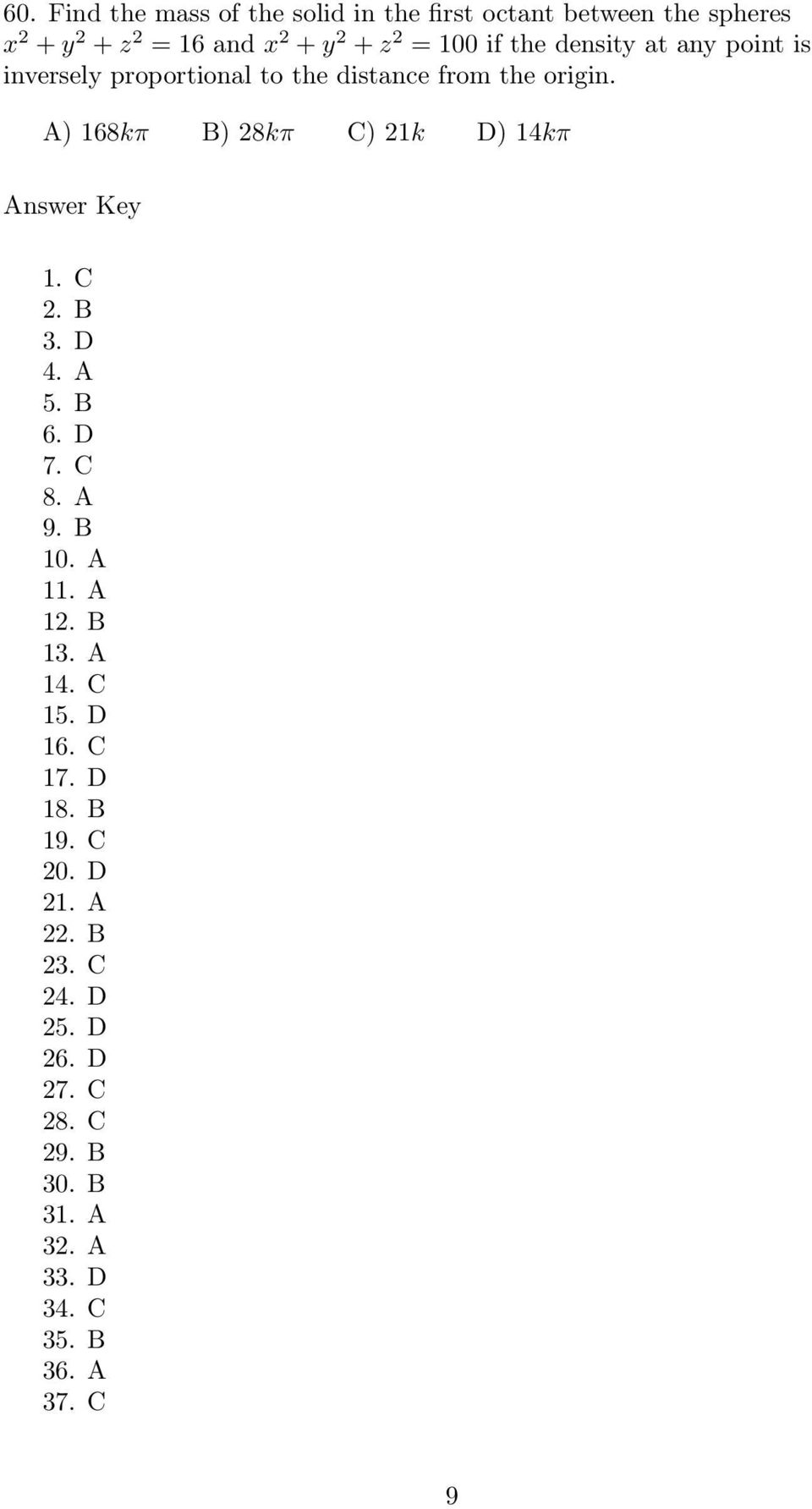
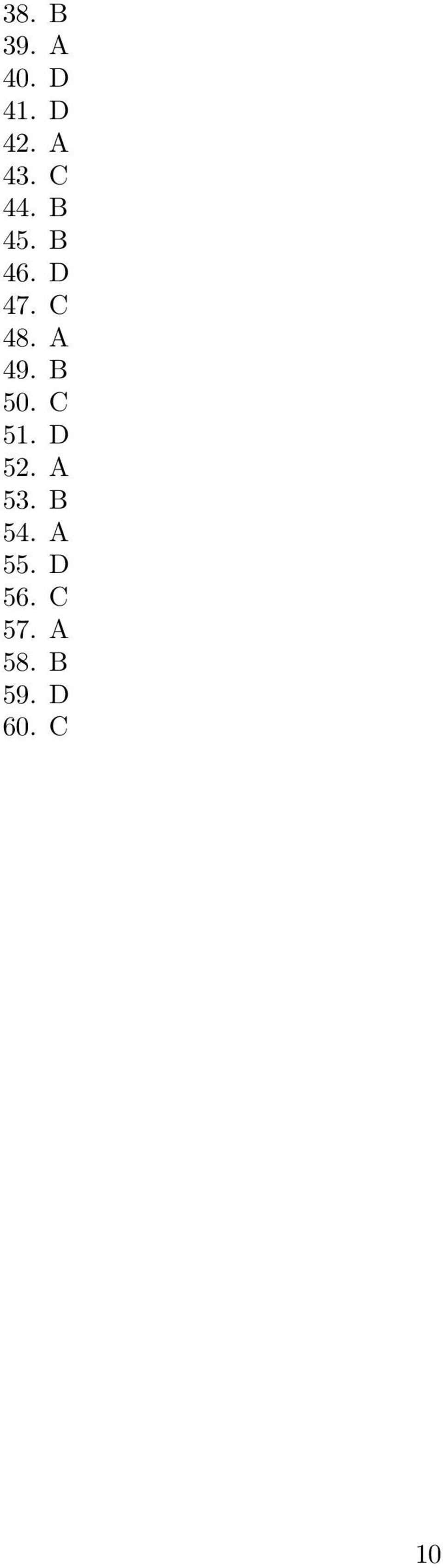
10 38. B 39. A. D. D. A 3. C. B 5. B 6. D 7. C 8. A 9. B 5. C 5. D 5. A 53. B 5. A 55. D 56. C 57. A 58. B 59. D 6. C
L 2 : x = s + 1, y = s, z = 4s + 4. 3. Suppose that C has coordinates (x, y, z). Then from the vector equality AC = BD, one has
 The line L through the points A and B is parallel to the vector AB = 3, 2, and has parametric equations x = 3t + 2, y = 2t +, z = t Therefore, the intersection point of the line with the plane should satisfy:
(a) We have x = 3 + 2t, y = 2 t, z = 6 so solving for t we get the symmetric equations. x 3 2. = 2 y, z = 6. t 2 2t + 1 = 0,
 Name: Solutions to Practice Final. Consider the line r(t) = 3 + t, t, 6. (a) Find symmetric equations for this line. (b) Find the point where the first line r(t) intersects the surface z = x + y. (a) We
Solutions for Review Problems
 olutions for Review Problems 1. Let be the triangle with vertices A (,, ), B (4,, 1) and C (,, 1). (a) Find the cosine of the angle BAC at vertex A. (b) Find the area of the triangle ABC. (c) Find a vector
Section 12.6: Directional Derivatives and the Gradient Vector
 Section 26: Directional Derivatives and the Gradient Vector Recall that if f is a differentiable function of x and y and z = f(x, y), then the partial derivatives f x (x, y) and f y (x, y) give the rate
1 3 4 = 8i + 20j 13k. x + w. y + w
 ) Find the point of intersection of the lines x = t +, y = 3t + 4, z = 4t + 5, and x = 6s + 3, y = 5s +, z = 4s + 9, and then find the plane containing these two lines. Solution. Solve the system of equations
SOLUTIONS. f x = 6x 2 6xy 24x, f y = 3x 2 6y. To find the critical points, we solve
 SOLUTIONS Problem. Find the critical points of the function f(x, y = 2x 3 3x 2 y 2x 2 3y 2 and determine their type i.e. local min/local max/saddle point. Are there any global min/max? Partial derivatives
This makes sense. t 2 1 + 1/t 2 dt = 1. t t 2 + 1dt = 2 du = 1 3 u3/2 u=5
 1. (Line integrals Using parametrization. Two types and the flux integral) Formulas: ds = x (t) dt, d x = x (t)dt and d x = T ds since T = x (t)/ x (t). Another one is Nds = T ds ẑ = (dx, dy) ẑ = (dy,
Math 241, Exam 1 Information.
 Math 241, Exam 1 Information. 9/24/12, LC 310, 11:15-12:05. Exam 1 will be based on: Sections 12.1-12.5, 14.1-14.3. The corresponding assigned homework problems (see http://www.math.sc.edu/ boylan/sccourses/241fa12/241.html)
A QUICK GUIDE TO THE FORMULAS OF MULTIVARIABLE CALCULUS
 A QUIK GUIDE TO THE FOMULAS OF MULTIVAIABLE ALULUS ontents 1. Analytic Geometry 2 1.1. Definition of a Vector 2 1.2. Scalar Product 2 1.3. Properties of the Scalar Product 2 1.4. Length and Unit Vectors
MATH 132: CALCULUS II SYLLABUS
 MATH 32: CALCULUS II SYLLABUS Prerequisites: Successful completion of Math 3 (or its equivalent elsewhere). Math 27 is normally not a sufficient prerequisite for Math 32. Required Text: Calculus: Early
Name: ID: Discussion Section:
 Math 28 Midterm 3 Spring 2009 Name: ID: Discussion Section: This exam consists of 6 questions: 4 multiple choice questions worth 5 points each 2 hand-graded questions worth a total of 30 points. INSTRUCTIONS:
Solutions to Homework 10
 Solutions to Homework 1 Section 7., exercise # 1 (b,d): (b) Compute the value of R f dv, where f(x, y) = y/x and R = [1, 3] [, 4]. Solution: Since f is continuous over R, f is integrable over R. Let x
Surface Normals and Tangent Planes
 Surface Normals and Tangent Planes Normal and Tangent Planes to Level Surfaces Because the equation of a plane requires a point and a normal vector to the plane, nding the equation of a tangent plane to
F = 0. x ψ = y + z (1) y ψ = x + z (2) z ψ = x + y (3)
 MATH 255 FINAL NAME: Instructions: You must include all the steps in your derivations/answers. Reduce answers as much as possible, but use exact arithmetic. Write neatly, please, and show all steps. Scientists
Exam 1 Sample Question SOLUTIONS. y = 2x
 Exam Sample Question SOLUTIONS. Eliminate the parameter to find a Cartesian equation for the curve: x e t, y e t. SOLUTION: You might look at the coordinates and notice that If you don t see it, we can
Solutions to old Exam 1 problems
 Solutions to old Exam 1 problems Hi students! I am putting this old version of my review for the first midterm review, place and time to be announced. Check for updates on the web site as to which sections
FINAL EXAM SOLUTIONS Math 21a, Spring 03
 INAL EXAM SOLUIONS Math 21a, Spring 3 Name: Start by printing your name in the above box and check your section in the box to the left. MW1 Ken Chung MW1 Weiyang Qiu MW11 Oliver Knill h1 Mark Lucianovic
MULTIPLE INTEGRALS. h 2 (y) are continuous functions on [c, d] and let f(x, y) be a function defined on R. Then
![MULTIPLE INTEGRALS. h 2 (y) are continuous functions on [c, d] and let f(x, y) be a function defined on R. Then](/thumbs/40/21201569.jpg "MULTIPLE INTEGRALS. h 2 (y) are continuous functions on [c, d] and let f(x, y) be a function defined on R. Then") MULTIPLE INTEGALS 1. ouble Integrals Let be a simple region defined by a x b and g 1 (x) y g 2 (x), where g 1 (x) and g 2 (x) are continuous functions on [a, b] and let f(x, y) be a function defined on.
MULTIPLE INTEGALS 1. ouble Integrals Let be a simple region defined by a x b and g 1 (x) y g 2 (x), where g 1 (x) and g 2 (x) are continuous functions on [a, b] and let f(x, y) be a function defined on.
AB2.5: Surfaces and Surface Integrals. Divergence Theorem of Gauss
 AB2.5: urfaces and urface Integrals. Divergence heorem of Gauss epresentations of surfaces or epresentation of a surface as projections on the xy- and xz-planes, etc. are For example, z = f(x, y), x =
11.1. Objectives. Component Form of a Vector. Component Form of a Vector. Component Form of a Vector. Vectors and the Geometry of Space
 11 Vectors and the Geometry of Space 11.1 Vectors in the Plane Copyright Cengage Learning. All rights reserved. Copyright Cengage Learning. All rights reserved. 2 Objectives! Write the component form of
( 1)2 + 2 2 + 2 2 = 9 = 3 We would like to make the length 6. The only vectors in the same direction as v are those
 1.(6pts) Which of the following vectors has the same direction as v 1,, but has length 6? (a), 4, 4 (b),, (c) 4,, 4 (d), 4, 4 (e) 0, 6, 0 The length of v is given by ( 1) + + 9 3 We would like to make
Review Sheet for Test 1
 Review Sheet for Test 1 Math 261-00 2 6 2004 These problems are provided to help you study. The presence of a problem on this handout does not imply that there will be a similar problem on the test. And
Solutions to Practice Problems for Test 4
 olutions to Practice Problems for Test 4 1. Let be the line segmentfrom the point (, 1, 1) to the point (,, 3). Evaluate the line integral y ds. Answer: First, we parametrize the line segment from (, 1,
Math 241 Lines and Planes (Solutions) x = 3 3t. z = 1 t. x = 5 + t. z = 7 + 3t
 Math 241 Lines and Planes (Solutions) The equations for planes P 1, P 2 and P are P 1 : x 2y + z = 7 P 2 : x 4y + 5z = 6 P : (x 5) 2(y 6) + (z 7) = 0 The equations for lines L 1, L 2, L, L 4 and L 5 are
Name Class. Date Section. Test Form A Chapter 11. Chapter 11 Test Bank 155
 Chapter Test Bank 55 Test Form A Chapter Name Class Date Section. Find a unit vector in the direction of v if v is the vector from P,, 3 to Q,, 0. (a) 3i 3j 3k (b) i j k 3 i 3 j 3 k 3 i 3 j 3 k. Calculate
1.(6pts) Find symmetric equations of the line L passing through the point (2, 5, 1) and perpendicular to the plane x + 3y z = 9.
 .(6pts Find symmetric equations of the line L passing through the point (, 5, and perpendicular to the plane x + 3y z = 9. (a x = y + 5 3 = z (b x (c (x = ( 5(y 3 = z + (d x (e (x + 3(y 3 (z = 9 = y 3
AP Calculus BC 2004 Scoring Guidelines
 AP Calculus BC Scoring Guidelines The materials included in these files are intended for noncommercial use by AP teachers for course and exam preparation; permission for any other use must be sought from
4.2. LINE INTEGRALS 1. 2 2 ; z = t. ; y = sin
 4.2. LINE INTEGRALS 1 4.2 Line Integrals MATH 294 FALL 1982 FINAL # 7 294FA82FQ7.tex 4.2.1 Consider the curve given parametrically by x = cos t t ; y = sin 2 2 ; z = t a) Determine the work done by the
Some Comments on the Derivative of a Vector with applications to angular momentum and curvature. E. L. Lady (October 18, 2000)
 Some Comments on the Derivative of a Vector with applications to angular momentum and curvature E. L. Lady (October 18, 2000) Finding the formula in polar coordinates for the angular momentum of a moving
2008 AP Calculus AB Multiple Choice Exam
 008 AP Multiple Choice Eam Name 008 AP Calculus AB Multiple Choice Eam Section No Calculator Active AP Calculus 008 Multiple Choice 008 AP Calculus AB Multiple Choice Eam Section Calculator Active AP Calculus
RARITAN VALLEY COMMUNITY COLLEGE ACADEMIC COURSE OUTLINE MATH 251 CALCULUS III
 RARITAN VALLEY COMMUNITY COLLEGE ACADEMIC COURSE OUTLINE MATH 251 CALCULUS III I. Basic Course Information A. Course Number and Title: MATH 251 Calculus III B. New or Modified Course: Modified Course C.
The Fourth International DERIVE-TI92/89 Conference Liverpool, U.K., 12-15 July 2000. Derive 5: The Easiest... Just Got Better!
 The Fourth International DERIVE-TI9/89 Conference Liverpool, U.K., -5 July 000 Derive 5: The Easiest... Just Got Better! Michel Beaudin École de technologie supérieure 00, rue Notre-Dame Ouest Montréal
Chapter 17. Review. 1. Vector Fields (Section 17.1)
 hapter 17 Review 1. Vector Fields (Section 17.1) There isn t much I can say in this section. Most of the material has to do with sketching vector fields. Please provide some explanation to support your
If Σ is an oriented surface bounded by a curve C, then the orientation of Σ induces an orientation for C, based on the Right-Hand-Rule.
 Oriented Surfaces and Flux Integrals Let be a surface that has a tangent plane at each of its nonboundary points. At such a point on the surface two unit normal vectors exist, and they have opposite directions.
AP Calculus AB 2003 Scoring Guidelines Form B
 AP Calculus AB Scoring Guidelines Form B The materials included in these files are intended for use by AP teachers for course and exam preparation; permission for any other use must be sought from the
The Mathematics Diagnostic Test
 The Mathematics iagnostic Test Mock Test and Further Information 010 In welcome week, students will be asked to sit a short test in order to determine the appropriate lecture course, tutorial group, whether
Derive 5: The Easiest... Just Got Better!
 Liverpool John Moores University, 1-15 July 000 Derive 5: The Easiest... Just Got Better! Michel Beaudin École de Technologie Supérieure, Canada Email; [email protected] 1. Introduction Engineering
Mark Howell Gonzaga High School, Washington, D.C.
 Be Prepared for the Calculus Exam Mark Howell Gonzaga High School, Washington, D.C. Martha Montgomery Fremont City Schools, Fremont, Ohio Practice exam contributors: Benita Albert Oak Ridge High School,
Math 1B, lecture 5: area and volume
 Math B, lecture 5: area and volume Nathan Pflueger 6 September 2 Introduction This lecture and the next will be concerned with the computation of areas of regions in the plane, and volumes of regions in
Notes on Elastic and Inelastic Collisions
 Notes on Elastic and Inelastic Collisions In any collision of 2 bodies, their net momentus conserved. That is, the net momentum vector of the bodies just after the collision is the same as it was just
Section 11.1: Vectors in the Plane. Suggested Problems: 1, 5, 9, 17, 23, 25-37, 40, 42, 44, 45, 47, 50
 Section 11.1: Vectors in the Plane Page 779 Suggested Problems: 1, 5, 9, 17, 3, 5-37, 40, 4, 44, 45, 47, 50 Determine whether the following vectors a and b are perpendicular. 5) a = 6, 0, b = 0, 7 Recall
Solutions - Homework sections 17.7-17.9
 olutions - Homework sections 7.7-7.9 7.7 6. valuate xy d, where is the triangle with vertices (,, ), (,, ), and (,, ). The three points - and therefore the triangle between them - are on the plane x +
Two vectors are equal if they have the same length and direction. They do not
 Vectors define vectors Some physical quantities, such as temperature, length, and mass, can be specified by a single number called a scalar. Other physical quantities, such as force and velocity, must
The Math Circle, Spring 2004
 The Math Circle, Spring 2004 (Talks by Gordon Ritter) What is Non-Euclidean Geometry? Most geometries on the plane R 2 are non-euclidean. Let s denote arc length. Then Euclidean geometry arises from the
Math 53 Worksheet Solutions- Minmax and Lagrange
 Math 5 Worksheet Solutions- Minmax and Lagrange. Find the local maximum and minimum values as well as the saddle point(s) of the function f(x, y) = e y (y x ). Solution. First we calculate the partial
Number Sense and Operations
 Number Sense and Operations representing as they: 6.N.1 6.N.2 6.N.3 6.N.4 6.N.5 6.N.6 6.N.7 6.N.8 6.N.9 6.N.10 6.N.11 6.N.12 6.N.13. 6.N.14 6.N.15 Demonstrate an understanding of positive integer exponents
AP Calculus BC 2006 Free-Response Questions
 AP Calculus BC 2006 Free-Response Questions The College Board: Connecting Students to College Success The College Board is a not-for-profit membership association whose mission is to connect students to
Section 1.1. Introduction to R n
 The Calculus of Functions of Several Variables Section. Introduction to R n Calculus is the study of functional relationships and how related quantities change with each other. In your first exposure to
Fundamental Theorems of Vector Calculus
 Fundamental Theorems of Vector Calculus We have studied the techniques for evaluating integrals over curves and surfaces. In the case of integrating over an interval on the real line, we were able to use
Physics 210 Q1 2012 ( PHYSICS210BRIDGE ) My Courses Course Settings
 1 of 11 9/7/2012 1:06 PM Logged in as Julie Alexander, Instructor Help Log Out Physics 210 Q1 2012 ( PHYSICS210BRIDGE ) My Courses Course Settings Course Home Assignments Roster Gradebook Item Library
Biggar High School Mathematics Department. National 5 Learning Intentions & Success Criteria: Assessing My Progress
 Biggar High School Mathematics Department National 5 Learning Intentions & Success Criteria: Assessing My Progress Expressions & Formulae Topic Learning Intention Success Criteria I understand this Approximation
A vector is a directed line segment used to represent a vector quantity.
 Chapters and 6 Introduction to Vectors A vector quantity has direction and magnitude. There are many examples of vector quantities in the natural world, such as force, velocity, and acceleration. A vector
Steady Heat Conduction
 Steady Heat Conduction In thermodynamics, we considered the amount of heat transfer as a system undergoes a process from one equilibrium state to another. hermodynamics gives no indication of how long
Differential Relations for Fluid Flow. Acceleration field of a fluid. The differential equation of mass conservation
 Differential Relations for Fluid Flow In this approach, we apply our four basic conservation laws to an infinitesimally small control volume. The differential approach provides point by point details of
CSU Fresno Problem Solving Session. Geometry, 17 March 2012
 CSU Fresno Problem Solving Session Problem Solving Sessions website: http://zimmer.csufresno.edu/ mnogin/mfd-prep.html Math Field Day date: Saturday, April 21, 2012 Math Field Day website: http://www.csufresno.edu/math/news
Figure 2.1: Center of mass of four points.
 Chapter 2 Bézier curves are named after their inventor, Dr. Pierre Bézier. Bézier was an engineer with the Renault car company and set out in the early 196 s to develop a curve formulation which would
Mathematics I, II and III (9465, 9470, and 9475)
 Mathematics I, II and III (9465, 9470, and 9475) General Introduction There are two syllabuses, one for Mathematics I and Mathematics II, the other for Mathematics III. The syllabus for Mathematics I and
UNIVERSITY OF SASKATCHEWAN Department of Physics and Engineering Physics
 UNIVERSITY OF SASKATCHEWAN Department of Physics and Engineering Physics Physics 111.6 MIDTERM TEST #4 March 15, 2007 Time: 90 minutes NAME: (Last) Please Print (Given) STUDENT NO.: LECTURE SECTION (please
Estimated Pre Calculus Pacing Timeline
 Estimated Pre Calculus Pacing Timeline 2010-2011 School Year The timeframes listed on this calendar are estimates based on a fifty-minute class period. You may need to adjust some of them from time to
Determine whether the following lines intersect, are parallel, or skew. L 1 : x = 6t y = 1 + 9t z = 3t. x = 1 + 2s y = 4 3s z = s
 Homework Solutions 5/20 10.5.17 Determine whether the following lines intersect, are parallel, or skew. L 1 : L 2 : x = 6t y = 1 + 9t z = 3t x = 1 + 2s y = 4 3s z = s A vector parallel to L 1 is 6, 9,
Geometry Course Summary Department: Math. Semester 1
 Geometry Course Summary Department: Math Semester 1 Learning Objective #1 Geometry Basics Targets to Meet Learning Objective #1 Use inductive reasoning to make conclusions about mathematical patterns Give
MATH 275: Calculus III. Lecture Notes by Angel V. Kumchev
 MATH 275: Calculus III Lecture Notes by Angel V. Kumchev Contents Preface.............................................. iii Lecture 1. Three-Dimensional Coordinate Systems..................... 1 Lecture
Useful Mathematical Symbols
 32 Useful Mathematical Symbols Symbol What it is How it is read How it is used Sample expression + * ddition sign OR Multiplication sign ND plus or times and x Multiplication sign times Sum of a few disjunction
To discuss this topic fully, let us define some terms used in this and the following sets of supplemental notes.
 INFINITE SERIES SERIES AND PARTIAL SUMS What if we wanted to sum up the terms of this sequence, how many terms would I have to use? 1, 2, 3,... 10,...? Well, we could start creating sums of a finite number
AP Calculus AB 2004 Free-Response Questions
 AP Calculus AB 2004 Free-Response Questions The materials included in these files are intended for noncommercial use by AP teachers for course and exam preparation; permission for any other use must be
PROBLEM SET. Practice Problems for Exam #1. Math 2350, Fall 2004. Sept. 30, 2004 ANSWERS
 PROBLEM SET Practice Problems for Exam #1 Math 350, Fall 004 Sept. 30, 004 ANSWERS i Problem 1. The position vector of a particle is given by Rt) = t, t, t 3 ). Find the velocity and acceleration vectors
CHAPTER FIVE. 5. Equations of Lines in R 3
 118 CHAPTER FIVE 5. Equations of Lines in R 3 In this chapter it is going to be very important to distinguish clearly between points and vectors. Frequently in the past the distinction has only been a
Mark Howell Gonzaga High School, Washington, D.C.
 Be Prepared for the Calculus Eam Mark Howell Gonzaga High School, Washington, D.C. Martha Montgomery Fremont City Schools, Fremont, Ohio Practice eam contributors: Benita Albert Oak Ridge High School,
Line and surface integrals: Solutions
 hapter 5 Line and surface integrals: olutions Example 5.1 Find the work done by the force F(x, y) x 2 i xyj in moving a particle along the curve which runs from (1, ) to (, 1) along the unit circle and
Calculus AB 2014 Scoring Guidelines
 P Calculus B 014 Scoring Guidelines 014 The College Board. College Board, dvanced Placement Program, P, P Central, and the acorn logo are registered trademarks of the College Board. P Central is the official
Review of Vector Analysis in Cartesian Coordinates
 R. evicky, CBE 6333 Review of Vector Analysis in Cartesian Coordinates Scalar: A quantity that has magnitude, but no direction. Examples are mass, temperature, pressure, time, distance, and real numbers.
13.4 THE CROSS PRODUCT
 710 Chapter Thirteen A FUNDAMENTAL TOOL: VECTORS 62. Use the following steps and the results of Problems 59 60 to show (without trigonometry) that the geometric and algebraic definitions of the dot product
Curriculum Map by Block Geometry Mapping for Math Block Testing 2007-2008. August 20 to August 24 Review concepts from previous grades.
 Curriculum Map by Geometry Mapping for Math Testing 2007-2008 Pre- s 1 August 20 to August 24 Review concepts from previous grades. August 27 to September 28 (Assessment to be completed by September 28)
Math 2443, Section 16.3
 Math 44, Section 6. Review These notes will supplement not replace) the lectures based on Section 6. Section 6. i) ouble integrals over general regions: We defined double integrals over rectangles in the
PROBLEM SET. Practice Problems for Exam #1. Math 1352, Fall 2004. Oct. 1, 2004 ANSWERS
 PROBLEM SET Practice Problems for Exam # Math 352, Fall 24 Oct., 24 ANSWERS i Problem. vlet R be the region bounded by the curves x = y 2 and y = x. A. Find the volume of the solid generated by revolving
Chapter 22: Electric Flux and Gauss s Law
 22.1 ntroduction We have seen in chapter 21 that determining the electric field of a continuous charge distribution can become very complicated for some charge distributions. t would be desirable if we
Vector Calculus Solutions to Sample Final Examination #1
 Vector alculus s to Sample Final Examination #1 1. Let f(x, y) e xy sin(x + y). (a) In what direction, starting at (,π/), is f changing the fastest? (b) In what directions starting at (,π/) is f changing
Lectures 5-6: Taylor Series
 Math 1d Instructor: Padraic Bartlett Lectures 5-: Taylor Series Weeks 5- Caltech 213 1 Taylor Polynomials and Series As we saw in week 4, power series are remarkably nice objects to work with. In particular,
2 Integrating Both Sides
 2 Integrating Both Sides So far, the only general method we have for solving differential equations involves equations of the form y = f(x), where f(x) is any function of x. The solution to such an equation
SAT Subject Test Practice Test II: Math Level II Time 60 minutes, 50 Questions
 SAT Subject Test Practice Test II: Math Level II Time 60 minutes, 50 Questions All questions in the Math Level 1 and Math Level Tests are multiple-choice questions in which you are asked to choose the
Taylor and Maclaurin Series
 Taylor and Maclaurin Series In the preceding section we were able to find power series representations for a certain restricted class of functions. Here we investigate more general problems: Which functions
a b c d e You have two hours to do this exam. Please write your name on this page, and at the top of page three. GOOD LUCK! 3. a b c d e 12.
 MA123 Elem. Calculus Fall 2015 Exam 2 2015-10-22 Name: Sec.: Do not remove this answer page you will turn in the entire exam. No books or notes may be used. You may use an ACT-approved calculator during
Differentiation of vectors
 Chapter 4 Differentiation of vectors 4.1 Vector-valued functions In the previous chapters we have considered real functions of several (usually two) variables f : D R, where D is a subset of R n, where
Section 9.5: Equations of Lines and Planes
 Lines in 3D Space Section 9.5: Equations of Lines and Planes Practice HW from Stewart Textbook (not to hand in) p. 673 # 3-5 odd, 2-37 odd, 4, 47 Consider the line L through the point P = ( x, y, ) that
13.5. Click here for answers. Click here for solutions. CURL AND DIVERGENCE. 17. F x, y, z x i y j x k. 2. F x, y, z x 2z i x y z j x 2y k
 SECTION CURL AND DIVERGENCE 1 CURL AND DIVERGENCE A Click here for answers. S Click here for solutions. 1 15 Find (a the curl and (b the divergence of the vector field. 1. F x, y, xy i y j x k. F x, y,
Solutions to Homework 5
 Solutions to Homework 5 1. Let z = f(x, y) be a twice continously differentiable function of x and y. Let x = r cos θ and y = r sin θ be the equations which transform polar coordinates into rectangular
When the fluid velocity is zero, called the hydrostatic condition, the pressure variation is due only to the weight of the fluid.
 Fluid Statics When the fluid velocity is zero, called the hydrostatic condition, the pressure variation is due only to the weight of the fluid. Consider a small wedge of fluid at rest of size Δx, Δz, Δs
AP Calculus BC 2001 Free-Response Questions
 AP Calculus BC 001 Free-Response Questions The materials included in these files are intended for use by AP teachers for course and exam preparation in the classroom; permission for any other use must
Math 113 HW #7 Solutions
 Math 3 HW #7 Solutions 35 0 Given find /dx by implicit differentiation y 5 + x 2 y 3 = + ye x2 Answer: Differentiating both sides with respect to x yields 5y 4 dx + 2xy3 + x 2 3y 2 ) dx = dx ex2 + y2x)e
AP CALCULUS AB 2008 SCORING GUIDELINES
 AP CALCULUS AB 2008 SCORING GUIDELINES Question 1 Let R be the region bounded by the graphs of y = sin( π x) and y = x 4 x, as shown in the figure above. (a) Find the area of R. (b) The horizontal line
299ReviewProblemSolutions.nb 1. Review Problems. Final Exam: Wednesday, 12/16/2009 1:30PM. Mathematica 6.0 Initializations
 99ReviewProblemSolutions.nb Review Problems Final Exam: Wednesday, /6/009 :30PM Mathematica 6.0 Initializations R.) Put x@td = t - and y@td = t -. Sketch on the axes below the curve traced out by 8x@tD,
www.mathsbox.org.uk Displacement (x) Velocity (v) Acceleration (a) x = f(t) differentiate v = dx Acceleration Velocity (v) Displacement x
 Mechanics 2 : Revision Notes 1. Kinematics and variable acceleration Displacement (x) Velocity (v) Acceleration (a) x = f(t) differentiate v = dx differentiate a = dv = d2 x dt dt dt 2 Acceleration Velocity
Series and Parallel Circuits
 Series and Parallel Circuits Components in a circuit can be connected in series or parallel. A series arrangement of components is where they are inline with each other, i.e. connected end-to-end. A parallel
Microeconomic Theory: Basic Math Concepts
 Microeconomic Theory: Basic Math Concepts Matt Van Essen University of Alabama Van Essen (U of A) Basic Math Concepts 1 / 66 Basic Math Concepts In this lecture we will review some basic mathematical concepts
Concepts in Calculus III
 Concepts in Calculus III Beta Version UNIVERSITY PRESS OF FLORIDA Florida A&M University, Tallahassee Florida Atlantic University, Boca Raton Florida Gulf Coast University, Ft. Myers Florida International
SAT Subject Math Level 2 Facts & Formulas
 Numbers, Sequences, Factors Integers:..., -3, -2, -1, 0, 1, 2, 3,... Reals: integers plus fractions, decimals, and irrationals ( 2, 3, π, etc.) Order Of Operations: Arithmetic Sequences: PEMDAS (Parentheses