
Joint Waste Development Plan for the East London Waste Authority Boroughs
|
|
|
- Leon Fowler
- 10 years ago
- Views:
Transcription
1 Local Plan/Local Development Framework London Borough of Barking & Dagenham London Borough of Havering London Borough of Newham London Borough of Redbridge for the East London Waste Authority Boroughs Adopted February 2012

2 For further information please refer to your Council s website:

3 Introduction Contents Page 01 Introduction...5 What is the Document (DPD)?...5 Who has prepared the Joint Waste DPD?...5 Borough Local Development Frameworks Background...9 Waste Policy Context...9 Scope of the Joint Waste DPD...13 Sustainability Appraisal Strategic objectives Future waste management requirements...19 How much waste will we need to manage at 2021?...19 What facilities will we need?...20 What waste management technologies and facilities?...24 Where should new facilities be located? Policies Monitoring and implementation...37 Looking ahead...37 Monitoring...38 Indicators and targets...39 Delivery organisations...41 Schedule Schedule Abbreviations and Terms...46 Appendix 1 Site Plans...51 Appendix 2 Schedule of saved and superseded UDP policies Adopted February 2012

4
5 Introduction 01 Introduction What is the Document (DPD)? 1.1 The Planning and Compulsory Purchase Act 2004 requires local authorities to replace the existing Unitary Development Plan (UDP) with the Local Development Framework (LDF). The LDF includes DPDs, which must include specific waste policies which are consistent with PPS10 and in General Conformity with the London Plan. 1.2 The purpose of the Joint Waste DPD is to set out a planning strategy to 2021 for sustainable waste management which enables the adequate provision of waste management facilities (including disposal) in appropriate locations for municipal and commercial and industrial waste, having regard to the London Plan Borough level apportionment and construction, excavation and demolition and hazardous wastes. The Joint Waste DPD forms part of the LDF for each borough and helps deliver the relevant elements of the Sustainable Community Strategy for each borough. Who has prepared the Joint Waste DPD? 1.3 The Joint Waste DPD has been developed by the four East London Waste Authority (ELWA) boroughs of LB Barking & Dagenham, Havering, Newham and Redbridge. The decision to work together was established through the boroughs Local Development Schemes and builds on the positive working relationship already established between these boroughs as part of ELWA. Map 1: East London Waste Authority boroughs, Olympic area (LB Newham) and the London Thames Gateway Development Corporation area 5 Adopted February 2012

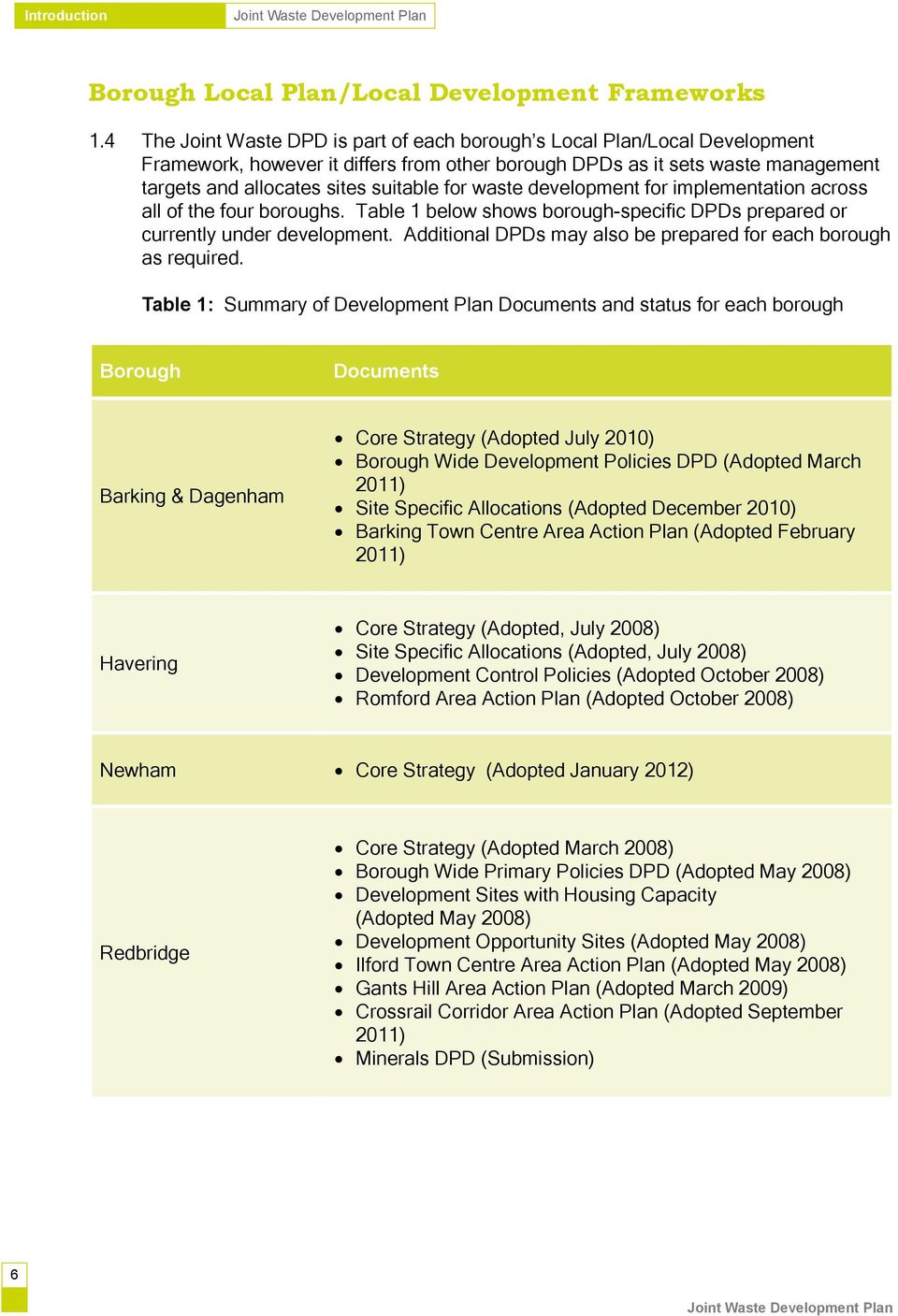
6 Introduction Borough Local Plan/Local Development Frameworks 1.4 The Joint Waste DPD is part of each borough s Local Plan/Local Development Framework, however it differs from other borough DPDs as it sets waste management targets and allocates sites suitable for waste development for implementation across all of the four boroughs. Table 1 below shows borough-specific DPDs prepared or currently under development. Additional DPDs may also be prepared for each borough as required. Table 1: Summary of Development Plan Documents and status for each borough Borough Documents Barking & Dagenham Core Strategy (Adopted July 2010) Borough Wide Development Policies DPD (Adopted March 2011) Site Specific Allocations (Adopted December 2010) Barking Town Centre Area Action Plan (Adopted February 2011) Havering Core Strategy (Adopted, July 2008) Site Specific Allocations (Adopted, July 2008) Development Control Policies (Adopted October 2008) Romford Area Action Plan (Adopted October 2008) Newham Core Strategy (Adopted January 2012) Redbridge Core Strategy (Adopted March 2008) Borough Wide Primary Policies DPD (Adopted May 2008) Development Sites with Housing Capacity (Adopted May 2008) Development Opportunity Sites (Adopted May 2008) Ilford Town Centre Area Action Plan (Adopted May 2008) Gants Hill Area Action Plan (Adopted March 2009) Crossrail Corridor Area Action Plan (Adopted September 2011) Minerals DPD (Submission) 6
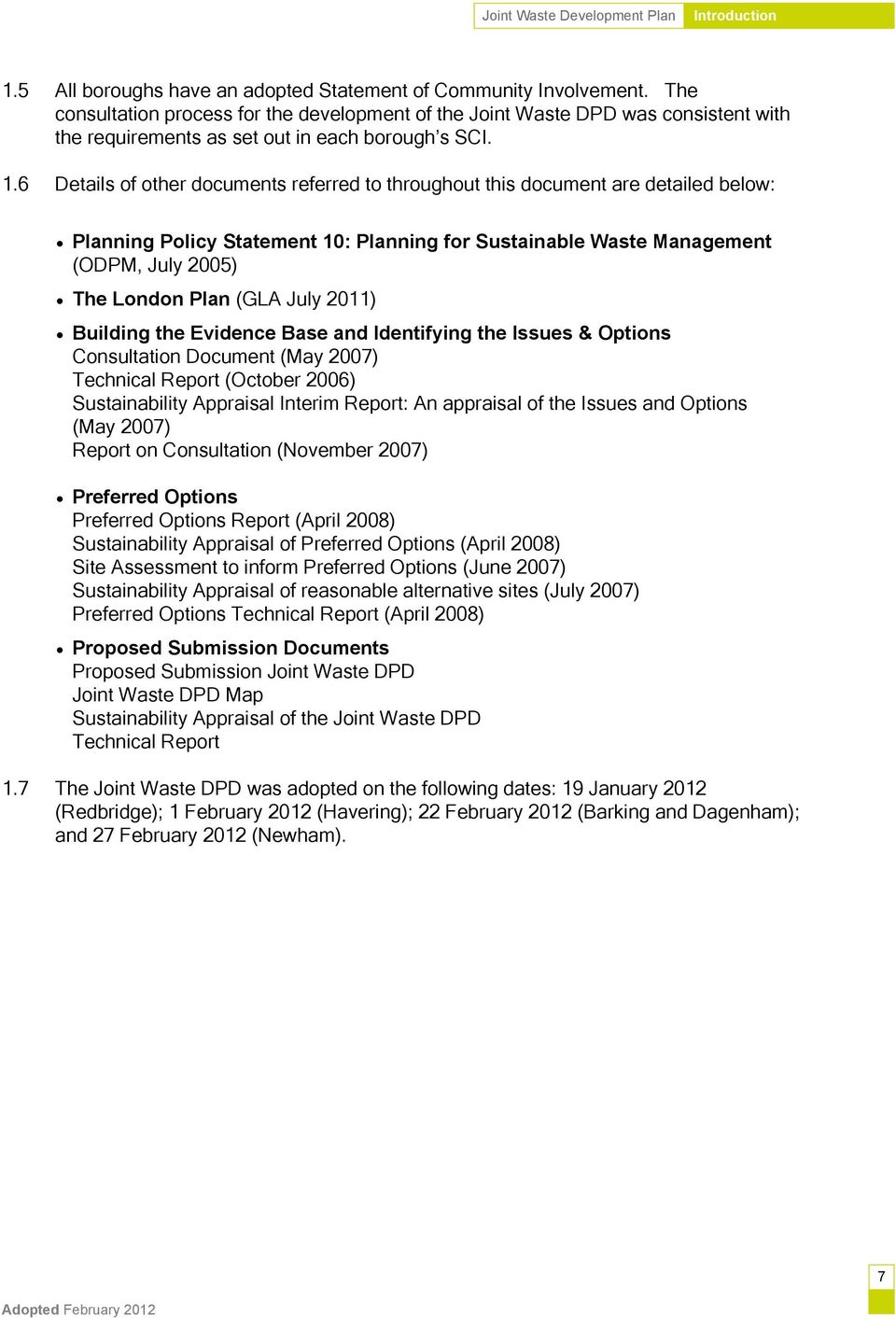
7 Introduction 1.5 All boroughs have an adopted Statement of Community Involvement. The consultation process for the development of the Joint Waste DPD was consistent with the requirements as set out in each borough s SCI. 1.6 Details of other documents referred to throughout this document are detailed below: Planning Policy Statement 10: Planning for Sustainable Waste Management (ODPM, July 2005) The London Plan (GLA July 2011) Building the Evidence Base and Identifying the Issues & Options Consultation Document (May 2007) Technical Report (October 2006) Sustainability Appraisal Interim Report: An appraisal of the Issues and Options (May 2007) Report on Consultation (November 2007) Preferred Options Preferred Options Report (April 2008) Sustainability Appraisal of Preferred Options (April 2008) Site Assessment to inform Preferred Options (June 2007) Sustainability Appraisal of reasonable alternative sites (July 2007) Preferred Options Technical Report (April 2008) Proposed Submission Documents Proposed Submission Joint Waste DPD Joint Waste DPD Map Sustainability Appraisal of the Joint Waste DPD Technical Report 1.7 The Joint Waste DPD was adopted on the following dates: 19 January 2012 (Redbridge); 1 February 2012 (Havering); 22 February 2012 (Barking and Dagenham); and 27 February 2012 (Newham). 7 Adopted February 2012
8

9 Background 02 Background Waste Policy Context 2.1 The Joint Waste DPD is influenced by, and needs to have regard to, the relevant policies, plans and programmes at international, national, regional and local levels. A summary of the key policies, plans and programmes are detailed below. EU legislation 2.2 The Waste Framework Directive [75/442/EEC] is the principal EU legislation for waste and requires measures to ensure that waste is recovered or disposed of without endangering human health or causing harm to the environment. A key principle of the directive is the waste hierarchy, with the objective to manage waste as near to the top of the hierarchy as possible. The Waste Hierarchy Reduce Reuse Recycling & Composting Energy Recovery Disposal The most effective environmental solution is often to reduce the generation of waste reduce Products and materials can sometimes be used again, for the same or a different purpose reuse Resources can often be recovered from waste recycling and composting Value can also be recovered by generating energy from waste energy recovery Only if none of the above offer an appropriate solution should waste be disposed of 9 Adopted February 2012

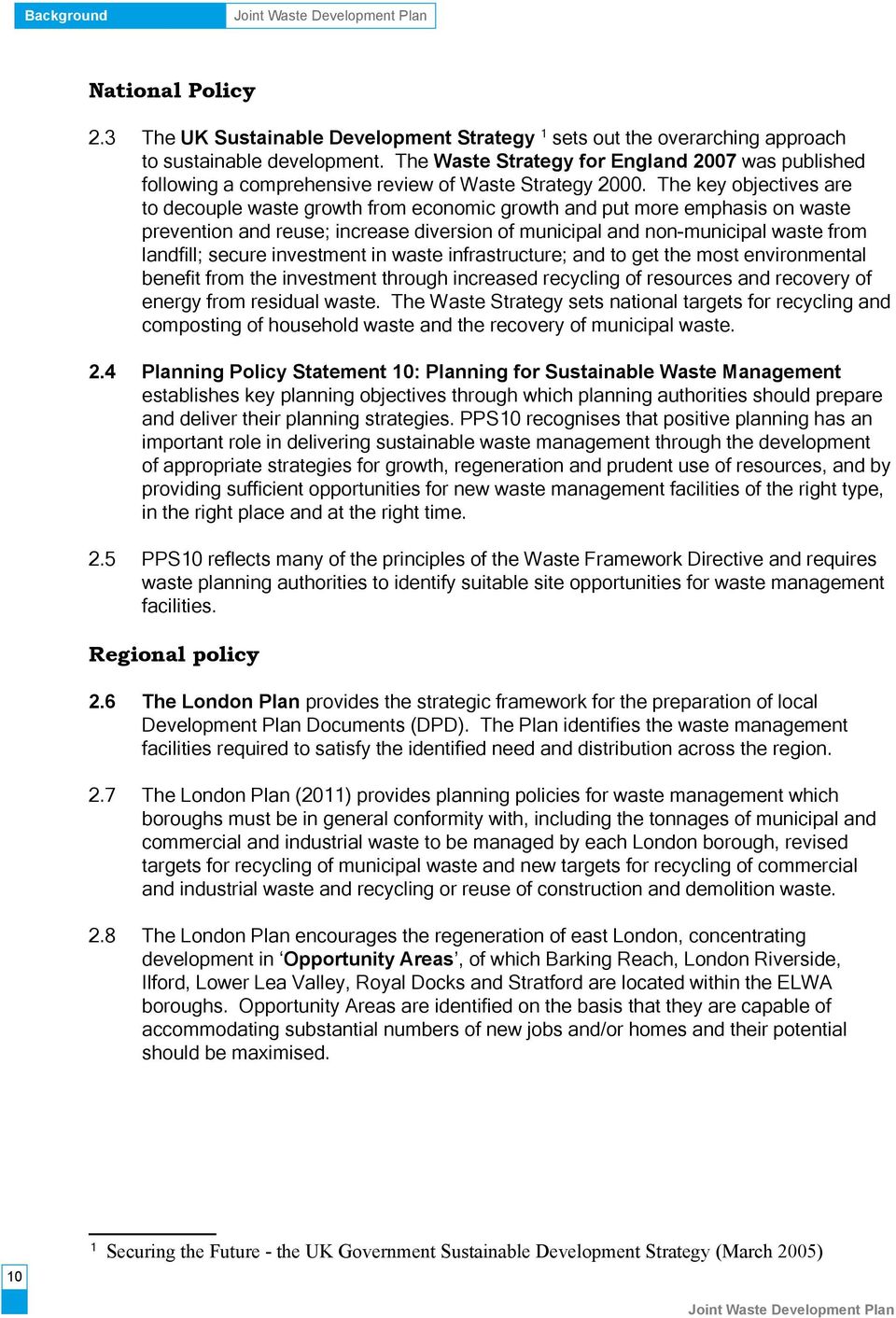
10 Background National Policy 2.3 The UK Sustainable Development Strategy 1 sets out the overarching approach to sustainable development. The Waste Strategy for England 2007 was published following a comprehensive review of Waste Strategy The key objectives are to decouple waste growth from economic growth and put more emphasis on waste prevention and reuse; increase diversion of municipal and non-municipal waste from landfill; secure investment in waste infrastructure; and to get the most environmental benefit from the investment through increased recycling of resources and recovery of energy from residual waste. The Waste Strategy sets national targets for recycling and composting of household waste and the recovery of municipal waste. 2.4 Planning Policy Statement 10: Planning for Sustainable Waste Management establishes key planning objectives through which planning authorities should prepare and deliver their planning strategies. PPS10 recognises that positive planning has an important role in delivering sustainable waste management through the development of appropriate strategies for growth, regeneration and prudent use of resources, and by providing sufficient opportunities for new waste management facilities of the right type, in the right place and at the right time. 2.5 PPS10 reflects many of the principles of the Waste Framework Directive and requires waste planning authorities to identify suitable site opportunities for waste management facilities. Regional policy 2.6 The London Plan provides the strategic framework for the preparation of local Development Plan Documents (DPD). The Plan identifies the waste management facilities required to satisfy the identified need and distribution across the region. 2.7 The London Plan (2011) provides planning policies for waste management which boroughs must be in general conformity with, including the tonnages of municipal and commercial and industrial waste to be managed by each London borough, revised targets for recycling of municipal waste and new targets for recycling of commercial and industrial waste and recycling or reuse of construction and demolition waste. 2.8 The London Plan encourages the regeneration of east London, concentrating development in Opportunity Areas, of which Barking Reach, London Riverside, Ilford, Lower Lea Valley, Royal Docks and Stratford are located within the ELWA boroughs. Opportunity Areas are identified on the basis that they are capable of accommodating substantial numbers of new jobs and/or homes and their potential should be maximised. 1 Securing the Future - the UK Government Sustainable Development Strategy (March 2005) 10
11 Background Adjoining regional or local policy 2.9 It is important for the Joint Waste DPD to take into account the relevant strategies and plans of adjoining areas. The key waste planning policies from adjoining areas are detailed below: Thurrock Core Strategy Issues and Options Consultation Proposes to reduce the use of landfill including importation of London s waste to landfill residues by 2015 and only if landfill capacity is still available. It was favoured by 71% of respondents. The Essex Waste Development Plan is currently in preparation. North London Waste Plan Issues & Options Consultation Question 4 asks whether North London should identify just enough land to meet its apportionment or identify more land as good practice for contingency reasons and/or to achieve a greater level of self sufficiency within North London. If the North London Waste Plan identifies additional land it may result in a reduced apportionment to East London boroughs if the London Plan apportionment is reviewed. Local policy 2.10 Planning Policy Statement 12: Local Development Frameworks recognises the Local Development Framework as a key component in the delivery of each borough s Sustainable Community Strategy and requires Local Development Documents to express those elements of the Community Strategy that relate to the development and use of land The preparation of each borough Core Strategy reflects their Sustainable Community Strategy. London Borough of Barking & Dagenham Barking and Dagenham s Sustainable Community Strategy, The Community Plan (2009 Agreed Version) has six aims, one of which is to work together for a clean, green and environmentally sustainable borough. As part of this the Partnership will be focusing on reducing the amount of waste that goes to landfill and reducing how much carbon dioxide is released into the environment. The rate of recycling (NI192) in 2008/09 was 25%, increasing to 32% in 2009/10. London Borough of Havering Havering s Sustainable Community Strategy ( ) states that the Local Strategic Partnership (LSP) wishes to ensure a clean, safe and green borough. High recycling rates will reduce the burden we place on landfill and the Council will invest in new ways of improving recycling rates. The rate of recycling (NI192) in 2007/08 was 23.98%, increasing to 27.37% in 2008/09 and 34.35% in 2009/ Adopted February 2012
12 Background London Borough of Newham Newham Sustainable Community Strategy ( ) states that the LSP wishes to help residents and businesses to minimise waste arisings and to recycle in the easiest and most cost effective way. The Council is examining ways to reduce the amount of waste produced, improve how it is disposed of and improve access to recycling. The rate of recycling (NI192) increased from 16% in 2008/9 to 19% between April and November 2009; the baseline (2007/8) rate was 15%. London Borough of Redbridge The Redbridge Sustainable Community Strategy (SCS) ( ) sets an ambition to promote a positive attitude to the environment and have a cleaner, greener Redbridge. As part of this ambition the strategy makes a commitment to reduce waste production and increase recycling. The SCS provides the overarching framework for all Local Development Documents, and the Joint Waste DPD will assist with the delivery of its priorities. The 2009/10 AMR showed that the recycling and composting rate in Redbridge was 31.5%, which was an increase from 26.2% in 2008/09, but below the 40% national target This Joint Waste DPD must be in conformity with borough Core Strategy policies. Borough Core Strategy policies of specific relevance to the Joint Waste DPD are outlined below: Barking & Dagenham (Adopted July 2010) POLICY CR3: Sustainable Waste Management Havering (Adopted July 2008) Policy CP11: Sustainable Waste Management Newham (Adopted January 2012) Policy INF3: Waste and Recycling Redbridge (Adopted March 2008) Strategic Policy 11: Waste 12
13 Background 2.13 The ELWA Joint Waste Management Strategy details how the ELWA boroughs intend to manage municipal waste. Joint Waste Management Strategy (ELWA, February 2006) Scope of the Joint Waste DPD 2.14 PPS10: Planning for Sustainable Waste Management requires the Joint Waste DPD to set out policies and proposals for waste management in line with the London Plan and ensure sufficient opportunities for the provision of waste management facilities in appropriate locations. 13 Adopted February 2012

14 Background 2.15 It is not necessary for the Joint Waste DPD to repeat or reformulate national or regional policies, nor to address issues adequately covered in the London Plan or borough Core Strategies London Plan Policy 5.17 requires the Joint Waste DPD to identify sufficient land to provide capacity to manage the apportioned tonnages of municipal solid waste (MSW) and commercial and industrial (C&I) waste. Waste is deemed to be managed in London if it is used for energy recovery in London, or it is compost or recyclate sorted or bulked in London material recycling facilities for reprocessing either in London or elsewhere Although the London Plan borough level apportionment does not include construction, excavation and demolition waste (C, D&E) or hazardous waste streams, these are addressed in London Plan Policy 5.18 and as such are included in the Joint Waste DPD Further detail of these waste streams and their future management is in Chapter 4 of this document. Sustainability Appraisal 2.19 Each stage in the preparation of the Joint Waste DPD has been subject to Sustainability Appraisal, as required by Section 5a and 5b of the Planning and Compulsory Purchase Act, the Environmental Assessment of Plans and Programmes Regulations 2004 and incorporating the requirements of EU Directive 2001/42/EC on the Assessment of the Effects of Certain Plans and Programmes on the Environment (commonly referred to as the Strategic Environmental [SEA] Directive). The Sustainability Appraisal documents form part of the evidence base to this DPD. The key recommendations of the Sustainability Appraisal are summarised below: Sustainability Appraisal Recommendations Encourage the reduction, reuse and recycling of waste produced by the construction industry Secure an appropriate range of facilities for the management of waste Allocate sufficient resources to waste issues Help facilitate the provision of ongoing education and practical advice relating to waste Take into account proposals for an additional 54,000 new dwellings in the Thames Gateway London area Include sustainable transport factors particularly encouraging the movement of waste by rail and water in site assessment for facilities Consider environmental separation buffers around suitable sites for waste management facilities Source: From Table 2.1: Key Messages from the Context Review, Sustainability Appraisal of the Joint Waste DPD Preferred Options, April PPS12: Local Spatial Planning (2008) paras 4.30 and
15 Background 2.20 The Sustainability Appraisal of Preferred Options 3 tested the DPD objectives, policies and identified sites against the Sustainability Framework. The Appraisal suggested mitigation measures which were incorporated into the development of this Proposed Submission Document. A Final Sustainability Appraisal specifically relating to the Proposed Submission Joint Waste DPD was also produced. Note: A Habitats Regulations Assessment of the Joint Waste DPD was undertaken to determine whether the DPD will effect European biodiversity designations. The HRA was developed in consultation with officers at Natural England. 3 Joint Waste DPD Preferred Options Sustainability Appraisal Report (Scott Wilson Ltd with Land Use Consultants, April 2008) 15 Adopted February 2012
16 Strategic Objectives 03 Strategic Objectives 3.1 The evidence base revealed that there is a need to provide additional waste treatment capacity within the ELWA area to manage waste without endangering human health or the environment and to enable communities to take responsibility for the waste produced. Vision Statement The vision for the East London Document is that it aims to manage waste produced in the boroughs of Barking and Dagenham, Havering, Newham and Redbridge in line with the growth set out in the boroughs adopted and emerging Local Development Framework Core Strategies. It responds to East London s location within two Growth Areas (Thames Gateway and London-Stansted-Cambridge-Peterborough corridor), and identifies required levels of waste management capacity which can be delivered by The production of waste will be minimised, recycling and composting will be increased, and substantial reductions in the use of landfill will be achieved. This will be done in the unique context of East London, which is self-sufficient by having facilities in place to deal with its own waste. Boroughs will work with the Mayor of London to deliver his aspiration that no untreated waste will go directly to landfill, as set out in London s emerging Waste Strategy. The Joint Waste Plan will deliver sustainable development by addressing waste as a resource without endangering health or harming the environment. In dealing with waste, boroughs will ensure that well designed, high quality waste facilities are developed, including the promotion of green industries, which integrate with and complement opportunities for regeneration across East London. 16

17 Strategic Objectives 3.2 The Joint Waste DPD Objectives, as developed throughout the planning process, are to: A) Deliver sustainable development by driving waste management up the waste hierarchy, addressing waste as a resource and looking to disposal as the last option, while recognising that disposal must be adequately catered for; B) Work towards meeting targets set out in the Waste Strategy for England 2007, and the London Plan; C) Enable the provision of a range of waste technologies; D) Enable the provision of facilities to allow for net self-sufficiency in the ELWA boroughs in accordance with the London Plan; E) Enable waste to be managed in one of the nearest appropriate installations without endangering health or harming the environment; F) Integrate waste planning with other spatial concerns, including regeneration plans; G) Reverse the historical trend of the ELWA area being the dumping ground for London s waste; and H) Encourage our communities to take more responsibility for their waste. 3.3 In addition to relevant European, national and regional policy, these objectives have also been developed to encompass the relevant principles from the borough Sustainable Community Strategies, Core Strategies and targets from the adopted Joint Waste Management Strategy. Implementation of these objectives will require action from the whole community, including producers, retailers, consumers, local authorities and the waste management industry waste management is everybody s responsibility. 3.4 The Borough Core Strategies each contain a strategic waste policy which sets the framework for the Joint Waste DPD including: encouraging movement up the waste hierarchy suitable locations for waste management facilities help deliver targets for recycling and composting regard to the London Plan apportionment Joint Waste DPD to identify amount of waste to be managed, the range and type of facilities needed, sufficient land to manage waste apportionment and suitable locations for these facilities. 17 Adopted February 2012
18

19 Future Waste Management Requirements 04 How much waste will we need to manage at 2021 Future Waste Management Requirements 4.1 The determination of how much waste will need to be managed by the ELWA boroughs was debated through previous public consultation. The London Plan identifies the borough level apportionment of municipal solid waste (MSW) and commercial and industrial waste (C&I) to be managed. The apportionment for each ELWA borough is pooled for the purpose of this Joint Waste DPD. 4.2 The London Plan borough level apportionment does not include construction, excavation, demolition waste (C,E&D) or hazardous waste. Forecast scenarios and variables for construction and demolition waste and hazardous waste were consulted on at the Issues and Options stage and inclusion of these waste streams in the Joint Waste DPD are supported by representations received. 4.3 Graph 1 below show the tonnages of these waste streams to be managed by the ELWA boroughs to Municipal solid waste and commercial and industrial waste tonnages are as per London Plan (Consolidated with Alterations since 2004) Table 4A.6. 4 Construction, excavation and demolition waste and hazardous waste projections for the ELWA boroughs are as set out in the Issues and Options Consultation Document. Graph 1: Waste volumes projected to be managed by the ELWA boroughs Tonnes / / /20 C, E & D forecast C & I (London Plan 2008 Table 4A.6) MSW (London Plan 2008 Table 4A.6) Hazardous waste forecast 4 The projections for municipal solid waste and commercial and industrial waste have been reduced in the latest version of the London Plan which was published in July Adopted February 2012

20 Future Waste Management Requirements What facilities will we need? 4.4 Taking into account the reduced apportionment in the London Plan (2011) the ELWA boroughs will need to provide sufficient waste management capacity for: million tonnes of MSW and C&I waste at million tonnes of C,E&D waste at 2021; and millions tonnes of hazardous waste at A detailed list of current recycling, composting, recovery, disposal and transfer waste management facilities in the ELWA boroughs and individual annual permitted tonnages is included in the Joint Waste DPD Technical Report. A summary of the relevant facility types and their estimated capacity is shown in Table 2 below. Table 2: Existing waste management capacity in the ELWA area Facility type A13 Household Waste Amenity Sites (Reuse and Recycling Centres) A15 - Material Recycling Treatment Facility Number of facilities Annual permitted tonnage 4 167, , , ,875 Estimated actual capacity (75%) A20 Metal Recycling Sites 5 488, ,060 A22 - Composting Facility 2 202, ,500 A16 - Physical Treatment Facility 3 174, ,500 A17 - Physico-Chemical Treatment Facility 1 90,000 67,500 A23 - Biological Treatment Facility 2 193, ,080 A11 Household, Commercial and Industrial Waste Transfer Station 23 3,252,833 2,439,625 A18 Incineration (Clinical Waste) 1 7,000 5,250 A09 Special Waste Transfer Station 6 470, ,970 A12 Clinical Waste Transfer Station 3 6,040 4,250 A14 Transfer Station taking Non- Biodegradable Wastes A05 Landfill taking Non-Biodegradable Wastes 2 280, , , ,000 20

21 Future Waste Management Requirements 4.6 Waste management facilities that do not count toward meeting the capacity required to manage MSW and C&I wastes include transfer stations and landfill as these options do not support recycling. Vehicle dismantlers are also not included as it is a transfertype operation. The existing capacity of ELWA s four Reuse and Recycling Centres is included as 50% of the annual permitted tonnage as this is the percentage of waste that is currently recycled or composted at these sites (as opposed to RRCs operating as transfer stations). As with all the other facilities (see paragraph 4.7 below), the Joint Waste DPD Technical Report then applies an actual throughput of 75% of this existing capacity at ELWA s four Reuse and Recycling Centres (i.e. 75% of 50% of the annual permitted tonnage). As almost all C,E&D waste is inert it is appropriate to include Landfill taking Non-Biodegradable (i.e. inert) waste. 4.7 It is generally accepted that most facilities are licensed for a throughput in excess of what they achieve in practice. As there is considerable uncertainty surrounding actual throughput and little available data, the Joint Waste DPD Technical Report uses an estimate for actual throughput of 75% of maximum available capacity to maintain consistency with data used in the London Plan. 4.8 The number and mix of facilities that will be required within the ELWA area is dependent not only on the amount of waste that will require treatment but also how it is treated. The Waste Strategy for England 2007 establishes the following targets for waste management: Table 3: Target MSW, C&I and C,E&D recovery, composting and recycling to 2020 MSW C&I C,E&D Recycling Composting Recycling + Composting Other recovery Total recovery 1 Recycling Composting Recycling & Composting Recycling & Reuse % 13% 40% 13% 53% 38% 18% 56% % 15% 45% 22% 67% 43% 21% 64% % 16.5% 50% 25% 75% 47% 23% 70% 95% Note 1 Recovery means to obtain value from waste through one of the following means: Recycling Composting Other forms of material recovery (such as anaerobic digestion) Energy recovery (combustion with direct or indirect use of the energy produced, manufacture of refuse derived fuel, gasification, pyrolisis, or other technologies) Source: Waste Strategy 2000 for England and Wales, DETR May Adopted February 2012
22 Future Waste Management Requirements 4.9 These targets highlight a commitment to drive waste management up the waste hierarchy and divert more waste from landfill and are endorsed in the National Waste Strategy 2007 and the London Plan In addition to the targets established in the Waste Strategy 2000 and the London Plan, the ELWA boroughs have planned on the basis of that waste which is not recycled or composted being recovered and therefore no waste going to landfill. Based on this approach for the management of waste in the ELWA area, and the existing waste management capacity in the ELWA boroughs (as detailed in Table 2) the ELWA boroughs need to provide capacity as summarised in Table 4 below in order to manage the apportionment of MSW and C&I waste in the London Plan (2011). A detailed explanation and spreadsheet of these calculations is included in the Joint Waste DPD Technical Report. Table 4: Summary of average capacity surplus/deficit within the ELWA boroughs required to meet the London Plan (2011) apportionment for MSW and C&I waste. Waste management route Capacity Required Recycling (MSW and C&I) 786,203 tpa 674,313 tpa 415,428 tpa Composting (MSW and C&I) -47,440 tpa -109,170 tpa -320,255 tpa Recovery (all facilities) -262,710 tpa -256,090 tpa -269,370 tpa Note 1 A deficit, or future capacity requirement, is shown in bold with a minus sign in front. Surplus capacity is shown in italic text. Note 2 Table 4 is based on the assumption of 75% capacity utilisation of existing facilities (refer to paragraph 4.7) 4.11 The 2011 London Plan figures are lower than in the previous London Plan (consolidated with alterations since 2004) and have resulted in increased flexibility within the Joint Waste DPD in terms of site deliverability. Such flexibility recognises that in some cases a site may not come forward or be required to meet the apportionment during the plan period. Site delivery and capacity requirements will be monitored extensively through LDF Annual Monitoring Reports. Where it is apparent that surplus capacity has been identified it may be necessary to put back the delivery of a waste management facility to a later five year period, or review its allocation in the DPD and seek an alternative use. As set out in Policy W2, sites will only be approved where they are needed to contribute to meeting the London Plan apportionment figures for the ELWA boroughs, and capacity sought only where there is an identified need Construction, excavation and demolition waste: It is estimated that a large portion of recycling and reuse of construction, excavation and demolition waste currently occurs on site rather than in designated licensed facilities, or is transferred out of London through inert transfer stations. As such it is not considered that additional permanent new C,E&D recycling facilities are required. 22
23 Future Waste Management Requirements 4.14 As an alternative to allocating sites for C,E&D recycling facilities, Joint Waste DPD Policy W1 encourages the reuse of C,E&D waste at or near to construction sites with on-site recycling wherever possible. There is increasing opportunity for the use of recycled aggregate (sourced from a variety of construction, excavation and demolition wastes) in a wide range of applications within the construction industry, and as a result of landfill legislation changes, on-site remediation of contaminated soils is increasing. Additionally, Policy W4 ensures that the potential benefits of landfilling inert C,E&D waste are maximised Hazardous waste: The Study of Arisings and Management of Non-Municipal Wastes in the ELWA area (ERM, 2005) considered it not appropriate for the ELWA boroughs to aim for self-sufficiency in the management of hazardous waste or to allocate specific sites suitable for hazardous waste management due to the variety and nature of hazardous wastes and the specialist management techniques and facilities required. This is supported by Policy 5.19 of the London Plan which states that the Mayor will work with the Boroughs, the Environment Agency and industry to provide and maintain direction on the need for hazardous waste management capacity The London Plan, Spatial Development Strategy for Greater London (Greater London Authority, 2011) noted that in 2007 around 300,000 tonnes of hazardous waste was produced in London, 35% from C&D waste (containing asbestos and contaminated soil), 21% from oil and oil/water mix waste, and 44% from chemical and other industrial processes. There are no figures for hazardous waste on an individual borough basis; however with 32 boroughs and the City, the individual tonnages generated in each are likely to be low. The types of hazardous waste arising in the ELWA area include such materials as televisions, computer monitors and fluorescent lighting (classified as hazardous wastes under the Hazardous Waste Directive list of wastes); thus households and businesses will also contribute towards hazardous waste arisings. Some hazardous waste can be reused, recovered or recycled such as solvents, oils and metals. Others are incinerated or sent to landfill however there are fewer landfill sites able to accept hazardous waste since implementation of the Landfill Directive in Whilst the London Plan recognises that there is a need to identify hazardous waste capacity for London s hazardous waste, due to the nature and quantities of this, the London sub-regions are unlikely to be self-sufficient. Detailed data on hospital/health care wastes across the ELWA area is not available. Current estimates from health service colleagues indicate that Newham General Hospital for example generates around 850 tonnes of waste p.a. of which 380 tonnes are clinical waste and 380 tonnes general black bag waste. Seventy tonnes of general waste is currently recycled primarily card and paper more recycling is planned, with the aim of recycling 50% of the domestic waste stream. Very little waste now requires incineration e.g. the approximate clinical waste arising from health centres within Barking and Dagenham is 46 tonnes p.a. of which some 2-3 tonnes require incineration. In Havering, St. George s Hospital generates approximately 22 tonnes p.a. of clinical waste The definition of hazardous waste includes substances that commonly make up household, commercial and industrial construction (including Waste Electrical and Electronic Equipment) and construction, excavation and demolition waste streams 23 Adopted February 2012
24 Future Waste Management Requirements (including asbestos and contaminated soils). Whilst London Plan Policy 5.19 states that Development Plan Documents should make provision for hazardous waste treatment plants to achieve, at a regional level, the necessary waste management requirements, there is no definition of such facilities. Any application for a waste management facility that manages hazardous waste would be determined in accordance with the policies of this Joint Waste DPD The existing hazardous waste management capacity within the area is listed in Table 2 - special waste [470,000 tpa] and clinical waste [6,000 tpa] transfer stations and clinical waste incineration [7,000 tpa]. On-site soil treatment facilities, including temporary facilities, provide additional capacity. While just the recovery (incineration) capacity is classified as treatment, special waste transfer stations play an important role in the storage and reprocessing of hazardous waste streams, especially as the Hazardous Waste Directive and Regulations require more sophisticated levels of separation of the different categories of hazardous, non-hazardous and inert waste Electrical equipment: The Waste Electrical and Electronic Equipment Directive (WEEE) aims to minimise the impacts of electrical and electronic equipment on the environment during their lifetime and when they become waste. The Directive applies to a wide range of products including fridges, washing machines, TVs, computers, fluorescent tubes and electronic games/toys and encourages and sets criteria for the collection, treatment, recycling and recovery of waste equipment. All four of ELWA s Reuse and Recovery Centres are Designated Collection Facilities (DCFs) which separate and recycle used electrical equipment with a current recycling rate in excess of 90% by weight. What waste management technologies and facilities? 4.20 A range of facilities, including type, size and mix of technologies, will be necessary to meet the overall capacity requirements. Recycling, composting, recovery and processing facilities cover a range of technology types that will have specific site characteristics. A summary of existing and emerging waste technologies is set out below: Materials Recycling Facility / Material Recovery Facility (MRF) An MRF is designed to process source separated or co-mingled dry recyclables into individual materials prior to despatch to reprocessors who prepare the materials for manufacturing into new recycled products. The MRF is made up of a series of conveyor belts and a mix of manual and automatic machines to separate the materials and remove any items that can be recycled. In-vessel composting (IVC) In-vessel composting is used to cover a wide range of composting systems, all of which feature the enclosed composting of biodegradable material, therefore allowing a higher degree of process control. They are usually categorised into five types: containers, silos, agitated bays, tunnels, and enclosed halls. Many IVC systems involve the forced aeration 24
25 Future Waste Management Requirements of the feedstock and capture and manage process air to reduce potential nuisance, such as odour. The enclosed nature of these facilities allows for the further control of nuisance, including noise and dust. The compost produced is far more stable and sanitary than the biodegradable MSW input. Moreover, the material may be screened into particle sizes suited to its end-use, and may be blended with other materials, such as sand, to produce artificial topsoil. Open-air composting Open-air composting has quite different land use implications from other waste management techniques. The process involves mechanical turning of shredded biodegradable waste to enable effective degradation. Open windrow composting operations can take place outdoors or using minimal buildings and as such the operations are comparable to agricultural practices and may therefore be appropriate to locate in the open countryside or Green Belt. These facilities would not normally be compatible with a hi-tech business park or urban setting. Mechanical Biological Treatment (MBT) Mechanical biological treatment is a generic term for the integration of several processes commonly found in other waste management technologies, including MRFs, sorting and composting plants. A common aspect of all MBT plants used for MSW is to sort mixed waste using a range of techniques, including hand picking, mechanical sorting and magnetic separation, and to extract materials for recycling. The biological element of the process can take place prior to or after sorting. MBT plants can incorporate a number of different processes in a variety of combinations, with the exact mix of technologies determined by the objectives of the plant. Anaerobic digestion (AD) Anaerobic digestion is a biological treatment where biodegradable wastes are converted to a digestate (containing biosolids and a liquid) and biogas. The waste is decomposed by bacteria in the absence of air a key difference from composting processes. Biodegradable waste is broken down in an enclosed vessel under controlled conditions. The methane rich biogas released during this process can be collected and burnt as a fuel to generate electricity. Advanced Thermal Treatment (ATT) Advanced thermal treatment is a general term primarily used for waste management technologies that use pyrolysis or gasification to process waste and generate power (and often to recover heat). ATT excludes the conventional incineration of waste. Within the ELWA area, a proposal for advanced thermal treatment (excluding conventional incineration) will be considered where the development will recover energy, and where it can be demonstrated that waste to be treated in this way cannot practically and reasonably be reused, recycled or processed to recover materials. This will ensure that the thermal treatment plant does not crowd out other technologies with the potential for recycling or otherwise gaining benefit from the waste prior to its thermal treatment. Opportunities to include provision for Combined Heat and Power (CHP) and Combine Heat Power and Cooling (CHPC) will be supported. 25 Adopted February 2012
26 Future Waste Management Requirements C,E&D Recycling Temporary C,E&D recycling facilities can potentially be located on development sites for the reprocessing of a range of C,E&D wastes (including concrete, tiles, brick and asphalt) into recycled aggregate for use in the construction industry. Further details are available at (part of the WRAP Aggregates Programme). C,E&D waste recycling and processing facilities can also be co-located on mineral sites. Broadly, the materials are similar in nature, as are the general processes that both C,E&D waste and raw materials undergo (including screening and grading of material, crushing and breaking), and there are potential transport-related savings through the use of heavy goods vehicle movements delivering C,E&D waste and removing minerals or secondary aggregate. Permissions granted for C,E&D waste management facilities on mineral extraction sites will be temporary and restricted to the operational life of the mineral site. Where should new facilities be located? 4.21 In accordance with PPS10, the London Plan and borough Core Strategy policy, the Joint Waste DPD identifies sites suitable for recycling and waste treatment facilities. The process for determining these sites has been documented throughout the development of this document and has been influenced by representations received The suitability of a site for a waste facility was based on criteria consistent with PPS10, the London Plan and sustainability objectives. Full details of the methodology used for the assessment of potential sites for waste management uses, as well as the findings of the site assessment and recommendations for preferred sites to be included in the Joint Waste DPD can be found in the Site Assessment to inform Preferred Options report The site assessment procedure also considered the typical characteristics of modern waste management techniques and facilities and key local issues associated with the operation of each process. 5 East London Joint Waste DPD Site Assessment to inform Preferred Options. Prepared by Land Use Consultants and Environmental Resources Management Ltd, June
27 Policies 05 Policies Policy W1: Sustainable Waste Management The boroughs will aim to drive waste management up the waste hierarchy by promoting waste minimisation, materials reuse, recycling & recovery of resources and help the delivery of national and regional targets for recycling and composting set out in the Waste Strategy for England 2007 and the London Plan by: (i) working in partnership with the general public and the business community in the ELWA area to provide information and advice and raise awareness; (ii) working in partnership with local community and voluntary groups and social enterprises to encourage waste minimisation, materials reuse, recycling and recovery of resources; (iii) ensuring that developers and contractors design new housing, commercial and other developments to maximise opportunities for future occupiers to minimise, reuse, recycle and recover resources from waste, by providing adequate space and facilities for storage and handling of segregated waste; and (iv) require the reuse of construction, excavation and demolition waste during new developments, such as the Thames Gateway, with on-site recycling and use of recycled aggregate wherever possible and encourage use of sustainable transport modes where the movement of waste is necessary. Justification 5.1 The objective of the Waste Framework Directive is to manage waste as near to the top of the waste hierarchy as possible with European, national and regional policies placing increasing emphasis on waste reduction. Achieving these objectives will require a concerted effort to decouple waste growth from economic growth, which will need a change in producer and consumer behaviour and current patterns of the manufacture and consumption of goods. There is increasing pressure both nationally and regionally for business to take the lead, especially with regard to packaging waste. 27 Adopted February 2012
28 Policies 5.2 The agreed targets for the Joint Waste DPD intend to deliver sustainable waste development (Preferred Objective A) and are consistent with the Waste Strategy for England 2007 and the London Plan (2011). These are: Recycling & Composting of MSW - 40% by 2010, 45% by 2015, 50% by 2020 Waste Strategy for England (2007, page 11) Recovery of MSW - 53% by 2010, 67% by 25, 75% by 2020 Waste Strategy for England (2007, page 11) Recycling and composting of C&I - 70% by 2020 London Plan 2011 Policy 5.16 (Waste Self-Sufficiency) Recycling and reuse of C,E&D - 95% by Achieving these targets will require investment in new infrastructure and technologies to treat the wastes generated within the ELWA area. Efforts will extend to the commercial and industrial (C&I) and construction, excavation and demolition (C,E&D) waste streams. The ELWA boroughs will be supportive in generating, and encouraging others to generate, markets for recycled materials through working with public organisations, as well as local privately funded initiatives. Other approaches include adopting green procurement practices and encouraging the use of recycled aggregate in the construction industry. 5.4 The Joint Waste DPD encourages the development of new and emerging advanced conversion technologies for waste. Such technologies might include recycling, composting, mechanical biological treatment, anaerobic digestion and gasification/ pyrolysis, and where appropriate the co-location of these facilities to form resource recovery parks will be supported. By not prescribing preferred waste management technologies the Joint Waste DPD will maintain flexibility and allow industry to bring forward appropriate development proposals. 5.5 For proposed facilities lower down in the waste hierarchy, applicants will be expected to demonstrate satisfactorily how their proposals integrate into the sustainable approach to waste management sought by the ELWA boroughs. Their proposals must take into account any opportunities for treatment of waste further up the hierarchy. New and innovative approaches to waste management will be supported where benefits are demonstrated. 28
29 Policies Policy W2: Waste Management Capacity, Apportionment & Site Allocation The London Plan identifies the amount of municipal and commercial waste to be managed by the ELWA boroughs as 1,228,000 tonnes at 2011; 1,395,000 tonnes at 2016 and 1,573,000 tonnes at The ELWA boroughs will meet this apportionment by: (i) Safeguarding the capacity of existing waste management facilities listed in Schedule 1 and encouraging increased processing of waste at these facilities, to run at a higher figure towards the licensed capacity ; and (ii) Approving strategic waste management facilities where it will contribute to the ELWA boroughs meeting the London Plan apportionment on sites within the locations listed in Schedule 2. Where the applicant can demonstrate there are no opportunities within these preferred areas for a waste management facility, sites within designated industrial areas as identified in borough Local Development Frameworks will be considered. Planning permission will only be granted for new waste water and sewage treatment plant, extensions to existing works, or facilities for the co-disposal of sewage with other wastes, where development is either needed to treat waste arisings from within the East London Waste Authority area or in the case of arisings from elsewhere the need cannot practicably and reasonably be met at another site subject to the relevant borough s policy/guidance and Policy W5 of this Plan. Wherever practical and economical, renewable energy generation will be encouraged as part of such waste management facilities. In all cases applications will be required to meet the relevant borough design guidance and Policy W5. Justification 5.6 PPS10 requires that the Joint Waste DPD identifies sites and areas suitable for the waste management facilities that support the apportionment as set out in the London Plan. 5.7 The loss of existing waste management capacity or suitable sites for future facilities to other development pressures will make waste recycling, diversion and recovery targets harder to achieve. PPS10 recognises that all local planning authorities have a responsibility to consider the impact of other development on existing waste management facilities and on sites and areas allocated for waste management. The London Plan requires that existing waste management sites should be safeguarded, unless appropriate compensatory provision is made. It is deemed that the sites listed in Schedule 1 and Schedule 2 satisfy this. 29 Adopted February 2012
30 Policies 5.8 The Councils recognised that before all the sites in Schedule 2 are operational it will need to treat carefully proposals which involve the loss of existing waste management facilities that are not safeguarded. This is necessary to ensure there remains sufficient capacity in place to meet the apportionment. The Councils will require appropriate compensatory provision to be made where this is not the case. 5.9 A detailed explanation of the calculations of how the apportioned waste will be treated (as per the targets for municipal and commercial and industrial waste), existing capacity of existing waste management facilities in the ELWA boroughs, and new capacity which the Joint Waste DPD must plan for is included in the Joint Waste DPD Technical Report. Table 5 summarises the capacity required and estimated land take that may be required to provide this capacity. Table 5: Summary of average capacity required within the ELWA boroughs and land area required to meet the London Plan apportionment for MSW and C&I waste Waste management route Capacity Required Land area required Composting (MSW and C&I) Recovery (all facilities) 47,440 tonnes at ,730 tonnes at ,085 tonnes at ,710 tonnes at ,620 tonnes at ,280 tonnes at ha 4 12ha 6-12ha 3-5ha 0ha 1ha 5.10 Schedule 2 identifies a number of areas within which potentially available and suitable sites for waste management facilities can be located. These areas represent a refinement of the broad locations identified in the London Plan and borough Core Strategies. This builds flexibility into the Joint Waste DPD and the boroughs are confident that sufficient opportunities will arise within these areas Each of the identified sites was considered in the context of the type of waste treatment technology that could be suitable on that site based on the typical characteristics and key local issues published in Planning for Waste Management Facilities and Recycling and Recovery Facilities The sites identified in Schedule 2 provide sufficient potential capacity to manage the tonnages of waste presented above. In considering the need for development, the ELWA boroughs will have regard to the remaining capacity of existing facilities, as well as other permitted waste facilities. It is important that the ELWA boroughs work together to ensure that new development does not constrain land that has been safeguarded for waste management facilities. 30
31 Policies 5.13 There is an established network of sewage facilities within East London, but upgrades may be required during the Plan period and this may involve new development. As the Landfill Directive introduces a ban on the disposal of liquid to other landfill facilities, this may result in additional pressure to find available space within operational sewage treatment plants to manage liquid wastes that were previously disposed of through landfill. Sewage treatment plants may also be appropriate locations for new facilities to manage domestic and other wastes. Policy W3: Energy recovery facilities Opportunities for the incorporation of waste recovery and treatment facilities, where the energy produced from biological or thermal treatment can be utilised in local schemes, should be considered for all major new developments. Applications for advanced thermal treatment facilities 1 will be considered only where the waste to be treated cannot practicably and reasonably be reused, recycled or processed to recover materials and where there is provision for energy recovery and co-location with complementary activities. In all cases applications will be required to meet relevant design guidance and Policy W5. 1 Advanced Thermal Treatment technologies exclude conventional incineration Justification 5.14 While the Joint Waste DPD supports, in accordance with the waste hierarchy, that opportunities for recycling and composting are maximised before energy recovery is considered, energy recovery facilities will play an important role in the future management of London s waste Advanced thermal treatment (or advanced conversion) technologies including gasification, pyrolysis and anaerobic digestion provide opportunities for local renewable energy generation supported by the Renewables Obligation Certificates system and the Government s Energy White Paper. The Joint Waste DPD does not express a preference for technologies in order to maintain flexibility with regard to emerging technologies and allow proposals to be determined on their merits. The Joint Waste DPD supports the Defra Waste Infrastructure Delivery and New Technologies Demonstrator Programmes in developing UK specific examples of these technologies As any energy recovery technology is more beneficial if both heat and electricity can be recovered, particular attention is focussed on siting facilities in order to maximise opportunities for Combined Heat and Power (CHP) and Combined Cooling Heat and Power (CCHP). Potential co-location opportunities should be considered at the early stages of planning major new developments. 31 Adopted February 2012
32 Policies Policy W4: Disposal of inert waste by landfilling The ELWA boroughs will only grant planning permission for waste disposal by landfilling provided: (i) the waste to be disposed of cannot practicably and reasonably be reused; and (ii) the proposed development is both essential for and involves the minimum quantity of waste necessary for: a) the purposes of restoring current or former mineral workings sites; or b) facilitating a substantial improvement in the quality of land; or c) facilitating the establishment of an appropriate after-use; or d) improving land damaged or degraded as a result of existing uses and where no other satisfactory means exist to secure the necessary improvement; and Where the above criteria are met, all proposals for landfilling should: (i) incorporate finished levels that are compatible with the surrounding landscape. The finished levels should be the minimum required to ensure satisfactory restoration of the land for an agreed after-use; and (ii) include proposals for high quality restoration and aftercare of the site, taking account of the opportunities for enhancing the overall quality of the environment and the wider benefits that the site may offer, including nature and geological conservation and increased public accessibility. Justification 5.17 Due to the need for inert C,E&D waste landfill capacity the voids left by mineral working can be used for landfill to achieve restoration of the site. Policy W4 sets the requirements that will govern the circumstances under which these sites can be used for landfill materials To ensure that the potential benefits of landfill are maximised, such proposals must include consideration of final use of the land, including proposals for a high quality of restoration and long term management plans for the restored site. In accordance with sustainability objectives after-uses with open space and/or biodiversity conservation will be favoured. All restored landfills will be expected to incorporate high quality standards of restoration of the site that are appropriate to the surrounding landscape. In this regard boroughs LDF minerals policies must also be met. 32
33 Policies Policy W5: General Considerations with regard to Waste Proposals Planning permissions for a waste related development will only be granted where it can demonstrate that any impacts of the development can be controlled to achieve levels that will not significantly adversely affect people, land, infrastructure and resources. Applications for new facilities that manage non-apportioned waste must demonstrate that there is not a more suitable site nearer the source of waste arising with regard to the factors listed below. The information supporting the planning application must include, where relevant to a development proposal, assessment of the following matters and where necessary, appropriate mitigation should be identified so as to minimise or avoid any material adverse impact and compensate for any loss including: (i) the release of polluting substances to the atmosphere or land arising from facilities and transport; (ii) the amount of greenhouse gases produced; (iii) the development on sites that are likely to be at greater risk now, or over the lifetime of the development due to climate change; (iv) the likely increase in pressure on resources with climate change; (v) the contamination of ground and surface water; (vi) the drainage of the site and adjoining land and the risk of flooding; (vii) water consumption requirements and consideration of water management within operational plant; (viii) groundwater conditions and the hydrogeology of the locality; (ix) the visual and landscape impact of the development on the site and surrounding land, including townscape and agricultural land; (x) in the case of buildings, demonstration of high quality of design and sustainable construction and drainage techniques; (xi) adverse effects on neighbouring amenity including transport, noise, fumes, vibration, glare, dust, litter, odour and vermin; (xii) transport impact of all movements, including opportunities for use of sustainable transport modes, traffic generation, access and the suitability of the highway network in the vicinity, access to and from the primary route network; 33 Adopted February 2012
34 Policies (xiii) adverse impacts of all movements including: traffic generation, an unsuitable highway network, inadequate accessibility to the site or the primary road network in the vicinity; and limited or no opportunities for the use of sustainable transport modes; (xiv) the loss or damage to significant biodiversity conservation interests; (xv) the loss or damage to the historic environment, archaeological and cultural resources of value and importance; (xvi) potential danger to aircraft from bird strike and structures; (xvii) scope for limiting the duration of use; and (xviii) the management arrangements for residues arising from any waste management facility. Justification 5.19 All planning applications for waste management facilities will need to cover all relevant matters in detail and are expected to include management and mitigation for potentially adverse effects resulting from the proposed development In assessing applications, due regard will be paid to prevailing national policy and guidance appropriate both to the areas and features of acknowledged importance and to the proposed means of dealing with waste. The assessment will also take into account whether any significant adverse impact identified can be controlled to acceptable levels. Consideration will also be given to relevant borough specific DPDs in Barking and Dagenham, Havering, Newham and Redbridge, to ensure that policy conflict does not arise To maintain the principles of sustainable development and the right balance of waste facilities across London, proposals for new facilities managing waste which is not included within the London Plan apportionment for the ELWA area must undergo a sequential test. This will entail the applicant demonstrating as part of their application that there are no more suitable opportunities to manage the non-apportioned waste closer to its source. This is necessary to ensure that the distance waste is transported is minimised, to encourage communities to take more responsibility for managing their own waste, and to prevent an over-concentration of waste management facilities in east London The handling, treatment and disposal of waste should not give rise to pollution or have a significantly adverse environmental impact. Adequate monitoring and safeguards should be maintained to minimise the risk of problems in the future. These issues are the primary responsibility of the pollution control authorities, generally the Environment Agency, but planning should ensure that the location of proposed waste development is acceptable. 34
35 Policies 5.23 As reliance on landfill diminishes, waste management is increasingly expected to occur within purpose built structures. A high quality of building design and site layout in proposals for waste management facilities is expected The construction and operation of waste management facilities should not give rise to an unacceptable impact on the amenities of residents, or on the local and wider environment. Sufficient information from applicants will therefore be required to ensure 0sadequate protection of these interests before granting planning permission. Adequate pollution control technology is expected to be installed and operated and best practice on site management and operations should be included with the planning application, as poor site management can lead to adverse amenity and environmental impacts Consideration of traffic generation characteristics will incorporate an assessment of the level and type of traffic generated and the impact of that traffic. This assessment will identify opportunities for use of sustainable transport modes, the suitability of access and the highway network in the vicinity of the site, including access to and from the primary route network, designated routes and vehicle operating times and works necessary to accommodate the development Residual wastes will arise from waste management facilities. These wastes will need to be managed and these management details are expected to be included with the planning application Developers are encouraged to contact the appropriate ELWA borough prior to submission of a planning application to discuss all relevant matters. 35 Adopted February 2012
36
37 Monitoring and Implementation 06 Monitoring and Implementation Looking ahead 6.1 The development of this Joint Waste DPD is based on a variety of assumptions, notably with regard to forecasting waste arisings, calculating future capacity requirements for recycling, composting, recovery and treatment facilities, and the type of facilities that may provide this capacity during the plan period. Details of these assumptions and how they have influenced each phase are documented in Building the Evidence Base and Identifying Issues and Options and Preferred Options Report. 6.2 As stated in Chapter 4, the London Plan identifies the borough level apportionment of municipal solid waste and commercial and industrial waste to be managed. Future amendments to this apportionment could change the amount of waste to be managed by the ELWA boroughs and therefore the facility capacity needed. In addition, changes to national or regional targets for recycling, composting and recovery could impact the type of facilities needed to manage the apportioned waste. The Technical Report (Joint Waste DPD Technical Report) provides a spreadsheet where the variables input (including apportionment, recycling and composting targets and existing facility capacity) calculate the estimated facility capacity needed. This spreadsheet will allow future calculations to be made should one or more of these variables change. It is anticipated that any future significant review of the waste chapter of the London Plan would coincide with a review of this DPD. 6.3 A range of facilities (type, size and mix of technologies) sited at a range of locations will be necessary to meet the overall capacity requirements. The estimated land take requirements and general siting criteria for new waste facilities were based on Planning for Waste Management Facilities A Research Study ODPM (August 2004), Recycling and recovery facilities Sites investigation in London, Land Use Consultants and SLR Consulting Ltd for the GLA (July 2005) and the Defra Waste Implementation Programme New Technologies publications and Waste Technology Data Centre. The Joint Waste DPD acknowledges that waste technology is constantly evolving and encourages the development of new and emerging technologies. The DPD does not prescribe preferred technologies in order to maintain flexibility and allow the waste management industry to bring forward appropriate waste facility proposals. 6.4 The sites identified in Schedule 2 provide sufficient potential capacity to manage the apportionment in accordance with PPS10 and the London Plan. The availability and future suitability of these sites will be reviewed and updated as part of the review of this DPD. 37 Adopted February 2012
38 Monitoring and Implementation Monitoring 6.5 A key requirement of the Planning and Compulsory Purchase Act 2004 is for Planning Authorities to assess the extent to which policies in local development documents are being implemented. This chapter outlines how the policies in the Joint Waste DPD will be monitored against core output indicators as prescribed by the Communities and Local Government Department as well as local output indicators which have been established by the four authorities for the purpose of this DPD and take into account the recommendations within the Sustainability Appraisal. To provide evidence that the policies are being implemented, targets are provided for both the core and local output indicators. 6.6 Where monitoring identifies serious/sustained failure to meet core and local targets, the four Planning Authorities will seek to understand the reasons why this is occurring and take effective management measures to correct any problems. In the case of failure to deliver new waste facilities in accordance with apportionment set out in the London Plan, key management actions may include: Re-assess existing designated sites and identify further sites suitable for new waste facilities, as required by PPS10 (paragraph 19). Bring forward waste facilities through site planning briefs. Use Compulsory Purchase Orders to assemble key sites where other delivery mechanisms have failed. Working with the Greater London Authority on any future reviews of waste apportionment. Continue to work closely with ELWA to ensure municipal waste facilities and infrastructure is being provided and resourced in line with the Integrated Waste Management Strategy. Joint working with other London boroughs, local authorities from outside Greater London, the Greater London Authority and the Environment Agency. Continued membership and participation at the London Regional Technical Advisory Body (RTAB) will provide an appropriate platform for this. 6.7 Monitoring will be undertaken on an annual basis and coincide with preparation of each Borough s Annual Monitoring Report, which is submitted annually to CLG by 31 December, for the previous financial year. 38
39 Indicators and targets Indicator Source of indicator Target Related Policies Related Strategy Objectives Capacity of new waste management facilities by type (recycling and composting, recovery, treatment) Core Output Indicator W1 Progressive year on year cumulative increase toward 450,000 tpa capacity for municipal, commercial and industrial composting and 340,000 tpa recovery and treatment W1; W2; W3 B, C, D, E, G, H Provision of 2 small scale IVC/AD facilities at Ferry Lane North, Havering Local Output Indicator Delivery within W2 B,C,D,E,G,H Provision of 2 medium and 1 small scale facility for IVC/ AD/Recovery at Dagenham Dock, Sustainable Industries Park, Barking & Dagenham Local Output Indicator Delivery by 2020 W2 B,C,D,E,G,H Provision of medium scale composting facility at Gerpins Lane, Havering Local Output Indicator Delivery within W2 B,C,D,E,G,H Provision of large scale composting facility at Hall Farm, Havering Local Output Indicator Delivery within W2 B,C,D,E,G,H Provision of medium to large scale facility for IVC/AD/ MBT/Thermal (excl incineration) at Beckton Riverside, Newham Local Output Indicator Delivery within W2 B,C,D,E,G,H Type of waste (eg MSW, C&I, hazardous etc) managed (%) at each new facility Amount of municipal waste arising, and managed by management type (recycling and composting, recovery, treatment) Number of planning permissions for waste facilities granted contrary to Environment Agency advice on flooding and water quality grounds Local Output Indicator n/a W2; W3 B, C, D, E, G Core Output Indicator W2 Core Output Indicator E1 (adapted) Average amount of municipal waste recycled and composted meets targets of 40% (2010); 45% (2015); 50% (2020) Target = 0 W1; W2 A, B, C, D, E, G W5(iii); W5(v); W5(vi) E, F 39 Monitoring and Implementation
40 Monitoring and Implementation 40 Local Output Indicator Target = 0 W5(i); W5(xi) E Number of planning permissions for waste facilities granted contrary to the local advice of the local Environmental Health Officer or the Environment Agency on air quality grounds W3 E, F Progressive year on year increase as policies are applied Core Output Indicator E3 (adapted) Renewable energy (MW) generated from waste facilities A, F, H W1; W5(vii); W5(x) Local Output Indicator Target = 75% Proportion of waste developments with planning permission, starting in operation within that year, with sustainable design and construction features Progressive year on year increase as policies are applied W1; W5(xii) A, E Local Output Indicator : 5% increase in river freight traffic Proportion of waste developments with planning permission, starting in operation within that year, with provision for transport of waste or recyclables within the UK by rail or water Local Output Indicator Target = 0 W2 C, D, F Number of safeguarded waste sites (Schedule 1) developed for non-waste uses W2 B,C,D,E,G,H Annual Permitted Tonnage (Licensed Capacity) Local Output Indicator Actual waste throughput of Schedule 1 sites (where data available) W1 A, E, F, H Progressive year on year increase as policies are applied Local Output Indicator Number of planning permissions with a proportion of reuse or recycling of construction, demolition and excavation waste on site W4 A, C, E, F Progressive year on year decrease in amount of waste landfilled Local Output Indicator Amount of construction, demolition and excavation waste disposed of at inert landfill sites W1 A, B, H Barking & Dagenham: 23.5% 2008/09; 25.5% 2009/10; 28% 2010/11 Havering: 27% 2008/09; 30% 2009/10; 33% 2010/11 Newham: 20% 2008/09; 22% 2009/10; 27% 2010/11 Redbridge: 25% 2008/09; 27.5% 2009/10; 30% 2010/11 National Indictor 192 Percentage of household waste sent for reuse, recycling and composting Local Output Indicator n/a W2 Percentage of household waste recycled and composted at ELWA RRC sites W1 A, B, H Havering: 832tpa 2008/09; 809tpa 2009/10; 776tpa 2010/11 Residual household waste generated per household National Indicator 191
41 Monitoring and Implementation Delivery organisations 6.8 It is anticipated that a number of organisations will work in partnership to implement the policies in the Joint Waste DPD. The schedule below outlines how each policy will be implemented. The organisations listed have contributed to preparation of the DPD and the actions required stem from Strategies and Plans they already have in place. All bodies therefore recognise their contribution to achieving delivery of the Joint Waste DPD. Policy Mechanisms Lead Actors Support Roles W1 Encourage waste prevention and minimisation Defra (WRAP); GLA; Borough Cleansing Services Commerce and industry sectors W1 Increase recycling and composting ELWA; Borough Cleansing Services W1 Ensure planning applications for new developments have suitable recycling/ composting facilities Borough Planning Services; Borough Cleansing Services; development industry W1 Encourage reuse of construction, excavation and demolition waste in new development Borough Planning Services; development industry ODA, LTGDC W2 Work in partnership to bring forward sites identified for new waste facilities Borough Planning Services, waste management industry GLA W3 Encourage the co-location of facilities Borough Planning Services, waste management industry GLA W4 Encourage use of recycled construction, excavation and demolition material in new development Borough Planning Services, construction industry GLA WRAP W5 Apply sustainable design and construction principles to new waste development Borough Planning Services, waste management industry 41 Adopted February 2012
42
43 Schedule 1 Schedule 1 Ref Facility name Borough Facility type Annual Permitted Tonnage RECYCLING Gerpins Lane Reuse & Recycling Centre Havering A13 - Household Waste Amenity Site 115, Jenkins Lane Waste Management Facility Newham A13 - Household Waste Amenity Site 110, Chigwell Road Reuse & Recycling Centre Redbridge A13 - Household Waste Amenity Site 28, Frizlands Lane Reuse & Recycling Centre Barking & Dagenham A13 - Household Waste Amenity Site 80,000 Bywaters Newham A15 - Material Recycling Treatment Facility 500, Ilford Recycling Centre Redbridge A15 - Material Recycling Treatment Facility 7, * Rainham Waste Recycling & Reclamation Centre Havering A15 - Material Recycling Treatment Facility 50, Express Recycling & Plastics Limited Havering A15 - Material Recycling Treatment Facility 30,000 White Mountain Roadstone Ltd Barking & Dagenham A15 - Material Recycling Treatment Facility 12, * Rainham Waste Recycling & Reclamation Centre Havering A15 - Material Recycling Treatment Facility 131,000 BT 9364** Jenkins Lane MRF Newham A15 - Material Recycling Treatment Facility 50,000 BT 9372** Frog Island MRF Havering A15 - Material Recycling Treatment Facility 70, Closed Loop Recycling SITA UK Ltd, Barking Materials Recycling Facility Barking & Dagenham Barking and & Dagenham A15 - Material Recycling Treatment Facility A15 Material Recycling Treatment Facility 25,000 75, Adopted February 2012
44 Schedule Reuse Collections Limited Jewometals (UK) Ltd Barking & Dagenham Barking & Dagenham The Remet Company Ltd Newham COMPOSTING Mayer Parry Recycling Ltd (EMR) Newham A14 Transfer Station taking Non- Biodegradable Wastes A20 Metal Recycling (mixed MRSs) A20 Metal Recycling (mixed MRSs) A20 Metal Recycling (mixed MRSs) 260,000 24,000 41, , * Rainham Waste Recycling & Reclamation Centre Havering A22 - Composting Facility (in-vessel) 49, * Rainham Waste Recycling & Reclamation Centre Havering A22 - Composting Facility (windrow/ wood processing) 153,000 RECOVERY 80704* Rainham Waste Recycling & Reclamation Centre Havering A16 - Physical Treatment Facility (lamp processing) 24, Hunts Wharf Barking & Dagenham A16 - Physical Treatment Facility 150,000 Clinical Waste Ltd (Goodmayes Hospital) Redbridge A18 Incinerator (Clinical Waste) 7,000 Potential Novera Gasification (Frog Island) Havering A17 - Physico- Chemical Treatment Facility (gasification) 90, Frog Island Bio-MRF Havering A23 - Biological Treatment Facility 93,600 BT 9364 Jenkins Lane Bio-MRF Newham A23 - Biological Treatment Facility 99,840 * Please note that the Rainham Waste Recycling and Reclamation Centre Facilities are only safeguarded until 2018 when their existing planning permissions expire. ** The Frog Island and Jenkins Lane Bio MRFs have a licensed capacity of 372,000 tonnes per year. The drying process reduces this by 20% and 10% of the waste is recycled. The remaining waste has three constituents; refuse derived fuel (89,280 tonnes), compost (89,280 tonnes) and rejected waste (89,280 tonnes). In line with the definition of waste deemed to be managed in London given in paragraph 5.75 of the London Plan, the rejected waste and refuse derived fuel cannot be counted and for this reason is not safeguarded. 44
45 Schedule 2 Schedule 2 Scale of facility Type of Facility Existing Use Landowner Timescale Implementation Area Borough Approx ha Havering ha 2 small scale facilities IVC / AD Waste Management First London Environmental Ltd Modify / intensify waste management within the site through the provision of two small scale facilities. Ferry Lane North Barking & Dagenham 2 Medium scale facility and 1 small scale facility Dagenham Dock Sustainable Industries Park identified suitable for sustainable industries including waste industries IVC / AD / Recovery Strategic Industrial Location Main landowner is London Thames Gateway Urban Development Corporation large scale facility: Application submitted in 2010 for by Thames Gateway Power for development of Thames Gateway Energy Facility - an energy generation facility to generate low carbon renewable combined heat and power. Would utilise 120,000 tonnes of nonrecyclable waste using 3.34 ha of land in the northern part of the SIP. Further facilities: Awaiting applicants to come forward Dagenham Dock Sustainable Industries Park Havering 1.5 5ha Medium scale facility (composting only) Composting Greenfield site ELWA Site currently owned by ELWA. Implementation dependent on private operator coming forward. Gerpins Lane adjacent to Gerpins Lane RRC Havering 19ha Large scale facility (composting only) Composting Greenfield site ELWA Site currently owned by ELWA. Implementation dependent on private operator coming forward. Hall Farm former landfill site 7ha (gross); 3.5ha (net) Newham Medium to large scale facility IVC / AD / MBT / Thermal excl. incineration Preferred Industrial Location British Gas Overall site area = 7 ha Located in close proximity to Jenkins Lane MRF Awaiting applicants to come forward Beckton Riverside 45
46 Abbreviations & Terms Abbreviations and terms Aerobic Anaerobic Anaerobic Digestion (AD) Biodegradable Biogas Biological Material Recovery Facility (Bio-MRF) Biological treatment C&I Combined Heat and Power (CHP)/ Combined Cooling, Heat and Power (CCHP) Commercial waste Composting Construction, excavation & demolition waste (C,E&D) DCLG DEFRA In the presence of oxygen In the absence of oxygen A process in which biodegradable material is encouraged to break down in the absence of oxygen. Waste is broken down in an enclosed vessel under controlled conditions, resulting in the production of digestate and biogas Capable of being degraded by plants and animals. Biodegradable municipal waste includes paper and card, food and garden waste, and a proportion of other wastes, such as textiles Gas resulting from the fermentation of waste in the absence of air (methane/carbon dioxide) Bio-MRFs dry and stabilise waste before sorting out further materials for recycling, energy recovery (production of a renewable fuel) and disposal A treatment technology that uses bacteria to consume organic waste Commercial and industrial The combined production of electricity and usable heat. Steam or hot water, which would otherwise be rejected when electricity alone is produced, is used for space or process cooling or heating Waste from premises used wholly or mainly for the purposes of a trade or business, or for the purpose of sport, recreation, education or entertainment. Excludes household, agricultural or industrial waste The biological decomposition of organic material by microorganisms under controlled, aerobic conditions Waste building materials, packaging, rubble from construction and remodelling, repair and demolition operations on roads, houses, commercial buildings and other structures and excavation waste Department of Communities and Local Government Department for Environment Food and Rural Affairs 46
47 Abbreviations & Terms Development Plan Document (DPD) Digestate Disposal Dry recyclables EA ELWA Energy recovery Gasification GLA Green belt ha Hazardous Waste Incineration Inert waste Spatial Planning documents within the portfolio of Local Development Documents in a Local Development Framework. Solid and liquid product resulting from anaerobic digestion Final placement or destruction of toxic, radioactive, or other wastes. Disposal may be accomplished through use of approved secure landfills, surface impoundments, land farming, deep-well injection, ocean dumping, or incineration Dry recyclable household waste includes: papers (newsprint, pamphlets, envelopes, books), food tins (steel), drink cans (aluminium), milk and juice cartons & plastic bottles Environment Agency East London Waste Authority Obtaining energy from waste through a variety of processes (e.g. combustion) The process whereby carbon based wastes are heated in the presence of air or steam to produce fuel-rich gases. The technology is based on the reforming process used to produce town gas from coal Greater London Authority The fundamental aim of green belt policy is to prevent urban sprawl by keeping land permanently open; the most important attributes of green belts is their openness hectare Waste which because of its characteristics poses a present or potential hazard to human health or the environment The controlled thermal treatment of waste by burning, either to reduce its volume of toxicity. Energy recovery from incineration can be made to produce heat and/or power Waste that does not normally undergo any significant physical, chemical or biological change when deposited at a landfill site. It may include materials such as rock, concrete, brick, sand, soil or other material arising from construction, excavation or demolition 47 Adopted February 2012
48 Abbreviations & Terms In-vessel composting (IVC) Industrial Waste JWDPD JWMS ktpa Landfill Local Development Framework (LDF) London Plan Mechanical Biological Treatment (MBT) Materials Recycling Facility/Material Recovery Facility (MRF) Mixed waste Municipal Solid Waste (MSW) Planning & Compulsory Purchase Act 2004 The aerobic decomposition of shredded and mixed organic waste within an enclosed container, where the control systems for material degradation are fully automated. Moisture, temperature and odour can be regulated, and stable compost can be produced much more quickly than open windrow composting Waste arising from the provision of public services and industrial activities. Excludes construction and demolition material Document Joint Waste Management Strategy kilo-tonnes per annum Disposal sites for non-hazardous solid wastes spread in layers, compacted to the smallest practical volume, and covered by material applied at the end of each operating day A portfolio of Local Development Documents providing the spatial planning framework for an area Refers to the current iteration of the London Plan, published in July 2011 the Spatial Development Strategy for Greater London. A generic term for mechanical sorting/separation technologies used in conjunction with biological treatment processes, such as composting Dedicated facility for the sorting/separation of recyclable materials Mixed waste can refer to any combination of waste types with different properties Waste collected by local authorities. Mainly composed of household waste but also includes street cleaning waste, waste from reuse and recycling centres and commercial and industrial waste collected by local authority Planning Act that came into force in 2004 and introduce reforms to the UK Town and Country Planning system 48
49 Abbreviations & Terms Planning Policy Statements (PPS) Proximity principle Pyrolisis Recovery Recycling Refuse derived fuel Reuse Sustainability Appraisal (SA) Thermal treatment tpa Transfer Transfer station Statement of national planning policy to replace PPG notes under the Planning & Compulsory Purchase Act 2004 This principle seeks to minimise the negative impacts of waste by dealing with waste as near as practical to its place of production During pyrolisis organic waste is heated in the absence of air to produce a mixture of gaseous and liquid fuels and a solid, inert residue (mainly carbon) To obtain value from waste through recycling, composting, energy recovery or other forms of material recovery, such as anaerobic digestion Involves the processing of wastes, into either the same product or a different one A fuel produced from combustible waste that can be stored and transported, or used directly on site to produce heat and/ or power Can be practiced by the commercial sector with the use of products designed to be used a number of times, such as reusable packaging A tool for assessing policies to ensure that they reflect sustainable development objectives, including environmental, social and economic factors. The Planning and Compulsory Purchase Act 2004 requires local planning authorities to undertake a sustainability appraisal of all local development documents The general term used for waste management technologies designed to generate power, and often to recover heat, through the combustion of waste tonnes per annum The handling and transport of waste Facility where solid waste is transferred from collection vehicles to larger trucks or rail cars for longer distance transport 49 Adopted February 2012
50 Abbreviations & Terms Treatment Treatment is any process that changes the physical, chemical, or biological character of a waste to make it less of an environmental threat Unitary Development Plan (UDP) Waste hierarchy Windrow composting Statutory development plan prepared by Unitary Authorities. To be replaced by Local Development Framework under the Planning & Compulsory Purchase Act 2004 The waste hierarchy acts as a guide when determining the most sustainable waste management options from the ideal of prevention and reduction to the last resort of disposal The aerobic decomposition of appropriate shredded biodegradable waste using long narrow piles, known as windrows. The process involves mechanical turning and re-mixing of the material to enable effective degradation. This results in a bulk-reduced, stabilised residue known as compost. Windrow composting can take place outdoors or within buildings and the process takes around three months. 50
51 Appendix 1 Appendix 1 51
52 Appendix 1 «52 Joint Waste DPD: Beckton Riverside Site Gallions Reach Shopping Centre Hornet Way Hornet Way Gemini Business Park Armada Way Beckton Gas Works Beckton Riverside Schedule 2 Site Beckton DLR Depot River Thames Gallions Reach Armada Way Newham Scale 1:5000 (at A4) Meters This map is reproduced with the permission of Ordnance Survey on behalf of Her Majesty's Stationery Office. Crown Copyright. Licence No Produced by LBN Geospatial Team (IM). [email protected] for further details
53 Barking & Dagenham ch Th un de re rr oa d This map is reproduced with the permission of Ordnance Survey on behalf of Her Majesty's Stationery Office. Crown Copyright. Licence No Produced by LBN Geospatial Team (IM). [email protected] for further details es Re a ham fwa y er T Ha l Riv R oa d Hi n d ma ns Wa y 0 Dagenham Dock Sustainable Industries Park Choa ts Joint Waste DPD: Dagenham Dock Sites nor W ay 600 «Appendix Meters 400 Scale 1:10000 (at A4) Dagenham Breach Cho ats M a
54 Havering Th Re ac h am es ne La y rr Fe This map is reproduced with the permission of Ordnance Survey on behalf of Her Majesty's Stationery Office. Crown Copyright. Licence No Produced by LBN Geospatial Team (IM). [email protected] for further details R. Er ith A1 3 Joint Waste DPD: Ferry Lane North Site Marsh Way 0 A13 Ferry Lane North «Appendix Meters Scale 1:8000 (at A4) an e F e rry L 54
55 Aveley Road Meters Gerpins Lane Scale 1:8000 (at A4) «Joint Waste DPD: Gerpins Lane Site Appendix 1 Gerpins Lane Berwick Pond Road Little Gerpins Road This map is reproduced with the permission of Ordnance Survey on behalf of Her Majesty's Stationery Office. Crown Copyright. Licence No Produced by LBN Geospatial Team (IM). [email protected] for further details Gerpins Lane Havering 55
56 Appendix 1 56 Joint Waste DPD: Hall Farm Site Ockendon Road Fen Lane North Ockendon Church Lane X Hall Farm Site M25 E S S E GREATER LONDON BOUNDARY Havering «Scale 1:8000 (at A4) Meters This map is reproduced with the permission of Ordnance Survey on behalf of Her Majesty's Stationery Office. Crown Copyright. Licence No Produced by LBN Geospatial Team (IM). [email protected] for further details
57 Appendix 2 Appendix 2: Schedule of saved and superseded UDP policies In accordance with the 2004 regulations (Reg 13(5) List of Superseded policies), the following schedule provides details of saved and subsequent policies that apply to the development plan documents forming the Local Development Plans for each of the East London Waste Authority Boroughs. (NB - only applies to Barking & Dagenham and Newham) Saved policy LB Barking and Dagenham Unitary Development Plan (adopted) G29 Environment Superseded by, or continues to be saved until Document adoption February 2012 G30 Environment G31 Environment LB Newham Unitary Development Plan (adopted June 2001) EQ54 Promoting Sustainable Waste Management EQ55 Safeguarding of Suitable Sites EQ56 Criteria for Assessing Waste Management Facilities EQ57 Special, Hazardous, Chemical and Radioactive Wastes and Prescribed Processes EQ58 Waste and Waste Disposal: Reclamation of Land EQ60 Aggregates Recycling EQ61 Recycling Development Plan Documents: Core Strategy (Adopted January 2012) Joint Waste Development Plan Document (adopted February 2012) INF3 identifies the JWDPD Schedule 1 site at Beckton Riverside. JWDPD Policy W2 safeguarding capacity of existing sites listed in Schedule 1; approving applications for strategic waste facilities in Schedule 2 subject to Policy W5. JWDPD Schedule 1 sites INF 3 which also identifies Bywaters MRF, Twelvetrees Cresc, Bow; The Remet Company Ltd, Cody Road, Canning Town; Mayer Parry Recycling Limited, Bidder Street, Canning Town. JWDPD Schedule 2 sites namely a 7ha site at Beckton Riverside for a medium sized waste management site to manage the additional level of waste apportioned to Newham in the London Plan. JWDPD Policy W5 Permissions for waste related development only given where they can demonstrate that impacts are minimised. INF3 JWDPD Policy W5 (i) JWDPD Policy W4 which also identifies a suitable landfill site. INF3 reference to waste hierarchy JWDPD Policy W1 (iv) requires reuse of secondary aggregates. Policy W1 57 Adopted February 2012
58 For further information please refer to your Council s website:
Introduction to Waste Treatment Technologies. Contents. Household waste
 Contents Introduction to waste treatment technologies 3 Section 1: The treatment of recyclable waste 4 Bulking facilities 5 Materials Reclamation Facility (MRF) 6 Reuse and recycling centres 8 Composting
Thurrock. Local Development Framework MINERALS AND WASTE SITE ALLOCATIONS AND POLICIES FOR CONTROL OF DEVELOPMENT DEVELOPMENT PLAN DOCUMENT
 Thurrock Local Development Framework MINERALS AND WASTE SITE ALLOCATIONS AND POLICIES FOR CONTROL OF DEVELOPMENT DEVELOPMENT PLAN DOCUMENT ISSUES AND OPTIONS CONSULTATION DECEMBER 2009 Thurrock Borough
2.0 NEED FOR THE DEVELOPMENT & CONSIDERATION OF ALTERNATIVES
 2.0 NEED FOR THE DEVELOPMENT & CONSIDERATION OF ALTERNATIVES 2.1 This chapter outlines how the need for this proposed development has been established, where planning policy supports it, the alternative
6 CONSIDERATION OF ALTERNATIVES
 6 CONSIDERATION OF ALTERNATIVES 6.1.1 Schedule 4 of the Town and Country Planning (Environmental Impact Assessment) (Scotland) Regulations 2011 sets out the information for inclusion in Environmental Statements
National Planning Policy for Waste
 National Planning Policy for Waste October 2014 Department for Communities and Local Government Crown copyright, 2014 Copyright in the typographical arrangement rests with the Crown. You may re-use this
Waste Infrastructure Requirements for England. Centre for Environmental Policy Imperial College London
 Waste Infrastructure Requirements for England Centre for Environmental Policy Imperial College London March 2014 This page was left blank intentionally. 2 Table of Contents Abbreviations... 4 Table of
Comparing the cost of alternative waste treatment options
 1 Comparing the cost of alternative waste treatment options WRAP s (Waste and Resources Action Programme) sixth Gate Fees report summarises the gate fees charged for a range of waste treatment, recovery
The London Waste and Recycling Board business plan 2015-2020. November 2014. London Waste and Recycling Board 169 Union Street London SE1 0LL
 The London Waste and Recycling Board business plan 2015 2020 November 2014 London Waste and Recycling Board 169 Union Street London SE1 0LL [email protected] www.lwarb.gov.uk 2015 2020 Business Plan Contents
Energy from waste. Introduction. Legal status of this guideline. What is energy from waste? Draft guideline
 Draft guideline Energy from waste Publication 1549 September 2013 Authorised and published by EPA Victoria, 200 Victoria Street, Carlton Introduction As outlined in Getting full value: the Victorian Waste
Waste Collection Consultation. Frequently Asked Questions
 Why are we consulting? Waste Collection Consultation Frequently Asked Questions The current Household Waste & Recycling collection service contract expires in 2017. The Council recognises the improvements
scotland s zero waste plan
 scotland s zero waste plan REDUCE REUSE RECYCLE scotland s zero waste plan The Scottish Government, Edinburgh 2010 Crown copyright 2010 ISBN 978-0-7559-8306-3 The Scottish Government St Andrew s House
Swallow Street recycling facts and figures in partnership with Bywaters
 Regent Street Direct Swallow Street recycling facts and figures in partnership with Bywaters 2013 Swallow Street produced 76 tonnes of cardboard Mission Recycling Ltd: Paper and Cardboard Paper of all
Undercover storage requirements for waste/recycling depots
 Waste Information Sheet Undercover storage requirements for waste/recycling depots Update September 2010 EPA 845/10: This information sheet has been prepared for waste management and resource recovery
Waste Management. Background
 Waste Management Background Overview of current waste management In 1970, the main method of waste disposal in Iceland was open-pit burning. Over 50 burning pits were in operation, close to one pit per
Living & Working Managing Natural Resources and Waste
 Living & Working Managing Natural Resources and Waste 5.13 Managing Natural Resources and Waste Background 5.13.1 This chapter focuses on how we manage resources within the AONB. It includes renewable
Waste management and disposal:
 Waste management and disposal: A best practice business guide An ebook produced by FCC Environment 01 Waste management and disposal: a strategy for success Introduction Your guide to waste management FCC
Waste Strategy. for Herefordshire and Worcestershire. Managing waste for a brighter future
 Waste Strategy for Herefordshire and Worcestershire Managing waste for a brighter future The Joint Municipal Waste Management Strategy for Herefordshire and Worcestershire 2004-2034 First review August
Department of Public Works. Recycling policy for buildings and civil infrastructure
 Department of Public Works Recycling policy for buildings and civil infrastructure A whole-of-government recycling policy for buildings and civil infrastructure Policy statement The Queensland Government
A Strategy for Hazardous Waste Management in England
 www.defra.gov.uk A Strategy for Hazardous Waste Management in England A policy document issued by the Department for Environment, Food and Rural Affairs March 2010 Department for Environment, Food and
Carbon Management Plan
 E-2015-02-02 Addendum Carbon Management Plan Date: 14 May 2014 Owners: Approval: K.W.Bullimore & M.Sackett A.Burrell Executive Summary This document sets out the Carbon Management Plan (CMP) for The Open
Supplementary Guidance Stiùireadh Leasachail. Managing Waste in New Developments A Stiùireadh Sgudal ann an Leasachaidhean Ùra
 Supplementary Guidance Stiùireadh Leasachail Managing Waste in New Developments A Stiùireadh Sgudal ann an Leasachaidhean Ùra March 2013 Managing Waste in New Developments Supplementary Guidance Contents
Risk Sharing in Waste Management Projects S. Vaughan-Jones, S. Chackiath, & A. Street
 Risk Sharing in Waste Management Projects S. Vaughan-Jones, S. Chackiath, & A. Street SLR Consulting Ltd. Objective To demonstrate how risk and uncertainty analysis can be applied to enhance the risk sharing
IWR Integrated Waste Recycling. Integrated System for treatment and recycling of Municipal Solid Waste
 IWR Integrated Waste Recycling Integrated System for treatment and recycling of Municipal Solid Waste 1 1. Introduction IWR is an integrated system, realised by different Italian companies, manufacturers
Essex County Council / Southend Borough Council
 Essex County Council / Southend Borough Council Review of deliverability constraints associated with the use of industrial estates for waste management facilities Study Report Version: Final (5.1) 17 October
OUTPUT SPECIFICATION NORTH LONDON WASTE AUTHORITY WASTE SERVICES CONTRACT
 OUTPUT SPECIFICATION NORTH LONDON WASTE AUTHORITY WASTE SERVICES CONTRACT CONTENTS SECTION PAGE INTRODUCTION... 2 PART A - SCOPE AND RELEVANT INFORMATION... 3 PART B - PERFORMANCE REQUIREMENTS... 8 PR
Draft New Museums Site Development Framework Supplementary Planning Document SUSTAINABILITY APPRAISAL SCREENING REPORT
 Draft New Museums Site Development Framework Supplementary Planning Document SUSTAINABILITY APPRAISAL SCREENING REPORT MAY 2015 1 Contents 1 INTRODUCTION 3 2 DRAFT NEW MUSEUMS SITE SPD 4 3 STRATEGIC ENVIRONMENTAL
Consultation Focus Groups. Household Waste & Recycling Collection Contract 2017
 Consultation Focus Groups Household Waste & Recycling Collection Contract 2017 Why are we here? To consider a range of options for Household Waste & Recycling collection services from 2017 To guide the
Birmingham City University / Students Union Aspects and Impacts Register. Waste. Impacts description
 Birmingham City University / Students Union and Impacts Register Waste Production of non - hazardous waste Production of hazardous waste Storage of non - hazardous waste Potential for waste to be disposed
CABINET. 8 June 2010 REPORT OF THE CORPORATE DIRECTOR OF FINANCE AND COMMERCIAL SERVICES
 CABINET APPENDIX A 8 June 2010 REPORT OF THE CORPORATE DIRECTOR OF FINANCE AND COMMERCIAL SERVICES Title: Local Development Framework Adoption of Core Strategy Development Plan Document For Decision Summary
19th Commission meeting, 19 June 2013. WORKING DOCUMENT of the Commission for the Environment, Climate Change and Energy
 19th Commission meeting, 19 June 2013 ENVE-V-036 WORKING DOCUMENT of the Commission for the Environment, Climate Change and Energy OPINION ON THE GREEN PAPER ON A EUROPEAN STRATEGY ON PLASTIC WASTE IN
Waste Management Policy
 University of Sussex Waste Management Policy May 2007 1 University of Sussex Waste Management Policy Contents 1. Introduction 2. Policy Statement 3. Policy Objectives 4. Application 5. Organisation and
Social Return on Investment
 Social Return on Investment Case study - London Borough September 2014 Overview The Social Value Act is transforming public sector procurement. Business needs to embrace this opportunity and use it to
CABINET 26 JULY 2011 PROCUREMENT OF LONG TERM WASTE TREATMENT FACILITIES REPORT OF THE DIRECTOR OF ENVIRONMENT AND TRANSPORT
 K CABINET 26 JULY 2011 PROCUREMENT OF LONG TERM WASTE TREATMENT FACILITIES REPORT OF THE DIRECTOR OF ENVIRONMENT AND TRANSPORT Purpose of Report PART A 1. The purpose of this report is to seek Member approval
Waste Management Action Plan 2011-2015
 Waste Management Action Plan 2011-2015 Approved on: 7 June 2011 Owner: Program Manager, 8203 7723 Trim Reference: ACC2011/77875 Next Review Date: June 2014 Executive Summary This Waste Management Action
4 R Guide Reduce Reuse Recycle Recover
 4 R Guide Reduce Recover 4 R Guide Skanska s Environmental Policy include a long term objective on Zero Waste Generation. This can be achieved by reducing upfront demand, reusing materials wherever possible
St Albans Local Development Framework. Core Strategy: Spatial Strategy Options
 Centre for Sustainability St Albans Local Development Framework Core Strategy: Spatial Strategy Options Sustainability Appraisal (incorporating Strategic Environmental Assessment) Working Note September
Biomass Supply Chains in South Hampshire
 Biomass Supply Chains in South Hampshire 1 Executive Summary This report provides an analysis of how biomass supply chains could be developed within the area covered by the Partnership for Urban South
Thank you for being here today
 Thank you for being here today Presenter: Rob Smoot, a senior engineer for the Solid Waste division of Parks and Environmental Services here at Metro, a licensed Chemical Engineer with over 27 years working
Guildford borough Local Plan Local Development Scheme 2015
 Guildford borough Local Plan Local Development Scheme 2015 Summary The Local Development Scheme (LDS) is the timetable and project plan for the new Guildford borough Local Plan. The LDS explains what documents
Annual household waste summary data tables are also available to download in Excel format here.
 Household waste Summary data 2014 This release shows the 2014 calendar year summary of household waste data generated and managed by or on behalf of Local Authorities in Scotland. This is the first publication
PUBLISHED IN OFFICIAL GAZETTE OF THE REPUBLIC OF MACEDONIA NO. 6/2004 LAW ON WASTE MANAGEMENT
 PUBLISHED IN OFFICIAL GAZETTE OF THE REPUBLIC OF MACEDONIA NO. 6/2004 LAW ON WASTE MANAGEMENT Skopje, October 2004 CONTENTS OF THE LAW ON WASTE MANAGEMENT I. GENERAL PROVISIONS Article 1 Subject of regulation
The achievement of all indicators for policies in the whole plan collectively contribute to the delivery of Policy 1
 Cornwall Local Plan 2010-2030: Proposed Monitoring Framework Part 1: Strategic Policies Policy 1: Presumption in Favour of Sustainable Development Policy 2: Spatial Strategy Policy 2a Key Targets Job provision
European waste policy:
 Waste: the problem European waste policy: prevention a dream? EU Waste policy: general principles and summary of legislation Waste Framework Directive - 2008 Waste Electr(on)ical Equipment 2002 and review
Municipal waste management in Austria
 Municipal waste management in Austria Prepared by Márton Herczeg ETC/SCP February 2013 EEA project manager Almut Reichel Author affiliation Márton Herczeg, Copenhagen Resource Institute, http://www.cri.dk/
CHAPTER 9 PERMITTING. 9.2 Scotland 102 9.2.1 Exemption 102 9.2.2 Waste management licence 102 9.2.3 PPC permit 102
 CHAPTER 9 PERMITTING 9.1 England and Wales 100 9.1.1 T24 exemption for on-farm AD 100 9.1.2 T25 exemption for off-farm AD 100 9.1.3 Standard rules environmental permits 100 9.1.4 Standard rules for on-farm
APPENDIX B - PL1 Homes that meet people s needs and aspirations
 APPENDIX B - PL1 Homes that meet people s needs and aspirations Decent and accessible homes are vital to all. Our focus on providing affordable homes is being progressed primarily through the Affordable
Planning Advice Note. Waste and Recycling Provisions in New and Refurbished Residential Developments
 Planning Advice Note Waste and Recycling Provisions in New and Refurbished Residential Developments For consultation and advice on any scheme, please contact: Housing and Environment London Borough of
Procurement requirements for reducing waste and using resources efficiently
 Guidance for building and civil engineering projects Procurement requirements for reducing waste and using resources efficiently Model procurement wording for clients and contractors to cut waste on construction
Havering Employment Land Review
 Havering Employment Land Review Executive Summary April 2015 47071356 Prepared for: London Borough of Havering UNITED KINGDOM & IRELAND 1. Introduction URS Infrastructure and Environment UK Ltd (URS)
A. WASTE MANAGEMENT A.1. INTRODUCTION AND GENERAL ISSUES ON HAZARDOUS WASTES AND SOLID WASTES
 A. WASTE MANAGEMENT A.1. INTRODUCTION AND GENERAL ISSUES ON HAZARDOUS WASTES AND SOLID WASTES The objective of the German government s policy on waste is to achieve a recyclingbased economy that conserves
State of the Nation Report
 State of the Nation Report Landfilling Practices and Regulation in Denmark Contents 1. Summary of Solid Waste Management Sector... 2 2. Overview of Landfill Practices... 5 3. Key Stakeholders in the solid
Country specific notes on municipal waste data
 EUROPEAN COMMISSION EUROSTAT Directorate E: Sectoral and regional statistics Unit E-2: Environmental Statistics and Accounts; Sustainable Development Country specific notes on municipal waste data Last
RECOVERING RESOURCES FOR ALL. Integra South East Energy Recovery Facility
 RECOVERING RESOURCES FOR ALL Integra South East Energy Recovery Facility Integra South East Energy Recovery Facility (ERF) is the third of its kind to be built in Hampshire and is a leading example of
Environmental Policy. JRI Orthopaedics Limited
 JRI Orthopaedics Limited October 2014 Contents Clause 1. Policy Statement 1 2. Who is covered by the policy? 2 3. Organisation and Responsibilities 2 4. Training and Communication 3 5. Suppliers and Customers
SUSTAINABILITY CHARTER. May 2012. 1 R&CA Sustainability Charter V1
 SUSTAINABILITY CHARTER May 2012 1 R&CA Sustainability Charter V1 Introduction By their very nature, restaurant and catering businesses are significant users of energy, water and raw materials. Cooking
Maximising recycling rates tackling residuals
 September 2002 Briefing Maximising recycling rates tackling residuals Background Friends of the Earth is an international organisation with over 70 member groups across the World. The majority of these
Slide 1. Enviros Consulting Ltd
 Slide 1 Regulation of Waste Management Activities Past, Present and Future! Steve Bell Technical Manager Waste Management Thursday, 26 July 2007 Presentation Aims An insight of where we have come from
Policy and Regulations Faridabad (India)
 Policy and Regulations Faridabad (2009) Policy and Regulations Faridabad (India) 1.1 Policies No specific regulations have been framed for addressing the management of plastic waste, and it is thus governed
How To Write A Sustainable Resource Management Framework
 FORTH REPLACEMENT CROSSING M9 Junction 1a Project Quality Plan: Volume 4 Sustainable Resource Management Framework Construction Issue RSMF 02: May, 2012 FORTH REPLACEMENT CROSSING M9 JUNCTION A1 SUSTAINABLE
INTEGRATED WASTE MANAGEMENT SERVICES
 INTEGRATED WASTE MANAGEMENT SERVICES ENGINEERED SOLUTIONS GRO Golder Associates is a respected, employee-owned, global company providing consulting, design and construction services in our specialist areas
Use of Substitute Fuels in Large Combustion Plants (LCPs)
 Use of Substitute Fuels in Large Combustion Plants (LCPs) By Pat Swords Content of the Presentation What are substitute fuels What is the experience to date with these fuels What are the regulatory implications
Storage and treatment of cathode ray tubes (CRTs) and display equipment containing CRTs
 Storage and treatment of cathode ray tubes (CRTs) and display equipment containing CRTs Quick guide 874_11 Issued 27/10/2011 What s this document about? Who does this apply to? This document covers the
Use of economic instruments in the EU 27 and waste management performances Shailendra Mudgal
 Waste in a new economic scenario: Low Cost strategies, efficiency and valorization Use of economic instruments in the EU 27 and waste management performances Shailendra Mudgal ORGANIZADO POR: CON LA COLABORACIÓN
BURNIE WASTE MANAGEMENT STRATEGY 2013-2017
 BURNIE WASTE MANAGEMENT STRATEGY 2013-2017 October 2013 COUNCIL STRATEGY Burnie Waste Management Strategy 2013-2017 Approved By: Council Document Code: CD-WS-W-001 Doc Controller: Director Works and Services
Guidance on applying the waste hierarchy to hazardous waste November 2011
 www.defra.gov.uk Guidance on applying the waste hierarchy to hazardous waste vember 2011 This guidance is produced under regulation 15(1) of the Waste (England and Wales) Regulations 2011 and any person
1. Waste management Prevention of waste Reduced landfilling of waste together with increased sustainable recycling of waste
 1. Waste management Prevention of waste Our production and consumption lead to large quantities of waste. An important element in work on eco cycles is therefore sustainable waste management. Articles
RECOVERING RESOURCES FOR ALL. Integra North Energy Recovery Facility
 RECOVERING RESOURCES FOR ALL Integra North Energy Recovery Facility Integra North Energy Recovery Facility (ERF) was the first of its kind to be built in Hampshire and one of the leading examples of best
Land-use Planning for Sustainable Waste Management
 United Nations Global Compact ENVIRONMENTAL SERVICES ASSOCIATION Land-use Planning for Sustainable Waste Management How the UK Can Become More Resource Efficient ACHIEVING SUSTAINABILITY ACROSS THE UK
WIDP GUIDANCE BRIEFING ACCOUNTING TREATMENT ASSESSMENT FOR NATIONAL ACCOUNTS PURPOSES
 WIDP GUIDANCE BRIEFING ACCOUNTING TREATMENT ASSESSMENT FOR NATIONAL ACCOUNTS PURPOSES Introduction This note has been prepared by the WIDP Commercial team to outline WIDP s requirements in relation to
TRIPLE BOTTOM LINE ASSESSMENT OF UR-3R PROCESS
 TRIPLE BOTTOM LINE ASSESSMENT OF UR-3R PROCESS Q: What is the Triple Bottom Line Assessment of the UR- 3R Process? The Triple Bottom Line Assessment of the UR-3R Process is a study whose overall aim was
Waste a source of energy. Regional Solid Waste Management Plan Review: Engaging solutions for tomorrow. Incineration. Incineration
 Waste a source of energy Regional Solid Waste Management Plan Review: Engaging solutions for tomorrow Garbage School 301: Waste to Energy All organic materials contains energy Plant or animal based Plastics
Waste Management. GUIDANCE NOTES FOR DEVELOPERS AND LANDLORDS ON THE STORAGE & COLLECTION OF DOMESTIC REFUSE AND RECYCLING (December 2012)
 Waste Management GUIDANCE NOTES FOR DEVELOPERS AND LANDLORDS ON THE STORAGE & COLLECTION OF DOMESTIC REFUSE AND RECYCLING (December 2012) 1. Introduction The aim of this guide is to inform developers of
DIVISION D ELECTRICITY, GAS, WATER AND WASTE SERVICES
 The Electricity, Gas, Water and Waste Services Division comprises units engaged in the provision of electricity; gas through mains systems; water; drainage; and sewage services. This division also includes
PROPOSED DEVELOPMENT OF AN AIR POLLUTION CONTROL RESIDUE (APCR) PRE-TREATMENT FACILITY AT WHISBY LANDFILL SITE, LINCOLNSHIRE
 PROPOSED DEVELOPMENT OF AN AIR POLLUTION CONTROL RESIDUE (APCR) PRE-TREATMENT FACILITY AT WHISBY LANDFILL SITE, LINCOLNSHIRE PLANNING APPLICATION DOCUMENTATION September 2011 Camellia House 76 Water Lane
Landfill Gas In Ireland - The Facts
 Landfill Gas In Ireland - The Facts Almost two million tonnes of municipal solid waste (MSW) were generated in Ireland in 1998, over 90% of which was consigned to landfill. At landfill, bacteria cause
Targets Review Project: Consultation on the European Waste Management Targets. Authors: Dr Dominic Hogg Thomas Vergunst Laurence Elliott
 Targets Review Project: Consultation on the European Waste Management Targets Authors: Dr Dominic Hogg Thomas Vergunst Laurence Elliott 9 th December 2013 Report for: Michel Sponar, DG Environment, European
How To Help The European People
 Manifesto for proper food waste management in the Mediterranean Basin 1 This Manifesto focuses on food waste collection and recycling, having acknowledged the priority of the strategies of source reduction,
Construction Management Statement. Residential development at Bywell House, St Mary s Hill, Ascot
 Construction Management Statement Residential development at Bywell House, St Mary s Hill, Ascot Parking of Vehicles of Site Personnel, Operatives and Visitors Site staff, visitors to the development and
This fact sheet provides an overview of options for managing solid
 What Is Integrated Solid Waste Management? This fact sheet provides an overview of options for managing solid waste, identifies the important issues you should consider when planning for solid waste management,
ASEAN GREEN HOTEL STANDARD
 FINAL ASEAN GREEN HOTEL STANDARD Presented to the Thirty-Fifth Meeting of the ASEAN National Tourism Organization (35 th ASEAN NTOs) 8-9 January 2012 Manado, Indonesia INDEX PAGE 1. Foreword... 1 2. Introduction...
Resource efficiency in the UK whisky sector
 Case Study: UK Drinks Sector Resource efficiency in the UK whisky sector Reducing water, material and packaging use in the whisky sector. Resource efficiency in the UK whisky sector 2 WRAP s vision is
Pollution Incident Response Management Plan
 Pollution Incident Response Management Plan POLLUTION INCIDENT RESPONSE MANAGEMENT PLAN 1. Introduction This Pollution Incident Response Management Plan (PIRMP) has been prepared to describe the processes
CONTENTS. Preface 3 by Hon. Donald Tsang, Acting Chief Executive. Approaching a First Sustainable Development 5 Strategy for Hong Kong
 CONTENTS Preface 3 by Hon. Donald Tsang, Acting Chief Executive Approaching a First Sustainable Development 5 Strategy for Hong Kong Challenges for Hong Kong s Sustainable Development 8 Strategic Objectives
Energy from digester gas. Optimised biogas utilisation
 Energy from digester gas Optimised biogas utilisation The complete solution The complete solution Our company ENER-G designs, installs and operates biogas combined heat and power (CHP) systems for a variety
Sustainable Supply Chain Policy
 Sustainable Supply Chain Policy 1. Contents Page 2. Introduction & Purpose 1 3. Definitions 1 4. Benefits of a Sustainable approach to the Supply Chain 2 5. Operational Context 2 6. Elements & Principles
San Francisco Zero Waste Policies & Programs. Jack Macy Department of the Environment City and County of San Francisco
 San Francisco Zero Waste Policies & Programs Jack Macy Department of the Environment City and County of San Francisco Zero Waste for Sustainability Conserve Resources Need FOUR planets if every one consumed