
Guidance on applying the waste hierarchy to hazardous waste November 2011
|
|
|
- Leon Holt
- 9 years ago
- Views:
Transcription
1 Guidance on applying the waste hierarchy to hazardous waste vember 2011

2 This guidance is produced under regulation 15(1) of the Waste (England and Wales) Regulations 2011 and any person subject to the regulation 12 duty must have regard to it (regulation 15(2)). The Waste (England and Wales) Regulations 2011 came into force on 29 March The regulation 12 duty came into force on 29 September 2011.
3 Crown copyright 2011 You may re-use this information (not including logos) free of charge in any format or medium, under the terms of the Open Government Licence. To view this licence, visit or write to the Information Policy Team, The National Archives, Kew, London TW9 4DU, or This document/publication is also available on our website at: Any enquiries regarding this document/publication should be sent to us at: PB 13687
4 Contents Glossary Waste Hierarchy definitions... 3 Section 1: What is this guidance? 1.1 Background Who should read this guidance? What does this guidance cover? Legal obligations Review of guidance Other sources of support... 6 Section 2: The Hazardous Waste Strategy 2.1 What is the Hazardous Waste Strategy? The Principles Decision Trees... 9 Section 3: The Waste Hierarchy 3.1 What is the Waste Hierarchy? Impact considerations Departure from the hierarchy Section 4: How this guidance should be used Section 5: Hazardous wastes examples and the Decision Trees 5.1 Hazardous waste categories APPENDIX A Decision Trees A.1 Introduction A.2 General and mixed waste decision tree A.3 Articles decision tree A.4 Organic decision tree A.5 Inorganic decision tree APPENDIX B Hazardous wastes: using the decision trees B.1 Gas treatment residues (for example air pollution control residues, APCR) B.2 Cement asbestos and fibrous asbestos B.3 Hazardous electronic and electrical equipment and hazardous components from that equipment B.4 Oily sludges

5 B.5 Organic solvents B.6 Metal finishing acids B.7 Oils mineral oils, fuels and non-halogenated, non-biodegradable recoverable lubricating oils (not emulsions)
6 Glossary Waste Hierarchy definitions Taken from Article 3 of the revised Waste Framework Directive 1 : Prevention means measures taken before a substance, material or product has become waste, that reduce: (a) (b) (c) the quantity of waste, including through the re-use of products or the extension of the life span of products; the adverse impacts of the generated waste on the environment and human health; or, the content of harmful substances in materials and products. Re-use means any operation by which products or components that are not waste are used again for the same purpose for which they were conceived. Preparing for re-use means checking, cleaning or repairing recovery operations, by which products or components of products that have become waste are prepared so that they can be re-used without any other pre-processing. Recycling means any recovery operation by which waste materials are reprocessed into products, materials or substances whether for the original or other purposes. Includes the reprocessing of organic material but not energy recovery or the reprocessing into materials that are to be used as fuels or for backfilling operations. Recovery means any operation the principal result of which is waste serving a useful purpose by replacing other materials which would otherwise have been used to fulfil a particular function, or waste being prepared to fulfil that function, in the plant or in the wider economy. Disposal means any operation which is not recovery even where the operation has a secondary consequence, the reclamation of substances or energy. Other Recovery is not specifically defined in the revised Waste Framework Directive, although energy recovery is referenced as an example. It can be assumed by their exclusion in the definition of recycling, that processing of wastes into materials to be used as fuels or for backfilling can be considered other recovery. 1 Directive 2008/98/EC 3
7 Section 1: What is this guidance? 1.1 Background The Waste (England and Wales) Regulations and The Waste (Miscellaneous Provisions) Wales Regulations implement the revised Waste Framework Directive 4. One of the important elements of the legislation is the requirement to apply the waste hierarchy as a priority order in the prevention and management of waste. Everyone in the waste management chain from the producer to final disposer has a role in the consideration and application of the waste hierarchy. 1.2 Who should read this guidance? This guidance will help anyone carrying out any of the following activities in England and Wales to understand their obligations in relation to hazardous waste and the waste hierarchy. You should read this guide if you are: any person who produces hazardous waste, or any person who holds, carries, keeps, treats or imports hazardous waste, or a dealer or broker who has control of hazardous waste, or any person responsible for the transfer of hazardous waste 1.3 What does this guidance cover? This guidance is for hazardous wastes only. Defra has published separate guidance on the waste hierarchy for non-hazardous wastes in relation to England 5. The Welsh Government will publish its own guidance on the waste hierarchy for non-hazardous wastes. This guidance supports Defra s Hazardous Waste Strategy 6 (see Section 2) and the Welsh Government s proposals for the management of hazardous wastes in Wales as set out in the Welsh Government s Collection Infrastructure and Markets Plan. The guidance will help considered decisions to be made about the management of hazardous waste in terms of waste hierarchy. Although the waste hierarchy applies to healthcare waste, this guidance does not discuss hazardous healthcare waste. The Department of Health document guides producers and waste managers on the management of healthcare wastes These regulations will be called the Waste Regulations in this document. Directive 2008/98/EC Health technical memorandum 07-01: safe management of healthcare waste. 4
8 1.4 Legal obligations If you produce or handle waste (see Section 1.2 above), then you need to take all measures as are reasonable in the circumstances to prevent waste, and to apply the hierarchy as a priority order when waste is transferred to another person. This duty will also apply to those who operate under waste exemptions from the Environmental Permitting Regime. A declaration will need to be included on Hazardous Waste Consignment tes 8 confirming compliance with this duty. Here is the text that is included on a consignment note: I confirm that I have fulfilled my duty to apply the waste hierarchy as required by regulation 12 of the Waste (England and Wales) Regulations The duties are set out in Regulations 12, 15 and 35 of the Waste Regulations and Schedule 4 of the amended Hazardous Waste Regulations It is best practice to keep a record of all decisions based on the hierarchy as the regulator may ask for a justification. For those operating waste sites that require a permit under the Environmental Permitting Regulations (England and Wales) Regulations 2010, in addition to the duties described above, a condition in new or revised permits will place a duty on the permit holder to apply the hierarchy. For example, process loss could be minimised through improvements to the way a business operates and recovery options for any waste produced at the site should be considered. For existing permit holders, this new condition will apply when permits come up for review. For more details, see Environmental Permitting Guidance. 1.5 Review of guidance Defra and the Welsh Government will seek to review the guidance on an annual basis with the support of the Hazardous Waste Steering Group, which comprises Defra, BIS, Welsh Government, Environment Agency, Chartered Institute of Wastes Management, Environmental Services Association and the Oil Recycling Association. However, annual meetings of the Steering Group would only be necessary if new technologies were put forward for consideration. Deadlines for applicants to put forward technologies for discussion at potential annual meetings would be circulated well in advance. 8 9 For non-hazardous waste Duty of Care Waste Transfer tes are used. The Hazardous Waste Regulations 2005 for England can be found at: and for Wales at they will be referred to as the Hazardous Waste Regulations in this document 5

9 1.6 Other sources of support Environment Agency s guidance on classification of hazardous waste: Hazardous Waste technical guidance WM2 10 WRAP s website offers help on waste prevention: The Environment Agency has developed WRATE, a piece of software which allows businesses to calculate the environmental impacts of their systems including waste management impacts:
10 Section 2: The Hazardous Waste Strategy 2.1 What is the Hazardous Waste Strategy? In March 2010, Defra published a Hazardous Waste Strategy for England which set out a methodology for the sound management of hazardous wastes. Within the Strategy six principles for managing hazardous waste have been identified and four decision trees have been included to assist with choosing appropriate waste management options. The Welsh Government does not have a separate strategy covering hazardous waste in Wales. The management of hazardous waste is set out in the Collection Infrastructure and Markets Sector Plan 11, which is one of several plans that implement Towards Zero Waste 12, the Overarching Waste Strategy Document for Wales. However it concurs with the principles and the decision trees (see Section 2.2) set out in the Hazardous Waste Strategy for England. 2.2 The Principles Please note the published Hazardous Waste Strategy provides more detail on the Principles than given in the following summary. The Strategy should be read for a more complete and thorough understanding of its aims and objectives. This guidance focuses in particular on Principles 1, 3, 4 and 5. Principle 1 the waste hierarchy a. Hazardous waste should be managed by waste producers and waste managers in accordance with the EU waste hierarchy. In applying the hierarchy, hazardous waste producers and waste managers shall opt for hazardous waste management that takes into account the resource value of hazardous wastes, and the need for health and safety to be maintained and delivers the best overall environmental outcome. This may require specific hazardous waste streams departing from the hierarchy where this is justified by life-cycle thinking on the overall impacts of the generation and management of such waste. b. The hierarchy shall apply as a priority order in line with the Waste Framework Directive (2008/98/EC): Prevention Preparing for re-use Recycling Other recovery, e.g. energy recovery and Disposal. Prevention includes measures that reduce the adverse impact of hazardous waste on the environment and human health and reduce the content of harmful substances in materials and products before they become waste, as well as a reduction in the quantity of hazardous waste produced. Principle 2 Infrastructure provision The consultation can be found at: 7

11 We look to the market for the development of hazardous waste infrastructure, which implements the hierarchy for the management of hazardous waste and meets the needs of the UK to ensure that the country as a whole is self sufficient in hazardous waste disposal, facilities are put in place for hazardous waste recovery in England, and the proximity principle is met. Principle 3 Reduce our reliance on landfill We must continue to reduce our reliance on landfill for hazardous waste, which should only be used where, overall, there is no better recovery or disposal option. Principle 4 mixing or dilution Where hazardous waste cannot be prevented, waste producers and waste managers: a. shall not mix different categories of hazardous waste, or mix hazardous waste with other waste, substances or materials, unless under the terms of an environmental permit, and the mixing operation conforms to Best Available Techniques, (as identified in Article 2 of the Integrated Pollution Prevention and Control Directive 13 ) b. shall not treat hazardous waste by the dilution of hazardous substances and, c. must keep organic hazardous waste fractions separate from other streams to assist with their subsequent management in line with the hierarchy. Principle 5 Treatment of hazardous organic waste Hazardous organic wastes that cannot be reused, recycled or recovered shall be subject to destruction using best available techniques, with energy recovery for all appropriate treatments. hazardous organic waste shall be landfilled unless the requirements of the Landfill Directive 14 are met. Principle 6 - End reliance on the use of Landfill Directive waste acceptance criteria derogations The practice of relying on higher Landfill Directive waste acceptance criteria (derogation for 3x WAC) to enable hazardous waste to continue to be landfilled must end Directive 2008/1/EC Directive 1999/31/EC 8
12 2.3 Decision Trees The Hazardous Waste Strategy also includes four decision trees to help waste producers understand how to apply the waste hierarchy to organic wastes 15, inorganic wastes 16, waste articles and wastes which are classed as mixed. Mixed wastes are wastes that could be separated to facilitate further treatment. These decision trees are reproduced in Appendix A. It should be noted that the decision trees have been amended slightly since the Hazardous Waste Strategy was produced. Those changes are explained in Appendix A. This guidance will explain the steps in the waste hierarchy, with prevention being the most important option (whenever possible), followed by preparing for re-use, recycling, other recovery (including energy recovery) and finally disposal (of which the least favoured option is landfill). It will also show, using examples, how the decision trees may be used to demonstrate circumstances where it might be more appropriate to depart from the waste hierarchy in order to achieve the best overall environmental outcome. It will show, using examples, how the decision trees can be used to choose the most appropriate waste management option for hazardous waste. It will also show, using examples, how the decision trees may be used to demonstrate circumstances where it might be more appropriate to depart from the waste hierarchy in order to achieve the best overall environmental outcome Organic wastes are those that predominately contain covalently-bonded carbon compounds usually in association with hydrogen, such as methane but also in association with halides such as tetrachloromethane. Some carbon compounds such as graphite, diamond, carbon monoxide, carbon dioxide, carbides, carbonates, cyanides and similar are classified as inorganic. Inorganic wastes are generally salts, consisting of cations and anions joined by ionic bonding. 9

13 Section 3: The Waste Hierarchy 3.1 What is the Waste Hierarchy? Regulation 12 of the Waste Regulations sets out the requirements of the waste hierarchy. An establishment or undertaking which imports, produces, collects, transports, recovers or disposes of waste, or which as a dealer or broker has control of waste must, on the transfer of waste, take all such measures available to it as are reasonable in the circumstances to apply the following waste hierarchy as a priority order (a) prevention; (b) preparing for re-use; (c) recycling; (d) other recovery (for example energy recovery); (e) disposal. The definitions of each of the stages to the hierarchy are reproduced in the Glossary to this guidance. The Hazardous Waste Strategy sets out the hierarchy as shown in Figure Figure 1 The Waste Hierarchy 17 Figure 1 is slightly amended from the Hazardous Waste Strategy to make it clear that preparing for re-use is a recovery activity. 10

14 Figure 1 shows landfill below other disposal methods to indicate that landfill is considered to be the least desirable waste management option. This is detailed in the Hazardous Waste Strategy, for example in Principle 3. Most hazardous wastes that are landfilled will require treatment prior to landfill in accordance with Article 6 of the Landfill Directive (Directive 99/31/EC). The Residues arrows indicate that a new waste may have been generated for which the hierarchy must be considered. 3.2 Impact considerations When considering the waste hierarchy, the highest option in the priority order must be chosen wherever possible. To help the decision-making process, impact considerations must be taken into account. This may result in a lower option in the hierarchy being chosen but results in a better overall environmental outcome. Regulation 12(3) of the Waste Regulations sets out the following impact considerations that must be taken into account when deciding on a waste management option: (a) The general environmental protection principles of precaution and sustainability; (b) Technical feasibility and economic viability; (c) Protection of resources; (d) The overall environmental, human health, economic and social impacts Lack of infrastructure availability for an option is an example of one that is not technically feasible. Two options at the same level of the hierarchy (for example two recycling options) should be considered to be equivalent. 3.3 Departure from the hierarchy Regulation 12(2) of the Waste Regulations states that an establishment or undertaking may depart from the priority order so as to achieve the best overall environmental outcome where this is justified by life-cycle thinking on the overall impacts of the generation and management of the waste. This allows the person in control of a waste to depart from the hierarchy in some circumstances. The holder of a waste must show that where they deviate from the hierarchy that deviation is based on the impact considerations given above. If a decision on a waste management option is made that does not comply with the waste hierarchy because of the impact considerations, you must be able to justify them. It is good practice to keep a record of all decisions. 11
15 Section 4: How this guidance should be used Businesses and public bodies should use this guidance when they make decisions on options for dealing with hazardous waste, including preventing it from arising in the first place. Overall this guidance sets out how Defra and Welsh Government expect hazardous wastes to be managed in line with the waste hierarchy in the revised Waste Framework Directive. You should look at the following questions carefully in turn: PREVENTION Can the waste be prevented? Can the hazardous nature of any waste be reduced or eliminated? SEGREGATION DON T MIX Can the waste be kept segregated? Is it mixed already and can it be separated? Can for example, the process or raw materials be changed to produce no waste, no hazardous waste, or a waste with a lower hazard? For example, can an aqueous degreaser be used rather than a solvent based one? Could a material be re-used rather than produce a waste? For more information on prevention go to Any waste produced should be kept segregated from other wastes streams and non-wastes where possible. Dilution or mixing a hazardous waste with hazardous waste in a different category, nonhazardous wastes or non-wastes should not be carried out unless authorised with a permit that ensures compliance with Best Available Techniques. Keeping wastes in their own separate containers is often preferable to putting them into one container. Bulking up should only be carried out with the same category of wastes, that is waste of essentially the same type. There are potential risks associated with mixing wastes, even in the same category and awareness of these risks is essential 18. In addition, mixing might affect the later management of that waste (especially recycling and recovery). Example: two separate acid waste drums contain different metals. Consideration must be given to the recovery possibilities were these acid wastes to be mixed. Although the acids are the same and they are compatible this does not mean that mixing them is acceptable. For example, the opportunity for metal recovery could be greatly reduced. Where mixing can negatively impact on recovery, wastes should be considered to be in different categories, and not mixed. If a mixed waste is produced for example as a normal part of a production process, separation of that waste should be considered. This is especially important where that separation leads to recycling or recovery of one or more of the separated constituents. For example, a soil (predominately inorganic) is contaminated by an organic waste (for example, oil); the first step might be separation of the two the outcome could be that both the soil and the oil can be recovered. Further details on mixing restrictions including how to determine if one hazardous waste is in the same category as another can be found at: 18 See 12

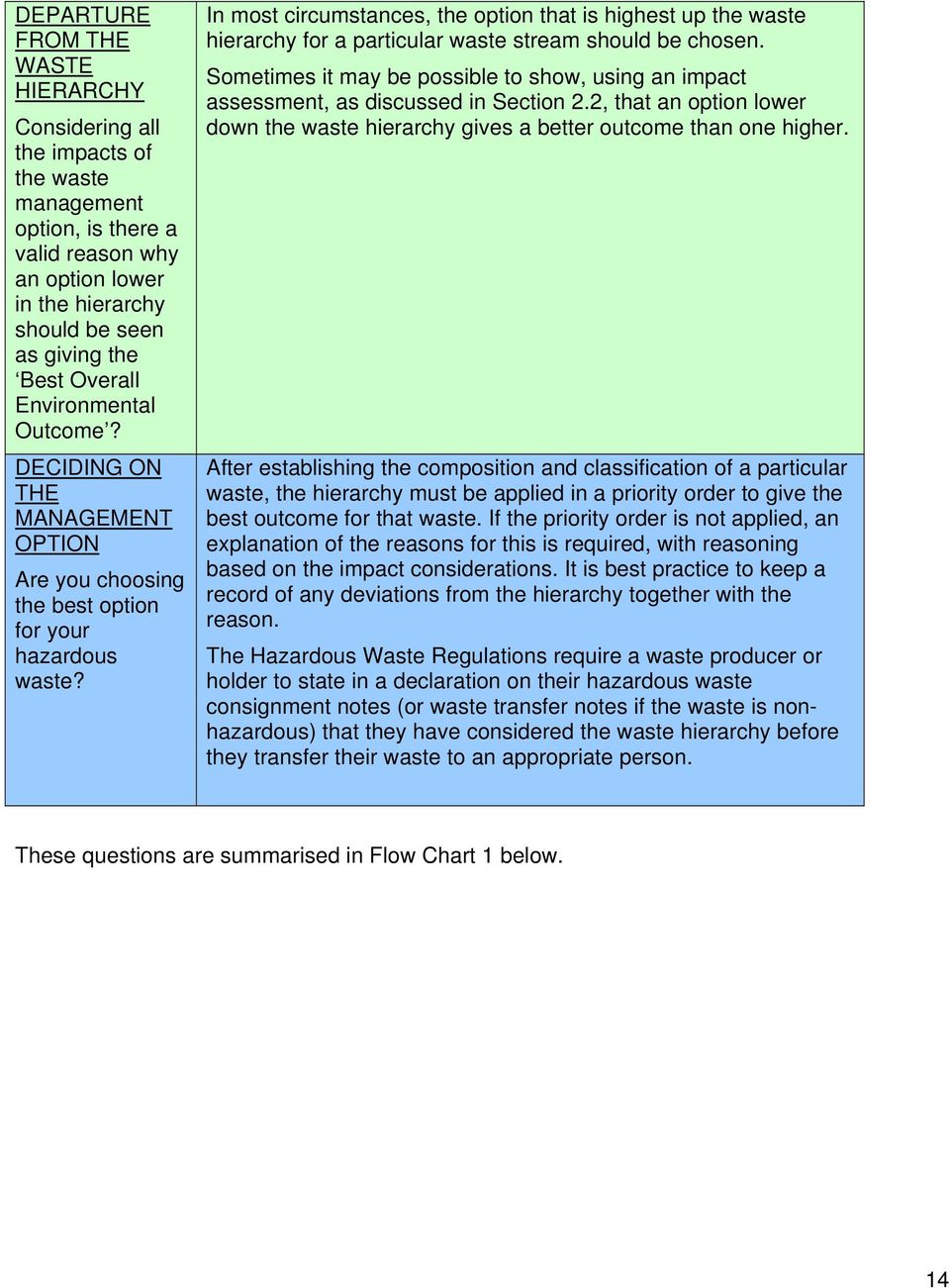
16 IDENTIFYING THE WASTE What is the waste and what does it contain? HAZARDOUS NATURE OF WASTE Is it hazardous? DECISION TREES What type of waste is it mixed, organic, inorganic, article, other? HIERARCHY What waste management options are available following the relevant decision trees? nts/hwrmixing-guide.pdf. It is very important that waste is correctly described and its composition is known (that is, what is in it). Any decision on classifying and coding the waste, assessing its hazardous properties, and deciding on the most appropriate waste management options, are dependent on good waste characterisation. Some wastes cannot be recycled or recovered if they are contaminated with certain substances. For example Persistent Organic Pollutants (dioxins or PCB) above the threshold set in the Persistent Organic Pollutants Regulation 19, heavy metals and so on will affect recovery. It is a producer s or holder s responsibility to classify a waste and determine if it is hazardous. The Environment Agency guidance WM2 on hazardous waste 20 provides assistance, to determine if your waste is hazardous or nonhazardous. If the waste is non-hazardous refer to non-hazardous waste hierarchy guidance 3. There are four decision trees: a general one that includes the decisions to be taken for mixed wastes, then a decision tree if the waste is organic, inorganic or an article. A hazardous waste should be categorised as mixed, organic, inorganic or an article and the respective decision trees followed. If it is unclear what type a waste is the mixed decision tree should be considered first. After looking at the decision trees, all of the available options for managing a particular hazardous waste should be noted giving the greatest consideration to those at the top of the waste hierarchy. Checks should be made to ensure that there are no other new waste management techniques available that could be considered Regulation (EC) 850/2004 as amended WM2 Hazardous Waste: Interpretation of the definition and classification of hazardous waste, which can be found via 13
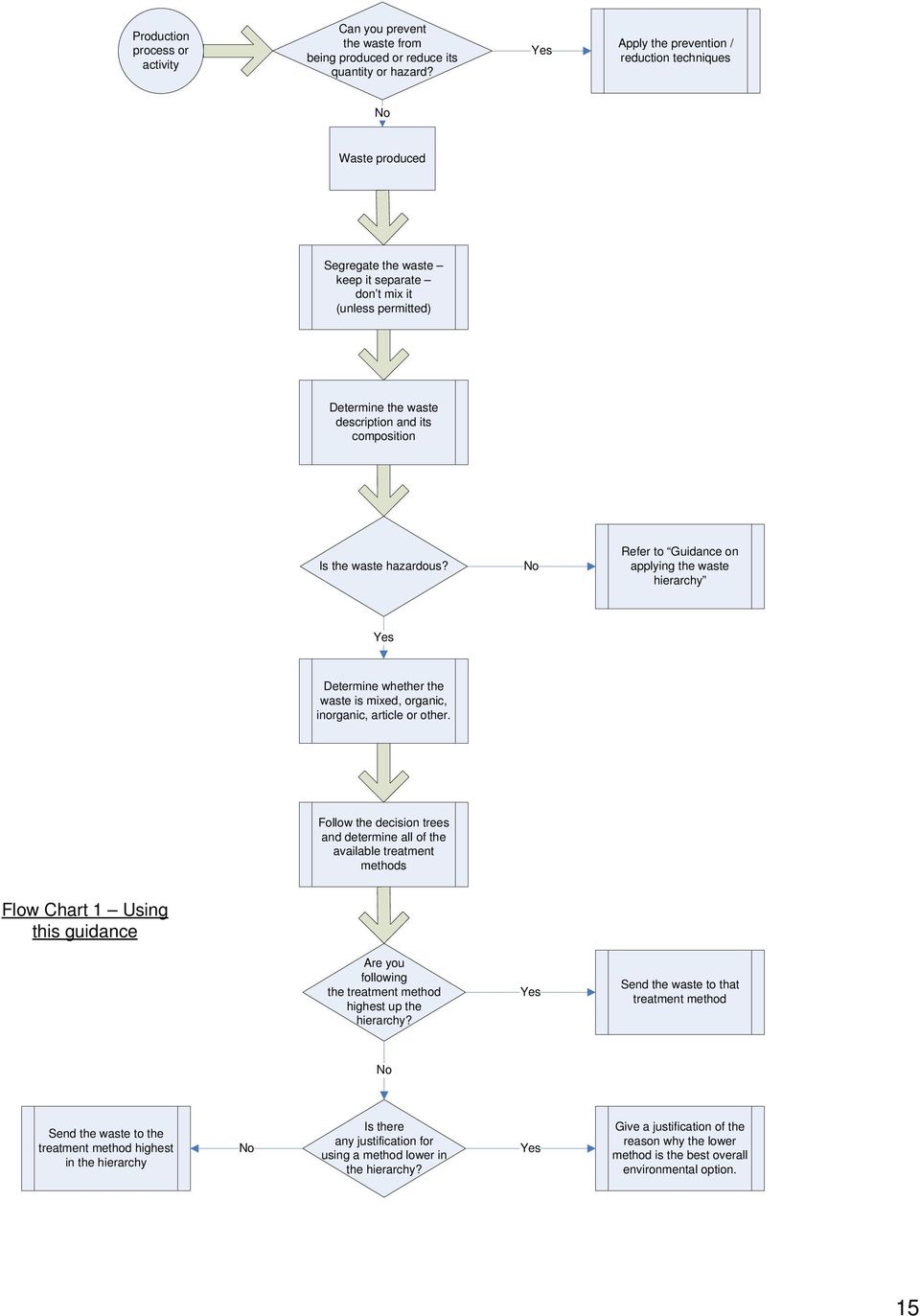
17 DEPARTURE FROM THE WASTE HIERARCHY Considering all the impacts of the waste management option, is there a valid reason why an option lower in the hierarchy should be seen as giving the Best Overall Environmental Outcome? DECIDING ON THE MANAGEMENT OPTION Are you choosing the best option for your hazardous waste? In most circumstances, the option that is highest up the waste hierarchy for a particular waste stream should be chosen. Sometimes it may be possible to show, using an impact assessment, as discussed in Section 2.2, that an option lower down the waste hierarchy gives a better outcome than one higher. After establishing the composition and classification of a particular waste, the hierarchy must be applied in a priority order to give the best outcome for that waste. If the priority order is not applied, an explanation of the reasons for this is required, with reasoning based on the impact considerations. It is best practice to keep a record of any deviations from the hierarchy together with the reason. The Hazardous Waste Regulations require a waste producer or holder to state in a declaration on their hazardous waste consignment notes (or waste transfer notes if the waste is nonhazardous) that they have considered the waste hierarchy before they transfer their waste to an appropriate person. These questions are summarised in Flow Chart 1 below. 14
18 Production process or activity Can you prevent the waste from being produced or reduce its quantity or hazard? Apply the prevention / reduction techniques Waste produced Segregate the waste keep it separate don t mix it (unless permitted) Determine the waste description and its composition Is the waste hazardous? Refer to Guidance on applying the waste hierarchy Determine whether the waste is mixed, organic, inorganic, article or other. Follow the decision trees and determine all of the available treatment methods Flow Chart 1 Using this guidance Are you following the treatment method highest up the hierarchy? Send the waste to that treatment method Send the waste to the treatment method highest in the hierarchy Is there any justification for using a method lower in the hierarchy? Give a justification of the reason why the lower method is the best overall environmental option. 15
19 Section 5: Hazardous wastes examples and the Decision Trees In 2009, approximately 4.4 million tonnes of hazardous wastes were consigned to waste facilities in England and Wales, comprising 385 different types of wastes. It is not possible to provide guidance on all individual hazardous waste streams due to the number and variety generated. Consultation and discussion with industry representatives and regulators prior to the publication of A Strategy for Hazardous Waste Management in England highlighted some key hazardous waste streams where guidance on the application of the hierarchy would be welcomed. The criteria used when choosing waste examples were: that they were identified by industry as key waste streams that significant volumes are generated annually that they allow demonstration of each Decision Tree featured in the Hazardous Waste Strategy 5.1 Hazardous waste categories Seven broad categories of waste were chosen: Waste categories Gas treatment residues (for example air pollution control residues) Asbestos (for example asbestos sheet) Hazardous electronic and electrical equipment (for example a television) and hazardous components from that equipment (such as mercury switches) Oily sludges Organic solvents Metal finishing acids Waste Oils Type of Decision Tree Inorganic Inorganic Articles Mixed Organic Inorganic Organic Appendix B below shows how the decision trees can be used for each of these waste categories, assessing the best option for managing hazardous waste in line with the hierarchy. It provides a template for the decisions that will have to be made for all wastes produced or held. 16

20 The examples are given to demonstrate what options are available for achieving options in line with the hierarchy. Sometimes disposal may be the only option and the guidance will show where this may be appropriate. This guidance does not make definitive hierarchy decisions, even for the example waste categories chosen. The composition of waste will have a major bearing on its management. Consideration should be given to all available options in the hierarchy. The best outcome, highest up the hierarchy as possible, should be chosen for a particular waste stream. w is a good time to reassess what waste management options are currently appropriate. Additional wastes may be explored when this document is reviewed. 17

21 APPENDIX A Decision Trees 18
22 A.1 Introduction The decision trees on the next four pages are based on those in the Hazardous Waste Strategy guide. Departures form those in the hazardous waste strategy guide are set out below: Decision tree Type Change Figure 4 Organic decision tree Disposal bracket on right hand side covers only the treatment section and not the other recovery sections. Figure 5 Inorganic decision tree w includes two new decision boxes for other recovery which were omitted from the original. The term checking has been included in the preparing for re-use section. It replaces the term cleaning which is the same as washing a term already in the tree. 19
23 A.2 General and mixed waste decision tree Re-use materials in process / on-site PROCESS Ensure waste remains segregated Reduce through process operation / design Figure 2 Decision Tree for all Hazardous Waste (not applicable to non-hazardous waste) Re-use (not waste) Can the process output be re-used off site? Where a waste is pre-treated or separated, the residues from that activity are considered to have been produced by a PROCESS. Decision tree Figure 2 should be reapplied to the residues of these processes, if they are hazardous. Decision tree for Articles [Figure 3] Is the waste an article? Decision tree for Organic waste [Figure 4] Is the waste organic? Decision tree for Inorganic waste [Figure 5] Is the waste inorganic? Pre-treat the waste Is the waste suitable for separation? Can the waste be pre-treated to allow segregation? Contact the waste regulator for advice Washing Gravity Separation Thermal Cracking Thermal desorption Acid cracking Physical separation examples Centifuging Filtering / Osmosis Thermal separation examples Evapocondensation Chemical separation examples Other chemical separation 20
24 A.3 Articles decision tree Where a waste is prepared for re-use, recycled, or treated for disposal, the residues from that activity are considered to have been produced by a PROCESS. Decision tree Figure 2 should be reapplied to the residues of these processes, if they are hazardous. Figure 3 Waste Decision Tree for Hazardous Waste Articles For Example Preparing for re-use Cleaning Repairing Washing Checking Can the waste article be prepared for re-use? Recycling Waste article treatment for recycling Can the waste article be recycled? Recovery Other Recovery Waste article dismantling for recovery Can the waste article be dismantled to enable recovery? Disposal other than landfill Treatment for disposal, for example physico-chemical, thermal treatment Disposal 21
25 A.4 Organic decision tree Where a waste is prepared for re-use, recycled, or blended/treated for recovery or disposal, the residues from that activity are considered to have been produced by a PROCESS. Decision tree Figure 2 should be reapplied to the residues of these processes, if they are hazardous. Figure 4 Waste Decision Tree for Hazardous Organic Waste Preparing for re-use Cleaning/ Washing For Example Filtration Can the waste be prepared for re-use? Recycling Oil regeneration For Example Solvent distillation Can the waste be recycled? Recovery For Example Biological treatment with energy recovery Use of waste as a fossil fuel substitute* Thermal destruction with energy recovery* Can the waste be treated with energy / material recovery? Other Recovery, for example energy recovery Blending of waste for thermal recovery For Example Other treatment of waste for thermal recovery Can the waste be treated for use in energy/material recovery processes? Other treatment Chemical treatment Biological treatment Thermal destruction without energy recovery* Disposal * Thermal recovery and disposal treatment processes, such as use of wastes as a fossil fuel substitute, thermal destruction with energy recovery and thermal destruction without energy recovery must be compliant with the requirements of the Waste Incineration Directive. 22
26 A.5 Inorganic decision tree Where a waste is prepared for re-use, recycled, otherwise recovered or treated for disposal, the residues from that activity are considered to have been produced by a PROCESS. Decision tree Figure 2 should be reapplied to the residues of these processes, if they are hazardous. Figure 5 Waste Decision Tree for Hazardous Inorganic Waste Preparing for re-use Cleaning For Example Checking Can the waste be prepared for re-use? Recycling Inorganic Waste treatment for recycling Can the waste be recycled? Recovery Use of waste as a replacement for raw material Can the waste be otherwise recovered? Other Recovery Treat (for example blending, washing and so on) to produce a waste that can be used as a raw material replacement. Can the waste be treated for use in other recovery processes? Treatment for disposal, for example physicochemical, thermal treatment Has the waste been treated previously? Disposal other than landfill Does the waste meet the relevant waste acceptance criteria? Disposal Landfill Underground Storage Hazardous Waste Landfill Stable non-reactive hazardous waste cell 23
27 APPENDIX B Hazardous wastes: using the decision trees 24
28 B.1 Gas treatment residues (for example air pollution control residues, APCR) In 2009, 175,000 tonnes of solid wastes from gas treatment were reported to the Environment Agency as consigned in England and Wales 21. Of this 79,000 tonnes were reported as directly landfilled (including permanent storage). This waste is generated with the purpose of removing substances from gases released from a thermal process before they are allowed to be emitted to the atmosphere. This could be the removal of acid gases, such as hydrogen chloride, using an alkaline material, or dusty materials like cement kiln dusts that are removed from the gas stream by, for example, filters or precipitators. This processing of the gas stream is very important for environmental protection. Some of these wastes may contain dioxins and heavy metals which may be captured in the gas treatment residues. The Environment Agency provides guidance on deciding which EWC code is the most appropriate in WM2. The most relevant gas treatment wastes are listed in the table below (entries in red and marked with an (A) are absolute hazardous waste and entries in blue and marked with an (M) are mirror entries for further details see WM2): EWC EWC description Comments and composition * solid wastes from gas treatment containing dangerous substances (M) * solid wastes from gas treatment containing dangerous substances (M) * solid wastes from gas treatment (A) * solid wastes from fluegas treatment containing dangerous substances (M) * solid wastes from gas treatment containing dangerous substances (M) This is a mirror entry hazardous waste from the iron and steel industry. It can contain heavy metals, dioxins and furans. This is a mirror entry hazardous waste from aluminium thermal processes. It can contain heavy metals, dioxins and furans. This is an absolute entry hazardous waste from lead thermal metallurgy. There was no waste with this code consigned in This is a mirror entry hazardous waste from glass manufacturing. It can contain lime, acid gas salts or heavy metals. This is a mirror entry hazardous waste from manufacture of ceramics, bricks, tiles and other construction materials. It can contain heavy metals and lime
29 EWC EWC description Comments and composition * solid wastes from gas treatment containing dangerous substances (M) * solid wastes from gas treatment (A) Reason why the waste is hazardous This is a mirror entry from the manufacture of cement, lime and plaster and articles and products made from them. An example is Cement Kiln By-Pass Dust (BPD) which is a high ph material that can contain highly caustic sodium and potassium oxides, heavy metals and chlorides from burning of chlorinated organics. This waste may also contain dioxins and furans. This is an absolute hazardous entry from the incineration or pyrolysis of waste. Lime-based Air Pollution Control residues (APC residues) are high ph wastes that contain residual lime content (calcium oxide), heavy metals and salts of acid gases (such as calcium chloride). This waste may also contain dioxins and furans. Activated carbon may be added to the lime to capture dioxin and furan from the gas stream. The waste can be highly alkaline and therefore irritant. Also, it may be ecotoxic due to the presence of heavy metals. Whilst the waste may contain dioxins and furans, they will be in very low concentration and will not contribute to making the waste hazardous. Considering the decision trees Part 1 General and mixed waste tree (Figure 2, Appendix A) Prevention and reduction Re-use materials in process / on-site PROCESS Ensure waste remains segregated Reduce through process operation / design Consideration could be given to using less hazardous materials for the removal of acid gases but the disposal or recovery of the alternatives must be taken into account. For example, sodium bicarbonate can be used instead of lime to remove acid gases but the disposal of bicarbonate can be difficult giving rise to carbon dioxide. Contamination of the material could be minimised by looking at input materials. For example, sorting of waste prior to incineration can minimise the potential for heavy metals to be present in the gas treatment residues. The amount of heavy metal in gas treatment residues is an important factor in further processing and can impede recovery and recycling. For recovery purposes, it is important to limit the amount of dioxins and furans in the gas treatment waste; however it is also vital to limit the amount of dioxin and furan in the atmosphere. This can be achieved and controlled by: minimising the chlorine content of the input materials. This may reduce dioxin and furan formation, minimising contamination of the gas treatment residues. 26
30 carefully managing the temperatures in parts of the combustion process adding activated carbon to the acid-gas scrubbing lime which removes additional dioxin and furan. This activated carbon and its captured dioxin / furan will be present in the waste gas treatment residues. Dioxin and furan levels in the gas treatment residues will not make them hazardous but could have an effect on recovery and where possible their formation should be minimised. Re-use off site Re-use (not waste) Can the process output be re-used off site? There are no direct re-use options for these process outputs. Which Decision Tree? This waste is considered predominately inorganic so you should use the inorganic decision tree. Considering the decision trees Part 2 Inorganic decision tree (Figure 5, Appendix A) Preparing for re-use For For Example Example Cleaning Checking Can the waste be prepared for re-use? Cleaning and checking in the flowchart are simple processes that produce as an output a non-waste product and are therefore not appropriate in this case. Washing of gas treatment residues should be considered under recycling, recovery or disposal options. Recycling Inorganic Waste treatment for recycling Can the waste be recycled? Recycling is a form of complete recovery by which waste materials are reprocessed into products that can be used for the original or another purpose. The recycling process needs to be sufficient to ensure that any contamination is adequately managed so that the material can reach product standard. Gas treatment residues contain mineral components that can be treated for use in 27
31 construction. These include compounds of calcium in the form of calcium hydroxide and calcium carbonate, silica, aluminium and iron. Facilities exist and processes are being continually developed to recycle thermal residues into products. Other Recovery It is unlikely that gas treatment residues can be used as a direct replacement for raw materials in a recovery process without first being treated. However, it may be possible to treat gas treatment residues so that the output of the treatment can be used a raw material replacement. This treatment is considered an interim step towards other recovery but only where the waste is strictly intended to be used as a raw material replacement in a recovery process. For example consider a hazardous cement kiln bi-pass dust (BPD) from a cement works. The BPD is washed with water, then pressed to remove excess water and aqueous contaminants such as chlorides. The outcome of this washing activity is a limebased waste. The lime-based waste, could, for example, be used in cement manufacture as a replacement for raw material lime. Whether this waste material can be used as a lime replacement, under a permit will depend on contaminants (such as dioxins) remaining in it. The use of this waste will probably be managed by a specification agreed with the recovery site and must be in accordance with the permit. The use of the lime-based waste in the cement process is the other recovery step. The washing process itself is a step towards that recovery but relies on the final process to be performed; it is an interim step in the overall recovery operation. Another example is the production of a gypsum-based waste resulting from the washing of air pollution control residues and subsequent treatment of the lime-based output with sulphuric acid. The use of this gypsum-based waste, on its own or blended with other calcium sulphate based waste (such as plaster board), in, for example, an authorised construction activity is other recovery. The contamination of BPD or APC residues with, for example sodium and potassium hydroxide, heavy metals, chlorides, dioxins and so on will impact on the potential for the waste to be treated in an interim step towards an other recovery process. 28
32 Disposal other than landfill Treatment for disposal, for example physico-chemical, thermal treatment Has the waste been treated previously? Does the waste meet the relevant waste acceptance criteria? Sometimes gas treatment residues cannot be recycled or recovered due to contamination by heavy metals, dioxins or other substances. Disposal then becomes an option. Landfill is a disposal option, however in accordance with Principle 3 in the Hazardous Waste Strategy, landfill should only be used where, overall, there is no better recovery or disposal option. Furthermore, in accordance with the Landfill Directive, hazardous waste must not be disposed to landfill unless it is first treated. Gas treatment residues such as APC residues are considered to be treated waste as they are produced from the treatment of effluent gases from a thermal process. They do not need to be treated again prior to landfill unless they fail landfill waste acceptance criteria (WAC). The WAC for deposit in a salt mine relies on its stability in the mine conditions. If the waste fulfils the stability criteria then the waste could be deposited in the salt mine without further treatment. For hazardous waste landfills and stable non-reactive hazardous waste landfills, the WAC relies on chemical species being below threshold levels. If this numeric WAC is exceeded the waste will need to be treated further before landfill is allowed. Treatment methods for lime-based gas treatment residues, that fail hazardous waste WAC, include neutralisation with acid, neutralisation of acids, use in stabilisation/solidification processes as a co-binder with cement, and so on. Treatment may produce a hazardous or nonhazardous waste output. However the treatment of the material so that it is not, for example, irritant or ecotoxic must not be effected solely by dilution as this is prohibited under Article 5(4) of the Landfill Directive. Landfill Underground Storage Hazardous Waste Landfill Stable non-reactive hazardous waste cell Some gas treatment residues, that meet the requirements of the Landfill Directive 22, can be sent directly to underground storage without further treatment; this is in line with the Hazardous Waste Strategy 23. Such wastes are usually bagged and deposited in salt mines. Where this is disposal method is chosen the producer must justify this decision based on the nature or composition of the waste. It is unlikely that hazardous gas treatment residues The Strategy states Landfill is the disposal option of last resort, and is at the bottom of the hierarchy. Deep underground storage of hazardous waste which is also a disposal operation, and is permitted in the UK as a landfill operation, is an option for certain difficult-tomanage hazardous waste streams such as air pollution control residues. 29
33 can be landfilled elsewhere directly without further processing due to hazardous waste landfill WAC. However the residues from a treatment process may be landfilled if they meet the relevant landfill WAC. Summary There are options that lead to other recovery. Therefore consider whether the gas treatment residues can be treated to produce a material that can then be used in an other recovery operation as a replacement for a raw material. Where the contamination of the waste justifies not treating the waste for other recovery purposes, disposal and landfill can be considered. Where the waste meets the requirement for disposal in a salt mine the waste may go directly to that landfill site. For other landfills the waste is likely to require some form of treatment to fulfil the hazardous waste landfill WAC. In this case, where possible, the operator of the treatment process should consider making use of the stabilisation/solidification and neutralisation capacity of the material, which has the potential to replace raw binder materials used in treatment such as cement (in for example stabilisation treatment) or sodium hydroxide or lime (in for example neutralisation / precipitation treatment). 30
34 B.2 Cement asbestos and fibrous asbestos In 2009, 223,696 tonnes of asbestos were reported to the Environment Agency as directly landfilled in England and Wales 24. The Environment Agency provides guidance on deciding which EWC code is the most appropriate in WM2. The most relevant asbestos wastes are listed in the table below (entries in red and marked with an (A) are absolute hazardous waste and entries in blue and marked with an (M) are mirror entries for further details see WM2): EWC EWC description Comments and composition * insulation materials containing asbestos (M) * construction materials containing asbestos (M) Reason why the waste is hazardous Carcinogenic inorganic material, used for insulation (e.g. lagging), usually in fibrous form but possibly bound Carcinogenic inorganic material, used for fire protection, usually bound in cement or other binder Asbestos is both a toxic and carcinogenic material its cementation or otherwise bound nature does not affect the classification as hazardous. Considering the decision trees Part 1 General and mixed waste tree (Figure 2, Appendix A) Prevention and reduction Re-use materials in process / on-site PROCESS Ensure waste remains segregated Reduce through process operation / design Fibrous asbestos and asbestos cement sheet are not produced nor used any more within the European Union. Items that once were produced containing asbestos, for example tiles and wall coverings, no longer contain asbestos. Waste asbestos is generated when removing from the environment a toxic and carcinogenic substance and replacing it with a safer alternative. The only option for waste prevention of this material is to leave the asbestos products where they are, but this may not always be practical. Reduction of asbestos-based wastes is mainly achieved by ensuring that they are kept separate from other wastes to prevent cross contamination. This can be achieved using well-managed removal or demolition processes; these processes are controlled by the HSE
35 Re-use off site Re-use (not waste) Can the process output be re-used off site? There are no direct re-use options for these process outputs. Which Decision Tree? This waste is considered predominately inorganic so you should use the inorganic decision tree. Considering the decision trees Part 2 Inorganic decision tree (Figure 2, Appendix A) Preparing for re-use For For Example Example Cleaning Checking Can the waste be prepared for re-use? There are no preparing for re-use options for these wastes because they cannot be re-used. Recycling Inorganic Waste treatment for recycling Can the waste be recycled? At this time there are no processes that produce a recycled product from asbestos. This may change and this document will be updated accordingly. 32
36 Other Recovery The only option that could be considered recovery for fibrous asbestos is plasma vitrification, although this is a high energy activity and there is potential for land, water and air pollution and harm to human health using this treatment method. The waste glassy output from the process might be used in construction as a replacement for glass. At this time there are no facilities undertaking plasma vitrification in the UK. Asbestos cement products are unlikely to be recovered due to the presence of the binder material used in its manufacture. Other disposal except landfill Treatment for disposal, for example physico-chemical, thermal treatment Has the waste been treated previously? Does the waste meet the relevant waste acceptance criteria? Waste fibrous asbestos could be solidified, by mixing with cement or resins to bind the asbestos fibres in a solid matrix. This process requires raw material use and energy input. It also has the potential for fibre release (impacting on air, water, land and human health) due to storage prior to, during and after processing. The treated asbestos waste will still need to be landfilled. Asbestos cement is by its nature bound in cement so treatment using cement (or any similar material) is not necessary. There are specific WAC for asbestos to be landfilled. 33
37 Landfill Underground Storage Hazardous Waste Landfill Stable non-reactive hazardous waste cell There are currently no viable recycling, recovery or treatment options in the UK so asbestos cement can therefore be double bagged and landfilled into a separately engineered cell; there are specific requirements for the landfill of asbestos in the Landfill Directive. Similarly asbestos fibres may also be double bagged and landfilled in a separately engineered cell. Summary As there are currently no viable recovery options readily available in the UK, landfill is the only available option. For more details on the safe handling of asbestos wastes see 34
38 B.3 Hazardous electronic and electrical equipment and hazardous components from that equipment In 2009, 258,957 tonnes of waste electronic and electrical equipment (WEEE) were reported to the Environment Agency as consigned in England and Wales 25. The Environment Agency provides guidance on deciding which EWC code is the most appropriate in WM2. The most relevant types of WEEE wastes and wastes from WEEE are listed in the table below. (entries in red and marked with an (A) are absolute hazardous waste and entries in blue and marked with an (M) are mirror entries for further details see WM2): EWC EWC description Comments and composition * discarded equipment containing chlorofluorocarbons, HCFC, HFC (M) * discarded equipment containing hazardous components other than those mentioned in to (M) * hazardous components removed from discarded equipment (A) * fluorescent tubes and other mercurycontaining waste (A) * discarded equipment containing chlorofluorocarbons (M) This waste is fridges and freezers and other equipment used for cooling it will contain chlorinated and/or fluorinated gases. This waste is other electrical or electronic equipment that contains a hazardous component. This will include televisions and monitors which contain activated glass or mercury back-lights. This entry also includes equipment containing batteries, mercury switches or other hazardous components. This entry does not include lighting tubes which are classified under chapter 20. When a hazardous component such as a mercury switch is removed from WEEE and there is no specific entry in the catalogue for the removed component (e.g. batteries should be classified elsewhere) this entry is used for the waste. The waste could be composed of a number of different hazardous substances. This waste includes mercury. This waste is household fridges and freezers and other equipment used for cooling it will contain chlorinated and/or fluorinated gases
39 EWC EWC description Comments and composition * discarded electrical and electronic equipment other than those mentioned in and containing hazardous components (M) Reason why the waste is hazardous This waste is other household electrical and electronic equipment that contains a hazardous component. This will include televisions and monitors which contain activated glass or mercury back-lights. This entry also includes equipment containing batteries, mercury switches or other hazardous components. WEEE and components removed from WEEE will be hazardous because for example they containing hazardous substances such as chlorofluorocarbons or a hazardous component such as a mercury switch. When hazardous components are removed from hazardous WEEE, they remain classified as hazardous waste. Some components removed from WEEE will also be WEEE, for example a tube removed from a television. Some components of WEEE, for example chlorofluorocarbons from a fridge, are not WEEE. Any WEEE which is treated must be done so in accordance with Best Available Treatment, Recovery and Recycling Techniques (BATRRT) which has the meaning given in the document published jointly by the Department for Environment, Food and Rural Affairs, the Welsh Government and the Scottish Executive on 27th vember 2006, entitled Guidance on Best Available Treatment, Recovery and Recycling Techniques (BATRRT) and Treatment of Waste Electrical and Electronic Equipment (WEEE) 26. This requires certain components or substances to be removed from WEEE and disposed of or recovered separately before further treatment of the WEEE takes place. Examples include the removal of the phosphor coating from CRTs, removal of CFCs, HCFCs and HFCs from fridges, or removal of Liquid Crystal Displays (LCDs) 27 from, for example, computer screens. Considering the decision trees Part 1 General and mixed waste tree (Figure 2, Appendix A) Prevention and reduction Re-use materials in process / on-site PROCESS Ensure waste remains segregated Reduce through process operation / design As with the waste hierarchy, the primary objective of the WEEE Directive 28 is to prevent WEEE being produced in the first place. Where possible, measures should be taken reduce the amount of WEEE produced. This would include choosing electrical equipment which is proven to have greater longevity than comparable equipment, or replacing parts or upgrading software of electrical equipment rather than discarding the whole appliance or unit. Manufacturers of WEEE should where possible minimise the hazard nature of WEEE for example by reducing mercury levels. to Mar2010.pdf Directive 2002/96/EC 36
40 Re-use off site Re-use (not waste) Can the process output be re-used off site? Opportunities for re-use of Electrical and Electronic Equipment (EEE) should always be sought. Quite often EEE in working condition can be passed or sold on to other users. Evidence should be provided that EEE has been tested for functionality and is ready for re-use and that it is packaged to protect it during transport. Which Decision Tree? This waste is considered as articles so you should use the articles decision tree. Considering the decision trees Part 2 Articles decision tree (Figure 3, Appendix A) Preparing for re-use For For Example Example Cleaning Repairing Washing Checking Can the waste article be prepared for re-use? Some WEEE may be prepared for re-use with minimal effort. This may include refurbishment or repair of an electrical appliance that would make it suitable for re-use in the UK market or overseas. Evidence should be provided that fully refurbished WEEE has been tested for functionality and is ready for re-use and that it is packaged to protect it during transport. Recycling Waste article treatment for recycling Can the waste article be recycled? Where WEEE cannot be repaired or refurbished it may be dismantled in order to use the components to maintain or repair other WEEE, or supplied to other uses of those components. 37
41 Other Recovery Waste article dismantling for recovery Can the waste article be dismantled to enable recovery? Where WEEE cannot be recycled it may be recovered in other ways. An example is where the screen glass from a Cathode Ray Tube (CRT) from a television set is crushed to a certain particle size once the phosphor coating from the screen has been removed. In this instance it can be used as an aggregate replacement or in the manufacture of tiles or worktops. Thermal treatment with energy recovery would also be considered other recovery. Other disposal except landfill Treatment for disposal, for example physico-chemical, thermal treatment Any residues from recovery operations (including dismantling) that cannot undergo further recovery will have to be disposed. Options include thermal treatment (for example incineration) Summary There are many opportunities for prevention of WEEE wastes including re-use which should be promoted where possible. Preparing for re-use options (for example refurbishment and repair) are the next best alternative. Recycling of WEEE resulting in a good quality product should also be considered where prevention and re-use are not possible. If a good standard of recycling cannot be achieved, material recovery is an option. As far as possible the amount of WEEE wastes or wastes from WEEE treated for disposal should be minimised. 38
42 B.4 Oily sludges In 2009, 27,528 tonnes of oily sludges were reported to the Environment Agency as consigned in England and Wales (excluding soil, dredging spoil, track ballast and remediation wastes) 29. Of this 1,081 tonnes were reported as directly landfilled. The Environment Agency provides guidance on deciding which EWC code is the most appropriate in WM2. The most relevant oily sludge wastes are listed in the table below (entries in red and marked with an (A) are absolute hazardous waste and entries in blue and marked with an (M) are mirror entries for further details see WM2): EWC EWC description Comments and composition * oil-containing drilling muds and wastes (M) * oily sludges from maintenance operations of the plant or equipment (M) * metal sludge (grinding, honing and lapping sludge) containing oil (M) * sludges from oil / water separators (A) Reason why the waste is hazardous These wastes from a variety of sources are sludges that are hazardous by virtue of containing oil. Entry * is hazardous if oil is present * will be classified as hazardous only where it contains oil above a threshold (they may contain other dangerous substances but are hazardous specifically due to its oil content). Oil is a hazardous substance and is usually harmful / toxic, irritant, carcinogenic or ecotoxic. Oily sludges may also contain metals or other contaminants that may also have hazardous properties. Soil and stones ( *), dredging spoil ( *) and track ballast ( *) can also be contaminated by oil. Where they are the principles given below will also be appropriate to those wastes. Considering the decision trees Part 1 General and mixed waste tree (Figure 2, Appendix A) Prevention and reduction Re-use materials in process / on-site PROCESS Ensure waste remains segregated Reduce through process operation / design Oil-containing drilling muds, grinding sludges and maintenance sludges are produced as part of a production or maintenance process and will be difficult to prevent. Oil / water separator sludges are produced when interceptors are contaminated by oil. Where possible spillages and other sources of oil contamination should be minimised gov.uk/research/library/data/ aspx 39
43 R e-use off site Re-use (not waste) Can the process output be re-used off site? There are no direct re-use options for these process outputs. Which Decision Tree? This waste is considered predominately mixed, being a mixture of an inorganic part (soil, sand, stone or similar) and oil so you should use the separation section of the all hazardous waste decision tree (Figure 2, Appendix A). Considering the decision trees Part 2 Mixed decision tree (Figure 2, Appendix A) Suitable for separation? Is the waste suitable for separation? Any mixed waste that can be separated should be treated by a separation technique. This technique, where possible, should allow the subsequent recovery of each of the separated wastes. Wherever possible this should be done to recover both the inorganic mineral part, which may not be hazardous when separated, and the oil. Sometimes other substances in the waste may make this impractical ( for example mercury contamination). 40
44 t suitable for separation Is the waste suitable for separation? Pre-treat the waste Can the waste be pre-treated to allow segregation? Contact the waste regulator for advice If a waste is contaminated so that separation is impractical then consideration should be made to pre-treat the waste so that separation can take place. For example, if mercury is the contaminant preventing effective oil separation, can it be removed in a pre-treatment step to allow the separation to take place? Sometimes it is not possible to consider a waste for separation. In such cases you might contact the waste regulator, waste manager or consultant for advice. If a mixed waste could be recovered in accordance with either the inorganic or organic decision trees, it would be acceptable to treat the mixed waste as inorganic or organic. For example if separation is impractical but the waste could be treated thermally with energy recovery as the best outcome then the waste could be considered organic. Landfill disposal should not be an option at this stage. Suitable for separation Washing Gravity Separation Physical separation examples Centifuging Filtering / Osmosis Thermal Cracking Is the waste suitable for separation? Evapocondensation Thermal desorption Thermal separation examples more starting at the top of Figure 2. Acid cracking Chemical separation examples Other chemical separation There are a number of separation techniques that can be used to remove oil from oily sludges. This includes physical, thermal and chemical processes (and biological treatment if recovery of the inorganic or organic part is possible). The aim should be to recover as much of the mixture as possible. For example, the separation of an oily metal sludge is optimised if the metal and the oil are recovered. Any residual hazardous wastes produced from separation processes should follow the decision trees once 41
45 Summary Any oily sludge waste that can be separated should be treated by a separation technique. Where possible this should be a technique that allows the subsequent recovery of each of the separated wastes. Any separated waste that is hazardous should then be considered to be waste produced by a process, and the decision tree given by Figure 2 should be followed for any hazardous separated waste produced. 42
46 B.5 Organic solvents In 2009, approximately 163,000 tonnes of organic solvents were consigned in England and Wales. This figure was calculated using statistics from the 7 major recycling companies operating in England and Wales. The Environment Agency provides guidance on deciding which EWC code is the most appropriate in WM2. The most relevant solvent wastes are listed in the table below: (entries in red and marked with an (A) are absolute hazardous waste and entries in blue and marked with an (M) are mirror entries for further details see WM2) EWC EWC description Comments and composition Various depending upon the industry of production but predominantly from chapters 07, 08 and 14 of the EWC Examples include * other halogenated solvents and solvent mixtures (A) * other solvents and solvent mixtures (A) * other organic solvents, washing liquids and mother liquors (A) * solvents (A) Reason why the waste is hazardous Wastes from these chapters are either Absolute or Mirror, with all chapter 14 entries being absolute. The concentration of the desired solvent will often be in excess of 80% due to the nature of the process producing the waste. The waste could be hazardous for a number of reasons but most likely flammable, harmful / toxic, irritant / corrosive, and ecotoxic. Chlorinated solvents are included as the techniques used for recovery are normally consistent with those used for non-chlorinated solvents. Chlorinated wastes are included in the estimate of arisings given above. Considering the decision trees Part 1 General and mixed waste tree (Figure 2, Appendix A) Prevention and reduction Re-use Reduce Some organic solvents could be replaced by aqueous-based materials. The transfer to aqueous-based solvents with the materials PROCESS through in process process / operation on-site / design lower hazard potential of their use, and of any waste produced, needs to be carefully weighed against the Ensure waste efficiency, and recovery potential, of using an organic remains segregated solvent in a process. A life cycle analysis comparing organic solvent against an aqueous based one will allow you to choose the best option for your particular process. 43
47 Re-use off site Re-use (not waste) Can the process output be re-used off site? There are no direct re-use options for these process outputs. Which Decision Tree? This waste is considered predominately organic so you should use the organic decision tree (Figure 4, Appendix A). Considering the decision trees Part 2 Organic decision tree (Figure 4, Appendix A) Preparing for re-use For For Example Example Cleaning/ Washing Filtration is unacceptable. Can the waste be prepared for re-use? While it is possible, simple cleaning, washing or filtration processes are not generally capable of returning an organic solvent to its virgin state, for its original purpose, in terms of purity and quality. For example, a large proportion of organic solvents are used in the manufacture of pharmaceutical and agricultural products where regulatory control of the method of manufacture and quality is paramount and any level of contamination arising from re-use Recycling 44
48 For For Example Example Oil regeneration Solvent distillation Can the waste be recycled? Waste solvents can be recycled to make a non-waste solvent, if that solvent is not used as a fuel see the definition of recycling in the glossary to this guide. This is usually and readily achieved through distillation processes. Where a waste organic solvent can be recycled by distillation, this process should be performed. Recycling of organic solvents, in addition to being higher up the hierarchy, has obvious advantages over the use of other recovery or disposal treatment options within the hierarchy, for example: it can help to ensure the most efficient use of raw materials; it reduces the use of virgin materials deriving benefits from both product regeneration and energy consumption perspectives and therefore provides a reduced impact on the carbon cycle; it is consistent with the objectives of the Solvent Emissions Directive 30 in that it reduces both the use and emissions of Volatile Organic Compounds; it keeps solvents within the provisions of the REACH Regulation 31 and hence enhances the protection of human health and the environment Directive 1999/13/EC See 45
49 Other Recovery Biological treatment with energy recovery For For Example Example Use of waste as a fossil fuel substitute* Thermal destruction with energy recovery* For For Example Example Blending of waste for thermal recovery Other treatment of waste for thermal recovery Can the waste be treated with energy / material recovery? Can the waste be treated for use in energy/material recovery processes? There will be circumstances where energy recovery could be an option. This will be the case, for example, for highly contaminated solvents or chlorinated materials with few natural outlets where it could be distilled to product specification. There are a number of options available for energy recovery, most notably in the manufacture of cement. For this purpose, solvents from different sources and other organic materials such as paints, fuels and oils can be blended to a specification for use as a fuel. Here, complete recovery takes place when the energy is recovered. Any steps on the road to the final recovery, such blending are intermediate processes to the recovery of the waste. For more information on the recovery of waste solvents see: as Other disposal except landfill Chemical treatment Biological treatment Thermal destruction without energy recovery* Organic solvents cannot be landfilled. In some cases thermal destruction (high temperature incineration without energy recovery), chemical treatment or biological treatment would be necessary possibly due to contamination or the nature of the substance preventing recycling or recovery. Summary Whilst preparing for re-use is the most desirable management option for solvents it is limited in its applicability. Therefore, recycling of materials will generally be the most desirable management option for most waste solvents. Use of other recovery or disposal treatment may sometimes be justified, if for example solvent wastes are contaminated or the nature of the material excludes recycling. 46
50 B.6 Metal finishing acids In 2009, 75,766 tonnes of Metal Finishing Acids were reported to the Environment Agency as consigned in England and Wales 32. The Environment Agency provides guidance on deciding which EWC code is the most appropriate in WM2. The most relevant metal finishing acid wastes are listed in the table below (entries in red and marked with an (A) are absolute hazardous waste and entries in blue and marked with an (M) are mirror entries for further details see WM2): EWC EWC description Comments and composition * Hydrochloric Acid (A) Hydrochloric acid is a corrosive solution used as a pre-treatment in hot galvanising process. This EWC code is commonly used for acids arising from this process that contain chloride salts of iron and zinc * Solid salts and solutions containing heavy metals (M) Solutions arising from the metal plating are low ph solutions containing mineral acids and residual heavy metals, These typically comprise salts of zinc, copper and nickel * Pickling acids (A) Pickling acids are low ph solutions containing mineral acids and their metal salts arising from the cleaning of metals and alloys to remove surface oxidation and scale * Acids not otherwise specified (A) * Aqueous rinsing liquids containing dangerous substances (M) Reason why the waste is hazardous Other acids are low ph solutions containing mineral acids and their metal salts arising from the cleaning of metals and alloys to remove surface oxidation and scale they may also arise from the passivation of non ferrous metals. Aqueous rinsing liquids are low ph solutions containing mineral acids and their metal salts arising from the removal of acid solutions from the metal surfaces prior to further treatment. The waste predominantly comprises mineral acids that are classified as corrosive. The solutions often contain heavy metal contaminants that are classified for example as toxic or ecotoxic. Certain nickel compounds have the potential to be classified as carcinogenic, mutagenic and sensitizing
51 Considering the decision trees Part 1 General and mixed waste tree Prevention and reduction Re-use materials in process / on-site PROCESS Ensure waste remains segregated Reduce through process operation / design Waste is generated from the cleaning and plating of metals to render the base metal suitable for further processing or to apply a corrosion resistant surface coating to the base metal. Consideration could be given to replacing some of the chemical processes with mechanical cleaning and descaling techniques. In addition, the use of less hazardous solutions in metal cleaning should be considered. Where surface coatings are applied through both electroless and electrolytic techniques, less hazardous metals should be investigated and alternative coating techniques employed. The minimisation of rinse waters should be given careful consideration. Aqueous rinsing solutions will contain corrosive mineral acids and heavy metal salts which have been substantially diluted through the rinsing process. It is often possible to recover the rinsing waters from these solutions using ion exchange techniques to provide a closed loop rinse water system. Re-use off site Re-use (not waste) Can the process output be re-used off site? There are no direct re-use options for these process outputs. Which Decision Tree? This waste is considered predominately inorganic so you should use the inorganic decision tree. 48
52 Considering the decision trees Part 2 Inorganic decision tree (Figure 5, Appendix A) Preparing for re-use For For Example Example Cleaning Checking Can the waste be prepared for re-use? There are no preparing for reuse options for these wastes. Recycling Inorganic Waste treatment for recycling Can the waste be recycled? Recycling is a form of complete recovery by which waste materials are reprocessed into products that can be used for the original or another purpose. The recycling process needs to be sufficient to ensure that any contamination is adequately removed so that the material can reach product standard. An example of recycling is the electrolysis of a nickel or copper plating solution where the metal can be extracted from the solution using electrolytic plating to produce a high grade metal cathode which can be classified as a non-waste product. Purity of the material is critical. Other Recovery The authorised treatment activity during which waste is fully recovered will be considered the other recovery activity. Any steps leading to that other recovery activity are considered intermediate steps towards full recovery. For example, a steel pickling acid might contain residual hydrochloric acid and ferric chloride. There is an exemption in the Environmental Protection (England and Wales) Regulations 2010, Use of waste for a specified purpose (U8), that allows for the direct recovery of waste acid in water effluent and in water treating processes under certain conditions. Use of waste in this way is other recovery but the recovery takes place only when the waste is used for the specified purpose. A metal rich acid can also be treated in an intermediate stage before being fully recovered. For example, a waste copper pickling solution will contain residual sulphuric acid and copper (II) sulphate. Copper metal can be extracted as a finely divided powder using a treatment technique 49
53 utilising scrap iron. This technique has the potential to produce a copper free acid solution and finely divided sludge containing high concentrations of copper metal which could be subjected to further thermal or electrolytic processes to recover the copper metal. This reclamation step is an intermediate step to full recovery. The full recovery however will only take place when the waste, being a replacement for a raw material copper source, undergoes thermally or electrolytic treatment. Disposal other than landfill Treatment for disposal, for example physico-chemical, thermal treatment landfill. Has the waste been treated previously? Does the waste meet the relevant waste acceptance criteria? If the waste acid is not recoverable, it must be treated. The following treatments are suitable for most metal treatment acids. The waste can, for example, be treated by, alkaline raw materials and/or alkaline wastes (in which case both waste acid and waste alkaline are treated). This treatment neutralises the acid and then precipitates the metals (at approximately ph 8 to 10 depending on the metals present). The mixed metal precipitates are commonly separated using filtration or centrifuging techniques to yield a sludge / solid residue suitable for landfill disposal, and an aqueous fraction that should be suitable for discharge to sewer as a waste water. Depending on the metal (or other dangerous substances) content of the treated waste it may be considered hazardous or non-hazardous. WAC needs to be fulfilled before disposal at 50
54 Landfill Underground Storage Hazardous Waste Landfill Stable non-reactive hazardous waste cell Metal finishing acids will not be suitable for direct landfill disposal as they are liquids and are generally corrosive, both of which are banned under the Landfill Directive. They will invariably need treatment to render the residues suitable for landfill disposal. Summary There are a number of prevention strategies that can be used to minimise waste arisings of metal-rich acids which should be considered. Recycling of materials should be considered the most appropriate treatment process. 51
55 B.7 Oils mineral oils, fuels and non-halogenated, nonbiodegradable recoverable lubricating oils (not emulsions) In 2009, 327,326 tonnes of oils were reported to the Environment Agency as consigned in England and Wales 33. The Environment Agency provides guidance on deciding which EWC code is the most appropriate in WM2. The most relevant oil wastes are listed in the table below (entries in red and marked with an (A) are absolute hazardous waste and entries in blue and marked with an (M) are mirror entries for further details see WM2): EWC EWC description Comments and composition * mineral-based machining oils free of halogens (except emulsions and solutions) (A) * synthetic machining oils (A) * mineral based nonchlorinated hydraulic oils (A) * synthetic hydraulic oils (A) * other hydraulic oils (A) * mineral-based nonchlorinated engine, gear and lubricating oils (A) * synthetic engine, gear and lubricating oils (A) * other engine, gear and lubricating oils (A) * mineral-based nonchlorinated insulating and heat transmission oils (A) * synthetic insulating and heat transmission oils (A) * Fuel oil and diesel (A) These wastes are mainly mineral or synthetic oil based, not emulsions and are not readily biodegradable. They may be mixed together only under permitted conditions, where the mixing improves the opportunity for recycling or energy recovery. The waste may contain water, metals or metal compounds, Their use may have changed the nature of the organic components for example introducing or increasing the presence of potentially carcinogenic poly-aromatic hydrocarbon (PAH) levels
56 EWC EWC description Comments and composition * Petrol (A) Other fuels (including mixtures) (A) * wastes not otherwise specified (A) Reason why the waste is hazardous See above. Oil is a hazardous substance that is usually harmful / toxic, carcinogenic or ecotoxic. Oils may also contain metals or other contaminants that may also have hazardous properties. Fuels will probably also be flammable. Considering the decision trees Part 1 General and mixed waste tree (Figure 2, Appendix A) Prevention and reduction Re-use materials in process / on-site PROCESS Ensure waste remains segregated Reduce through process operation / design also led to oils being produced that are less h Fuels - the minimisation of waste fuels is driven by users striving for efficiencies so that they can reduce their costs. This will result in relatively little fuel waste being produced, the exception being mis-fuelling at petrol stations. Lubricants - changes in engineering and lubricant technology has resulted in a significantly reduced volumes of waste oils being produced. The move to synthetic oils has azardous. Re-Use off site Re-use (not waste) Can the process output be re-used off site? There are no direct re-use options for these process outputs. Which Decision Tree? This waste is considered predominately organic so you should use the organic decision tree (Figure 4, Appendix A). Considering the decision trees Part 2 Organic decision tree (Figure 4, Appendix A) 53
57 Preparing for re-use For For Example Example Cleaning/ Washing Filtration Can the waste be prepared for re-use? There are very few options for fuels or lubricants to be prepared for re-use. An example is backup generator diesel oil wastes which can be simply filtered and put back into the generator. Recycling Lubricants - it is possible to recycle, regenerate or re-refine lubricants to virgin equivalent quality. For For Example Example Oil regeneration Solvent distillation Can the waste be recycled? Other oils it is possible to recycle electrical oils to virgin equivalent quality. End of Waste conditions must apply to products and the impact of REACH should be taken into proper consideration. 54
58 Other Recovery Biological treatment with energy recovery For For Example Example Use of waste as a fossil fuel substitute* Thermal destruction with energy recovery* Can the waste be treated with energy / material recovery? A fuel waste can be recovered either as a product fuel or as a waste fuel. The waste is fully recovered where: it is converted to product fuel; used as a waste fuel as a fossil fuel substitute; thermally destroyed using energy recovery. For For Example Example Blending of waste for thermal recovery Other treatment of waste for thermal recovery Can the waste be treated for use in energy/material recovery processes? Intermediate recovery steps include blending of waste, such as oils or other organic wastes, to a specification. Full recovery is only complete when the energy is recovered or the waste is converted to a product. Other disposal except landfill Chemical treatment Biological treatment Thermal destruction without energy recovery* Waste oils must not be landfilled. In some cases, thermal destruction (high temperature incineration without energy recovery), chemical treatment or biological treatment may be justified for particular wastes. This could be due to contamination or the nature of the substances in the oil which prevents recycling or recovery. This might be the case if the oil is contaminated with very hazardous materials like PCBs that render recovery illegal or impractical. Summary Wherever possible lubricating oils, and speciality oils such as electrical oils, should be recycled. The definition of recycling in the revised Waste Framework Directive does not include the reprocessing of waste into materials that are to be used as fuels. The practice, however, of treating contaminated fuels, for example from mis-fuelings at petrol stations to produce an original fuel product, is regarded as the best outcome. If recycling is not an option, or not practicable, then use as a fuel substitute (product or waste), destruction with energy recovery, or blending for these other recovery activities may be the best outcome. The blending of waste to produce a product is detailed in a WRAP/Environment Agency Quality Protocol for Processed Fuel Oil (PFO) which can be found at: h ttp:// 55
A Strategy for Hazardous Waste Management in England
 www.defra.gov.uk A Strategy for Hazardous Waste Management in England A policy document issued by the Department for Environment, Food and Rural Affairs March 2010 Department for Environment, Food and
CHANGE LOG: HWR06 - Classifying and coding wastes from physico-chemical treatment facilities
 Guidance HWR06 Classifying and coding wastes from physico-chemical treatment facilities CHANGE LOG: HWR06 - Classifying and coding wastes from physico-chemical treatment facilities Version Number Date
Hazardous Waste Treatment Solutions
 50 years experience delivering ABOUT TETRONICS Tetronics International is the global leader in the supply of Direct Current (DC) plasma arc systems for a wide range of Hazardous Waste Treatment applications.
GUIDELINES FOR LEACHATE CONTROL
 GUIDELINES FOR LEACHATE CONTROL The term leachate refers to liquids that migrate from the waste carrying dissolved or suspended contaminants. Leachate results from precipitation entering the landfill and
6 CONSIDERATION OF ALTERNATIVES
 6 CONSIDERATION OF ALTERNATIVES 6.1.1 Schedule 4 of the Town and Country Planning (Environmental Impact Assessment) (Scotland) Regulations 2011 sets out the information for inclusion in Environmental Statements
Slide 1. Enviros Consulting Ltd
 Slide 1 Regulation of Waste Management Activities Past, Present and Future! Steve Bell Technical Manager Waste Management Thursday, 26 July 2007 Presentation Aims An insight of where we have come from
National Planning Policy for Waste
 National Planning Policy for Waste October 2014 Department for Communities and Local Government Crown copyright, 2014 Copyright in the typographical arrangement rests with the Crown. You may re-use this
Introduction to Waste Treatment Technologies. Contents. Household waste
 Contents Introduction to waste treatment technologies 3 Section 1: The treatment of recyclable waste 4 Bulking facilities 5 Materials Reclamation Facility (MRF) 6 Reuse and recycling centres 8 Composting
GUIDANCE NOTES FOR WASTE MANAGEMENT
 GUIDANCE NOTES FOR WASTE MANAGEMENT HEALTH & SAFETY UNIT SPRING 2006 CONTENTS 1. INTRODUCTION...2 2 DOES MY WASTE REQUIRE SPECIAL DISPOSAL OR TREATMENT?...2 3 WHAT IS HAZARDOUS WASTE?...3 4 RESPONSIBILITIES...3
Birmingham City University / Students Union Aspects and Impacts Register. Waste. Impacts description
 Birmingham City University / Students Union and Impacts Register Waste Production of non - hazardous waste Production of hazardous waste Storage of non - hazardous waste Potential for waste to be disposed
www.gov.uk/government/consultations/ship-recycling-authorising-uk-facilities-to-work-oneu-flagged-ships
 www.gov.uk/defra Consultation on proposed measures to implement elements of EU regulation 1257/2013 on ship recycling relating to the authorisation of UK ship recycling facilities Summary of response and
EU F-Gas Regulation Guidance Information Sheet 15: Fire Protection System Contractors
 Information Sheet 15: Fire Protection System Contractors Target audience for this Information Sheet This Information Sheet is aimed at contractors that carry out installation, maintenance and decommissioning
Waste can you handle it?
 www.defra.gov.uk Hazardous waste regulations List of wastes regulations 2005 Waste can you handle it? www.defra.gov.uk Source: www.rethinkrubbishpartners.com Department for Environment, Food and Rural
A GUIDE TO THE HAZARDOUS WASTE REGULATIONS (INCORPORATING THE LIST OF WASTES REGULATIONS)
 A GUIDE TO THE HAZARDOUS WASTE REGULATIONS (INCORPORATING THE LIST OF WASTES REGULATIONS) WHAT IS A HAZARDOUS WASTE? HWR01 Version 2.1 - June 2005 The information in this guide is based on what we know
Environmental Permitting Guidance
 www.defra.gov.uk Environmental Permitting Guidance Core guidance For the Environmental Permitting (England and Wales) Regulations 2010 Last revised: March 2013 Crown copyright 2013 You may re-use this
PHARMACEUTICAL AND CHEMICAL WASTE MANAGEMENT
 Medicines and Medical Devices Agency of Serbia PHARMACEUTICAL AND CHEMICAL WASTE MANAGEMENT Ivana Bozic, MSc Health, Safety and Environment ISWA Beacon Conference, Novi Sad, 08 10 December 2010 458, Vojvode
Energy from waste. Introduction. Legal status of this guideline. What is energy from waste? Draft guideline
 Draft guideline Energy from waste Publication 1549 September 2013 Authorised and published by EPA Victoria, 200 Victoria Street, Carlton Introduction As outlined in Getting full value: the Victorian Waste
WASTE ASBESTOS. Asbestos is often bonded into a matrix of cement or resins. Typical bonded asbestos products include -
 Page 1 of 5 Version No. 2 Date of issue: HAZARDOUS WASTE REGULATIONS (NI) 2005 HAZARDOUS WASTE GUIDANCE DOCUMENT Introduction WASTE ASBESTOS Hazardous waste is subject to the requirements of the European
Safe management of healthcare waste
 Safe management of healthcare waste Introduction A wide variety of waste is generated from healthcare activities and employers have a statutory duty of care in relation to the management of that waste.
A. WASTE MANAGEMENT A.1. INTRODUCTION AND GENERAL ISSUES ON HAZARDOUS WASTES AND SOLID WASTES
 A. WASTE MANAGEMENT A.1. INTRODUCTION AND GENERAL ISSUES ON HAZARDOUS WASTES AND SOLID WASTES The objective of the German government s policy on waste is to achieve a recyclingbased economy that conserves
Waste Management Policy
 University of Sussex Waste Management Policy May 2007 1 University of Sussex Waste Management Policy Contents 1. Introduction 2. Policy Statement 3. Policy Objectives 4. Application 5. Organisation and
Guidance for Mobile Air Conditioning (MAC) Sectors. Guidance: F Gas and Ozone Regulations Information Sheet MAC 3: Key Obligations
 Department for Environment, Food and Rural Affairs Guidance for Mobile Air Conditioning (MAC) Sectors Guidance: F Gas and Ozone Regulations Information Sheet MAC 3: Key Obligations April 2012 Contents
Use of Substitute Fuels in Large Combustion Plants (LCPs)
 Use of Substitute Fuels in Large Combustion Plants (LCPs) By Pat Swords Content of the Presentation What are substitute fuels What is the experience to date with these fuels What are the regulatory implications
Storage and treatment of cathode ray tubes (CRTs) and display equipment containing CRTs
 Storage and treatment of cathode ray tubes (CRTs) and display equipment containing CRTs Quick guide 874_11 Issued 27/10/2011 What s this document about? Who does this apply to? This document covers the
HAZARDOUS CHEMICAL WASTE DISPOSAL SECTION 7
 HAZARDOUS CHEMICAL WASTE DISPOSAL According to Ontario environmental legislation, generators of hazardous waste are responsible for properly packaging and labelling such wastes. The University of Toronto
MATERIAL SAFETY DATA SHEET
 MATERIAL SAFETY DATA SHEET P/Nno.: SDSID: 1/5 1. IDENTIFICATION OF THE SUBSTANCE/PREPARATION AND OF THE COMPANY/UNDERTAKING Application: For3D or metallographic replica For 3D or metallographic replica
Responsibility Deal between the UK, Scottish and Welsh Governments and the direct marketing sector November 2011
 www.defra.gov.uk Responsibility Deal between the UK, Scottish and Welsh Governments and the direct marketing sector November 2011 Crown copyright 2011 You may re-use this information (not including logos)
THE MINISTRY OF ENVIRONMENTAL PROTECTION, PHYSICAL PLANNING AND CONSTRUCTION
 THE MINISTRY OF ENVIRONMENTAL PROTECTION, PHYSICAL PLANNING AND CONSTRUCTION 1389 Pursuant to Article 104 paragraph 1 item 4 of the Waste Act (Official Gazette 178/04, 111/06), the Minister of Environmental
INCINERATION IN JAPAN
 INCINERATION IN JAPAN DR. CHIAKI IZUMIKAWA Regulations in the environmental field are becoming severe and severe. At the same time, NIMBY syndrome is becoming stronger day by day. The cost of incineration
Treatment and Disposal Technologies for Medical Wastes in Developing Countries
 Treatment and Disposal Technologies for Medical Wastes in Developing Countries Mohd Nasir Hassan, PhD Environmental Engineer WORLD HEALTH ORGANIZATION (WHO) (Cambodia/Lao PDR) Where do We Start? Definition>>>>Legal
Residues from aluminium dross recycling in cement
 Characterisation of Mineral Wastes, Resources and Processing technologies Integrated waste management for the production of construction material WRT 177 / WR0115 Case Study: Residues from aluminium dross
EU F-Gas Regulation Guidance Information Sheet 14: Refrigeration, Air-Conditioning and Heat Pump Contractors
 Information Sheet 14: Refrigeration, Air-Conditioning and Heat Pump Contractors Target audience for this Information Sheet This Information Sheet is aimed at contractors that carry out installation, maintenance
Nu G Medical Waste System Technology (Pyrolysis / Thermal Decomposition)
 Product Description: Nu G Medical Waste System Technology (Pyrolysis / Thermal Decomposition) The NU G System uses pyrolysis thermal decomposition to treat infectious wastes typically generated in hospitals.
Cambridge International Examinations Cambridge International General Certificate of Secondary Education
 Cambridge International Examinations Cambridge International General Certificate of Secondary Education *0123456789* CHEMISTRY 0620/03 Paper 3 Theory (Core) For Examination from 2016 SPECIMEN PAPER 1 hour
7. Chemical Waste Disposal Procedures
 7. Chemical Waste Disposal Procedures Substances that Can and Cannot be Disposed of via Sink Drains or in Regular Solid Refuse Containers 1. It is prohibited to pour down a sink or floor drain, or place
Waste management and disposal:
 Waste management and disposal: A best practice business guide An ebook produced by FCC Environment 01 Waste management and disposal: a strategy for success Introduction Your guide to waste management FCC
Wastewater Reuse. Typical treated wastewater is:
 Wastewater Reuse Most metal finishing industries have in-house wastewater treatment to economically dispose of the acids, alkali, oils, and dissolved metals in the rinse water and occasional tank solution
Official Journal of the European Communities
 L 332/91 DIRECTIVE 2000/76/EC OF THE EUROPEAN PARLIAMENT AND OF THE COUNCIL of 4 December 2000 on the incineration of waste THE EUROPEAN PARLIAMENT AND THE COUNCIL OF THE EUROPEAN UNION, waste, and 0,2
Laboratory Hazardous Waste Disposal Guidelines
 Satellite Accumulation Area (SAA) For safety and environmental reasons, hazardous waste must be stored in a designated "Satellite Accumulation Area." These areas must be inspected weekly for container
Company Overview. Solvent Based Waste Streams Low Temperature Desorption High Temperature Desorption Solvent Blending
 Company Overview Company Overview Tradebe offers a fully integrated waste management service through our network of treatment & transfer station sites using a number of inter-linked process technologies
University of California, Santa Barbara Environmental Health and Safety. Hazardous Waste Minimization Plan
 University of California, Santa Barbara Environmental Health and Safety Hazardous Waste Minimization Plan 1. Introduction The University of California, Santa Barbara (UCSB) Hazardous Waste Minimization
End-of-life vehicles. Information for authorised treatment facilities
 End-of-life vehicles Information for authorised treatment facilities 1. What is this guide about? This booklet is a simple guide to SEPA s requirements under the end-of-life vehicle (ELV) legislation.
PUBLISHED IN OFFICIAL GAZETTE OF THE REPUBLIC OF MACEDONIA NO. 6/2004 LAW ON WASTE MANAGEMENT
 PUBLISHED IN OFFICIAL GAZETTE OF THE REPUBLIC OF MACEDONIA NO. 6/2004 LAW ON WASTE MANAGEMENT Skopje, October 2004 CONTENTS OF THE LAW ON WASTE MANAGEMENT I. GENERAL PROVISIONS Article 1 Subject of regulation
EU F-Gas Regulation Guidance Information Sheet 5: Stationary Air-conditioning and Heat Pumps
 Information Sheet 5: Stationary Air-conditioning and Heat Pumps Target audience for this Information Sheet This Information Sheet is aimed at organisations that are operators (usually the owner) of stationary
/ Clinical Waste & Offensive Waste Disposal Procedures
 / Clinical Waste & Offensive Waste Disposal Procedures Document Control Document Created by Last Updated by Shane McAteer 26/01/2011 Paul Monk 29/10/2013 1 Introduction This clinical and offensive waste
Comparing the cost of alternative waste treatment options
 1 Comparing the cost of alternative waste treatment options WRAP s (Waste and Resources Action Programme) sixth Gate Fees report summarises the gate fees charged for a range of waste treatment, recovery
This fact sheet provides an overview of options for managing solid
 What Is Integrated Solid Waste Management? This fact sheet provides an overview of options for managing solid waste, identifies the important issues you should consider when planning for solid waste management,
Site waste it s criminal A simple guide to Site Waste Management Plans
 Site waste it s criminal A simple guide to Site Waste Management Plans Introduction 10m tonnes of construction products are wasted every year, at a cost of 1.5 billion Much of this site waste is harmful
Sources of waste oils and oil bearing wastes
 INTRODUCTION 1. Oils originating from petroleum crude can be processed, blended and formulated to produce numerous ranges of products for many applications. Users of oils and oil products include not only
Revealing the costs of air pollution from industrial facilities in Europe a summary for policymakers
 Revealing the costs of air pollution from industrial facilities in Europe a summary for policymakers A new European Environment Agency (EEA report, Revealing the costs of air pollution from industrial
Guidance for Stationary Refrigeration & Air- Conditioning
 Department for Environment, Food and Rural Affairs Guidance for Stationary Refrigeration & Air- Conditioning The EU Ozone Regulation: Legislative update and strategies for HCFC Phase-out Information Sheet
Municipal waste management in Austria
 Municipal waste management in Austria Prepared by Márton Herczeg ETC/SCP February 2013 EEA project manager Almut Reichel Author affiliation Márton Herczeg, Copenhagen Resource Institute, http://www.cri.dk/
Hazardous Waste Procedures. Faculty of Science University of Ottawa
 Hazardous Waste Procedures University of Ottawa Contents Hazardous Materials Waste Overview:... 3 Regulations:... 3 General requirements related to packaging waste:... 4 Table 1: List of Appropriate Waste
Managing Floor Drains and Flammable Traps
 Managing Floor Drains and Flammable Traps Contents: Problem... 1 Solution... 2 Maintenance... 2 Waste Management Options... 2 For More Information... 4 BMP Chart... 5 This fact sheet discusses recommended
Pollution and health impacts of waste incinerators
 Pollution and health impacts of waste incinerators Summary The recent European Landfill Directive will force the UK to reduce the amount of organic waste it disposes of in landfill sites. This is causing
Safety Data Sheet Avesta Neutralization Agent 502
 Safety Data Sheet Avesta Neutralization Agent 502 This Safety Data Sheet contains information to help users understand the potential hazards relating to this product and provides advice for risk management.
Air quality and biomass installations. A briefing for local authorities
 Air quality and biomass installations A briefing for local authorities March 2011 Published by BioRegional Development Group BedZED Centre, 24 Helios Road, Wallington, Surrey SM6 7BZ. www.bioregional.com
Guidance for Stationary Refrigeration & Air-Conditioning
 Information Sheet RAC 3 Key Obligations Guidance for Stationary Refrigeration & Air-Conditioning This Information Sheet provides a description of the key obligations under the EC F gas and Ozone Regulations
Office for Nuclear Regulation
 ONR GUIDE CONTAINMENT: CHEMICAL PLANTS Document Type: Nuclear Safety Technical Assessment Guide Unique Document ID and Revision No: NS-TAST-GD-021 Revision 2 Date Issued: March 2013 Review Date: March
Can I Recycle Some of My Industrial or Hazardous Wastes?
 TCEQ REGULATORY GUIDANCE Waste Permits Division RG-240 August 2006 Can I Recycle Some of My Industrial or Hazardous Wastes? Purpose. The purpose of this document is to assist those who recycle industrial
ION EXCHANGE FOR DUMMIES. An introduction
 ION EXCHANGE FOR DUMMIES An introduction Water Water is a liquid. Water is made of water molecules (formula H 2 O). All natural waters contain some foreign substances, usually in small amounts. The water
PROCEDURES FOR LABORATORY CHEMICAL WASTE DISPOSAL
 PROCEDURES FOR LABORATORY CHEMICAL WASTE DISPOSAL In an effort to create a more effective, cost efficient and environmentally friendly waste management system on campus, we are proposing the following
Costs of air pollution from European industrial facilities 2008 2012 an updated assessment
 Costs of air pollution from European industrial facilities 2008 2012 an updated assessment Summary In 2012, air pollution from European industrial facilities cost at least EUR 59 billion (and up to EUR
A clean energy solution from cradle to grave
 Environmental Product Declaration A clean energy solution from cradle to grave Offshore wind power plant employing SWT-6.0-154 siemens.com / wind 2 Assessing the performance of a wind power plant The environmental
1. Waste management Prevention of waste Reduced landfilling of waste together with increased sustainable recycling of waste
 1. Waste management Prevention of waste Our production and consumption lead to large quantities of waste. An important element in work on eco cycles is therefore sustainable waste management. Articles
Guide on the Segregation, Packaging, Labelling and Storage of Laboratory Chemical Wastes for Schools
 APPENDIX II Guide on the Segregation, Packaging, Labelling and Storage of Laboratory Chemical Wastes for Schools (Prepared by Environmental Protection Department) 1. Introduction The Waste Disposal (Chemical
F002... The following spent
 261.31 Hazardous wastes from non-specific sources. (a) The following solid wastes are listed hazardous wastes from non-specific sources unless they are excluded under 260.20 and 260.22 and listed in appendix
This document provides a summary of some of the decisions taken by SEPA on the definition of waste.
 Page no: Page 1 of 9 1. Background This document sets out a framework of factors to be considered in establishing whether a particular substance or object is likely to fall within the scope of the definition
Waste Management. Background
 Waste Management Background Overview of current waste management In 1970, the main method of waste disposal in Iceland was open-pit burning. Over 50 burning pits were in operation, close to one pit per
Undercover storage requirements for waste/recycling depots
 Waste Information Sheet Undercover storage requirements for waste/recycling depots Update September 2010 EPA 845/10: This information sheet has been prepared for waste management and resource recovery
Handling of Specific Chemicals
 Handling of Specific Chemicals 1) ACETONITRILE 2) CARCINOGENS, MUTAGENS, TERATOGENS 3) COMBUSTIBLE LIQUIDS 4) CONTAMINATED CONTAINERS 5) CONTAMINATED EQUIPMENT 6) CORROSIVE ACIDS AND BASES 7) EXPLOSIVES
2.0 NEED FOR THE DEVELOPMENT & CONSIDERATION OF ALTERNATIVES
 2.0 NEED FOR THE DEVELOPMENT & CONSIDERATION OF ALTERNATIVES 2.1 This chapter outlines how the need for this proposed development has been established, where planning policy supports it, the alternative
WASTE STREAM 2Y51 Analytical Services Process Facilities - North Labs
 WASTE STREAM 2Y51 Analytical Services Process Facilities North Labs SITE SITE OWNER WASTE CUSTODIAN WASTE TYPE Sellafield Nuclear Decommissioning Authority Sellafield Limited LLW WASTE VOLUMES Stocks:
Identifying Your Hazardous Waste
 Division of Materials and Waste Management August 2015 Identifying Your Hazardous Waste As a business owner, it is important to know if you generate hazardous waste. Under Ohio EPA s rules, all wastes
4 R Guide Reduce Reuse Recycle Recover
 4 R Guide Reduce Recover 4 R Guide Skanska s Environmental Policy include a long term objective on Zero Waste Generation. This can be achieved by reducing upfront demand, reusing materials wherever possible
Removing Heavy Metals from Wastewater
 Removing Heavy Metals from Wastewater Engineering Research Center Report David M. Ayres Allen P. Davis Paul M. Gietka August 1994 1 2 Removing Heavy Metals From Wastewater Introduction This manual provides
UNDERGROUND WASTE STORAGE FACILITY. sharing responsibility. for the future
 UNDERGROUND WASTE STORAGE FACILITY sharing responsibility for the future Our underground waste storage facility is the only one of its kind in the UK. It is a safe, secure and permanent 170m storage site
Waste management of hazardous waste in Poland
 Waste management of hazardous waste in Poland Administrative structure of Poland. There are three levels of administrative structure in Poland: regions (called województwo) sub-regions (called powiat)
Alternative fuels in cement manufacturing
 Alternative fuels in cement manufacturing Martin Oerter Forschungsinstitut der Zementindustrie GmbH Tannenstrasse 2 40476 Düsseldorf Münster, 27 October 2015 Research and services for the industrial minerals
The EC Ozone Regulation. Legislative Update and Strategies for HCFC Phase-out
 Information Sheet RAC 8 R22 Phase-out The EC Ozone Regulation Legislative Update and Strategies for HCFC Phase-out 1. Background to HCFC Phase Out The EC Ozone Regulation (EC/2037/2000) provides the legislative
Policy for the Management of Asbestos
 CARDIFF AND VALE NHS TRUST YMDDIRIEDOLAETH GIG CAERDYDD A R FRO Policy for the Management of Asbestos Author Keith Jones Estate Controls Assurance Officer / Environmental Management Co-ordinator Policy
RO / NF Cleaning Guidelines
 Nanostone Water, Inc. Carlsbad Office 2463 Impala Dr. Carlsbad, CA 92010 USA T: +1 (844) 765-7377 www.nanostone.com RO / NF Cleaning Guidelines 2015 Nanostone Water, Inc. www.nanostone.com RO/NF Cleaning
Next steps to zero carbon homes
 Next steps to zero carbon homes Small sites exemption November 2014 Department for Communities and Local Government Crown copyright, 2014 Copyright in the typographical arrangement rests with the Crown.
RECOVERING RESOURCES FOR ALL. Integra South East Energy Recovery Facility
 RECOVERING RESOURCES FOR ALL Integra South East Energy Recovery Facility Integra South East Energy Recovery Facility (ERF) is the third of its kind to be built in Hampshire and is a leading example of
Examples of Hazardous Wastes produced by the University include:
 Introduction This guidance document outlines how hazardous waste should be managed and disposed of from University of Kent premises at the Canterbury and Medway campuses. Further information about collection
Mechanical Systems Competency 1.20
 Competency 1.20 Mechanical systems personnel shall demonstrate a working level knowledge of the safety and health fundamentals of mechanical systems and/or components. 1. Supporting Knowledge and Skills
NEW JERSEY SMALL BUSINESS ENVIRONMENTAL ASSISTANCE PROGRAM
 NEW JERSEY SMALL BUSINESS ENVIRONMENTAL ASSISTANCE PROGRAM Helping New Jersey s small businesses understand the complex world of environmental regulation Pollution Prevention Practical Solutions Practical
Here are some hazardous wastes commonly generated by the marina industry:
 Important Note: The following text is excerpted directly from the New York State Department of Environmental Conservation s publication, Environmental Compliance, Pollution Prevention, and Self Assessment
17 FREE : A New Class of Halogen-Free Cables
 DATACOM CABLE SOLUTIONS 7 FREE : A New Class of Halogen-Free Cables Written by: Alice Albrinck, Chemical Applications Engineer, General Cable July 00 TABLE OF CONTENTS INTRODUCTION What is a Halogen? Why
Iron and Steel Manufacturing
 Pollution Prevention and Abatement Handbook WORLD BANK GROUP Effective July 1998 Iron and Steel Manufacturing Industry Description and Practices Steel is manufactured by the chemical reduction of iron
IWR Integrated Waste Recycling. Integrated System for treatment and recycling of Municipal Solid Waste
 IWR Integrated Waste Recycling Integrated System for treatment and recycling of Municipal Solid Waste 1 1. Introduction IWR is an integrated system, realised by different Italian companies, manufacturers
ST. CLOUD TECHNICAL AND COMMUNITY COLLEGE HAZARDOUS WASTE PROCEDURE
 APPLICABILITY This procedure is applicable to all St. Cloud Technical & Community College faculty, staff and students. GENERAL Federal, state and local governments impose strict regulations concerning
CHAPTER 62-740 PETROLEUM CONTACT WATER
 CHAPTER 62-740 PETROLEUM CONTACT WATER 62-740.010 Declaration of Intent (Repealed) 62-740.020 Applicability 62-740.030 Definitions 62-740.040 General 62-740.100 Management Practices for Producers of PCW
Waste Management Guidance
 Waste Management Guidance 1 Contents Page 1. Introduction 3 2. Legislation 3 3. How to use this guide 4 4. Effective use of resources 4 5. Waste categories 5 6. Waste to be recycled A to Z 5 7. Non hazardous
RAILROAD COMMISSION OF TEXAS APPENDIX C LIST OF E&P WASTES: EXEMPT AND NONEXEMPT
 RAILROAD COMMISSION OF TEXAS APPENDIX C LIST OF E&P WASTES: EXEMPT AND NONEXEMPT WASTE MINIMIZATION IN THE OIL FIELD - APPENDIX C NOTES RAILROAD COMMISSION OF TEXAS LIST OF E&P WASTES: EXEMPT AND NON EXEMPT