
InMail Feature Manual
|
|
|
- Johnathan Stanley
- 10 years ago
- Views:
Transcription
1 Notice Note that when converting this document from its original format to a.pdf file, some minor font and format changes may occur. When viewing and printing this document, we cannot guarantee that your specific PC or printer will support all of the fonts or graphics. Therefore, when you view the document, fonts may be substituted and your individual printer may not have the capability to print the document correctly.

2

3 InMail Feature Manual A NA ISSUE 1.0 July 2011

4 Copyright NEC Corporation reserves the right to change the specifications, functions, or features at any time without notice. NEC Corporation has prepared this document for use by its employees and customers. The information contained herein is the property of NEC Corporation and shall not be reproduced without prior written approval of NEC Corporation. Pentium is a trademark or registered trademark of Intel Corporation or its subsidiaries in the United States and other countries. Copyright 2011 NEC Corporation

5 TABLE OF CONTENTS Chapter 1 Quick Setup Section 1 UPGRADE THE INMAIL BOARD Section 2 START-UP (DEFAULT) INMAIL CONFIGURATION Section 3 BASIC FUNCTIONS WITHOUT MAIN GREETING Section 4 ENABLE THE MAILBOXES FOR ALL INSTALLED EXTENSIONS Section 5 SET UP AUTOMATED ATTENDANT TO ANSWER OUTSIDE CALLS Section 6 SET UP SIMPLE DAY/NIGHT ANSWERING Section 7 INMAIL SYSTEM REQUIREMENTS Section 8 SPECIFICATIONS Section 9 EXAMPLES OF COMMON APPLICATIONS Chapter 2 Features Section 1 INTRODUCTION TO INMAIL FEATURES Section 2 FEATURE GLOSSARY Section 3 FEATURE DESCRIPTIONS Announcement Mailbox Announcement Message Answer Schedule Override Answer Table Auto Attendant Direct to Voice Mail Auto Erase or Save Auto Time Stamp Automated Attendant Automated Attendant Transfer Automatic Access to VM by Caller ID Automatic Routing for Rotary Dial Callers Call Forward to a Mailbox Caller ID Caller ID with Return Call Calling the Automated Attendant Cascade Message Notification Dial Action Table Directory Dialing Directory Dialing Mailbox Distribution List Notification Erasing All Messages Exiting a Mailbox External Transfer Fax Detection Find-Me Follow-Me Flexible Answering Schedules Flexible Call Routing Flexible Mailbox Numbering Plan Forced Unscreened Transfer Getting Recorded Help Go To A Mailbox Greeting Group (Shared) Mailbox Guest Mailbox Hang Up Hotel Integration InMail Upload Download Audio Instruction Menu InMail Feature Manual i

6 Language Setting Leaving a Message Listening to Messages Live Monitor Live Record Log On to Voice Mail Mailbox Announcement Message Mailbox Name Mailbox Options Menu Mailbox Security Code Delete Main Menu Make Call Message Count Display Message Delete Message Forward Message Length Message Listen Mode Message Notification Message Playback Direction Message Record Message Reply Message Storage Limit Message Waiting Lamp Multiple Company Greetings Next Call Routing Mailbox Park and Page Programming Voice Mail Quick Message Record and Send a Message Remote Programming Routing Mailbox Screened Transfer Security Code Single Digit Dialing Station Mailbox Subscriber Mailbox System Administrator System Administrator Mailbox System Re-initialization Time and Date Time and Date Stamp Transfer to a Mailbox Undefined Routing Unscreened Transfer Voice Mail Overflow Volume Control Chapter 3 InMail Utility Section 1 INMAIL UTILITY Section 2 REQUIREMENTS Section 3 INSTALLING RELIANT FILE SYSTEM DRIVER Section 4 INSTALLING THE INMAIL UTILITY Chapter 4 Soft Key Glossary TABLE OF CONTENTS ii InMail Feature Manual

7 LIST OF TABLES Table 2-1 SL1100 Account Information Table 2-2 Typical SMS Notification (No Wav File) Table 2-3 Common Notification SMTP Server Settings Table 2-4 Some Common Mobile Telephone Service Provider SMS Portals Table 2-5 Turn Notification On or Off Table 2-6 Message Listen Options Table 2-7 Mailbox Main Menu Table 2-8 Park and Page Call Handling Table 2-9 Park and Page Call Handling Table 2-10 Recording Your Paging Message Table 2-11 Setting the Call Handling Options Table 2-12 Picking Up a Parked Call Table 2-13 Dial Action Table Key Action Summary Table 2-14 System Administrator Options Table 2-15 Accessing the System Administrator Options InMail Feature Manual iii

8 LIST OF FIGURES Figure 1-1 InMail Daughter Board with CompactFlash Card Assembly Installed Figure 1-2 Remove the InMail CompactFlash Card Figure 2-1 Example - User Access to Voice Mail Figure 2-2 Cascade Message Notification Flow Chart Figure 2-3 with Station Name Figure No Station Name Figure 2-5 with CID Name Figure CO No CID Figure 3-1 Install Wizard for Datalight Reliance Windows Driver Figure 3-2 EULA Agreement Screen Figure 3-3 Destination Folder Screen Figure 3-4 Begin Installation Screen Figure 3-5 Finish Installation Screen Figure 3-6 Reboot PC Screen Figure 3-7 Removing the CompactFlash Card from the Blade Figure 3-8 InMail Utility Main Screen Figure 3-9 Utility Select InMail Card Screen Figure 3-10 Updated InMail Portion of InMail Utility Main Screen Figure 3-11 InMail Utility Save As (Backup) Screen Figure 3-12 Backup Progress Status Screen Figure 3-13 Restore Data Report Screen Figure 3-14 InMail Utility Database Restore Figure 3-15 Restore Message Screen Figure 3-16 Manage Languages Screen Figure 3-17 InMail Utility Initialize Confirmation Screen Figure 3-18 InMail Utility Initialization Progress Screen Figure 3-19 InMail Utility Install Wizard Welcome Screen Figure 3-20 InMail Utility Install Wizard Install Completion Screen iv InMail Feature Manual

9 Quick Setup 1 SECTION 1 UPGRADE THE INMAIL BOARD The InMail CompactFlash drive must never be inserted or removed with the KSU power on. Always turn KSU power OFF when inserting or removing the InMail CompactFlash drive. The InMail software is integrated into the telephone system software. The InMail voice prompts and messages are stored on the CompactFlash card that plugs into the InMail Board (VMDB). CF card CPU card CF Slot (CN2) VMDB Quick Setup Figure 1-1 InMail Daughter Board with CompactFlash Card Assembly Installed 1. Power down the system before removing the InMail CompactFlash card. Ensure the system is powered down. 2. Slide out the CompactFlash card. See Figure 1-2 Remove the InMail CompactFlash Card on the next page. Be sure to take adequate static precautions. InMail Feature Manual 1-1

10 SL1100 ISSUE Reinstall the CompactFlash card and power up the system. SECTION 2 START-UP (DEFAULT) INMAIL CONFIGURATION When you install the InMail Board and turn on the system, InMail has the following default programming: Subscriber Mailboxes are enabled for extensions 101 ~ 164. The mailbox numbers are the same as the extension numbers. The Automated Attendant does not answer outside calls. The InMail does not answer internal calls. SECTION 3 BASIC FUNCTIONS WITHOUT MAIN GREETING To make the InMail answer, the following programming must be done. The example shown is for a 4-port InMail. Extension, Group and Pilot Numbers shown can be adjusted as needed per installation requirements. Refer to the SL1100 Programming Manual (Separate Issue) for more detailed programming instructions. Example Figure 1-2 Remove the InMail CompactFlash Card Program Number Set first port of In-Mail to Verify at least one resource is set to ICM/TRK or Common Set TEL Group Pilot 2 to 200. Never use Group 1, as this is the default group for all extensions Set extension 125 ~ 128 to DP Set extension 125 ~ 128 to Special Put 125 ~ 128 in Group 2. Assign priorities 1 ~ 4 to 125 ~ Set Group 2 name to VM Hunt Set Group 2 to Busy/No Answer Set to Group Quick Setup

11 ISSUE 1.0 SL1100 SECTION 4 ENABLE THE MAILBOXES FOR ALL INSTALLED EXTENSIONS Since by default only extensions 101 ~ 164 have Subscriber Mailboxes, you should enable additional Subscriber Mailboxes for all installed extensions. To enable additional Subscriber Mailboxes: 1. In Mailbox Type, enter 1 to enable a Subscriber Mailbox for each extension. To make programming easier, consider associating a mailbox number with a station port. For example, mailbox 1 should correspond to port 1, which in turn corresponds to extension In Mailbox Number, select the extension number to be associated with the mailbox you are programming. Normally, mailbox 1 should use Mailbox Number 101, mailbox 2 should use Mailbox Number 102, etc. 3. For Voice Mail access; You can optionally use Programming Function Keys to assign a Voice Mail key (code ). If you don t assign the Voice Mail key for Voice Mail access, an extension user can access his mailbox by the following actions: - Press Speaker key - Dial InMail pilot number - Dial mailbox number SECTION 5 SET UP AUTOMATED ATTENDANT TO ANSWER OUTSIDE CALLS To enable Automated Attendant to answer outside calls, set up Direct Inward Lines (DILs) and terminate them to InMail. Automated Attendant enables the following capabilities: All calls are answered by Call Routing Mailbox 1 and Dial Action Table 1. This happens because: - Answer Table 1 Runs Monday-Friday from 8:30 AM to 5:00 PM, and uses Call Routing Mailbox 1. - At all other times, the Default Mailbox answers - also using Call Routing Mailbox 1. Dial Action Table 1 allows outside callers to perform the following actions: - Dial system extensions (if installed). - Dial 0 (Operator access code) for an operator (extension 101). - Dial + Extension to leave a Quick Message in a mailbox. - Dial *# + Extension to remotely log on to their mailbox. - Wait on the line to be automatically routed to the operator. To Set up the Automated Attendant to answer outside calls: 1. Set up trunks as Direct Inward Lines. Program Number Program Name Incoming Call Trunk Setup Assign Service Type 4 to each trunk you want to be a DIL. Make a separate entry for each Night Service mode. By default, trunks are Service Type 0 (Normal). InMail Feature Manual 1-3

12 SL1100 ISSUE Have the Direct Inward Lines terminate to InMail (Example; extension 200). Program Number Program Name DIL Assignment For each trunk you designated as a DIL above, enter 200. Make a separate entry for each Night Service mode. By default, no DIL destinations are programmed. 3. Review the default Automated Attendant setup. DIL to Voice Mail Master Eg., Incoming Call Trunk Setup DIL Setup InMail Default Automated Attendant Answering Trunks Route to Answer Table Answer Table Assignment Answer Table Answer Table Options Schedule 1 or Default Mailbox Answer Schedules Default Mailbox All calls route to Call Routing Mailbox 1 Schedule 1 active M-F 8:30 AM - 5:00 PM Default Mailbox active all other times Call Routing Mailbox Call Routing Mailbox Options From a System Administrator mailbox, record an Instruction Menu (SA + I) for the active Call Routing Mailbox. Dial Action Table Dial Action Tables Dial Action Table 1 Dialing Options: Dial an extension number, or O for the operator 1-4 Quick Setup

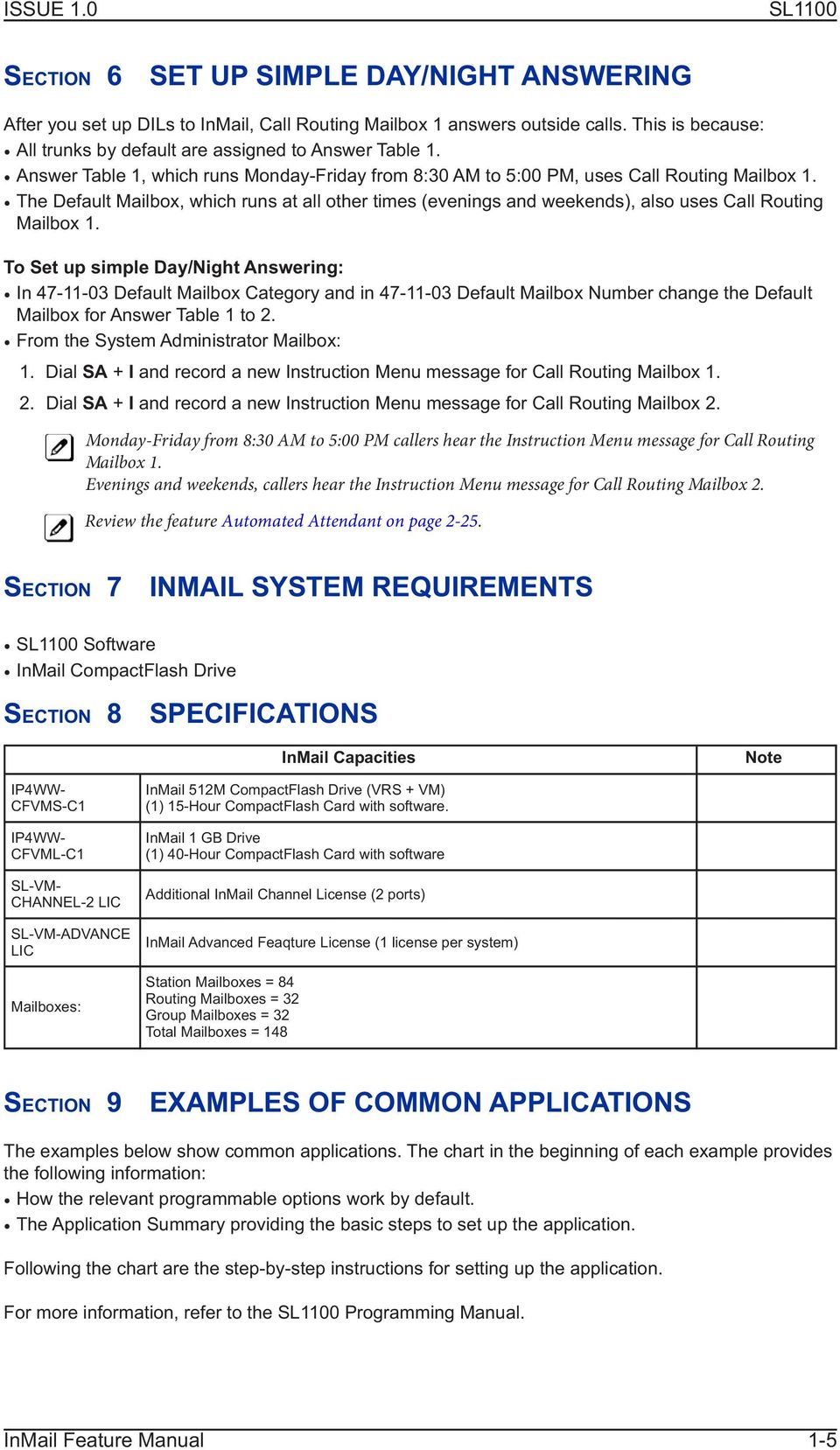
13 ISSUE 1.0 SL1100 SECTION 6 SET UP SIMPLE DAY/NIGHT ANSWERING After you set up DILs to InMail, Call Routing Mailbox 1 answers outside calls. This is because: All trunks by default are assigned to Answer Table 1. Answer Table 1, which runs Monday-Friday from 8:30 AM to 5:00 PM, uses Call Routing Mailbox 1. The Default Mailbox, which runs at all other times (evenings and weekends), also uses Call Routing Mailbox 1. To Set up simple Day/Night Answering: In Default Mailbox Category and in Default Mailbox Number change the Default Mailbox for Answer Table 1 to 2. From the System Administrator Mailbox: 1. Dial SA + I and record a new Instruction Menu message for Call Routing Mailbox Dial SA + I and record a new Instruction Menu message for Call Routing Mailbox 2. Monday-Friday from 8:30 AM to 5:00 PM callers hear the Instruction Menu message for Call Routing Mailbox 1. Evenings and weekends, callers hear the Instruction Menu message for Call Routing Mailbox 2. Review the feature Automated Attendant on page SECTION 7 INMAIL SYSTEM REQUIREMENTS SL1100 Software InMail CompactFlash Drive SECTION 8 SPECIFICATIONS InMail Capacities Note IP4WW- CFVMS-C1 IP4WW- CFVML-C1 SL-VM- CHANNEL-2 LIC SL-VM-ADVANCE LIC Mailboxes: InMail 512M CompactFlash Drive (VRS + VM) (1) 15-Hour CompactFlash Card with software. InMail 1 GB Drive (1) 40-Hour CompactFlash Card with software Additional InMail Channel License (2 ports) InMail Advanced Feaqture License (1 license per system) Station Mailboxes = 84 Routing Mailboxes = 32 Group Mailboxes = 32 Total Mailboxes = 148 SECTION 9 EXAMPLES OF COMMON APPLICATIONS The examples below show common applications. The chart in the beginning of each example provides the following information: How the relevant programmable options work by default. The Application Summary providing the basic steps to set up the application. Following the chart are the step-by-step instructions for setting up the application. For more information, refer to the SL1100 Programming Manual. InMail Feature Manual 1-5
14 SL1100 ISSUE 1.0 Example 1: Set Up Separate Day and Night Greetings Default Automated Attendant Answering All trunks answered by the Automated Attendant route to Answer Table 1. Answer Table 1 uses Schedule 1 to answer calls from Monday-Friday from 8:30 AM to 5:00 PM with Call Routing Mailbox 1. The Default Mailbox for Answer Table 1 picks up Automated Attendant calls at all other times. The Default Mailbox for Answer Table 1 is also Call Routing Mailbox 1. The greeting that plays to outside callers is the Instruction Menu for the Call Routing Mailbox that answers the call. Since Schedule 1 and the Default Mailbox both use Call Routing Mailbox 1, the Automated Attendant answers all calls the same way day and night, with the Instruction Menu for Call Routing Mailbox 1. Change the Default Mailbox from Call Routing Mailbox 1 to 2. Record a night Instruction Menu for Call Routing Mailbox 2. Application Summary Change the Default Mailbox to Call Routing Mailbox Default Mailbox Number, change the Default Mailbox assignment to 2. Record the daytime and night Instruction Menus. 1. At extension 101, press Voice Mail key (Code ). 2. Dial SA (72) + I (4). 3. Dial 001 (for Call Routing Mailbox 1) + R (7). 4. Record the daytime Instruction Menu message + # twice. 5. Dial I (4). 6. Dial 002 (for Call Routing Mailbox 2) + R (7). 7. Record the night Instruction Menu message + # + hang up. See the Instruction Menu in this manual. Example 2: Provide Unique Day and Night Dialing Options for Callers Default Dial Action Table Options AllCallRoutingMailboxes(1~8bydefault)useDialAction Table 1. Dial Action Table 1 provides the following dial options: Dial extension number. 0 for the operator. + extension to leave a Quick Message. Dial* Dial # + extension to do a Remote Logon to the mailbox. Timeout to operator if no digits dialed. Application Summary Allow callers at night to dial 0 to leave a message for the operator. 1-6 Quick Setup

15 ISSUE 1.0 SL1100 Set up separate day and night greetings. Following example 1, set up separate day and night Instruction Menus using Call Routing Mailboxes 1 and Example of the day Instruction Menu: Thank you for calling. For Sales, dial 102. For Technical Support, dial 103. To talk to an operator, dial 0. If you know your party s extension number, please dial it now. 2. Example of the night Instruction menu: Thank you for calling. Our normal business hours are 8:30 to 5:00, Monday through Friday. To leave us a message, please dial 0 now. Assign a unique Dial Action Table (2) to the night time Call Routing Mailbox (2). In Dial Action Table, assign Dial Action Table 2 to Call Routing Mailbox 2. Change the dialing options for the night time Dial Action Table (2). In InMail Dial Action Table Actions for Dial Action Table 2, make the following changes: 1. For the digits 3 and 4, enter 0 for the Action entry to prevent callers from dialing extensions at night. 2. For the digit 0, change the Action entry to REC1 (by dialing 3) and the Data entry to 101. This allows night time callers to dial 0 to leave a message for the operator. 3. Note that the and # entries are left unchanged so that experienced users can still leave Quick Messages or do * Remote Logons at night. Example 3: Manual Night Mode Control of the Automated Attendant Default Scheduling Options There is no manual control of the Automated Attendant. All calls answered by the Automated Attendant automatically follow the schedule set up by Answer Table 1. Answer Table 1 uses Schedule 1 to answer calls from 8:30 AM - 5:00 PM Monday through Friday with Call Routing Mailbox 1. The Default Mailbox for Answer Table 1 picks up Automated Attendant calls at all other times. The Default Mailbox for Answer Table 1 is also Call Routing Mailbox 1. Application Summary Set up a programmable key to switch the system into the night mode. Assign a Group Mailbox to a virtual extension. Have calls at night route to the virtual extension, which is Fixed Call Forwarded to voice mail. Set up programmable keys to switch the system into the night mode and back into the day mode. Night Mode 1. At the extension used to control the system night mode, press Speaker Press the programmable function key you want to assign as the day (night mode 1) key. 3. Dial (for night mode 1). You hear confirmation beep. This allows the user to switch the system into the day mode (i.e., night mode 1). Day Mode 1. Press the programmable function key assigned as the night (night mode 2) key. 2. Dial (for night mode 2). You hear confirmation beep. InMail Feature Manual 1-7
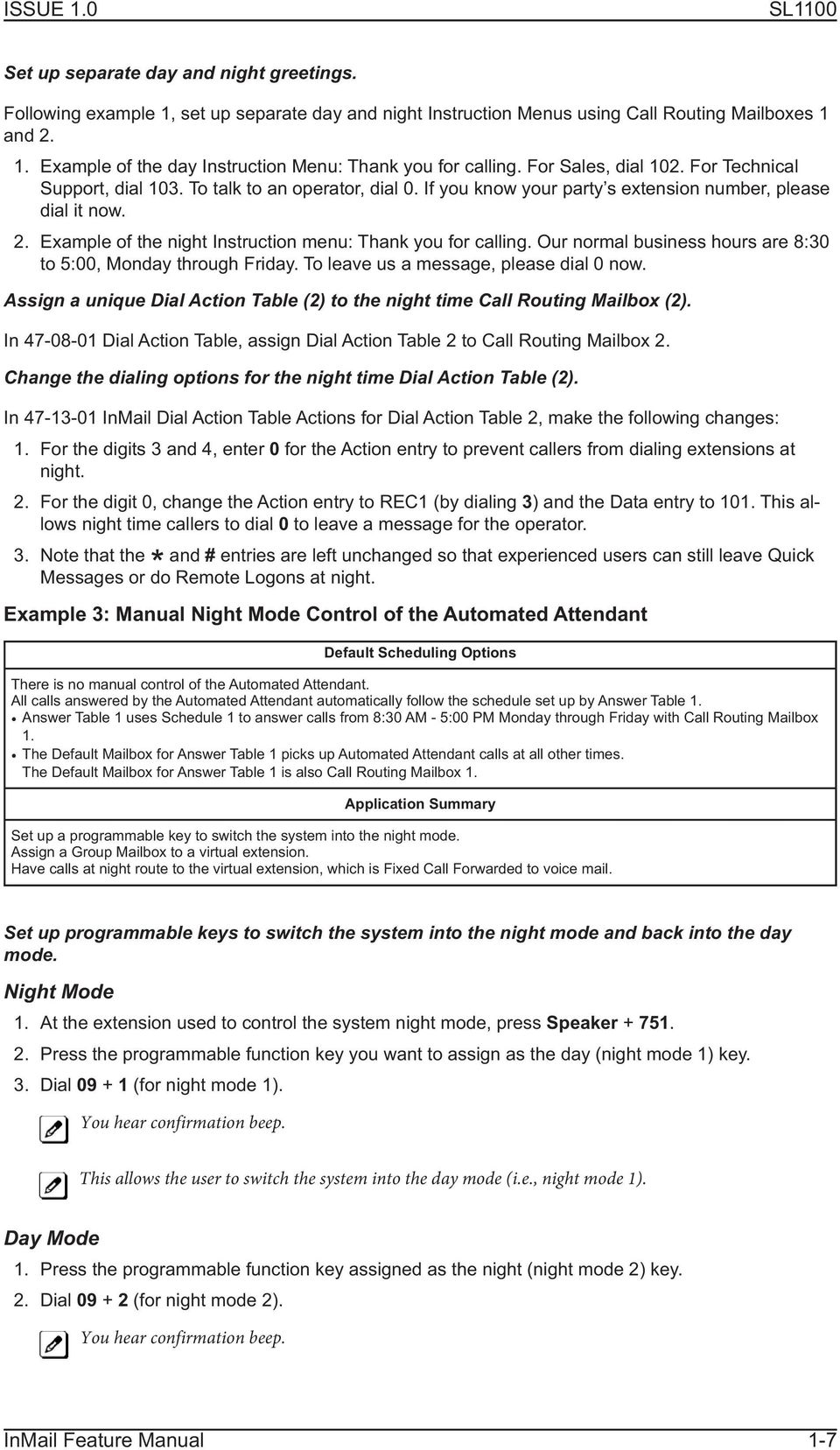
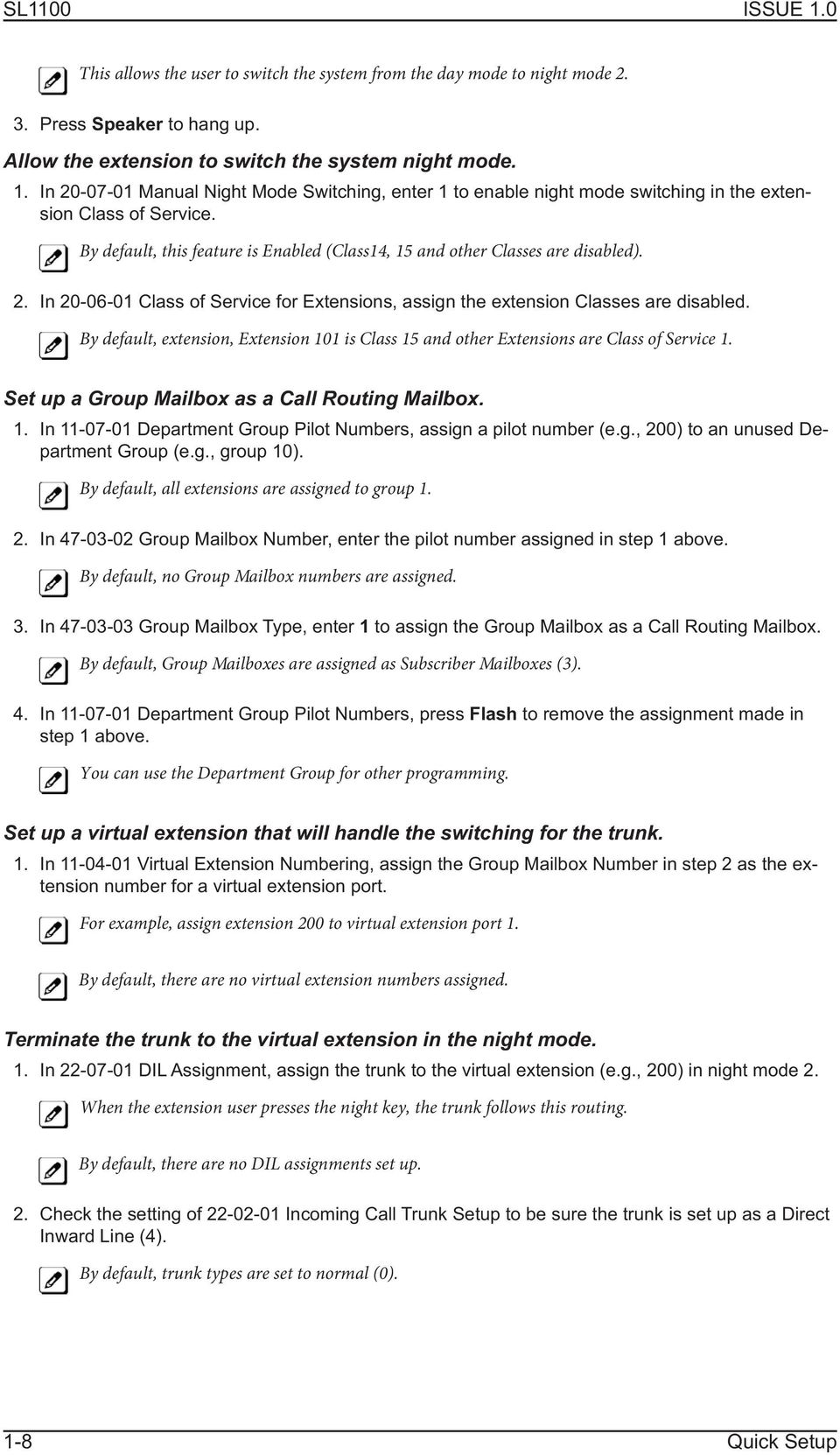
16 SL1100 ISSUE 1.0 This allows the user to switch the system from the day mode to night mode Press Speaker to hang up. Allow the extension to switch the system night mode. 1. In Manual Night Mode Switching, enter 1 to enable night mode switching in the extension Class of Service. By default, this feature is Enabled (Class14, 15 and other Classes are disabled). 2. In Class of Service for Extensions, assign the extension Classes are disabled. By default, extension, Extension 101 is Class 15 and other Extensions are Class of Service 1. Set up a Group Mailbox as a Call Routing Mailbox. 1. In Department Group Pilot Numbers, assign a pilot number (e.g., 200) to an unused Department Group (e.g., group 10). By default, all extensions are assigned to group In Group Mailbox Number, enter the pilot number assigned in step 1 above. By default, no Group Mailbox numbers are assigned. 3. In Group Mailbox Type, enter 1 to assign the Group Mailbox as a Call Routing Mailbox. By default, Group Mailboxes are assigned as Subscriber Mailboxes (3). 4. In Department Group Pilot Numbers, press Flash to remove the assignment made in step 1 above. You can use the Department Group for other programming. Set up a virtual extension that will handle the switching for the trunk. 1. In Virtual Extension Numbering, assign the Group Mailbox Number in step 2 as the extension number for a virtual extension port. For example, assign extension 200 to virtual extension port 1. By default, there are no virtual extension numbers assigned. Terminate the trunk to the virtual extension in the night mode. 1. In DIL Assignment, assign the trunk to the virtual extension (e.g., 200) in night mode 2. When the extension user presses the night key, the trunk follows this routing. By default, there are no DIL assignments set up. 2. Check the setting of Incoming Call Trunk Setup to be sure the trunk is set up as a Direct Inward Line (4). By default, trunk types are set to normal (0). 1-8 Quick Setup
17 ISSUE 1.0 SL1100 Fixed Call Forward the virtual extension to Voice Mail. 1. In Fixed Call Forwarding, enable immediate Fixed Call Forwarding to the InMail Master Number (200). For example, for virtual extension 300 enter 3 for Call Forward Type and 200 for the destination. By default, Fixed Call Forwarding is not set up. Record the Instruction Menu for the Group Call Routing Mailbox. 1. At extension 101, press Voice Mail key. 2. Dial SA (72) + I (4). 3. Dial the number of the Group Call Routing Mailbox (e.g., 400) + R (7). 4. Record the Instruction Menu message +#+ hang up. See Instruction Menu on page 2-122in this manual. When the system is in the day mode, the trunk is normally answered by InMail and follows the programmed Answer Table. When the extension user presses the night mode 2 key, the trunk is answered by the programmed Call Routing Mailbox, overriding the Answer Table assignment. InMail Feature Manual 1-9

18 SL1100 ISSUE 1.0 Memo 1-10 Quick Setup

19 Features 2 SECTION 1 INTRODUCTION TO INMAIL FEATURES If you are not familiar with the InMail features, review the Feature Glossary on this page. This chapter provides detailed information on the InMail features. The features are listed alphabetically. SECTION 2 FEATURE GLOSSARY Feature Name Usage Administrator Security Code Control See Security Code. Voice Mail Features Alternate Next Call Routing Mailbox Announcement Mailbox Announcement Message Answer Table Answering Schedule Override Auto Attendant Direct to Voice Mail Auto Erase or Save Auto Time Stamp Automated Attendant Automated Attendant Transfer Automatic Access to VM by Caller ID Automatic Call Routing to a Mailbox Automatic Message Erase/Save Automatic Routing for Rotary Dial Callers See Next Call Routing Mailbox. Mailbox that allows a recorded greeting to play to callers. The message that the System Administrator records for a specific Announcement Mailbox. Determines how the Automated Attendant answers outside calls on each trunk, according to the time of the day and day of the week that the call is ringing. Enables an alternate greeting and alternate dialing options for callers. Auto Attendant Direct to Voice Mail sends Automated Attendant calls directly to an extension user's mailbox. Their phone does not ring for calls from the Automated Attendant. See Greeting in this glossary. When a mailbox user completely listens to a new message and then exits their mailbox, InMail either automatically archives or deletes the message. After a user listens to a message, InMail can optionally announce the time and date the message was left. The Automated Attendant can automatically answer the telephone system incoming calls, play an Instruction Menu message, and provide dialing options to callers. While on a trunk call, an extension user can transfer the trunk call to the Automated Attendant so the caller can use the Automated Attendant dialing options. InMail mailbox can be associated with a specific caller ID (CID) number. When the CID number is presented to the InMail it will automatically log the user into their mailbox. See Go to a Mailbox in this glossary. See Auto Erase or Save in this glossary. If an Automated Attendant caller does not dial any digits, InMail automatically routes them to a specified option (such as the operator or a mailbox). Voice Mail Automated Attendant Automated Attendant Automated Attendant Automated Attendant Automated Attendant Voice Mail Voice Mail Automated Attendant Voice Mail Voice Mail Automated Attendant Voice Mail Automated Attendant InMail Feature Manual 2-1

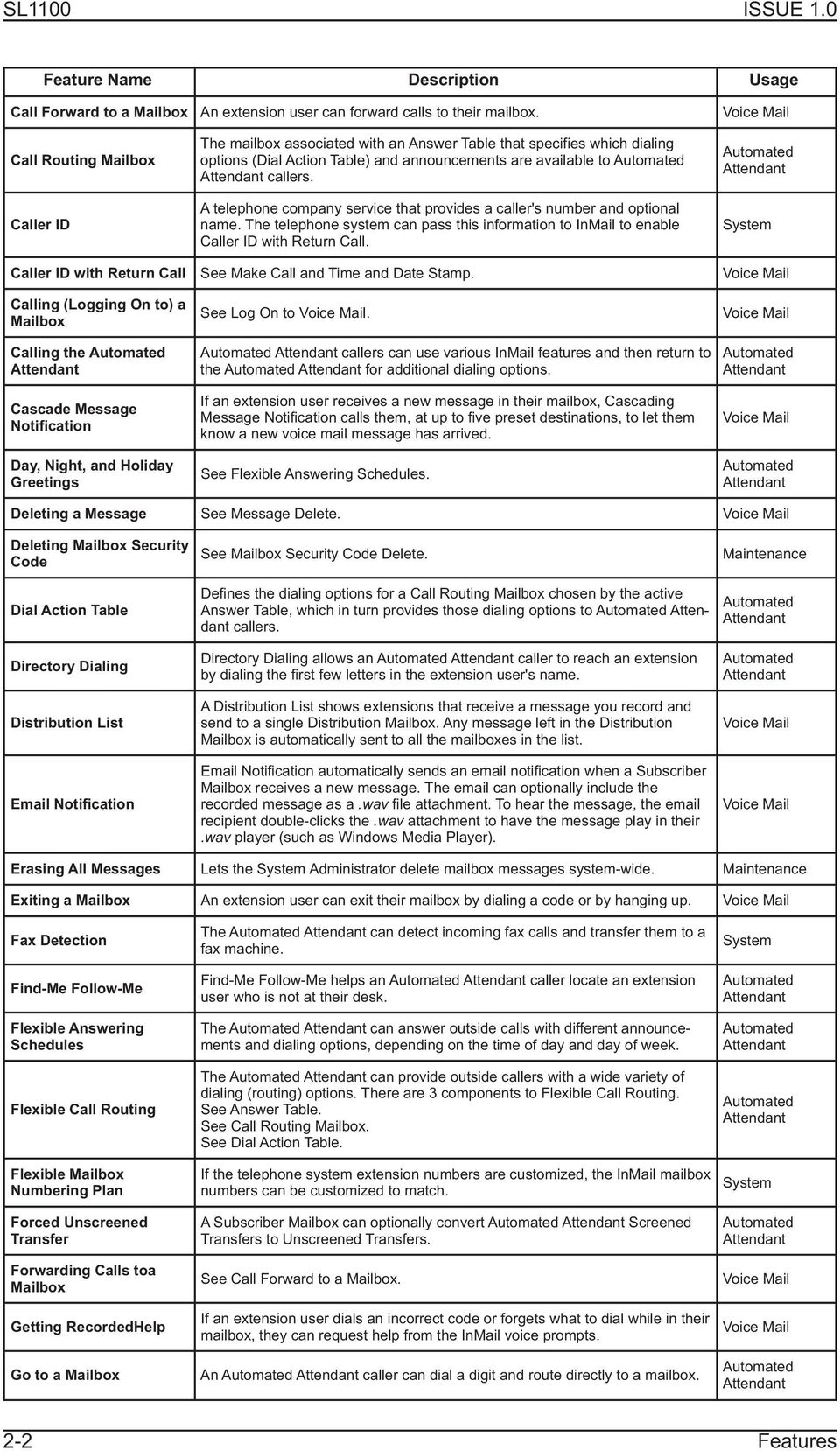
20 SL1100 ISSUE 1.0 Feature Name Usage Call Forward to a Mailbox An extension user can forward calls to their mailbox. Voice Mail Call Routing Mailbox Caller ID The mailbox associated with an Answer Table that specifies which dialing options (Dial Action Table) and announcements are available to Automated Attendant callers. A telephone company service that provides a caller's number and optional name. The telephone system can pass this information to InMail to enable Caller ID with Return Call. Automated Attendant System Caller ID with Return Call See Make Call and Time and Date Stamp. Voice Mail Calling (Logging On to) a Mailbox Calling the Automated Attendant Cascade Message Notification Day, Night, and Holiday Greetings See Log On to Voice Mail. Automated Attendant callers can use various InMail features and then return to the Automated Attendant for additional dialing options. If an extension user receives a new message in their mailbox, Cascading Message Notification calls them, at up to five preset destinations, to let them know a new voice mail message has arrived. See Flexible Answering Schedules. Voice Mail Automated Attendant Voice Mail Automated Attendant Deleting a Message See Message Delete. Voice Mail Deleting Mailbox Security Code See Mailbox Security Code Delete. Maintenance Dial Action Table Defines the dialing options for a Call Routing Mailbox chosen by the active Answer Table, which in turn provides those dialing options to Automated Attendant callers. Automated Attendant Directory Dialing Distribution List Notification Directory Dialing allows an Automated Attendant caller to reach an extension by dialing the first few letters in the extension user's name. A Distribution List shows extensions that receive a message you record and send to a single Distribution Mailbox. Any message left in the Distribution Mailbox is automatically sent to all the mailboxes in the list. Notification automatically sends an notification when a Subscriber Mailbox receives a new message. The can optionally include the recorded message as a.wav file attachment. To hear the message, the recipient double-clicks the.wav attachment to have the message play in their.wav player (such as Windows Media Player). Automated Attendant Voice Mail Voice Mail Erasing All Messages Lets the System Administrator delete mailbox messages system-wide. Maintenance Exiting a Mailbox An extension user can exit their mailbox by dialing a code or by hanging up. Voice Mail Fax Detection Find-Me Follow-Me Flexible Answering Schedules Flexible Call Routing Flexible Mailbox Numbering Plan Forced Unscreened Transfer Forwarding Calls toa Mailbox Getting RecordedHelp Go to a Mailbox The Automated Attendant can detect incoming fax calls and transfer them to a fax machine. Find-Me Follow-Me helps an Automated Attendant caller locate an extension user who is not at their desk. The Automated Attendant can answer outside calls with different announcements and dialing options, depending on the time of day and day of week. The Automated Attendant can provide outside callers with a wide variety of dialing (routing) options. There are 3 components to Flexible Call Routing. See Answer Table. See Call Routing Mailbox. See Dial Action Table. If the telephone system extension numbers are customized, the InMail mailbox numbers can be customized to match. A Subscriber Mailbox can optionally convert Automated Attendant Screened Transfers to Unscreened Transfers. See Call Forward to a Mailbox. If an extension user dials an incorrect code or forgets what to dial while in their mailbox, they can request help from the InMail voice prompts. An Automated Attendant caller can dial a digit and route directly to a mailbox. System Automated Attendant Automated Attendant Automated Attendant System Automated Attendant Voice Mail Voice Mail Automated Attendant 2-2 Features
21 ISSUE 1.0 SL1100 Feature Name Usage Greeting Group (Shared) Mailbox Guest Mailbox Hang Up A Subscriber Mailbox user can record a personalized greeting for their mailbox. With Multiple Greetings, the mailbox subscriber can record up to three separate greetings and make one of the three active. Callers to the user's mailbox hear the active greeting. With Remote Greeting, an extension user can call into the Automated Attendant, access their mailbox, and remotely record their mailbox greeting. See Auto Attendant Direct to Voice Mail. An extension user can share a Group Mailbox with co-workers for receiving and sending messages. An outside party can have their own mailbox for receiving and sending messages. An Automated Attendant option that immediately hangs up the outside call. Voice Mail Voice Mail Voice Mail Automated Attendant Help See Getting Recorded Help. Voice Mail Individual Trunk Greetings InMail Upload Download Audio Instruction Menu Language Setting Leaving a Message Leaving a Message at a Busy/DND Extension Leave a Quick Message See Multiple Company Greetings. Allows the user to upload/download audio messages for greetings, etc. The Instruction Menu is the announcement that plays to Automated Attendant callers. Normally, the Instruction Menu provides callers with the Automated Attendant dialing options. This feature allows the telephone display language and the InMail mailbox language to be changed from the telephone. An extension user can leave a voice message in a co-worker's mailbox if that extension is busy, unanswered, or in Do Not Disturb. See Leaving a Message. See Quick Message. Automated Attendant Voice Mail Automated Attendant Voice Mail Voice Mail Voice Mail Automated Attendant Listening Options See Listening to Messages. Voice Mail Listening to Messages Live Monitor Live Record While or after listening to a message, an extension user has many message handling options from which to choose. Live Monitor lets Voice Mail screen calls, just like an answering machine at home. When activated, the extension's incoming calls route to the user's subscriber mailbox. The Live Monitor feature is supported for External and Internal calls. Once the mailbox answers, the user hears the caller's incoming message. Allows an extension user to record an active call as a message in their mailbox. InMail broadcasts a beep and a voice prompt to the caller as Live Record begins. Voice Mail Voice Mail Voice Mail Local Notification See Message Notification. Voice Mail Log On to Voice Mail Mailbox Announcement Message An extension user can press a key to log on to access their InMail mailbox. With Remote Logon, an employee calling through the Automated Attendant can dial a single digit followed by their own mailbox number to remotely log on to their mailbox. The Mailbox Announcement Message is recorded by the System Administrator, and plays to each subscriber when they log on to their mailbox. The message plays at each log on until it expires, is deleted, or made inactive by the System Administrator. Voice Mail Administration Mailbox Greeting See Greeting. Voice Mail Mailbox Logon See Log On to Voice Mail. Voice Mail Mailbox Name Mailbox Options Menu A mailbox caller can hear the extension user's recorded name instead of their mailbox number. Sub-menu of a subscriber's Main Menu that provides access to the Auto Time Stamp, Mailbox Security Code Delete, and Message Notification features. Voice Mail Voice Mail InMail Feature Manual 2-3
22 SL1100 ISSUE 1.0 Feature Name Usage Mailbox Security Code Delete The System Administrator can delete the security code for any mailbox, effectively unlocking it. See Security Code. Maintenance Mailbox Transfer See Transfer to a Mailbox. Voice Mail Main Menu Make Call Message Count Display The InMail options available to an extension user when they log on to their mailbox. A Subscriber Mailbox user can listen to a voice message and dial MC to return the call without knowing their caller's phone number. The telephone display can show the number of new messages waiting in a user's mailbox. Voice Mail Voice Mail Voice Mail Message Delete An extension user can delete any message left in their mailbox. Voice Mail Message Forward Message Length Message Listen Mode Message Notification Message Playback Direction A subscriber can forward a message in their mailbox to a co-worker. They can optionally record a comment before the forwarded message. The System Administrator can set the maximum length of a message that can be left in a user's voice mailbox. When a user calls their mailbox, they can dial a code to listen to all their messages, their new messages, their saved messages, or their held messages. Once activated by the mailbox user, a telephone number is dialed to let the recipient know there are new messages in the mailbox. Notification can call extensions, local numbers, long distance numbers and pagers. An extension user can listen to their messages in either LIFO (last-in-first-out) or FIFO (first-in-first-out) order. Voice Mail Voice Mail Voice Mail Voice Mail Voice Mail Message Record See Record and Send a Message in this glossary. Voice Mail Message Reply An extension user can reply to a message in their mailbox by dialing a code, without knowing the caller's extension number. Voice Mail Message Send See Record and Send a Message. Voice Mail Message Storage Limit Sets how many messages a mailbox can store. Voice Mail Message Waiting Lamp Multiple Company Greetings An extension Message Waiting lamp flashes on the telephone indicating new messages are waiting in their mailbox. By assigning a unique Answer Table to each trunk, a single InMail system can provide individual greetings and dialing options for several companies. Voice Mail Automated Attendant Name See Mailbox Name. Voice Mail Next Call Routing Mailbox Provides callers with additional dialing options after they leave a message in an extension mailbox (depending on the setting of the Next Call Routing Mailbox Dial Mode). Voice Mail One-Touch Forwarding See Call Forward to a Mailbox and Message Forward. Voice Mail One-Touch Mailbox Access One-Touch Mailbox Retrieval Park and Page Personal Answering Machine Emulation Personalized Mailbox Greeting Programmable Security Code See Log On to Voice Mail. See Log On to Voice Mail. Park and Page can automatically Park a call at an extension and Page the user with a recorded Paging Message announcing the parked call. The called extension user can then go to any telephone and implement Personal Park to pick up the call. See Live Monitor. See Greeting. See Security Code and Mailbox Security Code Delete. Voice Mail Voice Mail Automated Attendant Voice Mail Voice Mail Voice Mail 2-4 Features
23 ISSUE 1.0 SL1100 Feature Name Usage Programming Voic Quick Message Record and Send a Message You can program (customize) InMail by using the PCPro and WebPro programming applications. Limited programming can also be done from a System Administrator's mailbox. See Programming Voice Mail for more information. Also see System Administrator Mailbox. Automated Attendant callers can dial a digit followed by an extension number to leave a message directly in a user's mailbox. See Quick Message for more information. A Subscriber Mailbox user can record and send a message to any other Subscriber Mailbox. Maintenance Automated Attendant Voice Mail Recorded Help Prerecorded voice prompts guide the user through the InMail features. Voice Mail Recording a Conversation See Live Record. Voice Mail Recording a Message See Record and Send a Message. Voice Mail Recording Conversation Beep See Live Record. Voice Mail Recording Options See Record and Send a Message. Voice Mail Remote Log On See Log On to Voice Mail. Voice Mail Remote Greetings See Greeting. Voice Mail Remote Message Notification Remote Programming Return Call (with Caller ID) Rotary Dial Telephones Routing Mailbox See Message Notification. You can remotely program (customize) InMail by using the PCPro and WebPro programming applications. You can also do limited remote programming from the System Administrator's mailbox. See Make Call. See Automatic Routing for Rotary Dial Callers. Routing Mailboxes are used to route Automated Attendant calls. A Routing Mailbox can be either an Announcement or Call Routing Mailbox. Voice Mail Maintenance Voice Mail Automated Attendant Automated Attendant Screened Transfer Similar to telephone system screened transfers when the transferring party controls the transfer. After an Automated Attendant caller dials an extension, InMail calls (screens) the destination extension to see if the transfer can go through. If the destination is busy or in DND, the Automated Attendant does not extend the call and immediately provides the caller with additional options. If the destination is available, the Automated Attendant rings it. If the destination answers, the call goes through. If the destination does not answer in a programmed time, the Automated Attendant does not extend the call and provides the caller with additional options. Also see Unscreened Transfer. Automated Attendant Security Code An extension user's mailbox can have a security code to protect the mailbox from unauthorized access. See Mailbox Security Code Delete. Voice Mail Select Listen Mode See Message Listen Mode. Voice Mail Single Digit Dialing An Automated Attendant caller can press a single key to route to an extension, route to another destination, or use an InMail feature. Automated Attendant Subscriber Mailbox The mailbox type normally used for telephone system extensions. Voice Mail System Administrator The extension user that has InMail system administration abilities. Maintenance System Administrator Mailbox A Subscriber Mailbox option that enables the system administration abilities. Also see System Administrator. Voice Mail System Re-initialization Re-initializing InMail returns all programmed options to default value. Maintenance Time and Date After listening to a message, an extension user can dial a code to hear what time the message was sent. Also see Auto Time Stamp. Voice Mail InMail Feature Manual 2-5
24 SL1100 ISSUE 1.0 Feature Name Usage Time and Date Stamp Time and Date Stamp (with Caller ID Storage Transfer by Extension Transfer Calls to a FAX Machine With caller ID installed, an extension user can listen to a message and dial a code to hear the time the message was sent, as well as the caller's number. Also see Caller ID with Return Call and Time and Date above. See Time and Date Stamp. See Screened Transfer and Unscreened Transfer. See Fax Detection. Voice Mail Voice Mail Automated Attendant Automated Attendant Transfer to a Mailbox An extension user can transfer an active call to a co-worker's mailbox. Voice Mail Transfer to an Extension Transfer to the Automated Attendant Undefined Routing Undefined Routing Intercept Unscreened Transfer See Screened Transfer and Unscreened Transfer. See Automated Attendant Transfer. A dialpad digit for which the Automated Attendant has no routing defined. When an Automated Attendant caller dials a digit which has no routing assigned, InMail plays a brief error message and then repeats the dialing options. See Undefined Routing. Similar to telephone system unscreened transfers when the transferring party immediately extends the call. After an Automated Attendant caller dials an extension, InMail immediately transfers the call to the destination and hangs up. Any recalls or additional routing are handled by the telephone system - just as with any other unscreened transfer. Also see Screened Transfer. Automated Attendant Voice Mail Automated Attendant Automated Attendant Automated Attendant Voice Mail Overflow Ensures that InMail picks up calls that do not go through. System Volume Control A mailbox user can turn the volume up or down while listening to a message. Voice Mail SECTION 3 FEATURE DESCRIPTIONS This section provides detailed feature descriptions, programming, operating procedures and related feature programming. Each feature description includes the following headings. Read to get an overview of the feature, its benefit, any special considerations you should be aware of, and how it works in the default system. Related Features Related Features shows you at a glance how each feature interacts with other InMail features. Programming Here you'll find easy to follow step-by-step programming instructions for each feature. Operation Operation provides charts that show how the feature operates. 2-6 Features
25 ISSUE 1.0 SL1100 Announcement Mailbox An Announcement Mailbox plays a recorded announcement to Automated Attendant callers without providing dialing options. The Announcement Mailbox is typically set up to provide information to callers and then route back to the Automated Attendant. See the following example: The Automated Attendant instructs the caller to dial a digit for company directions. - Record this in the Instruction Menu message for the active Call Routing Mailbox. See Instruction Menu on page for more information. - Set the dialing options in the Dial Action Table associated with the active Call Routing Mailbox. See Dial Action Table on page 2-49 for more information. The caller dials the digit and listens to the recorded Announcement Mailbox message for directions. After playing the directions, the caller routes back to the Automated Attendant for additional dialing options. - See the Hang Up on page and Next Call Routing Mailbox on page options in Programming below. A By default, there are 24 Announcement Mailboxes (Routing Mailboxes 9 ~ 32). However, you can assign any of the 32 Routing Mailboxes as an Announcement Mailbox. The Next Call Routing Mailbox Options The following Mailbox Routing charts show how an Announcement Mailbox handles Automated Attendant calls. The first chart explains what happens when the outside call is directly answered by the Announcement Mailbox. This happens when the Answer Table uses an Announcement Mailbox for routing instead of a Call Routing Mailbox. The second chart explains what happens when the outside call is answered by a Call Routing Mailbox and then routed to the Announcement Mailbox. This can happen, for example, when a caller dials a digit to hear an announcement of company directions. See Answer Table on page 2-14 for more set up information. Direct Announcement Mailbox Routing (If the outside caller routes directly to the Announcement Mailbox) Next Call Routing Mailbox Repeat Count Hang Up After Action 0 = Undefined 0 (No repeats) 0 = None 1 = Goodbye 2=Silent If the caller does not dial, after the announcement InMail hangs up. If the caller dials a digit during the announcement, InMail says "That is an invalid entry" and hangs up (valid Call Routing Mailbox) 0 (No repeats) 0 = None 1 = Goodbye 2=Silent If the caller does not dial, after the announcement they route to the Next Call Routing Mailbox. If the caller dials a digit during the announcement, they route to the Next Call Routing Mailbox. If the caller doesn't dial, after the announcement InMail hangs up. If the caller dials a digit during the announcement, they route to the Next Call Routing Mailbox. 0 = Undefined x (x number of repeats) 0 = None 1 = Goodbye 2=Silent If caller does not dial, they hear the announcement x number of times and then InMail hangs up. If the caller dials a digit during the announcement, InMail says "That is an invalid entry" and aborts the announcement. The announcement repeats (if allowed by the Repeat Count) and then InMail hangs up. InMail Feature Manual 2-7
26 SL1100 ISSUE 1.0 Direct Announcement Mailbox Routing (If the outside caller routes directly to the Announcement Mailbox) Next Call Routing Mailbox Repeat Count Hang Up After Action 1-32 (valid Call Routing Mailbox) x (x number of repeats) 0 = None 1 = Goodbye 2=Silent If caller does not dial, they hear the announcement x number of times and then route to the Next Call Routing Mailbox. If the caller dials a digit during the announcement, they route to the Next Call Routing Mailbox. A If caller does not dial, they hear the announcement x number of times and then InMail hangs up. If the caller dials a digit during the announcement, they route to the Next Call Routing Mailbox. Routed Announcement Mailbox Routing (If the outside caller routes to the Announcement Mailbox from a Call Routing Mailbox) Next Call Routing Mailbox Repeat Count Hang Up After Action 0 = Undefined 0 (No repeats) 0 = None 1 = Goodbye 2 = Silent If the caller does not dial, after the announcement the caller goes back to the initial Call Routing Mailbox. If the caller dials a digit during the announcement, InMail says "That is an invalid entry" and routes the caller goes back to the initial Call Routing Mailbox (valid Call Routing Mailbox) 0 (No repeats) 0 = None 1 = Goodbye 2 = Silent If the caller does not dial, after the announcement InMail hangs up. If the caller dials a digit during the announcement, InMail says "That is an invalid entry" and hangs up. If the caller doesn't dial, after the announcement they route to the Next Call Routing Mailbox. If the caller dials a digit during the announcement, they route to the Next Call Routing Mailbox. If the caller does not dial, after the announcement InMail hangs up. If the caller dials a digit during the announcement, they route to the Next Call Routing Mailbox. 0 = Undefined x (x number of repeats) 0 = None 1 = Goodbye 2 = Silent If caller does not dial, they hear the announcement x number of times and then go back to the initial Call Routing Mailbox. If the caller dials a digit during the announcement, InMail says "That is an invalid entry" and aborts the announcement. The announcement repeats (if allowed by the Repeat Count) and then InMail routes back to the initial Call Routing Mailbox. If caller does not dial, they hear the announcement x number of times and then InMail hangs up. If the caller dials a digit during the announcement, InMail says "That is an invalid entry" and aborts the announcement. The announcement repeats (if allowed by the Repeat Count) and then InMail hangs up (valid Call Routing Mailbox) x (x number of repeats) 0 = None 1 = Goodbye 2 = Silent If caller does not dial, they hear the announcement x number of times and then route to the Next Call Routing Mailbox. If the caller dials a digit during the announcement, they route to the Next Call Routing Mailbox. If caller does not dial, they hear the announcement x number of times and then InMail hangs up. If the caller dials a digit during the announcement, they route to the Next Call Routing Mailbox. 2-8 Announcement Mailbox
27 ISSUE 1.0 SL1100 Related Features Automated Attendant on page 2-25 The Automated Attendant routes callers to an Announcement Mailbox. Routing Mailbox on page A Call Routing Mailbox (and the associated Dial Action Table) provides dialing options to Automated Attendant callers. Next Call Routing Mailbox on page The Next Call Routing mailbox provides additional routing options to Announcement Mailbox callers. A System Administrator on page The System Administrator records the Announcement Mailbox message. Programming 1. Set up the Announcement Mailbox: Program Number Program Name Routing Mailbox Type (Mailbox Type) Enter 2 to make the Routing Mailbox an Announcement Mailbox. By default, Routing Mailboxes 1~8areCallRoutingMailboxes (1) and Routing Mailboxes 9 ~ 32 are Announcement Mailboxes (2). 2. Record the Announcement Message: See Operation below. By default, no message is recorded. 3. Hang up InMail after playing the Announcement Mailbox message (without providing additional dialing options): Program Number Program Name Hang Up After (HangUp) Enter 1 (Goodbye) to have InMail play Goodbye to caller and hang up after the announcement. By default, this option is disabled (0). 4. Provide Announcement Mailbox callers with more dialing options (instead of hanging up): Program Number Program Name Hang Up After (HangUp) Enter 0 (None) to have InMail hang up after the announcement. By default, this option is disabled (0). Review Next Call Routing Mailbox on page to set up additional dialing options for Announcement Mailbox callers. InMail Feature Manual 2-9
28 SL1100 ISSUE Repeat the Announcement Mailbox message while the caller listens: Program Number Program Name Repeat Count Enter the Repeat Count (0 ~ 10). By default, this option is 0 (No Repeats). 6. Set the maximum length of the Announcement Mailbox message: Program Number Program Name A Incoming Message Length (Subs Msg Length) Enter the maximum length of the Announcement Mailbox message (1 ~ 4095 seconds). By default, this interval is 120 seconds. Operation Log On to System Administrator's mailbox. Recording an Announcement Mailbox Message SA (72) Access System Administrator options. [Not applicable] A (2) Select Announcement Mailbox message. [Annc] Enter the Announcement Mailbox number. L (5) Listen to current Announcement Mailbox message. [Lstn] # Exit listen mode. R (7) Record a new Announcement Mailbox message. [Rec] Record message. * Pause or restart recording. [Resume] [Pause] D (3) Delete recording. [Del] # Exit recording mode. [Done] D (3) Delete the Announcement Mailbox message. [Del] 0 Plays Help message. # Go back to the System Administrator options. [Exit] # Go back to the System Administrator options. [Exit] 2-10 Announcement Mailbox
29 ISSUE 1.0 SL1100 Announcement Message The Announcement Message is the voice message that the System Administrator records for a specific Announcement Mailbox. See Announcement Mailbox on page 2-7 for more. Related Features See Announcement Mailbox on page 2-7. Programming A See Announcement Mailbox on page 2-7. Operation See Announcement Mailbox on page 2-7. InMail Feature Manual 2-11
30 SL1100 ISSUE 1.0 Answer Schedule Override A Answer Schedule Override provides alternate answering for Automated Attendant calls. When enabled, Answer Schedule Override sends calls to the specified Override Mailbox. The Override Mailbox can be an Announcement, Call Routing, or Subscriber mailbox. You can use Answer Schedule Override to provide holiday and bad weather closing announcements, for example. Enable override when you want callers to hear the special announcements; disable override to have the Automated Attendant answer normally. You can enable Answer Schedule Override from system programming or from the System Administrator Mailbox. If the Override Mailbox is an Announcement Mailbox, the outside caller hears the recorded announcement. Depending on how the Announcement Mailbox is programmed, InMail then hangs up, reroutes the call, or provides additional dialing options. If the Override Mailbox is a Call Routing Mailbox, the outside caller hears the instruction menu and can dial any option allowed by the associated Dial Action Table. If the Override Mailbox is a Subscriber Mailbox, the outside caller hears the mailbox greeting (if recorded) and can leave a message. Related Features Announcement Mailbox on the previous page The Override Mailbox can be an Announcement Mailbox. Routing Mailbox on page The Override Mailbox can be a Call Routing Mailbox. Subscriber Mailbox on page The Override Mailbox can be a Subscriber Mailbox. System Administrator on page Optionally enable Answer Schedule Override from the System Administrator Mailbox. Programming 1. Optionally enable Answer Schedule Override from system programming. Program Number Program Name Answer Schedule Override (Schedule Override) Enter 1 (Yes) to enable Answer Schedule Override. You can also enable Answer Schedule Override from the System Administrator Mailbox. See Operation below. By default, Answer Schedule Override is disabled (0) Answer Schedule Override
31 ISSUE 1.0 SL Specify the Override Mailbox Category. Program Number Program Name Override Mailbox Category (Override MB Ctg) When you enable Answer Schedule Override for the selected Answer Table, you can choose to route Automated Attendant calls to any of the following mailbox categories: 1 Station Mailbox 2 Group Mailbox 3 Routing Mailbox 0 Undefined By default, this option is Specify the Override Mailbox Number. Program Number Program Name Override Mailbox Number (Override MB Num) For the selected Answer Table, choose the Override Mailbox number (maximum 3 digits, using 0 ~ 9). The mailbox number you select must match the mailbox category specified in above. A By default, there is No Entry for this option. 4. Optionally enable Answer Schedule Override from the System Administrator Mailbox. Operation Log On to System Administrator s Mailbox. Enabling Answer Schedule Override SA (72) Access System Administrator options. [Not applicable] O (6) Access Answer Schedule Override. [Not applicable] 1-8 Enter the number of the Answer Table you want to override. You go to the Answer Schedule Override Menu. O (6) C (2) Turn Answer Schedule Override on or off. [On] [Off] Select the Override Mailbox. [MBOX] Enter the Override Mailbox number. The Override Mailbox can be an Announcement, Call Routing, or Subscriber Mailbox. # Go back to the Answer Schedule Override Menu without entering an Override Mailbox. [Exit] 0 Plays Answer Schedule Override Menu Help message. # Go back to the System Administrator Menu. [Exit] # Go back to the System Administrator Menu. [Exit] # Go back to the Main Menu. [Exit] 0 Plays Help message. InMail Feature Manual 2-13
32 SL1100 ISSUE 1.0 Answer Table A The Answer Table determines how the Automated Attendant answers outside calls on each trunk, according to the time of the day and day of the week that the call is ringing. InMail provides 8 Answer Tables. The Answer Table is an integral part of the Automated Attendant. The Automated Attendant can automatically answer the telephone system incoming calls, play an Instruction Menu message, and provide dialing options to callers. Automated Attendant has 3 major components: Answer Table on this page The Answer Table determines how the Automated Attendant answers outside calls on each trunk, according to the time of the day and day of the week that the call is ringing. The Answer Table divides the time of day and day of the week into individual schedules, which in turn assign a Call Routing Mailbox to each call. When a specific schedule is not in effect, the Answer Table uses its Default Mailbox to determine routing. By default, all trunks use Answer Table 1. Answer Table 1 has a single schedule that runs Monday through Friday from 8:30 AM to 5:00 PM. Routing Mailbox on page A Call Routing Mailbox is associated with an individual Answer Table schedule or the Default Mailbox. It specifies which dialing options (Dial Action Table) are available to callers. It also provides the Instruction Menu to callers which typically greets the callers and describes the dialing options. By default, Answer Table 1 has a single schedule that runs Monday through Friday from 8:30 AM to 5:00 PM. This schedule and the Default Mailbox both use Call Routing Mailbox 1. Dial Action Table on page 2-49 After the Automated Attendant answers, the Dial Action Table provides the dialing options to callers. Each digit a caller can dial is assigned a specific action (function) in the Dial Action Table. The dial action used depends on the setting in the active Call Routing Mailbox, which in turn depends on the Answer Table setup. By default, Call Routing Mailbox 1 uses Dial Action Table 1. The block diagram below shows the default InMail Automated Attendant configuration Answer Table
33 ISSUE 1.0 SL1100 DIL to Voice Mail Master (200) Incoming Call Trunk Setup DIL Setup Trunks Route to Answer Table Answer Table Assignment InMail Default Automated Attendant Answering A Answer Table Answer Table Options Schedule 1 or Default Mailbox Answer Schedules Default Mailbox All calls route to Call Routing Mailbox 1 Schedule 1 active M-F 8:30 AM - 5:00 PM Default Mailbox active all other times Call Routing Mailbox Call Routing Mailbox Options From a System Administrator mailbox, record an Instruction Menu (SA + I) for the active Call Routing Mailbox. Dial Action Table Dial Action Tables Dial Action Table 1 Dialing Options: Dial an extension number, or O for the operator The Default Mailbox and Routing Hierarchy The Default Mailbox provides routing for an Answer Table during periods when a schedule is not in effect. By default, for example, Answer Table 1 Schedule 1 is active Monday through Friday from 8:30 AM to 5:00 PM. The Default Mailbox for Answer Table 1 is active during all other times (i.e., evenings and weekends). Since Schedule 1 and the Default Mailbox both use Call Routing Mailbox 1, initially the routing is the same 24 hours a day, 7 days a week. See Customizing an Answer Table below for more information. When setting up your Answer Tables, keep in mind that a more specific type of routing has priority over a less specific type of routing. When selecting which routing to follow when there is more than one choice for a specific time, InMail chooses in the following order: 1. Date Schedule 2. Day of Week Schedule InMail Feature Manual 2-15
34 SL1100 ISSUE Range of Days Schedule 4. Default Mailbox For example, a Date Schedule set up for Christmas day has priority over any other schedules in effect on December 25. Customizing an Answer Table Use the following examples as a guide when customizing your Answer Tables to meet specific site requirements. Refer to Programming below for the specifics. A To set up daytime and evening/weekend answering (2 schedules): In this example, use the Default Mailbox (Call Routing Mailbox 1) for evening/weekend answering and specify a new Call Routing Mailbox for daytime answering. 1. Change the Call Routing Mailbox for Answer Table 1, Schedule 1. In Program Entry, assign Call Routing Mailbox 2 to Answer Table 1, Schedule 1. Use this setting for daytime answering. 2. From a System Administrator's Mailbox, record an evening/weekend Instruction Menu message for Call Routing mailbox 1. This message plays to callers Monday through Friday from 5:00 PM to 8:30 AM and on weekends. 3. From a System Administrator's Mailbox, record a daytime Instruction Menu message for Call Routing Mailbox 2. This message plays to callers Monday through Friday from 8:30 AM to 5:00 PM. To set up daytime, evening, and weekend answering (3 schedules): This example builds on the example above, but adds a third schedule that plays only on weekday evenings. 1. Change the Call Routing Mailbox for Answer Table 1, Schedule 1. In Program Entry, assign Call Routing Mailbox 2 to Answer Table 1, Schedule 1. As in the 2 schedule example, use this for daytime answering. 2. Create a new schedule that will run only in the evenings. In Program Entry, create Schedule 2 for Answer Table 1 that will run Monday through Friday from 5:00 PM to 11:00 PM. Assign Call Routing Mailbox 3 to this new schedule. 3. From a System Administrator's Mailbox, record a late night/weekend Instruction Menu Message for Call Routing mailbox 1. This message plays Monday through Friday from 11:00 PM to 8:30 AM, and on weekends. 4. From a System Administrator's mailbox, record the weekday Instruction Menu Message for Call Routing Mailbox 2. This message plays Monday through Friday from 8:30 AM to 5:00 PM. 5. From a System Administrator's Mailbox, record the weekday evening Instruction Menu Message for Call Routing Mailbox 3. This message plays Monday through Friday from 5:00 PM to 1:00 PM. Related Features Automated Attendant on page 2-25 The Answer Table determines how the Automated Attendant answers calls. Routing Mailbox on page The Call Routing Mailbox provides the dialing instructions (Dial Action Table) and announcements to Automated Attendant Callers. Dial Action Table on page Answer Table
35 ISSUE 1.0 SL1100 The Dial Action Table defines the dialing options for the Call Routing Mailbox chosen by the Answer Table, which in turn provides those options to Automated Attendant callers. Programming 1. Assign Answer Tables to trunks. Program Number Program Name Answer Table Assignment (Answer Table) Assign an Answer Table (1 ~ 8) to each trunk that the Automated Attendant should answer. 2. Set up the Automated Attendant to answer trunk calls. By default, all trunks are assigned to Answer Table 1. Program Number Program Name A Incoming Call Trunk Setup Assign Service Type 4 to each trunk you want to be a DIL. Make a separate entry for each Night Service mode. By default, trunks are Service Type 0 (Normal) DIL Assignment For each trunk you designated above, enter the InMail pilot number. Make a separate entry for each Night Service mode. By default, there are no DIL destinations programmed. 3. Select the Answer Table to be customized. Program Number Program Name InMail Answer Table Options Select the Answer Table to be customized (1 ~ 8) Next Answer Table If 10 Answer Schedules in an Answer Table are not sufficient, enter the number of the Answer Table to which you want to link the selected table. InMail treats the two linked tables as a single 20 entry Answer Table. By default, Answer Tables are not linked (Undefined) Default Mailbox Category (Default MB Ctg) and Default Mailbox Number (Default MB Num) Set the mailbox the Answer Table uses if no Answer Schedule is in effect. By default, this option is 3 (Routing Mailbox) for Answer Table 1 and 0 (undefined) for all other Answer Tables. 4. Setting up a Type 1 (Day of Week) schedule Program Number Program Name InMail Answer Schedules Select the Schedule Entry to be customized Schedule Type (Entry xx Schedule Type) Enter 1 to make the Schedule Entry a Day of the Week Schedule. By default, Schedule Entry 1 of Answer Table 1 is 2 (Range of Days) schedule. All other Schedule Entries are 0 (Undefined). InMail Feature Manual 2-17
36 SL1100 ISSUE 1.0 Program Number Program Name Answering Mailbox Category (Entry xx MB Ctg) and Answering Mailbox Number (Entry xx MB Num) Select the Routing Mailbox (1 ~ 32) to answer calls when this Schedule Entry is active. You can optionally assign a Subscriber Mailbox (1), Group Mailbox (2), or Routing Mailbox (3) for this option. By default, no Type 1 (Day of Week) schedules are enabled. A Day of the Week (Entry xx Day) Schedule Start Time (Entry xx Start Time) Specify the day of the week the Schedule Entry should be active. By default, Type 1 (Day of Week) schedule is 1. Set the time of day the Schedule Entry should start on the day specified. By default, Type 1 (Day of Week) schedule is 0830 (8:30 AM) Schedule End Time (Entry xx End Time) Set the time of day the Schedule Entry should stop on the day specified. By default, Type 1 (Day of Week) schedule is 1700 (5:00 PM). 5. Setting up a Type 2 (Range of Days) schedule Program Number Program Name InMail Answer Schedules Select the Schedule Entry to be customized Schedule Type (Entry xx Schedule Type) Enter 2 to make the Schedule Entry a Range of Days Schedule. By default, Schedule Entry 1 of Answer Table 1 is a Range of Days (Type 2) schedule. All other Schedule Entries are undefined Answering Mailbox Category (Entry xx MB Ctg) and Answering Mailbox Number (Entry xx MB Num) Start Day (Entry xx Start Day) Select the Routing Mailbox (1-32) that will answer calls when this Schedule Entry is active. You can optionally assign a Subscriber Mailbox, Group Mailbox, or Routing Mailbox for this option. By default, Schedule 1 of Answer Table 1 uses Call Routing Mailbox 1. All other schedules are undefined. Specify the day of the week the Schedule Entry should be become active (start). By default, Schedule 1 of Answer Table 1 starts on Monday (2). All other schedules are Sunday (1) End Day (Entry xx End Day) Specify the day of the week the Schedule Entry should become inactive. By default, Schedule 1 of Answer Table 1 ends on Friday (6). All other schedules are Sunday(1) Schedule Start Time (Entry xx Start Time) Set the time of day the Schedule Entry should start on the day specified. By default, Schedule 1 of Answer Table 1 starts at 8:30 AM (0830). All other schedules are undefined Schedule End Time (Entry xx End Time) Set the time of day the Schedule Entry should stop on the day specified. By default, Schedule 1 of Answer Table 1 ends at 5:00 PM (1700). All other schedules are undefined Answer Table
37 ISSUE 1.0 SL Setting up a Type 3 (Date) schedule Program Number Program Name Program Entry Select the Schedule Entry to be customized Schedule Type (Entry xx Schedule Type) Enter 3 to make the Schedule Entry a Date Schedule. By default, Schedule Entry 1 of Answer Table 1 is a Range of Days (Type 2) schedule. All other Schedule Entries are undefined Answering Mailbox Category (Entry xx MB Ctg) and Answering Mailbox Number (Entry xx MB Num) Day of the Week (Entry xx Day) Start Day (Entry xx Start Day) End Day (Entry xx End Day) Date (Entry xx Date) Select the Routing Mailbox (1-32) that will answer calls when this Schedule Entry is active. You can optionally assign a Subscriber Mailbox, Group Mailbox, or Announcement Mailbox for this option. By default, there are no Type 3 (Date) schedules defined. Specify the day of the week on which the Schedule Entry should become active. Set the start day the Schedule Entry should start on the day specified. Set the end day the Schedule Entry should end on the day specified. Specify the date on which the Schedule Entry should become active (start). By default, there are no Type 3 (Date) schedules defined. A Schedule Start Time (Entry xx Start Time) Set the time of day the Schedule Entry should start on the date specified. By default, there are no Type 3 (Date) schedules defined Schedule End Time (Entry xx End Time) Set the time of day the Schedule Entry should stop on the date specified. By default, there are no Type 3 (Date) schedules defined. Operation Not applicable. InMail Feature Manual 2-19
38 SL1100 ISSUE 1.0 Auto Attendant Direct to Voice Mail When a subscriber enables Auto Attendant Direct to Voice Mail, Automated Attendant calls to their extension go directly to their mailbox. Their phone does not ring for calls from the Automated Attendant. You can optionally enable Auto Attendant Direct to Voice Mail from system programming. A subscriber typically turns on Auto Attendant Direct to Voice Mail when they need to work at their desk uninterrupted by outside callers sent from the Automated Attendant. A Keep in mind that Auto Attendant Direct to Voice Mail does not block Intercom calls from coworkers or any other type of outside call not routed through the Automated Attendant. For example, with Auto Attendant Direct to Voice Mail enabled, Direct Inwards Lines and transferred outside calls to an extension work normally. Related Features Call Forward to a Mailbox on page 2-34 If a subscriber has calls forwarded immediately to his mailbox, Auto Attendant Direct to Voice Mail is not necessary. Greeting on page 2-95 A subscriber does not have to have a greeting recorded to activate Auto Attendant Direct to Voice Mail. Programming 1. Enable Auto Attendant Direct to Voice Mail From Your Subscriber Mailbox. Refer to Operation on this page. 2. Optionally enable Auto Attendant Direct to Voice Mail from System Programming. Program Number Program Name Auto Attendant Direct to Voice Mail (AUTO-ATT Direct VM) Enter 1 (Yes) to enable Auto Attendant Direct to Voice Mail. By default, this option is disabled (0). Operation Recording a Multiple Greeting and Setting Up Auto Attendant Direct to Voice Mail Log on to Subscriber Mailbox Auto Attendant Direct to Voice Mail
39 ISSUE 1.0 SL1100 Recording a Multiple Greeting and Setting Up Auto Attendant Direct to Voice Mail G (4) Access the Mailbox Greeting options. [Greet] InMail does the following: Plays a summary of your current settings. Displays the status of your active Greeting (1-3). [GREETING n: RECORDED], or [GREETING n: NOT REC] Provides soft keys for each of the 3 greetings. [Gr1] [Gr2] [Gr3] Select a Greeting (which also makes it active). (1) [Gr1] (2) [Gr2] (3) [Gr3] L (5) Listen to the active greeting (if recorded). [Lstn] A R (7) Record a new greeting (if not recorded), or rerecord the current greeting. [Rec] Record at the tone, then press # when done. * Pause or restart recording. [Resume] [Pause] D (3) Delete the greeting. [Del] Change Auto Attendant Direct to Voice Mail # End the recording. [Done] Delete the currently recorded greeting (if any). [Del] # Go back to the Mailbox Greeting options. [Exit] Setup (67) Access the Mailbox Setup Options CallH (26) Select Call Handling Options DVM (6) Turn Auto Attendant Direct To Voice Mail [AUTO-ATTENDANT DVM: ON] [AUTO-ATTENDANT DVM: OFF] Exit (#) Go back to mailbox Main Menu. 0 Plays help message. InMail Feature Manual 2-21
40 SL1100 ISSUE 1.0 Auto Erase or Save When a mailbox user listens to a new message completely and then exits the mailbox, InMail either automatically archives or deletes the message. The setting of this option depends on subscriber preferences. A The subscriber can choose the Auto Erase option, review messages and archive messages. The subscriber that chooses the Auto Save option is assured that InMail automatically archives all messages when the mailbox is exited. Auto Save Example: InMail alerts the subscriber to new messages by a Message Waiting Lamp. The subscriber presses L to listen to a portion of each message and then exits the mailbox. If a subscriber chooses the Auto Save option, InMail archives partially listened-to messages but does not illuminate the message waiting lamp for archived messages. InMail archives all the messages and turns off the message waiting lamp. If you hang up while listening to a new message, InMail automatically saves the message as a new message. Related Features Not applicable, archives or deletes Programming 1. Set up Auto Erase or Save for a Subscriber Mailbox: Program number Program Name Auto Erase/Save of Messages Select 1 (Save) to save the message; 0 (Erase) to erase the message. By default, the Subscriber Mailbox saves (1) the message. Operation Not applicable Auto Erase or Save
41 ISSUE 1.0 SL1100 Auto Time Stamp After a Subscriber Mailbox user listens to a message, InMail can optionally announce the time and date the message was left. The Subscriber can enable Auto Time Stamp from their mailbox, or it can be enabled in system programming. Auto Time Stamp helps if the subscriber needs to know the time and date of each message they receive without taking any extra steps. With Auto Time Stamp turned on, InMail automatically announces the date, time, and (optionally) the caller's number at the end of each message. With Auto Time Stamp turned off, the subscriber must dial TI (84) while listening to a message to get the same information. Related Features A Mailbox Options Menu on page Auto Time Stamp is available on the Mailbox Options Menu. Time and Date on page InMail uses the InMail Time and Date. Time and Date Stamp on page An extension can listen to a message and dial a code to hear the time the message was sent. Programming 1. Enable Auto Time Stamp from your Subscriber Mailbox. Refer to Operation on this page. 2. Optionally Enable Auto Time Stamp from System Programming. Program Number Program Name Auto Time Stamp Enter 1 (Yes) to enable Auto Time Stamp. By default, Auto Time Stamp is disabled (0). Operation Log On to Subscriber Mailbox. Turning Auto Time Stamp On or Off OP (67) Access the Mailbox Options Menu. [Not applicable] AT (28) Access Auto Time Stamp. [Time] InMail plays a summary of your Auto Time Stamp setting. By default, Auto Time Stamp is turned off. O (6) Turn Auto Time Stamp on or off. [On] [Off] InMail Feature Manual 2-23
42 SL1100 ISSUE 1.0 Turning Auto Time Stamp On or Off # Go back to the Mailbox Options Menu. [Exit] 0 Plays Help message. A 2-24 Auto Time Stamp
43 ISSUE 1.0 SL1100 Automated Attendant The Automated Attendant answers outside calls on each trunk, according to the time of day and day of the week. The Answer Table is an integral part of the Automated Attendant. The Automated Attendant can automatically answer the phone system incoming calls, play an Instruction Menu message, and provide dialing options to callers. There are three major Automated Attendant components: Answer Table on page 2-14 The Answer Table determines how the Automated Attendant answers outside calls on each trunk, according to the time of the day and day of the week. The Answer Table divides the time of day and day of the week into individual schedules, which in turn assign a Call Routing Mailbox to each call. When a specific schedule is not in effect, the Answer Table uses its Default Mailbox to determine routing. A By default, all trunks use Answer Table 1. Answer Table 1 has a single schedule that runs Monday through Friday from 8:30 AM to 5:00 PM. Routing Mailbox on page A Call Routing Mailbox is a mailbox associated with an individual Answer Table schedule or the Default Mailbox. It specifies which dialing options (Dial Action Table) are available to callers. It also provides the Instruction Menu to callers which typically greets the callers and describes the dialing options. By default, Answer Table 1 has a single schedule that runs Monday through Friday from 8:30 AM to 5:00 PM. This schedule and the Default Mailbox both use Call Routing Mailbox 1. Dial Action Table on page 2-49 After the Automated Attendant answers, the Dial Action Table provides the dialing options to callers. Each digit a caller can dial is assigned a specific action (function) in the Dial Action Table. The dial action used depends on the setting in the active Call Routing Mailbox, which in turn depends on the Answer Table setup. By default, Call Routing Mailbox 1 uses Dial Action Table 1. The block diagram below shows the default InMail Automated Attendant configuration. InMail Feature Manual 2-25
44 SL1100 ISSUE 1.0 DIL to Voice Mail Master (200) Incoming Call Trunk Setup DIL Setup A Trunks Route to Answer Table Answer Table Assignment InMail Default Automated Attendant Answering Answer Table Answer Table Options Schedule 1 or Default Mailbox Answer Schedules Default Mailbox All calls route to Call Routing Mailbox 1 Schedule 1 active M-F 8:30 AM - 5:00 PM Default Mailbox active all other times Call Routing Mailbox Call Routing Mailbox Options From a System Admi nistrator mailbox, record an Instruction Menu (SA + I) for the active Call Routing Mailbox. Dial Action Table Dial Action Tables Dial Action Table 1 Dialing Options: Dial an extension number, or O for the operator. Related Features Answer Table on page 2-14 Determines how the Automated Attendant answers outside calls on each trunk. Routing Mailbox on page The mailbox associated with an Answer Table that specifies the dialing options (Dial Action Table) and Instruction Menu that announcements are available to Automated Attendant callers. Dial Action Table on page 2-49 Defines the dialing options for the Call Routing Mailbox chosen by the active Answer Table Automated Attendant
45 ISSUE 1.0 SL1100 Fax Detection on page 2-83 The Automated Attendant can route outside calls to the company fax machine. Multiple Company Greetings on page One InMail system can provide individual greetings and dialing options for several companies. Programming 1. Assign Answer Tables to trunks. Program Number Program Name Answer Table Assignment (Answer Table) Assign an Answer Table (1 ~ 8) to each trunk that the Automated Attendant should answer. By default, all trunks are assigned to Answer Table 1. A 2. Set up the Automated Attendant to answer trunk calls. Program Number Program Name Incoming Call Trunk Setup Assign Service Type 4 to each trunk you want to be a DIL. Make a separate entry for each Night Service mode. By default, all trunks are Service Type 0 (Normal) DIL Assignment For each trunk you designated as a DIL above, enter the InMail pilot number. Make a separate entry for each Night Service mode. By default, no DIL destinations are programmed. 3. Set up the Answer Tables. Turn to Answer Table on page 2-14 for more information. By default, all trunks use Answer Table 1. Answer Schedule 1 is active and runs continuously. 4. Set up the Call Routing Mailboxes. Turn to Routing Mailbox on page for more information. The active schedule (Answer Table 1, Answer Schedule 1) uses Call Routing Mailbox Set up the Dial Action Tables. Turn to Dial Action Table on page 2-49 for more information. By default, Call Routing Mailbox 000 uses Dial Action Table Set the maximum message length for Automated Attendant callers leaving a message in a mailbox. Program Number Program Name Subscriber Message Length (Subs Msg Length) This sets the maximum message length (1 ~ 4095 seconds) for outside Automated Attendant callers accessing a mailbox via a LOGON or GOTO command. The default setting is 120 seconds. InMail Feature Manual 2-27
46 SL1100 ISSUE 1.0 Program Number Program Name Non-Subscriber Message Length (Mbox Msg Length) This sets the maximum message length (1 ~ 4095 seconds) for outside Automated Attendant callers leaving a message in a Subscriber Mailboxes. The default setting is 120 seconds. A Operation Using the Automated Attendant For the outside caller: After Automated Attendant answers, voice prompts will instruct you which digits to dial Automated Attendant
47 ISSUE 1.0 SL1100 Automated Attendant Transfer An extension user can transfer a trunk call to the Automated Attendant to enable an outside caller to use the Automated Attendant dialing options. Extensions cannot call or be transferred to the InMail Automated Attendant. Related Features Automated Attendant on page 2-25 A The Automated Attendant can automatically answer the phone system incoming calls, play an Instruction Menu message, and provide dialing options to callers. Programming No additional programming required. Operation Automated Attendant Transfer To transfer an outside call to the Automated Attendant: 1. While on an outside call, press Hold. 2. Dial the voice mail master number (e.g., 200). 3. Hang up. InMail Feature Manual 2-29
48 SL1100 ISSUE 1.0 Automatic Access to VM by Caller ID A Before, when a user outside the system accessed their InMail mailbox, they dialed voice mail, then entered an access code followed by their mailbox number and password (if enabled). InMail mailbox can be associated with a specific caller ID (CID) number. When the CID number is presented to the InMail it will automatically log the user into their mailbox. This enhancement improves VM accessibility for outside callers, allowing them to simply dial the main voice mail number and be automatically logged into their mailbox. Two types of voice mail access modes exist for this feature. 1. Specifying the VM Pilot number as a DID/DIL/DISA/VRS destination. -OR- Dialing the VM pilot number after calling in from a Mobile Extension. 2. Program to forward a call to VM (102) by any of following Programs. Program (Incoming Ring Group) Program (Transfer Target number -1) Program (Transfer Target number -2) Program (Incoming Ring Group No.) Program (VRS/DISA Transfer Ring Group at No answer/busy) Figure 2-1 Example - User Access to Voice Mail Conditions When using this feature, InMail does not prompt for a password on a call from the set CID number. To use this feature, the voice mailbox number must be set in Program If not set, the system requires the normal log in procedure or entering a valid mailbox and security code to login. Two different mailboxes can not be tied to the same inbound CID number. If two mailboxes are set for the same inbound CID number the system uses the first match it finds. This feature is only supported for external calls to the InMail. Mobile Extension users can use this feature by setting the VM box number in Program which corresponds to the Speed Dial number registered in Program Common Speed Dial area is used for this feature. Group or Station Speed Dial areas are not supported with this feature. When a number in the Common Speed Dial includes a trunk access code or end code (#), the Redial name indication will work if the number matches completely. If the same number is registered in the Common Speed Dial bin, the latest Speed Dial number is used. The Flexible ringing feature has priority over the InMail - Automatic Access to VM by Caller ID feature. To enable this feature, Program (Caller ID to Voice Mail) must be set to Automatic Access to VM by Caller ID
49 ISSUE 1.0 SL1100 Default Settings Disabled System Availability Terminals All Multiline Terminals Trunks The following Trunks support sending Caller ID: Analog Line ISDN Line (BRI) ISDN Line (PRI) SIP Line H.323 Line Required Component(s) CPU card InMail Compact Flash SL-VM-ADVANCE license A Related Features Abbreviated Dialing/Speed Dial Caller ID - Flexible Ringing Mobile Extension InMail Programming Program Number Program Name Default Speed Dialing Number and Name - Speed Dialing Data not assigned Speed Dialing Number and Name - Name not assigned Speed Dialing Number and Name - Automatic Access to Voice Mail by Caller ID Mobile Extension Setup Mobile - Extension Target Setup Incoming Call Trunk Setup Incoming Trunk Ring Group Assignment DID Translation Table Number Conversion - Transfer Destination Number 1 DID Translation Table Number Conversation - Transfer Destination Number VRS/DISA Transfer Ring Group With Incorrect Dialing VRS/DISA Transfer Ring Group With No Answer/Busy 0 InMail Feature Manual 2-31
50 SL1100 ISSUE 1.0 Operation Retrieve VM Messages To retrieve VM messages from outside of office: If incoming analog trunks are used in the system Main Number: (DIL) A Outside party number : Program : Trunk 1 DIL Program : VM Pilot number, 200 Program : Speed Dial area No. 0 -> Program : Speed Dial area No. 0 -> 100 (VM BOX) 1. Call the main number from After the VM answers the user can listen to and manage voice messages or change mailbox settings. If incoming DID trunks are used in the system Main Number: Outside party number: Program : Trunk 1 DID Program : Set transfer destination, 102 InMail Program : Speed Dial area No. 0 -> Program : Speed Dial area No. 0 -> 100 (VM BOX) 1. Call the main number from After the VM answers the user can listen to and manage voice messages or change mailbox settings Automatic Access to VM by Caller ID
51 ISSUE 1.0 SL1100 Automatic Routing for Rotary Dial Callers If an Automated Attendant caller does not dial any digits, InMail automatically routes that caller to a specified option (such as the operator or a mailbox). This lets rotary phone users stay on the line to leave a message or have their call processed. Without Automatic Routing for Rotary Dial Callers, rotary callers cannot use the Automated Attendant. Related Features Guest Mailbox on page A Consider routing rotary dial callers to a Guest Mailbox to collect messages. Programming 1. Program the Dial Action Table Timeout function. Program Number Program Name InMail Dial Action Tables Since rotary dial callers can not dial DTMF digits, the Timeout function provides routing. By default, TIMEOUT is an Unscreened Transfer (UTRF) to the operator (101). Operation Not applicable. InMail Feature Manual 2-33
52 SL1100 ISSUE 1.0 Call Forward to a Mailbox A subscriber can easily forward calls to his Subscriber Mailbox by pressing the Voice Mail key instead of dialing an extension as the forwarding destination. With Call Forward to a Mailbox, the subscriber is assured that when he is unavailable to answer calls, those calls are saved in Voice Mail. C Unlike with Extension Hunting to Voice Mail, the Call Forward to a Mailbox feature allows the subscriber to choose when and how to send unanswered calls to voice mail. Call Forwarding a Subscriber's Direct Inward Line to their Mailbox The following table describes how InMail handles a subscriber's Direct Inward Line when it is Call Forwarded to the mailbox. The routing occurs when the caller dials a digit while listening to the recorded or default mailbox greeting. Dialing Options while Listening to a Subscriber Mailbox Greeting Next Call Routing Mailbox Dialing Option Digit Dialed Action Undefined No 0 Caller hears, "That is an invalid entry," and the greeting repeats. 1~9 1 ~ 32 (valid Call Routing Mailbox) 1 ~ 32 (valid Call Routing Mailbox) # InMail hangs up. * Caller skips greeting and can immediately start recording. No 0 Caller follows 0 action in Next Call Routing Mailbox. 1 ~ 9 Caller hears, "That is an invalid entry," the greeting repeats, and the caller is asked to leave a message. # Caller routes to the Next Call Routing Mailbox and hears its Instruction Menu. * Caller skips greeting and can immediately start recording. Yes 0 Caller follows key action in Next Call Routing Mailbox. 1~9 # Caller routes to the Next Call Routing Mailbox and hears its Instruction Menu. * Caller skips greeting and can immediately start recording. Log On to a Subscriber Mailbox while Listening to the Greeting A subscriber who wishes to log on to his mailbox while listening to his greeting must have the option set in Next Call Routing Mailbox. To allow this ability, for example: Program the Next Call Routing Mailbox # digit as LOGON to IXXX. While listening to their greeting, the subscriber can dial: - # (to route to their Next Call Routing Mailbox). - # and their mailbox number to log in to their mailbox. By default, this option is provided in Call Routing Mailbox 1. Additionally, the subscriber can enable a Security Code to prevent unauthorized logons Call Forward to a Mailbox
53 ISSUE 1.0 SL1100 Related Features Auto Attendant Direct to Voice Mail on page 2-20 When enabled, Auto Attendant Direct to Voice Mail automatically sends all calls from the Automated Attendant to the subscriber's mailbox. Message Forward on page A subscriber can forward a message in their Subscriber Mailbox to a coworker. Next Call Routing Mailbox on page The setting of the Next Call Routing Mailbox and Dialing Option options determine the digits a caller can dial while listening to the recorded or default mailbox greeting. C Programming 1. Set how long an unanswered call will ring before forwarding. Program Number Program Name Delayed Call Forwarding Time For type 2 and type 4 forwarding, an unanswered call will forward after this interval. This time applies to transferred trunk calls, Direct Inward Lines, and Intercom calls. By default, this interval is 10 seconds. Operation Call Forward to your Mailbox To forward your calls to your mailbox: 1. Press Speaker (or lift the handset at the single line telephone) and choose from the following dial access codes: 741 = Call Forward - Immediate 742 = Call Forward - Busy 743 = Call Forward - No Answer 744 = Call Forward - Busy/No Answer 745 = Call Forward - Both Ring 746 = Call Forwarding - Follow-Me 2. Dial 1 to set. 3. Dial Voice Mail master number. 4. Press Speaker to hang up (or hang up handset at the single line telephone). InMail Feature Manual 2-35
54 SL1100 ISSUE 1.0 Caller ID Caller ID is a telephone company service that provides an extension with a caller's number and optional name. With Caller ID, the display keyset user knows who is calling before they pick up the call. When used with InMail, Caller ID enables the Make Call on page feature for outside calls. After listening to a voice message, the subscriber can dial MC (62) to return the call without knowing the callers phone number. C Related Features Make Call on page An extension user can listen to a voice message and dial a code to return the call without knowing the caller's phone number. To make a call to an outside telephone number requires Caller ID. Screened Transfer on page Screened Transfers from the Automated Attendant provide Caller ID data only after the user answers the call. Unscreened Transfer on page Unscreened Transfers from the Automated Attendant provide Caller ID data while the call is ringing. Programming Be sure the telephone system is configured to pass Caller ID to the InMail voice mail ports. No additional programming is required to enable Caller ID in InMail. Following is a list of the basic Caller ID programs. 1. Be sure the telco provides Caller ID to the connected telephone system. 2. Check your telephone system programming to be sure the telephone system is set up to receive Caller ID and pass it to the InMail voice mail ports. Program Number Program Name Basic Trunk Data Setup - Caller ID to Voice Mail Enter 1 (Yes) to enable this option. By default, this option is disabled Analog Trunk Data Setup - Caller ID Enable (1) a trunk ability to receive Caller ID data. By default, a trunk's ability to receive Caller ID data is disabled (0) Class of Service Options (Incoming Call Service) - Caller ID Display Enter 1 (Yes) to enable the Caller ID display at an extension. This option does not apply to InMail Voice Mail Ports. By default, this option is disabled Caller ID
55 ISSUE 1.0 SL1100 Program Number Program Name Class of Service for Extensions Assign Class of Service to extensions. By default, Extension 101 is Class 15 and other extensions are Class 1. Operation Not applicable. C InMail Feature Manual 2-37
56 SL1100 ISSUE 1.0 Caller ID with Return Call Refer to Make Call on page Related Features C Refer to Make Call on page Programming Refer to Make Call on page Operation Refer to Make Call on page Caller ID with Return Call
57 ISSUE 1.0 SL1100 Calling the Automated Attendant Automated Attendant callers can use various InMail features and then return to the Automated Attendant for additional dialing options. This lets the caller dial other extensions, leave messages for co-workers, or use other Automated Attendant features. The features below describe several ways to return to the Automated Attendant. Related Features Automated Attendant Transfer on page 2-29 C An extension user can transfer their trunk call to the Automated Attendant so the outside caller can use the Automated Attendant dialing options. Next Call Routing Mailbox on page The Next Call Routing Mailbox provides callers with additional dialing options after they leave a message in a mailbox (depending on the setting of the Dialing Option). Programming Refer to the features referenced above. Operation Refer to the features referenced above. InMail Feature Manual 2-39
58 SL1100 ISSUE 1.0 Cascade Message Notification If an extension user receives a new message in their mailbox, Cascading Message Notification will call them, at up to five preset destinations, to let them know a new voice mail message has arrived. A destination can be an outside number (such as a cell phone, pager, or home office) or a co-worker's extension. C The Cascading Message Notification destinations are set up in the Notification Schedule. Each of the five schedule entries can be individually enabled or disabled and provides options for: Type: Voice call or pager. Start Hour: The time the destinations becomes active. End Hour: The time the destinations becomes inactive. Number: The destination telephone, pager, or extension number. Busy Attempts: The number of times the system will try the destination when it is busy. The system cancels notification callouts for this entry when the Busy Attempts number is met. RNA Attempts: The number of times the system will try the destination when it is unanswered. The system cancels notification callouts for this entry when the RNA Attempts number is met. Security: Enables or disables the Security Code requirement for the notification destinations. For example, you may want to disable the Security Code when the destination is your cell phone and it may be inconvenient to dial digits after answering the notification callout. When the extension user enables Cascading Message Notification, the system will try each enabled destination that is active for the current time (i.e., in-schedule). The system will not try any destinations that are disabled or are not in-schedule. When the retries for a particular destination have been met, the system will immediately move to the next destination. Conditions: The features requires the SL-VM-ADVANCE LIC. Retry Interval timers are set on a system wide basis only. The pager dial string is set on a system wide basis only. Notification settings can be changed using the Telephone Mailbox Option Interface or system programming only. When the retries for a particular destination have been met the system will immediately move to the next destination even if there is only one destination active. Once the notification process begins, a new message does not restart the process if it is already in progress. Once the process ends (e.g., if the message is acknowledged or the maximum number of callout attempts is reached), the next new message will restart the process. The system determines which numbers are internal extensions or external numbers by the system dial plan settings. Depending on the system, ARS routing may be needed to properly route external calls. If no trunks are available when an outside destination is attempted, it is counted as a Busy No Answer attempt Cascade Message Notification
59 ISSUE 1.0 SL1100 C Figure 2-2 Cascade Message Notification Flow Chart Message Notification to Normal Telephone Numbers Below is a basic overview of how Message Notification works with phone numbers, assuming the retry attempts are at default. The system determines which numbers are internal extensions or external numbers by the system dial plan settings. Depending on the system, ARS routing may be needed to properly route external calls. 1. The subscriber activates Message Notification for their mailbox. 2. When the subscriber receives a new message, the InMail dials the first active destination in the cascade that should receive the Message Notification. InMail waits up to 30 seconds (approximately 5 rings) for ringback, reorder, busy, or voice activity from the called number. If nothing is detected, the callout is considered unanswered (RNA). 3. If the recipient answers, InMail plays the notification message ("Hello, I have a message for") and asks the recipient to dial 1 to log onto their mailbox. The recipient hears the notification message if: They say "Hello" after answering the callout, or The system receives answer supervision from the telco after the recipient answers the call. (Note that the recipient can skip the announcement by dialing 1 to log onto their mailbox after answering the callout - without saying "Hello".), or The notification is to a system extension. InMail Feature Manual 2-41
60 SL1100 ISSUE Once the recipient logs onto the mailbox, the notification is considered acknowledged and will not reoccur until the subscriber receives new messages. 5. If the recipient doesn't answer, the system follows the Cascading Message Notification retry attempt settings, and notification will eventually stop if the call is not answered. 6. Once the notification process begins, a new message does not restart the process if it is already in progress. Once the process ends (e.g., if the message is acknowledged or the maximum number of callout attempts is reached), the next new message will restart the process. Message Notification to Pager Numbers C Below is a basic overview of how Message Notification works with pager numbers, assuming the retry attempts are at default. The system determines which numbers are internal extensions or external numbers by the system dial plan settings. Depending on the system, ARS routing may be needed to properly route external calls. 1. The subscriber activates Message Notification for their mailbox. 2. When the subscriber receives a new message, InMail immediately dials the pager service. InMail waits up to 30 seconds (approximately 5 rings) for ringback, reorder, busy, or voice activity from the called number. If nothing is detected, the callout is considered unanswered. 3. After the pager service answers, InMail waits for the timer then sends the dial string in which causes the pager display to show the subscriber's mailbox number as well as the number of new messages in the mailbox. The notification is considered acknowledged if the subscriber logs onto their mailbox. If the notification is not acknowledged (within a programmable time frame, ) the pager notification is repeated (up to the RNA attempts count, ). If the pager service doesn't answer, the system follows the Cascading Message Notification rules and notification will eventually stop if the call is not answered. Programming Program Number Program Name Default Digital Pager Callback Number X * M# Dialing Digital Pager Callback Number Delay 30 seconds Wait Between Digital Pager Callout Attempts 15 minutes Wait Between Busy Non-Pager 15 minutes RNA Non-Pager Callout Attempt Interval 30 minutes Number of RNA rings Maximum Attempts All Message Notification Enabled (Subscriber Mailbox) All Message Notification Enabled (Group Mailbox) Station Mailbox Message Notification Options - Notification Station Mailbox Message Notification Options - Notification Begin Hour Station Mailbox Message Notification Options - Notification End Hour Station Mailbox Message Notification Options - Notification Type Station Mailbox Message Notification Options - Notification Number Station Mailbox Message Notification Options - Notification Busy Attempts Blank Cascade Message Notification
61 ISSUE 1.0 SL1100 Program Number Program Name Default Station Mailbox Message Notification Options - Notification RNA Attempts Station Mailbox Message Security Group Mailbox Message Notification Options - Notification Group Mailbox Message Notification Options - Notification Begin Hour Group Mailbox Message Notification Options - Notification End Hour Group Mailbox Message Notification Options - Notification Type Group Mailbox Message Notification Options - Notification Number Group Mailbox Message Notification Options - Notification Busy Attempts Blank 5 C Group Mailbox Message Notification Options - Notification RNA Attempts Group Mailbox Message Notification Options - Notification Security 5 1 Operation To set up Cascade Notification: The Display Information and Soft keys are available for IP Multiline Telephone & SL1100 Multiline Telephone. 1. Access the All Message Notification Setting menu. Log onto Subscriber Mailbox. V m a i l - M a i l b o x : M s g s N e w : 0 A r c h : 0 L s t n G r e e t L v M s g M o r e > Dial OP (67) / Press "More >" Mailbox Options menu "Setup". C o n f i g u r e M b o x C o d e N o t f y C a l l H M o r e > Dial N (6) / Press "Notify". Notification Type Selection menu M e s s a g e N o t i f i c a t i o n P h o n e E m a i l B a c k Dial P (7) / Press "Phone". All Message Notifications Setting menu P h o n e N o t i f i c a t i o n : O f f InMail Feature Manual 2-43
62 SL1100 ISSUE 1.0 P h o n e N o t i f i c a t i o n : O f f O n O f f D e s t B a c k 2. All message Notifications Setting menu P h o n e N o t i f i c a t i o n : O f f O n O f f D e s t B a c k C Dial O (6) / Press "On". Dial O (6) / Press "Off". P h o n e N o t i f i c a t i o n : O n O n O f f D e s t B a c k Soft key Operation (IP Multiline Telephone & SL1100 Multiline Telephone Only) On/On: Turn All Notifications on. Off/Off: Turn All Notifications off. Dest/Destinations: Proceed to notification Destination Selection Menu. Back/Back: Go back to Notification Type Selections Menu. Key Operation Key 3: Proceed to Notification Destination Selection Menu. Key 6: Toggle All Notifications on/off. Key 9: Exit from Mailbox. Key #: Go back to Notification Type Selection menu. 3. Notification Destination Selection menu P h o n e N o t i f i c a t i o n : O n D e s t 1 D e s t 2 D e s t 3 M o r e > Press "More>". Press "More>". P h o n e N o t i f i c a t i o n : O n D e s t 4 D e s t 5 B a c k M o r e > Soft key Operation (IP Multiline Telephone & SL1100 Multiline Telephone Only) Dest1/Destination 1: Proceed to Notification Destination Selection 1 Menu. Dest2/Destination 2: Proceed to Notification Destination Selection 2 Menu. Dest3/Destination 3: Proceed to Notification Destination Selection 3 Menu. Dest4/Destination 4: Proceed to Notification Destination Selection 4 Menu. Dest5/Destination 5: Proceed to Notification Destination Selection 5 Menu. Back: Go back to All Message Notifications Setting menu. Key Operation Key 1: Proceed to Phone Notification Destination 1 menu. Key 2: Proceed to Phone Notification Destination 2 menu. Key 3: Proceed to Phone Notification Destination 3 menu. Key 4: Proceed to Phone Notification Destination 4 menu. Key 5: Proceed to Phone Notification Destination 5 menu. Key 9: Exit from mailbox. Key #: Go back to All Message Notifications Setting menu Cascade Message Notification
63 ISSUE 1.0 SL Message Notification main menu InMail plays a summary of your Message Notification settings. D e s t 1 D i s a b l d 1 2 A M A M P h o n e : E n b l D i s b l C h n g e B a c k If phone number already exists, D e s t 1 D i s a b l d 0 8 A M P M P h o n e : E n b l D i s b l C h n g e B a c k Dial E (3) / Press "Enbl". Dial D (3) / Press "Disbl". C D e s t 1 E n a b l e d 0 8 A M P M P h o n e : E n b l D i s b l C h n g e B a c k Soft key Operation (IP Multiline Telephone & SL1100 Multiline Telephone Only) Enbl/Enable: Turn destination [x] notifications on. Disbl/Disable: Turn destination [x] notifications off. Change/Change: Go to destination [x] notification setting menus. Back/Back: Go back to Notification Destination Selection menu. Key Operation Key 2: Go to destination [x] notification setting menus. Key 3: Toggle destination [x] notifications on/off. Key #: Go back to Notification Destination Selection menu. 5. Message Notification Programming (Begin Hour) N o t i f i c a t i o n B e g i n : 1 2 A M N e x t E x i t 6. Message Notification Programming (End Hour) N o t i f i c a t i o n E n d : 1 2 A M N e x t E x i t 7. Message Notification Programming (Notification Type) N u m b e r : O K C l e a r N e x t E x i t 8. Message Notification Programming (Number) N u m b e r : O K C l e a r N e x t E x i t InMail Feature Manual 2-45
64 SL1100 ISSUE Message Notification Programming (Security Code Required) S e c u r i t y C o d e O p t i o n R e q N o R e q N e x t E x i t C Soft key Operation (IP Multiline Telephone & SL1100 Multiline Telephone Only) Req/Required: Turn "Security Code Required" flag On. NoReq/Not Required: Turn "Security Code Required" flag Off. Next/Next: Keep current setting and proceed to Busy Attempt count menu. Exit/Exit: Keep current setting and return to main Notification menu. Key Operation Key 7: Turn "Security Code Required" flag On. Key 6: Turn "Security Code Required" flag Off. Key : Keep current setting and proceed to Busy Attempt count menu. Key *# : Keep current setting and return to main Notification menu. 10. Message Notification Programming (Busy Attempt count) B u s y A t t e m p t s : 0 5 N e x t E x i t Soft key Operation (IP Multiline Telephone & SL1100 Multiline Telephone Only) Next/Next: Keep current setting and proceed to RNA Attempt menu. Exit/Exit: Keep current setting and return to main Notification menu. Key Operation Key 0-9: Set Busy Attempt count. Key : Keep current setting and proceed to RNA Attempt count menu. Key *#: Keep current setting and return to main Notification menu. 11. Message Notification Programming (RNA Attempt count) Soft key Operation (IP Multiline Telephone & SL1100 Multiline Telephone Only) Next/Next: Keep current setting and proceed to main Notification menu. Exit/Exit: Keep current setting and return to main Notification menu. Key Operation Key 0-9: Set RNA Attempt count. Key : Keep current setting and proceed to main Notification menu. Key *#: Keep current setting and return to main Notification menu Cascade Message Notification
65 ISSUE 1.0 SL1100 The graphics below provide a User Menu for Cascade Message Notification THU 4:35PM 101 STA101 Menu Dir VM:xx CL:xx Press VM:xx Log onto Subscriber Mailbox Vmail - Mailbox : 101 Msgs New:0 Arch:0 Lstn Greet LvMsg More> Dial 67 Press More Vmail - Mailbox : 101 Msgs New:0 Arch:0 Setup Mgr RcNam More> Press Setup Mailbox Options menu Configure Mbox 101 Code Notify CallH More> C Press Notify : Dial 6 Notification Type Selection menu Message Notification Phone Back Press Phone : Dial 7 B A All Message Notifcations Setting menu Phone Notification : On Notifcation Destination Selection menu Phone Notification On Off Dest Back Dest1 Dest2 Dest3 More> Press On Press Off : Dial 6 Press Dest : Dial 3 Press Back : Dial # Press Dest1 : Dial Press Dest2 : Dial Press Dest3 : Dial Press More Phone Notification : Off On Off Dest Back Press On : Dial 6 Press Off Press Dest : Dial 3 Press Back : Dial # Phone Notification Dest4 Dest5 Back More> Press Dest4 : Dial Press Dest5 : Dial Press Back : Dial # Press More InMail Feature Manual 2-47
66 SL1100 ISSUE 1.0 Message Notification Main menu Disabled 12AM - 12AM Phone : Enbl Disbl Chnge Back Message Notification Programming (Begin Hour) Notification Begin : 12AM Next Exit Press Enbl : Dial 3 Press Disbl Press Chnge : Dial 2 Press Back : Dial # Dial 2 digit (01-12) Press Next Dial * Press Exit : Dial # Disabled 12AM - 12AM Phone Enbl Disbl Chnge Back Notification AM PM Next Exit Press Enbl : Dial 3 Press Disbl Press Chnge : Dial 2 Press Back : Dial # Press AM : Dial 2 Press PM : Dial 7 Press Next Dial * Press Exit : Dial # C Enable 12AM - 12AM Phone : Enbl Disbl Chnge Back Press Enbl Press Disbl : Dial 3 Press Chnge : Dial 2 Press Back : Dial # Message Notification Programming (End Hour) Notification End : 12AM Dial 2 digit (01-12) Next Press Next Dial * Exit Notification Press Exit : Dial # A AM PM Next Exit Press AM : Dial 2 Press PM : Dial 7 Press Next Dial * Press Exit : Dial # Message Notification Programming (Notification Type) Notification Via : Number Num Page Next Exit Press Num : Dial 6 Press Pager : Dial 3 Press Next Dial * Press Exit : Dial # Dial Number (Max 16 digit) * # Message Notification Programming (Number) Number OK Clear Next Exit Press OK Press Clear Press Next Dial * Press Exit : Dial # Message Notification Programming (Security Code Requierd) Security Code Option Req NoReq Next Exit Press Req : Dial 7 Press NoReq : Dial 6 Press Next Dial * Press Exit : Dial # Message Notification Programming (Busy Attempt Count) Busy Attempts : 05 Dial 2 digit (01-99) Next Press Next Dial * Exit Press Exit : Dial # Message Notification Programming (RNA Attempt Count) RNA Attempts : 05 Dial 2 digit (01-99) Next Press Next Dial * Exit Press Exit : Dial # B 2-48 Cascade Message Notification
67 ISSUE 1.0 SL1100 Dial Action Table The Dial Action Table defines the dialing options for the Call Routing Mailbox chosen by the active Answer Table, which in turn provides those dialing options to Automated Attendant callers. InMail provides 16 Dial Action Tables. The Dial Action Table is an integral part of the Automated Attendant. The Automated Attendant can automatically answer the telephone system's incoming calls, play an Instruction Menu message, and provide dialing options to callers. There are 3 major Automated Attendant components: Answer Table on page 2-14 The Answer Table determines how the Automated Attendant answers outside calls on each trunk, according to the time of the day and day of the week that the call is ringing. The Answer Table divides the time of day and day of the week into individual schedules, which in turn assign a Call Routing Mailbox to each call. When a specific schedule is not in effect, the Answer Table uses its Default Mailbox to determine routing. D By default, all trunks use Answer Table 1. Answer Table 1 has a single schedule that runs Monday through Friday from 8:30 AM to 5:00 PM Routing Mailbox on page A Call Routing Mailbox is a mailbox associated with an individual Answer Table schedule or the Default Mailbox. It specifies which dialing options (Dial Action Table) are available to callers. It also provides the Instruction Menu to callers which typically greets the callers and describes the dialing options. By default, Answer Table 1 has a single schedule that runs Monday through Friday from 8:30 AM to 5:00 PM. This schedule and the Default Mailbox both use Call Routing Mailbox 1. Dial Action Table on this page After the Automated Attendant answers, the Dial Action Table provides the dialing options to callers. Each digit a caller can dial is assigned a specific action (function) in the Dial Action Table. The dial action used depends on the setting in the active Call Routing Mailbox, which in turn depends on the Answer Table setup. By default, Call Routing Mailbox 1 uses Dial Action Table 1. The following block diagram shows the default InMail Automated Attendant configuration. InMail Feature Manual 2-49
68 SL1100 ISSUE 1.0 DIL to Voice Mail Master (200) Incoming Call Trunk Setup DIL Setup D Trunks Route to Answer Table Answer Table Assignment InMail Default Automated Attendant Answering Answer Table Answer Table Options Schedule 1 or Default Mailbox Answer Schedules Default Mailbox All calls route to Call Routing Mailbox 1 Schedule 1 active M-F 8:30 AM - 5:00 PM Default Mailbox active all other times Call Routing Mailbox Call Routing Mailbox Options From a System Administrator mailbox, record an Instruction Menu (SA + I) for the active Call Routing Mailbox. Dial Action Table Dial Action Tables Dial Action Table 1 Dialing Options: Dial an extension number, or O for the operator. Dial Action Table Options The following table summarizes the Dial Action Table dial (key) actions and their associated features. Dial Action Table Key Action Summary Action Feature Reference TRF Screened Transfer (1) Allows an Automated Attendant caller to place a Screened Transfer to an extension. InMail calls (screens) the destination to see if the call can go through. UTRF Unscreened Transfer (2) Allows an Automated Attendant caller to place an Unscreened Transfer to an extension. InMail transfers the call the destination and then hangs up. Screened Transfer on page Unscreened Transfer on page Dial Action Table
69 ISSUE 1.0 SL1100 Dial Action Table Key Action Summary Action Feature Reference REC1 Quick Message with Greeting (3) Allows an Automated Attendant caller to leave a Quick Message at an extension. The caller hears the extension personal greeting. Quick Message on page REC2 Quick Message without Greeting (4) Allows an Automated Attendant caller to leave a Quick Message at an extension. The caller does not hear the extension personal greeting. LOGON Log On to Voice Mail (5) Allows an Automated Attendant caller to log on to a mailbox, either directly or one of their choosing. Hang Up Hang Up (6) InMail says "Goodbye" and hangs up. GOTO Go to a Mailbox (7) Allows an Automated Attendant caller to route to another mailbox. UND Undefined Routing (0) This action provides no routing. Quick Message on page Log On to Voice Mail on page Hang Up on page Go To A Mailbox on page 2-93 Not applicable D Related Features Automated Attendant on page 2-25 The Automated Attendant can automatically answer the telephone system's incoming calls, play an Instruction Menu message, and provide dialing options to callers. Answer Table on page 2-14 Determines how the Automated Attendant answers outside calls on each trunk. Routing Mailbox on page The mailbox associated with an Answer Table that specifies which dialing options (Dial Action Table) and announcement are available to Automated Attendant callers. Programming 1. Assign a Dial Action Table to each active Call Routing Mailbox. Program Number Program Name Dial Action Table The Call Routing Mailbox uses the Dial Action Table assignment to provide dialing options to callers. The default Call Routing Mailboxes (1 ~ 8) use Dial Action Table Customize the Dial Action Table options. Program Number Program Name InMail Dial Action Tables The default Dial Action Table dialing options are: InMail Feature Manual 2-51
70 SL1100 ISSUE 1.0 Dial Action Table Default Settings D Key Dial Action Table 1 1 UTRF to XXX (Unscreened Transfer to user-dialed extension) 2 UND (Undefined) 3 UTRF to XXX (Unscreened Transfer to operator) 4 UND (Undefined) 5 UND (Undefined) 6 UND (Undefined) 7 UND (Undefined) 8 UND (Undefined) 9 HNGUP (Hangup) 0 UTRF to 101 (Unscreened Transfer to operator) * REC1 to IXXX (Quick Message with Greeting to user-dialed extension) # LOGON to IXXX (Logon to user-dialed mailbox) Timeout UTRF to 101 (Unscreened Transfer to operator) Dial Action Tables 2-16 UND (Undefined) UND (Undefined) UND (Undefined) UND (Undefined) UND (Undefined) UND (Undefined) UND (Undefined) UND (Undefined) UND (Undefined) UND (Undefined) UND (Undefined) UND (Undefined) UND (Undefined) 3. Set the time limit for dialing commands for the Automated Attendant caller. Program Number Program Name Time Limit for Dialing Commands (Dialing Timeout) Enter the Time Limit for Dialing Commands interval (0~5 seconds). By default, the interval is 5 seconds. If the caller waits too long to dial: When the associated Dial Action Table has a Timeout action programmed, the caller routes to that destination. When the associated Dial Action Table does not have a Timeout action programmed, the Instruction Menu repeats three times and then InMail hangs up. 4. If using one key dialing from Auto Attendant to a stored speed dial number. Program Number Program Name Message Wait This program must be disabled (0) for one key dialing to a speed dial buffer from Auto Attendant to work. By default, this feature is enabled Dial Action Table
71 ISSUE 1.0 SL1100 Operation Not applicable. D InMail Feature Manual 2-53
72 SL1100 ISSUE 1.0 Directory Dialing D Directory Dialing allows an Automated Attendant caller to reach an extension by dialing the first few letters in the extension user's name. With Directory Dialing, the caller does not have to remember the extension number of the person they wish to reach - just their name. Here is how Directory Dialing works: 1. When the Automated Attendant answers, it sends the call to a Directory Dialing Mailbox. (Optionally, the caller may be asked to dial a digit to access Directory Dialing.) 2. The Directory Dialing Mailbox plays the Directory Dialing Message (recorded by the System Administrator) which asks the caller to dial letters for the name of the person they wish to reach. 3. The caller dials the letters for the person's name plus #. They can dial by first name or last name, depending on how the Directory Dialing Message was recorded and the Directory Dialing Mailbox was set up. 4. InMail searches the list of programmed extension names for a match of the caller-entered letters. 5. Voice prompts announce the first three matches, and allow the caller to dial a digit (1 ~ 3) to reach one of the announced matches. Additionally, the caller can dial 4 to hear additional matches (if any). 6. The caller dials the digit for the extension they wish to reach, and InMail sends the call to that extension. The call is sent as a Screened or Unscreened transfer, depending on programming. For callers to use Directory Dialing, the system must have a name programmed for each extension (up to 12 characters, A ~ Z, using upper and lower case letters). Each extension should also have a name recorded in their Subscriber Mailbox. In addition, each extension used by Directory Dialing must be installed and must have their Subscriber Mailbox active. The Directory Dialing Mailbox is a Routing Mailbox assigned as a Directory Dialing Mailbox. See Use a Routing Mailbox for Directory Dialing on this page below or Use a Call Routing Mailbox for Directory Dialing on page 2-57 for more information. Related Features Directory Dialing Mailbox on page 2-62 A Directory Dialing Mailbox is the type of mailbox required to implement Directory Dialing. System Administrator on page Only the System Administrator can record the Directory Dialing Message. Programming Use a Routing Mailbox for Directory Dialing 1. Set up the Directory Dialing Mailbox. Program Number Program Name Routing Mailbox Type (Mailbox Type) Enter 4 to make the selected Routing Mailbox a Directory Dialing Mailbox. By default, there are no Routing Mailboxes assigned as Directory Dialing Mailboxes Directory Dialing
73 ISSUE 1.0 SL Set up the name programming and enter names. Program Number Program Name Name Format Determine how extension names should be entered in Extension Name or via the telephone. The options are 0 (first name followed by last name) or 1 (last name followed by first name). By default, the system expects names to be entered as first name followed by last name (0) Extension Name (Ext Name) Enter the name for each extension. Refer to Name Format for name format. By default, there are no names entered Name Match Select the portion of the extension name on which the Directory Dialing Mailbox should route. Enter 0 for first; 1 for last. This option allows for dial-by-first-name and dial-by-last-name Directory Dialing. For example, if Name Format is 0 and the name in Extension Name is entered as first name followed by last name, enter 1 in this option to set up last name dialing. D By default, the Directory Dialing Mailbox routes on the first portion of the name (0). 3. Set up Directory Lists to control which extensions Directory Dialing can access. Program Number Program Name Directory List Number Select the Directory List to which the extension belongs. The entries are 1~8(for lists 1~8),0 (for no list), (for all lists). Directory Dialing to the extension can occur only or* if the list entry matches the setting in Directory List Number to Use for the Directory Dialing Mailbox. By default, extensions are not included in a Directory List (0) Directory List Number to Use The Directory Dialing Mailbox can route calls only to the members of the Directory List specified in this option. The entries are 1~8(for lists 1~8). By default, the Directory Dialing Mailbox uses list Specify the required number of letters of the employee name the caller must dial. Program Number Program Name Minimum Number of Letters Required Specify how many letters of an employee's name the caller must dial to use Directory Dialing. If the caller dials less than the specified minimum number of letters, InMail cannot route the call. The entries are1~3(1~3letters). By default, callers must dial at least 1 letter of the employee's name (1). 5. Select Screened or Unscreened Transfer call routing, when Directory Dialing finds a name match. Unscreened Transfer Program Number Program Name Transfer Option Enter 1 to route the call as an Unscreened Transfer. By default, InMail routes the call as a Screened Transfer (0). InMail Feature Manual 2-55
74 SL1100 ISSUE 1.0 Screened Transfer Program Number Program Name Transfer Option Enter 0 to route the call as a Screened Transfer. By default, InMail routes the call as a Screened Transfer (0) Screened Transfer Timeout Set how long a Screened Transfer from the Directory Dialing Mailbox will ring an unanswered extension before recalling. The entries are 1 ~ 255 seconds or 0 for no recall. D By default, the Screened Transfer Timeout interval is 15 seconds. 6. Change the amount of time Directory Dialing callers have to dial letters. Program Number Program Name Time Limit for Dialing Commands Enter the new timeout duration (0 ~ 99 seconds). If the caller waits too long to dial, the Directory Dialing Message repeats. By default, Directory Dialing callers have 5 seconds to dial letters. 7. Record a Directory Dialing Message. See Operation on page The Directory Dialing Message is the Instruction Menu for the Routing Mailbox programmed as a Directory Dialing Mailbox. By default (without a custom message recorded), the Directory Dialing Message is, "Please enter one or more letters of the person's name, then press the pound key." Program Number Program Name Non-Subscriber Message Length (Mbox Msg Length) This option sets the maximum message length (1 ~ 4095 seconds) for Instruction Menus. By default, this option is 120 seconds. 8. Enable or disable the ability of the Directory Dialing Mailbox to detect and route incoming faxes. Program Number Program Name Fax Detection Enter 1 to enable Fax Detection; 0 to disable. If enabled, when the Directory Dialing Mailbox detects incoming fax CNG tone, it routes the call to the fax extension specified in Fax Extension. See Fax Detection on page 2-83 for more. By default, Fax Detection is disabled (0). 9. Enable the Directory Dialing Mailbox caller to dial 0 for other options or # to return to the Automated Attendant. Program Number Program Name Next Call Routing Mailbox Assign a Next Call Routing Mailbox (1 ~ 32) to the Directory Dialing Mailbox. To remove an assignment, press Hold. Once assigned, dialing # returns to the Automated Attendant. Dialing 0 follows the 0 action of the Next Call Routing Mailbox. By default, no Next Call Routing Mailbox is assigned Directory Dialing
75 ISSUE 1.0 SL Enable Directory Dialing Mailbox to directly answer an outside call. Make sure the active Answer Table uses the Call Routing Mailbox programmed as a Directory Dialing Mailbox. See Answer Table on page 2-14 for more. By default, Answer Table 1 routes to Routing Mailbox 000, which is a Call Routing Mailbox. 11. Enable callers to access Directory Dialing from a Dial Action Table action. Make sure you have an action in the active Dial Action Table that is a GOTO to the Directory Dialing Mailbox. See Dial Action Table on page 2-49 for more. By default, no actions are assigned as a GOTO to a Directory Dialing Mailbox. Use a Call Routing Mailbox for Directory Dialing 1. Set up the Directory Dialing Mailbox. D Program Number Program Name Mailbox Number Enter the mailbox number for the Call Routing Mailbox. This number must correspond to a Department Group pilot number set up in Department Group Pilot Numbers. When using a Call Routing Mailbox as an additional resource (for example, as an extra Directory Dialing Mailbox), you can perform the following actions: Assign a pilot number to an unused Department Group in Department Group Pilot Numbers. Set up the Call Routing Mailbox in using this pilot number. When programming is complete, remove the pilot number assignment in Department Group Pilot Numbers. By default, no Call Routing Mailbox numbers are assigned Mailbox Type Enter 3 to make the selected Call Routing Mailbox a Directory Dialing Mailbox. By default, all Call Routing Mailboxes are set up as Call Routing Mailboxes (1). 2. Set up the name programming and enter names. Program Number Program Name Name Format Determine how extension names should be entered in Extension Name or via the telephone. The options are 0 (first name followed by last name) or 1 (last name followed by first name). By default, the system expects names to be entered as first name followed by last name (0) Extension Name Enter the name for each extension. The format you use should follow the setting of Name Format. By default, all the Extensions are No Setting Name Match Select the portion of the extension name on which the Directory Dialing Mailbox should route. Enter 0 for first; 1 for last. This option allows for dial-by-first-name and dial-by-last-name Directory Dialing. For example, if Name Format is 0 and the name in Extension Name is entered as first name followed by last name, enter 1 in this option to set up last name dialing. By default, the Directory Dialing Mailbox routes on the first portion of the name (0). InMail Feature Manual 2-57
76 SL1100 ISSUE Set up Directory Lists to control which extensions Directory Dialing can access. Program Number Program Name Directory List Number Select the Directory List to which the extension belongs. The entries are 1~8(for lists 1~8),0 (for no list), (for all lists). Directory Dialing to the extension can occur only or* if the list entry matches the setting in Directory List Number to Use for the Directory Dialing Mailbox. By default, extensions are not included in a Directory List (0). D Directory List Number to Use The Directory Dialing Mailbox can route calls only to the members of the Directory List specified in this option. The entries are 1~8(for lists 1~8). By default, the Directory Dialing Mailbox uses list How many letters of the employee's name must the caller dial? Program Number Program Name Minimum Number of Letters Required Specify how many letters of an employee's name the caller must dial to use Directory Dialing. If the caller dials less than the specified minimum number of letters, InMail cannot route the call. The entries are 1~3(1~3letters). By default, callers must dial at least 1 letter of the employee's name (1). 5. Specify the call routing as a Screened or Unscreened Transfer when Directory Dialing finds a name match. Unscreened Transfer Program Number Program Name Transfer Option Enter 1 to route the call as an Unscreened Transfer. By default, InMail routes the call as a Screened Transfer (0). Screened Transfer Program Number Program Name Transfer Option Enter 0 to route the call as a Screened Transfer. By default, InMail routes the call as a Screened Transfer (0) Screened Transfer Timeout Set how long a Screened Transfer from the Directory Dialing Mailbox will ring an unanswered extension before recalling. The entries are 1 ~ 255 seconds or 0 for no recall. By default, the Screened Transfer Timeout interval is 15 seconds. 6. To change the amount of time Directory Dialing callers have to dial letters: Program Number Program Name Time Limit for Dialing Commands Enter the new timeout duration (0 ~ 99 seconds). If the caller waits too long to dial, the Directory Dialing Message repeats. By default, Directory Dialing callers have 5 seconds to dial letters Directory Dialing
77 ISSUE 1.0 SL To record a Directory Dialing Message: Refer to Operation on this page. The Directory Dialing Message is the Instruction Menu for the Call Routing Mailbox programmed as a Directory Dialing Mailbox. By default (without a custom message recorded), the Directory Dialing Message is "Please enter one or more letters of the person's name, then press the pound key." Program Number Program Name Outgoing Message Length (Mbox Msg Length) This option sets the maximum message length (1 ~ 4095 seconds) for Instruction Menus. By default, this option is 120 seconds. 8. Enable or disable the ability of the Directory Dialing Mailbox to detect and route incoming faxes. Program Number Program Name D Fax Detection Enter 1 to enable Fax Detection; 0 to disable. If enabled, when the Directory Dialing Mailbox detects incoming fax CNG tone, it routes the call to the fax extension specified in Fax Extension. See Fax Detection on page 2-83 for more. By default, Fax Detection is disabled (0). 9. Enable the Directory Dialing Mailbox caller to dial 0 for other options or # to return to the Automated Attendant: Program Number Program Name Next Call Routing Mailbox Assign a Next Call Routing Mailbox (1 ~ 32) to the Directory Dialing Mailbox. To remove an assignment, press Flash. Once assigned, dialing # returns to the Automated Attendant. Dialing 0 follows the 0 action of the Next Call Routing Mailbox. By default, no Next Call Routing Mailbox is assigned. 10. Enable the Directory Dialing Mailbox to directly answer an outside call. Make sure the active Answer Table uses the Call Routing Mailbox programmed as a Directory Dialing Mailbox. See Answer Table on page 2-14 for more. By default, Answer Table 1 routes to Routing Mailbox 000, which is a Call Routing Mailbox. 11. Enable callers to access Directory Dialing from a Dial Action Table action: Make sure you have an action in the active Dial Action Table that is a GOTO to the Directory Dialing Mailbox. See Dial Action Table on page 2-49 for more. By default, no actions are assigned as a GOTO to a Directory Dialing Mailbox. Operation Log On to System Administrator's mailbox. Recording a Directory Dialing Message SA (72) Access System Administrator options. [Not applicable] InMail Feature Manual 2-59
78 SL1100 ISSUE 1.0 Recording a Directory Dialing Message I (4) Select Instruction Menus. [Instr] Enter the Directory Dialing Mailbox number. L (5) Listen to the current Directory Dialing Message (if any). [Lstn] # Exit listen mode. R (7) Record a new Directory Dialing Message. [Rec] D Record message. * D (3) Pause or restart recording. [Resume] [Pause] Delete recording. [Del] # Exit recording mode. [Done] D (3) Delete the Directory Dialing Message. [Del] 0 Plays Help message. # Go back to the System Administrator options. [Exit] # Go back to the System Administrator options. [Exit] To use Directory Dialing: Using Directory Dialing 1. After the Automated Attendant answers, wait for the Directory Dialing Message. The Automated Attendant may ask you to dial a digit for Directory Dialing. 2. Dial the letters that correspond to the name of the person you wish to reach + #. The Directory Dialing Message tells how many letters you need to dial, and whether you should enter the person's first name or last name. To exit Directory Dialing without selecting a name, just dial #. 3. The Automated Attendant announces the name matches, and tells you which digit to dial (1 ~ 3) to reach each of the announced names. To hear additional name matches (if any), dial 4 instead. 4. After you make your selection, the Automated Attendant routes your call to the name selected. Dialing Options Available while Entering a Name The following table shows the dialing options available to the caller while they are entering a name into a Directory Dialing Mailbox. By default, the caller can dial the digits 2~9toenter the name or dial # to return to the Automated Attendant. If a Next Call Routing Mailbox is specified, the caller can dial the digits 2~9toenter a name, dial 0 to follow the 0 action of the Next Call Routing Mailbox, or dial # to route directly to the Next Call Routing Mailbox. Directory Dialing Mailbox Name Entry Options (Options available while entering a name) Dialed Digit : Next Call Routing Mailbox Action 1 Not applicable Entry is ignored Directory Dialing
79 ISSUE 1.0 SL1100 Directory Dialing Mailbox Name Entry Options (Options available while entering a name) Dialed Digit : Next Call Routing Mailbox Action 2~9 Not applicable Interprets the digit as a letter and waits about 20 seconds for additional input (i.e., more letters or a# toconcludename entry). If no additional digits are dialed for 10 seconds, the Directory Dialing Message repeats and then InMail hangs up. 0 UND (Not assigned) Repeats the Directory Dialing Message (to make a new name entry) each time the caller dials the digit. * 1 ~ 32 (valid Call Routing Mailbox) Not applicable Caller routes according to the 0 action of the Next Call Routing Mailbox's Dial Action Table. Repeats the Directory Dialing Message (to make a new name entry) each time the caller dials the digit. # UND (Not assigned) Routes to the Automated Attendant (i.e., back to the Call Routing Mailbox that initially answered the call). D 1 ~ 32 (valid Call Routing Mailbox) Routes to the Next Call Routing Mailbox and plays that mailbox Instruction Menu. Timeout UND (Not assigned) Repeats the Directory Dialing Message (to make a new name entry) up to two times and then hangs up. Dialing Options Available for duplicate Employee Names If the name the caller enters is used by more than one employee, InMail lets the caller select the employee to which they want to talk. The caller can dial 1, 2 or 3 to select the employee from the first three name matches, or dial 4 to hear additional name matches. By default, the caller can also dial to make a new entry or dial # to return to the Automated Attendant. * If a Next Call Routing Mailbox is specified, the caller can also dial to make a new entry, dial 0 to follow the 0 action of the Next Call Routing Mailbox, or dial # to route * directly to the Next Call Routing Mailbox. Directory Dialing Mailbox Routing Options (Options available after a name is entered) Dialed Digit Next Call Routing Mailbox Action 1~3 Not applicable Route to the respective extension from the list of up to three announced matches. 4 Not applicable If more than three matches for the entered name are found, provides access to the next set of three matches. 5~9 Not applicable Plays "That is an invalid entry" and repeats the list of announced matches each time the caller dials the digit. 0 UND (Not assigned) Plays "That is an invalid entry" and repeats the list of announced matches each time the caller dials the digit. * 1 ~ 32 (valid Call Routing Mailbox) Not applicable Caller routes according to the 0 action of the Next Call Routing Mailbox's Dial Action Table. Repeats the Directory Dialing Message (to make a new name entry) each time the caller dials the digit. # UND (Not assigned) Routes to the Automated Attendant (i.e., back to the Call Routing Mailbox that initially answered the call). 1 ~ 32 (valid Call Routing Mailbox) Routes to the Next Call Routing Mailbox and plays that mailbox's Instruction Menu. Timeout UND (Not assigned) Repeats the list of announced matches (up to two times). If no response, repeats the Directory Dialing Message (to make a new name entry) up to three times and then hangs up. InMail Feature Manual 2-61
80 SL1100 ISSUE 1.0 Directory Dialing Mailbox A Directory Dialing Mailbox is the type of mailbox required to implement Directory Dialing. A Directory Dialing Mailbox is a Routing Mailbox set as a Directory. See Directory Dialing on page 2-54 for more on how to set up a Directory Dialing Mailbox. D Related Features Directory Dialing on page 2-54 Directory Dialing allows an Automated Attendant caller to reach an extension by dialing the first few letters in the extension user's name. System Administrator on page Only the System Administrator can record the Directory Dialing Message. Programming A Directory Dialing Mailbox can be either a Routing Mailbox or a Master Mailbox. The type you choose depends only on available resources and your programming preference, since they work identically. 1. Assign a Routing Mailbox as a Directory Dialing Mailbox: 2. Assign a Master Mailbox as a Directory Dialing Mailbox: Program Number Program Name Routing Mailbox Type (Mailbox Type) Enter 3 to make the selected Master Mailbox a Directory Dialing Mailbox. By default, no Master Mailboxes are assigned as Directory Dialing Mailboxes. Operation Turn to Directory Dialing on page 2-54 for more on how to use Directory Dialing and record a Directory Dialing Message Directory Dialing Mailbox
81 ISSUE 1.0 SL1100 Distribution List A Distribution List is a list of extensions that will receive a message you record and send to a single Distribution Mailbox. Any message left in the Distribution Mailbox will be automatically sent to all the mailboxes in the list. Distribution List saves time when you need to send the same message to many co-workers. Rather than recording the message and manually specifying a list of recipients, use a Distribution List instead. A Distribution List can consist only of Subscriber Mailboxes. The list is managed in a Distribution Mailbox, which is a type of Routing Mailbox that contains the actual list of member extensions. The system allows as many Distribution Lists as there are available Routing Mailboxes (up to 32). Each list can have up to 20 members. You assign the Distribution Mailbox in system programming, but you can create the Distribution List and edit the list members from either system programming or a System Administrator's Mailbox. The System Administrator can also record a name for the Distribution List. D Related Features InMail Features: Distribution Mailbox A Distribution Mailbox is a Routing Mailbox that handles Distribution List messages. System Administrator on page The user can edit the members of a Distribution List from a System Administrator Mailbox. The user can also record a name for the list. Programming 1. Assign a Routing Mailbox as a Distribution Mailbox: Program Number Program Name Routing Mailbox Type (Mailbox Type) Enter 4 to assign the selected Routing Mailbox a Distribution Mailbox. By default, no Distribution Mailboxes are assigned. 2. Enter the destination extensions into the Distribution List: Program Number Program Name Distribution Mailbox Category Second Setting Data - Distribution Mailbox Number Set the mailbox type. Use Undefined (0) to skip Mailbox Number setting. Use Station Mailbox (1) for setting Mailbox Number to 1~512 (Program 47-02). Use Group Number (2) for setting Group Mailbox (1~32) (Program 47-03). Enter the member mailboxes in the Distribution List (20 members maximum). When setting this data via phone programming or PC/Web Programming, the mailboxes are entered by their mailbox number (1 ~ 512or1~32forGroupmailboxes)notbytheirextensionnumber. InMail Feature Manual 2-63
82 SL1100 ISSUE 1.0 Operation To record and send a message to a Distribution List: 1. Log onto the Subscriber Mailbox. Recording and Sending a Message to a Distribution List 2. [Rec] Select Record and Send a Message. Alternately dial RS (77). 3. Record your message. D [Pause] [Resume] Cncl] [Done] Pause recording Alternately to pause. dial* Resume recording if paused. Alternately to resume. dial* Cancel recording. Alternately dial D to delete a recording. End (accept) the recording. Alternately dial # to accept the recording. 4. Dial the Distribution Mailbox number. [Cont] [Mbox] [Exit] Send the message to the selected Distribution List. Alternately dial # to send the recording. Back up and reenter the Distribution Mailbox number. Alternately to back up and reenter. dial* Return to the Main Menu without sending the message. 5. [Exit] Return to the Main Menu after sending the message to the Distribution List. Alternately dial # to return to the Main Menu. To edit a Distribution List and record a name: 1. Log onto a System Administrator's Mailbox. Editing a Distribution List and Recording a Name 2. [Mgr] Select the System Administrator features. Alternately dial SA (72). 3. [DList] Select Distribution List editing. This is the Distribution List Menu. Alternately dial L (5). 4. Enter the number of the Distribution List you want to edit (e.g., 008). [Back] Return to the System Administrator Menu without selecting a list. Alternately dial #. 5. Select one of the following. a. [Modfy] [Modfy] Select to edit the Distribution List member list. (This is the List Modify Menu.) Alternately dial M (6). [Add] Select to add an extension to the list. Alternately dial A (2). The extension you add is inserted at the current position in the list. [OK] [Clear] [Back] Select to accept the entry and return to the List Modify Menu. Alternately dial #. [Clear] Select to reenter the mailbox number. Alternately dial*. Select to exit to the List Modify Menu. Alternately dial* Distribution List
83 ISSUE 1.0 SL1100 Editing a Distribution List and Recording a Name [Del] [Next] [Back] [Del] Select to remove the currently displayed extension from the list. Alternately dial E (3). Select to go to the next extension in the list without making any changes. Alternately dial N (6). [Back] Select to exit the list. Alternately dial #. b. [RcNam] [RcNam] Select to record a name for the Distribution List. (This is the Record Name Menu). Alternately dial RN (76). [Back] [Rec] Select to listen to the recorded name (if any). Alternately dial L (5). Select to record a new name. Alternately dial R (7). D [Cncl] [Done] Select to cancel without recording and go back to the Record Name menu. Select to accept the recorded name and go back to the Record Name Menu. Alternately dial #. [Del] [Back] [Del] Select to delete the recorded name. Alternately dial D (3). [Back] Select to exit to the Distribution List Menu. Alternately dial #. [Back] Select to exit to the System Administrator Menu. Alternately dial #. InMail Feature Manual 2-65
84 SL1100 ISSUE 1.0 Notification Notification automatically sends an notification when a Subscriber Mailbox receives a new message. The can optionally include the recorded message as a wav file attachment. To hear the message, the recipient double-clicks the wav attachment to have the message play in their wav player (such as Windows Media Player). E Notification uses SMTP (Simple Mail Transfer Protocol) to deliver messages to the recipient's account. If the message recipient has a mobile telephone service provider with an SMS (Short Message Service) portal, they can optionally choose to have text messages delivered right to their cell phone. In either case, Notification does not provide synchronization - the account and the voice mailbox operate independently. For example, deleting the voice mail message does not automatically delete the and vice-versa. If Notification tries to deliver an and it doesn't go through because of a connection problem (i.e., no connection or a dropped connection), it will retry every 15 minutes for 24 hours. If the still can't go through, Notification cancels the delivery. deliveries that fail because authentication fails or the encryption mode is incorrect are immediately cancelled. Collecting the Notification Data In order for the installation site's SL1100 to send notifications, it must have a valid SMTP account assigned. To save time during programming, use the following table to help collect the system's account information. The account provider can supply this information. See Programming in this feature for more. Table 2-1 SL1100 Account Information Item SMTP Account SMTP Server Name SMTP Port Number SMTP Encryption SMTP Authentication SMTP User Name SMTP Password Reply To The account that will handle notifications sent from the InMail (e.g., yourname@ server.com). The SMTP server ( provider) will handle for the SMTP account. The SMTP server name is typically similar to smtp. server.com. The port the SMTP server uses for SMTP delivery. Determines whether or not the SMTP server accepts plain text (unencrypted) or encrypted (Yes or No). Enter Yes if the SMTP server requires the SMTP Account's user name and password each time the system logs on. Otherwise, enter No. In the SMTP Account, this is normally the your-name portion of yourname@ server.com. This is the password for the account specified in SMTP Account above. If a notification recipient replies to a notification , this is the address to which the reply is sent. System's Account Data Explanation of the Message Sender (From) Field Like any other client, Notification uses the From field to identify the person that left the message being delivered. In the message, the data in the From field is formatted as Name [Reply To], where: Name identifies the person that left the message Notification
85 ISSUE 1.0 SL1100 Reply To 1 is the address used when the recipient replies to the message. This information is not provided in the recipient's inbox - just the actual message. For messages left by Intercom callers: Name is: - The extension name (if programmed). -OR- - The extension number (if there is no name programmed). Reply To 1 is: - The address of the person that left the message (if programmed). -OR- - The Reply To Address data from Program OR- - The Send From Address data from Program For messages left by Outside callers: Name is always the text "Outside Caller". Reply To 1 is: - The Reply To Address data from Program OR- - The Send From Address data from Program E from Intercom Caller with Programmed Name When a voice message is left from an extension with a programmed name, Outlook 2007 shows the following: Inbox - From - The programmed name for the extension that left the message. - Subject - The text "Voice Message from" followed by the extension name, followed by the message duration. - Received - The date and time the message was received. - Size - The message size, which includes the size of the wav file attachment. Message Body - From - The name programmed for the extension that left the message, followed by the programmed Reply To information. - Sent - The date and time the message was sent from the installation site's SMTP server. - Subject - The same subject information shown in the inbox. - Message - The wav file attachment name and the attachment size. In the example below, - John Hancock is the name of the extension that left the message is the date the message was left. - 4:17 PM is the time the attachment was created. - Body text - Includes the date and time the voice message was received and the message length. *1. The recipient's inbox only shows the Name portion of the From field. The Reply To portion is not included. InMail Feature Manual 2-67
86 SL1100 ISSUE 1.0 E from Intercom without Extension Name Figure 2-3 with Station Name When a voice message is left from an extension without a programmed name, Notification substitutes the extension number for the name. In this example, Outlook 2007 shows the following: Inbox - From - The number of the extension that left the message. - Subject - The text "Voice Message from" followed by the extension number, followed by the message duration. - Received - The date and time the message was received. - Size - The message size, which includes the size of the wav file attachment. Message Body - From - The number of the extension that left the message, followed by the programmed Reply To information. - Sent - The date and time the message was sent from the installation site's SMTP server. - Subject - The same subject information shown in the inbox. - Message - The wav file attachment name and the attachment size. In the example below, - Extension 103 is the number of the extension that left the message is the date the message was left. - 3:49 PM is the time the attachment was created. - Body text - Includes the date and time the voice message was received and the message length Notification
87 ISSUE 1.0 SL1100 E from Outside Caller with Caller ID Figure No Station Name When a voice message is left by an outside caller and Caller ID was provided, Outlook 2007 shows the following: Inbox - From - Shows that the message is from an outside caller. - Subject - The text "Voice Message from" followed by the caller's number (provided by Caller ID), followed by the message duration. - Received - The date and time the message was received. - Size - The message size, which includes the size of the wav file attachment. Message Body - From - Shows that the message is from an outside caller, followed by the programmed Reply To information. - Sent - The date and time the message was sent from the installation site's SMTP server. - Subject - The same subject information shown in the inbox. - Message - The wav file attachment name and the attachment size. In the example below, is the caller's number (provided by Caller ID) is the date the message was left. - 4:52 PM is the time the attachment was created. - Body text - Includes the date and time the voice message was received and the message length. InMail Feature Manual 2-69
88 SL1100 ISSUE 1.0 E from Outside Caller without Caller ID Figure 2-5 with CID Name When a voice message is left by an outside caller and Caller ID was not provided, Notification substitutes "Outside Caller" for the number. Outlook 2007 shows the following: Inbox - From - Shows that the message is from an outside caller. - Subject - The text "Voice Message from" followed by "Outside Caller", followed by the message duration. - Received - The date and time the message was received. - Size - The message size, which includes the size of the wav file attachment. Message Body - From - Shows that the message is from an outside caller, followed by the programmed Reply To information. - Sent - The date and time the message was sent from the installation site's SMTP server. - Subject - The same subject information shown in the inbox. - Message - The wav file attachment name and the attachment size. In the example below, - Outside Caller (since there is no Caller ID number) is the date the message was left. - 5:20 PM is the time the attachment was created. - Body text - Includes the date and time the voice message was received and the message length Notification
89 ISSUE 1.0 SL1100 E SMS Text Message Delivery to a Cell Phone Figure CO No CID The table below shows the basic format of a InMail notification delivered to a cell phone as an SMS Text Message. The information is much the same as that delivered to an account. There may be more than one text message for each notification, depending on the number of characters the provider allows in each text message (typically characters). SMS will not send the wav file attachment, even if enabled in programming. An extension set up for notification via SMS Text Messaging should have the Message as Attachment option disabled in system programming. Attempting to deliver a wav file attachment to an SMS messaging service may have undesirable results. SMS Text Message Notification The following shows a typical SMS Text Message when the InMail is set up to provide notification only (no wav file of the actual message). In this case, the provider divided the message into two parts: one for the message header and one for the message body. This is only an example - your provider may handle similar content differently. Table 2-2 Typical SMS Notification (No Wav File) Text Text Message Inbox: InMail [2 OF 2] Text Message for Message Header Text Message Body: *1 MESSAGE FROM: InMail [2 OF 2] SENT: 3:51 PM 9/17 Text Message for Message Body Text Message Inbox: SBJ: VOICE MESSAGE *1. Your cell phone display will automatically break the text lines to best fit the screen. InMail Feature Manual 2-71
90 SL1100 ISSUE 1.0 Text Message Body: *1 Text MESSAGE FROM: XXXX SUBJ: VOICE MESSAGE FROM XXXX- (0M6S) VOICE MESSAGE ARRIVED ON MONDAY, SEPT PM DURATION: 0M 6S NEC [1 OF 2] SENT: 3:51PM 09/17 POP3 Login E InMail Notification supports POP3 Login. The logic of this method is that it allows a user to send from any location, as long as they can demonstrably also fetch their mail from the same place. Check with your provider to see if this type of login is required. Some Common SMTP Settings Table 2-3 Common Notification SMTP Server Settings Provider Server Name and Account ( , 08) SMTP Port ( ) Encryption ( ) Authentication ( , 06, 07) Updated Comments Yahoo smtp.mail.yahoo.com 465 Yes Yes 6/28/07 Requires POP Yahoo! Mail Plus GMail smtp.gmail.com 465 Yes Yes 6/28/09 Optimum Online mail.optonline.net 587 Yes Yes 6/28/07 AOL smtp.aol.com 587 Yes Yes 6/28/07 Some Common SMS Portals Table 2-4 Some Common Mobile Telephone Service Provider SMS Portals Provider Address for SMS Text Message Some Popular Provider-Specific SMS Portals Alltel AT&T Wireless Boost Mobile Cingular Nextel Sprint PCS T-Mobile Verizon Virgin Mobile [email protected] [email protected] OR [email protected] [email protected] [email protected] OR [email protected] [email protected] OR [email protected] [email protected] [email protected] OR [email protected] [email protected] [email protected] A Universal SMS Portal Teleflip [email protected] A More Complete SMS Portal Listing For a more complete SMS portal list, see Conditions An MEMDB must be mounted on the CPU card to support this feature. The Notification feature require for SL-VM-ADVANCE license Notification
91 ISSUE 1.0 SL1100 Default Settings Notification disabled. System Availability Terminals All Multiline Terminals Required Component(s) CPU card InMail Compact Flash SL-VM-ADVANCE license E Related Features None Operation Table 2-5 Turn Notification On or Off 1. Log onto Subscriber Mailbox. To Turn Notification On or Off 2. [Optns] 3. [Notfy] 4. [ ] Select Mailbox Options. Alternately dial OP (67). Select Notification. Alternately dial N (6). Select . Alternately dial E (6). 5. Do one of the following: a. [On] b. [Off] c. [Back] Select to turn notification on. Alternately dial O (6). Select to turn notification off. Alternately dial O (6). Select to exit without making any changes. Alternately dial #. Programming Program Number Program Name Assigned Data Virtual Extension Numbering Up to eight digits Defaul: Not assigned Basic Extension Data Setup - Extension Name Up to 12 characters Default: No setting InMail Feature Manual 2-73
92 SL1100 ISSUE 1.0 Program Number Program Name Assigned Data Multiline Telephone Basic Data Setup - Virtual Extension Access Mode (when idle Virtual Extension key pressed) Virtual Extension Key Mode 0 = DSS 1 = OTG (Outgoing) 2 = Ignore (default = 2) Setting Up the System SMTP Options 1. Enable SMTP Delivery System Wide. E Program Number Program Name Enable SMTP Enter 1 to enable SMTP delivery system-wide. By default, SMTP delivery is disabled (0) SMTP Address Specify the account that the SMTP server will use to process sent from the SL1100 (e.g., yourname@ server.com). By default, there is no entry for this option. 2. Specify the site's SMTP server name and port. Program Number Program Name DNS Primary Address Enter the IP address of primary Domain Name Server (DNS). The DNS (or name server) is the computer connected to the internet that converts a domain name (such as to a specific IP address for routing on the internet. If you want to use a domain name to identify your SMTP server in the following option, you must make an entry for this option. The entry is the IP address of your name server. By default, there is no entry for this option DNS Secondary Address Enter the IP address of secondary Domain Name Server (if any). By default, there is no entry for this option SMTP Server Name Enter the name of the SMTP server that will handle delivery for the installation site. The SMTP server name is typically similar to smtp. server.com. If you didn't make a name server entry in the previous entry, you must enter your SMTP server's IP address in this option (not its name). By default, there is no entry for this option SMTP Port Number Enter the port (logical connection) the installation site's server uses for SMTP. Refer to Table 2-3 Common Notification SMTP Server Settings on page 2-72 for setting examples. By default, SMTP uses port Notification
93 ISSUE 1.0 SL Does the site's SMTP server require encryption? If yes: Program Number Program Name SMTP Encryption Enter 1. The system negotiates "behind the scenes" to determine if encryption should be TLS or SSL, and then adjusts accordingly. By default, this option is disabled (0). If no: Program Number Program Name SMTP Encryption Enter 0. If encryption is disabled, all messaging is in plain text. E By default, this option is disabled (0). 4. Does the site's SMTP server require account authentication? If yes: Program Number Program Name SMTP Authentication To enable SMTP Authentication, enter 1. To enable POP3 Authentication, enter 2. Refer to Setting Up POP3 Login on the next page. By default, this option is disabled (0) SMTP User Name Enter the user name of the account on the SMTP server that will process the sent from the SL system. For example, if the subscriber s address is yourname@ server.com, the User Name entry would be your name. Notification delivers all outbound to this account. By default, there is no entry for this option SMTP Password Enter the password for the account specified in the previous option. When SMTP authentication is enabled, this password is required to log onto the account. By default, there is no entry for this option. If no: Program Number Program Name SMTP Authentication Enter 0. By default, this option is disabled (0). InMail Feature Manual 2-75
94 SL1100 ISSUE Enter the reply data (i.e., the account to which replies should be sent). Program Number Program Name SMTP Reply-to Address Enter the reply name. This is a required entry. Typically, this is the account that handles inquiries and administration for the installation site. By default, there is no entry for this option. E Setting Up POP3 Login 1. Does the site's SMTP server require POP3 Login? If yes: Program Number Program Name SMTP Authentication To enable POP3 Authentication, enter 2. By default, this option is disabled (0) POP3 Server Name Enter the name of the POP3 server that will handle delivery for the installation site. The POP3 server name is typically similar to pop. server.com. If you didn't make an entry in the and DNS Server options, this entry must be the IP address of the POP3 server since there is no way to resolve a name. By default, there is no entry for this option POP3 Port Number Specify the port (logical connection) the installation site's server uses for POP3. Normally, this is port 110. By default, this option is POP3 Encryption Method Enable or disable POP3 SSL encryption for the site's server. The option you choose depends on the requirements of the POP3 server. By default, this option is disabled (0) POP3 User Name Enter the POP3 account's user name. If the subscriber's address is yourname@ server.com, the username would normally be your name. By default, there is no entry for this option POP3 Password Enter the password for the account specified in the previous option. When authentication is enabled, this password is required to log onto the account. By default, there is no entry for this option. If no: Notification
95 ISSUE 1.0 SL1100 Program Number Program Name SMTP Authentication To disable POP3 Authentication, enter either 0 (Authentication disabled) or 1 (SMTP Authentication enabled). By default, this option is disabled (0). Setting Up the Subscriber Mailbox Options 1. Should notification occur for new voice mail messages left in the Subscriber Mailbox? If yes: Program Number Program Name Enable Enter 1 (Yes). The subscriber can also do this from their Mailbox Options Menu. E By default, this option is disabled (0) Address Specify the address to which the notification for this Subscriber Mailbox should be delivered. If the voice message should be included in the as a wav file attachment, in : MESSAGE AS ATTACHMENT, enter 1 (Yes). If not, enter 0 (No). By default, there is no entry for this option. If no: Program Number Program Name Enable Enter 0 (No). The subscriber can also do this from their Mailbox Options Menu. By default, this option is disabled (0). Setting Up the Group Subscriber Mailbox Options 1. Should notification occur for new voice mail messages left in a Group Subscriber Mailbox? If yes: Program Number Program Name Enable Enter 1 (Yes). The subscriber can also do this from their Mailbox Options Menu. By default, this option is disabled (0) Address Specify the address to which the notification should be delivered. If the voice message should be included in the as a wav file attachment, in : MESSAGE AS ATTACHMENT, enter 1 (Yes). If not, enter 0 (No). By default, there is no entry for this option. If no: InMail Feature Manual 2-77
96 SL1100 ISSUE 1.0 Program Number Program Name Enable Enter 0 (No). The subscriber can also do this from their Mailbox Options Menu. By default, this option is disabled (0). Operation E To answer a call ringing a Virtual Extension: 1. Press the flashing Virtual Extension key. -OR- Go off-hook. Program needs to be set to on (1) for extension Class of Service Notification
97 ISSUE 1.0 SL1100 Erasing All Messages The System Administrator can delete all messages in a Subscriber Mailbox. Erasing All Messages is an administrator's maintenance tool. The administrator may need to use this tool if an employee has left the company or has an excessive number of messages stored in their mailbox. By deleting the unwanted messages, the administrator can prevent the InMail recording capacity from being reached (which would disable many of the InMail messaging features). Related Features Message Delete on page E A Subscriber Mailbox user can delete any message left in their mailbox. System Administrator on page Only the System Administrator can delete messages in a coworker's mailbox. Programming No additional programming required. Operation Log On to System Administrator's mailbox. Erasing All Messages System-Wide SA (72) Access System Administrator options. [Not applicable] S (7) Select Subscriber Mailbox Maintenance options. [Subs] Enter the number of the Subscriber Mailbox you want to maintain. DA (32) Delete all Subscriber Mailbox messages. [Msgs] # Go back to System Administrator options. [Exit] 0 Plays Help message. InMail Feature Manual 2-79
98 SL1100 ISSUE 1.0 Exiting a Mailbox A Subscriber Mailbox user can dial a code; press a soft key or hang up to exit their mailbox. After exiting, the subscriber can use their extension for normal call processing. E Related Features Not applicable. Programming No additional programming required. Operation Exiting a Mailbox To exit your mailbox: Log On to Subscriber Mailbox. XX (99) Exit your mailbox. [Exit] + [Exit] To exit and immediately return to your mailbox: Log On to Subscriber Mailbox. X# (9#) Exit and return to your mailbox. [Exit] + [Return] 0 Plays Help message Exiting a Mailbox
99 ISSUE 1.0 SL1100 External Transfer External Transfer allows an Automated Attendant caller to automatically route to an outside telephone number. To set this up, assign a Dial Action Table action as a UTRF to a Common Abbreviated Dialing bin (e.g., # Pause for common bin 000). When the Automated Attendant answers, the caller dials the digit and InMail automatically routes them to the outside number contained in the bin. External Transfer allows your callers to easily reach branch offices and important off-site associates. Related Features Dial Action Table on page 2-49 E External Transfer uses the active Dial Action Table to route an Automated Attendant caller to an outside telephone number. Programming 1. Assign a Dial Action Table to each active Call Routing Mailbox. Program Number Program Name Dial Action Table The Call Routing Mailbox uses the Dial Action Table assignment to provide dialing options to callers. The default Call Routing Mailboxes (1 ~ 8) use Dial Action Table For an available key, set up a UTRF Dial Action Table option for External Transfer. Program Number Program Name InMail Dial Action Tables - UTRF Action - Unscreened Transfer (2) (UTRF) The corresponding Number option should be 2 followed by the Common Abbreviated Dialing bin, followed by two pauses (each pause entered by pressing LK4). Add additional pauses if the entire common bin does not dial out. For example, to have External Transfer dial common bin 000, enter 2000 LK4 LK4. This ability is not assigned by default. 3. Program the Common Abbreviated Dialing bin for External Transfer. Program Number Program Name Speed Dialing Number and Name - Speed Dialing Data The bin should contain just the outside telephone number you want External Transfer to dial. Refer to the Programming Manual for more information. No common Abbreviated Dialing numbers are stored by default. InMail Feature Manual 2-81
100 SL1100 ISSUE Enable Loop Supervision for the trunks you are going to use for External Transfer. Program Number Program Name Basic Trunk Data Setup - Loop Supervision Enter 1 to enable Trunk-to-Trunk Transfer for each trunk to be used for External Transfer. By default, this option is enabled for all trunks. 5. Enable Trunk-to-Trunk Transfer for all InMail extensions. E Program Number Program Name Class of Service Options (Hold/Transfer Service) - Trunk-to-Trunk Transfer Restriction For each InMail extension to be used for External Transfer, enter 0 to turn off Trunk-to-Trunk Transfer Restriction. (Entering 1 disables Trunk-to-Trunk Transfer). By default, Trunk-to-Trunk Transfer Restriction is Off (0) for all InMail extensions Class of Service for Extensions Assign Class of Service to extensions (1 ~ 15). By default, Extension 101 is Class 15 and other extension are Class 1. Operation Operation is automatic once set up in programming External Transfer
101 ISSUE 1.0 SL1100 Fax Detection The Automated Attendant can detect incoming fax calls and transfer them to a fax machine. With Fax Detection enabled, after the Automated Attendant answers a call it listens for incoming fax CNG tone. If it detects the tone, it does an unscreened transfer of the call to the specified company fax machine. The incoming fax then prints out on the company fax machine. If you disable Fax Detection, the Automated Attendant does not detect and route incoming fax calls. Related Features None F Programming 1. Enable Fax Detection for the active Call Routing Mailbox. Program Number Program Name Fax Detection Enter 1 (Yes) to enable Fax Detection for the Call Routing Mailbox. By default, this option is 0 (No). 2. Specify the extension to which InMail should send a fax call when the Automated Attendant detects fax CNG tone. Program Number Program Name Fax Extension Normally, this is the extension number of the analog port to which the fax machine is connected. By default, this option is undefined (entered by pressing Hold). Operation Not applicable. InMail Feature Manual 2-83
102 SL1100 ISSUE 1.0 Find-Me Follow-Me Find-Me Follow-Me helps an outside caller locate an extension user who is not at their desk. If their call is unanswered and is picked up by voice mail, the caller has the option of dialing a digit to try up to three alternate Find-Me Follow-Me destinations. A destination can be an outside number (such as a cell phone or home office) or a co-worker's extension. F The Find-Me Follow-Me destinations are set up in the Find-Me Follow-Me schedule. Each of the three schedule entries can be individually enabled or disabled and provides options for Start Hour, End Hour, and destination number. If the caller chooses the Find-Me Follow-Me option, the system will try each enabled entry that is active for the current time (i.e., in-schedule). The system will not try any entries that are disabled or are not in-schedule. When trying the destinations, Find-Me Follow-Me skips an active, in-schedule number that is busy, in DND, or is unanswered. When all active in-schedule destinations have been tried the caller can then choose to try Find-Me Follow-Me again or select another option. You can set up Find-Me Follow-Me for an extension in system programming. In addition, an extension user can set up Find-Me Follow-Me from their Mailbox Options. Conditions The features requires the SL-VM-ADVANCE LIC (1015). Find-Me Follow-Me settings can be changed using the Telephone Mailbox Option Interface only. Find-Me Follow-Me can be used for standard subscriber mailboxes and Group Mailboxes set to subscriber in PRG Find-Me Follow-Me requires that Tandem Trunking be enabled on the line that rings into the Automated Attendant. If Tandem Trunking is not enabled, the Find-Me Follow-Me options are not available. Find-Me Follow-Me does not work for internal callers. Related Features Group Mailboxes Programming Program Number Program Name Assigned Data Basic Trunk Data Setup - Trunk-to- Trunk Transfer / Loop Disconnect Supervision 0 = Disable 1 = Enable Default = Trunk-toTrunk Transfer Restriction 0 = Disable 1 = Enable Default = InMail Station Mailbox Options - Enable Find-Me Follow-Me Option InMail Group Mailbox Options - Enable Find-Me Follow-Me Option 0 = Disable 1 = Enable Default = 0 0 = Disable 1 = Enable Default = Find-Me Follow-Me
103 ISSUE 1.0 SL1100 Program Number Program Name Assigned Data InMail Station Mailbox Options - Enable/Disable Find-Me Follow-Me Destination InMail Station Mailbox Options - Find-Me Follow-Me Begin Hour InMail Station Mailbox Options - Find-Me Follow-Me End Hour InMail Station Mailbox Options - Find-Me Follow-Me Destination Phone Number InMail Group Mailbox Options - Enable/Disable Find-Me Follow-Me Destination InMail Group Mailbox Options - Find-Me Follow-Me Begin Hour InMail Group Mailbox Options - Find-Me Follow-Me End Hour InMail Group Mailbox Options - Find-Me Follow-Me Destination Phone Number 0 = Disable 1 = Enable Default = 0 Two digit number using 24 hour clock. Default = 00 Two digit number using 24 hour clock. Default = 00 Up to 16 digit number. Default = Blank 0 = Disable 1 = Enable Default = 0 Two digit number using 24 hour clock. Default = 00 Two digit number using 24 hour clock. Default = 00 Up to 16 digit number. Default = Blank F Operation Setting Up Find-Me Follow-Me Log On to Subscriber Mailbox. OP (67) Access the Mailbox Options menu. [Setup] CH (26) Access the Call Handling Options Menu. [CallH] (1) Access the Find-Me Follow-Me Options Menu. [FMFM] InMail states your Find-Me Follow-Me status: On or Off O (6) D (3) Turn Find-Me Follow-Me on or off. [On] [Off] Change your Find-Me Follow-Me destinations. [Dest] # Back up to the previous level without changing your entry. [Back] (1) (2) (3) Enter the destination number to change. [Dest1] [Dest2] [Dest3] # Back up to the previous level without changing your entry. [Back] The system will provide the status of the destination selected. E (3) D (3) C (2) Enable selected destination. [Enbl] Disable selected destination. [Disbl] Change selected destination. [Chnge] InMail Feature Manual 2-85
104 SL1100 ISSUE 1.0 Setting Up Find-Me Follow-Me # Back up to the previous level without changing your entry. [Back] Enter the hour you want Find-Me Follow-Me to begin for the selected destination. Enter 2 digits for the hour. or [Next] to skip to the next setting. Press* A (2) Select AM. [AM] F P (7) Select PM. [PM] # Back up to the previous level without changing your entry. [Exit] Enter the destination phone or extension number, up to 16 digits. OK Accept entered number. Clear Next Clear entered number. Skip to next setting. # Go back to the Mailbox Options menu. [Back] # Go back to the Main Menu. [Back] 0 Plays Help message. # Back up to the previous level without changing your entry. [Back] 2-86 Find-Me Follow-Me
105 ISSUE 1.0 SL1100 Flexible Answering Schedules The Automated Attendant can answer outside calls with different announcements and dialing options, depending on the time of day and day of week. For example, a company can set up separate schedules for weekdays, evenings, weekends, and specific holidays. Each schedule can play a different announcement to callers, as well as provide them with unique dialing options. Once set up in programming, the schedule operation is automatic. The Flexible Answering Schedules are determined by the set up of the InMail Answer Tables. See Answer Table on page 2-14 for more. Related Features F Answer Table on page 2-14 Determines how the Automated Attendant answers outside calls on each trunk. Automated Attendant on page 2-25 The Automated Attendant can automatically answer the telephone system's incoming calls, play an Instruction Menu message, and provide dialing options to callers. Routing Mailbox on page The mailbox associated with an Answer Table that specifies which dialing options (Dial Action Table) and announcements are available to Automated Attendant callers. Dial Action Table on page 2-49 Defines the dialing options for the Call Routing Mailbox chosen by the active Answer Table. Programming 1. Determine which Answer Table answers each trunk. Program Number Program Name Answer Table Assignment (Answer Table) For each trunk, enter the number of the Answer Table that handles that trunk's Automated Attendant calls. See Answer Table on page By default, all trunks use Answer Table 1. Operation Not applicable. InMail Feature Manual 2-87
106 SL1100 ISSUE 1.0 Flexible Call Routing The Automated Attendant provides outside callers with a wide variety of dialing (routing) options, such as customized announcements. Use Flexible Call Routing to eliminate or minimize the need for an operator or receptionist to handle outside calls. F There are 3 components to Flexible Call Routing. Answer Table on page 2-14 Determines how the Automated Attendant answers outside calls on each trunk according to the time of day and day of the week. Routing Mailbox on page The mailbox associated with an Answer Table that specifies which dialing options (Dial Action Table) and announcement are available to Automated Attendant callers. Dial Action Table on page 2-49 Defines the dialing options for the Call Routing Mailbox chosen by the active Answer Table, which in turn provides those dialing options to Automated Attendant callers. Related Features Answer Table on page 2-14 Determines how the Automated Attendant answers outside calls on each trunk. Automated Attendant on page 2-25 The Automated Attendant can automatically answer the telephone system's incoming calls, play an Instruction Menu message, and provide dialing options to callers. Routing Mailbox on page The mailbox associated with an Answer Table that specifies which dialing options (Dial Action Table) and announcement are available to Automated Attendant callers. Dial Action Table on page 2-49 Defines the dialing options for the Call Routing Mailbox chosen by the active Answer Table. Programming Refer to Automated Attendant on page 2-25 for more on how to set up your Flexible Answering Schedules. Operation Not applicable Flexible Call Routing
107 ISSUE 1.0 SL1100 Flexible Mailbox Numbering Plan Flexible Mailbox Numbering Plan allows you to customize site extension numbers and be assured that InMail adapts to the new configuration. When you change a port extension number, you can change the number of the mailbox assigned to that port to match. There is no need to reprogram - all of the options remain intact. Related Features Dial Action Table on page 2-49 F Be sure the Dial Action Table actions accommodate the revised telephone system numbering. Programming Flexible Numbering Plan Example 1. Optionally change the number of digits in extension numbers. Program Number Program Name System Numbering Optionally change the number of digits required to reach each range of extensions. By default, 3-digit extension numbers are 101 ~ Change the extension number associated with a port. Program Number Program Name Extension Numbering Assign extension numbers to extension ports. The telephone programming identity follows the port number, not the extension number. By default, extension-to-port assignments are consecutive starting with 200 (e.g., port 1 = extensin 101, port 2 = extension 102, etc.) 3. Change the mailbox number to match the new extension number. Program Number Program Name Mailbox Number Change the mailbox number to match the number of the new extension. By default, mailbox numbers are consecutively assigned. Mailbox 1 = 101, mailboxes 2 ~ 64 = 102 ~ 164, mailboxes 65 ~ 84 = no entry 4. Modify the Dial Action Tables to accommodate the new numbering. Refer to TRF Action - Screened Transfer (1) (TRF). Optionally modify the active Dial Action Table actions for the new extension numbers. For example, to allow Automated Attendant callers to dial extension 5000, for digit 5: Change the Action to UTRF (2) or TRF (1). Change the Data to XXXX. InMail Feature Manual 2-89
108 SL1100 ISSUE 1.0 By default (in the above example), the digit 5 is undefined. 2-Digit Extension Numbering Example InMail Does Not Support 2-Digit Extension Numbers When setting up 2-digit extension numbering in a SL1100 with InMail, do not use extensions 10 ~ 32. Although you can set up this application in System Numbering and Extension Numbering, Subscriber Mailboxes assigned in Mailbox Number do not function. This is because mailboxes 1 ~ 32 are reserved for Routing Mailboxes and cannot be reassigned. F The following example assigns a 2-digit extension number (26) to station port 6 and enables the Subscriber Mailbox for extension 26. It also changes the and # digits in the active Dial Action Table to allow Quick Message and Remote Logon to the new 2-digit * extension. 1. Enable 2-digit extension numbers 20 ~ 29. Program Number Program Name Extension Numbering In Digit for the digit 2x, enter 2. In Type for the digit 2x, enter 2. By default, the digit 1 is set up as a 3-digit extension number (100 ~ 199). 2. Change the extension number for port 6 to 26. Program Number Program Name Extension Numbering For extension port 6, enter 26. By default, extension port 6 is assigned to extension Change the mailbox number to match the new extension number. Program Number Program Name Mailbox Number For mailbox 6, assign mailbox number 26. By default, mailbox 6 is assigned to mailbox number Modify the Dial Action Tables to accommodate the new numbering. Make key 1 (digit 1) Action = UTRF (2) and Data =XX Make key 11 ( ) Action = REC1 (3) and Data =XX Make key 12 (#) * Action = LOGON (5) and Data = IXX By default: Key1isUNDto0. Key 11 is REC1 to IXXX. Key 12 is LOGON to IXXX. Operation Not applicable Flexible Mailbox Numbering Plan
109 ISSUE 1.0 SL1100 Forced Unscreened Transfer A Subscriber can optionally convert Automated Attendant Screened Transfers to Unscreened Transfers by enabling this option in the Mailbox user interface. Calls from the Automated Attendant ring like other transferred calls and display the incoming Caller ID data (if provided by telco and enabled in programming) as the call is ringing. As with Screened Transfers, unanswered calls route to the subscriber's greeting (recorded or default) so the caller can leave a message. However, with Unscreened Transfer the caller cannot dial 2 to reach the Next Call Routing Mailbox options (if programmed). Related Features F Dial Action Table on page 2-49 If enabled in the Subscriber Mailbox, InMail automatically converts any Screened Transfers (TRFs) to the subscriber's extension to Unscreened Transfers (UTRFs). Screened Transfer on page After the Automated Attendant caller dials an extension, InMail calls (screens) the destination extension to see if the transfer can go through. Unscreened Transfer on page After an Automated Attendant caller dials an extension, InMail immediately transfers the call to the extension and hangs up. Programming 1. Enable Forced Unscreened Transfer for the Subscriber Mailbox. Program Number Program Name Forced Unscreened Transfer (Forced UTRF) Enter 1 (Yes) to enable this option to automatically convert Automated Attendant Screened Transfers to Unscreened Transfers. By default, this option is disabled (0). Operation Not applicable. InMail Feature Manual 2-91
110 SL1100 ISSUE 1.0 Getting Recorded Help If a Subscriber Mailbox user dials an incorrect code or forgets what to dial while in their mailbox, they can request help from the InMail voice prompts. Recorded Help provides the user with a built-in, interactive user's guide. To get recorded help, the user dials 0. G Related Features None Programming No additional programming required. Operation Getting Recorded Help Log On to your mailbox. 0 Get recorded help. Recorded help is always available from the Main Menu. Recorded help may not be available at all levels Getting Recorded Help
111 ISSUE 1.0 SL1100 Go To A Mailbox An Automated Attendant caller can dial a digit to route to a Call Routing or Announcement Mailbox. This is called the Go To (GOTO) action. The GOTO action can route directly to a specific Call Routing or Announcement Mailbox, or allow the Automated Attendant caller to go to a mailbox of their own choosing. Use the GOTO action to set up a "tree" of Automated Attendant options. The block diagram below shows how the Automated Attendant can provide the caller with a tree of dialing options. Dialing 1 (GOTO 9) routes to Announcement Mailbox 9, which plays the company directions. Dialing 2 (GOTO 2) routes to Call Routing Mailbox 2, which is set up to give the caller single-digit dialing to Tech Service technicians. The Announcement Message for Announcement Mailbox 9 tells the caller how to locate the company. The Instruction Menu for Call Routing Mailbox 2 instructs the caller which digits to dial for each technician. The Dial Action Table for Call Routing Mailbox 2 contains the TRF or UTRF actions to each technician's extension. G Automated Attendant 1 GOTO 9 Company Directions 2 Announcement Mailbox 9 Call Routing Mailbox 1 GOTO 2 Tech Service Technicians Call Routing Mailbox 2 The GOTO action can also log on to a Subscriber Mailbox, although the LOGON action is normally reserved for this function. Related Features Automated Attendant on page 2-25 The Automated Attendant can automatically answer the telephone system's incoming calls, play an Instruction Menu message, and provide dialing options to callers. Dial Action Table on page 2-49 The GOTO action is a Dial Action Table option. Instruction Menu on page Be sure the Instruction Menu for the active Call Routing Mailbox describes how to use the GOTO action. InMail Feature Manual 2-93
112 SL1100 ISSUE 1.0 Programming 1. Assign a GOTO action to the active Dial Action Table. Program Number Program Name G Dial Action Table Actions: GOTO Action -GotoMailbox(7) (GOTO) To have Automated Attendant callers dial a single digit to go to a Call Routing or Announcement Mailbox, enter the mailbox number in the corresponding Number option. For example, to have key 1 go to Call Routing Mailbox 2, for key 1 enter GOTO for the Action and 2 for the corresponding Number. To have InMail require Automated Attendant callers to enter a Call Routing or Announcement Mailbox to go to, enter XXX in the corresponding Number option. The key you choose must represent the first digit in the mailbox numbers. For example, to allow callers to go to mailboxes 1 ~ 16, for key 0 enter GOTO for the Action and XXX for the corresponding Number. To log into any valid Call Routing or Subscriber Mailbox, enter IXXX in the corresponding Number option. For example, to allow callers to dial 1 plus any Call Routing or Announcement Mailbox number to go to, for key 1 enter GOTO for the Action and IXXX for the corresponding Number. By default, there are no GOTO actions assigned. Operation Using the Automated Attendant GOTO Action For the outside caller: After Automated Attendant answers, the voice prompts will instruct you on which digits to dial Go To A Mailbox
113 ISSUE 1.0 SL1100 Greeting A Subscriber Mailbox user can record a personalized greeting for his mailbox. After the greeting is recorded, callers hear a prerecorded personalized greeting rather than a default message. The recorded message can include the following: Subscriber name Personal message (such as "Hello -I am on vacation this week") Instructions on leaving a message or using other mailbox options Next Call Routing Mailbox options, if available While listening to a mailbox greeting, a caller can dial to immediately skip the message. * Remote Greetings G A Subscriber Mailbox user can call into the Automated Attendant, access their mailbox, and remotely record their mailbox greeting. Following are two of the ways a user can do this: After the Automated Attendant answers, dial a digit (typically #) followed by their mailbox number. This method allows outside callers to log into their Subscriber Mailboxes from outside the company. After logging on to their mailbox, the user can dial G to record a greeting. If an extension has a Direct Inward Line that is forwarded to voice mail, the caller can dial # and log on to their mailbox (instead of leaving a message). After they log on to their mailbox, the user can dial G to record a greeting. This option must be set up in the Next Call Routing Mailbox. To allow this ability, for example: - Program the Next Call Routing Mailbox # digit as LOGON to IXXX. - While listening to their greeting, the subscriber can dial: # (to route to their Next Call Routing Mailbox), then # and their mailbox number to log on to their mailbox. - By default, this option is provided in Call Routing Mailbox 1. Additionally, the subscriber should enable a Security Code for their mailbox to prevent unauthorized logons. Multiple Greetings In systems with Multiple Greetings, the mailbox subscriber can record up to three separate greetings and make any one of the three active. When a caller leaves a message in the subscriber's mailbox, they hear the active greeting. This allows the subscriber, for example, to record separate greetings for work hours, after work, and during vacation. Instead of revising the recording when they leave the office, they can activate the after work greeting instead. If an active greeting is not recorded, a caller hears, "At the tone, you can leave your message for (extension number or name)." Related Features Auto Attendant Direct to Voice Mail on page 2-20 Auto Attendant Direct to Voice Mail sends Automated Attendant calls directly to a subscriber's mailbox. Their phone does not ring for calls from the Automated Attendant. Dial Action Table on page 2-49 The active Dial Action Table must have a LOGON action assigned to a key to enable Remote Greeting. InMail Feature Manual 2-95
114 SL1100 ISSUE 1.0 Log On to Voice Mail on page A Subscriber Mailbox user can record their greeting after remotely logging on to InMail. Security Code on page To prevent unauthorized tampering, the subscriber should enable a Security Code for their mailbox. System Administrator on page G With Multiple Greetings, the System Administrator's Subscriber Maintenance EG (34) option simultaneously erases all recorded greetings in a Subscriber Mailbox. Additionally, the active greeting is reset to 1. Programming 1. Set the maximum length of Subscribe Mailbox greetings. Program Number Program Name Incoming Message Length (Subs Msg Length) Set the maximum length of Subscriber Mailbox greetings ( seconds). This option also sets the maximum length of recorded messages for the following: Subscriber Mailbox users dialing RS to record and send a message. Extension users leaving a message in a Subscriber Mailbox. Outside Automated Attendant callers accessing a mailbox via a GOTO command and then dialing RS to record and send a message. Announcement Messages. Call Routing Mailbox Instruction Menus. By default, Subscriber Mailbox greetings are 120 seconds long maximum. 2. Enable Remote Greeting by programming a LOGON action in the active Dial Action Table. Program Number Program Name InMail Dial Action Tables To log directly into a specific Subscriber Mailbox, enter the mailbox number in the corresponding Number option. For example, to have key 4 log directly into Subscriber Mailbox 305, for key 4 enter LOGON for the Action and 305 for the corresponding Number. To have InMail request Automated Attendant callers to select a Subscriber Mailbox to log on to, enter N in the corresponding Number option. The key you choose must represent the first digit in the Subscriber Mailbox numbers. For example, to have the Automated Attendant request callers to enter the number of the Subscriber Mailbox into which they wish to log, for key 3 enter LOGON for the Action and N for the corresponding Number. When callers dial 3, they hear, "Please enter your mailbox number." To have InMail require Automated Attendant callers to enter a Subscriber Mailbox to log on to (without playing an announcement), enter XXX in the corresponding Number option. The key you choose must represent the first digit in the Subscriber Mailbox numbers. For example, to allow callers to log on to mailboxes 101 ~ 184, for key 3 enter LOGON for the Action and XXX for the corresponding Number. To log into any valid Subscriber Mailbox, enter IXXX in the corresponding Number option. For example, to allow callers to dial 1 plus any Subscriber Mailbox number to log on, for key 1 enter LOGON for the Action and IXXX for the corresponding Number. By default, key # Action = LOGON and Number = IXXX Greeting
115 ISSUE 1.0 SL1100 Operation Recording a Multiple Greeting and Setting Up Auto Attendant Direct to Voice Mail Log On to Subscriber Mailbox. G (4) Access the Mailbox Greeting options. [Greet] InMail does the following: Plays a summary of your current settings. Displays the status of your active Greeting (1-3). [Greeting N: Recorded], or [Greeting N: Not Rec] Shows the Auto Attendant Direct to Voice Mail status. [Auto-attendant Dnd: Off], or [Auto-attendant Dnd: On] Provides soft keys for each of the 3 greetings. [ Gr1] [ Gr2] [ Gr3] Select a Greeting (which also makes it active). (1) [Gr1] (2) [Gr2] (3) [Gr3] G L (5) R (7) Listen to the active greeting (if recorded). [Lstn] Record a new greeting (if not recorded), or rerecord the current greeting. [Rec] Record at the tone, then press # when done. * Pause or restart recording. [Resume] [Pause] D (3) Delete the greeting. [Del] # End the recording. [Done] Delete the currently recorded greeting (if any). [Del] # Go back to the Mailbox Greeting options. [Exit] Change Auto Attendant Direct to Voice Mail. O (6) Turn Auto Attendant Direct to Voice Mail off or on. [Auto-attendant Dnd: On] [Auto-attendant Dnd: Off] # Go back to mailbox Main Menu. [Exit] 0 Plays Help message. InMail Feature Manual 2-97
116 SL1100 ISSUE 1.0 Group (Shared) Mailbox G Department/Ring Group Mailbox Group (Shared) Mailbox A Group Mailbox is a Department Group Mailbox shared by a group of co-workers. It is normally a Subscriber Mailbox. If a caller leaves a message at any extension in the group that shares the mailbox, the system stores the message in the shared Group Mailbox. The voice mail key Message lamp at all keyset extensions in the group flashes to indicate that there is a new voice mail message waiting. Any extension user in the group can log onto their mailbox to hear and process the shared message. The message count on all keyset displays increments and decrements as group messages are received, listened to, or deleted. Any extension sharing a Group Mailbox can record and activate the Greeting. The system automatically uses the most recent Greeting, regardless of which member of the group recorded it. Group Mailboxes are helpful in both residential installations and larger business workgroups, since extensions share a common voice mailbox. Messages in the Group Mailbox can be listened to, forwarded, deleted, and otherwise processed by any member of the group. Group Mailbox uses Department/Ring Group programming. You can separately set up Department/ Ring Group members to have the same Department/Ring Group Mailbox. Since the system provides 32 Department/Ring Groups, there are a total of 328 Ring Group Mailboxes available. The Department/Ring Group Mailbox can optionally be a Routing Mailbox. Refer to Understanding Group Mailbox Types on this page. Mailbox for a Ring Group A Ring Group Mailbox can also be the mailbox for a stand-alone Ring Group in which the members do not share the mailbox, but have personal mailboxes instead. The following types of unanswered calls route to this type of Ring Group Mailbox: - Outside calls transferred to the Ring Group master number. - Automated Attendant transfers (UTRF or STRF) to the Ring Group master number. - Direct Inward Lines to the Ring Group master number. UCD Group Mailbox If a UCD Group is set to overflow to voice mail, an unanswered call into the group is picked up by the UCD Group Mailbox. The UCD Group Mailbox can be a Subscriber Mailbox (to allow the caller to leave a message) or a Routing Mailbox (to provide additional dialing options or an announcement). Refer to Understanding Group Mailbox Types on this page. Understanding Group Mailbox Types If the Group Mailbox is a Subscriber Mailbox (1): - The Group Mailbox has all the features of any other personal Subscriber Mailbox. If the Group Mailbox redirects to a Call Routing Mailbox (2): - A co-worker attempting to leave a message at an extension assigned to the Group Mailbox hears: "Your call cannot go through. Goodbye." InMail then hangs up. - An outside caller attempting to leave a message at an extension assigned to the Group Mailbox hears the prerecorded Instruction Menu message and can dial options allowed by the associated Dial Action Table. - If the Group Mailbox user presses their voice mail key, they are asked to enter their mailbox number. After entering the number, they hear, "That mailbox does not exist." - An Automated Attendant caller attempting to leave a Quick Message or do a Remote Logon at an extension assigned to the Group mailbox hears, "That mailbox does not exist." They then return to the Auto-mated Attendant. If the Group Mailbox redirects to an Announcement Mailbox (2): - A co-worker attempting to leave a message at an extension assigned to the Group Mailbox hears: "Your call cannot go through. Goodbye." InMail then hangs up. - An outside caller attempting to leave a message at an extension assigned to the Group Mailbox hears the prerecorded announcement and can use all other Announcement Mailbox features. - If the Group Mailbox user presses their voice mail key, they are asked to enter their mailbox number. After entering the number, they hear: "That mailbox does not exist." - An Automated Attendant caller attempting to leave a Quick Message or do a Remote Logon at an extension 2-98 Group (Shared) Mailbox
117 ISSUE 1.0 SL1100 assigned to the Group mailbox hears, "That mailbox does not exist." They then return to the Automated Attendant. If the Group Mailbox redirects to a Directory Dialing Mailbox (2): - A co-worker attempting to leave a message at an extension assigned to the Group Mailbox hears: "Your call cannot go through. Goodbye." InMail then hangs up. - An outside caller attempting to leave a message at an extension assigned to the Group Mailbox hears the Directory Dialing message and can use any of the options programmed for the Directory Dialing Mailbox. - If the Group Mailbox user presses their voice mail key, they are asked to enter their mailbox number. After entering the number, they hear: "That mailbox does not exist." - An Automated Attendant caller attempting to leave a Quick Message or do a Remote Logon at an extension assigned to the Group mailbox hears, "That mailbox does not exist." They then return to the Automated Attendant. Related Features Greeting on page 2-95 G Any extension sharing a Department Group Mailbox can record and activate the Greeting. The system automatically uses the most recent Greeting, regardless of which member of the group recorded it. Voice Mail Overflow on page An unanswered DIL to the Department Group master number can be picked up by the Department Group Mailbox. Programming 1. Assign extensions to the Department Group. Program Number Program Name Department Group Pilot Numbers Assigns pilot numbers for Department Group. By default, this entry is 0 (no pilot number assigned) Department Group Assignment for Extensions Set up the Department Group called by the pilot number and the extension priority when a group is called. By default, all extensions are assigned to Department Group If co-workers should share this mailbox, enter Group as the mailbox type for each extension in the Department/Ring Group. This step should be skipped for a "stand-alone" Ring Group. Program Number Program Name Mailbox Type Use this option to enable or disable the mailbox. An extension mailbox is not accessible when it is disabled (even though its stored messages and configuration are retained in memory.) If disabled, a user pressing Voice Mail key initiates a remote logon and is asked to enter their mailbox number. A voice prompt then announces: "That mailbox does not exist." Options are: 0 (None), 1 (Personal), 2 (Group) By default, station mailboxes are set to None. InMail Feature Manual 2-99
118 SL1100 ISSUE For the Department/Ring Group Mailbox that corresponds to the extension's Department/Ring Group, assign the mailbox type. For a Subscriber Mailbox: Program Number Program Name Department Group Assignment for Extensions Set up the Department Group called by the pilot number and the extension priority when a group is called. By default, all extensions are assigned to Department Group 1. G Department Group Master Numbers Check to see to which Department Group the extension belongs (1 ~ 32). By default, Department Groups do not have master numbers assigned Mailbox Number The Group Mailbox Number is the same as the Department Group master (pilot) number. Use this option to select the Department Group master (pilot) number associated with the Group Mailbox you are programming. By default, Department Group Mailbox Numbers are not assigned Mailbox Type Enter 1 to assign the mailbox as a Subscriber Mailbox. Use this option to set the Group Mailbox type. There are two types of InMail mailboxes: Subscriber (1) and Routing (2). By default, Group Mailboxes are set as Subscriber Mailboxes. For a Routing Mailbox: Program Number Program Name Mailbox Type Settings are: 0 (None), 1 (Personal), 2 (Group). Set to 2. By default, station mailboxes are set to Department Group Assignment for Extensions Set up the Department Group called by the pilot number and the extension priority when a group is called. By default, all extensions are assigned to Department Group Department Group Master Numbers Check to see to which Department Group the extension belongs (1 ~ 32). By default, Department Groups do not have master numbers assigned Mailbox Number The Group Mailbox Number is the same as the Department Group master (pilot) number. Use this option to select the Department Group master (pilot) number associated with the Group Mailbox you are programming. By default, Department Group Mailbox Numbers are not assigned Mailbox Type Enter 1 to assign the mailbox as a Subscriber Mailbox. Use this option to set the Group Mailbox type. There are two types of InMail mailboxes: Subscriber (1) and Routing (2). By default, Group Mailboxes are set as Subscriber Mailboxes Group (Shared) Mailbox
119 ISSUE 1.0 SL1100 Program Number Program Name InMail Routing Mailbox Options Set the type of Routing Mailbox and select the voice prompt language. By default, all Routing Mailboxes are Call Routing Mailboxes and use US English for the voice prompt language Call Routing Mailbox Options Announcement Mailbox Options Set the Call Routing Mailbox Options. Set the Announcement Mailbox Options. 4. Set up the Subscriber Mailbox options for the Department Group Mailbox. For Auto Attendant Direct to Voice Mail: Program Number Program Name G Auto Attendant Direct to Voice Mail Enable (Yes) or disable (No) Auto Attendant Direct to Voice Mail for the Group Mailbox. By default, this option is disabled Auto Erase/Save of Messages Set the auto save option for new messages (1 = Save, 0=Erase). By default, this option is set to 1 (Save) Auto Time Stamp Enable (Yes) or disable (No) Auto Time Stamp for the Group Mailbox. By default, this option is disabled Recording Conversation Beep Enable (Yes) or disable (No) the Conversation Recording Beep for the Group Mailbox. By default, this option is enabled Directory List Number Specify the Directory List number (1~8, 0 = None, = All lists) to which the Group Mailbox belongs. * By default, this option is Forced Unscreened Transfer (Forced UTRF) Enable (Yes) or disable (No) Forced Unscreened Transfer for the Group Mailbox. By default, this option is disabled Message Playback Order SettheGroupMailboxmessageplaybackorder(1=LIFO,0=FIFO). By default, this option is set to Message Retention Set how long the Subscriber Mailbox will retain saved messages. By default, this option is 0 (indefinite) Number of Messages Set the maximum number of messages (0 ~ 99) that can be left in the Group Mailbox. By default, this option is 20. InMail Feature Manual 2-101
120 SL1100 ISSUE 1.0 Program Number Program Name Message Waiting Lamp (Update MW Lamp) Enable (Yes) Message Waiting lamping at the extensions sharing the Group Mailbox. By default, this option is enabled Dialing Option Enable (Yes) or disable (No) additional dialing options for Next Call Routing Mailbox calls. By default, this option is disabled. G Next Call Routing Mailbox (Next CW Mbox) Optionally assign a Next Call Routing Mailbox (0 ~ 32) to the Group Mailbox. By default, this option is System Administrator (System Admin) Enter 1 (Yes) to optionally designate the Group Mailbox as a System Administrator. By default, this option is disabled (0). Operation Refer to the following features for operation of the specific Group Mailbox type: Announcement Mailbox on page 2-7 Routing Mailbox on page Directory Dialing on page 2-54 Subscriber Mailbox on page Group (Shared) Mailbox
121 ISSUE 1.0 SL1100 Guest Mailbox An outside party can have their own Guest Mailbox mailbox for receiving and sending messages. A Guest Mailbox is a Subscriber Mailbox that does not have an extension associated with it. It is instead associated with a virtual extension. A Guest Mailbox has many of the InMail features of a Subscriber Mailbox. A company visitor with a Guest Mailbox could, for example: Go to any extension, press Speaker + Dial the InMail master number (e.g., 200), then dial their mailbox number. Review their messages, leave messages for associates, or record a new greeting for their mailbox. Use many other features available to a Subscriber Mailbox. For a brief overview of the features available at a Guest Mailbox, review the Related Features below. Then, go to the individual feature to find out how it operates and any programming required to make it work. G Related Features Automated Attendant on page 2-25 The Automated Attendant GOTO and LOGON actions (assigned to the active Dial Action Table) can route callers to a Guest Mailbox. Auto Erase or Save on page 2-22 After a guest listens to a message in their Guest Mailbox, InMail can automatically erase or save the message. Greeting on page 2-95 A Guest Mailbox can have a recorded greeting that plays to callers leaving a message. Listening to Messages on page Review this feature to learn which features are available to the guest while listening to messages. Mailbox Name on page A Guest Mailbox can have a recorded name. Make Call on page A Make Call callback to a Guest Mailbox is helpful only if an extension has a Call Coverage key for the virtual extension associated with the Guest Mailbox. Otherwise, the callback cannot be answered. A Guest Mailbox user can use Make Call to return a call left in the Guest Mailbox. Main Menu on page The Main Menu provides access to the features available to a Guest Mailbox. Message Listen Mode on page Set the type of messages a guest listens to when they dial L (5) after logging into their Guest Mailbox. InMail Feature Manual 2-103
122 SL1100 ISSUE 1.0 Message Notification on page Once activated, Message Notification dials a telephone number to let the user know they have new messages in the Guest Mailbox. Message Playback Direction on page Set the Guest Mailbox message playback order. Message Record on page G Review this feature to learn which features are available to the Guest Mailbox while recording and sending a message. Message Storage Limit on page Set the maximum number of messages that can be left in the mailbox. Next Call Routing Mailbox on page The Next Call Routing Mailbox provides additional dialing options after a caller leaves a message in a Guest Mailbox. Security Code on page If enabled, a Guest Mailbox caller must enter a security code before logging on to the mailbox. Transfer to a Mailbox on page To transfer an outside call to a Guest Mailbox, the extension user presses Hold + Message (or the Voice Mail key) + Dials the Guest Mailbox number + Speaker to hang up. Programming 1. Set up a virtual extension for the Guest Mailbox. Program Number Program Name Virtual Extension Numbering Assign an unused extension number to an available virtual station port. For example, assign extension 400 to virtual station port Activate an unused mailbox for the virtual extension. Program Number Program Name Mailbox Type Enter 1 to activate a personal mailbox for the virtual station port. Choose a mailbox that is not likely required for an installed extension (e.g., 128). By default, all mailboxes are set to Guest Mailbox
123 ISSUE 1.0 SL Assign a mailbox number to the mailbox you activated for the virtual extension. Program Number Program Name Mailbox Number The mailbox number you choose should be the same as the virtual extension number (e.g., 400). By default, mailboxes 1 ~ 64 are assigned to extensions 101 ~ 164, mailboxes 65 ~ 84 no entry. 4. Refer to Subscriber Mailbox on page for additional details on Guest Mailbox setup and operation. Operation Logging On to a Guest Mailbox G To log on to a Guest Mailbox: 1. Press Speaker + Dial the InMail master number (e.g., 200). 2. When InMail answers, dial the Guest Mailbox number. Logging On to a Guest Mailbox from the Automated Attendant To log on to a Guest Mailbox from the Automated Attendant: 1. After the Automated Attendant answers, dial # + The Guest Mailbox number. This ability may be disabled for the Automated Attendant. Your automated attendant may have GOTO or LOGON actions assigned to the Guest Mailbox. Check with your Communications Manager. Transferring your call to a Guest Mailbox To transfer your active call to a coworker's mailbox: 1. Press Hold. 2. Press Voice Mail key. 3. Dial the Guest Mailbox number. 4. Press Speaker to hang up. To transfer a call to a coworker's mailbox from a single line telephone, use the following procedure: Hookflash + Dial 8 + Dial the coworker's mailbox + Hang up. * InMail Feature Manual 2-105
124 SL1100 ISSUE 1.0 Hang Up Hang Up is an Automated Attendant option that immediately hangs up the outside call. When setting up a Dial Action Table, you may want to use Hang Up for unused actions (rather than the caller hearing the standard error message). You might also want to use the Hang Up action as the Timeout destination for callers that wait too long to dial after the Automated Attendant answers. H Related Features Automated Attendant on page 2-25 The Automated Attendant can automatically answer the telephone system's incoming calls, play an Instruction Menu message, and provide dialing options to callers. Dial Action Table on page 2-49 The Hang Up action is a Dial Action Table option. Programming 1. Assign the Hang Up action to an available Dial Action Table key. Program Number Program Name InMail Dial Action Table Actions: Hang Up Action (6) (HNGUP) When the outside caller dials the key programmed with the Hang Up action, the Automated Attendant immediately hangs up. By default, the digit 9 is assigned as a Hang Up action. Operation Not applicable Hang Up
125 ISSUE 1.0 SL1100 Hotel Integration Hotel integration allows the SL1100 InMail to be used in a hotel environment. In addition to other InMail features it provides basic integration when used in conjunction with dial access codes from the front desk extension. The table below shows the supported hotel messages and what if any action is taken for a subscriber mailbox. For more information on the Hotel Motel feature refer to the Features and Specifications Manual. Operation Check-In Mailbox for the room is cleared of messages. The Mailbox language goes back to default. Mailbox for the room is cleared of greetings. Name for the room is deleted. Security code is deleted. Action H Check-Out Edit No action No action Conditions The SL1100 InMail language prompts installed on the CF must be version 2.10 or greater. This feature requires the SL1100 be licensed for Hotel/Motel (0007) and the InMail Advanced Features (1015). Wake up call greetings require VRS programming and licensing. Wake up call greetings are only provided to single line phones. Multiline phones will hear dial tone when answered. When a mailbox has a new message and the message is deleted upon check-in the MWI of the mailbox will NOT be cancelled. Related Features Mailboxes Hotel Motel Services Programming Program Number Program Name /Comments Assigned Data Voice Prompt Language Assignment for VRS This sets the default language for the system. This is the language a mailbox will be set to when a room is checked in. Any valid language 1-23 Default=1(USEnglish) Hotel/Motel Telephone Setup - Hotel Mode Use this option to set a phone to operate in the Hotel/Motel mode. Do not set the front desk phone for Hotel/Motel mode. 0 =Normal Mode 1 = Hotel Mode Default = NSL Option Setup - Send 4PM Message Use this option to turn off or on the Send 4PM Message option. If turned on, the system sends 4PM message to Voic . This must be set to 1 (On) for InMail Hotel Integration to work. 0 = Disabled 1 = Enabled Default = 0 InMail Feature Manual 2-107
126 SL1100 ISSUE 1.0 Operation Check-In H To set a room as checked in from the front desk phone. 1. Lift the handset. 2. Dial Dial the extension number of the room you want to check in. 4. You hear confirmation tone. 5. Hang up. Check-Out To set a room as checked out from the front desk phone. 1. Lift the handset. 2. Dial Dial the extension number of the room you want to check out. 4. You hear confirmation tone. 5. Hang up Hotel Integration
127 ISSUE 1.0 SL1100 InMail Upload Download Audio The InMail Upload Download Audio feature allows the upload of mailbox greetings up to 1MB in size, recorded on a PC or professionally, to any valid subscriber mailbox in the system. It also allows users to listen to, download and/or delete voice mail messages from callers. Access to the InMail compact flash drive is via the HTML User Pro (Web Pro). The User Admin (UA Mode) can change Routing Mailbox greetings for the following Routing mailbox types: Instruction (Call Routing), Announcement and Group. Audio Prompt Format: In order for uploaded greetings to properly play on the InMail they must be in the proper format. Audio files not recorded in the proper format may not playback on the InMail. The proper format is: Bit Rate: 64 kbps Sampling Size: 8 bits Channel: 1 (Mono) Sampling Rate: 8 khz Audio Format: CCiTT μ-law I User Pro Access Options: There are two different User Pro login types available to make changes. To login, open an Internet browser and enter the IP of the SL1100 LAN port in the address line. At default the IP Address is User Admin Mode (UA Mode): This mode allows the user admin to access any telephone and mailbox in the system. This mode must be used to change VRS and Routing Mailbox greetings. At default the login ID is USER1 and the password is User Mode (UB Mode): This mode allows a user to access only their own telephone and mailbox when logged in. They will not be able to change any other telephone, mailbox, VRS or Routing Mailbox. At default the login ID is the "Extension Number" and the password is InMail Feature Manual 2-109
128 SL1100 ISSUE 1.0 Below is the page layout diagram for the two different User Pro login IDs: UA Home Page Telephone Setting? Individual Extension? VM messages and Greetings (All mailboxes) VRS messages I Feature Setup Function Key Assignment UB Home Page One Touch Key Virtual Extension Ring InMail Station Options VM messages (Own subscriber mailbox) Message Name Format: Downloaded messages are automatically assigned a name by the SL1100. This name includes the mailbox number the message was left in, type of message, the message number, the date and time to the second the message was left. The table below shows how to interpret the message name to determine this information. File name format: B T NNN YYYY BTNNN_YYYYMMDD_HHMMSS.wav (maximum 32 characters) Mailbox number (max. 8 digit) or "VRS" for the VRS message Message type " + ": Greeting or VRS message " - ": Recorded message Message number (3 digits) Year MM Month (01 ~ 12) DD Day (01 ~ 31) HH Hour (00 ~ 23) MM Minute (00 ~ 59) SS Second (00 ~ 59) Conditions Uploading audio files to any type of Call Routing box and Group mailboxes is supported. This means auto attendant and group mailbox greetings can be uploaded or deleted using End User Web Pro interface with the UA login. VRS and InMail messages are recorded in an ADPCM format which may not be easily opened on the support PC. It is not possible to upload/download/delete multiple files simultaneously. The mailbox will be inaccessible from the telephone under these conditions: InMail Upload Download Audio
129 ISSUE 1.0 SL1100 I - Mailbox XXX will not be accessible when opening the telephone setup screen of extension XXX by UA or UB mode in User Pro. - Mailbox XXX will not be accessible when selecting the extension XXX on the file upload/download screen of UA mode User Pro. - Mailbox XXX will be inaccessible when logging in the UB mode User Pro for extension XXX. While uploading an audio file via User Pro the greeting is not accessible by telephone. When downloading/deleting an audio file via User Pro, the file is not accessible by another User Pro session or from the telephone. This feature is only supported using a LAN connection. When uploading an audio file the extension will be checked whether it is "WAV" or not however, the format of the uploaded file will not be checked. If the uploaded file is not in the proper format it may not playback properly. When a mailbox has a new message and the message is deleted using the User Pro interface the MWI of the mailbox will NOT be cancelled. The largest allowed upload file size is approximately 1 MB. Files larger than this cannot be uploaded. There is no size limitation when downloading audio files. User Pro does not check the uploaded file for correct naming format (i.e. BTNNN_YYYYMMDD_H- HMMSS.wav). The file name will be automatically changed when the file is written in the CF. The actual file name of the messages is not displayed in User Pro. The message number, modified date and file size are displayed instead. If there is not any message file, "-"will be displayed and the download/delete icon will not be displayed. The User Pro message page does not refresh automatically, to see new messages the page must be refreshed. For instance if a new message is received via regular operation on the system while a user is viewing the upload/download screen. The new message is not shown until the page is reloaded by clicking the icon. At default Microsoft Windows will automatically open and play the downloaded WAV. To make "Open" or "Save" selectable, following settings are required: - Windows XP: 1. Choose file type from "Control Panel" "Folder Options". 2. Click on "File Types" tab. 3. Select "WAV" extension from the list, then click "Advanced". 4. Check "Confirm to open the file after download", then click "OK". 5. Close the folder option by clicking "OK" again. Windows Vista: It is not possible to change the save to folder option. So the downloaded file is always automatically opened for playback. Troubleshooting The table below shows possible Error messages and their causes. Error Message Cause VMDB is not attached. Mailbox "XXX" does not exist. (XXX = mailbox number) The mailbox is being used by another session. There is no available space in the CF. The file is being used by another session. Please try again later. The selected file has already been deleted. The file is being used by another session. Please try again later. The VMDB is not attached. The mailbox does not exist. When the mailbox is being used by another session, either PC or phone. When there is no available space in the CF. When the file to be downloaded is being used by another session, either PC or phone. When the file selected for download has already been deleted. When the file selected for deletion is being used by another session. InMail Feature Manual 2-111
130 SL1100 ISSUE 1.0 Error Message The selected file has already been deleted. Cause When the file selected for deletion has already been deleted. Cannot upload the file since the original file is being used by another session. Please try again later. When the file to be replaced is being used when trying to upload the replacement. Programming I Program Number Program Name Descirption Programming Password Setup - User Name Programming Password Setup - Password Set the system user names. By default each mailbox can be accessed using the extension number as the user name. The User Administrator login user name of USER1. The default password for the User Administrator and mailbox user login is Programming Password Setup - User Level Used to set the Set the system password user levels. Operation Listening to Voice Mail Messages using User Admin Mode (UA) All messages stored on the InMail can be accessed via the Mailbox User Mode for playback, or deletion. 1. To log in, open an Internet browser and enter the IP of the SL1100 LAN port in the address line. At default the IP Address is At the login screen, enter username = USER1 and password = InMail Upload Download Audio
131 ISSUE 1.0 SL At the main menu, click on the InMail Audio Up/Down Load icon. 4. Choose the extension number to be changed, and make sure Audio Data is set to Incoming Messages. I The message numbers correspond to the same message number when accessed via the telephone. Message 1 is the first message, message 2 is the second message, etc. 5. To delete a message: Click on the red X icon to the right of the appropriate message. 6. To listen to a message: To the right of the message you want to hear, click on the download icon. Depending on the settings of your browser, you may get a security prompt. Click on the menu and choose to allow the file to download. Depending on the Windows configuration, you may be prompted again to either Open or Save the message. If you want to listen to the message, click Open and the default.wav file player will play the message. If you want to save the message, click on the Save icon and you can browse InMail Feature Manual 2-113
132 SL1100 ISSUE 1.0 to the location you want the message saved on the local PC. I Listening to Voice Mail Messages using Mailbox User Mode (UB) 1. To log in, open an Internet browser and enter the IP of the SL1100 LAN port in the address line. At default the IP Address is At the login screen enter username = "The Extension Number" and password = InMail Upload Download Audio
133 ISSUE 1.0 SL In the Main Menu, click on the InMail Audio Up/Down Load icon. 4. The message numbers correspond to the same message number when accessed via the telephone. Message 1 is the first message, Message 2 is the second message, etc. I 5. To delete a message: Click on the red X icon to the right of the appropriate message. 6. To listen to a message: To the right of the message you want to hear, click on the download icon. Depending on the settings of your browser, you may get a security prompt. Click on the menu and choose to allow the file to download. Depending on the Windows configuration, you may be prompted again to either Open or Save the message. If you want to listen to the message, click Open and the default.wav file player will play the message. If you want to save the message, click on the Save icon and you can browse InMail Feature Manual 2-115
134 SL1100 ISSUE 1.0 to the location you want the message saved on the local PC. I Changing Mailbox Greetings using User Admin Mode (UA) Audio files up to 1 MB may be uploaded to the InMail for any mailbox greeting. In order for uploaded greetings to properly play on the InMail they must be in the proper format. Audio files not recorded in the proper format may not playback on the InMail. The proper format is: Bit Rate: 64 kbps Sampling Size: 8 bits Channel: 1 (Mono) Sampling Rate: 8 khz Audio Format: CCiTT μ-law 1. To log in, open an Internet browser and enter the IP of the SL1100 LAN port in the address line. At default the IP Address is At the login screen, enter username = user1 and password = InMail Upload Download Audio
135 ISSUE 1.0 SL At the main menu, click on the InMail Audio Up/Down Load icon. 4. Choose the extension number to be changed, and make sure Audio Data is set to Outgoing Messages. I The greeting numbers correspond to the same greeting number when accessed via the telephone. Greeting 1 is GR1, Greeting 2 is GR2 and Greeting 3 is GR3. Greeting 7 is the paging greeting used with the Park and Page feature. 5. To delete a greeting: Click on the red X icon to the right of the appropriate greeting. 6. To upload a greeting: Under message number, enter the greeting number you want replaced on the VM. InMail Feature Manual 2-117
136 SL1100 ISSUE 1.0 Browse to find the location on the PC where the greeting file is stored. I Click on the upload icon to the right of the selected file name. Depending on the file size and LAN connection, it may take several minutes to upload the greeting. The uploaded greeting will appear in the assigned location. Changing Mailbox Greetings using Mailbox User Mode (UB) Audio files up to 1 MB may be uploaded to the InMail for any mailbox greeting. In order for uploaded greetings to properly play on the InMail they must be in the proper format. Audio files not recorded in the proper format may not playback on the InMail. The proper format is: Bit Rate: 64 kbps Sampling Size: 8 bits Channel: 1 (Mono) Sampling Rate: 8 khz Audio Format: CCiTT μ-law InMail Upload Download Audio
137 ISSUE 1.0 SL To log in, open an Internet browser and enter the IP of the SL1100 LAN port in the address line. At default the IP Address is At the login screen, enter username = "The Extension Number" and password = I InMail Feature Manual 2-119
138 SL1100 ISSUE The main menu will display. Click on the InMail Audio Up/Down Load icon. At the main menu, click on the InMail Audio Up/Down Load icon. I The greeting numbers correspond to the same greeting number when accessed via the telephone. Greeting 1 is GR1, Greeting 2 is GR2 and Greeting 3 is GR3. Greeting 7 is the paging greeting used with the Park and Page feature. 4. To delete a greeting: Click on the red X icon to the right of the appropriate greeting. 5. To upload a greeting: Under message number, enter the greeting number you want replaced on the VM InMail Upload Download Audio
139 ISSUE 1.0 SL1100 Browse to find the location on the PC where the greeting file is stored. I Click on the upload icon to the right of the selected file name. Depending on the file size and LAN connection, it may take several minutes to upload the greeting. The uploaded greeting will appear in the assigned location. InMail Feature Manual 2-121
140 SL1100 ISSUE 1.0 Instruction Menu I The Instruction Menu is the announcement that plays to Automated Attendant callers. Normally, the Instruction Menu greets callers and provides them with the Automated Attendant dialing options. The Instruction Menu is associated with the active Call Routing Mailbox. Normally, you should have the System Administrator customize (rerecord) the Instruction Menu to match the dialing options enabled in the site's Dial Action Table. If a custom Instruction Menu is not recorded, the Automated Attendant callers hear: "If you are calling from a touch tone phone, please dial the extension number you wish to reach, or dial 0 for assistance. If you are calling from a rotary dial phone, please stay on the line for assistance." Related Features Answer Table on page 2-14 Determines how the Automated Attendant answers outside calls on each trunk. Automated Attendant on page 2-25 The Answer Table determines how the Automated Attendant answers calls, and assigns the Call Routing Mailbox to the call. Routing Mailbox on page The mailbox associated with an Answer Table that specifies which dialing options (Dial Action Table) and Instruction Menu are available to Automated Attendant callers. Dial Action Table on page 2-49 Defines the dialing options for the Call Routing Mailbox chosen by the active Answer Table. Single Digit Dialing on page An Automated Attendant caller can press a single key to route to an extension, route to another destination, or use an InMail feature. System Administrator on page Only the System Administrator can record the Instruction Menu. Programming Not applicable. Operation Log On to System Administrator's mailbox. Recording an Instruction Menu for a Call Routing Mailbox SA (72) Access System Administrator options. [Not applicable] Instruction Menu
141 ISSUE 1.0 SL1100 Recording an Instruction Menu for a Call Routing Mailbox I (4) Select Instruction Menus. [Instr] Enter the Call Routing Mailbox number. L (5) Listen to the current Instruction Menu (if any). [Lstn] # Exit listen mode. R (7) Record a new Instruction Menu. [Rec] Record message. * D (3) Pause or restart recording. [Resume] [Pause] Delete recording. [Del] I # Exit recording mode. [Done] D (3) Delete the Instruction Menu. [Del] 0 Plays Help message. # Go back to the System Administrator options. [Exit] # Go back to the System Administrator options. [Exit] InMail Feature Manual 2-123
142 SL1100 ISSUE 1.0 Language Setting The Language Setting feature allows the telephone display language and the InMail mailbox language to be changed from the telephone. This can be used to change either the user's phone or another specified telephones display and InMail language if allowed in system programming. Either a dial access code or Softkey operation is available. L Conditions The telephone display language can be changed using dial access codes or softkeys only. The InMail language can be changed using dial access codes, softkeys only or End User Web Pro. The ability to change other extensions language options is allowed on a class of server basis in PRG All the supported Languages are initially available in the InMail CF. Supported Languages InMail Languages 01 (US English) 02 (UK English) 03 (Australian English) 04 (French Canadian) 05 (Dutch) 06 (Mexican Spanish) 07 (Latin America Spanish) 08 (Italian) 09 (German) 10 (Madrid Spanish) 11 (Norwegian) 12 (Parisian French) 13 (Brazilian Portuguese) 14 (Japanese) 15 (Mandarin Chinese) 16 (Korean) 17 (Iberian Portuguese) 18 (Greek) 19 (Danish) 20 (Swedish) 21 (Thai) 22 (Taiwan) 23 (Flemish) 24 (Turkish) Telephone Display Languages 1 (English) 2 (German) 3 (French) 4 (Italian) 5 (Spanish) 6 (Dutch) 7 (Portuguese) 8 (Norwegian) 9 (Danish) 10 (Swedish) 11 (Turkish) 12 (Latin American Spanish) 13 (Romanian) 14 (Polish) Related Features Group Mailboxes Programming Program Number Program Name Assigned Data Service Code Setup (for Setup/Entry Operation) - Display Language Selection for Keyset Any valid service code Default = Language Setting
143 ISSUE 1.0 SL1100 Program Number Program Name Assigned Data Service Code Setup (for Setup/Entry Operation) - IntraMail Language Selection for own extension Service Code Setup (for Setup/Entry Operation) - IntraMail Language Selection for specific extension Service Code Setup (for Setup/Entry Operation) - Language Selection for specific extension Any valid service code Default = 664 Any valid service code Default = = Disabled 1 = Enabled Default = 0 Language Setting Operation (When set PRG : 0) From an Idle Display Phone Prog Press Program Softkey. Down Press down arrow. L Down Press down arrow again. Lang Press Language Softkey. Disp To change telephone display language press Display Softkey. Own To change your own extension display language press Own Softkey. Choose Lang Select desired language, then press down arrow to advance to next page. Press Softkey for desired language. Press Speaker to Exit. Other To change another extension display language press Other Softkey. Ext # Enter the extension number to be changed. Choose Lang Select desired language, then press the down arrow to advance to the next page. Press Softkey for desired language. Press Speaker to Exit. VMail To change spoken InMail mailbox language, press VMail Softkey. Own To change your own spoken mailbox language, press Own Softkey. Change Lang Select desired language, then press down arrow to advance to the next page. Press Softkey for desired language. Press Speaker to Exit. Other To change another spoken mailbox language, press Other Softkey. Ext # Choose Lang Enter the extension number to be changed. Select desired language, then press down arrow to advance to the next page. Press Softkey for desired language. Press Speaker to Exit. InMail Feature Manual 2-125
144 SL1100 ISSUE 1.0 From an Idle Display Phone Display Language Setting Operation (When set PRG : 1or 2) Menu Press Menu Softkey. Next 7 times Press Next Softkey (7 times )or82. Select Press Select Softkey. Next Press Next Softkey. Select Press Select Softkey. L << >> To change telephone display language press << >> Softkey to select desired language. Save To change your own extension display language press Save Softkey. Press Speaker to Exit Language Setting
145 ISSUE 1.0 SL1100 Leaving a Message An extension user or outside caller can leave a voice message in a coworker's mailbox if that extension is busy, unanswered, or in Do Not Disturb. Leaving a voice message is a handy and efficient way to communicate with coworkers that avoids post-it notes, message pads, and unnecessary . Additional Options While Leaving a Message The following chart shows the additional dialing options a caller may have while listening to the mailbox greeting prior to leaving a message. What happens depends on the setting of the Next Call Routing and Dialing Option options. Dialing Options While Leaving a Message L Next Call Routing Mailbox Dialing Option Digit Dialed Trunk Call Action Intercom Call Undefined No 0 Caller hears, "That is an invalid entry," and the greeting repeats. 1 ~ 9 1 ~ 32 (valid Call Routing Mailbox) # InMail hangs up. * Caller skips greeting and can immediately start recording. No 0 Caller follows 0 action in Next Call Routing Mailbox. Caller hears, "That is an invalid entry," and the greeting repeats. 1 ~ 9 Caller hears, "That is an invalid entry," and the greeting repeats. 1~32(ValidCall Routing Mailbox) # Caller routes to the Next Call Routing Mailbox and hears its Instruction Menu. * InMail hangs up. Caller skips greeting and can immediately start recording. Yes 0 Caller follows key's action in Next Call Routing Mailbox. 1 ~ 9 Caller hears, "That is an invalid entry," and the greeting repeats. # Caller routes to the Next Call Routing Mailbox and hears its Instruction Menu. * InMail hangs up. Caller skips greeting and can immediately start recording. Related Features Next Call Routing Mailbox on page The Next Call Routing Mailbox provides callers with additional dialing options after they leave a message in a mailbox (depending on the setting of the Dialing Option options). Quick Message on page Quick Message allows Automated Attendant callers to leave a message in a Subscriber Mailbox. Programming No additional programming required. InMail Feature Manual 2-127
146 SL1100 ISSUE 1.0 Operation L Leaving a Message for a Coworker To leave a message in the mailbox of an unanswered extension: 1. Press Voice Mail key. 2. Leave message and hang up. -OR- Leave message and dial #. Dialing # sends the message and hangs up. Leaving a Message from Outside the Company To leave a message in a mailbox: 1. Leave message and hang up. -OR- Leave message and dial #. Dialing # may provide you with additional dialing options. This depends on how the called mailbox's Next Call Routing Mailbox is set up. To leave a message in an extension mailbox, you can be: Transferred to an extension mailbox by another user. Automatically routed to a mailbox when the called party does not answer or is unavailable. Sent to the mailbox from the Automated Attendant after dialing plus the called party's mailbox number. Routed from the Automated Attendant after dialing a uniquely programmed * digit set up to send you to an extension's mailbox Leaving a Message
147 ISSUE 1.0 SL1100 Listening to Messages While or after listening to a message, a Subscriber Mailbox user has many message handling options from which to choose. The listening options let you quickly and efficiently manage your voice mail messages, respond to the message sender, or forward the message to a coworker for additional handling. The following table shows these options. RE (73) [Not applicable] MF (63) [Not applicable] Option Table 2-6 Message Listen Options Record a reply. See Message Reply on page Forward the message to another mailbox. See Message Forward on page L MC (62) [Not applicable] TI (84) SA (72) D (3) [Del] L (5) [Next] B (2) BB (22) [Rpt] G (4) * 1N (16) [Not applicable] 1S (17) [Not applicable] 1A (12) [Not applicable] # [Exit] X (9) Make a call to the message sender. See Make Call on page Hear the time and date the message was sent. See Time and Date on page Enter the System Administration menu if allowed. Delete the message. See Message Delete on page for more. Listen to the next message. Back up a few seconds. Back up to the beginning of the message. Go ahead a few seconds. Pause/resume recording. Select New Message List. See Message Listen Mode on page Select Saved Message List. See Message Listen Mode on page Select All Message List. See Message Listen Mode on page Exit the listen mode. Exit your mailbox. Dial 0 while listening to hear the list of options. If a subscriber's mailbox is set to Auto Save messages, InMail archives partially listened-to messages but does not relamp the keyset for those messages. For example: A subscriber with new messages calls his mailbox. The subscriber presses L to listen to a portion of each message and then exits his mailbox. InMail archives all the messages and turns off the message waiting lamp. If you hang up before listening to the complete new message, InMail automatically retains the message as a new message. Telephone Display while Listening to a Message (3-line Display Telephone Only) While listening to a message, your telephone display shows you important information about the message. This includes: InMail Feature Manual 2-129
148 SL1100 ISSUE 1.0 The caller's telephone number (if available). The selected Message List. The message number in the selected list. The date and time the message was left. Keyset Display (3-line Display Telephone Only) Caller s phone number (requires Caller ID) Currently selected Message List Message number (in selected Message) L Date message was left [N-001] TUE 08:24AM Next Rplay Del More> Time message was left. Related Features Auto Erase or Save on page 2-22 When a mailbox user completely listens to a new message and then exits their mailbox, InMail either automatically archives or deletes the message. Message Record on page While recording a message, a Subscriber Mailbox user has many recording options from which to choose. Programming 1. Set the Message Backup / Go Ahead Time. Program Number Program Name Message Backup / Go Ahead Time (Msg Bkup/Adv Time) This interval sets how far InMail backs up (1 ~ 60 seconds) when a mailbox user dials B while recording or listening to their messages. This interval also sets how far InMail jumps ahead (1 ~ 60 seconds) when a user dials G while listening to messages. By default, this interval is 5 seconds. Operation Listening to Messages Log On to Subscriber Mailbox. L (5) Access the Message Listen mode [Lstn] See Table 2-6 Message Listen Options on the previous page for an explanation of the available options. 0 Plays Help message Listening to Messages
149 ISSUE 1.0 SL1100 Live Monitor Live Monitor lets Voice Mail screen their calls, just like their answering machine at home. If activated, the extension's incoming calls route to the user's subscriber mailbox. The Live Monitor feature is supported for External and Internal calls. Once the mailbox answers, the user hears the caller's incoming message. The multiline terminal user can then: Let the call go through to their mailbox. Intercept the call before it goes to their mailbox. Related Features L Subscriber Mailbox on page Subscriber Mailbox users can take advantage of Live Monitoring. Programming 1. Assign a Live Monitoring Key to the extension. Program Number Program Name Programmable Function Keys Assign a programmable key as a Live Monitoring Key (code 91). By default, no Live Monitor Keys are assigned. -OR- 1. Press Speaker. 2. Dial Press key to program. 4. Dial Press Speaker. Operation To enable Live Monitor: 1. While phone is idle, press Live Monitor One-Touch key. 2. The One-Touch key begins to flash. To disable Live Monitor: 1. While phone is idle, press Live Monitor One-Touch key. 2. The One-Touch key stops flashing. Live Monitor To use this feature: If enabled, when callers start leaving a message the phone display will show ANSW, MON and Exit soft keys, you can then: Press MON to monitor the caller as they leave a message. While monitoring a caller you can press ANSW and lift the handset to take the call or EXIT to stop monitoring. Press EXIT not to monitor the caller as they leave a message. Press ANSW then lift the handset to take the call. Any message that the caller has left up to that point will be a new message. InMail Feature Manual 2-131
150 SL1100 ISSUE 1.0 Live Record L Live Record allows a subscriber to record their active call as a new message in their mailbox, which they can review later on. Live Record can be helpful when an extension user is on a call that involves a lot of detail (such as a technical discussion or extensive directions). Rather than taking notes as the call progresses, the user can record the conversation and carefully review it later on. InMail broadcasts a beep and a voice prompt to the callers as Live Record begins. After calling their mailbox, the subscriber can archive, edit, or delete the recorded conversation. Caution The use of monitoring, recording, or listening devices to eavesdrop, monitor, retrieve, or record telephone conversations or other sound activities, whether or not contemporaneous with transmission, may be illegal in certain circumstances under federal or state laws. Legal advice should be sought prior to implementing any practice that monitors or records any telephone conversation. Some federal and state laws require some form of notification to all parties to a telephone conversation, such as using a beep tone or other notification methods or requiring the consent of all parties to the telephone conversation, prior to monitoring or recording the telephone conversation. Some of these laws incorporate strict penalties. Related Features Subscriber Mailbox on page Live Record is available only to subscriber extensions. Programming 1. Assign a Conversation Recording Key to the extension. Program Number Program Name Programmable Function Keys Assign a programmable key as a Conversation Recording Key (code 78). By default, no Conversation Recording Keys are assigned. Optionally assign a Live Record One-Touch key. To assign the key: Speaker + Dial Press key + Dial 78 + Speaker. To use the key: While on a call press the One-Touch key. By default, no Live Record One-Touch keys are assigned. 2. Enable or disable the Live Record beep. Program Number Program Name Recording Conversation Beep (Rec Conv Beep) Enable (1) the Live Record beep. By default, the beep is enabled (1) Live Record
151 ISSUE 1.0 SL1100 Program Number Program Name Record tone Alert Tone Interval Optionally set the repeat interval (0 ~ seconds) for the additional Live Record beep provided by the telephone system. Entering 0 disables the additional beep. By default, the additional beep interval is 30 seconds (30). 3. Set the maximum length of recorded conversations. Program Number Program Name Incoming Message Length (Subs Msg Length) The length of a recorded conversation is 10 times this interval. The range for this option is 1 ~ 4095 seconds. Since the Live Record time cannot exceed 4095 seconds, any setting in this option larger than 4095 has no effect on the length of recorded conversations. L By default, this option is 120 seconds. This means the default length of recorded conversations is 1200 seconds (20 minutes). Operation To record your active call in your mailbox: Live Record 1. Press your Voice Mail Record key. You hear beep and your Voice Mail Record key flashes. The beeps periodically repeat to remind you that you are recording. You and your caller hear the voice prompt "recording." Only one party on a call can use Live Record at any time. This includes Intercom calls and Conference calls. To turn live record off: 1. Press your Voice Mail Record key. Recording stops. No options are available while recording (such as pause, resume, and exit). InMail Feature Manual 2-133
152 SL1100 ISSUE 1.0 Log On to Voice Mail L A subscriber can log on to their mailbox using a method that best suits their needs and location. While at their own phone, the subscriber just presses a single key to log on to their mailbox. To use their mailbox while at a co-worker's phone, the subscriber dials the InMail master number, followed by their mailbox number (which is normally the same as their extension number). If they are away from the office, the subscriber can still use their mailbox by calling in through the Automated Attendant. Local (On-site) Logon An extension user can log on to their mailbox in the following ways: Press their Voice Mail key to log on to their Subscriber Mailbox. Dial the InMail master number (e.g., 200), followed by their mailbox number. This method is typically used by Guest Mailbox users, as well as subscribers attempting to log into their Subscriber Mailbox from a coworker's phone. Remote Log On A Subscriber Mailbox user can call into the Automated Attendant and log on to their mailbox. Following are two of the ways a user can do this: After the Automated Attendant answers, dial a digit (typically #) followed by their mailbox number. This method allows outside callers to log into their mailboxes from outside the company. After they log on to their mailbox, they can use the allowed features in the mailbox main menu. To avoid unauthorized access to their mailbox, the user can enable his own unique Security Code. If an extension has a Direct Inward Line that voice mail picks up, the caller can dial # during their greeting to log on to their mailbox (instead of leaving a message). This method allows subscribers to dial their own number and then use the features of their mailbox. This ability must be set up in the user Next Call Routing Mailbox. For example: - Program the Next Call Routing Mailbox # digit as LOGON to IXXX. - While listening to their greeting, the subscriber can dial: # (to route to their Next Call Routing Mailbox), then # and their mailbox number to log on to their mailbox. By default, this option is provided in Call Routing Mailbox 1. Additionally, the subscriber should enable a Security Code for their mailbox to prevent unauthorized logons. Related Features Automated Attendant on page 2-25 The Automated Attendant allows Subscriber Mailbox users to log into their mailboxes. Greeting on page 2-95 After remotely logging on to their mailbox, a subscriber mailbox user can remotely record their greeting. Guest Mailbox on page A guest can log on to their mailbox by dialing the InMail master number followed by the Guest Mailbox number. Security Code on page Log On to Voice Mail
153 ISSUE 1.0 SL1100 To avoid unauthorized access to their mailbox (particularly with Remote Log On), the user should enable their own unique Security Code. Subscriber Mailbox on page A subscriber can log into their mailbox by pressing a key on their telephone, dialing the InMail master number (followed by their mailbox number), or logging on through the Automated Attendant. Programming 1. Log on to a mailbox through the Automated Attendant: Program Number Program Name Dial Action Table Actions: LOGON Action - Log On to Voice Mail (5) (LOGON) To log directly into a specific Subscriber Mailbox, enter the mailbox number in the corresponding Number option. For example, to have key 4 log directly into Subscriber Mailbox 305, for key 4 enter LOGON for the Action and 305 for the corresponding Number. To have InMail request Automated Attendant callers to select a Subscriber Mailbox to log into, enter N in the corresponding Number option. The key you choose must represent the first digit in the Subscriber Mailbox number. For example, to allow callers to log on to mailboxes 101 ~ 184, for key 3 enter LOGON for the Action and XXX for the corresponding Number. To enter an X, press LK2. To log into any valid Subscriber Mailbox, enter IXXX in the corresponding Number option. For example, to allow callers to dial 1 plus any Subscriber Mailbox number to log on, for key 1 enter LOGON for the Action and IXXX for the corresponding Number. To enter an I, press LK3.To enter an X, press LK2. See Automated Attendant on page 2-25 for more on how to set up InMail to answer outside calls. L By default, key # Action = LOGON and Number = None. Operation Logging On to Your Mailbox To log on to your Subscriber Mailbox: Press Voice Mail key. -OR- Press Voice mail key (PGM or SC 751: 77 + Pilot e.g. 200). -OR- From an on-premise single line telephone, lift handset and dial * 8. To log on to your Guest Mailbox or your Subscriber Mailbox from a coworker's extension: Press the Speaker key + Dial the InMail master number (e.g., 200) + Dial your mailbox number. To log on to your Subscriber Mailbox from the Automated Attendant: 1. Wait for the Automated Attendant to answer. 2. Dial # and your mailbox number. This option may be different in your system. Check with your Communications Manager. InMail Feature Manual 2-135
154 SL1100 ISSUE 1.0 Mailbox Announcement Message M The Mailbox Announcement Message is a message, recorded by the System Administrator, that plays to each subscriber when they log onto their mailbox. The message will play at each log on until it expires, is deleted, or made inactive by the System Administrator. Similar to the Broadcast Message, the Mailbox Announcement Message is also used for important company announcements such as weather-related schedule changes and personnel updates. Unlike the Broadcast Message, the Mailbox Announcement Message cannot be deleted, forwarded, or archived by the subscriber. After recording the Mailbox Announcement Message, the System Administrator can choose how long they want the announcement to last. The choices are a specific number of days or indefinite. Once the specific number of days passes, the message expires (i.e., is made inactive but not deleted). The message can be reactivated later on if required. The System Administrator can also make the message inactive before it expires. If a subscriber has a Security Code enabled for their mailbox, the Mailbox Announcement Message will play after they enter their security code. Related Features Security Code on page The Mailbox Announcement Message will play after the subscriber enters their security code. System Administrator on page Only the System Administrator can record and set up a Mailbox Announcement Message. Programming Not applicable. Operation Recording a Mailbox Announcement Message To record a Mailbox Announcement Message: 1. Log onto System Administrator's Mailbox. 2. [System Admin] [Mgr] Select the System Administrator Menu. Alternately dial SA (72). 3. [MboxAn] Select to go to the Mailbox Announcement Message Menu. Alternately dial Do one of the following: a. [Lstn] Select to listen to the current Mailbox Announcement Message (if any). Alternately dial L (5). # Exit the listen mode. b. [Rec] Select to record the Mailbox Announcement Message. Alternately dial R (7). [Cncl] Select to delete the recording. Alternately dial E (3) Mailbox Announcement Message
155 ISSUE 1.0 SL1100 Recording a Mailbox Announcement Message [Done] Select to confirm the recording and exit the recording mode. Alternately dial #. If you don't set the Days in step c below, the message is automatically set to active (i.e., indefinite). c. [Days] Enter the number of days the Mailbox Announcement Message will be active (01 ~ 99, 00 for inactive). Alternately dial A (2). [OK] Select to confirm your entry. Alternately dial C (2). [Reset] [Clear] [Exit] Select to back up to the previous level without making any changes. Alternately dial I (4). Select to return to the Mailbox Announcement Message Menu without making any changes. Alternately dial #. Select to make the Mailbox Announcement Message active indefinitely. Alternately dial*. M [OK] [Clear] [Exit] Select to confirm your entry. Alternately dial C (2). Select to back up to the previous level without making any changes. Alternately dial I (4). Select to return to the Mailbox Announcement Message Menu without making any changes. Alternately dial #. [Del] Select to delete the Mailbox Announcement Message. Alternately dial D (3). d. [Exit] Select to go back to the System Administrator Menu. Alternately dial #. Listening to a Mailbox Announcement Message To listen to a Mailbox Announcement Message: 1. Log onto Subscriber Mailbox. 2. Enter your Security Code (if enabled). 3. You hear the Mailbox Announcement Message. [Skip] Optionally select to skip the Mailbox Announcement Message. 4. When the Mailbox Announcement Message completes, you go to the Mailbox Main Menu. InMail Feature Manual 2-137
156 SL1100 ISSUE 1.0 Mailbox Name A caller leaving a message in a Subscriber Mailbox can hear the mailbox's prerecorded name instead of the mailbox number. The prerecorded Mailbox Name gives the subscriber's mailbox that personal touch. Prior to leaving a message, callers hear the name instead of the default "extension xxx" prompt. The recorded name can be up to 10 seconds. M Related Features Subscriber Mailbox on page A subscriber can record a name for their mailbox, or have the System Administrator record one for them. System Administrator on page The System Administrator can record names for Subscriber Mailboxes. Programming Not applicable. Operation Log On to Subscriber Mailbox. Recording Your Mailbox Name RN (76) Access the Mailbox Name Menu. [ Not applicable] L (5) Listen to the currently recorded name (if any). [Lstn] # Exit listen mode. R (7) Record a new name. [Rec] Record message. * Pause or restart recording. [Resume] [Pause] D (3) Delete recording. [Cncl] # Exit recording mode. [Done] D (3) Delete the currently recorded name. [Del] # Go back to the Mailbox Main Menu. [Exit] 0 Plays Help message Mailbox Name
157 ISSUE 1.0 SL1100 Recording or Erasing Co-worker's Names from a System Administrator's Mailbox Log On to System Administrator's Mailbox. SA (72) Access System Administrator options. [Not applicable] S (7) Select Subscriber Mailbox Maintenance options. [Subs] Enter the number of the Subscriber Mailbox you want to maintain. D (3) N (6) Delete the mailbox name. [Name] Record a new mailbox name. [Not applicable] L (5) Listen to currently recorded name (if any). [Lstn] # Exit listen mode. M R (7) Record a new name. [Rec] Record message. * Pause or restart recording. [Resume] [Pause] D (3) Delete recording. [Cncl] # Exit recording mode. [Done] D (3) Delete the currently recorded name. [Delete] # Go back to Subscriber Maintenance Menu. [Exit] # Go back to System Administrator options. [Exit] 0 Plays Help message. InMail Feature Manual 2-139
158 SL1100 ISSUE 1.0 Mailbox Options Menu M The Mailbox Options Menu is a sub-menu of a subscriber's Main Menu that provides access to the Auto Time Stamp, Mailbox Security Code Delete, and Message Notification features. The chart below summarizes these options. Auto Time Stamp helps if the subscriber needs to know the time and date of each message they receive without taking any extra steps. If mailbox security is not an issue, the subscriber can delete their security code to simplify logging on to their mailbox. S (7) [Code] Option Mailbox Options Menu Set or delete the mailbox's Security Code. See Mailbox Security Code Delete on the next page. N (6) [Notif] AT (28) [Time] Set up Message Notification. See Message Notification on page Enable or disable Auto Time Stamp. See Auto Time Stamp on page To hear the list of Mailbox Options, dial 0. Related Features Auto Time Stamp on page 2-23 InMail can optionally announce the time and date the message was left. Mailbox Security Code Delete on the next page The System Administrator can delete the security code for any Subscriber Mailbox. Message Notification on page Message Notification dials a telephone or pager number to let the user know they have new messages in their mailbox. Programming No additional programming required. Operation Log On to Subscriber Mailbox. Accessing the Mailbox Options Menu OP (67) Access the Mailbox Options Menu. [Not applicable] 0 Plays Help message Mailbox Options Menu
159 ISSUE 1.0 SL1100 Mailbox Security Code Delete The System Administrator can delete the security code for any Subscriber Mailbox. This effectively unlocks the mailbox. If mailbox security is not necessary, deleting a mailbox security code speeds up mailbox log on. Without a security code, the subscriber just presses their Message key to immediately log on to their mailbox. Related Features Mailbox Options Menu on the previous page M Mailbox Security Code Delete is available on the Mailbox Options Menu. Security Code on page Subscriber Mailboxes can have Security Codes. System Administrator on page The System Administrator can delete a mailbox security code. Programming No additional programming required. Operation Log On to System Administrator's Mailbox. Deleting a Mailbox Security Code SA (72) Access System Administrator options. [Not applicable] S (7) Select Subscriber Mailbox Maintenance options. [Subs] Enter the number of the Subscriber Mailbox you want to maintain. (7) Delete the mailbox Security Code. * [Not applicable] 0 Plays Help message. # Go to the System Administrator Menu. [Exit] InMail Feature Manual 2-141
160 SL1100 ISSUE 1.0 Main Menu M After a Subscriber Mailbox user logs into their mailbox, InMail provides them with the Main Menu of options. The Main Menu provides quick access to the most commonly used mailbox features in a central location. It includes listening and recording options, as well as additional selections for recording mailbox names and greetings. The chart below summarizes these options. L (5) [Lstn] RS (77) [Rec] Option Table 2-7 Mailbox Main Menu Listen to messages. See Listening to Messages on page Record and send a message. See Message Record on page G (4) [Greet] RN (76) [Not applicable] 1N (16) [Not applicable] 1S (17) [Not applicable] 1A (12) [Not applicable] OP (67) [Not applicable] SA (72) [Not applicable] TI (84) X (9) [Exit] Record a mailbox greeting. See Greeting on page Record a mailbox name. See Mailbox Name on page Select the New Message List. See Message Listen Mode on page Select the Saved Message List. See Message Listen Mode on page Select the All Message List. See Message Listen Mode on page Use the Mailbox Options. See the following: See Security Code on page See Message Notification on page See Auto Time Stamp on page Access the System Administrator options. See System Administrator on page Check the current time and date. See Time and Date on page Exit your mailbox. See Exiting a Mailbox on page To hear the complete Main Menu of options, dial 0 while in the Main Menu. Related Features See the Mailbox Main Menu chart above. Programming No additional programming required. Operation Log On to Subscriber Mailbox. You automatically go to the mailbox Main Menu. Accessing the Mailbox Main Menu Main Menu
161 ISSUE 1.0 SL1100 Accessing the Mailbox Main Menu 0 Plays Help message which summarizes the Main Menu options. See Table 2-7 Mailbox Main Menu on the previous page for the Main Menu options. M InMail Feature Manual 2-143
162 SL1100 ISSUE 1.0 Make Call Make Call lets a Subscriber Mailbox user listen to a voice message and dial MC to return the call without knowing their caller's phone number. Make Call automates returning messages since you don't have to dial the message sender's telephone number. Make Call is always available for messages received from coworkers. Make call is available for messages received from outside callers if the system has Caller ID enabled (and provided by the connected telco). M While listening to a message, the telephone display shows the callers number (or extension) in addition to the date and time the message was left. Automatic Route Selection Since trunk Caller ID data is always received as 10 digits, you must set up Automatic Route Selection (ARS) to properly process the digits dialed during a Make Call callout. For example, it may be necessary to add a leading 1 for all long distance calls or strip the leading 1 and area code from all local calls. Refer to Automatic Route Selection in the Programming Manual for more information. Without ARS, all Make Call callouts are dialed exactly as the Caller ID data is received. Related Features Caller ID on page 2-36 Make Call for outside calls is available only if the telco provides Caller ID to the telephone system and the telephone system passes that Caller ID data to the InMail voice mail ports. Message Reply on page Message Reply cannot automatically reply to a message left by an outside caller. Use Caller ID with Return Call instead. Programming 1. Be sure the telco provides Caller ID to the connected telephone system. 2. Check your telephone system programming to be sure the telephone system is set up to receive Caller ID and pass it to the InMail voice mail ports. Program Number Program Name Analog Trunk Data Setup - Caller ID Enable (1) a trunk's ability to receive Caller ID data. By default, a trunk's ability to receive Caller ID data is disabled (0) Basic Trunk Data Setup - Caller ID to Voice Mail Enter 1 (Yes) to enable this option. By default, this option is disabled Class of Service Options (Incoming Call Service) - Caller ID Display Enter 1 (Yes) to enable the Caller ID display at an extension. By default, this option is disabled Make Call
163 ISSUE 1.0 SL1100 Program Number Program Name Class of Service for Extensions Assign Class of Service to extensions. By default, Extension 101 is Class 15 and other extension are Class Set up Trunk Group Routing. Make Call callouts use Trunk Group Routing (dial 9) when selecting outbound routes. Program Number Program Name Screened Transfer Timeout (Scrn Trf Timeout) Set how long a Screened Transfer (TRF) from the Automated Attendant rings (0 ~ 255 seconds) an unanswered extension before recalling. Be sure that the Transfer Recall Time is longer than the setting of this option. If the Transfer Recall is shorter, Screened Transfers recalls the same as Unscreened Transfers. By default, this option is 15 seconds. M Trunk Groups Assign trunks to trunk groups (1 ~ 8). By default, all trunks are in group Trunk Group Routing Set up Trunk Group Routing. There are 8 routing tables, with 4 routes in each table. By default, the first route in routing table 1 is trunk group 1. No other entries are defined. This makes trunk group 1 the dial 9 route by default. Refer to Trunk Group Routing in the InMail Programming Manual for more. 4. Enable Loop Supervision for the trunks on which you are going to allow remote logons to use Make Call. Program Number Program Name Basic Trunk Data Setup - Trunk-to-Trunk Transfer Enter 1 to enable Loop Supervision for each trunk to be used for External Transfer. By default, this option is enabled for all trunks. 5. If you are going to allow remote logon to use Make Call, enable Trunk-to-Trunk Transfer for all In- Mail extensions. Program Number Program Name Class of Service Options (Hold/Transfer Service) - Trunk-to-Trunk Transfer Restriction Class of Service for Extensions For each InMail extension to be used for External Transfer, enter 0 to turn Off Trunk-to-Trunk Transfer Restriction. (Entering 1 disables Trunk-to- Trunk Transfer). Assign Class of Service to extensions (1-15). InMail Feature Manual 2-145
164 SL1100 ISSUE 1.0 Operation Using Make Call from your Mailbox Log On to Subscriber Mailbox. L (5) Listen to the message for which you want to make a return call. [Lstn] M MC (62) Dial this code while listening to the message you want to return. [Not applicable] Make Call automatically places a return call to the co-worker that left you the message. If your system has Caller ID, Make Call can automatically place a return call to your outside caller. If you hear "Your call cannot go through" your system's Caller ID is not properly set up. You go right back to the listen mode for the message you were listening to when you tried the Make Call Make Call
165 ISSUE 1.0 SL1100 Message Count Display The 3-line telephone display provides interactive status updates for the subscriber's mailbox. When initially logged on to the mailbox, the 3-line telephone display shows the number of new and archived messages. The message count automatically updates as the subscriber receives new messages and processes older messages. 3- Line Telephone Display Vmail - Mailbox: 305 Msgs New: 3 Arch: 2 Lstn Greet LvMsg More> M If an extension Voice Mail key is optionally assigned as a Message Waiting key (see Programming below), the telephone display can show the number of new Voice Mail messages without the user logging on to their mailbox. If the user has 1 new Voice Mail message in their mailbox, for example, they see the following display: 1 New Message 101 Menu Dir VM:01 CL:00 If a user has new voice mail messages waiting, pressing Message shows the number of waiting voice mail messages. Pressing Message a second time calls voice mail. If a user has new Message Waiting indications left, pressing Message shows the extension that left the Message Waiting. Pressing Message a second time places an Intercom call to the coworker that left the Message Waiting. If a user has both new Voice Mail messages and Messages Waiting: - Pressing Voice Mail key shows the number of new voice mail messages. - Pressing Voice Mail key a second time either calls Voice Mail or returns the Message Waiting call, depending on which count is displayed. Related Features Not applicable. Programming 1. Optionally assign an extension's Voice Mail key as a Message key. Program Number Program Name Programming Function Keys For one-button access to the Subscriber Mailbox, set up a Voice Mail key (code 77 + Mailbox Number). By default, no Voice Mail keys are assigned. InMail Feature Manual 2-147
166 SL1100 ISSUE 1.0 Operation Using the Message Count Display Operation is automatic. M Message Count Display
167 ISSUE 1.0 SL1100 Message Delete A Subscriber Mailbox user can delete any message left in their mailbox. Message Delete lets the subscriber do their own mailbox maintenance. They can delete messages they no longer need and archive messages that contain essential information. With Message Delete, the subscriber doesn't have to rely on the System Administrator to perform these routine mailbox maintenance functions. Related Features Erasing All Messages on page 2-79 M The System Administrator can delete all messages in a Subscriber Mailbox. Subscriber Mailbox on page A subscriber can log on to their mailbox and delete any of their messages. Programming No additional programming required. Operation Log On to Subscriber Mailbox. Deleting a Message L (5) Access Message Listen mode (to listen to the message that you want to delete). [Lstn] D (3) Delete the message. [Del] You automatically return to the Message Listen mode. The message count updates after the user hangs up. InMail Feature Manual 2-149
168 SL1100 ISSUE 1.0 Message Forward M A Subscriber Mailbox user can forward a message in their mailbox to a coworker or coworkers. Forwarding is helpful when a subscriber receives a message with which a coworker can assist them. Rather than sending a new message, the subscriber can just forward the message with which they need help. If needed, they can send the message to up to 10 other mailboxes. They can also optionally record a comment before the forwarded message. Typically, the comment would describe the reason for the message forwarding. InMail deletes the message in the subscriber's mailbox after they forward it. The Message Forward destination receives the forwarded message as a new message. Related Features Call Forward to a Mailbox on page 2-34 An extension user can easily forward calls to their mailbox. Programming No additional programming required. Operation Log On to Subscriber Mailbox. Forwarding a Message L (5) Access the Message Listen mode (to listen to the message that you want to forward). [Lstn] MF (63) Access the Message Forward Menu. [Not applicable] Enter the number of the mailbox to which you want to forward the message. # Start recording. [Cont] * Record a comment that will precede the forwarded message, OR Dial # to forward without a comment. While recording a comment for your forwarded message. * E (3) Pause or restart recording. [Resume] Cancel the forwarding and exit your mailbox. [Cncl] # End the recording. [Done] Back up and re-enter the mailbox number. [MBOX] # Go back to the Message Listen mode. [Exit] # Exit the Message Listen mode and go to the Mailbox Main Menu. [Exit] Message Forward
169 ISSUE 1.0 SL1100 Forwarding a Message 0 Plays Help message. M InMail Feature Manual 2-151
170 SL1100 ISSUE 1.0 Message Length M You can set the maximum message length that can be left in a Subscriber Mailbox. When a caller tries to leave a message that exceeds the limit, they hear, "You have reached the recording limit." InMail sends the portion of the message that fits within the allowed Message Length and hangs up. The Message Length option helps maximize the storage space reserved for messages. If you find that callers are leaving unusually long messages, shorten the Message Length. InMail cuts off the message when the caller reaches the Message Length limit. On the other hand, if you hear that InMail is cutting off caller's messages prematurely, increase the Message Length for more time. Related Features Not applicable. Programming 1. Set the maximum length of recorded messages. Program Number Program Name Incoming Message Length (Subs Msg Length) This option sets the maximum length (1 ~ 4095 seconds) of recorded messages for: Subscriber Mailbox users dialing RS to record and send a message. Extension users leaving a message in a Subscriber Mailbox. Outside Automated Attendant callers accessing a mailbox via a GOTO command and then dialing RS to record and send a message. Subscriber Mailbox Greetings. Mailbox Names. Announcement Messages. Call Routing Mailbox Instruction Menus. By default, these messages are a maximum of 120 seconds. 2. Set the maximum length of recorded Quick Messages. Program Number Program Name Outgoing Message Length (Mbox Msg Length) This option sets the maximum length (1 ~ 4095 seconds) of recorded messages for: Automated Attendant callers leaving a message or Quick Message in a Subscriber Mailbox. Outside callers transferred by an extension user to a Subscriber Mailbox. By default, these messages are a maximum of 120 seconds. Operation Not applicable Message Length
171 ISSUE 1.0 SL1100 Message Listen Mode After logging on to their mailbox, the subscriber can select the category of messages they want to hear. Then they can listen to just new messages, just archived messages, or all messages. Message Listen Mode lets the subscriber customize their mailbox to initially play just the list of messages they want to hear. For example, if a subscriber has many archived messages and just a few new messages, then can log on to their mailbox and dial 1N to select the new message list. When they press L, they then cycle through just their new message. Initially, a Subscriber Mailbox uses the All Message List. If they select a different message list, InMail reinstates the all Message List the next time they log on to their mailbox. M Related Features Main Menu on page The Message Listen mode options are mailbox Main Menu selections. Programming Not applicable. Operation Message Listen Mode Log On to Subscriber Mailbox. [Not applicable] 1N (16) 1S (17) 1A (12) Listen to new messages. [Not applicable] Listen to archived messages. [Not applicable] Listen to all messages. [Not applicable] 0 Plays Help message. InMail Feature Manual 2-153
172 SL1100 ISSUE 1.0 Message Notification M Once activated by the Subscriber Mailbox user, Message Notification alerts a telephone number to let the user know when there are new messages in their mailbox. With Message Notification, a subscriber who is out of the office does not have keep calling their mailbox remotely to find out if they have new messages. InMail lets them know automatically. Notification can call extensions, local numbers, long distance numbers and digital pagers. When a Subscriber Mailbox user sets up Message Notification, they choose from the following options: If Message Notification is enabled or disabled. (Message Notification can only occur if it is enabled.) The time of day Message Notification should begin and end. (Callouts only occur between the begin and end times.) The type of device Message Notification is calling. (Message Notification can call a normal telephone number or a digital pager.) The telephone or pager service phone number. To protect your mailbox from unauthorized access, be sure to record a security code for your mailbox before enabling Message Notification. How Message Notification Works to Normal Telephone Numbers 1. The subscriber activates Message Notification for their mailbox (see Operation below). 2. When the subscriber receives a new message, InMail immediately dials the destination that should receive the Message Notification. InMail waits up to 30 seconds for ringback, reorder, busy or voice activity from the called number. If nothing is detected, the callout is considered unanswered. 3. If the recipient answers, InMail plays the notification message ("Hello, I have a message for") and asks the recipient to dial 1 to log on to their mailbox. The recipient hears the notification message if: They say "Hello" after answering the callout. -OR- The system receives answer supervision from the telco after the recipient answers the call. The recipient can skip the announcement by dialing 1 to log on to their mailbox after answering the callout - without saying "Hello." The notification is to a system extension. 4. After the recipient logs on to the mailbox, the notification is considered acknowledged and does not reoccur until the subscriber receives new messages. 5. If the recipient doesn't answer, the system retries the callout number. After completing the programmed number of callout attempts, Message Notification stops. 6. After the notification process begins, a new message does not restart the process if it is already in progress. After the process ends (e.g., if the message is acknowledged or the maximum number of callout attempts is reached), the next new message restarts the process. How Message Notification Works to Digital Pager Numbers 1. The subscriber activates Message Notification for their mailbox (see Operation below). 2. When subscriber receives a new message, InMail immediately dials the pager service. InMail waits up to 30 seconds for ringback, reorder, busy or voice activity from the called number. If nothing is detected, the callout is considered unanswered. 3. After the pager service answers, InMail sends a dial string which causes the pager display to show the subscriber's mailbox number as well as the number of new messages in the mailbox. The notification is considered acknowledged if the recipient logs on to the mailbox. Notification does not reoccur until the subscriber receives new messages Message Notification
173 ISSUE 1.0 SL1100 If the pager service doesn't answer, InMail retries the callout number. Message Notification may eventually cancel if the callout remains unacknowledged. Related Features Security Code on page To protect their mailbox from unauthorized access, the subscriber should be sure to record a Security Code for your mailbox before enabling Message Notification. Programming Programming that Applies to All Types of Message Notification 1. Set up Trunk Group Routing. Message Notification callouts use Trunk Group Routing (dial 9) when selecting outbound routes. M Program Number Program Name Trunk Groups Assign trunks to trunk groups (1 ~ 8). By default, all trunks are in group Trunk Group Routing Set up Trunk Group Routing. There are 8 routing tables, with 4 routes in each table. By default, the first route in routing table 1 is trunk group 1. No other entries are defined. This makes trunk group 1 the dial 9 route by default. Refer to Trunk Group Routing in the Programming Manual for more. 2. Set the maximum number on incomplete callout attempts. Program Number Program Name Number of Callout Attempts (Notify Call Attmpt) Set how many times (1 ~ 99 attempts) InMail retries an incomplete Message Notification callout. This total includes unacknowledged callouts, callouts to a busy destination, and callouts to an unanswered destination. This option applies to pager and non-pager callouts. The default setting for this option is 1 attempt. 3. Be sure Message Waiting lamp for Subscriber Mailboxes is on. Program Number Program Name Message Waiting Lamp (Update MW Lamp) Enter 1 (Yes) to enable Message Waiting lamp. If Message Waiting lamp is disabled (0), Message Notification will not function. By default, this option is 1 (Yes). InMail Feature Manual 2-155
174 SL1100 ISSUE 1.0 Unique Programming for Non-Pager Message Notification 1. Set the intervals InMail waits between incomplete non-pager Message Notification callouts. Program Number Program Name Wait Between Non-Pager Callout Attempts (Notify N-Pgr Intvl) Set the minimum time (1 ~ 255 minutes) between non-pager Message Notification callouts in which the destination answers, says "Hello," dials 1 to acknowledge and then enters the wrong security code. The default for this option is 20 minutes. M Wait Between Busy Non-Pager Callout Attempts (Notify Busy Intvl) Wait Between RNA Non-Pager Callout Attempts (Notify RNA Intvl) Set how long InMail will wait (1 ~ 255 minutes), after it dials a busy non-pager callout destination, before retrying the callout number. The default for this option is 15 minutes. Set how long InMail will wait (1 ~ 255 minutes), after it dials an unanswered non-pager callout destination, before retrying the callout number. The default setting for this option is 30 minutes. There are three types of unanswered non-pager callouts: If the callout rings the destination longer than the Wait for Answer Non-Pager Callout Attempts option. If the destination answers, says "Hello" (or the system detects answer supervision) and then hangs up without dialing 1 to log on to their mailbox. This typically happens if someone unfamiliar with notification answers the callout, or if the callout is picked up by an answering machine. If the destination answers and then hangs up without saying "Hello." This typically happens if someone unfamiliar with the notification answers the callout (like the above example), or if the call is picked up by an answering machine which insufficient outgoing message volume. The default for this option is 30 minutes. 2. Set how InMail determines when a non-pager callout rings without being answered. Program Number Program Name Wait for Answer Non-Pager Callout Attempts (Notify RNA Rings) If a non-pager callout rings the destination longer than this option (1 ~ 99 rings), InMail marks the call as unanswered (Ring No Answer) and hangs up. The default for this option is 5 rings. Unique Programming for Digital Pager Message Notification 1. Set up the system-wide options that apply to the digital pager callback number. Program Number Program Name Digital Pager Callback Number (Pager CBack) Set the Digital Pager Callback Number portion of the Message Notification callout number for a digital pager. This is the portion of the callout number that is appended to the pager service telephone number. By default, this option is X M# where: X is the number of the extension * that generated the notification. is a visual delimiter (to make the pager display easier to read). * M is the number of new messages in the extension's mailbox. # is the digit normally used by the pager service for positive disconnect Message Notification
175 ISSUE 1.0 SL1100 Program Number Program Name Delay in Dialing Digital Pager Callback Number (Pager Dial Delay) Set the delay (0 ~ 99 seconds) that occurs just before InMail dials the Digital Pager Callback Number portion of the Message Notification callout number for a digital pager. Set this delay so the pager service has enough time to connect to the digital pager before sending the callback number. Your pager service may be able to help you determine the best value for this option (0 ~ 99 seconds). When placing a digital pager notification, the system: Seizes the trunk specified by the Trunk Group Routing setup. Dials the user-entered notification number (in Message + OP + N). Waits the Delay in Dialing Digital Pager Callback Number interval. Dials the number entered in Digital Pager Callback Number. The system assumes that the notification number completes dialing approximately 4 seconds after trunk seizure. This means that, by default, the Digital Pager Callback Number is dialed into the pager service about 13 seconds after trunk seizure. Your pager service may be able to help you determine the best value for this option. By default, this option is 30 seconds. M 2. Set up the system-wide options that apply to digital pager callouts. Program Number Program Name Wait Between Digital Pager Callout Attempts (Notify Pager Intvl) Set the minimum time (1 ~ 255 minutes) between unacknowledged or unanswered digital pager Message Notification callouts. (A subscriber acknowledges a digital pager notification by logging on to their mailbox.) After this interval expires, InMail tries the callout again (for up to the number of times set in Number of Callout Attempts). If the system dials the callout number and the pager service is busy, it retries the number in one minute. By default, this option is 15 minutes Send Pager Callout Until Acknowledged (Retry Until Ack) When this option is enabled (1), InMail continues to retry a digital pager Message Notification callout until the notification is acknowledged. If this option is disabled (0), InMail retries a digital pager Message Notification the number of times specified in Number of Callout Attempts. This option does not apply to Message Notification callouts to telephone numbers. A digital pager notification is acknowledged when the recipient logs on to the mailbox. By default, this option is disabled (0). Operation Setting Up Message Notification Log On to Subscriber Mailbox. OP (67) Access the Mailbox Options menu. [Not applicable] N (6) Access the Message Notification Options Menu. [Notif] InMail Feature Manual 2-157
176 SL1100 ISSUE 1.0 Setting Up Message Notification InMail plays a summary of your Message Notification settings. The your telephone display shows your current notification settings (see sample below). For telephone numbers Notify On 8am- 5pm Number: OR- For Pager Numbers Notify On 8am- 5pm Pager: M O (6) C (2) Turn Message Notification on or off. [On] [Off] Change your Message Notification setup. [Chnge] When you see: Notification Begin Enter the hour you want Message Notification to begin. Enter 2 digits for the hour. A (2) Select AM. [AM] * P (7) Select PM. [PM] Skip this option without changing your entry. [Next] # Back up to the previous level without changing your entry. [Exit] When you see: Notification End Enter the hour you want Message Notification to end. Enter 2 digits for the hour. For 24-hour notification, make the End Time the same as the Start Time. A (2) Select AM. [AM] * P (7) Select PM. [PM] Skip this option without changing your entry. [Next] # Back up to the previous level without changing your entry. [Exit] When you see: Notify Via N (6) The notification destination is a telephone number. [Num] D (3) * The notification destination is a digital pager. [Pager] Skip this option without changing your entry. [Next] # Back up to the previous level without changing your entry. [Exit] When you see: Number Enter the Message Notification callout number (16 digits max). Enter the number exactly as you want the system to dial it (including a leading 1 for toll calls, if required). If the number you enter is 4 digits or less, it is an Intercom call. If it is more than 4 digits, it is an outside call. # Accept the number entered and back up to the previous level. [OK] [Clear] Delete the number you just entered Message Notification
177 ISSUE 1.0 SL1100 Setting Up Message Notification * Skip this option without changing your entry. [Next] # Back up to the previous level without changing your entry. [Exit] # Go back to the Mailbox Options menu. [Exit] # Go back to the Main Menu. [Exit] 0 Plays Help message. To answer a Message Notification to a telephone: Answering a Message Notification Callout to a Telephone 1. Answer the callout at the programmed destination. If InMail does not hear your voice (or you do not speak), go to the next step and dial 1 to proceed. 2. Dial 1 to accept the Message Notification. -ORhang up to have the Message Notification call back later. 3. When you dial 1, you automatically log on to the subscriber mailbox that left you the Message Notification. If you do not log on to your mailbox, InMail resends your notification. M Answering a Digital Pager Message Notification Callout To answer a Digital Pager notification: 1. Operation is automatic. If you do not call and log on to your mailbox, InMail resends your pager notification. InMail Feature Manual 2-159
178 SL1100 ISSUE 1.0 Message Playback Direction M When a user dials L (5) after logging on to their mailbox, InMail plays their messages in either LIFO (last-in-first-out) or FIFO (first-in-first-out) order. Since Message Playback Direction lets a subscriber listen to messages in the order they find most helpful, check with them to find out how they want this option set. If the subscriber prefers to hear their new messages first, enable LIFO (last-in-first-out) listening order. The newest (last-in) messages are at the top of the message list and the oldest messages are at the bottom of the list. If the subscriber wants to be reminded of their oldest messages first, enable FIFO (first-in-first-out) listening order. The oldest (first-in) messages are at the top of the message list and the newest messages are at the bottom. Related Features Listening to Messages on page Programming 1. Set the Message Playback Direction for a Subscriber Mailbox. Program Number Program Name Message Playback Order The options are: 0 - FIFO (first-in-first-out, or oldest messages first). 1 - LIFO (last-in-first-out, or newest messages first). By default, this option is 0 (FIFO, or first-in-first-out). Operation Not applicable Message Playback Direction
179 ISSUE 1.0 SL1100 Message Record See Record and Send a Message on page Related Features See Record and Send a Message on page Programming M See Record and Send a Message on page Operation See Record and Send a Message on page InMail Feature Manual 2-161
180 SL1100 ISSUE 1.0 Message Reply A Subscriber Mailbox user can reply to a message from a coworker by dialing RE, without knowing the caller's extension or mailbox number. Message Reply saves the subscriber valuable time since they don't need to know the sender's extension number or send a separate message to respond. The subscriber can just listen to the coworker's message, dial a code, and record their answer. The message sender receives the reply as a new message. M Related Features Make Call on page Message Reply does not apply to outside calls. If the telephone system provides Caller ID information to InMail, a subscriber can use Make Call (MC) to call the person back. Programming No additional programming required. Operation Log On to Subscriber Mailbox. Message Reply L (5) Listen to your messages. [Lstn] While listening to a message. RE (73) Reply to the message. [Not applicable] If the mailbox does not exist, you are prompted to enter the mailbox number to receive the reply. This can occur if you dial RE while listening to a message from an outside caller. # Start recording. [Cont] Options available while recording. * Pause or restart recording. [Resume] [Pause] D (3) Delete recording. [Cncl] * [Exit] # End the recording. [Done] Back up and re-enter the mailbox number. [MBOX] Exit without recording and go back to the Message Listen menu. 0 Plays Help message. # Exit and go back to the mailbox Main Menu. [Exit] Message Reply
181 ISSUE 1.0 SL1100 Message Storage Limit Message Storage Limit sets how many messages can be left in a Subscriber Mailbox. Message Storage Limit is another invaluable tool for managing InMail's voice message storage space. To conserve storage space and make it available for new messages, decrease the Message Storage Limit. If storage space is not an issue, increase the Message Storage Limit so subscribers can store additional messages. Be sure to let the subscribers know how many messages their mailboxes can hold. By default, InMail can store up to 99 messages in System Admin mailbox 101 and 20 messages in all other Subscriber Mailboxes. Related Features M Erasing All Messages on page 2-79 The System Administrator can delete all messages in a Subscriber Mailbox. Message Delete on page A Subscriber Mailbox user can delete any messages left in their mailbox. Programming 1. Set the maximum number of messages that can be left in a Subscriber Mailbox. Program Number Program Name Number of Messages Enter the maximum number of messages the mailbox can store (0 ~ 99). If a caller tries to leave a message after the maximum number is reached, they hear: "That mailbox is full." InMail then hangs up. By default, the maximum number of messages that can be left is 99 for extension 101 and 20 for all others. Operation Not applicable. InMail Feature Manual 2-163
182 SL1100 ISSUE 1.0 Message Waiting Lamp M An extension's Message Waiting (MSG) lamp flashes on the telephone to indicate that the user has new messages waiting in their mailbox. After InMail is properly installed and programmed, telephone Message Waiting Lamp operation is automatic. The lamp flashes fast when new messages are in the extension user's mailbox. The Message Waiting Lamp is a visual reminder of new messages. The subscriber does not have to call their mailbox and listen to the voice prompts to find out when they have new messages. Related Features None Programming 1. Turn Message Waiting lamp for Subscriber Mailboxes on or off. Program Number Program Name Message Waiting Lamp (Update MW Lamp) Enter 0 (No) to disable Message Waiting lamp. Enter 1 (Yes) to enable Message Waiting lamp. If Message Waiting lamp is disabled (0), Message Notification does not function. By default, this option is 1 (Yes). 2. Select Message Waiting Lamp color. Program Number Program Name Message Waiting LED Color Enter 0 = Flashes Green Enter 1 = Flashes Red By default, this option is set to 1 (Flashes Red). Operation Not applicable Message Waiting Lamp
183 ISSUE 1.0 SL1100 Multiple Company Greetings The Automated Attendant can answer each individual trunk (outside line) with a unique greeting and unique set of dialing options. Since there are a total of 8 Answer Tables, this allows up to 8 companies or departments to share a single InMail. Callers to each company hear the company greeting (Instruction Menu) and can dial options that may be only available to that specific company. Set this up as follows: Assign a unique Answer Table (1 ~ 8) to each trunk that you want to have an individual greeting. For each Answer Table, assign the Call Routing Mailbox that handles the call. For each assigned Call Routing Mailbox, set up the dialing options (Dial Action Table) and record an Instruction Menu. M If multiple companies or departments share an InMail, messaging and calling between the workers of each company or department is not restricted. Related Features Answer Table on page 2-14 Determines how the Automated Attendant answers outside calls on each trunk. Automated Attendant on page 2-25 The Automated Attendant can automatically answer the telephone system's incoming calls, play an Instruction Menu message, and provide dialing options to callers. Routing Mailbox on page The mailbox associated with an Answer Table that specifies which dialing options (Dial Action Table) and announcements are available to Automated Attendant callers. Dial Action Table on page 2-49 Defines the dialing options for the Call Routing Mailbox chosen by the active Answer Table. Programming 1. Assign an Answer Table to each trunk. Program Number Program Name Answer Table Assignment (Answer Table) Assign an Answer Table (1 ~ 8) to each trunk that the Automated Attendant should answer. By default, all trunks are assigned to Answer Table See the following features for more: Answer Table on page Automated Attendant on page Routing Mailbox on page Dial Action Table on page InMail Feature Manual 2-165
184 SL1100 ISSUE 1.0 Operation Not applicable. M Multiple Company Greetings
185 ISSUE 1.0 SL1100 Next Call Routing Mailbox The Next Call Routing Mailbox provides callers with additional dialing options while listening to a Subscriber Mailbox recorded, or the default greeting. It also provides additional dialing options to callers routed to an Announcement Mailbox. Next Call Routing Mailbox lets the caller choose how InMail should handle their call. For example, if an Automated Attendant caller dials a subscriber's extension and hears the greeting, Next Call Routing Mailbox (if programmed) allows them to dial other options instead of hanging up. Subscriber Mailbox Options The following chart shows the additional dialing options a caller has while listening to a Subscriber Mailbox recorded or default greeting. The digits the caller can dial depends on the setting of the Next Call Routing Mailbox and Dialing Option options. For an explanation of the options a caller can dial while recording, see Record and Send a Message on page N Dialing Options while Listening to a Subscriber Mailbox Greeting Next Call Routing Mailbox Dialing Option Digit Dialed Trunk Call Action Intercom Call Undefined No 0 Caller hears, "That is an invalid entry," and the greeting repeats. 1 ~ 9 1~32 (valid Call Routing Mailbox) 1~32 (valid Call Routing Mailbox) # InMail hangs up. * No 0 Caller follows 0 action in Next Call Routing Mailbox. Caller skips greeting and can immediately start recording. Caller hears, "That is an invalid entry," and the greeting repeats. 1 ~ 9 Caller hears, "That is an invalid entry," and the greeting repeats. # Caller routes to the Next Call Routing Mailbox and hears its Instruction Menu. * Yes 0 Caller follows key action in Next Call Routing Mailbox. 1 ~ 9 InMail hangs up. Caller skips greeting and can immediately start recording. Caller hears, "That is an invalid entry," and the greeting repeats. # Caller routes to the Next Call Routing Mailbox and hears its Instruction Menu. * InMail hangs up. Caller skips greeting and can immediately start recording. Logging On to a Subscriber Mailbox while Listening to the Greeting A subscriber who wishes to log on to their mailbox while listening to their greeting must have the option set in their Next Call Routing Mailbox. To allow this ability, for example: Program the Next Call Routing Mailbox # digit as LOGON to IXXX. While listening to their greeting, the subscriber can dial: - # (to route to their Next Call Routing Mailbox), then - # and their mailbox number to log on to their mailbox. By default, this option is provided in Call Routing Mailbox 1. Additionally, the subscriber should enable a Security Code for their mailbox to prevent unauthorized logons. InMail Feature Manual 2-167
186 SL1100 ISSUE 1.0 Announcement Mailbox Options The following charts show how an Announcement Mailbox handles Automated Attendant calls. The first chart explains what happens when the outside call is directly answered by the Announcement Mailbox. This happens when the Answer Table uses an Announcement Mailbox for routing instead of a Call Routing Mailbox. The second chart explains what happens when the outside call is answered by a Call Routing Mailbox and then routed to the Announcement Mailbox. This can happen, for example, when a caller dials a digit to hear an announcement of company directions. N For more information, see Answer Table on page Direct Announcement Mailbox Routing (If the outside caller routes directly to the Announcement Mailbox) Next Call Routing Mailbox Repeat Count Hang Up After Action Undefined 0 (No repeats) 0 = None 1 = Goodbye 2=Silent If the caller doesn't dial, after the announcement, InMail hangs up. If the caller dials a digit during the announcement, InMail says "That is an invalid entry" and hangs up. 1~32 (valid Call Routing Mailbox) 0 (No repeats) 0 = None 1 = Goodbye 2=Silent 0 = None 1 = Goodbye 2=Silent If the caller doesn't dial, after the announcement, they route to the Next Call Routing Mailbox. If the caller dials a digit during the announcement, they route to the Next Call Routing Mailbox. If the caller doesn't dial, after the announcement, InMail hangs up. If the caller dials a digit during the announcement, they route to the Next Call Routing Mailbox. Undefined x (x number of repeats) 0 = None 1 = Goodbye 2=Silent If caller doesn't dial, they hear the announcement x number of times and then InMail hangs up. If the caller dials a digit during the announcement, InMail says "That is an invalid entry" and aborts the announcement. The announcement repeats (if allowed by the Repeat Count) and then InMail hangs up. 1~32 (valid Call Routing Mailbox) x (x number of repeats) 0 = None 1 = Goodbye 2=Silent If caller doesn't dial, they hear the announcement x number of times and then route to the Next Call Routing Mailbox. If the caller dials a digit during the announcement, they route to the Next Call Routing Mailbox. 0 = None 1 = Goodbye 2=Silent If caller doesn't dial, they hear the announcement x number of times and then then InMail hangs up. If the caller dials a digit during the announcement, they route to the Next Call Routing Mailbox Next Call Routing Mailbox
187 ISSUE 1.0 SL1100 Routed Announcement Mailbox Routing (If outside caller routes to Announcement Mailbox from Call Routing Mailbox) Next Call Routing Mailbox Repeat Count Hang Up After Action Undefined 0 (No repeats) 0 = None 1 = Goodbye 2=Silent If the caller doesn't dial, after the announcement, the caller goes back to the initial Call Routing Mailbox. If the caller dials a digit during the announcement, InMail says "That is an invalid entry" and routes the caller goes back to the initial Call Routing Mailbox. 0 = None 1 = Goodbye 2=Silent If the caller doesn't dial, after the announcement, InMail hangs up. If the caller dials a digit during the announcement, InMail says "That is an invalid entry" and hangs up. N 1~32 (valid Call Routing Mailbox) 0 (No repeats) 0 = None 1 = Goodbye 2=Silent If the caller doesn't dial, after the announcement, they route to the Next Call Routing Mailbox. If the caller dials a digit during the announcement, they route to the Next Call Routing Mailbox. 0 = None 1 = Goodbye 2=Silent If the caller doesn't dial, after the announcement, InMail hangs up. If the caller dials a digit during the announcement, they route to the Next Call Routing Mailbox. Undefined x (x number of repeats) 0 = None 1 = Goodbye 2=Silent If caller doesn't dial, they hear the announcement x number of times and then go back to the initial Call Routing Mailbox. If the caller dials a digit during the announcement, InMail says "That is an invalid entry" and aborts the announcement. The announcement repeats (if allowed by the Repeat Count) and then InMail routes back to the initial Call Routing Mailbox. 0 = None 1 = Goodbye 2=Silent If caller doesn't dial, they hear the announcement x number of times and then InMail hangs up. If the caller dials a digit during the announcement, InMail says "That is an invalid entry" and aborts the announcement. The announcement repeats (if allowed by the Repeat Count) and then InMail hangs up. 1~32 (valid Call Routing Mailbox) x (x number of repeats) 0 = None 1 = Goodbye 2=Silent If caller doesn't dial, they hear the announcement x number of times and then route to the Next Call Routing Mailbox. If the caller dials a digit during the announcement, they route to the Next Call Routing Mailbox. 0 = None 1 = Goodbye 2=Silent If caller doesn't dial, they hear the announcement x number of times and then InMail hangs up. If the caller dials a digit during the announcement, they route to the Next Call Routing Mailbox. Related Features Call Forward to a Mailbox on page 2-34 The Next Call Routing Mailbox dial options also apply to a subscriber's Direct Inward Line while it is forwarded to their mailbox. Record and Send a Message on page Turn to this feature for an explanation of the options a caller can dial while recording. InMail Feature Manual 2-169
188 SL1100 ISSUE 1.0 Programming Programming Subscriber Mailboxes 1. Assign the Next Call Routing Mailbox to a Subscriber Mailbox (if required). Program Number Program Name Next Call Routing Mailbox (Next CR Mbox) Specify the Routing Mailbox (1 ~ 32) that should provide the caller leaving a message with additional dialing options. N By default, this option is 1 (Call Routing Mailbox 1). Call Routing Mailbox numbers are 1 ~ Optionally allow the caller to dial additional digits (not just 0) once in the Next Call Routing Mailbox. Program Number Program Name Dialing Option Enter 1 to enable additional dialing options. By default, this option is disabled (0). Programming Announcement Mailboxes 1. Assign the Next Call Routing Mailbox for the Announcement Mailbox (if required). Program Number Program Name Next Call Routing Mailbox (Next CR Mbox) Specify the Routing Mailbox (1 ~ 32) to which the caller should route after hearing the Announcement Mailbox message. By default, this option is 0 (Undefined). 2. Enter the number of times the Announcement Mailbox message should repeat before routing to the Next Call Routing Mailbox. Program Number Program Name Repeat Count Specify the number of Announcement Mailbox message repeats (1 ~ 10, or 0 for no repeats). By default, this option is 0 (no repeats). 3. Be sure the Announcement Mailbox does not hang up after playing its message. Program Number Program Name Hang Up After (HangUp) Enter 0 (None) to disable this option. By default, this option is disabled (0). Operation Not applicable Next Call Routing Mailbox
189 ISSUE 1.0 SL1100 Park and Page InMail Park and Page can automatically Park a call at an extension and Page the user with a recorded Paging Message announcing the parked call. The called extension user can then go to any telephone and implement Personal Park to pick up the call. With InMail Park and Page, InMail tries to locate the person instead of just sending the call to their mailbox. Additionally, there is no need for an operator or receptionist to manually answer the call, park it, and then try to track down the employee. The Paging Message is usually recorded in the user's own voice and typically says something like, "Mike Smart, you have a call." If the Paging Message is not recorded for the extension, a built-in message announces the called party's name or extension number (if the name is not recorded). P InMail Park and Page is available for all trunk calls that are redirected to voice mail via forwarding or overflow, including transferred calls, Direct Inward Lines, and Direct Inward Dialing. Park and Page is also available for Automated Attendant Screened (STRF) and Unscreened (UTRF) Transfers. Optionally, an extension can have calls from the Automated Attendant immediately Park and Page without trying their extension first. When InMail Park and Page intercepts the call, it normally offers the caller three options: 1. Dial 1 to leave a message in the called extension s mailbox. (The caller hears the mailbox Greeting, if recorded.) 2. Dial 2 to Park and Page. (The caller returns to these options if the Park is not picked up.) 3. Dial 4 for other options. (Normally, this routes to the extension s Next Call Routing Mailbox.) InMail Park and Page is available at Personal and Group Subscriber Mailboxes, and can be enabled through system programming or via the subscriber s Mailbox Options Menu. InMail Park and Page is not applicable to Intercom calls. Automated Attendant Direct to Voice Mail (DVM) When an extension has Automated Attendant Direct to Voice Mail (DVM) enabled, all calls from the Automated Attendant go directly to the subscriber s mailbox. The extension does not ring for Automated Attendant calls. The caller hears the mailbox greeting and can leave a message, but unlike Park and Page is not normally offered any other routing options. A subscriber typically turns on DVM when they need to work at their desk undisturbed by outside calls from the Automated Attendant. DVM can be enabled by the installer from system programming or by the extension user from their Mailbox Options Menu. Keep in mind that DVM does not block Intercom calls from co-workers or any other outside call not routed through the Automated Attendant. For example, with DVM enabled, Direct Inward Lines and transferred outside calls to an extension work normally. Conditions The Park and Page feature uses the extensions personal park location only. Enabling Automated Attendant Direct to Voice Mail (DVM) for a mailbox bypasses the Park and Page feature. The Park and Page feature uses Combined Internal/External paging only; this cannot be changed or configured. Default Settings Park and Page and Automated Attendant Direct to Voice Mail are disabled. InMail Feature Manual 2-171
190 SL1100 ISSUE 1.0 For transferred outside calls, direct inward lines and direct inward dialing refer to Table 2-8 Park and Page Call Handling on the previous page. Table 2-8 Park and Page Call Handling Park and Page (Call Handling) For Transferred Outside Calls, Direct Inward Line and Direct Inward Dialing Next Call Routing Mailbox Dialing Option Enable Park and Page Result P Undefined 0 (No) 0 (No) If unanswered, caller hears greeting and can leave a message. Undefined 0 (No) 1 (Yes) If unanswered, caller can dial 1 to leave a message or 2 to Park and Page. Undefined 1 (Yes) 0 (No) If unanswered, caller hears greeting and can leave a message. Undefined 1 (Yes) 1 (Yes) If unanswered, caller can dial 1 to leave a message or 2 to Park and Page. Defined 0 (No) 0 (No) If unanswered, caller hears greeting and can leave a message. Defined 0 (No) 1 (Yes) If unanswered, caller can dial 1 to leave a message, 2 to Park and Page, and 3 for other options (from the Next Call Routing Mailbox). Defined 1 (Yes) 0 (No) If unanswered, caller hears greeting, can leave a message, and dial options (from the Next Call Routing Mailbox). Defined 1 (Yes) 1 (Yes) If unanswered, caller can dial 1 to leave a message, 2 to Park and Page, and 3 for other options (from the Next Call Routing Mailbox). For automated attendant unscreened (UTRF) and screened (STRF) transfers refer to Table 2-9 Park and Page Call Handling on this page. Table 2-9 Park and Page Call Handling Park and Page (Call Handling) For Automated Attendant Unscreened (UTRF) and Screened (STRF) Transfers Enable Park and Page Paging Option Auto Att Direct to VM Result 0 (No) 0 (RNA) 0 (No) If unanswered, caller hears greeting and can leave a message. *1 0 (No) 0 (RNA) 1 (Yes) Caller immediately hears greeting and can leave a message. 0 (No) 1 (IMM) 0 (No) If unanswered, caller hears greeting and can leave a message. *1 0 (No) 1 (IMM) 1 (Yes) Caller immediately hears greeting and can leave a message. 1 (Yes) 0 (RNA) 0 (No) STRF: If unanswered, caller hears greeting and can leave a message. *1 UTRF: If unanswered, caller can dial 1 to leave a message or 2 to Park and Page. *2 1 (Yes) 0 (RNA) 1 (Yes) Caller immediately hears greeting and can leave a message. 1 (Yes) 1 (IMM) 0 (No) Park and Page occurs immediately. *1. For a Screened Transfer (STRF) with a Next Call Routing Mailbox assigned, caller can dial 1 to leave a message or 2 for other options. *2. For an Unscreened Transfer (UTRF) with a Next Call Routing Mailbox assigned, caller can dial 1 to leave a message, 2 to Park and Page, and 3 for other options Park and Page
191 ISSUE 1.0 SL1100 Park and Page (Call Handling) For Automated Attendant Unscreened (UTRF) and Screened (STRF) Transfers Enable Park and Page Paging Option Auto Att Direct to VM Result 1 (Yes) 1 (IMM) 1 (Yes) Caller immediately hears greeting and can leave a message. System Availability Terminals All Terminals Required Component(s) P CPU with PZ-VM21 Daughter Board InMail CompactFlash Related Features Park Paging, Internal Guide to Feature Programming Setting Up Park and Page for Extension: Program Number Program Name Assigned Data Transfer Recall Time 0 ~ (sec) Default = InMail Station Mailbox Options - Auto Attendant Direct to Voice Mail InMail Station Mailbox Options - Next Call Routing Mailbox InMail Station Mailbox Options - Enable Paging InMail Station Mailbox Options - Paging Option 0=Disable 1 = Enable (default = 0) 1~32 (default = 1) By default, Call Routing Mailboxes numbers are 01 ~ = Disabled 1 = Enabled (default = 0) 0 = RNA (Ring No Answer) 1 = Immediately (default = 0) Setting Up Park and Page for a Group Mailbox: Program Number Program Name Assigned Data Group Mailbox Subscriber Options - Auto Attendant Direct to Voice Mail 0=Disable 1 = Enable (default = 0) InMail Feature Manual 2-173
192 SL1100 ISSUE 1.0 Program Number Program Name Assigned Data Group Mailbox Subscriber Options - Next Call Routing Mailbox Group Mailbox Subscriber Options - Enable Paging Group Mailbox Subscriber Options - Paging Option 1~32 (default = 1) By default, Call Routing Mailbox numbers are 01 ~ = Disable (No) 1 = Enable (Yes) (default = 0) 0 = RNA (Ring No Answer) 1 = Immediate (default = 0) P Operation To record your paging message refer to Table 2-10 Recording Your Paging Message on this page. Table 2-10 Recording Your Paging Message Recording Your Paging Message In these Instructions: [Telephone Softkey] To record your Paging Message: 1. Log onto your Subscriber Mailbox. 2. [More> + More> + Page] Select Paging Message. Alternately dial PG (74). 3. Do one of the following: a. [Lstn] Select to listen to the current Paging Message (if any). Alternately dial L (5). # Exit the listen mode. b. [Rec] Select to record the Paging Message. Alternately dial R (7). [Pause] [Resume] [Cncl] [Done] Select to pause recording. Alternately dial*. Select to resume recording (if paused). Alternately dial*. Select to delete the recording. Alternately dial E (3). Select to confirm the recording and exit the recording mode. Alternately dial #. c. [Del] Select to delete the Paging Message. Alternately dial E (3). d. [Back] Select to go back to the Mailbox Main Menu. Alternately dial #. To set your call handling options refer to Table 2-11 Setting the Call Handling Options on this page. Table 2-11 Setting the Call Handling Options Setting the Call Handling Options In these Instructions: [Telephone Softkey] To set your Call Handling options: This includes Automated Attendant Direct to Voice Mail as well as Park and Page. 1. Log onto your Subscriber Mailbox. 2. [More> + Setup] Select Mailbox Options. (You are at the Mailbox Options Menu). Alternately dial OP (67) Park and Page
193 ISSUE 1.0 SL1100 Setting the Call Handling Options In these Instructions: [Telephone Softkey] [CallH] Select Call Options. (You are at the Call Handling Options Menu). Alternately dial CO (26). 3. Do one of the following: a. [DVM] Select to turn Automated Attendant Direct to Voice Mail on or off. Alternately dial O (6). [Paging] Select to turn Park and Page on or off. Alternately dial E (3). [Back] Select to go back to the Mailbox Options Menu. To retrieve a call parked in a personal parked orbit refer to Table 2-12 Picking Up a Parked Call on this page. Table 2-12 Picking Up a Parked Call P Picking Up a Parked Call In these Instructions: [Telephone Softkey] To retrieve a call parked in a Personal Orbit: 1. Dial**. 2. Dial the number of the extension at which the call is parked. InMail Feature Manual 2-175
194 SL1100 ISSUE 1.0 Programming Voice Mail You can program (customize) InMail using the PCPro and WebPro programming applications. You can also do limited programming from the System Administrator's mailbox. P Related Features System Administrator on page The System Administrator can do limited InMail programming, such as recording Automated Attendant announcements, recording mailbox names, and deleting messages from mailboxes Programming Voice Mail
195 ISSUE 1.0 SL1100 Programming See at the beginning of this feature. Operation See at the beginning of this feature. P InMail Feature Manual 2-177
196 SL1100 ISSUE 1.0 Quick Message Q Quick Message is a Dial Action Table action that allows Automated Attendant callers to dial a digit (normally ) followed by a mailbox number to leave a message in a Subscriber Mailbox. Since Quick Message is * enabled by default, it is an efficient way for experienced Automated Attendant callers to leave messages. There is no need to dial an extension first. To make this option more readily available to all Automated Attendant callers, consider having the active Instruction Menu describe how to use the Quick Message option. There are two Quick Message Dial Action Table actions: Quick Message with Greeting (REC1) The caller hears the mailbox greeting followed by a beep and can leave message. If the greeting is not recorded, the caller hears, "At the tone, you can leave your message for extension xxx (or name if recorded). Start recording at the tone. When you are done, press the # key or hang up." Quick Message without Greeting (REC2) The caller bypasses the mailbox greeting (hearing "Recording" and a beep instead) and can leave a message. This is typically used with a Next Call Routing Mailbox when the caller is asked to dial a digit (e.g., 1) to leave a message. Otherwise, the mailbox greeting (if recorded) is heard again. Related Features Dial Action Table on page 2-49 After the Automated Attendant answers, the Dial Action Table provides the dialing options to callers. Each digit a caller can dial is assigned a specific action (function) in the Dial Action Table. The dial action used depends on the setting in the active Call Routing Mailbox, which in turn depends on the Answer Table setup. Next Call Routing Mailbox on page The Quick Message without Greeting option (REC2) is typically used when the Next Call Routing Mailbox option allows the caller to dial a digit to leave a message. Otherwise, the caller hears the mailbox greeting twice (once when initially accessing the mailbox and again when routed by the Next Call Routing Mailbox). Programming 1. Optionally set up a Quick Message with Greeting (REC1) Action. Program Number Program Name Dial Action Tables: REC1 Action - Quick Message With Greeting (3) (REC1) To have the caller leave a Quick Message at a specific extension, the corresponding Number option should be the extension number. To have the caller leave a Quick Message at any caller-dialed extension, the corresponding Number option should be IXXX. To have the caller leave a Quick Message at a caller-dialed extension in a specific range, the corresponding Number option should be XXX. For example, to allow callers to leave a Quick Message extensions 101 ~ 184, for key 3 enter REC1 for the Action and XXX for the corresponding Number. By default, key 3 Action is REC1 and Number is IXXX Quick Message
197 ISSUE 1.0 SL Optionally set up a Quick Message without Greeting (REC2) Action. Program Number Program Name Dial Action Tables: REC2 Action - Quick Message Without Greeting (4) (REC2) To have the caller leave a Quick Message at a specific extension, the corresponding Number option should be the extension number. To have the caller leave a Quick Message at any caller-dialed extension, the corresponding Number option should be IXXX. To have the caller leave a Quick Message at a caller-dialed extension in a specific range, the corresponding Number option should be XXX. For example, to allow callers to leave a Quick Message extensions 101 ~ 184, for key 3 enter REC2 for the Action and XXX for the corresponding Number. By default, key 3 Action is REC1 and Number is IXXX. 3. Set the maximum message length for callers leaving a Quick Message in a mailbox. Q Program Number Program Name Non-Subscriber Message Length (Mbox Msg Length) Set the maximum length (1 ~ 4095 seconds) of recorded messages for: Automated Attendant callers leaving a message or Quick Message in a Subscriber Mailbox. Outside callers transferred by an extension user to a Subscriber Mailbox. By default, this option is 120 seconds. Operation Leaving a Quick Message To leave a Quick Message after the Automated Attendant answers: 1. Dial *. 2. Dial the Subscriber Mailbox number. 3. Leave message and hang up. -OR- Leave message and dial #. Dialing # may provide you with additional dialing options. This depends on how the called mailbox Next Call Routing Mailbox is set up. InMail Feature Manual 2-179
198 SL1100 ISSUE 1.0 Record and Send a Message A Subscriber Mailbox user can record and send a message to any other Subscriber Mailbox. Record and Send a Message is the heart of the InMail voice messaging system. It allows coworkers to efficiently stay in touch and exchange essential information without relying on message slips, memos, or . R Recording Options While recording a message, a Subscriber Mailbox user has many recording options from which to choose. The following table shows these options. Message Recording Options Option Options available while recording: * D (3) Pause/resume recording. Delete the recording. # End recording. Dial 0 while recording to hear the list of options. Related Features Listening to Messages on page While or after listening to a message, an extension user has many message handling options from which to choose. Programming Not applicable. Operation Log On to Subscriber Mailbox. Record and Send a Message RS (77) Record and send a message. [Rec] Enter the number of the mailbox to receive the message. # Start recording. [Contd] Options available while recording. * Pause or restart recording. [Resume] [Pause] D (3) Delete recording. [Cncl] Record and Send a Message
199 ISSUE 1.0 SL1100 Record and Send a Message * [Exit] # End the recording. [Done] Back up and re-enter the mailbox number. [MBOX] Exit without recording and go back to the Mailbox Main Menu. # Exit without recording and go back to the Mailbox Main Menu. [Exit] R InMail Feature Manual 2-181
200 SL1100 ISSUE 1.0 Remote Programming You can remotely program (customize) InMail using the PCPro and WebPro programming applications. You can also do limited remote programming from the System Administrator's mailbox. Refer to InMail system documentation for more information. R Related Features None Programming None Operation None Remote Programming
201 ISSUE 1.0 SL1100 Routing Mailbox The Call Routing Mailbox, associated with an Answer Table, specifies which dialing options (Dial Action Table) and announcements are available to Automated Attendant callers. By default, InMail provides 32 Call Routing Mailboxes (1 ~ 32). However, you can assign any Routing Mailboxes as a Call Routing Mailbox. The Call Routing Mailbox is an integral part of the Automated Attendant. The Automated Attendant can automatically answer the telephone system incoming calls, play an Instruction Menu message, and provide dialing options to callers. There are three major Automated Attendant components: Answer Table on page 2-14 The Answer Table determines how the Automated Attendant answers outside calls on each trunk, according to the time of the day and day of the week that the call is ringing. The Answer Table divides the time of day and day of the week into individual schedules, which in turn assign a Call Routing Mailbox to each call. When a specific schedule is not in effect, the Answer Table uses its Default Mailbox to determine routing. R By default, all trunks use Answer Table 1. Answer Table 1 has a single schedule that runs Monday through Friday from 8:30 AM to 5:00 PM. Routing Mailbox on this page A Call Routing Mailbox is a mailbox associated with an individual Answer Table schedule or the Default Mailbox. It specifies which dialing options (Dial Action Table) are available to callers. It also provides the Instruction Menu to callers which typically greets the callers and describes the dialing options. By default, Answer Table 1 has a single schedule that runs Monday through Friday from 8:30 AM to 5:00 PM. This schedule and the Default Mailbox both use Call Routing Mailbox 531. Dial Action Table on page 2-49 After the Automated Attendant answers, the Dial Action Table provides the dialing options to callers. Each digit a caller can dial is assigned a specific action (function) in the Dial Action Table. The dial action used depends on the setting in the active Call Routing Mailbox, which in turn depends on the Answer Table setup. By default, Call Routing Mailbox 1 uses Dial Action Table 1. The block diagram below shows the default InMail Automated Attendant configuration. InMail Feature Manual 2-183
202 SL1100 ISSUE 1.0 DIL to Voice Mail Master (200) Incoming Call Trunk Setup DIL Setup R Trunks Route to Answer Table Answer Table Assignment InMail Default Automated Attendant Answering Answer Table Answer Table Options Schedule 1 or Default Mailbox Answer Schedules Default Mailbox All calls route to Call Routing Mailbox 1 Schedule 1 active M-F 8:30 AM - 5:00 PM Default Mailbox active all other times Call Routing Mailbox Call Routing Mailbox Options From a System Administrator mailbox, record an Instruction Menu (SA + I) for the active Call Routing Mailbox. Dial Action Table Dial Action Tables Dial Action Table 1 Dialing Options: Dial an extension number, or O for the operator. Related Features Answer Table on page 2-14 The Call Routing Mailbox associates specific dialing options (Dial Action Table) with an Answer Table. Automated Attendant on page 2-25 The Automated Attendant can automatically answer the telephone system's incoming calls, play an Instruction Menu message, and provide dialing options to callers. Routing Mailbox on the previous page Routing Mailbox
203 ISSUE 1.0 SL1100 The Call Routing Mailbox provides the dialing instructions (Dial Action Table) and announcements to Automated Attendant Callers. Dial Action Table on page 2-49 Defines the dialing options for the Call Routing Mailbox chosen by the active Answer Table. System Administrator on page The System Administrator can record the Instruction Menu for a Call Routing Mailbox. See Operation below. Programming 1. Set up the Call Routing Mailbox. R Program Number Program Name Routing Mailbox Type (Mailbox Type) Enter 1 to assign the mailbox as a Call Routing Mailbox. By default, Routing Mailboxes 1-8 are Call Routing Mailboxes and 9-32 are Announcement Mailboxes. 2. Record an Instruction Menu for the Call Routing Mailbox: See Operation on the next page. The default Instruction Menu is: If you are calling from a touch tone phone Assign Dial Action Table to provide dialing options for this Call routing Mailbox: Program Number Program Name Dial Action Table Enter the Dial Action Table (e.g., 1) that provides the dialing options. By default, all Call Routing Mailboxes use Dial Action Table Change the amount of time Automated Attendant callers have to dial options: See Automated Attendant on page 2-25 for more. Program Number Program Name Time Limit for Dialing Commands (Dialing Timeout) Enter the new timeout duration (0-99 seconds). By default, Automated Attendant callers have 5 seconds to dial commands. When the timeout duration is exceeded or is not programmed, the following actions occur: When a Timeout action is programmed, the call routes to that destination. When a Timeout action is not programmed, the Instruction Menu repeats 3 times and then InMail hangs up. InMail Feature Manual 2-185
204 SL1100 ISSUE Set the Maximum Length of Instruction Menus: Program Number Program Name Incoming Message Length (Subs Msg Length) This sets the maximum message length ( seconds) for Instruction Menus. The default setting is 120 seconds. R Operation Log On to System Administrator s mailbox. SA (72) Recording an Instruction Menu for a Call Routing Mailbox Access System Administrator options. [Not applicable] I (4) Select Instruction Menus. [Instr] Enter the Call Routing Mailbox number (001 ~ 008). L (5) Listen to the current Instruction Menu (if any). [Lstn] # Exit listen mode. R (7) Record a new Instruction Menu. [Rec] Record message. * D (3) # Pause or restart recording. [Resume] [Pause] Delete recording. [Cncl] Exit recording mode. [Done] D (3) # Delete the Instruction Menu. [Del] Go back to the System Administrator options. [Exit] # Go back to the System Administrator options. [Exit] 0 Plays Help message Routing Mailbox
205 ISSUE 1.0 SL1100 Screened Transfer Screened Transfer is an Automated Attendant option that allows callers to directly dial system extensions. Screened Transfer (and its related feature Unscreened Transfer) allows the InMail Automated Attendant to transfer outside calls to system extensions without the need for a live receptionist or operator. It is similar to telephone system screened transfers in which the transferring party controls the transfer. After an Automated Attendant caller dials an extension, InMail calls (screens) the destination extension to see if the transfer can go through. If the destination is busy or in DND, the Automated Attendant doesn't extend the call and immediately provides the caller with additional options. If the destination is available, the Automated Attendant rings it. If the destination answers, the call goes through. If the destination doesn't answer within a preset interval, the Automated Attendant does not extend the call and provides the caller with additional options. S Screened vs. Unscreened Transfer Both Screened and Unscreened Transfers allow Automated Attendant callers to directly dial system extensions. The following summarizes the differences between these two types of Automated Attendant transfer. With Unscreened Transfer, calls from the Automated Attendant ring like other transferred calls and display the incoming Caller ID data (if provided by telco and enabled in programming). Screened Transfers ring like Intercom calls and do not display Caller ID until the call is answered. Both Screened and Unscreened Transfers route unanswered calls to the subscriber's greeting (recorded or default) so the caller can leave a message. However, only Screened Transfer allows the caller to dial 2 to reach the Next Call Routing Mailbox options (if programmed). Screened Transfer and Inactive Mailboxes Screened Transfer to an extension can occur only if the destination extension has an active mailbox. If the extension's mailbox is inactive, the Automated Attendant caller hears: "That is an invalid entry," and returns to the Automated Attendant. Call = Call answered by the Automated Attendant Extension = Extension dialed by Automated Attendant caller Screened Transfer (TRF) Operation If Auto Attendant Direct to Voice Mail is off, see Auto Attendant Direct to Voice Mail on page 2-20 for more information. Extension Idle Extension Busy Extension in DND With Active Greeting Recorded 1. Places a screened (Intercom) call to extension. If answered, transfers call. 2. If unanswered *1 With no Next Call Routing Mailbox, caller hears greeting and can leave a message. With a Next Call Routing Mailbox, caller can dial 1 to leave a message or 2 *2 for other options. When busy: With no Next Call Routing Mailbox, caller hears greeting and can leave a message. With a Next Call Routing Mailbox, caller can dial 1 to leave a message or 2 *2 for other options. When in DND: With no Next Call Routing Mailbox, caller hears greeting and can leave a message. With a Next Call Routing Mailbox, caller can dial 1 to leave a message or 2 *2 for other options. *1. After Screened Transfer Timeout interval. *2. Dialing 2 routes the call to the Next Call Routing Mailbox for additional dialing options. See Next Call Routing Mailbox on page InMail Feature Manual 2-187
206 SL1100 ISSUE 1.0 Screened Transfer (TRF) Operation S With Active Greeting Not Recorded 1. Places a screened (Intercom) call to extension. If answered, transfers call. 2. If unanswered *1 : With no Next Call Routing Mailbox, InMail prompts caller to leave a message. With a Next Call Routing Mailbox, caller can dial 1 to leave a message or 2 *2 for other options. When busy: With no Next Call Routing Mailbox, InMail prompts caller to leave a message. With a Next Call Routing Mailbox, caller can dial 1 to leave a message or 2 *2 for other options. When in DND: With no Next Call Routing Mailbox, caller hears greeting and can leave a message. With a Next Call Routing Mailbox, caller can dial 1 to leave a message or 2 *2 for other options. If Auto Attendant Direct to Voice Mail is on, see Auto Attendant Direct to Voice Mail on page 2-20 for more information. With Active Greeting Recorded or not recorded Extension Idle Extension Busy Extension in DND 1. Sends call immediately to mailbox: Plays greeting. Prompts caller to start recording. Related Features Answer Table on page 2-14 Determines how the Automated Attendant answers outside calls on each trunk. Automated Attendant on page 2-25 The Answer Table determines how the Automated Attendant answers calls. Routing Mailbox on page The mailbox associated with an Answer Table that specifies which dialing options (Dial Action Table) and announcements are available to Automated Attendant callers. You cannot program a Call Routing Mailbox as a Screened Transfer (TRF) Dial Action Table destination. Caller ID on page 2-36 InMail provides Caller ID data for a Screened Transfer call after it is answered. Dial Action Table on page 2-49 Defines the dialing options for the Call Routing Mailbox chosen by the active Answer Table. Forced Unscreened Transfer on page 2-91 The Subscriber Mailbox can optionally convert Automated Attendant Screened Transfers to Unscreened Transfers. Unscreened Transfer on page After an Automated Attendant caller dials an extension, InMail immediately transfers the call to the destination and hangs up Screened Transfer
207 ISSUE 1.0 SL1100 Programming 1. Assign the TRF action to a key on the active Dial Action Table. Program Number Program Name Dial Action Tables: TRF Action - Screened Transfer (1) (TRF) Normally, the corresponding Number option should be XXX. Note the key you choose for this action is the first digit of the called extension. For example, to allow callers to place Screened Transfers to extensions 101 ~ 184, for key 3 enter TRF for the Action and XXX for the corresponding Number. To have Screened Transfer call a specific extension, the corresponding Number option should be that extension number. The caller then dials that single digit to reach the extension. For example, to have callers dial 8 to reach extension 303, for key 8 enter TRF for the Action and 303 for the corresponding Number. By default, key 1 Action is UTRF and Number is XXX. This means that Automated Attendant callers can place Unscreened Transfers to extensions 101 ~ 184. S 2. Set how long a Screened Transfer rings an unanswered extension before recalling to the Automated Attendant. Program Number Program Name Screened Transfer Timeout (Scrn Trf Timeout) Set how long a Screened Transfer (TRF) from the Automated Attendant rings (0 ~ 255 seconds) an unanswered extension before recalling. Be sure that the Transfer Recall Time is longer than the setting of this option. If the Transfer Recall is shorter, Screened Transfers recalls the same as Unscreened Transfers. By default, this option is 15 seconds. Operation Not applicable. InMail Feature Manual 2-189
208 SL1100 ISSUE 1.0 Security Code A mailbox can have a security code to protect it from unauthorized access. A Security Code must have 4 digits, using 0 ~ 9. If a subscriber wants to keep their mailbox private, they can enter a Security Code. No one else can use the subscriber's mailbox, unless they know the code. S After a subscriber sets their Security Code, they can choose to make it required for all logons or just remote logons. When enabled for all logons the subscriber must always enter their Security Code to access voice mail, even from their own extension. If enabled just for remote logons, the subscriber can go right into voice mail from their own telephone. However, the Security Code is still required from another extension or from outside the system. The Security Code logon option is a convenience for those who normally leave their office locked or otherwise secure. Those who work in open areas should normally set their mailbox to always require a Security Code. Conditions The new Security Code setting requires the SL-VM-ADVANCE LIC license (1015). Security Code settings can be changed using the Telephone Mailbox Option Interface or via End User Web Pro. Related Features System Administrator on page The System Administrator can delete a mailbox security code. Programming Not applicable. Program Number Program Name Assigned Data InMail Station Mailbox Options - Security Code Option 0 = Always 1 = Remote Logon only Default = InMail Group Mailbox Options - Security Code Option 0 = Always 1 = Remote Logon only Default = 0 Operation Log On to Subscriber Mailbox. Changing or Deleting a Security Code (From your Subscriber Mailbox) OP (67) Access the Mailbox Options Menu. [Not applicable] S (7) Access the Security Code options. [Sec] Security Code
209 ISSUE 1.0 SL1100 Changing or Deleting a Security Code (From your Subscriber Mailbox) Enter new Security Code (4 digits). C (2) I (4) N (6) R (7) Accept Security Code entry and go back to the Mailbox Options Menu. [OK] Do not accept Security Code entry and go back to the Security Code options Menu. [Clear] Accept security code and require security code entry for remote log only. Accept security code and require security code entry for both internal and remote log on. * [Exit] Exit to the Mailbox Options menu without changing your Security Code. Optionally delete your Security Code and go back to the Mailbox Options Menu. [Del] # Exit to the Mailbox Options Menu without making any changes to your Security Code. [Exit] S 0 Plays Help message. Deleting a Security Code (From your System Administrator's Mailbox) Log On to System Administrator's mailbox. SA (72) Access System Administrator options. [Not applicable] S (7) Select Subscriber Mailbox Maintenance options. [Subs] 0 Plays Help message. Enter the number of the Subscriber Mailbox you want to maintain. * Delete mailbox Security Code. [Del] # Go back to System Administrator options. [Exit] InMail Feature Manual 2-191
210 SL1100 ISSUE 1.0 Single Digit Dialing S An Automated Attendant caller can press a single key to route to an extension, route to another destination, or use an InMail feature. Single Digit Dialing simplifies the Automated Attendant since the caller dials a single digit to reach an extension or use an option. If you set up Single Digit Dialing, be sure to customize the active Instruction Menu so it describes which digits the caller should dial to use the available options. All of the features in the following Dial Action Table Key Action Summary table are accessible from a single Dial Action Table digit. Table 2-13 Dial Action Table Key Action Summary Action Feature Reference TRF Screened Transfer (1) Allows an Automated Attendant caller to place a Screened Transfer to an extension. InMail calls (screens) the destination to see if the call can go through. UTRF Unscreened Transfer (2) Allows an Automated Attendant caller to place an Unscreened Transfer to an extension. InMail transfers the call the destination and then hangs up. REC1 Quick Message with Greeting (3) Allows an Automated Attendant caller to leave a Quick Message at an extension. The caller hears the extension personal greeting. REC2 Quick Message without Greeting (4) Allows an Automated Attendant caller to leave a Quick Message at an extension. The caller does not hear the extension personal greeting. Screened Transfer on page Unscreened Transfer on page Quick Message on page Quick Message on page LOGON Log On to Voice Mail (5) Allows an Automated Attendant caller to log on to a mailbox, either directly or one of their choosing. Log On to Voice Mail on page Hang Up Hang Up (6) InMail says "Goodbye" and hangs up. GOTO Go to a Mailbox (7) Allows an Automated Attendant caller to route to another mailbox. UND Undefined Routing (0) This action provides no routing. HangUponpage Go To A Mailbox on page 2-93 Not applicable Related Features Instruction Menu on page The active Instruction Menu should describe the Single Digit Dialing options. Also refer to Table 2-13 Dial Action Table Key Action Summary on this page. Programming Refer to Table 2-13 Dial Action Table Key Action Summary on this page. Operation Refer to Table 2-13 Dial Action Table Key Action Summary on this page Single Digit Dialing
211 ISSUE 1.0 SL1100 Station Mailbox Station Mailbox is one of three mailbox categories: Personal, Group and Undefined. Personal Mailbox is the category of mailboxes assigned to stations (extensions). All Personal Mailboxes are Subscriber Mailboxes. For more on the options available to Station Mailboxes, see Subscriber Mailbox on the next page. Related Features Group (Shared) Mailbox on page 2-98 S Group Mailbox is a category of mailboxes normally used for Department Group overflow. Programming See Subscriber Mailbox on the next page. Operation See Subscriber Mailbox on the next page. InMail Feature Manual 2-193
212 SL1100 ISSUE 1.0 Subscriber Mailbox S A Subscriber Mailbox is the mailbox assigned to a telephone system extension. The telephone assigned to the Subscriber Mailbox is called the subscriber s extension. When an extension user accesses their voice mail, they are using their Subscriber Mailbox. It provides the InMail voice messaging services. For a brief overview of the features available at a Subscriber Mailbox, review the Related Features below. Then, go to the individual feature to find out how it operates and what programming is required to make it work. At system startup, InMail automatically assigns a Subscriber Mailbox to extensions 101 ~ 164. All other extensions do not have Subscriber Mailboxes automatically assigned. Refer to Programming on the next page. Related Features Automated Attendant on page 2-25 The Automated Attendant can route callers to a Subscriber Mailbox. Auto Attendant Direct to Voice Mail on page 2-20 Auto Attendant Direct to Voice Mail sends Automated Attendant calls directly to a subscriber s mailbox. Their phone does not ring for calls from the Automated Attendant. Auto Erase or Save on page 2-22 After a subscriber listens to a message in their Subscriber Mailbox, InMail can automatically delete or archive the message. Live Monitor on page Enable or disable the Live Record beep for the Subscriber Mailbox. Greeting on page 2-95 A Subscriber Mailbox user can record a personalized greeting for their mailbox. Callers to the user s mailbox hear the prerecorded personalized greeting. Listening to Messages on page Review this feature to learn which features are available to a subscriber while listening to messages. Make Call on page To simplify returning outside calls, InMail can ask the caller leaving a message to enter their phone number prior to leaving the message. The subscriber can then dial MC to call the person back. Main Menu on page The Main Menu provides access to the features available to a Subscriber Mailbox. Message Listen Mode on page Set the type of messages a subscriber will listen to when they dial L (5) after logging on to their Subscriber Mailbox Subscriber Mailbox
213 ISSUE 1.0 SL1100 Message Notification on page After activation, Message Notification dials up to 3 telephone numbers to let the user know they have new Mailbox messages. Message Playback Direction on page Set the subscriber Mailbox message playback order. Message Record on page Review this feature to learn which features are available to a subscriber while recording and sending a message. Message Storage Limit on page Set the maximum number of messages that can be left in the mailbox. S Next Call Routing Mailbox on page The Next Call Routing Mailbox provides additional dialing options after a caller leaves a message in a Subscriber Mailbox. Security Code on page If enabled, a subscriber must enter a security code before logging on to their Subscriber Mailbox. System Administrator on page A Subscriber Mailbox designated as a System Administrator provides the subscriber with unique system administration abilities through the SA menu. Unscreened Transfer on page The Subscriber Mailbox can optionally convert Automated Attendant Screened Transfers to Unscreened Transfers. Programming 1. Set up a Subscriber Mailbox. Program Number Program Name Mailbox Type Activate (1) the Personal Mailbox. By default, Personal Mailboxes 1 ~ 8 are active (1). All other Station Mailboxes are inactive (0) Mailbox Number Assign the mailbox number to each active Subscriber mailbox. Normally, the mailbox number is the same as the extension number. By default, mailboxes 1 ~ 64 correspond to mailbox numbers 101 ~ 164. Mailboxes 65 ~ 84 = No entry. InMail Feature Manual 2-195
214 SL1100 ISSUE Check to be sure message waiting lamp is enabled for the Subscriber Mailbox. Program Number Program Name Message Waiting Lamp (Update MW Lamp) Enter 1 (Yes) to enable Message Waiting lamp for each Subscriber Mailbox. By default, this option is 1 (Yes). 3. Set the maximum length of recorded messages left in the Subscriber Mailbox. S Program Number Program Name Incoming Message Length (Subs Msg Length) Set the maximum length (1 ~ 4095 seconds) of recorded messages for: Subscriber Mailbox users dialing RS to record and send a message. Extension users leaving a message in a Subscriber Mailbox. Outside Automated Attendant callers accessing a mailbox via a GOTO command and then dialing RS to record and send a message. Subscriber Mailbox Greetings. Announcement Messages. Call Routing Mailbox Instruction Menus. By default, these messages are a maximum of 120 seconds. 4. Set the maximum length of recorded Quick Messages left in the Subscriber Mailbox. Program Number Program Name Outgoing Message Length (Mbox Msg Length) Set the maximum length (1 ~ 4095 seconds) of recorded messages for: Automated Attendant callers leaving a message or Quick Message in a Subscriber Mailbox. Outside callers transferred by an extension user to a Subscriber Mailbox. By default, these messages are a maximum of 120 seconds. Operation Not applicable Subscriber Mailbox
215 ISSUE 1.0 SL1100 System Administrator The System Administrator is a Subscriber Mailbox that has unique system administration features such as recording Menus and deleting messages in a coworker's mailbox. The System Administrator features are an essential part of InMail setup since they allow the recording of the system-wide messages and provide Subscriber Mailbox maintenance. After logging on to their Subscriber Mailbox, the System Administrator can use all of the features in the SA menu. The System Administrator Options table below shows these options. Menu Option 1st Sub Menu Table 2-14 System Administrator Options 2nd Sub Menu For more, see: S SA (72) [N/A] Access the System Administration Options. I (4) [Instr] A (2) [Annc] S (7) [Subs] Record, listen to or delete an Instruction Menu. Record, listen to or delete an Announcement Menu. Access the Subscriber Maintenance Menu. Instruction Menu on page Announcement Message on page DA (32) [Msgs] Delete all messages in a mailbox. Erasing All Messages on page DG (34) [Greet] Delete the Greeting. Greeting on page DN (36) [Name] S (7) [Sec] N (6) [RcNam] Delete the Mailbox name. Delete the Mailbox security code. Record, listen to or delete the mailbox name. Mailbox Name on page Mailbox Security Code Delete on page Mailbox Name on page V (8) [Info] O (6) [Sched] L (5) [Dlist] 3 [MboxAn] Hear InMail prompt version number. To change the Answering Schedule Override for a table. Create, delete and edit Message Distribution Lists. Record, listen to or delete a Mailbox Announcement message. Answer Schedule Override on page Distribution List on page Mailbox Announcement Message on page Related Features Subscriber Mailbox on page Only a Subscriber Mailbox can be a System Administrator. InMail Feature Manual 2-197
216 SL1100 ISSUE 1.0 Programming 1. Designate a Subscriber Mailbox as a System Administrator. Program Number Program Name System Administrator Enter 1 (Yes) to designate the Subscriber Mailbox as a System Administrator. By default, this option is 1 (Yes) at extension 101 and 0 (No) at all other extensions. S Operation Refer to the individual features referenced in the Table 2-14 System Administrator Options on the previous page. Table 2-15 Accessing the System Administrator Options Log On to System Administrator's Mailbox. SA (72) Access the System Administrator Menu. [Not applicable] Turn to Table 2-14 System Administrator Options on the previous page for more. 0 Plays Help message System Administrator
217 ISSUE 1.0 SL1100 System Administrator Mailbox A System Administrator Mailbox is a Subscriber Mailbox in which you have enabled the System Administrator option. This provides the subscriber with system administration abilities. InMail can have multiple System Administrator Mailboxes. Turn to System Administrator on page for more. Related Features Subscriber Mailbox on page Only a Subscriber Mailbox can be a System Administrator. S System Administrator on page The System Administrator has unique system administration functions, such as recording Welcome Messages and Instruction Menus, and deleting messages in a coworker's mailbox. Programming 1. Designate a Subscriber Mailbox as a System Administrator. Program Number Program Name System Administrator Enter 1 (Yes) to designate the Subscriber Mailbox as a System Administrator. By default, this option is 1 (Yes) at extension 101 and 0 (No) at all other extensions. 2. Refer to System Administrator on page for more programming details. Operation See Table 2-15 Accessing the System Administrator Options on the previous page. InMail Feature Manual 2-199
218 SL1100 ISSUE 1.0 System Re-initialization Initializing the telephone system automatically initializes all InMail programming. You may want to do this if the site requirements significantly change and it is easier to start over from default than remove all your custom programming. Re-initializing InMail returns all programmed options to their default values. S Re-initializing the telephone system returns all programmed options to their factory set (default) values. Any site specific programming you have done is erased following re-initialization. To initialize (erase) Subscriber Mailbox Security Codes and all recordings, use a System Administrator Mailbox. Related Features System Administrator on page The System Administrator can delete Subscriber Mailbox security codes as well as InMail recorded messages. Programming To initialize (Cold Start) the telephone system: 1. Make sure the system (not InMail) CompactFlash card is not installed. The system does not boot correctly if the system CompactFlash card is installed. 2. Push the power button to Off. 3. Wait 10 seconds before going to the next step. This gives the system time to complete the shutdown process. 4. Press and hold the Load button (S1), then turn the power switch to On. 5. Continue to hold down the Load button (S1) for at least 3 seconds. 6. Release the Load button (S1). The system restarts in about 2 minutes. When the system restarts, the RUN LED flashes Blue. To delete recorded messages and Subscriber Mailbox Security Code refer to System Administrator on page The recorded messages include: Instruction Menus Announcement Mailbox messages Messages left in a Subscriber Mailbox Subscriber Mailbox greetings Subscriber Mailbox names System Re-initialization
219 ISSUE 1.0 SL1100 Operation Not applicable. S InMail Feature Manual 2-201
220 SL1100 ISSUE 1.0 Time and Date Since InMail is completely integrated with the telephone system software, the InMail time and date is the same as the phone system time and date. Since time and date is used on telephone displays and with the Auto Time Stamp and Time and Date Stamp features, be sure to set it accurately. To change the time and date, use the system programmable options. See Programming below. The Time and Date is retained if the telephone system power should fail or the system resets. T In addition, a Subscriber Mailbox user can hear the time and date when they call their mailbox. Related Features Auto Time Stamp on page 2-23 After a user listens to a message, InMail can optionally announce the time and date the message was left. Time and Date Stamp on the next page An extension can listen to a message and dial TI to hear the time when the message was sent. Programming 1. To set the system time and date from system programming: Program Number Program Name Time and Date Set the system Time and Date. 2. To set the system time from a system telephone: Press Speaker. Dial 728. Dial two digits for the hour (24 hour clock, 13 = 1:00 PM). Dial two digits for the minutes (00-60). Press Speaker to hang up. Operation Log On to Subscriber Mailbox. Hearing the Current Time and Date TI (84) Access the Time and Date option. InMail plays the time and date, and then returns you to the mailbox Main Menu. 0 Plays Help message Time and Date
221 ISSUE 1.0 SL1100 Time and Date Stamp While listening to a message, a Subscriber Mailbox user can dial TI to hear the Time and Date when the message was left. This is a handy option while reviewing messages. The subscriber can just dial a code to find out when the message arrived. Time and Date Stamp with Caller ID With Caller ID installed, a mailbox user can dial TI while listening to a message to hear the time when the message was sent, as well as the caller's number. Related Features T Auto Time Stamp on page 2-23 After a user listens to a message, InMail can optionally announce the time and date when the message was left. Caller ID on page 2-36 With Caller ID installed and programmed, the Time and Date Stamp also includes the caller's number. Listening to Messages on page Turn to this feature for additional listening options. Time and Date on the previous page You can set the system time from system programming or from a system extension. You can set the date only from system programming. Programming To get Time and Date Stamp with Caller ID, be sure Caller ID is properly installed and programmed in the connected telephone system. Operation Log On to Subscriber Mailbox. Hearing the Time and Date when a Message was Left L (5) Access the Message Listen mode. [Lstn] TI (84) Hear the time and date when the message was sent. Turn to Listening to Messages on page for more on your listening options. 0 Plays Help message. InMail Feature Manual 2-203
222 SL1100 ISSUE 1.0 Transfer to a Mailbox T An extension user can transfer their active call to a coworker's mailbox. This lets the caller leave a personal message for the coworker. Transfer to a Mailbox is one of the big conveniences of InMail since the caller can state their business and not have to call back later. It saves the caller time and cuts down on unnecessary telephone system call processing. Transfer to a Mailbox is frequently used by attendants and receptionists as well as other coworkers. Related Features Auto Attendant Direct to Voice Mail on page 2-20 When enabled, Auto Attendant Direct to Voice Mail automatically sends all calls from the Automated Attendant to the subscriber's mailbox. Screened Transfer on page Automated Attendant Screened Transfers can automatically transfer an outside caller to an extension. Unscreened Transfer on page Automated Attendant Unscreened Transfers can automatically transfer an outside caller to an extension. Programming Not applicable. Operation Transferring your call to a Coworker's Mailbox To transfer your active call to a coworker's mailbox: 1. Press Transfer. 2. Press Voice Mail key. 3. Dial your coworker's mailbox number (e.g., 201 for extension 201). 4. Press Speaker to hang up. To optionally transfer a call to coworker mailbox without first ringing their phone, press Voice Mail key before dialing their mailbox number. (This is the only procedure you can use to transfer to a Guest Mailbox.) To transfer a call to a coworker mailbox from a single line telephone, use the following procedure: Hookflash + Dial 8 + Dial the coworker's mailbox + Hang up. To transfer your active* call and leave a message: 1. Press Transfer. 2. Dial your coworker's mailbox number (e.g., 201 for extension 201). 3. Dial Leave a message and hang up. This procedure can be used for any telephone Transfer to a Mailbox
223 ISSUE 1.0 SL1100 Undefined Routing An Automated Attendant Undefined Routing is a Dial Action Table key assignment for which there is no routing defined. When an Automated Attendant caller dials a digit and no routing is assigned, InMail plays: That is an invalid entry. InMail then repeats the dialing options (Instruction Menu) to the caller. If a Dial Action Table key assignment has no function, you should normally leave it undefined. By default, keys 2, 4, 5, 6, 7, and 8 have Undefined Routing. Related Features Dial Action Table on page 2-49 U Undefined Routing is a Dial Action Table Action. Instruction Menu on page The active Call Routing Mailbox's Instruction Menu repeats after a caller dials a digit with an Undefined Routing. Programming 1. To set up an Undefined Routing for a Dial Action Table: Program Number Program Name Dial Action Tables: UND Action - Undefined Routing (0) (UND) For a key that should have an Undefined Routing, the Action entry should be UND. There is no corresponding Number option entry. By default, keys 2, 4, 5, 6, 7 and 8 have Undefined Routing. Operation Not applicable. InMail Feature Manual 2-205
224 SL1100 ISSUE 1.0 Unscreened Transfer U Unscreened Transfer is an Automated Attendant option that allows callers to directly dial system extensions. Unscreened Transfer (and its related feature Screened Transfer) allows the InMail Automated Attendant to transfer outside calls to system extensions without a live receptionist or operator. It is similar to telephone system unscreened transfers in which the transferring party immediately extends the call. After an Automated Attendant caller dials an extension, InMail transfers the call to the destination and hangs up. Any recalls or additional routing are handled by the telephone system - just as with any other unscreened transfer. Screened vs. Unscreened Transfer Both Screened and Unscreened Transfers allow Automated Attendant callers to directly dial system extensions. The following summarizes the differences between these two types of Automated Attendant transfer. With Unscreened Transfer, calls from the Automated Attendant ring like other transferred calls and display the incoming Caller ID data (if provided by telco and enabled in programming). Screened Transfers ring like Intercom calls and do not display Caller ID until the call is answered. Both Screened and Unscreened Transfers route unanswered calls to the subscriber's greeting (recorded or default) so the caller can leave a message. However, only Screened Transfer allows the caller to dial 2 to reach the Next Call Routing Mailbox options (if programmed). Unscreened Transfer and Inactive Mailboxes An Unscreened Transfer goes through to the destination extension even if the destination doesn't have an active mailbox. If the Unscreened Transfer is unanswered at the destination, the call returns to the Automated Attendant. Call = Call answered by the Automated Attendant Extension = Extension dialed by Automated Attendant caller Unscreened Transfer (UTRF) Operation If Auto Attendant Direct to Voice Mail is off, see Auto Attendant Direct to Voice Mail on page Extension Idle Extension Busy Extension in DND With Active Greeting Recorded Transfers call to extension. If answered, connects call (just like a phone system transfer). If unanswered *1 in a default phone system, plays greeting (so caller can start recording). *2 1. Transfers call to extension. 2. Retrieves call. 3. If unanswered *1 in a default phone system, plays greeting (so caller can start recording). *2 1. Transfers call to extension. 2. Retrieves call. 3. If unanswered *1 in a default phone system, plays greeting (so caller can start recording). *2 With Active Greeting Not Recorded Transfers call to extension. If answered, connects call (just like a phone system transfer). If unanswered *1 in a default phone system, plays name (if recorded) or extension number. InMail then prompts caller to leave a message. *2 Transfers call to extension. If answered, connects call (just like a phone system transfer). If unanswered *1 in a default phone system, plays name (if recorded) or extension number. InMail then prompts caller to leave a message. *2 Transfers call to extension. If answered, connects call (just like a phone system transfer) If unanswered *1 in a default phone system, plays name (if recorded) or extension number. InMail then prompts caller to leave a message. *2 If Auto Attendant Direct to Voice Mail is on, see Auto Attendant Direct to Voice Mail on page Extension Idle Extension Busy Extension in DND *1. After Transfer Recall Time. *2. Custom phone system programming may redirect the unanswered call (for example, to a hunt group or another extension) Unscreened Transfer
225 ISSUE 1.0 SL1100 Unscreened Transfer (UTRF) Operation With Active Greeting Recorded Sends call immediately to mailbox: Plays greeting. Prompts caller to start recording. With Active Greeting Not Recorded Related Features Answer Table on page 2-14 Determines how the Automated Attendant answers outside calls on each trunk. U Automated Attendant on page 2-25 The Answer Table determines how the Automated Attendant answers calls. Routing Mailbox on page The mailbox associated with an Answer Table that specifies which dialing options (Dial Action Table) and announcements are available to Automated Attendant callers. Caller ID on page 2-36 InMail provides Caller ID data for an Unscreened Transfer as the call is ringing. Dial Action Table on page 2-49 Defines the dialing options for the Call Routing Mailbox chosen by the active Answer Table. You cannot program a Call Routing Mailbox as an Unscreened Transfer (UTRF) Dial Action Table destination. Forced Unscreened Transfer on page 2-91 The Subscriber Mailbox can optionally convert Automated Attendant Screened Transfers to Unscreened Transfers. Next Call Routing Mailbox on page The Next Call Routing settings for a Subscriber Mailbox may provide additional options after the caller leaves a message. Screened Transfer on page After an Automated Attendant caller dials an extension, InMail calls (screens) the destination extension to see if the transfer can go through. InMail Feature Manual 2-207
226 SL1100 ISSUE 1.0 Programming 1. Assign the UTRF action to a key on the active Dial Action Table. Program Number Program Name U Dial Action Tables: UTRF Action - Unscreened Transfer (2) (UTRF) Normally, the corresponding Number option should be XXX. Note that the key you choose for this action is the first digit of the called extension number. For example, to allow callers to place Unscreened Transfers to extensions 101 ~ 184, for key 3 enter UTRF for the Action and XXX for the corresponding Number. To have Unscreened Transfer call a specific extension, the corresponding Number option should be that extension's number. The caller then dials that single digit to reach the extension. For example, to have callers dial 8 to reach extension 303, for key 8 enter UTRF for the Action and 303 for the corresponding Number. By default, key 0 and TIMEOUT are both UTRF actions to 101. In addition, key 3 is a UTRF action to XXXX. 2. Optionally set the telephone system Transfer Recall interval. Program Number Program Name Transfer Recall Time Unanswered Unscreened Transfers route to the extension mailbox after this interval (0 ~ seconds). By default, this interval is 30 seconds. Operation Not applicable Unscreened Transfer
227 ISSUE 1.0 SL1100 Voice Mail Overflow The telephone system can automatically reroute unanswered outside calls to the InMail Automated Attendant. Voice Mail Overflow ensures that InMail picks up calls that do not go through. This allows callers to leave a message rather than having to call back later. Voice Mail can be the overflow destination for the following types of calls: Direct Inward Line (DIL) Overflow A trunk that directly rings an extension can overflow to that extension's mailbox if not answered. Incoming Ring Groups A trunk ringing an extension's line keys can overflow to the InMail Automated Attendant. Department Calling Groups A call to a Department Group master (pilot) number can overflow to InMail if unanswered. The overflow destination is the Group Mailbox assigned to the Department Group. The Group Mailbox can be a: - Call Routing Mailbox This gives the Department Group caller additional dialing options if their call is unanswered. - Announcement Mailbox This plays a prerecorded announcement to the Department Group caller if their call is unanswered. The Announcement Mailbox can then hang up or provide additional dialing options. - Subscriber Mailbox The Department Group caller can leave a message in the group master mailbox. A Member of the group can then retrieve the message later on. The call into the Department Group can be one of the following: - A Direct Inward Line to the Department Group master (pilot) number. - A Screened Transfer from the InMail Automated Attendant to the Department Group master (pilot) number. - An Unscreened Transfer from the InMail Automated Attendant to the Department Group master (pilot) number. V Related Features Answer Table on page 2-14 Determines how the Automated Attendant answers outside calls on each trunk. Automated Attendant on page 2-25 The Answer Table determines how the Automated Attendant answers calls. Routing Mailbox on page The mailbox associated with an Answer Table that specifies which dialing options (Dial Action Table) and announcements are available to Automated Attendant callers. Dial Action Table on page 2-49 Defines the dialing options for the Call Routing Mailbox chosen by the active Answer Table. Group (Shared) Mailbox on page 2-98 Use Group Mailboxes for: Department Calling Group Overflow. Screened Transfer on page InMail Feature Manual 2-209
228 SL1100 ISSUE 1.0 A Screened Transfer from the InMail Automated Attendant to a Department Group master number can overflow to the group Mailbox. Unscreened Transfer on page An Unscreened Transfer from the InMail Automated Attendant to a Department Group can overflow to the group Mailbox. Programming V Programming DIL Overflow 1. Set up Direct Inward Lines. Program Number Program Name Incoming Call Trunk Setup Assign Service Type 4 to each trunk you want to be a DIL. Make a separate entry for each Night Service mode. By default, trunks are Service Type 0 (Normal) DIL Assignment For each trunk designated as a DIL above, enter the extension number of the DIL destination (e.g., 306). Make a separate entry for each Night Service mode. By default, no DIL destinations are programmed. 2. Assign InMail as the overflow (no answer) destination. Program Number Program Name DIL/IRG No Answer Destination For each trunk assigned as a DIL above, enter the InMail Department Group pilot number to make InMail the overflow (no answer) destination. By default, the overflow (no answer) destination is Incoming Ring Group Set the interval after which unanswered calls should route to the overflow destination. Program Number Program Name DIL No Answer Recall Time Enter the interval (0 ~ seconds) after which unanswered calls should overflow to the programmed overflow (no answer) destination. By default, this interval is 0 (no overflow). Programming Incoming Ring Group Overflow 1. Set up the Incoming Ring Group trunks. Program Number Program Name Incoming Call Trunk Setup Assign Service Type 0 (Normal) to each Incoming Ring Group trunk. Make a separate entry for each Night Service mode. By default, trunks are Service Type 0 (Normal) Voice Mail Overflow
229 ISSUE 1.0 SL Assign InMail as the overflow (no answer) destination. Program Number Program Name DIL/IRG No Answer Destination For each trunk assigned as an Incoming Ring Group trunk above, enter the InMail Department Group pilot number to make InMail the overflow (no answer) destination. By default, the overflow (no answer) destination is Incoming Ring Group Set the interval after which unanswered calls should route to the overflow destination. Program Number Program Name DIL No Answer Recall Time Enter the interval after which unanswered calls should overflow to the programmed overflow (no answer) destination. V By default, this interval is 0 (no overflow). Programming DID Overflow 1. Set up the Incoming Ring Group trunks. Program Number Program Name Incoming Call Trunk Setup Assign Service Type 3 (DID) to each Incoming trunk. Make a separate entry for each Night Service mode. By default, trunks are Service Type 0 (Normal). 2. Assign InMail as the overflow (no answer) destination. Program Number Program Name DID Transfer Operation Mode For each DID required to step over to voice mail, enter the status taht the call will step over: 1=Busy 2 = No Answer 3=Both By default, the DID transfer operation mode is set to 0 - No transfer DID No Answer Destination For each DID required to step over to voice mail, enter the InMail Ring Group code (102) to make InMail the overflow (no answer) destination. By default, the overflow (no answer) destination is Incoming Ring Group 0. InMail Feature Manual 2-211
230 SL1100 ISSUE Set the interval after which unanswered calls should route to the overflow destination. Program Number Program Name DID No Answer Recall Time Enter the interval after which unanswered calls should overflow to the programmed overflow (no answer) destination = DID no answer timer for Incoming ring groups which by default is set to = DID no answer timer for Department groups which by default is set to 60. V Programming Department Calling Group Overflow for Screened Transfers (TRFs) 1. Set up the Department Group. Program Number Program Name Department Group Assignment for Extensions Assign telephone extensions to a Department Group. By default, telephone extensions are assigned to Department Group 1 Assign the InMail extensions to a unique Department Group (e.g., 2). No other extensions should be in this group. These extensions are the extensions the system assigns to the InMail. Do not use Department Group Department Group Pilot Numbers Be sure to set up the Department Group in order. (For example, the first extension should be order 1, the second order 2, etc.) Assign master (pilot) numbers to Department Groups. 2. In the active Dial Action Table, assign a Screened Transfer (TRF) Action to the Department Group master number. Program Number Program Name Dial Action Tables: TRF Action - Screened Transfer (1) (TRF) The corresponding Number option should be the Department Group master number. For example, to allow callers to place Screened Transfers to Department Group 1 (600), enter TRF for the Action and 600 for the corresponding Number. By default, two TRF actions are assigned to Department Groups. 3. Set how long the call will ring in the Department Group before overflow occurs. Program Number Program Name Screened Transfer Timeout (Scrn Trf Timeout) For the active Call Routing Mailbox, set how long (0 ~ 255 seconds) the Screened Transfer from the InMail Automated Attendant rings in the Department Group before overflow occurs. By default, this interval is 15 seconds Voice Mail Overflow
231 ISSUE 1.0 SL Set up the Department Group Mailbox. Program Number Program Name Mailbox Number The Group Mailbox number must be the same as the Department Group master number. By default, no Group Mailbox numbers are assigned Mailbox Type Assign the Group Mailbox category (2 = Routing, 1 = Subscriber, 0 = Undefined). By default, the Group Mailbox type is 1 (Subscriber). 5. Set up the options for the Group Mailbox used for Department Group overflow. If you entered 2 (Call Routing) for Group Mailbox Type: InMail Routing Mailbox Options Routing Mailbox Call Routing Options Announcement Mailbox Options If you entered 1 (Subscriber) for Group Mailbox Type: Number of Messages Message Playback Auto Erase/Save of Messages Recording Conversation Beep (Rec Conv Beep) Message Waiting Lamp (Update MW Lamp) Auto Attendant Direct to Voice Mail Forced Unscreened Transfer (Forced UTRF) Auto Time Stamp System Administrator (System Admin) Dialing Option on page Next Call Routing Mailbox (Next CR Mbox) Programming Function Keys For each Department Group member, assign a Voice Mail key (code 77) for the group master number. This allows group members to easily retrieve the overflow messages. Programming Department Calling Group Overflow for Unscreened Transfers (UTRFs) 1. Set up the Department Group. V Program Number Program Name Department Group Assignment for Extensions Department Group Pilot Numbers Assign telephone extensions to a Department Group. Assign the InMail extensions to a unique Department Group (e.g., 2). No other extensions should be in this group. These extensions are the extensions the system assigns to the InMail. Do not use Department Group 1. Be sure to set up the Department Group in order. (For example, the first extension should be order 1, the second order 2, etc.) Assign master (pilot) numbers to Department Groups. InMail Feature Manual 2-213
232 SL1100 ISSUE In the active Dial Action Table, assign an Unscreened Transfer (UTRF) Action to the Department Group master number. Program Number Program Name Dial Action Tables: UTRF Action - Unscreened Transfer (2) (UTRF) The corresponding Number option should be the Department Group master number. For example, to allow callers to place Screened Transfers to Department Group 1 (600), enter UTRF for the Action and 600 for the corresponding Number. By default, two UTRF actions are assigned to Department Groups. V 3. Set how long the call will ring in the Department Group before overflow occurs. Program Number Program Name Transfer Recall Time Set how long (0 ~ seconds) the Unscreened Transfer from the InMail Automated Attendant rings in the Department Group before overflow occurs. By default, this interval is 30 seconds. 4. Set up the Department Group Mailbox. Program Number Program Name Mailbox Number The Group Mailbox number must be the same as the Department Group master number. By default, no Group Mailbox numbers are assigned Mailbox Type Assign the Group Mailbox category (2 = Routing, 1 = Subscriber, 0 = None). By default, the Group Mailbox type is 1 (Subscriber). 5. Set up the options for the Group Mailbox used for Department Group overflow. If you entered 2 (Call Routing) for Group Mailbox Type: InMail Routing Mailbox Options Routing Mailbox Call Routing Options Announcement Mailbox Options If you entered 1 (Subscriber) for Group Mailbox Type: Number of Messages Message Playback Auto Erase/Save of Messages Recording Conversation Beep (Rec Conv Beep) Message Waiting Lamp (Update MW Lamp) Auto Attendant Direct to Voice Mail Forced Unscreened Transfer (Forced UTRF) Auto Time Stamp System Administrator (System Admin) Dialing Option Next Call Routing Mailbox (Next CR Mbox) Voice Mail Overflow
233 ISSUE 1.0 SL1100 Programming Department Calling Group Overflow for a DIL to the Master Number 1. Set up the Department Group. Program Number Program Name Department Group Assignment for Extensions Assign telephone extensions to a Department Group. Assign the InMail extensions to a unique Department Group (e.g., 2). No other extensions should be in this group. These extensions are the extensions the system assigns to the InMail. Do not use Department Group 1. Be sure to set up the Department Group in order. (For example, the first extension should be order 1, the second order 2, etc.) Department Group Pilot Numbers 2. Set up a DIL for the Department Group. Assign master (pilot) numbers to Department Groups. V Program Number Program Name Incoming Call Trunk Setup Assign Service Type 4 to each trunk you want to be a DIL. Make a separate entry for each Night Service mode. By default, trunks are Service Type 0 (Normal) DIL Assignment For each DIL you want to ring the Department Group directly, enter the Department Group master number. By default, no DIL destinations are programmed DIL/IRG No Answer Destination For each DIL to the Department Group master number, enter 102 to make InMail the overflow (no answer) destination. By default, the overflow (no answer) destination is Incoming Ring Group Set how long a DIL rings in the Department Group before overflow occurs. Program Number Program Name DIL No Answer Recall Time Set how long (0 ~ seconds) the DIL rings in the Department Group before overflow occurs. By default, this interval is 0 (no overflow). 4. Set up the Department Group Mailbox. Program Number Program Name Group Mailbox Number (Mailbox Number) The Group Mailbox number must be the same as the Department Group master number. By default, no Group Mailbox numbers are assigned Group Mailbox Type (Mailbox Type) Assign the Group Mailbox category ( 2 = Routing, 1 = Subscriber, 0 = None). By default, the Group Mailbox type is 1 (Subscriber). InMail Feature Manual 2-215
234 SL1100 ISSUE 1.0 V 5. Set up the options for the Group Mailbox used for Department Group overflow. If you entered 2 (Call Routing) for Group Mailbox Type: InMail Routing Mailbox Options Routing Mailbox Call Routing Options Announcement Mailbox Options If you entered 1 (Subscriber) for Group Mailbox Type: Number of Messages Message Playback Auto Erase/Save of Messages Recording Conversation Beep (Rec Conv Beep) Message Waiting Lamp (Update MW Lamp) Auto Attendant Direct to Voice Mail Forced Unscreened Transfer (Forced UTRF) Auto Time Stamp System Administrator (System Admin) Dialing Option Next Call Routing Mailbox (Next CR Mbox) Operation Not applicable Voice Mail Overflow
235 ISSUE 1.0 SL1100 Volume Control Since InMail is completely integrated with the telephone system software, Volume Control is available at a subscriber's keyset any time while listening to a message, greeting, or prerecorded voice prompt. Volume Controls let the user interactively adjust the loudness of the InMail messages and prompts to a comfortable level. Related Features Not applicable. V Programming No additional programming required. Operation To adjust the volume while using any mailbox feature: 1. Press VOL Up or VOL Down. Volume Control InMail Feature Manual 2-217
236 SL1100 ISSUE 1.0 Memo Volume Control
237 InMail Utility 3 SECTION 1 INMAIL UTILITY This chapter introduces the InMail Utility which allows the user to do the following: Determine the version of system voice prompts currently installed on the InMail CompactFlash card. Refer to Selecting the CompactFlash Card on page 3-6. Back up the system voice prompts and recorded names, messages and greetings stored on the In- Mail CompactFlash card to your PC hard disk. Refer to Backing Up the InMail CompactFlash Card on page 3-7. Restore the system voice prompts and recorded names, messages, and greetings stored on the your PC hard disk to the InMail CompactFlash card. Refer to Restoring a Backed-up Database to the In- Mail CompactFlash Card on page 3-8. Update the system voice prompts stored on the InMail CompactFlash Card (required for feature upgrades). Refer to Initializing the InMail CompactFlash Card on page Optionally, initialize (completely erase) the InMail CompactFlash card and load the latest system voice prompts. Refer to Initializing the InMail CompactFlash Card on page Optionally add or remove any of the supported language prompt sets. Refer to Managing Language Prompt Sets on SL1100 InMail on page InMail Utility WARNING The SL1100 system must be powered off and the InMail drive must be removed from the system when using this utility. The telephone system and InMail are inoperable during this time. SECTION 2 REQUIREMENTS When installing the InMail utility, the following minimum requirements apply: Pentium 330 MHz with 128 MB RAM, 256 Color 800 x 600 display, USB port. Windows XP (32-bit), or Windows Vista (32-bit), Windows 7 (32-bit). CompactFlash Card Reader (SimpleTech STI-UCF-100 or equivalent), or, if your PC has a PCMCIA slot, PC Card Adapter for Type I CompactFlash Cards (SimpleTech STI-CFAD or equivalent). SECTION 3 INSTALLING RELIANT FILE SYSTEM DRIVER Attention: The InMail Utility requires that a driver for the Reliance file system be installed before the utility has been installed. Currently, only Windows XP, Windows Vista and Windows 7 drivers are available. 1. Download the Reliance driver for the appropriate Windows Operating System: Windows XP = reliance.windows.xp.driver am.msi Windows Vista and Windows 7 = Win7-reliance.windows.driver.v JE.msi InMail Feature Manual 3-1
238 SL1100 ISSUE To Install the Reliance driver, go to the location where the driver installation file was saved. 3. Double click on the install MSI file. 4. When prompted, choose Next to continue. Figure 3-1 Install Wizard for Datalight Reliance Windows Driver 5. Accept the license agreement and choose Next to continue installation. Figure 3-2 EULA Agreement Screen 3-2 InMail Utility
239 ISSUE 1.0 SL Click Next to use the default installation directory (Recommended). 7. Click Install. Figure 3-3 Destination Folder Screen Figure 3-4 Begin Installation Screen InMail Feature Manual 3-3
240 SL1100 ISSUE Click Finish to complete the installation. Figure 3-5 Finish Installation Screen 9. To finish the install, the PC must be rebooted. This can be done now or later, but it must be done before using the InMail Utility. Figure 3-6 Reboot PC Screen 3-4 InMail Utility
241 ISSUE 1.0 SL1100 Starting the InMail Utility 1. Turn off the telephone system and access the InMail blade. (Refer to the Quick Setup on page 1-1 that came with In-Mail for additional instructions, if required.) 2. Following proper anti-static precautions, remove the InMail CompactFlash Card from the In-Mail blade. (Refer to Figure 3-7 Removing the CompactFlash Card from the Blade on this page.) Figure 3-7 Removing the CompactFlash Card from the Blade InMail Feature Manual 3-5
242 SL1100 ISSUE Insert the InMail CompactFlash Card in the PC CompactFlash Card reader. 4. Double-click the InMail Utility shortcut on the PC desktop. The InMail Utility Main Screen is displayed. (Refer to Figure 3-8 InMail Utility Main Screen on this page.) Optionally Initialize (completely erase) the InMail CompactFlash card and load the latest voice prompts. To check the utility version number, click Help, then select About SL1100 InMail Utility... Select the CompactFlash Reader and display important InMail CompactFlash card information. Prompt Version the version of the system prompts on the InMail Compact Flash card. Backup to the PC and Restore the voice prompts and recorded names, messages and greetings stored on the InMail CompactFlash Card. Figure 3-8 InMail Utility Main Screen Update the voice prompts stored on the InMail CompactFlash Card (required for feature upgrades). Selecting the CompactFlash Card After inserting the InMail CompactFlash card into the reader, it must be selected. 1. From the Figure 3-8 InMail Utility Main Screen on this page, click on the drop-down box. Figure 3-9 Utility Select InMail Card Screen on this page is displayed. Device Select the InMail card from the drop-down box. Figure 3-9 Utility Select InMail Card Screen 3-6 InMail Utility
243 ISSUE 1.0 SL1100 If the InMail CompactFlash Card is changed in the middle of an InMail Utility session, click Refresh, then Select to read the new card. 2. The Language Prompt portion of the Main Screen updates with the prompt version information. Refer to Figure 3-8 InMail Utility Main Screen on the previous page. Refresh Drivelist: This resets drive list if InMail CF was connected to support PC after Utility was started. Device: The card reader drive ID or volume label (if any). Figure 3-10 Updated InMail Portion of InMail Utility Main Screen Backing Up the InMail CompactFlash Card The voice prompts, and the recorded names, messages and greetings stored on the InMail Compact- Flash Card can be backed up to the hard drive on the PC. 1. To back up the InMail CompactFlash Card, click Backup on the InMail Utility Main Screen (refer to Figure 3-8 InMail Utility Main Screen on the previous page). You can choose to backup any or all of the following: Extension Mailboxes Group Mailboxes Routing Mailboxes System Mailboxes VRS Mailboxes Outgoing Messages (Greetings, Instructions...) Incoming Messages (Subscriber...) The Save As (Backup) Screen is displayed. (Refer to Figure 3-11 InMail Utility Save As (Backup) Screen on this page.) Figure 3-11 InMail Utility Save As (Backup) Screen InMail Feature Manual 3-7
244 SL1100 ISSUE 1.0 The default backup directory is C:\NEC\In-Mail\Backup. A directory for the backup hard drive of the PC. If maintaining several customer sites, consider making a separate folder for each site. Caller ID data, stored as part of an incoming voice message, are not retained during the backup. This information is lost. After the backup, messages stored in Subscriber Mailboxes may be restored as new messages. 2. Select the location (Save in:) on the hard drive of the PC where the backup files are stored and click Save. The backup may take several minutes. 3. When the backup completes, either click on Finish to exit or click on Report to see how many messages were backed up for each mailbox. Figure 3-12 Backup Progress Status Screen Figure 3-13 Restore Data Report Screen Restoring a Backed-up Database to the InMail CompactFlash Card System voice prompts, and the recorded names, messages and greetings backed-up on hard drive of the PC can be restored to the InMail CompactFlash Card. 1. To restore backed-up data to the InMail CompactFlash Card, click Restore on the InMail Utility Main Screen (Figure 3-8 InMail Utility Main Screen on page 3-6). Dependant on what items are in the backup you can choose to restore any or all of the following: Extension Mailboxes Group Mailboxes Routing Mailboxes 3-8 InMail Utility
245 ISSUE 1.0 SL1100 System Mailboxes VRS Mailboxes Outgoing Messages (Greetings, Instructions...) Incoming Messages (Subscriber...) 2. On the InMail Utility Database Restore Screen, choose the database to be restored to the card (Look In: File name:) and click Open. (Refer to Figure 3-14 InMail Utility Database Restore on this page) Restoring a database to an In-Mail CompactFlash card erases all the data currently stored on the card. The restore takes several minutes. Figure 3-14 InMail Utility Database Restore InMail Feature Manual 3-9
246 SL1100 ISSUE Choose the message to be restored, then click Restore. 4. Once the InMail Utility Restore has completed click Finish to close the progress window. Figure 3-15 Restore Message Screen Managing Language Prompt Sets on SL1100 InMail Depending on SL1100 licensing the InMail can support up to 20 languages at the same time. At default, all InMail drives come with United States English, Canadian French and Mexican Spanish loaded on them. The SL1100 also supports three concurrent languages on the InMail, at default. The SL1100 InMail Utility includes all supported language prompt sets. If desired default language prompt sets can be deleted to increase available recording time or changed to a different language prompt set. This is done using the Manage Languages selection from the Main Screen (refer to Figure 3-8 InMail Utility Main Screen on page 3-6) InMail Utility
247 ISSUE 1.0 SL1100 Removing a Language Prompt 1. From the Main Screen click on Manage Languages. Figure 3-16 Manage Languages Screen Prompt Version the version of the system prompts on the InMail Compact Flash card. 2. Click on the language prompt set to be removed. 3. At bottom of the screen, click on Remove. You will get a progress window. 4. Once the prompt set has been removed, click Finish to close the progress window. Adding a language prompt 1. From the Main Screen click on Manage Languages. 2. Click on the language prompt set to be added. 3. At bottom of screen click on Install. You will get a progress window. 4. Once the prompt set has been added, click Finish to close progress window. Initializing the InMail CompactFlash Card The InMail Utility provides the option of initializing (reformatting) the InMail Compact Flash drive. Initializing completely erases the card and loads the default prompt set for the chosen market. For North America the prompt set is US English, Mexican Spanish and Canadian French. All recorded names, messages and greetings are permanently erased during initialization. Initialization of the InMail CF takes approximately 15 minutes using a USB 1.0 port. InMail Feature Manual 3-11
248 SL1100 ISSUE To initialize (reformat) the InMail CompactFlash Card, click Initialize on the InMail Utility Main Screen (Figure 3-8 InMail Utility Main Screen on page 3-6). Figure 3-17 InMail Utility Initialize Confirmation Screen on this page is displayed. Figure 3-17 InMail Utility Initialize Confirmation Screen 2. On the InMail Utility Initialize Screen, choose the market the InMail CF should be initialized for. Then, click Initialize and the progress screen will appear. As each language prompt set is installed, it will have a progress window. Tips: Click Cancel on the Initialization progress window to stop the initialization. Click Cancel on any language install progress window to stop installation of that language prompt set. The Utility will automatically move to the next prompt set. 3. Once the InMail CF has been initialized, click on Finish to exit the progress window. Figure 3-18 InMail Utility Initialization Progress Screen SECTION 4 INSTALLING THE INMAIL UTILITY Attention: The InMail Utility requires that a driver for the Reliance file system be installed before the utility is installed. Currently, only Windows XP and Windows Vista and Windows 7 drivers are available InMail Utility
249 ISSUE 1.0 SL1100 Installation 1. If the PC has an older version of the InMail Utility, un-install it first. If the PC does not have an older version of the InMail Utility, proceed to step Double-click the installer (e.g., InMailUtilitySet up_v1.00.exe). After the installer starts, Figure 3-19 InMail Utility Install Wizard Welcome Screen on this page is displayed. Figure 3-19 InMail Utility Install Wizard Welcome Screen 3. Click Next, on the Install Wizard Welcome Screen. 4. On the Install Wizard Completion Screen (Figure 3-20 InMail Utility Install Wizard Install Completion Screen on this page), click Finish. This completes the installation. Figure 3-20 InMail Utility Install Wizard Install Completion Screen InMail Feature Manual 3-13
250 SL1100 ISSUE 1.0 Memo 3-14 InMail Utility
251 Soft Key Glossary 4 Following is an alphabetical index of the InMail soft keys (available for SL1100 Multiline terminals and IP Multiline terminal only). Also see the Operation section of each feature. Soft Key Feature Definition AM Message Notification When programming a Message Notification time, press to indicate that the entered time is AM. Annc Announcement Mailbox System Administrator Press to access the Announcement Mailbox message options. ATime Auto Time Stamp Press to select the Auto Time Stamp feature. Back Answer Schedule Override Announcement Mailbox Auto Attendant Direct to Voice Mail Auto Time Stamp Call Routing Mailbox Erasing All Messages Exiting a Mailbox Greeting Instruction Menu Listening to Messages Mailbox Name Mailbox Security Code Delete Main Menu Message Forward Message Notification Message Reply Record and Send a Message Security Code Press to go back to the previous menu level or exit your mailbox. CallH Auto Attendant Direct to Voice Mail Press to access Call Handling options, Auto Attendant Direct to Voice Mail and Paging. Soft Key Glossary Cancel Cncl Announcement Mailbox Auto Attendant Direct to Voice Mail Call Routing Mailbox Conversation Record Greeting Instruction Menu Mailbox Name Message Forward Message Reply Record and Send a Message Press to erase the current message, name, or greeting. Chnge Message Notification Change the Message Notification setup. Code Security Code Press to access the Security Code options. Cont Message Forward Message Reply Record and Send a Message Press to begin recording. Del Announcement Mailbox Auto Attendant Direct to Voice Mail Call Routing Mailbox Greeting Instruction Menu Listening to Messages Mailbox Name Message Delete Security Code Press to delete the currently accessed message, name, greeting, or Security Code. DList Distribution List System Administrator Press to access Distribution List setup. Done Announcement Mailbox Auto Attendant Direct to Voice Mail Call Routing Mailbox Conversation Record Greeting Instruction Menu Mailbox Name Message Forward Message Reply Record and Send a Message Press to exit the recording mode while recording a message, name, or greeting. DVM Auto Attendant Direct to Voice Mail Press to enable or disable the Auto Att. Do Not Disturb option. InMail Feature Manual 4-1
252 SL1100 ISSUE 1.0 Soft Key Feature Definition Greet System Administrator Press to erase a subscriber's greeting from the System Administrator Mailbox. Auto Attendant Direct to Voice Mail Greeting Main Menu Press to access the Mailbox Greeting options. Gr1 Gr2 Gr3 Auto Attendant Direct to Voice Mail Greeting Press to select a Greeting. Instr Call Routing Mailbox Instruction Menu System Administrator Press to access the Instruction Menu options. Lstn Announcement Mailbox Auto Attendant Direct to Voice Mail Call Routing Mailbox Caller ID with Return Call Greeting Instruction Menu Listening to Messages Mailbox Name Main Menu Make Call Message Delete Message Forward Message Reply Time and Date Stamp Press to listen to message, name or greeting. MBOX Answer Schedule Override Message Forward Message Reply Record and Send a Message Select another mailbox. Msgs Erasing All Messages System Administrator Press to erase all messages in the selected Subscriber Mailbox. Next Message Notification Press to skip to the next option without changing your entry. Listening to Messages While listening to a message, press to listen to the next message. Notfy Message Notification Press to access the Message Notification Options Menu. Num Message Notification Press to program a telephone number as the notification destination. Off Answer Schedule Override Auto Time Stamp Message Notification Press to turn the selected feature off. OK Message Notification Accept the notification number entered and back up to the previous level. On Answer Schedule Override Auto Time Stamp Message Notification Press to turn the selected feature on. PM Message Notification When programming a Message Notification time, press to indicate that the entered time is PM. Pager Message Notification Press to program a pager number as the notification destination. Paging Park and Page Press to enable or disable the Park and Page option. Pause Announcement Mailbox Auto Attendant Direct to Voice Mail Call Routing Mailbox Conversation Record Greeting Instruction Menu Listening to Messages Mailbox Name Message Forward Message Reply Record and Send a Message Press to pause while recording a message, name or greeting. Phone Message Notification Press to select using a telephone number as the notification destination. 4-2 Soft Key Glossary
253 ISSUE 1.0 SL1100 Soft Key Feature Definition Rec Announcement Mailbox Auto Attendant Direct to Voice Mail Call Routing Mailbox Greeting Instruction Menu Mailbox Name Main Menu Record and Send a Message Press to record a message, name or greeting. Rpt Listening to Messages Go back to the beginning of the message. Resume Announcement Mailbox Auto Attendant Direct to Voice Mail Call Routing Mailbox Conversation Record Greeting Instruction Menu Mailbox Name Message Forward Message Reply Record and Send a Message Press to resume while recording a message, name or greeting. Return Exiting a Mailbox Press to return to your mailbox. Subs Erasing All Messages Mailbox Name Mailbox Security Code Delete Security Code System Administrator Press to select the Subscriber Mailbox maintenance options. InMail Feature Manual 4-3
254 SL1100 ISSUE 1.0 Memo 4-4 Soft Key Glossary
255 ISSUE 1.0 SL1100 Memo InMail Feature Manual 4-5
256 InMail Feature Manual NEC Corporation ISSUE 1.0
IN-MAIL SYSTEM GUIDE INT-1087 (IPK II) DOCUMENT REVISION 1
 NOTICE Note that when converting this document from its original format to a.pdf file, some minor font and format changes may occur causing slight variations. When viewing and printing this document, we
VM8000 INMAIL SYSTEM GUIDE
 Notice Note that when converting this document from its original format to a.pdf file, some minor font and format changes may occur. When viewing and printing this document, we cannot guarantee that your
VM8000 INMAIL SYSTEM GUIDE
 Notice Note that when converting this document from its original format to a.pdf file, some minor font and format changes may occur. When viewing and printing this document, we cannot guarantee that your
1. Features. 2. Soft Keys. 3. Voice Prompts. Aspire Mail. Feature Handbook
 1. Features 2. Soft Keys 3. Voice Prompts Aspire Mail Feature Handbook This manual has been developed by NEC Unified Solutions, Inc. It is intended for the use of its customers and service personnel, and
Empowered by Innovation. Introduction. Features. IntraMail. IntraMail Feature Handbook. P/N 1093098 Rev 2, June 2006 Printed in U.S.A. 01.00.
 Empowered by Innovation Introduction IntraMail Features IntraMail Feature Handbook P/N 1093098 Rev 2, June 2006 Printed in U.S.A. 01.00.00 This manual has been developed by NEC Unified Solutions, Inc.
Single-Line Telephone
 Smart Communication Server Single-Line Telephone User Guide Please read this manual carefully before operating this product and save this manual for future use. Before using Your Terminal Thank you for
NEC SL1100 Telephone System. Quick Reference Guide. For: Certified Customers Only! Notes: IP4WW-12/24 Series Desktop Digital Terminals with Voicemail
 Notes: For Questions or Service Contact: Certified Alarm Co. of Alabama Inc. 2904 Jackson Hwy Sheffield Al. 35660 (256) 383-1225 www.certified-alarm.com www.necsl1100.com NEC SL1100 Telephone System IP4WW-12/24
SL1100 InMail Quick Reference Sheet for Multiline Display Telephone
 SL1100 InMail Quick Reference Sheet for Multiline Display Telephone SL1100 InMail Quick Reference Sheet for Multiline Display Telephone Using Dial Pad Dial the voice mail pilot number Enter your mailbox
VM8000 In-Mail User Guide
 VM8000 In-Mail User Guide Doc. No. 10573 Issue 1.0 Table of Contents Chapter 1 VM8000 In-Mail User Guide Section 1 Sending Calls to a Mailbox... 1-1 To Forward your Phone to VoiceMail... 1-1 To forward
SVMi-4 & SVM-400. Voice Mail System. System Administration Manual
 SVMi-4 & SVM-400 Voice Mail System System Administration Manual Contents About this Book 3 How to use this online manual 4 How to print this online manual 5 Feature Descriptions 6 SYSTEM FEATURES 6 AUTO
Multi-Line Telephone User Guide
 Multi-Line Telephone User Guide Please read this manual carefully before Operating this product and save this manual for future use. A5-31674-1 Issue 1. January 211 Before using Your Telephone Thank you
How To Use Nokia Ncnet On A Cell Phone On A Ncnta 2.5V2.5A (Necnet) On A Sim Sim Sims 2.2 (Nokia) On An Ipa 2
 Notice Note that when converting this document from its original format to a.pdf file, some minor font and format changes may occur. When viewing and printing this document, we cannot guarantee that your
Voice Mail and Automated Attendant User s Guide
 Voice Mail and Automated Attendant User s Guide This manual has been developed by NEC America, Inc. It is intended for the use of its customers and service personnel, and should be read in its entirety
Empowered by Innovation. User s Guide. P/N 1770082 July 2006 Printed in U.S.A.
 Empowered by Innovation User s Guide P/N 1770082 July 2006 Printed in U.S.A. This manual has been developed by NEC Unified Solutions, Inc. It is intended for the use of its customers and service personnel,
Electra Elite and InfoSet are registered trademarks of NEC America, Inc.
 reserves the right to change the specifications, functions, or features, at any time, without notice. has prepared this document for the use by its employees and customers. The information contained herein
INT-2064 (UNIV) ISSUE 1.0. Single Line Telephone User Guide
 Notice Note that when converting this document from its original format to a.pdf file, some minor font and format changes may occur. When viewing and printing this document, we cannot guarantee that your
Manager s Manual KX-TVA50 KX-TVA200. Voice Processing System. Model No.
 Manager s Manual Voice Processing System Model No. KX-TVA50 KX-TVA200 Thank you for purchasing a Panasonic Voice Processing System. Please read this manual carefully before using this product and save
Voice Mail. Objectives. When you finish this module, you will be able to:
 Voice Mail 23 Objectives When you finish this module, you will be able to: Verify that the Embedded Voice Mail (EVM) application can record and play messages. Check the EVM health. Maintain the EVM system.
Manager s Manual KX-TVM50 KX-TVM200. Voice Processing System. Model No.
 Manager s Manual Voice Processing System Model No. KX-TVM50 KX-TVM200 Thank you for purchasing a Panasonic Voice Processing System. Please read this manual carefully before using this product and save
Quick Reference Guide For System Administrators InMail Voice Mail And Webpro
 Quick Reference Guide For System Administrators InMail Voice Mail And Webpro System Information Webpro Login: User Name: ADMIN1 Password: 0000 (4 zeros) System Boxes Main Greeting 390 Night Greeting 391
Multibutton Telephone User Guide
 Setting Up Your Telephone Page 1 A Quick Tour of Your Telephone Empowered by Innovation Multibutton Telephone User Guide 1093057 A50-003177-002 Rev 1, July 31, 2009 Printed in Thailand This guide is for
User s Guide EKT-824
 User s Guide EKT-824 The Communiqué Telephone Station Table of Contents Introduction 3 About This Guide 3 The Basics Answering and Making Calls 4 Answering an External Call 4 Answering an Internal Call
Voice Response System (VRS)
 Voice Response System (VRS) Feature Availability Available (requires IntraMail license) - 16 Channels (shared with voice mail). Description The IntraMail daughter board provides the option for Voice Response
Multiline Telephone User Guide
 NOTICE Note that when converting this document from its original format to a.pdf file, some minor font and format changes may occur. When viewing and printing this document, we cannot guarantee that your
Cisco Unity Express 8.5 Voice-Mail System User s Guide for Advanced Features
 Cisco Unity Express 8.5 Voice-Mail System User s Guide for Advanced Features First Published: January 18, 2011 This guide provides information about using some of the advanced voice-mail features of your
IP Office Voicemail. 40DHB0002USAV Issue 4 (12/10/2001)
 IP Office Voicemail 40DHB0002USAV Issue 4 (12/10/2001) Contents Page ii Voicemail... 3 Introduction to Voicemail... 3 Voicemail Pro... 3 Installation... 4 Voicemail Server Installation Requirements...
NEC SV8100 Telephone System. Quick Reference Guide. For: Certified Customers Only! Notes: DT330 Series Desktop Digital Terminals with Voicemail
 Notes: For Questions or Service Contact: Certified Alarm Co. of Alabama Inc. 2904 Jackson Hwy Sheffield Al. 35660 (256) 383-1225 www.certified-alarm.com www.necunifiedsolutions.com NEC SV8100 Telephone
1 VoIP/PBX Axxess Server
 - 1 1 VoIP/PBX Axxess Server The Axxess Server supports comprehensive Voice Over Internet Protocol network services, which are based on the Open Source Asterisk VoIP software. The Axxess Server VoIP telephony
Digital / IP Phone DT3XX/7XX & Inmail Users Guide
 Digital / IP Phone DT3XX/7XX & Inmail Users Guide NEC SV-8100 - User Introduction for Display Phone HOLD. The red HOLD button at the bottom of the phone is used to put calls on hold. TRANSFER. The TRANSFER
Multiline Telephone User Guide
 NOTICE Note that when converting this document from its original format to a.pdf file, some minor font and format changes may occur causing slight variations from the original printed document. When viewing
vsuite Home Phone Feature Reference
 vsuite Home Phone Feature Reference Below is a list of features that are included with your new vsuite telephone service. Should you have any questions or problems with a feature please feel free to contact
3 = Current Menu * = Return to Main Menu # = Step Back to Previous Menu
 Main Menu Check New Messages 4 Leave Messages 5 Review Old Messages 6 Change Setup Options 7 Greetings Hear Current Greeting 4 Switch Greetings 5 Edit Standard Greeting 6 Edit Alternate Greeting 7 Edit
Release Date Version Supersedes Description. June 2006 Initial Release Initial Release
 45p SLT User Guide Record of Revision Release Date Version Supersedes Description June 2006 Initial Release Initial Release Copyright XBLUE Networks, LLC 2006 XBLUE Networks reserves the right to make
Feature Manual KX-TVM50 KX-TVM200. Voice Processing System. Model
 Voice Processing System Feature Manual Model KX-TVM50 KX-TVM200 Thank you for purchasing a Panasonic Voice Processing System. Please read this manual carefully before using this product and save this manual
Ipiphony Phone System. User Manual. 1 P a g e
 Ipiphony Phone System User Manual 1 P a g e About this Guide This guide explains how to use the basic features of your new Aastra phones. Not all features listed are available by default. Contact your
UM8000 MAIL USER GUIDE
 UM8000 MAIL USER GUIDE INT-2076 (UNIV) Issue 1.0 INTRODUCTION Welcome to UM8000 Mail User Guide. The UM8000 Mail is a simple yet powerful voice messaging system that can greet your callers and record your
Cisco 7941 / 7961 IP Phone User Guide
 Cisco 7941 / 7961 IP Phone User Guide Emergency To dial 911 for emergency service, you must dial the Outside Access Digit first (usually 9) + 911. Customer Service / Technical Support (919) 459-2300, option
AUTOMATIC CALL DISTRIBUTION (ACD) INSTALLATION MANUAL
 Notice Note that when converting this document from its original format to a.pdf file, some minor font and format changes may occur. When viewing and printing this document, we cannot guarantee that your
Multibutton Telephone User Guide
 A Quick Tour of Your Telephone Setting Up Your Telephone Empowered by Innovation Multibutton Telephone User Guide Rev 1, May 2006 Printed in U.S.A. 1093095 Answering and Placing Calls 8:33 AM Features
RiOffice Users Manual
 RiOffice Users Manual Rio Networks 9/23/2009 Contents Available Services... 4 Core PBX Features... 4 Voicemail Features... 4 Call Center Features... 4 Call Features... 4 Using Your Phone... 5 Phone Layout...
ACD Manual. Version 3.1 for SV8100 R8
 ACD Manual Version 3.1 for SV8100 R8 September 2012 Contents What is ACD?... 4 Setting up ACD for the First Time... 5 Using PC Pro Wizards... 5 Determining When Calls can be delivered to ACD Groups...
Empowered by Innovation. Setting Up and Using Fax Mail. P/N 1770087 July 2006 Printed in U.S.A.
 Empowered by Innovation Setting Up and Using Fax Mail P/N 1770087 July 2006 Printed in U.S.A. This manual has been developed by NEC Unified Solutions, Inc. It is intended for the use of its customers and
FortiVoice. Version 7.00 User Guide
 FortiVoice Version 7.00 User Guide FortiVoice Version 7.00 User Guide Revision 2 28 October 2011 Copyright 2011 Fortinet, Inc. All rights reserved. Contents and terms are subject to change by Fortinet
To access your mailbox by computer. For assistance, call:
 User Guide 2002 Active Voice, LLC. All rights reserved. First edition 2002. Repartee and TeLANophy are trademarks of Active Voice LLC. To access your mailbox by computer 1. Launch Mailbox Manager. 2. When
Table of Contents. Troubleshooting Guide... 24 Call Answer Quick Reference Chart... 28 Contacting Us... 29
 Table of Contents Introduction................................ Welcome to MTS Call Answer.................... Call Answer Features at a Glance................ 4 Basic Features.................................
Enterprise Messaging, Basic Voice Mail, and Embedded Voice Mail Card
 MITEL Enterprise Messaging, Basic Voice Mail, and Embedded Voice Mail Card User Guide Notice This guide is released by Mitel Networks Corporation and provides information necessary to use Mitel voice
NEC SV-8100 Multiline Telephone User Guide All Digital and IP Phones w/inmail Voice Mail
 Version 2.50G NEC SV-8100 Multiline Telephone User Guide All Digital and IP Phones w/inmail Voice Mail NEC SV-8100 - User Introduction for Display Phone TO TRANSFER A CALL DIRECTLY TO A MAILBOX: Press
Multiline Telephone User Guide
 Notice Note that when converting this document from its original format to a.pdf file, some minor font and format changes may occur causing slight variations from the original printed document. When viewing
SL1100 License Manager Server User s Guide
 Notice Note that when converting this document from its original format to a.pdf file, some minor font and format changes may occur. When viewing and printing this document, we cannot guarantee that your
IPitomy User Guide Business Phones Conferencing Voice Mail
 IPitomy User Guide Business Phones Conferencing Voice Mail Using Your Telephone Your new telephone is a state of the art IP Telephone instrument. It is manufactured by Aastra, the manufacturers of Northern
Voice Mail with E-Forward Online User Guide
 Voice Mail with E-Forward Online User Guide Check voice messages from any phone, your e-mail or online! Discover the ultimate convenience of managing your home and family life using Ponderosa Voice Mail
NVM-2. Voice Mail with Automated Attendant. Set Up Guide. Part No. 17690SET02 Issue 1-0, December 1997 (2412)
 NVM-2 Voice Mail with Automated Attendant Set Up Guide Part No. 17690SET02 Issue 1-0, December 1997 (2412) 4 FOREST PARKWAY, SHELTON, CONNECTICUT 06484 TEL: 203-926-5400 FAX: 203-929-0535 This manual has
Table of Contents. Mitel 3000 Getting Started Guide
 Get Started Guide Table of Contents GUIDE TO SYSTEM DOCUMENTATION...1...1 Phone Quick Reference Guide...1 Administrator s Manual...1 Broadband Module Manual...1 IP Phone Quick Reference Guide...1 Documentation
Publication Information. Disclaimer. Copyright 2001 Samsung Telecoms (U.K.) Limited
 Publication Information Samsung Telecoms reserves the right without prior notice to revise information in this publication for any reason. Samsung Telecoms also reserves the right without prior notice
NITSUKO DS01 TELEPHONE USER S GUIDE
 NITSUKO DS01 TELEPHONE USER S GUIDE 2003-2004 Version 1.1 TABLE OF CONTENTS PAGES INTRODUCTION TELEPHONE FEATURES. TELEPHONE SERVICES.. VOICE MAIL. TELEPHONE FREQUENTLY ASKED QUESTIONS (FAQs) ADVANCED
NEC SV-8100. Multiline Telephone User Guide All Digital and IP Phones w/um-8000 Voice Mail
 NEC SV-8100 Multiline Telephone User Guide All Digital and IP Phones w/um-8000 Voice Mail NEC SV-8100 - User Introduction for Display Phone TO TRANSFER A CALL DIRECTLY TO A MAILBOX: Press Transfer Dial
Time Warner Cable Business Class Phone User Guide
 Features of Business Class Phone Caller ID When you receive a call, the name and telephone number of the person calling you is shown on your Caller ID display screen. To use Caller ID: 1. When you receive
Voicemail Plus User Guide
 Voicemail Plus User Guide Version: 2.0_US Revised: 25 September 2007 Notices Copyright 2007 Vonage. All rights reserved. No part of this documentation may be reproduced in any form or by any means or used
Using Avaya Aura Messaging
 Using Avaya Aura Messaging Release 6.3.2 Issue 1 December 2014 Contents Chapter 1: Getting Started... 4 Messaging overview... 4 Prerequisites... 4 Accessing your mailbox from any phone... 4 Accessing the
Feature Reference. Features: Call Forwarding Call Waiting Conference Calling Outbound Caller ID Block Last Call Return VoiceMail
 Feature Reference This document will provide you with information on and how to use the following features of your phone service with Standard Broadband. Features: Call Forwarding Call Waiting Conference
Voice Mail - Web PhoneManager (WPM) Rev. 8/4/15
 Voice Mail - Web PhoneManager (WPM) Rev. 8/4/15 Web PhoneManager allows subscribers to manage their messages, mailbox recordings, and mailbox settings over the Internet. Important Notes: WPM is available
BCT Communication Systems Inc.
 BCT Communication Systems Inc. Basic Operating Instructions For the Panasonic PBX Telephone System Making Calls To an Extension: 1. Lift the handset of your telephone 2. Press the INTERCOM key 3. Dial
ConnectDirect User Guide
 ConnectDirect User Guide For questions contact ConnectMe Customer Service Email: [email protected] Phone: 800-743-1208 Ext. 2 Page 1 Contents... 1 SECTION 1: Introduction... 4 SECTION 2: Login
Single Line Telephone User Guide
 Record of Revision Release Date Version Supersedes Description March 2008 Initial Release Initial Release Copyright 2006 We reserves the right to make changes in specifications at any time without notice.
How To Use An Automatic Attendant On A Cell Phone In Germany
 User Guide for the DSX Series Phone System To record the main greeting 1. At extension 300, press V-MAIL or push VM:xx. 2. Dial SA. 3. To record the Automated Attendant greeting, push Instr in the display
Corporate Office DX. Supervisor s User Guide
 Corporate Office DX Supervisor s User Guide Comdial strives to design the features in our communications systems to be fully interactive with one another. However, this is not always possible, as the combinations
Call Answer Service. User Guide. outside front cover
 Call Answer Service User Guide outside front cover 204 225-9999 toll-free Call Answer access number from anywhere in Manitoba 1 866 GET-MSGS toll-free Call Answer access number from anywhere in Canada
Voice Processing Features
 Voice Processing Features CONTENTS PAGE 1. Introduction........................................................ 4-3 A. Voice Processing Applications....................................... 4-3 B. Time Slot
IP Office 3.0 Intuity Emulation Mode Mailbox Users Guide
 IP Office 3.0 Intuity Emulation Mode Mailbox Users Guide 40DHB0002USCW Issue 8d (2nd March 2005) Table of Contents Accessing Your Mailbox... 5 Logging In... 5 First Time Login... 6 Normal Login... 6 Avaya
Part No. P0919415 02.2. CallPilot Manager. Set Up and Operation Guide
 Part No. P0919415 02.2 CallPilot Manager Set Up and Operation Guide 2 CallPilot Manager Set Up and Operation Guide Copyright 2001 Nortel Networks All rights reserved. 2001. The information in this document
CISCO 7912 TELEPONE USER GUIDE
 Release 5.6.2 CISCO 7912 TELEPONE USER GUIDE WWW www.tekelec.com Tekelec, Inc. 3605 E. Plano Parkway, Suite 100 Plano, TX 75074 2005 Tekelec, Inc. All rights reserved. T100, T300, T6000, T7000, T8000,
UX Mail Fax Features. Empowered by Innovation. P/N 0913251 Rev 1, September 15, 2008 Printed in U.S.A. V4.21
 Empowered by Innovation UX Mail Fax Features P/N 0913251 Rev 1, September 15, 2008 Printed in U.S.A. V4.21 For additional resources, visit UX5000 on the web at http://www.necux5000.com. This manual has
Telephone System Feature Comparison Matrix and Description
 This document outlines the features in XBLUE Networks X16, X-25, X-44 and X-50 telephone systems. Although some of the descriptions are general, they will give a good indication of each system s strengths.
VIP (Traditional) Home Phone Calling Features
 VIP (Traditional) Home Phone Calling Features This document details each calling feature and its usage. Please note that this document applies only to our VIP Home Phone service for Kitchener-Waterloo,
Single Line Telephone User Guide
 NOTICE Note that when converting this document from its original format to a.pdf file, some minor font and format changes may occur. When viewing and printing this document, we cannot guarantee that your
Verizon Business National Unified Messaging Service Enhanced Service Guide
 USER GUIDE Voice Verizon Business National Unified Messaging Service Enhanced Service Guide What Is Unified Messaging? Verizon Business National Unified Messaging Service is an interactive voicemail system
Cisco IP Phone 7960 / 7940 Quick Reference Guide
 Cisco IP Phone 7960 / 7940 Quick Reference Guide CONTENTS CALLS... 5 Placing a Call... 5 Dialing... 5 Answering a Call... 5 Ending a Call... 5 Muting a Call... 5 Placing a Call on Hold... 5 TRANSFERS...
Contents. WOW! Phone Reference Guide
 WOW! Phone Reference Guide Intro to WOW! Phone P-1 WOW! Phone Features P-1 Call Waiting P-1 Call Forwarding P-1 3-Way Calling P-1 Call Return P-1 Anonymous Call Rejection P-2 Caller ID P-2 Caller ID Block
Business Solutions. Page 1
 2012 C Page 1 Contents Getting Started emerge Dashboard Login... 3 Main Profile Screen... 5 Group Services... 5 Auto Attendant Overview... 7 Modifying Auto Attendant Settings... 7 Auto Attendant Modify
Xpressions Web Assistant
 Xpressions Web Assistant Accessing your voicemail via the web Information Technology Services Outreach and Distance Learning Technologies 1 Copyright 2014 KSU Department of Information Technology Services
V o i c e Processing S y s t e m
 V o i c e Processing S y s t e m Bursting with new and improved messaging features for the Networking age, Panasonic introduces and - two voice processing systems (VPS) with knockout features designed
KX-TVA200. Voice Processing Systems
 KX-TVA50 KX-TVA200 Voice Processing Systems Panasonic KX-TVA Voice Processing Systems offer much more than voice mail and automated attendant service. You also get versatile features and options, such
Quick Reference Book. Cisco 7940 & 7960 Series IP Phones. Business Feature Set T6000 Release 6.0 SCCP Protocol
 Quick Reference Book Cisco 7940 & 7960 Series IP Phones Business Feature Set T6000 Release 6.0 SCCP Protocol 2007 Red Gap Communications, Inc. All rights reserved. Revision 20070309 Important Phone Numbers
Hosted Fax Mail. Hosted Fax Mail. User Guide
 Hosted Fax Mail Hosted Fax Mail User Guide Contents 1 About this Guide... 2 2 Hosted Fax Mail... 3 3 Getting Started... 4 3.1 Logging On to the Web Portal... 4 4 Web Portal Mailbox... 6 4.1 Checking Messages
VOICE PROCESSING SYSTEM KX-TVM50AL KX-TVM200AL. the voice of business
 VOICE PROCESSING SYSTEM the voice of business SYSTEM HIGHLIGHTS The human voice is still the best way to communicate. With the Panasonic and KX- TVM200AL, Panasonic introduces two feature-packed Voice
My Hosted PBX Portal User Guide https://mypbx.primus.ca/
 My Hosted PBX Portal User Guide https://mypbx.primus.ca/ Quick Click Features Call Log Tab Directory Tab Voice Mail Tab Phone Control Tab Concierge Tab Call treatments Find Me Follow Me Remote Phone Call
Multibutton Terminal User Guide
 Using Your Voice Mail Features to Make You More Productive Answering and Placing Calls A Quick Tour of Your Terminal Setting Up Your Terminal Empowered by Innovation Multibutton Terminal User Guide 0913401
Multi-Line Terminal. User Guide
 Smart Communication Server Multi-Line Terminal User Guide Please read this manual carefully before operating this product and save this manual for future use. Before using Your Terminal Thank you for purchasing
Excel 2000 Charts Level 2. NEC Telephone and Voice Mail Training
 Excel 2000 Charts Level 2 NEC Telephone and Voice Mail Training Table of Contents NEC PHONE SYSTEM... 1 Make Calls... 1 Types of Phones... 1 Display Box... 2 Phone Panel... 2 Soft Key Buttons... 2 Exit
UNIVERGE SV8100 Issue 8.01
 UNIVERGE SV8100 Issue 8.01 UM8000 Mail Enhancements UM8000 Mail software Version 11.1.1.28 or higher is required to support the fax features. The following features have been added in UM8000 Mail software
Asterisk Voicemail User Reference
 Asterisk Voicemail User Reference Chapter 1. An Overview The Asterisk PBX offers a highly flexible, highly capable voice mail system. Among the features that it offers are: Three different types of greetings.
Automatic Call Distribution (ACD)
 UNIVERGE SV8100 Issue 8.01 Automatic Call Distribution (ACD) Description Automatic Call Distribution (ACD) uniformly distributes calls among agents of a programmed ACD Group. When a call rings into an
Using Your ShoreTel 210 IP Phone
 Using Your ShoreTel 210 IP Phone Document and Software Copyrights Copyright 1998 2005 by ShoreTel, Inc., Sunnyvale, California, U.S.A. All rights reserved. Printed in the United States of America. Contents
Single Line Telephone User Guide
 Notice Note that when converting this document from its original format to a.pdf file, some minor font and format changes may occur causing slight variations from the original printed document. When viewing
Mitel MiVoice Embedded Voice Mail
 Mitel MiVoice Embedded Voice Mail Key Features Open and closed greetings Temporary greeting Bilingual prompts Flexible mailbox numbering Quick message feature Conditional busy greeting User-programmable
3COM 35 SERIES IP PHONES QUICK REFERENCE-6W100
 3COM 35 SERIES IP PHONES QUICK REFERENCE-6W100 Your 3Com IP Phone must be configured to work in an IP network. Typically, your administrator assigns IP parameters, including an IP address, phone extension
Cloud VOIP Features. * DTA may have limited features
 Cloud VOIP Features * * DTA may have limited features Cloud VOIP Features Crexendo s Cloud VOIP features available to customers who purchase a Crexendo 200 or Crexendo 300 plan. The Crexendo DTA plan is
Business Voice Feature Guide
 Business Voice Feature Guide TABLE OF CONTENTS Account / Authorization Codes 1 Advanced Hunting 2 Anonymous Call Rejection 2 Anywhere 3 Auto Attendant 4 Call Block 6 Caller ID 6 Call Forwarding 7 Call
How To Use Fairpoint.Com On A Cell Phone On A Pc Or Landline Phone On An Iphone Or Ipad Or Ipa Or Ipo Or Cell Phone (For A Cell) On A Landline Or Cellphone On A
 Definition FairPoint Communications Hosted PBX is easy to use and manage. Hosted PBX is packed with a wide variety of useful standard, advanced and business group calling features, including voicemail.