
Avaya 1408 and 1416 Telephones - connected to Integral Enterprise - User Guide
|
|
|
- Lydia Stewart
- 10 years ago
- Views:
Transcription
1 Avaya 1408 and 1416 Telephones - connected to Integral Enterprise - User Guide Issue 1.09 January 2010
2 2009 Avaya Inc. All Rights Reserved. Notice While reasonable efforts were made to ensure that the information in this document was complete and accurate at the time of printing, Avaya Inc. can assume no liability for any errors. Changes and corrections to the information in this document might be incorporated in future releases. Note: Using a cell, mobile, or GSM phone, or a two-way radio in close proximity to an Avaya IP telephone might cause interference. During a power surge, EFT or ESD, calls may be dropped. After a power surge, EFT or ESD, it is normal for the phone to restart. Documentation disclaimer Avaya Inc. is not responsible for any modifications, additions, or deletions to the original published version of this documentation unless such modifications, additions, or deletions were performed by Avaya. Customer and/or End User agree to indemnify and hold harmless Avaya, Avaya's agents, servants and employees against all claims, lawsuits, demands and judgments arising out of, or in connection with, subsequent modifications, additions or deletions to this documentation to the extent made by the Customer or End User. Link disclaimer Avaya Inc. is not responsible for the contents or reliability of any linked Web sites referenced elsewhere within this documentation, and Avaya does not necessarily endorse the products, services, or information described or offered within them. We cannot guarantee that these links will work all the time and we have no control over the availability of the linked pages. Warranty Avaya Inc. provides a limited warranty on this product. Refer to your sales agreement to establish the terms of the limited warranty. In addition, Avaya s standard warranty language, as well as information regarding support for this product, while under warranty, is available through the Avaya Support Web site: Licenses USE OR INSTALLATION OF THE PRODUCT INDICATES THE END USER'S ACCEPTANCE OF THE TERMS SET FORTH HEREIN AND THE GENERAL LICENSE TERMS AVAILABLE ON THE AVAYA WEB SITE ("GENERAL LICENSE TERMS"). IF YOU DO NOT WISH TO BE BOUND BY THESE TERMS, YOU MUST RETURN THE PRODUCT(S) TO THE POINT OF PURCHASE WITHIN TEN (10) DAYS OF DELIVERY FOR A REFUND OR CREDIT. Avaya grants End User a license within the scope of the license types described below. The applicable number of licenses and units of capacity for which the license is granted will be one (1), unless a different number of licenses or units of capacity is specified in the Documentation or other materials available to End User. "Designated Processor" means a single stand-alone computing device. "Server" means a Designated Processor that hosts a software application to be accessed by multiple users. "Software" means the computer programs in object code, originally licensed by Avaya and ultimately utilized by End User, whether as stand-alone Products or pre-installed on Hardware. "Hardware" means the standard hardware Products, originally sold by Avaya and ultimately utilized by End User. provided by End User to Avaya through electronic means established by Avaya specifically for this purpose. Shrinkwrap License (SR). With respect to Software that contains elements provided by third party suppliers, End User may install and use the Software in accordance with the terms and conditions of the applicable license agreements, such as "shrinkwrap" or "clickwrap" license accompanying or applicable to the Software ("Shrinkwrap License"). The text of the Shrinkwrap License will be available from Avaya upon End User s request (see Third-party Components" for more information). Copyright Except where expressly stated otherwise, the Product is protected by copyright and other laws respecting proprietary rights. Unauthorized reproduction, transfer, and or use can be a criminal, as well as a civil, offense under the applicable law. Third-party components Certain software programs or portions thereof included in the Product may contain software distributed under third party agreements ("Third Party Components"), which may contain terms that expand or limit rights to use certain portions of the Product ("Third Party Terms"). Information identifying Third Party Components and the Third Party Terms that apply to them is available on the Avaya Support Web site: Preventing toll fraud "Toll fraud" is the unauthorized use of your telecommunications system by an unauthorized party (for example, a person who is not a corporate employee, agent, subcontractor, or is not working on your company's behalf). Be aware that there can be a risk of toll fraud associated with your system and that, if toll fraud occurs, it can result in substantial additional charges for your telecommunications services. Avaya fraud intervention If you suspect that you are being victimized by toll fraud and you need technical assistance or support, call Technical Service Center Toll Fraud Intervention Hotline at for the United States and Canada. For additional support telephone numbers, see the Avaya Support Web site: Suspected security vulnerabilities with Avaya Products should be reported to Avaya by sending mail to: [email protected]. Trademarks All other trademarks are the property of their respective owners. Downloading documents For the most current versions of documentation, see the Avaya Support Web site: Contact Avaya Support Avaya Inc. provides a telephone number for you to use to report problems or to ask questions about your product. The support telephone number is in the United States. For additional support telephone numbers, see the Avaya Web site: License types Designated System(s) License (DS). End User may install and use each copy of the Software on only one Designated Processor, unless a different number of Designated Processors is indicated in the Documentation or other materials available to End User. Avaya may require the Designated Processor(s) to be identified by type, serial number, feature key, location or other specific designation, or to be /1416 User Guide January 2010

3 Contents Chapter 1: Introduction...7 Introduction to the 1400 ISDN Telephone Introduction to the 1400 Series Digital Deskphones...7 Overview of phone buttons and features...7 About LEDs...10 Icons in the telephone display...11 About this manual...12 Chapter 2: Making calls...13 Introduction to making calls...13 Calling an internal call number...13 Calling an external call number...13 Calling with a destination key...14 Calling a person from the call log...14 Calling a person from the phone book entry...14 Calling a person from a central phone book entry *...15 Calling using the speakerphone...15 Requesting automatic callback...16 Requesting automatic redialing...16 Joining another call (cut-in)*...17 Chapter 3: Handling calls...19 Introduction to handling calls...19 Answering a call...19 Answering a call ringing at another phone (pick-up)...19 Putting a call on hold...20 Muting a call...20 Deactivating your telephone display...20 Transferring a call...21 Answering an additional call (second call)...21 Turning second incoming call on or off...22 Referring back during a call (consultation call)...22 Chapter 4: Call diversion...23 Introduction to call diversion...23 Diverting calls...23 Automatic call diversion *...24 Defining automatic call diversion *...24 Diverting calls automatically *...25 Chapter 5: Follow-me...27 Introduction to follow-me *...27 Preparing follow-me on your own telephone...27 Activating follow-me on another telephone...27 Switching off follow-me on your own telephone...28 Switching off follow-me on another telephone...28 Chapter 6: Three-party conference...29 Introduction to three-party conference calls...29 Making a conference call /1416 User Guide January
4 Contents Talking with one participant in a conference call...29 Connecting conference participants with each other...30 Ending the conference call...30 Chapter 7: Multiple conference *...31 Introduction to multiple conference calls...31 Adding a participant to a multiple conference call...32 Adding a participant by referring back...32 Adding a waiting participant to a multiple conference...33 Answering a call in a multiple conference...33 Transferring a multiple conference call as controller...33 Ending the multiple conference call as controller...34 Referring back as passive participant on a multiple conference call...34 Disconnecting from a multiple conference call as passive participant...35 Chapter 8: Managing the call log...37 Call log...37 Viewing the call log...37 Removing an entry from the call log...38 Adding an entry from the call log to the phone book...38 Chapter 9: Managing the phone book...39 Introduction to the phone book...39 Creating a new entry in the phone book...39 Adding an entry from the call log to the phone book...40 Editing an entry in the phone book...40 Deleting an entry...41 Chapter 10: Voic System...43 Introduction to voic Diverting calls to voic Managing voice messages *...43 Deleting all messages...44 Chapter 11: Partners...45 Introduction to partners...45 Setting up partner names...45 Calling partners...46 Answering a call for a partner...46 Assigning partners to another key...46 Hiding partner keys...47 Activating partner beep...48 Assigning partners on the button module*...49 Diverting your calls to a partner...49 Diverting partner calls to your telephone...50 Diverting calls from one partner to another *...51 Diverting partner calls to partners, extended *...52 Setting the deputy key *...53 Adding a partner to a partner group *...53 Removing a partner from a partner group *...54 Restricting partner signaling *...55 Reserving a line as executive line...55 Setting up a connection for a partner...56 Filtering * /1416 User Guide January 2010
5 Contents Dealing the filtering function as an executive *...57 Dealing the filtering function as a secretary *...57 Chapter 12: Private User Mobility...59 Private User Mobility *...59 Logging on to the telephone...59 Logging off the telephone...60 Chapter 13: Favorite screen...61 Introduction to favorite screen...61 Toggling between the favorite screen and the telephone status...61 Displaying the favorite screen in the idle mode...61 Entering a function into the favorite screen...62 Entering a destination into the favorite screen...62 Deleting a function or a destination from the favorite screen...63 Chapter 14: Customizing your telephone...65 Introduction to customizing your telephone...65 Setting parameters for your telephone...65 Turning acoustic signaling on or off...65 Changing the acoustic signaling...66 Setting the ringing tone melody...67 Setting the contrast and the brightness...68 Setting the language...68 Adjusting the setting for handsfree operation...68 Displaying your name and call number on your telephone...69 Setting key beep tones to on or off...69 Displaying time zones *...70 Saving emergency numbers...70 Function and Destination keys...71 Function and destination keys...71 Assigning functions to keys...72 Creating a destination key...73 Assigning a destination from the phone book to a key...73 Changing an existing destination...74 Deleting key assignments...75 Setting up a macro (diversion and pick-up)...76 Relocating the telephone...77 Saving personal data...77 Saving personal data...77 Saving data locally...78 Saving data locally automatically...78 Saving data centrally...79 Allowing/barring central data saving...79 VIP functions...80 Preparing VIP functions Using the executive telephone as a two-way intercom system to the secretary...80 Setting up the executive telephone...80 Setting up the secretary telephone Making announcements from the executive telephone...82 Setting up the executive telephone...82 Setting up the secretary telephone...83 Using the VIP functions...83 Making anonymous calls /1416 User Guide January

6 Contents Accepting calls automatically (Handsfree answer back)...85 Turning direct dialing on or off...85 Turning CSTA Answer Call on or off *...86 Chapter 15: Using the Avaya Menu...89 Introduction to the Avaya menu...89 Managing call charges...89 Introduction to call charges...89 Displaying charges during a call...89 Viewing the charge display...90 Deleting call charges...90 Switching the charge display to units...90 Recording charges for private calls and projects *...91 Locking the telephone...91 Telephone lock...91 Changing the PIN...92 Locking the telephone...92 Unlocking the telephone...93 Setting automatic locking *...93 Managing appointments...94 Appointments (reminders)...94 Entering a new appointment...94 Acknowledging an appointment...95 Viewing appointments...95 Deleting an appointment...95 Chapter 16: Menus...97 Menu overview...97 Menu settings overview...99 Chapter 17: Appendix Remote features Introduction to remote features Calling remote using the system * Changing call diversion remotely * Chapter 18: Auxiliary devices Introduction to auxiliary devices Button module BM Using the button module BM Using a headset About operating cordless headsets Chapter 19: Appendix Contact Center Contact Center buttons Chapter 20: Abbreviations Index /1416 User Guide January 2010

7 Chapter 1: Introduction Introduction to the 1400 ISDN Telephone Introduction to the 1400 Series Digital Deskphones The Avaya 1400 Series telephones are ISDN telephones for use with the Integral Enterprise call processing system. The 1400 Series Digital Deskphones are for use with the Avaya Aura Communication Manager call processing system. This user guide is written for the 1408 and 1416 Digital Deskphones. These deskphones put convenient features and capabilities at your fingertips, including a phone screen to view and manage your calls, a contacts list, a call log, a menu of options and settings to customize your phone, and access to your voice mail. They put convenient features and capabilities at your fingertips, including a display to view and manage your calls, a Call Log, a personal as well as a central phone book, a menu of options and settings to customize your phone, and access to your voice mail. Not all features described in this user guide may be available on your telephone. If you find that a feature is not available, contact your system administrator.the descriptions of such optional features are marked with an asterisk in the title. Overview of phone buttons and features Avaya 1408 Telephone 1408/1416 User Guide January
8 Introduction Avaya 1416 Telephone No. Name Description 1 Call/Message Waiting Indicator This light flashes when you receive an incoming call. Additionally it indicates you have voic messages waiting. 2 Phone Display There are 3 (1408) or 4 (1416) lines in the phone display. The phone display presents calling or called party identification, user options, and other information relevant to using the phone /1416 User Guide January 2010

9 Overview of phone buttons and features No. Name Description When the phone is idle, the top line shows the number of missed calls. The top line also shows the phone number and name you set and the date and time. The middle line (1408) or two lines (1416) display status information. The bottom line displays the softkey labels. 3 Softkeys Press the softkeys to select the softkey labels. The softkey labels show you the action that each softkey produces. The labels and the actions vary depending on the object that is selected. 4 OK Press the OK button to open a selected menu item or confirm an input. 5 Phone/Exit Press the Phone/Exit button to return back to the idle display from a menu. 6 Function keys / Destination keys / Partner keys There are 8 (1408) or 16 (1416) keys that can be programmed as either function keys or destination keys. Press a labeled function key to enable or disable that function. The function keys provide the same functions that are available in the menu. When a call number is programmed on the key press the key to dial the destination. (Partners are special destinations, see chapter Partners for more information) 7 Hold Press the Hold button (R button) to put the active call on hold or to toggle between an active call and a call on hold. 8 Conference Press the Conference button to add another party to an existing call. 9 Transfer Press the Transfer button to transfer a call to another number. 10 Drop Press the Drop button to drop the active call. While on a conference call, press the Drop button to drop the call party which is marked in the display from the conference call. 11 Headset Press the Headset button to use the headset if it is connected. Only HIS headset cords are compatible with your phone. 12 Volume Press + or - on the Volume button while active on the handset, headset or speaker to adjust the volume. While not on a call, press + or - to access the audio settings menu. 1408/1416 User Guide January

10 Introduction No. Name Description 13 Mute Press the Mute button to mute a call in progress. To take a call off mute, press Mute again. 14 Speaker Press the Speaker button to activate the loudspeaker or the handsfree equipment. 15 Redial Press the Redial button to either dial the last number you dialed or display the redial list from which you can select a number to redial. 16 Call Log Press the Call Log button to view a list of your outgoing, incoming, and missed calls. The icon on the Call Log button is illuminated when you have missed calls. 17 Phone book / Contacts Press the Phone book / Contacts button to view the entries in your phone book or contact list. 18 Avaya Menu Press the A button to access the Avaya menu. The Avaya menu provides options that allow you to customize phone settings, configure call logging and select the display language. 19 Message Press the Message button to connect directly to your voic system. 20 Navigation Arrows Press the up and down navigation arrows to scroll through lists. Press the right and left navigation arrows to navigate between different views of an application, to move the cursor during text input, or to turn an option on or off. About LEDs Each function, partner or destination key has two LEDs, one green and one red, to indicate the status of the function or partner. The status is identified by whether the LED is on, off, or blinking as described in the following tables. Note: If a key is assigned to a destination the LEDs are always off. Table 1: Function key LEDs Steady red LED Description Function is active, e. g. the ringing tone is silenced /1416 User Guide January 2010
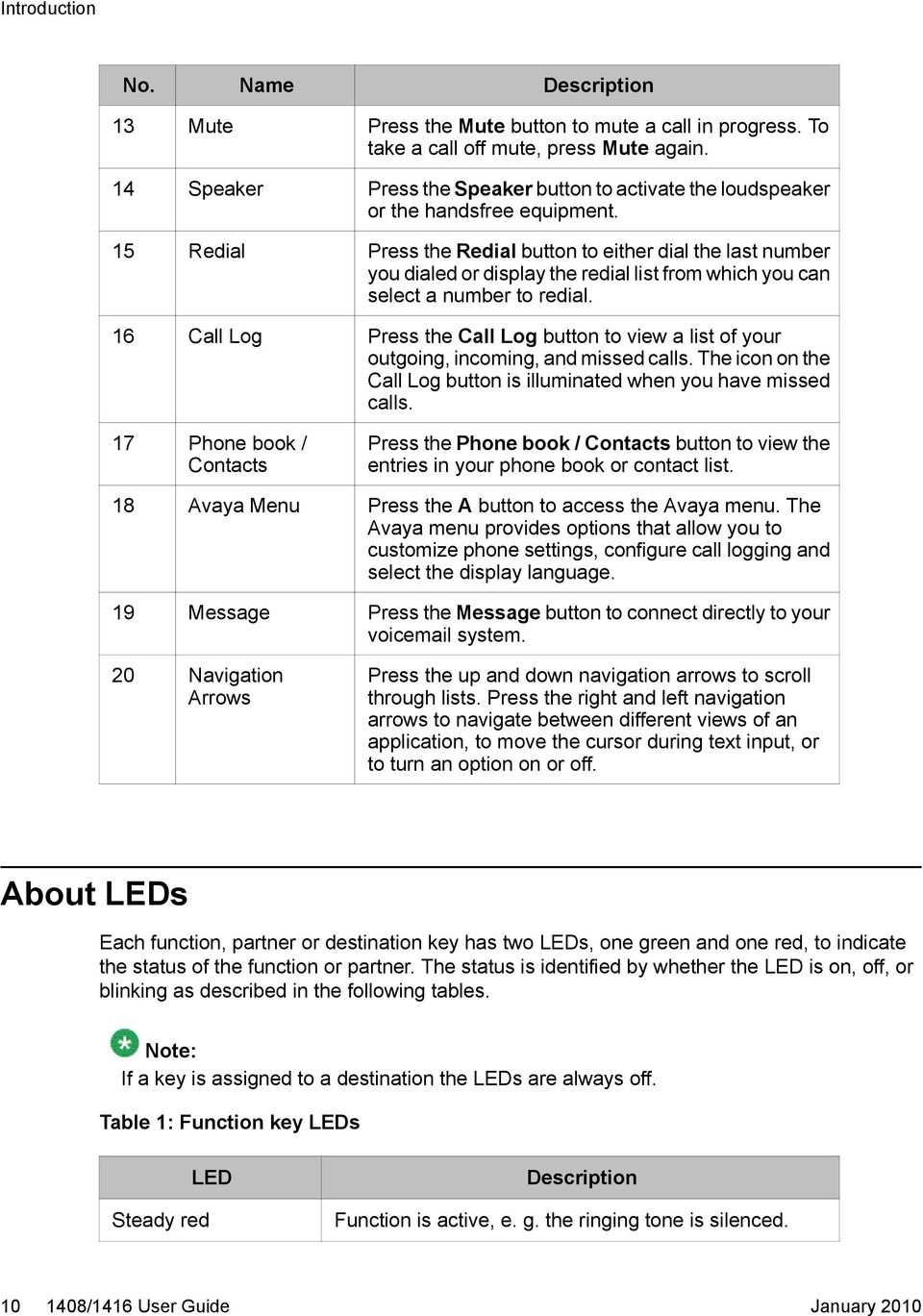
11 Icons in the telephone display LED Description Off Function is not active. Table 2: Partner key LEDs LED Steady green Blinking red very fast Blinking red fast Steady red Description Partner has set partner diversion. Partner receives two calls in parallel (50 ms on, 50 ms off). Partner receives a call, either in idle state or while on a call (200 ms on, 50 ms off) Partner is on a call. Related topics: Introduction to partners on page 45 Icons in the telephone display Icons are provided in the phone display to indicate the state of a call and navigation choices. The icons that appear in the phone display are described in the following table. Icon Description #X Number of calls missed, where # represents the number. Call forward, Send All Calls, or EC500 is active. (These features are available if they have been administered for your telephone.) Incoming call is ringing. Call is active. Call is on hold. Call is on soft hold (when using Conference or Transfer feature). Conference is active. Conference is on hold. Scroll left for other options. Scroll right for other options. 1408/1416 User Guide January
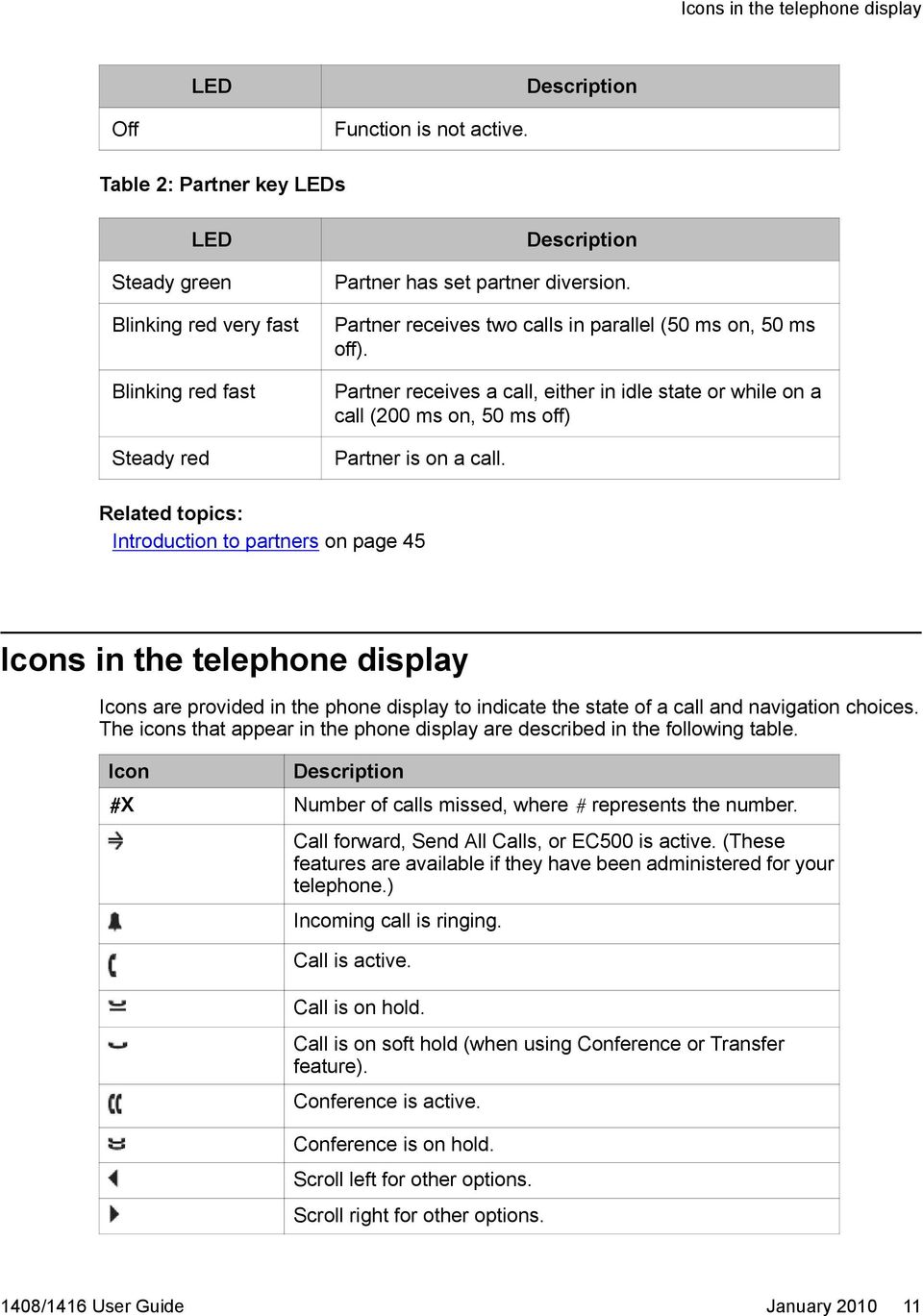
12 Introduction Icon Description Scroll up or down for other options. About this manual Descriptions of optional features are marked with an asterisk in the title. For more information about the optional features, see your system administrator. All the descriptions in this user guide assume a standard assignment of the function keys. If you re-assign the function keys, the procedures may change from those provided in this guide /1416 User Guide January 2010
13 Chapter 2: Making calls Introduction to making calls Use the procedures provided in this chapter to make calls from your telephone. Note that when you make a call, you can either dial the number and then lift the handset, or lift the handset and then dial the number. Both orders are correct. However, if you lift the handset first and then dial the number, you will not be able to correct a dialing error. Calling an internal call number 1. Enter the desired call number. 2. Lift the handset. Calling an external call number 1. Enter the external line code, for example Enter the desired call number. 3. Lift the handset. 1408/1416 User Guide January
14 Making calls Calling with a destination key 1. Press the destination key for the desired subscriber. 2. Lift the handset. Related topics: Assigning functions or call numbers to keys Calling a person from the call log 1. Press the Call Log or the Redial button. 2. Press the left/right arrow button, to select the appropriate list. 3. Select the desired call number. 4. Lift the handset. Related topics: Call log on page 37 Calling a person from the phone book entry 1. Press the Phone book / Contacts button. 2. Select the entry you want to dial. Note: To reach the entry more quickly, you can also enter one or more of the first letters of the name /1416 User Guide January 2010
15 Calling a person from a central phone book entry * You can also search for a name or call number by using an asterisk * as a wild card (as you can on your PC). For example, if you input *mobile, all entries which include the string mobile will be displayed. 3. Lift the handset. Related topics: Introduction to the phone book on page 39 Calling a person from a central phone book entry * 1. Press the Phone book / Contacts button. 2. Press the Main softkey. 3. Enter one or more of the first letters of the name. 4. Select the entry you want to dial. 5. Lift the handset. Related topics: Introduction to the phone book on page 39 Calling using the speakerphone The Monitoring function allows you to hear the person you are on a call with through the loudspeaker. The Handsfree function provides the Monitoring function and the ability to speak using the phone's built-in microphone, rather than the handset. Both functions are operated by means of the Speaker button. 1. Enter the desired call number. 2. Press the Speaker button. 3. To adjust the volume, press + or - on the Volume button. 4. Do one of the following: 1408/1416 User Guide January

16 Making calls a. To continue the call using the handset, lift the handset. To return to the speakerphone, press the Speaker button once more. b. To end the call, press the Speaker button. Requesting automatic callback If an internal call number you dialed is busy or unanswered, use this procedure if you want your telephone system to call you back when the number is no longer busy. 1. Select the Automatic Callback menu item or Callback function key. 2. Press the OK button. 3. Replace the handset. Your telephone system calls you back as soon as the called number is free or free again. 4. Lift the handset Your telephone system calls the dialled call number again. 5. To delete the automatic callback again: a. Press the Callback softkey b. Select the desired callback request. c. Press the Details softkey. d. Press the Delete softkey. Requesting automatic redialing If the call number you dialed is busy, you can select Automatic redial to dial the busy number every 30 seconds. 1. Select the Automatic redial menu item. 2. Press the OK button /1416 User Guide January 2010

17 Joining another call (cut-in)* The status information Redial repeat every 30 s is shown. 3. Replace the handset, if you have lifted it. Automatic redial is stopped if you press any button or lift the handset. After you have finished you will be asked Continue redial? Joining another call (cut-in)* You call an internal extension. The user is already on a call. Use this feature to join the call. This feature may not be available. Your system administrator must configure it for your extension as well as for the extension of the other person. See your system administrator for more information. 1. Select the Cut-in menu item. Each person on the call will hear a cut-in tone. 2. To disconnect from the call, select Cut-in again, press the Drop button, or replace the handset. 1408/1416 User Guide January
18 Making calls /1416 User Guide January 2010

19 Chapter 3: Handling calls Introduction to handling calls When you receive an incoming call your telephone rings, the Incoming Call LED flashes and the call is indicated in the display. You can lift the handset or use the Speaker button and talk with the handset on-hook. You are also able to answer an incoming call ringing at another telephone in your telephone system, or put an incoming call on hold until you are able to answer the call. Internal and external calls have different ringing tones. Answering a call To answer a call, lift the handset or press the Speaker button to use the speakerphone. Answering a call ringing at another phone (pick-up) 1. Enter the number of the ringing telephone with your handset on-hook. The status message Pick-up is shown in the display. 2. Select Pick-up. 3. Press the OK button and wait until the call is signalled at your phone. 4. Lift the handset. If you want to pick up calls for a particular telephone, you can set up a macro. So you can press a single key to answer calls ringing at that telephone. See chapter Setting up a macro (diversion and pick-up) for more information. 1408/1416 User Guide January
20 Handling calls You can also pick up calls by entering a code, if your telephone system is administered for the pick-up function. See your system administrator for more information. Related topics: Setting up a macro (diversion and pick-up) on page 76 Putting a call on hold You can put an active call on hold or an incoming call that you have not yet answered. When you put an incoming call on hold, the ringing tone is turned off, and the call LED continues to flash. Putting an incoming call on hold is useful when you are performing another task, such as editing a phone book entry, that you want to complete before you answer the call. 1. Press Hold button, the active call will be keep on hold and you get a possibility to call another subscriber. 2. Press Drop key to return back to the call or select the call on hold and press OK. Muting a call 1. Press the Mute button during a call so that the other person cannot hear you. 2. Press the Mute button again to unmute the call. Deactivating your telephone display Use this procedure to deactivate the call number of caller in the display. An example of when you might want to do this is if you do not want the name or number of the person with whom you are talking to appear in your telephone display. 1. Press the Display softkey /1416 User Guide January 2010

21 Transferring a call The display is deactivated and the call number is not stored in all the call log lists. 2. To reactive the display, press the Display softkey again. Note: When you deactivate your telephone display, the call number is not stored in the call log. Transferring a call 1. Select new call to Press the OK button. Your first call is put on hold. 3. Dial the appropriate call number. 4. When the party answers, announce the call. If the party does not answer, press the Drop button to return to the call on hold. 5. Press the Transfer button or hang up. Answering an additional call (second call) The feature Second call is activated on your telephone. Use this procedure to answer an incoming call while on another call. 1. While on a call, select the number or name of the second call in the display. 2. Press the OK button. You are connected to the second call and the first call is put on hold. To end the first call instead, press the Drop button. 1408/1416 User Guide January
22 Handling calls Turning second incoming call on or off If you do not want to answer an additional call (second call) during a call, you can deactivate the second call. 1. Select Second call in the display. 2. Press the OK button. 3. Press the On/Off softkey. 4. Press the Done softkey. 5. To activate the second call again from the Avaya Menu select Settings > Display/ Acoustics > Second call and change the setting with the On/Off softkey. Referring back during a call (consultation call) Use this procedure to make a consultation call while on a call. 1. Select new call to Press the OK button. Then your first call is on hold. 3. Enter the call number of the person whom you want to consult. 4. If the second call is not answered, you can return to the first by pressing Drop /1416 User Guide January 2010
23 Chapter 4: Call diversion Introduction to call diversion You can divert your calls to someone else. Different kinds of call diversion are possible: to: first destination unconditional to: alternative destination unconditional on busy: destination only when you are busy Ex.aft.time : destination for delayed call diversion (after time) only for external calls *. Int.aft.time: destination for delayed call diversion (after time) only for internal calls *. Double call: you set up your telephone so that another telephone rings together with it at the same time *. * You need a special authorization to use this kinds of the feature. Please refer to your system administrator If you have activated delayed call diversion, you may decide from case to case to answer a call yourself or to divert it after a certain time. A particularly convenient way to set up a call diversion is to use a macro. You can then enable or disable this call diversion by pressing a single key. Related topics: Setting up a macro (diversion and pick-up) on page 76 Diverting calls You want to divert your calls to someone else. 1. Press the Avaya Menu button. 2. Select Divert call. 1408/1416 User Guide January
24 Call diversion 4. Select the appropriate kind of diversion. 5. Enter the desired call number. 6. Press the OK button. The status information DIV to call number appears in the display and the LED lights up. 7. To withdraw the diversion, select the appropriate status information and press the OK button. Related topics: Diverting calls to voic on page 43 Automatic call diversion * Call diversion can be set in advance for a certain time slot. It is controlled by times and weekdays. You need an appropriate authorization for this feature. Please ask your system administrator. Two alternative destination numbers with different time slots can be programmed. Automatic call diversion can override a call diversion that was set up manually. Once the automatic call diversion has finished, the manual call diversion becomes active again. Call diversion on busy, Delayed call diversion and Double Call cannot be controlled using time slots. First you have to define the time slot by Start time, Stop time and weekday. Afterwards you can activate or deactivate it. Defining automatic call diversion * Use this procedure to define the call number, time slot and weekdays, when you want all your calls diverted automatically. 1. Press the Avaya Menu button. 2. Select Divert call. 4. Set automatic /1416 User Guide January 2010
25 Diverting calls automatically * 5. Press the OK button. 6. Enter the desired call number. 7. Select Start time. 8. Enter the time with hour and minutes. 9. Select Stop time. 10. Enter the time with hour and minutes. 11. Select weekday. 12. Press the OK button. 13. Select the appropriate pattern, for instance Mo-Fr. If you scroll down you can also set the properties for the second automatic call diversion. Diverting calls automatically * Use this procedure to automatically divert your incoming calls according to the time slot, weekday, and call number you have defined. 1. Press the Avaya Menu button. 2. Select Divert call. 4. Select Automatic 1 or alternative Automatic Press the OK button. The status message DIV to call number appears in the display and the LED lights up. 6. To withdraw the diversion, select the appropriate status information and press the OK button. 1408/1416 User Guide January
26 Call diversion /1416 User Guide January 2010
27 Chapter 5: Follow-me Introduction to follow-me * When you are going to visit several colleagues one after the other and don't want to miss any call arriving meanwhile, you use the follow-me function. This function allows you to use other telephones to set up or change the call diversion on your telephone. You need to prepare this function on your own telephone first. The follow-me function is prepared, activated and switched off by means of particular codes. The first one is used on your own telephone, the second on other telephones. Please ask your system administrator for the appropriate codes. Preparing follow-me on your own telephone 1. Lift the handset. 2. Press the asterisk *. 3. Enter the first code. 4. Replace the handset. Activating follow-me on another telephone When you arrive at the other telephone, you activate the prepared follow-me function, to divert your incoming calls to this other telephone. 1408/1416 User Guide January
28 Follow-me 1. Lift the handset. 2. Press asterisk *. 3. Enter the second code. 4. Dial your own call number. 5. Replace the handset. Switching off follow-me on your own telephone When you are back at your own telephone, you switch off the follow-me function. 1. Lift the handset. 2. Press hash #. 3. Enter the first code. 4. Replace the handset. Switching off follow-me on another telephone If you don't want to return to your own telephone, you can switch off the follow me function on another telephone. 1. Lift the handset. 2. Press hash #. 3. Enter the second code. 4. Dial your own call number. 5. Replace the handset /1416 User Guide January 2010
29 Chapter 6: Three-party conference Introduction to three-party conference calls You can use a three-party conference call to speak with two people at different locations on the same call. If the Multiple Conference feature has been enabled in your telephone system, up to seven people can be included in the conference call. A conference between a call waiting (second call) and the first talking party is not possible. Related topics: Introduction to multiple conference calls on page 31 Making a conference call 1. While active on a call, press the Conference button. 2. Enter the call number for the additional participant or use phone book/ destination key. When the additional participant answers, you are in a three-party conference. 3. If the additional participant does not answer, press the Drop button to return to the first call. If you use the new call to menu item to call the additional participant, you can first talk to the participant privately while the first caller is on hold. Then use the Conference button to connect all participants. Talking with one participant in a conference call Use this procedure if you are on a three-party conference call and want to talk privately with one participant. 1408/1416 User Guide January
30 Three-party conference 1. Select the call number menu item of the participant with whom you want to talk privately. 2. Press the OK button. You can talk privately with the desired participant, while the other call is on hold. 3. To return to the conference press the Conference button or select conference with from the menu. Connecting conference participants with each other If you are on a three-party conference call and want to connect the other participants to each other, press the Transfer button or replace the handset. Ending the conference call Press the Drop button /1416 User Guide January 2010
31 Chapter 7: Multiple conference * Introduction to multiple conference calls If the Multiple conference feature has been enabled in your telephone system for your extension, you can include up to seven people in a conference call. (Otherwise you can use the three party conference.) The person who is responsible for initiating the conference is the controller. The others are passive participants. Controller The controller manages the conference and controls all participants and their status by means of the List of all conf. users. When the third participant is added in the conference, the List of all confer. users menu item appears. It shows the number of conference participants as well as name, call number and status of each. There are three possible status values: No details: the participant is taking part in the conference. X : the participant is on hold, when he has initiated a refer-back for example.! : the participant is taking part in the conference on behalf of another previous participant. If there are only three participants in the multiple conference, the display is almost identical to the display of a three-party conference. Instead of the List of all confer. users menu item the conference participants are shown in the status information. During a multiple conference, the controller can neither transfer calls nor cut in on calls. The controller can usually have one connection on hold or eight connections on hold if Hold/ Retrieve is enabled. Passive participants Passive conference participants are added to the multiple conference by the conference controller. Their displays indicate the status information Conference. Passive participants cannot set up another conference, but they can enter their connection in another conference.... enter their connection in the queue by refer-back and then switch back to the conference.... transfer their conference connection to another subscriber by refer-back.... end their participation in the conference. Related topics: Introduction to three-party conference calls on page /1416 User Guide January
32 Multiple conference * Adding a participant to a multiple conference call 1. While active on a call, press the Conference button. The multiple conference is put on hold. 2. Enter the call number for the additional participant. When the additional participant answers, the multiple conference is reactivated including the new one. When the third participant is added in the conference, the List of all confer. users menu item appears. 3. If the additional participant does not answer, press the Drop button to reactivate the multiple conference. If you use the new call to menu item instead to call the additional participant, you can first talk to this participant privately while the conference call is on hold. Then use the Conference button to reactivate it including the new participant. Adding a participant by referring back Use this procedure to add a participant to your multiple conference call via a consultation call. If you select the new call to... menu item to call the additional participant, you can first talk privately while the others are waiting and afterwards build the conference with the Conference button. 1. Select new call to Press the OK button. The multiple conference is put on hold. 3. Enter the call number for the additional participant. When the additional participant answers you can talk privately, while the conference call is on hold. If the additional participant doesn't answer press the Drop button to return to the multiple conference call. 4. Press the Conference button The multiple conference is reactivated including the new participant. When the third participant is added, the List of all confer. users menu item appears /1416 User Guide January 2010
33 Adding a waiting participant to a multiple conference Adding a waiting participant to a multiple conference You are controller of a multiple conference having several waiting participants. That is, there are several refer-backs waiting. You can switch from one to another. 1. Select the appropriate refer-back back to Press the OK button. You are now reconnected with the waiting participant. The multiple conference is put on hold. 3. Press the Conference button The waiting participant is added to the conference and the multiple conference is reactivated. To disconnect this connection instead, press the Drop button. To switch back to the waiting conference call, select Back to conference. Answering a call in a multiple conference Use this procedure to answer an additional call while you are controller of a multiple conference. 1. Select the appropriate status information call number of the calling person. 2. Press the OK button. You are now connected with the new calling person. The multiple conference is put on hold. 3. Press the Conference button, if Hold/Retr is activated. The new caller is added to the multiple conference and the multiple conference is reactivated. Transferring a multiple conference call as controller Use this procedure to leave a multiple conference as controller without ending it. 1408/1416 User Guide January
34 Multiple conference * 1. Select Transfer conference Press the OK button. The multiple conference continues without a controller, but at the original controller s responsibility. When you are in the state Hold/Retrieve locked/disabled, you can alternatively replace the handset. Ending the multiple conference call as controller To end a multiple conference call as controller, replace the handset or press the Drop button. Referring back as passive participant on a multiple conference call Use this procedure to make a consultation call while on a multiple conference call as passive participant. 1. Select new call to Press the OK button. The controller is made aware of this in the List of all confer. users. 3. Enter the call number of the new conference participant. 4. Once you are connected to this person, you can replace the handset to transfer the conference connection. The controller is made aware of this in the List of all confer. users. 5. To return to the multiple conference, if the called person does not answer, press the Drop button /1416 User Guide January 2010
35 Disconnecting from a multiple conference call as passive participant Disconnecting from a multiple conference call as passive participant To disconnect from a multiple conference call as passive participant, replace the handset or press the Drop button. 1408/1416 User Guide January
36 Multiple conference * /1416 User Guide January 2010
37 Chapter 8: Managing the call log Call log You can use the call log to view a list of your recent calls or view separate lists of your outgoing, answered, or missed calls. Icons indicate the history of the calls: Icon call log list max. number of entries >> All calls Missed calls (call list) Answered calls maximal 30 calls maximal 10 calls >> Outgoing calls (redial list) maximal 10 calls The most recent entry is at the top of each list. If you select one entry and press the Details softkey, you get a detailed display, including the time of the selected call. You can selectively retrieve individual numbers and, if necessary, dial them. You can easily transfer a call number from the call log into your phone book. Related topics: Calling a person from the call log on page 14 Viewing the call log You can view a separate list of all, answered, outgoing, or missed calls. 1. Press the Call Log button. 2. Press the left/right arrow button, to select the appropriate list. 3. Select the appropriate entry. 4. Press the Detailed softkey or the ok button. 1408/1416 User Guide January
38 Managing the call log The detailed display of the appropriate entry is shown. Removing an entry from the call log 1. Press the Call Log or the Redial button. 2. Press the left/right arrow button, to select the appropriate list. 3. Select the desired call number. 4. Press the OK button. 5. Press the Delete softkey. The entry is deleted immediately without confirmation prompt. Adding an entry from the call log to the phone book 1. Press the Call Log or the Redial button. 2. Select the desired call number. 3. Press the Details softkey. 4. Press the Down navigation button 5. Press the More button 6. Press the +Contact softkey. 7. Enter a name if required. 8. Press the Save softkey. If an entry with the same call number already exists in the phone book, the status information Number already exists is displayed /1416 User Guide January 2010
39 Chapter 9: Managing the phone book Introduction to the phone book Your telephone has a personal phone book. There you can store up to 268 phone numbers with their associated names, which are available only on your telephone. You can then dial phone book numbers quickly and easily. You can modify the individual phone book entries yourself. If you have authorization to access the main phone book, you can also find and dial entries there. Entries from the redial list, call list and call log can be quickly and easily saved in the phone book. You can easily assign a phone book entry to a destination key. Related topics: Calling a person from the phone book entry on page 14 Calling a person from a central phone book entry * on page 15 Creating a new entry in the phone book The number of free slots in your local phone book are displayed in the phone book status line. Note: You can add a caller's phone number to the phone book while you are talking to them: Press the +Contact softkey. 1. Press the Phone book / Contacts button. 2. Press the New softkey. 3. Enter name and call number. Additionally you can enter a remark in the input field Rem. (max. 12 letters). 4. Press the OK button. 5. Press the Save softkey. 1408/1416 User Guide January
40 Managing the phone book Adding an entry from the call log to the phone book 1. Press the Call Log or the Redial button. 2. Select the desired call number. 3. Press the Details softkey. 4. Press the Down navigation button 5. Press the More button 6. Press the +Contact softkey. 7. Enter a name if required. 8. Press the Save softkey. If an entry with the same call number already exists in the phone book, the status information Number already exists is displayed. Editing an entry in the phone book 1. Press the Phone book / Contacts button. 2. Select the entry you want to edit. 4. Edit the entry. 5. Press the Save softkey. Note: To reach the entry more quickly, you can also enter one or more of the first letters of the name. You can also search for a name or phone number by using an asterisk "*" as a wild card (as you can on your PC). For example, if you input "*mobile", all entries which include the string "mobile" will be displayed /1416 User Guide January 2010
41 Deleting an entry Deleting an entry 1. Press the Phone book / Contacts button. 2. Select the entry you want to delete. 3. Press the More softkey. 4. Press the Delete softkey. 1408/1416 User Guide January
42 Managing the phone book /1416 User Guide January 2010
43 Chapter 10: Voic System Introduction to voic Callers can leave messages for you similar to an answering machine, if a voic system is connected to your telephone system. You can call to retrieve these voice messages. Further more you can receive conventional text messages from a server. The light at the right upper corner of your telephone indicates that you have voic messages waiting. Diverting calls to voic Use the procedure Diverting calls and enter the call number of your voic system as destination. To withdraw the diversion, select the appropriate status information and press the OK button. Related topics: Diverting calls on page 23 Managing voice messages * The light at the right upper corner of your telephone indicates that you have voic messages waiting. 1. Press the Message button. 2. Select to the desired entry. Your telephone switches to handsfree and dials the call number of the voic system. Then you are guided through the operations of the voic system. 4. To listen the voice message, follow the advice of your voic system. 5. To delete the voice message, press the Clear softkey. 1408/1416 User Guide January
44 Voic System The appropriate entry flashes. Press the Clear button once more or the OK button to confirm. Deleting all messages The light at the right upper corner of your telephone indicates that you have voic messages waiting. 1. Press the Message button. 2. Select Delete all messages. The selected menu item starts flashing. 4. Press the OK button to confirm /1416 User Guide January 2010
45 Chapter 11: Partners Introduction to partners Your system administrator can link together up to 16 telephones in your telephone system to create a partner group. You can set up your telephone so that you hear a short tone when one of your partners is called (partner beep). You can also set up and, if required, delete several partner diversions by pressing a few keys. To do this, the Deputy key function key must be set up. By default, all partners are assigned to function keys, also referred to as partner keys. The LEDs of the partner keys provide information about your partners' activities. Related topics: About LEDs on page 10 Assigning functions to keys on page 72 Creating a destination key on page 73 Setting up partner names You can allocate a long and a short name to each partner call number. 1. Press the Avaya Menu button. 2. Select Settings. 4. Select Applications/Partner. 5. Press the OK button. 6. Select Partner 7. Press the OK button. 8. Select Adapt my partners. 9. Press the OK button. 10. Select Set partner name. 1408/1416 User Guide January
46 Partners 11. Press the OK button. 12. Select the call number of the desired partner Select Long name. 15. Enter the appropriate name. 16. Select Short name. 17. Enter the appropriate name. 18. Press the Done softkey. Calling partners 1. Press the appropriate partner key. 2. Talk using the speakerphone, or lift the handset to talk using the handset. Answering a call for a partner When a partner's telephone rings, the corresponding LED on your telephone flashes. You can pick up that call and answer as deputy. 1. Press the Partner key and wait until the call reaches your own telephone. 2. Lift the handset. Assigning partners to another key By default, all partners are assigned to the function keys. Use this procedure to assign a partner to a different key /1416 User Guide January 2010
47 Hiding partner keys 1. Press the Avaya Menu button. 2. Select Settings. 4. Select Applications/Partner. 5. Press the OK button. 6. Select Partner 7. Press the OK button. 8. Select Adapt my partners. 9. Press the OK button. 10. Select Change Partner position. 11. Press the OK button. 12. Select the desired partner Press the partner or function key that you want to assign. The previous key assignment is displayed. 15. Press the Save softkey. The partner is now assigned to the new key. Hiding partner keys Use this procedure to hide the partner signaling for one of your partners. 1. Press the Avaya Menu button. 2. Select Settings. 4. Select Applications/Partner. 5. Press the OK button. 6. Select Partner 7. Press the OK button. 8. Select Adapt my partners. 9. Press the OK button. 10. Select Hide/show partner keys. 1408/1416 User Guide January
48 Partners 11. Select the partner key whose partner signalling you don't want to get any longer. 12. Press the Change softkey. 13. Press the Done softkey. Activating partner beep Use this procedure if you want to hear a short tone (beep) every time your partner is called. 1. Press the Avaya Menu button. 2. Select Settings. 4. Select Applications/Partner. 5. Press the OK button. 6. Select Partner 7. Press the OK button. 8. Select Adapt my partners. 9. Press the OK button. 10. Select Set partner beep Press the OK button. 12. Select the partner for whom you want to activate the partner beep Select Audio. 15. Press the Change softkey several times to select one of the following: Beep Ringing tone off 16. Press the Done softkey. If you set Ringing tone instead of Beep, the normal ringing tone sounds on your telephone when your partner is called /1416 User Guide January 2010
49 Assigning partners on the button module* Assigning partners on the button module* Use this procedure to transfer all your partners from your telephone's keys to the keys of a button module. Note: The button module is not supplied as standard with your telephone. 1. Press the Avaya Menu button. 2. Select Settings. 4. Select Applications/Partner. 5. Press the OK button. 6. Select Partner 7. Press the OK button. 8. Select Adapt my partners. 9. Press the OK button. 10. Select Assign partner to DSS module. The partners are transferred to the LEDs of the button module in their current order. The previous key assignments on the buttons are overwritten. 11. Select Assign partner to telephone in order to transfer the partners back to the telephone. The former key assignments of the button module are re-established. Diverting your calls to a partner Use this procedure to divert your calls from outside the partner group to one of your partners. 1. Press the Avaya Menu button. 2. Select Settings. 4. Select Applications/Partner. 1408/1416 User Guide January
50 Partners 5. Press the OK button. 6. Select Partner 7. Press the OK button. 8. Select Set/delete partner div. 9. Press the OK button. 10. Select Partn. div. from my phone Press the OK button. 12. Select the partner to whom you want to divert calls, displayed with off Select on 15. Press the OK button. The partner diversion is now activated, displayed in the status information. Related topics: Setting up a macro (diversion and pick-up) on page 76 Diverting partner calls to your telephone You want to answer calls on behalf of your partners. Use this procedure to divert their calls to your own telephone. 1. Press the Avaya Menu button. 2. Select Settings. 4. Select Applications/Partner. 5. Press the OK button. 6. Select Partner 7. Press the OK button. 8. Select Set/delete partner div. 9. Press the OK button. 10. Select Partner div. to my phone Press the OK button. 12. Select the partner, whose calls you want to divert to your telephone, displayed with off /1416 User Guide January 2010
51 Diverting calls from one partner to another * Select on. 15. Press the OK button. Partner diversion is now activated. The appropriate LED flashes. Related topics: Setting up a macro (diversion and pick-up) on page 76 Diverting calls from one partner to another * If you have the appropriate authorization, you can set up a partner diversion from any partner to another. 1. Press the Avaya Menu button. 2. Select Settings. 4. Select Applications/Partner. 5. Press the OK button. 6. Select Partner 7. Press the OK button. 8. Select Set/delete partner div. 9. Press the OK button. 10. Select Partnerdiv. from/to others. 11. Press the OK button. 12. Select Set partner division. 1 All partner are displayed. 14. Select one of the partners as source for the diversion. All possible combinations with this source partner are displayed. 15. Select the combination with the target partner to whom you wish to divert calls. 16. Press the OK button. The selected combination is displayed with off. 17. Press the Change softkey. The selected combination is displayed with on 18. Press the Done softkey. 1408/1416 User Guide January
52 Partners Partner diversion is now activated. Diverting partner calls to partners, extended * If you have the appropriate authorization, you can divert any call of a partner group to any call number for another partner. This means that call diversion can be activated to a partner's mobile or home call number. A maximum of five status displays for extended partner diversion can be displayed. Partner names are replaced by the number in extended partner diversion. 1. Press the Avaya Menu button. 2. Select Settings. 4. Select Applications/Partner. 5. Press the OK button. 6. Select Partner 7. Press the OK button. 8. Select Set/delete partner div. 9. Press the OK button. 10. Select CFF partner diversion key Press the OK button. 12. Press the Enter softkey. 13. Select the partner whose calls shall be diverted. 14. Press the OK button. 15. Enter the call number. 16. Press the OK button. 17. The function key is allocated. Related topics: Setting up a macro (diversion and pick-up) on page /1416 User Guide January 2010
53 Setting the deputy key * Setting the deputy key * 1. Press the Avaya Menu button. 2. Select Settings. 4. Select Applications/Partner. 5. Press the OK button. 6. Select Partner 7. Press the OK button. 8. Select Set/delete partner div. 9. Press the OK button. 10. Select Set deputy key. 11. Press the OK button. 12. Press Deputy to select the partner, from whom you want to divert Select partner and select all partners you want to define as your deputies and turn them to on. 15. Press the OK button. 16. Now the deputies are selected, you need to program the function key deputy key to activate/deactivate of defined deputy diversion. Related topics: Setting up a macro (diversion and pick-up) on page 76 Function and destination keys on page 71 Adding a partner to a partner group * Use this procedure to add a new partner to your partner group. The phone numbers of the subscribers in the partner groups must be set up by your system administrator. 1408/1416 User Guide January
54 Partners 1. Press the Avaya Menu button. 2. Select Settings. 4. Select Applications/Partner. 5. Press the OK button. 6. Select Partner 7. Press the OK button. 8. Select Adapt partner group size. 9. Press the OK button. 10. Select Expand partner group. 11. Press the OK button. 12. Enter the call number of the partner you want to add to your partner group. 13. Press the key to which you want to assign the new partner. Removing a partner from a partner group * 1. Press the Avaya Menu button. 2. Select Settings. 4. Select Applications/Partner. 5. Press the OK button. 6. Select Partner 7. Press the OK button. 8. Select Adapt partner group size. 9. Press the OK button. 10. Select Reduce partner group. 11. Press the OK button /1416 User Guide January 2010
55 Restricting partner signaling * 12. Select the partner who you want to remove. 13. Press the Delete softkey. Restricting partner signaling * Use this procedure if you don't want the partners displays to show whether you are on a call, whether you are being called, whether a call diversion exists for you, etc. The "Restrict partner signaling" function must be enabled by your system administrator. 1. Press the Avaya Menu button. 2. Select Settings. 4. Select Applications/Partner. 5. Press the OK button. 6. Select Partner 7. Press the OK button. 8. Select Adapt partner group size. 9. Press the OK button. 10. Select Restrict signaling Off. 11. Press the Change softkey. The display switches to On. 12. Press the Save softkey. 13. To enable partner signaling again select Restrict signaling On. Reserving a line as executive line You can reserve an external line for another partner (executive) using your telephone. In this way, for example, a secretary can reserve a line for the boss. The Executive function key must be set up on the secretary's telephone by the administrator. 1408/1416 User Guide January
56 Partners 1. Press the Executive key. 2. Press the partner key of the partner for whom you want to reserve a line. The status message Line busy appears in the display of the partner telephone. The partner can continue to dial as usual. Related topics: Assigning functions to keys on page 72 Setting up a connection for a partner Your partner (executive) asked you to set up a connection substitutionally. 1. Make a call to the appropriate call number. 2. Select New call to Press the partner key. 5. Replace the handset. The partner is connected to the other party. Your own telephone is free again. This procedure is like Transferring a call with the help of the partner key, further more you don't need to wait for the other person answering. Filtering * Filtering is a function for executives and their secretaries or receptionists. Filtering groups are formed with several executives and several secretaries for this purpose. An incoming call for an executive is initially signaled at the secretary's telephones. If required, it can subsequently be transferred to the executive. The filtering function is a special partner diversion. The executives activate the filtering function for external or internal or for all calls. In general, the secretaries can switch on or off to control their readiness to receive a call. When filtering is active, a filtered call is signaled at all active secretary's telephones in the filtering group. The connection is established to the receptionist who accepts the call first /1416 User Guide January 2010
57 Filtering * The system administrator initializes the filtering function and sets up the filtering groups. Filtering can be activated for one executive to several receptionists. One receptionist can deal filtering for several executives. You as a member can assign the function keys for filtering, only if the filtering function has been initialized by your administrator. You can set up the names and a partner beep. But you cannot alter the filtering group. Related topics: Assigning functions to keys on page 72 Dealing the filtering function as an executive * Your telephone has two toggle function keys INT and EXT with LEDs. The display shows you: < which receptionists are ready to get your incoming calls. > which other executives have diverted their incoming calls. 1. To activate the filtering function for incoming external or internal calls or all calls, press the Ext or the Int function key or both of them. 2. To withdraw the filtering function, press the appropriate key once more. Dealing the filtering function as a secretary * Your telephone has a FILTER function key. The according LED as well as the status display remain active as long as filtering is active for at least one executive. Furthermore the display shows you > which executives have diverted their incoming calls. < which other receptionists are also active for filtering. 1. To activate the filtering function, press the Filter function key. 2. To accept a signaled call, lift the handset or press the Speaker button. 3. To transfer an accepted call to the executive, press the appropriate partner key and the Transfer button or replace the handset. 4. To deactivate the filtering function, press the Filter function key again. 1408/1416 User Guide January
58 Partners /1416 User Guide January 2010
59 Chapter 12: Private User Mobility Private User Mobility * The Private User Mobility feature allows you to log on to any telephone inside the telephone system and have access to your personal settings (call list, redial, call diversion, and callbacks). Callers will reach you on this telephone when they dial your call number. Charging units incurred are allocated to your call number. To use the PUM function, it must be enabled in the telephone system. Furthermore two function keys must have the functions Log on and Log off assigned to them (look at the UsersGuide). This function is protected by the same PIN as the locking function. To use PUM, this PIN have exact six digits. Related topics: Assigning functions to keys on page 72 Changing the PIN on page 92 Logging on to the telephone 1. Press the Log in user function key. 2. Enter your personal call number. 3. Select Password:. 4. Enter your PIN. The PIN is displayed by asterisks *. 5. Select Log in user. 6. Press the OK button. A status message appears in the display. You are now logged in to this telephone and you can use it exactly like your own set. 1408/1416 User Guide January
60 Private User Mobility Logging off the telephone Press the Log out user function key. Your personal settings (call list, redial, call diversion, callbacks entered) are cleared. Note: You are logged off automatically if another subscriber logs on to this telephone /1416 User Guide January 2010
61 Chapter 13: Favorite screen Introduction to favorite screen In the favorite screen you can gather functions and destinations that you use frequently. A maximum of twelve entries are possible. Then you can reach these functions or destinations very easily. In addition to providing another way of accessing the features, you can use the favorite screen to confirm the features programmed on the feature buttons if, for example, a feature button label is missing or labeled incorrectly. Toggling between the favorite screen and the telephone status Press the left/right arrow button. Displaying the favorite screen in the idle mode You can set your telephone to show the favorite screen in the idle mode instead of the telephone status. 1. Press the Avaya Menu button. 2. Select Settings. 4. Select Display/Acoustics. 5. Press the OK button. 1408/1416 User Guide January
62 Favorite screen 6. Select Favorite screen active Off. 7. Select On/Off softkey. 8. Press the Save softkey. Entering a function into the favorite screen You can add your favorite functions into the favorite screen for easy access. 1. Press the Avaya Menu button. 2. Select Settings. 4. Select Keys. 5. Press the OK button. 6. Select Set function keys. 7. Press the OK button. 8. Select the favorite function, which you want to add. 9. Press the OK button. 10. Select Add to Favorite Screen. 11. Press the OK button. Related topics: Assigning functions to keys on page 72 Entering a destination into the favorite screen You can add a destination into the favorite screen. 1. Press the Avaya Menu button. 2. Select Settings /1416 User Guide January 2010
63 Deleting a function or a destination from the favorite screen 4. Select Keys. 5. Press the OK button. 6. Select Set destination keys Press the OK button. 8. Select Edit destination key Press the OK button. 10. Select Press destination key. 11. Press the OK button. 12. Press the appropriate destination key. 13. Select Add to Favorite Screen. 14. Press the OK button. Related topics: Assigning a destination from the phone book to a key on page 73 Deleting a function or a destination from the favorite screen You can remove seldom used functions or destinations from the favorite screen. 1. Press the left/right arrow button, to select the favorite screen. 2. Select the function or the destination that you wish to delete. 3. Press the Delete softkey. Caution: The entry is deleted without confirmation. 1408/1416 User Guide January
64 Favorite screen /1416 User Guide January 2010
65 Chapter 14: Customizing your telephone Introduction to customizing your telephone This section provides procedures to set parameters for your telephone, such as the ring tone melody and language. It also provides procedures to manage your function and destination keys, save personal data, manage VIP functions, make anonymous calls, and turn direct dialing on or off. These procedures are performed using options provided in the Avaya menu. Setting parameters for your telephone Turning acoustic signaling on or off You can set the signal tone, ringing tone, and VIP ringing tone to on or off. When for instance the ringing tone is turned off, you will hear only a short beep when you are called. 1. Press the Avaya Menu button. 2. Select Settings. 4. Select Display/Acoustics. 5. Press the OK button. 6. Select Do not disturb. 7. Press the OK button. 8. Select one of the following: Signal tone Ringing tone VIP ringing tone 9. Press the On/Off softkey. 1408/1416 User Guide January
66 Customizing your telephone 10. Press the Done softkey. 11. To reactivate one of these tones, scroll to the relevant menu item and press On/ Off softkey again. Changing the acoustic signaling Use this procedure to change the volume of several tones. You can change the individual settings during a call by pressing + or - on the Volume button. 1. Press the Avaya Menu button. 2. Select Settings. 4. Select Display/Acoustics. 5. Press the OK button. 6. Select Set acoustics. 7. Press the OK button. 8. Select the tone you want to change. Handset Loudspeaker Ringing tone Alerting Tone Signal Tone Headset volume 9. Increase or reduce the volume by pressing + or - on the Volume button The new setting sounds immediately to be checked. 10. Press the Save softkey. Note: You can also change any setting by pressing the numeric key of the desired setting, the right or left Navigation arrows, or the + or - on the Volume button /1416 User Guide January 2010
67 Setting parameters for your telephone Setting the ringing tone melody You can assign different melodies to incoming calls (internal, external, VIP and partner / line). 1. Press the Avaya Menu button. 2. Select Settings. 4. Select Display/Acoustics. 5. Press the OK button. 6. Select Set acoustics. 7. Press the OK button. 8. Select Select ringer melody. 9. Press the OK button. 10. Select the call type you want to change. Internal calls External calls VIP calls Partner/Line 11. Press the OK button. 12. Select the melody you want. 1 The new ringing melody is played. Note: You can change the melody s playback speed under Set melody. Related topics: Introduction to handling calls on page /1416 User Guide January
68 Customizing your telephone Setting the contrast and the brightness 1. Press the Avaya Menu button. 2. Select Settings. 4. Select Display/Acoustics. 5. Press the OK button. 6. Select Set contrast or Set brightness. 7. Increase or reduce the contrast or brightness with the right or left navigation button. 8. Press the Done softkey. If you want to reset the acoustic and contrast settings to the as-supplied status, select Default setting and confirm with the OK button. Setting the language 1. Press the Avaya Menu button. 2. Select Settings. 4. Select Display/Acoustics. 5. Press the OK button. 6. Select Switch language. 7. Press the OK button. 8. Select the language you want to use for display texts. 9. Press Select softkey. Adjusting the setting for handsfree operation You can adjust the handsfree settings for the conditions prevailing in your office and surroundings /1416 User Guide January 2010
69 Setting parameters for your telephone 1. Press the Avaya Menu button. 2. Select Settings. 4. Select Display/Acoustics. 5. Press the OK button. 6. Select Set handsfree. 7. Press the Change softkey to select one of the following. echo normal muffled 8. Press the Done softkey. 9. Select Handsfree. Displaying your name and call number on your telephone You can save your name and call number to have it shown on the display. 1. Press the Avaya Menu button. 2. Select Settings. 4. Select Display/Acoustics. 5. Press the OK button. 6. Select Set own call number. 7. Press the OK button. 8. Enter your telephone's name and call number. 9. Press the Save softkey. Setting key beep tones to on or off You can have every press of a key signaled by a beep (key beep). 1408/1416 User Guide January
70 Customizing your telephone 1. Press the Avaya Menu button. 2. Select Settings. 4. Select Keys. 5. Press the OK button. 6. Select Key beep (off). 7. Press the OK button. 8. Press the On/Off softkey. 9. Press the Done softkey. 10. To turn the key tone off again, switch the function to Key beep (Off) again. Displaying time zones * You can set the time zone so that the current date and time of one of 26 cities from around the world appears in your telephone display. The time that your telephone shows for a city can differ from the actual time in that city due to differences in summer and winter times in the various countries. 1. Press the Avaya Menu button. 2. Select Time zones Select the appropriate city. 5. Press the OK button. Saving emergency numbers You can save ten call numbers that you can dial even if your telephone is locked. Caution: The emergency numbers must also be set up in your telephone system, otherwise they cannot be selected when the telephone is locked! /1416 User Guide January 2010
71 Function and Destination keys Note: When using the central lock in your telephone system, the emergency numbers are those defined in your telephone system, not the emergency numbers you saved on your telephone. 1. Press the Avaya Menu button. 2. Select Settings. 4. Select Security. 5. Press the OK button. 6. Select Set emergency numbers. 7. Press the OK button. 8. Select one of the following: Emergency destin. SOS 1... Emergency destin. SOS Press the OK button. 10. Enter name and call number. 11. Press theassign softkey. 12. Press the function key to which you want to assign the emergency number. You can now see which function or call number was previously assigned to the key. 13. Press the Save softkey. If you press the function key to which the emergency number is assigned, your telephone will automatically switch to handsfree operation and dial the saved emergency number. Function and Destination keys Function and destination keys Use the buttons as function keys or as destination keys. Partner keys are special destination keys. 1408/1416 User Guide January
72 Customizing your telephone Related topics: Setting the deputy key * on page 53 Using the button module BM32 on page 106 Assigning functions to keys Functions which you use frequently can be assigned to programmable function keys. You can then execute these functions simply by pressing the appropriate keys. 1. Press the Avaya Menu button. 2. Select Settings. 4. Select Keys. 5. Press the OK button. 6. Select Set function keys. 7. Press the OK button. 8. Select function you want to assign to the key. 9. Press the OK button. 10. Press the key to which you want to assign the new function. You can now see the function or call number previously assigned to the key. 11. Press the Save softkey. Note: A partner key can not be simply overwritten. If the key you want is previously set as partner key, this assignment must be cleared, before you can assign a different destination or a function. Related topics: Entering a function into the favorite screen on page 62 Reserving a line as executive line on page 55 Introduction to partners on page 45 Filtering * on page 56 Private User Mobility * on page /1416 User Guide January 2010
73 Function and Destination keys Creating a destination key 1. Press the Avaya Menu button. 2. Select Settings. 4. Select Keys. 5. Press the OK button. 6. Select Set destination keys. 7. Press the OK button. 8. Confirm Set new destination with OK button. 9. Enter name and call number. 10. Press the Assign softkey. 11. Press the key to which you want to assign the new destination. You can now see the function or call number previously assigned to the key. 12. Press Save softkey. Note: A partner key can not be simply overwritten. If the key you want is previously set as partner key, this assignment must be cleared, before you can assign a different destination or a function. Note: To create a destination key, you can also press an unassigned key in idle mode, and then enter the call number you want to assign to that key Related topics: Introduction to partners on page 45 Assigning a destination from the phone book to a key 1. Press the Avaya Menu button. 2. Select Settings. 1408/1416 User Guide January
74 Customizing your telephone 4. Select Keys. 5. Press the OK button. 6. Select Set destination keys. 7. Press the OK button. 8. Confirm Set new destination with the OK button. Note: You can also directly press an unassigned key in idle mode to open this menu item. 9. Select Copy phone book entry. 10. Press the OK button. 11. Select the entry you want to assign to the key. Note: To go to the desired entry more quickly, you can also enter one or more of the first letters of the name. 12. Press the OK button. The name and call number are displayed and can be edited as required. 13. Press the Assign softkey. 14. Press the key to which you want to assign a new destination. You can now see the function or call number previously assigned to the key. 15. Press the Save softkey. Related topics: Entering a destination into the favorite screen on page 62 Changing an existing destination 1. Press the Avaya Menu button. 2. Select Settings. 4. Select Keys. 5. Press the OK button. 6. Select Set destination keys. 7. Press the OK button /1416 User Guide January 2010
75 Function and Destination keys 8. Select Edit destination key. 9. Press the OK button. 10. Press the key that you want to edit. You can now change the name and the call number. 11. Press Save softkey. Note: A partner key can not be simply overwritten. If the key you want is previously set as partner key, this assignment must be cleared, before you can assign a different destination or a function. Note: You can also change the existing destination by pressing the associated function key and select the Edit destination key menu item. Deleting key assignments 1. Press the Avaya Menu button. 2. Select Settings. 4. Select Keys. 5. Press the OK button. 6. Select one of the following: Set destination keys Set function keys 7. Press the OK button. 8. Select one of the following: Delete destination key Delete entry 9. Press the OK button. 10. Press the key whose assignment you want to delete. You can now see the function or call number previously assigned to the key. 11. Press Delete softkey. The key is now free again. 1408/1416 User Guide January
76 Customizing your telephone Setting up a macro (diversion and pick-up) You can assign multi-step macro functions to your telephone s function keys, the multi-step macro functions are applicable to the Avaya 1416 Telephone. This means that you can, for example, activate and deactivate a fixed call diversion by pressing a single key. If you assign a partner diversion to a function key, you can activate a partner diversion or switch between two fixed diversion destinations by pressing a single key. 1. Press the Avaya Menu button. 2. Select Settings. 4. Select Keys. 5. Press the OK button. 6. Select Set macro function. 7. Press the OK button. 8. Select the macro function you want to assign to the key. Call diversion 1 or Call diversion 2 or Call pick-up 1 or Call pick-up 2 9. Press the OK button. 10. Enter the phone number, to which you want to divert calls (call diversion) or from which you want to pick-up calls on your telephone (pick-up). 11. Press the Assign softkey. 12. Press the key to which you want to assign the macro function. You can now see the function or call number previously assigned to the key. 13. Press the Save softkey. Related topics: Answering a call ringing at another phone (pick-up) on page 19 Introduction to call diversion on page 23 Diverting partner calls to your telephone on page 50 Diverting your calls to a partner on page 49 Setting the deputy key * on page 53 Diverting partner calls to partners, extended * on page /1416 User Guide January 2010
77 Relocating the telephone Relocating the telephone 1. Press the Avaya Menu button. 2. Select Settings. 4. Select Security. 5. Press the OK button. 6. Select Relocate. 7. Press the OK button. The data is saved locally in the telephone. The status message Relocation prepared appears. 8. Plug the telephone in at the new location. The status message Relocation initiated appears on the idle telephone display. When the relocation is finished, Telephone relocated appears. 9. To cancel the relocation, select Security > Relocate > OK. Saving personal data Saving personal data For security, you can save your personal telephone settings both locally in the telephone itself and - if enabled by your system administrator - centrally in your communication server. In the communication server, your data is protected with a password. Your system administrator can save or copy your personal telephone data from a central location. But you are able to block central data saving. 1408/1416 User Guide January
78 Customizing your telephone Saving data locally 1. Press the Avaya Menu button. 2. Select Settings. 4. Select Security. 5. Press the OK button. 6. Select Save data. 7. Press the OK button. 8. Select Save data locally. 9. Press the OK button. Saving data locally automatically 1. Press the Avaya Menu button. 2. Select Settings. 4. Select Security. 5. Press the OK button. 6. Select Save data. 7. Press the OK button. 8. Select Save data at [00:00]. 9. Enter time at which you want the local data to be saved. 10. Select Done /1416 User Guide January 2010
79 Saving personal data Saving data centrally 1. Press the Avaya Menu button. 2. Select Settings. 4. Select Security. 5. Press the OK button. 6. Select Save data. 7. Press the OK button. 8. Select Save data centrally. 9. Enter your PIN. The PIN appears as asterisks "*" in the display. 10. Press Done softkey. Allowing/barring central data saving 1. Press the Avaya Menu button. 2. Select Settings. 4. Select Security. 5. Press the OK button. 6. Select Save data. 7. Press the OK button. 8. Select Save centrally. 9. Press the OK button. 10. Enter your PIN. 11. Press Change softkey. 12. Press Done softkey. 1408/1416 User Guide January
80 Customizing your telephone VIP functions Preparing VIP functions You can set up special functions between telephones of your system, provided you have made the appropriate preparations. To do this, certain pre-settings on both the sending and the receiving telephone have to be the same. Two typical applications of the VIP function are described: 1. Using the executive telephone as a two-way intercom system to the secretary. 2. Announcements from the executive telephone The sending telephone is called the executive telephone and the receiving telephone the secretary telephone. 1. Using the executive telephone as a two-way intercom system to the secretary Setting up the executive telephone 1. Press the Avaya Menu button. 2. Select Settings. 4. Select VIP. 5. Press the OK button. 6. Enter the current PIN. 7. Press the OK button. 8. Select Send VIP functions. 9. Press the Change softkey several times, if necessary, until the setting Authorized is displayed. 10. Select Set VIP partner /1416 User Guide January 2010
81 VIP functions 11. Select one of the following: Entry from phone book Entry from key assignment Ind.emerg.call Partner 12. Press the OK button. 13. Select the entry for the secretary telephone. 14. Press the OK button. 15. Select sent to user. 16. Press the Change softkey several times, if necessary, until the setting Ann.&Ackn. is displayed. Note: If you select on instead of Ann.&Ackn. only the VIP ring tone will be heard on the secretary phone when the secretary phone is called by the executive phone. Several settings have to be made on the secretary phone for this purpose. 17. Press the Done softkey. Setting up the secretary telephone 1. Press the Avaya Menu button. 2. Select Settings. 4. Select VIP. 5. Press the OK button. 6. Enter the current PIN. 7. Press the OK button. 8. Select Recv.VIP. 9. Press the Change softkey several times, if necessary, until the setting you want is displayed. all callers if you want VIP functions to be possible for all subscribers Authorized if you want VIP functions to only be available to subscribers you specify or have already specified in the Set VIP partner menu. 10. Select Set VIP partner. 1408/1416 User Guide January
82 Customizing your telephone 11. Select one of the following: Entry from phone book Entry from key assignment Ind.emerg.call Partner 12. Press the OK button. 13. Select the entry for the executive telephone. 14. Press the OK button. 15. Select receive from user (off). 16. Press the Change softkey. 17. Press the Done softkey. 2. Making announcements from the executive telephone Setting up the executive telephone 1. Press the Avaya Menu button. 2. Select Settings. 4. Select VIP. 5. Press the OK button. 6. Enter the current PIN. 7. Press the OK button. 8. Select Send VIP functions. 9. Press the Change softkey several times, if necessary, until the setting Authorized is displayed. 10. Select Set VIP partner. 11. Select one of the following: Entry from phone book Entry from key assignment /1416 User Guide January 2010
83 VIP functions Ind.emerg.call Partner 12. Press the OK button. 13. Select the entry for the secretary telephone. 14. Press the OK button. 15. Select sent to user. 16. Press the Change softkey several times, if necessary, until the setting announcem. is displayed. Note: If you select on instead of announcem. only the VIP ring tone will be heard on the secretary phone when the secretary phone is called by the executive phone. Several settings have to be made on the secretary phone for this purpose. 17. Press thedone softkey. Setting up the secretary telephone The secretary telephone is set up exactly like the secretary telephone in an Intercom configuration described above. Using the VIP functions After having made one of the preparations 1. Using the executive telephone as a two-way intercom system to the secretary 2. Making announcements from the executive telephone you can use the VIP functions: 1. Press the relevant destination key for the secretary telephone or select the phone book entry. 2. Press the Speaker button or lift the handset. Intercom : "Handsfree" is automatically activated on the secretary telephone. The two parties can now speak to each other. 1408/1416 User Guide January
84 Customizing your telephone "Announcement": The loudspeaker is activated on the secretary telephone. You can make an announcement. Note: You can program an Announcement" function key. This considerably shortens the process of configuring VIP announcement with reply. Press this function key and enter the call number or press a destination key. If the called subscriber has activated "Receive VIP", the call leads to "announcement with reply". Both the calling and called subscriber receive a conversation window. This feature may not be available. Your system administrator must configure it for your extension as well as for the extension of the other person. See your system administrator for more information. Making anonymous calls You can determine whether your phone number is to be shown to the other parties. This function must be enabled in the communication server. 1. Press the Avaya Menu button. 2. Select Settings. 4. Select Dial settings. 5. Press the OK button. 6. Select Anonymous (Off). 7. Press the OK button. 8. Press the On/Off softkey. 9. Press the Done softkey. Anonymous call appears in the status display. Note: If you want the other parties to be able to see your phone number again, switch the function to Anonymous (Off) again /1416 User Guide January 2010
85 Accepting calls automatically (Handsfree answer back) Accepting calls automatically (Handsfree answer back) You can set up your telephone so that incoming internal calls are accepted automatically. If you receive a call, you will hear a short signal tone and your telephone's microphone and loudspeaker are activated immediately. This means that you can speak to the caller right away. 1. Press the Avaya Menu button. 2. Select Settings. 4. Select Applications. 5. Press the OK button. 6. Select Answer Call. 7. Press the OK button. 8. Select Handsfree AB Press the left/right arrow button, to toggle the option. 10. Press the On/Off softkey. 11. Press the Save softkey. The status information Handsfree answer back appears on the display. Next steps Note: If you want to switch Handsfree answer back off again, switch the function to Handsfree answer back (on) again. Turning direct dialing on or off By default, direct dialing is set to on. Then dialing begins immediately when the first digit or a destination is pressed. You can turn this setting off. Then you can type in a whole call number first and then dial it as a block. You can then check the call number again and correct it if necessary. 1. Press the Avaya Menu button. 2. Select Settings. 1408/1416 User Guide January
86 Customizing your telephone 4. Select Dial settings. 5. Press the OK button. 6. Select Direct dial. You can set the following parameters: Direct destination dial Direct digital dial Refer-Back destination Headset 7. Press the OK button. 8. Press the On/Off softkey. 9. Press the Done softkey. 10. To reactivate direct dialing turn the function to Direct dial (On) again. Turning CSTA Answer Call on or off * The Computer Service Telephone Application (CSTA) links your telephone network and your PC network together. When the CSTA Answer Call function is activated in your telephone system a CSTA Answer Call icon appears on your PC monitor screen. You can select this icon to answer an incoming call on your telephone in handsfree mode. 1. Press the Avaya Menu button. 2. Select Settings. 4. Select Applications. 5. Press the OK button. 6. Select Answer Call... a. Select CSTA Answer Call. b. Press OK. 7. Press the OK button. 8. Enter your PIN /1416 User Guide January 2010
87 Turning CSTA Answer Call on or off * 9. Select one of the following: On or Off. 10. Select the Done softkey. 1408/1416 User Guide January
88 Customizing your telephone /1416 User Guide January 2010
89 Chapter 15: Using the Avaya Menu Introduction to the Avaya menu This chapter provides the procedures to manage call charges, lock your telephone, manage your appointments, and customize your telephone. These procedures are performed using options provided in the Avaya menu. Managing call charges Introduction to call charges All call charges incurred since the last reset are stored and totaled in your telephone system. You can view the charges for your last four calls and delete the charges shown in the display. You can also have the current charges displayed during a call in units or in currency. Furthermore, your system also record and account for the call charges for single projects or private calls separately. Displaying charges during a call 1. Press the Avaya Menu button. 2. Select Charges. 4. Select Charges (off). 5. Press the Change softkey. The charges will appear in the top line of the display while on a call. 1408/1416 User Guide January
90 Using the Avaya Menu Viewing the charge display 1. Press the Avaya Menu button. 2. Select Charges. The charges for the last call are selected. 4. To view charges for one of the last four calls, select the appropriate line. 5. To view the total charges, select Total call charg. Deleting call charges 1. Press the Avaya Menu button. 2. Select Charges. 4. Select Delete single counter. 5. Press the OK button. Note: If you want to clear the totals for all calls, you must have this function enabled by your system administrator. Switching the charge display to units 1. Press the Avaya Menu button. 2. Select Charges. 4. Select Charge displ. (amount) /1416 User Guide January 2010
91 Locking the telephone 5. Press the Change softkey. 6. Press the Done softkey. Recording charges for private calls and projects * You want to dial a number with a project PIN or private PIN. 1. Enter the external line code that is set up in your telephone system for dialing with a project or private code, e.g. 1. This external line code may have 1 to 5 digits. 2. Enter the code that is set up in your telephone system for private calls or the relevant project, e.g This code may have 1 to 12 digits. 3. Enter the desired call number. 4. Lift the handset. The charges for this call are now recorded and accounted in the system with the appropriate project or private code. Note: For security reasons, the code is not shown in the display or in the redial or call list. The number with the code cannot be transferred to the phone book. If you would like to call back a call number from the redial or call list with a project code, you have to manually enter the external line code and project code in the redial or call list display. Locking the telephone Telephone lock Locking your telephone prevents unauthorized use during an absence. To unlock your telephone, a Personal Identification Number (PIN) is required. The following functions are still available when the telephone is locked: Answering calls, Dialing internal call numbers, 1408/1416 User Guide January
92 Using the Avaya Menu Dialing emergency call numbers, Activating and deactivating call diversions. Changing the PIN A PIN is required to unlock your telephone. Before you lock your telephone for the first time, you must change the PIN from the default setting. Your PIN must be four to six digits; the first digit cannot be 0 or 1; and it must not be identical to your call number. After you change your PIN from the default setting, you can change it again at any time. If you forget your PIN, see your system administrator. If central locking is enabled in the system, the default PIN is "00000" (if five-digit) or "000000" (if six-digit). Contact your system administrator for more information. 1. Press the Avaya Menu button. 2. Select Lock. 4. Select Change PIN. 5. Press the OK button. 6. Select Old PIN and enter the current PIN. 7. Select New PIN and enter the new one. 8. Press the Save softkey. Related topics: Private User Mobility * on page 59 Locking the telephone Before you perform this procedure, you must change the PIN from it's default setting. 1. Press the Avaya Menu button. 2. Select Lock. 4. Press the OK button once more. The status information Telephone locked is shown /1416 User Guide January 2010
93 Locking the telephone Unlocking the telephone 1. Select Telephone locked. 2. Press the OK button. 3. Enter the current PIN. 4. Press the Done softkey. The status information is cleared. Setting automatic locking * If Automatic locking has been activated, the telephone will be locked every day at the same time. 1. Press the Avaya Menu button. 2. Select Lock. 4. Select Automatic locking. 5. Press the OK button. 6. Scroll to the desired setting. 7. Press the OK button. Note: This lock function is only put into effect after the phone has returned to idle (where applicable). Automatic locking is not applied if the telephone has already been locked. 1408/1416 User Guide January
94 Using the Avaya Menu Managing appointments Appointments (reminders) You can set your telephone to remind you of important appointments. You can be reminded of up to 10 appointments. You can specify whether you wish to be reminded once or every day. When the time of the appointment arrives, a signal tone sounds and the message you have entered for the appointment appears in the display. You can selectively delete appointments you have entered. Appointment message At the specified time, the signal tone sounds and the appointment message appears in the display. If you specified a call number when entering the appointment, it is shown in the display after acknowledgement of the appointment signal. You then only need to lift the handset or press the Speaker button to call the desired call number. The Appointment expired message remains in the display until you have scrolled through all the expired entries (marked with "!") in the Appointments menu. Entering a new appointment 1. Press the Avaya Menu button. 2. Select Appointments. 4. Select the New softkey. 5. Select Time and enter the time. 6. Optionally select Date and enter the date (default is today). 7. Optionally select Text and enter the appointment message, to be displayed at the specified time. 8. Optionally select Call no. and enter a call number, if you want to call someone at the specified time. 9. Select Appointment. 10. Select the Change softkey /1416 User Guide January 2010
95 Managing appointments 11. Press the right/left button, to choose one of the following: off one-time appointment daily appointment 12. Press the OK button. The new appointment is indicated as status information. Acknowledging an appointment Use this procedure to acknowledge an appointment. When the specified time is reached, a signal tone sounds and the entered appointment message appears on the display. 1. Press the ok softkey to turn off the signal tone. The status information Appointment expired appears in the display. If you specified a call number when entering the appointment, it is displayed now. 2. Lift the handset or press the Speaker button to dial the desired call number. Viewing appointments 1. Press the Avaya Menu button. 2. Select Appointments. The list of all entered appointments is shown, including the expired appointments. Deleting an appointment 1. Press the Avaya Menu button. 2. Select Appointments. 1408/1416 User Guide January
96 Using the Avaya Menu 4. Select the desired appointment. 5. Press the OK button. 6. Press the Delete menu item /1416 User Guide January 2010
97 Chapter 16: Menus Menu overview The following table contains an overview of the menu structure of the Avaya 1400 Series telephones. The first three menu levels are shown. The menu structure shown here may differ from the actual menu structure on your telephone. Deviations from the menu overview shown here may arise due to the features used, the accessories in use and the assignment of the function keys. Remarks and notes are shown in italic font. Menu item in basic menu Call diversion One menu level lower to to on busy Ex. aft. time Int. after time Double call Automatic 1 Automatic 2 Set automatic One menu level lower to StartTime 1 StopTime 1 Weekday 1 to StartTime 2 StopTime /1416 User Guide January
98 Menus Menu item in basic menu Appointments Charges Lock One menu level lower Call diversion key 1 Call diversion key 2 Partner diversion Appointment data (only if appointment entered) Enter new appointment On NDL phones only as soft key available Charge display for last call... for next-to-last call... for third-last call... for fourth-last call Total call charg Charges Charge displ. Delete single counter Lock telephone One menu level lower Weekday 2 Number: Number: Partner diversion from my Phone Partner diversion to my Phone Partner diversion from/to others Set deputy key Set/delete Partner diversion Partner diversion key 1 Partner diversion key 2 Time 00:00 Date XX.XX.XX Text Call no. Appointments /1416 User Guide January 2010
99 Menu settings overview Menu item in basic menu Time zones Settings One menu level lower Change PIN Automatic locking Lock at 00:00 Current time zones The complete settings menu is shown in the following separate table. One menu level lower Old PIN New PIN Re-enter PIN Save PIN Menu settings overview The following table contains an overview of the settings menu structure of the Avaya 1400 Series telephones. Three menu levels are shown starting with the appropriate settings submenu. Menu item in setting menu Display/Acoustics One menu level lower Second call Do not disturb Set acoustics One menu level lower Ringing tone Signal tone VIP ringing tone Handset Loudspeaker Ringing tone Alerting tone Signal tone 1408/1416 User Guide January
100 Menus Menu item in setting menu One menu level lower Set contrast Set brightness Switch language Set handsfree Set own call number Display date/time Request time / partner / DSS Recogn. partial nos. Favorite Screen active One menu level lower Headset volume Select Ringer melody Number and variety of languages depends on the software image loaded in the telephone Name Call no. Keys Set destination keys Set new destination Edit destination key Delete destination key Set functions keys Set macro function (only 1416) All possible functions are listed Call diversion 1 Call diversion 2 Call pick-up 1 Call pick-up 2 Going Coming Display key assignement /1416 User Guide January 2010
101 Menu settings overview Menu item in setting menu Dial settings Applications One menu level lower Key beep Anonymous call DTMF duration Direct dial Part of group line Partner CC user function Answer call DSS direct call One menu level lower Direct dest. dial Direct digit dial Refer-back dest Adapt my partners Set/delete partner diversion Adopt partner group size CSTA answer call Handsfree AB Handset On/Off Set DSS direct call dest Ed. DSS direct call dest Del. DSS direct call dest. Security Save data Save data at: Save data locally Save data centrally Save centrally Set emergency numbers Emergency destin. SOS 1 Emergency destin. SOS 8 (1408) or 10 (1416) Relocate telephone 1408/1416 User Guide January
102 Menus Menu item in setting menu One menu level lower One menu level lower Info/Service Info HW type, Refer. no, Bootstrap, Software, Load date, Protocol, Serial no. Tone ringing Display sounding test procedure Set contrast Set brightness Test LED Keypad Speech path all LED's are switched on Press key Handset Monitoring Test memory Result is shown VIP PIN Send VIP functions Recv. VIP Set VIP partner Remote Headset Display call list /1416 User Guide January 2010
103 Chapter 17: Appendix Remote features Introduction to remote features Use these procedures at different locations (for instance at home) being connected to your telephone system via a public network. You can make external calls using the telephone system or you can divert incoming calls from your telephone to another destination. Calling remote using the system * You can call your telephone system from outside, e.g. to make expensive overseas calls via the system. The charges are then incurred by the system. This is possible from any telephone with DTMF suffix dialling. In many cases, you can use only certain pre-set telephones for this feature. Your system administrator will inform you. "Calling remote using the system" must be enabled by your system administrator. Your system administrator will also tell you the source discrimination code and whether a PIN is required. 1. Dial the call number of your telephone system from the external telephone. 2. Enter the source discrimination code for your telephone system. You will hear a dial tone as confirmation. 3. If necessary, enter your PIN. 4. Enter the system s external line code and the call number you want to call via the telephone system. This number is dialled immediately. Changing call diversion remotely * You can call your telephone system from outside to set up or change a call diversion for your telephone or for other telephones. 1408/1416 User Guide January
104 Appendix Remote features This is possible from any telephone with DTMF suffix dialling. In many cases, you can use only certain pre-set telephones for this feature. Your system administrator will inform you. "Changing call diversion remotely" must be enabled by your system administrator. Your system administrator will also tell you the source discrimination code and whether a PIN is required. 1. Dial the call number of your telephone system from the external telephone. 2. Enter the source discrimination code for your system. You will hear a dial tone as confirmation. 3. Enter the call number of the person for whom you want to change the call diversion. 4. If necessary, enter your PIN. 5. To set up or to change the call diversion, enter the codes for Activate follow-me, beginning with as asterisk. 6. Enter the system s external line code and the new destination to which you want to divert the calls. As confirmation, an acknowledgement tone sounds after a short time. 7. To deactivate the call diversion, enter the code for Deactivate follow-me /1416 User Guide January 2010
105 Chapter 18: Auxiliary devices Introduction to auxiliary devices Use the procedures provided in this chapter, if you have a headset or a button module connected to your telephone. Button module BM32 A BM32 button module provides 32 buttons. You can connect one or two BM32 to your Avaya 1416 telephone. No button module can be connected to the Avaya 1408 telephone. Your system administrator can assign the buttons according to your preferences. The following options are available to you: Call numbers of your partners Individual destinations (frequently used call numbers) Functions, e.g. door opener, call diversion or hotel functions, etc. 1408/1416 User Guide January
106 Auxiliary devices 1 Buttons with LEDs 2 Strips for labeling Use the BM32 buttons just like the destination or partner keys located directly on your telephone: Lift the handset and then press the button for the desired subscriber. Using the button module BM32 Use the BM32 buttons like the destination or function keys located on your telephone. To make a call, press the button for the desired person. Related topics: Function and destination keys on page /1416 User Guide January 2010
107 Using a headset Using a headset You can connect a headset to your telephone. Before you can use a cordless convenient headset you must activate it. Caution: Prevent damage to your hearing! If you use a headset continually, loud sounds in the earphone can, over a long period of time, lead to hearing damage. Therefore, always reduce the volume during loud conversations to a pleasant level (use the Volume button). 1. To make a call, enter the call number and press the Headset button. 2. To answer a call, press the Headset button. 3. If you are on a headset call and somebody shall overhear it, he or she can lift the handset. Using the handset somebody can listen, but not talk. 4. To continue a headset call using the handset, lift the handset and press the Headset button. You continue the conversation with the handset as usual. 5. To continue a handset call using the headset, take the headset and press the Headset button. You now talk via the headset. The button's LED lights up. 6. If you are on a handset call and somebody shall overhear it, take the headset and press the Headset button, give him or her the handset. 7. To end a headset call and disconnect, press the Headset button and replace the handset if necessary. 8. To switch on monitoring, press the Speaker button. The button's LED lights up. Note: Even if you have activated "direct dialling" or "answer call" via headset this will not be supported with usual wireless headsets. Please ask your administrator. About operating cordless headsets Operating a cordless headset is different from operating a corded one: 1408/1416 User Guide January
108 Auxiliary devices Instead of pressing the HEADSET key on the telephone, you have to press the Talk button on the headset itself. Do not press the HEADSET key on the telephone. Otherwise you will not be able to answer or to end calls as usual. Second calls are not signaled in the headset. The ringing tone on the telephone may not be set to Off. Otherwise calls will not be signaled in your headset. When Automatic line seizure has been set (IntelliStand): You immediately dial when you lift the headset from the cradle. Replace the headset in the cradle to automatically disconnect the call /1416 User Guide January 2010
109 Chapter 19: Appendix Contact Center If you are agent of a Contact Center and want to know what functions and buttons does your telephone provide for this purpose, look it up. Refer to your system administrator or your supervisor, if you need more information. The system administrator is in charge of your telephone system, to set the Auto answer mode for instance or to control the usability of certain features. Your supervisor is in charge of the Contact Center, to organize the agent groups or define the job codes for instance as well as to cut-in your calls, if you request help. Logging into the Contact Center You can log into the Contact Center using your personal call number and your personal password. After logging in, you will receive Contact Center calls and furthermore your own calls with your personal call number. Pausing You can switch temporarily out of the Contact Center. You need your personal password to switch in again. Meanwhile the status information User pause enabled... is shown in the display. Accepting in Auto answer mode You can accept Contact Center calls automatically on your headset. At the end of the conversation, the call is automatically disconnected and you can immediately get the next Contact Center call. The status information Auto answer on... is shown in the display. Either you may activate or deactivate this mode during the Login dialog or it is set by your system administrator. Signing on to an agent group / Signing off from an agent group Up to five agent groups can be assigned to your telephone at any time. You can sign on and off each of these agent groups individually. Changing your password You can change your personal password at any time, if you have the necessary authority. Lengthening and Canceling wrap-up time After each Contact Center call you have a certain amount of time, called wrap-up time, to complete on-screen data entry for instance. You can lengthen it manually (if you have the authority) or cancel it prematurely. During this time either the status information Wrap-up time automatic... or Wrap-up time manually... is shown in the display. Entering the job code According to how your system is set up, you can or must enter a job code for each Contact Center call for statistical purpose. Please ask your supervisor about the defined job codes, their length and their meaning. 1408/1416 User Guide January
110 Appendix Contact Center You are prompted by Enter job code in the display. Enter the appropriate job code and press the Send softkey. If you don't enter a correct job code in a certain time, you are reminded by Job code missing or by Invalid job code (if your input is wrong). Requesting help of the supervisor If you need help during a Contact Center call, there are two steps for requesting supervisor support: either silent monitoring (called Supervisor Assistance) or intervention moreover (called Supervisor Emergency). The supervisor can listen to your call or even cut into your call at any time. Contact Center buttons If you are an agent in a contact center, you have eight buttons and some function keys or softkeys to control its features. All buttons have two LEDs red and green as well as a paper label indicating their meanings. CC function Pressing this function key you open the Login dialog to enter your password for the Contact Center and to set the Auto answer mode (if you have the authority). Sign on / Sign off This button controls Sign on and Sign off to the selected agent group (toggle button). The according LED informs, when all the agent groups are signed off, or when the telephone system enforced a Sign off. The involved agent softkeys are displayed as Sign on or Sign off simultaneously. Red LED Green LED Description off on when the agent is signed on all selected agent groups blinking off when all agent groups are signed off blinking off when the telephone system carried out forced Sign off blinking off when the Pause state is activated, because all agent groups are signed off. Job Code If a job code is designed it can be optional or mandatory. This button controls its input. It is activated only when a job code is designed. Press this button to open the input dialog for an optional job code in the display. Red LED Green LED Description /1416 User Guide January 2010
111 Contact Center buttons off on The job code is designed, you can optionally enter a job code. blinking on The job code is mandatory, you have to enter a job code. Cancel Wrap-up time Pressing this button you can finish the Wrap-up time. It is activated either automatically by the system or manually by pressing the Wrap-up time manual button (no toggle function). The LED as well as the display inform you about the Wrap-up time state. Red LED Green LED Description off on when the Wrap-up time is activated either automatically or manually, you can finish it. Wrap-up time manual This button activates the special state Wrap-up time manual (to lengthen the automatic wrap-up time, if you have the authority). You can deactivate it by pressing the Cancel Wrapup time button (no toggle function). The red LED as well as the display inform you about the special state Wrap-up time manual. Red LED Green LED Description on off The special state Wrap-up time manual is activated. Pause This button activates the Pause state. When you press this button next time, an input dialog opens in the display to input the password for the end of the Pause state. The LED as well as the display inform you whether the Pause state is activated or not. Red LED Green LED Description blinking off when the Pause state is activated. Programming of Agent groups This button controls the programming of five agent groups. They are identified by numbers from 001 until 250. Ask your supervisor for which agent groups you shall sign on and which priority you shall specify. To open a dialog for programming in the display during runtime (if you have the authority), press this button, and enter three digits for the appropriate number, followed in the next line by the according priority. 1408/1416 User Guide January
112 Appendix Contact Center The LEDs are off. Supervisor Assistance This toggle button controls your request for silent Supervisor Assistance. To withdraw your request press it once more. Red LED Green LED Description blinking off when you have requested silent Supervisor Assistance. off on when the supervisor is listening via Silent Monitoring / Coaching. Supervisor Emergency This toggle button controls your request for intervention, called Supervisor Emergency. To withdraw your request press it once more. Red LED Green LED Description blinking off when you have requested intervention, called Supervisor Emergency. off on when the supervisor has cut-in via Cut-In. Select Agent group This softkey controls the selection of at most five agent groups, for which the agent wants to sign on or sign off. If the agent has signed on one agent group at least, this softkey manages Sign on or Sign off for additional agent groups, you don't have to use the Sign on / off button. Icon X Description you have selected this agent group, but you don't have signed on so far. you are signed on this agent group 1,2,..,5 index for this agent group at your telephone xx number of calls in the waiting filed (at most 99) blinking blinking urgent information first level, alternating with the number of calls in the waiting filed urgent information second level, alternating with the number of calls in the waiting filed /1416 User Guide January 2010
113 Chapter 20: Abbreviations Abbreviation CTI ELC MOD MSN PIN PUM TCM TAPI USB VIP Description Computer Telephony Integration External Line Code Button module socket Manufacturer Serial Number Personal Identification Number Private User Mobility Terminal Configuration Manager Telephony Application Programming Interface Universal Serial Bus Very important person 1408/1416 User Guide January
114 Abbreviations /1416 User Guide January 2010
115 Index A acknowledging appointment...95 acoustic signaling turning off...65 activating...27, 86 adding participant...32, 33 partner to partner group...53 adjusting handsfree operation...68 agent groups anonymous calling...84 answered calls...14, 37 answering call...33 calls...19 on hold...20 partners...46 pick-up...19 second call...21 somewhere else...27 appointment...94, 95 delete...95 automatic diversion...24 Avaya menu...89 B beep...48 BM brightness...68 button module...49, 105 buttons...7 C call charges...89 call diversion...23, 103 changing remotly call list...37, 38, 40 entry in phone book...38, 40 call log...37 call log lists...14, 37, 38, 40 call number on display...69 callback automatic...16 calling , 46, 84, 103 anonymous...84 central phone book entry...15 external...13 internal...13 partners...46 phone book entry...14 remote using the system speakerphone...15 with a destination key...14 charges display during a call...89 last calls...90 private calls...91 projects...91 total...90 units amount...90 coaching conference call multiple...31 three-party...29 consultation call...22, 32 Contact Center...109, 110 contrast...68 CSTA answer call...86 cut-in...17 D data saving...77, 79 central...79 deactivating call number display...20 deleting appointment...95 from the favorite screen...63 voice messages...44 deputy key...53 destination key...10, 71, 73 LEDs...10 phone book...73 direct dialing...85 disconnecting...35 discrimination code displaying call number...69 favorite screen...61 name /1416 User Guide January
116 Index time zones...70 diverting , 43, 49, 50 after time...23 automatic...24 automatically...24, 25 on busy...23 partner calls...50 to partners...49 unconditional...23 do not disturb...65 double call...23 DTMF suffix dialling E editing phone book entry...40 ending...30, 34 entering appointment...94 destination into the favorite screen...62 function in the favorite screen...62 executive...56, 57 executive line partners...55 F favorite screen...61 filtering...56, 57 follow-me...27, 28, 103 function key...10, 71, 76 diversion...76 LEDs...10 macro...76 pick-up...76 H handling calls...19 handsfree...15 handsfree answer back...85 handsfree operation setting...68 headset...106, 107 headsets cordless hiding partner keys...47 I icons in telephone display about...11 idle mode...61 J job code joining another call...17 K key beep...69 key tone...69 keys...7, 45, 46 assigning partners...46 partner...45 L language...68 LEDs on keys...10 legal notices...2 locking telephone...92 M macro...76 making a call...13, 14, 103 remote using the system managing voice messages...43 menu overview...97 overview settings...99 messages...43 missed calls...14, 37 monitoring...15 multiple conference call referring back...34 muting...20 N name on display...69 O on hold putting...20 outgoing calls...14, /1416 User Guide January 2010
117 Index overview...7 P parameters...65 participant...29, 30 partner setting up a connection...56 partner group partner key...10, 71 LEDs...10 partners activating beep...48 adding...53 answering...46 assigning button module...49 calling...46 diverting executive line...55 hiding keys...47 keys...46 pick-up...46 removing...54 setting up...45 signaling...55 pause personal data...77 phone book...14, 15, calling entry...14 central...15 deleting entry...41 editing entry...40 new entry...39 pick-up...19, 46 partners...46 PIN...59, 91, 92 preparing...27 private user mobility...59 PUM...59, 60 logging off...60 R receptionist...56 redial list...37, 38, 40 redialing automatic...16 referring back...22, 32 relocating telephone...77 reminder...94 remote calling changing call diversion removing...38, 54 partner from partner group...54 requesting automatic callback...16 automatic redialing...16 ringing tone...65 S saving personal data...77 second call...22 secretary...56, 57 setting automatic locking...93 setting up a connection partner...56 settings menu...65 sign on/off signal tone...65 silent monitoring source discrimination code speakerphone...15 supervisor assistance emergency switching favorite screen...61 telephone status...61 switching off...28 T telephone display icons...11 telephone status...61 time zones...70 transferring...21, 33 call...21 on hold...21 U unlocking telephone...93 V viewing appointment...95 VIP...80, 83 executive telephone...80 secretary telephone...80 using /1416 User Guide January
118 Index VIP ringing tone...65 voic W wrap-up time /1416 User Guide January 2010
Avaya 1608/1608-I IP Deskphone User Guide
 Avaya 1608/1608-I IP Deskphone User Guide 16-601446 Issue 2 February 2010 2009 Avaya Inc. All Rights Reserved. Notice While reasonable efforts were made to ensure that the information in this document
Avaya 1616/1616-I IP Deskphone User Guide
 Avaya 1616/1616-I IP Deskphone User Guide 16-601448 Issue 2 February 2010 2009 Avaya Inc. All Rights Reserved. Notice While reasonable efforts were made to ensure that the information in this document
How To Use Avaya For Free
 1403 Phone User Guide 15-601013 Issue 02c - (01 April 2011) 2011 AVAYA All Rights Reserved. Notice While reasonable efforts were made to ensure that the information in this document was complete and accurate
Avaya 9508 Series Digital Deskphone - User Guide for Integral 5
 Avaya 9508 Series Digital Deskphone - User Guide for Integral 5 16-603553 Issue 1 March 2011 2011 Avaya Inc. All Rights Reserved. Notice While reasonable efforts have been made to ensure that the information
Avaya 9400 Series Digital Deskphone User Guide for Avaya Aura Communication Manager
 Avaya 9400 Series Digital Deskphone User Guide for Avaya Aura Communication Manager 16-603535 Issue 1 August 2011 2011 Avaya Inc. All Rights Reserved. Notice While reasonable efforts have been made to
IP Office. 1403 Phone User Guide. 15-601013 Issue 04a - (16 January 2015)
 1403 Phone User Guide 15-601013 Issue 04a - (16 January 2015) 2015 AVAYA All Rights Reserved. Notice While reasonable efforts have been made to ensure that the information in this document is complete
Avaya one-x Deskphone Edition for SBM24 Button Module User Guide
 Avaya one-x Deskphone Edition for SBM24 Button Module User Guide 16-300701 Issue 2 January 2007 2007 Avaya Inc. All Rights Reserved. Notice While reasonable efforts were made to ensure that the information
Avaya one-x Deskphone Edition for 9630/9630G IP Telephone User Guide
 Avaya one-x Deskphone Edition for 9630/9630G IP Telephone User Guide 16-300700 Issue 3 May 2007 Contents Contents Notices... 5 Introduction to the 9630/9630G IP Telephone... 7 Overview... 7 Scrolling and
IP Office 2402/5402 Phone User Guide
 2402/5402 Phone User Guide 15-601075 Issue 05a - (16 July 2009) 2009 AVAYA All Rights Reserved. Notice While reasonable efforts were made to ensure that the information in this document was complete and
Avaya one-x Deskphone Edition for 9620 IP Telephone User Guide
 Avaya one-x Deskphone Edition for 9620 IP Telephone User Guide 16-300699 Issue 3 January 2007 Contents Contents Notices... 5 Introduction to the 9620 IP Telephone... 7 Overview... 7 About Scrolling and
IP Office 4602/5602 Phone User Guide
 4602/5602 Phone User Guide 15-601076 Issue 04d - (12 December 2008) 2008 AVAYA All Rights Reserved. Notice While reasonable efforts were made to ensure that the information in this document was complete
Avaya one-x Deskphone Edition for 9640 IP Telephone User Guide
 Avaya one-x Deskphone Edition for 9640 IP Telephone User Guide 16-600910 Issue 1 January 2007 Contents Contents Notices... 5 Introduction to the 9640 IP Telephone... 7 Overview... 7 About Scrolling and
IP Office 3.2 2402 and 5402 User Guide
 IP Office 3.2 2402 and 5402 User Guide [15-601075] Issue [11] (5 June 2006) 2006 Avaya Inc. All Rights Reserved. Notice While reasonable efforts were made to ensure that the information in this document
IP Office Essential Edition IP Office Essential Edition - PARTNER Version 1400 Series Phone User Guide
 - PARTNER Version 1400 Series Phone User Guide - Issue 5a - (25 October 2011) 2011 AVAYA All Rights Reserved. Notices While reasonable efforts have been made to ensure that the information in this document
IP Office one-x Portal for IP Office User Guide
 one-x Portal for User Guide 15-601131 Issue 02d - (29 April 2010) 2010 AVAYA All Rights Reserved. Notice While reasonable efforts were made to ensure that the information in this document was complete
IP Office Basic Edition IP Office Basic Edition - Quick Mode 1400 Series Phone User Guide
 - Quick Mode 1400 Series Phone User Guide - Issue 6b - (23 November 2011) 2011 AVAYA All Rights Reserved. Notices While reasonable efforts have been made to ensure that the information in this document
IP Office IP Office Mode Mailbox User Guide
 IP Office 15-601131 Issue 9 (23 May 2006) 2006 Avaya Inc. All Rights Reserved. Notice While reasonable efforts were made to ensure that the information in this document was complete and accurate at the
IP Office Analog Phone User Guide
 Analog Phone User Guide 15-601073 Issue 05a - (06 September 2008) 2008 AVAYA All Rights Reserved. Notice While reasonable efforts were made to ensure that the information in this document was complete
Avaya IP Deskphones 9620/9620L, 9630, 9640, 9650/ 9650C connected to Integral Enterprise
 IP Telephony Contact Centers Mobility Services Avaya IP Deskphones 9620/9620L, 9630, 9640, 9650/ 9650C connected to Integral Enterprise Bedienungsanleitung Operating User Manual instructions Version 1.1-022010
Using Avaya 9601 IP Deskphone SIP
 Using Avaya 9601 IP Deskphone SIP Release 6.4 June 2014 2014 Avaya Inc. All Rights Reserved. Notice While reasonable efforts have been made to ensure that the information in this document is complete and
Using Avaya B189 Conference IP Phone
 Using Avaya B189 Conference IP Phone Release 1.0 16-604295 Issue 1 January 2014 2013 Avaya Inc. All Rights Reserved. Notice While reasonable efforts have been made to ensure that the information in this
M7208 Telephone User Guide
 M7208 Telephone User Guide - Issue 02a - (03 October 2011) 2011 AVAYA All Rights Reserved. Notices While reasonable efforts have been made to ensure that the information in this document is complete and
AVAYA 9608 & 9611G IP DESKPHONE INSTRUCTIONS
 AVAYA 9608 & 9611G IP DESKPHONE INSTRUCTIONS 1 MESSAGE WAITING INDICATOR PHONE DISPLAY NAVIGATION ARROWS and the OK BUTTON PHONE BUTTON MESSAGE BUTTON CONTACTS HISTORY HOME HEADSET SPEAKER VOLUME BUTTON
IP Office Basic Edition Norstar Mode T7316E Phone User Guide
 Norstar Mode T7316E Phone User Guide - Issue 4a - (14 June 2012) 2012 AVAYA All Rights Reserved. Notices While reasonable efforts have been made to ensure that the information in this document is complete
IP Office. T7000 Telephone User Guide. - Issue 02d - (25 June 2014)
 T7000 Telephone User Guide - Issue 02d - (25 June 2014) 2014 AVAYA All Rights Reserved. Notice While reasonable efforts have been made to ensure that the information in this document is complete and accurate
IP Office 4.2 Embedded Voicemail Mailbox
 Embedded Voicemail Mailbox 15-601067 Issue 06a - (29 June 2008) 2008 AVAYA All Rights Reserved. Notice While reasonable efforts were made to ensure that the information in this document was complete and
IP Office Basic Edition Quick Mode M7310 Phone User Guide
 Quick Mode M7310 Phone User Guide - Issue 4a - (14 June 2012) 2012 AVAYA All Rights Reserved. Notices While reasonable efforts have been made to ensure that the information in this document is complete
IP Office Basic Edition Quick Mode M7324 Phone User Guide
 Quick Mode M7324 Phone User Guide - Issue 4a - (14 June 2012) 2012 AVAYA All Rights Reserved. Notices While reasonable efforts have been made to ensure that the information in this document is complete
IP Office 9600 Series Phone User Guide
 9600 Series Phone User Guide Issue 03e - (28 March 2011) 2011 AVAYA All Rights Reserved. Notices While reasonable efforts have been made to ensure that the information in this document is complete and
IP Office Embedded Voicemail Mailbox User Guide
 Embedded Voicemail Mailbox User Guide 15-604067 Issue 07b - (15 May 2010) 2010 AVAYA All Rights Reserved. Notices While reasonable efforts have been made to ensure that the information in this document
4690 IP Conference Telephone. Release 2.0 User s Guide
 4690 IP Conference Telephone Release 2.0 User s Guide 555-233-787 Issue 2.0 February 2006 2006 Avaya Inc. All Rights Reserved. Notice While reasonable efforts were made to ensure that the information in
How To Use A 9608 Phone On A Cell Phone On Sim Sims 2 (Satellite) On A Sims 3 (Cell Phone) On An Iphone Or Ipad Or Ipa 2 (Cellphone) On Sims 4
 AVAYA 9608 SIP DESKPHONE INSTRUCTIONS MESSAGE WAITING INDICATOR YOUR PHONE 9608 PHONE INSTRUCTIONS If there are messages in your Avaya Voice Mailbox, the light on the top right corner of your telephone
IP Office Essential Edition IP Office Essential Edition - Quick Version Phone Based Administration
 - Quick Version Phone Based Administration - Issue 3d - (31 May 2011) 2011 AVAYA All Rights Reserved. Notices While reasonable efforts have been made to ensure that the information in this document is
Integral T3 / T3 IP Classic
 Integral T3 / T3 IP Classic connected to Integral 55 Services Internet Call / Contact Center CTI / CRM Messaging Telephony Networking User s guide 2 Table of Contents Table of Contents Table of Contents...
IP Office 8.1 Using Voicemail Pro in Intuity Mode
 Using Voicemail Pro in Intuity Mode 15-601066 Issue 13a - (12 June 2012) 2012 AVAYA All Rights Reserved. Notices While reasonable efforts have been made to ensure that the information in this document
IP Office 9.0. 1408/1416 Phone User Guide. 15-601040 Issue 07h - (10 April 2014)
 15-601040 Issue 07h - (10 April 2014) 2014 AVAYA All Rights Reserved. Notice While reasonable efforts have been made to ensure that the information in this document is complete and accurate at the time
M7324 Telephone User Guide
 M7324 Telephone User Guide - Issue 02a - (03 October 2011) 2011 AVAYA All Rights Reserved. Notices While reasonable efforts have been made to ensure that the information in this document is complete and
IP Office 9600 Series User Guide
 Issue 05d - (05 April 2012) 2012 AVAYA All Rights Reserved. Notices While reasonable efforts have been made to ensure that the information in this document is complete and accurate at the time of printing,
Avaya one-x Deskphone SIP for 9608/9611G IP Telephone User Guide
 Avaya one-x Deskphone SIP for 9608/9611G IP Telephone User Guide 16-603595 Issue 1 August 2012 2012 Avaya Inc. All Rights Reserved. Notice While reasonable efforts have been made to ensure that the information
IP Office Platform. Avaya IP Office Platform Embedded Voicemail User Guide (IP Office Mode) 15-604067 Issue 15b - (22 January 2015)
 Avaya Embedded Voicemail User Guide (IP Office Mode) 15-604067 Issue 15b - (22 January 2015) 2015 AVAYA All Rights Reserved. Notice While reasonable efforts have been made to ensure that the information
IP Office Release 7.0 IP Office Embedded Voicemail User Guide
 IP Office Embedded Voicemail User Guide 15-604067 Issue 09a - (21 February 2011) 2011 AVAYA All Rights Reserved. Notices While reasonable efforts have been made to ensure that the information in this document
Avaya one-x Deskphone Edition for 9630/9630G IP Telephone User Guide
 Avaya one-x Deskphone Edition for 9630/9630G IP Telephone User Guide 16-300700 Issue 4 May 2008 Contents Contents Notices...5 Introduction to the 9630/9630G IP Telephone...7 Overview...7 Scrolling and
Using Avaya 9608/9608G/9611G IP Deskphones SIP
 Using Avaya 9608/9608G/9611G IP Deskphones SIP Release 6.3.1 Issue 2 January 2014 2013 Avaya Inc. All Rights Reserved. Notice While reasonable efforts have been made to ensure that the information in this
IP Office Embedded Voicemail Mailbox User Guide
 Embedded Voicemail Mailbox User Guide 15-604067 Issue 07a - (06 July 2009) 2009 AVAYA All Rights Reserved. Notice While reasonable efforts were made to ensure that the information in this document was
Avaya 9608 IP Phone Quick Reference User Guide
 Avaya 9608 IP Phone Quick Reference User Guide The phone supports 24 programmable call appearance/feature buttons. The labels for these are displayed in the main display and can be controlled by the adjacent
IP Office Embedded Voicemail User Guide (IP Office Mode)
 Embedded Voicemail User Guide (IP Office Mode) 15-604067 Issue 10b Standard (12 December 2011) 2011 AVAYA All Rights Reserved. Notice While reasonable efforts were made to ensure that the information in
IP Office Platform 9.1
 15-601040 Issue 09i - (07 August 2015) 2015 AVAYA All Rights Reserved. Notice While reasonable efforts have been made to ensure that the information in this document is complete and accurate at the time
IP Office. T7100 Telephone User Guide. - Issue 02d - (25 June 2014)
 T7100 Telephone User Guide - Issue 02d - (25 June 2014) 2014 AVAYA All Rights Reserved. Notice While reasonable efforts have been made to ensure that the information in this document is complete and accurate
Avaya 2033 IP Conference Phone User Guide. Avaya Business Communications Manager
 Avaya 2033 IP Conference Phone User Guide Avaya Business Communications Manager Document Status: Standard Document Number: NN40050-102 Document Version: 04.01 Date: May 2010 2010 Avaya Inc. All Rights
Avaya one-x Deskphone SIP for 9620 IP Telephone User Guide
 Avaya one-x Deskphone SIP for 9620 IP Telephone User Guide 16-601945 Issue 2 December 2007 Contents Contents Notices...5 Introduction to the 9620 SIP IP Telephone...7 Overview...7 Scrolling and Navigation...8
TABLE: The 2420 Telephone Components
 2420 Telephone TABLE: The 2420 Telephone Components 1. Display, Call Appearance and Feature buttons: Call Appearance Keys allow the user to handle multiple calls and the display shows call information.
IP Office. T7208 Telephone User Guide. - Issue 02d - (25 June 2014)
 T7208 Telephone User Guide - Issue 02d - (25 June 2014) 2014 AVAYA All Rights Reserved. Notice While reasonable efforts have been made to ensure that the information in this document is complete and accurate
IP Office 3.2 Phone Manager User Guide
 IP Office 3.2 Phone Manager User Guide 15-600988 Issue 14b (14 th June 2006) 2006 Avaya Inc. All Rights Reserved. Introduction Notice While reasonable efforts were made to ensure that the information in
Avaya one-x Deskphone SIP for 9630/9630G IP Telephone User Guide
 Avaya one-x Deskphone SIP for 9630/9630G IP Telephone User Guide 16-601946 Issue 4 November 2009 Notice While reasonable efforts were made to ensure that the information in this document was complete and
AVAYA 9608/9611G SIP DESKPHONE INSTRUCTIONS
 AVAYA 9608/9611G SIP DESKPHONE INSTRUCTIONS MESSAGE WAITING INDICATOR PHONE DISPLAY NAVIGATION ARROWS and the OK BUTTON PHONE BUTTON MESSAGE BUTTON CONTACTS HISTORY HOME HEADSET SPEAKER VOLUME BUTTON MUTE
Avaya Aura Contact Center Integration with salesforce.com for Access to Knowledge Management
 Avaya Aura Contact Center Integration with salesforce.com for Access to Knowledge Management August 2010 2010 Avaya Inc. All Rights Reserved. Notice While reasonable efforts were made to ensure that the
Using Avaya Aura Messaging
 Using Avaya Aura Messaging 6.0 November 2011 2010 Avaya Inc. All Rights Reserved. Notice While reasonable efforts have been made to ensure that the information in this document is complete and accurate
9608/9611 IP Phone User Guide
 CTI INSIGHT www.cons ol tech.com 9608/9611 IP Phone User Guide Answering and Making Calls Placing a call Lift the handset and dial the number. Answering a call Lift the handset If you are using a headset,
T7316E Telephone User Guide
 T7316E Telephone User Guide - Issue 02a - (03 October 2011) 2011 AVAYA All Rights Reserved. Notices While reasonable efforts have been made to ensure that the information in this document is complete and
IP Office Platform 9.1
 9500 Series User Guide Issue 10m - (05 February 2016) 2016 AVAYA All Rights Reserved. Notice While reasonable efforts have been made to ensure that the information in this document is complete and accurate
Avaya 9400 Series Digital Deskphone User Guide for Avaya Aura Communication Manager
 Avaya 9400 Series Digital Deskphone User Guide for Avaya Aura Communication Manager 16-603535 Issue 2 February 2016 2011-2016, Avaya, Inc. All Rights Reserved. Notice While reasonable efforts have been
Ipiphony Phone System. User Manual. 1 P a g e
 Ipiphony Phone System User Manual 1 P a g e About this Guide This guide explains how to use the basic features of your new Aastra phones. Not all features listed are available by default. Contact your
Avaya 9650 IP Telephone End User Guide
 Avaya 9650 IP Telephone End User Guide 9650 IP Telephone End User Guide 1 P age Table of Contents About Your Telephone... 3 9650 IP Telephone Button/Feature Descriptions... 3 About Application Buttons,
Avaya one-x Quick Edition Release 3.0.0 Telephone User Guide
 Avaya one-x Quick Edition Release 3.0.0 Telephone User Guide 16-601411 Release 3.0.0 November 2006 Issue 1 2006 Avaya Inc. All Rights Reserved. Notice While reasonable efforts were made to ensure that
IP Office Basic Edition IP Office Basic Edition - Quick Mode Phone Based Administration
 - Quick Mode Phone Based Administration - Issue 4c - (28 November 2011) 2011 AVAYA All Rights Reserved. Notices While reasonable efforts have been made to ensure that the information in this document is
Avaya one-x Deskphone H.323 9608/9611G User Guide
 Avaya one-x Deskphone H.323 9608/9611G User Guide 16-603593 Issue 1 August 2010 2010 Avaya Inc. All Rights Reserved. Notice While reasonable efforts have been made to ensure that the information in this
How To Use A Telephone In European Europe
 ISDN-Telephone Integral TS 13 connected to Integral 33 systems Operating Instructions We give you the edge. Familiarise yourself with your telephone Important notes What you should definitely read -- Your
Avaya 1400 Series Digital Deskphones for Avaya Aura Communication Manager Installation and Maintenance Guide Release 1.0
 Avaya 1400 Series Digital Deskphones for Avaya Aura Communication Manager Installation and Maintenance Guide Release 1.0 16-603143 Issue 1 May 2010 2010 Avaya Inc. All Rights Reserved. Notice While reasonable
Avaya one-x Deskphone Edition for 9650 and 9650C IP Telephone User Guide
 Avaya one-x Deskphone Edition for 9650 and 9650C IP Telephone User Guide 16-600911 Issue 5 March 2012 2012 Avaya Inc. All Rights Reserved. Notice While reasonable efforts have been made to ensure that
Avaya one-x Deskphone H.323 9608 and 9611G User Guide
 Avaya one-x Deskphone H.323 9608 and 9611G User Guide Release 6.2 16-603593 Issue 3 February 2012 2012 Avaya Inc. All Rights Reserved. Notice While reasonable efforts have been made to ensure that the
2 Session buttons. 1 Phone Screen
 1 Phone Screen 2 Session buttons Shows information about your phone, including directory number (extension), call information (for example caller ID, icons for an active call or call on hold) and available
Polycom SoundPoint 320/321 Quick Guide
 Polycom SoundPoint 320/321 Quick Guide ISC Netwking & Telecommunications University of Pennsylvania October 2009, v2 Contents Features... 3 Phone Basics... 4 Making Calls... 4 Answering Calls... 4 Ending
Avaya one-x Deskphone H.323 for 9620, 9620C, and 9620L IP Deskphone User Guide
 Avaya one-x Deskphone H.323 for 9620, 9620C, and 9620L IP Deskphone User Guide 3.2 16-300699 9.0 January 2013 2013 Avaya Inc. All Rights Reserved. Notice While reasonable efforts have been made to ensure
IP Office Platform 9.1
 15-601040 Issue 09k - (24 August 2015) 2015 AVAYA All Rights Reserved. Notice While reasonable efforts have been made to ensure that the information in this document is complete and accurate at the time
How To Use A 9640/9640G Deskphone
 Avaya one-x Deskphone H.323 for 9640 and 9640G IP Deskphone User Guide 3.2 16-601503 8.0 January 2013 2013 Avaya Inc. All Rights Reserved. Notice While reasonable efforts have been made to ensure that
IP Office 9608 Telephone Quick Reference Guide
 9608 Telephone Quick Reference Guide Your 9608 Telephone The supports the 9608 telephone. The phone supports 24 programmable call appearance/feature buttons. The labels for these are displayed in the main
SIP-T22P User s Guide
 SIP-T22P User s Guide Thank you for choosing this T-22 Enterprise IP Phone. This phone is especially designed for active users in the office environment. It features fashionable and sleek design, and abundant
1608 PHONE INSTRUCTIONS FOR IP OFFICE. 1 Proprietary to CPCS 1608 Document
 1 Proprietary to CPCS 1608 Document CALL HANDLING FEATURES PLACING A CALL To Place an Outside Call Lift the handset and dial the number. To place a call using a headset, press the Headset button and dial
IP Office 9.0. 9600 Series User Guide. Issue 08c - (06 November 2015)
 Issue 08c - (06 November 2015) 2015 AVAYA All Rights Reserved. Notice While reasonable efforts have been made to ensure that the information in this document is complete and accurate at the time of printing,
TruConnect. Hosted PBX User Guide. Quick Start Guide - Page 2. Table of Contents - Page 5. 1-800-768-1212 www.truvista.net
 TruConnect Hosted PBX User Guide R R Quick Start Guide - Page 2. Table of Contents - Page 5. 1-800-768-1212 www.truvista.net TruConnect User Guide Page 1. Hosted TruConnect IP PBX Quick Reference Guide
Cisco IP Phone Models 7941 and 7945 Quick Reference Guide December 23, 2011
 Emergency Calls Dial 911 or 3 911 Cisco IP Phone Models 7941 and 7945 Quick Reference Guide December 23, 2011 Place a Call Lift handset (or press the Speaker button, the line button, or New Call soft key)
Using Avaya 9608/9608G/9611G IP Deskphones SIP
 Using Avaya 9608/9608G/9611G IP Deskphones SIP Release 6.4 June 2014 2014 Avaya Inc. All Rights Reserved. Notice While reasonable efforts have been made to ensure that the information in this document
How To Use An Avaya Deskphone
 Avaya one-x Deskphone H.323 9608 and 9611G User Guide Release 6.2 Service Pack 4 16-603593 Issue 6 April 2013 2013 Avaya Inc. All Rights Reserved. Notice While reasonable efforts have been made to ensure
Cisco Unified IP Phone 6945 User Guide for Cisco Unified Communications Manager Express Version 8.8 (SCCP)
 Cisco Unified IP Phone 6945 User Guide for Cisco Unified Communications Manager Express Version 8.8 (SCCP) First Published: July 22, 2011 Last Modified: July 22, 2011 Americas Headquarters Cisco Systems,
IP Office 9508 Telephone Quick Guide
 9508 Telephone Quick Guide Your 9508 Telephone The supports the 9408 and 9508 telephones. The phone supports 24 programmable call appearance/feature buttons. The labels for these are displayed in the main
Avaya one-x Deskphone H.323 for 9630 and 9630G IP Deskphone User Guide
 Avaya one-x Deskphone H.323 for 9630 and 9630G IP Deskphone User Guide 3.2 16-300700 9.0 January 2013 2013 Avaya Inc. All Rights Reserved. Notice While reasonable efforts have been made to ensure that
Polycom SoundPoint 650 Quick Guide
 Polycom SoundPoint 650 Quick Guide ISC Networking & Telecommunications University of Pennsylvania October 2009, v.2 Contents Icons and Indicator Lights Telephone Icons 4 Envelope/Message Waiting Icon.4
Avaya Extension to Cellular User Guide Avaya Aura TM Communication Manager Release 6.0
 Avaya Extension to Cellular User Guide Avaya Aura TM Communication Manager Release 6.0 210-100-700 Issue 14 June 2010 2010 Avaya Inc. All Rights Reserved. Notice While reasonable efforts have been made
IP Office. M7310 Telephone User Guide. - Issue 02d - (25 June 2014)
 M7310 Telephone User Guide - Issue 02d - (25 June 2014) 2014 AVAYA All Rights Reserved. Notice While reasonable efforts have been made to ensure that the information in this document is complete and accurate
NEC SV8100 Telephone System User Guide (for SV8100 12-button and 24-button phones with CAP/PARK keys)
 NEC SV8100 Telephone System User Guide (for SV8100 12-button and 24-button phones with CAP/PARK keys) KEYS AND BUTTONS ON YOUR PHONE Incoming Call/Message Waiting indicator light Flashes red quickly when
OfficeSuite Mitel IP Phone User Reference Guide Release 4.1
 OfficeSuite Mitel IP Phone User Reference Guide Release 4.1 2004-2009 Broadview Networks & Natural Convergence Inc. All rights reserved. Table of Contents TABLE OF CONTENTS...I INTRODUCTION...4 WHAT'S
Polycom VVX410. Full user guide. Gamma, Kings House, Kings Road West, Newbury, Berkshire RG14 5BY
 Polycom VVX410 Full user guide Contents Contents... 2 Introduction... 4 How to set up the Polycom VVX410... 5 Phone Keys and Hardware... 6 Using your phone... 7 Home view... 7 Lines View... 8 Calls View...
4622SW IP Telephone User Guide
 4622SW IP Telephone User Guide 16-300297 Issue 4 November 2006 2006 Avaya Inc. All Rights Reserved. Notice While reasonable efforts were made to ensure that the information in this document was complete
4625SW IP Telephone User Guide
 4625SW IP Telephone User Guide 16-300306 Issue 3 November 2006 2006 Avaya Inc. All Rights Reserved. Notice While reasonable efforts were made to ensure that the information in this document was complete
Avaya one-x Deskphone Edition 9620 IP Telephone User Guide for University of North Dakota users
 Avaya one-x Deskphone Edition 9620 IP Telephone User Guide for University of North Dakota users 16-300699 Issue 5 February 2009 1 9620 User Guide 2 9620 User Guide Blank Page Contents Chapter 1: Introduction
Guide to using your CISCO IP 6941 phone at Imperial College
 Cisco IP Phone 6941 Cisco IP 6941 Phone Screen 1. Header Displays date, time and extension number 2. Programmable feature button - Shows feature button programming depending on your confi guration 3. Primary
Avaya 4610 Quick Reference Guide
 Avaya 4610 Quick Reference Guide USING THE SOFT KEYS Used to navigate to or initiate application-specific actions, such as Speed Dial, Call Log, or Web applications as well as control certain actions within
TELEPHONE BUTTONS & ICONS TOUCHSCREEN OVERVIEW
 This Telephone Guide describes the various features available to you. Telephone Buttons and Icons describe the physical buttons and keys on the phone, the Touchscreen Overview outlines basic functions,
CISCO IP 7962 Series QUICK REFRENCE
 CISCO IP 7962 Series QUICK REFRENCE 1. Programmable Buttons 2. Phone Screen 3. Foot stand Button 4. Messages Button 5. Directies Button 6. Help Button 7. Settings Button 8. Services Button 9. Volume Button