
Using Avaya 9601 IP Deskphone SIP
|
|
|
- Brendan Parker
- 10 years ago
- Views:
Transcription
1 Using Avaya 9601 IP Deskphone SIP Release 6.4 June 2014
2 2014 Avaya Inc. All Rights Reserved. Notice While reasonable efforts have been made to ensure that the information in this document is complete and accurate at the time of printing, Avaya assumes no liability for any errors. Avaya reserves the right to make changes and corrections to the information in this document without the obligation to notify any person or organization of such changes. Note Using a cell, mobile, or GSM phone, or a two-way radio in close proximity to an Avaya IP telephone might cause interference. Documentation disclaimer Documentation means information published by Avaya in varying mediums which may include product information, operating instructions and performance specifications that Avaya may generally make available to users of its products and Hosted Services. Documentation does not include marketing materials. Avaya shall not be responsible for any modifications, additions, or deletions to the original published version of documentation unless such modifications, additions, or deletions were performed by Avaya. End User agrees to indemnify and hold harmless Avaya, Avaya's agents, servants and employees against all claims, lawsuits, demands and judgments arising out of, or in connection with, subsequent modifications, additions or deletions to this documentation, to the extent made by End User. Link disclaimer Avaya is not responsible for the contents or reliability of any linked websites referenced within this site or documentation provided by Avaya. Avaya is not responsible for the accuracy of any information, statement or content provided on these sites and does not necessarily endorse the products, services, or information described or offered within them. Avaya does not guarantee that these links will work all the time and has no control over the availability of the linked pages. Warranty Avaya provides a limited warranty on Avaya hardware and software. Refer to your sales agreement to establish the terms of the limited warranty. In addition, Avaya s standard warranty language, as well as information regarding support for this product while under warranty is available to Avaya customers and other parties through the Avaya Support website: or such successor site as designated by Avaya. Please note that if you acquired the product(s) from an authorized Avaya Channel Partner outside of the United States and Canada, the warranty is provided to you by said Avaya Channel Partner and not by Avaya. Licenses THE SOFTWARE LICENSE TERMS AVAILABLE ON THE AVAYA WEBSITE, OR SUCH SUCCESSOR SITE AS DESIGNATED BY AVAYA, ARE APPLICABLE TO ANYONE WHO DOWNLOADS, USES AND/OR INSTALLS AVAYA SOFTWARE, PURCHASED FROM AVAYA INC., ANY AVAYA AFFILIATE, OR AN AVAYA CHANNEL PARTNER (AS APPLICABLE) UNDER A COMMERCIAL AGREEMENT WITH AVAYA OR AN AVAYA CHANNEL PARTNER. UNLESS OTHERWISE AGREED TO BY AVAYA IN WRITING, AVAYA DOES NOT EXTEND THIS LICENSE IF THE SOFTWARE WAS OBTAINED FROM ANYONE OTHER THAN AVAYA, AN AVAYA AFFILIATE OR AN AVAYA CHANNEL PARTNER; AVAYA RESERVES THE RIGHT TO TAKE LEGAL ACTION AGAINST YOU AND ANYONE ELSE USING OR SELLING THE SOFTWARE WITHOUT A LICENSE. BY INSTALLING, DOWNLOADING OR USING THE SOFTWARE, OR AUTHORIZING OTHERS TO DO SO, YOU, ON BEHALF OF YOURSELF AND THE ENTITY FOR WHOM YOU ARE INSTALLING, DOWNLOADING OR USING THE SOFTWARE (HEREINAFTER REFERRED TO INTERCHANGEABLY AS YOU AND END USER ), AGREE TO THESE TERMS AND CONDITIONS AND CREATE A BINDING CONTRACT BETWEEN YOU AND AVAYA INC. OR THE APPLICABLE AVAYA AFFILIATE ( AVAYA ). Avaya grants you a license within the scope of the license types described below, with the exception of Heritage Nortel Software, for which the scope of the license is detailed below. Where the order documentation does not expressly identify a license type, the applicable license will be a Designated System License. The applicable number of licenses and units of capacity for which the license is granted will be one (1), unless a different number of licenses or units of capacity is specified in the documentation or other materials available to you. Software means Avaya s computer programs in object code, provided by Avaya or an Avaya Channel Partner, whether as stand-alone products, pre-installed, or remotely accessed on hardware products, and any upgrades, updates, bug fixes, or modified versions thereto. Designated Processor means a single stand-alone computing device. Server means a Designated Processor that hosts a software application to be accessed by multiple users. Instance means a single copy of the Software executing at a particular time: (i) on one physical machine; or (ii) on one deployed software virtual machine ( VM ) or similar deployment. License types Designated System(s) License (DS). End User may install and use each copy or an Instance of the Software only on a number of Designated Processors up to the number indicated in the order. Avaya may require the Designated Processor(s) to be identified in the order by type, serial number, feature key, Instance, location or other specific designation, or to be provided by End User to Avaya through electronic means established by Avaya specifically for this purpose. Shrinkwrap License (SR). You may install and use the Software in accordance with the terms and conditions of the applicable license agreements, such as shrinkwrap or clickthrough license accompanying or applicable to the Software ( Shrinkwrap License ). Copyright Except where expressly stated otherwise, no use should be made of materials on this site, the Documentation, Software, Hosted Service, or hardware provided by Avaya. All content on this site, the documentation, Hosted Service, and the Product provided by Avaya including the selection, arrangement and design of the content is owned either by Avaya or its licensors and is protected by copyright and other intellectual property laws including the sui generis rights relating to the protection of databases. You may not modify, copy, reproduce, republish, upload, post, transmit or distribute in any way any content, in whole or in part, including any code and software unless expressly authorized by Avaya. Unauthorized reproduction, transmission, dissemination, storage, and or use without the express written consent of Avaya can be a criminal, as well as a civil offense under the applicable law. Third Party Components Third Party Components mean certain software programs or portions thereof included in the Software or Hosted Service may contain software (including open source software) distributed under third party agreements ( Third Party Components ), which contain terms regarding the rights to use certain portions of the Software ( Third Party Terms ). As required, information regarding distributed Linux OS source code (for those Products that have distributed Linux OS source code) and identifying the copyright holders of the Third Party Components and the Third Party Terms that apply is available in the Documentation or on Avaya s website at: support.avaya.com/copyright or such successor site as designated by Avaya. You agree to the Third Party Terms for any such Third Party Components Preventing Toll Fraud Toll Fraud is the unauthorized use of your telecommunications system by an unauthorized party (for example, a person who is not a corporate employee, agent, subcontractor, or is not working on your company's behalf). Be aware that there can be a risk of Toll Fraud associated with your system and that, if Toll Fraud occurs, it can result in substantial additional charges for your telecommunications services. Avaya Toll Fraud intervention If you suspect that you are being victimized by Toll Fraud and you need technical assistance or support, call Technical Service Center Toll Fraud Intervention Hotline at for the United States and Canada. For additional support telephone numbers, see

3 the Avaya Support website: or such successor site as designated by Avaya. Suspected security vulnerabilities with Avaya products should be reported to Avaya by sending mail to: Trademarks All non-avaya trademarks are the property of their respective owners. Linux is the registered trademark of Linus Torvalds in the U.S. and other countries. Downloading Documentation For the most current versions of Documentation, see the Avaya Support website: or such successor site as designated by Avaya. Contact Avaya Support See the Avaya Support website: for Product or Hosted Service notices and articles, or to report a problem with your Avaya Product or Hosted Service. For a list of support telephone numbers and contact addresses, go to the Avaya Support website: (or such successor site as designated by Avaya), scroll to the bottom of the page, and select Contact Avaya Support. VCCI-Class B statement: This is a Class B product based on the standard of the VCCI Council. If this is used near a radio or television receiver in a domestic environment, it may cause radio interference. Install and use the equipment according to the instruction manual.
4 Contents Chapter 1: Introduction to the 9601 SIP Deskphone... 8 Overview... 9 Scrolling and navigation About icons Call history icons Presence icons Administrative messages Deskphone stand Network information Chapter 2: Avaya Menu Using options and settings Displaying the Phone screen on dialing Displaying the Phone screen on receiving a call Displaying call timers Setting redial options Configuring visual alerts Setting the audio path Setting dialing options Setting up speed dialing Setting up favorites Gaining access to the favorite list Personalizing button labels Adjusting the contrast of the display Changing the ring pattern Setting a ring tone for incoming forwarded calls Setting a ring tone for Team Button Setting a call pickup ring tone Setting an alert for a call pickup group Turning button click sounds on and off Turning error tones on or off Setting key repeat delay Changing the language Setting the time format Setting headset profile Enabling wireless headset Turning automatic gain control on or off Integrating other applications with your phone Browser Using the WML browser Using Avaya 9601 IP Deskphone SIP June 2014

5 Contents Chapter 3: Answering a call Sending an active call to voic Ignoring an incoming call Putting a call on hold Muting a call Switching to another deskphone during an active call Making an unattended transfer Making an attended transfer Chapter 4: Making a call Making an emergency call Redialing a number Speed dialing a person Autodialing a pre-assigned number Making a call using edit dialing Calling a person from the contacts list Calling a person from the call history Calling a person from the directory Dialing an E.164 number Making a call using a Click to dial link Chapter 5: About forwarding calls Activating Send All Calls Activating call forwarding Disabling call forwarding Chapter 6: Using the conference feature Setting up a conference call Adding a person on hold to a conference call Putting a conference call on hold Dropping the last participant from a conference call Chapter 7: Using bridged call appearances Answering a call on a bridged line Joining a call on a bridged line Making an outgoing call on a bridged line Excluding others from bridging on to your call Transferring a bridged call to its own voice mail Independent alerting for each bridged call appearance Chapter 8: Using the contacts feature Searching for a contact Extended searching Viewing the details for a contact Adding a new contact Editing a contact Assigning specific ring tone to a contact June 2014 Using Avaya 9601 IP Deskphone SIP 5
6 Contents Deleting a contact Accessing Exchange contacts Chapter 9: Call History Viewing the call history Viewing call history details Adding an entry from the call history to your contacts list Removing an entry from call history Clearing all call history entries Turning off call history Chapter 10: Presence Viewing contact presence status Changing the presence status Enabling SAC when DND is active Enabling Away Timer Chapter 11: About Hotline Chapter 12: About Team Button Viewing the status of monitored stations Answering an active call on a monitored extension Speed dialing to a monitored extension Transferring a call to a monitored deskphone Assigning ring tone to a monitored station Chapter 13: Receiving your messages Logging into your voice mail Chapter 14: About Features Accessing the Features screen Feature Table Monitoring other extensions at a glance Assigning labels to auto-dial numbers Setting up automatic call back Making an auto intercom call Enabling call forwarding when your line is busy or you do not answer Blocking your extension from displaying during calls Displaying your extension on outgoing calls Parking a call Unparking a call Setting up enhanced call pickup alerting Picking up a call to another extension Picking up a call to another call pickup group Answering a call for a call pickup group member Calling someone in your intercom group Tracing a malicious call Recording a call Using Avaya 9601 IP Deskphone SIP June 2014

7 Contents Making a priority call Interrupting a call with a whisper page Setting mute alert Activating the LNCC feature Deactivating the LNCC feature Visual alert for an encrypted call Activating EC500 for simultaneous ringing on multiple phones Extending a call to your cell phone (EC500) Chapter 15: Using the Calendar Calendar appointment reminders Reviewing your appointments Chapter 16: Limited access during failover Chapter 17: Locking and logging in to and logging out of your deskphone Logging in to your deskphone Locking and unlocking your telephone Logging out of your deskphone June 2014 Using Avaya 9601 IP Deskphone SIP 7

8 Chapter 1: Introduction to the 9601 SIP Deskphone Your deskphone provides many features that include: Viewing and managing your calls, call logs, and contacts list Customizing your deskphone Accessing your voice mail Using integrated WML browser Your administrator might not have configured all functions and features described in this user guide. 8 Using Avaya 9601 IP Deskphone SIP June 2014
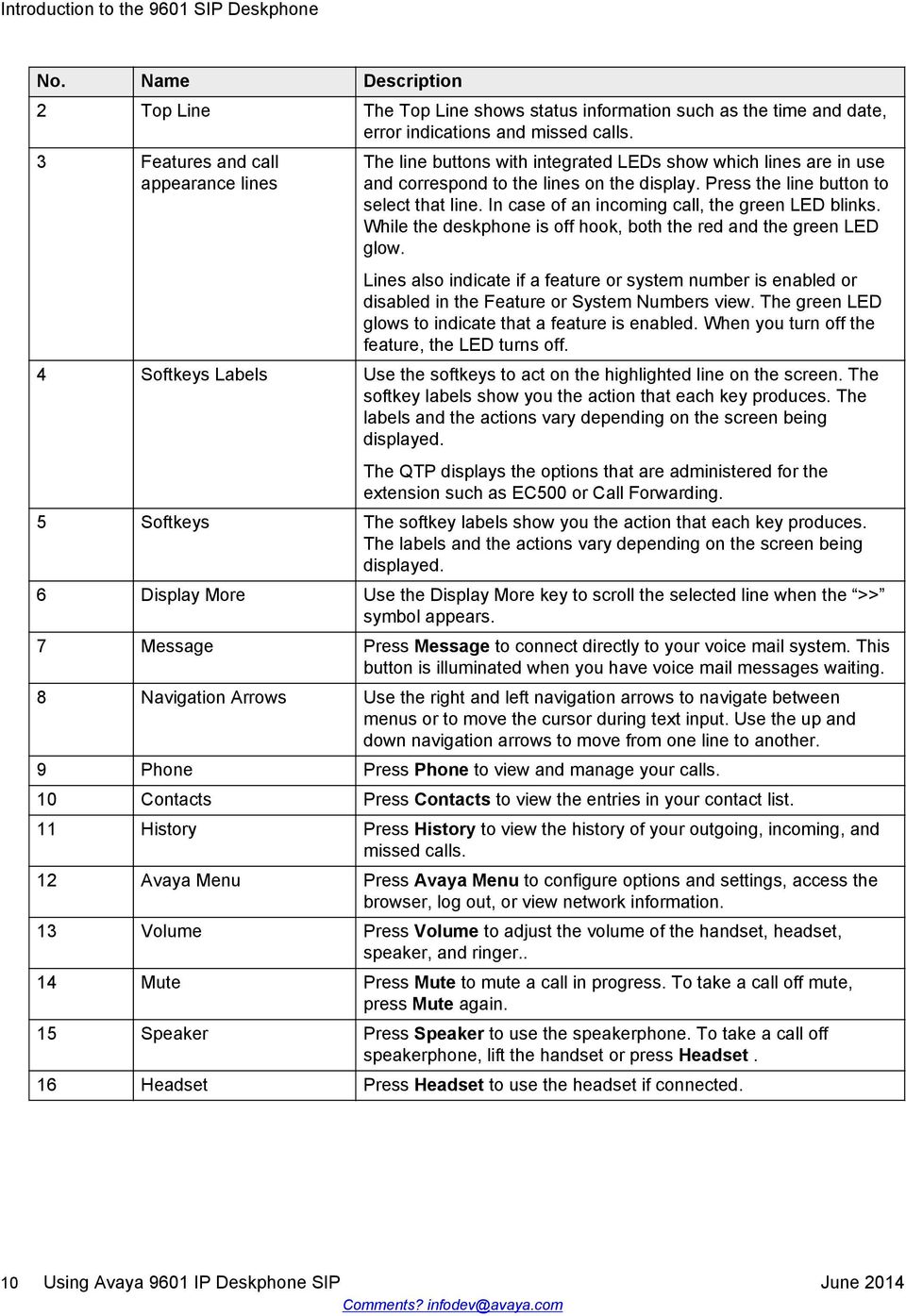
9 Overview Overview The following section describes the display, keys, buttons, and the associated features that are available on the deskphone. Figure 1: A 9601 deskphone Note: Your deskphone might have labeled buttons. The following table provides descriptions of buttons and features of the 9601 deskphones. The newer versions of the 9601 deskphones do not have these labels. No. Name Description 1 Message waiting indicator An illuminated red light in the upper-right corner of your phone that indicates that you have a voice mail. If Visual Alerting is enabled, this light flashes when you receive an incoming call. In addition to the message waiting indicator, the Message button is also illuminated when you have voice mail. June 2014 Using Avaya 9601 IP Deskphone SIP 9

10 Introduction to the 9601 SIP Deskphone No. Name Description 2 Top Line The Top Line shows status information such as the time and date, error indications and missed calls. 3 Features and call appearance lines The line buttons with integrated LEDs show which lines are in use and correspond to the lines on the display. Press the line button to select that line. In case of an incoming call, the green LED blinks. While the deskphone is off hook, both the red and the green LED glow. Lines also indicate if a feature or system number is enabled or disabled in the Feature or System Numbers view. The green LED glows to indicate that a feature is enabled. When you turn off the feature, the LED turns off. 4 Softkeys Labels Use the softkeys to act on the highlighted line on the screen. The softkey labels show you the action that each key produces. The labels and the actions vary depending on the screen being displayed. The QTP displays the options that are administered for the extension such as EC500 or Call Forwarding. 5 Softkeys The softkey labels show you the action that each key produces. The labels and the actions vary depending on the screen being displayed. 6 Display More Use the Display More key to scroll the selected line when the >> symbol appears. 7 Message Press Message to connect directly to your voice mail system. This button is illuminated when you have voice mail messages waiting. 8 Navigation Arrows Use the right and left navigation arrows to navigate between menus or to move the cursor during text input. Use the up and down navigation arrows to move from one line to another. 9 Phone Press Phone to view and manage your calls. 10 Contacts Press Contacts to view the entries in your contact list. 11 History Press History to view the history of your outgoing, incoming, and missed calls. 12 Avaya Menu Press Avaya Menu to configure options and settings, access the browser, log out, or view network information. 13 Volume Press Volume to adjust the volume of the handset, headset, speaker, and ringer.. 14 Mute Press Mute to mute a call in progress. To take a call off mute, press Mute again. 15 Speaker Press Speaker to use the speakerphone. To take a call off speakerphone, lift the handset or press Headset. 16 Headset Press Headset to use the headset if connected. 10 Using Avaya 9601 IP Deskphone SIP June 2014
11 Scrolling and navigation Scrolling and navigation When navigating through the options and features on your telephone display, use the navigation arrows to scroll and buttons to select lines or options. Use the up and down navigation arrows to scroll up or down through lists; holding either arrow for a few seconds produces a fast scroll. Use the right and left navigation arrows to move between the Phone screen and Features list or the Features list and System Numbers list, or to move the cursor right or left when entering text. Use the Display More key to scroll the selected line when the double chevron symbol ( >> ) appears in the display. When you scroll to a line on the display, that line is selected. The softkey labels will change according to the options available for the selected line. The OK button is a shortcut for the default action. For example, when you select an entry in your contacts list, pressing the OK button places a call to that person. You can also select a line or feature without scrolling by pressing the corresponding line button. About icons The icons in the following table indicate the state of a call, navigation choices, or the status of a contact whose presence you are tracking. Icon Description Missed call; a call was not answered or was forwarded to voice mail. Incoming call is alerting. Call is active. Call is on hold. Your calls are being forwarded. Conference is active. Conference is on hold. Use the Display More key to see more information on the selected line. The call in progress is muted. The ringer volume is off due to pressing - on the Volume button until the volume turns off. To reinstate volume, press + on the Volume button. June 2014 Using Avaya 9601 IP Deskphone SIP 11

12 Introduction to the 9601 SIP Deskphone Icon Description Presence icon indicating this contact's phone is busy with the Send All Calls feature active. This icon also designates that a feature is not available at this point of a call. Icon indicating the telephone is not connected to its network and is operating in "failover" mode. Some features may not be available or work correctly. For more information about failover, see Limited access during failover on page 77. Indicates that the call is using a wideband codec for good quality voice call. Indicates a low network performance or presence of local network issues that might result in lower call quality. Indicates that the user enabled the LNCC feature. The LNCC feature changes the Multiple Call Appearance deskphone to a Single Call Appearance deskphone. Presence icons appear when you set up the person whose presence you want to track as a contact and enter a handle (a phone number or URI) for that person. Call history icons The following icons indicate the types of calls. Icon Name Description Missed call Answered call Outgoing call Indicates that you did not answer the call or had forwarded the call to your voice mail. Indicates that you have answered the call. Indicates that you have made the call. Presence icons The following icons indicate the presence status of a contact. Icon Name Description Available On a call User is available and can communicate. User is on a call. 12 Using Avaya 9601 IP Deskphone SIP June 2014
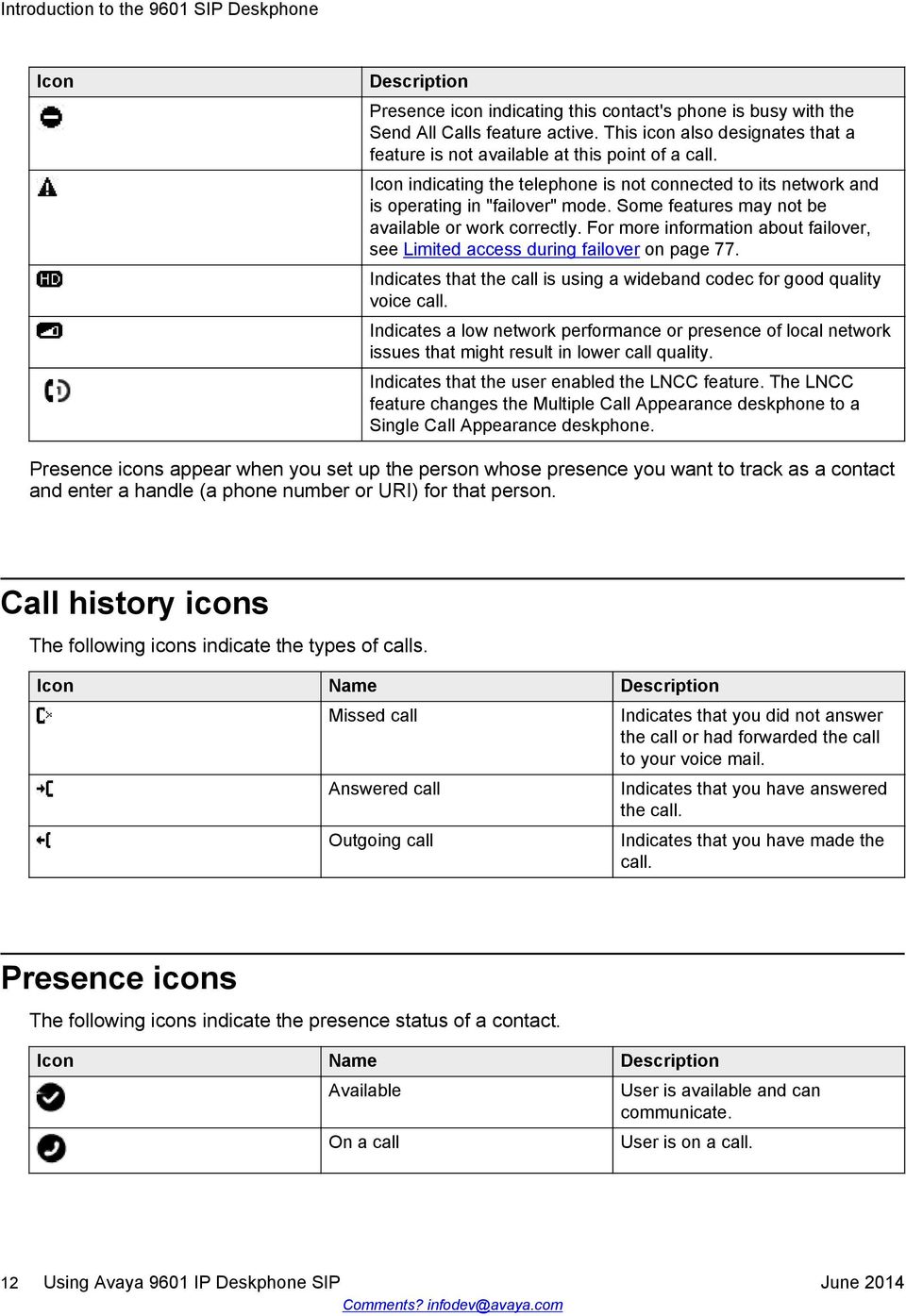
13 Administrative messages Icon Name Description Busy User is busy. Away Do not Disturb Out of Office/Offline Unknown User is away from the deskphone. User does not want to communicate. Out of Office: User is out from the office. Offline: User wants to appear invisible. The presence status of the user is unknown or the deskphone is not registered. Note: You can view presence icons only if the presence tracking feature is configured for your deskphone. Administrative messages Your administrator can send important messages such as notification of an early office shut down because of bad weather. The administrator can also send information about an imminent service interruption to your deskphone. These types of messages can take any of the following forms: A text message streaming across the top display line, that also accompanies an audible alert. An audible alert broadcast through the Speaker or the headset if that device is active. An interrupt screen notifying you that you are receiving an audio alert. While receiving an audible alert, you can change between the speaker, handset, and headset, can stop the transmission of pushed audio content by going on-hook, and can adjust the volume, as you normally do during a call. Deskphone stand To place the phone vertically for wall mounting, reverse the tab located under the switchhook in the top ear piece pocket and ensure that the handset is in the correct position. You need a small screwdriver to lift the tab and reinsert back the reversed tab. June 2014 Using Avaya 9601 IP Deskphone SIP 13

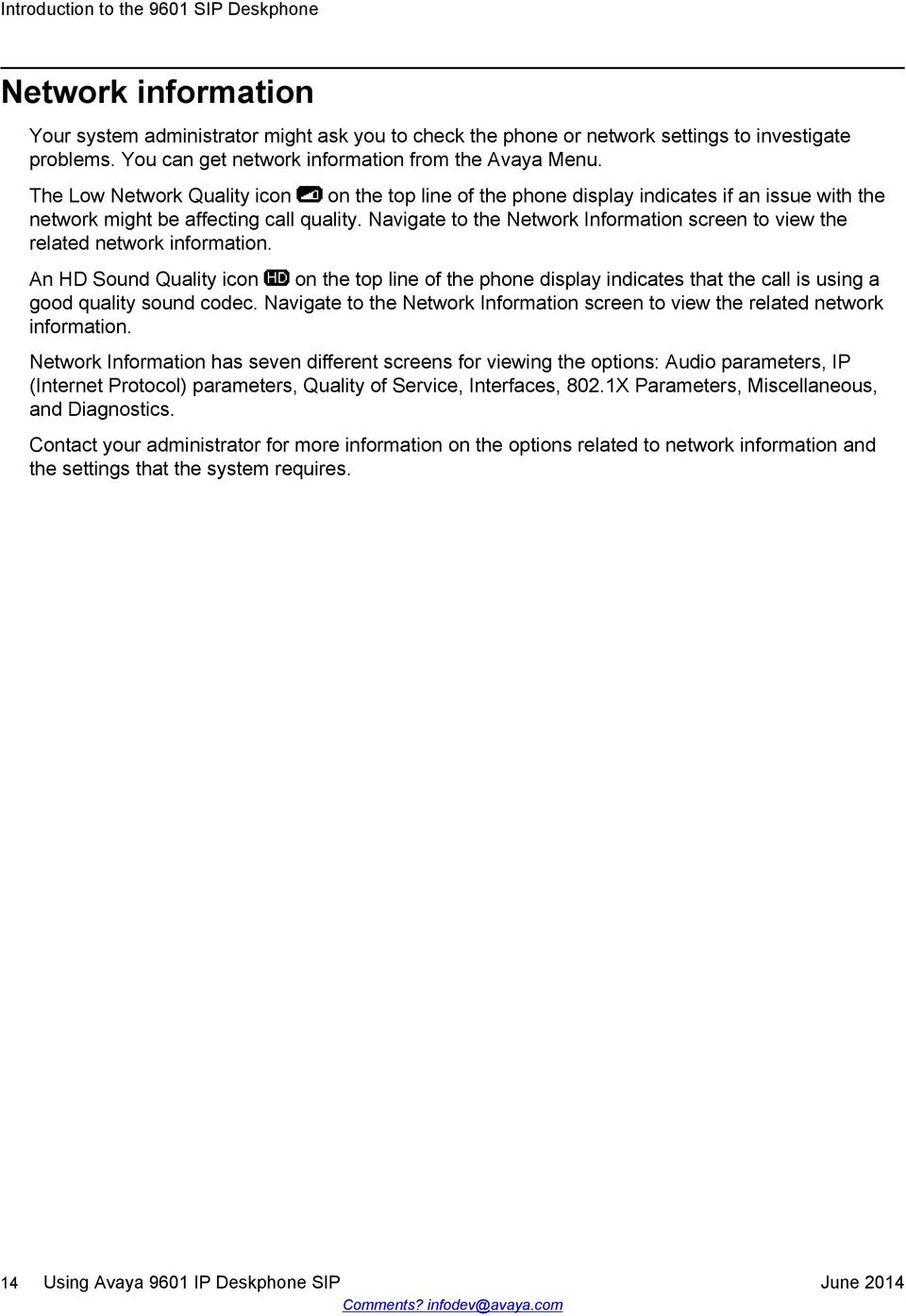
14 Introduction to the 9601 SIP Deskphone Network information Your system administrator might ask you to check the phone or network settings to investigate problems. You can get network information from the Avaya Menu. The Low Network Quality icon on the top line of the phone display indicates if an issue with the network might be affecting call quality. Navigate to the Network Information screen to view the related network information. An HD Sound Quality icon on the top line of the phone display indicates that the call is using a good quality sound codec. Navigate to the Network Information screen to view the related network information. Network Information has seven different screens for viewing the options: Audio parameters, IP (Internet Protocol) parameters, Quality of Service, Interfaces, 802.1X Parameters, Miscellaneous, and Diagnostics. Contact your administrator for more information on the options related to network information and the settings that the system requires. 14 Using Avaya 9601 IP Deskphone SIP June 2014
15 Chapter 2: Avaya Menu You can use Avaya Menu to adjust and customize options and settings for your deskphone, access additional Web-based applications, get information about your phone and network settings, and log out. When you press Avaya Menu, you see one of the following menus, depending on how your administrator has set up your system and on the applications available to you: Note: The menus and submenus that appear depend on how the administrator has configured your extension. Some options or submenus might not be available. Contact your system administrator if you have any questions. Options & Settings Browser Network Information About Avaya IP Deskphone Log Out Options & Settings lets you change your call settings, personalize button labels, adjust brightness and contrast, select your ringing pattern, set up favorites, assign speed dial entries, and more. Browser contains additional web-based applications. If your administrator did not configure the browser option for your deskphone, your deskphone does not display the browser option. Network Information has a submenu with seven different viewing options: Audio parameters, IP (Internet Protocol) parameters, Quality of Service, Interfaces, 802.1X Parameters, Diagnostics, and Miscellaneous Audio parameters, IP (Internet Protocol) parameters, Quality of Service, Interfaces, 802.1X Parameters, Miscellaneous, and Diagnostics. Your administrator might ask you to use this option to check phone settings or network settings to investigate problems. About Avaya IP Deskphone provides the release number of your phone software. Log Out lets you sign off the phone, to protect your settings or to let another user to log in. Using options and settings The Options & Settings menu contains the following submenus: June 2014 Using Avaya 9601 IP Deskphone SIP 15

16 Avaya Menu Submenu names Call Settings Set Speed Dials Set Favorites Application Settings Screen & Sound Options Language & Region Advanced Options Description Includes choices for automatically displaying the Phone screen when you get an incoming call, when you place a call, or when you answer a call, turning call timers on or off, controlling how Redial works, turning Visual Alerting on or off, and more.. Lets you assign speed dial numbers for up to ten contacts, so a long press of a single digit initiates a call to that person. See Setting up speed dialing on page 19 for more information. Lets you build a list of up to nine favorite contacts or features. See Setting up favorites on page 19 for more information. Includes choices for personalizing button labels, turning call on or off and including bridged calls in your call History. Includes choices for adjusting the deskphone brightness and contrast, ring pattern, background logos, button clicks, and error tones. Includes choices for setting the display language and the time format. Includes choices for integrating other applications like Microsoft Exchange Server with your phone. You can also set AGC (Automatic Gain Control) for your headset, handset, and/or speaker audio. Displaying the Phone screen on dialing Use this task to set the deskphone to display the Phone screen when you dial a number to make a call. 1. Press Avaya Menu. 2. Press Select to select Options & Settings > Call Settings > Phone Screen on Calling. 3. Press Change to select one of the following: Yes: To display the Phone screen when you dial a number. No: To remain on the current screen when you dial a number. 4. Press Save. 16 Using Avaya 9601 IP Deskphone SIP June 2014

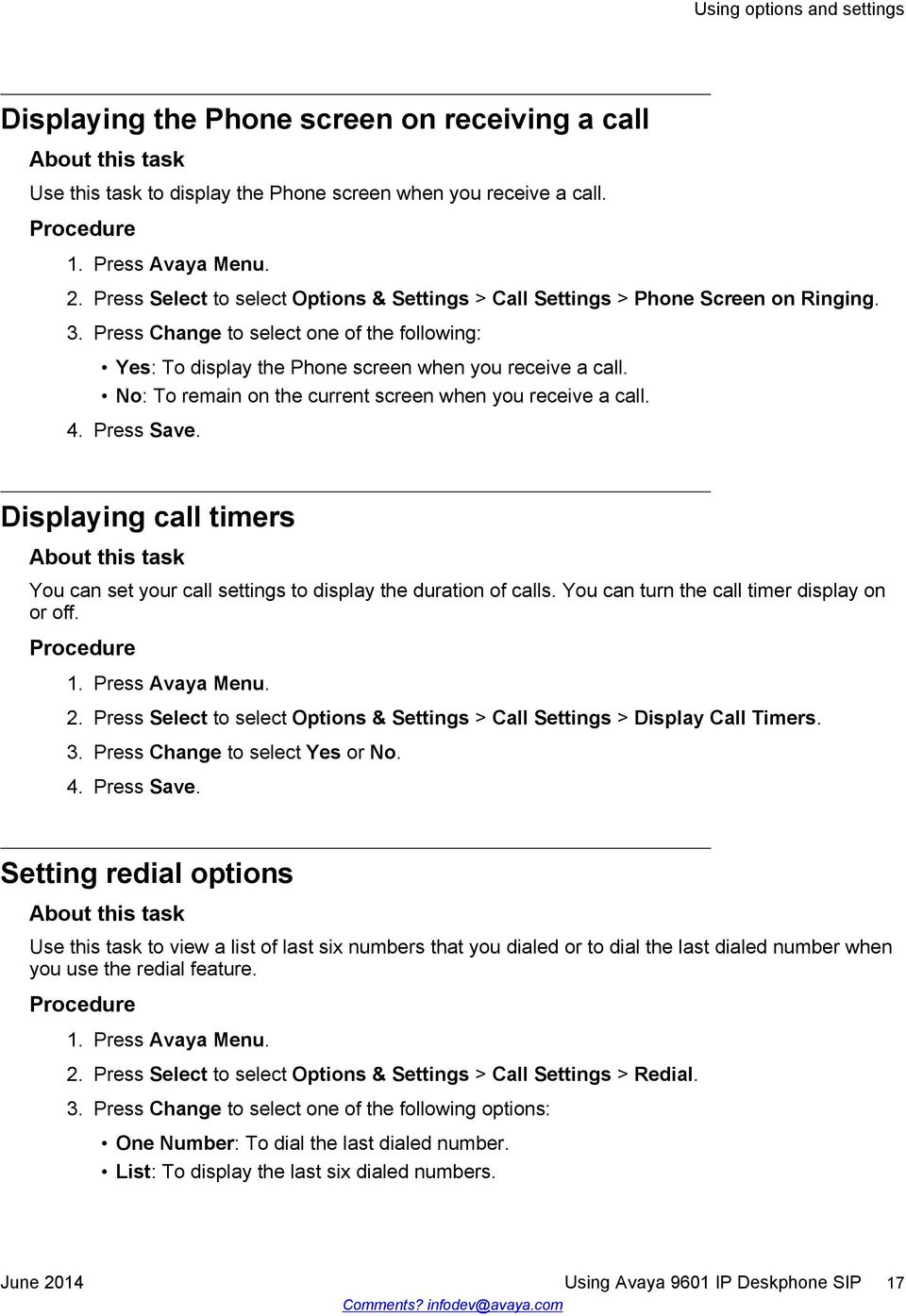
17 Using options and settings Displaying the Phone screen on receiving a call Use this task to display the Phone screen when you receive a call. 1. Press Avaya Menu. 2. Press Select to select Options & Settings > Call Settings > Phone Screen on Ringing. 3. Press Change to select one of the following: Yes: To display the Phone screen when you receive a call. No: To remain on the current screen when you receive a call. 4. Press Save. Displaying call timers You can set your call settings to display the duration of calls. You can turn the call timer display on or off. 1. Press Avaya Menu. 2. Press Select to select Options & Settings > Call Settings > Display Call Timers. 3. Press Change to select Yes or No. 4. Press Save. Setting redial options Use this task to view a list of last six numbers that you dialed or to dial the last dialed number when you use the redial feature. 1. Press Avaya Menu. 2. Press Select to select Options & Settings > Call Settings > Redial. 3. Press Change to select one of the following options: One Number: To dial the last dialed number. List: To display the last six dialed numbers. June 2014 Using Avaya 9601 IP Deskphone SIP 17
18 Avaya Menu 4. Press Save. Configuring visual alerts Use this task to cause the LED in the top right corner of the phone to flash when the deskphone gets incoming calls. 1. Press Avaya Menu. 2. Press Select to select Options & Settings > Call Settings > Visual Alerting. 3. Press Change to select On or Off. 4. Press Save. Setting the audio path You can set your phone to go off-hook on the Speaker or the Headset when you make an on-hook call. 1. Press Avaya Menu. 2. Press Select to select Options & Setting > Call Settings > Audio Path. 3. Press Change to select Headset or Speaker. 4. Press Save. Setting dialing options Your phone has the following two dialing options: You can dial a number by picking up the handset, getting a dial tone, and dialing the required number (off-hook dialing). You can use the edit dialing feature. If you set this feature, you can enter all or part of the number, use backspace to correct a digit if needed, and when ready, initiate the dialing process using a softkey. Edit dialing may not be available to you, depending on how your system is administered. If you activated the Limit Number of Concurrent Calls (LNCC) feature in the edit dialing mode, and you start dialing a number when at the same time your deskphone receives a call, the deskphone presents this call to you instead of logging the call. 18 Using Avaya 9601 IP Deskphone SIP June 2014

19 Using options and settings 1. Press Avaya Menu. 2. Press Select to select Options & Settings > Call Settings > Dialing options. 3. Press Change to select On-hook or Editable. When on-hook dialing is in effect, dialpad (edit dial) searches are not available. 4. Press Save. Setting up speed dialing Use this task to assign speed dial numbers to your contacts. You can assign speed dial numbers to up to 10 contacts. 1. Press Avaya Menu. 2. Press Select to select Options & Settings > Assign Speed Dial Entries > Set Speed Dial. 3. Scroll and press Assign to select the required unassigned line. 4. Press Select to select the number that you want to assign. For more information on using the speed dial feature, see Speed dialing a person on page 34. Setting up favorites Use this task to create a list of favorite contacts or features for quick access. You can include up to nine favorite items in the favorite list. 1. Press Avaya Menu. 2. Press Home. 3. Press Select to choose Options & Settings > Assign Favorite Entries > Set Favorites. 4. Perform one of the following actions: To add a favorite contact, press Contacts. To add a favorite feature, press Features. 5. Press Select to choose the required contact or feature. June 2014 Using Avaya 9601 IP Deskphone SIP 19
20 Avaya Menu Gaining access to the favorite list Use this task to gain access to the favorite list for quick access to a contact or a feature. 1. Scroll past through the last call appearance. 2. Highlight the required contact or feature. 3. Press Call or Select as applicable. Personalizing button labels You can change the labels that are displayed for your extensions, features, and system numbers or speed dial buttons. For example, you can change the label for your extension to "My Line." You cannot edit Autodial buttons labels using this procedure. For information, see Assigning labels to pre-assigned (Autodial) numbers on page Press Avaya Menu. 2. Select Options & Settings Select Application Settings. 4. Select Personalize Labels Press Select or OK. 6. Select the label you want to edit. If the label you want to edit is on the Features screen, scroll right to access the Features screen, and select the label you want to edit. If the label you want to edit is on the System Numbers menu, scroll right twice to access the System Numbers menu and select the label you want to personalize. 7. Press Edit. 8. Edit the label using up to 13 characters. Press More then Clear to clear all text fields and start over. 9. Press Save or OK. 10. You may revert back to the default button labels by selecting Options & Settings > Application Settings > Restore Default Button Labels and pressing Default. 20 Using Avaya 9601 IP Deskphone SIP June 2014

21 Using options and settings Adjusting the contrast of the display 1. Press Avaya Menu. 2. Select Options & Settings > Screen & Sound Options > Contrast. 3. Use the arrow keys to increase or decrease the brightness or contrast. 4. Press Save or OK. Changing the ring pattern 1. Press Avaya Menu. 2. Select Options & Settings. 3. Press Select or OK. 4. Select Screen & Sound Options. 5. Press Select or OK. 6. Scroll to Personalized Ringing and press Change. The ring tone currently selected displays on the status line and a list of all eight ring tones within that category displays with a checkmark next to the pattern currently selected. The phone displays the Rich category ring tones by default. The softkey Classic indicates the other ring tone category, to allow you to switch between categories. 7. Press Change to move from one ring tone to the next. 8. Press Save to make save your selection. Setting a ring tone for incoming forwarded calls Use this task to specify the ring tone that you want to hear for incoming calls that are forwarded to your deskphone. You can hear the ring tone that you specified for the: Caller. First deskphone that forwarded the call. 1. Press Avaya Menu. 2. Press Select to select Options & Settings > Screen & Sound Options > Call Fwd Ring. June 2014 Using Avaya 9601 IP Deskphone SIP 21
22 Avaya Menu 3. Press Change to select one of the following: Caller: To hear the ring tone that you specified for the caller. Forwarder: To hear the ring tone that you specified for the first deskphone that forwarded the call. 4. Press Save. Setting a ring tone for Team Button Use this task to set a ring tone for deskphones that you monitor. 1. Press Avaya Menu. 2. Press Select to select Options & Settings > Screen & Sound Options > Team Button Ring Type. 3. Press Change to select the required ring tone. Setting a call pickup ring tone You can set ring tones to alert you when you receive an incoming call. 1. Press Avaya Menu. 2. Select Options & Settings. 3. Select Screen & Sound Options. 4. Press Select or OK. 5. Select Call Pickup Ring Type. 6. Press Change or OK or use the Right/Left Arrows to toggle from one ring tone/number to another. Each tone sounds briefly as you move to it. 7. If desired, press Play or OK to listen to the ring tone. 8. Repeat the last two steps until you find the ring tone you want for calls within your pickup group. 9. Press Save to make it your call pickup ring tone. 22 Using Avaya 9601 IP Deskphone SIP June 2014
23 Using options and settings Setting an alert for a call pickup group Use this task to set a call pickup group alert on your deskphone. The call pickup group alert provides a visual or an audio alert on your deskphone when a member in your call pickup group gets a call. 1. Press Avaya Menu. 2. Press Select to select Options & Settings > Screen & Sound Options > Call Pickup Indication. 3. Press Change to select one of the following: Audible: Provides an audio alert. Visual: Provides a visual alert. Both: Provides both audio alert and visual alert. None: Provides no call pickup alert. 4. Press Save. Turning button click sounds on and off 1. Press Avaya Menu. 2. Press Select to select Settings > Options & Settings > Screen & Sound Options > Button Clicks. 3. Press Change to turn sound on or off. 4. Press Save. Turning error tones on or off Your telephone beeps if you make a mistake or take an action that is not allowed. If you do not want to hear error beeps, set your error tone to Off. 1. Press Avaya Menu. 2. Press Select to select Settings > Options & Settings > Screen & Sound Options > Error Tones. 3. Press Change to turn error tones on or off. June 2014 Using Avaya 9601 IP Deskphone SIP 23
24 Avaya Menu 4. Press Save. Setting key repeat delay Use this procedure to set the time for which you must press the navigation key to start the auto repeat process. You can select from the following options: No Repeat Default Short Long Very Long 1. Press Avaya Menu. 2. Press Select to select Options & Settings > Screen & Sound Options > Key Repeat Delay. 3. Press Change to select the required option. 4. Press Save. Changing the language 1. Press Avaya Menu. 2. Select Options & Settings. 3. Press Select or OK. 4. Select Language & Region. 5. Press Select or OK. 6. Select Language. Note: The language option is available only if the administrator has enabled the option for your phone. 7. Select a display language. 8. Press Select or OK. 9. Press Yes to confirm the selected language. 24 Using Avaya 9601 IP Deskphone SIP June 2014
25 Using options and settings Setting the time format You can change the way the time displays on your screen. The time format is either 12 or 24 hours. 1. Press Avaya Menu. 2. Select Options & Settings. 3. Press Select or OK. 4. Select Language & Region. 5. Press Select or OK. 6. Press Select to select Time Format. 7. Press Change or OK or use the Right/Left arrows to change the time format. 8. Press Save. Setting headset profile Use this task to select an appropriate headset profile that best matches the acoustic of deskphone with your headset. 1. Press Avaya Menu. 2. Press Select to select Options & Settings > Advanced Options > Headset Profile. 3. Press Change to select the profile that matches your headset. For more information on headset profiles that Avaya supports, see the document Avaya one- X 96X1 Series IP Deskphone Headset Profiles at the Avaya Support website. 4. Press Save. Enabling wireless headset Perform the following procedure to enable a wireless headset to provide alert and receive incoming calls or to only receive incoming calls. 1. Press Avaya Menu. June 2014 Using Avaya 9601 IP Deskphone SIP 25
26 Avaya Menu 2. Press Select to select Options & Settings > Call Settings > Headset Signaling. 3. Press Select to select any of the following options: Disabled: Disables the deskphone to headset setting. Switchhook and Alert: Activates the headset if you press Headset. When the deskphone receives an incoming call, you hear the alert tone in the headset. Switchhook only: Activates the headset if you press Headset. When the deskphone receives an incoming call, you do not hear the alert tone in the headset. Turning automatic gain control on or off The automatic gain control (AGC) automatically adjusts the audio output level to achieve a constant and better quality audio. 1. Press Avaya Menu. 2. Press Select to select Options & Settings > Advanced Options > Automatic Gain Control. 3. Select the Handset, Headset, or Speaker for which you want to turn AGC on or off. 4. Press Change to turn AGC on or off. 5. Press Save. Integrating other applications with your phone If your administrator has set up this option, you can integrate Microsoft Exchange Server calendar and contacts with your phone. First, establish your credentials by entering the user name and password you use for Microsoft Exchange Server purposes and the domain of your Exchange Server. After establishing your credentials, you can set your calendar preferences. 1. Press Avaya Menu. 2. Press Select to select Options & Settings > Advanced Options > Exchange Integration. 3. If you have already set up your credentials and do not want to change them, proceed to Step 5. To establish or change your credentials, select Name & Password and enter the following: Your Microsoft Exchange server user name. 26 Using Avaya 9601 IP Deskphone SIP June 2014
27 Browser Your Microsoft Exchange server password. The location, domain or the IP address, of the server on which Microsoft Exchange runs. Whether you want the deskphone to display a prompt to enter your user name and password every time you access Microsoft Exchange calendar on your phone. Press Change to change the setting as required. 4. Press Save or OK. 5. To set or change your calendar preferences, select Calendar and enter the following: Whether or not you want your phone to activate the calendaring feature. Press Change to change the Use Exchange Calendar setting to Yes or No. Whether or not you want your phone to remind you of items on your calendar. Press Change to change the Enable Exchange Reminder setting to Yes or No. If you want to be reminded of calendar items, indicate in minutes how far in advance you want to get a reminder for your appointments. For example, setting the value to 120 will cause a reminder to appear two hours before the appointment start time and setting the value to 5 will cause a reminder to appear five minutes before the start time of appointment. Setting the value to 0 minutes will cause the reminder to be displayed at the start time of the appointment. To enter minutes, select More, then 123 and type the number of minutes. Whether you want the appointment reminder to reappear after a snooze period in minutes you specify. For example, setting the Exchange Snooze Time value to 5 will cause a Reminder popup to reappear five minutes after you have snoozed it. Whether or not you want to hear a tone with a reminder popup window. Press Change to change the Exchange Reminder Tone setting to Yes or No. 6. To change your contacts preferences, select Contact and configure the following: Whether or not you want your phone to remind you of items on your calendar. Press Change to change the Use Exchange Contacts setting to Yes or No. If you want to change the Exchange subscription period, specify in the Use the Exchange Subscription Period field. 7. Press Save to save your settings and preferences. Note: When Exchange calendar is active, a Calendar label displays beneath your last call appearance on the Phone screen. Browser Your deskphone includes WML Web browser capability to use additional applications. The applications available through the browser vary depending on how your system administrator has configured your deskphone. For more information, contact your administrator. June 2014 Using Avaya 9601 IP Deskphone SIP 27
28 Avaya Menu Gain access to the browser through Avaya Menu. If you do not see the Browser option on Avaya Menu, Web applications are not available for your deskphone. Note: The 9601 deskphone does not support displaying images through the browser. Using the WML browser 1. Press Avaya Menu. 2. Scroll to Browser. 3. Press Select or OK. The WML browser opens the home page. 4. Scroll to the link that you want to view. 5. Press OK to open the link. 6. Perform any of the following actions: To stop loading the current page, press Cancel. To reload the current page, press Refresh. To open the home page, press Home. To close the browser, press PHONE. To edit a text in an application, use the right side call appearance buttons. 28 Using Avaya 9601 IP Deskphone SIP June 2014
29 Chapter 3: Answering a call When you receive an incoming call, the phone selects the incoming call automatically. However, if you are already on a call or if you receive more than one incoming call at a time, you might need to select the call you want to answer manually. If you do not have the Go to Phone on Ringing option enabled, you must press Phone to choose a line or view call options. If you do not have the Go to Phone Screen on Ringing option enabled and if the phone does not display the Phone screen, incoming calls display on the top line of the screen. You can press the corresponding line button (LED) to answer the call. Answer an incoming call in one of the following ways: If you are not on another call, lift the handset, or press Speaker, OK, or Answer to answer the call using the speakerphone, or press Headset to answer using the headset. If you are on another call, from the Phone screen, scroll to the line with the incoming call and press Answer or OK. The deskphone automatically answers the incoming call and puts the previous call on hold. If you are on another call and the deskphone does not automatically display the incoming call, from the Phone screen scroll to the line with the incoming call and press Answer or OK. If you are on another call and the phone does automatically display the incoming call, you can press Answer to automatically put the first call on hold when you answer the new call. Also, you can press Ignore to automatically drop the first call when you answer the new call. To automatically display the Phone screen when you receive an incoming call, set the Phone Screen on Ringing option to Yes. Note: To automatically display the Phone screen when you receive an incoming call, set the Phone Screen on Ringing option to Yes. For more information, see Displaying the Phone screen on receiving a call on page 17. June 2014 Using Avaya 9601 IP Deskphone SIP 29
30 Answering a call Sending an active call to voic To send an active call to voic , from the Features screen, select Transfer to Voic . Ignoring an incoming call Use this task to turn off the ringer for an incoming call. From the Phone screen, press Ignore to turn off the ringer for an incoming call. Putting a call on hold 1. Press Phone to view the main Phone screen, if necessary. 2. If you are not active on the line you want to put on hold, select that line. 3. Press Hold. Note: The phone might display a hold timer when you put a call on hold. For more information, see Configuring call timers on page Press Resume or the line button of the held call to retrieve the call.your system administrator might have administered the Hold Recall feature, which alerts you visually and with a priority ring to remind you of a held call after a certain period of time. Muting a call While on a call, you can mute the microphone of your phone so that the other party cannot hear you. You can configure your deskphone to alert you if your dekphone is on mute. The alert can be an audible beep and a visible indication on the top line of your deskphone. 1. Press Mute during a call so that the other person on the call cannot hear you. 30 Using Avaya 9601 IP Deskphone SIP June 2014
31 Switching to another deskphone during an active call 2. Press Mute again to unmute the call. Note: If a call is on mute and you switch between the handset, headset, or speakerphone, the mute is turned off. When you mute the call, the Mute button light is on and the top line displays the Mute icon. Switching to another deskphone during an active call Use this task to switch to another registered deskphone during an active call when you have registered more than one deskphone with your extension. 1. Answer the incoming call from your deskphone. 2. To switch to the other deskphone, press Bridge on that deskphone. Making an unattended transfer Before you begin You must answer the call before transferring the call to another deskphone An unattended transfer is when you transfer an active call to another deskphone without announcing the call transfer. If the administrator enabled the Transfer on Hang-up feature, you can complete the call transfer by disconnecting the deskphone through any of the following methods: Put the handset on the cradle Press Speaker Press Headset 1. While on the active call, press the Transfer softkey. 2. Perform one of the following actions: Dial the number. Call the person from the contacts list or from the history list. 3. To complete the transfer, perform one of the following actions: Disconnect the call if the administrator enabled the Transfer on Hang-Up feature for your deskphone. June 2014 Using Avaya 9601 IP Deskphone SIP 31
32 Answering a call Result Press the Complete softkey. Your deskphone transfers the call to the selected number. Note: Unanswered transfers might return to your deskphone as a recalled transfer. In this case, you hear a priority ring and see the display message Return next to the call. Making an attended transfer Before you begin You must answer the call before transferring the call to another deskphone. An attended transfer is when you transfer an active call to another deskphone number after announcing the call transfer. If the administrator enabled the Transfer on Hang-up feature, you can complete the call transfer by disconnecting the deskphone through any of the following methods: Put the handset on the cradle Press Speaker Press Headset Result 1. While on the active call, press the Transfer softkey. 2. Perform one of the following actions: Dial the number. Call the person from the contacts list or from the history list. 3. Tell the contact about the call when the contact answers your call. 4. To complete the transfer, perform one of the following actions: Disconnect the call if the administrator enabled the Transfer on Hang-Up feature for your deskphone. Press the Complete softkey. Your deskphone transfers the call to the selected number. 32 Using Avaya 9601 IP Deskphone SIP June 2014
33 Chapter 4: Making a call If you are not on a call, dial the number you want to call. Use the Phone screen to view and manage calls. Press Phone to view the main Phone screen. When the phone displays the Phone screen, press Phone to move to the top of the call appearance list. 1. Lift the handset, or press Speaker or Headset (if applicable) or a line button for an available line. 2. Dial the number you want to call. Making an emergency call If your administrator configured emergency calling for your deskphone, the Phone screen displays an Emerg softkey to immediately connect you with a preset emergency services number. Note: You can make an emergency call when your deskphone is logged out only if your administrator configured this feature for you. Important: During phone failover, when the phone switches between system servers due to a system failure, the Emergency softkey might not be available until your phone connects to an alternate server. This process might take a few seconds. 1. On the Phone screen, press Emerg. 2. Press Yes when the deskphone displays a prompt. Some call servers call back to confirm the emergency status. The phone automatically answers the incoming call on the speaker by going off-hook. 3. To end the emergency call, press End Call or press Speaker. June 2014 Using Avaya 9601 IP Deskphone SIP 33
34 Making a call Redialing a number 1. From the Phone screen, press Redial. The phone redials the last number or a list of the most recent numbers that you have dialed appears from which you can select a number to redial. For information on redial settings, see Setting Redial Options on page 17. Note: The phone clears the last number dialed and redial list if you clear the Outgoing Call Log. 2. If you are working with a redial list, scroll to the number to call and press Call or OK. Your system administrator can disable Redial functionality. Speed dialing a person On the Phone screen, press and briefly hold the dialpad key assigned to the person you want to call. To assign speed dial numbers to up to 10 contacts, see Setting up speed dialing on page 19. Autodialing a pre-assigned number Your system administrator may set up frequently called numbers such as Information Technology or the Help Desk as Autodial numbers, so you can dial them with one touch. 1. From the Phone screen, scroll right till you gain access to the System Numbers menu. To assign labels to or edit labels for your Autodial numbers, see Assigning labels to auto-dial numbers on page Select the number you want to call. 3. Press the Call softkey or the OK button. 34 Using Avaya 9601 IP Deskphone SIP June 2014
35 Making a call using edit dialing Making a call using edit dialing Before you begin Your administrator has to authorize this function. To set up edit dialing, see Setting dialing options on page 18. Using the Edit dialing feature, you can edit the number before actually dialing by using the Bksp softkey. Using softkeys, you can change the number or character format or backspace to "edit" the number before actually dialing it. Using the Bksp softkey, you can edit the number before actually dialing it. 1. From the Phone screen, enter the number you want to call. 2. To edit the number, press Bksp to erase the previous character, one character at a time. To change the character format, press the More > 123 softkeys. 3. Press Call or OK. Calling a person from the contacts list You can call any contact from your contacts list. You can find a name by scrolling to it or by using the search box. Use the dialpad keys to enter the first few letters of the name, and the screen displays the first match in your list. 1. Press Contacts. 2. Select the person or number that you want to call. 3. Press More twice. 4. Find the contact that you want to call by typing the name of the person as listed. For example, if you added John Smith to your contacts List as Smith, John, start typing the last name rather than his first name. Each time you press the dialpad, the list display shifts to match your input. You can also scroll up or down to locate the contact. 5. Press Call, OK, or the line appearance to call the selected contact. June 2014 Using Avaya 9601 IP Deskphone SIP 35
36 Making a call Calling a person from the call history 1. Press the History button. 2. Scroll to the left or right to view a separate list of all calls, missed, or unanswered calls, answered calls, or outgoing calls. 3. Scroll up or down to select the person or number you want to call. 4. Select the person or number you want to call. 5. Press the Call softkey or the OK button. Calling a person from the directory If your administrator has set up a company directory you can use the Contacts button to search through the directory, then call the person you found. Note: Use the Contacts button on the phone to initiate either a directory search as described here or to find a contact on your personal Contacts list. To locate a person on your Contacts list, see Searching for a contact on page Press Contacts. 2. Press More. 3. Press Search. 4. Enter the person's full or partial first name if desired. To enter all or part of the last name only, skip this step and the next and scroll down to the Last Name field. 5. Press OK. 6. Enter the person's full or partial last name. 7. Press Search or the OK button to start searching the directory. 8. When the person you want displays, press Call to call the person. 36 Using Avaya 9601 IP Deskphone SIP June 2014
37 Dialing an E.164 number Dialing an E.164 number E.164 is a standard format of international public telephone numbering. An E.164 number can have up to 15 digits and is preceded by a plus sign (+). Use the following procedure to dial an E.164 number. 1. Press asterisk (*) twice or press the plus sign (+) to display the plus sign (+). If you are using the SPEAKER, the HEADSET, or the call appearance line, the deskphone displays the plus sign (+) softkey on the screen. 2. Dial the number that you want to call. Making a call using a Click to dial link You can use the Click to Dial feature to make a call from a web page or any other screen that provides a dialing link. Usually, a handset icon indicates a line with this type of link. Result 1. Select the line with the link for the person or number you want to call. 2. Press the line button corresponding to the line with the link or press OK. The deskphone starts a call to the person or number associated with the click to dial link. June 2014 Using Avaya 9601 IP Deskphone SIP 37
38 Chapter 5: About forwarding calls You can forward your incoming calls to another number or to voice mail. When the Forward button light is on, one or more of the forwarding features are active. The forwarding features available on your phone depend on the options your administrator has set. For more information about the options available on your extension, contact your administrator. Activating Send All Calls When Send All Calls (SAC) feature is on, your incoming calls go directly to a predefined coverage number, typically your voice mail. Incoming calls ring once at your extension and then go directly to a number which is set by your system administrator. If the SAC feature is administered on your phone, a Send All softkey appears on the Phone screen for idle calls. You can also turn Send All Calls on or off by using the telephone Features list. If you enabled the DND affects SAC option, the deskphone activates the SAC feature when you manually change the presence status to DND. Note: You must not enable the SAC feature in case you selected the cover all option for the coverage path because enabling both features at the same time can cause duplicate entries in the call log. 1. Gain access to the Features screen. 2. Press Select or the corresponding line button to activate the feature. Activating call forwarding Use this task to forward your calls to a specified number. 38 Using Avaya 9601 IP Deskphone SIP June 2014
39 Disabling call forwarding 1. Gain access to the Features screen. 2. Press Select or the corresponding line button. 3. Enter the destination number to which you want to forward your calls. 4. Press Enter. After you enter the forwarding number, you hear a confirmation tone. Disabling call forwarding Use this task to turn off any call forwarding feature that you activated. 1. Press the right navigation button to gain access to the Features screen. 2. Select the active call forwarding feature that you want to turn off. 3. Press OK. June 2014 Using Avaya 9601 IP Deskphone SIP 39
40 Chapter 6: Using the conference feature You can use conference calls to speak with people from different locations on the same call. Additional conferencing options might be available through Expanded Meet-Me Conferencing. Contact your administrator for more information about this feature. Setting up a conference call Use this task to set up a conference call and add participants to the conference call. 1. From the Phone screen, select your active call. 2. Press Conf. 3. Dial the telephone number, or call the person from the contacts list, or the History list. 4. Press Join when the person answers the call. 5. To add another person, press Add and repeat Steps 3 to 4. Adding a person on hold to a conference call Use this task to add a person that you have put on hold to a conference call. 1. From the Phone screen, select your active call. 2. Press Conf, or press Add if you are already in a conference. 3. Select the call on hold that you want to add to the conference. 4. Press Resume to take the call off hold. 5. Press Join to add the person to the conference call. 40 Using Avaya 9601 IP Deskphone SIP June 2014
41 Putting a conference call on hold Putting a conference call on hold When you put a conference call on hold, the other parties can still talk to each other. 1. Press Hold during a conference call. 2. Press Resume or OK to resume the conference call. Dropping the last participant from a conference call Use the following procedure to drop the last participant added to the conference call. Once you drop the last added participant, you cannot use the procedure to drop other participants. The deskphone plays an error tone if you try to use the drop method again. If you add another participant after dropping the last added participant, you can use the drop method again to drop this participant. Note: This feature is applicable only for a conference call of the AST 1 type. 1. From the Phone screen, select your active call. 2. Press Drop once the conference is up. The deskphone drops the last added person from the conference. June 2014 Using Avaya 9601 IP Deskphone SIP 41
42 Chapter 7: Using bridged call appearances In addition to your own call appearances, your phone might show one or more bridged call appearances on the display screen. A bridged call appearance is of another user and enables you to determine if that call appearance is in use, answer calls on that appearance, or join a call in progress on that call appearance from your deskphone. You can also make outgoing calls on a bridged call appearance when the bridged call appearance is not in use. Answering a call on a bridged line Answering a call on a bridged line is the same as answering the call on a primary line. 1. Select the bridged call that you want to answer. The ringing line is selected automatically. If you are on another call when a call comes in to a bridged line, you have to select the ringing line. 2. PressAnswer. Joining a call on a bridged line 1. Select the bridged call in progress that you want to join. 2. Press the Bridge softkey. Making an outgoing call on a bridged line When you make a call on a bridged line, you are using another phone user s line. The caller ID associated with the call you are making might show the call as coming from you or coming from the 42 Using Avaya 9601 IP Deskphone SIP June 2014
43 Excluding others from bridging on to your call person whose line you are using. If you have any questions about how the name or extension displays to the person you are calling, contact your administrator. 1. Select the bridged line you want to use. 2. Press OK to get a dial tone. 3. Dial the phone number, or call the person from the Contacts list, or call the person from the History list. Excluding others from bridging on to your call Use the Exclusion feature to prevent others who are bridged to your extension from bridging onto a specific call. You can activate exclusion only during an active call. 1. Access the Features screen during an active call. 2. Scroll down to Exclusion and press OK or just press the corresponding line button. When you activate Exclusion during a call, all parties except you and the calling and the called party are dropped from the call. Transferring a bridged call to its own voice mail Use the Transfer to Voice Mail feature to transfer a call you took on a bridged line to its voice mail. 1. During an active bridged call, scroll right from the Phone screen to access the Features screen. 2. If necessary, scroll down to Transfer to Voice Mail. 3. Press OK or Enter to transfer the bridged call to its respective voice mail system. June 2014 Using Avaya 9601 IP Deskphone SIP 43
44 Using bridged call appearances Independent alerting for each bridged call appearance You can configure a unique alerting option for each bridged call appearance on your deskphone if the administrator has enabled the Independant alerting feature for your extension. The following four options are available: On: The deskphone plays a ringtone on an incoming call on the bridged appearance. Off: The deskphone does not play an alert ringtone on an incoming call on the bridged appearance. Delayed: The deskphone plays an alerting melody after a delay if you do not answer a call on the bridged appearance. Your administrator can configure the delay. Abbreviated: The deskphone plays a single beep to indicate a call on the bridged appearance. 44 Using Avaya 9601 IP Deskphone SIP June 2014
45 Chapter 8: Using the contacts feature Note: Release 6.3 and later do not support voice dialing. Searching for a contact Use this task to search for a contact that already exist in your contacts list. You can jump to a certain group of letters in your contacts list by pressing the associated dial pad button. For example, if you press 3, the deskphone displays entries starting with D, E, or F depending on the names of contacts that you might have in the contacts list that start with any of these letters. With each successive dialpad key press, the deskphone displays the matching entries. 1. Press CONTACTS. 2. Use the dialpad to type the name that you want to search. If you set up your contacts in the Last Name and First Name format, type the letters of the last name. If you have set up your contacts using a different format, type the most likely letters that matches the contact that you want to find. 3. When the deskphone displays the required match, you can perform any of the following actions: Next steps To call the contact, press Call. To edit the contact information, press More > Edit. If your administrator has set up a corporate contact list or database, you can extend a search. For information, see Extended searching on page 46. June 2014 Using Avaya 9601 IP Deskphone SIP 45
46 Using the contacts feature Extended searching If your system administrator has set up a corporate contact list or database and has made the extended searching feature available, you can make a call to other users in your system by name. 1. Press Contacts. 2. Press More > Search. 3. Use the dialpad keys to enter all or part of the first and last name of the person that you want to call. 4. Press Search to start the search. 5. If the search displays the name and number of the person that you want to call, select the line on which the name appears, and select an appropriate softkey from the following sofkeys: Call: To dial the number of the selected person. Details: To see detailed information about the selected person. More and +Contacts: To add the selected person to your Contacts list. Cancel: To return to the Search screen. 6. If the search does not locate the person that you are searching, press Cancel, and use this procedure to perform a different search. For example, if you entered a partial first and last name, enter the name in its entirety and search again. Viewing the details for a contact 1. Press Contacts. 2. Select the contact that you want to view. 3. Press Details to see the information available for that contact. Selecting Details is the only way to dial a second or third number for a contact. 4. Press the appropriate softkey to call or edit this contact, delete this contact, or return to the Contacts screen. 46 Using Avaya 9601 IP Deskphone SIP June 2014
47 Adding a new contact Adding a new contact You can add up to six numbers for a contact. Selecting "track presence" as a type allows you to track the contact's telephone presence, for example, not logged in, logged in, in use, or sending all calls to another number. 1. Press Contacts > More > New. 2. Enter the first and last name using the dialpad. Press the number key that corresponds to the letter or number you want to enter until the letter or number is displayed. If the characters are on the same key, pause before entering the next character. To enter a space, press 0. Enter remaining letters or numbers. To delete the last character, press the Bksp softkey. Note: If you want to remove a letter, number, space, or symbol that is in the middle of the text you entered, use the left and right navigation arrows to place your cursor after the character you want to remove. Once your cursor is in the correct position, press the Bksp softkey to remove the character to the left of the cursor. 3. Choose Yes in the Track Presence field to know the presence information for this contact. If the presence information is available for this person, the deskphone displays the presence icon next to this name of the contact on the Phone screen or the Contact screen. 4. Scroll to the next field. 5. Enter the number. 6. Press More > Primary if applicable. The primary number is the one that will always display without having to go into contact details. 7. Scroll to the next field and choose the type of number that you entered: Work, Home, Mobile. 8. If you have another number for this contact, select the next field and repeat Step 5 to Step 6. You can add up to five additional numbers for this contact, but you can designate only one number as primary. 9. Press Save or OK. June 2014 Using Avaya 9601 IP Deskphone SIP 47
48 Using the contacts feature Editing a contact 1. Press Contacts. 2. Search for and select the contact you want to edit. 3. Press More > Edit or Details > Edit. 4. Choose the field you want to edit. 5. Use the dial pad and softkeys to change the contact information. 6. Press Save or OK. Assigning specific ring tone to a contact You can configure the ringtone that your deskphone plays when your deskphone receives a call from a contact in your local phone book. Hence, when you receive an incoming call, you can identify the caller based on the ringer that your deskphone plays. If you have not specified a ringtone for a contact, the deskphone plays the default ringtone. 1. Press CONTACTS. 2. Select the contact for which you want to assign a ring tone, and press Details. 3. Press Edit. 4. Scroll to Ringer. 5. Press OK. 6. Use the Up and Down navigation keys to choose the ring tone of your choice and press OK. 7. Press Back. 8. Press Save. Deleting a contact 1. Press Contacts. 2. Select the contact you want to delete. 3. Press More > Delete. 4. Press Yes to confirm or No to cancel. 48 Using Avaya 9601 IP Deskphone SIP June 2014
49 Accessing Exchange contacts Accessing Exchange contacts You can now access and download your Calendar contacts into your phone using your exchange credentials. You can synchronize and download about 1000 contacts to your phone. These contacts are available under the new screen Exchange Contacts. You can also access your local PPM contact numbers under the Local Contacts screen and add the exchange contacts under the PPM. However presence information would be available only for your local contacts. Note: This feature is available only if your administrator has configured your extension for the feature. Using the Exchange Contacts feature, you can perform the following actions on your Outlook contacts from your Deskphone: View the contacts. Search for a particular contact. Call a contact. View the details of a contact. Copy a contact to your local contacts. You can not edit or delete an Exchange contact from your Deskphone. You must copy the contact to your local contacts before you modify any details of that contact. Before using this feature, you must first enter your Exchange server credentials. 1. Press CONTACTS. 2. Press the More softkey twice and then press the Exchange softkey. 3. To copy a contact from the Exchange server to the contacts list, press +Local. 4. On the Contact Edit screen, specify the name, telephone numbers, and telephone types for the contact. 5. Press Save. June 2014 Using Avaya 9601 IP Deskphone SIP 49
50 Chapter 9: Call History The History screen provides a list of recent calls, with information about call types, such as missed, answered, or outgoing. The information also provides the caller name and caller number, call time, and call duration. The call log can store up to 21 digits. You can also make a call from the call log. Note: The phone displays the caller number only if available. If you are a member of a call pickup group, the deskphone shows calls that you picked up for another person or calls that you missed and answered by someone with a Forwarding icon. Using this feature, you can review details of types of call pickup. When you have one or more missed calls, the History button lights up and the top line displays Missed Calls icon and the number of missed calls. If your administrator configured the Busy Station Call Log feature, the deskphone saves all incoming calls that get a busy treatment in the call log. An incoming call gets a busy treatment when: All your call appearances are busy and you get an incoming call. Your LNCC feature is active and you get an incoming call while you are already on an active call. The Restrict Last Appearance parameter is set to yes and you get an incoming call when all but one of your call appearances are busy. The Restrict Last Appearance parameter, if set to Yes, sets the last available call appearance to originating calls only. This setting enables transfer of any of the active calls to another call appearance. If this parameter is set to No, then all call appearances might be occupied for incoming calls and you cannot transfer any of the active calls. The deskphone displays these calls as Missed calls in the call log. The deskphone also lights up the History LED and shows the missed calls on the top line. To call a person listed in your Call History, see Calling a person from the call history on page 36. Viewing the call history 1. Press History. You can go to the top of the list by pressing History again. 50 Using Avaya 9601 IP Deskphone SIP June 2014
51 Viewing call history details 2. Scroll to the right or left to view separate lists of all, answered, outgoing, or missed calls. Note: When contacts whose presence you have set up to track have called you, the applicable presence icon displays along with the call information. For more information about icons, see Icons on the phone. 3. Scroll up or down to view the entries on the list. Viewing call history details 1. Press History. 2. Select the number you want to view. 3. Press Details. 4. If you are logging bridged calls as well as your own, bridged call details are identified by either CALL FOR: (calls made to the bridged line) or CALLED FROM: (calls made from the bridged line) preceding the applicable number. To log/not log bridged calls, see Turning off call history on page 52. Adding an entry from the call history to your contacts list 1. Press History. 2. Select the number you want to add to your Contacts list. 3. Press More, and then press +Contact. 4. If necessary, edit the name and telephone number. 5. Press Save. Removing an entry from call history 1. Press History. 2. Select the number you want to delete. June 2014 Using Avaya 9601 IP Deskphone SIP 51
52 Call History 3. Press More, and then press Delete. 4. Press Yes to confirm the deletion. Clearing all call history entries Clearing all entries from the call history deletes all the entries for the specific list you are viewing. For example, if you are viewing the Outgoing calls list, the phone deletes only the entries for outgoing calls. 1. Press History. 2. Press More twice, and then press Clear All or OK. 3. Press Yes to confirm. Turning off call history Use this task to turn History on or off. If you have bridged call appearances on your phone, you can choose whether or not to include calls to your bridged lines in your call history log. 1. Press Avaya Menu. 2. Select Options & Settings > Application Settings. 3. To select the type of call history logging that you want to turn off, perform one of the following actions: To turn off logging your calls, select History. To turn off logging the bridged lines, select Log Bridged Calls. 4. Press Change or OK to turn call history logging on or off. 5. Press Save. 52 Using Avaya 9601 IP Deskphone SIP June 2014
53 Chapter 10: Presence If your administrator enabled the presence feature for your deskphone, the deskphone displays your presence information on the top line. With the Presence feature, you can: Track the presence information of a contact for whom you set the Track Presence option to Yes. You can turn on the Track Presence option for a contact while adding a contact or editing the contact details. For more information about adding and editing a contact, see the chapter Using the contacts feature. Manually change your presence status. You can use the Track Presence feature to view presence information of users in your Contacts list. With the Track Presence feature, you can see whether the person you want to get in touch with is available or not, and receive an indication of when that person is available to receive a call. In addition, when you are on a call, other users can see that you are busy and can call you later, or contact you using another method. Viewing contact presence status 1. Press Contacts. 2. Scroll to the required contact. The deskphone displays presence icon for the contact to show the status. For more information on presence icons, see Presence icons. Changing the presence status The deskphone displays your presence status on the top line that you can change manually. 1. Press Avaya Menu. 2. Press Select to select My Presence. June 2014 Using Avaya 9601 IP Deskphone SIP 53
54 Presence 3. Scroll and press Select to choose any of the following options: Automatic: To let the deskphone manage the presence state. Available: To show you are available and open for communication. Busy: To show you are busy. Away: To show you are away from the deskphone. Do not Disturb: To show you are not open for communication. Out of Office: To show you are out of office. Offline: To appear invisible. The deskphone continues to keep the presence subscriptions with the Presence Server. The deskphone also keeps receiving notifications for the contacts for whom the deskphone subscribed to watch. 4. Press Save. Enabling SAC when DND is active Perform the following procedure to activate the Send All Calls (SAC) feature to redirect calls to the redirection number when you have manually set the presence status to Do Not Disturb (DND). This feature is available only if your administrator configured it for you. 1. Press Avaya Menu. 2. Press Select to select Options & Settings > Advanced Options > Presence Integration. 3. Select DND affects SAC and change the value to Yes. 4. Press Save. Enabling Away Timer Perform the following procedure for the deskphone to automatically update the presence status to Away after a predefined time. 1. Press Avaya Menu. 2. Press Select to select Options & Settings > Advanced Options > Presence Integration. 3. Select Away Timer and change the value to On. 4. Select Away Timer Value. 54 Using Avaya 9601 IP Deskphone SIP June 2014
55 Enabling Away Timer 5. Enter the time in minutes. You can enter any value in the range of 5 to Press Save. June 2014 Using Avaya 9601 IP Deskphone SIP 55
56 Chapter 11: About Hotline You can use the Hotline feature to dial a preconfigured number that your system administrator has already set for you. To dial the hotline number, lift your handset, or press SPEAKER. Alternatively, if you are using a headset, press HEADSET. The deskphone automatically dials the number that your system administrator has configured for you. 56 Using Avaya 9601 IP Deskphone SIP June 2014
57 Chapter 12: About Team Button If the administrator configured the Team Button feature for your deskphone, you can monitor another deskphone to: See if the monitored deskphone redirects calls to any other deskphone See if the monitored deskphone has an active call See if the monitored deskphone has an incoming ringing call Answer any of the calls that are ringing on the monitored deskphone Make a speed dial call to the monitored deskphone by pressing the Team Button softkey when the monitored deskphone does not have an active call Transfer an active call to the monitored deskphone by pressing the Team Button softkey The call redirection feature, SAC, CFWD, or ECF, might be active on the monitored deskphone. The monitoring deskphone can override call redirection when speed dialing or transferring an active call to the monitored deskphone. The override feature ensures that the call made to the monitored deskphone rings on the monitored deskphone and is not routed to the redirected number. To override call redirection, the administrator must configure on SMGR: The monitored deskphone setting that enables the monitoring deskphone to override call redirection directly or through a choice provided to the user The monitoring deskphone setting that enables the deskphone to override the call redirection feature that is active on a monitored deskphone For more information to set the overriding permission on SMGR, see Administering Avaya Aura System Manager. The following table shows different icons of the Team Button feature. Icon Indication The monitored extension is idle. The monitored extension is on another call. The monitored extension is idle, but the user has forwarded all incoming calls to a different extension. The monitored extension is on another call, and the user has forwarded all incoming calls to another extension. Related Links Viewing the status of monitored stations on page 58 June 2014 Using Avaya 9601 IP Deskphone SIP 57
58 About Team Button Answering an active call on a monitored extension on page 58 Speed dialing to a monitored extension on page 58 Transferring a call to a monitored deskphone on page 59 Assigning ring tone to a monitored station on page 59 Viewing the status of monitored stations 1. Go to the Features screen. 2. Scroll to view the status of all the monitored stations. Note: The Team button screen remains active till you close the screen. Related Links About Team Button on page 57 Answering an active call on a monitored extension 1. Go to the Features screen. 2. Scroll to choose the monitored extension for which you want to answer the incoming call. 3. Press Select or OK. Related Links About Team Button on page 57 Speed dialing to a monitored extension Use this task to make a call to a monitored deskphone. Ensure that the monitored deskphone to which you make the call is in an idle state. If the monitored deskphone has an active call redirection feature and you can override the feature, the monitored deskphone rings for 30 seconds. If no one answers the call during this time, the system redirects the call to the redirected number. 58 Using Avaya 9601 IP Deskphone SIP June 2014
59 Transferring a call to a monitored deskphone Result 1. Go to the Features screen. 2. Scroll to choose the monitored deskphone that you want to call. 3. Press Select or OK. The deskphone makes a call to the monitored extension. Related Links About Team Button on page 57 Transferring a call to a monitored deskphone Before you begin You must be on an active call. Use this task to transfer an active call to a monitored deskphone. If the monitored deskphone has an active call redirection feature and you can override the feature, the monitored deskphone rings for 30 seconds. If no one answers the call during this time, the system redirects the call to the redirected number. 1. Go to the Features screen. 2. Scroll to choose the monitored deskphone to which you want to transfer the active call and press Select or OK. The system puts the active call on hold and rings the monitored deskphone. 3. To complete the transfer, perform one of the following actions: Press the Complete softkey. On-hook the handset. Press the Speaker button. Related Links About Team Button on page 57 Assigning ring tone to a monitored station June 2014 Using Avaya 9601 IP Deskphone SIP 59
60 About Team Button Use this task to set a ring tone for a specific monitored station. 1. Press Avaya Menu. 2. Select Options & Settings > Screen & Sound Options > Team Button Ring Type. 3. Scroll through the list to select the monitored deskphone. 4. Select the required ring tone from the list. Related Links About Team Button on page Using Avaya 9601 IP Deskphone SIP June 2014
61 Chapter 13: Receiving your messages Press the Message button to connect directly to your voice mail system. The Message button and the Message Wait Indicator at the upper right corner glows red to indicate that you have a message. You can use this feature only if your administrator has enabled this feature. Logging into your voice mail 1. To log in to your voice mail, press the Message button. 2. Follow the voice prompts from your voice mail system. June 2014 Using Avaya 9601 IP Deskphone SIP 61
62 Chapter 14: About Features This topic describes the special features of your deskphone. Your administrator might have set up your deskphone with the features and the call appearances on one screen. You can use Send All Calls and Call Forward features to forward incoming calls to other numbers. When you enable the EC500, you can forward calls from your desk phone to your cell phone. Other features such as Call Park, Call Pickup Extended, and Transfer to Voic may be available on your Features screen. The features that are available depend on what your administrator has assigned to your phone. You can also invoke these features using the Feature Access Code (FAC). If you activate or deactivate a feature using FAC and the corresponding feature button is not administered on the deskphone, you might not get the indication of the feature activation or deactivation. In addition to the Features screen, your administrator might also provide selected features on softkeys on the call appearance (Phone) screen. For more information about what features and options are available for your extension, contact your administrator. Accessing the Features screen Use this task to gain access to the Features screen. The option on the Features screen display one of the following icons: The The icon: Indicates the feature is available. icon: Indicates the feature is activated. The icon: Indicates the feature is not available. For models with LEDs, the LED next to the feature name indicates if the feature is currently on or off. If the light is on, the feature is on. On the Phone screen, use the right navigation button to gain access to the Features screen. To return to the main Phone screen, press Phone or scroll to the left. 62 Using Avaya 9601 IP Deskphone SIP June 2014
63 Feature Table Feature Table Feature names are often abbreviated to fit your deskphone or button module display area. Use this table as a cross-reference to standard feature names and their corresponding common abbreviations. Depending on how your system is administered, not all features shown here may be available to you. For detailed information about a feature, click its link in the Feature Name column. Feature Name Autodialing a pre-assigned number on page 34 Making an auto intercom call on page 65 Setting up automatic call back on page 65 Forwarding calls on page 38 Call Forwarding when your line is busy or if you do not answer on page 66 Parking a call on page 67 Picking up a call from your pickup group on page 69 Blocking your extension from displaying during calls on page 66 Displaying your extension on outgoing calls on page 66 Calling someone in your intercom group on page 69 Picking up a call to another extension on page 68 Configuring simultaneous ringing for multiple phones using EC500 on page 73 Excluding others from bridging onto your call on page 43 Extending a call to your cell phone (EC500) on page 74 Picking up a call to another call pickup group on page 68 Tracing a malicious call on page 70 Recording a call on page 70 Making a priority call on page 71 Send All Calls on page 38 Common Abbreviation Phone number or extension set up by your administrator as an auto-dial number, followed by a telephone icon or Autodial Auto Icom; Auto In Auto Callback Cfrwd or CFrwd with a third-party's extension if applicable CFBDA Call park Call pickup CPN Block CPN Unblock Dial Icom Dir Pickup EC500 Exclusion Extend Call Ext Pickup MCT Act Audix Record Priority Call SendAllCalls, SAC, or SAC with a third-party's extension, if applicable June 2014 Using Avaya 9601 IP Deskphone SIP 63
64 About Features Feature Name Interrupting a call with a whisper page on page 71 Presence Information on page 53 Bridge Call Appearance on page 42 Activating the LNCC feature on page 72 Common Abbreviation Whisper Act Presence BCA LNCC Note: If you have personalized labels for any of the features available to you, the personalized label displays instead of the feature abbreviations shown here. Monitoring other extensions at a glance If your job requires that you cover or monitor phones for others, your system administrator may set up busy indicators so that you can see whether an extension you cover is idle or busy at a glance. Extensions you can monitor with busy indicators show the word Busy next to the extension number. 1. From the Phone screen, gain access to the System Numbers menu. 2. If necessary, scroll to the line button for the extension you want to check. If that extension is in use, the busy indicator displays next to the word Busy. 3. To call a monitored extension, scroll to the applicable line and press the line button associated with that extension. Assigning labels to auto-dial numbers Autodial numbers are frequently-called numbers in your office or organization, for example, a Help desk number. Your system administrator sets up Autodial numbers, but you can assign and edit their labels. The administrator might just allot a specific button to be an Autodial number, but leave the number itself blank; in this case you can add the number yourself. 1. From the Phone screen, scroll right twice to display the System Numbers menu. 2. Scroll to the line to which you want to assign a label or number. 64 Using Avaya 9601 IP Deskphone SIP June 2014
65 Setting up automatic call back Some labels are not editable. If you can't scroll to a certain line or hear an error tone when you press the line button, you cannot edit that label. 3. Press Edit. 4. Use the dialpad to enter the label text or the Autodial number. 5. Press Save. Setting up automatic call back When an extension you call is busy, use Automatic Call Back to receive a return call automatically, as soon as that extension is free. 1. Gain access to the Features screen when you get a busy signal from the extension that you called. 2. Scroll to Auto Callback. 3. Press OK or press the corresponding line button. When you hang up the callback call, the feature deactivates automatically. Making an auto intercom call Use the Auto-Intercom feature to call a specific extension or intercom group. 1. Before dialing, scroll right from the Phone screen to access the Features screen. 2. If necessary, scroll down to Auto Icom and press OK or just press the corresponding line button. Two numbers display with the Auto Icom feature, for example Auto icom 2 3. The first number denotes the intercom group number for the Dial Intercom feature. The next number denotes the extension your administrator has predefined as your automatic intercom destination extension. 3. Press the number(s) that corresponds to the destination extension. 4. Press Enter or OK to activate the intercom call to that extension, where the call appearance identifies the incoming call with your name followed by ICOM. June 2014 Using Avaya 9601 IP Deskphone SIP 65
66 About Features Enabling call forwarding when your line is busy or you do not answer Use this task to set a number to which your calls are forwarded when your line is busy or when you do not answer a call. You must enter the telephone number where the calls are forwarded each time you enable this feature. 1. From the Phone Screen, gain access to the Features screen. 2. Press Select to choose Call Fwd Busy/No Ans. 3. Enter the number to which you want to forward your calls. 4. Press OK to turn call forwarding off if it is already on. Blocking your extension from displaying during calls You can override the system (default) setting to display your extension on outgoing calls. Use the Calling Party Number Blocking feature to prevent your number from displaying. 1. From the Phone screen, scroll right to access the Features screen. 2. Select CPN Block. To stop calling party number blocking, see Displaying your extension on outgoing calls on page Press OK. 4. Enter the extension number you do not want the called party to see. 5. Press Enter or OK to start calling party number blocking. Displaying your extension on outgoing calls If you used the CPN Block feature to block your extension's display on calls you make, you can change it back using CPN Unblock. CPN (Calling Party Number) Unblock lets parties you call see your extension. 66 Using Avaya 9601 IP Deskphone SIP June 2014
67 Parking a call 1. From the Phone screen, scroll right to access the Features screen. 2. Select CPN Unblock. To set up calling party number blocking, see Blocking your extension from displaying during calls on page Press OK. 4. Enter your extension number. 5. Press Enter or OK to stop calling party number blocking. Parking a call Use the Call Park feature to answer a held call at another extension if you are part of a telephone coverage or hunt group. For example, if you need to go to another location to verify some information, you can park your current call and answer it at another location within your group. 1. During an active call, gain access to the Features screen. 2. Press OK or the corresponding line button to choose Call Park. Next steps After parking the call successfully, the deskphone provides a confirmation tone. For answering a parked call from the parked extension, see Unparking a call on page 67. Unparking a call Use the Call Unpark feature to release a call from the extension at which it was parked, when the extension is part of a coverage or hunt group. 1. From the Phone screen, gain access the Features screen. 2. Press OK or the corresponding line button to choose Call Unpark. 3. Enter the original extension from which the call was parked. 4. Press Enter or OK to release the call. June 2014 Using Avaya 9601 IP Deskphone SIP 67
68 About Features Setting up enhanced call pickup alerting Use this feature to configure audible and visual alert when an incoming call to someone in your corresponding call pickup group is ringing. 1. Press Avaya Menu. 2. Select Options & Settings. 3. Press Select or OK. 4. Select Screen & Sound Options. 5. Press Select or OK. 6. Scroll to Call Pickup Ring Type. 7. Select the ring tone using the navigation keys. 8. To set the type of alerts for call pickup, select Call Pickup Indication. 9. Select the call pickup indication type using the right or left navigation keys. 10. Press Save. Picking up a call to another extension When your administrator has set up this feature, you can answer a call ringing at another extension without having to be a member of a Pickup group. 1. Scroll right from the Phone screen to gain access to the Features screen. 2. If necessary, scroll down to Directed Call Pickup and press OK or just press the corresponding line button. 3. Answer the call. Picking up a call to another call pickup group When your administrator has set up this feature, you can answer a call ringing at a phone in a call pickup group other than your own. 68 Using Avaya 9601 IP Deskphone SIP June 2014
69 Answering a call for a call pickup group member 1. Scroll right from the Phone screen to access the Features screen. 2. If necessary, scroll down to Extended Call Pickup and press OK or just press the corresponding line button. 3. Answer the call as you normally would. Answering a call for a call pickup group member When your administrator has set up your phone as part of a "pickup group" use the Call Pickup feature to answer any other phone in the group. 1. From the Phone screen, gain access to the Features screen. 2. Scroll to Call Pickup and press OK. Calling someone in your intercom group If your system administrator has set up an intercom group, you can call anyone in that group by pressing a few numbers. 1. Before dialing, scroll right from the Phone screen to access the Features screen. 2. If necessary, scroll down to Dial Icom and press OK or just press the corresponding line button. The intercom group number shows next to the Dial Intercom feature and the next denotes the extension your administrator has predefined as your automatic intercom destination extension. 3. Press the number(s) that corresponds to the destination extension. 4. Press Enter or OK to activate the intercom call to that extension, where the call appearance identifies the incoming call with your name followed by ICOM. June 2014 Using Avaya 9601 IP Deskphone SIP 69
70 About Features Tracing a malicious call Use the Malicious Call Trace (MCT) feature to trace a malicious call. Activating MCT alerts a controller to begin call tracing and provide information for reporting this call. This feature is available only if your administrator has set up the phone system to trace and track malicious calls and there is an attendant or controlling user to oversee the trace. 1. During an active call, scroll right from the Phone screen to access the Features menu. 2. An alerting tone and/or flashing LED signifies the trace is active. Hanging up deactivates MCT. Important: Some countries, states, and localities have laws that determine if and under what circumstances you can use Malicious Call Trace (MCT). Before using the MCT feature, you must understand and comply with these laws. Recording a call Use the One Touch Recording (OTR) feature to record a malicious call on your voice mail system. This feature is available only if your administrator has set up the feature on your telephone. 1. During an active call, scroll right from the Phone screen to access the Features menu. 2. If necessary, scroll down to OTR and press OK or just press the corresponding line button to start recording the call. Important: Some countries, states, and localities have laws that determine if and under what circumstances you can record telephone conversations. Before using the OTR feature, you must understand and comply with these laws. 3. Hang up to stop recording. 70 Using Avaya 9601 IP Deskphone SIP June 2014
71 Making a priority call Making a priority call Use the Priority Calling feature to provide a special type of call alerting between internal telephone users, including the attendant. The called party hears a distinctive ringing when the calling party uses Priority Calling. 1. Before dialing, scroll right from the Phone screen to gain access to the Features screen. 2. If necessary, scroll down to Priority Call and press OK or just press the corresponding line button. 3. Enter the extension you want to call. 4. Press Enter or OK to immediately start dialing the priority call to that extension, where the call appearance will show the incoming call as a priority call. Interrupting a call with a whisper page Use the Whisper Page feature to interrupt or barge in on another user's call and make an announcement. This feature is unique because only the person on the paged extension can hear the page. Other parties on the call cannot hear the page, and the person who makes the page cannot hear anyone on the call. If the paged user has a display telephone, the paged user can see your caller ID. For example, users A and B are on a call. You have an urgent message for user A and make a whisper page. All three users hear the tone that signals the page, but only user A hears the page itself. You cannot hear user B. 1. Scroll right from the Phone screen to gain access to the Features screen. 2. If necessary, scroll down to Whisper Page and press OK or just press the corresponding line button. 3. Enter the extension you want to call. 4. Press Enter or OK to immediately start dialing and deliver your message when the person you called answers. June 2014 Using Avaya 9601 IP Deskphone SIP 71
72 About Features Setting mute alert You can use the mute alert feature to get an alert if you start to speak while you have put your phone on mute. You can select any of the following alerts: Audible: If you put a call on mute and start speaking, the deskphone produces a beep after 15 seconds to notify that you have muted your phone. Visual: If you put a call on mute and start speaking, the phones displays the Phone on mute message after 15 seconds on the phone status line. Both: Combines the actions and options of both audible and visual alerting. If the mute alert feature is active and you put a call on mute, the phone displays the Mute Alert on status on one of the call appearance lines. You can press the line to deactivate the mute alert feature. 1. Press Avaya Menu. 2. Select Options & Settings. 3. Press Select or OK. 4. Select Call Settings. 5. Press Select or OK. 6. Select Mute Alerting. 7. Press Change or OK to toggle between the choices: None, Audible, Visible, and Both. 8. Press Save. Activating the LNCC feature If you are on a call and do not want to be disturbed from subsequent incoming calls, you can use the Limit Number of Concurrent Calls (LNCC) feature. The LNCC feature controls the number of concurrent incoming calls. If you get an incoming call when your LNCC feature is active and you are already on an active call, the caller gets the busy tone. Thus, the caller does not wrongly assume that you are not at the desk when you do not answer the call or the call is send to a coverage. If the Busy Station Call Log feature is enabled, the deskphone saves this incoming call as a missed call in the call log. If you activated the Limit Number of Concurrent Calls (LNCC) feature in the edit dialing mode, and you start dialing a number when at the same time your deskphone receives a call, the deskphone presents this call to you instead of logging the call. 72 Using Avaya 9601 IP Deskphone SIP June 2014
73 Deactivating the LNCC feature 1. Gain access to the Features screen. 2. Scroll to select LimitInCalls. 3. Press Select or the corresponding line button to activate the feature. The deskphone displays the confirmation screen with the message Limit Concurrent Incoming Calls and an LNCC icon on the top line of the Phone screen. 4. To remove the confirmation screen, press the OK softkey. Deactivating the LNCC feature Result 1. Gain access to the Features screen. 2. Scroll to choose LimitInCalls. 3. Press Select or the corresponding line button to deactivate the feature. The deskphone deactivates the Limit Number of Concurrent Calls (LNCC) feature and removes the LNCC icon from the top line. Visual alert for an encrypted call Using your Deskphone, you can now see whether an incoming or an outgoing call is encrypted. The secure status is indicated by the secure icon, a padlock, on the call status line. Note: Only the connection to and from the phone instrument is encrypted. This encryption may not extend beyond the call server. Activating EC500 for simultaneous ringing on multiple phones Using the EC500 feature, you can program your deskphone in such a way that the deskphone and your cell phone rings simultaneously when there is an incoming call. With this feature, you can June 2014 Using Avaya 9601 IP Deskphone SIP 73
74 About Features answer office calls while you are away from your desk. The system administrator has to add your cell phone number and program the desk phone. 1. From the Phone screen, gain access to the Features screen. 2. Scroll to EC500 and press OK. Extending a call to your cell phone (EC500) You can use the Extend Call feature to receive a call that is active on your office deskphone on your mobile phone. The Extend Call feature uses EC500 Extension to Cellular. You to transfer an office call to your mobile phone and move away from your desk. This feature is programmed by your system administrator. Note: Only your administrator can set the destination mobile number. 1. During an active call, gain access to the Features screen. 2. Scroll to Extend Call, and press OK to forward the call to your mobile phone. 3. Answer the call on your cell phone. The call remains active on your deskphone, so you can switch back to your deskphone at any time. 74 Using Avaya 9601 IP Deskphone SIP June 2014
75 Chapter 15: Using the Calendar If your administrator has set up the Exchange Integration option through Avaya Menu > Advanced Options, you can integrate the Microsoft Exchange Server calendar with your phone. When Exchange Calendar is active, the phone displays the Calendar label beneath your last call appearance on the phone screen. The phone displays the appointments in the order of their start times and removes them once the meeting time expires. Calendar information is updated when you: Log in to your phone. Change the calendar settings. Go to the Calendar. Press the Refresh softkey while viewing an appointment. Related Links Calendar appointment reminders on page 75 Reviewing your appointments on page 76 Calendar appointment reminders If you have set the Exchange Reminder Time option to Yes, the phone displays a pop-up to remind you of the upcoming calendar appointments when the Exchange Reminder Time that you set is reached. When you get a reminder, perform one of the following actions: To ignore the reminder now, but to be reminded after the snooze period, press Snooze. To ignore the reminder completely, press Dismiss. Related Links Using the Calendar on page 75 June 2014 Using Avaya 9601 IP Deskphone SIP 75
76 Using the Calendar Reviewing your appointments Use this task to view your calendar appointments on your deskphone. 1. On the Phone screen, scroll to choose Calendar. The phone displays the appointments in the start-time order. 2. Perform one of the following actions: To move backward or forward from one appointment to another, press Prev or Next. To call the person with whom you have the appointment, press Call. Note: The number of the person whom you want to call must be present on the Appointment Detail. To update the calendar with any new appointments that you have set up on your calendar, press More > Refresh. If you pressed More and want to re-display the previous set of softkeys, press More again. To exit the calendar and return to the Phone screen, press More > Exit. Related Links Using the Calendar on page Using Avaya 9601 IP Deskphone SIP June 2014
77 Chapter 16: Limited access during failover One or more telephone system servers provide your phone with its connectivity, features, and functionality. If a disconnect or switch from one server to another occurs, your phone goes into "failover" mode to keep it operating while alternate server resources are established. Depending on the server your phone is on, a Failover icon may appear on the top display line to notify you that failover is in effect. Failover has different stages. For example, while your phone transitions to a new server it is in limbo and functionality may be limited. Then when the alternate server is active, your phone assumes the functionality available on that server, which may not be the same as your original server. When the original server is restored, your phone transitions back (failback) and functionality may again be limited during the transition. When your phone is back on the original server, normal functionality is restored. Failover and failback are automatic; you have no control over failure mode. Keep in mind that during failover certain features may not be available and telephone functionality may be limited. Check the softkeys at the bottom of the display to determine the actions you can take during failover; also try the Phone button to display the Home screen for possible actions. Important: Do not log your telephone off during failover or until normal service is restored on your original telephone server. Logging off during failover, during transition to or from an alternate server, or while your phone is active on an alternate server may cause your phone to become inoperable. The following conditions apply when your telephone is in failover mode: Messages like Acquiring service (if telephone registration has not completed), Link recovery, Limited phone service (if the telephone is unable to log in to any of the servers), and Calls may be lost may inform you of a failover situation. If you are on a call when failover occurs, that call will remain active. You cannot initiate new calls while your phone transitions to the alternate server. Certain softkeys may not display and their related functions may be unavailable until transition to the alternate server is complete. Call connection may take longer than usual. During the transition to a new server, any active conference calls, call transfers, and held calls may be dropped. Incoming calls may not reach you; such calls may go to voice mail. Emergency calls may or may not work, depending on the stage of failover and the functionality available on the alternate server. June 2014 Using Avaya 9601 IP Deskphone SIP 77
78 Limited access during failover Once the transition to a new server has occurred, bridged call appearances are available. Despite a "Log Bridged Calls" option setting of yes, bridged calls are not logged during failover but are available once the phone transitions to the alternate server. The Message Waiting Indicator is cleared, but voice mail may still be available if the voice mail server to which calls are being sent is not in failover. Once the transition to a new server has occurred, advanced features like Call Park/Unpark, Priority Call, or Automatic Callback may be available. Favorite features are not available during failover but should be available after transition to the alternate server, depending on your system's failover structure. Autodial numbers are available on the System Numbers screen during failover. If your phone operates under the latest software, Contacts can be accessed and changed during failover to the alternate server. However, contact changes and new entries are limited to no more than 25 and only one change to a specific contact is allowed. Also, contact searches may be limited; in this case the message Limited Search results available displays. Once the transition to a new server has occurred, if you are part of a corporate Directory or database, access may be limited to local contacts only. You can access the Web applications during failover. However, any click to dial links will not work until the phone transitions to the alternate server. Transitions back to the normal server will restore all original functionality. 78 Using Avaya 9601 IP Deskphone SIP June 2014
79 Chapter 17: Locking and logging in to and logging out of your deskphone Logging in and out maintains your preferences, call information, and options if you share a telephone with other users. Note: Depending on how your phone is administered, for example, whether Call Log History backup is enabled or not, Call history may be lost when you log out your extension. Logging in to your deskphone Perform this task to log in to your deskphone. Avaya Deskphone SIP 6.3 supports Multiple Device Access (MDA) using which you can register up to 10 SIP devices with your extension. If you register to multiple devices, you can perform functions, such as switching to another registered device during an active call or bridging on to calls at multiple registered devices. When you log in to the deskphone, the deskphone downloads the call log database. The database contains all the calls that you received when you were logged out. The deskphone adds the offline call logs to the Call History list as missed calls. 1. On the login screen, enter the extension number that your administrator assigned to you for login. 2. Press Enter or OK. 3. Enter the password that your administrator assigned to you. 4. Press Enter or OK. June 2014 Using Avaya 9601 IP Deskphone SIP 79
80 Locking and logging in to and logging out of your deskphone Locking and unlocking your telephone Locking your phone when it is idle prevents it from being used to make a call, with the exception of an emergency call. When locked, a padlock symbol displays and the only actions you can take are to receive calls, make an emergency call, or unlock the phone. Locking your phone does not log it out; you are still logged in but must enter your login password when you unlock the phone. If you press a button that is not allowed on a locked phone, an error beep sounds. Note: Ensure that you do not have any active calls when you lock the phone. When you lock your phone, your presence status changes to Away. 1. From the Phone screen or the Features screen, press Phone Lock. 2. Press Lock. 3. To unlock your phone, press Unlock and enter the password you use for telephone login. Logging out of your deskphone Even if you are logged out, the system still logs all calls, which come to your deskphone in the offline state, to a database. The deskphone downloads the database when you log in to the deskphone again. 1. Press Avaya Menu. 2. Press Log Out to choose Log Out. 3. Press Yes when the deskphone prompts for confirmation. 80 Using Avaya 9601 IP Deskphone SIP June 2014
81 Index A access limited during failover...77 activating LNCC...72 Active calls directing to cell phone...74 administrative messages about...13 AGC answering call on a monitored extension...58 Applications Appointments reviewing calendar...76 Assigning ring tone forwarded calls monitored station Assigning ring tone, monitored station Team Button attended transfer...32 audio path on-hook...18 Autodialing calling a person setting up labels...64 Auto intercom call automatic call back Avaya Menu about...15 options Away Timer...54 Away Timer enable B blind transfer bridged call appearance joining Bridged call appearance about...42 Bridged Calls answering Bridging...43 browser, WML...27 busy indicator...64 button click sounds configuring Button labels personalizing Button labels, restoring to default labels...20 C Calendar about...75 reminders...75 reviewing appointments on...76 Calendar, preferences Calendar, setup call Call, Bridged transferring to its voice mail...43 Call back Call history calling from Call History icons Call history log about...50 calling using a click to dial link Calling a number using Autodial calling a person using speed dial...34 calling a person from the contacts list...35 calling intercom group...69 calling using intercom Calling using intercom Call parking...67 Call pickup call pickup alert indication setting Call Timers displaying...17 call transfer attended...32 unattended...31 call transfer to monitored deskphone...59 Call unparking...67 change presence status...53 click to dial making a call using Conference calls about...40 dropping a participant putting a call on hold...41 setting up Conference Calls adding a person on hold contacts adding from call history...51 calling a person deleting June 2014 Using Avaya 9601 IP Deskphone SIP 81
82 Index contacts (continued) editing searching selecting Contacts about...45 adding a new contact...47 coverage D deactivating LNCC...73 Dialing Options setting Dial intercom call Directed call pickup...68 Directory searching Directory, calling from Disconnects about...77 display adjusting contrast Display more...11 E E EC500 Extend Call edit dialing...35 Edit dialing emergency call...33 enable Away Timer enable wireless headset Enabling SAC when DND is active encrypted call...73 Error tones turning off...23 Exchange contacts Excluding others from bridging exclusion...43 Extension blocking display of unblocking display of F failover Favorites setting up Feature abbreviations Features about...62 accessing...62 Feature table...63 forwarding a call turning off...39 Forwarding a call Forwarding calls about...38 G Go To Phone Screen on Calling setting Go To Phone Screen on ringing setting H Handset AGC...26 Headset AGC...26 headset profile setting history calling from History clearing all call entries of calls removing a call from turning off...52 viewing call details...51 viewing for calls Hold putting a call on hold...30 putting a conference call on hold...41 hotline I Icons in telephone display about...11 Incoming call ignoring...30 incoming calls answering forwarding...38 sending to coverage Incoming calls directing to multiple telephones Incoming Calls forwarding when busy or no answer...66 Intercom group...69 K key repeat delay Using Avaya 9601 IP Deskphone SIP June 2014
83 Index L Language changing legal notices... LNCC activating deactivating Locking your telephone...80 Logging in to your deskphone extension Logging in to your telephone Logging out of your telephone extension...79 M making a call...33 malicious call tracing...70 messages about...13 Messages receiving Microsoft Exchange integration monitoring other extensions...64 multiple device access...31 mute alert setting muting calls...30 N navigation arrows right and left...11 up and down Network information viewing...14 O On-hook dialing...18 Options & Settings about...15 call history...52 call pickup alert settings changing language changing ring pattern...21 configuring visual alerts go to phone screen on calling...16 go to phone screen on ringing mute alert settings phone screen on calling...16 redial settings Setting Autodial numbers setting call pickup ring tone Setting dialing options Setting favorites...19 Setting speed dial numbers outgoing calls edit dialing a number making a call...33 making a call on a bridged line redialing a number...34 Outgoing Calls blocking extension display...66 unblocking extension display...66 P page...71 Parking calls Phone Screen on Calling setting Phone Settings about...15 Picking up calls... 68, 69 presence Presence icons Priority Call problems with telephone...77 R recording a call redial redial options setting Ring Pattern changing Ring tone setting for call pickup S scrolling and navigation about...11 Search database...46 extended...46 secure calls SENDALL setting headset profile setting headset profile...25 Speaker speed dialing calling a person Speed Dialing setting up switching deskphone June 2014 Using Avaya 9601 IP Deskphone SIP 83
84 Index T team button speed dialing Team Button... 57, 58 transferring a call to a monitored deskphone Telephone display icons about...11 telephone stand about...13 deskphone stand Time format...25 tracing calls...70 U unattended call transfer Unparking calls V view contact presence status...53 Visiting user, logging in as Visual Alerts configuring voice mail sending an incoming call Voice mail, logging in...61 Voice Mail, transferring bridged call to...43 W Whisper page...71 wireless headset wireless headset enabling WML browser, browser Using Avaya 9601 IP Deskphone SIP June 2014
Using Avaya 9608/9608G/9611G IP Deskphones SIP
 Using Avaya 9608/9608G/9611G IP Deskphones SIP Release 6.4 June 2014 2014 Avaya Inc. All Rights Reserved. Notice While reasonable efforts have been made to ensure that the information in this document
IP Office. 1403 Phone User Guide. 15-601013 Issue 04a - (16 January 2015)
 1403 Phone User Guide 15-601013 Issue 04a - (16 January 2015) 2015 AVAYA All Rights Reserved. Notice While reasonable efforts have been made to ensure that the information in this document is complete
Using Avaya 9608/9608G/9611G IP Deskphones SIP
 Using Avaya 9608/9608G/9611G IP Deskphones SIP Release 6.3.1 Issue 2 January 2014 2013 Avaya Inc. All Rights Reserved. Notice While reasonable efforts have been made to ensure that the information in this
Avaya 1616/1616-I IP Deskphone User Guide
 Avaya 1616/1616-I IP Deskphone User Guide 16-601448 Issue 2 February 2010 2009 Avaya Inc. All Rights Reserved. Notice While reasonable efforts were made to ensure that the information in this document
Avaya 1608/1608-I IP Deskphone User Guide
 Avaya 1608/1608-I IP Deskphone User Guide 16-601446 Issue 2 February 2010 2009 Avaya Inc. All Rights Reserved. Notice While reasonable efforts were made to ensure that the information in this document
Avaya one-x Deskphone SIP for 9608/9611G IP Telephone User Guide
 Avaya one-x Deskphone SIP for 9608/9611G IP Telephone User Guide 16-603595 Issue 1 August 2012 2012 Avaya Inc. All Rights Reserved. Notice While reasonable efforts have been made to ensure that the information
Avaya 9400 Series Digital Deskphone User Guide for Avaya Aura Communication Manager
 Avaya 9400 Series Digital Deskphone User Guide for Avaya Aura Communication Manager 16-603535 Issue 1 August 2011 2011 Avaya Inc. All Rights Reserved. Notice While reasonable efforts have been made to
Avaya one-x Deskphone Edition for 9630/9630G IP Telephone User Guide
 Avaya one-x Deskphone Edition for 9630/9630G IP Telephone User Guide 16-300700 Issue 3 May 2007 Contents Contents Notices... 5 Introduction to the 9630/9630G IP Telephone... 7 Overview... 7 Scrolling and
Avaya one-x Deskphone Edition for 9620 IP Telephone User Guide
 Avaya one-x Deskphone Edition for 9620 IP Telephone User Guide 16-300699 Issue 3 January 2007 Contents Contents Notices... 5 Introduction to the 9620 IP Telephone... 7 Overview... 7 About Scrolling and
Avaya one-x Deskphone Edition for 9640 IP Telephone User Guide
 Avaya one-x Deskphone Edition for 9640 IP Telephone User Guide 16-600910 Issue 1 January 2007 Contents Contents Notices... 5 Introduction to the 9640 IP Telephone... 7 Overview... 7 About Scrolling and
Avaya one-x Deskphone SIP for 9630/9630G IP Telephone User Guide
 Avaya one-x Deskphone SIP for 9630/9630G IP Telephone User Guide 16-601946 Issue 4 November 2009 Notice While reasonable efforts were made to ensure that the information in this document was complete and
Using Avaya B189 Conference IP Phone
 Using Avaya B189 Conference IP Phone Release 1.0 16-604295 Issue 1 January 2014 2013 Avaya Inc. All Rights Reserved. Notice While reasonable efforts have been made to ensure that the information in this
Avaya one-x Deskphone SIP for 9620 IP Telephone User Guide
 Avaya one-x Deskphone SIP for 9620 IP Telephone User Guide 16-601945 Issue 2 December 2007 Contents Contents Notices...5 Introduction to the 9620 SIP IP Telephone...7 Overview...7 Scrolling and Navigation...8
Avaya one-x Deskphone H.323 9608 and 9611G User Guide
 Avaya one-x Deskphone H.323 9608 and 9611G User Guide Release 6.2 16-603593 Issue 3 February 2012 2012 Avaya Inc. All Rights Reserved. Notice While reasonable efforts have been made to ensure that the
How To Use A 9640/9640G Deskphone
 Avaya one-x Deskphone H.323 for 9640 and 9640G IP Deskphone User Guide 3.2 16-601503 8.0 January 2013 2013 Avaya Inc. All Rights Reserved. Notice While reasonable efforts have been made to ensure that
Avaya one-x Deskphone H.323 for 9630 and 9630G IP Deskphone User Guide
 Avaya one-x Deskphone H.323 for 9630 and 9630G IP Deskphone User Guide 3.2 16-300700 9.0 January 2013 2013 Avaya Inc. All Rights Reserved. Notice While reasonable efforts have been made to ensure that
Avaya one-x Deskphone Edition for 9650 and 9650C IP Telephone User Guide
 Avaya one-x Deskphone Edition for 9650 and 9650C IP Telephone User Guide 16-600911 Issue 5 March 2012 2012 Avaya Inc. All Rights Reserved. Notice While reasonable efforts have been made to ensure that
IP Office Platform. Avaya IP Office Platform Embedded Voicemail User Guide (IP Office Mode) 15-604067 Issue 15b - (22 January 2015)
 Avaya Embedded Voicemail User Guide (IP Office Mode) 15-604067 Issue 15b - (22 January 2015) 2015 AVAYA All Rights Reserved. Notice While reasonable efforts have been made to ensure that the information
Avaya one-x Deskphone H.323 9608/9611G User Guide
 Avaya one-x Deskphone H.323 9608/9611G User Guide 16-603593 Issue 1 August 2010 2010 Avaya Inc. All Rights Reserved. Notice While reasonable efforts have been made to ensure that the information in this
Avaya one-x Deskphone H.323 for 9620, 9620C, and 9620L IP Deskphone User Guide
 Avaya one-x Deskphone H.323 for 9620, 9620C, and 9620L IP Deskphone User Guide 3.2 16-300699 9.0 January 2013 2013 Avaya Inc. All Rights Reserved. Notice While reasonable efforts have been made to ensure
How To Use An Avaya Deskphone
 Avaya one-x Deskphone H.323 9608 and 9611G User Guide Release 6.2 Service Pack 4 16-603593 Issue 6 April 2013 2013 Avaya Inc. All Rights Reserved. Notice While reasonable efforts have been made to ensure
Avaya one-x Deskphone SIP for 9608/9611G IP Telephone User Guide
 Avaya one-x Deskphone SIP for 9608/9611G IP Telephone User Guide 16-603595 Issue 1 September 2010 2010 Avaya Inc. All Rights Reserved. Notice While reasonable efforts have been made to ensure that the
Avaya Engagement Assistant Web Portal Administration
 Avaya Engagement Assistant Web Portal Administration Release 3.0 April 2015 2014-2015, Avaya, Inc. All Rights Reserved. Notice While reasonable efforts have been made to ensure that the information in
IP Office 8.1 Using Voicemail Pro in Intuity Mode
 Using Voicemail Pro in Intuity Mode 15-601066 Issue 13a - (12 June 2012) 2012 AVAYA All Rights Reserved. Notices While reasonable efforts have been made to ensure that the information in this document
How To Use A 9608 Phone On A Cell Phone On Sim Sims 2 (Satellite) On A Sims 3 (Cell Phone) On An Iphone Or Ipad Or Ipa 2 (Cellphone) On Sims 4
 AVAYA 9608 SIP DESKPHONE INSTRUCTIONS MESSAGE WAITING INDICATOR YOUR PHONE 9608 PHONE INSTRUCTIONS If there are messages in your Avaya Voice Mailbox, the light on the top right corner of your telephone
Avaya Microsoft Lync Integration User Guide for IP Office
 Avaya Microsoft Lync Integration User Guide for IP Office Release 8.1 02-604138, 01.01 December 2012 2012 Avaya Inc. All Rights Reserved. Notice While reasonable efforts have been made to ensure that the
Avaya 1408 and 1416 Telephones - connected to Integral Enterprise - User Guide
 Avaya 1408 and 1416 Telephones - connected to Integral Enterprise - User Guide 16-603463 Issue 1.09 January 2010 2009 Avaya Inc. All Rights Reserved. Notice While reasonable efforts were made to ensure
Using Avaya 9608, 9608G, and 9611G IP Deskphone H.323
 Using Avaya 9608, 9608G, and 9611G IP Deskphone H.323 Release 6.4 16-603593 Issue 9 June 2014 2014 Avaya Inc. All Rights Reserved. Notice While reasonable efforts have been made to ensure that the information
IP Office. T7000 Telephone User Guide. - Issue 02d - (25 June 2014)
 T7000 Telephone User Guide - Issue 02d - (25 June 2014) 2014 AVAYA All Rights Reserved. Notice While reasonable efforts have been made to ensure that the information in this document is complete and accurate
How To Use Avaya For Free
 1403 Phone User Guide 15-601013 Issue 02c - (01 April 2011) 2011 AVAYA All Rights Reserved. Notice While reasonable efforts were made to ensure that the information in this document was complete and accurate
IP Office Embedded Voicemail Mailbox User Guide
 Embedded Voicemail Mailbox User Guide 15-604067 Issue 07b - (15 May 2010) 2010 AVAYA All Rights Reserved. Notices While reasonable efforts have been made to ensure that the information in this document
Avaya 9400 Series Digital Deskphone User Guide for Avaya Aura Communication Manager
 Avaya 9400 Series Digital Deskphone User Guide for Avaya Aura Communication Manager 16-603535 Issue 2 February 2016 2011-2016, Avaya, Inc. All Rights Reserved. Notice While reasonable efforts have been
Avaya one-x Deskphone Edition for 9630/9630G IP Telephone User Guide
 Avaya one-x Deskphone Edition for 9630/9630G IP Telephone User Guide 16-300700 Issue 4 May 2008 Contents Contents Notices...5 Introduction to the 9630/9630G IP Telephone...7 Overview...7 Scrolling and
Using Avaya Aura Messaging
 Using Avaya Aura Messaging 6.0 November 2011 2010 Avaya Inc. All Rights Reserved. Notice While reasonable efforts have been made to ensure that the information in this document is complete and accurate
IP Office Release 7.0 IP Office Embedded Voicemail User Guide
 IP Office Embedded Voicemail User Guide 15-604067 Issue 09a - (21 February 2011) 2011 AVAYA All Rights Reserved. Notices While reasonable efforts have been made to ensure that the information in this document
Avaya 2033 IP Conference Phone User Guide. Avaya Business Communications Manager
 Avaya 2033 IP Conference Phone User Guide Avaya Business Communications Manager Document Status: Standard Document Number: NN40050-102 Document Version: 04.01 Date: May 2010 2010 Avaya Inc. All Rights
IP Office Essential Edition IP Office Essential Edition - Quick Version Phone Based Administration
 - Quick Version Phone Based Administration - Issue 3d - (31 May 2011) 2011 AVAYA All Rights Reserved. Notices While reasonable efforts have been made to ensure that the information in this document is
Avaya one-x Deskphone SIP 9621G/ 9641G user guide for 9600 Series IP deskphones
 Avaya one-x Deskphone SIP 9621G/ 9641G user guide for 9600 Series IP deskphones 16-603596 Issue 1 August 2012 2012 Avaya Inc. All Rights Reserved. Notice While reasonable efforts have been made to ensure
IP Office Basic Edition IP Office Basic Edition - Quick Mode 1400 Series Phone User Guide
 - Quick Mode 1400 Series Phone User Guide - Issue 6b - (23 November 2011) 2011 AVAYA All Rights Reserved. Notices While reasonable efforts have been made to ensure that the information in this document
Avaya 9650 IP Telephone End User Guide
 Avaya 9650 IP Telephone End User Guide 9650 IP Telephone End User Guide 1 P age Table of Contents About Your Telephone... 3 9650 IP Telephone Button/Feature Descriptions... 3 About Application Buttons,
IP Office Essential Edition IP Office Essential Edition - PARTNER Version 1400 Series Phone User Guide
 - PARTNER Version 1400 Series Phone User Guide - Issue 5a - (25 October 2011) 2011 AVAYA All Rights Reserved. Notices While reasonable efforts have been made to ensure that the information in this document
AVAYA 9608/9611G SIP DESKPHONE INSTRUCTIONS
 AVAYA 9608/9611G SIP DESKPHONE INSTRUCTIONS MESSAGE WAITING INDICATOR PHONE DISPLAY NAVIGATION ARROWS and the OK BUTTON PHONE BUTTON MESSAGE BUTTON CONTACTS HISTORY HOME HEADSET SPEAKER VOLUME BUTTON MUTE
IP Office. T7100 Telephone User Guide. - Issue 02d - (25 June 2014)
 T7100 Telephone User Guide - Issue 02d - (25 June 2014) 2014 AVAYA All Rights Reserved. Notice While reasonable efforts have been made to ensure that the information in this document is complete and accurate
IP Office. T7208 Telephone User Guide. - Issue 02d - (25 June 2014)
 T7208 Telephone User Guide - Issue 02d - (25 June 2014) 2014 AVAYA All Rights Reserved. Notice While reasonable efforts have been made to ensure that the information in this document is complete and accurate
M7208 Telephone User Guide
 M7208 Telephone User Guide - Issue 02a - (03 October 2011) 2011 AVAYA All Rights Reserved. Notices While reasonable efforts have been made to ensure that the information in this document is complete and
AVAYA 9608 & 9611G IP DESKPHONE INSTRUCTIONS
 AVAYA 9608 & 9611G IP DESKPHONE INSTRUCTIONS 1 MESSAGE WAITING INDICATOR PHONE DISPLAY NAVIGATION ARROWS and the OK BUTTON PHONE BUTTON MESSAGE BUTTON CONTACTS HISTORY HOME HEADSET SPEAKER VOLUME BUTTON
Avaya Extension to Cellular User Guide Avaya Aura TM Communication Manager Release 6.0
 Avaya Extension to Cellular User Guide Avaya Aura TM Communication Manager Release 6.0 210-100-700 Issue 14 June 2010 2010 Avaya Inc. All Rights Reserved. Notice While reasonable efforts have been made
Avaya 9508 Series Digital Deskphone - User Guide for Integral 5
 Avaya 9508 Series Digital Deskphone - User Guide for Integral 5 16-603553 Issue 1 March 2011 2011 Avaya Inc. All Rights Reserved. Notice While reasonable efforts have been made to ensure that the information
9608/9611 IP Phone User Guide
 CTI INSIGHT www.cons ol tech.com 9608/9611 IP Phone User Guide Answering and Making Calls Placing a call Lift the handset and dial the number. Answering a call Lift the handset If you are using a headset,
IP Office Contact Center Contact Recorder Configuration Task Based Guide
 IP Office Contact Center Contact Recorder Configuration Task Based Guide Release 9.0.3 Issue 1.01 10 2014 Legal 2014 Avaya Inc. All Rights Reserved. Notice While reasonable efforts have been made to ensure
Avaya one-x Deskphone Edition 9620 IP Telephone User Guide for University of North Dakota users
 Avaya one-x Deskphone Edition 9620 IP Telephone User Guide for University of North Dakota users 16-300699 Issue 5 February 2009 1 9620 User Guide 2 9620 User Guide Blank Page Contents Chapter 1: Introduction
M7324 Telephone User Guide
 M7324 Telephone User Guide - Issue 02a - (03 October 2011) 2011 AVAYA All Rights Reserved. Notices While reasonable efforts have been made to ensure that the information in this document is complete and
IP Office 9.0. 1408/1416 Phone User Guide. 15-601040 Issue 07h - (10 April 2014)
 15-601040 Issue 07h - (10 April 2014) 2014 AVAYA All Rights Reserved. Notice While reasonable efforts have been made to ensure that the information in this document is complete and accurate at the time
Avaya one-x Deskphone Edition for SBM24 Button Module User Guide
 Avaya one-x Deskphone Edition for SBM24 Button Module User Guide 16-300701 Issue 2 January 2007 2007 Avaya Inc. All Rights Reserved. Notice While reasonable efforts were made to ensure that the information
2 Session buttons. 1 Phone Screen
 1 Phone Screen 2 Session buttons Shows information about your phone, including directory number (extension), call information (for example caller ID, icons for an active call or call on hold) and available
IP Office one-x Portal for IP Office User Guide
 one-x Portal for User Guide 15-601131 Issue 02d - (29 April 2010) 2010 AVAYA All Rights Reserved. Notice While reasonable efforts were made to ensure that the information in this document was complete
T7316E Telephone User Guide
 T7316E Telephone User Guide - Issue 02a - (03 October 2011) 2011 AVAYA All Rights Reserved. Notices While reasonable efforts have been made to ensure that the information in this document is complete and
Using Avaya Aura Messaging
 Using Avaya Aura Messaging Release 6.2 Issue 2.1 February 2013 2013 Avaya Inc. All Rights Reserved. Notice While reasonable efforts have been made to ensure that the information in this document is complete
IP Office. M7310 Telephone User Guide. - Issue 02d - (25 June 2014)
 M7310 Telephone User Guide - Issue 02d - (25 June 2014) 2014 AVAYA All Rights Reserved. Notice While reasonable efforts have been made to ensure that the information in this document is complete and accurate
IP Office Platform 9.1
 9500 Series User Guide Issue 10m - (05 February 2016) 2016 AVAYA All Rights Reserved. Notice While reasonable efforts have been made to ensure that the information in this document is complete and accurate
IP Office Platform 9.1
 15-601040 Issue 09i - (07 August 2015) 2015 AVAYA All Rights Reserved. Notice While reasonable efforts have been made to ensure that the information in this document is complete and accurate at the time
IP Office 9600 Series Phone User Guide
 9600 Series Phone User Guide Issue 03e - (28 March 2011) 2011 AVAYA All Rights Reserved. Notices While reasonable efforts have been made to ensure that the information in this document is complete and
Using Avaya Communicator for Microsoft Lync 2010 on IP Office Platform
 Using Avaya Communicator for Microsoft Lync 2010 on IP Office Platform Release 9.1 02-604138 Issue 3 May 2015 2015 Avaya Inc. All Rights Reserved. Notice While reasonable efforts have been made to ensure
IP Office Basic Edition IP Office Basic Edition - Quick Mode Phone Based Administration
 - Quick Mode Phone Based Administration - Issue 4c - (28 November 2011) 2011 AVAYA All Rights Reserved. Notices While reasonable efforts have been made to ensure that the information in this document is
Avaya 9630 IP Telephone End User Guide
 Avaya 9630 IP Telephone End User Guide 9630 IP Telephone End User Guide 1 P age Table of Contents About Your Telephone... 3 9630 IP Telephone Button/Feature Descriptions... 3 Scrolling and Navigation...
IP Office IP Office Softphone Installation
 Softphone Installation - Issue 1a - (15 March 2010) 2010 AVAYA All Rights Reserved. Notices While reasonable efforts have been made to ensure that the information in this document is complete and accurate
IP Office Platform 9.1
 15-601040 Issue 09k - (24 August 2015) 2015 AVAYA All Rights Reserved. Notice While reasonable efforts have been made to ensure that the information in this document is complete and accurate at the time
IP Office 9600 Series User Guide
 Issue 05d - (05 April 2012) 2012 AVAYA All Rights Reserved. Notices While reasonable efforts have been made to ensure that the information in this document is complete and accurate at the time of printing,
Using Basic Call Management Functions
 Using Basic Call Management Functions This chapter provides instructions on using your basic phone functions. It includes the following sections: Managing the Audio Source and Volume, page 28 Answering
IP Office Basic Edition Quick Mode M7310 Phone User Guide
 Quick Mode M7310 Phone User Guide - Issue 4a - (14 June 2012) 2012 AVAYA All Rights Reserved. Notices While reasonable efforts have been made to ensure that the information in this document is complete
IP Office Basic Edition Quick Mode M7324 Phone User Guide
 Quick Mode M7324 Phone User Guide - Issue 4a - (14 June 2012) 2012 AVAYA All Rights Reserved. Notices While reasonable efforts have been made to ensure that the information in this document is complete
IP Office 9.0. 9600 Series User Guide. Issue 08c - (06 November 2015)
 Issue 08c - (06 November 2015) 2015 AVAYA All Rights Reserved. Notice While reasonable efforts have been made to ensure that the information in this document is complete and accurate at the time of printing,
IP Office Basic Edition Norstar Mode T7316E Phone User Guide
 Norstar Mode T7316E Phone User Guide - Issue 4a - (14 June 2012) 2012 AVAYA All Rights Reserved. Notices While reasonable efforts have been made to ensure that the information in this document is complete
Overview of Avaya Aura System Platform
 Overview of Avaya Aura System Platform Release 6.3 Issue 5 June 2015 2015 Avaya Inc. All Rights Reserved. Notices While reasonable efforts have been made to ensure that the information in this document
IP Office Avaya Radvision Interoperation Notes
 Avaya Radvision Interoperation Notes Issue 1d (02 October 2012) 2012 AVAYA All Rights Reserved. Notices While reasonable efforts have been made to ensure that the information in this document is complete
How To Use An Afaaya One-X Deskphone
 Avaya one-x Deskphone H.323 9621G/ 9641G User Guide 16-603594 Issue 1 May 2010 2010 Avaya Inc. All Rights Reserved. Notice While reasonable efforts have been made to ensure that the information in this
4690 IP Conference Telephone. Release 2.0 User s Guide
 4690 IP Conference Telephone Release 2.0 User s Guide 555-233-787 Issue 2.0 February 2006 2006 Avaya Inc. All Rights Reserved. Notice While reasonable efforts were made to ensure that the information in
IP Office 4602/5602 Phone User Guide
 4602/5602 Phone User Guide 15-601076 Issue 04d - (12 December 2008) 2008 AVAYA All Rights Reserved. Notice While reasonable efforts were made to ensure that the information in this document was complete
IP Office 7.0 one-x Portal for IP Office User Guide
 one-x Portal for IP Office User Guide 15-601131 Issue 04b - (21 February 2011) 2011 AVAYA All Rights Reserved. Notices While reasonable efforts have been made to ensure that the information in this document
Avaya one-x Deskphone H.323 9621G and 9641G User Guide
 Avaya one-x Deskphone H.323 9621G and 9641G User Guide Release 6.2 16-603594 Issue 2 February 2012 2012 Avaya Inc. All Rights Reserved. Notice While reasonable efforts have been made to ensure that the
TABLE: The 2420 Telephone Components
 2420 Telephone TABLE: The 2420 Telephone Components 1. Display, Call Appearance and Feature buttons: Call Appearance Keys allow the user to handle multiple calls and the display shows call information.
Using Avaya one-x Mobile Preferred for IP Office on Android
 Using Avaya one-x Mobile Preferred for IP Office on Android Release 9.0.3 May 2014 2014 Avaya Inc. All Rights Reserved. Notice While reasonable efforts have been made to ensure that the information in
Using Avaya Communicator for Windows on IP Office
 Using Avaya Communicator for Windows on IP Office Release 9.1.2 April 2015 2014-2015 All Rights Reserved. Notice While reasonable efforts have been made to ensure that the information in this document
4625SW IP Telephone User Guide
 4625SW IP Telephone User Guide 16-300306 Issue 3 November 2006 2006 Avaya Inc. All Rights Reserved. Notice While reasonable efforts were made to ensure that the information in this document was complete
IP Office 3.2 2402 and 5402 User Guide
 IP Office 3.2 2402 and 5402 User Guide [15-601075] Issue [11] (5 June 2006) 2006 Avaya Inc. All Rights Reserved. Notice While reasonable efforts were made to ensure that the information in this document
How To Use An Ip Phone On A Cell Phone On An Ipphone On A Sim Sim Sim (Cisco) Or Ip Phone (Ip Phone) On A Iphone Or Ipphone (Ipphone) On An Iphon Or Ip
 USER GUIDE Cisco Small Business SPA 300 Series IP Phones Models 301 and 303 Contents Chapter 1: Getting Started 6 About This Document 6 Overview of the Cisco Small Business 300 Series IP Phones 8 Caring
Cisco Unified IP Phone 6945 User Guide for Cisco Unified Communications Manager Express Version 8.8 (SCCP)
 Cisco Unified IP Phone 6945 User Guide for Cisco Unified Communications Manager Express Version 8.8 (SCCP) First Published: July 22, 2011 Last Modified: July 22, 2011 Americas Headquarters Cisco Systems,
Auto Attendant Setup & Operation
 SCS 4.0 Auto Attendant Setup & Operation Task Based Guide Copyright 2010 Avaya Inc. All Rights Reserved. Notices While reasonable efforts have been made to ensure that the information in this document
Avaya Identity Engines Ignition Server Release: 8.0 2013 Avaya Inc. All Rights Reserved.
 / 8.0.1 Ignition Server Release: 8.0 2013 Avaya Inc. All Rights Reserved. Notices While reasonable efforts have been made to ensure that the information in this document is complete and accurate at the
Avaya Microsoft Lync Integration User Guide for Avaya CS 1000 and Cisco Unified Communication Manager
 Avaya Microsoft Lync Integration User Guide for Avaya CS 1000 and Cisco Unified Communication Manager Release 6.2.1 NN10850-042 Issue 01.02 March 2013 2013 Avaya Inc. All Rights Reserved. Notice While
Telephone and Voicemail instructions Revised: 8/3/2015. Musom Help Desk: 304 691 1748 [email protected]
 Telephone and Voicemail instructions Revised: 8/3/2015 Musom Help Desk: 304 691 1748 [email protected] Phone and Voicemail Tips Dialing an Outside Line: Dial 9 to get an outside line, and then the
USER GUIDE Cisco Small Business
 USER GUIDE Cisco Small Business SPA 300 Series IP Phones Models 301 and 303 August 2013 Cisco and the Cisco logo are trademarks or registered trademarks of Cisco and/or its affiliates in the U.S. and other
IP Office 2402/5402 Phone User Guide
 2402/5402 Phone User Guide 15-601075 Issue 05a - (16 July 2009) 2009 AVAYA All Rights Reserved. Notice While reasonable efforts were made to ensure that the information in this document was complete and
USER GUIDE. Cisco Small Business Pro. SPA 500 Series IP Phones Models 504G, 508G, and 509G. Provided by
 USER GUIDE Cisco Small Business Pro SPA 500 Series IP Phones Models 504G, 508G, and 509G Provided by Understanding Your Phoneʼs Lines and Buttons Use the following graphic and table to identify the parts
UniCom Enterprise Phone (Polycom CX600) User Guide
 UniCom Enterprise Phone (Polycom CX600) User Guide 1 6 What is UniCom Enterprise?...1 Frequently Used Make a Call...6 What is Microsoft Lync?...1 Call Functions Use Call Controls...7 Who can use UniCom
For customers in AL, FL, GA, KS, SC, TN. wowforbusiness.com MATRIX USER GUIDE. For Cisco SPA504 & SPA509 IP Phones MGCP.U.1304.O
 wowforbusiness.com MATRIX USER GUIDE For Cisco SPA504 & SPA509 IP Phones MGCP.U.1304.O Matrix User Guide Table of Contents Getting Started...3 CommPortal...3 Support...3 Understanding Your Phone s Lines
Ipiphony Phone System. User Manual. 1 P a g e
 Ipiphony Phone System User Manual 1 P a g e About this Guide This guide explains how to use the basic features of your new Aastra phones. Not all features listed are available by default. Contact your
CISCO IP 7962 Series QUICK REFRENCE
 CISCO IP 7962 Series QUICK REFRENCE 1. Programmable Buttons 2. Phone Screen 3. Foot stand Button 4. Messages Button 5. Directies Button 6. Help Button 7. Settings Button 8. Services Button 9. Volume Button