
ICAEW Accreditation Scheme. Financial Accounting Software Evaluation. Clear Books Limited. Clear Books Version on 19/02/2013
|
|
|
- Quentin Richard
- 10 years ago
- Views:
Transcription

1 ICAEW Accreditation Scheme Financial Accounting Software Evaluation Clear Books Limited Clear Books Version on 19/02/2013 Evaluation carried out by: IT Evaluation Services Date completed: 18/04/13 Signed: ICAEW Version

2

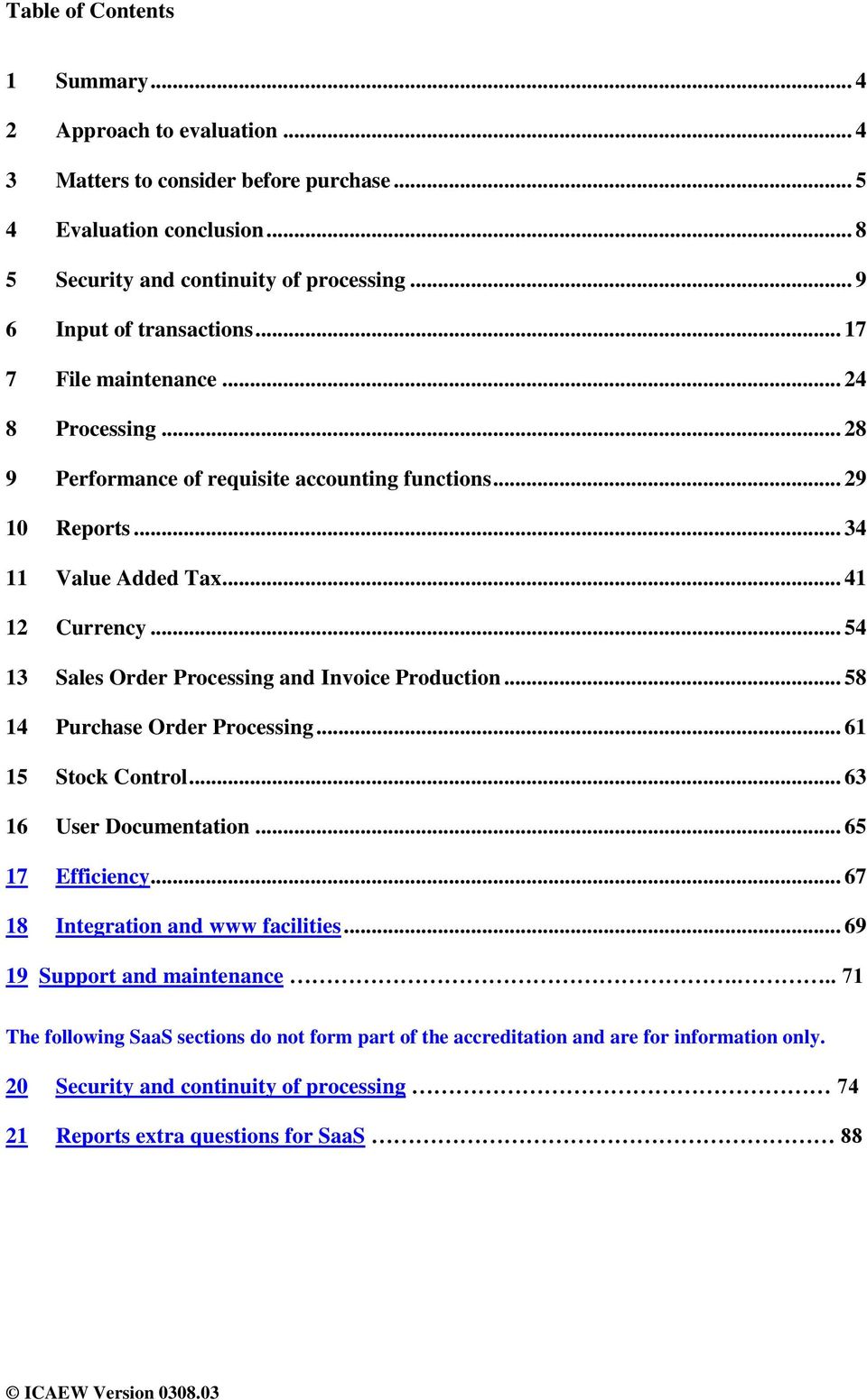
3 Table of Contents 1 Summary Approach to evaluation Matters to consider before purchase Evaluation conclusion Security and continuity of processing Input of transactions File maintenance Processing Performance of requisite accounting functions Reports Value Added Tax Currency Sales Order Processing and Invoice Production Purchase Order Processing Stock Control User Documentation Efficiency Integration and www facilities Support and maintenance The following SaaS sections do not form part of the accreditation and are for information only. 20 Security and continuity of processing Reports extra questions for SaaS 88 ICAEW Version
4 1 Summary 1.1 Introduction The suitability of accounting software for each particular user will always be dependent upon that user's individual requirements. These requirements should therefore always be fully considered before software is acquired. The quality of the software developers or suppliers should also be considered at the onset. 1.2 Fundamentally, good accounting software should: Be capable of supporting the accounting functions for which it was designed. Provide facilities to ensure the completeness, accuracy, confidentiality and continued integrity of these accounting functions. Be effectively supported and maintained. It is also desirable that good accounting software should: Be easy to learn, understand and operate. Make best practical use of available resources. Accommodate limited changes to reflect specific user requirements. It is essential, when software is implemented, for appropriate support and training to be available. 2 Approach to evaluation 2.1 Objective To evaluate Clear Books version on 19/02/2013 against a set of criteria developed by the ICAEW to ensure that the software meets the requirements of Good Accounting Software, as laid down in the summary. 2.2 Approach and work performed In order to effectively evaluate Clear Books version on 19/02/2013, a product specialist from Clear Books Limited completed the detailed questionnaire and provided it to the evaluator to examine. The evaluator then visited the Clear Books Limited s office in West Kensington and in conjunction with the operation of the various aspects of the software assisted by a member of Clear Books Limited s technical staff checked the answers to confirm their validity. The questions were individually reviewed and commented on and the majority of assessments were confirmed. The evaluator discussed the assessments with a member of Clear Books Limited s staff in order to clarify certain points. In the event of disagreement between Clear Books Limited and the evaluator, the evaluator's decision was taken as final and the response changed accordingly. 4

5 Clear Books version on 19/02/2013, was used throughout the evaluation. (Clear Books make small incremental changes in the code to the live server several times a week after being trialled by beta testers before being released to customers, so conventional version numbering is not used). The evaluation covered the fully integrated sales, purchase and general ledgers and where appropriate sales invoicing, purchase order processing and stock software, separate reports have not been prepared for each ledger. Instead a composite report has been prepared with references made to the appropriate ledger as necessary. When the evaluation had been completed, the responses were completed by the evaluator and a draft copy sent to the ICAEW for review before completion of the final report. 2.3 Software/hardware utilised Zoostorm computer with Intel core TM i GHz, 6Gb RAM, 459Gb disk running Google Chrome browser version m. Version on 19/02/2013 of Clear Books was used throughout. Our review was undertaken only using a PC workstation as specified above. The software is claimed to run on any computer capable of running a browser although we have not verified this, see below for further information. 2.4 Report structure The report has been broken down into its main constituents in the contents page. The evaluation questionnaire was provided by the ICAEW and has been used without alteration or amendment. 2.5 Online accounting software This evaluation covers the accounting system but not the method by which it is delivered. Potential users need to satisfy themselves on the security and disaster recovery aspects and licensing of the online system and any data protection issues of their own and customer/supplier information, contained therein, being held on the system. 3 Matters to consider before purchase 3.1 General overview Clear Books Limited offers a suite of accounting and other small business software delivered via the internet, and on mobile devices. The company s philosophy is Online software to free your time. As an agile, young company the philosophy is to be engaged in a close dialogue with small business and accounting partner users. Development work is continuous with a focus on improving ease of use, and providing additional business services. 5

6 3.2 Supplier background Clear Books Limited was formed in 2008 as a collaboration between Tim Fouracre ACA, a Chartered Accountant with a background in technology, and Fubra Limited, an established technology firm, which runs several successful websites and offers web hosting facilities. The company has subsequently attracted further investment from third parties. 3.3 Product background and suitability for user Clear Books Limited offers a range of business products aimed at providing small and medium sized businesses with a scalable, cloud based solution to many back office business needs. Clear Books is not suitable for customers requiring inventory control or full order processing. This evaluation only applies to the accounting product and covers sales, purchase and general ledgers, invoicing, purchase order production and stock list with quantity in stock maintained. 3.4 Typical implementation The software is designed for use by a wide variety of small and medium sized businesses. A typical business user is looking for collaboration between a range of physically remote stakeholders such as book-keepers, directors, investors, accountants, sales people and administrators. 3.5 Vertical applications The software is not intended for any one industry. However there are some industry specific features such as timesheets and Construction Industry Scheme reporting (not included in this evaluation). Recurring invoices are popular with IT contractors. It also includes fixed assets and there are additional modules for Payroll and Human Resources (not included in this evaluation). 3.6 Software and hardware specifications Development environment The software is developed using collaborative environments such as GitHub. The software is written mainly in PHP. Clear Books state that they also hold focus groups with accountants and small business users to plan and prioritise development work. (See ) Code in production is organised in branches. The master branch is always in a release ready state. Every time a branch is pushed to the live servers Clear Books continuous integrations server runs unit tests and deploys the updates to their staging server so that quality assurance can be performed. Development 6
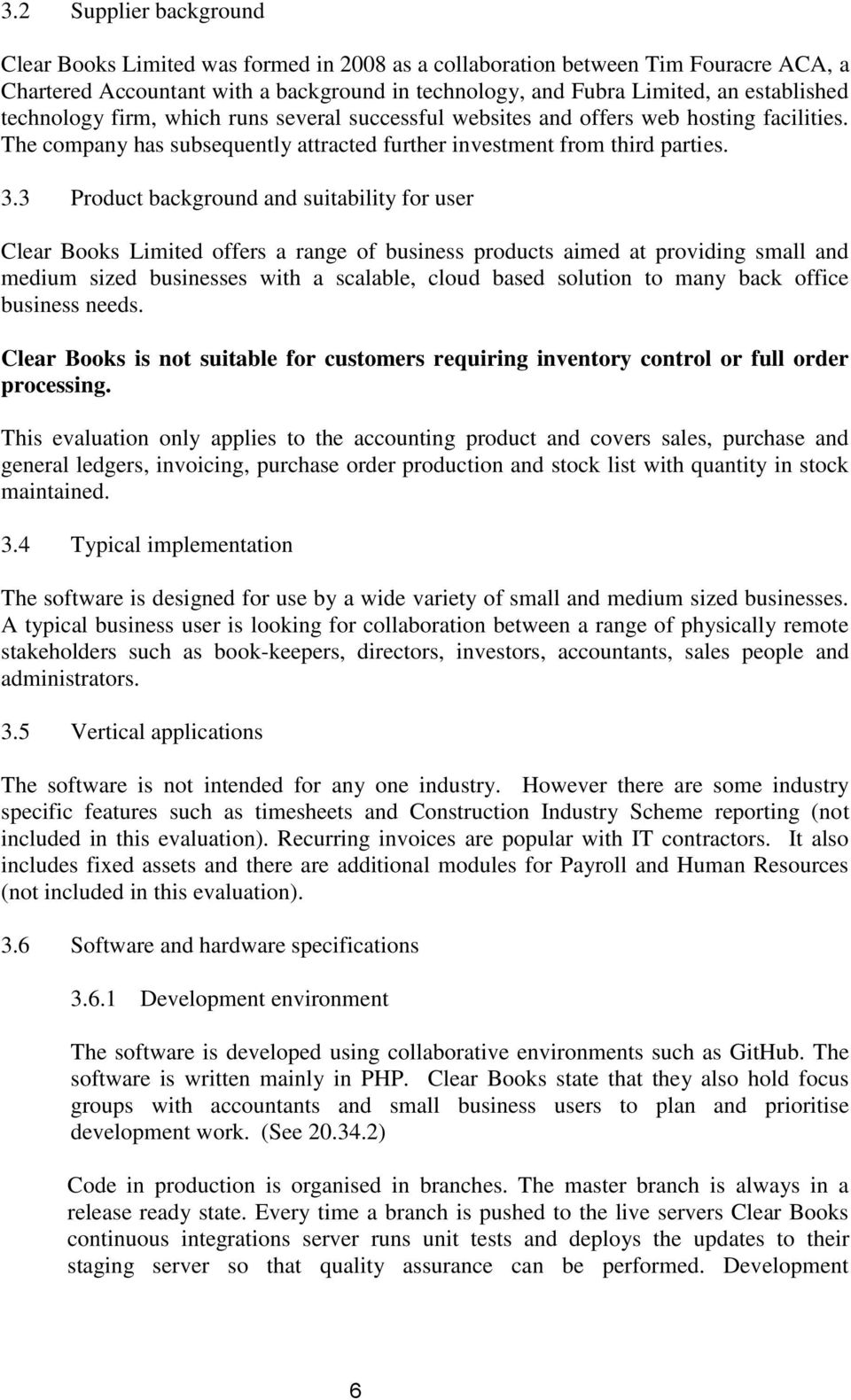
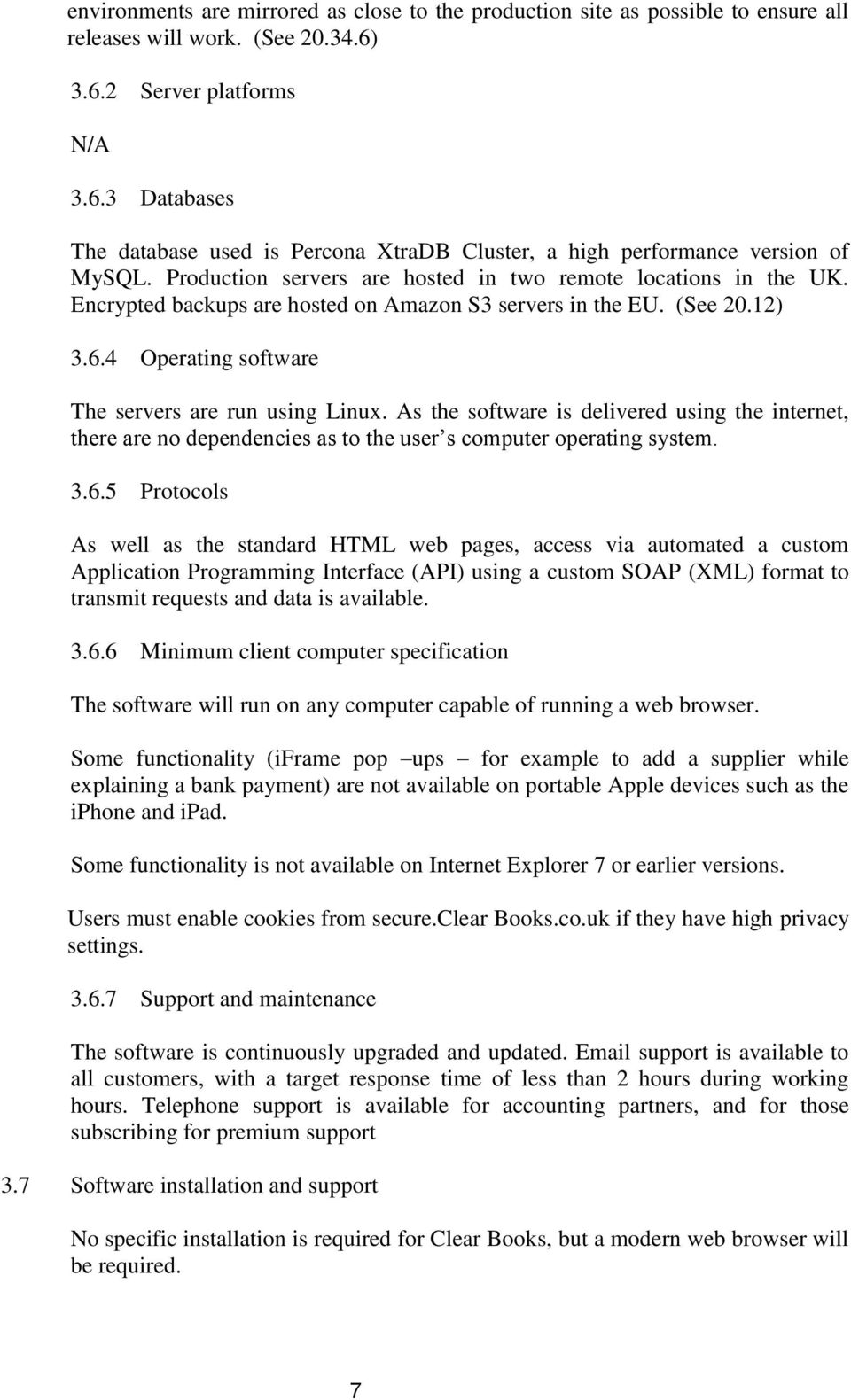
7 environments are mirrored as close to the production site as possible to ensure all releases will work. (See ) Server platforms N/A Databases The database used is Percona XtraDB Cluster, a high performance version of MySQL. Production servers are hosted in two remote locations in the UK. Encrypted backups are hosted on Amazon S3 servers in the EU. (See 20.12) Operating software The servers are run using Linux. As the software is delivered using the internet, there are no dependencies as to the user s computer operating system Protocols As well as the standard HTML web pages, access via automated a custom Application Programming Interface (API) using a custom SOAP (XML) format to transmit requests and data is available Minimum client computer specification The software will run on any computer capable of running a web browser. Some functionality (iframe pop ups for example to add a supplier while explaining a bank payment) are not available on portable Apple devices such as the iphone and ipad. Some functionality is not available on Internet Explorer 7 or earlier versions. Users must enable cookies from secure.clear Books.co.uk if they have high privacy settings Support and maintenance The software is continuously upgraded and updated. support is available to all customers, with a target response time of less than 2 hours during working hours. Telephone support is available for accounting partners, and for those subscribing for premium support 3.7 Software installation and support specific installation is required for Clear Books, but a modern web browser will be required. 7
8 3.8 Partner network and related accreditation process Clear Books Ltd have an extensive network of over 100 affiliated accounting partners throughout the UK. An accredited partner scheme is offered subject to satisfactory conclusion of a training course followed by a written test. 3.9 Limitations menu tailoring except for Dashboard facility to force password changes archiving audit trail of master file or standing data changes recorded control over prices, discounts and VAT rates which can be overridden at invoice production Only discounts supported are overall invoice and settlement controls over accepting conditional discounts credit limit features group consolidation Limited G/L analysis and variances Budgets in G/L only report writer fixed report formats Intrastat processing VAT tolerances calculated VAT can be overridden Single currency G/L except for bank accounts revaluations sales orders only quotations and invoices purchase order processing except for order generation stock control but system maintains quantity in stock integration to web trading software 4 Evaluation conclusion Given its target market, Clear Books is a well designed, Internet based, accounting system that has been competently written and is supported by Clear Books Ltd and through a network of authorised suppliers. The system ledger design incorporating Sales, Purchase, and General Ledgers together with Stock list and quantity in stock provides accuracy and a facility to produce audit trails and a limited number of standard reports. These cannot be amended by the user, but data can be copied to spreadsheets for reporting purposes. The system makes good use of the Internet by providing facilities for ing documents to customers and suppliers and for linking to online banking. Disclaimer Any organisation considering the purchase of Clear Books should consider their requirements in the light of proposals from Clear Books Limited or its dealers and potential suppliers of other similarly specified products. Whilst the contents of this document are presented in good faith, ICAEW cannot accept liability for actions taken as a result of comments made herein. 8

9 5 Security and continuity of processing 5.1 What security features are included to control access to the application? 5.2 Can access to application functions be managed so users can only see (in menus and other links) and access those functions they are authorised to access? 5.3 Is this access to the application managed by: Individual user profiles? User groups based on their job roles? 5.4 If menus can be tailored would this override the application access control? 5.5 Passwords Is access to the software controlled by password? Please state the basis of control available (e.g., role based etc). Password and user address authentication (most users are handled by group company application Fubra Passport. Users signing up on or after are on Clear Books own log-in system. All users will shortly be transferred to a bespoke system.) Passwords are not stored on our database only an encrypted hash. 56 different areas to which access for each individual user can be permitted or denied. Access can be controlled at a user level. User levels can also be assigned by creating Roles, although this can overridden for settings for specific individuals. menu tailoring except for the Dashboard. Individuals inherit access rights from role based log ins, but these can be overridden for individual users. 9

10 5.5.3 If there is no password facility please state how confidentiality and accessibility control can be maintained within the software? Are single user systems access controlled by password? Does the software allow for each user to have separate log on (user ids)? If : How does the software track user activity? Is each user required to have a personal password? Are passwords one-way encrypted? [i.e. Is it impossible for anyone to see other user s passwords in the software?] Are passwords masked when entered by any user logging in? Is password complexity available at application level? If : Please specify [e.g. Number of digits, requirement for special characters, numeric, upper/lower case etc.] Is there a facility to enforce password changes after a chosen period of time? N/A N/A Fubra passport minimum length 5 characters. Clear Books own log in minimum length 8 characters. Both have a password strength meter. Clear Books feel this is counterproductive because it forces users to write down passwords insecurely. 10
![] 5.5.8 Are passwords masked when entered by any user logging in? 5.5.9 Is password complexity available at application level? If :- 5.5.9.1 Please specify [e.g. Number of digits, requirement for special characters, numeric, upper/lower case etc.](/docs-images/43/3395926/images/page_10.jpg "] 5.5.10 Is there a facility to enforce password changes after a chosen period of time? N/A N/A Fubra passport minimum length 5 characters. Clear Books own log in minimum length 8 characters.")
11 Is there a facility to specify a minimum age for passwords (e.g. 1 day)? How many previous passwords are retained by the system to limit users recycling passwords (e.g. 24 or 32)? ne 5.6 Please state how security allows for access to be specified separately for : Read? Access can be restricted to read only areas (for example, reports) Read and write? Delete and amend? However there are no specific facilities for preventing writing, deletions and amendments. 5.7 Are any data files, such as budgets or price updates, imported by users validated by the application software before main data files are updated? 5.8 Does the software require higher or specific levels of user access for changes to sensitive data, such as customer credit limits? Imports of accounts, transactions and bank statement (not budgets) are validated by the software. This can be set up, and is the default behaviour for certain activities such as authorising expense claims. credit limits. 5.9 Please specify the specific security procedures (by passwords or warnings) over the: Update of ledgers By user access level Closing of accounting periods Accounting periods are never formally and permanently closed. They can however be locked or unlocked to new transactions subject to user access level Deletion of transactions Warning screen asking for confirmation. 11

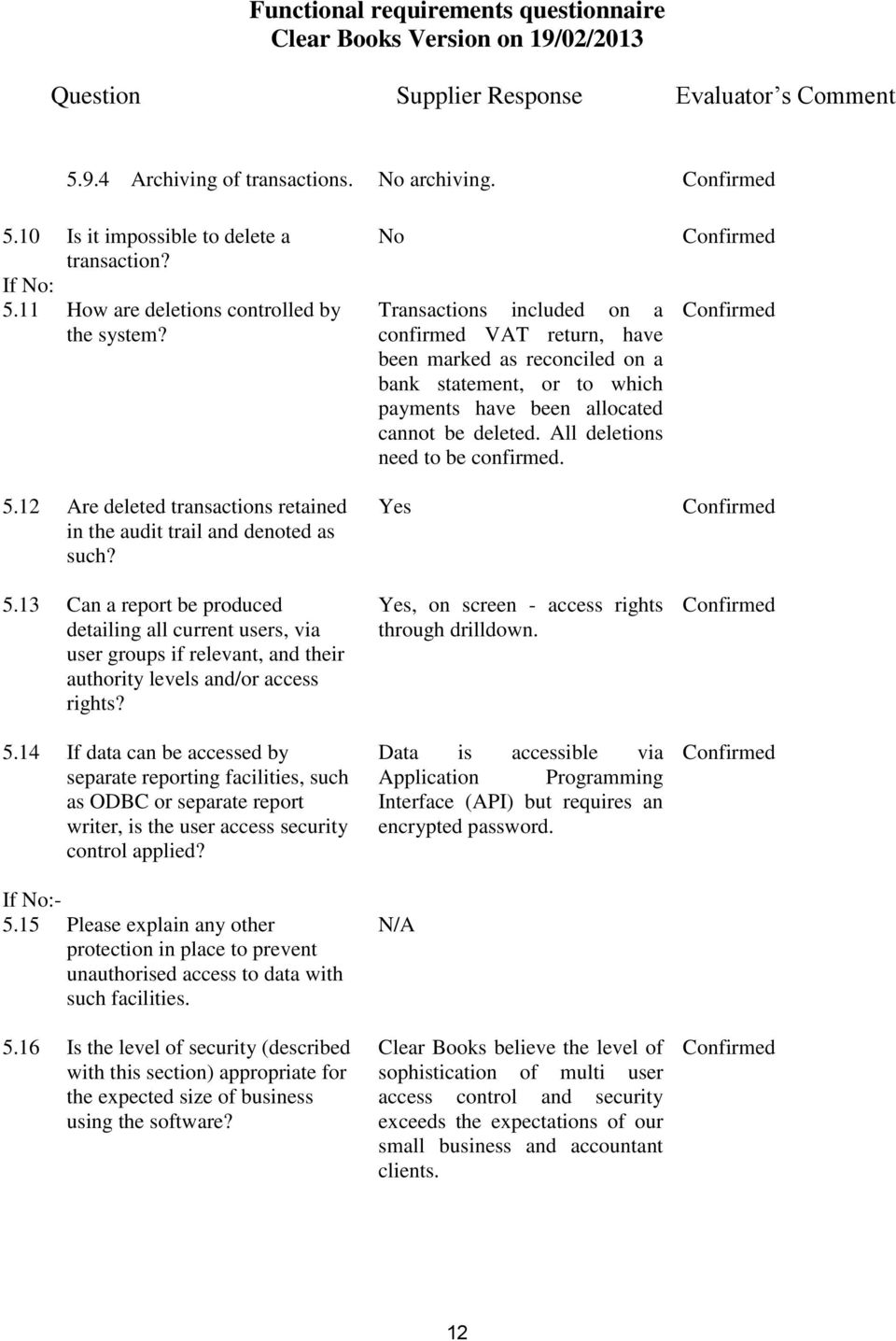
12 5.9.4 Archiving of transactions. archiving Is it impossible to delete a transaction? If : 5.11 How are deletions controlled by the system? 5.12 Are deleted transactions retained in the audit trail and denoted as such? 5.13 Can a report be produced detailing all current users, via user groups if relevant, and their authority levels and/or access rights? 5.14 If data can be accessed by separate reporting facilities, such as ODBC or separate report writer, is the user access security control applied? If : Please explain any other protection in place to prevent unauthorised access to data with such facilities Is the level of security (described with this section) appropriate for the expected size of business using the software? Transactions included on a confirmed VAT return, have been marked as reconciled on a bank statement, or to which payments have been allocated cannot be deleted. All deletions need to be confirmed., on screen - access rights through drilldown. Data is accessible via Application Programming Interface (API) but requires an encrypted password. N/A Clear Books believe the level of sophistication of multi user access control and security exceeds the expectations of our small business and accountant clients. 12
13 5.17 Is there a clear indication in the software or manuals as to how the data is: Backed-up? Recovered? 5.18 Back ups How are back ups provided: Within the software application? Within the operating software? Are backup procedures automatic? Is the user forced or prompted to back-up at certain intervals?. Backups are taken automatically every evening by Clear Books and stored on Amazon Irish (EU) servers. Data on S3 is securely encrypted., on request. In addition restore points with encrypted backups can be requested hourly and ed to users, these backups can be restored by a user., see plus optional request Can the intervals be customised? Restore points can be created within an hour of being requested Recovery Please state how the software facilitates recovery procedures in the event of software failure? (E.g. roll back to the last completed transaction). In the unlikely event of failure, the database can be restored to the most recent version. Clear Books will then attempt to recreate failed transactional entries, isolating the failing transaction. 13

14 If software failure occurs part way through a batch or transaction, will the operator have to re-input the batch or only the transaction being input at the time of the failure? All transactions from the point of failure onwards will need to be reinput Are these automated? Do the recovery procedures work? 5.20 What features are available within the software to help track down processing problems? Trial balance can detect unbalanced transactions. There is a VAT exception reports Are software messages clear? 5.22 Are user responses properly structured to ensure that erroneous key strikes do not lead to inappropriate actions? the user interface is designed to allow checking for example a calculated invoice grand total is derived from invoice line totals and can be compared to the original. All transactions must be confirmed before entry I s there a software log which details: Error messages? (application errors, not validation errors) Security violations? All access to the system is logged but these logs are only available to the Clear Books Audit trail Does the software have a detailed audit trail? Is it impossible to turn off or delete the audit trail? 14

15 Are all master file changes recorded in the audit trail? If : Does each change have a system generated reference allocated? Are the originator and authoriser identified? Is the change date and time stamped? Are all standing data changes recorded in the audit trail? If : Does each change have a system generated reference allocated? Are the originator and authoriser identified? Is the change date and time stamped? Is all input data included within the audit trail, including amendments, deletions, journals etc? Does the software allocate a system generated unique reference number to each transaction? N/A N/A N/A N/A N/A N/A 15

16 Is this stamped with a user id? Is this unique reference number presented to the user at time of input? Is the transaction date and time stamped? Are all imported /interfaced transactions allocated a software generated reference number? How are transactions differentiated within the audit trail? 5.25 What are the procedures for handling dates? (E.g. 2 digit years, 4 digit years) In the case of two digits what is the break point for the century? Are dates handled consistently throughout the software?, but the user can review the transaction number, but most prominent is another number which is unique for the particular class of transactions (sales invoices, purchase invoices, etc.) Drilling down on any transaction in the general ledger (audit trail report) will link to the underlying transaction, thereby clarifying what type of transaction it is. Dates can be input in any format. They are stored using a 4-digit year. Any 2 digit years entered are assumed to be in the century 20xx. 16

17 6 Input of transactions The following sections in Input of transactions, File maintenance, Processing and Reports are primarily aimed at the three main accounting ledgers and where applicable Sales Order Processing, Sales Invoicing, Purchase Order Processing and Stock Control. 6.1 Is data input controlled by selfexplanatory menu options? 6.2 Are these menus applicationspecific? 6.3 Does the software provide input validation checks such as account code validation, reasonableness (limits, VAT or discount checking) and validity checks (VAT check-digit calculations)? 6.4 Can the user amend data on an input screen prior to update? Account code validation, VAT calculated automatically (can be manually overridden if manual rate chosen). reasonableness or discount checking. 6.5 What control features are within the software to ensure completeness and accuracy of data input? Automatic double entry and certain fields essential. The major control is the use of bank import tools, including automated bank import tools, to ensure all bank transactions are accounted for. From this accuracy should flow to debtors and creditors. Sales invoices are issued sequentially which helps control completeness of data. Bank, Customer, supplier and VAT balances and profitability reports are displayed prominently on the dashboard page deviations from common sense expectations can be investigated to uncover inaccuracies or omissions from data. 17
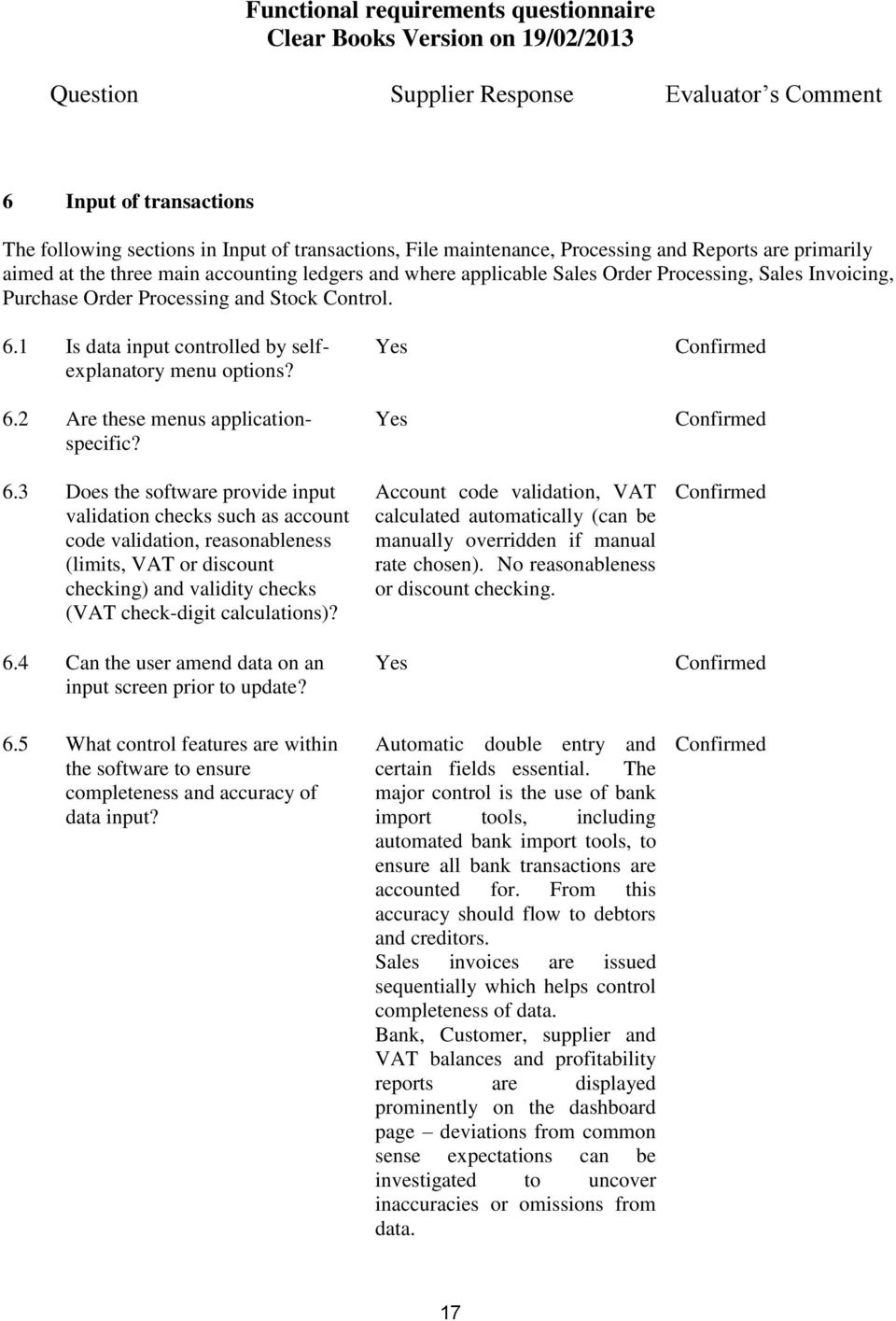
18 6.6 Are all input transactions subject to this control? 6.7 How does the software ensure uniqueness of the input transactions? (i.e. to avoid duplicate transactions) 6.8 Does the software allow for batch control totals? If : Are batches automatically numbered? Are batches forced to balance before ledger update? Does the software allow the temporary halting of input of a batch to allow for queries or other activities to take priority (e.g. set up a new account) Is the user forced to confirm batch totals? 6.9 Is attempted posting of unbalanced journals rejected? (G/L). Check on imported transactions to ensure no duplication of transactions. The number of transactions imported is displayed for every type of import. For bank imports, the cumulative total and the date range affected are displayed. Only for bank imports For journal imports debits must equal credits. Bank imports are run in two stages import and explanation (this involves transaction allocation and can create missing invoices). Accounts can be added during the explanation process. Other imports are reviewed on screen before being confirmed so changes could be made in another browser tab during this phase Are input errors highlighted? 18

19 6.11 If are they: Rejected and reported on screen? Rejected and error reports generated? Accepted and posted to suspense? 6.12 Does the software have an automatic facility to correct/reverse/delete transactions? If : Are all the double entry transactions documented in the audit trail? 6.13 What are the controls to ensure the internal integrity of the ledger(s) or the accounting information, e.g., control of accounts Is it possible to allocate input values directly to ledger control accounts? If : Please note the mechanisms available to allow the user to establish why the total balances on individual accounts do not agree to a respective control account? 6.15 Can automatic accruals or prepayments be generated?, but not automatically.. Edited transactions are marked as deleted and superseded. Clear Books use a tool which tracks when the trade debtors report total deviates from the balance sheet trade debtors, allowing problems to be tracked. Also, report on transactions not included in vat return; trial balance report itself reports on unbalanced transaction. G/L journals can be posted directly to the trade debtors / creditors accounts a breakdown of these journals can be obtained from the aged debtors report. A recurring journals feature allows accruals or prepayments to be made. 19

20 6.16 Will these automatically be reversed after the period end? (G/L) 6.17 Does the software have a purchase invoice register? 6.18 Does the software permit multi debit/credit journals? 6.19 How are transactions identified on screen/reports as to: Type? Debit or credit? 6.20 Can separate nominal analysis codes be input for each invoice line? If : Does this cover: Sales ledger? Purchase ledger? Stock? 6.22 Can receipts and payments be matched to specific invoices? If :- Is this Automatic or manual? 6.23 Will the software permit part payments? If the recurring journal has been set up with the correct amount and number of occurrences, reversal is automatic. There is no specific reversing journal feature For S/L and P/L. For G/L. On the transactions report credits are positive numbers, debits negative. Additionally, two separate columns are used one for debits and one for credits. Manual (apart from refund transactions) 20
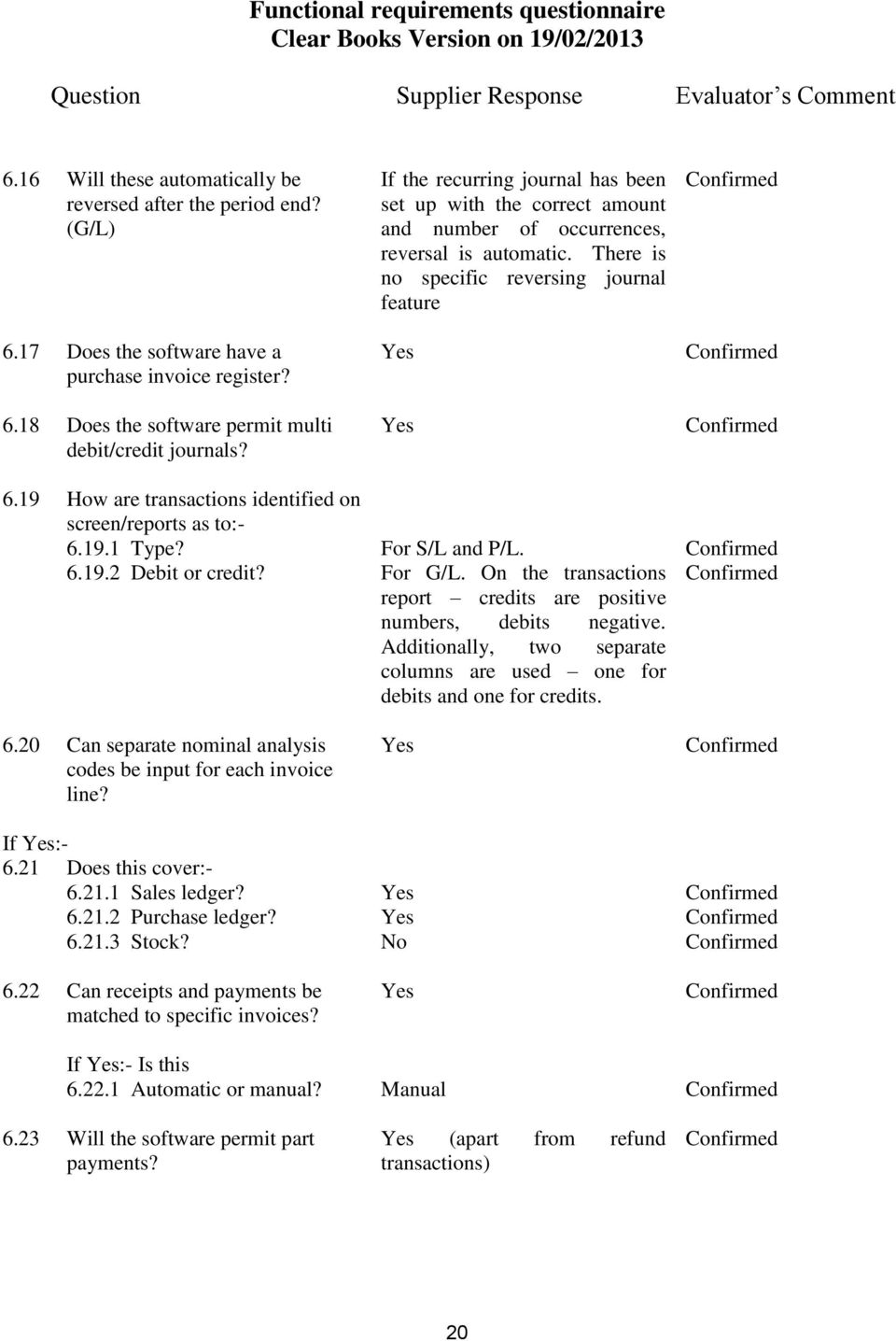
21 6.24 Will the software allow: Payments to be made to customers? Receipts to be received from suppliers? 6.25 Does the software handle purchase credit notes? there is a refund tab on the bank import tool see above Is there an ability to automatically amend stock if applicable? 6.27 Can the software generate sales credit notes? 6.28 Does the software handle discounts and promotions? 6.29 Does the software provide for early settlement discounts? 6.30 Can early settlement discounts be automatically generated? 6.31 Are there controls over accepting settlement discounts (e.g. time limits)? 6.32 Is VAT treated correctly on early settlement discounts? N/A overall invoice discount only. calculated on the discounted net price Will the software permit the posting of unallocated cash to the ledgers? Does this apply to: Sales ledger? All cash needs to be allocated to a supplier account, but need not be allocated to a particular invoice Purchase ledger? 6.34 Are unallocated cash/credit notes specifically reported for follow up? there is a specific report for unallocated cash, credit notes can be seen on account transaction lists. 21
22 6.35 Are outstanding transactions displayed for allocation? If does this apply to: Sales ledger? Purchase ledger? 6.36 Is it possible for new accounts to be created during input? 6.37 Does this cover the following ledgers: Sales? Purchases? General? Stock? 6.38 What controls are there over the creation of new accounts? 6.39 Is the originator and/or authoriser identification logged by the software? 6.40 Is the user prevented or warned from overriding credit limits or discounts? (S/L) Does the software have a bank reconciliation facility? By user access controls. This will also block users from creating accounts when explaining a bank transaction or creating an invoice. Explaining a bank transaction is the process either of allocating a bank transaction against an existing invoice, or creating a new invoice and allocating against it simultaneously. There is no credit limit feature. 22
23 6.42 Does the software enable transactions to be posted to the ledgers whilst performing a bank reconciliation (e.g. standing charges, bank charges etc)? All bank transactions need to be allocated to a customer or supplier account, but can also be coded directly to profit and loss or balance sheet accounts other than aged debtors/ creditors Are these adequately reported? Invoices generated and paid off directly by bank transactions look very similar to those generated 6.44 Does the software accept input files from other computer packages? If : What formats are accepted? What controls are in place over the interface? 6.45 Does the software have a facility for calculating interest on late payments?. A wide variety of files are accepted for bank imports. CSV files are accepted for other types of import. The number of transactions imported are displayed together with the date ranges covered. While explaining (see 6.38) the transactions, an onscreen balance is displayed which can be compared to a bank statement to ensure completeness and accuracy. Any errors (e.g. invalid dates) are flagged up at the time of import. All imported transactions are subject to on screen review before being confirmed as accepted into the system. 23
24 7 File maintenance 7.1 Are ledgers: Open item? Balance forward? 7.2 Does the above cover: Sales ledger? Purchase ledger? General ledger? 7.3 Is a month end routine required to be undertaken? 7.4 Is the creation or amendment of standing data (e.g. customer account details) controlled by menu options? 7.5 Are menus: Application specific? User specific? 7.6 Is it impossible to delete accounts if the balance if Nil but transactions have been recorded against the code. Does this apply to: General Ledger? Sales Ledger? Purchase Ledger? Stock? 7.7 Are there any other constraints over the deletion of accounts? 7.8 What is the size and format of reference numbers and descriptions within:-.. These details can also be entered when explaining (see 6.38) a bank receipt or creating a sales invoice (for example)., but options restricted by access control are not shown. Any account to which transactions deleted or current pertain cannot be deleted 24
25 7.8.1 General Ledger? Sales Ledger? Purchase Ledger? Reference numbers sequential numbers. Codes are 7 digits long. The first digit references an account group (such as admin costs). The next 3 digits reference an account heading (such as premises costs). The last three digits identify the code within the heading. Custom account codes which don t reference groups and headings can be used (alphanumeric, up to 256 characters) General ledger entities are uniquely identified by a transaction number Account names are up to 256 characters. Sales ledger entries are given a three letter prefix, followed by a number. The following prefixes are in use: INV Sales invoice (can be customised) SCN Sales credit note SBD Sales bad debt SFX Sales FX write off SRF Sales refund Customers and suppliers are internally identified by a unique entity ID number. For the user they are identified by their name. Account names are up to 256 characters. The following prefixes followed by a number PUR Purchase invoice (can be customised) PCN Purchase credit note PBD Purchase bad debt 25
26 7.8.4 Stock? 7.9 Is the scope of the reference number adequate to permit sufficient depth of analysis? 7.10 How does the software guard against/warn about, duplicate account numbers on set up? 7.11 How does the software enable the traceability - from, to and through the accounting records - of any source document or interfaced transaction? 7.12 What drill down/around functionality is available within the software? 7.13 Can reports be invoked which identify all the fields which have been modified? PFX Purchase FX write off PRF Purchase refund Identified by an alphanumeric name up to 256 characters long. G/L analysis by group and code. S/L & P/L by project field. The software does not permit duplicate G/L account numbers to be set up nor duplicate named supplier and customer accounts, an on screen warning is displayed. A unique invoice number is the primary means of tracing from and to underlying written records. A search facility allows recall of a particular purchase or sales invoice. Filtering and sorting of invoices and bank transactions is also supported. Electronic copies of invoices can be attached to the transaction record. Balance sheet and profit and loss reports link to transactional breakdowns from the general ledger, which link to associated purchase, sales ledger, and cashflow items. It is also possible to drill down from a purchase or sales invoice or cashflow ledger item to the associated general ledger transaction. When an invoice is edited, a voided copy of the original is retained, and can be viewed using the voided invoices 26
27 report. changes to accounts or standing data recorded If the software uses a lot of standing information which changes frequently or regularly, does the software allow for such changes to be effected through the use of parameters or tables? If : Is the use of such parameters or tables adequately reported? 7.15 What controls are within the software over changes to parameters and tables e.g. reporting, password etc? 7.16 Does the software allow selective archiving of old data on a userdefined basis? 7.17 What controls are in place over the handling of archived data? 7.18 Can archived data be used for reporting purposes? 7.19 Does the software allow for the restoration of achieved data for audit without affecting current accounting data? Only the current settings are displayed, apart from VAT schemes used, in which case a history is displayed, on screen. Access to this area can be restricted by user access controls. By default the employee role restricts access to this area. archiving but data can be backed up, or saved as a restore point. Reverting to backed up data is possible although any transactions created after the creation of the backup or restored point will be lost. ed backups are encrypted. Access to the restore point and backup area can be restricted by user access controls. Backups can be restored as the live version., restored backups overwrite current data. 27
28 8 Processing 8.1 Does the software ensure that menu options or programs are executed in the correct sequence (e.g. ensure outstanding transactions are processed before month end procedures run)? 8.2 After an external document (e.g. sales invoice or cheque payment) has been generated and posted to the accounts is it impossible to amend this data? 8.3 Is there an audit trail of all changes to transactions which have updated the ledgers? 8.4 Can the software calculate prices or values by reference to master file data? 8.5 Does the software provide automatic recalculation, where appropriate, of data input? (e.g. VAT) 8.6 Does the software warn the user when the ledger is out of balance? The system does not have any such processes which are contingent upon other processes being run. The only document this kind of locking applies to are VAT returns submitted to HMRC. All other type of documents can be amended.., but only a single sale price.. However, there are controls to prevent any transaction which is unbalanced from being posted. 8.7 How is this done e.g. when the software is switching on or on ledger update? By running a trial balance report. 28
29 9 Performance of requisite accounting functions 9.1 What control features are provided by the software to support effective user controls? 9.2 Is there: Transaction sequencing? Automatic dating of posting transactions? Identification of user id or source of document? 9.3 Is the software available as multi user? 9.4 Can the same function be used by more than one person at the same time, whilst still retaining the separate user identities? 9.5 Is the software available as multicompany? If :- How many companies are supported? 9.6 Is a group consolidation facility available? 9.7 Can the software consolidate entities with different charts of accounts? 9.8 How many levels of nominal analysis can be handled by the software? An admin type role is required to edit user controls. An account owner is required to open or close an entire database, and to arrange payments. The entire user area can be blocked from normal users. Unlimited licence payable for each company. N/A By group and code. Accounts codes are grouped by statement (e.g. balance sheet, profit and loss account), account group 29
30 (e.g. current assets) and account heading (e.g. administrative expenses). Custom account heading and codes can be used. 9.9 How does the software handle cost centres, departments, divisions? 9.10 How are periods handled by the software? 9.11 How many: Accounting periods can be set up? Years can be set up? 9.12 Can the length/ number of periods be adjusted to suit different user requirements? 9.13 How many accounting periods can be open at any one time? 9.14 How many years can be open at any one time? 9.15 Can a period or year be re-opened after it has been closed? If : What controls are in place over this function? t really but purchases, sales and journals can be coded to different projects. Profit and loss and cashflow reports for each project are available. formal period or year end procedures. Year end journals are not created at the end of a period. Instead, when reporting financial data, profit and loss codes from previous periods are automatically moved to retained earnings. Unlimited Unlimited, totally user definable. Unlimited Unlimited A period can be locked to prevent transactions being entered into a previous period. This ability can be restricted on a by-user basis. 30
31 If : Is the data archived on the server? Is this accessible for reporting purposes? Can a previous year be restored from backup? 9.16 Can data from all accounting periods and years be accessed at any one time? N/A N/A N/A 9.17 Can previous months and years be accessed for enquiries or reports? 9.18 Does the software handle posting date as well as document date? If : Are transactions analysed by posting date or document date? 9.19 Can transactions be posted to more than one accounting period at any point in time? 9.20 Does this cover: General ledger? Sales ledger? Purchase ledger? 9.21 Is it possible to allocate transactions to: Future periods? Previous closed periods? A previously closed year? If : What controls are in place e.g. level of authorisation and on screen warnings? General ledger (audit trail) report by posting date. All other reports by document date., provided the periods are unlocked., unless locked. Only when unlocked. Only when unlocked. An on screen error message explaining the transaction cannot be posted because it is in a locked financial period/year, 31
32 with a link to unlock it (to users who have access to unlock previous financial reporting periods) Will the software revise subsequent periods accordingly? 9.22 How will transactions outside the current period be: Reported Accounted for in the VAT return? 9.23 Does the software permit use of budgets and provide comparisons between budgets and actuals? If : How many versions of budgets/forecasts can be maintained on the system? 9.24 Are budgets available for: General ledger? Sales ledger? Purchase ledger? Overheads? Balance sheet? 9.25 Can budgets be set by: Period? Annually? It will be incremented to the balance sheet, and the profit and loss account in that period, and retained earnings in subsequent periods Default option to include late transactions in return but can be turned off. in G/L only. Unlimited 32
33 9.26 Can the software automatically generate budgets? If :- Please state how this is achieved. Enter data for first period then a percentage or fixed amount change can be automatically applied to all future months in a budget What is the maximum value of transactions and of totals that can be handled by the software? 999,999,999,999, What is the maximum number of transactions that can be handled by the software? 9.29 What is the maximum number of accounts on each ledger: Sales ledger Purchase ledger? General ledger? 16,777,215 (8,388,607 pairs of debits and credits) 16,777,215 16,777,215 16,777,215 33
34 10 Reports 10.1 Are all reports adequately titled and dated? (E.g. report name, client name, data, period, batch, last entry number, period end, pages, numbers etc.) 10.2 Do the reports provide totals where applicable? 10.3 Are these totals calculated or taken from a control file? Please state the reports that do not feature calculated totals Is it clear when the report has ended? (totals or end markers) 10.5 Can reports be saved in electronic format (as distinct from just printing)? 10.6 Are such files adequately protected from deletion or amendment? 10.7 Is a report writer provided as part of the software or as an add on? Please state the name of any third party package What level of knowledge is required to use the report writer e.g. beginner, regular user, expert? Report name, company name and logo, time period covered by report, creation date and page numbering. Calculated Lists and Audit trail report. - totals and page numbers X of Y., some (PDF format) but must be saved using an operating system (not in Clear Books itself). PDF is password protected from amendment. Protection can be achieved by certain operating systems, but is not a facility offered by Clear Books. custom report writer is provided, although data can be exported to a spreadsheet format for subsequent analysis. N/A N/A 34
35 10.9 Can the report writer make use of user-defined fields (including external fields)? Does the report writer enable: Separate access to each system area? Reports to be prepared which combines related data from a number of system areas (e.g. Customers Sales Stock items) in the same report? Can users define the parameters, columns, fields and selection criteria used on reports reported? Are standard reports always produced, even when they are nil returns? Is there an option for reports to exclude nil balances, this year or where there are nil balances this year and last year, to enable a comparative report to be produced with the completeness of both years being maintained? Clear Books has no user defined fields. N/A N/A N/A blank report, headings only., they are automatically excluded Can screen layouts, reports and transaction formats be easily adapted to users requirements? Can a hard copy be produced of all screen enquiries? Generally no, but some on screen lists can be sorted by different column headings. Aged transaction reports can be displayed analysed by customer or by invoice. Date ranges can be changed., from within browser. 35
36 10.16 Can transaction files for all previous periods of the year be retained in the software to permit enquiries and reports? Are reports of all changes to standing data on customers, suppliers, tax rates etc automatically generated or stored for later printing? If : Is the report able to capture the nature of the change, user id and data and time of the change? Are all transactions on all reports individually identifiable? Do the reports show whether items are debit or credit? Do reports give sufficient narrative and coding to enable cross referencing? Is it possible to drill down from reports to the ledgers and original transactions? Can the software produce all requisite reports: Day books Trial balance Profit and loss account Balance sheet Aged debtors Aged creditors Aged stock Aged unallocated cash (debtors) Aged unallocated cash (creditors) N/A in G/L by type in S/L & P/L., when looking at transaction detail. 36
37 Budgets Cash flow statement VAT reports VAT form EC Sales Listings Intrastat returns (SSD) Are the above reports standard within the software or do they have to be written? Is the age criteria fixed or user definable? Can the aged analysis and day book reports be in summary and detail? Do standard reporting options give sufficient flexibility to tailor individual reports? (not a GAAP cashflow report shows cashflow per account code). Standard Fixed. Standard reports cannot be tailored with the exception of a date filter Can all reports be reproduced after the period end the month end date: Transaction listings? Day books? Trial balance? Is it possible to print out retrospective month end aged sales and purchase ledger reports that agree back to the month end trial balance control account figures as at the month end? Do the standard budget reports provide sufficient analysis of variances?, but only a % variance over selected periods. 37
38 10.30 Do such reports provide exception reporting, percentage analysis and comparatives? Do standard reports show sufficient analysis of trading results? (E.g. sales analysis by region)? Are all movements during each accounting period shown on sales, purchase, general, stock ledger detail reports? Do the sales and purchase ledger reports show how all partial payments or allocations (unallocated cash) have been treated? Is there a general ledger report that shows balances brought forward and carried forward plus all posted transactions in the period? Percentage analysis and comparatives are available from the management report. in profit & loss report, but only by project field. stock movements only quantity in stock is maintained., via drilldown to details Can the management accounts, profit and loss account and balance sheet be sufficiently analysed by: Project/job, profit & loss only Cost centres Department Division Company Group (if applicable) Can the above be user defined by Period and/or range? What controls are there in place so that the user is aware of partly processed transactions:- 38
39 Unposted invoices Uninvoiced dispatches Payments Receipts State the controls that are in place to ensure that the correct price/discount has been applied to invoices/credit notes? (e.g. Gross Margin reports) Detail all automatically generated documents for external use. (E.g. sales invoices and statements, remittance advices.) Can the software reproduce source documents? [E.g. sales invoices; POs, Remittance advices ] Are the duplicates an exact replica of the relevant financial and VAT accounting information as stored on original documents [i.e. they do not take account of any subsequent changes to the standing data? Are these clearly identified as duplicates? Does the software force the production of month-end reports? Can the reporting function make use of external data files? Does the report writer have the facility to scroll up and down when output to screen? Report of draft invoices N/A no stock control of this type implemented. Listing of unallocated payments Listing of unallocated receipts controls, a pre-set price is automatically prefilled into purchase and sales invoices but can be overridden. Sales invoices, customer and supplier statements, remittance s, purchase orders, payment reminder s, sales credit notes, sales quotes., but not s. Documents saved as PDF files can be reproduced. unless a PDF copy was taken at the time and saved by the user. This should be provided by any modern web browser. 39
40 10.45 Can all reports be run without the need for period-end procedures to be initiated? Does the report writer allow print previews of all reports? Can transactions and standing data be output directly to other formats e.g. CSV, txt, XML, PDF etc. for any period of time required? report writer but preview reports available on screen. - CSV and PDF 40
41 11 Value Added Tax The following sections detail the general requirements/features of an accounting package in handling VAT. It cannot cover all eventualities or all users and where necessary members should contact their local HMRC office for detailed guidance. The overall objective is to accurately record the accounting for VAT in order to support VAT returns to HMRC. Software features 11.1 Does the software have the facility to hold the following VAT information: UK VAT registration number? Intrastat code? EC Code? EC VAT registration numbers (10)? VAT rates (please specify number available) - unlimited 11.2 How does the software handle roundings? VAT is always calculated to a precision of 2 decimal places. A choice can be made as to whether to calculate VAT as the sum of the VAT on each line item, or on the invoice net total (by inserting an extra invoice line for the VAT rounding differences arising) Is this applied consistently? 11.4 Does the software handle VAT Scale charges with automatic double entry processing? 41
42 11.5 Does the software handle VAT calculation tolerances? If do any discrepancies produce: Warning? Appear in the audit trail Appear in the VAT exception report? 11.6 What security features (password/ audit trail) are in place to control changes made to: General ledger VAT control accounts? VAT tables set up and change? Tolerance levels? Invoice sales number table? Changes on VAT code on customer files? Changes on VAT code on stock files? although it can recalculate VAT and any differences to source supplier invoices can be noted and acted upon. If the VAT is not the expected multiple of the net a manual VAT rate would have to be selected to enable data entry. By access control and shown in audit trail. Journals to VAT control from a profit and loss account will appear in the VAT return; otherwise they will not appear in the VAT return. Access control. N/A Access to the start of the sequential numbering sequence by access control. Sales invoice numberings can be changed manually. Access control but can be overridden in invoice production. N/A 42
43 VAT calculated on sales invoices or credit notes? 11.7 Does the software store and report a VAT return identifier [VRI]? 11.8 How does the software ensure that that each eligible posting is reported only once in a VAT return? Method of operation If the VAT is not the expected multiple of the net a manual VAT rate would have to be selected to enable data entry. Each transaction has a VAT return identifier once this is not null, a transaction will not be included in a subsequent return VAT basis. Can the software handle: Invoice (standard) accounting? Cash accounting? If the software can handle both invoice (standard) and cash methods of accounting for VAT is the basis clearly identified during set up? Does the software allow for a switching between methods? If :- Is the change fully supported by audit trails to ensure proper VAT treatment of all transactions? retrospective or transactional changes arise when a VAT scheme is changed this only changes transactions posted after the change of scheme. 43
44 Is this ability to change a basis of accounting clearly flagged, i.e. users warned etc Does the software alert the user that they require HMRC authorisation if they attempt to apply, retrospectively, the Cash Accounting Scheme for VAT accounting? Does the software provide useful and relevant information on switching in the software help section? Users warned to contact Clear Books for assistance when changing from cash to invoice accounting as the requirement to account for all unpaid invoices is not automated Can the software handle the following VAT schemes: Annual accounting scheme? Flat rate scheme? Retail schemes?, if retail sales are entered correctly Account for VAT on the margin? Can the software be configured to handle partial exemption methods? Please state the number of VAT codes available for VAT analysis., only manually. Up to 9 customisable VAT rates (including out of scope Exclude from VAT return. 6 VAT treatments (Good / services from inside. outside EU, from UK, and Out of scope) 44
45 11.15 How does the software handle: Outside scope? Select treatment Outside scope and VAT rate Exclude from VAT return (software checks that both are consistent) Distance selling (supply to an unregistered EC customer)? How the software handle EC VAT:- Should be entered using treatment goods or services to UK customer Goods and related service? Reported on EC Sales list. VAT boxes 2 and 8 for purchases, 9 for sales Services only? Purchases only Process? Triangulation? Does the software include the functionality to identify EU acquisitions? If : Can the software generate acquisition tax? Can a report be generated of all EU acquisitions and the amounts of acquisition tax generated? Does the software include the functionality to identify transactions liable to reverse charge VAT? Included in the VAT report. select treatment services to the EU. 45
46 If : Can the software generate reverse charge VAT? Can a report be generated of all transactions liable to reverse charge VAT, and the amounts of tax where so generated? Does the software have a facility to reconcile the VAT returns amounts for input, output and net VAT payable/recoverable to the General ledger control account? How does the software handle late transactions posted outside the closed VAT return period? Input VAT (purchases) Can the software handle VAT inclusive amounts and automatically calculate the input VAT? Included in the VAT report. t directly. However, a VAT report can be pasted into a spreadsheet, and compared to an exported general ledger control or sales account. These appear in a VAT exceptions report. Default option to include late transactions in return but can be turned off Does the software require the following to be entered: Supplier reference? Supplier document reference? Internal document reference? Invoice tax point date? Invoice posting period date? system generated. Is taken to be the same as the above unless optional accrual date feature used. 46
47 Invoice gross total? t required - calculated Invoice VAT t required - calculated. amount? Individual invoice lines: net amount VAT rate (optional from VAT code, product supplier Does the software validate individual invoice line VAT amounts against the total invoice of VAT (less early settlement at discount) and accept or reject the amount subject to the software tolerance? Can the user override the software derived input VAT amount and input VAT as shown on the supplier invoice? Does the software allow VAT to be reclaimed on the basis of registered but unposted invoices? If : Does the software flag the status as: VAT not yet reclaimed? If the VAT is not the expected multiple of the net a manual VAT rate would have to be selected to enable data entry. N/A N/A VAT claimed? N/A 47
48 Output VAT (sales) Does the software generate sales invoices? If : For each invoice generated is the following information included on the sales invoice: Unique software generated invoice reference Your name, address, EC country code and VAT number? The time of supply (tax point) Date of issue (if different to the time of supply) Your customer s name (or trading name) and address, EC country code and VAT number (if applicable) The unit price [applies to countable goods or services. E.g. an hourly rate; or a price for standard services.] A description which identifies the goods or services supplied Does the software identify supplies that are zero-rated or exempt on an invoice and that there is no VAT payable? Taken to be the same unless accrual date option used., provided the information is stored. 48
49 If : Is this by way of a report? A sales ledger report can be saves and manipulated in a spreadsheet to extract all zero-rated transactions Does the software handle Proforma invoices? If : Are the invoices clearly identified as this is not a tax invoice? VAT Reporting Does the software produce a VAT 100 form as standard? If : Does the software have a means of producing reports that support the completion of the VAT return? Is the VAT return information available by report on a three monthly basis or any other specified period? Is there a detailed and summary analysis of all transactions included in each return sorted by VAT code and transaction type making up the total in each of the boxes on the VAT 100 Form? Can the VAT return be recreated showing all the transactions which were included in the original VAT return? Labelled quote proforma invoice or estimate but no explicit statement this is not a tax invoice Any specified period Listing of transactions, but not sorted by transaction type. 49
50 11.42 Does the software have a separate VAT audit log? te where the software details the following non routine event in the audit trail or VAT audit log etc: Changes to VAT tables. t recorded Change from Show in VAT scheme log. invoice/cash VAT accounting or other Schemes VAT tolerance. N/A Changes to VAT t recorded rates on customer, supplier, product master files Are the above changes noted above stamped with a: User id? N/A Software N/A generated unique reference number? Date and time? N/A VAT postings Are all VAT postings recorded in the audit trail or VAT audit log? Does the software denote whether each transaction has been included in a reconciled VAT return? How does it denote which VAT Return the transaction has been included in? in audit trail. An ID number linking to the VAT return table. 50
51 11.46 Does the software produce a VAT Exception report detailing such transactions as: VAT amounts outside tolerance levels? Manual changes to software generated VAT? Write offs Zero value invoices? Zero valued invoices cannot be produced on Clear Books. If for any of the above: How does the software document these occurrences? Does the software handle intra-community supply of goods? Does the software support production of an EC Sales List? If : Does the report show the country code, the customer name, their EC VAT number, the invoice reference and indicators for different types of despatches? Does the software produce invoice level reports that enable every value on each EC Sales List report to be traced to source documents? VAT amounts which are not the expected multiple are recorded as having a manual VAT rate. Write offs are recorded as credit notes., provided details are stored, apart from indicator of type of dispatch 51
52 11.52 Does the software have a means of ensuring that each eligible posting on the EC Sales List is reported only once? (Please state how this is done within the software) How does the software handle triangulation? E.g. a movement of goods without a related invoice transaction Does the software produce the relevant documents in a format [e.g. CSV or XML] that can be uploaded direct to the HMRC gateway? Can these be electronically transmitted direct from the system? Does the software produce Intrastat reports where applicable? How are errors on VAT accounts corrected? How does the software handle the VAT on purchase and sales ledger contras? by date and if the user locks a period after completing the EC sales list for that period it will be impossible to include these postings in future EC returns. provision for triangulation. Relevant transactions need to be voided and re-entered (copied) with correction made. Journals can also be used to create correcting entries. To achieve this, both need to be marked off as paid to a contra account, so whether on an invoice or on a cash basis, the relevant entries for both the sale and the purchase will be included in the VAT return. 52
53 11.59 How does the software handle partially allowable expenditure, e.g. VAT on petrol invoices where employees are provided with petrol (adjustment required for own use)? Can the software handle cheque refunds to customers? If : How is the VAT accounted for under cash accounting? Can the software handle invoices with multiple rates of VAT? How does the software handle write off of bad debts and the related VAT? This would have to be calculated manually, and a manual VAT rate used. There is no specific provision for this in Clear Books. Initially VAT is credited to a VAT cash control account. When an invoice is paid, the amount is moved by journal into a VAT control account. VAT is reclaimed in the period of the write off (invoice basis) or is never paid in the first place (cash basis). 53
54 12 Currency 12.1 Is multi-currency processing available? If : State number of currencies available Does this cover: General ledger Currently 172 pre-set Sales ledger Purchase ledger Stock - daily rates taken from XE.com or can be entered manually Is conversion to sterling automatic? If : Does this cover General ledger Sales ledger Purchase ledger Stock Can the user select which currency to value each of the ledgers? If : Does this cover: General ledger Sales ledger Purchase ledger Stock A base currency can be selected during the set up process. Once selected, the general ledger and all reports will be in this currency. General ledger accounts (other than bank accounts) can only be expressed in the base currency. Individual transactions can be in a foreign currency, but ledger totals are in the base currency. Individual transactions can be in a foreign currency, but ledger totals are in the base currency. Must be in base currency What are the currency capacities? Sales and purchase ledger transactions can be entered in a foreign currency, and are automatically translated to the base currency (though this can 54
55 be overridden). Bank transactions can be entered in a foreign currency What are the maximum and minimum exchange rates? What approach will the Software House take towards handling the EURO? limits are imposed The Euro is handled like any other currency it can be a base or foreign currency What currency information is held: Currency Code/description? Country? Currency rate table?, hidden from user but appropriate day rate picked up Date rates effective fromto? rates automatically set daily Previous rates held?, hidden from user but appropriate day rate picked up Can a base currency be selected? 12.4 Can the user over ride the exchange rates during a transaction? 12.5 Can the user change the exchange rates per account?, rates can be manually entered Is there a restriction on accounts to a single selected currency? If : What controls are in place over any changes? 12.7 Can the user manually over ride the currency calculation? N/A, only by changing the exchange rate. 55
56 12.8 Are gains or losses on currency calculations automatically processed? 12.9 Can the user over ride the calculation /processing of currency gains and losses? Only if the mark as paid rather than the explain bank transaction workflow is used. Any difference is posted to foreign exchange gain/loss., but user would need to create credit note for difference Can a user override an exchange rate on each transaction? Can the user define the treatment of foreign exchange gains/losses i.e. where posted to in the general ledger? Can ledger accounts be defined to take invoices/payments in specified currencies/ multiple currencies? Does the software prevent the deletion of the active currency? Does the software prevent use of duplicate currency codes? Can currency transactions be entered in selected currency and/or base currency? Can transactions be entered in multiple currencies?, rate can be entered manually. system generated profit or loss on foreign exchange is taken to a specific account code. any currency can be specified for each invoice/ payment. N/A all currencies are active all the time. only currency codes specified by the system can be used. Sales and purchase ledger transactions can be entered in a foreign currency, and are automatically translated to the base currency (though this can be overridden). Bank transactions can be entered in a foreign currency., but multi-currencies can be mixed on an account. 56
57 12.17 How does the software handle exchange differences? How does the currency treat revaluations relating to: Ledgers (sales/ purchases) Monetary assets/ liabilities General ledger accounts? Once an invoice has been fully paid using the bank explanation tool, the user must manually write off any differences arising from foreign exchange movement using a specific tool for this purpose. There are automatic processes for this in workflows in which invoices are marked off as paid directly. such feature is provided revaluations would have to be calculated manually and entered as a dummy invoice or credit note as appropriate. Only bank accounts can be foreign denominated assets or liabilities. Revaluations would have to be entered as a transfer to or from a base currency account, with a foreign currency amount of 1, a transfer from the foreign currency account to the GBP account with an equal and opposite foreign currency amount and then a journal from the base currency account on to profit or loss on foreign exchange. for and
58 13 Sales Order Processing and Invoice Production sales order processing only quotations and invoices Does the software start with a quotation or the sales order? 13.2 Are recurring or schedule orders handled? 13.3 At quotation or initial order stage state how does the software: Checks stock availability Highlight alternative stock. Optionally, a quotation. t done t done 13.4 How does the software check credit status of customer: On receipt of order? Prior to dispatch? 13.5 Can the software block: Customer orders? Deliveries? Invoice production? 13.6 Where stock is not available is a back order raised and a purchase order issued? 13.7 Does the software handle forward orders? If is this: Only when stock is now available? Allocated from future planned stock? t done t done N/A N/A 58
59 13.8 Can multiple addresses be held for each customer (invoice and delivery address) Are the following documents produced: Quotations? Order confirmation? Picking lists? Labels? Dispatch/Delivery note? Invoices? Are the following reports available: Quotes for which orders not received? Orders received (analysis)? Items placed on backorder and/or purchase orders raised? Items dispatched not invoiced? Items ordered but not dispatched due to stock out? Gross margin (by invoice or item)? Are invoice details derived from order input? (e.g. prices, quantity) Can picking lists /dispatch notes be amended for non availability of stock? If : Is this reported? Are the items dispatched reflected in final invoice?, invoice and one delivery address., print or There are delivery note invoice layout themes., print or , plus those rejected report. (optionally from quote). N/A N/A 59
60 13.13 Is there one dispatch note and invoice per order? How does the software ensure all dispatches are invoiced? e.g. where multiple dispatches are raised per order, or several orders on a single dispatch note Can manual invoices be raised (i.e. without a sales order)? Does the software produce proforma invoices as required? Can returned goods be processed to produce credit notes? Are these referenced to the original order/invoice? Will the product accept orders from the Web? If : How are web orders integrated with the sales order processing ledgers? What control features are available for checking web orders before processing? The same transaction can be produced an unlimited number of times in an invoice or dispatch note theme. functionality to track dispatches., without quote. stock movement functionality, but credit notes can be produced. N/A Several customers have written bespoke interfaces (import and export) for achieving this using Clear Books Application Programming Interfaces (no extra charge for API). However, this is not a services offered by Clear Books directly. (See also &18.12) N/A N/A 60
61 14 Purchase Order Processing purchase order processing apart from purchase order generation Does the software generate suggested orders? 14.2 Can orders be generated by the user? 14.3 Is the software easy and efficient to use, i.e. scroll backwards and forwards in the product file, tagging more than one item per order? 14.4 Can more than one supplier be allocated to each product? 14.5 Does the software hold details of substitute products if applicable? 14.6 Based on automatic and manual order generation (above) does the software produce a list of proposed purchase orders, if so, can these be easily amended? 14.7 Is stock availability updated for stock on order?, from drop down list. suppliers allocated to products Can the software handle partially completed orders and returns? specific functionality for this Are receipts checked to orders and discrepancies reported? Are purchase invoices checked to purchase orders, confirmed receipts and discrepancies reported? automated function for this. automated function for this 61
62 14.11 Are the following reports available: Purchase Orders raised (analysis)? Purchase Orders not received? Goods received discrepancies? Invoice to goods received discrepancies? Goods received not invoiced? Can the software handle back to back ordering?, no analysis. automated features for this. 62
63 15 Stock Control Mainly only a stock list but system maintains quantity in stock What information is held in respect of stock (and are there any limits): Item numbers/, SKU number and 256 description? character name Location(s)? Quantity, (available, Only quantity in stock allocated, on order)? Minimum and maximum stock levels? Reorder lead times? Supplier(s)? Prices/cost/ discount Single cost and sale prices details? Batch/serial number? Weights etc? Other please specify? 15.2 How is stock updated? Dispatch of goods? Sales invoices Receipt of goods? Purchase invoices Adjustments? Quantity in stock can be changed Transfers between locations? manually Is negative physical stock allowed? 15.4 Can the software handle sale or return stock? 15.5 Can the software handle variations to a standard pack of products?, can sell as pack or singles with same unit price. 63
64 15.6 What methods of stock valuations are allowed? stock valuations Average N/A FIFO N/A LIFO N/A Standard cost N/A Other please specify N/A 15.7 How can stock enquiries be made, i.e. by product code, short name/supplier etc Does the software track orders and enable enquiries by date, e.g. list of all stock due on a particular day; stock to be dispatched on a set date? 15.9 Does the software facilitate the regular counting/ inspection of physical stock (e.g. by producing random/defined stock check lists)? Can the software handle more complex situations such as: Product name but can produce a report of quantities in stock Bill of materials Links to CAD/CAM systems Job costings to collate and value WIP. 64
65 16 User Documentation This section applies to any of: online, hardcopy or other (e.g. WWW) documentation specify which are applicable. Hardcopy User Guide and Accountant Guide others on line Is the manual clearly laid out and understandable? 16.2 Is the manual comprehensive and accurate? User manual available in hard copy and PDF. Contextual help guides available in HTML and PDF. All set out clearly, with plentiful screenshots and step by step instructions Is there an index to the manual? table of contents in printed guides but the online help guides do have a search facility Is it easy to locate specific topics in the manual when required? 16.5 Is it easy to follow through all procedures in the manual? 16.6 Does the manual include:, using the search facility A tutorial section? but demonstration company data provided A guide to basic functions? Pictures of screens? Completed examples included in the manual? Specific error correction procedures? VAT information? This is available in the help guides Does the documentation clearly specify the actions to be taken by users at each important stage of processing? 65
66 16.8 Are help screens available relating to the task in hand? (context sensitive help). via links to online guide and can also ask a question Do they provide on-line instructions on how to use particular features of the software? Can they be edited or prepared by the user? Will the Software House make the detailed program documentation (e.g. file definitions for third party links) available to the user, either directly or by deposit with a third party? API documentation and interface code is readily available. ( extra charge for API). 66
67 17 Efficiency 17.1 Are the various functions of the software menu-driven, or otherwise easy to initiate? 17.2 Is there a good response time in the initiation of functions? 17.3 Is data entry easily repeated if similar to previous entry? 17.4 Does the software prevent access to a record while it is being updated? 17.5 Is there locking at file or record level? 17.6 Does the software allow for the running of reports whilst records are being updated? 17.7 Does the software retain a log of file updates until the next occasion on which the relevant information is reported or the relevant file used in a regular control procedure? 17.8 Can regular reports be easily duplicated if required? page reload times typically around seconds, with a good internet connection. there are functions to copy a previous transaction in two clicks. The system features an innovative feature which learns to associate descriptions in a bank statements with particular ledger accounts and VAT treatments and offers this as the default treatment.. The database automatically provides transactional locking to prevent records being updated by two requests (which can originate from one or two users) simultaneously., record level but see above. 67
68 17.9 Does the software warn the user when space is becoming short? but the theoretical maximum size is practically unattainable. Clear Books would become aware of and remedy any lack of storage on its servers. 68
69 18 Integration and www facilities 18.1 Are the different accounting modules integrated? 18.2 Are they integrated on real time basis or batch basis? 18.3 Can the integration of batches be by batch, weekly or monthly? 18.4 Is the ledger updating process satisfactorily controlled by the production of control reports? 18.5 What operating systems does the software run under? Real time Batches are posted as completed. reports are raised. The servers are run using Linux. As the software is delivered using the internet, there are no dependencies as to the user software. specific requirements are made of the client operating system software Which databases can be used? N/A 18.7 Can more than one software function be performed concurrently? 18.8 Can the software be linked to other packages e.g. word processing, graphics, financial modelling, to provide alternative display and reporting facilities? 18.9 Can definable links to spreadsheets be created? Exports directly to CSV and PDF files. (without the assistance of some highly technical API work) Does the software integrate with (See 13.19) any web trading software? External or Suppliers own? 69
70 18.11 te which other business application software that can be linked to the software: Payroll? own module Time/fees?, incorporated into product MRP? Fixed assets?, incorporated into product Document management software? Uploaded files can be attached to a transaction Job costing? CIS?, incorporated into product Other please specify? Own HR module allowing holiday days to be booked, and for disseminating company staff polices Is the software compatible with XML standards? If so in what respect? (input/ output/ other)? All data exchanged electronically using APIs (Application Programming Interfaces) is provided in compliant XML format. 70
71 19 Support and maintenance 19.1 How is the software sold: Direct from Software House? Via Value Added Reseller (VAR)? 19.2 How is the product supported: Direct by Software House? By VAR? 19.3 Is the software sold based upon number of users or number of concurrent users? 19.4 Do VARs have to go through an accreditation process? If please note the process If please explain how organisations are chosen to be VAR? 19.5 In the event of a dispute between Supplier and VAR how can the situation be resolved? 19.6 Detail the types of cover available. Clear Books will respond to all support queries they receive, whether or not there is a VAR, although they encourage users to refer accounting related questions to their VAR, and to accept the VAR s advice. A client/customer can have unlimited users accessing the system at the same time. Fuller information is available on the public pricing page: Accredited status is available after passing a course but not all VARs are accredited. Any organisation can apply to be become a reseller. Accountants and book-keepers are allocated an account manager to qualify their status. Clear Books would resolve the dispute to all parties satisfaction. Premium support (includes telephone support) and standard support ( / web based only). Standard support inclusive with all Clear Books packages. 71
72 19.7 Please note all method of support available : Telephone Modem link Internet Other specify Please provide an indicative cost of cover Are bug fixes free of charge? For how long? 19.9 How often are general software enhancements provided? Will they be given free of charge? How are enhancements and bug fixes provided to customers? Is hot line support to assist with immediate problem solving available? If so, is there an additional cost involved? At what times will this support be available? Who provides training: Direct from Software House?, Premier support. Website help and response times targets of within 2 hours during working hours, and within 8 hours at other times Standard included Premier an extra few pounds per month. Unlimited Several times a week. (See ). (For roll-back see ) Amended code is merged onto the server following automated and manual testing on a replicastaging server. Users notified of significant changes in blog., Premier support. 9AM to 5PM during normal working days Support sessions offered directly to users. Various methods and costs. 72
73 From a VAR? Onsite sessions usually subcontracted to accredited partners Is hardware and maintenance provided by: Software House? VAR? Is a warranty offered in respect of specification of the software? Will the software supplier/dealer make the program source code available to the user, either directly or by deposit with a third party (Escrow)? Are there any unduly restrictive conditions in the license for the software? Severs are provided and maintained by the Clear Books, but users must have their own client side hardware and concomitant maintenance. This is at the discretion of the VAR and the end user. 73
74 20 Security and continuity of processing SaaS (FOR INFORMATION ONLY) 20.1 Are different levels of security provided to control access to the product/service? 20.2 What forms of user authentication are supported e.g. user names, passwords certificates, tokens etc? 20.3 What is the proposed product/service availability percentage? 20.4 Is the service available 24x7 or are there downtime periods for maintenance? 20.5 Is a service level agreement offered regarding service availability? 20.6 Is the customer made aware of maintenance periods in advance? 20.7 Does the product/service require the use of any technologies that may be considered as a security risk? e.g. ActiveX, JavaScript, Cookies. If so, describe how the user can mitigate this risk. Username and password is used for normal access. A cryptographically secure token is generated for API access. There is no specified target availability, and would seek to avoid any downtime if at all possible. In the last quarter, Clear Books enjoyed 99.99% up time. There is no fixed schedule for maintenance. Necessary maintenance is scheduled for midnight UK time over week ends if at all possible. Whenever maintenance is scheduled, a message is displayed immediately after each user logs on, a blog post is made, and social media is used to inform customers of the maintenance taking place. use is made of ActiveX Cookies are used by the system to ensure users are authenticated and for a variety of other tasks. The system cannot be used without Cookies. JavaScript is important to get 74
75 the best experience from the site, but many pages are designed to function on a basic level without JavaScript. Clear Books cookies are hidden from third party sites. It is recommended to use a modern browser and apply regular updates to secure against exploitation of security weaknesses in JavaScript 20.8 Where the product/service relies upon downloading and running an executable program, has that program been secured with a digital certificate to verify the source and integrity of the program? 20.9 Is data for different customers/companies kept: On separate servers? In different databases? In separate database tables? In a database with data for other customers and companies using identification codes with each record? How is it ensured that data for different customers and companies is reliably identifiable and only accessed by authorised users for each customer/company? Are there any situations where users from one customer/company can work with data from another customer/company? N/A (by extension). If a user is not invited to the Clear Books account which they are attempting to access, the request is denied. (20.9.2). It is possible for one Clear Books user to electronically raise a draft sales invoice with another user by knowledge of their Network ID. This invoice does not affect financial data until it has been confirmed by the recipient. 75
76 20.12 What are the implications of the Data Protection Act over information held by the service provider? Does the application software: Require any client software to be installed on the user s computer? Work entirely within Internet Browser software on the user s computer? Are communications between the user s computer and the software service encrypted: User log in data only? All data exchanged between user client and software service? What security steps are taken to prevent and detect intrusion attempts? Is firewall hardware and software used to protect the live systems from unauthorised access? Which monitoring software is used to create alerts when intrusion attempts are suspected? Are designated staff responsible for receiving and urgently responding to these alerts? Have clear procedures been established for identifying and responding to security incidents? Is all security sensitive Clear Books is registered with the Data Protection Registrar, and has a policy on data protection fully compliant with all requirements. (See 3.6.3) All data bit AES military grade encryption All data 256 bit AES military grade encryption Monitoring is in place but for security reasons Clear Books cannot publicly provide more details. updates are applied when 76
77 software, such as operating systems and databases, kept up to date with the latest software patches? Please indicate how regularly updates are applied List procedures and software tools in place to prevent or detect and eliminate interference from malicious code, such as viruses? Is a system log maintained by the service provider that details User access User activity Error messages Security violations? released by the vendor. Any code inserted into what should be data is rendered inoperable. For security reasons Clear Books cannot publicly elaborate on the full details of our security infrastructure., but not changes to standing data Is this log available to the customer? Have been any successful unauthorised access attempts been made during the last year? If : What was the effect on the business and users? What steps are in place to prevent this happening in future? Is penetration testing regularly carried out by (please indicate frequency of tests): Staff specialising in this field? External specialists? Are procedures in place to ensure that any weaknesses found by penetration testing are addressed quickly? N/A N/A annually. External experts 77
78 If penetration testing by a specialist is not performed regularly, please indicate the main procedures in place to identify weaknesses? Are security procedures regularly reviewed? Please indicate frequency of reviews Are users automatically logged off after a preset time not using the system? Can the time period be changed? Can any information be viewed without being logged in, including after logging off, if so what information? Data validation To what extent is data input by users validated by scripts or routines in the browser, or other client software, before transmission to the server? To what extent is data input by users validated by routines running on the server before data files are updated? N/A annually. Each new feature is reviewed by the senior developer in charge of security with a view to identifying potential weaknesses.. Clear Books used to set a session expiry time, but this was withdrawn in response to the majority opinion of our users. N/A Clear Books users customers and suppliers can be sent HTML links to their own invoices and statements. Data is largely validated by the server after transmission, although client side validation is used for some items. This is generally the case. 78
79 Does the above validation ensure that data entered in all input boxes: - Cannot be longer than a maximum length? - Cannot contain unaccepted characters such as semi-colons etc? Are any data files, such as budgets or price updates, imported by users validated by routines running on the server before main data files are updated? Validated by the server. Validated by the server (although the specific example is allowable but wouldn t be where numeric input was expected) Are system messages clear? Are user responses properly structured to ensure that erroneous input does not lead to inappropriate actions? Are all data entries or file insertions and updates controlled to ensure that should part of a data entry fail the whole transaction fails? Are alerts sent to technical support staff when incidents occur to enable data update problems to be investigated and resolved? Are messages provided to users clearly explaining whether the data entry or file upload has been processed successfully or not? 79
80 20.26 Explain the procedures in place to ensure the security of customer data held by the service provider, in particular: Procedures to prevent unauthorised access from staff, or contractors, working for the service provider or any other people with access to the service provider s internal systems? Is there sufficient segregation of duties preventing system developers from accessing and changing live applications and data files? Are there sufficient review and approval procedures covering system operations staff when emergency changes need to be made to live applications and data? Is an audit trail always maintained of these emergency changes? What procedures are in place when members of staff leave to ensure that their system access is stopped? All staff sign a contract outlining our strict policy on accessing customer data. Subcontractors also sign this contract, but are not given access to this data. Access to live data is restricted to employees for whom it is required. Employee access is continuously monitored by Team Leaders. All changes to client data need to be authorised by 2 Team Leaders and the customer concerned needs to consent. Restore points are created before any changes are applied. this is a matter which is under review. Clear Books are continuously developing our processes as the customer base expands. When responsible staff members leave, important passwords are changed What are the physical controls over the: Premises? Secured by alarm, entry key and lock. Visitors are always challenged. 80
81 Fileservers? Communications equipment? Locked, and monitored by CCTV 24/7. As above Is Internet communication traffic monitored to identify potential problems before they happen? What procedures are in place to prevent a break in Internet Connection (at the server, client or in between) from causing data corruption? Is there a clear indication in the software or accompanying documentation of the extent to which the customer or the service provider is responsible for backups and recovery? Backups by service provider Explain the backup procedures applied by the service provider including: Clear Books use the Pingdom tool to achieve this. Clear Books have two server clusters the slave cluster in a separate location would be promoted to master. Clear Books is responsible for backup procedures. The master server replicates the same data on a backup hard drive. There are two slave severs, one in a physically remote location, which replicates this data within a second or so. Each copies the same data onto two disks, making a total of 6 copies of live data. Nightly encrypted backups are taken and stored on Amazon S3 Cloud servers. There is an option to encrypted copies of the data to users; this is for peace of mind only. Users can also create restore points to revert back to. Up to 5 of these may be created. These are encrypted and stored on S3. 81
82 Are backup procedures automatic? What is backed up and how frequently? The backup media used for the main backups? Are backups kept for a sufficient time in case problems, such as data corruption, are not identified until a while later? Please indicate how long backups are kept before they are overwritten Where backups are located and whether there are always at least two up to date backups stored at a different location to the service provider s main server location? How frequently backups are tested? Backups by users Is it possible for users to download a backup of their own data? If so, is the downloaded data in a format which can be viewed with relative ease in other software such as PC based spreadsheets or databases? All data is backed up, both in near real time, and nightly. S3 Cloud based storage and hard drive. Real time backups are continuously updated, so cannot be relied upon as a restore point. Restore points are maintained indefinitely. Nightly backups are maintained for 90 days. ed backups can be stored indefinitely depending on user preference. Backups are maintained in the Amazon cloud based storage; and in two separate UK based data centres run by Fubra Ltd an associated undertaking (Fubra own 45% of Clear Books). Backup functionality is assured by regular successful restores carried out in response to customer requests to revert after entering incorrect data. ed backups are encrypted for security reasons, and can only be used by reuploading to Clear Books. A custom API based backup is feasible, and could be stored in any format the user chose. Critical data can be exported in either CSV or PDF format. 82
83 Is the user forced or prompted to backup at certain intervals? Can the intervals be customised? If sole responsibility for backups rests with users, explain the system, documentation and training support available to ensure that adequate backups are taken and can be used for recovery Are there facilities to test recovery with user managed backups? Are contingency plans in place to enable a quick recovery from: Database or application software corruption? Hardware failure or theft? Fire, flood and other disasters? Communication failures? How often are these plans tested? What is the longest period of time envisaged that service may not be available? Are contingency plans documented? Backups are fully automated. N/A A restore point can be created before reverting to a user managed restore point or backup. for any the remote slave server would be promoted to master, and the change to traffic would be promulgated by dynamic Domain Name Service. Failure drills are tested at least monthly. The entire process of promoting the slave severs to master should not take more than 15 minutes. At a later stage, maintenance may be scheduled to resynchronise the data on the slave and master servers, at a convenient time (typically the early hours of the morning). Any issues with the premises would be dealt with by remote working. these documents are kept in print and on cloud based storage to ensure durable access 83
84 How often are these plans reviewed and updated? If transaction records are dated and time stamped are the times used local to the user or based on where the server is located? Application change management: Do application changes automatically apply to all customers and users? Are users able to test beta versions of the application before new versions go into live use? Are users given notice before application changes are applied to the live system? Are there sufficient internal testing and approval procedures applied by the service provider before all application changes are put into live use? Are users informed when they next login of the application changes that have gone into live use? Are sufficient application and data backups maintained to enable a roll back to an earlier version if recent application changes cause problems? in the event of technical failure. Plans are subject to continuous review by the senior technical team. Last reviewed 18th October Server time (GMT and BST) is used, apart from some products in beta testing, and some features which are specific to certain user groups such as accountants. Clear Books regularly use beta testers on new features. New features are signalled in advance on social media and the blog visible upon log in. All code changes are reviewed and signed off by a team leader before going live. Automated unit testing is used where possible. Manual testing is also widely used to ensure code functions as intended. New features are signalled on the blog visible in the log in page.. GIT version control is used to swiftly revert back to earlier code if new code proves troublesome. Nightly database backups also provide contingency in the event of data corruption or deletion. 84
85 20.35 Reliance on key staff What steps been taken to avoid undue reliance on individual members of staff? Are there any individual members of staff whose leaving or illness would significantly reduce, or even stop, the service provider s ability to provide a full and reliable service to customers? What protection is in place to enable users to able to access their accounting and other data if the service provider should experience serious difficulties, cease trading or decide to stop providing the service? Do these arrangements include: Standby arrangements for another organisation to continue providing the full service? Minimal arrangements to at least enable customers to access their data for a sufficient period of time to extract data copies, produce reports and make alternative arrangements? Up to date copy of system documentation, source code, scripts, database schema and procedures lodged with a third party under an Escrow agreement? Responsibility for different areas is rotated between staff members, allowing for key skills to be distributed around the team.. A legally binding agreement is in place with the hosting provider to continue hosting the site for a full calendar year without payment in the event of Clear Books ceasing to trade. 85
86 20.38 If the system is hosted by another party are there arrangements in place for this third party to continue providing a hosting service in the short term to allow time for customers to negotiate their own arrangements? If so how long does the arrangement allow? Is there a user group or committee in existence with sufficient information and understanding to take the lead in setting up arrangements, should the service provider cease trading or decide to stop providing the service? Are there any licence or trading agreements which would become invalid should the service provider go into administration or cease trading? If so what steps have been taken to protect customers from the impact of this situation arising? What payment options are available for using the software / service? Where online subscription is used, are the forms used to set-up or renew a subscription clear and straightforward to use? Where online payment is used, what type of security is used to protect sensitive information? 1 calendar year. N/A Annual or monthly payments. Annual payments can be made by bank transfer or by card; monthly payments must be made exclusively by card. Payments are through the PayPoint terminal. Clear Books is registered and compliant with the PCI standard. full card numbers are stored although the card type and the last few 86
87 digits are stored, as well as a token enabling us to charge the same card monthly. This token cannot be used to pay anyone other than Clear Books. All data of this nature is password protected Where online subscription / payment is used, is an invoice provided to the customer and, if so, in what format? When subscriptions (if applicable) need to be renewed, what advance notice is provided and what is the time limit for renewal? Is there a procedure for late renewal and is there a time limit after which subscriptions cannot be renewed? How soon after creating or renewing a subscription (if applicable) can the system / service be used? What notifications / confirmations are provided to the customer regarding subscriptions and payments?. An invoice is provided in HTML format. Card subscriptions are renewed automatically each month until cancelled. A monthly invoice is not generated if the previous month s invoice was unpaid. Data is permanently deleted after 90 days of inactivity. Account subscriptions can always be renewed. Creating a subscription takes up to 20 seconds for the card terminal provider to confirm that the transaction has cleared. Subscription renewals runs in hourly batches, but as three days grace is given upon nonpayment of subscription, there should be no service interruption. Customers are notified of nonpayment of subscriptions. Subscriptions are automatically taken without notification upon renewal. Invoices are available from within the system. 87
88 20.49 To what extent are users able to access their accounting and other data if: They miss one or two payments? They cease being customers? Data is permanently deleted after 90 days of inactivity. The last backup copies are deleted irretrievably 90 days after deleting the database (a total of 180 days from the date inactivity begins). Data is not accessible unless a paid subscription is place. A subscription can be opened for a month to extract data for a minimal cost. 88
89 21 Reports extra questions for Saas (FOR INFORMATION ONLY) 21.1 Are reports produced from the same software as the financial applications or is separate reporting software used? 21.2 Does any application software (i.e. other than a web browser or PDF reader) need to be installed on the user s computer in order to prepare or view the reports? 21.3 Is access to the reporting facilities and data these use controlled by the same procedures as access to the main financial applications? If it is different explain the user access control facilities available to ensure information is only viewed by users with appropriate authority? 21.4 In what electronic formats are reports produced: PDF? XML? MS Excel spreadsheet? CSV file? As html for viewing in a web browser? 21.5 Are report documents stored on the web server or on the user s computer? If report documents are stored on the web server are they secure to ensure only users with appropriate Same software.. 16 of the 56 different areas on Clear Books to which access can be given or denied on a per user basis relate to reporting. For electronic data interchange for example for online VAT filing. Indirectly either through copy and paste from the web browser or through CSV export. Permanent copies need to be stored on the user s computer. N/A 89
90 authority can get access? If reports can be downloaded to the user s computer are there adequate warnings about the possible dangers of other computers users being able to view the reports and the need to store the documents in a secure storage location? 21.6 For documents viewable in a browser is any data stored on the user s computer in a web browser cache or temporary file (when viewing the report presented for the browser or for any simplified print layout style options)? If : Is there any protection against other users viewing the report or data on which it is based? Is it clear on the reports when they were produced and the date of the data on which they are based, so the user can tell whether they are viewing out of date information? 21.7 Are communications between the browser and the server encrypted for any report related communications? 21.8 If reports are produced dynamically each time the user views them can historical reports be reproduced at any time? Indicate any reports that are not available after a period of time has elapsed, There are no explicit warnings it is assumed that users will take similar precautions with theses files as they do with similar sensitive electronic files available from an increasing variety of electronic sources. Different web browsers cache data to differing degrees; to the best of Clear Books knowledge, no browser would cache the HTML report page in way which allow another user to retrieve the data. N/A A date of report creation is displayed. AES 256 bit military grade encryption is used.. ne. 90
91 e.g. events such as period end or records have been purged/deleted Can reports viewable in a browser be navigated dynamically by users? For example: Enabling drill down to more detailed information (Please state the extent of drill down/across functionality available) Altering which columns and rows of data are displayed Choosing time periods Specifying selection criteria Can report data be reliably copied and pasted direct from browser viewable reports to an MS Excel spreadsheet retaining any table layout? If reports are incomplete, for instance due to a poor Internet connection, is sufficient information provided to enable the user to notice that some of the report is missing? Clicking on a trial balance, cash balance, balance sheet or cashflow amount will show a breakdown of that amount by transaction. Clicking on the individual transaction will lead to any associated invoices or bank payments. Clicking on any figure in the aged reports will give a summary by invoice. Clicking on an invoice will give a link to the associated general ledger transaction. All partially completed PDF downloads are saved with file type.pdf part and are unopenable. 91
ICAEW Accreditation Scheme. Financial Accounting Software Evaluation. Sage (UK) Limited. Sage 50 Accounts Professional v21
 ICAEW Accreditation Scheme Financial Accounting Software Evaluation Sage (UK) Limited Sage 50 Accounts Professional v21 (Incorporating Sage 50 Accounts Plus v21, Sage 50 Accounts v21, Sage Instant Accounts
ICAEW Accreditation Scheme. Client Cash Accounting Software (UK lettings market) Evaluation. Reapit Ltd. Product: RPS Client Accounting Version: 10
 ICAEW Accreditation Scheme Client Cash Accounting Software (UK lettings market) Evaluation Reapit Ltd Evaluation carried out by: IT Evaluation Services] Date completed: 7 th December 2012 Signed: ICAEW
ICAEW Accreditation Scheme. Client Cash Accounting Software (UK lettings market) Evaluation. CFP Software Ltd. CFPwinMan v4 (4.5.0.
 ICAEW Accreditation Scheme Client Cash Accounting Software (UK lettings market) Evaluation CFP Software Ltd CFPwinMan v4 (4.5.0.2) Evaluation carried out by: Kevin Salter FCA CTA(Fellow) Date completed:
ICAEW Accreditation Scheme. Financial Accounting Software Evaluation. Sage (UK) Ltd
 ICAEW Accreditation Scheme Financial Accounting Software Evaluation Sage (UK) Ltd Sage 50 Accounts Professional version 2011/ Sage Instant Accounts version 2011 (Incorporating Sage 50 Accounts Plus, Sage
ICAEW Accreditation Scheme. Financial Accounting Software Evaluation. Capita SIMS. Financial Management System (FMS) Version 6.
 ICAEW Accreditation Scheme Financial Accounting Software Evaluation Capita SIMS Financial Management System (FMS) Spring 2011 Evaluation carried out by: IT Evaluation Services Date completed: 27 th July
ICAEW Accredited Products Scheme. [Fixed Asset Evaluation] [Company Name] [Product Name Version number] [Company /Product logo]
![ICAEW Accredited Products Scheme. [Fixed Asset Evaluation] [Company Name] [Product Name Version number] [Company /Product logo]](/thumbs/39/19679643.jpg "ICAEW Accredited Products Scheme. [Fixed Asset Evaluation] [Company Name] [Product Name Version number] [Company /Product logo]") ICAEW Accredited Products Scheme [Fixed Asset Evaluation] [Company Name] [Product Name Version number] [Company /Product logo] Evaluation carried out by: [Name of Evaluator] Date completed: Signed: FA_
ICAEW Accredited Products Scheme [Fixed Asset Evaluation] [Company Name] [Product Name Version number] [Company /Product logo] Evaluation carried out by: [Name of Evaluator] Date completed: Signed: FA_
ICAEW Accreditation Scheme. Financial Accounting Software Evaluation. Sage (UK) Ltd. Sage Accpac ERP 500 version 5.5
 ICAEW Accreditation Scheme Financial Accounting Software Evaluation Sage (UK) Ltd Sage Accpac ERP 500 version 5.5 Evaluation carried out by: IT Evaluation Services Date completed: 11 th November 2009 Signed:
ICAEW Accreditation Scheme Software Evaluation
 ICAEW Accreditation Scheme Software Evaluation Vertical Market Client Accounting Software CFPwinMan v3.20 CFP Software Limited Evaluation carried out by: Kevin Salter FCA CTA (Fellow) BBS Computing Ltd
Sage 200 v5.10 What s New At a Glance
 Introducing Sage 200 v5.10 Sage 200 v5.10 What s New At a Glance Sage 200 v5.10 sees the release of a number of new features including support for Microsoft Vista (Business and Ultimate Edition) and Microsoft
Infusion Business Software Update 8.200
 Infusion Business Software Update 8.200 Administration The re-index process now has an option to complete all the Integrity checks for Customers, Suppliers, Products and Financials along with a History
ADVANCED ACCOUNTING SOFTWARE FOR GROWING BUSINESSES
 ADVANCED ACCOUNTING SOFTWARE FOR GROWING BUSINESSES Supplier Payments Suppliers can be paid by electronic payment, automated cheque, or other method (such as cash or manual cheque). The default method
Opening Balances Process for a business that is VAT registered using the standard scheme or is NOT VAT registered
 Opening Balances Process for a business that is VAT registered using the standard scheme or is NOT VAT registered Correct opening balances are the key to bookkeeping activities. If you do not enter them
New Sage 50 Accounts Version differences helping you to...
 New Sage 50 Accounts Version differences helping you to... Get up and running New diary with views by day, week, month Recurring tasks/events Delegate tasks (network versions only) Diary synchronisation
Microsoft Dynamics GP. Cashbook Bank Management
 Microsoft Dynamics GP Cashbook Bank Management Copyright Copyright 2007 Microsoft Corporation. All rights reserved. Complying with all applicable copyright laws is the responsibility of the user. Without
Aplicor assumes no liability with respect to the use of the information contained herein which is provided as is and there are no warranties of any
 Aplicor assumes no liability with respect to the use of the information contained herein which is provided as is and there are no warranties of any kind provided by Aplicor with respect to this document.
How to: Account for Settlement Discount VAT Rule Changes from 1 st of April 2015
 How to: Account for Settlement Discount VAT Rule Changes from 1 st of April 2015 Users of Merlin who offer Settlement Discount to their Customers, or are given Settlement Discount by their Suppliers, will
Financials & accounting
 Financials & accounting With a heritage that goes back over 20 years, you can rely on Access Dimensions financial software to provide the very best in functionality, reliability and ease of use. At the
ICAEW Accredited Products Scheme
 ICAEW Accredited Products Scheme Fixed Asset Management - Software Evaluation Assetware Manager v1 By John Oates, Partner, Information Systems Advisory Baker Tilly, Manchester Date: October 2004 The Institute
Getting started with Sage Accounts The online retailers guide
 Getting started with Sage Accounts The online retailers guide Contents Overview... 3 Which Sage Accounts package to use?... 3 Configuring Sage Accounts... 5 Nominal Codes... 5 Departments... 7 Bank Accounts...
Technical Specifications
 Technical Specifications SerbizHub Suite 2.1 Overview Serbizhub Suite (SS) incorporates sales, inventory, and accounting functions. It helps manage purchase orders, invoices, accounts payable and receivable,
Microsoft Dynamics GP. Cashbook Bank Management
 Microsoft Dynamics GP Cashbook Bank Management Copyright Copyright 2010 Microsoft. All rights reserved. Limitation of liability This document is provided as-is. Information and views expressed in this
Sage One Accounting Benefits and Frequently Asked Questions
 Sage One Accounting Benefits and Frequently Asked Questions Sage One Accounting Benefits No installations Simply log in and start working. You waste no time on installations. No upgrades You will automatically
In-depth information about Sage 50 Accounts: In-depth specification
 In-depth information about Sage 50 Accounts: In-depth specification Sage 50 Accounts is the UK's market leading accounts software - ideal for small and medium-sized businesses making running your business
Accounts Payable User Manual
 Accounts Payable User Manual Confidential Information This document contains proprietary and valuable, confidential trade secret information of APPX Software, Inc., Richmond, Virginia Notice of Authorship
www.clearbooks.co.uk 1
 www.clearbooks.co.uk 1 Content Clear Books Demo 1. Customising your Dashboard 2. Setting up for the first time A) Details B) Toggle Features C) Reporting Periods D) Adding a new user E) Invoice Themes
Oracle ERP Cloud Period Close Procedures O R A C L E W H I T E P A P E R J U N E 2 0 1 5
 Oracle ERP Cloud Period Close Procedures O R A C L E W H I T E P A P E R J U N E 2 0 1 5 Table of Contents Introduction 7 Chapter 1 Period Close Dependencies 8 Chapter 2 Subledger Accounting Overview 9
Sage 50 to Sage 200 Migration Guide. Not just small business. All business. www.sageallbusiness.co.uk
 Sage 50 to Sage 200 Migration Guide Not just small business. All business. www.sageallbusiness.co.uk Introduction This document is intended to be an additional, complimentary guide to the Sage 200 Upgrade
Accounts Payable System Administration Manual
 Accounts Payable System Administration Manual Confidential Information This document contains proprietary and valuable, confidential trade secret information of APPX Software, Inc., Richmond, Virginia
Accounts Receivable User Manual
 Accounts Receivable User Manual Confidential Information This document contains proprietary and valuable, confidential trade secret information of APPX Software, Inc., Richmond, Virginia Notice of Authorship
Your Guide to setting up Sage One Accounting from your Accountant. Setting Up Sage One Accounting
 Your Guide to setting up Sage One Accounting from your Accountant Setting Up Sage One Accounting 1 Contents Introduction Introduction...3 Quick Start Guide entering key business information...4 Set Up
Comparison Report. Landmark KEYPrime Advanced. Between. And
 Comparison Report Between Landmark KEYPrime Advanced And Sage 50 Professional 2012 INDEX Table of contents Introduction.3 Summary Comparison 4 Screen Layouts and Menus...4 Setting Up 4-5 Financial Reporting
Accounts Receivable System Administration Manual
 Accounts Receivable System Administration Manual Confidential Information This document contains proprietary and valuable, confidential trade secret information of APPX Software, Inc., Richmond, Virginia
What s new in Sage Evolution Version 6.81
 What s new in Sage Evolution Version 6.81 Sage Sage s continuous investment in research and development ensures that you are kept up-to-date with the latest and most cutting-edge business management software.
for Sage 100 ERP General Ledger Overview Document
 for Sage 100 ERP General Ledger Document 2012 Sage Software, Inc. All rights reserved. Sage Software, Sage Software logos, and the Sage Software product and service names mentioned herein are registered
Sage 300 ERP 2014. General Ledger User's Guide
 Sage 300 ERP 2014 General Ledger User's Guide This is a publication of Sage Software, Inc. Copyright 2013. Sage Software, Inc. All rights reserved. Sage, the Sage logos, and the Sage product and service
Sage 50 Accounts Professional
 Sage 50 Accounts Professional Manage your day-to-day finances with Sage 50 Accounts Professional. Designed for established small to medium sized businesses, Sage 50 Accounts Professional helps you look
Getting Started with Sage 50 Accounts 2012
 Getting Started with Sage 50 Accounts 2012 Making the most of your software Hello, Thank you for purchasing Sage 50 Accounts 2012. This guide will help you to get started and make the most of your software.
Sage Accounting A Step by Step Guide
 Sage Accounting A Step by Step Guide Integra Accounting Limited Chartered Certified Accountants 5 Station Road Hinckley Leicestershire LE10 1AW Tel: 01455 238551 Email: [email protected]
Ibais for Brokers Copyright BA Insurance Systems Pty Ltd. March 2009
 Ibais for Brokers ibais for Brokers This is the main ibais form Note the simple interface and the use of internet standard navigation and the use of individual Favourite s button for ease of use. ibais
Accounts. Step by Step Data Setup Wizard and How to Guide. online
 online Accounts Step by Step Data Setup Wizard and How to Guide Main Tel. 0845 450 7304 Support Tel. 0844 484 9412 Email [email protected] Free 30day trial www.liquidaccounts.com Page 1 Online Accounts
Copyright statement. Sage (UK) Limited, 2011. All rights reserved.
 New Features Guide Sage 200 v2011 Copyright statement Sage (UK) Limited, 2011. All rights reserved. If this documentation includes advice or information relating to any matter other than using Sage software,
Moving from Sage 50 Accounts to Sage 200 Standard Online
 Moving from Sage 50 Accounts to Sage 200 Standard Online 2 Contents Contents Software that grows with your business...4 Straightforward online accounting...5 Reasons to upgrade...6 Financials - Managing
Feature List. Freight.Ware for Truckload Carriers. Included Features: 1 P a g e
 Freight.Ware for Truckload Carriers Included Features: Explorer Style menu system Menu-Level Security SQL Server based Full-charge integrated Accounting Management Information Center with Bulletins, Reminders
PEOPLESOFT ENTERPRISE PAYABLES
 PEOPLESOFT ENTERPRISE PAYABLES Oracle s PeopleSoft Enterprise Payables provides automated invoice and payment processing to ensure timely and accurate payment for KEY FEATURES Support shared service centers
Product. Prologue Accounts Payable Automate Your Accounts Payable Processing
 Product Prologue Accounts Payable Automate Your Accounts Payable Processing Product The foundation of effective enterprise performance management is sound business intelligence intelligence that requires
Nominal Ledger. Month End Procedures
 Nominal Ledger Month End Procedures Page Section Topic 2 1 Introduction 2 2 Period Forward 3 3.1 Month End Reports 10 3.2 Bank Reports 13 3.3 Control A/Cs by Date Reports 16 3.4 VAT Return 19 3.5 Management
Compact Software. financial control for your business. Financial Control for your business
 Compact Software financial control for your business WinAccs Financial Control for your business THE WINACCS SUITE The WinAccs Accounting system is a fully integrated financial management system, which
Getting Started 7. The Customer Ledger 19
 Contents Contents 1 Getting Started 7 Introduction 8 Starting Sage 50 9 Sage 50 Desktop Views 10 Settings 11 Company Preferences 1 Currency & the Euro 15 Customer & Supplier Defaults 16 Finance Rates 18
The Requirements Compliance Matrix columns are defined as follows:
 1 DETAILED REQUIREMENTS AND REQUIREMENTS COMPLIANCE The following s Compliance Matrices present the detailed requirements for the P&I System. Completion of all matrices is required; proposals submitted
Accounting & Finance. Guidebook
 Accounting & Finance Guidebook January 2012 TABLE OF CONTENTS Table of Contents... 2 Preface... 6 Getting Started... 8 Accounting... 10 Accounting Welcome... 10 Sales Quotes... 11 New Sales Quote... 11
The Computer System for Drinks Trade Wholesalers and Importers
 The Computer System for Drinks Trade Wholesalers and Importers contents 04 product overview 06 sales order processing 07 purchase order processing 08 stock processing 09 reporting tools 10 sales ledger
ICAEW Accredited Products Scheme Practice Management Software Evaluation IRIS Software Limited IRIS Practice Management 8.4.5
 ICAEW Accredited Products Scheme Practice Management Software Evaluation IRIS Software Limited IRIS Practice Management 8.4.5 Evaluation carried out by: IT Evaluation Services Date completed: June 2005
Account Management System Guide
 Account Management System Guide Version 2.2 March 2015 Table of Contents Introduction...5 What is the Account Management System?...5 Accessing the Account Management System...5 Forgotten Password...5 Account
Purchase Order Processing new features. Order entry Generate list of suggested purchases Print the negotiation reports Amend a suggested order
 Sage 200 Accounts v2009 is supplied with a new help system. The new help system is complemented by a comprehensive search facility across all of the accounting modules. We have provided this Sage 200 v5.1
Integrated Accounting System for Mac OS X
 Integrated Accounting System for Mac OS X Program version: 6.3 110401 2011 HansaWorld Ireland Limited, Dublin, Ireland Preface Standard Accounts is a powerful accounting system for Mac OS X. Text in square
2015 Training Courses
 PowerHealth Solutions Driving Healthcare Efficiency 2015 Training Courses PPM Training Courses 1 Costing Theory Workshop (1 day) 1 Data Load (1 day) 1 GL Setup (1 day) 1 Costing Dataset (1 day) 1 Revenue
Reference Manual Agresso Accounts Payable
 Reference Manual Agresso Accounts Payable Contents Project background...1 Why Agresso?...1 Viewing Supplier Details...2 Scanning Invoices...5 Load Invoices...5 Invoice Registration...7 Overview...7 Purchase
ProStix Smartstore Training Manual - Accounts Payable. 2014 Sterland Computing
 ProStix Smartstore Training Manual - Accounts Payable Contents 3 Table of Contents Accounts Payable 4 1 Introduction to... Accounts Payable 4 2 Accounts Payable... Terminology 6 3 PreRequisites... 9 4
Batch & Document Management. User Guide
 Batch & Document Management User Guide Version 9.18 Last Updated: November 2009 Table of Contents Overview 4 Introduction 4 Summary of Features 4 Key Benefits 5 Installation / Upgrade / Security 6 System
AdvAnced Business MAnAger The NexT GeNeraTioN of accounting software
 Advanced Business Manager The Next Generation of accounting software Overview Advanced Business Manager (ABM) has been designed and developed by accountants to create the next generation of accounting
Feature List. Freight.Ware for Brokers. Included Features: 1 P a g e. 5501 NE 109 th Court Suite H Vancouver, Wa 98662 * (360) 896-6699 *
 Freight.Ware for Brokers Included Features: Explorer Style menu system Menu-Level Security SQL Server 2005 / 2008 based Full-charge integrated Accounting Management Information Center Optional Mileage
Microsoft Dynamics GP. Payment Document Management
 Microsoft Dynamics GP Payment Document Management Copyright Copyright 2007 Microsoft Corporation. All rights reserved. Complying with all applicable copyright laws is the responsibility of the user. Without
Q-Accounts Software Limited. Key Software Function Version 1.2
 Q-Accounts Software Limited 2015 Key Software Function Table of Contents Background... 3 For Accountants... 3 Managed and Pre-posted Accruals... 3 Tracked Expenditure based Income... 5 Report Mailing Lists...
AVATAR Sales Ledger. The Sales Ledger is a multi-company, multi-currency module providing all the features expected of an accounts receivable system.
 AVATAR Sales Ledger The Sales Ledger is a multi-company, multi-currency module providing all the features expected of an accounts receivable system. The Sales Ledger is designed to be seamlessly integrated
ERPLY Accounting user guide
 ERPLY Accounting user guide [email protected] Last changed: 20.10.2013 Table of Contents 1. GENERAL... 4 1.1. THE LAYOUT OF ERPLY ACCOUNTING... 4 1.2. KEY COMBINATIONS... 4 1.3. MAIN PAGE AND
Managing your finances with Sage 50 Accounts Professional
 Detailed features of Sage 50 Accounts Professional Online (Software as a Service (Saas)) Managing your finances with Sage 50 Accounts Professional Manage all your VAT tasks in one place With our new VAT
Application Programming Interface (API)
 Integration to Salesforce CRM Create a Recurring Billing Contract from an Opportunity in one click. Create a Sales Order from an Opportunity in one click. Create a Project from a list of pre- defined templates
National Occupational Standards in Accounting
 National Occupational Standards in Accounting 2 ACCOUNTANCY OCCUPATIONALS STANDARDS GROUP (AOSG) Contents Introduction to the Accounting Standards...4 Accounting Qualification Framework...6 Accounting
How To Use Hansaworld Enterprise
 HansaWorld Enterprise Integrated Accounting, CRM and ERP System for Macintosh, Windows, Linux, PocketPC 2003 and AIX Stock Module Program version: 5.1 2006-10-20 2006 HansaWorld Ireland Limited, Dublin,
Introduction to Client Online. Factoring Guide
 Introduction to Client Online Factoring Guide Contents Introduction 3 Preparing for Go live 3 If you have any questions 4 Logging In 5 Welcome Screen 6 Navigation 7 Navigation continued 8 Viewing Your
Accountant Guide Includes everything you need to know to get started as a Clear Books Accounting Partner
 Accountant Guide Includes everything you need to know to get started as a Clear Books Accounting Partner Digital Edition Get ready to experience fast, reliable and secure accounting software that is easy
Getting Started with Sage One Start
 Getting Started with Sage One Start Contents Introduction Introduction...3 Sage One Start in more detail...4 Getting started setting up the business...5 Configuring the Chart of Accounts...5 Importing
Pegasus CIS (03.00.50) Guide to Prompt Payment Discount
 Pegasus CIS (03.00.50) Guide to Prompt Payment Discount Guide to Prompt Payment Discount Version 1.0 Pegasus CIS (3.00.50) Copyright Pegasus Software, 2015 Manual published by: Pegasus Software Orion House
Year End Closing Procedures for Sage 100 ERP. Martin & Associates
 Year End Closing Procedures for Sage 100 ERP 2014 Martin & Associates Period End/Year End FAQs Page 1 of 2 Period End/Year End FAQs Home FAQs & Troubleshooting Show/Hide All Click a question below to
Unit 26768 (V1) Use a computerised accounts receivable and payable system to produce financial information. with. MYOB AccountRight Standard 2011.
 Easy Steps Unit 26768 (V1) Use a computerised accounts receivable and payable system to produce financial information with MYOB AccountRight Standard 2011.1 Easy to follow Step-by-step instructions Covers
Blackbaud FundWare General Ledger Project/Grant Guide
 Blackbaud FundWare General Ledger Project/Grant Guide VERSION 7.60, SEPTEMBER 2009 Blackbaud FundWare General Ledger Project/Grant Guide USER GUIDE HISTORY Date August 2000 May 2003 May 2004 December 2004
User Guide Setup, sales, purchase and support information for your Clear Books account
 User Guide Setup, sales, purchase and support information for your Clear Books account Digital Edition Contents 4 Chapter 1: Customising your Dashboard 7 Chapter 2: Setting up a Bank Account 12 Chapter
Acceptum Business Management Software. Defining the case for. www.rcl-systems.co.uk. 37 Sandy Lane Maybury Woking Surrey GU22 8BA
 Defining the case for www.rcl-systems.co.uk Prepared by: Rowanberry Consultancy Ltd 37 Sandy Lane Maybury Woking Surrey GU22 8BA Tel: 01483 839297 Skype rcl.bob.brook Information: Software Version 05.14.03
Sage HRMS 2014 Sage HRMS Payroll Getting Started Guide. October 2013
 Sage HRMS 2014 Sage HRMS Payroll Getting Started Guide October 2013 This is a publication of Sage Software, Inc. Document version: October 18, 2013 Copyright 2013. Sage Software, Inc. All rights reserved.
Creditor Manual User Guide
 Creditor Manual User Guide Page 1 of 20 Table of Contents Introduction... 3 Set Up Control Files :... 4 Entity Codes... 4 Control Account Bank Account... 5 Create the Model Account... 5 Create the Posting
Magento Integration Guide
 Magento Integration Guide Table of Contents Magento Integration Overview 2 Sequence of setting up 2 Sage Accounts set up 3 Creating an API connection in Magento 4 Installing Tradebox Finance Manager 7
Sage Pay user guide for Sage 50 Accounts Sage Instant Accounts
 Sage Pay user guide for Sage 50 Accounts Sage Instant Accounts Table of Contents 1.0 Introduction 3 2.0 Versions & Features 4 3.0 Getting Started 5 4.0 Taking Mail & Telephone Order Payments 7 5. 0 'Pay
Volume 1 Volume 2 Volume 3. 8 Chapters 7 Chapters 4 Chapters 301 Pages 447 Pages 332 Pages
 LEARNING TALLY.ERP 9 The content of these books is developed by Tally Solutions (P) Ltd., and complies with the prescribed syllabus of Study Materials which is in three Volumes include 19 Chapters and
Guide from Raymond Benn & Co. Limited
 Guide from Raymond Benn & Co. Limited Tel: 01892 545021/549754 Fax: 01892 548956 Email: [email protected] Website: www.raymondbenn.co.uk 0BChoosing accounting software Choose the right accounting
How to Define Authorizations
 SAP Business One How-To Guide PUBLIC How to Define Authorizations Applicable Release: SAP Business One 8.8 All Countries English September 2009 Table of Contents Introduction... 3 Authorizations Window...
Sage 200 Business Intelligence Cubes and Reports
 Sage 200 Business Intelligence Cubes and Reports Sage (UK) Limited Copyright Statement Sage (UK) Limited, 2014. All rights reserved If this documentation includes advice or information relating to any
Sage Payroll Services
 SAGE ACCPAC Sage Accpac ERP Sage Payroll Services Integration Guide 2006 Sage Accpac International, Inc. All rights reserved. Sage Software, Sage Software logos, and all Sage Accpac product and service
Microsoft Dynamics GP. Payables Management
 Microsoft Dynamics GP Payables Management Copyright Copyright 2010 Microsoft. All rights reserved. Limitation of liability This document is provided as-is. Information and views expressed in this document,
NEWSTAR Training Guide. Banking, Consolidations and Tax Systems
 NEWSTAR Training Guide Banking, Consolidations and Tax Systems Document A11 / A12 / A19-0.1 November 2005 NEWSTAR Training Guide: Banking, Consolidations and Tax Systems 2005 Constellation HomeBuilder
Accounting Startup in Mamut Business Software. Content
 ACCOUNTING STARTUP IN MAMUT BUSINESS SOFTWARE Accounting Startup in Mamut Business Software Content 1 WELCOME... 4 2 THE TOOLBAR EXPLAINED... 5 3 GETTING STARTED... 6 3.1 Navigating... 6 3.2 Accounting
Purchase Order Processing
 Purchase Order Processing The Purchase Order Processing system is concerned with the production and management of orders placed with suppliers of materials, plant, etc and the subsequent matching with
Supply Chain Finance WinFinance
 Supply Chain Finance WinFinance Customer User Guide Westpac Banking Corporation 2009 This document is copyright protected. Apart from any fair dealing for the purpose of private study, research criticism
Accounts Payable. Cash Projections Reports - 3-tiered Pay on Dates show what is due in the next 30/60/90 days.
 The Accounts Payable module can process multiple Companies and Locations and is fully integrated to the General Ledger module. With the Reporting and Query capabilities of the AP module, you can increase
Microsoft Dynamics GP. Receivables Management
 Microsoft Dynamics GP Receivables Management Copyright Copyright 2010 Microsoft. All rights reserved. Limitation of liability This document is provided as-is. Information and views expressed in this document,
How do I Create Intercompany Transactions?
 1/11 How do I Create Intercompany Transactions? 1. Introduction 2. Example 1: Generating Intercompany Transactions between two only Companies with a Single Currency 3. Set up the Intercompany Debtors/AR
PARITY SOFTWARE S SAGE ERP X3 CASHBOOK USER MANUAL
 PARITY SOFTWARE S SAGE ERP X3 CASHBOOK USER MANUAL Introduction Parity s Cashbook allows for the efficient reconciliation of Bank Statements to Bank Entry transactions within Sage ERP X3. Parity s Cashbook
for Sage 100 ERP Purchase Order Overview Document
 for Sage 100 ERP Purchase Order Document 2012 Sage Software, Inc. All rights reserved. Sage Software, Sage Software logos, and the Sage Software product and service names mentioned herein are registered
Microsoft Dynamics GP. Bank Reconciliation
 Microsoft Dynamics GP Bank Reconciliation Copyright Copyright 2007 Microsoft Corporation. All rights reserved. Complying with all applicable copyright laws is the responsibility of the user. Without limiting