
APPENDIX G OPERATIONS AND MAINTENANCE COST ESTIMATION MODEL
|
|
|
- Adam Mosley
- 10 years ago
- Views:
Transcription
1 DRAFT APPENDIX G OPERATIONS AND MAINTENANCE COST ESTIMATION MODEL

2 Operations and Maintenance Cost Methodology and Results The Colorado Department of Transportation is conducting an Advanced Guideway System Feasibility Study ( or Project) to evaluate technology, alignment and financing options related to a proposed high speed transit system for the 120 mile segment of the I 70 Mountain Corridor from C 470/Jefferson County Government Center light rail station to Eagle County Regional Airport. In addition, the interfaces directly with CDOT s concurrent Interregional Connectivity Study (ICS), which is responsible for identifying and evaluating high speed rail options between the eastern boundary of the AGS study area and DIA as well as integration with the Regional Transportation District s FasTracks system, and alignments, technologies and stations for high speed rail along Colorado s Front Range between Fort Collins and Pueblo. At this point in the AGS Project, the technologies identified for evaluation are: High Speed Steel Rail (HS Rail), High Speed Magnetic Levitation (High Speed Maglev) and Low Speed Magnetic Levitation (120 mph Maglev). This report describes methods used to estimate annual operating and maintenance costs for the alternatives under evaluation and resulting cost estimates for AGS Project alternatives. 1. General Methodology An operating and maintenance (O&M) cost model estimates the annual cost to operate, maintain and administer a transit system for a given set of service indicators. O&M costs are expressed as the annual total of employee earnings and fringe benefits, contract services, materials and supplies, utilities, and other day to day expenses incurred in running a transit system. In general, the steps of the O&M cost estimating process are: 1. Develop methodology for estimating O&M costs; 2. Develop appropriate cost model(s) to evaluate alternatives; 3. Generate operating plans and statistics for each study alternative; and 4. Estimate annual O&M costs for each study alternative. The methodology for O&M costing of the alternatives is based on the principal assumption that annual operating and maintenance costs vary according to labor productivity, consumption rates, and system characteristics related to service and facilities. The system and service (also called supply) variables selected to describe the AGS study alternatives are: Annual Revenue Train Hours: The hours that trains travel while in revenue service over the entire fiscal year. Revenue train hours include layover and schedule recovery but exclude time for deadhead, operator training and maintenance testing. O&M Cost Methodology & Results Page 1 October 21, 2013
3 Annual Revenue Train Miles: The miles that trains travel while in revenue service over the entire fiscal year. Revenue train miles exclude deadhead, operator training and maintenance testing. Annual Revenue Car Miles: The miles that passenger cars travel during a year of revenue service. Revenue car miles exclude deadhead, operator training and maintenance testing. Fixed Guideway Route Miles: The end to end mileage over which trains travel in revenue service, which excludes staging or storage tracks. From a maintenance perspective, the guideway includes all buildings and structures dedicated to the operation of transit including track, tunnels, bridges and wayside electrical elements. Number of Major Stations: Major stations are defined where particularly high volumes of passengers and/or connections to other major transportation services occur. For the AGS study corridor, the West Suburban station is defined as a major station. DIA would also be considered a major station. Number of Minor Stations: The stations that do not have unusually high passenger activity or connect to other major transportation services are considered minor stations. The majority of the AGS stations are identified under this category. Number of Peak Cars: The maximum number of passenger service vehicles in simultaneous operation. Typical development of an O&M cost model involves developing productivity ratios with actual expenses and system characteristics from established systems. However, very scant information is available due to the limited application or lack of AGS study technologies currently operating revenue service in the United States. Therefore, the O&M cost model builds on actual O&M costs and data available for more traditional rail systems, tailoring specific line items to account for technology differences. Information on traditional rail systems included Utah Transit Authority for their commuter rail service, as they have been able to maintain lower O&M costs relative to other properties. Information provided by Transrapid International USA, Inc. (TRI) and American Maglev Technology, Inc. (AMT) was incorporated as applicable. 2. O&M Cost Spreadsheet Models Operating and maintenance spreadsheet cost models were developed as Excel worksheets containing a series of line items that can be applied across all AGS study alternatives and also to the ICS study alternatives. The expense categories and line items represent a simplified version of the chart of accounts used by the Federal Transit Administration for the National Transit Database but with added detail for station operation and facilities maintenance. O&M Cost Methodology & Results Page 2 October 21, 2013
4 Expense Line Items The project cost models organize typical O&M expenses among three functional areas: Operations, Maintenance, and General Administration. Sub functions within each of these functional areas are as follows: Operations includes Administration, Train Operations and Station Operations. Maintenance includes Administration, Vehicle Maintenance, and Right of Way (ROW) Maintenance. General Administration represents the Rail Director and staff supporting overall program functions such as Legal, Accounting, Finance, Human Resources, Marketing, Customer Service, IT, Purchasing, Safety and Risk Management. Each of these functions identifies separate labor and non labor expenses, which enables the models to incorporate various assumptions on annual earnings, productivity, staffing, annual earnings, and non labor consumption rates. Look Up Codes The models use two Labor Codes with formulas that reference wage and productivity rates. Labor Code 1 references wage and salary assumptions derived from various information sources and presented in Table 1. This look up table contains the annual wages or salaries assumed for all of the job classifications that are modeled. Most of them represent multiple jobs that are combined in the model and their earnings averaged for purposes of costestimating consistency among the study alternatives. Labor Code 2 references labor productivity rates used to estimate staffing levels. Table 2 displays the look up information for this code, including an expanded list of job classifications by type of technology. Job classifications with productivity designated as Fixed represent staffing levels that are assumed to remain constant regardless of rail system size. For the job classifications with variable productivity rates, Table 2 shows how the model makes those calculations. The productivity and staffing level assumptions were derived with information compiled from various sources, and are intended to represent differences among the alternative technologies. Many of these labor productivity rates were developed by first estimating a productivity rate for conventional commuter rail, and then adjusting when appropriate to account for HS Rail and Maglev technologies. The model s non labor items are for estimating the annual cost of contract services, materials and supplies, utilities, insurance, and other miscellaneous expenses incurred in the day to day operation of a transit system. The model s Non Labor Code column references the look up information shown as Table 3. O&M Cost Methodology & Results Page 3 October 21, 2013

5 Table 1 LABOR CODE 1 WAGE/SALARY ASSUMPTIONS Lookup USE Job Classification Code Annual Wages Operations Administration Operations Manager 10.0 $140,000 Administrative Assistant 11.0 $50,000 Train Operations Supervisors/Controllers 12.0 $75,000 Operators 13.0 $60,000 Train Attendants 14.0 $40,000 Training Instructors 15.0 $75,000 Station Operations Station Managers 16.0 $75,000 Station Attendants 17.0 $40,000 Maintenance Administration Maintenance Director 20.0 $140,000 Administrative Assistant 21.0 $50,000 Vehicle Maintenance Veh Maint Supervisors 22.0 $75,000 Rail Car Technicians 23.0 $60,000 Veh Maint Parts Clerks 24.0 $50,000 ROW Maintenance Track/Guideway Manager 25.0 $75,000 Track/Guideway Technicians 26.0 $60,000 CTC/Train Control Manager 27.0 $75,000 CTC/Train Control Technicians 28.0 $60,000 Facil Maint Materials Clerks 29.0 $40,000 General Administration Rail Director 40.0 $200,000 Rail Service Adminisration 41.0 $75,000 O&M Cost Methodology & Results Page 4 October 21, 2013

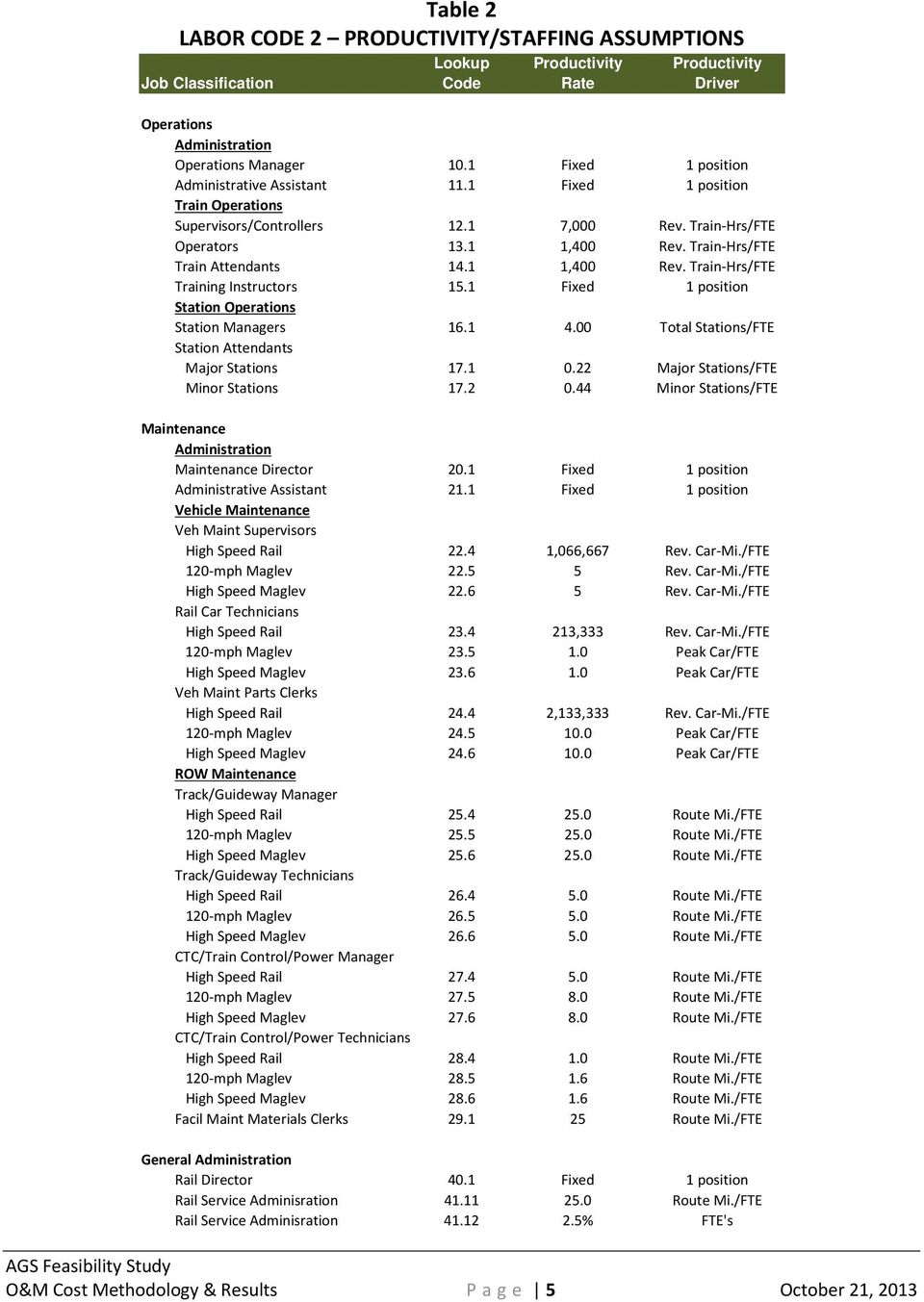
6 Table 2 LABOR CODE 2 PRODUCTIVITY/STAFFING ASSUMPTIONS Lookup Productivity Productivity Job Classification Code Rate Driver Operations Administration Operations Manager 10.1 Fixed 1 position Administrative Assistant 11.1 Fixed 1 position Train Operations Supervisors/Controllers ,000 Rev. Train Hrs/FTE Operators ,400 Rev. Train Hrs/FTE Train Attendants ,400 Rev. Train Hrs/FTE Training Instructors 15.1 Fixed 1 position Station Operations Station Managers Total Stations/FTE Station Attendants Major Stations Major Stations/FTE Minor Stations Minor Stations/FTE Maintenance Administration Maintenance Director 20.1 Fixed 1 position Administrative Assistant 21.1 Fixed 1 position Vehicle Maintenance Veh Maint Supervisors High Speed Rail ,066,667 Rev. Car Mi./FTE 120 mph Maglev Rev. Car Mi./FTE High Speed Maglev Rev. Car Mi./FTE Rail Car Technicians High Speed Rail ,333 Rev. Car Mi./FTE 120 mph Maglev Peak Car/FTE High Speed Maglev Peak Car/FTE Veh Maint Parts Clerks High Speed Rail ,133,333 Rev. Car Mi./FTE 120 mph Maglev Peak Car/FTE High Speed Maglev Peak Car/FTE ROW Maintenance Track/Guideway Manager High Speed Rail Route Mi./FTE 120 mph Maglev Route Mi./FTE High Speed Maglev Route Mi./FTE Track/Guideway Technicians High Speed Rail Route Mi./FTE 120 mph Maglev Route Mi./FTE High Speed Maglev Route Mi./FTE CTC/Train Control/Power Manager High Speed Rail Route Mi./FTE 120 mph Maglev Route Mi./FTE High Speed Maglev Route Mi./FTE CTC/Train Control/Power Technicians High Speed Rail Route Mi./FTE 120 mph Maglev Route Mi./FTE High Speed Maglev Route Mi./FTE Facil Maint Materials Clerks Route Mi./FTE General Administration Rail Director 40.1 Fixed 1 position Rail Service Adminisration Route Mi./FTE Rail Service Adminisration % FTE's O&M Cost Methodology & Results Page 5 October 21, 2013
7 Table 3 NON LABOR CODE ASSUMPTIONS Look-Up Unit Non-Labor Cost Item Code Rate Driver Operations Administration Miscellaneous % of Ops Admin Labor Wages Train Operations Train Propulsion High Speed Rail Distribution $116,870 Route Miles High Speed Rail Consumption $0.28 Rev. Train Mi. 120 mph Maglev Distribution $111,548 Route Miles 120 mph Maglev Consumption $0.26 Rev. Train Mi. High Speed Maglev Distribution $100,393 Route Miles High Speed Maglev Consumption $0.46 Rev. Train Mi. Train Security Contract Services $12.00 Rev. Train Hr. Miscellaneous % of Train Ops Labor Wages Station Operations Station Security Contract Services Major Stations $60,000 Major Station Minor Stations $30,000 Minor Station Station Maint. Contract Services Major Stations $100,000 Major Station Minor Stations $50,000 Minor Station Station Utilities Major Stations $30,000 Major Station Minor Stations $15,000 Minor Station TVM Maintenance Major Stations $20,000 Major Station Minor Stations $10,000 Minor Station Miscellaneous % of Station Ops Labor Wages Maintenance Administration Miscellaneous % of Maint. Admin. Labor Wages Vehicle Maintenance Vehicle Parts, Materials High Speed Rail $0.31 Rev. Car Mile 120 mph Maglev $0.31 Rev. Car Mile High Speed Maglev $0.31 Rev. Car Mile Car Cleaning Contract Services High Speed Rail $5,000 Peak Car 120 mph Maglev $5,000 Peak Car High Speed Maglev $10,000 Peak Car Locomotive Maint. Contract Services $1.61 Rev. Train Mile Miscellaneous % of Veh. Maint. Labor Wages O&M Cost Methodology & Results Page 6 October 21, 2013

8 Table 3 (continued) NON LABOR CODE ASSUMPTIONS Look-Up Unit Non-Labor Cost Item Code Rate Driver ROW Maintenance Materials & Supplies High Speed Rail $5,200 Route Mile 120 mph Maglev $5,200 Route Mile High Speed Maglev $5,200 Route Mile ROW Maint. Contract Services High Speed Rail $6,600 Route Mile 120 mph Maglev $6,600 Route Mile High Speed Maglev $6,600 Route Mile Miscellaneous % of ROW Maint. Labor Wages General Administration Insurance $5,000,000 Fixed Insurance $20,000 Route Mile Materials & Supplies $10,000 Route Mile Utilities $1.26 Rev. Train Mi. Miscellaneous % of G&A Admin. Wages Some of the key labor productivity rates shown in Table 2 reflect the following assumptions: Operations Train Operators are staffed at one for every 1,400 revenue train hours for all study modes, Supervisor/Controllers at one for every five operators, and one Train Attendant for every operator (i.e., two person train crews). One Station Manager is assumed for every four stations. There is one Station Attendant per shift for each minor station (two shifts per minor station), with staffing doubled for major stations. Vehicle Maintenance One Supervisor is assumed for every five Rail Car Technicians, and one Parts Clerk for every 10 Rail Car Technicians, for all study modes. One Rail Car Technician is estimated for every 213k revenue car miles of High Speed Steel Rail; one per peak car for both Maglev technologies. O&M Cost Methodology & Results Page 7 October 21, 2013

9 ROW Maintenance Managers (Track/Guideway and Train Control/Power) are staffed at one for every five technicians for all study modes. Track/Guideway Technicians are modeled as one for every 5.0 route miles, assumed consistent for all study modes. Train Control/Power Technicians are assumed to be staffed as the rate of one per route mile for High Speed Steel Rail, and one per 1.6 route miles for both Maglev technologies. The model assumes two Facilities Maintenance Clerks for every 50 route miles, with two maintenance facilities for the Full Build scenarios. Administration All specific administration job classifications are modeled as fixed positions. The aggregated administrative support functions are staffed as one for every 20 route miles (with a minimum of five positions) plus 2.5% of the number of FTEs estimated for the line functions of operations and maintenance. Supply Variable Unit Costs For purposes of designing a methodology that would distinguish major differences among alternative modes, some expense items are modeled with consistent unit cost assumptions that apply regardless of mode. Fringe benefits are set at 40% of all wages and salaries, and for all study modes. For expenses with consistent unit costs based directly on a supply (system or service) variable, the line item totals may differ by alternative, but only because the number of driving units change (e.g., more or fewer stations, route miles). Functions modeled with consistent unit costs are: Operations Administration and Maintenance Administration Train crews (one operator and one train attendant, calculated based on the number of train hours of service) Station operations and maintenance costs (calculated based on the number of stations) On board and station security (assumed to be contracted services) Vehicle cleaning (assumed to be a contracted service) General Administration The spreadsheet cost models distinguish primary differences among modes with variable unit costs related to propulsion power, vehicle maintenance, and ROW maintenance. Propulsion power is driven primarily by route miles (distribution) as opposed to usage (consumption). The lookup codes presented in Tables 2 and 3 are used to identify the assumed supply variable unit cost. O&M Cost Methodology & Results Page 8 October 21, 2013

10 Staffing Levels The model estimates the number of full time equivalent (FTE) employees for specific job classifications by combining labor productivity assumptions, supply variable unit cost rates and the cost driver values associated with each test alternative. The number of staff estimated is multiplied by the assumed salary to calculate a line item labor cost. The lookup codes presented in Table 2 are used to determine the labor productivity rate that calculates staffing levels. Cost Ranges The AGS Project O&M cost models calculate two cost estimates for any modeled alternative, providing a planning contingency for items with little or no actual operating data. The model features used for the expense range are: Low Range Cost Estimate for each line item, calculated by applying the unit cost to the quantity of the identified driving variable for each study alternative. A model s total estimated annual O&M cost is calculated by summing all line items, and expressed in 2013 dollars. Uncertainty Factors that acknowledge there may be a notable variance from calculated O&M costs since some line items must rely heavily on assumptions when actuals are not available. Uncertainty factors of 15%, 25% or 50% were applied to each line item cost. The highest uncertainty (50%) was assigned to propulsion and insurance for High Speed Steel Rail and Maglev technologies. High Range Cost Estimates which apply line item uncertainty factors to the low range cost estimate. Again, the total estimated annual O&M cost based on integrating the uncertainty factor is calculated by summing all line items. Project Alternatives 3. Project O&M Cost Estimates After establishing appropriate unit costs, an O&M cost model requires the development of operating statistics that are based on service plans for each alternative. For the AGS Project, there basically are two alternatives to evaluate for each mode: a Full Build alternative and a Minimum Operating Segment (MOS). The HS Rail alternative has a different alignment, operating plan and travel speed than the Maglev alternatives. As previously noted, there are two different types of Maglev alternatives high speed and 120 mph. The two Maglev alternatives have different runtimes and an added station for the 120 mph Maglev due to differences in achievable maximum speeds and corresponding differences in curvature/alignment. O&M Cost Methodology & Results Page 9 October 21, 2013
11 All alternatives are based on an 18 hour daily span of service, seven days a week. For highestdemand days (considered Thursday through Sunday for the AGS corridor), hourly service is assumed for 12 hours of the day and 30 minute frequencies during six hours of the day. For lighter days (Monday through Wednesday), an hourly frequency is assumed for the bulk of the day. Station and service plan assumptions are as follows: Full Build Maglev: Trains are assumed to operate between Golden (Suburban West) and Eagle County Regional Airport (ECRA), with intermediate stations at Idaho Springs, Keystone, Breckenridge, Copper Mountain (for 120 mph maglev only), Vail, and Avon. The basic operating plan assumes 24 round trips daily from Thursday through Sunday, and 15 round trips daily from Monday through Wednesday. Full Build Maglev to DIA: For this alternative, trains operate between DIA and Eagle County Regional Airport, thereby adding stations at DIA and I 76/72 nd Avenue in the metro Denver area. This alternative was tested only for the high speed maglev technology. The operating plan assumes 24 round trips daily from Thursday through Sunday, and 15 round trips daily from Monday through Wednesday. Full Build HS Rail: The HS Rail alternative is only able to serve Breckenridge with a separate branch so there are two line patterns. The main line serves Jefferson County, Idaho Springs, Lakeside, and Vail, terminating at Eagle County Regional Airport. The spur line proceeds from Jefferson County Station to Idaho Springs, Lakeside and Breckenridge. There would be 24 round trips operated Thursday through Sunday (18 on mainline, 6 on branch), and 15 round trips Monday through Wednesday (9 on mainline, 6 on branch). MOS: Trains would operate between Suburban West and Breckenridge. There would be four stations for all modes. For the basic operating plan, Thursday through Sunday trains would operate 24 round trips and Monday through Wednesday 15 round trips would be provided. An MOS alignment scenario has been defined for both High Speed Rail and Maglev. Differences among the modes include the capacity of passenger cars and the make up of train consists, both of which have implications for annual operating costs. In an attempt to be as consistent as possible for cost estimating, train consist assumptions were made as follows: High Speed Steel Rail would operate 10 passenger cars per train, providing a capacity of 450 passengers per train. High Speed Maglev would operate five passenger cars per train, providing a capacity of 410 passengers per train. O&M Cost Methodology & Results Page 10 October 21, 2013
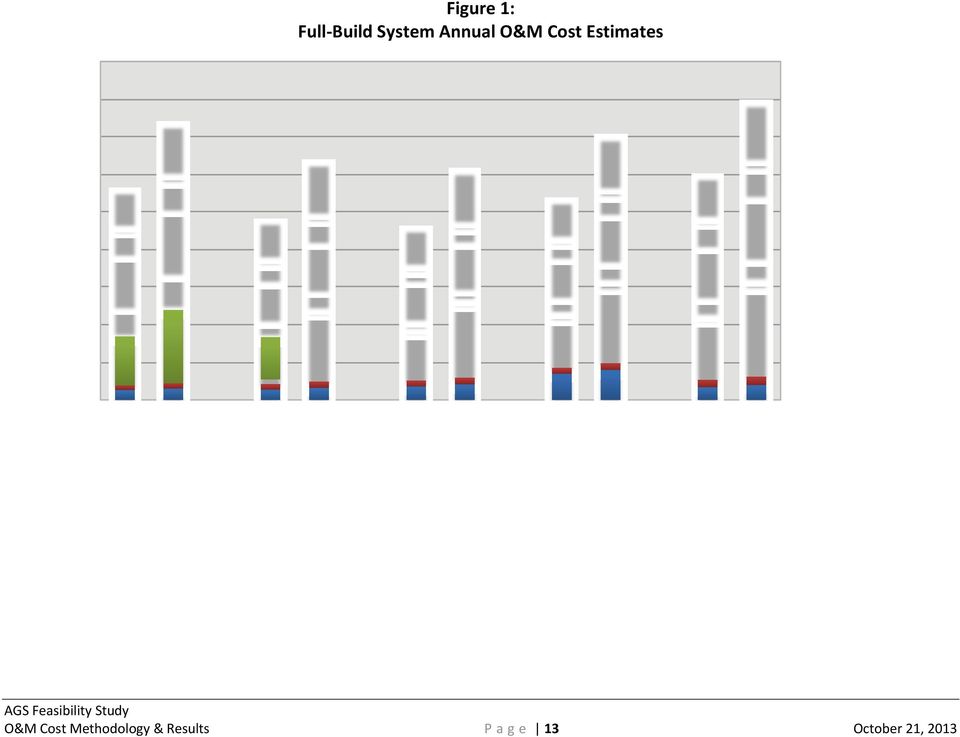
12 120 mph Maglev trains operate as two car married pairs with a capacity of 186 passengers per married pair train. Two scenarios were evaluated for 120 mph Maglev: 24 trips per day, Thursday through Sunday, for equivalent level of train service as other alternatives (i.e., 30 minute average peak period frequencies), and 48 trips per day, Thursday through Sunday, for comparable passenger capacity as the other alternatives (i.e., 15 minute average peak period frequencies). Tables 3 and 4 summarize O&M cost model results for the full corridor alternatives as well as the MOS alternatives. For service from Golden to ECRA, operating costs range from $45 million to $73 million annually when accounting for low versus high estimates. The highest O&M operating costs are associated with the high speed steel rail alternative. Due to its greater mileage and associated longer travel time, the high speed maglev alternative from DIA to ECRA has an annual O&M cost ranging from $59 million to $78 million. For the MOS options from Golden to Breckenridge, O&M costs range from $26 million to $48 million. Again, the highest O&M operating cost estimates are associated with the high speed steel rail alternative. Figures 1 and 2 illustrate the break out of costs (labor and non labor and by type of cost) for each alternative (full build and MOS). Propulsion power costs are the largest single component of the O&M cost estimates, with power consisting of 20 to 30 percent of an alternative s total estimated O&M cost. Power cost estimates were previously determined for AGS alternatives in a technical paper that took into consideration high speed rail and Maglev power consumption and distribution requirements and Xcel energy rates. Information from this prior analysis was incorporated into this project s O&M cost estimates. Insurance costs are also a significant portion of the O&M cost estimates. As noted earlier, a high level of uncertainty has been assigned to both of these cost items in the high range of cost estimates. Finally, it should be noted that O&M costs are based on the defined service plan that assumes 24 round trips per day on high volume days. Preliminary analysis of ridership forecasts suggests that more frequent service may be needed during peak use. While much of the demand can be accommodated by scheduling more of the 24 round trips during peak periods, it may be advisable to add more trips overall, thereby increasing the estimated O&M costs. Operating plan tables for each project alternative are provided in Appendix A of this document. Detailed cost estimate tables are provided in Appendix B. O&M Cost Methodology & Results Page 11 October 21, 2013

13 Table 3: Full Build System Annual O&M Cost Estimates Service Characteristics & High Speed Steel Rail High Speed Maglev 120 mph Maglev 30 min 120 mph Maglev 15 min High Speed Maglev to DIA O&M Cost Categories Low High Low High Low High Low High Low High Service Revenue Train Hours 21,290 21,290 22,540 22,540 29,420 29,420 58,850 58,850 28,170 28,170 Statistics Revenue Train Miles 1,307,600 1,307,600 1,712,800 1,712,800 1,695,600 1,695,600 3,389,500 3,389,500 2,240,700 2,240,700 Revenue Car Miles 13,080,600 13,080,600 8,563,300 8,563,300 3,389,500 3,389,500 6,779,000 6,779,000 11,196,300 11,196,300 Route Miles Major Stations Minor Stations Peak Cars ANNUAL O&M COST ESTIMATE (2013$) Operations Administration $276,000 $318,000 $276,000 $318,000 $276,000 $318,000 $276,000 $318,000 $276,000 $318,000 Train Operations $15,857,000 $22,810,000 $15,505,000 $22,226,000 $17,229,000 $24,500,000 $21,498,000 $29,598,000 $20,101,000 $28,863,000 Station Operations $1,881,000 $2,232,000 $2,160,000 $2,562,000 $2,381,000 $2,826,000 $2,381,000 $2,826,000 $3,102,000 $3,683,000 Total $18,014,000 $25,360,000 $17,941,000 $25,106,000 $19,886,000 $27,644,000 $24,155,000 $32,742,000 $23,479,000 $32,864,000 Maintenance Administration $276,000 $318,000 $276,000 $318,000 $276,000 $318,000 $276,000 $318,000 $276,000 $318,000 Vehicle Maintenance $11,447,000 $14,086,000 $6,580,000 $8,114,000 $2,994,000 $3,685,000 $5,988,000 $7,369,000 $8,135,000 $10,036,000 ROW Maintenance $15,645,000 $19,111,000 $12,190,000 $14,902,000 $11,980,000 $14,647,000 $11,980,000 $14,647,000 $15,738,000 $19,240,000 Total $27,368,000 $33,515,000 $19,046,000 $23,334,000 $15,250,000 $18,650,000 $18,244,000 $22,334,000 $24,149,000 $29,594,000 General Administration $10,000,000 $14,007,000 $10,222,000 $14,322,000 $10,077,000 $14,146,000 $10,295,000 $14,397,000 $11,484,000 $16,023,000 TOTAL O&M COST ESTIMATE $55,382,000 $72,882,000 $47,209,000 $62,762,000 $45,213,000 $60,440,000 $52,694,000 $69,473,000 $59,112,000 $78,481,000 Note: Low estimate is base cost as calculated by resource build up O&M cost model. High estimate incorporates uncertainty factors to account for scant availability of actuals for operating data and costs. O&M Cost Methodology & Results Page 12 October 21, 2013

14 Figure 1: Full Build System Annual O&M Cost Estimates AGS Feasibility Study O&M Cost Methodology & Results P a g e 13 October 21, 2013
Operations and Maintenance Quantities and Costs LRT
 LYNX Blue Line Extension (Northeast Corridor) Light Rail Project Contract #: 08-477 WBS #: 5.05 Operations and Maintenance Quantities and Costs LRT Prepared by: 1000 W. Morehead Street, Suite 200 Charlotte,
Operating Concept and System Design of a Transrapid Maglev Line and a High-Speed Railway in the pan-european Corridor IV
 Operating Concept and System Design of a Transrapid Maglev Line and a High-Speed Railway in the pan-european Corridor IV A. Stephan & E. Fritz IFB Institut für Bahntechnik GmbH, Niederlassung, Germany
Transit in the United States 3. Operating Costs and Performance Measures 13. Quality of Transit Service 19. ADA Compliance Bus 28
 1999 National Transit Summaries and Trends Introduction 1 Introduces the transit modes discussed throughout the NTST. Transit in the United States 3 National statistics and trends in ridership, miles of
1 FIXED ROUTE OVERVIEW
 1 FIXED ROUTE OVERVIEW Thirty transit agencies in Ohio operate fixed route or deviated fixed route service, representing a little less than half of the 62 transit agencies in Ohio. While many transit agencies
Legislative Fiscal Bureau One East Main, Suite 301 Madison, WI 53703 (608) 266-3847 Fax: (608) 267-6873
 Legislative Fiscal Bureau One East Main, Suite 301 Madison, WI 53703 (608) 266-3847 Fax: (608) 267-6873 February 16, 2010 TO: FROM: Members Joint Committee on Finance Bob Lang, Director SUBJECT: Governor's
Doing More with the Same: How the Trinity Railway Express Increased Service without Increasing Costs
 Doing More with the Same: How the Trinity Railway Express Increased Service without Increasing Costs W. T. "Bill" Farquhar Trinity Railway Express Irving, TX Abstract The Trinity Railway Express (TRE)
METROPOLITAN TRANSIT AUTHORITY OF HARRIS COUNTY, TEXAS. Independent Accountants Report on Applying Agreed-Upon Procedures
 METROPOLITAN TRANSIT AUTHORITY OF HARRIS COUNTY, TEXAS Independent Accountants Report on Applying Agreed-Upon Procedures Year ended September 30, 2014 KPMG LLP 811 Main Street Houston, TX 77002 Independent
LECTURE - 3 RESOURCE AND WORKFORCE SCHEDULING IN SERVICES
 LECTURE - 3 RESOURCE AND WORKFORCE SCHEDULING IN SERVICES Learning objective To explain various work shift scheduling methods for service sector. 8.9 Workforce Management Workforce management deals in
GUIDANCE FOR TRANSIT FINANCIAL PLANS
 U.S. Department of Transportation Federal Transit Administration GUIDANCE FOR TRANSIT FINANCIAL PLANS JUNE 2000 Prepared By: Federal Transit Administration Office of Planning Office of Program Management
Multi Year Budget Plan Development
 Finance & Administration Committee Information Item III-B October 13, 2011 Multi Year Budget Plan Development Washington Metropolitan Area Transit Authority Board Action/Information Summary Action Information
Presto Fare Card ibus (Automated Stop Announcements, Cameras) Transit Operating System Replacement
 Transit Business Plan 2 011 2014 Transit Key Deliverables Sustain existing service levels Growth in fleet and service hours (modest) Build, commission and operate the BRT Conduct preliminary i design and
Performance Goals and Objectives:
 Online Briefing Winter 2011 2012 Purpose: The purpose of the Project is to examine and recommend ways of introducing higher passenger train speeds on the Empire Corridor and ways to improve reliability,
Overview of the Travel Demand Forecasting Methodology
 Overview of the Travel Demand Forecasting Methodology Prepared by the Central Transportation Planning Staff (CTPS) Authors: Scott A. Peterson, Manager Ian Harrington, Chief Planner March 29, 2008 1 OVERVIEW
L E G I S L A T I V E A N A L Y S T S O F F I C E
 November 29, 2011 High-Speed Rail Authority: The Draft 2012 Business Plan and Funding Plan L E G I S L A T I V E A N A L Y S T S O F F I C E Presented to: Assembly Transportation Committee Hon. Bonnie
Triangle Transit Financial Plan. Durham Orange Light Rail Transit Project
 Durham Orange Light Rail Transit Project September 2012 TABLE OF CONTENTS LIST OF TABLES... ii LIST OF FIGURES... iii 1. Introduction... 1 1 1.1. DESCRIPTION OF PROJECT SPONSOR... 1 1 1.1.1. Durham Transit
5.0 FINANCIAL ANALYSIS AND COMPARISON OF ALTERNATIVES
 5.0 FINANCIAL ANALYSIS AND COMPARISON OF ALTERNATIVES 5.1 FINANCIAL ANALYSIS The cost of a transportation investment falls into two categories: capital costs, and operating and maintenance (O&M) costs.
Frequently Asked Questions (FAQs) about DART
 Frequently Asked Questions (FAQs) about DART What is DART? Where can I take the bus? Where can I take the train? How much does it cost to park at a station? Can I take a train to American Airlines Center?
AUSTIN INDEPENDENT SCHOOL DISTRICT INTERNAL AUDIT DEPARTMENT TRANSPORTATION AUDIT PROGRAM
 TRANSPORTATION GENERAL: The Transportation Department provides transportation of students to and from school and other special trips. The aim of an effective transportation service delivery system must
Intersection Cost Comparison Spreadsheet User Manual ROUNDABOUT GUIDANCE VIRGINIA DEPARTMENT OF TRANSPORTATION
 Intersection Cost Comparison Spreadsheet User Manual ROUNDABOUT GUIDANCE VIRGINIA DEPARTMENT OF TRANSPORTATION Version 2.5 i Virginia Department of Transportation Intersection Cost Comparison Spreadsheet
2012 King County Metro Transit Peer Agency Comparison on Performance Measures
 2012 Peer Agency Comparison on Performance Measures Department of Transportation Metro Transit Division King Street Center, KSC-TR-0415 201 S. Jackson St Seattle, WA 98104 206-553-3000 TTY Relay: 711 www.kingcounty.gov/metro
HEADING: CONTRACT AGENCY LEGAL NAME
 COUNTY OF LOS ANGELES - DEPARTMENT OF HEALTH SERVICES ALCOHOL AND DRUG PROGRAM ADMINISTRATION COST REPORT FOR CONTRACTED SERVICES OUTPATIENT DRUG FREE SERVICES INSTRUCTIONS COST REPORT FOR CONTRACTED SERVICES
Development of an NTD Tool for Vanpool Services
 Development of an NTD Tool for Vanpool Services Center for Urban Transportation Research University of South Florida, Tampa November 2008 Final Report Contract Number: BD549-40 DISCLAIMER The opinions,
VRE SYSTEM PLAN SUMMARY
 VRE System Plan Summary January 2014 VRE SYSTEM PLAN SUMMARY VRE A Cost-Effective Contributor to Regional Mobility During the last decade, VRE has demonstrated its ability to accommodate a rapid and substantial
Financial Plan & Implementation. Matrix
 Financial Plan & Implementation Matrix Revenue Projections and Financial Assumptions 1.0 Context. Background. The development of the financial plan is consistent with requirements regarding the development
Scheduling Review Technical Memorandum
 Scheduling Review Technical Memorandum City of Colorado Springs Mountain Metropolitan Transit Comprehensive Operational Analysis Introduction As part of the Colorado Springs Comprehensive Operations Analysis,
Estimating Light-Rail Ridership from APC Data
 Estimating Light-Rail Ridership from APC Data Zach Van Gemert, Service Development Applications Expert, Denver RTD Richard Lehman, Senior Applications Developer, RSM Services Corporation The Denver RTD
Addendum to the Arterial Transitway Corridors Study
 January 2013 1 Addendum to the Arterial Transitway Corridors Study The Arterial Transitway Corridors Study (ATCS) evaluated and prioritized arterial bus rapid transit (BRT) improvements to nine corridors
Appendix J Santa Monica Travel Demand Forecasting Model Trip Generation Rates
 Appendix J Santa Monica Travel Demand Forecasting Model Trip Generation Rates SANTA MONICA TRAVEL DEMAND FORECASTING MODEL TRIP GENERATION RATES SUBMITTED BY: 201 Santa Monica Blvd., Suite 500 Santa Monica,
A U D I T E P O R T. Audit of Lee County Transit (Lee Tran) Internal Audit Department. Audit Number 2011-04. April 2011
 A U D I T R Audit of Lee County Transit (Lee Tran) E P O R T Internal Audit Department Audit Number 2011-04 April 2011 April 21, 2011 The Honorable Charlie Green Clerk, Lee County Re: Lee County Transit
TRIAL JUDGE TRAVEL REIMBURSEMENT POLICIES Revision 11/1/2013
 TRIAL JUDGE TRAVEL REIMBURSEMENT POLICIES Revision 11/1/2013 GENERAL Receipts... 1 Reimbursable Events... 1 Travel Vouchers... 1 Unallowable Travel Expenses... 2 IN-STATE TRAVEL Meals... 2 Meal Tips...
Treasure Island Mobility Management Program
 Treasure Island Mobility Management Program Policy Analysis Update SAN FRANCISCO COUNTY TRANSPORTATION AUTHORITY October 7, 2014 About the Treasure Island Development Project 1997 2003 2008 2011 2014 City
The future is already here
 Transrapid International A joint company of Siemens and ThyssenKrupp The future is already here The Transrapid maglev system in Shanghai The future is already here in Shanghai Shanghai is a city of superlatives
Proposed Service Design Guidelines
 Proposed Service Design Guidelines July 2015 I. Introduction During Phase II of the Reimagining CityBus project, feedback from public outreach and data analysis conducted during Phase I of the project
Kirsten Volpi Senior Vice President for Finance and Administration
 TO: FROM: Board of Trustees Kirsten Volpi Senior Vice President for Finance and Administration DATE: May 23, 2011 SUBJECT: FY 2012 Budget I. BACKGROUND INFORMATION Fiscal Year 2012 Operating Budget Summary
Cost and Financial Analysis
 Chapter 19: Cost and Financial Analysis A. INTRODUCTION The purpose of this chapter is to present examples of financial resources available to the Metropolitan Transportation Authority (MTA), which may
Miami-Dade Transit Service Standards
 Miami-Dade Transit Service Standards Presentation to RTC November 10, 2005 Roosevelt Bradley 1 MDT Service Standards Primer Background Standards: Old & New Best Practices: Comparison Denver RTD ChicagoCTA
TRANSPORTATION EXPENDITURE REPORT 2014-15
 Michigan Department of Education Office of Special Education TRANSPORTATION EXPENDITURE REPORT 2014-15 General Instructions 1. The SE-4094 covers expenditures for the school year July 1 to June 30. 2.
COUNTY OF LOS ANGELES - DEPARTMENT OF HEALTH SERVICES ALCOHOL AND DRUG PROGRAM ADMINISTRATION COST REPORT FOR CONTRACTED SERVICES INSTRUCTIONS
 COUNTY OF LOS ANGELES - DEPARTMENT OF HEALTH SERVICES ALCOHOL AND DRUG PROGRAM ADMINISTRATION COST REPORT FOR CONTRACTED SERVICES INSTRUCTIONS COST REPORT FOR CONTRACTED SERVICES (SUMMARY PAGE) Complete
2011 Boulder Valley Employee Survey for Transportation Report of Results
 2011 Boulder Valley Employee Survey for Transportation Report of Results June 2012 Image from emerson12 via Flickr, Creative Commons Attribution. 2955 Valmont, Suite 300 Boulder, CO 80301 303 444 7863
2013 Annual Service Plan. 7 2012-2016 Five year Service Plan Updates
 7 2012-2016 Five year Service Plan Updates 7 2012-2016 Five year Service Plan Updates The following are updates to the (2012-2016) Five-Year Service Plan. The addendums refer to the following chapters
Final Draft Final Report on
 Final Draft Final Report on for the February 2012 MERCURY ASSOCIATES, INC. February 24, 2012 Mr. Tim Ryburn, Administrator Iowa Department of Administrative Services General Services, Enterprise 109 S.E.
Financial Analysis and Funding
 California High- Speed Rail Authority Revised 2012 Business Plan Chapter 7 Financial Analysis and Funding Introduction This chapter presents the financial analysis and funding strategy for the California
Dallas Fire-Rescue. FY 11-12 Proposed Budget Presented to the Dallas City Council September 7, 2011
 Dallas Fire-Rescue FY 11-12 Proposed Budget Presented to the Dallas City Council September 7, 2011 This briefing addresses recent questions regarding the Dallas Fire-Rescue recommended FY 11-12 Budget
Rules of Office of Administration Division 10 Commissioner of Administration Chapter 11 Travel Regulations
 Rules of Office of Administration Division 10 Commissioner of Administration Chapter 11 Travel Regulations Title Page 1 CSR 10-11.010 State of Missouri Travel Regulations...3 1 CSR 10-11.020 County Travel
MSTC ADMINISTRATIVE POLICY
 Policy Title: TRAVEL AND EXPENSE REIMBURSEMENT MSTC ADMINISTRATIVE POLICY Policy Section: FISCAL MANAGEMENT This administrative policy identifies the essential activities and responsibilities of the employees
State of Good Repair Assessment Dallas Area Rapid Transit
 State of Good Repair Assessment Dallas Area Rapid Transit Mike Hubbell Vice President, Maintenance Dallas Area Rapid Transit FTA Roundtable Chicago IL July 23, 2010 1,714 vehicles 232 track miles ROW 63.5M
Cost Models for Vehicle Routing Problems. 8850 Stanford Boulevard, Suite 260 R. H. Smith School of Business
 0-7695-1435-9/02 $17.00 (c) 2002 IEEE 1 Cost Models for Vehicle Routing Problems John Sniezek Lawerence Bodin RouteSmart Technologies Decision and Information Technologies 8850 Stanford Boulevard, Suite
SCOPE OF WORK for High Speed Rail and Intercity Passenger Rail Program Federal Grant Application Development
 Draft 06162009 SCOPE OF WORK for High Speed Rail and Intercity Passenger Rail Program Federal Grant Application Development The Minnesota Department of Transportation (Mn/DOT) requires the services of
Effect on structures. Uniform settlement - no concerns. Angular distortion - causes damage due to tensile strain
 Effect on structures Uniform settlement - no concerns Angular distortion - causes damage due to tensile strain 1/500 - safe limit for no cracking of buildings 1/150 - potential structural damage 36 37
Transit Cost Analysis
 Transit Cost Analysis Types of Costs Fixed Cost: does not vary with the amount of service provided in the short run. Variable Costs: change with the amount of service provided. Variable Cost Fixed Level
ECONOMIC IMPACT TOOL: SENSITIVITY ANALYSIS Cherokee Hills National Scenic Byway CASE STUDY AMERICA S BYWAYS RESOURCE CENTER AUGUST 16, 2012
 AMERICA S BYWAYS RESOURCE CENTER ECONOMIC IMPACT TOOL: SENSITIVITY ANALYSIS Cherokee Hills National Scenic Byway CASE STUDY AUGUST 16, 2012 [email protected] www.udot.utah.gov/mountainview CONTENTS
Transportation Funds Forecast. February 2013. Transportation Funds Forecast. Released March 1, 2013. February 2013 Forecast Executive Summary
 Transportation Funds Forecast The purpose of this document is to serve as the official guide to the Minnesota Department of Transportation (MnDOT) forecast for the six transportation funds: Highway User
SYSTEMWIDE REQUIREMENTS
 SYSTEMWIDE REQUIREMENTS for the Peninsula Rail Program San Francisco to San Jose on the Caltrain Corridor Description of the Systemwide Context for the High Speed Train Project This document provides a
Demand for Long Distance Travel
 Demand for Long Distance Travel April 2011 Demand for long distance travel 1 Structure of this paper 1.1 This paper is structured as follows: Section 2 sets out past trends in the demand for long distance
Step Away from That Truck September 2011
 George Recktenwald, Director of Public Works Harry Lorick, P.E., LA Consulting Inc. Lorick Associates CONSULTING 2 3 and Exhibition 1 Background Process and Benchmarks Results Future Steps 4 1,263 square
DEPARTMENT OF CENTRAL MANAGEMENT SERVICES OPERATION OF THE STATE VEHICLE FLEET
 STATE OF ILLINOIS OFFICE OF THE AUDITOR GENERAL PERFORMANCE AUDIT OF THE DEPARTMENT OF CENTRAL MANAGEMENT SERVICES OPERATION OF THE STATE VEHICLE FLEET NOVEMBER 2011 WILLIAM G. HOLLAND AUDITOR GENERAL
INDOT 2000-2025 Long Range Plan
 Chapter 9 INDOT 2000-2025 Long Range Plan Highway Needs Analysis Overview The statewide transportation planning process provides for the identification of highway needs through a comprehensive process
Upon closer analysis, however, there are circumstances when renting a car instead of driving your own may indeed be the economically wise choice.
 Summary The decision to rent a vehicle vs. using the one in your garage for a weekend getaway is often shaped by such factors as the need for a different size or a more attractive appearance. But when
TERMINAL 91 TRAFFIC MONITORING STUDY
 REVISED DRAFT TERMINAL 9 TRAFFIC MONITORING STUDY Prepared for: Port of Seattle Prepared by: 6544 NE 6st Street, Seattle, WA 985 ph: (26) 523-3939 fx: (26) 523-4949 NOVEMBER 22, 2 TABLE OF CONTENTS. INTRODUCTION...
Table 10-1 Travel Times Between Stations 1 10. OPERATING & MAINTENANCE PLAN
 10. OPERATING & MAINTENANCE PLAN This section describes an operating plan that responds directly to anticipated commuter ridership patterns. Train schedules, type and capacity of rolling stock, and likely
Water Demand Forecast Approach
 CHAPTER 6 2009 REGIONAL WATER SUPPLY OUTLOOK Water Demand Forecast Approach 6.1 Introduction Long-range water demand forecasting is a fundamental tool that water utilities use to assure that they can meet
TS Channels and Alliances. Travel & Expense Reimbursement Policy. for. U.S. Based Partners
 TS C&A Policy Number 4, Rev 12, April 2006 TS Channels and Alliances Travel & Expense Reimbursement Policy for U.S. Based Partners 1 EMC Corporation has developed this document to clearly define it s travel
When is BRT the Best Option? 1:30 2:40 p.m.
 TRB/APTA 2004 Bus Rapid Transit Conference When is BRT the Best Option? 1:30 2:40 p.m. Paul Larrousse Director, National Transit Institute (NTI) (Moderator) TRB/APTA 2004 Bus Rapid Transit Conference Session
TH 23 Access Management Study Richmond to Paynesville
 TH 23 Access Management Study Richmond to Paynesville Prepared For: Minnesota Department of Transportation District 8 Prepared By: Short Elliott Hendrickson Inc. July 2015 Table of Contents I. Introduction...
Financial Impact Estimating Conference. Use of Marijuana for Certain Medical Conditions Serial Number 13 02
 Financial Impact Estimating Conference Use of Marijuana for Certain Medical Conditions Serial Number 13 02 Table of Contents Official Notification... Tab 1 Statutory Authorization for FIEC... Tab 2 Information
A Quantitative Decision Support Framework for Optimal Railway Capacity Planning
 A Quantitative Decision Support Framework for Optimal Railway Capacity Planning Y.C. Lai, C.P.L. Barkan University of Illinois at Urbana-Champaign, Urbana, USA Abstract Railways around the world are facing
HKM Tours have asked HKM coaches to provide a price for operating the 35 seat Gold standard coach on the proposed 10 day tour to Edinburgh.
 R CHIEF EXAMINER S REPORT Certificate of Professional Competence International Passenger Transport (P2 05678) December 2012 General Comments It was encouraging to note that the majority of candidates seemed
EMPLOYEE REIMBURSEMENT, BUSINESS AND TRAVEL EXPENSES AND CONFERENCE EXPENSES ADMINISTRATIVE GUIDELINES
 A ADRIAN PUBLIC SCHOOLS Policies and Regulations School Board Governance and Operations NEPN Code: DCC-R Fiscal Management EMPLOYEE REIMBURSEMENT, BUSINESS AND TRAVEL EXPENSES AND CONFERENCE EXPENSES ADMINISTRATIVE
Instructions for the Automated Administrative Budget Sponsors of Day Care Homes and Sponsors of Unaffiliated Centers
 CHILD CARE FOOD PROGRAM (CCFP) Instructions for the Automated Administrative Budget Sponsors of Day Care Homes and Sponsors of Unaffiliated Centers The automated administrative budget is available on the
Executive Summary. Model Structure. General Economic Environment and Assumptions
 Executive Summary The (LTFP) report is an update from the preliminary report presented in January 2009 and reflects the Mayor s Proposed Budget for Fiscal Year 2010 and Fiscal Year 2011. Details of the
STAFFING HUMAN RESOURCES
 STAFFING REQUIREMENTS FOR HUMAN RESOURCES PAYROLL DIVISION Office of Strategic Business Management O ce o St ateg c us ess a age e t April 2010 Summary of Methodology Conducted comprehensive activity analysis
MICHIGAN AUDIT REPORT OFFICE OF THE AUDITOR GENERAL THOMAS H. MCTAVISH, C.P.A. AUDITOR GENERAL
 MICHIGAN OFFICE OF THE AUDITOR GENERAL AUDIT REPORT THOMAS H. MCTAVISH, C.P.A. AUDITOR GENERAL The auditor general shall conduct post audits of financial transactions and accounts of the state and of all