
DEPARTMENT OF CENTRAL MANAGEMENT SERVICES OPERATION OF THE STATE VEHICLE FLEET
|
|
|
- Loreen Henry
- 10 years ago
- Views:
Transcription
1 STATE OF ILLINOIS OFFICE OF THE AUDITOR GENERAL PERFORMANCE AUDIT OF THE DEPARTMENT OF CENTRAL MANAGEMENT SERVICES OPERATION OF THE STATE VEHICLE FLEET NOVEMBER 2011 WILLIAM G. HOLLAND AUDITOR GENERAL

2

3 SPRINGFIELD OFFICE: ILES PARK PLAZA 740 EAST ASH PHONE: 217/ FAX: 217/ TTY: 888/ CHICAGO OFFICE: MICHAEL A. BILANDIC BLDG. SUITE S NORTH LASALLE PHONE: 312/ FAX: 312/ OFFICE OF THE AUDITOR GENERAL WILLIAM G. HOLLAND To the Legislative Audit Commission, the Speaker and Minority Leader of the House of Representatives, the President and Minority Leader of the Senate, the members of the General Assembly, and the Governor: This is our report of the Performance Audit of the Department of Central Management Services Operation of the State Vehicle Fleet. The audit was conducted pursuant to House Resolution Number 658, which was adopted on March 17, The audit was conducted in accordance with generally accepted government auditing standards and the audit standards promulgated by the Office of the Auditor General at 74 Ill. Adm. Code The report for this audit is transmitted in conformance with Section 3-14 of the Illinois State Auditing Act. WILLIAM G. HOLLAND Auditor General Springfield, Illinois November 2011 INTERNET ADDRESS: RECYCLED PAPER SOYBEAN INKS
4

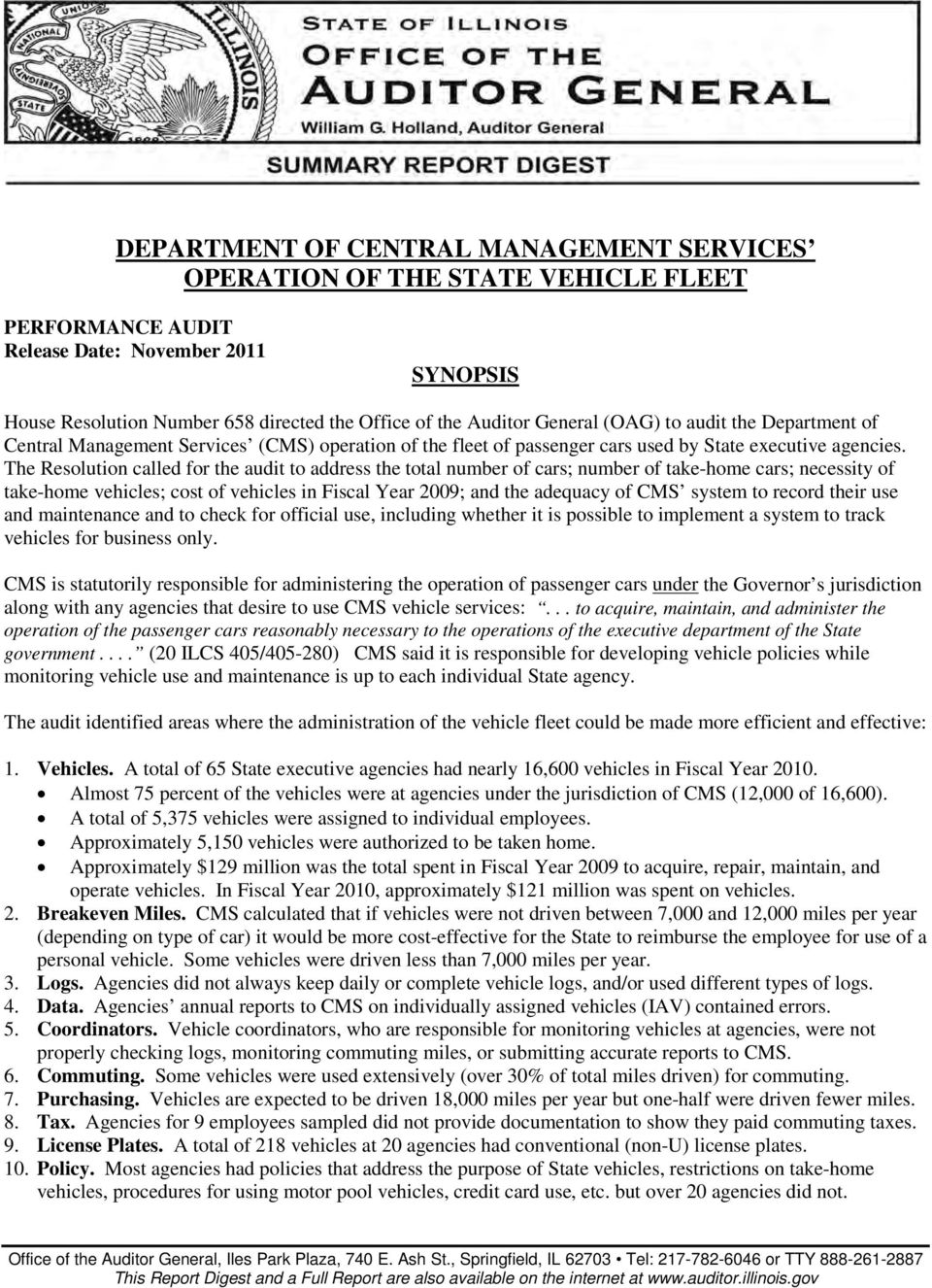
5 DEPARTMENT OF CENTRAL MANAGEMENT SERVICES OPERATION OF THE STATE VEHICLE FLEET PERFORMANCE AUDIT Release Date: November 2011 SYNOPSIS House Resolution Number 658 directed the Office of the Auditor General (OAG) to audit the Department of Central Management Services (CMS) operation of the fleet of passenger cars used by State executive agencies. The Resolution called for the audit to address the total number of cars; number of take-home cars; necessity of take-home vehicles; cost of vehicles in Fiscal Year 2009; and the adequacy of CMS system to record their use and maintenance and to check for official use, including whether it is possible to implement a system to track vehicles for business only. CMS is statutorily responsible for administering the operation of passenger cars under the Governor s jurisdiction along with any agencies that desire to use CMS vehicle services:... to acquire, maintain, and administer the operation of the passenger cars reasonably necessary to the operations of the executive department of the State government.... (20 ILCS 405/ ) CMS said it is responsible for developing vehicle policies while monitoring vehicle use and maintenance is up to each individual State agency. The audit identified areas where the administration of the vehicle fleet could be made more efficient and effective: 1. Vehicles. A total of 65 State executive agencies had nearly 16,600 vehicles in Fiscal Year Almost 75 percent of the vehicles were at agencies under the jurisdiction of CMS (12,000 of 16,600). A total of 5,375 vehicles were assigned to individual employees. Approximately 5,150 vehicles were authorized to be taken home. Approximately $129 million was the total spent in Fiscal Year 2009 to acquire, repair, maintain, and operate vehicles. In Fiscal Year 2010, approximately $121 million was spent on vehicles. 2. Breakeven Miles. CMS calculated that if vehicles were not driven between 7,000 and 12,000 miles per year (depending on type of car) it would be more cost-effective for the State to reimburse the employee for use of a personal vehicle. Some vehicles were driven less than 7,000 miles per year. 3. Logs. Agencies did not always keep daily or complete vehicle logs, and/or used different types of logs. 4. Data. Agencies annual reports to CMS on individually assigned vehicles (IAV) contained errors. 5. Coordinators. Vehicle coordinators, who are responsible for monitoring vehicles at agencies, were not properly checking logs, monitoring commuting miles, or submitting accurate reports to CMS. 6. Commuting. Some vehicles were used extensively (over 30% of total miles driven) for commuting. 7. Purchasing. Vehicles are expected to be driven 18,000 miles per year but one-half were driven fewer miles. 8. Tax. Agencies for 9 employees sampled did not provide documentation to show they paid commuting taxes. 9. License Plates. A total of 218 vehicles at 20 agencies had conventional (non-u) license plates. 10. Policy. Most agencies had policies that address the purpose of State vehicles, restrictions on take-home vehicles, procedures for using motor pool vehicles, credit card use, etc. but over 20 agencies did not. Office of the Auditor General, Iles Park Plaza, 740 E. Ash St., Springfield, IL Tel: or TTY This Report Digest and a Full Report are also available on the internet at
6 PERFORMANCE AUDIT OF CMS OPERATION OF THE STATE VEHICLE FLEET {This page intentionally left blank} ii

7 AUDIT CONCLUSIONS AND RECOMMENDATIONS The State of Illinois vehicle fleet is not overseen by any one agency with complete responsibility and authority. The Department of Central Management Services (CMS) has the statutory responsibility to administer the operation of passenger cars under the Governor s executive departments, along with those agencies that desire to use CMS vehicle services. The remaining executive branch agencies operate and control their own vehicles. (report pages 1-3) AUDIT RESOLUTION A total of 65 executive branch agencies operated State-owned vehicles in Fiscal Year ,592 total vehicles Almost 75% of the vehicles were under the jurisdiction of CMS (12,000 of 16,592). 5,375 vehicles individually assigned 5,144 vehicles could be taken home House Resolution Number 658 asked for the total number of passenger cars at executive branch agencies. The Office of the Auditor General (OAG) surveyed 82 agencies; 65 agencies reported that they had State-owned vehicles while 17 agencies reported that they did not have any State vehicles. Total Vehicles The 65 agencies had nearly 16,600 vehicles in Fiscal Year 2010 (see Digest Exhibit 1). Almost 75 percent of the total State-owned vehicles were at agencies under the jurisdiction of CMS (12,000 of 16,592). Over two-thirds of the vehicles (11,142 of 16,592) were at five agencies, as shown in Digest Exhibit 2. (pages 62-63) Take-Home Vehicles The 65 State agencies had 5,375 vehicles that were personally or individually assigned to employees and 5,144 vehicles were authorized to be taken home on June 30, Digest Exhibit 3 shows agencies with more than 100 take-home vehicles. (pages 65-67) Digest Exhibit 1 TYPES OF VEHICLES Fiscal Year 2010 Vehicle Class Number Passenger Cars 5,489 Trucks up to 1½ Tons 3,884 Other Size Trucks 3,099 Minivans 1,115 Vans Passenger 983 SUV s 939 Vans Other 813 All Other Vehicles 270 Total 16,592 Source: Illinois Auditor General s survey of State executive branch agencies. Digest Exhibit 2 MOST VEHICLES Fiscal Year 2010 Transportation 4,599 Illinois State Police 2,371 University of Illinois 1,572 Corrections 1,554 Natural Resources 1,046 Toll Highway 724 SIU 677 Human Services 548 Secretary of State 475 Agriculture 312 Illinois State University 310 All Other Agencies 2,404 Total Vehicles 16,592 Source: Illinois Auditor General s survey of State executive agencies. iii

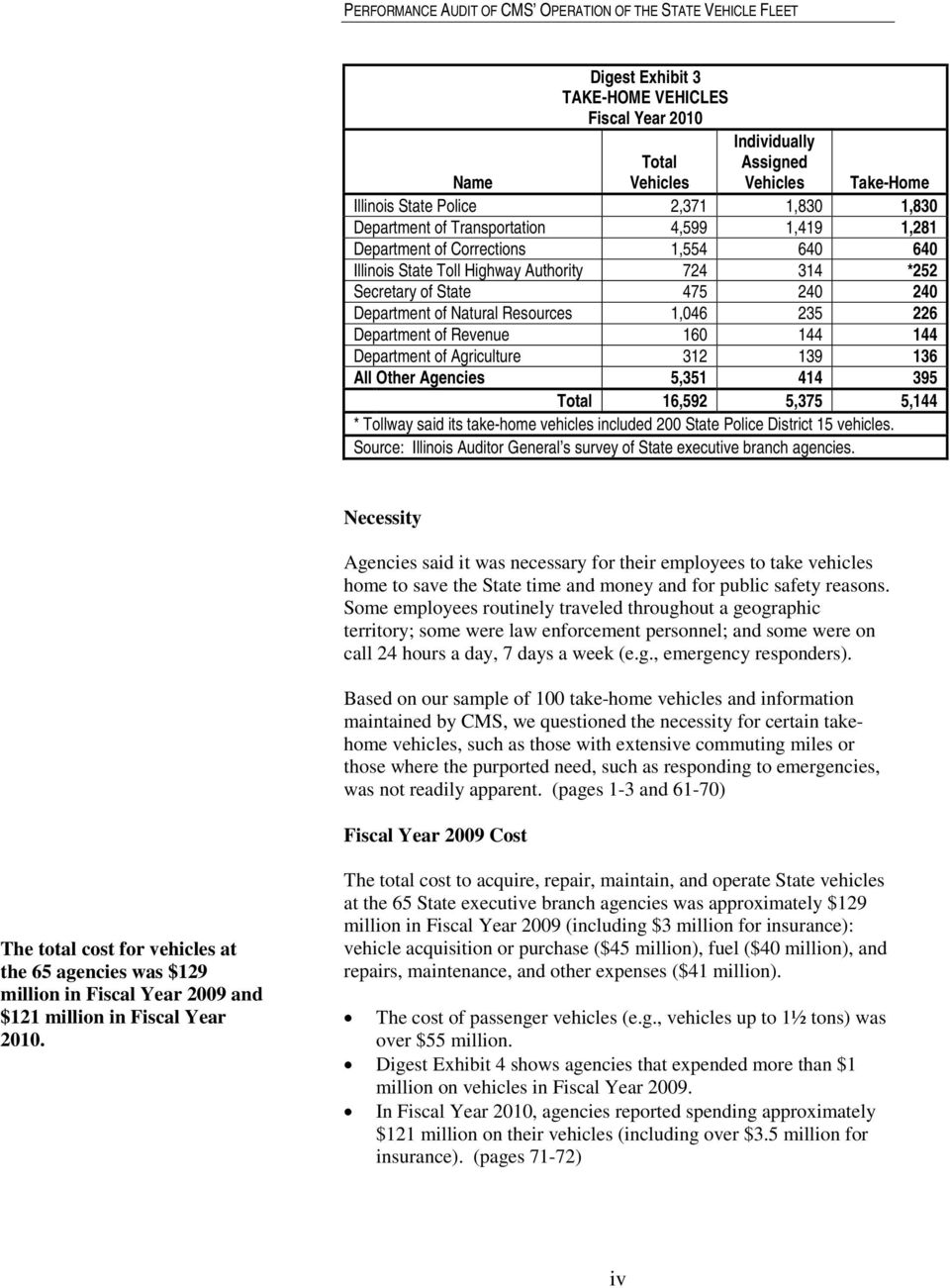
8 PERFORMANCE AUDIT OF CMS OPERATION OF THE STATE VEHICLE FLEET Digest Exhibit 3 TAKE-HOME VEHICLES Fiscal Year 2010 Individually Name Total Vehicles Assigned Vehicles Take-Home Illinois State Police 2,371 1,830 1,830 Department of Transportation 4,599 1,419 1,281 Department of Corrections 1, Illinois State Toll Highway Authority *252 Secretary of State Department of Natural Resources 1, Department of Revenue Department of Agriculture All Other Agencies 5, Total 16,592 5,375 5,144 * Tollway said its take-home vehicles included 200 State Police District 15 vehicles. Source: Illinois Auditor General s survey of State executive branch agencies. Necessity Agencies said it was necessary for their employees to take vehicles home to save the State time and money and for public safety reasons. Some employees routinely traveled throughout a geographic territory; some were law enforcement personnel; and some were on call 24 hours a day, 7 days a week (e.g., emergency responders). Based on our sample of 100 take-home vehicles and information maintained by CMS, we questioned the necessity for certain takehome vehicles, such as those with extensive commuting miles or those where the purported need, such as responding to emergencies, was not readily apparent. (pages 1-3 and 61-70) Fiscal Year 2009 Cost The total cost for vehicles at the 65 agencies was $129 million in Fiscal Year 2009 and $121 million in Fiscal Year The total cost to acquire, repair, maintain, and operate State vehicles at the 65 State executive branch agencies was approximately $129 million in Fiscal Year 2009 (including $3 million for insurance): vehicle acquisition or purchase ($45 million), fuel ($40 million), and repairs, maintenance, and other expenses ($41 million). The cost of passenger vehicles (e.g., vehicles up to 1½ tons) was over $55 million. Digest Exhibit 4 shows agencies that expended more than $1 million on vehicles in Fiscal Year In Fiscal Year 2010, agencies reported spending approximately $121 million on their vehicles (including over $3.5 million for insurance). (pages 71-72) iv
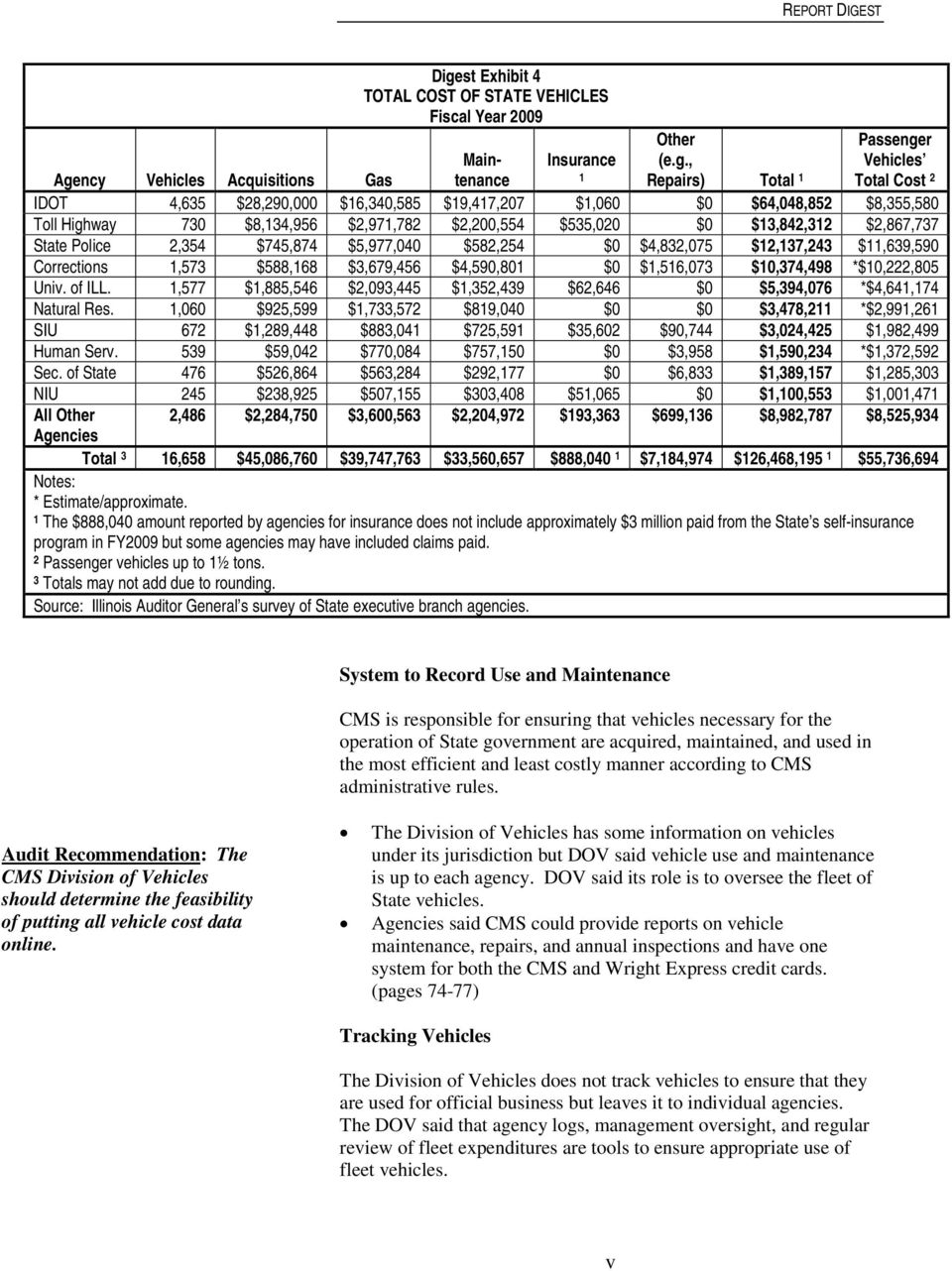
9 REPORT DIGEST Digest Exhibit 4 TOTAL COST OF STATE VEHICLES Fiscal Year 2009 Other (e.g., Repairs) Total 1 Passenger Vehicles Total Cost 2 Agency Vehicles Acquisitions Gas Maintenance Insurance 1 IDOT 4,635 $28,290,000 $16,340,585 $19,417,207 $1,060 $0 $64,048,852 $8,355,580 Toll Highway 730 $8,134,956 $2,971,782 $2,200,554 $535,020 $0 $13,842,312 $2,867,737 State Police 2,354 $745,874 $5,977,040 $582,254 $0 $4,832,075 $12,137,243 $11,639,590 Corrections 1,573 $588,168 $3,679,456 $4,590,801 $0 $1,516,073 $10,374,498 *$10,222,805 Univ. of ILL. 1,577 $1,885,546 $2,093,445 $1,352,439 $62,646 $0 $5,394,076 *$4,641,174 Natural Res. 1,060 $925,599 $1,733,572 $819,040 $0 $0 $3,478,211 *$2,991,261 SIU 672 $1,289,448 $883,041 $725,591 $35,602 $90,744 $3,024,425 $1,982,499 Human Serv. 539 $59,042 $770,084 $757,150 $0 $3,958 $1,590,234 *$1,372,592 Sec. of State 476 $526,864 $563,284 $292,177 $0 $6,833 $1,389,157 $1,285,303 NIU 245 $238,925 $507,155 $303,408 $51,065 $0 $1,100,553 $1,001,471 All Other 2,486 $2,284,750 $3,600,563 $2,204,972 $193,363 $699,136 $8,982,787 $8,525,934 Agencies Total 3 16,658 $45,086,760 $39,747,763 $33,560,657 $888,040 1 $7,184,974 $126,468,195 1 $55,736,694 Notes: * Estimate/approximate. 1 The $888,040 amount reported by agencies for insurance does not include approximately $3 million paid from the State s self-insurance program in FY2009 but some agencies may have included claims paid. 2 Passenger vehicles up to 1½ tons. 3 Totals may not add due to rounding. Source: Illinois Auditor General s survey of State executive branch agencies. System to Record Use and Maintenance CMS is responsible for ensuring that vehicles necessary for the operation of State government are acquired, maintained, and used in the most efficient and least costly manner according to CMS administrative rules. Audit Recommendation: The CMS Division of Vehicles should determine the feasibility of putting all vehicle cost data online. The Division of Vehicles has some information on vehicles under its jurisdiction but DOV said vehicle use and maintenance is up to each agency. DOV said its role is to oversee the fleet of State vehicles. Agencies said CMS could provide reports on vehicle maintenance, repairs, and annual inspections and have one system for both the CMS and Wright Express credit cards. (pages 74-77) Tracking Vehicles The Division of Vehicles does not track vehicles to ensure that they are used for official business but leaves it to individual agencies. The DOV said that agency logs, management oversight, and regular review of fleet expenditures are tools to ensure appropriate use of fleet vehicles. v
10 PERFORMANCE AUDIT OF CMS OPERATION OF THE STATE VEHICLE FLEET Audit Recommendation: The CMS Division of Vehicles should formally evaluate the availability and cost of GPS systems that State agencies may be able to use to track their State-owned vehicles. Global Positioning Systems (GPS) can be used to track the location of vehicles. Two agencies, the Illinois State Toll Highway Authority and Illinois Workers Compensation Commission, are currently using GPS on vehicles. DOV said that a GPS system could be expensive but would reduce the cost of managing the fleet. Other agencies also noted that GPS may be costly but could ensure vehicles were used for State business. GPS systems are becoming more common and being used more as their prices have dropped. (pages 77-80) VEHICLE ADMINISTRATION Agencies lacked adequate controls over the use of State-owned vehicles. Specific daily vehicle logs were not kept by all the agencies, making it difficult to determine (1) if vehicles were used for State business only and (2) if it was cost effective to provide a State vehicle (e.g., annual miles driven, excessive commuting). (page 35) Operations Monitoring is an important responsibility since information on miles driven, commuting miles, and fuel consumption could indicate if the vehicle is necessary or if the vehicle is being driven for official business only. Audit Recommendation: The Division of Vehicles should become more actively involved in the operation and oversight of State vehicles. CMS has established administrative rules to govern State vehicles. The rules state that CMS should ensure that State vehicles are used in the most efficient and least costly manner. The CMS Division of Vehicles said vehicle operations are the responsibility of individual agencies and that it is not charged with monitoring vehicles. Monitoring is an important responsibility since information on miles driven, commuting miles, and fuel consumption could indicate if the vehicle is necessary or if the vehicle is being driven for official business only. We recommended that the Division of Vehicles should become more actively involved in the operation and oversight of State vehicles to ensure they are maintained and used in the most efficient and least costly manner. (pages 17-25) Vehicle Information CMS maintains some information on State-owned vehicles under its jurisdiction in two spreadsheets. One has information on the entire State fleet under its jurisdiction while a second has information on vehicles that are individually assigned (IAV); see criteria in Digest Exhibit 5. However, this annual IAV report contained errors which limited its reliability, accuracy, and usefulness. (pages 4, 18-22) vi
11 REPORT DIGEST Agency vehicle coordinators are responsible for oversight but were not properly checking logs, commuting miles, or submitting accurate reports. Coordinators Vehicle coordinators at each agency are responsible for monitoring vehicle efficiency and providing oversight, per the CMS Vehicle Guide. Vehicle coordinators were not properly checking vehicle logs, monitoring commuting miles, or submitting accurate reports. Having accurate Digest Exhibit 5 VEHICLE ASSIGNMENT CRITERIA 44 Ill. Adm. Code A. The vehicle is specially equipped to perform law enforcement services and the law enforcement employee is on call 24 hours a day. B. The employee s work assignment requires traveling to numerous locations over a considerable territory with infrequent stops at the employee s headquarters as defined in the regulations concerning State employee travel. C. When the employee is a State official confirmed by the State Senate or acting in the capacity of such a State official. D. When the employee is regularly subject to special or emergency calls from his/her residence during non-duty hours. vehicle information is important so the agency knows what the State vehicle is costing, whether a vehicle is necessary, whether the vehicle is being used for State business, and whether federal taxes are being paid. (pages 25-27) License Plates A total of 218 State vehicles at 20 agencies under the jurisdiction of CMS used conventional (or straight ) license plates in 2010, rather than U plates. DOV did not keep a public record of the non U- plates approved as required by statute (30 ILCS 610). DOV did not require that the agency head certify that the vehicle with conventional plates would be used for functions requiring conventional plates, as required by CMS administrative rules (44 Ill. Adm. Code (c)(2)): The agency head must certify that the vehicle bearing the conventional plate will be used substantially fulltime in functions requiring the conventional plate. [emphasis added] (pages 29-33) Audit Recommendation: The CMS Division of Vehicles should perform a breakeven analysis, with costs updated annually, and provide it to all State agencies with the recommendation to use it to determine if it is cost-effective to provide employees with State vehicles for official use. Breakeven Miles In January 2011, the CMS Division of Vehicles performed a calculation on the number of miles that a vehicle would need to be driven to break even (or be cost-effective for the State). This analysis shows how much a State vehicle costs and may be considered by an agency to determine if it should provide a vehicle for official business or reimburse the employee for using his/her own vehicle. Costs are not the only consideration in providing a State vehicle as some vehicles are necessary due to lights, equipment, tools, and off-road (4-wheel drive) capability. vii
12 PERFORMANCE AUDIT OF CMS OPERATION OF THE STATE VEHICLE FLEET If State vehicles are not used sufficiently, it would cost the State less to reimburse employees than to provide a State-owned vehicle. Based on the breakeven calculations provided by CMS, if vehicles are not driven a minimum number of miles between 7,000 and 12,000 miles per year depending on the type of car it would be more cost-effective for the State to reimburse the employee for use of a personal vehicle. One-fourth of the 100 vehicles in our sample were not driven at least 1,150 miles in the two months sampled, or nearly 7,000 miles per year. (pages 36-41) Purchasing According to CMS administrative rules, agencies may purchase a passenger vehicle if it is expected to be used 18,000 miles per year (see Digest Exhibit 6); otherwise, it may still be purchased if the agency s operational needs are explained by the agency head. The Fiscal Year 2010 reports filed by agencies with CMS listed over 1,000 of the 1,800 IAVs that were not driven an average of 18,000 miles per year; some were not even driven 7,000 miles per year. In Fiscal Year 2010, agencies requested purchasing 900 passenger vehicles. All requests were approved by the Division of Vehicles. Over 250 of the vehicle requests said their new vehicle was expected to be driven exactly 18,000 miles per year. (pages 40-42) Vehicle Logs and Commuting The Governor issued a policy on April 12, 2010 which stated that if a vehicle is used to commute between home and office (work headquarters) more than 30 percent of the total miles, it should be carefully evaluated by agency heads (see Digest Exhibit 7). Digest Exhibit 6 EXPECTED USAGE 18,000 MILES 44 Ill. Adm. Code Expected usage. New and leased general purpose passenger vehicles are to be used a minimum of 1,500 miles per month [18,000 miles per year].... Digest Exhibit 7 GOVERNOR S POLICY Assignment of State Vehicles April 12, 2010 Vehicles may not be assigned as a form of compensation, as a benefit, or based solely on an employee s title.... As a general matter, unless it is in the best interests of the State, commuting miles should not exceed 30% of miles driven. Commuting miles over 30% of total annual miles should be carefully evaluated by agency heads. [emphasis added] State vehicles were used extensively (greater than 30% of total miles driven) for commuting, according to the 2010 annual IAV report prepared by the CMS Division of Vehicles. We sampled 100 vehicles from 32 agencies for September and October 2010: 76 vehicles were under the jurisdiction of CMS viii

13 REPORT DIGEST In our sample, 20 of 50 vehicles which had logs (40%) were used to commute more than 30% of the miles. This percent may be even higher as agencies did not always require daily vehicle logs. Agencies kept different types of logs which limited our analysis of the need for take home vehicles. and the remaining 24 vehicles were under the jurisdiction of other executive branch agencies. Of the 76 vehicles under CMS, which were required to keep logs, 50 vehicles had logs (see Digest Exhibit 8). The logs showed that 20 vehicles (40%) were used to commute more than 30 percent of total miles, including 10 vehicles that were used to commute over 50 percent of the total miles. Digest Exhibit 8 CMS DIVISION OF VEHICLES June 10, 2010 Letter to Agencies Agency drivers and agencies are responsible to ensure individually assigned vehicle drivers maintain a vehicle log that includes date, travel destination, beginning and ending mileage, commuting miles, and commuting trips.... [emphasis added] The number of vehicles used for commuting over 30 percent of the total miles may be even higher as agencies did not always keep daily vehicle logs. Agencies kept different types of logs, including logs which were just monthly or lacked destinations and commuting miles. The lack of complete and accurate data on number of days traveled, destinations, total miles, and commuting miles limited our analysis of the need for take home vehicles. Daily logs can help agency management monitor the purpose for which the vehicle is used and determine if it is cost effective for the State to provide a vehicle. (pages 4-5, 43-47) Federal Taxes The Internal Revenue Service requires employers to tax the value of vehicles provided to employees for commuting between home and work headquarters (with exceptions such as law enforcement, public safety). Taxes are due on all employees who commute in an employer s vehicle. For the 100 employees we sampled, 55 employees paid the federal commuting taxes. Agencies for nine employees did not provide documentation to show they paid commuting taxes. The remaining 36 employees either did not use their State vehicles to commute, or did not have specific vehicle logs, or were exempted from paying this tax (by 2011 IRS Publication 15-B) due to the nature of their work (e.g., vehicles used for police, fire, public safety, cargo, delivery, etc.). The Governor s April 12, 2010 policy on individual assignment of vehicles states that, Employees failure to report their commuting properly can result in additional amounts included in their income. (pages 55-56) ix
14 PERFORMANCE AUDIT OF CMS OPERATION OF THE STATE VEHICLE FLEET Monitoring Miles State agencies generally monitor the miles driven on State-owned vehicles by using the vehicle s mileage logs. Agencies said they used in-house estimates or a CMS tool called a trip cost calculator for comparing the cost of a vehicle with reimbursing an employee for using a personal vehicle. (pages 57-60) Vehicle Policy Over 20 agencies did not have a vehicle policy. The 43 agencies with most of the State-owned vehicles had established a vehicle policy; however, 22 agencies with State-owned vehicles did not have a policy, including agencies with as many as 81 vehicles. These agencies had a combined total of over 350 State-owned vehicles and included 9 agencies with at least 10 vehicles each. A vehicle policy could address the purpose of the vehicle, procedures for using pool vehicle(s), records that need to be kept (e.g., total and commuting miles), reports that need to be filed, taxes that need to be paid if used for commuting or personal use, employees who review the reports (e.g., supervisor, vehicle coordinator), supporting documents that employees need to provide (e.g., vehicle log, credit card receipts), disciplinary action that may be taken if vehicle is improperly used, etc. (pages 81-83) RECOMMENDATIONS The audit made 14 recommendations to CMS which it generally agreed to implement. CMS entire response is in Appendix G and also after each audit recommendation. WILLIAM G. HOLLAND Auditor General WGH:mad x

15 TABLE OF CONTENTS Auditor General s Transmittal Letter Report Digest Table of Contents i Chapter One Report Conclusions 1 INTRODUCTION Background 7 Procurement 8 Operations 9 Self-Insurance 9 Title 9 Scope and Methodology 9 Chapter Two Chapter Conclusions 13 VEHICLE Central Management Services 14 ADMINISTRATION Recommendation 1: Vehicle Program 16 Individually Assigned Vehicles 17 Recommendation 2: Vehicle Assignment 18 Letter Annual Reporting on Individually 18 Assigned Vehicles Data on 2009 Individually Assigned 20 Vehicles Recommendation 3: Individually Assigned 22 Vehicle Annual Reporting Operations 23 Recommendation 4: Oversight of Vehicles 24 Vehicle Coordinators 25 Recommendation 5: Vehicle Coordinators 27 Training Maximus Report 28 License Plates 29 Non-U License Plates 29 Conventional License Plates 30 Covert License Plates 32 Conclusion 32 Recommendation 6: License Plates 33

16 TABLE OF CONTENTS Chapter Three Chapter Conclusions 35 VEHICLE Breakeven Miles 36 USE Recommendation 7: Breakeven Miles 39 Purchasing Vehicles 18,000 miles per year 40 Recommendation 8: Vehicles Driven Less 42 Than 18,000 Miles Per Year Commuting 43 Commuting Miles for Vehicles Sampled 45 CMS Motor Pool Vehicles 48 Recommendation 9: Motor Pool Logs 49 Necessity of Take-home Vehicles 49 Recommendation 10: Daily Vehicle Log 55 Tax on Commuting Miles 55 Recommendation 11: Commuting Tax 56 Monitoring Miles 57 Reimbursing Employee vs. Providing State 58 Vehicle Chapter Four Chapter Conclusions 61 HOUSE Number of Vehicles 62 RESOLUTION Take-home Vehicles 65 QUESTIONS Total Annual Cost 71 Adequacy of CMS System to Record 74 Maintenance Recommendation 12: Vehicle Cost Data 76 Adequacy of CMS to Track Vehicles 77 Ways to Track Vehicles 78 Recommendation 13: Global Positioning System for Tracking Vehicles 80 Chapter Five Chapter Conclusions 81 AUDIT Vehicle Policy 81 SURVEY Recommendation 14: Vehicle Policy 83 QUESTIONNAIRE Agencies Tracking of their Own Vehicles 83 Monitoring Expenses for Vehicles 85 Excess Vehicles 87 Other Comments 88
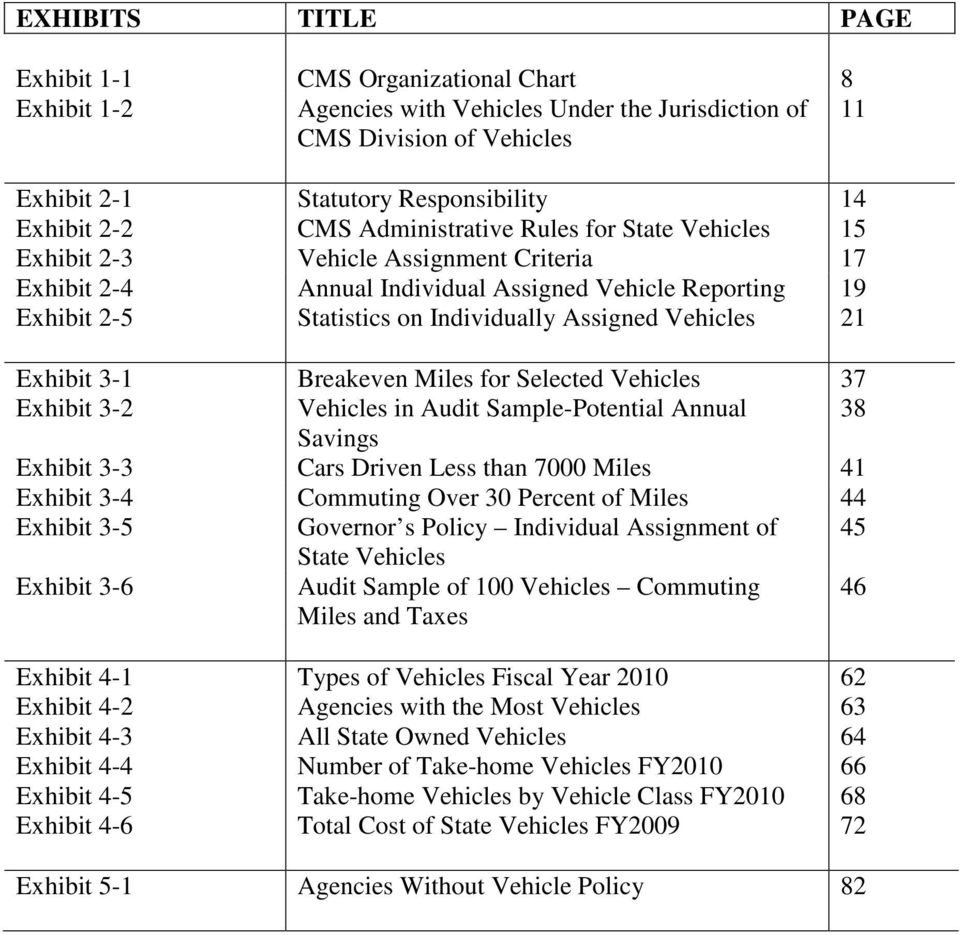
17 EXHIBITS TITLE PAGE Exhibit 1-1 CMS Organizational Chart 8 Exhibit 1-2 Agencies with Vehicles Under the Jurisdiction of 11 CMS Division of Vehicles Exhibit 2-1 Statutory Responsibility 14 Exhibit 2-2 CMS Administrative Rules for State Vehicles 15 Exhibit 2-3 Vehicle Assignment Criteria 17 Exhibit 2-4 Annual Individual Assigned Vehicle Reporting 19 Exhibit 2-5 Statistics on Individually Assigned Vehicles 21 Exhibit 3-1 Breakeven Miles for Selected Vehicles 37 Exhibit 3-2 Vehicles in Audit Sample-Potential Annual 38 Savings Exhibit 3-3 Cars Driven Less than 7000 Miles 41 Exhibit 3-4 Commuting Over 30 Percent of Miles 44 Exhibit 3-5 Governor s Policy Individual Assignment of 45 State Vehicles Exhibit 3-6 Audit Sample of 100 Vehicles Commuting Miles and Taxes 46 Exhibit 4-1 Types of Vehicles Fiscal Year Exhibit 4-2 Exhibit 4-3 Exhibit 4-4 Exhibit 4-5 Exhibit 4-6 Agencies with the Most Vehicles All State Owned Vehicles Number of Take-home Vehicles FY2010 Take-home Vehicles by Vehicle Class FY2010 Total Cost of State Vehicles FY Exhibit 5-1 Agencies Without Vehicle Policy 82
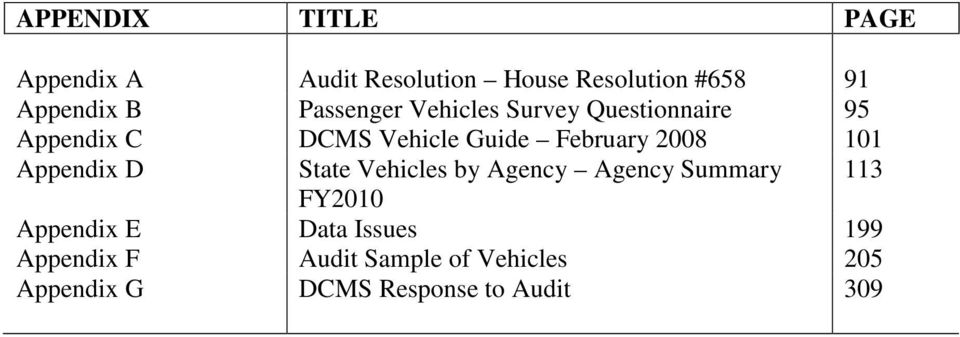
18 APPENDIX TITLE PAGE Appendix A Audit Resolution House Resolution # Appendix B Passenger Vehicles Survey Questionnaire 95 Appendix C DCMS Vehicle Guide February Appendix D State Vehicles by Agency Agency Summary 113 FY2010 Appendix E Data Issues 199 Appendix F Audit Sample of Vehicles 205 Appendix G DCMS Response to Audit 309
19 Chapter 1 Introduction The Illinois House of Representatives adopted Resolution Number 658 directing the Auditor General to audit the Department of Central Management Services (CMS) operations of the fleet of passenger cars used by State executive agencies and employees. The Resolution called for the audit to address the following seven areas (see Appendix A): 1. Total Vehicles. The total number of passenger cars in the State fleet, including by executive agency; 2. Take-Home Vehicles. The total number of passenger cars in the fleet that employees may take home by executive agency; 3. Necessity. Whether it is necessary or advisable for employees to take vehicles home; 4. Fiscal Year 2009 Cost. The total annual cost of vehicles in the State fleet, including for purchasing, insuring, maintaining and operating in Fiscal Year 2009; 5. System to Record Use and Maintenance. The adequacy of the system used by CMS to record the use and maintenance of passenger cars in the fleet; 6. Official Use Only. The adequacy of the system of checks used by CMS to ensure that passenger vehicles in the fleet are used for official business only; and 7. Possible to Track Vehicles. Whether it is possible to implement a system that would allow CMS to track vehicles and identify whether they are being used for official business only. This audit includes all State-owned vehicles under the executive agencies as indicated by House Resolution Number 658 and concentrates on Fiscal Year We sent a survey questionnaire to 82 agencies in 2010 and also sampled 100 vehicles in Fiscal Year REPORT CONCLUSIONS The State of Illinois vehicle fleet is not overseen by any one agency with complete responsibility and authority. The Department of Central Management Services has the statutory responsibility to administer the operation of passenger cars under the Governor s executive departments, along with those agencies that desire to use CMS vehicle services. The remaining executive branch agencies operate and control their own vehicles. STATE VEHICLES FY executive branch agencies had vehicles 16,592 vehicles were reported to be owned by the 65 agencies 5,375 vehicles were assigned to individual employees 5,144 were take-home vehicles $129 million was the total cost to acquire and use vehicles in FY09 1

20 PERFORMANCE AUDIT OF CMS OPERATIONS OF THE STATE VEHICLE FLEET AUDIT RESOLUTION House Resolution Number 658 directed us to address seven areas listed below regarding State vehicles. We surveyed the State s executive branch agencies and 65 agencies reported they had State vehicles. 1. Total Vehicles. A total of 65 State executive branch agencies had nearly 16,600 vehicles in Fiscal Year They included approximately 5,500 passenger cars (e.g., sedans), 7,000 trucks (4,000 of which are up to 1½ tons), 3,000 vans/minivans, and 900 sport utility vehicles (SUVs). Over two-thirds of the vehicles were at five agencies: Department of Transportation (4,599); Illinois State Police (2,371), University of Illinois (1,572), Department of Corrections (1,554), and Department of Natural Resources (1,046) for a total of 11,142 vehicles. Almost 75 percent of the total State-owned vehicles were at agencies that were under the jurisdiction of CMS (12,000 of 16,600). See Exhibit Take-Home Vehicles. The 65 State agencies had approximately 5,375 vehicles that were personally or individually assigned to employees and approximately 5,150 were authorized to be taken home on June 30, These included over 3,275 passenger cars (sedans), 1,150 trucks up to 1½ tons, 400 SUVs, 300 vans/minivans, and 20 other vehicles. See Exhibit Necessity. Agencies said it was necessary for their employees to take vehicles home to save the State time and money and for public safety reasons. Some employees routinely traveled throughout a geographic territory; some were law enforcement personnel; and some were on call 24 hours a day, 7 days a week (e.g., highway emergency responders). Based on our sample of 100 take-home vehicles and information maintained by CMS, we questioned the necessity for certain take-home vehicles, such as those with extensive commuting miles or those where the purported need, such as responding to emergencies, was not readily apparent. 4. Fiscal Year 2009 Cost. The total cost to acquire, repair, maintain, and operate State vehicles at the 65 State executive branch agencies was approximately $129 million in Fiscal Year 2009: vehicle acquisition or purchase ($45 million); fuel ($40 million); repairs, maintenance, and other expenses ($40 million); and insurance ($3 million). The cost of passenger vehicles (e.g., vehicles up to 1½ tons) was over $55 million (including insurance). In Fiscal Year 2010 agencies reported spending approximately $121 million on their vehicles. 5. System to Record Use and Maintenance. Administrative rules state that CMS shall be responsible for ensuring that vehicles necessary for the operation of State government are acquired, maintained, and used in the most efficient and least costly manner. CMS has a Division of Vehicles (DOV) which has some information on how vehicles under its jurisdiction are used but DOV said it is responsible for developing vehicle policies while vehicle use and maintenance is up to each individual State agency. 2
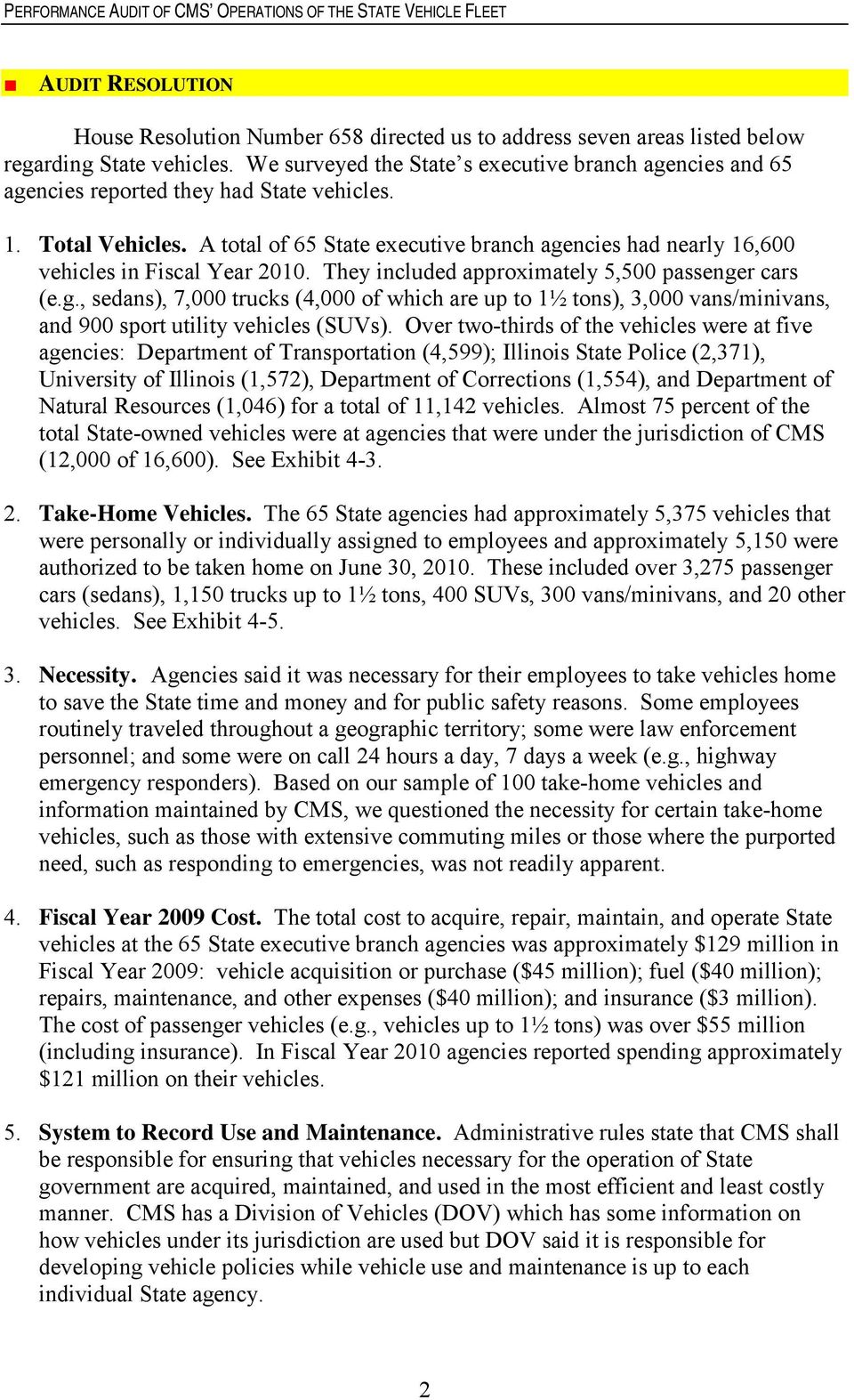
21 CHAPTER 1: INTRODUCTION 6. Official Use Only. Monitoring the use of State vehicles for State business only is generally the responsibility of individual State agencies. 7. Tracking Vehicles. A Global Positioning System (GPS) can be used to track the location of vehicles. Two State agencies, the Illinois State Toll Highway Authority and the Illinois Workers Compensation Commission, are currently using GPS to track their vehicles. VEHICLE ADMINISTRATION The Department of Central Management Services has the statutory responsibility to administer the operation of passenger cars under the Governor s executive departments and the agencies that desire to use CMS vehicle services:... to acquire, maintain, and administer the operation of the passenger cars reasonably necessary to the operations of the executive department of the State government.... (20 ILCS 405/ ) Administrative rules state that CMS shall be responsible for ensuring that vehicles necessary for the operation of State government are acquired, maintained, and used... in the most efficient and least costly manner that comports with the State s needs (44 Ill. Adm. Code ). CMS Division of Vehicles (DOV) performs some administrative functions over vehicles, such as maintaining inventory data on the fleet, but leaves operations and monitoring of vehicles to the individual State agencies. There were 47 agencies whose vehicles were under the jurisdiction of CMS in Fiscal Year DOV has five employees who administer the State fleet. DOV trains vehicle coordinators at agencies and works with the vehicle coordinators who are responsible for their agencies vehicles. The audit identified areas discussed below where the administration of the State s vehicle fleet, specifically take-home vehicles, could be made more efficient and effective. 1. Operations. The CMS Division of Vehicles has some information on agencies State vehicles but does not consider vehicle operations to be its responsibility. DOV said vehicle operations are the responsibility of individual agencies and that CMS has historically not been charged with monitoring the operation of vehicles. According to CMS rules, DOV is responsible for ensuring that State vehicles are used in the most efficient, least costly manner (44 Ill. Adm. Code ). DOV is also responsible for ensuring that State vehicles are used for State duties. Monitoring is an important responsibility since information on miles driven, commuting miles, and fuel consumption could indicate if the vehicle is necessary or if the vehicle is being driven for official business only. We recommended that CMS become more actively involved in the operation and oversight of State vehicles to ensure vehicles are maintained and used in the most efficient and least costly manner as required by its administrative rules. In addition, CMS should periodically audit agencies use of vehicles as authorized by its administrative rules. 3
22 PERFORMANCE AUDIT OF CMS OPERATIONS OF THE STATE VEHICLE FLEET 2. Vehicle Information. CMS maintains some information on State-owned vehicles under its jurisdiction in two spreadsheets. One spreadsheet (or report) has information on all Individually Assigned Vehicles (IAV) while a second has information on the entire State fleet under its jurisdiction. CMS administrative rules require agencies under its jurisdiction to report information on IAVs each year (except for law enforcement vehicles). However, this annual IAV report contained errors which limited the reliability, accuracy, and usefulness of this information. The errors were due in part to a lack of careful review by agencies vehicle coordinators. We recommended that CMS work with agencies to eliminate errors from the IAV report to improve its usefulness as a management tool. 3. Vehicle Logs. One-third of the employees lacked specific travel logs which can help agency management effectively monitor the purpose for which the vehicle is used and if it is cost effective for the State to provide a vehicle. There were other exceptions in our sample also: Agencies kept different types of logs, including logs which were not daily but just showed total monthly miles, lacked destinations, lacked commuting miles, or recorded all miles as commuting miles. Some agencies said they used the vehicle s monthly credit card expenditure report as their log while other agencies did not have logs but were developing them. For agencies under CMS jurisdiction, the Division of Vehicles said it provided a sample daily log which had the following columns: date, destination, beginning miles, ending miles, and commuting miles. In the column labeled commuting miles, employees sometimes wrote the total miles traveled during the entire day (the difference between beginning and ending miles) rather than just the commuting miles between home and work headquarters. The lack of complete and accurate data on number of days traveled, destinations, and total miles, including the number of miles that were for commuting, limited our analysis of the need for take-home vehicles. We recommended that CMS provide a uniform daily vehicle log that is required to be used by State agencies under its jurisdiction. CMS should then randomly sample each agency s logs to ensure they are being properly completed. 4. Commuting. State vehicles were used extensively (greater than 30% of total miles driven) for commuting, according to the 2010 annual IAV report prepared by the Division of Vehicles. In fact, there may be even more vehicles used for commuting given that agencies did not report commuting miles for over 1,500 vehicles. We sampled 100 vehicles from 32 agencies during September and October 2010: 76 vehicles were under the jurisdiction of CMS and the remaining 24 vehicles were under the jurisdiction of other executive branch agencies. Of the 76 vehicles under CMS, 50 vehicles had vehicle logs. Of these 50 vehicles, 20 vehicles (40%) were used to commute more than 30 percent of total miles, including 10 vehicles that were used to commute over 50 percent of the total miles. The Governor issued a policy on April 12, 2010 which stated that if a 4
23 CHAPTER 1: INTRODUCTION vehicle is used to commute between home and office more than 30 percent of the total miles, it should be carefully evaluated by agency heads. Except for Illinois State Police, no agency in our sample that used a vehicle for commuting more than 30 percent of miles provided such an evaluation. Separately, the Illinois State Toll Highway Authority performed an analysis which reduced the number of take-home vehicles assigned to employees. Agencies reported the need for vehicles on their annual IAV report to the CMS CMS Division of Vehicles June 10, 2010 Letter to Agencies Agency drivers and agencies are responsible to ensure individually assigned vehicle drivers maintain a vehicle log that includes date, travel destination, beginning and ending mileage, commuting miles, and commuting trips.... Agencies should prepare to provide written justification for assignments where the 30% guideline is exceeded. Division of Vehicles but could provide little detailed analysis when we requested support. Agencies said that it was necessary for employees to take vehicles home due to law enforcement or emergency response reasons. Our review identified instances where it may be feasible and cost-effective for agencies to discontinue the assignment of take-home vehicles that had a high percentage of commuting miles. We recommended that CMS require agency heads to submit a written evaluation when commuting mileage exceeds the 30 percent level established by the Governor. 5. Breakeven Miles. Based on breakeven calculations provided by CMS, we identified instances where it may have been more cost-effective for agencies to reimburse the employee for mileage to drive their personal vehicle rather than provide a take home vehicle. If vehicles are not driven a minimum number of miles between 7,000 and 12,000 miles per year depending on the type of car it would be more costeffective for the State to reimburse the employee than to provide a vehicle (unless the vehicle is a law enforcement vehicle or has special equipment, lights, carries tools, etc). We recommended that CMS perform a breakeven analysis for all vehicle types commonly used by State agencies and provide it to agencies to determine if it is cost-effective to provide employees with State vehicles for official use. 6. Purchasing. CMS has established an 18,000 mile per year expected usage threshold when purchasing a vehicle, unless the agency head explains that operations require otherwise. The Fiscal Year 2010 individually assigned vehicle reports filed by agencies with CMS listed over 1,000 of the 1,800 IAVs which were not driven an average of 18,000 miles per year; some vehicles were not driven even 7,000 miles per year (as shown in Exhibit 3-3). In Fiscal Year 2010, agencies requested purchasing 900 passenger vehicles. All requests were approved by DOV. Over 250 of the vehicle requests said their new vehicle was expected to be driven exactly 18,000 miles per year. 5
24 PERFORMANCE AUDIT OF CMS OPERATIONS OF THE STATE VEHICLE FLEET We recommended that before a new vehicle is purchased for any agency, CMS check that the old passenger vehicle was driven an average of 18,000 miles per year; if not, CMS should require an explanation from the agency head. 7. Federal Taxes. The Internal Revenue Service (IRS) requires employers to tax the value of a vehicle provided to employees for commuting (between home and work headquarters) by multiplying each one-way commute by $1.50. Taxes are due on all employees who commute in an employer owned vehicle (with some exceptions such as law enforcement or public safety vehicles). For the 100 employees driving State vehicles that were sampled, 55 employees paid the federal commuting taxes. Agencies for nine employees did not provide documentation to show they paid commuting taxes. The remaining 36 employees either did not use their State vehicles to commute, did not have specific vehicle logs, or were exempted from paying this tax (2011 IRS Publication 15-B) due to the nature of their work, as shown in Exhibit 3-6 (e.g., vehicles used for police, fire, public safety, cargo, delivery, etc.). We recommended that CMS notify State agencies, under its jurisdiction, with individually assigned vehicles that can be used for commuting to evaluate if their employees need to pay the appropriate taxes for commuting in a State vehicle. 8. Vehicle Coordinators. Vehicle coordinators at each agency are responsible for monitoring vehicle efficiency and providing oversight as noted in the 2008 CMS Vehicle Guide. However, coordinators did not always submit accurate information to either CMS Division of Vehicles or to auditors and agencies responses to us indicated they need to better understand the vehicle requirements established by CMS and the Governor. Vehicle coordinators were not properly checking vehicle logs, monitoring commuting miles, ensuring commuting taxes were paid, or submitting accurate reports on individually assigned vehicles. Having accurate vehicle information is important so the agency knows what the State vehicle is costing, whether a vehicle is necessary, whether the vehicle is being used for State business only, and whether federal taxes are being paid properly. We recommended that CMS strengthen its training of agency vehicle coordinators to ensure they understand and fulfill their responsibilities, such as checking the daily vehicle logs for accuracy, monitoring individually assigned vehicles, ensuring proper taxes are being paid, and submitting accurate and timely reports each year on individually assigned vehicles to the Division of Vehicles. 9. Conventional License Plates. A total of 218 State vehicles at 20 agencies under the jurisdiction of the CMS used conventional (or straight ) license plates in 2010, rather than the U plates used by Illinois government vehicles or covert plates. Statute (30 ILCS 610) requires CMS to keep a public record of the non U-plates that it approves. DOV did not have such a document for public inspection but drafted one in August 2011 after we asked. CMS administrative rules (44 Ill. Adm. Code (c)(2)) state that The agency head must certify that the vehicle bearing the conventional plate will be used substantially full-time in functions requiring the conventional plate. The DOV said in 6
25 CHAPTER 1: INTRODUCTION August 2011 that they would be requiring agencies to comply with this administrative rule. DOV was not sure whether covert plates, such as those used by investigators, were being reported in its annual IAV report. Auditors found that agencies were reporting these license plates in the Fiscal Year 2010 IAV report. We recommended that the CMS Division of Vehicles should specify to agency vehicle coordinators all the reporting requirements that are applicable when State vehicles use non-u license plates. 10. Vehicle Policy. The 43 agencies with most of the State-owned vehicles had established a vehicle policy; however, the remaining 22 agencies with State-owned vehicles did not have a policy, including agencies with as many as 81 vehicles. These agencies operated a combined total of over 350 State-owned vehicles and included 9 agencies which had at least 10 vehicles each. A vehicle policy could have addressed the purpose of having State vehicles, restrictions on take-home vehicles, procedures for using motor pool vehicles, and credit card use. We recommended that the CMS Division of Vehicles should encourage State agencies under its jurisdiction that currently lack a vehicle policy to establish a vehicle policy and make it available to its employees. BACKGROUND The Department of Central Management Services (CMS) is responsible for acquiring, maintaining, and administering the operation of passenger cars that are reasonably necessary to the operations of the executive departments (20 ILCS 405/ ). This is the principal requirement in the statute regarding the CMS responsibility for State vehicles. In addition, CMS has established administrative rules governing State-owned vehicles. These rules apply to all executive departments and to all agencies desiring to use CMS vehicle services. The rules state that CMS shall be responsible for ensuring that vehicles necessary for the operation of State government are acquired, maintained, and used in the most efficient and least costly manner that comports with the States needs (44 Ill. Adm. Code ). State vehicles shall only be used for public purposes in the best interest of the State, according to CMS administrative rules. CMS has a Vehicle Guide (2008) for drivers of State vehicles (see Appendix C) which includes the authorized uses of State-owned vehicles from CMS administrative rules (see inset) and covers topics such as drivers requirements; vehicle safety and security; vehicle repairs, fuel, and Authorized State Vehicle Uses 44 Ill. Adm. Code Travel between places of State business, temporary lodging, obtain meals. Travel to places to obtain emergency assistance/supplies. Transport other employees or consultants on State business. Transport materials, equipment, supplies, or tools for State business. Commute in an assigned vehicle if authorized. 7
26 PERFORMANCE AUDIT OF CMS OPERATIONS OF THE STATE VEHICLE FLEET maintenance; credit card use; accident reporting; insurance coverage; vehicle coordinators responsibilities; and other such information. For each vehicle acquired, the Division of Vehicles issues a CMS Fleet Card to purchase fuel and pay for expenses at CMS garages. In addition, there is a commercial credit card (Wright Express) which may be used by employees to purchase fuel at commercial sites and pay for services and repairs, such as oil, wiper replacements, light bulbs for headlights, and car washes. Emergency towing and tire repair are also permitted; other emergency repairs require CMS authorization the next business day (44 Ill. Adm. Code ). CMS has a Division of Vehicles which is under its Bureau of Strategic Sourcing to manage the fleet of State vehicles (see Exhibit 1-1). DOV s appropriations were $57 million in Fiscal Years 2010 and It had an approved headcount of 160 employees, including five employees who worked on the administrative areas that are addressed by this audit, while the vast majority worked in State garages. Exhibit 1-1 CMS ORGANIZATIONAL CHART CMS Director Bureau of Administrative Operations Bureau of Business Enterprise Bureau of Property Management Bureau of Strategic Sourcing Bureau of Personnel Bureau of Benefits Bureau of Information Services Bureau of Communications and Computer Services Division of Vehicles Source: CMS Division of Vehicles. Procurement If an agency under CMS wishes to acquire a vehicle, and has appropriations, it completes an Agency Fleet Request Form and submits it to the CMS Division of Vehicles. This form asks why the vehicle is critical to the agency s mission and why the vehicle is needed, among other questions (e.g., price, expected mileage to be driven, operational cost). 8
27 CHAPTER 1: INTRODUCTION Operations State-owned vehicles may be assigned to individual employees by the agency head. In Fiscal Year 2010, there were 5,375 individually assigned vehicles at the 65 State agencies in our survey. For the 47 agencies under the jurisdiction of CMS (see Exhibit 1-2), which had 2,050 IAVs, they were reported annually to CMS or when changes occurred (e.g., in assigned vehicle, headquarters, residence). Fuel and Repairs Vehicles under CMS are serviced at its garages and use its fuel pumps, along with using commercial facilities. CMS issues a credit card for use at CMS facilities and a second credit card from the company Wright Express for commercial/private facilities. There are a few agencies that can also obtain fuel from their own facilities and have vehicles examined by their own mechanics according to the CMS Division of Vehicles (e.g., Departments of Corrections, Natural Resources, Transportation). Annual Inspections Agencies shall have vehicles inspected by CMS at least once per year and maintain vehicles in accordance with CMS acceptable schedules (44 Ill. Adm. Code Scheduled Inspection and Maintenance). Passenger vehicles that are older than three years are required by CMS to be inspected annually. Self-Insurance The State pays for any damages and injury to third parties when a State vehicle is at fault and in Fiscal Year 2009 paid approximately $3 million. Agencies can also purchase a supplemental policy for collision and comprehensive insurance, which 32 agencies did for a premium of almost $900,000 in Fiscal Year Title Vehicles purchased or donated to the State are titled to CMS. Exceptions may be made for vehicles purchased with federal funds and for vehicles that are confiscated, which may be titled to an agency. Vehicles generally have Illinois license plates that differ from the general public and agencies may also request decal markings (44 Ill. Adm. Code ). SCOPE AND METHODOLOGY We conducted this performance audit in accordance with generally accepted government auditing standards and the audit standards promulgated by the Office of the Auditor General at 74 Ill. Adm. Code The audit standards require that we plan and perform the audit to obtain sufficient, appropriate evidence to provide a reasonable 9
28 PERFORMANCE AUDIT OF CMS OPERATIONS OF THE STATE VEHICLE FLEET basis for our findings and conclusions based on our audit objectives. We believe that the evidence obtained provides a reasonable basis for our findings and conclusions based on our audit objectives. The objectives for this audit were in House Resolution Number 658, which called for an audit of the Department of Central Management Services operations of the fleet of passenger cars used by State executive agencies and employees. The Resolution called for the audit to review and assess the following seven determinations (see Appendix A): 1. The total number of passenger cars in the State fleet by executive agency; 2. The total number of passenger cars in the fleet that employees may take home; 3. Whether it is necessary or advisable for employees to take vehicles home; 4. The total annual cost of vehicles in the State fleet in Fiscal Year 2009; 5. The adequacy of CMS system to record passenger cars use and maintenance; 6. The adequacy of CMS checks to ensure vehicles are used for business only; and 7. Whether it is possible to implement a system that would allow CMS to track vehicles and identify whether they are being used for official business only. Fieldwork for this audit was conducted from June 2010 to May We gathered information by reviewing statutes, administrative rules, agency policies, and procedures, and collected supporting documents for agency vehicles, asked questions, surveyed agencies, and asked agencies to complete our data collection instrument and provide documents. We reviewed compliance with CMS administrative rules and have included instances of non-compliance in this report. We also reviewed internal controls and assessed risk related to the audit s objectives. A risk assessment was conducted to identify areas that needed closer examination and significant weaknesses are presented in this report. We also considered reviewing IT controls but they pertained to State garages and were not applicable to this audit. We developed and sent a survey questionnaire to 82 agencies in the State s executive branch regarding their State vehicles. A total of 65 agencies reported having State vehicles in Fiscal Year 2010: 47 were either under the Governor or chose CMS vehicle services and another 18 were under the executive branch (e.g., constitutional officers, universities). The survey questionnaire (see Appendix B) asked questions about the number of vehicles that agencies had, whether the agencies had their own vehicle policies, how they monitored their vehicles, what their annual cost of operating the vehicles was for Fiscal Year 2009 as requested by the House Resolution, and any comments they had. The survey questionnaire was mailed to agencies in August 2010 and we followed up with agencies on various questions until August
29 CHAPTER 1: INTRODUCTION One of the reports we reviewed was the annual report to CMS Division of Vehicles on individually assigned vehicles. We began by reviewing the report for Fiscal Year 2009 that was available and found it contained errors which we communicated to DOV. Therefore, we used the next year s report (Fiscal Year 2010); however, this report also had errors e.g., one agency wrote for its vehicles that it either did not know the date when the vehicle was purchased or that the vehicles were purchased on July 1, 2010, which is the first day of Fiscal Year 2011 (see Appendix E for more examples of erroneous data). The erroneous data in the IAV report from agencies may have been caused by a lack of careful review by agency vehicle coordinators; however, this is the best data that was available. We also judgmentally selected a sample of 100 employees from 32 agencies with individually assigned vehicles and asked for information on their vehicle use from September and October Our data collection instrument asked questions and requested documentation about their vehicles, including their vehicle log, credit card statements, travel vouchers, headquarters and home city, job duties, justification for vehicle, annual vehicle inspections, vehicle tracking by agencies, and any taxes paid if vehicle was used for commuting. The results of this sample are reported in Chapter 3. In addition, we sampled 10 vehicles owned by the Department of Central Management Services as CMS had only motor pool vehicles no individually assigned vehicles during Fiscal Year The results of our Exhibit 1-2 AGENCIES WITH VEHICLES UNDER THE JURISDICTION OF CMS DIVISION OF VEHICLES July 2009 The CMS Division of Vehicles said the agencies in Yellow are required to use its vehicle services while the remaining agencies chose to use CMS vehicle services. 1. Capital Development Board 2. Comptroller 3. Department of Agriculture 4. Department of Central Management Services 5. Department of Children & Family Services 6. Department of Commerce & Economic Opportunity 7. Department of Corrections 8. Department of Employment Security 9. Department of Financial & Professional Regulation 10. Department of Healthcare and Family Services 11. Department of Human Rights 12. Department of Human Services 13. Department of Insurance 14. Department of Juvenile Justice 15. Department of Military Affairs 16. Department of Natural Resources 17. Department of Public Health 18. Department of Revenue 19. Department of Transportation 20. Department of Veterans Affairs 21. Department on Aging 22. Educational Labor Relations Board 23. Guardianship & Advocacy Commission 24. Illinois Board of Higher Education 25. Illinois Commerce Commission 26. Illinois Community College Board 27. Illinois Criminal Justice Information Authority 28. Illinois Deaf & Hard of Hearing Commission 29. Illinois Emergency Management Agency 30. Illinois Environmental Protection Agency 31. Illinois Gaming Board 32. Illinois Historic Preservation Agency 33. Illinois Law Enforcement Training & Standards Board 34. Illinois Math & Science Academy 35. Illinois State Police 36. Judges and General Assembly Retirement System 37. Judicial Inquiry Board 38. Medical District Commission 39. Office of the Executive Inspector General 40. Office of the State Fire Marshal 41. Prisoner Review Board 42. Property Tax Appeal Board 43. State Board of Elections 44. State Employees Retirement System 45. State Police Merit Board 46. State Universities Civil Service System 47. Student Assistance Commission Source: CMS Division of Vehicles 11
30 PERFORMANCE AUDIT OF CMS OPERATIONS OF THE STATE VEHICLE FLEET review are reported at the end of Chapter 3 after the results of our sample of 100 vehicles that is mentioned above. The Division of Vehicles tried to perform a State fleet efficiency study in 2008 but was not able to complete it because it was not able to gather the data. DOV provided us a which said DOV is currently completing a fleet efficiency study for the entire State s fleet of 12,200 vehicles. DOV said on September 8, 2011, that the study involved four State agencies (Agriculture, Central Management Services, Transportation, and Veterans Affairs) but was not completed because they... never were able to gather the data from all the agencies to complete the study. This audit is organized into four additional chapters: Chapter Two Vehicle Administration Chapter Three Vehicle Usage Chapter Four House Resolution Questions Chapter Five Audit Survey Questionnaire 12
31 Chapter 2 Vehicle Administration CHAPTER CONCLUSIONS The Department of Central Management Services has the statutory responsibility to administer the operation of passenger cars under the Governor s executive departments and the agencies that desire to use CMS vehicle services to... acquire, maintain, and administer the operation of the passenger cars reasonably necessary to the operations of the executive department of the State government.... (20 ILCS 405/ ) Administrative rules state that CMS shall be responsible for ensuring that vehicles necessary for the operation of State government are acquired, maintained, and used... in the most efficient and least costly manner that comports with the State s needs (44 Ill. Adm. Code ). CMS rules require agencies that use vehicle services to follow all CMS vehicle rules but the Division of Vehicles allowed exceptions. (44 Ill. Adm. Code (d)) 1. Division of Vehicles (DOV). CMS Division of Vehicles said that it is responsible for developing policies for the fleet of State vehicles, acquiring vehicles for agencies with appropriations, approving vehicles for sale through surplus property, and operating 16 State garages. DOV said it has five employees who administer the State fleet. DOV trains vehicle coordinators at agencies and works with the vehicle coordinators who are responsible for their agencies vehicles. 2. Vehicle Operations. CMS acquires vehicles for State agencies and has garages to repair them. As for administering the operation of vehicles, CMS Division of Vehicles performs some administrative functions, such as maintaining inventory data on the fleet, but said that it leaves the day-to-day operation and monitoring of vehicles to the individual State agencies. 3. Individually Assigned Vehicles (IAV). State vehicles may be personally or individually assigned to an employee by the agency head or may be used by multiple employees, such as motor pool vehicles, snow plows, or dump trucks. CMS administrative rules require agencies under its jurisdiction to report information on IAVs each year, except for law enforcement vehicles. However, this annual IAV report contained errors which limited its reliability, accuracy, and usefulness (see Appendix E). The errors were due in part to a lack of careful review by agencies vehicle coordinators. We recommended that CMS work with agencies to eliminate errors from the IAV report to improve its usefulness as a management tool. 4. Vehicle Coordinators. Vehicle coordinators at each agency are responsible for monitoring vehicle efficiency and providing oversight as noted in the 2008 CMS Vehicle Guide. 13
32 PERFORMANCE AUDIT OF CMS OPERATIONS OF THE STATE VEHICLE FLEET CMS Division of Vehicles provides training to agency vehicle coordinators annually and provides them information on the policies and procedures governing vehicle use. However, coordinators did not always submit accurate information to either DOV or to auditors and agencies responses indicated they need to better understand the vehicle requirements established by CMS and the Governor. We recommended that CMS strengthen its training of agency vehicle coordinators to ensure they understand their responsibilities, such as checking the daily vehicle logs for accuracy, monitoring individually assigned vehicles, ensuring proper taxes are being Vehicle Coordinators 44 Ill. Adm. Code will act as primary liaison with DCMS in matters relating to vehicles including but not limited to acquisition, maintenance, and administration. paid, and submitting accurate reports each year on individually assigned vehicles to the Division of Vehicles. 5. Conventional License Plates. A total of 218 State vehicles at 20 agencies under the jurisdiction of the Department of Central Management Services used conventional (or straight ) license plates in 2010, rather than the U plates used by Illinois government vehicles or covert plates. Statute (30 ILCS 610) requires CMS to keep a public record of the non U-plates that it approves. DOV did not have such a document but drafted one in August 2011 after we asked. CMS administrative rules (44 Ill. Adm. Code (c)(2)) state that The agency head must certify that the vehicle bearing the conventional plate will be used substantially full-time in functions requiring the conventional plate. [emphasis added] The Division of Vehicles said in August 2011 that they would be requiring agencies to comply with this administrative rule. DOV was not sure whether covert plates, such as those used by investigators, were being reported in its annual IAV report. We checked and found that agencies reported these license plates in the Fiscal Year 2010 IAV report. We recommended that the CMS Division of Vehicles should specify to agency vehicle coordinators all the reporting requirements that are applicable when State vehicles use non-u license plates. CENTRAL MANAGEMENT SERVICES The Department of Central Management Services (CMS) is statutorily responsible for acquiring, maintaining, and administering the operation of the fleet of passenger cars used by executive departments under the Governor (see Exhibit 2-1). In addition, CMS has established administrative rules to govern State vehicles (summarized in Exhibit 2-2). The rules state Exhibit 2-1 STATUTORY RESPONSIBILITY State garages; passenger cars. To supervise and administer all State garages... and to acquire, maintain, and administer the operation of the passenger cars reasonably necessary to the operations of the executive department of the State government.... [emphasis added] Source: 20 ILCS 405/
33 CHAPTER 2: VEHICLE ADMINISTRATION that CMS should ensure that State vehicles are used in the most efficient and least costly manner. These rules apply to: All executive departments (44 Ill. Adm. Code ): All departments, boards, commissions, and agencies of the State of Illinois subject to the Governor and Exhibit 2-2 CMS ADMINISTRATIVE RULES FOR STATE VEHICLES Summary (Underlining Added) 110 Policy. CMS is responsible for ensuring that vehicles necessary for the operation of State are acquired, maintained and used in the most efficient and least costly manner. 120 Applicability. These rules apply to all entities in the executive department. Any State entity desiring to use CMS vehicle services must abide by all applicable CMS vehicle rules. 130 Definitions. DCMS Fleet Card is issued by CMS to purchase fuel, maintenance, and repairs. Executive Department means all departments, boards, commissions, and agencies of the State of Illinois subject to the Governor. 200 Acquisition of Vehicles. CMS shall acquire all vehicles necessary to the operations of the executive agencies in accordance with the Illinois Purchasing Act. 220 Availability of Vehicles. Vehicles will be made available for State agencies via agency purchase, surplus acquisition, motor pool lease or rental, and/or private firm lease or rental. 230 Agency Purchase. With prior approval from CMS, an agency with sufficient appropriations may purchase a vehicle from a CMS contract. 270 Requests for Acquisition of Vehicles. Expected usage includes the vehicle being used a minimum of 1,500 miles per month or an explanation from the Agency Head. 320 License Plates. All requests for conventional plates must be justified by the requesting Agency Head and approved by DCMS. 330 Identification of Vehicles. Agencies may request to use decal markings. 340 Assignment to Individuals. Vehicles may be assigned to specific individuals by the Agency Head. Agencies will be required to report to CMS annually and when there is a change in the name of the employee assigned a vehicle, the equipment number and license plate number, employee s headquarters, and residence. Such authorization is to be granted only if one or more of the following criteria are met: (a) used for law enforcement services; (b) work requires traveling to numerous locations; (c) a State official confirmed by the State Senate; (d) employee is regularly subject to special or emergency calls from his/her residence. 360 Use and Condition Review. CMS will periodically audit the use and condition of vehicles and any findings will be brought to the attention of the Agency Head to remedy. 370 Exceptions to Use Rules. Vehicles operated by sworn enforcement personnel are exempt from annual reporting required by Section Maintenance of Vehicles. All state-owned or leased vehicles shall undergo regular service and repair. 410 Scheduled Inspections and Maintenance. Agencies shall have vehicles inspected by CMS at least once per year. 500 Driver Requirements. All drivers must possess a valid driver s license. 510 Insurance. Drivers are covered by the Illinois self-insured motor vehicle liability plan. 540 Credit Card. CMS Fleet Cards or CMS approved Vendor Fleet Cards are utilized for outside purchases of fuel. Repairs and maintenance require prior CMS approval except for minor repairs and services, including lube, oil and filter; windshield wiper replacements; light bulbs and headlights; and vehicle washes. 600 Vehicle Coordinator. Vehicle Coordinators will act as primary liaison with CMS regarding vehicle acquisition, maintenance, and administration. Source: 44 Ill. Adm. Code
34 PERFORMANCE AUDIT OF CMS OPERATIONS OF THE STATE VEHICLE FLEET Any agency desiring to use CMS vehicle services (44 Ill. Adm. Code (d)): Any State entity not required but desiring to use any of the vehicle services provided by DCMS must agree to follow the entire vehicle services program administered by DCMS and must abide by all applicable DCMS vehicle rules. [emphasis added] Division of Vehicles said that one State agency with more than 50 vehicles, including 36 individually assigned vehicles (IAV) in Fiscal Year 2010, used CMS vehicle services (CMS garages, credit cards) but was not required to report its IAVs to DOV. DOV said in a September 7, that they interpreted their rule differently: It has been our interpretation of the rule that if an agency, not under our jurisdiction, wants to use a vehicle program service they must comply with all of the rules related to that particular service and not the entire vehicle program. CMS administrative rules clearly state that agencies which choose to use CMS vehicle services must agree to follow the entire vehicle services program. This administrative rule ensures that agencies can not pick and choose the aspects of the rules they like or dislike if they desire to use CMS vehicle services. State statute and CMS administrative rules give CMS broad authority to administer the vehicles program and the Division of Vehicles needs to comply with these requirements to establish better controls over State vehicles. RECOMMENDATION NUMBER 1 Agency Response VEHICLE PROGRAM The CMS Division of Vehicles should ensure that all agencies that choose to use its vehicle services are required to follow the program rules in their entirety, as clearly stated in CMS administrative rules, or change its administrative rules to reflect current operations. CMS has interpreted this rule as if a non-governor agency utilized the state s commercial fleet card vendor program for example, one of the services CMS, DOV administers, than it would be bound by any CMS business rules for that specific vehicle services program in its entirety. However, using the example noted above, CMS has not previously interpreted that compliance was required across every other vehicle services program within DOV s scope such as the requirement to report vehicles assigned to individuals. If the office of another elected official voluntarily participates in the state s fleet card program, would that entity then be required to surrender title and control over state vehicles in its fleet to CMS, becoming part of the vehicle inventory CMS has jurisdiction over and subject to all practices, rules and policies? CMS recommends the rule referenced, 44 Illinois Administrative Code established in 2005 be clarified or amended as needed to identify 16
35 CHAPTER 2: VEHICLE ADMINISTRATION CMS responsibilities with respect to agencies not under its jurisdiction While CMS does not have statutory authority over non-governor agencies, they and the state benefit from their ability to participate in specific DOV programs such as the vendor fleet card program. INDIVIDUALLY ASSIGNED VEHICLES State-owned vehicles that are assigned to an agency employee are known as individually assigned vehicles. The remaining State-owned vehicles may be available to more than one employee, such as motor pool vehicles, transportation vehicles, trade vehicles (carpenters, electricians, plumbers), snow plows, or dump trucks. State vehicles may be individually assigned if they are authorized in writing by the agency head to employees who meet criteria, such as making infrequent stops at headquarters or performing law enforcement duties (see Exhibit 2-3). DOV said that, the Governor s Office has not wanted to assign vehicles to agency heads (i.e., State Officials) under CMS jurisdiction confirmed by the Senate (Criteria C) unless the vehicle was needed for their job duties as well. Agencies whose vehicles are under CMS are required to report information about IAVs to CMS each summer and also when changes occur, such as in the driver, license plate number, or driver s headquarters and residence. Vehicles operated by sworn officers are exempt from this annual reporting to CMS (44 Ill. Adm. Code ). Exhibit 2-3 VEHICLE ASSIGNMENT CRITERIA A. The vehicle is specially equipped to perform law enforcement services and the law enforcement employee is on call 24 hours a day. B. The employee s work assignment requires traveling to numerous locations over a considerable territory with infrequent stops at the employee s headquarters as defined in the regulations concerning State employee travel. C. When the employee is a State official confirmed by the State Senate or acting in the capacity of such a State official. D. When the employee is regularly subject to special or emergency calls from his/her residence during non-duty hours. Source: 44 Ill. Adm. Code CMS administrative rules (Section ) state that Vehicles may be assigned to specific individuals if authorized in writing by the head of the agency to which the vehicle is assigned. Agencies will be required to report to DCMS annually and when changes occur [in] the name of each employee assigned a vehicle, the equipment number and license plate number of the assigned vehicle, employee s headquarters, and residence. We asked agencies to provide vehicle assignment documentation for their IAVs. Some agencies under CMS with IAVs provided this documentation but other agencies incorrectly referenced their agency head s annual (form) letter from CMS for their IAV 17
36 PERFORMANCE AUDIT OF CMS OPERATIONS OF THE STATE VEHICLE FLEET report which reads: I have reviewed the individually assigned report due to Central Management Services Division of Vehicles on August 1, 2010 and/or within 30 days of assignment changes and they occur. [emphasis added] The agency head s written assignment of a State-owned vehicle to a specific employee would document that the agency has determined the employee has a need for a State vehicle (e.g., lights, equipment, tools, lower cost) which fits the criteria specified in CMS rules (e.g., law enforcement, travel, emergency calls from home) to conduct official State business. RECOMMENDATION NUMBER 2 Agency Response VEHICLE ASSIGNMENT LETTER The CMS Division of Vehicles should ensure that agency heads authorize in writing the assignment of individually assigned vehicles, pursuant to CMS administrative rules 44 Ill. Adm. Code Section This assignment letter should also clearly document the reasons why an IAV is being assigned to the employee. CMS agrees with this recommendation. CMS had interpreted this rule that compliance with CMS Annual IAV reporting constituted compliance with this requirement because CMS requires agency heads and chief financial officers to certify in writing how a vehicle will be used and why it is in the state s best interests to allow its use for commuting purposes by an individual. Beginning the next report period (2012), CMS will add a check on the annual report form for agencies to confirm compliance with this requirement and provide training to Agency Vehicle Coordinators in its upcoming annual meeting tentatively scheduled for November 9, Annual Reporting on Individually Assigned Vehicles The CMS Division of Vehicles (DOV) keeps information on all State vehicles under its jurisdiction in a spreadsheet called the Total Fleet Spreadsheet and also keeps more details on individually assigned vehicles in the Individually Assigned Vehicles spreadsheet. DOV sends a data collection instrument (i.e., a spreadsheet) to collect information on IAVs from the 47 agencies under its jurisdiction pursuant to its administrative rules (44 Ill. Adm. Code ). The questions asked by DOV are in Exhibit 2-4. These spreadsheets have the following information: 18
37 CHAPTER 2: VEHICLE ADMINISTRATION Exhibit 2-4 ANNUAL INDIVIDUAL ASSIGNED VEHICLE REPORTING CMS Questions on Individually Assigned Vehicles CMS Division of Vehicles Questions FY2007 FY2008 FY2009 FY Agency 2. Division 3. Date this vehicle was assigned? 4. Vehicle Equipment Number 5. License Number 6. Year 7. Make 8. Model 9. Driver Name (First Name/Last Name) 10. Payroll Title Classification 11. Working Job Title 12. Is assignment a result of a bargaining unit agreement? 13. Employee Work Location (Address, City) 14. Employee Home Location (City) 15. Individually Assigned Vehicle Criteria a, b, or c 16. Is vehicle take home? 17. Total Miles Driven in FY Current Vehicle Mileage 19. How many business stops does the driver make on an average work day (excluding home and headquarters locations)? 20. Vehicle Use Code 21. Total Commuting Miles in FY Carries cargo/equipment? 23. Describe cargo/equipment 24. Carries passengers? 25. Number of passengers? 26. Special safety equipment installed on vehicle? 27. Describe special safety equipment 28. Compliant with the insurance requirements for individually assigned vehicles per 625 ILCS 5/Ch. 7 Article VI. Mandatory Insurance, Section c. 29. Taxable fringe benefit compliant? 30. Is assignee the driver? 31. Total Business Miles driven in FY Percentage of Miles Driven Commuting Miles 33. Does commuting mileage exceed 30% of total miles driven? 34. If commuting miles exceeds 30% of total miles driven, the agency head is prepared to submit written justification. 35. Number of gallons of fuel purchased in FY2010? 36. Cost of fuel purchased in FY2010? 37. Average Miles Per Gallon of Fuel 38. Fulfills driver trip log requirements. 39. Administrative oversight is maintained on trip log requirement? Source: DOV questions on individually assigned vehicles summarized by the OAG. 19
38 PERFORMANCE AUDIT OF CMS OPERATIONS OF THE STATE VEHICLE FLEET Total Fleet Spreadsheet. Basic information on all the vehicles under the jurisdiction of CMS is kept by DOV in an electronic spreadsheet called the Total Fleet Spreadsheet. It has information such as agency name, equipment number, make, model, license plate number, and vehicle identification number (VIN). This information is collected when DOV comes in contact with the vehicle, such as when the vehicle is first purchased or when it comes in for servicing. Given the lack of current mileage information, DOV is pilot testing a project which would require agencies to electronically self-report some information, such as quarterly odometer readings. Individually Assigned Vehicles (IAV) Spreadsheet. The IAV spreadsheet has more information on vehicles that are assigned to specific employees. DOV asks agencies questions about IAVs each year which agencies address by completing an electronic spreadsheet. Exhibit 2-4 shows that questions asked have become more specific over the years: 21 questions were asked of agencies in Fiscal Years 2007 and 2008, 30 questions were asked in Fiscal Year 2009, and 39 questions were asked in Fiscal Year Data on 2009 Individually Assigned Vehicles On August 14, 2009, the CMS Division of Vehicles sent a letter to agencies asking them to provide information on their individually assigned vehicles for Fiscal Year DOV included a Record Layout for agencies to follow when completing the spreadsheet which listed (1) the Field Name i.e., DOV s questions; (2) the Field Type of data needed (numeric, text) for each question; and (3) an Example of answers for each question. DOV merged the agencies spreadsheets into a single spreadsheet for all IAVs. Agencies did not answer all the questions asked by DOV or provided some inaccurate data. Some data was transposed, incorrect, or not provided. Consistent responses are important, particularly when data is collected for a spreadsheet to ensure that it can be sorted and analyzed. The number of errors that we found in the spreadsheet indicated that DOV could not use it as effectively. We asked about questionable vehicle data but DOV had to ask the agencies to explain the errors. DOV said it follows up on the vehicle information to the extent that it has time and resources. We also asked DOV about the purpose of collecting this IAV data and it responded as follows in an April 16, (bulleted and edited): One purpose of collecting the data is to meet JCAR [approved CMS] rules. We have expanded the data collected annually the last few years, both as a means to increase awareness at the agency level and to provide information for better decision making and policy development relating to the fleet as a whole on all levels. As time permits DOV has done year to year comparisons, review of reasons for assignment, reports by vehicle type, etc. to get help identifying if the vehicles are being efficiently utilized. The report is also a means to provide greater agency accountability on this topic. Some of the recommendations on policy on individual assignment of State vehicles development have come from this data. 20
39 CHAPTER 2: VEHICLE ADMINISTRATION We plan to incorporate the annual reporting into the fleet system we use via the web based utilization tool being developed. We want to make data entry and verification faster and easier. Since the Fiscal Year 2009 IAV report had inaccuracies shown in Appendix E, we used Fiscal Year 2010 data to give agencies another opportunity, especially as DOV was getting ready to request the Fiscal Year 2010 data from the agencies. In June 2010, DOV requested agencies under its jurisdiction to provide the Fiscal Year 2010 data. This data was due to DOV in August 2010; we received it in November Exhibit 2-5 shows a summary of the statistics provided by agencies; this data may include inaccuracies but is presented for informational purposes only. Exhibit 2-5 STATISTICS ON INDIVIDUALLY ASSIGNED VEHICLES Fiscal Year 2010 Data may include inaccuracies but is presented for informational purposes only Agency IAVs Total Miles Driven Average Miles Per Vehicle Total Fuel Cost Yellow shading highlights the largest numbers for each column Average Fuel Cost per Mile Commuting % Miles Commuting Average Model Year n/a = Not Available Transportation 1,278 21,892,171 17,130 $3,576,081 $ DNR 224 n/a n/a n/a n/a n/a n/a n/a Agriculture 139 2,906,408 20,909 $451,844 $ % 2006 Revenue 73 1,371,694 18,790 $204,602 $ % 2006 Fire Marshal 57 1,026,084 18,001 $126,147 $ % 2005 Public Health 55 1,094,391 19,898 n/a n/a n/a 0.0% 2006 Corrections ,107 13,003 $64,519 $ , % 2001 State Police ,062 10,971 $46,054 $ , % 2001 DFPR ,739 17,310 $50,512 $ , % 2003 IEMA ,717 13,686 $39,559 $ , % 2006 Gaming Board ,541 14,450 $33,439 $ , % 2007 IEPA ,171 19,011 $37,606 $0.12 3, % 2007 Juvenile Just ,886 18,192 $30,275 $ , % 2006 Prisoner Rev ,689 14,549 $19,989 $ % 2009 DHS 12 89,302 7,442 $10,937 $ , % 2004 Veterans Aff ,051 25,631 $23,380 $ , % 2006 DCFS 5 38,208 7,642 n/a n/a n/a n/a 2002 ILET&SB 5 75,039 15,008 $9,995 $0.13 2, % 2001 Employ Sec. 3 39,955 13,318 $2,799 $ , % 2001 SERS 3 47,062 15,687 $7,567 $0.16 2, % 2008 Human Rights 2 10,542 5,271 $1,064 $ % 2000 ISAC 2 7,752 3,876 $794 $ % 2002 Aging 1 15,581 15,581 $1,607 $ , % 2001 Com. Col. Bd. 1 21,558 21,558 $2,620 $ % 2007 DCEO 1 19,115 19,115 $2,700 $0.14 1, % 2006 Governor 1 6,600 6,600 $1,213 $0.18 1, % 2008 Military Affairs 1 13,777 13,777 $2,497 $ % 2009 Total 2,053 31,526,202 $4,747, ,539 Note: Some vehicles were assigned at various times throughout the fiscal year. Source: Fiscal Year 2010 Individually Assigned Vehicle (IAV) spreadsheet from the CMS Division of Vehicles. 21
40 PERFORMANCE AUDIT OF CMS OPERATIONS OF THE STATE VEHICLE FLEET While the quality of the data submitted to CMS in the Fiscal Year 2010 IAV report improved over the Fiscal Year 2009 report, there were problems: The date the vehicle was assigned to an employee was blank for 296 vehicles and was written as Unknown for an additional 259 vehicles. All the Unknown dates were from the Illinois Department of Transportation; Total miles driven in Fiscal Year 2010 was blank for 228 vehicles, including 224 from the Department of Natural Resources (DNR). Total business miles driven in Fiscal Year 2010 was blank for approximately 285 vehicles, including 224 from DNR (which said they later reported to CMS) and over 50 from Department of Public Health. Approximately 1,550 of the vehicles did not report total commuting miles. For 1,278 Department of Transportation vehicles, there was an * in the field where commuting miles were to be reported. For over 280 vehicles, the data field was blank. In addition, the usefulness of the data was limited given the way it was submitted by some agencies. There were words or characters in numerical fields which limited determining totals, averages, etc. Also, our sample of 100 vehicles found the data (e.g., business/commuting mileage) in this IAV report was not always consistent with the documentation provided by the agencies. These errors were caused by a lack of careful review by agency vehicle coordinators and the Division of Vehicles. INDIVIDUALLY ASSIGNED VEHICLE ANNUAL REPORTING RECOMMENDATION NUMBER 3 The CMS Division of Vehicles should continue to work with agencies to eliminate errors from the Individually Assigned Vehicles report to improve its usefulness as a management tool. Agency Response CMS agrees that improvement is needed in the data provided by agencies in the annual IAV report and continues to make adjustments in its data collection methods to make the report process more meaningful, more user friendly for agencies and less error prone. CMS currently provides agencies with detailed instructions in its annual report request documentation, has provided training for report preparation in Vehicle Coordinator Orientation sessions and provides policies, procedures, requirements and links among the reference materials accessible to agency coordinators on the DOV Homepage website. In keeping with this OAG recommendation, CMS will focus on accurate, complete and timely IAV reporting in its Annual Vehicle Coordinator meeting/webinar training this year tentatively scheduled for November 9, 2011 and specifically focus on areas addressed in the OAG s report such as error elimination as the basis for that training. CMS will also memorialize the annual meeting/webinar on its website for agency vehicle coordinator s future reference. 22
41 CHAPTER 2: VEHICLE ADMINISTRATION OPERATIONS The State vehicle fleet includes passenger cars, minivans, vans, SUVs, trucks, and buses. The Division of Vehicles stated that it is not responsible for the operations of the fleet of State vehicles. The responsibility to oversee the operation of vehicles belongs to each individual agency and DOV said its responsibilities included the following: developing policies for the fleet of vehicles acquiring vehicles for State agencies operating 16 State garages, and selling old State vehicles through surplus property The Division of Vehicles also collects some information on vehicles, follows up on any public complaints regarding State vehicles, responds to FOIA (Freedom of Information Act) requests and legislative inquiries, and registers vehicles with the Secretary of State. The Division of Vehicles has some information on vehicles but does not consider vehicle operations to be its responsibility. DOV staff stated that individual agencies are responsible for the operation of agency vehicles. Such operational responsibilities may include making vehicle assignments; determining the purpose and location of travel; paying for fuel, repair, maintenance, and other automotive bills; and monitoring vehicles/drivers to ensure the vehicle is used for official business only. The administrative rules state that CMS has responsibility for the use and maintenance of State vehicles (44 Ill. Adm. Code Policy): The Department of Central Management Services (DCMS) shall be responsible for... ensuring that vehicles necessary for the operation of State government are acquired, maintained and used in the most efficient and least costly manner.... [emphasis added] In a May 5, , DOV explained its responsibilities in the following manner [bulleted, edited, and underlined]: It is each Agency Head s responsibility to oversee operation of State vehicles within their fleets. CMS maintains inventory data on fleet equipment units. In recent years CMS has expanded its control to more stringent oversight of the acquisition of vehicles agencies propose bringing into fleet. CMS helps establish written policies and procedures to ensure State vehicles are used appropriately and communicates them via its network of agency vehicle coordinators. While CMS hasn t historically been charged with monitoring the operation of vehicles day to day, down to the per vehicle level, it is developing tools such as a web based utilization tool, to help guide agencies in examining the correct utilization of fleet vehicles for efficiency. Additional resources would assist in expanding the scope of control over fleet. 23
42 PERFORMANCE AUDIT OF CMS OPERATIONS OF THE STATE VEHICLE FLEET The CMS Division of Vehicles said it has been collecting more data and expanding reporting capabilities since It noted that an enterprise-wide system would reduce redundant data entry, provide lifecycle cost, and provide vehicle replacement information... once all data comes into same system and more complete maintenance data is captured. Monitoring is an important responsibility since information on miles driven, commuting miles, and fuel consumption could indicate if the vehicle is necessary and being driven for official business only. CMS is also responsible for periodically auditing the use and condition of vehicles (44 Ill. Adm. Code ): DCMS will periodically audit use and condition of State vehicles. Any vehicle that is being used improperly, inefficiently, that is not being maintained, which is in poor condition, or which is not in compliance with this Part [44. Ill. Adm. Code 5040] will be brought to the attention of the Agency Head. The last audit was released in 2010 which reported that the CMS motor pool had been abolished and, therefore, the references to it in the policy manual needed to be deleted. DOV has an outdated procedures manual from 1995 but in 2010 began the process of updating it. The manual has procedures on topics such as license and title, motor pool, vehicle leasing, centralized billing, State garages, training vehicle coordinators, safety, and administrative functions. At the end of audit fieldwork, DOV was still updating the manual. RECOMMENDATION NUMBER 4 Agency Response OVERSIGHT OF VEHICLES The CMS Division of Vehicles should become more actively involved in the operation and oversight of State vehicles to ensure they are maintained and used in the most efficient and least costly manner as required by its administrative rules. In addition, CMS should periodically audit agencies use of vehicles. CMS agrees fleet utilization management is an important aspect of fleet management. It is recommended in order to best manage the fleet vehicles that agencies and CMS continue to partner and establish rules and policies and ensure vehicle coordinators communicate them to drivers and follow-up to ensure vehicles are properly acquired, maintained and operated efficiently. CMS has provided the Agency Fleet Request Template to effectively manage the acquisition of vehicles into fleet using the most cost effective options which requires agency heads to sign off on use justification information. To properly manage vehicle utilization for a large fleet, technology is an essential tool. CMS, DOV has proposed obtaining additional technology for better monitoring of fleet 24
43 CHAPTER 2: VEHICLE ADMINISTRATION vehicle activity including; a web based enterprise fleet system which captures inventory and cost data which can be made visible to agencies. CMS is also working to develop an automated method to capture vehicle mileage readings as resources are available, which is key to fleet right-sizing and cost efficiency. Also, potentially GPS will be incorporated into fleet where it is cost effective to protect against abuse. Toward these objectives, DOV has requested BCCS include a web based, enterprise fleet system for use by all agencies under the Governor in its strategic plan for last year. In FY11, a charter was submitted to BCCS to potentially include passive vehicle odometer capture as part of a comprehensive fuel system upgrade that is necessary and underway at this time. CMS has also studied GPS and may pursue that further as part of the proposed enterprise fleet system. Additionally an understanding of how vehicles are used for work tasks is also necessary, but much of that information resides at the individual agency level. The new technology proposed and/or additional periodic audit functions recommended in the OAG report would require funding and staff resources to implement and monitor. In order to be efficient, the recommended system enhancements and additions mentioned above should be integrated. With these enhancements CMS, agencies and the state can better manage and be more accountable for fleet assets and costs. Vehicle Coordinators CMS Division of Vehicles trains agencies vehicle coordinators who... will act as primary liaison with DCMS in matters relating to vehicles including but not limited to acquisition, maintenance, and administration. (44 Ill. Adm. Code Designation of Vehicle Coordinator) DOV trains vehicle coordinators annually and provides them information on the policies and procedures governing vehicle use. The CMS Vehicle Guide (2008) states the responsibilities of vehicle coordinators which include the following (yellow highlighting added): THE VEHICLE COORDINATOR Each agency utilizing vehicles appoints a Vehicle Coordinator. The Vehicle Coordinator is the primary liaison with CMS in all matters relating to vehicles, including but not limited to, acquisition, operation, maintenance, and administration of vehicles. They are also the point of contact, when citizen complaints are received about drivers. Drivers should become familiar with their agency Vehicle Coordinator. Coordinators are responsible within their agency for maintaining inventory and cost information on their 25
44 PERFORMANCE AUDIT OF CMS OPERATIONS OF THE STATE VEHICLE FLEET fleet as well as monitoring vehicle safety and efficiency. Coordinators provide oversight on vehicle issues and develop and implement vehicle policies within their agency, and provide CMS/DOV information needed to maintain fleet operations as a whole. Vehicle coordinators were not properly checking vehicle logs, monitoring commuting miles, ensuring commuting taxes are being paid, or submitting accurate individually assigned vehicle reports. Having accurate vehicle information is important so that the agency knows what the vehicle is costing, whether providing a State vehicle is necessary, whether the vehicle is being used for State business only, and whether federal taxes are being paid properly. Audit Sample Department of Human Services 2002 Ford Taurus. Employee was the Chicago facilities liaison to CMS. Mileage. The vehicle was driven 894 miles in September and October Commuting. Commuting was 545 of 894 miles, or 61%, but no review regarding this commuting was performed. Necessity. The agency reported on the IAV report that this vehicle was driven 7,215 miles in FY10. It was used to commute (60%) between home and office; however, the State paid for fuel, maintenance, repairs, insurance, etc. The Division of Vehicles needs to strengthen its training program to ensure that vehicle coordinators understand all the vehicle requirements, such as requiring and carefully reviewing logs, monitoring commuting miles, asking the agency head to carefully evaluate commuting over 30 percent, paying federal income taxes, etc. CMS should monitor some of the reviews that vehicle coordinators are supposed to be performing to ensure they are being done accurately. 26
45 CHAPTER 2: VEHICLE ADMINISTRATION RECOMMENDATION NUMBER 5 VEHICLE COORDINATORS TRAINING The CMS Division of Vehicles should strengthen its training of agency vehicle coordinators to ensure they understand their responsibilities, such as checking the daily vehicle logs for accuracy, monitoring individually assigned vehicles, informing commuters that they owe taxes, and submitting accurate reports each year on individually assigned vehicles to the Division of Vehicles. Agency Response CMS, Division of Vehicles agrees with this recommendation and recognizes the need to continue to educate and inform agency vehicle coordinators for effective fleet management. DOV currently provides coordinator orientation and training, annual coordinator webinars and has established the DOV Homepage. The DOV Homepage acts as a reference library with areas specifically provided for coordinators on fleet policies, procedures and requirements. DOV has also established the Vehicle Guide with information for coordinators and drivers on responsibilities. DOV will focus specifically on the recommendations of this OAG report in its annual meeting/webinar with coordinators this year using examples of errors in this report for instruction on corrective action. DOV also continues to work on updating and improving its training materials and plans to request future webinars be taped and made available on the DOV Homepage and to condense other training materials into PowerPoint presentations for ease of access during FY11 and 12. DOV continues to work to improve the way it collects IAV data in an effort to make reporting easier and less error prone. The Governor s Office provided guidance on the Tax requirements for take home vehicles in its IAV policy in 2010 and indicated questions relating to taxes should be referred to the Illinois Department of Revenue. Agency Heads and CFO s now are both required to sign off on the IAV report to help ensure compliance; CFO s in particular, relating to taxable fringe benefit compliance. 27
46 PERFORMANCE AUDIT OF CMS OPERATIONS OF THE STATE VEHICLE FLEET Maximus Report The Department of Central Management Services retained Maximus Fleet Management Consulting to examine the operation of the State s fleet which resulted in a report in Maximus reported that fleet management is not a core mission of the user agencies and that most agencies lack professional fleet management. They recommended the State give the responsibility for the State fleet to the Division of Vehicles, instead of outsourcing to vendors, which could save money, and also improve the use of the Illinois Department of Transportation mechanics to save money (e.g., through reduced parts inventory, fewer obsolete parts). Maximus suggested letting DOV charge a monthly Vehicle Maintenance Fee to cover normal Maximus Report and preventive maintenance. Maximus reported that State agencies were using different and redundant software (Access, Excel, other databases) to track fleet information (cost, numbers) which made it difficult to extract the same data for comparison. They said that centralized data collection is needed to capture the same data and eliminate redundancy. They estimated the cost of the State fleet was $120 million in Fiscal Year Maximus said that much of the State fleet was old and expensive to maintain; old fleets can also lead to agencies holding on to the older vehicles as spare vehicles. They said that adopting a strategic vehicle replacement plan for older State vehicles could save money, as could aggressive preventive management. Maximus said the average life cycle for sedans was 8 years, SUVs was 7 years, minivans was 6 years, and police pursuit cars was 5 years or less. The breakeven point for switching from reimbursing employees for using their own vehicles to using State The Maximus report stated: Many cost savings opportunities are impossible to achieve without centralized data and management. Lack of comprehensive and reliable data leads to uninformed decisions. Over half of the vehicles are due/past due for replacement. Over age fleet is more expensive to maintain. Vehicles spend more time in the shop and have higher maintenance costs. Agencies hold on to other vehicles to serve as spares. Give DOV overall responsibility for the State s fleet and let them charge a monthly Vehicle Maintenance Fee to cover normal and preventive maintenance. State Garages versus commercial firms: Commercial entities are in business to make a profit while State garages need to only break even. They are also required to pay taxes. Advantage: State. Most commercial firms are not restrained by the bureaucratic red tape and operate more freely. They also don t have organized labor which makes it easier to deal with performance issues. Advantage: Commercial firms. Efficiently operated in-house shops are more cost-effective than commercial shops. Enter into a contract with a commercial rental car firm to provide daily rental service to appropriately authorized State employees. 28
47 CHAPTER 2: VEHICLE ADMINISTRATION owned passenger cars was 6,250 miles; beyond that a State owned vehicle is less costly. They said that if the fleet was reduced and if high mileage drivers of personal vehicles were moved to State vehicles it could save money. Maximus recommended that CMS enter into a contract with a commercial rental car firm to provide daily rental service to authorized State employees. DOV said that all of these principal recommendations made by Maximus have been partially implemented and full implementation will require more resources and more agreement with agencies. DOV noted that as a follow up to one of Maximus recommendations on reducing take-home vehicles/commuting miles, DOV worked with the Governor s Office to develop new guidelines for commuting miles, requiring drivers to keep logs, stating vehicles should not be taken home unless it is in the best interest of the State, and emphasizing applicable tax reporting requirements. LICENSE PLATES State agencies whose vehicles were under the jurisdiction of the Department of Central Management Services had 218 vehicles with conventional (non-u) license plates in State vehicles use the following three types of license plates: 1. License plates that begin with the letter U, 2. Conventional ( straight or regular) license plates, and 3. Covert license plates for investigative personnel. According to CMS administrative rules, a State-owned vehicle will display Illinois license plates that are distinct (e.g., U ) from plates issued to the general public. However, vehicles are eligible for non-u license plates if agencies provide a justification: Conventional plates will be issued as allowed by law (see Ill. Rev. Stat. 1981, ch. 127, pars. 133e1-133e4) and when necessary to meet operational needs. All requests for conventional plates must be justified by the requesting Agency Head and approved by DCMS. (44 Ill. Adm. Code ) Non-U License Plates Agencies under CMS jurisdiction submit applications for U license plates and conventional license plates to CMS. State statute (Ill. Rev. Stat. 1981, ch. 127, pars. 133e1-133e4, now located at 30 ILCS 610) exempts sworn law enforcement officers, certain individuals/ agencies, and covert vehicles from having to apply via CMS; they can apply directly to the Secretary of State s Office: PROCESS FOR REQUESTING LICENSE PLATES Agencies submit application to CMS Division of Vehicles for U and conventional license plates. DOV then submits the application to the Secretary of State s office to obtain the license plates. For covert license plates, agencies apply directly to the Secretary of State s office, but some also apply to CMS, which then submits the application to the Secretary of State s office to obtain the license plates. 29
48 PERFORMANCE AUDIT OF CMS OPERATIONS OF THE STATE VEHICLE FLEET 1. Agency heads 2. College and university presidents 3. Elected State officers 4. Illinois State Police 5. Law enforcement personnel of the Department of Natural Resources 6. Secretary of State police 7. Employees who provide investigative services if requested and approved by CMS. CMS administrative rules (44 Ill. Adm. Code ) exempt law enforcement personnel from having to go through CMS for non-u plates: Vehicles operated by sworn enforcement personnel engaged in duties of an enforcement nature are exempt.... Conventional License Plates Agencies may obtain conventional license plates by completing a CMS Application for Standard Vehicle Plates signed by the agency head. CMS reviews the applications to see if the vehicle meets the following two criteria: Acceptable non-u license plate exceptions are when the agency head certifies that the vehicle is used predominantly in the following functions: CONVENTIONAL LICENSE PLATES Sec. 2. All vehicles not exempt from identification by Section 4 of this Act shall be identified by a special registration plate. Sec. 3. Every agency, board, commission, branch or department of this State or controlled by officers of this State, possessing, operating or controlling vehicles shall insure that such vehicles are properly identified by affixing the special registration plate at the first registration period following the effective date of this amendatory Act of Such agencies, boards, commissions, branches and departments shall arrange for the replacement of missing registration plates when necessary in order that vehicles at all times be clearly identified as belonging to the State of Illinois. Sec. 4. This Act shall not apply to vehicles used by elective State officers, by executive heads of State agencies and departments, by presidents of colleges or universities placed under control of officers of this State, or by any employee of a State agency or department in the performance of investigative services exclusively when the executive head thereof has requested an exception in writing, and such exception has been approved in writing by the Department [of Central Management Services], on the basis that the identification would hamper the individual employee in the routine performance of his investigative duties. A record, open to public inspection, shall be kept by the Department of all such exceptions approved by it. 1) For law enforcement, and/or covert operations, including investigators, auditors, regulators, and or inspectors. 2) When detection of the employee s role as a state officer or employee puts them at increased risk to personal safety. This exception requires a comprehensive explanation. The Division of Vehicles stated that all agencies whose vehicles are under CMS jurisdiction should apply to CMS for This Act shall not apply to vehicles assigned to the use of the Department of State Police and the Division of Law Enforcement of the Department of Natural Resources, and the executive heads thereof shall have within their discretion determination of the type of markings or identification, if any, to be affixed to vehicles assigned to said Department or Division nor shall this Act apply to vehicles assigned to the use of Secretary of State police officers. [emphasis added] Source: 30 ILCS 610 (formerly Ill. Rev. Stat. 1981, ch. 127, pars. 133e) conventional license plates, except for the Illinois State Police which is exempted by statute. For covert plates, agencies may apply directly to the Secretary of State. 30
49 CHAPTER 2: VEHICLE ADMINISTRATION The Division of Vehicles approved nearly all applications for conventional license plates in When we asked, DOV said the following: There have been instances when CMS rejected a form back to the agency vehicle coordinator for insufficient information, etc. In the past year an agency submitted a form which was rejected because they requested a new conventional license plate for a driver that was getting an upgraded vehicle. CMS noted that the agency should instead transfer the conventional license plate from the original vehicle in place of obtaining an additional conventional plate. One agency was not on CMS list of 217 vehicles approved by the CMS Director for conventional license plates. DOV said it would correct its list, add the one vehicle to make the number 218 vehicles, and have the list of approved conventional license plates signed by its Director again for Fiscal Year CMS RULES ON CONVENTIONAL LICENSE PLATES All requests for conventional plates must be justified by the requesting Agency Head and approved by DCMS. Requests will be granted upon a showing of the following: 1) The agency head details why the conventional plate is necessary for the operations of the agency and how it complies with the referenced statute. 2) The agency head must certify that the vehicle bearing the conventional plate will be used substantially full-time in functions requiring the conventional plate. Occasional needs should be satisfied by private vehicle rental. [emphasis added] Source: 44 Ill. Adm. Code (c) The 218 vehicles were from the following agencies whose vehicles are under the jurisdiction of CMS: 1. Department of Agriculture: 7 vehicles, namely for animal investigators; 2. Department of Children and Family Services: 2 vehicles, namely Director and Guardian; 3. Department of Corrections: 89 vehicles, including 27 wardens; 4. Department of Healthcare and Family Services: 5 vehicles for the Inspector General; 5. Department of Human Services: 1 vehicle, namely for the Inspector General and Director of Independent Living; 6. Department of Juvenile Justice: 12 vehicles, including Director, Acting Deputy Director, Superintendent; 7. Department of Military Affairs: 1 vehicle namely for the Adjutant General; 8. Department of Natural Resources: 15 vehicles (unspecified); 9. Department of Revenue: 40 vehicles for special agents; 10. Department of Transportation: 3 vehicles for Director of Quality and compliance officers; 11. Governor s Office: 1 vehicle; 12. Illinois Commerce Commission: 7 vehicles for ICC police; 13. Illinois Emergency Management Agency: 10 vehicles including Director, Chief of Staff, Chief of Operations; 14. Illinois Environmental Protection Agency: 1 vehicle for field operations; 31
50 PERFORMANCE AUDIT OF CMS OPERATIONS OF THE STATE VEHICLE FLEET 15. Illinois Racing Board: 1 vehicle, namely Director; 16. Judicial Inquiry Board: 2 vehicles for the motor pool; 17. Law Enforcement Training and Standards Board: 2 vehicles including Director; 18. Prisoner Review Board: 15 vehicles, including Chairman and Board Members; 19. State Fire Marshal: 2 vehicles, namely Deputy Director and arson; 20. State Police Merit Board: 2 vehicles, including Director. We sampled the individually assigned vehicles applications for new license plates and found that CMS had applications for all vehicles. Covert License Plates The Secretary of State (SOS) Confidential Services Program said that over 630 State vehicles had covert license plates that were valid from September 2011 to September Most of the license plates were for vehicles owned by the Illinois State Police (450 plates), Secretary of State s police (50 plates) and Illinois Gaming Board (50 plates). The remaining were for vehicles mainly for various university police or agency inspector generals. SOS said that all requests for covert license plates were approved by them. Covert license plates are issued with fictitious registrations according to the CMS Division of Vehicles: There are also agencies who are qualified to obtain covert plates from SOS, which are set up with fictitious registrations, who are not required to obtain CMS approval and obtain them directly from SOS. [But] those agencies under the Governor who are not exempt should be going through CMS.... Conclusion The Division of Vehicles stated that the Governor has directed agency heads, who are permitted by statute to have non-u license plates, to apply to CMS and explain the reason why they need a non-u plate. State statute (30 ILCS 610) indicates that agency heads, elected State officers, college/university presidents, and investigative personnel of agencies are exempt from using U plates but it does not state whether these employees need to submit their applications for non-u plates to CMS or to the Secretary of State. According to the statute, CMS shall keep a public record of all vehicles authorized to use conventional license plates. However, DOV had not developed a list of these vehicles for public inspection until after we asked when it said that: CMS would recommend for the Public Record for FY10 to protect the confidentiality of the drivers. CMS administrative rules (44 Ill. Adm. Code (c)(2)) state that The agency head must certify that the vehicle bearing the conventional plate will be used substantially full-time in functions requiring the conventional plate. [emphasis added] Such certifications by the agency head were not required until we asked but DOV said on September 6, 2011, that...we will have the printer include this certification the next time the Application for Standard Vehicle Plates is reprinted. In the mean time, 32
51 CHAPTER 2: VEHICLE ADMINISTRATION we will notify the agencies that we will no longer approve their application unless this certification is included in their reason for request. DOV stated in an August 31, that agencies do not need to report the vehicles used by sworn officers but it was not sure whether covert plates, such as those used by investigators, were being reported in its annual IAV report:... we cannot confirm whether any non-u plates are covert without confirmation from the agency. We found that some agencies reported their vehicles covert license plate numbers. Reporting covert license plate numbers increases the risk that such confidential information, which is registered to a fictitious individual, may be disclosed to the public as the agencies had not informed DOV that they were reporting covert license plate numbers. The Division of Vehicles needs to strengthen its internal controls to ensure that it implements all the requirements that are applicable from statutes and its administrative rules. RECOMMENDATION NUMBER 6 Agency Response LICENSE PLATES The CMS Division of Vehicles should specify to agency vehicle coordinators all the reporting requirements that are applicable when State vehicles use non-u license plates. State vehicles within agencies under the Governor utilize a U license plate or a conventional plate, which is generally approved by the user agency head and subsequently the CMS Agency head. Additionally a covert plate can be obtained directly by agencies from the Secretary of State (SOS). CMS does not receive information on covert plates that agencies request from SOS. CMS reviews and approves requests for conventional plates submitted by agency heads prior to requesting those plates from the Illinois Secretary of State (SOS), utilizing an SOS form for this process. Information from agencies submitting requests through this process are incorporated into an annual conventional plate renewal approval request submitted to the Director of CMS. CMS proposes that this document meets the requirement for a public record of plates approved. To strengthen controls over conventional plate requests and ensure agency heads are certifying that vehicles are to be used substantially full-time in functions requiring one, CMS will incorporate that specific statement into the 4 part form utilized to obtain plates during FY12. Subsequently, when agency heads sign off on a request for conventional plates they also certify to that requirement. As an interim solution CMS has requested agencies to include the 33
52 PERFORMANCE AUDIT OF CMS OPERATIONS OF THE STATE VEHICLE FLEET specific statement relating to substantial use in the remarks section of the plate request form. CMS will also take steps and communicate with agency coordinators to ensure covert plate information is not included in documents where enforcement employee s safety would be jeopardized. 34
53 Chapter 3 Vehicle Use CHAPTER CONCLUSIONS Agencies lacked adequate controls over the use of State-owned vehicles. Specific daily vehicle use logs were not kept by all the agencies as directed by the Department of Central Management Services (CMS), making it difficult for a reviewer to determine (1) if vehicles were used for State business only and (2) if it was cost effective for the State to provide a vehicle (e.g., annual miles driven, excessive commuting). Vehicles were being used to commute between home and work headquarters over 30 percent of the total miles without further documented review by the agency, although the Governor had issued a policy that called for an evaluation of such use. 1. Sample of 100 Vehicles. We selected a judgmental sample of 100 vehicles for September and October 2010 which included 76 vehicles under CMS that were required to keep daily vehicle logs. One-third of the employees lacked specific travel logs and one-fourth of the vehicles were not driven at least 1,150 miles in the two months sampled (which would be 7,000 miles per year). The CMS Division of Vehicles (DOV) calculated that selected passenger vehicles need to be driven between 6,700 miles for a Ford Focus and 12,400 miles for a Ford Crown Victoria, while SUVs need to be driven more miles e.g., 26,000 miles per year for Ford Expedition to be cost effective for the State. If vehicles are not sufficiently used for State business, it would cost the State less to reimburse employees for using their own vehicles. 2. CMS Motor Pool. We judgmentally sampled 10 motor pool vehicles at CMS which reported no individually assigned vehicles in Fiscal Year Two did not keep motor pool logs and two more were used by one driver. DOV said one vehicle was for trade employees (e.g., electricians, painters) who left their tools in the vehicle and operated the same vehicle while the other vehicle was used by the Business Enterprise Program. 3. Purchasing. According to CMS administrative rules, agencies may purchase a passenger vehicle if it is expected to be used 18,000 miles per year; otherwise, it may still be purchased if the agency s operational needs are explained by the agency head. (44 Ill. Adm. Code ) Expected Usage 18,000 Miles 44 Ill. Adm. Code Expected usage. New and leased general purpose passenger vehicles are to be used a minimum of 1,500 miles per month [18,000 miles per year].... In Fiscal Year 2010, agencies requested DOV to purchase 900 passenger vehicles; all were approved by DOV. More than 250 of the vehicles to be purchased said the new vehicle was expected to be driven exactly 18,000 miles per year. 35
54 PERFORMANCE AUDIT OF CMS OPERATIONS OF THE STATE VEHICLE FLEET The old vehicles being turned in stated the miles driven, which showed that over 50 percent of the vehicles were driven less than 18,000 miles per year. A separate source, the Fiscal Year 2010 individually assigned vehicle spreadsheet (for vehicles under CMS jurisdiction), also showed that 50 percent of the IAVs were driven less than 18,000 miles per year. 4. Commuting. In our sample of 100 vehicles, 50 vehicles under CMS jurisdiction had vehicle logs. The logs showed that 20 vehicles were used to commute more than 30 percent of total miles during September and October 2010, including 10 vehicles that were used to commute over 50 percent of the total miles. The general limit set by the Governor in his April 12, 2010 policy is 30 percent of total annual miles: Commuting miles over 30% of the total annual miles should be carefully evaluated by agency heads. The number of vehicles used for commuting over 30 percent may be an even higher percentage as agencies did not always require daily vehicle logs. 5. Federal Taxes. The Internal Revenue Service (IRS) requires employers to tax the value of a vehicle provided to employees for commuting (between home and work headquarters) by multiplying each one-way commute by $1.50. Taxes are due on all employees who commute in an employer owned vehicle (with some exceptions such as law enforcement). Taxes would also apply to employees not in our sample and, as noted in the Governor s April 12, 2010 policy on individual assignment of State vehicles, Employees failure to report their commuting properly can result in additional amounts included in their income. For the 100 employees driving State vehicles that we sampled, 55 employees paid the federal commuting taxes. Agencies for nine employees did not provide documentation to show they paid commuting taxes. The remaining 36 employees either did not use their State vehicles to commute, or did not have specific vehicle logs, or were exempted from paying this tax (by 2011 IRS Publication 15-B) due to the nature of their work (e.g., vehicles used for police, fire, public safety, cargo, delivery, etc.), as shown in Exhibit 3-6. BREAKEVEN MILES In January 2011, the CMS Division of Vehicles performed a calculation on the number of miles that a vehicle would need to be driven to breakeven (or be cost-effective for the State), as shown in Exhibit 3-1. The number of miles that a vehicle needs to be driven varies by type of vehicle. This analysis shows how much a State vehicle costs an agency and may be considered by an agency to determine if it should provide an employee a State-owned vehicle for official business or reimburse the employee for using his/her own vehicle. It should be noted that costs are not the only consideration in making this determination as some vehicles have lights, equipment, tools, storage, and off-road (4-wheel drive) capability. 36
55 CHAPTER 3: VEHICLE USE At the time of the above calculations in January 2011, DOV used gas prices of $2.50 per gallon ($2.25 for E-85 fuel). As fuel prices increase, vehicles would need to be driven more miles per year to breakeven and be cost effective for the State. For example, if fuel cost was $4.00 per gallon, a Ford Focus would need to be driven an average of 7,800 miles per year to break even (i.e., an additional 1,100 miles), instead of 6,700 miles per year in DOV s calculation. Likewise, if the cost of the E-85 fuel was $3.75 per gallon, a Dodge Avenger would need to be driven over 11,800 miles per year to break even rather than 8,600 miles per year (an additional 3,200 miles). Exhibit 3-1 BREAKEVEN MILES FOR SELECTED VEHICLES January Flexible Fuel Vehicles: E85 Ford Focus Compact Toyota Prius Hybrid Dodge Avenger Intermediate Chevrolet Impala Police Intermediate Dodge Grand Caravan Minivan Ford Crown Victoria Full Size Ford F150 Truck/Van Ford Expedition SUV 1. Vehicle Acquisition $12,555 $23,179 $14,571 $18,545 $17,909 $20,712 $15,895 $26,105 Cost 2. Annual $1,569 $2,897 $1,821 $2,318 $2,239 $2,589 $1,987 $3,263 Depreciation 1 3. Insurance Cost 2 $948 $957 $957 $1,022 $897 $1,022 $948 $ Annual Fixed Cost $2,517 $3,854 $2,778 $3,340 $3,136 $3,611 $2,935 $4, Fuel Cost gas $2.50/E85 $ Average Miles per Gallon 7. Cost per Mile of Fuel 3 8. Maintenance & Repair Costs per Mile 9. Total Variable Cost per Mile Reimbursement Rate by State per Mile 11. Reimbursement Rate per mile Minus Variable Cost $2.50 $2.50 $2.25 $2.25 $2.25 $2.25 $2.25 $ $0.086 $0.050 $0.132 $0.125 $0.173 $0.161 $0.188 $0.205 $0.049 $0.054 $0.054 $0.054 $0.056 $0.057 $0.144 $0.144 $0.135 $0.104 $0.186 $0.179 $0.229 $0.218 $0.332 $0.349 $0.51 $0.51 $0.51 $0.51 $0.51 $0.51 $0.51 $0.51 $0.375 $0.406 $0.324 $0.331 $0.281 $0.292 $0.178 $ Breakeven Miles 5 6,711 9,489 8,579 10,085 11,166 12,371 16,479 26,147 Notes (may not add due to rounding): 1 Annual Depreciation: Row 1 (Vehicle Acquisition Cost) divided by 8-year useful life. 2 Insurance Cost: Based on AAA Motor Club full coverage. 3 Cost per Mile of Fuel: Row 5 (Fuel Cost) divided by Row 6 (Average Miles per Gallon). 4 Total Variable Cost per Mile: Row 7 (Cost per Mile of Fuel) + Row 8 (Maintenance & Repair Cost per Mile). 5 Breakeven Miles: Row 4 (Annual Fixed Cost) divided by Row 11 (Reimbursement Rate Minus Variable Cost). Source: CMS Division of Vehicles (January 2011) data. 37
56 PERFORMANCE AUDIT OF CMS OPERATIONS OF THE STATE VEHICLE FLEET Exhibit 3-2 shows the cost of five vehicles in our sample that reported being used to commute. It shows that the State could have potentially saved over $13,500 if it had reimbursed employees for their business mileage rather than provide them with a Stateowned vehicle. Exhibit 3-2 VEHICLES IN AUDIT SAMPLE POTENTIAL ANNUAL SAVINGS Business Miles Commuting Miles % Commuting Variable Cost (per mile) Annual Fixed Cost 1 Annual Cost for Providing an IAV 2 Cost to Reimburse Employee 3 Potential Savings to State 4 Agency Year Model Total Miles Job Duties DFPR 2002 Taurus 5,320 5,400 50% 10,720 $0.179 $3,340 $5,259 $2,660 $2,599 Director of Athletics, who is responsible for the regulation of boxing and martial arts and has to attend the events. DFPR 2008 Impala 4,597 12,600 73% 17,197 $0.179 $3,340 $6,418 $2,299 $4,120 Acting Director of Professional Regulation who works in both the Springfield and Chicago offices. DNR 2005 Caravan 7,178 1,219 15% 8,397 $0.229 $3,136 $5,059 $3,589 $1,470 Regional Watershed Coordinator who attends weekly meetings and workshops. DHS 2008 Impala 2,266 1,680 43% 3,946 $0.179 $3,340 $4,046 $1,133 $2,913 Provides transportation to Division Director to MH office sites. DHS 2002 Taurus 4,401 2,814 39% 7,215 $0.179 $3,340 $4,631 $2,201 $2,431 Provides transportation to various DHS office sites. Total $13,533 Notes (dollar amounts may not add due to rounding): 1 CMS calculation performed in January Total Miles (column 7) x Variable Cost per mile (column 8) + Annual Fixed Cost (column 9). 3 Business Miles (column 4) x $0.50 per mile (State s reimbursement rate in FY2010). 4 Column 10 current Annual Cost for Providing an IAV minus column 11 Cost to Reimburse Employee. Source: OAG sample of agency reported data on IAVs and CMS Division of Vehicles data. The Division of Vehicles should update its breakeven miles calculation for all individually assigned vehicles and provide it to all executive branch agencies so they may make informed decisions on how much it costs to provide IAVs. CMS created this analysis for this audit but it is should be updated annually based on the current market conditions, such as fuel prices and vehicle costs. This breakeven analysis would be useful for vehicle coordinators in determining if it would be cost effective to reimburse employees for using their own vehicles for official State business (if a choice exists for vehicles that do not have special features such as equipment, lights, or tools). 38
57 CHAPTER 3: VEHICLE USE BREAKEVEN MILES RECOMMENDATION NUMBER 7 Agency Response The CMS Division of Vehicles should perform a breakeven analysis, with costs updated annually, and provide it to all State agencies with the recommendation to use it to determine if it is cost-effective to provide employees with State vehicles for official use. CMS agrees breakeven analysis data is important to decision making on choosing the most cost effective method for employee transportation for state business. CMS agrees to update and publish the breakeven data it currently calculates on the DOV Homepage for access by agency vehicle coordinators in fleet vehicle acquisition decisions annually beginning in FY12. CMS, DOV presently does a breakeven analysis via the Agency Fleet Request template developed in approximately 2003 to determine if agency vehicle purchase requests should be approved. The template compares purchase, to reimbursement, to rental, to lease, to maintaining an existing state vehicle. CMS also currently provides a Trip Cost Calculator on its DOV Homepage for use by coordinators to determine what is cheaper for individual trips (reimbursement, rental or use of an existing state vehicle). In addition, DOV has formally requested a change in the current JCAR rule, which indicates an agency may only acquire vehicles with a projected accumulation of 18,000 miles annually. The change is requested because the economic breakeven mileage point is currently well below 18,000 miles. DOV proposes the economic breakeven be the determining factor for acquisition approval. CMS, DOV is also engaged in discussion with GOMB and the Office of the Illinois Comptroller to request consideration for more detailed cost capture methods on mileage reimbursement to provide enhanced data for management decision making in that area and as it relates to fleet management. 39
58 PERFORMANCE AUDIT OF CMS OPERATIONS OF THE STATE VEHICLE FLEET PURCHASING VEHICLES: 18,000 MILES PER YEAR State agencies may acquire a vehicle by purchasing, leasing, renting, or acquiring it from surplus, according to CMS rules:...an agency with sufficient appropriations may purchase a vehicle from a CMS contract (44 Ill. Adm. Code ). Agencies need to complete a CMS Agency Fleet Request Form which asks for information on the cost and use of the vehicle, such as the annual miles it will be driven, commuting miles, estimated useful life in years, purchase price, etc. The CMS Division of Vehicles reviews and approves this form. In Fiscal Year 2010, agencies requested purchasing 900 passenger vehicles and all purchase requests were approved by the CMS Division of Vehicles. These rules (44 Ill. Adm. Code ) also state that agencies use surplus vehicles if the vehicles will be driven less than 1,500 miles (or 18,000 miles per year): Surplus should be used if the 1,500 miles per month criteria cannot be met. A total of 60 requests were made for surplus vehicles and 47 surplus vehicles were approved by DOV in Fiscal Year Agencies reported to CMS that just over 1,000 of 1,800 individually assigned vehicles that reported mileage were not driven an average of 18,000 miles per year in the Fiscal Year 2010 IAV report, the expected usage per CMS administrative rules. Also, our sample of vehicles (under CMS jurisdiction) had approximately one-half of the vehicles that were projected to be driven 18,000 miles in a year, based on the two months of data sampled (some shown in Exhibit 3-2). One consideration in purchasing a vehicle is the number of miles the vehicle is expected to be driven. Agencies under CMS may purchase a passenger vehicle if it is expected to be used at least 18,000 miles per year. If the vehicle is expected Audit Sample Department of Financial and Professional Regulation 2008 Chevrolet Impala. Employee was Acting Director of Professional Regulation. The agency said that a Divisional Director warrants a personally assigned vehicle as Directors are on call 24/7. Mileage. The vehicle was driven 3,581 miles in September and October Commuting. Commuting was 61% (2,186 of 3,581 miles) but no justification was provided for commuting over 30%, as per the Governor s April 2010 policy. Tax. Federal income tax was not paid as the agency said the task of filing commuting mileage was the responsibility of Shared Services. Now, an IDFPR staff person has been assigned as the Vehicle Coordinator and procedures are being put in to place to ensure all drivers complete and submit the proper forms as required. to be driven less, it may still be approved for purchase by DOV if the agency s operational needs are explained by the agency head. Over 250 of the vehicle requests said their new vehicle was expected to be driven exactly 18,000 miles per year. However, the mileage of agencies old vehicles did not always show they had been driven 18,000 miles per year. Agencies reported the mileage driven in Fiscal Year 2010 for individually assigned vehicles to DOV. In this annual IAV report, agencies reported over 50 percent of 1,800 vehicles were not driven 18,000 miles per year. In fact, there were IAVs that 40
59 CHAPTER 3: VEHICLE USE were not even driven 7,000 miles, the approximate minimum number of miles that any State vehicle needed to be driven to be cost-effective (see Exhibit 3-3). Exhibit 3-3 CARS DRIVEN LESS THAN 7,000 MILES Agency Reported Data Fiscal Year Count Agency Division Date Assigned Model Year Total Vehicle Mileage FY 2010 Miles 1 Transportation Dist 6 Project Impl. 3/10/2009 F ,671 1,287 2 Gaming Board Enforcement 4/1/2007 Impala ,199 3,085 3 Transportation DTS 2/28/2007 CVAN ,890 3,388 4 Public Health Environmental Health 5/18/2005 Crew Cab ,417 3,390 5 DHS Mental Health 8/27/2008 Impala ,950 3,946 6 Transportation Dist 1 Construction 7/1/ ,837 4,210 7 DHS ORS 4/11/2006 Monte Carlo ,995 4,255 8 Agriculture Weights & Measures* 9/1/2007 F ,399 *4,387 9 IEMA Operations 2/26/2004 Impala ,313 5, DCFS Child Protection 1/30/2002 Taurus ,450 5, Human Rights Administration 2/1/2003 Taurus ,902 5, Human Rights Administration 2/1/2003 Taurus ,478 5, Transportation Dist 1 Maintenance 9/1/2007 Impala ,686 5, Transportation Dist 8 Project Impl. 7/1/ ,900 5, Transportation Dist 4 Operations 7/1/2009 Taurus ,430 6, Public Health Director's Office 2/1/2009 Expedition ,171 6, Transportation Dist 8 Project Impl. 7/1/2007 F ,991 6, Transportation Dist 1 - Maintenance 8/1/2007 Impala ,627 6, DHS Business Services 1/8/2007 Cavalier ,979 6, DCFS Inspector General 7/19/1998 Taurus ,307 6, DCFS Guardian 8/15/2004 Taurus ,464 6, DHS CHP 8/2/2007 Taurus ,411 6, Transportation Dist 1 Maintenance 7/1/2007 Impala ,996 6, IEMA Director 7/18/2007 Impala ,136 6, Transportation Dist 8 Project Impl. 7/1/ ,647 6, Transportation Dist 1 Construction 7/1/2008 Impala ,199 6, Gaming Board Investigation 4/1/2007 Impala ,195 6, Transportation Dist 6 Project Impl. 3/19/2009 Taurus ,758 6,998 * Agriculture said vehicle was used in a small geographic area and had special weights and measures equipment. Source: Fiscal Year 2010 Individually Assigned Vehicle (IAV) spreadsheet from the CMS Division of Vehicles. If vehicles need to be driven an average of 18,000 miles per year, as stated in the current CMS rules (Section ), then DOV should first review the documentation that was submitted that the agency wants to turn in, and check the average number of miles per year that the vehicle was driven. If DOV believes that driving 18,000 miles per year is excessive, it should perform a study to determine when it is cost effective for the State to provide passenger vehicles based on current operating costs, such as fuel prices. 41
60 PERFORMANCE AUDIT OF CMS OPERATIONS OF THE STATE VEHICLE FLEET RECOMMENDATION NUMBER 8 VEHICLES DRIVEN LESS THAN 18,000 MILES PER YEAR Before a new vehicle is purchased for any agency, the CMS Division of Vehicles should ensure that the old passenger vehicle that is turned in was driven an average of 18,000 miles per year or that lesser use is adequately explained by the agency. Agency Response CMS agrees agencies should justify sufficient use of a vehicle to ensure it is the most cost effective choice for the state and currently requires that. CMS also agrees to review the mileage of the existing passenger vehicle being replaced as part of the review and approval process to acquire new vehicles going forward in the coming fiscal year. Current practice requires agency heads to sign off on an exemption to the JCAR rule requiring 18,000 miles of annual accumulated mileage to justify acquisition of a new vehicle. The reason and signature are currently part of the Agency Fleet Request template. Turn-in vehicles do not necessarily correlate directly with the replacement new vehicle. Agencies frequently try to choose the worst vehicles in the fleet to turn in. As mentioned in the OAG report, mileage is one of a number of variables in the decision to acquire a vehicle in addition to use type, equipment and cargo or passenger carrying needs. For example a truck used to haul refuse on grounds may not accumulate significant miles but may be the best available method to complete a work task. Agency staffs who oversee operation of the truck in this example would be stakeholders in determining vehicle disposition for vehicles requested with lower mileage than the current JCAR rule indicates. As noted previously CMS is in the process of proposing the rule discussed be revised to instead reflect economic breakeven in lieu of 18,000 miles per year. 42
61 CHAPTER 3: VEHICLE USE COMMUTING The Governor issued a policy on individual assignment of State vehicles on April 12, 2010, that discouraged using State vehicles for commuting between home and work headquarters and said that any vehicle used to commute over 30 percent of the miles should be carefully evaluated by the agency. Forty of the vehicles under CMS jurisdiction reported in Fiscal Year 2010 that they were used for commuting over 30 percent (see Exhibit 3-4). CMS Division of Vehicles said it worked with the Governor s Office to develop a policy, dated April 12, 2010, which requires drivers to submit a vehicle log: Commutes will be included on a monthly Vehicle Log submitted by each assigned driver to each agency s designated recipient and collector of the Logs. The Governor s policy also states that if vehicles are driven over 30 percent of the miles for commuting, they should be carefully evaluated by the agency head to determine that providing an individually assigned vehicle is the best option for the State. Audit Sample Illinois Emergency Management Agency 2008 Chevrolet Impala. Employee was the Chief of Staff (also used other vehicles during the audit period, such as Chevy Tahoe). Mileage. It is not known how many miles the vehicle was driven during the audit period as the agency did not use a daily vehicle log. In April 2011 the agency said that it was testing a... vehicle mileage log book that will be maintained in all assigned vehicles of IEMA.... Commuting. Because there were no logs, we could not assess commuting miles. Tax. Agency reported in its Fiscal Year 2010 IAV report to CMS that the employee was assigned a Chevy Tahoe on May 28, 2010, and drove it 506 miles in FY2010: 80 miles for business and 426 miles for commuting (84%). This vehicle was in our sample for September and October 2010 and the agency did not report that income taxes were paid. 43
62 PERFORMANCE AUDIT OF CMS OPERATIONS OF THE STATE VEHICLE FLEET Exhibit 3-4 COMMUTING OVER 30 PERCENT OF MILES Agency Reported Data Fiscal Year Agency Year Model Working Title Date Assigned Vehicle Mileage FY2010 Miles Business Miles Commuting Miles % Commuting Corrections 2000 Crown Vic Warden Not Stated 264,242 3, , % Corrections 1999 Crown Vic Warden Not Stated 203,248 2, , % Corrections 1998 Taurus Acting Warden Not Stated 203,281 17, , % Juv. Jus Impala Acting Super. Not Stated 31,827 13, , % Juv. Jus Impala Superintendent Not Stated 33,163 11, , % Juv. Jus Impala Superintendent Not Stated 35,863 14, , % Aging 2001 Taurus Agency Head 8/1/ ,899 15, ,408 99% Corrections 2000 Taurus Warden Not Stated 147,548 8, ,830 92% Corrections 1999 Taurus Supervisor Not Stated 152,867 5, ,227 91% Corrections 1999 Taurus Warden Not Stated 174,069 20,004 2,724 17,280 86% Corrections 1999 Taurus Warden Not Stated 151,866 10,866 1,506 9,360 86% Juv. Jus Impala Superintendent Not Stated 43,784 22,962 3,762 19,200 84% Juv. Jus Crown Vic Director Not Stated 50,899 21,119 3,567 17,550 83% Corrections 2008 Impala Director Not Stated 26,611 14,628 2,590 12,038 82% Juv. Jus Impala Superintendent Not Stated 47,114 18,309 3,909 14,400 79% Corrections 2002 Taurus Warden Not Stated 104,622 6,455 1,415 5,040 78% Corrections 2001 Impala Warden Not Stated 172,542 14,238 3,438 10,800 76% DFPR 2008 Impala Director 4/1/ ,067 17,197 4,597 12,600 73% Corrections 1998 Sedan Warden Not Stated 292,389 19,692 5,292 14,400 73% IEMA 2009 Expedition Comm Officer 8/15/ ,488 22,526 7,089 15,437 69% Corrections 2000 Crown Vic Warden 11/9/ ,443 13,428 5,196 8,232 61% DFPR 1999 Taurus PSA Inv. Sup. 8/9/ ,914 12,545 4,985 7,560 60% DES 2000 Focus Region Mgr. 8/3/ ,913 15,536 6,677 8,859 57% Corrections 1998 Crown Vic Warden Not Stated 312,200 6,000 2,953 3,047 51% DFPR 2002 Taurus Chief/Gen Inv. 8/27/ ,710 10,720 5,320 5,400 50% Corrections 1999 Crown Vic Warden 12/28/ ,731 22,547 11,207 11,340 50% St. Police 1995 Caprice Region IV Mgr. 8/8/ ,681 10,926 5,866 5,060 46% St. Police 2006 Taurus Contractor 3/1/ ,675 13,155 7,095 6,060 46% Juv. Jus Crown Vic Contractor Not Stated 295,254 17,926 9,970 7,956 44% DHS 2008 Impala Dir Mental Hth 8/27/ ,950 3,946 2,266 1,680 42% Corrections 1998 Crown Vic Warden Not Stated 197,929 9,909 5,709 4,200 42% Juv. Jus Impala Contractor Not Stated 217,113 22,929 13,329 9,600 42% Corrections 2008 Impala Chief Not Stated 60,868 29,879 17,399 12,480 42% Veterans 2008 Impala St. Apprv Adm. 8/13/ ,110 27,465 16,679 10,786 39% DHS 2002 Taurus Deputy Chief 2/15/ ,014 7,215 4,401 2,814 39% IEMA 2009 Escape Physicist 8/15/ , ,870 6,240 37% St. Police 2006 Taurus Contractor 6/1/ ,456 18,716 11,908 6,808 36% Juv. Jus Crown Vic Acting Deputy Not Stated 77,663 34,893 22,797 12,096 35% Juv. Jus Impala Acting Super. Not Stated 40,432 16,477 11,377 5,150 31% Juv. Jus Impala Superintendent Not Stated 38,429 14,228 9,908 4,320 Over 30% Source: Fiscal Year 2010 Individually Assigned Vehicles from the CMS Division of Vehicles. Although the Governor s policy on individual assignments of State vehicles became effective in April 2010, not all State agencies had begun keeping vehicle logs by the end of Fiscal Year 2010 (i.e., June 30, 2010). Two agencies said they would do so in July or August of One agency manager in our sample even said that he was 44
63 CHAPTER 3: VEHICLE USE notified by his vehicle coordinator in December 2010 that a vehicle log needed to be maintained beginning on January 1, A log which documents business and commuting mileage is needed for agency management to monitor compliance with the Governor s policy on commuting (see Exhibit 3-5). The Governor s policy is also noted in DOV s letter to agencies under its jurisdiction when DOV requested the Fiscal Year 2010 data on individually assigned vehicles. The June 10, 2010 letter said that IAVs should maintain a vehicle mileage log that... includes date, travel destination, beginning and ending mileage, commuting miles, and commuting trips.... Commuting miles over 30% of the total annual miles should be carefully evaluated by agency heads.... Agencies should prepare to provide written justification for assignments where the 30% guideline is exceeded. Commuting Miles for Vehicles Sampled Our sample of 100 vehicles included 76 vehicles under CMS jurisdiction. Of these, 50 Exhibit 3-5 GOVERNOR S POLICY Individual Assignment of State Vehicles April 12, 2010 Pursuant to 44 Ill. Adm. Code , agencies are required to provide complete and accurate annual reports to the Department of Central Management Services regarding individually assigned vehicles....vehicles may not be assigned as a form of compensation, as a benefit, or based solely on an employee s title.... As a general matter, unless it is in the best interests of the State, commuting miles should not exceed 30% of miles driven. Commuting miles over 30% of total annual miles should be carefully evaluated by agency heads. Agency heads must ensure that the vehicle assignment is the best option for the State as a matter of transportation efficiency and economy. [emphasis added] vehicles had detailed vehicle logs. The logs showed that 20 of these vehicles (40%) were used to commute more than 30 percent of total miles during September and October 2010, including 10 vehicles that were used to commute over 50 percent of the total miles. The number of vehicles used for commuting over 30 percent may be even more than 37 percent sampled as agencies did not always require daily vehicle logs. According to the Governor s policy, commuting over 30 percent of the total annual miles needs to be carefully evaluated by the agency head and agencies need to determine whether having such individually assigned vehicles is in the best interest of the State. We asked State agencies if their agency heads had performed any evaluation of vehicles driven over 30 percent for commuting. The only agency in our sample that provided such an evaluation was the Illinois State Police. Separately, the Illinois State Toll Highway Authority had also performed an analysis which reduced the number of take-home vehicles assigned to employees. 45
64 PERFORMANCE AUDIT OF CMS OPERATIONS OF THE STATE VEHICLE FLEET Exhibit 3-6 AUDIT SAMPLE OF 100 VEHICLES: COMMUTING MILES AND TAXES September and October Agency Vehicle Year Vehicle Model Job Title Sept-Oct Miles Commuting/ Personal Miles % Commuting/ Personal Federal Commuting Taxes Paid? Green shading indicates the agency s vehicles were under CMS jurisdiction Gaming Board 2008 Impala Law Enforce. Officer 2,018 2, % N/a Transportation 2001 Cavalier Document Reviewer 2,435 2,407 * 99% N/a Gaming Board 2006 Taurus Law Enforce. Officer 4,701 4,499 96% N/a Juvenile Justice 2008 Impala Acting Supervisor 2,958 2,485 84% Yes, no documentation IHDA 2006 Taurus Const. Field Rep Sup. 2,061 1,600 78% Yes Gaming Board 2008 Impala Law Enforce. Officer 2,414 1,612 67% N/a DFPR 2008 Impala Prof. Reg. Director 3,581 2,186 61% No DHS 2002 Taurus Deputy Chief % Yes Public Health 2008 Escape Reg. Health Officer 2,519 1,355 54% Yes Transportation 2007 Explorer Lead Worker 2,160 1,170 54% Yes State Police 2006 Taurus Investigator CASP 3,609 1,924 53% Yes DNR 2001 Ram 1500 Site Superintendent 1, % Yes Transportation 1997 F150 Ferry Operator II 2,686 1,309 49% Yes Transportation 2008 F-150 Tech Construction % Yes Public Health 2006 Taurus Regional Supervisor 6,360 2,884 45% Yes Revenue 2002 Taurus Regional Manager 1, % Yes Racing Board 2008 Prius Projects Manager 2, % Yes WIU 2009 Avenger Asst. Football Coach 3,151 1,263 40% Yes State Police 1995 CAP Technical Field Mgr. 2, % Yes Transportation Lead Worker % N/a Transportation 2007 F-250 Lead Worker 2,952 1,040 35% Yes DNR 2001 Dodge 2500 Site Superintendent 3,630 1,260 35% Yes Transportation 2010 Explorer Lead Worker 8,784 * 2,740 31% N/a DHS 2008 Impala Dir. Mental Health 1, % Yes U of I 2009 Malibu Associate VP AITS 3, % Yes Transportation 2000 Taurus Civil Engineer III 4, % Yes EIU 2006 Taurus Asst Football Coach 1, % Yes DNR 2007 F150 Ext Regional Land Mgr. 3, % Yes DFPR 2002 Taurus Director of Athletics 1, % No DFPR 2006 Taurus Drug Company Inv. 3, % No DNR Ext Cab Natural Res. Special. 3, % Yes DCFS 2006 Taurus Operations Director 3, % Yes SIU 2010 Milan Chancellor 1, % Yes Transportation 2010 Avenger Civil Engineer IV 2, % Yes DNR 2005 Caravan Eco System Admin. 1, % Yes DNR Extcab Region Wide Assoc. 3, % Yes DES 2000 Focus Mgr. Northern Region 3, % No Veterans Affairs 2008 Impala Assistant Director 4, % Yes NIU 2005 Prius Fed. Relations Dir. 2, % Yes Revenue 2006 Crown Vic Special Agent 4, % Yes EIU 2006 Taurus Assistant Coach 2, % Yes SERS 2009 Gr Caravan Field Representative 3, % Yes Agriculture 2010 Avenger Reg. Representative 1, % Yes Agriculture 2006 Taurus Bureau Chief 6, % Yes Agriculture 2008 Impala Bureau Chief 2, % Yes Agriculture 2008 Impala Nursery Pest Inspect 3, % N/a Agriculture 2003 Taurus Compliance Officer 3, % N/a Agriculture 2006 Taurus Animal Welfare Inv. 2, % N/a Agriculture 2009 F250 Inspector 1, % N/a Corrections 2001 Crown Vic Chief of Mental Health 2, % Yes Corrections 2008 Impala Assistant Director No Log 0 0% N/a IEPA 2007 Grnd Caravan Air Quality Inspector 3, % N/a 46
65 CHAPTER 3: VEHICLE USE Exhibit 3-6 AUDIT SAMPLE OF 100 VEHICLES: COMMUTING MILES AND TAXES September and October Agency Vehicle Year Vehicle Model Job Title Sept-Oct Miles Commuting/ Personal Miles % Commuting/ Personal Federal Commuting Taxes Paid? Fire Marshal 2005 Impala Fire Certification Spec 1, % N/a Fire Marshal 2002 Impala Fire Prevention Insp. 4, % N/a Fire Marshal 2005 Impala Elevator Safety Insp. 2, % N/a Fire Marshal 2006 Impala Fire Prevention Sup % N/a ILET&SB 2004 Crown Vic Field Representative 5, % N/a DNR 2006 Explorer PSA 3, % N/a DNR 2001 Ram 1500 Coordinator Disabil. 1, % N/a Revenue 2006 Caravan Lottery Sales Rep. 1, % N/a Revenue 2006 Caravan Lottery Sales Rep. 3, % N/a Revenue 2009 Caravan Lottery Sales Rep. 1, % N/a State Police 2005 EPD Intelligence Advisor 4, % Yes State Police 2001 Grand Prix Nursing Home Invest 1, % Yes WIU 2012 Camry Admission s Counsel 6, % N/a U of I 2008 Prius VP Academic Affairs 2, % N/a DCFS 2001 Taurus Dir. Child Protection No Daily Log 744 No Daily Log Yes, no documentation IEMA 2008 Tahoe Chief of Staff No Daily Log No Daily Log No Daily Log N/a IEMA 2005 Impala Nuclear Safety Admin. No Daily Log No Daily Log No Daily Log N/a IEMA 2009 Expedition Chief of Operations No Daily Log No Daily Log No Daily Log N/a IEPA 2008 Escape Hyb Associate Director 4,872 Not on Daily Log Not on Daily Log Yes Fire Marshal 2005 Impala Technical Services 2,027 No Daily Log No Daily Log Yes Transportation 2000 Focus EEO No Daily Log No Daily Log No Daily Log Yes Veterans Affairs 2008 Impala Approving Ag. Admin. 5,447 No Daily Log No Daily Log Yes Corrections 2007 Impala Acting Chief No Daily Log No Daily Log No Daily Log Yes Corrections 2008 Impala Chief Public Safety No Daily Log No Daily Log No Daily Log Yes Corrections 2008 Impala Senior Policy Advisor No Daily Log No Daily Log No Daily Log Yes Juvenile Justice 1997 Taurus Chief Legal Advisor No Daily Log No Daily Log No Daily Log N/a Prisoner Rev Bd 2009 Impala Board Member No Daily Log No Daily Log No Daily Log No Prisoner Rev Bd 2008 Impala Board Member No Daily Log No Daily Log No Daily Log No Public Health 2008 Escape Deputy Dir. Info. Tech 3,684 No Daily Log No Daily Log Yes, no documentation Public Health 2005 Expedition Director 1,131 No Daily Log No Daily Log Yes Attorney General 2006 Taurus Dep. Attorney General 4,056 No Log Required No Daily Log Yes Attorney General 2007 Impala Peace Officer 3,682 No Log Required No Daily Log N/a Attorney General 2007 Impala Peace Officer 1,388 No Log Required No Daily Log N/a CSU Not Stated Impala Student Recruitment No Daily Log No Log Required No Daily Log N/a ICC 2009 Crown Vic Police Commander 2,871 No Log Required No Daily Log N/a ICC 2006 Charger Chief of Police 5,106 No Log Required No Daily Log N/a ICC 2006 Explorer Railroad Safety Spelst No Log Required No Daily Log N/a ICC 2009 Crown Vic ICC Police Officer 4,113 No Log Required No Daily Log N/a SOS 2008 Impala Auditor 6,932 No Log Required No Daily Log Yes SOS 2006 Taurus Field Rep. 2,621 No Log Required No Daily Log Yes SOS 2009 Impala CDL Trainer 2,893 No Log Required No Daily Log Yes SOS 2003 Taurus Outreach Coordinator 1,356 No Log Required No Daily Log Yes SOS 2008 Impala Regional Service Rep 3,120 No Log Required No Daily Log Yes Toll Highway 2002 Explorer Roadway District Mgr. 3,681 Not on Daily Log Not on Daily Log Yes Toll Highway 2002 Explorer Roadway District Mgr. 5,398 Not on Daily Log Not on Daily Log Yes Toll Highway 2007 F-150 Pickup Maint. Garage Mgr. 7,753 Not on Daily Log Not on Daily Log Yes Toll Highway 2009 F-250 Roadway Electrician 4,934 Not on Daily Log Not on Daily Log N/a Toll Highway 2008 F 150 Pickup Maint. Garage Mgr. 2,418 Not on Daily Log Not on Daily Log Yes Notes: Column 8: Employees who commute in a State-owned vehicle need to pay federal taxes with exceptions such as law enforcement/public safety. * IDOT said the commuting miles/percent may not be correct. Source: Agencies data analyzed by OAG. 47
66 PERFORMANCE AUDIT OF CMS OPERATIONS OF THE STATE VEHICLE FLEET CMS Motor Pool Vehicles We judgmentally sampled 10 motor pool vehicle logs at the Department of Central Management Services (CMS) which reported no IAVs in Fiscal Year 2010, in addition to sampling the individually assigned vehicles (IAVs) at the executive branch agencies. Two of the 10 vehicles did not keep motor pool logs. CMS Division of Vehicles said in an August 31, that it would be... instructing agency personnel on [its] log procedures. On September 8, 2011, DOV ed us their original communication to CMS Bureaus in June 2008 to maintain motor pool logs as external auditors had asked for them: Recently the external auditors... have been requesting copies of trip logs sheets for CMS pool vehicles. As a result of this request, DOV is requiring all vehicles to maintain a trip log and to submit them monthly to the Division of Vehicles. Trip logs will require the signature of the employee s supervisor or the Bureau's vehicle coordinator. [emphasis added] The September 8, also included a sample of a standard vehicle log which DOV said it ed in 2008 to CMS Bureaus. The log had columns for the date of travel, driver, beginning and ending miles, destination, supervisory review, license plate number, equipment number, and month/year of log. Some of the motor pool logs sampled lacked supervisory review (one had the division manager s approval signature stamped) or collected different information than in the sample log e.g., purpose of travel, passengers, arrival/departure times, departure and arrival locations, return of keys, fuel cost, and a column for other vehicle information. The additional information in the logs (e.g., arrival and departure times and locations of travel) may facilitate the review of the vehicle logs and provide a more complete picture of vehicle use. CMS could consider adding to the motor pool logs some instructions for completing and submitting the logs, such as a supervisor s signature to indicate review and approval. The requirement for standard motor pool logs should be documented in the CMS Division of Vehicles procedures manual which is from 1995 and is in the process of being updated. Two of the motor pool vehicles were used by one person each. In an August 31, , DOV said that one motor pool vehicle was used by CMS Facilities Management for their trade employees: Although they are parked nightly at the CMS site, their tools and equipment are usually left in the vehicle. For that reason electricians, painters, and other trade employees will operate the same vehicle almost every day. 48
67 CHAPTER 3: VEHICLE USE Another motor pool vehicle was assigned to the Business Enterprise Program, according to DOV; it was used to go to trade shows and vendors and carried large displays and other cargo to these shows. RECOMMENDATION NUMBER 9 Agency Response MOTOR POOL LOG The CMS Division of Vehicles should direct all its Bureaus to maintain standard vehicle logs, have the logs reviewed and signed by supervisors, and include these procedures in its manual that is currently being updated. CMS Bureaus are required to use a standardized log and that requirement will be clarified to bureau coordinators. Some bureaus had added information to the data required in the standard log. Supervisors or Bureau vehicle coordinators are required to sign off on logs. CMS will incorporate an update in its Procedure Manual relating to the DOV log requirements during FY2012 as recommended. Additional staff or system resources may be needed to increase oversight on CMS vehicle logs beyond what is currently in place. Necessity of Take-home Vehicles Our sample of 100 take-home vehicles examined the necessity of vehicles from a number of perspectives, including the extent to which the vehicle was used for commuting. We also examined the number of days the vehicle was used or the number of miles driven, the degree to which it was used to respond to emergencies, etc. For the majority of the vehicles sampled, the necessity and cost-effectiveness of the assignment of a take-home vehicle was clear e.g., many vehicles sampled at the Departments of Agriculture, Natural Resources, and Revenue and the Office of the State Fire Marshal were used by employees whose home was their headquarters and who traveled throughout a geographic region. Others employees were headquartered at an office location but did a significant amount of travel to warrant assignment of a take-home vehicle, or were required to respond to emergencies on a 24-hour, 7 day a week basis. For the remaining vehicles sampled where the need was not as evident, we followed-up with the agencies to get additional information: Illinois Housing Development Authority (IHDA): Approximately 78 percent of the total miles in September and October 2010 (1,600 of 2,061 total miles) were for commuting for one employee in our sample. The employee, a construction field representative supervisor, incurred commuting miles every working day of the 2 month period and stopped into the office before traveling to field sites, according to the vehicle logs. In September, 16 of the 20 days worked were spent solely in the 49
68 PERFORMANCE AUDIT OF CMS OPERATIONS OF THE STATE VEHICLE FLEET office. For 4 days, he traveled to field sites after coming into the office. Similarly, in October, he commuted between home and office and went to work sites after coming into the office for 5 days. Using the variable per mile cost of $0.18 that CMS calculated for an intermediate sedan, the cost to IHDA for the 1,600 commuting miles in September and October for the Ford Taurus was $286. We followed up with IHDA regarding this vehicle. IHDA said they were in the process of updating their policies and procedures which will include a review of assigned vehicles to construction field representative supervisors. Audit Sample Racing Board 2008 Toyota Prius. Conducts inspections of licensee grounds to verify compliance with the capital improvement plan. Mileage. Vehicle was driven 2,209 miles in September and October Commuting. Commuting was 792 miles, or 35%, of the total mileage in September and October The agency s vehicles are not under the jurisdiction of CMS and the agency did not need to perform an evaluation of commuting miles. The Racing Board said it has no pool cars but has only 5 cars which are assigned to 5 employees. Tax. Agency reported the employee paid federal income taxes and said the vehicle log was the only available supporting documentation. Illinois Gaming Board: Three Gaming Board employees commuted a significant percentage of their total miles during September and October The number and percentage of commuting miles were as follows: 2,018 commuting miles of 2,018 (100%) total miles; 4,582 commuting miles of 4,701 (97%) total miles the business miles included an oil change and annual inspection; and 1,612 commuting miles of 2,414 (67%) total miles the business miles included equipment transfer, vehicle service, and trips to Springfield. According to the Gaming Board, the three employees were sworn law enforcement officers who monitor riverboat gaming operations. The Gaming Board noted that the three employees were Shift Supervisors and were assigned State vehicles because they were law enforcement personnel and were subject to emergency calls from their residences. They provided the following examples of how the vehicles were used: The transport of defendants to a local holding facility or a court house; The transport of witnesses from one facility to another; Meetings with court officials including local prosecutors or representatives of the State s Attorney's Office or Attorney General s Office; Meetings with local law enforcement officials; and Follow up investigatory work. We requested from the Gaming Board the number of times in 2010 that these vehicles were used for emergencies outside of normal working hours, along with the travel logs for those months. The Gaming Board provided vehicle logs and overtime reports that they said showed when these three vehicles were utilized in 2010 outside of normal working hours, and when they were used to transport individuals, travel to the courthouse, etc. The examples provided were limited, occurring only in 10 months 50
69 CHAPTER 3: VEHICLE USE (out of 36 total months possible for the three vehicles in 2010). While some of the examples were for activities such as periodic business trips to the jail for hearing and to the police department for arrest follow up info., others were for shift coverage and training. The documentation provided did not document routine emergency calls from their residences or the need to take-home a police vehicle (as opposed to having access to one after arriving at the work-site). Given that the vast majority of the mileage documented on the daily logs was commuting mileage and the lack of documentation that showed the need to respond to emergency calls from their home, we question whether it would be more cost effective for the State if they used their own vehicles to go to work, and if necessary, used a State car at the work-site for State business (e.g., taking an arrested patron to jail, making a court appearance, etc.). Using the breakeven cost developed by CMS, the variable cost per mile for an Impala is $ Taking the two Audit Sample Department of Human Services 2008 Chevy Impala. Employee was the Director of the Division of Mental Health. Agency said the vehicle provided transportation to the Director between the agency s offices. Mileage. Vehicle was driven 1,465 miles in September and October Commuting. Commuting was 548 miles, or 37% of the total mileage driven in September and October Pursuant to the Governor s policy of April 2010, commuting over 30% of the miles should be evaluated. No evaluation was provided by the agency. Taxes. The employee reported paying federal income taxes for commuting. month total of 4,582 commuting miles for one of the Gaming Board vehicles sampled results in an $820 cost to the State for the 2 month period sampled, or $4,920 annualized. Since the State may still need to have a vehicle at the work site for the employee to use, we did not take into consideration fixed vehicle costs. Illinois State Toll Highway Authority: Three Toll Highway employees sampled had significant percentages of commuting miles in September and October While the Toll Highway daily vehicle logs did not have a separate column for commuting miles, we estimated such mileage from the detailed daily description (such as home to HQ ) and the mileage associated with it. One employee, a maintenance garage supervisor, had commuting miles of 34 percent of total miles (816 of 2,418), a roadway district manager had commuting miles of 43 percent of total miles (1,584 of 3,681), and a maintenance section manager had commuting miles of 59 percent of total miles (4,588 of 7,753). In addition, these employees routinely came into their headquarters before going to a work site. Finally, there were a few instances where they responded to emergencies outside of normal work hours during the months of September and October 2010, but nothing on a regular basis. As such, it raises the question as to the need for these employees to take a Tollway vehicle home. If a special vehicle was needed (such as with lights, special equipment for highway maintenance) they could pick the vehicle up upon arriving at the headquarters and head out to the work-site. 51
70 PERFORMANCE AUDIT OF CMS OPERATIONS OF THE STATE VEHICLE FLEET We followed up with the Tollway concerning the necessity for the employees to be assigned take-home vehicles. The Tollway responded that last summer the Tollway performed a detailed review of vehicles that commute to and from home on a daily basis. This review resulted in the number of take-home vehicles being reduced from 55 to 33. They noted that 31 of the 33 vehicle operators have 24/7 responsibilities for responding to accidents or incidents that affect the flow of traffic and safe operation of the roadways, as well as providing periodic scheduled and unannounced off hour checks, since off-hour crews currently work without continuous supervision. The Tollway also noted that the frequency of the need to respond offhours may be sporadic. There may be several calls one month and none the next; however, the need to respond rapidly to assist at the scene is an essential function. The Tollway concluded that the underlying need for the vehicles that have take-home status is the safety and mobility of their customers and providing essential supervision to direct and protect Tollway staff and all incident responders. They stated that removing any of the vehicles from take-home status will have a detrimental impact on the Tollway s ability to proactively Audit Sample Department of Revenue 2002 Ford Taurus. Employee was a Lottery sales manager. Mileage. This vehicle was driven 1,533 miles in September and October Commuting. Commuting was 633 miles, or 41% of total miles driven in September and October When asked for the Director s justification for exceeding 30% commuting as per the Governor s April 2010 policy, the agency responded that At this time the Director and senior staff are still evaluating each of the drivers, their responsibilities and duties and no assigned vehicles have been taken away to date. Tax. The agency reported that the employee paid the federal income tax for commuting. manage crashes or incidents that occur on the Tollway and will affect the staff that inhabit their buildings 24/7. Illinois State Police: One State Police vehicle sampled was used for commuting for 53 percent of the miles in September and October. The driver was a contractual employee in the Crimes Against Seniors Program. In September, the contract employee worked 18 days 14 days where the only reported use of the vehicle (on the vehicle log) was to commute between home and office. On the four other days, he attended two meetings, one interview, and one investigation. In October, the contract employee worked 16 days 12 days where the only reported use of the vehicle was to commute between home and office, and 4 remaining days where he attended training or meetings. We questioned State Police about the need for this contractual employee to have a vehicle. State Police responded that vehicles were provided to the Crimes Against Seniors Program under an interagency agreement with the Illinois Criminal Justice Authority which specified the assignment of a vehicle to the contractual investigators. 52
71 CHAPTER 3: VEHICLE USE We inquired of State Police how many contractual employees in total have an assigned vehicle. State Police responded that 19 contractual employees are assigned a State vehicle. Another contractual employee, who was assigned to the Illinois Nursing Home Offender Identification Program, drove the take-home vehicle 11 days in September and October. Total miles driven during this two month period was 1,177 miles. The remaining days he reported no usage. We questioned ISP regarding the lack of use of this vehicle. ISP responded that the Program is still in its infancy. The contractual employee has been working from home developing a database program, but once the application development is complete, he will receive a larger caseload and his vehicle usage will increase proportionately. Department of Juvenile Justice: In October 2010, the Acting Supervisor at a State facility drove 1,019 miles, of which 975 (96 %) were commuting. In September, the commuting percentage was 55 percent of total miles. When we followed up, a Department official stated that many of their vehicles are Police Pursuit Vehicles with lights and sirens. When a major incident Riot, Hostage, Fire, Escape, our administrators and other staff must respond immediately and these vehicles will get them to the facility quickly when possible lives could be at risk. When we followed up with the Department about whether this vehicle was equipped with lights and sirens, the Department official responded that he did not believe that this vehicle had lights and sirens installed. When they [the vehicles] arrived they were not the Audit Sample Department of Employment Security 2001 Ford Focus. Employee was the manager of the Department s Northern Region. Mileage. The vehicle was driven 3,619 miles in September and October Commuting. The agency reported commuting 53% of the total miles in September and 100% in October The agency said that A Commuting Mileage Exception Response has not been prepared for this employee. The vehicle logs submitted by this employee clearly miscount commuting mileage. For example, the October report shows all miles as commuting miles, yet the trips documented are to locations (e.g. Rockford, Bolingbrook, etc.) that are neither in the employee's hometown [n]or headquarter office. We are working with the employee to correct the reports in question. Tax. The agency did not report that this vehicle had been used for commuting and was subject to federal income tax. police package as ordered but standard Impalas. I will have to check. No further response was received by auditors. Department of Human Services (DHS): One DHS employee routinely went into his Chicago Office in the morning before traveling to other work locations in the Chicago area. Although the daily commuting mileage was approximately 7 miles each way, it raises the question why a take-home vehicle was needed. His commuting was 58 percent and 65 percent of total miles in September and October 2010 respectively. When we followed up, a DHS official noted that there are pool vehicles assigned to the Secretary s Office which are available for the use of executive staff in Chicago. 53
72 PERFORMANCE AUDIT OF CMS OPERATIONS OF THE STATE VEHICLE FLEET Another DHS employee recorded 100 percent of her miles as commuting on the daily logs; however, it was not correct mileage as it was incurred for traveling between Chicago and Springfield, and other non-commuting locations. Department of Financial and Professional Regulation (DFPR): The Acting Director of the Division of Professional Regulation, headquartered in Chicago, was assigned a take-home vehicle. During September and October 2010, the Acting Director incurred 3,581 miles, 2,186 (61%) of which were commuting miles. According to the Department, the Acting Director was entitled to the vehicle since the position of a Divisional Director warrants a personally assigned vehicle as Directors are on call 24/7. The vehicle logs did not show any emergency calls during the 2 month period sampled. Furthermore, based on the vehicle logs, all of the business miles traveled (1,398 miles) were related to four trips to Springfield in September and October Using the variable cost of $0.18 per mile (which CMS used for a similar sized vehicle), the cost to DFPR for the commuting mileage in September and October for this vehicle was $393. Illinois Department of Transportation (IDOT): Our sample of 10 IDOT employees with take-home vehicles identified employees either had relatively low total mileage in the two months sampled (e.g., one employee averaged 226 miles per month), a high percentage of commuting miles (43% in October 2010), and/or came into the office first before heading out to their work sites. In three cases we questioned, IDOT responded that the employees have take-home vehicles due to the emergency nature of their job. For example, when we questioned the justification for a lead worker to take home a vehicle, IDOT provided the following response: As a Lead Worker, [he] is considered a first responder and is assigned a vehicle. While I don t believe that this is stated in their contract or position description, it has evolved into a state practice. A Lead Worker may be called out at any time to check/correct any type of incident. Having an assigned vehicle with the correct tools and supplies saves the state time and monies when there is corrective action needed to ensure the motoring public s safety. The Lead Worker drives his vehicle to work in the morning, then may use a crew cab to haul maintainers to a work site: thus making the commuting miles and the total miles look even more out of sync. It is in the best interest of the State to assign Lead Workers a vehicle, not only for efficiency and economy but for safety. Agencies need complete and accurate records of daily miles, destinations, and commuting to effectively monitor the extent to which vehicles are used for commuting. CMS should establish a daily log and include it in its administrative rules so that all agencies that choose to use CMS vehicle services must complete identical daily logs. These logs should be randomly sampled by DOV to ensure they are complete and have supporting documentation. 54
73 CHAPTER 3: VEHICLE USE RECOMMENDATION NUMBER 10 Agency Response DAILY VEHICLE LOG The CMS Division of Vehicles should provide a uniform daily vehicle log that must be used by all State agencies under its jurisdiction. CMS should then randomly sample these vehicle logs to ensure they are being properly completed. Finally, CMS should require agency heads to submit a written evaluation for commuting mileage that exceeds the 30 percent level established by the Governor. CMS agrees a comprehensive vehicle log should be maintained for all Individually Assigned Vehicles. We provide an optional sample log with annual reporting requirements for agencies to use. The current year report request went out in July and is due back at this time. CMS proposes requiring agencies to use the sample log developed by the Department of Revenue beginning the subsequent report period or to use a log which captures at a minimum those same data points. Additional staff and systems resources would be necessary to increase CMS oversight on agency vehicle logs and to provide recommended random sampling. Based on the authority established in CMS Rule over assignment of these vehicles, CMS recommends oversight of logs is primarily the responsibility of agencies who assign them. CMS agrees to discuss a change in the Governor s Office Policy with the Governor s Office to additionally require agency heads to submit written reasons for vehicles reporting over 30% commuting miles beginning the subsequent report period. Tax on Commuting Miles State-owned vehicles that are used by employees for commuting need to pay federal income taxes for each day they are used for commuting. There are some exemptions to this rule for qualified non-personal vehicles e.g., law enforcement, fire, ambulance, cargo, delivery, buses, and tractors. The commuting tax requirement is described in the Governor s April 12, 2010 policy on individual assignment of State vehicles: Specifically, as to commutes with individually assigned State vehicles, per Federal Treasury regulation (f)(3) and, to the extent not already implemented by an agency, retroactive to January 1, 2010, an agency will include in the assigned driver s gross income as a taxable fringe benefit $1.50 per commute for each work day ($3.00 for a round-trip) the vehicle is used, regardless of work location or headquarters. Commutes will be included on a monthly Vehicle Log submitted by each assigned driver to each agency s 55
74 PERFORMANCE AUDIT OF CMS OPERATIONS OF THE STATE VEHICLE FLEET designated recipient and collector of the Logs. The applicable commuting taxable fringe benefit, required by Federal tax law, will be included by the agency in each affected employee s gross income at least annually, but as frequently as each pay period, and will be included as part of each employee s yearly W-2. Employees failure to report their commuting properly can result in additional amounts included in their income. This taxable fringe benefit and the $1.50 per commute gross income do not apply to qualified nonpersonal use vehicles as defined in Treasury regulation T(k). Taxes are due on all employees who commute in an employer owned vehicle. For the 100 employees we sampled with take-home vehicles, 55 employees paid the federal commuting taxes. Agencies for nine employees did not provide documentation to show they paid commuting taxes. The remaining 36 employees either did not have sufficient information for us to make a determination, did not use their State vehicle to commute, or were exempt from paying this tax due to the nature of their work (e.g., 3 law enforcement, 2 public safety) as shown in Exhibit 3-6. Examples (Summary) VEHICLES NOT SUBJECT TO TAXES Police, fire, and public safety vehicles. Ambulance. Cargo vehicles with loaded weight over 14,000 pounds. Delivery trucks with seating for driver plus a folding jump seat. Passenger bus with at least 20 passengers. Bucket trucks, cement mixers, cranes, dump trucks, flatbed trucks, forklifts, utility repair trucks. Source: IRS Publication 15-B (2011) on Fringe Benefits As noted in the Governor s policy, there may be consequences if taxes are not paid (on current or past commuting), and this should be considered by the agencies to ensure that all employees who owe this commuting tax pay it to minimize potential interest and penalties by the IRS. RECOMMENDATION NUMBER 11 Agency Response COMMUTING TAX The CMS Division of Vehicles should notify State agencies, under its jurisdiction, with individually assigned vehicles that can be used for commuting to evaluate if their employees need to pay the appropriate taxes for commuting in a State vehicle. CMS agrees it is important for agencies to be informed on Commuting Tax regulations. Information relating to the Commuting Tax has been included in annual IAV report instructions for a number of years and discussed and clarified in the Governor s Office policy on IAV s which is distributed annually with the report request. The policy also provides agencies with contact information at the Department of Revenue for questions pertaining to the tax. Agency heads and agency CFO s are now also required to sign off on each agency IAV report which collects information on compliance with the Commuting Tax, before the reports are submitted to CMS. 56
75 CHAPTER 3: VEHICLE USE MONITORING MILES State agencies generally monitor the miles driven on State-owned vehicles by using the vehicle s mileage logs. CMS Division of Vehicles said that a log is also required for pool vehicles to ensure their mileage is tracked and supervisory approval is required to occasionally take home a pool vehicle overnight. Two agencies (Departments of Juvenile Justice and Transportation) started monitoring the commuting miles of their employees during the course of this audit, as highlighted in yellow below. Agencies comments in our survey questionnaire were as follows for Fiscal Year 2010 [edited and underlined]: Attorney General (29 Take-home Vehicles): Mileage is monitored/reported monthly and drivers must report commuting activity on an annual basis. Department of Corrections (640 Take-home Vehicles): All staff with personally assigned vehicles complete a monthly vehicle log that is reviewed internally by his/her immediate supervisor. Department of Financial and Professional Regulation (25 Take-home Vehicles): A user s expected commuting mileage is calculated based on the location of his or her residence and the average number of days per week that he or she spends in the office. Every six months, the user s expected mileage is compared to his or her actual mileage. Department of Juvenile Justice (15 Take-home Vehicles): Monthly logs for personally assigned vehicles were started in August of There is no data prior to this date. This will be monitored in fiscal year Department of Natural Resources (226 Take-home Vehicles): Commuting miles are sent yearly to office directors for their review. Department of Transportation (1,281 Take-home Vehicles): Recording of commuting miles began July 1, Illinois Environmental Protection Agency (16 Take-home Vehicles): The monthly vehicle logs are used to monitor and record any personal commuting miles which is shared with IEPA s Finance Section for tax purposes. University of Illinois (7 Take-home Vehicles): Those individuals authorized for commuting submit an annual personal usage certification. 57
76 PERFORMANCE AUDIT OF CMS OPERATIONS OF THE STATE VEHICLE FLEET REIMBURSING EMPLOYEE vs. PROVIDING STATE VEHICLE Our survey questionnaire asked agencies if they had conducted any analyses which compared (1) the cost of reimbursing an employee for using his/her own vehicle for State business to (2) the cost of providing a State vehicle. Agencies said that they used in-house estimates or a CMS tool called a trip cost calculator for comparing the cost of a vehicle with reimbursing an employee for using a personal vehicle. Agencies commented as follows [edited and underlined]: Attorney General (45 Vehicles): Whenever we receive a vehicle request, we perform a cost analysis to ensure that the most economical mode of transportation is used based upon specific travel requirements. We utilize office pool vehicles whenever possible, but our pool is small and the need for attorneys and staff to travel for court appearances or other meetings is significant. If a pool car is not available or the distance is significant (raising concerns about using some of the very high mileage pool vehicles), we compare the cost of a rental car with the cost of employee mileage reimbursement (if an employee has a personal vehicle available to use). Based on these factors, we determine which travel option provides the least expensive choice for the office and meets the needs to ensure that the employee travels safely. Department of Central Management Services (216 Vehicles): The Division of Vehicles created a trip cost calculator which compares the cost of using a privately owned vehicle, renting a vehicle, or reimbursing the driver for a single trip [it is available electronically, as shown below, and data can be entered in the boxes to calculate numbers, currently typed as 2 days and 200 miles]. Department of Central Management Services DIVISION OF VEHICLES Trip Cost Calculator The trip cost calculator is for use as a guide to help drivers determine cost effective travel alternatives for individual trips in keeping with state regulations. Please familiarize yourself with your agency s internal requirements relating to the use of reimbursement and other transportation alternatives as well. In cases where a state pool vehicle is not available, the next most cost efficient option is recommended. Please enter the duration of the trip in days and the estimated round trip miles, then press the Enter Key to perform the calculation. Duration of Trip in Days Estimated Round Trip Miles Vehicle Type Compact Intermediate Cost of Rental $ $ Cost of Reimbursement $ $ Cost of Pool Vehicle $53.80 $72.40 Lowest cost of Transportation Pool Vehicle Pool Vehicle Source: Department of Central Management Services. Department of Juvenile Justice (125 Vehicles): We have discussed with IDOC and have been advised that paying mileage vs. employee using State owned vehicles would not be cost effective. If we paid mileage we would need more money in travel budget to cover expenses. 58
77 CHAPTER 3: VEHICLE USE Department of Public Health (81 Vehicles): IDPH reimburses several employees for using their own vehicle for State business. In most cases where the individual travels frequently, it would be more cost effective to assign the individual a State vehicle. CMS prohibits us from adding vehicles to the fleet. Department of Revenue (160 Vehicles): We periodically review the mileage reimbursement against the current Fleet and found that where reimbursement is used in most cases it s more cost effective than a vehicle assignment. Lottery Sales Representatives carry boxes of advertising materials and promotional materials. Investigators vehicles are typically equipped with sirens, lights, and radio. Department of Transportation (4,599 Vehicles): The majority of the fleet is used in special applications that require safety lighting or monitoring equipment or vehicle color. Illinois Law Enforcement Training and Standards Board (9 Vehicles): This has been done via the CMS assessment tool used when purchasing new vehicles. In FY04 this resulted in the reduction of one Board vehicle by denial of authority to purchase a replacement vehicle. [Documentation attached said that CMS denied one vehicle request because over 40% of the miles were for commuting.] Illinois Commerce Commission (57 Vehicles): We take each situation and evaluate the distance to see if it would be a cost savings. Usually in all cases a State vehicle is the cheapest mode if train would not be an option. Illinois State Police (2,371 Vehicles): Individual units may conduct a review on a caseby-case basis. Illinois State Toll Highway Authority (724 Vehicles): The Tollway Fleet staff has considered the option of removing Tollway vehicles from its fleet and reimbursing private vehicles. Since the vast majority of Tollway vehicles are considered work vehicles (plow trucks, Squad cars etc.) this was only considered for passenger vehicles and no recommendation was made and no documents were generated. The majority of Tollway passenger vehicle use involved specific work activities on the roadway where the Tollway Safety policies and procedures require vehicles to be equipped with warranting lights and other safety devices. Many of the Tollway vehicles are used for emergency response and are equipped with emergency lighting and Tollway two-way radios. Office of the Executive Inspector General (13 Vehicles): We enforce the use of State Vehicles when applicable and practical. No formal documentation is available; however our experience is that travel between Chicago Headquarters and Springfield Office is less expensive using a State vehicle. University of Illinois (1,572 Vehicles): The University has not conducted a specific analysis. For car pool rentals, the campus rates are readily comparable against the mileage reimbursement rates. Generally, the campus rate is significantly lower than the current reimbursement rate, since the reimbursement rate compensates the user for overhead costs related to his/her own vehicle in addition to the cost of gas. 59
78 PERFORMANCE AUDIT OF CMS OPERATIONS OF THE STATE VEHICLE FLEET Western Illinois University (213 Vehicles): We have done an analysis and we know what the cost is to maintain the fleet. This is how we determine the per mile rate we charge. Based on our analysis, the current rental rates are: cars 41 cents per mile; minivans 45 cents per mile. The current state reimbursement rate for travel is 50 cents per mile. Therefore, it is more cost effective for employees to take a university owned vehicle. 60
79 Chapter 4 House Resolution Questions CHAPTER CONCLUSIONS House Resolution Number 658 asked for the total number of passenger cars in the State fleet. The Office of the Auditor General (OAG) developed and mailed a survey questionnaire which asked the 82 State executive branch agencies to provide the total number of State-owned vehicles in Fiscal Year A total of 65 agencies responded that they had State-owned vehicles while the remaining 17 agencies responded that they did not own any State vehicles. 1. Total Vehicles. A total of 65 State executive branch agencies had nearly 16,600 vehicles in Fiscal Year They included approximately 5,500 passenger cars (e.g., sedans), 7,000 trucks (4,000 of which are up to 1½ tons), 3,000 vans/minivans, and 900 sport utility vehicles (SUVs). Over two-thirds of the vehicles were at five agencies: Department of Transportation (4,599); Illinois State Police (2,371), University of Illinois (1,572), Department of Corrections (1,554), and Department of Natural Resources (1,046) for a total of 11,142 vehicles. Almost 75 percent of the total State-owned vehicles were at agencies that were under the jurisdiction of CMS (12,000 of 16,600). See Exhibit Take-Home Vehicles. The 65 State agencies had approximately 5,375 vehicles that were personally or individually assigned to employees and approximately 5,150 were authorized to be taken home on June 30, These included over 3,275 passenger cars (sedans), 1,150 trucks up to 1½ tons, 400 SUVs, 300 vans/minivans, and 20 other vehicles. See Exhibit Necessity. Agencies said it was necessary for their employees to take vehicles home to save the State time and money and for public safety reasons. Some employees routinely traveled throughout a geographic territory; some were law enforcement personnel; and some were on call 24 hours a day, 7 days a week (e.g., highway emergency responders). 4. Fiscal Year 2009 Cost. The total cost to acquire, repair, maintain, and operate State vehicles at the 65 State executive branch agencies was approximately $129 million in Fiscal Year 2009: vehicle acquisition or purchase ($45 million); fuel ($40 million); repairs, maintenance, and other expenses ($41 million); and insurance ($3 million). The cost of passenger vehicles (e.g., vehicles up to 1½ tons) was over $55 million, including insurance. In Fiscal Year 2010, agencies reported spending $121 million on their vehicles. 5. System to Record Use and Maintenance. Administrative rules state that CMS shall be responsible for ensuring that vehicles necessary for the operation of State 61
80 PERFORMANCE AUDIT OF CMS OPERATIONS OF THE STATE VEHICLE FLEET government are acquired, maintained, and used in the most efficient and least costly manner. CMS has a Division of Vehicles (DOV) which has some information on how vehicles under its jurisdiction are used but DOV said it is responsible for developing vehicle policies while vehicle use and maintenance is up to each individual State agency. 6. Official Use Only. Monitoring the use of State vehicles for State business only is generally the responsibility of individual State agencies. 7. Tracking Vehicles. A Global Positioning System (GPS) can be used to track the location of vehicles. Two State agencies, the Illinois State Toll Highway Authority and the Illinois Workers Compensation Commission, are currently using GPS to track their vehicles. House Resolution Number 658 asked for the total number of passenger cars in the State fleet. The Office of the Auditor General (OAG) developed and mailed a survey questionnaire which asked NUMBER OF VEHICLES House Resolution Number 658 (1) The total number of passenger cars in the State fleet as well as the number of those cars that each executive agency operates. 82 State executive branch agencies to provide the total number of State-owned vehicles. A total of 65 agencies responded that they had State-owned vehicles while the remaining 17 agencies responded that they did not own any State-owned vehicles. We asked agencies for the total number of State-owned vehicles in Fiscal Years 2009 and The 65 agencies with State-owned vehicles reported a similar number of vehicles for these two fiscal years: 16,658 vehicles in Fiscal Year 2009 and 16,592 vehicles in Fiscal Year The agencies reported that approximately 5,500 of their vehicles in Fiscal Year 2010 were passenger cars, or 33 percent of the total of nearly 16,600 vehicles (see Exhibit 4-1). The agencies reported that their next largest vehicle classes were: trucks up to 1½ tons (approximately 4,000), all other size trucks (approximately 3,000), minivans (approximately 1,100), passenger vans (approximately 1,000), SUVs (approximately 900), other vans (approximately 800), and all other vehicles (approximately 300). Exhibit 4-1 TYPES OF VEHICLES Fiscal Year 2010 Vehicle Class Number Passenger Cars 5,489 Trucks up to 1½ Tons 3,884 Other Size Trucks 3,099 Minivans 1,115 Vans Passenger 983 SUV s 939 Vans Other 813 All Other Vehicles 270 Total 16,592 Source: Illinois Auditor General s survey of State executive branch agencies. 62
81 CHAPTER 4: HOUSE RESOLUTION QUESTIONS A total of 11 State agencies had over 250 vehicles each in Fiscal Year 2010 for a combined total exceeding 14,000 vehicles (see Exhibit 4-2). The remaining 54 agencies had 2,400 vehicles in Fiscal Year Exhibit 4-2 AGENCIES WITH THE MOST VEHICLES Over 250 State-Owned Vehicles Fiscal Year 2010 Rank Agency Total Vehicles 1. Department of Transportation 4, Illinois State Police 2, University of Illinois 1, Department of Corrections 1, Department of Natural Resources 1, Illinois State Toll Highway Authority Southern Illinois University Department of Human Services Secretary of State Department of Agriculture Illinois State University 310 All Other Executive Branch Agencies 2,404 Total 16,592 Source: Illinois Auditor General s survey of State executive branch agencies. Exhibit 4-3 shows the total number of passenger cars (e.g., sedans), passenger vehicles (e.g., vehicles up to 1½ tons), and total vehicles by agency for Fiscal Years 2009 and The agencies with the most State-owned vehicles in Fiscal Year 2010 were the Illinois Department of Transportation (4,599), Illinois State Police (2,371), University of Illinois (1,572), Department of Corrections (1,554), and the Department of Natural Resources (1,046). Almost 75 percent of the total State-owned vehicles were at agencies that were under the jurisdiction of CMS (12,000 of 16,600); they are shown in Exhibit 4-3 and are shaded in orange. 63
82 PERFORMANCE AUDIT OF CMS OPERATIONS OF THE STATE VEHICLE FLEET Exhibit 4-3 ALL STATE-OWNED VEHICLES Executive Branch Agencies FY 2010 Passenger Vehicles Other FY 2010 Vehicles Agency FY 2009 Vehicles Passenger Cars SUVs Minivans Passenger Vans Other Vans Trucks up to 1½ ton Sub- Total Other Trucks All Other Vehicles Sub-Total FY 2010 Total Transportation 4, ,450 2,374 2, ,225 4,599 State Police 2,354 1, , ,371 U. of Illinois 1, , ,572 Corrections 1, , ,554 DNR 1, ,046 Tollway SIU Dept. of Human Serv. SOS Agriculture ISU NIU CMS WIU EIU IEPA Revenue Juvenile Justice IEMA Fire Marshal DPH Veterans' Affairs DFPR ICC Gaming Board DCEO Illinois Historic Preservation Agency Attorney General Military Affairs CSU DHFS DES DCFS GSU ISAC Prisoner Review Board OEIG Treasurer IMSA NEIU CDB Insurance ILET&SB State Board of Education PTAB
83 CHAPTER 4: HOUSE RESOLUTION QUESTIONS Exhibit 4-3 ALL STATE-OWNED VEHICLES Executive Branch Agencies FY 2010 Passenger Vehicles Other FY 2010 Vehicles Agency FY 2009 Vehicles Passenger Cars SUVs Minivans Passenger Vans Other Vans Trucks up to 1½ ton Sub- Total Other Trucks All Other Vehicles Sub-Total FY 2010 Total ICJIA Guardianship Housing Development Teachers' Retirement Comptroller Racing Board Aging IWCC SERS Medical District IL. Deaf & Hard of Hearing Com. Human Rights Ed. Labor Rel IL Community College Board Judicial Inquiry Board State Board of Elections Police Merit Board Illinois Board of Higher Education Judges & GA Retirement SUCSS Total 16,658 5, , ,884 13,223 3, ,369 16,592 Source: Illinois Auditor General s survey of State executive branch agencies. TAKE-HOME VEHICLES House Resolution Number 658 asked for the number of cars that employees could take to their homes and whether taking vehicles home was necessary or advisable. House Resolution Number 658 (2) The total number of passenger cars in the State fleet that employees in each executive agency may take to their homes. A total of 65 agencies reported having State-owned vehicles in Fiscal Year The agencies with the most vehicles were also the agencies that had the most individually assigned vehicles. Almost 75 percent of these agencies (48 of 65 agencies) had 65
84 PERFORMANCE AUDIT OF CMS OPERATIONS OF THE STATE VEHICLE FLEET individually assigned vehicles. Nearly all the individually assigned vehicles (5,144 of 5,375 at 44 agencies) were permitted to be taken home (see Exhibit 4-4). Exhibit 4-4 NUMBER OF TAKE-HOME VEHICLES Fiscal Year 2010 Name Total Vehicles Individually Assigned Vehicles Take- Home 1. Illinois State Police 2,371 1,830 1, Department of Transportation 4,599 1,419 1, Department of Corrections 1, Illinois State Toll Highway Authority * 5. Secretary of State Department of Natural Resources 1, Department of Revenue Department of Agriculture Office of the State Fire Marshal Department of Public Health Illinois Commerce Commission Attorney General Department of Financial & Professional Reg Illinois Gaming Board Illinois Emergency Management Agency Illinois Environmental Protection Agency Department of Juvenile Justice Prisoner Review Board Department of Human Services Western Illinois University Eastern Illinois University Department of Veterans Affairs University of Illinois 1, Department of Children and Family Services Southern Illinois University Illinois Law Enforcement Training & Standards Illinois Racing Board Northern Illinois University Department of Employment Security Illinois Housing Development Authority State Employees Retirement System Chicago State University Department of Military Affairs Illinois Student Assistance Commission Office of the Executive Inspector General Illinois Math and Science Academy Northeastern Illinois University Comptroller Department on Aging Deaf and Hard of Hearing Commission Department of Human Rights Illinois Community College Board State Board of Elections State Police Merit Board
85 CHAPTER 4: HOUSE RESOLUTION QUESTIONS Exhibit 4-4 NUMBER OF TAKE-HOME VEHICLES Fiscal Year 2010 Name Total Vehicles Individually Assigned Vehicles Take- Home 45. Illinois State University Department of Central Management Services Department of Commerce and Economic Op Illinois Historic Preservation Agency Department of Healthcare and Family Services 50. Governors State University Treasurer Capital Development Board Department of Insurance Illinois State Board of Education Property Tax Appeal Board Illinois Criminal Justice Information Authority Guardianship and Advocacy Commission Teachers Retirement System Illinois Workers Compensation Commission Illinois Medical District Commission Illinois Educational Labor Relations Board Illinois Judicial Inquiry Board Illinois Board of Higher Education State Retirement System Judges and GA State Universities Civil Service System Total 16,592 5,375 5,144 * Tollway said in its survey that its take-home vehicles included 200 District 15 State Police vehicles. Source: Illinois Auditor General s survey of State executive branch agencies. Exhibit 4-5 shows the number of take-home vehicles by vehicle class, reported by agencies in our survey (44 of 65 agencies reported having a take-home vehicle). It shows that agencies had approximately 5,150 take-home vehicles in Fiscal Year 2010 with approximately two-thirds being passenger cars. 67
86 PERFORMANCE AUDIT OF CMS OPERATIONS OF THE STATE VEHICLE FLEET Exhibit 4-5 TAKE-HOME VEHICLES BY VEHICLE CLASS Fiscal Year Count Agency Pass. Cars SUVs Mini Vans Pass. Vans Other Vans Trucks up to 1½ Ton Other Trucks All Other Vehicles Total 1. Illinois State Police 1, , Transportation , Corrections Toll Highway Natural Resources Secretary of State Revenue Agriculture State Fire Marshal Dept. of Public Health Commerce Commission Attorney General DFPR Illinois Gaming Board IEMA IEPA Juvenile Justice Prisoner Review Board Human Services Western Illinois Univ Veterans Affairs Eastern Illinois Univ University of Illinois DCFS Racing Board Law Enforce Train Std Southern Illinois Univ Northern Illinois Univ Employment Security IHDA State Employee Retire Chicago State Univ Comptroller Deaf & Hard of Hearing Dept. of Human Rights Military Affairs Department on Aging Community College Bd Math and Science Acad Ill. Student Assist. Com Northeastern Ill. Univ Exec Inspector General State Board of Elections State Police Merit Bd Total 3, , ,144 * Tollway said that its take-home vehicles included 200 State Police District 15 vehicles. Source: Illinois Auditor General s survey of State executive branch agencies. 68
87 CHAPTER 4: HOUSE RESOLUTION QUESTIONS House Resolution Number 658 also asked whether it was necessary to take vehicles home. Agencies said that take-home vehicles were needed for employees jobs, often due to special House Resolution Number 658 (3) Whether it is necessary or advisable for State employees to take vehicles identified under paragraph (2) to their homes. equipment that was in the vehicles, or to save time and cost. Some agencies said their employees traveled extensively on work assignments, needed vehicles to respond to emergencies, had home as their headquarters, their vehicle was their office of operations, had law enforcement duties, or were on call 24/7. As previously discussed, we sampled 100 vehicles and reviewed the necessity for employees to take vehicles home. The agencies responded as follows [edited and underlined]: Department of Juvenile Justice (15 Take-home Vehicles): Our department consists of eight 24/7 facilities which never close. Also, being incarceration facilities, we have to respond to emergencies and incidents at all hours of the day. Our take home vehicles are for employees who are on 24-hour call. Department of Public Health (45 Take-home Vehicles): Employees that are individually assigned a vehicle and are permitted to have vehicles at home are primarily our field/inspection staff. They either have home as headquarters (for travel designation purposes) or leave directly from home to a temporary duty station to perform their work duties, e.g. private sewage facility, nursing home, dairy plant, etc. It is more efficient (time wise and cost wise) to have the employees maximize their day by leaving directly from home to their inspection site. Department of Revenue (144 Take-home Vehicles): Taking home vehicles is an operational necessity for the Department that adds value and efficiency. We have several lottery representatives, liquor control agents, tax auditors, and criminal investigators that have defined geographical territories that they are responsible for covering. In many of these circumstances the vehicle is their office of operations. Since we have very few offices around the State it is not conceivable for them to retrieve/return a vehicle on a daily basis. For example, several of these vehicles are assigned to individuals living in the Chicago area and we only have the office at the Thompson Center and Des Plaines. The cost of having the vehicles returned nightly to the Thompson Center would be excessive, as we would need to obtain additional parking spots for these vehicles and would require the employee to travel upwards of an hour to/from the office just to obtain the vehicle to perform their daily job duties out in the field. Illinois Gaming Board (22 Take-home Vehicles): Take home vehicles are assigned to sworn personnel who have certain investigative and enforcement duties and responsibilities that can extend beyond regular work hours. Department of Veterans Affairs (8 Take-home Vehicles): Take home vehicles are assigned to those in the agency that oversee several offices in a large area of the state. Often it is more advantageous to leave from their residence as opposed to driving into headquarters especially if it is in the opposite direction. 69
88 PERFORMANCE AUDIT OF CMS OPERATIONS OF THE STATE VEHICLE FLEET Illinois Environmental Protection Agency (16 Take-home Vehicles): Almost all (14 out of 16 personally assigned vehicles) are taken home by IEPA s Air Quality Inspection staff. These inspectors leave directly from their homes to inspect air monitoring sites and it is frequently more efficient for the staff to leave directly from home, rather than drive to their office location. More importantly, however, these Air Quality Inspectors may have to respond to an Air Quality emergency (e.g. an air quality emergency could be caused by an industrial accident or an act of terrorism) and these inspectors carry special hazardous material suits and equipment. Illinois State Toll Highway Authority (252 Take-home Vehicles): During the audit period, the Tollway had 52 civilian take home vehicles and up to 200 vehicles taken home by District 15 State Police. Shortly after the audit period, the number of civilian take home vehicles was reduced to 33. State Police policy requires sworn officers to take their vehicle to their residence when not at work. Their rationale is that the Officers are on call 24/7 to respond to public safety issues. Having the vehicle allows them to be in contact with command immediately when entering the vehicle; they can respond more rapidly to any location within the State and have all the necessary gear needed to perform their duties. For civilian staff, the Tollway recently performed both a formal Internal Audit and a detailed review by the Executive staff of civilian take home vehicles. The analysis found that the number of take home vehicles could be reduced to 33 without negatively affecting operations. All remaining take home vehicle operators have safety sensitive positions and respond to roadway accidents, incidents or building/structure issues affecting staff (i.e., no heat, electrical problems, etc.). The Tollway has revised the vehicle trip log and will now have additional data to review take home vehicle use. This data will be used to regularly review the need for the 33 take home vehicles. Office of the State Fire Marshal (75 Take-home Vehicles): It is necessary to have takehome vehicles for many reasons including: cost effectiveness since the inspectors are statewide, work from their homes, and carry specialized equipment in their vehicles; time saving due to not having to commute to pick up a vehicle; and safety due to the fact that most of the State vehicles have additional emergency lighting which is utilized while vehicles are parked in areas which have other traffic and protect the worker while performing tasks where other vehicles are present. Secretary of State (240 Take-home Vehicles): Having these vehicles as take home saves time and money since these people are in the field and traveling all over the state. Western Illinois University (12 Take-home Vehicles): It is necessary for the Admissions Counselors to have "take home" vehicles since they live and work within other areas of the State on a daily basis. Their positions include extensive travel within their territory; therefore, it is not feasible for them to commute to campus to use fleet vehicles. It is within their employment contract and job description that a State car will be provided for University related travel. In addition, starting in FY2011, each employee certifies if there has been any personal usage. The coaches that do recruiting also have "take home" vehicles. They spend much of their off-season recruiting. This includes taking long trips and at times they have very little notice. In addition, the coaches also provide monthly documentation reporting work-related and personal mileage for tax purposes. 70
89 CHAPTER 4: HOUSE RESOLUTION QUESTIONS TOTAL ANNUAL COST House Resolution Number 658 asked for the Fiscal Year 2009 total annual cost of the vehicles in the State fleet. The 65 agencies that had State vehicles said their total annual cost for acquiring and operating their State vehicles was approximately $129 million in Fiscal Year 2009 for the State s selfinsurance program: House Resolution Number 658 (4) The total annual cost that the State, as a whole, and each executive agency spent in fiscal year 2009 on vehicles in the State fleet, including, but not limited to, any sums paid for purchasing, insuring, maintaining, and operating passenger cars in the State fleet. Acquisitions... $45.1 million Gasoline... $39.7 million Maintenance... $33.6 million Insurance... $0.9 million Other... $7.2 million State s self insurance... $3.0 million Total Cost...$129.5 million Approximately 44 percent of this total cost for all the State executive branch vehicles, or $57 million (which includes an estimated $1.32 million allocation for insurance), was to acquire and operate passenger vehicles in Fiscal Year 2009 (see Exhibit 4-6). In Fiscal Year 2010, the total annual cost for State vehicles reported by agencies was approximately $121 million (including over $3.5 million for insurance). It included $54 million to acquire and operate passenger vehicles (including an estimated $1.65 million allocation for insurance). 71
90 PERFORMANCE AUDIT OF CMS OPERATIONS OF THE STATE VEHICLE FLEET Exhibit 4-6 TOTAL COST OF STATE VEHICLES Fiscal Year Agency Vehicles Acquisitions Gas Maintenance Insurance 1 Other (e.g., Repairs) Total 1 Passenger Vehicles Total Cost 2 Transportation 4,635 $28,290,000 $16,340,585 $19,417,207 $1,060 $0 $64,048,852 $8,355,580 Toll Highway 730 $8,134,956 $2,971,782 $2,200,554 $535,020 $0 $13,842,312 $2,867,737 State Police 2,354 $745,874 $5,977,040 $582,254 $0 $4,832,075 $12,137,243 $11,639,590 Corrections 1,573 $588,168 $3,679,456 $4,590,801 $0 $1,516,073 $10,374,498 *$10,222,805 Univ. of Illinois 1,577 $1,885,546 $2,093,445 $1,352,439 $62,646 $0 $5,394,076 *$4,641,174 Natural Res. 1,060 $925,599 $1,733,572 $819,040 $0 $0 $3,478,211 *$2,991,261 SIU 672 $1,289,448 $883,041 $725,591 $35,602 $90,744 $3,024,425 $1,982,499 Human Serv. 539 $59,042 $770,084 $757,150 $0 $3,958 $1,590,234 *$1,372,592 Sec. of State 476 $526,864 $563,284 $292,177 $0 $6,833 $1,389,157 $1,285,303 Agriculture 311 $117,588 $627,756 $315,064 $9,284 $36,155 $1,105,847 $850,748 NIU 245 $238,925 $507,155 $303,408 $51,065 $0 $1,100,553 $1,001,471 CMS 226 $104,176 $435,596 $0 $2,383 $344,237 $886,393 $798,638 ISU 317 $251,154 $325,598 $180,717 $17,432 $0 $774,901 $774,901 Revenue 160 $121,142 $366,246 $271,889 $0 $14,780 $774,057 $734,762 WIU 208 $267,260 $227,237 $258,602 $2,300 $0 $755,399 $753,923 IEPA 202 $136,450 $312,268 $163,904 $68,471 $0 $681,093 $666,215 Juvenile Jus. 127 $102,204 $180,147 $368,360 $0 $0 $650,711 $610,257 IEMA 105 $435,557 $153,490 $8,395 $0 $34,456 $631,898 $616,426 EIU 204 $150,707 $178,657 $267,179 $15,094 $0 $611,637 *$548,674 DFPR 83 $135,472 $99,572 $118,282 $11,340 $8,106 $372,772 $372,772 Public Health 81 $84,428 $162,665 $12,715 $25,919 $65,163 $350,890 $350,890 Fire Marshal 96 $0 $196,554 $68,296 $0 $38,509 $303,359 $303,359 ICC 57 $84,204 $97,533 $65,690 $9,870 $5,526 $262,823 $262,823 GSU 19 $143,624 $37,918 $31,878 $0 $3,968 $217,388 $154,760 Veterans Aff 72 $0 $113,683 $79,632 $1,440 $7,476 $202,230 $189,617 Attorney Gen 51 $0 $117,316 $56,183 $6,410 $0 $179,909 $179,909 DCEO 47 $69,778 $62,755 $3,260 $0 $43,871 $179,664 $179,664 Military Affairs 41 $80,148 $48,121 $27,524 $6,715 $600 $163,108 $161,990 DHFS 28 $17,180 $36,957 $43,737 $0 $0 $97,874 $35,022 Historic Pres. 48 $0 $43,421 $17,716 $0 $13,926 $75,063 *$70,000 DCFS 22 $0 $50,284 $17,205 $0 $411 $67,900 $67,900 CSU 39 $0 $42,000 $19,500 $0 $0 $61,500 $45,731 DES 25 $0 $29,035 $1,945 $3,949 $23,497 $58,425 $58,425 NEIU 10 $25,422 $18,747 $12,450 $0 $336 $56,954 $56,954 CDB 11 $0 $14,956 $13,499 $0 $26,600 $55,055 $55,055 ISAC 18 $0 $16,999 $22,444 $0 $1,800 $41,243 $41,243 Guardianship 6 $25,230 $6,828 $3,796 $1,860 $573 $38,287 $38,287 IMSA 11 $0 $23,820 $11,109 $1,636 $1,100 $37,665 $31,000 SERS 5 $18,330 $9,265 $8,171 $1,050 $845 $37,661 $37,661 ISBE 8 $18,565 $10,848 $788 $0 $7,216 $37,418 $37,418 Gaming Board 27 $0 $31,000 $1,073 $0 $0 $32,073 $32,073 IHDA 6 $0 $14,301 $6,204 $7,143 $0 $27,648 $27,648 Inspector Gen 13 $0 $15,768 $1,590 $0 $8,642 $26,001 $26,001 ICJIA 7 $0 $5,756 $2,891 $1,482 $16,531 $26,660 $26,600 Prisoner Review Board 17 $0 $24,163 $1,169 $0 $0 $25,333 $25,333 72
91 CHAPTER 4: HOUSE RESOLUTION QUESTIONS Exhibit 4-6 TOTAL COST OF STATE VEHICLES Fiscal Year Agency Vehicles Acquisitions Gas Maintenance Insurance 1 Other (e.g., Repairs) Total 1 Passenger Vehicles Total Cost 2 ILET&SB 9 $0 $12,259 $0 $0 $9,863 $22,121 $22,121 Treasurer 13 $0 $13,000 $4,630 $2,570 $640 $20,840 $20,840 IL Community 2 $12,719 $4,826 $0 $426 $200 $18,171 $18,171 College Board Insurance 10 $0 $11,568 $1,070 $1,473 $1,551 $15,662 $15,662 Aging 5 $0 $5,342 $5,880 $0 $3,618 $14,840 $14,840 Property Tax 8 $0 $3,905 $7,249 $1,680 $800 $13,635 $13,635 Racing Board 5 $0 $8,330 $4,866 $0 $0 $13,196 $13,196 Teachers Ret 7 $0 $7,664 $4,150 $0 $0 $11,815 $11,815 Board of Elec 2 $0 $2,312 $131 $0 $6,097 $8,540 $8,540 Comptroller 6 $0 $5,294 $120 $0 $1,208 $6,623 $6,623 Deaf & HH C. 2 $0 $2,264 $3,645 $420 $0 $6,329 $6,329 Police Merit B 2 $0 $2,900 $1,900 $200 $200 $5,200 $5,200 IWCC 6 $0 $2,853 $1,380 $0 $0 $4,232 $4,232 Human Rights 2 $0 $1,660 $302 $0 $2,000 $3,961 $3,961 IBHE 1 $1,000 $1,630 $178 $210 $794 $3,812 $3,812 Medical Dist. 3 $0 $1,549 $339 $1,050 $1,144 $4,082 $3,290 Judges/GA 1 $0 $1,559 $589 $210 $12 $2,370 $2,370 Retire. Sys. St. Univ. Civil 1 $0 $1,392 $405 $210 $483 $2,490 $2,490 Service Sys. Ed. Labor Rel. 2 $0 $247 $200 $0 $1,851 $2,298 $2,298 Illinois Judicial 2 $0 $506 $145 $420 $506 $1,578 $1,578 Inquiry Board Total 3 16,658 $45,086,760 $39,747,764 $33,560,657 $888,040 1 $7,184,974 $126,468,195 1 $55,763,694 Notes: * Estimate/approximate. 1 The $888,040 amount reported by agencies for insurance does not include approximately $3 million paid from the State s self-insurance program in FY2009 but some agencies may have included claims. 2 Passenger vehicles up to 1½ tons. 3 Totals may not add due to rounding. Source: Illinois Auditor General s survey of State executive branch agencies. The five agencies that expended the most on their vehicles in Fiscal Year 2009 were the Illinois Department of Transportation with $64 million (including $28 million for acquisitions), Illinois State Toll Highway Authority with nearly $14 million ($8 million for acquisitions), Illinois State Police with over $12 million (nearly $750,000 for acquisitions), Department of Corrections with over $10 million (nearly $600,000 for acquisitions), and the University of Illinois with over $5 million (nearly $1.9 million for acquisitions). Other agencies with larger vehicle acquisitions in Fiscal Year 2009 besides those named above were Southern Illinois University (over $1.25 million), Department of Natural Resources ($925,000), Secretary of State ($525,000), and Illinois Emergency Management Agency (over $435,000). 73
92 PERFORMANCE AUDIT OF CMS OPERATIONS OF THE STATE VEHICLE FLEET Ten agencies total expenditures exceeded $1 million each for passenger vehicles in Fiscal Year 2009: Illinois State Police with over $11.5 million, Illinois Department of Transportation with under $8.5 million, Department of Corrections with over $10 million, University of Illinois with over $4.5 million, Department of Natural Resources with nearly $3 million, Illinois State Toll Highway Authority with nearly $3 million, Southern Illinois University with nearly $2 million, Department of Human Services with over $1.25 million, Secretary of State with over $1.25 million, and Northern Illinois University with $1 million. Six agencies expenditures for gasoline exceeded $1 million in Fiscal Year 2009: Illinois Department of Transportation which had the most vehicles ($16 million for 4,635 vehicles), Illinois State Police (nearly $6 million for 2,354 vehicles), Department of Corrections (over $3.5 million for 1,573 vehicles), Illinois State Toll Highway Authority (nearly $3 million for 730 vehicles), the University of Illinois ($2 million for 1,577 vehicles), and the Department of Natural Resources ($1.75 million for 1,060 vehicles). ADEQUACY OF CMS SYSTEM TO RECORD MAINTENANCE House Resolution Number 658 asked if the system used by CMS to record the use and maintenance of cars is adequate. House Resolution No. 658 (5) The adequacy of the system used by CMS to record the use and maintenance of passenger cars in the State fleet. Administrative rules state that CMS shall be responsible for ensuring that vehicles necessary for the operation of State government are acquired, maintained, and used in the most efficient and least costly manner. CMS has a Division of Vehicles (DOV) which has some information on how vehicles under its jurisdiction are used but DOV said it is responsible for developing vehicle policies while vehicle use and maintenance is up to each individual State agency. Agencies shall have vehicles inspected by CMS at least once per year and maintain vehicles in accordance with CMS schedules (44 Ill. Adm. Code Scheduled Inspection and Maintenance). Vehicle coordinators are informed of this requirement which is in CMS rules. Passenger vehicles older than three years are required by CMS to be inspected annually. Illinois State Police and the Illinois Department of Transportation have more extensive preventative maintenance programs which CMS accepts. CMS records did not show inspections were performed for almost 10 percent of passenger vehicles (excluding IDOT and ISP). However, agencies can take their vehicles to private facilities and if they are billed directly, reporting to CMS is not required. We asked if agencies had comments on the CMS systems. Agencies said CMS could improve its reporting of vehicle repairs, maintenance, and inspections; provide 74
93 CHAPTER 4: HOUSE RESOLUTION QUESTIONS reports on vehicle maintenance, repairs, and annual inspections; and have one system for both the CMS and Wright Express credit cards [edited and underlined]: Department of Corrections (1,554 Vehicles): DOC could benefit from CMS providing monthly reports on agency vehicle repairs, purchases, surplus, etc. to reconcile with our own records. Department of Financial and Professional Regulation (69 Vehicles): When a vehicle is taken in for maintenance at various CMS State garages or private vendors, we cannot get a maintenance history report on the vehicle. This would be helpful to determine what steps should be taken for future repairs. CMS Vehicle Inspections Vehicle inspections include checking oil pressure, battery, air conditioner, steering, lights, brake fluid, electrical system, exhaust system, alternator, tires, windshield wipers, horn, fan belt. Annual inspections are required on the following types of vehicles: compact, intermediate pursuit, minivan, subcompact, SUV, vans under ¾ ton, full size sedans. Department of Revenue (160 Vehicles): CMS does not currently notify us when a car is behind on an annual inspection. We have inhouse procedures to make sure our Fleet is being used in the most efficient manner and that we are following policies set forth by CMS and the Illinois Administrative Code. 6-month safety inspections are required on the following types of vehicles: ambulance, bus, fire truck, motor home, trucks ½ ton and above. Illinois Commerce Commission (57 Vehicles): ICC suggests one system that all agencies could utilize to track all repairs done by CMS by vehicle by fiscal year. Illinois Emergency Management Agency (105 Vehicles): We are unaware of a CMS system in place to record the use and maintenance of State vehicles. After calling CMS we understand there is a system to be released that will provide this service. At this time we are tracking vehicle maintenance using an IEMA data base, and keeping copies of CMS maintenance tickets. We would welcome an improved database that would allow more flexibility in sorting and printing. Illinois Environmental Protection Agency (202 Vehicles): The Wright Express System (WEX) is a good fleet management system. This WEX System cannot be used to purchase fuel and maintenance at CMS facilities. It would be beneficial to be able to use and track both CMS and WEX purchase activities on one system. Every time a staff person fuels at a CMS facility, it results in a second billing and vouchering process that would be more streamlined if all fuel purchases (both at private market and CMS facilities) could be billed and paid via the WEX system. It would also be helpful to have agency online/read only access to CMS s system used to record maintenance activities on IEPA vehicles at their facilities. Northeastern Illinois University (11 Vehicles): CMS Garage Repair invoices should provide more detailed information regarding the make and model of each vehicle associated with each specific charge. Currently our organization does receive a detailed Work Order at the time of each repair, but the invoices sent separately at month s end 75
94 PERFORMANCE AUDIT OF CMS OPERATIONS OF THE STATE VEHICLE FLEET contain only minimal identification for each charge. Having more information on the invoice would aid Accounts Payable to process payments to the CMS Garage. Office of the Executive Inspector General (13 Vehicles): In most cases there is no signature for a sign-off by the garage for verification of work completed. This is crucial and has been an audit issue. Signatures/sign-off that we have are illegible. We are requesting signatures to be legible enough to identify the signer. Office of the State Fire Marshal (90 Vehicles): I would like to see the vehicle coordinators capable of logging into the program used by the State Garage (CMS). This would help us keep better track of repairs performed there. CMS administrative rules state that vehicle maintenance and repairs be performed at CMS garages unless CMS authorizes the agency to use private vendors (44 Ill. Adm. Code (b)): Exceptions: DCMS may authorize repairs by private vendors in the following situations: (1) DCMS garage is unable to perform the needed services or services can be performed more economically elsewhere.... If DOV arranges for a vehicle to Charges Reported by Division of Vehicles Mid-sized sedan (July 2010) Lube, Oil, and Filter $36.80 Wiper Blades $5.60 each Coolant Replacement $7.50 per gallon ($49-$70 labor for flush, fill, pressure test system) Batteries $74.25 (plus $35 labor) Basic Brake Job Front $25.00 replace pads (plus $140 labor) use a private garage, it is aware of the maintenance performed. If a vehicle is new (less than 3 years), it may be taken to the dealer and the bills would not go through DOV; therefore, DOV would not have the repair/maintenance history on the vehicles. Several agencies indicated that they wanted CMS to provide a complete history on their vehicles, such as the vehicle s repair and maintenance costs, inspection information, and fuel costs. RECOMMENDATION NUMBER 12 Agency Response VEHICLE COST DATA The CMS Division of Vehicles should determine the feasibility of putting all vehicle cost data online, by individual vehicle, including the cost data at agencies. This complete cost history could include repair, maintenance, fuel, insurance and other costs and also show whether required vehicle inspections have been performed. CMS agrees that easy access to fleet and cost data would enhance fleet efficiency. As noted in # 3 above CMS plans to eventually have a web based, enterprise fleet system for use by all agencies providing easy access to all fleet and cost data. This plan was discussed with CMS BCCS for inclusion in strategic planning last year. CMS has also started a project charter with CMS BCCS for a fuel system and is seeking a system which can capture fleet vehicle odometer readings automatically. CMS continues to investigate the feasibility of using GPS or other devices to track fleet vehicles where it is cost effective to implement these devices. 76
95 CHAPTER 4: HOUSE RESOLUTION QUESTIONS It is recommended any future systems be integrated and accessible to all agencies. Implementation of a fuel system is anticipated to take a minimum of 2 years. A timeline for a web based, enterprise fleet system is under discussion and to be determined. Similarly the costs of these systems would be determined during the procurement process if these initiatives and funding are approved. Significant staff resources and funding will be necessary to carry out the initiatives and implement the systems described above. These initiatives would be in support of expert consulting studies to eliminate bypass of the State Garage Revolving Fund for services or cost data capture. CMS is also working toward a model where it leases vehicles to other state agencies which would also support a single system for fleet recordkeeping and cost management. In the interim, CMS has worked on enhancements to its maintenance and repair compliance tracking for annual inspections for work done by CMS garages and vendors for annual CMS, ISP and IDOT annual inspections. A method to code that information to enable compliance reporting on annual inspections is in progress. The projected completion date for this initiative is under discussion, it is the number one priority for CMS, DOV in its list of system enhancements currently requested. ADEQUACY OF CMS SYSTEM TO TRACK VEHICLES House Resolution Number 658 asked if the system used by CMS is adequate to check that vehicles are used for official business only. The CMS Division of Vehicles does not track vehicles to ensure that they are used for House Resolution Number 658 (6) The adequacy of the system of checks used by CMS to ensure that passenger vehicles in the State fleet are not used by State employees for non-official business. official business; DOV leaves this responsibility to individual agencies. DOV said that its role is to oversee the fleet of State vehicles and its software program for recording maintenance, called FleetFocus,... is the only system that captures data on all agencies under the Governor. Its capabilities are fleet management focused and can be enhanced further. Our survey asked agencies for their comments/suggestions on the CMS tracking system, including any tools that CMS could provide to better manage their fleet. Agencies offered comments including using the Global Positioning System [edited and underlined]: 77
96 PERFORMANCE AUDIT OF CMS OPERATIONS OF THE STATE VEHICLE FLEET Department of Children and Family Services (22 Vehicles): The purchase alert portion of the gas program allows the fleet manager to monitor after-hours and out-of- State purchases. Department of Corrections (1,554 Vehicles): Presently, the task of ensuring that vehicles are being used only for official State business is tracked internally at the State agency level. CMS provides no assistance. Department of Financial and Professional Regulation (69 Vehicles): DFPR has had internal discussions about installing GPS devices in State-owned vehicles. Illinois Emergency Management Agency (105 Vehicles): CMS has no system for tracking such activity. We track this type of activity by mileage shown on the Wright Express account each month. GPS tracking is a tool CMS could provide if it is believed there was serious abuse. We really doubt there is enough abuse to justify such expenditure. Illinois Environmental Protection Agency (202 Vehicles): CMS should continue to work with the private sector, like Wright Express, to incorporate a fleet management system that allows and expands for tracking of fleet activities. The current Wright Express system is a good start for tracking activities. The House Resolution asked if it is even possible for CMS to implement a system to track State owned vehicles for business use. CMS Division of Vehicles said that it has investigated GPS systems. DOV stated that there are many products WAYS TO TRACK VEHICLES House Resolution Number 658 (7) Whether it is possible to implement a system that would allow CMS to track vehicles and identify whether they are being used only for official business. and functions available on the market and that systems should be vetted to address privacy and other potential issues related to their use. GPS could help monitor use, particularly where drivers run regular routes (also see next Chapter). In the interim, DOV said that agency logs, management oversight of employees, and regular review of fleet expenditures are tools to ensure appropriate use of fleet vehicles. DOV uses monthly logs to track its own State vehicles which require review by vehicle coordinators for appropriateness. The DOV stated that the cost of adding a GPS system could be expensive: We have limited cost information available and believe [that] while this approach [to add GPS] is comprehensive, it would be a major implementation with significant cost and resource requirements [e.g., monitoring staff].... While the expense and scope of such a project would be large, costs could be spread over all fleet agencies. [emphasis added] 78
97 CHAPTER 4: HOUSE RESOLUTION QUESTIONS Other agencies said that GPS could be used to track State-owned vehicles to ensure they are being used only for official State business, but also noted that GPS may be costly [edited and underlined]: Department of Children and Family Services (22 Vehicles): It has been mentioned in our fleet coordinators meeting that a GPS could allow CMS or any agency to track the use of State vehicles. This has proven in the public transportation area to save on gas expenditures. Department of Corrections (1,554 Vehicles): Ideally, tracking devices should be placed in all IDOC vehicles due to the law enforcement nature of the duties performed by personnel. Department of Natural Resources (1,046 Vehicles): GPS systems that can be monitored are very costly. Illinois Criminal Justice Information Authority (7 Vehicles): Theoretically, one could utilize a GPS system, although cost could be a cost prohibitive. We use the honor system. Tollway s Use of GPS to Track Vehicles The Illinois State Toll Highway Authority is using a GPS (global positioning satellite) system called Automated Vehicle Location Systems (AVL), to track and report on the activity of its Stateowned vehicles, including: Real time vehicle information (location, speed). Vehicle status (moving, stopped, powered off). Stops (how many, where, when and how long). Vehicle leaving a designated area (i.e., State borders). Salt and liquid deicing rates/usage; road temperatures. Route times. The Tollway said that overall the acceptance of the system has been positive. The benefits include being able to locate vehicles in an emergency, which has helped to reduce the negative impression of the system. Pros: Track vehicle movements in real time from computer. Review off-hour operations (e.g., from managers home). Locate stolen vehicles and shut down vehicles remotely. Report excess engine idling for fuel conservation. Follow up on customer complaints on vehicle driving. Verify accident details, such as speed and deceleration. Lifetime history of vehicle movement. Geofence any area for vehicle (e.g., State). If the vehicle leaves the State, it will notify the manager. Real time snow operations map showing activity. System can provide detailed reporting, such as salt used by vehicle, groups of vehicles, or all snow plows. Cons: Employee can sabotage components, such as disconnecting antenna cables or power connections. Inability to make changes to add or remove vehicles (system requires vendor to make changes). Monitoring the substantial amount of data is time consuming and requires staff. Cost (per vehicle; does not include cost of oversight): Transponder cost - $650/vehicle expected life 10 years. Cost - $21 per month/$252 annually (avg. per vehicle). Cellular Data Service - $11 per month/$132 annually (avg. per vehicle). Transponder repairs estimated at 3-5% of total transponder purchase costs. Illinois Emergency Management Agency (105 Vehicles): GPS tracking would appear to be the only real solution to this type of tracking. This would be extremely costly. Illinois Environmental Protection Agency (202 Vehicles): The Wright Express (WEX) system has detailed fueling data and allows for preset criteria to monitor purchase activities, as well as the date, exact time, and location of fueling activities. The mileage information also allows for some monitoring of fleet activities. The IEPA vehicle use logs also provide information on the driver of the vehicle, mileage, and destination information. 79
98 PERFORMANCE AUDIT OF CMS OPERATIONS OF THE STATE VEHICLE FLEET Illinois Law Enforcement Training and Standards Board (9 Vehicles): GPS that logs time of use. Require written explanation for any usage outside schedule work times, including transit. Illinois State Toll Highway Authority (724 Vehicles): Electronic Automated Vehicle Location Systems (AVL) are designed for 24/7 vehicle monitoring. The Tollway does own and operate an AVL system and is used on Units. All civilian driven vehicles will be outfit with AVL by December Illinois Workers Compensation Commission (5 Vehicles): We use a [GPS] computerized tracking system. If each GPS unit s annual cost was $400 per year, and it was installed in all 5,000+ individually assigned vehicles, the total annual cost would approximate $2 million. However, GPS systems are becoming more common and being used more as their prices have dropped. The potential use of GPS technology from navigation and monitoring has already expanded to cell phones, wrist watches, and even shoes and appears to be growing. GLOBAL POSITIONING SYSTEM FOR TRACKING VEHICLES RECOMMENDATION NUMBER 13 IWCC s Use of GPS to Track Vehicles The Illinois Workers Compensation Commission uses a computerized tracking system. Pros: The vehicle has a small GPS receiver installed on the windshield and attached to the automobile s battery. Cons: A drawback to this GPS tracking system is that it is active 24/7, even when the vehicle is parked. If the vehicle is parked for any extended period, the system has a tendency to drain the battery and the battery must be charged or the vehicle may not start. Cost: It is monitored by the fleet manager on a daily basis, who knows where the vehicles are at all times. The cost is $419.40/year per vehicle. The CMS Division of Vehicles should formally evaluate the availability and cost of GPS systems that State agencies may be able to use to track their State-owned vehicles, such as the vehicles are being used for authorized purposes only. Agency Response CMS agrees that it should continue to study the efficiency of GPS for possible implementation in fleet during the upcoming fiscal year. Staff resources and funding would be necessary to incorporate a GPS solution into fleet and to manage the data a GPS system produces for productive results. 80
99 Chapter 5 Audit Survey Questionnaire CHAPTER CONCLUSIONS A total of 44 of 65 State agencies with most of the State-owned vehicles had established a vehicle policy; however, 22 agencies with State-owned vehicles did not have a policy, including agencies with as many as 81 vehicles. These agencies operated a combined total of over 350 State-owned vehicles and included 9 agencies which had at least 10 vehicles each. Such a policy could have addressed the purpose of having State vehicles, restrictions on take-home vehicles, procedures for using motor pool vehicles, and credit card use. 1. Tracking Vehicles. Two agencies (Illinois Workers Compensation Commission and Tollway) said they had computerized electronic monitoring systems (GPS) to track their vehicles while many other agencies said they checked the mileage each month with the destinations. A few agencies said they used the Wright Express gas reports or had set purchase alerts if gas was purchased at nights or on weekends or exceeded a threshold, such as $100 per day. 2. Monitoring Expenses. Agencies said they checked fuel, maintenance, repair, and other charges for appropriateness. Agencies said they reviewed bills for appropriate charges, used Wright Express alerts, audited vehicles, or had charges preapproved for repairs over a certain threshold. 3. Excess Vehicles. Agencies said they had been reviewing their vehicles for necessity and several agencies indicated that they had already returned vehicles. VEHICLE POLICY We asked agencies to provide us any policy they had on their State vehicles (see Exhibit 5-1). One-third of these agencies (22 of 65) did not have a policy or did not provide a Fiscal Year 2010 vehicle policy for their agency. Such a policy could have addressed subjects such as the purpose of having State vehicles, authorized uses for vehicles, prohibited uses, restrictions on take-home vehicles, procedures for using motor pool vehicles, credit card use, etc. Agencies that operate State-owned vehicles, particularly those agencies that have multiple vehicles, should develop, adopt, and make available to employees their agency s vehicle policy. While most of the agencies with vehicles had a vehicle policy, 22 agencies did not have a vehicle policy, including agencies with as many as 81 vehicles. These agencies operated a combined total of over 350 State-owned vehicles and included 81
100 PERFORMANCE AUDIT OF CMS OPERATIONS OF THE STATE VEHICLE FLEET 9 agencies which operated at least 10 vehicles each. Some of the agencies that said they did not have their own policy referenced the 2008 CMS Vehicle Guide as their policy (Appendix C). Such a vehicle policy could address the purpose of the vehicle, its official uses, procedures for using pool vehicle(s), records that will need to be kept by the employee (e.g., total and commuting miles), reports that will need to be filed, taxes that will need to be paid by the employee if used for commuting or personal use, employees who will review the reports (e.g., supervisor, vehicle coordinator), supporting documents that employees will need to provide (e.g., vehicle log, credit card receipts), responsibilities of employees using a vehicle (e.g., keeping complete and accurate records, paying for personal use, maintaining private insurance for any non- State use), disciplinary action that may be taken if vehicle is improperly used, etc. Establishing such a policy would provide agencies with criteria to ensure compliance with agency requirements and take corrective action if a vehicle is not being used to conduct State business. Exhibit 5-1 AGENCIES WITHOUT VEHICLE POLICY Fiscal Year 2010 Vehicles 1. Department of Public Health Illinois Commerce Comm Illinois Gaming Board Chicago State University Children & Family Services Governors State University Prisoner Review Board Northeastern Illinois Univ Department of Insurance Illinois Law Enforcement 9 Training Standards Board 11. Property Tax Appeals Board Housing Development Auth Comptroller Department on Aging Illinois Ed. Labor Rel. Board Community College Board Judicial Inquiry Board State Board of Elections State Police Merit Board Dept. of Human Rights Illinois Board of Higher Ed State University Civil Service 1 System Total 360 Source: Illinois Auditor General s survey of State executive branch agencies. 82
101 CHAPTER 5: AUDIT SURVEY QUESTIONNAIRE RECOMMENDATION NUMBER 14 Agency Response VEHICLE POLICY The CMS Division of Vehicles should encourage State agencies under its jurisdiction that currently lack a vehicle policy to establish such a vehicle policy and make it available to its employees. CMS agrees that comprehensive policies are an important part of fleet management. CMS will include a focus on CMS and Governor s Office fleet policy which apply to all agencies under the Governor in its annual vehicle coordinators meeting/webinar in CMS will emphasize the need for agencies and vehicle coordinators to communicate these policies to staff and drivers within each agency under CMS jurisdiction and to work to ensure compliance with them. CMS will remind agencies to develop their own internal policies which must be at least as stringent as CMS and Governor s Office fleet policies. CMS will share information obtained from the OAG relating to agencies internal fleet policies during this audit with agency vehicle coordinators on the DOV homepage and through Vehicular Coordinator training to encourage internal policy development. CMS is also available to assist agencies in internal policy development as needed. Agencies Tracking of their Own Vehicles We asked agencies how they tracked vehicles to ensure they are used for official business. Two agencies (Illinois Workers Compensation Commission and Tollway) said they had computerized electronic monitoring systems (GPS) to track their vehicles while many other agencies said they checked the mileage each month with the destinations, or had a policy that said the State vehicle was to be used for State business. A few agencies said they used the Wright Express gas reports or had set purchase alerts if gas was purchased at nights or on weekends or exceeded a threshold, such as $100 per day [edited and underlined]. Attorney General (45 Vehicles): We monitor vehicle usage by carefully reviewing monthly mileage reports and through other methods. Department of Agriculture (312 Vehicles): Travel logs are used and checked. Each bureau is assigned a liaison that checks vehicle usage and reports monthly mileage to the Vehicle Coordinator. Inspectors are also periodically monitored in the field. Department of Central Management Services (216 Vehicles): CMS uses monthly logs to track vehicle use. These logs require review by Bureau Vehicle Coordinators for appropriateness. If discrepancies are noted they are routed for investigation or corrective action. 83
102 PERFORMANCE AUDIT OF CMS OPERATIONS OF THE STATE VEHICLE FLEET Department of Children and Family Services (22 Vehicles): DCFS checks vehicles through the purchase alert system when a parameter alert (i.e., out-of-state gas purchase) is sent to the fleet manager. Department of Corrections (1,554 Vehicles): The task of ensuring that vehicles are being used only for official State business is tracked internally with vehicle logs from employees with personally assigned vehicles. Department of Financial and Professional Regulation (69 Vehicles): Wright Express (WEX) provides a monthly report that identifies purchases that are not consistent with appropriate vehicle usage. DFPR also reviews mileage every six months. Department of Human Services (548 Vehicles): Wright Express shows exceptions to normal fueling. Department of Juvenile Justice (125 Vehicles): Through the use of audits and periodic checks by administrative staff. Department of Military Affairs (41 Vehicles): Usage is compared against trip tickets, sign out logs, and information provided by the departments that schedule trips. Department of Natural Resources (1,046 Vehicles): DNR reviews monthly commuting forms submitted by drivers to verify mileage. When a central motor pool vehicle is requested, DNR asks for the driver s destination and purpose. Department of Revenue (160 Vehicles): A monthly review is done by the Fleet section. Illinois Gaming Board (55 Vehicles): Monthly Auto Cost Report and vehicle log are checked. Department of Transportation (4,599 Vehicles): Policy states for official business only. Any report of abuse is investigated. Governors State University (21 Vehicles): Almost every vehicle on campus has a GSU logo on it. Taking these cars home is not an option as keys are returned at the end of the day. The department of public safety checks and records mileage daily and every time the vehicles are used. Illinois Emergency Management Agency (105 Vehicles): IEMA monitors mileage from Wright Express accounts. Illinois Environmental Protection Agency (202 Vehicles): The IEPA Employee Handbook emphasizes that a State-owned vehicle shall be used only for public purposes and when in the best interests of the Agency. The Vehicle Coordinators work together to ensure proper use of State vehicles for State related business. The Wright Express (WEX) fleet management system and associated billings are a useful source to monitor staff fleet usage activities along with the vehicle logs. To help track potential misuse, the IEPA Vehicle Coordinator programmed the WEX System to the coordinator Purchase Alerts every time one of the following purchase activities occurs: 1) The WEX card is used for more than 3 transactions in a day, 2) Any purchases made outside 84
103 CHAPTER 5: AUDIT SURVEY QUESTIONNAIRE of Illinois, 3) Any purchases made between Midnight and 5:00 a.m., 4) Saturday and Sunday purchases, purchases of more than $100 in a day, 5) more than $100 for a single transaction, and, 6) more than 30 gallons of fuel in a single transaction. Illinois Historic Preservation Agency (47 Vehicles): We review the mileage on each car after each employee uses it. Also, we review the WEX bill to see if there are any improper transactions. Also, we have a policy for vehicle usage. Illinois State Police (2,371 Vehicles): Policy is clear and abuses are investigated and resolved through the disciplinary process. Illinois State Toll Highway Authority (724 Vehicles): The Tollway uses the Automated Vehicle Location (AVL) system for tracking the majority of the Tollway vehicles (excluding District 15 State Police). Vehicle Usage Logs are completed by all individually assigned vehicle operators, whether taken home or not. The Vehicle Usage Log offer details on vehicle use and operation. Supervisors are required to verify and sign the Vehicle Usage Logs monthly. Illinois Workers Compensation Commission (5 Vehicles): Vehicle coordinator has computerized tracking system and knows where cars are at all times. Office of Executive Inspector General (13 Vehicles): Use of Vehicle Request Form for determining miles and locations traveled for business purposes. Office of the State Fire Marshal (90 Vehicles): Each employee assigned a vehicle fills out a daily vehicle mileage log. Secretary of State (475 Vehicles): All Districts review Computer Aided Dispatch (CAD) reports which show the employees leaving/arriving at various locations. University of Illinois (1,572 Vehicles): In addition to departmental approval being required, other policies govern use. University Audits, as well as External Auditors, randomly select and review travel documents for car pool travel. Western Illinois University (213 Vehicles): Each trip has an assigned trip sheet, where the driver records the beginning and ending odometer readings. The transportation clerk makes sure the odometer readings flow from one trip sheet to the next. If a driver states they are going to a destination, but the odometer reading is not consistent with the destination, we question it. Monitoring Expenses for Vehicles We asked agencies if they checked fuel, maintenance, repair, and other charges for appropriateness during Fiscal Year Agencies said they reviewed bills for appropriate charges, used Wright Express alerts, audited vehicles, or preapproved charges for repairs over a certain threshold [edited and underlined]: Attorney General (45 Vehicles): Fuel and maintenance/repair charges are reported monthly and reconciled against provider billings for accuracy and appropriateness. 85
104 PERFORMANCE AUDIT OF CMS OPERATIONS OF THE STATE VEHICLE FLEET Furthermore, all vehicle repairs are requested and approved through a central administrative unit; our Office Services Bureau secures pricing and authorizes repairs on all office vehicles. Department of Agriculture (312 Vehicles): Employees individually assigned a vehicle are required to submit a monthly report that includes gas and repair charges along with receipts. Invoices are reviewed prior to payment. Monthly vehicle charges are checked against the Wright Express and CMS invoices. Department of Central Management Services (216 Vehicles): CMS uses Wright Express purchase alerts for commercial and internal fuel purchases for fleet. CMS also reviews invoices and exception reports generated by Wright Express to prevent theft and abuse. CMS requires logs for its fleet vehicles and Bureau level oversight of logs. Logs capture trips, mileage, repairs and maintenance and costs. All CMS vehicle expenditures from vendors require two signatures and approval by accounting. Department of Healthcare and Family Services (28 Vehicles): During the bill payment process, all transactions are checked for discrepancies and if necessary are forwarded to CMS on the exception report for further review. Department of Juvenile Justice (125 Vehicles): Vehicle maintenance including charges on State vehicles is audited internally every two months and externally annually. Discrepancies are reported via incident report to facility administrator or Agency Director. Department of Military Affairs (41 Vehicles): All charges are checked against monthly bills and statements. Fuel charges are compared to vehicle log on each vehicle to determine use and mileage. All maintenance is approved/ monitored by the VCO [vehicle coordinator s office]. Department of Natural Resources (1,046 Vehicles): DNR has staff that verifies all vehicle charges for fuel and maintenance. Department of Public Health (81 Vehicles): This is checked through the Wright Express billing online feature that allows searching for weekend purchases and sends alerts when charges are out of the ordinary. Department of Revenue (160 Vehicles): The Department has a Fleet coordinator that reviews monthly Automotive Cost Reports as it relates to mileage, maintenance, and other charges. If a report looks erroneous or charges, mileage or usage appear inappropriate, Fleet contacts Internal Investigation for review. Illinois Commerce Commission (57 Vehicles): Receipts are reviewed and attached to monthly billing. Illinois Emergency Management Agency (105 Vehicles): We monitor fuel and repair costs through the Wright Express account. Repairs other than normal maintenance are not allowed without prior authorization. 86
105 CHAPTER 5: AUDIT SURVEY QUESTIONNAIRE Illinois Environmental Protection Agency (202 Vehicles): IEPA s agency vehicle coordinator uses the Wright Express (WEX) system to monitor for cost appropriateness and potential fraud/abuse. Also, CMS vehicle management and IEPA s agency vehicle coordinator have preset purchase activity restrictions/criteria on all WEX cards. Illinois State Toll Highway Authority (724 Vehicles): Approximately 99% of Tollway vehicle and equipment repairs are completed in-house with Tollway Mechanics. The small number of external vehicle repairs are reviewed by fleet staff to ensure the repairs are being completed economically and appropriately. Fuel utilization is monitored with the new (2007) Fuel Management System. The new Fuel System produces the reporting needed to monitor vehicle fuel use. Illinois Student Assistance Commission (18 Vehicles): We reconcile fuel purchases (cost and fuel quantity) with the trip distance. We also reconcile purchase receipts with the Vendor invoice. Southern Illinois University (677 Vehicles): SIU-EDWARDSVILLE: Calculates miles per gallon on random vehicles each month. There is a camera on the fuel pumps and checks are made to ensure fueled vehicles are University owned. Service charges are approved in advance by the foreman. Wright Express fuel charges require both a vehicle ID and employee ID. SIU-CARBONDALE: Any work done to a vehicle off campus is approved in advance by the foreman. All other charges, except for Wright Express fuel, are incurred on campus. Wright Express charges are reviewed monthly. Treasurer (12 Vehicles): Our Accounting Dept. checks the receipts against the Fleet Card bill. Internal audits also checks receipts (gallons) purchased against miles traveled. EXCESS VEHICLES We asked agencies whether they could return any vehicles to save the State money during these tight economic times. A number of agencies responded that they reviewed their vehicles for necessity and several agencies indicated that they had already returned vehicles [edited and underlined]: Comptroller (5 Vehicles): Leased vehicle from CMS budget concerns led to the return of the only (leased) vehicle back to CMS motor pool in September Department of Central Management Services (216 Vehicles): CMS reviews its fleet periodically and turns in vehicles regularly. The fleet is at efficient levels at this time. This determination is based on a recent fiscal year 2010 review of vehicle utilization and cost efficiency of fleet vehicles with low annual miles as well as a review of the business use of all CMS vehicles. This review identified 10 vehicles that had low utilization. A number of vehicles were turned in at that time. CMS fleet contains some specialty vehicles with low utilization, such as tow trucks, which will not be replaced at the end of their useful life. CMS also has fleet vehicles which have low mileage but there is no other alternative to carry out the agency mission than to maintain the vehicles, such as BCCS use of vehicles for computer installs. 87
106 PERFORMANCE AUDIT OF CMS OPERATIONS OF THE STATE VEHICLE FLEET Department of Commerce and Economic Opportunity (50 Vehicles): One Ford Hybrid Escape was returned on August 31, Department of Corrections (1,554 Vehicles): DOC has continuously surplused high mileage and other problematic vehicles to CMS that would incur increased maintenance costs. Department of Financial and Professional Regulation (69 Vehicles): We have reduced our fleet in fiscal year 2010 from 83 to 69 vehicles due to high maintenance/repair costs. We have also reduced the number of personally assigned vehicles to 25 as of June We are currently reviewing the use of our pool fleet to determine if additional costs can be reduced. Department of Healthcare and Family Services (28 Vehicles): Agency plans to reduce the fleet by 25% (7 vehicles) through the implementation of an agency motor pool. Department of Natural Resources (1,046 Vehicles): DNR has reduced its vehicle fleet from 1,503 in April 2001 to 1,046 presently. There may be vehicles that can be turned in due to staff reductions but will need to be addressed if staff returns. Department of Revenue (160 Vehicles): The Department is currently investigating whether to remove assigned vehicles from the Fleet. Illinois Commerce Commission (57 Vehicles): We have approximately 1-2 vehicles that may be turned in this fiscal year because of high repair cost. Illinois Environmental Protection Agency (202 Vehicles): The 2003 Executive Order #2 required IEPA to perform a comprehensive review of potential cost savings associated with the Agency's fleet. As a result of this review, the IEPA reduced its fleet from 216 to 202. The current level appears to be necessary to meet the operational needs of the Agency at this time. Secretary of State (475 Vehicles): Barely making it with the current vehicles we have now. Other Comments We asked agencies if they wished to make other comments regarding State vehicles. A number of agencies wrote comments which were either suggestions or clarifications to their previous responses [edited and underlined]: Illinois Board of Higher Education: Having an agency vehicle available to staff for business travel is considerably cheaper than reimbursing staff for mileage when they use their own vehicles. However, the costs to maintain our current vehicle continue to increase. The vehicle is 9 years old. Even though we maintain the vehicle, we are concerned about its reliability. Given the State's financial condition, it is unlikely that CMS can provide newer, more reliable vehicles to State agencies. 88
107 CHAPTER 5: AUDIT SURVEY QUESTIONNAIRE Department of Central Management Services: CMS recommends continuing to work toward a balance of efficient levels of State vehicles when it is cost effective for the State to maintain them, and efficient replacement cycles, as funding permits. Department of Corrections: The agency has a verbal policy [for the motor pool] that ensures vehicles are checked out to employees that maintain an up-to-date version of the annual certification of license and vehicle liability coverage form on file. The agency does not have a written [pool] policy. Department of Military Affairs: During these hard economic times rather than furlough State employees for loss of pay and benefits, all agencies should ground their State fleets for nonessential personnel. No take home vehicles for cost savings [for a] trial period. Department of Natural Resources: CMS surcharges passed along to agencies are too costly and should be evaluated. Illinois Gaming Board: The IGB is considered exempt from the Governor s Policy regarding individual assignment of State Vehicles. However, per the policy, the IGB is reviewing and considering whether or not employees should be assigned personal vehicles. Department of Veterans Affairs: Take home vehicles are assigned to those in the agency that oversee several offices in a large area of the State. Often it is more advantageous to leave from their residence as opposed to driving into headquarters especially if it is in the opposite direction. Illinois Environmental Protection Agency: Approximately 40 vehicles have been safety inspected by CMS. However, we frequently use private sector vendors as well as CMS Garages to provide safety information during tire rotations, full service oil changes and other maintenance related services. 89
108 PERFORMANCE AUDIT OF CMS OPERATIONS OF THE STATE VEHICLE FLEET 90
109 Appendix A AUDIT RESOLUTION House Resolution Number
110 PERFORMANCE AUDIT OF CMS OPERATIONS OF THE STATE VEHICLE FLEET 92
111 93 APPENDIX A HOUSE RESOLUTION # 658
112 PERFORMANCE AUDIT OF CMS OPERATIONS OF THE STATE VEHICLE FLEET 94
113 Appendix B Office of the Auditor General SURVEY QUESTIONNAIRE State Passenger Vehicles August
114 PERFORMANCE AUDIT OF CMS OPERATIONS OF THE STATE VEHICLE FLEET 96
115 APPENDIX B OAG SURVEY QUESTIONNAIRE Illinois Auditor General s Survey Questionnaire STATE PASSENGER VEHICLES This survey questionnaire is generally about State-owned passenger vehicles of your agency. Passenger vehicles include passenger cars (including Illinois State Police pursuit cars), minivans, vans, SUV s, and trucks up to 1½ tons. The questionnaire also asks for some information on individually assigned vehicles, which are passenger vehicles assigned to a specific employee, and for take home vehicles, which are individually assigned passenger vehicles that are permitted to be taken home. Both the individually assigned vehicles and take home vehicles are a subset of passenger vehicles. You may request an electronic version of the survey at [email protected] and us the completed copy or submit this survey questionnaire to: Office of the Auditor General, Attn: Ameen Dada, 740 East Ash Street, Springfield, IL If you provide supporting documents electronically, please name them in a way that indicates what they are e.g., Vehicle Policy, Motor Pool Policy, List of FY 2010 Vehicles, Authorization, Exceptions, Cost-Analysis. To select any Yes or No answer in this survey, double-click it to get an interactive box and select Checked under Default Value. Feel free to use more space than provided. The information you provide may be included in the audit report being prepared for House Resolution Number 658, and is subject to verification by the Office of the Auditor General. 1. AGENCY. Name of your State agency: 2. VEHICLES. How many total State-owned vehicles did your agency have in fiscal years 2009 and 2010 (include all vehicles, not just passenger vehicles)? If none for either year, skip to question POLICY. Does your agency have a written vehicle policy (including on individually assigned vehicles, take home vehicles)? 4. NUMBER. Provide the number of your agency s total vehicles by vehicle class as of June 30, 2010 (include all vehicles): 5. LIST. Does your agency have a list of its individually assigned vehicles? 6. MOTOR POOL. Does your agency have a motor pool? June 30, 2009: June 30, 2010: Yes Provide a copy of your policy No Total Passenger Cars: SUVs: Minivans: Vans Passenger: Vans Other: Trucks up to 1½ Tons: Other Trucks: All Other Vehicles: TOTAL Yes Provide a copy for June 2010 No Yes No 7. MOTOR POOL. How many N/A Do you have a Motor Pool policy? Yes Provide a copy No Individually Assigned Take Home 97
116 PERFORMANCE AUDIT OF CMS OPERATIONS OF THE STATE VEHICLE FLEET Illinois Auditor General s Survey Questionnaire STATE PASSENGER VEHICLES vehicles were in your agency s June 30, 2009: motor pool (check N/A if your agency did not have a motor June 30, 2010: pool)? 8. AUTHORIZATION. What number Authorization Number Percent and percent of your agency s Provide a blank copy % employees had a written authorization on June 30, 2010 assigning them an individually assigned vehicle? of the authorization form/letter for FY 2010 from your agency head. 9. MONITORING. Do you monitor the number of commuting miles of your agency s vehicles? Yes Explain: No 10. COMMUTING. How many of your agency s individually assigned vehicles were used to commute more than 30 percent of the total miles in June 2010? # Individually Assigned Vehicles # Commuting Over 30% of Total Miles Percent % 11. CHARGES. Do you check fuel charges, maintenance/repair charges, and other charges of vehicles for appropriateness (e.g., to avoid theft)? Yes Explain: No 12. UNAUTHORIZED. Has your agency found any employee using their State-owned vehicle for any unauthorized purpose in fiscal years 2009 or 2010? Yes Explain: No 13. LOST CARDS. Were any of your agency s fuel/fleet cards lost or stolen during fiscal years 2009 or 2010? If any were lost or stolen, please specify, such as the number stolen, amount of any loses, were they reported to CMS or cancelled, etc. Yes Explain: No N/A (no fuel cards) 14. EXCEPTIONS. Did you use the exception report capability of the vendor Fleet Card? If you did, please explain (and provide any internal procedures for checking exceptions). Yes Explain: No N/A (no fuel cards) 15. TOTAL COST. Please provide FY
117 APPENDIX B OAG SURVEY QUESTIONNAIRE Illinois Auditor General s Survey Questionnaire STATE PASSENGER VEHICLES the total cost (purchasing, insuring, operating, and Acquisitions: $ maintaining) of all State-owned Gas: $ vehicles at your agency for fiscal year 2009: Maintenance: $ Note: Insurance includes all claims paid and any insurance purchased. Insurance: $ Other (e.g., $ repairs): TOTAL $ 16. CAR COST. How much of the above total cost was for passenger vehicles (defined at beginning of this survey)? $ For agencies that do not report their vehicles to CMS, please skip to question # INSPECTIONS. How many of your agency s vehicles were inspected by CMS during fiscal year 2010? 18. ABUSE. Have you found and reported any Fleet Card abuse to CMS during fiscal years 2009 or 2010? 19. COMMENTS USAGE. The audit resolution asks us about the adequacy of the system used by CMS to record the use and maintenance of State vehicles. Do you have any comments or suggestions on the CMS system, including any tools that CMS could provide to better manage your fleet (or does your agency have a better system)? 20. COMMENTS STATE BUSINESS. The audit resolution asks us about the adequacy of the system used by CMS to check that State-owned passenger vehicles are not being used for non-official business. Do you have any comments or suggestions on the CMS system, including any tools that CMS could provide to better manage your fleet (or does your agency have a better system)? # Total Vehicles # Inspected Percent Yes Explain: No N/A (no fuel cards) Yes Explain: No Yes Explain: No 99
118 PERFORMANCE AUDIT OF CMS OPERATIONS OF THE STATE VEHICLE FLEET Illinois Auditor General s Survey Questionnaire STATE PASSENGER VEHICLES 21. COMMENTS TRACKING. Is there any system that could be Yes Explain: used to track vehicles to identify if they are being used No only for official business? 22. TRACKING. Does your agency check that its vehicles are used only for official State business? 23. COST ANALYSES. Has your agency conducted any analysis comparing the cost of reimbursing an employee for using his/her own vehicle for State business versus the cost of providing a State vehicle? If your agency did, please summarize your findings briefly and provide a copy. 24. RETURN. Does your agency have any vehicles that may be returned to the State to save money during these tight economic times? 25. OTHER COMMENTS. If you have any other comments regarding the State vehicles, please feel free to write them here: RESPONDENT: Name: Yes Explain: No Yes Explain: No Yes Explain: No Yes Explain: No The information provided in this survey is complete and accurate to the best of my knowledge. Title (e.g., Agency Vehicle Coordinator): Address: Phone Number: ( ) Date: If you would like to receive an Yes notification (to the address above) when this report is publicly released by the Auditor General, please mark the box: To request an electronic version, or if you have questions, contact Teresa DeStasio ([email protected]) or Ameen Dada ([email protected]). Thank you for your responses to this audit which is being prepared for House Resolution Number
119 Appendix C Department of Central Management Services VEHICLE GUIDE February
120 PERFORMANCE AUDIT OF CMS OPERATIONS OF THE STATE VEHICLE FLEET 102
121 APPENDIX C DCMS VEHICLE GUIDE State of Illinois Department of Central Management Services Division of Vehicles VEHICLE GUIDE Revisions 02/01/2008 i This guide is provided as a convenient and quick reference for drivers. Detailed rules and regulations concerning the acquisition, administration, operation and maintenance of vehicles are set forth in 44 Ill. Admin. Code et seq. and other pertinent rules and regulations (the Rules ). In the event of any conflict between the rules and this guide, the rules govern. This guide supersedes the Vehicle Operator s Manual dated 3/92. ii STATE OF ILLINOIS VEHICLE GUIDE NOVEMBER 2001-Revisions 2/1/2008 TABLE OF CONTENTS I. State Vehicle Use 1 Driver Requirements 1 II. Safety & Security 5 III. Repair, Fuel & Maintenance 6 Credit Cards 7 IV. Vehicle Accident Reporting and Insurance 8 Insurance Coverage 10 V. Responsibilities for Fees and Charges 11 Traffic or Parking Violations 11 VI Listing of CMS State Garages With Fuel Types 12 Web/Link list of Retail E85 Sites 13 iii CENTRAL MANAGEMENT SERVICES DIVISION OF VEHICLES 200 EAST ASH STREET SPRINGFIELD, IL (217) ext. 227 IN CASE OF VEHICLE BREAKDOWN DURING BUSINESS HOURS (7:30 a.m. - 4:00 p.m. Monday - Friday) CALL: The nearest state garage, listed in the back of this book. After normal working hours, refer to Page 6. If further emergency assistance is needed, call the number on the back of the state vehicle s credit card. To Report Vehicle Accidents - Risk Management (217)
122 PERFORMANCE AUDIT OF CMS OPERATIONS OF THE STATE VEHICLE FLEET Immediately contact your agency Vehicle Coordinator to provide details of the accident. Driver s failure to report a motor vehicle accident within seven days risks coverage. See Page 9. THE VEHICLE COORDINATOR Each agency utilizing vehicles appoints a Vehicle Coordinator. The Vehicle Coordinator is the primary liaison with CMS in all matters relating to vehicles, including but not limited to, acquisition, operation, maintenance, and administration of vehicles. They are also the point of contact, when citizen complaints are received about drivers. iv Drivers should become familiar with their agency Vehicle Coordinator. Coordinators are responsible within their agency for maintaining inventory and cost information on their fleet as well as monitoring vehicle safety and efficiency. Coordinators provide oversight on vehicle issues and develop and implement vehicle policies within their agency, and provide CMS/DOV information needed to maintain fleet operations as a whole. Please contact your agency Vehicle Coordinator for specific information on vehicle issues. I. STATE VEHICLE USE DRIVER REQUIREMENTS 1 All supervisory personnel and Vehicle Coordinators are responsible for taking reasonable action to verify that drivers are properly authorized to operate vehicles and have a valid license, permit, privilege, or endorsement appropriate for the type of vehicle they are required to operate. Individuals who are authorized by their agency head are allowed to operate vehicles. Drivers must maintain a valid driver s license or appropriate permit for the vehicle being used. Drivers are responsible to: Exercise reasonable diligence at all times in the proper care, use, and operation of vehicles. Drive safely; obey all traffic laws; and practice road courtesy. Wear seat belts as provided in each vehicle and require all passengers to wear seat belts, except as otherwise required by law. Refrain from smoking in state owned or leased vehicles (Public Act ). Refrain from consuming or possessing alcohol and illegal drugs while operating a vehicle. Refrain from operating a vehicle under the influence of alcohol and drugs. Maintain vehicles in a safe operating condition and carefully secure any cargo. Purchase fuel, oil, and repair and maintenance services in accordance with this manual and the rules. Be aware of security when parking or garaging a vehicle. Ensure that vehicles are used for official and authorized trips only. Fuel gasoline powered vehicles with gasohol, whenever possible. Immediately report any involvement in accidents to appropriate authorities (see Accident Report Procedures, Page 8). Comply with instructions concerning notification and repairs in the event of a breakdown or damage which prevents further operation of the vehicle. Assume responsibility for violations and fines incurred while operating a vehicle. 2 Ensure that all receipts for credit card purchases of fuel, oil, repairs, or other related items are accurate and state the current vehicle mileage reading, and, if applicable, the hour reading. Outside fuel receipts do not always provide an area for recording mileage. In situations such as this, the driver should record the mileage in available space on the fuel receipt. 104
123 APPENDIX C DCMS VEHICLE GUIDE Provide copies of any moving or equipment violation citations received while operating a vehicle to your supervisor within five working days of receipt. NOTE: Under certain circumstances reimbursement for fines, and/or provision of legal counsel may be available. Contact your Vehicle Coordinator for further information. Smoke Free Illinois Act, PA , effective 1/1/2008, prohibits smoking in public places, places of employment, and governmental vehicles. Drivers must use vehicles with the best interests of the state in mind. The following are appropriate times to use a vehicle: AUTHORIZED USE: State-owned vehicles shall only be used for public purposes and in the best interests of the state. When performing official duties on behalf of the state, authorized uses include: travel between places of state business, places of temporary lodging, places to obtain meals, and/or other locations necessary to perform official duties; travel to/from places to obtain emergency medical assistance or supplies; transport of: other state officers or employees who are on official state business; consultants or contractors working on behalf of the state; commercial firm representatives working with the state; wards of the state; residents of state facilities or institutions; and others as authorized in writing by an agency head; transport of materials, equipment, supplies, tools, parcels, luggage, or other items necessary or required to perform official duties; 3 operation of state vehicle by a state contractor when required to meet the needs of a state contract and when authorized in writing by an agency head; operation of a state vehicle when on a travel-related assignment (including, but not limited to, pick-up and return of a vehicle and necessary commuting); *commuting in an assigned vehicle when one of the conditions set forth in Section of this part is met and the employee has complied with: the certification requirements of Section of the Illinois Vehicle Code (625 ILCS 5/7-601); and all applicable reporting requirements of the Office of the Comptroller; operation of a specially-equipped vehicle where a state official or employee is required to have constant access to the equipment in the vehicle (for purposes of this section, specially-equipped vehicle means a vehicle equipped with communications equipment regularly used to transmit over a network of the Emergency Management Agency); and any other use when for public purposes and in the best interests of the state, and authorized in writing by an agency head. *Such use of a vehicle can be classified as a taxable fringe benefit (see Comptroller s Bulletins 3-85 and 5-85). Drivers are required to report to their supervisor if their license or permit becomes invalid, suspended, revoked or lost. The Federal Omnibus Act of 1991 applies to drivers of state-owned vehicles that are required to possess a CDL license as a condition of their employment
124 PERFORMANCE AUDIT OF CMS OPERATIONS OF THE STATE VEHICLE FLEET UNAUTHORIZED USE: Unauthorized use of a state-owned vehicle includes, but is not limited to: transportation for shopping, meals, entertainment, recreation or vacation purposes unrelated to the performance of official state business; transport of any person for any purpose unrelated to official state business; operation of a vehicle beyond the vehicle s rated capability; transport of materials, equipment, supplies, tools, parcels, luggage, or other items unrelated to the performance of official state business; transport of hazardous or dangerous materials such as acids, explosives, weapons, ammunition, or highly flammable materials unless authorized in writing by an agency head or in an emergency; transport of items or equipment which may constitute an obstruction of safe driving or hazard to pedestrians or other vehicles; and any use in violation of applicable law, rule, or executive order. Any employee or official using a state vehicle in a manner contrary to the rules set forth in this section shall be personally responsible for and assume the risk of: personal injury to such employee and to third parties; and damage to the property of the employee, the state and third parties. Agencies are responsible for establishing written policies and procedures to ensure all vehicle use is in accordance with this section. In the event of a violation of this section, the user s agency head: is responsible for instituting corrective action, which may include discipline, up to and including discharge; and shall require and verify the user has paid the state for each mile or fractional mile of unauthorized use. Payment to the state shall be equal to the amount reimbursed to state employees for the use of personal vehicles (see 80 Ill. Adm. Code (f)(2). Agencies may establish policies consistent with or more restrictive than the rules set forth in this section. II. SAFETY AND SECURITY 5 Drivers are responsible for: Ensuring that vehicles are in good operating condition. Ensuring that vehicles are inspected by DOV a minimum of once a year. Performing a visual inspection before operating a vehicle. For increased safety and security: Always park in well-lighted areas and lock the doors. Have keys in hand when approaching a vehicle. Avoid stopping in isolated places. Plan trips in advance. When traveling to unfamiliar locations: (1) leave detailed itinerary with office/family. (2) carry maps with routes clearly marked. (3) travel only on main roads. If someone bumps you from behind, do not get out of the car if you are at all suspicious. Motion the other driver to follow you to a police station. SECURITY - Ensure that vehicles, keys and vehicle credit cards are properly secured to prevent damage and/or theft. STORAGE - When not in use, store vehicles on state property, and if possible, within a secure area. Maintain control over vehicle keys and credit card in a manner to prevent unauthorized access. 106
125 APPENDIX C DCMS VEHICLE GUIDE SUPPLIES AND EQUIPMENT - Store state-owned supplies and equipment which must be left in a vehicle in an inconspicuous and secure area of the vehicle. III. REPAIRS, FUEL AND MAINTENANCE 6 If repairs are needed during regular business hours (weekdays 7:30 a.m. to 4:00 p.m.), contact the nearest state garage (listing in back of book). During non-business hours, if emergency mechanical assistance is required and the driver is able to locate a vendor from the Division of Vehicles Directory of Sublet Vendors to have the repairs performed, proceed with repairs. Bill payment can be processed as follows: Driver contacts the nearest state garage the next business day and is given a purchase order for the repair. Charge services to the state credit card (see page 7). Driver can pay out-of-pocket and be reimbursed through his/her agency as a travel expense. DOV will provide an approval stamp on the reimbursement voucher to expedite processing. If you need assistance obtaining a vendor to perform emergency repairs or other vehicle assistance after business hours, call the number on the back of the state credit card: in Illinois, out-of-state FUEL, OIL, AND OTHER PURCHASES (1) Drivers are encouraged to make fuel purchases at state garages when efficient. However, drivers are not expected to substantially deviate from their route to do this. (2) If a state garage or service station is not available, make purchases of fuel, oil, and related items from the most economical source. Use E85 and gasohol when available and as applicable to each vehicle s needs. Use a self-service island unless you are physically unable to operate a self-service pump. (3) It is the drivers responsibility to verify that the service station accepts state credit cards before pumping fuel. CREDIT CARDS A state vehicle credit card and Fleet Card are assigned to each vehicle. Dollar limits on credit card purchases of operational items from private sources are as follows: Full tanks of fuel. Purchase of oil, oil changes/lubrications, washing, towing and tire repair not to exceed: $ 50 for cars/trucks (7499 GVW and under) and $200 for trucks (7500 GVW and over). For most agencies, minor emergency mechanical repairs are not to exceed $50 (cars and trucks one ton and under) and $100 (all other vehicles) may be charged without prior approval. For information on your particular agency s purchasing limits, contact your Vehicle Coordinator. To obtain, change the information on, or replace a credit card, request your Vehicle Coordinator notify DOV at (217) ext The use of a state vehicle credit card to purchase personal items, or any item not directly related to the repair and operation of a vehicle is prohibited
126 PERFORMANCE AUDIT OF CMS OPERATIONS OF THE STATE VEHICLE FLEET IV. VEHICLE ACCIDENT REPORTING AND INSURANCE ACCIDENT REPORT PROCEDURES Please follow these procedures in case of any accident involving a vehicle, or any vehicle rented or leased while on official state business. Contact CMS Risk Management at 217/ for additional information. (1) Notify police and get an accident report. (2) Remain silent on the issue of who is at fault. (3) Do not assist with injured persons beyond calling for professional medical assistance. (4) Telephone your Auto Liability Coordinator immediately to report the details of the accident. (5) Telephone DOV to report the details of the accident (when vehicle is leased and/or rented from DOV). During regular business hours call 217/ ext After business hours call: 217/ (6) Immediately fill out Illinois Form SR-1 Motorist Report of Illinois Vehicles Accident. The Auto Liability cover letter attached to the SR-1 is to be completed by your Auto Liability Coordinator. The SR-1 form is provided: (A) In the glove compartment of each vehicle. (B) By the state trooper investigating the accident. (C) From your Auto Liability Coordinator. The completed SR-1 should be distributed as follows: Original: Department of Transportation Safety Responsibility Section 3215 Executive Park Drive Springfield, Illinois First Copy: Risk Management Division Auto Liability Section 201 East Madison Springfield, Illinois The SR-1 along with the Uniform Cover Letter is to be submitted to Risk Management no later than seven calendar days following the accident. (Notify Risk Management of all claims.) As outlined by the state s insurance plan, the driver risks forfeiture of coverage for failure to properly and timely report a motor vehicle accident within seven days. Second Copy: Your Auto Liability Coordinator. Third Copy: Department of Central Management Services Division of Vehicles 200 East Ash Street Springfield, Illinois Attn.: Division Manager Third copy when vehicle is leased or rented from CMS (7) If the accident involves severe injury, death, or substantial property damage, contact Risk Management immediately at (800) (then depress #4) or (217) Also notify your Auto Liability Coordinator. ADDITIONAL NOTES: (1) Do not enter into a settlement or sign a release unless you have received authorization from Risk Management. (2) If a privately-owned vehicle is involved in an accident, complete the Form SR-1 using the operator s personal insurance information and noting that the vehicle is privately owned. The operator should also contact his/her personal auto insurance company and Risk Management
127 APPENDIX C DCMS VEHICLE GUIDE (3) If a rental vehicle is involved in an accident, complete Form SR-1, and advise the rental company s insurance carrier. The operator should report the accident to the rental company s insurance carrier, DOV and Risk Management. (4) Report all accidents to your Auto Liability Coordinator to be certain a report is submitted to Risk Management. INSURANCE COVERAGE 10 The State of Illinois provides liability coverage for drivers and vehicles. This coverage is extended only to drivers utilizing a vehicle in an authorized manner. In the event a driver causes injury or damage to persons or property while using a vehicle or causing a vehicle to be used in an unauthorized manner, the driver may be held personally responsible for such injury or damage. Public Act requires certain drivers to maintain personal automobile liability insurance with coverage extended to the use of state-owned, rented and leased vehicles when not on official state business. Any person driving his/her own vehicle or a privately leased or rented vehicle while on state business is required to maintain vehicle liability insurance on such private vehicle in an amount equal to at least the minimum amount required by law. V. RESPONSIBILITY FOR FEES AND CHARGES 11 Per Illinois Compiled Statues 405/67.16, state agencies are charged for fuel, lease, rental, repair, maintenance, and administration of vehicles by Central Management Services, Division of Vehicles. Rates are cost-based. TRAFFIC OR PARKING VIOLATIONS Citations for moving or parking violations are solely the responsibility of the operator of the state-owned, rented or leased vehicle. CMS MAJOR STATE GARAGES BY REGION AND FUEL TYPE INFORMATION Hours of Operations are generally 7:30 a.m. 4:00 p.m. 5 days a week CENTRAL REGION SOUTHERN REGION CENTRAL STATE GARAGE # EAST ASH STREET SPRINGFIELD, IL / , 4685, 4686 Gasohol and E85 (Ethanol) CARBONDALE STATE GARAGE #32 P.O. BOX 100/ 2801 W. MURPHYSBORO CARBONDALE, IL / OR 217/ Gasohol CHAMPAIGN STATE GARAGE #
128 PERFORMANCE AUDIT OF CMS OPERATIONS OF THE STATE VEHICLE FLEET P.O. BOX 1577/201 EISNER ROAD CHAMPAIGN, IL / Gasohol and Diesel COLLINSVILLE STATE GARAGE # EASTPORT PLAZA DRIVE COLLINSVILLE, IL / OR 618/ Gasohol and Diesel LINCOLN AVENUE GARAGE # NORTH LINCOLN AVENUE SPRINGFIELD, IL / Gasohol and Diesel, IDOT Truck Service EFFINGHAM STATE GARAGE #29 P.O. BOX 587/400 W. WABASH EFFINGHAM, IL / OR 217/ Gasohol PARIS STATE GARAGE #27 P.O. BOX 1028/RTE. 133 WEST PARIS, IL / OR 217/ Gasohol and Diesel FAIRFIELD STATE GARAGE #30 ROUTE #4, 117 HIGHLAND AVE. FAIRFIELD, IL / Gasohol & Diesel HILLSBORO STATE GARAGE #42 C/O GRAHAM CORRECTIONAL CENTER P.O. BOX 499/RTE. 185 SOUTH HILLSBORO, IL / Gasohol and Diesel CMS MAJOR STATE GARAGES BY REGION (Continued) AND FUEL TYPE INFORMATION Hours of Operations are generally 7:30 a.m. 4:00 p.m. 5 days a week NORTHERN REGION NORTHWEST REGION CHICAGO NORTHSIDE GARAGE # FOREST PRESERVE DRIVE CHICAGO, IL / OR 773/ No Fuel
129 APPENDIX C DCMS VEHICLE GUIDE DIXON STATE GARAGE # DEPOT AVENUE DIXON, IL / OR 815/ Gasohol and Diesel ELGIN STATE GARAGE # TH AVENUE ELGIN, IL / Gasohol and Diesel MONMOUTH STATE GARAGE # SOUTH STATE STREET STATE HIGHWAY BUILDING MONMOUTH, IL / Gasohol and Diesel SUBURBAN NORTH GARAGE # HARRISON STREET DES PLAINES, IL / , 4153 No Fuel OTTAWA STATE GARAGE # PORTER STREET OTTAWA, IL / OR 815/ Gasohol and Diesel WATSEKA STATE GARAGE # YOUNT AVENUE WATSEKA, IL / Gasohol and Diesel PEORIA STATE GARAGE # WEST U.S. HIGHWAY 150 EDWARDS, IL / Gasohol and Diesel State of Illinois E85 Fueling Sites: IL CENTRAL MANMAGEMENT SERVICES IL DEPARTMENT OF TRANSPORTATION Division of Vehicles Central Garage Landscape Site 200 E. Ash Street 1200 W. Augusta Springfield, IL Chicago, IL / , ext / :30 a.m. 4:00 p.m. 7:30 a.m. 3:30 p.m. Web link for E85 Retail Fueling Sites: For additional information on rentals please refer to A Travel Guide for State of Illinois Employees. 111
130 PERFORMANCE AUDIT OF CMS OPERATIONS OF THE STATE VEHICLE FLEET 112
131 Appendix D State Vehicles by Agency AGENCY SUMMARY Prepared by Auditors Fiscal Year 2010 (except total cost) Dollar amounts may not add due to rounding 113
132 PERFORMANCE AUDIT OF CMS OPERATIONS OF THE STATE VEHICLE FLEET 114
133 APPENDIX D AGENCY SUMMARY Table of Contents for Appendix D Agency Page 1. Attorney General Capital Development Board Chicago State University Civil Service Commission Comptroller Department of Agriculture Department of Central Management Services Department of Children and Family Services Department of Commerce and Economic Opportunity Department of Corrections Department of Employment Security Department of Financial and Professional Regulation Department of Healthcare and Family Services Department of Human Rights Department of Human Services Department of Insurance Department of Juvenile Justice Department of Labor Department of Military Affairs Department of Natural Resources Department of Public Health Department of Revenue Department of Transportation Department of Veterans Affairs Department on Aging Eastern Illinois University Governor's Office Governor's Office of Management Budget Governors State University Guardianship and Advocacy Commission Human Rights Commission Illinois Arts Council Illinois Board of Higher Education Illinois Commerce Commission Illinois Community College Board Illinois Conservation Foundation Illinois Council on Developmental Disabilities Illinois Criminal Justice Information Authority Illinois Deaf & Hard of Hearing Commission Illinois Drycleaner Environmental Response Trust Fund Illinois Educational Labor Relations Board Illinois Emergency Management Agency Illinois Environmental Protection Agency Illinois Finance Authority Illinois Gaming Board Illinois Historic Preservation Agency Illinois Housing Development Authority Illinois Judicial Inquiry Board Illinois Labor Relations Board Illinois Law Enforcement Training and Standards Board
134 PERFORMANCE AUDIT OF CMS OPERATIONS OF THE STATE VEHICLE FLEET 51. Illinois Math and Science Academy Illinois Medical District Commission Illinois Power Agency Illinois Racing Board Illinois State Board of Education Illinois State Board of Investment Illinois State Police Illinois State Toll Highway Authority Illinois State University Illinois Student Assistant Commission Illinois Workers Compensation Commission Northeastern Illinois University Northern Illinois University Office of Executive Inspector General Office of the State Fire Marshal Pollution Control Board Prisoner Review Board Property Tax Appeal Board Secretary of State Sex Offender Management Board Southern Illinois University State Board of Elections State Employees Retirement System State Judges and General Assembly Retirement System State Police Merit Board State Universities Civil Service System State Universities Retirement System Teachers Retirement System Treasurer University of Illinois Violence Prevention Authority Western Illinois University
135 APPENDIX D AGENCY SUMMARY Illinois Auditor General s Survey of State Vehicles AGENCY SUMMARY Fiscal Year 2010 (except total cost) 1. Agency Name: Attorney General 2. Written vehicle policy? Yes 3. Total Vehicles: Total Individually Take Home Assigned Passenger Cars: SUVs: Minivans: Vans Passenger: Vans Other: Trucks up to 1½ Tons: Other Trucks: All Other Vehicles: TOTAL: Number of vehicles used for commuting more than 30% of total miles in June ? 5. Motor pool vehicles: Number of vehicles inspected in Fiscal Year 2010: 0 7. Total cost: Fiscal Year 2009 Acquisitions: $ 0 Gas: $117,316 Maintenance: $56,183 Insurance: $ 6,410 Other (e.g., repairs): $ 0 TOTAL (rounded): $179, Cost of passenger vehicles (cars, SUVs, minivans, passenger vans, trucks up to $179,909 1½ tons) in FY2009: 9. Comments on the adequacy of CMS None system to record the use and maintenance of State vehicles or the adequacy of the system used by CMS (as asked for by the audit resolution): 10. Agency vehicle coordinator/contact: Rocco LaSalvia, Director of Office Services 117
136 PERFORMANCE AUDIT OF CMS OPERATIONS OF THE STATE VEHICLE FLEET Illinois Auditor General s Survey of State Vehicles AGENCY SUMMARY Fiscal Year 2010 (except total cost) 1. Agency Name: Capital Development Board 2. Written vehicle policy? Yes 3. Total Vehicles: Total Individually Take Home Assigned Passenger Cars: SUVs: Minivans: Vans Passenger: Vans Other: Trucks up to 1½ Tons: Other Trucks: All Other Vehicles: TOTAL: Number of vehicles used for commuting more than 30% of total miles in June ? 5. Motor pool vehicles: Number of vehicles inspected in Fiscal Year 2010: 7 7. Total cost: Fiscal Year 2009 Acquisitions: $ 0 Gas: $14,956 Maintenance: $13,499 Insurance: $ 0 Other (e.g., repairs): $26,600 TOTAL (rounded): $55, Cost of passenger vehicles (cars, SUVs, minivans, passenger vans, trucks up to $55,055 1½ tons) in FY2009: 9. Comments on the adequacy of CMS None system to record the use and maintenance of State vehicles or the adequacy of the system used by CMS (as asked for by the audit resolution): 10. Agency vehicle coordinator/contact: Becky Donley, Executive Secretary 118
137 APPENDIX D AGENCY SUMMARY Illinois Auditor General s Survey of State Vehicles AGENCY SUMMARY Fiscal Year 2010 (except total cost) 1. Agency Name: Chicago State University 2. Written vehicle policy? No 3. Total Vehicles: Total Individually Take Home Assigned Passenger Cars: SUVs: Minivans: Vans Passenger: Vans Other: Trucks up to 1½ Tons: Other Trucks: All Other Vehicles: TOTAL: Number of vehicles used for commuting more than 30% of total miles in June ? 5. Motor pool vehicles: Number of vehicles inspected in Fiscal Year 2010: 0 7. Total cost: Fiscal Year 2009 Acquisitions: $ 0 Gas: $42,000 Maintenance: $19,500 Insurance: $ 0 Other (e.g., repairs): $ 0 TOTAL (rounded): $61, Cost of passenger vehicles (cars, SUVs, minivans, passenger vans, trucks up to $ 45,731 (approximate) 1½ tons) in FY2009: 9. Comments on the adequacy of CMS None system to record the use and maintenance of State vehicles or the adequacy of the system used by CMS (as asked for by the audit resolution): 10. Agency vehicle coordinator/contact: Sylvia Martinez, Vehicle Coordinator 119
138 PERFORMANCE AUDIT OF CMS OPERATIONS OF THE STATE VEHICLE FLEET Illinois Auditor General s Survey of State Vehicles AGENCY SUMMARY Fiscal Year 2010 (except total cost) 1. Agency Name: Civil Service Commission 2. Written vehicle policy? No 3. Total Vehicles: Total Individually Take Home Assigned Passenger Cars: SUVs: Minivans: Vans Passenger: Vans Other: Trucks up to 1½ Tons: Other Trucks: All Other Vehicles: TOTAL: Number of vehicles used for commuting more than 30% of total miles in June ? 5. Motor pool vehicles: 0 6. Number of vehicles inspected in Fiscal Year 2010: 0 7. Total cost: Fiscal Year 2009 Acquisitions: $ 0 Gas: $ 0 Maintenance: $ 0 Insurance: $ 0 Other (e.g., repairs): $ 0 TOTAL: $ 0 8. Cost of passenger vehicles (cars, SUVs, minivans, passenger vans, trucks up to $ 0 1½ tons) in FY2009: 9. Comments on the adequacy of CMS None system to record the use and maintenance of State vehicles or the adequacy of the system used by CMS (as asked for by the audit resolution): 10. Agency vehicle coordinator/contact: Daniel Stralka, Executive Director 120
139 APPENDIX D AGENCY SUMMARY Illinois Auditor General s Survey of State Vehicles AGENCY SUMMARY Fiscal Year 2010 (except total cost) 1. Agency Name: Comptroller 2. Written vehicle policy? No 3. Total Vehicles: Total Individually Take Home Assigned Passenger Cars: SUVs: Minivans: Vans Passenger: Vans Other: Trucks up to 1½ Tons: Other Trucks: All Other Vehicles: TOTAL: Number of vehicles used for commuting more than 30% of total miles in June ? 5. Motor pool vehicles: 3 6. Number of vehicles inspected in Fiscal Year 2010: 0 7. Total cost: Fiscal Year 2009 Acquisitions: $ 0 Gas: $ 5,294 Maintenance: $ 120 Insurance: $ 0 Other (e.g., repairs): $ 1,208 TOTAL (rounded): $ 6, Cost of passenger vehicles (cars, SUVs, minivans, passenger vans, trucks up to $ 6,622 1½ tons) in FY2009: 9. Comments on the adequacy of CMS None system to record the use and maintenance of State vehicles or the adequacy of the system used by CMS (as asked for by the audit resolution): 10. Agency vehicle coordinator/contact: Gary S. Funk, PSA Facility Services 121
140 PERFORMANCE AUDIT OF CMS OPERATIONS OF THE STATE VEHICLE FLEET Illinois Auditor General s Survey of State Vehicles AGENCY SUMMARY Fiscal Year 2010 (except total cost) 1. Agency Name: Department of Agriculture 2. Written vehicle policy? Yes 3. Total Vehicles: Total Individually Take Home Assigned Passenger Cars: SUVs: Minivans: Vans Passenger: Vans Other: Trucks up to 1½ Tons: Other Trucks: All Other Vehicles: TOTAL: Number of vehicles used for commuting more than 30% of total miles in June ? 5. Motor pool vehicles: Number of vehicles inspected in Fiscal Year 2010: Total cost: Fiscal Year 2009 Acquisitions: $117,588 Gas: $627,756 Maintenance: $315,064 Insurance: $ 9,284 Other (e.g., repairs): $36,155 TOTAL (rounded): $1,105, Cost of passenger vehicles (cars, SUVs, minivans, passenger vans, trucks up to $850,748 1½ tons) in FY2009: 9. Comments on the adequacy of CMS None system to record the use and maintenance of State vehicles or the adequacy of the system used by CMS (as asked for by the audit resolution): 10. Agency vehicle coordinator/contact: Leann Fitzgerald, Agency Vehicle Coordinator 122
141 APPENDIX D AGENCY SUMMARY Illinois Auditor General s Survey of State Vehicles AGENCY SUMMARY Fiscal Year 2010 (except total cost) 1. Agency Name: Department of Central Management Services 2. Written vehicle policy? Yes 3. Total Vehicles: Total Individually Take Home Assigned Passenger Cars: SUVs: Minivans: Vans Passenger: Vans Other: Trucks up to 1½ Tons: Other Trucks: All Other Vehicles: TOTAL: Number of vehicles used for commuting more than 30% of total miles in June ? 5. Motor pool vehicles: Number of vehicles inspected in Fiscal Year 2010: Total cost: Fiscal Year 2009 Acquisitions: $104,176 Gas: $435,596 Maintenance: $ 0 Insurance: $ 2,383 Other (e.g., repairs): $344,237 TOTAL (rounded): $886, Cost of passenger vehicles (cars, SUVs, minivans, passenger vans, trucks up to $798,638 1½ tons) in FY2009: 9. Comments on the adequacy of CMS system to record the use and maintenance of State vehicles or the adequacy of the system used by CMS (as asked for by the audit resolution): CMS has implemented a comprehensive packaged fleet system per expert recommendations to enhance the data collected on fleet for all agencies. Data collected and report capability have been expanded significantly since Further investment in the fleet system as resources permit such as and upgrade to a web based enterprise system accessible and utilized by all fleet agencies will further improve fleet cost efficiency and accountability. CMS fleet system is the only system that captures data on all agencies under the Governor. Its capabilities are fleet management focused and can be enhanced further. 10. Agency vehicle coordinator/contact: Will Walker, Manager, Division of Vehicles 123
142 PERFORMANCE AUDIT OF CMS OPERATIONS OF THE STATE VEHICLE FLEET Illinois Auditor General s Survey of State Vehicles AGENCY SUMMARY Fiscal Year 2010 (except total cost) 1. Agency Name: Department of Children and Family Services 2. Written vehicle policy? No 3. Total Vehicles: Total Individually Take Home Assigned Passenger Cars: SUVs: Minivans: Vans Passenger: Vans Other: Trucks up to 1½ Tons: Other Trucks: All Other Vehicles: TOTAL: Number of vehicles used for commuting more than 30% of total miles in June ? 5. Motor pool vehicles: Number of vehicles inspected in Fiscal Year 2010: 8 7. Total cost: Fiscal Year 2009 Acquisitions: $ 0 Gas: $50,284 Maintenance: $17,205 Insurance: $ 0 Other (e.g., repairs): $ 411 TOTAL (rounded): $67, Cost of passenger vehicles (cars, SUVs, minivans, passenger vans, trucks up to $67,900 1½ tons) in FY2009: 9. Comments on the adequacy of CMS system to record the use and maintenance of State vehicles or the adequacy of the system used by CMS (as asked for by the audit resolution): 10. Agency vehicle coordinator/contact: Michael C. Brennan The purchase alert portion of the gas program does allow the fleet manager to monitor after hours purchases, out of state purchases. 124
143 APPENDIX D AGENCY SUMMARY Illinois Auditor General s Survey of State Vehicles AGENCY SUMMARY Fiscal Year 2010 (except total cost) 1. Agency Name: Department of Commerce and Economic Opportunity 2. Written vehicle policy? Yes 3. Total Vehicles: Total Individually Take Home Assigned Passenger Cars: SUVs: Minivans: Vans Passenger: Vans Other: Trucks up to 1½ Tons: Other Trucks: All Other Vehicles: TOTAL: Number of vehicles used for commuting more than 30% of total miles in June ? 5. Motor pool vehicles: Number of vehicles inspected in Fiscal Year 2010: Total cost: Fiscal Year 2009 Acquisitions: $69,778 Gas: $62,755 Maintenance: $ 3,260 Insurance: $ 0 Other (e.g., repairs): $43,871 TOTAL (rounded): $179, Cost of passenger vehicles (cars, SUVs, minivans, passenger vans, trucks up to $179,664 1½ tons) in FY2009: 9. Comments on the adequacy of CMS None system to record the use and maintenance of State vehicles or the adequacy of the system used by CMS (as asked for by the audit resolution): 10. Agency vehicle coordinator/contact: Kelly Boesdorfer, DCEO Vehicle Coordinator 125
144 PERFORMANCE AUDIT OF CMS OPERATIONS OF THE STATE VEHICLE FLEET Illinois Auditor General s Survey of State Vehicles AGENCY SUMMARY Fiscal Year 2010 (except total cost) 1. Agency Name: Department of Corrections 2. Written vehicle policy? Yes 3. Total Vehicles: Total Individually Take Home Assigned Passenger Cars: SUVs: Minivans: Vans Passenger: Vans Other: Trucks up to 1½ Tons: Other Trucks: All Other Vehicles: TOTAL: 1, Number of vehicles used for commuting more than 30% of total miles in June ? 5. Motor pool vehicles: Number of vehicles inspected in Fiscal Year 2010: Total cost: Fiscal Year 2009 Acquisitions: $588,168 Gas: 3,679,456 Maintenance: $4,590,801 Insurance: $ 0 Other (e.g., repairs): 1,516,073 TOTAL (rounded): $10,374, Cost of passenger vehicles (cars, SUVs, minivans, passenger vans, trucks up to $10,222,805 1½ tons) in FY2009: 9. Comments on the adequacy of CMS system to record the use and maintenance of State vehicles or the adequacy of the system used by CMS (as asked for by the audit resolution): Presently, the task of ensuring that vehicles are being used only for official state business is tracked internally at the stage agency level. CMS provides no assistance. IDOC could benefit from CMS providing monthly reports that provide information on agency vehicles (repairs, purchases, surplus, etc.) to agency personnel which can be reconciled with our own records. 10. Agency vehicle coordinator/contact: Mary Miner, Agency Vehicle Coordinator 126
145 APPENDIX D AGENCY SUMMARY Illinois Auditor General s Survey of State Vehicles AGENCY SUMMARY Fiscal Year 2010 (except total cost) 1. Agency Name: Department of Employment Security 2. Written vehicle policy? Yes 3. Total Vehicles: Total Individually Take Home Assigned Passenger Cars: SUVs: Minivans: Vans Passenger: Vans Other: Trucks up to 1½ Tons: Other Trucks: All Other Vehicles: TOTAL: Number of vehicles used for commuting more than 30% of total miles in June ? 5. Motor pool vehicles: Number of vehicles inspected in Fiscal Year 2010: Total cost: Fiscal Year 2009 Acquisitions: $ 0 Gas: $29,035 Maintenance: $ 1,945 Insurance: $ 3,949 Other (e.g., repairs): $23,497 TOTAL (rounded): $58, Cost of passenger vehicles (cars, SUVs, minivans, passenger vans, trucks up to $58,426 1½ tons) in FY2009: 9. Comments on the adequacy of CMS None system to record the use and maintenance of State vehicles or the adequacy of the system used by CMS (as asked for by the audit resolution): 10. Agency vehicle coordinator/contact: June K. Alleyne, IDES- Travel Control Officer 127
146 PERFORMANCE AUDIT OF CMS OPERATIONS OF THE STATE VEHICLE FLEET Illinois Auditor General s Survey of State Vehicles AGENCY SUMMARY Fiscal Year 2010 (except total cost) 1. Agency Name: Department of Financial and Professional Regulation 2. Written vehicle policy? Yes 3. Total Vehicles: Total Individually Take Home Assigned Passenger Cars: SUVs: Minivans: Vans Passenger: Vans Other: Trucks up to 1½ Tons: Other Trucks: All Other Vehicles: TOTAL: Number of vehicles used for commuting more than 30% of total miles in June ? 5. Motor pool vehicles: Number of vehicles inspected in Fiscal Year 2010: Total cost: Fiscal Year 2009 Acquisitions: $135,472 Gas: $99,572 Maintenance: $118,282 Insurance: $11,340 Other (e.g., repairs): $ 8,106 TOTAL (rounded): $372, Cost of passenger vehicles (cars, SUVs, minivans, passenger vans, trucks up to $372,772 1½ tons) in FY2009: 9. Comments on the adequacy of CMS system to record the use and maintenance of State vehicles or the adequacy of the system used by CMS (as asked for by the audit resolution): DFPR has had internal discussions about installing GPS devices in Stateowned vehicles. When a vehicle is taken in for maintenance at various CMS state garages or private vendors, we cannot get a maintenance history report on the vehicle. This would be helpful to determine what steps should be taken for future repairs. 10. Agency vehicle coordinator/contact: Michael Leslie, Acting Vehicle Coordinator 128
147 APPENDIX D AGENCY SUMMARY Illinois Auditor General s Survey of State Vehicles AGENCY SUMMARY Fiscal Year 2010 (except total cost) 1. Agency Name: Department of Healthcare and Family Services 2. Written vehicle policy? Yes 3. Total Vehicles: Total Individually Take Home Assigned Passenger Cars: SUVs: Minivans: Vans Passenger: Vans Other: Trucks up to 1½ Tons: Other Trucks: All Other Vehicles: TOTAL: Number of vehicles used for commuting more than 30% of total miles in June ? 5. Motor pool vehicles: Number of vehicles inspected in Fiscal Year 2010: Total cost: Fiscal Year 2009 Acquisitions: $17,180 Gas: $36,957 Maintenance: $43,737 Insurance: $ 0 Other (e.g., repairs): $ 0 TOTAL (rounded): $97, Cost of passenger vehicles (cars, SUVs, minivans, passenger vans, trucks up to $35,022 1½ tons) in FY2009: 9. Comments on the adequacy of CMS None system to record the use and maintenance of State vehicles or the adequacy of the system used by CMS (as asked for by the audit resolution): 10. Agency vehicle coordinator/contact: Carol Green, Bureau Chief; Administrative Services 129
148 PERFORMANCE AUDIT OF CMS OPERATIONS OF THE STATE VEHICLE FLEET Illinois Auditor General s Survey of State Vehicles AGENCY SUMMARY Fiscal Year 2010 (except total cost) 1. Agency Name: Department of Human Rights 2. Written vehicle policy? No 3. Total Vehicles: Total Individually Take Home Assigned Passenger Cars: SUVs: Minivans: Vans Passenger: Vans Other: Trucks up to 1½ Tons: Other Trucks: All Other Vehicles: TOTAL: Number of vehicles used for commuting more than 30% of total miles in June ? 5. Motor pool vehicles: 0 6. Number of vehicles inspected in Fiscal Year 2010: 2 7. Total cost: Fiscal Year 2009 Acquisitions: $ 0 Gas: $ 1,660 Maintenance: $ 302 Insurance: $ 0 Other (e.g., repairs): $ 2,000 TOTAL (rounded): $ 3, Cost of passenger vehicles (cars, SUVs, minivans, passenger vans, trucks up to $ 3,962 1½ tons) in FY2009: 9. Comments on the adequacy of CMS None system to record the use and maintenance of State vehicles or the adequacy of the system used by CMS (as asked for by the audit resolution): 10. Agency vehicle coordinator/contact: Lynne Turner 130
149 APPENDIX D AGENCY SUMMARY Illinois Auditor General s Survey of State Vehicles AGENCY SUMMARY Fiscal Year 2010 (except total cost) 1. Agency Name: Department of Human Services 2. Written vehicle policy? Yes 3. Total Vehicles: Total Individually Take Home Assigned Passenger Cars: SUVs: Minivans: Vans Passenger: Vans Other: Trucks up to 1½ Tons: Other Trucks: All Other Vehicles: TOTAL: Number of vehicles used for commuting more than 30% of total miles in June ? 5. Motor pool vehicles: Number of vehicles inspected in Fiscal Year 2010: 0 7. Total cost: Fiscal Year 2009 Acquisitions: $59,042 Gas: $770,084 Maintenance: $757,150 Insurance: $ 0 Other (e.g., repairs): $ 3,958 TOTAL (rounded): $1,590, Cost of passenger vehicles (cars, SUVs, minivans, passenger vans, trucks up to $ 1,372,592 (approximate) 1½ tons) in FY2009: 9. Comments on the adequacy of CMS None system to record the use and maintenance of State vehicles or the adequacy of the system used by CMS (as asked for by the audit resolution): 10. Agency vehicle coordinator/contact: Jeannie Courtney, DHS Vehicle Coordinator 131
150 PERFORMANCE AUDIT OF CMS OPERATIONS OF THE STATE VEHICLE FLEET Illinois Auditor General s Survey of State Vehicles AGENCY SUMMARY Fiscal Year 2010 (except total cost) 1. Agency Name: Department of Insurance 2. Written vehicle policy? No 3. Total Vehicles: Total Individually Take Home Assigned Passenger Cars: SUVs: Minivans: Vans Passenger: Vans Other: Trucks up to 1½ Tons: Other Trucks: All Other Vehicles: TOTAL: Number of vehicles used for commuting more than 30% of total miles in June ? 5. Motor pool vehicles: Number of vehicles inspected in Fiscal Year 2010: 3 7. Total cost: Fiscal Year 2009 Acquisitions: $ 0 Gas: $11,568 Maintenance: $ 1,070 Insurance: $ 1,473 Other (e.g., repairs): $ 1,551 TOTAL (rounded): $15, Cost of passenger vehicles (cars, SUVs, minivans, passenger vans, trucks up to $15,662 1½ tons) in FY2009: 9. Comments on the adequacy of CMS None system to record the use and maintenance of State vehicles or the adequacy of the system used by CMS (as asked for by the audit resolution): 10. Agency vehicle coordinator/contact: Chris Tavernor, Agency Vehicle Coordinator 132
151 APPENDIX D AGENCY SUMMARY Illinois Auditor General s Survey of State Vehicles AGENCY SUMMARY Fiscal Year 2010 (except total cost) 1. Agency Name: Department of Juvenile Justice 2. Written vehicle policy? Yes 3. Total Vehicles: Total Individually Take Home Assigned Passenger Cars: SUVs: Minivans: Vans Passenger: Vans Other: Trucks up to 1½ Tons: Other Trucks: All Other Vehicles: TOTAL: Number of vehicles used for commuting more than 30% of total miles in June ? 5. Motor pool vehicles: Number of vehicles inspected in Fiscal Year 2010: Total cost: Fiscal Year 2009 Acquisitions: $102,204 Gas: $180,147 Maintenance: $368,360 Insurance: $ 0 Other (e.g., repairs): $ 0 TOTAL (rounded): $650, Cost of passenger vehicles (cars, SUVs, minivans, passenger vans, trucks up to $610,257 1½ tons) in FY2009: 9. Comments on the adequacy of CMS system to record the use and maintenance of State vehicles or the adequacy of the system used by CMS (as asked for by the audit resolution): Tracking of miles driven daily which was implemented within department in August of All vehicles and miles driven are now being logged and monitored. Possibly using GPS to monitor the use of vehicles to ensure only used for official business. 10. Agency vehicle coordinator/contact: Jeffrey J. Hooker, Acting Chief of Training 133
152 PERFORMANCE AUDIT OF CMS OPERATIONS OF THE STATE VEHICLE FLEET Illinois Auditor General s Survey of State Vehicles AGENCY SUMMARY Fiscal Year 2010 (except total cost) 1. Agency Name: Department of Labor 2. Written vehicle policy? No 3. Total Vehicles: Total Individually Take Home Assigned Passenger Cars: SUVs: Minivans: Vans Passenger: Vans Other: Trucks up to 1½ Tons: Other Trucks: All Other Vehicles: TOTAL: Number of vehicles used for commuting more than 30% of total miles in June ? 5. Motor pool vehicles: 0 6. Number of vehicles inspected in Fiscal Year 2010: 0 7. Total cost: Fiscal Year 2009 Acquisitions: $ 0 Gas: $ 0 Maintenance: $ 0 Insurance: $ 0 Other (e.g., repairs): $ 0 TOTAL: $ 0 8. Cost of passenger vehicles (cars, SUVs, minivans, passenger vans, trucks up to $ 0 1½ tons) in FY2009: 9. Comments on the adequacy of CMS None system to record the use and maintenance of State vehicles or the adequacy of the system used by CMS (as asked for by the audit resolution): 10. Agency vehicle coordinator/contact: 134
153 APPENDIX D AGENCY SUMMARY Illinois Auditor General s Survey of State Vehicles AGENCY SUMMARY Fiscal Year 2010 (except total cost) 1. Agency Name: Department of Military Affairs 2. Written vehicle policy? Yes 3. Total Vehicles: Total Individually Take Home Assigned Passenger Cars: SUVs: Minivans: Vans Passenger: Vans Other: Trucks up to 1½ Tons: Other Trucks: All Other Vehicles: TOTAL: Number of vehicles used for commuting more than 30% of total miles in June ? 5. Motor pool vehicles: Number of vehicles inspected in Fiscal Year 2010: Total cost: Fiscal Year 2009 Acquisitions: $80,148 Gas: $48,121 Maintenance: $27,524 Insurance: $ 6,715 Other (e.g., repairs): $ 600 TOTAL (rounded): $163, Cost of passenger vehicles (cars, SUVs, minivans, passenger vans, trucks up to $161,990 1½ tons) in FY2009: 9. Comments on the adequacy of CMS None system to record the use and maintenance of State vehicles or the adequacy of the system used by CMS (as asked for by the audit resolution): 10. Agency vehicle coordinator/contact: Greg Clyburn & William A. Steele, Vehicle Coordinator; Logistics Supervisor (LCA) 135
154 PERFORMANCE AUDIT OF CMS OPERATIONS OF THE STATE VEHICLE FLEET Illinois Auditor General s Survey of State Vehicles AGENCY SUMMARY Fiscal Year 2010 (except total cost) 1. Agency Name: Department of Natural Resources 2. Written vehicle policy? Yes 3. Total Vehicles: Total Individually Take Home Assigned Passenger Cars: SUVs: Minivans: Vans Passenger: Vans Other: Trucks up to 1½ Tons: Other Trucks: All Other Vehicles: TOTAL: 1, Number of vehicles used for commuting more than 30% of total miles in June ? 5. Motor pool vehicles: Number of vehicles inspected in Fiscal Year 2010: Total cost: Fiscal Year 2009 Acquisitions: $925,599 Gas: $1,733,572 Maintenance: $819,040 Insurance: $ 0 Other (e.g., repairs): $ 0 TOTAL (rounded): $3,478, Cost of passenger vehicles (cars, SUVs, minivans, passenger vans, trucks up to $2,991,261 1½ tons) in FY2009: 9. Comments on the adequacy of CMS system to record the use and maintenance of State vehicles or the adequacy of the system used by CMS (as asked for by the audit resolution): CMS has exempt from their annual inspections current and previous model year vehicles and with the 3 year 36,000 mile bumper to bumper warranty there is no need for this inspection. 10. Agency vehicle coordinator/contact: Rick Winningham & Debbie Fortman, Exec I Vehicle Coordinator; Exec I Assigned Vehicle Coordinator 136
155 APPENDIX D AGENCY SUMMARY Illinois Auditor General s Survey of State Vehicles AGENCY SUMMARY Fiscal Year 2010 (except total cost) 1. Agency Name: Department of Public Health 2. Written vehicle policy? No 3. Total Vehicles: Total Individually Take Home Assigned Passenger Cars: SUVs: Minivans: Vans Passenger: Vans Other: Trucks up to 1½ Tons: Other Trucks: All Other Vehicles: TOTAL: Number of vehicles used for commuting more than 30% of total miles in June ? 5. Motor pool vehicles: Number of vehicles inspected in Fiscal Year 2010: Total cost: Fiscal Year 2009 Acquisitions: $84,428 Gas: $162,665 Maintenance: $12,715 Insurance: $25,919 Other (e.g., repairs): $65,163 TOTAL (rounded): $350, Cost of passenger vehicles (cars, SUVs, minivans, passenger vans, trucks up to $350,890 1½ tons) in FY2009: 9. Comments on the adequacy of CMS None system to record the use and maintenance of State vehicles or the adequacy of the system used by CMS (as asked for by the audit resolution): 10. Agency vehicle coordinator/contact: Dawn Shimkus, Vehicle Coordinator 137
156 PERFORMANCE AUDIT OF CMS OPERATIONS OF THE STATE VEHICLE FLEET Illinois Auditor General s Survey of State Vehicles AGENCY SUMMARY Fiscal Year 2010 (except total cost) 1. Agency Name: Department of Revenue 2. Written vehicle policy? Yes 3. Total Vehicles: Total Individually Take Home Assigned Passenger Cars: SUVs: Minivans: Vans Passenger: Vans Other: Trucks up to 1½ Tons: Other Trucks: All Other Vehicles: TOTAL: Number of vehicles used for commuting more than 30% of total miles in June ? 5. Motor pool vehicles: Number of vehicles inspected in Fiscal Year 2010: Total cost: Fiscal Year 2009 Acquisitions: $121,142 Gas: $366,246 Maintenance: $271,889 Insurance: $ 0 Other (e.g., repairs): $14,780 TOTAL (rounded): $774, Cost of passenger vehicles (cars, SUVs, minivans, passenger vans, trucks up to $734,762 1½ tons) in FY2009: 9. Comments on the adequacy of CMS system to record the use and maintenance of State vehicles or the adequacy of the system used by CMS (as asked for by the audit resolution): CMS does not currently notify us when a car is behind on an annual inspection. We have in-house procedures to make sure our Fleet is being used in the most efficient manner and that we are following policies set forth by CMS and the Illinois Administrative Code. 10. Agency vehicle coordinator/contact: Jay Neposchlan, Fleet Vehicle Manager 138
157 APPENDIX D AGENCY SUMMARY Illinois Auditor General s Survey of State Vehicles AGENCY SUMMARY Fiscal Year 2010 (except total cost) 1. Agency Name: Department of Transportation 2. Written vehicle policy? Yes 3. Total Vehicles: Total Individually Take Home Assigned Passenger Cars: SUVs: Minivans: Vans Passenger: Vans Other: Trucks up to 1½ Tons: 1, Other Trucks: 2, All Other Vehicles: TOTAL: 4,599 1,419 1, Number of vehicles used for commuting more than 30% of total miles in June ? 5. Motor pool vehicles: Number of vehicles inspected in Fiscal Year 2010: 0 7. Total cost: Fiscal Year 2009 Acquisitions: $28,290,000 Gas: $16,340,585 Maintenance: $19,417,207 Insurance: $ 1,060 Other (e.g., repairs): $ 0 TOTAL (rounded): $64,048, Cost of passenger vehicles (cars, SUVs, minivans, passenger vans, trucks up to $8,355,580 1½ tons) in FY2009: 9. Comments on the adequacy of CMS None system to record the use and maintenance of State vehicles or the adequacy of the system used by CMS (as asked for by the audit resolution): 10. Agency vehicle coordinator/contact: Kevin Proctor, Acting Fleet Admin Unit Chief & Agency Vehicle Coordinator 139
158 PERFORMANCE AUDIT OF CMS OPERATIONS OF THE STATE VEHICLE FLEET Illinois Auditor General s Survey of State Vehicles AGENCY SUMMARY Fiscal Year 2010 (except total cost) 1. Agency Name: Department of Veterans Affairs 2. Written vehicle policy? Yes 3. Total Vehicles: Total Individually Take Home Assigned Passenger Cars: SUVs: Minivans: Vans Passenger: Vans Other: Trucks up to 1½ Tons: Other Trucks: All Other Vehicles: TOTAL: Number of vehicles used for commuting more than 30% of total miles in June ? 5. Motor pool vehicles: Number of vehicles inspected in Fiscal Year 2010: Total cost: Fiscal Year 2009 Acquisitions: $ 0 Gas: $113,683 Maintenance: $79,632 Insurance: $ 1,440 Other (e.g., repairs): $ 7,476 TOTAL (rounded): $202, Cost of passenger vehicles (cars, SUVs, minivans, passenger vans, trucks up to $189,617 1½ tons) in FY2009: 9. Comments on the adequacy of CMS None system to record the use and maintenance of State vehicles or the adequacy of the system used by CMS (as asked for by the audit resolution): 10. Agency vehicle coordinator/contact: JoAnn Ragland, Vehicle Coordinator 140
159 APPENDIX D AGENCY SUMMARY Illinois Auditor General s Survey of State Vehicles AGENCY SUMMARY Fiscal Year 2010 (except total cost) 1. Agency Name: Department on Aging 2. Written vehicle policy? No 3. Total Vehicles: Total Individually Take Home Assigned Passenger Cars: SUVs: Minivans: Vans Passenger: Vans Other: Trucks up to 1½ Tons: Other Trucks: All Other Vehicles: TOTAL: Number of vehicles used for commuting more than 30% of total miles in June ? 5. Motor pool vehicles: 4 6. Number of vehicles inspected in Fiscal Year 2010: 5 7. Total cost: Fiscal Year 2009 Acquisitions: $ 0 Gas: $ 5,342 Maintenance: $ 5,880 Insurance: $ 0 Other (e.g., repairs): $ 3,618 TOTAL (rounded): $14, Cost of passenger vehicles (cars, SUVs, minivans, passenger vans, trucks up to $14,840 1½ tons) in FY2009: 9. Comments on the adequacy of CMS None system to record the use and maintenance of State vehicles or the adequacy of the system used by CMS (as asked for by the audit resolution): 10. Agency vehicle coordinator/contact: Annette Bennett, Agency Vehicle Coordinator 141
160 PERFORMANCE AUDIT OF CMS OPERATIONS OF THE STATE VEHICLE FLEET Illinois Auditor General s Survey of State Vehicles AGENCY SUMMARY Fiscal Year 2010 (except total cost) 1. Agency Name: Eastern Illinois University 2. Written vehicle policy? Yes 3. Total Vehicles: Total Individually Take Home Assigned Passenger Cars: SUVs: Minivans: Vans Passenger: Vans Other: Trucks up to 1½ Tons: Other Trucks: All Other Vehicles: TOTAL: Number of vehicles used for commuting more than 30% of total miles in June ? 5. Motor pool vehicles: Number of vehicles inspected in Fiscal Year 2010: 0 7. Total cost: Fiscal Year 2009 Acquisitions: $150,707 Gas: $178,657 Maintenance: $267,179 Insurance: $15,094 Other (e.g., repairs): $ 0 TOTAL (rounded): $611, Cost of passenger vehicles (cars, SUVs, minivans, passenger vans, trucks up to $ 548,674 (approximate) 1½ tons) in FY2009: 9. Comments on the adequacy of CMS None system to record the use and maintenance of State vehicles or the adequacy of the system used by CMS (as asked for by the audit resolution): 10. Agency vehicle coordinator/contact: Paul A. McCann, Director of Business Services 142
161 APPENDIX D AGENCY SUMMARY Illinois Auditor General s Survey of State Vehicles AGENCY SUMMARY Fiscal Year 2010 (except total cost) 1. Agency Name: Governor s Office 2. Written vehicle policy? No 3. Total Vehicles: Total Individually Take Home Assigned Passenger Cars: SUVs: Minivans: Vans Passenger: Vans Other: Trucks up to 1½ Tons: Other Trucks: All Other Vehicles: TOTAL: Number of vehicles used for commuting more than 30% of total miles in June ? 5. Motor pool vehicles: 0 6. Number of vehicles inspected in Fiscal Year 2010: 0 7. Total cost: Fiscal Year 2009 Acquisitions: $ 0 Gas: $ 0 Maintenance: $ 0 Insurance: $ 0 Other (e.g., repairs): $ 0 TOTAL: $ 0 8. Cost of passenger vehicles (cars, SUVs, minivans, passenger vans, trucks up to $ 0 1½ tons) in FY2009: 9. Comments on the adequacy of CMS None system to record the use and maintenance of State vehicles or the adequacy of the system used by CMS (as asked for by the audit resolution): 10. Agency vehicle coordinator/contact: Mary Fanning, Fiscal Director 143
162 PERFORMANCE AUDIT OF CMS OPERATIONS OF THE STATE VEHICLE FLEET Illinois Auditor General s Survey of State Vehicles AGENCY SUMMARY Fiscal Year 2010 (except total cost) 1. Agency Name: Governor s Office of Management Budget 2. Written vehicle policy? No 3. Total Vehicles: Total Individually Take Home Assigned Passenger Cars: SUVs: Minivans: Vans Passenger: Vans Other: Trucks up to 1½ Tons: Other Trucks: All Other Vehicles: TOTAL: Number of vehicles used for commuting more than 30% of total miles in June ? 5. Motor pool vehicles: 0 6. Number of vehicles inspected in Fiscal Year 2010: 0 7. Total cost: Fiscal Year 2009 Acquisitions: $ 0 Gas: $ 0 Maintenance: $ 0 Insurance: $ 0 Other (e.g., repairs): $ 0 TOTAL: $ 0 8. Cost of passenger vehicles (cars, SUVs, minivans, passenger vans, trucks up to $ 0 1½ tons) in FY2009: 9. Comments on the adequacy of CMS system to record the use and maintenance of State vehicles or the adequacy of the system used by CMS (as asked for by the audit resolution): We use two (CMS) pool cars throughout the year for traveling between Chicago and Springfield as it saves on travel costs. During budget book season we typicaly borrow 2 more cars for the last 2 week stretch when we're transporting book/cds. CMS vehicle division always provides good service and follow-up on the cars for mileage and maintenance and anything else related. No suggestions at this time. 10. Agency vehicle coordinator/contact: Jennifer Cavanaugh, Assistant IT Manager/Operations Manager 144
163 APPENDIX D AGENCY SUMMARY Illinois Auditor General s Survey of State Vehicles AGENCY SUMMARY Fiscal Year 2010 (except total cost) 1. Agency Name: Governors State University 2. Written vehicle policy? No 3. Total Vehicles: Total Individually Take Home Assigned Passenger Cars: SUVs: Minivans: Vans Passenger: Vans Other: Trucks up to 1½ Tons: Other Trucks: All Other Vehicles: TOTAL: Number of vehicles used for commuting more than 30% of total miles in June ? 5. Motor pool vehicles: Number of vehicles inspected in Fiscal Year 2010: 0 7. Total cost: Fiscal Year 2009 Acquisitions: $143,624 Gas: $37,918 Maintenance: $31,878 Insurance: $ 0 Other (e.g., repairs): $ 3,968 TOTAL (rounded): $217, Cost of passenger vehicles (cars, SUVs, minivans, passenger vans, trucks up to $154,760 1½ tons) in FY2009: 9. Comments on the adequacy of CMS None system to record the use and maintenance of State vehicles or the adequacy of the system used by CMS (as asked for by the audit resolution): 10. Agency vehicle coordinator/contact: Karen Kissel, AVP for Financial Services and Comptroller 145
164 PERFORMANCE AUDIT OF CMS OPERATIONS OF THE STATE VEHICLE FLEET Illinois Auditor General s Survey of State Vehicles AGENCY SUMMARY Fiscal Year 2010 (except total cost) 1. Agency Name: Guardianship and Advocacy Commission 2. Written vehicle policy? Yes 3. Total Vehicles: Total Individually Take Home Assigned Passenger Cars: SUVs: Minivans: Vans Passenger: Vans Other: Trucks up to 1½ Tons: Other Trucks: All Other Vehicles: TOTAL: Number of vehicles used for commuting more than 30% of total miles in June ? 5. Motor pool vehicles: 6 6. Number of vehicles inspected in Fiscal Year 2010: 6 7. Total cost: Fiscal Year 2009 Acquisitions: $25,230 Gas: $ 6,828 Maintenance: $ 3,796 Insurance: $ 1,860 Other (e.g., repairs): $ 573 TOTAL (rounded): $38, Cost of passenger vehicles (cars, SUVs, minivans, passenger vans, trucks up to $38,287 1½ tons) in FY2009: 9. Comments on the adequacy of CMS None system to record the use and maintenance of State vehicles or the adequacy of the system used by CMS (as asked for by the audit resolution): 10. Agency vehicle coordinator/contact: Carol R. Tipsord, Chief Fiscal Officer 146
165 APPENDIX D AGENCY SUMMARY Illinois Auditor General s Survey of State Vehicles AGENCY SUMMARY Fiscal Year 2010 (except total cost) 1. Agency Name: Human Rights Commission 2. Written vehicle policy? No 3. Total Vehicles: Total Individually Take Home Assigned Passenger Cars: SUVs: Minivans: Vans Passenger: Vans Other: Trucks up to 1½ Tons: Other Trucks: All Other Vehicles: TOTAL: Number of vehicles used for commuting more than 30% of total miles in June ? 5. Motor pool vehicles: 0 6. Number of vehicles inspected in Fiscal Year 2010: 0 7. Total cost: Fiscal Year 2009 Acquisitions: $ 0 Gas: $ 0 Maintenance: $ 0 Insurance: $ 0 Other (e.g., repairs): $ 0 TOTAL: $ 0 8. Cost of passenger vehicles (cars, SUVs, minivans, passenger vans, trucks up to $ 0 1½ tons) in FY2009: 9. Comments on the adequacy of CMS None system to record the use and maintenance of State vehicles or the adequacy of the system used by CMS (as asked for by the audit resolution): 10. Agency vehicle coordinator/contact: 147
166 PERFORMANCE AUDIT OF CMS OPERATIONS OF THE STATE VEHICLE FLEET Illinois Auditor General s Survey of State Vehicles AGENCY SUMMARY Fiscal Year 2010 (except total cost) 1. Agency Name: Illinois Arts Council 2. Written vehicle policy? No 3. Total Vehicles: Total Individually Take Home Assigned Passenger Cars: SUVs: Minivans: Vans Passenger: Vans Other: Trucks up to 1½ Tons: Other Trucks: All Other Vehicles: TOTAL: Number of vehicles used for commuting more than 30% of total miles in June ? 5. Motor pool vehicles: 0 6. Number of vehicles inspected in Fiscal Year 2010: 0 7. Total cost: Fiscal Year 2009 Acquisitions: $ 0 Gas: $ 0 Maintenance: $ 0 Insurance: $ 0 Other (e.g., repairs): $ 0 TOTAL: $ 0 8. Cost of passenger vehicles (cars, SUVs, minivans, passenger vans, trucks up to $ 0 1½ tons) in FY2009: 9. Comments on the adequacy of CMS None system to record the use and maintenance of State vehicles or the adequacy of the system used by CMS (as asked for by the audit resolution): 10. Agency vehicle coordinator/contact: 148
167 APPENDIX D AGENCY SUMMARY Illinois Auditor General s Survey of State Vehicles AGENCY SUMMARY Fiscal Year 2010 (except total cost) 1. Agency Name: Illinois Board of Higher Education 2. Written vehicle policy? No 3. Total Vehicles: Total Individually Take Home Assigned Passenger Cars: SUVs: Minivans: Vans Passenger: Vans Other: Trucks up to 1½ Tons: Other Trucks: All Other Vehicles: TOTAL: Number of vehicles used for commuting more than 30% of total miles in June ? 5. Motor pool vehicles: 1 6. Number of vehicles inspected in Fiscal Year 2010: 1 7. Total cost: Fiscal Year 2009 Acquisitions: $ 1,000 Gas: $ 1,630 Maintenance: $ 178 Insurance: $ 210 Other (e.g., repairs): $ 794 TOTAL (rounded): $ 3, Cost of passenger vehicles (cars, SUVs, minivans, passenger vans, trucks up to $ 3,812 1½ tons) in FY2009: 9. Comments on the adequacy of CMS None system to record the use and maintenance of State vehicles or the adequacy of the system used by CMS (as asked for by the audit resolution): 10. Agency vehicle coordinator/contact: Peggy Podlasek, Fiscal Officer/Agency Vehicle Coordinator 149
168 PERFORMANCE AUDIT OF CMS OPERATIONS OF THE STATE VEHICLE FLEET Illinois Auditor General s Survey of State Vehicles AGENCY SUMMARY Fiscal Year 2010 (except total cost) 1. Agency Name: Illinois Commerce Commission 2. Written vehicle policy? No 3. Total Vehicles: Total Individually Take Home Assigned Passenger Cars: SUVs: Minivans: Vans Passenger: Vans Other: Trucks up to 1½ Tons: Other Trucks: All Other Vehicles: TOTAL: Number of vehicles used for commuting more than 30% of total miles in June ? 5. Motor pool vehicles: Number of vehicles inspected in Fiscal Year 2010: Total cost: Fiscal Year 2009 Acquisitions: $84,204 Gas: $97,533 Maintenance: $65,690 Insurance: $ 9,870 Other (e.g., repairs): $ 5,526 TOTAL (rounded): $262, Cost of passenger vehicles (cars, SUVs, minivans, passenger vans, trucks up to $262,823 1½ tons) in FY2009: 9. Comments on the adequacy of CMS system to record the use and maintenance of State vehicles or the adequacy of the system used by CMS (as asked for by the audit resolution): Provide telephones with built in tracking devices. One system that all agencies could utilize to track all repairs done by CMS by vehicle by fiscal year. 10. Agency vehicle coordinator/contact: Pam McLaughlin, Vehicle Coordinator 150
169 APPENDIX D AGENCY SUMMARY Illinois Auditor General s Survey of State Vehicles AGENCY SUMMARY Fiscal Year 2010 (except total cost) 1. Agency Name: Illinois Community College Board 2. Written vehicle policy? No 3. Total Vehicles: Total Individually Take Home Assigned Passenger Cars: SUVs: Minivans: Vans Passenger: Vans Other: Trucks up to 1½ Tons: Other Trucks: All Other Vehicles: TOTAL: Number of vehicles used for commuting more than 30% of total miles in June ? 5. Motor pool vehicles: 1 6. Number of vehicles inspected in Fiscal Year 2010: 0 7. Total cost: Fiscal Year 2009 Acquisitions: $12,719 Gas: $ 4,826 Maintenance: $ 0 Insurance: $ 426 Other (e.g., repairs): $ 200 TOTAL (rounded): $18, Cost of passenger vehicles (cars, SUVs, minivans, passenger vans, trucks up to $18,171 1½ tons) in FY2009: 9. Comments on the adequacy of CMS None system to record the use and maintenance of State vehicles or the adequacy of the system used by CMS (as asked for by the audit resolution): 10. Agency vehicle coordinator/contact: Nancy Jo Rogers, Account Technician/Vehicle Coordinator 151
170 PERFORMANCE AUDIT OF CMS OPERATIONS OF THE STATE VEHICLE FLEET Illinois Auditor General s Survey of State Vehicles AGENCY SUMMARY Fiscal Year 2010 (except total cost) 1. Agency Name: Illinois Conservation Foundation 2. Written vehicle policy? No 3. Total Vehicles: Total Individually Take Home Assigned Passenger Cars: SUVs: Minivans: Vans Passenger: Vans Other: Trucks up to 1½ Tons: Other Trucks: All Other Vehicles: TOTAL: Number of vehicles used for commuting more than 30% of total miles in June ? 5. Motor pool vehicles: 0 6. Number of vehicles inspected in Fiscal Year 2010: 0 7. Total cost: Fiscal Year 2009 Acquisitions: $ 0 Gas: $ 0 Maintenance: $ 0 Insurance: $ 0 Other (e.g., repairs): $ 0 TOTAL: $ 0 8. Cost of passenger vehicles (cars, SUVs, minivans, passenger vans, trucks up to $ 0 1½ tons) in FY2009: 9. Comments on the adequacy of CMS None system to record the use and maintenance of State vehicles or the adequacy of the system used by CMS (as asked for by the audit resolution): 10. Agency vehicle coordinator/contact: John M. Bandy, Chief Fiscal Officer 152
171 APPENDIX D AGENCY SUMMARY Illinois Auditor General s Survey of State Vehicles AGENCY SUMMARY Fiscal Year 2010 (except total cost) 1. Agency Name: Illinois Council on Developmental Disabilities 2. Written vehicle policy? No 3. Total Vehicles: Total Individually Take Home Assigned Passenger Cars: SUVs: Minivans: Vans Passenger: Vans Other: Trucks up to 1½ Tons: Other Trucks: All Other Vehicles: TOTAL: Number of vehicles used for commuting more than 30% of total miles in June ? 5. Motor pool vehicles: 0 6. Number of vehicles inspected in Fiscal Year 2010: 0 7. Total cost: Fiscal Year 2009 Acquisitions: $ 0 Gas: $ 0 Maintenance: $ 0 Insurance: $ 0 Other (e.g., repairs): $ 0 TOTAL: $ 0 8. Cost of passenger vehicles (cars, SUVs, minivans, passenger vans, trucks up to $ 0 1½ tons) in FY2009: 9. Comments on the adequacy of CMS None system to record the use and maintenance of State vehicles or the adequacy of the system used by CMS (as asked for by the audit resolution): 10. Agency vehicle coordinator/contact: Jannina Hendricks, Chief Fiscal & Operations Director 153
172 PERFORMANCE AUDIT OF CMS OPERATIONS OF THE STATE VEHICLE FLEET Illinois Auditor General s Survey of State Vehicles AGENCY SUMMARY Fiscal Year 2010 (except total cost) 1. Agency Name: Illinois Criminal Justice Information Authority 2. Written vehicle policy? Yes 3. Total Vehicles: Total Individually Take Home Assigned Passenger Cars: SUVs: Minivans: Vans Passenger: Vans Other: Trucks up to 1½ Tons: Other Trucks: All Other Vehicles: TOTAL: Number of vehicles used for commuting more than 30% of total miles in June ? 5. Motor pool vehicles: 7 6. Number of vehicles inspected in Fiscal Year 2010: 7 7. Total cost: Fiscal Year 2009 Acquisitions: $ 0 Gas: $5,756 Maintenance: $ 2,891 Insurance: $ 1,482 Other (e.g., repairs): $16,531 TOTAL (rounded): $26, Cost of passenger vehicles (cars, SUVs, minivans, passenger vans, trucks up to $26,660 1½ tons) in FY2009: 9. Comments on the adequacy of CMS None system to record the use and maintenance of State vehicles or the adequacy of the system used by CMS (as asked for by the audit resolution): 10. Agency vehicle coordinator/contact: John Klaer, Agency Vehicle Coordinator 154
173 APPENDIX D AGENCY SUMMARY Illinois Auditor General s Survey of State Vehicles AGENCY SUMMARY Fiscal Year 2010 (except total cost) 1. Agency Name: Illinois Deaf and Hard of Hearing Commission 2. Written vehicle policy? Yes 3. Total Vehicles: Total Individually Take Home Assigned Passenger Cars: SUVs: Minivans: Vans Passenger: Vans Other: Trucks up to 1½ Tons: Other Trucks: All Other Vehicles: TOTAL: Number of vehicles used for commuting more than 30% of total miles in June ? 5. Motor pool vehicles: 1 6. Number of vehicles inspected in Fiscal Year 2010: 2 7. Total cost: Fiscal Year 2009 Acquisitions: $ 0 Gas: $ 2,264 Maintenance: $ 3,645 Insurance: $ 420 Other (e.g., repairs): $ 0 TOTAL (rounded): $ 6, Cost of passenger vehicles (cars, SUVs, minivans, passenger vans, trucks up to $ 6,329 1½ tons) in FY2009: 9. Comments on the adequacy of CMS None system to record the use and maintenance of State vehicles or the adequacy of the system used by CMS (as asked for by the audit resolution): 10. Agency vehicle coordinator/contact: Patty Greene, Vehicle Coordinator 155
174 PERFORMANCE AUDIT OF CMS OPERATIONS OF THE STATE VEHICLE FLEET Illinois Auditor General s Survey of State Vehicles AGENCY SUMMARY Fiscal Year 2010 (except total cost) 1. Agency Name: Illinois Drycleaner Environmental Response Trust Fund 2. Written vehicle policy? No 3. Total Vehicles: Total Individually Take Home Assigned Passenger Cars: SUVs: Minivans: Vans Passenger: Vans Other: Trucks up to 1½ Tons: Other Trucks: All Other Vehicles: TOTAL: Number of vehicles used for commuting more than 30% of total miles in June ? 5. Motor pool vehicles: 0 6. Number of vehicles inspected in Fiscal Year 2010: 0 7. Total cost: Fiscal Year 2009 Acquisitions: $ 0 Gas: $ 0 Maintenance: $ 0 Insurance: $ 0 Other (e.g., repairs): $ 0 TOTAL: $ 0 8. Cost of passenger vehicles (cars, SUVs, minivans, passenger vans, trucks up to $ 0 1½ tons) in FY2009: 9. Comments on the adequacy of CMS None system to record the use and maintenance of State vehicles or the adequacy of the system used by CMS (as asked for by the audit resolution): 10. Agency vehicle coordinator/contact: Patrick Eriksen, Administrator 156
175 APPENDIX D AGENCY SUMMARY Illinois Auditor General s Survey of State Vehicles AGENCY SUMMARY Fiscal Year 2010 (except total cost) 1. Agency Name: Illinois Educational Labor Relations Board 2. Written vehicle policy? No 3. Total Vehicles: Total Individually Take Home Assigned Passenger Cars: SUVs: Minivans: Vans Passenger: Vans Other: Trucks up to 1½ Tons: Other Trucks: All Other Vehicles: TOTAL: Number of vehicles used for commuting more than 30% of total miles in June ? 5. Motor pool vehicles: 2 6. Number of vehicles inspected in Fiscal Year 2010: 2 7. Total cost: Fiscal Year 2009 Acquisitions: $ 0 Gas: $ 247 Maintenance: $ 200 Insurance: $ 0 Other (e.g., repairs): $ 1,851 TOTAL (rounded): $ 2, Cost of passenger vehicles (cars, SUVs, minivans, passenger vans, trucks up to $ 2,298 1½ tons) in FY2009: 9. Comments on the adequacy of CMS None system to record the use and maintenance of State vehicles or the adequacy of the system used by CMS (as asked for by the audit resolution): 10. Agency vehicle coordinator/contact: Cynthia Handy, Chief Fiscal Officer/Vehicle Coordinator 157
176 PERFORMANCE AUDIT OF CMS OPERATIONS OF THE STATE VEHICLE FLEET Illinois Auditor General s Survey of State Vehicles AGENCY SUMMARY Fiscal Year 2010 (except total cost) 1. Agency Name: Illinois Emergency Management Agency 2. Written vehicle policy? Yes 3. Total Vehicles: Total Individually Take Home Assigned Passenger Cars: SUVs: Minivans: Vans Passenger: Vans Other: Trucks up to 1½ Tons: Other Trucks: All Other Vehicles: TOTAL: Number of vehicles used for commuting more than 30% of total miles in June ? 5. Motor pool vehicles: Number of vehicles inspected in Fiscal Year 2010: Total cost: Fiscal Year 2009 Acquisitions: $435,557 Gas: $153,490 Maintenance: $ 8,395 Insurance: $ 0 Other (e.g., repairs): $34,456 TOTAL (rounded): $631, Cost of passenger vehicles (cars, SUVs, minivans, passenger vans, trucks up to $616,426 1½ tons) in FY2009: 9. Comments on the adequacy of CMS system to record the use and maintenance of State vehicles or the adequacy of the system used by CMS (as asked for by the audit resolution): CMS has no system for tracking such activity. We track this type of activity by mileage shown on the Wright Express account each month. GPS tracking is a tool CMS could provide if it is believed that this is a seriously abused issued. We really doubt there is enough abuse to justify such expenditure. We are unaware of a CMS system in place to record the use and maintenance of State vehicles. After calling CMS we understand there is a system to be released that will provide this service. At this time we are tracking vehicle maintenance using an IEMA data base, and keeping copies of CMS maintenance tickets. We would welcome an improved database that would allow more flexibility in sorting and printing. 10. Agency vehicle coordinator/contact: Trenton Thompson, Bureau Chief-Operations 158
177 APPENDIX D AGENCY SUMMARY Illinois Auditor General s Survey of State Vehicles AGENCY SUMMARY Fiscal Year 2010 (except total cost) 1. Agency Name: Illinois Environmental Protection Agency 2. Written vehicle policy? Yes 3. Total Vehicles: Total Individually Take Home Assigned Passenger Cars: SUVs: Minivans: Vans Passenger: Vans Other: Trucks up to 1½ Tons: Other Trucks: All Other Vehicles: TOTAL: Number of vehicles used for commuting more than 30% of total miles in June ? 5. Motor pool vehicles: Number of vehicles inspected in Fiscal Year 2010: Total cost: Fiscal Year 2009 Acquisitions: $136,450 Gas: $312,268 Maintenance: $163,904 Insurance: $68,471 Other (e.g., repairs): $ 0 TOTAL (rounded): $681, Cost of passenger vehicles (cars, SUVs, minivans, passenger vans, trucks up to $666,215 1½ tons) in FY2009: 9. Comments on the adequacy of CMS system to record the use and maintenance of State vehicles or the adequacy of the system used by CMS (as asked for by the audit resolution): CMS should continue to work with the private sector, like Wright Express, to incorporate a fleet management system that allows and expands for tracking of fleet activities. The current Wright Express system is a good start for tracking activities. The WEX is a good fleet management system. The WEX System cannot be used to purchase fuel and maintenance at CMS facilities. It would be beneficial to be able to use and track both CMS and WEX purchase activities on one system. Every time a staff person fuels at a CMS facility, it results in a second billing and vouchering process that would be more streamlined if all fuel purchases (both at private market and CMS facilities) could be billed and paid via the WEX system. It would also be helpful to have agency online/read only access to CMS's system used to record maintenance activities. 10. Agency vehicle coordinator/contact: Gary Styzens, Supervising Manager of Agency Vehicle Coordinator 159
178 PERFORMANCE AUDIT OF CMS OPERATIONS OF THE STATE VEHICLE FLEET Illinois Auditor General s Survey of State Vehicles AGENCY SUMMARY Fiscal Year 2010 (except total cost) 1. Agency Name: Illinois Finance Authority 2. Written vehicle policy? No 3. Total Vehicles: Total Individually Take Home Assigned Passenger Cars: SUVs: Minivans: Vans Passenger: Vans Other: Trucks up to 1½ Tons: Other Trucks: All Other Vehicles: TOTAL: Number of vehicles used for commuting more than 30% of total miles in June ? 5. Motor pool vehicles: 0 6. Number of vehicles inspected in Fiscal Year 2010: 0 7. Total cost: Fiscal Year 2009 Acquisitions: $ 0 Gas: $ 0 Maintenance: $ 0 Insurance: $ 0 Other (e.g., repairs): $ 0 TOTAL: $ 0 8. Cost of passenger vehicles (cars, SUVs, minivans, passenger vans, trucks up to $ 0 1½ tons) in FY2009: 9. Comments on the adequacy of CMS None system to record the use and maintenance of State vehicles or the adequacy of the system used by CMS (as asked for by the audit resolution): 10. Agency vehicle coordinator/contact: Arthur S. Friedson, Chief Human Resources Officer 160
179 APPENDIX D AGENCY SUMMARY Illinois Auditor General s Survey of State Vehicles AGENCY SUMMARY Fiscal Year 2010 (except total cost) 1. Agency Name: Illinois Gaming Board 2. Written vehicle policy? No 3. Total Vehicles: Total Individually Take Home Assigned Passenger Cars: SUVs: Minivans: Vans Passenger: Vans Other: Trucks up to 1½ Tons: Other Trucks: All Other Vehicles: TOTAL: Number of vehicles used for commuting more than 30% of total miles in June ? 5. Motor pool vehicles: 5 6. Number of vehicles inspected in Fiscal Year 2010: Total cost: Fiscal Year 2009 Acquisitions: $ 0 Gas: $31,000 Maintenance: $ 1,073 Insurance: $ 0 Other (e.g., repairs): $ 0 TOTAL (rounded): $32, Cost of passenger vehicles (cars, SUVs, minivans, passenger vans, trucks up to $32,073 1½ tons) in FY2009: 9. Comments on the adequacy of CMS Not aware of any system or tools that CMS provides. system to record the use and maintenance of State vehicles or the adequacy of the system used by CMS (as asked for by the audit resolution): 10. Agency vehicle coordinator/contact: Pam Gorbett, Vehicle Coordinator 161
180 PERFORMANCE AUDIT OF CMS OPERATIONS OF THE STATE VEHICLE FLEET Illinois Auditor General s Survey of State Vehicles AGENCY SUMMARY Fiscal Year 2010 (except total cost) 1. Agency Name: Ilinois Historic Preservation Agency 2. Written vehicle policy? Yes 3. Total Vehicles: Total Individually Take Home Assigned Passenger Cars: SUVs: Minivans: Vans Passenger: 0 0 Vans Other: Trucks up to 1½ Tons: Other Trucks: All Other Vehicles: TOTAL: Number of vehicles used for commuting more than 30% of total miles in June ? 5. Motor pool vehicles: Number of vehicles inspected in Fiscal Year 2010: 7 7. Total cost: Fiscal Year 2009 Acquisitions: $ 0 Gas: $43,421 Maintenance: $17,716 Insurance: $ 0 Other (e.g., repairs): $13,926 TOTAL (rounded): $75, Cost of passenger vehicles (cars, SUVs, minivans, passenger vans, trucks up to $70,000 1½ tons) in FY2009: 9. Comments on the adequacy of CMS None system to record the use and maintenance of State vehicles or the adequacy of the system used by CMS (as asked for by the audit resolution): 10. Agency vehicle coordinator/contact: Dave White & Karen Everingham, General Service Manager; Interim Assistant Historic Site Division Manager 162
181 APPENDIX D AGENCY SUMMARY Illinois Auditor General s Survey of State Vehicles AGENCY SUMMARY Fiscal Year 2010 (except total cost) 1. Agency Name: Illinois Housing Development Authority 2. Written vehicle policy? No 3. Total Vehicles: Total Individually Take Home Assigned Passenger Cars: SUVs: Minivans: Vans Passenger: Vans Other: Trucks up to 1½ Tons: Other Trucks: All Other Vehicles: TOTAL: Number of vehicles used for commuting more than 30% of total miles in June ? 5. Motor pool vehicles: 3 6. Number of vehicles inspected in Fiscal Year 2010: 0 7. Total cost: Fiscal Year 2009 Acquisitions: $ 0 Gas: $14,301 Maintenance: $ 6,204 Insurance: $ 7,143 Other (e.g., repairs): $ 0 TOTAL (rounded): $27, Cost of passenger vehicles (cars, SUVs, minivans, passenger vans, trucks up to $27,648 1½ tons) in FY2009: 9. Comments on the adequacy of CMS None system to record the use and maintenance of State vehicles or the adequacy of the system used by CMS (as asked for by the audit resolution): 10. Agency vehicle coordinator/contact: Michelle Adams, Director, Administrative Services Department 163
182 PERFORMANCE AUDIT OF CMS OPERATIONS OF THE STATE VEHICLE FLEET Illinois Auditor General s Survey of State Vehicles AGENCY SUMMARY Fiscal Year 2010 (except total cost) 1. Agency Name: Illinois Judicial Inquiry Board 2. Written vehicle policy? No 3. Total Vehicles: Total Individually Take Home Assigned Passenger Cars: SUVs: Minivans: Vans Passenger: Vans Other: Trucks up to 1½ Tons: Other Trucks: All Other Vehicles: TOTAL: Number of vehicles used for commuting more than 30% of total miles in June ? 5. Motor pool vehicles: 2 6. Number of vehicles inspected in Fiscal Year 2010: 1 7. Total cost: Fiscal Year 2009 Acquisitions: $ 0 Gas: $ 506 Maintenance: $ 145 Insurance: $ 420 Other (e.g., repairs): $ 506 TOTAL (rounded): $ 1, Cost of passenger vehicles (cars, SUVs, minivans, passenger vans, trucks up to $ 1,577 1½ tons) in FY2009: 9. Comments on the adequacy of CMS None system to record the use and maintenance of State vehicles or the adequacy of the system used by CMS (as asked for by the audit resolution): 10. Agency vehicle coordinator/contact: Vincent Phillip, Administrative Assistant/ Vehicle Coordinator 164
183 APPENDIX D AGENCY SUMMARY Illinois Auditor General s Survey of State Vehicles AGENCY SUMMARY Fiscal Year 2010 (except total cost) 1. Agency Name: Illinois Labor Relations Board 2. Written vehicle policy? No 3. Total Vehicles: Total Individually Take Home Assigned Passenger Cars: SUVs: Minivans: Vans Passenger: Vans Other: Trucks up to 1½ Tons: Other Trucks: All Other Vehicles: TOTAL: Number of vehicles used for commuting more than 30% of total miles in June ? 5. Motor pool vehicles: 0 6. Number of vehicles inspected in Fiscal Year 2010: 0 7. Total cost: Fiscal Year 2009 Acquisitions: $ 0 Gas: $ 0 Maintenance: $ 0 Insurance: $ 0 Other (e.g., repairs): $ 0 TOTAL: $ 0 8. Cost of passenger vehicles (cars, SUVs, minivans, passenger vans, trucks up to $ 0 1½ tons) in FY2009: 9. Comments on the adequacy of CMS None system to record the use and maintenance of State vehicles or the adequacy of the system used by CMS (as asked for by the audit resolution): 10. Agency vehicle coordinator/contact: John F. Brosnan, Executive Director 165
184 PERFORMANCE AUDIT OF CMS OPERATIONS OF THE STATE VEHICLE FLEET Illinois Auditor General s Survey of State Vehicles AGENCY SUMMARY Fiscal Year 2010 (except total cost) 1. Agency Name: Illinois Law Enforcement Training and Standards Board 2. Written vehicle policy? No 3. Total Vehicles: Total Individually Take Home Assigned Passenger Cars: SUVs: Minivans: Vans Passenger: Vans Other: Trucks up to 1½ Tons: Other Trucks: All Other Vehicles: TOTAL: Number of vehicles used for commuting more than 30% of total miles in June ? 5. Motor pool vehicles: 0 6. Number of vehicles inspected in Fiscal Year 2010: 9 7. Total cost: Fiscal Year 2009 Acquisitions: $ 0 Gas: $12,259 Maintenance: $ 0 Insurance: $ 0 Other (e.g., repairs): $ 9,863 TOTAL (rounded): $22, Cost of passenger vehicles (cars, SUVs, minivans, passenger vans, trucks up to $22,122 1½ tons) in FY2009: 9. Comments on the adequacy of CMS None system to record the use and maintenance of State vehicles or the adequacy of the system used by CMS (as asked for by the audit resolution): 10. Agency vehicle coordinator/contact: Laura Baker, Agency Vehicle Coordinator 166
185 APPENDIX D AGENCY SUMMARY Illinois Auditor General s Survey of State Vehicles AGENCY SUMMARY Fiscal Year 2010 (except total cost) 1. Agency Name: Illinois Math and Science Academy 2. Written vehicle policy? Yes 3. Total Vehicles: Total Individually Take Home Assigned Passenger Cars: SUVs: Minivans: Vans Passenger: Vans Other: Trucks up to 1½ Tons: Other Trucks: All Other Vehicles: TOTAL: Number of vehicles used for commuting more than 30% of total miles in June ? 5. Motor pool vehicles: Number of vehicles inspected in Fiscal Year 2010: Total cost: Fiscal Year 2009 Acquisitions: $ 0 Gas: $23,820 Maintenance: $11,109 Insurance: $ 1,636 Other (e.g., repairs): $ 1,100 TOTAL (rounded): $37, Cost of passenger vehicles (cars, SUVs, minivans, passenger vans, trucks up to $31,000, estimate 1½ tons) in FY2009: 9. Comments on the adequacy of CMS None system to record the use and maintenance of State vehicles or the adequacy of the system used by CMS (as asked for by the audit resolution): 10. Agency vehicle coordinator/contact: Tom Brandenburg, Supervisor of Building and Grounds 167
186 PERFORMANCE AUDIT OF CMS OPERATIONS OF THE STATE VEHICLE FLEET Illinois Auditor General s Survey of State Vehicles AGENCY SUMMARY Fiscal Year 2010 (except total cost) 1. Agency Name: Illinois Medical District Commission 2. Written vehicle policy? Yes 3. Total Vehicles: Total Individually Take Home Assigned Passenger Cars: SUVs: Minivans: Vans Passenger: Vans Other: Trucks up to 1½ Tons: Other Trucks: All Other Vehicles: TOTAL: Number of vehicles used for commuting more than 30% of total miles in June ? 5. Motor pool vehicles: 3 6. Number of vehicles inspected in Fiscal Year 2010: 0 7. Total cost: Fiscal Year 2009 Acquisitions: $ 0 Gas: $ 1,549 Maintenance: $ 339 Insurance: $1050 Other (e.g., repairs): $ 1,144 TOTAL (rounded): $4, Cost of passenger vehicles (cars, SUVs, minivans, passenger vans, trucks up to $ 3,290 1½ tons) in FY2009: 9. Comments on the adequacy of CMS None system to record the use and maintenance of State vehicles or the adequacy of the system used by CMS (as asked for by the audit resolution): 10. Agency vehicle coordinator/contact: Peter J. Negro, Chief Operating Officer 168
187 APPENDIX D AGENCY SUMMARY Illinois Auditor General s Survey of State Vehicles AGENCY SUMMARY Fiscal Year 2010 (except total cost) 1. Agency Name: Illinois Power Agency 2. Written vehicle policy? No 3. Total Vehicles: Total Individually Take Home Assigned Passenger Cars: SUVs: Minivans: Vans Passenger: Vans Other: Trucks up to 1½ Tons: Other Trucks: All Other Vehicles: TOTAL: Number of vehicles used for commuting more than 30% of total miles in June ? 5. Motor pool vehicles: 0 6. Number of vehicles inspected in Fiscal Year 2010: 0 7. Total cost: Fiscal Year 2009 Acquisitions: $ 0 Gas: $ 0 Maintenance: $ 0 Insurance: $ 0 Other (e.g., repairs): $ 0 TOTAL: $ 0 8. Cost of passenger vehicles (cars, SUVs, minivans, passenger vans, trucks up to $ 0 1½ tons) in FY2009: 9. Comments on the adequacy of CMS None system to record the use and maintenance of State vehicles or the adequacy of the system used by CMS (as asked for by the audit resolution): 10. Agency vehicle coordinator/contact: Mark J. Pruitt, Director 169
188 PERFORMANCE AUDIT OF CMS OPERATIONS OF THE STATE VEHICLE FLEET Illinois Auditor General s Survey of State Vehicles AGENCY SUMMARY Fiscal Year 2010 (except total cost) 1. Agency Name: Illinois Racing Board 2. Written vehicle policy? Yes 3. Total Vehicles: Total Individually Take Home Assigned Passenger Cars: SUVs: Minivans: Vans Passenger: Vans Other: Trucks up to 1½ Tons: Other Trucks: All Other Vehicles: TOTAL: Number of vehicles used for commuting more than 30% of total miles in June ? 5. Motor pool vehicles: 0 6. Number of vehicles inspected in Fiscal Year 2010: 5 7. Total cost: Fiscal Year 2009 Acquisitions: $ 0 Gas: $ 8,330 Maintenance: $ 4,866 Insurance: $ 0 Other (e.g., repairs): $ 0 TOTAL (rounded): $13, Cost of passenger vehicles (cars, SUVs, minivans, passenger vans, trucks up to $13,196 1½ tons) in FY2009: 9. Comments on the adequacy of CMS None system to record the use and maintenance of State vehicles or the adequacy of the system used by CMS (as asked for by the audit resolution): 10. Agency vehicle coordinator/contact: Marge Miller, Agency Vehicle Coordinator 170
189 APPENDIX D AGENCY SUMMARY Illinois Auditor General s Survey of State Vehicles AGENCY SUMMARY Fiscal Year 2010 (except total cost) 1. Agency Name: Illinois State Board of Education 2. Written vehicle policy? Yes 3. Total Vehicles: Total Individually Take Home Assigned Passenger Cars: SUVs: Minivans: Vans Passenger: Vans Other: Trucks up to 1½ Tons: Other Trucks: All Other Vehicles: TOTAL: Number of vehicles used for commuting more than 30% of total miles in June ? 5. Motor pool vehicles: 7 6. Number of vehicles inspected in Fiscal Year 2010: 0 7. Total cost: Fiscal Year 2009 Acquisitions: $18,565 Gas: $10,848 Maintenance: $ 788 Insurance: $ 0 Other (e.g., repairs): $ 7,216 TOTAL (rounded): $37, Cost of passenger vehicles (cars, SUVs, minivans, passenger vans, trucks up to $37,417 1½ tons) in FY2009: 9. Comments on the adequacy of CMS None system to record the use and maintenance of State vehicles or the adequacy of the system used by CMS (as asked for by the audit resolution): 10. Agency vehicle coordinator/contact: David Moser, Supervisor, Administrative Services 171
190 PERFORMANCE AUDIT OF CMS OPERATIONS OF THE STATE VEHICLE FLEET Illinois Auditor General s Survey of State Vehicles AGENCY SUMMARY Fiscal Year 2010 (except total cost) 1. Agency Name: Illinois State Board of Investment 2. Written vehicle policy? No 3. Total Vehicles: Total Individually Take Home Assigned Passenger Cars: SUVs: Minivans: Vans Passenger: Vans Other: Trucks up to 1½ Tons: Other Trucks: All Other Vehicles: TOTAL: Number of vehicles used for commuting more than 30% of total miles in June ? 5. Motor pool vehicles: 0 6. Number of vehicles inspected in Fiscal Year 2010: 0 7. Total cost: Fiscal Year 2009 Acquisitions: $ 0 Gas: $ 0 Maintenance: $ 0 Insurance: $ 0 Other (e.g., repairs): $ 0 TOTAL: $ 0 8. Cost of passenger vehicles (cars, SUVs, minivans, passenger vans, trucks up to $ 0 1½ tons) in FY2009: 9. Comments on the adequacy of CMS None system to record the use and maintenance of State vehicles or the adequacy of the system used by CMS (as asked for by the audit resolution): 10. Agency vehicle coordinator/contact: 172
191 APPENDIX D AGENCY SUMMARY Illinois Auditor General s Survey of State Vehicles AGENCY SUMMARY Fiscal Year 2010 (except total cost) 1. Agency Name: Illinois State Police 2. Written vehicle policy? Yes 3. Total Vehicles: Total Individually Take Home Assigned Passenger Cars: 1,904 1,547 1,547 SUVs: Minivans: Vans Passenger: Vans Other: Trucks up to 1½ Tons: Other Trucks: All Other Vehicles: TOTAL: 2,371 1,830 1, Number of vehicles used for commuting more than 30% of total miles in June ? 5. Motor pool vehicles: Number of vehicles inspected in Fiscal Year 2010: Total cost: Fiscal Year 2009 Acquisitions: $745,874 Gas: $5,977,040 Maintenance: $582,254 Insurance: $ 0 Other (e.g., repairs): $4,832,075 TOTAL (rounded): $12,137, Cost of passenger vehicles (cars, SUVs, minivans, passenger vans, trucks up to $11,639,590 1½ tons) in FY2009: 9. Comments on the adequacy of CMS None system to record the use and maintenance of State vehicles or the adequacy of the system used by CMS (as asked for by the audit resolution): 10. Agency vehicle coordinator/contact: Coleen Rosenthal, Agency Vehicle Coordinator 173
192 PERFORMANCE AUDIT OF CMS OPERATIONS OF THE STATE VEHICLE FLEET Illinois Auditor General s Survey of State Vehicles AGENCY SUMMARY Fiscal Year 2010 (except total cost) 1. Agency Name: Illinois State Toll Highway Authority 2. Written vehicle policy? Yes 3. Total Vehicles: * Note: The Tollway said in their survey that their take home vehicles included 196 District 15 State Police vehicles, 4 State Police Motorcycles, and 52 civilian driven vehicles. 4. Number of vehicles used for commuting more than 30% of total miles in June 2010? Total Individually Take Home Assigned Passenger Cars: SUVs: Minivans: Vans Passenger: Vans Other: Trucks up to 1½ Tons: Other Trucks: All Other Vehicles: TOTAL: * Motor pool vehicles: Number of vehicles inspected in Fiscal Year 2010: 0 7. Total cost: Fiscal Year 2009 Acquisitions: $8,134,956 Gas: $2,971,782 Maintenance: $2,200,554 Insurance: $535,020 Other (e.g., repairs): $ 0 TOTAL (rounded): $13,842, Cost of passenger vehicles (cars, SUVs, minivans, passenger vans, trucks up to $2,867,737 1½ tons) in FY2009: 9. Comments on the adequacy of CMS None system to record the use and maintenance of State vehicles or the adequacy of the system used by CMS (as asked for by the audit resolution): 10. Agency vehicle coordinator/contact: Tom Deldin, Fleet Manager 174
193 APPENDIX D AGENCY SUMMARY Illinois Auditor General s Survey of State Vehicles AGENCY SUMMARY Fiscal Year 2010 (except total cost) 1. Agency Name: Illinois State University 2. Written vehicle policy? Yes 3. Total Vehicles: Total Individually Take Home Assigned Passenger Cars: SUVs: Minivans: Vans Passenger: Vans Other: Trucks up to 1½ Tons: Other Trucks: All Other Vehicles: TOTAL: Number of vehicles used for commuting more than 30% of total miles in June ? 5. Motor pool vehicles: Number of vehicles inspected in Fiscal Year 2010: 0 7. Total cost: Fiscal Year 2009 Acquisitions: $251,154 Gas: $325,598 Maintenance: $180,717 Insurance: $17,432 Other (e.g., repairs): $ 0 TOTAL (rounded): $774, Cost of passenger vehicles (cars, SUVs, minivans, passenger vans, trucks up to $774,901 1½ tons) in FY2009: 9. Comments on the adequacy of CMS None system to record the use and maintenance of State vehicles or the adequacy of the system used by CMS (as asked for by the audit resolution): 10. Agency vehicle coordinator/contact: Mike O Grady, Director of Fleet Operations 175
194 PERFORMANCE AUDIT OF CMS OPERATIONS OF THE STATE VEHICLE FLEET Illinois Auditor General s Survey of State Vehicles AGENCY SUMMARY Fiscal Year 2010 (except total cost) 1. Agency Name: Illinois Student Assistance Commission 2. Written vehicle policy? Yes 3. Total Vehicles: Total Individually Take Home Assigned Passenger Cars: SUVs: Minivans: Vans Passenger: Vans Other: Trucks up to 1½ Tons: Other Trucks: All Other Vehicles: TOTAL: Number of vehicles used for commuting more than 30% of total miles in June ? 5. Motor pool vehicles: Number of vehicles inspected in Fiscal Year 2010: Total cost: Fiscal Year 2009 Acquisitions: $ 0 Gas: $16,999 Maintenance: $22,444 Insurance: $ 0 Other (e.g., repairs): $ 1,800 TOTAL (rounded): $41, Cost of passenger vehicles (cars, SUVs, minivans, passenger vans, trucks up to $41,243 1½ tons) in FY2009: 9. Comments on the adequacy of CMS None system to record the use and maintenance of State vehicles or the adequacy of the system used by CMS (as asked for by the audit resolution): 10. Agency vehicle coordinator/contact: Susan Vescio McCarragher, Administrative Services Director 176
195 APPENDIX D AGENCY SUMMARY Illinois Auditor General s Survey of State Vehicles AGENCY SUMMARY Fiscal Year 2010 (except total cost) 1. Agency Name: Illinois Workers Compensation Commission 2. Written vehicle policy? Yes 3. Total Vehicles: Total Individually Take Home Assigned Passenger Cars: SUVs: Minivans: Vans Passenger: Vans Other: Trucks up to 1½ Tons: Other Trucks: All Other Vehicles: TOTAL: Number of vehicles used for commuting more than 30% of total miles in June ? 5. Motor pool vehicles: 1 6. Number of vehicles inspected in Fiscal Year 2010: 6 7. Total cost: Fiscal Year 2009 Acquisitions: $ 0 Gas: $ 2,853 Maintenance: $ 1,380 Insurance: $ 0 Other (e.g., repairs): $ 0 TOTAL (rounded): $ 4, Cost of passenger vehicles (cars, SUVs, minivans, passenger vans, trucks up to $ 4,233 1½ tons) in FY2009: 9. Comments on the adequacy of CMS None system to record the use and maintenance of State vehicles or the adequacy of the system used by CMS (as asked for by the audit resolution): 10. Agency vehicle coordinator/contact: Catherine E. Kaczanowski, Agency Vehicle Coordinator 177
196 PERFORMANCE AUDIT OF CMS OPERATIONS OF THE STATE VEHICLE FLEET Illinois Auditor General s Survey of State Vehicles AGENCY SUMMARY Fiscal Year 2010 (except total cost) 1. Agency Name: Northeastern Illinois University 2. Written vehicle policy? No 3. Total Vehicles: Total Individually Take Home Assigned Passenger Cars: SUVs: Minivans: Vans Passenger: Vans Other: Trucks up to 1½ Tons: Other Trucks: All Other Vehicles: TOTAL: Number of vehicles used for commuting more than 30% of total miles in June ? 5. Motor pool vehicles: Number of vehicles inspected in Fiscal Year 2010: Total cost: Fiscal Year 2009 Acquisitions: $25,422 Gas: $18,747 Maintenance: $12,450 Insurance: $ 0 Other (e.g., repairs): $ 336 TOTAL (rounded): $56, Cost of passenger vehicles (cars, SUVs, minivans, passenger vans, trucks up to $56,954 1½ tons) in FY2009: 9. Comments on the adequacy of CMS system to record the use and maintenance of State vehicles or the adequacy of the system used by CMS (as asked for by the audit resolution): CMS Garage Repair invoices should provide more detailed information regarding the make and model of each vehicle associated with each specific charge. Currently our organization does receive a detailed Work Order at the time of each repair, but the invoices sent separately at month's end contain only minimal identification for each charge. Having more information on the invoice would aid Accounts Payable to process payments to the CMS Garage. 10. Agency vehicle coordinator/contact: John Stueber, Business Administrative Associate Auxiliary and Support Services 178
197 APPENDIX D AGENCY SUMMARY Illinois Auditor General s Survey of State Vehicles AGENCY SUMMARY Fiscal Year 2010 (except total cost) 1. Agency Name: Northern Illinois University 2. Written vehicle policy? Yes 3. Total Vehicles: Total Individually Take Home Assigned Passenger Cars: SUVs: Minivans: Vans Passenger: Vans Other: Trucks up to 1½ Tons: Other Trucks: All Other Vehicles: TOTAL: Number of vehicles used for commuting more than 30% of total miles in June ? 5. Motor pool vehicles: Number of vehicles inspected in Fiscal Year 2010: 0 7. Total cost: Fiscal Year 2009 Acquisitions: $238,925 Gas: $507,155 Maintenance: $303,408 Insurance: $51,065 Other (e.g., repairs): $ 0 TOTAL (rounded): $1,100, Cost of passenger vehicles (cars, SUVs, minivans, passenger vans, trucks up to $1,001,471 1½ tons) in FY2009: 9. Comments on the adequacy of CMS None system to record the use and maintenance of State vehicles or the adequacy of the system used by CMS (as asked for by the audit resolution): 10. Agency vehicle coordinator/contact: Bill Finucane, Transportation Manager 179
198 PERFORMANCE AUDIT OF CMS OPERATIONS OF THE STATE VEHICLE FLEET Illinois Auditor General s Survey of State Vehicles AGENCY SUMMARY Fiscal Year 2010 (except total cost) 1. Agency Name: Office of the Executive Inspector General 2. Written vehicle policy? Yes 3. Total Vehicles: Total Individually Take Home Assigned Passenger Cars: SUVs: Minivans: Vans Passenger: Vans Other: Trucks up to 1½ Tons: Other Trucks: All Other Vehicles: TOTAL: Number of vehicles used for commuting more than 30% of total miles in June ? 5. Motor pool vehicles: Number of vehicles inspected in Fiscal Year 2010: Total cost: Fiscal Year 2009 Acquisitions: $ 0 Gas: $15,768 Maintenance: $ 1,590 Insurance: $ 0 Other (e.g., repairs): $ 8,642 TOTAL (rounded): $26, Cost of passenger vehicles (cars, SUVs, minivans, passenger vans, trucks up to $26,000 1½ tons) in FY2009: 9. Comments on the adequacy of CMS system to record the use and maintenance of State vehicles or the adequacy of the system used by CMS (as asked for by the audit resolution): Most cases there are "no signature" for a sign-off by the garage for verification of work completed. This is crucial and has been an audit issue. Signatures/sign-off that we do have are illegible. We are requesting signatures to be legible enough to identify the signer. 10. Agency vehicle coordinator/contact: Rochelle M. Hardy & Sally Jefferson, Chief Financial Officer; Agency Vehicle Coordinator 180
199 APPENDIX D AGENCY SUMMARY Illinois Auditor General s Survey of State Vehicles AGENCY SUMMARY Fiscal Year 2010 (except total cost) 1. Agency Name: Office of the Illinois State Fire Marshal 2. Written vehicle policy? Yes 3. Total Vehicles: Total Individually Take Home Assigned Passenger Cars: SUVs: Minivans: Vans Passenger: Vans Other: Trucks up to 1½ Tons: Other Trucks: All Other Vehicles: TOTAL: Number of vehicles used for commuting more than 30% of total miles in June ? 5. Motor pool vehicles: Number of vehicles inspected in Fiscal Year 2010: Total cost: Fiscal Year 2009 Acquisitions: $ 0 Gas: $196,554 Maintenance: $68,296 Insurance: $ 0 Other (e.g., repairs): $38,509 TOTAL (rounded): $303, Cost of passenger vehicles (cars, SUVs, minivans, passenger vans, trucks up to $303,359 1½ tons) in FY2009: 9. Comments on the adequacy of CMS system to record the use and maintenance of State vehicles or the adequacy of the system used by CMS (as asked for by the audit resolution): 10. Agency vehicle coordinator/contact: Tom Fraase, Vehicle Coordinator I would like to see the vehicle coordinators capable of logging into the program used by the State Garage (CMS). This would help us keep better track of repairs performed there. 181
200 PERFORMANCE AUDIT OF CMS OPERATIONS OF THE STATE VEHICLE FLEET Illinois Auditor General s Survey of State Vehicles AGENCY SUMMARY Fiscal Year 2010 (except total cost) 1. Agency Name: Pollution Control Board 2. Written vehicle policy? No 3. Total Vehicles: Total Individually Take Home Assigned Passenger Cars: SUVs: Minivans: Vans Passenger: Vans Other: Trucks up to 1½ Tons: Other Trucks: All Other Vehicles: TOTAL: Number of vehicles used for commuting more than 30% of total miles in June ? 5. Motor pool vehicles: 0 6. Number of vehicles inspected in Fiscal Year 2010: 0 7. Total cost: Fiscal Year 2009 Acquisitions: $ 0 Gas: $ 0 Maintenance: $ 0 Insurance: $ 0 Other (e.g., repairs): $ 0 TOTAL: $ 0 8. Cost of passenger vehicles (cars, SUVs, minivans, passenger vans, trucks up to $ 0 1½ tons) in FY2009: 9. Comments on the adequacy of CMS None system to record the use and maintenance of State vehicles or the adequacy of the system used by CMS (as asked for by the audit resolution): 10. Agency vehicle coordinator/contact: 182
201 APPENDIX D AGENCY SUMMARY Illinois Auditor General s Survey of State Vehicles AGENCY SUMMARY Fiscal Year 2010 (except total cost) 1. Agency Name: Prisoner Review Board 2. Written vehicle policy? No 3. Total Vehicles: Total Individually Take Home Assigned Passenger Cars: SUVs: Minivans: Vans Passenger: Vans Other: Trucks up to 1½ Tons: Other Trucks: All Other Vehicles: TOTAL: Number of vehicles used for commuting more than 30% of total miles in June ? 5. Motor pool vehicles: 2 6. Number of vehicles inspected in Fiscal Year 2010: 5 7. Total cost: Fiscal Year 2009 Acquisitions: $ 0 Gas: $24,163 Maintenance: $ 1,169 Insurance: $ 0 Other (e.g., repairs): $ 0 TOTAL (rounded): $25, Cost of passenger vehicles (cars, SUVs, minivans, passenger vans, trucks up to $25,332 1½ tons) in FY2009: 9. Comments on the adequacy of CMS None system to record the use and maintenance of State vehicles or the adequacy of the system used by CMS (as asked for by the audit resolution): 10. Agency vehicle coordinator/contact: Nikki Damhoff, Agency Vehicle Coordinator 183
202 PERFORMANCE AUDIT OF CMS OPERATIONS OF THE STATE VEHICLE FLEET Illinois Auditor General s Survey of State Vehicles AGENCY SUMMARY Fiscal Year 2010 (except total cost) 1. Agency Name: Property Tax Appeal Board 2. Written vehicle policy? No 3. Total Vehicles: Total Individually Take Home Assigned Passenger Cars: SUVs: Minivans: Vans Passenger: Vans Other: Trucks up to 1½ Tons: Other Trucks: All Other Vehicles: TOTAL: Number of vehicles used for commuting more than 30% of total miles in June ? 5. Motor pool vehicles: 8 6. Number of vehicles inspected in Fiscal Year 2010: 5 7. Total cost: Fiscal Year 2009 Acquisitions: $ 0 Gas: $ 3,905 Maintenance: $ 7,249 Insurance: $ 1,680 Other (e.g., repairs): $ 800 TOTAL (rounded): $13, Cost of passenger vehicles (cars, SUVs, minivans, passenger vans, trucks up to $13,635 1½ tons) in FY2009: 9. Comments on the adequacy of CMS None system to record the use and maintenance of State vehicles or the adequacy of the system used by CMS (as asked for by the audit resolution): 10. Agency vehicle coordinator/contact: Mark R. Thomas, Agency Vehicle Coordinator 184
203 APPENDIX D AGENCY SUMMARY Illinois Auditor General s Survey of State Vehicles AGENCY SUMMARY Fiscal Year 2010 (except total cost) 1. Agency Name: Secretary of State (including Secretary of State Police) 2. Written vehicle policy? Yes 3. Total Vehicles: Total Individually Take Home Assigned Passenger Cars: SUVs: Minivans: Vans Passenger: Vans Other: Trucks up to 1½ Tons: Other Trucks: All Other Vehicles: TOTAL: Number of vehicles used for commuting more than 30% of total miles in June ? 5. Motor pool vehicles: Number of vehicles inspected in Fiscal Year 2010: Total cost: Fiscal Year 2009 Acquisitions: $526,864 Gas: $563,284 Maintenance: $292,177 Insurance: $ 0 Other (e.g., repairs): $ 6,833 TOTAL (rounded): $1,389, Cost of passenger vehicles (cars, SUVs, minivans, passenger vans, trucks up to $1,285,303 1½ tons) in FY2009: 9. Comments on the adequacy of CMS None system to record the use and maintenance of State vehicles or the adequacy of the system used by CMS (as asked for by the audit resolution): 10. Agency vehicle coordinator/contact: Dennis Belk, Auto Admin. & Maint. Administrator (Agency Vehicle Coordinator); Jamie Daley, MAII Fleet Maintenance Coordinator 185
204 PERFORMANCE AUDIT OF CMS OPERATIONS OF THE STATE VEHICLE FLEET Illinois Auditor General s Survey of State Vehicles AGENCY SUMMARY Fiscal Year 2010 (except total cost) 1. Agency Name: Sex Offender Management Board 2. Written vehicle policy? No 3. Total Vehicles: Total Individually Take Home Assigned Passenger Cars: SUVs: Minivans: Vans Passenger: Vans Other: Trucks up to 1½ Tons: Other Trucks: All Other Vehicles: TOTAL: Number of vehicles used for commuting more than 30% of total miles in June ? 5. Motor pool vehicles: 0 6. Number of vehicles inspected in Fiscal Year 2010: 0 7. Total cost: Fiscal Year 2009 Acquisitions: $ 0 Gas: $ 0 Maintenance: $ 0 Insurance: $ 0 Other (e.g., repairs): $ 0 TOTAL: $ 0 8. Cost of passenger vehicles (cars, SUVs, minivans, passenger vans, trucks up to $ 0 1½ tons) in FY2009: 9. Comments on the adequacy of CMS None system to record the use and maintenance of State vehicles or the adequacy of the system used by CMS (as asked for by the audit resolution): 10. Agency vehicle coordinator/contact: 186
205 APPENDIX D AGENCY SUMMARY Illinois Auditor General s Survey of State Vehicles AGENCY SUMMARY Fiscal Year 2010 (except total cost) 1. Agency Name: Southern Illinois University 2. Written vehicle policy? Yes 3. Total Vehicles: Total Individually Take Home Assigned Passenger Cars: SUVs: Minivans: Vans Passenger: Vans Other: Trucks up to 1½ Tons: Other Trucks: All Other Vehicles: TOTAL: Number of vehicles used for commuting more than 30% of total miles in June ? 5. Motor pool vehicles: Number of vehicles inspected in Fiscal Year 2010: 0 7. Total cost: Fiscal Year 2009 Acquisitions: $1,289,448 Gas: $883,041 Maintenance: $725,591 Insurance: $35,602 Other (e.g., repairs): $90,744 TOTAL (rounded): $3,024, Cost of passenger vehicles (cars, SUVs, minivans, passenger vans, trucks up to $1,982,499 1½ tons) in FY2009: 9. Comments on the adequacy of CMS None system to record the use and maintenance of State vehicles or the adequacy of the system used by CMS (as asked for by the audit resolution): 10. Agency vehicle coordinator/contact: Michael Reed (SIUE) & Kim Bernardoni (SIUC), SIUE Director Transportation Services; Service Enterprises Manager, Travel Services SIUC 187
206 PERFORMANCE AUDIT OF CMS OPERATIONS OF THE STATE VEHICLE FLEET Illinois Auditor General s Survey of State Vehicles AGENCY SUMMARY Fiscal Year 2010 (except total cost) 1. Agency Name: State Board of Elections 2. Written vehicle policy? No 3. Total Vehicles: Total Individually Take Home Assigned Passenger Cars: SUVs: Minivans: Vans Passenger: Vans Other: Trucks up to 1½ Tons: Other Trucks: All Other Vehicles: TOTAL: Number of vehicles used for commuting more than 30% of total miles in June ? 5. Motor pool vehicles: 1 6. Number of vehicles inspected in Fiscal Year 2010: 2 7. Total cost: Fiscal Year 2009 Acquisitions: $ 0 Gas: $2,312 Maintenance: $ 131 Insurance: $ 0 Other (e.g., repairs): $6,097 TOTAL (rounded): $8, Cost of passenger vehicles (cars, SUVs, minivans, passenger vans, trucks up to $8,540 1½ tons) in FY2009: 9. Comments on the adequacy of CMS None system to record the use and maintenance of State vehicles or the adequacy of the system used by CMS (as asked for by the audit resolution): 10. Agency vehicle coordinator/contact: Michael W. Roate, Chief Financial Officer 188
207 APPENDIX D AGENCY SUMMARY Illinois Auditor General s Survey of State Vehicles AGENCY SUMMARY Fiscal Year 2010 (except total cost) 1. Agency Name: State Employees Retirement System 2. Written vehicle policy? Yes 3. Total Vehicles: Total Individually Take Home Assigned Passenger Cars: SUVs: Minivans: Vans Passenger: Vans Other: Trucks up to 1½ Tons: Other Trucks: All Other Vehicles: TOTAL: Number of vehicles used for commuting more than 30% of total miles in June ? 5. Motor pool vehicles: 2 6. Number of vehicles inspected in Fiscal Year 2010: 5 7. Total cost: Fiscal Year 2009 Acquisitions: $18,330 Gas: $9,265 Maintenance: $8,171 Insurance: $1,050 Other (e.g., repairs): $845 TOTAL (rounded): $37, Cost of passenger vehicles (cars, SUVs, minivans, passenger vans, trucks up to $37,661 1½ tons) in FY2009: 9. Comments on the adequacy of CMS system to record the use and maintenance of State vehicles or the adequacy of the system used by CMS (as asked for by the audit resolution): You could keep good track of vehicles on the road by using a GPS system. They do a good job to keep up on our fleet. 10. Agency vehicle coordinator/contact: Dave O Brien, Administrative Services Division Manager 189
208 PERFORMANCE AUDIT OF CMS OPERATIONS OF THE STATE VEHICLE FLEET Illinois Auditor General s Survey of State Vehicles AGENCY SUMMARY Fiscal Year 2010 (except total cost) 1. Agency Name: State Judges and General Assembly Retirement System 2. Written vehicle policy? Yes 3. Total Vehicles: Total Individually Take Home Assigned Passenger Cars: SUVs: Minivans: Vans Passenger: Vans Other: Trucks up to 1½ Tons: Other Trucks: All Other Vehicles: TOTAL: Number of vehicles used for commuting more than 30% of total miles in June ? 5. Motor pool vehicles: 1 6. Number of vehicles inspected in Fiscal Year 2010: 1 7. Total cost: Fiscal Year 2009 Acquisitions: $ 0 Gas: $1,559 Maintenance: $589 Insurance: $210 Other (e.g., repairs): $12 TOTAL (rounded): $2, Cost of passenger vehicles (cars, SUVs, minivans, passenger vans, trucks up to $2,370 1½ tons) in FY2009: 9. Comments on the adequacy of CMS Use GPS Systems in all State cars. system to record the use and maintenance of State vehicles or the adequacy of the system used by CMS (as asked for by the audit resolution): 10. Agency vehicle coordinator/contact: Dave O Brien, Administrative Services Division Manager 190
209 APPENDIX D AGENCY SUMMARY Illinois Auditor General s Survey of State Vehicles AGENCY SUMMARY Fiscal Year 2010 (except total cost) 1. Agency Name: State Police Merit Board 2. Written vehicle policy? No 3. Total Vehicles: Total Individually Take Home Assigned Passenger Cars: SUVs: Minivans: Vans Passenger: Vans Other: Trucks up to 1½ Tons: Other Trucks: All Other Vehicles: TOTAL: Number of vehicles used for commuting more than 30% of total miles in June ? 5. Motor pool vehicles: 1 6. Number of vehicles inspected in Fiscal Year 2010: 2 7. Total cost: Fiscal Year 2009 Acquisitions: $ 0 Gas: $ 2,900 Maintenance: $ 1,900 Insurance: $ 200 Other (e.g., repairs): $ 200 TOTAL (rounded): $ 5, Cost of passenger vehicles (cars, SUVs, minivans, passenger vans, trucks up to $ 5,200 1½ tons) in FY2009: 9. Comments on the adequacy of CMS None system to record the use and maintenance of State vehicles or the adequacy of the system used by CMS (as asked for by the audit resolution): 10. Agency vehicle coordinator/contact: Melinda Gutierrez, Chief Financial Officer 191
210 PERFORMANCE AUDIT OF CMS OPERATIONS OF THE STATE VEHICLE FLEET Illinois Auditor General s Survey of State Vehicles AGENCY SUMMARY Fiscal Year 2010 (except total cost) 1. Agency Name: State Universities Civil Service System 2. Written vehicle policy? No 3. Total Vehicles: Total Individually Take Home Assigned Passenger Cars: SUVs: Minivans: Vans Passenger: Vans Other: Trucks up to 1½ Tons: Other Trucks: All Other Vehicles: TOTAL: Number of vehicles used for commuting more than 30% of total miles in June ? 5. Motor pool vehicles: 1 6. Number of vehicles inspected in Fiscal Year 2010: 1 7. Total cost: Fiscal Year 2009 Acquisitions: $ 0 Gas: $ 1,392 Maintenance: $ 405 Insurance: $ 210 Other (e.g., repairs): $ 483 TOTAL (rounded): $ 2, Cost of passenger vehicles (cars, SUVs, minivans, passenger vans, trucks up to $ 2,490 1½ tons) in FY2009: 9. Comments on the adequacy of CMS None system to record the use and maintenance of State vehicles or the adequacy of the system used by CMS (as asked for by the audit resolution): 10. Agency vehicle coordinator/contact: Teresa Rademacher, Vehicle Coordinator 192
211 APPENDIX D AGENCY SUMMARY Illinois Auditor General s Survey of State Vehicles AGENCY SUMMARY Fiscal Year 2010 (except total cost) 1. Agency Name: State Universities Retirement System 2. Written vehicle policy? No 3. Total Vehicles: Total Individually Take Home Assigned Passenger Cars: SUVs: Minivans: Vans Passenger: Vans Other: Trucks up to 1½ Tons: Other Trucks: All Other Vehicles: TOTAL: Number of vehicles used for commuting more than 30% of total miles in June ? 5. Motor pool vehicles: (3 leased vehicles from the University of Illinois) 6. Number of vehicles inspected in Fiscal Year 2010: 0 7. Total cost: Fiscal Year 2009 Acquisitions: $ 0 Gas: $ 0 Maintenance: $ 0 Insurance: $ 0 Other (e.g., repairs): $ 0 TOTAL: $ 0 8. Cost of passenger vehicles (cars, SUVs, minivans, passenger vans, trucks up to $ 0 1½ tons) in FY2009: 9. Comments on the adequacy of CMS None system to record the use and maintenance of State vehicles or the adequacy of the system used by CMS (as asked for by the audit resolution): 10. Agency vehicle coordinator/contact: Stephanie Rice, Executive Assistant/Travel Coordinator 193
212 PERFORMANCE AUDIT OF CMS OPERATIONS OF THE STATE VEHICLE FLEET Illinois Auditor General s Survey of State Vehicles AGENCY SUMMARY Fiscal Year 2010 (except total cost) 1. Agency Name: Teachers Retirement System 2. Written vehicle policy? Yes 3. Total Vehicles: Total Individually Take Home Assigned Passenger Cars: SUVs: Minivans: Vans Passenger: Vans Other: Trucks up to 1½ Tons: Other Trucks: All Other Vehicles: TOTAL: Number of vehicles used for commuting more than 30% of total miles in June ? 5. Motor pool vehicles: 6 6. Number of vehicles inspected in Fiscal Year 2010: 3 7. Total cost: Fiscal Year 2009 Acquisitions: $ 0 Gas: $ 7,664 Maintenance: $ 4,150 Insurance: $ 0 Other (e.g., repairs): $ 0 TOTAL (rounded): $11, Cost of passenger vehicles (cars, SUVs, minivans, passenger vans, trucks up to $11,814 1½ tons) in FY2009: 9. Comments on the adequacy of CMS None system to record the use and maintenance of State vehicles or the adequacy of the system used by CMS (as asked for by the audit resolution): 10. Agency vehicle coordinator/contact: Alice Kern, Administrative Services Manager 194
213 APPENDIX D AGENCY SUMMARY Illinois Auditor General s Survey of State Vehicles AGENCY SUMMARY Fiscal Year 2010 (except total cost) 1. Agency Name: Treasurer 2. Written vehicle policy? Yes 3. Total Vehicles: Total Individually Take Home Assigned Passenger Cars: SUVs: Minivans: Vans Passenger: Vans Other: Trucks up to 1½ Tons: Other Trucks: All Other Vehicles: TOTAL: Number of vehicles used for commuting more than 30% of total miles in June ? 5. Motor pool vehicles: Number of vehicles inspected in Fiscal Year 2010: 0 7. Total cost: Fiscal Year 2009 Acquisitions: $ 0 Gas: $13,000 Maintenance: $ 4,630 Insurance: $ 2,570 Other (e.g., repairs): $ 640 TOTAL (rounded): $20, Cost of passenger vehicles (cars, SUVs, minivans, passenger vans, trucks up to $20,840 1½ tons) in FY2009: 9. Comments on the adequacy of CMS None system to record the use and maintenance of State vehicles or the adequacy of the system used by CMS (as asked for by the audit resolution): 10. Agency vehicle coordinator/contact: Jodi Riley, Office Manager/Executive Assistant 195
214 PERFORMANCE AUDIT OF CMS OPERATIONS OF THE STATE VEHICLE FLEET Illinois Auditor General s Survey of State Vehicles AGENCY SUMMARY Fiscal Year 2010 (except total cost) 1. Agency Name: University of Illinois 2. Written vehicle policy? Yes 3. Total Vehicles: Total Individually Take Home Assigned Passenger Cars: SUVs: Minivans: Vans Passenger: Vans Other: Trucks up to 1½ Tons: Other Trucks: All Other Vehicles: TOTAL: 1, Number of vehicles used for commuting more than 30% of total miles in June ? 5. Motor pool vehicles: Number of vehicles inspected in Fiscal Year 2010: 0 7. Total cost: Fiscal Year 2009 Acquisitions: $1,885,546 Gas: $2,093,445 Maintenance: $1,352,439 Insurance: $62,646 Other (e.g., repairs): $ 0 TOTAL (rounded): $5,394, Cost of passenger vehicles (cars, SUVs, minivans, passenger vans, trucks up to $4,641,174 (approximate) 1½ tons) in FY2009: 9. Comments on the adequacy of CMS None system to record the use and maintenance of State vehicles or the adequacy of the system used by CMS (as asked for by the audit resolution): 10. Agency vehicle coordinator/contact: Maxine Sandretto, Assistant Vice President Business and Finance 196
215 APPENDIX D AGENCY SUMMARY Illinois Auditor General s Survey of State Vehicles AGENCY SUMMARY Fiscal Year 2010 (except total cost) 1. Agency Name: Violence Prevention Authority 2. Written vehicle policy? No 3. Total Vehicles: Total Individually Take Home Assigned Passenger Cars: SUVs: Minivans: Vans Passenger: Vans Other: Trucks up to 1½ Tons: Other Trucks: All Other Vehicles: TOTAL: Number of vehicles used for commuting more than 30% of total miles in June ? 5. Motor pool vehicles: 0 6. Number of vehicles inspected in Fiscal Year 2010: 0 7. Total cost: Fiscal Year 2009 Acquisitions: $ 0 Gas: $ 0 Maintenance: $ 0 Insurance: $ 0 Other (e.g., repairs): $ 0 TOTAL: $ 0 8. Cost of passenger vehicles (cars, SUVs, minivans, passenger vans, trucks up to $ 0 1½ tons) in FY2009: 9. Comments on the adequacy of CMS None system to record the use and maintenance of State vehicles or the adequacy of the system used by CMS (as asked for by the audit resolution): 10. Agency vehicle coordinator/contact: 197
216 PERFORMANCE AUDIT OF CMS OPERATIONS OF THE STATE VEHICLE FLEET Illinois Auditor General s Survey of State Vehicles AGENCY SUMMARY Fiscal Year 2010 (except total cost) 1. Agency Name: Western Illinois University 2. Written vehicle policy? Yes 3. Total Vehicles: Total Individually Take Home Assigned Passenger Cars: SUVs: Minivans: Vans Passenger: Vans Other: Trucks up to 1½ Tons: Other Trucks: All Other Vehicles: TOTAL: Number of vehicles used for commuting more than 30% of total miles in June ? 5. Motor pool vehicles: Number of vehicles inspected in Fiscal Year 2010: 0 7. Total cost: Fiscal Year 2009 Acquisitions: $267,260 Gas: $227,237 Maintenance: $258,602 Insurance: $ 2,300 Other (e.g., repairs): $ 0 TOTAL (rounded): $755, Cost of passenger vehicles (cars, SUVs, minivans, passenger vans, trucks up to $753,923 1½ tons) in FY2009: 9. Comments on the adequacy of CMS None system to record the use and maintenance of State vehicles or the adequacy of the system used by CMS (as asked for by the audit resolution): 10. Agency vehicle coordinator/contact: Lisa Waller, Business Manager Transportation Services 198
217 Appendix E DATA ISSUES 199
218 PERFORMANCE AUDIT OF CMS OPERATIONS OF THE STATE VEHICLE FLEET 200
219 APPENDIX E DATA ISSUES DATA ISSUES Individually Assigned Vehicles Fiscal Year 2009 Spreadsheet We reviewed the 2009 individually assigned vehicle data reported by agencies to CMS Division of Vehicles and found that it contained errors, as shown by the examples below: Erroneous Data. Agencies reported two cars that had extremely high mileage: a 2006 Ford Crown Victoria which had 751,190 miles and a 2002 Ford Windstar minivan which had 719,400 miles. When we asked, DOV asked the agency which operated the car and informed us that the 2006 Crown Victoria should be only 80,596 miles and the 2002 Windstar should be only 71,940 miles (extra zero was typed). There were other vehicles with high mileage whose information appears to be recorded incorrectly, such as a 2007 Ford Focus whose odometer reading was recorded as having 497,737 miles and a 2010 Ford E-150truck whose odometer reading was recorded as 104,000 miles. Business Stops. In CMS 2009 letter and instructions, the question on business stops asked: How many days per month is the vehicle used to make business related stops excluding trips between home and primary headquarters? [emphasis added] CMS requested the data in a numeric field (e.g., 3) but received the following types of responses [quoted]: App 84/mo, 0, 1-5 daily, 3 or 4 per day, 0 of 20, 6 of 20, 20-25, all business, Varies, 210, 350, 400, frequent, [no answer left blank]. Commuting. CMS directions for this spreadsheet asked for the number of monthly commuting mileage driven by the vehicle. Some agencies estimated commuting miles and some Erroneous Data In Agencies FY 2009 IAV Report Driver s name should have been provided as first name, last name but agencies used various different formats. Vehicle equipment number should have been a number, but sometimes had text. Vehicles manufacturer was not written consistently, e.g., DODG or Dodge, PLMTH, Plymouth, or PLYM. The vehicle model was written differently/incorrectly. Vehicle use code (e.g., case worker, law enforcement, construction, emergency, field) was suppose to be just one number but there were instances of more than one number being entered in different ways, i.e., 1-6; 1, 6; and 1 & 6. Number of passengers varied from providing a number to phrases like occasionally, depends, etc. reported it as being minimal or unknown (approximately 475 entries). A few entries had commuting miles that exceeded the monthly miles driven. DOV explained it this way: Some Agencies responded the method they had to calculate commuting mileage was based on the distance between the employees home and his headquarters x 2 trips per day x 21 days per month. Because the employee did not travel to headquarters every day, the commuting mileage was greater than the miles driven. The sample log sent out with the new policy on Individually Assigned Vehicles does collect mileage and commuting mileage daily. 201
220 PERFORMANCE AUDIT OF CMS OPERATIONS OF THE STATE VEHICLE FLEET Monthly miles were identical to commuting miles, which would be possible only if the vehicle was used for commuting, but there were employees who also listed making business stops. Date. The column titled Date [Vehicle] Assigned was shown in the DOV instructions (i.e., record layout) as 10/01/2003. However, agencies answered it in a number of different ways, including: Leaving it blank Writing Unkn [unknown] for over 500 vehicles Using different formats for the vehicle assignment date, such as: month, date, and year with 4 digits (7/1/1987) and with 2 digits (8/5/97); full month spelled out (July 1, 2005) and not spelled out (Jul. 31, 2007); month and year only (06/98); month and year not separated (0606) and year only (1987); and other errors (208, probably in place of 2008). Criteria C. Approximately 550 respondents reported Criteria C for the question on vehicle use, which according to CMS administrative rules is a State official confirmed by the State Senate. When we asked, DOV said they listed just 3 criteria (and deleted the old Criteria C, confirmation by the Senate), so the old Criteria D in the administrative rules (emergency calls from home) became Criteria C. While the DOV cover letter did list their three criteria, it also attached CMS administrative rules which listed the four criteria. Mileage. We also found some issues when checking the Total Fleet spreadsheet to ensure that it contained all the vehicles listed in the Individually Assigned Vehicles (IAV) spreadsheet. We took a sample of 75 vehicles and found discrepancies: An agency reported a vehicle s mileage as 167,308 miles in the September 2009 IAV report. Three months later in December 2009, the Total Fleet spreadsheet reported it as nearly 1,500 miles less (165,835 miles). When we asked, DOV said it checked with the agency who said their records showed the vehicle had 167,063 miles in September 2009 and 168,454 miles in December DOV attributed the discrepancy in its Total Fleet spreadsheet to data entry error. An agency reported a vehicle s mileage as 19,839 miles in the September 2009 IAV report. One month later in October 2009, the Total Fleet spreadsheet recorded 4,400 miles less (15,428). When we asked, DOV contacted the agency which said 2009 Mileage IAV Spreadsheet... Sept ,308 Total Fl 2009 Mileage IAV Spreadshe ,063 Agency... Dec , Mileage IAV Spreadsheet... Sept... 19,839 Total Fleet... Oct... 15,428 Agency... Sept... 22,694 Agency... Oct... 24,446 their records showed the vehicle had 22,694 miles in September 2009 and 24,446 miles in October DOV then contacted the State garage (outside vendor) 202
221 APPENDIX E DATA ISSUES from which the Total Fleet data came and it showed the mileage was 15,428 miles. DOV said the mileage appeared to be an error by the vendor. An agency reported on the IAV that a car had 138,450 miles in September However, one month earlier August 7, 2009, the mileage in the Total Fleet spreadsheet was 2,000 more (140,453 miles). When we asked, DOV was told by the agency that the vehicle had 141,400 miles on August 31, 2009 and 143,235 miles in September 2009 and called the error a typo Mileage IAV Spreadsheet... Sept ,450 Total Fleet... Aug ,453 Agency... Aug ,400 Agency... Sept ,235 An agency had a vehicle that was individually assigned but was driven less than 100 miles per month. When we asked, DOV followed up with the agency which said the vehicle was not used much as the employee was on leave; DOV is following up to determine if the vehicle assignment is warranted or if usage has increased. An agency listed a vehicle s Equipment ID# that was the ID# of a CMS vehicle. When we asked, DOV said it checked with the agency s vehicle coordinator who said the Equipment ID# was entered incorrectly. An agency vehicle was not listed on the main Total Fleet spreadsheet but appeared on the IAV spreadsheet. When we asked, DOV checked its records which showed this vehicle was to be parked until sold at auction. The vehicle was back in service and the agency agreed that CMS was likely not informed. A vehicle on the IAV spreadsheet was not on the Total Fleet spreadsheet. When we asked, DOV said the vehicle Equipment ID# was removed as the vehicle was just sold. When the discrepancies including those listed above were pointed out, DOV said that it would be making the record layout more specific for fiscal year DOV said that some of the questions in 2009 regarding the individually assigned vehicles were asked for the first time and agencies were not collecting the data: While the data may be incomplete progress is being made in identifying important data elements and [we are] beginning the process of collecting it. Next year s report will solidify instructions for this request. DOV also said the agencies vehicle data is reviewed as time permits and the responsibility to monitor vehicle usage is left to the agencies. 203
222 PERFORMANCE AUDIT OF CMS OPERATIONS OF THE STATE VEHICLE FLEET 204
223 Appendix F AUDIT SAMPLE OF VEHICLES 205
224 PERFORMANCE AUDIT OF CMS OPERATIONS OF THE STATE VEHICLE FLEET 206
225 APPENDIX F AUDIT SAMPLE Table of Contents for Appendix F Agency Page 1. Department of Agriculture Department of Agriculture Department of Agriculture Department of Agriculture Department of Agriculture Department of Agriculture Department of Agriculture Department of Corrections Department of Corrections Department of Corrections Department of Corrections Department of Corrections Department of Children and Family Services Department of Children and Family Services Illinois Emergency Management Agency Illinois Emergency Management Agency Illinois Emergency Management Agency Department of Employment Security Illinois Environmental Protection Agency Illinois Environmental Protection Agency Department of Financial and Professional Regulation Department of Financial and Professional Regulation Department of Financial and Professional Regulation Office of the State Fire Marshal Office of the State Fire Marshal Office of the State Fire Marshal Office of the State Fire Marshal Office of the State Fire Marshal Illinois Gaming Board Illinois Gaming Board Illinois Gaming Board Department of Human Services Department of Human Services Department of Juvenile Justice Department of Juvenile Justice Illinois Law Enforcement Training and Standards Board Department of Natural Resources Department of Natural Resources Department of Natural Resources Department of Natural Resources Department of Natural Resources Department of Natural Resources Department of Natural Resources Department of Natural Resources Prisoner Review Board Prisoner Review Board Department of Public Health Department of Public Health Department of Public Health Department of Public Health Department of Revenue
226 PERFORMANCE AUDIT OF CMS OPERATIONS OF THE STATE VEHICLE FLEET 52. Department of Revenue Department of Revenue Department of Revenue Department of Revenue State Employees Retirement System Illinois State Police Illinois State Police Illinois State Police Illinois State Police Department of Transportation Department of Transportation Department of Transportation Department of Transportation Department of Transportation Department of Transportation Department of Transportation Department of Transportation Department of Transportation Department of Transportation Department of Veterans Affairs Department of Veterans Affairs Attorney General Attorney General Attorney General Chicago State University Eastern Illinois University Eastern Illinois University Illinois Commerce Commission Illinois Commerce Commission Illinois Commerce Commission Illinois Commerce Commission Illinois Housing Development Authority Northern Illinois University Illinois Racing Board Southern Illinois University Secretary of State Secretary of State Secretary of State Secretary of State Secretary of State Illinois State Toll Highway Authority Illinois State Toll Highway Authority Illinois State Toll Highway Authority Illinois State Toll Highway Authority Illinois State Toll Highway Authority University of Illinois University of Illinois Western Illinois University Western Illinois University
227 APPENDIX F AUDIT SAMPLE 2010 Individually Assigned Vehicles AUDIT SAMPLE Agency under the jurisdiction of CMS 1. AGENCY Department of Agriculture 2. VEHICLE 2010 Dodge Avenger 3. JUSTIFICATION FOR VEHICLE Agency said this vehicle was needed so this regional representative can travel between his home base and his 19 assigned SWCD offices attending meetings and assisting them with their conservation practices. 4. MILEAGE CMS administrative rules (44 Ill. Adm. Code (c) (1)): New and leased general purpose passenger vehicles are to be used a minimum of 1,500 miles per month [or 18,000 miles per year]. Total miles driven in the Fiscal Year 2010 reported to the CMS Division of Vehicles for June 30, 2010: 10,197 miles. Of those miles, 0 were reported as commuting. 5. MILES DRIVEN The agency reported the number of miles driven during the two months sampled as: September 2010: 866 Commuting Percentage: 0% October 2010: 572 Commuting Percentage: 0% 6. COMMUTING OVER 30% Governor (April 12, 2010 vehicle policy): Commuting miles should not exceed 30% of miles driven. Commuting miles over 30% of total annual miles should be carefully evaluated by agency heads. Agency comments regarding commuting: None. 7. VEHICLE LOGS CMS Division of Vehicles (June 10, 2010 letter to agencies):... maintain a vehicle log that includes date, travel destination, beginning and ending mileage, commuting miles, and commuting trips. Provided. 8. TAX IRS Publication 15-B (Employer s Tax Guide to Fringe Benefits): Under this rule, you determine the value of a vehicle you provide to an employee for commuting use by multiplying each one-way commute (that is, from home to work or from work to home) by $1.50. If applicable did your agency report commuting miles and/or personal use miles for tax purposes: Yes. 209
228 PERFORMANCE AUDIT OF CMS OPERATIONS OF THE STATE VEHICLE FLEET 1. AGENCY Department of Agriculture 2. VEHICLE 2006 Ford Taurus 2010 Individually Assigned Vehicles AUDIT SAMPLE Agency under the jurisdiction of CMS 3. JUSTIFICATION FOR VEHICLE Agency said this vehicle was needed because the Bureau Chief is on call 24-7 in the event that there is an emergency outbreak, terrorism attack, or any event that would require immediate attention or expertise. 4. MILEAGE CMS administrative rules (44 Ill. Adm. Code (c) (1)): New and leased general purpose passenger vehicles are to be used a minimum of 1,500 miles per month [or 18,000 miles per year]. Total miles driven in the Fiscal Year 2010 reported to the CMS Division of Vehicles for June 30, 2010: 27,610 miles. Of those miles, 189 were reported as commuting. 5. MILES DRIVEN The agency reported the number of miles driven during the two months sampled as: September 2010: 2,983 Commuting Percentage: Reported Annually October 2010: 3,366 Commuting Percentage: Reported Annually 6. COMMUTING OVER 30% Governor (April 12, 2010 vehicle policy): Commuting miles should not exceed 30% of miles driven. Commuting miles over 30% of total annual miles should be carefully evaluated by agency heads. Agency comments regarding commuting: None. 7. VEHICLE LOGS CMS Division of Vehicles (June 10, 2010 letter to agencies):... maintain a vehicle log that includes date, travel destination, beginning and ending mileage, commuting miles, and commuting trips. There is not an actual log there are monthly automotive cost reports. 8. TAX IRS Publication 15-B (Employer s Tax Guide to Fringe Benefits): Under this rule, you determine the value of a vehicle you provide to an employee for commuting use by multiplying each one-way commute (that is, from home to work or from work to home) by $1.50. If applicable did your agency report commuting miles and/or personal use miles for tax purposes: Yes, IRS reporting statement provided. 210
229 APPENDIX F AUDIT SAMPLE 1. AGENCY Department of Agriculture 2. VEHICLE 2008 Chevrolet Impala 2010 Individually Assigned Vehicles AUDIT SAMPLE Agency under the jurisdiction of CMS 3. JUSTIFICATION FOR VEHICLE Agency said this vehicle was needed since the Bureau Chief is on call 24-7 in the event that there is an emergency outbreak or any event that would require immediate attention or expertise. 4. MILEAGE CMS administrative rules (44 Ill. Adm. Code (c) (1)): New and leased general purpose passenger vehicles are to be used a minimum of 1,500 miles per month [or 18,000 miles per year]. Total miles driven in the Fiscal Year 2010 reported to the CMS Division of Vehicles for June 30, 2010: 22,066 miles. Of those miles, 71 were reported as commuting. 5. MILES DRIVEN The agency reported the number of miles driven during the two months sampled as: September 2010: 1,173 Commuting Percentage: Reported Annually October 2010: 1,706 Commuting Percentage: Reported Annually 6. COMMUTING OVER 30% Governor (April 12, 2010 vehicle policy): Commuting miles should not exceed 30% of miles driven. Commuting miles over 30% of total annual miles should be carefully evaluated by agency heads. Agency comments regarding commmuting: None. 7. VEHICLE LOGS CMS Division of Vehicles (June 10, 2010 letter to agencies):... maintain a vehicle log that includes date, travel destination, beginning and ending mileage, commuting miles, and commuting trips. There is not an actual log there are monthly automotive cost reports. 8. TAX IRS Publication 15-B (Employer s Tax Guide to Fringe Benefits): Under this rule, you determine the value of a vehicle you provide to an employee for commuting use by multiplying each one-way commute (that is, from home to work or from work to home) by $1.50. If applicable did your agency report commuting miles and/or personal use miles for tax purposes: Yes, IRS reporting statement provided. 211
230 PERFORMANCE AUDIT OF CMS OPERATIONS OF THE STATE VEHICLE FLEET 1. AGENCY Department of Agriculture 2. VEHICLE 2008 Chevrolet Impala 2010 Individually Assigned Vehicles AUDIT SAMPLE Agency under the jurisdiction of CMS 3. JUSTIFICATION FOR VEHICLE Agency said this vehicle was needed because the employee performs duties in several counties located in southeastern Illinois. The employee is headquartered at his residence and must travel daily to various locations throughout his service territory to conduct inspections, investigations and other various duties. The use of a State owned vehicle is the most efficient means of transportation. 4. MILEAGE CMS administrative rules (44 Ill. Adm. Code (c) (1)): New and leased general purpose passenger vehicles are to be used a minimum of 1,500 miles per month [or 18,000 miles per year]. Total miles driven in the Fiscal Year 2010 reported to the CMS Division of Vehicles for June 30, 2010: 11,531 miles. Of those miles, 0 were reported as commuting. Note: Vehicle assignment date was March 1, MILES DRIVEN The agency reported the number of miles driven during the two months sampled as: September 2010: 1,648 Commuting Percentage: 0% October 2010: 2,078 Commuting Percentage: 0% 6. COMMUTING OVER 30% Governor (April 12, 2010 vehicle policy): Commuting miles should not exceed 30% of miles driven. Commuting miles over 30% of total annual miles should be carefully evaluated by agency heads. Agency comments regarding commuting: None. 7. VEHICLE LOGS CMS Division of Vehicles (June 10, 2010 letter to agencies):... maintain a vehicle log that includes date, travel destination, beginning and ending mileage, commuting miles, and commuting trips. There is not an actual log there are monthly automotive cost reports. 8. TAX IRS Publication 15-B (Employer s Tax Guide to Fringe Benefits): Under this rule, you determine the value of a vehicle you provide to an employee for commuting use by multiplying each one-way commute (that is, from home to work or from work to home) by $1.50. If applicable did your agency report commuting miles and/or personal use miles for tax purposes: N/A (home is headquarters). 212
231 APPENDIX F AUDIT SAMPLE 1. AGENCY Department of Agriculture 2. VEHICLE 2003 Ford Taurus 2010 Individually Assigned Vehicles AUDIT SAMPLE Agency under the jurisdiction of CMS 3. JUSTIFICATION FOR VEHICLE Agency said this vehicle was needed because this Inspector has a territory to travel for his inspections; cheaper to have a vehicle than to pay mileage. 4. MILEAGE CMS administrative rules (44 Ill. Adm. Code (c) (1)): New and leased general purpose passenger vehicles are to be used a minimum of 1,500 miles per month [or 18,000 miles per year]. Total miles driven in the Fiscal Year 2010 reported to the CMS Division of Vehicles for June 30, 2010: 21,406 miles. Of those miles, 0 were reported as commuting. 5. MILES DRIVEN The agency reported the number of miles driven during the two months sampled as: September 2010: 1,867 Commuting Percentage: 0% October 2010: 1,781 Commuting Percentage: 0% 6. COMMUTING OVER 30% Governor (April 12, 2010 vehicle policy): Commuting miles should not exceed 30% of miles driven. Commuting miles over 30% of total annual miles should be carefully evaluated by agency heads. Agency comments regarding commuting: None. 7. VEHICLE LOGS CMS Division of Vehicles (June 10, 2010 letter to agencies):... maintain a vehicle log that includes date, travel destination, beginning and ending mileage, commuting miles, and commuting trips. There is not an actual log there are monthly automotive cost reports. 8. TAX IRS Publication 15-B (Employer s Tax Guide to Fringe Benefits): Under this rule, you determine the value of a vehicle you provide to an employee for commuting use by multiplying each one-way commute (that is, from home to work or from work to home) by $1.50. If applicable did your agency report commuting miles and/or personal use miles for tax purposes: N/A No commuting miles. 213
232 PERFORMANCE AUDIT OF CMS OPERATIONS OF THE STATE VEHICLE FLEET 1. AGENCY Department of Agriculture 2. VEHICLE 2006 Ford Taurus 2010 Individually Assigned Vehicles AUDIT SAMPLE Agency under the jurisdiction of CMS 3. JUSTIFICATION FOR VEHICLE Agency said this vehicle was needed for this inspector who travels between inspections; cheaper to supply a vehicle than pay mileage. 4. MILEAGE CMS administrative rules (44 Ill. Adm. Code (c) (1)): New and leased general purpose passenger vehicles are to be used a minimum of 1,500 miles per month [or 18,000 miles per year]. Total miles driven in the Fiscal Year 2010 reported to the CMS Division of Vehicles for June 30, 2010: 34,791 miles. Of those miles, 0 were reported as commuting. 5. MILES DRIVEN The agency reported the number of miles driven during the two months sampled as: September 2010: 1,610 Commuting Percentage: 0% October 2010: 1,110 Commuting Percentage: 0% 6. COMMUTING OVER 30% Governor (April 12, 2010 vehicle policy): Commuting miles should not exceed 30% of miles driven. Commuting miles over 30% of total annual miles should be carefully evaluated by agency heads. Agency comments regarding commuting: None. 7. VEHICLE LOGS CMS Division of Vehicles (June 10, 2010 letter to agencies):... maintain a vehicle log that includes date, travel destination, beginning and ending mileage, commuting miles, and commuting trips. There is not an actual log there are monthly automotive cost reports. 8. TAX IRS Publication 15-B (Employer s Tax Guide to Fringe Benefits): Under this rule, you determine the value of a vehicle you provide to an employee for commuting use by multiplying each one-way commute (that is, from home to work or from work to home) by $1.50. If applicable did your agency report commuting miles and/or personal use miles for tax purposes: N/A - No commuting miles. 214
233 APPENDIX F AUDIT SAMPLE 1. AGENCY Department of Agriculture 2. VEHICLE 2009 Ford F Individually Assigned Vehicles AUDIT SAMPLE Agency under the jurisdiction of CMS 3. JUSTIFICATION FOR VEHICLE Agency said this vehicle was need for this inspector who has equipment to perform annual inspections. 4. MILEAGE CMS administrative rules (44 Ill. Adm. Code (c) (1)): New and leased general purpose passenger vehicles are to be used a minimum of 1,500 miles per month [or 18,000 miles per year]. Total miles driven in the Fiscal Year 2010 reported to the CMS Division of Vehicles for June 30, 2010: 11,508 miles. Of those miles, 0 were reported as commuting. 5. MILES DRIVEN The agency reported the number of miles driven during the two months sampled as: September 2010: 859 Commuting Percentage: 0% October 2010: 730 Commuting Percentage: 0% 6. COMMUTING OVER 30% Governor (April 12, 2010 vehicle policy): Commuting miles should not exceed 30% of miles driven. Commuting miles over 30% of total annual miles should be carefully evaluated by agency heads. Agency comments regarding commuting: None. 7. VEHICLE LOGS CMS Division of Vehicles (June 10, 2010 letter to agencies):... maintain a vehicle log that includes date, travel destination, beginning and ending mileage, commuting miles, and commuting trips. Activity reports provided. 8. TAX IRS Publication 15-B (Employer s Tax Guide to Fringe Benefits): Under this rule, you determine the value of a vehicle you provide to an employee for commuting use by multiplying each one-way commute (that is, from home to work or from work to home) by $1.50. If applicable did your agency report commuting miles and/or personal use miles for tax purposes: N/A - No commuting miles. 215
234 PERFORMANCE AUDIT OF CMS OPERATIONS OF THE STATE VEHICLE FLEET 1. AGENCY Department of Corrections 2. VEHICLE 2001 Ford Crown Victoria 2010 Individually Assigned Vehicles AUDIT SAMPLE Agency under the jurisdiction of CMS 3. JUSTIFICATION FOR VEHICLE Agency said this vehicle was needed for this employee because travel was required. 4. MILEAGE CMS administrative rules (44 Ill. Adm. Code (c) (1)): New and leased general purpose passenger vehicles are to be used a minimum of 1,500 miles per month [or 18,000 miles per year]. Total miles driven in the Fiscal Year 2010 reported to the CMS Division of Vehicles for June 30, 2010: 4,049 miles. Of those miles, 5,297 were reported as commuting. Note: Vehicle assigned 12/7/09 5. MILES DRIVEN The agency reported the number of miles driven during the two months sampled as: September 2010: 1,629 Commuting Percentage: 0% October 2010: 948 Commuting Percentage: 0% 6. COMMUTING OVER 30% Governor (April 12, 2010 vehicle policy): Commuting miles should not exceed 30% of miles driven. Commuting miles over 30% of total annual miles should be carefully evaluated by agency heads. Agency comments regarding commuting: When questioned about the use of a personal car, this employee stated that "If I know I am going somewhere after work... I know I can't take my work car to do so and that forces me to take my personal car unless I have the time to go home and switch cars before I need to be wherever I'm supposed to be. 7. VEHICLE LOGS CMS Division of Vehicles (June 10, 2010 letter to agencies):... maintain a vehicle log that includes date, travel destination, beginning and ending mileage, commuting miles, and commuting trips. Provided. 8. TAX IRS Publication 15-B (Employer s Tax Guide to Fringe Benefits): Under this rule, you determine the value of a vehicle you provide to an employee for commuting use by multiplying each one-way commute (that is, from home to work or from work to home) by $1.50. If applicable did your agency report commuting miles and/or personal use miles for tax purposes: Yes, supporting documents provided. 216
235 APPENDIX F AUDIT SAMPLE 1. AGENCY Department of Corrections 2. VEHICLE 2007 Chevrolet Impala 2010 Individually Assigned Vehicles AUDIT SAMPLE Agency under the jurisdiction of CMS 3. JUSTIFICATION FOR VEHICLE Agency said this vehicle was needed for this employee because travel was required. 4. MILEAGE CMS administrative rules (44 Ill. Adm. Code (c) (1)): New and leased general purpose passenger vehicles are to be used a minimum of 1,500 miles per month [or 18,000 miles per year]. Total miles driven in the Fiscal Year 2010 reported to the CMS Division of Vehicles for June 30, 2010: 2,391 miles. Of those miles, 5,600 were reported as commuting. Note: Vehicle was assigned 3/15/ MILES DRIVEN The agency reported the number of miles driven during the two months sampled as: September 2010: No Log Commuting Percentage: No Log October 2010: No Log Commuting Percentage: No Log 6. COMMUTING OVER 30% Governor (April 12, 2010 vehicle policy): Commuting miles should not exceed 30% of miles driven. Commuting miles over 30% of total annual miles should be carefully evaluated by agency heads. Agency comments regarding commuting: None. 7. VEHICLE LOGS CMS Division of Vehicles (June 10, 2010 letter to agencies):... maintain a vehicle log that includes date, travel destination, beginning and ending mileage, commuting miles, and commuting trips. Not provided. 8. TAX IRS Publication 15-B (Employer s Tax Guide to Fringe Benefits): Under this rule, you determine the value of a vehicle you provide to an employee for commuting use by multiplying each one-way commute (that is, from home to work or from work to home) by $1.50. If applicable did your agency report commuting miles and/or personal use miles for tax purposes: Yes. 217
236 PERFORMANCE AUDIT OF CMS OPERATIONS OF THE STATE VEHICLE FLEET 1. AGENCY Department of Corrections 2. VEHICLE 2008 Chevrolet Impala 2010 Individually Assigned Vehicles AUDIT SAMPLE Agency under the jurisdiction of CMS 3. JUSTIFICATION FOR VEHICLE Agency said this vehicle was needed for this employee because travel was required. 4. MILEAGE CMS administrative rules (44 Ill. Adm. Code (c) (1)): New and leased general purpose passenger vehicles are to be used a minimum of 1,500 miles per month [or 18,000 miles per year]. Total miles driven in the Fiscal Year 2010 reported to the CMS Division of Vehicles for June 30, 2010: 12,068 miles. Of those miles, 3,408 were reported as commuting. Note: Vehicle assigned 1/19/ MILES DRIVEN The agency reported the number of miles driven during the two months sampled as: September 2010: No Log Commuting Percentage: No Log October 2010: No Log Commuting Percentage: No Log 6. COMMUTING OVER 30% Governor (April 12, 2010 vehicle policy): Commuting miles should not exceed 30% of miles driven. Commuting miles over 30% of total annual miles should be carefully evaluated by agency heads. Agency comments regarding commuting: None. 7. VEHICLE LOGS CMS Division of Vehicles (June 10, 2010 letter to agencies):... maintain a vehicle log that includes date, travel destination, beginning and ending mileage, commuting miles, and commuting trips. Not provided. 8. TAX IRS Publication 15-B (Employer s Tax Guide to Fringe Benefits): Under this rule, you determine the value of a vehicle you provide to an employee for commuting use by multiplying each one-way commute (that is, from home to work or from work to home) by $1.50. If applicable did your agency report commuting miles and/or personal use miles for tax purposes: Yes. 218
237 APPENDIX F AUDIT SAMPLE 1. AGENCY Department of Corrections 2. VEHICLE 2008 Chevrolet Impala 2010 Individually Assigned Vehicles AUDIT SAMPLE Agency under the jurisdiction of CMS 3. JUSTIFICATION FOR VEHICLE Agency said this vehicle was needed for this employee because travel was required. 4. MILEAGE CMS administrative rules (44 Ill. Adm. Code (c) (1)): New and leased general purpose passenger vehicles are to be used a minimum of 1,500 miles per month [or 18,000 miles per year]. Total miles driven in the Fiscal Year 2010 reported to the CMS Division of Vehicles for June 30, 2010: 27,445 miles. Of those miles, 4,320 were reported as commuting. 5. MILES DRIVEN The agency reported the number of miles driven during the two months sampled as: September 2010: No Log Commuting Percentage: No Log October 2010: No Log Commuting Percentage: No Log 6. COMMUTING OVER 30% Governor (April 12, 2010 vehicle policy): Commuting miles should not exceed 30% of miles driven. Commuting miles over 30% of total annual miles should be carefully evaluated by agency heads. Agency comments regarding commuting: None 7. VEHICLE LOGS CMS Division of Vehicles (June 10, 2010 letter to agencies):... maintain a vehicle log that includes date, travel destination, beginning and ending mileage, commuting miles, and commuting trips. Not provided. 8. TAX IRS Publication 15-B (Employer s Tax Guide to Fringe Benefits): Under this rule, you determine the value of a vehicle you provide to an employee for commuting use by multiplying each one-way commute (that is, from home to work or from work to home) by $1.50. If applicable did your agency report commuting miles and/or personal use miles for tax purposes: Yes. 219
238 PERFORMANCE AUDIT OF CMS OPERATIONS OF THE STATE VEHICLE FLEET 1. AGENCY Department of Corrections 2. VEHICLE 2008 Chevrolet Impala 2010 Individually Assigned Vehicles AUDIT SAMPLE Agency under the jurisdiction of CMS 3. JUSTIFICATION FOR VEHICLE Agency said this vehicle was needed for this employee because travel was required. 4. MILEAGE CMS administrative rules (44 Ill. Adm. Code (c) (1)): New and leased general purpose passenger vehicles are to be used a minimum of 1,500 miles per month [or 18,000 miles per year]. Total miles driven in the Fiscal Year 2010 reported to the CMS Division of Vehicles for June 30, 2010: 2,790 miles. Of those miles, 660 were reported as commuting. Note: Vehicle assigned 5/21/ MILES DRIVEN The agency reported the number of miles driven during the two months sampled as: September 2010: No Log Commuting Percentage: 0% October 2010: No Log Commuting Percentage: 0% 6. COMMUTING OVER 30% Governor (April 12, 2010 vehicle policy): Commuting miles should not exceed 30% of miles driven. Commuting miles over 30% of total annual miles should be carefully evaluated by agency heads. Agency comments regarding commuting: None. 7. VEHICLE LOGS CMS Division of Vehicles (June 10, 2010 letter to agencies):... maintain a vehicle log that includes date, travel destination, beginning and ending mileage, commuting miles, and commuting trips. Not provided. 8. TAX IRS Publication 15-B (Employer s Tax Guide to Fringe Benefits): Under this rule, you determine the value of a vehicle you provide to an employee for commuting use by multiplying each one-way commute (that is, from home to work or from work to home) by $1.50. If applicable did your agency report commuting miles and/or personal use miles for tax purposes: N/A Agency said this employee was in law enforcement. 220
239 APPENDIX F AUDIT SAMPLE 2010 Individually Assigned Vehicles AUDIT SAMPLE Agency under the jurisdiction of CMS 1. AGENCY Department of Children and Family Services 2. VEHICLE 2001 Ford Taurus 3. JUSTIFICATION FOR VEHICLE Agency said this vehicle was needed because this employee is a Deputy Director and is required to be present at approximately 50 different offices and sites for a variety of different reasons such as meetings, labor management issues, hearing grievances, supervision, etc. 4. MILEAGE CMS administrative rules (44 Ill. Adm. Code (c) (1)): New and leased general purpose passenger vehicles are to be used a minimum of 1,500 miles per month [or 18,000 miles per year]. Total miles driven in the Fiscal Year 2010 reported to the CMS Division of Vehicles for June 30, 2010: 5,160 miles. 5. MILES DRIVEN The agency reported the number of miles driven during the two months sampled as: September 2010: No Log Commuting Percentage: No Log October 2010: No Log Commuting Percentage: No Log 6. COMMUTING OVER 30% Governor (April 12, 2010 vehicle policy): Commuting miles should not exceed 30% of miles driven. Commuting miles over 30% of total annual miles should be carefully evaluated by agency heads. Agency comments regarding commuting: None. 7. VEHICLE LOGS CMS Division of Vehicles (June 10, 2010 letter to agencies):... maintain a vehicle log that includes date, travel destination, beginning and ending mileage, commuting miles, and commuting trips. Not provided. 8. TAX IRS Publication 15-B (Employer s Tax Guide to Fringe Benefits): Under this rule, you determine the value of a vehicle you provide to an employee for commuting use by multiplying each one-way commute (that is, from home to work or from work to home) by $1.50. If applicable did your agency report commuting miles and/or personal use miles for tax purposes: Yes, but no documentation provided by agency. 221
240 PERFORMANCE AUDIT OF CMS OPERATIONS OF THE STATE VEHICLE FLEET 2010 Individually Assigned Vehicles AUDIT SAMPLE Agency under the jurisdiction of CMS 1. AGENCY Department of Children and Family Services 2. VEHICLE 2006 Ford Taurus 3. JUSTIFICATION FOR VEHICLE Agency said this vehicle was needed because as Deputy Director for Field Operations Division, I must travel throughout the state on behalf of the Director, to meet with both public and private sector individuals and groups to insure the welfare of the children under the care of the State. This is done on a frequent basis with extensive trips, often overnight, to several offices and communities all over the state. 4. MILEAGE CMS administrative rules (44 Ill. Adm. Code (c) (1)): New and leased general purpose passenger vehicles are to be used a minimum of 1,500 miles per month [or 18,000 miles per year]. Total miles driven in the Fiscal Year 2010 reported to the CMS Division of Vehicles for June 30, 2010: 6,984 miles. 5. MILES DRIVEN The agency reported the number of miles driven during the two months sampled as: September 2010: 2,435 Commuting Percentage: 8% October 2010: 1,293 Commuting Percentage: 25% 6. COMMUTING OVER 30% Governor (April 12, 2010 vehicle policy): Commuting miles should not exceed 30% of miles driven. Commuting miles over 30% of total annual miles should be carefully evaluated by agency heads. Agency comments regarding commuting: None. 7. VEHICLE LOGS CMS Division of Vehicles (June 10, 2010 letter to agencies):... maintain a vehicle log that includes date, travel destination, beginning and ending mileage, commuting miles, and commuting trips. Provided. 8. TAX IRS Publication 15-B (Employer s Tax Guide to Fringe Benefits): Under this rule, you determine the value of a vehicle you provide to an employee for commuting use by multiplying each one-way commute (that is, from home to work or from work to home) by $1.50. If applicable did your agency report commuting miles and/or personal use miles for tax purposes: Yes. 222
241 APPENDIX F AUDIT SAMPLE 2010 Individually Assigned Vehicles AUDIT SAMPLE Agency under the jurisdiction of CMS 1. AGENCY Illinois Emergency Management Agency 2. VEHICLE 2008 Chevrolet Tahoe 3. JUSTIFICATION FOR VEHICLE Agency said this vehicle was assigned to this individual due to multiple agency facilities/work locations which they visit regularly and because of their additional duties/functions during an activation of the State Incident Response Center. 4. MILEAGE CMS administrative rules (44 Ill. Adm. Code (c) (1)): New and leased general purpose passenger vehicles are to be used a minimum of 1,500 miles per month [or 18,000 miles per year]. Total miles driven in the Fiscal Year 2010 reported to the CMS Division of Vehicles for June 30, 2010: 506 miles. Of those miles, 426 were reported as commuting. Note: Vehicle assignment date was 5/28/ MILES DRIVEN The agency reported the number of miles driven during the two months sampled as: September 2010: No Log Commuting Percentage: No Log October 2010: No Log Commuting Percentage: No Log 6. COMMUTING OVER 30% Governor (April 12, 2010 vehicle policy): Commuting miles should not exceed 30% of miles driven. Commuting miles over 30% of total annual miles should be carefully evaluated by agency heads. Agency comments regarding commuting: None. 7. VEHICLE LOGS CMS Division of Vehicles (June 10, 2010 letter to agencies):... maintain a vehicle log that includes date, travel destination, beginning and ending mileage, commuting miles, and commuting trips. Not provided. 8. TAX IRS Publication 15-B (Employer s Tax Guide to Fringe Benefits): Under this rule, you determine the value of a vehicle you provide to an employee for commuting use by multiplying each one-way commute (that is, from home to work or from work to home) by $1.50. If applicable did your agency report commuting miles and/or personal use miles for tax purposes: N/A Agency said taxes were not applicable (law enforcement). 223
242 PERFORMANCE AUDIT OF CMS OPERATIONS OF THE STATE VEHICLE FLEET 2010 Individually Assigned Vehicles AUDIT SAMPLE Agency under the jurisdiction of CMS 1. AGENCY Illinois Emergency Management Agency 2. VEHICLE 2005 Chevrolet Impala 3. JUSTIFICATION FOR VEHICLE Agency said this vehicle was assigned due to multiple agency facilities/work locations which this employee visits regularly and their additional duties/functions during an activation of the State Incident Response Center. 4. MILEAGE CMS administrative rules (44 Ill. Adm. Code (c) (1)): New and leased general purpose passenger vehicles are to be used a minimum of 1,500 miles per month [or 18,000 miles per year]. Total miles driven in the Fiscal Year 2010 reported to the CMS Division of Vehicles for June 30, 2010: 12,428 miles. Of those miles, 720 were reported as commuting. 5. MILES DRIVEN The agency reported the number of miles driven during the two months sampled as: September 2010: No Log Commuting Percentage: No Log October 2010: No Log Commuting Percentage: No Log 6. COMMUTING OVER 30% Governor (April 12, 2010 vehicle policy): Commuting miles should not exceed 30% of miles driven. Commuting miles over 30% of total annual miles should be carefully evaluated by agency heads. Agency comments regarding commmuting: None. 7. VEHICLE LOGS CMS Division of Vehicles (June 10, 2010 letter to agencies):... maintain a vehicle log that includes date, travel destination, beginning and ending mileage, commuting miles, and commuting trips. Not provided. 8. TAX IRS Publication 15-B (Employer s Tax Guide to Fringe Benefits): Under this rule, you determine the value of a vehicle you provide to an employee for commuting use by multiplying each one-way commute (that is, from home to work or from work to home) by $1.50. If applicable did your agency report commuting miles and/or personal use miles for tax purposes: N/A Agency said taxes were not applicable (law enforcement). 224
243 APPENDIX F AUDIT SAMPLE 2010 Individually Assigned Vehicles AUDIT SAMPLE Agency under the jurisdiction of CMS 1. AGENCY Illinois Emergency Management Agency 2. VEHICLE 2009 Ford Expedition 3. JUSTIFICATION FOR VEHICLE Agency said this vehicle was needed since as Chief of Operations, must maintain 24-7 response capability to any location within the State of Illinois within the least amount of time. Additionally, routine travel to each of the eight IEMA regions is conducted by the Chief of Operations. 4. MILEAGE CMS administrative rules (44 Ill. Adm. Code (c) (1)): New and leased general purpose passenger vehicles are to be used a minimum of 1,500 miles per month [or 18,000 miles per year]. Total miles driven in the Fiscal Year 2010 reported to the CMS Division of Vehicles for June 30, 2010: 3,367 miles. Of those miles, 385 were reported as commuting. Note: Vehicle assignment date was 5/31/ MILES DRIVEN The agency reported the number of miles driven during the two months sampled as: September 2010: No Log Commuting Percentage: No Log October 2010: No Log Commuting Percentage: No Log 6. COMMUTING OVER 30% Governor (April 12, 2010 vehicle policy): Commuting miles should not exceed 30% of miles driven. Commuting miles over 30% of total annual miles should be carefully evaluated by agency heads. Agency comments regarding commuting: None. 7. VEHICLE LOGS CMS Division of Vehicles (June 10, 2010 letter to agencies):... maintain a vehicle log that includes date, travel destination, beginning and ending mileage, commuting miles, and commuting trips. Not provided. 8. TAX IRS Publication 15-B (Employer s Tax Guide to Fringe Benefits): Under this rule, you determine the value of a vehicle you provide to an employee for commuting use by multiplying each one-way commute (that is, from home to work or from work to home) by $1.50. If applicable did your agency report commuting miles and/or personal use miles for tax purposes: N/A Agency said taxes were not applicable (law enforcement). 225
244 PERFORMANCE AUDIT OF CMS OPERATIONS OF THE STATE VEHICLE FLEET 1. AGENCY Department of Employment Security 2. VEHICLE 2000 Ford Focus 2010 Individually Assigned Vehicles AUDIT SAMPLE Agency under the jurisdiction of CMS 3. JUSTIFICATION FOR VEHICLE Agency said this vehicle was needed because work assignment requires travel to numerous locations over a considerable territory with infrequent stops at the employee headquarters. 4. MILEAGE CMS administrative rules (44 Ill. Adm. Code (c) (1)): New and leased general purpose passenger vehicles are to be used a minimum of 1,500 miles per month [or 18,000 miles per year]. Total miles driven in the Fiscal Year 2010 reported to the CMS Division of Vehicles for June 30, 2010: 20,536 miles. Of those miles, 7,200 were reported as commuting. Note: Vehicle was assigned April MILES DRIVEN The agency reported the number of miles driven during the two months sampled as: September 2010: 1,786 Commuting Percentage: 12% October 2010: 1,833 Commuting Percentage: 8% 6. COMMUTING OVER 30% Governor (April 12, 2010 vehicle policy): Commuting miles should not exceed 30% of miles driven. Commuting miles over 30% of total annual miles should be carefully evaluated by agency heads. Agency comments regarding commuting: None. 7. VEHICLE LOGS CMS Division of Vehicles (June 10, 2010 letter to agencies):... maintain a vehicle log that includes date, travel destination, beginning and ending mileage, commuting miles, and commuting trips. Provided. 8. TAX IRS Publication 15-B (Employer s Tax Guide to Fringe Benefits): Under this rule, you determine the value of a vehicle you provide to an employee for commuting use by multiplying each one-way commute (that is, from home to work or from work to home) by $1.50. If applicable did your agency report commuting miles and/or personal use miles for tax purposes: No. 226
245 APPENDIX F AUDIT SAMPLE 2010 Individually Assigned Vehicles AUDIT SAMPLE Agency under the jurisdiction of CMS 1. AGENCY Illinois Environemental Protection Agency 2. VEHICLE 2008 Ford Escape Hybrid 3. JUSTIFICATION FOR VEHICLE Agency said this vehicle was needed since as Associate Director and Manager of Outreach and Policy requires frequent traveling to numerous locations around the state of Illinois on a weekly basis. This position also results in infrequent stops at the designated headquarters in Chicago. This assignment is made in accordance with title 44 of the Administrative Code, Section item b. 4. MILEAGE CMS administrative rules (44 Ill. Adm. Code (c) (1)): New and leased general purpose passenger vehicles are to be used a minimum of 1,500 miles per month [or 18,000 miles per year]. Total miles driven in the Fiscal Year 2010 reported to the CMS Division of Vehicles for June 30, 2010: 24,988 miles. Of those miles, 570 were reported as commuting. 5. MILES DRIVEN The agency reported the number of miles driven during the two months sampled as: September 2010: 3,325 Commuting Percentage: Not Shown October 2010: 1,547 Commuting Percentage: Not Shown 6. COMMUTING OVER 30% Governor (April 12, 2010 vehicle policy): Commuting miles should not exceed 30% of miles driven. Commuting miles over 30% of total annual miles should be carefully evaluated by agency heads. Agency comments regarding commuting: None. 7. VEHICLE LOGS CMS Division of Vehicles (June 10, 2010 letter to agencies):... maintain a vehicle log that includes date, travel destination, beginning and ending mileage, commuting miles, and commuting trips. Provided The Associate Director uses Weekly Management Activity Reports. 8. TAX IRS Publication 15-B (Employer s Tax Guide to Fringe Benefits): Under this rule, you determine the value of a vehicle you provide to an employee for commuting use by multiplying each one-way commute (that is, from home to work or from work to home) by $1.50. If applicable did your agency report commuting miles and/or personal use miles for tax purposes: Yes. Agency provided a Personal Use Valuation of State Owned Vehicle form. 227
246 PERFORMANCE AUDIT OF CMS OPERATIONS OF THE STATE VEHICLE FLEET 2010 Individually Assigned Vehicles AUDIT SAMPLE Agency under the jurisdiction of CMS 1. AGENCY Illinois Environmental Protection Agency 2. VEHICLE 2007 Dodge Grand Caravan 3. JUSTIFICATION FOR VEHICLE Agency said this vehicle was needed because the job requires frequent traveling to numerous locations around the State of Ilinois on a weekly basis. This assignment is made in accordance with title 44 of the Administrative Code, Section item B 4. MILEAGE CMS administrative rules (44 Ill. Adm. Code (c) (1)): New and leased general purpose passenger vehicles are to be used a minimum of 1,500 miles per month [or 18,000 miles per year]. Total miles driven in the Fiscal Year 2010 reported to the CMS Division of Vehicles for June 30, 2010: 21,012 miles. Of those miles, 0 were reported as commuting. Note: Agency provided a mileage report for this driver; the annual mileage was left blank in the 2010 IAV report to CMS. 5. MILES DRIVEN The agency reported the number of miles driven during the two months sampled as: September 2010: 1,835 Commuting Percentage: 0% October 2010: 1,246 Commuting Percentage: 0% 6. COMMUTING OVER 30% Governor (April 12, 2010 vehicle policy): Commuting miles should not exceed 30% of miles driven. Commuting miles over 30% of total annual miles should be carefully evaluated by agency heads. Agency comments regarding commuting: None. 7. VEHICLE LOGS CMS Division of Vehicles (June 10, 2010 letter to agencies):... maintain a vehicle log that includes date, travel destination, beginning and ending mileage, commuting miles, and commuting trips. Provided. 8. TAX IRS Publication 15-B (Employer s Tax Guide to Fringe Benefits): Under this rule, you determine the value of a vehicle you provide to an employee for commuting use by multiplying each one-way commute (that is, from home to work or from work to home) by $1.50. If applicable did your agency report commuting miles and/or personal use miles for tax purposes: N/A Agency reported no commuting miles. 228
247 APPENDIX F AUDIT SAMPLE 2010 Individually Assigned Vehicles AUDIT SAMPLE Agency under the jurisdiction of CMS 1. AGENCY Department of Financial and Professional Regulation 2. VEHICLE 2006 Ford Taurus 3. JUSTIFICATION FOR VEHICLE Agency said this vehicle was needed because this employee is required to travel all over the State of Illinois to oversee pharmacy investigations. It is more cost effective for this employee to have a personally assigned vehicle. 4. MILEAGE CMS administrative rules (44 Ill. Adm. Code (c) (1)): New and leased general purpose passenger vehicles are to be used a minimum of 1,500 miles per month [or 18,000 miles per year]. Total miles driven in the Fiscal Year 2010 reported to the CMS Division of Vehicles for June 30, 2010: 14,702 miles. Of those miles, 0 were reported as commuting. 5. MILES DRIVEN The agency reported the number of miles driven during the two months sampled as: September 2010: 1,465 Commuting Percentage: 18% October 2010: 1,555 Commuting Percentage: 13% 6. COMMUTING OVER 30% Governor (April 12, 2010 vehicle policy): Commuting miles should not exceed 30% of miles driven. Commuting miles over 30% of total annual miles should be carefully evaluated by agency heads. Agency comments regarding commuting: None. 7. VEHICLE LOGS CMS Division of Vehicles (June 10, 2010 letter to agencies):... maintain a vehicle log that includes date, travel destination, beginning and ending mileage, commuting miles, and commuting trips. Provided. 8. TAX IRS Publication 15-B (Employer s Tax Guide to Fringe Benefits): Under this rule, you determine the value of a vehicle you provide to an employee for commuting use by multiplying each one-way commute (that is, from home to work or from work to home) by $1.50. If applicable did your agency report commuting miles and/or personal use miles for tax purposes: No. 229
248 PERFORMANCE AUDIT OF CMS OPERATIONS OF THE STATE VEHICLE FLEET 2010 Individually Assigned Vehicles AUDIT SAMPLE Agency under the jurisdiction of CMS 1. AGENCY Department of Financial and Professional Regulation 2. VEHICLE 2008 Chevrolet Impala 3. JUSTIFICATION FOR VEHICLE Agency said this vehicle was needed because this employee is currently the Acting Director of the Division of Professional Regulation and as such is entitled to an assigned vehicle. This employee works out of both the Springfield and Chicago offices. 4. MILEAGE CMS administrative rules (44 Ill. Adm. Code (c) (1)): New and leased general purpose passenger vehicles are to be used a minimum of 1,500 miles per month [or 18,000 miles per year]. Total miles driven in the Fiscal Year 2010 reported to the CMS Division of Vehicles for June 30, 2010: 17,197 miles. Of those miles, 12,600 were reported as commuting. 5. MILES DRIVEN The agency reported the number of miles driven during the two months sampled as: September 2010: 1,730 Commuting Percentage: 60% October 2010: 1,851 Commuting Percentage: 62% 6. COMMUTING OVER 30% Governor (April 12, 2010 vehicle policy): Commuting miles should not exceed 30% of miles driven. Commuting miles over 30% of total annual miles should be carefully evaluated by agency heads. Agency comments regarding commuting: The Acting Director of the Division of Professional Regulation may begin his/her day in Chicago or Springfield subject to change at a moment s notice or may have to be at any other DPR office location prior to Chicago or Springfield. The distance of the location (first stop) is considered the commute and thus accounts for the total percent of commuting miles. 7. VEHICLE LOGS CMS Division of Vehicles (June 10, 2010 letter to agencies):... maintain a vehicle log that includes date, travel destination, beginning and ending mileage, commuting miles, and commuting trips. Provided. 8. TAX IRS Publication 15-B (Employer s Tax Guide to Fringe Benefits): Under this rule, you determine the value of a vehicle you provide to an employee for commuting use by multiplying each one-way commute (that is, from home to work or from work to home) by $1.50. If applicable did your agency report commuting miles and/or personal use miles for tax purposes: No. 230
249 APPENDIX F AUDIT SAMPLE 2010 Individually Assigned Vehicles AUDIT SAMPLE Agency under the jurisdiction of CMS 1. AGENCY Department of Financial and Professional Regulation 2. VEHICLE 2002 Ford Taurus 3. JUSTIFICATION FOR VEHICLE Agency said this vehicle was needed because this employee has to attend the weigh ins, etc. of contestants prior to events. The events are in the evenings and on weekends and often go late into the evening. As such, an assigned vehicle is more cost effective. 4. MILEAGE CMS administrative rules (44 Ill. Adm. Code (c) (1)): New and leased general purpose passenger vehicles are to be used a minimum of 1,500 miles per month [or 18,000 miles per year]. Total miles driven in the Fiscal Year 2010 reported to the CMS Division of Vehicles for June 30, 2010: 10,720 miles. Of those miles, 5,400 were reported as commuting. 5. MILES DRIVEN The agency reported the number of miles driven during the two months sampled as: September 2010: 832 Commuting Percentage: 16% October 2010: 569 Commuting Percentage: 23% 6. COMMUTING OVER 30% Governor (April 12, 2010 vehicle policy): Commuting miles should not exceed 30% of miles driven. Commuting miles over 30% of total annual miles should be carefully evaluated by agency heads. Agency comments regarding commuting: None. 7. VEHICLE LOGS CMS Division of Vehicles (June 10, 2010 letter to agencies):... maintain a vehicle log that includes date, travel destination, beginning and ending mileage, commuting miles, and commuting trips. Provided. 8. TAX IRS Publication 15-B (Employer s Tax Guide to Fringe Benefits): Under this rule, you determine the value of a vehicle you provide to an employee for commuting use by multiplying each one-way commute (that is, from home to work or from work to home) by $1.50. If applicable did your agency report commuting miles and/or personal use miles for tax purposes: No. 231
250 PERFORMANCE AUDIT OF CMS OPERATIONS OF THE STATE VEHICLE FLEET 1. AGENCY Office of the State Fire Marshal 2. VEHICLE 2005 Chevrolet Impala 2010 Individually Assigned Vehicles AUDIT SAMPLE Agency under the jurisdiction of CMS 3. JUSTIFICATION FOR VEHICLE Agency said this vehicle was needed because employee is on 24 hour call status and is part of the Emergency Operation team. Travel regarding inspections for above ground storage tanks. Assigning the vehicle is the most economical for the State. 4. MILEAGE CMS administrative rules (44 Ill. Adm. Code (c) (1)): New and leased general purpose passenger vehicles are to be used a minimum of 1,500 miles per month [or 18,000 miles per year]. Total miles driven in the Fiscal Year 2010 reported to the CMS Division of Vehicles for June 30, 2010: 12,570 miles. Of those miles, less than 500 were reported as commuting. 5. MILES DRIVEN The agency reported the number of miles driven during the two months sampled as: September 2010: 1,033 Commuting Percentage: N/A October 2010: 994 Commuting Percentage: N/A 6. COMMUTING OVER 30% Governor (April 12, 2010 vehicle policy): Commuting miles should not exceed 30% of miles driven. Commuting miles over 30% of total annual miles should be carefully evaluated by agency heads. Agency comments regarding commuting: None. 7. VEHICLE LOGS CMS Division of Vehicles (June 10, 2010 letter to agencies):... maintain a vehicle log that includes date, travel destination, beginning and ending mileage, commuting miles, and commuting trips. Provided. 8. TAX IRS Publication 15-B (Employer s Tax Guide to Fringe Benefits): Under this rule, you determine the value of a vehicle you provide to an employee for commuting use by multiplying each one-way commute (that is, from home to work or from work to home) by $1.50. If applicable did your agency report commuting miles and/or personal use miles for tax purposes: Yes. 232
251 APPENDIX F AUDIT SAMPLE 1. AGENCY Office of the State Fire Marshal 2. VEHICLE 2005 Chevrolet Impala 2010 Individually Assigned Vehicles AUDIT SAMPLE Agency under the jurisdiction of CMS 3. JUSTIFICATION FOR VEHICLE Agency said this vehicle was needed because employee travels for proctoring exams for certifications and completes audits from home. Assigning the vehicle is most economical for the State. 4. MILEAGE CMS administrative rules (44 Ill. Adm. Code (c) (1)): New and leased general purpose passenger vehicles are to be used a minimum of 1,500 miles per month [or 18,000 miles per year]. Total miles driven in the Fiscal Year 2010 reported to the CMS Division of Vehicles for June 30, 2010: 11,850 miles. Of those miles, 0 miles were reported as commuting. 5. MILES DRIVEN The agency reported the number of miles driven during the two months sampled as: September 2010: 863 Commuting Percentage: N/A October 2010: 911 Commuting Percentage: N/A 6. COMMUTING OVER 30% Governor (April 12, 2010 vehicle policy): Commuting miles should not exceed 30% of miles driven. Commuting miles over 30% of total annual miles should be carefully evaluated by agency heads. Agency comments regarding commuting: None. 7. VEHICLE LOGS CMS Division of Vehicles (June 10, 2010 letter to agencies):... maintain a vehicle log that includes date, travel destination, beginning and ending mileage, commuting miles, and commuting trips. Provided. 8. TAX IRS Publication 15-B (Employer s Tax Guide to Fringe Benefits): Under this rule, you determine the value of a vehicle you provide to an employee for commuting use by multiplying each one-way commute (that is, from home to work or from work to home) by $1.50. If applicable did your agency report commuting miles and/or personal use miles for tax purposes: N/A Home was the headquarters. 233
252 PERFORMANCE AUDIT OF CMS OPERATIONS OF THE STATE VEHICLE FLEET 1. AGENCY Office of the State Fire Marshal 2. VEHICLE 2002 Chevrolet Impala 2010 Individually Assigned Vehicles AUDIT SAMPLE Agency under the jurisdiction of CMS 3. JUSTIFICATION FOR VEHICLE Agency said this vehicle was needed because the employee was an Elevator Inspector whose headquarters was his home. The employee performed daily field inspections, therefore assigning the vehicle is most economical for the State. 4. MILEAGE CMS administrative rules (44 Ill. Adm. Code (c) (1)): New and leased general purpose passenger vehicles are to be used a minimum of 1,500 miles per month [or 18,000 miles per year]. Total miles driven in the Fiscal Year 2010 reported to the CMS Division of Vehicles for June 30, 2010: 27,610 miles. Of those miles, 0 were reported as commuting. 5. MILES DRIVEN The agency reported the number of miles driven during the two months sampled as: September 2010: 2,419 Commuting Percentage: N/A October 2010: 2,263 Commuting Percentage: N/A 6. COMMUTING OVER 30% Governor (April 12, 2010 vehicle policy): Commuting miles should not exceed 30% of miles driven. Commuting miles over 30% of total annual miles should be carefully evaluated by agency heads. Agency comments regarding commuting: None. 7. VEHICLE LOGS CMS Division of Vehicles (June 10, 2010 letter to agencies):... maintain a vehicle log that includes date, travel destination, beginning and ending mileage, commuting miles, and commuting trips. Provided. 8. TAX IRS Publication 15-B (Employer s Tax Guide to Fringe Benefits): Under this rule, you determine the value of a vehicle you provide to an employee for commuting use by multiplying each one-way commute (that is, from home to work or from work to home) by $1.50. If applicable did your agency report commuting miles and/or personal use miles for tax purposes: N/A Home was the headquarters. 234
253 APPENDIX F AUDIT SAMPLE 2010 Individually Assigned Vehicles AUDIT SAMPLE Agency under the jurisdiction of CMS 1. AGENCY State Fire Marshal 2. VEHICLE 2005 Chevrolet Impala 3. JUSTIFICATION FOR VEHICLE Agency said this vehicle was needed because the employee was an Elevator Inspector whose headquarters was his home. The employee performed daily field inspections, therefore assigning the vehicle is most economical for the State. 4. MILEAGE CMS administrative rules (44 Ill. Adm. Code (c) (1)): New and leased general purpose passenger vehicles are to be used a minimum of 1,500 miles per month [or 18,000 miles per year]. Total miles driven in the Fiscal Year 2010 reported to the CMS Division of Vehicles for June 30, 2010: 8,584 miles. Of those miles, 0 were reported as commuting. Note: Employee started in April MILES DRIVEN The agency reported the number of miles driven during the two months sampled as: September 2010: 1,356 Commuting Percentage: N/A October 2010: 1,478 Commuting Percentage: N/A 6. COMMUTING OVER 30% Governor (April 12, 2010 vehicle policy): Commuting miles should not exceed 30% of miles driven. Commuting miles over 30% of total annual miles should be carefully evaluated by agency heads. Agency comments regarding commuting: None. 7. VEHICLE LOGS CMS Division of Vehicles (June 10, 2010 letter to agencies):... maintain a vehicle log that includes date, travel destination, beginning and ending mileage, commuting miles, and commuting trips. Provided. 8. TAX IRS Publication 15-B (Employer s Tax Guide to Fringe Benefits): Under this rule, you determine the value of a vehicle you provide to an employee for commuting use by multiplying each one-way commute (that is, from home to work or from work to home) by $1.50. If applicable did your agency report commuting miles and/or personal use miles for tax purposes: N/A home was headquarters. 235
254 PERFORMANCE AUDIT OF CMS OPERATIONS OF THE STATE VEHICLE FLEET 1. AGENCY Office of the State Fire Marshal 2. VEHICLE 2006 Chevrolet Impala 2010 Individually Assigned Vehicles AUDIT SAMPLE Agency under the jurisdiction of CMS 3. JUSTIFICATION FOR VEHICLE Agency said this vehicle is marked and has computer equipment and radios. This employee, a supervisory field inspector, checks buildings (e.g. day cares) for compliance with the life safety code. Assigning the vehicle is most economical for the State. 4. MILEAGE CMS administrative rules (44 Ill. Adm. Code (c) (1)): New and leased general purpose passenger vehicles are to be used a minimum of 1,500 miles per month [or 18,000 miles per year]. Total miles driven in the Fiscal Year 2010 reported to the CMS Division of Vehicles for June 30, 2010: 14,286 miles. Of those miles, less than 500 were reported as commuting. 5. MILES DRIVEN The agency reported the number of miles driven during the two months sampled as: September 2010: 1,682 Commuting Percentage: 0% October 2010: 980 Commuting Percentage: 0% 6. COMMUTING OVER 30% Governor (April 12, 2010 vehicle policy): Commuting miles should not exceed 30% of miles driven. Commuting miles over 30% of total annual miles should be carefully evaluated by agency heads. Agency comments regarding commuting: None. 7. VEHICLE LOGS CMS Division of Vehicles (June 10, 2010 letter to agencies):... maintain a vehicle log that includes date, travel destination, beginning and ending mileage, commuting miles, and commuting trips. Provided. 8. TAX IRS Publication 15-B (Employer s Tax Guide to Fringe Benefits): Under this rule, you determine the value of a vehicle you provide to an employee for commuting use by multiplying each one-way commute (that is, from home to work or from work to home) by $1.50. If applicable did your agency report commuting miles and/or personal use miles for tax purposes: N/A Agency said vehicle was marked (decals) and used for public safety inspections. 236
255 APPENDIX F AUDIT SAMPLE 1. AGENCY Illinois Gaming Board 2. VEHICLE 2006 Ford Taurus 2010 Individually Assigned Vehicles AUDIT SAMPLE Agency under the jurisdiction of CMS 3. JUSTIFICATION FOR VEHICLE Agency said this vehicle was for a sworn law enforcement officer who uses it for regulatory and enforcement duties. 4. MILEAGE CMS administrative rules (44 Ill. Adm. Code (c) (1)): New and leased general purpose passenger vehicles are to be used a minimum of 1,500 miles per month [or 18,000 miles per year]. Total miles driven in the Fiscal Year 2010 reported to the CMS Division of Vehicles for June 30, 2010: 32,489 miles. Of those miles, 4,706 were reported as commuting. 5. MILES DRIVEN The agency reported the number of miles driven during the two months sampled as: September 2010: 1,812 Commuting Percentage: 93% October 2010: 2,889 Commuting Percentage: 97% 6. COMMUTING OVER 30% Governor (April 12, 2010 vehicle policy): Commuting miles should not exceed 30% of miles driven. Commuting miles over 30% of total annual miles should be carefully evaluated by agency heads. Agency comments regarding commuting: The individuals assigned state vehicles are sworn personnel with regulatory and criminal law enforcement duties and responsibilities. 7. VEHICLE LOGS CMS Division of Vehicles (June 10, 2010 letter to agencies):... maintain a vehicle log that includes date, travel destination, beginning and ending mileage, commuting miles, and commuting trips. Provided (also has supervisor s signature). 8. TAX IRS Publication 15-B (Employer s Tax Guide to Fringe Benefits): Under this rule, you determine the value of a vehicle you provide to an employee for commuting use by multiplying each one-way commute (that is, from home to work or from work to home) by $1.50. If applicable did your agency report commuting miles and/or personal use miles for tax purposes: N/A (law enforcement). 237
256 PERFORMANCE AUDIT OF CMS OPERATIONS OF THE STATE VEHICLE FLEET 1. AGENCY Illinois Gaming Board 2. VEHICLE 2008 Chevrolet Impala 2010 Individually Assigned Vehicles AUDIT SAMPLE Agency under the jurisdiction of CMS 3. JUSTIFICATION FOR VEHICLE Agency said this vehicle was for a sworn law enforcement officer who uses it for regulatory and enforcement duties. 4. MILEAGE CMS administrative rules (44 Ill. Adm. Code (c) (1)): New and leased general purpose passenger vehicles are to be used a minimum of 1,500 miles per month [or 18,000 miles per year]. Total miles driven in the Fiscal Year 2010 reported to the CMS Division of Vehicles for June 30, 2010: 15,055 miles. Of those miles, 2,265 were reported as commuting. 5. MILES DRIVEN The agency reported the number of miles driven during the two months sampled as: September 2010: 972 Commuting Percentage: 100% October 2010: 1,046 Commuting Percentage: 100% 6. COMMUTING OVER 30% Governor (April 12, 2010 vehicle policy): Commuting miles should not exceed 30% of miles driven. Commuting miles over 30% of total annual miles should be carefully evaluated by agency heads. Agency comments regarding commuting: The individuals assigned state vehicles are sworn personnel with regulatory and criminal law enforcement duties and responsibilities. 7. VEHICLE LOGS CMS Division of Vehicles (June 10, 2010 letter to agencies):... maintain a vehicle log that includes date, travel destination, beginning and ending mileage, commuting miles, and commuting trips. Provided also has supervisor s signature. 8. TAX IRS Publication 15-B (Employer s Tax Guide to Fringe Benefits): Under this rule, you determine the value of a vehicle you provide to an employee for commuting use by multiplying each one-way commute (that is, from home to work or from work to home) by $1.50. If applicable did your agency report commuting miles and/or personal use miles for tax purposes: N/A (law enforcement). 238
257 APPENDIX F AUDIT SAMPLE 1. AGENCY Illinois Gaming Board 2. VEHICLE 2008 Chevrolet Impala 2010 Individually Assigned Vehicles AUDIT SAMPLE Agency under the jurisdiction of CMS 3. JUSTIFICATION FOR VEHICLE Agency said this vehicle was for a sworn law enforcement officer who uses it for regulatory and enforcement duties. 4. MILEAGE CMS administrative rules (44 Ill. Adm. Code (c) (1)): New and leased general purpose passenger vehicles are to be used a minimum of 1,500 miles per month [or 18,000 miles per year]. Total miles driven in the Fiscal Year 2010 reported to the CMS Division of Vehicles for June 30, 2010: 7,071 miles. Of those miles, 12 were reported as commuting. 5. MILES DRIVEN The agency reported the number of miles driven during the two months sampled as: September 2010: 1,094 Commuting Percentage: 88% October 2010: 1,320 Commuting Percentage: 49% 6. COMMUTING OVER 30% Governor (April 12, 2010 vehicle policy): Commuting miles should not exceed 30% of miles driven. Commuting miles over 30% of total annual miles should be carefully evaluated by agency heads. Agency comments regarding commuting: The individuals assigned state vehicles are sworn personnel with regulatory and criminal law enforcement duties and responsibilities. 7. VEHICLE LOGS CMS Division of Vehicles (June 10, 2010 letter to agencies):... maintain a vehicle log that includes date, travel destination, beginning and ending mileage, commuting miles, and commuting trips. Provided (also has supervisor s signature). 8. TAX IRS Publication 15-B (Employer s Tax Guide to Fringe Benefits): Under this rule, you determine the value of a vehicle you provide to an employee for commuting use by multiplying each one-way commute (that is, from home to work or from work to home) by $1.50. If applicable did your agency report commuting miles and/or personal use miles for tax purposes: N/A (law enforcement). 239
258 PERFORMANCE AUDIT OF CMS OPERATIONS OF THE STATE VEHICLE FLEET 1. AGENCY Department of Human Services 2. VEHICLE 2002 Ford Taurus 2010 Individually Assigned Vehicles AUDIT SAMPLE Agency under the jurisdiction of CMS 3. JUSTIFICATION FOR VEHICLE Agency said this vehicle was needed for this employee to provide transportation to the Bureau of Facilities Operations from various DHS office sites. 4. MILEAGE CMS administrative rules (44 Ill. Adm. Code (c) (1)): New and leased general purpose passenger vehicles are to be used a minimum of 1,500 miles per month [or 18,000 miles per year]. Total miles driven in the Fiscal Year 2010 reported to the CMS Division of Vehicles for June 30, 2010: 7,215 miles. Of those miles, 2,814 were reported as commuting. 5. MILES DRIVEN The agency reported the number of miles driven during the two months sampled as: September 2010: 505 Commuting Percentage: 58% October 2010: 389 Commuting Percentage: 65% 6. COMMUTING OVER 30% Governor (April 12, 2010 vehicle policy): Commuting miles should not exceed 30% of miles driven. Commuting miles over 30% of total annual miles should be carefully evaluated by agency heads. Agency comments regarding commuting: None. 7. VEHICLE LOGS CMS Division of Vehicles (June 10, 2010 letter to agencies):... maintain a vehicle log that includes date, travel destination, beginning and ending mileage, commuting miles, and commuting trips. Provided. 8. TAX IRS Publication 15-B (Employer s Tax Guide to Fringe Benefits): Under this rule, you determine the value of a vehicle you provide to an employee for commuting use by multiplying each one-way commute (that is, from home to work or from work to home) by $1.50. If applicable did your agency report commuting miles and/or personal use miles for tax purposes: Yes Quarterly Report on commuting. 240
259 APPENDIX F AUDIT SAMPLE 1. AGENCY Department of Human Services 2. VEHICLE 2008 Chevrolet Impala 2010 Individually Assigned Vehicles AUDIT SAMPLE Agency under the jurisdiction of CMS 3. JUSTIFICATION FOR VEHICLE Agency said this vehicle was need to provide transportation to the Division Director to and from numerous DHS/MH office sites. 4. MILEAGE CMS administrative rules (44 Ill. Adm. Code (c) (1)): New and leased general purpose passenger vehicles are to be used a minimum of 1,500 miles per month [or 18,000 miles per year]. Total miles driven in the Fiscal Year 2010 reported to the CMS Division of Vehicles for June 30, 2010: 3,946 miles. Of those miles, 1,680 were reported as commuting. 5. MILES DRIVEN The agency reported the number of miles driven during the two months sampled as: September 2010: 1,120 Commuting Percentage: 18% October 2010: 345 Commuting Percentage: 61% 6. COMMUTING OVER 30% Governor (April 12, 2010 vehicle policy): Commuting miles should not exceed 30% of miles driven. Commuting miles over 30% of total annual miles should be carefully evaluated by agency heads. Agency comments regarding commuting: None. 7. VEHICLE LOGS CMS Division of Vehicles (June 10, 2010 letter to agencies):... maintain a vehicle log that includes date, travel destination, beginning and ending mileage, commuting miles, and commuting trips. Provided. 8. TAX IRS Publication 15-B (Employer s Tax Guide to Fringe Benefits): Under this rule, you determine the value of a vehicle you provide to an employee for commuting use by multiplying each one-way commute (that is, from home to work or from work to home) by $1.50. If applicable did your agency report commuting miles and/or personal use miles for tax purposes: Yes Quarterly Report on commuting. 241
260 PERFORMANCE AUDIT OF CMS OPERATIONS OF THE STATE VEHICLE FLEET 1. AGENCY Department of Juvenile Justice 2. VEHICLE 1997 Ford Taurus 2010 Individually Assigned Vehicles AUDIT SAMPLE Agency under the jurisdiction of CMS 3. JUSTIFICATION FOR VEHICLE Agency said this vehicle was needed for this employee because travel is required. 4. MILEAGE CMS administrative rules (44 Ill. Adm. Code (c) (1)): New and leased general purpose passenger vehicles are to be used a minimum of 1,500 miles per month [or 18,000 miles per year]. Total miles driven in the Fiscal Year 2010 reported to the CMS Division of Vehicles for June 30, 2010: 8,584 miles. Of those miles, 264 were reported as commuting. 5. MILES DRIVEN The agency reported the number of miles driven during the two months sampled as: September 2010: No Log Commuting Percentage: N/A October 2010: No Log Commuting Percentage: N/A 6. COMMUTING OVER 30% Governor (April 12, 2010 vehicle policy): Commuting miles should not exceed 30% of miles driven. Commuting miles over 30% of total annual miles should be carefully evaluated by agency heads. Agency comments on commuting: None. 7. VEHICLE LOGS CMS Division of Vehicles (June 10, 2010 letter to agencies):... maintain a vehicle log that includes date, travel destination, beginning and ending mileage, commuting miles, and commuting trips. Not provided. 8. TAX IRS Publication 15-B (Employer s Tax Guide to Fringe Benefits): Under this rule, you determine the value of a vehicle you provide to an employee for commuting use by multiplying each one-way commute (that is, from home to work or from work to home) by $1.50. If applicable did your agency report commuting miles and/or personal use miles for tax purposes: N/A Agency said vehicle not used for commuting. 242
261 APPENDIX F AUDIT SAMPLE 1. AGENCY Department of Juvenile Justice 2. VEHICLE 2008 Chevrolet Impala 2010 Individually Assigned Vehicles AUDIT SAMPLE Agency under the jurisdiction of CMS 3. JUSTIFICATION FOR VEHICLE Agency said this vehicle was needed for this employee to respond in the event of an emergency on call 24/7. 4. MILEAGE CMS administrative rules (44 Ill. Adm. Code (c) (1)): New and leased general purpose passenger vehicles are to be used a minimum of 1,500 miles per month [or 18,000 miles per year]. Total miles driven in the Fiscal Year 2010 reported to the CMS Division of Vehicles for June 30, 2010: 13,007 miles. Of those miles, 13,007 were reported as commuting. 5. MILES DRIVEN The agency reported the number of miles driven during the two months sampled as: September 2010: 1,939 Commuting Percentage: 77% October 2010: 1,019 Commuting Percentage: 98% 6. COMMUTING OVER 30% Governor (April 12, 2010 vehicle policy): Commuting miles should not exceed 30% of miles driven. Commuting miles over 30% of total annual miles should be carefully evaluated by agency heads. Agency comments regarding commuting: None. 7. VEHICLE LOGS CMS Division of Vehicles (June 10, 2010 letter to agencies):... maintain a vehicle log that includes date, travel destination, beginning and ending mileage, commuting miles, and commuting trips. Provided. 8. TAX IRS Publication 15-B (Employer s Tax Guide to Fringe Benefits): Under this rule, you determine the value of a vehicle you provide to an employee for commuting use by multiplying each one-way commute (that is, from home to work or from work to home) by $1.50. If applicable did your agency report commuting miles and/or personal use miles for tax purposes: Yes, but no documentation provided. 243
262 PERFORMANCE AUDIT OF CMS OPERATIONS OF THE STATE VEHICLE FLEET 2010 Individually Assigned Vehicles AUDIT SAMPLE Agency under the jurisdiction of CMS 1. AGENCY Illinois Law Enforcement Training and Standards Board 2. VEHICLE 2004 Ford Crown Victoria 3. JUSTIFICATION FOR VEHICLE Agency said this vehicle was needed for this employee since as a Police Training Specialist he is required to conduct site visits to ensure compliance with training standards. Employee drives between 20,000 to 34,000 miles annually. 4. MILEAGE CMS administrative rules (44 Ill. Adm. Code (c) (1)): New and leased general purpose passenger vehicles are to be used a minimum of 1,500 miles per month [or 18,000 miles per year]. Total miles driven in the Fiscal Year 2010 reported to the CMS Division of Vehicles for June 30, 2010: 9,647 miles. Of those miles, 0 were reported as commuting. Note: Vehicle was assigned 4/1/ MILES DRIVEN The agency reported the number of miles driven during the two months sampled as: September 2010: 3,154 Commuting Percentage: 0% October 2010: 2,251 Commuting Percentage: 0% 6. COMMUTING OVER 30% Governor (April 12, 2010 vehicle policy): Commuting miles should not exceed 30% of miles driven. Commuting miles over 30% of total annual miles should be carefully evaluated by agency heads. Agency comments regarding commuting: None. 7. VEHICLE LOGS CMS Division of Vehicles (June 10, 2010 letter to agencies):... maintain a vehicle log that includes date, travel destination, beginning and ending mileage, commuting miles, and commuting trips. Provided. 8. TAX IRS Publication 15-B (Employer s Tax Guide to Fringe Benefits): Under this rule, you determine the value of a vehicle you provide to an employee for commuting use by multiplying each one-way commute (that is, from home to work or from work to home) by $1.50. If applicable did your agency report commuting miles and/or personal use miles for tax purposes: N/A No commuting miles reported. 244
263 APPENDIX F AUDIT SAMPLE 1. AGENCY Department of Natural Resources 2. VEHICLE 2006 Ford Explorer 2010 Individually Assigned Vehicles AUDIT SAMPLE Agency under the jurisdiction of CMS 3. JUSTIFICATION FOR VEHICLE Agency said this vehicle was needed for this employee because employee is subject to 24/7 call out. 4. MILEAGE CMS administrative rules (44 Ill. Adm. Code (c) (1)): New and leased general purpose passenger vehicles are to be used a minimum of 1,500 miles per month [or 18,000 miles per year]. Total miles driven in the Fiscal Year 2010 reported to the CMS Division of Vehicles for June 30, 2010: 17,661 miles. Of those miles, 0 were reported as commuting. Note: OAG received the annual mileage information directly from DNR. 5. MILES DRIVEN The agency reported the number of miles driven during the two months sampled as: September 2010: 1,906 Commuting Percentage: 0% October 2010: 1,109 Commuting Percentage: 0% 6. COMMUTING OVER 30% Governor (April 12, 2010 vehicle policy): Commuting miles should not exceed 30% of miles driven. Commuting miles over 30% of total annual miles should be carefully evaluated by agency heads. Agency comments regarding commuting: None. 7. VEHICLE LOGS CMS Division of Vehicles (June 10, 2010 letter to agencies):... maintain a vehicle log that includes date, travel destination, beginning and ending mileage, commuting miles, and commuting trips. Provided. 8. TAX IRS Publication 15-B (Employer s Tax Guide to Fringe Benefits): Under this rule, you determine the value of a vehicle you provide to an employee for commuting use by multiplying each one-way commute (that is, from home to work or from work to home) by $1.50. If applicable did your agency report commuting miles and/or personal use miles for tax purposes: N/A no commuting miles. 245
264 PERFORMANCE AUDIT OF CMS OPERATIONS OF THE STATE VEHICLE FLEET 1. AGENCY Department of Natural Resources 2. VEHICLE 2005 Dodge Caravan 2010 Individually Assigned Vehicles AUDIT SAMPLE Agency under the jurisdiction of CMS 3. JUSTIFICATION FOR VEHICLE Agency said this vehicle was needed for this employee because job responsibilities include attendance at various meetings throughout the DNR Region 1 and 2 boundaries with local stakeholders, public and private landowners, local municipalities, park districts and forest preserves. The use of the state vehicle occurs when public transportation is unavailable. 4. MILEAGE CMS administrative rules (44 Ill. Adm. Code (c) (1)): New and leased general purpose passenger vehicles are to be used a minimum of 1,500 miles per month [or 18,000 miles per year]. Total miles driven in the Fiscal Year 2010 reported to the CMS Division of Vehicles for June 30, 2010: 8,397 miles. Of those miles, 1,219 were reported as commuting. Note: OAG received the annual mileage information directly from DNR. 5. MILES DRIVEN The agency reported the number of miles driven during the two months sampled as: September 2010: 517 Commuting Percentage: 10% October 2010: 589 Commuting Percentage: 13% 6. COMMUTING OVER 30% Governor (April 12, 2010 vehicle policy): Commuting miles should not exceed 30% of miles driven. Commuting miles over 30% of total annual miles should be carefully evaluated by agency heads. Agency comments regarding commuting: None. 7. VEHICLE LOGS CMS Division of Vehicles (June 10, 2010 letter to agencies):... maintain a vehicle log that includes date, travel destination, beginning and ending mileage, commuting miles, and commuting trips. Provided. 8. TAX IRS Publication 15-B (Employer s Tax Guide to Fringe Benefits): Under this rule, you determine the value of a vehicle you provide to an employee for commuting use by multiplying each one-way commute (that is, from home to work or from work to home) by $1.50. If applicable did your agency report commuting miles and/or personal use miles for tax purposes: Yes, there is a monthly commuting summary report. 246
265 APPENDIX F AUDIT SAMPLE 1. AGENCY Department of Natural Resources 2. VEHICLE 2001 Dodge Individually Assigned Vehicles AUDIT SAMPLE Agency under the jurisdiction of CMS 3. JUSTIFICATION FOR VEHICLE Agency said this vehicle was needed because the Site Superntendant uses vehicle to check on projects, go directly to a work site, meet with contractors, complete inspections and oversee daily work prior to going to the office, and respond to emergency situations directly, thus saving non-hours and fuel by taking vehicle to and from work. 4. MILEAGE CMS administrative rules (44 Ill. Adm. Code (c) (1)): New and leased general purpose passenger vehicles are to be used a minimum of 1,500 miles per month [or 18,000 miles per year]. Total miles driven in the Fiscal Year 2010 reported to the CMS Division of Vehicles for June 30, 2010: 21,044 miles. Of those miles, 4,997 were reported as commuting. Note: OAG received the annual mileage information directly from DNR. 5. MILES DRIVEN The agency reported the number of miles driven during the two months sampled as: September 2010: 2,100 Commuting Percentage: 32% October 2010: 1,530 Commuting Percentage: 38% 6. COMMUTING OVER 30% Governor (April 12, 2010 vehicle policy): Commuting miles should not exceed 30% of miles driven. Commuting miles over 30% of total annual miles should be carefully evaluated by agency heads. Agency comments regarding commuting: None. 7. VEHICLE LOGS CMS Division of Vehicles (June 10, 2010 letter to agencies):... maintain a vehicle log that includes date, travel destination, beginning and ending mileage, commuting miles, and commuting trips. Provided. 8. TAX IRS Publication 15-B (Employer s Tax Guide to Fringe Benefits): Under this rule, you determine the value of a vehicle you provide to an employee for commuting use by multiplying each one-way commute (that is, from home to work or from work to home) by $1.50. If applicable did your agency report commuting miles and/or personal use miles for tax purposes: Yes. 247
266 PERFORMANCE AUDIT OF CMS OPERATIONS OF THE STATE VEHICLE FLEET 1. AGENCY Department of Natural Resources 2. VEHICLE 2004 Chevrolet 1500 Extcab 2010 Individually Assigned Vehicles AUDIT SAMPLE Agency under the jurisdiction of CMS 3. JUSTIFICATION FOR VEHICLE Agency said this vehicle was needed because Regions 3 & 4 are comprised of over 30 counties. A vehicle is necessary in achieving prompt and efficient service to the citizens of Illinois, and for hauling the equipment necessary to effectively perform assigned duties. The job often requires hauling of ATV s, burn and spray equipment, diseased and injured animals, and other bulky and cumbersome tools and items that only a utility truck can effectively transport. The job frequently requires days in the field w/o office visits. Additionally, meetings with private citizens, constituency groups, and researchers often necessitate leaving from home for effective and efficient use of time. 4. MILEAGE CMS administrative rules (44 Ill. Adm. Code (c) (1)): New and leased general purpose passenger vehicles are to be used a minimum of 1,500 miles per month [or 18,000 miles per year]. Total miles driven in the Fiscal Year 2010 reported to the CMS Division of Vehicles for June 30, 2010: 16,815 miles. Of those miles, 2,948 were reported as commuting. Note: OAG received the annual mileage information directly from DNR. 5. MILES DRIVEN The agency reported the number of miles driven during the two months sampled as: September 2010: 1,575 Commuting Percentage: 3% October 2010: 1,517 Commuting Percentage: 19% 6. COMMUTING OVER 30% Governor (April 12, 2010 vehicle policy): Commuting miles should not exceed 30% of miles driven. Commuting miles over 30% of total annual miles should be carefully evaluated by agency heads. Agency comments regarding commuting: None. 7. VEHICLE LOGS CMS Division of Vehicles (June 10, 2010 letter to agencies):... maintain a vehicle log that includes date, travel destination, beginning and ending mileage, commuting miles, and commuting trips. Provided. 8. TAX IRS Publication 15-B (Employer s Tax Guide to Fringe Benefits): Under this rule, you determine the value of a vehicle you provide to an employee for commuting use by multiplying each one-way commute (that is, from home to work or from work to home) by $1.50. If applicable did your agency report commuting miles and/or personal use miles for tax purposes: Yes, there is a monthly commuting summary report. 248
267 APPENDIX F AUDIT SAMPLE 1. AGENCY Department of Natural Resources 2. VEHICLE 2001 Dodge Ram Individually Assigned Vehicles AUDIT SAMPLE Agency under the jurisdiction of CMS 3. JUSTIFICATION FOR VEHICLE Agency said this vehicle was needed for this employee because the Site Superintendant uses vehicle to check on projects, goes directly to a work site, meet with contractors, complete inspection and oversee daily work prior to going to the office. Responds to emergency situations directly, thus saving man hours and fuel by taking vehicle to and from work. 4. MILEAGE CMS administrative rules (44 Ill. Adm. Code (c) (1)): New and leased general purpose passenger vehicles are to be used a minimum of 1,500 miles per month [or 18,000 miles per year]. Total miles driven in the Fiscal Year 2010 reported to the CMS Division of Vehicles for June 30, 2010: 9,280 miles. Of those miles, 2,983 were reported as commuting. Note: OAG received the annual mileage information directly from DNR. 5. MILES DRIVEN The agency reported the number of miles driven during the two months sampled as: September 2010: 790 Commuting Percentage: 51% October 2010: 841 Commuting Percentage: 48% 6. COMMUTING OVER 30% Governor (April 12, 2010 vehicle policy): Commuting miles should not exceed 30% of miles driven. Commuting miles over 30% of total annual miles should be carefully evaluated by agency heads. Agency comments regarding commuting: None. 7. VEHICLE LOGS CMS Division of Vehicles (June 10, 2010 letter to agencies):... maintain a vehicle log that includes date, travel destination, beginning and ending mileage, commuting miles, and commuting trips. Provided. 8. TAX IRS Publication 15-B (Employer s Tax Guide to Fringe Benefits): Under this rule, you determine the value of a vehicle you provide to an employee for commuting use by multiplying each one-way commute (that is, from home to work or from work to home) by $1.50. If applicable did your agency report commuting miles and/or personal use miles for tax purposes: Yes. 249
268 PERFORMANCE AUDIT OF CMS OPERATIONS OF THE STATE VEHICLE FLEET 1. AGENCY Department of Natural Resources 2. VEHICLE 2001 Dodge Ram Individually Assigned Vehicles AUDIT SAMPLE Agency under the jurisdiction of CMS 3. JUSTIFICATION FOR VEHICLE Agency said this vehicle was needed because employee is a program coordinator who must attend meetings and special events which many times requires moving of equipment. Also, being a person with disabilities, requires hand controls on vehicles. This truck is retrofitted with such controls. 4. MILEAGE CMS administrative rules (44 Ill. Adm. Code (c) (1)): New and leased general purpose passenger vehicles are to be used a minimum of 1,500 miles per month [or 18,000 miles per year]. Total miles driven in the Fiscal Year 2010 reported to the CMS Division of Vehicles for June 30, 2010: 15,541 miles. Of those miles, 18 were reported as commuting. Note: OAG received the annual mileage information directly from DNR. 5. MILES DRIVEN The agency reported the number of miles driven during the two months sampled as: September 2010: 809 Commuting Percentage: 0% October 2010: 797 Commuting Percentage: 0% 6. COMMUTING OVER 30% Governor (April 12, 2010 vehicle policy): Commuting miles should not exceed 30% of miles driven. Commuting miles over 30% of total annual miles should be carefully evaluated by agency heads. Agency comments regarding commuting: None. 7. VEHICLE LOGS CMS Division of Vehicles (June 10, 2010 letter to agencies):... maintain a vehicle log that includes date, travel destination, beginning and ending mileage, commuting miles, and commuting trips. Provided. 8. TAX IRS Publication 15-B (Employer s Tax Guide to Fringe Benefits): Under this rule, you determine the value of a vehicle you provide to an employee for commuting use by multiplying each one-way commute (that is, from home to work or from work to home) by $1.50. If applicable did your agency report commuting miles and/or personal use miles for tax purposes: N/A Agency reported no commuting miles. 250
269 APPENDIX F AUDIT SAMPLE 1. AGENCY Department of Natural Resources 2. VEHICLE 2002 Chevrolet 1500 Ext Cab 2010 Individually Assigned Vehicles AUDIT SAMPLE Agency under the jurisdiction of CMS 3. JUSTIFICATION FOR VEHICLE Agency said this vehicle was needed because this employee s region consists of over 30 counties. The job often requires hauling various large equipment such as ATV's which requires a utility truck. The position also requires the employee to spend days in the field without office visits. 4. MILEAGE CMS administrative rules (44 Ill. Adm. Code (c) (1)): New and leased general purpose passenger vehicles are to be used a minimum of 1,500 miles per month [or 18,000 miles per year]. Total miles driven in the Fiscal Year 2010 reported to the CMS Division of Vehicles for June 30, 2010: 16,566 miles. Of those miles, 253 were reported as commuting. Note: OAG received the annual mileage information directly from DNR. 5. MILES DRIVEN The agency reported the number of miles driven during the two months sampled as: September 2010: 1,607 Commuting Percentage: 13% October 2010: 1,559 Commuting Percentage: 16% 6. COMMUTING OVER 30% Governor (April 12, 2010 vehicle policy): Commuting miles should not exceed 30% of miles driven. Commuting miles over 30% of total annual miles should be carefully evaluated by agency heads. Agency comments regarding commuting: None. 7. VEHICLE LOGS CMS Division of Vehicles (June 10, 2010 letter to agencies):... maintain a vehicle log that includes date, travel destination, beginning and ending mileage, commuting miles, and commuting trips. Provided. 8. TAX IRS Publication 15-B (Employer s Tax Guide to Fringe Benefits): Under this rule, you determine the value of a vehicle you provide to an employee for commuting use by multiplying each one-way commute (that is, from home to work or from work to home) by $1.50. If applicable did your agency report commuting miles and/or personal use miles for tax purposes: Yes there is a monthly commuting summary report. 251
270 PERFORMANCE AUDIT OF CMS OPERATIONS OF THE STATE VEHICLE FLEET 1. AGENCY Department of Natural Resources 2. VEHICLE 2007 Ford F150 Ext cab 2010 Individually Assigned Vehicles AUDIT SAMPLE Agency under the jurisdiction of CMS 3. JUSTIFICATION FOR VEHICLE Agency said this vehicle was needed to perform duties as Regional Land manager for Region MILEAGE CMS administrative rules (44 Ill. Adm. Code (c) (1)): New and leased general purpose passenger vehicles are to be used a minimum of 1,500 miles per month [or 18,000 miles per year]. Total miles driven in the Fiscal Year 2010 reported to the CMS Division of Vehicles for June 30, 2010: 20,687 miles. Of those miles, 4,695 were reported as commuting. Note: OAG received the annual mileage information directly from DNR. 5. MILES DRIVEN The agency reported the number of miles driven during the two months sampled as: September 2010: 1,923 Commuting Percentage: 15% October 2010: 1,516 Commuting Percentage: 25% 6. COMMUTING OVER 30% Governor (April 12, 2010 vehicle policy): Commuting miles should not exceed 30% of miles driven. Commuting miles over 30% of total annual miles should be carefully evaluated by agency heads. Agency comments regarding commuting: None. 7. VEHICLE LOGS CMS Division of Vehicles (June 10, 2010 letter to agencies):... maintain a vehicle log that includes date, travel destination, beginning and ending mileage, commuting miles, and commuting trips. Provided. 8. TAX IRS Publication 15-B (Employer s Tax Guide to Fringe Benefits): Under this rule, you determine the value of a vehicle you provide to an employee for commuting use by multiplying each one-way commute (that is, from home to work or from work to home) by $1.50. If applicable did your agency report commuting miles and/or personal use miles for tax purposes: Yes there is a monthly commuting summary report. 252
271 APPENDIX F AUDIT SAMPLE 1. AGENCY Prisoner Review Board 2. VEHICLE 2009 Chevrolet Impala 2010 Individually Assigned Vehicles AUDIT SAMPLE Agency under the jurisdiction of CMS 3. JUSTIFICATION FOR VEHICLE Agency said this vehicle was needed because, pursuant to statute, the members go to IDOC and DJJ institutions each month, and an analysis shows that it is cost effective to assign the state vehicle rather than paying for mileage. 4. MILEAGE CMS administrative rules (44 Ill. Adm. Code (c) (1)): New and leased general purpose passenger vehicles are to be used a minimum of 1,500 miles per month [or 18,000 miles per year]. Total miles driven in the Fiscal Year 2010 reported to the CMS Division of Vehicles for June 30, 2010: 17,399 miles. Of those miles, 0 were reported as commuting. 5. MILES DRIVEN The agency reported the number of miles driven during the two months sampled as: September 2010: No Log Commuting Percentage: No Log October 2010: No Log Commuting Percentage: No Log 6. COMMUTING OVER 30% Governor (April 12, 2010 vehicle policy): Commuting miles should not exceed 30% of miles driven. Commuting miles over 30% of total annual miles should be carefully evaluated by agency heads. Agency comments regarding commuting: None. 7. VEHICLE LOGS CMS Division of Vehicles (June 10, 2010 letter to agencies):... maintain a vehicle log that includes date, travel destination, beginning and ending mileage, commuting miles, and commuting trips. Not provided. 8. TAX IRS Publication 15-B (Employer s Tax Guide to Fringe Benefits): Under this rule, you determine the value of a vehicle you provide to an employee for commuting use by multiplying each one-way commute (that is, from home to work or from work to home) by $1.50. If applicable did your agency report commuting miles and/or personal use miles for tax purposes: No. 253
272 PERFORMANCE AUDIT OF CMS OPERATIONS OF THE STATE VEHICLE FLEET 1. AGENCY Prisoner Review Board 2. VEHICLE 2008 Chevrolet Impala 2010 Individually Assigned Vehicles AUDIT SAMPLE Agency under the jurisdiction of CMS 3. JUSTIFICATION FOR VEHICLE Agency said this vehicle was needed for this employee because, pursuant to statute, the members go to IDOC and DJJ institutions each month, and an analysis shows that it is cost effective to assign the state vehicle rather than paying for mileage. 4. MILEAGE CMS administrative rules (44 Ill. Adm. Code (c) (1)): New and leased general purpose passenger vehicles are to be used a minimum of 1,500 miles per month [or 18,000 miles per year]. Total miles driven in the Fiscal Year 2010 reported to the CMS Division of Vehicles for June 30, 2010: 14,983 miles. Of those miles, 0 were reported as commuting. 5. MILES DRIVEN The agency reported the number of miles driven during the two months sampled as: September 2010: No Log Commuting Percentage: No Log October 2010: No Log Commuting Percentage: No Log 6. COMMUTING OVER 30% Governor (April 12, 2010 vehicle policy): Commuting miles should not exceed 30% of miles driven. Commuting miles over 30% of total annual miles should be carefully evaluated by agency heads. Agency comments regarding commuting: None. 7. VEHICLE LOGS CMS Division of Vehicles (June 10, 2010 letter to agencies):... maintain a vehicle log that includes date, travel destination, beginning and ending mileage, commuting miles, and commuting trips. Not provided. 8. TAX IRS Publication 15-B (Employer s Tax Guide to Fringe Benefits): Under this rule, you determine the value of a vehicle you provide to an employee for commuting use by multiplying each one-way commute (that is, from home to work or from work to home) by $1.50. If applicable did your agency report commuting miles and/or personal use miles for tax purposes: No. 254
273 APPENDIX F AUDIT SAMPLE 1. AGENCY Department of Public Health 2. VEHICLE 2008 Ford Escape 2010 Individually Assigned Vehicles AUDIT SAMPLE Agency under the jurisdiction of CMS 3. JUSTIFICATION FOR VEHICLE Agency said this vehicle was needed because the employee works from both Chicago and Springfield headquarters. 4. MILEAGE CMS administrative rules (44 Ill. Adm. Code (c) (1)): New and leased general purpose passenger vehicles are to be used a minimum of 1,500 miles per month [or 18,000 miles per year]. Total miles driven in the Fiscal Year 2010 reported to the CMS Division of Vehicles for June 30, 2010: Not on report. Employee did not have a vehicle for all of FY MILES DRIVEN The agency reported the number of miles driven during the two months sampled as: September 2010: 1,451 Commuting Percentage: Unable to determine October 2010: 2,233 Commuting Percentage: Unable to determine 6. COMMUTING OVER 30% Governor (April 12, 2010 vehicle policy): Commuting miles should not exceed 30% of miles driven. Commuting miles over 30% of total annual miles should be carefully evaluated by agency heads. Agency comments regarding commuting: None. 7. VEHICLE LOGS CMS Division of Vehicles (June 10, 2010 letter to agencies):... maintain a vehicle log that includes date, travel destination, beginning and ending mileage, commuting miles, and commuting trips. Provided. 8. TAX IRS Publication 15-B (Employer s Tax Guide to Fringe Benefits): Under this rule, you determine the value of a vehicle you provide to an employee for commuting use by multiplying each one-way commute (that is, from home to work or from work to home) by $1.50. If applicable did your agency report commuting miles and/or personal use miles for tax purposes: Yes, but no supporting documentation provided. 255
274 PERFORMANCE AUDIT OF CMS OPERATIONS OF THE STATE VEHICLE FLEET 1. AGENCY Department of Public Health 2. VEHICLE 2008 Ford Escape 2010 Individually Assigned Vehicles AUDIT SAMPLE Agency under the jurisdiction of CMS 3. JUSTIFICATION FOR VEHICLE Agency said this vehicle was needed for this employee because the Regional Health Officer attends hearings and works out of Bellwood, Chicago and Rockford Regional offices 4. MILEAGE CMS administrative rules (44 Ill. Adm. Code (c) (1)): New and leased general purpose passenger vehicles are to be used a minimum of 1,500 miles per month [or 18,000 miles per year]. Total miles driven in the Fiscal Year 2010 reported to the CMS Division of Vehicles for June 30, 2010: 18,924 miles. Of those miles, 0 were reported as commuting. 5. MILES DRIVEN The agency reported the number of miles driven during the two months sampled as: September 2010: 1,124 Commuting Percentage: 55% October 2010: 1,395 Commuting Percentage: 53% 6. COMMUTING OVER 30% Governor (April 12, 2010 vehicle policy): Commuting miles should not exceed 30% of miles driven. Commuting miles over 30% of total annual miles should be carefully evaluated by agency heads. Agency comments regarding commuting: None. 7. VEHICLE LOGS CMS Division of Vehicles (June 10, 2010 letter to agencies):... maintain a vehicle log that includes date, travel destination, beginning and ending mileage, commuting miles, and commuting trips. Provided. 8. TAX IRS Publication 15-B (Employer s Tax Guide to Fringe Benefits): Under this rule, you determine the value of a vehicle you provide to an employee for commuting use by multiplying each one-way commute (that is, from home to work or from work to home) by $1.50. If applicable did your agency report commuting miles and/or personal use miles for tax purposes: Yes. 256
275 APPENDIX F AUDIT SAMPLE 1. AGENCY Department of Public Health 2. VEHICLE 2006 Ford Taurus 2010 Individually Assigned Vehicles AUDIT SAMPLE Agency under the jurisdiction of CMS 3. JUSTIFICATION FOR VEHICLE Agency said this vehicle was needed because employee travels frequently conducting inspections of food processing plants, farms, and dairies. 4. MILEAGE CMS administrative rules (44 Ill. Adm. Code (c) (1)): New and leased general purpose passenger vehicles are to be used a minimum of 1,500 miles per month [or 18,000 miles per year]. Total miles driven in the Fiscal Year 2010 reported to the CMS Division of Vehicles for June 30, 2010: 33,642 miles. Of those miles, 0 were reported as commuting. 5. MILES DRIVEN The agency reported the number of miles driven during the two months sampled as: September 2010: 3,357 Commuting Percentage: 0% October 2010: 3,003 Commuting Percentage: 96% 6. COMMUTING OVER 30% Governor (April 12, 2010 vehicle policy): Commuting miles should not exceed 30% of miles driven. Commuting miles over 30% of total annual miles should be carefully evaluated by agency heads. Agency comments regarding commuting: None. 7. VEHICLE LOGS CMS Division of Vehicles (June 10, 2010 letter to agencies):... maintain a vehicle log that includes date, travel destination, beginning and ending mileage, commuting miles, and commuting trips. Provided. 8. TAX IRS Publication 15-B (Employer s Tax Guide to Fringe Benefits): Under this rule, you determine the value of a vehicle you provide to an employee for commuting use by multiplying each one-way commute (that is, from home to work or from work to home) by $1.50. If applicable did your agency report commuting miles and/or personal use miles for tax purposes: Yes. 257
276 PERFORMANCE AUDIT OF CMS OPERATIONS OF THE STATE VEHICLE FLEET 1. AGENCY Department of Public Health 2. VEHICLE 2005 Ford Expedition 2010 Individually Assigned Vehicles AUDIT SAMPLE Agency under the jurisdiction of CMS 3. JUSTIFICATION FOR VEHICLE Agency said this vehicle was needed because driver is Director of Public Health and oncall 24 hours a day 4. MILEAGE CMS administrative rules (44 Ill. Adm. Code (c) (1)): New and leased general purpose passenger vehicles are to be used a minimum of 1,500 miles per month [or 18,000 miles per year]. Total miles driven in the Fiscal Year 2010 reported to the CMS Division of Vehicles for June 30, 2010: 6,037 miles. Of those miles, 0 were reported as commuting. 5. MILES DRIVEN The agency reported the number of miles driven during the two months sampled as: September 2010: 555 Commuting Percentage: Unable to determine October 2010: 576 Commuting Percentage: Unable to determine 6. COMMUTING OVER 30% Governor (April 12, 2010 vehicle policy): Commuting miles should not exceed 30% of miles driven. Commuting miles over 30% of total annual miles should be carefully evaluated by agency heads. Agency comments regarding commuting: None. 7. VEHICLE LOGS CMS Division of Vehicles (June 10, 2010 letter to agencies):... maintain a vehicle log that includes date, travel destination, beginning and ending mileage, commuting miles, and commuting trips. Provided. 8. TAX IRS Publication 15-B (Employer s Tax Guide to Fringe Benefits): Under this rule, you determine the value of a vehicle you provide to an employee for commuting use by multiplying each one-way commute (that is, from home to work or from work to home) by $1.50. If applicable did your agency report commuting miles and/or personal use miles for tax purposes: Yes Taxes were reported to the Comptroller. 258
277 APPENDIX F AUDIT SAMPLE 1. AGENCY Department of Revenue 2. VEHICLE 2006 Dodge Caravan 2010 Individually Assigned Vehicles AUDIT SAMPLE Agency under the jurisdiction of CMS 3. JUSTIFICATION FOR VEHICLE Agency said this vehicle was needed for this employee because the vans used by Lottery sales representatives carry lottery tickets and merchandising equipment for the retailers. They make frequent stops for delivery promotional sales items to retailers. Vans are necessary to carry the materials and equipment needed for the Lottery sales representatives to effectively service the lottery retailers in their assigned territory. 4. MILEAGE CMS administrative rules (44 Ill. Adm. Code (c) (1)): New and leased general purpose passenger vehicles are to be used a minimum of 1,500 miles per month [or 18,000 miles per year]. Total miles driven in the Fiscal Year 2010 reported to the CMS Division of Vehicles for June 30, 2010: 6,279 miles. Commuting miles: not recorded. 5. MILES DRIVEN The agency reported the number of miles driven during the two months sampled as: September 2010: 849 Commuting Percentage: 0% October 2010: 740 Commuting Percentage: 0% 6. COMMUTING OVER 30% Governor (April 12, 2010 vehicle policy): Commuting miles should not exceed 30% of miles driven. Commuting miles over 30% of total annual miles should be carefully evaluated by agency heads. Agency comments regarding commuting: None. 7. VEHICLE LOGS CMS Division of Vehicles (June 10, 2010 letter to agencies):... maintain a vehicle log that includes date, travel destination, beginning and ending mileage, commuting miles, and commuting trips. Provided. 8. TAX IRS Publication 15-B (Employer s Tax Guide to Fringe Benefits): Under this rule, you determine the value of a vehicle you provide to an employee for commuting use by multiplying each one-way commute (that is, from home to work or from work to home) by $1.50. If applicable did your agency report commuting miles and/or personal use miles for tax purposes: N/A no commuting miles. 259
278 PERFORMANCE AUDIT OF CMS OPERATIONS OF THE STATE VEHICLE FLEET 1. AGENCY Department of Revenue 2. VEHICLE 2006 Ford Crown Victoria 2010 Individually Assigned Vehicles AUDIT SAMPLE Agency under the jurisdiction of CMS 3. JUSTIFICATION FOR VEHICLE Agency said this vehicle was needed because the residence is deemed to be his headquarters due to the large amount of area (counties) he is assigned. 4. MILEAGE CMS administrative rules (44 Ill. Adm. Code (c) (1)): New and leased general purpose passenger vehicles are to be used a minimum of 1,500 miles per month [or 18,000 miles per year]. Total miles driven in the Fiscal Year 2010 reported to the CMS Division of Vehicles for June 30, 2010: 20,707 miles. Commuting miles: not recorded. 5. MILES DRIVEN The agency reported the number of miles driven during the two months sampled as: September 2010: 2,309 Commuting Percentage: 8% October 2010: 2,425 Commuting Percentage: 0% 6. COMMUTING OVER 30% Governor (April 12, 2010 vehicle policy): Commuting miles should not exceed 30% of miles driven. Commuting miles over 30% of total annual miles should be carefully evaluated by agency heads. Agency comments regarding commuting: None. 7. VEHICLE LOGS CMS Division of Vehicles (June 10, 2010 letter to agencies):... maintain a vehicle log that includes date, travel destination, beginning and ending mileage, commuting miles, and commuting trips. Provided. 8. TAX IRS Publication 15-B (Employer s Tax Guide to Fringe Benefits): Under this rule, you determine the value of a vehicle you provide to an employee for commuting use by multiplying each one-way commute (that is, from home to work or from work to home) by $1.50. If applicable did your agency report commuting miles and/or personal use miles for tax purposes: Yes, reported monthly to payroll. 260
279 APPENDIX F AUDIT SAMPLE 1. AGENCY Department of Revenue 2. VEHICLE 2006 Dodge Caravan 2010 Individually Assigned Vehicles AUDIT SAMPLE Agency under the jurisdiction of CMS 3. JUSTIFICATION FOR VEHICLE Agency said this vehicle was needed for this employee becase the vans used by Lottery sales representatives carry lottery tickets and merchandising equipment for the retailers. They make frequent stops for delivery promotional sales items to retailers. Vans are necessary to carry the materials and equipment needed for the Lottery sales representatives to effectively service the lottery retailers in their assigned territory. 4. MILEAGE CMS administrative rules (44 Ill. Adm. Code (c) (1)): New and leased general purpose passenger vehicles are to be used a minimum of 1,500 miles per month [or 18,000 miles per year]. Total miles driven in the Fiscal Year 2010 reported to the CMS Division of Vehicles for June 30, 2010: 8,851 miles. Commuting miles: not recorded. 5. MILES DRIVEN The agency reported the number of miles driven during the two months sampled as: September 2010: 1,487 Commuting Percentage: 0% October 2010: 1,608 Commuting Percentage: 0% 6. COMMUTING OVER 30% Governor (April 12, 2010 vehicle policy): Commuting miles should not exceed 30% of miles driven. Commuting miles over 30% of total annual miles should be carefully evaluated by agency heads. Agency comments regarding commuting: None. 7. VEHICLE LOGS CMS Division of Vehicles (June 10, 2010 letter to agencies):... maintain a vehicle log that includes date, travel destination, beginning and ending mileage, commuting miles, and commuting trips. Provided. 8. TAX IRS Publication 15-B (Employer s Tax Guide to Fringe Benefits): Under this rule, you determine the value of a vehicle you provide to an employee for commuting use by multiplying each one-way commute (that is, from home to work or from work to home) by $1.50. If applicable did your agency report commuting miles and/or personal use miles for tax purposes: N/A. 261
280 PERFORMANCE AUDIT OF CMS OPERATIONS OF THE STATE VEHICLE FLEET 1. AGENCY Department of Revenue 2. VEHICLE 2009 Dodge Caravan 2010 Individually Assigned Vehicles AUDIT SAMPLE Agency under the jurisdiction of CMS 3. JUSTIFICATION FOR VEHICLE Agency said this vehicle was needed for this employee because the vans used by Lottery sales representatives carry lottery tickets and merchandising equipment for the retailers. They make frequent stops for delivery promotional sales items to retailers. Vans are necessary to carry the materials and equipment needed for the Lottery sales representatives to effectively service the lottery retailers in their assigned territory. 4. MILEAGE CMS administrative rules (44 Ill. Adm. Code (c) (1)): New and leased general purpose passenger vehicles are to be used a minimum of 1,500 miles per month [or 18,000 miles per year]. Total miles driven in the Fiscal Year 2010 reported to the CMS Division of Vehicles for June 30, 2010: 9,814 miles. Commuting miles: not recorded. 5. MILES DRIVEN The agency reported the number of miles driven during the two months sampled as: September 2010: 541 Commuting Percentage: 0% October 2010: 488 Commuting Percentage: 0% 6. COMMUTING OVER 30% Governor (April 12, 2010 vehicle policy): Commuting miles should not exceed 30% of miles driven. Commuting miles over 30% of total annual miles should be carefully evaluated by agency heads. Agency comments regarding commuting: None. 7. VEHICLE LOGS CMS Division of Vehicles (June 10, 2010 letter to agencies):... maintain a vehicle log that includes date, travel destination, beginning and ending mileage, commuting miles, and commuting trips. Provided. 8. TAX IRS Publication 15-B (Employer s Tax Guide to Fringe Benefits): Under this rule, you determine the value of a vehicle you provide to an employee for commuting use by multiplying each one-way commute (that is, from home to work or from work to home) by $1.50. If applicable did your agency report commuting miles and/or personal use miles for tax purposes: N/A. 262
281 APPENDIX F AUDIT SAMPLE 1. AGENCY Department of Revenue 2. VEHICLE 2002 Ford Taurus 2010 Individually Assigned Vehicles AUDIT SAMPLE Agency under the jurisdiction of CMS 3. JUSTIFICATION FOR VEHICLE Agency said this vehicle was needed because the employee routinely travels to licensed lottery retail locations statewide to communicate with retailers and evaluate the preformance of lottery sales representatives. This vehicle is not exempt from reporting for tax purposes. 4. MILEAGE CMS administrative rules (44 Ill. Adm. Code (c) (1)): New and leased general purpose passenger vehicles are to be used a minimum of 1,500 miles per month [or 18,000 miles per year]. Total miles driven in the Fiscal Year 2010 reported to the CMS Division of Vehicles for June 30, 2010: 9,657 miles. Commuting miles: Not recorded. 5. MILES DRIVEN The agency reported the number of miles driven during the two months sampled as: September 2010: 1,100 Commuting Percentage: 32% October 2010: 433 Commuting Percentage: 66% 6. COMMUTING OVER 30% Governor (April 12, 2010 vehicle policy): Commuting miles should not exceed 30% of miles driven. Commuting miles over 30% of total annual miles should be carefully evaluated by agency heads. Agency comments regarding commuting: Fleet has met with the Director each quarter and reviewed the driver assignments, duties, etc. That has been twice since the new implementation. Fleet, continues to evaluate each driver s commuting miles and reports such on a quarterly basis to the Director. At this time the Director and senior staff are still evaluating each driver. 7. VEHICLE LOGS CMS Division of Vehicles (June 10, 2010 letter to agencies):... maintain a vehicle log that includes date, travel destination, beginning and ending mileage, commuting miles, and commuting trips. Provided. 8. TAX IRS Publication 15-B (Employer s Tax Guide to Fringe Benefits): Under this rule, you determine the value of a vehicle you provide to an employee for commuting use by multiplying each one-way commute (that is, from home to work or from work to home) by $1.50. If applicable did your agency report commuting miles and/or personal use miles for tax purposes: Yes. Reported monthly to payroll. 263
282 PERFORMANCE AUDIT OF CMS OPERATIONS OF THE STATE VEHICLE FLEET 1. AGENCY State Employees Retirement Systems 2. VEHICLE 2009 Dodge Grand Caravan 2010 Individually Assigned Vehicles AUDIT SAMPLE Agency under the jurisdiction of CMS 3. JUSTIFICATION FOR VEHICLE Agency said this vehicle was needed as this employee leaves many times in the morning to hold out of town classes. 4. MILEAGE CMS administrative rules (44 Ill. Adm. Code (c) (1)): New and leased general purpose passenger vehicles are to be used a minimum of 1,500 miles per month [or 18,000 miles per year]. Total miles driven in the Fiscal Year 2010 reported to the CMS Division of Vehicles for June 30, 2010: 17,782 miles. Of those miles, 480 were reported as commuting. 5. MILES DRIVEN The agency reported the number of miles driven during the two months sampled as: September 2010: 1,849 Commuting Percentage: 2% October 2010: 1,733 Commuting Percentage: 2% 6. COMMUTING OVER 30% Governor (April 12, 2010 vehicle policy): Commuting miles should not exceed 30% of miles driven. Commuting miles over 30% of total annual miles should be carefully evaluated by agency heads. Agency comments regarding commuting: None. 7. VEHICLE LOGS CMS Division of Vehicles (June 10, 2010 letter to agencies):... maintain a vehicle log that includes date, travel destination, beginning and ending mileage, commuting miles, and commuting trips. Not provided. 8. TAX IRS Publication 15-B (Employer s Tax Guide to Fringe Benefits): Under this rule, you determine the value of a vehicle you provide to an employee for commuting use by multiplying each one-way commute (that is, from home to work or from work to home) by $1.50. If applicable did your agency report commuting miles and/or personal use miles for tax purposes: Yes. Provided payroll documentation. 264
283 APPENDIX F AUDIT SAMPLE 2010 Individually Assigned Vehicles AUDIT SAMPLE Agency under the jurisdiction of CMS 1. AGENCY Illinois State Police 2. VEHICLE 2005 Ford EPD 3. JUSTIFICATION FOR VEHICLE Agency said this vehicle was needed for this employee because employee is on call 24/7 in order to respond to critical incidents and major violent crimes statewide. The employee must have a vehicle available at all times to perform job duties. 4. MILEAGE CMS administrative rules (44 Ill. Adm. Code (c) (1)): New and leased general purpose passenger vehicles are to be used a minimum of 1,500 miles per month [or 18,000 miles per year]. Total miles driven in the Fiscal Year 2010 reported to the CMS Division of Vehicles for June 30, 2010: 12,428 miles. Of those miles, 0 were reported as commuting. 5. MILES DRIVEN The agency reported the number of miles driven during the two months sampled as: September 2010: 2,066 Commuting Percentage: 0% October 2010: 2,189 Commuting Percentage: 0% 6. COMMUTING OVER 30% Governor (April 12, 2010 vehicle policy): Commuting miles should not exceed 30% of miles driven. Commuting miles over 30% of total annual miles should be carefully evaluated by agency heads. Agency comments regarding commuting: Justification letter submitted. 7. VEHICLE LOGS CMS Division of Vehicles (June 10, 2010 letter to agencies):... maintain a vehicle log that includes date, travel destination, beginning and ending mileage, commuting miles, and commuting trips. Provided. 8. TAX IRS Publication 15-B (Employer s Tax Guide to Fringe Benefits): Under this rule, you determine the value of a vehicle you provide to an employee for commuting use by multiplying each one-way commute (that is, from home to work or from work to home) by $1.50. If applicable did your agency report commuting miles and/or personal use miles for tax purposes: Yes, documentation provided. 265
284 PERFORMANCE AUDIT OF CMS OPERATIONS OF THE STATE VEHICLE FLEET 1. AGENCY Illinois State Police 2. VEHICLE 2001 Pontiac Grand Prix 2010 Individually Assigned Vehicles AUDIT SAMPLE Agency under the jurisdiction of CMS 3. JUSTIFICATION FOR VEHICLE Agency said this vehicle was needed for this employee because extensive travel is required to conduct investigations for the Nursing Home Offender Identification Program. 4. MILEAGE CMS administrative rules (44 Ill. Adm. Code (c) (1)): New and leased general purpose passenger vehicles are to be used a minimum of 1,500 miles per month [or 18,000 miles per year]. Total miles driven in the Fiscal Year 2010 reported to the CMS Division of Vehicles for June 30, 2010: 3,946 miles. Of those miles, 0 were reported as commuting. 5. MILES DRIVEN The agency reported the number of miles driven during the two months sampled as: September 2010: 653 Commuting Percentage: 0% October 2010: 524 Commuting Percentage: 0% 6. COMMUTING OVER 30% Governor (April 12, 2010 vehicle policy): Commuting miles should not exceed 30% of miles driven. Commuting miles over 30% of total annual miles should be carefully evaluated by agency heads. Agency comments regarding commuting: None. 7. VEHICLE LOGS CMS Division of Vehicles (June 10, 2010 letter to agencies):... maintain a vehicle log that includes date, travel destination, beginning and ending mileage, commuting miles, and commuting trips. Provided. 8. TAX IRS Publication 15-B (Employer s Tax Guide to Fringe Benefits): Under this rule, you determine the value of a vehicle you provide to an employee for commuting use by multiplying each one-way commute (that is, from home to work or from work to home) by $1.50. If applicable did your agency report commuting miles and/or personal use miles for tax purposes: Yes, documentation provided. 266
285 APPENDIX F AUDIT SAMPLE 2010 Individually Assigned Vehicles AUDIT SAMPLE Agency under the jurisdiction of CMS 1. AGENCY Illinois State Police 2. VEHICLE 1995 Chevrolet Caprice 3. JUSTIFICATION FOR VEHICLE Agency said this vehicle was needed for this employee because of extensive travel to provide management of regional issues and advanced technical support of communications equipment. Employee is subject to emergency calls while off-duty on a 24-hour basis. 4. MILEAGE CMS administrative rules (44 Ill. Adm. Code (c) (1)): New and leased general purpose passenger vehicles are to be used a minimum of 1,500 miles per month [or 18,000 miles per year]. Total miles driven in the Fiscal Year 2010 reported to the CMS Division of Vehicles for June 30, 2010: 9,657 miles. Of those miles, 5060 were reported as commuting. 5. MILES DRIVEN The agency reported the number of miles driven during the two months sampled as: September 2010: 1,125 Commuting Percentage: 41% October 2010: 1,101 Commuting Percentage: 38% 6. COMMUTING OVER 30% Governor (April 12, 2010 vehicle policy): Commuting miles should not exceed 30% of miles driven. Commuting miles over 30% of total annual miles should be carefully evaluated by agency heads. Agency comments regarding commuting: This employee is a Regional Technical Supervisor for the Communications Services Bureau. This individual is subject to emergency call out over all of the ISP Region IV in response to communications systems emergencies. The individual provides training and supervision of technical staff across the region. 7. VEHICLE LOGS CMS Division of Vehicles (June 10, 2010 letter to agencies):... maintain a vehicle log that includes date, travel destination, beginning and ending mileage, commuting miles, and commuting trips. Provided. 8. TAX IRS Publication 15-B (Employer s Tax Guide to Fringe Benefits): Under this rule, you determine the value of a vehicle you provide to an employee for commuting use by multiplying each one-way commute (that is, from home to work or from work to home) by $1.50. If applicable did your agency report commuting miles and/or personal use miles for tax purposes: Yes, documentation provided. 267
286 PERFORMANCE AUDIT OF CMS OPERATIONS OF THE STATE VEHICLE FLEET 1. AGENCY Illinois State Police 2. VEHICLE 2006 Ford Taurus 2010 Individually Assigned Vehicles AUDIT SAMPLE Agency under the jurisdiction of CMS 3. JUSTIFICATION FOR VEHICLE Agency said this vehicle was needed because the employee is assigned a covert police vehicle to conduct investigations related to financial exploitation of the elderly. Employee conducts investigations as part of contractual agreement between ISP and ICJIA. Vehicle is considered essential. 4. MILEAGE CMS administrative rules (44 Ill. Adm. Code (c) (1)): New and leased general purpose passenger vehicles are to be used a minimum of 1,500 miles per month [or 18,000 miles per year]. Total miles driven in the Fiscal Year 2010 reported to the CMS Division of Vehicles for June 30, 2010: 14,286 miles. Of those miles, 6,808 were reported as commuting. 5. MILES DRIVEN The agency reported the number of miles driven during the two months sampled as: September 2010: 2,429 Commuting Percentage: 43% October 2010: 1,180 Commuting Percentage: 75% 6. COMMUTING OVER 30% Governor (April 12, 2010 vehicle policy): Commuting miles should not exceed 30% of miles driven. Commuting miles over 30% of total annual miles should be carefully evaluated by agency heads. Agency comments regarding commuting: The employee conducts... covert investigations related to financial exploitation of the elderly. The vehicles are provided as part of a contractual agreement between the ISP and ICJIA. The vehicle is essential to these positions. 7. VEHICLE LOGS CMS Division of Vehicles (June 10, 2010 letter to agencies):... maintain a vehicle log that includes date, travel destination, beginning and ending mileage, commuting miles, and commuting trips. Provided. 8. TAX IRS Publication 15-B (Employer s Tax Guide to Fringe Benefits): Under this rule, you determine the value of a vehicle you provide to an employee for commuting use by multiplying each one-way commute (that is, from home to work or from work to home) by $1.50. If applicable did your agency report commuting miles and/or personal use miles for tax purposes: Yes, documentation provided. 268
287 APPENDIX F AUDIT SAMPLE 1. AGENCY Department of Transportation 2. VEHICLE 2000 Ford Focus 2010 Individually Assigned Vehicles AUDIT SAMPLE Agency under the jurisdiction of CMS 3. JUSTIFICATION FOR VEHICLE Agency said this vehicle was needed for this employee because the user goes directly to sites from home, saving hundreds of hours of travel time. 4. MILEAGE CMS administrative rules (44 Ill. Adm. Code (c) (1)): New and leased general purpose passenger vehicles are to be used a minimum of 1,500 miles per month [or 18,000 miles per year]. Total miles driven in the Fiscal Year 2010 reported to the CMS Division of Vehicles for June 30, 2010: 9,266 miles. 5. MILES DRIVEN The agency reported the number of miles driven during the two months sampled as: September 2010: No Log Commuting Percentage: No Log October 2010: No Log Commuting Percentage: No Log 6. COMMUTING OVER 30% Governor (April 12, 2010 vehicle policy): Commuting miles should not exceed 30% of miles driven. Commuting miles over 30% of total annual miles should be carefully evaluated by agency heads. Agency comments regarding commuting: None 7. VEHICLE LOGS CMS Division of Vehicles (June 10, 2010 letter to agencies):... maintain a vehicle log that includes date, travel destination, beginning and ending mileage, commuting miles, and commuting trips. Not provided. 8. TAX IRS Publication 15-B (Employer s Tax Guide to Fringe Benefits): Under this rule, you determine the value of a vehicle you provide to an employee for commuting use by multiplying each one-way commute (that is, from home to work or from work to home) by $1.50. If applicable did your agency report commuting miles and/or personal use miles for tax purposes: Yes. Provided payroll documentation. 269
288 PERFORMANCE AUDIT OF CMS OPERATIONS OF THE STATE VEHICLE FLEET 1. AGENCY Department of Transportation 2. VEHICLE 2007 Ford F Individually Assigned Vehicles AUDIT SAMPLE Agency under the jurisdiction of CMS 3. JUSTIFICATION FOR VEHICLE Agency said this vehicle was needed because the driver is a first responder. Vehicle is necessary for employee to complete job duties. 4. MILEAGE CMS administrative rules (44 Ill. Adm. Code (c) (1)): New and leased general purpose passenger vehicles are to be used a minimum of 1,500 miles per month [or 18,000 miles per year]. Total miles driven in the Fiscal Year 2010 reported to the CMS Division of Vehicles for June 30, 2010: 14,294 miles. 5. MILES DRIVEN The agency reported the number of miles driven during the two months sampled as: September 2010: 1,852 Commuting Percentage: 31% October 2010: 1,100 Commuting Percentage: 43% 6. COMMUTING OVER 30% Governor (April 12, 2010 vehicle policy): Commuting miles should not exceed 30% of miles driven. Commuting miles over 30% of total annual miles should be carefully evaluated by agency heads. Agency comments regarding commuting: commuting miles are consistently over the 30% threshold due to that fact his vehicle use is that for a Lead Worker. As a Lead Worker he can be called out at any time of night to check/correct many types of incidents. Having an assigned vehicle with the correct tools and supplies is critical. 7. VEHICLE LOGS CMS Division of Vehicles (June 10, 2010 letter to agencies):... maintain a vehicle log that includes date, travel destination, beginning and ending mileage, commuting miles, and commuting trips. Provided. 8. TAX IRS Publication 15-B (Employer s Tax Guide to Fringe Benefits): Under this rule, you determine the value of a vehicle you provide to an employee for commuting use by multiplying each one-way commute (that is, from home to work or from work to home) by $1.50. If applicable did your agency report commuting miles and/or personal use miles for tax purposes: Yes. Provided payroll documentation. 270
289 APPENDIX F AUDIT SAMPLE 1. AGENCY Department of Transportation 2. VEHICLE 2008 Ford F Individually Assigned Vehicles AUDIT SAMPLE Agency under the jurisdiction of CMS 3. JUSTIFICATION FOR VEHICLE Agency said this vehicle was necessary because the employee works in the Bureau of Project Implementation construction section. A vehicle is assigned to him during the construction season. It is IDOT's policy to provide vehicles to State employees performing state work that requires travel on state time. The vehicle is a helpful tool used to store all instruments required to inspect road projects and also is equipped with safety devises to alert other motorists. 4. MILEAGE CMS administrative rules (44 Ill. Adm. Code (c) (1)): New and leased general purpose passenger vehicles are to be used a minimum of 1,500 miles per month [or 18,000 miles per year]. Total miles driven in the Fiscal Year 2010 reported to the CMS Division of Vehicles for June 30, 2010: 11,956 miles. 5. MILES DRIVEN The agency reported the number of miles driven during the two months sampled as: September 2010: 108 Commuting Percentage: 38% October 2010: 74 Commuting Percentage: 62% 6. COMMUTING OVER 30% Governor (April 12, 2010 vehicle policy): Commuting miles should not exceed 30% of miles driven. Commuting miles over 30% of total annual miles should be carefully evaluated by agency heads. Agency Comments regarding commuting: His commuting miles are so high due to the fact that once he gets to his field office, his project may not require much driving to perform his inspections. It is especially high in the month of October due to the fact that the job has probably already wound down for the winter. Much of the paper work is performed at this time of year, thus the major mileage on the vehicle would be commuting from home to the field office. 7. VEHICLE LOGS CMS Division of Vehicles (June 10, 2010 letter to agencies):... maintain a vehicle log that includes date, travel destination, beginning and ending mileage, commuting miles, and commuting trips. Provided. 8. TAX IRS Publication 15-B (Employer s Tax Guide to Fringe Benefits): Under this rule, you determine the value of a vehicle you provide to an employee for commuting use by multiplying each one-way commute (that is, from home to work or from work to home) by $1.50. If applicable did your agency report commuting miles and/or personal use miles for tax purposes: Yes. 271
290 PERFORMANCE AUDIT OF CMS OPERATIONS OF THE STATE VEHICLE FLEET 1. AGENCY Department of Transportation 2. VEHICLE 2010 Dodge Avenger 2010 Individually Assigned Vehicles AUDIT SAMPLE Agency under the jurisdiction of CMS 3. JUSTIFICATION FOR VEHICLE Agency said this vehicle was needed for this employee because the vehicle is a mobile field office for field personnel. They may be called out at all hours as well as night inspection of traffic control. 4. MILEAGE CMS administrative rules (44 Ill. Adm. Code (c) (1)): New and leased general purpose passenger vehicles are to be used a minimum of 1,500 miles per month [or 18,000 miles per year]. Total miles driven in the Fiscal Year 2010 reported to the CMS Division of Vehicles for June 30, 2010: 116 miles. Note: Vehicle was assigned 7/1/ MILES DRIVEN The agency reported the number of miles driven during the two months sampled as: September 2010: 1,301 Commuting Percentage: 12% October 2010: 1,505 Commuting Percentage: 12% 6. COMMUTING OVER 30% Governor (April 12, 2010 vehicle policy): Commuting miles should not exceed 30% of miles driven. Commuting miles over 30% of total annual miles should be carefully evaluated by agency heads. Agency comments regarding commuting: None. 7. VEHICLE LOGS CMS Division of Vehicles (June 10, 2010 letter to agencies):... maintain a vehicle log that includes date, travel destination, beginning and ending mileage, commuting miles, and commuting trips. Provided. 8. TAX IRS Publication 15-B (Employer s Tax Guide to Fringe Benefits): Under this rule, you determine the value of a vehicle you provide to an employee for commuting use by multiplying each one-way commute (that is, from home to work or from work to home) by $1.50. If applicable did your agency report commuting miles and/or personal use miles for tax purposes: Yes. 272
291 APPENDIX F AUDIT SAMPLE 1. AGENCY Department of Transportation 2. VEHICLE 2000 Ford Taurus 2010 Individually Assigned Vehicles AUDIT SAMPLE Agency under the jurisdiction of CMS 3. JUSTIFICATION FOR VEHICLE Agency said this vehicle was needed for this employee because the inspector (employee) carries beam and slump testing equipment. Level and transit for layout of projects along with engineering supplies. 4. MILEAGE CMS administrative rules (44 Ill. Adm. Code (c) (1)): New and leased general purpose passenger vehicles are to be used a minimum of 1,500 miles per month [or 18,000 miles per year]. Total miles driven in the Fiscal Year 2010 reported to the CMS Division of Vehicles for June 30, 2010: 6,004 miles. Note: vehicle was assigned 7/1/10 5. MILES DRIVEN The agency reported the number of miles driven during the two months sampled as: September 2010: 280 Commuting Percentage: 19% October 2010: 173 Commuting Percentage: 32% 6. COMMUTING OVER 30% Governor (April 12, 2010 vehicle policy): Commuting miles should not exceed 30% of miles driven. Commuting miles over 30% of total annual miles should be carefully evaluated by agency heads. Agency comments regarding commuting: None. 7. VEHICLE LOGS CMS Division of Vehicles (June 10, 2010 letter to agencies):... maintain a vehicle log that includes date, travel destination, beginning and ending mileage, commuting miles, and commuting trips. Provided. 8. TAX IRS Publication 15-B (Employer s Tax Guide to Fringe Benefits): Under this rule, you determine the value of a vehicle you provide to an employee for commuting use by multiplying each one-way commute (that is, from home to work or from work to home) by $1.50. If applicable did your agency report commuting miles and/or personal use miles for tax purposes: Yes. 273
292 PERFORMANCE AUDIT OF CMS OPERATIONS OF THE STATE VEHICLE FLEET 1. AGENCY Department of Transportation 2. VEHICLE 2007 Ford Explorer 2010 Individually Assigned Vehicles AUDIT SAMPLE Agency under the jurisdiction of CMS 3. JUSTIFICATION FOR VEHICLE Agency said this vehicle was needed for this employee because "Lead Workers" and "Lead/Lead/Workers" are assigned a take home vehicle 4. MILEAGE CMS administrative rules (44 Ill. Adm. Code (c) (1)): New and leased general purpose passenger vehicles are to be used a minimum of 1,500 miles per month [or 18,000 miles per year]. Total miles driven in the Fiscal Year 2010 reported to the CMS Division of Vehicles for June 30, 2010: 40,806 miles. 5. MILES DRIVEN The agency reported the number of miles driven during the two months sampled as: September 2010: 2,160 Commuting Percentage: 54% October 2010: No Log Commuting Percentage: No Log 6. COMMUTING OVER 30% Governor (April 12, 2010 vehicle policy): Commuting miles should not exceed 30% of miles driven. Commuting miles over 30% of total annual miles should be carefully evaluated by agency heads. Agency comments regarding commuting: None. 7. VEHICLE LOGS CMS Division of Vehicles (June 10, 2010 letter to agencies):... maintain a vehicle log that includes date, travel destination, beginning and ending mileage, commuting miles, and commuting trips. Provided. 8. TAX IRS Publication 15-B (Employer s Tax Guide to Fringe Benefits): Under this rule, you determine the value of a vehicle you provide to an employee for commuting use by multiplying each one-way commute (that is, from home to work or from work to home) by $1.50. If applicable did your agency report commuting miles and/or personal use miles for tax purposes: Yes. 274
293 APPENDIX F AUDIT SAMPLE 1. AGENCY Department of Transportation 2. VEHICLE 2001 Chevrolet Cavalier 2010 Individually Assigned Vehicles AUDIT SAMPLE Agency under the jurisdiction of CMS 3. JUSTIFICATION FOR VEHICLE Agency said this vehicle was needed because the employee s work assignment requires traveling to numerous locations over a considerable territory with infrequent stops at the employees' headquarters. 4. MILEAGE CMS administrative rules (44 Ill. Adm. Code (c) (1)): New and leased general purpose passenger vehicles are to be used a minimum of 1,500 miles per month [or 18,000 miles per year]. Total miles driven in the Fiscal Year 2010 reported to the CMS Division of Vehicles for June 30, 2010: 9,743 miles. 5. MILES DRIVEN The agency reported the number of miles driven during the two months sampled as: September 2010: 1,298 Commuting Percentage: 98% October 2010: 1,137 Commuting Percentage: 100% 6. COMMUTING OVER 30% Governor (April 12, 2010 vehicle policy): Commuting miles should not exceed 30% of miles driven. Commuting miles over 30% of total annual miles should be carefully evaluated by agency heads. Agency comments regarding commuting: she often reports directly to the worksite, so her mileage that day would be all commuting miles. She said that most of her noncommuting miles would occur when she drives from the worksite to the Regional Office. 7. VEHICLE LOGS CMS Division of Vehicles (June 10, 2010 letter to agencies):... maintain a vehicle log that includes date, travel destination, beginning and ending mileage, commuting miles, and commuting trips. Provided. 8. TAX IRS Publication 15-B (Employer s Tax Guide to Fringe Benefits): Under this rule, you determine the value of a vehicle you provide to an employee for commuting use by multiplying each one-way commute (that is, from home to work or from work to home) by $1.50. If applicable did your agency report commuting miles and/or personal use miles for tax purposes: N/A. 275
294 PERFORMANCE AUDIT OF CMS OPERATIONS OF THE STATE VEHICLE FLEET 1. AGENCY Department of Transportation 2. VEHICLE 1997 Ford F Individually Assigned Vehicles AUDIT SAMPLE Agency under the jurisdiction of CMS 3. JUSTIFICATION FOR VEHICLE Agency said this vehicle was needed because the employee is regularly subject to special or emergency calls from his residence during non-duty hours. 4. MILEAGE CMS administrative rules (44 Ill. Adm. Code (c) (1)): New and leased general purpose passenger vehicles are to be used a minimum of 1,500 miles per month [or 18,000 miles per year]. Total miles driven in the Fiscal Year 2010 reported to the CMS Division of Vehicles for June 30, 2010: 13,960 miles. 5. MILES DRIVEN The agency reported the number of miles driven during the two months sampled as: September 2010: 1,351 Commuting Percentage: 44% October 2010: 1,335 Commuting Percentage: 53% 6. COMMUTING OVER 30% Governor (April 12, 2010 vehicle policy): Commuting miles should not exceed 30% of miles driven. Commuting miles over 30% of total annual miles should be carefully evaluated by agency heads. Agency comments regarding commuting: None. 7. VEHICLE LOGS CMS Division of Vehicles (June 10, 2010 letter to agencies):... maintain a vehicle log that includes date, travel destination, beginning and ending mileage, commuting miles, and commuting trips. Provided. 8. TAX IRS Publication 15-B (Employer s Tax Guide to Fringe Benefits): Under this rule, you determine the value of a vehicle you provide to an employee for commuting use by multiplying each one-way commute (that is, from home to work or from work to home) by $1.50. If applicable did your agency report commuting miles and/or personal use miles for tax purposes: Yes. 276
295 APPENDIX F AUDIT SAMPLE 1. AGENCY Department of Transportation 2. VEHICLE 2010 Ford Explorer 2010 Individually Assigned Vehicles AUDIT SAMPLE Agency under the jurisdiction of CMS 3. JUSTIFICATION FOR VEHICLE Agency said this vehicle was needed for this employee because "Lead Worker" and "Lead/Lead Worker" are assigned a take home vehicle. 4. MILEAGE CMS administrative rules (44 Ill. Adm. Code (c) (1)): New and leased general purpose passenger vehicles are to be used a minimum of 1,500 miles per month [or 18,000 miles per year]. Total miles driven in the Fiscal Year 2010 reported to the CMS Division of Vehicles for June 30, 2010: 14,323 miles. 5. MILES DRIVEN The agency reported the number of miles driven during the two months sampled as: September 2010: 3,763 Commuting Percentage: 41% October 2010: 5,021 Commuting Percentage: 24% 6. COMMUTING OVER 30% Governor (April 12, 2010 vehicle policy): Commuting miles should not exceed 30% of miles driven. Commuting miles over 30% of total annual miles should be carefully evaluated by agency heads. Agency comments regarding commuting: None. 7. VEHICLE LOGS CMS Division of Vehicles (June 10, 2010 letter to agencies):... maintain a vehicle log that includes date, travel destination, beginning and ending mileage, commuting miles, and commuting trips. Provided. 8. TAX IRS Publication 15-B (Employer s Tax Guide to Fringe Benefits): Under this rule, you determine the value of a vehicle you provide to an employee for commuting use by multiplying each one-way commute (that is, from home to work or from work to home) by $1.50. If applicable did your agency report commuting miles and/or personal use miles for tax purposes: N/A. 277
296 PERFORMANCE AUDIT OF CMS OPERATIONS OF THE STATE VEHICLE FLEET 1. AGENCY Department of Transportation 2. VEHICLE 2001 Dodge Individually Assigned Vehicles AUDIT SAMPLE Agency under the jurisdiction of CMS 3. JUSTIFICATION FOR VEHICLE Agency said this vehicle was needed for this employee because of Position code Assigned Reason C. 4. MILEAGE CMS administrative rules (44 Ill. Adm. Code (c) (1)): New and leased general purpose passenger vehicles are to be used a minimum of 1,500 miles per month [or 18,000 miles per year]. Total miles driven in the Fiscal Year 2010 reported to the CMS Division of Vehicles for June 30, 2010: 7,272 miles. 5. MILES DRIVEN The agency reported the number of miles driven during the two months sampled as: September 2010: 538 Commuting Percentage: 37% October 2010: 399 Commuting Percentage: 36% 6. COMMUTING OVER 30% Governor (April 12, 2010 vehicle policy): Commuting miles should not exceed 30% of miles driven. Commuting miles over 30% of total annual miles should be carefully evaluated by agency heads. Agency coments regarding commuting: None. 7. VEHICLE LOGS CMS Division of Vehicles (June 10, 2010 letter to agencies):... maintain a vehicle log that includes date, travel destination, beginning and ending mileage, commuting miles, and commuting trips. Provided. 8. TAX IRS Publication 15-B (Employer s Tax Guide to Fringe Benefits): Under this rule, you determine the value of a vehicle you provide to an employee for commuting use by multiplying each one-way commute (that is, from home to work or from work to home) by $1.50. If applicable did your agency report commuting miles and/or personal use miles for tax purposes: N/A. 278
297 APPENDIX F AUDIT SAMPLE 1. AGENCY Department of Veterans Affairs 2. VEHICLE 2008 Chevrolet Impala 2010 Individually Assigned Vehicles AUDIT SAMPLE Agency under the jurisdiction of CMS 3. JUSTIFICATION FOR VEHICLE Agency said this vehicle was needed because this employee s expenses are covered by Federal contract and reimbursement is totally federally funded. Her position requires her to do site visits. 4. MILEAGE CMS administrative rules (44 Ill. Adm. Code (c) (1)): New and leased general purpose passenger vehicles are to be used a minimum of 1,500 miles per month [or 18,000 miles per year]. Total miles driven in the Fiscal Year 2010 reported to the CMS Division of Vehicles for June 30, 2010: 27,465 miles. Of those miles, 10,786 were reported as commuting. 5. MILES DRIVEN The agency reported the number of miles driven during the two months sampled as: September 2010: 2,215 Commuting Percentage: Not on Log October 2010: 3,232 Commuting Percentage: Not on Log 6. COMMUTING OVER 30% Governor (April 12, 2010 vehicle policy): Commuting miles should not exceed 30% of miles driven. Commuting miles over 30% of total annual miles should be carefully evaluated by agency heads. Agency comments regarding commuting: None. 7. VEHICLE LOGS CMS Division of Vehicles (June 10, 2010 letter to agencies):... maintain a vehicle log that includes date, travel destination, beginning and ending mileage, commuting miles, and commuting trips. Provided. 8. TAX IRS Publication 15-B (Employer s Tax Guide to Fringe Benefits): Under this rule, you determine the value of a vehicle you provide to an employee for commuting use by multiplying each one-way commute (that is, from home to work or from work to home) by $1.50. If applicable did your agency report commuting miles and/or personal use miles for tax purposes: Yes. 279
298 PERFORMANCE AUDIT OF CMS OPERATIONS OF THE STATE VEHICLE FLEET 1. AGENCY Department of Veterans Affairs 2. VEHICLE 2008 Chevrolet Impala 2010 Individually Assigned Vehicles AUDIT SAMPLE Agency under the jurisdiction of CMS 3. JUSTIFICATION FOR VEHICLE Agency said this vehicle was needed for this employee because this employee travels extensively to Veteran events as a presenter and speaker. His position requires him to attend meetings and conduct site visits. 4. MILEAGE CMS administrative rules (44 Ill. Adm. Code (c) (1)): New and leased general purpose passenger vehicles are to be used a minimum of 1,500 miles per month [or 18,000 miles per year]. Total miles driven in the Fiscal Year 2010 reported to the CMS Division of Vehicles for June 30, 2010: 32,790 miles. Of those miles, 142 were reported as commuting. 5. MILES DRIVEN The agency reported the number of miles driven during the two months sampled as: September 2010: 2,260 Commuting Percentage: 8% October 2010: 2,005 Commuting Percentage: 6% 6. COMMUTING OVER 30% Governor (April 12, 2010 vehicle policy): Commuting miles should not exceed 30% of miles driven. Commuting miles over 30% of total annual miles should be carefully evaluated by agency heads. Comments regarding commuting: None. 7. VEHICLE LOGS CMS Division of Vehicles (June 10, 2010 letter to agencies):... maintain a vehicle log that includes date, travel destination, beginning and ending mileage, commuting miles, and commuting trips. Provided. 8. TAX IRS Publication 15-B (Employer s Tax Guide to Fringe Benefits): Under this rule, you determine the value of a vehicle you provide to an employee for commuting use by multiplying each one-way commute (that is, from home to work or from work to home) by $1.50. If applicable did your agency report commuting miles and/or personal use miles for tax purposes: Yes. 280
299 APPENDIX F AUDIT SAMPLE 2010 Individually Assigned Vehicles AUDIT SAMPLE 1. AGENCY Attorney General 2. VEHICLE 2006 Ford Taurus 3. JUSTIFICATION FOR VEHICLE Agency said that as part of his responsibility to oversee all criminal prosecutions, all Sexually Violent Persons Act commitment proceedings, all investigations and all crime victim services work of the Office, this employee is expected to travel throughout the State to supervise this work and meet with other prosecutorial and investigative agencies based in other parts of the State. As a result of the significant need for travel, the Office of the Attorney General believes that it is critical that a vehicle be assigned to the Deputy Attorney General-Criminal Justice Division. 4. MILEAGE CMS administrative rules (44 Ill. Adm. Code (c) (1)): New and leased general purpose passenger vehicles are to be used a minimum of 1,500 miles per month [or 18,000 miles per year]. Not Applicable. 5. MILES DRIVEN The agency reported the number of miles driven during the two months sampled as: September 2010: 2,514 Commuting/Personal Percentage: (Reported on an annual basis) October 2010: 1,542 Commuting/Personal Percentage: (Reported on an annual basis) 6. COMMUTING OVER 30% Governor (April 12, 2010 vehicle policy): Commuting miles should not exceed 30% of miles driven. Commuting miles over 30% of total annual miles should be carefully evaluated by agency heads. Not Applicable. 7. VEHICLE LOGS CMS Division of Vehicles (June 10, 2010 letter to agencies):... maintain a vehicle log that includes date, travel destination, beginning and ending mileage, commuting miles, and commuting trips. Agency response: No. The Attorney General s Vehicle Operations Monthly Report are reviewed and reconciled against credit card and repair/maintenance receipts and billing statements for accuracy and appropriateness on a monthly basis. Furthermore, all vehicle repairs are approved through the Office Services Bureau, which is responsible for securing pricing and authorizing that repairs be made. For this type of employee, commuting miles are required to be reported to Human Resources on an annualized basis. 8. TAX IRS Publication 15-B (Employer s Tax Guide to Fringe Benefits): Under this rule, you determine the value of a vehicle you provide to an employee for commuting use by multiplying each one-way commute (that is, from home to work or from work to home) by $1.50. If applicable did your agency report commuting miles and/or personal use miles for tax purposes: Yes. 281
300 PERFORMANCE AUDIT OF CMS OPERATIONS OF THE STATE VEHICLE FLEET 1. AGENCY Attorney General 2. VEHICLE 2007 Chevrolet Impala 2010 Individually Assigned Vehicles AUDIT SAMPLE 3. JUSTIFICATION FOR VEHICLE Agency said that the Attorney General s Office requires investigators to be able to go directly from home to assigned investigative functions anywhere in the State. In order to effectively carry out their responsibilities, investigators are assigned a fully equipped unmarked police unit. 4. MILEAGE CMS administrative rules (44 Ill. Adm. Code (c) (1)): New and leased general purpose passenger vehicles are to be used a minimum of 1,500 miles per month [or 18,000 miles per year]. Not Applicable. 5. MILES DRIVEN The agency reported the number of miles driven during the two months sampled as: September 2010: 1,898 Commuting/Personal Percentage: N/A (law enforcement) October 2010: 1,784 Commuting/Personal Percentage: N/A (law enforcement) 6. COMMUTING OVER 30% Governor (April 12, 2010 vehicle policy): Commuting miles should not exceed 30% of miles driven. Commuting miles over 30% of total annual miles should be carefully evaluated by agency heads. Not Applicable. 7. VEHICLE LOGS CMS Division of Vehicles (June 10, 2010 letter to agencies):... maintain a vehicle log that includes date, travel destination, beginning and ending mileage, commuting miles, and commuting trips. Agency Response: No. The Attorney General s Vehicle Operations Monthly Report is reviewed and reconciled against credit card and repair/maintenance receipts and billing statements for accuracy and appropriateness on a monthly basis. Furthermore, all vehicle repairs are approved through the Office Services Bureau, which is responsible for securing pricing and authorizing that repairs be made. In accordance with IRS requirements, investigator s vehicles are exempt as unmarked law enforcement vehicles and are excluded as qualified non-personal vehicles not subject to substantiation/ documentation requirements pertaining to commuting/personal usage. 8. TAX IRS Publication 15-B (Employer s Tax Guide to Fringe Benefits): Under this rule, you determine the value of a vehicle you provide to an employee for commuting use by multiplying each one-way commute (that is, from home to work or from work to home) by $1.50. If applicable did your agency report commuting miles and/or personal use miles for tax purposes: N/A. Employee is an Investigator and is exempt according to the agency. 282
301 APPENDIX F AUDIT SAMPLE 2010 Individually Assigned Vehicles AUDIT SAMPLE 1. AGENCY Attorney General 2. VEHICLE 2007 Chevrolet Impala 3. JUSTIFICATION FOR VEHICLE Agency said that the Attorney General s Office requires investigators to be able to go directly from home to assigned investigative functions anywhere in the State. In order to effectively carry out their responsibilities Investigators are assigned a fully equipped unmarked police unit. 4. MILEAGE CMS administrative rules (44 Ill. Adm. Code (c) (1)): New and leased general purpose passenger vehicles are to be used a minimum of 1,500 miles per month [or 18,000 miles per year]. Not Applicable. 5. MILES DRIVEN The agency reported the number of miles driven during the two months sampled as: September 2010: 688 Commuting/Personal Percentage: N/A (law enforcement) October 2010: 700 Commuting/Personal Percentage: N/A (law enforcement) 6. COMMUTING OVER 30% Governor (April 12, 2010 vehicle policy): Commuting miles should not exceed 30% of miles driven. Commuting miles over 30% of total annual miles should be carefully evaluated by agency heads. Not Applicable. 7. VEHICLE LOGS CMS Division of Vehicles (June 10, 2010 letter to agencies):... maintain a vehicle log that includes date, travel destination, beginning and ending mileage, commuting miles, and commuting trips. Agency response: No. The Attorney General s Vehicle Operations Monthly Report is reviewed and reconciled against credit card and repair/maintenance receipts and billing statements for accuracy and appropriateness on a monthly basis. Furthermore, all vehicle repairs are approved through the Office Services Bureau, which is responsible for securing pricing and authorizing that repairs be made. In accordance with IRS requirements, investigator's vehicles are exempt as unmarked law enforcement vehicles and are excluded as qualified non-personal vehicles not subject to substantiation/ documentation requirements pertaining to commuting/personal usage. 8. TAX IRS Publication 15-B (Employer s Tax Guide to Fringe Benefits): Under this rule, you determine the value of a vehicle you provide to an employee for commuting use by multiplying each one-way commute (that is, from home to work or from work to home) by $1.50. If applicable did your agency report commuting miles and/or personal use miles for tax purposes: N/A. Employee is an Investigator and is exempt according to the agency. 283
302 PERFORMANCE AUDIT OF CMS OPERATIONS OF THE STATE VEHICLE FLEET 1. AGENCY Chicago State University 2. VEHICLE Chevrolet Impala 2010 Individually Assigned Vehicles AUDIT SAMPLE 3. JUSTIFICATION FOR VEHICLE Agency said that this is a University vehicle used to travel for student recruitment. This is not a take home vehicle. 4. MILEAGE CMS administrative rules (44 Ill. Adm. Code (c) (1)): New and leased general purpose passenger vehicles are to be used a minimum of 1,500 miles per month [or 18,000 miles per year]. Not Applicable. 5. MILES DRIVEN The agency reported the number of miles driven during the two months sampled as: September 2010: No Log Commuting/Personal Percentage: No Log October 2010: No Log Commuting/Personal Percentage: No Log 6. COMMUTING OVER 30% Governor (April 12, 2010 vehicle policy): Commuting miles should not exceed 30% of miles driven. Commuting miles over 30% of total annual miles should be carefully evaluated by agency heads. Not Applicable. 7. VEHICLE LOGS CMS Division of Vehicles (June 10, 2010 letter to agencies):... maintain a vehicle log that includes date, travel destination, beginning and ending mileage, commuting miles, and commuting trips. Agency response: No. 8. TAX IRS Publication 15-B (Employer s Tax Guide to Fringe Benefits): Under this rule, you determine the value of a vehicle you provide to an employee for commuting use by multiplying each one-way commute (that is, from home to work or from work to home) by $1.50. If applicable did your agency report commuting miles and/or personal use miles for tax purposes: N/A. No commuting miles. 284
303 APPENDIX F AUDIT SAMPLE 1. AGENCY Eastern Illinois University 2. VEHICLE 2006 Ford Taurus 3. JUSTIFICATION FOR VEHICLE Recruiting 2010 Individually Assigned Vehicles AUDIT SAMPLE 4. MILEAGE CMS administrative rules (44 Ill. Adm. Code (c) (1)): New and leased general purpose passenger vehicles are to be used a minimum of 1,500 miles per month [or 18,000 miles per year]. Not Applicable. 5. MILES DRIVEN The agency reported the number of miles driven during the two months sampled as: September 2010: 1,093 Commuting/Personal Percentage: 6% October 2010: 1,877 Commuting/Personal Percentage: 2% 6. COMMUTING OVER 30% Governor (April 12, 2010 vehicle policy): Commuting miles should not exceed 30% of miles driven. Commuting miles over 30% of total annual miles should be carefully evaluated by agency heads. Not Applicable. 7. VEHICLE LOGS CMS Division of Vehicles (June 10, 2010 letter to agencies):... maintain a vehicle log that includes date, travel destination, beginning and ending mileage, commuting miles, and commuting trips. Yes. 8. TAX IRS Publication 15-B (Employer s Tax Guide to Fringe Benefits): Under this rule, you determine the value of a vehicle you provide to an employee for commuting use by multiplying each one-way commute (that is, from home to work or from work to home) by $1.50. If applicable did your agency report commuting miles and/or personal use miles for tax purposes: Yes. 285
304 PERFORMANCE AUDIT OF CMS OPERATIONS OF THE STATE VEHICLE FLEET 1. AGENCY Eastern Illinois University 2. VEHICLE 2006 Ford Taurus 3. JUSTIFICATION FOR VEHICLE Recruiting 2010 Individually Assigned Vehicles AUDIT SAMPLE 4. MILEAGE CMS administrative rules (44 Ill. Adm. Code (c) (1)): New and leased general purpose passenger vehicles are to be used a minimum of 1,500 miles per month [or 18,000 miles per year]. Not Applicable. 5. MILES DRIVEN The agency reported the number of miles driven during the two months sampled as: September 2010: 303 Commuting/Personal Percentage: 40% October 2010: 792 Commuting/Personal Percentage: 15% 6. COMMUTING OVER 30% Governor (April 12, 2010 vehicle policy): Commuting miles should not exceed 30% of miles driven. Commuting miles over 30% of total annual miles should be carefully evaluated by agency heads. Not Applicable. 7. VEHICLE LOGS CMS Division of Vehicles (June 10, 2010 letter to agencies):... maintain a vehicle log that includes date, travel destination, beginning and ending mileage, commuting miles, and commuting trips. Yes. 8. TAX IRS Publication 15-B (Employer s Tax Guide to Fringe Benefits): Under this rule, you determine the value of a vehicle you provide to an employee for commuting use by multiplying each one-way commute (that is, from home to work or from work to home) by $1.50. If applicable did your agency report commuting miles and/or personal use miles for tax purposes: Yes. 286
305 APPENDIX F AUDIT SAMPLE 1. AGENCY Illinois Commerce Commission 2. VEHICLE 2009 Ford Crown Victoria 2010 Individually Assigned Vehicles AUDIT SAMPLE 3. JUSTIFICATION FOR VEHICLE Police Commander with ICC Police division. 4. MILEAGE CMS administrative rules (44 Ill. Adm. Code (c) (1)): New and leased general purpose passenger vehicles are to be used a minimum of 1,500 miles per month [or 18,000 miles per year]. Not Applicable. 5. MILES DRIVEN The agency reported the number of miles driven during the two months sampled as: September 2010: 2,362 Commuting/Personal Percentage: Not on Log October 2010: 509 Commuting/Personal Percentage: Not on Log 6. COMMUTING OVER 30% Governor (April 12, 2010 vehicle policy): Commuting miles should not exceed 30% of miles driven. Commuting miles over 30% of total annual miles should be carefully evaluated by agency heads. Not Applicable. 7. VEHICLE LOGS CMS Division of Vehicles (June 10, 2010 letter to agencies):... maintain a vehicle log that includes date, travel destination, beginning and ending mileage, commuting miles, and commuting trips. No. 8. TAX IRS Publication 15-B (Employer s Tax Guide to Fringe Benefits): Under this rule, you determine the value of a vehicle you provide to an employee for commuting use by multiplying each one-way commute (that is, from home to work or from work to home) by $1.50. If applicable did your agency report commuting miles and/or personal use miles for tax purposes: N/A. Law Enforcement vehicle which is exempt from tax reporting. 287
306 PERFORMANCE AUDIT OF CMS OPERATIONS OF THE STATE VEHICLE FLEET 1. AGENCY Illinois Commerce Commission 2. VEHICLE 2006 Dodge Charger 2010 Individually Assigned Vehicles AUDIT SAMPLE 3. JUSTIFICATION FOR VEHICLE This employee is the Chief of the ICC Police force. 4. MILEAGE CMS administrative rules (44 Ill. Adm. Code (c) (1)): New and leased general purpose passenger vehicles are to be used a minimum of 1,500 miles per month [or 18,000 miles per year]. Not Applicable. 5. MILES DRIVEN The agency reported the number of miles driven during the two months sampled as: September 2010: 2,518 Commuting/Personal Percentage: Not on Log October 2010: 2,588 Commuting/Personal Percentage: Not on Log 6. COMMUTING OVER 30% Governor (April 12, 2010 vehicle policy): Commuting miles should not exceed 30% of miles driven. Commuting miles over 30% of total annual miles should be carefully evaluated by agency heads. Not Applicable. 7. VEHICLE LOGS CMS Division of Vehicles (June 10, 2010 letter to agencies):... maintain a vehicle log that includes date, travel destination, beginning and ending mileage, commuting miles, and commuting trips. No. 8. TAX IRS Publication 15-B (Employer s Tax Guide to Fringe Benefits): Under this rule, you determine the value of a vehicle you provide to an employee for commuting use by multiplying each one-way commute (that is, from home to work or from work to home) by $1.50. If applicable did your agency report commuting miles and/or personal use miles for tax purposes: N/A. Law Enforcement vehicle which is exempt from tax reporting. 288
307 APPENDIX F AUDIT SAMPLE 1. AGENCY Illinois Commerce Commission 2. VEHICLE 2006 Ford Explorer 2010 Individually Assigned Vehicles AUDIT SAMPLE 3. JUSTIFICATION FOR VEHICLE Inspection of railroads throughout Illinois. 4. MILEAGE CMS administrative rules (44 Ill. Adm. Code (c) (1)): New and leased general purpose passenger vehicles are to be used a minimum of 1,500 miles per month [or 18,000 miles per year]. Not Applicable. 5. MILES DRIVEN The agency reported the number of miles driven during the two months sampled as: September 2010: 407 Commuting/Personal Percentage: Not on Log October 2010: 800 Commuting/Personal Percentage: Not on Log 6. COMMUTING OVER 30% Governor (April 12, 2010 vehicle policy): Commuting miles should not exceed 30% of miles driven. Commuting miles over 30% of total annual miles should be carefully evaluated by agency heads. Not Applicable. 7. VEHICLE LOGS CMS Division of Vehicles (June 10, 2010 letter to agencies):... maintain a vehicle log that includes date, travel destination, beginning and ending mileage, commuting miles, and commuting trips. No. 8. TAX IRS Publication 15-B (Employer s Tax Guide to Fringe Benefits): Under this rule, you determine the value of a vehicle you provide to an employee for commuting use by multiplying each one-way commute (that is, from home to work or from work to home) by $1.50. If applicable did your agency report commuting miles and/or personal use miles for tax purposes: N/A. Public Safety employee who is exempt from this tax. 289
308 PERFORMANCE AUDIT OF CMS OPERATIONS OF THE STATE VEHICLE FLEET 1. AGENCY Illinois Commerce Commission 2. VEHICLE 2009 Ford Crown Victoria 2010 Individually Assigned Vehicles AUDIT SAMPLE 3. JUSTIFICATION FOR VEHICLE Agency said that this employee is an ICC Police Officer. 4. MILEAGE CMS administrative rules (44 Ill. Adm. Code (c) (1)): New and leased general purpose passenger vehicles are to be used a minimum of 1,500 miles per month [or 18,000 miles per year]. Not Applicable. 5. MILES DRIVEN The agency reported the number of miles driven during the two months sampled as: September 2010: 1,973 Commuting/Personal Percentage: Not on Log October 2010: 2,140 Commuting/Personal Percentage: Not on Log 6. COMMUTING OVER 30% Governor (April 12, 2010 vehicle policy): Commuting miles should not exceed 30% of miles driven. Commuting miles over 30% of total annual miles should be carefully evaluated by agency heads. Not Applicable. 7. VEHICLE LOGS CMS Division of Vehicles (June 10, 2010 letter to agencies):... maintain a vehicle log that includes date, travel destination, beginning and ending mileage, commuting miles, and commuting trips. No. 8. TAX IRS Publication 15-B (Employer s Tax Guide to Fringe Benefits): Under this rule, you determine the value of a vehicle you provide to an employee for commuting use by multiplying each one-way commute (that is, from home to work or from work to home) by $1.50. If applicable did your agency report commuting miles and/or personal use miles for tax purposes: N/A. Police vehicle which is exempt from this tax. 290
309 APPENDIX F AUDIT SAMPLE 2010 Individually Assigned Vehicles AUDIT SAMPLE 1. AGENCY Illinois Housing Development Authority 2. VEHICLE 2006 Ford Taurus 3. JUSTIFICATION FOR VEHICLE This employee s job requires the ability to visit multiple construction sites where assigned throughout the State. It is necesary to travel to construction sites of other field inspectors when they are on vacation or where there are site specific construction issues that need to be resolved immediately (statewide), in compliance with program regulations and quality control. 4. MILEAGE CMS administrative rules (44 Ill. Adm. Code (c) (1)): New and leased general purpose passenger vehicles are to be used a minimum of 1,500 miles per month [or 18,000 miles per year]. Not Applicable. 5. MILES DRIVEN The agency reported the number of miles driven during the two months sampled as: September 2010: 1,105 Commuting/Personal Percentage: 72% October 2010: 956 Commuting/Personal Percentage: 84% 6. COMMUTING OVER 30% Governor (April 12, 2010 vehicle policy): Commuting miles should not exceed 30% of miles driven. Commuting miles over 30% of total annual miles should be carefully evaluated by agency heads. Not Applicable. 7. VEHICLE LOGS CMS Division of Vehicles (June 10, 2010 letter to agencies):... maintain a vehicle log that includes date, travel destination, beginning and ending mileage, commuting miles, and commuting trips. Yes. 8. TAX IRS Publication 15-B (Employer s Tax Guide to Fringe Benefits): Under this rule, you determine the value of a vehicle you provide to an employee for commuting use by multiplying each one-way commute (that is, from home to work or from work to home) by $1.50. If applicable did your agency report commuting miles and/or personal use miles for tax purposes: Yes. 291
310 PERFORMANCE AUDIT OF CMS OPERATIONS OF THE STATE VEHICLE FLEET 1. AGENCY Northern Illinois University 2. VEHICLE 2005 Toyota Prius 2010 Individually Assigned Vehicles AUDIT SAMPLE 3. JUSTIFICATION FOR VEHICLE Agency said that employee is NIU's Federal Relations Director and is based in the Chicago office but makes trips to Springfield and/ordekalb on a weekly basis. 4. MILEAGE CMS administrative rules (44 Ill. Adm. Code (c) (1)): New and leased general purpose passenger vehicles are to be used a minimum of 1,500 miles per month [or 18,000 miles per year]. Not Applicable. 5. MILES DRIVEN The agency reported the number of miles driven during the two months sampled as: September 2010: 1,319 Commuting/Personal Percentage: 0% October 2010: 1,372 Commuting/Personal Percentage: 7% 6. COMMUTING OVER 30% Governor (April 12, 2010 vehicle policy): Commuting miles should not exceed 30% of miles driven. Commuting miles over 30% of total annual miles should be carefully evaluated by agency heads. Not Applicable. 7. VEHICLE LOGS CMS Division of Vehicles (June 10, 2010 letter to agencies):... maintain a vehicle log that includes date, travel destination, beginning and ending mileage, commuting miles, and commuting trips. Provided. 8. TAX IRS Publication 15-B (Employer s Tax Guide to Fringe Benefits): Under this rule, you determine the value of a vehicle you provide to an employee for commuting use by multiplying each one-way commute (that is, from home to work or from work to home) by $1.50. If applicable did your agency report commuting miles and/or personal use miles for tax purposes: Yes. 292
311 APPENDIX F AUDIT SAMPLE 1. AGENCY Illinois Racing Board 2. VEHICLE 2008 Toyota Prius 2010 Individually Assigned Vehicles AUDIT SAMPLE 3. JUSTIFICATION FOR VEHICLE Agency said this employee is a Project Manager and conducts inspections of licensee grounds in order to verify compliance. 4. MILEAGE CMS administrative rules (44 Ill. Adm. Code (c) (1)): New and leased general purpose passenger vehicles are to be used a minimum of 1,500 miles per month [or 18,000 miles per year]. Total miles driven in the Fiscal Year 2010 reported to the CMS Division of Vehicles for June 30, 2010: Not on the CMS report, though the Racing Board reported 17,903 miles. 5. MILES DRIVEN The agency reported the number of miles driven during the two months sampled as: September 2010: 1,198 Commuting Percentage: 50% October 2010: 1,011 Commuting Percentage: 30% 6. COMMUTING OVER 30% Governor (April 12, 2010 vehicle policy): Commuting miles should not exceed 30% of miles driven. Commuting miles over 30% of total annual miles should be carefully evaluated by agency heads. Agency comments regarding commuting: In September 50% was commuting and in Octoboer 30% was commuting. 7. VEHICLE LOGS CMS Division of Vehicles (June 10, 2010 letter to agencies):... maintain a vehicle log that includes date, travel destination, beginning and ending mileage, commuting miles, and commuting trips. Provided. 8. TAX IRS Publication 15-B (Employer s Tax Guide to Fringe Benefits): Under this rule, you determine the value of a vehicle you provide to an employee for commuting use by multiplying each one-way commute (that is, from home to work or from work to home) by $1.50. If applicable did your agency report commuting miles and/or personal use miles for tax purposes: Yes. 293
312 PERFORMANCE AUDIT OF CMS OPERATIONS OF THE STATE VEHICLE FLEET 1. AGENCY Southern Illinois University 2. VEHICLE 2010 Mercury Milan 2010 Individually Assigned Vehicles AUDIT SAMPLE 3. JUSTIFICATION FOR VEHICLE In accordance with this employee s contract, she has been provided with an SIUC Vehicle, as she is expected to be on call 24 hours per day, 7 days per week. 4. MILEAGE CMS administrative rules (44 Ill. Adm. Code (c) (1)): New and leased general purpose passenger vehicles are to be used a minimum of 1,500 miles per month [or 18,000 miles per year]. Not Applicable. 5. MILES DRIVEN The agency reported the number of miles driven during the two months sampled as: September 2010: 1,341 Commuting/Personal Percentage: 8% October 2010: 314 Commuting/Personal Percentage: 36% 6. COMMUTING OVER 30% Governor (April 12, 2010 vehicle policy): Commuting miles should not exceed 30% of miles driven. Commuting miles over 30% of total annual miles should be carefully evaluated by agency heads. Not Applicable. 7. VEHICLE LOGS CMS Division of Vehicles (June 10, 2010 letter to agencies):... maintain a vehicle log that includes date, travel destination, beginning and ending mileage, commuting miles, and commuting trips. No. 8. TAX IRS Publication 15-B (Employer s Tax Guide to Fringe Benefits): Under this rule, you determine the value of a vehicle you provide to an employee for commuting use by multiplying each one-way commute (that is, from home to work or from work to home) by $1.50. If applicable did your agency report commuting miles and/or personal use miles for tax purposes: Yes. 294
313 APPENDIX F AUDIT SAMPLE 2010 Individually Assigned Vehicles AUDIT SAMPLE 1. AGENCY Secretary of State 2. VEHICLE 2008 Chevrolet Impala 3. JUSTIFICATION FOR VEHICLE Driver is a Motor Carrier Reciprocity Prorate Auditor. A State vehicle has been assigned to this individual to save on travel costs. The cost of paying mileage to this individual for the extensive travel required for his job far exceeds the cost of maintaining a state vehicle. 4. MILEAGE CMS administrative rules (44 Ill. Adm. Code (c) (1)): New and leased general purpose passenger vehicles are to be used a minimum of 1,500 miles per month [or 18,000 miles per year]. Not Applicable. 5. MILES DRIVEN The agency reported the number of miles driven during the two months sampled as: September 2010: 3,710 Commuting/Personal Percentage: No Log October 2010: 3,222 Commuting/Personal Percentage: No Log 6. COMMUTING OVER 30% Governor (April 12, 2010 vehicle policy): Commuting miles should not exceed 30% of miles driven. Commuting miles over 30% of total annual miles should be carefully evaluated by agency heads. Not Applicable. 7. VEHICLE LOGS CMS Division of Vehicles (June 10, 2010 letter to agencies):... maintain a vehicle log that includes date, travel destination, beginning and ending mileage, commuting miles, and commuting trips. No. The agency's response is that a log is not required by the Secretary of State. 8. TAX IRS Publication 15-B (Employer s Tax Guide to Fringe Benefits): Under this rule, you determine the value of a vehicle you provide to an employee for commuting use by multiplying each one-way commute (that is, from home to work or from work to home) by $1.50. If applicable did your agency report commuting miles and/or personal use miles for tax purposes: Yes. 295
314 PERFORMANCE AUDIT OF CMS OPERATIONS OF THE STATE VEHICLE FLEET 1. AGENCY Secretary of State 2. VEHICLE 2006 Ford Taurus 2010 Individually Assigned Vehicles AUDIT SAMPLE 3. JUSTIFICATION FOR VEHICLE Agency said that driver is a Field Representative for the Department of Archives and is responsible for a large territory. A State vehicle has been assigned to this individual to save on travel costs. The cost of paying mileage to this individual for the extensive travel required for their job far exceeds the cost of maintaining a State vehicle. 4. MILEAGE CMS administrative rules (44 Ill. Adm. Code (c) (1)): New and leased general purpose passenger vehicles are to be used a minimum of 1,500 miles per month [or 18,000 miles per year]. Not Applicable. 5. MILES DRIVEN The agency reported the number of miles driven during the two months sampled as: September 2010: 1,279 Commuting/Personal Percentage: No Log October 2010: 1,342 Commuting/Personal Percentage: No Log 6. COMMUTING OVER 30% Governor (April 12, 2010 vehicle policy): Commuting miles should not exceed 30% of miles driven. Commuting miles over 30% of total annual miles should be carefully evaluated by agency heads. Not Applicable. 7. VEHICLE LOGS CMS Division of Vehicles (June 10, 2010 letter to agencies):... maintain a vehicle log that includes date, travel destination, beginning and ending mileage, commuting miles, and commuting trips. No. The agency's response is that a log is not required by the Secretary of State. 8. TAX IRS Publication 15-B (Employer s Tax Guide to Fringe Benefits): Under this rule, you determine the value of a vehicle you provide to an employee for commuting use by multiplying each one-way commute (that is, from home to work or from work to home) by $1.50. If applicable did your agency report commuting miles and/or personal use miles for tax purposes: Yes. 296
315 APPENDIX F AUDIT SAMPLE 2010 Individually Assigned Vehicles AUDIT SAMPLE 1. AGENCY Secretary of State 2. VEHICLE 2009 Chevrolet Impala 3. JUSTIFICATION FOR VEHICLE Driver is a Commercial Drivers License Trainer. A state vehicle has been assigned to this individual to save on travel costs. The cost of paying mileage to this individual for the extensive travel required for their job far exceeds the cost of maintaining a State vehicle. 4. MILEAGE CMS administrative rules (44 Ill. Adm. Code (c) (1)): New and leased general purpose passenger vehicles are to be used a minimum of 1,500 miles per month [or 18,000 miles per year]. Not Applicable. 5. MILES DRIVEN The agency reported the number of miles driven during the two months sampled as: September 2010: 1,297 Commuting/Personal Percentage: No Log October 2010: 1,596 Commuting/Personal Percentage: No Log 6. COMMUTING OVER 30% Governor (April 12, 2010 vehicle policy): Commuting miles should not exceed 30% of miles driven. Commuting miles over 30% of total annual miles should be carefully evaluated by agency heads. Not Applicable. 7. VEHICLE LOGS CMS Division of Vehicles (June 10, 2010 letter to agencies):... maintain a vehicle log that includes date, travel destination, beginning and ending mileage, commuting miles, and commuting trips. No. The agency's response is that a log is not required by the Secretary of State. 8. TAX IRS Publication 15-B (Employer s Tax Guide to Fringe Benefits): Under this rule, you determine the value of a vehicle you provide to an employee for commuting use by multiplying each one-way commute (that is, from home to work or from work to home) by $1.50. If applicable did your agency report commuting miles and/or personal use miles for tax purposes: Yes. 297
316 PERFORMANCE AUDIT OF CMS OPERATIONS OF THE STATE VEHICLE FLEET 1. AGENCY Secretary of State 2. VEHICLE 2003 Ford Taurus 2010 Individually Assigned Vehicles AUDIT SAMPLE 3. JUSTIFICATION FOR VEHICLE Agency said that the driver is the Chicago Metro Communications Outreach Coordinator. A State vehicle has been assigned to this individual to save on travel costs. The cost of paying mileage to this individual for the extensive travel required for their job far exceeds the cost of maintaining a State vehicle. 4. MILEAGE CMS administrative rules (44 Ill. Adm. Code (c) (1)): New and leased general purpose passenger vehicles are to be used a minimum of 1,500 miles per month [or 18,000 miles per year]. Not Applicable. 5. MILES DRIVEN The agency reported the number of miles driven during the two months sampled as: September 2010: 653 Commuting/Personal Percentage: No Log October 2010: 703 Commuting/Personal Percentage: No Log 6. COMMUTING OVER 30% Governor (April 12, 2010 vehicle policy): Commuting miles should not exceed 30% of miles driven. Commuting miles over 30% of total annual miles should be carefully evaluated by agency heads. Not Applicable. 7. VEHICLE LOGS CMS Division of Vehicles (June 10, 2010 letter to agencies):... maintain a vehicle log that includes date, travel destination, beginning and ending mileage, commuting miles, and commuting trips. No. The agency's response is that a log is not required by the Secretary of State. 8. TAX IRS Publication 15-B (Employer s Tax Guide to Fringe Benefits): Under this rule, you determine the value of a vehicle you provide to an employee for commuting use by multiplying each one-way commute (that is, from home to work or from work to home) by $1.50. If applicable did your agency report commuting miles and/or personal use miles for tax purposes: Yes. 298
317 APPENDIX F AUDIT SAMPLE 2010 Individually Assigned Vehicles AUDIT SAMPLE 1. AGENCY Secretary of State 2. VEHICLE 2008 Chevrolet Impala 3. JUSTIFICATION FOR VEHICLE Agency said that the driver is the Department s Regional Service Representative. A State vehicle has been assigned to this individual to save on travel costs. The cost of paying mileage to this individual for the extensive travel required for their job far exceeds the cost of maintaining a State vehicle. 4. MILEAGE CMS administrative rules (44 Ill. Adm. Code (c) (1)): New and leased general purpose passenger vehicles are to be used a minimum of 1,500 miles per month [or 18,000 miles per year]. Not Applicable. 5. MILES DRIVEN The agency reported the number of miles driven during the two months sampled as: September 2010: 1,380 Commuting/Personal Percentage: No Log October 2010: 1,740 Commuting/Personal Percentage: No Log 6. COMMUTING OVER 30% Governor (April 12, 2010 vehicle policy): Commuting miles should not exceed 30% of miles driven. Commuting miles over 30% of total annual miles should be carefully evaluated by agency heads. Not Applicable. 7. VEHICLE LOGS CMS Division of Vehicles (June 10, 2010 letter to agencies):... maintain a vehicle log that includes date, travel destination, beginning and ending mileage, commuting miles, and commuting trips. No. The agency's response is that a log is not required by the Secretary of State. 8. TAX IRS Publication 15-B (Employer s Tax Guide to Fringe Benefits): Under this rule, you determine the value of a vehicle you provide to an employee for commuting use by multiplying each one-way commute (that is, from home to work or from work to home) by $1.50. If applicable did your agency report commuting miles and/or personal use miles for tax purposes: Yes. 299
318 PERFORMANCE AUDIT OF CMS OPERATIONS OF THE STATE VEHICLE FLEET 1. AGENCY Illinois State Toll Highway Authority 2. VEHICLE 2002 Ford Explorer 2010 Individually Assigned Vehicles AUDIT SAMPLE 3. JUSTIFICATION FOR VEHICLE Agency said that Roadway District Managers respond to roadway emergencies that occur 24 hours per day, seven days a week. The position is responsible for snow and ice emergencies, and is required to periodically check on work crews assigned to off hour shifts or scheduled night work, including weekends and holidays. The position is responsible for 5-6 maintenance locations and the staff working at the Maintenance garages in their District. 4. MILEAGE CMS administrative rules (44 Ill. Adm. Code (c) (1)): New and leased general purpose passenger vehicles are to be used a minimum of 1,500 miles per month [or 18,000 miles per year]. Not Applicable. 5. MILES DRIVEN The agency reported the number of miles driven during the two months sampled as: September 2010: 1,886 Commuting/Personal Percentage: Not on Log October 2010: 1,795 Commuting/Personal Percentage: Not on Log 6. COMMUTING OVER 30% Governor (April 12, 2010 vehicle policy): Commuting miles should not exceed 30% of miles driven. Commuting miles over 30% of total annual miles should be carefully evaluated by agency heads. Not Applicable. 7. VEHICLE LOGS CMS Division of Vehicles (June 10, 2010 letter to agencies):... maintain a vehicle log that includes date, travel destination, beginning and ending mileage, commuting miles, and commuting trips. Yes. 8. TAX IRS Publication 15-B (Employer s Tax Guide to Fringe Benefits): Under this rule, you determine the value of a vehicle you provide to an employee for commuting use by multiplying each one-way commute (that is, from home to work or from work to home) by $1.50. If applicable did your agency report commuting miles and/or personal use miles for tax purposes: Yes. 300
319 APPENDIX F AUDIT SAMPLE 1. AGENCY Illinois State Toll Highway Authority 2. VEHICLE 2002 Ford Explorer 2010 Individually Assigned Vehicles AUDIT SAMPLE 3. JUSTIFICATION FOR VEHICLE Agency said that Roadway District Managers respond to roadway emergencies that occur 24 hours per day, seven days a week. The position is responsible for snow and ice emergencies, and is required to periodically check on work crews assigned to off hour shifts or scheduled night work, including weekends and holidays. The position is responsible for 5-6 maintenance locations and the staff working at the Maintenance garages in their District. 4. MILEAGE CMS administrative rules (44 Ill. Adm. Code (c) (1)): New and leased general purpose passenger vehicles are to be used a minimum of 1,500 miles per month [or 18,000 miles per year]. Not Applicable. 5. MILES DRIVEN The agency reported the number of miles driven during the two months sampled as: September 2010: 2,793 Commuting/Personal Percentage: Not on Log October 2010: 2,605 Commuting/Personal Percentage: Not on Log 6. COMMUTING OVER 30% Governor (April 12, 2010 vehicle policy): Commuting miles should not exceed 30% of miles driven. Commuting miles over 30% of total annual miles should be carefully evaluated by agency heads. Not Applicable. 7. VEHICLE LOGS CMS Division of Vehicles (June 10, 2010 letter to agencies):... maintain a vehicle log that includes date, travel destination, beginning and ending mileage, commuting miles, and commuting trips. Yes. 8. TAX IRS Publication 15-B (Employer s Tax Guide to Fringe Benefits): Under this rule, you determine the value of a vehicle you provide to an employee for commuting use by multiplying each one-way commute (that is, from home to work or from work to home) by $1.50. If applicable did your agency report commuting miles and/or personal use miles for tax purposes: Yes. 301
320 PERFORMANCE AUDIT OF CMS OPERATIONS OF THE STATE VEHICLE FLEET 1. AGENCY Illinois State Toll Highway Authority 2. VEHICLE 2007 Ford F-150 Pickup 2010 Individually Assigned Vehicles AUDIT SAMPLE 3. JUSTIFICATION FOR VEHICLE Agency said that employee is on call 24/7, conducts field visits to maintenance sections within the District, and responds to snow and ice events; the average is 33 events per year, with approximately days related to these events. 4. MILEAGE CMS administrative rules (44 Ill. Adm. Code (c) (1)): New and leased general purpose passenger vehicles are to be used a minimum of 1,500 miles per month [or 18,000 miles per year]. Not Applicable. 5. MILES DRIVEN The agency reported the number of miles driven during the two months sampled as: September 2010: 4,348 Commuting/Personal Percentage: Not on Log October 2010: 3,405 Commuting/Personal Percentage: Not on Log 6. COMMUTING OVER 30% Governor (April 12, 2010 vehicle policy): Commuting miles should not exceed 30% of miles driven. Commuting miles over 30% of total annual miles should be carefully evaluated by agency heads. Not Applicable. 7. VEHICLE LOGS CMS Division of Vehicles (June 10, 2010 letter to agencies):... maintain a vehicle log that includes date, travel destination, beginning and ending mileage, commuting miles, and commuting trips. Yes. 8. TAX IRS Publication 15-B (Employer s Tax Guide to Fringe Benefits): Under this rule, you determine the value of a vehicle you provide to an employee for commuting use by multiplying each one-way commute (that is, from home to work or from work to home) by $1.50. If applicable did your agency report commuting miles and/or personal use miles for tax purposes: Yes. 302
321 APPENDIX F AUDIT SAMPLE 1. AGENCY Illinois State Toll Highway Authority 2. VEHICLE 2009 Ford F Individually Assigned Vehicles AUDIT SAMPLE 3. JUSTIFICATION FOR VEHICLE Agency said that Roadway Electricians are on call 24/7 and their primary responsibilities are the maintenance and repair of the roadway lighting in the section they are assigned to. They are required to respond to accidents or emergencies related to roadway lighting, this includes pole knock downs, lighting outages and other emergencies. Light pole knock downs are extremely hazardous and the Roadway Electricians are required to ensure power to the light poles have been removed before work crews can remove a down light pole from the roadway. 4. MILEAGE CMS administrative rules (44 Ill. Adm. Code (c) (1)): New and leased general purpose passenger vehicles are to be used a minimum of 1,500 miles per month [or 18,000 miles per year]. Not Applicable. 5. MILES DRIVEN The agency reported the number of miles driven during the two months sampled as: September 2010: 2,399 Commuting/Personal Percentage: Not on Log October 2010: 2,535 Commuting/Personal Percentage: Not on Log 6. COMMUTING OVER 30% Governor (April 12, 2010 vehicle policy): Commuting miles should not exceed 30% of miles driven. Commuting miles over 30% of total annual miles should be carefully evaluated by agency heads. Not Applicable. 7. VEHICLE LOGS CMS Division of Vehicles (June 10, 2010 letter to agencies):... maintain a vehicle log that includes date, travel destination, beginning and ending mileage, commuting miles, and commuting trips. Yes. 8. TAX IRS Publication 15-B (Employer s Tax Guide to Fringe Benefits): Under this rule, you determine the value of a vehicle you provide to an employee for commuting use by multiplying each one-way commute (that is, from home to work or from work to home) by $1.50. If applicable did your agency report commuting miles and/or personal use miles for tax purposes: N/A. Agency stated that the vehicle carries tools supplies and inventory and is, therefore, exempt from taxes. 303
322 PERFORMANCE AUDIT OF CMS OPERATIONS OF THE STATE VEHICLE FLEET 1. AGENCY Illinois State Toll Highway Authority 2. VEHICLE 2008 Ford F 150 Pickup 2010 Individually Assigned Vehicles AUDIT SAMPLE 3. JUSTIFICATION FOR VEHICLE Agency said that employee is on call 24/7, conducts field visits to maintenance sections within the District, and responds to snow and ice events; the average is 33 events per year, with approximately days related to these events. 4. MILEAGE CMS administrative rules (44 Ill. Adm. Code (c) (1)): New and leased general purpose passenger vehicles are to be used a minimum of 1,500 miles per month [or 18,000 miles per year]. Not Applicable. 5. MILES DRIVEN The agency reported the number of miles driven during the two months sampled as: September 2010: 1,449 Commuting/Personal Percentage: Not on Log October 2010: 969 Commuting/Personal Percentage: Not on Log 6. COMMUTING OVER 30% Governor (April 12, 2010 vehicle policy): Commuting miles should not exceed 30% of miles driven. Commuting miles over 30% of total annual miles should be carefully evaluated by agency heads. Not Applicable. 7. VEHICLE LOGS CMS Division of Vehicles (June 10, 2010 letter to agencies):... maintain a vehicle log that includes date, travel destination, beginning and ending mileage, commuting miles, and commuting trips. Yes. 8. TAX IRS Publication 15-B (Employer s Tax Guide to Fringe Benefits): Under this rule, you determine the value of a vehicle you provide to an employee for commuting use by multiplying each one-way commute (that is, from home to work or from work to home) by $1.50. If applicable did your agency report commuting miles and/or personal use miles for tax purposes: Yes. 304
323 APPENDIX F AUDIT SAMPLE 2010 Individually Assigned Vehicles AUDIT SAMPLE 1. AGENCY University of Illinois 2. VEHICLE 2009 Chevrolet Malibu 3. JUSTIFICATION FOR VEHICLE Agency said that employee is assigned a vehicle for travel to and from various work locations in Champaign-Urbana, Chicago, and Springfield, as well as other work related travel. It is also used occasionally by department managers as needed. 4. MILEAGE CMS administrative rules (44 Ill. Adm. Code (c) (1)): New and leased general purpose passenger vehicles are to be used a minimum of 1,500 miles per month [or 18,000 miles per year]. Not Applicable. 5. MILES DRIVEN The agency reported the number of miles driven during the two months sampled as: September 2010: 1,622 Commuting/Personal Percentage: 29% October 2010: 1,413 Commuting/Personal Percentage: 24% 6. COMMUTING OVER 30% Governor (April 12, 2010 vehicle policy): Commuting miles should not exceed 30% of miles driven. Commuting miles over 30% of total annual miles should be carefully evaluated by agency heads. Not Applicable. 7. VEHICLE LOGS CMS Division of Vehicles (June 10, 2010 letter to agencies):... maintain a vehicle log that includes date, travel destination, beginning and ending mileage, commuting miles, and commuting trips. Yes. 8. TAX IRS Publication 15-B (Employer s Tax Guide to Fringe Benefits): Under this rule, you determine the value of a vehicle you provide to an employee for commuting use by multiplying each one-way commute (that is, from home to work or from work to home) by $1.50. If applicable did your agency report commuting miles and/or personal use miles for tax purposes: Yes. 305
324 PERFORMANCE AUDIT OF CMS OPERATIONS OF THE STATE VEHICLE FLEET 1. AGENCY University of Illinois 2. VEHICLE 2008 Toyota Prius 2010 Individually Assigned Vehicles AUDIT SAMPLE 3. JUSTIFICATION FOR VEHICLE Agency said that employee is headquartered on the Chicago campus but has an office in Urbana where she meets with University and UIUC administrators and staff, most of whom are headquartered in Urbana. She also travels to the Springfield campus to meet with UIS administrators and to attend various meetings. 4. MILEAGE CMS administrative rules (44 Ill. Adm. Code (c) (1)): New and leased general purpose passenger vehicles are to be used a minimum of 1,500 miles per month [or 18,000 miles per year]. Not Applicable. 5. MILES DRIVEN The agency reported the number of miles driven during the two months sampled as: September 2010: 946 Commuting/Personal Percentage: 0% October 2010: 1,089 Commuting/Personal Percentage: 0% 6. COMMUTING OVER 30% Governor (April 12, 2010 vehicle policy): Commuting miles should not exceed 30% of miles driven. Commuting miles over 30% of total annual miles should be carefully evaluated by agency heads. Not Applicable. 7. VEHICLE LOGS CMS Division of Vehicles (June 10, 2010 letter to agencies):... maintain a vehicle log that includes date, travel destination, beginning and ending mileage, commuting miles, and commuting trips. No. 8. TAX IRS Publication 15-B (Employer s Tax Guide to Fringe Benefits): Under this rule, you determine the value of a vehicle you provide to an employee for commuting use by multiplying each one-way commute (that is, from home to work or from work to home) by $1.50. If applicable did your agency report commuting miles and/or personal use miles for tax purposes: N/A. 306
325 APPENDIX F AUDIT SAMPLE 1. AGENCY Western Illinois University 2. VEHICLE 2009 Dodge Avenger 2010 Individually Assigned Vehicles AUDIT SAMPLE 3. JUSTIFICATION FOR VEHICLE Agency said that Western Illinois University sponsors competitive NCAA Division 1 athletic programs. Within the framework and operating structure of Division 1 athletics, university provided automobiles are typically offered to this classification of employee and full-time assistants, primarily for recruiting purposes. 4. MILEAGE CMS administrative rules (44 Ill. Adm. Code (c) (1)): New and leased general purpose passenger vehicles are to be used a minimum of 1,500 miles per month [or 18,000 miles per year]. Not Applicable. 5. MILES DRIVEN The agency reported the number of miles driven during the two months sampled as: September 2010: 1,497 Commuting/Personal Percentage: 54% October 2010: 1,654 Commuting/Personal Percentage: 28% 6. COMMUTING OVER 30% Governor (April 12, 2010 vehicle policy): Commuting miles should not exceed 30% of miles driven. Commuting miles over 30% of total annual miles should be carefully evaluated by agency heads. Not Applicable. 7. VEHICLE LOGS CMS Division of Vehicles (June 10, 2010 letter to agencies):... maintain a vehicle log that includes date, travel destination, beginning and ending mileage, commuting miles, and commuting trips. No. 8. TAX IRS Publication 15-B (Employer s Tax Guide to Fringe Benefits): Under this rule, you determine the value of a vehicle you provide to an employee for commuting use by multiplying each one-way commute (that is, from home to work or from work to home) by $1.50. If applicable did your agency report commuting miles and/or personal use miles for tax purposes: Yes. 307
326 PERFORMANCE AUDIT OF CMS OPERATIONS OF THE STATE VEHICLE FLEET 1. AGENCY Western Illinois University 2. VEHICLE 2012 Toyota Camry 2010 Individually Assigned Vehicles AUDIT SAMPLE 3. JUSTIFICATION FOR VEHICLE Agency said that employee is assigned a vehicle to fulfill their job description in their territory. Because of this classification of employee having larger territories and being far from main headquarters, it is more feasible to have a company vehicle. 4. MILEAGE CMS administrative rules (44 Ill. Adm. Code (c) (1)): New and leased general purpose passenger vehicles are to be used a minimum of 1,500 miles per month [or 18,000 miles per year]. Not Applicable. 5. MILES DRIVEN The agency reported the number of miles driven during the two months sampled as: September 2010: 1,866 Commuting/Personal Percentage: Not Shown October 2010: 4,377 Commuting/Personal Percentage: Not Shown 6. COMMUTING OVER 30% Governor (April 12, 2010 vehicle policy): Commuting miles should not exceed 30% of miles driven. Commuting miles over 30% of total annual miles should be carefully evaluated by agency heads. Not Applicable. 7. VEHICLE LOGS CMS Division of Vehicles (June 10, 2010 letter to agencies):... maintain a vehicle log that includes date, travel destination, beginning and ending mileage, commuting miles, and commuting trips. No. Agency said the vehicle is used only for University business. 8. TAX IRS Publication 15-B (Employer s Tax Guide to Fringe Benefits): Under this rule, you determine the value of a vehicle you provide to an employee for commuting use by multiplying each one-way commute (that is, from home to work or from work to home) by $1.50. If applicable did your agency report commuting miles and/or personal use miles for tax purposes: N/A. University stated that there is no personal use associated with this vehicle. 308
327 Appendix G DCMS RESPONSE TO AUDIT 309
328 PERFORMANCE AUDIT OF CMS OPERATIONS OF THE STATE VEHICLE FLEET 310
329 311 APPENDIX G: DCMS RESPONSE TO AUDIT
330 PERFORMANCE AUDIT OF CMS OPERATIONS OF THE STATE VEHICLE FLEET 312
331 APPENDIX G: DCMS RESPONSE TO AUDIT Recommendation #1 Vehicle Program The CMS Division of Vehicles should ensure that all agencies that choose to use its vehicle services are required to follow the program rules in their entirety as clearly stated in CMS administrative rules. Agency Response: CMS has interpreted this rule as; if a non-governor agency utilized the state s commercial fleet card vendor program for example, one of the services CMS, DOV administers, than it would be bound by any CMS business rules for that specific vehicle services program in its entirety. However, using the example noted above, CMS has not previously interpreted that compliance was required across every other vehicle services program within DOV s scope such as the requirement to report vehicles assigned to individuals. If the office of another elected official voluntarily participates in the state s fleet card program, would that entity then be required to surrender title and control over state vehicles in its fleet to CMS, becoming part of the vehicle inventory CMS has jurisdiction over and subject to all practices, rules and policies? CMS recommends the rule referenced, 44 Illinois Administrative Code established in 2005 be clarified or amended as needed to identify CMS responsibilities with respect to agencies not under its jurisdiction While CMS does not have statutory authority over non-governor agencies, they and the state benefit from their ability to participate in specific DOV programs such as the vendor fleet card program. Recommendation #2 Vehicle Assignment Letter CMS Division of Vehicles should ensure that agency heads authorize in writing the assignment of individually assigned vehicles, pursuant to CMS administrative rules 44 Ill. Adm. Code Section This assignment letter should also clearly document the reasons why an IAV is being assigned to the employee. Agency Response: CMS agrees with this recommendation. CMS had interpreted this rule that compliance with CMS Annual IAV reporting constituted compliance with this requirement because CMS requires agency heads and chief financial officers to certify in writing how a vehicle will be used and why it is in the state s best interests to allow its use for commuting purposes by an individual. Beginning the next report period (2012), CMS will add a check on the annual report form for agencies to confirm compliance with this requirement and provide training to Agency Vehicle Coordinators in its upcoming annual meeting tentatively scheduled for November 9,
332 PERFORMANCE AUDIT OF CMS OPERATIONS OF THE STATE VEHICLE FLEET Recommendation #3 Individually Assigned Vehicle Annual Reporting CMS, Division of Vehicles, should continue to work with agencies to eliminate errors from the Individually Assigned Vehicles report to improve its usefulness as a management tool. Agency Response: CMS agrees that improvement is needed in the data provided by agencies in the annual IAV report and continues to make adjustments in its data collection methods to make the report process more meaningful, more user friendly for agencies and less error prone. CMS currently provides agencies with detailed instructions in its annual report request documentation, has provided training for report preparation in Vehicle Coordinator Orientation sessions and provides policies, procedures, requirements and links among the reference materials accessible to agency coordinators on the DOV Homepage website. In keeping with this OAG recommendation, CMS will focus on accurate, complete and timely IAV reporting in its Annual Vehicle Coordinator meeting/webinar training this year tentatively scheduled for November 9, 2011 and specifically focus on areas addressed in the OAG s report such as error elimination as the basis for that training. CMS will also memorialize the annual meeting/webinar on its website for agency vehicle coordinator s future reference. Recommendation #4 Oversight of Vehicles CMS, Division of Vehicles, should become more actively involved in the operation and oversight of State vehicles to ensure they are maintained and used in the most efficient and least costly manner as required by its administrative rules. In addition, CMS should periodically audit agencies use of vehicles. Agency Response: CMS agrees fleet utilization management is an important aspect of fleet management. It is recommended in order to best manage the fleet vehicles that agencies and CMS continue to partner and establish rules and policies and ensure vehicle coordinators communicate them to drivers and follow-up to ensure vehicles are properly acquired, maintained and operated efficiently. CMS has provided the Agency Fleet Request Template to effectively manage the acquisition of vehicles into fleet using the most cost effective options which requires agency heads to sign off on use justification information. To properly manage vehicle utilization for a large fleet, technology is an essential tool. CMS, DOV has proposed obtaining additional technology for better monitoring of fleet vehicle activity including; a web based enterprise fleet system which captures inventory and cost data which can be made visible to agencies. CMS is also working to develop an automated method to capture vehicle mileage readings as resources are available, which is key to fleet right-sizing and cost efficiency. Also, potentially GPS will be incorporated into fleet where it is cost effective to protect against abuse. 314
333 APPENDIX G: DCMS RESPONSE TO AUDIT Toward these objectives, DOV has requested BCCS include a web based, enterprise fleet system for use by all agencies under the Governor in its strategic plan for last year. In FY11, a charter was submitted to BCCS to potentially include passive vehicle odometer capture as part of a comprehensive fuel system upgrade that is necessary and underway at this time. CMS has also studied GPS and may pursue that further as part of the proposed enterprise fleet system. Additionally an understanding of how vehicles are used for work tasks is also necessary, but much of that information resides at the individual agency level. The new technology proposed and/or additional periodic audit functions recommended in the OAG report would require funding and staff resources to implement and monitor. In order to be efficient, the recommended system enhancements and additions mentioned above should be integrated. With these enhancements CMS, agencies and the state can better manage and be more accountable for fleet assets and costs. Recommendation #5 Vehicle Coordinators Training CMS, Division of Vehicles should strengthen its training of agency coordinators to ensure they understand their responsibilities, such as checking the daily vehicle logs for accuracy, monitoring individually assigned vehicles, informing commuters that they owe taxes, and submitting accurate reports each year on individually assigned vehicles to the Division of Vehicles. Agency Response: CMS, Division of Vehicles agrees with this recommendation and recognizes the need to continue to educate and inform agency vehicle coordinators for effective fleet management. DOV currently provides coordinator orientation and training, annual coordinator webinars and has established the DOV Homepage. The DOV Homepage acts as a reference library with areas specifically provided for coordinators on fleet policies, procedures and requirements. DOV has also established the Vehicle Guide with information for coordinators and drivers on responsibilities. DOV will focus specifically on the recommendations of this OAG report in its annual meeting/webinar with coordinators this year using examples of errors in this report for instruction on corrective action. DOV also continues to work on updating and improving its training materials and plans to request future webinars be taped and made available on the DOV Homepage and to condense other training materials into PowerPoint presentations for ease of access during FY11 and 12. DOV continues to work to improve the way it collects IAV data in an effort to make reporting easier and less error prone. The Governor s Office provided guidance on the Tax requirements for take home vehicles in its IAV policy in 2010 and indicated questions relating to taxes should be referred to the Illinois Department of Revenue. Agency Heads and CFO s now are both required to sign off on the IAV report to help ensure compliance; CFO s in particular, relating to taxable fringe benefit compliance. 315
334 PERFORMANCE AUDIT OF CMS OPERATIONS OF THE STATE VEHICLE FLEET Recommendation #6 License Plates The CMS Division of Vehicles should specify to agency vehicle coordinators all the reporting requirements that are applicable when State vehicles use non-u license plates. Agency Response: State vehicles within agencies under the Governor utilize a U license plate or a conventional plate, which is generally approved by the user agency head and subsequently the CMS Agency head. Additionally a covert plate can be obtained directly by agencies from the Secretary of State (SOS). CMS does not receive information on covert plates that agencies request from SOS. CMS reviews and approves requests for conventional plates submitted by agency heads prior to requesting those plates from the Illinois Secretary of State (SOS), utilizing an SOS form for this process. Information from agencies submitting requests through this process are incorporated into an annual conventional plate renewal approval request submitted to the Director of CMS. CMS proposes that this document meets the requirement for a public record of plates approved. To strengthen controls over conventional plate requests and ensure agency heads are certifying that vehicles are to be used substantially full-time in functions requiring one, CMS will incorporate that specific statement into the 4 part form utilized to obtain plates during FY12. Subsequently, when agency heads sign off on a request for conventional plates they also certify to that requirement. As an interim solution CMS has requested agencies to include the specific statement relating to substantial use in the remarks section of the plate request form. CMS will also take steps and communicate with agency coordinators to ensure covert plate information is not included in documents where enforcement employee s safety would be jeopardized. Recommendation #7 Breakeven Miles The CMS, Division of Vehicles should perform a breakeven analysis, with costs to be updated annually, and provide it to all agencies with the recommendation to use it to determine if it is cost-effective to provide employees with State vehicles for official use. Agency Response: CMS agrees breakeven analysis data is important to decision making on choosing the most cost effective method for employee transportation for state business. CMS agrees to update and publish the breakeven data it currently calculates on the DOV Homepage for access by agency vehicle coordinators in fleet vehicle acquisition decisions annually beginning in FY12. CMS, DOV presently does a breakeven analysis via the Agency Fleet Request template developed in approximately 2003 to determine if 316
335 APPENDIX G: DCMS RESPONSE TO AUDIT agency vehicle purchase requests should be approved. The template compares purchase, to reimbursement, to rental, to lease, to maintaining an existing state vehicle. CMS also currently provides a Trip Cost Calculator on its DOV Homepage for use by coordinators to determine what is cheaper for individual trips (reimbursement, rental or use of an existing state vehicle). In addition, DOV has formally requested a change in the current JCAR rule, which indicates an agency may only acquire vehicles with a projected accumulation of 18,000 miles annually. The change is requested because the economic breakeven mileage point is currently well below 18,000 miles. DOV proposes the economic breakeven be the determining factor for acquisition approval. CMS, DOV is also engaged in discussion with GOMB and the Office of the Illinois Comptroller to request consideration for more detailed cost capture methods on mileage reimbursement to provide enhanced data for management decision making in that area and as it relates to fleet management. Recommendation #8 - Vehicles Driven Less Than 18,000 Miles per Year Before a new vehicle is purchased for any agency, the CMS, Division of Vehicles should ensure that the old passenger vehicle that is turned in was driven an average of 18,000 miles per year or that lesser use is adequately explained by the agency. Agency Response: CMS agrees agencies should justify sufficient use of a vehicle to ensure it is the most cost effective choice for the state and currently requires that. CMS also agrees to review the mileage of the existing passenger vehicle being replaced as part of the review and approval process to acquire new vehicles going forward in the coming fiscal year. Current practice requires agency heads to sign off on an exemption to the JCAR rule requiring 18,000 miles of annual accumulated mileage to justify acquisition of a new vehicle. The reason and signature are currently part of the Agency Fleet Request template. Turn-in vehicles do not necessarily correlate directly with the replacement new vehicle. Agencies frequently try to choose the worst vehicles in the fleet to turn in. As mentioned in the OAG report, mileage is one of a number of variables in the decision to acquire a vehicle in addition to use type, equipment and cargo or passenger carrying needs. For example a truck used to haul refuse on grounds may not accumulate significant miles but may be the best available method to complete a work task. Agency staffs who oversee operation of the truck in this example would be stakeholders in determining vehicle disposition for vehicles requested with lower mileage than the current JCAR rule indicates. As noted previously CMS is in the process of proposing the rule discussed be revised to instead reflect economic breakeven in lieu of 18,000 miles per year. 317
336 PERFORMANCE AUDIT OF CMS OPERATIONS OF THE STATE VEHICLE FLEET Recommendation #9 Motor Pool Log The CMS Division of Vehicles should direct all agency Bureaus to maintain standard vehicle logs, have the logs reviewed and signed by supervisors, and include these procedures in its manual that is currently being updated. Agency Response: CMS Bureaus are required to use a standardized log and that requirement will be clarified to bureau coordinators. Some bureaus had added information to the data required in the standard log. Supervisors or Bureau vehicle coordinators are required to sign off on logs. CMS will incorporate an update in its Procedure Manual relating to the DOV log requirements during FY2012 as recommended. Additional staff or system resources may be needed to increase oversight on CMS vehicle logs beyond what is currently in place. Recommendation #10 Daily Vehicle Log CMS Division of Vehicles should provide a uniform daily vehicle log that is required to be used by State agencies under its jurisdiction. CMS should then randomly sample each agency s daily vehicle logs to ensure they are being properly completed. Finally, CMS should require agency heads to submit a written evaluation when commuting mileage exceeds 30 percent level established by the Governor. Agency Response: CMS agrees a comprehensive vehicle log should be maintained for all Individually Assigned Vehicles. We provide an optional sample log with annual reporting requirements for agencies to use. The current year report request went out in July and is due back at this time. CMS proposes requiring agencies to use the sample log developed by the Department of Revenue beginning the subsequent report period or to use a log which captures at a minimum those same data points. Additional staff and systems resources would be necessary to increase CMS oversight on agency vehicle logs and to provide recommended random sampling. Based on the authority established in CMS Rule over assignment of these vehicles, CMS recommends oversight of logs is primarily the responsibility of agencies who assign them. CMS agrees to discuss a change in the Governor s Office Policy with the Governor s Office to additionally require agency heads to submit written reasons for vehicles reporting over 30% commuting miles beginning the subsequent report period. 318
337 APPENDIX G: DCMS RESPONSE TO AUDIT Recommendation #11 - Commuting Tax CMS Vehicles should notify State agencies under its jurisdiction, with individually assigned vehicles that can be used for commuting to evaluate if their employees need to pay the appropriate taxes for commuting in a State vehicle. Agency Response: CMS agrees it is important for agencies to be informed on Commuting Tax regulations. Information relating to the Commuting Tax has been included in annual IAV report instructions for a number of years and discussed and clarified in the Governor s Office policy on IAV s which is distributed annually with the report request. The policy also provides agencies with contact information at the Department of Revenue for questions pertaining to the tax. Agency heads and agency CFO s are now also required to sign off on each agency IAV report which collects information on compliance with the Commuting Tax, before the reports are submitted to CMS. CMS agrees to include additional training for agency vehicle coordinators on the Commuting Tax in its annual meeting/webinar tentatively scheduled for November 9, In 44 Illinois Adm. Code Assignment to Individuals it states that, Vehicles may be assigned to specific individuals if authorized in writing by the head of the agency to which the vehicle is assigned. CMS recommends compliance responsibility with the Taxable Fringe Benefit requirements continue to rest with each agency head and CFO and the Department of Revenue which has expertise in the correct application of these requirements. Recommendation #12 Vehicle Cost Data CMS, Division of Vehicles should determine the feasibility of putting all vehicle cost data online, by individual vehicle, including the cost data at agencies. This complete cost history could include repair, maintenance, fuel, insurance and other costs and also show whether required vehicle inspections have been performed. Agency Response: CMS agrees that easy access to fleet and cost data would enhance fleet efficiency. As noted in # 3 above CMS plans to eventually have a web based, enterprise fleet system for use by all agencies providing easy access to all fleet and cost data. This plan was discussed with CMS BCCS for inclusion in strategic planning last year. CMS has also started a project charter with CMS BCCS for a fuel system and is seeking a system which can capture fleet vehicle odometer readings automatically. CMS continues to investigate the feasibility of using GPS or other devices to track fleet vehicles where it is cost effective to implement these devices. It is recommended any future systems be integrated and accessible to all agencies. Implementation of a fuel system is anticipated to take a minimum of 2 years. A timeline for a web based, enterprise fleet system is under discussion and to be determined. 319
338 PERFORMANCE AUDIT OF CMS OPERATIONS OF THE STATE VEHICLE FLEET Similarly the costs of these systems would be determined during the procurement process if these initiatives and funding are approved. Significant staff resources and funding will be necessary to carry out the initiatives and implement the systems described above. These initiatives would be in support of expert consulting studies to eliminate bypass of the State Garage Revolving Fund for services or cost data capture. CMS is also working toward a model where it leases vehicles to other state agencies which would also support a single system for fleet recordkeeping and cost management. In the interim, CMS has worked on enhancements to its maintenance and repair compliance tracking for annual inspections for work done by CMS garages and vendors for annual CMS, ISP and IDOT annual inspections. A method to code that information to enable compliance reporting on annual inspections is in progress. The projected completion date for this initiative is under discussion, it is the number one priority for CMS, DOV in its list of system enhancements currently requested. Recommendation #13 Global Positioning System for Tracking Vehicles CMS Division of Vehicles should formally evaluate the availability and cost of GPS systems that State agencies may be able to use to track their State-owned vehicles, such as the vehicles are being used for authorized purposes only. Agency Response: CMS agrees that it should continue to study the efficiency of GPS for possible implementation in fleet during the upcoming fiscal year. Staff resources and funding would be necessary to incorporate a GPS solution into fleet and to manage the data a GPS system produces for productive results. Recommendation #14 Vehicle Policy CMS Division of Vehicles should encourage State agencies under its jurisdiction that currently lack a vehicle policy to establish such a vehicle policy and make it available to its employees. Agency Response: CMS agrees that comprehensive policies are an important part of fleet management. CMS will include a focus on CMS and Governor s Office fleet policy which apply to all agencies under the Governor in its annual vehicle coordinators meeting/webinar in CMS will emphasize the need for agencies and vehicle coordinators to communicate these policies to staff and drivers within each agency under CMS jurisdiction and to work to ensure compliance with them. CMS will remind agencies to develop their own internal policies which must be at least as stringent as CMS and Governor s Office fleet policies. CMS will share information obtained from the OAG relating to agencies internal fleet policies during this audit with agency vehicle coordinators on the DOV homepage and through Vehicular Coordinator training to encourage internal policy development. CMS is also available to assist agencies in internal policy development as needed. 320
USE OF STATE VEHICLES
 ILLINOIS PRISONER REVIEW BOARD POLICY, VEHICLE USAGE RESCINDS: N/A ESTABLISHED: 09/11/2014 RELATED DOCUMENTS: DISTRIBUTION: All PRB Board Members and employees Office/desk copy Employees working for the
Title 34 GOVERNMENT CONTRACTS, PROCUREMENT AND PROPERTY CONTROL Part XI. Fleet Management
 Title 34 GOVERNMENT CONTRACTS, PROCUREMENT AND PROPERTY CONTROL Part XI. Fleet Management Chapter 1. General Provisions 101. Program Definition A. Current Legal Authority. The Fleet Management Program
COVERING ALL KIDS HEALTH INSURANCE PROGRAM
 STATE OF ILLINOIS OFFICE OF THE AUDITOR GENERAL COVERING ALL KIDS HEALTH INSURANCE PROGRAM MAY 2010 WILLIAM G. HOLLAND AUDITOR GENERAL SPRINGFIELD OFFICE: ILES PARK PLAZA 740 EAST ASH 62703-3154 PHONE:
KENTUCKY FINANCE AND ADMINISTRATION CABINET. Agency Guide for the Commonwealth s Vehicles
 KENTUCKY FINANCE AND ADMINISTRATION CABINET Agency Guide for the Commonwealth s Vehicles Agency Guide for the Commonwealth s Vehicles Table of Contents APPLICABILITY... 4 Agency Fleet Contact... 5 MILEAGE
1004 VEHICLE AND FLEET SERVICE POLICY. I. Legislative Authority:
 1004 VEHICLE AND FLEET SERVICE POLICY I. Legislative Authority: This policy is written in accordance with legislation passed by the Arkansas General Assembly, (Arkansas Code: 19-4-902, 19-4-905, 19-4-907,
UNIVERSITY of HOUSTON MANUAL OF ADMINISTRATIVE POLICIES AND PROCEDURES
 UNIVERSITY of HOUSTON MANUAL OF ADMINISTRATIVE POLICIES AND PROCEDURES SECTION: Administrative Operations Number: 03.01.04 AREA: General SUBJECT: Fleet Management Plan I. PURPOSE AND SCOPE This document
Appendix A Fleet Management History
 The following is a brief chronological summary of relevant fleet management initiatives from 1997 2004. 1997 1998 Under the direction of the Lt. Governor s Office, the Council on Efficient Operations (CEO),
Department of the Treasury. VAM Fleet Management Plan
 Department of the Treasury VAM Fleet Management Plan FY 2012 Table of Contents I. Agency Policy II. III. IV. Agency Strategy Explanation of Secretary s Exemptions and Delegation Authority Fleet Management
Iowa Legislative Fiscal Bureau. State Vehicle Fleet - Vehicle Dispatcher Division
 Iowa Legislative Fiscal Bureau I S S U E Dennis Prouty State Capitol (515) 281-5279 Des Moines, IA 50319 FAX 281-8451 August 24, 1993 ISSUE State Vehicle Fleet - Vehicle Dispatcher Division The Vehicle
State of Illinois. Department of Insurance VEHICLE POLICY
 State of Illinois Department of Insurance VEHICLE POLICY Revisions 01/22/2014 This guide is provided as a convenient and quick reference for drivers. STATE OF ILLINOIS DEPARTMENT OF INSURANCE VEHICLE GUIDE
MICHIGAN AUDIT REPORT OFFICE OF THE AUDITOR GENERAL THOMAS H. MCTAVISH, C.P.A. AUDITOR GENERAL
 MICHIGAN OFFICE OF THE AUDITOR GENERAL AUDIT REPORT THOMAS H. MCTAVISH, C.P.A. AUDITOR GENERAL The auditor general shall conduct post audits of financial transactions and accounts of the state and of all
STATE S PROCUREMENT OF INMATE TELEPHONE SERVICE VENDORS STATE OF ILLINOIS OFFICE OF THE AUDITOR GENERAL MANAGEMENT AUDIT OF THE AUGUST 2014
 STATE OF ILLINOIS OFFICE OF THE AUDITOR GENERAL MANAGEMENT AUDIT OF THE STATE S PROCUREMENT OF INMATE TELEPHONE SERVICE VENDORS AUGUST 2014 WILLIAM G. HOLLAND AUDITOR GENERAL SPRINGFIELD OFFICE: ILES
This policy applies to the Department of Administration, and covers vehicles operated and owned/leased/rented by the Department of Administration.
 State of Minnesota Department of Administration Fleet Management Policy I. Definitions A. Addition to the Fleet the acquisition of a vehicle that will increase the fleet size B. Automobile passenger car
FLEET MANAGEMENT POLICY / PROCEDURE
 Department of Environmental Services City Hall Room 300B, 30 Church Street Rochester, New York 14614-1290 www.cityofrochester.gov Paul Holahan Commissioner NUMBER 9.1 FLEET MANAGEMENT POLICY / PROCEDURE
Vehicle Management Plan 2008 07 22 revision
 Vehicle Management Plan March 18, 2008 University of Florida Physical Plant Division Preamble... 3 Purpose... 5 Vehicle Management... 7 Composition... 7 Cost Savings from Vehicle Reduction... 7 Grant Funded
GENERAL ASSEMBLY OF NORTH CAROLINA SESSION 1991 H 1 HOUSE BILL 364. Sponsors: Representatives Flaherty; Buchanan, Fletcher, Robinson, and Smith.
 GENERAL ASSEMBLY OF NORTH CAROLINA SESSION H HOUSE BILL Short Title: Voc. Rehab. Trans. Vehicles. Sponsors: Representatives Flaherty; Buchanan, Fletcher, Robinson, and Smith. Referred to: Appropriations.
[Author Name] [Type the abstract of the document here. The abstract is typically a short summary of the contentsof the document.] Utility Take-Home
![[Author Name] [Type the abstract of the document here. The abstract is typically a short summary of the contentsof the document.] Utility Take-Home](/thumbs/39/20337905.jpg "[Author Name] [Type the abstract of the document here. The abstract is typically a short summary of the contentsof the document.] Utility Take-Home") [Author Name] [Type the abstract of the document here. The abstract is typically a short summary of the contentsof the document.] Utility Take-Home Vehicle Policy Example Fleet Management Approved by:
[Author Name] [Type the abstract of the document here. The abstract is typically a short summary of the contentsof the document.] Utility Take-Home Vehicle Policy Example Fleet Management Approved by:
Performance Audit: Changes to Police Take-Home Program Could Improve Vehicle Resource Management
 Performance Audit: Changes to Police Take-Home Program Could Improve Vehicle Resource Management April 2016 Office of the City Auditor City of Kansas City, Missouri 10-2015 Office of the City Auditor
DEPARTMENT OF ADMINISTRATIVE SERVICES Donald J. DeFronzo, Commissioner. General Letter No. 115 Revised April 2012
 DEPARTMENT OF ADMINISTRATIVE SERVICES Donald J. DeFronzo, Commissioner General Letter No. 115 Revised April 2012 POLICY FOR MOTOR VEHICLES USED FOR STATE BUSINESS DAS General Letter No. 115 - Policy for
Fleet Management Policy Table of Contents
 Fleet Management Policy Table of Contents Article I. Purpose and Policy... 1 Article II. Adoption, Amendment, Repeal... 1 Article III. Definitions... 1 Article V. General... 2 Article V. Authorized Drivers...
AUDIT REPORT 12-1 8. Audit of Controls over GPO s Fleet Credit Card Program. September 28, 2012
 AUDIT REPORT 12-1 8 Audit of Controls over GPO s Fleet Credit Card Program September 28, 2012 Date September 28, 2012 To Director, Acquisition Services From Inspector General Subject Audit Report Audit
ANGELE DAVIS COMMISSIONER OF ADMINISTRATION. State of Louisiana. Division of Administration Office of the Commissioner
 BOBBY J INDAL GOVERNOR State of Louisiana Division of Administration Office of the Commissioner ANGELE DAVIS COMMISSIONER OF ADMINISTRATION TO: Universities FROM: Elected Officials, Department Heads, and
PROBATION AND PAROLE BUREAU STANDARD OPERATING PROCEDURES
 PROBATION AND PAROLE BUREAU STANDARD OPERATING PROCEDURES Procedure No.: P&P 20-4 Reference: DOC 1.2.14; DOC 1.2.18; DOC 1.3.2 2-9-101 MCA; 2-17-Part 4, MCA; 61-5-103, MCA; 61-7-108, MCA; 2.6.201-214 ARM;
TREASURY INSPECTOR GENERAL FOR TAX ADMINISTRATION
 TREASURY INSPECTOR GENERAL FOR TAX ADMINISTRATION Management Oversight of the Small Business/Self-Employed Division s Fuel Compliance Fleet Card Program Should Be Strengthened September 27, 2011 Reference
Final Draft Final Report on
 Final Draft Final Report on for the February 2012 MERCURY ASSOCIATES, INC. February 24, 2012 Mr. Tim Ryburn, Administrator Iowa Department of Administrative Services General Services, Enterprise 109 S.E.
SAMPLE VEHICLE FLEET SAFETY & USAGE POLICY
 SAMPLE VEHICLE FLEET SAFETY & USAGE POLICY Policy The purpose of this policy is to ensure the safety of those individuals who drive company vehicles and to provide guidance on the proper use of company
FLORIDA DEPARTMENT OF JUVENILE JUSTICE PROCEDURE
 PROCEDURE Title: Vehicle Operations Procedures Related Policy: FDJJ 1306 I. DEFINITIONS Accident An incident that occurs with a state owned vehicle operated by an authorized operator that results in damage
The Library of Congress Office of the Inspector General. Integrated Support Services
 Office of the Inspector General Integrated Support Services Increased Management Attention to Transportation Services Can Result in Savings March 2006 UNITED STATES GOVERNMENT Memorandum LIBRARY OF CONGRESS
AUSTIN INDEPENDENT SCHOOL DISTRICT INTERNAL AUDIT DEPARTMENT TRANSPORTATION AUDIT PROGRAM
 TRANSPORTATION GENERAL: The Transportation Department provides transportation of students to and from school and other special trips. The aim of an effective transportation service delivery system must
PASSENGER AND LIGHT COMMERCIAL VEHICLE
 Governance Division Employment Policy Section ACTPS NON-EXECUTIVE PASSENGER AND LIGHT COMMERCIAL VEHICLE MANAGEMENT GUIDELINES May 2010 CONTENTS 1. DEFINITIONS 2. INTRODUCTION 3. FLEET MANAGEMENT AND REPORTING
MOTOR VEHICLE FLEET MANAGEMENT POLICY FOR ADMINISTRATIVE DIVISION VEHICLES SECTION 01-03 ASSIGNMENT OF COUNTY MOTOR VEHICLES
 Washington County Board of Supervisors PERSONNEL POLICIES AND PROCEDURES MANUAL FOR ADMINISTRATIVE DIVISION EMPLOYEES ATTACHMENTS ATTACHMENT C Effective Date: January 1, 1998 PART 01. GENERAL SECTION 01-01
NRCS New Mexico Vehicle Fleet Management Guide
 NRCS New Mexico Vehicle Fleet Management Guide TABLE OF CONTENTS PURPOSE REVIEW POLICY/PROCEDURE 1. Definitions 2. Roles and Responsibilities 3. Vehicle Acquisition and Replacement 4. Vehicle Assignments
Yuba County Administrative Policy & Procedures Manual
 Yuba County Administrative Policy & Procedures Manual Subject: Policy Number: Page Number: D-3 Page 1 of 5 AUTOMOTIVE TRANSPORTATION Date Approved: Revised Date: 02/19/08 12/16/14 POLICY: It is County
August 23, 2010. Dr. Eugene Trinh Director, NASA Management Office, Jet Propulsion Laboratory
 National Aeronautics and Space Administration Office of Inspector General Washington, DC 20546-0001 August 23, 2010 TO: Dr. Eugene Trinh Director, NASA Management Office, Jet Propulsion Laboratory FROM:
STATE OF OHIO I. AUTHORITY
 STATE OF OHIO SUBJECT: PAGE 1 OF 5. Travel Policy NUMBER: 22-BUS-04 RULE/CODE REFERENCE: SUPERSEDES: OAC 126-1-02 22-BUS-04 dated 12/12/13 RELATED ACA STANDARDS: EFFECTIVE DATE: 4-4066; 4-4094; 4-4197;
Business Expense Log. Year of
 Business Expense Log Year of 5206 Gateway Centre Suite 100 Flint, Michigan 48507 Tel. 810.238.4617 877.244.1787 Fax 810.238.5083 www.lewis-knopf.com Business Expense Log Business Expense Log 2008 UARY
VEHICLE AND EQUIPMENT USE POLICY
 VEHICLE AND EQUIPMENT USE POLICY 1.0 PURPOSE...1 2.0 DEFINITIONS...1 3.0 POLICY...2 4.0 CLASSIFICATION...4 5.0 ASSIGNMENT CRITERIA...4 6.0 FEDERAL INCOME TAX...7 7.0 INSURANCE...7 8.0 OPERATOR LICENSING...7
CITY OF MINNEAPOLIS GREEN FLEET POLICY
 CITY OF MINNEAPOLIS GREEN FLEET POLICY TABLE OF CONTENTS I. Introduction Purpose & Objectives Oversight: The Green Fleet Team II. Establishing a Baseline for Inventory III. Implementation Strategies Optimize
*HB0380S03* H.B. 380 3rd Sub. (Cherry) LEGISLATIVE GENERAL COUNSEL Approved for Filing: C.J. Dupont 03-09-16 7:25 PM
 LEGISLATIVE GENERAL COUNSEL Approved for Filing: C.J. Dupont 03-09-16 7:25 PM H.B. 380 3rd Sub. (Cherry) Senator Kevin T. Van Tassell proposes the following substitute bill: 1 UTAH COMMUNICATIONS AUTHORITY
BEDFORD COUNTY GOVERNMENT VEHICLE USE POLICY
 BEDFORD COUNTY GOVERNMENT VEHICLE USE POLICY I. GENERAL STATEMENT OF POLICY The purpose of this policy is to provide operational guidelines and procedures to the operations of motor vehicles and other
PURPOSE REVIEW POLICY/PROCEDURE. 1. Definitions. a. CCG Texas Council on Competitive Government.
 PURPOSE The purpose of the University of Texas at Austin s Vehicle Fleet Management Plan (Plan) is to implement provisions of House Bill 3125, Acts 76 th Legislature, which mandate the Office of Vehicle
MSTC ADMINISTRATIVE POLICY
 Policy Title: TRAVEL AND EXPENSE REIMBURSEMENT MSTC ADMINISTRATIVE POLICY Policy Section: FISCAL MANAGEMENT This administrative policy identifies the essential activities and responsibilities of the employees
VEHICLE FLEET POLICY
 VEHICLE FLEET POLICY Administration A. General The Chippewa County Vehicle Fleet Policy addresses the procurement/disposal, maintenance, reservation, and operation of county vehicles. The fleet is comprised
KENTUCKY FINANCE AND ADMINISTRATION CABINET. Guide for Drivers of the Commonw ealt h s Vehicles
 KENTUCKY FINANCE AND ADMINISTRATION CABINET Guide for Drivers of the Commonw ealt h s Vehicles Guide for Drivers of the Commonwealth s Vehicles Table of Contents APPLICABILITY... 3 THE STATE-WIDE MOTOR
State Of Texas Vehicle Fleet Management
 Finance & Operations Policy FO-45 Vehicle Fleet Management 1. Introduction Texas Government Code Sections 2171.104 and 2171.105, mandate that the State Office of Vehicle Fleet Management (OVFM), as directed
The Office of the Ohio Inspector General.. The State Watchdog
 AGENCY: OHIO LOTTERY COMMISSION FILE ID NO.: 2011-175 DATE OF REPORT: MARCH 29, 2012 The Office of the Ohio Inspector General.. The State Watchdog Safeguarding integrity in state government The Ohio Office
Rules of Office of Administration Division 10 Commissioner of Administration Chapter 11 Travel Regulations
 Rules of Office of Administration Division 10 Commissioner of Administration Chapter 11 Travel Regulations Title Page 1 CSR 10-11.010 State of Missouri Travel Regulations...3 1 CSR 10-11.020 County Travel
California State University, Chico SUPPLEMENT to CSU Use of University and Private Vehicles Policy Guidelines
 California State University, Chico SUPPLEMENT to CSU Use of University and Private Vehicles Policy Guidelines September 2005 INTRODUCTION The California State University, in conjunction with the state
The City University of New York. Revised April 2010. Table of Contents
 The City University of New York FLEET MANAGEMENT POLICY Revised April 2010 Table of Contents PAGE I. INTRODUCTION AND STATEMENT OF POLICY 2 II. VEHICLE SAFETY PROGRAM 2 A. Minimum Requirements for Operating
National Aeronautics and Space Administration (NASA) Fleet Management Plan
 National Aeronautics and Space Administration (NASA) Fleet Management Plan FY 2013 Submitted by: Timothy A. Currie NASA Agency Transportation Manager Logistic Management Division NASA Headquarters 300
COUNTY OF GREENVILLE EQUIPMENT MANAGEMENT SYSTEM
 COUNTY OF GREENVILLE EQUIPMENT MANAGEMENT SYSTEM I POLICY The equipment management system provides detail and management information about replacement and operation costs for the County s rolling equipment.
BUSINESS COLLEGE MOTOR VEHICLE POLICY CHAPTER # 2 Board of Trustees Approval: 08/14/2013 POLICY # 14.01 Page 1 of 1
 BUSINESS CHAPTER # 2 Board of Trustees Approval: 08/14/2013 POLICY # 14.01 Page 1 of 1 I. POLICY Motor vehicles at Salt Lake Community College shall be purchased, operated, maintained and sold in accordance
Review of Toronto Transit Commission Bus Maintenance and Shops Department, Phase Two Audit Progress on Implementation of Audit Recommendations
 AUDITOR GENERAL S REPORT ACTION REQUIRED Review of Toronto Transit Commission Bus Maintenance and Shops Department, Phase Two Audit Progress on Implementation of Audit Date: June 11, 2015 To: From: Wards:
Enhanced Oversight Needed for Nontactical Vehicle Fleets in the National Capital Region
 Report No. DODIG-2013-117 August 15, 2013 Enhanced Oversight Needed for Nontactical Vehicle Fleets in the National Capital Region Additional Copies To obtain additional copies of this report, visit the
Motor Vehicle Fleet Operations. Smithsonian Needs to Update and Implement Vehicle-Related Policies and Procedures
 Motor Vehicle Fleet Operations Smithsonian Needs to Update and Implement Vehicle-Related Policies and Procedures Office of the Inspector General Report Number A-13-06 March 27, 2014 Smithsonian Institution
Fuel Card Process Review. Division of Administrative Services. Report: A-1415DEP-015
 Office of Inspector General Internal Audit Section Florida Department of Environmental Protection March 26, 2015 3900 Commonwealth Boulevard, MS 40 Tallahassee, Florida 32399-3000 www.dep.state.fl.us Table
University Fleet Procedures
 University Fleet Procedures Category: Human Resources Facilities 1. LEGISLATION/ENTERPRISE AGREEMENTS/POLICY SUPPORTED Remuneration and Benefits Policy 2. IMPLEMENTATION PRINCIPLES 2.1. The University
OFFICE OF INSPECTOR GENERAL
 NATIONAL CREDIT UNION ADMINISTRATION OFFICE OF INSPECTOR GENERAL REVIEW OF NATIONAL CREDIT UNION ADMINISTRATION S PURCHASE AND TRAVEL CARD PROGRAMS Report #OIG-15-07 March 31, 2015 James W. Hagen Inspector
ADMINISTRATIVE PRACTICE LETTER
 Page(s) 1 of 16 TABLE OF CONTENTS I. General II. Approval of Travel III. Guidelines A. Travel Services B. Use or Purchasing Cards C. Administration/Compliance IV. Specific Procedures A. Travel Reimbursement
Finance and Administration Cabinet Manual of Policies and Procedures. Agency Head means an individual who oversees the operations of the agency.
 FAP 111-58-00 PROCUREMENT CARD PROGRAM PROCUREMENT CARD PROGRAM DEFINITIONS Agency means a spending unit. Agency Head means an individual who oversees the operations of the agency. Agency Site Administrator
CHAPTER 20 COUNTY PERMISSIVE MOTOR VEHICLE LICENSE TAX
 CHAPTER 20 COUNTY PERMISSIVE MOTOR VEHICLE LICENSE TAX Latest Revision March, 2013 20.01 INTRODUCTION In 1967 the General Assembly granted counties the authority to enact a permissive motor vehicle license
Garfield County FLEET MANAGEMENT PLAN
 Garfield County FLEET MANAGEMENT PLAN 1 Table of Contents Topic Page I. Executive Summary 3 II. Definitions 4 III. Fleet Management Policies 5 a) Fleet Management Responsibility b) General Use of County
College Vehicle and Driver Policy
 College Vehicle and Driver Policy For College Vehicles - Fleet Van Usage The College maintains a small fleet of passenger vans as a service to College employees and students who are traveling on College
SAMPLE FINANCIAL PROCEDURES MANUAL
 SAMPLE FINANCIAL PROCEDURES MANUAL Approved by (organization s) Board of Directors on (date) I. GENERAL 1. The Board of Directors formulates financial policies, delegates administration of the financial
Travel, Transportation Modes and Transportation-Related Expenses
 Authority: History: Source of Authority: Related Links: Responsible Office: 05.179 Travel, Transportation Modes and Transportation-Related Expenses Vice Chancellor of Business Affairs Effective June 1,
NAPA COUNTY BOARD OF SUPERVISORS Board Agenda Letter
 Agenda Date: 3/13/2012 Agenda Placement: 10E NAPA COUNTY BOARD OF SUPERVISORS Board Agenda Letter TO: FROM: Board of Supervisors Britt Ferguson for Nancy Watt - County Executive Officer County Executive
State Travel Management Unit Board of Public Works Subtitle 02 Business Administration 23.02.01 Standard Travel Regulations
 State Travel Management Unit Board of Public Works Subtitle 02 Business Administration 23.02.01 Standard Travel Regulations Authority: State Finance and Procurement, 10-203, Annotated Code of Maryland.01
Effective. 10/01/2000 Rev. 01/01/2001. The establishment of guidelines for travel and expense reimbursement.
 DELAWARE COUNTY Subject Employee Travel and Expense Reimbursement Effective 10/01/2000 Rev. 01/01/2001 Supersedes 01/01/1996 Rev. 03/30/1998 This Sheet 1 Total 5 1.0 Purpose The establishment of guidelines
Office of Fleet Management Services Policies and Procedures Manual
 Vehicle Management Control Center (VMCC) 1-866-857-6866 Office of Fleet Management Services Policies and Procedures Manual Department of General Services Serving Government. Serving Virginians. Effective:
City of Santa Barbara City Vehicle Use Policy
 City of Santa Barbara City Vehicle Use Policy Approved by: James L. Armstrong City Administrator Policy effective: July 1, 2007 Purpose Provide written guidelines on the use of and safe operation of City
Claiming Transportation Expenses
 Claiming Transportation Expenses TABLE OF CONTENTS 1. RESOURCES... 1 2. TRAINING OBJECTIVES... 2 3. OVERVIEW... 3 4. TAX HOME... 4 5. WHAT KINDS OF TRANSPORTATION RELATED EXPENSES CAN BE CLAIMED?... 6