
Miami-Dade Transit Service Standards
|
|
|
- Lorin Houston
- 9 years ago
- Views:
Transcription
1 Miami-Dade Transit Service Standards Presentation to RTC November 10, 2005 Roosevelt Bradley 1 MDT Service Standards Primer Background Standards: Old & New Best Practices: Comparison Denver RTD ChicagoCTA San Antonio Impacts Presentation Outline Background Service standards defined Old MDT Service Planning Guidelines compared to New Service Standards New MDT standards compared to Denver, Chicago & San Antonio 2 1

2 Miami-Dade Transit Service Standards Background Current guidelines established 1998 RTC requested Standards MDT developed new standards CUTR reviewed and compared Guidelines vs. Standards, and Standards vs. other transit agencies 3 Service Standards Defined Two Categories 1 st - Design Standards Route Design Spacing Coverage Stop Requirements Schedule Design Service Span Frequency / Headway 4 2

3 Service Standards Defined Two Categories 2 nd - Performance Standards Productivity Passengers per Revenue Mile Passengers per Trip Farebox Recovery Ratio Service Delivery On-Time Rate Passenger Comfort Passenger Loads Safety Accidents / Incidents per 100k-miles 5 Service Standards Defined Route-level Standards differ by Service Class Express MAX Regular Circulator 6 3

4 Service Standards Defined Enforcing & Adopting Standards Adopted by board as policy Enforced Management Level and Department Level Monthly and annual review Service Adjustments (with line-ups) Annual budget adjustments 7 Old Guidelines vs. New Standards Current Service Guidelines 1998 Prepared by CUTR for MDT, January 1998 Developed for use by agency For planning new service Monitoring existing service All 3 Divisions included Metrobus Metrorail Metromover 8 4

5 Old Guidelines vs. New Standards 9 Current Service Guidelines Basis TCRP 10 Transportation Cooperative Research Program of the Transportation Research Board, Synthesis of Transit Practice #10, 1995 Nationally recognized source Sponsored by FTA Best practices review of other agencies Denver RTD Chicago CTA San Antonio VIA Old Guidelines vs. New Standards 10 Current Service Guidelines Guidelines not Standards d Not formally adopted as policy Guidance only No performance thresholds to require/ justify service changes Used internally by the agency to Monitor existing service Plan new service Adjust schedules Motivate service reductions for system efficiency Used as inputs to the CBOA recommendations 5

6 Old Guidelines vs. New Standards Proposed New Standards 2005 Prepared by MDT staff Reviewed by CUTR For Adoption as policy-level Standards All 3 Divisions Metrobus Metrorail Metromover Service Coverage 12 Old Within UDB areas >10,000 population + workforce, or 1 mile route spacing at 60 minute headway New Within UDB areas >10,000 population + workforce, or 1 mile route spacing at 60 minute headway Areas high concentration of transit dependants areas >5,000 population + workforce, or 1 mile route spacing at 60 minute headway In expansion area if population + workforce >4,000, or then provide minimum service 6

7 1.1 Service Coverage Change Creates new standard and criteria for determining areas with concentrations of transit dependent populations Establishes standards and criteria for providing service in Expansion Areas Bus Route Spacing Old Along Major Arterials at spacing of 1 mile In the urban core at spacing of ½ mile New Along Major Arterials at spacing of 1 mile In the urban core at spacing of ½ mile Urban core defined as area bounded by: NE/NW 79 th Street Coral Way NW/SW 42 nd Avenue (LeJuene Road) Biscayne Bay 14 7

8 1.2 Bus Route Spacing Change No change to the standards Defines the urban core Bus Route Spacing/ Coverage 16 Service Coverage/ Route Spacing Denver RTD Standard Criteria Miami-Dade Transit CBD Not defined ½ - mile Outside CBD 1 mile 3-12 residents+employees/acre ½ mile corridors - >12 residents+employees/acre 1 mile corridors - Chicago CTA Standard Criteria Miami-Dade Transit Weekday core ½ - mile ½ - mile Weekday outside core 1 mile 1 mile Midday evening 1 mile 1 mile Sundays, holidays 1 mile MDT is ½ mile in core Overnight service 2 miles MDT by demand data San Antonio VIA Standard Criteria Miami-Dade Transit Weekday core To major destinations, employers, and by ½ - mile Weekday outside core household density 1 mile Weekends If >50% weekday MDT is ½ mile in core 8

9 1.3 Bus Route Directness Old New routes aligned as directly as possible Deviations to be consistent with functional and operational characteristics of route Deviations criteria: P T x VTT < 5 min. New New routes aligned as directly as possible P D 17 Deviations to be consistent with functional and operational characteristics of route Route deviations sum to less than 125% of route Deviations criteria: P T x VTT < 5 min. P D If no service alternative: deviation must be less than 8 min. for each deviation boarding or alighting 1.3 Bus Route Directness Change Limits total amount of deviation on a route To 125% of length of route New Deviation i Standard d for areas of need not otherwise served by transit 18 9

10 1.3 Bus Route Directness Route Directness Denver RTD Standard Criteria Miami-Dade Transit Total of Deviations < 25% trip travel time < 125% trip length Deviation Justification P T x VTT < 3 min P T x VTT < 5 min P D P D Chicago CTA Standard Criteria Miami-Dade Transit San Antonio VIA Standard Criteria Miami-Dade Transit Bus Stop Spacing OLD Local Service Routes Balance convenience, bus travel speed, & safety Limited Service Routes (MAX) Approximately every ½ mile Express Service Routes Not less than 1 mile Circulators Not addressed 20 NEW Local Service Routes 6 to 8 stops per mile ( 880 to 660 ft.) Limited Service Routes (MAX) 1 to 2 stops per mile Express Service Routes Closed-door service for at least 50% of route Circulators Local or as needed 10

11 1.4 Bus Stop Spacing Change Local Service Routes have a standard Limited Service Routes have more flexible standard with possibly greater spacing Express Service Routes have more flexibility to concentrate stops at ends 21 Circulators addressed, but no quantitative standard 1.4 Bus Stop Spacing Bus Stop Spacing Denver RTD Standard Criteria Miami-Dade Transit Local & Express 6 to 8 Stops / mile Residential Areas 4 to 8 Stops / mile - Commercial Areas 4 to 10 Stops / mile - Limited Service.67 to 2 Stops / mile 1 to 2 Stops / mile Chicago CTA Standard Criteria Miami-Dade Transit San Antonio VIASt Standard d Cit Criteriai Miami-Dade i Transit 22 11

12 1.5 Bus Stop Amenities OLD Based on requests, utilization, and NTD guidelines table Suggested standard and optional features Based on daily boardings from stop NEW Placement of specific amenities determined by: Location Passenger Activity Advertisement Potential Defers to municipalities for enhancements and amenities Bus Stop Amenities Changes Neither 1998 nor 2005 standards have specific minimum requirements Changes include linking advertising potential to amenities Municipalities are recognized to provide enhanced levels of amenity 24 12

13 2.1 Maximum Bus Headway OLD Headway Maximum Express Core Area Local Other Area Local Combined Busway Peak Base Evening / Night Saturday / Sunday NEW Headway Maximum Clock-face headways where possible Express Limited Local Circulator Peak Base Evening Overnight Saturday / Sunday Maximum Bus Headway PTP Headway Maximum Express Limited Local Circulator Peak Base Evening Overnight Saturday / Sunday

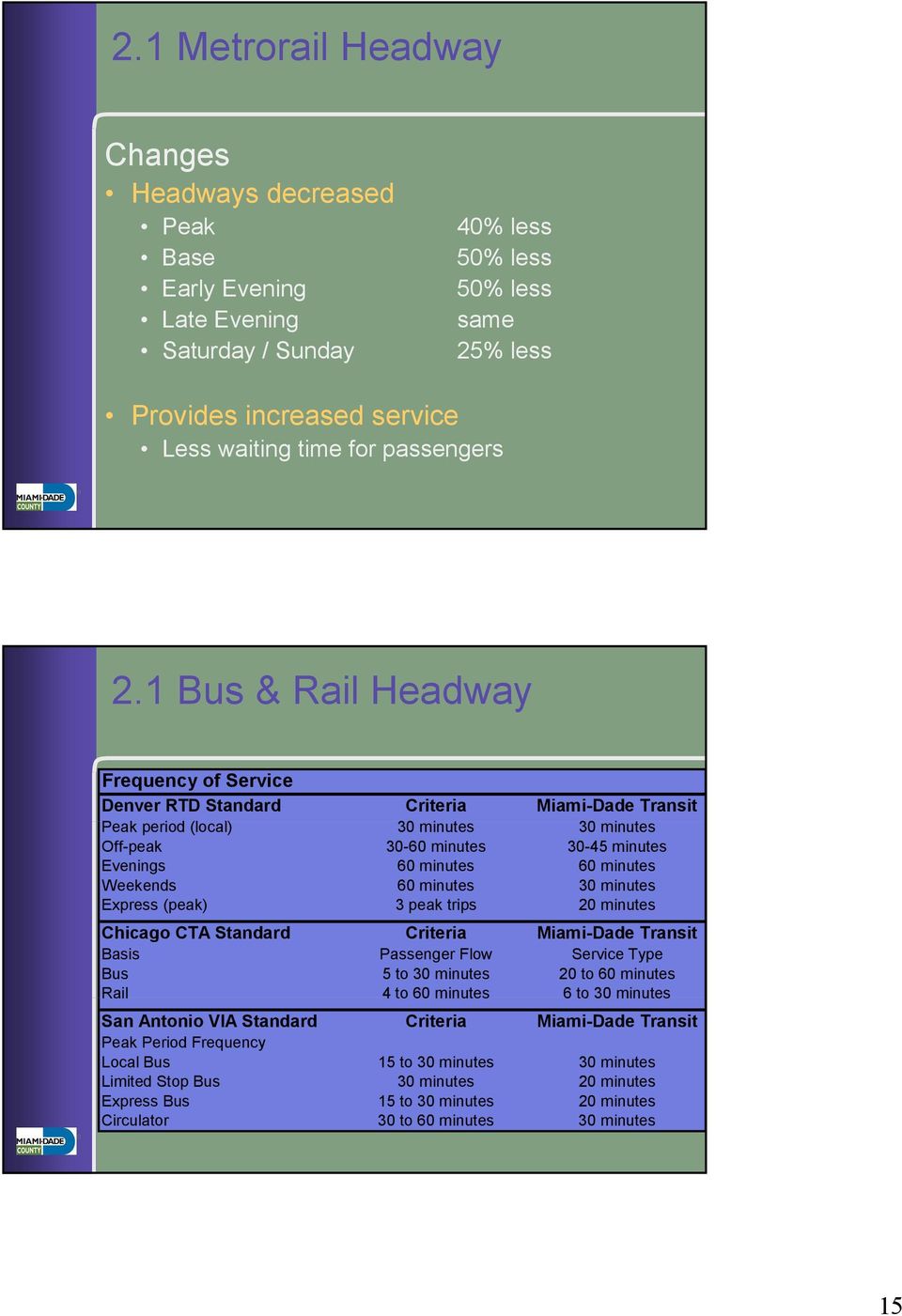
14 2.1 Maximum Bus Headway Changes Standards for Local Service simplified Standards for Limited service added Standards for Circulator service added Headways are generally shorter than 1998 guidelines but longer than PTP headways Metrorail Headway OLD Peak 10 minutes Base 20 minutes Evening / Night 30 minutes Saturday / Sunday 20 minutes NEW Peak 6 minutes Base 10 minutes Early Evening 15 minutes Late Evening 30 minutes Saturday / Sunday 15 minutes 28 14

15 2.1 Metrorail Headway Changes Headways decreased Peak Base Early Evening Late Evening Saturday / Sunday 40% less 50% less 50% less same 25% less Provides increased service Less waiting time for passengers Bus & Rail Headway 30 Frequency of Service Denver RTD Standard Criteria Miami-Dade Transit Peak period (local) l) 30 minutes 30 minutes Off-peak minutes minutes Evenings 60 minutes 60 minutes Weekends 60 minutes 30 minutes Express (peak) 3 peak trips 20 minutes Chicago CTA Standard Criteria Miami-Dade Transit Basis Passenger Flow Service Type Bus 5 to 30 minutes 20 to 60 minutes Rail 4 to 60 minutes 6 to 30 minutes San Antonio VIA Standard Criteria Miami-Dade Transit Peak Period Frequency Local Bus 15 to 30 minutes 30 minutes Limited Stop Bus 30 minutes 20 minutes Express Bus 15 to 30 minutes 20 minutes Circulator 30 to 60 minutes 30 minutes 15
16 2.2 Bus Passenger Loading OLD 31 Headway Peak Midday / Weekend Night Limited / Express % 125% 110% 120% % 110% 100% 100% % 100% 100% 100% % 100% 100% 100% Maximum on any single trip = 175% Elderly ridership greater than 18.7%, - consider a lower loading standard for route Short duration trips consider a higher standard for route 2.2 Bus Passenger Loading NEW 32 Headway Peak Midday / Weekend Night Limited / Express % 125% 110% 120% % 110% 100% 100% % 100% 100% - Maximum on any single trip = 160% Elderly ridership greater than 20%, then Peak standard is 110% Off-peak standard I 100% Short duration trips: Criteria is standing time < 10 minutes Maximum single trip load is 175% When crowding exceeds loading standards: Remedy first by large capacity vehicles Remedy second by adding service (frequency) 16

17 2.2 Bus Passenger Loading Changes Maximum Load decreased 30-minute loads generally increased Elderly ridership standard quantified Short duration standard quantified Remedy for overcrowding defined Rail Passenger Loading OLD Headway Peak Midday / Weekend Night % 125% 110% % 110% 100% Maximum Single Trip Load = 200% Maximum 30-minute Interval Load 34 17

18 2.3 Rail Passenger Loading NEW Headway Peak Midday / Weekend Night % 125% 100% % 110% 100% Maximum 30-minute Interval Load When crowding exceeds loading standards: Remedy first by large additional cars Remedy second by adding service (frequency) Rail Passenger Loading Changes Maximum Load decreased Peak period over 10 minute headways, and Night service over 10 minute headways Remedy for overcrowding defined 36 18

19 2.3 Bus & Rail Passenger Loading Maximum Peak Period Load Denver RTD Standard Criteria Miami-Dade Transit Maximum Peak Period Load Local & Limited 125% w/ max stand = % - 145% Express & Regional 100% 120% Sky Ride 100% - Light Rail 125% 130% - 145% Chicago CTA Standard Criteria Miami-Dade Transit San Antonio VIA Standard Criteria Miami-Dade Transit Maximum Load 60-minute interval 125% 100% - 145% Any individual bus 150% 160% Bus Service Span 38 OLD Minimum Spans In Urban Core Weekdays, Saturdays - 15 hours Sundays, Holidays - 12 hours Night service in urban core and for proven ridership areas At start or end of span Earlier or later trip criteria is if productivity of first or last trip is at least 50% of system average NEW Minimum Spans In Urban Core = 15 hours Premium routes Extend to midday or early evening if above average productivity Weekend Service On all viable routes Meeting weekday productivity standards Overnight Service On all major routes Expansion based on productivity, and facilities 19

20 2.4 Bus Service Span Changes Sunday and holiday service span increased Premium routes criteria added Weekend service criteria added Overnight service criteria added Bus Service Span Service Span Denver RTD Standard Criteria Miami-Dade Transit Bus Routes Varies 15 hours Chicago CTA Standard Criteria Miami-Dade Transit Major Routes 16 hours 15 hours Support Routes Market driven Market driven San Antonio VIA Standard Criteria Miami-Dade Transit 40 20

21 2.5 Rail & Mover Service Span OLD Metrorail Service Span = 19.5 hours Metromover Service Span = 19.5 hours At start or end of span Earlier or later trip criteria is if productivity of first or last trip is at least 50% of system average NEW 41 Metrorail Service Span = 19 hours Metromover Service Span = 19 hours Expansion to 24 hours dependent on: - Continued ridership growth - Ridership levels after 9:00 pm - Ridership on Bus Route Rail & Mover Service Span Changes Metrorail service span decreased ½ hour Metromover service span decreased ½ hour Criteria for expansion to 24 hours operations added 42 21
22 2.5 Rail & Mover Service Span Service Span Denver RTD Standard Criteria Miami-Dade Transit Rail Line 24 hours 19 hours San Antonio VIA Standard Criteria Miami-Dade Transit Bus System-wide Productivity OLD No Productivity it Standards d Guidelines for corrective action to low productivity routes NEW Minimum System-wide average boardings per hour Weekday30 Saturday 25 Sunday 25 Corrective action is to implement an action plan that includes a thorough evaluation of all routes 44 22
23 3.1 Bus System-wide Productivity Changes Minimum System-wide average boardings per hour standards defined Corrective action to be more comprehensive Bus Route Productivity 46 OLD No Productivity Standards Guidelines for corrective action to low productivity routes New service in the lowest quartile: To be continuously monitored Analyzed after 2 years Corrective action taken NEW Minimum boardings per revenue hour 50% of average for service type, or 40% of day-of-week for service type Net cost per passenger not more than 200% of system average If above 200%, evaluate if high proportion of Golden Passport or Patriot Pass riders Failing both standards productivity, and cost/passenger -corrective action including removal New service: Monitor for 24 months If after 12 months it is not at 50% of criteria take corrective action 23
24 3.2 Bus Route Productivity Changes Productivity Standards added Cost / Passenger Standards added Criteria for corrective action defined New route performance criteria provide for earlier action or removal (12 versus 24 mo.) Bus Route Productivity 48 Bus Productivity Denver RTD Standard Criteria Miami-Dade Transit Bus Productivity By Class Local Target lowest 10-25% - Limited Target lowest 10-25% - Express (peak service) Target lowest 50% - Regional (peak service) Target lowest 50% - Demand-Based minute headway - Weekday: 30 Pass / hour 15 minute headway Saturday: 25 Pass / hour 10 minute headway 40+ Sunday: 25 Pass / hour Chicago CTA Standard Criteria Miami-Dade Transit Bus Productivity 30 Minute headway 30 Boardings / hour Weekday: 30 Pass / hour Saturday: 25 Pass / hour Sunday: 25 Pass / hour San Antonio VIA Standard Criteria Miami-Dade Transit 24
25 3.3 Bus Passengers per Trip OLD No standard NEW Standards for minimum boardings per 1-way trip, classified by 1- way trip time: over 1 hour trip - 8 boardings less than 1 hour trip - 5 boardings/hour Substandard trips to be considered for elimination Unless modification would result in an inefficient schedule Bus Passengers per Trip Changes Standards for minimum boardings per 1- way trip provided Substandard trip corrective action defined 50 25
26 3.4 STS Productivity OLD No standard NEW Increase trips per service hour to 1.8 by 2005 (goal) CHANGES STS Productivity Goal is provided On-Time Performance OLD No standard NEW System-wide On-Time performance standards by division Metrobus 80% Metrorail 98% STS 85% On-time Criteria Metrobus - departs time point 0-5 min. late Metrorail - departs station 0-2 min. late STS - pick-up no more than 30 min. late - Increase trips per service hour to 1.8 by 2005 (goal) 52 CHANGES On-Time Performance Standards are provided 26
27 4.0 On-Time Performance On-Time Performance Denver RTD Standard Criteria Miami-Dade Transit Chicago CTA Standard Criteria Miami-Dade Transit San Antonio VIA Standard Criteria Miami-Dade Transit Bus: 80% End of Line 95% Transfer Points 90% Other Time Points 85% On-Time Criterion 0-5 Minutes late 0-5 Minutes late 53 Impacts Impacts of New Service Standards Impacts of each standard are qualitatively defined in terms of: Operational resource requirements Passenger service level 54 27
28 Impacts of New Service Standards Service Standard Change Impact to Passenger Service Impact to System Efficiencyi Service Coverage Bus Route Spacing Service to elderly and expansion areas No change Bus Route Limits deviations of Directness new routes Bus Stop Spacing Bus Stop Amenities More flexible std for Limited and Express No qualitative standard - - Impacts of New Service Standards Service Standard Change Impact to Passenger Service Impact to System Efficiency Bus Headways Shorter than 98 Std. Longer than PTP Rail Headways Shorter Bus Passenger Load Maximum reduced, generally increased Rail Passenger Load Maximum reduced Bus Service Span Sundays and Holidays increased Rail Service Span Reduced by ½ hour 28
29 Impacts of New Service Standards Service Standard Bus System Productivity Bus Route Productivity Bus Passengers / Trip STS Productivity Change Provide criteria for service reduction Provide criteria for service reduction Provide criteria for service reduction Impact to Passenger Service New goal for utilization - Impact to System Efficiency On-Time Performance Provides criteria for added service 29
STOP CONSOLIDATION TRANSIT STRATEGIES
 TRANSIT STRATEGIES STOP CONSOLIDATION Transit stops are the places where people access transit service, and greatly impact many elements of passengers transit experiences. They are typically thought of
1 FIXED ROUTE OVERVIEW
 1 FIXED ROUTE OVERVIEW Thirty transit agencies in Ohio operate fixed route or deviated fixed route service, representing a little less than half of the 62 transit agencies in Ohio. While many transit agencies
Best Practices in Transit Service Planning
 Project #BD549 38 FINAL REPORT Prepared for the Florida Department of Transportation Research Center Prepared by the Center for Urban Transportation Research University of South Florida March 2009 Disclaimer
Memo. Date: January 18, 2013. StarTran Advisory Board. From: Brian Praeuner. Review of Peer Transit Systems
 Memo Date: January 18, 2013 To: StarTran Advisory Board From: Brian Praeuner Re: Review of Peer Transit Systems This memo is in response to the StarTran Advisory Board s request for additional information
The Corporation of the TOWN OF MILTON
 The Corporation of the TOWN OF MILTON Report to: From: Chair & Members of the Community Services Standing Committee Jennifer Reynolds, Director, Community Services Date: September 13, 2010 Report No. COMS-019-10
Proposed Service Design Guidelines
 Proposed Service Design Guidelines July 2015 I. Introduction During Phase II of the Reimagining CityBus project, feedback from public outreach and data analysis conducted during Phase I of the project
Integrated Public Transport Service Planning Guidelines. Sydney Metropolitan Area
 Integrated Public Transport Service Planning Guidelines Sydney Metropolitan Area December 2013 CONTENTS 1. INTRODUCTION 3 1.1 Purpose 3 1.2 Background 3 1.3 Travel in Sydney Metropolitan Area 5 1.4 Objectives
Managing the Transit Network A Primer on Key Concepts
 Managing the Transit Network A Primer on Key Concepts translink.ca Introduction As the integrated, multi-modal transportation authority for Metro Vancouver, TransLink plans and delivers the transit network
2012 King County Metro Transit Peer Agency Comparison on Performance Measures
 2012 Peer Agency Comparison on Performance Measures Department of Transportation Metro Transit Division King Street Center, KSC-TR-0415 201 S. Jackson St Seattle, WA 98104 206-553-3000 TTY Relay: 711 www.kingcounty.gov/metro
Proposed New Starts/Small Starts Policy Guidance
 Proposed New Starts/Small Starts Policy Guidance Table of Contents I. INTRODUCTION... 1 II. PROJECT JUSTIFICATION CRITERIA... 4 MOBILITY IMPROVEMENTS... 4 OPERATING EFFICIENCIES... 5 Measure:... 5 Calculation:...
By Karla Karash March 18 18, 2010 2010
 Overview of Transit Marketing By Karla Karash March 18, 2010 Presentation Content Discussion: How to market public transportation? Definition of Marketing The Marketing Process Market Research Techniques
March 2015 Prepared by the Department of Finance & Performance Management. 2013 Regional Peer Review PERFORMANCE MEASURES
 March 2015 Prepared by the Department of Finance & Performance Management 2013 Regional Peer Review PERFORMANCE MEASURES CONTENTS CONTENTS... 1 EXECUTIVE SUMMARY... 2 SNAPSHOT... 4 PEER SELECTION... 5
d r a f t Division Street: 15.4 du/a Damen Avenue: 14.1 du/a Western Avenue: 12.8 du/a
 Transit [take transit: We live in the City, people. We can t expect to have parking. ] The ability of people to travel by transit is not only an equity issue, it is a matter of economic vitality for the
National Bus Rapid Transit Institute (NBRTI) At the University of South Florida
 National Bus Rapid Transit Institute (NBRTI) At the University of South Florida History of the NBRTI In January 2001, the National BRT Institute was created at USF s Center for Urban Transportation Research
Appendix J Santa Monica Travel Demand Forecasting Model Trip Generation Rates
 Appendix J Santa Monica Travel Demand Forecasting Model Trip Generation Rates SANTA MONICA TRAVEL DEMAND FORECASTING MODEL TRIP GENERATION RATES SUBMITTED BY: 201 Santa Monica Blvd., Suite 500 Santa Monica,
time and thought that the buses had a higher on-time arrival rate than the actual on-time arrival rate. 2
 TriMet Transit Tracker Implementation Summary Transit Tracker is a real-time bus arrival prediction system that provides information to riders at bus stops and light rail stations with a count down in
Transit in the United States 3. Operating Costs and Performance Measures 13. Quality of Transit Service 19. ADA Compliance Bus 28
 1999 National Transit Summaries and Trends Introduction 1 Introduces the transit modes discussed throughout the NTST. Transit in the United States 3 National statistics and trends in ridership, miles of
TRANSIT PERFORMANCE MEASURE TOOLBOX EXECUTIVE SUMMARY
 JULY MAY 2014 2014 CONTACT INFORMATION TRANSIT PERFORMANCE MEASURE TOOLBOX EXECUTIVE SUMMARY Diane Quigley, FDOT Transit Planning Administrator 850-414-4520 ACKNOWLEDGEMENTS Bay Town Trolley Broward County
Transit Cost Analysis
 Transit Cost Analysis Types of Costs Fixed Cost: does not vary with the amount of service provided in the short run. Variable Costs: change with the amount of service provided. Variable Cost Fixed Level
Short Term Ridership Forecasting Model (Version 3.0)
 Washington Metropolitan Area Transit Authority Short Term Ridership Forecasting Model (Version 3.0) Prepared by Office of Long Range Planning, WMATA Cambridge Systematics, Inc. January 2009 Presentation
Addendum to the Arterial Transitway Corridors Study
 January 2013 1 Addendum to the Arterial Transitway Corridors Study The Arterial Transitway Corridors Study (ATCS) evaluated and prioritized arterial bus rapid transit (BRT) improvements to nine corridors
Customer Satisfaction Survey Results
 Customer Service and Operations Committee Information Item IV-C December 6, 2012 Customer Satisfaction Survey Results Page 62 of 83 Washington Metropolitan Area Transit Authority Board Action/Information
SACRAMENTO REGIONAL TRANSIT DISTRICT AMERICANS WITH DISABILITIES ACT (ADA) FREQUENTLY ASKED QUESTIONS (FAQ)
 SACRAMENTO REGIONAL TRANSIT DISTRICT AMERICANS WITH DISABILITIES ACT (ADA) FREQUENTLY ASKED QUESTIONS (FAQ) You will find answers to the most frequently asked questions about RT s ADA paratransit services
When is BRT the Best Option? 1:30 2:40 p.m.
 TRB/APTA 2004 Bus Rapid Transit Conference When is BRT the Best Option? 1:30 2:40 p.m. Paul Larrousse Director, National Transit Institute (NTI) (Moderator) TRB/APTA 2004 Bus Rapid Transit Conference Session
Eagle Commuter Rail Denver, Colorado Final Design (Based upon information received by FTA in November 2010)
 Eagle Commuter Rail Denver, Colorado Final Design (Based upon information received by FTA in November 2010) Summary Description Proposed Project: Electrified Commuter Rail 30.2 Miles, 13 Stations Total
Mid-Coast Corridor Transit Project San Diego, California New Starts Project Development (Rating Assigned November 2014)
 Mid-Coast Corridor Transit Project San Diego, California New Starts Project Development (Rating Assigned November 2014) Summary Description Proposed Project: Light Rail Transit 10.9 Miles, 9 Stations Total
FINAL REPORT DEVELOPMENT OF CONGESTION PERFORMANCE MEASURES USING ITS INFORMATION. Sarah B. Medley Graduate Research Assistant
 FINAL REPORT DEVELOPMENT OF CONGESTION PERFORMANCE MEASURES USING ITS INFORMATION Sarah B. Medley Graduate Research Assistant Michael J. Demetsky, Ph.D., P.E. Faculty Research Scientist and Professor of
2010 METROBUS FLEET MANAGEMENT PLAN
 2010 METROBUS FLEET MANAGEMENT PLAN Office of Long Range Planning Department of Planning and Joint Development Office of Bus Planning Department of Bus Services Washington Metropolitan Area Transit Authority
30 Years of Smart Growth
 30 Years of Smart Growth Arlington County s Experience with Transit Oriented Development in the Rosslyn-Ballston Metro Corridor A Presentation by the Arlington County Department of Community Planning,
Transit Service Assessment
 Technical Memorandum #1 Transit Service Assessment June 213 Table of Contents 1. Existing Service Summary... 1 1.1 Service Overview... 1 1.2 Service Characteristics... 1 2. Ridership and Productivity...
2014 SFMTA Transit Fleet Management Plan March 2014
 2014 SFMTA Transit Fleet Management Plan March 2014 Financial Services 1. Introduction 1-1 Introduction to the SFMTA The San Francisco Municipal Transportation Agency (SFMTA) is the principal multi-modal
Transit Capacity and Quality of Service Manual 2 nd Edition
 PART 3 QUALITY OF SERVICE CONTENTS CHAPTER 1. QUALITY OF SERVICE FUNDAMENTALS... 3-1 Overview... 3-1 Definitions... 3-1 Levels of Service... 3-2 Level of Service Framework... 3-2 Transit Performance Measures...
A Review of Transit Technology Specifications
 . Transit Technologies Worksheet A Review of Transit Technology Specifications 1 2 3 4 5 6 1. Heavy Rail Transit 2. Commuter Rail Transit 3. Light Rail Transit 4. Modern Streetcar 5. Heritage Trolley 6.
MAKING TRACKS. A Primer for Implementing Transit Fixed Guideway Projects
 MAKING TRACKS A Primer for Implementing Transit Fixed Guideway Projects Introduction Demand for new fixed guideway projects is strong nationwide. Each year hundreds of new fixed guideway projects across
APPENDIX G OPERATIONS AND MAINTENANCE COST ESTIMATION MODEL
 DRAFT APPENDIX G OPERATIONS AND MAINTENANCE COST ESTIMATION MODEL Operations and Maintenance Cost Methodology and Results The Colorado Department of Transportation is conducting an Advanced Guideway System
CHAPTER 7 DEMAND-RESPONSIVE TRANSIT
 I Transit Capacity and Quality of Service Manual, 3rd Edition CHAPTER 7 DEMAND-RESPONSIVE TRANSIT 1. User's Guide 2. Mode and Service Concepts 3. Operations Concepts 4. Quality of Service Concepts 5. Quality
Transportation Research Forum
 Transportation Research Forum An Evaluation of RouteMatch Software in the Billings, MT, Special Transit System Author(s): David Kack and Deepu Philip Source: Journal of the Transportation Research Forum,
College of Southern Maryland. Hughesville Transportation Study
 College of Southern Maryland Project Overview Existing Conditions Transit Service Land Use CSM Student Demographics Recommendations Methodology Transit Recommendations Transportation Demand Management
TCRP Report 153: Guidelines for Providing Access to Public Transportation Stations. Part 2: Station Typology and Mode of Access Planning Tool
 TCRP Report 153: Guidelines for Providing Access to Public Transportation Stations Part 2: Station Typology and Mode of Access Planning Tool Jamie Parks, AICP Kittelson & Associates, Inc. Acknowledgements
GLOSSARY of Paratransit Terms
 Innovation in Transit GLOSSARY of Paratransit Terms January 2007 FORWARD: ABOUT PACE PARATRANSIT SERVICES Pace provides a variety of public transportation services. ADA Paratransit, which operates in the
Photo credit: City of Denver DENVER UNION STATION-CHERRY CREEK-GLENDALE CORRIDOR FEASIBILITY STUDY RECOMMENDATIONS REPORT
 Photo credit: City of Denver DENVER UNION STATION-CHERRY CREEK-GLENDALE CORRIDOR FEASIBILITY STUDY RECOMMENDATIONS REPORT January 2014 CONTENTS Study Purpose 4 Data Sources 5 Existing Conditions 5 Market
Development of an NTD Tool for Vanpool Services
 Development of an NTD Tool for Vanpool Services Center for Urban Transportation Research University of South Florida, Tampa November 2008 Final Report Contract Number: BD549-40 DISCLAIMER The opinions,
Sustainable urban mobility: visions beyond Europe. Brest. Udo Mbeche, UN-Habitat
 Sustainable urban mobility: visions beyond Europe 2 nd October 2013 Brest Udo Mbeche, UN-Habitat The Global Report for Human Settlements Published every two years under a UN General Assembly mandate. Aims
AN ILLUSTRATION OF COMPARATIVE QUANTITATIVE RESULTS USING ALTERNATIVE ANALYTICAL TECHNIQUES
 CHAPTER 8. AN ILLUSTRATION OF COMPARATIVE QUANTITATIVE RESULTS USING ALTERNATIVE ANALYTICAL TECHNIQUES Based on TCRP B-11 Field Test Results CTA CHICAGO, ILLINOIS RED LINE SERVICE: 8A. CTA Red Line - Computation
Washington Metropolitan Area Transit Authority Board Action/Information Summary
 Washington Metropolitan Area Transit Authority Board Action/Information Summary Action Information MEAD Number: 200212 Resolution: Yes No TITLE: Connecting Communities KPI PRESENTATION SUMMARY: This presentation
Appendix E Transportation System and Demand Management Programs, and Emerging Technologies
 Appendix E Transportation System and Demand Management Programs, and Emerging Technologies Appendix Contents Transportation System Management Program Transportation Demand Management Program Regional Parking
11. Monitoring. 11.1 Performance monitoring in LTP2
 178 11. Monitoring 11.1 Performance monitoring in LTP2 Performance against the suite of indicators adopted for LTP2 is shown in the following table. This shows progress between 2005/06 and 2009/10 (the
Scheduling Review Technical Memorandum
 Scheduling Review Technical Memorandum City of Colorado Springs Mountain Metropolitan Transit Comprehensive Operational Analysis Introduction As part of the Colorado Springs Comprehensive Operations Analysis,
City Services Benchmarking: Public Transportation
 City Services Benchmarking: Public Transportation City and County of Office of the Controller City Services Auditor March 13, 214 City Services Benchmarking: Public Transportation CITY AND COUNTY OF SAN
National Transit Database - NTD
 National Transit Database - NTD Established by Congress in 1974 Primary national database for public transit Collects annual transit performance and financial data, monthly ridership, and safety and security
MANAGEMENT PLAN. Fiscal Year 2015-2016
 MANAGEMENT PLAN Fiscal Year 2015-2016 May 6, 2015 Table of Contents I. Executive Summary... 2 Omnitrans Vision... 5 Omnitrans Mission Statement... 5 II. Strategic Initiatives... 5 Implementation... 6 Strategic
TABLE OF CONTENTSI CHAPTER 1: INTRODUCTIONI...3 CHAPTER 2: LITERATURE REVIEW...5
 TABLE OF CONTENTSI CHAPTER 1: INTRODUCTIONI...3 CHAPTER 2: LITERATURE REVIEW...5 National Review of Best Practices for Transit Agencies... 5 National Case Studies... 13 MAP-21 Guidelines and Transit Performance
VRE SYSTEM PLAN SUMMARY
 VRE System Plan Summary January 2014 VRE SYSTEM PLAN SUMMARY VRE A Cost-Effective Contributor to Regional Mobility During the last decade, VRE has demonstrated its ability to accommodate a rapid and substantial
Estimating Light-Rail Ridership from APC Data
 Estimating Light-Rail Ridership from APC Data Zach Van Gemert, Service Development Applications Expert, Denver RTD Richard Lehman, Senior Applications Developer, RSM Services Corporation The Denver RTD
Questions and Answers about the Orange Bus/Rail Investment Plan
 Why are transit improvements needed? Questions and Answers about the Orange Bus/Rail Investment Plan The Triangle Region is now home to 1.5 million people. The U.S. Census and the 2035 Joint Long Range
Jess Linn Principal Planner, Development Services Division Miami-Dade Regulatory and Economic Resources
 Eric Silva, AICP Assistant Director, Development Services Division Miami-Dade Regulatory and Economic Resources Albert Hernandez, P.E. Deputy Director, Planning and Engineering Miami-Dade Transit Jess
Metro Rail Gating Study
 Executive Management & Audit Committee Item # 27 Operations Committee Item # 43 FINAL DRAFT Metro Rail Gating Study Los Angeles, California November 15, 2007 Filename/RPS Number 1 Briefing Contents Executive
FAIRFAX CUE TRANSIT DEVELOPMENT PLAN: FISCAL YEARS 2011 2016
 FAIRFAX CUE TRANSIT DEVELOPMENT PLAN: FISCAL YEARS 2011 2016 Updated October 2010 (Final) Prepared by: Under Sub Contract to: Under Contract to: Table of Contents 1.0 OVERVIEW OF FAIRFAX, VA TRANSIT SERVICES...
ROUTE OVERVIEW. Comprehensive Route Evaluation ROUTE 3 WARWICK AVE
 Comprehensive Route Evaluation ROUTE 3 WARWICK AVE ROUTE OVERVIEW Route 3 operates between Warwick and downtown Providence, primarily via Warwick Avenue. Other principal arterials include Oakland Beach
Seattle Streetcar Center City Connector Seattle, Washington Small Starts Project Development (Rating Assigned November 2015)
 Seattle Streetcar Center City Connector Seattle, Washington Small Starts Project Development (Rating Assigned November 2015) Summary Description Proposed Project: Streetcar 1.3 Miles, 4 Stations otal Capital
SYSTEM PERFORMANCE REVIEW public transportation department municipality of anchorage
 2014 SYSTEM PERFORMANCE REVIEW public transportation department municipality of anchorage SYSTEM PERFORMANCE REVIEW: 2014 Municipality of Anchorage - Dimond Transit Stop# 396 Lake Otis & Providence I TABLE
GO News. gotransit.com GO Transit s Newsletter for Customers summer 2011. Keeping You in the Know.
 GO News gotransit.com GO Transit s Newsletter for Customers summer 2011 Keeping You in the Know. This Issue 2 Priority parking by carpooling to GO! 2 Let Go Know 3 The GO Transit Control Centre: keeping
Overview of the Travel Demand Forecasting Methodology
 Overview of the Travel Demand Forecasting Methodology Prepared by the Central Transportation Planning Staff (CTPS) Authors: Scott A. Peterson, Manager Ian Harrington, Chief Planner March 29, 2008 1 OVERVIEW
T-BEST: Nothing But the Best for All Your Transit Planning and Ridership Forecasting Needs
 T-BEST: Nothing But the Best for All Your Transit Planning and Ridership Forecasting Needs Have you been looking for a transit planning tool that: accurately forecasts transit ridership and accessibility
Wilmington to Newark Commuter Rail Improvement Project
 Wilmington to Newark Commuter Rail Improvement Project The Delaware Transit Corporation (DTC), a subsidiary of the Delaware Department of Transportation (DelDOT), is undertaking a rail capacity expansion
American Public Transit Association Bus & Paratransit Conference
 American Public Transit Association Bus & Paratransit Conference Intelligent Transportation Systems Integrating Technologies for Mobility Management & Transportation Coordination May 24, 2011 RouteMatch
GTA Cordon Count Program
 Transportation Trends 2001-2011 Executive Summary Project No. TR12 0722 September 2013 1.0 Introduction The Cordon Count program was established to collect traffic data as a tool for measuring travel trends
Downtown Tampa Transportation Vision
 Downtown Tampa Transportation Vision Executive Summary August 1, 2006 Hillsborough County Metropolitan Planning Organization County Center, 18 th Floor Tampa, Florida 33602 813-272-5940 www.hillsboroughmpo.org
Bus Rapid Transit Service Design
 APTA STANDARDS DEVELOPMENT PROGRAM RECOMMENDED PRACTICE American Public Transportation Association 1666 K Street, NW, Washington, DC, 20006-1215 APTA BTS-BRT-RP-004-10 Approved October, 2010 APTA Bus Rapid
Cost Reduction Opportunities
 Cost Reduction Opportunities 9 December 2015 Presentation to MassDOT Board of Directors & MBTA Fiscal and Management Control Board Arup 2 A global, integrated, multidisciplinary firm of professionals 13,000
Improving Customer Experience: An Enterprise-wide Approach for the CTA. Ken G Kabira [email protected]
 Improving Customer Experience: An Enterprise-wide Approach for the CTA Ken G Kabira [email protected] Customer Value Equation 2 Experience Value = Price A measure of the customer s satisfaction with the
Case Study CENTRAL FLORIDA REGIONAL TRANSIT AUTHORITY (LYNX) ORLANDO, FLORIDA. Transit Agency Profile and Reason for Selection of Transit Agency
 Case Study CENTRAL FLORIDA REGIONAL TRANSIT AUTHORITY (LYNX) ORLANDO, FLORIDA Transit Agency Profile and Reason for Selection of Transit Agency Overview The Central Florida Regional Transportation Authority
UNIVERSITY TRAVEL POLICY Effective immediately.
 UNIVERSITY TRAVEL POLICY Effective immediately. Introduction: Objectives: Scope and Application: Safety: Passports: This document defines the policy for travel on University business, including overnight
2012 Saskatoon Transit Services Annual Report
 2012 Annual Report Saskatoon Transit provides a high quality of service for all citizens in our community, and is undertaking initiatives focused on building its ridership. Like most North American cities,
Calgary Transit Funding and Fare Strategy Review. 2014 February
 Calgary Transit Funding and Fare Strategy Review 2014 February Table of Contents 1. Introduction......1 2. Background.......1 A New Direction Route Ahead..1 Calgary Transit Ridership Trends.... 1 Changes
Integrating GO RER and SmartTrack. Leslie Woo, Chief Planning Officer February 10, 2016
 Integrating GO RER and SmartTrack Leslie Woo, Chief Planning Officer February 10, 2016 Purpose and Scope To present update on development of options for integrating SmartTrack and GO RER based on the following
Doing More with the Same: How the Trinity Railway Express Increased Service without Increasing Costs
 Doing More with the Same: How the Trinity Railway Express Increased Service without Increasing Costs W. T. "Bill" Farquhar Trinity Railway Express Irving, TX Abstract The Trinity Railway Express (TRE)