
User Guide Copyright 2010 Agnitum Ltd. All rights reserved.
|
|
|
- Morris Gyles Harvey
- 10 years ago
- Views:
Transcription
1 User Guide Copyright 2010 Agnitum Ltd. All rights reserved.

2 Abstract This is the complete and detailed reference to the Outpost Firewall Pro software. For an entry-level guide, please see the Getting Started guide. To get help while using the product, press the F1 button on the keyboard. You can get additional information about the product at Please note that further versions of Outpost Firewall Pro may have other options and dialogs than the current version. 2
3 Table of contents 1 Welcome to Outpost Firewall Pro! System Requirements Installing Outpost Firewall Pro Registering Outpost Firewall Pro User Interface and Controls Basics The Toolbar Left and Information Panels System Tray Icon Interface Language Configuring Notifications Basic Configuration Starting and Stopping Protection Managing Protection Status Creating a New Configuration Protecting Configuration with a Password Updating Outpost Firewall Pro Configuring Updates Agnitum ImproveNet Managing network connections Selecting the Firewall Policy Running in Rules Wizard Mode Running in Auto-Learn Mode Running in Entertainment Mode Smart Advisor Configuring Local Network Settings Detecting a Local Area Network Specifying LAN Access Levels Managing Applications Network Access Managing List of Applications Managing Rules for Applications Managing Global System Network Activity Managing Global Rules Managing Low-Level System Rules Controlling ICMP Protocol Activity Blocking Malicious IPs Monitoring Network Activity Network Activity Used Ports Preventing Network Attacks Specifying Attack Detection Level Protecting from Ethernet Attacks Port Scanning Attacks List Specifying Trusted Hosts and Ports Protecting a Host from Malicious Process Activity Setting Anti-Leak Security Level Controlling Penetration Techniques Controlling Application Components Controlling Critical System Objects Controlling Application Critical Files Controlling Files and Folders Monitoring Process Activity

4 9 Protecting against Spyware Performing a System Scan Selecting Scan Type Customizing Spyware Scan Scanning Specified Locations Removing Detected Malware Viewing Scan Results Real-Time Protection Scanning Mail Attachments Malware Quarantine Scheduling System Scan Controlling Online Activities Setting Web Control Level Advertisement Blocking Specifying Exclusions Site Blacklist Blocking Private Data Transfers Protecting Internal Components Uninstalling Outpost Firewall Pro Tracking system activity Logging Level Appendix Troubleshooting Understanding Penetration Techniques Using Macro Addresses About Agnitum
5 1 Welcome to Outpost Firewall Pro! Proactive Protection for Intelligent Internet Users Today's Internet requires a whole new approach to security. Almost everything is interconnected and taking place in real time. And that includes threats. To be effective, security software must be constantly alert for new forms of deviousness. New types of threats require new forms of protection. Mass-distribution of worms is giving way to profitdriven attacks designed to steal identities, money, and other valuable electronic commodities through phishing and social engineering. To fully protect against these new risks, an effective security solution must deploy a multi-layered approach, providing proactive, behavior-based blocking as well as the more traditional database-driven signature detections. It must also be easy to use, because if it's not, it won't be used. Agnitum is happy to introduce a powerful security product Outpost Firewall Pro. Being a successor of the previous acclaimed Outpost products, Outpost Firewall Pro combines the best of various approaches in a single integrated product that delivers customized protection and total reliability. Outpost Firewall Pro protects your electronic jewels 24 hours a day, seven days a week no matter what you're doing. Key Benefits The firewall controls your computer's connections with other PCs by blocking hackers and preventing local and remote unauthorized network access. The firewall controls application inbound and outbound Internet access, as well as stops malware from communicating to or from your PC. Proactive Protection monitors program behaviors and interactions in order to proactively defend against unauthorized activity. It also blocks Trojans, spyware, and all kinds of sophisticated hacking techniques that try to compromise your system's security or steal your data. Outpost Firewall Pro uses specialized techniques to ensure that its own protection cannot be disabled by specific types of malware that were designed to do just that. The suite's lightweight yet effective spyware scanner detects and quarantines or directly removes spyware and other malicious software automatically. The resident on-access monitor is constantly on guard against malware that's lying idle or being activated, yet has little or no impact on system performance. The versatile Web Control module safeguards you against the Internet's darker side. It steers you away from websites infected with drive-by downloads, prevents the inadvertent disclosure of personal information, limits your exposure to potentially unsafe web properties, and keeps your identity private. Powerful, easy to use protection offers extensive assistance for beginners in making the best use of the product, while advanced users will welcome the wealth of control options and customizable settings they can use to customize their own configurations. This online help provides information on Outpost Firewall Pro's interface, settings, and functionality. For more information about features and for additional documentation, please visit 5

6 1.1 System Requirements Outpost Firewall Pro can be installed on Windows 2000 SP4, Windows XP, Windows Server 2003, Windows Vista, or Windows 7 operating systems. The minimum system requirements for Outpost Firewall Pro are: CPU: 450 MHz Intel Pentium or compatible; Memory: 256 MB; Hard disk space: 100 MB. Note: Outpost Firewall Pro is available both for 32-bit and 64-bit versions of operating systems. Please download the corresponding version from Agnitum's web site: No special network adapter or modem and no special network configuration settings are needed for the normal operation of the software. Outpost Firewall Pro should not be run with any other security software. Running Outpost Firewall Pro with other security products can result in system instability (i.e. crashes) and can cause your system to operate in an insecure mode. 1.2 Installing Outpost Firewall Pro Outpost Firewall Pro s installation procedure is similar to that of most Windows programs. To start the installation program of the Outpost Firewall Pro system: 1. Very Important! Before installing Outpost Firewall Pro, uninstall any other firewall software on your computer and reboot. 2. Close all open applications. а) if you install the product downloaded from the site, click OutpostFirewallProInstall.exe; 3. б) if you install the product from a disk, setup wizard should run automatically. If automatic running failed, click the Start button on the Windows task bar and select Run. In the Open field of the Run dialog window, enter the full path to the setup program file (OutpostFirewallProInstall.exe). For example, if the setup program is on disk D: in the folder Downloads and subfolder Outpost, type into this field: D:\downloads\outpost\OutpostFirewallProInstall.exe 4. Click the ОК button. The setup wizard contains several steps. Each step has a Next button that takes you to the next step of the procedure, a Back button that returns you to the previous step and a Cancel button that exits the wizard and aborts the entire setup procedure. The installation begins with Select Language dialog. 6

7 Choose the language for Outpost Firewall Pro interface and click OK. Setup will display the Welcome dialog presenting basic features of the product: After clicking the Next button you will be asked to accept the License Agreement to use the Outpost Firewall Pro. Please read it carefully. At this step, you can also join Agnitum's ImproveNet program to help improve the quality, security and control features of Agnitum products by selecting the Help Agnitum improve this program check box. For details, see Agnitum ImproveNet. Click Accept to proceed. The setup wizard will offer you to select a type of installation: 7

8 Simple mode provides a reduced number of product prompts that require your response and is recommended for most cases. Expert mode gives you more opportunities to decide whether to allow or block a particular access request and is recommended for advanced users. Note: Depending on the selected installation type Outpost Firewall Pro main window will get its interface view Simple View in the case of Simple mode and Expert View in the case of Expert mode. See Left and Information Panels for details. Click the desired operation mode to proceed. If you have selected the Expert mode, the setup wizard will allow you to specify a few settings more. The next step allows to choose product components to install on the computer. Select the corresponding check boxes and click Next. In case you have not removed any third-party security software, the setup wizard will display a prompt pointing at detecting incompatible software: 8

9 On detecting an incompatible product on your system the setup wizard will be unable to continue further installation until you remove the product. On detecting a partly compatible produc the wizard will offer you one of the possible options to apply to the product. After you have accepted the License Agreement, the Next button brings you to the Select Destination Location step: Select a folder where you want to install Outpost Firewall Pro files. You can use the default folder or select it manually. If you want to change the default file location, click Browse. Select the folder or create your own one and click OK. Click Next to proceed to the last step before actual installation: 9

10 Select the Download the latest Outpost Firewall Pro updates during installation option to download rules presets for the product. This is the final step before starting the installation process. If you need to cancel any performed steps, click Back. When you are ready to go ahead with the installation, click the Install button. The program displays the installation progress window: After the installation is finished, the Configuration Wizard will help you create a new configuration or import the previous if you install the product over an earlier version: 10

11 On importing a previous configuration the system will automatically copy saved settings of the earlier version, after which you will need to reboot the computer to complete Outpost Firewall Pro installation. On creating a new configuration the setup wizard will proceed to the Rules Autocreation step, which lets you to enable rules autocreation, so global rules and rules for well-known applications are created automatically when they first request an action (for example, network access or process memory modification). If you do not want to enable rules autocreation, select Use predefined rules for the rule sets to be created according to our engineers' built-in presets in order to provide optimal system performance and application security: The Automatically train Outpost Firewall Pro during one week option allows product to create necessary rules automatically. After clicking Next, Outpost Firewall Pro automatically scans your system and adjusts all its settings without your supervision. It configures network settings, builds the Component Control database, and, in case you selected to use predefined rules, searches for known applications installed on your computer that might require Internet access and configures an appropriate the network access level for each of them: 11

12 Click Finish to apply the changes and save the configuration. You will be asked to reboot your system: Important: Do not launch Outpost Firewall Pro manually using the Start button menu or Windows Explorer right after installing it. You must reboot your computer before Outpost Firewall Pro can start to protect your system. 12

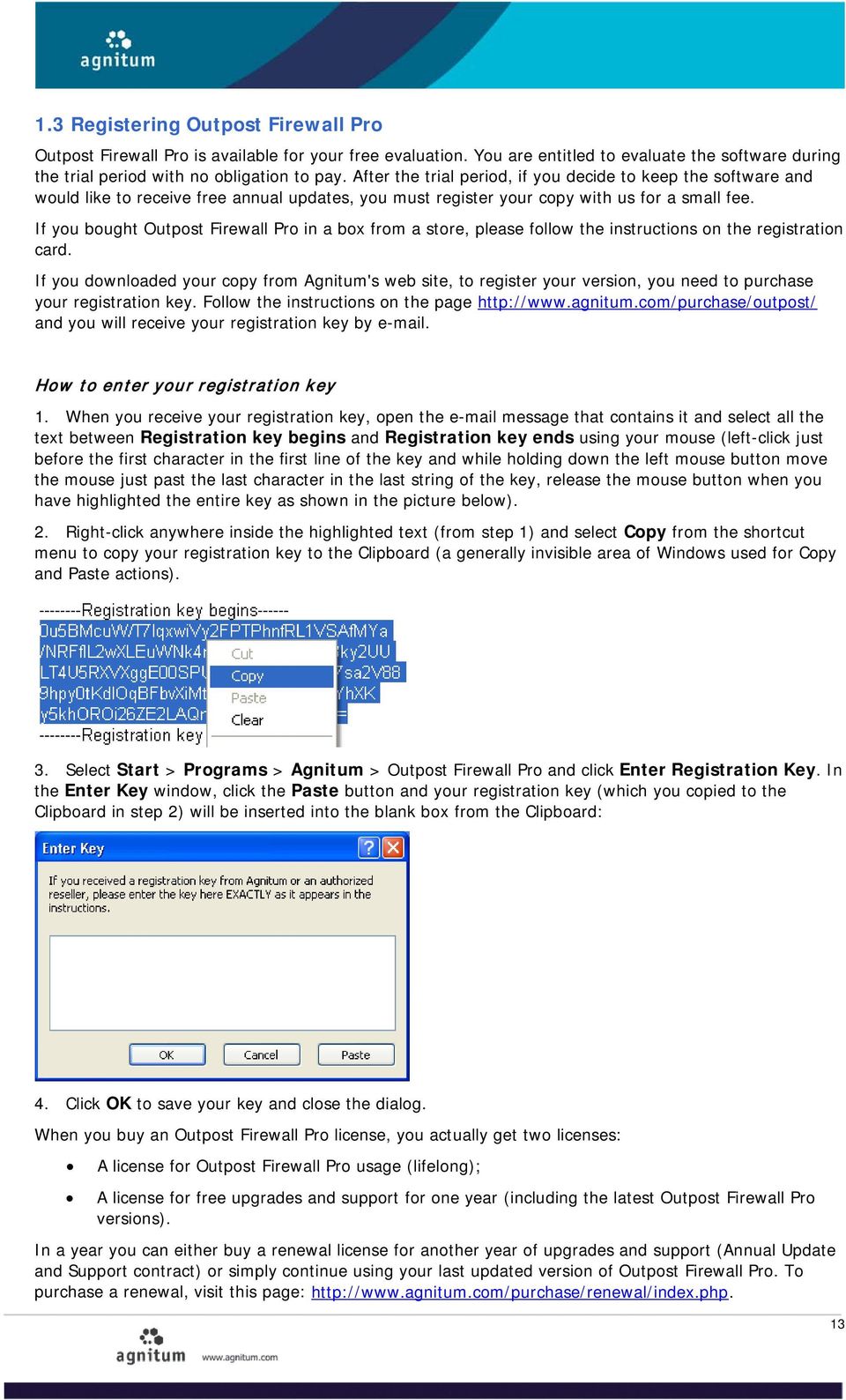
13 1.3 Registering Outpost Firewall Pro Outpost Firewall Pro is available for your free evaluation. You are entitled to evaluate the software during the trial period with no obligation to pay. After the trial period, if you decide to keep the software and would like to receive free annual updates, you must register your copy with us for a small fee. If you bought Outpost Firewall Pro in a box from a store, please follow the instructions on the registration card. If you downloaded your copy from Agnitum's web site, to register your version, you need to purchase your registration key. Follow the instructions on the page and you will receive your registration key by . How to enter your registration key 1. When you receive your registration key, open the message that contains it and select all the text between Registration key begins and Registration key ends using your mouse (left-click just before the first character in the first line of the key and while holding down the left mouse button move the mouse just past the last character in the last string of the key, release the mouse button when you have highlighted the entire key as shown in the picture below). 2. Right-click anywhere inside the highlighted text (from step 1) and select Copy from the shortcut menu to copy your registration key to the Clipboard (a generally invisible area of Windows used for Copy and Paste actions). 3. Select Start > Programs > Agnitum > Outpost Firewall Pro and click Enter Registration Key. In the Enter Key window, click the Paste button and your registration key (which you copied to the Clipboard in step 2) will be inserted into the blank box from the Clipboard: 4. Click OK to save your key and close the dialog. When you buy an Outpost Firewall Pro license, you actually get two licenses: A license for Outpost Firewall Pro usage (lifelong); A license for free upgrades and support for one year (including the latest Outpost Firewall Pro versions). In a year you can either buy a renewal license for another year of upgrades and support (Annual Update and Support contract) or simply continue using your last updated version of Outpost Firewall Pro. To purchase a renewal, visit this page: 13
14 Note: Outpost Security Suite Pro and Outpost Firewall Pro are independent products and their registration keys are not interchangeable. It means that Outpost Security Suite Pro registration key is not applicable to Outpost Firewall Pro and visa versa. Please, be sure you are entering the correct registration key. 14

15 2 User Interface and Controls Basics When you launch Outpost Firewall Pro for the first time, its main window is displayed. The main window is your central control panel for the suite. Its purpose is to let you monitor network operations of your computer and to modify product settings. The main window is very similar to Windows Explorer, so should be familiar to most users making Outpost Firewall Pro quite easy to use. The main window looks like the following: To display the main window when it is minimized to the system tray: 1. Right-click the firewall's system tray icon. 2. Select Show/Hide. To close the Outpost Firewall Pro main window, click the X in the right-upper corner. Note that this does not shut down the product; the main window is simply minimized and the suite icon remains in the system tray indicating that it is running and protecting your system. The main window contains: The toolbar Left panel Information panel Status bar The status bar is at the bottom of the main window. It is used to display the Outpost Firewall Pro's current state. 15

16 2.1 The Toolbar The toolbar is close to the top of the main window. To see what each button does, hold your cursor over it for a second. Each button on the toolbar (except the Settings button) is a shortcut to one of the product functions. These buttons are simply an easy and direct path to their functions rather than having to go through several different dialog windows to access the same functions. The toolbar looks like the following: These are the buttons found on the toolbar: Button Function Starts the malware system scan. Opens Outpost Firewall Pro's Settings dialog. Downloads the latest product updates including rules presets and anti-malware databases. Opens this help file that you are currently reading. 2.2 Left and Information Panels To display information so you can easily find it, Outpost Firewall Pro uses two panels. The left panel is similar to the left panel of Windows Explorer. It provides a listing of the categories: connections, ports, components, etc. The right panel is the information panel, which gives the specific data about any category highlighted in the left panel. 16

17 The panels look like the following: For your convenience, Outpost Firewall Pro allows switching between simple and expert views of the main window depending on your needs and abilities to manage security products. If you select the Simple mode while installing the product and creating its configuration, the product will display its Simple View; if you specify the Expert level, the Expert View will be displayed. If you are not an advanced user, it would be easier for you to use the Simple View of the screen, as it does not contain any pages that might be difficult to understand. If you are an advanced user, we recommend switching to Expert View, which will provide you with more information about the product's operation and system performance. That could be useful for tracking system activity and taking steps if anything happens. To switch between views, click Switch to Expert View or Switch to Simple View at the bottom of the left panel. Note: Switching between views does not influence the functionality provided by the product. As with Windows Explorer, any line that starts with a plus sign ( ) can be expanded to show its subcategories. Any line starting with a minus sign ( ) indicates the line has already been expanded and by clicking the minus sign, all of that line's subcategories will be hidden (to conserve screen space). The left panel lists and the information panel display the details of the following categories: Firewall Selecting this category in the left panel displays general information about the firewall, such as its present state, policy, attacks detected and general statistics on open connections. When expanded, this category lists the following nodes: - Network Activity Lists all applications and processes that have active connections and the details of those connections. 17

18 - Used Ports Lists all applications and processes having currently used ports for a network connection. See Managing Network Connections for details. Proactive Protection Displays general information about Proactive Protection components, such as the Anti-Leak protection level, System Guard, Application Guard, and File & Folder Lock statuses, self-protection status and some general statistics. - Process Activity Lists all local events currently in the system monitored by Proactive Protection. See Protecting a Host from Malicious Process Activity for details. - File and Registry Monitor Allows to track all operations that a specific process performs over files and registry entries in real time. Anti-Spyware Displays general information about the Anti-Spyware component operation modes and its malware signatures database status, as well as some general statistics on detected objects. - Quarantine Lists all objects placed in quarantine. See Protecting against Spyware for details. Web Control Displays general information about the Web Control component, such as its current status, its security level and general statistics on filtered content. - Online Activity Lists all content elements being processed by the filter. See Controlling Online Activities for details. Event Viewer Displays detailed statistics for all past system and product activities by category. 2.3 System Tray Icon By default, Outpost Firewall Pro automatically loads when Windows starts up to provide immediate protection of your system at the earliest stage. Once it is loaded, the icon with the white question mark on the blue shield (Outpost Firewall Pro's default icon), is displayed in the system tray the right end of the Windows task bar. When you see this icon, it means that Outpost Firewall Pro is operating and protecting you. This icon is always available as a primary way you can access the product's controls, settings and logs. When you right-click on the system tray icon you get its context menu. 18

19 The system tray icon menu looks like the following: The following commands are available on this menu: Save and Archive Logs This command is only available if the Log debugging information parameter on the Logs tab of Outpost Firewall Pro settings is enabled. Updates Outpost Firewall Pro log files in the Log subfolder of the Outpost Firewall Pro's installation folder (C:\Program Files\Agnitum\Outpost Firewall Pro by default) and creates the feedback.zip archive containing all the log files. Show/Hide Displays or hides Outpost Firewall Pro's main window. Scan for Spyware Starts a system scan for spyware. Settings Displays the Settings dialog window. Register (Available only in a trial mode.) Allows to specify your registration key to get free annual Outpost Firewall Pro updates and support. About Shows the current version of Outpost Firewall Pro and its database, lists each module in the package and their version numbers, and also provides license information. Firewall Policy (or Enable Firewall) Opens a submenu where you can change Outpost Firewall Pro's firewall policy to one of these available modes: Block All, Block Most, Rules Wizard, Allow Most, and Disable. If the firewall is disabled, allows to enable it. Disable Self-Protection (or Enable Self-Protection) Disables (enables) Outpost Firewall Pro self-protection. Enter Auto-Learn Mode (or Leave Auto-Learn Mode) While in Auto-Learn mode Outpost Firewall Pro allows all applications' activities during a specified time period in order to create corresponding rules. Suspend Protection (or Restore Protection) Disables (enables) Outpost Firewall Pro protection. 19

20 Suspend File & Folder Lock (or Resume File & Folder Lock) Disables (enables) Outpost Firewall Pro File & Folder Lock component. Exit Opens a dialog that allows you to either close the GUI and stop the suite so Outpost Firewall Pro no longer protects your system or switch to background mode. Note: The system tray icon is not visible while Outpost Firewall Pro runs in background mode. 2.4 Interface Language The interface language is selected during the Outpost Firewall Pro's installation, but you can change it whenever you need to during Outpost Firewall Pro's operation. To do this: 1. Open the program's main window by double-clicking the system tray icon. 2. Click Settings on the toolbar. 3. Select the required language from the Interface language list. 4. Click OK to save the changes: To activate the language change, you will need to restart Outpost Firewall Pro. The alert window that reminds you of this will be displayed after you click OK after step 4. 20

21 2.5 Configuring Notifications Outpost Firewall Pro allows to flexibly configure the way you want to be notified about security events occurring in your system. Using the centralized list of events controlled by Outpost Firewall Pro you can specify those you are interested in and Outpost Firewall Pro will show an alert message with the event details each time the specified event is occurred. To configure Outpost Firewall Pro notifications, click Settings on the toolbar and select the Alerts page. All events are divided into three categories according to their importance. Besides, notifications about some events can be both visual and sound. Select the check boxes next to the required events and click OK. Note: If you do not want to receive news about Outpost Firewall Pro and other Agnitum products and information about Agnitum offers and actions, clear the Download news check box. 21
22 3 Basic Configuration Outpost Firewall Pro is operating as soon as it is installed. Its default settings are optimized for most purposes and are recommended until you become fully acquainted with Outpost Firewall Pro, at which point you can customize it to best suit your particular needs. This section gives a brief overview of Outpost Firewall Pro's basic controls a novice user should know about when starting to use the product, such as: how to start and stop the protection, how to create a new configuration, how to protect your settings from unauthorized alteration and how to specially designed Entertainment mode lets you stay protected while gaming online. 3.1 Starting and Stopping Protection By default, Outpost Firewall Pro is automatically loaded when your computer starts up providing immediate protection at the earliest stage possible. Once it is loaded, the default icon with the white question mark on the blue shield is displayed in the system tray, the right end of the Windows task bar. When you see this icon, it means that Outpost Firewall Pro is operating and protecting you. Double-click the icon to open Outpost Firewall Pro's main window. To close the main window, click the X in the right-upper corner of the window, which does not shut down the product, but simply minimizes it, the suite icon remains in the system tray indicating that it is running and protecting your system. To completely stop Outpost Firewall Pro so it no longer protects your system, right-click the Suite's icon in the system tray, click Exit, select Exit Outpost Firewall Pro and shutdown service from the list. Startup mode Outpost Firewall Pro allows you to control its behavior when your system starts up. To select one of the three startup modes, click the Settings button on the toolbar. The following modes are available on the General page under the Operation parameters section: Normal - the default mode. Loads Outpost Firewall Pro automatically when you turn on your computer and displays its icon in the system tray. Background - when in background startup mode, Outpost Firewall Pro runs invisibly without displaying its system tray icon or any of its dialog windows. This makes the suite invisible to users, which lets parents and system administrators block unwanted traffic or content in a way that's completely hidden from the user. 22
23 Another reason to use background mode is if you need to save system resources: Note: Because Rules Wizard policy is not supported when Outpost Firewall Pro runs in background mode (as background mode does not include interaction with the user), you need to specify what firewall policy is to be applied when Outpost Firewall Pro starts in background mode. To specify the policy that should be applied in background mode, click Settings on the toolbar, select Firewall, and select the desired policy from the Background mode policy list: 23
24 You can manually start Outpost Firewall Pro at any time by selecting Start > All Programs > Agnitum > Outpost Firewall Pro and clicking Outpost Firewall Pro. To close Outpost Firewall Pro's GUI and switch to background mode, right-click the suite's icon in the system tray and click Exit. Disable - if this is selected, Outpost Firewall Pro will not run automatically at startup. Your system will not be protected until you manually start Outpost Firewall Pro. Suspending protection Outpost Firewall Pro allows you to temporarily suspend its protection for a specified period of time. This is very convenient if you do not want to unload the product completely, yet need to disable protection for a short period to avoid excess pop-up dialogs, for example, while installing trusted third-party software, testing an application, or performing some low-level activity that might be considered suspicious. When you suspend protection, the product stops controlling activities; on resuming protection, it applies the configuration used before suspension. To suspend protection, right-click the suite's icon in the system tray and click Suspend Protection. You will be asked for the duration you'd like the suite to be suspended, after which the protection will be resumed: 24
25 You can resume protection at any time during the duration of suspension by right-clicking the suite's icon and selecting Resume Protection. Disabling Outpost Firewall Pro's components You can also stop Outpost Firewall Pro's components separately instead of stopping or suspending the entire suite, if you do not need specific components functioning: Note: To disable the firewall, click Settings on the toolbar, select the Firewall page and clear the Enable firewall check box. Disabling the firewall also disables the attack detection functionality. See Managing Network Connections for details. To disable only the Attack Detection component, click Settings on the toolbar, select the Firewall > Attack Detection page and clear the Enable Attack Detection check box. See Preventing Network Attacks for details. To disable Proactive Protection, click Settings on the toolbar, select the Proactive Protection page and clear the Enable Proactive Protection check box. See Protecting from Malicious Process Activity for details. To disable the real-time spyware protection, click Settings on the toolbar, select the Real- Time Protection page and clear the Enable real-time protection check box. See Real-Time Protection for details. To disable Web Control, click Settings on the toolbar, select the Web Control page and clear the Enable Web Control check box. See Controlling Online Activities for details. To disable Outpost Firewall Pro self-protection, click Settings on the toolbar and clear the Enable self-protection check box. See Protecting Internal Components for details. Disabling self-protection may severely impact overall system security. Though disabling is required for the installation of plug-ins and other advanced functions, it should be re-enabled as soon as the changes have been made. 25
26 3.2 Managing Protection Status For security reasons, often it is crucial to know your protection status and to quickly define the mode each security module is in. The My Security page (the first page displayed when you double-click Outpost Firewall Pro s system tray icon) provides you with a list of critical product components and their current modes, so you can quickly evaluate a situation with single-click access to each component's settings in order to adjust Outpost Firewall Pro s behavior. The following information about Outpost Firewall Pro's components is displayed: Firewall. Click the status link in the Status column to switch Firewall status. Clicking the policy name link will open the Firewall settings, allowing you to change its policy. See Selecting the Firewall Policy for details. Real-time spyware protection. Click the status link in the Status column to switch Real- Time Protection status. Clicking the protection level link will open the Real-Time Protection settings, allowing you to change them. See Real-Time Protection for details. Proactive protection. Click the status link in the Status column to switch Proactive Protection status. See Setting Local Security Level for details. Web Control. Click status link in the Status column to switch Web Control status. Clicking the protection level link will open the Web Control settings, allowing you to change them. See Controlling Online Activities for details. Spyware database. Clicking the Update link available in the case of an outdated database will start the update process. See Updating Outpost Firewall Pro for details. License information. Displays the type of license you have and if you are not registered yet, allows you to easily register the product by clicking the Register link. See Registering Outpost Firewall Pro for details. If a component operates in a mode, which is different from the optimum (recommended), the corresponding line will be highlighted yellow to let you know that this component does not provide the required level of protection. If the component is disabled, the corresponding line will be highlighted red to let you know that this component currently does not protect you. 3.3 Creating a New Configuration The exact state of Outpost Firewall Pro at any moment of time is represented by all of its settings, which include: policy, components security levels, application and global rules, LAN settings, exclusion lists, etc. The totality of these settings is called the configuration. The first configuration is created during installation. You can always modify any of the settings and even create different configurations for different activities. This allows for separate configurations for each computer user, such as: configurations to prevent children from accessing unacceptable sites, from playing online games or chatting if they use their parent's computer. This makes it easy to transfer configuration settings from one computer to another and easy to back up your configurations. Switching between configurations is very quick. 26
27 To create a new configuration, click Settings > Configuration > New. The product configuration is performed automatically with the help of the Configuration Wizard: The first step lets you select the mode of Outpost Firewall Pro operation. The following modes are available (for details, see Protecting from Malicious Process Activity): Note: Simple mode. Provides a reduced number of product prompts that require your response and is recommended for most cases. Expert mode. Gives you more opportunities to decide whether to allow or block a particular access request and is recommended for advanced users. Depending on the selected security level Outpost Firewall Pro main window will get its interface view Simple View in the case of Simple mode and Expert View in the case of Expert mode. See Left and Information Panels for details. Click the desired operation mode to proceed. In case you select the Expert mode, the Rules Autocreation step, which lets you to enable rules autocreation, so global rules and rules for well-known applications are created automatically when they first request an action (for example, network access or process memory modification): 27
28 The Automatically train Outpost Firewall Pro during one week option allows product to create necessary rules automatically. After clicking Next, Outpost Firewall Pro automatically scans your system and adjusts all its settings without your supervision. It configures network settings, builds the Component Control database, and, in case you selected to use predefined rules, searches for known applications installed on your computer that might require Internet access and configures an appropriate the network access level for each of them: Click Finish to apply the changes and save the configuration. By default the created configuration is called configurationn.cfg (where N is an increasing number) and is saved in the Outpost Firewall Pro installation folder. You can create several configurations by changing specific settings and giving each configuration a different name using the Export command. To switch to another configuration, click Import and browse to the configuration file. 28
29 A configuration can be protected from being modified or swapped by specifying a password. For details see Protecting Configuration with a Password. Note: When exiting Outpost Firewall Pro, the configuration file that is currently in use is saved so it will be automatically loaded the next time Outpost Firewall Pro is started. 3.4 Protecting Configuration with a Password Outpost Firewall Pro enables you to protect the settings you specify from being altered without your permission. Being secured by a password, product settings cannot be changed by another person. You can, for example, block access to objectionable sites for your children and know that your settings cannot be tampered with. Setting the password To set the password, click Settings on the toolbar, select the Configuration page and select the Enable password protection check box: Specify the password in its dialog box, confirm it and click OK to save it. Click OK and Outpost Firewall Pro will start to protect its settings. After that, every time somebody tries to gain access to the product settings or to create a new configuration, he will be prompted for this password. 29
30 Changing the password To change the password, click Settings on the toolbar, select the Configuration page and click Change password under Password protection. Specify and confirm the new password, then click OK twice. Disabling the password To disable the password, click Settings on the toolbar, select the Configuration page and clear the Enable password protection check box. After you click OK twice, all firewall settings will be available to every person who uses the computer. You can additionally protect Outpost Firewall Pro from being unloaded and uninstalled by selecting the corresponding check boxes. This prevents unauthorized persons from disabling your protection and the restrictions you set and is most useful for parents who want to control their children's Internet access and employers who need to restrict the activities of their employees. Select the Ask for password on responding to product prompts check box if you want Outpost Firewall Pro to prompt for the password when a user responds to the Rules Wizard and Host Protection dialogs. Note: Please remember your password. If you forget the password, you will have to reinstall Outpost Firewall Pro or even your operating system. 30
31 4 Updating Outpost Firewall Pro Security updating is one of the key maintenance procedures you should undertake regularly on your computer. Because new malware appears often, the benefits of having an updated, well-configured security solution far outweigh the time it takes to run an update. Updating not only enlarges the spyware database, but also addresses previous software version issues found by users and specialists and corrected or enhanced by the product developers. New opportunities for product performance appear. Considering that you can do most updates automatically in the background, there's really no reason to not have properly updated software. Outpost Firewall Pro's update is 100% automatic, including downloading the updated components, installing those files and modifying the registry. Because it is vitally important for your security to use the latest technologies, updating Outpost Firewall Pro was made to be as simple and automatic as possible. By default, updates are checked every hour. If you need to download updates immediately, click Update on the toolbar. Outpost Firewall Pro Update wizard will perform all the necessary tasks, downloading the latest available product components, presets and malware signatures database. After the process is complete, click Finish. You can also manually perform updates at any time by clicking Start > All Programs > Agnitum > Outpost Firewall Pro > Update. Agnitum lets you change the regular updates schedule and suggests that you personally may want to help in updating Outpost Firewall Pro's rules by participating in a completely free Agnitum ImproveNet program. Note: The current Outpost Firewall Pro version and modules list are available at the Update page of the product settings. 4.1 Configuring Updates To configure Outpost Firewall Pro updates, click Settings on the toolbar and select the Update page: 31
32 Schedule By default, updates take place on an hourly basis, however, you can choose a time when Outpost Firewall Pro downloads updates on your own. To do this, click the Settings button on the toolbar and select the Update page. Under Update schedule you can specify how often updates are to be downloaded by selecting the desired frequency in the How often list. If you select weekly updates, you can also specify a day for updating and the exact time when the product will download updates. If you select daily updates, you can specify the time of day to download updates. If you select Manually, updates will not be checked unless you click the Update button on the toolbar. Proxy settings If you connect to the Internet through a proxy server, you can set the connection settings by clicking Proxy Settings on the Update page of the product settings. You can specify the server and port number manually. To do so, select the Use proxy server option under Proxy settings and type in the server name and port number in the text boxes provided: Along with specifying the proxy server, you can define whether it requires authorization by selecting the Use proxy authorization check box under Proxy authorization and specify the access credentials (user name and password). If (when connecting to the Internet) your computer uses a proxy server, but you want the updating process to be performed directly from the product developer's server, select Do not use proxy server. If you do not use a proxy server, you can select either Do not use proxy server or the Auto detect option. 4.2 Agnitum ImproveNet We invite you to contribute to a safer Internet through the free and cooperative Agnitum ImproveNet program to improve the quality, security and control features of Agnitum products. There is no work on your part. You simply agree to have some non-personal data anonymously collected each week to expand Outpost Firewall Pro's database of known applications, so that many more automatic rules are available to you. This will reduce the number of dialog pop-ups that require your attention. With your consent, Outpost Firewall Pro will collect information only about applications on your computer. The data are collected completely anonymously, what means that neither name, address, network identification, nor any other personal or identifying information will be collected of any kind whatsoever. Outpost Firewall Pro simply collects data on network-enabled applications for which no rules presently exist, any new system rules created, and general application usage stats. The information is compressed 32
33 and sent once a week to Agnitum as a background process so your computer use is not interrupted or disturbed in any way. After a new rule has been received and validated by Agnitum, it is automatically shared with all other Outpost Firewall Pro users via update along with other product updates. To help us better serve the Internet community, please join the Agnitum ImproveNet program. Simply click Settings > ImproveNet and select the Help Agnitum improve this program check box. You can disable this feature at any time simply by clearing this check box: 33
34 5 Managing network connections As the use of the Internet continues to grow, so does the need to protect your online privacy and the confidential data stored on your PC. Your connection also needs to be secured, so hackers can't threaten the security of your computer while it is connected to the Internet or a home network. Outpost Firewall Pro firewall provides a wide choice of protection levels all the way from totally blocking all Internet access of every application on your computer to allowing full access to every application. To enable the firewall, click Settings > Firewall and select the Enable firewall check box: 5.1 Selecting the Firewall Policy One of the most useful and important features of the firewall is its network access policy. A policy is the basic behavior Outpost Firewall Pro uses to control your computer's access to and from the Internet or any other networks it may be connected to. The Block Most policy, for example, gives Outpost Firewall Pro a very suspicious attitude, but the Allow Most policy makes Outpost Firewall Pro very trusting. 34
35 Outpost Firewall Pro can function according to the following policies: Icon Policy Block All Block Most Rules Wizard Allow Most Allow All Description All network connections are blocked, both to and from your computer (except the local traffic). All network connections are blocked except those that are explicitly allowed by global or application rules. Helps you determine how an application should interact with other software and computers the first time that application is run. All network connections are allowed except those that are explicitly blocked by global or application rules. All network connections are allowed. The icon (see the table above) of the active mode displays in the system tray as the Outpost Firewall Pro icon. That way you can tell at a glance what mode the firewall is in simply by looking at its system tray icon. Note: If Outpost Firewall Pro operates in background mode, no icon is displayed. Changing the firewall policy To change the current firewall policy: 1. Click Settings on the toolbar. 2. Select the Firewall page. 3. Select the desired policy by moving the slider up or down and click OK: To completely disable the firewall, clear the Enable firewall box. Tip: You can also change the firewall policy using the system tray icon's shortcut menu. Right-click the icon, select Firewall Policy and select the desired policy from the menu. Important: If the firewall is disabled, Attack Detection is also disabled. Running in stealth mode By default, Outpost Firewall Pro is operating "stealthily", which means that your computer does not respond to port scans and silently blocks them, making itself invisible to hackers. Normally, when your computer receives a connection request to a port that is not used for any incoming or outgoing connections, it lets the other computer know that the port is not used by sending a "port unreachable" notification. In stealth mode, your computer will not respond, making it seem like it is not turned on or not connected to the Internet. In this case, packets sent to the unused port are simply ignored by the firewall without notifying the source via an ICMP or TCP message. 35
36 To switch the stealth mode, click Settings on the toolbar, select the Firewall tab and select/clear the Run in stealth mode check box. Note: It is recommended that you keep Outpost Firewall Pro in stealth mode unless you have some reason not to. Note: Because the Rules Wizard policy is not supported when Outpost Firewall Pro runs in background or Entertainment mode (as these modes do not include interaction with the user), you need to explicitly specify what firewall policy is to be applied when Outpost Firewall Pro switches to one of these modes. See the corresponding links for details Running in Rules Wizard Mode When Outpost Firewall Pro is first installed, the default policy is Rules Wizard. With this policy, Outpost Firewall Pro displays a prompt each time a new application or process (for which no rules are specified) requests network access or when an application requests a connection that is not covered by its existing rules. Thus Outpost Firewall Pro lets you decide whether an application should be allowed a network connection to a specific address and port. Outpost Firewall Pro also lets you specify network parameters for each type of application. Instead of having to create a new (and often complex) rule each time a new application is run, Outpost Firewall Pro enables you to simply select a preset rule based on a similar well-known application. The firewall even recommends the best selection for you, so you simply have to okay Outpost Firewall Pro's recommendation, unless you are certain of a better choice. The Rules Wizard prompt looks like the following: The choices you can make for an application in Rules Wizard mode are as follows: Allow all activities for this application This is only for applications you trust completely. All network requests by this application will be allowed. Block all activities for this application This is for applications that should not be allowed network access. All network activities for this application will be disabled. 36
37 Create rules using preset This is for applications that can obtain network access using specific protocols, via particular ports, etc. This mode creates a rule or set of rules for the application that limits network access to those specific ports and protocols using predefined presets that are optimum for most purposes. Select the required application from the drop-down list and click OK to make the firewall control the application according to the specific rules. You can also create your own rule for this application by selecting Custom from the list and specifying the rule settings. Note: In the case that an application requests a connection to the server that has several IP addresses, Outpost Firewall Pro automatically detects all server addresses and configures the corresponding rules for all the server IP addresses according to the action you specify. Allow Allows to select one of the following actions (click the down arrow on the Allow button to open the menu): Allow Once The default action. This is for applications that you are doubtful of but would like to see what they do with network access. The connection will be allowed this one time. No rule is created for the application and the next time this application tries to establish a network connection, this same dialog window will appear. Auto-Learn Mode Allows the connection and switches Outpost Firewall Pro to Auto-Learn Mode, where it creates allowing rules for all the requested connections. Block Allows to select one of the following actions (click the down arrow on the Block button to open the menu): Block Once The default action. This is for applications that you do not trust but do not want to block totally. The connection will be blocked this one time. No rule is created and the next attempt by this application to establish a network connection results in this same dialog window. Block and Terminate Blocks the requested connection and ends the process that requested it. No rule is created and the next attempt by this application to establish a network connection during its next run results in this same dialog window. Block and Add to Blocklist Blocks the requested connection and puts the remote IP address on the list of blocked IPs. Note: Rules Wizard is not supported when Outpost Firewall Pro is run in background mode, as background mode does not include interaction with the user. Outpost Firewall Pro can perform malware scan for all processes requesting network access and having no rules specified. Scan results will be displayed in the Rules wizard prompt header. See Real-Time Protection for details. 37
38 For details on creating application rules, see Managing Applications Network Access. If you need assistance with a decision when responding to a product prompt, click the Smart Advisor link to get advice on the current event Running in Auto-Learn Mode To reduce the number of Rules Wizard prompts during the initial stage of Outpost Firewall Pro operation, you can set it to memorize (auto-learn) typical activities performed by a system by enabling the Auto- Learn mode. In this mode, Outpost Firewall Pro assumes all new program activity is legitimate and consequently allows network access and process interaction to all requesting programs. As different programs access the Internet and interact with other software for the first time, Outpost Firewall Pro memorizes their identities and creates allowing rules for all the requested connections. The created rules will remain in effect after the auto-learn period expires and the computer is switched back to normal monitoring mode. If the rule exists for the requested connection, the connection is managed according to these created rules, so your programs will continue to be able to access the Internet without triggering a "new connection" prompt. To enable the Auto-Learn mode, right-click the Outpost Firewall Pro system tray icon and select Enter Auto-Learn Mode. Specify the period of time you want Outpost Firewall Pro to be trained and click OK. After the specified period, the software automatically enables rules autocreation and updates so the network traffic is processed according to rules created during the auto-learn period and any rules based on the factory presets. To switch back to normal mode before the specified period is over, right-click the Outpost Firewall Pro system tray icon and select Leave Auto-Learn Mode. Note: Auto-Learn Mode can pose a security risk because allowing rules are created for every requested connections. So while in Auto-Learn mode, be sure you are not running any unknown or untrusted applications and not visiting objectionable sites Running in Entertainment Mode When playing games or watching movies you probably want to avoid product prompts and alerts from distracting your attention or capturing focus, yet still want to be protected, especially when playing online. Outpost Firewall Pro provides a specially designed Entertainment mode where protection is active without bothering users with numerous product prompts and alerts. Once the full screen application (a game, media player, etc.) is started, Outpost Firewall Pro detects this event and suggests entering Entertainment mode, so the application runs using the Entertainment mode policy (see below), in which case no alerts and messages are displayed with the full screen, updates are not checked for, and scheduled scans are not performed. To set Outpost Firewall Pro to detect full-screen applications and to have it suggest switching to Entertainment mode, click Settings on the toolbar and select the Detect attempts to launch fullscreen applications (Entertainment mode) check box. To set the Entertainment mode policy, click the Firewall tab and select the policy from the corresponding list. This firewall policy will be applied each time Outpost Firewall Pro enters Entertainment mode and will be switched back to what it was before when Entertainment mode no longer needed. 38
39 The Entertainment mode prompt looks like the following: To enable or disable Entertainment mode for specific applications by clicking Settings on the toolbar, selecting the Application Rules tab and double-clicking the required application. On the Options tab, select the necessary action from the When application is entering full-screen mode list: Note: When operating in background mode, Outpost Firewall Pro does not need to enter Entertainment mode Smart Advisor During its operation, Outpost Firewall Pro constantly interacts with the user by means of 'learning dialog boxes', or prompts. These could appear, for example, when the program may behave differently than its rules cover with an element or component or the requested connection has no rule and user response is needed. To assist the user in making a decision, Outpost Firewall Pro provides additional information on the subject and suggestions which are available via the Smart Advisor link included in the prompt dialog. 39
40 After clicking on Smart Advisor, a new window provides details for selecting Outpost Firewall Pro's activity, such as properties of an executable that requires a connection and a description of programs for which such activity could be typical along with advice. A Smart Advisor window looks like the following: 5.2 Configuring Local Network Settings A fundamental difference between a local area network (LAN) and the Internet is the level of trust you can have in each. A LAN used at home or at work is generally comprised of "friendly" computers, computers belonging to or operated by other family members or fellow workers. Outpost Firewall Pro lets you detect the networks your computer belongs to and define the specific access level for each network Detecting a Local Area Network Normally, LAN settings of your computer are detected and configured during the installation of Outpost Firewall Pro. You can also detect your LAN any time in order to communicate with other computers. To view the list of networks to which your computer belongs, click Settings on the toolbar and select the LAN settings page: 40
41 Detecting a LAN automatically On the LAN Settings page, click Detect and Outpost Firewall Pro will automatically discover the networks your computer belongs to and will create a list of their IP addresses, specifying the default level of access for each local detected network. You can then fine-tune the appropriate access levels for each network. For Outpost Firewall Pro to automatically detect new networks, so you do not need to add them manually, select the Detect new networks automatically check box and click OK to save the settings. Adding a network address manually If you prefer to manually add a network or remote host to the list and to configure a specific access level for it or if for some reason Outpost Firewall Pro did not detect your networks automatically, you can do this by going to the LAN Settings page, click Add and in the Select Address dialog specify the format you wish to use to enter the network or host address. The following options are available: 41
42 Domain name. For example, An active Internet connection is required for this because the IP address of the domain name needs to be looked up over the Internet. The IP address is saved along with the domain name you enter and it is this IP address that is used by Outpost Firewall Pro. IP address. For example, IP address with subnet mask. For example, IPv6 address. For example, 2002::a00:1. Type in the address in the format you selected (wildcards are allowed) and click Add. You can add several addresses in sequence this way and then click OK to add them to the list on the LAN Settings page. Configure the appropriate access levels for each network and click OK to save the settings. Removing an address from the list You can remove a selected address or network from the list by clicking the Remove button. Removing an address from the list is similar to specifying the Limited Access to LAN level for that address (i.e. clearing both the NetBIOS and Trusted check boxes). Note: For details on configuring LAN access levels, see Specifying LAN Access Levels Specifying LAN Access Levels All computers on a LAN can be assigned one of the following levels of access regarding your computer: NetBIOS access: only File and Printer Sharing between the LAN and your computer is allowed. To set this level, select the NetBIOS check box for this address. Trusted: all connections to and from the network are allowed. To set this level, select the Trusted check box for this address. NAT Zone: select this check box, if you use Internet Connection Sharing and other computers on the network get Internet access via your computer. 42
43 Limited Access to LAN: NetBIOS communications are blocked, all other communications are handled by application and global rules. To set this level, clear both the NetBIOS and Trusted check boxes for this address. It is very important to remember that a host on a Trusted network is given the highest priority. Even restricted applications can communicate with the host. It is recommended to set only absolutely trusted computers as Trusted. If you just need File and Printer Sharing, use NetBIOS instead of Trusted. If you do not want to clutter up logs with information about NetBIOS broadcast packets, you can disable data logging for all detected hosts and subnets by clearing the Log NetBIOS broadcasts for detected networks check box. This will keep the Event Viewer data clearer and may improve computer performance. Note: NetBIOS broadcast packets are inbound or outbound UDP packets with the sender's address belonging to the selected subnet and sent to address from port 137 or 138. Client computers commonly announce their presence on the network using such packets. Please note that Outpost Firewall Pro's protective components are independent from the address access level. For example, even if you add to Trusted network addresses, its components will still block banners, active content, etc. from this site and perform their common activity regardless of the address access level. 5.3 Managing Applications Network Access The primary operation of the firewall is granting network access to processes and applications according to specified application rules. This allows for a flexible network access setup and insures that no process can get network access that is not covered by a rule. Outpost Firewall Pro generates a list of installed applications and sets the rules for them automatically, but also provides an opportunity to manually manage the application list and rules for applications. See the appropriate sections for details Managing List of Applications During the initial product configuration, all installed applications are detected and rules for them are created according to built-in presets. To view a list of detected applications, click the Settings button on the toolbar and select the Network Rules page: 43
44 For each application, there are two columns of icons that indicate which rules are applied to the application by the firewall (Network) and the host protection (Anti-Leak) components. A green icon shows that only allowing rules are applied to the application by the corresponding component; a red icon symbolizes only blocking rules; a yellow icon says that the application is treated according to both allowing and blocking rules; no icon indicates that there are no rules created for this application by this component. You can manage the application list by manually adding applications or removing them. To add an application, select the group in the list and click the Add button. You will be prompted to browse to the application's executable. Find it and click the Open button, after which the file will be added to the list. To set individual rules for this new application, select it and click Edit; the Modify Rules dialog window will be displayed. Specify the rules and click OK. For more information on creating and editing application rules, see Managing Rules for Applications. To remove an application from the list, highlight it and click the Remove button. Setting additional application options The Modify Rules dialog also lets you view application executable file details (General tab) and set some additional options. Select the Options tab to be able to specify the Outpost Firewall Pro's behavior when an application switches to full-screen mode, as well as rawsocket access control settings. If you want an application to always or to never use Entertainment mode without a prompt, select the desired action from the When application is entering full-screen mode list. Some applications access a network directly through low-level socket calls, also known as rawsockets. These calls cannot be governed by ordinary protocols and application rules and thus can operate as a backdoor for a rogue application or as a way to access a network without limitations or regulations. To improve your system's protection, Outpost Firewall Pro enables you to control rawsocket access. You can define which applications are allowed to make rawsocket calls and which are not by selecting the 44
45 corresponding option from the Rawsocket access list. If you want Outpost Firewall Pro to ask you each time an application attempts to access rawsockets, select Prompt. Note: If you are using the default Rules Wizard policy, there is no need to add your applications to the list manually. Outpost Firewall Pro will suggest rules for each application the first time an app requests network access Managing Rules for Applications To view the existing rules for an application, click Settings on the toolbar and select the Network Rules page. Double-click the application in the list and select the Network Rules tab. Adding a new rule To create a new rule, click New: In the rule editor, specify the following rule parameters: Event the rule will handle The following criteria are available: Where direction is either outbound (data being sent) or inbound (data being removed). Where remote address is a specific IP address or DNS name. Where remote port is the port on the other computer that will be used. Where local port is the port on your computer that will be used. 45
46 Where local port is equal to remote port both computers use the same port number. If port ranges are specified for the remote and local computers, the rule will be triggered for ports that intersect the two ranges. If the intersection is empty, the rule will not be triggered. Select the criteria of the event and define all the settings in the Rule description text box by clicking the underlined links. Note: For information on using macro addresses to specify local or remote host, see Using Macro Addresses. Rule options The following actions are available: Report this activity the product displays a visual alert when a rule is triggered. Activate stateful inspection turns on "stateful inspection" for this application (after an application connects to a remote server, all incoming data from that server to the port opened by the application will be allowed or blocked according to the specified setting). Do not log this activity disables activity logging for this rule. If selected, no data will be written to the log when this rule is triggered. Rule description When you select the event in the above text boxes, corresponding messages will be displayed in the Rule description text box. Below the specified commands you will need to state whether to allow or block the connection by clicking one of the underlined links (Allow is the default). Make sure there are no undefined parameters in the Rule description text box. Outpost Firewall Pro will generate a descriptive Rule name automatically based on the specified parameters. Click OK to save the rule. The rule will be displayed on the list. The selected rule transcript is shown at the bottom of the window. Modifying an existing rule To modify an existing rule, highlight it in the list and click Modify. Perform any changes in the rule editor described in the rule creation section above and click OK to save the changes. Selected rules are activated (turned on) and processed by the firewall. Clear the check box next to the rule name to turn it off if you do not want Outpost Firewall Pro to process the rule but you don't want to delete it either. You can turn the rule on at any time by selecting its check box. Rules are applied in top-down order (highest on the list is applied first), so be aware but note that Outpost Firewall Pro uses the first rule having criteria that match the application's type of communication activity and ignores all subsequent rules. To change a rule's priority, highlight the rule on the list and use the Move Up/Down buttons. You can also copy or remove the highlighted rule within an application using the Copy or Remove buttons. To copy a rule from one application to another, use the copy and paste buttons in the Edit Rule window. Tips: Use the rule transcript at the bottom of the dialog to quickly change one of its parameters. 46
47 Rules automatically created by Outpost Firewall Pro are marked blue in the list. Rules created by the user are marked black. It is prudent to save the present configuration before making changes to it. For additional information about the rules processing order, see this article: Managing Global System Network Activity Besides controlling network access on the application level, Outpost Firewall Pro's firewall enables advanced users to control all system traffic on other levels as well. With Outpost Firewall Pro, you can: Define rules for all processes running on your system (global rules). Define non-application traffic rules (low-level system rules). Control your system's ICMP traffic. See each corresponding section for details. Note: These settings are for advanced users only. If a setting is changed incorrectly, it could result in your firewall not protecting your system as expected. In most cases, you do not need to modify these rules or add yours Managing Global Rules Global firewall rules are applied to all processes and applications on your computer that request network access. You can, for example, block all traffic that uses the TCP or UDP protocol or all traffic from a particular remote host by creating the appropriate rules. Outpost Firewall Pro provides several predefined global rules designed for optimal system functioning. To view the global rules list, click Settings > Network Rules > System-Wide Rules: 47
48 You can add, modify and remove global rules the same way as with application rules. Selected rules are active (turned on) and processed by the firewall. Clear the check box next to a rule name to turn it off if you do not want Outpost Firewall Pro to process the rule but you don't want to delete it. You can turn the rule on any time later by selecting its check box. Rules are applied in top-down order (highest on the list first), so be aware that Outpost Firewall Pro uses the first rule that has criteria matching the type of communication activity and ignores all subsequent rules. To change a rule's priority, highlight the rule on the list and use the Move Up/Down buttons. Note that you can set global rules to be processed by the firewall either before or after application rules are applied by placing them appropriately on the list. You can also copy a highlighted rule or remove a rule by using the Copy or Remove buttons. It is not recommended to remove any built-in global rules. Tip: Rules automatically created by Outpost Firewall Pro are marked blue in the list. Rules created by a user are marked black. It is prudent to save the present configuration before making changes to it. For additional information about the rules processing sequence, see this article: Managing Low-Level System Rules Outpost Firewall Pro also allows you to control system traffic transferred by protocol drivers that use IP protocols other than TCP or UDP, transit packets, and other non-application traffic that cannot be controlled at the application level. To view the low-level rules list, click Settings > Network Rules > System-Wide Rules and select the Low-Level Rules tab. You can add, modify and remove low-level rules the same way as with application rules. The only differences are: Rule criteria contain IP protocol type, direction, remote and local addresses. Mark rule as High Priority sets a rule higher than application and global rules, which take precedence by default. Selected rules are active (turned on) and processed by the firewall. Clear the check box next to the rule name to turn it off if you do not want Outpost Firewall Pro to process the rule but you don't want to delete it. You can turn the rule on any time later by selecting its check box. Rules are applied in top-down order (highest on the list first), so note that Outpost Firewall Pro uses the first rule that has criteria matching the type of communication activity and ignores all subsequent rules. To change a rule's priority, highlight the rule on the list and use the Move Up/Down buttons. You can also copy a highlighted rule or remove a rule by using the Copy or Remove buttons. It is not recommended to remove any built-in low-level rules. Tip: Rules automatically created by Outpost Firewall Pro are marked blue in the list. Rules created by a user are marked black. It is prudent to save the present configuration before making changes to it. 48
49 For additional information about the rules processing sequence, see this article: Controlling ICMP Protocol Activity Internet Control Message Protocol (ICMP) is used to send error/control messages between computers connected on a network. Outpost Firewall Pro lets you specify the types and directions of the ICMP messages allowed. To specify the ICMP settings, click Settings > Network Rules under Firewall and click ICMP Settings. In the ICMP Settings dialog, the main ICMP message types are listed for both ICMPv4 and ICMPv6 protocols. You can allow incoming or outgoing messages by selecting the corresponding check boxes by their side. If a check box is cleared, the connection is blocked: Also, you have the ability to restrict ICMPv4 or ICMPv6 protocol communication to the listed types of messages and block all other connections by selecting the Block not listed types of ICMP messages check box on the corresponding tab. Note: It is recommended that you do not change the ICMP settings unless you are certain about the changes you are making Blocking Malicious IPs Besides providing several different ways to block unwanted IPs such as special firewall global and application rules Outpost Firewall Pro incorporates another tool to flexibly restrict unwanted traffic: IP Blocklist. Designed to filter out all inbound/outbound internet connections by IP addresses, this tool is essential for advanced. It enables complete control over all your computers network activity by blocking/denying specified IP addresses. Outpost Firewall Pro's IP Blocklist blocks hackers, malicious web sites, and advertising networks through the use of blacklists of IP addresses associated with each threat and annoyance. You can either compose your own lists of malicious IPs even define a range of IP numbers that you consider unsafe or search the net for free, easily available, predefined text-based lists. And, you don't have to spend time creating rules. 49
50 The IP Blocklist component is given maximum priority in Outpost Firewall Pro's traffic processing algorithm, so its priority is even higher than that of trusted applications or of LANs marked as Trusted. No application, including the operating system itself, is able to send or receive basic IP or higher protocol data to or from a host in the IP Blocklist pool. To enable IP Blocklist, open the Outpost Firewall Pro settings, select the IP Blocklist page and select the Enable IP Blocklist check box. Outpost Firewall Pro is not shipped with a preset IP address list, but you can either download specialized or general lists from the internet or create them manually. Outpost Firewall Pro supports various list formats. To import a downloaded list, click Import on the IP Blocklist page, browse to the list file and click Open. The list is saved in the product configuration and can be imported or exported along with a full set of your settings if you change configurations. To save the current list as a separate file, click Export, select the folder to save the list into and click Save. Note: Be sure to double-check the IPs before you add them to a list to avoid false positives, as some of the lists out there are quite old and IP addresses on them may have become legitimate. To add an entry to a list manually, click Edit Host List, type in the address in one of the possible formats, specify a comment (so you ll know why you added the IP the next time you look at the list) and click Add. The entry will be added to the list. To delete an IP address from the list, select it and click Remove. To delete all the addresses from the list, click the Remove All button. Formats of web addresses There are four possible formats of addresses: Domain name. For example, An active internet connection is required because the IP address needs to be looked up over the internet. The IP address is saved along with the domain name you enter and this is the IP address that is used by Outpost Firewall Pro to block traffic. IP address. For example, IP address with subnet mask. For example, / IP range. For example, Creating a blacklist manually If you decide to create a list manually using a text editor, please note: Do not put spaces between any symbols. Specify the line number and separate it from the data with a comma. Comments start with the number sign (#). If you specify a subnet mask, place it immediately after the IP address with a slash between the address and mask. If you specify an IP range, use a hyphen. The blacklist should have the following format: 1,IP/MASK#comment (an entry with a masked IP) 2,IP1-IP2#comment (an entry with a range from IP1 to IP2) 3,host,IP#comment (an entry with a DNS name) 50
51 For example: 1, / #MEDIASENTRY-MEDIAFORCE 2, #ASIO 3,hop.clickbank.net, You can have Outpost Firewall Pro log blocked packets and display visual alerts when packets are blocked by selecting the corresponding check boxes in the Actions section of the IP Blocklist page. If you want to see visual alerts on packets blocking, open the Alerts page and select the Blocklisted IP blocking check box. 51
52 6 Monitoring Network Activity For your convenience, all system actions and events occurring on your computer are displayed in detail and can be viewed by means of firewall's live connection logs. With the firewall component you can become acquainted with the network activity on your system and the ports currently used by running applications. Note: Both logs are available in Expert View only. 6.1 Network Activity To view the current network activity of your system, open the product's main window and select the Network Activity page in the left panel. The information panel will display the list of processes on the system that have currently active connections. By default, the connections of a single application are grouped under the application's name. To view a list of an application's connections, click the plus sign ( ) next to its name. To expand all the applications to view all existing connections, right-click anywhere inside the information panel and select the Toggle Sort command. Note that in this case the connections will be listed without any grouping. In this "flat" mode, you can sort the displayed data by values in any column by clicking the corresponding column name. To return to the default view, right-click anywhere inside the information panel and click Toggle Sort once more. You can change not only the view of the panel, but also the content and number of the columns displayed. Note that some columns' data are displayed only when the application's connections are expanded. To change the columns displayed, right-click anywhere inside the information panel and select the Columns command. On the Columns tab select the columns you want to be displayed; you can select any or all of the columns. You can also change the order the columns are displayed by selecting the name of the column and using the Move Up/Move Down commands to position it where you like. To change the way ports and addresses are displayed, select the Rows tab in the Columns dialog box and specify the preferred view. Click OK to save the changes. 6.2 Used Ports By selecting the Used Ports page in the left panel of the main page you can view a list of the ports used currently by the system and its applications. The structure of the list is the same as that of the Network Activity list. 52
53 7 Preventing Network Attacks A major function of firewall protection is inbound filtering, which controls all incoming activity to block hackers and malicious programs when they try to attack your computer. The Attack Detection component detects, prevents, and reports all possible attacks on your computer from the Internet or the network your computer is connected to. It screens inbound traffic and determines its legitimacy either by comparing it against a set of known attack patterns or by performing a behavior evaluation analysis. The Attack Detection component can detect not only every known type of attack (such as port scanning, Denial of Service (DoS), attacks of 'short fragments' and 'my address' classes, and many others), but future exploits as well. To enable the Attack Detection component, click Settings > Attack Detection and select the Enable Attack Detection check box: 7.1 Specifying Attack Detection Level You can define how sensitive Outpost Firewall Pro should be in detecting attacks by setting the desired attack detection level. The attack detection level determines the types of attacks to be detected and the number of suspicious packets received before Outpost Firewall Pro reports a port scanning attack. To set the attack detection level, click Settings > Attack Detection and move the slider to one of the following values: Maximum. A port scan alert is displayed even when a single scan of one of your ports is detected. All Ethernet and external attacks are monitored for and prevented. Optimal. A port scan alert is displayed only when several ports are scanned or if a specific port is scanned that Outpost Firewall Pro recognizes as one commonly used in attacks. All external attacks are monitored for except fragmented ICMP and My address attacks. IP spoofing and duplicate IP's are watched for. 53
54 Low. A port scan alert is displayed only when a multiple scanning is definitely detected. Fragmented ICMP, My address and all Ethernet attacks are not monitored. Change the attack detection level depending on the risk your computer is under, or if you are suspicious, set the level to maximum. You may also customize the security level to better meet your requirements by clicking the Customize button. The Ethernet tab lets you specify settings for Ethernet attacks, the Advanced tab will help you define a list of attacks detected by the firewall and especially protected vulnerable ports. After Outpost Firewall Pro detects an attack, it can change its behavior to automatically protect you from any future attacks from the same address. To do this, select the Block intruder for... minutes check box and all traffic from the computer attacking yours will be blocked for the number of minutes you designate. The default value is 5 minutes. You can also set to block the entire subnet the attacker's address belongs to by selecting Also block intruder subnet. To receive visual and/or sound alerts about detected attacks, select the Alerts page and select the corresponding check boxes next to the Network attack detection. 7.2 Protecting from Ethernet Attacks When data is sent from one computer to another over a local network, the sending machine broadcasts an ARP (IP-to-Ethernet address lookup) request to determine the MAC address based on the IP address of the target machine and waits for it to send back its MAC address. During the time between the packet broadcast and the MAC address response, data is vulnerable to tampering, hijacking, and/or redirection to an unauthorized third party. The Attack Detection component also protects your system from invasions on a local network. It detects and blocks Ethernet attacks such as IP spoofing, ARP scanning, ARP flood and others by inspecting your Ethernet and/or Wi-Fi connections. To specify the Ethernet attack prevention settings, click Settings > Attack Detection > Customize: 54
55 The following options are available: Enable smart ARP filtering Prevents ARP spoofing where a node starts sending a huge number of ARP replies with varying MAC addresses in a short time span, trying to overload the network equipment as it tries to determine which MAC address actually belongs to the node. If enabled, Outpost Firewall Pro only permits incoming replies from other hosts for which there was a previous outgoing request. Only the first ARP reply is accepted for each request. Smart ARP filtering also protects from ARP cache poisoning, which occurs when someone succeeds in intercepting Ethernet traffic using fake ARP replies in an effort to change the address of a network card to one that an attacker can monitor. Additionally, it prevents ARP floods where a huge number of bogus ARP replies are sent to the target machine freezing a system. Block intruder(s) if they spoof their IP address Detects when an attacker falsifies or forges his IP address and blocks abnormal volumes of traffic, which may otherwise overload a computer. This option cannot stop the network from being flooded, but can protect the PC from overload. Block sniffer if the gateway network adapter MAC was changed Outpost Firewall Pro detects any attempt by an attacker to associate a gateway network adapter IP address with their own MAC address to allow them to intercept packets. Hackers can substitute legitimate MAC addresses with ones of their own and reroute legitimate traffic to a hacker-controlled machine, by sending out forged ARP responses, which Outpost Firewall Pro will detect and block. This ARP spoofing enables hackers to be able to 'sniff' (read) packets and view any data in transit, to direct traffic to nonexistent hardware causing delays in data transmission or a denial of service on the affected equipment. Specialized hacker sniffing programs can also intercept traffic, including chat sessions and related private data such as password entries, names, addresses, and even encrypted files, by modifying MAC addresses at the Internet gateway. Protect my IP addresses from being falsely reported as used Outpost Firewall Pro detects cases where two or more hosts share the same IP address. This can be due to an attacker attempting to gain access to network traffic or block a computer from accessing the network, but could also happen legitimately where an ISP uses multiple servers for load-sharing. If enabled, Outpost Firewall Pro blocks ARP replies that have the same IP (but different MAC's) and thus protects the computer from IP address duplication consequences. Block hosts enumerating other computers on LAN Limits the number of ARP requests enumerating IP addresses from one MAC address during a specified time interval, which can imply network scanning. Some massively propagating viruses use mass host enumeration to hop from one computer to another, infecting them as they go. This technique is also used by scanners and vulnerability analyzers. 7.3 Port Scanning Outpost Firewall Pro's Attack Detection component performs two independent functions, it blocks attacks and detects port scanning. In this context, an attack is the sending of harmful data to your computer, which can result in system errors (BSOD, system freeze, etc.) or an attempt by an attacker to gain unauthorized access to the data on your computer. Port scanning is an attempt to discover open ports in your system prior to an attack. On receiving a connection request (a brief message in computer lingo that seeks to establish a connection through one of the ports on your computer), the Attack Detection component logs "Connection request", but to avoid false positives, does not consider this one request a port scan. If multiple connection requests are received from the same remote host, the plug-in will alert you with "Port scanning". 55
56 Outpost Firewall Pro's sensitivity in detecting port scanning (which is actually the number of connection requests that trigger a "Port scanning" alert) is defined by the Port scan alarm level setting (Settings > Attack Detection > Customize > Advanced > Edit List > Advanced): By default, the number of port requests from the same host that triggers an alert for each attack detection level is: 2 for Maximum, 6 for Optimal, and 12 for Low. Paying special attention to vulnerable ports From the security point of view TCP and UDP ports in your system are divided into several groups according to the probability of an attacker using the port to break into your system. Typically, ports assigned to vulnerable services like DCOM or RPC should be monitored with greater care because they are more likely to be an attack target. However, you may have custom services assigned to custom ports that are also a lure for an attacker. The Attack Detection component lets you set selective preferences for different ports and create a list of ports to which Outpost Firewall Pro will pay more attention while monitoring network traffic. On receiving a connection request to a port that can be used by a vulnerable service, (for examples, 80, 21, 23, 445, etc.), the plug-in will not consider it a single request, but as a number (X) of connection requests performed by the remote host, where X is the weight (importance) assigned to that port. A port's weight is a decimal value that indicates that port's vulnerability or likelihood of being used in an attack. A greater number indicates a more vulnerable port. The weights of all ports to which requests were sent during a specified time interval are summarized and if this number exceeds the current port scan alarm level, a "Port scanning" alert will be displayed. There is no way to determine with certainty if your computer is being port scanned (someone trying to see if there's a vulnerable port open). It is very much like having a stranger covertly glance at you several times. The question is how many glances (or ports scanned) before you start to become concerned. By setting the Attack Detection sensitivity you define the maximum number of attempts to connect to your computer before the "Port scanning" alarm is triggered. 56
57 Example Let the Attack Detection level be set to Optimal; Vulnerable port 80 weight is set to 7; Vulnerable port 21 weight is set to 3. A "Port scanning" alert will be displayed if a remote host: Attempts to connect to your system's port 80 one time. Attempts to connect to your port 21 once and to any other port three times. Attempts to connect to any other ports on your computer six times. To specify a port that you consider vulnerable and to view the port weights, click Settings > Attack Detection > Customize > Advanced and click Specify under Vulnerable ports. Unlisted ports have weights specified by the Closed port weight and Open port weight settings: Vulnerable ports are divided in two groups: system ports and malware ports. Add ports that are used by vulnerable system services to the system ports list. Add ports that are exploited by well-known malware to the malware ports list. Select the tab according to the list you want to change. To add a port, click Add and specify the following parameters: protocol, port number and weight. Weight is a decimal value that indicates that port's importance. A greater number indicates a more vulnerable port. You may also add optional comments in the corresponding field to describe the port's purpose or anything else you'd like noted. Click OK to add the port to the list. Note: To specify the time interval for detecting port scanning, edit the Attack duration time setting (Settings > Attack Detection > Customize > Advanced > Edit List > Advanced). For additional information about ports that might be abused, see this article: 57
58 7.4 Attacks List You can designate the attacks Outpost Firewall Pro is to detect and block. By default, more than 25 different types of attacks or exploits are handled, but you can select not to detect certain types to lower your system resource usage or to stop too-frequent or faulty alert messages that may appear if, for example, a trusted service in your network is falsely perceived as an attack source. To customize the attack detection list, click Edit list on the Advanced tab, having clicked Settings > Attack Detection > Customize: All the selected types of attacks are detected by the firewall. To exclude a type, clear its check box. To revert to the default settings, click Default. Note: For additional information about attack types, see this article: Specifying Trusted Hosts and Ports There may be computers that you are absolutely sure are not a source of danger to your system as well as ports on your system you are sure cannot serve as an intruder's backdoor. In other words, you consider any monitoring of these hosts and ports unnecessary and prefer to conserve system resources and performance by not monitoring them. The Attack Detection component features exclusion lists to which you can add hosts and ports you don't want to be monitored. To add a host, a subnet or port to the trusted list, click Settings > Attack Detection > Exclusions. 58
59 Specifying trusted hosts On the Hosts and Subnets tab, click Add and in the Select Address dialog specify the format you wish to use to enter the network or host address. The following options are available: Domain name. For example, An active Internet connection is required for this because the IP address needs to be looked up over the Internet. The IP address is saved along with the domain name you enter and it is this IP address that is used by Outpost Firewall Pro. IP address. For example, IP address with subnet mask. For example, IPv6 address. For example, 2002::a00:1. Macro address. For example, LOCAL_NETWORK. For information on using macro addresses to specify local or remote host, see Using Macro Addresses. Type in the desired address in the format you selected (wildcards are allowed) and click Add. You can add several addresses in sequence this way and then click OK to add them to the trusted list. To remove an address from the list, select it and click Remove. To disable detection of attacks from gateways, clear the Check traffic from gateway hosts check box. Specify all hosts and subnets you consider trusted and click OK to save the settings. Specifying trusted ports Select the TCP Ports or UDP Ports tab depending on the port(s) you are going to add to the trusted list. You can either enter the port number or port range, separated by commas, in the text box provided or select the required port from the list and double-click it to add it to the text box. To remove a port from the list, simply erase its name or number in the text box. After specifying all the ports, click OK to save the settings. 59
60 8 Protecting a Host from Malicious Process Activity Some malicious applications can be activated as parts of legitimate programs and perform their activity on behalf of a trusted application. For example, some Trojan horses can be injected into a computer system as a module of a legitimate application (such as your browser) and thus gain the privileges needed to connect to the person who configured the Trojan. Others can start processes in hidden mode or hijack trusted process memory to pretend to be an application you do not consider harmful. Outpost Firewall Pro's Host Protection does not allow such program activity and thus fully protects you from Trojans, spyware and other dangers. By employing technologies of Component Control, Anti-Leak Control, System Guard, Application Guard, and File and Folder Lock it provides the first line of defense against rogue software by proactively controlling how programs behave and interact on a PC. To enable Host Protection, click Settings on the toolbar, select the Proactive Protection page, and select the Enable Proactive Protection check box: 8.1 Setting Anti-Leak Security Level The current degree of protection is characterized by the Anti-Leak security level setting which represents the combination of specific Anti-Leak Control and Component Control settings providing the level of host security. To enable Anti-Leak protection, click Settings on the toolbar, select the Anti-Leak page, and select the Enable Anti-Leak protection check box. The initial security level is specified during installation while creating the product configuration and can be modified at any time later according to your needs. 60
61 To change the security level, click Settings on the toolbar and select the Anti-Leak page. The following security levels are available: Maximum. Provides the best protection against all penetration techniques that are often used by malicious software to bypass security software. Network requests from all new or changed application components are monitored. The launching of all new or changed executables is monitored. Having selected this level, you will get a lot of product prompts that require your response, therefore it is recommended for advanced users. Advanced. Ensures protection against all penetration techniques that are often used by malicious software to bypass security software. Network requests from changed executables are monitored. The launching of changed executables is monitored. Optimal. Provides protection against the most dangerous penetration techniques. Network requests only from changed executables are monitored. If selected, some of the more exotic security test programs (leaktests) will fail. Low. If you select this option, Anti-Leak Control is disabled completely. Only changed executables are monitored. This produces the minimal number of product prompts. To customize your security level to better suit your needs, click Customize. In the appeared dialog box you can set parameters for Anti-Leak Control and Component Control according to your specific requirements. To restore the default security level, click Default. It is not recommended to disable Anti-Leak protection. You might disable it when you experience significantly reduced performance, crashes, or other errors that lead to system instability and you want to verify that these instabilities are not being caused by Outpost Firewall Pro. Turning Anti-Leak protection off severely reduces your system's security level, as it is no longer having each system activity monitored. 61
62 8.2 Controlling Penetration Techniques There are several advanced penetration schemes that allow malicious software to bypass the security perimeter of a PC. Outpost Firewall Pro provides proactive security functionality called Anti-Leak Control that blocks all currently-known penetration techniques that are often used by malicious programs to bypass security software (for details, see Understanding Penetration Techniques). This prevents sensitive data leakage from individual PCs, gives more control over what's happening on a PC, and alerts you to spyware programs that use sophisticated techniques to hide themselves. However, some of these techniques can be used by legitimate applications in their regular activity, so it is necessary to be able to flexibly control them as simply blocking the activity can affect system stability and interrupt the user's work. To enable Anti-Leak Control, click Settings on the toolbar, select Anti-Leak, click the Customize button, and select the Enable Anti-Leak Control check box. All the techniques are divided into groups according to their types and possible actions within the system. The available settings allow you to select whether a technique should be controlled by Outpost Firewall Pro or not. If you want the product to control a technique, click the key word in the Action column and select Prompt. To individually set rules for suspicious actions from a particular application (for example, to allow a specific application to modify the memory of other processes), open the Application Rules page and double-click the required application. On the Anti-Leak Control tab of the Modify Rules dialog box, you will be able to change the application activities by clicking the key word in the Action column and selecting the desired action. The following actions are possible: Allow. The selected activity will always be allowed for all applications on your system. Block. The selected activity will always be blocked for all applications on your system. Use Global. Global settings will be inherited for the selected activity. Note: Any actions that are performed over other instances of the same process are allowed. For example, Internet Explorer can control other Internet Explorer windows. 62
63 8.3 Controlling Application Components Applications typically have dozens of modules, any of which can easily be substituted by a virus or Trojan made to execute a malicious code on your computer. Outpost Firewall Pro does not just monitor applications but also each component of each application. If a component of an application has been changed and the application is about to establish a connection, Outpost Firewall Pro will inform you of the changed component and ask whether this connection should be allowed. The technology used is called Component Control and its purpose is to make sure no fake or malicious components get network access. To change the Component Control settings, click Settings > Anti-Leak > Customize and select the Component Control tab. To enable/disable Component Control, select/clear the Enable Component Control check box: To specify whether Outpost Firewall Pro should monitor all components that are being registered as part of a legitimate application or only components that are changed, use the options under Monitored events. To decide, whether to warn about every changed or added application component or only about executable files, use the options under Monitored component types. Under Executable launch, you can set Outpost Firewall Pro to control the launch of changed and/or new executable files. Each time a monitored event occurs, Outpost Firewall Pro displays a learning dialog box that prompts for future action, to either allow the application activity (and update information about new or changed components) or block the file running. 63
64 The Component Control prompt looks like the following: If you do not know about the executable, you can click the Details button to see more information about it. Tip: Changed components are marked red and new components are marked green. To improve check performance, you can have Outpost Firewall Pro create check status cache files in each folder by selecting the Enable SmartScan technology check box on the General page of the product properties. Note, that the cache files are invisible and therefore may cause false positives from anti-rootkit tools. Managing known components You can manage the components that are allowed to be used by applications installed on your computer. Outpost Firewall Pro will not warn you when a component from this list is requested by an application to which it is not registered. By default, all Windows system components are added to this list because they are used by most Windows applications. You can, however, modify the list to match your specific needs. To modify the components list, click View List under Known components on the Anti-Leak page: 64
65 Components are added to this list automatically after user responses to update information about a changed component in a Component Control prompt. If you want information about the component to be updated next time some application attempts to use it, remove the component from this list using the corresponding button. To open the folder where the highlighted component is stored, click the Locate File button. 8.4 Controlling Critical System Objects When you install any new software on your system, it registers its components in critical areas of the system registry. This is so the system does not interfere with a new program's performance. Malware tends to register within critical system objects as well so it can freely perform its activities and arouse no suspicion within security products. Therefore, before starting its main activities of breaking system stability or security, malware tries to modify critical entries for its needs. To prevent this, Outpost Firewall Pro protects the most critically important system objects. It warns a user if any executable file tries to modify them and prompts for further action. To enable critical system objects protection, click Settings > System and Application Guard and select the Enable System Guard check box. A list of preset groups of critical system objects that are protected from malicious and accidental changes by various applications is available by clicking Settings under System Guard on the System and Application Guard tab. To view the specific objects belonging to this ir that group, highlight the group name and you will see its contents below. If you do not want a particular group of objects to be monitored by Outpost Firewall Pro, click the key word in the Action column and select the Allow action. You will always be able to restore the default settings at any time using the Default button. To modify or remove the group, select it in the list and click the corresponding button. Note, that only custom groups can be modified or removed. You cannot change or remove built-in groups. 65
66 Adding or editing custom groups of critical objects Outpost Firewall Pro provides the ability to add custom groups of objects to be protected by System Guard. If you consider some objects (files, folders, or registry entries) in you system critical, you can create your own groups, add these objects and protect them from unauthorized changes. To add a new group, click Settings on the toolbar, select the System and Application Guard tab, click Settings under System Guard, and click New. In the Edit Group dialog, specify the group name. Then specify the object to protect: either paste the full path to the file, folder, or registry entry into corresponding text box, or click the ellipsis button to browse to the object. After that click Add to add the object to the list. If you need to change the path, select the object in the list, specify the new path and click Modify. The object path in the list will be changed. Click OK to save the new group, select it in the list and select the Prompt action clicking the key word in the Action column. Outpost Firewall Pro will warn you each time an attempt to access the specified objects is performed. Tip: Groups automatically created by Outpost Firewall Pro are marked blue in the list. Groups created by a user are marked black. Specifying exclusions To individually set critical objects handling rules for particular application (for example, to allow a specific application to modify objects in some custom group), open the Application Rules page and double-click the required application. On the System Guard tab of the Modify Rules dialog box, you will be able to change the application activities in the case of this or that group by clicking the key word in the Action column and selecting the desired action. Tip: Be careful while creating your own rules as blocking or prompting some actions thoughtlessly may cause the system to be unstable or unable to load or some applications to terminate incorrectly or be unable to function properly. For details on creating fail-safe rules, see Controlling Application Critical Files Outpost Firewall Pro maintains a list of the most commonly used applications, which configuration files and registry hives it protects from being accessed by unauthorized processes. For example, it secures passwords and credentials stored by browsers and mailbox files stored by mail clients. The full list of these applications is invisible to users, but on running one of these applications, Outpost Firewall Pro adds it to the visible list, which is available by clicking Settings on the toolbar, selecting the System and Application Guard tab, and clicking Settings under Application Guard. If for some reasons you do not want a particular program to be protected, click the key word in the Status column and select Unprotected. 66
67 Tip: To see the full list of applications that Outpost Firewall Pro can protect, click the See the full list of protected applications link. You also have the ability to specify exclusions applications that will have permission to access the files of the protected application regardless of its status in the list. This can be useful for programs that work with the whole file system such as backup utilities or defragmentation tools. To add an exclusion, click Exclusions under Application Guard on the System and Application Guard tab and click Add. Browse to the application executable and click OK to save changes. 8.6 Controlling Files and Folders Outpost Firewall Pro provides the ability to protect any files and folders on you hard drives from unauthorized access and modification. To specify file or folder to protect, click Settings > File & Folder Lock and select the Enable File & Folder Lock check box. Click Add and specify files and folders you consider to be critical for you. 67
68 Outpost Firewall Pro will warn you each time an access is performed to any of the items on the list. Note: It is recommended to set a password for Outpost Firewall Pro configuration to protect the file system protection settings from unauthorized modifications. Suspending protection Outpost Firewall Pro allows you to temporarily suspend File & Folder Lock protection for a specified period of time. This is very convenient if you do not want to unload the product completely or suspend all the protection components, yet need to disable files and folders protection for a short period to avoid excess pop-up dialogs. This could be useful, for example, while installing software or copying data into the protected folder. When you suspend File & Folder Lock, the product stops controlling access to the files and folders on the list. To suspend protection, right-click the product's icon in the system tray and click Suspend File & Folder Lock. You will be asked for the duration you'd like the protection to be suspended, after which the it will be resumed again. You can resume protection at any time during the duration of suspension by right-clicking the product's icon and selecting Resume File & Folder Lock. 8.7 Monitoring Process Activity To view the list of processes currently running on the system, select Process Activity in the main product window. In the upper part of the right panel the process tree is displayed where, by default, child processes are grouped under their parent process's name. Use the Toggle Sort command on the process's shortcut menu to switch to "flat" mode where you can sort displayed data by values in any column by clicking the corresponding column name. To return to the default view, right-click anywhere inside the information panel and click Toggle Sort once more. 68
69 You can change not only the view of the panel, but also the content and number of the columns displayed by right-clicking anywhere inside the information panel and selecting the Columns command. On the Columns tab select the columns you want to be displayed; you can select any or all of the columns. You can also change the order the columns are displayed by selecting the name of the column and using the Move Up/Move Down commands to position where you want the column shown. The Status column indicates whether the process is signed by a trusted vendor or known via the ImproveNet system (Verified) or unknown for the product (Unknown). You can terminate any process or place its executable in quarantine using the corresponding commands on the process's shortcut menu. In the lower part of the panel the list of all registered process modules is displayed. For each module its description and manufacturer is given. If you consider some unknown module has injected into the legitimate process, you can immedialtely quarantine it by clicking Quarantine on the list view's toolbar. Being quarantined the module will not be able to harm your computer. Monitoring file and registry activity Outpost Firewall Pro also provides the ability to track all operations that a specific process performs over files and registry entries. This functionality is extremely useful in analyzing system activity and helps to identify suspicious processes and actions. Select the process you are interested in in the Process Activity log and click Start Monitor on the log's toolbar. The File and Registry Activity log will be displayed logging all file and registry operations this process is performing in the real time. For each operation request and file or registry entry path are displayed giving you the full picture of the process activity. 69
70 If you need to monitor several processes or track just the specific events, you can set the corresponding filter with the help of the Filter command on the log's toolbar. Specify the processes to include or exclude in/from monitoring in a comma-separated format (wildcards can be used), select the actions to monitor and after clicking Apply Outpost Firewall Pro will display only the required information. Tip: If you select the Highlight suspicious records check box, Outpost Firewall Pro will highlight those operations that are performed over the objects protected by System Guard. Logging all file and registry operations of the process may be a very resource-intensive task having a great impact on the system performance. It is not recommended to leave monitoring enabled when it is not really required. To stop logging file and registry activity, click Stop Monitor on the log's toolbar. Note: The Process Activity log is available only in Expert View. 70
71 9 Protecting against Spyware Malware is a growing problem that affects many personal computer users. In increasing frequency users are unknowingly confronted by malicious programs that infect their systems, collect information about their web surfing habits, send their computers' installed applications and other private data to third parties, and track their actions without their consent. Malware can change texts, modify files on your hard disk, display annoying ads, and change your browser's homepage. If all those weren't enough reasons to be alarmed, resident malware requires system resources, which slows down your computer, dramatically in some cases. The Anti-Spyware component is designed to prevent unwanted and unauthorized actions being performed by malware. Anti-spyware capabilities are provided to ensure that your computer is kept clean of any malicious programs that might infect it while you're surfing the web or otherwise working. 9.1 Performing a System Scan On-demand global system scanning lets you scan for and remove threats on hard disks, network folders, DVDs, and external storage devices at your own convenience. By excluding locations and file types from the scan (provided you are certain these locations and/or file types are not vulnerable to infection), you can flexibly specify scan areas to meet your specific requirements. It is recommended to run a full scan just after Outpost Firewall Pro's installation to check your system for whatever malware it already has on it. To do this, start On-Demand Spyware Scanner by clicking the Scan button on the toolbar. You can also start the scanner with the main window closed by right-clicking the system tray icon and selecting the Scan for Spyware option. The wizard will help you specify the scan settings and guide you through the whole process of the system scan. On plugging the removable media (USB flash drive, for example), Outpost Firewall Pro automatically detects it and suggests to scan the drive for malware (by default). On selecting to scan the drive, a quick malware scan will be performed in background according to the Removeable Media Scan profile settings. You can change this behavior by clicking Settings on the toolbar, selecting the Anti-Spyware page and selecting the required action under Removable drives scan. You can also specify the maximum drive size devices with drive size exceeding the specified number will be ignored by Outpost Firewall Pro Selecting Scan Type The first step lets you select the type of system scan. The following options are available: 71
72 Quick system scan. This option performs a fast scan of your system by checking only the most vulnerable points such as running processes in memory, susceptible registry keys, and target files and folders. This option is recommended for every day usage. Full system scan. A full system scan is a deep analysis of the registry and file system as well as some extra checks (processes in memory check, cookies scan, startup entries scan). This check should be performed when you scan your system the first time. The operation can take considerable time depending on the speed of your processor, the number of applications you have on your computer and the amount of data you have on your drives. Custom scan. This option enables you to explicitly select the locations to be scanned. You can select either of the options above or you can click the Customize button to choose specifically what to scan on your file system and which actions to perform with the detected malware. Use scan profile. This option allows you to select a custom scan profile you created. This option is available only if at least one scan profile exists. Tip: To improve scan performance, you can have Outpost Firewall Pro create scan status cache files in each scanned folder by selecting the Enable SmartScan technology check box on the General tab of the product properties. Note, that the cache files are invisible and therefore may cause false positives from anti-rootkit tools. After selecting the scan type and, if necessary, the scan profile name, click Next to proceed. Creating a scan profile A scan profile is a set of predefined scan settings to be applied and used during a system scan. Having created a scan profile with settings that suit your requirements, you relieve yourself from the need to specify the same settings each time you want to perform a scan. Instead, you simply select the profile name from the list and all the settings stored in that profile are used to scan your system. To create a new scan profile, click Settings > Schedule and Profiles and under Scan Profiles click New. In the dialog box, give a descriptive name to your new profile and click OK to continue. In the Edit Scan Profile window, you will be able to specify the objects to be scanned and other scanning settings. After specifying the settings, click OK to save your profile and it will be displayed in the Scan Profiles list. Each profile can be edited or removed (except the default Full Scan and Quick Scan profiles) any time later by clicking the corresponding buttons. After selecting the scan type and, if necessary, the scan profile name, click Next to proceed. 72
73 9.1.2 Customizing Spyware Scan On clicking Customize, the Custom scan dialog is displayed allowing you to explicitly select the objects, disks, folders, and files you want to have scanned and the actions to be performed on any detected malware objects. The same settings are available for editing a scan profile in the Edit Scan Profile window. On the General tab you have the following opportunities. You can limit scans to specified types of files by selecting Select file extensions. To edit the list of file extensions to process, click the Select button. The most common types of files that can contain malicious code are already added to the list for your convenience, but you can add, edit, or remove file extensions according to your needs. If you want heuristics to be used during spyware scan, select the Heuristic analysis check box under Scan methods and select the desired level of processing. If you do not want to scan files larger than a specific size, select the Skip files larger than check box and specify the minimum file size to be skipped. Also, you can opt to scan embedded OLE objects by selecting the corresponding check box. If you think your archive files may contain malicious programs, you can also select the Scan archives check box and limit the size of archives by selecting the Skip archives larger than check box and specifying the minimum archive size to be skipped. To specify the list of objects to scan, select the Objects tab and select the required objects. To add a folder to the list, click the Add button and in the Select Folders window, browse to and select the particular locations. Click OK to add the folders. To remove a selected object, click Remove. To configure scanner behavior, select the Actions tab and specify the action to perform on found malware. The following actions can be performed on malicious and suspicious programs: List All. In this case, all the detected objects will be listed after the scan is finished and you will be able to process each object individually. Cure. On detecting a suspicious program, Outpost Firewall Pro will try to cure the suspicious object. Remove. Outpost Firewall Pro will remove the detected malware. If you want to place the detected malware in quarantine, select the Quarantine object if applicable check box. 73
74 To revert to the original scan settings, click the Default button. When you have specified all the required settings, click OK to save them. Note: Irrespective of the specified action, all malware activity is blocked immediately after it is detected. Outpost Firewall Pro scans files contained in ZIP, RAR, and CAB archives Scanning Specified Locations After clicking Next, Outpost Firewall Pro starts to scan the selected objects and locations. The progress step displays the following stats as the scan continues: the total number of objects scanned and the number of detected potentially malicious objects: The scanning process can run in background mode. If you want to work with Outpost Firewall Pro while the scan is underway, click the Background button and the wizard will be minimized. To see the full window again, select Anti-Spyware on the left panel of the main window and click Show Details on the Information panel. To abort a scan and see its results at any time, click Cancel. When the scan is complete, a list of detected objects (if any are found) is displayed automatically. If your system is clean (i.e. no suspicious objects were found), only the stats of the scan are displayed. 74
75 9.1.4 Removing Detected Malware The Specify Actions for Detected Objects step lets you view whatever malware was detected so you can remove it from your system. Next to each malware is displayed its degree of risk, the category it belongs to, and the action to be performed on it: Double-click an object to see a listing of all the places on your computer where it is located. To change the action, right-click the object and select the action from the shortcut menu. Select the check boxes next to the objects you want to process and click Next. Outpost Firewall Pro then performs the specified actions cures the object, removes it from the places it is registered in and from memory or places in quarantine so you can restore it later if you find some software won't work without it or you can delete it completely if all is well. While in quarantine, malware has no effect on your system. For details on using the malware quarantine, see Malware Quarantine. Any software that you did not select will be left intact and will continue to be active on your system. Tip: If you know that a found program is not malware but is in fact legitimate software and do not want to treat it as spyware or a virus (for example, in order to use a freeware application, it must display its ads from a particular adware program), you can add such programs to the exclusions list. Outpost Firewall Pro will ignore the programs on the exclusions list and will display no alerts when detecting their activity. Also, these programs will not be displayed on the list of detected spyware. You can also specify files and folders, which Outpost Firewall Pro should not scan for malware. To add a detected item to the exclusions list, right-click its name and select either Add Spyware to Ignore List or Add File to Ignore List correspondingly. You can later remove items from the exclusions lists using the Exclusions button on the Anti- Spyware dialog page of the product Settings window. Important: A cookie is not spyware, but it can be used as a holding file to transfer private information from your computer to a specific web site. Spyware programs installed on your computer can write your private information into cookie files, which can later be read by the site that owns those cookies the next time your browser visits that site (whether you knowingly go to the site or your browser is simply directed there). 75
76 9.1.5 Viewing Scan Results The last step of the wizard displays a scan report where you can see the number of detected, cured, removed, and quarantined malware and other details. After viewing the results, click Finish to close the wizard: Note: To see the objects that the Anti-Spyware component detected and removed, open the Event Viewer section in the left panel of Outpost Firewall Pro main window and select the Anti-Spyware log. 9.2 Real-Time Protection The Anti-Spyware component provides real-time non-stop protection against spyware. When real-time protection is enabled, all system vulnerable objects are permanently monitored to ensure that malware is detected before performing any malicious activity. To enable real-time protection, open the component properties by clicking Settings > Real-time protection and selecting the Enable real-time protection check box: 76
77 There are three levels of real-time protection possible to select: Maximum. All access attempts to files infected by known malware are prevented. All fixed, removeable, and network drives are scanned. Embedded OLE objects are checked either. An indepth heuristic method of finding new malware is used. Files larger than 50MB are skipped. Optimal. Files are checked when they are accessed. All fixed and removeable drives are scanned. An in-depth heuristic method of finding new malware is used. Files larger than 50MB are skipped. Relaxed. Files are checked only when they are executed. Fixed drives are scanned only. Files larger than 50MB are skipped. If you want to create your own real-time protection level, click the Customize button. On the General tab of the dialog box you can flexibly select the scan parameters: specify the required protection scope, select whether to use heuristics and scan embedded OLE objects, and also specify the maximum size of the archived files to be scanned. Select the Advanced tab to set the real-time protection operation mode. Select Check files on every access attempt, which will prevent all access attempts to files infected by known malware. Note that this last mode can affect system performance. Or, you can select Check files on execution, if you want to prevent known malware from executing, but don't want to prevent other access attempts such as copying malware samples or displaying the contents of a folder where malware is located. Also you can specify the file types to be scanned by selecting Selected file extensions, clicking Extensions and selecting file extensions to be checked. After specifying the scan settings, click OK to save them. To revert to the original scan settings, click the Default button. Tip: To improve scan performance, you can have Outpost Firewall Pro create scan status cache files in each scanned folder by selecting the Enable SmartScan technology check box on the 77
78 General tab of the product properties. Note, that the cache files are invisible and therefore may cause false positives from anti-rootkit tools. On detecting an infected or suspicious program, Outpost Firewall Pro will perform the action specified on the Real-Time Protection page under Actions for detected objects. The following actions can be performed on infected programs: Cure. On detecting an infected object, Outpost Firewall Pro will try to cure it. Prompt. Outpost Firewall Pro will prompt you for an action to perform with the detected malware. Block. Outpost Firewall Pro will block the detected malware from performing its harmful activity. The following actions can be performed on suspicious programs: Prompt. Outpost Firewall Pro will prompt you for an action to perform with the detected malware. Remove. Outpost Firewall Pro will remove the detected malware. Block. Outpost Firewall Pro will block the detected malware from performing its harmful activity. The same actions can be performed over the item that could not be cured. If you want to place the detected malware in quarantine, select the Quarantine object if applicable check box. You can also set visual alerts to be displayed and/or sound alerts to be played when malware is detected by selecting the Alerts page and selecting the corresponding check boxes. Outpost Firewall Pro can display a visual alert and play the specified sound file each time malware is detected and cured or quarantined. This lets you learn the programs you run and the sites you visit that are injecting malware or at the very least are susceptible to malware. If you want to exclude particular folders from being scanned, click the Exclusions button on the Anti- Spyware page, select the Paths tab and click Add. Browse to the folder and click OK to add it to the exclusions list. Note: To see the objects that the Anti-Spyware component detected and removed, select the Event Viewer section in the main window and click the Anti-Spyware log. 9.3 Scanning Mail Attachments One of the simplest ways for worms, Trojans, and other malware to get into your computer is through e- mail attachments. Hundreds of self-replicating programs use and address lists of unlucky users to distribute themselves throughout the Internet and/or a local network. A user needs only to open the file attached to a received and the worm starts performing its malicious actions resulting in system infection and malfunction. Outpost Firewall Pro protects you from attachments containing worms and Trojans, checking files attached to arriving to and being sent from your computer and quarantining those which Outpost Firewall Pro recognizes as potentially dangerous: 78
79 To enable mail scanner, click Settings on the toolbar, select the Mail Scanner page and select the Enable mail scanner check box. There are three levels of mail scanner protection level possible to select: Maximum. Both incoming and outgoing mail is checked. A normal heuristic method of finding new malware is used. Files larger than 5MB are skipped. Embedded OLE objects are checked. Optimal. Both incoming and outgoing mail is checked. Files larger than 5MB are skipped. Relaxed. Only incoming mail is checked. Files larger than 5MB are skipped. If you want to create your own protection level, click the Customize button. On the General tab of the dialog box you can flexibly select the scan parameters: specify the required protection scope, select whether to use heuristics and scan embedded OLE objects, and also specify the size of files to be skipped and the maximum size of archived files to be scanned. Attachment filter If you consider some types of attachments to be potentially dangerous even after they pass a clean malware check (for example, the scanner could simply be not "aware" of a new virus in the wild) or for some reason have disabled mail scanning, you still have the ability to prevent probable damage caused by opening or executing such a file. The attachment filter is triggered after a clean malware scan and quarantines or removes specified types of files according to the settings on the Attachment Filter tab of the Mail Scanner dialog. Select Rename attachments of the specified types if you want to change the extension of the file or Quarantine attachments of the specified types to isolate them and put them in Outpost Firewall Pro's quarantine. 79
80 The most common types of files that can contain malicious code are already added to the list for your convenience, but you can add, edit, or remove file extensions according to your needs. To revert to the original list, click the Default button. If you do not want the filter to rename or quarantine any attachments, select the Disable attachment filter option button. You can also set Outpost Firewall Pro to show visual alerts on renaming attachments by selecting the Alerts page of the Settings window and selecting the attachments renaming check box. After specifying the scan settings, click OK to save them. To revert to the original scan settings, click the Default button. On detecting an infected or suspicious program, Outpost Firewall Pro will perform the action specified on the Mail Scanner page under Actions for detected objects. The following actions can be performed on infected programs: Cure. On detecting an infected object, Outpost Firewall Pro will try to cure it. Remove. Outpost Firewall Pro will remove the detected malware. The following actions can be performed on suspicious programs: Remove. Outpost Firewall Pro will remove the detected malware. Skip. Outpost Firewall Pro will skip the detected object and let in into your inbox. If you want to place the detected malware in quarantine, select the Quarantine object if applicable check box. You can also set Outpost Firewall Pro to show visual alerts on mail scanner events by selecting the Alerts page of the Settings window and selecting the corresponding check boxes. Note: Only IMAP, POP3, and SMTP protocols are supported. Outpost Firewall Pro does not support Microsoft Exchange mail accounts. 9.4 Malware Quarantine Outpost Firewall Pro's default procedure for removed malware is to not delete it completely but to place it into a special isolated storage called quarantine, so it can be restored later if you find an application you depend on will not function without its associated malware. This will let you recover the data that the application uses, so you can then uninstall it and find another app that doesn't use spyware. Objects in quarantine do not pose any threat to your computer. Quarantined objects are displayed in Quarantine in the main Outpost Firewall Pro window. Every malware program and object is represented in the quarantine list only once despite the number of separate signatures detected. For each object quarantined, the date and time it was detected, and its location and type are displayed. If you highlight an object, you will see its description, and detailed information about the locations of all related objects in the Detailed Information below its description. Each item quarantined as spyware can be restored from quarantine to resume its normal operation on your computer. To restore an item, click the Restore link next to it. (Registry keys and INI files will be restored to just before they were quarantined.) You can also restore an object and add it to the Ignore list to make Outpost Firewall Pro ignore it as spyware or simply omit during scans by selecting Restore and Add Spyware to Ignore List or Restore and Add File to Ignore List correspondingly on the item's shortcut menu. You can later remove items from the exclusions lists using the Exclusions button on the Anti-Spyware dialog page of the product Settings window. 80
81 For items quarantined by the attachment filter, you have the ability to save the object on your hard disk using the Save As command. This lets you view the file contents without damaging your system. You can also permanently remove any object by clicking its Delete link. To delete all the quarantined objects, use the Clear Quarantine command on the shortcut menu. Note: There are some spyware programs that cannot be placed into quarantine. These are simply removed. 9.5 Scheduling System Scan Scheduling a system scan is a very useful option if you want to save time and computer resources while scanning your system or if you need to perform regular scans. Outpost Firewall Pro can perform scans in unattended mode when you are away of the computer. To set a scheduled scan, click Settings > Schedule and Profiles: By default, scheduled quick scans are performed after updating the malware database and daily at 1 a.m. To create a scheduled scan, click New. Enter a name for your task, select a scan profile to be used from the drop-down menu and specify the scan schedule. To create regular malware scans, use the How often list. If you select Weekly scanning, you can also specify the day and exact time when Outpost Firewall Pro will scan your system. If you choose Daily scanning, you can specify the time of day for the scanning to begin. To temporarily disable a scheduled task without deleting it, highlight it on the list and click Edit. Clear the This task is enabled check box. The profile is not permanently deleted, and later you can enable it again. To delete a profile completely, highlight it and click Delete. 81
82 To save system resources at a time when the computer performs critical activity, select the Use low priority for scheduled tasks check box. Click OK to save the settings. Outpost Firewall Pro will launch a system scan according to the specified schedule. 82
83 10 Controlling Online Activities Contemporary web site developers embed active elements in web pages to extend their functionality, increase user interactivity and improve web site usability. These elements include ActiveX, Flash, JavaScript, VBScript, and others. These technologies were developed to improve the user experience as people browse web pages, but hackers are now successfully using them to gain control of your computer. Active elements can pose a security risk to your system. Many sites also use them to display obtrusive, offensive or simply annoying ads, which can significantly decrease browsing speed. Besides, more and more web sites are full of banner ads that often are very irritating, clutter up web pages with objectionable images and which can practically stop already slow modem browsing. Outpost Firewall Pro's Web Control component provides Internet surfing safety. It controls the operation of active elements embedded in the web pages you are browsing or in the you are receiving so you can independently allow or block any of these elements. The following are controlled by this plug-in: ActiveX, Java applets, programs based on Java and Visual Basic scripts, cookies, pop-up windows, ActiveX scripts, external active content, referrers, hidden frames, animated GIF images, flash animations. Web Control also blocks the display of banner ads from specific advertisers, which speeds up web pages. Advertisements can be blocked using two criteria: by keywords found in the content of the downloaded web page or by the size of the ad image. To enable protection from such unnecessary ads and active content, click Settings > Web Control and select the Enable Web Control check box: 10.1 Setting Web Control Level You can specify how thorough Outpost Firewall Pro should be in processing web content by changing the Web Control level. To change the Web Control level, click Settings on the toolbar and select the Web Control page. The following levels are available: 83
84 Maximum. Advertisements are blocked according to specified keywords and sizes. The most dangerous active elements are blocked or cause a prompt to be displayed to a user. Optimal. Ads are blocked according to specified keywords and most active content elements are allowed. Relaxed. Ads are blocked according to specified keywords and all active content is allowed. If you want to define special settings, you can customize the protection level. Click the Customize button and the displayed window will let you independently configure the treatment of interactive elements and ads contained in downloaded web pages or your and news: Go to either the Web Pages or the Mail and News tab and select the element type to manage. The bottom part of the window will show you the element description. To allow or block a particular element, click the keyword of the action. You can select one of the available options: Allow. All elements of this type are always allowed. Prompt. Outpost Firewall Pro prompts you before allowing an element of this type. Block. Elements of this type are always blocked. For advertisements, Outpost Firewall Pro gives you the option to either replace banner ads with text "[AD]" or with a transparent image the same size as the banner. Note that although replacing banner ads with transparent images greatly increases your comfort level while browsing by removing annoying graphics, you may prefer to replace banners with the "[AD]" text links so you can still use the links if you like. Click OK to save the new settings. The Default button restores the default protection level. Note: The Prompt option is not available for hidden frames, animated GIFs, and external active content. 84
85 Some sites require that all or several of its active content elements be active for their pages to display or function correctly. If you make the settings for all sites very restrictive, you can experience the following problems: necessary images not being displayed, a web page not showing at all, a web page displayed incorrectly or some useful services contained in applets not working. If this happens with only a few regularly visited sites, just change these settings for those sites by adding them to the exclusions list; otherwise you may need to loosen the default web content treatment policy Advertisement Blocking Advertisements can be blocked using the following three criteria: by keywords found in the content of the downloaded web page, by size of the advertising image and using the data collected via the Agnitum's ImproveNet program: Blocking by keywords Outpost Firewall Pro blocks ads basing on keywords found in Internet advertisement URLs located in the "IMG SRC=" and "A HREF=" HTML tags. If the banner URL contains one of the specified keywords, it is replaced with the text "[AD]" or with a transparent GIF image the same size as the ad image. To open the component's list of keywords, click Settings > Ads and Sites > Edit List. To add a word to the blocked list, type it in the provided text box and click Add. The word will appear in the list and any advertisement that contains this word, will not be displayed in the web browser. You can also edit and remove keywords from the list. You can also import and export lists of keywords by using the corresponding buttons. 85
86 Blocking by image size Outpost Firewall Pro blocks advertisement images based on their size as specified within the "A" HTML tag. If the banner size matches one of the sizes on the list, it will be replaced with the text "[AD]" or with a transparent GIF image of the same size. By default, the standard size ad images are already on the list. To block a banner with a different size, click Settings > Ads and Sites > Edit List, select the By Size tab and specify the banner's width and height in the fields provided and click Add. The size record will appear in the list and any ad of this size will not be displayed in the web browser. You can also edit and remove sizes from the list. To reset the list to its default state, click the Default button. Blocking by ImproveNet This function is similar to "blocking by keywords" with the difference that the keywords in ImproveNet are shared by users of Outpost Firewall Pro. The list of ImproveNet keywords is automatically updated along with the regular product updates either automatically (if that is your preference) or manually. Blocking by ImproveNet is an optional function, therefore if you do not need it you can disable it by clearing the Use ImproveNet ads keyword list check box on the By ImproveNet tab. Note: Banner ads are blocked according to the settings you specify. Therefore, some legitimate images could be blocked if a setting is too broad, such as adding the word "image" to the list of keywords. At the same time, some ads might not be blocked with the component's default settings Specifying Exclusions If you experience problems viewing specific sites because most of the site's images are filtered out, you can add those sites to the exclusions list and set the policy for handling active content elements and ads individually for that particular web site to stop the component from being blocked. Click Settings > Web Control > Exclusions and click Add to specify the address of the site you want to personalize the content settings for: You can either Allow any content and ads on this site making it completely trusted or specify your individual settings by selecting the Create custom settings for this site option. In the second case, after clicking Add the Edit Properties window for this site will be displayed allowing you to set how the site's active content and ads should be treated. The site that you add is immediately given all the default active content and advertisement settings for the current Web Control level. The settings are pretty much the same as the global settings for all sites. The only difference is that you can select the inherited global value (for the active elements instead of the Prompt action) for the element behavior to be defined by the global setting (marked with asterisk) for this site. 86
87 Make your choices (use the Default button if you want to start from the global settings again) and click OK to save your changes. You can later edit the site's active content and ad settings by selecting the site from the list and clicking Properties Site Blacklist Various sites on the Internet contain spyware and they aim at spreading it among unwitting users. Outpost Firewall Pro's database contains a list of such sites, access to which is not recommended unless you are eager to load spyware on your system on purpose. An attempt to make a connection to such site or to send any data there is automatically blocked. The full list of these sites is invisible to users, but on detecting an attempt to access one of these sites, Outpost Firewall Pro adds it to the visible list, which is available by clicking Settings > Ads and Sites and clicking Settings under Site blacklist. If there are any sites that you use or consider safe, you can allow access to them by clearing the corresponding check boxes. To enable spy site blocking, select the Enable spy sites blocking check box. To be aware of blocking events, you can set Outpost Firewall Pro to display alerts by selecting the Show visual notifications check box Blocking Private Data Transfers Outpost Firewall Pro lets you specify your personal data that should never to be transmitted by your computer through Internet browsers, instant messaging software, clients or any other application. This provides protection against identity theft through abuse of credit card account details, passwords, or other unique and valuable personal information. To protect your private data, select the ID Block page of the Settings window and select the Block private data transfer check box: 87
88 Click Add and in the Add Private Data window specify the following parameters: Description. This is a description that you will be able to recognize later to identify the string. Data to protect. Any combination of symbols, letters or digits you do not want to leave your computer. Category. The category your data belongs to. After clicking OK and applying the changes, that string will be blocked from any outgoing communication. On detecting a private data transfer, Outpost Firewall Pro can either Replace transferred ID with asterisks or Block transfer of network packets containing private data. In the first case, any requesting source will receive only asterisks in place of the data while in the second any attempts of a requesting source to get data will be completely blocked. To have alerts displayed each time an attempt is made to transfer one of the specified strings from your computer, select the Alerts page of the Settings window and select the Private data interception check box. If you are certain that some hosts are trustworthy or they need to receive your private data, you can add such hosts to the exclusions list by clicking the Exclusions button. Specify the necessary site in the most convenient format for you, click Add and OK to save your settings. 88
89 11 Protecting Internal Components As anti-malware tools have grown stronger, hackers now try to switch them off using rootkits and other advanced tools before proceeding with their own unauthorized actions. To withstand this threat, Outpost Firewall Pro features self-protection. With self-protection turned on, Outpost Firewall Pro protects itself against termination caused by Trojans or spyware. Even attempts to simulate user keystrokes that would otherwise lead to firewall shutdown are detected and blocked. Outpost Firewall Pro also constantly monitors its own components on the hard drive, the registry entries, memory status, running services, and so on, and disallows any changes to these by malicious applications. By default, self-protection is enabled and access to components is forbidden for all applications. If you consider that some applications should access Outpost Firewall Pro's components and registry keys, you may add such applications to the exclusions list by clicking Settings > Exclusions. To disable self-protection, click Settings and clear the Enable self-protection check box or right-click the Outpost Firewall Pro icon in the system tray and select Disable Self-Protection: Note: Disabling self-protection may severely impact your overall system security. Though disabling is required for the installation of plug-ins and other advanced functions, it should be re-enabled as soon as the changes have been made. 89
90 12 Uninstalling Outpost Firewall Pro To uninstall Outpost Firewall Pro: 1. Right-click the Outpost Firewall Pro system tray icon and select Exit. 2. Click Start on the Windows taskbar and select Control Panel > Add or Remove Programs. 3. Select Agnitum Outpost Firewall Pro and click Remove. 4. Click Yes to confirm the removal. The program will ask you to optionally send a feedback report, so you can specify the reasons for its removal. This will help the developers improve further product versions: All the necessary actions will be performed automatically. Afterwards you will be prompted to restart your system. Note: To avoid program conflicts restart the system after the removal process is completed. 90
91 13 Tracking system activity For your convenience all system actions and events occurring on your computer are logged in detail and can be viewed using the Event Viewer, which shows every application and connection that was allowed or blocked by Outpost Firewall Pro, as well as the specific activities of each Outpost Firewall Pro component, the start of each program and all changes made to policies, configuration settings and passwords. As distinct from the Network Activity log, which shows live connections and their details, the Event Viewer displays detailed statistics for all past system and product activities by category representing the history of events that occurred during the current Outpost Firewall Pro session. The Event Viewer is accessed by double-clicking Event Viewer in the left panel of Outpost Firewall Pro's main window. The set of the logs displayed depends on the current main window view. With the Simple View, the following logs are available (click the log name to view the specific data stored in that log): Product Internal Events This is a record of program starts and shutdowns, the status of its components, and every change made to policies, program options and configuration settings. Attack Detection Displays each suspicious activity and attack on your computer from the Internet and local networks, the ports involved and where the attacks are from. For information about the Attack Detection component, see Preventing Network Attacks. Anti-Spyware Displays information about system scans and lists each virus and spyware that were detected and cured or quarantined from your computer. For information about the Anti-Spyware component, see Protecting against Spyware. File & Folder Lock Displays all the events of Outpost Firewall Pro's File & Folder Lock. For information, see Controlling Files and Folders. Application Guard Displays all the events of Outpost Firewall Pro's Application Guard. For information, see Controlling Application Critical Files. If you work with the Expert View of the main window, there are some more logs available: Firewall Displays all the connections that Outpost Firewall Pro has allowed or blocked and the reason why. For information about the Firewall component, see Managing Network Connections. Mail Events Displays the history of the incoming and outgoing mail and elements and attachments blocked. For information about mail scanner and attachment filter see Scanning Mail Attachments. Packet Log Displays all the packets sent or received by the system and the reason they were allowed or blocked. For information, see Managing Network Connections. HTTP Log Displays the history of the browser activity, such as which objects were downloaded by the user. Blocked Content Displays all the interactive web page elements that were allowed or blocked based on the settings for Java, VB Script, ActiveX and other active content elements, advertisements, and malicious web sites or 91
92 pages that were blocked by the Web Control component. For information about this component, see Controlling Online Activities. Anti-Leak Control Displays the events of Outpost Firewall Pro's Anti-Leak Control. For information, see Controlling Penetration Techniques. Component Control Displays all the events of Outpost Firewall Pro's Component Control. For information, see Controlling Application Components. System Guard Displays all the events of Outpost Firewall Pro's System Guard. For information, see Controlling Critical System Objects. Tip: Log files can be viewed manually using any text editor. To access the log files, click Open Logs Folders on the Logs page of the product settings. To clear all the log files, select Event Viewer in the main product window and click Clear Logging Level To be able to get more information about your system's activity in case you encounter some issues with how specific applications perform, you can increase the depth of logging of firewall events or even enable logging of debugging information which can be useful for Agnitum's technical support service engineers to be able to resolve your issues. Firewall logging level To set the detail of firewall logging, use the settings available by clicking Settings on the toolbar, selecting the Logs page and clicking Logging Level. You have the ability to set the level of your global system logging and of application events, as well as low-level events. Logging debugging information To enable the logging of additional debugging information that is required for Agnitum's technical support service, click Settings on the toolbar, select the Logs page and select the Log debugging information check box. This will extend the number and detail of logged events. You can modify the detail of which debugging information is logged by changing its logging level from 1 to 4. For the level change to take effect, you need to restart Outpost Firewall Pro. Note: Increasing the logging level may reduce system performance. Tip: The size of each log can be limited to prevent log overgrowth and to save your hard disk space. On the Logs page, under Log settings, you can specify a size limit for every log in kilobytes. 92
93 14 Appendix This appendix contains several technical topics, which can be useful for advanced users to be able to better understand Outpost Firewall Pro's internals Troubleshooting If you need assistance in working with Outpost Firewall Pro, please visit the Agnitum support page at Among available support options are the knowledge base, documentation, support forum, product-related web resources, and direct contact with support engineers Understanding Penetration Techniques By means of Anti-Leak Control, Outpost Firewall Pro allows you to control a lot of suspicious actions. For your convenience they are divided into 4 groups: Win32 subsystem Components injection Windows operating systems by design enable installing system interceptors (hooks) through which foreign code can be injected into processes. Normally, this technique is used to perform common, legitimate actions, such as switching the keyboard layout or launching a PDF file within the web browser window. However, it can also be used by malicious programs to embed harmful code and thus hijack the host application. An example of a leak test that uses such a technique to stage a simulated attack is the PC Audit program ( Outpost Firewall Pro controls the installation of a hook interceptor in a process's address space. This is implemented via the interception of functions that are typically used by malicious processes (Trojans, spyware, worms etc.) to implant their code into legitimate processes, such as Internet Explorer or Firefox. The behavior of a DLL file invoking such functions is considered suspicious and triggers a legitimacy verification. Control over another application DDE technology is used to control applications. Browsers are commonly DDE servers, so can be used by malicious programs to transfer private information onto a network. One example of this technique is the Surfer leak test ( test15.htm). ZABypass is another example of a leak test that uses this method. With Outpost Firewall Pro, every attempt to use DDE intercommunication is monitored with no exclusion, whether the process is open or not. The DDE inter-process communication control enables Outpost Firewall Pro to govern the methods used by applications to gain command over legitimate processes. It prevents malware from hijacking a legitimate program and checks whether such DDE-level interactivity is allowed to be performed on network-enabled applications. In case such an attempt is detected, it triggers a legitimacy verification prompt. Application window control Windows allows applications to exchange window messages between processes. Malicious processes can gain control over other network-enabled applications by sending them window messages and imitating user input from the keyboard and/or mouse clicks. An example of using this technique is the Breakout leak test ( test16.htm). The crucial point here is program interactivity through the SendMessage, PostMessage API, and so on. This technique is used for legitimate inter-process interactivity, but can very easily be used for nefarious purposes by malicious individuals. 93
94 Outpost Firewall Pro controls such attempts. OLE application control A relatively new technique has surfaced that controls application activity through OLE (Object Linking and Embedding) - a Windows mechanism, which allows one program to manage the behavior of another program on the computer. It uses the technique of OLE intercommunication to exchange data and commands between applications, for example, to manage the activity of Internet Explorer so it can send user-specific data to a remote location. An example of using this technique is the PCFlank leak test ( test.exe). Outpost Firewall Pro detects an OLE communication and asks the user if it is normal for that application to control other applications' activity. NT subsystem Process memory modification Several Trojan horses and viruses use sophisticated techniques that let them alter the code of trusted applications running in memory and thereby bypass the system security perimeter in order to perform their malicious activities. This is known as code injection or copycat vulnerability. Examples of using this technique are the Thermite and Copycat leak tests ( test8.htm, test9.htm). Outpost Firewall Pro enables you to control the functions that can be used to write malicious code into a trusted application's address space and so prevent a rogue process from injecting their code into those processes. The entire memory space used by any active application on a computer is monitored by Outpost Firewall Pro (not just that of a network-enabled application). If malware tryes to modify a legitimate application's memory, Outpost Firewall Pro detects it and displays a pop-up alert. The system works proactively: it allows you to permit or deny the modification of memory of other processes at the application level. For example, Visual Studio 2005 would be able to modify memory, while the "copycat.exe" leak test would be disallowed from doing so. This feature protects against even unknown malware not yet detected by antivirus and anti-malware vendors that exploits this vulnerability. Process termination Any legitimate process can be forcibly terminated in an unexpected manner by using debugging APIs. An example of using this technique is Comodo Leaktest Suite ( Injection: AdvancedProcessTermination method). Outpost Firewall Pro controls process termination attempts. Low-level network access Some network drivers allow direct access to the network adapter, which bypasses the standard TCP stack. These drivers can be used by sniffers and other malicious programs to get low-level network access. They pose an additional risk for the system as traffic passing through them cannot be screened by a firewall. The example of using this technique is MBtest leak test ( test10.htm). Outpost Firewall Pro allows the control of applications that request non-standard network access. This feature strengthens overall network security level by preventing outbound data leakage. The user is able to control an application's attempts to open a network-enabled driver; so without the user's authorization, an application is not able to send even the ARP or IPX data. 94
95 Driver load Applications working under the superuser account can install kernel-mode drivers in order to get complete and unlimited access to the system and work on its behalf. This might be necessary to hide their presence within the system or disabling security systems. An example of using this technique are various kernel-mode rootkits. Outpost Firewall Pro controls attempts to install drivers and checks each driver file against its malware database before the driver is loaded into memory. If used carefully, this technique is 100% effective protection against rootkit installations on the system. Direct disk access Any legitimate process can be forcibly terminated in an unexpected manner by using debugging APIs. An example of using this technique is Comodo Leaktest Suite ( Injection: AdvancedProcessTermination method). Outpost Firewall Pro controls process termination attempts. Network applications DNS query submission The DNS Client service contains a vulnerability called DNS tunneling. Malicious code can transfer and receive any information using correct DNS packets to a correctly configured operating DNS server. An example of using this technique is the DNSTester leak test ( Outpost Firewall Pro performs double verification of any access to a DNS Client service, thereby providing a more secure system. This controls access to a DNS API even with the DNS Client service on, and thus benefits users who, out of compatibility concerns, cannot disable this service themselves. This functionality allows the assignment of permissions to a specific process to use the DNS Client service. Network-enabled application launch Malicious processes can launch your default web browser with command-line parameters (for example, with a pre-configured web address) in a hidden window, making the firewall believe a legitimate action is taking place. Firewalls that explicitly trust an application without looking beyond it to who actually launched it in the first place and what additional connection parameters are supplied, are unable to challenge the technique, and thereby allow confidential data to be transmitted from the computer. Examples of this technique are used by the Tooleaky, Ghost and Wallbreaker leak tests ( test2.htm, test13.htm, test11.htm). Outpost Firewall Pro watches every program started on a computer and controls who has permission to start each program with command line parameters protecting your browser against tampering. Beyond browsers, command-line launch control applies to all network-enabled applications, which are present in the configuration. Outpost Firewall Pro will prompt the user as to whether such activity should be permitted for a particular program. Keyloggers Keyboard logging Keyboard logging is a covert method of capturing and recording user keystrokes. Hackers can use this method through special keyloggers, which is software to illegally obtain passwords, keys and other sensitive information, which you type on your keyboard. Outpost Firewall Pro detects attempts of any programs to record and transfer typed in information, thus protecting your computer from any data leakage. 95
96 14.3 Using Macro Addresses Outpost Firewall Pro allows you to specify macro addresses in rule descriptions to facilitate the creation of rules. Instead of having to type IP addresses manually while creating rules for your Intranet communications or some Windows-based services (for example, DNS), you can use suggested macro definitions, to designate local networks as LOCAL_NETWORK, all DNS servers as DNS_SERVERS, etc. Outpost Firewall Pro automatically recognizes current macro values so you do not need to change host and subnet addresses whenever network adapter settings are changed. For example, a mobile user's protection will always be active since the rules on his laptop work regardless of what network he is connected to. When you specify a local or remote address, you can select one of the following macros: DNS_SERVERS Specifies addresses of all DNS servers in your network. LOCAL_NETWORK Specifies addresses of all your local networks and addresses from the broadcast ranges available on your computer. WINS_SERVERS Specifies addresses of all WINS servers on your network. GATEWAYS Specifies addresses of all gateway servers for your network. MY_COMPUTER Specifies all IP addresses your computer has in different networks, including loopback addresses. ALL_COMPUTER_ADDRESSES Specifies all IP addresses your computer has in different networks, including broadcast and multicast addresses. BROADCAST_ADDRESSES Specifies addresses within broadcast ranges available to your computer. A broadcast address is an IP address that allows information to be sent simultaneously to all machines on a given subnet. MULTICAST_ADDRESSES Specifies addresses in multicast ranges. A multicast address is a single address that refers to multiple network devices. "Multicast address" is synonymous with "group address". 96
97 About Agnitum Agnitum offers three headline products - Outpost Firewall Pro - a standalone firewall solution securing personal and family desktops, Outpost Security Suite Pro an all-in-one product comprised of the awardwinning firewall, antivirus, antispyware, antispam and integral host protection, for home users, and Outpost Network Security, ensuring a reliable endpoint protection and performance of the corporate network. Agnitum delivers computer security solutions to home PC users as well as small and medium businesses. Operational Office: , Bolshoy Sampsonievskiy 60, Liter "A" St.Petersburg, Russia HQ address: Acropoleos Avenue 8 Mabella Court Nicosia, Cyprus 97
www.agnitum.com Getting Started Copyright 2010 Agnitum Ltd. All rights reserved.
 www.agnitum.com Getting Started Copyright 2010 Agnitum Ltd. All rights reserved. Abstract This document provides a quick start reference to orientate a first time user in the basic concepts and operations
www.agnitum.com User Guide Copyright (ñ) 2007 Agnitum Ltd. All rights reserved.
 www.agnitum.com User Guide Copyright (ñ) 2007 Agnitum Ltd. All rights reserved. Abstract This is the complete and detailed reference to the Outpost Security Suite Pro software. For an entry-level guide,
www.agnitum.com Getting Started Copyright (ñ) 2007 Agnitum Ltd. All rights reserved.
 www.agnitum.com Getting Started Copyright (ñ) 2007 Agnitum Ltd. All rights reserved. Abstract This document provides a quick start reference to orientate a first time user in the basic concepts and operations
Maintenance Guide. Outpost Firewall 4.0. Personal Firewall Software from. Agnitum
 Maintenance Guide Outpost Firewall 4.0 Personal Firewall Software from Agnitum Abstract This document is intended to assist Outpost Firewall users in installing and maintaining Outpost Firewall and gets
Outpost Network Security
 Administrator Guide Reference Outpost Network Security Office Firewall Software from Agnitum Abstract This document provides information on deploying Outpost Network Security in a corporate network. It
Contents. McAfee Internet Security 3
 User Guide i Contents McAfee Internet Security 3 McAfee SecurityCenter... 5 SecurityCenter features... 6 Using SecurityCenter... 7 Fixing or ignoring protection problems... 16 Working with alerts... 21
Get Started Guide - PC Tools Internet Security
 Get Started Guide - PC Tools Internet Security Table of Contents PC Tools Internet Security... 1 Getting Started with PC Tools Internet Security... 1 Installing... 1 Getting Started... 2 iii PC Tools
Net Protector Admin Console
 Net Protector Admin Console USER MANUAL www.indiaantivirus.com -1. Introduction Admin Console is a Centralized Anti-Virus Control and Management. It helps the administrators of small and large office networks
FortKnox Personal Firewall
 FortKnox Personal Firewall User Manual Document version 1.4 EN ( 15. 9. 2009 ) Copyright (c) 2007-2009 NETGATE Technologies s.r.o. All rights reserved. This product uses compression library zlib Copyright
Bitdefender Internet Security 2015 User's Guide
 USER'S GUIDE Bitdefender Internet Security 2015 User's Guide Publication date 10/16/2014 Copyright 2014 Bitdefender Legal Notice All rights reserved. No part of this book may be reproduced or transmitted
Frequently Asked Questions: Xplornet Internet Security Suite
 Frequently Asked Questions: Xplornet Internet Security Suite Before Installation: Does the Xplornet Internet Security Suite (XISS), product work with other antivirus or firewall products installed on my
Quick Start. Installing the software. for Webroot Internet Security Complete, Version 7.0
 Quick Start for Webroot Internet Security Complete, Version 7.0 This Quick Start describes how to install and begin using the Webroot Internet Security Complete 2011 software. This integrated suite delivers
Airtel PC Secure Trouble Shooting Guide
 Airtel PC Secure Trouble Shooting Guide Table of Contents Questions before installing the software Q: What is required from my PC to be able to use the Airtel PC Secure? Q: Which operating systems does
Trend Micro Incorporated reserves the right to make changes to this document and to the products described herein without notice.
 Trend Micro Incorporated reserves the right to make changes to this document and to the products described herein without notice. Before installing and using the software, please review the readme files,
ESET Mobile Security Business Edition for Windows Mobile
 ESET Mobile Security Business Edition for Windows Mobile Installation Manual and User Guide Click here to download the most recent version of this document Contents 1. Installation...3 of ESET Mobile Security
avast! Internet Security 7.0 Quick Start Guide avast! Internet Security 7.0 Quick Start Guide
 avast! Internet Security 7.0 Quick Start Guide 1 Welcome to avast! Internet Security 7.0 The new avast! Antivirus 7.0 brings a range of new features and improvements which make it even faster and even
ViRobot Desktop 5.5. User s Guide
 ViRobot Desktop 5.5 User s Guide ViRobot Desktop 5.5 User s Guide Copyright Notice Copyright 2007 by HAURI Inc. All rights reserved worldwide. No part of this publication or software may be reproduced,
Installation Notes for Outpost Network Security (ONS) version 3.2
 Outpost Network Security Installation Notes version 3.2 Page 1 Installation Notes for Outpost Network Security (ONS) version 3.2 Contents Installation Notes for Outpost Network Security (ONS) version 3.2...
SecuraLive ULTIMATE SECURITY
 SecuraLive ULTIMATE SECURITY Home Edition for Windows USER GUIDE SecuraLive ULTIMATE SECURITY USER MANUAL Introduction: Welcome to SecuraLive Ultimate Security Home Edition. SecuraLive Ultimate Security
Frequent Smart Updates: Used to detect and guard against new infections as well as adding enhancements to Spyware Doctor.
 Faqs > Spyware Doctor Q1. What is Spyware Doctor? Ans.: Spyware Doctor is an easy-to-use, award winning, comprehensive software suite designed to protect your computer against stealthy spyware, aggressive
AVG AntiVirus Free Edition
 AVG AntiVirus Free Edition User Manual Document revision AVG.06 (16.10.2015 ) C opyright AVG Technologies C Z, s.r.o. All rights reserved. All other trademarks are the property of their respective owners.
Cox Business Premium Security Service FAQs
 FAQ s Content Cox Business Premium Security Service FAQs Questions before installing the software Q: Does Cox Business Premium Security Service work with other antivirus or firewall software installed
Ad-Aware Antivirus Overview
 Contents Ad-Aware Antivirus Overview... 3 What is Ad-Aware Antivirus?... 3 Ad-Aware Antivirus Features... 4 System Requirements... 6 Getting Started... 7 Ad-Aware Install... 7 Using Ad-Aware Free 30 day
Getting Started with Vision 6
 Getting Started with Vision 6 Version 6.9 Notice Copyright 1981-2009 Netop Business Solutions A/S. All Rights Reserved. Portions used under license from third parties. Please send any comments to: Netop
Contents. Hardware Configuration... 27 Uninstalling Shortcuts Black...29
 Contents Getting Started...1 Check your Computer meets the Minimum Requirements... 1 Ensure your Computer is Running in Normal Sized Fonts... 7 Ensure your Regional Settings are Correct... 9 Reboot your
BitDefender Security for Exchange
 Quick Start Guide Copyright 2011 BitDefender 1. About This Guide This guide will help you install and get started with BitDefender Security for Exchange. For detailed instructions, please refer to the
Central Management Software CV3-M1024
 Table of Contents Chapter 1. User Interface Overview...5 Chapter 2. Installation...6 2.1 Beginning Installation...6 2.2 Starting the CMS software...10 2.3 Starting it from the Start menu...10 2.4 Starting
How to Use Windows Firewall With User Account Control (UAC)
 Keeping Windows 8.1 safe and secure 14 IN THIS CHAPTER, YOU WILL LEARN HOW TO Work with the User Account Control. Use Windows Firewall. Use Windows Defender. Enhance the security of your passwords. Security
Vodafone Text Centre User Guide for Microsoft Outlook
 Vodafone Text Centre User Guide for Microsoft Outlook 1 Contents Introduction 1 System requirements 2 Installation 3 The installation guide 3 First use 5 Send a message 8 Select recipient 8 Enter the message
Sophos Endpoint Security and Control standalone startup guide
 Sophos Endpoint Security and Control standalone startup guide Sophos Endpoint Security and Control version 9 Sophos Anti-Virus for Mac OS X, version 7 Document date: October 2009 Contents 1 Before you
McAfee.com Personal Firewall
 McAfee.com Personal Firewall 1 Table of Contents Table of Contents...2 Installing Personal Firewall...3 Configuring Personal Firewall and Completing the Installation...3 Configuring Personal Firewall...
Password Memory 6 User s Guide
 C O D E : A E R O T E C H N O L O G I E S Password Memory 6 User s Guide 2007-2015 by code:aero technologies Phone: +1 (321) 285.7447 E-mail: [email protected] Table of Contents Password Memory 6... 1
How to set up popular firewalls to work with Web CEO
 How to set up popular firewalls to work with Web CEO Contents How to set up popular firewalls to work with Web CEO... 1 Setting up Agnitum Outpost Firewall 2.5... 2 Setting up Black ICE 3... 6 Setting
User Guide. Essentials Edition. for the. Webroot Software, Inc. 385 Interlocken Crescent Suite 800 Broomfield, CO 80021 www.webroot.com. Version 8.0.
 User Guide for the Essentials Edition Webroot Software, Inc. 385 Interlocken Crescent Suite 800 Broomfield, CO 80021 www.webroot.com Version 8.0.1 Webroot SecureAnywhere User Guide for the Essentials Edition
User Guide for PCs. SecureAnywhere AntiVirus SecureAnywhere Internet Security Plus SecureAnywhere Complete Endpoint Protection
 User Guide for PCs SecureAnywhere AntiVirus SecureAnywhere Internet Security Plus SecureAnywhere Complete Endpoint Protection Copyright Webroot SecureAnywhere User Guide for PCs July, 2013 2013 Webroot
Sophos Anti-Virus for Windows, version 7 user manual. For Windows 2000 and later
 Sophos Anti-Virus for Windows, version 7 user manual For Windows 2000 and later Document date: August 2008 Contents 1 About Sophos Anti-Virus...3 2 Introduction to Sophos Anti-Virus...5 3 Checking the
Attix5 Pro Server Edition
 Attix5 Pro Server Edition V7.0.2 User Manual for Mac OS X Your guide to protecting data with Attix5 Pro Server Edition. Copyright notice and proprietary information All rights reserved. Attix5, 2013 Trademarks
User Manual. Onsight Management Suite Version 5.1. Another Innovation by Librestream
 User Manual Onsight Management Suite Version 5.1 Another Innovation by Librestream Doc #: 400075-06 May 2012 Information in this document is subject to change without notice. Reproduction in any manner
All Rights Reserved. Copyright 2006
 All Rights Reserved Copyright 2006 The use, disclosure, modification, transfer, or transmittal of this work for any purpose, in any form, or by any means, without the written permission of the copyright
Safe internet for business use: Getting Started Guide
 Safe internet for business use: Getting Started Guide Table of Contents 1. Preface 1 2. Before You Install 2 2.1 Disabling Firewalls 2 2.2 About Accelerators 3 3. About Profiles 4 4. Installation and Initial
Sophos Enterprise Console Help. Product version: 5.1 Document date: June 2012
 Sophos Enterprise Console Help Product version: 5.1 Document date: June 2012 Contents 1 About Enterprise Console...3 2 Guide to the Enterprise Console interface...4 3 Getting started with Sophos Enterprise
DiskPulse DISK CHANGE MONITOR
 DiskPulse DISK CHANGE MONITOR User Manual Version 7.9 Oct 2015 www.diskpulse.com [email protected] 1 1 DiskPulse Overview...3 2 DiskPulse Product Versions...5 3 Using Desktop Product Version...6 3.1 Product
ESET CYBER SECURITY PRO for Mac Quick Start Guide. Click here to download the most recent version of this document
 ESET CYBER SECURITY PRO for Mac Quick Start Guide Click here to download the most recent version of this document ESET Cyber Security Pro provides state-of-the-art protection for your computer against
NETWORK PRINT MONITOR User Guide
 NETWORK PRINT MONITOR User Guide Legal Notes Unauthorized reproduction of all or part of this guide is prohibited. The information in this guide is subject to change without notice. We cannot be held liable
User's Manual. Intego VirusBarrier Server 2 / VirusBarrier Mail Gateway 2 User's Manual Page 1
 User's Manual Intego VirusBarrier Server 2 / VirusBarrier Mail Gateway 2 User's Manual Page 1 VirusBarrier Server 2 and VirusBarrier Mail Gateway 2 for Macintosh 2008 Intego. All Rights Reserved Intego
Corporate Telephony Toolbar User Guide
 Corporate Telephony Toolbar User Guide 1 Table of Contents 1 Introduction...6 1.1 About Corporate Telephony Toolbar... 6 1.2 About This Guide... 6 1.3 Accessing The Toolbar... 6 1.4 First Time Login...
F-Secure Client Security. Administrator's Guide
 F-Secure Client Security Administrator's Guide F-Secure Client Security TOC 3 Contents Chapter 1: Introduction...9 System requirements...10 Policy Manager Server...10 Policy Manager Console...10 Main
Desktop Surveillance Help
 Desktop Surveillance Help Table of Contents About... 9 What s New... 10 System Requirements... 11 Updating from Desktop Surveillance 2.6 to Desktop Surveillance 3.2... 13 Program Structure... 14 Getting
avast! Endpoint Protection (Plus) and avast! Endpoint Protection Suite (Plus)
 avast! Endpoint Protection (Plus) and avast! Endpoint Protection Suite (Plus) Installation Guide 1 2 Introduction to avast! Endpoint Protection The avast! Endpoint Protection range comprises 4 products
SmartSync Monitor Help
 1.0 (Build 15) 2 Table of Contents Foreword 0 Part I Welcome to SmartSync Monitor 3 Part II Getting Started 4 1 Copyright... 4 2 System... requirements and installation 4 3 Uninstalling... 5 6 Part III
Avira AntiVir Professional User Manual
 Avira AntiVir Professional User Manual Trademarks and Copyright Trademarks AntiVir is a registered trademark of Avira GmbH. Windows is a registered trademark of the Microsoft Corporation in the United
User's Guide. Copyright 2013 Bitdefender
 User's Guide Copyright 2013 Bitdefender Bitdefender Total Security User's Guide Publication date 08/12/2013 Copyright 2013 Bitdefender Legal Notice All rights reserved. No part of this book may be reproduced
Vodafone PC SMS 2010. (Software version 4.7.1) User Manual
 Vodafone PC SMS 2010 (Software version 4.7.1) User Manual July 19, 2010 Table of contents 1. Introduction...4 1.1 System Requirements... 4 1.2 Reply-to-Inbox... 4 1.3 What s new?... 4 2. Installation...6
NOD32 Antivirus 3.0. User Guide. Integrated components: ESET NOD32 Antivirus ESET NOD32 Antispyware. we protect your digital worlds
 NOD32 Antivirus 3.0 Integrated components: ESET NOD32 Antivirus ESET NOD32 Antispyware User Guide we protect your digital worlds contents 1. ESET NOD32 Antivirus 3.0...4 1.1 What s new... 4 1.2 System
Core Protection for Virtual Machines 1
 Core Protection for Virtual Machines 1 Comprehensive Threat Protection for Virtual Environments. Installation Guide e Endpoint Security Trend Micro Incorporated reserves the right to make changes to this
Charter Business Desktop Security Administrator's Guide
 Charter Business Desktop Security Administrator's Guide Table of Contents Chapter 1: Introduction... 4 Chapter 2: Getting Started... 5 Creating a new user... 6 Recovering and changing your password...
Bitdefender Total Security 2015 User's Guide
 USER'S GUIDE Bitdefender Total Security 2015 User's Guide Publication date 11/17/2014 Copyright 2014 Bitdefender Legal Notice All rights reserved. No part of this book may be reproduced or transmitted
How To Use Secureanything On A Mac Or Ipad (For A Mac)
 User Guide for Mac OS X Copyright Webroot SecureAnywhere User Guide for Mac OS X March, 2013 2012-2013 Webroot Software, Inc. All rights reserved. Webroot is a registered trademark and SecureAnywhere is
How To Use Senior Systems Cloud Services
 Senior Systems Cloud Services In this guide... Senior Systems Cloud Services 1 Cloud Services User Guide 2 Working In Your Cloud Environment 3 Cloud Profile Management Tool 6 How To Save Files 8 How To
Kaseya Server Instal ation User Guide June 6, 2008
 Kaseya Server Installation User Guide June 6, 2008 About Kaseya Kaseya is a global provider of IT automation software for IT Solution Providers and Public and Private Sector IT organizations. Kaseya's
BillQuick Agent 2010 Getting Started Guide
 Time Billing and Project Management Software Built With Your Industry Knowledge BillQuick Agent 2010 Getting Started Guide BQE Software, Inc. 2601 Airport Drive Suite 380 Torrance CA 90505 Support: (310)
Image Assistant. User Guide. Image Assistant. Laplink Software, Inc. User Guide. The ONLY Way to Restore an Old Image to a New PC!
 1 Image Assistant Laplink Software, Inc. Customer Service/Technical Support: Web: http://www.laplink.com/help E-mail: [email protected] Laplink Software, Inc. 14335 NE 24th Street, Suite 201
How To Backup Your Computer With A Remote Drive Client On A Pc Or Macbook Or Macintosh (For Macintosh) On A Macbook (For Pc Or Ipa) On An Uniden (For Ipa Or Mac Macbook) On
 Remote Drive PC Client software User Guide -Page 1 of 27- PRIVACY, SECURITY AND PROPRIETARY RIGHTS NOTICE: The Remote Drive PC Client software is third party software that you can use to upload your files
ESET Mobile Security Windows Mobile
 ESET Mobile Security Windows Mobile Installation Manual and User Guide Click here to download the most recent version of this document Contents 1. Installation...3 of ESET Mobile Security 1.1 Minimum...3
3 Backing up to Acronis Online Storage... 10 3.1 Log in to the online storage...10 3.2 Computer selection...11
 User's Guide Table of contents 1 General information...3 1.1 What is Acronis True Image Online?... 3 1.2 System requirements... 3 1.3 Acronis True Image Online installation and startup... 4 1.4 Subscription
BIGPOND ONLINE STORAGE USER GUIDE Issue 1.1.0-18 August 2005
 BIGPOND ONLINE STORAGE USER GUIDE Issue 1.1.0-18 August 2005 PLEASE NOTE: The contents of this publication, and any associated documentation provided to you, must not be disclosed to any third party without
2. Installation and System requirements
 RELEASE NOTES F-Secure Anti-Virus for Windows Servers Version 9.00 build 333 Copyright 1993-2010 F-Secure Corporation. All Rights Reserved. Portions Copyright 2004 BackWeb Technologies Inc. This product
Administrator's Guide
 Administrator's Guide Copyright SecureAnywhere Mobile Protection Administrator's Guide November, 2012 2012 Webroot Software, Inc. All rights reserved. Webroot is a registered trademark and SecureAnywhere
UNICORN 7.0. Administration and Technical Manual
 UNICORN 7.0 Administration and Technical Manual Page intentionally left blank Table of Contents Table of Contents 1 Introduction... 1.1 Administrator functions overview... 1.2 Network terms and concepts...
Legal Notes. Regarding Trademarks. 2012 KYOCERA Document Solutions Inc.
 Legal Notes Unauthorized reproduction of all or part of this guide is prohibited. The information in this guide is subject to change without notice. We cannot be held liable for any problems arising from
WhatsUp Gold v16.3 Installation and Configuration Guide
 WhatsUp Gold v16.3 Installation and Configuration Guide Contents Installing and Configuring WhatsUp Gold using WhatsUp Setup Installation Overview... 1 Overview... 1 Security considerations... 2 Standard
AVG Internet Security
 AVG Internet Security User Manual Document revision AVG.07 (16.10.2015) C opyright AVG Technologies C Z, s.r.o. All rights reserved. All other trademarks are the property of their respective owners. Contents
Table of Contents. Rebit 5 Help
 Rebit 5 Help i Rebit 5 Help Table of Contents Getting Started... 1 Making the First Recovery Point... 1 Don't Forget to Create a Recovery Media... 1 Changing Backup Settings... 1 What Does Rebit 5 Do?...
NETASQ SSO Agent Installation and deployment
 NETASQ SSO Agent Installation and deployment Document version: 1.3 Reference: naentno_sso_agent Page 1 / 20 Copyright NETASQ 2013 General information 3 Principle 3 Requirements 3 Active Directory user
UNICORN 6.4. Administration and Technical Manual
 UNICORN 6.4 Administration and Technical Manual Page intentionally left blank Table of Contents Table of Contents 1 Introduction... 1.1 Administrator functions overview... 1.2 Network terms and concepts...
Kaspersky Password Manager
 Kaspersky Password Manager User Guide Dear User, Thank you for choosing our product. We hope that you will find this documentation useful and that it will provide answers to most questions that may arise.
SOS Suite Installation Guide
 SOS Suite Installation Guide rev. 8/31/2010 Contents Overview Upgrading from SOS 2009 and Older Pre-Installation Recommendations Network Installations System Requirements Preparing for Installation Installing
Security Practices Essentials. Viruses McAfee Virus Software Critical Windows Updates Network Settings. Spyware Adaware Spybot Windows Defender
 Security Practices Essentials Viruses McAfee Virus Software Critical Windows Updates Network Settings Spyware Adaware Spybot Windows Defender Security Practices Essentials: All computer passwords should
Client Guide for Symantec Endpoint Protection and Symantec Network Access Control
 Client Guide for Symantec Endpoint Protection and Symantec Network Access Control Client Guide for Symantec Endpoint Protection and Symantec Network Access Control The software described in this book is
AVG Internet Security 2015
 AVG Internet Security 2015 User Manual Document revision 2015.33 (16.6.2015) C opyright AVG Technologies C Z, s.r.o. All rights reserved. All other trademarks are the property of their respective owners.
Telephony Toolbar Corporate. User Guide
 Telephony Toolbar Corporate User Guide Release 7.1 March 2011 Table of Contents 1 About This Guide...7 1.1 Open Telephony Toolbar - Corporate... 7 1.2 First Time Login... 8 1.3 Subsequent Use... 11 2 Using
User Guide for the Identity Shield
 User Guide for the Identity Shield Copyright Webroot SecureAnywhere User Guide for the Identity Shield January, 2013 2013 Webroot Software, Inc. All rights reserved. Webroot is a registered trademark and
ESET NOD32 Antivirus. Table of contents
 ESET NOD32 Antivirus ESET NOD32 Antivirus provides state-of-theart protection for your computer against malicious code. Based on the ThreatSense scanning engine first introduced in the awardwinning NOD32
2 Main window...7. 3 Backing up to Acronis Online Storage...9 3.1 Log in to the online storage... 9 3.2 Computer selection...10
 User's Guide Table of contents 1 General information...3 1.1 What is Acronis True Image Online?... 3 1.2 System requirements... 3 1.3 Acronis True Image Online installation and startup... 3 1.4 Subscription
User Guide Win7Zilla
 User Guide Win7Zilla Table of contents Section 1: Installation... 3 1.1 System Requirements... 3 1.2 Software Installation... 3 1.3 Uninstalling Win7Zilla software... 3 Section 2: Navigation... 4 2.1 Main
Web Filter. SurfControl Web Filter 5.0 Installation Guide. www.surfcontrol.com. The World s #1 Web & E-mail Filtering Company
 Web Filter SurfControl Web Filter 5.0 Installation Guide www.surfcontrol.com The World s #1 Web & E-mail Filtering Company NOTICES NOTICES Copyright 2005 SurfControl plc. All rights reserved. No part
ez Agent Administrator s Guide
 ez Agent Administrator s Guide Copyright This document is protected by the United States copyright laws, and is proprietary to Zscaler Inc. Copying, reproducing, integrating, translating, modifying, enhancing,
Personal Call Manager User Guide. BCM Business Communications Manager
 Personal Call Manager User Guide BCM Business Communications Manager Document Status: Standard Document Version: 04.01 Document Number: NN40010-104 Date: August 2008 Copyright Nortel Networks 2005 2008
Sophos for Microsoft SharePoint startup guide
 Sophos for Microsoft SharePoint startup guide Product version: 2.0 Document date: March 2011 Contents 1 About this guide...3 2 About Sophos for Microsoft SharePoint...3 3 System requirements...3 4 Planning
ESET Mobile Security Windows Mobile. Installation Manual and User Guide
 ESET Mobile Security Windows Mobile Installation Manual and User Guide Contents 1. Installation...3 of ESET Mobile Security 1.1 Minimum...3 system requirements 1.2 Installation...3 1.2.1 Installation...3
StrikeRisk v6.0 IEC/EN 62305-2 Risk Management Software Getting Started
 StrikeRisk v6.0 IEC/EN 62305-2 Risk Management Software Getting Started Contents StrikeRisk v6.0 Introduction 1/1 1 Installing StrikeRisk System requirements Installing StrikeRisk Installation troubleshooting
Bitrix Site Manager ASP.NET. Installation Guide
 Bitrix Site Manager ASP.NET Installation Guide Contents Introduction... 4 Chapter 1. Checking for IIS Installation... 5 Chapter 2. Using An Archive File to Install Bitrix Site Manager ASP.NET... 7 Preliminary
Ekran System Help File
 Ekran System Help File Table of Contents About... 9 What s New... 10 System Requirements... 11 Updating Ekran to version 4.1... 13 Program Structure... 14 Getting Started... 15 Deployment Process... 15
contents 1. ESET Smart Security...4 2. Installation...5 3. Beginner s guide...9 4. Work with ESET Smart Security...12
 Integrated components: ESET NOD32 Antivirus ESET NOD32 Antispyware ESET Personal Firewall ESET Antispam New generation of NOD32 technology User Guide we protect your digital worlds contents 1. ESET Smart