
Concord 4 Series Security Systems
|
|
|
- Elfreda Hart
- 10 years ago
- Views:
Transcription
1 g GE Security Rev. C September Part Numbers: R R Concord 4 Series Security Systems Installation Instructions
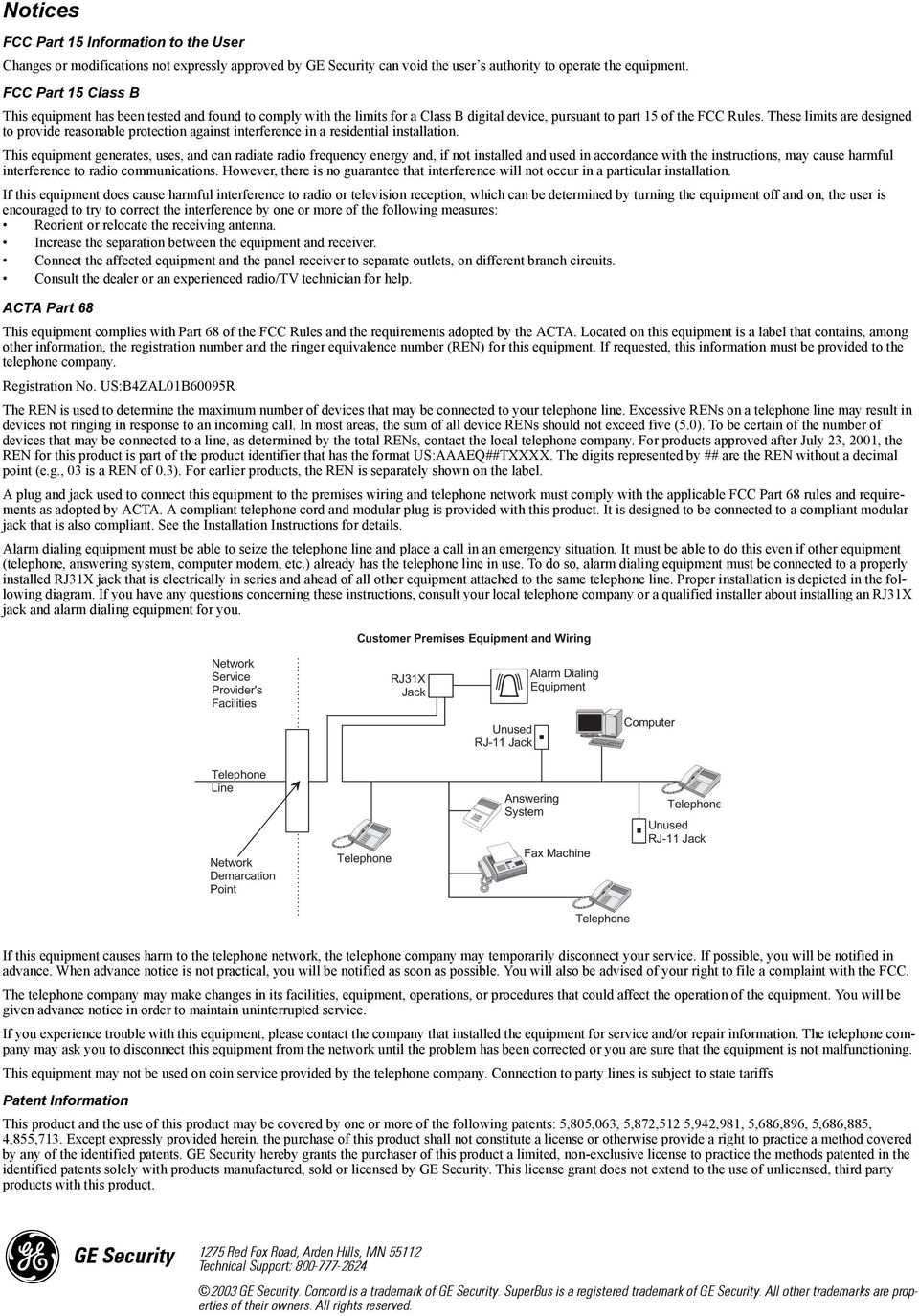
2 Notices FCC Part 15 Information to the User Changes or modifications not expressly approved by GE Security can void the user s authority to operate the equipment. FCC Part 15 Class B This equipment has been tested and found to comply with the limits for a Class B digital device, pursuant to part 15 of the FCC Rules. These limits are designed to provide reasonable protection against interference in a residential installation. This equipment generates, uses, and can radiate radio frequency energy and, if not installed and used in accordance with the instructions, may cause harmful interference to radio communications. However, there is no guarantee that interference will not occur in a particular installation. If this equipment does cause harmful interference to radio or television reception, which can be determined by turning the equipment off and on, the user is encouraged to try to correct the interference by one or more of the following measures: Reorient or relocate the receiving antenna. Increase the separation between the equipment and receiver. Connect the affected equipment and the panel receiver to separate outlets, on different branch circuits. Consult the dealer or an experienced radio/tv technician for help. ACTA Part 68 This equipment complies with Part 68 of the FCC Rules and the requirements adopted by the ACTA. Located on this equipment is a label that contains, among other information, the registration number and the ringer equivalence number (REN) for this equipment. If requested, this information must be provided to the telephone company. Registration No. US:B4ZAL01B60095R The REN is used to determine the maximum number of devices that may be connected to your telephone line. Excessive RENs on a telephone line may result in devices not ringing in response to an incoming call. In most areas, the sum of all device RENs should not exceed five (5.0). To be certain of the number of devices that may be connected to a line, as determined by the total RENs, contact the local telephone company. For products approved after July 23, 2001, the REN for this product is part of the product identifier that has the format US:AAAEQ##TXXXX. The digits represented by ## are the REN without a decimal point (e.g., 03 is a REN of 0.3). For earlier products, the REN is separately shown on the label. A plug and jack used to connect this equipment to the premises wiring and telephone network must comply with the applicable FCC Part 68 rules and requirements as adopted by ACTA. A compliant telephone cord and modular plug is provided with this product. It is designed to be connected to a compliant modular jack that is also compliant. See the Installation Instructions for details. Alarm dialing equipment must be able to seize the telephone line and place a call in an emergency situation. It must be able to do this even if other equipment (telephone, answering system, computer modem, etc.) already has the telephone line in use. To do so, alarm dialing equipment must be connected to a properly installed RJ31X jack that is electrically in series and ahead of all other equipment attached to the same telephone line. Proper installation is depicted in the following diagram. If you have any questions concerning these instructions, consult your local telephone company or a qualified installer about installing an RJ31X jack and alarm dialing equipment for you. + K I J A H 2 H A EI A I - G K EF A 9 EH E C A JM H 5 A HL E? A 2 H L E@ A HI. =? E EJEA I 4! : =? ) = H, E= E C - G K EF A J 7 K I 4 =? + F K JA H 6 A F D A E A A JM H, A = H? = JE 2 E J 6 A F D A ) I M A HE C 5 O I JA. = N =? D E A 6 A F D A 7 K I 4 =? 6 A F D A If this equipment causes harm to the telephone network, the telephone company may temporarily disconnect your service. If possible, you will be notified in advance. When advance notice is not practical, you will be notified as soon as possible. You will also be advised of your right to file a complaint with the FCC. The telephone company may make changes in its facilities, equipment, operations, or procedures that could affect the operation of the equipment. You will be given advance notice in order to maintain uninterrupted service. If you experience trouble with this equipment, please contact the company that installed the equipment for service and/or repair information. The telephone company may ask you to disconnect this equipment from the network until the problem has been corrected or you are sure that the equipment is not malfunctioning. This equipment may not be used on coin service provided by the telephone company. Connection to party lines is subject to state tariffs Patent Information This product and the use of this product may be covered by one or more of the following patents: 5,805,063, 5,872,512 5,942,981, 5,686,896, 5,686,885, 4,855,713. Except expressly provided herein, the purchase of this product shall not constitute a license or otherwise provide a right to practice a method covered by any of the identified patents. GE Security hereby grants the purchaser of this product a limited, non-exclusive license to practice the methods patented in the identified patents solely with products manufactured, sold or licensed by GE Security. This license grant does not extend to the use of unlicensed, third party products with this product. g GE Security 1275 Red Fox Road, Arden Hills, MN Technical Support: GE Security. Concord is a trademark of GE Security. SuperBus is a registered trademark of GE Security. All other trademarks are properties of their owners. All rights reserved.
3 Contents About This Manual 1 About the User s Guide...1 Special Installation Requirements...1 UL Listed Installations...1 Basic System...1 Household Burglary Alarm System Unit (UL 1023)...1 Household Fire Warning System (UL 985)...2 UL 1023 & Hour Backup...2 SIA System Requirements...2 SIA Setting Requirements...2 Commercial Burglary Alarm System Unit (Grade B UL 1610)...3 UL Hour Backup...3 UL 1635 Digital Alarm Communicator System...3 Central Station Reporting...4 UL Canada Listed Installations...4 Canadian Standards CSA Certified Accessories...4 Residential Burglary Alarm System Unit (ULC Subject C )...4 Residential Fire Warning System Control Unit (ULC-S545-M89)...4 California State Fire Marshall Listed Installations...4 Planning the Installation 4 Standard Panel...4 SuperBus 2000 Touchpads...5 SuperBus 2000 RF Transceiver...5 SuperBus 2000 RF Receiver...5 Power Line Carrier Transformer...5 SuperBus 2000 Voice Only Module...5 SuperBus 2000 Phone Interface/Voice Module...5 SnapCards...6 SuperBus Z Input Module (HIM)...6 SuperBus Relay Output Module (HOM)...6 Interrogator 200 Audio Verification Module...6 SuperBus 2000 Cellular Backup Module...6 SuperBus 2000 Energy Saver Module (ESM)...6 SuperBus 2000 Automation Module...6 SuperBus 2000 Wireless Gateway-Ready Kit...6 SuperBus Amp Power Supply...6 Installing the System 6 Determine the Panel Location...7 Total System Power and Wire Length Guidelines...7 Power...7 Wire Length...7 Mounting the Panel...9 Identify Panel Components 10 Installing Antenna Shrouds...10 Connecting the Panel to Earth Ground...11 Installing Optional SnapCards...11 Connecting Detection Devices to Panel Zone Inputs...11 Connecting Intrusion Detection Devices...11 Connecting 2-Wire Smoke Detectors...12 Connecting 4-Wire Smoke Detectors...13 Connecting Speakers Watt Speaker (13-060)...13 Hardwire Interior Speaker (60-528)...14 Installation Instructions iii

4 Connecting Exterior/Interior Piezo Sirens Output Piezo Dynamic Exterior Siren (13-950) Output Hardwire Interior Siren (13-949) Connecting an Interrogator 200 Audio Verification Module (60-677) Connecting SuperBus 2000 Touchpads Installing SuperBus 2000 Modules Mounting Modules Inside the Panel Enclosure SuperBus Amp Power Supply ( ) SuperBus 2000 Transceiver Module ( R) and SuperBus 2000 RF Receiver Module ( R-01) SuperBus 2000 Voice Only Module SuperBus 2000 Phone Interface/Voice Module ( ) Wiring for Status Voice Messages Only Wiring for Status and Alarm Messages SuperBus 2000 Energy Saver Module ( ) SuperBus Z Input Module (60-774) SuperBus Relay Output Module (60-770) SuperBus 2000 Cellular Backup Module SuperBus 2000 Automation Module ( ) SuperBus 2000 Wireless Gateway-Ready Kit ( ) Installing an RJ-31X Phone Jack (13-081) Connecting the Phone Line to the Panel with a DB-8 Cord Connecting the AC Power Transformer Powering Up the Panel Programming the Panel 23 Entering Program Mode...23 Touchpad Button Programming Functions Moving Through Program Mode Tiers and Menus Programming Tier 1 Menu Items Demo Kit Mode (System Programming) Partition 1 Copy (System Programming) Clear Memory (System Programming) Programming Tier 2 Menu Items Using Shortcut Numbers Security Menu Partition Security (0004)...27 Multi-Partition Arm/Disarm (0005) Keychain TP PTN (0006) Exit Extension ( ) Duress Code ( ) Phones Menu 31 Phone Options Menu Dialer Abort Delay (02006) Cancel Message (02007) Call Wait Cancel (02009) Timers Menu Entry Delay ( ) Exit Delay ( ) Extended Delay ( ) Light Control Menu...42 Touchpad Options Menu Reporting Menu Swinger Limit (06015) Alarm Verify ( ) iv Installation Instructions

5 Siren Options Menu...50 Sensors Menu...51 Audio Verification Menu...54 Accessory Modules Menu...56 Onboard Options Menu...59 Smoke Verify (1100)...60 Macro Keys Menu...61 Exiting Programming Mode...62 Entering Quick Programming Mode...62 Entering User Programming Mode...62 Time and Date Menu...63 User Codes Menu...63 Options Menu...65 Set Up Schedules Menu...66 Attach Schedules to Events Menu...67 Energy Saver Menu...69 Attach Lights to Sensors Menu...69 System Version Menu...70 Downloader Programming...70 Enterprise Downloader Programming...70 Testing the System 70 Basic System Commands...71 Testing Zones/Sensors...71 If a Wireless Sensor Does Not Test...72 Testing Phone Communication...72 Testing Central Station/Pager Communication...72 Testing Outputs and Sirens...73 Testing Light Control...74 Testing the Energy Saver Module (ESM)...74 Changing Fixed Display LCD Touchpad Chime and Trouble Beep Tones...74 Adjusting Touchpad Display Contrast...74 Testing Audio Verification Module (AVM) Communication...74 Testing Cellular Backup Communication...75 Troubleshooting 76 Appendix A: System Planning Worksheets 82 Appendix B: Reference Tables 90 Cross-Zoning...91 s for Table B8: Response Numbers...98 Appendix C: Settings 99 Appendix D: Software Release s 106 Specifications 106 System Wiring s 107 Installation Instructions v

6 About This Manual This manual provides information for planning, installing, programming, and testing this security system. When necessary, this manual refers you to other documentation included with compatible peripherals. Planning sheets are included for you to record hardware layout and software programming settings. About the User s Guide The User s Guide ( ) contains user worksheets that should be filled out during the installation and programming of the system. For multi-partition systems, a User s Manual for each partition is suggested. Special Installation Requirements This security system can be used as a fire warning system, an intrusion alarm system, an emergency notification system, or any combination of the three. Some installations may require configurations dictated by city/state codes, insurance, or Underwriter s Laboratories (UL). This section describes the various component and configuration listings. UL Listed Installations This section describes the requirements for UL Listed installations. Basic System Control Panel ( R Concord 4 RF, R Concord Express V4, Concord Commercial V4, or Concord 4 Hybrid) Standard Class II 16.5 VAC, 40 VA power transformer (order # ) or CN (order # CN), or Power Line Carrier Class II 16.5 VAC, 40 VA power transformer (order # ) or CN (order # CN). These transformers must be ordered separately from GE Security. Backup Battery 12V 4.5 Ah (60-681) or 12V 7 AH (60-680) SuperBus 2000 Fixed Display Touchpad (60-820), 2x16 LCD Touchpad ( ), ATP1000 (60-983) ATP2100 (60-985), ATP 2600 (60-984), 2x20 LCD Touchpad (60-803), or 2x20 VFD Touchpad (60-804) Interior Speaker Siren (60-528), Hardwire Interior Siren (13-949), or Speaker Siren (13-060) Basic system may also include a SuperBus 2000 RF Receiver ( R-01) or a SuperBus Transceiver ( R). Household Burglary Alarm System Unit (UL 1023) Basic system, plus: Hardwire Magnetic Contact ( or ) or Wireless Learn Mode Door/Window Sensor (60-362) Immediate Beeps set to on UL 98 Options set to on Receiver Failure set to on (if wireless devices are used) Siren Verify set to on Exit Delay set to 60 seconds Quick Exit set to off Siren Timeout set to 4 minutes or more Entry Delay set to 45 seconds or less RF TX Timeout set to 24 hours (if system includes a built in receiver or SuperBus 2000 RF Receiver or SuperBus 2000 RF Transceiver and wireless burglary sensors) Extended Delay set to off Sleep Time set to off Two Trip Error set to off Alarm Verify set to off Disable Trouble Beeps set to off 1 Concord 4 Series Systems

7 Household Fire Warning System (UL 985) Basic system, plus: Hardwire Smoke Detector: System Sensor models 2400 or 2400TH learned into sensor group 26 or Sentrol (ESL) models 429AT, 521B or 521BXT learned into sensor group 26 Wireless Smoke Sensor or learned into sensor group 26 Immediate Beeps set to on UL 98 Options set to on Receiver Failure set to on (if wireless devices are used) Siren Verify set to on RF TX Timeout set to 4 hours (if system includes a built in receiver or SuperBus 2000 RF Transceiver and wireless smoke sensors) Sleep Time set to off Siren Timeout set to 4 minutes or more Two Trip Error set to off Disable Trouble Beeps set to off UL 1023 & Hour Backup For 24-hour backup, the total current draw for all connected devices is limited to 90 ma (during normal standby conditions) using a 4.5 Ah battery, or 190 ma (during normal standby conditions) using a 7.0 Ah battery. UL requirements take priority over SIA requirements. SIA System Requirements SIA system requirements are the same as those described for a UL Listed Basic System on page 1, plus: If multiple annunciation is required, use additional touchpads. Model numbers , , , , , , SIA Setting Requirements The following table describes programming requirements to meet ANSI-SIA CP-01. Shortcut # Function Programming Page Reference Testing Page Reference Default Setting Required Setting Exit Extension On On Duress Code Disabled Disabled Dialer Abort Delay Sec sec Cancel Message On On Call Wait Cancel Disabled On if reporting to central station and customer has call waiting service Entry Delay sec sec Exit Delay sec sec Swinger Limit Smoke Verify Off On if smoke alarms are programmed into system N/A Cross Zoning Disabled Enabled for zones with a high probability of false alarms Concord 4 Series Systems 2

8 The following table describes non-programmable (hard coded) system operation as required to meet ANSI-SIA CP-01 and is provided only for your reference. Function SIA False Alarm Auto Stay Arming Disarm During Entry Delay Cancel Alarm Abort Annunciation Entry/Exit Progress Annunciation Operation Enabled Enabled Enter Code Only (or 1 + CODE) Enter Code Only (or 1 + CODE) Enabled Enabled Silent arming feature may be used to supress arming level and exit beeps for the current arming period only. Refer to user guide for more information on silent arming. Commercial Burglary Alarm System Unit (Grade B UL 1610) Basic system using Control Panel , SuperBus 2000 RF Transceiver Module ( R), plus: Hardwire Magnetic Contact ( or ) or Wireless Learn Mode Door/Window Sensor (60-499) SAW PIR Sensor ( R), Crystal PIR Sensor ( R), or DS924i PIR Sensor ( ) UL Grade A Bell/Housing such as Ademco #AB12M or equivalent Immediate Beeps set to on UL 98 Options set to on Receiver Failure set to on (if wireless devices are used) RF TX Timeout set to 4 hours 24-Hour Tamper set to on System Tamper set to on Auto Phone Test set to on Phone Test Freq. set to 1 Next Phone Test set to 1 Siren Verify set to on AC Failure set to on Exit Delay set to 120 seconds or less Quick Exit set to off Two Trip Error set to off Alarm Verify set to off Disable Trouble Beeps set to off Phone Number must be programmed High Level Rpts set to on Low Level Rpts set to on Comm. Failure set to on Extended Delay set to off Sleep Time set to off Siren Timeout set to 4 minutes or more UL Hour Backup Same as UL 1023 & 985 For UL 1635 installations, Entry Delay plus Dialer Abort Delay must not exceed 60 seconds. UL 1635 Digital Alarm Communicator System Same as UL 1023, 985 & 1610 plus: AC Failure set to on Phone Number must be programmed Low CPU Battery set to on Next Phone Test set to 1 3 Concord 4 Series Systems

9 Phone Test Freq. set to 1 High Level Rpts set to on Low Level Rpts set to on Comm. Failure set to on RF Tx Timeout set to 4 hours The installer must verify the compatibility between this panel and the central station receiver(s) being used. Central Station Reporting The panel has been tested with the following central station receivers using SIA and Contact ID reporting formats: CS-5000 Central Station Receiver Sur-Gard Central Station Receiver with models SG-DRL2A and SG-CPM2 Osborne Hoffman Central Station Receiver UL Canada Listed Installations This section describes the requirements for CUL (UL Canada) Listed installations. Canadian Standards CSA Certified Accessories Residential Burglary Alarm System Unit (ULC Subject C ) Basic system as described for UL 1023 Listed Installations plus: Hardwire Magnetic Contact ( or ) or Wireless Learn Mode Door/Window Sensor (60-362) Siren Timeout set to 5 minutes or more For 24-hour backup, external power drain is limited to 90 ma (during normal standby condition) using a 4.5 Ah battery, or 190 ma continuous using a 7.0 Ah battery. Planning the Installation Residential Fire Warning System Control Unit (ULC-S545-M89) Basic system as described for UL 985 Listed Installations plus: Hardwire Smoke Detector: System Sensor models 2400 or 2400TH learned into Sensor Group 26, or Sentrol (ESL) models 429AT, 521B, or 521BXT learned into sensor group 26 Wireless Smoke Sensor or learned into sensor group 26 Immediate Trouble Beeps set to on RF TX Timeout set to 4 hours (if system includes SuperBus 2000 RF Transceiver and wireless smoke sensors) Siren timeout set to 5 minutes or more. California State Fire Marshall Listed Installations Same as Household Fire Warning System (UL 985), plus: SMOKE VERIFY must be set to off This section describes system capabilities to help you get familiar with the system. Appendix A provides planning sheets with tables that let you record the hardware and programming configuration of the system. Fill in all necessary information ahead of time to help prepare for system installation. The panels have the following capabilities: Standard Panel Capabilities Concord Express V4 Concord 4/Concord Commercial V4 Zones Partitions 1 6 Bus Devices User Codes The following describe the basic panel (out-of-box) hardware capabilities. Power: Input for an AC step-down, plug-in style transformer. Auxiliary Power Output: Output that supplies 9 to 14 VDC with up to 1 amp for bus devices and hardwired detectors, such as smoke and motion detectors. Concord 4 Series Systems 4

10 Bus A and B: Input and output that provides communication between bus devices and the panel. Siren Driver: Output that can drive an 8-ohm load and provides intrusion and fire alarm sounds for partition 1. 6 watts max. 2 Onboard Outputs: Can be used to activate other signalling devices based on system events. -Out 1 is a 9 to 14 VDC source output, limited to 1.0 amp max. -Out 2 is an open-collector output, rated up to 14 VDC, 300mA max. Microphone Input: Input used for 2-way audio when used in conjunction with the Interrogator 200 Audio Verification Module. 8 Supervised Hardwire Zones: Inputs for various hardwired detectors. Zone 8 can be set up in programming to accept 2-wire smoke detectors. It sources 9 to 14 VDC, 90mA max. Built-In RF Receiver: Allows use of up to 96 or MHz. crystal and/or SAW Learn Mode wireless sensors and touchpads. Phone Line Connection: Allows panel to communicate with central monitoring station and/ or pagers. The total current sourced from all terminals cannot exceed 1 amp. SuperBus 2000 Touchpads The following touchpads can be used for installer/user programming and system operation. SuperBus x16 LCD Touchpad SuperBus x20 LCD Touchpad SuperBus x20 VFD Touchpad SuperBus 2000 ATP 1000 Touchpad SuperBus 2000 ATP 2100 Touchpad SuperBus 2000 ATP 2600 Touchpad SuperBus 2000 GTS 50 The following touchpads can be used only for installer quick programming, system operation and user programming. SuperBus 2000 Fixed Display Touchpad SuperBus 2000 RF Transceiver The transceiver can be used to receive signals from sensors and touchpad that may be on the fringe of panel reception. The transceiver is compatible with all MHz. crystal and SAW Learn Mode wireless sensors and touchpads. SuperBus 2000 RF Receiver The receiver can be used to receive signals from sensors and touchpad that may be on the fringe of panel reception. The receiver is compatible with all MHz. crystal and SAW Learn Mode wireless sensors and touchpads. If installing this module, the Antenna Tamper feature must be turned off. Power Line Carrier Transformer Using this transformer allows the use of X10 Powerhouse Lamp Modules for light control and light activation during alarms. SuperBus 2000 Voice Only Module This module provides an output for a speaker that sounds system status and alarm voice messages. SuperBus 2000 Phone Interface/Voice Module This module allows system access and control using touch-tone telephones, on- or off-site. The module includes an output for a speaker that sounds system status and alarm voice messages. 5 Concord 4 Series Systems
11 SnapCards The following SnapCards expand the system as described: 8Z Input SnapCard: Provides eight additional hardwire zone inputs, of which two are dedicated for using two wire smoke detectors. 4 Output SnapCard: Provides four form C relay outputs that can be set up to activate other signalling devices, based on system events, schedules, or direct control. 4Z Input/2 Output Combo SnapCard: Provides three hardwire zone inputs, one two wire smoke detector loop, and two outputs that can be set up to activate other signalling devices, based on system events, schedules, or direct control. SuperBus Z Input Module (HIM) Provides eight additional hardwire zone inputs. SuperBus Relay Output Module (HOM) Provides four form C relay outputs that can be set up to activate other signalling devices, based on system events. Interrogator 200 Audio Verification Module Adding this module allows central station operators to listen-in and talk to occupants on the premises to verify the emergency when an alarm report is received. SuperBus 2000 Cellular Backup Module Provides central station communication (cellular transmission) as a backup to regular phone line(s). SuperBus 2000 Energy Saver Module (ESM) Provides a money-saving and convenient way to monitor and control temperatures. The ESM uses low- and high-temperature limits to save energy by overriding the existing HVAC thermostat. SuperBus 2000 Automation Module Provides a connection to a compatible home automation device. SuperBus 2000 Wireless Gateway-Ready Kit Allows users to control and monitor the status of their system from the alarm.com internet website. Adding a modem to the module provides the link to a wireless 2-way paging network for website access. SuperBus Amp Power Supply Provides an additional 12 VDC, 2 amps for powering system devices and is supervised via the panel data bus. Installing the System This section describes how to install the system control panel. Before starting the installation, plan your system layout and programming using the worksheets provided in Appendix A. Installing the system consists of the following: Determining the Panel Location Determining Total System Power and Wire Length Guidelines Mounting the Panel Identifying Panel Main Components Installing Optional SnapCards Connecting Detection Devices to Panel Zone Inputs Connecting Speakers Connecting Piezo Sirens Connecting an Interrogator 200 Audio Verification Module Connecting Alphanumeric and Fixed Display Touchpads Concord 4 Series Systems 6

12 (A) Class 2, Class 3, and power-limited fire alarm circuits must be installed using FPL, FPLR, FPLP, or substitute cable permitted by the National Electrical Code ANSI/NFPA 70. Wire that extends beyond the cable jacket must be separated from all other conductors by a minimum of 1/4-inch or by a nonconductive barrier. OR (B) Class 2, Class 3, and power-limited fire alarm circuit conductors must be installed as Class 1 or higher circuits. Installing SuperBus 2000 Modules Installing an RJ-31X Phone Jack Connecting the Phone Line to the Panel with a DB-8 Cord Connecting the AC Power Transformer Powering Up the Panel Determine the Panel Location Before permanently mounting the panel, determine panel location using the following guidelines: Centrally locate the panel with relation to detection devices whenever possible, to help reduce wire run lengths and labor. Locate the panel where the temperature will not exceed 120 F (49 C) or fall below 32 F (0 C). Avoid running wires parallel with electrical wiring or fixtures such as fluorescent lighting, to prevent wire runs from picking up electrical noise. Mount the panel at a comfortable working height (about 45 to 55 inches from the floor to the bottom of the panel, as shown in Figure 1). Antenna Area 2 ) - ' # ' " Phone Jack and Optional Module Mounting Area! " # # # Allow at least 24 in front of the panel to open cabinet door and access panel components. FLOOR Figure 1. Determining Panel Location Leave space to the left and right of the panel for wiring, phone jack, and mounting optional modules. Allow at least 9 inches above the panel cabinet for antennas. Allow at least 24 inches in front of the panel to open the panel door. Total System Power and Wire Length Guidelines Power The panel can supply up to 1 amp (1,000 ma) in full load alarm condition for system devices connected to panel terminals 4 (+12V), 7 and 8 (speaker terminals), 9 (OUT1), 11 (+12V), 24 (2W SMK ZONE 8), and SnapCard terminals. For 24-hour backup, the total standby current draw for all devices connected to panel terminals 4 (+12V), 9 (OUT1), 11 (+12V), 24 (if configured for 2-wire smoke loop), and SnapCard terminals is limited to 90 ma (during normal standby condition) using a 4.5 Ah battery, or 190 ma (during normal standby condition) using a 7.0 Ah battery. Wire Length The total system wire length allowed can vary depending on devices powered by the panel, the wire length between devices and the panel, and the combined wire length of all devices. 7 Concord 4 Series Systems

13 Table 1 describes the maximum wire length allowed between compatible devices and the panel, and the minimum and maximum current draw of each device. Table 1: Maximum Device Wire Length and MIn./Max. Current Draw Device SuperBus x16 LCD Alphanumeric Touchpad SuperBus 2000 ATP 1000 Alphanumeric Touchpad SuperBus 2000 ATP 2100 Alphanumeric Touchpad SuperBus 2000 ATP 2600 Alphanumeric Touchpad SuperBus 2000 GTS 50 SuperBus 2000 Fixed Display Touchpad SuperBus 2000 RF Transceiver SuperBus 2000 RF Receiver (see note) SuperBus 2000 Phone Interface/Voice Module SuperBus 2000 Voice Only Module Max. Wire Length to Panel 22 ga. 300 ft. 18 ga. 750 ft. 22 ga. 300 ft. 18 ga. 750 ft. 22 ga. 300 ft. 18 ga. 750 ft. 22 ga. 300 ft. 18 ga. 750 ft. 22 ga. 100 ft. 18 ga. 250 ft. 22 ga. 300 ft. 18 ga. 700 ft. 22 ga. 1,000 ft. 18 ga. 2,500 ft. 22 ga. 1,100 ft. 18 ga. 2,800 ft. 22 ga. 40 ft. 18 ga. 120 ft. 22 ga. 40 ft. 18 ga. 120 ft. Standby ma Draw 15 ma 90 ma 12 ma 110 ma 30 ma 165 ma 30 ma 165 ma 270 ma 300 ma 11 ma 65 ma 45 ma 55 ma 35 ma 35 ma 25 ma 600 ma 20 ma SuperBus Amp Power Supply no load no load 4 Input/2 Output SnapCard N/A 20 ma 185 ma* 8Z Hardwire Zone Expander SnapCard N/A 38 ma 230 ma* 4 Output SnapCard N/A 1 ma 130 ma* SuperBus Z Input Module SuperBus Relay Output Module SuperBus 2000 Energy Saver Module SuperBus 2000 Cellular Backup Module SuperBus 2000 Automation Module SuperBus 2000 Wireless Gateway-Ready Kit Interrogator 200 Interrogator AVM 2-Wire Smoke Detectors (ESL 429AT, 521B, 521BXT) 2-Wire Smoke Detectors (System Sensor 2400, 2400TH) Hardwire Interior Siren (13-949) Piezo Dynamic Exterior Siren (13-950) 22 ga. 1,800 ft. 18 ga. 4,000 ft. 22 ga. 350 ft. 18 ga. 900 ft. 22 ga. 1,600 ft. 18 ga. 4,000 ft. Standard Power: 22 ga. 15 ft. 18 ga. 40 ft. High Power 22 ga. 10 ft. 18 ga. 30 ft. 22 ga. 1,500 ft. 18 ga. 4,000 ft. 22 ga. 40 ft. 18 ga. 90 ft. 22 ga. 3,200 ft. 18 ga. 4,500 ft. 22 ga. 110 ft. 18 ga. 260 ft. 22 ga. 330 ft. 18 ga. 330 ft. 22 ga. 330 ft. 18 ga. 330 ft. 22 ga. 750 ft. 18 ga. 1,500 ft. 22 ga. 750 ft. 18 ga. 1,500 ft. 18 ma 35 ma 12 ma 180 ma 20 ma 20 ma 90 ma 1600 ma 90 ma 1900 ma 30 ma 35 ma 65 ma 1600 ma 10 ma 10 ma 45 ma 300 ma 70 µa 60 ma 120 µa 80 ma 0 ma 85 ma 0 ma 150 ma Alarm ma Draw 300 ma (jumper) 600 ma (no jumper) Concord 4 Series Systems 8

14 Table 1: Maximum Device Wire Length and MIn./Max. Current Draw (Continued) Device Speaker Siren ( or ) 18 ga. 100 ft. 0 ma 500 ma *Maximum current draw for the SnapCards does not include the load which may be applied to their auxiliary DC supply. When installing SuperBus 2000 RF Receiver Modules, the Antenna Tamper feature must be set to off (see REPORTING GLOBAL in the Programming section). Table 2 describes the total system wire lengths allowed for all SuperBus 2000 devices when installing systems using unshielded or shielded cable. (The maximum wire length for individual devices is shown in Table 1) After determining panel location, run all necessary wires to that location using the guidelines in Table 3. Table 3: Wire Requirements Mounting the Panel Max. Wire Length to Panel Standby ma Draw Table 2: Total System Wire Length Allowed Wire Type 18-gauge, unshielded 18-gauge, shielded 22-gauge, unshielded 22-gauge, shielded Device AC Power Transformer Earth Ground Telephone (RJ-31X) Total System Wire 4,000 ft. 3,000 ft. 4,000 ft. 3,000 ft. Use the following procedure to mount the panel to the wall or wall studs. Alarm ma Draw Wire Requirements 2-conductor, 18-gauge, 25 feet max Single conductor, 16-gauge solid, 25 feet max 4-conductor 2- or 4-conductor, 22-gauge, 1,000 feet max Detection Devices 2- or 4-conductor, 18-gauge, 2,500 feet max (based on 30 ohms max loop resistance including device) Speakers 2-conductor, 18-gauge, 100 feet max SuperBus 2000 Devices 4-conductor, 22- or 18-gauge (see Table 1) Interrogator 200 AVM Power and Microphone 4-conductor, 22-gauge, shielded (see Table 1) 2-Wire Smoke Detectors! Caution 2-conductor, 22-gauge, 330 feet max 2-conductor, 18-gauge, 830 feet max (based on 10-ohms max loop resistance plus a 2k-ohm, end-of-line resistor) Make sure you are free of static electricity whenever you work on the panel with the cover open. To discharge any static, first touch the metal panel chassis, then stay in contact with the chassis when touching the circuit board. Using an approved grounding strap is recommended. To mount the panel (see Figure 2): 1. Remove the panel door and remove the necessary wiring knockouts. Be careful not to damage the circuit board. 2. Feed all wires through wiring knockouts and place the panel in position against the wall. 3. Level the panel and mark the top and bottom mounting holes. 4. Install anchors where studs are not present. 5. Partially insert screws into the two top mounting hole locations, then hang the panel on the two screws. 9 Concord 4 Series Systems

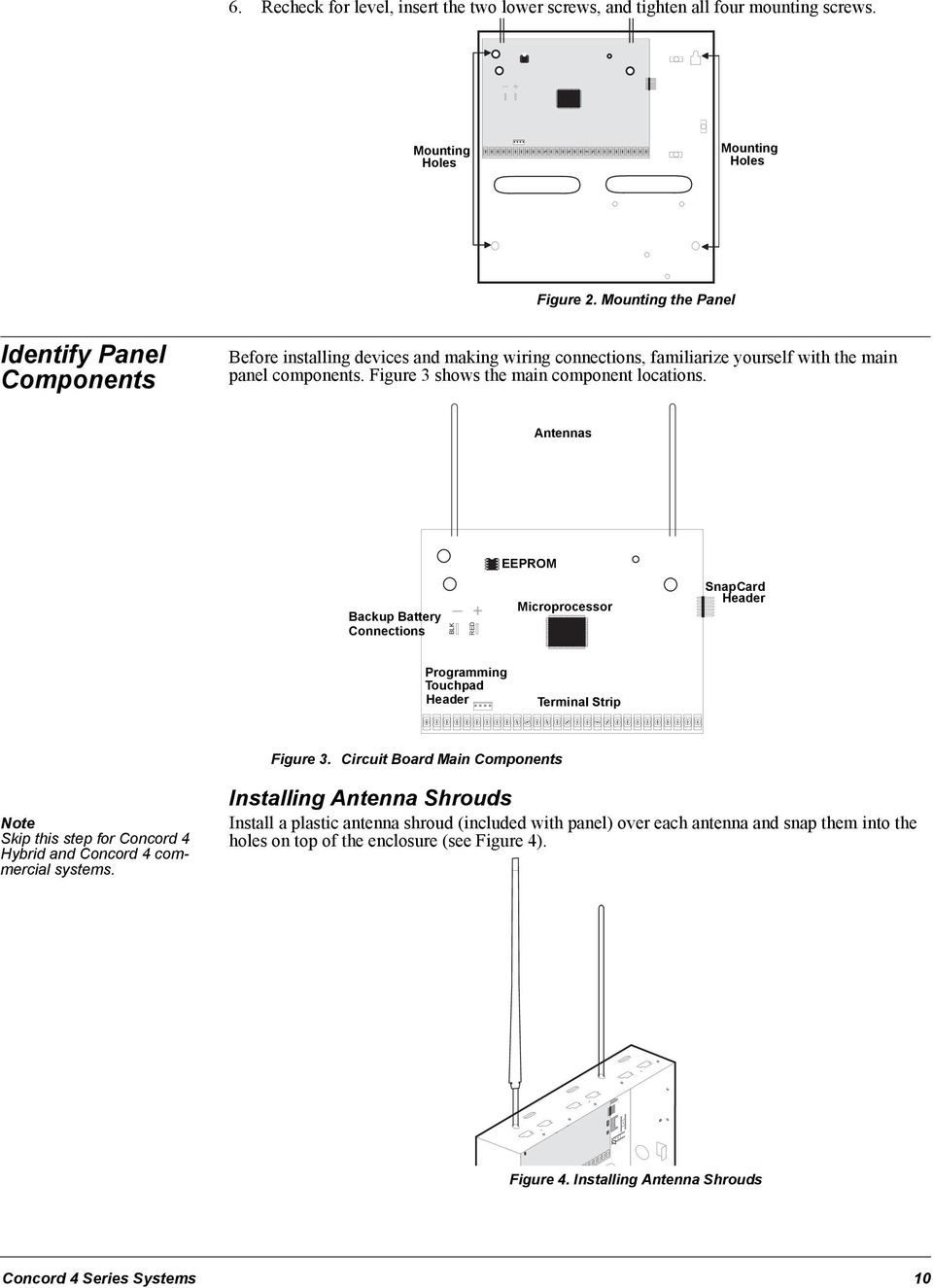
15 6. Recheck for level, insert the two lower screws, and tighten all four mounting screws. Mounting Holes Mounting Holes Figure 2. Mounting the Panel Identify Panel Components Before installing devices and making wiring connections, familiarize yourself with the main panel components. Figure 3 shows the main component locations. Antennas EEPROM Backup Battery Connections * 4 -, Microprocessor SnapCard Header Programming Touchpad Header Terminal Strip Figure 3. Circuit Board Main Components Skip this step for Concord 4 Hybrid and Concord 4 commercial systems. Installing Antenna Shrouds Install a plastic antenna shroud (included with panel) over each antenna and snap them into the holes on top of the enclosure (see Figure 4). Figure 4. Installing Antenna Shrouds Concord 4 Series Systems 10
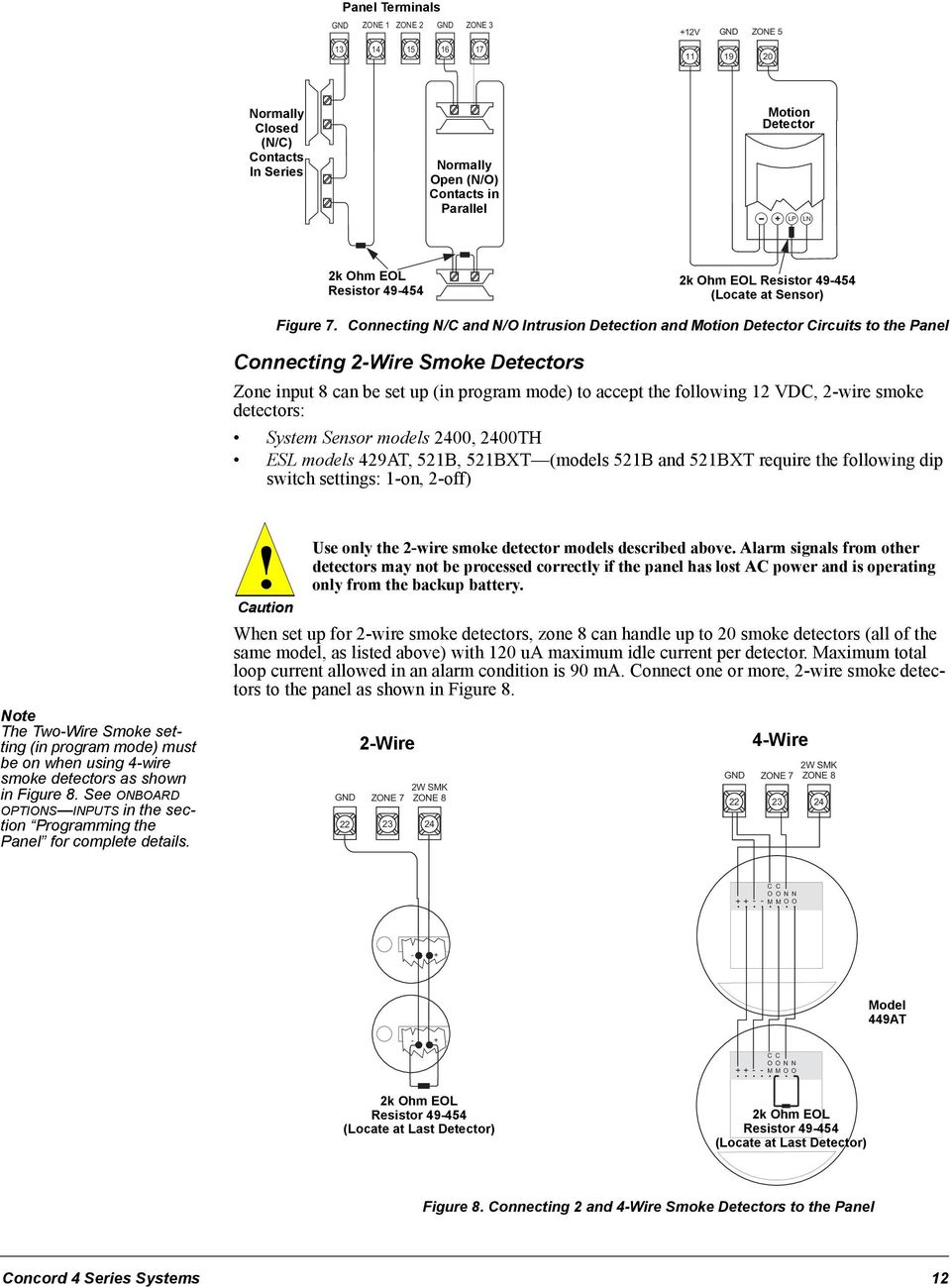
16 For best results, it is recommended that you crimp a spade lug on the wire end at the panel and secure the lug to the enclosure as shown in Figure 5. Connecting the Panel to Earth Ground For maximum protection from lightning strikes and transients, connect the enclosure to earth ground as shown in Figure 5. Use 16-gauge, solid copper wire from an earth grounded cold water pipe clamp to the enclosure. To Water Pipe Installing Optional SnapCards Figure 5. Connecting the Panel to Earth Ground The SnapCard Header on the right side of the panel allows for the installation of one SnapCard. Install the desired SnapCard onto the panel SnapCard Header and secure it in place with two screws, included with the card (see Figure 6). Connect all necessary input/output wiring using the Installation Instructions included with the card. Pipe Ground Clamp Connector SnapCard Header SnapCard Screw Locations The panel comes with factory programmed onboard hardwire zones. Install 2k-ohm, end of line (EOL) resistors on all unused factory programmed onboard hardwire zones. If you don t want to install EOL resistors, delete any unused zones from memory. See Table 7 for onboard hardwire zone factory programming. Figure 6. Installing a SnapCard Connecting Detection Devices to Panel Zone Inputs Zone inputs 1 through 8 are supervised using included 2k-ohm, end-of-line resistors at the last device on each circuit. All eight zones accept either normally open (N/O) or normally closed (N/ C) detection devices. Connecting Intrusion Detection Devices Figure 7 shows the typical wiring for N/C and N/O door/window intrusion detection and the typical wiring for a Detection Systems model DS922 (part no ) motion detector. The minimum available panel voltage for hardwired PIR motion detectors is 8.5 VDC (9.5 VDC for UL listed installations). When using 2-wire smoke detectors on zone 8, the Two-Wire Smoke setting (in program mode) must be turned on before entering the LEARN SENSORS menu. See ONBOARD OPTIONS INPUTS in the section Programming the Panel for complete details. 11 Concord 4 Series Systems

17 Panel Terminals /, - - /, -!! " # $ % 8 /, - # ' Normally Closed (N/C) Contacts In Series Normally Open (N/O) Contacts in Parallel Motion Detector 2 2k Ohm EOL Resistor k Ohm EOL Resistor k Ohm EOL Resistor (Locate at Sensor) Figure 7. Connecting N/C and N/O Intrusion Detection and Motion Detector Circuits to the Panel Connecting 2-Wire Smoke Detectors Zone input 8 can be set up (in program mode) to accept the following 12 VDC, 2-wire smoke detectors: System Sensor models 2400, 2400TH ESL models 429AT, 521B, 521BXT (models 521B and 521BXT require the following dip switch settings: 1-on, 2-off) The Two-Wire Smoke setting (in program mode) must be on when using 4-wire smoke detectors as shown in Figure 8. See ONBOARD OPTIONS INPUTS in the section Programming the Panel for complete details.! Caution Use only the 2-wire smoke detector models described above. Alarm signals from other detectors may not be processed correctly if the panel has lost AC power and is operating only from the backup battery. When set up for 2-wire smoke detectors, zone 8 can handle up to 20 smoke detectors (all of the same model, as listed above) with 120 ua maximum idle current per detector. Maximum total loop current allowed in an alarm condition is 90 ma. Connect one or more, 2-wire smoke detectors to the panel as shown in Figure 8. /, 2-Wire - % &! " /, 4-Wire - % &! " + + Model 449AT + + 2k Ohm EOL Resistor (Locate at Last Detector) 2k Ohm EOL Resistor (Locate at Last Detector) Figure 8. Connecting 2 and 4-Wire Smoke Detectors to the Panel Concord 4 Series Systems 12
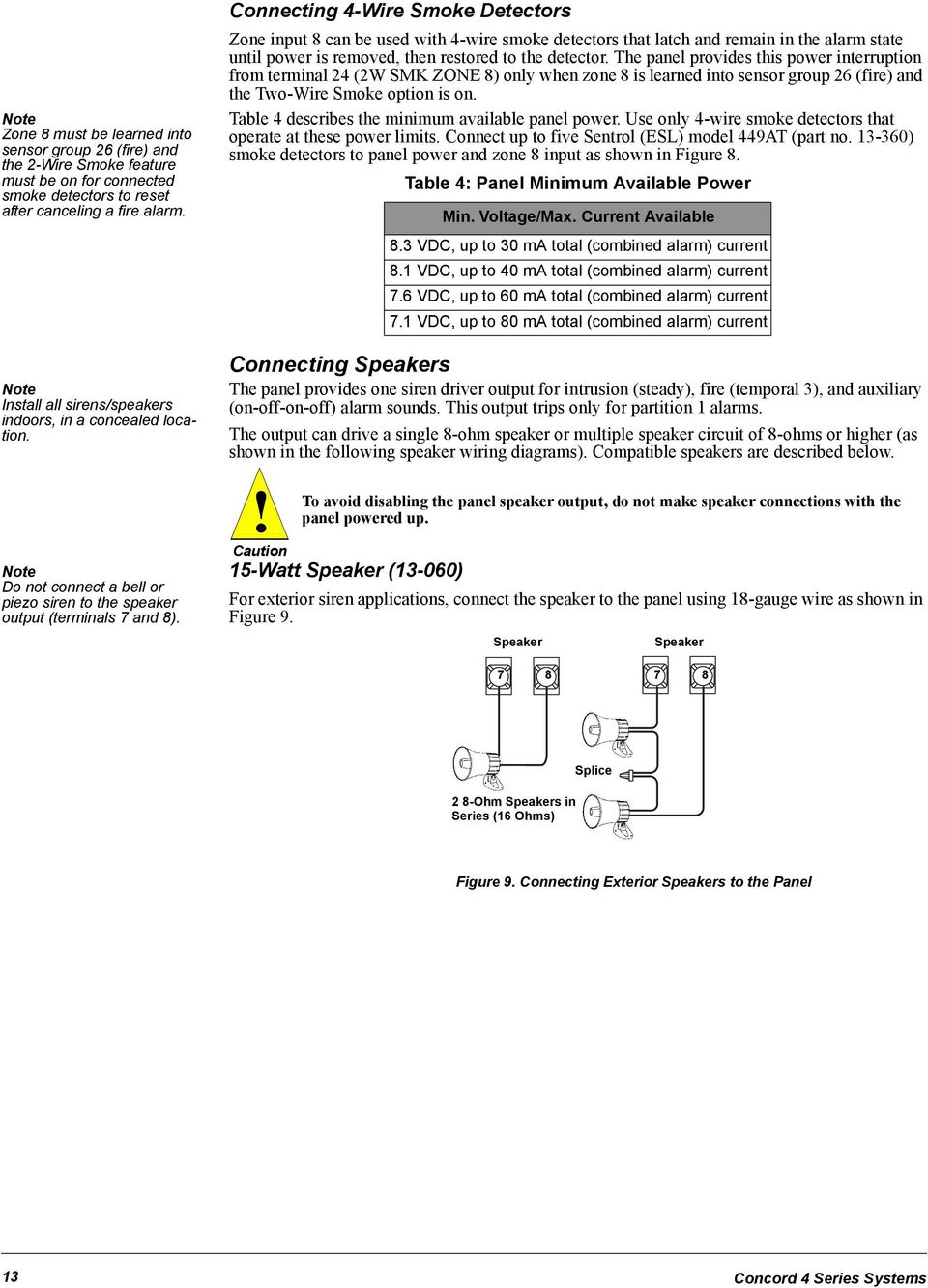
18 Zone 8 must be learned into sensor group 26 (fire) and the 2-Wire Smoke feature must be on for connected smoke detectors to reset after canceling a fire alarm. Install all sirens/speakers indoors, in a concealed location. Do not connect a bell or piezo siren to the speaker output (terminals 7 and 8). Connecting 4-Wire Smoke Detectors Zone input 8 can be used with 4-wire smoke detectors that latch and remain in the alarm state until power is removed, then restored to the detector. The panel provides this power interruption from terminal 24 (2W SMK ZONE 8) only when zone 8 is learned into sensor group 26 (fire) and the Two-Wire Smoke option is on. Table 4 describes the minimum available panel power. Use only 4-wire smoke detectors that operate at these power limits. Connect up to five Sentrol (ESL) model 449AT (part no ) smoke detectors to panel power and zone 8 input as shown in Figure 8. Table 4: Panel Minimum Available Power Connecting Speakers Min. Voltage/Max. Current Available 8.3 VDC, up to 30 ma total (combined alarm) current 8.1 VDC, up to 40 ma total (combined alarm) current 7.6 VDC, up to 60 ma total (combined alarm) current 7.1 VDC, up to 80 ma total (combined alarm) current The panel provides one siren driver output for intrusion (steady), fire (temporal 3), and auxiliary (on-off-on-off) alarm sounds. This output trips only for partition 1 alarms. The output can drive a single 8-ohm speaker or multiple speaker circuit of 8-ohms or higher (as shown in the following speaker wiring diagrams). Compatible speakers are described below.! To Caution avoid disabling the panel speaker output, do not make speaker connections with the panel powered up. 15-Watt Speaker (13-060) For exterior siren applications, connect the speaker to the panel using 18-gauge wire as shown in Figure 9. Speaker Speaker Ohm Speakers in Series (16 Ohms) Splice Figure 9. Connecting Exterior Speakers to the Panel 13 Concord 4 Series Systems
19 Hardwire Interior Speaker (60-528) Connect interior speakers to the panel using 18-gauge wire as shown in Figure 10.! Caution Connect only the large speaker to the panel terminals 7 and 8 as shown. The smaller speaker cannot handle to output of terminals 7 and 8. To avoid damaging the speaker, the smaller speaker should not be connected to terminals 7 and 8. Not Used Panel Terminals % Speaker & Not Used Panel Terminals 7 8 Speaker Not Used Figure 10. Connecting Hardwire Interior Speakers Connecting Exterior/Interior Piezo Sirens For 24-hour backup, external power drain is limited to 90 ma (during normal standy condition), using a 4.5 Ah battery, or 190 ma continuous using a 7.0 Ah battery. Output 1 Onboard output 1 (OUT 1 terminal 9) is a 9 to 14 VDC switched, programmable output that can handle a maximum of 1,000 ma current. The default setting (01614) activates the output 30 seconds after a police or fire alarm condition occurs. This allows you to connect a piezo siren without changing the output configuration number in programming. This output is typically used for exterior siren applications. (For more information on output configuration numbers, see Onboard Options Menu.) Piezo Dynamic Exterior Siren (13-950) This siren is not UL approved for use as an outdoor sounding device. Connect the siren to panel as shown in Figure ' /,! Panel Terminals Red Black Figure 11. Connecting Exterior Sirens Concord 4 Series Systems 14

20 Output 2 Onboard output 2 (OUT 2 terminal 10) is an open-collector (switched path-to-ground), programmable output that can handle a maximum of 300 ma current sink and up to 14 VDC. The default setting (01710) activates the output for status and alarm tones, allowing for a piezo siren connection without changing the output configuration number. This output is typically used for interior siren applications. (For more information on output configuration numbers, see Onboard Options Menu.) Hardwire Interior Siren (13-949) This siren has two inputs; steady (#1) and warble (#2). Use the steady (#1) terminal for Concord 4 panels. The siren also includes a cover tamper switch that can be connected to a hardwire zone input on the panel, SnapCard or SuperBus 2000 Hardwire Input Module. Connect the siren to the panel/zone input terminals as shown in Figure Panel Terminals To Zone Input 2k Ohm Resistor /, Figure 12. Connecting Exterior and Interior Sirens Connecting an Interrogator 200 Audio Verification Module (60-677) Connect the Interrogator 200 Audio Verification Module (AVM) to the panel terminals as shown in Figure 13. Partition 1 use only.! Caution If a speaker is already connected to panel terminals 7 and 8, the Interrogator 200 speaker must be hooked up in series with that speaker to provide a 16-ohm load. Hooking up speakers in parallel to panel terminals 7 and 8 creates a 4-ohm load that can cause permanent damage to the panel. Splice Yellow Microphone Cable Speaker Cable 1+ /, ) - 4 Panel Terminals! % & Cable Shield Figure 13. Connecting an Interrogator 200 AVM 15 Concord 4 Series Systems

21 Connecting SuperBus 2000 Touchpads SuperBus 2000 touchpads may have wires or screw terminals. All use the same wiring scheme for power and bus connections. Connect touchpads to the as shown in Figure 14. /, 8 ) * 7 5 *! " # $ Panel Terminals /, 8 ) * 7 5 *! " # $ +12V Red Bus A Green Bus B White or Yellow GND Black Touchpads with Wires 8 ) * /, + Touchpads with Terminals Installing SuperBus 2000 Modules Figure 14. Connecting Touchpads to the Panel SuperBus 2000 modules can be installed inside the panel cabinet or away from the panel with their included enclosure. Even if you don t plan to mount modules inside the cabinet, install the support standoffs for future use and to avoid losing them. Mounting Modules Inside the Panel Enclosure Use the following guidelines when mounting modules inside the panel enclosure (see Figure 15): Up to 4 of the SuperBus 2000 modules listed in Table 1 can be mounted inside the cabinet. The 2 Amp Power Supply and Phone Interface/Voice Module each use two mounting spaces when mounted inside the panel enclosure. The panel includes two support standoffs you install to secure module backplates to the panel. Install the standoffs at the locations shown. The cabinet has built-in mounting clips on the top and sides that module backplates slide onto for mounting. Top Mounting Clips (6) Side Mounting Clip Screws Support Standoffs Figure 15. Installing SuperBus 2000 Modules Concord 4 Series Systems 16
22 Do not connect power (AC and battery) to the power supply until the panel is ready for power up. For power supply AC and battery connections, see the SuperBus Amp Power Supply Installation Instructions. SuperBus Amp Power Supply ( ) Refer to power supply installation instructions for the mounting procedure. Connect the power supply to the panel terminals and devices to be powered as shown in Figure 16. Panel Terminals /, 8 ) * 7 5 *! " # $ Power Supply Terminals " 8 ) + " 8 ) + 8 * 7 5 ) * 7 5 * /, To power inputs on devices /, - /, Figure 16. Wiring the SuperBus 2 Amp Power Supply to the Panel When installing SuperBus 2000 RF Receiver Modules, the Antenna Tamper feature must be set to off (see REPORTING GLOBAL in the Programming section). SuperBus 2000 Transceiver Module ( R) and SuperBus 2000 RF Receiver Module ( R-01) The transceiver and receiver expand RF reception range when placed in the vicinity of sensors on the fringe of panel RF reception. Refer to trasceiver or receiver installation instructions for the mounting procedure. Connect the transceiver and receiver (up to four total) to the panel as shown in Figure 17. Panel Terminals /, 8 ) * 7 5 *! " # $ /, 8 ) * 7 5 * Panel! " # $ Terminals 8 ) * /, Transceiver Terminals 8 ) * /, Receiver Terminals Figure 17. Wiring the SuperBus 2000 RF Transceiver and RF Receiver to the Panel SuperBus 2000 Voice Only Module The module can be mounted inside or outside of the control panel cabinet. Refer to the SuperBus 2000 Voice Only Module Installation Instructions included with each module, for complete mounting instructions. 17 Concord 4 Series Systems
23 In UL Listed installations, the Voice Only Module is for supplementary use only. The module requires panel power and bus connections, and speaker connection through panel terminals as shown in Figure 18. Hardwire Interior Speaker (60-528) Not Used Module Terminals 8 * 7 5 ) * 7 5 * /, ) 7, ) 7,! " # $ % & Module Terminals Panel Terminals! " # $ /, 8 ) * 7 5 * % & ) - 4 Panel Terminals Figure 18. Wiring for the Voice Only Module For RJ-31X connections, see Installing an RJ-31X Phone Jack (13-081). In UL Listed installations, the Phone Interface/Voice Module is for supplementary use only. SuperBus 2000 Phone Interface/Voice Module ( ) The Phone Interface/Voice Module includes two backplates for mounting the module inside the control panel cabinet. The module can also be mounted outside of the control panel using an optional plastic housing (part no ). Refer to the SuperBus 2000 Phone Interface/Voice Module Installation Instructions included with each module, for complete mounting instructions. The module requires panel power and bus connections, phone line connection through panel terminals and DB-8 cord (from an RJ-31X jack), and speaker connection through panel terminals. Connect the module to the panel power and bus terminals as shown in Figure 19. For partition 1, connect the phone line to the module through the panel terminals and DB-8 cord (from an RJ-31X jack) as shown in Figure 19. For partitions 2-6 phone connections, see the SuperBus 2000 Phone Interface/Voice Module Installation Instructions. Module Terminals /, 8 ) * 7 5 *! " # $ Panel Terminals 8 )! * " /, # /, $ 5 2 % 5 2 & ) 7, ' ) 7, /, ! 4 1 / " 4 1 / Module Terminals / 4 * 4 / 4 ; 4 -, 8 )! * " /, # /, $ 5 2 % 5 2 & ) 7, ' ) 7, /, ! 4 1 / " 4 1 / Panel Terminals # $ % & Green Brown Gray Red DB-8 Cord Brn Gry RJ-31X Jack Grn Red Figure 19. Wiring for the Phone Interface/Voice Module To prevent status voice messages from being broadcast outside, do not connect exterior speakers to Phone Interface/Voice module terminals 6 and 7. Wiring for Status Voice Messages Only Connect an interior speaker to the Phone Interface/Voice Module terminals as shown under Status in Figure 20. When connected as shown, the speaker only produces status voice messages. In an alarm, the speaker announces voice status messages. Concord 4 Series Systems 18
24 Wiring for Status and Alarm Messages Make the connection shown under Status and Alarm in Figure 20 only if the Phone Interface/ Voice Module is being installed in Partition 1 and alarm sounds are desired. In an alarm, the speaker alternates between alarm siren tones and voice status messages. Status Only Status and Alarm Module Terminals Module Terminals 8 )! * " /, # /, $ 5 2 % 5 2 & ) 7, ' ) 7, /, ! 4 1 / " 4 1 / 8 )! * " /, # /, $ 5 2 % 5 2 & ) 7, ' ) 7, /, ! 4 1 / " 4 1 / ) - 4 Hardwire Interior Speaker (60-528) % & Panel Terminals Not Used Not Used Figure 20. Wiring the Phone Interface/Voice Module for Status Only or Status and Alarm Messages SuperBus 2000 Energy Saver Module ( ) Connect the Energy Saver Module to the panel and premises thermostat as shown in Figure 21. Thermostat Energy Saver Module 0 - ) 6..! " # $ # $ % & ' ) + To HVAC Panel Terminals SuperBus Z Input Module (60-774) Figure 21. Wiring the Energy Saver Module to the Panel Connect the SuperBus Z Input Module to the panel as shown in Figure 22. Connect all necessary input wiring using the Installation Instructions included with the module. SuperBus Relay Output Module (60-770)! " # $ Connect the SuperBus Relay Output Module to the panel as shown in Figure 22. /, 8 ) * 7 5 * 19 Concord 4 Series Systems
25 Connect all necessary output wiring using the Installation Instructions included with the module. Input Output 1, : : : : : : : : 1, : : : : : : : :! " # $ % & '! " # $ % &! " # $ % & '! " # $ " + " + "! +! +! & % - $ # - " - + -! /, 8 ) * 7 5 *! " # $ /, 8 ) * 7 5 *! " # $ Figure 22. Wiring Input and Output Modules to the Panel SuperBus 2000 Cellular Backup Module Connect the SuperBus 2000 Cellular Backup Module to the SuperBus Amp Power Supply and panel as shown in Figure 23.! Caution Since the SuperBus 2000 Cellular Backup Module draws more than 1 amp, it must be powered by the SuperBus Amp Power Supply and not the panel.! " # $ + - " 8 ) + " 8 ) + 8 * 7 5 ) * 7 5 * /, /, - /, SuperBus Amp Power Supply Terminals Figure 23. Wiring the Cellular Backup Module to the Panel Concord 4 Series Systems 20
26 SuperBus 2000 Automation Module ( ) Connect the SuperBus 2000 Automation Module to the panel as shown in Figure 24. Automation Module Circuit Board DB-9 Serial Cable Automation Device! " # $ + - Figure 24. Connecting the SuperBus to the Panel SuperBus 2000 Wireless Gateway-Ready Kit ( ) Connect the SuperBus 2000 Wireless Gateway Module to the SuperBus 2000 terminals as shown in Figure 25.! Caution Panel Terminals /, 8 ) * 7 5 *! " # $ Since the SuperBus Wireless Gateway-Ready Kit draws more than 1 amp, it must be powered by the SuperBus Amp Power Supply and not the panel. 8 ) * /, + SuperBus Amp Power Supply Terminals " 8 ) + " 8 ) + 8 * 7 5 ) * 7 5 * /, /, - /, The panel cannot be used on a digital or PBX phone line. These systems are designed for digital type devices only, operating anywhere from 5 volts DC and up. The panel uses an analog modem and does not have a digital converter, adapter, or interface to operate through such systems. Connecting the panel to an analog line off the phone switch places the panel ahead of the phone system, preventing panel access from phones on the premises. However, the panel can still be accessed from off-site phones. Figure 25. Connecting the Wireless Gateway Module to the Panel Installing an RJ-31X Phone Jack (13-081) Use the following guidelines when installing an RJ-31X phone jack for system control by phone and central station monitoring. Locate the RJ-31X jack (CA-38A in Canada) no further than five feet from the panel. The panel must be connected to a standard analog (loop-start) phone line, that provides 48 volts DC (on-hook or idle). For full line seizure, install an RJ-31X phone jack on the premises phone line so the panel is ahead of all phones and other devices on the line. This allows the panel to take control of the phone line when an alarm occurs, even if the phone is in use or off-hook. If an analog line is not available, contact a telecommunications specialist and request an analog line off the phone switch (PBX mainframe) or a 1FB (standard business line). To connect a phone line to the panel using an RJ-31X/CA-38A jack: 1. Run a 4-conductor cable from the TELCO protector block to the jack location (see A in Figure 26). 2. Connect one end of the cable to the jack (see B in Figure 26). 3. At the TELCO protector block, remove the premises phone lines from the block and splice them to the black and white (or yellow) wires of the 4-conductor cable (see C in Figure 26). 21 Concord 4 Series Systems
27 4. Connect the green and red wires from the 4-conductor cable to the TIP (+) and RING (-) posts on the block (see D in Figure 26). 5. Check the phones on the premises for dial tone and the ability to dial out and make phone calls. If phones do not work correctly, check all wiring and correct where necessary. Proceed to the Troubleshooting section of this manual if problems persist. Connecting the Phone Line to the Panel with a DB-8 Cord After installing the RJ-31X jack, you are ready to connect the phone line to the panel. A DB-8 cord (not included) uses a plug at one end for connecting to the RJ-31X module and flying leads on the other end for panel terminal connections. To connect the DB-8 cord to the panel terminals and RJ-31X jack (see Figure 26): 1. Connect the green, brown, gray, and red flying leads from the DB-8 cord to panel terminals 25, 26, 27, and Insert the DB-8 cord s plug into the RJ-31X. 3. Check the phones on the premises for dial tone and the ability to dial out and make phone calls. If phones do not work correctly, check all wiring and correct where necessary. Proceed to the Troubleshooting section of this manual if problems persist. Brn Gry Black Grn Green B RJ-31X Jack Red Red White (or Yellow) / 4 Green # * 4 / 4 ; 4 -, $ % & Brown Gray Red A Dealer Cable Run TELCO Protector Block TIP (+) Green Black Lines from Phones on Premises Green RING (-) D C Red White (or Yellow) Red Brn Grn RJ-31X Jack DB-8 Cord Gry Red Figure 26. Wiring an RJ-31X Jack and DB-8 Cord to the Panel Connecting the AC Power Transformer The panel must be powered by a plug-in stepdown transformer that supplies 16.5 VAC, 40 VA ( or CN). For systems that include X10 Lamp Modules, the panel must be powered with the Line Carrier Power Transformer that supplies 16.5 VAC, 40 VA ( or CN). Connect the power transformer to the panel as shown in Figure 27.! Caution Do not plug in the power transformer or connect the backup battery at this time. The panel must be powered up using the sequence of steps described in the next section, Powering Up the Panel. Concord 4 Series Systems 22
28 Backup Battery Connections Panel Terminals $ # 8 ) + Black Red Battery Figure 27. Connecting Panel Power Transformer and Backup Battery If alphanumeric touchpads don t display anything, immediately unplug the transformer and disconnect the backup battery. Refer to the Troubleshooting section. Programming the Panel If the system is powered up after the programming touchpad is connected or if a bus command scan is executed, the programming touchpad will be learned into the system and must later be manually deleted. Powering Up the Panel After connecting and wiring all devices to the panel, you are ready to apply AC and backup battery power to the panel. To power up the panel (see Figure 27): 1. Connect the red and black battery leads (included with panel) to the lugs on the panel. 2. Connect the other ends of the battery leads to the battery terminals. 3. Plug the transformer into an outlet that is not controlled by a switch. Alphanumeric touchpads display ************, then SCANNING BUS DEVICES, and finally a date and time display. 4. To permanently mount the transformer, unplug it and remove the existing screw securing the AC outlet cover.! Use extreme caution when securing the transformer to a metal outlet cover. You could receive a serious shock if a metal outlet cover drops down onto the prongs of the plug while you are securing the transformer and cover to the outlet box. Warning Hold the outlet cover in place and plug the transformer into the lower receptacle. 5. Use the screw supplied with the transformer to secure the transformer to the outlet cover. For on-site system programming, an alphanumeric touchpad is required. Entering Program Mode Entering program mode is done using an installer/dealer code (default = 4321). The system can be put into program mode only when all partitions are disarmed. To enter program mode: 1. Make sure the system is disarmed in all partitions. 2. Press The display shows SYSTEM PROGRAMMING. To enter programming mode using a programming touchpad: 1. Connect the red, black, green, and white wires from the Programming Touchpad Cable (60-791) to the power and bus wires/terminals on an alphanumeric touchpad, matching the +12V (red), Bus A (green), Bus B (white), and GND (black) on each. 2. Make sure the system is powered up and disarmed. 3. Connect the plug on the cable onto the panel programming touchpad header (see Figure 28). 4. Press The touchpad sounds one short beep. Press * and verify that the display shows SERVICE TOUCHPAD ACTIVE. 5. Press and the display shows SYSTEM PROGRAMMING. 23 Concord 4 Series Systems
29 6 A I J5 O I JA 9 A A O ) * F HA I I > JD F HA I I > JD F HA I I > JD BB, A = O ". A = JK HA I % 5 J= JK I 5 J= O 5 E J 5 O I JA & EC D JI ) M = O! 2 = C A H A K * O F = I I 6. After programming is completed, simply disconnect the touchpad from the panel header., # $ + ' Programming Touchpad Cable (60-791) Figure 28. Connecting a Programming Touchpad Touchpad Button Programming Functions $ %! " /! &,, 5. In program mode, touchpad buttons let you navigate to all installer programming menus for configuring the system. Table 5 describes the touchpad button functions in program mode. Table 5: Touchpad Button Functions Button Programming Function # Selects menu item or data entry. * Deselects menu item or data entry (if pressed before #). A ( ) B ( ) C D Scroll through available options at the current menu tier. Also scroll through sensor text options during sensor text programming. Enters pauses when programming phone numbers. Deletes certain programmed settings. 0 thru 9 Enter numeric values wherever needed. 1 & 2 Select off (1) or on (2) wherever needed. 1 thru 6 Press and hold to enter alphabetical characters A thru F for account numbers. 7 & 9 Press and hold to enter * (7) or # (9) for phone numbers. Moving Through Program Mode Tiers and Menus There are two basic tiers of programming menus (see Figure 29). Tier 1 Menus Tier 2 Menus SYSTEM PRO- # PHONE SECURITY PHONES TIMERS GRAMMING OPTIONS # # # # LIGHT TOUCHPAD REPORTING SIREN CONTROL OPTIONS OPTIONS # # # # SENSORS AUDIO ACCESSORY ONBOARD VERIFICATION MODULES OPTIONS # # # # MACRO KEYS Figure 29. Tier 1 and Tier 2 Program Menus Concord 4 Series Systems 24
30 Arrows pointing right or down represent pressing B or # to advance forward through the menus. Arrows pointing left or up represent pressing A or * to move through the menus in reverse. Only when SYSTEM PROGRAMMING is displayed can you advance to tier 2 menus. Only when a specific menu is displayed can you advance to those menu settings. For example, from the SENSORS menu pressing # gives you access to learning sensors, programming sensor text, deleting sensors, and viewing/editing sensor programming. Settings in tier 2 menus can also be accessed by entering shortcut numbers. See the section, Programming Tier 2 Menu Items for complete details. Programming Tier 1 Menu Items This section guides you through programming tier 1 menu items as they appear in sequence. The exact order you follow will depend on whether you re installing a new system or changing programming in an existing system. Demo Kit Mode (System Programming) (Default = off) Determines whether the panel is used for a standard installation (off) or as a demo kit (on). When the Demo Kit option is on, only sensors learned into groups 01 and 03, duress code use, and phone test (8 + System Master Code + 2) will be reported. Turning on this feature and performing a memory clear changes the following settings: Partition 1 Master Code = 1000 Partition 2 Master Code = 2000 User Code 00 = 1001 (partition 1 code can also be used to jump to partition 2) User Code 01 = 1002 (partition 1 code can also be used to bypass sensors) User Code 02 = 2001 (partition 2 code can also be used for remote or off-site access) User Code 03 = 2002 (partition 2 code can also be used to perform system tests) User Code 04 = 1122 (partition 1 code can also be used to jump to partition 2, for remote or off-site access, and system tests) User Code 05 = 2233 (partition 2 code can also be used to jump to partition 1, for remote or off-site access, bypassing sensors, and system tests) Partition 1 House Code = 255 (P) Partition 2 House Code = 254 (O) Zone 1 (hardwire input 1) = Group 10, Front Door Zone 2 (hardwire input 2) = Group 13, Bedroom Window Zone 3 (hardwire input 3) = Group 17, Living Room Motion Sensor Zone 4 (hardwire input 4) = Group 1, Panic Zone 5 (wireless, keychain touchpad, ID F00201) = Group 01, (no text) Zone 6 (wireless, DWS, ID A00206) = Group 13, Kitchen Window COMM FAILURE = off Demo Kit = on AVM code = 1212 Entry Delay = 8 sec Exit Delay = 8 sec Extended Delay = 1 minute Siren Timeout = 2 minutes To turn Demo Kit Mode off or on: 1. With the display showing DEMO KIT MODE OFF/ON (current setting), press 1 (off) or 2 (on), then press #. 2. The display flashes the entered setting, then stops after pressing # and displays DEMO KIT MODE OFF/ON (new setting). Partition 1 Copy (System Programming) (Default = none) After programming all settings pertaining to partition 1, you can make an exact copy to use for partitions 2-6. This helps reduce programming time when the system is set up for multiple partitions. If there are certain settings that are unique to partitions 2-6, simply advance to the appropriate menu and make the necessary changes. To Copy Partition 1: With the display showing PARTITION 1 COPY, press # + installer CODE + #. The display flashes, then stops after pressing # and shows DONE. 25 Concord 4 Series Systems
31 Clearing the memory will erase onboard hardwire zone factory programming. Clear Memory (System Programming) Clearing memory deletes all existing programming information (except the Dealer Code). To Clear Panel Memory: 1. With the system in program mode, press A or B until the display shows CLEAR MEMORY. 2. Press # and the display shows ENTER CODE TO CLEAR MEMORY. 3. Enter the 4-digit installer or dealer code (if programmed) + #. After about five seconds, the system restarts and the panel scans the bus to learn all bus devices. If the system doesn t respond as described, repeat step 3. Programming Tier 2 Menu Items This section guides you through programming tier 2 menu items as they appear in sequence. Figure 27 shows the menus available on tier 2. Each menu on tier 2 represents a group of settings related to the menu name. Some tier 2 menus break down into settings that affect the whole system (global) or a specific partition. Using Shortcut Numbers To go directly to a setting in tier 2, you can enter the shortcut number for that setting. Shortcut numbers in this manual appear in parenthesis ( ), next to the setting name. For example, this heading shows the Downloader Code global shortcut to be Downloader Code (0000) Security-Global (Default = 12345) Menus with partition settings have the series of shortcut numbers in parenthesis. For example, this heading shows the Account Number partition shortcut number series to be Account Number ( ) Security-Partition 1-6 (Default = 00000) The bold digit identifies the partition. To go directly to partition 3 account number, you would enter Shortcut numbers can be used from any setting location within tier 2. To advance to tier 2 program menus: With the system in program mode and the display showing SYSTEM PROGRAMMING, press # once. The display should show SECURITY. Security Menu The SECURITY menu lets you choose whether security settings affect the whole system (global) or a specific partition. To access global or partition security menu items: 1. With the display showing SECURITY, press #. The display should show GLOBAL. 2. Press # again to advance to global settings, or press A or B to display PARTITION n, then press # to advance to selected partition 1-6 settings. The following describes how to program the Security settings that appear under GLOBAL. Downloader Code (0000) Security-Global (Default = 12345) The 5-digit downloader code is used in conjunction with downloader programming. The downloader operator must have the panel account number and downloader code in order to perform any programming. The Downloader Code cannot be deleted from panel memory. To change the Downloader Code to its default setting, enter in the procedure to the right. The Downloader Code will be reset to defaults during a Memory Clear only if the Dealer Code is not set OR if the Dealer Code is used to initiate the Memory Clear. Downloader programming has not been investigated by UL. To program a Downloader Code: 1. With the display showing DOWNLOADER CODE nnnnn (current code), enter the desired 5-digit code, + #. The display flashes the entered code. 2. Press # and the display shows the new code. Concord 4 Series Systems 26
32 Installer Code (0001) Security-Global (Default = 4321) The 4-digit installer code is used for entering program mode and changing system settings. If a dealer code is programmed, only those settings not associated with phone numbers and the Downloader Code can be changed. The Installer Code cannot be deleted or cleared from panel memory. To change the Installer Code to its default setting, enter To program a Installer Code: 1. With the display showing INSTALLER CODE nnnn (current code), enter the desired 4-digit code. The display flashes the entered code. 2. Press # and the display shows the new code. Dealer Code (0002) The 4-digit dealer code is used to prevent unauthorized persons from changing the programmed central station phone numbers and Downloader Code. When this feature is enabled, central station phone numbers and Downloader Code cannot be changed (unless you enter the program mode by using the dealer code). All other system settings are still accessible by entering the program mode with the installer code. The Dealer Code cannot be deleted by clearing panel memory. Security-Global (Default = none) To program a Dealer Code: 1. With the display showing DEALER CODE ****, enter the desired 4-digit code. The display flashes the entered code. 2. Press # and the display shows the new code. To delete a Dealer Code: 1. With the display showing DEALER CODE nnnn (current code), press D. The display shows DEALER CODE ****. Access Code Lock (0003) This setting determines whether or not the panel will include Access Codes when sending user information to the automation module. When this option is on, it means the Access Codes are not sent. Security-Global (Default = on) To turn Access Code Lock off or on: 1. With the display showing ACCESS CODE LOCK ON/OFF, press 1 (off) or 2 (on). The display flashes the entered setting. Partition Security (0004) Controls whether an access code is required for partition jumping. When turned on, users must jump partitions with an access code by pressing 8 + CODE PTN. When turned off, users can jump partitions without an access code by pressing PTN n (n = 1-6). Regardless of the setting, an access code can always be used to jump partitions. Security-Global (Default = on) To turn Partition Security off or on: 1. With the display showing PTN SECURITY (current setting), press 1 (off) or 2 (on). The display flashes the entered setting. 2. Press # and the display shows the new setting. 27 Concord 4 Series Systems
33 Multi-Partition Arm/Disarm (0005) Controls which partitions can be armed/disarmed simultaneously when using a touchpad and access code assigned to those partitions. When enabled, users can arm/disarm selected partitions using an authorized access code. When disabled, multiple partitions cannot be armed/disarmed simultaneously. At least two partitions must be selected for this feature to work. Touchpads must be assigned to at least one of the selected partitions of this menu for this feature to work. Access codes must be assigned to all selected partitions of this menu for this feature to work. If the partition assignment for a specific access code does not match the partitions selected in this menu, only those partitions common to both menu settings can be armed/disarmed simultaneously with that code. A partition cannot be armed/disarmed if it is being controlled by another source at that time. All arming modifiers (No Delay, Latchkey, etc.) except Silent affect all partitions being armed. Only the arming partition can be armed silently. When arming multiple partitions, any conditions that prevent arming (open sensor, trouble, active alarm, etc.) are identified on touchpad displays with the affected partition number flashing. The normal protest/auto force arm sequence follows, or pressing * cancels the arming request. When disarming multiple partitions, any partitions in alarm have the affected partition number flashing on touchpad displays. Pressing # cancels all alarms in the selected partitions. Alarm memory information is then displayed for all canceled alarms. Security-Global (Default = none) To enable Multi-Partition Arm/Disarm: 1. With the display showing MULTI-PTN ARM/DISARM _, press 1-6 to enter the desired partitions (at least two). The display flashes the entered partitions. 2. Press # and the display stops flashing. To disable Multi-Partition Arm/Disarm: 1. With the display showing MULTI-PTN ARM/DISARM n n n n n n n, select all of the displayed partitions by entering the appropriate partition number. The partition numbers disappear from the display. 2. Press #. Concord 4 Series Systems 28
34 Keychain TP PTN (0006) Controls which partitions the selected keychain touchpad can arm/disarm. When enabled, the selected keychain touchpad can arm/disarm the partitions selected in this menu. When disabled, the selected keychain touchpad cannot arm/disarm multiple partitions. If no keychain touchpads are learned into panel memory, this menu displays NOT AVAILABLE. When keychain touchpads are learned into panel memory, two submenus appear. The first one lets you view keychain touchpad assignments similar to that of viewing learned sensors (sensor #, partition learned into, sensor group, etc.). The second sub-menu lets you view and change the multi-partition arming assignments for that keychain touchpad. At least two partitions must be selected for this feature to work. Keychain touchpads can arm/disarm multiple partitions only for those partitions set up in the MULTI-PARTITION ARM/DISARM menu. A partition cannot be armed/disarmed if it is being controlled by another source at that time. When arming multiple partitions from a keychain touchpad (press and release Lock button), any conditions that prevent arming (open sensor, trouble, active alarm, etc.) are identified on touchpad displays in the partition where that condition exists. Touchpad displays in all other partitions being armed display PROTEST. The normal protest/ auto force arm sequence follows, or pressing * on any touchpad in a partition being armed cancels the arming request. Pressing the Lock button again during a protest bypasses any open sensors in the affected partitions and arms those partitions. When disarming multiple partitions with a keychain touchpad and alarms are active in one or more of the assigned partitions: a). Protest beeps sound for five minutes in all partitions being disarmed; b). Partitions in alarm where sirens have timed out sound protest beeps for five minutes; c). Partitions in alarm with active sirens continue sounding the alarm. Security-Global (Default = keychain TP partition assignment) To enable Keychain TP PTN: 1. Learn all keychain touchpads into panel memory (see LEARN SENSORS menu). 2. Enter this menu (display showing KEYCHAIN TP PTN), then press #. The display shows the lowest touchpad sensor number assignment such as: S1 P1 G0 TP RF where S1 is sensor 1, P1 is partition 1, G0 is sensor group 0, TP is touchpad and RF is wireless. 3. Press # to accept this keychain touchpad or press A or B until the desired keychain touchpad appears, then press #. The display shows ARM PARTITION. 4. Enter the desired partitions 1-6 (at least two). The display flashes the entered partitions. 5. Press # and the display stops flashing. To disable Keychain TP PTN: 1. Follow steps 2 and 3 above. 2. Enter the partition numbers that are displayed (except for the partition you assigned the touchpad when it was learned). Each will disappear from the display with the touchpad s original partition number left flashing. 3. Press # and the display stops flashing. In any case where alarms are active the premises may not be safe to enter. The user has these options: 1). Leave and call for help from a safe location; 2). If entering the premises anyway, go to a hardwired touchpad and check the system status to determine the alarm. Disarm and alarm memory is displayed for all assigned partitions; 3). Press the keychain touchpad Unlock button a second time (within the five minute protest period) to disarm all assigned partitions and cancel all alarms, then go to a hardwire touchpad and check alarm memory. The following sections describe the Security settings that appear under PARTITION 1-6. Account Number ( ) Security-Partition 1-6 (Default = 00000) The account number is used as panel (or customer) identification for the central monitoring station. The panel sends the account number every time it reports to the central station. Account numbers must be 1 to 10 characters long. Alpha characters A F can be assigned to the account number by pressing and holding buttons 1 6 respectively, until the character appears. When using the CID reporting format, the letter A is reported as a 0. To program an Account Number: 1. With the display showing ACCOUNT NUM- BER nnnnn (current number), enter the desired account number. The display flashes the entered number. 2. Press # and the display shows the new number. 29 Concord 4 Series Systems
35 Quick Arm ( ) Quick Arm allows system arming without using an access code. When Quick Arm is on, the system arming level can be increased from Level 1- OFF to LEVEL 2-STAY, from Level 1-OFF to LEVEL 3-AWAY, or from Level 2-STAY to LEVEL 3-AWAY, without entering an access code. A valid access code is still required to decrease the arming level or disarm the system. Security-Partition 1-6 (Default = off) To turn Quick Arm off or on: 1. With the display showing QUICK ARM OFF/ ON (current setting), press 1 (off) or 2 (on). The display flashes the entered setting. Quick Exit ( ) Security-Partition 1-6 (Default = on) This setting determines whether or not users can open and close a standard entry/exit door without causing an alarm (while the system is armed). This feature would be useful if the user wants to go out to get the morning paper while the system is armed. This feature also allows the user to leave the armed premises without having to disarm and re-arm the system. When Quick Exit is on, pressing D on a touchpad (while the system is armed) starts a 2-minute timer that allows one standard entry/exit door (sensor groups 10 and 19 only) to be activated once (opened, then closed). When this feature is turned off, the system must be disarmed before any protected door is opened. For UL Listed installations, this feature must be set to off. To turn Quick Exit off or on: 1. With the display showing QUICK EXIT OFF/ON (current setting), press 1 (off) or 2 (on). The display flashes the entered setting. 2. Press # and the display shows the new setting. Exit Extension ( ) This setting determines whether or not the user can re-enter and exit again through an entry or exit delay door (without disarming and re-arming the system). This helps prevent exit faults and false alarms by allowing users to re-enter the premises for a forgotten item. When Exit Extension is on, the panel restarts the exit delay timer if the user re-enters the premises through a standard delay door before the standard exit delay time expires. When this feature is off, the exit delay timer does not restart if the user re-enters the premises, forcing the user to disarm the system to avoid setting off an accidental alarm. Security-Partition 1-6 (Default = on) To turn Exit Extension off or on: 1. With the display showing EXIT EXTENSION OFF/ON (current setting), press 1 (off) or 2 (on). The display flashes the entered setting. 2. Press # and the display shows the new setting. Keyswitch Sensor ( ) This feature lets users arm and disarm the system using either a keyswitch wired to a hardwire zone input or a wireless door/window sensor. It is recommended that keyswitch sensors are learned into group 28. For example, if sensor 1 is designated as the keyswitch sensor and the system is disarmed, then tripping sensor 1 could arm the system to AWAY. If the system is armed to STAY or AWAY, then tripping the sensor could disarm the system (depending on keyswitch style). The panel reports opening, closing, and force armed reports (if turned on) to the central monitoring station. A bypassed keyswitch sensor cannot arm or disarm the system.during an audible alarm, keyswitch sensors can disarm the system (which sends a cancel report to the central monitoring station), but cannot arm the system. The system can be armed only after the siren timeout expires.keyswitch sensors test the same as any other sensor and do not arm or disarm the system during a sensor test. Security-Partition 1-6 (Default = none) To assign a Keyswitch Sensor: 1. With the display showing KEYSWITCH SENSOR nn (current sensor number), enter the desired sensor number (01 96). The display flashes the entered sensor number. 2. Press # and the display shows the new number. To delete a Keyswitch Sensor: 1. With the display showing KEYSWITCH SENSOR nn (current sensor number), press D to erase the keyswitch sensor attribute. Concord 4 Series Systems 30
36 Keyswitch Style ( ) This feature allows users to select how they want the system to behave when armed/disarmed by a keyswitch sensor. The choices are as follows: Transition: If keyswitch style is set to transition and the keyswitch sensor is tripped (opened) when the system is disarmed (level 1), the panel will automatically arm to AWAY (level 3). If the sensor is tripped (opened) when the system is armed to AWAY (level 3) or STAY (level 2), the panel will automatically disarm. State: If keyswitch style is set to state, when the keyswitch sensor is tripped (opened) the panel arms to AWAY (level 3). If the sensor is restored (closed) the panel disarms. Opening, closing, and force arming reports (if turned on) are reported to the central station for both keyswitch styles. Security-Partition 1-6 (Default = transition) To assign a Keyswitch Style: 1. With the display showing KEYSWITCH STYLE TRANSITION/STATE (current setting), press 1 for Transition or 2 for State. The display flashes the entered setting. Duress Code ( ) The duress code is a unique 4-digit access code that allows users to operate the system and, at the same time, instructs the panel to send a silent alarm report to the central station. Do not use a duress code unless it is absolutely necessary. Using duress codes often results in false alarms due to code entry errors. If a duress code is absolutely necessary, use it with an audio verification module (AVM) to reduce false alarms and accidental dispatches. To use this feature, the Duress Option setting under the reporting partition 1 (2) menu must be turned on. Security-Partition 1-6 (Default = none) To program a Duress Code: 1. With the display showing DURESS CODE ****, enter the desired 4-digit duress code. The display flashes the entered setting. 2. Press # and the display shows the new code. To delete a Duress Code: 1. With the display showing DURESS CODE nnnn (current code), press D. The display shows DURESS CODE ****. Phones Menu The PHONES menu lets you set up central station reporting for the system. The following describes how to program the settings that appear under CS PHONE 1-3. Phone Number (cs phone 1: 01000, cs phone 2: 01010, cs phone 3: 01020) This setting is used for programming the central station receiver phone number. Phone numbers can be 1 to 24 digits long, including pauses or * and # characters. To enter pauses, press C. To enter *, press and hold 7 for about two seconds. To enter #, press and hold 9 for about two seconds. The PHONE NUMBER menus are not accessible if a Dealer Code is programmed and the Installer Code is used to enter installer programming mode. To access these menus when a Dealer Code is programmed, you must enter installer programming mode using the Dealer Code. Call-waiting services should be disabled to prevent interrupting panel communication to the central monitoring station. To program a dialing prefix that disables call-waiting, see the Call Wait Cancel setting under the menu PHONE OPTIONS GLOBAL. For UL 1610 & 1635 installations, a phone number must be programmed. Phones-CS 1-3 (Default = none) To program a Central Station Phone Number: 1. With the display showing PHONE NUMBER _ (or current number), enter the desired phone number. The display flashes the entered number. 2. Press # and the display shows the new number. To delete a Central Station Phone Number: With the display showing PHONE NUMBER (current number), press D. The display shows PHONE NUMBER _. 31 Concord 4 Series Systems
37 High Level Rpts (cs phone 1: 01001, cs phone 2: 01011, cs phone 3: 01021) When this setting is on, the following conditions report to the central station: Fire, Police, Auxiliary, and Duress alarms No Activity Receiver Failure (or jam) Tamper conditions, including Zone Tampers and System Tamper (40 incorrect key presses or touchpad supervisory) Entering or exiting Sensor Test mode Phone Test For UL 1610 & 1635 installations, this feature must be set to on. Phones-CS 1-3 (Defaults:1 = on, 2&3 = off) To turn High-Level Reports off or on: 1. With the display showing HIGH LEVEL RPTS OFF/ON (current setting), press 1 (off) or 2 (on). The display flashes the entered setting. Low Level Rpts (cs phone 1: 01002, cs phone 2: 01012, cs phone 3: 01022) When this setting is on, the following non-alarm conditions report to the central station: Force Armed Hardwire Zone Trouble (open or short) Supervisory (wireless devices) Low Battery (wireless devices) Phone Test Other non-alarm related conditions For UL 1610 & 1635 installations, this feature must be set to on. Phones-CS 1-3 (Defaults:1 = on, 2&3 = off) To turn Low-Level Reports off or on: 1. With the display showing LOW LEVEL RPTS OFF/ON (current setting), press 1 (off) or 2 (on). The display flashes the entered setting. Exception Rpts (cs phone 1: 01003, cs phone 2: 01013, cs phone 3: 01023) When this setting is on, the panel reports to the central station if the system is not armed or disarmed at the specified schedule times. Phones-CS 1-3 (Default = off) To turn Exception Reports off or on: 1. With the display showing EXCEPTION RPTS OFF/ON (current setting), press 1 (off) or 2 (on). The display flashes the entered setting. Open/Close Rpts (cs phone 1: 01004, cs phone 2: 01014, cs phone 3: 01024) Phones-CS 1-3 (Default = off) This setting determines whether opening and closing reports are sent to the central station. When turned on, the panel sends a closing report when the system is armed and an opening report when the system is disarmed. To use this feature, the Opening Reports and Closing Reports settings under the REPORTING menu must be turned on for that partition. To turn Opening/Closing Reports off or on: 1. With the display showing OPEN/CLOSE RPTS OFF/ON (current setting), press 1 (off) or 2 (on). The display flashes the entered setting. Concord 4 Series Systems 32
38 Backup (cs phone 1: 01005, cs phone 2: 01015, cs phone 3: 01025) This setting determines whether or not the panel uses another programmed central station phone number for reporting if attempts with the first number are unsuccessful. When Back Up is off, the panel will make up to eight attempts to deliver a report with the programmed phone number. When Back Up is set to on, the panel makes up to 16 attempts to deliver the report, alternating between the programmed phone number and the backup phone number. CS PHONE 1 is backed up by CS PHONE 2. CS PHONE 2 is backed up by CS PHONE 1. CS PHONE 3 is backed up by CS PHONE 1. Phones-CS 1-3 (Defaults:1 = on, 2&3 = off) To turn Backup off or on: 1. With the display showing BACK UP OFF/ON (current setting), press 1 (off) or 2 (on). The display flashes the entered setting. SIA/CID Reporting (cs phone 1: 01006, cs phone 2: 01016, cs phone 3: 01026) Phones-CS 1-3 (Default = CID) This setting determines whether the panel uses the SIA or CID (Contact ID) reporting format for central station communication. To select SIA or CID reporting: 1. With the display showing REPORTING FORMAT SIA/CID (current setting), press 1 (for SIA) or 2 (for CID). The display flashes the entered setting. Cellular Backup (cs phone 1: 01007, cs phone 2: 01017, cs phone 3: 01027) This setting determines whether the panel uses cellular communication for reporting if attempts using a landline are unsuccessful. Phones-CS 1-3 (Defaults:1 = on, 2&3 = off) To turn Cellular Backup off or on: 1. With the display showing CELLULAR BACKUP, press 1 (off) or 2 (on). The display flashes the entered setting. The following describes how to program the Phones settings that appear under PAGER PHONE 1-5. Phone Number (pager 1: 01030, pager 2: 01040, pager 3: 01050, pager 4: 01060, pager 5: 01070) Phones-Pager Phone 1-5 (Default = none) This setting is used for programming a phone number that communicates to a pager. Phone numbers can be 1 to 24 digits long and include pauses, a skylink number, and 7-digit PIN number. Call-waiting services should be disabled to prevent interrupting panel communication to the pager(s). To program a dialing prefix that disables call-waiting, see the Call Wait Cancel setting under the menu PHONE OPTIONS GLO- BAL. To enter pauses, press C. To enter *, press and hold 7 for about two seconds. To enter #, press and hold 9 for about two seconds. To program a Pager Phone Number: 1. With the display showing PHONE NUMBER _ (or current number), enter the desired pager phone number. The display flashes the entered number. To delete a Pager Phone Number: 1. With the display showing PHONE NUMBER (current number), press D. The display shows PHONE NUMBER _. 33 Concord 4 Series Systems
39 High Level Rpts (pager 1: 01031, pager 2: 01041, pager 3: 01051, pager 4: 01061, pager 5: 01071) This setting determines whether the following alarm conditions report to a pager: Fire, Police, Auxiliary, and Duress alarms No Activity Receiver Failure (or jam) Tamper conditions, including Zone Tampers and System Tamper (40 incorrect key presses or touchpad supervisory) Entering or exiting Sensor Test mode Phone Test Phones-Pager Phone 1-5 (Default = on) To turn High-Level Reports off or on: 1. With the display showing HIGH LEVEL RPTS OFF/ON (current setting), press 1 (off) or 2 (on). The display flashes the entered setting. Low Level Rpts (pager 1: 01032, pager 2: 01042, pager 3: 01052, pager 4: 01062, pager 5: 01072) This setting determines whether the following non-alarm conditions report to a pager: Force Armed Hardwire Zone Trouble (open or short) Supervisory (wireless devices) Low Battery (wireless devices) Phone Test Other non-alarm related conditions Phones-Pager Phone 1-5 (Default = off) To turn Low-Level Reports off or on: 1. With the display showing LOW LEVEL RPTS OFF/ON (current setting), press 1 (off) or 2 (on). The display flashes the entered setting. Exception Rpts (pager 1: 01033, pager 2: 01043, pager 3: 01053, pager 4: 01063, pager 5: 01073) Phones-Pager Phone 1-5 (Default = off) This setting determines whether the panel reports to a pager if the system is not armed or disarmed at the specified schedule times, if open/ close reports are turned on. To turn Exception Reports off or on: 1. With the display showing EXCEPTION RPTS OFF/ON (current setting), press 1 (off) or 2 (on). The display flashes the entered setting. Open/Close Rpts (pager 1: 01034, pager 2: 01044, pager 3: 01054, pager 4: 01064, pager 5: 01074) This setting determines whether opening and closing reports are sent to a pager. When turned on, the panel sends a closing report when the system is armed and an opening report when the system is disarmed. To use this feature, the opening reports and closing reports settings under the REPORTING menu must be turned on for that partition. Phones-Pager Phone 1-5 (Default = off) To turn Opening/Closing Reports off or on: 1. With the display showing OPEN/CLOSE RPTS OFF/ON (current setting), press 1 (off) or 2 (on). The display flashes the entered setting. Latchkey Reports (pager 1: 01035, pager 2: 01045, pager 3: 01055, pager 4: 01065, pager 5: 01075) This setting determines whether the panel reports to a pager when the system is armed or disarmed, according to latchkey time scheduling. Phones-Pager Phone 1-5 (Default = on) To turn Latchkey reports off or on: 1. With the display showing LATCHKEY RPTS OFF/ON (current setting), press 1 (off) or 2 (on). The display flashes the entered setting. Concord 4 Series Systems 34
40 Streamlining (pager 1: 01036, pager 2: 01046, pager 3: 01056, pager 4: 01066, pager 5: 01076) This setting determines whether the panel includes (off) or excludes (on) the account number when reporting to a pager. Phones-Pager Phone 1-5 (Default = on) To turn Streamlining off or on: 1. With the display showing STREAMLINING OFF/ ON (current setting), press 1 (off) or 2 (on). The display flashes the entered setting. Ptn Assignment (pager 1: 01037, pager 2: 01047, pager 3: 01057, pager 4: 01067, pager 5: 01077) This setting determines the partition that reports to a pager. All partitions can be assigned to report to a single pager. Phones-Pager Phone 1-5 (Default = 1) To set up Partition Assignments for pager reporting: 1. With the display showing PARTITION ASSIGN 1-6 (current setting), press 1-6 to select the desired partitions. The display flashes the entered settings. 2. Press # and the display stops flashing. The following describes how to program the settings that appear under DOWNLOADER PHONE. Phone Number (01090) Use this setting to enter the phone number of an off-site computer that can be used to program the panel through the phone line. Phone numbers can be 1 to 24 digits long, including pauses or * and # characters. Call-waiting services should be disabled to prevent interrupting panel communication to the downloader. To program a dialing prefix that disables call-waiting, see the Call Wait Cancel setting under the menu PHONE OPTIONS GLOBAL. To enter pauses, press C. To enter *, press and hold 7 for about two seconds. To enter #, press and hold 9 for about two seconds. Phones-Downloader Phone (Default = none) To program a downloader phone number: 1. With the display showing PHONE NUMBER (current number), enter the desired phone number. The display flashes the entered number. To delete a downloader phone number: 1. With the display showing PHONE NUMBER (current number), press D to erase the number. The display shows PHONE NUMBER_. Phone Options Menu The PHONE OPTIONS menu lets you set up system phone access and communications that affect the whole system (global) or a specific partition. The following describe how to program the Phone Options settings that appear under GLOBAL. Phone Test (02000) This setting determines if the user can, at any time, test the communication from the panel to the central station or a pager by entering 8 + CODE + 2 (# CODE + 2 from a touch-tone phone). For UL 1610 & 1635 listed installations, this feature must be set to on. Phone Options-Global (Default = on) To turn the Phone Test setting off or on: 1. With the display showing PHONE TEST OFF/ON (current setting), press 1 (off) or 2 (on). The display flashes the entered setting. 35 Concord 4 Series Systems
41 Auto Phone Test (02001) This setting determines if the panel sends a phone test automatically to the central station or a pager on a predetermined schedule. (Refer to the Phone Test Freq. and Next Phone Test settings found under TIMERS GLOBAL). For UL 1610 & 1635 listed installations, this feature must be set to on. Phone Options-Global (Default = off) To turn Automatic Phone Test off or on: 1. With the display showing AUTO PHONE TEST OFF/ON (current setting), press 1 (off) or 2 (on). The display flashes the entered setting. Auto Test Reset (02002) Phone Options-Global (Default = on) This setting determines whether or not the Auto Phone Test interval is reset after any successful report to the central monitoring station. (Refer to the Phone Test Freq. and Next Phone Test settings found under TIMERS GLOBAL). When this feature is on, the panel considers any successful report to the central monitoring station to be a successful phone test. Thus, any panel report resets the Next Phone Test setting to the Phone Test Freq. value. The panel only conducts an Auto Phone Test if no other reports have been made during the Phone Test Freq. time period. Phone Test Freq must be set to 2 or higher for Auto Test Reset to work. When this feature is off, an Auto Phone Test is always conducted according to the schedule of the Phone Test Freq. setting, even if the panel makes other reports to the central monitoring station during that time period. To turn Auto Test Reset off or on: 1. With the display showing AUTO TEST RESET OFF/ON (current setting), press 1 (off) or 2 (on). The display flashes the entered setting. 2. Press # and the display shows the new setting. Comm Failure (02003) This setting determines whether the panel activates trouble beeps to alert users on the premises that communication to the central station failed. Failure notification occurs after the third unsuccessful reporting attempt to the central station/pager. Failure notification can occur immediately if inadequate phone line voltage is detected upon the initial dialing attempt. For UL Listed installations, Comm Failure must be turned on. Phone Options-Global (Default = on) To turn Communication Failure notification off or on: 1. With the display showing COMM FAILURE OFF/ON (current setting), press 1 (off) or 2 (on). The display flashes the entered setting. 2. Press # and the display shows the new setting. DTMF Dialing (02004) Phone Options-Global (Default = on) This setting determines whether the panel uses DTMF tones (on) or pulse (off) for dialing programmed phone numbers. To turn DTMF Dialing off or on: 1. With the display showing DTMF DIALING OFF/ ON (current setting), press 1 (off) or 2 (on). The display flashes the entered setting. Dialer Abort Delay (02006) This setting determines how much time the user has to abort a panel alarm report. For UL Listed systems, the combined time for the Entry Delay and Dialer Abort Delay must not exceed 60 seconds. Phone Options-Global (Default = 30 sec.) To change the Dial Abort Delay: 1. With the display showing DIAL ABORT DELAY nn SECS (current setting), enter the desired time (15 45). The display flashes the entered setting. Concord 4 Series Systems 36
42 Cancel Message (02007) This setting determines whether or not the panel displays a cancel message after the user disarms the system to clear an alarm condition. Phone Options-Global (Default = on) To turn Cancel Message off or on: 1. With the display showing CANCEL MESSAGE OFF/ON (current setting), press 1 (off) or 2 (on). The display flashes the entered setting. Pager Delay (02008) This setting determines how long a report is delayed to a pager, after the panel dials the pager number. The Pager Delay time should not be set below 5 seconds, unless absolutely necessary. Phone Options-Global (Default = 15 sec.) To set the Pager Delay time: 1. With the display showing PAGER DELAY nn SECS (current setting), enter a delay time (0 30). The display flashes the entered setting. Call Wait Cancel (02009) This feature lets you set up a dialing prefix to disable the call waiting feature before the panel makes its first dialing attempt to any programmed central monitoring station or downloader phone number. The prefix can be up to eight digits. To enter pauses, press C. To enter *, press and hold 7 for one second. To enter #, press and hold 9 for one second. It is recommended that you program two pauses in any Call Wait Cancel dialing prefix to help ensure successful operation of this feature. Phone Options-Global (Default = none) To set up Call Wait Cancel: 1. With the display showing CALL WAIT CANCEL (or current setting), enter the desired prefix. The display flashes the entered setting. To delete the Call Wait Cancel prefix: 1. With the display showing CALL WAIT CANCEL (or current setting), press D.! Caution DO NOT change this option from its default until verifying with the customer that they have call waiting with their phone service provider. Changing this option from its default without call waiting will prohibit the panel from calling the central station. Dial Tone Detect (02010) When this setting is on, the panel begins dialing as soon as it detects a dial tone. When this feature is off, the panel begins dialing a few seconds after seizing the phone line. There is no Dial Tone Detect on the last dialing attempt. Phone Options-Global (Default = on) To set up Dial Tone Detect: 1. With the display showing DIAL TONE DETECT OFF/ON (current setting), press 1 (off) or 2 (on). The display flashes the entered setting. The following sections describe the Phone Options settings that appear under PARTITION 1-6. A Phone Interface/Voice Module must be installed for the system to use the settings under PHONE OPTIONS PARTITION 1-6 (except Line Fail Delay). 37 Concord 4 Series Systems
43 Local Phone Control ( ) When this feature is on, the panel can be accessed from a phone on the premises. Phone Options-Partition 1-6(Default = on) To set up Local Phone Control: 1. With the display showing LOCAL PHONE CTRL OFF/ON (current setting), press 1 (off) or 2 (on). The display flashes the entered setting. Remote Access ( ) When this setting is on, the panel can be accessed from an off-site phone. Phone Options-Partition 1-6 (Default = on) To turn Remote Access off or on: 1. With the display showing REMOTE ACCESS OFF/ON (current setting), press 1 (off) or 2 (on). The display flashes the entered setting. Ring/Hang/Ring ( ) Phone Options-Partition 1-6 (Default = on) This setting determines how the panel picks up (seizes) the phone line. Select on if an answering machine shares the phone line with the panel. Select off if there is no answering machine sharing the phone line with the panel. The Remote Access setting must be turned on for this feature to work. When this feature is on, the person who is calling the panel must use the following procedure: 1. Listen for one or two full rings. 2. Hang up. 3. Call the premises again within the next seconds. The system answers after the first ring. When this feature is off, the system answers after 12 full rings. To turn Ring/Hang/Ring access off or on: 1. With the display showing RING/HANG/ RING OFF/ON (current setting), press 1 (off) or 2 (on). The display begins flashing the entered selection. Line Fail Delay (partition 1: 0213) This setting determines the amount of time the partition 1 phone line voltage must be absent before the panel indicates a phone failure trouble condition. If a delay is not programmed (default), the panel will not monitor the phone line voltage. Line Fail Delay is not available for partitions 2-6 at this time. Phone Options-Partition 1 only (Default = none) To set the Line Fail Delay time: 1. With partition 1 selected, press A or B until the display shows LINE FAIL DELAY nn SECS (current setting). 2. Enter the desired time value ( seconds). The display flashes the entered setting. Press # and the display shows the new setting. To delete the Line Fail Delay time: 1. With partition 1 selected, press A or B until the display shows LINE FAIL DELAY nn SECS (current setting). 2. Press D to delete the current line fail delay time. Toll Saver ( ) Phone Options-Partition 1-6 (Default = on) This setting determines whether the panel answers a phone call on the eighth ring (on) or twelfth ring (off) when a trouble or alarm condition exists. To turn Toll Saver off or on: 1. With the desired partition selected, press A or B until the display shows TOLL SAVER OFF/ON (current setting). 2. Press 1 (off) or 2 (on). The display flashes the entered setting. Press # and the display shows the new setting. Concord 4 Series Systems 38
44 Phone Panic ( ) This setting determines whether or not a police panic alarm can be activated from a touch-tone phone. When this feature is on, pressing # + ****** from a touch-tone phone on the premises causes a panic alarm. Phone Options-Partition 1-6 (Default = off) To turn Phone Panic off or on: 1. With the desired partition selected, press A or B until the display shows PHONE PANIC OFF/ON (current setting). 2. Press 1 (off) or 2 (on). The display flashes the entered setting. Press # and the display shows the new setting. Phone Access Key ( ) Phone Options-Partition 1-6 (Default = #) This setting determines which touch-tone phone button is used for system access and control. If the Local Phone Control feature is enabled, the user can pick up the phone and press # (within 5 seconds) to access the security system. The panel seizes the phone line and waits for the user to enter system commands. Phone access can be changed from # to * (see the following note). Use the default setting (#) to avoid conflicts between the security system and other phone devices and services. Many phone devices (such as answering machines, computer modems, and FAX machines) and services (such as call-waiting, call-forwarding, and some banking transactions) require * to initiate their operation, so using * for this security feature could cause conflicts. To change the Phone Access Key: 1. With the desired partition selected, press A or B until the display shows PHONE ACCESS KEY #/* (current setting). 2. Press 1 (for *) or 2 (for #). The display flashes the entered setting. Press # and the display shows the new setting. Timers Menu The TIMERS menu lets you set up the various system feature times that affect the whole system (global) or a specific partition. The following describes how to program the Timers settings that appear under GLOBAL. Supervisory Time (0300) This setting determines what time of day the panel sends supervisory, low battery, or auto phone test reports to the central station. The panel clock must be set with the correct time for accurate supervisory time reporting. See Time and Date Menu. Timers-Global (Default = set randomly between 01:00 and 04:00) To set the Supervisory Time: 1. With the display showing SUPERVISORY TIME HH:MM (current setting), enter the desired 4- digit time value. For example, enter 0330 to set the supervisory time for 3:30 A.M. The display flashes the entered setting. RF Tx Timeout (0302) Timers-Global (Default = 12 hours) This setting determines how many hours (2 24) the panel has to receive at least one signal from a wireless sensor (learned into a supervised group). If the panel does not receive a signal from any supervised wireless sensor within the set time, the panel reports a supervisory condition to the central station. For UL 985, 1610 & 1635 listed installations, the RF Tx Timeout must be set to 4 hours. For UL 1023 listed installations, the RF Tx Timeout must be set to 24 hours. To set the RF Tx Timeout: 1. With the display showing RF TX TIME- OUT nn HOURS (current setting), enter the desired timeout value (2 24). The display flashes the entered setting. 2. Press # and the display shows the new setting. 39 Concord 4 Series Systems
45 Phone Test Freq. (0303) This setting determines how often the panel conducts the automatic phone test (see Auto Phone Test under PHONE OPTIONS GLOBAL). The system can be set to perform an automatic phone test anywhere from every day to every 255 days. For UL 1610 & 1635 listed installations, this feature must be set to 1. Timers-Global (Default = 7 days) To set the Phone Test Freq: 1. With the display showing PHONE TEST FREQ nnn DAYS (current setting), enter the number of days (1 255). The display flashes the entered setting. Next Phone Test (0304) This setting is used by the Auto Phone Test feature (see PHONE OPTIONS GLOBAL) to determine when the next automatic phone test should occur. This setting should be the same as, or less than, the Phone Test Freq. setting. For UL 1610 & 1635 listed installations, this feature must be set to 1. Timers-Global (Default = 7 days) To set the Next Phone Test: 1. With the display showing NEXT PHONE TEST nnn DAYS (current setting), enter the number of days (1 255). The display flashes the entered setting. Output Trip Time (0305) This setting determines how long outputs are activated when tripped (if they are configured for a momentary response). Timers-Global (Default = 4 sec.) To set the Output Trip Time: 1. With the display showing OUTPUT TRIP TIME nn SECS (current setting), enter the number of seconds (1 12). The display flashes the entered setting. Activity Timeout (0306) This setting determines when the system sends a no activity report. The panel can be set to wait from 1 42 hours. If no user interaction or device activation occurs in that time, the panel sends a report to the central station. Timers-Global (Default = 24 hours) To set the Activity Timeout: 1. With the display showing ACTIVITY TIMEOUT nn HOURS (current setting), enter the number of hours (1 42). The display flashes the entered setting. Daylight Saving (0307) When this setting is on, the panel clock automatically adjusts for daylight saving time changes. Timers-Global (Default = on) To turn Daylight Saving off or on: 1. With the display showing DAYLIGHT SAVING OFF/ON (current setting), press 1 (off) or 2 (on). The display flashes the entered setting. Concord 4 Series Systems 40
46 The following sections describe the settings that appear under PARTITION 1-6. Entry Delay ( ) This setting determines how much time the user has to disarm the system (after entering the armed premises through a designated delay door ) without causing an alarm. For UL 1023 Listed installations, the Entry Delay must be set to 45 seconds or less. The combined time for the Entry Delay and Dialer Abort Delay (02006) must not exceed 60 seconds. Timers-Partition 1-6 (Default = 30 sec.) To set the Entry Delay: 1. With the display showing ENTRY DELAY nnn SECS (current setting), enter the desired time value (30 240). The display flashes the entered setting. Exit Delay ( ) This setting determines how much time the user has (after arming the system) to leave the premises through a designated delay door without causing an alarm. For UL 1023 listed installations, this feature must be set to 60 seconds or less. For UL 1610 listed installations, this feature must be set to 120 seconds or less. Timers-Partition 1-6 (Default = 60 sec.) To set the Exit Delay: 1. With the display showing EXIT DELAY nnn SECS (current setting), enter the desired time value (45 184). The display flashes the entered setting. Extended Delay ( ) This setting determines how much time the user has (after arming the system) to enter or exit the premises through a designated extended delay door (1 8 minutes). For UL Listed installations Extended Delay may not be used. Timers-Partition 1-6 (Default = 4 min.) To set the Extended Delay: 1. With the display showing EXTENDED DELAY n MINUTES (current setting), enter the desired time value (1 8). The display flashes the entered setting. Siren Timeout ( ) This setting determines how long sirens sound (1 30 minutes) if no one is present to disarm the system. For UL Listed installations, the Siren Timeout must be set to 4 minutes or more. Timers-Partition 1-6 (Default = 4 min.) To set the Siren Timeout: 1. With the display showing SIREN TIMEOUT nn MINUTES (current setting), enter the desired time value (1 30). The display flashes the entered setting. 2. Press # and the display show the new setting. Sleep Time ( ) This setting determines the start time and restart of a 10-hour window during which trouble beeps are suppressed. The initial occurrence of an event that causes trouble beeps within this window will not sound trouble beeps until the Sleep Time window expires. If trouble beeps from a previous event are due to be restarted during the sleep time window, they will be restarted one hour prior to Sleep Time. For UL listed installations, this feature must be set to off. Timers-Partition 1-6 (Default = 22:00 [10:00 pm]) To set the Sleep Time: 1. With the display showing SLEEP TIME hh:mm (current setting), enter the desired time value (00:00-23:50 using 10 minute intervals). The display flashes the entered setting. 2. Press # and the display show the new setting. To turn off Sleep Time: 1. With the display showing SLEEP TIME hh:mm (current setting), press D. 41 Concord 4 Series Systems
47 No Usage Time ( ) Determines how many days a partition can remain disarmed before the panel sends a No Usage report to the central monitoring station and stores the event in the history buffer. When this feature is set: This timer decreases by one at STIME each day the selected partition remains disarmed. If the timer gets to 0 at STIME, the panel sends a No Usage report to the central monitoring station and stores the event in the history buffer. If the partition is armed before the timer reaches 0, the timer resets to the programmed setting. When this feature is not set (default), the panel does not send or log No Usage reports. Timers-Partition 1-6 (Default = none) To set the No Usage Time: 1. With the display showing NO USAGE TIME (current setting), enter the desired number in days (2-255). The display flashes the entered setting. 2. Press # and the display show the new setting. To turn off No Usage Time: 1. With the display showing NO USAGE TIME (current setting), press D. For light control to work, the panel must be powered with a power line carrier transformer and X10 Powerhouse Lamp Modules must be installed at desired lamps. Light Control Menu The LIGHT CONTROL menu lets you set up light activation for a specific partition. The following describes how to program the settings that appear under PARTITION 1-6. Entry Lights ( ) This setting determines which X10 controlled lights turn on during entry and exit delays. X10 Lamp Modules set to 1 always turn on during the entry and exit delays. X10 Lamp Modules set to 2 always flash the arming level when arming the system. For example, lights flash two times when arming to STAY (level 2), and three times when arming to AWAY (level 3). Light Control (Default = none) To set the Entry Lights: 1. With the desired partition selected, press #. The display shows ENTRY LIGHTS nnnnnnn (current setting). 2. Enter all the desired light numbers (3 9 based on the UNIT dial setting on each X10 Lamp Module). The display flashes the entered setting(s). Press # and the display shows the new setting(s). To delete Entry Lights: 1. Enter any light number that appears on the display, then press #. The number disappears from the display. House Code ( ) This setting enables X10 controlled lights to work in a selected partition without interfering with the X10 controlled lights of the other partitions. After setting the panel house code for each partition, you must set the X10 controlled lights for that partition to the same house code. The letter that appears automatically after the house code number indicates the necessary HOUSE dial setting for X10 modules in that partition. Light Control (Defaults: partition 1=01-B, partition 2=02-C, partition 3=03-D, partition 4= 04-E, partition 5=05-F, partition 6=06-G) To set the House Code: 1. With the desired partition selected, press A or B until the display shows HOUSE CODE nn-x (current setting). 2. Enter the desired number (1 255). The display flashes the entered number. Press # and the display shows the new house code. Concord 4 Series Systems 42
48 Touchpad Options Menu The TOUCHPAD OPTIONS menu lets you set up touchpad panic and arming operation. The following section describes the settings that appear under GLOBAL. Latchkey Zones (0500) This setting defines the range of keychain touchpads that will function as a latchkey user. The value entered in this section can be any valid zone number. When a zone number is entered, all zones at or below that zone number will function as a latchkey user. For example, if 5 is entered, any keychain touchpads learned into zones 1 5 will be latchkey users and all others (6 96) will not. Touchpad Options-Global (Default = none) To set the number of Latchkey Zones: 1. With the display showing LATCHKEY ZONES nnn (current setting), enter the desired number of latchkey zones (1 96). The display flashes the entered setting. To delete/disable Latchkey Zones: 1. With the display showing LATCHKEY ZONES nnn (current setting), press D. The following sections describe the settings that appear under PARTITION 1-6. Fire Panic ( ) This setting determines whether touchpad fire panic buttons are enabled (on) or disabled (off). Touchpad Options-Partitions 1-6 (Default = on) To change the Fire Panic setting: 1. With the display showing FIRE PANIC OFF/ON (current setting), press 1 (off) or 2 (on). The display flashes the entered setting. Aux. Panic ( ) This setting determines whether touchpad auxiliary panic buttons are enabled (on) or disabled (off). Touchpad Options-Partitions 1-6 (Default = on) To change the Auxiliary Panic setting: 1. With the display showing AUXILIARY PANIC OFF/ ON (current setting), press 1 (off) or 2 (on). The display flashes the entered setting. Police Panic ( ) This setting determines whether touchpad police panic buttons are enabled (on) or disabled (off). Touchpad Options-Partitions 1-6 (Default = on) To change the Police Panic setting: 1. With the display showing POLICE PANIC OFF/ON (current setting), press 1 (off) or 2 (on). The display flashes the entered setting. Keychain TP Arm ( ) When this setting is on, pressing the lock button on keychain touchpads arms the system directly to AWAY with NO DELAY. When this setting is off, each key-press increments the arming level (i.e., from OFF to STAY, from STAY to AWAY). Touchpad Options-Partitions 1-6 (Default = off) To change the Keychain Touchpad Arming setting: 1. With the display showing KEYCHAIN TP ARM OFF/ON (current setting), press 1 (off) or 2 (on). The display flashes the entered setting. 43 Concord 4 Series Systems
49 Star Is No Delay ( ) This setting determines whether the keychain touchpad star button controls an output (off) or the No Delay feature (on). Touchpad Options-Partitions 1-6 (Default = off) To change the keychain Star Is No Delay setting: 1. With the display showing STAR IS NO DELAY OFF/ON (current setting), press 1 (off) or 2 (on). The display flashes the entered setting. Reporting Menu The REPORTING menu lets you set up which system events are reported to the central monitoring station. The following describes how to program the settings that appear under GLOBAL. 24-Hour Tamper (06000) Reporting-Global (Default = off) Tamper conditions for fire sensors (group 26) always cause trouble beeps to sound and report the tamper condition to the central station, regardless of this feature setting. When turned on, the panel sounds sirens and reports a tamper alarm (even when the system is disarmed), when non-fire wireless sensor tamper switches are activated. When turned off, the panel sounds sirens and reports a tamper alarm only when non-fire wireless sensor tamper switches are activated and those sensors are active for the current arming level. For nonfire sensors not active in the current arming level that have their tamper switch activated, trouble beeps sound and the panel sends a sensor tamper report to the central station if the System Tamper feature is on for that partition. For commercial UL Listed installations (UL 1610) the 24-Hour Tamper must be set to on. To turn 24-Hour Tamper off or on: 1. With the display showing 24 HOUR TAMPER OFF/ON (current setting), press 1 (off) or 2 (on). The display flashes the entered setting. Antenna Tamper (06001) Determines whether the panel monitors for antenna tamper of onboard and all connected bus transceivers and receivers. When turned on, the panel sounds trouble beeps in all partitions and reports an antenna tamper condition. Touchpads in all partitions show a receiver tamper trouble condition. When turned off, the panel ignores antenna tampers. If the system includes SuperBus 2000 RF Receivers, this setting must be off. Reporting-Global (Default = off) To turn Antenna Tamper off or on: 1. With the display showing ANTENNA TAMPER OFF/ON (current setting), press 1 (off) or 2 (on). The display flashes the entered setting. Buffer Control (06002) When this setting is on, only arming level changes and time changes (system time and daylight savings time) are logged in the buffer (memory) of the panel. When this setting is off, all system events are logged in the buffer. Reporting-Global (Default = off) To turn Buffer Control off or on: 1. With the display showing BUFFER CONTROL OFF/ON (current setting), press 1 (off) or 2 (on). The display flashes the entered setting. Concord 4 Series Systems 44
50 Back In Service (06003) When this setting is on, the panel reports to the central station when AC and backup battery power are restored (after an extended power outage). Reporting-Global (Default = on) To turn Back In Service reports off or on: 1. With the display showing BACK IN SERVICE OFF/ON (current setting), press 1 (off) or 2 (on). The display flashes the entered setting. Bypass Reports (06004) When this setting is on, the panel reports to the central station whenever sensors or zones are bypassed. Reporting-Global (Default = off) To turn Bypass Reports off or on: 1. With the display showing BYPASS REPORTS OFF/ON (current setting), press 1 (off) or 2 (on). The display flashes the entered setting. Low CPU Battery (06005) When turned on, the panel reports a low panel battery to the central station when the system battery test fails. If this feature and the Aux Power Fail feature are both on, the panel also monitors for and reports a low battery for the SuperBus Amp Power Supply. For UL 1635 listed installations, the Low CPU Battery feature must be set to on. Reporting-Global (Default = on) To turn Low CPU Battery reports off or on: 1. With the display showing LOW CPU BATTERY OFF/ ON (current setting), press 1 (off) or 2 (on). The display flashes the entered setting. Battery Restoral (06006) If this setting is on, the panel reports to the central monitoring station when a wireless sensor or touchpad reports a battery replacement to the panel. Reporting-Global (Default = off) To turn Battery Restoral reports off or on: 1. With the display showing BATTERY RESTORAL OFF/ ON (current setting), press 1 (off) or 2 (on). The display flashes the entered setting. Buffer Full Rpt (06007) When this setting is on, the panel sends an event buffer full report to the central monitoring station when the event buffer is nearing full. When turned off, no report is sent. Reporting-Global (Default = off) To turn Buffer Full Report off or on: 1. With the display showing BUFFER FULL RPT OFF/ON (current setting), press 1 (off) or 2 (on). The display flashes the entered setting. Zone Restorals (06008) When this setting is on, the panel reports a restoral to the central monitoring station for wireless or hardwire zones in alarm before the alarm is canceled. As with all GE Security panels, hardwire smoke detectors connected to panel or SnapCard hardwire zones do not send restorals. Reporting-Global (Default = off) To turn Zone Restoral reporting off or on: 1. With the display showing ZONE RESTORALS OFF/ON (current setting), press 1 (off) or 2 (on). The display flashes the entered setting. 45 Concord 4 Series Systems
51 Two Trip Error (06009) This setting works with the Alarm Verify setting (see Alarm Verify later in this section and Appendix B: Table B1 Sensor Table Characteristics ). If Alarm Verify is on, then the panel waits for a second sensor trip before sending an alarm. For UL Listed installations, the Two Trip Error feature must be set to off. If Two Trip Error is also on and a second sensor trip does not occur within a 4-minute time period, then the panel sends an error report to the central monitoring station. Reporting-Global (Default = off) To turn Two Trip Error off or on: 1. With the display showing TWO TRIP ERROR OFF/ON (current setting), press 1 (off) or 2 (on). The display flashes the entered setting. 2. Press # and the display shows the new setting. TP Panic RPT FMT (06010) Reporting-Global (Default = off) This setting determines how the panel formats touchpad panic alarm reports to the central station. When this feature is turned on, touchpad panic alarms report using the following 3-digit codes: Auxiliary 597, Police 598, Fire 599 When turned off, touchpad panic alarms report using a 3-digit code from 500 to 515, with the last 2 digits identifying the touchpad device number. To turn TP Panic RPT FMT off or on: 1. With the display showing TP PANIC RPT FMT OFF/ ON (current setting), press 1 (off) or 2 (on). The display flashes the entered setting. AC Failure (06011) Reporting-Global (Default = off) When this setting is on, the panel reports to the central station at a random time between 15 and 45 minutes after AC power to the panel is lost. Making the report random helps prevent systems in a power outage affected area from trying to report at the same time. If this feature and the Aux Power Fail feature are both on, the panel also monitors for and reports an AC failure for the SuperBus Amp Power Supply. For UL Listed installations, AC Failure must be set to on. To turn AC Failure reports off or on: 1. With the display showing AC FAILURE OFF/ON (current setting), press 1 (off) or 2 (on). The display flashes the entered setting. Receiver Failure (06012) When this setting is on, the panel reports a receiver failure under the following conditions: No wireless sensor signals have been received for two hours or The receiver is being jammed with a constant signal. For UL Listed installations using wireless devices, Receiver Failure must be set to on. Reporting-Global (Default = off) To turn Receiver Failure reports off or on: 1. With the display showing RECEIVER FAILURE OFF/ ON (current setting), press 1 (off) or 2 (on). The display flashes the entered setting. RF Low Bat Rpt (06013) This setting determines whether the panel sends daily or weekly low battery reports to the central monitoring station when a wireless device is reporting a low battery condition to the panel. Reporting-Global (Default = weekly) To set RF Low Battery Report to daily or weekly: 1. With the display showing RF LOW BAT RPT DAILY/ WEEKLY (current setting), press 1 (daily) or 2 (weekly). The display flashes the entered setting. Concord 4 Series Systems 46
52 RF Supv Report (06014) This setting determines whether the panel sends daily or weekly reports to the central monitoring station when the panel detects a supervisory condition in a wireless device. Reporting-Global (Default = weekly) To set RF Supv Report to daily or weekly: 1. With the display showing RF SUPV REPORT DAILY/ WEEKLY (current setting), press 1 (daily) or 2 (weekly). The display flashes the entered setting. Swinger Limit (06015) Reporting-Global (Default = 1) This setting determines the maximum number of times (1 2) a sensor or zone can go into alarm (during a single arming period) before the panel automatically bypasses that sensor or zone. This feature only applies to sensors or zones in groups 00 20, 29, 34, 35, or 38. When set to 1, the panel automatically bypasses a sensor or zone after it causes an alarm. When set to 2, the panel waits until a sensor or zone has caused a second alarm (during the same arming period) before bypassing it. At any setting, the automatic bypass is logged into the event buffer. A bypassed sensor or zone will be cleared (automatically unbypassed) if the system receives no further activations from that sensor or zone over the next hours. Changing the arming level also clears all automatically bypassed sensors and zones and resets the Swinger Limit count on all sensors and zones. To set the Swinger Limit: 1. With the display showing SWINGER LIMIT n (current setting), press the desired number (1 2). The display flashes the entered setting. 2. Press # and the display shows the new setting. Aux Power Fail (06016) Reporting-Global (Default = on) When this setting is on, the panel sends a report to the central monitoring station if the 12 VDC power outputs on the panel and/or SuperBus Amp Power Supply fail. If this feature is on and the AC Failure and Low CPU Battery features are both on, the panel sends AC failure and low backup battery reports for the SuperBus Amp Power Supply. To turn Program Report on or off: 1. With the display showing AUX POWER FAIL ON/OFF (current setting), press 1 (off) or 2 (on). The display flashes the entered setting. Ground Fault (06017) Reporting-Global (Default = on) When this setting is ON, the panel will annunciate and send a report to the central monitoring station if it detects current flow between the panel s circuitry and the chassis. This indicates that a short to earth ground exists somewhere in the system. This feature must be on if hardware smoke sensors are used in this system. To turn Ground Fault on or off: 1. With the display showing GROUND FAULT OFF/ ON (current setting), press 1 (off) or 2 (on). The following describes the settings that appear under REPORTING PARTITION 1-6. Opening Reports ( ) When this setting is on, the panel sends an opening report to the central station after disarming the system. To use this feature, the Open/Close Reports settings under the PHONES menu must be turned on for the specific CS Phone or Pager number. Reporting-Partition 1-6 (Default = off) To turn Opening Reports off or on: 1. With the display showing OPENING REPORTS OFF/ON (current setting), press 1 (off) or 2 (on). The display flashes the entered setting. 47 Concord 4 Series Systems
53 Closing Reports ( ) When this setting is on, the panel sends a closing report to the central station after arming the system. To use this feature, the Open/Close Reports settings under the PHONES menu must be turned on for the specific CS Phone or Pager number. Reporting-Partition 1-6 (Default = off) To turn Closing Reports off or on: 1. With the display showing CLOSING REPORTS OFF/ON (current setting), press 1 (off) or 2 (on). The display flashes the entered setting. No Activity ( ) When this setting is on, the panel sends a no activity report to the central station when the activity timeout expires (see TIMERS ACTIVITY TIMEOUT). Reporting-Partition 1-6 (Default = off) To turn No Activity reports off or on: 1. With the display showing NO ACTIVITY OFF/ON (current setting), press 1 (off) or 2 (on). The display flashes the entered setting. Duress Option ( ) (Default = off) When this setting is on, the system can be controlled using a programmed duress code (see SECURITY PARTITION N DURESS CODE) and will send a duress alarm to the monitoring station. For UL Listed installations, Duress Option must be set to off. Do not use a duress code unless it is absolutely necessary. Using duress codes often results in false alarms due to code entry errors. If a duress code is absolutely necessary, use it with the audio verification module to reduce false alarms and accidental dispatches. Reporting-Partition 1-6 (Default = off) To turn Duress Option off or on: 1. With the display showing DURESS OFF/ON (current setting), press 1 (off) or 2 (on). The display flashes the entered setting. Force Armed ( ) Reporting-Partition 1-6 (Default = off) When this setting is on, the panel reports to the central monitoring station when a user force arms the system. Forced arming occurs if the user presses BYPASS when arming the system with open sensors/zones protesting. Auto-forced arming occurs when the user does not press BYPASS when arming the system with open sensors/zones protesting, then leaves through an entry/exit door and the arming protest period expires. This causes the system to automatically bypass the open (protesting) sensors. To turn Force Armed off or on: 1. With the display showing FORCE ARMED OFF/ON (current setting), press 1 (off) or 2 (on). The display flashes the entered setting. 2. Press # and the display shows the new setting. Auto-forced arming always reports to the central monitoring station. Auto-forced arming has not been investigated by UL. Concord 4 Series Systems 48
54 Latchkey Format ( ) (Default = off) This setting determines whether the selected partition is set up for basic (off) or advanced (on) latchkey opening report operation. Basic: If the partition is armed by entering 2 (or 3) + CODE, disarming using a designated latchkey user code or keychain touchpad within an assigned time schedule sends a page. Arming the partition by entering 2 (or 3) + CODE + 6 (Latchkey) sends a page. If the partition is armed by entering 2 (or 3) + CODE + 6 (Latchkey), disarming using a designated latchkey user code or keychain touchpad inside or outside of an assigned time schedule sends a page. Advanced: Arming the partition by entering 2 (or 3) + CODE + 6 (Latchkey) within an assigned time schedule sends a page. If the partition is armed by entering 2 (or 3) + CODE + 6 (Latchkey), disarming using a latchkey designated user code or keychain touchpad within an assigned time schedule sends a page. Refer to the User s Guide for complete Latchkey setup and operation. Reporting-Partition 1-6 (Default = off) To turn Latchkey Format off or on: 1. With the desired partition selected, press A or B until the display shows LATCHKEY FORMAT OFF/ON (current setting). 2. Press 1 (off basic) or 2 (on advanced). The display flashes the entered setting. Press # and the display shows the new setting. Freeze Alarm ( ) Reporting-Partition 1-6 (Default = off) This setting determines whether the panel reports a freeze alarm to the central station or pager, when the selected partition s energy saver module detects a temperature that matches a predetermined setting (see BUS DEVICES UNIT ID ENERGY OPTIONS FREEZE TEMP, or FREEZE TEMP below). To turn Freeze Alarm reporting off or on: 1. With the desired partition selected, press A or B until the display shows FREEZE ALARM OFF/ON (current setting). 2. Press 1 (off) or 2 (on). The display flashes the entered setting. Press # and the display shows the new setting. Freeze Temp ( ) Reporting-Partition 1-6 (Default = 42 F) This setting determines the temperature point the Energy Saver Module detects a potential freeze (heating failure) condition. The adjustable range is from F. This is the same menu found under ACCESSORY MODULES/BUS DEVICES/UNIT ID/ENERGY OPTIONS. To set the Freeze Temp: 1. With the desired partition selected, press A or B until the display shows FREEZE TEMP (current setting). 2. Enter the desired temperature (40-90). The display flashes the entered setting. Press # and the display shows the new setting. Alarm Verify ( ) This setting determines whether the panel reports to the central monitoring station after a single sensor or zone trip (off) or waits for a second trip before reporting (on). This setting affects sensors/zones in groups 10 through 20. If Alarm Verify is set to on, group 18 responds the same as group 17 (see Appendix B, Table B1 Sensor Group Characteristics ). For UL Listed installations, Alarm Verify must be set to off. Reporting-Partition 1-6 (Default = off) To turn Alarm Verify off or on: 1. With the display showing ALARM VERIFY OFF/ON (current setting), press 1 (off) or 2 (on). The display flashes the entered setting. 49 Concord 4 Series Systems
55 System Tamper ( ) This setting determines how the panel handles possible tamper situations. When this feature is on, the panel reacts as follows: Initiates an alarm when the system prompts for an access code (arming/disarming, etc.) and several wrong access codes are entered (40 consecutive invalid keypresses). Reports to the central station if a bus device stops communicating with the panel. Reports to the central monitoring station if a tamper condition occurs on unarmed RF (wireless) devices. Reporting-Partition 1-6 (Default = off) To change the System Tamper setting: 1. With the display showing SYSTEM TAMPER OFF/ON (current setting), press 1 (off) or 2 (on). The display flashes the entered setting. 2. Press # and the display shows the new setting. For UL Commercial Listed installations (UL 1610), System Tamper must be set to on. Report Confirm ( ) When this setting is on, system status speakers announce Report is okay followed by a single beep each time a successful report is made to the central monitoring station. When turned off, no status message or beep sounds. Reporting-Partition 1-6 (Default = off) To change the Report Confirm setting: 1. With the display showing REPORT CONFIRM OFF/ON (current setting), press 1 (off) or 2 (on). The display flashes the entered setting. 2. Press # and the display shows the new setting. Siren Options Menu The SIREN OPTIONS menu lets you set up siren operation and supervision. The following describes how to program the settings that appear under GLOBAL. Immediate Beeps (0700) This setting determines whether the panel activates trouble beeps as soon as a wireless device supervisory condition is detected (on), or if the panel waits 10 hours after the supervisory condition is detected to activate trouble beeps (off). (Refer to TIMERS GLOBAL SUPERVI- SORY TIME). For UL Listed installations, this feature must be on. Siren Options-Global (Default = off) To turn Immediate Beeps off or on: 1. With the display showing IMMEDIATE BEEPS OFF/ON (current setting), press 1 (off) or 2 (on). The display flashes the entered setting. Disable Trouble Beeps (0701) When turned on, the panel does not initiate beeps to alert users of nonfire wireless device supervisory trouble and does not protest on arming if the condition exists. If Immediate Beeps is set to on, trouble beeps sound for supervisory trouble conditions regardless of this menu setting. For UL Listed installations, Disable Trouble Beeps must be set to off. Siren Options-Global (Default = off) To turn Disable Trouble Beeps off or on: 1. With the display showing DISABLE TR BEEPS OFF/ON (current setting), press 1 (off) or 2 (on). The display flashes the entered setting. Concord 4 Series Systems 50
56 UL 98 Options (0702) This setting determines whether the panel complies with UL 98 requirements (4-hour trouble beep restart, 4-hour backup battery test, 4-hour smoke (group 26) zone supervisory). For UL Listed installations, this feature must be on. Siren Options-Global (Default = off) To turn UL 98 Options off or on: 1. With the display showing UL 98 OPTIONS OFF/ON (current setting), press 1 (off) or 2 (on). The display flashes the entered setting. Global Fire (0703) This setting determines whether or not sirens in all partitions sound (on) if any partition activates a fire alarm. Siren Options-Global (Default = off) To turn Global Fire off or on: 1. With the display showing GLOBAL FIRE OFF/ON (current setting), press 1 (off) or 2 (on). The display flashes the entered setting. Silent Panic (0704) This setting determines whether touchpad police panic alarms are audible (off) or silent (on). Siren Options-Global (Default = off) To turn Silent Panic off or on: 1. With the display showing GLOBAL SILENT PANIC OFF/ON (current setting), press 1 (off) or 2 (on). The display flashes the entered setting. The following describes the settings that appear under SIREN OPTIONS PARTITION 1. Siren Verify (0710) This setting determines whether or not the panel supervises the panel speaker terminals (7 8). When this feature is on, the panel will indicate a trouble condition if no speaker is connected to panel speaker terminals. For UL Listed installations, Siren Verify must be set to on. Siren Options-Partition 1 (Default = off) To turn Siren Verify off or on: 1. With the display showing SIREN VERIFY OFF/ ON (current setting), press 1 (off) or 2 (on). The display flashes the entered setting. Sensors Menu The SENSORS menu gives you access to the following settings: LEARN SENSORS lets you add (learn) hardwire zones, wireless sensors, and wireless touchpads into panel memory. SENSOR TEXT lets you name the sensors and zones you have added to the system. DELETE SENSORS lets you delete zones and sensors from panel memory. EDIT SENSORS lets you view and, if desired, change a sensor group or partition assignment. You can also identify whether a zone is wireless or hardwire, whether it is configured as Normally Closed (N/C) or Normally Open (N/O), or if the zone is a touchpad. Table 6: How to Trip Sensors Hardwire Zones Sensor Wireless Sensors Steps to Trip Sensor Start with the zone in its normal state, then trip the zone into its alarm state. A normally closed door, for example, should be closed when you begin the Learn Sensors process. To trip the zone, open the door. Follow the instructions included with each sensor. 51 Concord 4 Series Systems
57 Table 6: How to Trip Sensors Sensor Wireless Door/Window Sensors with External Contacts Self Actuated Bell Handheld Wireless Touchpads Keychain Touchpads ELM Keychain Touchpads Steps to Trip Sensor Place the external contact in the alarm condition, then activate the sensor tamper switch. Activate the tamper switch. Press the BYPASS button. Press and hold the lock and unlock buttons together until the touchpad LED flashes. 1. Press and release the unlock button twice quickly, then press and hold until the LED flashes three times. 2. Press and release the unlock button once quickly, then press and hold until the LED flashes two times. 3. Press and hold the unlock button until the LED flashes once. The following describes how to program the sensor settings that appear under LEARN SENSORS. Learn Sensors (080) The following describes how to add (learn) hardwire zones and wireless devices into panel memory. The panel comes with factory programmed onboard hardwire zones. Install 2k-ohm, end of line (EOL) resistors on all unused factory programmed onboard hardwire zones. If you don t want to install EOL resistors, delete any unused zones from memory. See Table 7 for onboard hardwire zone factory programming. Sensors must be placed in a partition or sensor group. To change the sensor group or partition assignment after adding a sensor or zone, use the EDIT SENSORS menu. Sensors (Default = none) To Learn Sensors into panel memory: 1. With the display showing SENSORS, press # and the display shows LEARN SENSORS. 2. Press # and the display shows SENSOR PTN Press # to select partition 1 or press 2, 3, 4, 5, or 6 + # to select the desired partition. The display should show SENSOR GROUP Enter the desired sensor group + # (see Table B1 in Appendix B for a description of all sensor group characteristics). The display shows TRIP SENSOR nn, where nn is the displayed (next available) sensor number. 5. To change the displayed sensor number, enter the desired sensor number + #. The desired sensor number is displayed. 6. With the desired sensor number displayed, use the guidelines in Table 6 to force the sensor or zone you are adding (learning) into the panel memory to send a signal to the panel. 7. To add another sensor to the same sensor group and partition, go back to step To add sensors to another sensor group or partition, press * twice and go back to step 1 (LEARN SENSORS). Table 7: Onboard Hardwire Zone Factory Programming Zone Input Group No. & Description 1 10 Entry/Exit 2 17 Instant Interior Follower 3 13 Instant Perimeter 4 13 Instant Perimeter 5 13 Instant Perimeter 6 13 Instant Perimeter Concord 4 Series Systems 52
58 Zone Input Table 7: Onboard Hardwire Zone Factory Programming Group No. & Description 7 13 Instant Perimeter 8 13 Instant Perimeter If the panel memory is cleared, all onboard hardwire zone factory programming will be erased. Sensor Text (081) Use the following guidelines to name zone and sensor locations: Use the item numbers that appear in Appendix B, Table B2 Item Numbers and Sensor Text for characters and words listed there. If a desired word does not appear in Table B2, create it using the characters (custom text). When using words from Table B2, spaces between them appear automatically. When using characters from Table B2 to create words, you must reserve an item number for a space after the word. Each character or word uses up one item number. For example, a word from the list counts as one item number. A created word (such as BOY S) counts as six item numbers 4 letters, 1 apostrophe, and 1 space. Only 16 item numbers are allowed for each zone or sensor name, so plan ahead before programming sensor text. You may need to abbreviate words to avoid running out of item numbers. Sensors (Default = none) To program Sensor Text: 1. Press A or B until the display shows SENSOR TEXT. 2. Press # and the display shows TEXT FOR SN Press A or B until the display shows the desired sensor number (or enter the desired sensor number and press #). 4. Press # and the display shows: SN 1 ITEM Where ITEM 0 is the first character/word location and 0 is the character/word number. 5. Enter the number of the desired character or word, or scroll through the numbers by pressing B (forward) or A (backward). If you make a mistake, simply enter the correct number or continue scrolling through choices. 6. Press # to accept the displayed choice and the display shows: SN 1 ITEM Repeat steps 5 and 6 as needed to complete the zone or sensor name. 8. Press * after entering the last character or word number. The display shows the complete text name. For example: TEXT FOR SN 01 FRONT ENTRY DOOR Delete Sensors (082) The following procedure describes how to remove hardwire zone and wireless sensor numbers from panel memory. Deleting sensors does not delete sensor text associated with the deleted sensor number. To delete sensor text, enter the SENSOR TEXT menu and enter 000 (nulls) for each item number. Sensors (Default = none) To Delete Sensors from panel memory: 1. Press A or B until the display shows DELETE SENSORS. 2. Press # and the display shows DELETE SENSOR nn (lowest zone/sensor number in panel memory). 3. Press # to delete the displayed sensor or enter the desired sensor number, then press #. 4. Repeat steps 2 and 3 until all desired sensors are deleted. Edit Sensors (083) Sensors (Default = none) This menu lets you view and, if desired, change the group and partition assignment for each learned zone or sensor. For example, the display shows: S01 P1 G13 NC HW BACK DOOR. Where: S01 = zone/sensor number, P1 = partition 1, G13 = sensor group 13, NC = normally closed, HW = hardwired, and BACK DOOR is the programmed text name. Other description codes include, RF = wireless sensor, TP = touchpad, NO = normally open. To Edit Sensors: 1. Press A or B until the display shows EDIT SENSORS. 2. Press # and the display shows the sensor or zone with the lowest number. 3. Press A or B to scroll through all learned zones and sensors. 4. When the desired zone or sensor is displayed, press #. The display shows SENSOR PTN n (current partition assignment). 5. Enter the desired partition number, then press #. The display shows the new partition assignment. 6. Press A or B and the display shows SENSOR GROUP nn (current group assignment). 7. Enter the desired group number, then press #. The display shows the new group assignment. 53 Concord 4 Series Systems
59 Audio Verification Menu The AUDIO VERIFICATION menu lets you set up the audio verification module (AVM) operation in partition 1. If you want audio verification for partitions 2-6, you must install a stand-alone audio verification module and a 4-Relay Output Module (HOM) (60-770) output for that partition. The following describes the Audio Verification settings that appear under PARTITION 1. Audio Verify (09000) This setting determines whether or not the system can be accessed by phone for alarm verification. Audio Verification-Partition 1 (Default = off) To turn Audio Verification off or on: 1. With the display showing AUDIO VERIFICATION, press #. The display shows PARTITION Press # again and the display shows AUDIO VERIFY OFF/ON (current setting). 3. Press 1 (off) or 2 (on). The display flashes the entered setting. Press # and the display shows the new setting. Audio Mode (09001) Audio Verification-Partition 1 (Default = 1) This setting determines how the audio verification module operates. Choose one of the following: (1) Instant Allows the central station operator instant access for an audio session by entering the AVM code or by pressing * (if an AVM access code is not programmed) upon completion of panel alarm report (also see ACCESS TIMEOUT). The panel does not report any alarms during the AVM session except for fire alarms, even if the operator extends the session by pressing any valid key. (2) Callback Allows the central station operator to place a call to the premises within 5 minutes of the alarm report (panel picks up after one ring). The operator must press * or enter the AVM access code within 20 seconds after ring. The panel does not report any alarms during the AVM session except for fire alarms, even if the operator extends the session by pressing any valid key. (3) Callback Silent Same as Callback, except premises phones do not ring. To set Audio Mode: 1. With the display showing AUDIO VERIFY OFF/ON, press A or B until the display shows AUDIO MODE nn (current setting). 2. Enter the desired mode number (1 3). The display flashes the entered setting. Press # and the display shows the new setting. Fire Shutdown (09002) Audio Verification-Partition 1 (Default = off) This setting determines whether system sirens turn off during a fire alarm audio session. To turn Fire Shutdown off or on: 1. With the display showing AUDIO VERIFY OFF/ON, press A or B until the display shows FIRE SHUTDOWN OFF/ON (current setting). 2. Press 1 (off) or 2 (on). The display flashes the entered setting. Press # and the display shows the new setting. Silent Talkback (09003) This setting determines whether the central station operator can speak to persons on the premises (on) or only listen (off) during a silent or duress alarm audio session. Audio Verification-Partition 1 (Default = off) To turn Silent Talkback off or on: 1. With the display showing AUDIO VERIFY OFF/ON, press A or B until the display shows SILENT TALKBACK OFF/ON (current setting). 2. Press 1 (off) or 2 (on). The display flashes the entered setting. Press # and the display shows the new setting. Concord 4 Series Systems 54
60 Access Timeout (09004) If the Audio Mode is set to Instant, then this setting determines how much time (30 300s, in 2-second increments) the central station operator has to enter the AVM access code after the panel is accessed for an audio session. Audio Verification-Partition 1 (Default = 90 sec.) To change the Access Timeout: 1. With the display showing AUDIO VERIFY OFF/ON, press A or B until the display shows ACCESS TIMEOUT nn SECS (current setting). 2. Enter the desired time. The display flashes the entered setting. Press # and the display shows the new setting. Beep Delay (09005) This setting determines how long AVM access beeps are delayed (0 300s, in 2-second intervals) at the beginning of a 2-way audio session. Audio Verification-Partition 1 (Default = 02 sec.) To change the Beep Delay: 1. With the display showing AUDIO VERIFY OFF/ON, press A or B until the display shows BEEP DELAY nn SECS (current setting). 2. Enter the desired time. The display flashes the entered setting. Press # and the display shows the new setting. Access Code (09006) This setting determines the code required to access the audio verification module to start an audio session. If no code is programmed, pressing * starts an audio session. Audio Verification-Partition 1 (Default = **** or none) To change the Access Code: 1. With the display showing AUDIO VERIFY OFF/ON, press A or B until the display shows ACCESS CODE nnnn (current code). 2. Enter the desired 4-digit access code. The display flashes the entered code. Press # and the display shows the new setting. To delete an Access Code: 1. With the display showing AUDIO VERIFY OFF/ON, press A or B until the display shows ACCESS CODE nnnn (current code). 2. Press D to delete. Vox Mic Gain (09007) Audio Verification-Partition 1 (Default = 14) This setting determines the microphone sensitivity for triggering voice-activated switching (VOX). For the Interrogator 200, the default setting (14) is recommended. Room size, acoustics and furnishings where the Interrogator 200 is located will influence the setting. Setting range is from 01 (low) to 64 (high). To change the Vox Mic Gain: 1. With the display showing AUDIO VERIFY OFF/ON, press A or B until the display shows VOX MIC GAIN nn (current setting). 2. Enter the desired 2-digit setting (01-64). The display flashes the entered setting. Press # and the display shows the new setting. Vox Gain Range (09008) Audio Verification-Partition 1 (Default = 64) This setting determines the gain range for voiceactivated switching (VOX). Setting range is from 01 (low) to 64 (high). For best results, this setting should be higher than the Vox Mic Gain. To change the Vox Gain Range: 1. With the display showing AUDIO VERIFY OFF/ON, press A or B until the display shows VOX GAIN RANGE nn (current setting). 2. Enter the desired 2-digit setting (01-64). The display flashes the entered setting. Press # and the display shows the new setting. Manual Mic Gain (09009) Audio Verification-Partition 1 (Default = 64) Not used. 55 Concord 4 Series Systems
61 Vox RX Gain (09010) Audio Verification-Partition 1 (Default = 08) This setting determines the receiver (talkback) gain level for voice-activated switching (VOX). Setting range is If the VOX is switching the speaker on when the central station operator is not talking, lower this setting and the VOX Mic Gain setting. If the VOX is not switching the speaker on when the central station operator is talking, raise this setting and lower the VOX Mic Gain setting. To change the VOX RX Gain: 1. With the display showing AUDIO VERIFY OFF/ON, press A or B until the display shows VOX RX GAIN nn (current setting). 2. Enter the desired 2-digit setting (01-10). The display flashes the entered setting. Press # and the display shows the new setting. Accessory Modules Menu The ACCESSORY MODULES menu gives you access to the following menus: BUS DEVICES this menu lets you read bus device unit numbers, assign bus devices to a partition, and configure other features associated with a specific bus device. SNAPCARDS this menu lets you set the configuration number for each SnapCard output, assign SnapCard outputs to a partition, and name the SnapCard outputs. The following describes how to program the settings that appear under ACCESSORY MODULES BUS DEVICES. Unit-ID (10000 thru 10015) This menu lets you identify all connected bus devices, view each Unit Number, view the Device ID number, and configure other settings based on a specific device. This menu also lets you delete learned bus devices. Most settings under ACCESSORY MODULES BUS DEVICES have no shortcut numbers. To help identify bus devices, the 8-digit Device ID number is also located on a label on each Super- Bus 2000 device. Acc. Modules-Bus Devices (Default = **** or none) To identify bus device Unit and ID: 1. With the display showing BUS DEVICES, press #. The display shows the bus Unit Number and the 8-digit Device ID number. For example: UNIT - ID Where 0 is the Unit Number and is the Device ID number. 2. Press A or B to identify all other bus Unit Numbers (0 15) and Device ID numbers. To delete learned Unit Numbers: 1. With the display showing BUS DEVICES, press #. The display shows the bus device set to Unit Number Press A or B until the bus device Unit Number you want to delete is displayed. 3. Press D. The display changes the Unit Number to NONE. Device ID Acc. Modules-Bus Devices-Unit ID-Change ID (Default = none) This menu lets you change the bus device ID number when replacing a defective bus device. To change a Device ID: 1. With the display showing the desired bus device, press # + #. The display shows DEVICE ID (current ID). 2. Enter the ID of the new bus device. The display flashes the entered selection. Press # and the display shows the new setting. 3. Exit programming mode. 4. Remove AC and battery power from the panel. 5. Replace the defective bus device with a new one. 6. Apply AC and battery power to the panel. Concord 4 Series Systems 56
62 Partition Assign This menu lets you assign bus devices to work in the desired partition. SuperBus Z Input Modules, SuperBus Relay Output Modules, and SuperBus 2000 RF Receivers are not assigned to partitions. Acc. Modules-Bus Devices-Unit ID-Device Partition To assign bus devices to partitions: 1. With the display showing the desired bus device, press #. 2. Press A or B until the display shows DEVICE PTN and then press #. The display shows PARTITION ASSIGN n. 3. Press 1-6 to select the desired partition. The display flashes the entered selection. Press # and the display shows the new setting. Output Programming Acc. Modules-Unit ID-Outputs Use these settings to program the output points of any installed SuperBus 2000 Hardwire Output Module. The installer programs a HOM output point into the Concord security panel by entering three kinds of information. Partition -the system partition (1-6). Trigger - the event that activates the output point. Trigger events can be partition alarms, trouble conditions, open sensors, etc. (see Appendix B: Reference Tables). Response - how the output responds when trigger event occurs (see Appendix B: Reference Tables). Below describes how to program each of the HOM output point configurations into the security panel. The point configuration number is tttrr, where ttt is the trigger number and rr is the response number. HOM output points cannot be configured for user control. Only the onboard and Snap- Card outputs can be configured for user control. 1. With the display showing the desired bus device, press #. 2. Press A or B until the display shows OUTPUTS. 3. Press #. The display shows OUTPUT Press A or B to select an output, then press #. The display shows PARTITION ASSIGN Press 1-6 to select the desired partition assignment for this relay. The display flashes the entered setting. Press # and the display shows the new setting. 6. Press A or B. The display shows CONFIGURATION tttrr (current setting). 7. Enter the desired 5-digit configuration number for this relay. The display flashes the entered setting. Press # and the display shows the new setting. 8. Press # and repeat steps 4 through 8 until all outputs are programmed Status Beeps Acc. Modules-Bus Devices-Unit ID-Keypad Options (Default = on) This setting determines whether or not the selected touchpad sounds status beeps. Each touchpad can be set individually. This feature is usually turned off for a touchpad that is located in or near bedrooms, to avoid disturbing sleeping persons. For UL Listed installations, Status Beeps must be set to on. To turn touchpad Status Beeps on or off: 1. With the display showing the desired touchpad, press # then A or B until the display shows KEYPAD OPTIONS. 2. Press # and the display shows STATUS BEEPS OFF/ON (current setting). 3. Press 1 (off) or 2 (on) to select the desired setting. The display flashes the entered selection. Press # and the display shows the new setting. Key Beeps This setting determines whether or not selected touchpads beep when their buttons are pressed. This feature is usually turned off for a touchpad that is located in or near bedrooms, to avoid disturbing sleeping persons. Acc. Modules-Bus Devices-Unit ID-Keypad Options (Default = on) To turn Key Beeps on or off: 1. With the display showing the desired touchpad, press # then A or B until the display shows KEYPAD OPTIONS. Next, press # then A or B until the display shows KEY BEEPS OFF/ON (current setting). 2. Press 1 (off) or 2 (on) to select the desired setting. The display flashes the entered selection. Press # and the display shows the new setting. 57 Concord 4 Series Systems
63 Freeze Temp This setting determines the temperature point that the Energy Saver Module detects a potential freeze (heating failure) condition. The adjustable range is from 40 to 90 F. This is the same menu found under REPORTING/PARTITIONS 1-6. The setting is used by both the SuperBus 2000 Energy Saver Module and Dialog RF Thermostat. Individual freeze temperature settings for each device are not allowed. Acc. Modules-Bus Devices-Unit ID-Energy Options (Default = 42 F) To change the Freeze Temp setting: 1. With the display showing the desired bus device press #, then A or B until the display shows ENERGY OPTIONS. Next, press # then A or B until the display shows FREEZE TEMP nn DEGREES (current setting). 2. Enter the desired freeze temperature (40 90 F). The display flashes the entered selection. Press # and the display shows the new setting. Temperature This setting lets you adjust the Energy Saver Module (ESM) room temperature setting to match the premises thermostat. The adjustable range is from F. To ensure accuracy, wait at least 15 minutes before setting the ESM temperature to allow the ESM to warm or cool to actual room temperature. Acc. Modules-Bus Devices-Unit ID-Energy Options (Default = none) To change the ESM Temperature setting: 1. With the display showing the desired bus device press #, then A or B until the display shows ENERGY OPTIONS. Next, press # and then A or B until the display shows TEM- PERATURE nn DEGREES (current setting). 2. Enter the desired temperature (40 90 F). The display flashes the entered selection. Press # and the display shows the new setting. Cellular System This setting determines the cellular transmission system (A or B) used for cellular communication. This information is provided by the cellular provider based on installation ZIP code. Acc. Modules-Bus Devices-Unit ID-Cellular Options (Default = B) To set the Cellular System: 1. With the display showing the desired bus device press 1, (B) or 2 (A). The display flashes the entered selection. The following describes how to program the settings that appear under SNAPCARDS. Concord 4 Series Systems 58
64 Output Programming (output 1: partition assign , configuration ; output 2: partition assign , configuration ; output 3: partition assign , configuration ; output 4: partition assign , configuration ) This setting lets you assign a partition and a 5-digit configuration number for each SnapCard relay output. This number determines both which system event activates the output and the duration or time the output is activated. 1. Assign the partition (1-6). 2. Assign the configuration number (combination of a trigger number and a response number. Trigger: the event that activates the output point. Trigger events can be partition alarms, trouble conditions, open sensors, etc. (see Appendix B: Reference Tables). Response: how the output responds when trigger event occurs (see Appendix B: Reference Tables). Acc. Modules-SnapCards-Output Programming (Defaults: Partition Assign=1, Configuration Output 1= 01400, Output 2 = 00410, Output 3 = 00903, Output 4 = 01003) To assign configuration numbers to SnapCard Relay outputs (where tttrr is the point configuration number, ttt is the trigger number and rr is the response number): 1. With the display showing SNAPCARDS, press #. Then press A or B until the display shows OUTPUT PROGRAMMING. 2. Press # again and the display shows OUTPUT Press A or B to select the desired output (1 4), then press #. 4. With the display showing PARTITION ASSIGN 1, press 1-6 to select the desired partition. Press # to confirm the partition. 5. Press A or B until the display shows CONFIGURATION tttrr (current setting). 6. Enter the desired 5-digit configuration number for this relay. Press # to confirm the setting. 7. Press # and repeat steps 3 through 6 until all outputs are programmed. Output Text (output 1: 10120, output 2: 10121, output 3: 10122, output 4: 10123) Entering text for an output allows the user to control it directly or by schedule. Use the following guidelines to name Snap- Card outputs: Use the item numbers that appear in Appendix B, Table B2 for characters and words listed there. If you desire an output for User Output Control you must use the Output Text feature to name the output. If no Output Text is programmed, the user will not have access to the output. If a desired word does not appear in Table B2, create it using the characters (custom text). When using words from Table B2, spaces between them appear automatically. When using characters from Table B2 to create words, you must reserve an item number for a space after the word. Each character or word uses up one item number. For example, a word from the list counts as one item number. A created word (such as BOY S) counts as six item numbers 4 letters, 1 apostrophe, and 1 space. Only 16 item numbers are allowed for each output name, so plan ahead before programming output text. You may need to abbreviate words to avoid running out of item numbers. Acc. Modules-SnapCards-Output Text (Default = none) To program Output Text: 1. With the display showing SNAPCARDS, press #, then A or B until the display shows OUTPUT TEXT. 2. Press # and the display shows OUTPUT Press A or B until the desired output number is displayed. 4. Press # and the display shows: OUTPUT N ITEM Where ITEM 0 is the first character/word location and 0 is the character/word number. 5. Enter the number of the desired character or word, or scroll through the numbers by pressing B (forward) or A (backward). If you make a mistake, simply enter the correct number or continue scrolling through choices. 6. Press # to accept the displayed choice and the display shows: OUTPUT N ITEM Repeat steps 4 and 5 as needed to complete the output name. 8. Press * after entering the last character or word number. The display shows the complete text name. For example: OUTPUT 1 GARAGE DOOR. Onboard Options Menu The ONBOARD OPTIONS menu lets you set up the following built-in options: INPUTS This menu lets you turn the Smoke Verification and the Two Wire Smoke features off or on. OUTPUT PROGRAMMING This menu lets you set configuration numbers for the two builtin panel outputs and assign the outputs to partitions. OUTPUT TEXT This menu lets you assign text to the two built-in outputs so they can be controlled by the user. 59 Concord 4 Series Systems
65 The following sections describe the settings that appear under ONBOARD OPTIONS INPUTS. Smoke Verify (1100) This setting controls the number of sensor group 26 (fire) zone trips needed to report a fire alarm. When turned off, hardwire and wireless smoke sensor alarms are reported immediately. When turned on, Hardwire Smoke sensors: onboard or SnapCard zones learned into group 26 must be in alarm for at least three seconds or tripped twice within five minutes before activating system sirens and reporting to a central station (or pager). Wireless Smoke sensors: the first trip of a group 26 RF sensor will cause a local fire alarm. The second trip of any group 26 zone within the siren timeout will cause that fire alarm to be reported to the central station. RF smoke detectors repeat the alarm transmission every 60 seconds as long as they are detecting smoke. This repeated transmission will serve as the second zone trip, causing the alarm to be reported. Onboard Options-Inputs (Default = off) To turn Smoke Verify off or on: 1. With the display showing ONBOARD OPTIONS, press # twice. The display shows SMOKE VER- IFY OFF/ON (current setting). 2. Press 1 (off) or 2 (on). The display flashes the entered number. 3. Press # and the display shows the new setting. For California State Fire Marshall Listed installations, this feature must be off. Two Wire Smoke (1101) Onboard Options-Inputs (Default = off) This setting determines how onboard hardwire zone 8 is configured. When this setting is on, zone 8 will be configured for two wire smoke detectors. When off, it will be configured for a normal hardwire input. To turn Two Wire Smoke off or on: 1. With the display showing ONBOARD OPTIONS, press # twice. The display shows SMOKE VERIFY OFF/ON (current setting). 2. Press A or B until the display shows TWO WIRE SMOKE ON/OFF (current setting). 3. Press 1 (off) or 2 (on). The display flashes the entered number. Press # and the display shows the new setting. The following sections describe the settings that appear under ONBOARD OPTIONS OUTPUT PROGRAMMING. Output 1, 2 (Output 1: partition assign-11100, configuration-11101; Output 2: partition assign , configuration-11111) Onboard Options-Output-Programming (Defaults: Output 1=Ptn 1, 01614; Output 2=Ptn 1, 01710) This setting lets you assign the partition and the 5-digit configuration number for the two onboard outputs. The configuration number determines which system event activates the selected output, and the duration or time the output is activated. The first three digits represent the trigger number of an event (such as triggering an alarm, opening a sensor, or arming the system). The last two digits represent how the output responds (such as momentary switching, maintained (or latched) switching, or switching for a preset time). If you want to configure an output for user Output Control you must use the Output Text feature to name the output. If no Output Text is programmed, user Output Control will not function for that output. Use the system event trigger and response numbers listed in Appendix B: Reference Tables. To set up onboard Output 1 & 2 partition and configuration assignments: 1. With the display showing ONBOARD OPTIONS, press # + B. The display shows OUTPUT PROGRAMMING. 2. Press # and the display shows OUTPUT 1. Press B to select OUTPUT Press # and the display shows PARTITION ASSIGN n (current setting). 4. Press 1-6 to assign the output to the desired partition, then press #. The display shows PARTITION ASSIGN (new setting). 5. Press B and the display shows CONFIGURATION tttrr (current setting). 6. Enter the desired configuration number. The display flashes the entered number. Press # and the display shows the new setting. 7. Press # and repeat steps 2 through 6 until all outputs are programmed. Concord 4 Series Systems 60
66 Output Text (Output 1: 1120, Output 2: 1121) Onboard Options-Output Text-Output 1, 2 (Default = none) Entering text for an output allows the user to control it directly or by schedule. Use the following guidelines to name onboard outputs: Use the item numbers listed in Appendix B, Table B2 for characters and words. If you want to configure an output for user Output Control you must use the Output Text feature to name the output. If no Output Text is programmed, Output Control will not function for that output. If a desired word does not appear in Table B2, create it using the characters (custom text). When using words from Table B2, spaces between them appear automatically. When using characters from Table B2 to create words, you must reserve an item number for a space after the word. Each character or word uses up one item number. For example, a word from the list counts as one item number. A created word (such as BOY S) counts as six item numbers 4 letters, 1 apostrophe, and 1 space. Only 16 item numbers are allowed for each output name, so plan ahead before programming output text. You may need to abbreviate words to avoid running out of item numbers. Macro Keys Menu To program Output Text: 1. With the display showing ONBOARD OPTIONS, press # then press B twice and the display shows OUTPUT TEXT. 2. Press # and the display shows OUTPUT Press # and the display shows: OUTPUT 1 ITEM Where ITEM 0 is the first character or word location and 0 is the character or word number. 4. Enter the number of the desired character or word, or scroll through the numbers by pressing B (forward) or A (backward). If you make a mistake, simply enter the correct number or continue scrolling through choices. 5. Press # to accept the displayed choice and the display shows: OUTPUT 1 ITEM Repeat steps 4 and 5 as needed to complete the output name. 7. Press * after entering the last character or word number. The display shows the complete text name. For example: OUT- PUT 1 GARAGE DOOR. The MACRO KEYS menu lets you set up single-button system commands with the ATP2100 and ATP2600 touchpads. The following describes how to program the settings that appear under PARTITION 1-6. Macro Keys This menu lets you program the Chime, Stay, Exit, and Away macro keys on ATP2100 and ATP2600 touchpads. Macro keys let you perform a system command with one button, eliminating manual entry of the command. For example, the Stay key can be programmed so that it automatically arms the system to level 2 with No Delay just by pressing it once. Each partition can accept up to four macros. All touchpads in a partition use the same set of macros. Macro keys can execute a system command up to 14 keypresses in length. Use keys 0-9, #, *, and A-F to program macros. It is recommended not to program macros that disarm the system. Panic keys, long keypresses (press and hold), and macro keys themselves cannot be used in a macro. When programming a macro to enter user programming, two delays (F key) must be entered after the access code, and before any shortcut number. For example, the macro key sequence for entering the Set Time menu would be 9CODEFF020. When using an ATP2100 or ATP2600 to jump to another partition, pressing the macro buttons on the jumped touchpad will execute macro commands based on the macros programmed in the jumped partition. Macro Keys (Defaults for all partitions: Macro Key 1 Chime: 71 Macro Key 2 Stay: 2 Macro Key 3 Quick Exit: D; Macro Key 4 Away: 3) To program/change a Macro Key: 1. With the display showing MACRO KEYS, press #. The display shows PAR- TITION Press A or B to select the desired partition (1-6), then press #. The display shows MACRO KEY 1 (current setting). 3. Press A or B to select the desired macro key you want to program (1-4). 4. To change this macro, press the associated macro key. The current setting disappears and is replaced with a flashing cursor. 5. Enter the desired system command. The display flashes the entry. If you make a mistake, press the macro key twice to clear the entry and start over. 6. Press the macro key again to accept the entered command. The display stops flashing. 61 Concord 4 Series Systems
67 Exiting Programming Mode After all installer/dealer programming is completed, use the following procedure to exit programming mode. To exit programming mode: 1. Press * until the display shows SYSTEM PROGRAMMING. 2. Press A or B until the display shows EXIT PROGRAMMING READY. 3. Press # and the touchpad displays the TIME AND DATE. Entering Quick Programming Mode The Quick Programming Mode allows basic system programming using a SuperBus 2000 Fixed Display Touchpad or any SuperBus 2000 Alphanumeric Touchpad. The following menus are accessible: Account Number (all partitions) CS Phone 1 CS Phone 2 CS Phone 3 Learn Sensors limited to selecting sensor number, sensor group, and partition assignment. An alphanumeric touchpad is required for programming sensor text in standard programming mode. To enter Quick Programming Mode: 1. Make sure the system is disarmed in all partitions. 2. Press 8 + installer/dealer CODE The display shows ACCOUNT NUMBER. 3. Cycle through the menus as shown below: ACCOUNT NUMBER CS PHONE LEARN SENSOR END PRO- GRAMMING # # # # # # Partition n 1-6 CS Phone 1 CS Phone 2 CS Phone 3 Sensor Partition n 1-6 # # # # # Acct. Number CS Phone None CS Phone None CS Phone None Sensor Group 0 # Trip Sensor n 1-96 Entering User Programming Mode The user programming mode lets you view system version information and program the following system settings: Time and Date User Codes Options Set Up Schedules Attach Schedules to Events Energy Saver Attach Lights to Sensors System Version You can enter user programming from an alphanumeric or fixed display touchpad by using the system or partition master code. The default system master code is To enter user-programming mode: Press 9 + CODE. The display shows TIME AND DATE. Concord 4 Series Systems 62
68 Setting the time and date is important for accurate tracking of system events stored in the event buffer. Time and Date Menu The panel uses a global clock and calendar for time and date. Alphanumeric touchpads display the panel time and date whenever the system is disarmed. The TIME AND DATE menu lets you set this clock and calendar. The following procedures tell you how. Time (020) Time and Date (Default = 00:00) This setting lets you adjust the panel clock to the correct time. The panel uses a 24-hour clock. For exam- 1. With the display showing TIME AND DATE, press # and the display To set the Time: ple, to set the time to 4:17 P.M., enter shows TIME hh:mm (current time). 2. Enter the correct time ( ). The display flashes the entered time. Press # and the display shows the new time. Date (021) Time and Date (Default = 01/01/00) This setting lets you adjust the panel calendar to To set the Date: the correct month, day, and year. 1. With the display showing TIME AND DATE, press #, then A or B until the display shows DATE nn/nn/nn (current date). 2. Enter the correct month (01 12), day (01 31), and year (00 99). For example, enter for September 1, The display flashes the entered date. Press # and the display shows the new date. User Codes Menu The USER CODES menu lets you program/change regular user access codes, partition master codes, and the system master code. You can enter up to 230 separate user codes, allowing up to 230 different users access to the security system. You can also specify whether or not a specific user is able to perform specific actions like, bypass sensors or test the system. User NNN (030nnn0 where nnn=user number ) User codes perform basic arming and disarming functions. The system allows up to 230 user codes (user numbers ). User numbers that show **** indicate no code is currently programmed for that user number. User Codes-Reg. User Codes-User NNN (Default = none) To program Regular User Codes: 1. With the display showing USER CODES, press # and the display shows REGULAR USER CODES. 2. Press # and the display shows USER nnn (first available user number). 3. Press A or B to select the desired user number, then press #. The display shows USER nnn - nnnn. 4. With the desired user number displayed, enter a 4-digit user code. The display flashes the entered code. Press # and the display shows USER nnn - nnnn (new code). To delete Regular User Codes: 1. With the display showing USER CODES, press # and the display shows REGULAR USER CODES. 2. Press # and the display shows USER nnn - nnnn (first available user number). 3. Press A or B to select the desired user number/user code you want to delete (if it is not already displayed), then press #. The display shows USER nnn - nnnn. 4. Enter the system or partition master code. The display flashes the entered code. Press # and the display shows USER nnn -- **** (no code). 63 Concord 4 Series Systems
69 Direct Bypassing (030nnn1 where nnn=user number ) This setting determines whether a specific user code provides access to the bypass sensors feature. Set this feature to on for all users who need to be able to bypass sensors. User Codes-Reg. User Codes-User NNN (Default = off) To turn user code Direct Bypassing off or on: 1. With the display showing USER CODES, press # and the display shows REGULAR USER CODES. 2. Press # and the display shows USER nnn (first available user number). 3. Press A or B to select the desired user number, then press #. The display shows USER nnn - nnnn. 4. Press A or B until the display shows DIRECT BYPASSING OFF/ON (current setting). 5. Press 1 (off) or 2 (on). The display flashes the entered setting. Press # and the display shows the new setting. Remote Access (030nnn2 where nnn=user number ) This setting determines whether the user can access the panel from a remote phone (a phone located off the premises). User Codes-Reg. User Codes-User NNN (Default = off) To turn user code Remote Access off or on: 1. With the display showing USER CODES, press # and the display shows REGULAR USER CODES. 2. Press # and the display shows USER nn (first available user number). 3. Press A or B to select the desired user number, then press #. The display shows USER nnn - nnnn. 4. Press B until the display shows REMOTE ACCESS ON/OFF (current setting). 5. Press 1 (off) or 2 (on). The display flashes the entered setting. Press # and the display shows the new setting. System Tests (030nnn3 where nnn=user number ) This setting determines whether a specific user code provides access to the phone and sensor tests. Set this feature to on for all users who need to be able to conduct phone and sensor tests. User Codes-Reg. User Codes-User NNN (Default = off) To turn user code System Tests off or on: 1. With the display showing USER CODES, press # and the display shows REGULAR USER CODES. 2. Press # and the display shows USER nnn (first available user number). 3. Press A or B to select the desired user number, then press #. The display shows USER nnn - nnnn. 4. Press A or B until the display shows SYSTEM TESTS OFF/ON (current setting). 5. Press 1 (off) or 2 (on). The display flashes the entered setting. Press # and the display shows the new setting. Latchkey Report (030nnn4 where nnn=user number ) This setting determines whether the user code causes a latchkey report to be sent to a pager when the code is used to change arming levels. User Codes-Reg. User Codes-User NNN (Defaults: = on, = off) To assign the Latchkey Report attribute to user codes: 1. With the display showing USER CODES, press # and the display shows REGULAR USER CODES. 2. Press # and the display shows USER nnn (first available user number). 3. Press A or B to select the desired user number, then press #. The display shows USER nnn - nnnn. 4. Press A or B until the display shows LATCHKEY OFF/ON (current setting). 5. Press 1 (off) or 2 (on). The display flashes the entered setting. Press # and the display shows the new setting. Concord 4 Series Systems 64
70 Partition Assign (030nnn5 where nnn=user number ) This setting determines which partitions a user code can access. A code can be assigned to all partitions if desired, making it usable at any touchpad in any partition and able to jump to any selected partition. User Codes-Reg. User Codes-User NNN (Default = Ptn 1) To assign Partitions to a user code: 1. With the display showing USER CODES, press # and the display shows REGULAR USER CODES. 2. Press # and the display shows USER nnn (first available user number). 3. Press A or B to select the desired user number, then press #. The display shows USER nnn - nnnn. 4. Press A or B until the display shows PARTITION ASSIGN (current setting). 5. Enter the desired partitions (1-6). The display flashes the entered numbers. Press # and the numbers stop flashing. Partition Master ( ) The Partition Master Code provides access to all system operations and user programming for a single partition. You must be in the partition of the partition master code you wish to change. User Codes-Partition Master Code (Default = none) To change the Partition Master Code: 1. With the display showing USER CODES, press # then A or B until the display shows PARTITION MASTER CODE. 2. Press # and the display shows PARTITION nnnn (current code). 3. Enter a new 4-digit code. The display flashes the entered code. Press # and the display shows the new code. System Master (0320) User Codes-System Master Code (Default = 1234) The System Master Code provides access to all system operations and user programming. In the partition where the indicating device (Bell) power is located, only the System Master Code may be enabled to disarm that partition. To change the System Master Code: 1. With the display showing USER CODES, press # then A or B until the display shows SYSTEM MASTER CODE. 2. Press # and the display shows SYSTEM MASTER nnnn (current code). 3. Enter a new 4-digit code. The display flashes the entered code. Press # and display shows the new code. Options Menu The OPTIONS menu lets you set up the system for downloading and silent arming. You can also adjust alphanumeric touchpad display brightness from this menu. Downloading (041) When this setting is on, the panel can communicate with Enterprise Downloader software for programming the system from off-site. For this feature to work, the panel must be connected to a phone line and be programmed with REMOTE ACCESS on, with a Downloader phone number, and with a Downloader code. Options (Default = on) To turn Downloading off or on: 1. Press A or B until the display shows OPTIONS. 2. Press #, then A or B until the display shows DOWN- LOADING OFF/ON (current setting). 3. Press 1 (off) or 2 (on). The display flashes the entered selection. Press # and the display shows the new setting. 65 Concord 4 Series Systems
71 Touchpad Brightness (043) Options (Default = 2) This setting lets the user lighten or darken the background on touchpad displays. Each touchpad can be set to compensate for lighting conditions in the touchpad location. To adjust Touchpad Brightness: 1. Press A or B until the display shows OPTIONS. 2. Press #, then A or B until the display shows TOUCHPAD BRIGHTNESS n (current setting). 3. Enter a setting from 0 (darkest background) to 3 (brightest background). The display flashes the entered selection. Press # and the display shows the new setting. Volume (044) Options (Default = 4) This setting determines the volume level of status sounds from speakers connected to the Phone Interface/ Voice Module or Voice Only Module. This menu appears only if a Phone Interface/Voice Module or a Voice Only Module is connected to the panel. To adjust status sound Volume: 1. Press A or B until the display shows OPTIONS, then press #. 2. Next, press A or B until the display shows VOLUME n (current setting). 3. Enter a setting from 0 (off) to 7 (loudest). The display flashes the entered selection. Press # and the display shows the new setting. Voice Chime (045) This setting determines whether speakers connected to the Phone Interface/Voice Module or Voice Only Module announce perimeter sensor/zone numbers that are tripped when the Chime feature is on. For example, Sensor one open. This menu appears only if a Phone Interface/Voice Module or a Voice Only Module is connected to the panel. Options (Default = on) To turn Voice Chime off or on: 1. Press A or B until the display shows OPTIONS. 2. Press # then A or B until the display shows VOICE CHIME OFF/ ON (current setting). 3. Press 1 (off) or 2 (on). The display flashes the entered selection. Press # and the display shows the new setting. Chime On Close (046) When this setting is on, the panel sounds a single chime when a perimeter door or window is closed. Options (Default = off) To turn Chime On Close off or on: 1. Press A or B until the display shows OPTIONS. 2. Press # then A or B until the display shows CHIME ON CLOSE OFF/ON (current setting). 3. Press 1 (off) or 2 (on). The display flashes the entered selection. Press # and the display shows the new setting. Set Up Schedules Menu The SET UP SCHEDULES menu lets you set up time frames for light control, output control, automatic arming, latchkey times, and exception opening/closing reports. The system (all partitions) allows you to set up to 16 schedules (00 15) which are shared by all partitions. Setting up schedules consists of setting a start and stop time for each schedule, then selecting which days of the week the schedule will be active. You can also set up a rollover schedule, which starts on one day and ends on another day. This saves programming time and leaves more schedules available (in case they are needed later). Rollover Schedule Example: To set up a schedule to rollover from Tuesday evening to Wednesday morning, set a schedule start time for 2200 (10:00 P.M.) and a stop time for 0500 (5:00 A.M.). Set the schedule to turn on Tuesday. Because the stop time is set for morning, the system automatically carries the schedule over to the next day. If you use the same start and stop times described above and set the schedule to turn on Monday through Friday, then one schedule will cover the entire week. Concord 4 Series Systems 66
72 Set Up Schedules (05XXY, where XX=schedule and Y=start [0]/stop[1] Monday thru Sunday [2-8]) This menu lets you set up start/stop times for each day of the week. Schedules used by one partition cannot be viewed or changed from a different partition. If you are programming schedules for your customer, be sure to record the settings in the User s Manual. (Default = 00:00) To set up a Time Schedule: 1. Press A or B until the display shows SET UP SCHEDULES. 2. Press # and the display shows SCHEDULE 00. If you want a different schedule number, press A or B until the desired schedule number appears. 3. Press # and the display shows START TIME hh:mm (current setting). 4. Enter the desired starting time (00:00 23:59). The display flashes the entered time. Press # and the display shows START TIME hh:mm (new setting). 5. Press B and the display shows STOP TIME hh:mm (current setting). 6. Enter the desired stop time (00:00 23:59). The display flashes the entered time. Press # and the display shows STOP TIME hh:mm (new setting). 7. Press B and the display shows MONDAY OFF/ON (current setting). To select a different day, continue pressing B until the desired day appears. 8. Press 1 (off) or 2 (on). The display flashes the entered selection. Press # and the display shows the new setting for the selected day. 9. Repeat steps 7 and 8 until all desired settings for each day are set. Attach Schedules to Events Menu The ATTACH SCHEDULES TO EVENTS menu lets you link the following system events to time schedules: Latchkey Opening sends a report if system is disarmed within the attached time schedule. Latchkey Closing sends a report if system is armed within the attached time schedule. Exception Opening sends a report if system is not disarmed within the attached time schedule. Exception Closing sends a report if system is not armed within the attached time schedule. Lights (1 9) activate X10 controlled lights by the attached time schedule. Outputs (1 6) allow users to attach onboard (1 2) and SnapCard outputs to a schedule. Arming Allows the user to arm the panel at the schedule start time. Latchkey Reports (Opening: 060nn, Closing: 061nn, where nn=schedule number [0 to 15]) This setting lets you attach the Latchkey Opening report feature and the Latchkey Closing report feature to time schedules. Attach Schedules to Events (Default = off) To Attach a Schedule to Latchkey Opening or Latchkey Closing: 1. Press A or B until the display shows ATTACH SCHEDULES TO EVENTS. 2. Press # then A or B until the display shows LATCHKEY OPENING OR LATCH- KEY CLOSING. 3. Press # and the display shows SCHEDULE 00 OFF/ON (current setting). If you want a different schedule, press A or B until the desired schedule appears. 4. Press 1 (off) or 2 (on). The display flashes the entered selection. Press # and the display shows the new setting for the selected schedule. 67 Concord 4 Series Systems
73 Exception Reports (Opening: 062nn, Closing: 063nn, where nn=schedule number [0 to 15]) This setting lets you attach the Exception Opening report feature and the Exception Closing report feature to time schedules. Attach Schedules to Events (Default = off) To Attach a Schedule to Exception Opening or Exception Closing: 1. Press A or B until the display shows ATTACH SCHEDULES TO EVENTS. 2. Press # then A or B until the display shows EXCEPTION OPENING OR EXCEP- TION CLOSING. 3. Press # and the display shows SCHEDULE 00 OFF/ON (current setting). If you want a different schedule, press A or B until the desired schedule appears. 4. Press 1 (off) or 2 (on). The display flashes the entered selection. Press # and the display shows the new setting for the selected schedule. Lights (064xnn where nn=schedule number [0 to 15] and x=light number [1 to 9] minus 1) This setting lets you attach light controls to a time schedule. Attach Schedules to Events (Default = off) To Attach Schedules to Lights: 1. Press A or B until the display shows ATTACH SCHEDULES TO EVENTS. 2. Press # then A or B until the display shows LIGHTS. Press # to enter the LIGHTS menu. 3. Press A or B until the desired light appears. 4. Press # and the display shows SCHEDULE 00 OFF/ON (current setting). If you want a different schedule, press A or B until the desired schedule appears. 5. Press 1 (off) or 2 (on). The display flashes the entered selection. Press # and the display shows the new setting for the selected schedule. 6. Repeat steps 3, 4, and 5 until all desired lights are attached to schedules. Outputs (065xnn where nn=schedule number [0 to 15] and x=output number [1 to 6] minus 1) This setting lets you attach outputs to a time schedule. Onboard outputs are 1 2, Snap- Card outputs are 3 6. Only onboard and SnapCard outputs can be scheduled. These outputs can only be scheduled if: a). output text has been entered in installer programming, and b). the output is assigned to the same partition as the touchpad used for schedule attachment. Attach Schedules to Events (Default = off) To Attach Schedules to Outputs: 1. Press A or B until the display shows ATTACH SCHEDULES TO EVENTS. 2. Press # then A or B until the display shows OUTPUTS. Press # to enter the OUTPUTS menu. 3. Press A or B until the desired output appears. 4. Press # and the display shows SCHEDULE 00 OFF/ON (current setting). If you want a different schedule, press A or B until the desired schedule appears. 5. Press 1 (off) or 2 (on). The display flashes the entered selection. Press # and the display shows the new setting for the selected schedule. 6. Repeat steps 3, 4, and 5 until all desired outputs are attached to schedules. Arming (0660nn where nn=schedule number [0 to 15]) This setting lets you arm according to a time schedule. This setting will allow you to arm to AWAY only. There is no disarm schedule. Attach Schedules to Events (Default = off) To Attach Schedules to Arming: 1. Press A or B until the display shows ATTACH SCHEDULES TO EVENTS. 2. Press # then A or B until the display shows ARMING. 3. To select arm to AWAY press #. 4. Press # and the display shows SCHEDULE 00 OFF/ON (current setting). If you want a different schedule, press A or B until the desired schedule appears. 5. Press 1 (off) or 2 (on). The display flashes the entered selection. Press # and the display shows the new setting for the selected schedule. 6. Repeat steps 4 and 5 until all desired schedules are attached. Concord 4 Series Systems 68
74 Energy Saver Menu The ENERGY SAVER menu lets you set the Energy Saver Module or Dialog RF Thermostat lowand high-setpoints. These setpoints override the premises thermostat allowing the Energy Saver Module or Dialog RF Thermostat to activate the furnace/air conditioner. Low Setpoint (070) This setting determines the temperature at which the energy saver module relay closes to activate the furnace. The low setpoint cannot be set equal to or higher than the high setpoint. Energy Saver (Default = 50 F) To set the Low Setpoint: 1. With the display showing ENERGY SAVER, press #, then A or B until the display shows LOW SETPOINT NN DEGREES (current setting). 2. Enter the desired temperature (45 89 ). The display flashes the entered setting. Press # and the display shows the new setting. High Setpoint (071) This setting determines the temperature at which the energy saver module relay closes to activate the air-conditioner. The high setpoint cannot be set equal to or lower than the low setpoint. Energy Saver (Default = 90 F) To set the High Setpoint: 1. With the display showing ENERGY SAVER, press #, then A or B until the display shows HIGH SETPOINT nn DEGREES (current setting). 2. Enter the desired temperature (46 90 ). The display flashes the entered setting. Press # and the display shows the new setting. Attach Lights to Sensors Menu The ATTACH LIGHTS TO SENSORS menu lets you assign a light number to a sensor. Each time the sensor is activated, the attached light will turn on for 5 minutes. When the 5 minute timer expires the light will turn off. If the same light is scheduled, it will only turn on during the schedule time. Light X to Sensor Y (08n where n=light number [1-9] minus 1) This menu attaches light x to sensor y. Each time a selected sensor is tripped, the selected light will turn on and a 5 minute timer will start. The sensor must be learned into the current partition before it can be attached. Attach Lights to Sensors (Default = 0) To attach a light to a sensor: 1. With the display showing LIGHT 1 TO SENSOR y (current setting), press A or B to select the desired light number. 2. Enter the desired sensor number (01 96). The display flashes the entered setting. Press # and the display shows the new setting. 3. Repeat steps 1 through 2 until all desired lights are attached to sensors. To detach a light from a sensor: 1. With the display showing LIGHT 1 TO SENSOR y (current setting), press A or B to select the desired light number. 2. Enter 0 as the sensor number and press #. 69 Concord 4 Series Systems
75 System Version Menu The SYSTEM VERSION menu lets you view and identify panel hardware and software. This information is primarily used for troubleshooting purposes. System Version (Factory Code: 010, System Number: 011, System Level: 012, Software Version: 013) This menu lets you view and identify panel hardware and software version. (Default = N/A) To view and identify the System Version: 1. Press A or B until the display shows SYSTEM VERSION. 2. Press # and the display shows FACTORY CODE nnn*nnnn. 3. Press B and the display shows SYSTEM NUMBER *nnnnnnn. 4. Press B again and the display shows SYSTEM LEVEL nnnn. 5. Press B again and the display shows SW VERSION nnnnx (panel firmware version). Downloader programming has not been investigated by UL. A Downloader Phone Number must be programmed and the user-programmable option Downloading must be on for remote downloader programming to work. Testing the System Before testing, it is recommended that you have covers on all modules (mounted outside the cabinet) and the panel cabinet door closed. The testing environment should match the system working environment. Downloader Programming The panel can be programmed remotely using Enterprise. Use the information you recorded in Appendix A to inform the downloading operator of the programming requirements for this system. Enterprise Downloader Programming To initiate a Enterprise download session: 1. Contact your download station and ask the operator to prepare to download to the panel. 2. Make sure the system is disarmed. 3. Press 8 + system master code (any), 1 (down), or 2 (up). The display shows SYSTEM DOWNLOAD IN PROGRESS during the downloading process. If the alphanumeric touchpad does not display SYSTEM DOWNLOAD IN PROGRESS, call the downloader operator to verify the downloader phone number. Also, make sure ToolBox is set up properly. Refer to the Troubleshooting section if the problem persists. This section describes the following: Basic System Commands Testing Zones/Sensors Testing Phone Communication Testing Central Station Communication Testing Outputs and Sirens Testing Light Control Testing the Energy Saver Module Changing Fixed Display Touchpads Testing the Audio Verification Module Testing Cellular Backup Communication You should test the system after installing or servicing and after adding or removing devices from the system. Refer to the Troubleshooting section if correct test results are not achieved. Concord 4 Series Systems 70
76 Basic System Commands Table 8 describes basic touchpad operating commands. For complete details on system operation, including user programming, refer to the system User s Manual. Table 8: Basic Touchpad Commands Command System Response * (STATUS) Indicates current system status * + * Indicates AC power, battery, and current system status 1 + CODE Disarms system to OFF 2 + CODE Arms system to STAY 3 + CODE Arms system to AWAY 2 (quick arm on) Arms system to STAY 3 (quick arm on) Arms system to AWAY 2 or 3 + CODE + 4 or Arm system No Delay (no exit or entry delay) 2 or or 3 + CODE or Arms system silently (no arming status beeps) or Turns chime feature on and off Turns Energy Saver on and off Partition jump without entering code (only if Partition Security option is off) Identifies alarms in memory n (n = output number [1 6]) 1 2 = onboard outputs 3 6 = module outputs Turns the output on or off. (This command is only functional after output text is entered into panel memory.) 8 + CODE + 2 Initiates a phone test 8 + CODE + 3 Initiates a sensor test 8 + installer CODE + 3 Initiates a dealer sensor test 8 + CODE + 6 Partition jump 8 + CODE + 8 View Event History Turns all controlled lights on and off 0 + n (n = light number 1-9) Turns individual controlled light on and off While the sensor test is a valuable installation and service tool, it only tests sensor operation for the current conditions. You should perform a sensor test after any change in environment, equipment, or programming. If you hear a long, lowpitched beep, proceed to the following section If a Wireless Sensor Does Not Test. Testing Zones/Sensors Test sensors/zones after all programming is completed, whenever there is a change in environment, equipment, or programming, and whenever a zone- or sensor-related problem occurs. If the system does not respond as described in the following procedure, see the Troubleshooting section. 1. Place all sensors and zones in their non-alarm state. 2. At an alphanumeric touchpad, enter the sensor test mode by pressing 8 + installer code + 3. The touchpad sounds one beep and displays SENSOR TEST. The panel starts a 15 minute timer. 3. Trip each zone/sensor one at a time. Touchpads (and interior sirens) should sound one short, high-pitched beep and the display should show the sensor name (or number) and OK. 4. Press the STATUS button when you think all zones/sensors are tested. The touchpad displays any untested sensors/zones and touchpad panics. If all sensors/zones and touchpad panics have been tested, the display shows SENSOR TEST OK. 5. Test any untested zones/sensors and touchpad panics. 6. The system stays in sensor test mode for 15 minutes. When less than 5 minutes remain, touchpads and interior sirens beep and the panel announces the remaining time over the speakers once every minute. After 15 minutes the panel disarms to OFF, automatically. If you need more time to complete the sensor test, press 8 + installer CODE + 3 while the system is still in sensor test mode. This restarts the 15 minutes of test time. 71 Concord 4 Series Systems
77 7. When all sensors/zones and touchpad panics have been tested, press 1 + installer CODE to exit sensor test mode. If a Wireless Sensor Does Not Test If touchpads display SENSOR FAILURE and sirens sound a long, low-pitched beep when a zone or sensor is tripped, this indicates that the wireless sensor signal strength is below acceptable limits. Distance from the receiver, the installation environment, or both, are most likely affecting the sensor signal strength. When possible, locate wireless sensors within 100 feet of the panel. While a transmitter may have a range of 1,000 feet or more out in the open, the environment at the installation site can have a significant effect on transmitter range. Refer to the Troubleshooting section to resolve the problem. For wireless sensors that don t respond, use an RF Sniffer (60-401) test tool to verify that the sensor is transmitting. Constant beeps from the RF Sniffer indicate a runaway (faulty) sensor. Remove the sensor battery(s) and replace the sensor. Testing Phone Communication Perform a phone test to check the phone communication between the panel and the central monitoring station. To perform a phone test: 1. Contact the central monitoring station to inform them that you are testing the system. 2. Press 8 + system master CODE + 2. The display reads PHONE TEST and the touchpad sounds one beep. When the panel completes the test, the system returns to the previous arming level automatically. If the display continues to show PHONE TEST for 1½ minutes or more, enter 1 + system master CODE and refer to the Troubleshooting section. The way information is displayed varies with pager services and may not match the example above. Account numbers with alpha-characters also vary when displayed, depending on pager service. Account numbers are not displayed if STREAMLINING is turned on. Testing Central Station/Pager Communication After performing sensor and phone tests, check that the system is reporting alarms successfully to the central station or pager.! Be sure to contact the central monitoring station before activating outputs that trigger from an alarm condition. Caution To test communication with the central station/pager: 1. Call the central station and tell the operator that you will be testing the system. 2. Arm the system. 3. Test each of the touchpad and wireless panic buttons and trip at least one sensor of each type (fire, intrusion, etc.) to verify correct operation. 4. Check pager displays to verify reports are received. Pagers display an event code, digit sensor number, and the last four digits of the account number. For example, a pager display of indicates the following: 999 = alarm condition, 002 = sensor/zone in alarm or user number, 7468 = last four digits of account number. 5. When you finish testing the system, call the central monitoring station to verify that the alarms were received. Table 9 describes pager system event codes. Concord 4 Series Systems 72
78 Table 10 describes pager sensor/zone number and user number report codes. Testing Outputs and Sirens Table 9: Pager System Event Codes Code System Event 009 Zone Restoral 111 System Disarmed 115 Sensor Test Exit 118 Trouble condition cleared 119 Alarm Canceled 222 System Armed to STAY 333 System Armed to AWAY 555 Phone/Sensor Test 888 System Trouble Condition 999 System in Alarm Table 10: Pager Sensor/Zone Code and Numbers Code Sensor/Zone or User Number 000 System event not caused by a zone or user Sensor/Zone Numbers Regular User Codes used Partition Master Code used Partition Duress Code used 846 System Master Code used 847 Installer Code used 848 Dealer Code used 850 Quick Arm used 851 Keyswitch Sensor used 852 System Armed Itself (during service or power-up) All outputs (onboard and SnapCard) should be tested to verify configuration programming.! Caution Be sure to contact the central monitoring station before activating outputs that trigger from an alarm condition. To test outputs: 1. Contact the central monitoring station to inform them you are testing the system. 2. Verify that all wiring at the panel and output devices is correct. 3. Activate the appropriate device to trigger each output as programmed. 4. Verify that each output responds according to the programmed configuration number. For outputs that trigger sirens, verify that the correct alarm sounds are produced from these sirens. Table 11 describes the system alarm sounds you should hear for each alarm event. 5. Contact the central monitoring station when you are finished testing. Table 11: System Alarm Sounds Alarm Type Fire Police/Intrusion Auxiliary Alarm Sound Repeating series of three beeps Continuous tone Rapid beeps 73 Concord 4 Series Systems
79 Testing Light Control Test all lights plugged into X10 Lamp Modules to verify house code and light number settings. To test light control: 1. Press repeatedly to turn all lights on and off together. 2. Press repeatedly to turn light 1 on and off. 3. Repeat step 2 for remaining lights (0 + 2 for light 2, for light 3, etc.). 4. Arm the system to Away. All lights plugged into modules set to Unit 1 (or set as entry lights) should turn on and stay on for 5 minutes. All lights plugged into modules set to Unit 2 should blink three times to indicate the arming level. Remaining lights should not be affected. 5. Disarm the system. If Unit 1 (or entry) lights were on for an entry or alarm, they will turn off in 5 minutes. Unit 2 lights should blink once to indicate the system is off. Remaining lights should not be affected. 6. All lights should turn on and remain on during fire and auxiliary/medical alarms. All lights should flash during a police or intrusion alarm. The system must have highand low-temperature limits set to test the Energy Saver Module. There is a 5-minute delay after the Energy Saver Module returns control to the furnace/ac before it will override the furnace/ac again. Chime and trouble beep tones sound using the default frequency during, or within 15 seconds of, any button activity at that specific touchpad. Vacuum fluorescent displays do not have a contrast adjustment. Testing the Energy Saver Module (ESM) Test the Energy Saver Module to verify it overrides the thermostat. To test the Energy Saver Module: 1. Press * (status) + * (status) to display the system status, ENERGY SAVER OFF, and the present TEMPERATURE nn. The temperature displayed (and/or announced) should match the house thermostat. If the temperatures do not match, refer to the ACCESSORY MODULES BUS DEVICES menu in the Programming section. 2. Press to turn on the ESM. The display shows ENERGY SAVER ON and the ESM relay will click once. 3. Press again to turn the ESM off. The display shows ENERGY SAVER OFF. Changing Fixed Display LCD Touchpad Chime and Trouble Beep Tones The frequency (pitch) of chime and trouble beep tones from a fixed display touchpad can be adjusted to a more desirable or distinct tone, or to compensate for hearing impaired persons. To change status tone pitch: 1. Press and hold the * and 0 buttons together until you hear a steady tone, then release the buttons. 2. Press and hold 1 to lower the pitch or press and hold 2 to raise the pitch. 3. Release the button when the desired pitch is heard. After about 15 seconds of no touchpad activity, the steady tone stops sounding. Adjusting Touchpad Display Contrast Touchpad displays can be adjusted for easier viewing to help compensate for lighting conditions in the touchpad location. The contrast adjustment lightens or darkens the text. To adjust display contrast: 1. Enter configuration mode by pressing the D and 6 buttons together for at least two seconds. The display shows DA nnn. 2. Press and release the 1 and 2 buttons together repeatedly, until the desired contrast level is displayed. 3. Press * and the display briefly shows DONE, then shows the time and date. Testing Audio Verification Module (AVM) Communication Test the Audio Verification Module from off-site and the central station to verify that it works properly. To test the module from off-site: You will need a helper and touch-tone phone at an off-site location to perform this test. When testing the AVM from off-site the following guidelines must be followed. The Remote Access feature must be set to on (default). Concord 4 Series Systems 74
80 The Audio Verify feature must be set to on. The system must be in a non-alarm state. Optional Ring/Hang/Ring feature must be on (default) to work with steps 1 and 2 below. Otherwise wait for 12 rings and the panel will pick up automatically. 1. The off-site helper calls the panel, lets the phone ring twice, and hangs up. 2. The helper must call the panel again in 10 to 40 seconds. The panel answers System hello. 3. The helper dials the following on the phone, # 1234 # 8 (AVM access CODE) The helper should now be able to hear you through the AVM. 5. Walk through the vicinity of the AVM while speaking at a normal conversation level. 6. Tell the helper to dial a 1 and speak to you. To return to listen mode, the helper dials a When testing is complete, have the helper dial 99 and hang up. To test the module with the central station: 1. Inform the central station that you will be sending an alarm and testing an AVM. 2. Give them the programming selections you made for the panel (see Audio Verification Menu for programming information). 3. Use a touchpad panic button to initiate an auxiliary alarm. 4. The central station operator waits for the alarm to be reported and initiates an audio session. 5. Walk through the vicinity of the AVM while speaking at a normal conversation level. 6. Have the operator speak to you. 7. When testing is complete, the operator will end the session. Testing Cellular Backup Communication Perform this test to check the cellular communication between the panel and the central monitoring station. To test Cellular Communication: 1. Contact the central monitoring station to inform them that you are testing the system. 2. Install and activate the SuperBus 2000 Cellular Backup Module. 3. Verify or change the following CS PHONE 1 panel option settings shown in Table 12. Table 12: Current Phone Settings CS PHONE 1 Option Test Setting Previous Setting PHONE NUMBER HIGH LEVEL RPTS BACKUP CELLULAR BACKUP Central station phone number ON OFF* ON * Can be set to ON if no CS PHONE 2 PHONE NUMBER is programmed. If the current settings do not match the test settings, record the current settings (Table 12), so that they can be restored when this test is complete. 4. Disconnect the phone line by unplugging the Db-8 cord from the RL-31X Jack. 5. Initiate a phone test (8 + System Master Code + 2). 6. The phone test attempt should fail via the phone line within 5 minutes. The panel will emit a long low tone (and speak phone failure 1 if so equipped). 7. Wait for the phone test to succeed via the cell backup. The panel should emit a short high tone (and speak phone test ok if so equipped). 8. Verify the CS report. 9. If success does not occur, verify that the signal strength (RSSI) shown on the Cellular Backup Module is acceptable and repeat steps Restore previous CS PHONE 1 settings if needed. 75 Concord 4 Series Systems
81 Troubleshooting This section describes what to do if you experience problems with system operation. If after performing the troubleshooting procedures the panel still malfunctions, please call Technical Support at Feature Problem Action/Solution Panel Power Panel does not power up. Touchpads don t display or respond. 1. Verify that the panel transformer is plugged into an unswitched outlet. 2. Check the AC circuit breaker to be sure the circuit is live. 3. Check that the backup battery is installed correctly and the AC power transformer is plugged in. 4. Check for proper panel and transformer wiring. 5. Measure the incoming AC voltage at panel terminals 1 and 2. It should read about 16.5 VAC. No incoming AC voltage at panel terminals 1 and Unplug the AC power transformer and disconnect the wires from the transformer and the panel. 2. Check transformer to panel wire for short or open circuits. 3. Plug in the transformer and check for 16.5 VAC at the transformer unconnected terminals. If zero (0) volts, replace the transformer. Touchpad display indicates System Low Battery or voice sounds System low battery. 1. Check that the backup battery is installed correctly and the AC power transformer is plugged in. 2. Measure the incoming AC voltage at panel terminals 1 and 2. It should read about 16.5 VAC. 3. Check for to 13.8 VDC battery voltage between the backup battery spade lugs. If the battery voltage is not within this range, replace the battery. When the panel is running a backup battery test, the reading at the connected battery can range from 11.2 to 13.5 VDC. The panel automatically runs a backup battery test under the following conditions: (1) on initial power-up, (2) during user sensor test, (3) once every minute when backup battery has failed, (4) once every 24 hours at the programmed STIME (UL 98 Options off) or once every 4 hours (UL 98 Options on). Access Codes With the AC power transformer plugged in, the panel automatically charges the battery. While the battery is charging for the first time it is normal for the system to indicate System Low Battery. This can take a number of hours depending on the initial battery charge. Once the battery reaches 12.5 VDC (full charge as measured while in battery test), the condition clears. If the trouble condition persists after 24 hours, replace the backup battery. The touchpads flash AC or display AC Power Failure/AC Failure After pressing STATUS. (Panel continues to operate from backup battery). 1. Check the AC circuit breaker to be sure the circuit is live. 2. Check for proper panel and transformer wiring. 3. Check that the transformer is plugged into a nonswitched outlet and secured with the provided screw. 4. Check that the transformer is supplying AC to the panel. (Transformer internal fuse may be blown.! Warning Be careful when securing the transformer to an outlet with a metal cover. Hold the cover tightly in place. You could receive a serious shock if the metal outlet cover drops down onto the prongs of the plug while you are securing the transformer and cover to the outlet box. Customer cannot remember access code(s). 1. Check your records to see if you have the customer s access code(s) on file. 2. Verify the access code(s) using the Downloader. 3. Clear memory and reprogram the panel locally. 4. Clearing the memory will erase onboard hardwire zone factory programming. Installer cannot remember install code. Concord 4 Series Systems 76
82 Feature Problem Action/Solution 1. Check your records to see if you have the install code on file. 2. Verify the install code using the Downloader. 3. Use the Dealer Code to enter program mode and view the installer code. Installer cannot remember dealer code. Check your records to see if you have the dealer code on file. Arming and Disarming System protests and won t arm. 1. If arming to level 2, make sure all monitored perimeter doors and windows are closed. 2. If arming to level 3, make sure all perimeter and interior sensors are closed. 3. Press STATUS for an indication of the problem. System won t disarm. 1. Disarming using incorrect code. Enter correct code. 2. Access code is not programmed or set up in user programming to disarm system. 3. Wireless touchpad is not learned into system or hardwire touchpad is not communicating to panel. Check installer programming for learned wireless touchpads. 4. The installer code is being used to disarm the system. The system is designed not to disarm using the installer code. Use a regular or system master code to disarm the system. Bypassing Touchpad indicates Invalid and/or Invalid is heard when you attempt to bypass a sensor. 1. Attempting to bypass a 24-hour sensor that cannot be bypassed (group 26 fire sensors). 2. Sensor is not active in the current arming level. System cancels sensor bypass when you try to arm to level 2 or 3. Sensor is being bypassed before arming to 2 STAY or 3 AWAY. Arm to the desired level before bypassing a sensor. Wireless Sensor and Touchpad Batteries System indicates Sensor/Touchpad nn low battery. Replace the indicated device battery. Test the sensor/touchpad after replacing the battery. If the sensor/touchpad is not tested after battery replacement, the system continues to show a low battery condition, since that was the last signal it received from the device. Testing the sensor/touchpad with new batteries allows the panel to receive a signal with good battery information. Central Station/Pager Reporting Central station/pager is not receiving reports. 1. Check that the premises phone line is working. 2. Perform a phone test. 3. Check that the DB-8 cord is plugged into the RJ-31X/CA-38A jack. 4. Check that the DB-8 cord is wired correctly to the panel. 5. Check for correct phone line wiring between the TELCO block and RJ-31X/CA-38A jack. 6. Replace faulty RJ-31X/CA-38A jack. 7. Replace faulty DB-8 cord. 8. Verify that central station/pager phone number is programmed into the panel. Reprogram the phone number and retest, if necessary. 9. Verify that the correct phone format (SIA or CID) is being used. 10. For pagers, extend the pager delay setting (see the PHONE OPTIONS GLOBAL menu in the Programming section. Alphanumeric Touchpads Display shows all ************. Touchpad is not connected to panel bus terminals or is wired incorrectly. Check and correct wiring. Display is blank. 77 Concord 4 Series Systems
83 Feature Problem Action/Solution 1. Check that panel is powered up. 2. Check for touchpad power and/or bus miswiring, opens, or shorts. 3. Check touchpad brightness setting (see the user-programming OPTIONS menu in the Programming section). Touchpad buttons don t beep when pressed. 1. Check for touchpad power and/or bus miswiring, opens, or shorts. 2. Check that key beeps option is set to on (see the ACCESSORY MODULES BUS DEVICES menu in the Programming section). Fixed Display Touchpads Display is lit but does not respond to key presses. 1. Touchpad is not connected to panel bus terminals or is wired incorrectly. Check and correct wiring. 2. Check that touchpad is learned into panel memory. Display is blank. 1. Check that panel is powered up. 2. Check for touchpad power and/or bus miswiring, opens, or shorts. 3. Check touchpad brightness setting (see the user-programming OPTIONS menu in the Programming section). Touchpad buttons don t beep when pressed. 1. Check for touchpad power and/or bus miswiring, opens, or shorts. 2. Check that key beeps option is set to on (see the ACCESSORY MODULES BUS DEVICES menu in the Programming section). Speakers Sirens Hardwire Zones Speakers don t sound alarms. 1. Check for correct wiring at speaker and panel terminals; correct where necessary. 2. Speaker output has shut down because panel detected terminal 7 or 8 is shorted to ground. Disconnect panel AC and battery backup power. Locate short and correct. Apply panel AC and backup battery power and retest. 3. Alarm is in partition 2-6 and speaker is connected to panel terminals 7 and 8, which activate only for partition 1 alarms. Piezo sirens connected to SnapCard, or onboard (panel) outputs 1 and/or 2 don t produce any alarm sounds. 1. Check for incorrect wiring between siren and panel; correct where necessary. 2. Output has not been configured (set up) to activate sirens. Enter program mode and configure output (see ACCESSORY MODULES BUS DEVICES SNAP CARD, or ONBOARD OPTIONS OUTPUT 1, 2 in the Programming section). 3. Check for correct output partition assignment. System doesn t go into alarm when zone is tripped. 1. System is disarmed. Arm system and then trip the zone. 2. Zone is not learned into panel memory. Enter installer/dealer program mode LEARN SEN- SORS, and learn zone into memory. 3. Zone is learned into wrong partition. Delete zone and learn into correct partition or change the partition in the EDIT SENSORS menu. 4. For HIM zones, check that the HIM LED is blinking to verify communication with the panel. If LED is off, check wiring between HIM and panel. Zone reports trouble condition. 1. Check that onboard, HIM, and SnapCard zone inputs have a 2k-ohm EOL resistor installed at the last device on the loop in series for N/C loops, in parallel for N/O loops. 2. Check for zone wire fault short circuit on N/C loops, open circuit on N/O loops. 3. Make sure all devices on zone are in non-alarm state, then enter disarm command to reset zone. Wireless Sensor Zones System doesn t respond (in sensor test or when armed) when sensor is tripped. Concord 4 Series Systems 78
84 Feature Problem Action/Solution 1. Verify that receiver antennas are routed through holes on top of enclosure and antenna shrouds are installed. 2. Check that the wireless sensor battery(s) are installed. 3. Check the sensor battery(s) for low voltage. Replace battery(s) if necessary. 4. Use an RF Sniffer (60-401) to verify that sensor is transmitting. 5. Sensor is not learned into panel memory. Enter installer/dealer program mode LEARN SEN- SORS, and learn sensor into memory. 6. Zone is learned into wrong partition. Delete zone and learn into correct partition or change the partition in the EDIT SENSORS menu. Sensor reports trouble condition. 1. Sensor tamper switch is tripped sensor cover is off, not latched securely, or sensor is not mounted securely. Secure sensor mounting and/or cover, then trip sensor to clear the condition. 2. Check the sensor battery for low voltage. Replace batteries, if necessary. Touchpad indicates [sensor #] supervisory and/or Sensor [sensor #] supervisory is heard. 1. Use an RF Sniffer (60-401) to verify that sensor is transmitting. If sensor is not transmitting, check battery for low or no voltage and replace. 2. Change mounting position of sensor (from horizontal to vertical or vice versa) and test sensor several times for consistency. 3. Sensor signal is not reaching panel/receiver because sensor is too far away. Remove sensor from mounted location and test from other locations. Mount sensor in area where signal can reach panel/receiver or install a SuperBus 2000 RF Transceiver in the vicinity of the sensor. Smoke sensor beeps once every 44 seconds. Sensor batteries are getting low. Replace batteries. Wireless Touchpads System doesn t respond to commands entered from wireless touchpad. 1. Verify that receiver antennas are routed through holes on top of enclosure and antenna shrouds are installed. 2. Check that touchpad battery(s) are properly installed. 3. Check the touchpad battery(s) for low voltage. Replace battery(s), if necessary. 4. Use an RF Sniffer (60-401) to verify that touchpad is transmitting. 5. Touchpad is not learned into panel memory. Enter program mode and learn touchpad into memory (see LEARN SENSORS). 6. Touchpad is learned into wrong partition. Delete touchpad and learn into correct partition or change the partition in the EDIT SENSORS menu. Phones Touchpad reports trouble condition. Check the touchpad battery(s) for low voltage. Replace battery(s), if necessary. Loss of dial tone at on-site phones after wiring RJ-31X jack or connecting the DB-8 cord. 1. Wait 2 minutes and try again. The panel may be busy trying to report to the central station. 2. Disconnect the panel DB-8 cord from the RJ-31X jack. If the phone still doesn t work, the system is okay and the problem is in the wiring. 3. Check RJ-31X jack wiring and TELCO block wiring. Replace RJ-31X jack if necessary. 4. Check DB-8 cord connections at the panel and RJ-31X jack. Replace cord if necessary. 5. Perform a phone test after troubleshooting the phone line. Constant dial tone, preventing dial-out on premises phones. One or more polarity-sensitive phones exist on-site. Reverse the phone wires connected to the brown and gray wire terminals on the RJ-31X jack. Light Control Light controlled by X10 Lamp Module is not working. 79 Concord 4 Series Systems
85 Feature Problem Action/Solution 1. Check that the lamp has a working bulb and that the lamp switch is on. 2. Check to make sure X10 module is not plugged into an outlet controlled by a switch. Move to a nonswitched outlet location and test. 3. Panel is not powered by a power line carrier transformer. Replace existing transformer with a power line carrier transformer. 4. Power transformer and X10 modules are not plugged into outlets on the same electrical phase. Relocate modules or transformer to different outlets to determine working locations. 5. Check that the HOUSE dial on the X10 module matches the partition house code programmed into the panel. 6. X10 module is located in wrong partition. Move module to correct partition and retest. 7. Partition house codes are not programmed into panel. Enter program mode and set partition house codes. Energy Saver Module Module does not respond to system commands or appear to control furnace. 1. Check that the module is wired correctly to the panel terminals. 2. Verify the module LED is flashing continuously. If the LED is not flashing, remove power and check wiring. 3. There is a 5-minute delay after the module returns control to the furnace/ac thermostat, before the module overrides the thermostat again. Wait 5-minutes and try again. Module temperature does not match actual room temperature. The module room temperature setting has not been adjusted or was adjusted before the module warmed or cooled to room temperature. To ensure accuracy, wait at least 15 minutes after installing the module before adjusting the temperature. To adjust the module room temperature setting, see TEMPERATURE under the ACCESSORY MODULES BUS DEVICES UNIT-ID ENERGY OPTIONS menu in the section Programming the Panel. Automation Module Module is not controlling or communicating with the panel and panel indicates a BUS FAILURE UNIT nn where nn is the Automation Module bus unit number. 1. Check that the module is wired correctly to the panel terminals. 2. Verify the SuperBus Module s red LED is flashing continuously. If the LED is not flashing, remove power and check wiring. Module is not controlling or communicating with the panel and panel indicates a BUS FAILURE UNIT AMnn where nn is the Automation Module bus unit number. 1. Check that the RS-232 cable is firmly connected to the Automation Module and the Automation Device. 2. Verify the Automation Device is powered and turned on. Module is not controlling or communicating with the panel and panel does not indicate a bus failure. Verify the Automation Module is learned into panel memory. Cellular Backup Module Cellular backup report does not occur. 1. Verify the Cellular Backup option is on for the CS phone number being tested. 2. Verify that the module is learned into panel memory. 3. Check that the Cellular Backup Module has been activated as outlined in the device Installation Instructions. The panel indicates auxiliary phone trouble Check the antenna connection. 2. Adjust the antenna positioning for maximum signal. 3. Verify Cellular System setting. 4. Check that the Cellular Backup Module has been activated as outlined in the device Installation Instructions. The panel indicates auxiliary phone trouble Check the antenna connection. 2. Adjust the antenna positioning for maximum signal. 3. Verify Cellular System setting. The panel indicates auxiliary phone trouble 3. Concord 4 Series Systems 80
86 Feature Problem Action/Solution 1. Check the antenna connection. 2. Adjust the antenna positioning for maximum signal. The panel indicates auxiliary phone trouble 4. Contact the cellular provider for details. The panel indicates auxiliary phone trouble 5. Contact the cellular provider for details. The panel indicates auxiliary phone trouble 6. Replace the module. SuperBus 2000 Wireless Gateway Module Module is not communicating on Bus and indicates a Bus Failure Unit nn. Where nn represents the Wireless Gateway unit number. 1. Check that the module is wired correctly to the panel terminals. 2. Verify that the module s red Bus LED is flashing. If not, remove power and check all the wiring. Module s status LED s don t turn on after initial power-up. 1. Wait 5-8 minutes for the module to communicate with alarm.com. 2. Access code Lock feature must be turned off to work properly. Module doesn t communicate with alarm.com. 1. Check module s status LED s. Refer to the SuperBus 2000 Wireless Gateway Module instructions for a description of the LED s. 81 Concord 4 Series Systems
87 Appendix A: System Planning Worksheets Customer Name Address City County State Zip Phone ( ) Table A1: Wireless Devices Part No. Description Qty Door/Window Sensor R SAW Door/Window Sensor Micro Recessed Door/Window Sensor Slim Line Door/Window Sensor * Micro Door/Window Sensor Long-Life Door/Window Sensor * Shock Sensor * Sound Sensor * Glass Guard Sensor System Sensor Smoke Sensor R 2100ARFT Smoke Sensor ESL 562 Smoke Sensor Rate-of-Rise Heat Sensor * Manual Fire Pull Sensor * Freeze Sensor Pendant Panic Sensor Single Button Panic Sensor Dual Button Panic Sensor Water-Resistant Panic Sensor * DS924i PIR Motion Sensor R SAW Indoor PIR Motion Sensor R-OD SAW Outdoor PIR Motion Sensor (Not for intrusion protection) Crystal Indoor PIR Motion Sensor R Adjustable Dual technology Sound Sensor HiTech Handheld Wireless Touchpad * 2-Button Keychain Touchpad * 4-Button Keychain Touchpad R* SAW 4-Button Keychain Touchpad R* 2-Button ELM Keychain Touchpad Concord 4 Series Systems 82
88 Table A2: Hardwire Devices Part No. Description Qty. Hardwire Sensors/Detectors N/A System Sensor models 2400, or 2400TH or ESL series 429AT, 521B or 521BXT * These devices not listed, investigated, or verified by UL. ** UL listing applied for. Listed, but not tested for compatibility by UL. ma (Max.) 80 ma * PIR Motion Detector 10 ma Sirens Hardwire Exterior Siren 145 ma ** Hardwire Interior Siren 85 ma ** Piezo Dynamic Exterior Siren 150 ma SuperBus 2000/Miscellaneous Components x16 LCD Alphanumeric Touchpad 90 ma Fixed Display LCD Touchpad 65 ma x20 LCD Alphanumeric Touchpad 120 ma x20 VFD Alphanumeric Touchpad 120 ma ATP ma ATP ma ATP ma * GTS ma Voice Only Module (with current jumper installed) (with current jumper removed) 300 ma 600 ma Phone Interface/Voice Module 600 ma R RF Transceiver 55 ma R RF Receiver (see note) 35 ma Amp Power Supply N/A Input/2 Output SnapCard 185 ma Z Hardwire Zone Expander SnapCard 230 ma Output SnapCard 130 ma Hardwire Input Module 35 ma Hardwire Output Module 180 ma * Energy Saver Module 20 ma Cellular Backup Module (standard power) Cellular Backup Module (high power) 1600 ma 1900 ma Total current only for all 2-wire smoke detectors connected to panel 2-wire smoke loop. Sub Total Wireless Gateway-Ready Kit 1600 ma * Interrogator 200 Audio Verification Module 10 ma * Automation Module 35 ma Hardwire Interior Speaker 500 ma Watt Speaker 500 ma Total power consumption: ma Total power consumption not to exceed: 1,000 ma When installing SuperBus 2000 RF Receiver Modules, the Antenna Tamper feature must be set to off (see REPORTING GLOBAL in the Programming section). 83 Concord 4 Series Systems
89 Table A3: Zone and Sensor Assignments No. RF Zone Module Bus ID Number Module Input Number Group Partition Zone/Sensor Text Concord 4 Series Systems 84
90 Table A3: Zone and Sensor Assignments (Continued) No. RF Zone Module Bus ID Number Module Input Number Group Partition Zone/Sensor Text Concord 4 Series Systems
91 Table A3: Zone and Sensor Assignments (Continued) No. RF Zone Module Bus ID Number Module Input Number Group Partition Zone/Sensor Text Table A4: System Settings Index and Record Setting (reference) default Shortcut No. Setting Installer Programming 8 + Installer/Dealer CODE Hour Tamper Off AC Failure Off Access Code Lock (On) 0003 Access Timeout 90 sec Account No Activity Timeout 24 hrs 0305 Alarm Verify Off Antenna Tamper Off Audio Mode Audio Verify Off Auto Phone Test Off Auto Test Reset On Auxiliary Panic On Aux Power Fail On AVM Access Code None Back In Service On Backup CS Phone 1 On, CS Phone 2-3 Off 01005, 01015, Battery Restoral Off Beep Delay 2 sec Buffer Control Off Buffer Full Report Off Bypass Reports Off Call Wait Cancel None Cancel Message On Cellular Backup CS Phone 1 On, CS Phone 2-3 Off 01007, 01017, Cellular System B Closing Reports Off Comm. Failure On CS Phone 1-3 None 01000, 01010, Daylight Saving On Concord 4 Series Systems 86
92 Dealer Code None 0002 Delete Sensors None 082 Dial Tone Detect On Dial Abort Delay 30 sec Disable Trouble Beeps Off 0701 Downloader Code Downloader Phone No. None DTMF Dialing On Duress Code None Duress Option Off Edit Sensors None 083 Entry Delay 30 sec Entry Lights none Exception Reports (phones) Off 01003, 01013, , 01043, Exception Reports (pagers) Off 01053, 01063, Exit Delay 60 sec Exit Extension On Extended Delay 4 min Fire Panic On Fire Shutdown Off Force Armed Off Freeze Alarm Off Freeze Temp Global Fire Off 0703 Ground Fault On High Level Reports (phones) CS Phone 1 On, CS Phone 2-3 Off Table A4: System Settings Index and Record (Continued) Setting (reference) default Shortcut No. Setting 01001, 01011, , 01041, High Level Reports (pagers) On 01051, 01061, House Code 1B, 2C, 3D, 4E, 5F, 6G Immediate Beeps Off 0700 Installer Code Keychain TP Arming Off Keychain TP PTN 0006 Keyswitch Sensor None Keyswitch Style Transition Latchkey Format Off , 01045, Latchkey Reports (pagers) On 01055, 01065, Latchkey Zones None 0500 Learn Sensors None 080 Line Fail Delay None 0213 Local Phone Control On Concord 4 Series Systems
93 Low CPU Battery On Low Level Reports (phones) CS Phone 1 On, CS Phone 2-3 Off 01002, 01012, , 01042, Low Level Reports (pagers) Off 01052, 01062, Manual Mic Gain Multi-PTN Arm Off 0005 Next Phone Test 7 days 0304 No Activity Off Open/Close Reports (phones) Off 01004, 01014, , 01044, Open/Close Reports (pagers) Off 01054, 01064, Opening Reports Off Onboard Output any audible alarm Onboard Output status & alarm tones Output Trip Time 4 sec 0305 Pager Delay 15 sec Pager Partition Assignment 1 Table A4: System Settings Index and Record (Continued) Setting (reference) default Shortcut No. Setting 01037, 01047, 01057, 01067, , 01040, Pager Phone 1-5 None 01050, 01060, Partition Security On 0004 Phone Access Key # Phone Panic Off Phone Test On Phone Test Freq. 7 days 0303 Police Panic On Program Report Off Quick Arm Off Quick Exit On Receiver Failure Off Remote Access On RF Low Battery Rpt Weekly RF Supervisory Rpt Weekly RF TX Timeout 12 hrs 0302 Ring/Hang/Ring On Reporting Format (SIA/CID) CID 01006, 01016, Sensor Text None 081 Silent Talkback Off Siren Timeout 4 min Siren Verify Off 0710 Sleep Time Off Smoke Verify Off Concord 4 Series Systems 88
94 Table A4: System Settings Index and Record (Continued) Setting (reference) default Shortcut No. Setting SnapCard Output 1 ( keychain touchpad star button activation) SnapCard Output 2 ( any audible alarm) SnapCard Output 3 ( arming to STAY or AWAY) SnapCard Output 4 ( arming to AWAY) Star Is No Delay Off , 01046, Streamlining On 01056, 01066, Supervisory Time 03: Swinger Limit System Tamper Off Toll Saver On TP Panic RPT FMT Off Two Trip Error Off Two Wire Smoke Off 1101 UL 98 Options Off 0702 VOX Gain Range VOX Mic Gain VOX RX Gain Zone Restorals Off Concord 4 Series Systems
95 Appendix B: Reference Tables Table B1: Sensor Group Characteristics No. Name Application Alarm Delay Restoral Supervisory CS Report Chime (Level 1) Active Levels 00 Fixed Panic 24-hour audible fixed emergency buttons. Police Instant 1, 2, 3 01 Portable Panic 24-hour audible portable emergency buttons. Police Instant 1, 2, 3 02 Fixed Panic 24-hour silent fixed emergency buttons. Silent Instant 1, 2, 3 03 Portable Panic 24-hour silent portable emergency buttons. Silent Instant 1, 2, 3 04 Fixed Auxiliary 24-hour auxiliary sensor, such as Pendant Panic or holdup button. Auxiliary Instant 1, 2, 3 05 Fixed Auxiliary 24-hour auxiliary emergency button. Siren shutoff confirms CS report. Auxiliary Instant 1, 2, 3 06 Portable Auxiliary 24-hour portable auxiliary alert button. Auxiliary Instant 1, 2, 3 07 Portable Auxiliary 08 Special Intrusion 24-hour portable auxiliary button. Siren shutoff confirms CS report. Special belongings, such as gun cabinets and wall safes. Auxiliary Instant 1, 2, 3 Police Instant 1, 2, 3 09 Special Intrusion Special belongings (i.e. gun cabinets and wall safes.) Police Standard 1, 2, 3 10 Entry/Exit Delay Entry and exit doors that require a standard delay time. Police Standard 2, 3 11 Entry/Exit Delay Garage doors and entrances that require an extended delay time. * Police Extended 2, 3 12 Entry/Exit Delay Driveway gates and entrances that require a twice extended delay time. * Police Twice Extended 2, 3 13 Instant Perimeter Exterior doors and windows. Police Instant 2, 3 14 Instant Interior Interior doors. Police Follower 2, 3 15 Instant Interior Interior PIR motion sensors. * Police Follower 2, 3 16 Instant Interior Interior doors. Police Follower 3 17 Instant Interior PIR motion sensors. * Police Follower 3 18 Instant Interior Instant Interior Cross-Zone# PIR motion sensors. * Police Follower 3 19 Delayed Interior Interior doors that initiate a delay before going into alarm. * Police Standard 3 20 Delayed Interior PIR motion sensors that initiate a delay before going into alarm. * Police Standard Local Instant Interior Local Delayed Interior Local Instant Auxiliary Local Instant Auxiliary Local Special Chime 24-hour local alarm zone protecting anything that opens and closes. Same as group 21, plus activation initiates a delay before going into alarm. 24-hour local alarm zone protecting anything that opens and closes. 24-hour local alarm zone protecting anything that opens and closes. Sirens shut off at restoral. * Notify the user when a door is opened. Sounds emit from a local annunciator. * Police Instant 1, 2, 3 Police Standard 1, 2, 3 Auxiliary Instant 1, 2, 3 Auxiliary Instant 1, 2, 3 Special Chime Instant 1, 2, 3 Concord 4 Series Systems 90
96 26 Fire 24-hour fire, rate-of-rise heat, and smoke sensors. Fire Instant 1, 2, 3 27 Output Module Hardwire Output Module (HOM) lamp control or other customer feature. Silent Instant 1, 2, 3 28 Output Module HOM, PIR motion sensor, sound sensor or pressure mat. Silent Instant 1, 2, 3 29 Auxiliary Freeze sensor. Auxiliary Instant 1, 2, 3 32 Output Module HOM, PIR motion sensor, sound sensor or pressure mat. Silent Instant 33 Siren Wireless Siren Supervision. Silent Instant 1, 2, 3 34 Gas Carbon monoxide (CO) Gas Detectors Auxiliary Instant 1, 2, 3 35 Local Instant Police (Day Zone) Table B1: Sensor Group Characteristics (Continued) No. Name Application Alarm Delay Local alarm in levels 1 and 2. Report to CS in level 3. Police Instant 38 Auxiliary Water sensor Auxiliary Instant 1, 2, 3 : Check marks ( ) represent characteristics present in a group. * This group is not certified as a primary protection circuit for UL-listed systems and is for supplementary use only. Sounds instant police siren if two or more sensors are tripped within 4 minutes. Otherwise sensors are followers to delayed sensors. If Alarm Verification is on, group 18 functions like group 17. This group has not been investigated by UL. This group is required for UL-listed residential fire alarm applications. Restoral Supervisory CS Report (level 3 only) Chime (Level 1) Active Levels 1, 2, 3 Cross-Zoning is not recommended for exit/entry zones. Each zone has the ability to individually protect the intended area. (e.g. motion detector patterns overlap). Cross-Zoning Cross-Zone (Alarm Verify) refers to two different Group sensors that must be tripped within four minutes of each other to report an alarm to the central station. The diagram in the figure below shows the path of a person walking from the kitchen to the living room. When the person is detected walking through the kitchen, the motion sensor in the kitchen is tripped, sounding a local alarm. If motion is detected by the living room motion sensor within four minutes, an alarm report will be sent to the central station., E E C 4 EJ? D A EL E C 4 * H * H 0 = * H, A JA? JE 2 = JD EJ? D A JE 5 A I H, A JA? JE 2 = JD EL E C 4 JE 5 A I H JE 5 A I H 2 = JD B2 A H I 9 = E C 91 Concord 4 Series Systems
97 Item # Sensor Text Item # Sensor Text Item # Table B2: Item Numbers and Sensor Text Sensor Text Item # Sensor Text Item # Sensor Text Item # Sensor Text 001 Aborted 041 Date 081 Gas 121 North 161 Siren 201 G 002 AC 042 Daughter s 082 Glass 122 Not 162 Sliding 202 H 003 Access 043 Degrees 083 Goodbye 123 Now 163 Smoke 203 I 004 Active 044 Delay 084 Hallway 124 Number 164 Son s 204 J 005 Activity 045 Den 085 Heat 125 Off 165 Sound 205 K 006 Alarm 046 Desk 086 Hello 126 Office 166 South 206 L 007 All 047 Detector 087 Help 127 OK 167 Special 207 M 008 AM 048 Dining 088 High 128 On 168 Stairs 208 N 009 Area 049 Disarmed 089 Home 129 Open 169 Stay 209 O 010 Arm 050 Door 090 House 130 Opening 170 Supervisory 210 P 011 Armed 051 Down 091 In 131 Panic 171 System 211 Q 012 Arming 052 Download 092 Install 132 Partition 172 Tamper 212 R 013 Attic 053 Downstairs 093 Interior 133 Patio 173 Temperature 213 S 014 Auxiliary 054 Drawer 094 Intrusion 134 Pet 174 Test 214 T 015 Away 055 Driveway 095 Invalid 135 Phone 175 Time 215 U 016 Baby 056 Duct 096 Is 136 Please 176 To 216 V 017 Back 057 Duress 097 Key 137 PM 177 Touchpad 217 W 018 Bar 058 East 098 Kids 138 Police 178 Trouble 218 X 019 Basement 059 Energy Saver 099 Kitchen 139 Pool 179 Unbypass 219 Y 020 Bathroom 060 Enter 100 Latchkey 140 Porch 180 Unit 220 Z 021 Battery 061 Entry 101 Laundry 141 Power 181 Up 221 (space) 022 Bedroom 062 Error 102 Left 142 Press 182 West 222 (apostrophe) 023 Bottom 063 Exit 103 Level 143 Program 183 Window (dash) 024 Breezeway 064 Exterior 104 Library 144 Progress 184 Zone 224 _ (underscore) 025 Building 065 Factory 105 Light 145 Quiet * 026 Bus 066 Failure 106 Lights 146 Rear # 027 Bypass 067 Family 107 Living 147 Receiver : 028 Bypassed 068 Father s 108 Load 148 Report / 029 Cabinet 069 Feature 109 Loading 149 RF ? 030 Canceled 070 Fence 110 Low 150 Right Car 071 Fire 111 Lower 151 Room Carbon Monoxide 072 First 112 Main 152 Safe Central 073 Floor 113 Master 153 Schedule Chime 074 Force 114 Mat 154 Screen Closed 075 Foyer 115 Medical 155 Second 195 A 036 Closet 076 Freeze 116 Memory 156 Sensor 196 B 037 Closing 077 Front 117 Menu 157 Service 197 C 038 Code 078 Furnace 118 Mother s 158 Shed 198 D 039 Computer 079 Gallery 119 Motion 159 Shock 199 E 040 Control 080 Garage 120 No 160 Side 200 F Concord 4 Series Systems 92
98 System Event Table B3: System Event Trigger Numbers Description Null Trigger (used for direct control) Activated only by schedule or direct command. 000 Fire Alarm When Fire sirens are started. 001 Police Alarm When Police sirens are started. 002 Auxiliary Alarm When Auxiliary sirens are started. 003 Any Audible Alarm When any of the above sirens are started. 004 Silent Alarm (sensor groups 2, 3, and duress) When a group 2 or 3 sensor goes into alarm or when a duress alarm is activated (does not include groups 25, 27, 28, or 32). Any Audible or Silent Alarm When any alarm is started (does not include groups 25, 27, 28, or 32). 006 HOM Group 27, 28, 32 in Alarm When a sensor in group 27, 28, or 32 goes into alarm. 007 Major Trouble (phone or receiver failure) When a receiver failure (S94) or a phone failure (S96) occurs. 008 Arming to STAY or AWAY When the system is armed to level 2 or Arming to AWAY When the system is armed to level AVM is Interactive (audio session in progress) When the central station operator begins listening or talking to the premises. 011 Fail-to-Communicate (panel can t call CS or pager) When the fail-to-communicate output is activated. 012 AVM Trip (edge) When an AVM alarm occurs, output is activated momentarily. 013 Keychain Touchpad Star Button-Press When the star button on a keychain touchpad is pressed. 014 Smoke Power (for resetting 4-wire smoke detectors) Deactivated when hardwire smoke detectors need to be reset. 015 Exterior Siren Activated for police or fire alarms. 016 Interior Siren Activation follows all system noises 017 AVM Trip (pulse) When an AVM alarm occurs, output is deactivated for 10 ms 018 State of System Status Follows the state of system status (ready or trouble). 019 Tamper Condition When any tamper is tripped Trigger No. Closing Report Sent When a closing report has been successfully transmitted to the central station. 021 Arming to Level 1 When the system is disarmed. 022 Group XX in Alarm When any sensor in group XX goes into alarm Table B4 Sensor XX in Alarm When sensor number XX goes into alarm Table B5 Sensor XX Open When sensor number XX is opened Table B5 93 Concord 4 Series Systems
99 Table B4: Sensor Group Event Trigger Numbers Sensor Group Trigger No. Sensor Group Trigger No. Group 00 in alarm 064 Group 17 in alarm 081 Group 01 in alarm 065 Group 18 in alarm 082 Group 02 in alarm 066 Group 19 in alarm 083 Group 03 in alarm 067 Group 20 in alarm 084 Group 04 in alarm 068 Group 21 in alarm 085 Group 05 in alarm 069 Group 22 in alarm 086 Group 06 in alarm 070 Group 23 in alarm 087 Group 07 in alarm 071 Group 24 in alarm 088 Group 08 in alarm 072 Group 25 in alarm 089 Group 09 in alarm 073 Group 26 in alarm 090 Group 10 in alarm 074 Group 27 in alarm 091 Group 11 in alarm 075 Group 28 in alarm 092 Group 12 in alarm 076 Group 29 in alarm 093 Group 13 in alarm 077 Group 32 in alarm 096 Group 14 in alarm 078 Group 33 in alarm 097 Group 15 in alarm 079 Group 34 in alarm 098 Group 16 in alarm 080 Group 35 in alarm 099 Group 38 in alarm 102 Table B5: Sensor Number Event Trigger Numbers Sensor Number State Trigger No. State Trigger No. Sensor 01 in alarm 129 open 257 Sensor 02 in alarm 130 open 258 Sensor 03 in alarm 131 open 259 Sensor 04 in alarm 132 open 260 Sensor 05 in alarm 133 open 261 Sensor 06 in alarm 134 open 262 Sensor 07 in alarm 135 open 263 Sensor 08 in alarm 136 open 264 Sensor 09 in alarm 137 open 265 Sensor 10 in alarm 138 open 266 Sensor 11 in alarm 139 open 267 Sensor 12 in alarm 140 open 268 Sensor 13 in alarm 141 open 269 Sensor 14 in alarm 142 open 270 Sensor 15 in alarm 143 open 271 Sensor 16 in alarm 144 open 272 Sensor 17 in alarm 145 open 273 Sensor 18 in alarm 146 open 274 Sensor 19 in alarm 147 open 275 Concord 4 Series Systems 94
100 Table B5: Sensor Number Event Trigger Numbers Sensor Number State Trigger No. State Trigger No. Sensor 20 in alarm 148 open 276 Sensor 21 in alarm 149 open 277 Sensor 22 in alarm 150 open 278 Sensor 23 in alarm 151 open 279 Sensor 24 in alarm 152 open 280 Sensor 25 in alarm 153 open 281 Sensor 26 in alarm 154 open 282 Sensor 27 in alarm 155 open 283 Sensor 28 in alarm 156 open 284 Sensor 29 in alarm 157 open 285 Sensor 30 in alarm 158 open 286 Sensor 31 in alarm 159 open 287 Sensor 32 in alarm 160 open 288 Sensor 33 in alarm 161 open 289 Sensor 34 in alarm 162 open 290 Sensor 35 in alarm 163 open 291 Sensor 36 in alarm 164 open 292 Sensor 37 in alarm 165 open 293 Sensor 38 in alarm 166 open 294 Sensor 39 in alarm 167 open 295 Sensor 40 in alarm 168 open 296 Sensor 41 in alarm 169 open 297 Sensor 42 in alarm 170 open 298 Sensor 43 in alarm 171 open 299 Sensor 44 in alarm 172 open 300 Sensor 45 in alarm 173 open 301 Sensor 46 in alarm 174 open 302 Sensor 47 in alarm 175 open 303 Sensor 48 in alarm 176 open 304 Sensor 49 in alarm 177 open 305 Sensor 50 in alarm 178 open 306 Sensor 51 in alarm 179 open 307 Sensor 52 in alarm 180 open 308 Sensor 53 in alarm 181 open 309 Sensor 54 in alarm 182 open 310 Sensor 55 in alarm 183 open 311 Sensor 56 in alarm 184 open 312 Sensor 57 in alarm 185 open 313 Sensor 58 in alarm 186 open 314 Sensor 59 in alarm 187 open 315 Sensor 60 in alarm 188 open 316 Sensor 61 in alarm 189 open Concord 4 Series Systems
101 Table B5: Sensor Number Event Trigger Numbers Sensor Number State Trigger No. State Trigger No. Sensor 62 in alarm 190 open 318 Sensor 63 in alarm 191 open 319 Sensor 64 in alarm 192 open 320 Sensor 65 in alarm 193 open 321 Sensor 66 in alarm 194 open 322 Sensor 67 in alarm 195 open 323 Sensor 68 in alarm 196 open 324 Sensor 69 in alarm 197 open 325 Sensor 70 in alarm 198 open 326 Sensor 71 in alarm 199 open 327 Sensor 72 in alarm 200 open 328 Sensor 73 in alarm 201 open 329 Sensor 74 in alarm 202 open 330 Sensor 75 in alarm 203 open 331 Sensor 76 in alarm 204 open 332 Sensor 77 in alarm 205 open 333 Sensor 78 in alarm 206 open 334 Sensor 79 in alarm 207 open 335 Sensor 80 in alarm 208 open 336 Sensor 81 in alarm 209 open 337 Sensor 82 in alarm 210 open 338 Sensor 83 in alarm 211 open 339 Sensor 84 in alarm 212 open 340 Sensor 85 in alarm 213 open 341 Sensor 86 in alarm 214 open 342 Sensor 87 in alarm 215 open 343 Sensor 88 in alarm 216 open 344 Sensor 89 in alarm 217 open 345 Sensor 90 in alarm 218 open 346 Sensor 91 in alarm 219 open 347 Sensor 92 in alarm 220 open 348 Sensor 93 in alarm 221 open 349 Sensor 94 in alarm 222 open 350 Sensor 95 in alarm 223 open 351 Sensor 96 in alarm 224 open 352 Concord 4 Series Systems 96
102 Table B6: System Feature Event Trigger Numbers Feature State Trigger No. Phone Test initiated 225 AC Failure for 15 minutes 226 CPU Low Battery detected (excluding first minute after power-up) 227 Auto Phone Test begun 228 Receiver Failure detected 229 Back In Service alarm (AC loss, battery drain, then AC restore) 230 Phone Failure detected 231 Buffer Full detected 232 Two Trip Error detected 233 System Tamper alarm (40 incorrect code entry keystrokes) 237 Freeze alarm 238 No Activity alarm 239 Fire Panic alarm 240 Police Panic alarm 241 Auxiliary Panic alarm 242 Opening Report occurred 243 Closing Report occurred 244 Latchkey Opening or Closing occurred 245 Duress alarm 246 Force Armed Report occurred 247 Fire in Partition alarm 248 Recent Closing Report occurred 249 Sensor Test entered 251 Response Characteristics Table B7: Response Characteristics Description Momentary trip time The point will remain activated for nn seconds (n is 1-12 seconds). The default is 4 seconds 3 minute trip time The point will remain activated for 3 minutes Siren-time trip time The point will remain activated while the sirens are sounding Sustained trip time The point will remain activated for the duration of the event Siren pattern Trip delay The point will activate and deactivate according to the current alarm type: Auxiliary -- fast on/off/on Police -- constant on Fire -- repeating The point will activate 30 seconds after the trigger event occurs 97 Concord 4 Series Systems
103 Siren Tracking Table B8: Response Numbers Trip Delay Response Time no no momentary 00 no no 3 minutes 5 01 no no siren time 2 02 no no sustained 3 03 no yes 4 momentary 04 no yes 4 3 minutes 5 05 no yes 4 siren time 2 06 no yes 4 sustained 3 07 yes 1 no momentary 08 yes 1 no 3 minutes 5 09 yes 1 no siren time 2 10 yes 1 no sustained 3 11 yes 1 yes 4 momentary 12 yes 1 yes 4 3 minutes 5 13 yes 1 yes 4 siren time 2 14 yes 1 yes 4 sustained 3 15 Response No. The mechanical lifetime of the relay may be exceeded if an output is set up for a siren tracking response and a pulsing siren (auxiliary or fire) is active for long time periods. A SnapCard relay output s lifetime expectancy is about 350 total pulsing hours. The trip delay is factory set for 30 seconds and cannot be changed. s for Table B8: Response Numbers 1. If an event does not trigger sirens, siren tracking response numbers activate without turning on the output. If sirens are triggered by another event, the output pulses to match the siren. If the siren cadence changes (from police to fire, for example), outputs set up for siren tracking change to match the siren and all pulsing outputs pulse to one common cadence. 2. If an event does not trigger sirens, siren time response times activate outputs only if sirens are active for another reason. 3. If an alarm event does not necessarily require disarming (no activity, closing report, etc.), outputs set up for a sustained response time remain activated until the next arming level change. 4. If an event occurs that activates an output set up for trip delay, the delay and output activation can be canceled by trigger event restoral. 5. Activated outputs set up for a 3-minute response time remain active for the entire three minutes. To deactivate the output before the 3-minute time expires, you must enter program mode or remove panel power. Activated outputs set up for a momentary or 3-minute response time restart if the same trigger event occurs again. Concord 4 Series Systems 98
104 Appendix C: Settings Tier 2 Menus SYSTEM PROGRAMMING # SECURITY PHONES # # Demo Kit GLOBAL PARTITION CS PHONE 1 CS PHONE 2 CS PHONE 3 # # # # # Partition 1 Copy Downloader Code (0000) Account Number ( ) Phone Number None (01000) Phone Number None (01010) Phone Number None (01020) Clear Memory Installer Code 4321 (0001) Quick Arm ( ) High Lvl Rpts (01001) High Lvl Rpts (01011) High Lvl Rpts (01021) Exit Programming Dealer Code * * * * (0002) Quick Exit ( ) Low Lvl Rpts (01002) Low Lvl Rpts (01012) Low Lvl Rpts (01022) # Access Code Lock (0003) Exit Extension ( ) Exception Rpts (01003) Exception Rpts (01013) Exception Rpts (01023) Ptn Security (0004) Keyswitch Sensor None ( ) Open/Close Rpts (01004) Open/Close Rpts (01014) Open/Close Rpts (01024) Multi Ptn Arm None (0005) Keyswitch Style Transition State ( ) Backup (01005) Backup (01015) Backup (01025) Keychain TP Ptn (0006) Duress Code * * * * ( ) Reporting Format SIA CID (01006) Reporting Format SIA CID (01016) Reporting Format SIA CID (01026) Cellular Backup (01007) Cellular Backup (01017) Cellular Backup (01027) 99 Concord 4 Series Systems
105 PHONES (cont.) # PAGER 1 PAGER 2 PAGER 3 PAGER 4 PAGER 5 DOWNLOADER PHONE # # # # # # Phone Number None (01030) Phone Number None (01040) Phone Number None (01050) Phone Number None (01060) Phone Number None (01070) Phone Number None High Lvl Rpts (01031) High Lvl Rpts (01041) High Lvl Rpts (01051) High Lvl Rpts (01061) High Lvl Rpts (01071) Low Lvl Rpts (01032) Low Lvl Rpts (01042) Low Lvl Rpts (01052) Low Lvl Rpts (01062) Low Lvl Rpts (01072) Exception Rpts (01033) Exception Rpts (01043) Exception Rpts (01053) Exception Rpts (01063) Exception Rpts (01073) Open/Close Rpts (01034) Open/Close Rpts (01044) Open/Close Rpts (01054) Open/Close Rpts (01064) Open/Close Rpts (01074) Latchkey Rpts (01035) Latchkey Rpts (01045) Latchkey Rpts (01055) Latchkey Rpts (01065) Latchkey Rpts (01075) Streamlining (01036) Streamlining (01046) Streamlining (01056) Streamlining (01066) Streamlining (01076) Ptn Assignment (01037) Ptn Assignment (01047) Ptn Assignment (01057) Ptn Assignment (01067) Ptn Assignment (01077) Concord 4 Series Systems 100
106 PHONE OPTIONS TIMERS LIGHT CONTROL # # # GLOBAL PARTITION GLOBAL PARTITION PARTITION # # # # # Phone Test (02000) Local Phone Ctrl ( ) Supervisory Time 1:00-4:00 (Random) (0300) Entry Delay 30 sec (30-240) ( ) Entry Lights None (3-9) ( ) Auto Phone Test (02001) Remote Access ( ) RF Tx Timeout 12 hours (2-24) (0302) Exit Delay 60 sec (45-184) ( ) Auto Test Reset (02002) Ring/Hang/Ring ( ) Phone Test Freq. 7 days (1-255) (0303) Extended Delay 4 min (1-8) ( ) Comm Failure (02003) Line Fail Delay None ( sec) (0213 Ptn 1 only) Next Phone test 7 days (1-255) (0304) Siren Timeout 4 min (1-30) ( ) DTMF Dialing (02004) Toll Saver ( ) Output Trip Time 4 sec (1-12) (0305) Sleep Time 22:00 (00:00-23:50) ( ) Dial Abort Delay 30 sec (15-45) (02006) Phone Panic ( ) Activity Timeout 24 hours (1-42) (0306) Cancel Message (02007) Pager Delay 15 sec (0-30) (02008) Call Wait Cancel (02009) Dial Tone Detect (02010) Phone ACC Key # ( ) Daylight Saving (0307) No Usage time none (2-255 min) ( ) House Code 1B 2C 3D 4E 5F 6G ( ) 101 Concord 4 Series Systems
107 TOUCHPAD OPTIONS REPORTING # # GLOBAL PARTITION GLOBAL PARTITION # # # # Latchkey Zones None (1-96) (0500) Fire Panic ( ) 24-Hour Tamper (06000) Opening Reports ( ) Auxiliary Panic ( ) Antenna Tamper (06001) Closing Reports ( ) Police Panic ( ) Buffer Control (06002) No Activity ( ) Keychain TP Arm ( ) Back In Service (06003) Duress Option ( ) Star is No Delay ( ) Bypass Reports (06004) Force Armed ( ) Low CPU Battery (06005) Latchkey Format ( ) Battery Restoral (06006) Freeze Alarm ( ) Buffer Full Report (06007) Freeze Temp 42 (40-90) ( ) Zone Restorals (06008) Alarm Verify ( ) Two Trip Error (06009) System Tamper ( ) TP Panic Rpt Fmt (06010) AC Failure (06011) Receiver Failure (06012) Report Confirm ( ) Ground Fault (06017) RF Low Bat Rpt Daily Weekly (06013) RF Supv Rpt Daily Weekly (06014) Swinger Limit 1 (1-2) (06015) Aux Power Fail (06016) Concord 4 Series Systems 102
108 SIREN OPTIONS SENSORS # # # GLOBAL PARTITION LEARN SENSORS (080) SENSOR TEXT (081) DELETE SENSORS (082) EDIT SENSORS (083) # # # # # # Immediate Beeps (0700) Siren Verify (0710 Ptn 1 only) Sensor Partition Text for Sensor n Delete Sensor n Sn P1 Gnn NC/NO/TP RF/HW # # # # Disable Trbl Beeps (0701) Sensor Group 0 Sensor n Item Delete Sensor n Done Sensor Partition n # # UL 98 Options (0702) Global Fire (0703) Silent Panic (0704) Trip Sensor n Sensor Group n 103 Concord 4 Series Systems
109 AUDIO VERIFICATION ACCESSORY MODULES # # PARTITION 1 BUS DEVICE SNAPCARDS (see next page) # # Audio Verify (09000) Unit - ID ( ) # Audio Mode 1 (09001) CHANGE ID Device ID nnnnn # Fire Shutdown (09002) DEVICE PARTITION Partition Assign # Silent Talkback (09003) KEYPAD OPTIONS Status Beeps Key Beeps # Access Timeout 90 sec (30-300) (09004) ENERGY OPTIONS Freeze Temp 42 F (40-90 F) Temperature F Temperature F # Beep Delay 2 sec (0-300) (09005) OUTPUTS Output n Partition Assign Configuration * * * * * # Access Code * * * * (09006) CELLULAR OPTIONS Cellular System A B VOX Mic Gain 14 (01-64) (09007) VOX Gain Range 64 (01-64) (09008) Manual Mic Gain 04 (cannot change) (09009) VOX RX Gain 08 (01-10) (09010) ACCESSORY MODULES (cont.) SNAPCARDS Concord 4 Series Systems 104
110 ACCESSORY MODULES (cont.) # OUTPUT PROGRAMMING OUTPUT TEXT # # OUTPUT 1 # Partition Assign (101100) Configuration (101101) (10120) OUTPUT 1 OUTPUT 2 # Partition Assign (101110) Configuration (101111) (10121) OUTPUT 2 OUTPUT 3 # Partition Assign (101120) Configuration (101121) (10122) OUTPUT 3 OUTPUT 4 # Partition Assign (101130) Configuration (101131) (10123) OUTPUT 4 # # # # Output 1 Item n Output 2 Item n Output 3 Item n Output 4 Item n ONBOARD OPTIONS # INPUTS OUTPUT PROGRAMMING OUTPUT TEXT # # # Smoke Verify (1100) OUTPUT 1 OUTPUT 2 OUTPUT 1 (1120) OUTPUT 2 (1121) # # # # Two-Wire Smoke (1101 Partition Assign (11100) Partition Assign (11110) Configuration (11101) Configuration (11111) Output 1 Item n Output 2 Item n 105 Concord 4 Series Systems
111 Appendix D: Software Release s Specifications Power Requirements:...Class II, 16.5 VAC, 40 VA, 60 Hz (part no or ) Rechargeable Batteries:..12 VDC, 4.5Ah Lead-Acid (part no ) OR 12 VDC, 7Ah (part no ). The battery will last 24 hours with no AC and specified standby load Radio Frequency: MHz Nominal RF Range:...1,000 feet (305 meters) typical open air Storage Temperature Range:- 30 to 140 F (-34 to 60 C) Operating Temperature Range: 32 to 120 F (0 to 49 C) Maximum Humidity:...85% Relative Humidity (non-condensing) Auxiliary Power Output: to 14 VDC (12 VDC typical) Dimensions:...14 in. (35.6 cm) x 12 in. (30.5 cm) x 3.0 in. (7.6 cm) (H x W x D) Concord 4 Series Systems 106
112 System Wiring s 1 Class II power transformer must be plugged into an unswitched AC power receptacle. Do not short the transformer terminals together. The transformer contains an internal fuse that permanently disables the output if the terminals are shorted. 2 SuperBus 2000 Alphanumeric Touchpads required for on-site programming (models , , , , , or ). For normal operation and user programming, a SuperBus 2000 Fixed Display Touchpad (60-820) may be used. Maximum 16 bus devices per panel (all partitions). 3 Speaker terminals 7 and 8 activate only for Partition 1 alarms. Use speakers with an 8-ohm or higher impedance. Use 18-gauge, stranded wire. When connecting two or more 8-ohm speakers, they must be wired in series as shown in the wiring diagram. Wiring two or more 8-ohm speakers in parallel can permanently damage the panel. 4 Output 1 is +12V switched rated for 1,000 ma (1 amp) maximum. Default configuration number activates output 30 seconds after a fire or intrusion alarm occurs. Output 2 is open-collector type rated for 300 ma maximum. Default configuration number activates output for status and alarm sounds. Refer to panel installation instructions for all possible settings. 5 Zone (loop) wiring shown is an example that applies to all zones (except when zone 8 is configured for 2-wire smoke detectors). Install EOL resistors across all unused zone (loop) inputs. 6 For UL Listed installations, wire multiple supervised 2-wire hardwire smoke detectors (20 maximum) only as shown. Maximum 120 ua current draw per detector. Maximum 90 ma current draw in alarm. See page 12 for tested compatible models. 7 Some telephones are polarity-sensitive. Green and red wires may need to be reversed. 8 A maximum of two Audio Verification Modules (60-677) are allowed (Partition 1 only). Wire multiple speakers in series, and power and microphone wires in parallel. Use shielded cable where shown in diagram to prevent cross-talk between the speaker and microphone. Audio Verification Modules shall not be used in UL Listed installations. 9 Connect multiple piezo sirens in parallel. 10 Refer to the SuperBus 2000 Energy Saver Module Installation Instructions for thermostat wiring details. 11 Refer to the SuperBus Relay Output Module Installation Instructions for device connections to module outputs. 12 Connect hardwire zones to module inputs the same as those shown for the panel. Install EOL resistors across all unused zone inputs. Refer to the SuperBus Z Module Installation Instructions for complete details. 13 Use VDC, 4.5 Ah or VDC, 7 Ah backup battery. Battery is automatically tested every 24 hours (every 4 hours with UL 98 Options set to on). Replace only with exact replacement. Without AC power, panel shutdown occurs if battery voltage falls below 10.2 VDC. 107 Concord 4 Series Systems
113 * 4 / 4 ; 4 -, & / 4 - % $ $ # 8 ) + /, 8 ) * 7 5 * ) /, - - /, -! - " /, - # - $ /,! " # $ % & '! " # $ % & '! " # $ % & % & ) /,! " % & 8 ) * /, * ) * /, * ) * /, * 7 5! " # $! " # $ ! " # $ A GND #1 NOTES 4 & 9: Hardwire Interior Siren (13-949) Class II 16.5 VAC 40 VA NOTE 5: Normally Open (N/O) Contacts in Parallel NOTE 3: 8-Ohm, 15-watt Speaker (13-060) NOTE 1: Class II Power Transformer ( or ) NOTE 5: Normally Closed (N/C) Contacts in Series Red Black NOTES 4 & 9: Piezo Dynamic Exterior Siren (13-950) NOTE 2: SuperBus x16 LCD Alphanumeric Touchpad ( ) shown. Others similar.! * # 6 12 RED GRY BRN GRN NOTE 6: 2-Wire Smoke Detectors DB-8 Cord NOTE 5: PIR Motion Sensor (13-082) GRY BRN NOTE 7: RJ-31X (CA-38A) Phone Jack RED GRN 2k-Ohm EOL Resistor (49-454) (Locate at last device) 2k-Ohm EOL Resistor (49-454) NOTES 3 & 8: Interrogator 200 Audio Verification Module (60-677) NOTE 3: Hardwire Interior Speaker (60-528) TELCO Protector Block (Locate at last device) RING (-) TIP (+) RED GRN Not Used BLK WHT or YEL RED GRN Panel Earth Ground Connection To Panel Terminals 7 & 8 or SuperBus 2000 Phone Interface/Voice Module Terminals 6 & 7 Separate wire cables TO PHONE JACKS NOTE 13: Pipe Backup Battery Other SuperBus 2000 Module Connections NOTES 3 & 7: SuperBus 2000 Phone Interface/Voice Module ( ) BRN GRY " 4 1 /! 4 1 / 6 12 /, ' ) 7, & ) 7, % 5 2 $ 5 2 # /, " /, 8 ) NOTE 12: SuperBus Z Input Module (60-774) NOTE 11: SuperBus Relay Output Module (60-770) NOTE 10: SuperBus 2000 Energy Saver Module ( )! " # $ % & '! " # $! " # $ % & '! " # $ % &! " # / 4 * 4 / 4 ; 4 -, ) ) * /, * ) * 7 5 * /, $ % & % &! " # $ RED GRN - & % - $ # - " - + -! " + " + "! +! +! To Furnace NOTE 7: RJ-31X CA-38A) Phone Jack (Partition 1 Voice Module Only) To Thermostat
600-1021-95R 600-1022-95R 600-1040 600-1042. Concord 4. Installation Manual
 600-1021-95R 600-1022-95R 600-1040 600-1042 Concord 4 Installation Manual g Copyright Disclaimer Trademarks and patents Software license agreement Copyright 2007 GE Security. All rights reserved. This
466-1936 Rev E October 2004 ZZZ*(6HFXULW\FRP. Part No: 60-883-95R. CareGard. User Guide
 ) *(6HFXULW\ 466-1936 Rev E October 2004 ZZZ*(6HFXULW\FRP Part No: 60-883-95R CareGard User Guide FCC Notices FCC Part 15 Information to the User Changes or modifications not expressly approved by GE Security
Concord 4 Installation Manual
 Concord 4 Installation Manual P/N 466-2182 REV J NOV12 Copyright Disclaimer 2012 UTC Fire & Security Americas Corporation, Inc. Interlogix is part of UTC Climate Controls & Security, a unit of United Technologies
Simon XTi Installation Guide
 Simon XTi Installation Guide Content Contact information... 1 Description... 1 Installation... 1 Connecting hardwired devices... 2 Wiring phone lines... 3 Wiring the power transformer... 4 Resetting memory
Concord 4 Installation Manual
 GE Security Concord 4 Installation Manual P/N 466-2182 REV G ISS 12JUL10 Copyright Disclaimer Trademarks and patents 2010 GE Security, Inc. This document may not be copied in whole or in part or otherwise
Dialog Telephone Interface Module Installation Sheet
 Dialog Telephone Interface Module Installation Sheet Description The Dialog Telephone Module (DTIM), model number 60-879- 95R, is a battery operated communication link between the security system control
SECTION 13850 DETECTION AND ALARM
 SECTION 13850 DETECTION AND ALARM PART 1 GENERAL 1.01 SUMMARY A. Section Includes 1. Control Panel 2 Associated Equipment B. Products Installed But Not Supplied Under This Section 1. Section 16140 - Wiring
Personal Assistance System Owner's Guide
 Owner's Guide PSC07 READ THIS FIRST This equipment generates and uses radio frequency energy, and if not installed and used properly, that is, in strict accordance with the manufacturers instructions,
466-1821 Rev D March 2004 ZZZ*(6HFXULW\FRP. Part No: 60-874-95R. Allegro. Installation Instructions
 ) (6HFXULW\ 466-1821 Rev D March 2004 ZZZ(6HFXULW\FRP Part No: 60-874-95R Allegro Installation Instructions Notices FCC Part 15 Information to the User Changes or modifications not expressly approved by
HONEYWELL COMMERCIAL FIRE/BURG PANEL UL LISTING REQUIREMENTS (Compiled from VistaFBPT Installation Instructions 800-09617V1 Rev A 11/12)
 HONEYWELL COMMERCIAL FIRE/BURG PANEL UL LISTING REQUIREMENTS (Compiled from VistaFBPT Installation Instructions 800-09617V1 Rev A 11/12) UL864 (Commercial Fire) Compliance General Requirements The VISTA-128FBPT/VISTA250FBPT
Changes or modifications not expressly approved by Interlogix, Inc. can void the user s authority to operate the equipment.
 9-4 5 ) 7 ) 8 A HI E = @ = JA H 6 D A 2 A =? A A A F A H 1 FCC Notices FCC Part 15 Information to the User Changes or modifications not expressly approved by Interlogix, Inc. can void the user s authority
FTP-1000 Touchpad/Display. Installation Manual. Stay. Away. Disarm. Quick Exit
 FTP-1000 Touchpad/Display Installation Manual A B 1 2 3 4 5 6 7 8 9 0 * # Stay Away Disarm Quick Exit C D Copyright Disclaimer Trademarks and patents Intended use FCC compliance Copyright 2005, GE Security
Changes or modifications not expressly approved by Interactive Technologies, Inc. can void the user s authority to operate the equipment.
 0 FCC Notices FCC Part 15 Information to the User Changes or modifications not expressly approved by Interactive Technologies, Inc. can void the user s authority to operate the equipment. FCC Part 15 Class
GE Concord 4 Quick User Guide
 GE Concord 4 Quick User Guide GE Concord 4 Quick User Guide Page 1 Before Calling Is the keypad beeping? Press *. This will silence the beeping and let you know where the trouble is. Is there a flashing
Security System Owner s Manual
 Security System Owner s Manual Interactive Technologies Inc. 2266 North 2nd Street North St. Paul, MN 55109 FCC Notices FCC Part 15 Information to the User Changes or modifications not expressly approved
Control/Communicator Installation Manual
 DAS NETWORX NX-8 Control/Communicator Installation Manual Page General Description... 2 Ordering Information... 2 Option Definitions... 2 Programming the LED Code Pads... 4 Programming the NX-8... 8 Types
Simon XT Installation Guide
 Simon XT Installation Guide This is the Installation Guide for the Simon XT control panel (models 600-1054-95R-11 and 600-1054-95R-11-CN). The system can monitor up to 40 sensors including: Door/Window
466-2183 Rev A March 2005. Security. www.gesecurity.com. Part Numbers: 600-1021-95R 600-1022-95R 600-1040. Concord 4 Series Security Systems
 g GE Security 466-2183 Rev A March 2005 www.gesecurity.com Part Numbers: 600-1021-95R 600-1022-95R 600-1040 Concord 4 Series Security Systems user guide Notices FCC Part 15 Information to the User Changes
Simon XTi Installation Guide
 Simon XTi Installation Guide Content Contact information... 1 Description... 1 Installation... 1 Connecting hardwired devices... 2 Wiring phone lines... 3 Wiring the power transformer... 4 Resetting memory
Simon XTi Quick Operation Guide
 Simon XTi Quick Operation Guide This is the Quick Operation Guide for the Simon XTi system (models 600-1054-95R-12 & 600-1054-95R-12-CN). The Simon XTi provides a graphical user interface for programming
Commander 2000 Control Panel
 Commander 2000 Control Panel Interactive Technologies, Inc. File: Panels Overview Applications Features The Commander 2000 is an affordable wireless security system that is easy to install and easy to
Simon Security System Installation Instructions
 Simon Security System Installation Instructions Document No. 466-1574 Rev F Dated February 2003 Table of Contents Simon Basic : 2 Programming Overview 26 Special Installation Requirements 3 Programming
Emergency Dialer DIAL-ALERT MODEL: AD-105. www.skylinkhome.com
 www.skylinkhome.com Emergency Dialer TM DIAL-ALERT MODEL: AD-105 If you would like to order Skylink s products or have difficulty getting them to work or download information and user manual, please :
CS848E Receiver for 868GEN2 Devices Installation Sheet
 CS848E Receiver for 868GEN2 Devices Installation Sheet EN 1 2 1 3 4 2 3 EN: Installation Sheet Description The CS848E Receiver adds wireless capabilities to the CS line of control panels. The CS848E allows
Go!Control Panel Installation & Programming Guide
 Go!Control Panel Installation & Programming Guide Firmware Version 1.12 ENGLISH WARNING: OWNER S INSTRUCTION NOTICE Not to be removed by anyone except occupant THIS PAGE INTENTIONALLY LEFT BLANK CONTENTS
TX GSM SMS Auto-dial Alarm System. Installation and User Manual
 TX GSM SMS Auto-dial Alarm System Installation and User Manual Product Features: 1. 16 wireless zones, 3 wired zones alarm system, suitable for small to medium size offices and homes. 2. The system uses
ICP-CC488. Installation Guide ICP-CC488 Control Panel
 ICP-CC488 EN Installation Guide ICP-CC488 Control Panel ICP-CC488 Installation Guide Notices EN 2 Copyright Notice Unless otherwise indicated, this publication is the copyright of Bosch Security Systems,
Euro Simon Security System
 ) *(,QWHUORJL[ 466-1873-EUR Rev B August 2002 ZZZ*(,QWHUORJL[6HFXULW\FRP Part No: 60-911 Doors & Motion Windows Sensors System Status HOME SECURITY Arm Disarm 1/2 3/4 5/6 7/8 9/0 CODE Chime Doors Motion
AC-115 Compact Networked Single Door Controller. Installation and User Manual
 AC-115 Compact Networked Single Controller Installation and User Manual December 2007 Table of Contents Table of Contents 1. Introduction...5 1.1 Key Features... 6 1.2 Technical Specifications... 7 2.
Simon Security System
 Simon Security System Installation Instructions Document No. 466-1303 Revision B, June 3, 1997 Table of Contents Special Installation Requirements 3 Requirements for UL-Listed Installations 3 Canada Listings
SILENT KNIGHT MODEL 5207
 SILENT KNIGHT MODEL 5207 Fire Control / Communicator Installation, Programming, and Operation Manual Part Number 150865 Rev. C, 04/03 Contents Section 1 Introduction.......................................................................1-1
INSTALLATION MANUAL PC2525. Version 1.1
 INSTALLATION MANUAL PC2525 Version 1.1 TABLE OF CONTENTS FEATURES 1 SPECIFICATIONS 1 INSTALLATION 2 Mounting the Panel... 2 Mounting the Keypad... 2 Auxiliary Power Connection... 2 Bell/Siren Connection...
User's Manual 5120XM N8031 6/96
 Fire and Burglary System User's Manual 5120XM N8031 6/96 SYSTEM OVERVIEW...3 General...3 Zones...3 Fire & Emergency Protection...3 Burglary Protection...4 Alarms...4 Memory of Alarm...4 ABOUT THE KEYPADS...5
How To Control Networx From A Cell Phone Or Ipad (For A Cell) On A Networe) On An Ipad Or Ipa (For An Ipa) On Your Ipa Or Ipam (For For A
 NX-592E-GSM Wireless Gateway Installation Manual g Copyright Disclaimer Trademarks and patents Intended use FCC compliance Copyright 2008 GE Security. All rights reserved. This document may not be copied
Wireless Alarm System. Alarm Siren. User s Manual. Choice ALERT. Control all Sensors & accessories from one location
 45136 Wireless Alarm System Alarm Siren User s Manual Low Batt On Armed ON/OFF LEARN Choice ALERT Control all Sensors & accessories from one location Table of Contents Important Safeguards 4 Introduction
CM705B - Universal Expander Module CM707B - Plug On Zone Expander Security Systems
 CM705B - Universal Expander Module CM707B - Plug On Zone Expander Security Systems EN Security System CM705B CM705B - Universal Expander Module The CM705B universal expander provides a cost effective way
NX-8V2 Control Panel Installation Manual
 NX-8V2 Control Panel Installation Manual P/N I-NX8V2-IM REV H ISS NOV12 Copyright Disclaimer Trademarks and patents Intended use Contact information Customer support 2012 UTC Fire & Security Americas Corporation,
ADEMCO LYNXR-I Security Systems
 K14117 3/06 Rev. A ADEMCO LYNXR-I Security Systems Quick Start Guide UL LYNXR-I is not intended for UL985 Household Fire applications unless a 24-hour backup battery (P/N LYNXRCHKIT-HC or LYNXRCHKIT-SHA)
Concord Express Installation Instructions
 Concord Express Installation Instructions P/N 466-1665 REV OCT12 Copyright Trademarks and patents Manufacturer Contact information Customer support 2012 UTC Fire & Security Americas Corporation, Inc. Interlogix
Auto Dialer. Manual E-921APQ E-921GPQ
 Troubleshooting: Auto dialer will not arm/disarm Auto dialer will not dial out Unit doesn t respond to a call-back Difficulty in activating room monitor by telephone remote control Make sure that you have
Using your LED Plus keypad
 Using your LED Plus keypad System 238 System 2316 System 238i System 2316i Part Number 5-051-372-00 Rev B Thank you for purchasing this C&K alarm system Your system is one of the most powerful and advanced
NX-591NE-GSM NetworX GSM 3G HSPA+ Module Installation Sheet
 NX-591NE-GSM NetworX GSM 3G HSPA+ Module Installation Sheet The NX-591NE-GSM is a microprocessor-controlled GSM interface module used to connect the NetworX series of control panels to GSM cellular networks
Reference & Installation Manual
 & Versions 4.4 (728ULT) & 4.1 (738ULT) 728ULT 738ULT Reference & Installation Manual Table of Contents Introduction... 1 About This Manual... 1 New Features... 1 Main Features... 1 Specifications... 1
Home Security Alarm System
 Home Security Alarm System User Manual (ALM-S02) Read manual carefully before use. PiSector Inc., USA www.pisector.com Thank you for purchasing this home security alarm system. For your safety and better
SECURITY SYSTEM NOTES. EMERGENCY ACTIVATION KEYS (check if enabled) PROGRAMMED FUNCTIONS
 SECURITY SYSTEM NOTES Installing/Service Company For Service Call Installation Date / / Central Station Duress Code EMERGENCY ACTIVATION KEYS (check if enabled) Fire Auxiliary Emergency Police PROGRAMMED
ADA COMPLIANT BOX STYLE TELEPHONE INSTALLATION, PROGRAMMING AND OPERATING INSTRUCTIONS FOR MODEL PBX
 ADA COMPLIANT BOX STYLE TELEPHONE INSTALLATION, PROGRAMMING AND OPERATING INSTRUCTIONS FOR MODEL PBX INSTALLATION INSTRUCTIONS Step 1. Determine the position for the Hands-free phone in the elevator phone
ADSL Modem Installation Guide. Model # 36R515 Part # 030-300108 Rev. D Revision Date 12/2000. ADSL Modem Installation Guide
 ADSL Modem Installation Guide Model # 36R515 Part # 030-300108 Rev. D Revision Date 12/2000 ADSL Modem Installation Guide Installation Instructions Westell ADSL Modem 1. Package Inspection and Contents...2
XP-600 Programming Instructions
 Hexadecimal Data Entry To Enter a hexadecimal digit enter the following A= A1 D= A4 B= A2 E= A5 C= A3 F= A6 XP-600 Programming Instructions Note These Programming Instructions are intended to be used in
NetworX Series. NX- 4/8 Code Pad. User Manual (Australian Version)
 NetworX Series NX- 4/8 Code Pad User Manual (Australian Version) Table Of Contents Code Pad Diagram... Inside Front Glossary of Terms...2 Understanding the Code Pad lights...3 Code Pad Tones...4 Fully
ScreenLogic Wireless Connection Kit. Installation Guide. pool/spa control system
 pool/spa control system ScreenLogic Wireless Connection Kit Installation Guide P/N 520663 - Rev B 8 Technical Support Contact Technical Support at: Sanford, North Carolina (8 A.M. to 5 P.M.) Phone: (800)
466-1822 Rev C February 2003. GE Interlogix. www.ge-interlogix.com. Part No: 60-874-95R. Allegro. User Guide
 g 466-1822 Rev C February 2003 GE Interlogix www.ge-interlogix.com Part No: 60-874-95R Allegro User Guide FCC Notices FCC Part 15 Information to the User Changes or modifications not expressly approved
PK5500 v1.1 Installation Instructions
 PK5500 v1.1 Installation Instructions 1 2 3 4 5 6 7 8 9 * 0 # WARNING: Please refer to the System Installation Manual for information on limitations regarding product use and function and information on
Destiny 4100. Destiny 4100. Owners Manual
 Destiny 4100 Destiny 4100 Owners Manual TABLE OF CONTENTS INTRODUCTION Control Panel...3 Detection Devices...3 Telephone Keypads...3 GLOSSARY... 4-5 LOCAL PHONE ACCESS Using Your Telephones As Keypads...6
NetworX Series. NX-216E Zone Expander Module Installation and Startup
 NetworX Series NX-E Zone Expander Module Installation and Startup 00 GE Security All rights reserved. These instructions do not purport to cover all details or variations in equipment nor to provide every
Model 70A00-1. GSM Cellular Communications Center
 Home Automation, Inc. Model 70A00-1 GSM Cellular Communications Center Operation Manual Document Number 70I00-1 Rev A August, 2009 Contents Description... 1 Use with security systems...1 Everyday use...2
United Security Products Model AVD-45b Automatic Voice Dialer Installation and Instruction Manual
 United Security Products Model AVD-45b Automatic Voice Dialer Installation and Instruction Manual Patents Pending INTRODUCTION Thank you for purchasing United Security Products Model AVD-45b, the single
Simon XT V2 Installation Manual
 GE Security Simon XT V2 Installation Manual P/N 466-2265-01 REV A ISS 24FEB10 Copyright Disclaimer Trademarks and patents 2010 GE Security, Inc. This document may not be copied in whole or in part or otherwise
Understanding the Code Pad lights...4. Code Pad tones...5. Fully arming the system On MODE...6. Fully arming the system - Quick Arm MODE...
 TABLE OF CONTENTS...Glossary of terms...2...code Pad Diagram...3 Understanding the Code Pad lights...4 Code Pad tones...5 Fully arming the system On MODE...6 Fully arming the system - Quick Arm MODE...6
GSM ALARM SYSTEM USER MANUAL
 GSM ALARM SYSTEM USER MANUAL 1. Instruction The alarm system is based on GSM network. With a GSM SIM card, it can be used wherever you want and no need to connect any wire, which is convenient and easy
HILLS Series LED Code Pad User Manual
 HILLS Series LED Code Pad User Manual Not all features may be available on your system Check with your installer to find out which features are programmed Page 2 TABLE OF CONTENTS Code Pad Diagrams...2
Simon XTi User Manual
 Simon XTi User Manual Simon XTi P/N 466-2452 REV A 15MAR12 Copyright Trademarks and patents Manufacturer FCC compliance Contact information Customer support 2012 UTC Fire & Security. All rights reserved.
WIRELESS ALARM SYSTEM WITH TELEPHONE AUTO DIALER
 BAT.LOW AC WIRELESS ALARM SYSTEM WITH TELEPHONE AUTO DIALER THE SYSTEM THAT CALLS YOU! Our WIRELESS ALARM SYSTEM WITH TELEPHONE AUTO DIALER is designed to allow you to create your own security system.
Total Protection Alarm System
 www.skylinkhome.com Total Protection Alarm System MODEL: SC-10 101A073-001 AUG, 2005. CUSTOMER SERVICE 17 Sheard Avenue, Brampton, Ontario, Canada L6Y 1J3 Tel : (800) 304-1187 Fax : (800) 286-1320 Email
WIRELESS ALARM SYSTEM WITH TELEPHONE AUTO DIALER
 BAT.LOW AC WIRELESS ALARM SYSTEM WITH TELEPHONE AUTO DIALER THE SYSTEM THAT CALLS YOU! Our WIRELESS ALARM SYSTEM WITH TELEPHONE AUTO DIALER is designed to allow you to create your own security system.
Simon XT User Manual. 600-1054-95R-11 and 600-1054-95R-11-CN P/N 466-2266-02 REV B ISS 13JAN11
 Simon XT User Manual 600-1054-95R-11 and 600-1054-95R-11-CN P/N 466-2266-02 REV B ISS 13JAN11 Copyright Trademarks and patents Manufacturer FCC compliance Contact information 2011 UTC Fire & Security.
SECURITY SYSTEM NOTES
 SECURITY SYSTEM NOTES Installing/Service Company For Service Call Central Station Duress Code FUNCTION CODES Function Code Controls Function This system is is not partitioned. EMERGENCY ACTIVATION KEYS
Solution-16 Operators Manual ISSUE 1.60
 Solution-16 Operators Manual ISSUE 1.60 !"#$%&"'()*+ Operators Manual Copyright 2002 by, SYDNEY, AUSTRALIA Document Part Number MA880O DOCUMENT ISSUE 1.60 Printed 22 March 2002 This documentation is provided
PC4020 v3.3 Instruction Manual
 PC4020 v3.3 Instruction Manual WARNING: This manual contains information on limitations regarding product use and function and information on the limitations as to liability of the manufacturer. The entire
HILLS Series LED Code Pad User Manual
 HILLS Series LED Code Pad User Manual Not all features may be available on your system Check with your installer to find out which features are programmed Page 2 TABLE OF CONTENTS Code Pad Diagrams...2
Simon Security System. User Guide. 466-1871-01-EUR Rev A August 2004. Part No: 60-911 ZZZJHVHFXULW\FRP. Motion. Doors & Windows
 ) *(6HFXULW\ 466-1871-01-EUR Rev A August 2004 ZZZJHVHFXULW\FRP Part No: 60-911 Doors & Windows Motion Sensors System Status HOME SECURITY Arm Disarm 1/2 3/4 5/6 7/8 9/0 CODE Chime Doors Motion Time Sensor
Wireless Home Security System Product Manual (Model #80355)
 Wireless Home Security System Product Manual (Model #80355) Installation Instructions During set-up, if no key is pressed for 15 seconds it will come out of the setup mode and you will have to start over.
System Introduction S E C T I O N 1
 System Introduction S E C T I O N 1 1.1 Specifications Flexible Zone Configuration Six fully programmable zones; system expandable to eight zones using keypad zone inputs and wireless zones 38 access codes:
SCREENLOGIC INTERFACE WIRELESS CONNECTION KIT
 SCREENLOGIC INTERFACE WIRELESS CONNECTION KIT FOR INTELLITOUCH AND EASYTOUCH CONTROL SYSTEMS INSTALLATION GUIDE IMPORTANT SAFETY INSTRUCTIONS READ AND FOLLOW ALL INSTRUCTIONS SAVE THESE INSTRUCTIONS Technical
Installation & Operation Manual for EC-8 Phone Line Consolidator
 Installation & Operation Manual for EC-8 Phone Line Consolidator For Use With Talk-A-Phone Hands-Free Emergency Phones Section Page Getting Started 2 Hardware Installation 3 Software Programming 5 Operation
Ademco Vista-20P/First Alert FA-168C Basic Commands
 Zones 64 total Ademco Vista-20P/First Alert FA-168C Basic Commands Wireless Yes, Zones 09 to 48 + 16 Keyfob Zones (Zones 49 to 64) Batteries Downloadable Partitions 2 12 volt Rechargable inside main Panel,
25 Code GTO Digital Keypad
 2 Code GTO Digital Keypad Instructions for Wired and Wireless Installations (FM1-G only) Thank you for purchasing the GTO Digital Keypad. Be sure to read the directions carefully and completely. Before
Intruder Alarm System
 Intruder Alarm System GSM & PSTN Wireless and Wired Touch Model 2013-01 V1.0.0 Statment This equipment must be installed and used in strict accordance with the instructions given in this user documentation.
InnoMedia ESBC 9580-4B. Quick Install Guide. www.innomedia.com 1
 InnoMedia ESBC 9580-4B Quick Install Guide www.innomedia.com 1 Table of Contents Introduction 2 Package Contents 2 CAUTION 2 Installation 3 Wall-Mounting Instructions 5 Troubleshooting 6 Appendix A. LED
Security Systems Intrusion Alarm
 Dufferin-Peel Catholic District School Board STANDARD TEXT GUIDELINE FOR Security Systems for SECONDARY AND ELEMENTARY SCHOOLS Prepared by the Plant Department With Assistance from Vision Dynamics Formatted
Fire Fighter Phone System Installation Instructions
 Fire Fighter Phone System Installation Instructions Introduction This publication describes the installation procedure for the Fire Fighter s Phone on a 4100U or a 4100ES Fire Alarm Control Panel (FACP).
How To Use A Powerline On A Iphone Or Ipa (Aero) With A Powerpoint (A2) On A Blackberry) With An Iphones 2 (A3) Or Ipad (A4) With
 NOTE After 15 minutes of keypad inactivity the keypad will emit a steady tone indicating the panel has been left in Dealer Program Mode. Enter Dealer Code to exit or press the C key to return to Dealer
HM-W536 Install Guide
 HM-W536 Install Guide 9/13/2013 IMPORTANT SAFETY INSTRUCTIONS Warning - When using electrical devices, basic safety precautions should be followed to reduce the risk of fire, electrical shock or injury.
TABLE OF CONTENTS FEATURES
 TABLE OF CONTENTS FEATURES 2 Keypad Programmable... 2 EEPROM Memory... 2 Static/Lightning Protection... 2 Supervision... 2 Operation... 2 SPECIFICATIONS 2 PC1550 Control Panel... 2 PC1500RK Keypad... 2
Go!Control INSTALL GUIDE WIRELESS SECURITY SYSTEM. Installation and Programming
 INSTALL GUIDE Go!Control Installation and Programming WIRELESS SECURITY SYSTEM WARNING: OWNER S INSTRUCTION NOTICE Not to be removed by anyone except occupant TABLE OF CONTENTS Introduction..............................
NetworX NX-6V2. LED Keypad User Manual
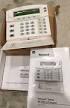 NetworX NX-6V2 LED Keypad User Manual POWER Light is on when AC power is present; flashes to indicate a low battery condition. ARMED Light is on when armed; off when disarmed; flashes to indicate a previous
Concord 4 User Manual
 Concord 4 User Manual P/N 466-2183 REV NOV12 Copyright Disclaimer 2012 UTC Fire & Security Americas Corporation, Inc. Interlogix is part of UTC Climate Controls & Security, a unit of United Technologies
HUNTER-PRO 32 Ver. 3.8 Intruder Alarm System RXN-9/416 User Guide
 HUNTER-PRO 32 Ver. 3.8 Intruder Alarm System RXN-9/416 User Guide PIMA Electronic Systems Ltd. 5 Hatzoref Street, Holon 58856, Israel +972-3-5587722 +972-3-5500442 [email protected] http://www.pima-alarms.com
HAM841K ALARM CONTROL PANEL FOR COMMERCIAL AND RESIDENTIAL SECURITY SYSTEMS
 ALARM CONTROL PANEL FOR COMMERCIAL AND RESIDENTIAL SECURITY SYSTEMS USER MANUAL USER MANUAL ALARM CONTROL PANEL FOR COMMERCIAL AND RESIDENTIAL SECURITY SYSTEMS INTRODUCTION The (HA-841K) is a complete
PiSector Home security systems
 PiSector Home security systems User Manual (ALM-S02) Read manual fully before use. PiSector Inc., USA, www.pisector.com Thank you for purchase this alarm system, For proper use and your safety, please
FIRST ALERT INSTRUCTION MANUAL FOR FA 270 KEYPADS SECURITY SYSTEM
 FIRST ALERT INSTRUCTION MANUAL FOR FA 270 KEYPADS SECURITY SYSTEM Page 0 Table of Contents Introduction 1 System Basics.. 1 Burglary Protection.. 1 Fire Protection.. 1 Security Codes. 1 Zones and Partitions
Automatic Phone-Out Home Monitoring Systems
 Automatic Phone-Out Home Monitoring Systems Power Outage and Freeze Alarm Model Number: THP202 Power Outage, Freeze and Flood Alarm Product Description Model Number: THP201 These monitoring systems are
AM100 SECURITY SYSTEM INSTALLATION INSTRUCTIONS
 AM100 SECURITY SYSTEM INSTALLATION INSTRUCTIONS N7526-3V1 Rev B 4/99 Ref: 20AMTE RECOMMENDATIONS FOR PROPER PROTECTION The Following Recommendations For The Location Of Fire And Burglary Detection Devices
IDS. Users Guide to Keypad Functions S E C U R I T Y MANUAL NO. 700-171-01B ISSUED AUG 2002 VERSION 1.18
 INHEP DIGITAL IDS S E C U R I T Y Users Guide to Keypad Functions MANUAL NO. 700-171-01B ISSUED AUG 2002 VERSION 1.18 Summary of Operation A rm/ disarm [#] + [USER CODE] Quick Quick Quick Away Arm Stay
Administrative Council for Terminal Attachments (ACTA) Customer Information
 Administrative Council for Terminal Attachments (ACTA) Customer Information Revision: July 2003 Background: The Administrative Council for Terminal Attachments ( ACTA ) has revised its Customer Information
Simon XT Installation Manual
 Simon XT Installation Manual P/N 466-2265 REV G OCT12 Copyright Disclaimer 2012 UTC Fire & Security Americas Corporation, Inc. Interlogix is part of UTC Climate Controls & Security, a unit of United Technologies
We are confident you will find the PC5132-RS Wireless Receiver a unique and useful control panel enhancement.
 P C 5 1 3 2 - R S Important Note Double end of line (EOL) resistors must be enabled in the PC5010 control panel for the wireless zones to be supervised. If normally Closed or Single EOL resistors are selected
Wireless Alarm System. Window/Door Sensor. User s Manual. Choice ALERT. Control all Sensors & accessories from one location
 45131 Wireless Alarm System Window/Door Sensor User s Manual Choice ALERT Control all Sensors & accessories from one location Table of Contents Important Safeguards 4 Introduction 5 Installation 6 Assigning
AIM TECHNICAL MANUAL PATENT PENDING STOP REMEMBER TO ACTIVATE UNIT BEFORE TESTING. See page 9 for Activation Instructions
 AIM TECHNICAL MANUAL AIM-1450HW HARDWIRE PATENT PENDING STOP REMEMBER TO ACTIVATE UNIT BEFORE TESTING See page 9 for Activation Instructions AIM Technical Manual - AIM 1450HW AIM-1450HW HARDWIRE ABOUT
NetworX NX-8 Control/Communicator Installation Manual
 NetworX NX- Control/Communicator Installation Manual Table of Contents General Description... Ordering Information... Feature Definitions... - Programming the LED Keypads... Programming the NX-... 9- Types