
How To Make A Profit From A Pension Plan
|
|
|
- Godwin Hill
- 5 years ago
- Views:
Transcription
1 PRIME REHABILITATION SERVICES PPS AND FINANCIAL CHALLENGES 2012 PRESENTED BY: TAMAR BROOKS, COO October 2011 Agenda Topics Financial Implications of SNF 2012 Rule RUG IV Classification Highlights 2012 Rate Graph Late Loss ADLs and Capture Key Assessment Review Scheduled Assessment Schedule Short Stay Start of End of Resumption Change of Not to be reproduced 1

2 2012 SNF Final Rule Net reduction in total nursing home rates by 11.1% ($3.87 billion) Mainly in the recalibration of thearpy RUG levels CMS had assumed the therapy RUG utilization in 2011 would decrease due to the changes in therapy mode delivery, but their predictions were wrong, resulting in financial expenditure increases Therefore, nursing case mix indices were decreased for the RUG IV therapy groups Increased Cost / Decreased Revenues RUG IV recalibration reduces therapy revenue and the spread between nursing/rehab RUGs 2012 provisions eliminate extras and increases the cost of therapy Daily management necessitated More therapy needed but there will be decreased revenues Capacity is finite Not to be reproduced 2

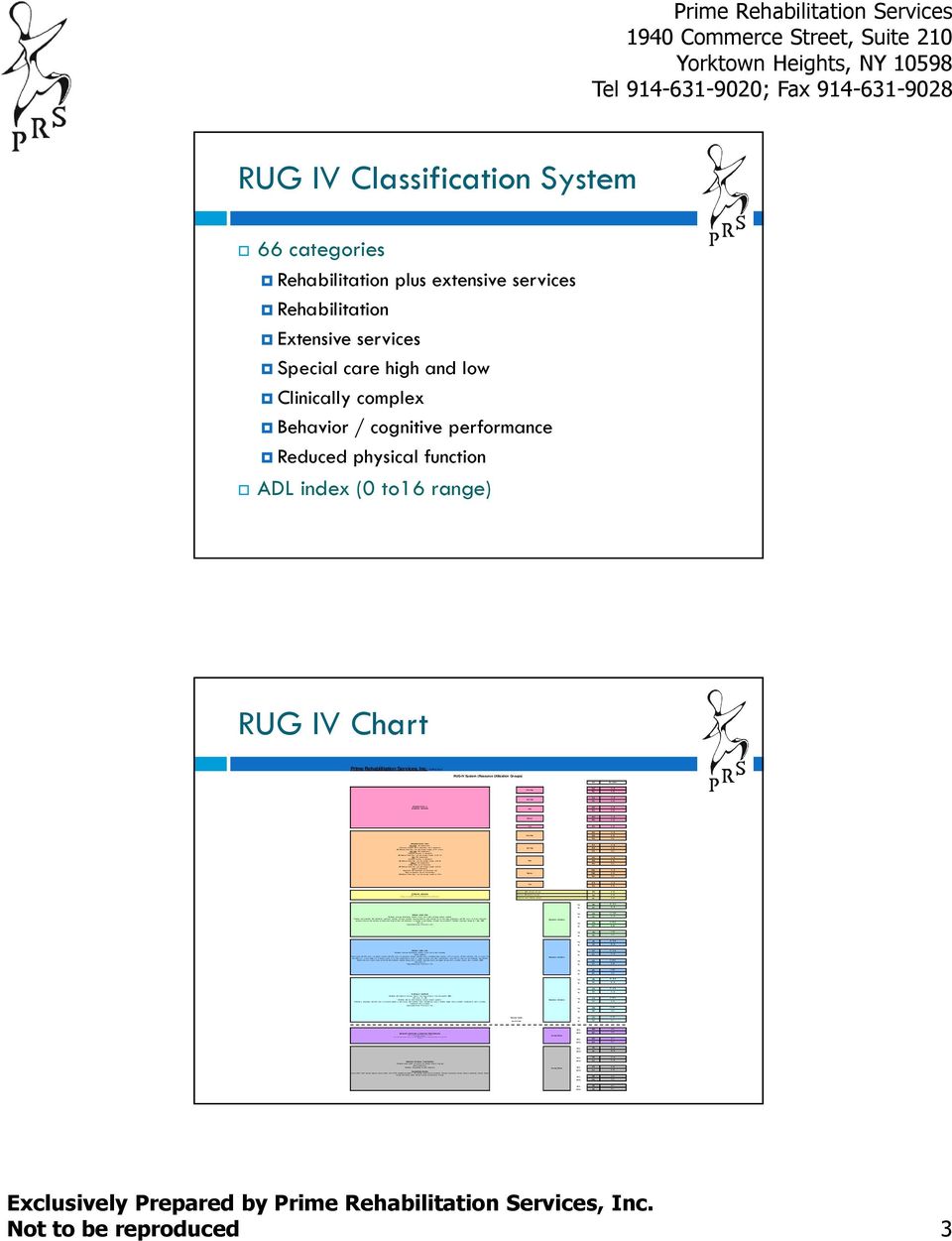
3 , Inc. PRS 2010 REHABILITATION & EXTENSIVE SERVICES REHABILITATION ONLY Ultra High: 720 minutes/week; 2 discipline minimum: one 5+ days/week, one 3+ days/week; OR Medicare Short Stay = yes with average minutes of 144 or more; Very High: 500 minutes/week; 1 discipline minimum: 5+ days/week; OR Medicare Short Stay = yes with average minutes of ; High: 325 minutes/week; 1 discipline minimum: 5+ days/week; OR Medicare Short Stay = yes with average minutes of 65-99; Medium: 150 minutes/week; 5 days across up to 3 disciplines; OR Medicare Short Stay = yes with average minutes of 30-64; Low: 45 minutes/week; 3 days/week any combinati on of 3 disciplines and 6 days of restorative care for 2 services/day; OR Medicare Short Stay = yes with average minutes of EXTENSIVE SERVICES Residents receiving the following complete clinical care: Tracheostomy care; ventilator/respirator; isolation for active infectious disease while a resident AND ADL score >=2 SPECIAL CARE HIGH Residents receiving the following complex clinical care or with a following medical condition: Comatose and completel y ADL dependent; septicemia; diabetes with daily injections requiring physician order changes on 2 or more days; quadriplegia and ADL score >=5; chronic obstructive pulmonary discarse and shortness of breath when lying flat; fever with pneumonia, or vomiting, or tube feeding, or weight loss; parenteral/iv feedings; respiratory therapy for 7 days; AND ADL >=2 Signs of depression PHQ score >=9.5 SPECIAL CARE LOW Residents receiving the following complex clinical care or with a following medical condition: Cerebral palsy and ADL score >=5; multiple sclerosis and ADL score >=5; parkinson's disease and ADL score >=5; feeding tube (calories >=51% or calories = 26-50% and fluid >= 501 cc); ulcers (2 or more stage II or 1 or more stage III or IV pressure ulcers; or 2 or more venous/arteri al ulcers; or 1 stage II pressure ulcer and 1 venous/arterial ulcer) with 2 or more skin care treatments; foot infection, diabetic foot ulcer or open lesions on the foot with treatment; radiation therapy while a resident; respiratory failure and oxygen therapy while a resident; dialysis while a resident; AND ADL score >=2 Signs of depression PHQ score >=9.5 CLINICALLY COMPLEX Residents with Extensi ve Services, Special Care High or Special Care Low qualifier AND ADL score = 0-1 OR Residents with any of the following clinically complex qualifiers: Pneumoni a; hemiplegia and ADL score >=5; surgical wounds or open lesions with treatment; burns; chemotherapy while a resident; oxygen while a resident; IV medications while a resident; transfusions while a resident. Signs of depression PHQ score >=9.5 BEHAVIOR SYMPTOMS & COGNITIVE PERFORMANC E Residents having cognitive impairment BIMS score <=9 or CPS >=3 OR Hallucinations or delusions OR Physical or verbal behavioral symptoms toward others; other behavioral symptoms; rejection of care; or wandering exhibited 4+ days over the past 7 days AND ADL score <=5 REDUCED PHYSICAL FUNCTIONING Residents whose needs are primarily for activities of daily living and general supervision. Residents not qualifying for other categories. Nursing Rehab Services: Urinary and/or bowel training program; passive and/or active ROM; amputati on/pr osthesi s care training; splint or brace assistance; dressing or grooming training; eating or swallowi ng training; transfer training; bed mobility and/or walking training; communication training. RUG ADL INDEX RUX Ultra High RUL 2-10 RVX Very High RVL 2-10 RHX High RHL 2-10 RMX Medium RML 2-10 Low RLX 2-16 Ultra High Very High High Medium Low RUC RUB 6-10 RUA 0-5 RVC RVB 6-10 RVA 0-5 RHC RHB 6-10 RHA 0-5 RMC RMB 6-10 RMA 0-5 RLB RLA 0-10 Trach care AND ventilator/respirator ES Trach care OR ventilator/respirator ES Isolation for active infectious disease ES Depression Indicators Depression Indicators Depression Indicators Yes HE D No HE Yes HD D No HD Yes HC D No HC Yes HB2 2-5 D No Yes No Yes No HB1 2-5 LE D LE LD D LD Yes LC D No LC Yes LB2 2-5 D No LB1 2-5 Yes CE D No CE Yes CD D No CD Yes CC D No CC Yes CB2 2-5 D No CB1 2-5 Medicare Skilled Yes CA2 0-1 D Level of Care No CA1 0-1 Nursing Rehab Nursing Rehab NR 2+ BB2 2-5 NR 0-1 BB1 2-5 NR 2+ BA2 0-1 NR 0-1 BA1 0-1 NR 2+ PE NR 0-1 PE NR 2+ PD NR 0-1 PD NR 2+ PC NR 0-1 PC NR 2+ PB2 2-5 NR 0-1 PB1 2-5 NR 2+ PA2 0-1 NR 0-1 PA1 0-1 Prime Rehabilitation Services RUG IV Classification System 66 categories Rehabilitation plus extensive services Rehabilitation Extensive services Special care high and low Clinically complex Behavior / cognitive performance Reduced physical function ADL index (0 to16 range) RUG IV Chart RUG-IV System (Resource Utilization Groups) Not to be reproduced 3
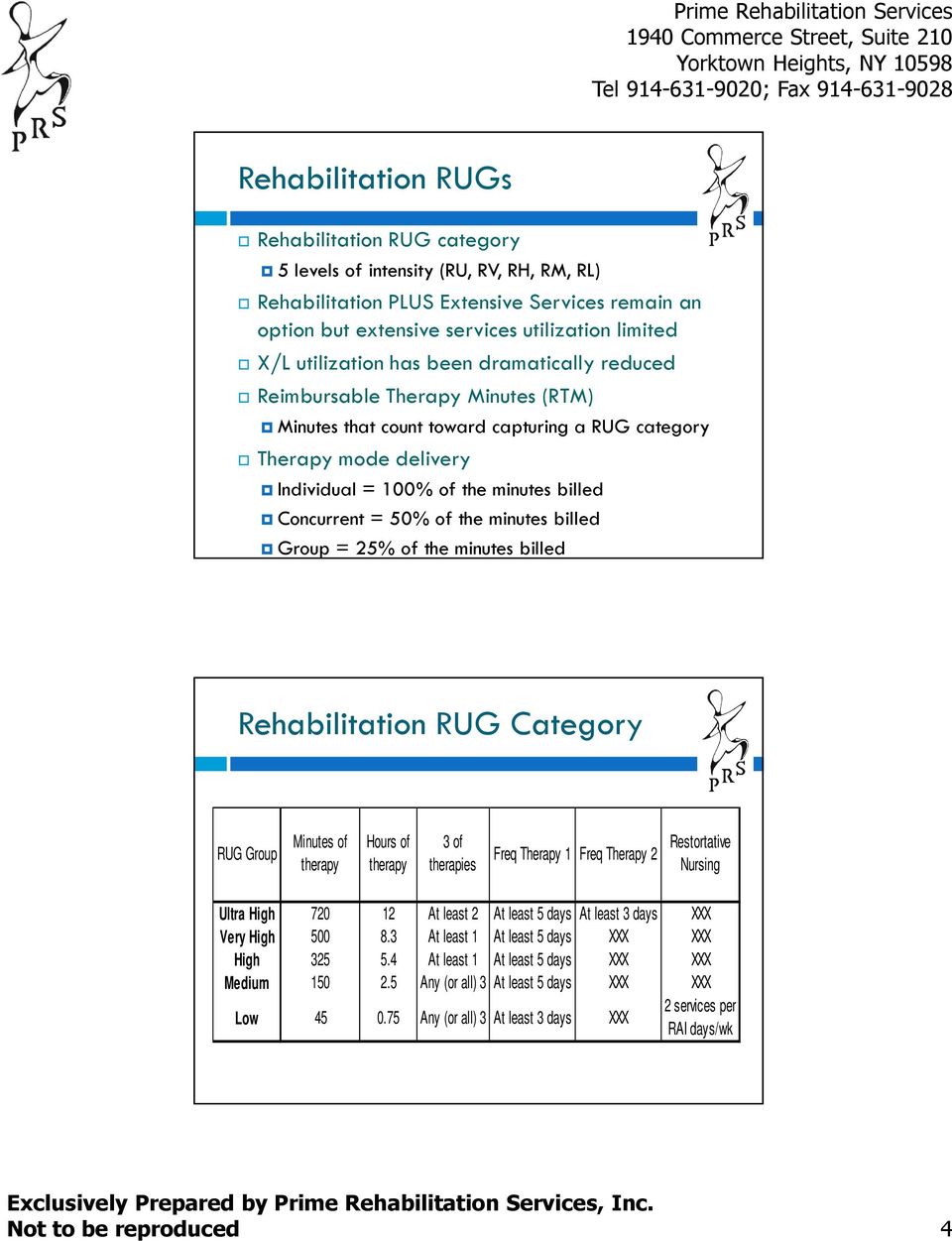
4 Rehabilitation RUGs Rehabilitation RUG category 5 levels of intensity (RU, RV, RH, RM, RL) Rehabilitation PLUS Extensive Services remain an option but extensive services utilization limited X/L utilization has been dramatically reduced Reimbursable Minutes (RTM) Minutes that count toward capturing a RUG category mode delivery Individual = 100% of the minutes billed Concurrent = 50% of the minutes billed Group = 25% of the minutes billed Rehabilitation RUG Category RUG Group Minutes of therapy Hours of therapy 3 of therapies Freq 1 Freq 2 Restortative Nursing Ultra High At least 2 At least 5 days At least 3 days XXX Very High At least 1 At least 5 days XXX XXX High At least 1 At least 5 days XXX XXX Medium Any (or all) 3 At least 5 days XXX XXX Low Any (or all) 3 At least 3 days XXX 2 services per RAI days/wk Not to be reproduced 4
5 RUG IV Extensive Services ADL >=2 All qualifiers must occur while a resident ES3: Ventilator AND Trache ES2: Ventilator OR Trache ES1: Isolation due to active infection Can code for strict isolation ONLY WHEN ALL met: Resident has active infection with highly transmissible or epidemiologically significant pathogens acquired by physical contact or airborne or droplet transmission Precautions are over and above standard precautions Resident in in a room ALONE because of active infection and cannot have a roommate Resident must remain in his/her room. All services brought to the resident RUG IV Special Care High Residents receiving the following complex clinical care or with a following medical condition: Comatose and completely ADL dependent; septicemia; diabetes with daily injections requiring physician order changes on 2 or more days; quadriplegia and ADL score >=5; chronic obstructive pulmonary discarse and shortness of breath when lying flat; fever with pneumonia, or vomiting, or tube feeding, or weight loss; parenteral/iv feedings; respiratory therapy for 7 days; AND ADL >=2 Signs of depression PHQ score >=9.5 Not to be reproduced 5

6 RUG IV Special Care Low Residents receiving the following complex clinical care or with a following medical condition: Cerebral palsy and ADL score >=5; multiple sclerosis and ADL score >=5; parkinson's disease and ADL score >=5; feeding tube (calories >=51% or calories = 26-50% and fluid >= 501 cc); ulcers (2 or more stage II or 1 or more stage III or IV pressure ulcers; or 2 or more venous/arterial ulcers; or 1 stage II pressure ulcer and 1 venous/arterial ulcer) with 2 or more skin care treatments; foot infection, diabetic foot ulcer or open lesions on the foot with treatment; radiation therapy while a resident; respiratory failure and oxygen therapy while a resident; dialysis while a resident; AND ADL score >=2 Signs of depression PHQ score >=9.5 RUG IV Clinically Complex Residents with Extensive Services, Special Care High or Special Care Low qualifier AND ADL score = 0-1 OR Residents with any of the following clinically complex qualifiers: Pneumonia; hemiplegia and ADL score >=5; surgical wounds or open lesions with treatment; burns; chemotherapy while a resident; oxygen while a resident; IV medications while a resident; transfusions while a resident. Signs of depression PHQ score >=9.5 Not to be reproduced 6

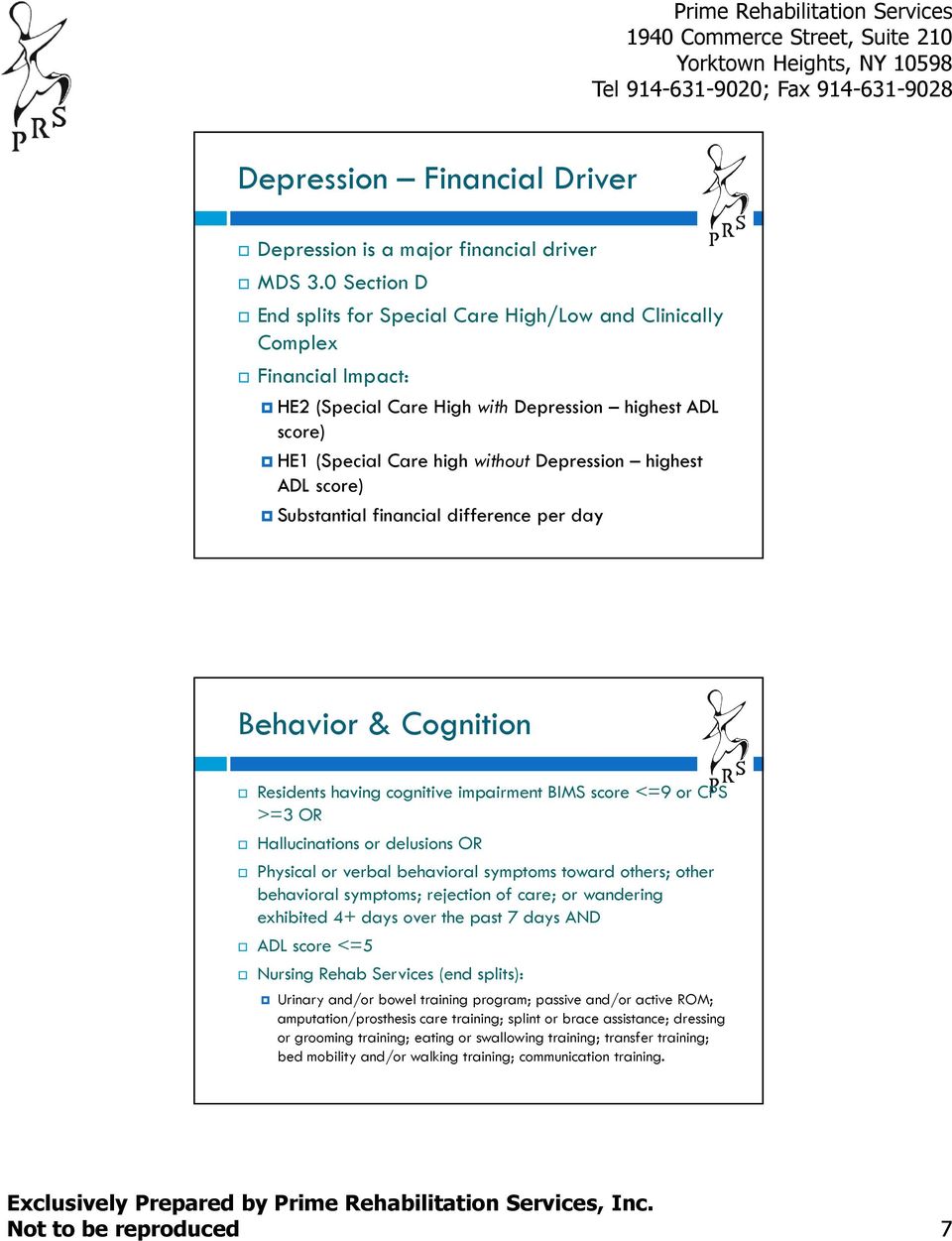
7 Depression Financial Driver Depression is a major financial driver MDS 3.0 Section D End splits for Special Care High/Low and Clinically Complex Financial Impact: HE2 (Special Care High with Depression highest ADL score) HE1 (Special Care high without Depression highest ADL score) Substantial financial difference per day Behavior & Cognition Residents having cognitive impairment BIMS score <=9 or CPS >=3 OR Hallucinations or delusions OR Physical or verbal behavioral symptoms toward others; other behavioral symptoms; rejection of care; or wandering exhibited 4+ days over the past 7 days AND ADL score <=5 Nursing Rehab Services (end splits): Urinary and/or bowel training program; passive and/or active ROM; amputation/prosthesis care training; splint or brace assistance; dressing or grooming training; eating or swallowing training; transfer training; bed mobility and/or walking training; communication training. Not to be reproduced 7
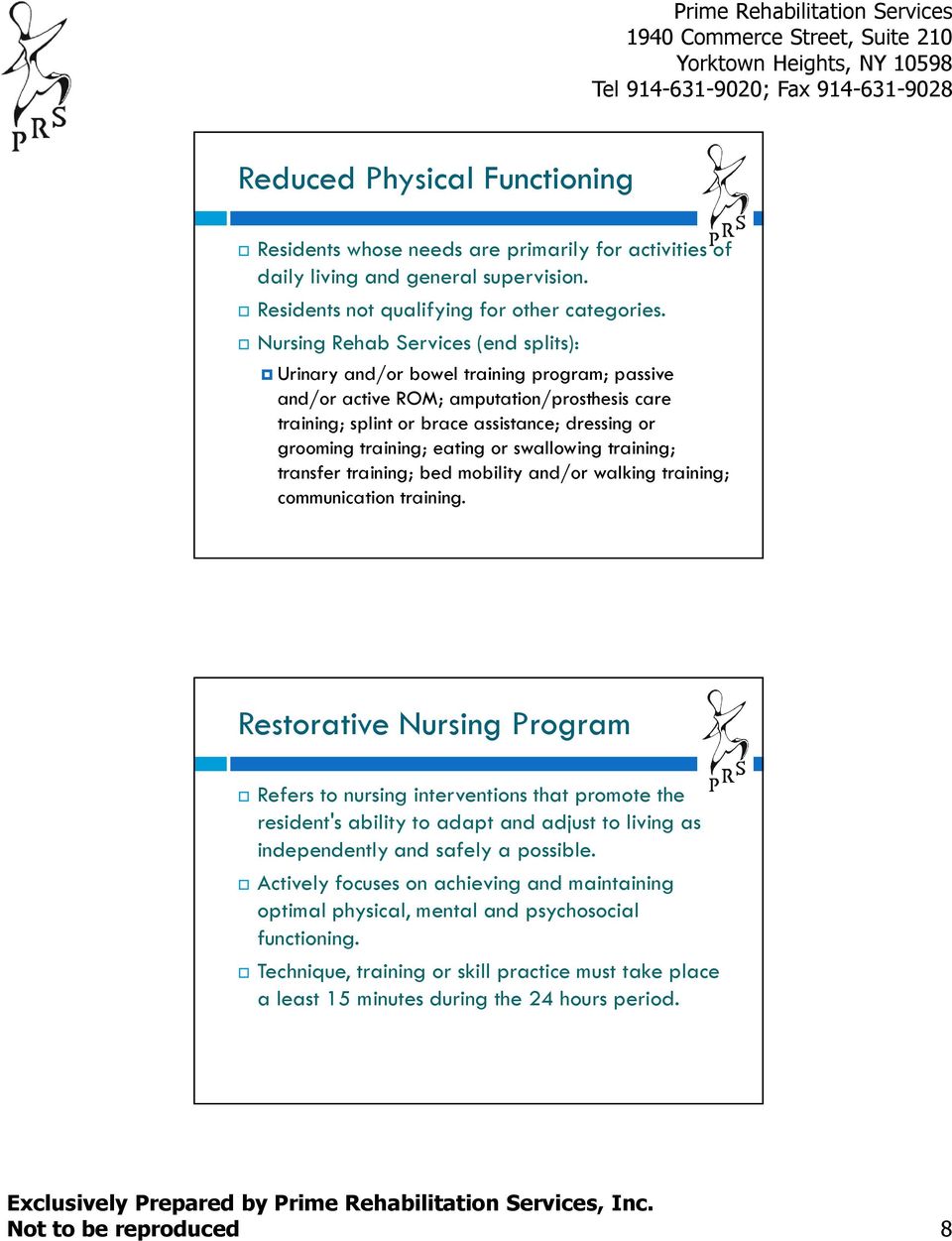
8 Reduced Physical Functioning Residents whose needs are primarily for activities of daily living and general supervision. Residents not qualifying for other categories. Nursing Rehab Services (end splits): Urinary and/or bowel training program; passive and/or active ROM; amputation/prosthesis care training; splint or brace assistance; dressing or grooming training; eating or swallowing training; transfer training; bed mobility and/or walking training; communication training. Restorative Nursing Program Refers to nursing interventions that promote the resident's ability to adapt and adjust to living as independently and safely a possible. Actively focuses on achieving and maintaining optimal physical, mental and psychosocial functioning. Technique, training or skill practice must take place a least 15 minutes during the 24 hours period. Not to be reproduced 8
9 RUG IV 2012 Adjusted Rates Rehabilitation (RU, RV, RH, RM, RL) Skilled Nursing (Special Care High/Low; Clinically Complex) Non-Skilled Nursing (Behavior/Cognition; Reduced Physical) Extensive Services (& Rehab) (Trach; Ventilator, Isolation w/active infection) Rehab RUG Key Financials RUC = RUB rate (no differential for ADL dependence) RUB $$$ >>> RUA $ $122 per day difference RUB $$$ >>> RVB $ $167 per day difference RLB $$$ >>> RLA $ $172 per day difference Not to be reproduced 9

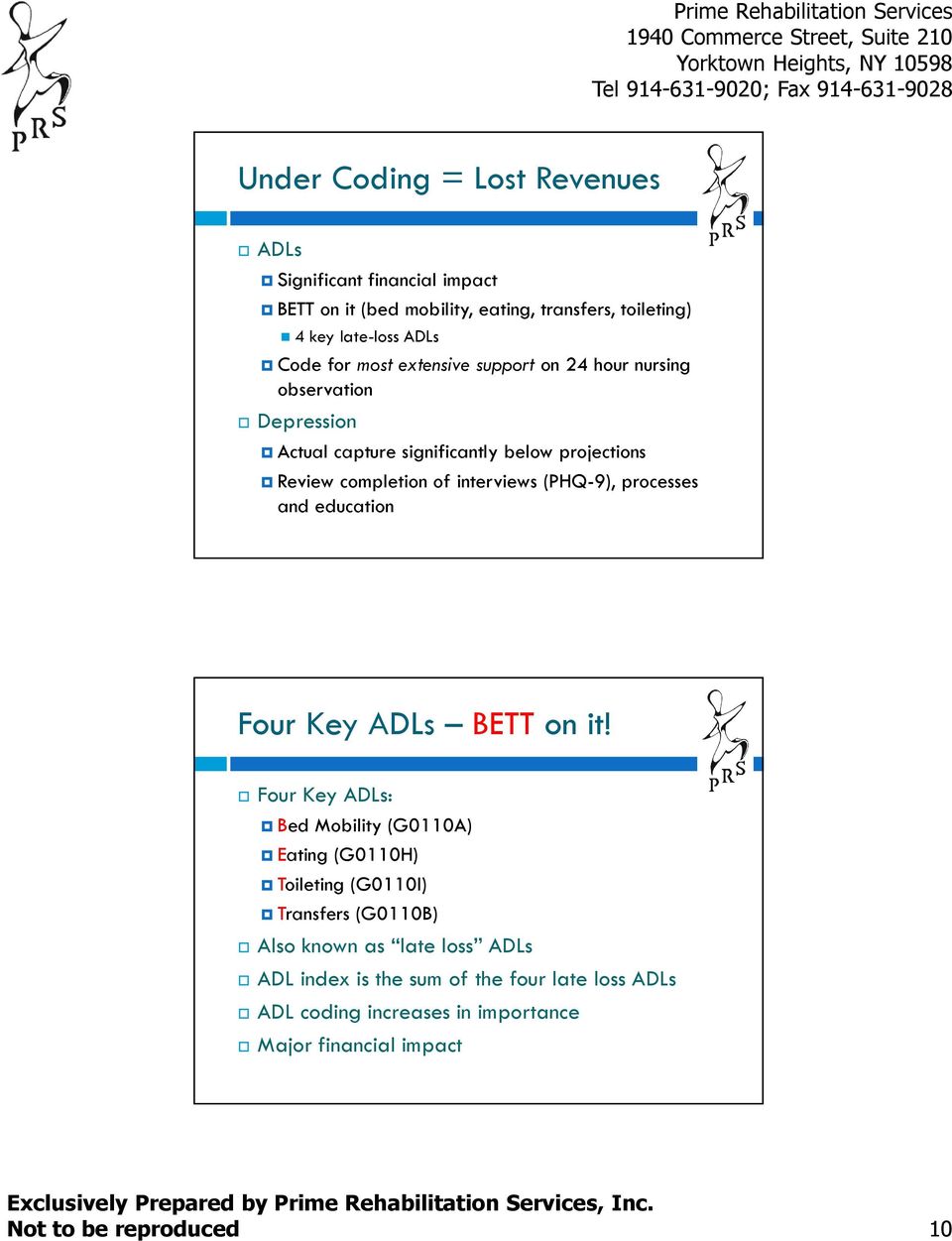
10 Under Coding = Lost Revenues ADLs Significant financial impact BETT on it (bed mobility, eating, transfers, toileting) 4 key late-loss ADLs Code for most extensive support on 24 hour nursing observation Depression Actual capture significantly below projections Review completion of interviews (PHQ-9), processes and education Four Key ADLs BETT on it! Four Key ADLs: Bed Mobility (G0110A) Eating (G0110H) Toileting (G0110I) Transfers (G0110B) Also known as late loss ADLs ADL index is the sum of the four late loss ADLs ADL coding increases in importance Major financial impact Not to be reproduced 10
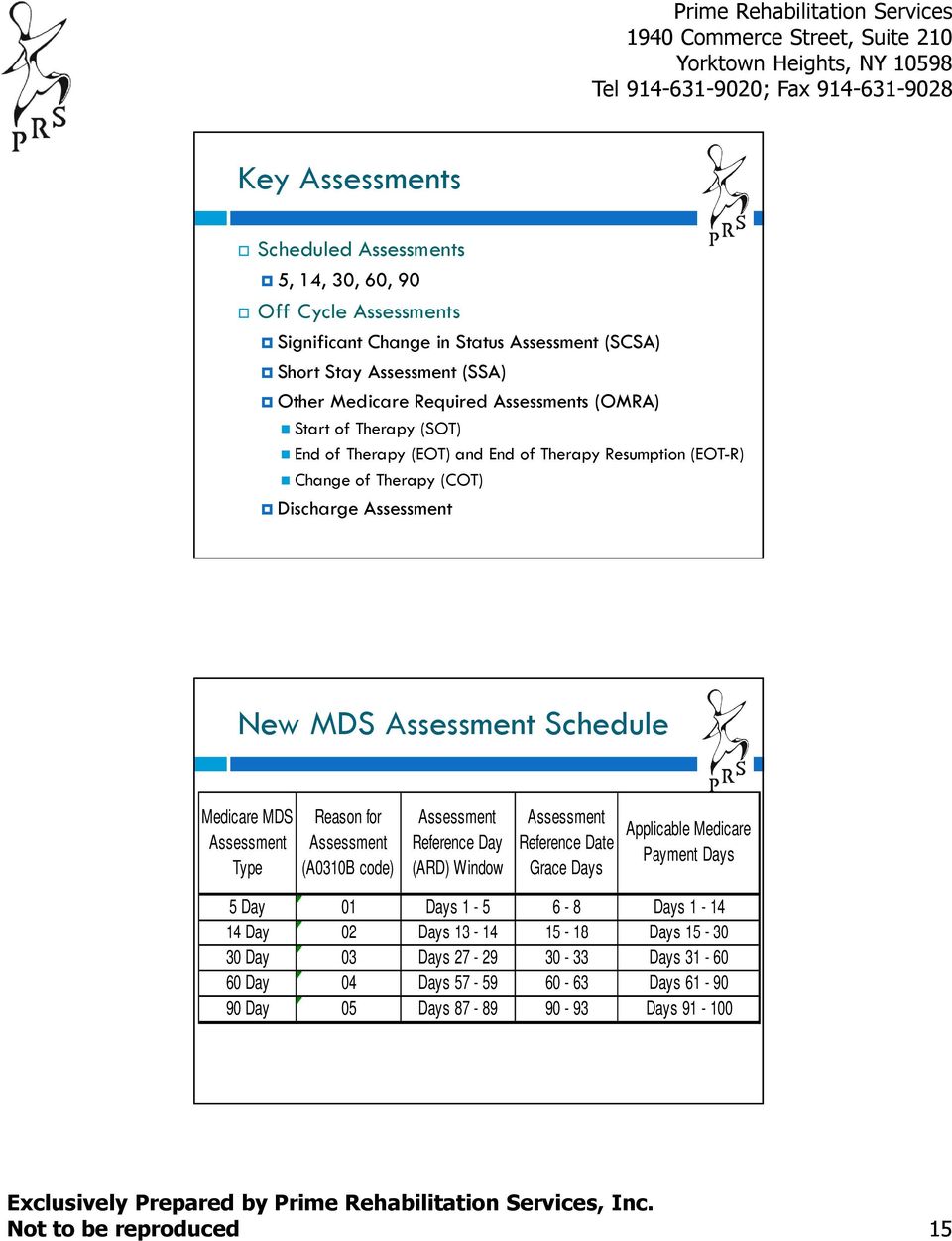
11 ADL Self-Performance & Support ADL Self Performance Measure what the resident actually did (not what he or she might be capable of doing) within each ADL category over the last 7 days according to a performance-based scale. ADL Support Provided Measures the highest level of support provided by the staff over the last 7 days, even if that level of support only occurred once. Coded at the most dependent state ADL Self Performance Algorithm Utilize for assistance in coding ADL self performance items. Consider each episode of the activity that occurred during the 7 day look-back period. Code based on the resident s level of assistance when using special adaptive devices (walker, dressing stick, etc.) Not to be reproduced 11

12 G0110 Coding ADL Self Performance Column 1 0 Independent No help or staff oversight at any time 1 Supervision Oversight, encouragement, or cueing provided 3+ times 2 Limited Assistance Resident highly involved in activity; staff provide guided maneuvering of limbs or other non-weight bearing assist 3+ times 3 Extensive Assistance Resident involved in activity; staff provide weight bearing support 3+ times G0110 Coding ADL Self Performance Column 1 4 Total Dependence Full staff performance of an activity with no participation by resident for any aspect of the ADL activity. 7 Activity occurred only once or twice Activity occurred but not 3+ times 8 Activity did not occur ADL activity was not performed by the resident or staff Not to be reproduced 12
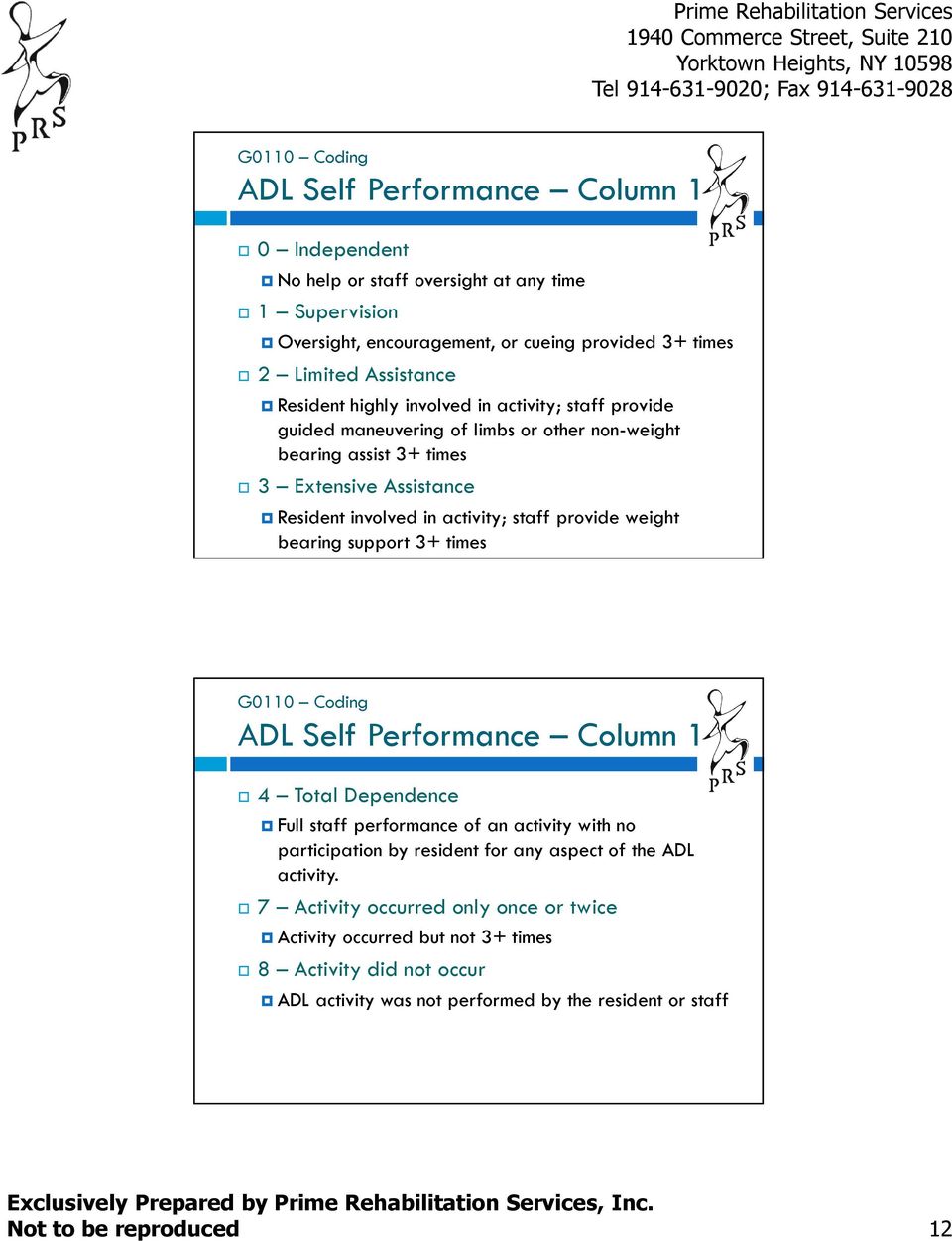
13 G0110 Coding ADL Support Column 2 0 No setup or physical help from staff No help or oversight 1 Setup help only Resident provided with materials or devices 2 One person physical assist 3 Two+ person physical assist 8 ADL activity itself did not occur during the entire period Functional ADL Status Not to be reproduced 13

14 ADL Coding MDS 3.0 B T E T BETT on It! Not to be reproduced 14
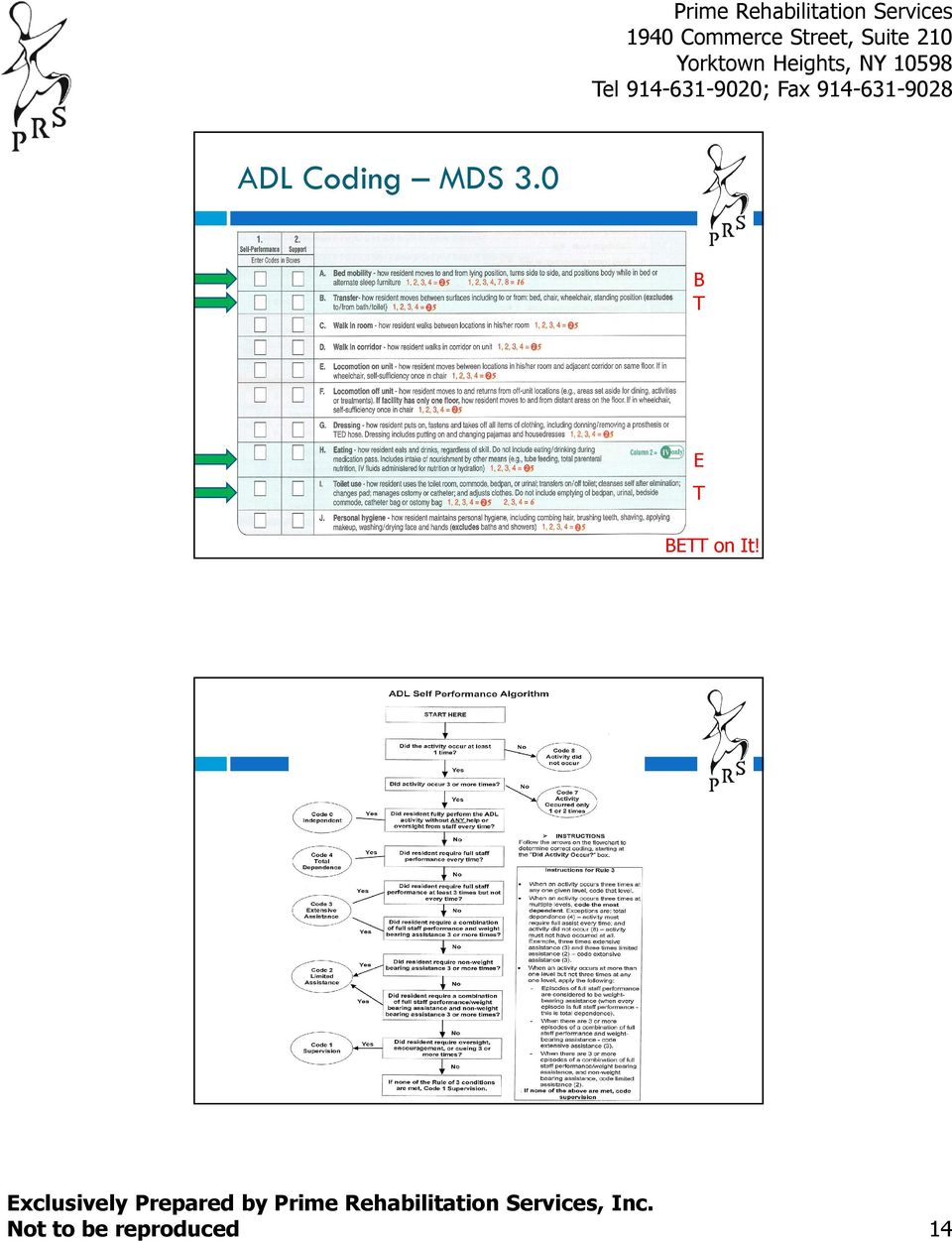
15 Key Assessments Scheduled Assessments 5, 14, 30, 60, 90 Off Cycle Assessments Significant Change in Status Assessment (SCSA) Short Stay Assessment (SSA) Other Medicare Required Assessments (OMRA) Start of (SOT) End of (EOT) and End of Resumption (EOT-R) Change of (COT) Discharge Assessment New MDS Assessment Schedule Medicare MDS Assessment Type Reason for Assessment (A0310B code) Assessment Reference Day (ARD) Window Assessment Reference Date Grace Days Applicable Medicare Payment Days 5 Day 01 Days Days Day 02 Days Days Day 03 Days Days Day 04 Days Days Day 05 Days Days Not to be reproduced 15
16 Short Stay Designation (SSA) Purpose: The special RUG IV short stay therapy classification is designed to allow for some if not all of the days of a short stay to be paid at a Rehab RUG This special category is for shorter stay resident who received therapy but did not achieve a Rehab RUG from the 5 day PPS MDS because the resident did not receive 5 days of therapy during their short stay (therapy start date through end of therapy is not 5 days) For residents discharged on or before day 8 who received less than 5 days of therapy, payment will be based on average daily minutes actually provided Short Stay Designation Used if therapy was only able to be provided 1-4 days and a therapy RUG was not achievable If the 5 day PPS MDS achieves a rehab RUG no special short stay classification is requires. All days are paid at the rehab RUG even if therapy did not start the first day. Not to be reproduced 16

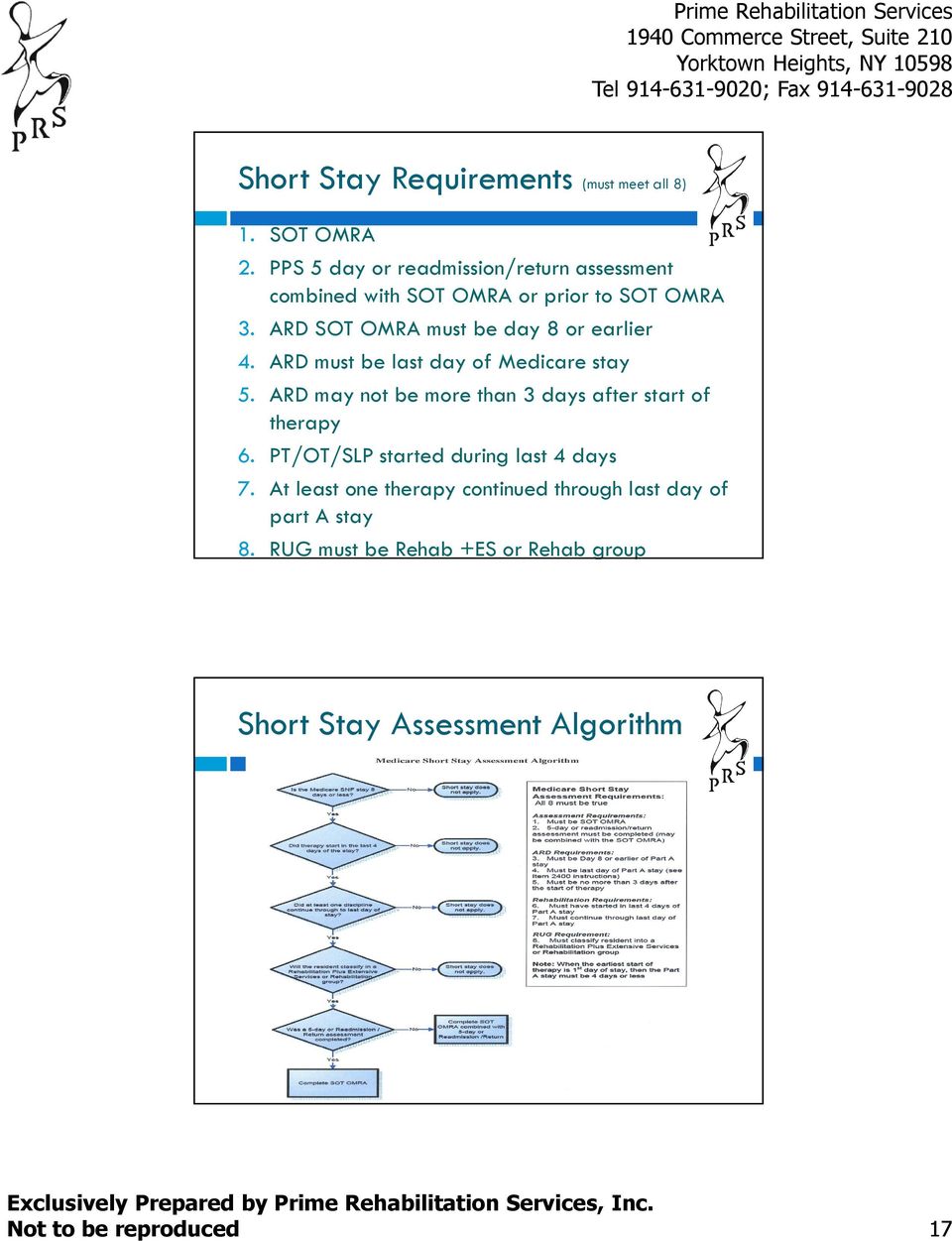
17 Short Stay Requirements (must meet all 8) 1. SOT OMRA 2. PPS 5 day or readmission/return assessment combined with SOT OMRA or prior to SOT OMRA 3. ARD SOT OMRA must be day 8 or earlier 4. ARD must be last day of Medicare stay 5. ARD may not be more than 3 days after start of therapy 6. PT/OT/SLP started during last 4 days 7. At least one therapy continued through last day of part A stay 8. RUG must be Rehab +ES or Rehab group Short Stay Assessment Algorithm Not to be reproduced 17
18 Start of (SOT) OMRA SOT OMRA Used to obtain therapy RUG any time during a stay Rejected if non-therapy RUG ARD 5-7 days after start of first therapy Day 1 = day therapy started Payment starts first day of therapy Be attentive when combining Anytime therapy starts off cycle (or even late - a few days after admission) this should be considered and reviewed to capture care provided End of (EOT) OMRA Three Day Policy EOT OMRA must be completed when a Medicare A patient classified in a Rehab RUG did not receive any therapy sessions for three or more consecutive days for any reason (temporary, unplanned and planned discontinuations) An EOT OMRA needs to be completed for missed therapy days regardless of whether therapy is missed on a weekday, weekend or holiday Eliminates the distinction between a 5 or 7 day facility Non-rehab RUG is paid during lull in treatment Not to be reproduced 18

19 EOT OMRA Completion ARD for the EOT OMRA must be set for day 1, 2, 3 from the date of the resident s last therapy session Financial changes effective on the first day without therapy Needs to be completed if: Planned EOT Patient is discharged from the skilled therapy program (therapy RUG) and continuing under a skilled nursing program (skilled nursing RUG) Unplanned EOT Patient did not receive skilled therapy services for three consecutive days for any reason End of with Resumption (EOT-R) May be used when the patient will resume at the same therapy level as prior to the discontinuation of therapy (no new therapy evaluation needed). Resumption of therapy must occur no more than five days after the last day of therapy provided. Also applies to a RL category Must see a patient Monday/Wednesday/Friday EOT-R criteria: expected to resume at the same RUG level must resume within five days EOT ARD must be day 1 3 Not to be reproduced 19

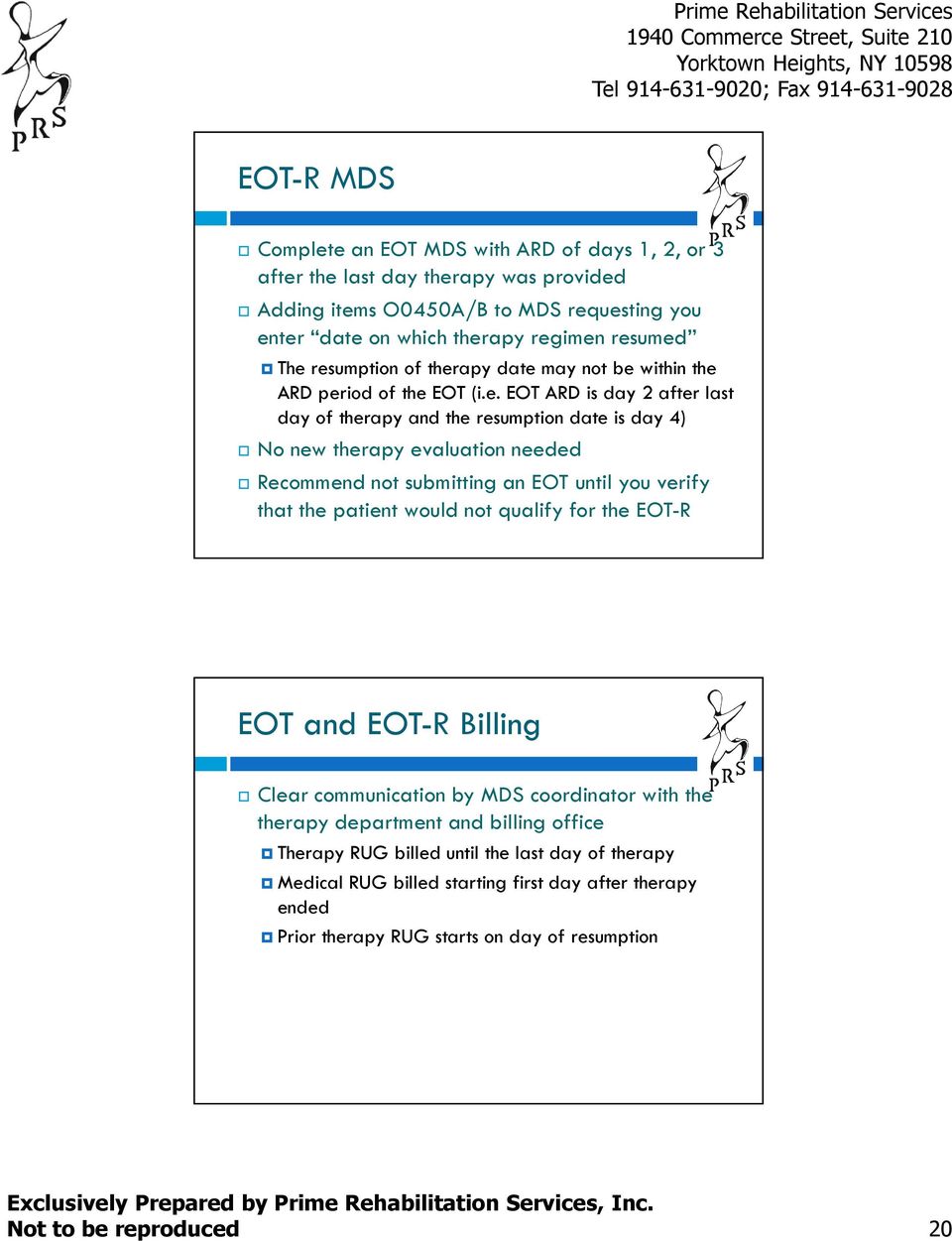
20 EOT-R MDS Complete an EOT MDS with ARD of days 1, 2, or 3 after the last day therapy was provided Adding items O0450A/B to MDS requesting you enter date on which therapy regimen resumed The resumption of therapy date may not be within the ARD period of the EOT (i.e. EOT ARD is day 2 after last day of therapy and the resumption date is day 4) No new therapy evaluation needed Recommend not submitting an EOT until you verify that the patient would not qualify for the EOT-R EOT and EOT-R Billing Clear communication by MDS coordinator with the therapy department and billing office RUG billed until the last day of therapy Medical RUG billed starting first day after therapy ended Prior therapy RUG starts on day of resumption Not to be reproduced 20
21 EOT and EOT-R Example Day of Skilled Stay Days Provided No No No No Resumes Days with NO OMRA dates EOT ARD EOT-R Date Billing Category RUG RUG Nursing RUG Nursing RUG Nursing RUG Nursing RUG RUG (same) RUG RUG 5+ days without therapy If more than five consecutive days without a therapy service elapse and therapy starts again (patient skilled by nursing in the meantime): Optional SOT OMRA New therapy evaluation Not to be reproduced 21
22 Change of (COT) OMRA Required when the level (RUG) of therapy changes, using rolling 7 day average after the last ARD If the therapy received during the COT observation period does not reflect the RUG IV classification level on the patient s most recent PPS assessment used for payment then an assessment must be done COT Observation period A successive 7 day window beginning the day following the ARD of the resident s last PPS assessment used for payment Patients will NEVER be OUT of an assessment on a Medicare A stay COT OMRA - Dates The COT OMRA retroactively establishes a new RUG beginning the day following the ARD of the resident s last PPS assessment until the next scheduled or unscheduled Medicare PPS assessment Daily monitoring of days/minutes a MUST May be combined with on-cycle assessments COT = Same MDS item set as EOT Default rate applied for late COT OMRA DENIAL OF ALL ASSESSMENT DATES IF MISSED Not to be reproduced 22
23 The Need for Minutes CMS Resources FY 2012 RUG-IV Education & Training Government website August 23, 2011 National provider call transcript and slides Not to be reproduced 23
24 Upcoming National Provider Call National Provider Call: Skilled Nursing Facility Prospective Payment System Minimum Data Set 3.0 and Resource Utilization Group-Version 4 Policies and Clarifications Registration Now Open [ ] Thu Nov 3; 1:30-3pm ET CMS will host a National Provider Call on Skilled Nursing Facility (SNF) Prospective Payment System (PPS) Minimum Data Set (MDS) 3.0 and Resource Utilization Group-Version 4 (RUG-IV) Policies and Clarifications. CMS subject matter experts will provide a brief overview of the policies, along with clarifications on the SNF PPS FY2012 policies related to the MDS 3.0. A question and answer session will follow the presentations. Target Audience: SNF providers, facility Resident Assessment Instrument (RAI) coordinators, state RAI coordinators, rehabilitation therapists, Recovery Audit Contractors, and Medicare Administrative Contractors Agenda: Allocation of group therapy Changes to the MDS Assessment Schedule End of (EOT) Other Medicare Required Assessment (OMRA) Clarifications End Of with Resumption (EOT-R) Change of (COT) OMRA Registration Information: In order to receive the call-in information, you must register for the call. Registration will close at 12pm on Thu Nov 3 or when available space has been filled. No exceptions will be made. Please register early. For more details, including instructions on registering for the call, please visit Thank you for attending today s presentation by Prime Rehabilitation Services. Call us to set up a non-obligatory appointment to review your therapy program performance Not to be reproduced 24
CHAPTER 6: MEDICARE SKILLED NURSING FACILITY PROSPECTIVE PAYMENT SYSTEM (SNF PPS)
 CHAPTER 6: MEDICARE SKILLED NURSING FACILITY PROSPECTIVE PAYMENT SYSTEM (SNF PPS) 6.1 Background The Balanced Budget Act of 1997 included the implementation of a Medicare Prospective Payment System (PPS)
Medicare Skilled Nursing Facility Prospective Payment System (SNF PPS)
 Chapter 6: Medicare Skilled Nursing Facility Prospective Payment System (SNF PPS) 6.1 Background The Balanced Budget Act of 1997 included the implementation of a Medicare Prospective Payment System (PPS)
Strategies and Best Practices for Managing RUG IV SNF Reimbursement. Objectives. Introduction
 Strategies and Best Practices for Managing RUG IV SNF Reimbursement Objectives Provide information on the changes to PPS reimbursement under MDS 3.0/RUG IV for Medicare Part A residents in the SNF Provide
NEW YORK CASE MIX. Jan White, RN Senior Clinical Reimbursement Consultant
 NEW YORK CASE MIX Jan White, RN Senior Clinical Reimbursement Consultant 1 Objectives Explain the basic elements of the Case Mix system Review the Case Mix RUG levels Define ADLs and understand their effect
INTRODUCTION TO THE MDS 3.0 RUG-III v. 5.12 44-GROUP CLASSIFICATION TOOL
 INTRODUCTION TO THE MDS 3.0 RUG-III v. 5.12 44-GROUP CLASSIFICATION TOOL This educational tool was developed to assist providers in understanding the Resource Utilization Group (RUG) III, version 5.12
NORTH DAKOTA NURSING FACILITY PAYMENT SYSTEM
 NORTH DAKOTA NURSING FACILITY PAYMENT SYSTEM North Dakota Department of Human Services Medical Services 600 E Boulevard Ave Dept 325 Bismarck ND 58505 BACKGROUND State law requires all nursing facilities
CHAPTER 6: MEDICARE SKILLED NURSING FACILITY PROSPECTIVE PAYMENT SYSTEM (SNF PPS)
 CHAPTER 6: MEDICARE SKILLED NURSING FACILITY PROSPECTIVE PAYMENT SYSTEM (SNF PPS) 6.1 Background The Balanced Budget Act of 1997 included the implementation of a Medicare Prospective Payment System (PPS)
Clinical Groups and Services. EXTENSIVE SERVICES (3 Categories)
 Department of Health and Hospitals RUG-III Classification Model Version 5.20, 34-Group Extensive Services Category I Effective For Assessments With an ARD on or After 10/1/2013 Extensive Services Clinical
Definition and Uses of Health Insurance Prospective Payment System Codes (HIPPS Codes)
 Definition and Uses of Health Insurance Prospective Payment System Codes (HIPPS Codes) Definition Health Insurance Prospective Payment System (HIPPS) rate codes represent specific sets of patient characteristics
RESOURCE UTILIZATION GROUP, VERSION IV 48-GROUP USER GUIDE
 RESOURCE UTILIZATION GROUP, VERSION IV 48-GROUP USER GUIDE Mississippi Division of Medicaid Myers and Stauffer LC CONTENTS 1 OVERVIEW 3 INTRODUCTION... 3 PURPOSE... 3 SCOPE... 3 Hierarchical Classification:...
Skilled Nursing Facility (SNF) MDS Assessment Schedule Teleconference October 20, 2011 Presented by: Janet Mateo
 Skilled Nursing Facility (SNF) MDS Assessment Schedule Teleconference October 20, 2011 Presented by: Janet Mateo 1 Agenda Overview Of Minimum Data Set (MDS) Assessments FY 2012 Changes Revisions to the
MDS 3.0 and RUG-IV. Updates and Training for FY 2012. August 23, 2011
 MDS 3.0 and RUG-IV Updates and Training for FY 2012 August 23, 2011 1 Agenda New MDS Assessment Schedule Allocation of Group Therapy Minutes Revised Student Supervision Provisions EOT OMRA and New Resumption
 Resource Utilization Groups (RUGs) September 2, 2009 Anthony M. Tucker, PhD Maryland LTC-PAC Workgroup Resource Utilization Groups (RUGs) RUGs are mutually exclusive categories that reflect levels of resource
Understanding MDS 3.0 and RUG IV Reimbursement for Nursing Homes
 Understanding MDS 3.0 and RUG IV Reimbursement for Nursing Homes Prepared by: Joseph J. Tomaino Director Health Care Consulting RSM McGladrey, Inc. 212.376.1640 [email protected] Introduction
QUESTIONABLE BILLING BY SKILLED NURSING FACILITIES.
 Department of Health and Human Services OFFICE OF INSPECTOR GENERAL QUESTIONABLE BILLING BY SKILLED NURSING FACILITIES. Daniel R. Levinson Inspector General December 2010 E X E C U T I V E S U M M A R
CLINICAL REIMBURSEMENT ESSENTIALS for LEADERS. David Rokes, RN C.E.O.
 CLINICAL REIMBURSEMENT ESSENTIALS for LEADERS David Rokes, RN C.E.O. Understand effective strategies and systems implementation to ensure appropriate reimbursement and withstanding audit scrutiny Understand
Administrator s Survival Guide to MDS 3.0 and RUG-IV
 Administrator s Survival Guide to MDS 3.0 and RUG-IV Massachusetts Chapter of ACHCA Presented by: PPS & Case Mix Onsite Chart Audits MMQ Audits Seminars Consulting Program Development Mock Survey Sample
VHA COMMUNITY NURSING HOME PROVIDER AGREEMENT
 VHA COMMUNITY NURSING HOME PROVIDER AGREEMENT A Community Nursing Home (CNH) Provider Agreement is formed when VA agrees to place a patient in the nursing home that meets all terms and conditions described
Medicare Program Integrity Manual Chapter 6 - Medicare Contractor Medical Review Guidelines for Specific Services
 Medicare Program Integrity Manual Chapter 6 - Medicare Contractor Medical Review Guidelines for Specific Services Transmittals for Chapter 6 Table of Contents (Rev. 608, 08-14-15) 6.1 - Medical Review
Medicaid Case Mix Strategies. Housekeeping. Harmony Healthcare International, Inc. Objectives. Copyright 2012 All Rights Reserved 1
 Medicaid Case Mix Strategies HARMONY UNIVERSITY The Provider Unit of (HHI) Presented by: Keri Hart, MS CCC-SLP, RAC-CT Director of CHHRP Program Development Housekeeping Sign In Contact Hours Certificate
Differences in Resident Case-mix Between Medicare and Non-Medicare Nursing Home Residents
 Differences in Resident Case-mix Between and Non- Nursing Home Residents Alan White Patricia Rowan Abt Associates Inc. A report by staff from Abt Associates for the Payment Advisory Commission MedPAC 425
7/8/2010. Resident Assessment Instrument. Katrina Magdon Alabama Nursing Home Association Robin A. Bleier
 Katrina Magdon Alabama Nursing Home Association Robin A. Bleier RB Health Partners, Inc. [email protected] Resident Assessment Instrument The role of the RAI process: individual id gap analysis
Minimum Data Set 3.0 Coding and Interpretation Training Version 1.10
 Minimum Data Set 3.0 Coding and Interpretation Training Version 1.10 August 8 th -9 th, 2013 1 MDS 3.0 RAI Manual V1.10 Updated effective May 20, 2013 (http://www.cms.gov/medicare/quality-initiatives-patient-assessment-
COMMONWEALTH OF KENTUCKY OFFICE OF INSPECTOR GENERAL AND MYERS AND STAUFFER LC PRESENT MDS ADVANCED TRAINING
 COMMONWEALTH OF KENTUCKY OFFICE OF INSPECTOR GENERAL AND MYERS AND STAUFFER LC PRESENT MDS ADVANCED TRAINING 1 MDS 3. RAI MANUAL V1.1 Updated effective October 1, 14 http://www.cms.gov/medicare/quality-initiatives-patient-assessment-
Maryland Department of Health and Mental Hygiene TIME-WEIGHTED CMI RESIDENT ROSTER USER GUIDE
 Maryland Department of Health and Mental Hygiene TIME-WEIGHTED CMI RESIDENT ROSTER USER GUIDE Myers and Stauffer LC Final 08/05/2015 Contents 1 REGULATORY REQUIREMENTS 3 INTRODUCTION... 3 SCHEDULE OF CASE
Pathology and Audiology Services and Occupational and Physical Therapies
 3 O0100 O-1 Do not code services that were provided solely in conjunction with a surgical procedure or diagnostic procedure, such as IV medications or ventilators. Surgical procedures include routine pre-
Restorative Nursing Teleconference Script
 Slide 1 Slide 2 Slide 3 Maintaining independence in ADLs and mobility is very important to most of us. In fact, functional decline can lead to depression, withdrawal, social isolation, and complications
Objectives. Objectives 4/5/2014
 Session: T32 A True Person Centered Restorative Nursing Program- Individualized Care at it s Best! Presented By: Sue LaGrange, RN, BSN, NHA Director of Education Pathway Health (651) 964-4946 Objectives
Today s Presenter. Sandy Biggi. Producers Sue Brooks Administrative Assistant II, Web Page Manager Expert Synchronous Webinar Producer
 Today s Presenter Sandy Biggi BSN, SNT, RAC MT, C NE Allison Davenport Program Coordinator School of Public Health, SUNY Albany Producers Sue Brooks Administrative Assistant II, Web Page Manager Expert
Design for Nursing Home Compare Five-Star Quality Rating System: Technical Users Guide
 Design for Nursing Home Compare Five-Star Quality Rating System: Technical Users Guide July 2010 Introduction The Centers for Medicare & Medicaid Services (CMS) has enhanced its Nursing Home Compare public
Louisiana Case Mix System Department of Health and Hospitals Point in Time Report Guidelines, RUG-III Grouper Version 1.
 Basic OBRA Assessment/Record Sequencing Requirements Federal regulations at 42 CFR 483.20(b)(1)(xviii), (g), and (h) 1) The assessment accurately reflects the resident s status 2) A registered nurse conducts
Design for Nursing Home Compare Five-Star Quality Rating System: Technical Users Guide. February 2015
 Design for Nursing Home Compare Five-Star Quality Rating System: Technical Users Guide February 2015 Introduction In December 2008, The Centers for Medicare & Medicaid Services (CMS) enhanced its Nursing
See the Long Term Care Facility Resident Assessment Instrument User s Manual for complete instructions and guidelines.
 Presented by: Nadine Olness, RN Marci Martinson, RN February 212 Participants will be able to: State where the requirements for coding Restorative Nursing Programs can be found in the RAI Manual. Write
Medicare Part A Introduction to Skilled Nursing Facility Billing
 www.hcfa.gov Medicare Part A Introduction to Skilled Nursing Facility Billing EMPIRE MEDICARE SERVICES HCFA Medicare Part A and Part B Contracted Agent Medicare Billing Skilled Nursing Facility Table of
Irene Fleshner, RN, MHSA, FACHE SVP, Strategic Nursing Initiatives Genesis HealthCare Principal, Reno, Davis and Associates, Inc.
 Irene Fleshner, RN, MHSA, FACHE SVP, Strategic Nursing Initiatives Genesis HealthCare Principal, Reno, Davis and Associates, Inc. Independent Living Continuing Care Retirement Community Home Care Assisted
RESTORATIVE. Yvonne Russell RN Long Term Care Nursing Coalition of Mississippi-1 st Teleconference Restorative Nursing
 RESTORATIVE Yvonne Russell RN Long Term Care Nursing Coalition of Mississippi-1 st Teleconference Restorative Nursing OVERVIEW Restorative Nursing is not a new concept Techniques have been taught in nursing
What to know if Medicare denies coverage
 What to know if Medicare denies coverage What Medicare covers Necessary post-hospital extended care for up to 100 days Extended care: nursing care and rehab provided to a Medicare beneficiary who is an
MDS 3.0 What s New & A Review. Focused Survey NOMNC 10/31/2014. Carol Hill, MSN, RN, RAC CT, C NE, RAC MT
 MDS 3.0 What s New & A Review Carol Hill, MSN, RN, RAC CT, C NE, RAC MT Focused Survey Focused Minimum Data Set (MDS) Survey April 18, 2014 S& C:14 22 NH Pilot Began 2014 Intent to document MDS 3.0 coding
Design for Nursing Home Compare Five-Star Quality Rating System: Technical Users Guide. March 2009
 Design for Nursing Home Compare Five-Star Quality Rating System: Technical Users Guide March 2009 (Revised April 1) Introduction The Centers for Medicare & Medicaid Services (CMS) has enhanced its Nursing
MDS 3.0 Basic Training
 MDS.0 Basic Training Carol Serici Griffin RN, BS State of Ohio RAI Coordinator 64 995 0774 carol.serici [email protected] Janet Kennedy, BSN, CRRN NATCEP Coordinator/MDS Back up 64 466 6 [email protected]
REV UP Your Restorative Program for Quality! Susan LaGrange, RN, BSN, NHA Director of Education Pathway Health Services, Inc.
 REV UP Your Restorative Program for Quality! Susan LaGrange, RN, BSN, NHA Director of Education Pathway Health Services, Inc. 1 Objectives After attending this presentation, the attendees will be able
Restorative Nursing Programs: Now More Than Ever. A Care2LearnEnterprise White Paper Authored by: Barbara Acello, MS, RN
 Restorative Nursing Programs: Now More Than Ever A Care2LearnEnterprise White Paper Authored by: Barbara Acello, MS, RN Restorative Nursing Programs: Now More Than Ever Overview Restorative Nursing Programs:
ADL DOCUMENTATION OBJECTIVES ADL DEFINITION 6/15/2015 AND MDS SCORING
 ADL DOCUMENTATION AND MDS SCORING Katy Nguyen, M.S.N., R.N Sharon Thomas, BSN, RN, RAC-CT University of MO-Sinclair School of Nursing QIPMO program OBJECTIVES Understand the importance of accurate ADL
Follow-up information from the November 12 provider training call
 Follow-up information from the November 12 provider training call Criteria I. Multiple Therapy Disciplines 1. Clarification regarding the use of group therapies in IRFs. Answer: CMS has not yet established
Clinical Coverage Criteria Extended Care Facility
 Clinical Coverage Criteria Extended Care Facility Document Number: 018 Commercial MassHealth* Commonwealth Care Authorization required X X X Notification within 24 hours of service or next business day
Acute Care to Rehab and Complex Continuing Care (CCC) Referral
 (Identify Referral Destination) Rehabilitation Program Requested: CCC Program Requested: Restorative Medically Complex Medically Complex Ventilator Behavioural Health End of Life Medically Complex - Bariatric
OFFICE OF MEDICAID POLICY AND PLANNING TIME WEIGHTED CMI RESIDENT ROSTER REPORT GUIDELINES; 34 GROUP Version 2.0 (September 2013)
 Basic OBRA Assessment/Record Sequencing Requirements Federal regulations at 42 CFR 483.20(b)(1)(xviii), (g), and (h) 1) The assessment accurately reflects the resident s status 2) A registered nurse conducts
Design for Nursing Home Compare Five-Star Quality Rating System: Technical Users Guide
 Design for Nursing Home Compare Five-Star Quality Rating System: Technical Users Guide February 2009 Introduction The Centers for Medicare & Medicaid Services (CMS) has enhanced its Nursing Home Compare
SECTION Z: ASSESSMENT ADMINISTRATION. Z0100: Medicare Part A Billing. Item Rationale. Coding Instructions for Z0100A, Medicare Part A HIPPS Code
 SECTION Z: ASSESSMENT ADMINISTRATION Intent: The intent of the items in this section is to provide billing information and signatures of persons completing the assessment. Z0100: Medicare Part A Billing
It s Time to Transition to ICD-10
 July 22, 2015 It s Time to Transition to ICD-10 What do the changes mean to your SNF? Presented by: Linda S. Little, RN-BSN Clinical Consultant HMM Consulting Office: (631) 265-6289 E-Mail: [email protected]
2/21/2014. Therapy Utilization in Long Term Care: Is It Really Over Utilization
 Therapy Utilization in Long Term Care: Is It Really Over Utilization Shawn Halcsik DPT, MEd, OCS, RAC CT, CPC, CHC Vice President of Compliance Evergreen Rehabilitation Judith Bartlett Program Analyst
8.470 HOSPITAL BACK UP LEVEL OF CARE PAGE 1 OF 10. Complex wound care means that the client meets the following criteria:
 8.470 HOSPITAL BACK UP LEVEL OF CARE PAGE 1 OF 10 8.470 HOSPITAL BACK UP LEVEL OF CARE 8.470.1 DEFINITIONS Complex wound care means that the client meets the following criteria: 1. Has at least one of
Additional Resources. What is the MDS used for? Global changes to the MDS 3.0 How will these changes affect surveyors? Lesson 1 Objectives
 Additional Resources State Operations Manual http://surveyortraining.cms.hhs.gov/sp/mdsr esources.aspx http://www.cms.gov/nursinghomequalityinit s/ Lesson : Introduction to the MDS 3.0 What is the MDS
Rehabilitation Integrated Transition Tracking System (RITTS)
 Rehab Criteria The patient must have a physical impairment requiring rehabilitation OR have a known cognitive impairment requiring ongoing rehabilitation support or services. The patient is medically stable:
Rev. 4 41-303 PART II - CERTIFICATION
 11-12 FORM CMS-2540-10 4190 (Cont.) This report is required by law (42 USC 1395g; 42 CFR 413.20(b)). Failure to report can result in all interim FORM APPROVED payments made since the beginning of the cost
MDS 3.0 Corrections. Why Accuracy
 MDS 3.0 Corrections December 2013 Why Accuracy The importance of accurately completing and submitting the MDS cannot be over-emphasized. The MDS is the basis for: the development of an individualized care
Office of Medicaid Policy and Planning SUPPORTIVE DOCUMENTATION REQUIREMENTS USER GUIDE. RUG-IV MDS Items 48-Grouper
 Office of Medicaid Policy and Planning SUPPORTIVE DOCUMENTATION REQUIREMENTS USER GUIDE MDS Items 48-Grouper Myers and Stauffer LC Effective for Assessment ARD on Or After January 1, 2016 Table of Contents
How To Care For A Patient With A Heart Condition
 Acute Care to Rehab & Complex Identify Referral Destination: Referral to Rehab Referral to Complex Continuing Care (CCC) If Faxed Include Number of Pages (Including Cover): Pages Estimated Date of Rehab/CCC
Update: Medical Necessity Documentation. Kerry Dunning, MHA, MSH, CPAR, RAC-CT GPS HEALTHCARE CONSULTANTS November 2013
 Update: Medical Necessity Documentation Kerry Dunning, MHA, MSH, CPAR, RAC-CT GPS HEALTHCARE CONSULTANTS November 2013 REMINDER Many claim denials occur because the providers or suppliers do not submit
Corporate Medical Policy
 Corporate Medical Policy File Name: Origination: Last CAP Review: Next CAP Review: Last Review: skilled_nursing_facility_care 02/2008 2/2015 2/2016 2/2015 Description of Procedure or Service A skilled
Swing Bed Minimum Data Set Assessment Training Manual
 Centers for Medicare and Medicaid Services Revised Swing Bed Minimum Data Set Assessment Training Manual Version 1.0 October 2003 Revised April 2004 Revised June 2005 Revised November 2005 According to
DEPARTMENT OF HEALTH AND HUMAN SERVICES DEPARTMENTAL APPEALS BOARD. DECISION OF MEDICARE APPEALS COUNCIL Docket Number: M-11-1343
 DEPARTMENT OF HEALTH AND HUMAN SERVICES DEPARTMENTAL APPEALS BOARD DECISION OF MEDICARE APPEALS COUNCIL Docket Number: M-11-1343 In the case of Claim for Hospital Insurance Benefits Restore Management
Uniform Disclosure Statement
 Maryland Assisted Living Program Uniform Disclosure Statement Uniform Disclosure Statement What is the Purpose of the Disclosure Statement? The purpose of the Disclosure Statement is to empower consumers
MEDICAL POLICY No. 91332-R3 NON-ACUTE INPATIENT SERVICES
 NON-ACUTE INPATIENT SERVICES Effective Date: November 16, 2007 Review Dates: 1/93, 12/99, 12/01, 12/02, 11/03, 11/04, 10/05, 10/06, 10/07, 10/08, 10/09, 10/10, 10/11, 10/12, 10/13, 11/14 Date of Origin:
REHABILITATION SERVICES
 REHABILITATION SERVICES Table of Contents GENERAL... 2 TERMS AND ABBREVIATIONS... 2 PRIOR AUTHORIZATION REQUIREMENTS FOR MEDICAID REIMBURSEMENT OF INPATIENT REHABILITATION SERVICES (Updated 4/1/11)...
Cheryl Shiffer, RN, BSN, RAC-CT
 Cheryl Shiffer, RN, BSN, RAC-CT Center for Policy and Innovation Texas Department of Aging and Disability Services (DADS) RAI Panel, Center for Medicare & Medicaid Services (CMS) PRESENTED BY Identify
PREPARING THE PATIENT FOR TRANSFER TO AN INPATIENT REHABILITATON FACILITY (IRF) University Hospitals 8th Annual Neuroscience Nursing Symposium
 PREPARING THE PATIENT FOR TRANSFER TO AN INPATIENT REHABILITATON FACILITY (IRF) University Hospitals 8th Annual Neuroscience Nursing Symposium May 31, 2013 2 DEFINITION: INPATIENT REHABILITATION FACILITY
Restorative Nursing and the MDS from I can t to I think I can OBJECTIVES. Restorative Nursing Pre-Test OBJECTIVES. Definition continued.
 Restorative Nursing and the MDS from I can t to I think I can Spring 2008 Marjorie Ray RN WA State RAI Coordinator OBJECTIVES At the completion of this session, participants should be able to: Define Restorative/Rehabilitative
GENERAL ADMISSION CRITERIA INPATIENT REHABILITATION PROGRAMS
 Originator: Case Management Original Date: 9/94 Review/Revision: 6/96, 2/98, 1/01, 4/02, 8/04, 3/06, 03/10, 3/11, 3/13 Stakeholders: Case Management, Medical Staff, Nursing, Inpatient Therapy GENERAL ADMISSION
Rehab and Restorative Critical Element Pathway
 Use this pathway for a sampled resident who has had a lack of improvement in any areas of functional ability to determine if the resident received necessary rehabilitative services. Review the following
T- 09 Up Up and Away with Mediocre Therapy Documentation
 T- 09 Up Up and Away with Mediocre Therapy Documentation Carol Ashdown M. A. CCC-SLP RAC-CT CHC Carol Ashdown is a Regional Vice President of Consulting for Exponential Consulting Services specializing
Mean Duration (days) ± SD b. n = 587 n = 587
 Online Table 1. Length of stay in matched cohorts of patients with VA and patients without VA a MS-DRG opulation (Code) ECMO or tracheostomy with mechanical ventilation 96 hours or principal diagnosis
Adult Foster Home Screening and Assessment and General Information
 Office of Licensing and Regulatory Oversight Resident information Resident s name: Resident s current address: Resident s current living situation: Resident s current primary caregiver: Adult Foster Home
Outcomes Report through June 30, 2014
 Outcomes Report through June 0, 0 Contents Introduction... Haag Pavilion (Sub-Acute Unit)... Rehabilitation Outcomes... Rehospitalization Outcomes of Sub-Acute Patients... Center for Heart Health Outcomes...