
Definition and Uses of Health Insurance Prospective Payment System Codes (HIPPS Codes)
|
|
|
- Holly Goodman
- 9 years ago
- Views:
Transcription
1 Definition and Uses of Health Insurance Prospective Payment System Codes (HIPPS Codes) Definition Health Insurance Prospective Payment System (HIPPS) rate codes represent specific sets of patient characteristics (or case-mix groups) on which payment determinations are made under several prospective payment systems. Case-mix groups are developed based on research into utilization patterns among various provider types. For the payment systems that use HIPPS codes, clinical assessment data is the basic input used to determine which case-mix group applies to a particular patient. A standard patient assessment instrument is interpreted by case-mix grouping software algorithms, which assign the case mix group. For payment purposes, at least one HIPPS code is defined to represent each case-mix group. These HIPPS codes are reported on claims to insurers. Institutional providers use HIPPS codes on claims in association with special revenue codes. One revenue code is defined for each prospective payment system that requires HIPPS codes. HIPPS codes are placed in data element SV202 on the electronic 837 institutional claims transaction or in Form Locator (FL) 44 ("HCPCS/rate") on a paper UB-04 claims form. The associated revenue code is placed in data element SV201 or in FL 42. In certain circumstances, multiple HIPPS codes may appear on separate lines of a single claim. Composition of HIPPS codes HIPPS codes are alpha-numeric codes of five digits. Each code contains intelligence, with certain positions of the code indicating the case mix group itself, and other positions providing additional information. The additional information varies among HIPPS codes pertaining to different payment systems, but often provides information about the clinical assessment used to arrive at the code. Which positions of the code carry the case mix group information may also vary by payment systems. The specific composition of HIPPS codes for current payment systems is described in detail below. History and Uses of HIPPS codes The Centers for Medicare and Medicaid Services (CMS) created HIPPS codes as part of the Medicare program s implementation of a prospective payment system for skilled nursing facilities in In recent years, additional HIPPS codes have been created for other prospective payment systems, including a system for home health agencies in October 2000 and one for inpatient rehabilitation facilities in January Use of the skilled nursing facility HIPPS codes was expanded to Medicare swing bed facilities in rural hospitals in July HIPPS Code Maintenance Process 1 Version 5

2 TRICARE, the Department of Defense insurance program for active duty service members, their families, and retirees, expects to implement a prospective payment system for skilled nursing facilities using HIPPS code in Additionally, HIPPS codes may be used by the many State Medicaid programs that employ payment systems based on the Minimum Data Set patient assessment instrument. Specific Uses of HIPPS Codes Skilled Nursing Facility Prospective Payment System Effective October 1, 2010, under the skilled nursing facility prospective payment system (SNF PPS), a case-mix adjusted payment for varying numbers of days of SNF care is made using one of 66 Resource Utilization Groups, Version IV (RUG-IV). On claims to Medicare and other payers these RUG-IVs are represented as the first three positions of HIPPS codes. NOTE: Providers may view the valid RUG-III codes and AI s used under the previous version RUG-III system, termed 9/30/2010, in Chapter 6 of the RAI Version 2.0 Manual at: HIPPS codes are determined based on assessments made using the Minimum Data Set (MDS). Grouper software run at a skilled nursing facility or swing bed hospital uses specific data elements from the MDS to assign beneficiaries to a RUG IV code. The Grouper outputs the RUG IV code, which must be combined with the Assessment Indicator to create the HIPPS code. The HIPPS code is then entered on the claim. The following scheme has been developed to create distinct 5-position, alphanumeric SNF HIPPS codes: The first, second and third positions of the code represent the RUG-IV case mix group. If the MDS assessment was not performed appropriately, these positions may instead carry a default value. The valid values for these positions are as follows: RUG-IV GROUP CODES: Rehabilitation Plus Extensive Services: RUX, RUL, RVX, RVL, RHX, RHL, RMX, RML, RLX Rehabilitation: RUA, RUB, RUC, RVA, RVB, RVC, RHA, RHB, RHC, RMA, RMB, RMC, RLA, RLB Extensive Services: ES3, ES2, ES1 Special Care High: HE2, HE1, HD2, HD1, HC2, HC1, HB2, HB1 Special Care Low: LE2, LE1, LD2, LD1, LC2, LC1, LB2, LB1 Clinically Complex: CE2, CE1, CD2, CD1, CC2, CC1, CB2, CB1, CA2, CA1 Behavioral Symptoms and Cognitive Performance: HIPPS Code Maintenance Process 2 Version 5

3 BB2, BB1, BA2, BA1 Reduced Physical Function: PE2, PE1, PD2, PD1, PC2, PC1, PB2, PB1, PA2, PA1 Default: AAA The fourth and fifth positions of the code represent an assessment indicator (AI), identifying the reason and timeframe for the completion of the MDS. These positions may be numeric or alphabetical. Valid values for RUG-IV billing are available for download from Chapter 6 of the Resident Assessment Instrument (RAI) Version 3.0 Manual at: HIPPS codes created using the SNF structure are only valid on claim lines reporting revenue code Home Health Prospective Payment System Under the home health prospective payment system (HH PPS), a case-mix adjusted payment for up to 60 days of care is made using one of 80 Home Health Resource Groups (HHRG). On Medicare claims these HHRGs are represented as HIPPS codes. HIPPS codes are determined based on assessments made using the Outcome and Assessment Information Set (OASIS). Grouper software run at a home health agency site uses specific data elements from the OASIS data set to assign beneficiaries to a HIPPS code. The Grouper outputs the HIPPS code, which must be entered on the claim. For HH PPS episodes beginning on and after October 1, 2000, the following scheme has been developed to create distinct 5-position, alphanumeric home health HIPPS codes: The first position is a fixed letter H to designate home health, and does not correspond to any part of the HHRG case mix grouping. The second, third and fourth positions of the code are a one-to-one crosswalk to the three domains of the HHRG coding system. A full listing of HHRGs can be found in the HH PPS final rule. Note the second through fourth positions of the HH PPS HIPPS code will only allow alphabetical characters. The fifth position indicates which elements of the code were output from the Grouper based on complete OASIS data, or derived by the Grouper based on a system of defaults where OASIS data is incomplete. This position does not correspond to HHRGs since these codes do not differentiate payment groups depending on derived information. The fifth position will only allow numeric characters. The first position of every home health HIPPS code will be: 'H'. The remaining four positions discussed above can be summarized as follows: HIPPS Code Maintenance Process 3 Version 5

4 Position 2 Clinical Position 3 Functional Position 4 Service Level Position 5 Data Validity Flag A E J = min 1 = 2nd, 3rd & 4th positions computed B F K = low 2 = 2nd position derived C G L = mod 3 = 3rd position derived D H M = high 4 = 4th position derived I = max 5 = 2nd & 3rd positions derived 6 = 3rd & 4th positions derived 7 = 2nd & 4th positions derived 8 = 2nd, 3rd & 4th positions derived N thru Z Expansion values for future use 9, 0 For example, the fully computed code for the minimum level in all three domains would be HAEJ1. Based on this coding structure, any of the 80 HHRGs may be combined with any of the 8 data validity flags, resulting in 640 valid HH HIPPS codes. HIPPS codes created using the HH structure are only valid on claim lines reporting revenue code Note: Medicare only accepts the above October 2000 HH HIPPS code set through 12/31/2007. HIPPS Code Maintenance Process 4 Version 5
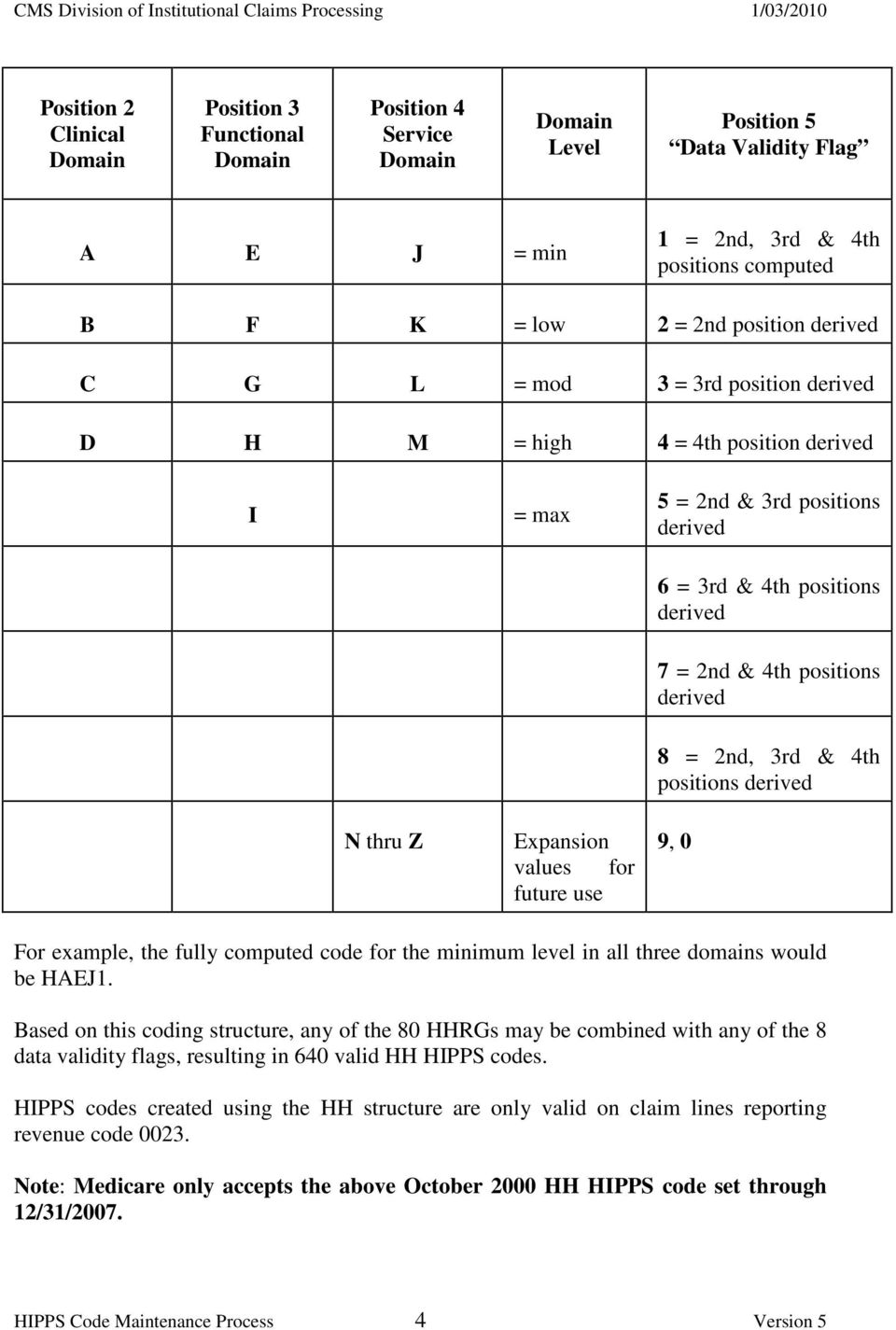
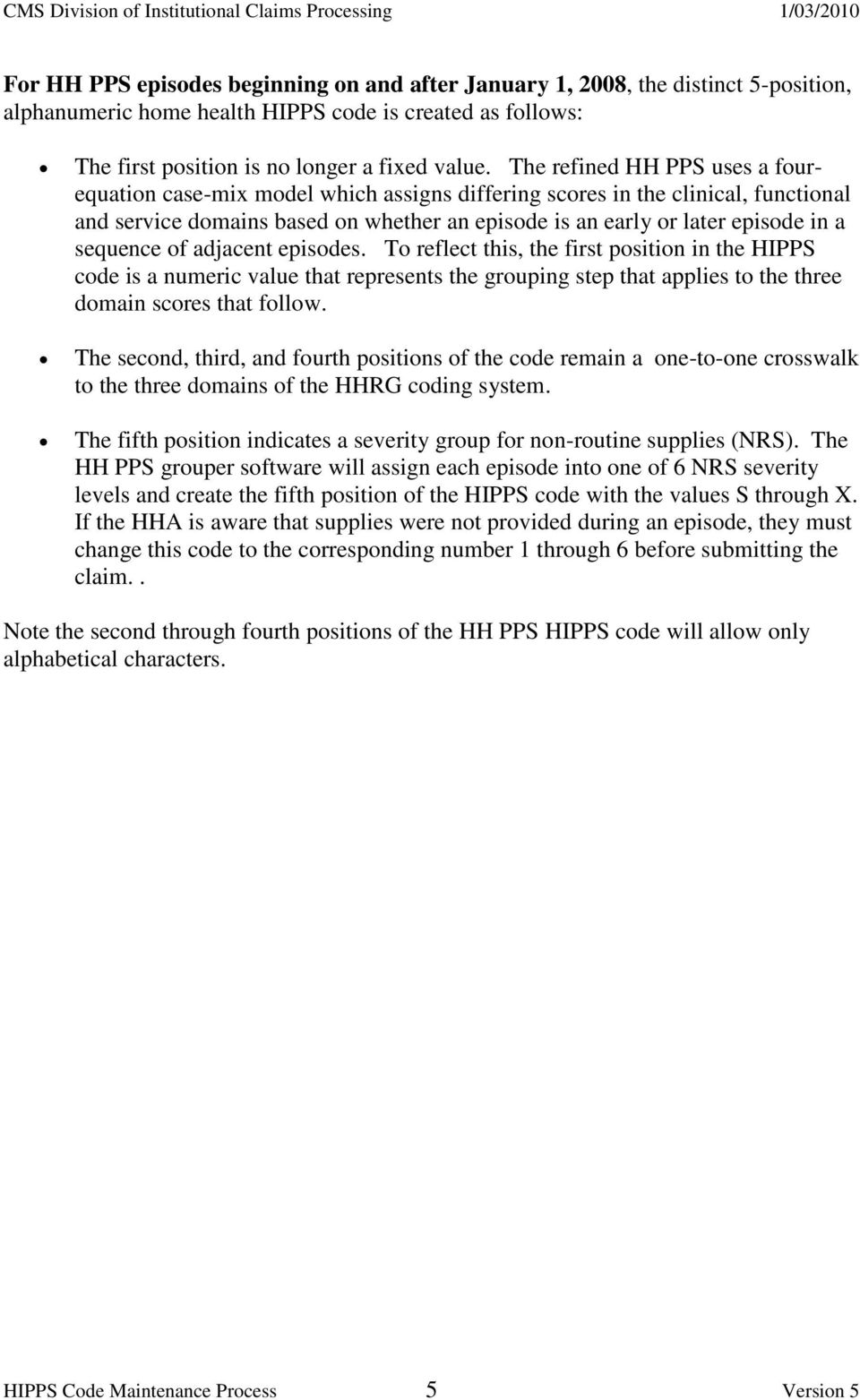
5 For HH PPS episodes beginning on and after January 1, 2008, the distinct 5-position, alphanumeric home health HIPPS code is created as follows: The first position is no longer a fixed value. The refined HH PPS uses a fourequation case-mix model which assigns differing scores in the clinical, functional and service domains based on whether an episode is an early or later episode in a sequence of adjacent episodes. To reflect this, the first position in the HIPPS code is a numeric value that represents the grouping step that applies to the three domain scores that follow. The second, third, and fourth positions of the code remain a one-to-one crosswalk to the three domains of the HHRG coding system. The fifth position indicates a severity group for non-routine supplies (NRS). The HH PPS grouper software will assign each episode into one of 6 NRS severity levels and create the fifth position of the HIPPS code with the values S through X. If the HHA is aware that supplies were not provided during an episode, they must change this code to the corresponding number 1 through 6 before submitting the claim.. Note the second through fourth positions of the HH PPS HIPPS code will allow only alphabetical characters. HIPPS Code Maintenance Process 5 Version 5
6 Early Episodes (1 st & 2nd ) Late Episodes (3 rd & later) Early or Late Episodes Position #1 Grouping Step 1 (0-13 Visits) 2 (14-19 Visits) 3 (0-13 visits) 4 (14-19 Visits) 5 (20 + Visits) Position #2 Clinical A C1) B C2) C C3) Position #3 Functional F F1) G F2) H F3) Position #4 Service K S1) L S2) M S3) N S4) P S5) Supply Group supplies provided S Level: 1) T Level: 2) U Level: 3) V Level: 4) W Level: 5) Position #5 Supply Group supplies not provided 1 Level: 1) 2 Level: 2) 3 Level: 3) 4 Level: 4) 5 Level: 5) Levels = min = low = mod = high = max X Level: 6) 6 Level: 6) 6 thru 0 D thru E I thru J Q thru R Y thru Z 7 thru 0 Expansion values for future use Examples: First episode, 10 therapy visits, with lowest scores in the clinical, functional and service domains and lowest supply severity level and non-routine supplies were not provided = HIPPS code 1AFK1 Third episode, 16 therapy visits, moderate scores in the clinical, functional and service domains and supply severity leve1 4 = HIPPS code 4CHMV Third episode, 22 therapy visits, clinical domain score is low, function domain score is moderate, service domain score is high and supply severity level 6 = HIPPS code 5BHNX Based on this coding structure: 153 case-mix groups defined in the 2007 HH PPS final rule are represented by the first four positions of the code. HIPPS Code Maintenance Process 6 Version 5
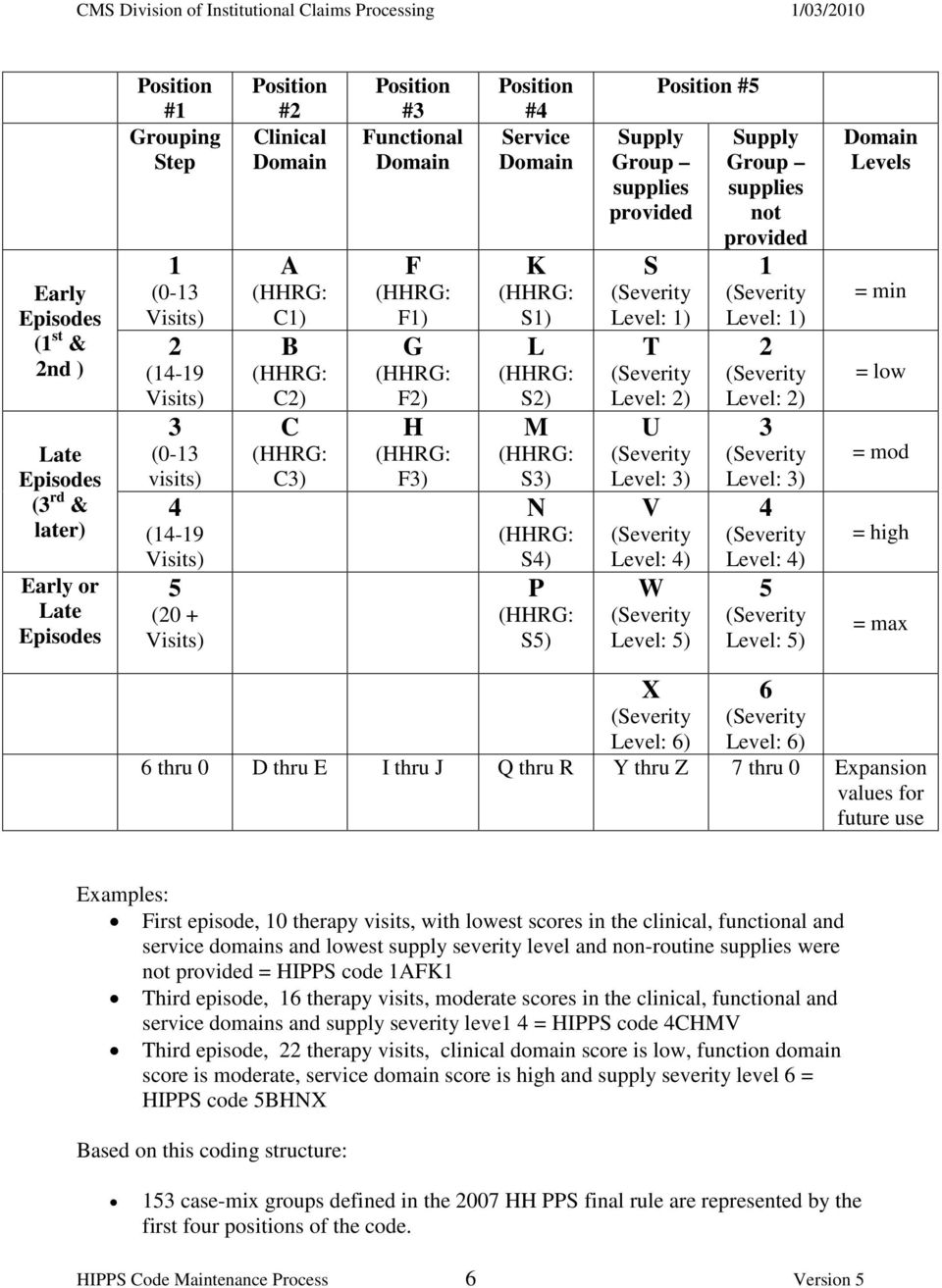
7 Each of these case-mix groups can be combined with any NRS severity level, resulting in 918 HIPPS codes in all (i.e., 153 case-mix groups times 6 NRS severity levels). Each HIPPS code will represent a distinct payment amount, without any duplication of payment weights across codes. Inpatient Rehabilitation Facility Prospective Payment System Under the inpatient rehabilitation facility prospective payment system (IRF PPS), a casemix adjusted payment for varying numbers of days of IRF care is made using one of 93 Case Mix Groups (CMG). On Medicare claims these CMGs are represented as HIPPS codes. HIPPS codes are determined based on assessments made using the Inpatient Rehabilitation Facility Patient Assessment Instrument (IRF-PAI). Grouper software run at a rehabilitation facility site uses specific data elements from the IRF-PAI data set to assign beneficiaries to a HIPPS code. The Grouper outputs the HIPPS code, which must be entered on the claim. The following scheme has been developed to create distinct 5-position, alphanumeric IRF HIPPS codes: The first position of the code represents a comorbidity tier. Comorbidities that may appear in the case of an IRF patient are arrayed in three tiers based on whether the costs associated with that comorbidity are considered high, medium or low. The first position of the IRF PPS HIPPS codes will only allow alphabetical characters. The valid values for this position are as follows: A = without comorbidities B = comorbidity in tier 1 (high) C = comorbidity in tier 2 (medium) D = comorbidity in tier 3 (low) The second, third, fourth and fifth positions of the code represent the CMG itself. The fifth position will only allow numeric characters. Valid values fall within the range of 0101 through 5104 and 9999 (default code), though only 93 values in that range are used. A full listing of CMGs can be found in the IRF PPS final rule. The first 87 CMGs can be used in association with any of the four comorbidity tier indicators. The last (highest numbered) five CMGs are defined as atypical CMGs and are assigned by Medicare claims processing systems in special situations, such as a particularly short stay in the facility or the death of the patient. These atypical CMGs are only combined with the A comorbidity value. IRF providers never submit these codes (A5001, A5101, A5102, A5103 and A5104). In addition, the default code is HIPPS Code Maintenance Process 7 Version 5
8 combined with the A comorbidity (A9999) only. The default code is used for informational-only Managed Care claims The combinations of the 87 groups and 4 comorbidity tiers, plus the five atypical codes and the default code result in 354 valid IRF HIPPS codes. HIPPS codes created using the IRF structure are only valid on claim lines reporting revenue code Regulation and Instruction References For additional information about the payment systems described above and details about HIPPS code use for billing Medicare, consult the following sources. Medicare Regulations: These documents are accessible via the Government Printing Office website at: SNF PPS Final Rules -- Federal Register: - Vol. 74, No. 153, Tuesday, August 11, 2009, beginning at p Vol. 70, No. 149, Thursday, August 4, 2005, beginning at p Vol. 63, No. 91 / Tuesday, May 12, 1998, beginning at p HH PPS Final Rules -- Federal Register / Vol. 65, No. 128 / Monday, July 3, 2000, beginning at p IRF PPS Final Rules -- Federal Register: - Vol. 70, No. 156/Monday August 15, 2005, beginning at p Vol. 66, No. 152 / Tuesday, August 7, 2001, beginning at p Swing Bed PPS Final Rule-- Federal Register / Vol. 66, No. 147 / Tuesday, July 31, 2001, beginning at p Medicare Instructions Medicare Program Memoranda (PMs), Transmittals and Manual Instructions are available via the CMS website at: cms..gov/manuals/ SNF PPS Transmittal 1958, CR 6916, April 28, 2010, Implements new HIPPS codes resulting from the conversion to the RUG-IV (66 groups) coding system.transmittal 630, CR 3962, July 29, 2005 Implements 9 new RUG-III categories resulting in a 53-group RUG-III coding system (formerly 44-group RUG-III coding system) PM A , February 15, 2002 Details conversion of Swing Bed Facilities to SNF PPS and outlines use of HIPPS codes in billing for swing bed services HIPPS Code Maintenance Process 8 Version 5
9 PM A-01-56, April 30, 2001 Provides clarifications about the use of HIPPS codes in SNF billing, particularly the uses of assessment type indicators PM A-00-47, August 7, 2000 Outlines SNF PPS payment rate update for Federal fiscal year 2001, in which several new assessment type indicators were created PM A-00-46, August 3, 2000 Provides instructions for billing SNF adjustment claims to correct HIPPS codes (Also re-issued September 27, 2001 as PM A ) HH PPS Medicare Intermediary Manual, sections through Medicare Home Health Agency Manual, sections 467 through and section 475 PM A-00-41, July 27, 2000 Outlines transition to HH PPS and provides complete list of HH HIPPS codes IRF PPS Transmittal 680, CR 4037, September 16, 2005, Modifies IRF CMG list to 87 CMGs plus 5 special CMGs (formerly 95 CMGs plus 5 special CMGs) PM A-01-92, July 31, 2001 Details implementation of IRF PPS and outlines use of HIPPS codes for these services PM A , September 14, 2001 Provides revisions and modifications to PM A HIPPS Code Maintenance Process 9 Version 5

CHAPTER 6: MEDICARE SKILLED NURSING FACILITY PROSPECTIVE PAYMENT SYSTEM (SNF PPS)
 CHAPTER 6: MEDICARE SKILLED NURSING FACILITY PROSPECTIVE PAYMENT SYSTEM (SNF PPS) 6.1 Background The Balanced Budget Act of 1997 included the implementation of a Medicare Prospective Payment System (PPS)
 Resource Utilization Groups (RUGs) September 2, 2009 Anthony M. Tucker, PhD Maryland LTC-PAC Workgroup Resource Utilization Groups (RUGs) RUGs are mutually exclusive categories that reflect levels of resource
Medicare Skilled Nursing Facility Prospective Payment System (SNF PPS)
 Chapter 6: Medicare Skilled Nursing Facility Prospective Payment System (SNF PPS) 6.1 Background The Balanced Budget Act of 1997 included the implementation of a Medicare Prospective Payment System (PPS)
CHAPTER 6: MEDICARE SKILLED NURSING FACILITY PROSPECTIVE PAYMENT SYSTEM (SNF PPS)
 CHAPTER 6: MEDICARE SKILLED NURSING FACILITY PROSPECTIVE PAYMENT SYSTEM (SNF PPS) 6.1 Background The Balanced Budget Act of 1997 included the implementation of a Medicare Prospective Payment System (PPS)
Skilled Nursing Facility (SNF) MDS Assessment Schedule Teleconference October 20, 2011 Presented by: Janet Mateo
 Skilled Nursing Facility (SNF) MDS Assessment Schedule Teleconference October 20, 2011 Presented by: Janet Mateo 1 Agenda Overview Of Minimum Data Set (MDS) Assessments FY 2012 Changes Revisions to the
VHA COMMUNITY NURSING HOME PROVIDER AGREEMENT
 VHA COMMUNITY NURSING HOME PROVIDER AGREEMENT A Community Nursing Home (CNH) Provider Agreement is formed when VA agrees to place a patient in the nursing home that meets all terms and conditions described
Differences in Resident Case-mix Between Medicare and Non-Medicare Nursing Home Residents
 Differences in Resident Case-mix Between and Non- Nursing Home Residents Alan White Patricia Rowan Abt Associates Inc. A report by staff from Abt Associates for the Payment Advisory Commission MedPAC 425
QUESTIONABLE BILLING BY SKILLED NURSING FACILITIES.
 Department of Health and Human Services OFFICE OF INSPECTOR GENERAL QUESTIONABLE BILLING BY SKILLED NURSING FACILITIES. Daniel R. Levinson Inspector General December 2010 E X E C U T I V E S U M M A R
How To Make A Profit From A Pension Plan
 PRIME REHABILITATION SERVICES PPS AND FINANCIAL CHALLENGES 2012 PRESENTED BY: TAMAR BROOKS, COO October 2011 Agenda Topics Financial Implications of SNF 2012 Rule RUG IV Classification Highlights 2012
Medicare Claims Processing Manual Chapter 10 - Home Health Agency Billing
 Medicare Claims Processing Manual Chapter 10 - Home Health Agency Billing Table of Contents (Rev. 3268, 05-29-15) Transmittals for Chapter 10 10 - General Guidelines for Processing Home Health Agency (HHA)
NEW YORK CASE MIX. Jan White, RN Senior Clinical Reimbursement Consultant
 NEW YORK CASE MIX Jan White, RN Senior Clinical Reimbursement Consultant 1 Objectives Explain the basic elements of the Case Mix system Review the Case Mix RUG levels Define ADLs and understand their effect
Maryland Department of Health and Mental Hygiene TIME-WEIGHTED CMI RESIDENT ROSTER USER GUIDE
 Maryland Department of Health and Mental Hygiene TIME-WEIGHTED CMI RESIDENT ROSTER USER GUIDE Myers and Stauffer LC Final 08/05/2015 Contents 1 REGULATORY REQUIREMENTS 3 INTRODUCTION... 3 SCHEDULE OF CASE
Understanding Home Health Prospective Payment System (HH PPS) Health Insurance Prospective Payment System (HIPPS) Code Changes
 Understanding Home Health Prospective Payment System (HH PPS) Health Insurance Prospective Payment System (HIPPS) Code Changes The following information is to be used to assist in determining how the Fiscal
Design for Nursing Home Compare Five-Star Quality Rating System: Technical Users Guide
 Design for Nursing Home Compare Five-Star Quality Rating System: Technical Users Guide July 2010 Introduction The Centers for Medicare & Medicaid Services (CMS) has enhanced its Nursing Home Compare public
Medicare Program Integrity Manual Chapter 6 - Medicare Contractor Medical Review Guidelines for Specific Services
 Medicare Program Integrity Manual Chapter 6 - Medicare Contractor Medical Review Guidelines for Specific Services Transmittals for Chapter 6 Table of Contents (Rev. 608, 08-14-15) 6.1 - Medical Review
Comparison of the Prospective Payment System Methodologies Currently Utilized in the United States
 Comparison of the Prospective Payment System Methodologies Currently Utilized in the United States 1 Can you speak the jargon of Prospective Payment Systems? MS- DRGs APCs IPF-PPS RBRVS HHRGs RUGs MS-LTC
MDS 3.0 and RUG-IV. Updates and Training for FY 2012. August 23, 2011
 MDS 3.0 and RUG-IV Updates and Training for FY 2012 August 23, 2011 1 Agenda New MDS Assessment Schedule Allocation of Group Therapy Minutes Revised Student Supervision Provisions EOT OMRA and New Resumption
SECTION Z: ASSESSMENT ADMINISTRATION. Z0100: Medicare Part A Billing. Item Rationale. Coding Instructions for Z0100A, Medicare Part A HIPPS Code
 SECTION Z: ASSESSMENT ADMINISTRATION Intent: The intent of the items in this section is to provide billing information and signatures of persons completing the assessment. Z0100: Medicare Part A Billing
Louisiana Case Mix System Department of Health and Hospitals Point in Time Report Guidelines, RUG-III Grouper Version 1.
 Basic OBRA Assessment/Record Sequencing Requirements Federal regulations at 42 CFR 483.20(b)(1)(xviii), (g), and (h) 1) The assessment accurately reflects the resident s status 2) A registered nurse conducts
Design for Nursing Home Compare Five-Star Quality Rating System: Technical Users Guide. February 2015
 Design for Nursing Home Compare Five-Star Quality Rating System: Technical Users Guide February 2015 Introduction In December 2008, The Centers for Medicare & Medicaid Services (CMS) enhanced its Nursing
Strategies and Best Practices for Managing RUG IV SNF Reimbursement. Objectives. Introduction
 Strategies and Best Practices for Managing RUG IV SNF Reimbursement Objectives Provide information on the changes to PPS reimbursement under MDS 3.0/RUG IV for Medicare Part A residents in the SNF Provide
Figuring Out the Codes: Inpatient Rehabilitation Facilities and the Transfer Policy
 Figuring Out the Codes: Inpatient Rehabilitation Facilities and the Transfer Policy Inpatient rehabilitation facilities (IRFs) are hospitals (or subunits of a hospital) that offer intensive rehabilitation
Rev. 4 41-303 PART II - CERTIFICATION
 11-12 FORM CMS-2540-10 4190 (Cont.) This report is required by law (42 USC 1395g; 42 CFR 413.20(b)). Failure to report can result in all interim FORM APPROVED payments made since the beginning of the cost
INTRODUCTION TO THE MDS 3.0 RUG-III v. 5.12 44-GROUP CLASSIFICATION TOOL
 INTRODUCTION TO THE MDS 3.0 RUG-III v. 5.12 44-GROUP CLASSIFICATION TOOL This educational tool was developed to assist providers in understanding the Resource Utilization Group (RUG) III, version 5.12
Design for Nursing Home Compare Five-Star Quality Rating System: Technical Users Guide. March 2009
 Design for Nursing Home Compare Five-Star Quality Rating System: Technical Users Guide March 2009 (Revised April 1) Introduction The Centers for Medicare & Medicaid Services (CMS) has enhanced its Nursing
Design for Nursing Home Compare Five-Star Quality Rating System: Technical Users Guide
 Design for Nursing Home Compare Five-Star Quality Rating System: Technical Users Guide February 2009 Introduction The Centers for Medicare & Medicaid Services (CMS) has enhanced its Nursing Home Compare
How To Write A Health Care Plan
 Data Standardization: Looking Forward in Post-Acute Care Stella Mandl, RN Technical Advisor Centers for Medicare & Medicaid Services As Is T ransit io n To Be Nursing Homes MDS LTCHS LTCH CARE Data Set
NURSING FACILITY PRICE-BASED PAYMENT METHODOLOGY FAQs
 NURSING FACILITY PRICE-BASED PAYMENT METHODOLOGY FAQs (Revised November 19, 2014) Note: Highlighted questions indicate revisions to Q&A or a new question since the last FAQ posting on November 4, 2014.
Medicare Part A Introduction to Skilled Nursing Facility Billing
 www.hcfa.gov Medicare Part A Introduction to Skilled Nursing Facility Billing EMPIRE MEDICARE SERVICES HCFA Medicare Part A and Part B Contracted Agent Medicare Billing Skilled Nursing Facility Table of
Home Health Billing Scenarios - DRAFT. Disclaimer
 Home Health Billing Scenarios - DRAFT 1493_1013 Disclaimer National Government Services, Inc. has produced this material as an informational reference for providers furnishing services in our contract
Center for Medicaid and State Operations SMDL #01-032. December 5, 2001
 DEPARTMENT OF HEALTH & HUMAN SERVICES Centers for Medicare & Medicaid Services 7500 Security Boulevard, Mail Stop S2-26-12 Baltimore, Maryland 21244-1850 Center for Medicaid and State Operations SMDL #01-032
Administrator s Survival Guide to MDS 3.0 and RUG-IV
 Administrator s Survival Guide to MDS 3.0 and RUG-IV Massachusetts Chapter of ACHCA Presented by: PPS & Case Mix Onsite Chart Audits MMQ Audits Seminars Consulting Program Development Mock Survey Sample
1. Introduction to the HH PPS PC Pricer
 1. Introduction to the HH PPS PC Pricer 1.1 Background on HH PPS The Balanced Budget Act of 1997 and subsequent legislation called for the creation of a prospective payment system (PPS) for home health
CLINICAL REIMBURSEMENT ESSENTIALS for LEADERS. David Rokes, RN C.E.O.
 CLINICAL REIMBURSEMENT ESSENTIALS for LEADERS David Rokes, RN C.E.O. Understand effective strategies and systems implementation to ensure appropriate reimbursement and withstanding audit scrutiny Understand
CMMI Payment Bundling Initiative
 CMMI Payment Bundling Initiative Table of Contents Questions & Answers... 2 Technical... 2 General... 3 Inpatient... 12 Skilled Nursing Facility (SNF)... 18 Outpatient... 20 Home Health... 23 Carrier...
Minimum Data Set 3.0 Coding and Interpretation Training Version 1.10
 Minimum Data Set 3.0 Coding and Interpretation Training Version 1.10 August 8 th -9 th, 2013 1 MDS 3.0 RAI Manual V1.10 Updated effective May 20, 2013 (http://www.cms.gov/medicare/quality-initiatives-patient-assessment-
RESOURCE UTILIZATION GROUP, VERSION IV 48-GROUP USER GUIDE
 RESOURCE UTILIZATION GROUP, VERSION IV 48-GROUP USER GUIDE Mississippi Division of Medicaid Myers and Stauffer LC CONTENTS 1 OVERVIEW 3 INTRODUCTION... 3 PURPOSE... 3 SCOPE... 3 Hierarchical Classification:...
Using the Inpatient Rehabilitation Facility (IRF) PEPPER to Support Auditing and Monitoring Efforts: Session 1
 Using the Inpatient Rehabilitation Facility (IRF) PEPPER to Support Auditing and Monitoring Efforts: Session 1 March, 2015 Kimberly Hrehor Agenda Session 1: History and basics of PEPPER IRF PEPPER target
How To Get A Medicare Plan For A Single Payer Health Insurance Plan
 J6: Home Health Billing Basics 1493_1013 Disclaimer National Government Services, Inc. has produced this material as an informational reference for providers furnishing services in our contract jurisdiction.
Fact Sheet #1 Inpatient Rehabilitation Facility Classification Requirements
 Fact Sheet #1 Inpatient Rehabilitation Facility Classification Requirements Provider Types Affected All hospitals or units of a hospital that are classified under subpart B of part 412 of the Medicare
Rehabilitation Reimbursement Update By: Cherilyn G. Murer, JD, CRA
 Rehabilitation Reimbursement Update By: Cherilyn G. Murer, JD, CRA Introduction The Centers for Medicare & Medicaid Services (CMS) and legislators in this country remain dedicated to ensuring that beneficiaries
Payment by Provider Type for MedicareBlue PPO Covered Services...3
 Payment by Provider Type...2 Dual Eligibility and MedicareBlue PPO...2 Payments for Medicare Incentive Programs...2 General Claims Submission Guidelines...2 Payment by Provider Type for MedicareBlue PPO
Medicaid Case Mix Strategies. Housekeeping. Harmony Healthcare International, Inc. Objectives. Copyright 2012 All Rights Reserved 1
 Medicaid Case Mix Strategies HARMONY UNIVERSITY The Provider Unit of (HHI) Presented by: Keri Hart, MS CCC-SLP, RAC-CT Director of CHHRP Program Development Housekeeping Sign In Contact Hours Certificate
Medicare Inpatient Rehabilitation Facility Prospective Payment System
 Medicare Inpatient Rehabilitation Facility Prospective Payment System Payment Rule Brief FINAL RULE Program Year: FFY 2014 Overview and Resources On August 6, 2013, the Centers for Medicare and Medicaid
Clarification of Patient Discharge Status Codes and Hospital Transfer Policies
 The Acute Inpatient Prospective Payment System Fact Sheet (revised November 2007), which provides general information about the Acute Inpatient Prospective Payment System (IPPS) and how IPPS rates are
2014: Volume 4, Number 1. A publication of the Centers for Medicare & Medicaid Services, Office of Information Products & Data Analytics
 2014: Volume 4, Number 1 A publication of the Centers for Medicare & Medicaid Services, Office of Information Products & Data Analytics Medicare Post-Acute Care Episodes and Payment Bundling Melissa Morley,¹
7/8/2010. Resident Assessment Instrument. Katrina Magdon Alabama Nursing Home Association Robin A. Bleier
 Katrina Magdon Alabama Nursing Home Association Robin A. Bleier RB Health Partners, Inc. [email protected] Resident Assessment Instrument The role of the RAI process: individual id gap analysis
Common Medicare Billing Mistakes Systems and protocols necessary to help prevent and overpayment Best practices in resolving an overpayment
 Bill J. Ulrich, President / CEO Consolidated Billing Services Inc. Pat Newberry, Director of Clinical Education AIS Inc. Common Medicare Billing Mistakes Systems and protocols necessary to help prevent
Inpatient Transfers, Discharges and Readmissions July 19, 2012
 Inpatient Transfers, Discharges and Readmissions July 19, 2012 Discharge Status Codes Two-digit code Identifies where the patient is at conclusion of encounter Visit Inpatient stay End of billing cycle
UB-04 Claim Form Instructions
 UB-04 Claim Form Instructions FORM LOCATOR NAME 1. Billing Provider Name & Address INSTRUCTIONS Enter the name and address of the hospital/facility submitting the claim. 2. Pay to Address Pay to address
The PFFS Reimbursement Guide
 The PFFS Reimbursement Guide SecureHorizons Direct reimburses claims based on Medicare Fee Schedules, Prospective Payment Systems (PPS) and estimated Medicare payments amounts. Payment methodologies are
Inpatient rehabilitation facility services
 C h a p t e r10 Inpatient rehabilitation facility services R E C O M M E N D A T I O N 10 The Congress should eliminate the update to the Medicare payment rates for inpatient rehabilitation facilities
OFFICE OF MEDICAID POLICY AND PLANNING TIME WEIGHTED CMI RESIDENT ROSTER REPORT GUIDELINES; 34 GROUP Version 2.0 (September 2013)
 Basic OBRA Assessment/Record Sequencing Requirements Federal regulations at 42 CFR 483.20(b)(1)(xviii), (g), and (h) 1) The assessment accurately reflects the resident s status 2) A registered nurse conducts
Rehabilitation Regulatory Compliance Risks
 Rehabilitation Regulatory Compliance Risks Christine Bachrach Vice President & Chief Compliance Officer University of Maryland Medical System 2011 AHIA Annual Conference Agenda - Rehabilitation Compliance
Medicare Home Health Prospective Payment System
 Medicare Home Health Prospective Payment System Payment Rule Summary PROPOSED CY 2016 Overview and Resources On July 10, 2015, the Centers for Medicare and Medicaid Services (CMS) published its proposed
Inpatient rehabilitation facility services
 Inpatient rehabilitation facility services C H A P T E R9 R E C O M M E N D A T I O N 9 The Congress should eliminate the update to the Medicare payment rates for inpatient rehabilitation facilities in
Tab 7: OASIS Questions and Answers
 Reference Manual Tab 7: OASIS Questions and Answers RM-429 RM-430 CATEGORY 1 APPLICABILITY [Q&A EDITED 09/09] Q1. To whom do the OASIS requirements apply? A1. The comprehensive assessment and OASIS data
CMS Response to the Hurricane Emergency. Questions and Answers About Medicare Fee-For-Service
 CMS Response to the Hurricane Emergency Questions and s About Medicare Fee-For-Service # Question and Waiver of Certain Medicare Requirements 1 Question: Do the modifications and flexibilities described
UB-04, Inpatient / Outpatient
 UB-04, Inpatient / Outpatient Hospital (Inpatient and Outpatient), Hospice (Nursing Home and Home Services), Home Health, Rural Health linic, Federally Qualified Health enter, IF/MR, Birthing enter, and
Comparison of Discharge Functional Status Rehabilitation: Hip Fracture Repair. Trudy Mallinson, PhD, OTR/L
 Comparison of Discharge Functional Status Rehabilitation: Hip Fracture Repair Trudy Mallinson, PhD, OTR/L Acknowledgements Co-authors Anne Deutsch, PhD, CRRN Jillian Bateman, OTD, OTR/L Hsiang-Yi Tseng,
Medicare Outpatient Therapy Billing
 DEPARTMENT OF HEALTH AND HUMAN SERVICES Centers for Medicare & Medicaid Services R Medicare Outpatient Therapy Billing August 2010 / ICN: 903663 DEPARTMENT OF HEALTH AND HUMAN SERVICES Centers for Medicare
For More Information
 THE ARTS CHILD POLICY CIVIL JUSTICE EDUCATION ENERGY AND ENVIRONMENT This PDF document was made available from www.rand.org as a public service of the RAND Corporation. Jump down to document6 HEALTH AND
Understanding MDS 3.0 and RUG IV Reimbursement for Nursing Homes
 Understanding MDS 3.0 and RUG IV Reimbursement for Nursing Homes Prepared by: Joseph J. Tomaino Director Health Care Consulting RSM McGladrey, Inc. 212.376.1640 [email protected] Introduction
1. Clarification regarding whether an admission order must be completed before any therapy evaluations are initiated.
 Follow-up information from the November 12 provider training call I. Admission Orders 1. Clarification regarding whether an admission order must be completed before any therapy evaluations are initiated.
Payment Methodology Grid for Medicare Advantage PFFS/MSA
 Payment Methodology Grid for Medicare Advantage PFFS/MSA This applies to SmartValue and Security Choice Private Fee-for-Service (PFFS) plans and SmartSaver and Save Well Medical Savings Account (MSA) plans.
June 2, 2014. RE: File Code CMS-1608-P. Dear Ms. Tavenner:
 . June 2, 2014 Marilyn Tavenner Centers for Medicare & Medicaid Services Room 445-G, Hubert H. Humphrey Building 200 Independence Avenue SW Washington, DC RE: File Code CMS-1608-P Dear Ms. Tavenner: The
SEP f 1 2006. Nationwide Review of Inpatient Rehabilitation Facilities' Compliance With Medicare's Transfer Regulation (A-04-04-00008)
 {42 + STRVLVICEI DEPARTMENT E %*~UV,~~ OF HE&WH & HUMAN SERVICES Office of Inspector General SEP f 1 2006 Washington, D.C. 20201 TO: FROM: SUBJECT: Mark B. McClellan, M.D., Ph.D. Administrator Centers
WOUND CARE POLICY UPDATE
 WOUND CARE POLICY UPDATE Marcia Nusgart R.Ph. Executive Director Alliance of Wound Care Stakeholders Coalition of Wound Care Manufacturers www.woundcarestakeholders.org Presented at The Business of Wound
Selection of a DRG Grouper for a Medicaid Population
 Selection of a DRG Grouper for a Medicaid Population Introduction The goal of diagnosis related groupers is to define patients into categories based on similar clinical conditions and on similar levels
MDS 3.0 Corrections. Why Accuracy
 MDS 3.0 Corrections December 2013 Why Accuracy The importance of accurately completing and submitting the MDS cannot be over-emphasized. The MDS is the basis for: the development of an individualized care
Acute Medical Rehabilitation Surviving Health Care Reform
 Acute Medical Rehabilitation Surviving Health Care Reform Kathleen C. Yosko, RN, MS, MBA President & CEO Marianjoy Rehabilitation & Clinics Wheaton, Illinois Marianjoy Rehabilitation and Clinics 2 1 Acute
Medicare Skilled Nursing Facility Prospective Payment System
 Medicare Skilled Nursing Facility Prospective Payment System Payment Rule Brief FINAL RULE Program Year: FFY 2016 Overview and Resources On August 4, 2015, the Centers for Medicare and Medicaid Services