
CHAPTER 6: MEDICARE SKILLED NURSING FACILITY PROSPECTIVE PAYMENT SYSTEM (SNF PPS)
|
|
|
- Jonas Jordan
- 10 years ago
- Views:
Transcription
1 CHAPTER 6: MEDICARE SKILLED NURSING FACILITY PROSPECTIVE PAYMENT SYSTEM (SNF PPS) 6.1 Background The Balanced Budget Act of 1997 included the implementation of a Medicare Prospective Payment System (PPS) for skilled nursing facilities (SNFs) and hospitals with a swing bed agreement, consolidated billing, and a number of related changes. The PPS system replaced the retrospective cost-based system for SNFs under Part A of the program (Federal Register Vol. 63, No. 91, May 12, 1998, Final Rule). Effective with cost reporting periods beginning on or after July 1, 2002, SNF-level services furnished in rural swing bed Hospitals are paid based on the SNF PPS instead of the previous, cost-related method (Federal Register Vol. 66, No. 147, July 31, 2001, Final Rule). However, the Medicare, Medicaid, and SCHIP Benefits Improvement and Protection Act of 2000 included an exemption of critical access hospital swing beds from the SNF PPS. The SNF PPS is the culmination of substantial research efforts beginning as early as the 1970s that focus on the areas of nursing home payment and quality. In addition, it is based on a foundation of knowledge and work by a number of States that developed and implemented similar case mix payment methodologies for their Medicaid nursing home payment systems. The current focus in the development of State and Federal payment systems for nursing home care is based on recognizing the differences among residents, particularly in the utilization of resources. Some residents require total assistance with their activities of daily living (ADLs) and have complex nursing care needs. Other residents may require less assistance with ADLs but may require rehabilitation or restorative nursing services. The recognition of these differences is the premise of a case mix system. Reimbursement levels differ based on the resource needs of the residents. Residents with heavy care needs require more staff resources and payment levels should be higher than for those residents with less intensive care needs. In a case mix adjusted payment system, the amount of reimbursement to the nursing home is based on the resource intensity of the resident as measured by items on the Minimum Data Set (MDS). Case mix reimbursement has become a widely adopted method for financing nursing home care. The case mix approach serves as the basis for the PPS for skilled nursing facilities and swing bed hospitals and is increasingly being used by States for Medicaid reimbursement for nursing homes. 6.2 Using the MDS in the Medicare Prospective Payment System A key component of the Medicare SNF PPS is the case mix reimbursement methodology used to determine resident care needs. A number of nursing home case mix systems have been developed over the last 20 years. Since the early 1990s, however, the most widely adopted approach to case mix has been the Resource Utilization Groups (RUGs). This classification October 2015 Page 6-1

2 system uses information from the MDS assessment to classify SNF residents into a series of groups representing the residents relative direct care resource requirements. In 2005, the Centers for Medicare & Medicaid Services (CMS) initiated a national nursing home staff time measurement (STM) study, the Staff Time and Resource Intensity Verification (STRIVE) Project. The STRIVE project represents the first nationwide time study for nursing homes in the United States to be conducted since 1997, and the data collected has been used to update payment systems for Medicare SNFs and Medicaid nursing facilities (NFs). Based on this analysis, CMS has developed the RUG-IV classification system that incorporates the MDS 3.0 items. Over half of the State Medicaid programs also use the MDS for their case mix payment systems. The RUG-IV system replaced the RUG-III for Medicare starting on October 1, However, State Medicaid agencies have the option to continue to use the RUG-III classification systems or adopt the RUG-IV system. CMS also provides the States alternative RUG-IV classification systems with 66, 57, or 48 groups with varying numbers of Rehabilitation groups (similar to the RUG-III 53, 44, and 34 groups). States have the option of selecting the system (RUG-III or RUG-IV) with the number of Rehabilitation groups that better suits their Medicaid long-term care population. State Medicaid programs always have the option to develop nursing home reimbursement systems that meet their specific program goals. The decision to implement a RUG-IV classification system for Medicaid is a State decision. Please contact your State Medicaid agency if you have questions about your State Medicaid reimbursement system. The MDS assessment data is used to calculate the RUG-IV classification necessary for payment. The MDS contains extensive information on the resident s nursing and therapy needs, ADL impairments, cognitive status, behavioral problems, and medical diagnoses. This information is used to define RUG-IV groups that form a hierarchy from the greatest to the least resources used. Residents with more specialized nursing requirements, licensed therapies, greater ADL dependency, or other conditions will be assigned to higher groups in the RUG-IV hierarchy. Providing care to these residents is more costly and is reimbursed at a higher level. 6.3 Resource Utilization Groups Version IV (RUG-IV) The RUG-IV classification system has eight major classification categories: Rehabilitation Plus Extensive Services, Rehabilitation, Extensive Services, Special Care High, Special Care Low, Clinically Complex, Behavioral Symptoms and Cognitive Performance Problems, and Reduced Physical Function (see Table 1). The categories, except for Extensive Services, are further divided by the intensity of the resident s ADL needs. The Special Care High, Special Care Low, and Clinically Complex categories are also divided by the presence of depression. Finally, the Behavioral Symptoms and Cognitive Performance Problems and the Reduced Physical Function categories are divided by the provision of restorative nursing services. A calculation worksheet was developed in order to provide clinical staff with a better understanding of how the RUG-IV classification system works. The worksheet translates the standard software code into plain language to assist staff in understanding the logic behind the classification system. A copy of the calculation worksheet for the RUG-IV classification system for nursing homes can be found at the end of this section. October 2015 Page 6-2

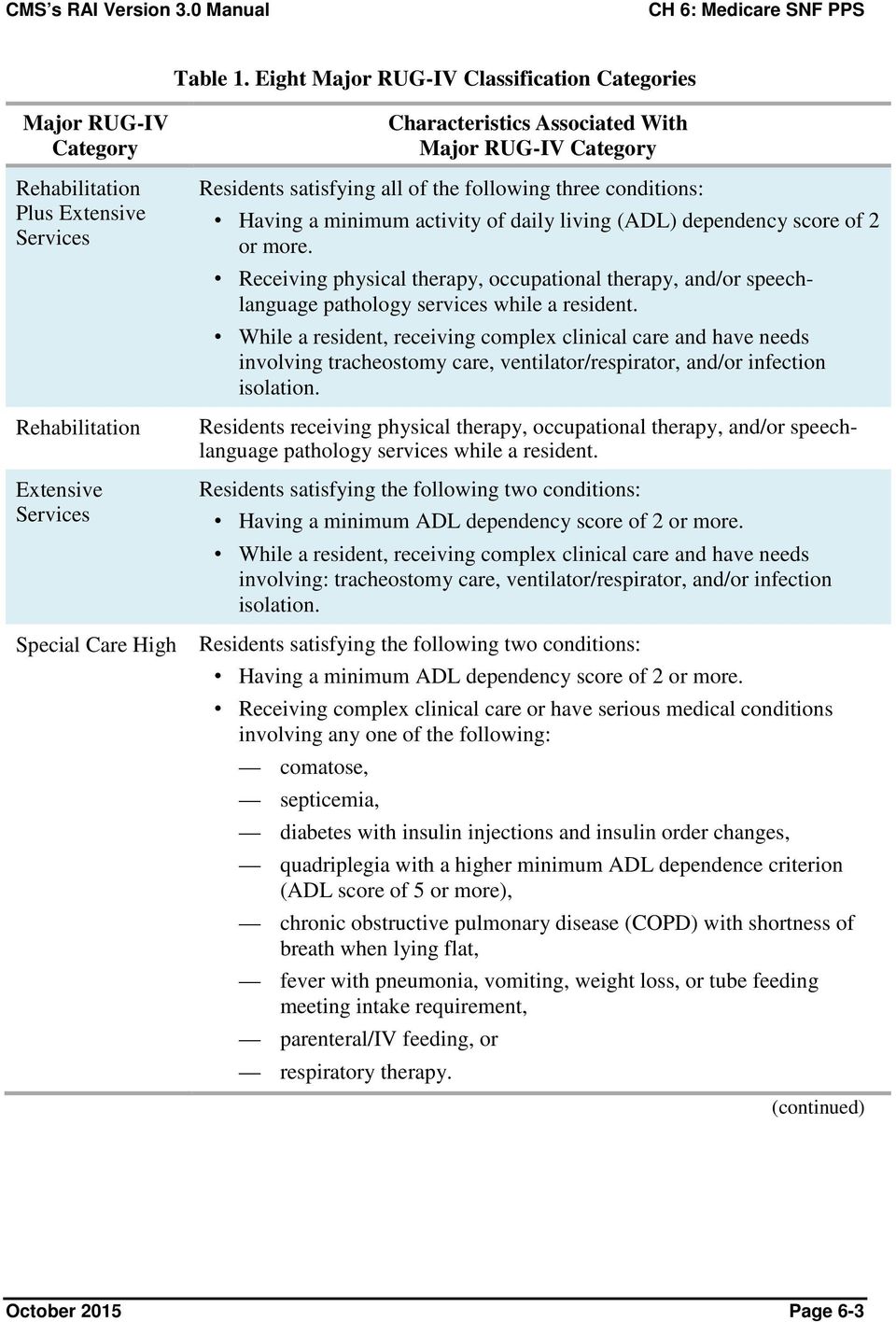
3 Table 1. Eight Major RUG-IV Classification Categories Major RUG-IV Category Rehabilitation Plus Extensive Services Rehabilitation Extensive Services Characteristics Associated With Major RUG-IV Category Residents satisfying all of the following three conditions: Having a minimum activity of daily living (ADL) dependency score of 2 or more. Receiving physical therapy, occupational therapy, and/or speechlanguage pathology services while a resident. While a resident, receiving complex clinical care and have needs involving tracheostomy care, ventilator/respirator, and/or infection isolation. Residents receiving physical therapy, occupational therapy, and/or speechlanguage pathology services while a resident. Residents satisfying the following two conditions: Having a minimum ADL dependency score of 2 or more. While a resident, receiving complex clinical care and have needs involving: tracheostomy care, ventilator/respirator, and/or infection isolation. Special Care High Residents satisfying the following two conditions: Having a minimum ADL dependency score of 2 or more. Receiving complex clinical care or have serious medical conditions involving any one of the following: comatose, septicemia, diabetes with insulin injections and insulin order changes, quadriplegia with a higher minimum ADL dependence criterion (ADL score of 5 or more), chronic obstructive pulmonary disease (COPD) with shortness of breath when lying flat, fever with pneumonia, vomiting, weight loss, or tube feeding meeting intake requirement, parenteral/iv feeding, or respiratory therapy. (continued) October 2015 Page 6-3
4 Table 1. Eight Major RUG-IV Classification Categories (continued) Major RUG- IV Category Special Care Low Clinically Complex Characteristics Associated With Major RUG-IV Category Residents satisfying the following two conditions: Having a minimum ADL dependency score of 2 or more. Receiving complex clinical care or have serious medical conditions involving any of the following: cerebral palsy with ADL dependency score of 5 or more, multiple sclerosis with ADL dependency score of 5 or more, Parkinson s disease with ADL dependency score of 5 or more, respiratory failure and oxygen therapy while a resident, tube feeding meeting intake requirement, ulcer treatment with two or more ulcers including venous ulcers, arterial ulcers or Stage II pressure ulcers, ulcer treatment with any Stage III or IV pressure ulcer, foot infections or wounds with application of dressing, radiation therapy while a resident, or dialysis while a resident. Residents receiving complex clinical care or have conditions requiring skilled nursing management, interventions or treatments involving any of the following: pneumonia, hemiplegia with ADL dependency score of 5 or more, surgical wounds or open lesions with treatment, burns, chemotherapy while a resident, oxygen therapy while a resident, IV medications while a resident, or transfusions while a resident. (continued) October 2015 Page 6-4

5 Table 1. Eight Major RUG-IV Classification Categories (continued) Major RUG- IV Category Behavioral Symptoms and Cognitive Performance Reduced Physical Function Characteristics Associated With Major RUG-IV Category Residents satisfying the following two conditions: Having a maximum ADL dependency score of 5 or less. Having behavioral or cognitive performance symptoms, involving any of the following: difficulty in repeating words, temporal orientation, or recall (score on the Brief Interview for Mental Status <=9), difficulty in making self understood, short term memory, or decision making, hallucinations, delusions, physical behavioral symptoms toward others, verbal behavioral symptoms toward others, other behavioral symptoms, rejection of care, or wandering. Residents whose needs are primarily for support with activities of daily living and general supervision. 6.4 Relationship between the Assessment and the Claim The SNF PPS establishes a schedule of Medicare assessments. Each required Medicare assessment is used to support Medicare PPS reimbursement. There are scheduled PPS assessments performed around Day 5, Day 14, Day 30, Day 60, and Day 90 of a Medicare Part A stay (as defined in Chapter 2). These scheduled assessments establish per diem payment rates for associated standard payment periods. Unscheduled off-cycle assessments are performed under certain circumstances when required under the regulations (e.g., when the resident s condition changes). See Chapter 2 for greater detail on assessment types and requirements. These unscheduled assessments may impact the per diem payment rates for days within a standard payment period. Numerous situations exist that impact the relationship between the assessment and the claim above and beyond the information provided in this chapter. It is the responsibility of the provider to ensure that claims submitted to Medicare are accurate and meet all Medicare requirements. For example, if resident s status does not meet the criteria for Medicare Part A SNF coverage, the provider is not to bill Medicare for any non-covered days. The assignment of a RUG is not an indication that the requirements for SNF Part A have been met. Once the resident no longer requires skilled services, the provider must not bill Medicare for days that are not covered. Therefore, the following information is not to be considered all inclusive and definitive. Refer to October 2015 Page 6-5

6 the Medicare Claims Processing Manual, Chapter 6, for detailed claims processing requirements and policies. To verify that the Medicare bill accurately reflects the assessment information, two data items derived from the MDS assessment must be included on the Medicare claim: Assessment Reference Date (ARD) The ARD must be reported on the Medicare claim. CMS has developed internal mechanisms to link the assessment and billing records. Health Insurance Prospective Payment System (HIPPS) Code Each Medicare claim contains a five-position HIPPS code for the purpose of billing Part A covered days to the Part A/Part B Medicare Administrative Contractor (A/B MAC). The HIPPS code consists of the RUG-IV code and the Assessment Indicator (AI) as described below. CMS provides standard software and logic for HIPPS code calculation. RUG-IV Group Code The first three positions of the HIPPS code contain the RUG-IV group code to be billed for Medicare reimbursement. The RUG-IV group is calculated from the MDS assessment clinical data. See Section 6.6 for calculation details on each RUG group. CMS provides standard software, development tools, and logic for RUG-IV calculation. CMS software, or private software developed with the CMS tools, is used to encode and transmit the MDS assessment data and automatically calculates the RUG-IV group. CMS edits and validates the RUG-IV group code of transmitted MDS assessments. Skilled nursing facilities are not permitted to submit Medicare Part A claims until the assessments have been accepted into the CMS database, and they must use the RUG-IV code as validated by CMS when bills are filed, except in cases in which the facility must bill the default code (AAA). See Section 6.8 for details. The following RUG-IV group codes are used in the billing process: Rehabilitation Plus Extensive Services: RUX, RUL, RVX, RVL, RHX, RHL, RMX, RML, RLX Rehabilitation: RUA, RUB, RUC, RVA, RVB, RVC, RHA, RHB, RHC, RMA, RMB, RMC, RLA, RLB Extensive Services: ES3, ES2, ES1 Special Care High: HE2, HE1, HD2, HD1, HC2, HC1, HB2, HB1 Special Care Low: LE2, LE1, LD2, LD1, LC2, LC1, LB2, LB1 Clinically Complex: CE2, CE1, CD2, CD1, CC2, CC1, CB2, CB1, CA2, CA1 Behavioral Symptoms and Cognitive Performance: BB2, BB1, BA2, BA1 October 2015 Page 6-6

7 Reduced Physical Function: PE2, PE1, PD2, PD1, PC2, PC1, PB2, PB1, PA2, PA1 Default: AAA There are two different Medicare HIPPS codes that may be recorded on the MDS 3.0 in Items Z0100A (Medicare Part A HIPPS code) and Z0150A (Medicare Part A non-therapy HIPPS code). The Medicare Part A HIPPS code may consist of any RUG-IV group code. The Medicare Part A non-therapy HIPPS code is restricted to the RUG-IV groups of Extensive Services and below. The HIPPS code included on the Medicare claim depends on the specific type of assessment involved. The RUG codes in Items Z0100A and Z0150A are validated by CMS when the assessment is submitted. If the submitted RUG code is incorrect, the validation report will include a warning giving the correct code, and the facility must use the correct code in the HIPPS code on the bill. The provider must ensure that all Medicare assessment requirements are met. When the provider fails to meet the Medicare assessment requirements, such as when the assessment is late (as evidenced by a late ARD), the provider may be required to bill the default code. In these situations, the provider is responsible to ensure that the default code and not the RUG group validated by CMS in Items Z0100A and Z01050A is billed for the applicable number of days. See Section 6.8 of this chapter for greater detail. AI Code The last two positions of the HIPPS code represent the Assessment Indicator (AI), identifying the assessment type. The AI coding system indicates the different types of assessments that define different PPS payment periods and is based on the coding of Item A0310. CMS provides standard software, development tools, and logic for AI code calculation. CMS software, or private software developed with the CMS tools, automatically calculates the AI code. The AI code is validated by CMS when the assessment is submitted. If the submitted AI code is incorrect on the assessment, the validation report will include a warning and provide the correct code. The facility is to use the correct AI code in the HIPPS code on the bill. The code consists of two digits, which are defined below. In situations when the provider is to bill the default code, such as a late assessment, the AI provided on the validation report is to be used along with the default code, AAA, on the Medicare claim. Refer to the Medicare Claims Processing Manual, Chapter 6, for detailed claims processing requirements and policies. First AI Digit The first digit of the AI code identifies scheduled PPS assessments that establish the RUG payment rate for the standard PPS scheduled payment periods. These assessments are PPS 5- day, 14-day, 30-day, 60-day, and 90-day. The Omnibus Budget Reconciliation Act (OBRA 1987) required assessments are also included, because they can be used under certain circumstances for payment (see Section 6.8). Table 2 displays the first AI code for each October 2015 Page 6-7

8 of the scheduled PPS assessment types and the standard payment period for each assessment type. 1st Digit Values Table 2. Assessment Indicator First Digit Table Assessment Type (abbreviation) Standard* Scheduled Payment Period 0 Unscheduled PPS assessment (unsched) Not applicable 1 PPS 5-day (5d) Day 1 through 14 2 PPS 14-day (14d) Day 15 through 30 3 PPS 30-day (30d) Day 31 through 60 4 PPS 60-day (60d Day 61 through 90 5 PPS 90-day (90d) Day 91 through OBRA assessment (not coded as a PPS assessment) ** Not applicable * These are the payment periods that apply when only the scheduled Medicare-required assessments are performed. These are subject to change when unscheduled assessments used for PPS are performed, e.g., significant change in status, or when other requirements must be met. ** In some cases, such an assessment may be used for PPS if it is later determined that qualification for Part A coverage was present at the time of the assessment (see Missed Assessment, section 6.8). For these assessments A0310A will be 01 to 06 and A0310B will be 99. Second AI Digit The second digit of the AI code identifies unscheduled assessments used for PPS. Unscheduled PPS assessments are conducted in addition to the required standard scheduled PPS assessments and include the following OBRA unscheduled assessments: Significant Change in Status Assessment (SCSA) and Significant Correction to Comprehensive Assessment (SCPA), as well as the following PPS unscheduled assessments: Start of Therapy Other Medicare-required Assessment (OMRA), End of Therapy OMRA, Change of Therapy OMRA, and Swing Bed Clinical Change Assessment (CCA). Unscheduled assessments may be required at any time during the resident s Part A stay. They may be performed as separate assessments or combined with other assessments. A stand-alone unscheduled assessment used for PPS will not establish the payment rate for a standard payment period. Rather a stand-alone unscheduled assessment will modify the payment rate for all or part of a standard payment period, but only when the rate for that standard period has been established by a prior PPS scheduled assessment. For example, if a PPS 14-day scheduled assessment has established the payment rate for the standard Day 15 to Day 30 payment period, then an SCSA with an ARD on Day 20 will modify the payment rate from the ARD (Day 20) to the end of the payment period (Day 30). Special requirements apply when there are multiple assessments within one PPS scheduled assessment window. If an unscheduled PPS assessment (OMRA, SCSA, SCPA, or Swing Bed CCA) is required in the assessment window (including grace days) of a scheduled PPS assessment, and the ARD of the scheduled assessment is not set for a day that is prior to the ARD of the unscheduled assessment, then facilities must combine the scheduled and October 2015 Page 6-8

9 unscheduled assessments by setting the ARD of the scheduled assessment for the same day that the unscheduled assessment is required. In such cases, facilities should provide the proper response to the A0310 items to indicate which assessments are being combined, as completion of the combined assessment will be taken to fulfill the requirements for both the scheduled and unscheduled assessments. A scheduled PPS assessment cannot occur after an unscheduled assessment in the assessment window the scheduled assessment must be combined with the unscheduled assessment using the appropriate ARD for the unscheduled assessment. The purpose of this policy is to minimize the number of assessments required for SNF PPS payment purposes and to ensure that the assessments used for payment provide the most accurate picture of the resident s clinical condition and service needs. More details about combining PPS assessments are provided in Chapter 2 of this manual and in Chapter 6, Section 30.3 of the Medicare Claims Processing Manual (CMS Pub ) available on the CMS web site. Examples for combining PPS assessments are as follows: If the ARD for an SCSA is set for Day 13 (within the Day 13 to Day 18 window for the 14-Day assessment), then the 14-Day assessment cannot be later in the window. The 14-Day assessment must be combined with the SCSA with an ARD of Day 13. On this combined assessment, Item A0310B is set to 02 indicating the 14-Day assessment and Item A0310A is set to 04 indicating the SCSA. If the 14-Day assessment has an ARD of Day 15, then a Start of Therapy OMRA may occur later in the window (Day 16 to Day 18). If there are uncombined scheduled and unscheduled assessments in the assessment window, then the scheduled assessment must have the earliest ARD. Different types of unscheduled assessments start modifying the payment rate on different dates. OBRA SCSA, OBRA SCPA, and Swing Bed CCA assessments begin modifying the payment rate on the ARD based on the Medicare RUG (Z0100A). The exception is when the ARD of the unscheduled assessment is a grace day of a scheduled PPS assessment. In that case, the Medicare RUG (Z0100A) calculated from the unscheduled assessment takes effect on the first day of the standard payment period for the scheduled assessment. A Start of Therapy OMRA Medicare RUG (item Z0100A) takes effect on the day therapy started. An End of Therapy OMRA Medicare Non-Therapy RUG (Z0150A) takes effect on the day after the last day of therapy provided. A Change of Therapy OMRA Medicare Therapy RUG (item Z0100A) takes effect on Day 1 of the Change of Therapy observation period (see Chapter 2 discussion of the Change in Therapy OMRA). October 2015 Page 6-9

10 Examples: In cases of an EOT-R when the therapy end date is in one payment period and the resumption date is in the next payment period, the facility should bill the non-therapy RUG given on the EOT OMRA beginning the day after the patient s last therapy session and begin billing the therapy RUG that was in effect prior to the EOT OMRA beginning on the day that therapy resumed (O0450B). If the resumption of therapy occurs after the next billing period has started, then this therapy RUG should be used until modified by a future scheduled or unscheduled assessment. For example, a resident misses therapy on Days 11, 12, and 13 and resumes therapy on Day 15. In this case the facility should bill the non-therapy RUG for Days 11, 12, 13, and 14 and on Day 15 the facility should bill the RUG that was in effect prior to the EOT. 1. When rehabilitation therapy begins during the middle of a Medicare Part A stay, a Start of Therapy OMRA may optionally be performed with an ARD set for within 5 to 7 days after the earliest start of therapy date (items O0400A5, O0400B5, or O0400C5). The Start of Therapy OMRA changes the RUG payment rate previously established by a previous PPS assessment from the earliest start of therapy date through the end of the standard payment period. Consider Example 1. EXAMPLE 1. The 14-Day assessment is performed with an ARD on Day 14. This assessment establishes the RUG payment for Days 15 through 30. Rehabilitation therapy starts on Day 18 and a Start of Therapy OMRA is performed with an ARD 6 days later on Day 24. The Start of Therapy OMRA will change the RUG payment starting on Day 18 until Day 30 (the end of the standard payment period). 2. The unscheduled Start of Therapy assessment changes the RUG payment rate for days prior to the ARD of that Start of Therapy assessment. Because of this policy, there are cases where a Start of Therapy OMRA can change the RUG payment rate for an entire standard payment period. Consider Example 2. EXAMPLE 2. The scheduled 14-day assessment is performed with ARD on Day 14 of the stay. This 14-day assessment establishes the RUG payment rate for the standard Day 15 to Day 30 payment period. Rehabilitation therapy had started on Day 13. The facility opts to perform a Start of Therapy OMRA with ARD on Day 19 (6 days after the start of therapy). This Start of Therapy OMRA will change the RUG payment beginning with Day 13 through Day 30 (the end of the standard payment period). In this case, the HIPPS code from the Start of Therapy OMRA will be used for the entire Day 15 through Day 30 payment period and the 14-day assessment will not be used for billing. If the entire set of claims for the stay is reviewed, then there will be no HIPPS code with an Assessment Indictor code for the 14-day assessment. This does not present a SNF billing compliance problem. Examination of all the assessments and claims will indicate that a 14-day assessment was performed but that the Start of Therapy OMRA controlled the payment rate for the entire Day 15 to Day 30 payment period. Example 2 also illustrates that there are cases where a single Start of Therapy OMRA can change the RUG payment rate in 2 separate payment periods. In Example 2, the Start of October 2015 Page 6-10

11 Therapy OMRA changes the RUG payment rate for the last 2 days (Days 13 and 14) of the 5-Day assessment payment period and all of the days (Days 15 through 30) of the 14- Day assessment payment period. 3. When all rehabilitation therapy ends, an End of Therapy OMRA must be performed with an ARD set for within 1 to 3 days after the end of therapy, in order to establish a Medicare Non-Therapy RUG (Z0150A) for billing beginning with the day after therapy ended until the end of the current payment period. After the End of Therapy OMRA, a Medicare RUG in the Rehabilitation Plus Extensive or Rehabilitation groups should not be billed unless rehabilitation therapy starts again. Example 3 presents the most common situation. EXAMPLE 3. Rehabilitation therapy ends on Day 20 of a Medicare stay. An End of Therapy OMRA is performed with ARD on Day 22 and the Medicare Non-Therapy RUG (Z0150A) is billed from Day 21 (day after the last day therapy provided) to the end of the current payment period of Day Consider Example 4 where a scheduled PPS assessment has set the payment rate for the next payment period and then an End of Therapy OMRA is conducted before the beginning of that payment period. EXAMPLE 4. The PPS 30-day assessment is performed with ARD on Day 27 to establish a Medicare RUG (Z0100A) for the Day 31 to Day 60 payment period. Rehabilitation therapy ends on Day 26 and an End of Therapy OMRA is performed with ARD on Day 29. The Medicare Non-Therapy RUG (Z0150A) from the End of Therapy OMRA is billed for the remainder of the current payment period, Day 27 through Day 30. The Medicare Non-Therapy RUG from the 30-day assessment is then billed for the next payment period. The Non- Therapy RUG from the 30-day assessment is used since all therapy had previously ended. 5. Consider Example 5 where an End of Therapy OMRA is performed and followed within a few days by a scheduled PPS assessment. EXAMPLE 5. The End of Therapy OMRA assessment is performed with an ARD on Day 25 since therapy ended on Day 24. The PPS 30-day assessment is then performed with ARD on Day 28 to establish a Medicare RUG for the Day 31 to Day 60 payment period. The Medicare Non-Therapy RUG (Z0150A) from the End of Therapy OMRA is billed for the remainder of the current payment period, Day 25 through Day 30. The Medicare Non-Therapy RUG (Z0150A) from the 30-day assessment is then billed for the next payment period, Day 31 through Day 60. The Non-Therapy RUG from the 30-day assessment is used since all therapy has previously ended. The normal Medicare RUG (Z0100A) should not be used since it may contain a Rehabilitation Plus Extensive or Rehabilitation group RUG, because the 7-day reference period extends back before therapy had ended. 6. Consider Example 6, a complicated example where an End of Therapy OMRA is performed, followed shortly by a scheduled PPS assessment, and then therapy is resumed at the prior level and this is reported with the Resumption of Therapy items October 2015 Page 6-11

12 (O0450A and O0450B) being added to the End of Therapy OMRA converting it to an End of Therapy OMRA reporting Resumption of Therapy (EOT-R). EXAMPLE 6. The End of Therapy OMRA has an ARD on Day 26 with the last day of therapy being Day 24. The PPS 30-Day assessment is then performed with an ARD on Day 27 (the first day of the ARD window) to establish payment with the Medicare RUG (Z0100A) for Days Therapy then resumes at the prior level and the EOT-R items (O0450A and O0450B) indicate a resumption of therapy date of Day 28. The EOT OMRA would establish payment at a Medicare Non-Therapy RUG (Z0150A) for Days and Resumption of Therapy reporting would reestablish payment from Day 28 through Day 30 (the end of the payment period) at the same Medicare RUG (Z0100A) provided on the resident s most recent PPS assessment used to establish payment prior to Day 25. The PPS 30-day assessment would then set the payment at the Medicare RUG (Z0100A) for the standard Day 31 to 60 payment period. 7. In all cases where an EOT-R would be completed, the resident must resume therapy at the same RUG-IV therapy level as had been in effect prior to the break in therapy. However, it is possible that the ARD for an EOT OMRA reporting resumption may be set for the first grace day of the allowable grace days for a scheduled PPS assessment, while the ARD for the scheduled assessment was set for a day within the normal ARD window. In this limited subset of cases, the resumption of therapy should occur using the previous RUG-IV therapy level (which should be the same as the therapy level determined on the scheduled PPS assessment if the resumption is appropriate) but using the Activities of Daily Living (ADL) score from the most recent PPS assessment. Consider the following example. EXAMPLE 7. A resident, Mr. P, is admitted on 10/01/11. The ARD of the 5-day assessment for Mr. P is set for 10/07/11 (Day 7) and the RUG assigned to Mr. P is RVB. The ARD of the 14-day assessment is set for 10/14/11 (Day 14) and the RUG assigned to Mr. P is again RVB. The ARD of the 30-day assessment is set for 10/28/11 (Day 28) and the RUG assigned to Mr. P is now RVA. Due to an acute illness, Mr. P is unable to receive therapy services from 10/29/11 through 10/31/11, but is expected to resume therapy on 11/2/11 under the same therapy regimen. The facility completes an EOT for Mr. P with an ARD of 10/31/11 and reports that the resumption of therapy will occur on 11/2/11. The EOT OMRA assigns Mr. P a non-therapy RUG of CE2. Mr. P is discharged from the facility on 11/12/11. In the case described above, assuming no intervening assessments were necessary, the facility would bill in the following manner. Days 1-14 would be billed under HIPPS code RVB10. Days would be billed under HIPPS code RVB20. Days would be billed under HIPPS code CE20A. Days would be billed under HIPPS code RVA0A. This represents the one and only occasion where the three character RUG-IV therapy RUG code may differ from that which was billed prior to the break in therapy, and the October 2015 Page 6-12

13 difference may only be in the third character in the therapy RUG code related to the resident s ADL score. When the most recent assessment used for PPS, excluding an End of Therapy OMRA, has a sufficient level of rehabilitation therapy to qualify for an Ultra High, Very High, High, Medium, or Low Rehabilitation category (even if the final classification index maximizes to a group below Rehabilitation), then a change in the provision of therapy services is evaluated in successive 7-day Change of Therapy observation periods until a new assessment used for PPS occurs. The first Change of Therapy OMRA evaluation occurs on Day 7 after the most recent assessment ARD (except in cases where the last assessment is an EOT-R, as outlined in Chapter 2) and the provision of therapy services are evaluated for the first COT observation period (Day 1 through Day 7 after the assessment ARD). If the provision of therapy services during this 7 day period no longer reflects the RUG-IV classification category on the most recent PPS assessment (as described in Chapter 2), then a Change of Therapy OMRA must be performed with the ARD on Day 7 of the COT observation period. If the provision of therapy services are reflective of the most recent PPS assessment RUG category classification, a Change of Therapy OMRA is not performed and changes in the provision of therapy services would next be evaluated on Day 14 after the most recent assessment ARD using the second COT observation period (Day 8 through Day 14 after the assessment ARD). If a different RUG-IV classification category results for Day 14, then a Change of Therapy OMRA must be performed with an ARD on Day 14, which is Day 7 of that COT observation period, and payment is set retroactively back to the beginning of that COT observation period. If the provision of therapy services are reflective of the most recent PPS assessment RUG category classification, a Change of Therapy OMRA is not performed with an ARD on Day 14 and the evaluation of the change in therapy services provided would next be evaluated on Day 21 after the most recent assessment ARD using the third COT observation period (Day 15 through Day 21 after the assessment ARD). This process continues until the next scheduled or unscheduled PPS assessment used for payment. When a new PPS assessment is performed (Change of Therapy OMRA, any other unscheduled PPS assessment, or scheduled PPS assessment), then the COT OMRA evaluation process restarts the day following the ARD of that intervening assessment. If at any point, rehabilitation therapy ends before the last day of a COT observation period and an End of Therapy OMRA is performed with an ARD set for on or prior to Day 7 of the COT observation period, then the change of therapy evaluation process ends until the next PPS assessment used for payment reflecting the utilization of skilled therapy services. 8. Example 8 presents a case where a Change of Therapy OMRA is performed. EXAMPLE 8. The 30-day assessment is performed with the ARD on Day 30, and the provision of therapy services are evaluated on Day 37. It is determined that the therapy services provided were reflective of the RUG-IV classification category on the most recent PPS assessment and therefore, no Change of Therapy OMRA is performed with an ARD set for Day 37. When the provision of therapy services are next evaluated on Day 44, it is determined that a different October 2015 Page 6-13

14 Rehabilitation category results and a Change of Therapy OMRA is performed with an ARD set for Day 44. The Change of Therapy OMRA will change the RUG payment beginning on Day 38 (the first day of the COT observation period). The Change of Therapy OMRA evaluation process then restarts with this Change of Therapy OMRA. 9. If a new PPS assessment used for payment occurs with an ARD set for on or prior to the last day of a COT observation period, then a Change of Therapy OMRA is not required for that observation period. Example 9 illustrates this case. EXAMPLE 9. An SCSA is performed with an ARD of Day 10. An evaluation for the Change of Therapy OMRA would occur on Day 17 but the 14-Day assessment intervenes with ARD on Day 15. A Change of Therapy OMRA is not performed with an ARD on Day 17. Rather, the COT OMRA evaluation process is restarted with the 14-day assessment with ARD on Day 15. Day 1 of the next COT observation period is Day 16 and the new COT OMRA evaluation would be done on Day Example 10 illustrates that the COT OMRA evaluation process ends when all rehabilitation therapy ends before the end of a COT observation period. EXAMPLE 10. The 14-Day assessment is performed with the ARD on Day 14. The first COT OMRA evaluation would normally happen on Day 21. However, all therapy ends on Day 20. The ARD for an EOT OMRA is set for Day 21 to reflect the discontinuation of therapy services. No Change of Therapy OMRA is performed with an ARD on Day 21 and the change of therapy evaluation process is discontinued. Table 3 presents the types of unscheduled assessments, the second AI digit associated with each assessment type, and the payment impact for standard payment periods. October 2015 Page 6-14

15 Table 3. Assessment Indicator Second Digit Table Second Digit Values Assessment Type Impact on Standard Payment Period 0 Either a scheduled PPS assessment not replaced by or combined with an unscheduled PPS assessment OR an OBRA assessment not coded as a PPS assessment 1 Either an unscheduled OBRA assessment or Swing Bed CCA Do NOT use if Combined with any OMRA Medicare Short Stay assessment 2 Start of Therapy OMRA Do NOT use if Medicare Short Stay assessment Combined with End of Therapy OMRA Combined with unscheduled OBRA Combined with Swing Bed CCA 3 Start of Therapy OMRA combined with either an unscheduled OBRA assessment or a Swing Bed CCA Do NOT use if Medicare Short Stay assessment Combined with End of Therapy OMRA No impact on the standard payment period (the assessment is not unscheduled). If the second digit value is 0, then the first digit must be 1 through 6, indicating a scheduled PPS assessment or an OBRA assessment not coded as a PPS assessment. If the first digit value is a 6, then the second digit value must be 0. If the ARD of the unscheduled assessment is not within the ARD window of any scheduled PPS assessment, including grace days (the first digit is 0): Use the Medicare RUG (Z0100A) from the ARD of this unscheduled assessment through the end of standard payment period. If the ARD of the unscheduled assessment is within the ARD window of a scheduled PPS assessment, not using grace days: Use the Medicare RUG (Z0100A) from the ARD of this unscheduled assessment through the end of standard payment period. If the ARD of the unscheduled assessment is a grace day of a scheduled PPS assessment: Use the Medicare RUG (Z0100A) from the start of the standard payment period. If the unscheduled assessment gives a therapy group in the Medicare RUG (Z0100A): Use the Medicare RUG (Z0100A) from the unscheduled assessment s earliest start of therapy date (speechlanguage pathology services in O0400A5, occupational therapy in O0400B5, or physical therapy in O0400C5) through the end of standard payment period. If the unscheduled assessment does not give a therapy group in the Medicare RUG (Z0100A), do not use the unscheduled assessment RUG for any part of standard payment period. This is not a valid assessment and it will not be accepted by CMS. If unscheduled assessment gives a therapy group in the Medicare RUG (Z0100A): Use the unscheduled assessment Medicare RUG (Z0100A) from the earliest start of therapy date through the end of standard payment period. If unscheduled assessment does not give a therapy group in the Medicare RUG (Z0100A), do not use the unscheduled assessment RUG for any part of the standard payment period. This is not a valid assessment and it will not be accepted by CMS. (continued) October 2015 Page 6-15

16 Table 3. Assessment Indicator Second Digit Table (continued) Second Digit Values Assessment Type Impact on Standard Payment Period 4 End of Therapy OMRA not reporting Resumption of Therapy; whether or not combined with unscheduled OBRA assessment and whether or not combined with Swing Bed CCA Do NOT use if Combined with Start of Therapy OMRA Medicare Short Stay assessment End of Therapy OMRA reporting Resumption of Therapy (EOT-R) 5 Start of Therapy OMRA combined with End of Therapy OMRA not reporting Resumption of Therapy Do NOT use if Medicare Short Stay assessment Combined with unscheduled OBRA Combined with Swing Bed CCA End of Therapy OMRA reporting Resumption of Therapy (EOT-R) 6 Start of Therapy OMRA combined with End of Therapy OMRA not reporting Resumption of Therapy and combined with either an unscheduled OBRA assessment or Swing Bed CCA Do NOT use if 1. Medicare Short Stay assessment 2. End of Therapy OMRA reporting Resumption of Therapy (EOT-R) 7 Medicare Short Stay Assessment (see Medicare Short Stay Assessment below for the definition of this assessment.) Use the unscheduled assessment Medicare non-therapy RUG (Z0150A) from the day after the latest therapy end date (speechlanguage pathology services in O0400A6, occupational therapy in O0400B6, or physical therapy in O0400C6) through the end of current payment period. If unscheduled assessment gives a therapy group Medicare RUG (Z0100A): Use the unscheduled assessment Medicare RUG (Z0100A) from the earliest start of therapy date through the latest therapy end date. Use the unscheduled assessment Medicare non-therapy RUG (Z0150A) from the day after the latest therapy end date through the end of current payment period. If unscheduled assessment does not give a therapy group Medicare RUG (Z0100A), do not use the unscheduled assessment RUG for any part of the standard payment period. This is not a valid assessment and it will not be accepted by CMS. If unscheduled assessment gives a therapy group Medicare RUG (Z0100A): Use the unscheduled assessment Medicare RUG (Z0100A) from the earliest start of therapy date through the latest therapy end date. Use the unscheduled assessment non-therapy RUG (Z0150A) from the day after the latest therapy end date through the end of current payment period. If unscheduled assessment does not give a therapy group in the Medicare RUG (Z0100A), do not use the unscheduled assessment RUG for any part of the standard payment period. This is not a valid assessment and it will not be accepted by CMS. See Medicare Short Stay Assessment below for impact on payment periods. (continued) October 2015 Page 6-16

17 Table 3. Assessment Indicator Second Digit Table (continued) Second Digit Values Assessment Type Impact on Standard Payment Period A B C End of Therapy OMRA reporting Resumption of Therapy (EOT-R); whether or not combined with unscheduled OBRA assessment and whether or not combined with Swing Bed CCA Do NOT use if Combined with Start of Therapy OMRA Medicare Short Stay assessment Start of Therapy OMRA combined with End of Therapy OMRA reporting Resumption of Therapy (EOT-R) Do NOT use if Medicare Short Stay assessment Combined with unscheduled OBRA Combined with Swing Bed CCA Start of Therapy OMRA combined with End of Therapy OMRA reporting Resumption of Therapy (EOT-R) and combined with either an unscheduled OBRA assessment or Swing Bed CCA Do NOT use if Medicare Short Stay assessment Use the unscheduled assessment Medicare non-therapy RUG (Z0150A) from the day after the latest therapy end date (speech-language pathology services in O0400A6, occupational therapy in O0400B6, or physical therapy in O0400C6) through the day before the resumption of therapy date (O0450B). Use the Medicare RUG (Z0100A) from the assessment (used for SNF/PPS) immediately preceding this End of Therapy OMRA, and bill this RUG from the resumption of therapy date (O0450B) through the end of the standard payment period in which the resumption of therapy occurs. If unscheduled assessment gives a therapy group Medicare RUG (Z0100A): Use the unscheduled assessment Medicare RUG (Z0100A) from the earliest start of therapy date through the latest therapy end date. Use the unscheduled assessment Medicare non-therapy RUG (Z0150A) from the day after the latest therapy end date through the day before the resumption of therapy date (O0450B). Use the unscheduled assessment Medicare RUG (Z0100A) from the resumption of therapy date through the end of the standard payment period. If unscheduled assessment does not give a therapy group Medicare RUG (Z0100A), do not use the unscheduled assessment RUG for any part of the standard payment period. This is not a valid assessment and it will not be accepted by CMS. If unscheduled assessment gives a therapy group Medicare RUG (Z0100A): Use the unscheduled assessment Medicare RUG (Z0100A) from the earliest start of therapy date through the latest therapy end date. Use the unscheduled assessment non-therapy RUG (Z0150A) from the day after the latest therapy end date through the day before the resumption of therapy date (O0450B). Use the unscheduled assessment Medicare RUG (Z0100A) from the resumption of therapy date through the end of the standard payment period. If unscheduled assessment does not give a therapy group in the Medicare RUG (Z0100A), do not use the unscheduled assessment RUG for any part of the standard payment period. This is not a valid assessment and it will not be accepted by CMS. (continued) October 2015 Page 6-17

18 Table 3. Assessment Indicator Second Digit Table (continued) Second Digit Values Assessment Type Impact on Standard Payment Period D Change of Therapy OMRA; whether or not combined with unscheduled OBRA assessment and whether or not combined with Swing Bed CCA Use the unscheduled assessment Medicare RUG (Z0100A) from the first day of the Change of Therapy OMRA observation period through the end of the standard payment period. Note that a Change in Therapy OMRA cannot be combined with a 5-day PPS assessment. The information presented in the preceding table illustrates the impact of one unscheduled PPS assessment within a standard payment period. If there are additional unscheduled PPS assessments, then there may be additional impacts to the standard payment period. Refer to Medicare Claims Processing Manual and Chapter 2 of this manual for details. When a Start of Therapy OMRA is combined with a scheduled PPS assessment, any OBRA assessment, or a Swing Bed CCA, and the index maximized RUG-IV classification (Item Z0100A) is not a Rehabilitation Plus Extensive Services or a Rehabilitation group, the assessment will not be accepted by CMS. In these instances, the provider must still complete and submit an assessment that is accepted by CMS in order to be in compliance with OBRA and/or Medicare regulations. Additional AI Codes There are also two additional AI Codes (shown in Table 6-4) when a Medicare SNF Part A claim is filed without a corresponding PPS assessment having been completed or the assessment has invalid reasons for assessment. Additional Assessment Indicator (AI) Codes Table 4. Additional Assessment Indicator Codes Description 00 This is the AI required when billing the default RUG code of AAA for a missed assessment only when specific circumstances are met (see Section 6.8 of this chapter for greater detail). The default code is paid based upon the payment associated with the lowest resource utilization group (RUG), PA1. X Medicare Short Stay Assessment The AI "error" code provided by the RUG-IV grouper when RUG-IV cannot be calculated for the type of record (e.g., the record is an entry record). This is not an appropriate billing code. To be considered a Medicare Short Stay assessment and use the special RUG-IV short stay rehabilitation therapy classification, the assessment must be a Start of Therapy OMRA, the resident must have been discharged from Part A on or before day 8 of the Part A stay, and the resident must have completed only 1 to 4 days of therapy, with therapy having started during the last 4 days of the Part A stay. To be considered a Medicare Short Stay assessment and use the October 2015 Page 6-18

19 special RUG-IV short stay rehabilitation therapy classification, all eight of the following conditions must be met: 1. The assessment must be a Start of Therapy OMRA (A0310C = 1). This assessment may be performed alone or combined with any OBRA assessment or combined with a PPS 5-day assessment. The Start of Therapy OMRA may not be combined with a PPS 14-day, 30-day, 60-day, or 90-day assessment. The Start of Therapy OMRA should also be combined with a discharge assessment when the end of Part A stay is the result of discharge from the facility, but not combined with a discharge if the resident dies in the facility or is transferred to another payer source in the facility. 2. A PPS 5-day (A0310B = 01) assessment has been performed. The PPS 5-day assessment may be performed alone or combined with the Start of Therapy OMRA. 3. The ARD (A2300) of the Start of Therapy OMRA must be on or before the 8th day of the Part A Medicare stay. The ARD minus the start of Medicare stay date (A2400B) must be 7 days or less. 4. The ARD (A2300) of the Start of Therapy OMRA must be the last day of the Medicare Part A stay (A2400C). See instructions for Item A2400C in Chapter 3 for more detail. 5. The ARD (A2300) of the Start of Therapy OMRA may not be more than 3 days after the start of therapy date (Item O0400A5, O0400B5, or O0400C5, whichever is earliest) not including the start of therapy date. This is an exception to the rules for selecting the ARD for a SOT OMRA, as it is not possible for the ARD for the Short stay Assessment to be 5-7 days after the start of therapy since therapy must have been able to be provided only 1-4 days. 6. Rehabilitation therapy (speech-language pathology services, occupational therapy or physical therapy) started during the last 4 days of the Medicare Part A covered stay (including weekends). The end of Medicare stay date (A2400C) minus the earliest start date for the three therapy disciplines (O0400A5, O0400B5, or O0400C5) must be 3 days or less. 7. At least one therapy discipline continued through the last day of the Medicare Part A stay. At least one of the therapy disciplines must have a dash-filled end of therapy date (O0400A6, O0400B6, or O0400C6) indicating ongoing therapy or an end of therapy date equal to the end of covered Medicare stay date (A2400C). Therapy is considered to be ongoing when: The resident was discharged and therapy was planned to continue had the resident remained in the facility, or The resident s SNF benefit exhausted and therapy continued to be provided, or The resident s payer source changed and therapy continued to be provided. 8. The RUG group assigned to the Start of Therapy OMRA must be Rehabilitation Plus Extensive Services or a Rehabilitation group (Z0100A). If the RUG group assigned is not a Rehabilitation Plus Extensive Services or a Rehabilitation group, the assessment will be rejected. October 2015 Page 6-19

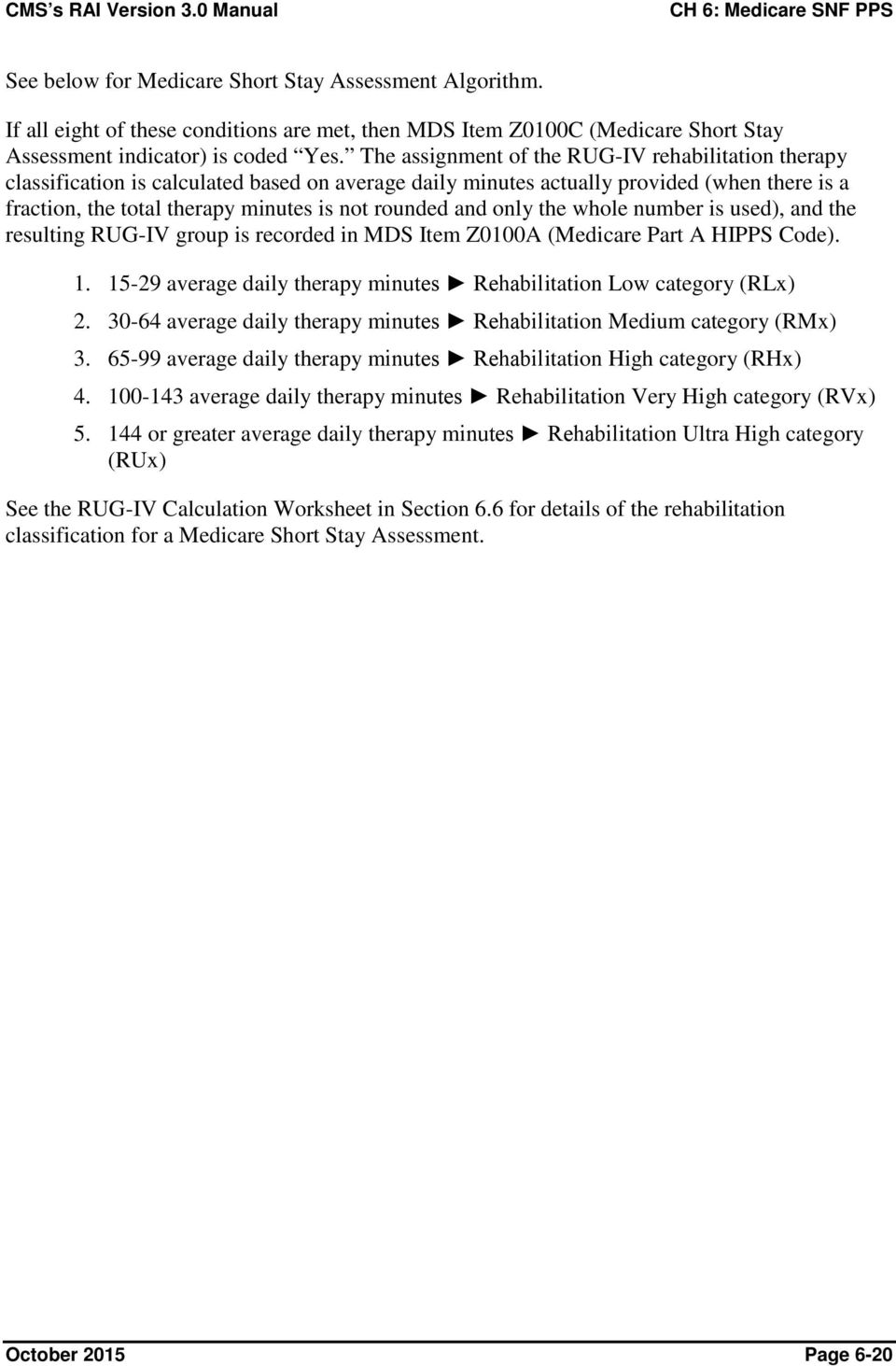
20 See below for Medicare Short Stay Assessment Algorithm. If all eight of these conditions are met, then MDS Item Z0100C (Medicare Short Stay Assessment indicator) is coded Yes. The assignment of the RUG-IV rehabilitation therapy classification is calculated based on average daily minutes actually provided (when there is a fraction, the total therapy minutes is not rounded and only the whole number is used), and the resulting RUG-IV group is recorded in MDS Item Z0100A (Medicare Part A HIPPS Code) average daily therapy minutes Rehabilitation Low category (RLx) average daily therapy minutes Rehabilitation Medium category (RMx) average daily therapy minutes Rehabilitation High category (RHx) average daily therapy minutes Rehabilitation Very High category (RVx) or greater average daily therapy minutes Rehabilitation Ultra High category (RUx) See the RUG-IV Calculation Worksheet in Section 6.6 for details of the rehabilitation classification for a Medicare Short Stay Assessment. October 2015 Page 6-20
21 Medicare Short Stay Assessment Algorithm Is the Medicare SNF stay 8 days or less? No Short stay does not apply. Medicare Short Stay Assessment Requirements: All 8 must be true Yes Did therapy start in the last 4 days of the stay? Yes Did at least one discipline continue through to last day of stay? Yes No No Short stay does not apply. Short stay does not apply. Assessment Requirements: 1. Must be SOT OMRA 2. 5-day assessment must be completed (may be combined with the SOT OMRA) ARD Requirements: 3. Must be Day 8 or earlier of Part A stay 4. Must be last day of Part A stay (see Item A2400C instructions) 5. Must be no more than 3 days after the start of therapy, not including the start of therapy date Rehabilitation Requirements: 6. Must have started in last 4 days of Part A stay 7. Must continue through last day of Part A stay Will the resident classify in a Rehabilitation Plus Extensive Services or Rehabilitation group? No Short stay does not apply. RUG Requirement: 8. Must classify resident into a Rehabilitation Plus Extensive Services or Rehabilitation group Yes Note: When the earliest start of therapy is 1 st day of stay, then the Part A stay must be 4 days or less Was a 5-day assessment completed? No Complete SOT OMRA combined with 5-day Yes Complete SOT OMRA October 2015 Page 6-21
22 The impacts on the payment periods for the Medicare Short Stay assessment are as follows: 1. If the earliest start of therapy date (Items O0400A5, O0400B5, or O0400C5) is the first day of the short stay, use the Medicare Short Stay assessment Medicare Part A RUG (Z0100) from the beginning of the short stay through the end of the stay (the Medicare stay must be 4 days or less). 2. If the earliest start of therapy date is after the first day of the short stay, the following apply: a. If a 5-day assessment was completed prior to Medicare Short Stay assessment, use the Medicare Part A RUG (Z0100A) from that assessment for the first day of the short stay through the day before therapy started; then use the Medicare Part A RUG (Z0100A) from the Medicare Short Stay assessment from the day therapy started through the end of the short stay; or b. If the Start of Therapy OMRA is combined with a 5-day assessment, use the Medicare Part A non-therapy RUG (Z0150A) for the first day of the short stay through the day before therapy started; then use the Medicare Part A RUG (Z0100A) from the day therapy started through the end of the short stay. 6.5 SNF PPS Eligibility Criteria Under SNF PPS, beneficiaries must meet the established eligibility requirements for a Part A SNF-level stay. These requirements are summarized in this section. Refer to the Medicare General Information, Eligibility, and Entitlement Manual, Chapter 1 (Pub ), and the Medicare Benefit Policy Manual, Chapter 8 (Pub ), for detailed SNF coverage requirements and policies. Technical Eligibility Requirements The beneficiary must meet the following criteria: Beneficiary is Enrolled in Medicare Part A and has days available to use. There has been a three-day prior qualifying hospital stay (i.e., three midnights). Admission for SNF-level services is within 30 days of discharge from an acute care stay or within 30 days of discharge from a SNF level of care. Clinical Eligibility Requirements A beneficiary is eligible for SNF extended care if all of the following requirements are met: The beneficiary has a need for and receives medically necessary skilled care on a daily basis, which is provided by or under the direct supervision of skilled nursing or rehabilitation professionals. As a practical matter, these skilled services can only be provided in an SNF. The services provided must be for a condition: October 2015 Page 6-22
23 for which the resident was treated during the qualifying hospital stay, or that arose while the resident was in the SNF for treatment of a condition for which he/she was previously treated for in a hospital. Physician Certification The attending physician or a physician on the staff of the skilled nursing home who has knowledge of the case or a nurse practitioner (NP), physician assistant (PA), or clinical nurse specialist (CNS) who does not have a direct or indirect employment relationship with the facility but who is working in collaboration with the physician must certify and then periodically recertify the need for extended care services in the skilled nursing home. Certifications are required at the time of admission or as soon thereafter as is reasonable and practicable (42 CFR ). The initial certification affirms, per the required content found in 42 CFR , that the resident meets the existing SNF level of care definition, or validates via written statement that the beneficiary s assignment to one of the upper RUG-IV (Top 52) groups is correct. Re-certifications are used to document the continued need for skilled extended care services. The first re-certification is required no later than the 14th day. Subsequent re-certifications are required at no later than 30 days intervals after the date of the first re-certification. The initial certification and first re-certification may be signed at the same time. 6.6 RUG-IV 66-Group Model Calculation Worksheet for SNFs The purpose of this RUG-IV Version 1.00 calculation worksheet for the 66-group model is to provide a step-by-step walk-through to manually determine the appropriate RUG-IV Classification based on the data from an MDS assessment. The worksheet takes the grouper logic and puts it into words. We have carefully reviewed the worksheet to ensure that it represents the standard logic. In the RUG-IV 66-group model, there are 23 different Rehabilitation Plus Extensive Services and Rehabilitation groups, representing 10 different levels of rehabilitation services. In the 66-group model, the residents in the Rehabilitation Plus Extensive Services groups have the highest level of combined nursing and rehabilitation need, while residents in the Rehabilitation groups have the next highest level of need. Therefore, the 66-group model has the Rehabilitation Plus Extensive Services groups first followed by the Rehabilitation groups, the Extensive Services groups, the Special Care High groups, the Special Care Low groups, the Clinically Complex groups, the Behavioral Symptoms and Cognitive Performance groups, and the Reduced Physical Function groups. There are two basic approaches to RUG-IV Classification: (1) hierarchical classification and (2) index maximizing classification. The current worksheet was developed for the hierarchical methodology. Instructions for adapting this worksheet to the index maximizing approach are October 2015 Page 6-23
24 included below (see Index Maximizing Classification ). Note that the RUG classification used for Medicare PPS Part A billing is based on the index maximizing approach. Hierarchical Classification. The present worksheet employs the hierarchical classification method. Hierarchical classification is used in some payment systems, in staffing analysis, and in many research projects. In the hierarchical approach, start at the top and work down through the RUG-IV model; the assigned classification is the first group for which the resident qualifies. In other words, start with the Rehabilitation Plus Extensive Services groups at the top of the RUG- IV model. Then go down through the groups in hierarchical order: Rehabilitation Plus Extensive Services, Rehabilitation, Extensive Services, Special Care High, Special Care Low, Clinically Complex, Behavioral Symptoms and Cognitive Performance, and Reduced Physical Function. When you find the first of the 66 individual RUG-IV groups for which the resident qualifies, assign that group as the RUG-IV classification. If the resident qualifies in the Extensive Services group and a Special Care High group, always choose the Extensive Services classification because it is higher in the hierarchy. Likewise, if the resident qualifies for Special Care Low and Clinically Complex, always choose Special Care Low. In hierarchical classification, always pick the group nearest the top of the model. Index Maximizing Classification. Index maximizing classification is used in Medicare PPS (and most Medicaid payment systems) to select the RUG-IV group for payment. There is a designated Case Mix Index (CMI) that represents the relative resource utilization for each RUG- IV group. For index maximizing, first determine all of the RUG-IV groups for which the resident qualifies. Then, from the qualifying groups, choose the RUG-IV group that has the highest CMI. For Medicare PPS, the index maximizing method uses the CMIs effective for the appropriate Federal Fiscal Year. While the following worksheet illustrates the hierarchical classification method, it can be adapted for index maximizing. For index maximizing, evaluate all classification groups rather than assigning the resident to the first qualifying group. In the index maximizing approach, again start at the beginning of the worksheet. Then work down through all of the 66 RUG-IV Classification groups, ignoring instructions to skip groups and noting each group for which the resident qualifies. When finished, record the CMI for each of these groups. Select the group with the highest CMI. This group is the index-maximized classification for the resident. Non-Therapy Classification. In some instances, the SNF provider may be required to report, on the SNF Medicare claim, a non-therapy RUG-IV classification according to the SNF PPS policies (as noted elsewhere in this chapter, Chapter 8 of the Medicare Benefit Policy Manual, and Chapter 6 of the Medicare Claims Processing Manual). The non-therapy classification uses all the RUG-IV payment items except the rehabilitation therapy Items (O0400A,B,C) to determine a non-therapy, clinical RUG. To obtain a non-therapy RUG with this worksheet, skip Category I (Rehabilitation Plus Extensive Services) and Category II (Rehabilitation) and start with Category III (Extensive Services). Both the standard Medicare Part A RUG reported in Item Z0100A and the Medicare Part A non-therapy RUG in Item Z0150A are recorded on the MDS 3.0. When rehabilitation services are not provided, the standard Medicare Part A RUG will match the Medicare Part A non-therapy RUG. October 2015 Page 6-24
25 CALCULATION OF TOTAL ADL SCORE RUG-IV, 66-GROUP HIERARCHICAL CLASSIFICATION The ADL score is a component of the calculation for placement in all RUG-IV groups. The ADL score is based upon the four late loss ADLs (bed mobility, transfer, toilet use, and eating), and this score indicates the level of functional assistance or support required by the resident. It is a very important component of the classification process. STEP # 1 To calculate the ADL score use the following chart for bed mobility (G0110A), transfer (G0110B), and toilet use (G0110I). Enter the ADL score for each item. Self- Performance Column 1 = Support Column 2 = ADL Score = SCORE -, 0, 1, 7, or 8 and (any number) 0 G0110A = 2 and (any number) 1 G0110B = 3 and -, 0, 1, or 2 2 G0110I = 4 and -, 0, 1, or or 4 and 3 4 STEP # 2 To calculate the ADL score for eating (G0110H), use the following chart. Enter ADL score. Self-Performance Column 1 (G0110H) = Support Column 2 = ADL Score = SCORE -, 0, 1, 2, 7, or 8 and -, 0, 1, or 8 0 G0110H = -, 0, 1, 2, 7, or 8 and 2 or or 4 and -, 0, or and 2 or and 2 or 3 4 STEP # 3 Add the four scores for the total ADL score. This is the RUG-IV TOTAL ADL SCORE. The total ADL score ranges from 0 through 16. TOTAL RUG-IV ADL SCORE Other ADLs are also very important, but the research indicates that the late loss ADLs predict resource use most accurately. The early loss ADLs do not significantly change the classification hierarchy or add to the prediction of resource use. October 2015 Page 6-25
26 CALCULATION OF TOTAL REHABILITATION THERAPY MINUTES RUG-IV, 66-GROUP HIERARCHICAL CLASSIFICATION For Speech-Language Pathology Services (Items at O0400A), Occupational Therapy (Items at O0400B), and Physical Therapy (Items at O0400C), the MDS 3.0 separately captures minutes that the resident was receiving individual, concurrent, and group therapy (see Chapter 3, Section O for definitions) during the last 7 days. For each therapy discipline, actual minutes the resident spent in treatments are entered on the MDS for each of the three modes of therapy. The total minutes used for RUG-IV classification include all minutes in individual therapy, one-half of the minutes in concurrent therapy, and all minutes in group therapy for non-medicare classification. For Medicare Part A classification, the total minutes used for RUG-IV classification include all minutes in individual therapy, one-half the minutes in concurrent therapy, and the group time is allocated among 4 residents and only one-fourth of the minutes of group time are included for the resident in the total minutes for RUG-IV classification. For Medicare Part A there is a limitation that the group minutes cannot exceed 25% of the total minutes, a limitation that is applied by the grouper software. This limitation is applied after allocation of group minutes. Skip this section if therapy is not provided. In Steps #1 through #3 in calculating Rehabilitation Therapy Minutes, retain all decimal places in the calculated values. Values where decimal points are retained are indicated by an asterisk (*). STEP # 1 Calculate the total minutes for speech-language pathology services as follows: Add the individual minutes (O0400A1) and one-half of the concurrent minutes (O0400A2). Add all of the group minutes (O0400A3) for non-medicare classification or one-quarter of the group minutes for Medicare classification and record as Total Minutes. Total Minutes* = For Medicare classification the 25% group therapy limitation applies as follows: If allocated group minutes (one-quarter of O0400A3) divided by Total Minutes is greater than 0.25, then add individual minutes (O0400A1) and one-half of concurrent minutes (O0400A2), multiply this sum by 4.0 and then divide by 3.0, and record as Adjusted Minutes. Adjusted Minutes* = Record Total Minutes or Adjusted Minutes as appropriate: Speech-Language Pathology Services Minutes* = October 2015 Page 6-26
27 STEP # 2 Calculate the total minutes for occupational therapy as follows: Add the individual minutes (O0400B1) and one-half of the concurrent minutes (O0400B2). Add all of the group minutes (O0400B3) for non-medicare classification or one-quarter of the group minutes for Medicare classification and record as Total Minutes. Total Minutes* = For Medicare classification, the 25% group therapy limitation applies as follows: If allocated group minutes (one-quarter of O0400B3) divided by Total Minutes is greater than 0.25, then add individual minutes (O0400B1) and one-half of concurrent minutes (O0400B2), multiply this sum by 4.0 and then divide by 3.0, and record as Adjusted Minutes. Adjusted Minutes* = Record Total Minutes or Adjusted Minutes as appropriate: STEP # 3 Occupational Therapy Minutes* = Calculate the total minutes for physical therapy as follows: Add the individual minutes (O0400C1) and one-half of the concurrent minutes (O0400C2). Add all of the group minutes (O0400C3) for non-medicare classification or one-quarter of the group minutes for Medicare classification and record as Total Minutes. Total Minutes* = For Medicare classification, the 25% group therapy limitation applies as follows: If allocated group minutes (one-quarter of O0400C3) divided by Total Minutes is greater than 0.25, then add individual minutes (O0400C1) and one-half of concurrent minutes (O0400C2), multiply this sum by 4.0 and then divide by 3.0, and record as Adjusted Minutes. Adjusted Minutes* = Record Total Minutes or Adjusted Minutes as appropriate: Physical Therapy Minutes* = October 2015 Page 6-27
28 STEP # 4 Sum the speech-language pathology services minutes, occupational therapy minutes, and physical therapy minutes and record as Total Therapy Minutes. These are the minutes that will be used for RUG-IV rehabilitation therapy classification (when there is a fraction, the total therapy minutes is not rounded and only the whole number is used). TOTAL THERAPY MINUTES^ = ^Total Therapy Minutes is not rounded. Record only the whole number with all values after the decimal dropped. Total Rehabilitation Therapy Minutes Calculation Example Mrs. D., whose stay is covered under SNF PPS, received the following rehabilitation services as follows: Speech-language Pathology Services: Individual minutes = 110 (Item O0400A1), Concurrent minutes = 99 (Item O0400A2), Group minutes = 100 (Item O0400A3). Calculate total SLP minutes = / /4 = (retain the decimal). Check group proportion (after group allocation) = (100/4)/184.5 = Do not adjust SLP minutes for Medicare Part A since group proportion is not greater than.25. Use unadjusted total SLP minutes. Total Speech-Language Pathology Services Minutes = (retain the decimal). Occupational Therapy: Individual minutes = 78 (Item O0400B1), Concurrent minutes = 79 (Item O0400B2), Group minutes = 320 (Item O0400B3). Calculate total OT minutes = / /4 = (retain the decimal). Check group proportion = (320/4)/197.5 = Adjust OT minutes for Medicare Part A since group proportion is greater than.25. Adjusted Occupational Therapy Minutes = [( /2) x 4]/3 = (retain the decimal). Physical Therapy: Individual minutes = 92 (Item O0400C1), Concurrent minutes = 93 (Item O0400C2), Group minutes = 376 (Item O0400C3). Calculate total PT minutes = / /4 = (retain the decimal). Check group proportion = (376/4)/232.5 = Adjust PT minutes for Medicare Part A since group proportion is greater than.25. Adjusted Physical Therapy Minutes = [( /2) x 4]/3 = (retain the decimal). October 2015 Page 6-28
29 Total Adjusted Therapy Minutes: Sum SLP, OT and PT minutes after any adjustment= = Drop decimals = 525 minutes (this is the total therapy minutes value for RUG-IV classification). October 2015 Page 6-29
30 STEP # 1 MEDICARE SHORT STAY ASSESSMENT RUG-IV, 66-GROUP HIERARCHICAL CLASSIFICATION Set the Medicare Short Stay Indicator (Z0100C) as follows: RUG-IV uses an alternative rehabilitation therapy classification when an assessment is a Medicare Short Stay assessment. To be considered a Medicare Short Stay assessment and use the special RUG-IV short stay rehabilitation therapy classification, all eight of the following conditions must be met: 1. The assessment must be a Start of Therapy OMRA (Item A0310C = 1). This assessment may be performed alone or combined with any OBRA assessment or combined with a PPS 5- day assessment. The Start of Therapy OMRA may not be combined with a PPS 14-day, 30- day, 60-day, or 90-day assessment. The Start of Therapy OMRA should also be combined with a discharge assessment when the end of Part A stay is the result of discharge from the facility, but should not be combined with a discharge if the resident dies in the facility or is transferred to another payer source in the facility. 2. A PPS 5-day (Item A0310B = 01) assessment has been performed. The PPS 5-day assessment may be performed alone or combined with the Start of Therapy OMRA. 3. The ARD (Item A2300) of the Start of Therapy OMRA must be on or before the 8th day of the Part A Medicare covered stay. The ARD minus the start of Medicare stay date (A2400B) must be 7 days or less. 4. The ARD (Item A2300) of the Start of Therapy OMRA must be the last day of the Medicare Part A stay (A2400C). See instructions for Item A2400C in Chapter 3 for more detail. 5. The ARD (Item A2300) of the Start of Therapy OMRA may not be more than 3 days after the start of therapy date (Items O0400A5, O0400B5, or O0400C5, whichever is earliest) not including the start of therapy date. This is an exception to the rules for selecting the ARD for a SOT OMRA, as it is not possible for the ARD for the Short Stay Assessment to be 5-7 days after the start of therapy since therapy must have been able to be provided only 1-4 days. 6. Rehabilitation therapy (speech-language pathology services, occupational therapy or physical therapy) started during the last 4 days of the Medicare Part A stay (including weekends). The end of Medicare stay date (Item A2400C) minus the earliest start date for the three therapy disciplines (Items O0400A5, O0400B5, or O0400C5) must be 3 days or less. 7. At least one therapy discipline continued through the last day of the Medicare Part A stay. At least one of the therapy disciplines must have a dash-filled end of therapy date (Items O0400A6, O0400B6, or O0400C6) indicating ongoing therapy or an end of therapy date equal to the end of covered Medicare stay date (Item A2400C). Therapy is considered to be ongoing when: The resident was discharged and therapy was planned to continue had the resident remained in the facility, or The resident s SNF benefit exhausted and therapy continued to be provided, or The resident s payer source changed and therapy continued to be provided. October 2015 Page 6-30
31 8. The RUG group assigned to the Start of Therapy OMRA must be Rehabilitation Plus Extensive Services or a Rehabilitation group (Item Z0100A). If the RUG group assigned is not a Rehabilitation Plus Extensive Services or a Rehabilitation group, the assessment will be rejected. If all eight conditions are satisfied, record Yes in the Medicare Short Stay Assessment Indicator Z0100C); otherwise record No. MEDICARE SHORT STAY ASSESSMENT INDICATOR Yes No STEP # 2 If the Medicare Short Stay Assessment Indicator is Yes, then calculate the Medicare Short Stay Average Therapy Minutes as follows: This average is the Total Therapy Minutes (calculated above in Calculation of Total Rehabilitation Therapy Minutes) divided by the number of days from the start of therapy (earliest date in O0400A5, O0400B5, and O0400C5) through the assessment reference date (A2300). For example, if therapy started on August 1 and the assessment reference date is August 3, the average minutes is calculated by dividing by 3 days. Discard all numbers after the decimal point and record the result. MEDICARE SHORT STAY AVERAGE THERAPY MINUTES = See Section 6.4 for Medicare Short Stay Assessment Algorithm. October 2015 Page 6-31
32 CATEGORY I: REHABILITATION PLUS EXTENSIVE SERVICES RUG-IV, 66-GROUP HIERARCHICAL CLASSIFICATION Start the classification process beginning with the Rehabilitation Plus Extensive Services category. In order for a resident to qualify for this category, he/she must meet three requirements: (1) have an ADL score of 2 or more, (2) meet one of the criteria for the Extensive Services category, and (3) meet the criteria for one of the Rehabilitation categories. STEP # 1 Check the resident s ADL score. If the resident's ADL score is 2 or higher, go to Step #2. If the ADL score is less than 2, skip to Category II now. STEP # 2 Determine whether the resident is coded for one of the following treatments or services: O0100E2 O0100F2 O0100M2 Tracheostomy care while a resident Ventilator or respirator while a resident Infection isolation while a resident If the resident does not receive one of these treatments or services, skip to Category II now. STEP # 3 Determine if the resident s rehabilitation therapy services (speech-language pathology services, or occupational or physical therapy) satisfy the criteria for one of the RUG-IV Rehabilitation categories. If the resident does not meet all of the criteria for a Rehabilitation category (e.g., Ultra High Intensity), then move to the next category (e.g., Very High Intensity). Ultra High Intensity Criteria (the resident qualifies if either [1] or [2] is satisfied) 1. In the past 7 days: Total Therapy Minutes (calculated on pages ) of 720 minutes or more and One discipline (O0400A4, O0400B4 or O0400C4) for at least 5 days and A second discipline (O0400A4, O0400B4 or O0400C4) for at least 3 days 2. If the Medicare Short Stay Assessment Indicator (determined on page 6-21) is Yes : Medicare Short Stay Average Therapy Minutes (see page 6-20) of 144 minutes or more RUG-IV ADL Score RUG-IV Class RUX 2-10 RUL October 2015 Page 6-32
33 Very High Intensity Criteria (the resident qualifies if either [1] or [2] is satisfied) 1. In the last 7 days: Total Therapy Minutes (calculated on pages ) of 500 minutes or more and At least 1 discipline (O0400A4, O0400B4 or O0400C4) for at least 5 days 2. If the Medicare Short Stay Assessment Indicator (determined on page 6-21) is Yes : Medicare Short Stay Average Therapy Minutes (see page 6-20) of between 100 and 143 minutes RUG-IV ADL Score RUG-IV Class RVX 2-10 RVL High Intensity Criteria (the resident qualifies if either [1] or [2] is satisfied) 1. In the last 7 days: Total Therapy Minutes (calculated on pages ) of 325 minutes or more and At least 1 discipline (O0400A4, O0400B4, or O0400C4) for at least 5 days 2. If the Medicare Short Stay Assessment Indicator (determined on page 6-21) is Yes : Medicare Short Stay Average Therapy Minutes (see page 6-20) of between 65 and 99 minutes RUG-IV ADL Score RUG-IV Class RHX 2-10 RHL Medium Intensity Criteria (the resident qualifies if either [1] or [2] is satisfied) 1. In the last 7 days: Total Therapy Minutes (calculated on pages ) of 150 minutes or more and At least 5 distinct calendar days of any combination of the three disciplines (as documented in O0420) 2. If the Medicare Short Stay Assessment Indicator (determined on page 6-21) is Yes : Medicare Short Stay Average Therapy Minutes (see page 6-20) of between 30 and 64 minutes RUG-IV ADL Score RUG-IV Class RMX 2-10 RML October 2015 Page 6-33
34 Low Intensity Criteria (the resident qualifies if either [1] or [2] is satisfied): 1. In the last 7 days: Total Therapy Minutes (calculated on pages ) of 45 minutes or more and At least 3 distinct calendar days of any combination of the three disciplines (as documented in O0420) and Two or more restorative nursing services* received for 6 or more days for at least 15 minutes a day 2. If the Medicare Short Stay Assessment Indicator (determined on page 6-21) is Yes : Medicare Short Stay Average Therapy Minutes (see page 6-20) of between 15 and 29 minutes *Restorative Nursing Services H0200C, H0500** Urinary toileting program and/or bowel toileting program O0500A,B** Passive and/or active ROM O0500C Splint or brace assistance O0500D,F** Bed mobility and/or walking training O0500E Transfer training O0500G Dressing and/or grooming training O0500H Eating and/or swallowing training O0500I Amputation/prostheses care O0500J Communication training **Count as one service even if both provided RUG-IV ADL Score RUG-IV Class 2-16 RLX RUG-IV Classification If the resident does not classify in the Rehabilitation Plus Extensive Services Category, proceed to Category II. October 2015 Page 6-34
35 CATEGORY II: REHABILITATION RUG-IV, 66-GROUP HIERARCHICAL CLASSIFICATION Rehabilitation therapy is any combination of the disciplines of physical therapy, occupational therapy, or speech-language pathology services, and is located in Section O (Items at O0400A,B,C). Nursing rehabilitation is also considered for the low intensity classification level. It consists of urinary or bowel toileting program, providing active or passive range of motion, providing splint/brace assistance, training in bed mobility or walking, training in transfer, training in dressing/grooming, training in eating/swallowing, training in amputation/prosthesis care, and training in communication. This information is found in Sections H0200C, H0500, and O0500. STEP # 1 Determine whether the resident's rehabilitation therapy services satisfy the criteria for one of the RUG-IV Rehabilitation categories. If the resident does not meet all of the criteria for one Rehabilitation category (e.g., Ultra High Intensity), then move to the next category (e.g., Very High Intensity). A. Ultra High Intensity Criteria (the resident qualifies if either [1] or [2] is satisfied) 1. In the last 7 days: Total Therapy Minutes (calculated on pages ) of 720 minutes or more and One discipline (O0400A4, O0400B4 or O0400C4) for at least 5 days and A second discipline (O0400A4, O0400B4 or O0400C4) for at least 3 days 2. If the Medicare Short Stay Assessment Indicator (determined on page 6-21) is Yes : Medicare Short Stay Average Therapy Minutes (see page 6-20) of 144 minutes or more RUG-IV ADL Score RUG-IV Class RUC 6-10 RUB 0-5 RUA B. Very High Intensity Criteria (the resident qualifies if either [1] or [2] is satisfied) 1. In the last 7 days: Total Therapy Minutes (calculated on pages ) of 500 minutes or more and At least 1 discipline (O0400A4, O0400B4 or O0400C4) for at least 5 days 2. If the Medicare Short Stay Assessment Indicator (determined on page 6-21) is Yes : Medicare Short Stay Average Therapy Minutes (see page 6-20) of between 100 and 143 minutes October 2015 Page 6-35
36 RUG-IV ADL Score RUG-IV Class RVC 6-10 RVB 0-5 RVA C. High Intensity Criteria (the resident qualifies if either [1] or [2] is satisfied) 1. In the last 7 days: Total Therapy Minutes (calculated on pages ) of 325 minutes or more and At least 1 discipline (O0400A4, O0400B4 or O0400C4) for at least 5 days 2. If the Medicare Short Stay Assessment Indicator (determined on page 6-21) is Yes : Medicare Short Stay Average Therapy Minutes (see page 6-20) of between 65 and 99 minutes RUG-IV ADL Score RUG-IV Class RHC 6-10 RHB 0-5 RHA D. Medium Intensity Criteria (the resident qualifies if either [1] or [2] is satisfied) 1. In the last 7 days: Total Therapy Minutes (calculated on pages ) of 150 minutes or more and At least 5 distinct calendar days of any combination of the three disciplines (as documented in O0420) 2. If the Medicare Short Stay Assessment Indicator (determined on page 6-21) is Yes : Medicare Short Stay Average Therapy Minutes (see page 6-20) of between 30 and 64 minutes RUG-IV ADL Score RUG-IV Class RMC 6-10 RMB 0-5 RMA E. Low Intensity Criteria (the resident qualifies if either [1] or [2] is satisfied): 1. In the last 7 days: Total Therapy Minutes (calculated on pages ) of 45 minutes or more and At least 3 distinct calendar days of any combination of the three disciplines (as documented in O0420) and Two or more restorative nursing services* received for 6 or more days for at least 15 minutes a day October 2015 Page 6-36
37 2. If the Medicare Short Stay Assessment Indicator (determined on page 6-21) is Yes : Medicare Short Stay Average Therapy Minutes (see page 6-20) of between 15 and 29 minutes *Nursing Restorative Services H0200C, H0500** Urinary toileting program and/or bowel toileting program O0500A,B** Passive and/or active ROM O0500C Splint or brace assistance O0500D,F** Bed mobility and/or walking training O0500E Transfer training O0500G Dressing and/or grooming training O0500H Eating and/or swallowing training O0500I Amputation/prostheses care O0500J Communication training **Count as one service even if both provided RUG-IV ADL Score RUG-IV Class RLB 0-10 RLA RUG-IV Classification If the resident does not classify in the Rehabilitation Category, proceed to Category III. October 2015 Page 6-37
38 CATEGORY III: EXTENSIVE SERVICES RUG-IV, 66-GROUP HIERARCHICAL CLASSIFICATION The classification groups in this category are based on various services provided. Use the following instructions to begin the calculation: STEP # 1 Determine whether the resident is coded for one of the following treatments or services: O0100E2 O0100F2 O0100M2 Tracheostomy care while a resident Ventilator or respirator while a resident Infection isolation while a resident If the resident does not receive one of these treatments or services, skip to Category IV now. STEP # 2 If at least one of these treatments or services is coded and the resident has a total RUG-IV ADL score of 2 or more, he/she classifies as Extensive Services. Move to Step #3. If the resident's ADL score is 0 or 1, s/he classifies as Clinically Complex. Skip to Category VI, Step #2. STEP # 3 The resident classifies in the Extensive Services category according to the following chart: Extensive Service Conditions Tracheostomy care* and ventilator/respirator* Tracheostomy care* or ventilator/respirator* Infection isolation* without tracheostomy care* without ventilator/respirator* RUG-IV Class ES3 ES2 ES1 *while a resident RUG-IV Classification If the resident does not classify in the Extensive Services Category, proceed to Category IV. October 2015 Page 6-38
39 CATEGORY IV: SPECIAL CARE HIGH RUG-IV, 66-GROUP HIERARCHICAL CLASSIFICATION The classification groups in this category are based on certain resident conditions or services. Use the following instructions: STEP # 1 Determine whether the resident is coded for one of the following conditions or services: B0100, ADLs Comatose and completely ADL dependent or ADL did not occur (G0110A1, G0110B1, G0110H1, and G0110I1 all equal 4 or 8) I2100 Septicemia I2900, N0350A,B Diabetes with both of the following: Insulin injections (N0350A) for all 7 days Insulin order changes on 2 or more days (N0350B) I5100, ADL Score Quadriplegia with ADL score >= 5 I6200, J1100C Chronic obstructive pulmonary disease and shortness of breath when lying flat J1550A, others K0510A1 or K0510A2 O0400D2 Fever and one of the following; I2000 Pneumonia J1550B Vomiting K0300 Weight loss (1 or 2) K0510B1 or K0510B2 Feeding tube* Parenteral/IV feedings Respiratory therapy for all 7 days *Tube feeding classification requirements: (1) K0710A3 is 51% or more of total calories OR (2) K0710A3 is 26% to 50% of total calories and K0710B3 is 501 cc or more per day fluid enteral intake in the last 7 days. If the resident does not have one of these conditions, skip to Category V now. STEP # 2 If at least one of the special care conditions above is coded and the resident has a total RUG-IV ADL score of 2 or more, he or she classifies as Special Care High. Move to Step #3. If the resident's ADL score is 0 or 1, he or she classifies as Clinically Complex. Skip to Category VI, Step #2. October 2015 Page 6-39
40 STEP # 3 Evaluate for depression. Signs and symptoms of depression are used as a third-level split for the Special Care High category. Residents with signs and symptoms of depression are identified by the Resident Mood Interview (PHQ-9 ) or the Staff Assessment of Resident Mood (PHQ-9-OV ). Instructions for completing the PHQ-9 are in Chapter 3, Section D. Refer to Appendix E for cases in which the PHQ-9 or (PHQ-9-OV ) is complete but all questions are not answered. The following items comprise the PHQ-9 : Resident Staff Description D0200A D0500A Little interest or pleasure in doing things D0200B D0500B Feeling down, depressed, or hopeless D0200C D0500C Trouble falling or staying asleep, sleeping too much D0200D D0500D Feeling tired or having little energy D0200E D0500E Poor appetite or overeating D0200F D0500F Feeling bad or failure or let self or others down D0200G D0500G Trouble concentrating on things D0200H D0500H Moving or speaking slowly or being fidgety or restless D0200I D0500I Thoughts better off dead or hurting self - D0500J Short-tempered, easily annoyed These items are used to calculate a Total Severity Score for the resident interview at Item D0300 and for the staff assessment at Item D0600. The resident qualifies as depressed for RUG-IV classification in either of the two following cases: The D0300 Total Severity Score is greater than or equal to 10 but not 99, or The D0600 Total Severity Score is greater than or equal to 10. STEP # 4 Resident Qualifies as Depressed Yes No Select the Special Care High classification based on the ADL score and the presence or absence of depression record this classification: RUG-IV ADL Score Depressed RUG-IV Class Yes HE No HE Yes HD No HD Yes HC No HC1 2-5 Yes HB2 2-5 No HB1 RUG-IV CLASSIFICATION October 2015 Page 6-40
41 CATEGORY V: SPECIAL CARE LOW RUG-IV, 66-GROUP HIERARCHICAL CLASSIFICATION The classification groups in this category are based on certain resident conditions or services. Use the following instructions: STEP # 1 Determine whether the resident is coded for one of the following conditions or services: I4400, ADL Score Cerebral palsy, with ADL score >=5 I5200, ADL Score Multiple sclerosis, with ADL score >=5 I5300, ADL Score Parkinson s disease, with ADL score >=5 I6300, O0100C2 Respiratory failure and oxygen therapy while a resident K0510B1 or K0510B2 Feeding tube* M0300B1 Two or more stage 2 pressure ulcers with two or more selected skin treatments** M0300C1,D1,F1 Any stage 3 or 4 pressure ulcer with two or more selected skin treatments** M1030 Two or more venous/arterial ulcers with two or more selected skin treatments** M0300B1, M stage 2 pressure ulcer and 1 venous/arterial ulcer with 2 or more selected skin treatments** M1040A,B,C; M1200I Foot infection, diabetic foot ulcer or other open lesion of foot with application of dressings to the feet O0100B2 Radiation treatment while a resident O0100J2 Dialysis treatment while a resident *Tube feeding classification requirements: (1) K0710A3 is 51% or more of total calories OR (2) K0710A3 is 26% to 50% of total calories and K0710B3 is 501 cc or more per day fluid enteral intake in the last 7 days. **Selected skin treatments: M1200A,B# Pressure relieving chair and/or bed M1200C Turning/repositioning M1200D Nutrition or hydration intervention M1200E Pressure ulcer care M1200G Application of dressings (not to feet) M1200H Application of ointments (not to feet) #Count as one treatment even if both provided If the resident does not have one of these conditions, skip to Category VI now. October 2015 Page 6-41
42 STEP # 2 If at least one of the special care conditions above is coded and the resident has a total RUG-IV ADL score of 2 or more, he or she classifies as Special Care Low. Move to Step #3. If the resident's ADL score is 0 or 1, he or she classifies as Clinically Complex. Skip to Category VI, Step #2. STEP # 3 Evaluate for depression. Signs and symptoms of depression are used as a third-level split for the Special Care Low category. Residents with signs and symptoms of depression are identified by the Resident Mood Interview (PHQ-9 ) or the Staff Assessment of Resident Mood (PHQ-9-OV ). Instructions for completing the PHQ-9 are in Chapter 3, Section D. Refer to Appendix E for cases in which the PHQ-9 or (PHQ-9-OV ) is complete but all questions are not answered. The following items comprise the PHQ-9 : Resident Staff Description D0200A D0500A Little interest or pleasure in doing things D0200B D0500B Feeling down, depressed, or hopeless D0200C D0500C Trouble falling or staying asleep, sleeping too much D0200D D0500D Feeling tired or having little energy D0200E D0500E Poor appetite or overeating D0200F D0500F Feeling bad or failure or let self or others down D0200G D0500G Trouble concentrating on things D0200H D0500H Moving or speaking slowly or being fidgety or restless D0200I D0500I Thoughts better off dead or hurting self - D0500J Short-tempered, easily annoyed These items are used to calculate a Total Severity Score for the resident interview at Item D0300 and for the staff assessment at Item D0600. The resident qualifies as depressed for RUG-IV classification in either of the two following cases: The D0300 Total Severity Score is greater than or equal to 10 but not 99, or The D0600 Total Severity Score is greater than or equal to 10. Resident Qualifies as Depressed Yes No October 2015 Page 6-42
43 STEP # 4 Select the Special Care Low classification based on the ADL score and the presence or absence of depression; record this classification: RUG-IV ADL Score Depressed RUG-IV Class Yes LE No LE Yes LD No LD Yes LC No LC1 2-5 Yes LB2 2-5 No LB1 RUG-IV CLASSIFICATION October 2015 Page 6-43
44 CATEGORY VI: CLINICALLY COMPLEX RUG-IV, 66-GROUP HIERARCHICAL CLASSIFICATION The classification groups in this category are based on certain resident conditions or services. Use the following instructions: STEP # 1 Determine whether the resident is coded for one of the following conditions or services: I2000 Pneumonia I4900, ADL Score Hemiplegia/hemiparesis with ADL score >=5 M1040D,E Surgical wounds or open lesions with any selected skin treatment* M1040F Burns O0100A2 Chemotherapy while a resident O0100C2 Oxygen therapy while a resident O0100H2 IV medications while a resident O0100I2 Transfusions while a resident *Selected Skin Treatments M1200F Surgical wound care M1200G Application of dressing (not to feet) M1200H Application of ointments (not to feet) If the resident does not have one of these conditions, skip to Category VII now. STEP # 2 Evaluate for depression. Signs and symptoms of depression are used as a third-level split for the Clinically Complex category. Residents with signs and symptoms of depression are identified by the Resident Mood Interview (PHQ-9 ) or the Staff Assessment of Resident Mood (PHQ-9-OV ). Instructions for completing the PHQ-9 are in Chapter 3, section D. Refer to Appendix E for cases in which the PHQ-9 or (PHQ-9-OV ) is complete but all questions are not answered. The following items comprise the PHQ-9 : Resident Staff Description D0200A D0500A Little interest or pleasure in doing things D0200B D0500B Feeling down, depressed, or hopeless D0200C D0500C Trouble falling or staying asleep, sleeping too much D0200D D0500D Feeling tired or having little energy D0200E D0500E Poor appetite or overeating D0200F D0500F Feeling bad or failure or let self or others down D0200G D0500G Trouble concentrating on things D0200H D0500H Moving or speaking slowly or being fidgety or restless D0200I D0500I Thoughts better off dead or hurting self - D0500J Short-tempered, easily annoyed October 2015 Page 6-44
45 These items are used to calculate a Total Severity Score for the resident interview at Item D0300 and for the staff assessment at Item D0600. A higher Total Severity Score is associated with more symptoms of depression. For the resident interview, a Total Severity Score of 99 indicates that the interview was not successful. The resident qualifies as depressed for RUG-IV classification in either of the two following cases: The D0300 Total Severity Score is greater than or equal to 10 but not 99, or The D0600 Total Severity Score is greater than or equal to 10. Resident Qualifies as Depressed Yes No STEP # 3 Select the Clinically Complex classification based on the ADL score and the presence or absence of depression record this classification: RUG-IV ADL Score Depressed RUG-IV Class YES CE NO CE YES CD NO CD YES CC NO CC1 2-5 YES CB2 2-5 NO CB1 0-1 YES CA2 0-1 NO CA1 RUG-IV CLASSIFICATION October 2015 Page 6-45
46 CATEGORY VII: BEHAVIORAL SYMPTOMS AND COGNITIVE PERFORMANCE RUG-IV, 66-GROUP HIERARCHICAL CLASSIFICATION Classification in this category is based on the presence of certain behavioral symptoms or the resident s cognitive performance. Use the following instructions: STEP # 1 Determine the resident s ADL score. If the resident's ADL score is 5 or less, go to Step #2. If the ADL score is greater than 5, skip to Category VIII now. STEP # 2 If the resident interview using the Brief Interview for Mental Status (BIMS) was not conducted (indicated by a value of 0 for Item C0100), skip the remainder of this step and proceed to Step #3 to check staff assessment for cognitive impairment. Determine the resident s cognitive status based on resident interview using the BIMS. Instructions for completing the BIMS are in Chapter 3, Section C. The BIMS items involve the following: C0200 C0300 C0400 Repetition of three words Temporal orientation Recall Item C0500 provides a BIMS Summary Score for these items and indicates the resident s cognitive performance, with a score of 15 indicating the best cognitive performance and 0 indicating the worst performance. If the resident interview is not successful, then the BIMS Summary Score will equal 99. Determine whether the resident is cognitively impaired. If the resident s Summary Score is less than or equal to 9, he or she is cognitively impaired and classifies in the Behavioral Symptoms and Cognitive Performance category. Skip to Step #5. If the resident s summary score is greater than 9 but not 99, proceed to Step #4 to check behavioral symptoms. If the resident s Summary Score is 99 (resident interview not successful) or the Summary Score is blank (resident interview not attempted and skipped) or the Summary Score has a dash value (not assessed), proceed to Step #3 to check staff assessment for cognitive impairment. October 2015 Page 6-46
47 STEP # 3 Determine whether the resident is cognitively impaired based on the staff assessment rather than on resident interview. The RUG-IV Cognitive Performance Scale (CPS) is used to determine cognitive impairment. The resident is cognitively impaired if one of the three following conditions exists: 1. B0100 Coma (B0100 = 1) and completely ADL dependent or ADL did not occur (G0110A1, G0110B1, G0110H1, G0100I1 all = 4 or 8) 2. C1000 Severely impaired cognitive skills (C1000 = 3) 3. B0700, C0700, C1000 Two or more of the following impairment indicators are present: B0700 > 0 Problem being understood C0700 = 1 C1000 > 0 Short-term memory problem Cognitive skills problem and One or more of the following severe impairment indicators are present: B0700 >= 2 Severe problem being understood C1000 >= 2 Severe cognitive skills problem If the resident meets the criteria for being cognitively impaired, then he or she classifies in Behavioral Symptoms and Cognitive Performance. Skip to Step #5. If he or she does not present with a cognitive impairment as defined here, proceed to Step #4. STEP # 4 Determine whether the resident presents with one of the following behavioral symptoms: E0100A Hallucinations E0100B Delusions E0200A Physical behavioral symptoms directed toward others (2 or 3) E0200B Verbal behavioral symptoms directed toward others (2 or 3) E0200C Other behavioral symptoms not directed toward others (2 or 3) E0800 Rejection of care (2 or 3) E0900 Wandering (2 or 3) If the resident presents with one of the symptoms above, then he or she classifies in Behavioral Symptoms and Cognitive Performance. Proceed to Step #5. If he or she does not present with behavioral symptoms or a cognitive impairment, skip to Category VIII. October 2015 Page 6-47
48 STEP # 5 Determine Restorative Nursing Count Count the number of the following services provided for 15 or more minutes a day for 6 or more of the last 7 days: H0200C, H0500** O0500A,B** O0500C O0500D,F** O0500E O0500G O0500H O0500I O0500J Urinary toileting program and/or bowel toileting program Passive and/or active ROM Splint or brace assistance Bed mobility and/or walking training Transfer training Dressing and/or grooming training Eating and/or swallowing training Amputation/prostheses care Communication training **Count as one service even if both provided Restorative Nursing Count STEP # 6 Select the final RUG-IV Classification by using the total RUG-IV ADL score and the Restorative Nursing Count. RUG-IV ADL Score Restorative Nursing RUG-IV Class or more BB or 1 BB or more BA or 1 BA1 RUG-IV CLASSIFICATION October 2015 Page 6-48
49 CATEGORY VIII: REDUCED PHYSICAL FUNCTION RUG-IV, 66-GROUP HIERARCHICAL CLASSIFICATION STEP # 1 Residents who do not meet the conditions of any of the previous categories, including those who would meet the criteria for the Behavioral Symptoms and Cognitive Performance category but have a RUG-IV ADL score greater than 5, are placed in this category. STEP # 2 Determine Restorative Nursing Count Count the number of the following services provided for 15 or more minutes a day for 6 or more of the last 7 days: H0200C, H0500** O0500A,B** O0500C O0500D,F** O0500E O0500G O0500H O0500I O0500J Urinary toileting program and/or bowel toileting program Passive and/or active ROM Splint or brace assistance Bed mobility and/or walking training Transfer training Dressing and/or grooming training Eating and/or swallowing training Amputation/prostheses care Communication training **Count as one service even if both provided STEP # 3 Restorative Nursing Count Select the RUG-IV Classification by using the RUG-IV ADL score and the Restorative Nursing Count. RUG-IV ADL Score Restorative Nursing RUG-IV Class or more PE or 1 PE or more PD or 1 PD or more PC or 1 PC or more PB or 1 PB or more PA or 1 PA1 RUG-IV CLASSIFICATION October 2015 Page 6-49
50 ADJUSTMENT FOR START OF THERAPY OMRA RUG-IV, 66-GROUP HIERARCHICAL CLASSIFICATION A Start of Therapy (SOT) OMRA is a Medicare assessment used to initiate a Medicare payment level in either a Rehabilitation Plus Extensive or Rehabilitation group after rehabilitation therapy starts. The SOT OMRA is an abbreviated assessment that does not contain all of the items used for RUG-IV classification. The SOT OMRA only contains the RUG-IV items necessary for a Rehabilitation Plus Extensive or Rehabilitation classification. Classifications below the Rehabilitation category cannot be determined from an SOT OMRA unless it is combined with an assessment that contains all of the RUG-IV items (i.e., an OBRA assessment or other type of PPS assessment). MEDICARE ADJUSTMENTS Adjustments are performed for Medicare classification (Item Z0100A) on an SOT OMRA. There are three different situations relevant to Medicare classification adjustments as follows: Situation 1 If an assessment is an SOT OMRA, indicated by MDS Item A0310C = 1 or 3, whether or not it is combined with other types of assessments, then the Medicare Index Maximized RUG-IV classification in item Z0100A must be a Rehabilitation Plus Extensive Services group or a Rehabilitation group. Lower classifications are not valid for Z0100A on an SOT OMRA. If the Z0100A classification for any SOT OMRA (Item A0310C = 1 or 3) is not in a Rehabilitation Plus Extensive Services group or a Rehabilitation group, then the following adjustment should be made: Situation 2 1. The Medicare RUG-IV group reported in Item Z0100A should be adjusted to AAA (the default group), the assessment should marked as invalid, and the assessment should be barred from submission. The Quality Improvement Evaluation System (QIES) Assessment Submission and Processing (ASAP) system will reject the assessment if submitted. If the Z0100A classification for an SOT OMRA (Item A0310C = 1), not combined with an OBRA assessment or other PPS assessment, is not in a Rehabilitation Plus Extensive Services group or a Rehabilitation group, then the following adjustment applies: Situation 3 1. The Medicare Non-Therapy RUG-IV group reported in Item Z0150A should be adjusted to AAA (the default group). If the Z0100A classification for an SOT OMRA, combined with an OBRA assessment or other PPS assessment, is in a Rehabilitation Plus Extensive Services group or a Rehabilitation group, then no adjustment is necessary. October 2015 Page 6-50
51 OTHER PAYER ADJUSTMENT This other payer adjustment is applied when performing the Medicaid RUG-IV classification for Items Z0200A and Z0250A or for classification for other payers. 1. When an SOT OMRA (MDS Item A0310C = 1) is not combined with an OBRA assessment or other type of PPS assessment, then an RUG-IV classification below the Rehabilitation Plus Extensive and Rehabilitation categories should be adjusted to AAA (the default group). October 2015 Page 6-51
52 6.7 SNF PPS Policies Requirements and policies for SNF PPS are described in greater detail in the Medicare Benefit Policy Manual. Here are some situations that the SNF may encounter that may impact Medicare Part A SNF coverage for a resident, affect the PPS assessment schedule, or impact the reimbursement received by the SNF. Delay in Requiring and Receiving Skilled Services (30-Day Transfer) There are instances in which the beneficiary does not require SNF level of care services when initially admitted to the SNF. When the beneficiary requires and receives SNF level of care services within 30 days from the hospital discharge, Day 1 for the Medicare assessment schedule is the day on which SNF level of care services begins. For example, if a beneficiary is discharged from the hospital on August 1 and the SNF determines on August 31 that the beneficiary requires skilled service for a condition that was treated during the qualifying hospital stay, then the SNF would start the Medicare assessment schedule with a 5-day Medicare-required assessment, with August 31 as Day 1 for scheduling purposes. However, if the beneficiary requires and receives a SNF level of care 31 or more days after the hospital discharge, the beneficiary does not qualify for a SNF Part A stay (see Medical Appropriateness Exception below). Medical Appropriateness Exception (Deferred Treatment) An elapsed period of more than 30 days is permitted for starting SNF Part A services when a resident s condition makes it inappropriate to begin an active course of treatment in a SNF immediately after a qualifying hospital stay discharge. It is applicable only where, under accepted medical practice, the established pattern of treatment for a particular condition indicates that a covered level of SNF care will be required within a predeterminable time frame, and it is medically predictable at the time of hospital discharge that the beneficiary will require SNF level of care within a predetermined time period (for more detailed information see Chapter 8 of the Medicare Benefit Policy Manual). For example, a beneficiary is admitted to the SNF after a qualifying hospital stay for an open reduction and internal fixation of a hip. It is determined upon hospital discharge that the beneficiary is not ready for weight-bearing activity but will most likely be ready in 4-6 weeks. The physician writes an order to start therapy when the beneficiary is able to tolerate weight bearing. Once the resident is able to start therapy, the Medicare Part A stay begins, and the Medicare-required 5-day assessment will be performed. Day 1 of the stay will be the first day on which the resident starts therapy services. Resident Discharged from Part A Skilled Services and Returns to SNF Part A Skilled Level Services In the situation in which a beneficiary is discharged from SNF Medicare Part A services and later requires SNF Part A skilled level of care services, the resident may be eligible for Medicare Part A SNF coverage if the following criteria are met: 1. Less than 30 days have elapsed since the last day on which SNF level of care services were required and received, October 2015 Page 6-52
53 2. SNF-level services required by the resident are for a condition that was treated during the qualifying hospital stay or for a condition that arose while receiving care in the SNF for a condition for which the beneficiary was previously treated in the hospital, 3. Services must be reasonable and necessary, 4. Services can only be provided on an inpatient basis, 5. Resident must require and receive the services on a daily basis, and 6. Resident has remaining days in the SNF benefit period. For greater detail, refer to the Medicare Benefit Policy Manual, Chapter Non-compliance with the SNF PPS Assessment Schedule To receive payment under the SNF PPS, the SNF must complete scheduled and unscheduled assessments as described in Chapter 2. According to 42 CFR , an assessment that does not have an ARD within the prescribed ARD window will be paid at the default rate for the number of days the ARD is out of compliance. Frequent early or late assessment scheduling practices may result in a review. The default rate (AAA) takes the place of the otherwise applicable Federal rate. It is equal to the rate paid for the RUG group reflecting the lowest acuity level, and would generally be lower than the Medicare rate payable if the SNF had submitted an assessment in accordance with the prescribed assessment schedule. Early Assessment An assessment must be completed according to the designated Medicare PPS assessment schedule. If a scheduled Medicare-required assessment or an OMRA is performed earlier than the schedule indicates (the ARD is not in the defined window), the provider will be paid at the default rate for the number of days the assessment was out of compliance. For example, a Medicare-required 14-day assessment with an ARD of Day 12 (1 day early) would be paid at the default rate for the first day of the payment period that begins on day 15. In the case of an early COT OMRA, the early COT would reset the COT calendar such that the next COT OMRA, if deemed necessary, would have an ARD set for 7 days from the early COT ARD. For example, a facility completes a 30-day assessment with an ARD of November 1 which classifies a resident into a therapy RUG. A COT OMRA is completed for this resident with an ARD set for November 6, which is Day 5 of the COT observation period as opposed to November 8 which is Day 7 of the COT observation period. This COT OMRA would be considered an early assessment and, based on the ARD set for this early assessment would be paid at the default rate for the two days this assessment was out of compliance. The next seven day COT observation period would begin on November 7, and end on November 13. October 2015 Page 6-53
54 Late Assessment If the SNF fails to set the ARD within the defined ARD window for a Medicare-required assessment, including the grace days, and the resident is still on Part A, the SNF must complete a late assessment. The ARD can be no earlier than the day the error was identified. If the ARD on the late assessment is set for prior to the end of the period during which the late assessment would have controlled the payment, had the ARD been set timely, and/or no intervening assessments have occurred, the SNF will bill the default rate for the number of days that the assessment is out of compliance. This is equal to the number of days between the day following the last day of the available ARD window (including grace days when appropriate) and the late ARD (including the late ARD). The SNF would then bill the Health Insurance Prospective Payment System (HIPPS) code established by the late assessment for the remaining period of time that the assessment would have controlled payment. For example, a Medicare-required 30-day assessment with an ARD of Day 41 is out of compliance for 8 days and therefore would be paid at the default rate for 8 days and the HIPPS code from the late 30- day assessment until the next scheduled or unscheduled assessment that controls payment. In this example, if there are no other assessments until the 60-day assessment, the remaining 22 days are billed according to the HIPPS code on the late assessment. A second example, involving a late unscheduled assessment would be if a COT OMRA was completed with an ARD of Day 39, while Day 7 of the COT observation period was Day 37. In this case, the COT OMRA would be considered 2 days late and the facility would bill the default rate for 2 days and then bill the HIPPS code from the late COT OMRA until the next scheduled or unscheduled assessment controls payment, in this case, for at least 5 days. NOTE: In such cases where a late assessment is completed and no intervening assessments occur, the late assessment is used to establish the COT calendar. If the ARD of the late assessment is set after the end of the period during which the late assessment would have controlled payment, had the assessment been completed timely, or in cases where an intervening assessment has occurred and the resident is still on Part A, the provider must still complete the assessment. The ARD can be no earlier than the day the error was identified. The SNF must bill all covered days during which the late assessment would have controlled payment had the ARD been set timely at the default rate regardless of the HIPPS code calculated from the late assessment. For example, a Medicare-required 14-day assessment with an ARD of Day 32 would be paid at the default rate for Days 15 through 30. A late assessment cannot be used to replace a different Medicare-required assessment. In the example above, the SNF would also need to complete the 30-day Medicare-required assessment within Days 27-33, which includes grace days. The 30-day assessment would cover Days 31 through 60 as long as the beneficiary has SNF days remaining and is eligible for SNF Part A services. In this example, the late 14-day assessment would not be considered an assessment used for payment and would not impact the COT calendar, as only an assessment used for payment can affect the COT calendar (see section 2.8). A second example involving an unscheduled assessment would be the following. A 30-day assessment is completed with an ARD of Day 30. Day 7 of the COT observation period is Day 37. An EOT OMRA is performed timely for this resident with an ARD set for Day 42 and the October 2015 Page 6-54
55 resident s last day of therapy was Day 39. Upon further review of the resident s record on Day 52, the facility determines that a COT should have been completed with an ARD of Day 37 but was not. The ARD for the COT OMRA is set for Day 52. The late COT OMRA should have controlled payment from Day 31 until the next assessment used for payment. Because there was an intervening assessment (in this case the EOT OMRA) prior to the ARD of the late COT OMRA, the facility would bill the default rate for 9 days (the period during which the COT OMRA would have controlled payment). The facility would bill the RUG from the EOT OMRA as per normal beginning the first non-therapy day, in this case Day 40, until the next scheduled or unscheduled assessment used for payment. Missed Assessment If the SNF fails to set the ARD of a scheduled PPS assessment prior to the end of the last day of the ARD window, including grace days, and the resident is no longer a SNF Part A resident, and as a result a Medicare-required assessment does not exist in the QIES ASAP for the payment period, the provider may not usually bill for days when an assessment does not exist in the QIES ASAP. When an assessment does not exist in the QIES ASAP, there is not an assessment based RUG the provider may bill. In order to bill for Medicare SNF Part A services, the provider must submit a valid assessment that is accepted into the QIES ASAP. The provider must bill the RUG category that is verified by the system. If the resident was already discharged from Medicare Part A when this is discovered, an assessment may not be performed. However, there are instances when the SNF may bill the default code when a Medicare-required assessment does not exist in the QIES ASAP system. These exceptions are: 1. The stay is less than 8 days within a spell of illness, 2. The SNF is notified on an untimely basis of or is unaware of a Medicare Secondary Payer denial, 3. The SNF is notified on an untimely basis of a beneficiary s enrollment in Medicare Part A, 4. The SNF is notified on an untimely basis of the revocation of a payment ban, 5. The beneficiary requests a demand bill, or 6. The SNF is notified on an untimely basis or is unaware of a beneficiary s disenrollment from a Medicare Advantage plan. In situations 2-6, the provider may use the OBRA Admission assessment to bill for all days of covered care associated with Medicare-required 5-day and 14-day assessments, even if the beneficiary is no longer receiving therapy services that were identified under the most recent clinical assessment. The ARD of the OBRA Admission assessment may be before or during the Medicare stay and does not have to fall within the ARD window of the 5-day or 14-day assessment. When an OBRA Admission assessment does not exist, the SNF must have a valid OBRA assessment (except a stand-alone discharge assessment) in the QIES ASAP system that falls within the ARD window of the 5-day or the 14-day (including grace days) in order to receive full payment at the RUG category in which the resident grouped for days 1-14 or days This assessment may only cover one payment period. If the ARD of the valid OBRA assessment falls outside the ARD window of the 5-day and 14-day PPS assessments (including grace days), the October 2015 Page 6-55
56 SNF must bill the default code for the applicable payment period. For covered days associated with the Medicare-required 30-day, 60-day, or 90-day assessments, the SNF must have a valid OBRA assessment (except a stand-alone discharge assessment) in the QIES ASAP system that falls within the ARD window of the PPS assessment (including grace days) in order to receive full payment at the RUG category in which the resident grouped. If the ARD of the valid OBRA assessment falls outside the ARD window of the PPS assessment (including grace days), the SNF must bill the default code. Under all situations other than exceptions 1-5, the following apply when the SNF failed to set the ARD prior to the end of the last day of the ARD window, including grace days, or later and the resident was already discharged from Medicare Part A when this was discovered: 1. If a valid OBRA assessment (except a stand-alone discharge assessment) exists in the QIES ASAP system with an ARD that is within the ARD window of the PPS assessment (including grace days), the SNF may bill the RUG category in which the resident classified. 2. If a valid OBRA assessment (except a stand-alone discharge assessment) exists in the QIES ASAP system with an ARD that is outside the ARD window of the Medicare-required assessment (including grace days), the SNF may not bill for any days associated with the missing PPS assessment. 3. If a valid OBRA assessment (except a stand-alone discharge assessment) does not exist in the QIES ASAP system, the SNF may not bill for any days associated with the missing PPS assessment. In the case of an unscheduled assessment if the SNF fails to set the ARD for an unscheduled PPS assessment within the defined ARD window for that assessment, and the resident has been discharged from Part A, the assessment is missed and cannot be completed. All days that would have been paid by the missed assessment (had it been completed timely) are considered providerliable. However, as with late unscheduled assessment policy, the provider-liable period only lasts until the point when an intervening assessment controls the payment. ARD Outside the Medicare Part A SNF Benefit A SNF may not use a date outside the SNF Part A Medicare Benefit (i.e., 100 days) as the ARD for a scheduled PPS assessment. For example, the resident returns to the SNF on December 11 following a hospital stay, requires and receives SNF skilled services (and meets all other required coverage criteria), and has 3 days left in his/her SNF benefit period. The SNF must set the ARD for the PPS assessment on December 11, 12, or 13 to bill for the RUG category associated with the assessment. A SNF may use a date outside the SNF Part A Medicare Benefit (i.e., 100 days) as the ARD for an unscheduled PPS assessment, but only in the case where the ARD for the unscheduled assessment falls on a day that is not counted among the beneficiary s 100 days due to a leave of absence (LOA), as defined in Chapter 2, sections 2.4 and 2.13, and the resident returns to the facility from the LOA on Medicare Part A. For example, Day 7 of the COT observation period occurs 7 days following the ARD of the most recent PPS assessment used for payment, regardless if a LOA occurs at any point during the COT observation period. If the ARD for a resident s 30-day assessment were set for November 7 and the resident went to the emergency room at 11:00pm on November 14, returning on November 15, Day 7 of the COT observation period would remain November 14 for purposes of coding the COT OMRA. October 2015 Page 6-56
Medicare Skilled Nursing Facility Prospective Payment System (SNF PPS)
 Chapter 6: Medicare Skilled Nursing Facility Prospective Payment System (SNF PPS) 6.1 Background The Balanced Budget Act of 1997 included the implementation of a Medicare Prospective Payment System (PPS)
CHAPTER 6: MEDICARE SKILLED NURSING FACILITY PROSPECTIVE PAYMENT SYSTEM (SNF PPS)
 CHAPTER 6: MEDICARE SKILLED NURSING FACILITY PROSPECTIVE PAYMENT SYSTEM (SNF PPS) 6.1 Background The Balanced Budget Act of 1997 included the implementation of a Medicare Prospective Payment System (PPS)
How To Make A Profit From A Pension Plan
 PRIME REHABILITATION SERVICES PPS AND FINANCIAL CHALLENGES 2012 PRESENTED BY: TAMAR BROOKS, COO October 2011 Agenda Topics Financial Implications of SNF 2012 Rule RUG IV Classification Highlights 2012
Strategies and Best Practices for Managing RUG IV SNF Reimbursement. Objectives. Introduction
 Strategies and Best Practices for Managing RUG IV SNF Reimbursement Objectives Provide information on the changes to PPS reimbursement under MDS 3.0/RUG IV for Medicare Part A residents in the SNF Provide
Skilled Nursing Facility (SNF) MDS Assessment Schedule Teleconference October 20, 2011 Presented by: Janet Mateo
 Skilled Nursing Facility (SNF) MDS Assessment Schedule Teleconference October 20, 2011 Presented by: Janet Mateo 1 Agenda Overview Of Minimum Data Set (MDS) Assessments FY 2012 Changes Revisions to the
Definition and Uses of Health Insurance Prospective Payment System Codes (HIPPS Codes)
 Definition and Uses of Health Insurance Prospective Payment System Codes (HIPPS Codes) Definition Health Insurance Prospective Payment System (HIPPS) rate codes represent specific sets of patient characteristics
INTRODUCTION TO THE MDS 3.0 RUG-III v. 5.12 44-GROUP CLASSIFICATION TOOL
 INTRODUCTION TO THE MDS 3.0 RUG-III v. 5.12 44-GROUP CLASSIFICATION TOOL This educational tool was developed to assist providers in understanding the Resource Utilization Group (RUG) III, version 5.12
NORTH DAKOTA NURSING FACILITY PAYMENT SYSTEM
 NORTH DAKOTA NURSING FACILITY PAYMENT SYSTEM North Dakota Department of Human Services Medical Services 600 E Boulevard Ave Dept 325 Bismarck ND 58505 BACKGROUND State law requires all nursing facilities
MDS 3.0 and RUG-IV. Updates and Training for FY 2012. August 23, 2011
 MDS 3.0 and RUG-IV Updates and Training for FY 2012 August 23, 2011 1 Agenda New MDS Assessment Schedule Allocation of Group Therapy Minutes Revised Student Supervision Provisions EOT OMRA and New Resumption
NEW YORK CASE MIX. Jan White, RN Senior Clinical Reimbursement Consultant
 NEW YORK CASE MIX Jan White, RN Senior Clinical Reimbursement Consultant 1 Objectives Explain the basic elements of the Case Mix system Review the Case Mix RUG levels Define ADLs and understand their effect
 Resource Utilization Groups (RUGs) September 2, 2009 Anthony M. Tucker, PhD Maryland LTC-PAC Workgroup Resource Utilization Groups (RUGs) RUGs are mutually exclusive categories that reflect levels of resource
Clinical Groups and Services. EXTENSIVE SERVICES (3 Categories)
 Department of Health and Hospitals RUG-III Classification Model Version 5.20, 34-Group Extensive Services Category I Effective For Assessments With an ARD on or After 10/1/2013 Extensive Services Clinical
VHA COMMUNITY NURSING HOME PROVIDER AGREEMENT
 VHA COMMUNITY NURSING HOME PROVIDER AGREEMENT A Community Nursing Home (CNH) Provider Agreement is formed when VA agrees to place a patient in the nursing home that meets all terms and conditions described
RESOURCE UTILIZATION GROUP, VERSION IV 48-GROUP USER GUIDE
 RESOURCE UTILIZATION GROUP, VERSION IV 48-GROUP USER GUIDE Mississippi Division of Medicaid Myers and Stauffer LC CONTENTS 1 OVERVIEW 3 INTRODUCTION... 3 PURPOSE... 3 SCOPE... 3 Hierarchical Classification:...
Differences in Resident Case-mix Between Medicare and Non-Medicare Nursing Home Residents
 Differences in Resident Case-mix Between and Non- Nursing Home Residents Alan White Patricia Rowan Abt Associates Inc. A report by staff from Abt Associates for the Payment Advisory Commission MedPAC 425
SECTION Z: ASSESSMENT ADMINISTRATION. Z0100: Medicare Part A Billing. Item Rationale. Coding Instructions for Z0100A, Medicare Part A HIPPS Code
 SECTION Z: ASSESSMENT ADMINISTRATION Intent: The intent of the items in this section is to provide billing information and signatures of persons completing the assessment. Z0100: Medicare Part A Billing
Minimum Data Set 3.0 Coding and Interpretation Training Version 1.10
 Minimum Data Set 3.0 Coding and Interpretation Training Version 1.10 August 8 th -9 th, 2013 1 MDS 3.0 RAI Manual V1.10 Updated effective May 20, 2013 (http://www.cms.gov/medicare/quality-initiatives-patient-assessment-
Medicare Program Integrity Manual Chapter 6 - Medicare Contractor Medical Review Guidelines for Specific Services
 Medicare Program Integrity Manual Chapter 6 - Medicare Contractor Medical Review Guidelines for Specific Services Transmittals for Chapter 6 Table of Contents (Rev. 608, 08-14-15) 6.1 - Medical Review
Maryland Department of Health and Mental Hygiene TIME-WEIGHTED CMI RESIDENT ROSTER USER GUIDE
 Maryland Department of Health and Mental Hygiene TIME-WEIGHTED CMI RESIDENT ROSTER USER GUIDE Myers and Stauffer LC Final 08/05/2015 Contents 1 REGULATORY REQUIREMENTS 3 INTRODUCTION... 3 SCHEDULE OF CASE
QUESTIONABLE BILLING BY SKILLED NURSING FACILITIES.
 Department of Health and Human Services OFFICE OF INSPECTOR GENERAL QUESTIONABLE BILLING BY SKILLED NURSING FACILITIES. Daniel R. Levinson Inspector General December 2010 E X E C U T I V E S U M M A R
Administrator s Survival Guide to MDS 3.0 and RUG-IV
 Administrator s Survival Guide to MDS 3.0 and RUG-IV Massachusetts Chapter of ACHCA Presented by: PPS & Case Mix Onsite Chart Audits MMQ Audits Seminars Consulting Program Development Mock Survey Sample
CLINICAL REIMBURSEMENT ESSENTIALS for LEADERS. David Rokes, RN C.E.O.
 CLINICAL REIMBURSEMENT ESSENTIALS for LEADERS David Rokes, RN C.E.O. Understand effective strategies and systems implementation to ensure appropriate reimbursement and withstanding audit scrutiny Understand
Louisiana Case Mix System Department of Health and Hospitals Point in Time Report Guidelines, RUG-III Grouper Version 1.
 Basic OBRA Assessment/Record Sequencing Requirements Federal regulations at 42 CFR 483.20(b)(1)(xviii), (g), and (h) 1) The assessment accurately reflects the resident s status 2) A registered nurse conducts
Medicaid Case Mix Strategies. Housekeeping. Harmony Healthcare International, Inc. Objectives. Copyright 2012 All Rights Reserved 1
 Medicaid Case Mix Strategies HARMONY UNIVERSITY The Provider Unit of (HHI) Presented by: Keri Hart, MS CCC-SLP, RAC-CT Director of CHHRP Program Development Housekeeping Sign In Contact Hours Certificate
Pathology and Audiology Services and Occupational and Physical Therapies
 3 O0100 O-1 Do not code services that were provided solely in conjunction with a surgical procedure or diagnostic procedure, such as IV medications or ventilators. Surgical procedures include routine pre-
MDS 3.0 Corrections. Why Accuracy
 MDS 3.0 Corrections December 2013 Why Accuracy The importance of accurately completing and submitting the MDS cannot be over-emphasized. The MDS is the basis for: the development of an individualized care
COMMONWEALTH OF KENTUCKY OFFICE OF INSPECTOR GENERAL AND MYERS AND STAUFFER LC PRESENT MDS ADVANCED TRAINING
 COMMONWEALTH OF KENTUCKY OFFICE OF INSPECTOR GENERAL AND MYERS AND STAUFFER LC PRESENT MDS ADVANCED TRAINING 1 MDS 3. RAI MANUAL V1.1 Updated effective October 1, 14 http://www.cms.gov/medicare/quality-initiatives-patient-assessment-
Understanding MDS 3.0 and RUG IV Reimbursement for Nursing Homes
 Understanding MDS 3.0 and RUG IV Reimbursement for Nursing Homes Prepared by: Joseph J. Tomaino Director Health Care Consulting RSM McGladrey, Inc. 212.376.1640 [email protected] Introduction
7/8/2010. Resident Assessment Instrument. Katrina Magdon Alabama Nursing Home Association Robin A. Bleier
 Katrina Magdon Alabama Nursing Home Association Robin A. Bleier RB Health Partners, Inc. [email protected] Resident Assessment Instrument The role of the RAI process: individual id gap analysis
Medicare Part A Introduction to Skilled Nursing Facility Billing
 www.hcfa.gov Medicare Part A Introduction to Skilled Nursing Facility Billing EMPIRE MEDICARE SERVICES HCFA Medicare Part A and Part B Contracted Agent Medicare Billing Skilled Nursing Facility Table of
NURSING FACILITY PRICE-BASED PAYMENT METHODOLOGY FAQs
 NURSING FACILITY PRICE-BASED PAYMENT METHODOLOGY FAQs (Revised November 19, 2014) Note: Highlighted questions indicate revisions to Q&A or a new question since the last FAQ posting on November 4, 2014.
Swing Bed Minimum Data Set Assessment Training Manual
 Centers for Medicare and Medicaid Services Revised Swing Bed Minimum Data Set Assessment Training Manual Version 1.0 October 2003 Revised April 2004 Revised June 2005 Revised November 2005 According to
MDS 3.0 Basic Training
 MDS.0 Basic Training Carol Serici Griffin RN, BS State of Ohio RAI Coordinator 64 995 0774 carol.serici [email protected] Janet Kennedy, BSN, CRRN NATCEP Coordinator/MDS Back up 64 466 6 [email protected]
OFFICE OF MEDICAID POLICY AND PLANNING TIME WEIGHTED CMI RESIDENT ROSTER REPORT GUIDELINES; 34 GROUP Version 2.0 (September 2013)
 Basic OBRA Assessment/Record Sequencing Requirements Federal regulations at 42 CFR 483.20(b)(1)(xviii), (g), and (h) 1) The assessment accurately reflects the resident s status 2) A registered nurse conducts
Basics of Skilled Nursing Facility Consolidated Billing (SNF-CB) Medicare Part A and B Presentation March 19, 2013
 Basics of Skilled Nursing Facility Consolidated Billing (SNF-CB) Medicare Part A and B Presentation March 19, 2013 2 Agenda Skilled Care Defined Background on SNF-CB Under Arrangements Inclusions and Exclusions
Common Medicare Billing Mistakes Systems and protocols necessary to help prevent and overpayment Best practices in resolving an overpayment
 Bill J. Ulrich, President / CEO Consolidated Billing Services Inc. Pat Newberry, Director of Clinical Education AIS Inc. Common Medicare Billing Mistakes Systems and protocols necessary to help prevent
DEPARTMENT OF HEALTH AND HUMAN SERVICES DEPARTMENTAL APPEALS BOARD. DECISION OF MEDICARE APPEALS COUNCIL Docket Number: M-11-1343
 DEPARTMENT OF HEALTH AND HUMAN SERVICES DEPARTMENTAL APPEALS BOARD DECISION OF MEDICARE APPEALS COUNCIL Docket Number: M-11-1343 In the case of Claim for Hospital Insurance Benefits Restore Management
Irene Fleshner, RN, MHSA, FACHE SVP, Strategic Nursing Initiatives Genesis HealthCare Principal, Reno, Davis and Associates, Inc.
 Irene Fleshner, RN, MHSA, FACHE SVP, Strategic Nursing Initiatives Genesis HealthCare Principal, Reno, Davis and Associates, Inc. Independent Living Continuing Care Retirement Community Home Care Assisted
Follow-up information from the November 12 provider training call
 Follow-up information from the November 12 provider training call Criteria I. Multiple Therapy Disciplines 1. Clarification regarding the use of group therapies in IRFs. Answer: CMS has not yet established
Design for Nursing Home Compare Five-Star Quality Rating System: Technical Users Guide
 Design for Nursing Home Compare Five-Star Quality Rating System: Technical Users Guide July 2010 Introduction The Centers for Medicare & Medicaid Services (CMS) has enhanced its Nursing Home Compare public
It s Time to Transition to ICD-10
 July 22, 2015 It s Time to Transition to ICD-10 What do the changes mean to your SNF? Presented by: Linda S. Little, RN-BSN Clinical Consultant HMM Consulting Office: (631) 265-6289 E-Mail: [email protected]
8.470 HOSPITAL BACK UP LEVEL OF CARE PAGE 1 OF 10. Complex wound care means that the client meets the following criteria:
 8.470 HOSPITAL BACK UP LEVEL OF CARE PAGE 1 OF 10 8.470 HOSPITAL BACK UP LEVEL OF CARE 8.470.1 DEFINITIONS Complex wound care means that the client meets the following criteria: 1. Has at least one of
Medicare Benefit Policy Manual Chapter 8 - Coverage of Extended Care (SNF) Services Under Hospital Insurance
 Medicare Benefit Policy Manual Chapter 8 - Coverage of Extended Care (SNF) Services Under Hospital Insurance Table of Contents (Rev. 204, 03-13-15) Transmittals Issued for this Chapter 10 - Requirements
Billing and Processing Issues
 Billing Issues 1 Billing and Processing Issues Identified Billing Errors - Provider Education Needs Modifiers New Additions and Appropriate Use Billing for 5 Day Presumption Special Billing Situations:
PA PROMISe 837 Institutional/UB 04 Claim Form
 Table of Contents 2 1 Appendix H Bureau of Provider Support (BPS) Field Operations Review Process Contents: A. General Background B. Explanation of Forms and Terms used in the Field Operations Section
Cheryl Shiffer, RN, BSN, RAC-CT
 Cheryl Shiffer, RN, BSN, RAC-CT Center for Policy and Innovation Texas Department of Aging and Disability Services (DADS) RAI Panel, Center for Medicare & Medicaid Services (CMS) PRESENTED BY Identify
Update: Medical Necessity Documentation. Kerry Dunning, MHA, MSH, CPAR, RAC-CT GPS HEALTHCARE CONSULTANTS November 2013
 Update: Medical Necessity Documentation Kerry Dunning, MHA, MSH, CPAR, RAC-CT GPS HEALTHCARE CONSULTANTS November 2013 REMINDER Many claim denials occur because the providers or suppliers do not submit
Inpatient or Outpatient Only: Why Observation Has Lost Its Status
 Inpatient or Outpatient Only: Why Observation Has Lost Its Status W h i t e p a p e r Proper patient status classification affects the clinical and financial success of hospitals. Unfortunately, assigning
Molina Healthcare of Ohio Nursing Facility Orientation Molina Dual Options MyCare Ohio 2014
 Molina Healthcare of Ohio Nursing Facility Orientation Molina Dual Options MyCare Ohio 2014 1 Eligibility Headline Goes Here Long Term Care (LTC) is the provision of medical, social, and personal care
Rev. 4 41-303 PART II - CERTIFICATION
 11-12 FORM CMS-2540-10 4190 (Cont.) This report is required by law (42 USC 1395g; 42 CFR 413.20(b)). Failure to report can result in all interim FORM APPROVED payments made since the beginning of the cost
VHA COMMUNITY NURSING HOME PROVIDER AGREEMENT
 VHA COMMUNITY NURSING HOME PROVIDER AGREEMENT A Community Nursing Home (CNH) Provider Agreement is formed when VA agrees to place a patient in the nursing home that meets all terms and conditions described
CHAPTER 2: ASSESSMENTS FOR THE RESIDENT ASSESSMENT INSTRUMENT (RAI)
 CHAPTER 2: ASSESSMENTS FOR THE RESIDENT ASSESSMENT INSTRUMENT (RAI) This chapter presents the assessment types and instructions for the completion (including timing and scheduling) of the mandated OBRA
SKILLED NURSING FACILITY (SNF)
 MEDICARE REIMBURSEMENT REFERENCE GUIDE SKILLED NURSING FACILITY (SNF) EFFECTIVE JANUARY 1, 2016 Overview This guide includes an overview of Medicare reimbursement methodologies and potential coding options
Design for Nursing Home Compare Five-Star Quality Rating System: Technical Users Guide. February 2015
 Design for Nursing Home Compare Five-Star Quality Rating System: Technical Users Guide February 2015 Introduction In December 2008, The Centers for Medicare & Medicaid Services (CMS) enhanced its Nursing
Restorative Nursing Teleconference Script
 Slide 1 Slide 2 Slide 3 Maintaining independence in ADLs and mobility is very important to most of us. In fact, functional decline can lead to depression, withdrawal, social isolation, and complications
MONTANA. Downloaded January 2011
 MONTANA Downloaded January 2011 37.40.202 PREADMISSION SCREENING, GENERAL REQUIREMENTS (1) This rule provides the preadmission screening requirements of the Montana Medicaid program for applicants to nursing
Inpatient Transfers, Discharges and Readmissions July 19, 2012
 Inpatient Transfers, Discharges and Readmissions July 19, 2012 Discharge Status Codes Two-digit code Identifies where the patient is at conclusion of encounter Visit Inpatient stay End of billing cycle
2/21/2014. Therapy Utilization in Long Term Care: Is It Really Over Utilization
 Therapy Utilization in Long Term Care: Is It Really Over Utilization Shawn Halcsik DPT, MEd, OCS, RAC CT, CPC, CHC Vice President of Compliance Evergreen Rehabilitation Judith Bartlett Program Analyst
Design for Nursing Home Compare Five-Star Quality Rating System: Technical Users Guide
 Design for Nursing Home Compare Five-Star Quality Rating System: Technical Users Guide February 2009 Introduction The Centers for Medicare & Medicaid Services (CMS) has enhanced its Nursing Home Compare
REHABILITATION UNIT CRITERIA WORK SHEET
 DEPARTMENT OF HEALTH AND HUMAN SERVICES CENTERS FOR MEDICARE & MEDICAID SERVICES FORM APPROVED OMB NO. 0938-0986 REHABILITATION UNIT CRITERIA WORK SHEET RELATED MEDICARE PROVIDER NUMBER ROOM NUMBERS IN
IN THE MATTER OF: Docket No. 2012-34829 EDW DECISION AND ORDER
 STATE OF MICHIGAN MICHIGAN ADMINISTRATIVE HEARING SYSTEM FOR THE DEPARTMENT OF COMMUNITY HEALTH P.O. Box 30763, Lansing, MI 48909 (517) 335-2484; Fax: (517) 373-4147 IN THE MATTER OF: Docket No. 2012-34829
NURSING FACILITY LEVEL OF CARE (NF LOC) CHANGE. Question and Answer
 NURSING FACILITY LEVEL OF CARE (NF LOC) CHANGE Question and Answer Q. What is the Nursing Facility Level of Care (NF LOC) change? A. The NF LOC change is a change in the statutory criteria used to establish
Comparison of the Prospective Payment System Methodologies Currently Utilized in the United States
 Comparison of the Prospective Payment System Methodologies Currently Utilized in the United States 1 Can you speak the jargon of Prospective Payment Systems? MS- DRGs APCs IPF-PPS RBRVS HHRGs RUGs MS-LTC
IN THE MATTER OF: Docket No. 2012-39337 EDW 8 DECISION AND ORDER
 STATE OF MICHIGAN MICHIGAN ADMINISTRATIVE HEARING SYSTEM FOR THE DEPARTMENT OF COMMUNITY HEALTH P.O. Box 30763, Lansing, MI 48909 (877) 833-0870; Fax: (517) 334-9505 IN THE MATTER OF: Docket No. 2012-39337
GENERAL ADMISSION CRITERIA INPATIENT REHABILITATION PROGRAMS
 Originator: Case Management Original Date: 9/94 Review/Revision: 6/96, 2/98, 1/01, 4/02, 8/04, 3/06, 03/10, 3/11, 3/13 Stakeholders: Case Management, Medical Staff, Nursing, Inpatient Therapy GENERAL ADMISSION
Design for Nursing Home Compare Five-Star Quality Rating System: Technical Users Guide. March 2009
 Design for Nursing Home Compare Five-Star Quality Rating System: Technical Users Guide March 2009 (Revised April 1) Introduction The Centers for Medicare & Medicaid Services (CMS) has enhanced its Nursing
Billing App Update: Version 2.012
 Billing App Update: Presented by M. Aaron Little, CPA BKD, LLP Springfield, MO [email protected] Today s Agenda 2012 prospective payment system (PPS) rates Timely filing Healthcare Common Procedure Coding
UnitedHealthcare Medicare Solutions Readmission Review Program for Medicare Advantage Plans
 UnitedHealthcare Medicare Solutions Readmission Review Program for Medicare Advantage Plans General Clinical Guidelines for Payment Review Updated May 2015 Introduction The UnitedHealthcare Medicare Solutions
September 4, 2012. Submitted Electronically
 September 4, 2012 Ms. Marilyn Tavenner Acting Administrator Centers for Medicare & Medicaid Services Department of Health and Human Services Attention: CMS-1589-P P.O. Box 8016 Baltimore, MD 21244-8016
Clinical Coverage Criteria Extended Care Facility
 Clinical Coverage Criteria Extended Care Facility Document Number: 018 Commercial MassHealth* Commonwealth Care Authorization required X X X Notification within 24 hours of service or next business day
What to know if Medicare denies coverage
 What to know if Medicare denies coverage What Medicare covers Necessary post-hospital extended care for up to 100 days Extended care: nursing care and rehab provided to a Medicare beneficiary who is an
DEPARTMENT OF HEALTH AND HUMAN SERVICES Centers for Medicare & Medicaid Services. Discharge Planning
 DEPARTMENT OF HEALTH AND HUMAN SERVICES Centers for Medicare & Medicaid Services ICN 908184 October 2014 This booklet was current at the time it was published or uploaded onto the web. Medicare policy
CHAPTER 4: CARE AREA ASSESSMENT (CAA) PROCESS AND CARE PLANNING
 CHAPTER 4: CARE AREA ASSESSMENT (CAA) PROCESS AND CARE PLANNING 4.1 Background and Rationale The Omnibus Budget Reconciliation Act of 1987 (OBRA 1987) mandated that nursing facilities provide necessary
CMS Response to the North Dakota and Minnesota Storms/Flooding Emergencies Medicare Fee-For- Service
 3/27/2009 CMS Response to the North Dakota and Minnesota Storms/Flooding Emergencies Medicare Fee-For- Service # Question and Answer Waiver of Certain Medicare Requirements 1 Question: Do the modifications
MDS 3.0 What s New & A Review. Focused Survey NOMNC 10/31/2014. Carol Hill, MSN, RN, RAC CT, C NE, RAC MT
 MDS 3.0 What s New & A Review Carol Hill, MSN, RN, RAC CT, C NE, RAC MT Focused Survey Focused Minimum Data Set (MDS) Survey April 18, 2014 S& C:14 22 NH Pilot Began 2014 Intent to document MDS 3.0 coding
GAO SKILLED NURSING FACILITIES. Medicare Payments Exceed Costs for Most but Not All Facilities. Report to Congressional Committees
 GAO United States General Accounting Office Report to Congressional Committees December 2002 SKILLED NURSING FACILITIES Medicare Payments Exceed Costs for Most but Not All Facilities GAO-03-183 Contents
UB-04 Claim Form Instructions
 UB-04 Claim Form Instructions FORM LOCATOR NAME 1. Billing Provider Name & Address INSTRUCTIONS Enter the name and address of the hospital/facility submitting the claim. 2. Pay to Address Pay to address
Home Health Care Today: Higher Acuity Level of Patients Highly skilled Professionals Costeffective Uses of Technology Innovative Care Techniques
 Comprehensive EHR Infrastructure Across the Health Care System The goal of the Administration and the Department of Health and Human Services to achieve an infrastructure for interoperable electronic health
REHABILITATION SERVICES
 REHABILITATION SERVICES Table of Contents GENERAL... 2 TERMS AND ABBREVIATIONS... 2 PRIOR AUTHORIZATION REQUIREMENTS FOR MEDICAID REIMBURSEMENT OF INPATIENT REHABILITATION SERVICES (Updated 4/1/11)...
CMS Response to the Hurricane Emergency. Questions and Answers About Medicare Fee-For-Service
 CMS Response to the Hurricane Emergency Questions and s About Medicare Fee-For-Service # Question and Waiver of Certain Medicare Requirements 1 Question: Do the modifications and flexibilities described
Corporate Medical Policy
 Corporate Medical Policy File Name: Origination: Last CAP Review: Next CAP Review: Last Review: skilled_nursing_facility_care 02/2008 2/2015 2/2016 2/2015 Description of Procedure or Service A skilled