
Restorative Nursing Programs: Now More Than Ever. A Care2LearnEnterprise White Paper Authored by: Barbara Acello, MS, RN
|
|
|
- Moses Thompson
- 10 years ago
- Views:
Transcription
1 Restorative Nursing Programs: Now More Than Ever A Care2LearnEnterprise White Paper Authored by: Barbara Acello, MS, RN

2 Restorative Nursing Programs: Now More Than Ever Overview Restorative Nursing Programs: Now More than Ever Restorative nursing is more important now than it has ever been. The Omnibus Budget Reconciliation Act of 1987 (OBRA) required skilled nursing facilities to identify and act on risk factors to prevent functional decline in residents. OBRA included the legislative mandate for facilities to allow only medically unavoidable declines. Facilities are expected to plan care that will delay any decline in function in the residents. When the Resource Utilization Groups (RUGs) were initiated, restorative nursing programs became part of Medicare reimbursement. The Resident Assessment Instrument (RAI) Manual for 2010 defines restorative nursing as nursing interventions that promote the resident s ability to adapt and adjust to living as independently and safely as is possible (CMS, 2010). The RAI Manual instructs facilities to begin restorative nursing programs when a resident is discharged from therapy, at admission if the resident has restorative needs and is not a therapy candidate, and at any time during the resident s stay that restorative needs arise. In March of 2011, the National Quality Forum released 21 measures for public reporting and quality improvement that will be used at the Nursing Home Compare website. Both short-stay and long-term residents are included in this data. The measures that affect restorative nursing programs are: Percentage of residents who need increased help with activities of daily living. Physical therapy or restorative nursing for long-stay residents with a new balance problem. Percentage of long-term residents experiencing one or more falls with major injury. Percentage of low-risk residents who lose control of their bowels or bladder. Percentage of long-term residents who have a catheter inserted and left in the bladder. Restorative nursing programs affect resident quality of life by allowing the resident to be as independent as possible. Restorative nursing programs also affect reimbursement, survey, and resident/family facility choice. These programs are vital to your facility s success. Restorative nursing is basically person-centered, whole-person nursing care; the kind of nursing that we practice every time we care for a resident. The difference in a formalized restorative nursing program is that activities of daily living are considered therapeutic modalities. Nursing assistants are trained to instruct, encourage, guide, and assist residents to perform self-care skills with as much independence as possible. Quality of life is a natural outcome of restorative care. Functional decline, on the other hand, can lead to depression, withdrawal, social isolation, and complications of immobility, such as incontinence and pressure ulcers. Functional decline has been described as the main determinant of quality of life, cost of care, and vital prognosis (Baztan, 2009). The OBRA legislation and Medicare recognized the importance of preventing decline and created both a legislative and financial incentive to provide restorative nursing programs in skilled nursing facilities. Contents Overview... 1 Documentation The Restorative Nurse... 5 Restorative Nursing: Eating Restorative Nursing: Bowel & Bladder... 6 Restorative Nursing: Mobility... 7 Restorative Nursing: Range of Motion Restorative Nursing: Activities of Daily Living Survey... 8 Conclusion... 9 About the Author... 9 Graphics... 9 Resources... 9 References Page 1

3 Restorative Nursing Programs: Now More Than Ever Regulations drive reimbursement, a fact of life in long-term care. Reimbursement dictates the amount of resources available for resident care and services. A well-managed restorative nursing program can bring profit to the facility s bottom line. This is one of the ways that good care creates resources for more good care a positive cycle. Many of the changes in emphasis that occurred with the MDS 3.0 directly or indirectly relate to restorative nursing. The MDS 3.0 focuses on toileting programs, nutrition (which relates to feeding and swallowing programs), and balance (which can be affected by transfer training and ambulation programs). For the program to be profitable, attention to, and support for, the restorative nursing must come from the top. The facility administrator, director of nurses, and therapy director must be on board. A facility-wide culture of restorative nursing must be present. If not, the helpful housekeeper who does a task for the resident instead of with the resident will undermine the program. Nuts and Bolts Nurses, not physicians or therapists, order restorative nursing programs. Therapists work with nurses as consultants. However, restorative nursing is not rehabilitation therapy. Rehab and restorative nursing are complements to one another, but not the same. Residents work to keep the skills they learned in therapy in restorative nursing programs, so there is some crossover. Therapy is based more on the medical model, while restorative nursing programs are, by definition, based on the nursing model. Therapy is faster-paced, and significant progress must be made in a fairly short time. Restorative nursing, on the other hand, focuses on maintaining function in a long-term, ongoing process. Improvement is hoped for but not required. The need for rehabilitation is generally triggered by an acute illness or injury. Restorative nursing bases treatment on restoring or compensating for skills lost through chronic disease, disuse, or other physiological factors. There is usually not an acute episode that drives the restorative nursing process. Restorative nursing programs are most often begun when a resident is discharged from skilled physical, occupational, or speech therapy. But the reality is that most residents, by the very nature of their needing nursing home care, are restorative nursing candidates. CMS believes strongly that restorative nursing programs are appropriate for almost every resident. Quoting from the RAI Manual: Most residents are candidates for nursing-based rehabilitative care that focuses on maintaining and expanding selfinvolvement in ADLs. Page 2

4 Restorative Nursing Programs: Now More Than Ever Restorative nursing requires a comprehensive assessment of each resident. A combination of the MDS, staff input, and other assessments are used to identify residents. Indicators that the resident may be a restorative nursing candidate include: Incontinence without a toileting plan Decline in late-loss ADLs (bed mobility, eating, transfer, toilet use) Indwelling catheter Falls Decline in range of motion The resident should have an identified deficit and be at risk for a functional decline. Unlike therapy criteria, the resident does not have to show a potential for significant improvement, although that is always to be a goal if possible. Preventing decline alone is a sufficient justification for a restorative nursing program. Exercises, treatment, and activities in any restorative nursing program are planned, scheduled, and documented in the clinical record. Reduced Physical Function is discussed in the restorative nursing section of the MDS/RUG IV. The categories begin with P: PA1, PA2, PB1, PB2, PC1, PC2, PD1, PD2, PE1, and PE2. Two or more restorative nursing services determine the higher category. Restorative nursing programs include: Ambulation Amputation, prosthesis care (Dentures are not considered prostheses.) Bed mobility Bowel training 1 Communication training Dressing, grooming training Eating, swallowing training Range of motion active 2. Range of motion passive 2 Splint or brace application Transfer Training Urinary Toilet training 1. MDS rules for restorative nursing are specific. Restorative nursing care must be given 6 days per week. At least 15 minutes of care are required to qualify for one day of reimbursable care. However, care may be given throughout the day to add up to 15 minutes. For example, a resident might receive passive range of motion for 10 minutes on the day shift plus 5 minutes on the evening shift. In order to place residents in higher RUG groups, some categories require two restorative nursing programs, with a total of 30 minutes per day of restorative care. The 15-minute increments cannot be figured by adding time from different programs. For example, it is not acceptable to add 5 minutes of active range of motion to 5 minutes of passive range of motion with another 5 minutes of splint assistance to make up the required 15 minutes of treatment for the day. 1,2 -These services count as one service even if both in the category are given (both urinary and bowel training, for example, if given together, are still considered one service). Page 3

5 Restorative Nursing Programs: Now More Than Ever Restorative nursing programs can be offered in groups. However, the groups cannot be larger than four residents per caregiver. The RUG categories listed below reimburse if restorative programs are provided. Rehabilitation Low RUG (RLA, RLB) Skilled rehabilitation services15 minutes a day, three days per week minimum AND restorative nursing, two services six days per week. Interestingly, the rehab low category (RLB) can often pay more than rehab medium (RMB). RLB requires an ADL index of 11 to 16. In fact, RLB may also pay more than some special care categories. Don t let the low mislead you; it refers to the amount of rehab, not necessarily the reimbursement. Low Rehabilitation plus Extensive Services (RLX) Skilled rehabilitation 45 minutes/week minimum AND 3 days any combination of 3 rehabilitation disciplines AND Restorative nursing 6 days/week, 2 services AND Tracheostomy care, ventilator/respirator, or isolation for active infectious disease AND ADL score of 2 or more Behavioral Symptoms and Cognitive Performance Cognitive impairment BIMS score 9 or less, or CPS score 3 or more OR hallucinations, delusions OR physical or verbal symptoms toward others, other behavioral symptoms, rejection of care, or wandering AND ADL score 5 or less This category requires restorative nursing services. The number of restorative nursing services provided determines the categories BB1, BB2, BA1 and BA2. Two or more services determine the higher category. Documentation The care plan must include objective, measurable goals. The care plan must show that a nurse periodically evaluates the resident s progress, and changes the care plan if needed. Some facilities use a separate restorative nursing care plan, while others incorporate restorative programs into the primary care plan through the care area assessment process. The care plan will note the duration (minutes) and frequency (6 days per week). Remember that flow sheets and other documentation must match the care plan. Objective, measurable interventions must be documented in the care plan as well as the resident s medical record. The care plan meeting must document assessment of progress, goals, and reassessment of duration or frequency of treatments. Documentation must include periodic evaluation by a licensed nurse. The RAI Manual states that, if the state s practice act agrees, the licensed nurse may countersign progress notes written by the restorative aide or assistant once the program has been established for the resident. Your facility may have forms in place for restorative nursing documentation. The form is generally based on checking off the restorative activities (bowel program and ambulation, for example) and noting minutes. States and surveyors often drive how these forms look. Some states allow a weekly checklist that the nursing assistant signs with a verification statement. Other states and surveyors require flow sheets. There is no federal requirement for flow sheets. Be sure to verify your state requirements and surveyor preferences before instituting a new form. Flow sheets are a good tool for efficient documentation. The problem is that many times there are gaps in the flow sheets. Trying to go back and chart for care given last week is chancy, at best. It is hard for a restorative nursing assistant Page 4

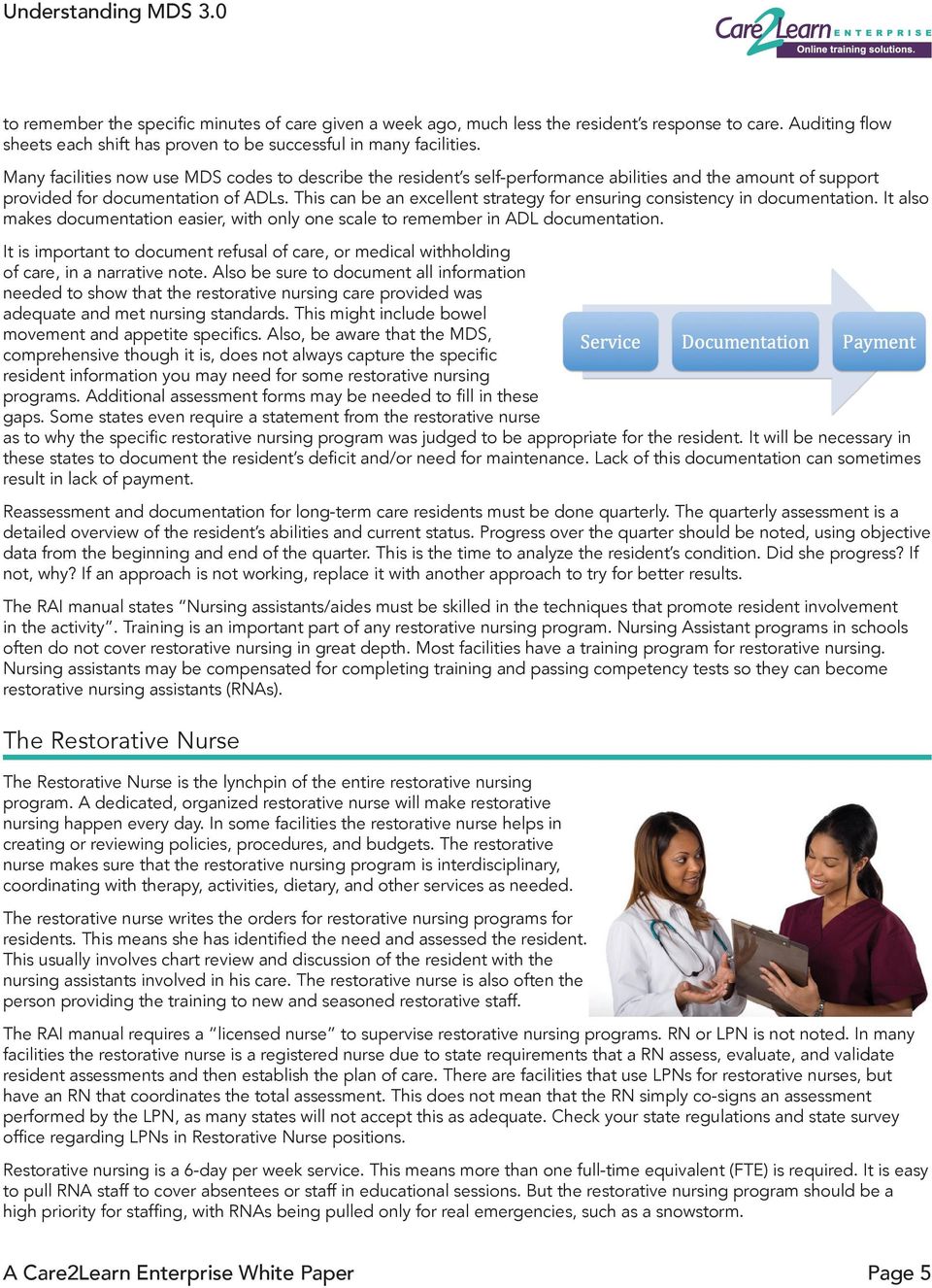
6 Understanding MDS 3.0 to remember the specific minutes of care given a week ago, much less the resident s response to care. Auditing flow sheets each shift has proven to be successful in many facilities. Many facilities now use MDS codes to describe the resident s self-performance abilities and the amount of support provided for documentation of ADLs. This can be an excellent strategy for ensuring consistency in documentation. It also makes documentation easier, with only one scale to remember in ADL documentation. It is important to document refusal of care, or medical withholding of care, in a narrative note. Also be sure to document all information needed to show that the restorative nursing care provided was adequate and met nursing standards. This might include bowel movement and appetite specifics. Also, be aware that the MDS, comprehensive though it is, does not always capture the specific resident information you may need for some restorative nursing programs. Additional assessment forms may be needed to fill in these gaps. Some states even require a statement from the restorative nurse as to why the specific restorative nursing program was judged to be appropriate for the resident. It will be necessary in these states to document the resident s deficit and/or need for maintenance. Lack of this documentation can sometimes result in lack of payment. Reassessment and documentation for long-term care residents must be done quarterly. The quarterly assessment is a detailed overview of the resident s abilities and current status. Progress over the quarter should be noted, using objective data from the beginning and end of the quarter. This is the time to analyze the resident s condition. Did she progress? If not, why? If an approach is not working, replace it with another approach to try for better results. The RAI manual states Nursing assistants/aides must be skilled in the techniques that promote resident involvement in the activity. Training is an important part of any restorative nursing program. Nursing Assistant programs in schools often do not cover restorative nursing in great depth. Most facilities have a training program for restorative nursing. Nursing assistants may be compensated for completing training and passing competency tests so they can become restorative nursing assistants (RNAs). The Restorative Nurse The Restorative Nurse is the lynchpin of the entire restorative nursing program. A dedicated, organized restorative nurse will make restorative nursing happen every day. In some facilities the restorative nurse helps in creating or reviewing policies, procedures, and budgets. The restorative nurse makes sure that the restorative nursing program is interdisciplinary, coordinating with therapy, activities, dietary, and other services as needed. The restorative nurse writes the orders for restorative nursing programs for residents. This means she has identified the need and assessed the resident. This usually involves chart review and discussion of the resident with the nursing assistants involved in his care. The restorative nurse is also often the person providing the training to new and seasoned restorative staff. The RAI manual requires a licensed nurse to supervise restorative nursing programs. RN or LPN is not noted. In many facilities the restorative nurse is a registered nurse due to state requirements that a RN assess, evaluate, and validate resident assessments and then establish the plan of care. There are facilities that use LPNs for restorative nurses, but have an RN that coordinates the total assessment. This does not mean that the RN simply co-signs an assessment performed by the LPN, as many states will not accept this as adequate. Check your state regulations and state survey office regarding LPNs in Restorative Nurse positions. Restorative nursing is a 6-day per week service. This means more than one full-time equivalent (FTE) is required. It is easy to pull RNA staff to cover absentees or staff in educational sessions. But the restorative nursing program should be a high priority for staffing, with RNAs being pulled only for real emergencies, such as a snowstorm. Page 5
7 Understanding MDS 3.0 Restorative Nursing: Eating The need for a restorative focus on eating is based on studies that show the extent of the problem in healthcare today. The risk of malnutrition across care settings is high: 43% in homecare, 45% in hospitals, and 48% in nursing homes (Guigoz, 2009). Loss of weight is the single best indicator of nutritional problems in a resident. Any unintended weight loss of 5% of body weight or more in a year is a red flag for nutritional issues. Be sure to check the resident s weight after a hospital stay. A 2010 study showed that between 20% and 30% of all patients in hospitals are at risk of under-nutrition (Rasmussen, 2010). Most restorative nursing programs for eating happen in a quiet area near or in the dining room. Residents with dysphagia and those progressing from feeding tubes to solid food need a special restorative feeding program in a separate area to reduce distraction. One-to-one staffing can be required for these residents. A dining strategy that is very effective is the circulator. This is a staff member who circulates among all the tables, offering substitutes and seconds, pouring extra water, encouraging residents to eat, and monitoring for swallowing problems. Simple, practical approaches are often the best to help residents be more independent at mealtime. Ask nursing assistants to share success stories and tips for programs with others during inservices. This group wisdom helps spread positive practices throughout the facility, and gives the nursing assistants a chance to shine in front of their peers. Restorative Nursing: Bowel & Bladder The area of toileting is a minefield of dignity and residents rights issues. You never want a resident to say in a survey interview, They make me wear a diaper here, and won t let me go to the bathroom when I need to. They tell me to just go in my diaper. The restorative mindset is the polar opposite of the check and change mentality. Briefs should be the last option for residents. The medical record should include documentation of assessment, resident involvement in planning (if able), and a plan of care addressing incontinence. A thorough resident assessment is needed before establishing a restorative elimination plan. The type of incontinence, elimination history, physical issues, and cognitive factors must be taken into account. Take two weeks to assess the resident. Get a good idea of the resident s elimination schedule in order to develop an effective plan. It is not enough to write toilet q2h in the care plan. Surveyors know that this cookiecutter approach is not effective. Writing toilet q2h invites further investigation and deficiencies. Few people void every two hours. However, you may find that staff balk at a toileting plan with erratic times. It is a common misperception that toileting q2h is the easiest way to accomplish resident toileting. It can actually take more time to toilet every two hours. The resident s assessment-based schedule may look like this: AM: 3:30, 6, 9 PM: 1:45, 5, 8:30, 11:30 This customized schedule is only 7 episodes per day, versus 12 if the resident is indeed toileted every two hours. Also note the time intervals, which range from 2 ½ hours to more than three hours. As long as staff keep track of the schedules, customized programs are less work and more effective. Page 6

8 Understanding MDS 3.0 Restorative Nursing: Mobility The Borun Gerontological Center suggests that the restorative nurse make rounds daily at 10 a.m. and 4 p.m., noting which residents are in bed at both times. There is a strong correlation with excessive time in bed (over 16 hours) and these check times. Consider these residents for an ambulation or exercise program (Borun, 2009). The Borun Center s research on ambulation programs had only one criterion for inclusion in the study: the ability to follow a one-step command. Do not rule out residents with dementia when assessing for mobility programs. Sometimes even those with severe cognitive impairments will literally step up to this program. Creativity can help make ambulation part of many activities. A Walk to Dine program not only gets the resident time in ambulation, but it is ambulation with a purpose. Let s walk to lunch is much more appealing than, Let s walk down the corridor and back. Some facilities create walking trails and walking clubs. The distance along halls can be marked with discreet signage for accurate documentation. Safety is an issue in mobility programs. Nursing assistants should always use a gait belt with residents unless medically contraindicated. Body mechanics inservices should be held on a regular basis. Residents and family members should also be trained in safe transfers, use of adaptive equipment, and how to safely walk with the resident. A fall can wipe out any progress the resident has made with an injury or fracture. Restorative Nursing: Range of Motion The resident is particularly at risk for decreased range of motion if bedfast. It is estimated that up to 8% of nursing home residents are bedfast (NHQI, 2004). A bedfast resident is defined in the RAI Manual as any resident who is in a bed or recliner chair (not a wheelchair) 22 hours or more per day. The MDS further classifies as bedfast the resident who is in the bed/recliner chair for 22 hours or more per day 4 days out of a 7-day period. Restorative nursing range of motion (ROM) programs are paid for by Medicare when the activity is performed 15 minutes per day, 6 days per week, and is not incidental to an ADL activity such as bathing or dressing. This does not mean that range of motion during ADLs should not happen. Range of motion during ADLs is a vital part of keeping residents from losing range of motion. However, for Medicare restorative nursing programs, nursing assistants must be trained to count only those minutes working with residents on active or passive range of motion in planned, scheduled ROM exercise. Active range of motion (AROM) and passive range of motion (PROM) are considered one restorative program. However, 15 minutes of AROM or PROM must be given to receive credit. AROM and PROM minutes may not be added together. Minutes of treatment in one or the other category (AROM or PROM) counted throughout the day can be added together, however, as with any restorative nursing program. Acceptable: 10 minutes PROM + 5 minutes PROM = 15 minutes Not acceptable: 10 minutes AROM + 5 minutes PROM A resident using a continuous passive motion (CPM) device or pedaler (sometimes called a restorator) can qualify for a restorative range of motion program. A physician must order the CPM device. Documentation must show that staff have been trained in use of the device. Qualified time is limited to the time spent setting up, applying, monitoring, removing the unit, and documenting on the resident s activity and progress. Time the resident spends using the unit is not counted. Page 7

9 Understanding MDS 3.0 Restorative Nursing: Activities of Daily Living Nursing assistants may tell you there are just not enough hours in the day to assist residents in activities of daily living programs. The reality is, residents are slow and nursing assistants have a need for speed due to their workload. Many times the issue is the paradigm of care caring for one resident from start to finish and then moving on to the next resident. This is not efficient care. Teach the nursing assistants to divide their time between several residents. One resident may be set up to brush her hair and teeth; while the resident completes her grooming the nursing assistant sets up the next resident to shave. Organizing the work in this way is much more effective. Restorative bathing programs can include a full-body tub bath, whirlpool, shower, or sponge bath. The MDS adds the resident s ability to transfer as part of the definition for bathing. The MDS specifically states that bathing does not include the ability to wash the back or hair. State laws vary on the number of baths required for nursing home residents each week. It is generally one to two per week. A partial bath is needed daily for residents who are incontinent. Often the key to increased independence is adaptive equipment. Most adaptive equipment is fairly standard, but you may want to consult the occupational therapist about creative ways to help residents become more independent. Use of mirrors on stands as part of a grooming kit can make care more efficient as well as allowing flexibility in care for the resident in a wheelchair, who may not be able to reach the sink well or see herself in the mirror. Survey Thinking like a surveyor can help in identifying risk factors, decline as it starts, and possible restorative nursing programs for the resident. When a surveyor evaluates a resident, she will first look for baseline status. Then she will check for diagnoses, and consider the normal progression of these diagnoses. Is the resident worse or better than would be expected of a person with these medical problems or injuries? Have risk factors been identified and documented? Are thorough, complete assessments in the resident s record? The surveyor will then turn to the care plan to assess if appropriate plans with measurable objectives are present, and if the resident and responsible parties, as well as nursing assistants, have been involved in giving input for the care plan. Reassessment and revision of the care plan should be well documented. Any resident or family teaching, counseling, or alternatives for care should also be documented. F-tags that address restorative nursing include F-309 (highest practical quality of life) and F-297 (development of a comprehensive care plan). F-309 could be described as the essence of restorative nursing: the highest practical quality of life for the resident. Highest: because nurses always aspire for the best. Practical: because we work within the limitations of the person s physical and emotional resources. Other F-tags that impact restorative nursing are: F241: dignity F272: comprehensive assessments F279: comprehensive care plans F310: ensuring ADLs do not decline unless the decline is unavoidable F311: providing appropriate care and services to maintain or improve resident abilities F312: dependent resident receiving necessary/appropriate services F315: incontinence programs resident not catheterized unless unavoidable F317: maintain range of motion unless unavoidable F318: range of motion treatment F325: nutritional status maintained Page 8

10 Understanding MDS 3.0 F155, refusal of care, can be called into play with a resident who has many documented instances of refusing restorative nursing treatments. The surveyor will look for documentation that staff attempted to determine the reason for ongoing refusal, as well as attempts to assist the resident with pain medication, adaptive equipment, seeking the family s assistance, or other creative problem-solving activities. With the advent of extensive resident interviewing, the issue of resident (and family) understanding of restorative nursing programs has become very important. Some surveyors have found during interviews that the resident had no idea he was in a restorative nursing program. Even when prompted with the care plan goals, the resident denied working with staff on those goals. Some auditors even found that staff had no idea there was a restorative nursing program for particular residents. A few staff told surveyors that restorative nursing services were only given when I have time. This would trigger F282 failure to follow the care plan. Good documentation and communication with the resident, family, and staff is important to assure that the surveyor hears the same information from all concerned. Conclusion Successful restorative nursing programs provide residents with activities that can slow or stop a decline in function. The restorative team can improve quality of life for residents as well as generate Medicare reimbursement for the facility to underwrite further care. Lack of activity destroys the good condition of every human being, while movement and methodical physical exercise save it and preserve it. Plato About the Author Barbara Acello is an independent nurse consultant and educator in Denton, Texas. She is a member of the Texas Nurses Association, NANDA International, and American College of Healthcare Administrators (ACHCA). She is the recipient of the 2006 ACHCA education award and 2008 ACHCA journalism award. She has assisted in writing and developing mandatory state curricula for nurse aides and EMTs, and has written and contributed to numerous textbooks, instructor guides, quick reference guides, and supplemental instructional material for healthcare personnel. Geriatrics is her preferred area of clinical practice, and she is committed to improving working conditions, education, and professionalism for personnel in the long-term care industry. Resident safety, pain assessment and management, restraints, pressure ulcers, and infection control are subspecialty areas of her practice. Barbara has over 25 books, workbooks, examination preparation guides, and desktop references published. Graphics Photos by Fotolia, Illustrations and editing by Laura More. Resources This paper is based on material from two books written by Barbara Acello: The Long-Term Care Nursing Assistant s Guide to Advanced Restorative Skills The Long-Term Care Restorative Nursing Desk Reference Page 9

11 Understanding MDS 3.0 If you have not already done so, you may want to download the Resident Assessment Instrument (RAI) Manual. Chapter 3, Section O, Restorative Nursing, will be especially helpful. It can be accessed online here: NHQIMDS30TrainingMaterials.asp Look for the link to MDS 3.0 RAI Manual and click to download. Note: it is a very large zipped file, and may take some time to download. Click and plan to do something else while the file downloads. Save it to your computer for future use. References Agency for Healthcare Research and Quality (2009). National Healthcare Quality Report, Retrieved from rehab Baztan, et. al. (2009). Effectiveness of acute geriatric units on functional decline, living at home, and case fatality among older patients admitted to hospital for acute medical disorders: meta- analysis. BMJ 2009;338:b50 doi: /bmj.b50 The Borun Center (2009). Mobility Decline Prevention. The Borun Center. Retrieved from: edu/centers/borun/modules/mobility_decline_prevention/walk1c.htm Centers for Medicare and Medicaid Services (CMS) (2009). Long-Term Care Facility Resident Assessment Instrument (RAI) User s Manual. The Centers for Medicare and Medicaid Services. (Accessed November 2, 2010). Guigoz, Y. (2009) The MNA in research and practice: from birth to present. Scientific Symposium Proceedings XIXth IAGG World Congress of Gerontology and Geriatrics National Quality Forum (NQF), (2011). NQF Endorses 21 Measures for Nursing Homes. Retrieved from: qualityforum.org/ Nursing Home Quality Initiative (NHQI), (2004). Fast Facts: Bedfast. Retrieved from: tools/bedchairfast/kfmc/bedfastfastfacts.pdf Rasmussen, H., et. al. (2010). Measuring Nutritional Risk in Hospitals. Clinical Epidemiology. Volume1, pages , September Resnick, B. (2001) The Restoration of Independence: Long-term care facilities still foster dependence. American Journal of Nursing, Volume 101(10) Resnick, B. (2009) Changing the Philosophy of Care in Long-Term Care: Testing of the Restorative Care Intervention. The Gerontologist, 49 (2): doi: /geront/gnp026. Wang, J. et. activities of daily living. (2009) The Effects of Resident and Nursing Home Characteristics on Activities of Daily Living. Journal of Gerontology and Medical Science, Vol. 64A, No. 4, doi: /gerona/gln040 Page 10

12 Care2Learn 4890 W. Kennedy Blvd. Suite 740 Tampa, FL

Restorative Nursing Teleconference Script
 Slide 1 Slide 2 Slide 3 Maintaining independence in ADLs and mobility is very important to most of us. In fact, functional decline can lead to depression, withdrawal, social isolation, and complications
REV UP Your Restorative Program for Quality! Susan LaGrange, RN, BSN, NHA Director of Education Pathway Health Services, Inc.
 REV UP Your Restorative Program for Quality! Susan LaGrange, RN, BSN, NHA Director of Education Pathway Health Services, Inc. 1 Objectives After attending this presentation, the attendees will be able
Objectives. Objectives 4/5/2014
 Session: T32 A True Person Centered Restorative Nursing Program- Individualized Care at it s Best! Presented By: Sue LaGrange, RN, BSN, NHA Director of Education Pathway Health (651) 964-4946 Objectives
NEW YORK CASE MIX. Jan White, RN Senior Clinical Reimbursement Consultant
 NEW YORK CASE MIX Jan White, RN Senior Clinical Reimbursement Consultant 1 Objectives Explain the basic elements of the Case Mix system Review the Case Mix RUG levels Define ADLs and understand their effect
Understanding MDS 3.0 and RUG IV Reimbursement for Nursing Homes
 Understanding MDS 3.0 and RUG IV Reimbursement for Nursing Homes Prepared by: Joseph J. Tomaino Director Health Care Consulting RSM McGladrey, Inc. 212.376.1640 [email protected] Introduction
NORTH DAKOTA NURSING FACILITY PAYMENT SYSTEM
 NORTH DAKOTA NURSING FACILITY PAYMENT SYSTEM North Dakota Department of Human Services Medical Services 600 E Boulevard Ave Dept 325 Bismarck ND 58505 BACKGROUND State law requires all nursing facilities
RESTORATIVE. Yvonne Russell RN Long Term Care Nursing Coalition of Mississippi-1 st Teleconference Restorative Nursing
 RESTORATIVE Yvonne Russell RN Long Term Care Nursing Coalition of Mississippi-1 st Teleconference Restorative Nursing OVERVIEW Restorative Nursing is not a new concept Techniques have been taught in nursing
Five-Star Nursing Home Quality Rating System
 Five-Star Nursing Home Quality Rating System This is a summary of the information contained in the CMS Technical User s Guide July 2012. The guide in its entirety can be found at CMS.gov. Since the launch
PARTNERSHIP HEALTHPLAN OF CALIFORNIA POLICY / PROCEDURE:
 PARTNERSHIP HEALTHPLAN OF CALIFORNIA POLICY/PROCEDURE Policy Number: MCUP3003 (previously UP100303) Reviewing Entities: Credentialing IQI P & T QUAC Approving Entities: BOARD CEO COMPLIANCE FINANCE PAC
Restorative Care. Policy, Procedures and Training Package
 Restorative Care Policy, Procedures and Training Package Release Date: December 17, 2010 Disclaimer The Ontario Association of Non-Profit Homes and Services for Seniors (OANHSS) Long-Term Care Homes Act
Clinical Groups and Services. EXTENSIVE SERVICES (3 Categories)
 Department of Health and Hospitals RUG-III Classification Model Version 5.20, 34-Group Extensive Services Category I Effective For Assessments With an ARD on or After 10/1/2013 Extensive Services Clinical
LONG TERM CARE ASSISTANT Course Syllabus
 6111 E. Skelly Drive P. O. Box 477200 Tulsa, OK 74147-7200 LONG TERM CARE ASSISTANT Course Syllabus Course Number: THRP-0010A OHLAP Credit: No OCAS Code: 9324 Course Length: 75 Hours Career Cluster: Health
Rehab and Restorative Critical Element Pathway
 Use this pathway for a sampled resident who has had a lack of improvement in any areas of functional ability to determine if the resident received necessary rehabilitative services. Review the following
Adult Foster Home Screening and Assessment and General Information
 Office of Licensing and Regulatory Oversight Resident information Resident s name: Resident s current address: Resident s current living situation: Resident s current primary caregiver: Adult Foster Home
See the Long Term Care Facility Resident Assessment Instrument User s Manual for complete instructions and guidelines.
 Presented by: Nadine Olness, RN Marci Martinson, RN February 212 Participants will be able to: State where the requirements for coding Restorative Nursing Programs can be found in the RAI Manual. Write
Trends in Publicly Reported Nursing Facility Quality Measures
 Trends in Publicly Reported Nursing Facility Quality Measures American Health Care Association Reimbursement and Research Department January 2011 Trends in Publicly Reported Nursing Facility Quality Measures
CHAPTER 6 SECTION G PERCENT OF LOW-RISK RESIDENTS WHO LOSE CONTROL OF THEIR BOWELS OR BLADDER. QM Description. Rationale for Incontinence QM
 CHAPTER 6 SECTION G PERCENT OF LOW-RISK RESIDENTS WHO LOSE CONTROL OF THEIR BOWELS OR BLADDER NOTE: This measure is reported on Nursing Home Compare as a paired measure, in conjunction with the chronic
MEDICAL POLICY No. 91332-R3 NON-ACUTE INPATIENT SERVICES
 NON-ACUTE INPATIENT SERVICES Effective Date: November 16, 2007 Review Dates: 1/93, 12/99, 12/01, 12/02, 11/03, 11/04, 10/05, 10/06, 10/07, 10/08, 10/09, 10/10, 10/11, 10/12, 10/13, 11/14 Date of Origin:
Admission to Inpatient Rehabilitation (Rehab) Services
 Family Caregiver Guide Admission to Inpatient Rehabilitation (Rehab) Services What Is Rehab? Your family member may have been referred to rehab after being in a hospital due to acute (current) illness,
Improving Transitions Between Emergency Departments and Long Term Care
 Improving Transitions Between Emergency Departments and Long Term Care Mary T. Knapp RN, MSN/GNP, NHA, FAAN The Health Care Improvement Foundation January 21, 2014 Purpose of Presentation Provide and overview
Corporate Medical Policy
 Corporate Medical Policy File Name: Origination: Last CAP Review: Next CAP Review: Last Review: skilled_nursing_facility_care 02/2008 2/2015 2/2016 2/2015 Description of Procedure or Service A skilled
Objectives. Maintenance Myths. Maintenance Therapy in Home Health. Cindy Krafft PT, MS. Define the medical necessity of maintenance therapy
 Maintenance Therapy in Home Health Cindy Krafft PT, MS Director of Rehabilitation Consulting Services President Home Health Section APTA Objectives Define the medical necessity of maintenance therapy Understand
Certified Nurse Aide. 1. What type of programs are State Approved?
 Certified Nurse Aide 1.What type of programs are State Approved? 2.What is meant by "successfully completing" a program? 3. How long will my name remain on the Nurse Aide Registry? 4.What if I have not
Quality Measures for Long-stay Residents Percent of residents whose need for help with daily activities has increased.
 Quality Measures for Long-stay Residents Percent of residents whose need for help with daily activities has increased. This graph shows the percent of residents whose need for help doing basic daily tasks
CHAPTER 4: CARE AREA ASSESSMENT (CAA) PROCESS AND CARE PLANNING
 CHAPTER 4: CARE AREA ASSESSMENT (CAA) PROCESS AND CARE PLANNING 4.1 Background and Rationale Background. The Omnibus Budget Reconciliation Act of 1987 (OBRA 1987) mandated that nursing facilities provide
Choosing a Nursing Home: What to Look For, What to Ask.
 Choosing a Nursing Home: What to Look For, What to Ask. When considering moving Mom into a nursing home, you should determine Mom s specific needs and your specific family situation as well as what aspects
Rehabilitation Integrated Transition Tracking System (RITTS)
 Rehab Criteria The patient must have a physical impairment requiring rehabilitation OR have a known cognitive impairment requiring ongoing rehabilitation support or services. The patient is medically stable:
IAC Ch 81, p.1. (3) Rescinded IAB 10/7/98, effective 12/1/98.
 IAC Ch 81, p.1 441 81.16 (249A) Nurse aide requirements and training and testing programs. 81.16(1) Deemed meeting of requirements. A nurse aide is deemed to satisfy the requirement of completing a training
Clinical Coverage Criteria Extended Care Facility
 Clinical Coverage Criteria Extended Care Facility Document Number: 018 Commercial MassHealth* Commonwealth Care Authorization required X X X Notification within 24 hours of service or next business day
KANSAS 90-HOUR CERTIFIED NURSE AIDE PROGRAM INSTRUCTION MANUAL
 KANSAS 90-HOUR CERTIFIED NURSE AIDE PROGRAM INSTRUCTION MANUAL HISTORY OBRA; In 1988 Congress passed the Omnibus Budget Reconciliation Act (OBRA) which set standards for state nurse aide training and competency
Quality Measure Focus: Incontinence
 Quality Measure Focus: Incontinence Keith Chartier, MPH Clinical Project Manager Elaine Nelson, RN, RAC-CT Clinical Project Manager (HSAG) August 25, 2015 Objectives 2 1 How Would It Make You Feel? Embarrassed
Kansas Certified Nurse Aide Course. (90 Hour) Instruction Manual. Health Occupations Credentialing
 Kansas Certified Nurse Aide Course (90 Hour) Instruction Manual Health Occupations Credentialing Kansas Department for Aging and Disability Services 503 S Kansas Ave Topeka, Kansas 66603 May 10, 2013 1
SAM KARAS ACUTE REHABILITATION CENTER
 SAM KARAS ACUTE REHABILITATION CENTER 1 MEDICAL CARE Sam Karas Acute Rehabilitation The Sam Karas Acute Rehabilitation Center is a comprehensive and interdisciplinary inpatient unit. Medical care is directed
JACKSON NATIONAL LIFE INSURANCE COMPANY (the Policyholder)
 UNUM Life Insurance Company of America 2211 Congress Street Portland, Maine 04122 (207) 575-2211 LONG TERM CARE INSURANCE SUMMARY OF COVERAGE FOR THE EMPLOYEES OF JACKSON NATIONAL LIFE INSURANCE COMPANY
9/28/2015. Nursing Home Quality Measures - Achieving 5 Stars. Nursing Home Quality Measures Achieving 5 Stars
 Welcome the webinar will begin shortly! Nursing Home Quality Measures - Achieving 5 Stars Audio for this presentation is being broadcast, so if you have not already done so, please enable the sound on
What to know if Medicare denies coverage
 What to know if Medicare denies coverage What Medicare covers Necessary post-hospital extended care for up to 100 days Extended care: nursing care and rehab provided to a Medicare beneficiary who is an
COVENANT C.N.A. SCHOOL COURSE OUTLINE
 151 Ellis Street N.E. Suite 150, Atlanta, Georgia 30303 Telephone:404.733.5491/Facsimile:404.733.5492 Email:[email protected] COURSE TITLE: CERTIFIED NURSING ASSISTANT HOURS: 121(Classroom
Activities of Daily Living F 311 Minnesota Department of Health Nursing Home Surveyor Training Resource
 2/2006 1 Objectives Activities of Daily Living F 311 Minnesota Department of Health Use To determine if the facility is providing maintenance and restorative programs that will not only maintain, but improve,
T- 09 Up Up and Away with Mediocre Therapy Documentation
 T- 09 Up Up and Away with Mediocre Therapy Documentation Carol Ashdown M. A. CCC-SLP RAC-CT CHC Carol Ashdown is a Regional Vice President of Consulting for Exponential Consulting Services specializing
A CONSUMER GUIDE TO CHOOSING A NURSING HOME
 A CONSUMER GUIDE TO CHOOSING A NURSING HOME The National Citizens' Coalition for Nursing Home Reform (NCCNHR) knows that placing a loved one in a nursing home is one of the most difficult tasks a family
UNITED TEACHERS LOS ANGELES (the Policyholder)
 Unum Life Insurance Company of America 2211 Congress Street Portland, Maine 04122 (207) 575-2211 LONG TERM CARE INSURANCE - OUTLINE OF COVERAGE FOR THE EMPLOYEES OF UNITED TEACHERS LOS ANGELES (the Policyholder)
APPENDIX B NURSE AIDE TRAINING & COMPETENCY EVALUATION PROGRAM
 Utah Medicaid Provider Manual Long Term Care Services Division of Health Care Financing October 2007 APPENDIX B NURSE AIDE TRAINING & COMPETENCY EVALUATION PROGRAM NURSE AIDE TRAINING & COMPETENCY EVALUATION
How To Care For A Patient With A Heart Condition
 Acute Care to Rehab & Complex Identify Referral Destination: Referral to Rehab Referral to Complex Continuing Care (CCC) If Faxed Include Number of Pages (Including Cover): Pages Estimated Date of Rehab/CCC
2013/2014 Alberta Long-Term Care Resident Profile. June 2015
 2013/2014 Alberta Long-Term Care Resident Profile June 2015 Table of Contents Introduction 3 Methodology 4 Demographic Profile 7 Health Profile 10 Care and Intervention 23 For Further Information 30 List
Easing the Transition: Moving Your Relative to a Nursing Home
 Easing the Transition: Moving Your Relative to a Nursing Home Alzheimer s Association, New York City Chapter 360 Lexington Avenue, 4th Floor New York, NY 10017 24-hour Helpline 1-800-272-3900 www.alz.org/nyc
CHAPTER 4: CARE AREA ASSESSMENT (CAA) PROCESS AND CARE PLANNING
 CHAPTER 4: CARE AREA ASSESSMENT (CAA) PROCESS AND CARE PLANNING 4.1 Background and Rationale The Omnibus Budget Reconciliation Act of 1987 (OBRA 1987) mandated that nursing facilities provide necessary
Continental Casualty Company
 Continental Casualty Company 333 S. Wabash Avenue A Stock Company Chicago, Illinois 60604 Continental Casualty Company Group Long-term Care 333 S. Wabash Avenue Chicago, IL 60604 1-(800)-528-4582 LONG-TERM
4. TERMS UNDER WHICH THE POLICY MAY BE CONTINUED IN FORCE OR DISCONTINUED.
 METROPOLITAN LIFE INSURANCE COMPANY ( METLIFE ) P.O. Box 937, Westport, CT 06881-0937 1-888-565-3761 INDIVIDUAL FRANCHISE COMPREHENSIVE LONG-TERM CARE INSURANCE OUTLINE OF COVERAGE POLICY FORM LTC2007-ML-PA
Continental Casualty Company
 Continental Casualty Company CNA A Stock Company 333 South Wabash Avenue Chicago, Illinois 60604 Continental Casualty Company Group Long Term Care 333 South Wabash Avenue Chicago, IL 60604 1-(800)-528-4582
Good end of life care in care homes
 My Home Life Research Briefing No.6 This briefing sets out the key findings of a research review on good end of life care in care homes undertaken by Caroline Nicholson, in 2006, as part of the My Home
CONSUMER INFORMATION GUIDE: ASSISTED LIVING RESIDENCE
 CONSUMER INFORMATION GUIDE: ASSISTED LIVING RESIDENCE 1 TABLE OF CONTENTS Introduction 3 What is an Assisted Living Residence? 3 Who Operates ALRs? 4 Paying for an ALR 4 Types of ALRs and Resident Qualifications
What s new? INVESTIGATIVE PROTOCOL FOR URINARY INCONTINENCE & CATHETERS. The Revised Guidance Includes: Interpretive Guidelines
 INVESTIGATIVE PROTOCOL FOR URINARY INCONTINENCE & CATHETERS The Revised Guidance Includes: Interpretive Guidelines Investigative Protocols Compliance & Severity Guidance What s new? The new guidance for
Clinical Medical Policy Outpatient Rehab Therapies (PT & OT) for Members With Special Needs
 Benefit Coverage Rehabilitative services, (PT, OT,) are covered for members with neurodevelopmental disorders when recommended by a medical provider to address a specific condition, deficit, or dysfunction,
Protective Preserver PROTECTIVE LIFE S. Outline of Coverage for Comprehensive Long Term Care Accelerated Death Benefit Endorsement
 PROTECTIVE LIFE S Protective Preserver Outline of Coverage for Comprehensive Long Term Care Accelerated Death Benefit Endorsement Must be given to the Applicant at the time of purchase For Use in FL Only.
Multiple Sclerosis (MS)
 Multiple Sclerosis (MS) Purpose/Goal: Care partners will have an understanding of Multiple Sclerosis and will demonstrate safety and promote independence while providing care to the client with MS. Introduction
Background. Quality Measures. Onsite Inspections. Staffing Levels. July 19, 2012 4/16/2015. 5 STAR How Does the MDS Impact It?
 Background 5 STAR How Does the MDS Impact It? Carol Siem Clinical Educator QIPMO December 18, 2008 Five Star Quality Rating System was added to the Nursing Home Compare website Onsite inspections Quality
Documentation: Now More Than Ever, Your Reimbursement Depends On It
 Improving Your Documentation : Know What Is Expected By Medicare Or What We Could Have Titled: Documentation: Now More Than Ever, Your Reimbursement Depends On It Rhonda Lane, LOTR Objectives Participants
O: Gerontology Nursing
 O: Gerontology Nursing Alberta Licensed Practical Nurses Competency Profile 145 Competency: O-1 Aging Process and Health Problems O-1-1 O-1-2 O-1-3 O-1-4 O-1-5 O-1-6 Demonstrate knowledge of effects of
Rehabilitation Nurses: Champions for Optimizing Stroke Rehabilitation Across the Continuum of Care
 Rehabilitation Nurses: Champions for Optimizing Stroke Rehabilitation Across the Continuum of Care Presenters Sandra Melchiorre RN, MN, ACNP, CNN (c) Regional Stroke Acute Care Advanced Practice Nurse,
Wallingford Public Schools - HIGH SCHOOL COURSE OUTLINE
 Wallingford Public Schools - HIGH SCHOOL COURSE OUTLINE Course Title: Certified Nursing Assistant Course Number: A 8013 Department: Career and Technical Education Grade(s): 11-12 Level(s): Academic Credit:
Certified Nursing Assistant Essential curriculum- Maryland Board of Nursing
 Certified Nursing Assistant Essential curriculum- Maryland Board of Nursing Module I Orientation/Introduction A. Identify general information pertaining to the nursing assistant course B. List requirements
GUIDE TO SUB-ACUTE AND LONG TERM CARE
 GUIDE TO SUB-ACUTE AND LONG TERM CARE Frequently Used Words and Phrases...2 Understanding Your Care Options...3 The Transition from Hospital to Nursing Facility...5 Paying for Care...6 Choosing Wisely...8
MASSACHUSETTS. Downloaded January 2011
 MASSACHUSETTS Downloaded January 2011 150.006: OTHER PROFESSIONAL SERVICES AND DIAGNOSTIC SERVICES (C) Podiatric. (1) All patients and residents shall have proper foot care and foot wear. (2) When the
The Nursing Home Inspection Process
 1 The Nursing Home Inspection Process SUMMARY Both the Minnesota Department of Health (MDH) and the U.S. Department of Health and Human Services share responsibility for ensuring that Minnesota s nursing
Basic Training: Home Health Edition. Defining and Documenting, Medical Necessity. March 28, 2013
 Basic Training: Home Health Edition Defining and Documenting, Medical Necessity March 28, 2013 Presented by: Nancy Buseth, RN, PT, BS, Senior Consultant Fazzi Associates, Inc. 243 King Street, Suite 246
Home Health Aide Hiring, Training and Supervision
 Hiring and Supervision in Home Health Home Health Aide Hiring, Training and Supervision Hiring, training and supervision of home health aides is an important management challenge to home healthcare agencies.
Career Options for Direct Service Workers in Maine
 Career Options for Direct Service Workers in Maine Maine s Career Options in the field of Direct Service Work (Specialized Content) Homemaker Homemakers assist individuals with household or personal care
Illinois Department of Public Health STATEMENT OF DEFICIENCIES AND PLAN OF CORRECTION C 04/26/2015. Statement of Licensure Violations:
 (X1) PROVER/SUPPLIER/LIA ENTIFIATION NUMBER: (X3) SURVEY D NAME OF PROVER OR SUPPLIER (X4) REGULATORY OR LS ENTIFYING INFORMATION) Final Observations Statement of Licensure Violations: 300.610a) 300.1210b)
ADL DOCUMENTATION OBJECTIVES ADL DEFINITION 6/15/2015 AND MDS SCORING
 ADL DOCUMENTATION AND MDS SCORING Katy Nguyen, M.S.N., R.N Sharon Thomas, BSN, RN, RAC-CT University of MO-Sinclair School of Nursing QIPMO program OBJECTIVES Understand the importance of accurate ADL
Cenpatico STRS POLICIES & PROCEDURES. Effective Date: 07/11/11 Review/Revision Date: 07/11/11, 09/21/11
 Page 1 of 14 SCOPE: Clinical Department IMPORTANT REMINDER This Clinical Policy has been developed by appropriately experienced and licensed health care professionals based on a thorough review and consideration
This Policy is intended to be a qualified long-term care insurance contract under section 7702B(b) of the Internal Revenue Code.
 Administrative Offices: 165 Court Street Rochester, NY 14647 1-800-544-0327 GROUP LONG-TERM CARE INSURANCE CERTIFICATE OUTLINE OF COVERAGE State of Tennessee Employee and Retiree Long-Term Care Insurance
Medicare Coverage of Skilled Nursing Facility Care
 Helping Older Persons With Legal & Long-Term Care Problems Medicare Coverage of Skilled Nursing Facility Care 1. When does Medicare cover nursing facility care? Skilled nursing facility (SNF) care is covered
Implementing a Fall Alarm Program to Reduce Fall Risk Rein Tideiksaar, PhD FallPrevent, LLC
 Implementing a Fall Alarm Program to Reduce Fall Risk Rein Tideiksaar, PhD FallPrevent, LLC This program was supported by a grant from Implementing a Fall Alarm Program to Reduce Fall Risk Rein Tideiksaar,
NURSE S ASSISTING ADDENDUM 4/06
 NURSE S ASSISTING ADDENDUM 4/06 To: Health Occupations Educators Date: April 11, 2006 From: Subject: Patricia Hodgins, Supervisor Career and Technical Education Nurse s Assisting Addendum This addendum
Code of Federal Regulations
 Code of Federal Regulations From the U.S. Government Printing Office via GPO Access The Code of Federal Regulations (CFR) is the codification of the general and permanent rules published in the Federal
Center for Medicaid and State Operations/Survey and Certification Group Ref: S&C-07-30 DATE: August 10, 2007 (revised)
 DEPARTMENT OF HEALTH & HUMAN SERVICES Centers for Medicare & Medicaid Services 7500 Security Boulevard, Mail Stop S2-12-25 Baltimore, Maryland 21244-1850 Center for Medicaid and State Operations/Survey
How To Make A Profit From A Pension Plan
 PRIME REHABILITATION SERVICES PPS AND FINANCIAL CHALLENGES 2012 PRESENTED BY: TAMAR BROOKS, COO October 2011 Agenda Topics Financial Implications of SNF 2012 Rule RUG IV Classification Highlights 2012
COLLABORATIVE NURSING DOCUMENTATION
 COLLABORATIVE NURSING DOCUMENTATION The following section is designed to assist the clinician in providing information to the nursing staff in effort to facilitate collaborative nursing documentation regarding
Medical Rehabilitation. Rehabilitation Unit
 Medical Rehabilitation Rehabilitation Unit Medical Rehabilitation The purpose of this handout is to give you information about University Hospital s Rehabilitation Unit (2 North or 2N). It will explain:
PRACTICAL NURSE-LICENSED
 MICHIGAN CIVIL SERVICE COMMISSION JOB SPECIFICATION PRACTICAL NURSE-LICENSED JOB DESCRIPTION Employees in this job provide skilled nursing services to patients in state mental health facilities (psychiatric
STATE CERTIFIED NURSE AIDE TRAINING PROGRAM
 LINDA LINGLE GOVERNOR LILLIAN B. KOLLER, ESQ. DIRECTOR HENRY OLIVA DEPUTY DIRECTOR STATE OF HAWAII DEPARTMENT OF HUMAN SERVICES Med-QUEST Division Medical Standards Branch P. O. Box 700190 Kapolei, Hawaii
NURSING B29 Gerontology Community Nursing. UNIT 2 Care of the Cognitively Impaired Elder in the Community
 NURSING B29 Gerontology Community Nursing UNIT 2 Care of the Cognitively Impaired Elder in the Community INTRODUCTION The goal of this unit is for the learner to be able to differentiate between delirium,
RN CONSULTATION. KEY TERMS: Assessment Basic tasks Consultation Home health services PRN Written parameters OBJECTIVES:
 RN CONSULTATION The purpose of this section is to assist the learner in understanding the role of a registered nurse (RN) consultant and when to seek RN consultation. KEY TERMS: Assessment Basic tasks
3. TERMS UNDER WHICH THE POLICY MAY BE RETURNED AND PREMIUM REFUNDED.
 METROPOLITAN LIFE INSURANCE COMPANY ( METLIFE ) P.O. Box 937, Westport, CT 06881-0937 1-888-565-3761 LONG-TERM CARE INSURANCE OUTLINE OF COVERAGE POLICY FORM LTC2007-TX CAUTION: Our issuance of the long-term
Frequently Asked Questions about Fee-for-Service Medicare For People with Alzheimer s Disease
 Frequently Asked Questions about Fee-for-Service Medicare For People with Alzheimer s Disease This brochure answers questions Medicare beneficiaries with Alzheimer s disease, and their families, may have
Inpatient Rehabilitation Guidebook
 Inpatient Rehabilitation Guidebook Welcome to Alta Bates Summit Medical Center s Regional Rehabilitation Program Our experienced and caring team will provide you with outstanding care as you begin your
October 2013 Family Choice: Best Practices in Care for Nursing Home Residents
 SNP Alliance Best Practices October 2013 Family Choice: Best Practices in Care for Nursing Home Residents Overview of Family Choice of New York I-SNP Independent Health s Medicare Advantage Family Choice
DEPARTMENT OF REGULATORY AGENCIES. Division of Professions and Occupations 3 CCR 716-1 CHAPTER 10
 DEPARTMENT OF REGULATORY AGENCIES Division of Professions and Occupations 3 CCR 716-1 CHAPTER 10 RULES AND REGULATIONS FOR CERTIFICATION AS A NURSE AIDE BASIS: The authority for the promulgation of these