
Fundamentals of Synthetic Aperture Radar Systems
|
|
|
- Polly Tyler
- 9 years ago
- Views:
Transcription

1 Fundamentals of Synthetic Aperture Radar Systems Mohamed Elhefnawy 1, Widad Ismail 2 1 Dept of Electrical Engineering, Faculty of Engineering, October 6 University, Egypt 2 School of Electrical and Electronic Engineering, University of Science Malaysia, Malaysia Abstract The present research is an introductory paper on Synthetic Aperture Radar (SAR) systems. A review on topics and techniques related to the long range and short range SAR systems are presented. The long range SAR image is constructed using Range Doppler Algorithm (RDA); while the Range Migration Algorithm (RMA) is implemented with short range SAR for image formation. The simulation results indicate the resolution improvement when the RDA and RMA are utilized with long range and short range SAR systems, respectively. Keywords azimuth resolution; imaging radar; range Doppler algorithm (RDA);range migration algorithm (RMA); range resolution; synthetic aperture radar (SAR). I. INTRODUCTION Until the 50s imaging radars were denoted as Side Looking Airborne Radar (SLAR) and did not use the principle of synthetic aperture which is based on the generation of an effective long antenna by signal processing means rather than by the actual use of a long physical antenna. The SLAR has moderate azimuth resolution which deteriorates as the range increases. In SAR, the resulting azimuth resolution becomes equal to half the azimuth antenna length and is independent of the range distance [1]. SAR systems have many advantages over the optical systems due to their all weather capability and the possibility to operate through smoke and at night. Further, SAR systems have the ability to penetrate long depth into vegetation and soil, and image the interior of the targets. With the SAR platform moving during the data collection, the range to a target changes so that the phase of the return echo is changed from position to another in the cross range direction, where the spatial Doppler frequency is determined as the derivative of this phase history. Tracking this phase history over the length of synthetic aperture allows focusing the received echoes in cross range [2]. The SAR platform transmits a plane wave which reaches a point target; the latter becomes a secondary source emitting upward wave back toward the SAR platform. In long range SAR applications, the Range Doppler Algorithm is typically used under the assumption that the scattered waves by the targets are plane waves with linear phase front. In short range SAR applications, the waves back toward the SAR platform are spherical waves with a non linear phase front. The conventional imaging algorithms are typically used under the plane wave assumption; however, the Range Migration Algorithm (RMA) can handle the actual spherical wave, so that the RMA is suitable for small scale applications as an imaging algorithm has the ability to focus the short range SAR data [3 6]. The hardware requirements and the imaging techniques are dependent on the distance between the SAR platform and targets; the novelty of this paper is to provide a new perspective in studying and developing SAR systems based on the classification into long range and short range SAR systems. This paper is organized into seven further Sections. Sections II and III describe the range and azimuth resolution, respectively. Section IV presents the synthetic aperture radar. The long range and short range SAR systems are provided in Sections V and VI. Section VII discusses the simulation results. Finally, on Section VIII conclusions are provided. II. RANGE RESOLUTION The range resolution is defined as the ability of the radar to distinguish between two targets at similar bearing from a reference point. Fig. 1 indicate the concept of range resolution; where the transmitted pulse which has a duration of τ = 1 µs will be reflected by the near target then by the far target; the reflections from the two targets will be interfered with each other if the distance between them less than the distance related to the transmitted pulse duration ( ) as shown in Fig. 1.a; in this case, the radar cannot distinguish between the targets. If the distance between the targets equals or greater than the distance related to the transmitted pulse duration, the reflections from these targets will not be interfered with each other and the radar will be able to discriminate between the targets as shown in Fig. 1.b. 172
2 The chirp with 5 µs width and 100 MHz bandwidth can be used to achieve a range resolution of 1.5 m, whereas a pulse with 10 ns width is required to get the same 1.5 m range resolution; so that the gain in the average power by using the chirp signal equals 500 ( µ ) [1]. The use of chirped pulse with matched filter improve the range resolution by convolving the long chirped pulse with the reference impulse response of the matched filter, so that the output pulse will be compressed or significantly shorter as shown in Fig. 2. (a) Fig. 2. Pulse compression using convolution process in time domain. The convolution process in time domain can be replaced by multiplication process in frequency domain, so the matched filter can be realized more simpler in frequency domain as shown if Fig. 3. (b) Fig. 1. range resolution (a) irresolvable targets (b) resolvable targets. So for better range resolution, the distance related to the pulse duration must be shorter or the pulse duration must be narrower. On the other hand, it is very hard to put enough energy into a very narrow pulse due to the fact that the energy of a signal is proportional to its duration. To improve the range resolution and maintain enough transmitted energy; the transmitted pulse is modulated using Linear Frequency Modulation (LFM). The frequency modulated pulse is called (chirp) and the range resolution of this chirp equals ( ), where c is the speed of light and BW is the bandwidth of the chirp. Fig. 3 The realization of Matched filter in frequency domain. III. AZIMUTH RESOLUTION The azimuth resolution is defined as the ability of the radar to separate two reflectors at similar ranges but different bearings from a reference point. The targets can be resolvable if the distance between them equals or greater than the azimuth resolution. 173
3 For a radar system which operates at 10 GHz and has an antenna size of 3 m, targets a and b are resolvable because the distance between them equals the azimuth resolution for targets a and b ( ( ) ); where is the closest distance to the radar. Targets c and d tend to merge and appear as one target because the distance between them less than the azimuth resolution in this case which equals 300 m as shown in Fig. 4. Fig. 4. Azimuth resolution. The azimuth resolution depends on the distance of the targets from the radar and also on the antenna size; the azimuth resolution deteriorates as the distance is increased or the antenna size is decreased. The antenna size must be very large in order to resolve two targets located at long distance from the radar, for the above example the antenna size must be at least 30 m to distinguish between targets c and d; in some cases the practical implementation of the antenna size is not possible because the required antenna size to obtain an acceptable azimuth resolution must be several hundred of meters or even several kilometers. IV. SYNTHETIC APERTURE RADAR (SAR) In 1951, Carl Wiley improved the azimuth resolution by generating long antenna size based on signal processing not by using an actual physical antenna size. The idea was to synthesizing an antenna array by using a real aperture antenna mounted on a moving platform as shown in Fig. 5. The formation of synthetic aperture improves the azimuth resolution to be half of the antenna size in the direction of platform movement, without dependence on the distance between the targets and radar [1]. Fig. 5. Formation of synthetic aperture. SAR is side looking radar system to avoid left/right ambiguity as shown in Fig. 6. SAR utilizes the flight path of the platform to generate large antenna and create the image based on signal processing of the recorded radar echoes from the multiple antenna locations. At each position along the flight path, SAR transmits a pulse then collects and records the echo of this pulse by a receiver. The SAR works similar to a phased array antenna, but SAR uses only one antenna; while the phased array consists of large number of antenna elements. Fig. 6. Remove left/right ambiguity using side looking system. As shown in Fig. 5, the distance between target and SAR is changed due to the movement of the platform, so that the phase of the received signal is also varied from position to the other along the flight path. The variations in phase change the frequency of the backscattered waveform, and induce a natural frequency modulation in the cross range direction. At each position, the virtual natural frequency modulated transmitted signal can be expressed as, where k is the Doppler rate which can be calculated as wavelength, and, v is the velocity of the platform, is the is the slow time along the flight path. 174

4 The azimuth reference signal is the complex conjugate time reversed version of the virtual natural frequency modulated transmitted signal, so that the azimuth reference signal depends on the closest distance between the target and the SAR [3]. V. LONG RANGE SAR SYSTEM In long range SAR system, a quick burst of LFM signal is transmitted, then waiting a short period of time to receive the reflections from targets. The elapsed time between pulse transmissions is known as pulse repetition interval (PRI). One antenna can be implemented with this LFM pulsed SAR system [7]. The 2D raw data is formed after the in phase quadrature phase demodulation as shown in Fig. 7. Fig. 8. Range Doppler algorithm. Fig. 7. Block diagram of long Range SAR system. The Long Range SAR image formation can be obtained by using the Range Doppler algorithm which is divided into two main steps (range compression and azimuth compression) as shown in Fig. 8. The range compression is used to detect the presence of the range reference signal or the complex conjugate time reversed version of the transmitted chirp signal in the 2D raw data; the reference signal can be obtained as, where is the chirp rate and t is the fast time in the range direction. The range reference and the rows of 2D raw data are transformed into frequency domain using fast Fourier transform (FFT) then multiplied. Finally inverse Fourier transform (IFFT) is performed. Also the azimuth compression is implemented to detect the presence of the azimuth reference signal or complex conjugate time reversed version of the virtual natural frequency modulated transmitted signal in the 2D raw data. The azimuth reference signal and the columns of the 2D raw data are converted into frequency domain, and then they are multiplied. The output of the multiplier is transformed into time domain by using an inverse fast Fourier transform (IFFT) [1]. VI. SHORT RANGE SAR SYSTEM In short range SAR system, the LFM signal is continuously transmitted without waiting period also the transmitted signal and its received reflections are occurred simultaneously so that two antennas are required to be implemented with this LFM CW SAR, the PRI in LFM CW SAR is defined as the time interval for the frequency oscillation to ramp up and back down [8]. LFM CW SAR can be implemented with short range applications much easier because it requires lower sampling rate, and consumes less power than the LFM pulsed SAR. The 2D raw data is obtained as shown in Fig. 9, then the 2D raw data is processed using Range Migration Algorithm (RMA) to form the focused image as shown in Fig. 10 [10 12]. Fig. 9. Block diagram of short range SAR system. 175
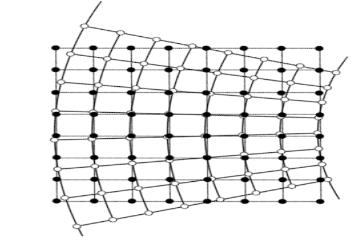
5 Fig. 10. Block diagram of Range Migration Algorithm (RMA). A. Cross Range Fourier Transform The intermediate frequency signal which is varying with the range spatial frequency k and also with along track position u can be written as. As shown in Fig. 11, for a target which is located at, and SAR platform positioned at ; the range between the target and the SAR platform is Fig. 11. Geometry of short range SAR. can be Fourier transformed into the frequency domain as follows: spatial The principle of stationary phase is used to evaluate the above Fourier transform [12]. The two dimensional signal can be obtained as [ ] B. Reference Function Multiply (Matched Filter) A 2D matched filter is then applied to correct for the wavefront curvature, where the signal of matched filter can be written as follows [ ] [ ] The reference position is, and. Then the matched filter is multiplied with the 2D SAR data as follows (1) (2) (3) [ ] [ ] C. Stolt Mapping along the Range Spatial Frequency Axis (4) The 2D SAR data after the matched filter is transformed into ( ) by letting, and by applying the non linear transformation for, where are the wavenumbers in and directions, respectively. ( ) can be obtained as ( ) [ ( )] [ ] The target function can be obtained by taking the 2D inverse spatial Fourier transform on ( ). However 2D inverse spatial Fourier transform on ( ) cannot work correctly because the data not uniformly spaced in the domain, the data ( ) should be interpolated on an equally spaced rectangular grid of and as shown in Fig. 12 [13]. So that 2D inverse spatial Fourier transform can be utilized. The phase of the signal ( ) can be converted into a linear phase by using Stolt interpolation [12]. The Stolt interpolation can be derived as follows ( ) (5) ( ) (6) Where and ; since, therefore can be considered as a constant phase. By substituting Equation (6) in Equation (4), one obtains ( ) [ ] [ ] (7) Fig. 12. Data distribution before ( ) and after ( ) interpolation [13]. D. Tow Dimensional Inverse Fourier Transform ( ) is the interpolated data on an equally spaced rectangular grid of and, where. So that the 2D inverse spatial Fourier transform can be utilized as follows 176
![[ ( )] [ ] (8) The above equation results in In Equation (9), is the 2D impulse function which perfectly pinpoints the location of the scatterer. VII. SIMULATION RESULTS A.](/docs-images/52/30749668/images/6-0.jpg "Simulating Long Range SAR The MATLAB software has been used to simulate long range SAR which operates at a centre frequency of 5.5 GHz, with bandwidth of 5 MHz. The SAR is satellite based.")
6 [ ( )] [ ] (8) The above equation results in In Equation (9), is the 2D impulse function which perfectly pinpoints the location of the scatterer. VII. SIMULATION RESULTS A. Simulating Long Range SAR The MATLAB software has been used to simulate long range SAR which operates at a centre frequency of 5.5 GHz, with bandwidth of 5 MHz. The SAR is satellite based. Its altitude is 565 km and moves with a velocity of 1000 m/sec. The SAR antenna has dimensions of 5.2 m (along the track) by 1.1 m in height, incident angle equals 40. The antenna footprint size has been calculated as shown in Fig. 13. With the range Doppler algorithm, the 2D imaging results of two point targets are shown in Fig. 14. The locations of the targets are assumed to be at (300* range resolution, 3000*cross range resolution), and (500* range resolution, 4000*cross range resolution) respectively, where range resolution and cross range resolutions are m and 2.6 m, respectively. (9) B. Simulating Short Range SAR The short range SAR system has been simulated to verify the performance of RMA algorithm. The parameters which have been used in the raw data generation are listed in Table I [9 11]. Carrier Frequency RF bandwidth Reference position Target1 position Target2 position SAR platform velocity Number of cells in range direction Number of cells in cross range direction PRI Size of an antenna in cross range direction Chirp rate in range direction TABLE I Parameters of LFM CW SAR system GHz GHz (512* range resolution,0) (215* range resolution, 151*cross range resolution) (1251* range resolution, 523*cross range resolution) 0.85 m/s ms m Consider a m m (cross range range) target region composed of 4096 range cells and 1024 cross range cells. Fig. 15 shows LFM CW SAR for radar image generation, where the range and cross range resolutions are 3.01 cm and 1.7 cm, respectively. Fig 13. Geometry of long range SAR. Fig. 15. LFM CW SAR for radar image generation. Fig. 14. Simulation of long range SAR using RDA. 177
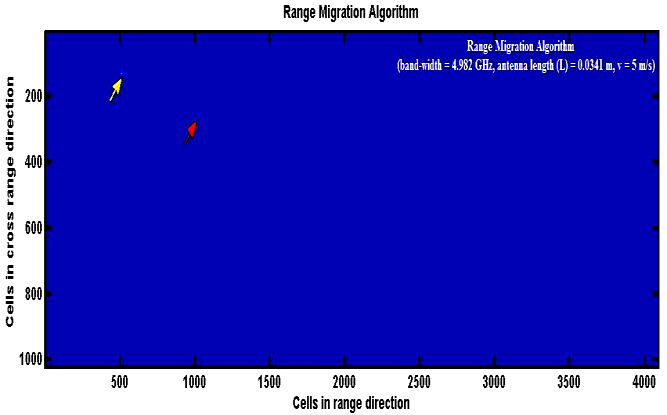
7 The 2D radar imaging is formed by digitizing the received signal from the targets at range sampling frequency equals at least twice times the beat frequency. The 2D LFM CW SAR imaging data are arranged in a matrix like array of complex numbers after in-phase quadrature-phase (I Q) demodulation [12]. Each raw of data corresponds to data which can be reflected from 4096 targets or (4096 range cells); while each column contains data reflected from 1024 cross range cells related to the same target. With the RMA algorithm, the 2D imaging results of two point targets are shown in Fig. 16. Fig. 16. Simulation of short range SAR using RMA. VIII. CONCLUSIONS The basic concepts and imaging techniques on the synthetic Aperture Radar Systems have been provided in this paper. Long range and short range SAR systems have been described. The effectiveness of RDA and RMA as a long range and short range radar imaging algorithms, respectively, has been shown through the simulations using MATLAB. Acknowledgment The authors would like to thank the funding sources for this paper, which include October 6 University and Universiti Sains Malaysia grant secretariat for sponsoring the research under RUI grant (814241). REFERENCES [1] Moreira, A.; Prats-Iraola, P.; Younis, M.; Krieger, G.; Hajnsek, I.; Papathanassiou, K.P., "A tutorial on synthetic aperture radar," Geoscience and Remote Sensing Magazine, IEEE, vol.1, no.1, pp.6,43, March 2013 [2] Anghel, A.; Vasile, G.; Cacoveanu, R.; Ioana, C.; Ciochina, S., "Short-Range Wideband FMCW Radar for Millimetric Displacement Measurements," Geoscience and Remote Sensing, IEEE Transactions on, vol.52, no.9, pp.5633,5642, Sept [3] Bamler, R., "A comparison of range-doppler and wavenumber domain SAR focusing algorithms," Geoscience and Remote Sensing, IEEE Transactions on, vol.30, no.4, pp.706,713, Jul 1992 [4] Cumming, I.G.; Neo, Y.L.; Wong, F.H., "Interpretations of the omega-k algorithm and comparisons with other algorithms," Geoscience and Remote Sensing Symposium, IGARSS '03. Proceedings IEEE International, vol.3, no., pp.1455,1458, July 2003 [5] Charvat, G.L.; Kempel, Leo C.; Rothwell, E.J.; Coleman, C.M.; Mokole, E., "A Through-Dielectric Radar Imaging System," Antennas and Propagation, IEEE Transactions on, vol.58, no.8, pp.2594,2603, Aug [6] Shin, H.-S.; Lim, J.-T., "Range migration algorithm for airborne squint mode spotlight SAR imaging," Radar, Sonar & Navigation, IET, vol.1, no.1, pp.77,82, Feb [7] Michael I. Duersch, BYU MICRO-SAR: A very small, low-power LFM CW synthetic aperture radar, Master thesis, Brigham Young University, December 2004 [8] El-Darymli, K.; Moloney, C.; Gill, E.; Mcguire, P.; Power, D., "Design and implementation of a low-power synthetic aperture radar," Geoscience and Remote Sensing Symposium (IGARSS), 2014 IEEE International, vol., no., pp.1089,1092, July 2014 [9] Charvat, G.L.; Fenn, A.J.; Perry, B.T., "The MIT IAP radar course: Build a small radar system capable of sensing range, Doppler, and synthetic aperture (SAR) imaging," Radar Conference (RADAR), 2012 IEEE, vol., no., pp.0138,0144, 7-11 May 2012 [10] Gregory L. Charvat, Small and short-range radar systems, Taylor & Francis Group, LLC, 2014, pp [11] Gregory Louis Charvat, A low-power radar imaging system, PhD thesis, Michigan State University, 2007 [12] Bu-Chin Wang, Digital signal processing techniques and applications in radar image processing, John Wiley & Sons, 2008, pp [13] Margaret Cheney Brett,Borden Fundamentals of radar imaging, Society for Industrial and Applied Mathematics (SIAM), 2009, pp [14] CANER OZDEMIR, Inverse synthetic aperture radar imaging with MATLAB algorithms, John Wiley & Sons, 2012, pp
Synthetic Aperture Radar (SAR) Imaging using the MIT IAP 2011 Laptop Based Radar*
 Synthetic Aperture Radar (SAR) Imaging using the MIT IAP 2011 Laptop Based Radar* Presented at the 2011 MIT Independent Activities Period (IAP) Gregory L. Charvat, PhD 24 January 2011 *This work is sponsored
Signal Processing for Synthetic Aperture Radars
 IWSSIP 1-17th International Conference on Systems, Signals and Image Processing Signal Processing for Synthetic Aperture Radars Žarko Čučej Uniersity of Maribor, Faculty of Electrical Engineering and Computer
Synthetic Aperture Radar: Principles and Applications of AI in Automatic Target Recognition
 Synthetic Aperture Radar: Principles and Applications of AI in Automatic Target Recognition Paulo Marques 1 Instituto Superior de Engenharia de Lisboa / Instituto de Telecomunicações R. Conselheiro Emídio
Введение в спутниковую радиолокацию: Радиолокаторы с синтезированной апертурой (РСА) Introduction to satellite radars: Synthetic Aperture Radars (SAR)
 Введение в спутниковую радиолокацию: Радиолокаторы с синтезированной апертурой (РСА) Introduction to satellite radars: Synthetic Aperture Radars (SAR) проф. Бертран Шапрон IFREMER / ЛСО РГГМУ Prof. Bertrand
Introduction to acoustic imaging
 Introduction to acoustic imaging Contents 1 Propagation of acoustic waves 3 1.1 Wave types.......................................... 3 1.2 Mathematical formulation.................................. 4 1.3
Two primary advantages of radars: all-weather and day /night imaging
 Lecture 0 Principles of active remote sensing: Radars. Objectives: 1. Radar basics. Main types of radars.. Basic antenna parameters. Required reading: G: 8.1, p.401-40 dditional/advanced reading: Online
RF Measurements Using a Modular Digitizer
 RF Measurements Using a Modular Digitizer Modern modular digitizers, like the Spectrum M4i series PCIe digitizers, offer greater bandwidth and higher resolution at any given bandwidth than ever before.
A comparison of radio direction-finding technologies. Paul Denisowski, Applications Engineer Rohde & Schwarz
 A comparison of radio direction-finding technologies Paul Denisowski, Applications Engineer Rohde & Schwarz Topics General introduction to radiolocation Manual DF techniques Doppler DF Time difference
Synthetic Sensing: Proximity / Distance Sensors
 Synthetic Sensing: Proximity / Distance Sensors MediaRobotics Lab, February 2010 Proximity detection is dependent on the object of interest. One size does not fit all For non-contact distance measurement,
Doppler. Doppler. Doppler shift. Doppler Frequency. Doppler shift. Doppler shift. Chapter 19
 Doppler Doppler Chapter 19 A moving train with a trumpet player holding the same tone for a very long time travels from your left to your right. The tone changes relative the motion of you (receiver) and
Thu Truong, Michael Jones, George Bekken EE494: Senior Design Projects Dr. Corsetti. SAR Senior Project 1
 Thu Truong, Michael Jones, George Bekken EE494: Senior Design Projects Dr. Corsetti SAR Senior Project 1 Outline Team Senior Design Goal UWB and SAR Design Specifications Design Constraints Technical Approach
4.4 WAVE CHARACTERISTICS 4.5 WAVE PROPERTIES HW/Study Packet
 4.4 WAVE CHARACTERISTICS 4.5 WAVE PROPERTIES HW/Study Packet Required: READ Hamper pp 115-134 SL/HL Supplemental: Cutnell and Johnson, pp 473-477, 507-513 Tsokos, pp 216-242 REMEMBER TO. Work through all
Active and Passive Microwave Remote Sensing
 Active and Passive Microwave Remote Sensing Passive remote sensing system record EMR that was reflected (e.g., blue, green, red, and near IR) or emitted (e.g., thermal IR) from the surface of the Earth.
2. THE TEORRETICAL OF GROUND PENETRATING RADAR:
 Sixteenth International Water Technology Conference, IWTC 16 2012, Istanbul, Turkey 1 THE USE OF GROUND PENETRATING RADAR WITH A FREQUENCY 1GHZ TO DETECT WATER LEAKS FROM PIPELINES Alaa Ezzat Hasan Ministry
telemetry Rene A.J. Chave, David D. Lemon, Jan Buermans ASL Environmental Sciences Inc. Victoria BC Canada [email protected] I.
 Near real-time transmission of reduced data from a moored multi-frequency sonar by low bandwidth telemetry Rene A.J. Chave, David D. Lemon, Jan Buermans ASL Environmental Sciences Inc. Victoria BC Canada
Various Technics of Liquids and Solids Level Measurements. (Part 3)
 (Part 3) In part one of this series of articles, level measurement using a floating system was discusses and the instruments were recommended for each application. In the second part of these articles,
ADVANCED APPLICATIONS OF ELECTRICAL ENGINEERING
 Development of a Software Tool for Performance Evaluation of MIMO OFDM Alamouti using a didactical Approach as a Educational and Research support in Wireless Communications JOSE CORDOVA, REBECA ESTRADA
Acoustic Processor of the MCM Sonar
 AUTOMATYKA/ AUTOMATICS 2013 Vol. 17 No. 1 http://dx.doi.org/10.7494/automat.2013.17.1.73 Mariusz Rudnicki*, Jan Schmidt*, Aleksander Schmidt*, Wojciech Leœniak* Acoustic Processor of the MCM Sonar 1. Introduction
v = fλ PROGRESSIVE WAVES 1 Candidates should be able to :
 PROGRESSIVE WAVES 1 Candidates should be able to : Describe and distinguish between progressive longitudinal and transverse waves. With the exception of electromagnetic waves, which do not need a material
Module 13 : Measurements on Fiber Optic Systems
 Module 13 : Measurements on Fiber Optic Systems Lecture : Measurements on Fiber Optic Systems Objectives In this lecture you will learn the following Measurements on Fiber Optic Systems Attenuation (Loss)
High Resolution RF Analysis: The Benefits of Lidar Terrain & Clutter Datasets
 0 High Resolution RF Analysis: The Benefits of Lidar Terrain & Clutter Datasets January 15, 2014 Martin Rais 1 High Resolution Terrain & Clutter Datasets: Why Lidar? There are myriad methods, techniques
High-Resolution Doppler-Polarimetric FMCW Radar with Dual-Orthogonal Signals
 High-Resolution Doppler-Polarimetric FMCW Radar with Dual-Orthogonal Signals Oleg Krasnov, Leo Ligthart, Zhijian Li, Galina Babur, Zongbo Wang, Fred van der Zwan International Research Centre for Telecommunications
Research Paper DSP ALGORITHMS FOR TARGET DETECTION AND TRACKING IN AIR BORNE RADAR Varakumari.Samudrala
 Research Paper DSP ALGORITHMS FOR TARGET DETECTION AND TRACKING IN AIR BORNE RADAR Varakumari.Samudrala Address for Correspondence Asst. Professor, Dept of ECE, K. L. University, Vaddeswaram,Gunturu, A.P,
Non-Data Aided Carrier Offset Compensation for SDR Implementation
 Non-Data Aided Carrier Offset Compensation for SDR Implementation Anders Riis Jensen 1, Niels Terp Kjeldgaard Jørgensen 1 Kim Laugesen 1, Yannick Le Moullec 1,2 1 Department of Electronic Systems, 2 Center
CASE STUDY LANDSLIDE MONITORING
 Introduction Monitoring of terrain movements (unstable slopes, landslides, glaciers, ) is an increasingly important task for today s geotechnical people asked to prevent or forecast natural disaster that
APSYN420A/B Specification 1.24. 0.65-20.0 GHz Low Phase Noise Synthesizer
 APSYN420A/B Specification 1.24 0.65-20.0 GHz Low Phase Noise Synthesizer 1 Introduction The APSYN420 is a wideband low phase-noise synthesizer operating from 0.65 to 20 GHz. The nominal output power is
Email: [email protected]
 USE OF VIRTUAL INSTRUMENTS IN RADIO AND ATMOSPHERIC EXPERIMENTS P.N. VIJAYAKUMAR, THOMAS JOHN AND S.C. GARG RADIO AND ATMOSPHERIC SCIENCE DIVISION, NATIONAL PHYSICAL LABORATORY, NEW DELHI 110012, INDIA
TerraSAR-X Interferometry. Michael Eineder, Nico Adam Remote Sensing Technology Institute
 TerraSAR-X Interferometry Michael Eineder, Nico Adam Remote Sensing Technology Institute TerraSAR-X Contribution to Commissioning Phase: verify phase and geometric stability of instrument and SAR processor
Meteor Radar SDR Receiver (FUNcube Dongle)
 1 Introduction This article describes recent experiments with the software defined radio equipment known as the FUNcube Dongle (FCD) 1 to determine its usefulness as the receiver in a Meteor Scatter Radar.
WSR - Weather Surveillance Radar
 1 of 7 Radar by Paul Sirvatka College of DuPage Meteorology WSR - Weather Surveillance Radar It was learned during World War II that electromagnetic radiation could be sent out, bounced off an object and
Propagation Channel Emulator ECP_V3
 Navigation simulators Propagation Channel Emulator ECP_V3 1 Product Description The ECP (Propagation Channel Emulator V3) synthesizes the principal phenomena of propagation occurring on RF signal links
New Method for Optimum Design of Pyramidal Horn Antennas
 66 New Method for Optimum Design of Pyramidal Horn Antennas Leandro de Paula Santos Pereira, Marco Antonio Brasil Terada Antenna Group, Electrical Engineering Dept., University of Brasilia - DF [email protected]
Computer Networks and Internets, 5e Chapter 6 Information Sources and Signals. Introduction
 Computer Networks and Internets, 5e Chapter 6 Information Sources and Signals Modified from the lecture slides of Lami Kaya ([email protected]) for use CECS 474, Fall 2008. 2009 Pearson Education Inc., Upper
Propsim enabled Aerospace, Satellite and Airborne Radio System Testing
 www.anite.com Propsim enabled Aerospace, Satellite and Airborne Radio System Testing Anite is now part of Keysight Technologies Realistic and repeatable real-time radio channel emulation solutions for
Concealed explosive detection on personnel using a wideband holographic millimeter-wave imaging system
 Concealed explosive detection on personnel using a wideband holographic millimeter-wave imaging system D. M. Sheen, D. L. McMakin, H. D. Collins, T. E. Hall, and R. H. Severtsen Pacific Northwest National
Design and Electromagnetic Modeling of E-Plane Sectoral Horn Antenna For Ultra Wide Band Applications On WR-137 & WR- 62 Waveguides
 International Journal of Engineering Science Invention ISSN (Online): 2319 6734, ISSN (Print): 2319 6726 Volume 3 Issue 7ǁ July 2014 ǁ PP.11-17 Design and Electromagnetic Modeling of E-Plane Sectoral Horn
RFSPACE CLOUD-IQ #CONNECTED SOFTWARE DEFINED RADIO
 CLOUD-IQ #CONNECTED SOFTWARE DEFINED RADIO 1 - SPECIFICATIONS Cloud-IQ INTRODUCTION The Cloud-IQ is a high performance, direct sampling software radio with an ethernet interface. It offers outstanding
Satellite Altimetry Missions
 Satellite Altimetry Missions SINGAPORE SPACE SYMPOSIUM 30 TH SEPTEMBER 2015 AUTHORS: LUCA SIMONINI/ ERICK LANSARD/ JOSE M GONZALEZ www.thalesgroup.com Table of Content General Principles and Applications
MATRIX TECHNICAL NOTES
 200 WOOD AVENUE, MIDDLESEX, NJ 08846 PHONE (732) 469-9510 FAX (732) 469-0418 MATRIX TECHNICAL NOTES MTN-107 TEST SETUP FOR THE MEASUREMENT OF X-MOD, CTB, AND CSO USING A MEAN SQUARE CIRCUIT AS A DETECTOR
HF Radar WERA Application for Ship Detection and Tracking
 Science I Research I Evaluation Anna Dzvonkovskaya I Klaus-Werner Gurgel I Hermann Rohling I Thomas Schlick HF Radar WERA Application for Ship Detection and Tracking High-Frequency (HF) radars are operated
AP1 Waves. (A) frequency (B) wavelength (C) speed (D) intensity. Answer: (A) and (D) frequency and intensity.
 1. A fire truck is moving at a fairly high speed, with its siren emitting sound at a specific pitch. As the fire truck recedes from you which of the following characteristics of the sound wave from the
Selected Radio Frequency Exposure Limits
 ENVIRONMENT, SAFETY & HEALTH DIVISION Chapter 50: Non-ionizing Radiation Selected Radio Frequency Exposure Limits Product ID: 94 Revision ID: 1736 Date published: 30 June 2015 Date effective: 30 June 2015
Image Compression through DCT and Huffman Coding Technique
 International Journal of Current Engineering and Technology E-ISSN 2277 4106, P-ISSN 2347 5161 2015 INPRESSCO, All Rights Reserved Available at http://inpressco.com/category/ijcet Research Article Rahul
Appendix C GSM System and Modulation Description
 C1 Appendix C GSM System and Modulation Description C1. Parameters included in the modelling In the modelling the number of mobiles and their positioning with respect to the wired device needs to be taken
A PHOTOGRAMMETRIC APPRAOCH FOR AUTOMATIC TRAFFIC ASSESSMENT USING CONVENTIONAL CCTV CAMERA
 A PHOTOGRAMMETRIC APPRAOCH FOR AUTOMATIC TRAFFIC ASSESSMENT USING CONVENTIONAL CCTV CAMERA N. Zarrinpanjeh a, F. Dadrassjavan b, H. Fattahi c * a Islamic Azad University of Qazvin - [email protected]
A Performance Study of Wireless Broadband Access (WiMAX)
 A Performance Study of Wireless Broadband Access (WiMAX) Maan A. S. Al-Adwany Department of Computer & Information Engineering, College of Electronics Engineering University of Mosul Mosul, Iraq [email protected]
Final Year Project Progress Report. Frequency-Domain Adaptive Filtering. Myles Friel. Supervisor: Dr.Edward Jones
 Final Year Project Progress Report Frequency-Domain Adaptive Filtering Myles Friel 01510401 Supervisor: Dr.Edward Jones Abstract The Final Year Project is an important part of the final year of the Electronic
MUSIC-like Processing of Pulsed Continuous Wave Signals in Active Sonar Experiments
 23rd European Signal Processing Conference EUSIPCO) MUSIC-like Processing of Pulsed Continuous Wave Signals in Active Sonar Experiments Hock Siong LIM hales Research and echnology, Singapore hales Solutions
Spectrum analyzer with USRP, GNU Radio and MATLAB
 Spectrum analyzer with USRP, GNU Radio and MATLAB António José Costa, João Lima, Lúcia Antunes, Nuno Borges de Carvalho {antoniocosta, jflima, a30423, nbcarvalho}@ua.pt January 23, 2009 Abstract In this
A Radar Course at Undergraduate Level: An Approach to Systems Engineering
 IEEE TRANSACTIONS ON EDUCATION, VOL. 46, NO. 4, NOVEMBER 2003 497 A Radar Course at Undergraduate Level: An Approach to Systems Engineering Adriano J. Camps, Senior Member, IEEE Abstract This paper describes
Hunting Bats. Diagnostic Ultrasound. Ultrasound Real-time modality
 Diagnostik Ultrasound Basic physics, image reconstruction and signal processing Per Åke Olofsson Dpt of Biomedical Engineering, Malmö University Hospital, Sweden Ultrasound Real-time modality 17-WEEK FETAL
Astronomical applications of the over-the-horizon radar NOSTRADAMUS
 Astronomical applications of the over-the-horizon radar NOSTRADAMUS J-F. Degurse 1,2, J-Ph. Molinié 1, V. Rannou 1,S. Marcos 2 1 ONERA, Département Electromagnétisme et Radar 2 L2S Supéléc, CNRS UMR 8506,
STUDY ON HARDWARE REALIZATION OF GPS SIGNAL FAST ACQUISITION
 STUDY ON HARDWARE REALIZATION OF GPS SIGNAL FAST ACQUISITION Huang Lei Kou Yanhong Zhang Qishan School of Electronics and Information Engineering, Beihang University, Beijing, P. R. China, 100083 ABSTRACT
INTRODUCTION TO COMMUNICATION SYSTEMS AND TRANSMISSION MEDIA
 COMM.ENG INTRODUCTION TO COMMUNICATION SYSTEMS AND TRANSMISSION MEDIA 9/6/2014 LECTURES 1 Objectives To give a background on Communication system components and channels (media) A distinction between analogue
SIGNAL AND SYSTEM LEVEL SIMULATIONS ON WIDEBAND INTERCEPT RECEIVERS
 SIGNAL AND SYSTEM LEVEL SIMULATIONS ON WIDEBAND INTERCEPT RECEIVERS A MASTER S THESIS in Electrical and Electronics Engineering Atilim University by İLTER KARADEDE JANUARY 2014 SIGNAL AND SYSTEM LEVEL
LTCC Short Range Radar Sensor for Automotive Applications at 24 GHz
 LTCC Short Range Radar Sensor for Automotive Applications at 24 GHz P. Uhlig, C. Günner, S. Holzwarth, J. Kassner, R. Kulke, A. Lauer, M. Rittweger IMST GmbH, D-47475 Kamp-Lintfort, Germany, www.ltcc.de
A pulse is a collection of cycles that travel together. the cycles ( on or transmit time), and. the dead time ( off or receive time)
 chapter 2 Pulsed Ultrasound In diagnostic ultrasound imaging, short bursts, or pulses, of acoustic energy are used to create anatomic images. Continuous wave sound cannot create anatomic images. Analogy
Software Defined Radio
 Software Defined Radio GNU Radio and the USRP Overview What is Software Defined Radio? Advantages of Software Defined Radio Traditional versus SDR Receivers SDR and the USRP Using GNU Radio Introduction
Waves - Transverse and Longitudinal Waves
 Waves - Transverse and Longitudinal Waves wave may be defined as a periodic disturbance in a medium that carries energy from one point to another. ll waves require a source and a medium of propagation.
primary SURVEILLANCE 3D RADAR
 AIR TRAFFIC MANAGEMENT AIRport & ROUTE primary SURVEILLANCE 3D RADAR Supplying ATM systems around the world for more than 90 years indracompany.com AIRport & ROUTE primary SURVEILLANCE 3D RADAR Latest
RF Coverage Validation and Prediction with GPS Technology
 RF Coverage Validation and Prediction with GPS Technology By: Jin Yu Berkeley Varitronics Systems, Inc. 255 Liberty Street Metuchen, NJ 08840 It has taken many years for wireless engineers to tame wireless
Amplification of the Radiation from Two Collocated Cellular System Antennas by the Ground Wave of an AM Broadcast Station
 Amplification of the Radiation from Two Collocated Cellular System Antennas by the Ground Wave of an AM Broadcast Station Dr. Bill P. Curry EMSciTek Consulting Co., W101 McCarron Road Glen Ellyn, IL 60137,
Network Analyzer Operation
 Network Analyzer Operation 2004 ITTC Summer Lecture Series John Paden Purposes of a Network Analyzer Network analyzers are not about computer networks! Purposes of a Network Analyzer Measures S-parameters
Air Coverage Test with SCANTER 4002 at Horns Rev Wind Farm I and II
 Air Coverage Test with SCANTER 4002 at Horns Rev Wind Farm I and II Abstract The challenges of aircraft detection in the area of wind farms are addressed. Detection and tracking capabilities of the SCANTER
Analysis of Broadband Slot Cut Semi-Circular Microstrip Antennas
 Analysis of Broadband Slot Cut Semi-Circular Microstrip Antennas Amit A. Deshmukh EXTC, DJSCOE Vile Parle (W), Mumbai, India Ankita R. Jain EXTC, DJSCOE Vile Parle (W), Mumbai, India Apurva A. Joshi EXTC,
AN1200.04. Application Note: FCC Regulations for ISM Band Devices: 902-928 MHz. FCC Regulations for ISM Band Devices: 902-928 MHz
 AN1200.04 Application Note: FCC Regulations for ISM Band Devices: Copyright Semtech 2006 1 of 15 www.semtech.com 1 Table of Contents 1 Table of Contents...2 1.1 Index of Figures...2 1.2 Index of Tables...2
RF Network Analyzer Basics
 RF Network Analyzer Basics A tutorial, information and overview about the basics of the RF Network Analyzer. What is a Network Analyzer and how to use them, to include the Scalar Network Analyzer (SNA),
Department of Electrical and Computer Engineering Ben-Gurion University of the Negev. LAB 1 - Introduction to USRP
 Department of Electrical and Computer Engineering Ben-Gurion University of the Negev LAB 1 - Introduction to USRP - 1-1 Introduction In this lab you will use software reconfigurable RF hardware from National
An Algorithm for Automatic Base Station Placement in Cellular Network Deployment
 An Algorithm for Automatic Base Station Placement in Cellular Network Deployment István Törős and Péter Fazekas High Speed Networks Laboratory Dept. of Telecommunications, Budapest University of Technology
MODULATION Systems (part 1)
 Technologies and Services on Digital Broadcasting (8) MODULATION Systems (part ) "Technologies and Services of Digital Broadcasting" (in Japanese, ISBN4-339-62-2) is published by CORONA publishing co.,
Contents. Preface. xiii. Part I 1
 Contents Preface xiii Part I 1 Chapter 1 Introduction to Frequency-Modulated Continuous-Wave 3 Radar 1.1 Brief History 3 1.2 Examples of Use of FMCW Radar 5 1.2.1 Radio Altimeters 5 1.2.2 Level-Measuring
APPLICATION NOTE AP050830
 APPLICATION NOTE AP050830 Selection and use of Ultrasonic Ceramic Transducers Pro-Wave Electronics Corp. E-mail: [email protected] URL: http://www.prowave.com.tw The purpose of this application note
FMCW BASED MIMO IMAGING RADAR
 FMCW BASED MIMO IMAGING RADAR D. Patrick Guidance Navigation Ltd, C2, Knowl Piece, Wilbury Way, Hitchin SG4 0TY, United Kingdom Y. Huang, P.V. Brennan Department of Electronic & Electrical Engineering,
Impedance 50 (75 connectors via adapters)
 VECTOR NETWORK ANALYZER PLANAR TR1300/1 DATA SHEET Frequency range: 300 khz to 1.3 GHz Measured parameters: S11, S21 Dynamic range of transmission measurement magnitude: 130 db Measurement time per point:
A Guide to Acousto-Optic Modulators
 A Guide to Acousto-Optic Modulators D. J. McCarron December 7, 2007 1 Introduction Acousto-optic modulators (AOMs) are useful devices which allow the frequency, intensity and direction of a laser beam
DESIGN AND EVALUATION OF PROBE WITH THREE DEGREE- OF-FREEDOM FOR NON-DESTRUCTIVE TEST USING THREE- DIMENSIONAL FINITE ELEMENT METHOD
 DESIGN AND EVALUATION OF PROBE WITH THREE DEGREE- OF-FREEDOM FOR NON-DESTRUCTIVE TEST USING THREE- DIMENSIONAL FINITE ELEMENT METHOD Masafumi Aoyanagi Graduate School of Systems and Information Engineering,
Spectrum Analyzers vs. Monitoring Receivers. Paul Denisowski, Application Engineer Rohde & Schwarz
 Spectrum Analyzers vs. Monitoring Receivers Paul Denisowski, Application Engineer Rohde & Schwarz Spectrum Management Requirements What signals are present at which frequencies? Additional responsibilities
A Laser Scanner Chip Set for Accurate Perception Systems
 A Laser Scanner Chip Set for Accurate Perception Systems 313 A Laser Scanner Chip Set for Accurate Perception Systems S. Kurtti, J.-P. Jansson, J. Kostamovaara, University of Oulu Abstract This paper presents
SURVEYING WITH GPS. GPS has become a standard surveying technique in most surveying practices
 SURVEYING WITH GPS Key Words: Static, Fast-static, Kinematic, Pseudo- Kinematic, Real-time kinematic, Receiver Initialization, On The Fly (OTF), Baselines, Redundant baselines, Base Receiver, Rover GPS
Data Transmission. Data Communications Model. CSE 3461 / 5461: Computer Networking & Internet Technologies. Presentation B
 CSE 3461 / 5461: Computer Networking & Internet Technologies Data Transmission Presentation B Kannan Srinivasan 08/30/2012 Data Communications Model Figure 1.2 Studying Assignment: 3.1-3.4, 4.1 Presentation
A New Radar Technology Broadband Radar Explained
 A New Radar Technology Broadband Radar Explained by Bill Johnson The landscape of small boat radar has just changed. Until two months ago, all the radars for the leisure marine market worked in pretty
Dynamic Frequency Selection (DFS) and the 5GHz Unlicensed Band
 Dynamic Frequency Selection (DFS) and the 5GHz Unlicensed Band by Mark Briggs, Principal Engineer, Elliott Laboratories- An NTS Company Note: This article combines the content from several papers released
SHARING BETWEEN TERRESTRIAL FLIGHT TELEPHONE SYSTEM (TFTS) AND RADIO ASTRONOMY IN THE 1.6 GHz BAND. Paris, May 1992
 European Radiocommunications Committee (ERC) within the European Conference of Postal and Telecommunications Administrations (CEPT) SHARING BETWEEN TERRESTRIAL FLIGHT TELEPHONE SYSTEM (TFTS) AND RADIO
Environmental Effects On Phase Coherent Underwater Acoustic Communications: A Perspective From Several Experimental Measurements
 Environmental Effects On Phase Coherent Underwater Acoustic Communications: A Perspective From Several Experimental Measurements T. C. Yang, Naval Research Lab., Washington DC 20375 Abstract. This paper
CHAPTER 6. Precision Approach Systems
 ELEC4504 Avionics Systems 77 CHAPTER 6. Precision Approach Systems 6.1. Introduction The word approach is used to describe the phase of flight which immediately precedes the landing. While the approach
Dispersion diagrams of a water-loaded cylindrical shell obtained from the structural and acoustic responses of the sensor array along the shell
 Dispersion diagrams of a water-loaded cylindrical shell obtained from the structural and acoustic responses of the sensor array along the shell B.K. Jung ; J. Ryue ; C.S. Hong 3 ; W.B. Jeong ; K.K. Shin
APPLICATION NOTE ULTRASONIC CERAMIC TRANSDUCERS
 APPLICATION NOTE ULTRASONIC CERAMIC TRANSDUCERS Selection and use of Ultrasonic Ceramic Transducers The purpose of this application note is to aid the user in the selection and application of the Ultrasonic
A Surveillance Robot with Climbing Capabilities for Home Security
 Available Online at www.ijcsmc.com International Journal of Computer Science and Mobile Computing A Monthly Journal of Computer Science and Information Technology IJCSMC, Vol. 2, Issue. 11, November 2013,
Measurement, Modeling and Simulation of Power Line Channel for Indoor High-speed Data Communications
 Measurement, Modeling and Simulation of Power Line Channel for Indoor High-speed Data Communications Jong-ho Lee, Ji-hoon Park', Hyun-Suk Lee, Gi-Won Leett and Seong-cheol Kim School of Electrical and
Omni Antenna vs. Directional Antenna
 Omni Antenna vs. Directional Antenna Document ID: 82068 Contents Introduction Prerequisites Requirements Components Used Conventions Basic Definitions and Antenna Concepts Indoor Effects Omni Antenna Pros
Application Note AN-00126
 Considerations for Operation within the 902-928MHz Band Application Note AN-00126 Introduction This application note is designed to give the reader a basic understanding of the legal and technical considerations
How To Monitor Sea Level With Satellite Radar
 Satellite Altimetry Wolfgang Bosch Deutsches Geodätisches Forschungsinstitut (DGFI), München email: [email protected] Objectives You shall recognize satellite altimetry as an operational remote sensing
Development of Optical Wave Microphone Measuring Sound Waves with No Diaphragm
 Progress In Electromagnetics Research Symposium Proceedings, Taipei, March 5 8, 3 359 Development of Optical Wave Microphone Measuring Sound Waves with No Diaphragm Yoshito Sonoda, Takashi Samatsu, and
a leap ahead in analog
 EMV Contactless Payment Systems based on AS3911 Overview and System Simulations Giuliano Manzi, PhD Mannheim, May 23 25, 2012 CST EUROPEAN USER CONFERENCE 2012 a leap ahead in analog OUTLINE AS3911 OVERVIEW
How Waves Helped Win the War: Radar and Sonar in WWII
 The Science and Technology of WWII How Waves Helped Win the War: Radar and sonar in WWII Objectives: 1. Students will learn some basic historical facts about the role of radar in the Battle of Britain
Power Amplifier Gain Compression Measurements
 Technical Brief Power Amplifier Gain Compression Measurements GPIB Private Bus Sweep Out Sweep In Pulse In AC Mod Out Blank/Marker Out Blanking In Overview The 1 db gain compression of an amplifier describes
MINIMUM USAGE OF FERRITE TILES IN ANECHOIC CHAMBERS
 Progress In Electromagnetics Research B, Vol. 19, 367 383, 2010 MINIMUM USAGE OF FERRITE TILES IN ANECHOIC CHAMBERS S. M. J. Razavi, M. Khalaj-Amirhosseini, and A. Cheldavi College of Electrical Engineering
A receiver TDC chip set for accurate pulsed time-of-flight laser ranging
 A receiver TDC chip set for accurate pulsed time-of-flight laser ranging Juha Kostamovaara, Sami Kurtti, Jussi-Pekka Jansson University of Oulu, Department of Electrical Engineering, Electronics Laboratory,
Design of an U-slot Folded Shorted Patch Antenna for RF Energy Harvesting
 Design of an U-slot Folded Shorted Patch Antenna for RF Energy Harvesting Diponkar Kundu, Ahmed Wasif Reza, and Harikrishnan Ramiah Abstract Novel optimized U-slot Folded Shorted Patch Antenna (FSPA) is