
STANDARD OPERATING PROCEDURE. (Changes from previous version highlighted) Date of next review Date reviewed Reviewed by Action
|
|
|
- Sharyl Madeline Atkins
- 10 years ago
- Views:
Transcription
1 Qpulse5/docs/active/NIC0104v8 1 of 89 STANDARD OPERATING PROCEDURE Title: Document number: Handbook (NICD) NIC0104 Version number: 8 (Changes from previous version highlighted) Written by: Checked by: Approved by: K. Fitchet N/A Prof A. Puren Active date: Date of next review Date reviewed Reviewed by Action Date withdrawn:.. In the event of a dispute concerning this document, the electronic version stored on Q-Pulse will be deemed to be the correct version

2 Qpulse5/docs/active/NIC0104v8 2 of 89 LABORATORY TEST INFORMATION HANDBOOK Table of Contents Services Available... 4 Advice:... 4 Information Regarding Immunization:... 4 Working Hours:... 5 Results:... 5 Abbreviations:... 5 Help Us to Help You... 6 Complaints and Queries... 6 Centre for Vaccines and Immunology... 7 Centre for Tuberculosis Centre for HIV and STI Centre for Emerging and Zoonotic Diseases Electron Microscope Centre for Enteric Diseases Centre for Opportunistic, Tropical and Hospital Infections Insecticide and Repellent Testing Forensic Entomology Diagnostic Services Centre for Respiratory Diseases and Meningitis... 74

3 Qpulse5/docs/active/NIC0104v8 3 of 89 Division of Public Health, Surveillance and Response Outbreak Response: Travel Health: Key Contact Staff National Institute for Communicable Diseases... 83

4 Qpulse5/docs/active/NIC0104v8 4 of 89 LABORATORY TEST INFORMATION HANDBOOK Purpose: Services Available The National Institute for Communicable Diseases (NICD) is a communicable disease (medical microbiology/virology) surveillance facility and laboratory and falls within the control of the National Health Service (NHLS). The NICD has been established to function as a public health oriented, laboratory-based, national facility distinct from and independent of the existing microbiology/virology laboratories attached to academic centers throughout the country. The direction the NICD takes, is that of public health orientation, rather than a patient oriented clinical diagnostic entity and this is reflected in the service commitments and research directions carried out by the organization. It is, to a large extent, modeled on the Centers for Disease Control & Prevention of the USA. Scope: To provide a guide to services offered at the NICD. Advice: For medical advice contact the consultants from the relevant Centre. For medical advice on investigation of hemorrhagic fevers contact the Medical Consultant to the Special s Unit: Diagnostic or laboratory related queries contact the Special s (contact details provided in Table) Information Regarding Immunization: Information regarding Immunization please contact the Epidemiology Office Tel or

5 Qpulse5/docs/active/NIC0104v8 5 of 89 Working Hours: The laboratories at the NICD operate Monday to Friday from 07h30 to 16h30. For after-hour service, please contact the consultant. Please see Key Contact Staff Table Special Viral s for after-hour service, please contact the Medical consultant (or NICD Hotline) or the directly (contact details provided in Table). Results: Results queries please contact the Results Call Centre Fax Abbreviations: BAL CMV CSF HPV HSV LGV NPS TA TP TV VHF Bronchoalveolar lavage Cytomegalovirus Cerebrospinal Fluid Human papillomavirus Herpes Simplex Virus Lymphogranuloma venereum Nasopharyngea aspirate Throat Aspirate Treponema pallidum Trichomonas vaginalis Viral Heamorrhagic Fever

6 Qpulse5/docs/active/NIC0104v8 6 of 89 Help Us to Help You 1. All specimens must be accompanied by the following clearly legible data: a) Patient name and hospital number. b) Name and address of requesting clinician. c) Nature of specimen. d) Collection date and (where relevant). e) Tests requested. f) Brief clinical history. g) EPI completed for Polio and Measles surveillance. h) Contact number/ for providing the laboratory report 2. Hard copies of all reports are sent to the requesting clinician by post or electronically for referred samples. 3. Reports can be telefaxed to safe haven fax machines on request. Please ensure that where required, this service is clearly requested and that a suitable fax number and contact person is supplied. Complaints and Queries 1. Complaints and queries of a minor nature should be addressed to the concerned. (See Key Contact Staff Table) 2. Complaints and queries of a serious nature should be addressed to the head of the relevant (See Key Contact Staff Table) Please note that the TAT ( Time) quoted in this Handbook is calculated from the sample reception at the NICD until a report is issued.

7 Qpulse5/docs/active/NIC0104v8 7 of 89 Centre for Vaccines and Immunology The Centre for Vaccines and Immunology (CVI) has been established to provide laboratory and epidemiological support to the three viral vaccination programmes within the Expanded Programme on Immunisation polio, measles and hepatitis, as well as to carry out appropriate research to answer public health questions related to these vaccines and to these vaccine- preventable diseases. The Centre is also responsible for the viral molecular diagnostic tests for specialised diagnostic services to the NHLS and to supplement surveillance data regarding these viral infections. In addition to the national and provincial Departments of Health, which are the major stakeholders, the Centre functions as regional reference laboratories for polio, measles and rubella for the WHO. Working Groups: Polio: The polio laboratory supports seven countries within southern Africa (SADC) for isolation of poliovirus in addition to performing confirmatory testing on samples tested from other WHO AFRO National labs, parallel testing with countries that do not meet accreditation criteria to determine accuracy of results, as well providing assistance with routine testing to labs when requested. The laboratory also performs poliovirus serology against all three poliovirus serotypes. Hepatitis: The NICD and NHLS Cape Town are the two public laboratories that perform molecular tests for hepatitis B and C viruses. The Centre for Vaccines and Immunology (CVI) laboratory at the NICD provides routine, diagnostic tests for Hepatitis B and C viral load and genotyping. The NICD, in collaboration with the Corporate Data Warehouse (CDW), collates the demographic and laboratory data on serology, PCR and genotypes of hepatitis B and C, respectively from all national NHLS laboratories. This database surveillance provides numbers of positive HBV and HCV cases in the country, to indicate the national burden of disease.

8 Qpulse5/docs/active/NIC0104v8 8 of 89 Measles: The CVI Measles group performs national measles serological surveillance, the measles laboratory also supports ten southern African countries with confirmatory serology testing for WHO EQA purposes. Molecular surveillance is performed for South Africa, the ten southern African countries and for other countries across the WHO African region to track the circulation of strains of Measles virus by means of RT-PCR, sequencing, phyogenetic analysis and genotype determination. National Rubella surveillance has been discontinued. Specialized diagnostic tests: During 2011, the Centre validated and implemented a number of new real- PCR quantitative tests for the following viruses: JCV, BKV, VZV, EBV, CMV and HSV. These tests are now SANAS accredited and being offered for routine diagnostic testing at the NICD up until September Communication will be sent out as to which NHLS will be offering these tests for routine diagnostics.

9 Qpulse5/docs/active/NIC0104v8 9 of 89 syndrome) Enterovirus Samples Collection amount, specimen container, transport medium, type of swab) CSF, clarified stool, biopsy, whole/clotted blood 5ml, sera/plasma 500 µl, nasopharyngeal swab Minimum to reach Store at 4 C or less for transport Cold chain must be maintained at all s Minimum of 500µl CSF PCREV Qualitative PCR 5 days Samples are batched. Two or more specimens batched, but if additional specimens are not received within 5 days, single /individual specimens will be processed. Special Instructions (Case investigations completed, guidelines, other relevant info) Clinical manifestations include from fever/rash to viral meningitis and encephalitis Children incl.: vomiting, anorexia, rash or respiratory symptoms and meningitis, preceded by flu-like symptoms; sore throat. Neurological signs and seizures rare, but found in neonates at risk of meningoencephalitis or severe systemic complications e.g. myocarditis Department and Contact telephone no's Centre for Vaccines and Immunology,

10 Qpulse5/docs/active/NIC0104v8 10 of 89 syndrome) Samples Collection amount, specimen container, transport medium, type of swab) Hepatitis B virus Minimum 500µl plasma or serum Plasma in EDTA Tube or ACD Tube Serum Hepatitis B virus Minimum 1500µl plasma or serum Plasma in EDTA or Serum (SST Tube) Hepatitis B virus Minimum 500µl plasma or serum Plasma in EDTA tube or Serum (SST Tube) Minimum to reach Maintenance of cold chain (2-8 C) Maintenance of cold chain (2-8 C) HBV qualitative PCR (for research purposes only) HBV Viral Load, HBVL, Hepatitis B viral load, Hepatitis B quantitative HBV Genotyping, HBGEN Special Instructions (Case investigations completed, guidelines, other relevant info) PCR test 10 days s are batched and run once every two weeks Real- PCR 10 days Samples are batched for bi -weekly run PCR and southern blot (Genotype surveillance) 10 days Samples are batched for bi-weekly Department and Contact telephone no's Centre for Vaccines and Immunology, Centre for Vaccines and Immunology, Centre for Vaccines and Immunology,

11 Qpulse5/docs/active/NIC0104v8 11 of 89 syndrome) Samples Collection amount, specimen container, transport medium, type of swab) Hepatitis C virus Minimum 500µl plasma or serum Plasma or serum in EDTA Serum (SST Tube) Plasma (PPT tube) Minimum to reach Whole blood to be transported at (2-25 C) and spun down within 24 hours of collection. Maintenance of cold chain (2-8 C) for plasma/serum JC Virus CSF Store at 4 C or less for transport Minimum of 500µl CSF Cold chain must be maintained at all s. Must reach laboratory within 24 hours HCV Genotyping, HCGEN JCVL PCR and southern blot and/or sequencing (Genotype surveillance) Quantitative PCR 10 days Additional 14 days if sequencing is required Special Instructions (Case investigations completed, guidelines, other relevant info) Samples are batched for bi -weekly run 5 days Samples are batched. Two or more specimens batched, but if additional specimens are not received within 5 days, single/individual specimens will be processed. Department and Contact telephone no's Centre for Vaccines and Immunology, Centre for Vaccines and Immunology,

12 Qpulse5/docs/active/NIC0104v8 12 of 89 syndrome) Samples Collection amount, specimen container, transport medium, type of swab) Minimum to reach BK Virus Urine Store at 4 C for transport. Minimum of 500µl urine. Cold chain must be maintained at all s. CMV CSF Plasma and Serum Please collect CSF in a sterile plastic or glass tubes and transported to the laboratory at 2-8 C (preferably on ice) within 24 hours of collection. BKVL CMV PCR/ PCRCM Quantitative PCR Special Instructions (Case investigations completed, guidelines, other relevant info) 5 days Samples are batched. Two or more specimens batched, but if additional specimens are not received within 5 days, single/individual specimens will be processed. Qualitative PCR 72 hrs Samples are batched. Two or more specimens batched, but if additional specimens are not received within 3 days, single/individual specimens will be processed. Department and Contact telephone no's Centre for Vaccines and Immunology, Centre for Vaccines and Immunology,

13 Qpulse5/docs/active/NIC0104v8 13 of 89 syndrome) CMV EBV Samples Collection amount, specimen container, transport medium, type of swab) CSF Plasma and Serum CSF Plasma and Serum Pharyngeal aspirates Swabs Minimum to reach Please collect CSF in a sterile plastic or glass tubes and transported to the laboratory at 2-8 C (preferably on ice) within 24 hours of collection. Please collect CSF in a sterile plastic or glass tubes and transported to the laboratory at 2-8 C (preferably on ice) within 24 hours of collection. CMV Viral Load/ CMVVL EBV PCR/ PCREB Quantitative PCR Special Instructions (Case investigations completed, guidelines, other relevant info) 72 hrs Samples are batched. Two or more specimens batched, but if additional specimens are not received within 3 days, single/individual specimens will be processed. Qualitative PCR 5 Days Samples are batched. Two or more specimens batched, but if additional specimens are not received within 3 days, single/individual specimens will be processed. Department and Contact telephone no's Centre for Vaccines and Immunology, Centre for Vaccines and Immunology,

14 Qpulse5/docs/active/NIC0104v8 14 of 89 syndrome) EBV HSV Samples Collection amount, specimen container, transport medium, type of swab) CSF Plasma and Serum Pharyngeal aspirates Swabs CSF Swabs Minimum to reach Please collect CSF in a sterile plastic or glass tubes and transported to the laboratory at 2-8 C (preferably on ice) within 24 hours of collection. Please collect CSF in a sterile plastic or glass tubes and transported to the laboratory at 2-8 C(preferably on ice) within 24 hours of collection. EBV Viral Load/ EBVVL Herpes ½ Viral Load/ HSVVL Quantitative PCR Quantitative PCR Special Instructions (Case investigations completed, guidelines, other relevant info) 5 Days Samples are batched. Two or more specimens batched, but if additional specimens are not received within 3 days, single/individual specimens will be processed. 5 Days Samples are batched. Two or more specimens batched, but if additional specimens are not received within 3 days, single/individual specimens will be processed. Department and Contact telephone no's Centre for Vaccines and Immunology, Centre for Vaccines and Immunology,

15 Qpulse5/docs/active/NIC0104v8 15 of 89 syndrome) VZV Samples Collection amount, specimen container, transport medium, type of swab) CSF Swabs Minimum to reach Please collect CSF in a sterile plastic or glass tubes and transported to the laboratory at 2-8 C (preferably on ice) within 24 hours of collection. VZV Viral Load/ VZVVL Quantitative PCR Special Instructions (Case investigations completed, guidelines, other relevant info) 5 Days Samples are batched. Two or more specimens batched, but if additional specimens are not received within 3 days, single/individual specimens will be processed. Department and Contact telephone no's Centre for Vaccines and Immunology,

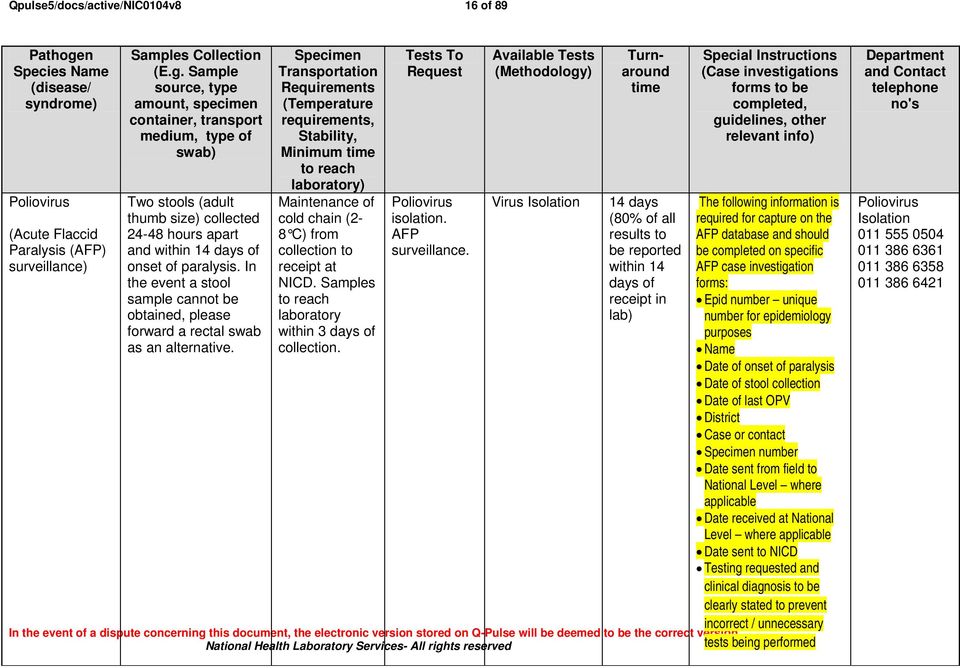
16 Qpulse5/docs/active/NIC0104v8 16 of 89 syndrome) Poliovirus (Acute Flaccid Paralysis (AFP) surveillance) Samples Collection amount, specimen container, transport medium, type of swab) Two stools (adult thumb size) collected hours apart and within 14 days of onset of paralysis. In the event a stool sample cannot be obtained, please forward a rectal swab as an alternative. Minimum to reach Maintenance of cold chain (2-8 C) from collection to receipt at NICD. Samples to reach laboratory within 3 days of collection. Poliovirus isolation. AFP surveillance. Virus Isolation 14 days (80% of all results to be reported within 14 days of receipt in lab) Special Instructions (Case investigations completed, guidelines, other relevant info) The following information is required for capture on the AFP database and should be completed on specific AFP case investigation forms: Epid number unique number for epidemiology purposes Name Date of onset of paralysis Date of stool collection Date of last OPV District Case or contact number Date sent from field to National Level where applicable Date received at National Level where applicable Date sent to NICD Testing requested and clinical diagnosis to be clearly stated to prevent incorrect / unnecessary tests being performed Department and Contact telephone no's Poliovirus Isolation
17 Qpulse5/docs/active/NIC0104v8 17 of 89 syndrome) Poliovirus Samples Collection amount, specimen container, transport medium, type of swab) Virus isolate from stool or environmental sample, minimum 1ml. Minimum to reach Transport frozen or at 4 C. must reach the laboratory within 3 days of dispatch. Real Time RT-PCR Sequencing Real Time ITD RT-PCR Real Time VDPV Screening RT-PCR Sequencing Special Instructions (Case investigations completed, guidelines, other relevant info) 7 days AFP Investigation Form with at least the following information: Epid Number Patient Name Date of onset of paralysis District Case or contact Number Referring specimen number Date sent to NICD Cell Line (L-Arm or R- Arm) Real Time PCR Results (if requesting Sequencing) Department and Contact telephone no's Centre for Vaccines & Immunology: Virology Working Group (Polio)

18 Qpulse5/docs/active/NIC0104v8 18 of 89 syndrome) Poliovirus Serology Samples Collection amount, specimen container, transport medium, type of swab) Clotted Blood - 5ml, Sera - 0.5ml Minimum to reach Maintenance of cold chain (2-8 C) Poliovirus Antibody Neutralization Neutralization Test 21 days NB: Samples are batched for testing. This may result in TATs being exceeded if not stated as urgent. Special Instructions (Case investigations completed, guidelines, other relevant info) Testing requested and clinical diagnosis to be clearly stated on request forms to prevent incorrect / unnecessary tests being performed Department and Contact telephone no's Poliovirus Serology

19 Qpulse5/docs/active/NIC0104v8 19 of 89 syndrome) Measles Samples Collection amount, specimen container, transport medium, type of swab) 5 ml Clotted Blood or EDTA Blood Minimum to reach Maintain cold chain (2-8 C) Samples should reach the lab within three days of sample collection Measles IgM Anti-Measles IgM antibody (EIA) 7 working days Special Instructions (Case investigations completed, guidelines, other relevant info) A Measles Case Investigation Form (CIF) must be completed in full and must accompany specimens. Please ensure that the following information is captured on the CIF: Name, age, DOB, address of patient Symptoms marked in tick boxes Complications marked in tick boxes Date of onset of rash Date seen at health facility Date specimen collected Medical history including measles vaccination history, number of doses and date of last measles vaccination Date of notification and response to case Department and Contact telephone no's CVI measles working group

20 Qpulse5/docs/active/NIC0104v8 20 of 89 syndrome) Measles Samples Collection amount, specimen container, transport medium, type of swab) Throat swab Please note Once a measles outbreak is identified (a cluster of IgM-positive cases) please collect 5-10 throat swab specimens from other suspected cases in the area and place in VTM tube (Viral Transport Medium) The instruction to collect throat swabs will be issued by the CDCs. Throat swabs should not be collected from sporadic suspected cases. Minimum to reach Transport at 2 C-8 C Sample should reach laboratory within 3 days For surveillance only RT-PCR Sequencing Virus isolation 14 days 14 days 1 month Special Instructions (Case investigations completed, guidelines, other relevant info) Surveillance only. Case Investigation Forms (CIF) must be completed in full and must accompany specimens. Department and Contact telephone no's CVI measles working group

21 Qpulse5/docs/active/NIC0104v8 21 of 89 Centre for Tuberculosis In 2011 the National Tuberculosis Reference was integrated into the National Institute for Communicable Diseases and broadened its scope to become the Centre for Tuberculosis (CTB). The new CTB will serve the needs of the NHLS, the NDoH and, ultimately, the general public of South Africa and, in addition, will provide technical support for the neighbouring SADC countries. The expanded support functions of the CTB relate to policy guidelines and knowledge management, outbreak response and education and training. The core functions are the establishment of an expanded TB reference facility, conducting public health surveillance and population-based research, and fostering innovative thinking leading to the introduction of novel approaches to TB diagnostics and management. The activities of the Centre are focusing on the following areas; 1. Reference Microbiology Reference laboratory activities of the CTB include providing specialist diagnostic services on TB patient management, the evaluation of novel methods and advising the NDoH on their introduction into the NTBCP. The CTB also provides laboratory information of epidemiological importance to the NDoH and World Health Organization (WHO). Such information includes data on circulating strains, insights into TB transmission dynamics and drug-resistant TB. The CTB is also in the process of establishing routine genotyping and MIC testing, as well as developing a specimen bank and a repository of wellcharacterised TB strains from different geographical locations in South Africa. This will enable the Centre link the transmission of specific strains to associated virulence, morbidity and mortality of the disease in specific geographical locations and population groups. This information will enable the NDoH better focus its control efforts. The CTB also supports the NDoH with policy development and standardisation of diagnostic methods. 2. Public health surveillance The CTB will collect clinical and demographic data in addition to traditional microbiological data in order to fully describe the epidemiology of TB in South Africa. The public health surveillance of TB is an important component of CTB activities, and is being conducted at four levels: Ad hoc population-based surveys, such as the nationwide Drug Resistance Survey (DRS) presently being conducted by the CTB and the NDoH. Data from the survey will enable the NTBCP to evaluate the quality of TB control, and provide information for planning and budgeting.
22 Qpulse5/docs/active/NIC0104v8 22 of Population research Population research priorities of the CTB include utilisation of surveillance and microbiological data, e.g. on the distribution and frequency of drugresistant strains from TB laboratories in order to design and implement research relevant to TB in South Africa. The CTB collaborates with academic centres and international institutions on nationally relevant research involving CDW-generated information. 4. Innovation and development Innovation is essential for the containment of an epidemic that has plagued humankind for thousands of years. Great strides have been made; both in the diagnostic and drug-development fields and the CTB will focus on new technologies and novel strategies, and assess their best utility in the South African context. This focus will draw on the strengths within the academic institutions, to ensure that the research conducted is translated into addressing programmatic needs of the country. Linked to innovation is the human capital that is the driver of this process. The CTB is playing an increasingly important role in supporting NDoH training programmes, including the development of training materials on diagnostic technologies and participation in skills transfer and capacity building.
23 Qpulse5/docs/active/NIC0104v8 23 of 89 Samples Collection source, type amount, specimen container, transport medium, type of swab) Minimum to reach Special Instructions (Case investigations completed, guidelines, other relevant info) Department and Contact Mycobacterium Tuberculosis Sputum Cool ambient temperature s should be collected in clean leak proof containers free from paraffin and other waxes or oils. s should be kept cool during transportation but should not be frozen. An adequate sample should be about 5-10ml sputum. Microscopy for acid-fast bacilli Microscopy for acid-fast bacilli Project dependant Centre for TB
24 Qpulse5/docs/active/NIC0104v8 24 of 89 Samples Collection source, type amount, specimen container, transport medium, type of swab) Minimum to reach s should be collected in clean leak proof containers free of oils. Sputum should be from deep cough avoiding saliva and secretions from nasopharynx. s should be kept cool during transportation but should not be frozen. An adequate sample should be about 5-10ml sputum. Special Instructions (Case investigations completed, guidelines, other relevant info) Department and Contact Mycobacterium Tuberculosis Sputum Culture Culture Project dependant Centre for TB
25 Qpulse5/docs/active/NIC0104v8 25 of 89 Samples Collection source, type amount, specimen container, transport medium, type of swab) Minimum to reach Special Instructions (Case investigations completed, guidelines, other relevant info) Department and Contact Mycobacterium Tuberculosis Mycobacterium Tuberculosis MGIT tubes (Liquid media) LJ Slopes Sputum and/or culture (liquid/solid) s should be collected in clean leak proof containers free from paraffin and other waxes or oils. s should be kept cool during transportation but should not be frozen. An adequate sample should be about 5-10ml sputum. Drug susceptibility testing MTBDRplus Drug susceptibility testing Molecular testing methods Genotype MTBDRplus 3-8 weeks or Project dependant 2-7 days or Project dependant Centre for TB Centre for TB
26 Qpulse5/docs/active/NIC0104v8 26 of 89 Centre for HIV and STI The Centre for HIV & Sexually Transmitted Infections (CHIVSTI) aims to be a resource of knowledge and expertise in HIV and other regionally relevant STIs to the South African Government, to SADC countries and to the African continent at large, in order to assist in the planning of policies and programmes related to the control and effective management of HIV/STIs. The Centre also aims to be a place of academic excellence in terms of both research and teaching/training. The Centre has a strong track record in the research disciplines of HIV virology, HIV immunology, HIV/STI epidemiology, HIV/STI diagnostics and HIV-STI interactions, as well as in successful supervision of MSc and PhD students. The CHIVSTI was created by the amalgamation of five separate NICD sections: the Virology (Head: Professor Lynn Morris) and Cell Biology Unit (Head: Professor Caroline Tiemessen) of the former AIDS Virus Research Unit, the HIV Molecular and Serology Laboratories of the former Specialized Molecular Diagnostics Unit (Head: Professor Adrian Puren), the former STI Reference Centre (Head: Professor David Lewis) and the World Health Organization-linked HPV LabNet (Head: Professor Anna-Lise Williamson). The first four sections are based on NICD s Sandringham campus and the last section is based at the University of Cape Town. Sections: Sexually Transmitted Infections Sections The STI section is responsible for providing intelligence on the aetiology of major STI syndromes, as well as antimicrobial resistance data related to gonoccoccal infections. Findings are communicated annually to the national and relevant provincial health departments in South Africa. The STI section also undertakes teaching and training activities, assisting with training of medical scientists, doctors, nurses and other healthcare staff. The STI section undertakes operational research relevant to public health and to that end it has established several international links with STI researchers overseas. HIV Research Section The HIV Research Section conducts research projects primarily on the virology and immunology of HIV. It also monitors the prevalence of antiretrorviral drug resistant HIV strains within South Africa and reports relevant findings to the National Department of Health. It also conducts validated end point assays for HIV vaccine trials.
27 Qpulse5/docs/active/NIC0104v8 27 of 89 Cell Biology Section The Cell Biology section focuses on studies of maternal-infant HIV-1 transmission as a model for understanding protective immunity to HIV-1. Studying the immune responses and other characteristics of both mothers and their infants allows the team to address questions of protective immunity of disease progression in the HIV-1 infected mothers, and of acute infection in infants who become infected. HIV Molecular and Serology Section The HIV Molecular subsection supports, research, surveillance and training. Tests undertaken include CD4 immunophenotyping, HIV DNA PCR for early infant diagnosis, HIV viral load monitoring as part of research and surveillance activities. The HIV Serology subsection has various 3 rd and 4 th generation HIV-1 ELISA platforms, Western blotting methods, HIV rapid tests in place to support various surveillance activities including HIV incidence testing. Testing for HIV can be performed on various matrices including dried blood spots where methods have been validated.. The types of projects undertaken include HIV-1 vaccine endpoint studies, HIV-1 prevalence and incidence surveillance, trial intervention studies.
28 Qpulse5/docs/active/NIC0104v8 28 of 89 Bacterial vaginosis Samples Collection amount, specimen container, transport medium, type of swab) Vaginal smear Minimum to reach Transport at ambient temperature Candida species Vaginal smear Transport at ambient temperature Herpes Simplex Type 2 Clotted Blood EDTA Blood Serum Plasma Transport on ice Gram stain Gram stain HSV2 IgG EIA Project Dependant Special Instructions (Case investigations completed, guidelines, other relevant info) Only available for surveillance and research purposes Only available for surveillance and research purposes Only available for Surveillance purposes and research project Department and Contact STI STI STI Herpes Simplex Virus Type 1 and 2 HIV Ulcer swab Plasma in EDTA or ACD tube Transport on ice or frozen Do not refrigerate samples if CD4 will be requested on same sample Minimum 1000µl plasma HSV PCR PCR 10 days Only available for Surveillance purposes and research project HIV VL Roche HIV-1 Viral Load 5 days HIV-1 viral load is performed once a week - Samples are batched STI HIV Molecular
29 Qpulse5/docs/active/NIC0104v8 29 of 89 HIV HIV Samples Collection amount, specimen container, transport medium, type of swab) Whole blood (EDTA or ACD Tube) Dried Blood Spots collected on 903 collection paper Minimum to reach 4 C to room temperature Minimum 2ml whole blood DO NOT FREEZE Sealed in plastic bags with desiccant and indicator to prevent moisture Minimum of three (3) full spots per card must be sent HIV DNA PCR HIV-1 DNA PCR (Whole blood) HIV DNA PCR HIV-1 DNA PCR (DBS) Special Instructions (Case investigations completed, guidelines, other relevant info) Department and Contact 5 days HIV Molecular days 10 days for positives All positive reflex to additional testing turnaround for positive samples is 14 days HIV Molecular HIV Whole blood (EDTA) Whole blood at room temperature CD4 CD4 (TCell lymphocyte subset) hours No cold chain transport, transport at ambient temperature HIV Molecular
30 Qpulse5/docs/active/NIC0104v8 30 of 89 HIV Samples Collection amount, specimen container, transport medium, type of swab) 5 ml/10ml Clotted Blood or EDTA Blood and Dried Blood Samples (DBS) collected on Whatman 903 Cards - minimum of 3 full circles of whole blood, preferably fill all 5 circles Minimum to reach Transport blood samples at 2 C- 8 C Maintenance of cold chain is required from collection to receipt at NICD. DBS samples can be transported at RT C (stable at RT C for 14 days) HIV ELISA HIV-1/2 Antibody EIA 5-7 working days or project dependent Special Instructions (Case investigations completed, guidelines, other relevant info) Project/Survey requirements must be provided in writing by or and discussed with NICD prior to testing. Department and Contact HIV Serology
31 Qpulse5/docs/active/NIC0104v8 31 of 89 HIV Samples Collection amount, specimen container, transport medium, type of swab) 5 ml/10ml Clotted Blood or EDTA Blood Minimum to reach Transport blood samples at 2 C- 8 C Maintenance of cold chain is required from collection to receipt at NICD HIV ELISA HIV-1/2 Antigen- Antibody EIA 5-7 working days or project dependent Special Instructions (Case investigations completed, guidelines, other relevant info) Project/Survey requirements must be provided in writing by or and discussed with NICD prior to testing. Department and Contact HIV Serology
32 Qpulse5/docs/active/NIC0104v8 32 of 89 HIV Samples Collection amount, specimen container, transport medium, type of swab) 5 ml/10ml Clotted Blood or EDTA Blood and Dried Blood Samples (DBS) collected on Whatman 903 Cards minimum of 3 full circles of whole blood, preferably fill all 5 circles Minimum to reach Transport blood samples at 2 C- 8 C Maintenance of cold chain is required from collection to receipt at NICD. DBS samples can be transported at RT C (stable at RT C for 14 days) HIV-1 or HIV-2 Western Blot HIV-1 Western Blot HIV-2 Western Blot 5-7 working days or project dependent Special Instructions (Case investigations completed, guidelines, other relevant info) Project/Survey requirements must be provided in writing by or and discussed with NICD prior to testing. Department and Contact HIV Serology
33 Qpulse5/docs/active/NIC0104v8 33 of 89 HIV Samples Collection amount, specimen container, transport medium, type of swab) 5 ml/10ml Clotted Blood or EDTA Blood Minimum to reach Transport blood samples at 2-8 C Maintenance of cold chain is required from collection to receipt at NICD Multispot HIV1/2 Rapid Multispot HIV1/2 Rapid (On Only) 5-7 working days or project dependent Special Instructions (Case investigations completed, guidelines, other relevant info) Project/Survey requirements must be provided in writing by or and discussed with NICD prior to testing. Department and Contact HIV Serology
34 Qpulse5/docs/active/NIC0104v8 34 of 89 HIV Samples Collection amount, specimen container, transport medium, type of swab) 5 ml/10ml Clotted Blood or EDTA Blood and Dried Blood Samples (DBS) collected on Whatman 903 Cards minimum of 3 full circles of whole blood, preferably fill all 5 circles Minimum to reach Transport blood samples at 2-8 C Maintenance of cold chain is required from collection to receipt at NICD DBS samples can be transported at Room Temperature for (stable for 14 days at RT C after collection) HIV Incidence Testing Calypte HIV-1 BED Incidence EIA (Research Purposes Only) working days or project dependent Special Instructions (Case investigations completed, guidelines, other relevant info) Project/Survey requirements must be provided in writing by or and discussed with NICD prior to testing. Department and Contact HIV Serology HIV-1 p24 Store at -70 C Culture supernatants 2 months All these tests are done for Research/Project purposes only. Virology Research Lab Manager J Patel
35 Qpulse5/docs/active/NIC0104v8 35 of 89 HIV-1 HIV-1 Samples Collection amount, specimen container, transport medium, type of swab) Neutralization assays a) Pseudovirion assay Drug resistance testing a) In-House assay Minimum to reach Special Instructions (Case investigations completed, guidelines, other relevant info) Store at -70 C Serum 2 months Whole blood received for testing to be stored at ambient temperature only Store at -70 C Plasma from EDTA blood 2 months Can be used for diagnostic purposes in special circumstances. HIV-1 Gag ELISA Store at -20 C Serum 2 months All these tests are done for Research/Project purposes only. HIV-1 HIV Virus isolation LN storage PBMC's 2 months Whole blood received for testing to be stored at ambient temperature only Department and Contact Virology Research Lab Manager J Patel Virology Research Lab Manager J Patel Virology Research Lab Manager J Patel Virology Research Lab Manager J Patel
36 Qpulse5/docs/active/NIC0104v8 36 of 89 HIV-1 HIV-1 Samples Collection amount, specimen container, transport medium, type of swab) 5ml/10ml Clotted blood or EDTA blood and Dried blood samples (DBS) collected on Whatman 903 Cards minimum of 3 full circles of whole blood, preferably fill all 5 circles or frozen plasma Mycoalert Mycoplasma Minimum to reach Transport blood samples at 2-8ºC DBS samples can be transported at room temperature(sta ble for 14 days at RTºC after collection) Transport can be on Dry Ice and stored at - 70ºC Store at -20 C Drug resistance testing In-house assay Plasma from EDTA blood DBS Cell supernatants 2 Months or project dependant Special Instructions (Case investigations completed, guidelines, other relevant info) Project/Survey requirements must be provided in writing by or and discussed with NICD prior to testing Department and Contact Virology Research Lab Manager J Patel month Virology Research Lab Manager J Patel
37 Qpulse5/docs/active/NIC0104v8 37 of 89 Treponema pallidum Treponema pallidum Treponema pallidum Samples Collection amount, specimen container, transport medium, type of swab) Clotted blood or EDTA Serum Plasma Clotted blood or EDTA Serum Plasma Ulcer swab Minimum to reach Transport on ice Transport on ice Transport on ice or frozen Syphilis/ Treponema pallidum PCR RPR TPPA Project dependant Project dependant Special Instructions (Case investigations completed, guidelines, other relevant info) Only available for Surveillance purposes and research projects Only available for Surveillance purposes and research projects PCR 10 days Only available for Surveillance purposes and research projects Department and Contact STI STI STI Treponema pallidum Ulcer swab Transport on ice or frozen Typing Project dependant Only available for Surveillance purposes and research projects STI Treponema pallidum Ulcer swab Transport on ice or frozen Antimicrobial susceptibility testing by PCR Project dependant Only available for Surveillance purposes and research projects STI Lympho granuloma Venereum (LGV) Ulcer swab Genital swab Transport on ice or frozen Transport on ice or frozen PCR 10 days Only available for Surveillance purposes and research projects STI
38 Qpulse5/docs/active/NIC0104v8 38 of 89 Samples Collection amount, specimen container, transport medium, type of swab) Minimum to reach HPV Genital swab Transport on ice or frozen PCR Project dependent Special Instructions (Case investigations completed, guidelines, other relevant info) Only available for Surveillance purposes and research project Department and Contact STI Chlamydia trachomatis Chlamydia trachomatis Chlamydia trachomatis Haemophilus. ducreyi Clotted Blood EDTA Blood Serum Plasma Urine Urethral Swab Vaginal swab Endocervical swab Oropharyngeal swab Rectal swab Vaginal swab Urethral Swab Endocervical swab Ulcer swab Ulcer swab Transport on ice Transport on ice or frozen Use special transport media. Transport on ice or frozen Transport on ice or frozen Chlamydia trachomatis/ LGV serology Micro immuno fluorescence (MIF) NAAT ( PCR, TMA) Culture 10 days Only available for Surveillance purposes and research project 10 days Only available for Surveillance purposes and research project Project dependant Only available for research purposes PCR 10 days Only available for Surveillance purposes and research project STI STI STI STI
39 Qpulse5/docs/active/NIC0104v8 39 of 89 Mycoplasma genitalium Samples Collection amount, specimen container, transport medium, type of swab) Urine Urethral swab Vaginal swab Endocervical swab Minimum to reach Transport on ice or frozen Special Instructions (Case investigations completed, guidelines, other relevant info) PCR 10 days Only available for Surveillance purposes and research project Department and Contact STI Neisseria gonorrhoeae Urethral swab Vaginal swab Other samples as indicated by clinical presentation Endocervical swab Rectal swab Pharyngeal swab Cultured strains Use special transport media (Amies Stuarts). Transport at 4 C to reach lab within 48 hours. Culture and Antimicrobial susceptibility testing 7 days Only available for Surveillance purposes and research project STI Neisseria gonorrhoeae Urine Urethral swab Vaginal swab Endocervical swab Penile swab Rectal swab Pharyngeal swab Transport on ice or frozen NAAT (PCR, TMA) 10 days Only available for Surveillance purposes and research project STI
40 Qpulse5/docs/active/NIC0104v8 40 of 89 Neisseria gonorrhoeae Neisseria gonorrhoeae Trichomonas vaginalis Samples Collection amount, specimen container, transport medium, type of swab) Urethral swab Vaginal swab Other samples as indicated by clinical presentation Endocervical swab Rectal swab Pharyngeal swab Cultured strains Urethral swab Vaginal swab Other samples as indicated by clinical presentation Endocervical swab Rectal swab Pharyngeal swab Cultured strains Urine Urethral swab Vaginal swab Endocervical swab Minimum to reach Transport on ice or frozen Except for cultured strains at ambient temperature Transport on ice or frozen Except for cultured strains at ambient temperature Transport on ice or frozen Typing by PCR Antimicrobial susceptibility testing by PCR Project dependent Project dependent Special Instructions (Case investigations completed, guidelines, other relevant info) Only available for Surveillance purposes and research project Only available for Surveillance purposes and research project PCR 10 days Only available for Surveillance purposes and research project Department and Contact STI STI STI
41 Qpulse5/docs/active/NIC0104v8 41 of 89 Trichomonas vaginalis Ureaplasma parvum Samples Collection amount, specimen container, transport medium, type of swab) Urethral swab Vaginal swab Urine Urethral swab Vaginal swab Endocervical swab Minimum to reach Use special transport media. Transport at ambient temperature to reach lab within 24 hrs Transport on ice or frozen Culture PCR Project dependant Special Instructions (Case investigations completed, guidelines, other relevant info) Only available for research purposes Only available for Surveillance purposes and research project Department and Contact STI Ureaplasma urealyticum Urine Urethral swab Vaginal swab Endocervical swab Transport on ice or frozen PCR Project dependant Only available for Surveillance purposes and research project STI
42 Qpulse5/docs/active/NIC0104v8 42 of 89 Centre for Emerging and Zoonotic Diseases New zoonoses (pathogens derived from animals) are emerging and known zoonoses are re-emerging in animal and human populations at alarming rates throughout the world. These pathogens represent a serious concern for medical and veterinary public health authorities, as well as for the authorities concerned with regulating biosafety and biosecurity at national and international levels. The confluence of people, animals (wild and domestic) and animal products is unprecedented, largely due to the ease of traversing large distances rapidly, afforded by the aviation industry. The Centre for Emerging Zoonotic Diseases (CEZD) aims to be a national and international centre of excellence for emerging and re-emerging zoonotic diseases. CEZD aims to function as a resource for knowledge and expertise to the South African government, the SADC countries and the African continent, in order to assist in the planning of relevant policies and programmes and to harness innovation in science and technology to support surveillance, detection and outbreak response systems. In observing this goal the CEZD supports South Africa s commitment to the International Health Regulations. For outbreak, clinical advice or public health queries: NICD Clinical Advice Hotline Electron Microscope Diagnostic screening of any sample type for viral pathogens is done using negative staining. This is not a primary diagnostic service. Identification is possible to the Family level, infrequently to the Sub-family level. Biopsy and autopsy tissues/fluids can also be processed for resin-embedding and the ultrathin sections examined for the presence of pathogens, though the ultrastructure of the pathogen dictates the specificity of the identification. All samples to be refrigerated but not frozen. If possible, tissues should be fixed immediately in 2.5% buffered glutaraldehyde before transportation. For non-viral pathogens, it is also possible to process wax-embedded tissues and sections on glass slides. For further information contact the Electron Microscopy. Samples should be marked attention: Electron Microscopy, and submitted to the Special Viral s, CEZD.
43 Qpulse5/docs/active/NIC0104v8 43 of 89 Arbovirus (Chikungunya, Dengue, West Nile, Rift Valley fever, Sindbis) ICD-10 code for unspecificied arbopod borne viral fever, A94 Samples Collection amount, specimen container, transport medium, type of swab) Clotted blood or serum, minimum of 1.0 ml Highly recommended to submit repeat specimens, preferably acute and convalescent specimens Minimum to reach Tubes in sealed in plastic bags. Label clearly as biohazardous. Adhere to national and international regulations for transportation of hazardous biological goods as required. Address to Center for Emerging and Zoonotic Diseases, Arbovirus, cold transport on ice packs Contact or NICD Hotline for consult on urgent cases Arbovirus (Routine arbo screen, include serology for Chikungunya, West Nile, Sindbis, Rift Valley fever) Dengue for patient with travel history. PCR/Isolation for Acute cases only Serology: (HAI is performed as initial screen; any positive results are followed up with IgM ELISA or IFA to confirm recent infection. Testing of acute and convalescent specimens to indicate seroconversion by four fold rise in IgG titre is highly recommended or IgM seroconversion) HAI: 5 days HAI + IgM ELISA/IFA: 7 days IgM ELISA/IFA: 2-4 days Special Instructions (Case investigations completed, guidelines, other relevant info) Rash or arthalgia syndromes with fever which may be linked to travel history, insect bites. Some cases develop encephalitis. Refer to Arbovirus Diagnostic Guide or Outbreak specific guidelines available from Highly recommended to submit repeat specimens, preferably acute and convalescent specimens. Submit Case investigation form Department and Contact Special Viral s Arbovirology Ms C le Roux Dr J Weyer NICD Hotline
44 Qpulse5/docs/active/NIC0104v8 44 of 89 Samples Collection amount, specimen container, transport medium, type of swab) Alternative/additio nal specimens for PCR and isolation: CSF (for encephalitic cases only, requires at least 500 μl) Liver biopsies (for post mortem confirmation only, contact ) Minimum to reach See above Arbovirus PCR (specify which arbovirus, for example "Dengue PCR") Arbovirus isolation RT-PCR Virus isolation hours 18 days Special Instructions (Case investigations completed, guidelines, other relevant info) See above. Should be requested in addition to the Arbovirus routine screen only. Only useful for specimens collected within 7 days of onset of illness or acutely ill patients. See above. Should be requested in addition to the Arbovirus routine screen only. Only useful for specimens collected within 7 days of onset of illness or acutely ill patients Department and Contact See above
45 Qpulse5/docs/active/NIC0104v8 45 of 89 Bacillus anthracis (anthrax) Samples Collection amount, specimen container, transport medium, type of swab) Cutaneous Vesicular stage: Soak 2x sterile dry swabs in vesicular fluid from a previously unopened vesicle. Eschar stage: Rotate 2x sterile dry swabs for 2-3s beneath the edge of eschar without removing it. Minimum to reach Transport at room temperature Anthrax (ANTHR) Microscopy, culture and special identification Special Instructions (Case investigations completed, guidelines, other relevant info) 5 days Safety precautions should be taken when handling/collectin g samples Samples should be taken prior to antibiotic treatment and should reach laboratory as quickly as possible Department and Contact Special Bacterial s Reference Biopsy of lesion: Fresh Tissue in PBS/saline Please note: Do not send preserved tissue Important Please notify laboratory prior to sending specimens
46 Qpulse5/docs/active/NIC0104v8 46 of 89 Samples Collection amount, specimen container, transport medium, type of swab) Inhalation Pleural fluid or sputum (>1 ml) collected in sterile container Minimum to reach Transport at 2-8 C Special Instructions (Case investigations completed, guidelines, other relevant info) Department and Contact Blood culture plus 1 tube clotted blood and 1 tube whole blood (EDTA tube) Transport blood culture at room temperature and blood tubes at 2-8 C Gastrointestinal Stool or rectal swab Transport at 2-8 C Blood culture plus 1 tube clotted blood and1 tube whole blood (EDTA tube) Transport blood culture at room temperature and blood tubes at 2-8 C
47 Qpulse5/docs/active/NIC0104v8 47 of 89 Samples Collection amount, specimen container, transport medium, type of swab) Meningitis CSF in sterile container Minimum to reach Transport at 2-8 C Special Instructions (Case investigations completed, guidelines, other relevant info) Department and Contact Bartonella species Clostridium botulinum (botulism) Blood culture plus 1 tube clotted blood and 1 tube whole blood (EDTA tube) 1 tube EDTA blood 20 to 30 ml clotted blood or 10 to 15 ml serum 25 to 50 g of stool Gastric washing Vomitus Suspected food Transport blood culture at room temperature and blood tubes at 2-8 C Transport between 2-8 C within 3 days of collection Transport at 2-8 C Bartonella culture and PCR Botulinum culture and PCR 21 days Please attach relevant clinical history form Mouse neutralization assay, Anaerobic culture and confirmation 4 weeks Important Please notify laboratory prior to sending specimens Special Bacterial s Reference Special Bacterial s Reference
48 Qpulse5/docs/active/NIC0104v8 48 of 89 Rabies Samples Collection amount, specimen container, transport medium, type of swab) Clotted blood or serum, minimum of 0.5 ml Minimum to reach containers must be sealed in plastic bags. Adhere to national and international transportation of biological goods. Address to Centre for Emerging and Zoonotic Diseases, Special Viral s, cold transport on ice packs. Rabies immunity Serology: Rabies IgG hours Special Instructions (Case investigations completed, guidelines, other relevant info) Only for post vaccinal immunity screening. Usually for high risk occupational groups such as veterinarians or animal handlers or laboratory workers in laboratories that handle rabies virus Department and Contact Special Viral s Dr J Weyer
49 Qpulse5/docs/active/NIC0104v8 49 of 89 Rabies (Rabies and rabies-related lyssaviruses) ICD-10 code is A82.9 Samples Collection amount, specimen container, transport medium, type of swab) Antemortem: Saliva, minimum of 0.5 ml CSF, minimum of 0.5 ml Nuchal biopsies, single biopsy collected with dermatological punch from nape of neck Post mortem: Brain. Brainstem is most sensitive specimen. Whole, half or cubes of representative regions of brain submitted in 50 % glycerol saline in plastic screw top containers. Brain biopsies collected via the supraorbital fissure (contact laboratory for instructions). Do not submit in formalin. If no saline available Minimum to reach containers must be sealed in plastic bags. Labelled as biohazardous and suspected rabies. Adhere to national and international regulations for transportation of hazardous biological goods as required. Address to Center for Emerging and Zoonotic Diseases, Arbovirus, cold transport on ice packs Contact or NICD Hotline for consult on urgent cases Rabies Antemortem: RT-PCR (performed on saliva, CSF and biopsy) Serology (Rabies IgG/IgM) (performed on CSF and blood/serum) Post mortem: Rabies fluorescent antibody test (DFA or FAT) hrs hours hours Special Instructions (Case investigations completed, guidelines, other relevant info) For antemortem investigation of suspected rabies cases. Encephalitis with rapid progression, hydrophobia, dementia, hallucinations, lucid periods usually present. Suggested that all specimens should be cosubmitted for rule out of rabies. At least 3 consecutively collected salivas (on different days if possible) should be submitted. Post mortem investigation is most conclusive. Contact /NICD Hotline for advice In the event of a dispute freeze concerning fresh. this document, the electronic version stored on Q-Pulse will be deemed to be the correct version Department and Contact Special Viral s Dr J Weyer NICD Hotline
50 Qpulse5/docs/active/NIC0104v8 50 of 89 Leptospira spp. (Leptospirosis) Samples Collection amount, specimen container, transport medium, type of swab) 1 Tube of clotted blood or serum Please note: Tests not done on urine, plasma, haemolysed, icteric or lipeamic blood. Minimum to reach Transport at 2-8 C Sample should reach laboratory within 3 days. Leptospirosis (LEPTO) Serology: IgM ELISA Special Instructions (Case investigations completed, guidelines, other relevant info) Department and Contact 4 days Special Bacterial s Reference
51 Qpulse5/docs/active/NIC0104v8 51 of 89 Viral haemorrhagic fevers (Crimean- Congo haemorrhagic fever, Ebola, Marburg, Lassa, Hanta and Yellow fever) ICD-10 code for unspecified viral haemorrhagic fever, A99 Samples Collection amount, specimen container, transport medium, type of swab) Clotted blood or serum, minimum of 1.0 ml Minimum to reach Tubes in sealed in plastic bags. Label clearly as biohazardous and suspected VHF. Adhere to national and international regulations for transportation of hazardous biological goods as required. Address to Center for Emerging and Zoonotic Diseases, Special pathogens, cold transport on ice packs Contact and/or NICD VHF Serology (Fluorescent antibody test: IgG and IgM ELISA: IgG and IgM) RT-PCR Virus isolation hrs hrs 21 days Special Instructions (Case investigations completed, guidelines, other relevant info) Fever, Rash Headache, Arthralgia, Myalgia, Haemorrhagic manifestations, Gastrointestinal symptoms, Pathology indicators, Travel history or other exposure events Contact and/or NICD Hotline Submission of repeat specimen critical to confirm or exclude VHF Full battery of tests (serology, PCR and isolation) Hotline recommended for most conclusive testing) Department and Contact Special Viral s Dr J Weyer Contact NICD Hotline
52 Qpulse5/docs/active/NIC0104v8 52 of 89 Yersinia pestis (Plague) Samples Collection amount, specimen container, transport medium, type of swab) Bubonic Bubo aspirate in PBS in sterile container plus 2x swabs (absorb a few drops of sample on a sterile swab and place into Cary Blair transport medium) Pneumonic Sputum in sterile container plus 2x swabs (rotate swab in sputum sample and place into Cary Blair transport medium) Septicemic Blood culture bottle Minimum to reach Transport at 2-8 C or room temperature. Transport at 2-8 C or room temperature. Transport at room temperature Plague (PLAGE) Microscopy (Gram, Wayson & DFA), culture and confirmation Special Instructions (Case investigations completed, guidelines, other relevant info) 5 days Safety precautions should be taken when handling/collectin g samples Samples should be taken prior to antibiotic treatment and should reach laboratory as quickly as possible Important Please notify laboratory prior to sending specimens Department and Contact Special Bacterial s Reference
53 Qpulse5/docs/active/NIC0104v8 53 of 89 Samples Collection amount, specimen container, transport medium, type of swab) 1 tube clotted blood or serum Please note: Paired serum taken 2-3 weeks apart is required for confirmation Surveillance Clotted animal blood e.g. rodent, dog Minimum to reach Transport at 2-8 C Transport at 2-8 C Plague serology (PLAGE) Plague surveillance (RATS) Serology: ELISA Serology 2 days 4 weeks Special Instructions (Case investigations completed, guidelines, other relevant info) Department and Contact
54 Qpulse5/docs/active/NIC0104v8 54 of 89 Centre for Enteric Diseases The Centre for Enteric Diseases (CED) aims to provide specialized diagnostics, relevant data and expertise in diarrhoeal diseases Working Groups: Bacteriology Division The bacteriology division was established in 1997 and is the reference centre in South Africa for human infections involving bacterial enteric pathogens including diarrhoeagenic Escherichia coli, Salmonella species, Shigella species and Vibrio cholerae. The division participates in national laboratorybased surveillance for enteric bacterial pathogens. Isolates are voluntarily submitted to the bacterial division from ~200 clinical microbiology laboratories and data is collected on patients presenting throughout South Africa with both invasive and non-invasive disease. In order to make these data representative and reflective of disease burden in each province, all diagnostic laboratories are actively motivated to voluntarily submit limited demographic details and isolates. In exchange, the bacterial division offers serogrouping and serotyping results free of charge, regular feedback (quarterly reports by province sent to every laboratory participating) and aggregated pathogens numbers, published in the NICD Bulletin. In addition, E- tests are used to determine the minimum inhibitory concentration (MIC) of each isolate to antimicrobial agents, according to CLSI guidelines. The division routinely performs genotypic characterization (DNA fingerprinting) on all outbreak/epidemic-prone pathogens including Salmonella Typhi, Shigella dysenteriae type 1, V. cholerae O1 and Shiga-toxin producing E. coli (including the enterohaemorrhagic E. coli). The division actively assist in outbreak investigations and performs genotyping and strain characterization of any enteric bacterial pathogens involved. Virology Division The virology division was established in May 2006 to expand the range of diarrhoeal pathogens under investigation to include viruses associated with gastroenteritis. The division participates in a sentinel surveillance program at five sites around South Africa to monitor rotavirus epidemiology, genotype distribution and the impact of the rotavirus vaccine introduced into the expanded program on immunization (EPI) in August The division is also involved in investigating methods to improve vaccine safety and efficacy in developing countries. Furthermore, the division monitors the incidence, seasonality and molecular character of additional enteric viruses including, but not limited to, norovirus, sapovirus, adenovirus, astrovirus, bocavirus in children less than five years of age. The division also provides diagnostic support to the outbreak investigation unit.
55 Qpulse5/docs/active/NIC0104v8 55 of 89 Diarrhoeagenic Escherichia coli Watery or bloody diarrhoea, abdominal cramps, with or without fever ICDcode) Samples Collection amount, specimen container, transport medium, type of swab) confirmed isolate from stool or rectal swab only. confirmed isolate from all body sites for suspect EHEC/E. coli O157. Environmental isolates in water or foodborne disease outbreaks only. Minimum to reach Inoculated Dorset slopes incubated at 37 C overnight at source laboratory, prior to submission to CED- Bacteriology. Dorset slope to be kept at room temperature upon receipt at NICD. Enteric surveillance/ E. coli characterization Phenotypic: Identification Serotyping O- antigen Genotypic: Virulence gene detection by multiplex-pcr. DNA fingerprinting of strains by PFGE analysis Turn-around *3 months 3 days 3 days 3 days 4 days Special Instructions (Case investigations completed, guidelines, other relevant info) *Batch testing for surveillance isolates. Attach stool isolate form obtainable from CED- Bacteriology or copy of laboratory report including patient details. Department and Contact CED Bacteriology
56 Qpulse5/docs/active/NIC0104v8 56 of 89 Vibrio cholerae O1 and non-o1 (non-cholera Vibrio species) Acute watery diarrhoea ICDcode) Samples Collection amount, specimen container, transport medium, type of swab) confirmed cultured isolate from all body sites. Environmental isolates in water or foodborne disease outbreaks only. Minimum to reach Bacterial isolates subcultured onto Dorset transport medium. Inoculated dorsets incubated at 37 C overnight at source laboratory, prior to submission to CED Bacteriology. Dorset slope to be kept at room temperature upon receipt at NICD. Enteric surveillance/ Vibrio species characterization Phenotypic: Identification Serotyping Antimicrobial susceptibility testing. Screening of ESBL Genotypic: Cholera enterotoxin detection by real PCR. DNA fingerprinting of strains by PFGE analysis Turn-around # 1 month 2 days 3 days 4 days 1 day 4 days Special Instructions (Case investigations completed, guidelines, other relevant info) # Batch testing for surveillance isolates. Attach stool isolate form obtainable from CED- Bacteriology or copy of laboratory report including patient details. Department and Contact CED Bacteriology
57 Qpulse5/docs/active/NIC0104v8 57 of 89 Salmonella Typhi and non-typhoidal Salmonella species Shigella species Diarrhoea, fever, cramps, dysentery ICDcode) Samples Collection amount, specimen container, transport medium, type of swab) confirmed cultured isolates from all body sites. Environmental isolates in water or foodborne disease outbreaks only. Minimum to reach Bacterial isolates subcultured onto Dorset transport medium. Inoculated dorsets incubated at 37 C overnight at source laboratory, prior to submission to CED Bacteriology. Enteric surveillance/ Salmonella species characterization Enteric surveillance/ Shigella species characterization Phenotypic: Serotyping: Salmonella Shigella Antimicrobial susceptibility testing. Screening of ESBL Turn-around *3 months 10 days 5 days 4 days Special Instructions (Case investigations completed, guidelines, other relevant info) *Batch testing for surveillance isolates. Attach stool isolate form, obtainable from CED- Bacteriology or a copy of laboratory report including patient details. Department and Contact CED Bacteriology Dorset slope to be kept at room temperature upon receipt at NICD Genotypic: PFGE analysis: MLVA analysis: 4 days 3 days.
58 Qpulse5/docs/active/NIC0104v8 58 of 89 ICDcode) Adenovirus (type 40/41 and Enteric) Gastroenteritis: Diarrhoea, vomiting, fever Astrovirus Gastroenteritis: Diarrhoea, vomiting, fever Samples Collection amount, specimen container, transport medium, type of swab) : Stool Unsuitable : Rectal swab in VTM : Stool Unsuitable : Rectal swab in VTM Minimum to reach Maintenance of cold chain from collection to receipt at NICD. Store and transport at 4 C. Maintenance of cold chain from collection to receipt at NICD. Store and transport at 4 C. Adenovirus type 40/41 detection Enteric Adenovirus detection Astrovirus detection ELISA (type 40/41) Real- PCR (Enteric adenovirus) Turn-around Special Instructions (Case investigations completed, guidelines, other relevant info) 5 days containers closed tightly and sealed in plastic bag accompanied with date of specimen collection and date of birth Real- PCR 5 days containers closed tightly and sealed in plastic bag accompanied with date of specimen collection and date of birth Department and Contact CED Virology CED Virology
59 Qpulse5/docs/active/NIC0104v8 59 of 89 ICDcode) Norovirus Gastroenteritis: Diarrhoea, vomiting, fever Rotavirus Gastroenteritis: Diarrhoea, vomiting, fever Samples Collection amount, specimen container, transport medium, type of swab) Stool Unsuitable : Rectal swab in VTM : Stool Unsuitable : Rectal swab in VTM Minimum to reach Maintenance of cold chain from collection to receipt at NICD. Store and transport at 4 C. Maintenance of cold chain from collection to receipt at NICD. Store and transport at 4 C. Norovirus detection Rotavirus detection Rotavirus genotyping Turn-around Special Instructions (Case investigations completed, guidelines, other relevant info) Real- PCR 5 days containers closed tightly and sealed in plastic bag accompanied with date of specimen collection and date of birth ELISA or Coris dipstick RT-PCR genotyping 5 days containers closed tightly and sealed in plastic bag accompanied with date of specimen collection and date of birth as well as vaccination history (where possible) Department and Contact CED Virology CED Virology
60 Qpulse5/docs/active/NIC0104v8 60 of 89 Centre for Opportunistic, Tropical and Hospital Infections The Centre for Opportunistic, Tropical and Hospital Infections aims to prevent and control opportunistic, tropical and hospital infections in South Africa by providing: Strategic information obtained through surveillance and research to the Department of Health and other major stakeholders Technical support for public health programmes such as the malaria control programme and the cryptococcal screening programme Reference laboratory services in the fields of parasitology, mycology, entomology and bacteriology support for outbreak response Training for clinical, laboratory and public health personnel to ensure optimal diagnosis and control of diseases The Centre focuses its efforts on opportunistic infections, particularly those that are HIV-related; tropical infections, especially malaria and its vectors; and nosocomial infections, concentrating on antimicrobial resistance in the hospital setting. Working Groups: Parasitology The group provides a specialised parasitology reference service for routine diagnostic medical laboratories. In addition, some important opportunistic pathogens form the focus of its diagnostic, research, teaching, and surveillance activities. Pneumocystis jirovecii is an unconventional opportunistic pathogen that causes the important AIDS-defining infection, Pneumocystis pneumonia (PcP). The estimation of the burden of PCP in HIV-positive patients at sentinel sites in South Africa is a current project. Other opportunistic diseases being studied are microsporidiosis, toxoplasmosis, and freeliving amoeba infections. Malaria and echinococcosis are other areas of interest for the group. Vector Control Malaria is the major vector-borne disease in Africa, killing close to 1 million people annually, most of them children under the age of five. In South Africa, malaria transmission is confined to the low-lying border areas in the northeast of the country where approximately cases were reported in The Vector Control Reference (VCRL) focuses on the anopheline mosquitoes responsible for malaria transmission. The Unit houses a unique collection of live mosquito colonies of the three most important vector species in Africa, Anopheles gambiae, An. arabiensis and An. funestus, plus the minor vector An. merus, and the non-vector species of the An. gambiae complex, An. quadriannulatus. Three colonies of An. funestus from Mozambique and Angola continue to provide us with a unique resource for research into insecticide resistance in this important malaria vector. This places the VCRL in a unique position to offer collaboration with international institutions investigating similar problems and to play a role in influencing
61 Qpulse5/docs/active/NIC0104v8 61 of 89 policy decisions on vector control strategies in the region. In addition, the VCRU houses the largest museum collection of African arthropods of medical importance in Africa, the third largest such collection in the world. The high level of expertise in the Unit has been recognised within the University of the Witwatersrand as a research Unit called the Malaria Entomology Research Unit (MERU). Services and Courses: Insecticide and Repellent Testing The VCRL has the expertise and resources necessary to conduct insecticide testing, especially insecticides used in mosquito control. We are able to conduct scientific tests in order to determine the effectiveness of the insecticides applied to nets or solid surfaces. Forensic Entomology The VCRL has been involved in assisting the South African Police Service with identifications of insects found on corpses and at the sites where corpses have been discovered. Results have correlated well with forensic pathology estimates of post-mortem intervals. Diagnostic Services The VCRL provides an identification service of medically important arthropods for entomologists, medical practitioners and health workers. Mycology The mycology working group focuses on laboratory-based surveillance for two fungal diseases of public health importance in South Africa: cryptococcal meningitis and candidaemia. In collaboration with the Department of Health and other partners, the group is also leading efforts to implement and monitor a laboratory-driven cryptococcal screening programme at ± 500 clinics in Gauteng and the Free State (phase 1) this programme aims to prevent deaths associated with cryptococcal meningitis. Development of clinical guidelines for management of fungal infections is an important activity members of the group continue to participate in development of South African and WHO guidelines for HIV-associated cryptococcal meningitis. A specialised mycology reference service is provided to routine diagnostic medical laboratories including phenotypic and sequence-based identification of unusual or difficult-to-identify fungi and antifungal susceptibility testing. Research activities are focused on developing and validating new diagnostic assays and defining risk factors for fungal disease and antifungal drug resistance. The reference laboratory also holds a large collection of pathogenic fungi.
62 Qpulse5/docs/active/NIC0104v8 62 of 89 Antimicrobial Resistance The group is responsible for laboratory-based surveillance of nosocomial infections caused by ESCAPE (Enterococcus feacium, Staphylococcus aureus, Clostridium difficile, Acinetobacter baumannii, Pseudomonas aeruginosa and Enterobacteriaceae) organisms. Sentinel sites surveillance is piloted with Staphylococcus aureus and Klebsiella pneumoniae. In addition, the laboratory processes highly-antimicrobial resistant pathogens by referral from diagnostic medical laboratories. Staphylococcus aureus can cause skin and soft tissue infections, pneumonia, arthritis, endocarditis, osteomyelitis, foreign-body infections and sepsis; these can range from mild to severe and potentially fatal. However, risk groups include newborn infants, breast feeding women and individuals with chronic comorbid conditions such as diabetes, cancer, vascular disease and lung disease. K. pneumoniae can cause different types of healthcareassociated infections, including pneumonia, bloodstream infections, urinary tract infections, wound or surgical site infections, and meningitis. K. pneumoniae infections are often seen in individuals with compromised immune systems and those with diabetes, malignancy, renal failure, liver disease and chronic obstructive pulmonary disease (COPD). Hospitalised patients are also at risk as they can acquire infection through invasive medical devices such as ventilators, intravenous catheters, etc. Surveillance for antimicrobial resistance is fundamental component for antimicrobial stewardship programs.
63 Qpulse5/docs/active/NIC0104v8 63 of 89 Parasitology Samples Collection amount, specimen container, transport medium, type of swab) Minimum to reach Special Instructions (Case investigations forms to be completed, guidelines, other relevant info) Department and Contact Parasite - Borrelia duttoni or B. recurrentis (Relapsing fever) Unclotted, EDTA blood or blood films. Clotted blood is unsuitable. Transport at ambient temperature. Relapsing fever borrelia Staining and microscopy 1 day Parasitology Reference Parasite - Babesia species (Babesiosis) Parasite - Plasmodium species (Malaria) Unclotted, EDTA blood or blood films. Clotted blood is unsuitable. Unclotted, EDTA blood or blood films. Clotted blood is unsuitable. Transport at ambient temperature. Transport at ambient temperature. Blood should be transported to the laboratory as quickly as possible. Babesia Malaria investigation Staining and microscopy Staining and microscopy 1 day Parasitology Reference day Parasitology Reference
64 Qpulse5/docs/active/NIC0104v8 64 of 89 Parasite - Plasmodium falciparum (Malaria) Parasite - Microfilaria species (W. bancrofti, L. loa, M. perstans etc) Parasite - Wuchereria bancrofti (Lymphatic filariasis or elephantiasis) Samples Collection amount, specimen container, transport medium, type of swab) Unclotted, EDTA blood. Clotted blood is unsuitable. Unclotted, EDTA blood or blood films. Blood sampling should be performed at the correct s depending on the suspected filarial species.* EDTA Blood or serum. Minimum to reach Transport at ambient temperature. Transport at ambient temperature. Transport at ambient temperature. Antigen test for Plasmodium falciparum Microfilaria investigation W. bancrofti antigen test Antigen test for Plasmodium falciparum Staining and microscopy Antigen test for Wuchereria bancrofti. ½ day Special Instructions (Case investigations forms to be completed, guidelines, other relevant info) 1 day *For W. bancrofti sample after 8pm, for L. loa at ~12pm and others at any. ½ day Department and Contact Parasitology Reference Parasitology Reference Parasitology Reference
65 Qpulse5/docs/active/NIC0104v8 65 of 89 Parasite - Trypanosoma species (Sleeping sickness or trypanosomiasis) Parasite -Human protozoa including: Cryptosporidium species, Isospora belli, Cyclospora cayetanensis, Giardia lamblia, Entamoeba coli, Blastocystis hominis Samples Collection amount, specimen container, transport medium, type of swab) Unclotted, EDTA blood, blood films or fresh CSF (1ml). Clotted blood is unsuitable. Stool or duodenal aspirate/string test. s, that may take longer than a day to reach the laboratory, should ideally be preserved in an equal quantity of 10% formalin. Minimum to reach Transport at ambient temperature. Ideally CSF specimens must reach laboratory within 30 minutes of sampling. Transport at ambient temperature. Trypanosome investigation Stool parasites (specify suspected parasite, if applicable) Staining and microscopy. Microscopic identification of all human protozoa Special Instructions (Case investigations forms to be completed, guidelines, other relevant info) Department and Contact 1 day Parasitology Reference day Parasitology Reference
66 Qpulse5/docs/active/NIC0104v8 66 of 89 Parasite - Entamoeba histolytica (Amoebiasis) Samples Collection amount, specimen container, transport medium, type of swab) Stool, liver abscess fluid or cyst fluid. Minimum volume is 1ml. Minimum to reach Transport at ambient temperature. Don t add preservative. Ideally specimen must reach laboratory within 30 minutes of sampling. Special Instructions (Case investigations forms to be completed, guidelines, other relevant info) Department and Contact Amoebiasis Microscopy 1 day Parasitology Reference
67 Qpulse5/docs/active/NIC0104v8 67 of 89 Parasite -Human nematodes including: Ascaris lumbricoides (common roundworm), hookworms (Ancylostoma duodenale/ Necator americanus), Trichuris trichiura (whipworm), Strongyloides stercoralis Parasite - Enterobius vermicularis (pinworm) Samples Collection amount, specimen container, transport medium, type of swab) Stool or worm/s. s that may take longer than a day to reach the laboratory should ideally be preserved in an equal quantity of 10% formalin. Early morning sticky tape swab is the optimal specimen. Minimum to reach Transport at ambient temperature. Transport at ambient temperature. Stool parasites (specify suspected parasite, if applicable) Enterobius vermicularis/ (pinworm) Macroscopic and/or microscopic identification. Special Instructions (Case investigations forms to be completed, guidelines, other relevant info) Department and Contact 1 day Parasitology Reference Microscopy 1 day Eggs may be infective handle with care. Parasitology Reference
68 Qpulse5/docs/active/NIC0104v8 68 of 89 Parasite - Strongyloides stercoralis Parasite -Human trematodes including: Schistosoma mansoni/ haematobium (Bilharzia, schistosomiasis) Parasite - Schistosoma haematobium (Schistosomiasis, bilharzia) Samples Collection amount, specimen container, transport medium, type of swab) Sputum, urine or CSF. Minimum volume is 1ml. Larvae may be infective handle with care. Stool. s, that may take longer than a day to reach the laboratory, should ideally be preserved in an equal quantity of 10% formalin. Urine, minimum volume is 5ml. Minimum to reach Transport at ambient temperature. Transport at ambient temperature. Transport at ambient temperature. Strongyloides stercoralis Stool parasites (specify suspected parasite, if applicable) Schistosoma haematobium Microscopy for larvae of Strongyloides stercoralis. Microscopic identification of all human trematodes. Special Instructions (Case investigations forms to be completed, guidelines, other relevant info) 1 day For disseminated infections. Department and Contact Parasitology Reference day Parasitology Reference Microscopy 1 day Parasitology Reference
69 Qpulse5/docs/active/NIC0104v8 69 of 89 Parasite -Human cestodes (tapeworms) including: Taenia saginata, T. solium, H. nana, H. diminuta and D. latum Parasite - Tapeworm (adult) identification Samples Collection amount, specimen container, transport medium, type of swab) Stool s, that may take longer than a day to reach the laboratory, should ideally be preserved in an equal quantity of 10% formalin. Worm or proglottid (tapeworm segment). Submit proglottids in saline. Minimum to reach Transport at ambient temperature. Transport at ambient temperature. Stool parasites (specify suspected parasite, if applicable) Tapeworm identification Microscopic identification of all human cestodes/ tapeworms. Macroscopic and/or microscopic identification. Special Instructions (Case investigations forms to be completed, guidelines, other relevant info) Department and Contact 1 day Parasitology Reference days Proglottids may be infective handle with care. Parasitology Reference Parasite - Echinococcus species (Echinococcosis, hydatid disease) Cyst tissue, cyst fluid or sputum, minimum volume is 1ml. Transport at ambient temperature, if transport is expected to take longer than 2 days it is best to transport at 4 C. Echinococcus Microscopic examination for hydatid hooklets and scolices of Echinococcus species. 1 day May be infective handle with care. Parasitology Reference
70 Qpulse5/docs/active/NIC0104v8 70 of 89 Parasite - Acanthamoeba spp. (Acanthamoeba keratitis) Samples Collection amount, specimen container, transport medium, type of swab) Corneal scrapings or biopsy, or contact lenses, cases and solutions. Send tissue in saline. Minimum to reach Transport at ambient temperature. Acanthamoeba Culture, Staining 2 weeks (Prov. result sent day 2) Special Instructions (Case investigations forms to be completed, guidelines, other relevant info) Department and Contact Parasitology Reference Parasite - Leishmania species (Leishmaniasis) Bone marrow, liver biopsy, skin biopsy/impression smears. Submit skin biopsy in saline. Transport at ambient temperature. Leishmania investigation Staining and microscopy 1 day Parasitology Reference Parasite - Microsporidia species Stool or any appropriate biological specimen. Transport at ambient temperature. s should ideally not be preserved in formalin. Microsporidia investigation Staining and microscopy. TEM also available. 2 days Parasitology Reference
71 Qpulse5/docs/active/NIC0104v8 71 of 89 Parasite - Pneumocystis jirovecii (Pneumocystis pneumonia, PCP) Vector Control Samples Collection amount, specimen container, transport medium, type of swab) Respiratory specimens including: induced sputum, tracheal aspirates, bronchial washings, bronchoalveolar lavage (BAL). Random sputum is not an optimal specimen. Minimum volume is 1ml. Minimum to reach Transport at ambient temperature. Pneumocystis jirovecii (PCP) Immunofluoresce nce assay Special Instructions (Case investigations forms to be completed, guidelines, other relevant info) Department and Contact 1 day Parasitology Reference Arthropods/ Insects Morphological identification (by VCRL) Undamaged. Alive or preserved on silica Insects Arthropods 3 days Anopheline mosquit oes, spiders, scorpions VCRL Culicine mosquitoes and ticks - SPU- Arbovirology Vector Control Reference
72 Qpulse5/docs/active/NIC0104v8 72 of 89 Mycology Samples Collection amount, specimen container, transport medium, type of swab) Minimum to reach Special Instructions (Case investigations forms to be completed, guidelines, other relevant info) Department and Contact Fungal pathogen from clinical sources which cannot be identified by academic/ referral laboratories Cryptococcus (surveillance) Unidentified fungal pathogen from clinical source should be inoculated into an agar slope (screwtop) bottle such as Dorset transport medium or potato dextrose medium Cryptococcal isolate should be inoculated into an agar slope (screwtop) bottle such as Dorset transport medium Room temperature; inform Mycology Reference if suspected dimorphic fungus which needs to be processed in a BSL-3 facility Room temperature Identification of fungal pathogen; Antifungal susceptibility testing Cryptoccocal surveillance Phenotypic and genotypic identification (where required) of unidentified fungal pathogens from clinical sources; Antifungal susceptibility testing Identification by phenotypic and genotypic methods; antifungal susceptibility testing 10 days (unless very slowgrowing organism) N/A Complete case report form (can be obtained from the Mycology Reference ) Complete GERMS case report or attach final lab report; Submission requested from GERMS-SA enhanced surveillance sites; private labs and NHLS labs in KZN Mycology Reference Mycology Reference
73 Qpulse5/docs/active/NIC0104v8 73 of 89 Candida (surveillance) Antimicrobial Resistance Samples Collection amount, specimen container, transport medium, type of swab) Candida isolate should be inoculated into an agar slope (screwtop) bottle such as Dorset transport medium Minimum to reach Room temperature Candida surveillance Identification by phenotypic and genotypic methods; antifungal susceptibility testing N/A Special Instructions (Case investigations forms to be completed, guidelines, other relevant info) Complete GERMS case report or attach final lab report; Submission requested from participating GERMS-SA labs Department and Contact Mycology Reference Staphylococcus aureus and Gram-positive organisms Gram-negative organisms Blood culture positive, subcultured on Dorset slopes and submitted to MEQARU Blood culture positive Cultures on Dorset slopes viable for up to one month at room temperature Cultures on Dorset slopes viable for up to one month at room temperature Cultures on Dorset slopes viable for up to one month at room temperature Cultures on Dorset slopes viable for up to one month at room temperature ID, MIC and molecular characterization of resistance mechanisms ID, MIC and molecular characterization of resistance mechanisms days from receipt of culture days from receipt of culture Patients with bacteremia 48 h after admission in the hospital (Surveillance only) Patients with bacteraemia 48h after admission in the hospital (Surveillance only) MEQARL MEQARL
74 Qpulse5/docs/active/NIC0104v8 74 of 89 Multi-resistant Enterobacteriaec eae Samples Collection amount, specimen container, transport medium, type of swab) Cultures on Dorset slopes or other media viable for up to one month at room temperature Minimum to reach Clinically relevant sites and environmental samples Cultures on Dorset slopes viable for up to one month at room temperature ID, MIC and molecular characterization of resistance mechanisms 2 weeks from receipt of culture Special Instructions (Case investigations forms to be completed, guidelines, other relevant info) Highly resistant nosocomial infections Department and Contact MEQARL Centre for Respiratory Diseases and Meningitis The Centre for Respiratory Diseases and Meningitis (CRDM) is a resource of surveillance, diagnostics, expertise and research in the field of communicable respiratory diseases and meningitis for South Africa and the African continent. The centre generates data and provides expertise related to respiratory diseases and meningitis of public health importance to the South African National Department of Health, health care providers, regional and international collaborators, to assist with the planning of public health policies and programmes and response to respiratory disease and meningitis outbreaks. The CRDM is also a source of capacity building and formal training within South Africa and the African region. Objectives of the CRDM 1. To conduct surveillance for respiratory diseases and meningitis within South Africa in order to provide data on the burden, severity and seasonality. 2. To characterise (phenotypically and genotypically) pathogens contributing to respiratory diseases and meningitis in order to understand strain relatedness (molecular epidemiology) and guide vaccine development treatment and prevention policy. 3. To monitor trends in antiviral and antibacterial drug resistance in respiratory and meningeal pathogens in order to inform empiric treatment guidelines 4. To monitor the impact and effectiveness of interventions to reduce respiratory diseases and meningitis
75 Qpulse5/docs/active/NIC0104v8 75 of To provide reference laboratory functions for specialised organism characterisation and identification related to respiratory communicable diseases and pathogens causing meningitis nationally and regionally. 6. To identify and characterise novel respiratory and meningeal pathogens with potential to cause outbreaks and to assist with response to respiratory disease outbreaks. 7. To be a source of local and regional expertise on respiratory diseases and meningitis. 8. To engage in directed and relevant research to answer questions related to regional respiratory disease and meningitis communicable disease problems and their surveillance and management 9. To build local and regional capacity in epidemiology and laboratory diagnostics for respiratory disease and meningitis Samples Collection source, type amount, specimen container, transport medium, type of swab) Minimum to reach Transport at 4 C Sample should reach laboratory within 72hrs Special Instructions (Case investigations completed, guidelines, other relevant info) Department and Contact Adenovirus Nasopharyngeal and/or oropharyngeal aspirates or swabs in UTM/VTM, BAL and Biopsies of respiratory tissues RVPCR Real-Time PCR 72 hrs Respiratory Infection CRDM Virology CMV CSF Nasopharyngeal and/or oropharyngeal aspirates or swabs in UTM/VTM, BAL and Biopsies of respiratory tissues Transport at 4 C Sample should reach laboratory within 72hrs RVPCR(CMV) Real-Time PCR 72 hrs; Severe acute respiratory infection, retinitis, encephalitis Virus Isolation
76 Qpulse5/docs/active/NIC0104v8 76 of 89 Samples Collection source, type amount, specimen container, transport medium, type of swab) Minimum to reach Transport at 4 C Sample should reach laboratory within 72hrs Special Instructions (Case investigations completed, guidelines, other relevant info) Department and Contact Influenza [A(H3N2); A(H1N1)pdm09; seasonal A(H1N1); and Influenza B virus. Avian Influenza (H5, H7, H9) Nasopharyngeal and/or oropharyngeal aspirates or swabs in UTM/VTM, BAL and Biopsies of respiratory tissues RVPCR Real-Time PCR 72 hrs Respiratory Infection CRDM Virology Parainfluenza virus types 1, 2 and 3 Nasopharyngeal and/or oropharyngeal aspirates or swabs in UTM/VTM, BAL and Biopsies of respiratory tissues. Other respiratory samples - to be discussed with Dr. on call. Nasopharyngeal and/or oropharyngeal aspirates or swabs in UTM/VTM, BAL and Biopsies of respiratory tissues Transport at 4 C Sample should reach laboratory within 72hrs transported as Infectious substance (packaging instruction 602 of IATA). Transport at 4 C Sample should reach laboratory within 72hrs Suspected Avian influenza Real-Time PCR 24 hrs Clinical features consistent with AI infection PLUS meets epidemiological criteria as outlined in AI Case Investigation Document (Contact Epidemiologist) RVPCR Real-Time PCR 72 hrs Respiratory Infection CRDM Virology Hotline-Dr on call: CRDM Virology
77 Qpulse5/docs/active/NIC0104v8 77 of 89 Samples Collection source, type amount, specimen container, transport medium, type of swab) Minimum to reach Special Instructions (Case investigations completed, guidelines, other relevant info) Department and Contact Rhinovirus Human Metapneumoviru s (hmpv) RSV Human Corona viruses (229E, OC43, NL63, HKU1) Nasopharyngeal and/or oropharyngeal aspirates or swabs in UTM/VTM, BAL and Biopsies of respiratory tissues Nasopharyngeal and/or oropharyngeal aspirates or swabs in UTM/VTM, BAL and Biopsies of respiratory tissues Nasopharyngeal and/or oropharyngeal aspirates or swabs in UTM/VTM, BAL and Biopsies of respiratory tissues Nasopharyngeal and/or oropharyngeal aspirates or swabs in UTM/VTM, BAL and Biopsies of respiratory tissues Transport at 4 C Sample should reach laboratory within 72hrs Transport at 4 C Sample should reach laboratory within 72hrs Transport at 4 C Sample should reach laboratory within 72hrs Transport at 4 C Sample should reach laboratory within 72hrs RVPCR Real-Time PCR 72 hrs Respiratory Infection RVPCR Real-Time PCR 72 hrs Respiratory Infection RVPCR Real-Time PCR 72 hrs Respiratory Infection RVPCR (hcov) Real-Time PCR 72 hrs Respiratory Infection CRDM Virology CRDM Virology CRDM Virology CRDM Virology
78 Qpulse5/docs/active/NIC0104v8 78 of 89 Samples Collection source, type amount, specimen container, transport medium, type of swab) Minimum to reach Special Instructions (Case investigations completed, guidelines, other relevant info) Department and Contact Novel Corona virus-2012 (EMC) Human Boca virus Induced sputum, lung aspirates, nasopharyngeal and/or oropharyngeal aspirates or swabs in UTM/VTM, BAL and Biopsies of respiratory tissues. Other respiratory samples - to be discussed with Dr. on call. Nasopharyngeal and/or oropharyngeal aspirates or swabs in UTM/VTM, BAL and Biopsies of respiratory tissues Transport at 4 C Sample should reach laboratory within 72hrs Transported as infectious substance (packaging instruction 602 of IATA). Transport at 4 C Sample should reach laboratory within 72hrs Suspected novel corona virus RVPCR (hbov) Real-Time PCR 24 hrs Clinical features consistent with SARI infection PLUS meets epidemiological criteria as outlined by WHO (Contact Epidemiologist) Real-Time PCR 72 hrs Respiratory Infection CRDM Virology Hotline-Dr on call: CRDM Virology
79 Qpulse5/docs/active/NIC0104v8 79 of 89 Samples Collection source, type amount, specimen container, transport medium, type of swab) Minimum to reach Special Instructions (Case investigations completed, guidelines, other relevant info) Department and Contact N. meningitidis, H. influenzae and S. pneumoniae N. meningitidis, H. influenzae and S. pneumoniae Human - normally sterile site specimen (mostly blood or cerebrospinal fluid [CSF] or other fluids e.g. pleural, peritoneal, synovial) Human - normally sterile site specimen (mostly blood or cerebrospinal fluid [CSF] or other fluids e.g. pleural, peritoneal, synovial) Isolates on Dorset transport medium inoculated as per NIC0184. No refrigeration required. Do not batch as isolates will lose viability. Isolates on Dorset transport medium inoculated as per NIC0184. No refrigeration required. Do not batch as isolates will lose viability. National surveillance (GERMS-SA) Multilocus sequence typing (MLST) Identification of S. pneumoniae, N. meningitidis and H. influenzae Serotyping/ Serogrouping Antimicrobial susceptibility testing (disc and minimum inhibitory concentration - MIC) Outbreak investigation/ molecular epidemiology/ surveillance 1 month Isolates submitted to NICD for national surveillance (GERMS-SA) with sterile Isolate form or LIS report 1 week outbreak Variable (for special projects) Outbreak investigation or special projects CRDM Bacteriology CRDM Bacteriology
80 Qpulse5/docs/active/NIC0104v8 80 of 89 Samples Collection source, type amount, specimen container, transport medium, type of swab) Minimum to reach Special Instructions (Case investigations completed, guidelines, other relevant info) Department and Contact Neisseria species, Haemophilus species and Streptococcus species N. meningitidis, H. influenzae and S. pneumoniae Human - normally sterile site specimen (mostly blood or cerebrospinal fluid [CSF] or other fluids e.g. pleural, peritoneal, synovial) Human - normally sterile site specimen (mostly blood or cerebrospinal fluid [CSF] or other fluids e.g. pleural, peritoneal, synovial) Isolates on Dorset transport medium inoculated as per NIC0184. No refrigeration required. Do not batch as isolates will lose viability. Minimum of 200μl whole or clotted blood (serum), unclotted EDTA blood, CSF. Refrigeration preferred but not essential Identification of Neisseria species, Haemophilus species or Streptococcus species Antigen detection Polymerase chain reaction (PCR) for identification PCR for serotyping/ grouping 2-5 days As part of national surveillance or to confirm results with sterile Isolate form or LIS report Urgent 1 day Nonurgent 2-4 days Culture-negative specimens/ specimens for diagnosis/confirm ation with sterile Isolate form or LIS report CRDM Bacteriology CRDM Bacteriology
81 Qpulse5/docs/active/NIC0104v8 81 of 89 Division of Public Health, Surveillance and Response The Public Health Surveillance and Response Division was established incorporating The Group for Enteric, Respiratory and Meningeal Diseases Surveillance in South Africa (GERMS-SA), Outbreak Response and Travel Health The Division facilitates communication and data sharing between the national and provincial health departments and the NICD and provide epidemiological input to other NICD units through collaborative projects and support of surveillance and epidemiological activities and outbreak responses. Working Groups: GERMS-SA: The Group for Enteric, Respiratory and Meningeal Diseases Surveillance in South Africa (GERMS-SA) is a laboratory-based surveillance programme for fungal and bacterial causes of pneumonia, meningitis and diarrhoeal diseases. Approximately 200 laboratories (public and private) report cases and send isolates to the NICD according to specific GERMS case definitions. At 25 sentinel sites across the country, surveillance officers collect clinical information on patients relating to these specific pathogens. The objectives of the programme are to: - Estimate the burden of infectious diseases under surveillance - Monitor antimicrobial susceptibility trends - Monitor the impact of the HIV/AIDS Comprehensive Care, Management and Treatment Programme in SA on HIV-associated opportunistic infections - Evaluate the impact of vaccines included in the Expanded Programme on Immunisation (EPI) - Monitor hospital-acquired infections Special studies currently being undertaken include a case control study to measure the effectiveness of a conjugate vaccine against invasive pneumococcal disease, and the evaluation of a lateral flow assay used for t diagnosing incident cryptococcosis in HIV-infected patients. The work carried out by the GERMS team has significantly contributed to the development of clinical guidelines for pneumonia, meningococcal disease, cholera, cryptococcosis, typhoid fever, etc., and the introduction of pneumococcal conjugate vaccine into the EPI.
82 Qpulse5/docs/active/NIC0104v8 82 of 89 Outbreak Response: The Outbreak Response Team is tasked with providing technical support for all aspects of communicable disease outbreak investigation and control in the nine provinces of South Africa, with special emphasis on optimising the role of laboratory services during these events. The team aims to be a source of intelligence during outbreaks, and through working in close collaboration with the provincial and national Departments of Health, ensures a comprehensive outbreak response, as well as the development of systems for early detection and improved reporting. Through close partnerships with the NHLS diagnostic laboratories and reference units of the NICD, the team aims to facilitate appropriate laboratory diagnostic services during outbreaks and specialised diagnostics as required. The Outbreak Response Team plays a crucial role in communications with stakeholders such as the Department of Health, medical practitioners, media and the general public. We publish a monthly Communicable Diseases Communiqué for providing up-to-date information on communicable disease events in South Africa, as well as regularly produce various healthcare worker guidelines, handbooks, fact-sheets, etc. for outbreak-prone communicable diseases of high public health importance. The Team also plays a central role in capacity development by providing in-service training to SA-FELTP residents, public health specialist registrars and sec ondees from international partner organisations, and routinely provides Epidemic Preparedness and Response Training to staff of the Department of Health. Travel Health: Travel Health was established in 2008 with the aim of being a centre for travel health-related activities and consulting on international health matters. This working group provides pre- and post-travel health advice and consultations for travel health practitioners, as well as for staff of the NHLS and NICD for work related field activities. Regular expert consultations are provided both locally and internationally to international focal points, institutes and health practitioners for South African travellers presenting with infectious diseases after travel within southern Africa and further abroad. These include diseases in travellers such as trypanosomiasis, severe malaria and rickettsial disease (tick bite fever). Consultation is also provided for the elimination of malaria in South Africa and other countries within southern Africa.
83 Qpulse5/docs/active/NIC0104v8 83 of 89 Key Contact Staff National Institute for Communicable Diseases Department Contact person Contact numbers address 24/7 NICD Emergency/Assistance cell phone Executive Director Shabir A. Madhi Personal Assistant Priscilla May Deputy-Director Centre for Respiratory Diseases and Meningitis Centre for Enteric Diseases Deputy-Director Centre for Emerging and Zoonotic Diseases Centre for Opportunistic, Tropical and Hospital Infections Centre for Vaccines and Immunology: Head Prof A Puren Prof J Frean Dr M Suchard [email protected] [email protected] melindas@nicd,ac.za Manager Hepatitis Dr Nishi Prabdial Sing [email protected] Manager Polio Nicksy Gumede-Moeletsi [email protected] Manager Measles Mrs. Sheilagh Smit [email protected]
84 Qpulse5/docs/active/NIC0104v8 84 of 89 Department Contact person Contact numbers address Cell culture M Vandecar [email protected] Poliovirus Serology and Isolation S.Moonsamy [email protected] Centre for Tuberculosis: Head Dr N Ismail [email protected] Pathologist Dr B Magazi [email protected] Centre for HIV and STI HIV Molecular and Serology Diagnostic Laboratories: Head Prof A Puren [email protected] Secretary Monica van Rensburg [email protected] Supervisor HIV Molecular Diagnostics Ewaldé Cutler [email protected] Supervisor HIV Serology Diagnostics B.Singh [email protected] Virology Prof L Morris [email protected] Fax: Personal Assistant S. Doig [email protected] Manager Jay Patel [email protected]
85 Qpulse5/docs/active/NIC0104v8 85 of 89 Department Contact person Contact numbers address Cell Biology Unit Prof C Tiemessen [email protected] Sexually Transmitted Infections Reference Section Prof D Lewis Fax: [email protected] Secretary C. Palmer [email protected] Manager V. Maseko [email protected] Centre for Emerging and Zoonotic Diseases Special Viral s Prof J Paweska Senior Medical Scientist Dr J Weyer [email protected] [email protected] Secretary Raquel Esof [email protected] Manager (Arbovirus) C le Roux chantell@nicd,ac.za Special Bacterial s Senior Medical Scientist J. Rossouw [email protected] Electron Microscope Medical Scientist Dr M Birkhead [email protected]
86 Qpulse5/docs/active/NIC0104v8 86 of 89 Department Contact person Contact numbers address Centre for Respiratory Diseases and Meningitis Bacteriology Dr A von Gottberg [email protected] Manager L. De Gouveia [email protected] Respiratory Virus (Influenza) Prof M. Venter [email protected] Respiratory Virus Dr F Treurnicht [email protected] General Isolation/Respiratory A.Buys [email protected] Centre for Enteric Diseases Virology Dr N Page Bacteriology Dr K Keddy [email protected] [email protected] Manager A. Sooka [email protected]
87 Qpulse5/docs/active/NIC0104v8 87 of 89 Department Contact person Contact numbers address Centre for Opportunistic, Tropical and Hospital Infections Parasitology Prof J Frean [email protected] Manager B. Poonsamy [email protected] Mycology Dr N Govender Fax: [email protected] Manager Mycology Ruth Mpembe [email protected] Vector Control Reference Dr L Koekemoer Fax: [email protected] Antimicrobial Resistance Dr O, Perovic [email protected] za Lab Manager Marshagne Smith [email protected] Division of Public Health, Surveillance and Response Deputy-Director Prof L Blumberg [email protected] Public Health Surveillance and Response Dr V Quan [email protected]
88 Qpulse5/docs/active/NIC0104v8 88 of 89 Department Contact person Contact numbers address Receiving Office Mr. E. Maselesele Nathi Ndlovu National Stock Culture Collection M. Smith Quality Assurance K. Fitchet
89 Qpulse5/docs/active/NIC0104v8 89 of 89 Acknowledgement of Reading Form My signature confirms that I have read and understood the content of this document and relevant kit insert (where applicable). Name Signature Date Name of Kit Version No. Note to the Quality Rep: - This form must be filed for 5 years to provide audit traceability. In the event of a dispute concerning this document, the electronic version stored on Q-Pulse will be deemed to be the correct version
4A. Types of Laboratory Tests Available and Specimens Required. Three main types of laboratory tests are used for diagnosing CHIK: virus
 4. LABORATORY 4A. Types of Laboratory Tests Available and Specimens Required Three main types of laboratory tests are used for diagnosing CHIK: virus isolation, reverse transcriptase-polymerase chain reaction
Microbiology Specimen Collection Instructions. Alphabetical List of Microbiology Tests
 Page 1 of 8 Alphabetical List of Tests Test/Specimen Type Collection Table Referred out Abscess aspirate, wound Acanthamoebae Parasitology Acinetobactor screening Adenovirus Serology AFB Stain only Amoebiasis
AIR FORCE REPORTABLE EVENTS GUIDELINES & CASE DEFINITIONS
 AIR FORCE REPORTABLE EVENTS GUIDELINES & CASE DEFINITIONS An Air Force addendum to the TRI-SERVICE REPORTABLE EVENTS GUIDELINES & CASE DEFINITIONS Prepared by: Air Force Institute for Operational Health
Streptococcus pneumoniae IgG AB (13 Serotypes), MAID... 7
 Volume 12 December 2011 Table of Contents Summary of Test Changes... 3 Test Changes... 6 Human Anti-Mouse AB (HAMA), ELISA... 6 Hepatitis E Antibody (IgG, IgM)... 6 Hepatitis E Antibody (IgG)... 6 Hepatitis
Specimen Collection Guide
 Specimen Collection Guide pathology.mater.org.au Specimen Collection Guide This chart indicates the specimen required for most frequently requested tests. If the desired test is not listed here please
Algorithm for detecting Zika virus (ZIKV) 1
 Algorithm for detecting Zika virus (ZIKV) 1 This algorithm is addressed to laboratories with established capacity (molecular, antigenic and/or serological) to detect dengue (DENV), Zika (ZIKV) 2, and chikungunya
Guidelines for Collection and Transport of Specimen for Laboratory Diagnosis of Pathogenic Leptospira spp.
 Document: Introduction: Guidelines for Collection and Transport of Specimen for Laboratory Diagnosis of Pathogenic Leptospira spp. Leptospirosis is an acute bacterial infection caused by organism belonging
41 Viral rashes and skin infections
 41 Viral rashes and skin infections Clinical There are several kinds of skin infections caused by viruses, and these are best considered in the four categories that group together similar symptoms for
Appendix B: Provincial Case Definitions for Reportable Diseases
 Infectious Diseases Protocol Appendix B: Provincial Case Definitions for Reportable Diseases Disease: West Nile Virus Illness Revised December 2014 West Nile Virus Illness 1.0 Provincial Reporting Confirmed
Zika Virus. Fred A. Lopez, MD, MACP Richard Vial Professor Department of Medicine Section of Infectious Diseases
 Zika Virus Fred A. Lopez, MD, MACP Richard Vial Professor Department of Medicine Section of Infectious Diseases What is the incubation period for Zika virus infection? Unknown but likely to be several
JIANGSU CARTMAY INDUSTRIAL CO.,LTD www.labfurniture.asia mail: [email protected]
 The basic layout, the main functions and instrumentation concept of micro Inspection Division laboratory, 1, Virology Laboratory 1. Functions: for the city to monitor the prevalence of HIV disease, dealing
OCCUPATIONAL HEALTH, DISABILITY AND LEAVE SECTOR MEASURES TO MINIMIZE EXPOSURE TO BLOODBORNE PATHOGENS AND POST-EXPOSURE PROPHYLAXIS POLICY
 UNIVERSITY OF OTTAWA OCCUPATIONAL HEALTH, DISABILITY AND LEAVE SECTOR MEASURES TO MINIMIZE EXPOSURE TO BLOODBORNE PATHOGENS AND POST-EXPOSURE PROPHYLAXIS POLICY Prepared by the Occupational Health, Disability
Guidelines for Hand Foot and Mouth Disease HFMD
 Guidelines for Hand Foot and Mouth Disease HFMD Hand, foot, and mouth disease, or HFMD, is a contagious illness caused by different viruses. Infants and children younger than 5 years are more likely to
Tuberculosis and HIV/AIDS Co-Infection: Epidemiology and Public Health Challenges
 Tuberculosis and HIV/AIDS Co-Infection: Epidemiology and Public Health Challenges John B. Kaneene, DVM, MPH, PhD University Distinguished Professor of Epidemiology Director, Center for Comparative Epidemiology
CHAPTER 13. Quality Control/Quality Assurance
 CHAPTER 13 Quality Control/Quality Assurance Quality Control/Quality Assurance (QC/QA) can be defined as the set of planned and systematic activities focused on providing confidence that quality requirements
PERTUSSIS SURVEILLANCE AND RESPONSE PROTOCOL
 PERTUSSIS SURVEILLANCE AND RESPONSE PROTOCOL Public Health Action 1. Educate the public, particularly parents of infants, about the dangers of whooping cough and the advantages of initiating immunization
Zika Virus. History of Zika virus
 Zika Virus Zika fever is caused by the Zika virus (ZIKV), an arthropod-borne virus (arbovirus). The Zika virus is a member of the Alphavirus genus in the family Togaviridae. It is related to dengue, yellow
Diagnosing arbovirus infections (and Bill s holiday snaps) David W Smith Division of Microbiology and Infectious Diseases PathCentre
 Diagnosing arbovirus infections (and Bill s holiday snaps) David W Smith Division of Microbiology and Infectious Diseases PathCentre Arboviral illnesses relevant to Australia Polyarthralgia Fever and rash
Public Health Laboratory Services Branch Centre for Health Protection, Department of Health Hong Kong Special Administrative Region
 Guidelines on Biosafety in the Clinical Laboratory February 2008 (Revised edition) Public Health Laboratory Services Branch Centre for Health Protection, Department of Health Hong Kong Special Administrative
Pertussis Information for GPs and other Health Care Providers on Clinical and Public Health Management. March 2010
 Pertussis Information for GPs and other Health Care Providers on Clinical and Public Health Management March 2010 Infectious Agent Bordetella pertussis (a bacterium) Clinical Features Infants and Young
Please note: Contact Coppe Laboratories at 262-574-0701 if archival plasma samples need to be tested.
 Collecting a Coppe Laboratories Sample The Coppe Laboratories Sample Kit contains: Test Request Form (TRF) Heparin tube Absorbent sheet Biohazard bag Foil pouch Label for blood tube Box Seal Instructions
COMMUNICABLE DISEASE
 Public Health Activities & Services Inventory Technical Notes COMMUNICABLE DISEASE CLINICAL SERVICES, SURVEILLANCE AND CONTROL In 2014, decision was made to adopt number of national public health activities
INFECTION CONTROL MANUAL
 Page 1 of 19 Key Words: staff, communicable diseases, diseases, infectious diseases Policy Applies to: All staff employed by Mercy Hospital, Credentialed Specialists and Allied Health Professionals involved
SCREENING FOR SEXUALLY TRANSMITTED INFECTIONS
 SCREENING FOR SEXUALLY TRANSMITTED INFECTIONS Take history:- History of presenting problem Full sexual history (refer to guideline on sexual history taking) Relevant past medical history, including previous
General Information and Guidelines. Submission of blood tubes
 General Information and Guidelines Submission of blood tubes Note: Do not submit blood samples in syringes (especially with needles attached). Syringes that are submitted to the lab with the needles attached
Ambulance Service Patient Care and Transportation Standards
 Ambulance Service Patient Care and Transportation Standards Patient Care A. General Each operator and each emergency medical attendant and paramedic employed by the operator, shall: (a) Ensure that each
Delaware. Downloaded 01/2011
 Delaware Downloaded 01/2011 3.0 CNA Training Program Requirements 3.3 Curriculum Content 3.3.2 Environmental Needs Of The Resident Key Concepts: Introduces the nursing assistant to the need to keep residents
STI case management. Francis Ndowa - GFMER Theodora Wi - WHO
 Training Course in Sexual and Reproductive Health Research 2014 Module: Principles and Practice of Sexually Transmitted Infections Prevention and Care STI case management Francis Ndowa - GFMER Theodora
Canadian Public Health Laboratory Network. Core Functions of Canadian Public Health Laboratories
 Canadian Public Health Laboratory Network Core Functions of Canadian Public Health Laboratories Canadian Public Health Laboratory Network The CPHLN Core Functions of Canadian Public Health Laboratories
Cytomegalovirus (HHV5/CMV) Roseolovirus (HHV6 & 7)
 Betaherpesvirinae Cytomegalovirus (HHV5/CMV) Roseolovirus (HHV6 & 7) CYTOMEGALOVIRUS CMV is thought to be amongst the oldest type of herpesvirus in evolutionary terms. CMV is the prototype of beta-herpesviruses
Viral Hepatitis Case Report
 Page 1 of 9 Viral Hepatitis Case Report Perinatal Hepatitis B Virus Infection Michigan Department of Community Health Communicable Disease Division Investigation Information Investigation ID Onset Date
GUIDE TO FOLLOW UP TESTING FOR BLOOD OR BODY FLUID EXPOSURES AND NEEDLESTICK INJURIES
 GUIDE TO FOLLOW UP TESTING FOR BLOOD OR BODY FLUID EXPOSURES AND NEEDLESTICK INJURIES Hepatitis B, Hepatitis C and HIV may be contracted through exposure to any body fluid, particularly blood. Follow up
Appendix 3 Exposure Incident Report Form
 Appendix 3 Exposure Incident Report Form January, 2015 Page 1 of 6 Please see the following pages for the Exposure Incident Report Form. Guidelines for the Management of Exposure to Blood and Body Fluids
Medicaid Family Planning Waiver Services CPT Codes and ICD-9 Diagnosis Codes
 Family Planning Waiver Services CPT Codes and ICD-9 Diagnosis Codes CPT Code Description of Covered Codes Evaluation and Management 99384FP 99385FP 99386FP 99394FP 99395FP 99396FP 99401FP 99402FP 99403FP
Core Functions and Capabilities. Laboratory Services
 Core Functions and Capabilities British Columbia Centre for Disease Control Laboratory Services Understanding the role and value of British Columbia s public health laboratory in protecting our community
Specimen collection and transport for Chlamydia trachomatis and Neisseria gonorrhoeae testing
 Specimen collection and transport for Chlamydia trachomatis and Neisseria gonorrhoeae testing Overview Chlamydia trachomatis (CT) and Neisseria gonorrhoeae (NG) infections are two of the most common sexually
Laboratory confirmation requires isolation of Bordetella pertussis or detection of B. pertussis nucleic acid, preferably from a nasopharyngeal swab.
 Pertussis Epidemiology in New Zealand New Zealand has continued to experience outbreaks of pertussis in recent decades. This is in part due to historically low immunisation rates and in part because immunity
Annex to the Accreditation Certificate D-PL-14139-01-00 according to DIN EN ISO/IEC 17025:2005
 Deutsche Akkreditierungsstelle GmbH Annex to the Accreditation Certificate D-PL-14139-01-00 according to DIN EN ISO/IEC 17025:2005 Period of validity: 26.10.2015 to 25.10.2020 Date of issue: 26.10.2015
Veterinary Testing. Classes of Test
 Veterinary Testing Classes of Test July 2014 Copyright National Association of Testing Authorities, Australia 2014 This publication is protected by copyright under the Commonwealth of Australia Copyright
JOINT COMMISSION INTERNATIONAL ACCREDITATION STANDARDS FOR. 2nd Edition
 JOINT COMMISSION INTERNATIONAL ACCREDITATION STANDARDS FOR CliniCAl laboratories 2nd Edition Effective 1 April 2010 International Patient Safety Goals (IPSG) Goals The following is a list of all goals.
EVALUATION OF DARK FIELD MICROSCOPY, ISOLATION AND MICROSCOPIC AGGLUTINATION TEST FOR THE DIAGNOSIS OF CANINE LEPTOSPIROSIS
 Page85 Research Article Biological Sciences EVALUATION OF DARK FIELD MICROSCOPY, ISOLATION AND MICROSCOPIC AGGLUTINATION TEST FOR THE DIAGNOSIS OF CANINE LEPTOSPIROSIS S. Vamshi Krishna *, Siju Joseph,
Managing Bloodborne Pathogens Exposures
 Managing Bloodborne Pathogens Exposures House Staff Orientation 2015 Phillip F. Bressoud, MD, FACP Associate Professor of Medicine and Executive Director Campus Health Services University of Louisville
Clinical description 2 Laboratory test for diagnosis 3. Incubation period 4 Mode of transmission 4 Period of communicability 4
 Tuberculosis Contents Epidemiology in New Zealand 2 Case definition 2 Clinical description 2 Laboratory test for diagnosis 3 Case classification 3 Spread of infection 4 Incubation period 4 Mode of transmission
Utah Division of Solid and Hazardous Waste Solid Waste Management Program
 Utah Division of Solid and Hazardous Waste Solid Waste Management Program Mailing Address Office Location Phone (801) 536-0200 P.O. Box 144880 195 North 1950 West Fax (801) 536-0222 Salt Lake City, Utah
California Guidelines for STD Screening and Treatment in Pregnancy
 California Guidelines for STD Screening and Treatment in Pregnancy These guidelines were developed by the California Department of Public Health (CDPH) Sexually Transmitted Diseases (STD) Control Branch
12/2/2015 HEPATITIS B AND HEPATITIS C BLOOD EXPOSURE OBJECTIVES VIRAL HEPATITIS
 HEPATITIS B AND HEPATITIS C BLOOD EXPOSURE DISEASE 101 ONLINE CONFERENCE SARAH WENINGER, MPH VIRAL HEPATITIS.STD.HIV PREVENTION COORDINATOR DECEMBER 3, 2015 OBJECTIVES Describe the populations that should
About Our Products. Blood Products. Purified Infectious/Inactivated Agents. Native & Recombinant Viral Proteins. DNA Controls and Primers for PCR
 About Our Products Purified Infectious/Inactivated Agents ABI produces a variety of specialized reagents, allowing researchers to choose the best preparations for their studies. Available reagents include
Direct Testing Systems and Serology
 Direct Testing Systems and Serology Rapid Manual Tests 6-2 Serology Diagnostics 6-6 BD Diagnostics Diagnostic Systems Catalog 2005/2006 6-1 Rapid Manual Tests Meningitis Test Systems 252360 Directigen
Viral Hepatitis. 2009 APHL survey report
 Issues in Brief: viral hepatitis testing Association of Public Health Laboratories May Viral Hepatitis Testing 9 APHL survey report In order to characterize the role that the nation s public health laboratories
Lyme (IgG and IgM) Antibody Confirmation
 Pathology & Laboratory Medicine Lyme (IgG and IgM) Antibody Confirmation TEST UPDATE: New Test Notification Date: 1/9/2013 Effective Date: 1/7/2013 CONTACT INFO Call 802-847-5121 800-991-2799 email [email protected]
INFECTION CONTROL POLICY
 INFECTION CONTROL POLICY Infection control is the name given to a wide range of policies, procedures and techniques intended to prevent the spread of infectious diseases amongst staff and service users.
HIV/AIDS. HIV- Human Immunodeficiency Virus. AIDS immume system severely damaged
 HIV/AIDS HIV- Human Immunodeficiency Virus Person is infected with virus. May have no s/s (but may transmit virus) More common to have brief flu-like illness 2-6 wks after becoming infected (swollen lymph
SOGC recommendation on ZIKA virus exposure for clinicians caring for pregnant women and those who intend to get pregnant
 SOGC recommendation on ZIKA virus exposure for clinicians caring for pregnant women and those who intend to get pregnant Foreword The rapid emergence of Zika virus as a potential causative agent for fetal
Connie Austin June 2012
 Rabies Exposures: When is Prophylaxis Recommended and Update on Communicable Disease Rule Changes Connie Austin June 2012 Rabies Transmission Bite from infected mammal (not birds, amphibians, reptiles)
7- Master s Degree in Public Health and Public Health Sciences (Majoring Microbiology)
 7- Master s Degree in Public Health and Public Health Sciences (Majoring Microbiology) Students should fulfill a total of 38 credit hours: 1- Basic requirements: 10 credit hours. 150701, 150702, 150703,
Body Fluid Exposure:
 Focus on CME at the University of Manitoba Focus on CME at the University of Manitoba Body Fluid Exposure: What To Do? John Sokal, MD, CFPC Presented at Bug Day 2003, Health Sciences Centre, Winnipeg (October
Connecticut Veterinary Medical Diagnostic Laboratory
 Connecticut Veterinary Medical Diagnostic Laboratory Department of Pathobiology and Veterinary Science College of Agriculture and Natural Resources University of Connecticut SL Bushmich, MS, DVM CVMDL:
WHICH SAMPLES SHOULD BE SUBMITTED WHEN LYMPHOID NEOPLASIA IS SUSPECTED?
 WHICH SAMPLES SHOULD BE SUBMITTED WHEN LYMPHOID NEOPLASIA IS SUSPECTED? Which test should be submitted? The answer to this depends on the clinical signs, and the diagnostic question you are asking. If
Immunisation and Health Information for Health Care Workers and Others in At Risk Occupations
 Chapter 4 Occupations 04 Information for Health Care Workers and Others in At Risk Occupations Introduction Workers in a variety of occupations may be exposed to infectious agents during their employment.
The Immunization Office, located in the Student Health Center, is open year round to administer needed immunizations at a nominal fee.
 Student Health Services 2815 Cates Avenue Raleigh, NC 27695-7304 919-515-2563 healthcenter.ncsu.edu The Immunization Record Form is designed to collect information about your current immunization status.
OCCUPATIONAL SAFETY AND HEALTH ADMINISTRATION (OSHA)
 OCCUPATIONAL SAFETY AND HEALTH ADMINISTRATION (OSHA) The OSHA/VOSH 1910.1030 Blood borne Pathogens Standard was issued to reduce the occupational transmission of infections caused by microorganisms sometimes
Infectious Waste Management Plan
 Infectious Waste Management Plan Infectious Waste Management Plan USC Health & Safety Programs Unit 777-5269 POLICY: A. In keeping with the University of South Carolina's policy of providing protection
6.0 Infectious Diseases Policy: Student Exposure Control Plan
 6.0 Infectious Diseases Policy: Student Exposure Control Plan 6.1 PURPOSE & SCOPE This exposure control plan has been established to define the infection control program for students of Pacific University.
NOTICE OF PUBLIC HEARING REGARDING PROPOSED CHANGES IN HEALTH CARE SERVICES PROVIDED BY FRESNO COUNTY
 NOTICE IS HEREBY GIVEN that a public hearing will commence on Tuesday, September 23, 2008, at 9:00 a.m. (subject to continuance on that date of the hearing) at the Fresno County Board of Supervisors Chambers,
Roger Williams University. Bloodborne Pathogens Exposure Control Plan
 Roger Williams University Bloodborne Pathogens Exposure Control Plan Revised 12/2010 ROGER WILLIAMS UNIVERSITY BLOODBORNE PATHOGENS EXPOSURE CONTROL PLAN I. STATEMENT OF POLICY It is the policy of Roger
TRACKS INFECTIOUS DISEASE EPIDEMIOLOGY
 Dr. Shruti Mehta, Director The development of antibiotics, improved access to safe food, clean water, sewage disposal and vaccines has led to dramatic progress in controlling infectious diseases. Despite
Viral load testing. medical monitoring: viral load testing: 1
 medical monitoring: viral load testing: 1 medical monitoring: viral load testing Viral load testing medical monitoring: viral load testing: 2 Slide 1 Viral load The viral load test measures HIV in the
Plan early - get your vaccinations in time for full protection. To prepare for your trip, schedule an appointment: (910) 347-2154, option #2.
 The Onslow County Health Department Travel Clinic offers a complete line of immunizations and prescriptions to protect you while traveling abroad. The most appropriate immunizations and travel medications
BD Affirm VPIII. Microbial Identification System
 BD Affirm VPIII Microbial Identification System The Only Diagnostic Test that Differentiates and Identifies 3 Vaginitis Pathogens from a Single Sample, with DNA Certainty. Translating the power and the
WHO Regional Office for Europe update on avian influenza A (H7N9) virus
 WHO Regional Office for Europe update on avian influenza A (H7N9) virus Situation update 2: 30 April 2013 Address requests about publications of the WHO Regional Office for Europe to: Publications WHO
Virology User Manual
 Title: Virology User Manual Code: VIR-MM-UserManual Version: Authors: Authorised By: Authorised At Date: Review On Date: Location Of Copy: Document Status: Ou Name: 16.0 Bruce Macrae and Eleni Nastouli
REFERENCE LABORATORY TESTING
 Diagnostic Services Price List Tel: +44 (0) 1483 232441 Fax: +44 (0) 1483 232621 Reference Laboratories [email protected] October 2014 1 REFERENCE LABORATORY TESTING The Pirbright Institute
CDC 2015 STD Treatment Guidelines: Update for IHS Providers Sharon Adler M.D., M.P.H.
 CDC 2015 STD Treatment Guidelines: Update for IHS Providers Sharon Adler M.D., M.P.H. Clinical Faculty, CA Prevention Training Center Disclosure Information Sharon Adler MD, MPH I have no financial relationships
It takes a planet: global implications/consequences of local vaccine refusal
 It takes a planet: global implications/consequences of local vaccine refusal Meg Fisher, MD Medical Director Disclosures I have no disclosures. I may be mentioning off label uses of vaccines. Objectives/Outcomes
Changing Concept of FMD diagnostics: from Central to Local. Aniket Sanyal Project Directorate on FMD Mukteswar, India
 Changing Concept of FMD diagnostics: from Central to Local Aniket Sanyal Project Directorate on FMD Mukteswar, India OBJECTIVES OF DIAGNOSIS IN THE FIELD/LOCAL 1. To arrive at quick diagnosis 2. To implement
Immunization Healthcare Branch. Meningococcal Vaccination Program Questions and Answers. Prepared by
 Immunization Healthcare Branch Meningococcal Vaccination Program Questions and Answers Prepared by Immunization Healthcare Branch (IHB), Defense Health Agency Last Updated: 27 Mar 06 www.vaccines.mil 877-GET-VACC
NovaLisa (ZVM0790) Performance Characteristics
 NovaLisa Zika Virus IgM µ-capture ELISA (ZVM0790) Performance Characteristics Table of Contents 1 Introduction... 3 2 Intended Use... 4 3 Principle of the Assay... 4 4 Performance Characteristics... 4
Blood Borne Pathogen Exposure Control Plan Checklist
 1. Principle Investigator or Supervisor: 2. PI Signature: 3. Date: 4. Department / Building / Lab Number: 5. Campus Phone: 6. Mobile Phone: 7. Laboratory Room Numbers where human material is used and /
Diseases that can be spread during sex
 Diseases that can be spread during sex Did you know... over 65 million people in the United States have a chronic, incurable sexually transmitted disease (STD)? and that every year another 19 million persons
Diagnosis and Treatment Regimes for Syphilis By Dr John Bannister
 Diagnosis and Treatment Regimes for Syphilis By Dr John Bannister Syphilis: Serological Testing Introduction In an ideal world a practitioner would have assessed a patient s medical history with regards
Core Competencies: HIV/AIDS: HIV Basics HIV/AIDS JEOPARDY* Overview. To change category names: Instructions. 2. Introduce session.
 Core Competencies: HIV/AIDS: HIV Basics HIV/AIDS JEOPARDY* ABOUT THIS ACTIVITY Time: 60 minutes Objectives: By the end of this session, participants will be able to: Reviewed their knowledge of HIV/AIDS
Treatment of sexually transmitted and other genital infections
 www.bpac.org.nz keyword: sti Treatment of sexually transmitted and other genital infections Key reviewer: Dr Murray Reid, Sexual Health Physician, Auckland Sexual Health Service General points: If one
Course Outline and Syllabus for Students
 Course Outline and Syllabus for Students Name: Ian Crandall Course Number: PHM242H1 Course Title: Microbiology of Infectious Diseases Course Description: The course provides a brief introduction to the
Medicaid Family Planning Waiver Services CPT Codes and ICD-10 Diagnosis Codes
 CPT Code Description of Covered Codes Evaluation and Management 99384FP 99385FP Family planning new visit 99386FP 99394FP 99395FP Family planning established visit 99396FP 99401FP HIV counseling (pre-test)
Annual Biomedical Waste Code Training
 Annual Biomedical Waste Code Training Provided by: Barbara D. Will, MPH Biomedical Waste Program Supervisor To protect, promote and improve the health of all people in Florida through integrated state,
GONORRHOEA. Use of lidocaine as a diluent when using ceftriaxone (see Appendix 1)
 Key practice notes: 1 st line therapy GONORRHOEA Decreasing sensitivity of gonorrhoea to cephalosporins is now a real threat: CEFTRIAXONE 500mg IM stat first-line for all gonococcal infections AZITHROMYCIN
DEVELOPING WORLD-CLASS PERFORMANCE IN HEALTHCARE SCIENCE
 DEVELOPING WORLD-CLASS PERFORMANCE IN HEALTHCARE SCIENCE A LEARNING GUIDE FOR HEALTHCARE SCIENTISTS THEME PATHWAY Life Sciences Infection Sciences CLINICAL MICROBIOLOGY PREFACE Learning Guide version 1.0
PENNSYLVANIA DEPARTMENT OF HEALTH 2015 PAHAN 307 04-02-ADV Pertussis in Centre County
 PENNSYLVANIA DEPARTMENT OF HEALTH 2015 PAHAN 307 04-02-ADV Pertussis in Centre County DATE: 04/02/2015 TO: Health Alert Network FROM: Karen M. Murphy, PhD, RN, Acting Secretary of Health SUBJECT: DISTRIBUTION:
THIS IS AN OFFICIAL NH DHHS HEALTH ALERT
 THIS IS AN OFFICIAL NH DHHS HEALTH ALERT Distributed by the NH Health Alert Network [email protected] August 13, 2015 1400 EDT (2:00 PM EDT) NH-HAN 20150813 Updated Centers for Disease Control (CDC)
No Goal Indicator Operational definition Data source/ collection Baseline Target Milestones
 No Goal Indicator Operational definition Data source/ collection Baseline Target Milestones G 1.1 Achieve a world free of poliomyelitis Interrupt wild poliovirus transmission globally G1.2 Certification
MEDICAL DIAGNOSTIC LABORATORIES, L.L.C. 2439 Kuser Road * Hamilton, NJ 08690 Toll Free (877) 269-0090 * Fax (609) 570-1050 www.mdlab.
 FAQ's For Corporate Q1. What are MDL's hours of operation? A1. You may reach us Monday through Friday from 8:00 am to 12:00 midnight EST and Saturday from 9:00 am to 5:00 pm EST. Q2. How long has MDL been
Maria Dalbey RN. BSN, MA, MBA March 17 th, 2015
 Maria Dalbey RN. BSN, MA, MBA March 17 th, 2015 2 Objectives Participants will be able to : Understand the Pathogenesis of Tuberculosis (TB) Identify the Goals of Public Health for TB Identify Hierarchy