
12/2/2015 HEPATITIS B AND HEPATITIS C BLOOD EXPOSURE OBJECTIVES VIRAL HEPATITIS
|
|
|
- Martin Bryan
- 10 years ago
- Views:
Transcription
1 HEPATITIS B AND HEPATITIS C BLOOD EXPOSURE DISEASE 101 ONLINE CONFERENCE SARAH WENINGER, MPH VIRAL HEPATITIS.STD.HIV PREVENTION COORDINATOR DECEMBER 3, 2015 OBJECTIVES Describe the populations that should be screened for hepatitis B and hepatitis C. Identify the populations that are disproportionately affected by hepatitis B and hepatitis C in North Dakota. Describe the testing algorithm used to diagnose acute, chronic and resolved hepatitis B and C infections. Detail recommended steps for postexposure prophylaxis when exposed to blood. VIRAL HEPATITIS 1

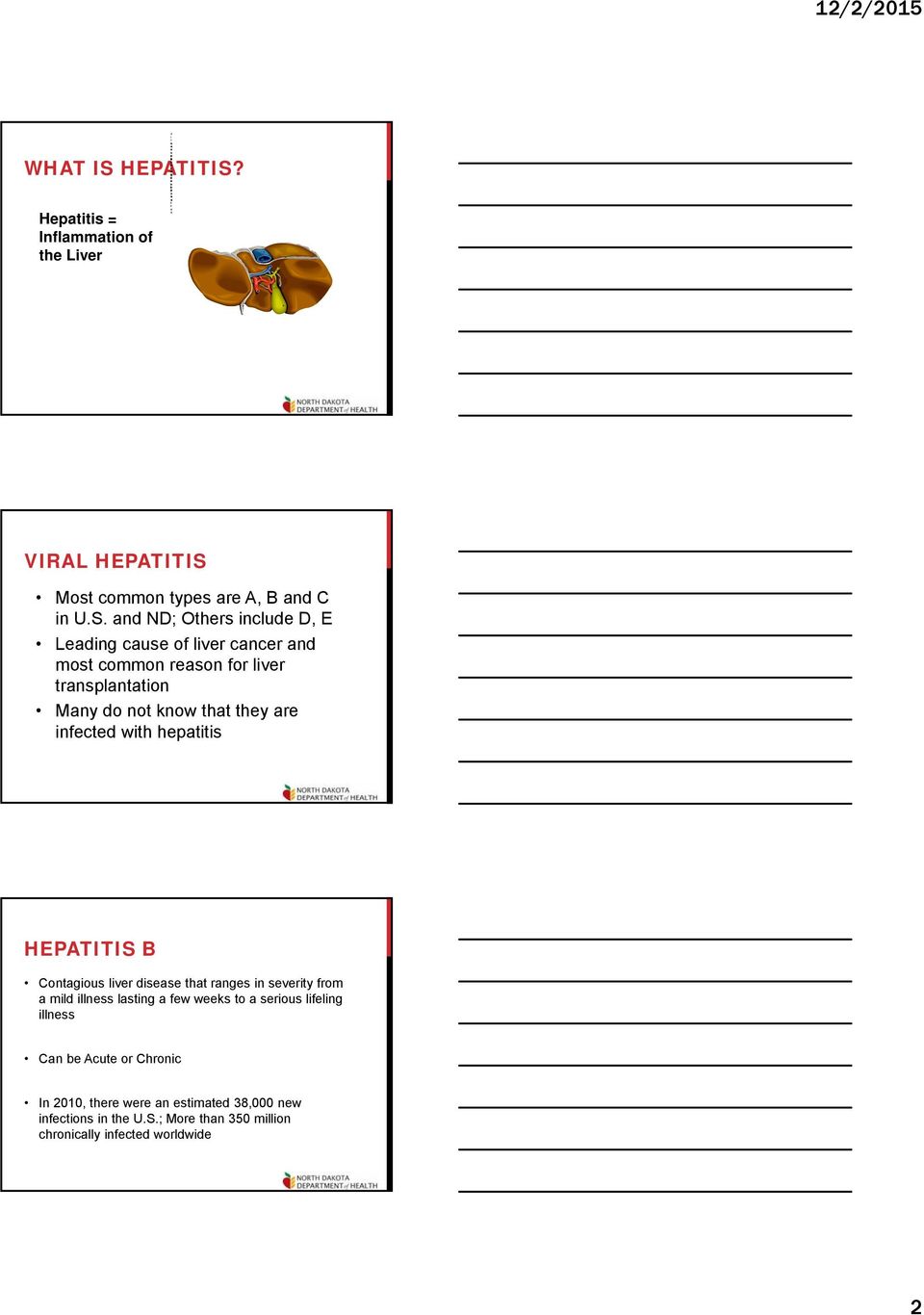
2 v i r ut so ex si a, n ub s ta, oc d it r me u mr g ui s na, i, a tp l ya c ro ah so il t e s 12/2/2015 WHAT IS HEPATITIS? Hepatitis = Inflammation of the Liver VIRAL HEPATITIS Most common types are A, B and C in U.S. and ND; Others include D, E Leading cause of liver cancer and most common reason for liver transplantation Many do not know that they are infected with hepatitis HEPATITIS B Contagious liver disease that ranges in severity from a mild illness lasting a few weeks to a serious lifeling illness Can be Acute or Chronic In 2010, there were an estimated 38,000 new infections in the U.S.; More than 350 million chronically infected worldwide 2
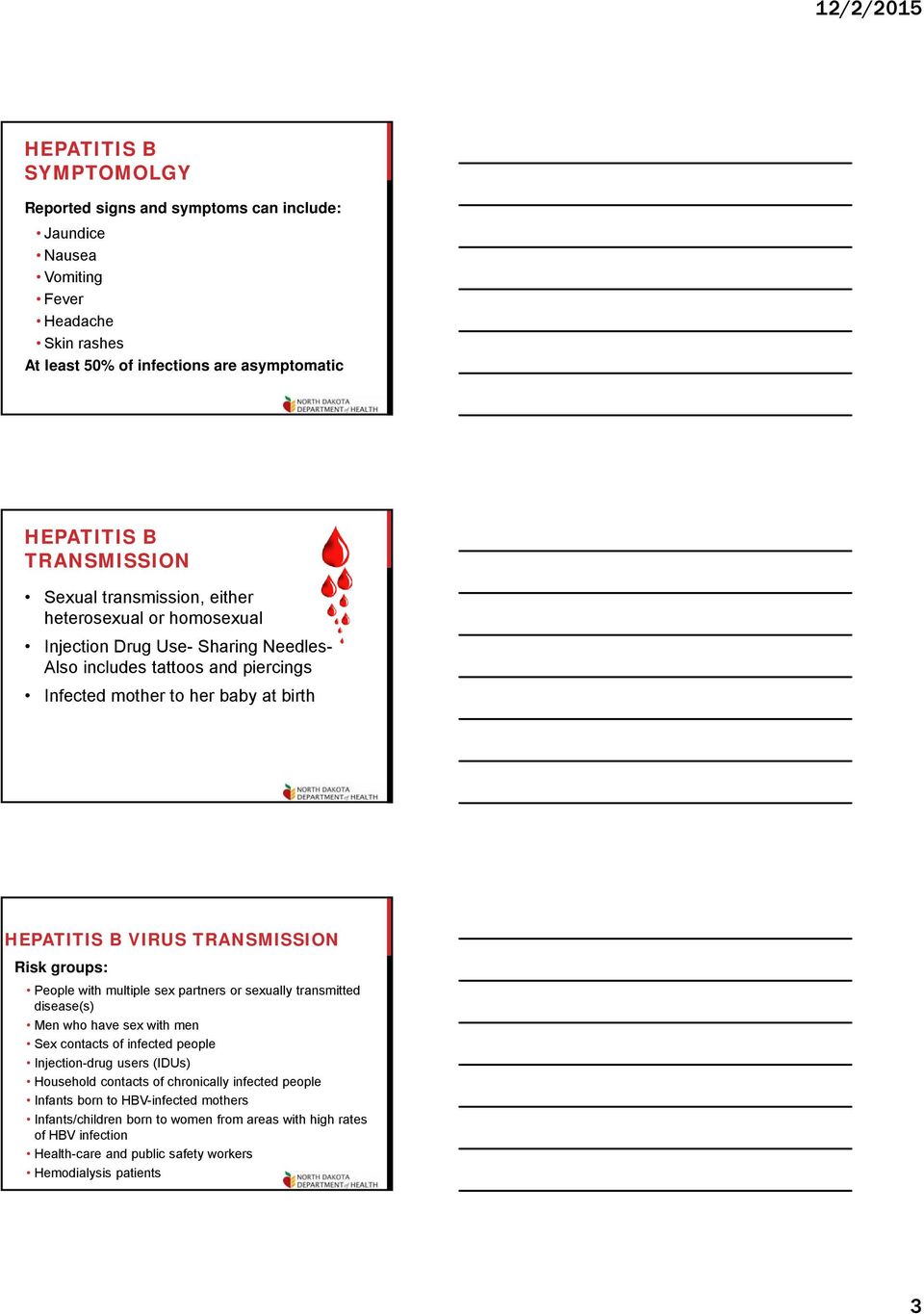
3 HEPATITIS B SYMPTOMOLGY Reported signs and symptoms can include: Jaundice Nausea Vomiting Fever Headache Skin rashes At least 50% of infections are asymptomatic HEPATITIS B TRANSMISSION Sexual transmission, either heterosexual or homosexual Injection Drug Use- Sharing Needles- Also includes tattoos and piercings Infected mother to her baby at birth HEPATITIS B VIRUS TRANSMISSION Risk groups: People with multiple sex partners or sexually transmitted disease(s) Men who have sex with men Sex contacts of infected people Injection-drug users (IDUs) Household contacts of chronically infected people Infants born to HBV-infected mothers Infants/children born to women from areas with high rates of HBV infection Health-care and public safety workers Hemodialysis patients 3
4 HEPATITIS B 15-25% of chronically infected people die from chronic liver disease Treatment Available, but no cure Woman with HBV-related liver cancer HEPATITIS B TESTING Hepatitis B Surface Antigen (HBsAg): Positive for Acute or Chronic Infection Hepatitis B Surface Antibody (anti-hbs): Immune Total Hepatitis B core Antibody (anti-hbc): Appear early in onset of infection, persist for a lifetime IgM Antibody to Hepatitis B Core Antigen (IgM anti-hbc): Infection in the last 6 months Testing Algorithm in the Viral Hepatitis Guide: Hepatitis B Surface Antigen (HBsAg) Hepatitis B Surface Antibody (anti-hbs) Total Core Hepatitis B Antibody (anti-hbc) IgM Antibody to Hepatitis B Core Antigen (IgM anti-hbc) 4

5 HEPATITIS B IN PREGNANCY. All women should be tested for hepatitis B during their first prenatal visit. Pregnancy in a hepatitis B positive individual is reportable to the NDDoH. Infants born to HBV-infected mothers require hepatitis B vaccine and hepatitis B immune globulin (HBIG) within 12 hours of birth to protect them from infection. HEPATITIS B PREVENTION Get vaccinated Prevent blood, semen and vaginal fluids from entering body Use barriers for sex Do not share needles or other equipment that may have blood on them Source: Integrating Viral Hepatitis into Client-Centered Counseling HEPATITIS C 5

6 HCV EPIDEMIOLOGY Nearly 3% of worldwide population has chronic HCV infection Most common blood-borne infection in United States Up to 75% unaware of their HCV infection 3.2 million people in the U.S. infected with Hepatitis C Infection is most prevalent among those born during THE NUMBER OF HEPATITIS C CASES HAS ALMOST DOUBLED IN THE LAST FOUR YEARS * YTD * Includes acute, chronic and resolved infections *2015 1/1/15 11/4/15 (Preliminary) YOUNG PERSONS UNDER 30 YEARS ARE MOST AFFECTED BY HEPATITIS C IN ND. Number of Cases Under and 18 over * Includes acute, chronic and resolved infections 6

7 HEPATITIS C Average incubation period 6-9 weeks Range: 2 weeks 6 months Acute illness 80% of people are asymptomatic Chronic infection 55-85% of Infected People Leading Indication for Liver Transplant in the U.S. WHAT ARE THE SYMPTOMS OF ACUTE HEPATITIS? *New infections may be asymptomatic The symptoms of newly acquired hepatitis A, B and C are the same: Jaundice Elevated liver enzymes (ALT, AST, Bilirubin) Fatigue Abdominal pain (upper right quadrant) Loss of appetite Nausea Vomiting Diarrhea Dark urine Fever Joint pain Light colored stools NATURAL HISTORY OF HCV INFECTION 15% - 45% Resolve (15) 80% Stable (68) 100 People 55%-85% Chronic (85) 20% Time Stable (13) 75% Cirrhosis (17) Mortality (4) 25% Leading Indication for Liver Transplant Adapted from Alter HJ 7

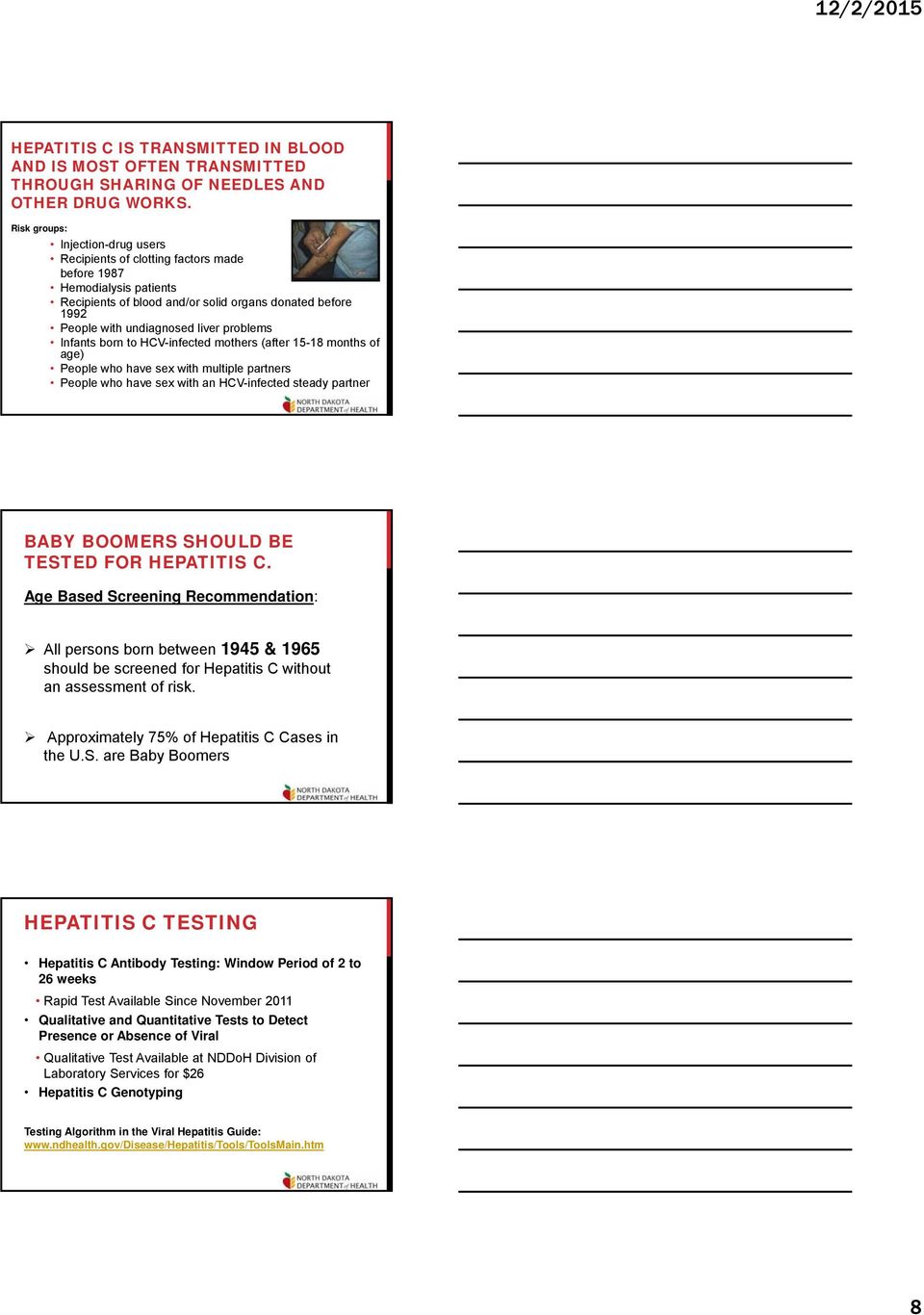
8 HEPATITIS C IS TRANSMITTED IN BLOOD AND IS MOST OFTEN TRANSMITTED THROUGH SHARING OF NEEDLES AND OTHER DRUG WORKS. Risk groups: Injection-drug users Recipients of clotting factors made before 1987 Hemodialysis patients Recipients of blood and/or solid organs donated before 1992 People with undiagnosed liver problems Infants born to HCV-infected mothers (after months of age) People who have sex with multiple partners People who have sex with an HCV-infected steady partner BABY BOOMERS SHOULD BE TESTED FOR HEPATITIS C. Age Based Screening Recommendation: All persons born between 1945 & 1965 should be screened for Hepatitis C without an assessment of risk. Approximately 75% of Hepatitis C Cases in the U.S. are Baby Boomers HEPATITIS C TESTING Hepatitis C Antibody Testing: Window Period of 2 to 26 weeks Rapid Test Available Since November 2011 Qualitative and Quantitative Tests to Detect Presence or Absence of Viral Qualitative Test Available at NDDoH Division of Laboratory Services for $26 Hepatitis C Genotyping Testing Algorithm in the Viral Hepatitis Guide: 8
9 HEPATITIS C TEST INTERPRETATION. GENOTYPE 1 NOW HAS CURE RATES ALMOST AT 100% Treatment Goal: To achieve a sustained virologic response (SVR) and delay or stop progress to more serious liver damage Treatment is very expensive and may come with provisions of being alcohol/drug free for a certain length of time before treatment Treatment can now be as short as 8 weeks HEPATITIS C PREVENTION Avoid blood exposure: New syringe, cooker, cotton etc. every time for injection Use barriers and lubricants Cover open cuts/wounds Use universal precautions Don t share personal items that may contain blood (toothbrush/razor) Ensure instruments used for tattooing, piercing, acupuncture are new or sterilized 9

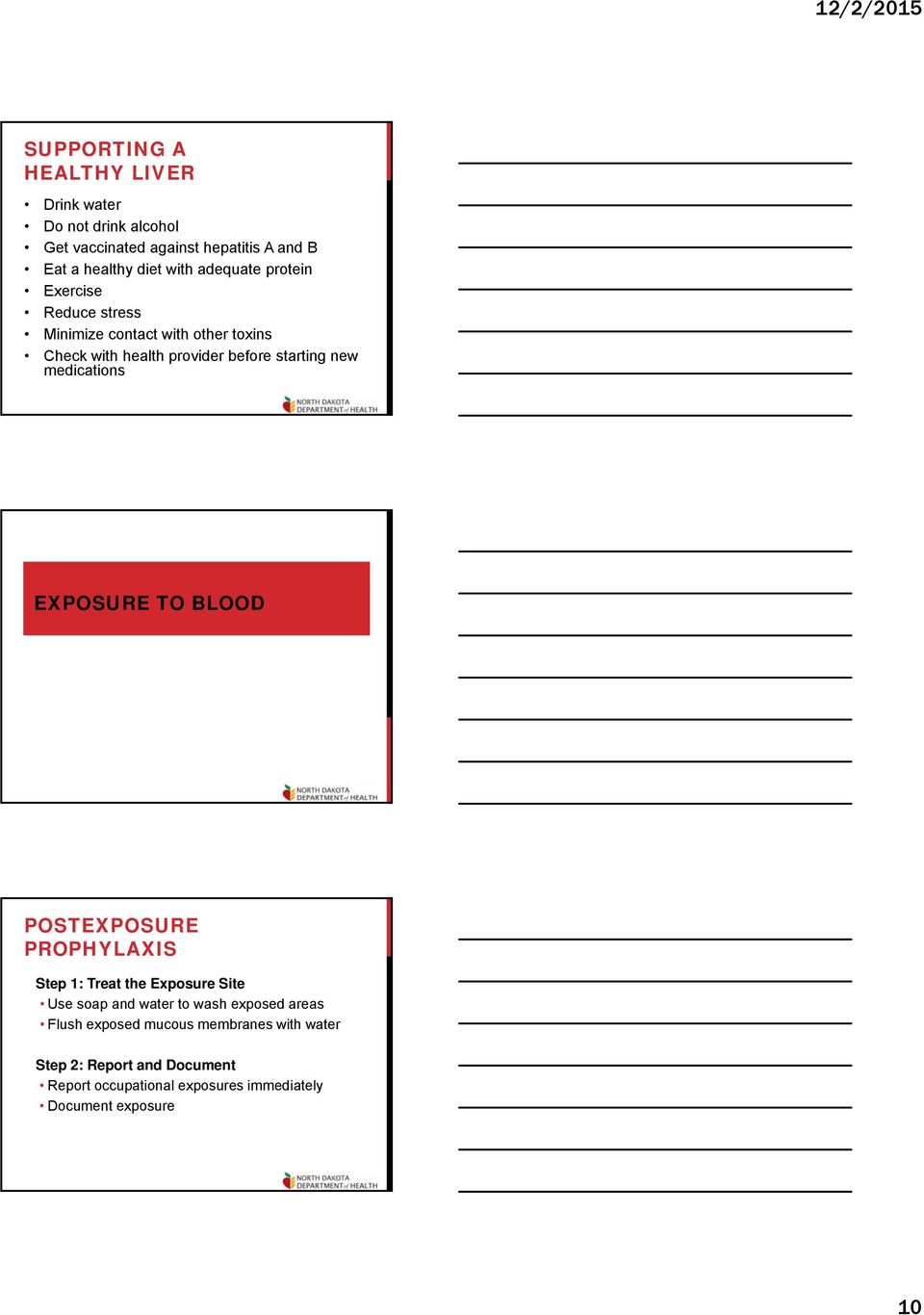
10 SUPPORTING A HEALTHY LIVER Drink water Do not drink alcohol Get vaccinated against hepatitis A and B Eat a healthy diet with adequate protein Exercise Reduce stress Minimize contact with other toxins Check with health provider before starting new medications EXPOSURE TO BLOOD POSTEXPOSURE PROPHYLAXIS Step 1: Treat the Exposure Site Use soap and water to wash exposed areas Flush exposed mucous membranes with water Step 2: Report and Document Report occupational exposures immediately Document exposure 10
11 POSTEXPOSURE PROPHYLAXIS Step 3: Evaluate the Exposure Type of body substance involved, the route, and severity of exposure Step 4: Evaluate the Exposure Source Based on whether the source patient is known or unknown Known: Test for HBsAg, HCV Antibody and HIV Antibody Unknown: Evaluate the likelihood of high risk exposure POSTEXPOSURE PROPHYLAXIS Step 5: Disease Specific PEP Management At this point, there are no recommendations for HCV PEP. Exposed Persons Unvaccinated Previously vaccinated Recommended PEP for exposure to HBV Treatment when source is found to be: HBsAg + HBsAg- Unknown or Not Tested Administer one dose of HBIG and complete hepatitis B vaccine series Known Responder Test exposed person for (anti-hbs is anti-hbs adequate) 1. If adequate, no treatment. 2. If inadequate, administer a booster dose of hepatitis B vaccine. Known Non- Administer one dose of HBIG in Responder (anti-hbs addition to completing the hepatitis B inadequate) vaccine series Response Unknown Test exposed person for anti-hbs 1. If adequate, no treatment. 2. If inadequate, complete hepatitis B vaccine series. May initiate hepatitis B vaccine series No treatment No treatment No treatment Initiate hepatitis B vaccine No treatment If known high-risk source, may treat as if source were HBsAg positive Test exposed person for anti-hbs 1. If adequate, no treatment. 2. If inadequate, hepatitis B vaccine booster dose POSTEXPOSURE PROPHYLAXIS Step 5: Disease Specific PEP Management: HIV Exposures HIV PEP should be started immediately. If the delay lasts more than hours, seek expert consultation. PEP should continue for 28 days. Typical PEP options: A basic 2-drug regimen, appropriate for lower risk expsoures. An expanded 3 drug regimen, for exposures that pose an increased risk for transmission. 11

12 POSTEXPOSURE PROPHYLAXIS Step 5: Disease Specific PEP Management HIV PEP for Percutaneous Injuries Infection Status of Source Exposure Type HIV-Infected Class I HIV-Infected Class 2 Source of Unknown Source HIV-Negative (Asymptomatic HIV ( Symptomatic HIV Unknown infection or known infection, AIDS, Status low HIV viral load ( < acute 1,500 RNA copies/ml) seroconversion, or know high HIV viral load) Less Severe Recommend basic 2- Recommend Generally no Generally no PEP NO PEP Solid Needle day PEP expanded 3-drug PEP warranted; warranted; Consider warranted Superficial injury PEP Consider basic basic 2-drug PEP in 2-drug PEP for settings where exposure source with HIV to HIV-infected persons risk factors is likely More Severe Recommend expanded Recommend Large-bore, 3-drug PEP expanded 3-drug hollow needle PEP Deep Puncture Visible blood on device Needle used in artery or vein Generally no Generally no PEP NO PEP PEP warranted; warranted; Consider warranted Consider basic basic 2-drug PEP in 2-drug PEP for settings where exposure source with HIV to HIV-infected persons risk factors is likely POSTEXPOSURE PROPHYLAXIS Step 5: Disease Specific PEP Management HIV PEP for Mucous Membrane and Nonintact Skin Exposures Infection Status of Source Exposure Type HIV-Infected Class I HIV-Infected Class 2 (Asymptomatic HIV ( Symptomatic HIV infection or known infection, AIDS, low HIV viral load ( < acute 1,500 RNA copies/ml) seroconversion, or know high HIV viral load) Source of Unknown Status Unknown Source HIV-Negative Small Volume A few drops Consider basic 2-day PEP Recommend basic 2- Generally no Generally no PEP drug PEP PEP warranted warranted NO PEP warranted Large Volume Large Blood Splash Recommend basic 2- drug PEP Recommend expanded 3-drug PEP Generally no Generally no PEP PEP warranted; Consider warranted; basic 2-drug PEP in Consider basic settings where 2-drug PEP for exposure to HIVinfected persons is source with HIV risk factors likely NO PEP warranted POSTEXPOSURE PROPHYLAXIS Step 6: Follow-Up HBV exposure follow-up testing and counseling Test for anti-hbs 1-2 months after last dose of vaccine Refrain from donating blood, plasma, organs, tissue or semen and use risk reduction methods such as late barriers during sex and not sharing injection equipment HCV exposure follow-up testing and counseling: Repeat test for anti-hcv at least 4-6 months post exposure Refrain from donating blood, plasma, organs, tissue or semen HIV exposure follow-up testing: Repeat HIV-antibody testing at 6 weeks, 3 months and 6 months post exposure If PEP is given, monitor for drug toxicity Refrain from donating blood, plasma, organs, tissue or semen and use risk reduction methods such as late barriers during sex and not sharing injection equipment 12

13 RESOURCES A Quick Guide to Postexposure Prophylaxis in the Health Care Setting: Updated U.S. Public Health Service Guidelines for the Management of Occupational Exposures to HIV and Recommendations for Postexposure Prophylaxis: September 30, 2005 / 54(RR09); Updated U.S. Public Health Service Guidelines for the Management of Occupational Exposures to HBV, HCV, and HIV and Recommendations for Postexposure Prophylaxis, June 29, 2001 / 50(RR11);1-42: National Clinicians Postexposure Prophylaxis Hotline (PEPline): , NDDoH Percutaneous/Mucous Membrance Exposure Fact Sheet: Questions? SARAH WENINGER HIV.STD.VIRAL HEPATITIS PREVENTION COORDINATOR PHONE: FAX: [email protected] 13

When an occupational exposure occurs, the source patient should be evaluated for both hepatitis B and hepatitis C. (AII)
 XI. OCCUPATIONAL EXPOSURES TO HEPATITIS B AND C RECOMMENDATION: When an occupational exposure occurs, the source patient should be evaluated for both hepatitis B and hepatitis C. (AII) The risk of transmission
Exposure. What Healthcare Personnel Need to Know
 Information from the Centers for Disease Control and Prevention National Center for Infectious Diseases Divison of Healthcare Quality Promotion and Division of Viral Hepatitis For additional brochures
Bloodborne Pathogens (HIV, HBV, and HCV) Exposure Management
 Bloodborne Pathogens Exposure Policy and Procedures Employees of the State of South Dakota Department of Health Bloodborne Pathogens (HIV, HBV, and HCV) Exposure Management PEP Hotline 1-888-448-4911 DOH
THE A, B, C S OF HEPATITIS. Matt Eidem, M.D. Digestive Health Associates of Texas 1600 Coit Road Suite #301 Plano, Texas 75075 (972) 867-0019
 THE A, B, C S OF HEPATITIS Matt Eidem, M.D. Digestive Health Associates of Texas 1600 Coit Road Suite #301 Plano, Texas 75075 (972) 867-0019 WHAT IS HEPATITIS? Hepatitis means inflammation of the liver
POST-EXPOSURE PROPHYLAXIS IN THE HEALTH CARE SETTING
 MARCH 2014 A Quick Guide to POST-EXPOSURE PROPHYLAXIS IN THE HEALTH CARE SETTING HIV PROVIDER REFERENCE SERIES A PUBLICATION OF THE MOUNTAIN PLAINS AIDS EDUCATION AND TRAINING CENTER MountainPlains AIDS
Guidelines for the Management of Occupational Exposures to HBV, HCV, and HIV and Recommendations for Postexposure Prophylaxis
 Guidelines for the Management of Occupational Exposures to HBV, HCV, and HIV and Recommendations for Postexposure Prophylaxis Hepatitis B Virus (HBV), Hepatitis C Virus (HCV), and Human Immunodeficiency
Guidelines for Managing Exposures to Blood Borne Pathogens
 Guidelines for Managing Exposures to Blood Borne Pathogens Revised May 2010 Table of Contents Introduction 1 Exposure to Blood/Body Fluids 2 A. Initial Management Guidelines I. General Measures 2 II. Evaluate
HEPATITIS WEB STUDY Acute Hepatitis C Virus Infection: Epidemiology, Clinical Features, and Diagnosis
 HEPATITIS WEB STUDY Acute C Virus Infection: Epidemiology, Clinical Features, and Diagnosis H. Nina Kim, MD Assistant Professor of Medicine Division of Infectious Diseases University of Washington School
Viral Hepatitis A, B, and C
 Viral Hepatitis A, B, and C What is Hepatitis? Hepatitis means inflammation of the liver Elizabeth A. Bancroft, MD, SM Acute Communicable Disease Control County of Los Angeles Department of Public Health
William Atkinson, MD, MPH Hepatitis B Vaccine Issues June 16, 2016
 William Atkinson, MD, MPH Hepatitis B Vaccine Issues June 16, 2016 Advisory Committee on Immunization Practices (ACIP) The recommendations to be discussed are primarily those of the ACIP composed of 15
Guidelines for Viral Hepatitis CTR Services
 Guidelines for Viral Hepatitis CTR Services During the 2007 North Dakota Legislative Assembly, legislation that called for the creation of a viral hepatitis program was introduced and approved. The North
HEPATITIS A, B, AND C
 HEPATITIS A, B, AND C INTRODUCTION Hepatitis is a medical term that means infection and inflammation of the liver, and hepatitis is caused by infection with a virus. There are seven types of hepatitis,
Body Fluid Exposure:
 Focus on CME at the University of Manitoba Focus on CME at the University of Manitoba Body Fluid Exposure: What To Do? John Sokal, MD, CFPC Presented at Bug Day 2003, Health Sciences Centre, Winnipeg (October
Commonly Asked Questions About Chronic Hepatitis C
 Commonly Asked Questions About Chronic Hepatitis C From the American College of Gastroenterology 1. How common is the hepatitis C virus? The hepatitis C virus is the most common cause of chronic viral
Title: Post Exposure Prophylaxis Page 1 of 8 Policy No: 1 CLN 010 Effective Date 04/15/11
 Title: Post Exposure Prophylaxis Page 1 of 8 OBJECTIVE To standardize medical care following a Blood or Bodily Fluid Exposure (BBFE). SCOPE All Exposed Individuals (as defined below) who present for post-exposure
HEPATITIS C. The Facts. Get Tested. Get Cured! Health
 HEPATITIS C The Facts Get Tested. Get Cured! Health EVEN IF YOU FEEL HEALTHY, HEPATITIS C MAY BE DAMAGING YOUR LIVER. Your liver keeps you healthy in many ways, such as by removing toxins from your blood
The Epidemiology of Hepatitis A, B, and C
 The Epidemiology of Hepatitis A, B, and C Jamie Berkes M.D. University of Illinois at Chicago [email protected] Epidemiology: Definitions The study of the incidence and prevalence of diseases in large populations
Viral Hepatitis Case Report
 Page 1 of 9 Viral Hepatitis Case Report Perinatal Hepatitis B Virus Infection Michigan Department of Community Health Communicable Disease Division Investigation Information Investigation ID Onset Date
Appendix 3 Exposure Incident Report Form
 Appendix 3 Exposure Incident Report Form January, 2015 Page 1 of 6 Please see the following pages for the Exposure Incident Report Form. Guidelines for the Management of Exposure to Blood and Body Fluids
Beginner's guide to Hepatitis C testing and immunisation against hepatitis A+B in general practice
 Beginner's guide to Hepatitis C testing and immunisation against hepatitis A+B in general practice Dr Chris Ford GP & SMMGP Clinical Lead Kate Halliday Telford & Wrekin Shared Care Coordinator Aims Discuss:
POSTEXPOSURE PROPHYLAXIS
 POSTEXPOSURE PROPHYLAXIS Bloodborne viruses Hepatitis B Hepatitis C HIV Hepatitis B Risk of seroconversion HBeAg negative 2% HBeAg positive 20-40% If seroconvert most recover completely and develop immunity
Post-Exposure Prophylaxis
 Post-Exposure Prophylaxis Health Worker Safety Training Module 4: Post-Exposure Prophylaxis Health Worker Safety Training Module 2 Topics What is PEP? Infectious body fluids Types of exposures requiring
BASIC INFORMATION ABOUT HIV, HEPATITIS B and C, and TUBERCULOSIS Adapted from the CDC
 BASIC INFORMATION ABOUT HIV, HEPATITIS B and C, and TUBERCULOSIS Adapted from the CDC HIV What are HIV and AIDS? HIV stands for Human Immunodeficiency Virus. This is the virus that causes AIDS. HIV is
Hepatitis C. Screening, Diagnosis and Linkage to Care
 Hepatitis C Screening, Diagnosis and Linkage to Care Diagnosis If your hepatitis C antibody test is reactive, a second test will be needed to diagnose and determine if you are currently infected. Screening
Managing Bloodborne Pathogens Exposures
 Managing Bloodborne Pathogens Exposures House Staff Orientation 2015 Phillip F. Bressoud, MD, FACP Associate Professor of Medicine and Executive Director Campus Health Services University of Louisville
OCCUPATIONAL HEALTH, DISABILITY AND LEAVE SECTOR MEASURES TO MINIMIZE EXPOSURE TO BLOODBORNE PATHOGENS AND POST-EXPOSURE PROPHYLAXIS POLICY
 UNIVERSITY OF OTTAWA OCCUPATIONAL HEALTH, DISABILITY AND LEAVE SECTOR MEASURES TO MINIMIZE EXPOSURE TO BLOODBORNE PATHOGENS AND POST-EXPOSURE PROPHYLAXIS POLICY Prepared by the Occupational Health, Disability
POST EXPOSURE MANAGEMENT: HEPATITIS B, HEPATITIS C AND HIV
 Middlesex-London Health Unit 50 King St. London, Ontario N6H 5M3 Phone: 519-663-5317 X 2330 After Hours: 519-675-7523 Fax: 519-663-9581 www.healthunit.com POST EXPOSURE MANAGEMENT: HEPATITIS B, HEPATITIS
Bloodborne Pathogens. San Diego Unified School District Nursing & Wellness Program August 2013
 Bloodborne Pathogens San Diego Unified School District Nursing & Wellness Program August 2013 Why Another In-service?? Cal/OSHA mandates that employees with occupational exposure are informed at the time
The Hepatitis B virus (HBV)
 The Hepatitis B virus (HBV) There are 400 million people in the world who live with chronic hepatitis B, including France. Most people don t even know they are infected. But there are several important
INFORMATION ABOUT HEPATITIS C
 INFORMATION ABOUT HEPATITIS C PATIENT BOOKLET Index 1 About Hepatitis C About Hepatitis C Page 1 Hepatitis C Transmission Page 3 Hepatitis C Disease Progression Page 4 Hepatitis C Diagnosis and Treatment
Newly Diagnosed: HEPATITIS C. American Liver Foundation Support Guide
 Newly Diagnosed: HEPATITIS C American Liver Foundation Support Guide T he American Liver Foundation's mission is to facilitate, advocate, and promote education, support, and research for the prevention,
Bloodborne Pathogens. Scott Anderson CCEMTP. Materials used with permission from the Oklahoma State University
 Bloodborne Pathogens Scott Anderson CCEMTP Materials used with permission from the Oklahoma State University What is a Bloodborne Pathogen? Microorganisms that are carried in the blood that can cause disease
Preface. TTY: (888) 232-6348 or [email protected]. Hepatitis C Counseling and Testing, contact: 800-CDC-INFO (800-232-4636)
 Preface The purpose of this CDC Hepatitis C Counseling and Testing manual is to provide guidance for hepatitis C counseling and testing of individuals born during 1945 1965. The guide was used in draft
www.hepinfo.ie Are you Hep C aware? awareness information support prevention To find out more visit
 Are you Hep C aware? awareness information support prevention To find out more visit www.hepinfo.ie What is Hepatitis C? Hepatitis C is a viral infection that affects the liver, causing it to become inflamed
A P P E N D I X SAMPLE FORMS
 A P P E N D I X A SAMPLE FORMS Authorization for Disclosure Consent for HBV/HCV Antigens, HIV Antibody Documentation of Staff Education Employees Eligible for Hepatitis-B Vaccination Hepatitis-A Consent
MUSC Occupational Blood Borne Pathogen Protocol Off-Campus Procedure Packet
 MUSC Occupational Blood Borne Pathogen Protocol Off-Campus Procedure Packet MUSC Medical Center has established these protocols in accordance with the OSHA Blood Borne Pathogen Standard and Center for
Hepatitis B Virus (Pregnancy) Investigation Guideline
 Hepatitis B Virus (Pregnancy) Investigation Guideline Contents CASE DEFINITION... 3 LABORATORY ANALYSIS... 3 BACKGROUND... 4 NOTIFICATION TO PUBLIC HEALTH... 5 INVESTIGATOR RESPONSIBILITIES... 6 STANDARD
GUIDELINES FOR THE MANAGEMENT OF HEPATITIS C
 GUIDELINES FOR THE MANAGEMENT OF HEPATITIS C HEPATITIS, VIRAL A brief overview of hepatic viruses other than C - - The hepatitis A virus (HAV) infection is usually acquired by the fecal-oral route, produces
english facts about hepatitis A, B and C
 english facts about hepatitis A, B and C What is hepatitis? Hepatitis means inflammation of the liver. Many viruses can cause liver inflammation, including the hepatitis A, B and C viruses. Some people
EPIDEMIOLOGY OF HEPATITIS B IN IRELAND
 EPIDEMIOLOGY OF HEPATITIS B IN IRELAND Table of Contents Acknowledgements 3 Summary 4 Introduction 5 Case Definitions 6 Materials and Methods 7 Results 8 Discussion 11 References 12 Epidemiology of Hepatitis
Didactic Series. Updated Post-Exposure Prophylaxis (PEP) Guidelines. Daniel Lee, MD UCSD Medical Center, Owen Clinic January 9, 2014
 Didactic Series Updated Post-Exposure Prophylaxis (PEP) Guidelines Daniel Lee, MD UCSD Medical Center, Owen Clinic January 9, 2014 ACCREDITATION STATEMENT: University of California, San Diego School of
WHY ARE WE HERE? OSHA BB Pathogen standard. The more you know, the better you will perform in real situations!
 WHY ARE WE HERE? OSHA BB Pathogen standard anyone whose job requires exposure to BB pathogens is required to complete training employees who are trained in CPR and first aid The more you know, the better
1.How did I get Hepatitis C?
 1.How did I get Hepatitis C? Sharing needles and syringes ( iv drug use ) or using contaminated straws to snort cocaine Reused needles or medications in a health care setting- (LV endoscopy outbreak, glucometers
Recommendations for the Identification of Chronic Hepatitis C virus infection Among Persons Born During 1945-1965
 Recommendations for the Identification of Chronic Hepatitis C virus infection Among Persons Born During 1945-1965 MMWR August 17, 2012 Prepared by : The National Viral Hepatitis Technical Assistance Center
POST-EXPOSURE PROPHYLAXIS (HIV, HEP B, HEP C)
 POST-EXPOSURE PROPHYLAXIS (HIV, HEP B, HEP C) www.hiv-druginteractions.org No major changes to this protocol since last reviewed in 2014 Reference should also be made to the NHSGGC document on management
Integrated Post-exposure Protocol for HIV, HBV and HCV: Guidelines for Managing Exposures to Blood and Body Fluids
 Integrated Post-exposure Protocol for HIV, HBV and HCV: Guidelines for Managing Exposures to Blood and Body Fluids MARCH 2009 COMMUNICABLE DISEASE CONTROL Integrated Post-exposure Protocol for HIV, HBV
Needle-Stick Policy. http://www.utdallas.edu/ehs
 Needle-Stick Policy Department of Environmental Health and Safety 800 West Campbell Rd., SG10 Richardson, TX 75080-3021 Phone 972-883-2381/4111 Fax 972-883-6115 http://www.utdallas.edu/ehs Modified: May
GUIDELINES FOR VIRAL HEPATITIS SURVEILLANCE AND CASE MANAGEMENT
 GUIDELINES FOR VIRAL HEPATITIS SURVEILLANCE AND CASE MANAGEMENT January 2005 Guidelines for Viral Hepatitis Surveillance and Case Management Ordering information To order a copy of this manual, write to:
GENERAL INFORMATION. Hepatitis B Foundation - Korean Chapter Pg. 3 www.hepb.org
 GENERAL INFORMATION What is hepatitis B? Hepatitis B is the world's most common liver infection that can lead to cirrhosis and liver cancer. It is caused by the hepatitis B virus (HBV), which attacks and
Zika Virus. Fred A. Lopez, MD, MACP Richard Vial Professor Department of Medicine Section of Infectious Diseases
 Zika Virus Fred A. Lopez, MD, MACP Richard Vial Professor Department of Medicine Section of Infectious Diseases What is the incubation period for Zika virus infection? Unknown but likely to be several
UCSF Communicable Disease Surveillance and Vaccination Policy
 Office of Origin: Occupational Health Program I. PURPOSE To provide a sustainable, healthy and safe working environment for UCSF research laboratory staff, and animal research care staff and to prevent
Protocol for Needle Stick Injuries Occurring to NY Medical College Students In Physicians Offices
 Protocol for Needle Stick Injuries Occurring to NY Medical College Students In Physicians Offices Procedures to be followed by physicians for needle stick incidents to medical students rotating through
Understanding Hepatitis C:
 Understanding Hepatitis C: A Training for Service Providers Trainer Manual New York City Department of Health and Mental Hygiene HIV Training Institute Understanding Hepatitis C: A Training for Service
This pamphlet describes how all school employees, regardless of job assignment, can minimize the risk of exposure to viral hepatitis.
 Revised July 2010 Viral Hepatitis INTRODUCTION The United Federation of Teachers prepared this pamphlet to answer questions asked by school staff who are concerned about catching hepatitis from their students
Burton Hospitals NHS Foundation Trust. Corporate / Directorate. Clinical / Non Clinical. Department Responsible for Review:
 POLICY DOCUMENT Burton Hospitals NHS Foundation Trust Approved by: INOCULATION / SHARPS INJURY POLICY Clinical Management Board On: 13 February 2014 Review Date: January 2017 Corporate / Directorate Clinical
Hepatitis C Infections in Oregon September 2014
 Public Health Division Hepatitis C Infections in Oregon September 214 Chronic HCV in Oregon Since 25, when positive laboratory results for HCV infection became reportable in Oregon, 47,252 persons with
BLOOD AND BODY FLUID EXPOSURE MANAGEMENT TOOL
 655 West 12th Avenue Vancouver, BC V5Z 4R4 Tel 604.707.2400 Fax 604.707.2401 www.bccdc.ca Clinical Prevention Services Tel 604.707.5600 Fax 604.707.5604 www.smartsexresource.com BLOOD AND BODY FLUID EXPOSURE
ROYAL HOSPITAL FOR WOMEN
 HEPATITIS B POSITIVE MOTHERS AND THEIR BABIES This LOP is developed to guide clinical practice at the Royal Hospital for Women. Individual patient circumstances may mean that practice diverges from this
Information about hepatitis C for patients and carers
 Information about hepatitis C for patients and carers What is hepatitis C? Hepatitis C is an illness caused by a virus which can be passed through blood from one person to another. It mainly affects the
DISEASES SPREAD THROUGH BLOOD AND BODY FLUIDS
 1 DISEASES SPREAD THROUGH BLOOD AND BODY FLUIDS A. Introduction The viruses that cause bloodborne diseases are carried in an infected person s bloodstream and/or in other body fluids, such as semen, vaginal
Learning about Hepatitis C and Chronic Kidney Disease
 Learning about Hepatitis C and Chronic Kidney Disease Hepatitis C and Chronic Kidney Disease If you have chronic kidney disease (CKD), you want to learn all you can about your disease and what you can
3/25/2014. April 3, 2014. Dennison MM, et al. Ann Intern Med. 2014;160:293 300.
 April 3, 2014 3.6 million persons ever infected; 2.7 million chronic infections 1 Up to 75% unaware of status Transmitted through percutaneous exposure to infected blood Injection drug use (IDU) is the
Knowledge about Post-exposure Prophylaxis for Hepatitis B Virus among Dentists and Dental Students in Pakistan
 {189} ORIGINAL RESEARCH Knowledge about Post-exposure Prophylaxis for Hepatitis B Virus among Dentists and Dental Students in Pakistan Zohaib Ahmed 1 Umber Zahra 2 Nasir Saleem 3 1,2 BDS. House Officer.
Hepatitis B. Section 1: ABOUT THE DISEASE. A. Etiologic Agent. B. Clinical Description. C. Vectors and Reservoirs. D. Modes of Transmission
 A. Etiologic Agent Section 1: ABOUT THE DISEASE Hepatitis B The hepatitis B virus (HBV) is a DNA hepadnavirus. Important components of the viral particle include hepatitis B surface antigen (HBsAg), hepatitis
CANCER OF THE LIVER HEPATOCELLULAR CARCINOMA
 CANCER OF THE LIVER HEPATOCELLULAR CARCINOMA WHAT IS CANCER OF THE LIVER? Hepatocellular carcinoma is the most common form and it comes from the main type of liver cell, the hepatocyte. About 3 out 4
Blood borne Pathogens
 Blood borne Pathogens What Are Blood borne Pathogens? Blood borne pathogens are microorganisms such as viruses or bacteria that are carried in blood and can cause disease in people. Types of Blood borne
Frequently Asked Questions: Pre-Exposure Prophylaxis (PrEP) for HIV Infection Massachusetts Department of Public Health Updated July 2013
 Frequently Asked Questions: Pre-Exposure Prophylaxis (PrEP) for HIV Infection Massachusetts Department of Public Health Updated July 2013 On July 16, 2012, the Food and Drug Administration (FDA) approved
Case Finding for Hepatitis B and Hepatitis C
 Case Finding for Hepatitis B and Hepatitis C John W. Ward, M.D. Division of Viral Hepatitis Centers for Disease Control and Prevention Atlanta, Georgia, USA Division of Viral Hepatitis National Center
California Adult Viral Hepatitis Prevention. Strategic Plan, 2010-2014
 California Adult Viral Hepatitis Prevention Strategic Plan, 2010-2014 A Report of the California Adult Viral Hepatitis Prevention Coordinating Committee and State of California California Department of
Appendix B: Provincial Case Definitions for Reportable Diseases
 Infectious Diseases Protocol Appendix B: Provincial Case Definitions for Reportable Diseases Disease: Hepatitis B Revised Hepatitis B 1.0 Provincial Reporting Confirmed, chronic and probable cases of disease
Hepatitis C 1) THE DISEASE AND ITS EPIDEMIOLOGY
 Hepatitis C June 2010 1) THE DISEASE AND ITS EPIDEMIOLOGY A. Etiologic Agent Hepatitis C (HCV) is caused by an RNA virus in the Flaviviridae family. Multiple HCV genotypes exist, with type 1 being most
Prevention of transmission of HIV and other bloodborne viruses in healthcare and post exposure prophylaxis. John Ferguson, UPNG 2012
 Prevention of transmission of HIV and other bloodborne viruses in healthcare and post exposure prophylaxis John Ferguson, UPNG 2012 Outline Epidemiology Making the diagnosis / contact tracing Antiretroviral
The most serious symptoms of this stage are:
 The Natural Progression of Hepatitis C The natural history of hepatitis C looks at the likely outcomes for people infected with the virus if there is no medical intervention. However, the process of trying
Bile Duct Diseases and Problems
 Bile Duct Diseases and Problems Introduction A bile duct is a tube that carries bile between the liver and gallbladder and the intestine. Bile is a substance made by the liver that helps with digestion.
Hepatitis C treatment What to expect.
 Hepatitis C treatment What to expect. Anne Glass Hepatitis Clinical Nurse Consultant Liver Clinic SSWAHS Bankstown and Liverpool Hospital Contact 87384074 Monday -Friday What s hepatitis? Hepatitis means
Patient Information Sheet
 Healthcare Worker exposure to a patient s blood What is a healthcare worker exposure? Patient Information Sheet Occasionally, health care workers come into contact with the blood or body fluids of their
Bloodborne Pathogens
 Bloodborne Pathogens Learning Objectives By the end of this section, the participant should be able to: Name 3 bloodborne pathogens Identify potentially contaminated bodily fluids Describe 3 safe work
National Health Burden of CLD in Italy
 National Health Burden of CLD in Italy 11,000 deaths due to liver cirrhosis or HCC in 2006 Direct costs for the National Health System for treating CLD patients: 420 M / year for hospital care 164 M /
PERINATAL AND CHILDHOOD HEPATITIS.. WHAT ABOUT THE CHILDREN?
 PERINATAL AND CHILDHOOD HEPATITIS.. WHAT ABOUT THE CHILDREN? John T. Stutts, MD, MPH University of Louisville School of Medicine Department of Pediatrics Division of Pediatric Gastroenterology, Hepatology
UNIVERSITY OF KENTUCKY HEALTH CARE COLLEGES POLICY ON EDUCATIONAL EXPOSURE TO BLOOD BORNE PATHOGENS
 I. Purpose and Definition UNIVERSITY OF KENTUCKY HEALTH CARE COLLEGES POLICY ON EDUCATIONAL EXPOSURE TO BLOOD BORNE PATHOGENS The purpose of this policy is to delineate the management of incidents of exposure
Treating Chronic Hepatitis C. A Review of the Research for Adults
 Treating Chronic Hepatitis C A Review of the Research for Adults Is This Information Right for Me? Yes, this information is right for you if: Your doctor* has told you that you have chronic hepatitis C.
Hepatitis B. What I need to know about. National Digestive Diseases Information Clearinghouse NATIONAL INSTITUTES OF HEALTH
 What I need to know about Hepatitis B U.S. Department of Health and Human Services NATIONAL INSTITUTES OF HEALTH National Digestive Diseases Information Clearinghouse What I need to know about Hepatitis
Viral hepatitis. Report by the Secretariat
 SIXTY-THIRD WORLD HEALTH ASSEMBLY A63/15 Provisional agenda item 11.12 25 March 2010 Viral hepatitis Report by the Secretariat THE DISEASES AND BURDEN 1. The group of viruses (hepatitis A, B, C, D and
ALBERTA IMMUNIZATION POLICY GUIDELINES
 ALBERTA IMMUNIZATION POLICY GUIDELINES Hepatitis Vaccines. Hepatitis A Vaccines Refer to the vaccine product monograph and the Canadian Immunization Guide for further Product monographs are available on
Environmental Health and Safety Offices BLOODBORNE PATHOGENS
 Environmental Health and Safety Offices BLOODBORNE PATHOGENS Purpose! Reduce / eliminate exposure potential Comply with Ohio s Public Employment Risk Reduction Act (reference OSHA) 2! Exposure Determination!
Viral Hepatitis. 2009 APHL survey report
 Issues in Brief: viral hepatitis testing Association of Public Health Laboratories May Viral Hepatitis Testing 9 APHL survey report In order to characterize the role that the nation s public health laboratories
Chapter 21. What Are HIV and AIDS?
 Section 1 HIV and AIDS Today What Are HIV and AIDS? Human immunodeficiency virus (HIV) is the virus that primarily affects cells of the immune system and that causes AIDS. Acquired immune deficiency syndrome
Take Action Against Hepatitis C For People in Recovery From Mental Illness or Addiction
 Take Action Against Hepatitis C For People in Recovery From Mental Illness or Addiction Attention treatment providers in behavioral health programs! This booklet is intended for use with clients who: Are