
GUIDE TO FOLLOW UP TESTING FOR BLOOD OR BODY FLUID EXPOSURES AND NEEDLESTICK INJURIES
|
|
|
- Shannon Wiggins
- 10 years ago
- Views:
Transcription
1 GUIDE TO FOLLOW UP TESTING FOR BLOOD OR BODY FLUID EXPOSURES AND NEEDLESTICK INJURIES Hepatitis B, Hepatitis C and HIV may be contracted through exposure to any body fluid, particularly blood. Follow up testing of exposed people is important to determine whether infection has been transmitted and to enable early treatment where this is appropriate. Any person that has positive serology on follow up testing for blood or body fluid exposure should be discussed with the on call Clinical Microbiologist/Infectious Diseases physician. Exposure from unknown source The risk of infection with Hepatitis B, Hepatitis C or HIV following a blood or body fluid exposure from an unknown source is usually low. A risk assessment should be performed at the time of the injury by a doctor and if necessary, should be discussed with the on call Clinical Microbiologist/Infectious Diseases physician. If the risk is deemed to be low, post exposure prophylaxis will not be given. The exposed person should have serology for Hepatitis B, Hepatitis C and HIV performed at 6 weeks, 3 months and 6 months after the exposure. They should be informed to seek medical attention if they develop jaundice or an infectious mononucleosis syndrome in the six months after their exposure. Time post exposure Six weeks Three months Six months Tests required HBsAg, and HBsAb, HCVAb, HIV Ag/Ab, HBsAg, and HBsAb, HCVAb, HIV Ag/Ab HBsAg, and HBsAb, HCVAb, HIV Ag/Ab Exposure from source infected with Hepatitis C The risk of infection following a blood or body fluid exposure where the source patient is infected with Hepatitis C is around 1.8%. This risk may change depending on the circumstances of the exposure. There is no effective post-exposure prophylaxis or vaccination for Hepatitis C. It is recommended to perform follow up testing at 6 weeks, 3 months and 6 months after the exposure. The exposed person should be informed to seek medical attention if they develop nausea, abdominal pain or jaundice in the six months after their exposure. 1

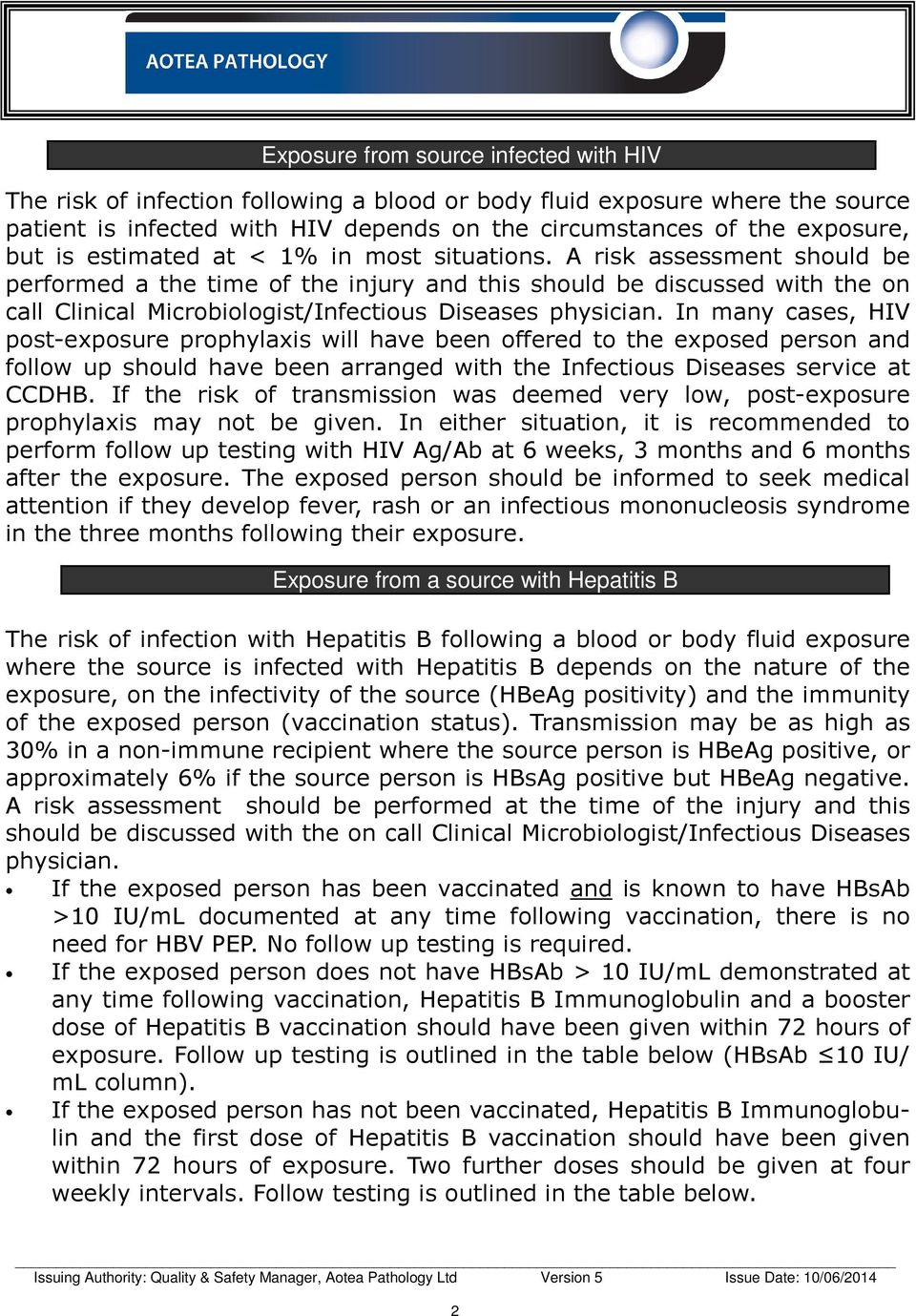
2 Exposure from source infected with HIV The risk of infection following a blood or body fluid exposure where the source patient is infected with HIV depends on the circumstances of the exposure, but is estimated at < 1% in most situations. A risk assessment should be performed a the time of the injury and this should be discussed with the on call Clinical Microbiologist/Infectious Diseases physician. In many cases, HIV post-exposure prophylaxis will have been offered to the exposed person and follow up should have been arranged with the Infectious Diseases service at CCDHB. If the risk of transmission was deemed very low, post-exposure prophylaxis may not be given. In either situation, it is recommended to perform follow up testing with HIV Ag/Ab at 6 weeks, 3 months and 6 months after the exposure. The exposed person should be informed to seek medical attention if they develop fever, rash or an infectious mononucleosis syndrome in the three months following their exposure. Exposure from a source with Hepatitis B The risk of infection with Hepatitis B following a blood or body fluid exposure where the source is infected with Hepatitis B depends on the nature of the exposure, on the infectivity of the source (HBeAg positivity) and the immunity of the exposed person (vaccination status). Transmission may be as high as 30% in a non-immune recipient where the source person is HBeAg positive, or approximately 6% if the source person is HBsAg positive but HBeAg negative. A risk assessment should be performed at the time of the injury and this should be discussed with the on call Clinical Microbiologist/Infectious Diseases physician. If the exposed person has been vaccinated and is known to have HBsAb >10 IU/mL documented at any time following vaccination, there is no need for HBV PEP. No follow up testing is required. If the exposed person does not have HBsAb > 10 IU/mL demonstrated at any time following vaccination, Hepatitis B Immunoglobulin and a booster dose of Hepatitis B vaccination should have been given within 72 hours of exposure. Follow up testing is outlined in the table below (HBsAb 10 IU/ ml column). If the exposed person has not been vaccinated, Hepatitis B Immunoglobulin and the first dose of Hepatitis B vaccination should have been given within 72 hours of exposure. Two further doses should be given at four weekly intervals. Follow testing is outlined in the table below. 2
3 Time post exposure Source HBV +, Recipient HBsAb 10 IU/mL Source HBV +, Recipient never immunised Four weeks - 2 nd dose HBV vaccine Six weeks HBsAg, HBsAb - Eight weeks - 3 rd dose HBV vaccine Three months HBsAg, HBsAb HBsAg, HBsAb Six months HBsAg, HBsAb - For persons given single booster of Hepatitis B vaccine: If HBsAb at three months still 10 IU/mL, give two further doses of Hepatitis B vaccine each four weeks apart. For persons given three doses of Hepatitis B vaccine: If HBsAb at three months still 10 IU/mL, repeat complete course (3 doses) of Hepatitis B vaccine. For further information see Immunisation Handbook (MOH, 3

4 1. EXPOSED PERSON DETAILS EXPOSED PERSON NEEDLESTICK INJURY, BLOOD/BODY FLUID EXPOSURE TEST REQUEST FORM FOLLOW UP BLOOD TEST FORM 6 WEEKS POST NEEDLESTICK EXPOSURE First Name Last Name NHI No. (if known): DOB Workplace Gender (circle one) Male/Female Address Date of Exposure 2. CONTACT PERSON AND GP DETAILS Name of person managing results (e.g. GP, workplace occupational health or infection control person, manager) Position/Title Contact Daytime Phone no: After Hours Phone No: Cell phone No: If the above is not your GP, do you want a copy of your results to be sent to them?: Yes / No (circle) If Yes: Name of Dr Location of Dr s Medical Centre 3. Collect a 5ml Yellow SST tube (however alternatively EDTA, Heparin,sodium citrate, ACD, CPD tube may be used if SST is unable to be obtained). Label Specimen CORRECTLY. 4. INFORMED CONSENT BY EXPOSED PERSON FOR BLOOD TESTS AND PROPHYLAXIS: I understand the risk of infection following accidental blood/body fluids exposure and am aware of the treatment options. I agree to having the following blood tests performed. Tests for Hepatitis B,C and HIV will be performed unless excluded (please cross out to exclude): Hepatitis BSAg (Diagnosis) Hepatitis SBAb (Immunity) Hepatitis C Antibody HIV Antibody/Antigen Exposed Person Signature Date INSTRUCTIONS TO AOTEA PATHOLOGY SPECIMEN RECEPTION STAFF Enter request for ENS (Exposed Person Needle Stick) profile If this is a Dental Needlestick Enter as Industrial I bill type. 4

5 1. EXPOSED PERSON DETAILS EXPOSED PERSON NEEDLESTICK INJURY, BLOOD/BODY FLUID EXPOSURE TEST REQUEST FORM FOLLOW UP BLOOD TEST FORM 3 MONTH POST NEEDLESTICK EXPOSURE First Name Last Name NHI No. (if known): DOB Workplace Gender (circle one) Male/Female Address Date of Exposure 2. CONTACT PERSON AND GP DETAILS Name of person managing results (e.g. GP, workplace occupational health or infection control person, manager) Position/Title Contact Daytime Phone no: After Hours Phone No: Cell phone No: If the above is not your GP, do you want a copy of your results to be sent to them?: Yes / No (circle) If Yes: Name of Dr Location of Dr s Medical Centre 3. Collect a 5ml Yellow SST tube (however alternatively EDTA, Heparin,sodium citrate, ACD, CPD tube may be used if SST is unable to be obtained). Label Specimen CORRECTLY. 4. INFORMED CONSENT BY EXPOSED PERSON FOR BLOOD TESTS AND PROPHYLAXIS: I understand the risk of infection following accidental blood/body fluids exposure and am aware of the treatment options. I agree to having the following blood tests performed. Tests for Hepatitis B,C and HIV will be performed unless excluded (please cross out to exclude): Hepatitis BSAg (Diagnosis) Hepatitis SBAb (Immunity) Hepatitis C Antibody HIV Antibody/Antigen Exposed Person Signature Date INSTRUCTIONS TO AOTEA PATHOLOGY SPECIMEN RECEPTION STAFF Enter request for ENS (Exposed Person Needle Stick) profile If this is a Dental Needlestick Enter as Industrial I bill type. 5

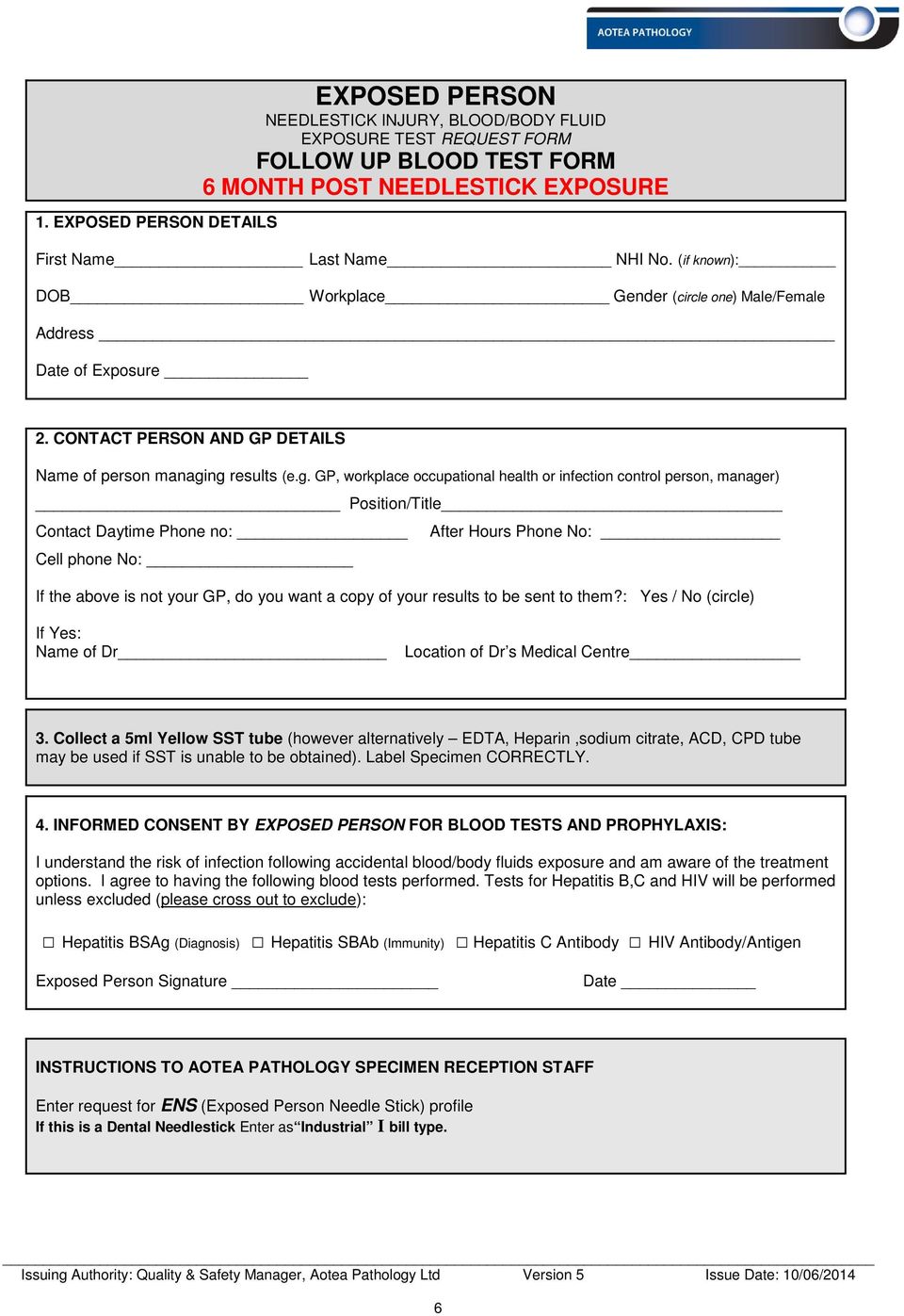
6 1. EXPOSED PERSON DETAILS EXPOSED PERSON NEEDLESTICK INJURY, BLOOD/BODY FLUID EXPOSURE TEST REQUEST FORM FOLLOW UP BLOOD TEST FORM 6 MONTH POST NEEDLESTICK EXPOSURE First Name Last Name NHI No. (if known): DOB Workplace Gender (circle one) Male/Female Address Date of Exposure 2. CONTACT PERSON AND GP DETAILS Name of person managing results (e.g. GP, workplace occupational health or infection control person, manager) Position/Title Contact Daytime Phone no: After Hours Phone No: Cell phone No: If the above is not your GP, do you want a copy of your results to be sent to them?: Yes / No (circle) If Yes: Name of Dr Location of Dr s Medical Centre 3. Collect a 5ml Yellow SST tube (however alternatively EDTA, Heparin,sodium citrate, ACD, CPD tube may be used if SST is unable to be obtained). Label Specimen CORRECTLY. 4. INFORMED CONSENT BY EXPOSED PERSON FOR BLOOD TESTS AND PROPHYLAXIS: I understand the risk of infection following accidental blood/body fluids exposure and am aware of the treatment options. I agree to having the following blood tests performed. Tests for Hepatitis B,C and HIV will be performed unless excluded (please cross out to exclude): Hepatitis BSAg (Diagnosis) Hepatitis SBAb (Immunity) Hepatitis C Antibody HIV Antibody/Antigen Exposed Person Signature Date INSTRUCTIONS TO AOTEA PATHOLOGY SPECIMEN RECEPTION STAFF Enter request for ENS (Exposed Person Needle Stick) profile If this is a Dental Needlestick Enter as Industrial I bill type. 6
Needle-Stick Policy. http://www.utdallas.edu/ehs
 Needle-Stick Policy Department of Environmental Health and Safety 800 West Campbell Rd., SG10 Richardson, TX 75080-3021 Phone 972-883-2381/4111 Fax 972-883-6115 http://www.utdallas.edu/ehs Modified: May
Protocol for Needle Stick Injuries Occurring to NY Medical College Students In Physicians Offices
 Protocol for Needle Stick Injuries Occurring to NY Medical College Students In Physicians Offices Procedures to be followed by physicians for needle stick incidents to medical students rotating through
Appendix 3 Exposure Incident Report Form
 Appendix 3 Exposure Incident Report Form January, 2015 Page 1 of 6 Please see the following pages for the Exposure Incident Report Form. Guidelines for the Management of Exposure to Blood and Body Fluids
When an occupational exposure occurs, the source patient should be evaluated for both hepatitis B and hepatitis C. (AII)
 XI. OCCUPATIONAL EXPOSURES TO HEPATITIS B AND C RECOMMENDATION: When an occupational exposure occurs, the source patient should be evaluated for both hepatitis B and hepatitis C. (AII) The risk of transmission
POST EXPOSURE PROPHYLAXI S
 Departments of Infectious Diseases & Emergency Medicine POST EXPOSURE PROPHYLAXI S QUI CK GUI DE FOR EMERGENCY DEPT Adapted from Irish National PEP Guidelines and St James s Hospital GUIDE Clinic/Emergency
Bloodborne Pathogens (HIV, HBV, and HCV) Exposure Management
 Bloodborne Pathogens Exposure Policy and Procedures Employees of the State of South Dakota Department of Health Bloodborne Pathogens (HIV, HBV, and HCV) Exposure Management PEP Hotline 1-888-448-4911 DOH
A P P E N D I X SAMPLE FORMS
 A P P E N D I X A SAMPLE FORMS Authorization for Disclosure Consent for HBV/HCV Antigens, HIV Antibody Documentation of Staff Education Employees Eligible for Hepatitis-B Vaccination Hepatitis-A Consent
Body Fluid Exposure:
 Focus on CME at the University of Manitoba Focus on CME at the University of Manitoba Body Fluid Exposure: What To Do? John Sokal, MD, CFPC Presented at Bug Day 2003, Health Sciences Centre, Winnipeg (October
UCSF Communicable Disease Surveillance and Vaccination Policy
 Office of Origin: Occupational Health Program I. PURPOSE To provide a sustainable, healthy and safe working environment for UCSF research laboratory staff, and animal research care staff and to prevent
Exposure. What Healthcare Personnel Need to Know
 Information from the Centers for Disease Control and Prevention National Center for Infectious Diseases Divison of Healthcare Quality Promotion and Division of Viral Hepatitis For additional brochures
Managing Bloodborne Pathogens Exposures
 Managing Bloodborne Pathogens Exposures House Staff Orientation 2015 Phillip F. Bressoud, MD, FACP Associate Professor of Medicine and Executive Director Campus Health Services University of Louisville
MUSC Occupational Blood Borne Pathogen Protocol Off-Campus Procedure Packet
 MUSC Occupational Blood Borne Pathogen Protocol Off-Campus Procedure Packet MUSC Medical Center has established these protocols in accordance with the OSHA Blood Borne Pathogen Standard and Center for
Title: Post Exposure Prophylaxis Page 1 of 8 Policy No: 1 CLN 010 Effective Date 04/15/11
 Title: Post Exposure Prophylaxis Page 1 of 8 OBJECTIVE To standardize medical care following a Blood or Bodily Fluid Exposure (BBFE). SCOPE All Exposed Individuals (as defined below) who present for post-exposure
Registered Nursing Health Requirements Checklist
 Registered Nursing Health Requirements Checklist The applicant must: 1). Upload the original completed form to your CertifiedBackground profile. 2). Retain a copy for your records. www.certifiedbackground.com
NHS FORTH VALLEY Guidelines for Hepatitis B Vaccination in High Risk Groups
 NHS FORTH VALLEY Guidelines for Hepatitis B Vaccination in High Risk Groups Approved 01/04/2012 Version 1.0 Date of First Issue 01/04/2012 Review Date 01/02/2014 Date of Issue 01/04/2012 EQIA Yes Author
Use the steps below to complete the CertifiedBackground (CB) electronic health record tracking process.
 Medical Coding Health Requirements Checklist All MATC Health Science students are required to complete and upload health requirements prior to petitioning for courses which contain a clinical component.
12/2/2015 HEPATITIS B AND HEPATITIS C BLOOD EXPOSURE OBJECTIVES VIRAL HEPATITIS
 HEPATITIS B AND HEPATITIS C BLOOD EXPOSURE DISEASE 101 ONLINE CONFERENCE SARAH WENINGER, MPH VIRAL HEPATITIS.STD.HIV PREVENTION COORDINATOR DECEMBER 3, 2015 OBJECTIVES Describe the populations that should
Guidelines for the Management of Occupational Exposures to HBV, HCV, and HIV and Recommendations for Postexposure Prophylaxis
 Guidelines for the Management of Occupational Exposures to HBV, HCV, and HIV and Recommendations for Postexposure Prophylaxis Hepatitis B Virus (HBV), Hepatitis C Virus (HCV), and Human Immunodeficiency
DISEASES SPREAD THROUGH BLOOD AND BODY FLUIDS
 1 DISEASES SPREAD THROUGH BLOOD AND BODY FLUIDS A. Introduction The viruses that cause bloodborne diseases are carried in an infected person s bloodstream and/or in other body fluids, such as semen, vaginal
Guidelines for Managing Exposures to Blood Borne Pathogens
 Guidelines for Managing Exposures to Blood Borne Pathogens Revised May 2010 Table of Contents Introduction 1 Exposure to Blood/Body Fluids 2 A. Initial Management Guidelines I. General Measures 2 II. Evaluate
Patient Information Sheet
 Healthcare Worker exposure to a patient s blood What is a healthcare worker exposure? Patient Information Sheet Occasionally, health care workers come into contact with the blood or body fluids of their
ROYAL HOSPITAL FOR WOMEN
 HEPATITIS B POSITIVE MOTHERS AND THEIR BABIES This LOP is developed to guide clinical practice at the Royal Hospital for Women. Individual patient circumstances may mean that practice diverges from this
Notes. Complete childhood vaccination course (CCV) CCV and DTP booster as adolescent/adult within last 10 years
 Student Immunisation Record School of Nursing, Midwifery and Social Work Section 1: Information for students enrolled in Nursing and Midwifery programs Students enrolled in programs offered by our School
Knowledge about Post-exposure Prophylaxis for Hepatitis B Virus among Dentists and Dental Students in Pakistan
 {189} ORIGINAL RESEARCH Knowledge about Post-exposure Prophylaxis for Hepatitis B Virus among Dentists and Dental Students in Pakistan Zohaib Ahmed 1 Umber Zahra 2 Nasir Saleem 3 1,2 BDS. House Officer.
Bloodborne Pathogens. Scott Anderson CCEMTP. Materials used with permission from the Oklahoma State University
 Bloodborne Pathogens Scott Anderson CCEMTP Materials used with permission from the Oklahoma State University What is a Bloodborne Pathogen? Microorganisms that are carried in the blood that can cause disease
Burton Hospitals NHS Foundation Trust. Corporate / Directorate. Clinical / Non Clinical. Department Responsible for Review:
 POLICY DOCUMENT Burton Hospitals NHS Foundation Trust Approved by: INOCULATION / SHARPS INJURY POLICY Clinical Management Board On: 13 February 2014 Review Date: January 2017 Corporate / Directorate Clinical
WHY ARE WE HERE? OSHA BB Pathogen standard. The more you know, the better you will perform in real situations!
 WHY ARE WE HERE? OSHA BB Pathogen standard anyone whose job requires exposure to BB pathogens is required to complete training employees who are trained in CPR and first aid The more you know, the better
160S01105, Page 1 of 7. Human Hepatitis B Immunoglobulin, solution for intramuscular injection.
 160S01105, Page 1 of 7 New Zealand Data Sheet Hepatitis B Immunoglobulin-VF NAME OF THE MEDICINE Human Hepatitis B Immunoglobulin, solution for intramuscular injection. DESCRIPTION Hepatitis B Immunoglobulin-VF
Bloodborne Pathogens Exposure Incident Reporting Kit
 THE UNIVERSITY OF SOUTHERN INDIANA Bloodborne Pathogens Exposure Incident Reporting Kit Administrative Services Annex North 8600 University Blvd., Evansville, IN 47712 Any Questions? TELEPHONE: (812) 461-5393
Health Care Worker Health and Safety: Preventing Needlestick Injury and Occupational Exposure to Bloodborne Pathogens
 Health Care Worker Health and Safety: Preventing Needlestick Injury and Occupational Exposure to Bloodborne Pathogens World Health Organization International Council of Nurses WHO-ICN Project Preventing
THE A, B, C S OF HEPATITIS. Matt Eidem, M.D. Digestive Health Associates of Texas 1600 Coit Road Suite #301 Plano, Texas 75075 (972) 867-0019
 THE A, B, C S OF HEPATITIS Matt Eidem, M.D. Digestive Health Associates of Texas 1600 Coit Road Suite #301 Plano, Texas 75075 (972) 867-0019 WHAT IS HEPATITIS? Hepatitis means inflammation of the liver
Viral Hepatitis A, B, and C
 Viral Hepatitis A, B, and C What is Hepatitis? Hepatitis means inflammation of the liver Elizabeth A. Bancroft, MD, SM Acute Communicable Disease Control County of Los Angeles Department of Public Health
POST-EXPOSURE PROPHYLAXIS (HIV, HEP B, HEP C)
 POST-EXPOSURE PROPHYLAXIS (HIV, HEP B, HEP C) www.hiv-druginteractions.org No major changes to this protocol since last reviewed in 2014 Reference should also be made to the NHSGGC document on management
FLORENCE TOWNSHIP BOARD OF EDUCATION FILE CODE: 4112.4/4212.4 Florence, New Jersey
 FLORENCE TOWNSHIP BOARD OF EDUCATION FILE CODE: 4112.4/4212.4 Florence, New Jersey Regulation Exposure Control Administration BLOODBORNE PATHOGENS A. The district safety and health program officer, district
POST-EXPOSURE PROPHYLAXIS IN THE HEALTH CARE SETTING
 MARCH 2014 A Quick Guide to POST-EXPOSURE PROPHYLAXIS IN THE HEALTH CARE SETTING HIV PROVIDER REFERENCE SERIES A PUBLICATION OF THE MOUNTAIN PLAINS AIDS EDUCATION AND TRAINING CENTER MountainPlains AIDS
Prevention of transmission of HIV and other bloodborne viruses in healthcare and post exposure prophylaxis. John Ferguson, UPNG 2012
 Prevention of transmission of HIV and other bloodborne viruses in healthcare and post exposure prophylaxis John Ferguson, UPNG 2012 Outline Epidemiology Making the diagnosis / contact tracing Antiretroviral
Nurse Aide Training Program Application Checklist
 Nurse Aide Training Program Application Checklist The following checklist must be completed before enrolling in the Nurse Aide Training course: Complete, sign, and date the Application Form Have the physical
How To Immunise Health Workers
 GUIDELINE Vaccination of Health Care Workers Version 2 December 2012 Centre for Healthcare Related Infection Surveillance and Prevention Introduction This guideline provides information to support Hospital
2. PROVISION OF COMBINED HEPATITIS A AND B VACCINE OR MONOVALENT HEPATITIS A OR HEPATITIS B VACCINE FOR HIGH RISK GROUPS
 Guidelines for the Provision of Hepatitis A and B Vaccine to Adults in Western Australia at Risk of Acquiring these Infections by Sexual Transmission and Injecting Drug Use 1. BACKGROUND These guidelines
OCCUPATIONAL HEALTH, DISABILITY AND LEAVE SECTOR MEASURES TO MINIMIZE EXPOSURE TO BLOODBORNE PATHOGENS AND POST-EXPOSURE PROPHYLAXIS POLICY
 UNIVERSITY OF OTTAWA OCCUPATIONAL HEALTH, DISABILITY AND LEAVE SECTOR MEASURES TO MINIMIZE EXPOSURE TO BLOODBORNE PATHOGENS AND POST-EXPOSURE PROPHYLAXIS POLICY Prepared by the Occupational Health, Disability
Blood and Body Fluid Exposure Incident Management Pack
 Sheffield Health Community Blood and Body Fluid Exposure Incident Management Pack Sheffield Occupational Health Service NB This is a single use pack (28 pages), please check this pack is complete before
Post-Exposure Prophylaxis
 Post-Exposure Prophylaxis Health Worker Safety Training Module 4: Post-Exposure Prophylaxis Health Worker Safety Training Module 2 Topics What is PEP? Infectious body fluids Types of exposures requiring
www.hepinfo.ie Are you Hep C aware? awareness information support prevention To find out more visit
 Are you Hep C aware? awareness information support prevention To find out more visit www.hepinfo.ie What is Hepatitis C? Hepatitis C is a viral infection that affects the liver, causing it to become inflamed
Roger Williams University. Bloodborne Pathogens Exposure Control Plan
 Roger Williams University Bloodborne Pathogens Exposure Control Plan Revised 12/2010 ROGER WILLIAMS UNIVERSITY BLOODBORNE PATHOGENS EXPOSURE CONTROL PLAN I. STATEMENT OF POLICY It is the policy of Roger
Awareness of Health Care Workers Regarding Prophylaxis for Prevention of Transmission of Blood-Borne Viral Infections in Occupational Exposures
 ORIGI NAL ARTICLE Al Ameen J Med Sci (2 01 0 )3 (1 ):7 9-8 3 I S S N 0 9 7 4-1 1 4 3 Awareness of Health Care Workers Regarding Prophylaxis for Prevention of Transmission of Blood-Borne Viral Infections
Didactic Series. Updated Post-Exposure Prophylaxis (PEP) Guidelines. Daniel Lee, MD UCSD Medical Center, Owen Clinic January 9, 2014
 Didactic Series Updated Post-Exposure Prophylaxis (PEP) Guidelines Daniel Lee, MD UCSD Medical Center, Owen Clinic January 9, 2014 ACCREDITATION STATEMENT: University of California, San Diego School of
POSTEXPOSURE PROPHYLAXIS
 POSTEXPOSURE PROPHYLAXIS Bloodborne viruses Hepatitis B Hepatitis C HIV Hepatitis B Risk of seroconversion HBeAg negative 2% HBeAg positive 20-40% If seroconvert most recover completely and develop immunity
Bloodborne Pathogens
 Bloodborne Pathogens Learning Objectives By the end of this section, the participant should be able to: Name 3 bloodborne pathogens Identify potentially contaminated bodily fluids Describe 3 safe work
Guide to the European Union
 Guide to the European Union (Prevention of Sharps Injuries in the Healthcare Sector) Regulations 2014 Our vision: A country where worker safety, health and welfare and the safe management of chemicals
CORPORATE AND CLINICAL GOVERNANCE HUMAN RESOURCES INJURY ON DUTY & NEEDLE STICKS INJURY NO: 1
 CORPORATE AND CLINICAL GOVERNANCE HUMAN RESOURCES INJURY ON DUTY & NEEDLE STICKS INJURY NO: 1 Prepared by Human Resource & Clinical Risk Department Approved by NRC revision by Clinical Governance Approval
POLICY 08:18:00 BLOODBORNE PATHOGENS CONTROL PLAN
 POLICY 08:18:00 BLOODBORNE PATHOGENS CONTROL PLAN I. Purpose and Scope The purpose of this plan is to establish guidelines and precautions for the handling of materials which are likely to contain infectious
William Atkinson, MD, MPH Hepatitis B Vaccine Issues June 16, 2016
 William Atkinson, MD, MPH Hepatitis B Vaccine Issues June 16, 2016 Advisory Committee on Immunization Practices (ACIP) The recommendations to be discussed are primarily those of the ACIP composed of 15
Guideline for the management of occupational exposure to blood and body fluids
 Guideline for the management of occupational exposure to blood and body fluids Centre for Healthcare Related Infection Surveillance and Prevention (CHRISP) KEY CRITICAL POINTS Immediately following exposure,
Bloodborne Pathogens Program Revised July, 5 2012
 Bloodborne Pathogens Program Revised July, 5 2012 Page 1 of 16 Table of Contents 1.0 INTRODUCTION...3 1.1 Purpose...3 1.2 Policy.3 2.0 EXPOSURE CONTROL METHODS 4 2.1 Universal Precautions.4 2.2 Engineering
Beginner's guide to Hepatitis C testing and immunisation against hepatitis A+B in general practice
 Beginner's guide to Hepatitis C testing and immunisation against hepatitis A+B in general practice Dr Chris Ford GP & SMMGP Clinical Lead Kate Halliday Telford & Wrekin Shared Care Coordinator Aims Discuss:
OCCUPATIONAL SAFETY AND HEALTH ADMINISTRATION (OSHA)
 OCCUPATIONAL SAFETY AND HEALTH ADMINISTRATION (OSHA) The OSHA/VOSH 1910.1030 Blood borne Pathogens Standard was issued to reduce the occupational transmission of infections caused by microorganisms sometimes
Guidelines for Viral Hepatitis CTR Services
 Guidelines for Viral Hepatitis CTR Services During the 2007 North Dakota Legislative Assembly, legislation that called for the creation of a viral hepatitis program was introduced and approved. The North
Health Care Workers in the Community
 Waste Management for Health Care Workers in the Community Adapted from Waste Management for Health Care Workers in the Community with the permission of Capital Health, Regional Public Health. Distributed
EPIDEMIOLOGY OF HEPATITIS B IN IRELAND
 EPIDEMIOLOGY OF HEPATITIS B IN IRELAND Table of Contents Acknowledgements 3 Summary 4 Introduction 5 Case Definitions 6 Materials and Methods 7 Results 8 Discussion 11 References 12 Epidemiology of Hepatitis
Community Pharmacy Enhanced Service. Service Specification. For provision of. Sharps Waste Collection Service
 Community Pharmacy Enhanced Service Community Pharmacy Enhanced Service Service Specification For provision of Sharps Waste Collection Service Version 3 Effective from: October 2008 To October 2010 Review
Zika Virus. Fred A. Lopez, MD, MACP Richard Vial Professor Department of Medicine Section of Infectious Diseases
 Zika Virus Fred A. Lopez, MD, MACP Richard Vial Professor Department of Medicine Section of Infectious Diseases What is the incubation period for Zika virus infection? Unknown but likely to be several
HEPATITIS WEB STUDY Acute Hepatitis C Virus Infection: Epidemiology, Clinical Features, and Diagnosis
 HEPATITIS WEB STUDY Acute C Virus Infection: Epidemiology, Clinical Features, and Diagnosis H. Nina Kim, MD Assistant Professor of Medicine Division of Infectious Diseases University of Washington School
OSHA s Bloodborne Pathogens Standard 1910.1030
 OSHA s Bloodborne Pathogens Standard 1910.1030 Jens Nissen & Kennan Arp Iowa OSHA Enforcement 515-281-3122 [email protected] or [email protected] Bloodborne Pathogens Standard Federal Law 29 CFR 1910.1030
Needlestick Injury Prevention Assessment Tool
 Needlestick Injury Prevention Assessment Tool WHO PROJECT TO PREVENT NEEDLESTICK INJURY and HIV TRANSMISSION AMONG HEALTHCARE WORKERS March 2005 Combined tool for assessing the safety of injections, suturing,
POST EXPOSURE MANAGEMENT: HEPATITIS B, HEPATITIS C AND HIV
 Middlesex-London Health Unit 50 King St. London, Ontario N6H 5M3 Phone: 519-663-5317 X 2330 After Hours: 519-675-7523 Fax: 519-663-9581 www.healthunit.com POST EXPOSURE MANAGEMENT: HEPATITIS B, HEPATITIS
UNIVERSITY OF KENTUCKY HEALTH CARE COLLEGES POLICY ON EDUCATIONAL EXPOSURE TO BLOOD BORNE PATHOGENS
 I. Purpose and Definition UNIVERSITY OF KENTUCKY HEALTH CARE COLLEGES POLICY ON EDUCATIONAL EXPOSURE TO BLOOD BORNE PATHOGENS The purpose of this policy is to delineate the management of incidents of exposure
BLOOD AND BODY FLUID EXPOSURE MANAGEMENT TOOL
 655 West 12th Avenue Vancouver, BC V5Z 4R4 Tel 604.707.2400 Fax 604.707.2401 www.bccdc.ca Clinical Prevention Services Tel 604.707.5600 Fax 604.707.5604 www.smartsexresource.com BLOOD AND BODY FLUID EXPOSURE
Blood/Bodily Fluid Exposure and Needlestick Injury Policy Statement & HIV PEP Kit Dispensing Guideline
 Blood/Bodily Fluid Exposure and Needlestick Injury Policy Statement & HIV PEP Kit Dispensing Guideline Providing certain services in a pharmacy, especially injections, carries a risk for the pharmacist
Hepatitis B Virus (Pregnancy) Investigation Guideline
 Hepatitis B Virus (Pregnancy) Investigation Guideline Contents CASE DEFINITION... 3 LABORATORY ANALYSIS... 3 BACKGROUND... 4 NOTIFICATION TO PUBLIC HEALTH... 5 INVESTIGATOR RESPONSIBILITIES... 6 STANDARD
english facts about hepatitis A, B and C
 english facts about hepatitis A, B and C What is hepatitis? Hepatitis means inflammation of the liver. Many viruses can cause liver inflammation, including the hepatitis A, B and C viruses. Some people
GUIDELINES FOR THE MANAGEMENT OF HEPATITIS C
 GUIDELINES FOR THE MANAGEMENT OF HEPATITIS C HEPATITIS, VIRAL A brief overview of hepatic viruses other than C - - The hepatitis A virus (HAV) infection is usually acquired by the fecal-oral route, produces
STAFF SCREENING AND IMMUNISATION POLICY
 2GETHER NHS FOUNDATION TRUST GLOUCESTERSHIRE HOSPITALS NHS FOUNDATION TRUST NHS GLOUCESTERSHIRE GLOUCESTERSHIRE CARE SERVICES STAFF SCREENING AND IMMUNISATION POLICY Version: 1 Consultation: Ratified by:
NEEDLESTICK AND CONTAMINATION INJURY POLICY
 NEEDLESTICK AND CONTAMINATION INJURY POLICY Version: 4 Ratified by: Date ratified: August 2015 Title of originator/author: Title of responsible committee/group: Date issued: August 2015 Review date: July
Immunisation and Health Information for Health Care Workers and Others in At Risk Occupations
 Chapter 4 Occupations 04 Information for Health Care Workers and Others in At Risk Occupations Introduction Workers in a variety of occupations may be exposed to infectious agents during their employment.
HBV DNA < monitoring interferon Rx
 Hepatitis B Virus Suspected acute hepatitis >>Order: Acute Unknown hepatitis screen Suspected chronic hepatitis >>Order: Chronic unknown hepatitis screen Acute HBV or Delayed Anti HBs response after acute
Healthcare Waste Management Training
 WHO Regional Office for Europe Healthcare Waste Management Training Module 5 Sharps: Handling & Mitigation Measures Content Introduction Needle Stick accidents: Tanzania Mitigation measures Safer design
Epidemiology It is estimated that there are at least 350 million chronically infected cases of HBV worldwide. (see Figure 9.1).
 Chapter 9 09 Vaccine introduced to primary schedule 2008 NOTIFIABLE In some circumstances, advice in these guidelines may differ from that in the Summary of Product Characteristics of the vaccines. When
FAQs HIV & AIDS. What is HIV? A virus that reduces the effectiveness of your immune system, meaning you are less protected against disease.
 HIV & AIDS What is HIV? A virus that reduces the effectiveness of your immune system, meaning you are less protected against disease. What does HIV stand for? Human Immunodeficiency Virus Where did HIV
INFECTION CONTROL MANUAL
 Page 1 of 19 Key Words: staff, communicable diseases, diseases, infectious diseases Policy Applies to: All staff employed by Mercy Hospital, Credentialed Specialists and Allied Health Professionals involved
Explanation of Immunization Requirements
 Explanation of Immunization Requirements CONTENTS Hepatitis A... 2 Hepatitis B... 3 Influenza... 4 Measles (Rubella), Mumps, and Rubella (MMR)... 5 Pertussis (Tdap)... 6 Tuberculosis (TB) Test... 7 Varicella/Chicken
CORE COMPETENCIES AND HEALTH MATTERS SCHOOL OF NURSING AND MIDWIFERY. UCC Fitness to Practise Policy
 CORE COMPETENCIES AND HEALTH MATTERS SCHOOL OF NURSING AND MIDWIFERY UCC Fitness to Practise Policy Core Competencies, Health Matters, Health Disclosure and Assessment Procedures Introduction The purpose
BASIC INFORMATION ABOUT HIV, HEPATITIS B and C, and TUBERCULOSIS Adapted from the CDC
 BASIC INFORMATION ABOUT HIV, HEPATITIS B and C, and TUBERCULOSIS Adapted from the CDC HIV What are HIV and AIDS? HIV stands for Human Immunodeficiency Virus. This is the virus that causes AIDS. HIV is
Definitions. This plan. membrane, 2012-2013. These are. additions and. and. weeping a source of. withstand the. demands of to or from a
 PALM BEACH ATLANTIC UNIVERSITY ATHLETIC TRAINING BLOOD BORNE PATHOGENS POLICY & EXPOSURE CONTROL PLAN Introduction This plan is designedd to eliminatee or minimize exposure to blood borne pathogens, as
Appendix 7.5: Immunization for Children Expecting Solid Organ Transplant after 18 Months of Age (Catch-up and Ongoing Schedule)
 Appendix 7.5: Immunization for Children Expecting Solid Organ Transplant after 18 Months of Age (Catch-up and Ongoing Schedule) Revision Date: September 5, 2014 Note: These guidelines are intended as a
Infection Prevention and Control Policy Prevention and Management of Occupational Exposure to Blood-Borne Viruses (BBVs) and Post-Exposure Prophylaxis
 Infection Prevention and Control Policy Exposure to Blood-Borne Viruses (BBVs) and Post-Exposure Prophylaxis Document Summary To ensure that staff understand how persons in clinical practice will be cared
Safe Travel for Trainee Intern Students on their Elective. An Information sheet
 1 Safe Travel for Trainee Intern Students on their Elective An Information sheet General When you travel abroad on your elective, the odds are you will have a safe and incident- free trip. You can, however,
2015 Outpatient Chronic Hepatitis B Management
 2015 Outpatient Chronic Hepatitis B Management Hepatitis B Hepatitis B Info 70% of acute infections are subclinical More severe symptoms when in addition to other liver disease Fulminant Hepatitis