
INSTALLATION / OPERATION MANUAL
|
|
|
- Jessie Moody
- 10 years ago
- Views:
Transcription
1 Critical Environment Technologies MAC Second Generation MINI ANALOG GAS DETECTION CONTROLLER or SELF-CONTAINED SYSTEM INSTALLATION / OPERATION MANUAL REV: C NOV Unit 145, 7391 Vantage Way Delta, BC V4G 1M3 Canada Phone: Fax: Toll:

2 2

3 IMPORTANT NOTICE READ AND UNDERSTAND THIS OPERATION MANUAL PRIOR TO USING THIS INSTRUMENT. THIS INSTRUMENT SHOULD BE INSPECTED AND PROGRAMMED BY QUALIFIED AND TRAINED TECHNICIANS. THIS INSTRUMENT HAS NOT BEEN DESIGNED TO BE INTRINSICALLY SAFE. FOR YOUR SAFETY, DO NOT INSTALL IT IN CLASSIFIED HAZARDOUS AREAS (EXPLOSION-RATED ENVIRONMENTS). DISCLAIMER UNDER NO CIRCUMSTANCES WILL CRITICAL ENVIRONMENT TECHNOLOGIES CANADA INC. BE LIABLE FOR ANY CLAIMS, LOSSES OR DAMAGES RESULTING FROM OR ARISING OUT OF THE REPAIR OR MODIFICATION OF THIS EQUIPMENT BY A PARTY OTHER THAN CRITICAL ENVIRONMENT TECHNOLOGIES OR IT S AUTHORISED SERVICE REPRESENTATIVES, OR BY OPERATION OR USE OF THE EQUIPMENT OTHER THAN IN ACCORDANCE WITH THE PRINTED INSTRUCTIONS CONTAINED WITHIN THIS MANUAL OR IF THE EQUIPMENT HAS BEEN IMPROPERLY MAINTAINED OR SUBJECTED TO NEGLECT OR ACCIDENT. ANY OF THE FORGOING WILL VOID THE WARRANTY. WARRANTY POLICY CRITICAL ENVIRONMENT TECHNOLOGIES CANADA INC. WARRANTS THIS INSTRUMENT TO BE FREE FROM DEFECTS IN MATERIALS AND WORKMANSHIP FOR A PERIOD OF TWO YEARS FROM THE DATE OF PURCHASE. THE WARRANTY STATUS MAY BE AFFECTED IF THE INSTRUMENT HAS NOT BEEN INSTALLED AND MAINTAINED AS PER THE INSTRUCTIONS INDICATED IN THIS MANUAL OR HAS BEEN ABUSED, DAMAGED OR MODIFIED IN ANY WAY. THIS INSTRUMENT IS ONLY TO BE USED FOR PURPOSES STATED HEREIN. THE MANUFACTURER IS NOT LIABLE FOR AUXILIARY INTERFACED EQUIPMENT OR CONSEQUENTIAL DAMAGE. THE WARRANTY STATUS WILL BE AFFECTED (VOIDED) IF THE INSTRUMENT HAS NOT BEEN INSTALLED AND MAINTAINED AS PER THE INSTRUCTIONS INDICATED IN THIS MANUAL OR HAS BEEN ABUSED OR DAMAGED (ROUGH HANDLING, MECHANICAL DAMAGE, ELECTRICAL SHOCK DAMAGE, ETC.) IN ANY WAY. THIS INSTRUMENT IS ONLY TO BE USED FOR THE PURPOSES STATED HEREIN. THIS WARRANTY INDICATES THE FULL EXTENT OF OUR LIABILITY AND WE ARE NOT RESPONSIBLE FOR REMOVAL OR REPLACEMENT COSTS, LOCAL REPAIR COSTS, TRANSPORTATION COSTS OR CONTINGENT EXPENSES INCURRED WITHOUT PRIOR APPROVAL. CRITICAL ENVIRONMENT TECHNOLOGIES CANADA INC. WILL NOT BE HELD LIABLE FOR INDIRECT, INCIDENTAL OR CONSEQUENTIAL LOSS OR DAMAGE OF ANY KIND TO EQUIPMENT CONNECTED, IN ANY WAY, TO THE EQUIPMENT MANUFACTURED BY US. THIS WARRANTY COVERS EQUIPMENT AND PARTS SOLD TO USERS ONLY BY AUTHORISED DISTRIBUTORS, DEALERS, AGENTS OR REPRESENTATIVES,AS AUTHORISED AND APPOINTED BY CRITICAL ENVIRONMENT TECHNOLOGIES CANADA INC. DUE TO ONGOING RESEARCH, DEVELOPMENT AND PRODUCT TESTING, THE MANUFACTURER RESERVES THE RIGHT TO CHANGE SPECIFICATIONS WITHOUT NOTICE. THE INFORMATION CONTAINED HEREIN IS BASED ON DATA CONSIDERED ACCURATE. HOWEVER, NO WARRANTY IS EXPRESSED OR IMPLIED REGARDING THE ACCURACY OF THIS DATA. ALL GOODS MUST BE SHIPPED TO THE MANUFACTURER BY PREPAID FREIGHT. ALL RETURNED GOODS MUST BE ACCOMPANIED BY AN RMA NUMBER. 3

4 SERVICE POLICY CRITICAL ENVIRONMENT TECHNOLOGIES MAINTAINS AN INSTRUMENT SERVICE FACILITY AT THE FACTORY. SOME CRITICAL ENVIRONMENT TECHNOLOGIES DISTRIBUTORS / AGENTS ALSO HAVE REPAIR FACILITIES, HOWEVER, CRITICAL ENVIRONMENT TECHNOLOGIES ASSUMES NO LIABILITY FOR SERVICE PERFORMED BY ANYONE OTHER THAN CRITICAL ENVIRONMENT TECHNOLOGIES PERSONNEL. REPAIRS ARE WARRANTED FOR 90 DAYS AFTER DATE OF SHIPMENT (SENSORS, PUMPS AND BATTERIES HAVE INDIVIDUAL WARRANTIES). SHOULD YOUR INSTRUMENT REQUIRE NON-WARRANTY REPAIR, YOU MAY CONTACT THE DISTRIBUTOR FROM WHOM IT WAS PURCHASED OR YOU MAY CONTACT CRITICAL ENVIRONMENT TECHNOLOGIES DIRECTLY. IF CRITICAL ENVIRONMENT TECHNOLOGIES IS TO DO THE REPAIR WORK, YOU MAY SEND THE INSTRUMENT, PREPAID, TO CRITICAL ENVIRONMENT TECHNOLOGIES, UNIT 145, 7391 VANTAGE WAY, DELTA, B.C. V4G 1M3, ATTN: SERVICE DEPARTMENT. ALWAYS INCLUDE YOUR ADDRESS, TELEPHONE NUMBER, CONTACT NAME, SHIPPING / BILLING INFORMATION AND A DESCRIPTION OF THE DEFECT AS YOU PERCEIVE IT. YOU WILL BE CONTACTED WITH A COST ESTIMATE FOR EXPECTED REPAIRS, PRIOR TO THE PERFORMANCE OF SERVICE WORK. FOR LIABILITY REASONS, CRITICAL ENVIRONMENT TECHNOLOGIES HAS A POLICY OF PERFORMING ALL NEEDED REPAIRS TO RESTORE THE INSTRUMENT TO FULL OPERATING CONDITION. PRIOR TO SHIPPING EQUIPMENT TO CRITICAL ENVIRONMENT TECHNOLOGIES CONTACT OUR OFFICE FOR AN RMA # (RETURNED MERCHANDISE AUTHORIZATION). ALL RETURNED GOODS MUST BE ACCOMPANIED WITH AN RMA NUMBER. PACK THE EQUIPMENT WELL (IN IT S ORIGINAL PACKING IF POSSIBLE), AS WE CANNOT BE HELD RESPONSIBLE FOR ANY DAMAGE INCURRED DURING SHIPPING TO OUR FACILITY. MANUAL REVISIONS ALL INFORMATION CONTAINED IN THIS MANUAL IS BELIEVED TO BE TRUE AND CORRECT AT THE TIME OF PRINTING. HOWEVER, AS PART OF IT S CONTINUING EFFORTS TO IMPROVE IT S PRODUCTS AND THEIR DOCUMENTATION, CRITICAL ENVIRONMENT TECHNOLOGIES RESERVES THE RIGHT TO MAKE CHANGES AT ANY TIME WITHOUT NOTICE. REVISED COPIES OF THIS MANUAL CAN BE OBTAINED BY CONTACTING CRITICAL ENVIRONMENT TECHNOLOGIES CANADA INC. 4

5 INDEX SECTION DESCRIPTION PAGE Notice and warranty policy Introduction General specifications Configurations available Warm Up Periods Integral sensor specifications -Table One sensor general purpose enclosure exterior drawing One sensor general purpose enclosure interior layout drawing Two sensor general purpose enclosure exterior drawing Two sensor general purpose enclosure interior layout drawing Controller general purpose enclosure interior layout drawing Installation Mounting heights Power for MAC Wiring a MAC System operation Test Functions Relays Time delay functions -Table Adjusting alarm set points Low gas alarm ascending set point adjustment High gas alarm ascending set point adjustment Low gas alarm descending set point adjustment High gas alarm descending set point adjustment Sensor ranges & alarm set point references -Table Calibrating analog output

6 INDEX, CONT D.. SECTION DESCRIPTION PAGE 6.1 Calibrating 4-20 ma portion of analog output module Calibrating low range output (4.00 ma) Calibrating high range output (20.0 ma) Calibrating 0-10 VDC portion of analog output module Calibrating high range output (10.0 VDC) Calibrating sensors Calibration specifications Calibration procedure Setting span gas value Calibrating null (zero) value Calibrating span gas value Calibration Set-Up Photo Options / Accessories for MAC controller Water/dust tight controller enclosure Splash guard Strobe / siren combo alarm device Strobe light Analog output module Accessories Calibration kit Metal protective guards Trouble Shooting

7 1.0 INTRODUCTION The MAC-ll series systems are rugged, user-friendly, configurable controllers or self-contained gas detectors for use in non-hazardous (non-explosion rated) environments for commercial HVAC and light industrial use. They can be configured for use with one or two sensors, integral or remote. A standard system provides a tri-colour LED indicating light for power, fault, low alarm and high alarm, audible alarm with silence push-button, two dry contact relays, optional analog output signal, optional LED digital display and other enclosure options. A large selection of electrochemical sensors, MOS (Metal Oxide Semiconductor) sensors, catalytic combustible sensors or infrared sensors are available for use with this gas detector. The sensors utilized in the MAC are more than accurate enough to measure to Occupational Health & Safety exposure levels for toxic and combustible gases and Oxygen deficiency and excess. Note: The MAC-II gas detectors operate by diffusion. If a sample draw system is desired, consult a CETCI authorized distributor or the factory for details. 2.0 GENERAL SPECIFICATIONS Physical: Standard pvc enclosure: a) Dimensions: 7.52 (191 mm) wide X 8.24 (209 mm) high X 3.36 (85 mm) deep b) Weight: pounds ( kg) Optional water / dust tight enclosure: a) Dimensions: 6.90 (175 mm) wide X 8.50 (216 mm) high X 4.30 (109 mm) deep b) Weight: Construction: Standard enclosure: Rugged PVC with hinged, secured door and Lexan door label. Door has 1/2 overlap making it drip-proof Water/Dust tight enclosure: Rugged fiberglass reinforced polyester with hinged, secured door and Lexan door label Strobe Output: Maximum 200 ma (3 diameter strobe light with red lens) Maximum 300 ma (4 diamter strobe light with red lens) Note-1: The current ratings indicated here are the maximum that can be utilized by the strobe voltage supply output of the MAC controller Note-2 Ratings indicated are for strobe lights supplied by CETCI Power: Scenario-1: No strobe light connected to system: 12VAC to 30VAC or 16VDC to 30VDC Scenario-2: One strobe light connected to system: 16VAC to 30VAC or 18VDC to 30 VDC 7

8 2.0 GENERAL SPECIFICATIONS, CONT D.. Current draw: Scenario-1: 18VDC power supply utilized to power system and current is measured at the 18VDC power supply line. a) System with relays normally energized: 130 ma b) System with relays normally energized and LED digital display and installed: 140 ma c) System with relays normally energized and LED digital display and analog output board installed: 170 ma d) System with relays normally energized, LED digital display and analog output board installed plus one 12VDC strobe light attached: 250 ma e) System with relays normally energized, LED digital display and analog output board installed, one 12VDC strobe light attached and one remote mount analog transmitter with solid-state sensor attached: 430 ma Scenario-2: 16VAC power supplied from transformer and current measured at the 16VAC power supply line. a) System with relays normally energized: 170 ma b) System with relays normally energized and LED digital display and installed: 190 ma c) System with relays normally energized and LED digital display and analog output board installed: 210 ma d) System with relays normally energized, LED digital display and analog output board installed plus one 12VDC strobe light attached: 320 ma e) System with relays normally energized, LED digital display and analog output board installed, one 12VDC strobe light attached and one remote mount analog transmitter with solid-state sensor attached: 520 ma Relays: Indicators: Standard: Two only S.P.D.T. dry contact relays rated VAC each a) One tri-colour LED: Green = power, Amber = Low alarm, Red = High alarm, Flashing Red = Fail b) Amber colored, LED light, relay coil status indicators (internal) c) 4-20 ma open loop indicator (red LED) for remote transmitter d) Audible alarm (optional ) 8

9 2.0 GENERAL SPECIFICATIONS, CON T.. Options a) LED digital display (3.5 digits) b) Analog output signal: 4-20 ma or 0-10VDC field selected with jumper c) Water/dust tight enclosure (see specifications above) d) Splash guard (water tight controller and transmitter enclosure only) e) Top mounted strobe, siren or combination strobe/siren alarm f) data logger g) transformer (totally enclosed step down) h) Sample draw system Sensors (Remote): AST Analog Transmitters All of the gas sensors indicated on page 11 plus any sensor available in the AST series remote analog transmitters. 2.1 CONFIGURATIONS AVAILABLE 1) MAC Type-A: Self-contained system with one integral electrochemical sensor: 2) MAC Type-B: One integral circuit board acting as a controller to accommodate one remote AST series analog sensor / transmitter 3) MAC Type-C: Two integral circuit boards acting as controllers to accommodate two remote AST series sensor / transmitters 4) MAC Type-D: Self-contained system with one integral electrochemical sensor and one integral circuit board acting as a controller to accommodate one remote AST series analog transmitter 5) MAC Type-E: Self-contained system with two integral electrochemical sensors Note-1: If solid-state or catalytic sensors are required, they can be accommodated by the MAC as remote mount analog transmitters. The MAC accepts only electrochemical sensors integrally. 9

10 2.1 CONFIGURATIONS AVAILABLE, CONT D.. MAC-A-MCO (SINGLE INTEGRAL SENSOR STAND-ALONE) MAC-B-N (SINGLE CHANNEL CONTROLLER WITH OPTIONAL DIGITAL DISPLAY MAC-C-N (TWO CHANNEL CONTROLLER WITH OPTIONAL DIGITAL DISPLAY MAC-EMCO-END (DUAL INTEGRAL SENSORS STAND-ALONE) CO AND NO2 COMBINATION SHOWN 2.2 WARM UP PERIODS Typically the MAC controller will flash the front door LED green for two-minutes for most applications. This indicates the system has been recently powered up and is in a warm-up period. For systems utilizing Ammonia, Chlorine or Ozone sensors (integral or remote), the warm up period is five-minutes. 10

11 2.3 INTEGRAL SENSOR SPECIFICATIONS SENSOR TYPE Ammonia (NH3) (see note-2 below) MEASURE- MENT RANGE DEFAULT LOW SET POINT DEFAULT HIGH SET POINT ESTIMATED LIFE SPAN ppm 25 ppm 100 ppm 2-3 years Carbon Monoxide (CO) ppm 25 ppm 100 ppm 5-8 years Chlorine (Cl2) (see note-1 below) ppm 0.5 ppm 1.0 ppm 2-3 years Ethylene Oxide (ETO) ppm 1.0 ppm 2.0 ppm 2 years Hydrogen (H2) ppm 500 ppm 1000 ppm 2-3 years Hydrogen Chloride (HCl) 0-10 ppm 2 ppm 5 ppm 2-3 years Hydrogen Cyanide (HCN) 0-10 ppm 2 ppm 5 ppm 2-3 years Hydrogen Sulphide (H2S) (see note-1 below) 0-50 ppm 10 ppm 15 ppm 2-4 years Nitric oxide (NO) ppm 50 ppm 100 ppm 2-3 years Nitrogen Dioxide (NO2) ppm 0.7 ppm 1.5 ppm 3-4 years Oxygen (O2) Ozone O3 (see note-1 below) Sulphur Dioxide SO2 (see note-1 below) % Volume 19.5% Vol. 18.0% Vol. 2 years ppm 0.10 ppm 0.30 ppm 2 years 0-20 ppm 2 ppm 5 ppm 2-4 years Table-1 Note-1: Chlorine, Ethylene Oxide, Hydrogen Cyanide, Hydrogen Sulphide, Ozone and Sulphur Dioxide are corrosive/reactive gases and if the user desires an integral sensor, the water tight enclosure option is recommended. It is recommended that these sensors be utilized in a remote analog transmitter enclosure. The transmitter enclosure supplied with these sensors are water tight as a standard (no extra cost). If the user selects the general purpose pvc enclosure with one of these three sensors installed integrally, the warranty may be voided if corrosion damage occurs. Note-2: Other ranges are available for the above sensors upon request. However, it should be noted that selecting a small range for a sensor that has a much larger measuring range can result in some signal instability at the low end measurements. The 0 readings may drift a little. 11

12 3.0 ONE-SENSOR GENERAL PURPOSE ENCLOSURE EXTERIOR DRAWING 12

13 3.1 ONE-SENSOR GENERAL PURPOSE ENCLOSURE INTERIOR LAYOUT DRAWING 13

14 3.2 TWO-SENSOR GENERAL PURPOSE ENCLOSURE EXTERIOR DRAWING 14

15 3.3 TWO-SENSOR GENERAL PURPOSE ENCLOSURE INTERIOR LAYOUT DRAWING 15

16 3.4 CONTROLLER GENERAL PURPOSE ENCLOSURE INTERIOR LAYOUT DRAWING 16

17 4.0 INSTALLATION The MAC-II should be installed on a flat vertical surface with the sensor pointing outwards in a clean, dry environment. If the MAC-II is to be installed in a potentially wet environment, the optional water tight enclosure should have been selected. This reference refers to the standard, general purpose pvc enclosure. Four 3/8 diameter mounting holes are provided in the enclosure base for securing the MAC to the wall. Do not block the front of the enclosure as this is where the MAC sensor is situated and where it monitors the air for the target gas. Note-1: Provide enough room to allow the end user to open the door fully to access the internal adjustments. Two conduit entry points are provided. One through the bottom of the enclosure base and one through the back of the enclosure base. Reference drawings on preceding pages. Note-2: DO NOT USE SOLID-CORE WIRE AT THE WIRING TERMINAL STRIP. The memory in solid-core wire can pull a soldered terminal strip off a circuit board. The door of a MAC-II controller can be easily removed to facilitate installation of the base. Simply grasp the lid with one hand, being careful not to make contact with any of the internal components, grasp the base with your other hand. Tug on the base, pulling it towards you. The section of the hinges located on the base should snap apart from the part of the hinges located on the door. After installation, simply locate the lid hinges over the installed base hinges and pull toward you The hinges should easily snap back into place. The MAC-II enclosure has one screw securing the door to the base for electrical safety and provides an opening to allow the user to apply a padlock if they desire the controller to be locked. See drawing reference on preceding pages. The MAC-II enclosure, by design of the substantially overlapping door, is drip-proof. It is not water tight or dust tight. An optional water / dust tight enclosure is available. Note-3: The MAC-II gas detector is a low voltage powered device. If the installer wishes to use line voltage to power the MAC-II, a totally enclosed transformer can be ordered as an option from CETCI. This allows the installer to mount the transformer just below the MAC-II enclosure. The transformer enclosure has conduit knock outs for ease of installation. This transformer steps 120VAC line voltage down to approximately 20VAC to power the MAC-II. For 200 to 240 VAC line voltage application, contact the CETCI factory. Reference drawings at sections 3.1 and MOUNTING HEIGHTS Carbon Monoxide, Nitrogen Dioxide (see note-1), Carbon Dioxide (see note-2), Nitric Oxide, Oxygen (about the same weight as air): 4 to 6 from the floor (breathing zone) Ammonia, Methane, Hydrogen (lighter than air): On or near the ceiling H2S, Chlorine, Ozone, Propane, Sulphur Dioxide, Refrigerants (see note-3) (heavier than air): 6 from the floor Note-1: Although NO2 is heavier than air, we recommend mounting NO2 sensors for vehicle exhaust applications, in the breathing zone so the detectors are monitoring the air we breath. 17

18 4.1 MOUNTING HEIGHTS, CON T.. Note-2: Although CO2 is heavier than air, we recommend mounting CO2 sensors in the breathing zone for some applications. Note-3: Although most refrigerants (Freons) are heavier than air some applications may be better suited to a slightly higher mounting height for refrigerant sensors. 4.2 POWER FOR MAC CONTROLLER All MAC detectors are low voltage powered devices. If the installer wishes to utilize line voltage to power the MAC, a step down transformer must be utilized. For ease of installation, CETCI can provide an optional totally enclosed transformer that can be installed directly underneath the MAC controller enclosure. This transformer steps the power down from 120VAC to 22VAC. The metal enclosure for the transformer has knock outs to accommodate easy installation of conduit. Reference the following drawing and photo. Optionally, the installer can provide his own step down transformer. DIGITAL PHOTO # 1: TOTALLY ENCLOSED TRANSFORMER 18

19 4.3 WIRING A MAC System power: The main wiring terminal strip on the MAC circuit board can be unplugged for easier wiring installation. Grasp the two sides of the terminal strip and lift upward with a slight rocking motion. Reference digital photos on the following pages. Attach two power wires for 24V nominal supply voltage (see specifications for input power range) to the two bottom wiring terminals. These terminals are not polarity sensitive. Alternatively, if the totally enclosed transformer option has been supplied, install the transformer underneath the MAC enclosure and join the two devices with a short piece of conduit (reference drawings in section 3.1 and 3.3). Relays: Attach relay control wiring to the alarm relays wiring terminals, if they are to be utilized. Note the rating on the relays from the specifications section. DO NOT EXCEED THIS CONTACT LOAD. Damage as a result of overloading the system relays is not covered by the system warranty. DO NOT USE HEAVY GUAGE, SOLID-CORE WIRE AT THE SYSTEM WIRING TERMINALS. IT MAY DAMAGE THE MAIN BOARD. Damage resulting from the use of heavy gauge, solid-core wire is not covered under warranty. For normal, fail-safe operation, attach relay control wiring to N/C (normally closed) and COM (common) wiring terminals. Typically exhaust fans and make up air fans are activated from low alarm status. Note-1: The relays utilized in the MAC controller are standard Form-C, dry contact relays. Relays act like a switch to turn things on and off. They do not provide voltage or current to power a remote device. Note-2: If the application is a car park and the exhaust fans run continuously after power up warm up, the most likely scenario is that the installer has wired the fan control to the N/O and COM terminals. This is easily rectified by moving the wire from the N/O wiring terminal to the N/C wiring terminal. Note-3: Reference the wiring connections drawing in section 3.1 and section 3.3 Note-4: If a MAC-II E type system has been supplied and the user wants either integral sensor to activate all four system relays in the event of an alarm condition, the installer must jumper the relays in the top circuit board to the relays on the lower circuit board. MAC systems supplied with an electrochemical toxic gas or Oxygen sensor come with the sensor installed internally. It cannot be mounted remotely. If a remote sensor is required, attach any AST series analog transmitter. using 3-wire, shielded cable. If a MAC-II has been purchased with a remote analog sensor / transmitter, it can be installed up to 2000 away from the controller with a minimum 18 gauge wire. If the strobe or alarm output voltage terminal is to be utilized to provide power and activation for a strobe light or other such alarm device, attach two 18 gauge wires to the terminal strip labeled STROBE. Note-5: Make sure the jumper just to left of this terminal strip has been set in the correct position for the required output voltage (12VDC or 24 VDC). Check the specifications section to make sure the device you are providing voltage to does not exceed the maximum current draw of the board. DIGITAL PHOTOS #2 SETTING VOLTAGE OUTPUT FOR REMOTE ALARM 19

20 4.3 WIRING A MAC, CONT D.. RELAY COIL LED INDICATORS MAIN WIRING TERMINAL STRIP PLUGGED JUMPERS FOR PERFORMING VARIOUS FUNCTIONS DIGITAL PHOTO #3 MAIN CIRCUIT BOARD WITH LOCATORS WIRING TERMINAL FOR ALARM OUTPUT 12/24 VDC TP-5 AND TP-6 TEST POINTS MAIN WIRING TERMINAL STRIP UNPLUGGED TIME DELAY DIP SWITCHES OPEN LOOP LED INDICATOR FOR ANALOG INPUT (TRANSMITTER) JUMPER SELECT 12/24 VDC ALARM OUTPUT RIBBON CABLE HEADER FOR ANALOG OUTPUT BOARD DIGITAL PHOTO #4 MAIN CIRCUIT BOARD WITH LOCATORS 20

21 4.3 WIRING A MAC, CONT D.. N/C - LOW RELAY (DRY CONTACT) COM - LOW RELAY (DRY CONTACT) N/O - LOW RELAY (DRY CONTACT) N/C - HIGH RELAY (DRY CONTACT) COM - HIGH RELAY (DRY CONTACT) N/O - HIGH RELAY (DRY CONTACT) POSITIVE (4-20 ma ANALOG TRANSMITTER INPUT) DIGITAL PHOTO #5 WIRING CONNECTIONS FOR MAC NEGATIVE (4-20 ma ANALOG TRANSMITTER INPUT) SIGNAL (4-20 ma ANALOG TRANSMITTER INPUT) 24V INCOMING POWER 24V INCOMING POWER If an analog output signal option has been supplied, attach a 2-wire, 18 to 20 gauge, shielded cable to the wiring terminal. The analog output signal is supplied by a small additional circuit board mounted inside the base of the enclosure. This circuit has an open loop indicator to provide a minimum amount of trouble-shooting for the end user. The red LOOP indicating LED illuminates if the 4-20 ma loop has not been installed properly. This loop indicator is illuminated all the time if the 0-10VDC output signal has been selected. Reference digital photo # 6 below. Note-6: Make sure the jumper just below this terminal strip has been set in the correct position for the required output signal (4-20 ma or 0-10VDC). Reference digital photo #6 below. SIG+ COM RIBBON CABLE HEADER TO CONNECT TO MAIN BOARD OPEN LOOP LED 4-20 ma OUT 0-10VDC OUT DIGITAL PHOTO # 6: ANALOG OUTPUT BOARD OPTION 21
22 5.0 SYSTEM OPERATION After installation, double check wiring prior to applying power to the MAC-II controller. Remember, these are low voltage operating systems. After power up, the tri-colour LED will flash green indicating the system is in a warm-up period (see page-10 for details). During the warm-up period, the visual and audible alarms and the system relays are disabled. If a digital display option has been selected, the LED display will indicate a scrolling decimal... In a non-alarm state, the tri-colour LED will be illuminated green and the two amber relay coil LEDs internally will also be illuminated. The relay coil LEDs indicate to the user that the relay coils are energized. The MAC controllers have been designed to operate in a fail-safe manner, meaning that the relay coils are energized in non-gas-alarm state and de-energize when a gas alarm is indicated. As noted in section 4.4, this achieved by wiring the device to be controlled to the N/C (normally closed) and COM (common) terminals. In the event of a sensor failure, the system fail condition is activated and anything controlled by the system relays is activated continuously until the fail condition has been corrected. Note: The installer has the option of wiring to N/O (normally open) and COM (common) terminals, however it must be noted that the system will no longer be operating in a fail-safe state. A sensor failure will then simply activate the front LED to change to flashing red and activate the audible alarm. GAS ALARMS Upon detection of a concentration of target gas above the preset low alarm threshold, the tri-colour LED on the front door changes to amber colour and the low alarm relay de-energizes unless an ON time delay has been selected from the on board DIP switches. Upon detection of a concentration of target gas above the preset high alarm threshold, the tri-colour LED on the front door changes to red colour, the audible alarm sounds (unless it has been switched off at the on board DIP switches) and the high alarm relay de-energizes unless an ON time delay has been selected from the on board DIP switches. At this time, power is also activated to the alarm output terminal strip to activate a remote alarm. This output can supply 12VDC power or 24VDC power depending upon which position the user has selected with the jumper. Factory default setting is at 12VDC jumper position. During a high gas alarm condition, the low gas alarm condition, which has already been activated, stays activated until the alarm state resets. Both alarm levels will automatically reset themselves and the relays will re-energize unless a time delay OFF (minimum run time) has been selected from the on board DIP switches or the latching function has been set. If the latching function has been set, use the acknowledge button on the enclosure door to reset the relays after the alarm condition has subsided The two gas alarm levels are field adjustable. More details are provided further on in this manual. Audible Time Delay: The MAC also provides the end user with a time delay for the audible alarm. If a time delay has been programmed and the system goes into high level gas alarm, the audible alarm will not be activated until the delay times out. Note: The audible time delay can only be set with the use of the Device Master terminal software program. This function should be noted at the time of placing an order for a MAC product. FAIL CONDITION In the event of a failure, the tri-colour LED on the front door will flash red, both alarm relays will de-energize and the audible alarm will sound. A failure can consist of a burned out sensor element (solid-state or catalytic only and available in analog transmitters only), any sensor drifting into the negative or a failed sensor or component on the circuit board. 22
23 5.0 SYSTEM OPERATION, CONT D.. FAIL CONDITION, CONT D.. Note: The built-in audible alarm can be silenced by depressing the silence push-button on the outer door or switched off from one of the on board DIP switches. To silence the audible, depress the silence button momentarily. This will not eliminate the alarm status but simply silences the audible alarm. The silence push-button is located on the centre of the top edge of the standard pvc enclosure or on the centre of the front door of the water tight enclosure. Important: It should be noted that switching the audible alarm off from the internal DIP switch prevents any audible notification of high gas or fail conditions to the end user. This may be deemed an unsafe operating condition in some applications. OTHER WARNINGS Notification of calibration: All sensors require calibration to maintain accuracy and best performance. This is an audible / visual warning and has been factory set at either 6 or 12 months. At 6 or 12 months, the audible alarm will beep five times every hour to remind the user that the system is due for calibration. The end user can disable this feature for 1 month by depressing both the up and down push buttons simultaneously. After 1 month, the audible/visual reminder will reactivate and once again, the user has the option of disabling this function again for 1 month or having the instrument calibrated. If the system is recalibrated, the system timer is automatically reset for another 6 or 12 months (or whatever the factory default setting was at the time of ordering). Note-1: For sensors detecting gases with lower ranges (Chlorine, Ozone, Ammonia) and lower alarm set points or reactive gases, the calibration timer is factory set at 6 months. Note-2: During the calibration warning state, other normal functions are temporarily disabled until the detector is calibrated or the notification function has been temporarily disabled. POWER The MAC systems work well with either 24 VAC or 24 VDC (nominal) and the two wiring input terminals are not polarity sensitive. The circuit has a built-in thermal fuse to protect it. If this fuse blows, simply disconnect at least one incoming power wire and allow the fuse to cool down for about five minutes. It will then reset itself unless there has been more serious damage to the input circuit. BACK-UP POWER The most economical way to provide back-up power to this gas detector when power is down, is to purchase a low cost UPS (Uninterrupted Power Supply) similar to what is typically used with a PC. They are readily available and low cost. Consult specifications for power consumption details. ANALOG SIGNAL OUTPUT If the analog output option has been purchased, the MAC provides a linear 4-20 ma or 0-10VDC (jumper selectable) analog output signal which can be fed into a DDC, BAS, PLC, data logger, etc. Reference digital photo # 6 on page
24 5.1 TEST FUNCTIONS 1) Circuit Test: Hold the silence push-button in for 5 to 7 seconds then release. The system performs a circuit test. The low alarm relay is de-energized for 10 seconds then re-energized. Next, the high relay is de-energized for 10 seconds and the audible alarm is activated for 10 seconds then both are reset. If the MAC-II model being tested has been fitted with a digital display, the display indicates test during this test function. Note: During this test period, any devices controlled by the system relays will be activated for 10 seconds. 2) Sensor Bypass: Hold silence push-button in for 10 to 13 seconds then release. Both relays are de-energized for 15 minutes. After the 15 minute time period, they return to normal operation (activated by sensor responses). This function allows the user to bypass sensor control and run any exhaust fans that are controlled by the system relays to evacuate the air in one or more areas of the car park. During this bypass sequence of operation, the system functions normally, activating visual and audible alarms as they are initiated by the sensor. 3) Sensor Test: The circuit automatically performs a response test on any integral sensor, once per month. If the expected response is not received, the fail alarm is activated to notify the end user that the sensor needs to be checked and may need to be replaced. Important Note: During this self test function, the sensor outputs a large current to the circuit and thus to avoid annoying alarm conditions, all system functions are halted for the period of the test (3 to 5 minutes). 5.2 RELAYS The system relays are Form-C, S.P.D.T. (Single pole, double throw) meaning that the MAC controller provides both normally open and normally closed contacts for the end user to access. Each relay is rated 5 240VAC (dry contact load rating). In normal operating, non gas alarm condition, the relay coils are energized for fail-safe operation. In an alarm condition, the relay coils de-energize. The installer should wire normal controlled devices to the normally closed and common terminals. The system relays can also be utilized as latching meaning they stay de-energized after activation until they are manually reset. They can be reset by pushing the silence push-button once. If the system is indicating a high gas alarm, and both relays are in a de-energized state and the audible alarm is activated, the user can silence the audible alarm by pushing the silence button. The system will not allow the user to re-energize the relay coils again until after the gas alarm has gone, meaning that the end user must push the silence button again to reset the relays. To set the system relays to latching follow this procedure: 1) Move the jumper to J9 position. The audible alarm beeps for confirmation. The system is now waiting for the user to set the desired value. Reference digital photo #8 on page 27. 2) To set the relays into the latching mode, push the UP push-button once. To take the relays out of the latching mode, press DOWN push-button once. 3) Move the jumper back to position 1 (resting position). 5.3 TIME DELAY FUNCTIONS The MAC is supplied with one bank of on board DIP switches. This bank has eight positive on/off switches. These switches provide a selection of time delays as well as audible alarm control. Reference photo and details on the following page. 24
25 5.3 TIME DELAYS FUNCTIONS, CONT D.. DIGITAL PHOTO # 7: DIP SWITCH PACKAGE IS LOCATED AT FAR LEFT CORNER OF CIRCUIT BOARD 5.3 TIME DELAY FUNCTIONS The DIP switches are identified as follows: Assume viewing the board with the wiring terminal strip on the right side: FUNCTION DIP-1 DIP-2 DIP-3 DIP-4 DIP-5 DIP-6 DIP-7 DIP-8 2-MINUTE DELAY ON LOW RELAY 5-MINUTE DELAY ON LOW RELAY 10-MINUTE DELAY ON LOW RELAY ON OFF ON OFF ON ON 2-MINUTE DELAY ON HIGH RELAY 5-MINUTE DELAY ON HIGH RELAY 10-MINUTE DELAY ON HIGH RELAY ON OFF ON OFF ON ON 10-MINUTE OFF DELAY LOW RELAY ON 10-MINUTE OFF DELAY HIGH RELAY ON AUDIBLE ALARM OFF OFF NOT USED FOR ANY FUNCTION OFF Table ADJUSTING ALARM SET POINTS Alarm settings on the second generation MAC controller are voltage settings. The range of VDC is equal to the full measurement range of the sensor. Eg. HVAC CO sensor has a standard measurement range of ppm. Therefore 4.0 VDC = 200 ppm. Prior to adjusting the alarm set points, determine or calculate the voltage value required. Consult table number 3.0 on page 28 for standard pre-calculated voltages. If the value desired is not indicted, use the following formula to calculate the voltage required. 25
26 5.4 ADJUSTING ALARM SET POINTS, CONT D.. DESIRED SET POINT = % OF RANGE SENSOR RANGE EG. 100 ppm = 50% OF RANGE 200 ppm 50% OF 4.0 VDC = 2.0 VDC Therefore the required voltage setting to achieve an alarm set point of 100 ppm is 2.0 VDC. The MAC detectors are shipped from the factory with default alarm set points. These set points can easily be changed in the field. Along with changing the alarm set points, the user also has the option of making the alarms ascending or descending. Ascending alarms are typically used for toxic and combustible gas monitoring applications because the user needs to be notified when gas levels are ascending to potentially dangerous levels. Descending alarms are typically used for Oxygen monitoring applications because the user needs to be notified when Oxygen levels are descending to levels that are unsafe for human survival. Note-1: Ascending Alarms: The low alarm threshold cannot be set higher than the high alarm threshold. If you have to increase the low alarm threshold higher than what the high is currently set for, increase the high threshold first. Note-2: Descending Alarms: The low alarm threshold cannot be set lower than the high alarm threshold. If you have to decrease the low alarm threshold lower than what the high is currently set for, decrease the high threshold first ASCENDING LOW GAS ALARM SET POINT ADJUSTMENT 1) Move the jumper to J5 position. The audible alarm beeps for confirmation. The system is now waiting for the user to set the desired value. Reference digital photo #8 on page 27. 2) Attach digital multi-meter leads to test points TP-5 and TP-6 (digital photo #4 page-20). 3) Using the UP or DOWN push-buttons, achieve the calculated voltage reading on the multi-meter. Reference digital photo # 9 on page 29. 4) Move the jumper back to it s resting position. At this time the new value is saved and the audible alarm beeps for confirmation ASCENDING HIGH GAS ALARM SET POINT ADJUSTMENT 1) Move the jumper to J6 position. The audible alarm beeps for confirmation. The system is now waiting for the user to set the desired value. Reference digital photo #8 on page 27. 2) Attach digital multi-meter leads to test points TP-5 and TP-6 (digital photo #4 page-20). 3) Using the UP or DOWN push-buttons, achieve the calculated voltage reading on the multi-meter. Reference digital photo # 9 on page 29. 4) Move the jumper back to it s resting position. At this time the new value is saved and the audible alarm beeps for confirmation DESCENDING LOW GAS ALARM SET POINT ADJUSTMENT 1) Move the jumper to J7 position. The audible alarm beeps for confirmation. The system is now waiting for the user to set the desired value. Reference digital photo #8 on page
27 5.4 ADJUSTING ALARM SET POINTS, CONT D DESCENDING LOW GAS ALARM SET POINT ADJUSTMENT, CONT D.. 2) Attach digital multi-meter leads to test points TP-5 and TP-6 (digital photo #4 page-20). 3) Using the UP or DOWN push-buttons, achieve the calculated voltage reading on the multi-meter. Reference digital photo # 9 on page 29. 4) Move the jumper back to it s resting position. At this time the new value is saved and the audible alarm beeps for confirmation DESCENDING HIGH GAS ALARM SET POINT ADJUSTMENT 1) Move the jumper to J8 position. The audible alarm beeps for confirmation. The system is now waiting for the user to set the desired value. Reference digital photo #8 on page 27. 2) Attach digital multi-meter leads to test points TP-5 and TP-6 (digital photo #4 page-20). 3) Using the UP or DOWN push-buttons, achieve the calculated voltage reading on the multi-meter. Reference digital photo # 9 on page 29. 4) Move the jumper back to it s resting position. At this time the new value is saved and the audible alarm beeps for confirmation. Jumper Positions: J9 LATCHING RELAY FUNCTION J8 DESCENDING HIGH ALARM SET POINT J7 DESCENDING LOW ALARM SET POINT J6 ASCENDING HIGH ALARM SET POINT J5 ASCENDING LOW ALARM SET POINT J4 CALIBRATING SPAN VALUE J3 CAIBRATING NULL VALUE J2 SETTING SPAN GAS VALUE J1 (RESTING POSITION) DIGITAL PHOTO # 8: JUMPER HEADER IS LOCATED AT UPPER LEFT SIDE OF CIRCUIT BOARD 27
28 5.4 ADJUSTING ALARM SET POINTS, CONT D.. SENSOR / GAS MEASUREMENT RANGE LOW ALARM SET VOLTAGE HIGH ALARM SET VOLTAGE CO ppm 25 ppm / 0.50 VDC 100 ppm / 2.00 VDC CO ppm 35 ppm / 0.70 VDC 200 ppm / 4.00 VDC NO ppm 0.7 ppm / 0.56 VDC 1.0 ppm / 0.80 VDC NO ppm 2.0 ppm / 1.60 VDC 5.0 ppm / 4.00 VDC Cl ppm 0.5 ppm / 0.40 VDC 1.0 ppm / 0.80 VDC Cl ppm 1.0 ppm / 0.80 VDC 3.0 ppm / 2.40 VDC NH ppm 25 ppm / 0.20 VDC 100 ppm / 0.80 VDC NH ppm 35 ppm / 0.28 VDC 300 ppm / 2.40 VDC NH ppm 35 ppm / 0.47 VDC 300 ppm / 4.00 VDC O % Volume 19.5% Vol./ 3.12 VDC 23.0% Vol. / 3.68 VDC O % Volume 17.0% Vol. / 2.72 VDC 18.5% Vol. / 2.96 VDC O ppm 0.10 ppm / 0.20 VDC 0.30 ppm / 0.60 VDC O ppm 0.30 ppm / 0.60 VDC 1.00 ppm / 2.00 VDC NO ppm 25 ppm / 1.00 VDC 50 ppm / 2.00 VDC H2S 0-50 ppm 10 ppm / 0.80 VDC 15 ppm / 1.20 VDC SO ppm 2 ppm / 0.40 VDC 5 ppm / 1.00 VDC H ppm 1000 ppm / 1.00 VDC 2000 ppm / 2.00 VDC ETO ppm 1.0 ppm / 0.40 VDC 2.0 ppm / 0.80 VDC C3H8 0-50% LEL 10% LEL / 0.80 VDC 20% LEL / 1.60 VDC C3H8 0-50% LEL 20% LEL / 1.60 VDC 40% LEL / 3.20 VDC CH4 0-50% LEL 10% LEL / 0.80 VDC 20% LEL / 1.60 VDC CH4 0-50% LEL 20% LEL / 1.60 VDC 40% LEL / 3.20 VDC H2 0-50% LEL 10% LEL / 0.80 VDC 20% LEL / 1.60 VDC C3H % LEL 20% LEL / 0.80 VDC 40% LEL / 1.60 VDC CH % LEL 20% LEL / 0.80 VDC 40% LEL / 1.60 VDC H % LEL 20% LEL / 0.80 VDC 40% LEL / 1.60 VDC Freons (R series) ppm 500 ppm / 1.00 VDC 1000 ppm / 2.00 VDC 28 TABLE 3
29 6.0 CALIBRATING ANALOG OUTPUT If the analog output (4-20 ma / 0-10VDC) option has been supplied, it is shipped pre-calibrated from the factory. If someone has made adjustments to it without using the proper equipment or the user feels it is not accurate for some reason, a re-calibration may be required. This device should be calibrated by a qualified, trained technician. An accurate current source (4-20 ma), accurate voltage source (0-10 VDC) and an accurate digital multi-meter are required to perform the calibration procedure on this device. Note: The MAC controller must be in the un-initialized state before calibration of the analog output module can take place. The Device Master terminal software program is required to put the MAC controller in the un-initialized state. 6.1 CALIBRATING THE 4-20 ma PORTION OF THE ANALOG OUTPUT MODULE 6.11 CALIBRATING THE LOW RANGE OUTPUT (4.00 ma) Note-1: Before starting, ensure the jumper on the analog output board is set in the 4-20 ma position. 1) Move the jumper to J1 position. The audible alarm beeps once for confirmation. The system is now waiting for the user to apply 4.00 ma. Reference Digital Photo #8 on page 27. 2) Attach digital multi-meter leads to the output wiring terminal. Set the range to DC ma. 3) Using the UP or DOWN push-buttons, achieve a reading of 4.00 ma on the digital multi-meter. Reference digital photo # 9 below. 4) Move the jumper back to it s resting position. At this time the new value is saved and the audible alarm beeps once for confirmation CALIBRATING THE HIGH RANGE OUTPUT (20.0 ma) 1) Move the jumper to J2 position. The audible alarm beeps once for confirmation. The system is now waiting for the user to apply 20.0 ma. Reference Digital Photo #8 on page 27. 2) Attach digital multi-meter leads to the output wiring terminal. Set the range to DC ma. 3) Using the UP or DOWN push-buttons, achieve a reading of 20.0 ma on the digital multi-meter. Reference digital photo # 9 below. 4) Move the jumper back to it s resting position. At this time the new value is saved and the audible alarm beeps once for confirmation. DIGITAL PHOTO # 9: UP / DOWN ADJUSTMENT PUSH-BUTTONS ARE LOCATED SLIGHTLY ABOVE CENTRE OF THE CIRCUIT BOARD, JUST TO THE LEFT OF THE RELAYS 29
30 6.0 CALIBRATING ANALOG OUTPUT, CONT D CALIBRATING 0-10VDC PORTION OF THE ANALOG OUTPUT MODULE * Before starting ensure jumper on analog output board is in the 0-10V position 6.21 CALIBRATING THE HIGH RANGE OUTPUT (10.0 VDC) 1) Move the jumper to J3 position. The audible alarm beeps for confirmation. The system is now waiting for the user to apply 10.0 VDC. Reference Digital Photo #8 on page 27. 2) Attach digital multi-meter leads to the output wiring terminal. Set the range to DC mv. 3) Using the UP or DOWN push-buttons, achieve a reading of 10.0 V DC on the digital multi-meter. Reference digital photo # 9 on page 29. 4) Move the jumper back to it s resting position. At this time the new value is saved and the audible alarm beeps once for confirmation. Note: When the MAC is utilized as a controller (no integral sensor), jumper positions J3 and J4 are used to calibrate the analog input for remote analog transmitters. J3 calibrates the 4.0 ma input and J4 calibrates the 20.0 ma input. An accurate current source is required to accomplish this. All analog inputs are calibrated at the factory and do not require field calibration. 7.0 CALIBRATING SENSORS Calibration Frequency: a) Parking garage detectors: Once every 12 months b) OHS applications: Once every 6 months (OHS: Occupational Health & Safety) c) Sensors targeting gases with very low TLVs: Chlorine, Ozone, etc. Ethylene Oxide, etc: Once every six months Gas Testing Frequency: For the purposes of safety in OHS applications, sensors should be gas tested once every month to confirm response. The second generation MAC provides an automated sensor test initiated by the internal system software every month but this is a test for potential expiration not response. The exception being the Carbon Monoxide sensor. This self-test performed every month actually tests for sensor response and potential expiration. A manual test using span gas is still recommended for all sensors. Note: A calibration label should be applied after every calibration to confirm work performed and the date it was confirmed. If a controller is involved, the alarm set points should be indicated on a label on the front door of the enclosure so anyone working in the environment can be aware. Calibration is achieved at the MAC controller if the sensor is integral. If the sensor is remote (AST series analog transmitter) the calibration is achieved at the transmitter using the procedure indicated in the operation manual provided with it. Required Equipment: Digital multi-meter Potentiometer screw driver (for AST current generation transmitters) Calibration kit Calibration gases 30
31 7.0 CALIBRATING SENSORS, CONT D.. Users can order the calibration kit, calibration accessories and/or gases from any CETCI authorized distributor or they can supply their own gas and equipment as long as the gas meets the minimum specifications indicated on the next page. 7.1 CALIBRATION SPECIFICATIONS Gas: Calibration span gases should be at least +/- 5% accuracy and have a current date stamp. Gas generators should have a current dated cell installed. Service personnel should flow zero emissions air or Oxygen to before attempting to null adjust toxic gas sensors. In some cases N2 (Nitrogen) can be substituted for zero air. Contact CETCI for clarification. Nitrogen is required to null (zero) Oxygen (O2) and Carbon Dioxide CO2 sensors. Exception: Flow Nitrogen over Oxygen sensors before attempting to null adjust them. If the service person is confident of air quality and is careful (do not exhale in the direction of the Oxygen sensor being serviced while span adjusting). Oxygen in the breathing environment can be used as a fairly accurate source of span gas (20.9% volume) in a pinch. It is not recommended to use this procedure for all span adjustments of Oxygen sensors. Regulators & Flow: Calibration gases that are lighter than or the same weight as air (CO, O2, etc.) should be flowed at 0.5 LPM. Gases heavier than air (NO2, Cl2 etc.) should be flowed between 0.5 and 1.0 LPM. Fixed flow regulators provide more accuracy. Gases should be flowed over the sensor for at least 2 1/2 to 4 minutes. Carbon Monoxide sensors settle out very quickly, but sensors for reactive gases (NH3, etc.) will take longer to stabilize to the calibration gas. All cylinder regulators supplied by CETCI use a fixed flow orifice. The proper calibration adapter should be utilized to allow the gas to properly diffuse around the sensor. They are available from CETCI. A humidification chamber must be utilized for all solid-state sensors except Ammonia. This is also available form CETCI. 7.2 CALIBRATION PROCEDURE The calibration procedure within the second generation MAC controller is push-button automated (there are no potentiometers to adjust). To achieve calibration the user must first tell the MAC what concentration of span he is going to flow over the sensor. Within the controller, calibration is a voltage setting. The range of VDC is equal to the full measurement range of the sensor. Eg. HVAC CO sensor has a standard measurement range of ppm. Therefore 4.0 VDC = 200 ppm. Prior to attempting to calibrate, determine or calculate the voltage value required. Consult table number 3.0 for standard voltages. If the value desired is not indicted, use the following formula to calculate the voltage required. CALIBRATION SPAN GAS VALUE = % OF RANGE EG. 100 ppm = 50% OF RANGE SENSOR RANGE 200 ppm 50% OF 4.0 VDC = 2.0 VDC Therefore the required voltage setting to calibrate with 100 ppm is 2.0 VDC SETTING SPAN GAS VALUE 1) Move the jumper to J2 position. The audible alarm beeps once for confirmation. The system is now waiting for the user to set the desired value. 2) Attach digital multi-meter leads to test points TP-5 and TP-6 (digital photo #4 page-20). 31
32 7.0 CALIBRATING SENSORS, CONT D SETTING SPAN GAS VALUE, CONT D.. 3) Using the UP or DOWN push-buttons, achieve the calculated voltage reading on the multi-meter. Reference digital photo # 9 on page 29. 4) Move the jumper back to it s resting position. At this time the new value is saved and the audible alarm beeps once for confirmation CALIBRATING THE NULL (ZERO) VALUE 1) Attach regulator to cylinder of zero air. 2) Insert the calibration adapter into the sensor opening in the front of the enclosure door. Use a slight twisting motion as you gently push the calibration adapter into the sensor opening. If the calibration adapter is hard to insert, moisten the o ring slightly seal then try re-inserting it. Reference the photo on the following page. 3) Open regulator valve fully and allow zero air to flow over sensor. 4) Move the jumper to J3 position. The audible alarm beeps once for confirmation. The system now waits 30 seconds to ensure the user is flowing zero air. Reference Digital Photo #8 on page 27. 5) The MAC then enters a 60 second count down during which time it adjusts the null value. If the user wishes to view this, attach meter leads to test points TP-5 and TP-6 (digital photo #4 page-20). The meter will show 0 VDC indicating the MAC has null adjusted the circuit. 6) When the count down is finished, the MAC beeps to let the user know the procedure is finished. 7) Move the jumper back to it s resting position. At this time the new value is saved and the audible alarm beeps once for confirmation. Note-1: If the user attempts to null adjust the sensor without applying zero air and the sensor detects a background gas of more than +/- 1% of 0, the audible alarm beeps eight times quickly and repeatedly. This alarm repeats itself to let the user know the circuit cannot be null adjusted in a background of the target gas. This is unsafe and would produce inaccurate readings. If after flowing zero air, the circuit does not settle within the 20% tolerance value, the user can continue the null procedure by performing an unlock function. To achieve this, push both the UP and DOWN buttons together. The null procedure will then continue CALIBRATING THE SPAN GAS VALUE 1) Attach regulator to cylinder of span gas. 2) Insert the calibration adapter into the sensor opening in the front of the enclosure door. Use a slight twisting motion as you gently push the calibration adapter into the sensor opening. If the calibration adapter is hard to insert, moisten the o ring slightly seal then try re-inserting it. Reference the photo on the following page. 3) Open regulator valve fully and allow span gas to flow over sensor. 32
33 7.0 CALIBRATING SENSORS, CONT D CALIBRATING THE SPAN GAS VALUE, CONT D.. 4) Move the jumper to J4 position. The audible alarm beeps once for confirmation. The system now waits 30 seconds to ensure the user is flowing span gas. 5) The MAC then enters a 150 second count down during which time it adjusts the circuit to the span value which was set earlier (see setting span gas value ). If the user wishes to view this, attach meter leads to test points TP-5 and TP-6 (digital photo #4 page-20). The meter will show an increasing voltage indicating the MAC sensor is responding to the span gas and the circuit is being adjusted for accuracy. 6) When the count down is finished, the MAC beeps to let the user know the procedure is finished. 7) Move the jumper back to it s resting position. At this time the new value is saved and the audible alarm beeps once for confirmation. Note-1: If the sensor response is more than +/- 20% of span gas value set earlier, the audible alarm beeps eight times quickly repeatedly. This alarm repeats itself to let the user know the circuit cannot be span adjusted because it is outside of the pre-programmed system tolerance. The sensor span may have drifted for one reason or another and so the user can continue the span procedure by performing an unlock function. To achieve this, push both the UP and DOWN buttons together. The span procedure will then continue CALIBRATION SET UP PHOTO DIGITAL PHOTO# 10: CALIBRATION SET UP 33
34 8.0 OPTIONS FOR MAC CONTROLLER 8.1 WATER/DUST TIGHT ENCLOSURE The water tight enclosure is made from fiberglass reinforced polyester and has two securing screws for the front, hinged door. This enclosure is from the same family of enclosures utilized for water tight options for the model PAC-44 (4-channel controller) and model PDC (multi-channel controller). If the water tight enclosure option has been selected, it comes with a slightly louder audible alarm that is installed in the front door (single-channel systems) or bottom right area of the controller enclosure base (two-channel E type systems). The photo shown is the MAC as a single channel controller (no integral sensor). DIGITAL PHOTO #11: WATER/ DUST TIGHT, CORROSION RESISTANT 34
35 8.0 OPTIONS FOR MAC CONTROLLER, CONT D SPLASH GUARD If the application for a water tight enclosure is for a wet environment with the potential for wash down or a pressurized hose to be directed at the sensor, a splash guard is absolutely mandatory. Electrochemical sensors are very sensitive to excessive pressure and can easily be damaged by directing pressurized air or liquid at them. The splash guard is made of molded urethane and attaches to the outside of the enclosure door directly over the sensor opening (for integral sensors). They are also fitted to water tight analog transmitter enclosures for remote sensor applications. DIGITAL PHOTO #12: SPLASH GUARD. ATTACHES TO THE FORNT OF WATER TIGHT ENCLOSURES 8.3 VISUAL / AUDIBLE ALARMS Strobe/siren combo alarm If the strobe / siren option has been supplied, it can be installed on top of the enclosure or installed remote from the enclosure. This must be specified at the time of order. The MAC controller outputs 12VDC to power this device so the end user does not have to use one of the system relays to control it. Operation options include: a) Both the strobe light (red) and the siren will be activated at the same time. b) Strobe and siren are activated individually (this function may require the use of one of the system relays to achieve the two types of alarms). DIGITAL PHOTO #13: STROBE / SIREN COMBO ALARM 35
36 8.4 STROBE LIGHT If the strobe light option has been supplied, it can be installed on top (3 diameter) of the enclosure or installed remote from the enclosure (4 diameter). This must be specified at the time of order. The MAC controller outputs 12VDC to power the 3 diameter strobe or 24VDC to power the 4 diameter strobe so the end user does not have to use one of the system relays to control it. The strobe light is a red lens, double flash strobe. Note-1: For remote installation, a 4 diameter or 6 diameter red lens, double flash strobe light can be purchased. Consult any CETCI authorized distributor for more details. Note-2: Reference photos further on in this manual for the above options DIGITAL PHOTO # 14: 3 DIAMETER RED STROBE LIGHT OPTION INSTALLED. DIGITAL PHOTO # 15: 4 DIAMETER RED STROBE LIGHT OPTION FOR REMOTE MOUNTING 36
37 8.5 ANALOG OUTPUT MODULE If the analog output signal option has been supplied, a separate small circuit board will be installed in the base of the enclosure and connected to the main MAC circuit board via a ribbon cable. This board provides a linear, analog signal of 4-20 ma or 0-10VDC (jumper selectable). Maximum impedance is 300 ohms. A 2-conductor, 18 gauge, shielded cable is recommended for the connection. DIGITAL PHOTO # 16: ANALOG OUTPUT BOARD OPTION 9.0 ACCESSORIES 9.1 CALIBRATION KIT Calibration kits and gases are available from the CETCI factory. Many gases are carried in inventory but not all. Check with any CETCI authorized distributor for availability of specific gas types. Reference photo example below. DIGITAL PHOTO # 17: CALIBRATION KIT 37
38 9.0 ACCESSORIES, CONT D METAL PROTECTIVE GUARDS MAC detectors are all supplied in very rugged, non-metallic enclosures. However, in some applications more protection may be desired. CETCI can provide protective guards made from 16 gauge galvanized metal with a pattern of square perforations to permit air and gas to diffuse easily to the sensor. Reference photos and drawings further on in this manual for more information. DIGITAL PHOTO # 18 & 19: METAL PROTECTIVE GUARDS 10.0 TROUBLE SHOOTING PROBLEM-1 Digital display indicates even after warm up period. POSSIBLE CAUSE-1 There is a break in communication between the main board and the digital display board. POSSIBLE SOLUTION-1 Check ribbon cable connections to ensure it is securely plugged into the cable headers on both boards. between the two board. Check ribbon cable for loose or damaged ribbon connection. PROBLEM-2 During null or span procedure, the audible alarm beeps rapidly several times. 38
39 10.0 TROUBLE SHOOTING POSSIBLE CAUSE-2 The sensor response in clean air or span gas is more than the preset tolerance value allowed to safely null or span adjust. POSSIBLE SOLUTION-2 If you are sure the sensor is in a clean air environment while you are performing the null function, push both the UP and DOWN push-buttons together. This will unlock the safety trap in the instrument firmware and allow the null function to take place. The same solution applies to the span function. If you are confident that you have set the span gas value correctly and the sensor response to flowing the span gas is outside of the preset tolerance value, push both the UP and DOWN push-buttons together. Again, this will unlock the safety trap in the instrument firmware and allow the span function to take place. 39
40 40
RI-215A Operator s Manual. Part Number: 71-0045RK Revision 0 Released: 10/3/05
 RI-215A Operator s Manual Part Number: 71-0045RK Revision 0 Released: 10/3/05 Warranty RKI Instruments, Inc., warrants gas alarm equipment sold by us to be free from defects in materials and workmanship,
Advantium 2 Plus Alarm
 ADI 9510-B Advantium 2 Plus Alarm INSTALLATION AND OPERATING INSTRUCTIONS Carefully Read These Instructions Before Operating Carefully Read These Controls Corporation of America 1501 Harpers Road Virginia
Manual for Fire Suppression & Methane Detection System
 Manual for Fire Suppression & Methane Detection System Fogmaker North America Post address: 150 Gordon Dr Exton, PA 19341 Delivery address: 150 Gordon Dr Exton, PA 19341 Tel: 610-265-3610 Fax: 610-265-8327
Water Leak Detection System
 Water Leak Detection System Installation and Operating Manual 505-334-5865 ph 505-334-5867 fax www.rodisystems.com email:[email protected] 936 Highway 516 Aztec, NM 87410-2828 Manual Revisions and Copyright
600-GD & 600-GDL 600 SERIES GAS DETECTOR
 600-GD & 600-GDL 600 SERIES GAS DETECTOR INSTALLATION AND OPERATING INSTRUCTIONS This page has been deliberately left blank. Page 1 Table of Contents 1 WARRANTY...3 2 IMPORTANT...3 3 CAUTIONS WHEN USING
SEC 1500 Gas Detector Instruction Manual
 SEC 1500 Gas Detector Instruction Manual 1 I. SPECIFICATIONS Table of Contents II. III. IV. GENERAL DESCRIPTION DETAILED DESCRIPTION Enclosure Controls and Indicators Calibration/Reset/Date Switch Optional
Chapter 9 N.C. C. N.O. Single-Pole Double-Throw
 rather than providing multiple choices. The sensor modules used may only be suitable for use with the matching controller so it is wise to read the specifications to make sure the unit suits your application.
P R O D U C T S P E C I F I C A T I O N MSA Ultima X Series Sensor/Transmitter Specification
 P R O D U C T S P E C I F I C A T I O N MSA Ultima X Series Sensor/Transmitter Specification 1.0 This specification details the attributes and operating characteristics of the MSA Ultima X Series sensors/transmitters.
BEP FD-2 CONTOUR MATRIX FUME DETECTOR
 BEP FD-2 CONTOUR MATRIX FUME DETECTOR INSTALLATION AND OPERATING INSTRUCTIONS Table of Contents 1 WARRANTY...3 2 IMPORTANT...3 3 CAUTIONS WHEN USING GAS SENSORS...3 4 FEATURES...4 5 SPECIFICATION...4 6
Model SRMD Setra Remote Monitoring Display
 Model SRMD Setra Remote Monitoring Display 1.0 GENERAL INFORMATION Thank you for purchasing the Setra Remote Monitoring Display (SRMD). The SRMD is a digital panel meter with a bright 1 LED display for
Q U A D S C A N I I GENERAL User Interface Enclosure Display QUADSCAN II Temperature Range RECEIVER DISPLAY Sensor Weight Optional Relay Enclosure
 QUADSCAN II SERIES 7400 ONE TO FOUR CHANNEL RECEIVER QUADSCAN II SERIES 7400 ONE TO FOUR CHANNEL RECEIVER Centralizes Monitoring and Alarming for Gas Transmitters and Fire Detectors. The QuadScan II receiver
MODEL 5010 DUAL CHANNEL SMOKE/FIRE DETECTION MODULE
 DESCRIPTION MODEL 5010 DUAL CHANNEL SMOKE/FIRE DETECTION MODULE DESCRIPTION The SST Model 5010 Two Channel Smoke/Fire Detection Module provides two independent detection input channels for the NOVA-5000
ENMET Corporation PO Box 979 Ann Arbor, MI 48106-0979 ENG 97D STAND-ALONE MANUAL. Manual Part Number 80003-035 MCN-389, 01/21/08
 PO Box 979 Ann Arbor, MI 48106-0979 ENG 97D STAND-ALONE MANUAL Manual Part Number 80003-035 MCN-389, 01/21/08 Table of Contents 1.0 Introduction...1 1.1 Unpack...1 1.2 Check Order...1 1.3 Serial Numbers...1
Ammonia Detection System Codes and Design Specifications
 Ammonia Detection System Codes and Design Specifications December 28, 2015 Revision 5 920 N Trade Winds Pkwy Columbia, MO 65201 Ammonia detection system codes and design specifications Following is a discussion
Introduction. Refrigerant Leak Detecting System. Feature and Benefits
 PSC European Refrigeration Controls Catalogue Catalog Section 9 Product Bulletin PD-GAS-E Refrigerant Leak Detecting System Introduction This range of refrigerant leak detecting systems is designed for
SETTING UP YOUR 6000 SERIES TIME RECORDER
 INTRODUCTION The Pyramid 6000 Series Time Recorder is an electronic time recorder designed to make payroll processing easier and more efficient. The 6000 series will meet your business needs whether your
GENERATOR START CONTROL MODULE - MINI (2 Wire to 3 Wire)
 FEATURES & APPLICATIONS Inexpensive 2 wire to 3 wire start controller for electric start high speed gas generators. Optimized for use with Outback Invertors. Supports three types of 3 wire generator control
Electric Panel Pump Control System. Operation, Maintenance and Installation Manual
 Manual No. 5EP-OM1-1 Electric Panel Pump Control System Operation, Maintenance and Installation Manual INTRODUCTION... 1 RECEIVING AND STORAGE... 1 DESCRIPTION OF OPERATION... 1 INSTALLATION... 2 SEQUENCE
USER MANUAL WARNING! CONTENTS MODEL 1 SPECIFICATIONS READ ALL INSTRUCTIONS BEFORE PROCEEDING. Non-Programmable Single Stage Heat/Cool Thermostat
 Builder MODEL 1010 Series Non-Programmable Single Stage Heat/Cool Thermostat USER MANUAL Compatible with low voltage single stage gas, oil or electric heating or cooling systems, including single stage
Car Alarm Series 2 B 2 Buttons
 Car Alarm Series 2 B 2 Buttons G22 SE (External - Shock Sensor) Version 3 Software 67 Plus www.geniuscaralarm.com 21 CAR ALARM GENIUS Series 2B 2 Buttons - G22 Se (External Shock Sensor) Module controlled
PolyGard Carbon Monoxide CO Transmitter ADTX3 1110
 PolyGard Carbon Monoxide CO Transmitter ADTX3 1110 DESCRIPTION CO transmitter including digital measurement value processing and temperature compensation for the continuous monitoring of the ambient air
Automatic Phone-Out Home Monitoring Systems
 Automatic Phone-Out Home Monitoring Systems Power Outage and Freeze Alarm Model Number: THP202 Power Outage, Freeze and Flood Alarm Product Description Model Number: THP201 These monitoring systems are
PC Tab Security System INSTRUCTION MANUAL
 PC Tab Security System INSTRUCTION MANUAL This manual is intended as a Quick Start manual covering the basic functions that have been enabled on the alarm panel. The alarm panel is capable of extensive
Name of Equipment Silver King Model SKMCD1P/C1. This equipment chapter is to be inserted in the appropriate section of the Equipment Manual.
 Name of Equipment Silver King Model SKMCD1P/C1 This equipment chapter is to be inserted in the appropriate section of the Equipment Manual. Manufactured exclusively for McDonald s By Silver King Refrigeration,
i ChatterBox! Motorcycle Security
 i Before you Start the Installation * Please read this manual to become familiar with the requirements necessary to complete the installation. * Use a high quality multi-meter to test all wires before
TABLE 1: Wiring Terminals. Connect to... 1C 1H 2C 2H 1H1C 2H1C 2H2C 3H2C
 Installation TURN OFF POWER TO THE SYSTEM AT THE MAIN POWER PANEL TO AVOID ELECTRICAL SHOCK. Installation should be carried out by an electrician or a qualified technician. 1.1 Find a Location for the
OEM Manual MODEL 2350 ELECTRONIC DUAL CYLINDER SCALE
 OEM Manual MODEL 2350 ELECTRONIC DUAL CYLINDER SCALE Scaletron Industries, Ltd. Bedminster Industrial Park 53 Apple Tree Lane P.O. Box 365 Plumsteadville, PA 18949 USA Toll Free: 1-800-257-5911 (USA &
PK5500 v1.1 Installation Instructions
 PK5500 v1.1 Installation Instructions 1 2 3 4 5 6 7 8 9 * 0 # WARNING: Please refer to the System Installation Manual for information on limitations regarding product use and function and information on
SECTION 16721 FIRE ALARM AND SMOKE DETECTION SYSTEMS
 SECTION 16721 PART 1 - GENERAL 1.1 SECTION INCLUDES A. Fire Alarm Control Panels B. Manual Fire Alarm Stations C. Automatic Smoke D. Fire Alarm Notification Appliances E. Auxiliary Fire Alarm Equipment
Weather Radio Alarm Clock
 1200093 User s Guide Weather Radio Alarm Clock Thank you for purchasing your Weather Radio Alarm Clock from RadioShack. Please read this user s guide before installing, setting up, and using your new weather
FUTURE CALL PICTURE CARE PHONE MODEL: FC-1007 USER MANUAL
 FUTURE CALL PICTURE CARE PHONE MODEL: FC-1007 USER MANUAL Please follow instructions for repairing if any otherwise do not alter or repair any parts of device except specified. IMPORTANT SAFETY INSTRUCTIONS
Master Time Clock MTC-200 MTC-400 MTC-600. Users Manual
 Master Time Clock MTC-200 MTC-400 MTC-600 Users Manual Toll Free (888)713-0373 Phone (972)987-4408 FAX (877)720-9291 www.midwest-time.com [email protected] TABLE OF CONTENTS TOPIC PAGE GENERAL DESCRIPTION
WIND ALARM. Wind Speed Alarm. Wind Speed. Set Point 2. Set Point 1 NEW BEDFORD, MA 02745 USA
 Thank you for purchasing the Maximum wind speed alarm. The Maximum wind speed alarm is a dual set point wind speed indicator with a two digit LED display. It contains a yellow light to display one set
AIM TECHNICAL MANUAL PATENT PENDING STOP REMEMBER TO ACTIVATE UNIT BEFORE TESTING. See page 9 for Activation Instructions
 AIM TECHNICAL MANUAL AIM-1450HW HARDWIRE PATENT PENDING STOP REMEMBER TO ACTIVATE UNIT BEFORE TESTING See page 9 for Activation Instructions AIM Technical Manual - AIM 1450HW AIM-1450HW HARDWIRE ABOUT
Series B14 Monitor System
 Series B14 Monitor System Home Office European Office Analytical Technology, Inc. ATI (UK) Limited 6 Iron Bridge Drive Unit 1 & 2 Gatehead Business Park Collegeville, PA 19426 Delph New Road, Delph Saddleworth
466-1936 Rev E October 2004 ZZZ*(6HFXULW\FRP. Part No: 60-883-95R. CareGard. User Guide
 ) *(6HFXULW\ 466-1936 Rev E October 2004 ZZZ*(6HFXULW\FRP Part No: 60-883-95R CareGard User Guide FCC Notices FCC Part 15 Information to the User Changes or modifications not expressly approved by GE Security
ADA COMPLIANT BOX STYLE TELEPHONE INSTALLATION, PROGRAMMING AND OPERATING INSTRUCTIONS FOR MODEL PBX
 ADA COMPLIANT BOX STYLE TELEPHONE INSTALLATION, PROGRAMMING AND OPERATING INSTRUCTIONS FOR MODEL PBX INSTALLATION INSTRUCTIONS Step 1. Determine the position for the Hands-free phone in the elevator phone
DORMA MODEL PS-406BB POWER SUPPLY INSTALLATION INSTRUCTIONS
 Features: INSTALLATION Install in accordance with NFPA 70. DORMA MODEL PS-406BB POWER SUPPLY INSTALLATION INSTRUCTIONS Up to 1.95 Amps Load Capacity Class 2 Rated Outputs Overload, Over Voltage, and Short
EX-5175-EC Sensor/Transmitter Manual
 PO Box 979 Ann Arbor, MI 48106-0979 www.enmet.com EX-5175-EC Sensor/Transmitter Manual Manual Part Number 80003-099 MCN-13-008, 11/06/13 Table of Contents 1.0 INTRODUCTION... 1 1.1 Unpack... 1 1.2 Check
Operation and Installation Manual
 Operation and Installation Manual RCM-10 Remote Control Monitor and RSM-10 Remote Status Monitor for the CNA-100 & CNA-200 Automations Revision 1.1 9/98 WARRANTY INFORMATION The RCM-10 Remote Control
SECTION 23 90 13 NOx, CO AND NATURAL GAS DETECTION, MONITORING AND ALARM CONTROL SYSTEMS
 SECTION 23 90 13 NOx, CO AND NATURAL GAS DETECTION, MONITORING AND ALARM CONTROL SYSTEMS PART 1 - GENERAL 1.01 Section Includes A. Requirements for provision of the Natural Gas (CH4), Carbon Monoxide (CO)
Y7230A CO 2 Alarm System
 Y7230A CO 2 Alarm System FOR CO 2 GAS DETECTION PRODUCT DATA FEATURES APPLICATION Y7230A CO 2 alarm system is used to detect gas leaking from CO 2 beverage dispensing systems and posts an alarm to occupants
INSTRUCTION MANUAL PC5OO WITH PC5OORK KEYPAD
 INSTRUCTION MANUAL PC5OO WITH PC5OORK KEYPAD TABLE OF CONTENTS SYSTEM INFORMATION 2 INTRODUCTION 3 Test Your System Regularly...3 Important Notice...3 Glossary...3 BASIC OPERATION 4 Arming Your System...4
WIRELESS HOME ALARM SYSTEM (WHA1)
 WIRELESS HOME ALARM SYSTEM (WHA1) IMPORTANT : PLEASE READ THIS MANUAL CAREFULLY BEFORE ATTEMPTING TO INSTALL AND OPERATE THIS ALARM SYSTEM. SAFETY Please note: Before you start to install this alarm, we
OASIS-PLUS 120V READ ALL INSTRUCTIONS BEFORE OPERATING READ ALL INSTRUCTIONS BEFORE OPERATING OZONE IS A POWERFUL OXIDIZER AND MUST BE USED WITH CARE
 OASIS-PLUS 120V INFORMATION & OPERATING INSTRUCTIONS READ ALL INSTRUCTIONS BEFORE OPERATING READ ALL INSTRUCTIONS BEFORE OPERATING OZONE IS A POWERFUL OXIDIZER AND MUST BE USED WITH CARE 56041852 WARNING:
EXPLORER 4 MULTIPOINT
 EXPLORER 4 MULTIPOINT Sampling gas analyser EXPLORER 4 MULTIPOINT is a sampling gas analyser, with 4 gas detection sensors ( LEL,H2S, O2 CO ) reliable and in accordance of the Rules with 15 sampling points
ATS Overhead Table Shelf System INSTRUCTION MANUAL
 ATS Overhead Table Shelf System INSTRUCTION MANUAL ATS Overhead Table Shelf System Instruction Manual Warranty Newport Corporation warrants this product to be free of defects in material and workmanship
616, 626, 636 & 646 Keypads
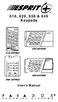 616, 626, 636 & 646 Keypads User s Manual TABLE OF CONTENTS 1.0 BASIC OPERATION...2 2.0 ACCESS CODES...4 3.0 ARMING & DISARMING...6 4.0 PANIC ZONES...13 5.0 KEY ACCESS PROGRAMMING.14 6.0 ADDITIONAL FEATURES...15
FTW 175 VERIZON Wireless Monitoring System Reference Manual Part Number 7911751VERIZON
 FTW 175 VERIZON Wireless Monitoring System Reference Manual Part Number 7911751VERIZON SERIAL NUMBER Flash Technology, 332 Nichol Mill Lane, Franklin, TN 37067 (615) 261-2000 Front Matter Abstract This
Owner s Guide. ca6554
 PROFESSIONAL SERIES Owner s Guide For Models: ca6554 Deluxe Vehicle Security and Remote Start System with 2 Way Confirming LCD Remote Control IMPORTANT NOTE: The operation of the Security and Convenience
DIGITAL ALARM II FOR HOSPITALS AND LABORATORIES INSTALLATION AND OPERATING INSTRUCTIONS 52 635.0
 Form No. 74-00-4001 S168-195-001 Revision E DIGITAL ALARM II FOR HOSPITALS AND LABORATORIES INSTALLATION AND OPERATING INSTRUCTIONS 52 635.0 INTRODUCTION Allied Healthcare Products, Inc. s Digital Alarm
Ventostat Wall Mount. Telaire Wall Mount CO 2. , Humidity and Temperature Transmitters. GE Measurement & Control. Features:
 GE Measurement & Control Ventostat Wall Mount Telaire Wall Mount, Humidity and Temperature Transmitters Features: Patented, Absorption Infrared Gas sensing engine provides high accuracy in a compact low
NELSON VOLTAGE MONITOR INSTALLATION & PROGRAMMING MANUAL
 NELSON VOLTAGE MONITOR INSTALLATION & PROGRAMMING MANUAL CONTENTS GENERAL INFORMATION...3 INSTALLATION...3 FIELD WIRING...4 PROGRAMMING...4 Circuit Monitor Options...5 Power Frequency...5 Alarm Silence
Installation and Operating Manual
 Installation and Operating Manual XL-660 Digital Access Control Station Your Partner in Access Control summitaccesscontrol.com Contents Two-Year Limited Warranty 3 PARTS CHECKLIST 4 INTRODUCTION 5 INSTALLATION
Single Station Remote Alarm
 ADI 5106G Certified ISO 9001:2000 Single Station Remote Alarm 529 5106-01-120 529 5106-01-220 INSTALLATION AND OPERATING INSTRUCTIONS Carefully Read These Instructions Before Operating Controls Corporation
SP4-LOC SAFEPATH4 REMOTE MICROPHONE AND LOCAL OPERATOR CONSOLE
 SP4LOC SAFEPATH4 REMOTE MICROPHONE AND LOCAL OPERATOR CONSOLE INSTALLATION AND OPERATION MANUAL MASS NOTIFICATION SYSTEM Part Number: P84767 Rev. A Copyright 2006 Cooper Wheelock, Inc. All rights reserved.
site monitoring Kit Site Monitoring Kit User Manual we prove it.
 site monitoring Kit 1 User Manual Site Monitoring Kit User Manual we prove it. 2 site monitoring Kit Content 1. Introduction 3 2. Content of the Site Monitoring Kit 4 3. Preparation 6 1. Positioning of
LD2 One & Two Zone Water Detection Alarm Installation and Operation Manual
 CMR Electrical Ltd Bolton House Five Chimneys Lane Hadlow Down East Sussex TN22 4DX Tel: 01825 733600 LD2 One & Two Zone Water Detection Alarm Installation and Operation Manual Contents 1) Operation 2)
LCD5500Z / PKP-LCD v3.x Installation Instructions
 LCD5500Z / PKP-LCD v3.x Installation Instructions TM Introduction The LCD5500Z / PKP-LCD keypad displays system status using an LCD screen. The keypad can be used on PowerSeries security systems with up
INSTALLATION MANUAL 3RP / 5RP 4-BUTTON SERIES VEHICLE SECURITY SYSTEMS
 3RP / 5RP 4-BUTTON SERIES VEHICLE SECURITY SYSTEMS INSTALLATION MANUAL Before you begin the installation Read the INSTRUCTIONS! Always use a multi-meter when verifying vehicle wiring. Before mounting the
Combustible Gas Transmitter 65-2400RK-05
 Combustible Gas Transmitter 65-2400RK-05 Overview This detection insert describes the combustible gas transmitter. This insert also describes how to install, start up, maintain, and calibrate the transmitter.
SingleNet Single Cable Control System
 Single Cable Control System Economical, Reliable and Expandable Two-Wire Single Cable System DRIP/MICRO IRRIGATION PRODUCTS Single Cable Control System System Manager or Irrigation Controller Controls
BroadBand PowerShield. User Manual
 BroadBand PowerShield User Manual 990-0375G 12/2006 Chapter 1 General Information The PowerShield provides a power source for broadband telephony and other DC applications. Safety This Safety Guide contains
PROFESSIONAL HOME ALARM SYSTEM. Important! Please read these instructions carefully.
 WIRELESS AUTODIAL HOME ALARM SYSTEM AM2000 Instructions for use Important! Please read these instructions carefully. IMPORTANT 1 IDENTIFICATION PLEASE CONTACT BEFORE RETURNING THIS PRODUCT TO THE RETAILER
User s Manual. Bluetooth Calculator Keypad. Page
 User s Manual Bluetooth Calculator Keypad Page Regulatory Compliance This device complies with Part 15 of the FCC Rules. Operation is subject to the following two conditions: (1) This device may not cause
FIRE ALARM SYSTEM TECHNICAL SPECIFICATIONS Page 1 of 10
 TECHNICAL SPECIFICATIONS Page 1 of 10 FIRE DETECTION AND ALARM SYSTEM Scope Furnish a complete 24V DC conventional, electrically supervised, zone annunciated, fire detection and alarm system as specified
LOSB9595 1/36 th Brushless ESC and 10250Kv Motor Combination
 LOSB9595 1/36 th Brushless ESC and 10250Kv Motor Combination Thank you for purchasing this Losi High Performance Brushless System! This technically advanced system will offer maintenance free operation,
WTSL-SN-1 Alarm Control Unit with Wi-Safe 2 Installation and User Guide
 WTSL-SN-1 Alarm Control Unit with Wi-Safe 2 Installation and User Guide "sona control unit install" For use with Wi-Safe 2 Smoke, Heat and Carbon Monoxide Alarms 1 PLEASE READ THIS GUIDE IN FULL BEFORE
Wireless Home Security Alarm System AM 500
 Wireless Home Security Alarm System AM 500 12 MONTH GUARANTEE Installation & Operating Instructions INTRODUCTION The AM500 is a simple self-contained alarm system. It protects the home by sounding a siren
BW TECHNOLOGIES GasAlertMicroClip Soft Tools Instruction Sheet
 Introduction BW TECHNOLOGIES GasAlertMicroClip Soft Tools Instruction Sheet The GasAlertMicroClip Soft Tools application is required to configure the GasAlertMicroClip detector ( the detector ). Software/Hardware
EzFlex Combustible Gas Leak Detector Model EZ40
 User's Guide EzFlex Combustible Gas Leak Detector Model EZ40 Introduction Congratulations on your purchase of the Extech EZ40 Combustible Gas Leak Detector. The EZ40 detects the presence of combustible
LS1024B / LS2024B/ LS3024B. Solar Charge Controller USER MANUAL
 EPSOLAR LS1024B / LS2024B/ LS3024B Solar Charge Controller USER MANUAL Thank you very much for selecting our product! This manual offers important information and suggestions with respect to installation,
Owner s Guide for the 220 MAX models (Rev D) Recreationnal Vehicle Security System
 Owner s Guide for the 220 MAX models (Rev D) Recreationnal Vehicle Security System [Table of contents] Your Warranty... 1 What s included... 2 System maintenance... 2 Transmitter Functions... 3 Arming
Part I - Installation
 400 Series Pressure and Differential Pressure Switches Types: H400, H402, H403, H400K, H402K, J400, J402, J403, J400K, J402K UNITED ELECTRIC CONTROLS Installation and Maintenance Instructions Please read
GX-2009 Data Logger Management Program Operator s Manual
 GX-2009 Data Logger Management Program Operator s Manual Part Number: 71-0163RK Revision: C Released: 3/19/12 www.rkiinstruments.com Warranty RKI Instruments, Inc. warrants gas alarm equipment sold by
Mobile Data Power Model: MDP-25
 Mobile Data Power Model: MDP-25 Topic Section Features... 2 Operational Features Summary... 2 Back-up Battery Power Internal Charger Voltage Spike Protection RF Noise Filtering Warning of Imminent Loss
Wireless Home Security System Product Manual (Model #80355)
 Wireless Home Security System Product Manual (Model #80355) Installation Instructions During set-up, if no key is pressed for 15 seconds it will come out of the setup mode and you will have to start over.
MODEL 2202IQ (1991-MSRP $549.00)
 F O R T H E L O V E O F M U S I C F O R T H E L O V E O F M U S I C MODEL 2202IQ (1991-MSRP $549.00) OWNER'S MANUAL AND INSTALLATION GUIDE INTRODUCTION Congratulations on your decision to purchase a LINEAR
SMART SENSOR COLLECTION
 TEMPERATURE SENSOR This sensor measures temperature in degrees Celsius or Fahrenheit. It works with all SensorHawk base units (SensorHawk-2, SensorHawk-8 and SensorHawk8/20) as well as the SecurityHawk-8
AC-115 Compact Networked Single Door Controller. Installation and User Manual
 AC-115 Compact Networked Single Controller Installation and User Manual December 2007 Table of Contents Table of Contents 1. Introduction...5 1.1 Key Features... 6 1.2 Technical Specifications... 7 2.
SERVICE MANUAL 12VDC WALL THERMOSTAT AIR CONDITIONING SYSTEMS ROOFTOP UNITS ONLY
 SERVICE MANUAL 12VDC WALL THERMOSTAT AIR CONDITIONING SYSTEMS ROOFTOP UNITS ONLY! WARNING - SHOCK HAZARD! TO PREVENT THE POSSIBILITY OF SEVERE PERSONAL INJURY, DEATH, OR EQUIPMENT DAMAGE DUE TO ELECTRICAL
HM-W536 Install Guide
 HM-W536 Install Guide 9/13/2013 IMPORTANT SAFETY INSTRUCTIONS Warning - When using electrical devices, basic safety precautions should be followed to reduce the risk of fire, electrical shock or injury.
Conventional Fire Detection and Extinguishant Control System Specification
 Conventional Fire Detection and Extinguishant Control System Specification Page 1 of 9 Scope Furnish a complete 24VDC Conventional, electrically supervised, combined fire detection and extinguishant release
OPL BASIC. Dosing System for Professional Laundry machines. Contents
 OPL BASIC Dosing System for Professional Laundry machines Contents 1 Getting Started. Page 2 2 Installation. Page 4 3 Set Up & Operation. Page 8 4 Maintenance & Accessories. Page 10 5 Troubleshooting Page
SINGLE-CHANNEL GAS-DETECTOR GAS ALARM DG510/1P
 SINGLE-CHANNEL GAS-DETECTOR GAS ALARM DG510/1P 2 Alarm Levels Bargraph + LED Indication of Gas Concentration Visual and Audible Signalization of Activated Alarm Levels 2 SPDT 5A/250V Output Relays Shock-Proof
Using your LED Plus keypad
 Using your LED Plus keypad System 238 System 2316 System 238i System 2316i Part Number 5-051-372-00 Rev B Thank you for purchasing this C&K alarm system Your system is one of the most powerful and advanced
543-0032-00, 943-0032-00. User s Manual
 543-0032-00, 943-0032-00 User s Manual 1 Comfort Alert Diagnostics Faster Service And Improved Accuracy The Comfort Alert diagnostics module is a breakthrough innovation for troubleshooting heat pump and
D7050/D7050TH. Installation Instructions. Multiplex Photoelectric Smoke Detectors
 D7050/D7050TH EN Installation Instructions Multiplex Photoelectric Smoke Detectors D7050/D7050TH Installation Instructions.0 Description Notices These instructions cover the installation of the D7050/D7050TH
INSTALLATION INSTRUCTIONS
 LIGHTING CONTROL PANELS 4 AND 8 RELAYS INSTALLATION INSTRUCTIONS INSTALLATION OVERVIEW The installation instructions contained in this document are provided as a guide for proper and reliable installation.
ETC TWO STAGE ELECTRONIC TEMPERATURE CONTROL
 RANCO INSTALLATION INSTRUCTIONS ETC TWO STAGE ELECTRONIC TEMPERATURE CONTROL Relay Electrical Ratings PRODUCT DESCRIPTION The Ranco ETC is a microprocessor-based family of electronic temperature controls,
IPX AUTOMATIC IP NETWORK LOSS BACKUP A/B SWITCH INSTRUCTION BOOK IB6444-02
 IPX AUTOMATIC IP NETWORK LOSS BACKUP A/B SWITCH INSTRUCTION BOOK IB6444-02 TABLE OF CONTENTS DESCRIPTION 2 MOUNTING INSTRUCTIONS 2 HOW TO CABLE THE IPX 2/3 POWER SUPPLY INSTALLATION 3 OPERATION 3 CARE
Daker DK 1, 2, 3 kva. Manuel d installation Installation manual. Part. LE05334AC-07/13-01 GF
 Daker DK 1, 2, 3 kva Manuel d installation Installation manual Part. LE05334AC-07/13-01 GF Daker DK 1, 2, 3 kva Index 1 Introduction 24 2 Conditions of use 24 3 LCD Panel 25 4 Installation 28 5 UPS communicator
How To Control A Car Alarm On A Car With A Remote Control System
 MODEL CA100 REMOTE CONTROL AUTO ALARM SYSTEM INSTALLATION & OPERATION INSTRUCTIONS WIRING DIAGRAM Black Antenna Wire 6 Pin 6 Pin Mini Connector Valet Switch Blue LED Indicator Blue Wire: (-) 200mA Unlock
CHAPTER 1. GETTING STARTED... 1
 REV. 01-2014 TABLE OF CONTENTS LIMITATION OF LIABILITY CHAPTER 1. GETTING STARTED... 1 1.1 Introduction... 1 1.2 System Descriptions... 1 1.3 System Applications... 1 1.4 System Specifications... 1 1.5
TX GSM SMS Auto-dial Alarm System. Installation and User Manual
 TX GSM SMS Auto-dial Alarm System Installation and User Manual Product Features: 1. 16 wireless zones, 3 wired zones alarm system, suitable for small to medium size offices and homes. 2. The system uses
Remote Alarm Monitoring System
 Remote Alarm Monitoring System Operation and Service Manual Model RA1 RA4 A A Version HELMER SCIENTIFIC 14400 Bergen Boulevard Noblesville, IN 46060 USA PH +1.317.773.9073 FAX +1.317.773.9082 USA and Canada
Buckeye Detection Systems Fixed Detection Systems Application Survey
 Buckeye Detection Systems Fixed Detection Systems Application Survey Channel Partner Representative : Company Name: Representative: BDS Representative: Client Contact Information : Company Name: Company
The Child Reminder System Installation Manual
 The Child Reminder System Installation Manual Revised June, 2006 Detailed installation information can be found at www.childreminder.com. Get through your installation quickly and easily by calling 1-888-330-6786