
Learning to Sail. Small Boat Sailing at the UCLA Marina Aquatic Center
|
|
|
- Marshall Morgan
- 10 years ago
- Views:
Transcription
1 Learning to Sail Small Boat Sailing at the UCLA Marina Aquatic Center Located at 33º " N 118º " W Elevation: 36 above sea level Fiji Way Marina del Rey, CA Phone: (310) FAX: (310) [email protected]

2 Learning to Sail Small Boat Sailing at the UCLA Marina Aquatic Center th 4 revised edition (Left to Right) Laurence Tighe and Julia Sorzano in a V-15 during a Sailing IV class (c. 2002). Original Text by Carla Thorson and Steve Orosz Original Drawings by Rob Tokar Subsequent revisions with new graphics by Steve Orosz Current revisions, additions, photographs, and graphics by Vladislav J. Mikulich Special Contributors: Eric Ohki, John Nelson, Kathy Luciano, Sean Silver, Gene St. Laurent, Chris Howard, Kevin Richards, Sung Byun, and Riccardo Boscolo All rights reserved. No part of this book may be reproduced or transmitted in any form or by any means, electronic or mechanical, without the expressed written permission from the Editor: [email protected]. Earlier Editions 1995, 2001, 2004 COVER: Melanie Salter and Dom Byington sailing a V-15 (c. 2004)

3 Table of Contents I. BASIC SAILING SKILLS Introduction to sailing at UCLA 4 Safety and Preparation 5-6 Sailing Area 7 Parts of the Boat: Capri Wind Sensing 11 How Sailboats Work: Beginner 12 Sailing Directions: Points of Sail Starting the Boat 16 Stopping and Slowing the Boat 17 Steering the Boat: Use of the Tiller 18 Tacking 19 Sailing Upwind: Beating 20 Gybing 21 Navigational Rules of the Road Capsize Recovery Person Overboard Recovery 27 Knots Beginner: Belaying & Figure-Eight 28 Rigging: Capri Launching Docking Derigging: Capri II. INTERMEDIATE SAILING SKILLS Parts of the Boat: Vanguard Displacement Sailing vs Planing 46 Points of Sail: Speed Differentials 47 Steering the Boat: Use of the Sails 48 Steering the Boat: Use of Your Body 49 Capsize Recovery: Turtle Sail Controls: How to depower Knots Intermediate: Bowline, Sheet Bend, & Square Knot Tacking: Use of a Tiller Extension Planing Upwind in a Vanguard Rigging: Vanguard Derigging: Vanguard III. SINGLE-HANDED SAILING Parts of the Boat: Laser Hiking Properly 68 Capsize: Walkover dry capsize Sail Controls: Laser 71 Upwind Sailing: Block to block 72 Downwind Sailing: Laser 73 Sailing by the Lee 74 Roll Tacking Roll Gybing Rigging: Laser Derigging: Laser IV. CATAMARAN SAILING Parts of the boat: Hobie Tacking: Body Placement 88 Gybing 89 Trapezing/ Flying a hull Rigging: Hobie Derigging: Hobie VI. ADVANCED SAILING TOPICS How Sails work: Circulation Theory 97 Upwind Sailing in Gusts 98 Wave Sailing Upwind 99 Wave Sailing Downwind 100 Foward and Aft Torquing: Laser 101 Mast Rake 102 Ocean Safety 103 Three Basic Wind Shifts 104 Current 105 Local Weather: MDR 106 Racing 107 VII. GLOSSARY Steve Orosz, UCLA Head Sailing Instructor , mid-roll tack during a Tuesday Night race (c.2002).

4 Sailing at UCLA There is nothing absolutely nothing Half so much worth doing as simply messing about in boats. Water Rat, The Wind in the Willows by Kenneth Grahame Our Mission The sailing program at the UCLA Marina Aquatic Center was created to provide a safe and fun environment for UCLA students, staff, and community affiliates to learn the fundamentals of sailing. The classes we provide offer a doorway into a larger world of sailing and what will be for many a lifelong pursuit of excellence in the sport. (Left to right): Nick Roberts and Gene St. Laurent in a V-15 on Santa Monica Bay (c. 2003). Using This Manual Sailing is an athletic endeavor, and as such, all the fundamental skills will be learned on the water. This manual is offered as a resource to complement material covered in class and on the water. It is not meant to be a substitute. To learn to sail, you must get out on the water and practice! Class Structure All classes at UCLA begin by introducing students to basic nautical knowledge, such as learning the parts of a boat or recognizing how a sail interacts with wind. This is followed by the practical knowledge of rigging a sailboat. Last and most important, every student learns how to maneuver their vessel in a seamanlike manner. Sailing Jargon Sailing is a unique sport that is steeped in a tradition that dates back over five thousand years when the first curragh was built in Mesopotamia. The language handed down from the days when sailing was a commercial pursuit permeate modern sailing. Understanding the difference between port and starboard or windward and leeward are essential in developing a knowledge base to aid you on your journey into the world of sailing. All first time uses of a sailing term will be in bold followed by a short definition in parenthesis. A glossary of Common Nautical Terms is included at the end of this book for more detailed information. Preparation Sailing is a water sport, so be prepared to get wet, especially in small boats! The wind and the Pacific Ocean are moderating coastal influences, and as such the weather conditions range from very warm to quite cool throughout the year. Check your local weather forecast for the coast, and dress appropriately for the conditions you will encounter. The UCLA Marina Aquatic Center provides live Weather Updates and a Webcam at 4 What to Bring 1. Shoes with non-marking and non-slip soles 2. Sunscreen 3. Sunglasses (with Croakies or a cord to retain them) 4. Clothing appropriate for water activity: dress in layers! 5. Change of clothes and shoes 6. Towel and bathing supplies 7. A lock for our day-use lockers What Not to Bring 1. Valuables (flotation is inversely proportional to value) 2. Cell phones, pagers, cameras, or anything that might be subject to water damage 3. Car keys 4. Wallets 5. Anything that sinks, but you would like to keep! Provided 1. Personal Flotation Device (PFD): life jacket 2. Wetsuit 3. Rack for keys available in the issue room 4. Day-use lockers (bring your own lock) Recommended 1. Sailing gloves 2. Dinghy sailing boots or wet suit booties 3. Waterproof windbreaker 4. Hat 5. Water or sports drink to keep hydrated Optional items for Upper Level Classes and Ocean Sailing 1. Hiking pants 2. Rashguard for wesuits 3. Sailing safety knife 4. Signal light or whistle 5. Short piece of line for emergency repair 6. Waterproof watch 7. Lucky charm (as long as it floats)

5 Safety and Preparation Throughout the entire process of learning to sail, safety is paramount! Always place the safety of yourself and the crew first. Never attempt anything dangerous or beyond your experience level. Go out there and have fun, but make sure you do it in a responsible manner. Although dinghy sailing is not a particularly dangerous sport, it does, like all water sports, have inherent risks. By following a few sensible guidelines you will minimize any such risks, and ensure a safe and fun day of sailing. Swimming To be a safe sailor there is one skill that you are required to master prior to the first time that you step into a boat: SWIM- MING! You MUST be able to swim at least 100 yards unassisted, and tread water while fully clothed for at least five minutes without a Personal Floatation Device (PFD). If you cannot perform either of these two tasks, it is essential that you learn them before beginning any sailing course. 1. After selecting a PFD from the rack, you should read the inside label to verify that you have chosen the correct size. The PFD will indicate minimum weight and a chest size for a proper fit. Vlad Mikulich towing a Capri 14.2 (c. 2005). Personal Floatation Device (PFD) Having the proper equipment aboard your vessel and using that equipment is essential to safe sailing. The most crucial piece of equipment you will have while on the water is your Personal Floatation Device (PFD). A properly fitted PFD should fit snugly around your chest without greatly restricting your movement or imparing your breathing. You MUST wear your PFD at all times while on the water. The UCLA MAC uses Type III Coast Guard approved PFDs. All PFDs are kept in the wetsuit cage on the western side of the boathouse. The PFD rack has three levels where various sizes are kept. Top level: Large, X-Large and XX-Large PFDs; Middle level: Medium PFDs; Lower Level: Small and X- Small PFDs. 2. Loosen all the side straps on the PFD (2-4). 3. Put on the PFD as you would a jacket, and zip up the front. 5

6 4. Tighten all the side straps until the PFD is snug. It is best to tighten the lower straps before the upper ones. Avoiding the Sun Sunglasses are an essential piece of equipment during any outdoor activity. It is advisable to get a pair that filters 100% of the UV spectrum. Polarized models will also help reduce glare from the water, and even improve your ability to detect wind shifts. It is advisable to wear a Croakie or cord to keep your sunglasses from falling into the water. 5. To test for a proper fit you should have your crew gently pull up on the top of your PFD. It is best to raise your arms over your head for this test. Sunscreen is a MUST, while sailing, even on a cloudy day. You should use a minimum of SPF 25, and reapply frequently throughout the day. Along with sunscreen a wide brimmed hat that encircles both the front and back of your head is a good investment to ensure your skin s health. 6. Your PFD should not move upwards more than 3 inches. If the PFD rises high enough to touch the bottom of your chin, then your PFD is either too large, or you have not tightened the side straps properly. Adjust the side straps, and repeat step 5. If the PFD is still too loose, choose a smaller size. Experience has shown that novice sailors often choose PFDs one size too large. A properly fitting PFD may save your life! Sailing Knife A good sailing knife made of stainless steel or titanium with retractable blade has saved many a life while on the sea. If you will be investing long hours on the water it is advisable to obtain a sailing knife that can be attached to your PFD. He who lets the sea lull him into a sense of security is in very grave danger. 6 Hammond Innes

7 Sailing Area There are defined boundaries of where you may or may not sail, depending on your qualifications. These restrictions were made to provide for your safety. Do NOT sail in any area that your instructor has not specifically stated you may enter. Marina del Rey: The primary sailing area is the Marina del Rey Entrance Channel. The Entrance Channel is divided into three lanes by a series of white and orange No Sail buoys. Sailboats under sail, must stay within the center lane between the two lines of buoys. The outer lanes are for inbound and outbound vessels under power. UCLA sailboats should not cross into the power channels, except when leaving or returning to the UCLA dock. When crossing the power channel, UCLA sailboats must give way to any power boat in the designated power channel. Sailing in the Main Channel is restricted to sailors who have completed Sailing III. Sailing in the boat basins is forbidden. Sailing outside the marina on Santa Monica Bay is restricted to more advanced sailors who have completed ALL of the Ocean Sailing Qualifications and thus demonstrated their proficiency at handling their vessel in a variety of challenging conditions. Please do NOT sail on the bay without proper training and experience wind and wave conditions can be very challenging for the novice sailor, and the Dockmaster will be unable to provide any assistance as he/she will not have visual contact with your vessel. Basin C Basin G Basin B Basin A Only for Sailing III Basin H DoNOT Sail into the Main Channel Santa Monica Bay (only for Sailing IV) UCLA DOCK Do NOT exit the Marina! Outbound power traffic Sailing Area Inbound power traffic W N S E Do NOT exit the Marina! *Image courtesy of the USGS. 7 The ocean is an object of no small terror. Edmund Burkeke

8 Sailing I: Capri 14.2 Parts of the Boat: Capri 14.2 Beginning sailors at UCLA start out in a 14-feet dinghy (a small, light sailboat without a fixed keel) called a Catalina 14.2 or Capri 14.2 two names for the same boat. The older models were called Capris, while the newer models are Catalinas. The 14.2 refers to the length of the hull, which is 14 feet 2 inches long. It is a sloop rig (single mast with one head sail) boat, and weighs approximately 340 lbs. Although designed to be sailed by two people, it can hold up to four adults comfortably for a day-sail. To learn more about Capri 14.2s please visit the Capri 14.2 National Association: Mast Forward Boom Shroud Halyard (on cleat) Boom Vang Outhaul Jib Sheet Mainsheet Port (left side of boat) Gunwale Hiking Strap Mainsheet Block and Cleat Traveler Self Bailer Rudder Hiking Strap Tiller with Extension Gudgeon and Pintles Drain Plug Aft (Toward the back of the boat) Jib Fairlead and Cleat Starboard (right side of boat) 8

9 Head Mast That s what a ship is, you know. It s not just a keel and a hull and a deck and sails; that s what a ship needs. But what a ship is really is is freedom. Captain Jack Sparrow, The Pirates of the Carribbean Sailing I: Capri 14.2 Batten Batten BOW Forestay Jib Sail Telltales Jib Window Halyard Deck Luff (edge of sail) Leech (edge of sail) Main Sail Foot (edge of sail) Tack Boom Vang Jib Sheet Outhaul Batten Mainsheet Clew Traveler STERN Centerboard 9 Hull Rudder

10 Sailing I: Capri 14.2 Jib Sheets Clew Clew Tack Tack Cringle Foot (side of sail) Foot (side of sail) Tack Cunningham Grommet Clew Bullet Hank Telltale Leech(side of sail) Hank Luff (side of sail) JIB SAIL Hank Leech (side of sail) Boltrope Luff (side of sail) MAIN SAIL Batten 10 Hank Hank Hank Batten Head Batten Ships are the nearest thing to dreams that hands have ever made. Robert N. Rose Head The perfection of a yacht s beauty is that nothing should be there for only beauty s sake. John MacGregor

11 Wind Sensing Sailors depend on the wind to power their boats. It is essential that you know where the wind is coming from at all times in order to use it effectively. Wind direction is usually defined by the direction FROM which it is coming. For example, a southwest wind blows FROM the southwest. (Exception: An offshore breeze comes from the shore and blows toward the water, an onshore breeze comes from the water and blows toward the shore). TW AW TW AW TW WM AW TW Sailing I: Capri WM WM TW = True Wind AW = Apparent Wind WM = Wind of Motion 3 4 Windward side (Opposite side the boom is on) Leeward side (Side boom is on) True Wind The true wind is the wind experienced by a stationary observer. It shifts regularly, and should be monitored constantly while sailing. There are a number of ways to determine the direction of the true wind. Flags at the marina will fly away from the wind, as will loose sails on a nonmoving boat (Boat #1). Smoke will blow away from the wind. Moored vessels will point toward the wind, and ripples on the surface of the water move with the wind. Wind of Motion The wind of motion is the wind generated by a moving object. If a cyclist travels at 10 m.p.h. with no true wind present, then she will experience a 10 m.p.h. wind coming from the direction she travels towards. This technique should be used as often as you would check the rear view mirror while driving. Additionally, the boat may be equipped with shroud telltales (a piece of yarn or other light-weight material), which will flow away from the apparent wind direction. Wind Shifts The wind never maintains a constant direction and will shift frequently. As a sailor you must keep track of where the wind is coming from to sail effectively and safely. Shifts in direction are often accompanied by changes in wind speed. Keep an eye on the surface of the water where you may see dark wrinkled patches, or cat s paws, (indicating an increase in wind speed: a gust or puff) or light glassy areas (indicating a decrease in wind speed: a lull). Apparent Wind The apparent wind is the combination of the true wind and the wind of motion. The wind that drives a sailboat is the apparent wind! The apparent wind is lightest when a boat is travelling in exactly the same direction as the true wind (Boat 4); and becomes progressively stronger as a boat sails closer to the wind (Boat 2 vs 3). The apparent wind can be easily detected while you are sailing. To determine its direction, turn your head toward the wind until you feel the breeze on both ears. Once you feel even preasure on both sides of your face, you are looking directly at the apparent wind. 11 Sides of a boat The direction of the wind is so central to sailing that sailors refer to the boat s two sides in terms of their relation to the wind. The side over which the wind passes first is called windward (toward the direction from which the wind blows), while that over which the wind passes last is called leeward (away from the direction from which the wind blows). The modern definition, which accounts for downwind sailing, uses the position of the boom to determine the leeward and windward sides of a boat. The side that the boom naturally lies on is always the leeward side see Boat #4.

12 Sailing I: Capri 14.2 How Sailboats Work: Beginner Before you begin sailing, it will help to have an understanding of how the hull, sails, and blades (centerboard and rudder) interact to produce forward drive. Driving Force All sailboats derive their power from wind. A sailboat can operate in two different modes. The first mode is commonly referred to as the Push Principle. The picture below demonstrates how a sail acts like a large parachute, which catches air, and pushes a boat along the water. Wind Sideways/Heeling Force There is a sideways force that is produced by a sail during lift. This sideways force is resisted by the centerboard (a retractable plate that projects below the bottom of a sailboat) as well as the hull and rudder to a lesser extent in a dinghy. Therefore your boat will slide to leeward if the centerboard is up while attempting to sail upwind. Sideways Force (leeward side) (winward side) The push principle is perfectly adequate when your destination is downwind (away from the direction which the wind blows). But what if you need to make progress toward the wind (upwind)? In this case your sails must utilize the principle of lift (an aerodynamic force). A sail generates lift as air flows across the two sides of the curved surface of the sail. For the most part, this is very similar to the way an airplane wing produces lift. In short, the air on the windward side of the sail has greater amount of pressure than that on the leeward side, due to a difference in the overall speed of the air on each side of the sail (Bernoulli's Principle). Wind High Pressure (windward side) Resistance to Sideways Force by Blades This sideways force and resistance of the centerboard will manifest itself as a rotational motion (a force that causes the sideways tilt on a boat that is at a right angle to the line from the bow to stern) that can be counterbalanced by the skipper s and crew s weight. Proper position by both the skipper and crew is essential for a sailboat. If one or both members are on the leeward side of a boat in a moderate to strong breeze a capsize (boat tips onto its side) is likely. Rotational Motion Sideways Force Low Pressure (leeward side) 12 Resistence to Sideways Force Riccardo Boscolo in a Laser during a Sailing IV class (c. 2002). Skipper s Weight Resists Heeling

13 Sailing Directions: Points of Sail The direction of a boat, relative to the angle of the wind, is often referred to its Point of Sail. The points of sail can be divided into three main categories: the no-sail zone, sailing upwind, sailing offwind. No-Sail Zone Sailboats can only move through the water when the sails catch the wind. To sail towards the wind a sailboat must utilize the lift principle. For most boats, lift is first achieved at an angle roughly 45 on either side of the true wind. Therefore sailboats cannot sail straight into the wind, because they cannot generate lift. If the bow is too close to the true wind direction, the sails will begin to luff (flap or flutter in the wind), and the boat will slow down, eventually starting to drift backwards. This predicament is traditionally referred to as being In Irons. A boat in irons has entered the No-Sail Zone or No-Go Zone. You cannot sail in that direction no matter where you are on the ocean, nor what you do with your sails. Your boat can sail in every other direction, approximately 270. Progress toward the wind is made by sailing a zigzag course (beating). To see a full explanation of beating please refer to page 20. Sailing I: Capri 14.2 WIND Starboard Tack (Boom on port side of vessel) Close Reach Close-Hauled NO-SAIL ZONE In Irons Close-Hauled Close Reach Port Tack (Boom on starboard side of vessel) Beam Reach Beam Reach Broad Reach Run Run Broad Reach 13

14 Sailing I: Capri 14.2 Sailing Upwind There are two points of sail used to reach an upwind destination: close-hauled (beating) and close reach (fetching). Close-hauled (approximately 30 to 50 off the wind; depending on your vessel and the strength of the breeze. For any boat and given condition, there is only one closehauled angle.) A close-hauled course is defined as sailing as close as possible to the wind without the sails luffing. To achieve a close-hauled course, the sails MUST be sheeted-in (to draw the sail in towards the centerline of the boat by pulling on the free end of the line) fully, the centerboard should be completely down, and the skipper shall steer the vessel to the edge of the no-sail zone. It is unique, in that unlike all other points of sail, the boat is driven to the sail trim rather than constantly adjusting the sails for the angle of the boat. Close Reach (between close-hauled to <90 off the wind) A close reach course is achieved when sailing upwind with the bow pointed above 90 off the true wind, yet below a close-hauled course. The sails are eased out slightly compared to a close-hauled course, and the centerboard can be anywhere from completely down to one-quarter up depending on your angle to the wind. The closer you are to the wind the more you must sheet it, and the further down the centerboard should be. ineffectiveness of centerboard when at an angle (see page 12). Too much heel (the sideways tilt on a boat that is at a right angle to the line from the bow to stern) will also cause the boat to turn. Maintaining a sharp leeward heel will induce weather helm (the tendency of the boat to turn to windward due to the heel of the boat). The heel will force you to constantly pull on the tiller to track a straight course. If your boat heels significantly, hike out or sheet-out in order to flatten the boat. Conversely you should not hike out so far that you cause the boat to heel to windward. Windward heel will induce lee helm (the tendency for the boat to turn away from the wind). Attempt to achieve a neutral helm by sailing the boat completely flat. Offwind Sailing There are three points of sail in regards to offwind sailing: beam reach, broad reach, running. Beam Reach ( 90 off the wind) Beam reaching is sometimes referred to as sailing across the wind. It is achieved when the true wind blows directly over the windward side of the boat at a 90 angle from the bow. The sails are eased out roughly halfway, and the centerboard is partially up (one quarter to a half depending on the boat and wind conditions). It is the fastest point of sail for most boats! In a moderate to strong breeze a lightweight dinghy will begin planing (rise up on top of the water and accelerate enough to break free from its bow wave). Hiking out Broad Reach ( off the wind) On a broad reach the wind will be coming over the rear quarter of the boat. The sails are trimmed in anywhere from halfway to almost fully out while the centerboard is half to three quarters up. NB: The closer the angle of the wind the more you must sheet-in and the further down the centerboard should be. Jeroen Molemaker on a close reach during a Tuesday Night Race (2003) Hiking out: When sailing upwind in 8 or more knots of breeze on either a close-hauled or close reach course you will need to hike out (adjust your weight to windward) to stop the boat from heeling excessively ( >10 ). The more that you sheet-in, the more the boat will heel to leeward. This is normal, and you should compensate by hiking out further. To hike out, sit on the gunwale (the edge of the boat where the hull connects to the deck), secure your feet under the hiking strap (a band of cloth attached to the cockpit used to restrain a sailor s feet while hiking), and lean out over the water. If the boat heels too far, it will slow down as the hull drags through the water, and slides sideways due to the 14 Steve Orosz on a broad reach in 20+ knots of breeze (c. 2004). Run (171 to 180 off the wind) On a run the wind is coming directly over your stern (back end of the boat). The mainsail is eased out all the way and your centerboard may be brought up completely. This will make the boat less stable, and should not be attempted by

15 beginning sailors in moderate to strong breezes. You will feel a decrease in wind speed because you are moving with the wind. The shroud telltales should stream toward the bow, but in light winds they may hang limply. The best indication of a true run can be found in the behavior of your sails. When both sails are on one side the jib will flutter limply. This is an indication that the mainsail is cutting off wind flow to the jib since the boat is operating on the push principle. When sailing downwind, the boat should have a slight windward heel to achieve a neutral helm. Usually the crew and the skipper sit on opposite sides of the boat for balance. The skipper should sit further forward, so that the stern does not drag through the water. Tack: Starboard vs Port The boom s position is used to describe which tack you are on. If it is over the port side then you are on a starboard tack. Starboard Tack Boat Wind Sailing I: Capri 14.2 Starboard side of boat Boom is on port side of boat Several boats on a RUN using the Wing and Wing method. On a run the sails can be trimmed either to port or to starboard. You may choose to trim the mainsail on one side and the jib on the other (Wing and Wing). This is more efficient, because it allows the wind to fill both sails unimpeded. By trimming your sails Wing and Wing you can detect wind shifts easily. If the jib collapses, then the wind has shifted to windward, which means you will need to pull the tiller toward you to fill both sails. If the boom rises slightly, the wind has shifted towards leeward. Once the wind reverses direction, and begins to blow over the leeward side first you are sailing by the lee. Be careful! Sailing by the lee risks an accidental gybe (the boom flies uncontrolled across the boat). If the mainsail luffs or the boom rises slightly push the tiller toward the mainsail to avoid an accidental gybe. It s scary to have a 30 foot wave chasing you. If you are steering, you don t look back. The crew looks back for you, and you watch their faces. When they look straight up, then get ready! -Magnus Olsson 15 If it is over the starboard side of the vessel you are on a port tack. Port side of boat Port Tack Boat Wind Boom is on starboard side of boat To summarize: the closer your vessel is to the wind the closer the sails must be to the centerline of the boat, and the further down your centerboard must be. Attempt to sail your boat with a neutral helm by being flat or as close to flat as possible by adjusting your weight laterally in the boat so that you feel no pressure from the tiller.

16 Sailing I: Capri 14.2 Starting the Boat Starting your boat to move is relatively easy. The key is knowing where the wind is coming from. If your boat is pointing downwind, it will naturally begin to move via the push principle. If your boat is pointing upwind you will need to properly trim (pull in) your sails to achieve lift and thus move the boat. Starting Upwind Make sure that your centerboard is down, and that your tiller is centered. Your sails will be luffing, and the boat will be stopped (drifting downwind slowly), while the bow is pointing upwind, but not in the no-sail zone. Bow pointing on close reach course Luffing Sail placed on the forward one-third of the jib (one each side of the sail). Telltales Wind Begin trimming your sheets until the sails begin to fill. As the mainsail and jib move towards the center of the boat the angle of attack (the angle between the sail and the apparent wind) will change. Leech Sail Chord (use Boom to visualize) Wind Luff Angle of attack The telltales show if the air flow is smooth or turbulent. Novices sailors should attempt to to keep the telltales flowing directly aft when first learning to sail. Maximum power is obtained when the air flows smoothly across both the leeward and windward sides of the sail, which depends on a good angle of attack. Luff wire Good Trim Leeward Telltale Windward telltale If your tiller is straight the boat will begin to track smoothly through the water. If your tiller is not straight it will deflect water as the boat begins to move, and will consequently act as a break making it difficult to start. Luff wire Luff wire For every point of sail, there is a perfect angle of attack. Sails can be perfectly trimmed, over trimmed (stalled), or under trimmed (luffing). It is easy to tell when your sails are under trimmed as a luffing sail will flap or flutter, but it may be difficult to tell if your sails are stalled. Rule of thumb: When in doubt, let it out! Telltales (a piece of lightweight yarn or nylon used to determine wind direction or sail trim) are often used to monitor the wind flow over the sails. You should have two telltales Luffing Stalled Do not get too caught up with the telltales. Remember to keep your head out of the boat. Many a new sailor has run aground while paying total and complete attention to the telltales! The pessimist complains about the wind; the optimist expects it to change; the realist adjusts the sails. William Arthur Ward 16

17 Stopping and Slowing the Boat Controlling a sailboat means not only knowing how to use the wind to move the boat, but also how to stop the boat. Once you can find the wind, it is relatively easy to get the boat moving. To stop the boat, however, the wind cannot simply be shut off. You must somehow keep the wind from catching the sails in order to stop. There are two easy ways to stop a boat: adjust the angle of the boat relative to the wind or adjust the angle of attack. Both methods require that the boat be heading upwind for the vessel to stop. In Irons: To enter irons one must turn the bow into the nosail zone. If the bow of your boat is in the no-sail zone, the boat will slow, and eventually stop. Going into irons can be useful if you need to stop to adjust the rigging on the boat, or if you are docking. When stopped, the tiller will not function; it needs water to flow across the surface in order to work. The sails do not fill and the boat lies helpless and unsteerable Safety Position: Being in irons has the disadvantage of limiting your ability to maneuver. You should be able to stop the boat briefly, and start moving again quickly in order to accomplish a simple task, such as switching skippers or adjusting a sail control. By sheeting out the sails and spilling all the wind so that they luff completely, the boat will slow and even stop. This is called the Safety Position. The safety position will only work on a close reach or beam reach. On a broad reach or a run, the wind coming from astern will continue to fill the sails no matter how far you sheet out. On some boats the safety position will not work on a beam reach if the shrouds are placed far enough aft to prevent the sails from luffing. Luffing Sail Sailing I: Capri 14.2 Therefore getting out of irons can be difficult. To get out of irons, pull the jib sheet taut on one side or better yet backwind (push the sail out against the wind ) the sail. The jib will begin to fill and push the bow away from the wind.the boat will also drift downwind. This is called Backing Out of Irons. You will end up on a port tack if you back your jib to port. Once out of irons, center the tiller, trim in the sails, and be on your way. WIND Wind Getting out of the safety position is much easier than getting out of irons. You simply sheet-in until the sails fill with wind, and you re on your way again. Slowing: Sometimes you will want to slow the boat rather than stop. If your boat is pointing upwind sheet out slowly. The front part of your sail will luff, but your boom will not swing back and forth as the vessel slows. Jib sheet pulled to port 2 1 The bow moves away from the backwinded sail Front Edge of Sail Luffs as Boat Slows Boat is ready to sail away on a port tack 17

18 Sailing I: Capri 14.2 Steering the Boat:Use of the Tiller A sailboat can be steered by using the helm (a wheel or tiller), the sails, the angle of heel, or any combination of these. The novice skipper should focus on properly using the helm when first learning to sail. Once aboard the vessel the helmsperson (the skipper) should always sit on the windward side (opposite the boom) of the boat. In this position he/she will face the sail, and take hold of the tiller (the stick which is attached to the rudder used to control the direction of the vessel) with the aft (toward or near the back end of the boat) hand. In the fore (toward or near the bow of the boat) hand the skipper will hold the mainsheet (the line attached to the boom used to control the angle of the attack). Or you can turn away from the wind (fall off) by pulling the tiller away from the mainsail. Pull the tiller away from the mainsail WIND Fall off (move away from wind) To steer the vessel, the helmsperson must move the tiller in the opposite direction from which he/she wants to turn. The tiller works by diverting water that flows around the rudder; therefore the boat must be moving to turn efficiently. The tiller should be handled in a firm smooth manner. Sudden jerky movements disrupt the laminar flow of water across the surface of the rudder, and thus causes the tiller to act as a brake. Boat movements are described in terms of the boat s relation to the wind. You can turn the boat toward the wind (head up) by pushing the tiller toward the mainsail. Push the tiller towards the mainsail WIND Heading up (move towards the wind) Tiller is straight after altering course! 18 Tiller is straight after altering course! Therefore the boat will turn in the opposite direction that you move the tiller. In order to go straight, remember to keep the tiller centered in the boat! As mentioned above the helmsperson ALWAYS sits opposite the mainsail with his or her feet under the hiking straps. The crew on the other hand is responsible for balancing the boat, and maintaining stabilty by resisting the various forces that cause pitching (up and down movement of the boat) and rolling (side to side movement of the boat). When first learning to sail a dinghy it is best to attempt to sail the boat perfectly flat. The crew should use his or her body weight to accomplish this feat. Under most conditions the crew will sit directly forward of the helmsperson, and the two will move as a unit to balance the boat. Skipper and crew on windward side of boat to achieve a balanced boat.

19 Tacking To tack is to turn a sailboat through the wind, whereby the bow of the boat passes through the eye of the wind first. Your boat will enter the no-sail zone from one side and exit the other. WIND Before the Tack The helmsperson and crew make sure that it is safe to tack by checking for obstructions, such as traffic. Your boat should be on a close-hauled/close reach course, and MOVING through the water. Your rudder will not work unless your boat is moving! The helmsperson should uncleat the main sheet, but not release it. Keep tension on the sheet. 2. Communicate The helmsperson announces, Ready to tack! while selecting a land reference to steer for at the completion of the tack (approximately 90 from current course if close-hauled) The crew uncleats the leeward jib sheet, but holds tension in his/her hands, and then responds, Ready. If the crew spots an obstruction or possible problem he or she should emphatically reply, No! 3. Begin Tack The helmsperson calls out, tacking! or hard a- lee as he or she pushes the tiller toward the mainsail (to leeward). 4. While Tacking The bow will turn toward the wind. As the boat turns into the no-sail zone, the sails will luff. When the boat is directly into the wind, the boom will be centered in the boat. 5. While Tacking Part II The crew releases the old working jib sheet (the jib sheet used to control the angle of attack for the jib), ducks under the boom, switches sides on the boat, and sheets in the new working jib sheet. Do not release the jib early, allowing it to luff wildly, or haul in on the lazy sheet (the jib sheet that is not used to control the angle of attack of the jib) on the new side before the boat has fully turned to the new tack. Let the wind push the jib across the boat. The helmsperson keeps the tiller hard to leeward, and continues the turn until the wind is clearly pushing the boom and mainsail onto the new side of the boat. Once the wind has filled the sails, center the tiller, set your new course, and trim your sails. The helmsperson must also switch sides on the boat during the turn. The easiest time to cross under the boom is while the bow is in the no-sail zone. It is best to face forward, exchanging the tiller and main sheet behind your back. 6. Completed Tack You should be on the opposite tack close-hauled. Sailing I: Capri 14.2

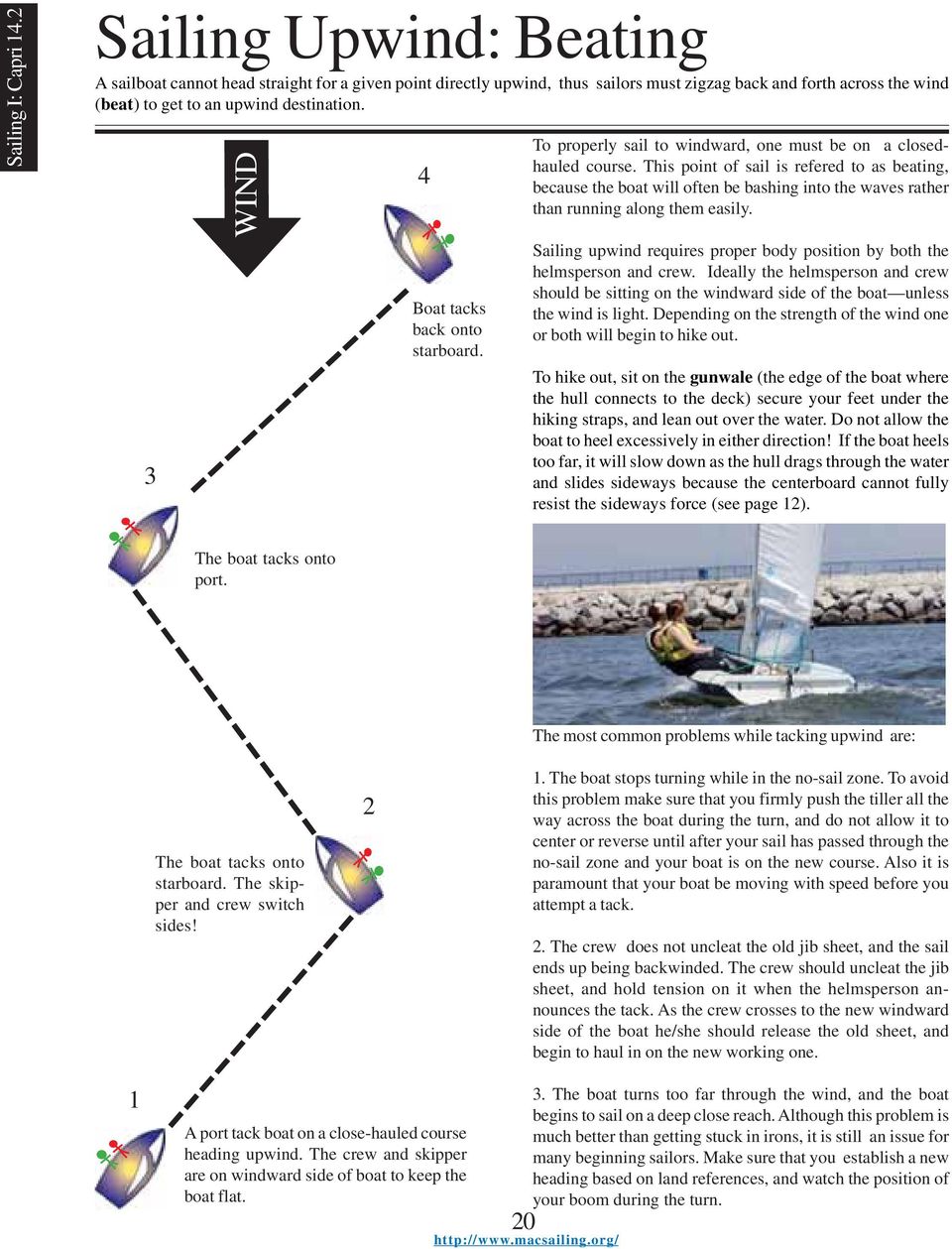
20 Sailing I: Capri 14.2 Sailing Upwind: Beating A sailboat cannot head straight for a given point directly upwind, thus sailors must zigzag back and forth across the wind (beat) to get to an upwind destination. 3 WIND 4 Boat tacks back onto starboard. To properly sail to windward, one must be on a closedhauled course. This point of sail is refered to as beating, because the boat will often be bashing into the waves rather than running along them easily. Sailing upwind requires proper body position by both the helmsperson and crew. Ideally the helmsperson and crew should be sitting on the windward side of the boat unless the wind is light. Depending on the strength of the wind one or both will begin to hike out. To hike out, sit on the gunwale (the edge of the boat where the hull connects to the deck) secure your feet under the hiking straps, and lean out over the water. Do not allow the boat to heel excessively in either direction! If the boat heels too far, it will slow down as the hull drags through the water and slides sideways because the centerboard cannot fully resist the sideways force (see page 12). The boat tacks onto port. The boat tacks onto starboard. The skipper and crew switch sides! 2 The most common problems while tacking upwind are: 1. The boat stops turning while in the no-sail zone. To avoid this problem make sure that you firmly push the tiller all the way across the boat during the turn, and do not allow it to center or reverse until after your sail has passed through the no-sail zone and your boat is on the new course. Also it is paramount that your boat be moving with speed before you attempt a tack. 2. The crew does not uncleat the old jib sheet, and the sail ends up being backwinded. The crew should uncleat the jib sheet, and hold tension on it when the helmsperson announces the tack. As the crew crosses to the new windward side of the boat he/she should release the old sheet, and begin to haul in on the new working one. 1 A port tack boat on a close-hauled course heading upwind. The crew and skipper are on windward side of boat to keep the boat flat The boat turns too far through the wind, and the boat begins to sail on a deep close reach. Although this problem is much better than getting stuck in irons, it is still an issue for many beginning sailors. Make sure that you establish a new heading based on land references, and watch the position of your boom during the turn.
21 Gybing To gybe (alternative spelling, jibe ) is to turn a sailboat through the wind whereby the stern of the boat passes through the eye of the wind first. Your boat will turn away from the wind until your boom can swing to the opposite side. Although tacking is easier and safer than gybing, especially in strong winds, gybing is an important maneuver to use when running or reaching to a downwind destination. To tack you must turn at least 90, whereas to gybe you need only turn a few degrees. However, gybing is inherently more dangerous, because of the great force with which the wind can carry the boom across the cockpit if you do not control the turn. The boom must travel from all the way out on one side to all the way out on the other. Controlling the boom is the most important factor to gybing safely. Sailing I: Capri Before the Gybe The helmsperson and crew make sure that it is safe to gybe by checking for an obstruction such as traffic. When first learning to gybe it is best to gybe from a reach to a reach instead of a run to a run. 2. Communicate Helmsperson announces, Prepare to gybe! while selecting a land reference to steer for at the completion of the gybe. With jib sheets uncleated and held in each hand, the crew responds, Ready. If the crew spots an obstruction or possible problem he or she should emphatically reply, No! 1 WIND Begin Gybe The helmsperson moves the tiller gradually towards the windward side of the boat (away from the boom) While Gybing The crew lets the jib luff while the helmsperson begins slowly pulling in the main sheet. 5. While Gybing Part II As the stern crosses the eye of the wind the helmsperson grabs the main sheet, and begins pulling until the boom is to centerline and then calls out, gybe-ho! There should be very little pressure on the sail if the boat is truly dead downwind and moving quickly. If you have problems pulling the sail across you are attempting the maneuver too early (while reaching). 6. While Gybing Part III The helmsperson lets the boom cross to the new leeward side while easing the main sheet. The crew crosses to the new windward side and begins to sheet in the jib While Gybing Part IV The helmsperson crosses to the new windward side, and centers the tiller without switching hands. Once situated on the new side and on the new course, the helmsperson will exchange the tiller and sheet hands Completed Gybe You should be on the opposite tack. 21 8
22 Sailing I: Capri 14.2 Navigational Rules of the Road There are basic navigation rules on the water which all boaters must obey. The skipper of a vessel is ultimately responsible for knowing and following the appropriate navigational rules. Although international water rules do overlap on almost all instances, the text below refers specifically to U.S. Inland Waterway Rules, which are applicable inside the demarcation lines separating inland and international waters. The navigational rules were written to avoid collisions, therefore you must avoid a collision if possible, even if you believe that you have the right of way in a crossing situation. The navigational rules will not exonerate a skipper of actions that are considered to be outside the ordinary practice of a seaman (ie avoiding a collision when possible is always an ordinary practice of seamanship)[rule 2(a)(b)]. Powerboat vs Sailboat Powerboat: Give-way vessel If you are ever in danger of an imminent collision, DO NO PANIC, follow this simple rule TILLER TOWARD TROUBLE. The boat moves in the opposite direction from the tiller, so aim it at whatever you want to avoid, and the boat should turn away (unless, of course, the danger is straight ahead and the tiller is pointing at the danger). The rules are based on maneuverability, and all of the regulations specify what actions should be taken when two or more boats meet. The more maneuverable vessel generally gives way to the less maneuverable vessel. Sailboat: Stand-On Vessel Terminology: The Give-Way Vessel is obligated to keep out of the way of another vessel (as directed by the Navigational Rules) and shall, so far as possible, take early and substantial action to keep well clear of the stand-on vessel. The Stand-On Vessel is obligated to maintain her course and speed (so that the give-way vessel may keep well clear). However, the General Rule of Responsibility [Rule 2(a)(b)] dictates that a the stand-on vessel must avoid a collision if the give-way vessel takes no action. When Two Boats Meet 2. Overtaken/Overtaking: No matter what type of vessel, a boat overtaking another must give way to the boat being overtaken [Rule 13(b).] A vessel shall be deemed to be overtaking when coming up on another vessel from a direction more than 22.5 abaft (toward the stern) of her beam (at the boats greatest width). In other words, if you are approaching another vessel from behind you are obligated to keep well clear of them (even if you are a sailboat and the other vessel is a powerboat). Overtaking Vessel Powerboats generally must give way to a sailboat [Rule 18(a)(iv)] except for in the following seven specific situations noted below. 1. Designated Powerboat Area: In Marina del Rey, sailboats have a marked sailing area in the center of the Entrance Channel and powerboats should use the two motoring lanes on either side (see page 7 for a diagram of the sailing area). As a sailor, avoid the power channels! Sailboats must keep clear of power boats when crossing a specified motoring lane. Time your launch or approach accordingly so that you avoid cutting in front of motoring vessels when crossing the power channel. Powerboat: Stand- On Vessel Sailboat: Give-Way Vessel 22
23 3. A vessel restricted in her ability to maneuver: This rule applies to LARGE vessels in narrow channels. Marina del Rey is a restricted waterway. Very large power vessels have difficulty maneuvering at slow speeds in narrow waterways. These large vessels therefore are the stand-on vessel, and smaller vessels must keep clear. [Rule 18(b)(ii)] On the open ocean, the Law of Gross Tonnage is a tongue in cheek reference to large tankers and container ships that move at high speeds and require lots of room to maneuver. Simple physics dictates that they are the stand-on vessel and smaller boats must keep clear. A little common sense goes a long way on the water small sailboats can be quite maneuverable so it s often a good idea for you to give larger boats a wide berth early on and avoid close-quarters situations. 4. Towing Vessels: Any boat that has taken another vessel in tow is generally restricted in its ability to maneuver, and is the stand-on vessel [Rule 18(b)(ii)] In Marina del Rey, the Sheriff, Lifeguards, commercial tow vessels or private boats may be seen towing another vessel. All other vessels must keep clear. 5. Vessel Not Under Command: Any boat that appears not to have steerage way (ability to maneuver) should be considered the stand-on vessel [Rule 18(b)(i)]. A boat not under control includes, but is not limited to: a power boat with no skipper at the controls or a disabled engine, a sailboat in irons, capsized, or with no rudder or helm control. Vessels who are in control should therefore keep clear. Vessel Not Under Control Not Under Control: Stand-On Vessel Under Control:Give-Way Vessel When Two Sailboats Meet: Opposite Tacks: When two sailboats are on opposite tacks, the sailboat on starboard tack (boom on the port side) is the stand-on vessel, and the sailboat on port tack (boom on the starboard side) is the give-way vessel. Port Tack: Give- Way Vessel Starboard vs Port WIND Windward vs Leeward Starboard Tack: Stand-On Vessel Same Tack: When two sailboats are on the same tack, the leeward boat (furthest away from the direction from which the wind is coming) is the stand-on vessel, and the windward boat (boat closer to the wind) is the give-way vessel. WIND Windward: Give-way Vessel Both Vessels are on a Starboard Tack Sailing I: Capri Military (coast guard and navy), sheriff, county lifeguard vessels: The boats listed above have right of way on all other vessels at anytime due to the nature of their function. 23 Leeward: Stand-On Vessel
24 Sailing I: Capri 14.2 Etiquette on the Water: In close quarters situations, communication between vessels is important. If you are the stand-on vessel and are within range, you may politely hail the applicable rule: Starboard! or Leeward! accident. Make sure everyone is all right. Do not admit fault, and collect all the necessary information. If you collide with a non-ucla boat, determine its name and CF number (bow registration) as well as the name, telephone number, and address of the skipper. Even if the other skipper tells you that there is no damage or problem, please get their name and contact information and report it to us so we can follow-up appropriately. Two boats on an imminent collision. A hail should be made! If the give-way vessel was unaware of your presence, this hail should be sufficient to get their attention. If the hail is ineffective, and a collision is imminent, you should alter course [Rule 2(a)(b)]. If the other vessel does not stop, get as much identifying information as you can (such as boat name, type, CF number on the bow etc.). Return immediately to the UCLA dock, and report the accident to the dockmaster. Fill out a Boating Accident Report, giving a full description of the incident, relevant rules of the road violated, the extent of any damage to the UCLA boat and to the other vessel, and any other information that will help us resolve the situation. If you collide with another UCLA boat, determine the type and sail number of the boat. Return immediately to the UCLA dock and report the accident to the dockmaster. Fill out an accident report, giving a full description of the incident, relevant rules of the road violated, and the extent of any damage to both boats. The starboard boat tacks away even though he has right of way to avoid a collision. If you are the give-way vessel, and are hailed by a stand-on vessel, the proper acknowledgment is Hold your course. To avoid the stand-on vessel you should alter course immediately to pass their stern, or if the boat is very close, then tack away. Be courteous on the water. You need not always hail in crossing situations. Eye contact, a nod, or a friendly gesture is often sufficient to convey your intentions. If a giveway vessel has just altered course to avoid you, acknowledge it with a wave or a thanks. Both sailors are keeping a clear lookout for possible obstructions John Nelson and Melanie Salter going upwind on a Tuesday Night Race (c.2004). In the event of a collision: A prudent sailor does everything in their power to avoid a collision, but occasionally, in spite of their best efforts accidents do happen. If a collision happens to you, treat it just as you would an automobile 24 Keep your head out of the boat. Sailing Mantra
25 Capsize Recovery When the boat tips over so that the mast lies in the water, the boat has capsized. Sometimes, the boat will continue to tip over until it inverts: the mast is straight down in the water and the upturned hull is all that is above water (turtled).capsizes are not unusual when sailing small boats, even for the most experienced sailors. Therefore it is esential that you learn how to properly right your boat in a safe and effective manner. Causes Capsizes occur for a number of reasons including: a sudden gust of wind, a sudden change in the direction of the wind, a poorly executed gybe, or gear failure(e.g. hiking strap breaks). Sailing I: Capri 14.2 There are many ways to avoid a capsize, but the most important thing is to keep the mainsail uncleated so that the skipper may quickly react to a gust of wind by sheeting out. Safety If you capsize you should always STAY WITH THE BOAT! The shore is always further than it looks, and rescuers are more likely to see you if you are with your boat. Swim around the stern of the boat only 3. Once at the centerboard the skipper should grab it and put some weight on to it before the boat turtles. Scoop Recovery The preferred recovery method is called a scoop recovery, because the crew is scooped into the boat as the skipper brings the boat upright. The crew s weight in the boat will help prevent a second capsize, and will put him or her into a position to help the skipper into the boat after the boat is brought upright. 4. The skipper must now right the vessel. Depending on the boat type, sea state, and weight of the individual all that might be required is simply pulling down on the centerboard. 1. Upon entering the water it is important to make sure that both you and your crew are unhurt and not tangled in the rigging. Communication is a vital part of a capsize recovery, and thus you and your crew should be constantly talking in order to monitor each other s condition. Relax, and let the PFD support you in the water. 2. Once the boat has capsized do not hang onto any part of the boat as that will encourage it to turtle. The helmsperson should swim around the stern to the centerboard as quickly as possible. 25
26 Sailing I: Capri 14.2 For most capsizes the skipper will have to climb onto the centerboard. Righting the boat does not require great physical strength, but rather leverage. You must get your weight out of the water in order to gain enough leverage to right the boat. There are many possible ways to get up there! Find one that works for you and use it. 5. Some are able to hoist themselves up with their arms. If you can do this it is probably the quickest way. It is best to pull oneself up on the forward side of the centerboard as the aft part is sharper and thus will dig into your chest if you attempt to pull yourself up from that side. To get onto the centerboard you should reach over the top of it with both arms and grab the aft side. Kick your legs behind you while pulling up with a quick stroke. 8. While the skipper rights the boat, the crew grabs hold of the hiking strap and is scooped into the boat. One person is then in the boat when it is upright and should immediately make sure the sails are uncleated and luffing (cleated sails may make the boat sail away), center the tiller, and keep the boat either in irons or in the safety position. 9. The skipper climbs back into the boat, either over the windward side or over the stern. Since the crew is already in the boat, they may grab the top straps of the skipper s PFD to help hoist him or her into the boat. Be careful not to pull the PFD off the person in the process. 6. If you are unable to pull yourself onto the centerboard, your crew can grab the main halyard (without uncleating it) and toss the line over the hull to you. Once you have it you may tie a figure eight loop on a bight (see page 28). Your fixed loop should be just at the waterline. This will provide a loop-rung to use to step up onto the centerboard. 7. Once on the centerboard, the skipper should get their weight out as far as possible. Don t bend forward at the waist keep your knees and hips straight and LEAN back. Hold the jib sheet or halyard while you lean back over the water to optimize your leverage. Be patient. The boat will right. 10. Before resuming your sail, do a check. Are all the lines running free? Are the halyards still neatly coiled and out of the way? Is the centerboard down? Are the tiller and rudder still attached? Are the outhaul and downhaul still tightened? Are either of you too wet, too cold or too tired to the point where it is a good idea to head back to the dock? Stay with the boat until the boat leaves you: sinks. UCLA safety motto 26
27 Person Overboard: Figure 8 It is rare that someone actually falls out of a dinghy. It is more likely that you will be retrieving a hat and not a person, but it is essential that you become proficient at maneuvering your boat so that you can stop at a particular place on the water when you need to. When in danger or in doubt, Run in circles, scream and shout. Robert Heinlein During a person overboard recovery your objective is safe, efficient, and reliable recovery of someone who has fallen overboard. There are numerous methods used to retrieve lost crew. Novice sailors should learn the Figure 8 due to its simplicity and effectiveness in small boats. Figure 8 1. As soon as someone falls overboard you must shout CREW OVERBOARD! It is vital that you announce the fact that someone has fallen off the vessel to not only alert others in your boat of this very dangerous situation, but also to convey this fact to other boats on the water which may injure your crew if they do not know of his or her pres- ence. 2. NEVER lose sight of the sailor in the water! 3. If you are the skipper you must move forward without letting go of the tiller and release the jib. If you are the crew you should release the jib and immediately move back to take the tiller. 4. Fall off or head up to a beam reach. 5. Beam reach approximately 5 boat lengths 6. Tack 7. Bear off onto a broad reach and travel at least 3 boat lengths to leeward of the sailor in the water. 8. Head up to a close reach 9. Begin to slow your boat by entering the safety position. You can always sheet back in if you undershoot the lost sailor. 10. Pick up the sailor on the windward side by going into the safety position. A leeward pick up in moderate to strong winds will likely cause a capsize. Sailing I: Capri 14.2 WIND 7 Broad Reach 6 Tack CREW OVERBOARD! Beam Reach 1 10 Safety Position pick-up 9 8 Close Reach 27
28 Sailing I: Capri 14.2 Knots: Beginner Lines (any rope on a vessel that has particular use) and the knots in them are an essential feature on all sailboats. As a sailor, you will need a few basic knots to sail safely and effectively. Below are the two essential knots you will need for Sailing I. Refer to the Knots: Intermediate section (page 54-55) for more knots such as the bowline or slipped sheet bend. Belaying To belay a line is to secure it to a fixed object. The horn cleat, which is a two pronged metal or plastic fitting, is a common fixture in most nautical environments. A cleat hitch is used to secure halyards, sheets, and dock lines to a horn cleat by tying a series of figure eight turns over the two horns. On the Capri 14.2 the main and jib halyards (a line used to raise or lower a sail) are secured to the mast using a horn cleat. Line goes UNDER cleat Line goes OVER cleat Line CROSSES cleat Line goes UNDER cleat TWIST line into loop (away) Pass loop over horn and pull taut Stopper Knots A stopper knot is tied at the end of a line to prevent a line from running through a block or fairlead. The Figure Eight Knot, also known as a Flemish Knot, is a good stopper knot because it is simple to tie, holds fast, does not jam and is easy to untie. On the Capri 14.2 the ends of both the main sheet and jib sheets must have a stopper knot. Pass the free or working end behind the standing part to form a loop Form a bight (U-bend) Pass the free end through the loop and pull taut 28
29 RIGGING: Capri 14.2 RIGGING: Personal Flotation Devices (PFDs) must be worn at all times while on the dock. Rigging is best done with two people, and should take between 10 and 15 minutes. Learn the function, not the form, since the basics you take away from here will apply to every other type of boat you will sail. The sequence that is laid out in this manual will ensure that the boat and sails are properly cared for. While rigging, make sure that the boat and its equipment are in safe working order. Keep an eye out for any damage or potential problems. For example, look for a missing split ring on the turnbuckles at the base of the shrouds (a missing split ring is all it takes for the mast to come crashing down). Sailing I: Capri Take the sails out of the bag and place them directly onto the boat. Hang the sail bag on the sail rack or sail line at the Noth-eastern end of the dock. Never place sails on the dock as the rough surface will damage them. you may end up needing to re-rig them. 4. Attach the clew of the main sail by sliding the clew bullet down the foot-track on the boom. 2. Step into the boat carefully and move aft. Reach over the stern and turn the drain plug in a clockwise fashion. NB: If you do not secure the drain plug, the hull of your boat will fill with a copious amount of water. A hull full of water will not only be difficult to maneuver, but almost impossible to remove from the water without damaging the boat. There isn t no call to go talking of pushing and pulling. Boats are quite tricky enough for those that sit still without looking further for the cause of trouble. 3. Have your crew uncleat the main halyard from the starboard side of the mast. Detach the main halyard shackle from the clew hook at then end of the boom, and pass the main halyard to your crew. Never leave any of the halyards free flying or 29 Sam Gamgee, The Lord of the Rings by J. R. R. Tolkien,
30 Sailing I: Capri Attach the hook from the outhaul to the clew of the sail. Be sure to keep the outhaul uncleated. 8. Attach the halyard to the head of the mainsail. Make sure the sail is not twisted. Insert the shackle pin from the port side of the sail through the starboard side. Turn the pin until it locks into place. 6. Secure the tack of the sail to the front of the boom using the tack pin. The pin is inserted from port to starboard. 9. Insert the bolt rope at the head of the sail into the groove of the mast. 7. Tighten the outhaul, by pulling the line along the port side of the boom, and secure it in the clam cleat. 10. Have your crew uncleat the main sheet. It is extremely important that all sheets run freely through the blocks before raising a sail. In moderately strong wind conditions a mainsail that is cleated will cause the boat to fall to leeward on the dock. Start first, and increase your lead. Buddy Melges on how to win a sailboat race 30
31 11. Raise the main sail using the main halyard which is on the starboard side of the mast. If it seems difficult to raise, check to see if something is caught. NEVER force anything on the boat. Make sure the boom vang is released. 14. Pass the Cunningham from the port side of the sail through the grommet. Sailing I: Capri Look at the top of the mast to see if the sail is all the way up (should have no more than a 5 inch gap between the top of the mast and the head of the mainsail). 15. Secure the Cunningham in the clam cleat on the starboard side of the mast. Make sure to put some tension on the Cunningham. 13. Use a cleat hitch to secure the main halyard. Please see the knots section of the manual for instructions on how to tie a proper cleat hitch (page 28). 16. Attach the jib tack to the stem fitting. Make sure the sail is not twisted. 17. Loosen the jib halyard attached to the horn cleat on the port side of the mast. Detach the jib halyard shackle from the stem fitting at the base of the forestay. 31
32 Sailing I: Capri Raise the Jib and secure the jib halyard to the horn cleat on the port side of the mast using a cleat hitch. 18. Attach the jib halyard to the head of the jib using the jib shackle. 21. Lead the jib sheets through the fairleads OUTSIDE the shrouds, and secure them by tying a figure eight stopper knot close to the end of each sheet (refer to page 28). NB: At least six inches of line should be free at the bitter end (extreme end of a line). 19. Attach the hanks on the jib luff to the forestay. 22. Provided that the tide is not extremely low you may put on the rudder. Pass the rudder under the traveler (the bridle which controls the sideways movement of the boom). If the tide is low you will put the rudder on after the boat is brought to the windward side of the dock. Sailing became a compulsion: there lay the boat, swinging to her mooring, there blew the wind; I had no choice but to go. E.B. White 32
33 23. Insert the pintles into the gudgeon on the stern of the boat. Make sure that the stern of the boat is over the water and you can put the rudder on without it hitting the dock. 26. Walk the boat to the windward side of the dock. Have your crew hold the boat by the shroud. Make sure to keep the hull of the boat from banging against the dock. Sailing I: Capri Attach the bungee cord to the padeye at the stern. Be sure to put the hook from the bottom up or it will be difficult to remove. 27. Gently step into the boat and release the centerboard line by uncleating it from the cam cleat on the port side of the boat. 25. Grab the painter in one hand and with your crew gently lift the bow and slide the boat into the water. Lift with your legs and not your back. Be sure all sheets are free before this step. 28. If the centerboard does not drop, pull the bungee or centerboard ring until the centerboard is completely down. 29. Check everything. Make sure everything on your boat is shipshape and ready for you to sail! 33
34 Sailing I: Capri 14.2 Launching To launch a sailboat the important principle to remember is that you must keep the bow pointed into the wind and have your sails eased out and luffing (fluttering loosely) until you are ready to sail away. The Capri 14 s are berthed on the Northeastern side of the dock. 1. Make sure your sails are uncleated and eased. Then begin pushing the boat into the water while holding the painter. 4. Keep the bow pointed into the wind. An onshore breeze is the norm (wind blows from the ocean), so your bow will be pointed toward the top of the channel most of the time. Occasionally, however, the wind will come from inland. Then, your docked boat must have its bow toward the marina. The key is to keep the bow pointed into the wind! Prevailing Wind 2. Using the painter pull the boat towards the pylon. 5. Never leave the boat unattended on the windward side. Hold the boat so that it does not bang into the dock. 3. Before bringing the boat around to the windward side of the dock you should check the prevailing wind direction to determine which direction the bow of the boat should be pointing. Generally the wind will blow from the ocean towards the shore. Pass the painter to your crew around the pylon; do not walk on the outside of the pylon. 6. In order to reach the sailing area, you must sail across the power channel, so before launching, check for traffic coming down the power channel. Happy is he who like Ulysses has been on a beautiful voyage. Joachim Du Bellay, Les Regrets 34
35 Clear lane to launch from a different direction). The easiest method to accomplish this is to push with your forward hand and pull with your aft hand. NEVER hold the boom of the boat while launching. Sailing I: Capri When there is a clear lane to cross the power channel without cutting too close in front of oncoming boats, you are clear to launch. Remember, you must keep clear of all boats in the power channel. It is best to pass clear astern of any power vessels. 10. The skipper steps into the boat over the stern, and centers the tiller. DO NOT JUMP into the boat! The boat will not sail away if the sails are uncleated and the boom is free. Pass clear astern of power vessels 8. The crew should sit in the boat, centering their weight so the boat is stable. 11. The skipper and crew should be on the windward side to balance the boat. Trim in on the mainsail and jib until the sails are not luffing, and you re off! Head directly for the sailing area. 9. From the dock, the skipper pushes the bow away from the dock until the boat is approximately perpendicular to the dock and the wind (this will change when the wind comes 35
36 Sailing I: Capri 14.2 Docking The goal in docking is to bring the boat to a stop, bow into the wind, sails eased out and luffing, parallel to the dock. Boats must always be docked bow into the wind on the windward side. Never attempt to dock the boat by sailing downwind toward the dock or by sailing around to the leeward side. 1. Time your approach so that you cross the power channel without cutting in front of power boats, and sail across in the shortest distance: a perpendicular approach to the dock. 3. As you approach, slow the boat by releasing the jib. Then ease the main out. Pass clear astern of power vessels 2. Plan ahead! You should estimate approximately two boat lengths of dock space in order to stop (there are no brakes on a sailboat). If the dock is crowded, do not cross the power channel until there is enough room for your boat on the windward side. 4. Your sails should be completely released at a point where you have enough momentum to glide to the dock (not over it or through it!). The stronger the wind the more room you need to slow down. You can always sheet in to regain momentum if you slow too soon. Luffing Jib A tourist remains an outsider throughout his visit; but a sailor is part of the local scene from the moment he arrives. Anne Davison As you glide slowly toward the dock, gradually turn the boat into the wind (tiller toward the mainsail) until you are parallel to the dock. A perfect landing is one where you come to a stop next to the dock without hitting it or any boats in front of you.
37 Sailing I: Capri If you approach the dock too quickly, tack away and attempt another approach. If you stop too soon, and the boat is a few feet from the dock, pull the tiller away from the dock, and wait for the boat to drift in. 9. Have your crew pull up the centerboard 7. Once docked (and the boat has come to a complete stop), the crew can step out (never jump), and hold the boat by the shroud (metal cable that supports the mast across the beam of the boat). 10. Walk the boat back to the floating dock. Do not drop your sails until you have pulled your boat back onto the floating dock. 8. Have the crew keep the boat from banging on the dock. As other boats pass near the dock they will generate wake which will cause your vessel to crash up against the dock Land was created to provide a place for boats to visit. Brooks Atkinson 37
38 Sailing I: Capri 14.2 DE-RIGGING: Capri 14.2 Once back at the dock, your goal is to get the boat out of the water as soon as possible! If there is open space on the float, immediately walk your boat around and pull it up on the float. Never leave a boat rigged or unattended on the windward side of the dock. Ensure that the boat and equipment are stowed properly and that the dockmaster is informed of any wear and tear or other damage that may have occurred or been discovered on the water. DERIGGING: 1. Raise the centerboard by pulling on the centerboard line that is on the port side of the deck. The centerboard should come FULLY up in the centerboard trunk before you attempt to bring the boat onto the floating dock! If the centerboard does not come up check that the blocks at the front of the cockpit have not twisted. Be sure no lines are in the centerboard trunk. 4. Remove the drain plug at the stern, but do not pull it out. 2. Walk the boat around to the leeward side and pull it out of the water onto the floating dock. You should leave at least 16 inches of space between adjacent boats. 5. Lower the jib first. The jib should be the last sail raised and the first sail down. Sails left up and flogging in the wind break down much faster, so drop your sails as soon as possible. 3. Unhook the centerboard bungee shock cord. Release the line slowly so that it does not sling shot to the front of the cockpit. Anyone can hold the helm when the sea is calm. Syrus Publilius 38
39 6. Lower the main sail slowly, so the boom doesn t crash into the cockpit. Sailing I: Capri Secure the jib halyard at the stem fitting and then secure the halyard to the port cleat of the mast. Remove jib shackle and leave the sail on the deck of the boat.leave the jib hanks attached to the forestay. 10. Remove the rudder by pressing down on the rudder stop that is directly underneath the top pintle. Raise the rudder up slowly and place it into the cockpit of the boat so that the rudder is pointing towards the bow of the boat. Make sure that the nut on the rudder is facing up and not digging into the gunwale. 8. Secure the main halyard head shackle to the outhaul hook and then cleat the halyard to the starboard side of the mast 11. Flemish the painter and centerboard line. 9. Cleat the main sheet to prevent the boom from swinging, and coil it neatly over the main sheet block. Coil up any other loose lines If the sails are wet with saltwater lay them over the railing on the ramp and rinse them off with fresh water. When placing the sails on the railing make sure the battens are on the windward side of the railing. Don t leave wet sails to dry on the grass they will become a mini-greenhouse in the
40 Sailing I: Capri 14.2 sun and will collect moisture (as well as dirt) instead of drying! mentioned before, it is very important to keep an eye out for anything that looks amiss and make sure that any problems get noted on the Repair Request. Your safety and fun depend on how well the equipment is cared for. PFD s should be zipped up and returned to the equipment cage. Wet suits should be dunked in the disinfectant tank, hung right side out on a hanger, zipped up, and returned to the equipment cage. 13. Hose the boat down with fresh water, and do a final check to make sure everything is shipshape. Pay special attention to washing off all the metal fittings. FOLDING SAILS Accordion Fold: These sails get a lot of use. Proper care, including lowering them whenever they are not in use, will keep them from deteriorating too quickly. Keeping the sails off any abrasive surfaces such as the dock or asphal,t and hosing them down with fresh water if they are dunked in salt water will prolong the life of the sails. Using the accordion fold also ensures longer life and keeps the battens from breaking, as well as making it easier to rig and raise the sails next time. It takes two people to fold a sail well. 1. Spread the mainsail out flat. 14. Carry, do not drag, the sails up to the boat yard for folding. Fold them inside the boat house on the carpet. Be sure to collect the right sail bag (numbers on the sails and the bag should match) from the sail line on the Northeastern end of the dock. 2. Start at the foot of the sail (one person near the tack, the other near the clew). EQUIPMENT CARE: Damage or wear to equipment should be reported to your instructor and/or the dockmaster, as 40
41 3. Each person places one hand on the edge of the sail about two feet up from the foot. This hand holds the sail down. 6. The sail is now a long rectangle. Sailing I: Capri With the other hand, take the edge of the sail about two feet further up towards the head and fold it over even with the foot. (The person on the leech of the sail should make the first fold bigger to get the battens to line up.) 7. Fold it into thirds (the battens cannot be folded so the folds will not be even). 5. Repeat the folds, making sure that the leech is lined up even with itself (the person at the luff end will move in closer with each successive fold). 8. Your main sail should be a small rectangle that is no larger than three and a half feet by two feet. And all I ask is a tall ship and a star to steer her by John Masefiled, Sea Fever 41
42 Sailing I: Capri Repeat this process for the jib. Coil the jib sheets. Coiling a Line: Properly coiling a line is important to keep it from becoming tangled which makes it more difficult to use later. Form the turns of the coil by making turns with your wrist in a clockwise direction making sure to keep all of the coils the same length. All the coils should lay flat against each other; if they don t the line can become tangled. If they are not laying flat then twist your wrist a little when making each coil. 12. The sails should fit into the bag and only have no more than three inches sticking out 13. Make sure that the sails are neatly returned to the sail rack. 10. Stack the two sails 11. Slide (don t stuff) both flat into the sail bag. Sing to me of the man, Muse, the man of twists and turns driven time and again off course, once he had plundered the hallowed heights of Troy. Many cities of men he saw and learned their minds, many pains he suffered, heartsick on the open sea, fighting to save his life and bring his comrades home. But he could not save them from disaster, hard as he strove the recklessness of their own ways destroyed them all, the blind fools, they devoured the cattle of the Sun and the Sungod blotted out the day of their return. Launch out on his story, Muse, daughter of Zeus, start from where you will sing for our time too. Homer, The Odyssey 42
Learn to Sail at MIT
 Learn to Sail at MIT Please read this before the next class and practice your knots: the bowline and the stunsail tack bend. Rigging Check with the dock staff to see if there are any restrictions. Grab
COMMON SAILING GLOSSARY OF TERMS
 COMMON SAILING GLOSSARY OF TERMS Abeam Aboard Anchor Aft Off to the side of a vessel at right angles to the boat s centerline. On or in the boat A device used to hold a boat to the sea bottom At, near
THE FLYING SCOT A BASIC GUIDE TUNING AND SAIL TRIM By Harry Carpenter
 THE FLYING SCOT A BASIC GUIDE TO TUNING AND SAIL TRIM By Harry Carpenter Tuning the Flying Scot Rig Boat set up In setting the mast rake on a Flying Scot, most Scot sailors run a tape measure up the mast
J/70 Tuning Guide. onedesign.com Follow North Sails on... For any question you may have on tuning your J/70 for speed, contact our experts:
 Photo Paul Todd/OUTSIDE IMAGES For any question you may have on tuning your J/70 for speed, contact our experts: Tim Healy 401-683-7997 [email protected] Will Welles 401-683-7997 [email protected]
points of sail beating reaching running
 History of Sailing Throughout history sailing has been instrumental in the development of civilization. The earliest representation of a ship under sail appears on an Egyptian vase from about 3500 BC.
Dee s tuning and sailing thoughts for the Farr 400
 Dee s tuning and sailing thoughts for the Farr 400 I have had a great time sailing the Farr 400 both in Dubai, the Med and San Francisco. In all sorts of conditions, 0-30 knots.. The boat is light, powerful
Nor thbr id ge Sailing C lub Rescuing Centreboard Dinghies
 FOREWORD The following draws heavily on an article written by Don McKenzie of the Northbridge Sailing Club 20 years ago. It has been augmented and updated with the assistance of experienced rescue crew
Leaving a Leeward Shore
 Handling Notes Leaving the Beach The 49er is different from most other boats because of the effect of the fully battenned main and the light hull weight. It has often been said that leaving the beach is
ASA 105: Coastal Navigation Curriculum
 (784) 456-9526 www.barefootoffshore.com [email protected] ASA 105: Coastal Navigation Curriculum Prerequisites: None General Description: Able to demonstrate the navigational theory required to
J/24 Tuning Guide San Diego models
 San Diego models Thanks very much for purchasing your J/24 sails from North Sails we appreciate your business. The following tuning guide is meant to be a starting point in setting up your boat for your
RS300 OWNER S MANUAL. LDC Racing Sailboats, Trafalgar Close, Chandlers Ford, Eastleigh SO53 4BW, GBR Tel. +44 (0)23 8027 4500 Fax. +44 (0)23 8027 4800
 RS300 OWNER S MANUAL LDC Racing Sailboats, Trafalgar Close, Chandlers Ford, Eastleigh SO53 4BW, GBR Tel. +44 (0)23 8027 4500 Fax. +44 (0)23 8027 4800 INTRODUCTION Congratulations on the purchase of your
Tata Steel Sailing Club Margam. Tips for Laser Sailing
 Tata Steel Sailing Club Margam Tips for Laser Sailing Introduction Whether you re a novice fresh from the level 2 course, you ve been sailing a Laser for a little while, or you re an experienced sailor
Learning to Sail. Small Boat Sailing at the UCLA Marina Aquatic Center Section 2: Introduction to Single-Handed Sailing. By Vladislav J.
 Learning to Sail Small Boat Sailing at the UCLA Marina Aquatic Center Section 2: Introduction to Single-Handed Sailing By Vladislav J. Mikulich Learning to Sail Small Boat Sailing at the UCLA Marina Aquatic
Quantum Tuning Guide 2002
 Quantum Tuning Guide 2002 A reference guide to the set-up, tuning, and trim for the Beneteau First 36.7 One-Design Class Bill O Malley - Quantum Sail Design Group Beneteau First 36.7 One-Design Class Administrator
How do sails work? Article by Paul Bogataj
 How do sails work? Article by Paul Bogataj Sails are wings that use the wind to generate a force to move a boat. The following explanation of how this occurs can help understand how to maximize the performance
Weta Class Rules. This introduction provides an informal background and is not part of the Weta class rules.
 Introduction The Weta is a trimaran developed by Weta Marine Ltd. Weta hulls, beams, hull appendages, rigs and sails shall only be manufactured by Weta Marine Ltd or their appointed manufacturers. A hull,
The Racing Rules of Sailing Q & A s Booklet
 International Sailing Federation The Racing Rules of Sailing Q & A s Booklet Last update: 18 February 2013 Ariadne House, Town Quay, Southampton, Hampshire SO14 2AQ, UK Tel +44 (0)23 80 635111 Fax + 44
Aquarius Sailing Club Basic Dinghy Sailing
 1 2 AQUARIUS SAILING CLUB BASIC DINGHY SAILING April 2009 Prepared by: Mike Baker & Richard Cannon Acknowledgements The following publications were referred to in the preparation of this training handbook.
Shearwater Sailing Club Risk Assessment Sailing without safety boat cover
 Risk assessments prepared on behalf of the Committee of Shearwater sailing Club Date assessments ratified by Committee 5 th January 2012. These assessments will be subject to ongoing review and amendment
RENTAL INFORMATION. (310) 823-0048 [email protected] 14001 Fiji Way, Marina del Rey, California 90292. Catalina 14/RS Vision/Laser $15 $15 $30
 RENTAL INFORMATION (310) 823-0048 [email protected] 14001 Fiji Way, Marina del Rey, California 90292 RENTAL RATES TIER 1 CURRENTLY ENROLLED UCLA STUDENTS TIER 1 RECREATION MEMBERS TIER 2 PUBLIC Catalina
INTRODUCTION TO POSITIONING. MODULE 3: Positioning and Carrying
 MODULE 3: Positioning and Carrying Blankets, pillows and towels, sandbags, carpet on the floor, a doll with floppy limbs that can be positioned i.e. not a hard plastic doll, display materials. Icebreaker
OWNER S MANUAL. LDC Racing Sailboats, Trafalgar Close, Chandlers Ford. Eastleigh SO53 4BW, England Tel. +44 (0)23 8027 4500 Fax. +44 (0)23 8027 4800
 OWNER S MANUAL LDC Racing Sailboats, Trafalgar Close, Chandlers Ford. Eastleigh SO53 4BW, England Tel. +44 (0)23 8027 4500 Fax. +44 (0)23 8027 4800 1 CONTENTS 1. INTRODUCTION 2. SPECIFICATIONS AND DRAWINGS
User s Guide by David Burch
 TrueWind by David Burch About TrueWind...2 How to use TrueWind...3 Definitions Wind direction...4 Apparent wind...4 Apparent wind angle...4 Apparent wind speed... 5 True wind angle... 5 True wind speed...
The basics of how to accomplish your first water ski experience.
 Learn to Ski Basics The basics of how to accomplish your first water ski experience. Level 1 On land, demonstrate: The seven skier hand signals Placing feet in and adjusting bindings Holding the handle
GATE STARTS BEST PRACTICE
 GATE STARTS BEST PRACTICE The gate start was developed to improve race management for fleets of over 100 boats. It is now used by smaller fleets and can be a very fair way of starting races. The basic
Exercise 1: Knee to Chest. Exercise 2: Pelvic Tilt. Exercise 3: Hip Rolling. Starting Position: Lie on your back on a table or firm surface.
 Exercise 1: Knee to Chest Starting Position: Lie on your back on a table or firm surface. Action: Clasp your hands behind the thigh and pull it towards your chest. Keep the opposite leg flat on the surface
RS600 OWNER S MANUAL. LDC Racing Sailboats, Trafalgar Close, Chandlers Ford, Eastleigh SO53 4BW, GBR Tel. +44 (0)23 8027 4500 Fax. +44 (0)23 8027 4800
 RS600 OWNER S MANUAL LDC Racing Sailboats, Trafalgar Close, Chandlers Ford, Eastleigh SO53 4BW, GBR Tel. +44 (0)23 8027 4500 Fax. +44 (0)23 8027 4800 www.rssailing.com INTRODUCTION Congratulations on the
Responsibilities of a Volunteer Leader
 Responsibilities of a Volunteer Leader Inspecting tools for safe conditions. Removing unsafe tools from use and immediately notifying site supervisor. Teaching safe tool use to volunteers on your crew.
Range of Motion. A guide for you after spinal cord injury. Spinal Cord Injury Rehabilitation Program
 Range of Motion A guide for you after spinal cord injury Spinal Cord Injury Rehabilitation Program This booklet has been written by the health care providers who provide care to people who have a spinal
Survival Skills for Canopy Control A Seminar by Performance Designs, Inc.
 Survival Skills for Canopy Control A Seminar by Performance Designs, Inc. I. Avoid landing accidents by doing all you can to eliminate landing off the DZ. As soon as you're open, evaluate the spot. When
SEAPRO has both foam filled flotation boom and inflatable boom systems.
 BOOMING OPERATIONS SEAPRO Response Operations Manual General Information Booming operations are necessary for the containment and concentration of spilled oil on water. By containing product, potential
Exercises for older people
 Exercise for older people Exercises for older people Sitting Getting started If you ve not done much physical activity for a while, you may want to get the all-clear from a GP before starting. For the
Performance Racing Tactics by Bill Gladestone Chapter 5: Rules at Starts
 Performance Racing Tactics by Bill Gladestone Chapter 5: Rules at Starts 5.1 Luffing at Starts 5.2 Barging 5.3 Other Starting Rules Chapter 5: Starting Rules Starting Rules are a mix of the regular racing
How To Sail A Winner Optimist
 Rigging Manual Winner Optimist Congratulation on the purchase of your new Winner Optimist. Reading this manual will help you with the rigging and preparation for correct use and subsequent high enjoyment
JTF 2 Pre-Selection Physical Fitness Testing
 JTF 2 Pre-Selection Physical Fitness Testing 1. General. This evaluation is used to predict a member s physical capability and their readiness to apply for JTF 2. 2. On top of these physical standards,
GENERAL KNOWLEDGE PRACTICE TEST
 GENERAL KNOWLEDGE PRACTICE TEST 1. Driving under the influence of any drug that makes you drive unsafely is: a. Permitted if it is prescribed by a doctor b. Against the law c. Permitted if it is a diet
Safety Rules. Car Washes CORPORATE HEADQUARTERS 518 EAST BROAD STREET COLUMBUS, OHIO 43215 614.464.5000 STATEAUTO.COM
 TM Safety Rules Car Washes CORPORATE HEADQUARTERS 518 EAST BROAD STREET COLUMBUS, OHIO 43215 614.464.5000 STATEAUTO.COM TM Disclaimer: The information contained in this publication was obtained from sources
How To Stretch Your Body
 Exercise Module A New Leaf Choices for Healthy Living University of North Carolina at Chapel Hill 2007 Center for Health Promotion and Disease Prevention Physical Activity Exercises for Keeping Active
Fact sheet Exercises for older adults undergoing rehabilitation
 Fact sheet Exercises for older adults undergoing rehabilitation Flexibility refers to the amount of movement possible around a joint and is necessary for normal activities of daily living such as stretching,
Bankart Repair For Shoulder Instability Rehabilitation Guidelines
 Bankart Repair For Shoulder Instability Rehabilitation Guidelines Phase I: The first week after surgery. Goals:!! 1. Control pain and swelling! 2. Protect the repair! 3. Begin early shoulder motion Activities:
Shoulders (free weights)
 Dumbbell Shoulder Raise Dumbbell Shoulder Raise 1) Lie back onto an incline bench (45 or less) with a DB in each hand. (You may rest each DB on the corresponding thigh.) 2) Start position: Bring the DB
Secure Them for Life. Child safety seats. From infant seats to seat belts, everything you need to know to ensure your child s safety.
 Secure Them for Life Child safety seats From infant seats to seat belts, everything you need to know to ensure your child s safety. It s the law In a vehicle, children whose sitting height is less than
Chapter 4 DEFENSIVE DRIVING
 Chapter 4 DEFENSIVE DRIVING Chapter 4 Table of Contents Chapter 4 DEFENSIVE DRIVING... 4-1 DEFENSIVE DRIVING... 4-3 Positioning The Bus... 4-3 When Making a Turn at an Intersection... 4-3 Making the perfect
Assisting Students Who Use Wheelchairs:
 Quick-Guide Extra Assisting Students Who Use Wheelchairs: Guidelines for School Personnel Michael F. Giangreco, Irene McEwen, Timothy Fox, and Deborah Lisi-Baker Quick-Guides to Inclusion 3: Ideas for
Bicycle riding is a great way to get into shape
 Bicycle riding is a great way to get into shape and have fun. To remain safe on Illinois roads, it is important to follow the same traffic safety laws that govern vehicle drivers. No amount of bicycle
Quadrant 1 Sea Breeze: Routing Considerations Table of Contents
 Quadrant 1 Sea Breeze: Routing Considerations Table of Contents Introduction Quadrant 1 Sea Breeze Description 2 3 Introduction Four Sea Breeze Quadrants (Figure 1) When considering a sea breeze and its
High Alpha 3D Maneuvers
 High Alpha 3D Maneuvers Harrier Pass Elevator Back Flip Parachute Whip Stalls Rolling Harrier 3D Rolling Turn 3D Knife Edge C-82 Rudder Warmup Note: Every flight mode and maneuver presented in this section
OWNER S MANUAL Version 2
 OWNER S MANUAL Version 2 CONTENTS 1. INTRODUCTION 2. EC CONFORMITY AND IDENTIFICATION 3. SAFETY INFORMATION 3.1 Design Category 3.2 Loading 3.3 Safety Equipment 3.4 Capsize Recovery 3.5 Air Tank 3.6 Man
Safe Lifting and Carrying
 PART 1 Basic Lifts Proper lifting and handling will help protect against injury and make your job easier. It takes training and practice to do it right. The following are basic steps in safe lifting and
General Guidelines. Neck Stretch: Side. Neck Stretch: Forward. Shoulder Rolls. Side Stretch
 Stretching Exercises General Guidelines Perform stretching exercises at least 2 3 days per week and preferably more Hold each stretch for 15 20 seconds Relax and breathe normally Stretching is most effective
BEGINNING TERRAIN PARK SKI INSTRUCTION
 BEGINNING TERRAIN PARK SKI INSTRUCTION By Chuck Roberts PSIA Certified Level III Alpine http://www.robertsski.com [email protected] - 1 - Copyright 2004 Charles C. Roberts, Jr. All rights reserved. Printed
EXERCISE INSTRUCTIONS 1
 EXERCISE INSTRUCTIONS 1 Contents ANKLE TOUCHES... 4 BACK EXTENSIONS... 4 BACK REVERSE FLYES... 4 BALL ROLL... 4 BASKETBALL SQUATS... 4 BEAR CRAWL... 4 BICEP CURL (Resistance Band)... 4 BOXING JABS... 5
RS400 www.ldcracingsailboats.co.uk
 RS400 OWNER S MANUAL LDC Racing Sailboats, Trafalgar Close, Chandlers Ford, Eastleigh SO53 4BW, GBR Tel. +44 (0)23 8027 4500 Fax. +44 (0)23 8027 4800 www.ldcracingsailboats.co.uk INTRODUCTION Congratulations
Class Rules Effective 1st April 2013
 Class Rules Effective 1 st April 2013 TABLE OF CONTENTS CLASS RULES 1 OBJECTIVES OF THE CLASS RULES 1 2 ADMINISTRATION 1 3 CONSTRUCTION AND MEASUREMENT 3 4 REQUIRED EQUIPMENT WHEN RACING 10 5 CREW 10 6
Cardiac Rehab Program: Stretching Exercises
 Cardiac Rehab Program: Stretching Exercises Walk around the room, step side to side, ride a bike or walk on a treadmill for at least 5 minutes to warm up before doing these stretches. Stretch warm muscles
Defensive Driving While Towing a Trailer By Elizabeth Koncki, Maryland Department of Agriculture
 Defensive Driving While Towing a Trailer By Elizabeth Koncki, Maryland Department of Agriculture Many of you have heard the term defensive driving, but maybe you may have not been taught the method or
Rigging Manual. 1 Parts of the Hull. 2 Parts of the Sail. 3 Sunfish Mast Kit. 4 Bailer Installation. 5 Ratchet Block Installation
 SUNFISH SUNFISH RACE SUNFISH Rigging Manual 1 Parts of the Hull Go-fast tip number one: Read this rigging guide first. 2 Parts of the Sail 3 Sunfish Mast Kit 4 Bailer Installation 5 Ratchet Block Installation
Level 1: Introduction to Kayaking (Sample Skills Course)
 Course Overview: The Introduction to Kayaking course is designed as a short program emphasizing safety, enjoyment and skill acquisition for entry level individuals in the public, private and commercial
Rehabilitation. Rehabilitation. Walkers, Crutches, Canes
 Walkers, Crutches, Canes These devices provide support through your arms to limit the amount of weight on your operated hip. Initially, after a total hip replacement you will use a walker to get around.
Slips, Trips and Falls. Awareness Month. February 2005. Slips, Trips and Falls
 THE SCHOOL DISTRICT OF PITTSBURGH Slips, Trips and Falls Awareness Month Joint Labor / Management Safety Committee Please open the attachment for additional information that will answer safety questions
Atlanta, Georgia Road Test
 1. When driving your car Into traffic from a parked position, you should: A. Sound your horn and pull Into the other lane. B. Signal and proceed when safe. C. Signal other traffic and pull directly into
total hip replacement
 total hip replacement EXCERCISE BOOKLET patient s name: date of surgery: physical therapist: www.jointpain.md Get Up and Go Joint Program Philosophy: With the development of newer and more sophisticated
SAILMAKERS INSTRUCTIONS WEBSITE VERSION
 SAILMAKERS INSTRUCTIONS WEBSITE VERSION CONTACT FORESPAR FOR A DRAWING AND VESSEL-SPECIFIC DIMENSIONAL DATA (ITEMS A - K ON PAGE 2) SPECIAL NOTE TO SAILMAKERS: PLEASE READ THESE INSTRUCTIONS CAREFULLY
Broward County Public Schools Core Curriculum Department. Driver s Education Basic Driving Skills: Study Guide
 Broward County Public Schools Core Curriculum Department Driver s Education Basic Driving Skills: Study Guide 5 th Edition 2 nd Edition K.C. Wright Administrative Building 600 Southeast Third Avenue Fort
Transportation and Lifting of Liquefied Gas Dewars
 Transportation and Lifting of Liquefied Gas Dewars FN000475/OJ 1 Fermilab uses liquefied gasses or cryogenics in various forms around the lab. These liquefied gasses are sometimes transported in large
Rehabilitation. Rehabilitation. Walking after Total Knee Replacement. Continuous Passive Motion Device
 Walking after Total Knee Replacement After your TKR, continue using your walker or crutches until your surgeons tells you it is okay to stop using them. When turning with a walker or crutches DO NOT PIVOT
TOTAL KNEE REPLACEMENT
 PENN ORTHOPAEDICS TOTAL KNEE REPLACEMENT Home Exercise Program PENN ORTHOPAEDICS TOTAL KNEE REPLACEMENT HOME EXERCISE PROGRAM To get the best results from your surgery, it is important that you do your
personal watercraft p/u photo from last printing safe boating hints for fpo dbaw seal Gray Davis, Governor State of California
 fpo dbaw seal STATEOFCALIFORNIA AYS WDEPARTMENT OF BOATING AND WATER safe boating hints for personal watercraft p/u photo from last printing Gray Davis, Governor State of California Mary D. Nichols Secretary
Science in. Wind WHAT S GOING ON? In the Terminal or in the Airplane. Try This:
 Science in Your Airplane Seat Why are airplane wings shaped the way they are? What can pretzels tell you about flying? Instead of catching a nap or flipping through the in-flight magazine, do some experiments
parts of an airplane Getting on an Airplane BOX Museum Aeronautics Research Mission Directorate in a Series
 National Aeronautics and Space Administration GRADES K-2 Aeronautics Research Mission Directorate Museum in a BOX Series www.nasa.gov parts of an airplane Getting on an Airplane MUSEUM IN A BOX Getting
Preventing Falls. Strength and balance exercises for healthy ageing
 Preventing Falls Strength and balance exercises for healthy ageing Exercise should be comfortable and fun. To get the most out of your home exercise book, join a class for older people to check your exercises
Conservation of Momentum Greg Kifer
 SCIENCE EXPERIMENTS ON FILE Revised Edition 6.7-1 Conservation of Momentum Greg Kifer Topic Conservation of momentum Time 1 hour! Safety Please click on the safety icon to view the safety precautions.
Document Name: Driving Skills. Purpose: To outline necessary driving skills required to maximize driving safety.
 Document Name: Driving Skills Date Created: 8 October 2013 Date Reviewed: 4 February 2014 Date Approved: 29 July 2015 Purpose: To outline necessary driving skills required to maximize driving safety. Overview:
Videos for Safety Meetings
 Videos for Safety Meetings 2474 2005, ERI Safety Videos OPERATING ELECTRIC PALLET JACKS SAFELY This easy-to-use Leader s Guide is provided to assist in conducting a successful presentation. Featured are:
IMPORTANT! KEEP INSTRUCTIONS FOR FUTURE USE.
 Flip Front2Back Carrier Owners Manual Instructions IMPORTANT! KEEP INSTRUCTIONS FOR FUTURE USE. Read all instructions before assembling and using your carrier. Failure to follow each instruction can result
Rehabilitation Exercises for Shoulder Injuries Pendulum Exercise: Wal Walk: Back Scratcher:
 Rehabilitation Exercises for Shoulder Injuries Begin these exercises when your pain has decreased about 25% from the time when your injury was most painful. Pendulum Exercise: Lean over with your uninjured
DRAGONFLITE 95 RESTRICTED CLASS RULES 2016
 DragonFlite Force 95, Restricted Class Rules 2016 2013 Version 1.1 1.0 DRAGONFLITE 95 RESTRICTED CLASS RULES 2016 Version 1.1 DF Racing Rules Committee 2016 Introduction The DragonFlite 95 (DF95) project
CHAPTER 3: BACK & ABDOMINAL STRETCHES. Standing Quad Stretch Athletic Edge - www.athleticedge.biz - (650) 815-6552
 CHAPTER : BACK & ABDOMINAL STRETCHES Standing Quad Stretch ) Stand and grasp right ankle with same hand, use a wall or chair to Lower maintain Back balance with left hand. Maintain an upright Stretches
HELPFUL HINTS FOR A HEALTHY BACK
 HELPFUL HINTS FOR A HEALTHY BACK 1. Standing and Walking For correct posture, balance your head above your shoulders, eyes straight ahead, everything else falls into place. Try to point toes straight ahead
Moving and Handling Techniques
 Moving and Handling Techniques Introduction Manual handling involves any activity that requires the use of force exerted by a person to lift, lower, push, pull, carry or otherwise move or hold an object.
Lesson 7: Your First Solo
 Page 1 of 7 Lesson 7: Your First Solo Fly This Lesson Now by Rod Machado One of the greatest pleasures a flight instructor can have is to solo a student. Since you are my student, I have the great pleasure
U.S. Department of Transportation United States Coast Guard NAVIGATION RULES COMDTINST M16672.2D NAVIGATION RULES INTERNATIONAL INLAND
 NAVIGATION RULES COMDTINST M16672.2D U.S. Department of Transportation United States Coast Guard NAVIGATION RULES INTERNATIONAL INLAND RECORD OF CHANGES CHANGE NUMBER DATE OF CHANGE DATE ENTERED BY WHOM
Ensure that the chair you use is sturdy and stable. Wear comfortable clothes and supportive footwear.
 Page 1 Safety Ensure that the chair you use is sturdy and stable. Wear comfortable clothes and supportive footwear. Prepare a space and have your exercise band and a glass of water (for afterwards) ready
Harbourmaster s Office Operation of Emergency Response Vessels within the Auckland Region. Navigation Safety Operating Requirements 2014
 Harbourmaster s Office Operation of Emergency Response Vessels within the Auckland Region Navigation Safety Operating Requirements 2014 Auckland Council Harbourmaster s Office Operation of Emergency Response
Congratulations and Welcome USCG Flotilla 4 76, 5NR
 Congratulations and Welcome USCG Flotilla 4 76, 5NR The United States Coast Guard Auxiliary The civilian volunteer arm of the United States Coast Guard Penn s Landing Philadelphia Safe Boating Education
TROPIC LIGHTNING CHECKRIDE PERFORMANCE MEASURE
 TROPIC LIGHTNING CHECKRIDE PERFORMANCE MEASURES V4.0 TASK 1: PERSONAL PROTECTIVE EQUIPMENT PERFORMANCE MEASURE DOT Approved Helmet Proper Reflective Equipment Full Fingered Gloves Proper Eye Protection
EXERCISE DESCRIPTIONS PHASE I Routine #1
 EXERCISE DESCRIPTIONS PHASE I Routine #1 Hip Mobility Exercise: Forward Out-In Movement: Raise leg out to the side, and rotate around to the front. Keep shin/thigh angle at 90 degrees. Exercise: Backward
Engineers at Liftech designed the structure of the first container crane and have designed and reviewed thousands of container cranes since.
 Engineers at Liftech designed the structure of the first container crane and have designed and reviewed thousands of container cranes since. Liftech is the structural review engineer of record for most
Get to Know Golf! John Dunigan
 Get to Know Golf! John Dunigan Get to Know Golf is an initiative designed to promote the understanding the laws that govern ball flight. This information will help golfers develop the most important skill
DRAGON FORCE RESTRICTED CLASS RULES 2014
 Dragon Force Restricted Class Rules 2014 2013 Version 1.3 1.0 DRAGON FORCE RESTRICTED CLASS RULES 2014 Version 1.3 Dragon Force Rules Committee 2014 Introduction The Dragon Force project started in 2011
EXCAVATOR SAFETY TRAINING
 EXCAVATOR SAFETY TRAINING INSPECTION CHECKLIST INSPECTION AREA INSPECTION RESULTS Sat. Unsat. N/A Comments Carrier & Car Body Rotation system Tracks Rollers Frame, welds, bolts Drive system Upper Structure
English translated version
 English translated version Official translation of the Japanese original Copyright c 2014 Kodokan Judo Institute All Rights Reserved. Ju-no-Kata Revised on July 7 th, 1977 Amended on June 1 st, 2007 Introduction
Lower Body Exercise One: Glute Bridge
 Lower Body Exercise One: Glute Bridge Lying on your back hands by your side, head on the floor. Position your feet shoulder width apart close to your glutes, feet facing forwards. Place a theraband/mini
These "rules of the road" are based on Texas Transportation Code statutes. Find the complete bicycle code at the bottom of the page
 Texas Bicycle Laws These "rules of the road" are based on Texas Transportation Code statutes. Find the complete bicycle code at the bottom of the page Bicyclists have the rights and duties of other vehicle
Strength Training HEALTHY BONES, HEALTHY HEART
 Strength Training HEALTHY BONES, HEALTHY HEART No matter what your age, strength training can improve your bone health and your balance. As we age, our bones lose both tissue and strength. This condition
Keep fit at the workplace! A simple training programme for more exercise at the workplace.
 Keep fit at the workplace! A simple training programme for more exercise at the workplace. INTRODUCTION Dear Readers, Keeping your body in one position, such as sitting or standing for a long time, results
stretches and exercises
 stretches and exercises The enclosed sheets contain stretches and exercises which can be used to delay and minimise the development of contractures and deformities occurring in children with Duchenne muscular